Mercedes-Benz A180 BE Review

Mercedes-Benz has been rather late to the party when it comes to an actual competitor in the C-segment. I’m not talking about the wedge of cheese that was the first A-Class, but rather a real driving competitor in the segment that is one of the biggest cash cows for Audi and BMW. Not that the previous A-Class didn’t sell, but a driver’s car it certainly wasn’t; you sat up high, had quite a bit of space, and it was easy to move around in the city… so people who didn’t give two hoots about driving bought it in droves. Meet the Mercedes-Benz A180…

Mercedes Benz A180 BE Auto review by John Beale

Exterior looks

To appeal to the masses a C-segment hatch needs to look good, and the A does that very well. From the front and side the low slung hatch look is sporty and aggressive, but from the rear it all doesn’t come together too well in my view. Not since the FJ Cruiser have I driven a car that turns heads like this car. That alone will be enough for most people to consider this car, and that is part of the problem with the Mercedes-Benz A180 BE Auto.

The Drive

The Mercedes-Benz A180 BE is the entry-level unit, delivering 90kW and 200NM from a 4cylinder turbocharged 1.6litre engine. It’s a bit too unrefined and up against the top of the rev range sounds terribly high pitched. The figures aren’t really impressive from a 1.6Turbo, but it does an ok job of moving the A around. The 0 – 100km/h time clocks in at 10 seconds. A 7speed DCT gearbox (with steering wheel paddles) puts the drive through the front wheels.

Gearbox and fuel economy

The gearbox is probably my least favourite part of the car, being way too lazy in normal mode, and too revvy in sport. It just never seems to be in the right gear when you really want to push on, and when in eco mode, it leaves you without any torque. I achieved just over 9.2l/100km, far from the 5.8l/100km claimed.

Ride and Handling

Since the launch, the ride has been the other mechanical bit that’s been under much criticism from international press. Thanks to the 16inch runflats with a lot of rubber, the ride wasn’t too harsh. That said, over bad roads it still thumps and crashes too loudly. When you push on there’s very little communication from the Servotronic steering, and it’s hard to read what the chassis and suspension is going to do next. Drive in a more relaxed fashion and you wouldn’t notice any of this, and I doubt 80% of drivers will.

Safety Features

Brakes and other safety equipment are class leading, with everything from ABS, 7 Airbags, stability and traction control as well as hill-hold and attention assist, which warns you if you’re getting tired behind the wheel.

Interior and Features

Get in and the Mercedes-Benz A180 interior is beautiful to look at. Front seats look and feel like something from SEGA arcade games, but do cut rear seat leg space in the kneecaps. On the positive side the silver air vents are straight from the SLS supercar, and the dash is clad in hand-stitched leather. Everything is easy to operate, with quality feel to the materials. The only two things that look and feel out of place is the aftermarket looking multimedia interface screen strapped to the dash, and controller which is too far back on the centre armrest to use without dislocating your shoulder. The options I would definitely fit are the panoramic sunroof (which helps looks and interior ambiance), leather seats, aux plug in for sound system and Bi-Xenon headlamps. Skip on the shoddy Harmon Kardon or COMAND system as well as pointless reverse camera.

Mercedes-Benz A180 – Conclusion

For 80% of future A-Class owners, the same people who didn’t give a hoot about driving the last A-Class, there will be nothing wrong with the car because it looks so damn good. Also, as a replacement to the previous A, it’s light-years ahead. That said, it’s neither terribly comfortable nor sporty, so it misses the mark on trying to be something in the middle.

Value for money considered, the Mercedes-Benz A180 does beat BMW and Audi on standard kit, but my well-specced A180 BE Auto came in at R351 000, which is rather expensive for the “base spec” drivetrain. Keep the options down and you have a beautiful hatch for a fairly reasonable price. If you enjoy a spirited drive, you’ll have to fork out more cash for the A250 or the 1 Series.

Mercedes-Benz A180 Price

Mercedes-Benz A180 90kW/200NM – R273 718

Looking for even more information? Read David Taylor’s review on the new Merc A-Class.
FAW Expands Range in South Africa and updates Sirius

FAW entered the SA market with a clone of the Toyota Avanza called the Sirius, and it seems to have worked as they have just updated the model.

For about 60 years, the company has been a pivotal part of the Chinese auto industry, and has production ties with VW/Audi, Mazda, Toyota and General Motors. FAW’s group sales in 2012 were more than 2.6-million (passenger and commercial) and it ranks 165th in the Forbes Fortune 500, with South Africa being the first right-hand drive market to get the Sirius.

The company will also soon launch the V2 hatchback to compete in the B segment against cars like the Toyota Yaris, but in the meantime let’s have a look at the latest update to the Sirius.

FAW Sirius – Features

Power output of the 1.3-litre engine is 67kW with 120Nm of torque, while the 1.5-litre power unit develops 75kW of power, with an increase of 20Nm in torque – going up to 140Nm.

Both engines are mated to a five-speed manual gearbox, and drive is through the rear wheels. Front suspension is independent with Macpherson struts, while the solid rear axle has a coil-sprung multi-link suspension.

The Sirius 1.5 MPV is available in two versions – Standard and Comfort, while the panel van will continue to be available only as a 1.3-litre.

Standard specification on both FAW Sirius models includes alloy wheels (including the spare), air conditioning, dual airbags, ABS brakes, remote central locking, power steering, electric windows, MP3 radio/CD with USB, remote keyless entry, front and rear fog lamps, alarm immobiliser, headlamp levelling, child locks for the rear doors of the 7-seater and LED indicator repeaters in the front of the vehicle and in the wing mirrors.

Load capacities for the two models are 525kg for the 7-seater (including occupants and load) and 545kg for the panel van (including driver, passenger and load), while loading space in the FAW Sirius panel van, which has an aluminium plate floor fitted at the FAW factory in China, is 1 670mm long, 1 270mm wide and 1 070mm high.

Growing the brand

According to Pedro Pereira, general manager of FAW cars and light commercials: “Increasing awareness of the FAW brand through a strong national advertising campaign and growing sales of the FAW Sirius people-carrier have spurred us to expand the range to include a larger, more powerful, engine.”

FAW Sirius – Price

FAW SIRIUS 1.3 Panel-van R149 995
FAW SIRIUS 1.3 Comfort R159 995
FAW SIRIUS 1.5 Standard R179 995
FAW SIRIUS 1.5 Comfort R189 995

Both FAW Sirius models are covered by a 3-year/100 000km factory warranty, one year roadside assistance and a 4-year/60 000km service plan.

Opel Monza Concept Shows Future Design Direction

Nostalgia is a powerful marketing force, and when a brand is in trouble, looking backwards can often lead to success going forward. Look at what BMW did with MINI, what Ford did with Mustang, VW with Beetle and Fiat with the ever so cute 500.

The Opel Monza name is a prominent moniker in SA car culture, and although we know it as a sedan from the late ‘80s and early ‘90s the name adorned a sporty coupe in Europe. Both variants were successful, and futuristic, and Opel is the latest brand to go back to the past to brighten up the future.

Although they’ve only released this one image of the Opel Monza concept, curiously with a happy CEO perched next to it, the concept looks striking, and Opel admits it showcases the brand’s future design language. I’m totally okay with that.

Opel Monza – German Rivalry?

At this stage, nobody outside of Opel knows what the Monza looks like in profile, but speculation is that the car will be a rival for cars like Audi’s A5 coupe, and BMW’s upcoming 4 series Coupe. That’s a bold ambition indeed, but Opel has successfully played in such segments before; the Bertone Coupe from the 90s immediately comes to mind, and has become a bit of a cult classic.

The Opel Monza coupe was the first car with a digital speedometer display, and in keeping with this small but significant world first, Opel is promising the next Monza will feature “a quantum leap” in infotainment and connectivity functionality, as well as a ground breaking drivetrain solution. Sounds promising, but these are big claims. That’s all we know for now, but at the very least, its exciting to know that Opel is thinking big.

Opel Monza – Debut

The Opel Monza will debut in the metal at this year’s Frankfurt Motor Show in September.

Citroen DS3 Cabrio THP155 Review

French carmaker Citroen has taken the top off its popular DS3 hatchback and I’ve spent a week with the top-of-the-range derivative. The Citroen DS3 Cabrio is a car particularly close to my heart as the launch of the hardtop was the first launch I ever attended. The fact that the DS3 hatch is actually a damn good car makes the memory even sweeter.

The Citroen DS3 Cabrio THP155 Review by David Taylor

The DS3 Cabriolet Design

The Citroen DS3 Cabrio is not a true cabriolet, as it still retains the B-pillars so you can think of it as a giant sunroof. The roof is made from canvas yet looks strong and durable. The bonus with this particular roof is you’re able to open and close it at any speed. Most other convertibles require a complete stop, or crawl speed, to operate the roof. And again, unlike most convertible roofs, which fold neatly into the boot, this roof instead folds up and back. The downside of extending the roof all the way down means your rear visibility is obstructed. Thankfully, the side mirrors are reasonably large enough to cover for the now useless rearview mirror.

Engine and Performance

I was in the high-spec THP155 version, which features a 1.6-litre turbocharged four-cylinder engine. This motor is aimed at the enthusiast and promises much in terms of overtaking ability and fun factor. It also happens to sound quite aggressive too, with numerous pops and whistles coming from the exhaust and turbo while accelerating. On paper it has 115kW and 240Nm which are decent numbers. It’s reasonably efficient too, with the trip computer reading 8.1L/100km with the majority of the driving done in urban areas.

The DS3’s Ride and handling

Many convertibles can become rattle boxes due to the lack of a hard roof. The roof is an integral part of vehicle rigidity and convertibles tend to flex around a bit. This doesn’t really happen in the Citroen DS3 Cabrio and the sporty characteristics from its hard-topped cousin are still there. This means you’re driving a bit of a grown-up go kart, which is rather entertaining. The power is strong and with the action of the solid six-speed gearbox, driving the DS3 is involving.

Interior Design and Features

If there’s one thing Citroen does really well, its interior design. The DS3’s cabin in particular is exquisite and the attention to detail is wonderful. The steering wheel looks like it’s from a spaceship. With an extensive glossy carbon fibre dashboard, with integrated satellite navigation screen, the Citroen DS3 Cabrio looks very plush. Speaking of satellite navigation, while there’s nothing wrong with its ability, the actual controls and interface are poorly designed. To type an address into the GPS takes far longer than it should, surprising considering the older brother DS5’s system works well.

The DS3 can be personalised quite extensively. From the colour of the roof, the wheels, the interior trim and even the key, there’s a great chance you won’t see two Citroen DS3s, which are the same.

Standard specification for the THP155 model is substantial. There’s cruise control and radio controls which are neatly tucked behind the steering wheel. You get automatic air-conditioning with a built-in pollen filter, hands-free Bluetooth as well as a USB port for charging and connectivity. It’s rather safe too, with ABS brakes, ESP and six airbags.

Interior space

The boot size has had to be reduced, thanks to the roof mechanism and what you get resembles a giant glove box at the back. It’s not the best if you’re intending to carry large suitcases, but for those little weekends away the boot will take two tog bags with ease. The DS3 does feature rear seats, but tall people in the front will result in the back becoming an extra storage area.

Citroen DS3 Cabrio – Conclusion

When compared to its rivals with their hefty pricetags, the Citroen DS3 Cabrio actually makes a good case for itself. It combines zesty performance with a healthy dollop of French style. While some may worry about the dreaded unreliable French car cliché, it’s interesting to note the engine is the same as the MINI Cooper S’ unit. It’s a fast, funky and stylish vehicle, the only downside of which is it’s a bit of a girl’s car. I still would though.

Citroen DS3 Cabrio – Price

Citroen DS3 Cabrio THP155 – R291 900

  • Why you should: Stylish vehicle, turns heads, exceptional performance.
  • Why you shouldn’t: A bit feminine, a little thirsty when driven hard, fussy satnav interface.
  • It would be better if: the GPS interface was improved, roof didn’t obstruct rear visibility.
  • View the vehicle: New Citroen DS3 / Used Citroen DS3
  • Competitors worth checking out:

South African new car launches for June 2013

High interest rates, rising fuel prices and economic downturn have hurt auto sales, however new vehicle launches may have had a positive impact on June’s sales which indicate the market is up 3.3% on the corresponding month last year. The following list shows another batch of exciting, new and upgraded vehicles that were launched in South Africa during the month of June 2013.

2013 Toyota Etios – from R118 800

Toyota brought us a revised Etios which has sold 24 523 units since its first launch. The model was upgraded to celebrate its one year milestone, and now features a 66kW engine, enhanced exterior features and a redesigned interior.

Citroen C3 – from R166 900

Citroen launched the supermini C3 available in three trim lines namely Attraction, Seduction and Exclusive. The quirky-looking car also claims fuel consumption figures as low as 4.7 litres/100km with emissions of 109 g/km.

Hyundai Sonata – R379 900

Hyundai introduced the sixth generation Sonata to tackle the premium sedan segment with its advanced fuel efficient 2.4-litre GDI engine, and fresh appearance.

Isuzu KB – from R400 900

GMSA dropped prices across the board and added five derivatives to its already comprehensive Isuzu KB range.

Maserati Quattroporte – exclusively available at Viglietti Motors

The flagship of the Maserati model range, the fourth generation Quattroporte is now available in South Africa, which the company claims is a significant leap forward that not only sets the high-technology tone for Maserati’s upcoming range of new models, but also remains faithful to Maserati’s long history of luxury sports sedans.

Subaru Outback – R459 000

The Subaru Outback is now offered with a diesel and CVT boost and is available with a three-year/100 000km warranty and three-year/60 000km maintenance plan.

Nissan Panel Vans – from R187 000

Nissan launched a new range of panels vans consisting of the NV200 and NV350 which will be complemented by the new Combi variants later this year.

Mercedes Benz E 300 BlueTEC – R 634 000

The whole E-Class range was given makeover including an addition of Mercedes-Benz’ first locally available hybrid, the E 300 BlueTEC Hybrid which offers a wealth of extra functions that enhance the sedan’s comfort and efficiency.

Mercedes Benz E 63 AMG – from R1 275 604

Another upgrade from Mercedes-Benz is the new top-of-the-range high performance E 63 AMG with S-power, which in 4matic spec is the fastest 4-door production car ever. 0 – 100km/h in 3.7 seconds makes it as fast as supercars like the Lamborghini Gallardo.

Mercedes-Benz E-Class Coupe and Cabriolet – from R582 554

The revamp also included the dynamic Coupe and Cabriolet line-up, sporting fresh looks and top of the class intelligent drive features from Mercedes-Benz.

2014 Volvo XC90 to feature World-Class Safety and Support Features

Volvo has announced they will be introducing all of its latest and most advanced safety and support features into their all-new 2014 Volvo XC90 which is set for its official debut at the end of 2014. The current XC90 is a very popular, successful model, and the next generation is eagerly anticipated.

New technology advancements for 2014 Volvo XC90

One of the newly developed technologies that will be available on the 2014 Volvo XC90 is Pedestrian Detection In Darkness, which will allow the car to detect objects (vehicles, pedestrians, cyclists) in advance even in the dark. It is combined with auto brake technology – a first in the industry.

Road Edge and Barrier Detection with Steer Assist is a feature similar to a lane-departure warning system as it can detect if the car is about to drive off the road. If this happens, the system autonomously applies steering torque to bring the vehicle back on track. This system will work even on roads without side markings.

Adaptive Cruise Control also with Steer Assist will help the car stay in lane and also follow the rhythm of the traffic.

Animal Detection will also be implemented after the launch of the 2014 Volvo XC90 and will be able to brake the car in daylight and dark to avoid a collision with an animal.

Safety is top priority

As part of Volvo Car Group’s continuous aim towards its Vision 2020, to ensure that no-one should be killed or seriously injured in a new Volvo car, the manufacturer has demonstrated its latest Car 2 Car communication. This system is based on communication between transmitters in vehicles and the road infrastructure (traffic lights, road signs).

Thomas Broberg, who is Senior Safety Advisor for Volvo explains: “When the first XC90 was introduced in 2002, it featured a number of groundbreaking safety features, including a world-first solution that helps prevent rollovers. By revealing a number of systems for the 2014 Volvo XC90 we once again confirm our leadership in automotive safety.”

Further, Volvo announced in June that they working on a system for Autonomous Parking that will see the car find and park in a vacant space by itself, without the driver inside. The speed and braking are adapted for smooth integration in the parking environment.

Broberg added, “Volvo’s approach is based on autonomously driven cars being able to move safely in environments with non-autonomous vehicles and unprotected road users.”

2013 VW Golf GTI Driving Impression

Well this is a first for me. Writing a driving impression of a car after having been part of its destruction. I’ve written quite a lot about what it’s like to crash the latest 2013 VW Golf GTI, but I’d really like to write about what it’s like to drive while it’s still in one piece.

2013 VW Golf GTI reviewed by Ciro De Siena

New Golf GTI – DSG gearbox

Sadly I didn’t get to drive the manual version on the launch, but I’m okay with that, because the DSG box is so damn good these days anyway. I’d imagine though that given the new generation Golf is lighter and more powerful than it’s predecessor, that the manual would be very fun indeed. But in an age of traffic jam nightmares, the DSG ‘box is a very nice compromise indeed.

Plus, on upshifts, the DSG gets the engine to make that characteristic “BRAARP” sound, which makes grown men giggle (I witnessed this first hand). We’re an easy to please bunch, us car journos.

New VW Golf GTI – Power and Performance

Much is being made of the fact that the Golf GTI seems underpowered compared to its key rivals, especially the Opel Astra OPC with its monstrous 206kW, and the Ford Focus ST with 184kW. I haven’t driven the Astra yet, but the Focus is very good indeed. But, the Focus needs that power; it’s a big car.

Numbers don’t tell the full story, but for what it’s worth, here are the acceleration times for the GTI and its rivals:

Golf GTI 0 – 100km/h: 6.5 seconds
Astra OPC 0 – 100km/h: 6.2 seconds
Focus ST 0 – 100km/h: 6.5 seconds

There’s two ways to look at this. Yes, the Golf is underpowered, if out-and-out speed is what you’re after, but it doesn’t suffer in the acceleration stakes. However, all of these cars are front wheel drive, and I don’t care how much electronic trickery you’ve got managing the power, too much power through the front wheels is just too much power through the front wheels. The Focus ST suffers from torque steer all the way into third. Don’t get me wrong, it’s fun fighting the car, and I imagine this is the key reason many people will buy the ST. It’s exciting. But everyday? I don’t know so much.

I’d imagine there are the GTI faithfuls out there who will want to crucify me after this next paragraph, but the GTI doesn’t need to be more powerful. It’s a fantastic, planted, well sorted drive, with sweet handling and enough power to make life interesting. The car is light and you can feel that “spritelyness”. So relax, there’ll be a performance pack and an R version, so if you sleep at night dreaming of kilowatts, they’re on their way.

2013 VW Golf GTI handling is superb

The latest generation Golf is very refined indeed. While the car cruises comfortably, it also manages to be incredibly good fun in the corners, while inspiring confidence. This is not raggedy-edge motoring. The Golf GTI likes to have its shirt tucked in. But with Active Chassis Control, you can change the ride to suit your mood. Rip that shirt out and go for it.

Part of that feeling is the confidence that the nose is not going to wash wide when you get on the power midcorner. You’d have to be very silly indeed to unsettle the new GTI, it just feels like you’ll never run out of grip. Again, the purists will shout that that isn’t the point, but I assure you the GTI has what it takes to push the right buttons.

Nailing the throttle from standstill results in really satisfying acceleration, with the most noticeable aspect of the new engine being that it pulls so cleanly right through the rev range. There is a good deal more torque, 70Nm in fact, its all available from just 1500rpm and you can feel it.

In-gear acceleration is even more impressive, it feels like all the engine’s got to give is available all the time, and overtaking manouvers are no hassle at all.

The VW Golf GTI’s interior

The interior is classic GTI, brought right up to the modern era. The standard smartphone like touch screen is a treat, and the other part of the car you’ll interact most with, the steering wheel, is exclusive to the GTI and makes piloting this vehicle feel quite special indeed. Rear space is comfy and boot space is perhaps down on cars like the ST.

2013 VW Golf GTI Price

Volkswagen Golf GTI (2013) – R368 000

View the new VW Golf GTI

At R368 000, just over R10 000 more than the outgoing model, with loads more kit as standard, the GTI is a relatively expensive exercise compared to its rivals, but the answer to that quandary is quite simple. If all the hot hatches are hooded teenagers, tearing about the streets in barely-reigned in fury, the GTI has grown up and wants to go study engineering. It’s a more mature car, better executed than many cars that cost twice as much.

For all that, I’m happy to leave a few kilowatts behind.

Lexus IS 350 Revealed

The Lexus IS 350 has been completely redesigned for the latest model year, giving it a rich-looking cabin, a more finely tuned suspension and, most visibly – a bold new look.

Lexus IS 350 brings boldness to the road

Engine Capability

Carried over from its predecessor, the new Lexus IS 350 with its advanced, 3.5litre V6 petrol engine has been overhauled and now features D-4S direct and port injection, and Dual VVT-i (Variable Valve Timing-intelligent) to both intake and exhaust camshafts, significantly enhancing engine performance and reducing fuel consumption.

The engine features a lightweight, die-cast aluminium cylinder block, and develops 228kW of power at 6400rpm and 375Nm of torque at 4800rpm. This makes the IS good for a 0-100km/h of 5.9 seconds, reaching a maximum speed of 225km/h. Fuel consumption is rated at 9.7/100km in the combined cycle.

All new South African-spec IS models are now equipped with the eight-speed, Sport Direct Shift (SPDS) automatic transmission from the Lexus IS F. The new Drive Mode Select system features up to five switchable driving modes — ECO, SNOW, NORMAL, SPORT/SPORT S and SPORT S+ (available on the F Sport model).

Interior Design Features

Stepping inside you are met with a low dashboard and a sloping centre console, a new multi-display screen with Remote Touch Interface, quilted driver’s seat, LFA (that incredible V10 supercar) inspired 3-spoke steering wheel, aimed at creating a snug, driver focused, and ergonomical interior environment.

The combination of the extended wheelbase and a thinner front seat design has resulted in best-in-class knee room and improved accessibility, while the new, 60:40 split/folding rear seats provide expansive luggage capacity. The increased width and longer wheelbase also provide a significant improvement in rear seat comfort.

In addition, the new Lexus IS 350 dashboard is divided into two distinct zones: a display zone and an operation zone. An upper display zone houses the 7-inch multi-display screen, while a lower operational zone allows access to system controls such as the remote touch interface and the electrostatic switches that control the air conditioning temperature with the swipe of a finger. Silver metallic trim detailing throughout the cabin is complimented by the latest advances in HMI technology and a high quality analogue clock with surface-emitting illumination.

The new interior design is available in a choice of three smooth leather colour schemes; Black, Ivory, and, Dark Rose, an F SPORT exclusive.

Exterior Design Features

The front of the Lexus IS 350 features an evolution of the spindle grille from the GS and LS models and a unique lighting arrangement that features separate LED strakes beneath irregularly-shaped headlights. A character line that rises from the side sills and is picked up by the taillights lends a unique element to the flanks, and the overall style.

The design has been made more three-dimensional, and its shape accentuated by a chrome plated frame and the muscular projection of horizontal bars (E and EX models) which follow the curvature of the vehicle front. Integral foglamps are housed within secondary sculpted side air intakes which control the flow of air out through the wheel arches to enhance aerodynamic performance.

The grille of the range-topping F Sport package has a higher ‘waistline’ than on the E and EX models, increasing the area of the lower section, with a special L-shaped mesh, winglets at the bottom corners of the deeper front bumper and special dark-coated Y-spoke 18-inch rims. The package is further equipped with 18-inch F Sport alloy wheels, upgraded brakes, a Sport+ mode that can adjust the variable ratio steering and adaptive suspension, an LFA-inspired gauge cluster and Power heated mirrors with memory and auto retractable function.

The Lexus IS 350 compact sedan is available in a range of nine exterior colours, of which three, Nova White, Electric Blue and Sonic Titanium, are exclusive to the F Sport model.

Standard and Optional Features

Standard kit on the Lexus IS 350 includes an electrochromatic mirror, fully integrated satellite navigation with automatic screen zoom and 3-D functionality, Lexus Park Assist with Back Guide Monitor (BGM), Park distance sensors, Rain-sensing wipers, 17-inch alloy wheels, full leather upholstery, Daytime Running Lights (DRL), Illuminated Entry System, Cruise Control, Dual-zone climate control, heated and ventilated front seats, Eight-speaker Lexus display audio with audio input terminal, iPod integration and Bluetooth connectivity, Vehicle Stability Control (VSC), Traction Control (TRC), ABS with Brake Assist (BA) and Electronic Brake Force Distribution (EBD) and Vehicle Dynamic Integrated Management (VDIM).

New Lexus IS 350 – Price

Lexus IS 350 E R449 900
Lexus IS 350 EX R499 900
Lexus IS 350 F Sport R553 900

As with the rest of the Lexus range, all models in the IS range are covered by a four-year/100 000 km warranty. The Lexus IS 350 E Model comes standard with the Lexus ‘Distance’ plan, the EX model gets ‘Distance Plan Plus’ and the F-Sport comes with a ‘Distance Plan Complete’ full maintenance plan.

New VW Golf GTI: The Ultimate Road Test

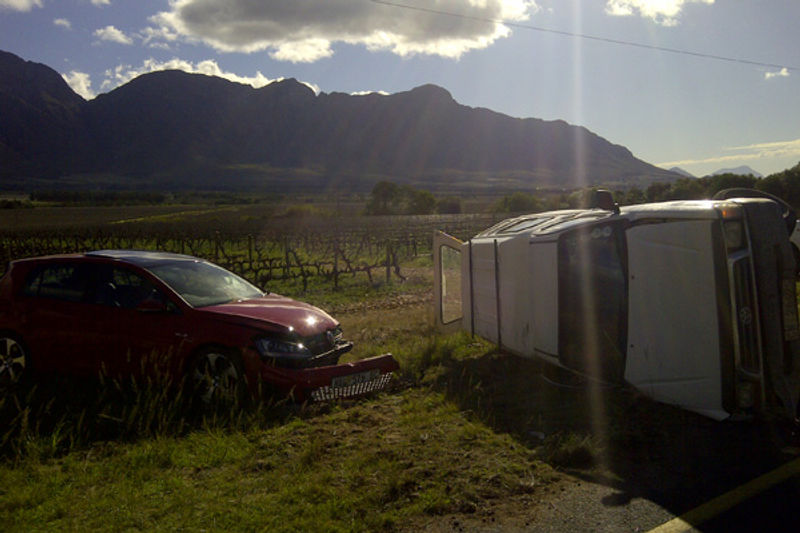
I’ve been at this car journo gig for a fairly long time now. As journalists, we write endlessly about the features of the cars we drive, but some of them we never, ever want to test. Yesterday I tested those features. And they are phenomenal. I walked away from a horrible, violent accident in the new VW Golf GTI, an experience that I would never wish on anyone.

This was an accident in the truest sense of the word. The driver of my vehicle executed a safe manoeuvre in clear road conditions. The driver of a bakkie in a rural farming area was going about his day. He chose a bad time to U-turn – he didn’t see us coming. No one wants to cause something like this. It’s an accident, plain and simple.

New VW Golf GTI put to the test

The new Volkswagen Golf GTI launch was pretty much a standard issue car launch, pair up with a driver and hit the road. The accident happened after lunch. It was in the grape growing region of the Western Cape, very rural but great roads and great visibility.

We weren’t pushing hard, genuinely around the speed limit of 120km/h. The bakkie (pick-up) was way ahead of us and crawling, if not stationary, on the left hand side of the road. My driver had a perfectly clear road ahead to overtake, and moved to the right to pass.

Closing on  the bakkie, with I’d say less than 80m to go, he just U-turned. No indicator. We didn’t stand a chance. My driver moved further right to try and get around the front of the bakkie, but our options very rapidly narrowed to either running into a big ditch or hitting the vehicle. If we were on anchors for 20m it was a lot.

And then the impact. It’s quite possibly the most awful feeling imaginable. My mind was fairly calm but my body panicked, and for a moment I felt an awful horror, this was going to be a big one, and I was going to get hurt. Properly hurt. It shakes up a very primitive part of your brain and it’s a trauma I’d quite like to never experience again.

A very loud series of noises followed, and everything was very white. I was totally winded and in quite a bit of pain. It wasn’t a specific pain, more a total body shock. The driver asked me if I was okay, I replied yes and he immediately climbed out to go help the other driver. The sweeper car pulled up and so did the medics. Amazing efficiency and professionalism from everyone at VW. I was extremely happy to be in such calm and capable hands.

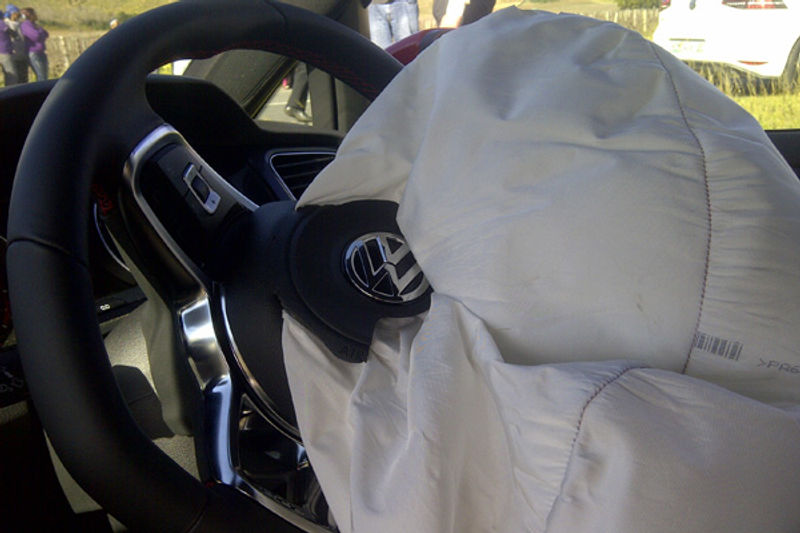
I sat in the car for about 10 minutes. My sunglasses were in the back, my iPad, which had been on my knee, had somehow become lodged between the driver’s seat-upright and the central console. I couldn’t get it out without kneeling and yanking it out. The airbags were out, a sight I never thought I’d see from where I was sitting. The windscreen was very badly cracked but intact, and I couldn’t open my door.

After a few minutes I realised nothing was seriously wrong with me, which was a nice feeling to say the least. But for a few minutes I was very dazed and frightened. My chest felt very tight. As soon as I saw the bakkie driver pop out of his side window like a meerkat, chatting on his cellphone, I knew everyone was okay. I wiggled my fingers and toes and my immediate thought was, “I’m fine, but this is going to hurt tomorrow”.

Excellent safety in the new VW Golf GTI

The passenger side of the car took the brunt of the impact but the passenger cell was resolute. In a 5, 8, 10 year old car, maybe I’d be writing this from hospital with a broken leg – who knows. The seatbelt pre-tensioner worked perfectly. The latest Golf can sense when an accident is about to happen, and yanks you quite forcefully into the safest position possible. I think this system could be one of the best new safety systems in the motoring world, and I hope it makes it into more and more cars.

The belt exploded into place and prevented me from moving around too much. The airbag hit me, but not very hard. This was either because of the seatbelt, or the force of the crash throwing me more sideways than forward. But your head is a very heavy object, and the G’s have a lot of opportunity to swing it around. I’m really stiff now all the way down my back, but I’ll be fine.

And I am fine. My neck’s a bit sore, I’ve got some bruising on my collarbone from the seatbelt and my shin took a little knock. But that’s about it. I pretty much hopped out of a horrendous accident, where my side of the car took the majority of the impact. Every single safety system worked perfectly, and I am so happy I was in a modern car of that calibre.

Accidents are awful for everyone involved; no one wants this. But we have to get around and we have to drive something. And that incredible piece of engineering is what kept me out of hospital today.

In a weird way, I am glad I got to test arguably the most important features of any car, and the fact that I’m sitting here, enjoying a coffee and writing about it, is testament to how clever and well-engineered today’s vehicles can be.

I would like to heartily recommend that if you can, get yourself into a modern car as soon as possible. Any new car today is better at looking after you than an older car, and the tech is getting better all the time. Not only are they cleaner and more efficient, but when it really matters, they are the only thing standing between you and potentially permanent injury.

This is a story that needs to be told, these are images that I hope will remind everyone who ever uses a road that accidents do happen, and to please be very careful.

MINI JCW Countryman Review

What do you need out of a hot hatch? Unique stand out looks, stiff suspension, uprated engine and exhaust tone, but with the practicality of that model’s everyday functionality. Step in John Cooper Works motorsport tuning, who tackled MINI’s largest… MINI.

MINI JCW Countryman review by John Beale

Engine & Ride

The familiar 4cylinder 1.6litre twin scroll turbo unit, after some JCW tinkering, now produces 160kW and 280NM (with 300NM available on overboost) which is 5kW more than other JCW motors but shamefully “boasts” the same acceleration times as normal Cooper S. This is caused by the weight penalty of size and transmission tunnel running to the rear.

The additional power is immediately noticeable, with a lot more shove from 2500RPM, and it doesn’t run out of steam till over 6000RPM. It doesn’t have the gutsy feel of the Golf VI R, but there’s more than enough punch to justify the JCW badge. Sadly, as I’ve said before, the steptronic automatic does the MINI JCW Countryman no favours. Slow to change and it rides the clutch a little on initial pull off. It also takes some of the fun of really driving a MINI out when mated to an Auto, so if you don’t really need to, don’t spec it. It’s nowhere near as good as the DSG units from Audi / VW.

The Countryman’s handling

That said, in my view, this is the best JCW incarnation yet, which sounds ridiculous, but let me explain. The MINI JCW Countryman is the only model that boasts All4 drivetrain, which can send up to 100% of the power to the rear. For anyone who has driven a MINI, you’ll know the fight you have with the front wheels, and general mania that ensues when cornering, with the front wheels scrabbling to keep traction, and that’s with far less than 160kW. Now some might say that’s the fun of it all, but here in the Countryman, the system offers much more confidence.

All4 makes a huge difference when throwing the MINI JCW Countryman into a corner, the familiar spinning inner wheel is smacked down by the neutral confidence-inducing drive from All4. With sport mode on (which stiffens steering, throttle response and engine mapping) and launch control off the line and the steering wheel doesn’t rip out your hand and send the car careening into the nearest pavement. Win!

Throw her into corners and the firm suspension shows the finger to body roll. So it’s a JCW but surprisingly, it’s not as harsh as normal Cooper S suspension, even though it rides on sexy 18 inch wheels. This is why it’s the best JCW yet: It brings a balance between ride and outright performance, not being a one trick pony like the Cooper S JCW which rides too hard and is really focused. These days a halo performance hatch needs to be more dynamic, and the MINI JCW Countryman does just that. Sadly, it doesn’t have the exhaust and engine note you’d want to scare the folk on the pavement.

The exterior and interior

Besides the mechanic 10mm lower suspension, engine tweaks and uprated brakes, JCW performance pack ads front and rear aero kit, aggressive side sills that have “vents” in them, larger rims and JCW badging pretty much everywhere. I’d opt for all black with red stripes, which gives a particularly aggressive look.

The interior is standard Countryman, being a lot bigger than the Cooper S, but familiar airplane style toggle switches adorn the interior. An interesting choice of chocolate brown all-leather seats against the silver paintwork was odd. That however wasn’t the real problem, but rather the lack of side bolstering and support in the front seats. The Countryman trick is that there is comfortable seating for four adults, with a boot you can use.

Features and Tech

The Connectd (no typo) system is however starting to show its age, and wouldn’t work with the latest iPhone. Standard kit is good, but in typical MINI style there are a variety of add-ons and customization options (like fun customizable interior ambient lighting), available at the peril of your budget. My test unit had over R100 000 worth of optional extras, from BMW Connectd with Sat-Nav, heated seats to adaptive bi-xenon headlamps. Many of these you could leave off, but you’ll find you want to spec some options to get comfortable, and take advantage of making it unique as possible.

Conclusion

The MINI JCW Countryman ticks all the boxes, and with four-wheel traction, is possibly the best handling MINI on sale today. That said, the competition is considerably faster, and when BMW’s own M135i is priced so keenly you need to be a real MINI aficionado to slpash out on performance that isn’t much better than a standard Cooper S. The best work from JCW yet, in isolation, but price could push many into more powerful rivals.

MINI JCW Countryman – Price

MINI JCW Countryman 160kW / 280NM – R450 900 (As tested – R540 000 with all extras)

  • View the vehicle : New Mini Countryman / Used Mini Countryman
  • Competitors worth checking out:
    • BMW M135i Auto – 235kW/450NM – R486 743
    • Audi S3 Quattro Steptronic (old shape) – 188kW/350NM – R440 975
    • VW Golf VI R – (second hand) – 188kW/350NM – R360 000 (estimate)