With so much choice on offer, deciding which Toyota Hilux bakkie is right for you might seem overwhelming. But fear not! We’ll help you figure out which 1 suits you best…
At last count, the Toyota Hilux range spanned a whopping 37 derivatives in Mzansi. So, if you’re in the market for a new bakkie and are keen on a Hilux, how do you decide which one is right for you?
Well, to help you figure out which derivative will best suit your needs, we’ll examine this Prospecton-built stalwart, which has been SA’s best-selling vehicle overall for more than 50 consecutive years, in detail.
By the end of this exercise, you should have a solid understanding of which 8th-gen Toyota Hilux variants might be worth including on your shortlist, depending on your intended usage. Note, however, that we won’t delve into pricing here, since you’ll (obviously) know your budget far better than us…
Talking about budget, if you’re unsure what you’re able to afford, please take some time to explore our Car Affordability Calculator and you can also work out estimated monthly instalments using our handy Car Finance Calculator.
In South Africa, the Toyota Hilux is available in 3 distinct body styles. As present, the Prospecton-based manufacturer offers as many as 15 single-cab derivatives, including a pair of chassis-cab variants. The single cab is best described as a workhorse (equipment levels tend to be sparse to keep the purchase price down); therefore, it’s generally intended for business rather than personal use.
The same can be said of the extended cab – which, like the single cab, technically qualifies for VAT reclamation when purchased by SARS-registered businesses.
However, it adds more in-cabin (and, crucially, out-of-sight) storage space and, in some cases, standard features. While the single cab has the larger load bay and loftier load capacity, the multi-role extended cab (there are 6 derivatives available locally, each badged as an “Xtra Cab”) isn’t far behind.
Finally, Toyota SA Motors offers 16 double-cab variants. Most examples of this body style are positioned as so-called “leisure bakkies”, featuring all manner of bells and whistles. They are designed for both work and play, with a heady mix of carrying capacity and cabin space. In short, for many buyers, a double cab is a family vehicle and a workhorse in one.
Photo by Cornel van Heerden
www.cornelvanheerden.com
If you have no intention of tackling challenging off-road terrain in your Hilux, it would be prudent to opt for a 4×2 derivative. As many as 23 variants in the range are rear-wheel drive, bringing not only purchase-price benefits but fuel savings, too. Furthermore, they offer slightly higher payload and towing capacities than the equivalent 4×4 versions.
The remaining 14 derivatives ship with 4×4, making them well suited to tackling demanding sections of rough terrain, including slippery conditions and steep off-road inclines, thanks to added traction. They furthermore offer extra versatility in that the driver can switch between “H2”, “H4” and “L4” modes.
3. Toyota Hilux engine options
With the 4.0-litre V6 no longer part of the local Hilux line-up, the only petrol engines are the 2.0- (102 kW/183 Nm) and 2.7-litre (122 kW/245 Nm) 4-cylinder motors employed by the low-spec single- and double cabs. These are, of course, the out-and-out workhorse derivatives.
Next comes the 2.4-litre 4-cylinder turbodiesel, which powers 18 variants in the range, offering 110 kW and up to 400 Nm. This motor is a fine choice for buyers who seek a good blend of performance and efficiency.
The 2.8-litre 4-cylinder turbodiesel, meanwhile, generates 150 kW and 500 Nm in most applications, which makes it a strong option for drivers who require added oomph. It is furthermore available in the Raider and Legend double cabs with 48V mild-hybrid technology, ostensibly improving fuel economy.
Finally, the 2.8-litre GD-6 that powers the flagship GR-Sport boasts higher outputs of 165 kW/550 Nm.
4. What transmissions are available for the Hilux?
There are just 3 transmission options in the current Toyota Hilux portfolio. The petrol engines all feature a 5-speed manual gearbox, a configuration also shared with low-spec derivatives powered by the 2.4-litre turbodiesel detuned to 343 Nm.
All other 2.4- and 2.8-litre 4-cylinder turbodiesel engines employ either a 6-speed manual ‘box or a 6-speed automatic transmission. Pick your preference here, though a 2-pedal derivative would be far easier to live with if you typically spend loads of time in stop-start traffic.
5. What trim levels are offered on the Hilux?
The Toyota Hilux range features 5 main trim levels, starting with the basic “S” grade reserved for the workhorse derivatives. The “SR” specification adds a little extra kit but is likewise set aside for more affordable, utilitarian variants.
Meanwhile, the “Raider” grade represents a pleasing middle ground, bringing more standard equipment and more modern styling. For instance, Raider derivatives gain the latest grille treatment rather than the old face (with a black plastic bumper) employed by the S and SR versions.
Available exclusively in conjunction with the 2.8-litre 4-cylinder GD-6 engine, the high-spec “Legend” trim level is aimed largely at so-called “lifestyle” buyers, though it’s interestingly offered for both the extended- and double-cab body styles. Finally, the GR-Sport tops the range, boasting a widebody configuration, uprated suspension, all-terrain tyres and a more powerful engine tune.
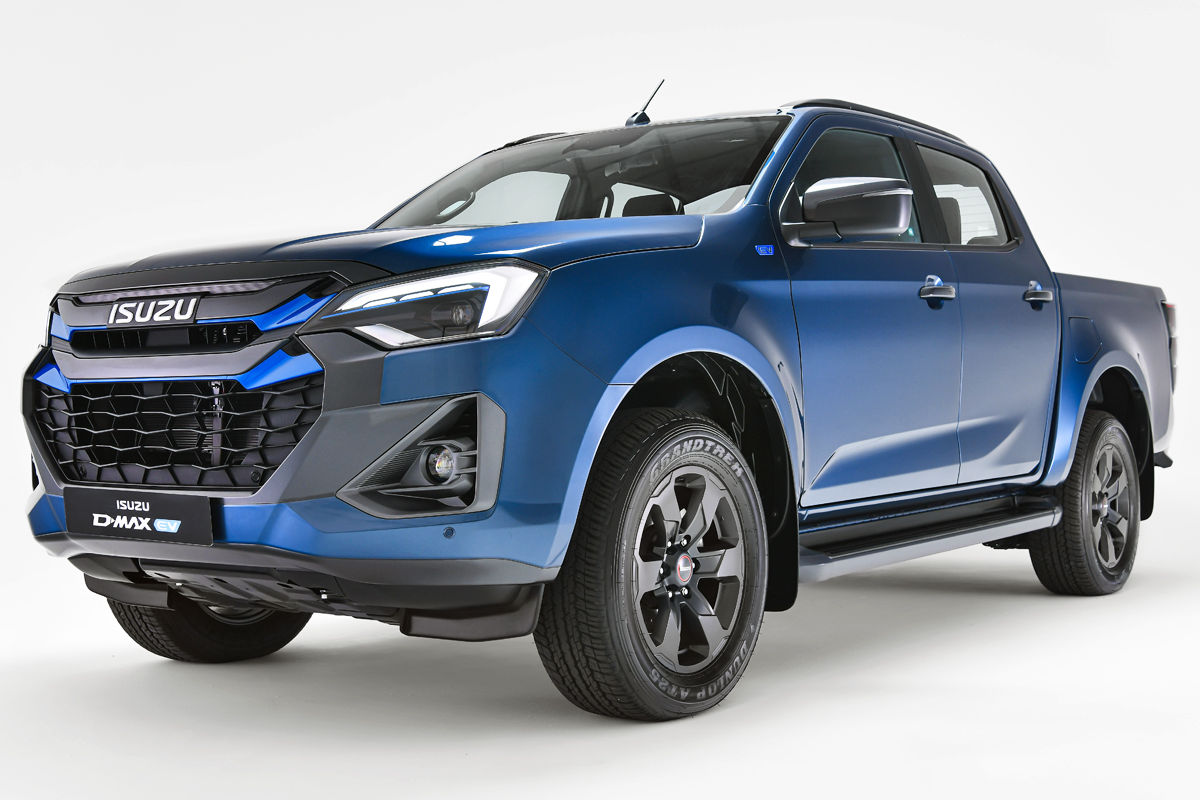
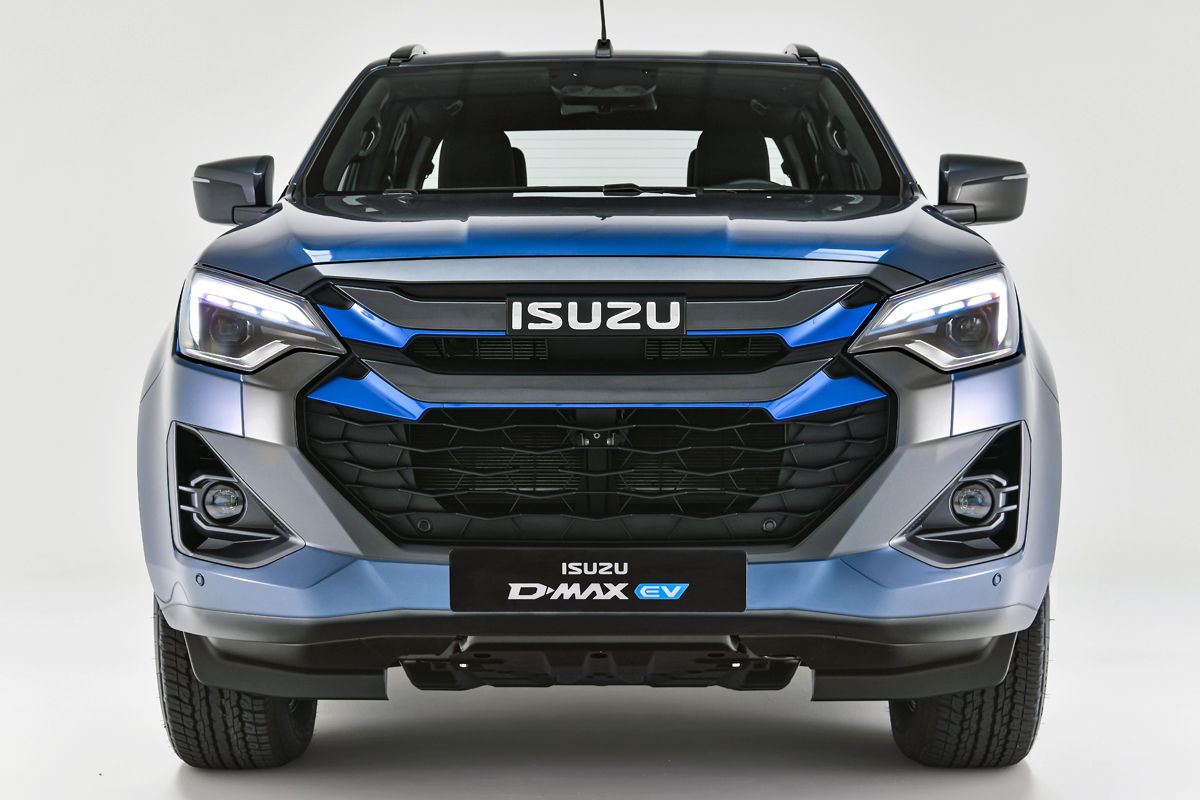
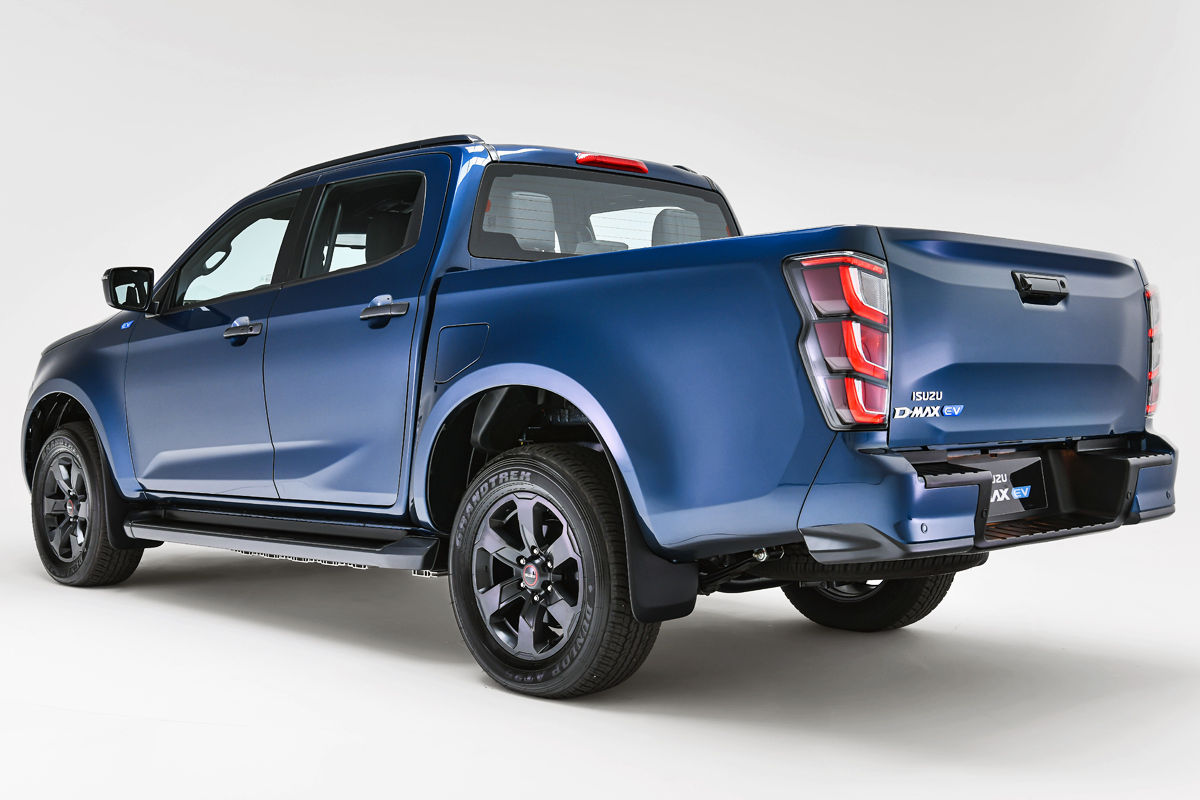
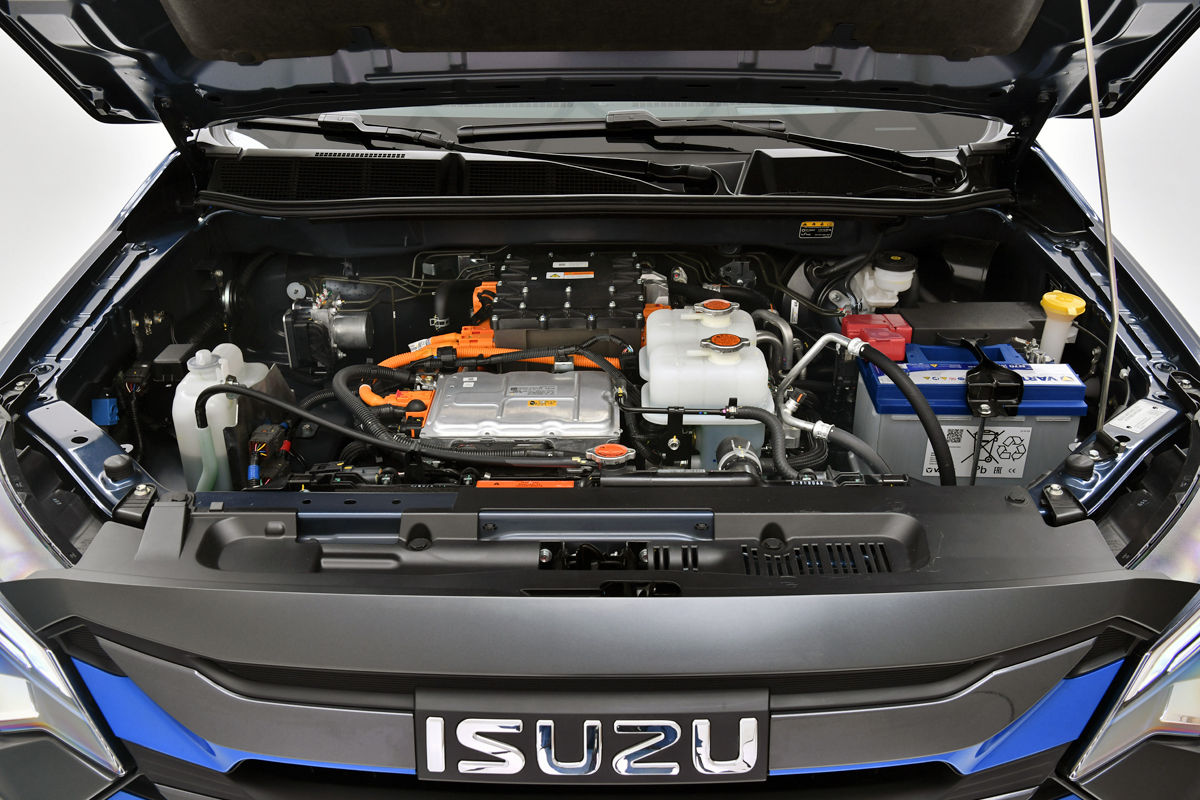
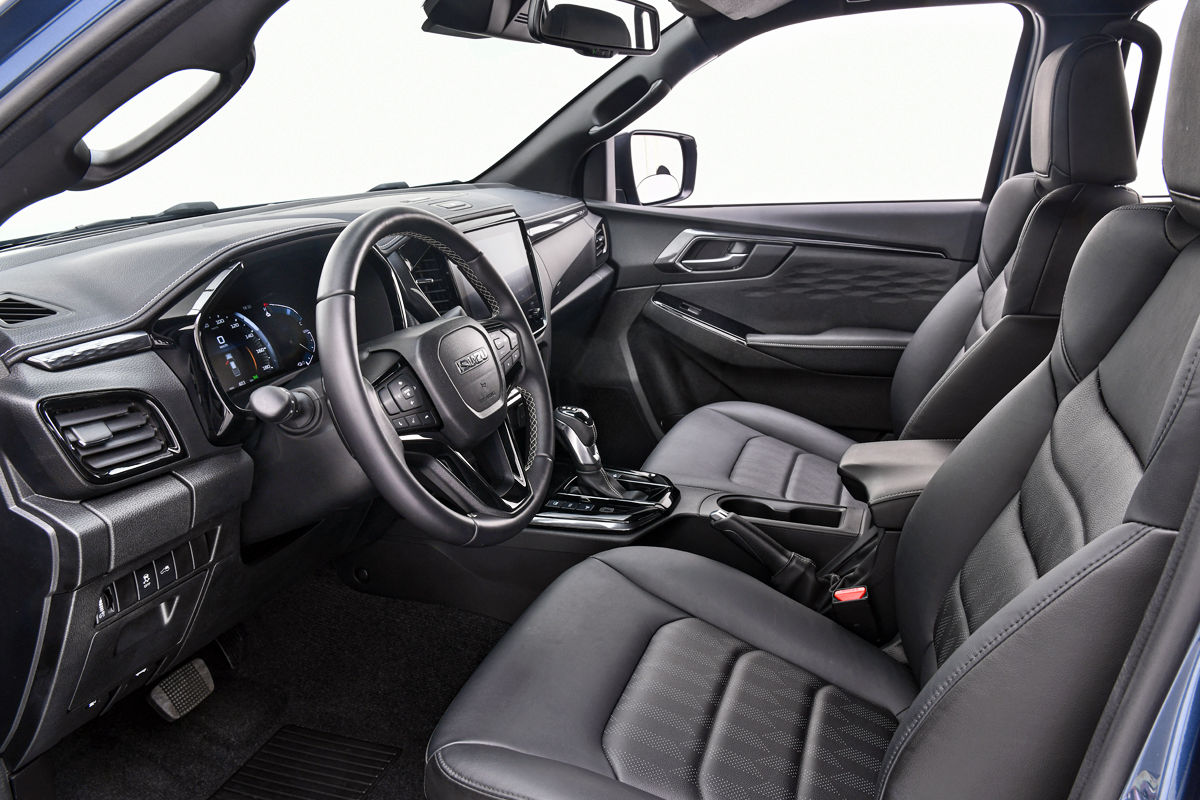
The new Isuzu D-Max EV has been revealed, featuring a fully electric 4×4 powertrain with peak power of 140 kW and a claimed single-charge WLTPrange of 263 km…
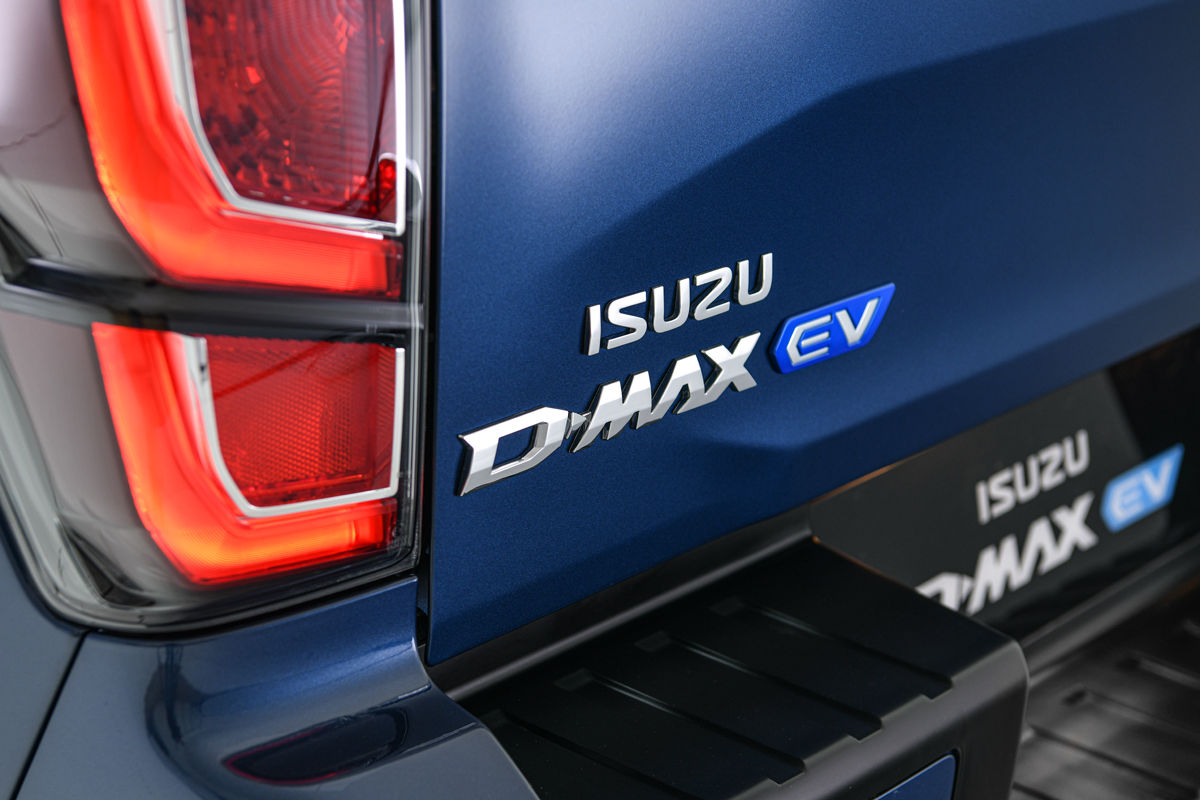
Meet the new Isuzu D-Max EV, the first fully electric version of the Japanese firm’s popular bakkie. Revealed at the 2025 Commercial Vehicle Show in the United Kingdom, the battery-powered pick-up has officially entered production in Thailand.
According to Isuzu, the first left-hand-drive units will reach “major” markets in Europe in the 3rd quarter of 2025. Production of right-hand-drive units is scheduled to start towards the end of this year, with sales likely to commence in the UK in 2026 before being “rolled out to other countries and areas based on market needs”.
For now at least, it seems unlikely the D-Max EV will be offered in South Africa. As a reminder, the diesel-powered D-Max for the local market in produced at Isuzu’s Struandale plant in the Eastern Cape, while this box-fresh EV version comes from the Samut Prakan factory in Thailand.
The new Isuzu D-Max EV is based on a “re-engineered” version of the standard RG-series bakkie’s platform and features a 66.9 kWh lithium-ion battery pack allowing a WLTP range of 263 km (or up to 361 km of city driving). Europe will receive both extended- and double-cab body styles.
Isuzu says the D-Max EV is capable of accepting DC fast-charging speeds of up to 50 kW, moving the battery capacity from 20 to 80% in approximately an hour. Use a standard 11 kW AC charger, meanwhile, and it would theoretically take 10 hours to reach a full charge from zero.
Dual electric motors produce a total power output of 140 kW (43 kW fore and 97 kW aft) along with peak torque of 325 Nm (108 Nm up front and 217 Nm at the rear). The 4×4 EV bakkie has a claimed 0-100 kph time of 10.1 seconds and a top speed of “over 130 kph”.
Wading depth is listed as “up to 600 mm”, while ground clearance comes in at 210 mm. The off-road approach and departure angles are 30.5° and 24.2°, respectively (besting the D-Max 3.0TD V-Cross 4×4). Interestingly, the D-Max EV ditches traditional leaf springs at the rear, instead switching to “an all-new De-Dion rear suspension” set-up.
Still, payload capacity comes in at 1 100 kg and braked towing capacity at 3 500 kg, while the kerb weight is listed as 2 350 kg. That makes the D-Max EV some 280 kg heavier than the D-Max 3.0TD V-Cross 4×4.
From sportscars to super cars and sedans to convertibles, Mother City Car Company offers a wide variety of luxury and performance cars. We visited the dealership to chat with its proprietor about the business, from humble beginnings to where it is today.
With a variety of high-performance cars, a Ford Mustang, and even a classy Mercedes-Benz S-Class on its showroom floor, Mother City Car Company is an inviting place for any automotive enthusiast.
A few other elements grabbed my attention as I entered the premises (before proprietor Art Denisov walked over to shake my hand). These included a perfect W140-series Mercedes-Benz S320 with blacked-out details, as well as a Honda Civic race car. Indeed, Art and his staff are true petrolheads.
There are memorabilia and posters along the walls, as well as intriguing books and artefacts around his office space. I took a seat in the comfortable chair across Art’s desk and asked him about his journey.
Early beginnings
“At the end of 2009, a friend was working for Autohouse Angel (which has branches in Milnerton and Belville) – Marcel Angel’s business. He was working in Sea Point, where they had a little dealership that sold tiny convertibles. You know, Mazda MX-5s, Peugeot 206 CCs and MG TFs… those weird little cars.
“He was working there when I arrived back in South Africa after a year-long stint in the Russian Navy (where he served in the Polar Circle). I needed some sort of job, and my friend suggested that I sell cars.”
“My response was: ‘Ugh, a used car salesman? I don’t want to get any of that muck on me.’ I was all too aware that it was a vocation with a less-than-favourable reputation (rightly or wrongly), but I gave it some thought. I spoke to some people whom I trust and whose opinions I value. They told me: ‘Look, Art, you are 23 and you’ve loved cars since you were a child. If (the role) doesn’t work, you can just move on.’
“I started with Autohaus Angel at their (then) Claremont branch. It was around October 2009. At the time, Mini was their core brand. They were across the road from Auric Auto, which sold BMWs and Minis. We’d often drive and sell examples of those brands’ models… it was one of the main perks of the job.
“Within a couple of months, I had several opportunities to drive cars such as the Mini Cooper S, which was such a thrill, because at the time I had a very mundane Volkswagen Citi Golf (a 1.4-litre carburettor variant). The Golf also had aircon, but it sapped all the VW’s power when you switched it on. Long story short, after a while, I decided that I’d persist with this car sales job because I was kind of enjoying it.”
Art admits that the opportunity to drive such a wide variety of cars was one of the biggest drawcards of his job. Apart from the Minis, he also found himself behind the ‘wheels of supercharged Range Rovers, and he fondly remembers the first time he got to drive a 986-series Porsche Boxster S.
“Little by little, I started selling some cars and began getting a knack for it. The team there was quite fun, and I thought: ‘This is a cool community.’ We moved to Paarden Island and shared a showroom with Cars Unlimited Cape, which was then Lourens Bester’s business that retailed used and classic Porsches.
So, I eventually worked on both sides of the showroom, the Porsche side and the Autohouse Angel side. In the last 12 months (or so) of the 3 and a half years that I worked with the group, I was sort of the golden boy. Between our 4 branches, I would consistently be the top-performing salesman.”
“In the final year, I did a little deal with Marcel (Angel), who is a very shrewd businessman. I suggested that he allow me to buy stock; let me find a car, bring it in, check and appraise it and do all that work. Then I’d bring the deal to him. If it’s good, he can buy the car – that started to happen quite often.”
Then the penny dropped
“In 2012, my employment with Autohouse Angel ended,” Art added, “but by then, I had already begun Mother City Car Company in my spare time, and it had been operating for a few months. Here’s how it began: I bought 2 Mini Coopers, because that’s the 1 thing I kind of adopted from Autohouse Angel.
“Stock unit one and stock unit two. I had start-up capital of R200 000 from my then father-in-law for a 50:50 profit share. He asked me several thought-provoking questions, and then the penny dropped…”
Today, Art has 2 staff members who assist him tremendously. “I have an approach with my staff where I try to pay them as much as possible. I like to create opportunities for JJ or Mandla to add more value to the business, because if they do, I make it worth their while. It has always been my aim to get the right people on board and incentivise them correctly. That is the environment that I want to work in.”
From 2013 until 2019, the Mother City Car Company was located in its initial premises in Paarden Eiland – growth was slow, and Art admits that he wasn’t focused and “too busy chasing (his) tail.” The business moved into its current premises at 5 Copperfield Road, Salt River, thereafter. It was just Art and Mandla at that point, and just on 1 side of the building – they didn’t yet have the 2nd section that they have now.
“We didn’t know where we were going to find the stock, but put yourself under a bit of pressure, and then you’ll have to work and make it happen. Otherwise, you’re just going to falter,” Art adds.
One thing led to another, and with the help of his small team, they were soon acquiring stock and honing their craft, while offering prospective clients helpful advice and, of course, the cars that they desired.
The inventory of Mother City Car Company
Art has strong opinions about some exotic car brands… and he is more than happy to share them.
“The Porsche brand carries all of this promise, which is backed up by good resale and residual values, decent reliability as well as good performance,” he says. “Porsches don’t sell for Aston Martin, Ferrari or Lamborghini money, but most Porsche models aren’t in that category anyway. A Porsche is not an exotic car; it’s a thoroughbred sportscar for serious enthusiasts, but there are more exciting cars out there.
“We have a perfectly specced 997-series Porsche 911 Turbo manual (shown above), and for a while, I thought: ‘this one might be a keeper’, but ultimately I decided against it. It is brilliant, but doesn’t offer a truly visceral driving experience. A Ferrari F430 (below), for a little bit more money than the Turbo, is a proper little race car for the road. Now that car is epic – it makes you smile and feel so many things.”
With a strong-growing business and many returning customers – a clear indicator of good client service – Art has several exciting plans in store for the Salt River-based Mother City Car Company.
As our conversation draws to a close, Art heads to the Honda Civic race car, which he urgently needs to get ready for the next race meeting. Evidently, he is invested in all things motoring, from dusk ’til dawn!
Watch Ciro De Siena test drive a BMW Z4 M Roadster from Motor City Car Company:
Chinese firm GWM is developing a new 3.0-litre turbodiesel engine that looks likely to debut in updated versions of the P500 and Tank 500. Here’s what we know…
GWM has confirmed it is developing a new 3.0-litre turbodiesel engine that looks likely to be rolled out to updated versions of the P500 bakkie and Tank 500 SUV. The new, larger-capacity motor would thus slot in above the Chinese firm’s existing 2.0- and 2.4-litre oil-burners.
According to carsales.com.au, Jack Wei, Chairman of GWM, confirmed the news to Australian media on the sidelines of Auto Shanghai 2025, where the Chinese automotive giant also revealed a new twin-turbo 4.0-litre V8 PHEV powertrain.
In SA, the P500 is currently available with a 2.4-litre turbodiesel motor.
“We have already 2.0-litre and 2.4-litre diesel engines in many countries. These 2 engines are designed on the same platform but now we are developing the 3.0-litre diesel,” Wei said, according to the publication.
As a reminder, the 2.0-litre oil-burning mill employed by the P-Series bakkie makes 120 kW and 400 Nm, while the newer 2.4-litre unit generates peak outputs of 135 kW and 480 Nm. In South Africa, the latter engine is used in the P300, Tank 300 and P500.
The upcoming 3.0-litre mill could potentially be used in both the P500 and Tank 500.
“The performance of this engine will be will be even better, with better fuel economy and also lower emissions,” he promised via an interpreter, emphasising that the larger-capacity (seemingly also 4-cylinder) motor would be a “new generation diesel” based on a fresh engine architecture.
Though official details on the new 3.0-litre engine have yet to be released, carsales.com.au speculates that it could generate “around 180 kW and possibly up to 650 Nm”. That, of course, would see it stand toe-to-toe with Ford’s 3.0-litre turbodiesel V6, which makes 184 kW and 600 Nm in the Ranger and Everest.
The Tank 700 also looks set to receive the new engine.
James Yang, Vice President of GWM International, further told Australian outlets the new 3.0-litre turbodiesel was being “developed for right-hand-drive markets”, adding that it would be considered for an updated version of the P500 bakkie scheduled for release in 2027 as well as “go into the Tank 500 and Tank 700”.
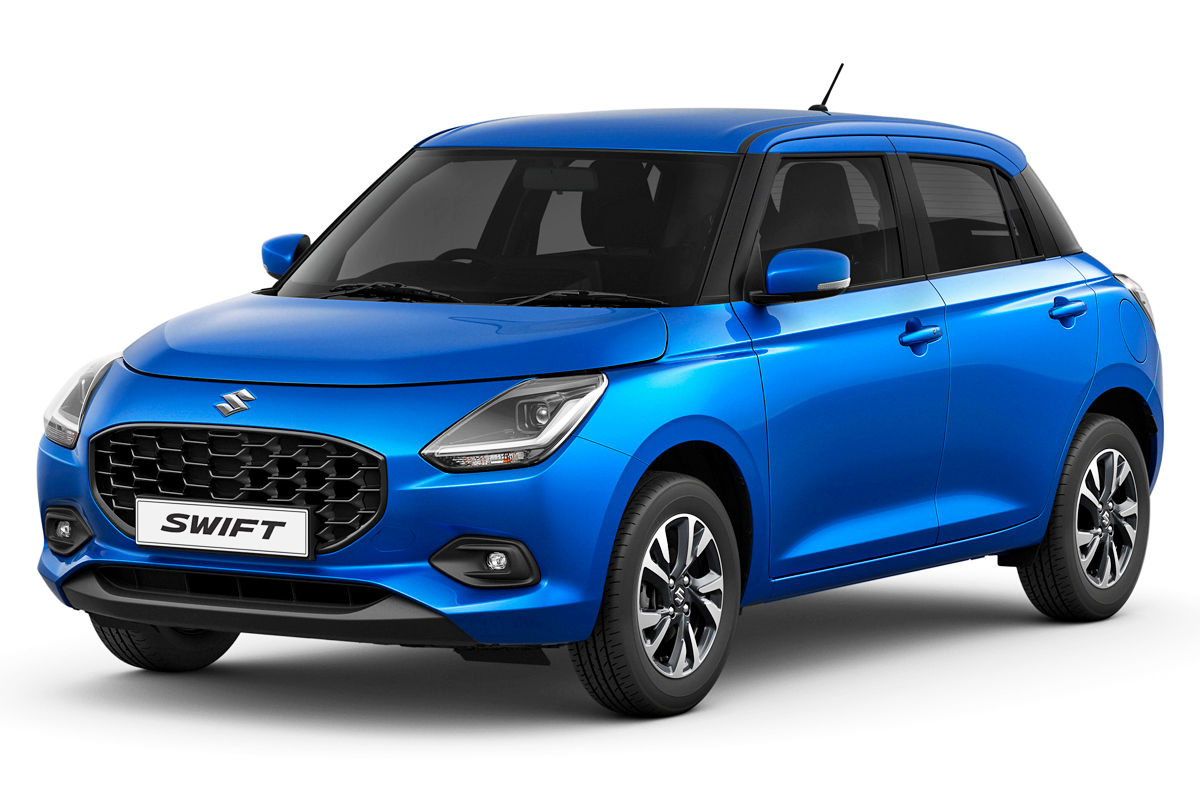
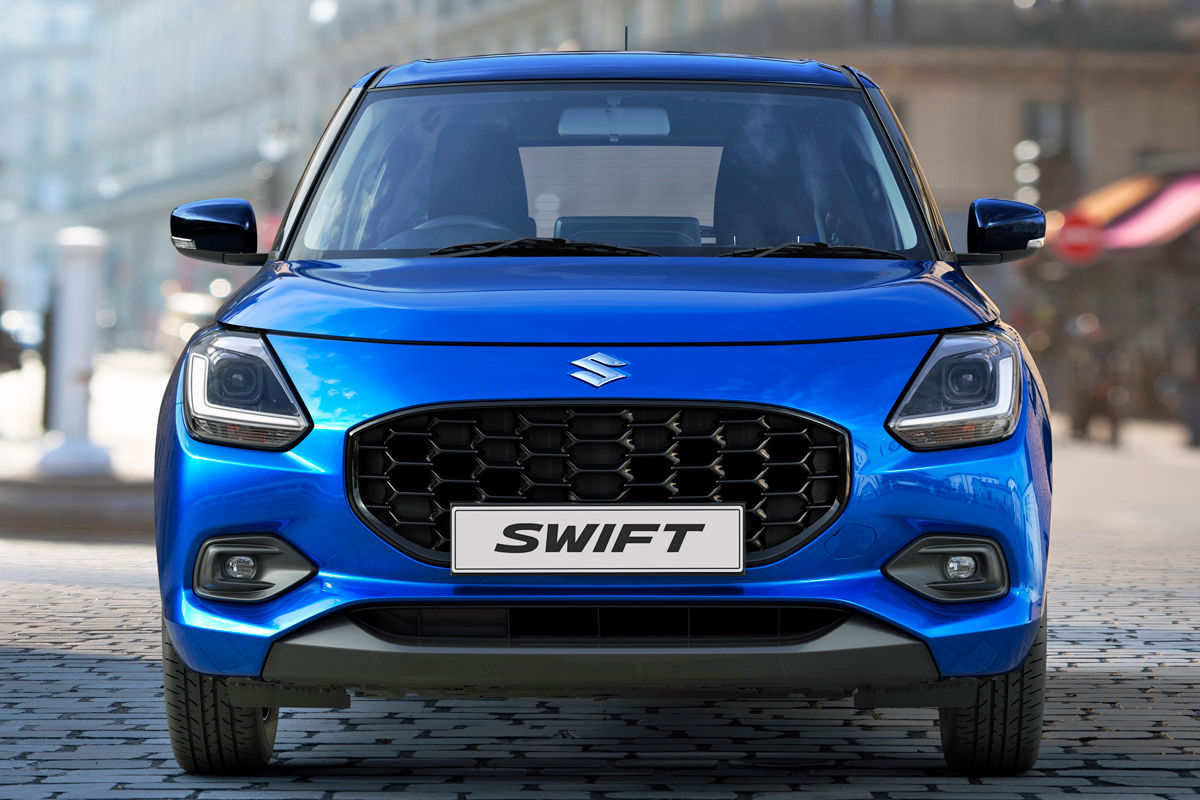
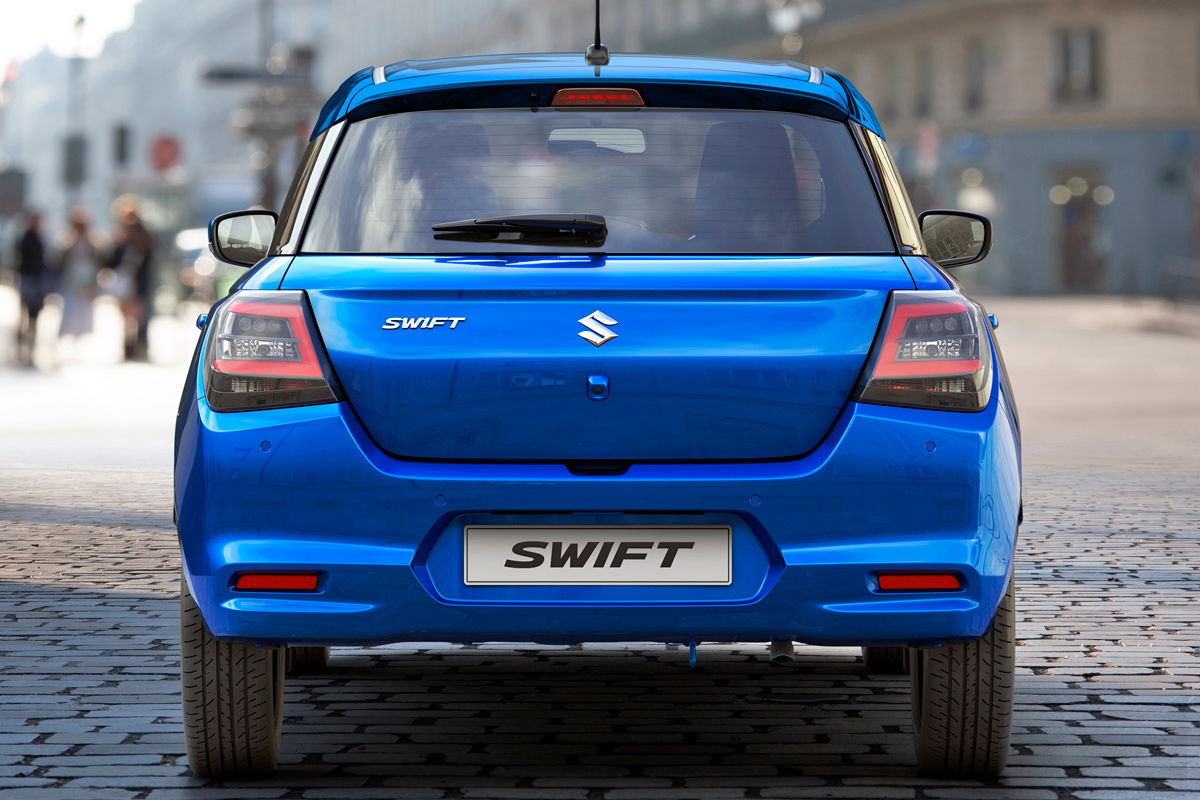
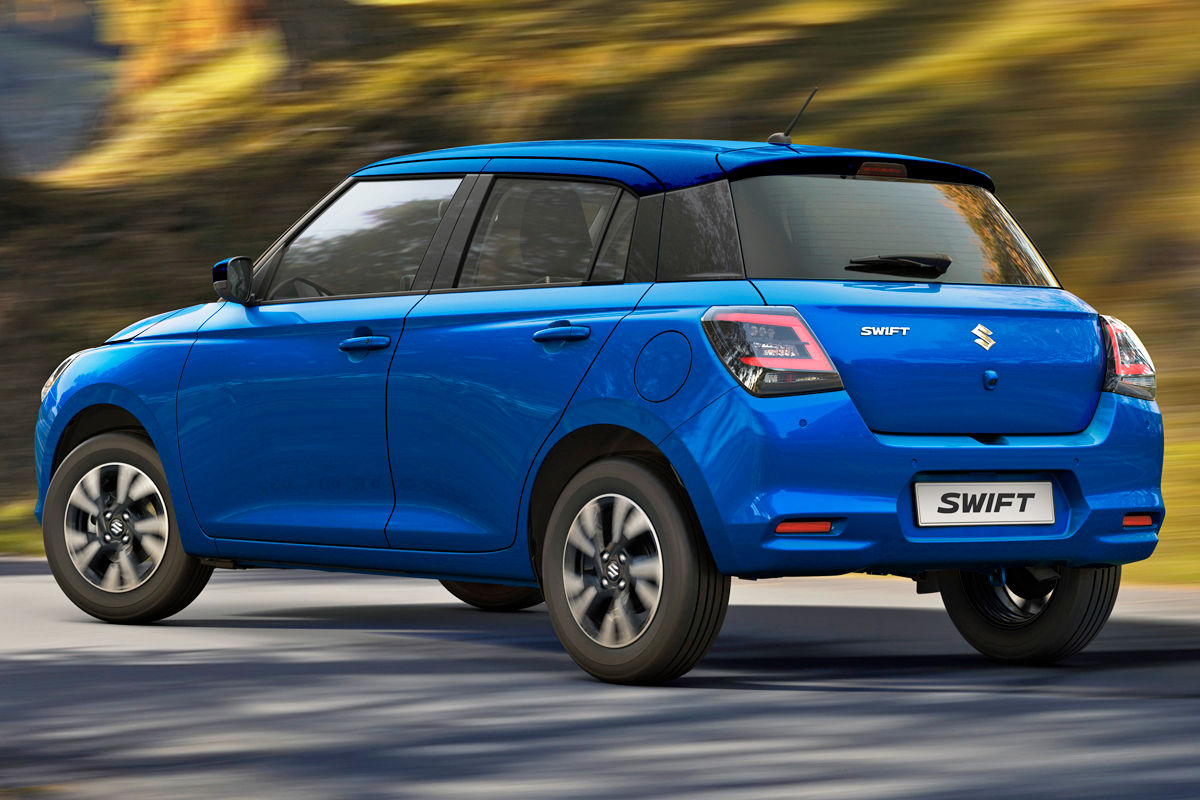
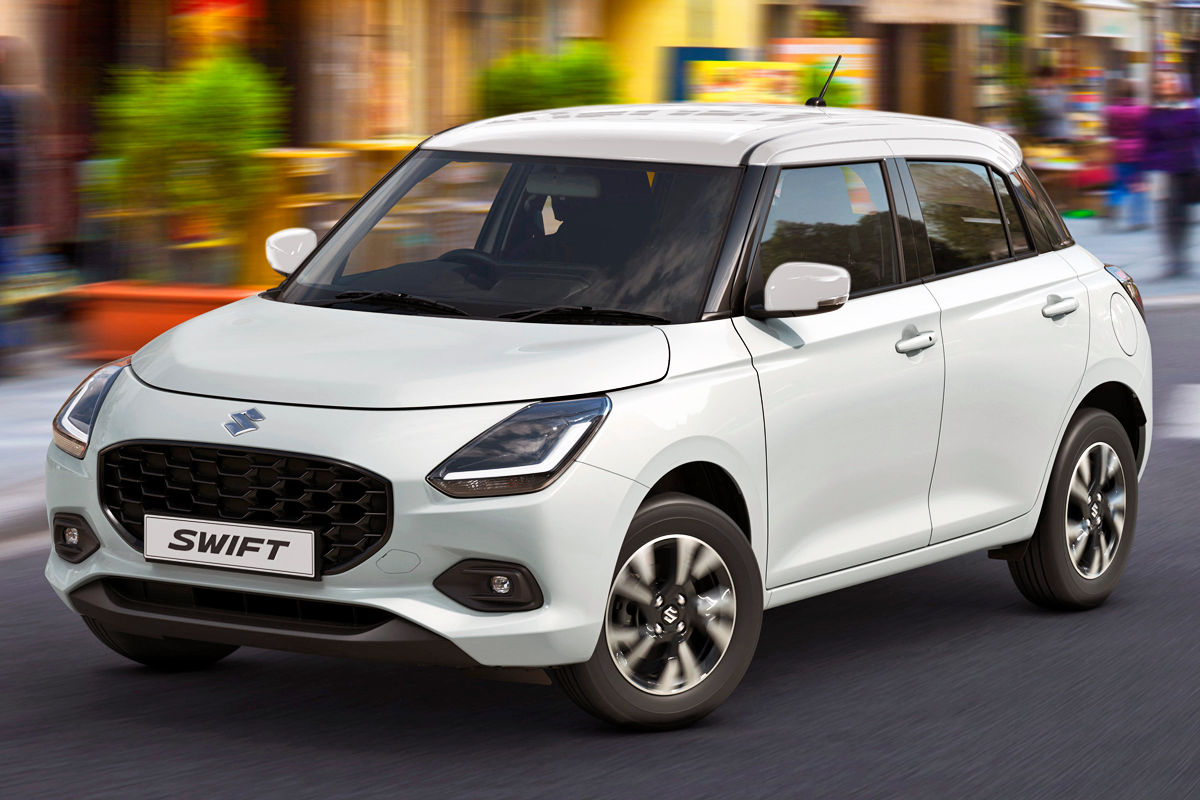
The new Suzuki Swift is one of the most popular cars sold in South Africa, powered by a fresh 3-cylinder engine. Here’s how much the Swift will cost you…
The new Suzuki Swift arrived in South Africa in the final quarter of 2024 and has kept this nameplate at the top of Suzuki’s sales charts.
Interestingly, the Swift range (excluding the Swift Sport warm hatch) again comprises 5 derivatives. The previous base GA grade falls away, meaning the line-up now kicks off with the GL specification. A new GL+ trim level slots in as the mid-tier option, with GLX again topping the portfolio.
While the outgoing Swift range ran from R213 900 to R272 900, the new line-up kicks off at R219 900 and tops out at R284 900 (respective increases of R6 000 and R12 000). As before, the SA-spec Swift is sourced from Maruti Suzuki’s Manesar facility in India, rather than from the brand’s domestic market of Japan.
What engine does the new Swift use?
All derivatives are powered by Suzuki’s new Z-Series (Z12E) engine. The new naturally aspirated 1.2-litre, 3-cylinder petrol motor generates 60 kW at 5 700 rpm and 112 Nm at 4 300 rpm. As a reminder, all derivatives in the outgoing Swift range in Mzansi (again, bar the Japanese-built Swift Sport 1.4T variants) used a likewise atmospheric 1.2-litre, with similar maximum outputs of 61 kW and 113 Nm but 4 cylinders rather than 3.
The Swift’s front wheels are driven via either a 5-speed manual gearbox or a continuously variable transmission (CVT). The latter replaces the previous-gen model’s automated manual transmission (AMT). Only the entry-level GL is not available with the CVT at launch.
What standard features are offered on the Swift?
The new Swift 1.2 GL 5MT is priced at R219 900 and rides on 14-inch steel wheels. It ships standard with electric windows all round, electrically adjustable (and folding) side mirrors, a height-adjustable driver’s seat, air conditioning, rear parking sensors, an immobiliser and an alarm. Safety features standard across the range include 6 airbags, hill-hold control, ABS, electronic stability control and rear-outboard ISOfix child-seat anchors.
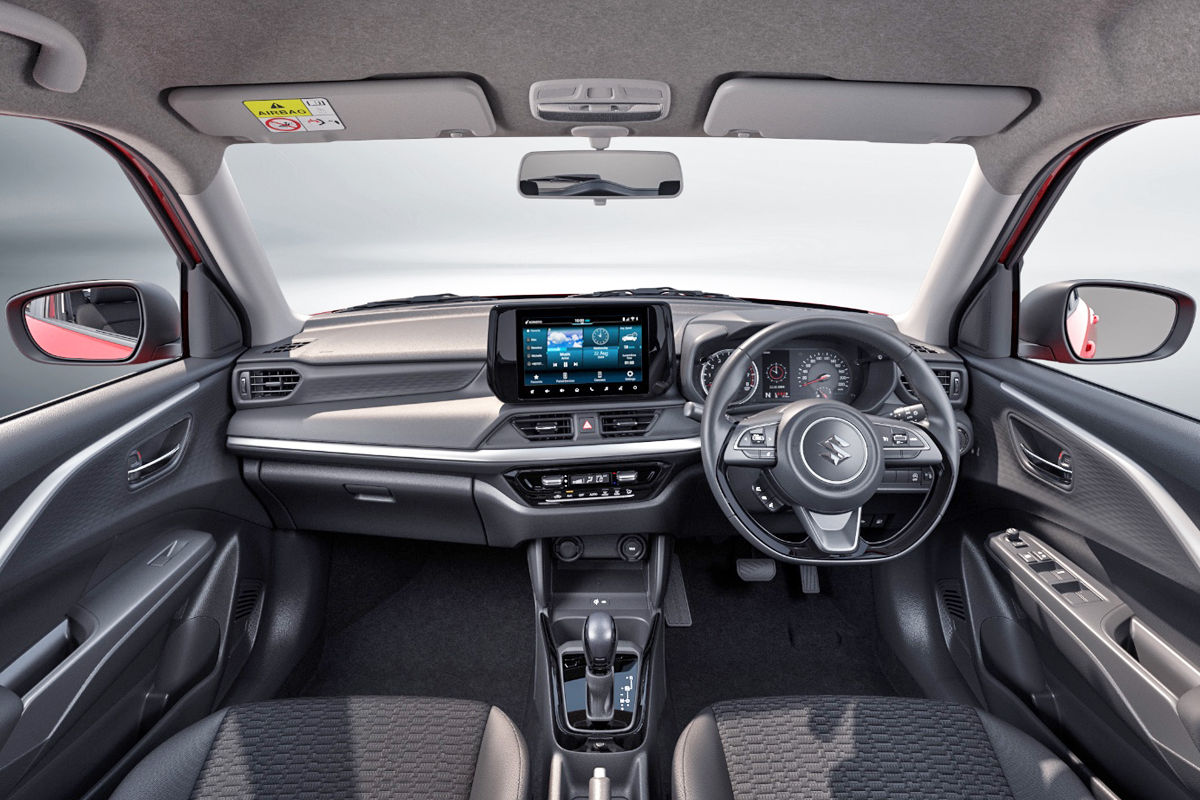
Meanwhile the Swift 1.2 GL+ 5MT (R239 900) and Swift 1.2 GL+ CVT (R259 900) gain features like a 7-inch infotainment screen, a reverse-view camera, steering-wheel controls (for the audio system) and 15-inch alloy wheels.
Finally, the flagship Swift 1.2 GLX 5MT (R264 900) and Swift 1.2 GLX CVT (R284 900) upgrade to a 9-inch infotainment screen, automatic climate control, a leather-clad steering wheel (with cruise-control buttons), auto-folding side mirrors, keyless entry (with push-button start), automatic LED headlights, 15-inch diamond-cut alloys and shift paddles in the case of the CVT derivative.
How many Swift cars are sold in South Africa?
In the first quarter of 2025, Suzuki confidently became South Africa’s second-best-selling car brand behind Toyota, claiming the long-held position from Volkswagen Group Africa. The Swift was the best-selling passenger car in Q1 2025 with a total of 6 587 units sold, representing an increase of 42.4% year-on-year.
How much does the new Suzuki Swift cost in South Africa?
Note that pricing is accurate as of August 2025.
Model
Price
Swift 1.2 GL 5MT
R224 900
Swift 1.2 GL+ 5MT
R245 900
Swift 1.2 GL+ CVT
R265 900
Swift 1.2 GLX 5MT
R271 900
Swift 1.2 GLX CVT
R291 900
The new Swift ships standard with Suzuki’s 5-year/200 000 km warranty and a 2-year/30 000 km service plan.
What are the different Suzuki Swift models available in South Africa?
The 2025 Suzuki Swift in South Africa is available in three main derivatives: the GL, a new mid-tier GL+, and the top-end GLX.
What is the engine and performance of the new Swift?
The new Swift is powered by a Z-Series (Z12E) 1.2-litre, 3-cylinder petrol engine. This engine produces 60 kW of power and 112 Nm of torque, and is paired with either a 5-speed manual or a Continuously Variable Transmission (CVT).
What is the price of the new Suzuki Swift in South Africa?
The starting price for the 2025 Suzuki Swift is approximately R219,900, with the top-end GLX model priced around R284,900.
What safety features are standard on the 2025 Suzuki Swift?
Standard safety features across all models include six airbags, hill-hold control, ABS, electronic stability control (ESC), and ISOfix child-seat anchors.
What warranty and service plan are included with the Swift?
The vehicle comes with a 5-year/200,000 km warranty and a 2-year/30,000 km service plan.
The Mercedes-AMG S63 E Performance is technically a petrol-electric hybrid 1st-class sedan, but in this case, the electric assistance offered by the ‘Benz’s power unit is more about adding significant shove than optimising fuel efficiency…
We like: Phenomenal performance, wonderful combination of supple ride and grip/traction, sinister appearance on the outside, high-tech cabin, acceptable fuel consumption
We don’t like: Clunky transmission, eye-watering price
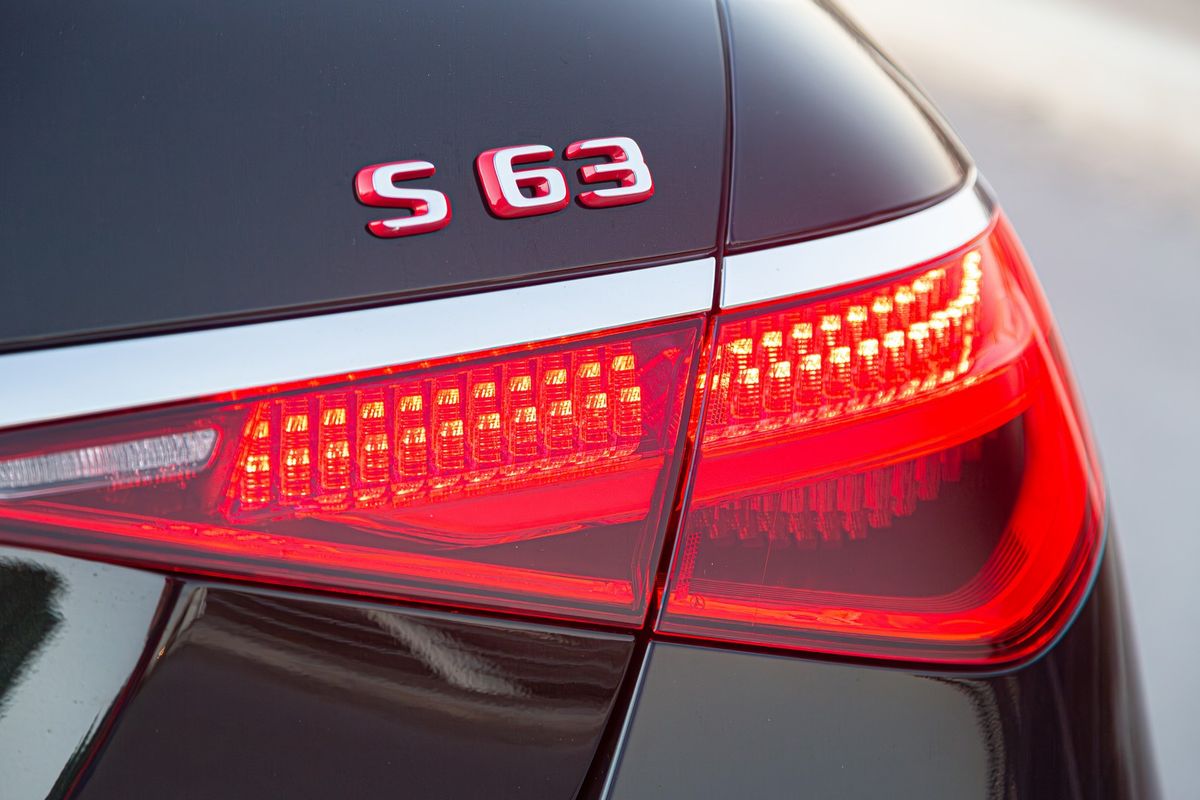
In terms of exterior execution, the S63 E Performance is the most understated model in Mercedes-AMG’s line-up.
Where does the Mercedes-AMG S63 E Performance fit in?
Luxury sedans may no longer be the go-to choice for well-heeled car buyers, but for a passionate (albeit shrinking) group of consumers, high-performance sedans still hold considerable appeal.
Since the early 2000s, Mercedes-Benz has been at the forefront of the (admittedly super-niche) performance-oriented 1st-class sedan segment, thanks to its AMG-badged S-Class derivatives. Those V8-powered beasts built a foundation from which Mercedes-AMG successfully expanded its portfolio.
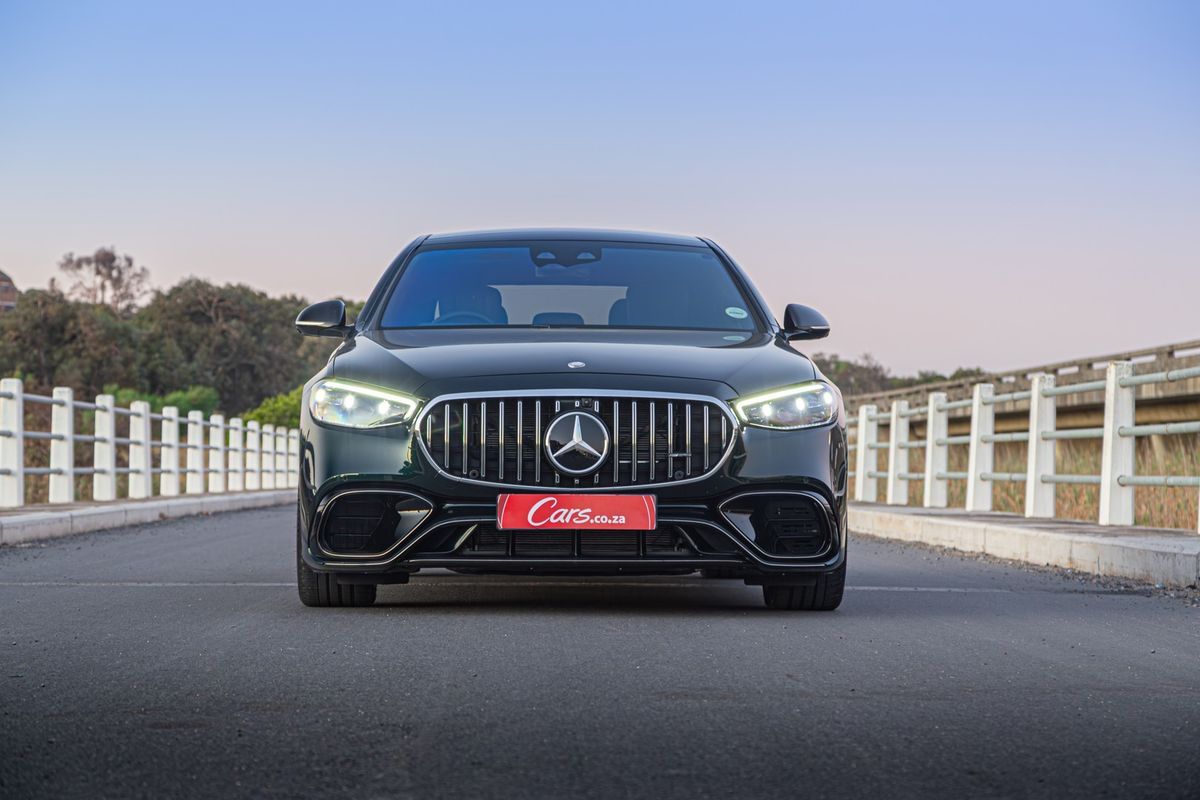
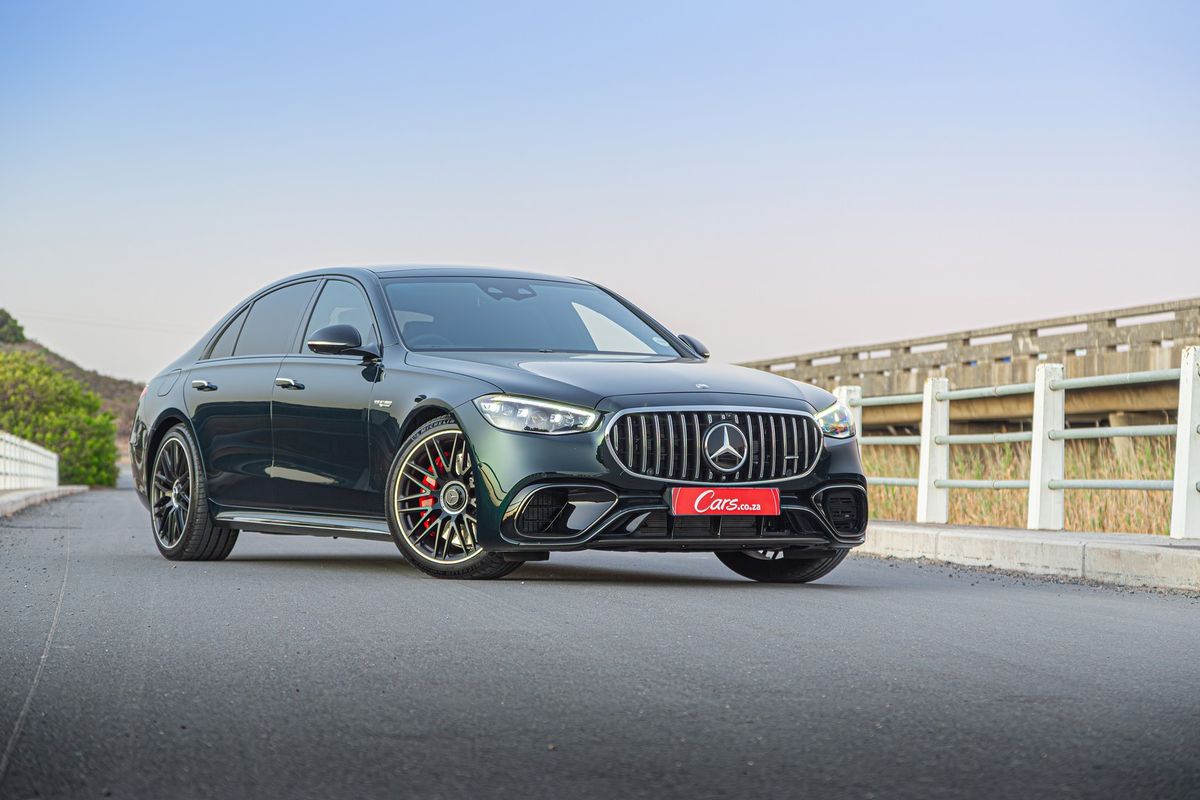
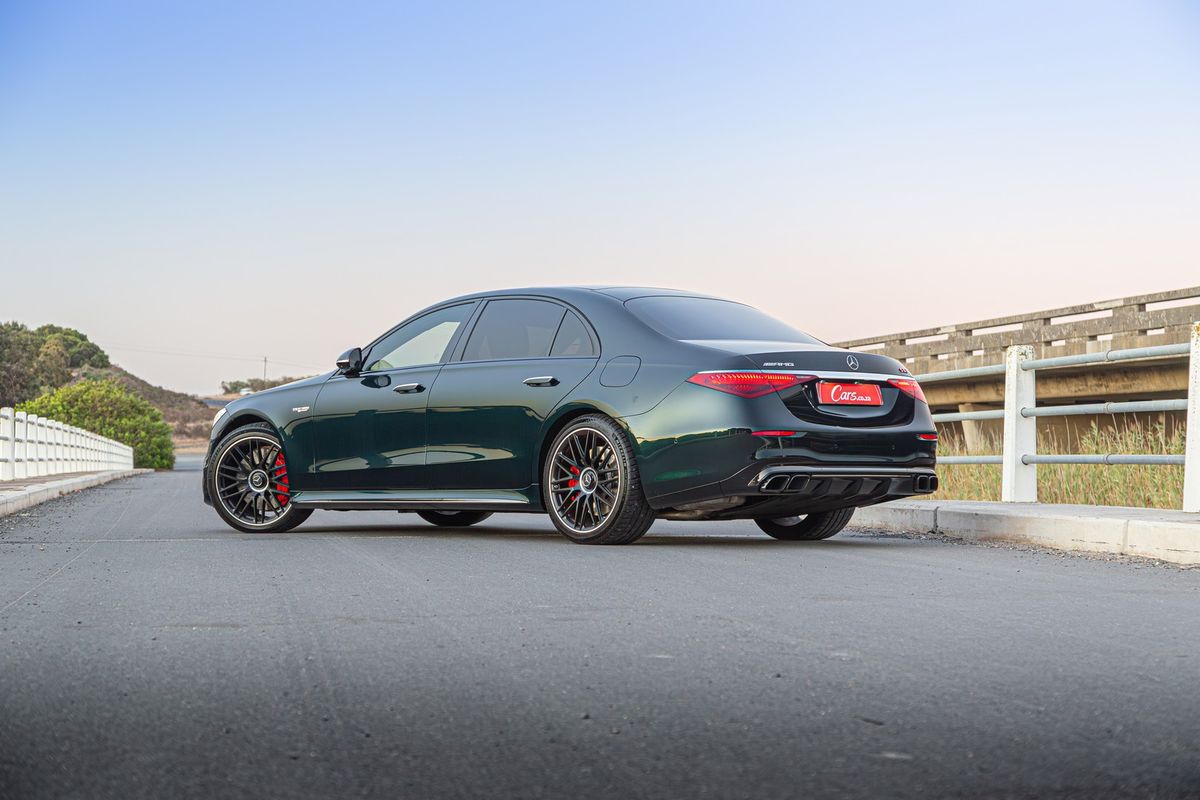
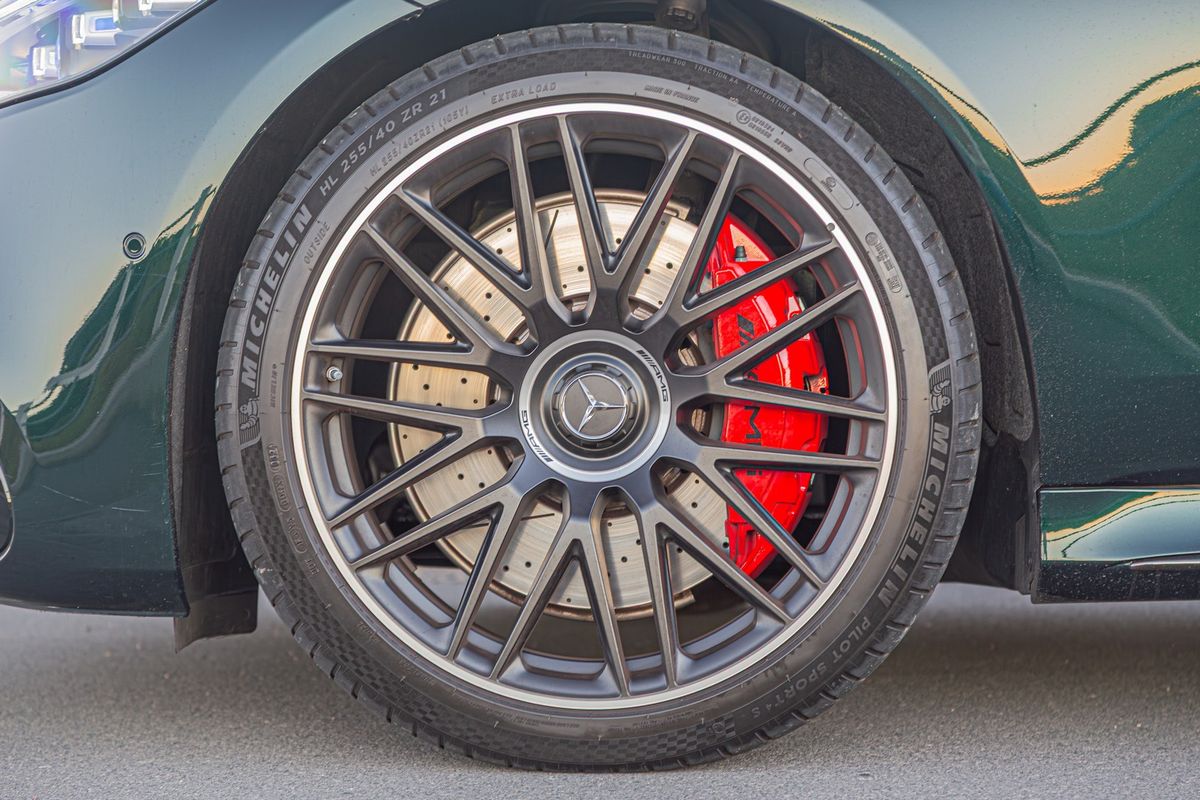
Dark Emerald Green paintwork and 21-inch rims give the S63 E Performance a brooding and sinister appearance.
Recently, of course, the Mercedes-AMG division has been through some testing times, with the perceived abandonment of its trademark V8 engines, in particular, causing brand enthusiasts much distress. But fear not, a stonking twin-turbo V8 is present in this Mercedes-AMG S63 E Performance.
Where does S63 E Performance fit in? Well, given its pricing and incredible power outputs (the most powerful S-Class in history), it has moved beyond the reach of traditional rivals from BMW and Audi. For similar money (nudging the R5 million mark), you can now also consider the Bentley Flying Spur Hybrid and Porsche Panamera Turbo S e-Hybrid. Evidently, ol’ AMG is after more hallowed scalps now…
How the Mercedes-AMG S63 E Performance fares in terms of…
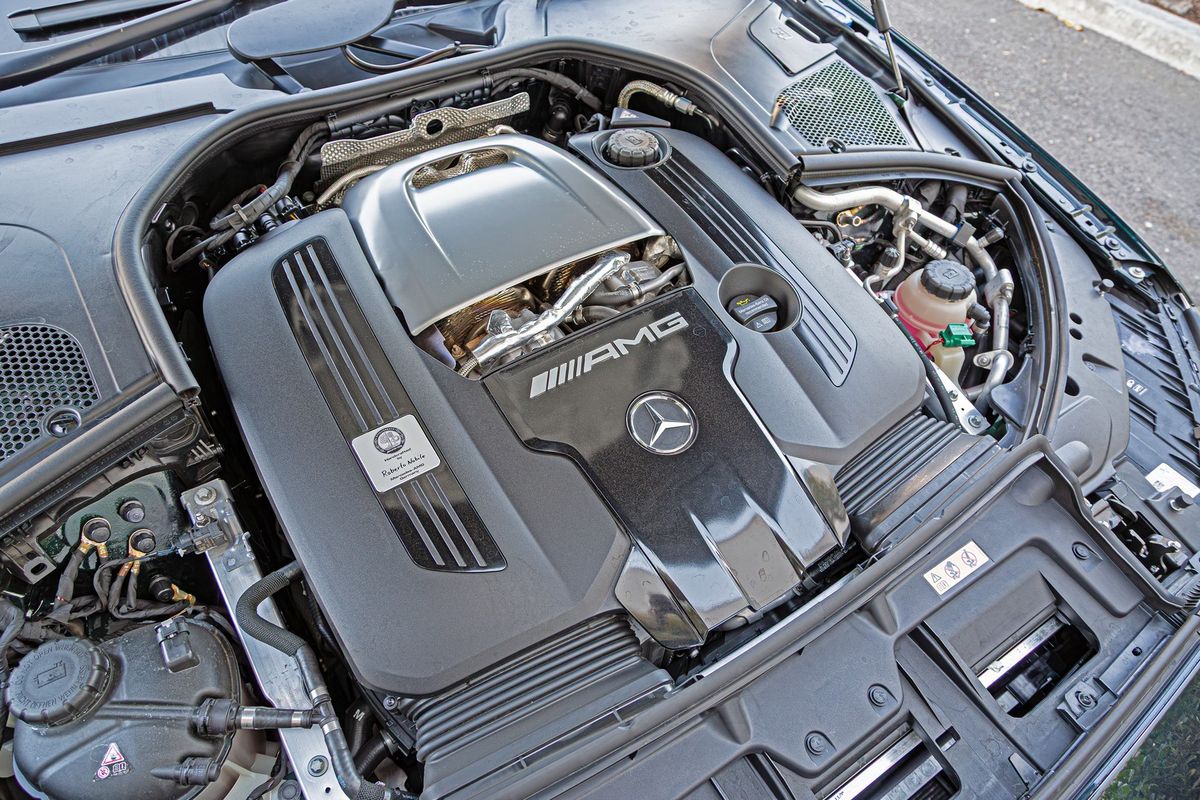
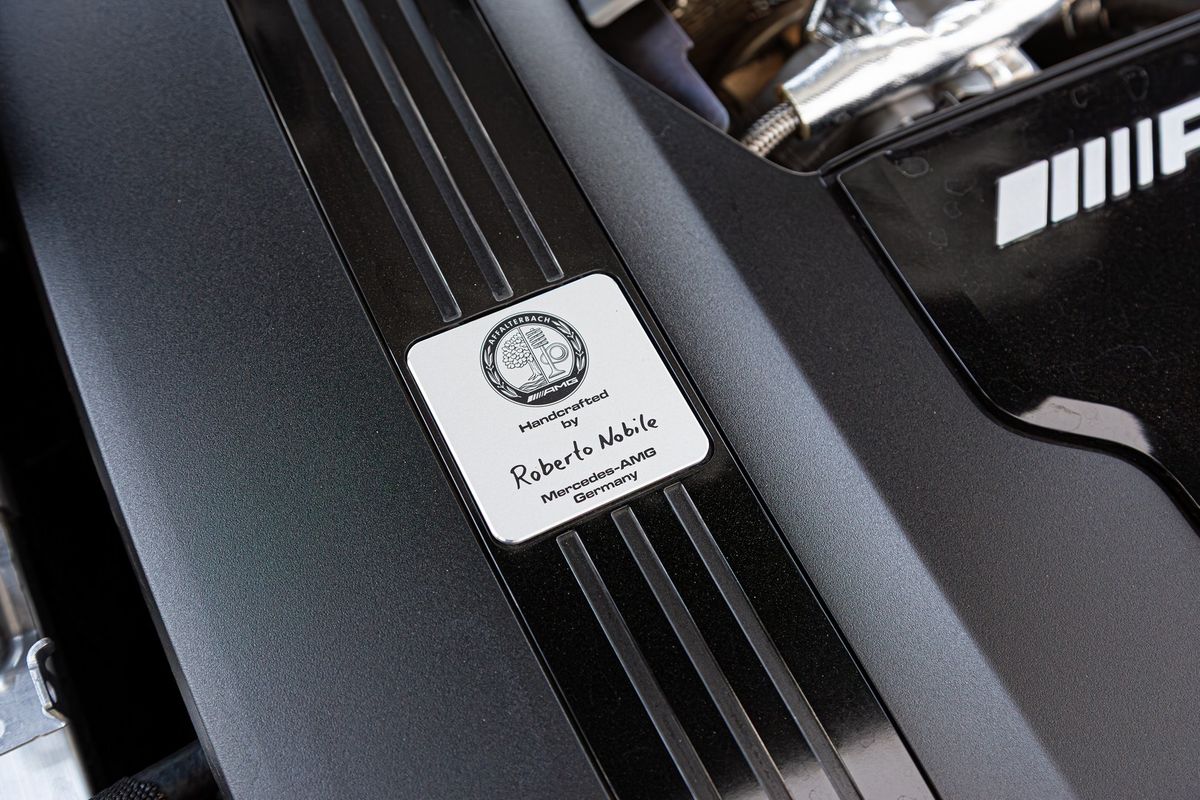
Much to Mercedes-AMG fans’ delight, the division’s twin-turbo V8 engine lives on in the performance-oriented S-Class.
Performance and Efficiency
If you believe that a substantially large Mercedes-AMG sedan should be powered by a muscular V8 lump, you’ll be happy to read that the Affalterbach-based division’s 4.0-litre twin-turbo V8 lives on underneath the S63 E Performance’s long bonnet. On its own, it delivers a whopping 450 kW and 900 Nm of torque.
But that wasn’t enough. The V8 is combined with a rear-mounted, permanently excited synchronous electric motor, a high-performance battery and a 9-speed multi-clutch auto transmission, which sends all that power to all 4 wheels via the adaptive AMG Performance 4Matic+ all-wheel drive system. The total outputs are frankly staggering: 590 kW and a maximum torque figure of no less than 1 430 Nm.
With no less than 1 430 Nm of torque on tap, the S63 E Performance is a decidedly rapid luxury limousine.
Mercedes-AMG claims a 0-100 kph time of 3.3 sec (the limousine even features a Race Start setting for making blistering getaways). Usually, test cars struggle to match their claimed performance times, but not the S63 E Performance. On our test strip, the ‘Benz romped to 100 kph in 3.29 sec without any fuss!
Numbers alone, however, don’t tell the full story. When you first start the S63 E Performance, you may think it is quite an um, demure luxury car. That is but 1 (traditional S-Class) side of its personality, though.
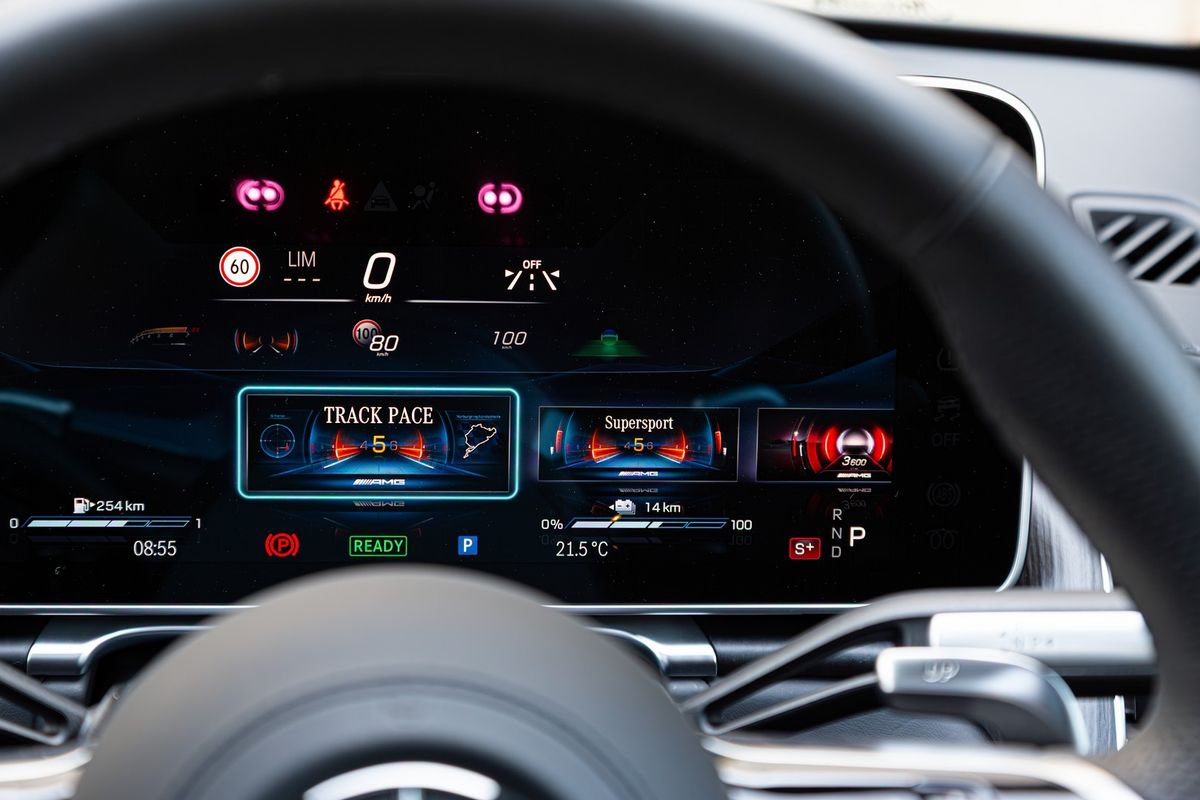
The S63 E Performance is a refined and restrained cruiser UNTIL you select one of the sportier drive modes.
The other side makes its presence known when you select the Sport or Sport+ drive mode – the engine note becomes markedly more purposeful. It may not be as overtly grumbly as S55 or S63 AMGs from about 2 decades ago, but when appropriately motivated via the right foot, it still delivers aural pleasure.
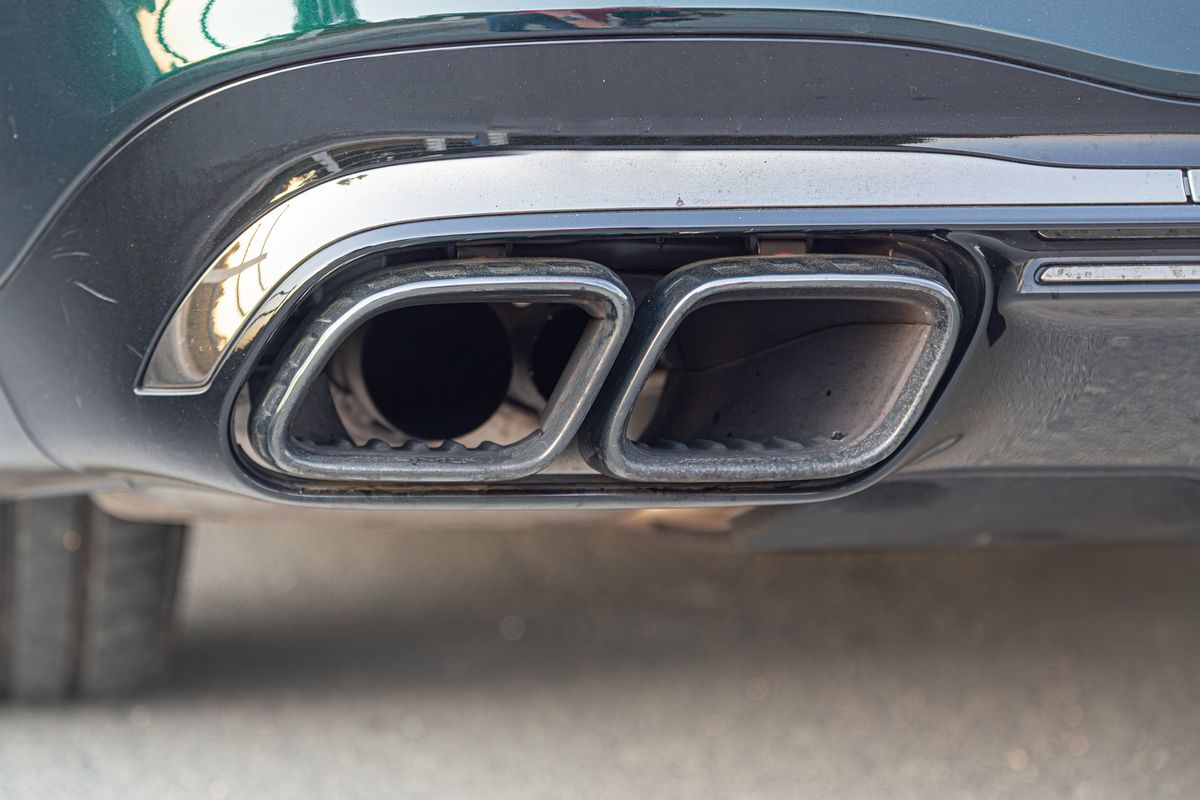
The exhaust outlets (located behind decorative ends) emit a characterful – albeit digitally enhanced – soundtrack.
And if you’re driving truly aggressively, the S63 E Performance’s twin-turbocharged 8-cylinder power unit becomes positively raucous. Of course, this being a state-of-the-art modern luxury sedan, there is some clever engineering behind the theatrics: synthesised engine noises are pumped into the cabin.
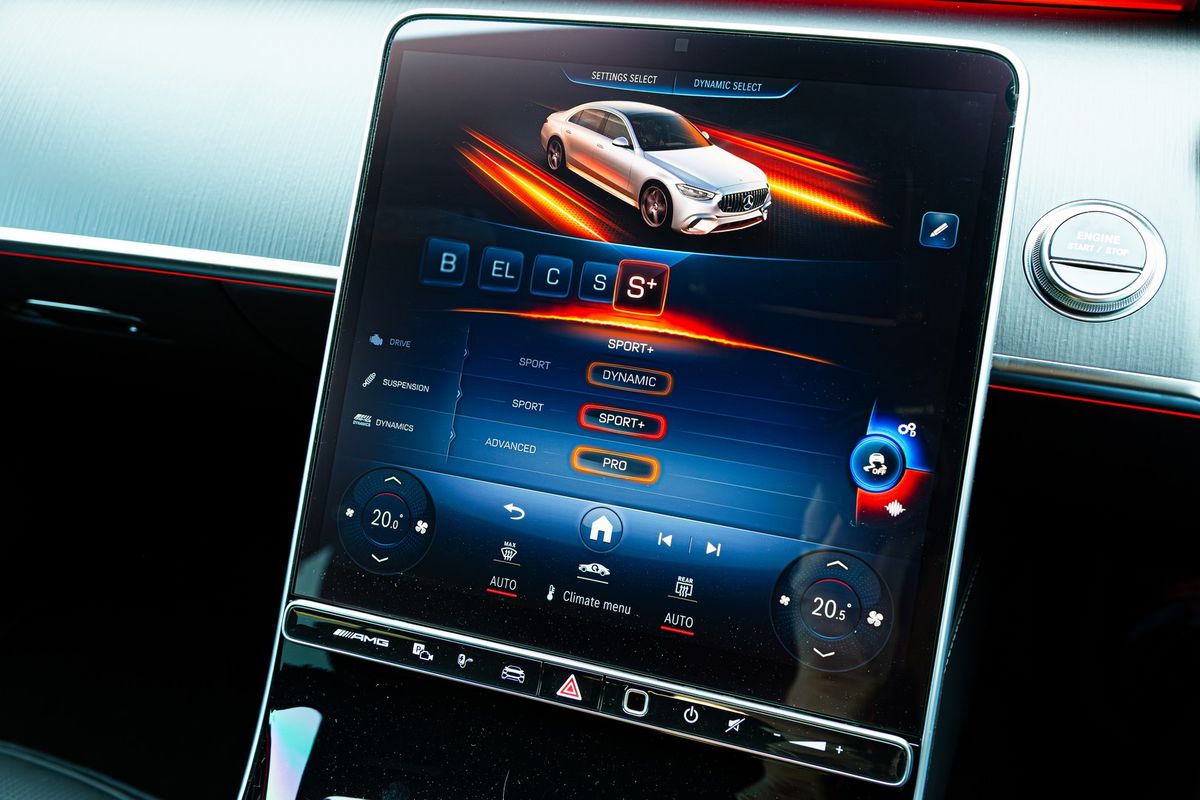
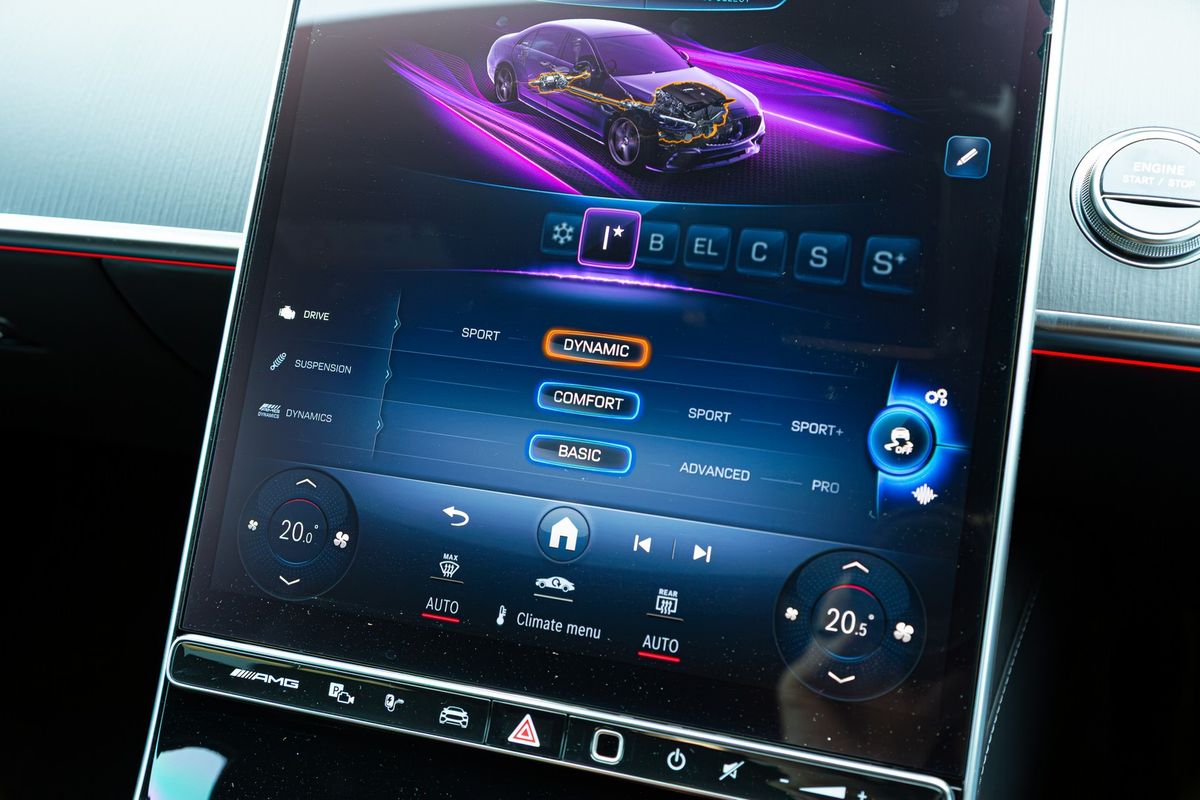
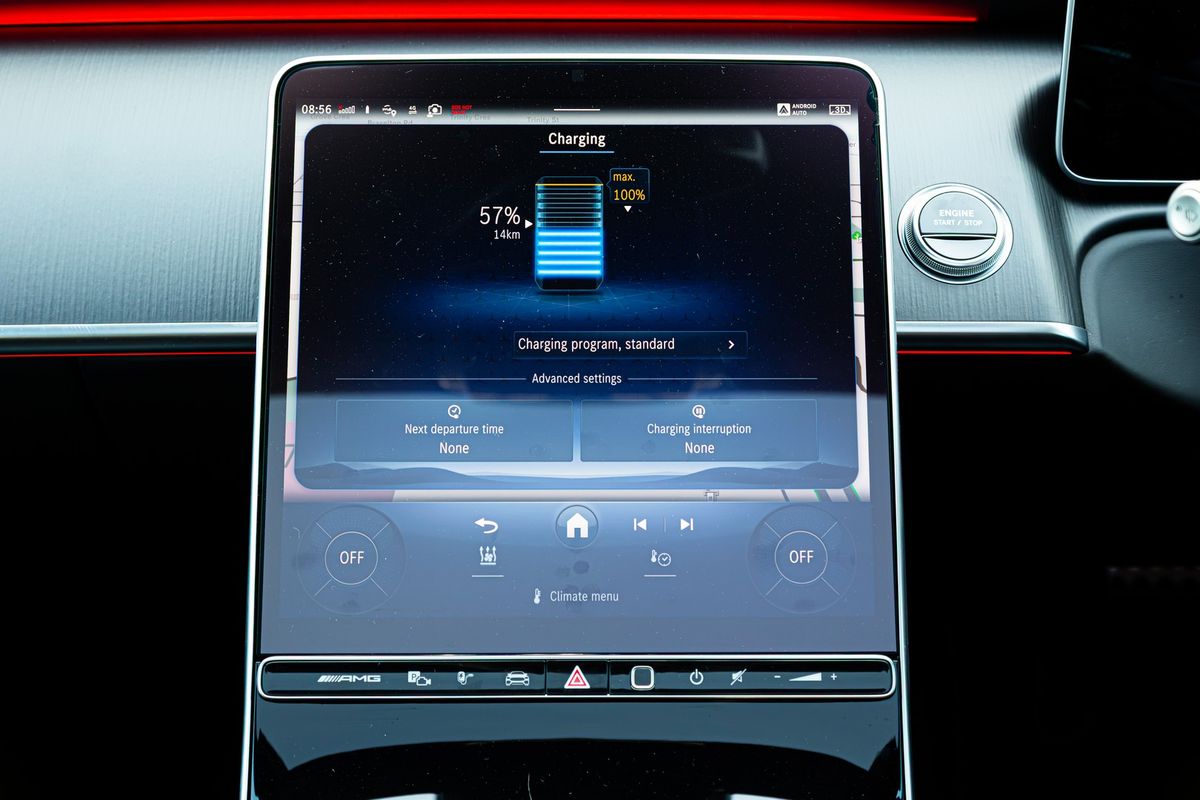
You can fine-tune the ‘Benz’ powertrain, suspension and dynamics settings using a submenu in the touchscreen menu.
Besides, the most memorable aspects of the driving experience are the immediacy of the power delivery, plus the strong (seemingly endless) surge that accompanies the ‘Benz digitally augmented soundtrack. When it hooks up, the S63 E Performance turns into a virtual rocketship; its acceleration is so astounding that it could frighten (and quite often beat) supercars that weigh considerably less than the ‘Benz does.
And what about efficiency? We doubt buyers of a R4.6-million vehicle will be overly concerned about the twin-turbo V8’s fuel consumption, but for what it’s worth, the quoted figure (when the batteries are charged) is a low 4.6 L/100 km. If you’re going to be recharging the battery often, then you will indeed be achieving impressive overall efficiency (particularly within the context of the stupendous performance).
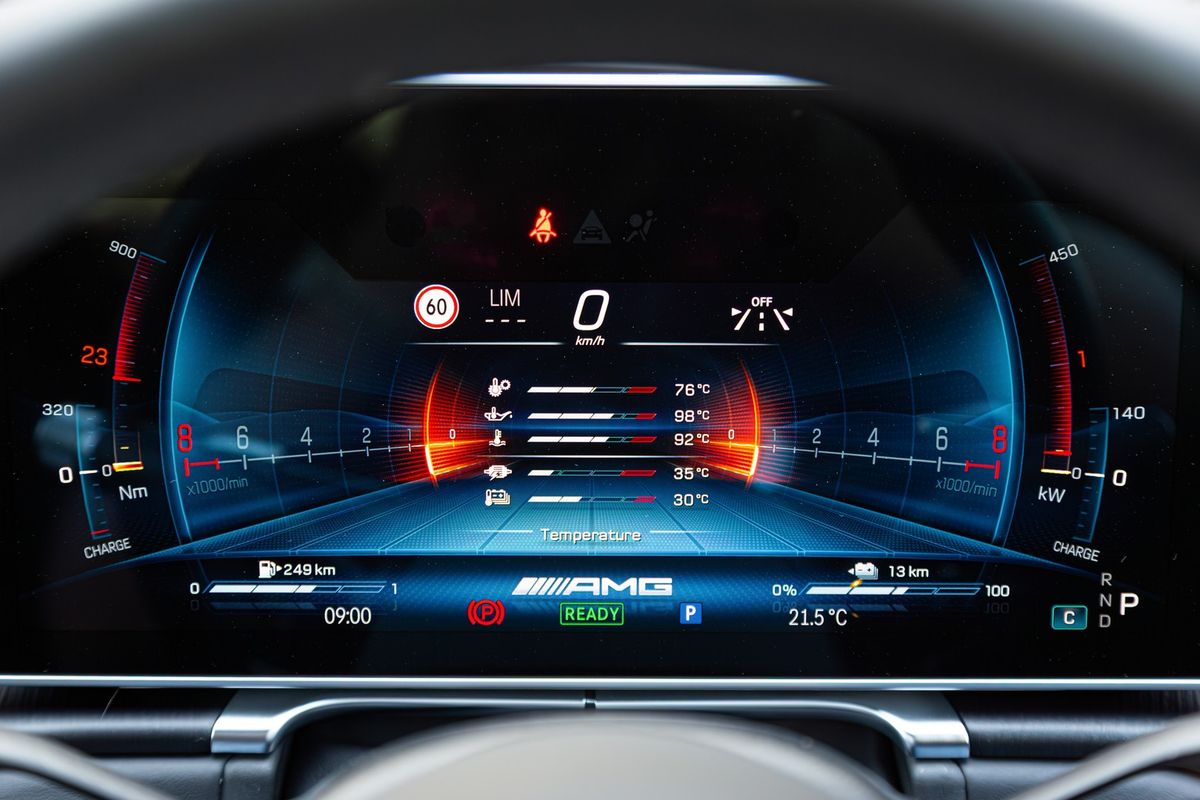
After our performance test, the S63 E Performance indicated a less-than-frugal consumption figure of 16.5 L/100 km.
With the batteries depleted, the average consumption will be 11.8 L/100 km, Mercedes-AMG says. In our experience, a figure of around 14 L/100 km is more likely (and still acceptable, all things considered).
We were impressed with the seamless manner in which the S63 E Performance switched to cruising on battery power alone for surprisingly lengthy distances (and at reasonably brisk speeds), battery-charge level providing, of course. According to Mercedes-AMG, the electric-only range is around 26 km.
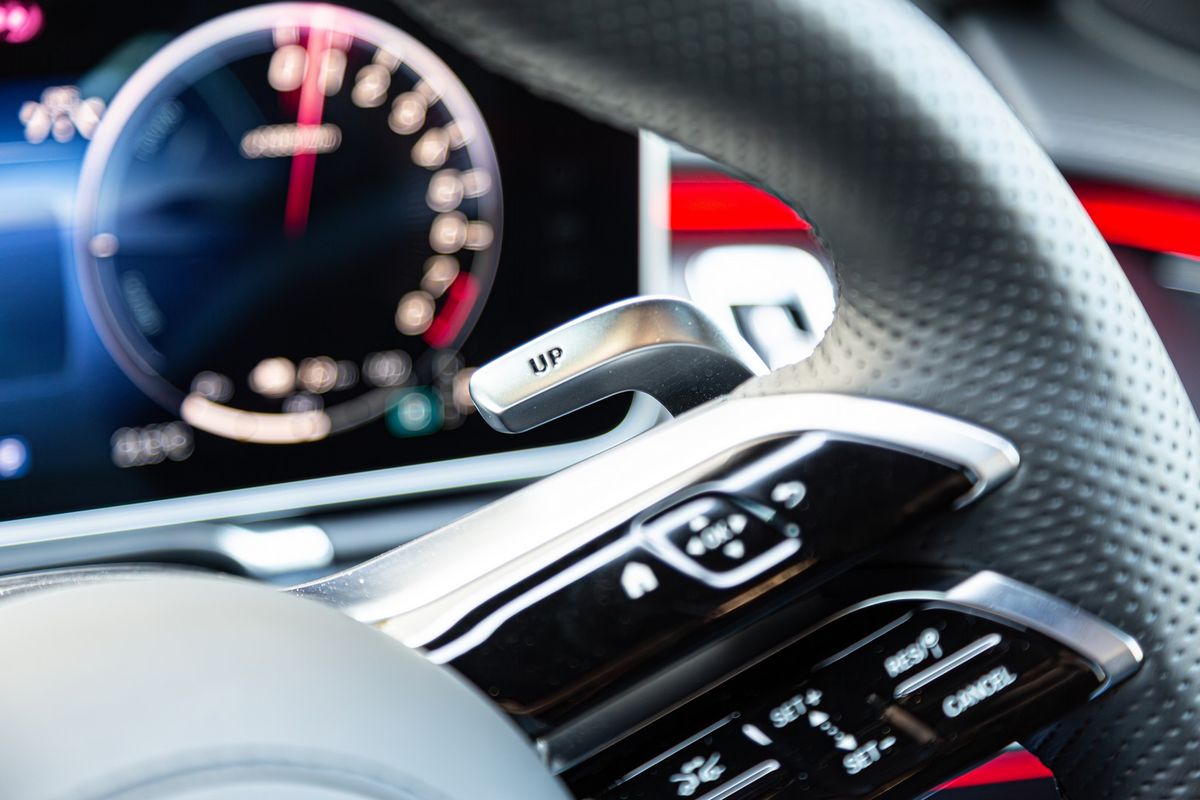
Drivers can change gears manually using the hockey-stick-shaped shift paddles.
Any issues? Well, it might be a trait specific to our test car, but the transmission shifted clunkily in some instances, particularly just after the engine came on song, as well as in part-throttle conditions. It was the only slight disappointment in an otherwise textbook-perfect display of refined and prodigious power.
Ride and Handling
With all that power and torque, perhaps the S63 E Performance’s straight-line performance should not come as a surprise, even though the car weighs nearly 2.6 tonnes! Equally impressive, but certainly more unexpected, is its agility. Besides the ‘Benz’s heft, you have to keep in mind this is a sizeable vehicle as well – it stretches the measuring tape to 5.34m in length; the wheelbase alone measures 3.22m.
The S63 E Performance may be fitted with sizeable alloys, but the Michelin rubber facilitates a remarkably pliant ride quality.
Now factor in the requirement for this performance-oriented 1st-class sedan to also deliver a cossetting ride quality, and you start to appreciate the challenges Mercedes-AMG engineers faced when developing and tuning this limousine’s suspension and advanced drivetrain systems. Regarding the latter, it is worth noting that the S63 E Performance not only features active suspension, but also rear-wheel steering.
Use these settings to enjoy a spirited driving experience combined with a cossetting ride quality.
Cruise about in one of the more relaxed drive modes and the S63 E Performance comes pretty close to delivering a perfect ride experience, with only some slight tyre noise from the high performance tyres and the odd thud from the suspension over poor surfaces to remind you of the fact that this is a more highly-strung AMG, not a stock S-Class. The steering, too, is relatively light and doesn’t give too much of the game away at lower speeds, although it is pleasingly direct and responsive straight off the bat.
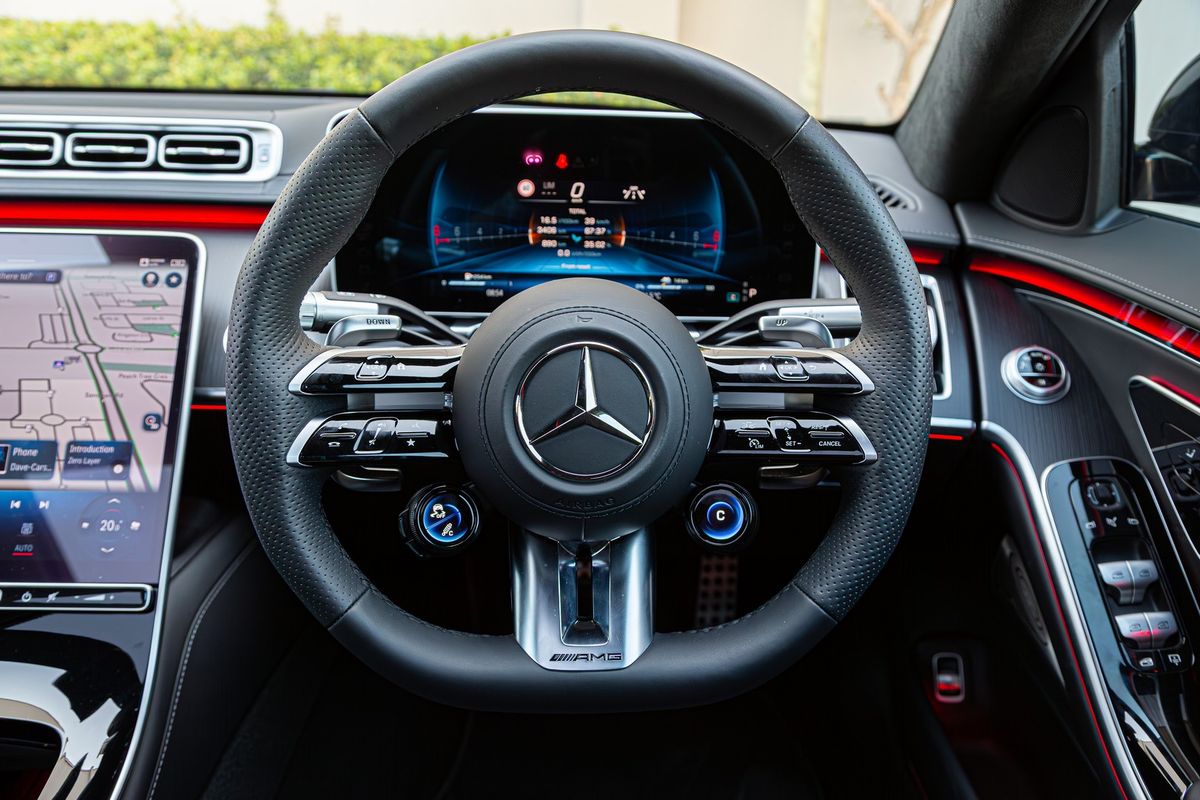
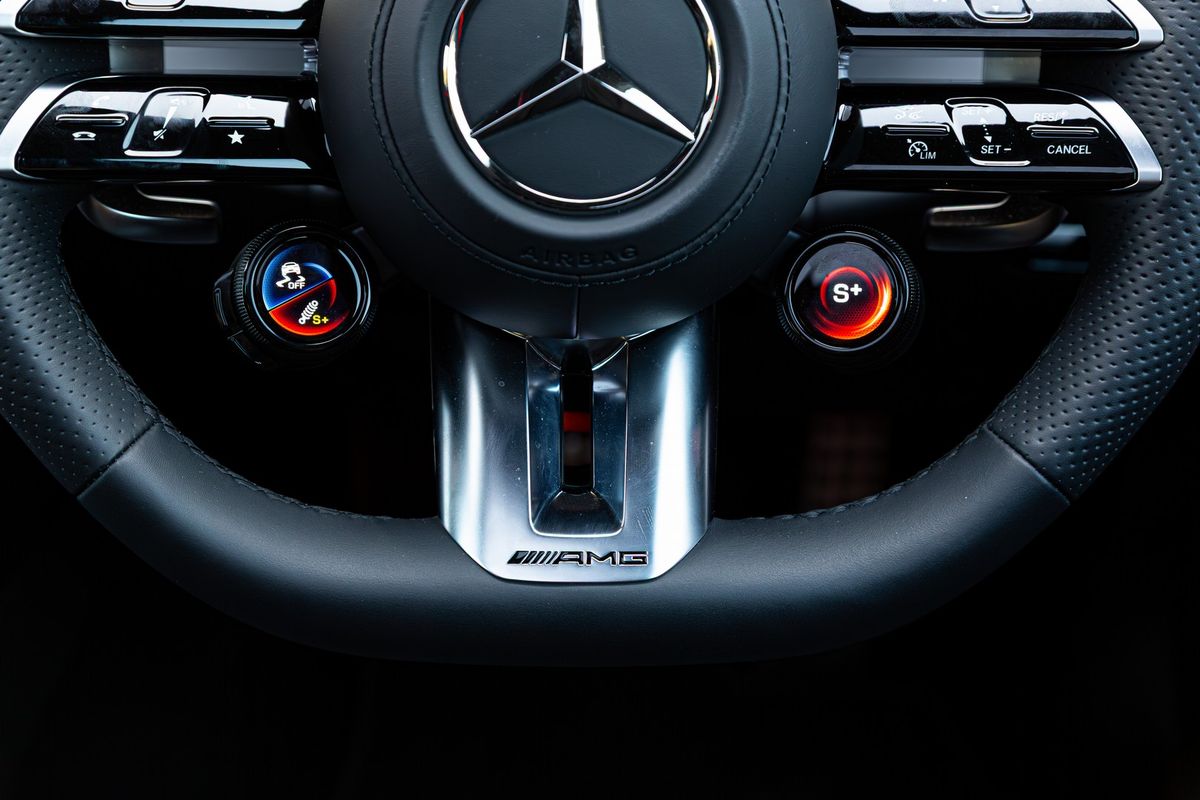
The ‘Benz’s multifunction steering wheel features 2 jog wheels that allow its pilots to alter the car’s settings quickly.
When you start tapping into some of that power and lean on the accelerator pedal when exiting corners, you’ll be left rather dumbfounded – there is body roll, but not much, and the traction is simply incredible.
Once the ‘Benz’s body has gone through its little roll action, the suspension settles and allows you to get back on the power way sooner than you may have expected. Also playing a major role here is the rear-wheel steering, which makes the car feel significantly smaller than it is, and more “chuckable”.
Although the S63 E Performance’s interior doesn’t deviate far from standard S-Class fare, it feels smartly finished.
Design and Features
Finished in a beautifully dark Emerald Green metallic paint and riding on black, multi-spoke 21-inch wheels, the S63 E Performance has a sinister, powerful presence. It turns heads wherever it goes, and while the striking vertical chromework on the expansive grille may be an acquired taste, it arguably is necessary in this stratosphere of the market, where Mercedes-Benz competes against Bentley, no less.
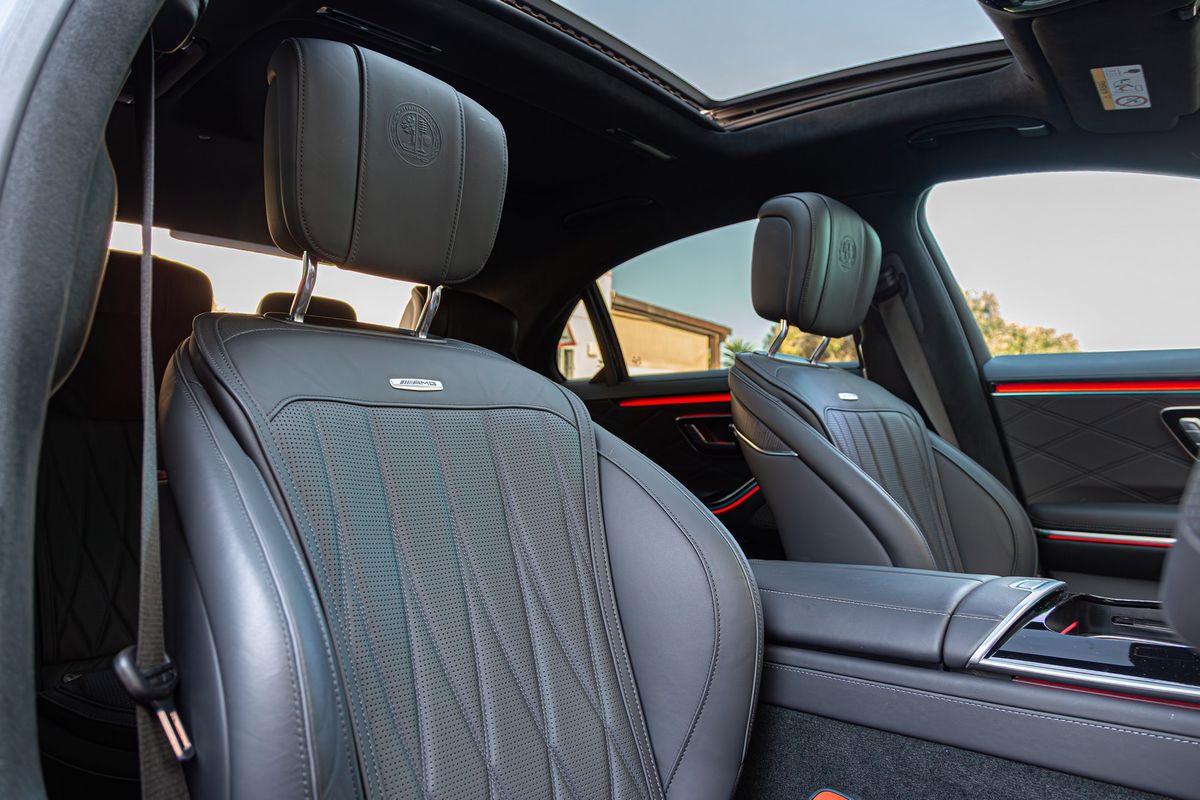
Nods to the Mercedes-AMG division, such as the crests embossed in the headrest cushions, are subtle.
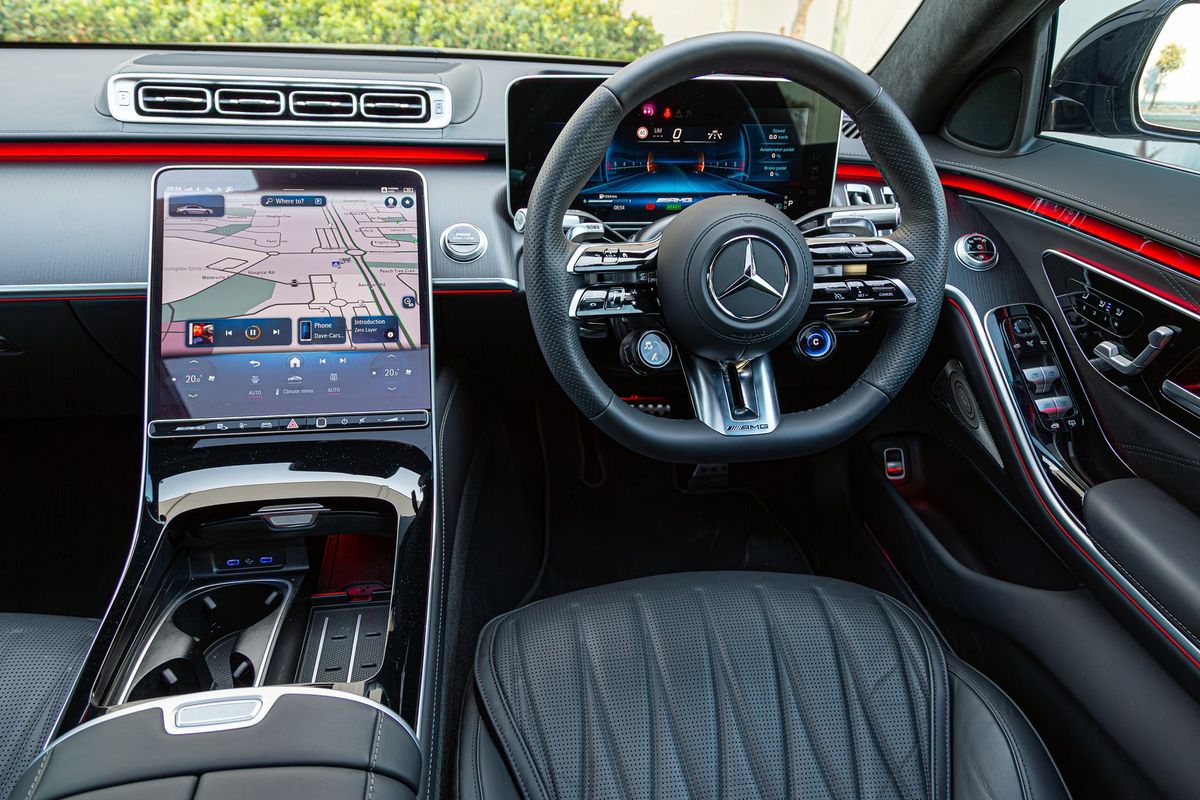
The cabin execution is, arguably, a little less convincing. The S63 E Performance shares the bold, high-tech look and feel (with a multitude of screens and lots of piano black) of other high-end ‘Benzes, but perhaps there are too few elements that set it apart from other S-Class variants, given its lofty price tag.
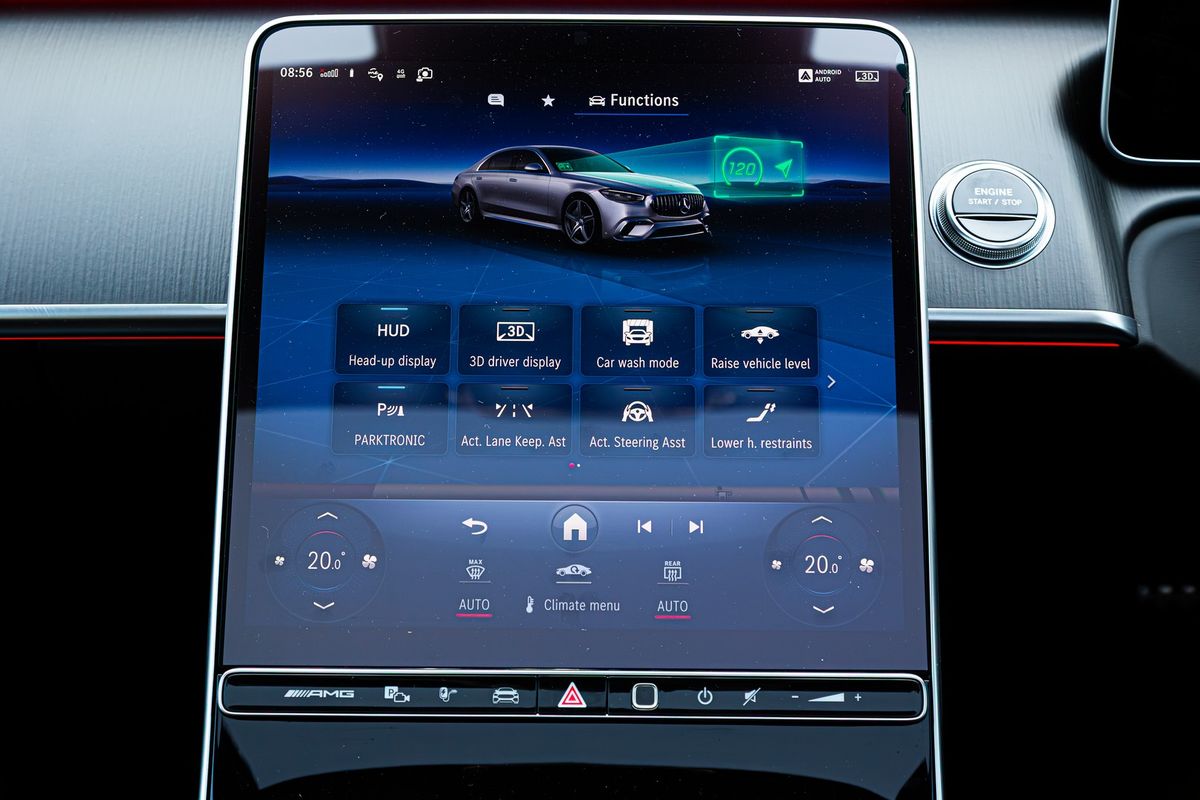
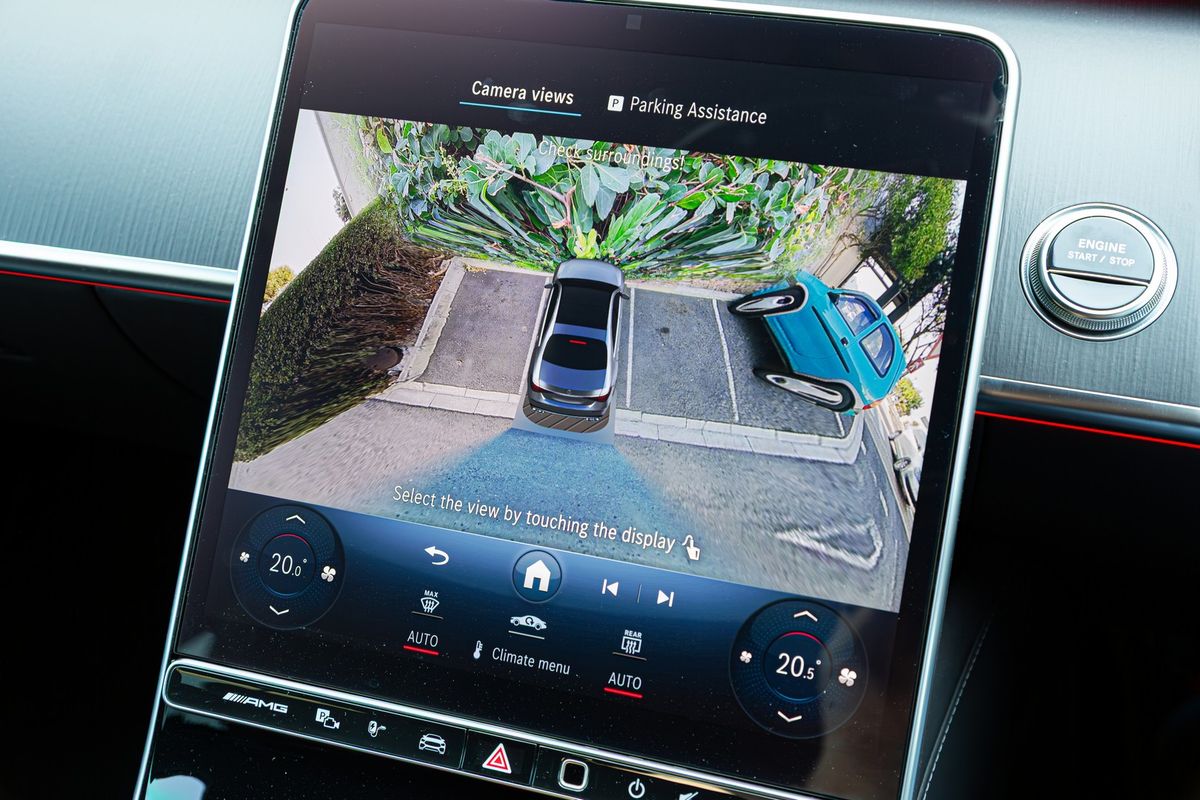
The MBUX infotainment system looks (and is) suitably sophisticated, but after some familiarisation, we found it easy to use.
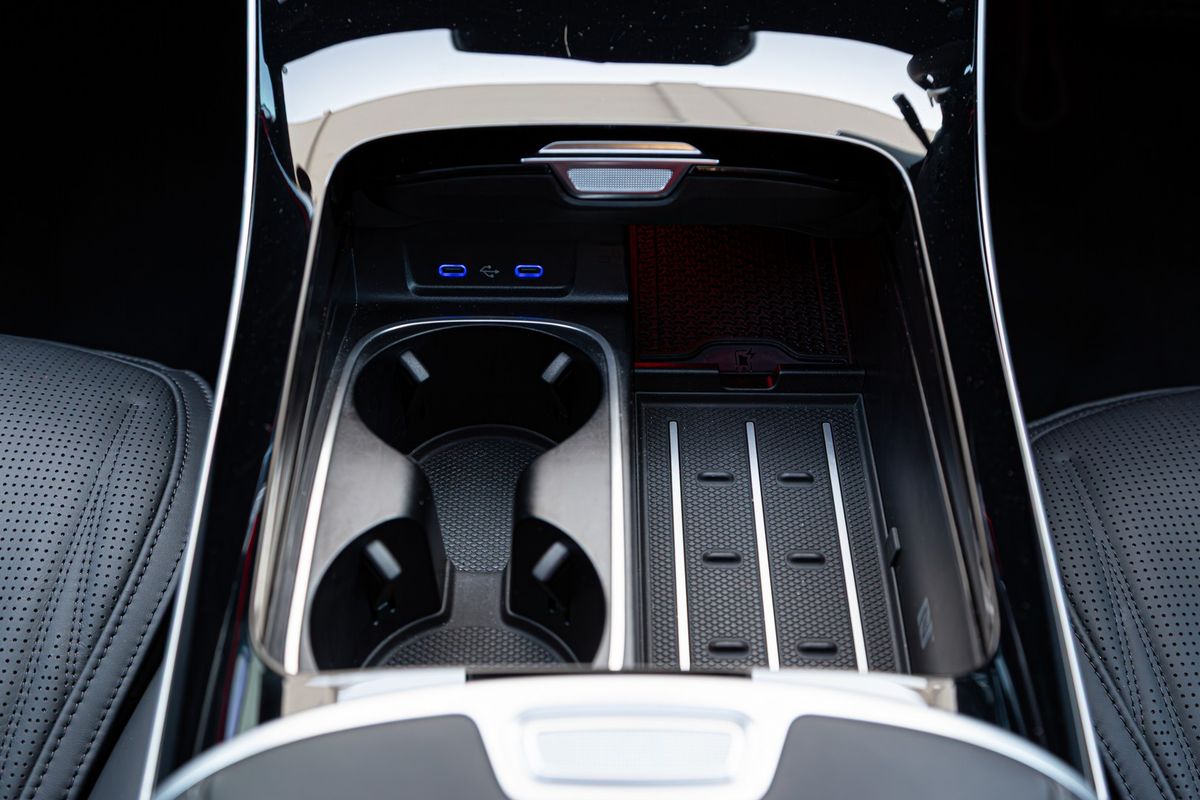
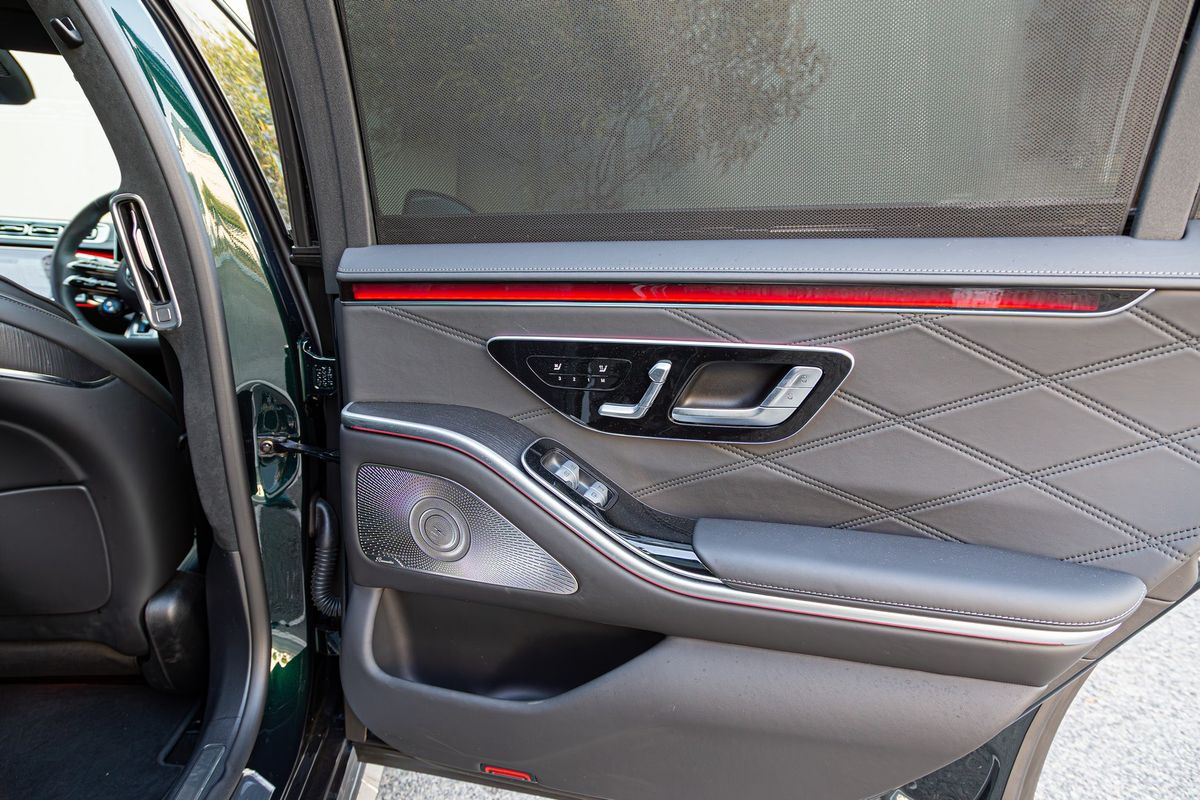
Still, it’s got virtually all the toys (luxurious in-car features and conveniences) that affluent buyers expect, including soft little pillows for the rear passengers and, of course, the adjustable ambient lighting, which is either a highlight or a gimmick, depending on your taste. The upholstery, too, is lovely, with distinctive stitching on the multi-contour seats. Buyers can choose from a variety of colours of Nappa leather trim.
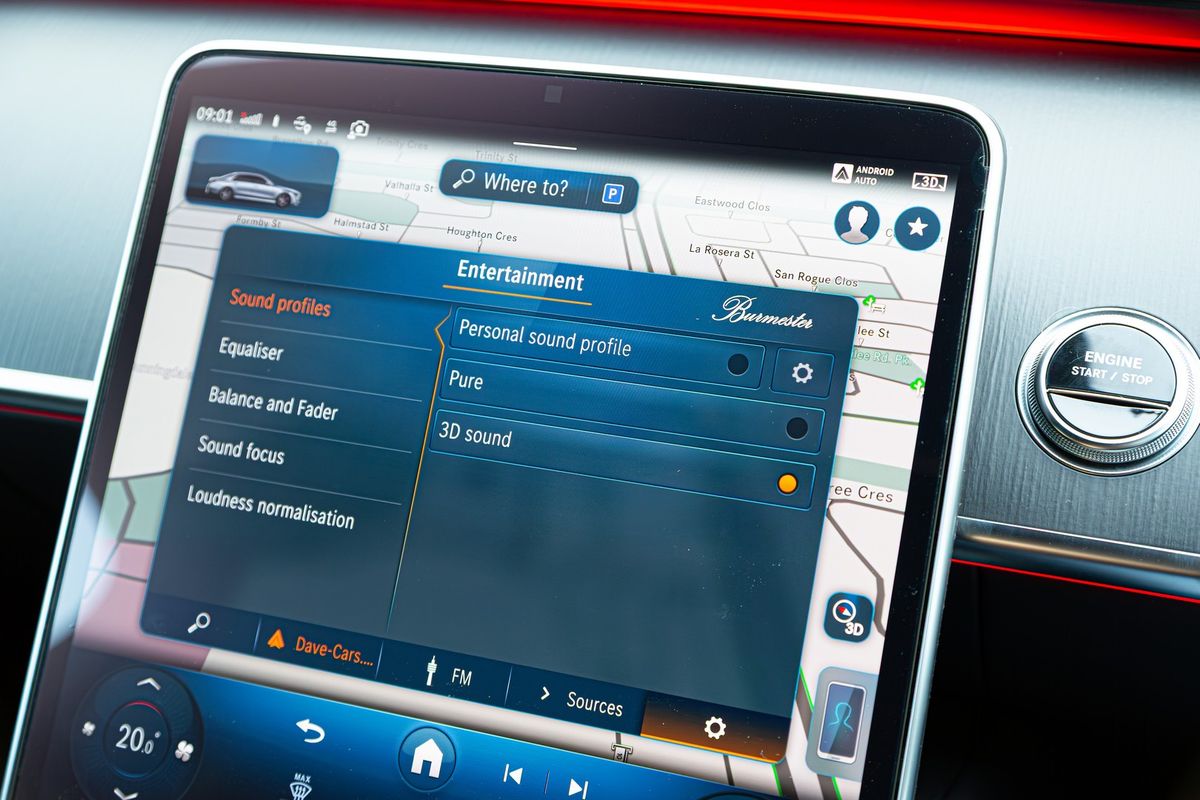
The Burmester audio system offers a 3D sound experience and, best of all, customisable settings.
Some contemporary Mercedes-Benzes’ interiors have had less than convincing build quality, but the S63 E Performance marks an improvement, with a pleasing absence of rattles and squeaks from the massive cabin. Still, some of the materials could have a little more weight to them, especially at this price point.
The interior build quality of ‘Benz products seems to be improving, even if some of the controls still feel a bit insubstantial.
It’s also worth noting that this Mercedes-AMG model’s body rigidity is superior to that of standard S-Class variants. An aluminium stabiliser is fitted underneath the engine to increase torsional stiffness at the front end, while cross-bracing at the suspension mounting points further stiffens the structure.
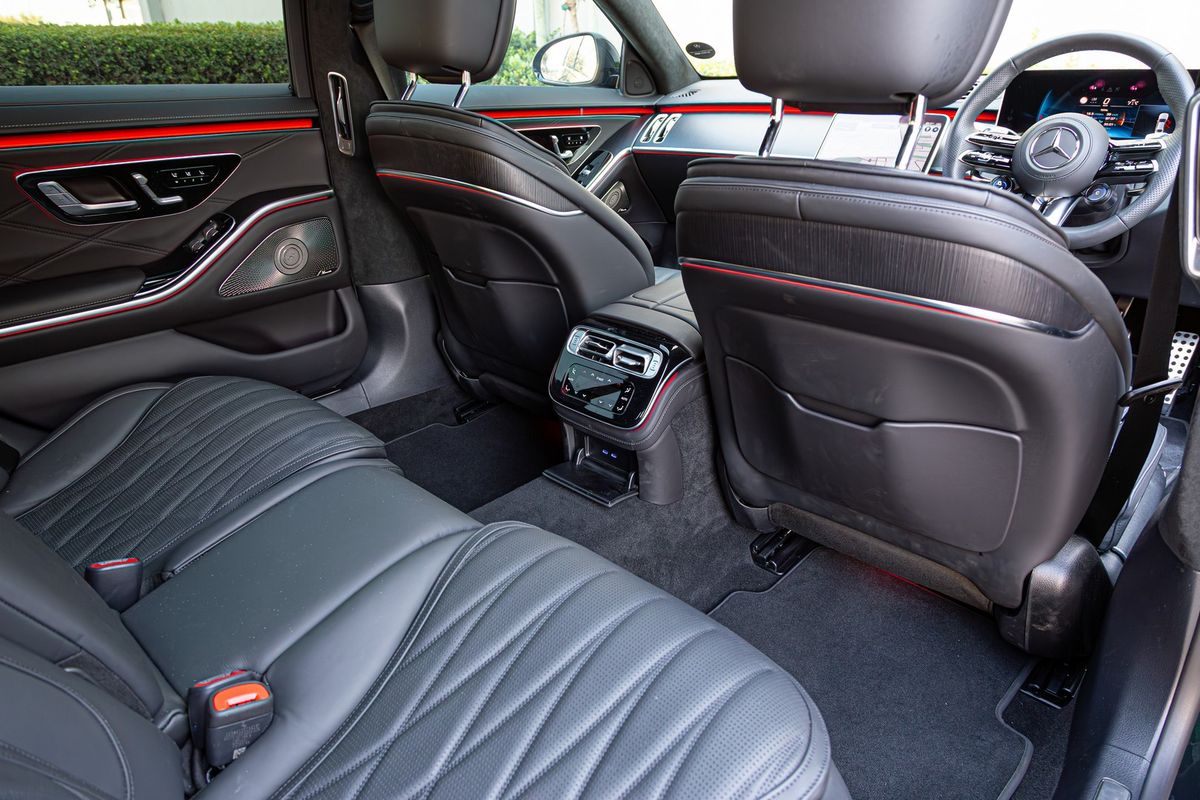
Rear passengers are accommodated in plush luxury. Note the acres of legroom and dual-zone climate control panel.
A minor criticism, particularly given that it is unlikely that this sedan will be used as a family vehicle, is that the rear electric motor and batteries impinge on the luggage capacity. So, while the car has a significant footprint – and is certainly spacious inside, its boot (quoted at 305 litres) is relatively small.
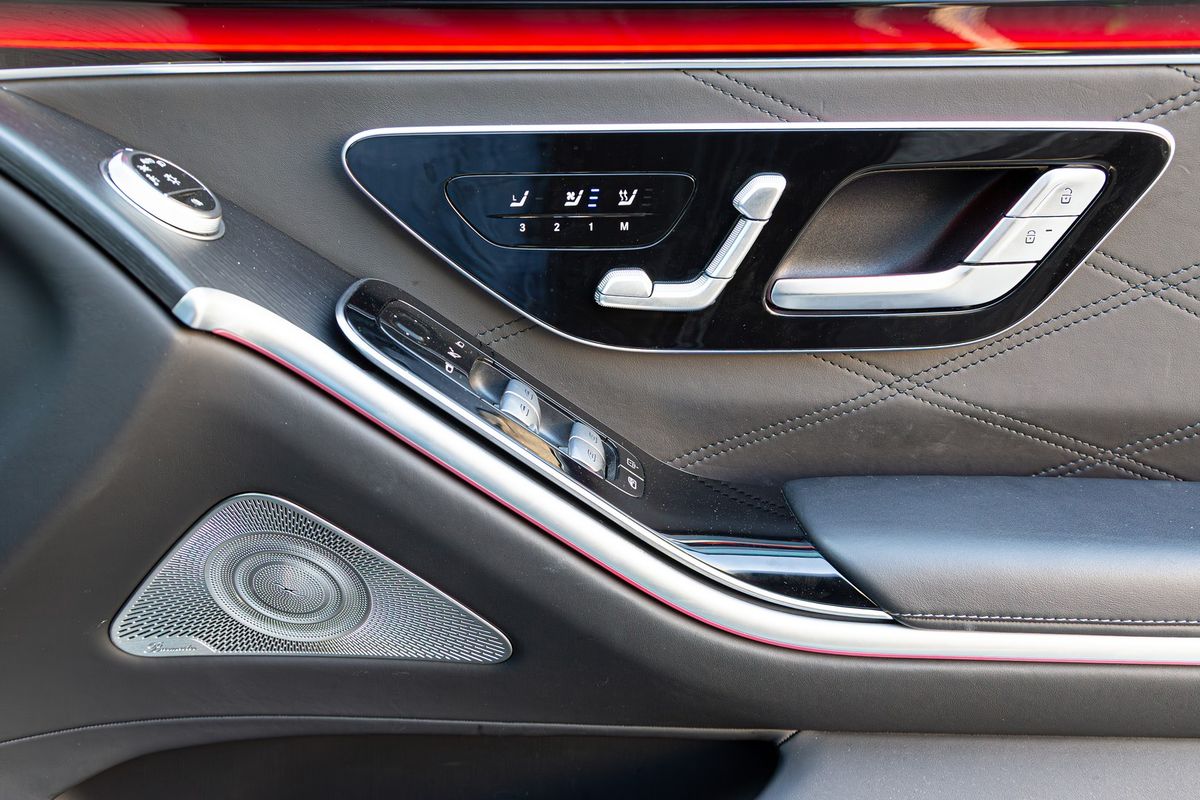
Rear occupants can electrically adjust their heated and ventilated seats (with a memory function, nogal).
Price and After-sales support
The Mercedes-AMG S63 E Performance retails for R4 604 226 (before options, in April 2025), which includes a 2-year/unlimited km warranty and a 5-year/100 000 km maintenance plan.
Those who say models such as the S63 E Performance are so niche that they are almost pointless have a point. However, this car has so much character and is so poised (much to our surprise) that it raises the esteem of Mercedes-AMG, as it’s supposed to. So even if it doesn’t sell in notable numbers, this ‘Benz’s mere existence may be enough to reignite passion (and hope) for the rest of Mercedes-AMG’s line-up.
In this price segment, and against the previously mentioned competitors from Porsche and Bentley, the buyer’s choice is likely to come down to their brand preference, but if you really can’t decide, let’s put it this way… We’d say the Mercedes-AMG successfully marries the athleticism and performance of the Porsche with the sumptuous luxury and stateliness of the Bentley. The best of both worlds, then.
The Kia Seltos range has gained a new entry-level LS grade, effectively dropping the nameplate’s starting price by R88 000. Here’s what the fresh base derivatives cost…
A year after the updated Kia Seltos launched in South Africa, the Korean firm’s local division has quietly introduced a new entry-level LS grade, effectively dropping the nameplate’s starting price by a considerable R88 000.
As a reminder, the facelifted Seltos – which is sourced from the automaker’s Anantapur plant in India – touched down in Mzansi in April 2024. At launch, this refreshed range comprised 8 derivatives, giving local buyers the choice of 4 trim levels and a trio of engines (2 petrol mills – 1 atmospheric and the other turbocharged – and a turbodiesel motor).
The new LS appears largely similar to the LX from the outside (though misses out on LED DRLs up front).
Now, however, the Seltos line-up has been expanded to 10 variants, with the new LS derivatives slotting in at the foot of the portfolio. Thanks to a heads-up from the eminently knowledgeable folks over at duoporta.com, we know the Seltos 1.5 LS 6MT is priced at R379 995, while the Seltos 1.5 LS CVT comes in at R404 995.
In each case, that translates to an R88 000 saving over the equivalent LX derivative. Like the latter, the new LS variants are powered by a naturally aspirated 1.5-litre, 4-cylinder petrol engine sending 84 kW and 144 Nm to the front axle via either a 6-speed manual gearbox or a continuously variable transmission (CVT). Fuel consumption is listed as 6.7- and 6.3 L/100 km, respectively.
Like the LX, the LS is powered by an atmospheric 1.5-litre 4-pot.
So, what does the LS grade miss out on compared to the LX specification level? Well, LS does without items like LED daytime running lights, cruise control, leather trim for the steering wheel, leather trim for the gear-shifter and an electro-chromatic function for the rearview mirror.
Still, standard features for the LS grade include manual air conditioning, automatic headlamps, front foglamps, USB ports (fore and aft), a touchscreen infotainment system (with wireless Apple CarPlay and Android Auto), 16-inch alloy wheels, 6 airbags, stability control, rear parking sensors, a reverse-view camera and roof rails.
LX pictured; the new LS does without a leather finish for the steering wheel.
In 2024, Kia South Africa registered 1 652 units of the Seltos locally, seeing this model rank as the Korean brand’s 3rd most popular offering in the passenger-vehicle segment. It thus ended the year behind the Sonet (7 425 units) and Pegas (1 810 units) but interestingly just ahead of the Picanto (1 620 units). In the opening quarter of 2025, a further 481 units of the Seltos were sold.
How much does the Kia Seltos cost in South Africa?
Kia Seltos 1.5 LS 6MT – R379 995
Kia Seltos 1.5 LS CVT – R404 995
Kia Seltos 1.5 LX 6MT – R467 995
Kia Seltos 1.5 LX CVT – R492 995
Kia Seltos 1.5CRDi LX 6AT – R521 995
Kia Seltos 1.5 EX CVT – R532 995
Kia Seltos 1.5CRDi EX 6AT – R561 995
Kia Seltos 1.5 EX+ CVT – R570 995
Kia Seltos 1.5CRDi EX+ 6AT – R599 995
Kia Seltos 1.5T-GDI GT Line 7DCT – R626 995
The prices above include Kia’s 5-year/unlimited kilometre warranty and a 4-year/60 000 km service plan.
Porsche unveiled its 3rd Heritage Design special edition at Auto Shanghai 2025: the 911 Spirit 70. Only 1 500 units of this 911 Carrera GTS Cabriolet-based variant, which is claimed to “embody the essence of the 1970s and early 1980s”, will be produced.
Finished in an exclusive Olive Neo exterior colour (embellished with historically inspired decorative graphics), matched with Pasha-patterned interior trim, the Porsche 911 Spirit 70 is the successor of the 911 Targa 4S Heritage Design Edition (presented in 2020 in the style of the 1950s and early 1960s) and the 2022 911 Sport Classic (limited to 1 250 units), which was an homage to the 1960s and early 1970s.
The Zuffenhausen-based marque, which already offers its clients more than 1 000 Porsche Exclusive Manufaktur options, says that sales of vehicles fitted with the customisation division’s options have doubled over the past 5 years. “To fulfil even more individual customer dreams in the future,” Porsche says, the capacity of its Exclusive Manufaktur division will be “significantly expanded”.
This rich, deep green Olive Neo paint finish was designed especially for the Porsche 911 Spirit 70. It is contrasted with Bronzite (a grey-gold colour) that appears on the special edition’s spoiler accents and “Fuchs” design Sport Classic wheels. The soft top, meanwhile, is black, as is the windscreen frame.
The trio of black silk gloss decorative stripes across the bonnet are reminiscent of “safety stickers” from the 1970s. Back then, drivers used to apply longitudinal stripes to their sportscars in the hope that other road users could more easily spot them in their rear-view mirrors as they closed in at high speeds…
The stripes continue tone-on-tone on the soft top, while the Porsche 911 Spirit 70’s flanks feature the brand’s lettering and a circular decal in black silk gloss replete with a motorsport-inspired car number.
The 2025 Heritage Design release further bears a Porsche crest that is almost identical to the historic crest from 1963. There are gold-coloured Porsche Exclusive Manufaktur badges on the front wings, and a Porsche Heritage badge on the grille above the engine compartment. Its design is reminiscent of the badge on the Porsche 356, which was awarded in the 1950s when the 100 000 km mark was reached.
Other unusual details include the gold-coloured Porsche lettering and the model designation at the rear. The lettering gets its “extraordinary brilliance” from the galvanised gold-plated surface, Porsche says.
The highlight of the cabriolet’s basalt black club leather-trimmed interior, with decorative stitching in olive neo, is the Pasha fabric pattern in black/olive neo, which is inspired by a moving chequered flag.
Instead of 1970s-era jacquard velour, the 911 Spirit 70 combines a textile with flock yarns that is said to give the fabric a sportier character, improved feel and more comfort, especially on longer journeys.
The Pasha pattern features on the centre panels of the 18-way electrically adjustable sports seats, the door sills and even the inside of the glove box, as well as the reversible luggage bay mat. The decorative inlays on the seat backrests and the trim on the dashboard are optionally available in Pasha trim.
The instrument cluster also incorporates historically inspired design cues. The high-resolution 12.65-inch display has white pointers and scale lines in analogue format. Green digits are reminiscent of the legendary Porsche 356, and the model lettering is neatly integrated into the fully digital rev counter.
White hands and green numerals also characterise the special version of the Sport Chrono stopwatch.
Seeing as the Porsche 911 Spirit 70 is based on the 911 Carrera GTS Cabriolet, it features a T-Hybrid system, an electric turbocharger (eTurbo) and an electric motor in the PDK (Porsche’s dual-clutch auto transmission). Its 3.6-litre flat-6 engine produces combined peak outputs of 398 kW and 610 Nm.
How much does the Porsche 911 Spirit 70 cost in SA?
The Porsche 911 Spirit 70 can be ordered in Mzansi for R5 056 000 (April 2025), which includes a 3-year/100 000 km maintenance plan. Expect it to arrive on our shores during the final quarter of 2025.
Porsche Design has also created a high-quality chronograph, of which several details, such as the black Pasha pattern on the dial, are reminiscent of the Spirit 70, exclusively for buyers of the special edition.
We recently travelled to the KwaZulu-Natal Midlands to find out where the new Mercedes-Benz Vito Select derivatives fit into the Three-pointed Star’s MPV portfolio.
Ah, the Mercedes-Benz V-Class: where the “V” stands for van, but also for Vito… and where the “Class” suffix means classy, or luxurious. So, where does that leave the new Mercedes-Benz Vito Select?
If I may be direct, it leaves you a cool R1 million under budget. See, whereas the Mercedes-Benz V-Class V300d Exclusive retails for just under R2.3 million, the Vito Mixto Select I spent 2 days driving can be yours for as little as – relatively speaking, of course – R1 264 200 (price correct in April 2025).
And for that price, you get an attractively styled – if commercial van-based – product that bristles with space and practicality, replete with a cosy cabin adorned with plenty of mod-cons. Compared with the V-Class, the Vito Select eschews just enough finery and gizmos to not steal its posher sibling’s limelight.
A short history lesson, followed by demographics
The Vito, which arrived on our shores in 2003, is produced in Spain alongside its V-Class sibling. It is aimed at family-oriented buyers (between 35 and 55 years of age) whose lives are comprised of school runs and road trips, who enjoy the roominess only a van can offer, but appreciate good value for money.
Mercedes-Benz also reckons the Vito has what it takes to appeal to prestigious adventurers. That’s how ‘Benz describes people whose lifestyles are filled with mountain bikes, golf bags, kayaks and drones…
And sporty types, who are afraid of mud and action cameras and will make full use of the 2 rows of seats and large (4.1 m³) rear loading area of the entry version of the Vito Select, which is known as the Mixto. Above it sits the Tourer – it has a 3rd row of seats that bumps up the cabin capacity to 8 occupants.
Thirdly, the Vito is well suited to high-end shuttle services, such as hotels, or any business with a pricey-looking logo (usually in cursive font) that will benefit from operating a vehicle bearing a high-end badge.
What is the Mercedes-Benz Vito Select like to drive?
What followed were 2 days behind the multifunction ‘wheel of an Alpine Grey Vito Mixto Select, during which we traversed the Midlands across pockmarked tarmac, pristine asphalt and even a bit of gravel.
I only mention the paint colour because it’s so refreshing to see a more passenger-car-like palette on a van. It softens the Vito’s commercial appearance by making the ‘Benz feel less like a corporate appliance and more like something you and I envisage could transport us in comfort on long, plush holiday trips.
Another new hue, dubbed Vintage Blue, is perhaps my favourite (there are 6 more colours, and 2 of them are red). Still on the exterior, it’s an attractive bus with three 17-inch alloy wheel designs to choose from.
The front-end is imposing thanks to a large black grille (with chrome slats) and attractive Multibeam LED headlamps. Beneath them, a large pair of airdams, which resemble swollen hamster cheeks, have been smoothly integrated into the bumper of what Mercedes-Benz claims is their most desirable van yet.
Across our journey – and over the various road surfaces we traversed – the Mercedes-Benz Vito Select’s ride quality remained plush thanks, in part, to that long (3.2-metre) wheelbase and the brand’s Comfort Suspension, combined with pleasantly wieldy handling (for a van). Top-heavy? Sure, but not ungainly.
The ‘Benz’s in-gear acceleration was more than sufficient thanks to the 2.0-litre 4-cylinder turbodiesel mill (with peak outputs of 140 kW and 440 Nm), paired with a 9G Tronic automatic transmission.
Unsurprisingly, there’s a lot of technology aboard the Mercedes-Benz Vito Select. The equipment list ranges from media and connectivity features (such as an Android Auto- and Apple CarPlay-compatible 10.25-inch MBUX touchscreen), a 5.5-inch TFT instrument panel and wireless charging, to an array of luxury hop-ups: electrically adjustable seats, double cupholders, heated seats and steering wheel, etc.
Keyless-start is provided too, as is an Easy Pack (hands-free operated) tailgate, plus a plethora of safety systems such as Active Lane Keeping Assist, Attention Assist, Blind Spot Assist and Hill Start.
But, bear in mind that Mercedes-Benz purposely left some features out of the Vito Select versions – because if it didn’t, who’d want to buy a V-Class? For me, a notable omission was climate control… my driving partner and I did argue over the HVAC settings, but it was not too much of a problem: I won.
What does the Mercedes-Benz Vito Select cost in SA?
Prices (according to our New Car Specs page in April 2025) include a 5-year/100 000 km warranty and a 7-year/140 000 km maintenance plan.
Summary
It’s worth noting that this van was designed for me. Twice. Not only am I family-oriented and aged slap bang between 35 and 55, I’m also a mountain biker, which makes me inherently drawn to “the van life”.
The Mercedes-Benz Vito Mixto Select variant (shown below) is an excellent example of the breed – it’s well furnished, comfortable and attractive. The only contentious factor is the price.
With prices starting above R1.2 million, you have to compare the Vito Select variants with Ford and VW products. The Ford Tourneo Custom retails for around R1.1 million, whereas Volkswagen’s T7 Transporter (based on the same underpinnings as the former) is yet to arrive in Mzansi. Neither of those models produces as much power as the Vito, and neither has a Three-pointed Star emblem on its grille.
If you’re selling your MPV at a premium, that final fact goes a long way in justifying the Benz’s pricing.
What are the most expensive Audi cars you can buy in South Africa? This article highlights the 5 priciest Audi models on sale right now, take a look!
If you want to drive the most expensive Audi cars in South Africa, this article is for you!
German carmaker, Audi, is one of South Africa’s most popular luxury car brands. Audi offers an extensive range of body shapes and powertrains across a broad price range including hatchbacks, sedans, coupes, cabriolets, SUVs, RS performance models and a wide range of e-tron electric cars.
The Audi RS e-tron GT quattro is currently the most expensive Audi for sale in South Africa with a starting price of R3 527 400.
With 2 electric motors producing 430 kW and 830 Nm of torque, the RS e-tron GT offers exhilarating EV performance with Audi claiming 3.3 seconds in the sprint from zero to 100 kph. A 93.4 kWh lithium-ion battery pack offers a claimed 405 km of electric range and can fast charge up to 268 kW.
The Audi RSQ8 is the most expensive Audi SUV currently for sale in South Africa.
It’s also the most powerful Audi SUV with a twin-turbocharged 4.0-litre V8 petrol engine developing 441 kW and 800 Nm of torque and comes paired with an 8-speed automatic transmission. Audi claims 3.8 seconds in the zero to 100 kph sprint.
The luxurious S8 is right up there as one of the firm’s priciest models and it offers stonking performance to match its hefty price tag.
Under the bonnet lurks a powerful twin-turbocharged 4.0-litre V8 petrol engine with 420 kW and 800 Nm of torque powering all-four wheels via an 8-speed automatic transmission. The Audi S8 will run from zero to 100 kph in about 3.8 seconds!
Audi recently introduced the latest RSQ8 SUV in South Africa which can also be had in Black Edition guise for an extra dose of style.
Under the bonnet is a turbocharged 4.0-litre V8 engine that produces 373 kW and 770 Nm of torque and comes paired with an 8-speed automatic transmission. Performance is brisk with Audi claiming 4.1 seconds in the sprint to 100 kph.
The facelifted Audi SQ7 has arrived in South Africa and it shares the same powertrain as its SQ8 sibling.
That means the 373 kW / 770 Nm turbocharged 4.0-litre V8 engine does duty under the bonnet and it too is paired with an 8-speed automatic transmission. Audi also claims 4.1 seconds in the sprint from zero to 100kph.