SA’s single- and double-cab bakkie sales race after Q3 2024
Hilux versus Ranger! With 3 quarters of 2024 gone, what’s happening in South Africa’s single-, extended- and double-cab bakkie sales race? We have the figures…
Just like that, 3 quarters of 2024 have come and gone. While we know the Toyota Hilux is well ahead in the year-to-date bakkie sales race overall, we’ve again managed to lay our paws on detailed sales figures for this period, showing the respective performances of the top 1-tonne bakkies in the single-, extended- and double-cab segments.
As a reminder, Naamsa’s monthly sales report unfortunately doesn’t include a breakdown of the 3 bakkie body styles. Thankfully, though, our friends over at Lightstone Auto have again provided us with these interesting local registration figures.
For the record, the Hilux was again top of the bakkie charts in September 2024 with 2 942 units sold. The Ford Ranger (2 382 units) thus once more settled for 2nd place, while the Isuzu D-Max again completed the top 3, ending last month on 1 592 units.
Based on collated figures reported to Naamsa, our records show the Hilux (24 235 units) is far ahead in the overall sales race, year to date. The Ranger (19 164 units) sits in 2nd position, followed by the D-Max (14 316 units).
SA’s best-selling double-cab bakkies after Q3 2024
Let’s now turn our attention to bakkie sales by body style. According to Lightstone Auto, the Ford Ranger tops the double-cab sales charts after the first 3 quarters of 2024, with as many as 14 847 units sold. In September 2024, the Silverton-built bakkie managed 1 875 units in the dual-cab space, translating to 78.7% of the nameplate’s total for the month.
As such, the Toyota Hilux finds itself in 2nd place in the double-cab sales race, year to date, with 11 367 units registered (that’s 3 480 sales off the pace). Last month, the Prospecton-built bakkie’s overall tally of 2 942 units included 1 557 examples (or 52.9%) of the dual-cab body style.
Predictably, 3rd place on the double-cab podium after Q3 2024 is still held by the Isuzu D-Max, which finds itself on 5 883 units. In September, the Struandale-made contender reached 618 sales of this body style or 38.8% of the nameplate’s aggregate for the month.
Lightstone Auto’s figures furthermore show that all other 1-tonne double-cab bakkie derivatives (excluding the Ranger, Hilux and D-Max, that is) collectively managed 1 445 registrations in September and 12 947 units, year to date.
Sales after Q3 2024: single- & extended-cab body styles
What’s the situation in the single-cab space? Well, the Hilux leads the charge in this segment, with 9 070 units sold after Q3 2024. In addition, the Japanese firm’s contender was the only single cab to crack 4 figures in September, reaching 1 004 units.
The single-cab version of the D-Max (6 885 units) occupies 2nd place, year to date, a position it also attained in September (768 units). After Q3 2024, the 2-door version of the KwaZulu-Natal-assembled Mahindra Pik Up completes the single-cab podium with 5 115 units (having managed 557 sales – or 71.2% of its total for the month – in September).
For the record, Ford sold just 160 examples of the Ranger single cab in September, taking its year-to-date total in this space to 1 385 units.
Meanwhile, the Hilux Xtra Cab (3 789 units) remains in pole position in the extended-cab segment, year to date at the end of September 2024, ahead of the Ranger SuperCab (2 926 units). As the only other model offered in this body style, the D-Max Extended Cab again finds itself in 3rd place (1 548 units).
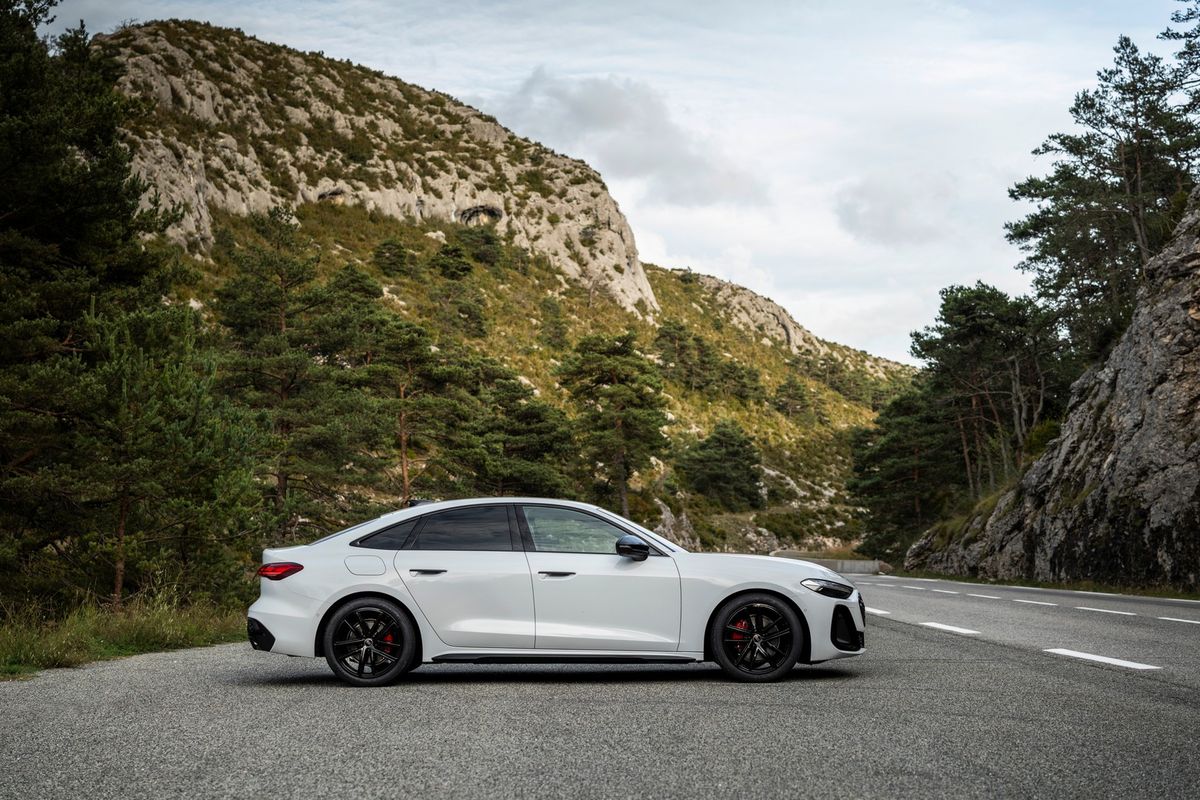
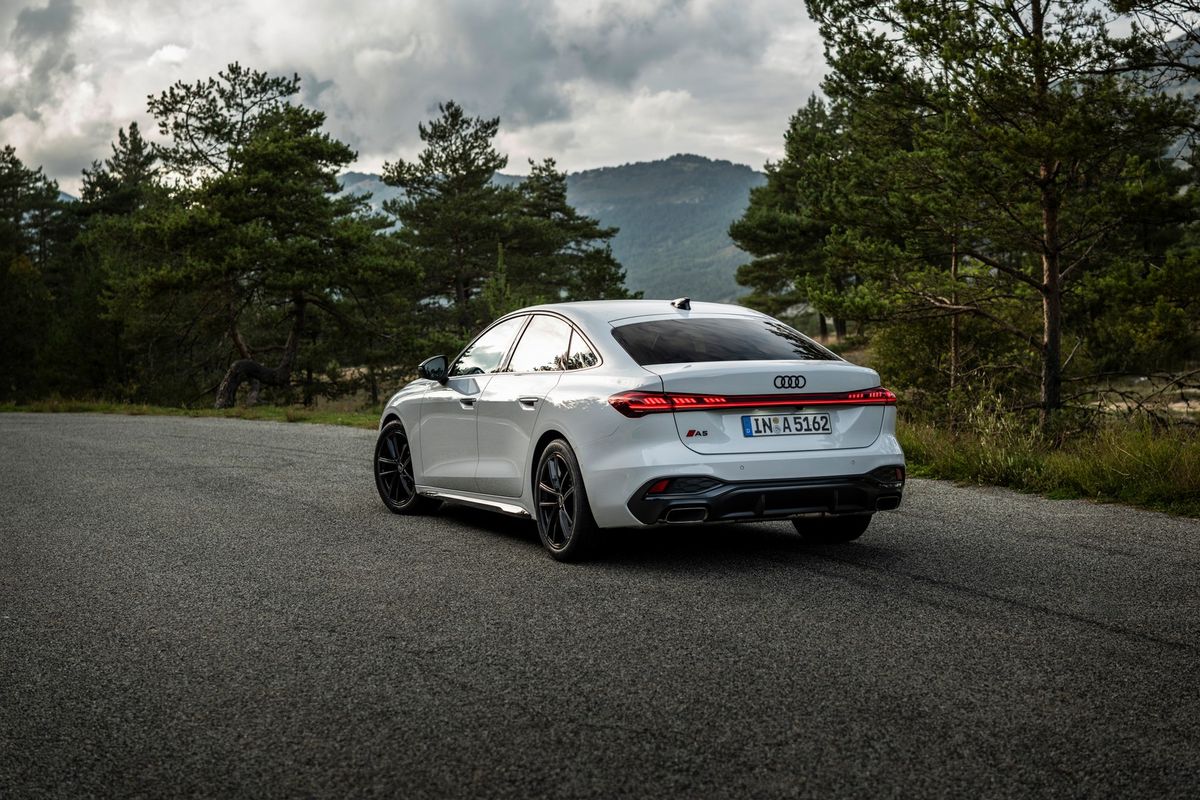
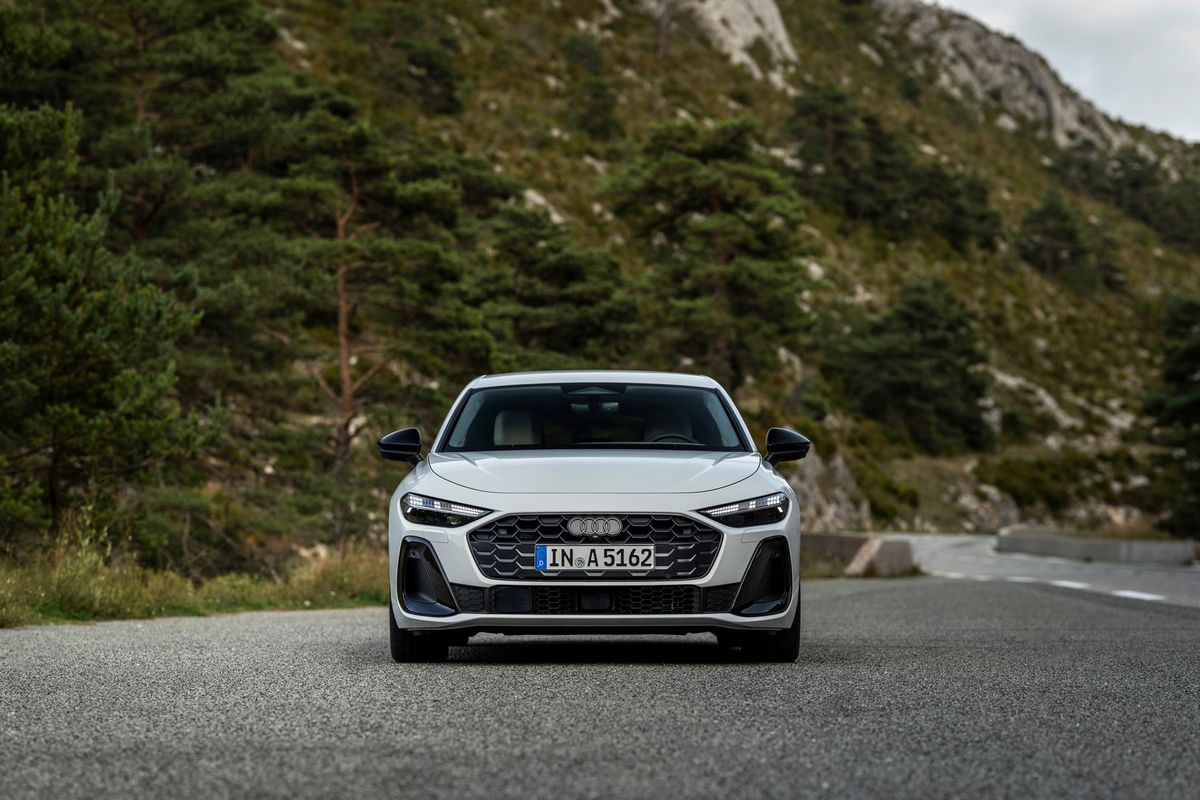
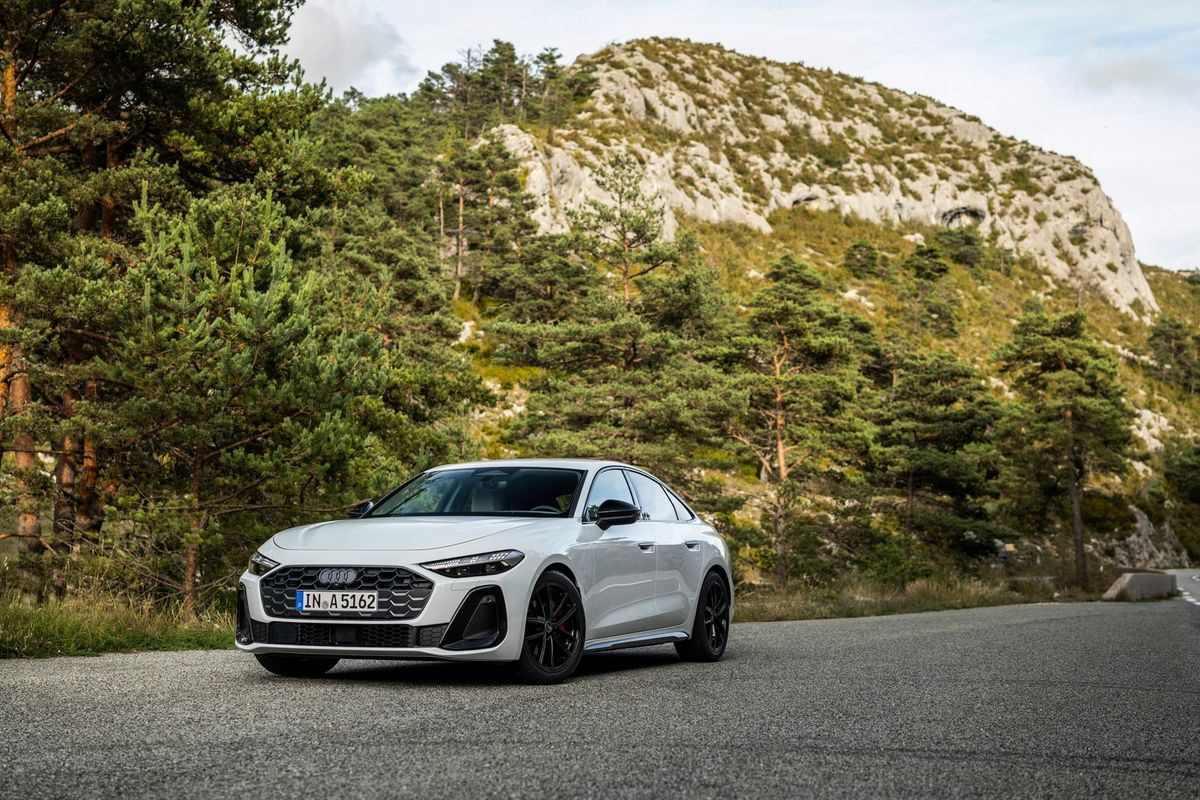
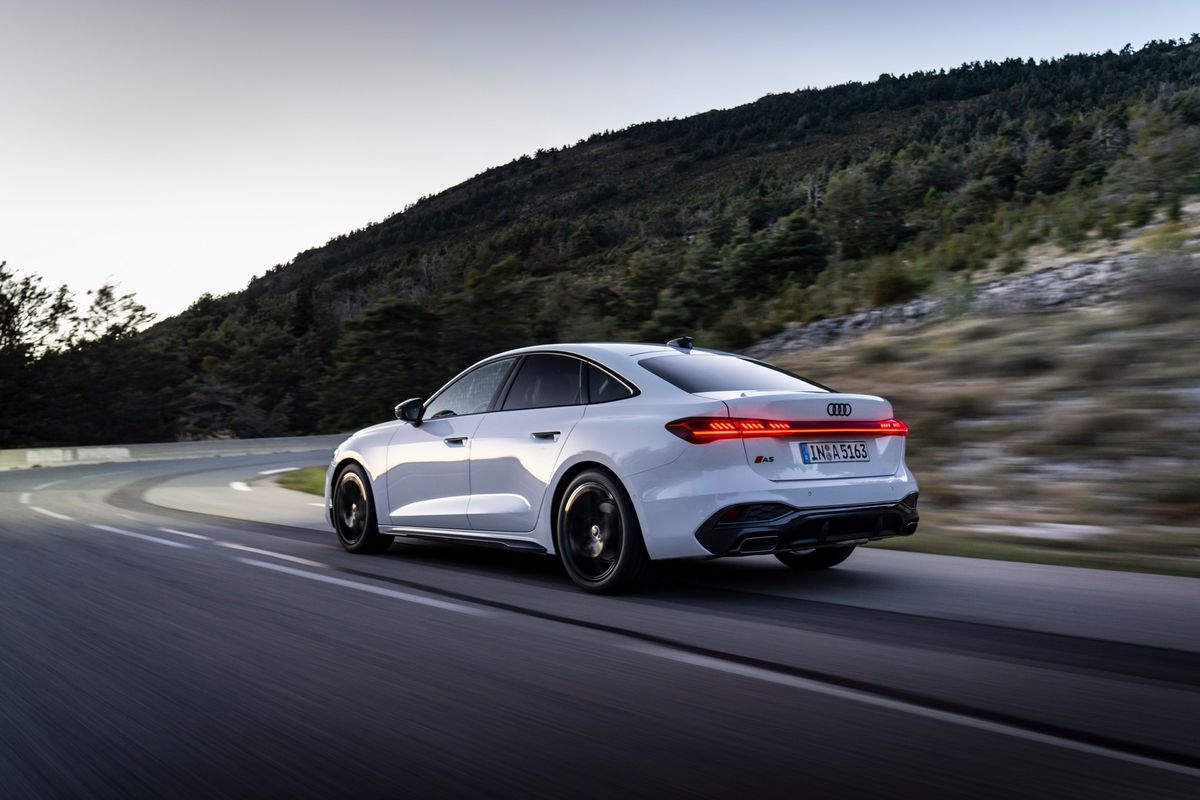
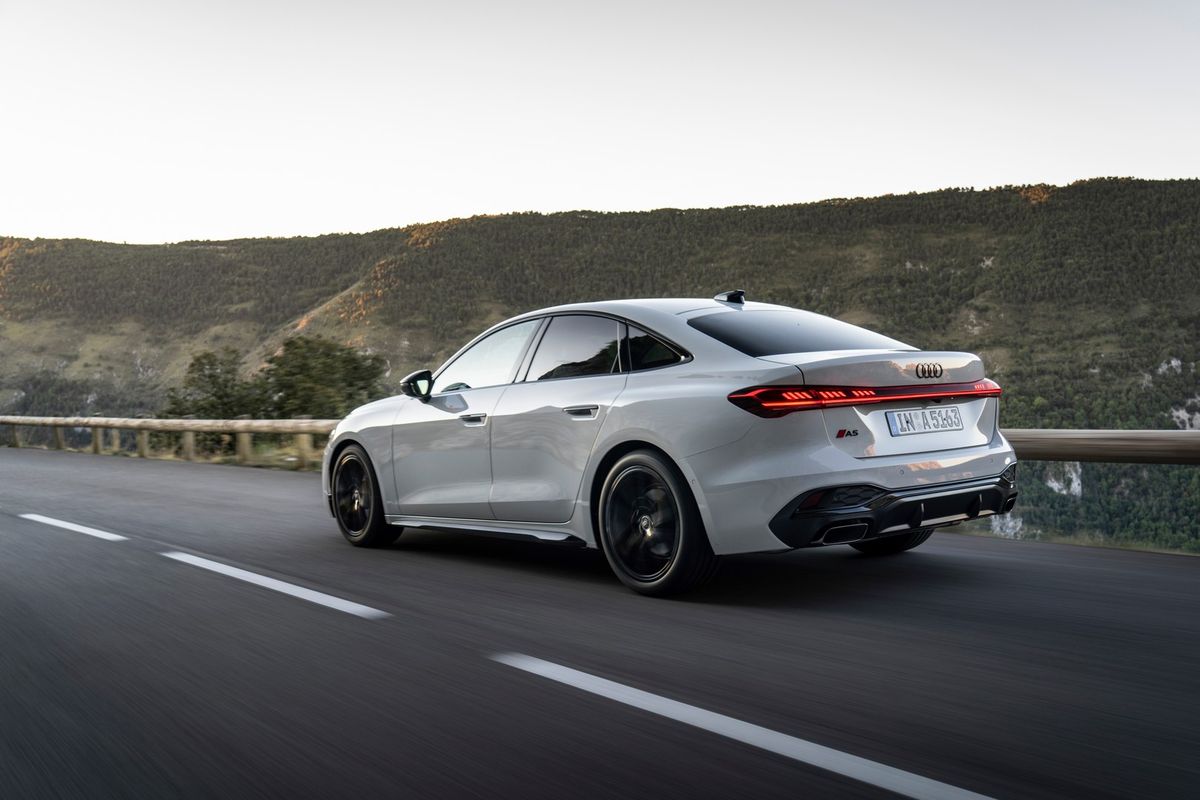
The all-new Audi A5 represents a new chapter for the Ingolstadt-based brand. With a new platform and tech, does the B10-generation A5 sedanhave what it takes to grab segment honours? We drive it in the South of France.
The 2025 Audi A5 supersedes the A4. If that sentence confuses you, it is because Audi’s (re)naming department has been hard at work. From now on, odd-numbered models (A3, A5, A7) will be powered by internal combustion engines, while even-numbered ones (A4, A6, A8) will have battery-electric powertrains. Still with me? Great.
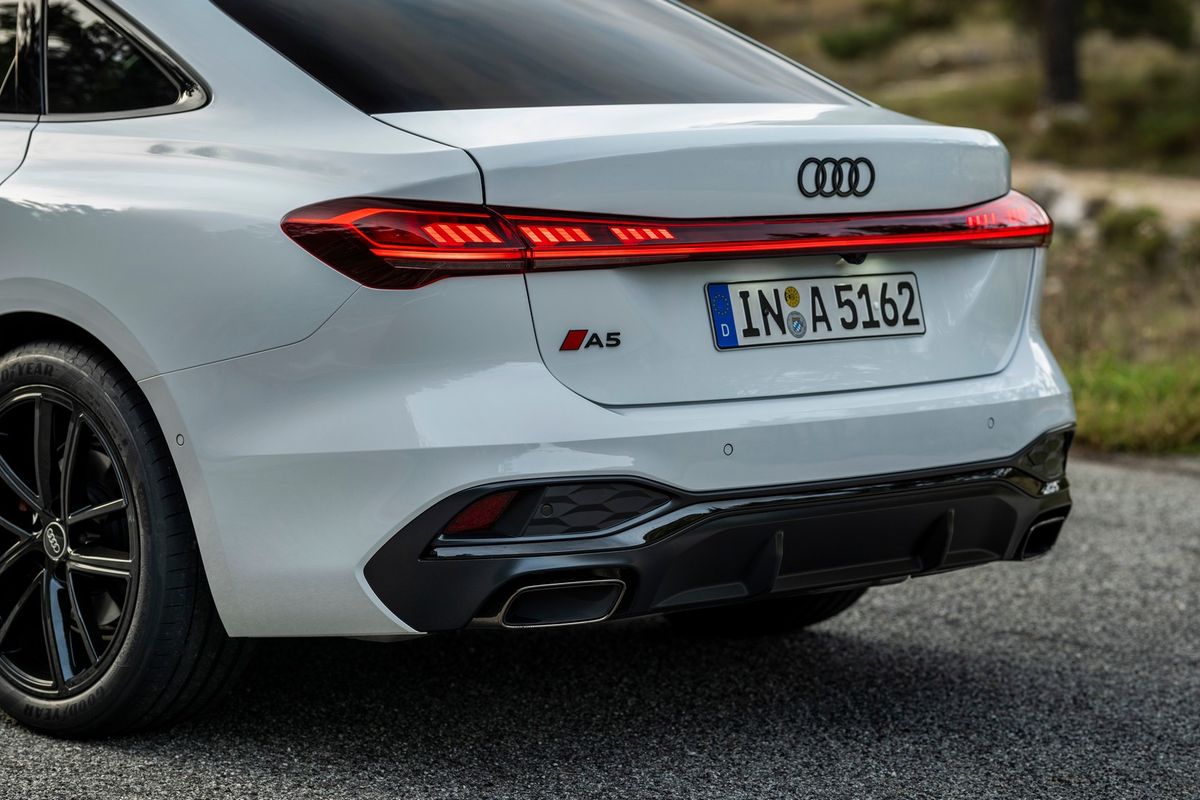
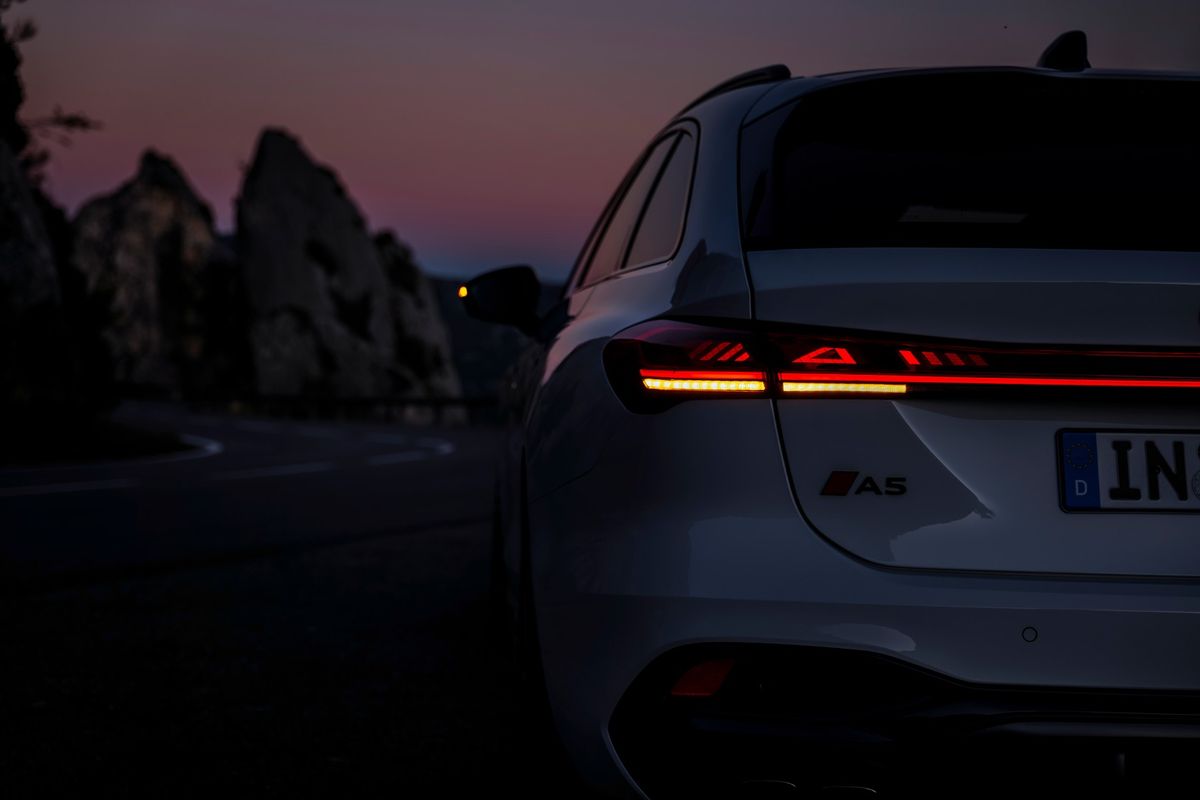
The engine-naming convention has also changed, with the confusing 35/45/50 TFSI falling away and being replaced by what buyers want to know anyway: the power output. A model derivative, for example, will look like this: Audi A5 TFSI 110 kW, with a simple A5 badge on the rear. That’s a bit easier…
The 2025 Audi A5 incorporates myriad changes, which is unsurprising given that the Ingolstadt-based brand is positioning this model more upmarket than the outgoing A4, which is a premium business-class sedan in anyone’s book! Audi has serious ambitions with its new cars and wants to pile on the luxury. Going this route has many positive benefits, the most obvious of which is a higher profit margin.
Compared with the A4, the 2025 Audi A5 is 13 mm wider, 67 mm longer, 24 mm higher and importantly, its wheelbase has been stretched by 80 mm, which significantly benefits the sedan’s interior packaging. Boot space is rated at 445 litres, which expands to all of 1 299 litres if you fold the rear seats down.
Under the 2025 Audi A5’s sheet metal is the new Premium Platform Combustion (PPC) architecture, which is a heavily revised version of the outgoing A4’s MLB. This sophisticated new platform caters for the new mild-hybrid hardware (more about that below) and the B10-gen A5 is the first vehicle to use it.
The engines have been enhanced for this new generation and nearly all feature a mild-hybrid system that can propel the vehicle at low speeds. Right now, there is a pair of 2.0-litre 4-cylinder turbopetrol engines – 110 kW/280 Nm and 150 kW/340 Nm – paired with 7-speed dual-clutch transmissions (a variant with 200 kW and quattro will also come to SA), as well as a 2.0-litre turbodiesel with 150 kW and 400 Nm.
Driving enthusiasts will welcome the return of the S5, which, thanks to its 270 kW/550 Nm 3.0-litre V6 turbopetrol, will be the quickest derivative in the launch line-up. Armed with a quattro drivetrain, that quick-shifting dual-clutch auto (which is new for this model) and a variable-vane turbocharger, which should minimise lag, the 2024 Audi S5 is said to bolt from 0-100 kph in 4.5 sec.
While I didn’t get to drive it, the Italian journos began their S5 test drives with vigour and I can confirm the V6 still sounds lovely. Oh, and as for the RS5 flagship, we expect it will be revealed in 2025.
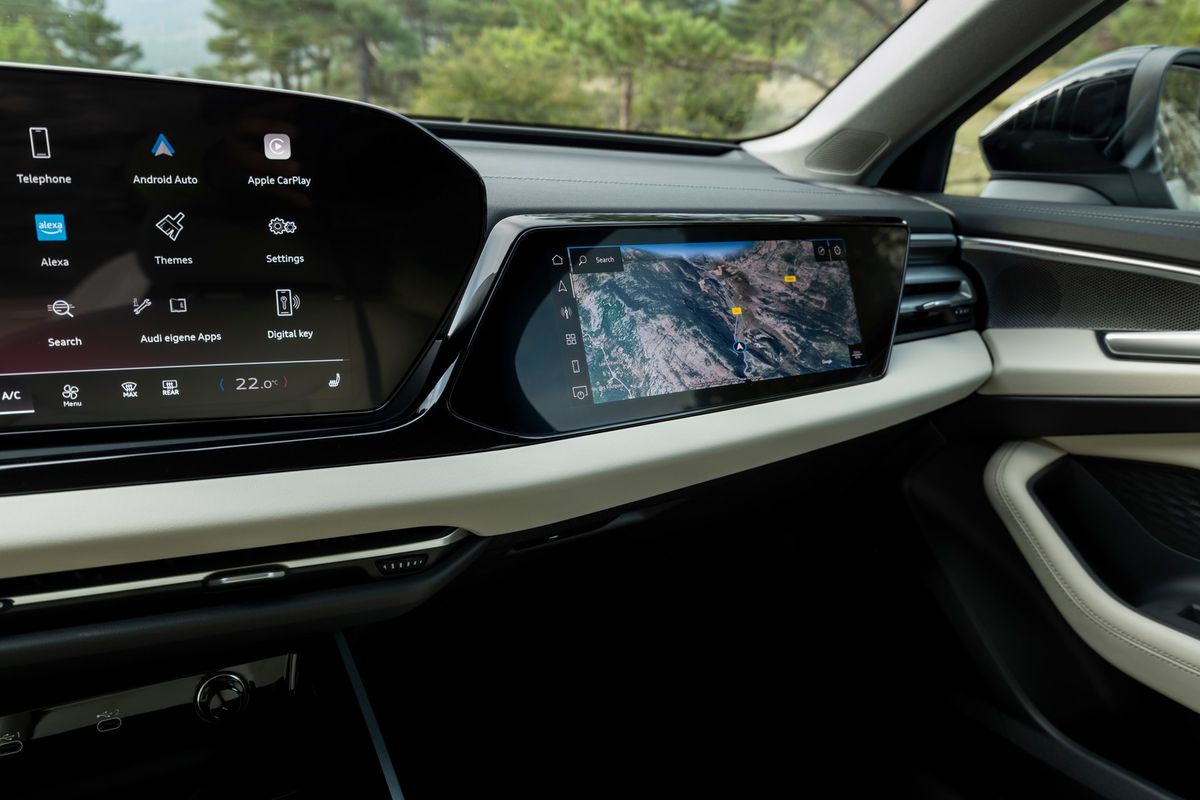
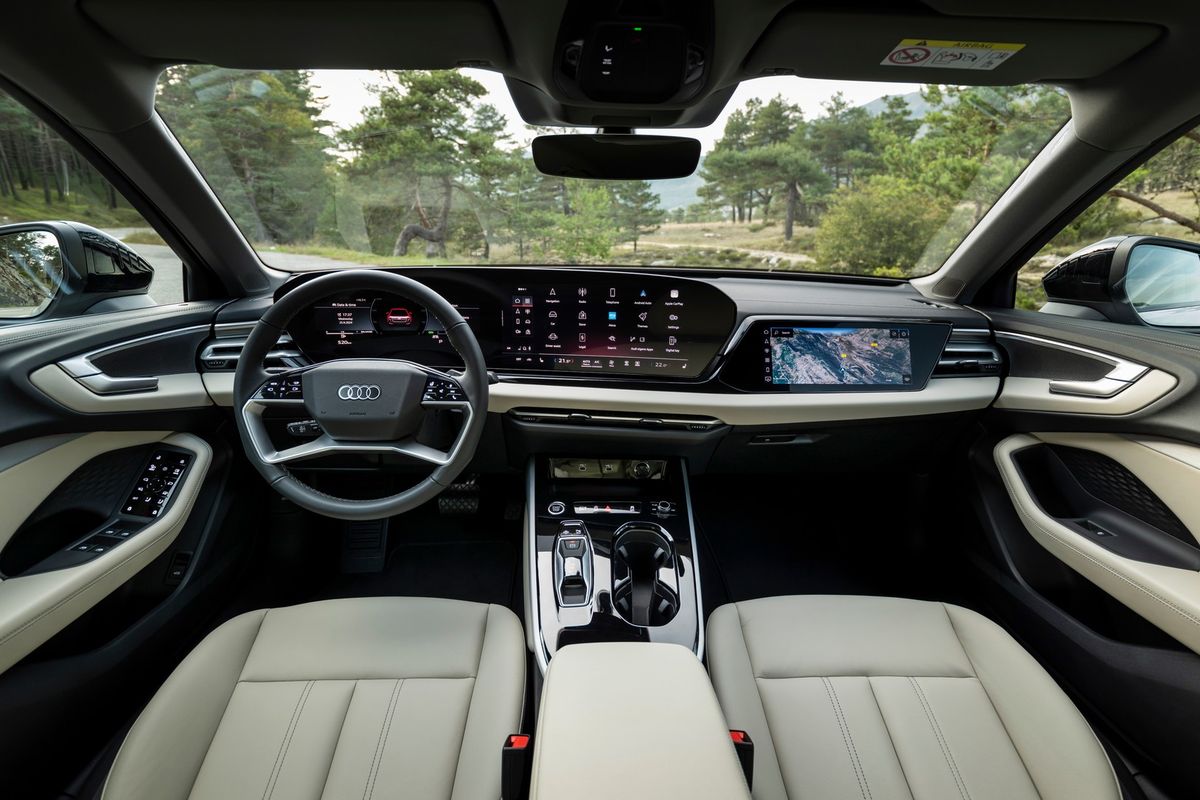
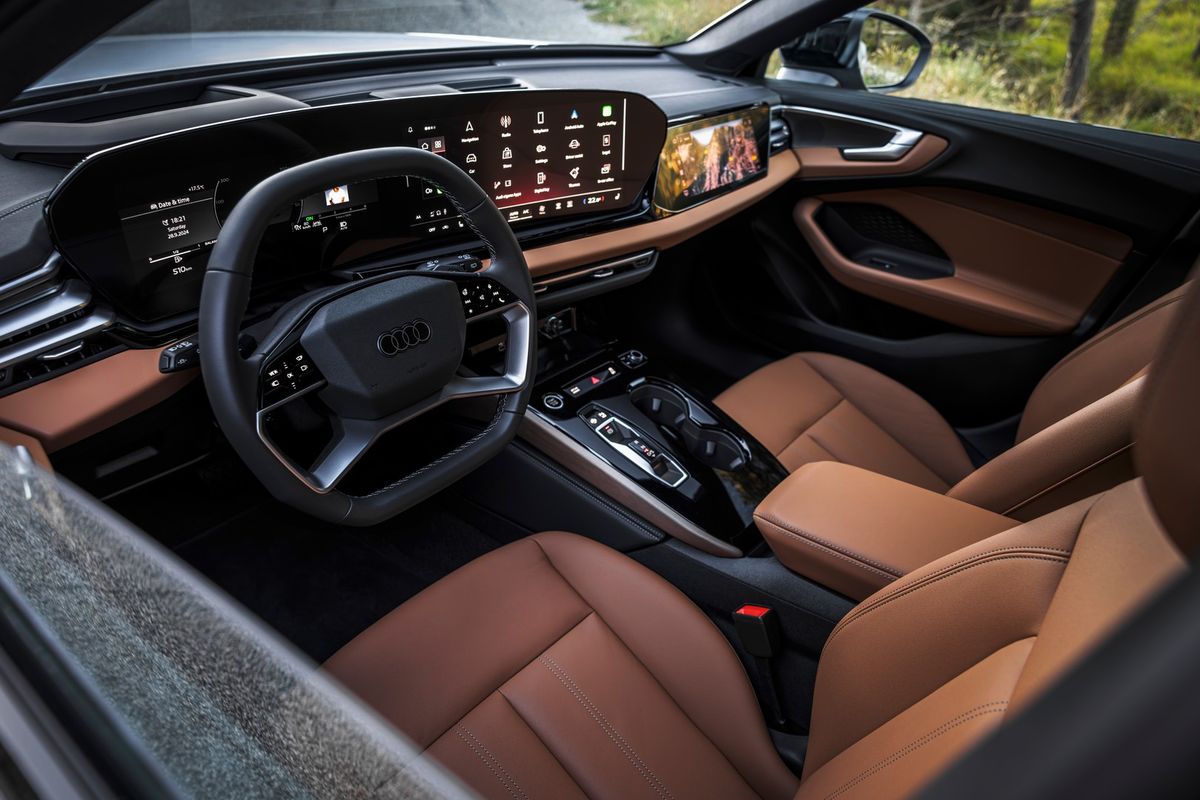
Back to the A5. Its cabin is unlike that of any Audi we’ve assessed of late and these moody photographs don’t do it justice. Naturally, Audi has stuck to its all-digital instrument cluster known as Virtual Cockpit but in this iteration, the layout and graphics have been upgraded and enhanced.
A driver-oriented curved dashboard encloses the huge (14.5-inch) infotainment screen that runs Android Automotive software. What’s more, there’s a digital assistant and ChatGPT is integrated into the vehicle.
The new head-up display is also very impressive. Audi has crammed a lot of information into it and its graphics are exceptionally crisp. Audi also offers a passenger-side (10.9-inch) screen as an option.
First Impressions
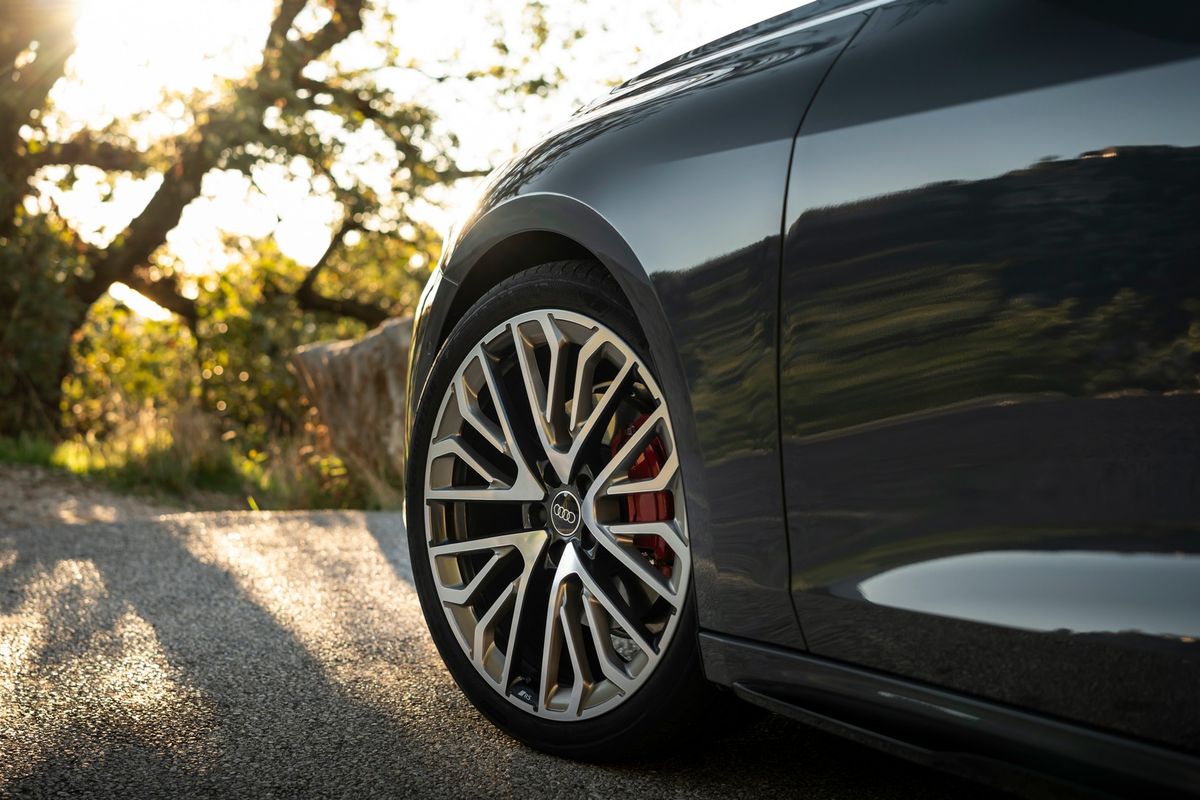
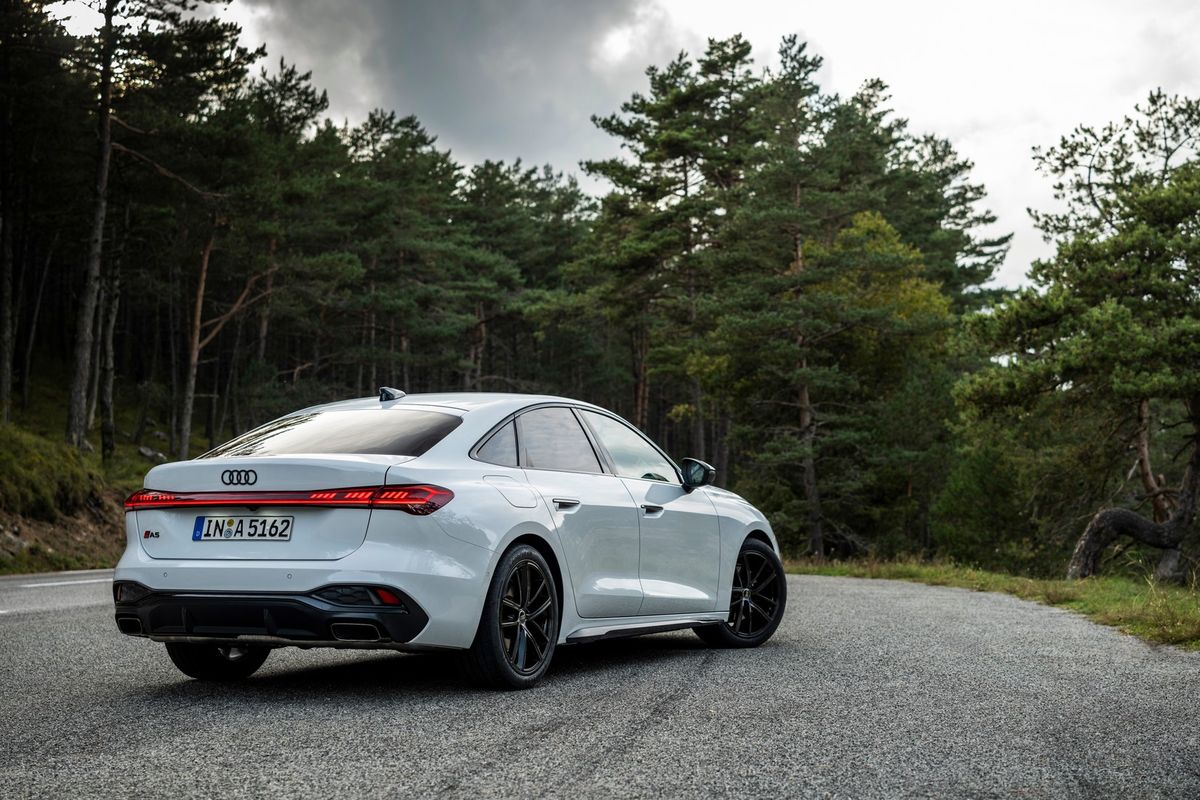
Our Glacier White front-wheel-drive A5 (fitted with prudently sized alloys) looked a little lost next to the dazzling S5 Avant units. European journos made a beeline for the thundering V6-powered variants and that was the last I saw of them! Nevertheless, the “humble” A5 was a great place to start my evaluation.
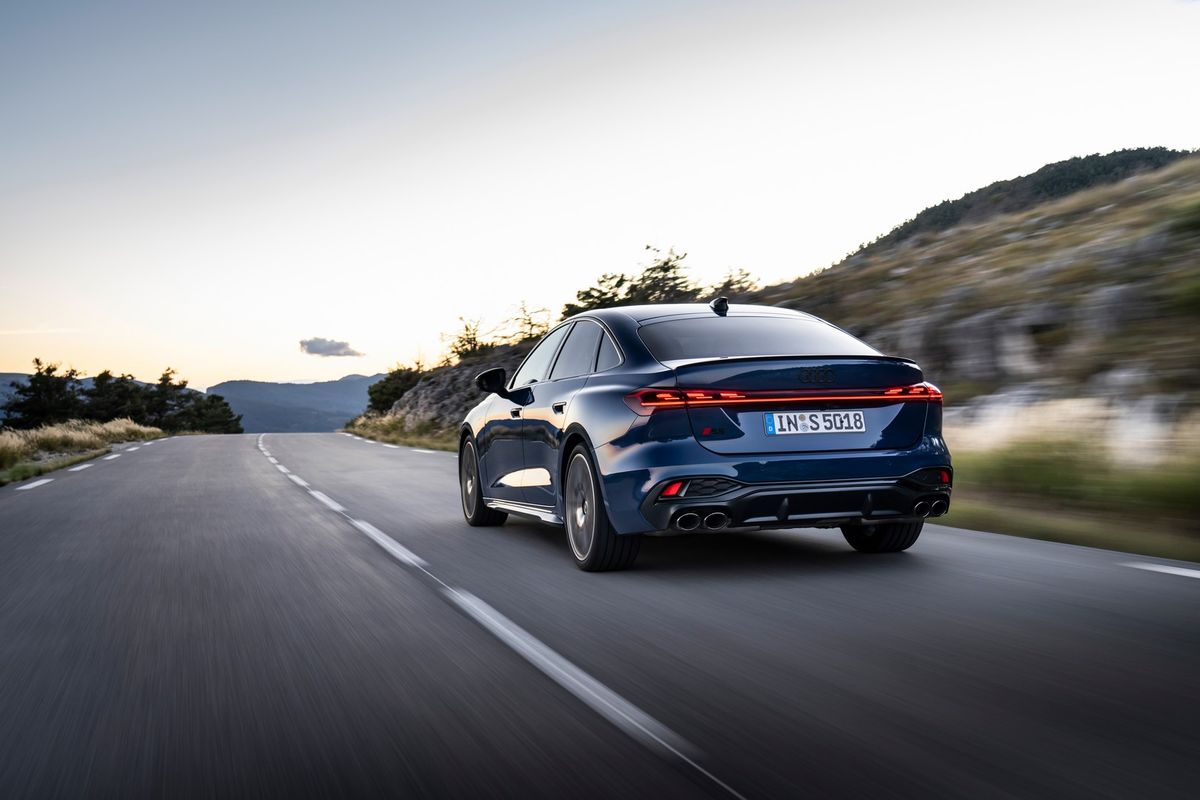
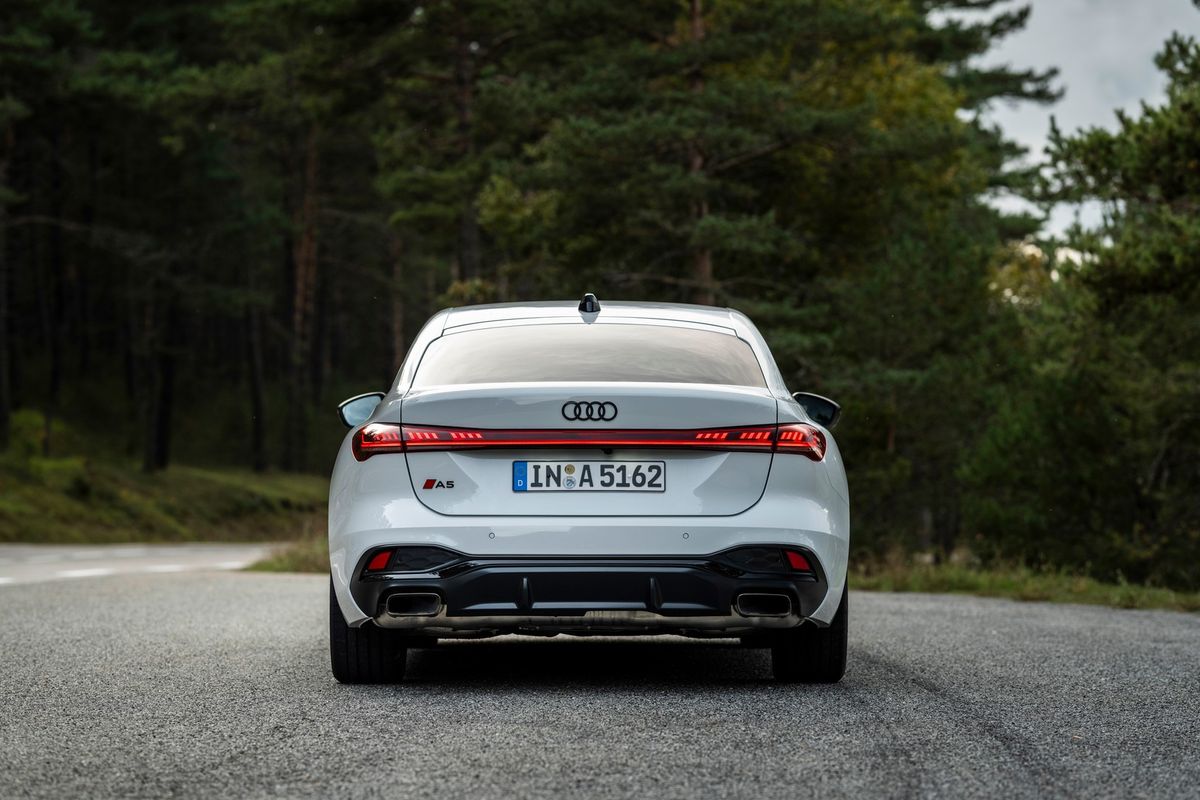
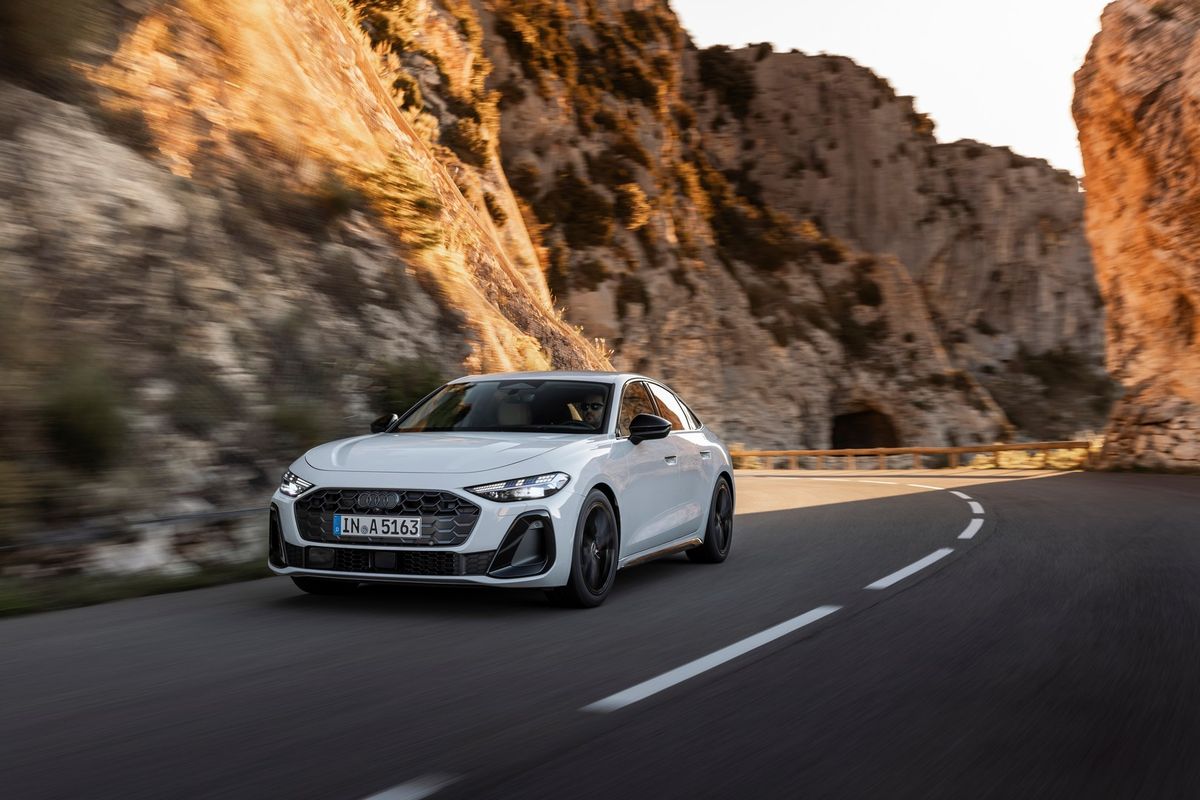
Visually, the 2025 Audi A5 appears sleek from almost every angle. As opposed to a conventional sedan, the newcomer has a Sportback-esque shape – replete with a tailgate instead of a boot lid. Think of how the BMW 4 Series Gran Coupe looks compared to the standard 3 Series and you’ll get the picture.
The first time I climbed aboard the newcomer, I found its driver-centric cabin a bit intimidating. There is a LOT to process; it took me a while to familiarise myself with the layout. Instead of a chunky transmission lever, the Audi has a neat shift-by-wire drive selector, which declutters the centre console and, in an era when touchscreens are the thing, we’re grateful to be afforded a button that adjusts the audio system’s volume. Everything else is controlled via the beautiful touchscreen, which accepts voice commands.
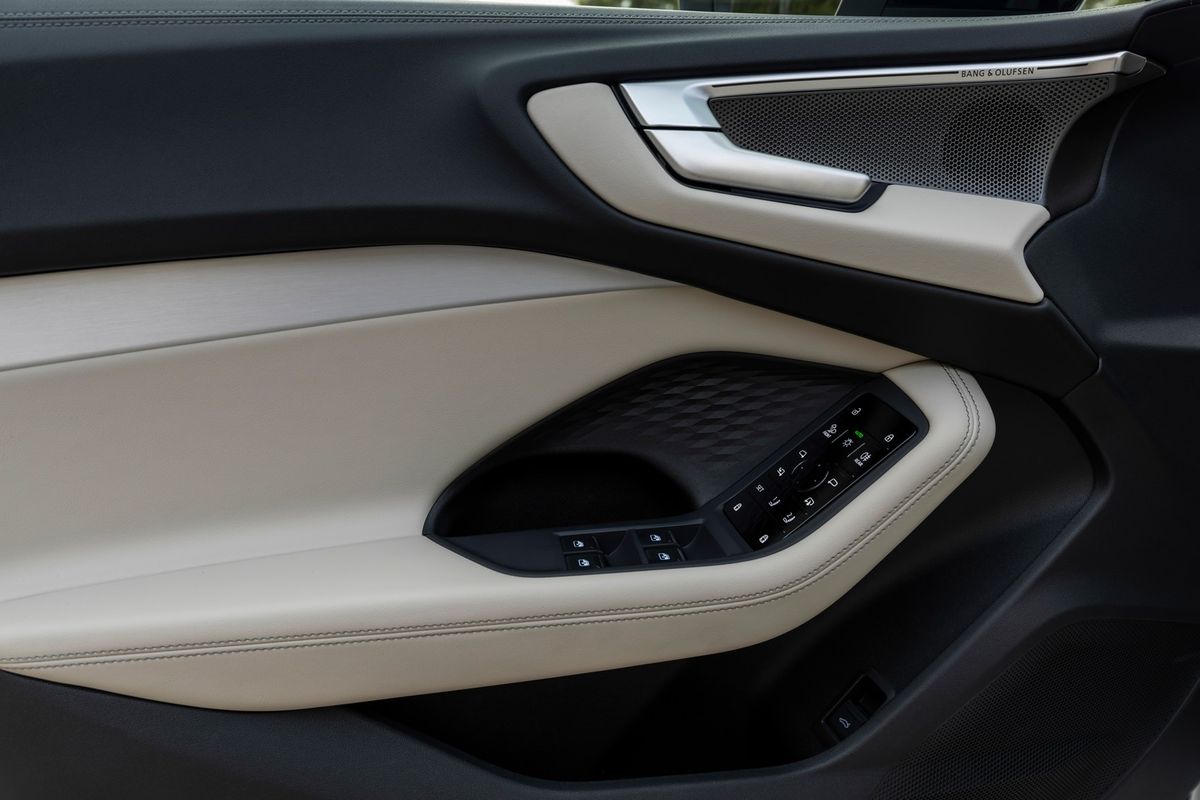
What about cabin quality? Audi’s products have always featured plush-feeling interiors and the 2025 Audi A5 is no exception. Its cabin is a genuinely upmarket space to occupy, with good quality materials applied on the most-often-used areas such as the steering wheel and door handles. Oh, the door’s armrests now have lighting controls (near the mirror and window switches) integrated into them.
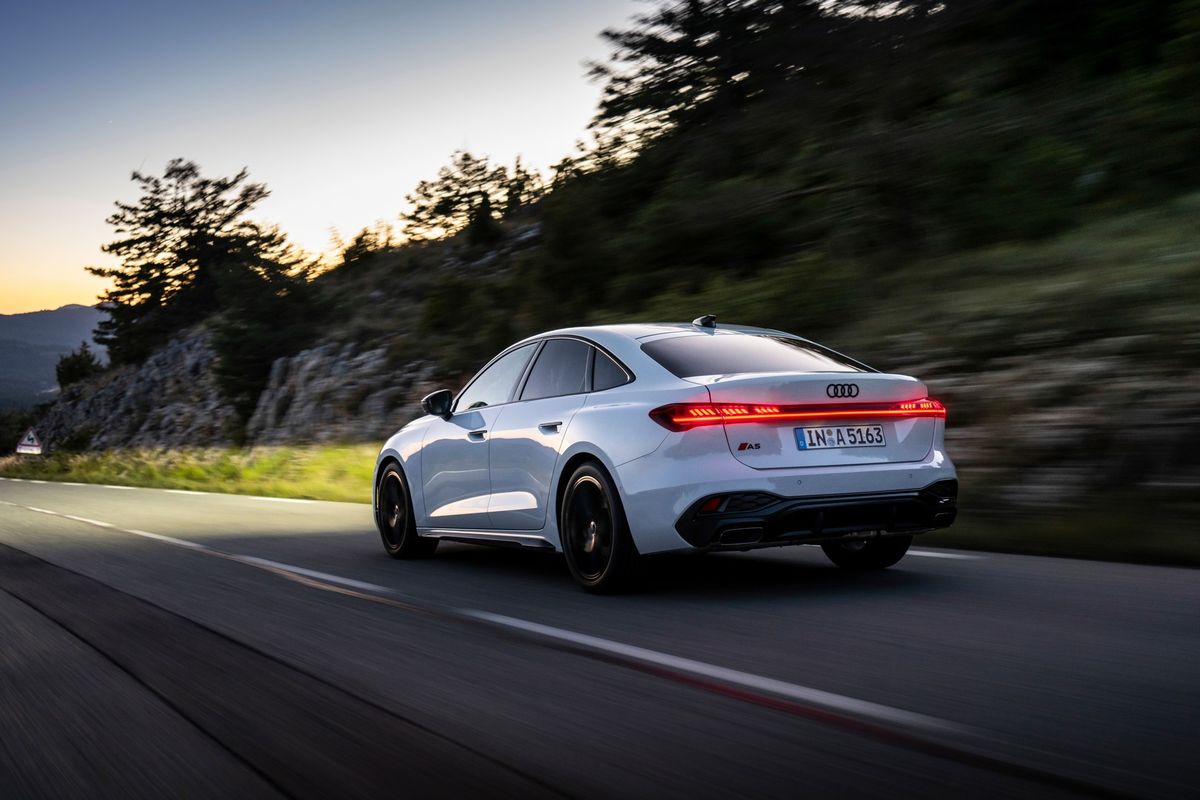
Audi is very proud of its lighting technology and rightfully so: the brand’s Matrix LED tech underpins some of the most impressive (and smartest-looking) headlamps I’ve ever experienced, but the A5’s lights are next level. Granted, some of these will be optional extras, but the ability to display 8 distinct themes, or as Audi calls them, signatures, as well as convey messages to other road users is novel.
“Messages, you say!?” Yes, for example, if you press the hazard lights, the OLED lenses create a hazard triangle pattern. If the car that’s following your vehicle gets too close in traffic at night and triggers the rear parking sensors, the 2025 Audi A5’s various rear lighting elements will shine a warning light. The default tail-lamp setting is a favourite, with a gentle swirling pattern that creates the impression that “the car is alive”. How long before someone activates KITT mode? And with that, I’ve given away my age.
What is the Audi A5 like to drive?
Audi offered the media contingent 4 enticing test-drive routes to choose from, and I was keen to explore the beautiful roads of the south of France – a region renowned for being the playground of the rich and famous. Monaco, by the way, was just 20 km away. However, particularly nasty storms had rolled in, which caused some of the roads to be closed due to flooding and rock falls, while the scenic routes were obscured by thick mist. My initial short drive consisted of an urban drive at 50 kph through some French villages, incredibly picturesque yes, but hardly the appropriate environment to trial an all-new model.
By a stroke of good fortune, the clouds lifted and we could drive out to a designated photo spot, which, as a matter of fact, was the location where these press-pack images were shot! The D2 road heading out of Greolieres is one of the most incredible stretches of tarmac I’ve ever driven on… It combines postcard-perfect views with winding bends that would expose the A5’s dynamic flaws – if it had any.
There’s no shortage of oomph from the 2.0-litre turbopetrol engine; it delivers all of its 150 kW smoothly. Yes, there are gearshift paddles on the multifunction steering wheel for that extra level of engagement, but I found the 7-speed dual-clutch auto ‘box shifted so efficiently that I never felt the need to use them on the regular. Engage a sportier drive mode and there’s a faint engine note, which we suspect is piped into the cabin. As for performance, Audi claims a 0-100 kph time of just under 8 seconds, which felt about right.
Every 2025 Audi A5 variant features the Ingolstadt-based brand’s enhanced progressive steering setup and it’s direct and accurate, with just enough feedback to make things interesting. Just to remind you, I was at the wheel of the base A5, after all. In the tight alleys of French villages, I appreciated how easy it was to place the lanky sedan. Audi has introduced brake-torque vectoring to help the A5 counteract understeer and enhance its agility, although I’ll admit I wasn’t going nearly fast enough to try it out.
A business-class sedan is expected to offer superb on-road refinement (including a whisper-quiet cabin at freeway speeds) and, given Audi’s ambitions of progressing from “premium” to “luxury”, it would not be unreasonable to expect that the all-new A5 would prioritise comfort and refinement over dynamism.
Still, Audi seems to have found a good compromise between an insulated driving experience and a sufficient level of wieldiness. The quietness on the open road was impressive, BUT the roads we drove on were near-perfectly smooth, so we’ll revisit this assessment when we drive the sedan on our roads!
I need to mention the new MHEV system, which is one of the best mild-hybrid setups I’ve experienced. The hardware offers an extra 18 kW/230 Nm over the drivetrain’s ICE component and, apart from offering notable assistance when pulling away or accelerating, the system is said to be capable of propelling the A5 at crawling speeds. Does it work? Yes, smoothly and uninterruptedly! The petrol engine was NOT utilised to perform low-speed manoeuvres, such as trundling along – or parking on – tight streets.
When is the 2025 Audi A5 arriving in South Africa?
Audi South Africa says the all-new Audi A5 will touch down in Mzansi in May 2025. The derivative rollout will be a staggered affair with not every variant available right away (such as the 200 kW quattro). From what we understand, the launch line-up will include the brace of 4-cylinder petrol variants and the S5.
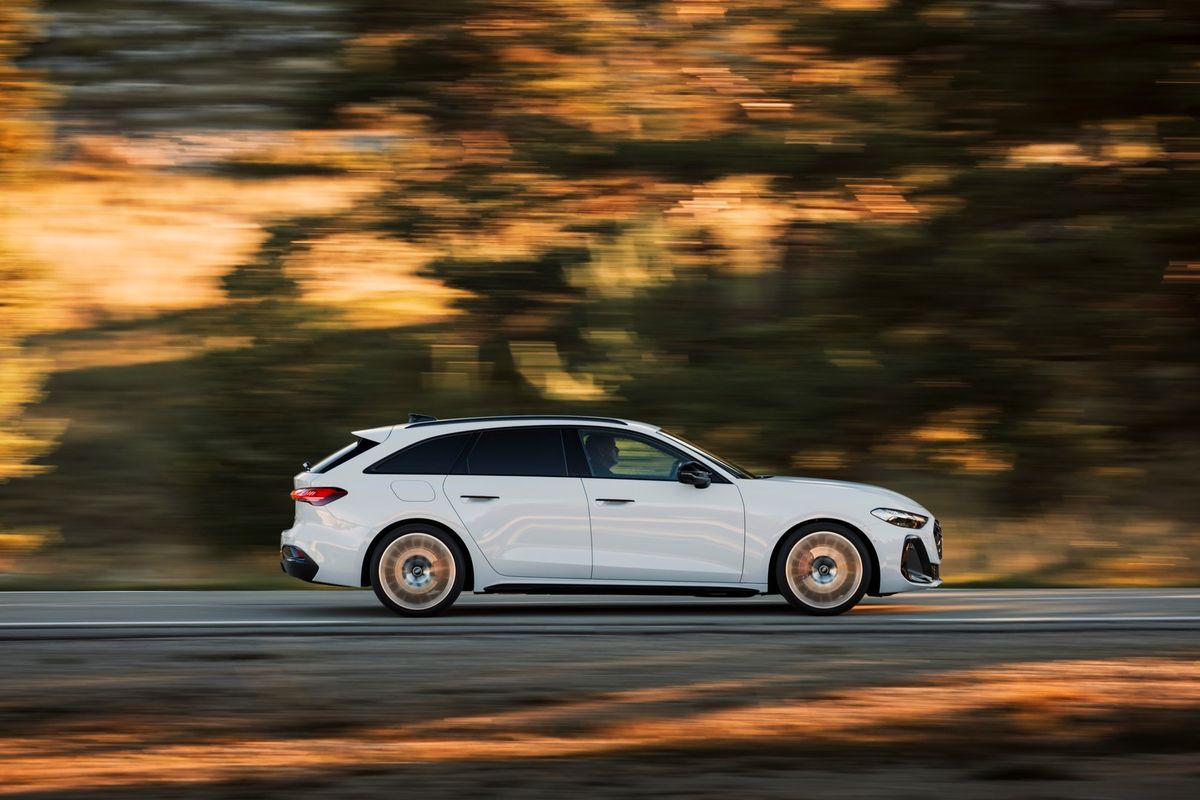
As it stands, no Avant (station wagon) variants will be offered in our market; there simply isn’t enough demand to warrant a full product introduction. Pity, as this generation A5 Avant (when fitted with generously sized wheels and clad in a handsome paint finish) is a sensational-looking vehicle.
Summary
Having driven the 2025 Audi A5, the biggest question on my mind was: “Is it as good dynamically as the BMW 3 Series, and as luxurious/refined as the Mercedes-Benz C-Class?” While we just had a few hours behind the model’s tiller, the signs are that this is an accomplished product – progress has been made.
However, we suspect that given the lengths Audi has gone to to produce a class-leading car, the German marque will have little choice but to offer the all-new A5 at a hefty premium over the outgoing A4.
A LOT of work has gone into this new-generation vehicle. Was it worth it? Well, when I compare my experience of the all-new A5 with those of the long-serving A4, the newcomer feels lightyears ahead in the ways that matter most: premium feel, a more engaging driving experience and tech galore.
The jury’s still out on the future of the venerable 4-door. Globally, sedan sales figures are flagging as more (no, most) buyers rush to buy high-riding SUVs. But even if the all-new A5 doesn’t sell as strongly as Audi hopes, at least its new-look cabin, hybrid tech and more will make their way into other vehicles.
SUVs are hugely popular in South Africa and they come in many sizes and cater to a wide range of budgets. This article highlights the best SUVs to buy in 2024 based on the 2024/25 #CarsAwards finalists!
If you are looking for the best SUVs to buy in South Africa, look no further than the 2024/25 #CarsAwards finalists!
The #CarsAwards, sponsored by Absa, is South Africa’s most comprehensive and authoritative motoring awards programme that recognises the best cars for sale in the new car market across 13 categories.
Here are the best SUVs you can buy in South Africa in 2024. Note that crossovers can be regarded as small or compact SUVs and we have therefore included these cars on this list.
GWM Tank 300: turbodiesel engine confirmed for SA!
GWM South Africa has confirmed to Cars.co.za that it plans to launch a turbodiesel version of the Tank 300 in the opening quarter of 2025. Here’s what we know so far…
The GWM Tank 300 range in South Africa currently comprises turbopetrol and hybrid derivatives. However, the Chinese automaker’s local division has confirmed to Cars.co.za that it plans to add a turbodiesel engine to the portfolio in the opening quarter of 2025.
Desmond Els, Sales Director at GWM South Africa, broke the news during a wide-ranging interview conducted in Cars.co.za’s custom-built podcast booth at Naamsa’s recent South African Auto Week 2024 in Cape Town, confirming that the local Tank 300 line-up will soon expand into the popular turbodiesel 4×4 segment.
The Tank 300 launched in turbopetrol and hybrid guise.
“We introduced the Tank 300 with the ICE [internal combustion engine] derivatives as well as the HEV [hybrid electric vehicle] derivative. Knowing that the South African market is very diesel orientated – I’ll give you a sneak [peek] on that – the diesel is on its way. The diesel is planned for Q1 2025,” Els told us.
“Our brand expansion is currently happening in the way we’re bringing the right car to market and finding the right car for the right customer. Knowing that the South African market is very pro diesel, we know we need to get to market as quickly as possible,” he added.
The new 2.4-litre turbodiesel engine is already used in the P500 and facelifted P-Series.
Though Els didn’t go into detail about the turbodiesel motor, we know it’s the new 2.4-litre, 4-cylinder engine that debuted in the P500, which itself launched locally in August 2024. This engine will also be rolled out to the facelifted P-Series (which will wear the P300 badge locally) due to hit the market in early 2025.
As it does in those applications, we expect this new GW4D24 oil-burner to generate peak outputs of 135 kW and 480 Nm in the ladder-frame SUV, with drive likely delivered (again to all 4 corners) via a 9-speed automatic transmission. Compared with the current turbopetrol and hybrid derivatives, it should also offer improved fuel economy.
It’s not clear where in the local line-up the turbodiesel derivative(s) will be positioned.
As a reminder, the Tank 300 launched in South Africa in February 2024. The local line-up currently comprises 3 derivatives – the 2.0T 8AT 4×4 Super Luxury (R725 950), the 2.0T 8AT 4×4 Ultra Luxury (R775 950) and the hybrid-powered 2.0T HEV 9HAT 4×4 Super Luxury (R851 950) – though we’ve also seen some dealers advertising a flagship 2.0T HEV 9HAT 4×4 Ultra Luxury (R925 000).
The initial 2 variants employ the firm’s turbocharged 2.0-litre, 4-cylinder petrol engine, which sends 162 kW and 380 Nm to all 4 corners via an 8-speed automatic transmission (with combined fuel consumption listed as 9.5 L/100 km). Meanwhile, the hybrid powertrain is based on a similarly sized 4-pot but churns out total system outputs of 255 kW and 648 Nm. The dual-powered variants switch to a 9-speed automatic transmission, while claimed fuel economy is 8.4 L/100 km.
The turbodiesel version is scheduled to launch locally in Q1 2025.
Year to date at the end of September 2024, GWM South Africa had registered 380 units of the Tank 300, taking this nameplate’s tally to 381 units (a single example was registered back in October 2023, presumably as part of the vehicle’s local homologation process).
Interestingly, sales of the SUV appear to be on a general upward trend, having increased from 11 units in February to 38 units in March, before falling back slightly to 35 registrations in April. That number grew to 48 units in May, 54 in June and 56 in July, though the Tank 300’s best month so far was August (62 units), closely followed by September (61 units).
‘It wasn’t our decision’ to axe NP200, says Nissan SA boss
Nissan SA’s managing director says it wasn’t the brand’s decision to discontinue the NP200, adding the firm is “working on the replacement” for the half-tonne bakkie…
Nissan South Africa’s managing director says “it wasn’t our decision to discontinue NP200”, emphasising that the company was forced to cancel the half-tonne bakkie’s successor at the last moment.
After 16 years, production of the Nissan NP200 officially ended at the Japanese firm’s Rosslyn factory in March 2024, despite the fact there was still clear local demand for what had for several years served as the market’s last-surviving half-tonne bakkie.
Maciej Klenkiewicz, Nissan South Africa and Independent Markets Africa Managing Director, however, suggested to Cars.co.za during an interview at the South African Auto Week 2024 in Cape Town that the firm had no choice in the matter.
“It wasn’t our decision to discontinue NP200. We had plans to replace NP200 with a successor. Unfortunately, due to the geopolitical situation in Russia – in fact, the crisis which we have between Ukraine and Russia – we had to cancel the project which was a replacement for NP200,” Klenkiewicz told us.
“The successor was supposed to be built there, in Russia, with the platform from Renault. Right now, we are of course working on the replacement, but the process is starting from scratch. So, I cannot say that it was a ‘business decision’ – we had a plant which we unfortunately had to drop,” he explained.
In October 2022, Nissan announced its withdrawal from Russia. Around a year later, Nissan SA revealed that it had officially entered a “formal consultation phase to restructure the business“, thanks largely to the then-looming end of production of the NP200.
At the time, Nissan SA said it had earlier lined up an “immediate replacement model for NP200”. However, the automaker said that model was “no longer viable” due to significantly reduced volumes brought about by the “geopolitical situation in Russia”.
As a reminder, the Dacia Logan-based NP200 single cab arrived on the scene as a replacement for the Nissan 1400 back in 2008, boasting an 800 kg payload. The workhorse had the local half-tonne bakkie segment all to itself since the close of 2017, when General Motors quit Mzansi, thus marking the end of the road for the Chevrolet Utility.
Franschhoek might be known as a tourist hotspot in the Winelands, but in October 2024, the historic town was abuzz with the sound of classic and performance cars.
Western Cape motoring enthusiasts love making stopovers in Franschhoek. If you drop by for a coffee or breakfast in the historic Winelands town over a weekend, you’re always likely to spot a special car or 2.
After all, several wine farms, restaurants, the mountain pass that leads to the Theewaterskloof Dam, and the hiking trails in the mountains are just a few of the attractions that Franschhoek offers.
However, during the weekend of 5-6 October 2024, the region’s passion for the automobile was put on show. I’ve never seen the town so busy and filled with such a wide variety of collectable cars and bikes.
2nd edition of Franschhoek Classic Car Festival
The reason for all the action was the 2nd Franschhoek Classic Car Festival, as well as a motoring display at the Huguenot Monument, which forms part of the festival, called “Forty of The Finest”.
Sitting at one of the small restaurants next to the main road, our heads were constantly swivelling as we spotted rare classic-, super- and modern classic cars passing by.
The fact that the weather played along played a role in the enthusiastic turnout. A festival ticket also allowed entrance to the Franschhoek Motor Museum and the Forty of The Finest display on Sunday.
Following the event, we talked to the founder and CEO, Theo Lötter, about the highlights of the festival. He said the success of Forty of The Finest exhibit could be attributed to the number of cars on display, but also the quality of the cars, as well as the fact that there was only one car per manufacturer.
Nowhere else in South Africa would you be able to see such a curated (and by invitation only) display of 40 different car manufacturers.
It is difficult to pinpoint the stand out-cars on display (there were so many). There are some cars that we have featured on Cars.co.za before, such as the fully restored Ferrari 308 GTB.
Another car, and the only one in the country, that was quite special is a 1938 Jaguar SS drop-head coupe. The car was in boxes for about 4 decades before it was fully restored!
“The restorer said that the first place this car should head to is the Franschhoek Classic Car Festival. Most of the cars on display also have a very interesting story attached to them,” says Theo.
“Each year we also look at possible anniversary displays. This year (2024) it was the anniversary of the Alfa Romeo Giulietta (70th anniversary) – so we had a notable display of these cars, as well as that of the Ford Mustang which celebrated its 60th anniversary this year,” he added.
For the 2024 event, tickets were sold out and some showgoers who hadn’t purchased tickets online, or arrived late in the morning, were refused admission. For 2025, enthusiasts should purchase their tickets online ahead of time (a limited number of visitors are allowed to visit the Forty of The Finest display).
“Remember FCCF is not only about old cars. New cars are already part of the festival – we had the very latest Ferrari on display for example – and pairing the latest car with classic and curated displays is our strategy going forward in the iconic Forty of The Finest section.”
“Going forward, the Franschhoek Motor Museum won’t exhibit more than 50 to 80 specially selected vehicles. The display at the monument, which comprises about 150 cars, is also carefully curated.
“As has been the case this year, as well as going forward, we will take anniversaries and motoring tours into consideration. This year (2024), for example, the Rivals Tour formed part of the show as it ended here and all the attendees could also take a closer look at these cars.
“The 2024 event exceeded all expectations, and the feedback from participants and visitors has been overwhelmingly positive. We’re looking forward to improving the experience for the 2025 event, and we are determined to make the Franschhoek Classic Car Festival the premier car event in South Africa.”
Make a note to start looking for ticket sales during the 3rd quarter of 2025 to not miss out on the 3rd instalment of this show!
What is the best VW to buy in South Africa in 2024?
Volkswagen is a well-known and trusted car brand in South Africa with a wide range of passenger cars and commercial vehicles available to local buyers. This article highlights the best VW to buy in South Africa based on the finalists in the 2024/25 #CarsAwards. Take a look!
Volkswagen is South Africa’s second most popular car brand in South Africa and it’s a brand that is embedded in South African car culture. Buyers looking for the best VW to buy are spoilt for choice as Volkswagen caters to a wide range of needs and budgets.
Volkswagen offers hatchbacks, SUVs, MPVs and bakkies to the local market and many of them are consistent best-sellers on a regular basis.
Volkswagen’s success is attributed to its reputation for producing quality cars that are perceived to be reliable with strong aftermarket support from its large dealership footprint across South Africa.
The Volkswagen Polo 1.0TSI 85 kW R-Line automatic is one of the best compact hatchbacks you can buy in South Africa.
The Polo makes use of a 3-cylinder, 1.0-litre turbopetrol engine with outputs of 85 kW and 200 Nm, paired with a 7-speed dual-clutch automatic transmission. In R-Line guise, the kerb appeal of the Polo is enhanced with 16-inch Valencia alloy wheels, R-Line badges, Composition Media system, wireless phone charging and two-zone climate control air conditioning.
The T-Cross is one of Volkswagen’s most popular cars in South Africa and it uses the same 3-cylinder 1.0-litre turbopetrol engine that powers the Polo.
Engine outputs for this engine are 85 kW and 200 Nm of torque and it’s oared with a 7-speed dual-clutch transmission.
The finalist in the 2024/25 #CarsAwards is the Tiguan 1.4 TSI R-line with a turbocharged 1.4-litre turbopetrol engine doing duty under the bonnet paired with a 7-speed dual-clutch transmission. This engine offers outputs of 110 kW and 250 Nm. A 2.0-litre turbodiesel engine and a 2.0-litre turbopetrol engine are expected to join the range soon.
In addition to a thoroughly improved cabin, the Tiguan R-Line gains obligatory badging as well as 19-inch Coventry wheels.
Facelifted GWM P-Series coming in early 2025 wearing P300 badge
It’s official: the facelifted GWM P-Series is scheduled to touch down in South Africa in the opening quarter of 2025, wearing the P300 badge and gaining a new engine option…
GWM South Africa has confirmed to Cars.co.za that the facelifted P-Series is scheduled to launch locally in the opening quarter of 2025. Slotting in below the super-sized P500, the refreshed version of the Chinese firm’s bakkie looks set to debut the P300 badge, while also gaining a new engine option.
Desmond Els, Sales Director at GWM South Africa, confirmed the brand’s upcoming P-Series plans to Cars.co.za during a wide-ranging interview conducted inside a custom-built podcast booth at Naamsa’s recent South African Auto Week 2024 in Cape Town.
The Chinese-spec version of the facelifted P-Series.
“The P-Series, as it stands today, is on runout phase. We’re busy running out the current model, which was introduced to the South African market around the [end of 2020]. It’s time for the vehicle to have its official facelift,” he told us.
“The P300 is on its way and will be reaching South African shores in the 1st quarter of next year [2025],” added Els, who recently completed his 1st year with GWM SA, having previously worked at Renault, Suzuki and – most recently – Nissan.
Commercial-spec models will again be available locally.
As with the outgoing P-Series portfolio, GWM SA plans to offer both commercial- and passenger-spec versions of the P300. However, Els furthermore told us that while commercial derivatives will again employ the familiar 2.0-litre turbodiesel engine, passenger-spec variants will be available with a choice of either this motor or the newer 2.4-litre turbodiesel unit.
As a reminder, the 2.0-litre oil-burning mill makes 120 kW and 400 Nm, while the new 2.4-litre (likewise 4-cylinder) turbodiesel engine generates peak outputs of 135 kW and 480 Nm, with drive delivered via a 9-speed automatic transmission rather than the 8-speeder mated to the smaller-capacity engine. Codenamed GW4D24, this 2.4-litre motor debuted in the P500 that launched locally in August 2024.
A new 2.4-litre turbodiesel engine will be offered in the passenger-spec range.
While other local specification details have yet to be divulged, it’s worth noting the facelifted P-Series on offer in China features a new grille design, along with a restyled front bumper housing updated foglamps. The wheel-arch extensions, too, have been tweaked. Inside, the revised Chinese-spec P-Series gains a freestanding 7-inch colour LCD instrument cluster and a new 12.3-inch touchscreen (as opposed to the old integrated 9-inch item) that likewise sits proud of the facia.
The cabin seems to employ fewer physical controls than before, which suggests more functions have been moved to the touchscreen, while we also spotted new steering-wheel and automatic gear-shifter designs as well as a change in orientation for the air vents (from vertical to a more conventional horizontal layout).
A look at the Chinese-spec model’s updated cabin.
As a reminder, the outgoing P-Series range launched in SA in December 2020. The local line-up currently comprises 17 derivatives (4 single cabs, 8 “commercial” double cabs and 5 “passenger” double cabs) – if you don’t count the trio of new P500 variants, that is – with pricing running from R413 050 to R694 950.
Over the opening 9 months of 2024, GWM has registered 2 852 units of the P-Series in Mzansi, seeing it slip a place to 8th (from the 7th position it secured in 2023), sitting just behind the SA-built Volkswagen Amarok with 3 months of the year to go.
Not to be outdone by Chinese compatriots GWM, LDV, Foton and JAC, Chery has revealed a concept double cab at its annual summit in Wuhu, China. Set to go into production in mid-2025, the bakkie will arrive in Mzansi not long thereafter!
Codenamed KP11, the ladder-frame-based Chery double-cab bakkie – with planned spec in a tamer Urban or Ford Ranger Raptor-esque Off-Road pictured here – is set for production in the 2nd quarter of next year and aimed to reach the South African market by either the end of the year or early in 2026.
No details have been provided on available powertrains; however, a spokesperson from Chery told us that the company will offer an array of propulsive options, ranging from turbopetrol (rumoured to be a 4-cylinder motor with a 2.4-litre capacity, but no word on turbodiesel powerplants yet) to plug-in hybrid or range-extended EV, although the latter 2 configurations will likely be offered in some, not all, markets.
Chery’s local subsidiary hopes to offer the production version of the KP11 with GWM P Series levels of pricing, although with the model’s production- and landing costs, let alone specification (and most likely final appearance) still to be finalised, this will only be confirmed closer to the time of launch.
Sitting on chunky BF Goodrich rubber, this off-road version of the KP11 (it won’t be called that by the time it reaches the showroom floor) was kitted out in camping/overlanding gear as part of a showcase of product-appropriate aftermarket Chery bakkie accessories. Also in a nod to the Ford Ranger, it seems to have been inspired by – the bakkie features a rear side step that’s integrated into its rear bumper.
Why the VW Golf 8.5 GTI has not (yet?) been confirmed for SA
Wondering why Volkswagen has yet to officially confirm the Golf 8.5 GTI for South Africa? Well, VW Group Africa’s managing director has laid out the facts…
Earlier in 2024, Volkswagen Group Africa told us it was “still investigating” the Golf 8.5 GTI for South Africa, adding that “nothing has been confirmed for this market”. That statement left many local GTI fans surprised, considering the popularity of the badge in Mzansi.
Now, however, the Wolfsburg-based firm’s local boss has revealed the reason the company has yet to confirm the facelifted hot hatch – which was unveiled back in January 2024 – for South Africa.
Speaking to Cars.co.za inside a custom-built podcast booth at Naamsa’s recent South African Auto Week 2024 in Cape Town, Martina Biene, Chairperson and Managing Director of Volkswagen Group Africa, said the country’s current fuel quality is what stands in the way of the Golf 8.5 GTI’s arrival on local soil.
“The GTI is my favourite and I would want to drive it [the facelifted version] in South Africa. Therefore, we need the support of the South African fuel industry, because the fuel in South Africa is currently not at the level that we could release the GTI,” Biene told us.
“But a lot of work has been done. There was a panel [discussion] prior to lunch [on day 2 of SA Auto Week 2024] talking about the fuel quality in South Africa and the introduction of ‘Clean Fuel 2’, which is scheduled for 2027. But [we expect] some major improvements earlier in the field and we’ve got the commitment of some of the oil industry,” she added.
For context, South Africa’s long-awaited “Clean Fuel 2” (CF2) regulations – which are expected to be put in place by the Department of Mineral Resources & Energy (DMRE) from July 2027 – will mandate a reduction in sulphur levels in the country’s fuel and further impose stricter limits on the presence of various other compounds in petrol.
From what we understand, the petrol particulate filter (an emissions control device designed to reduce particulate emissions) fitted to the Golf 8.5 GTI’s uprated EA888 engine is different to that of the pre-facelift version still on sale in South Africa and thus technically not compatible with the country’s current level of fuel quality. We’re assuming the same applies to the Golf 8.5 R.
“So my team is almost waiting to test the fuel at the beginning of 2025 to make my dream happen – to drive the new GTI in South Africa,” Biene explained to us.
As a reminder, the facelifted Golf GTI again employs the German automaker’s familiar turbocharged 2.0-litre, 4-cylinder petrol engine, though its peak power output (in European specification, anyway) has been hiked from 180 kW to 195 kW. Maximum twisting force, meanwhile, remains 370 Nm.
According to VW, the Golf 8.5 GTI – which is fitted as standard with a 7-speed dual-clutch transmission – can complete the obligatory 0-100 kph sprint in just 5.9 seconds (a half-second improvement over the pre-facelift model’s time of 6.4 seconds), while top speed is electronically limited to 250 kph.
The Golf 8.5 GTI’s exterior design has also been suitably tweaked (you’ll notice the revised LED headlamps, redesigned grille, updated taillamps and fresh alloy-wheel designs, for instance), while the steering wheel ditches the outgoing model’s controversial touch-sensitive pads in favour of traditional physical buttons. There’s also a new 12.9-inch infotainment system that stands proud of the facia.
As a reminder, the pre-facelift Golf 8 GTI – which is currently priced at R828 400 – debuted globally in February 2020, though launched in South Africa only in September 2021 (with the Jacara Edition following in October 2022, before being removed from the line-up at the start of 2024). A fair chunk of the delay was attributed to the global semi-conductor crisis, of course, which came about as a result of the COVID-19 pandemic.