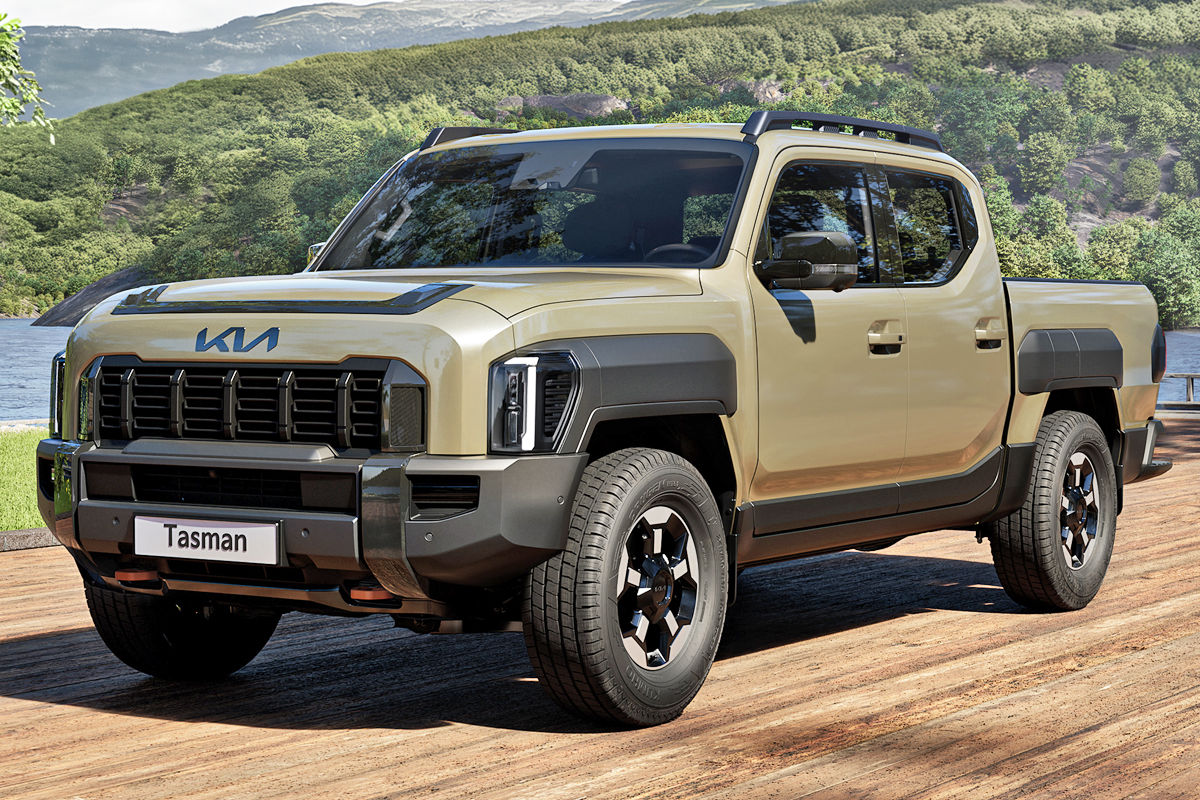
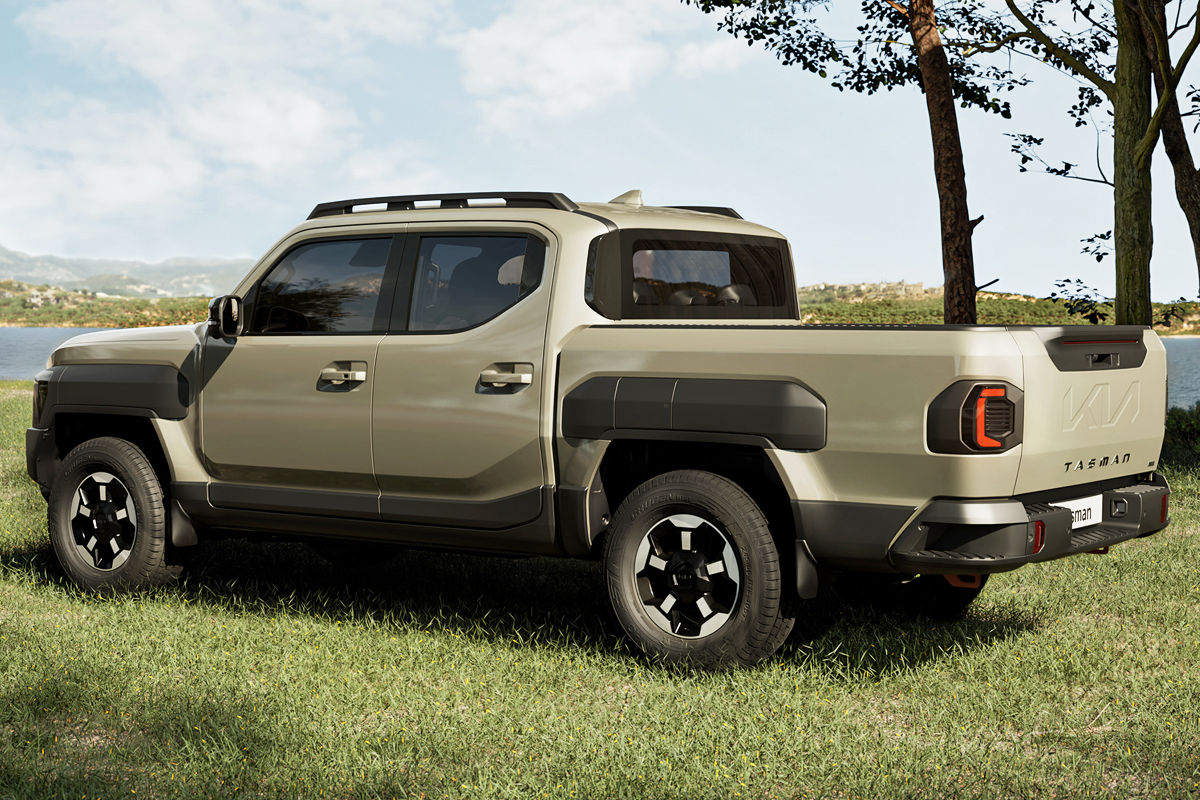
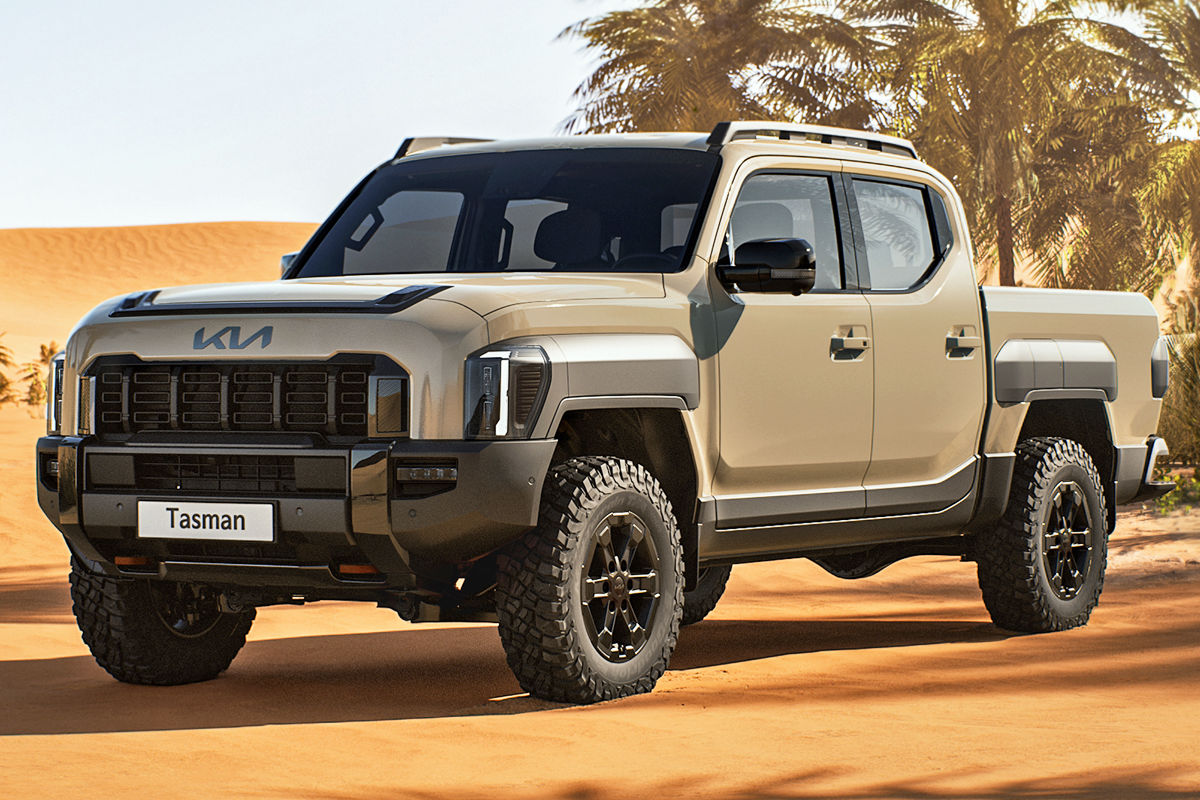
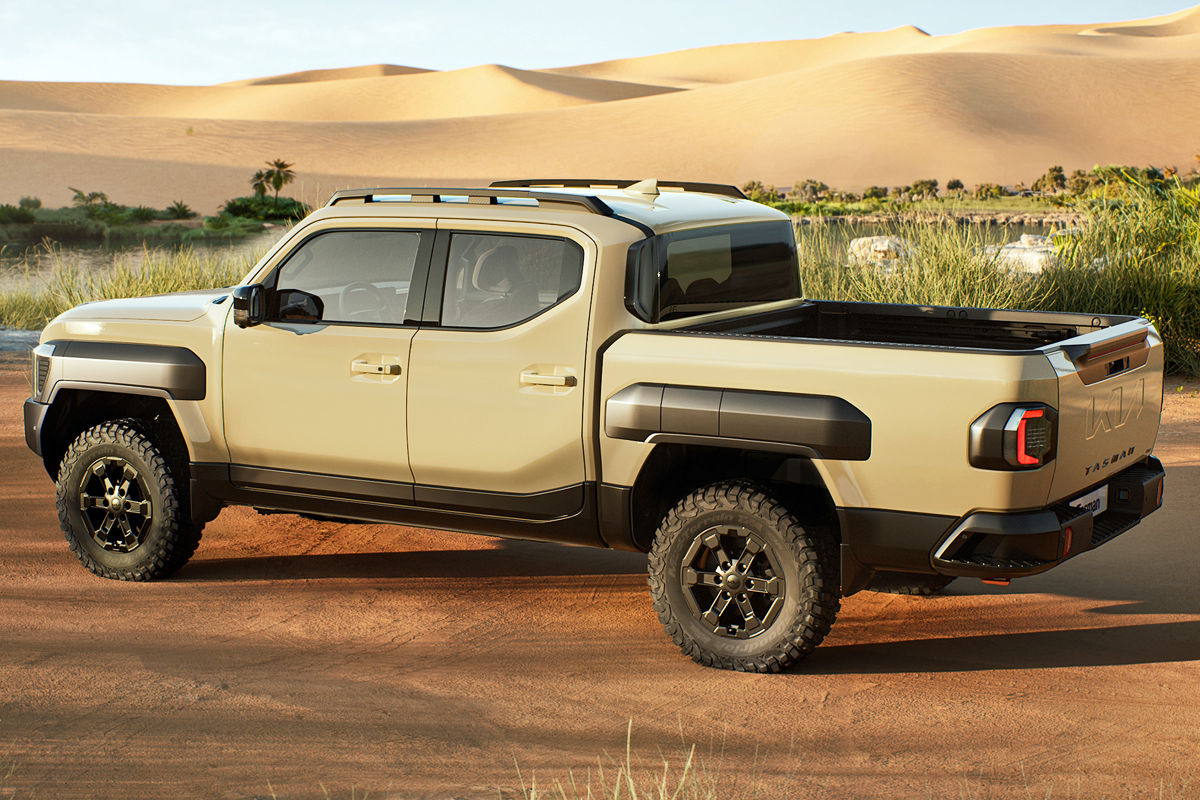
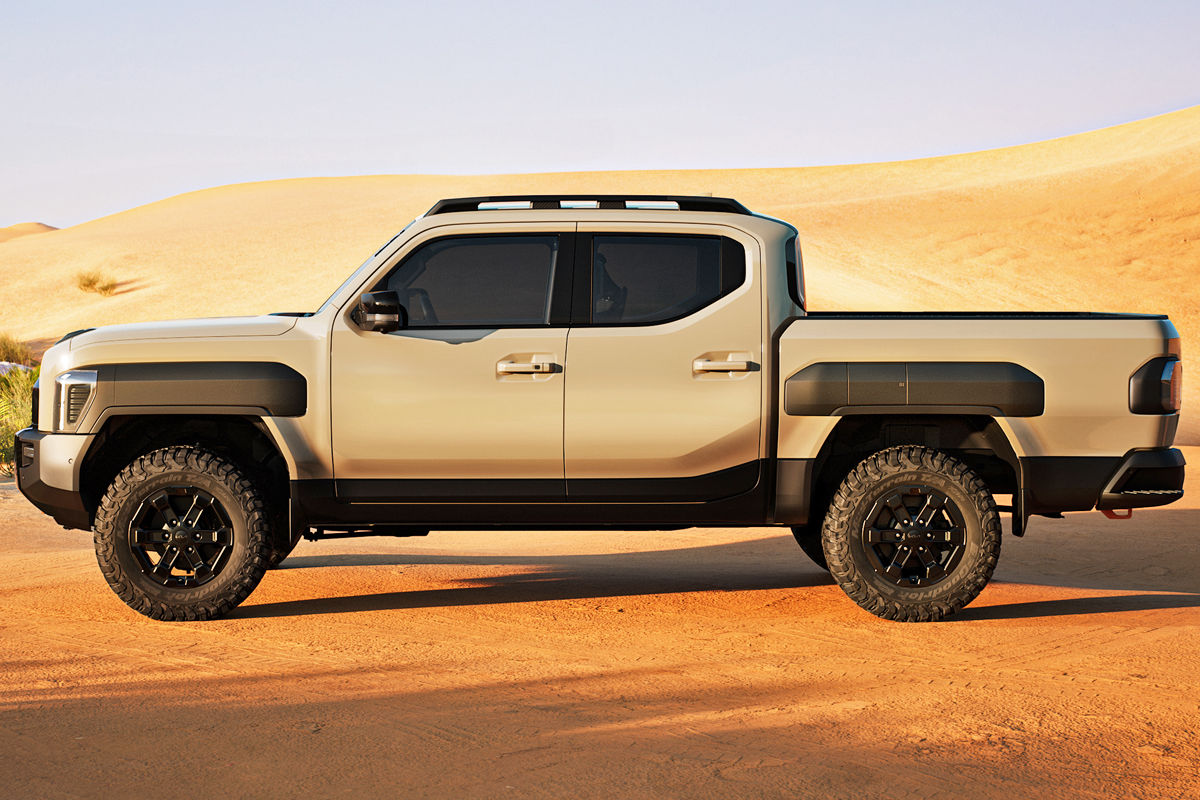
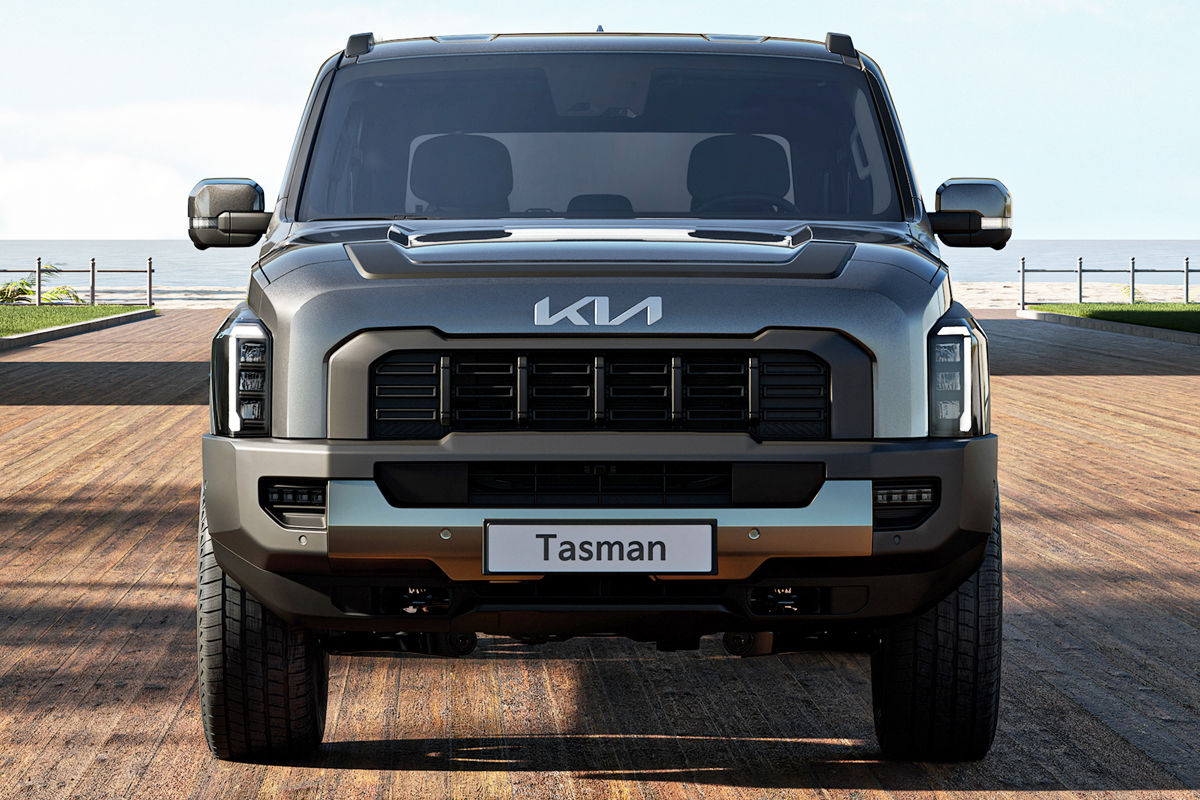
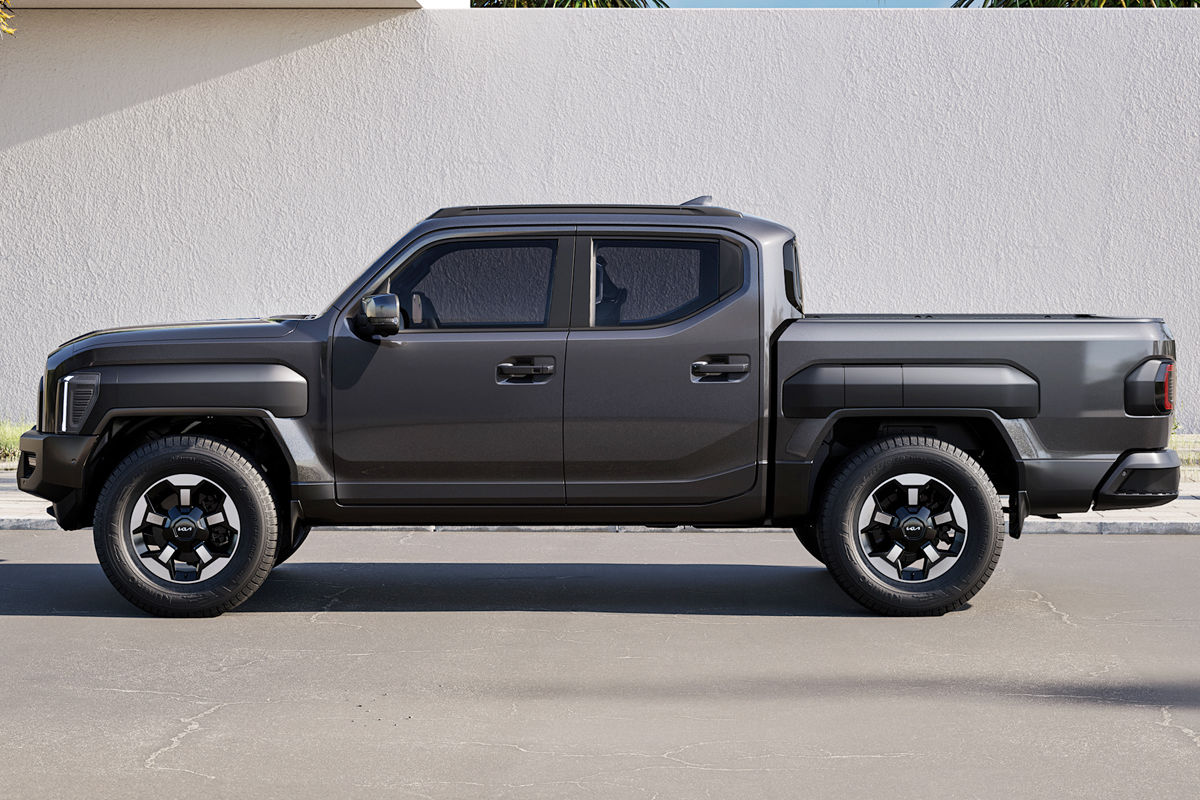
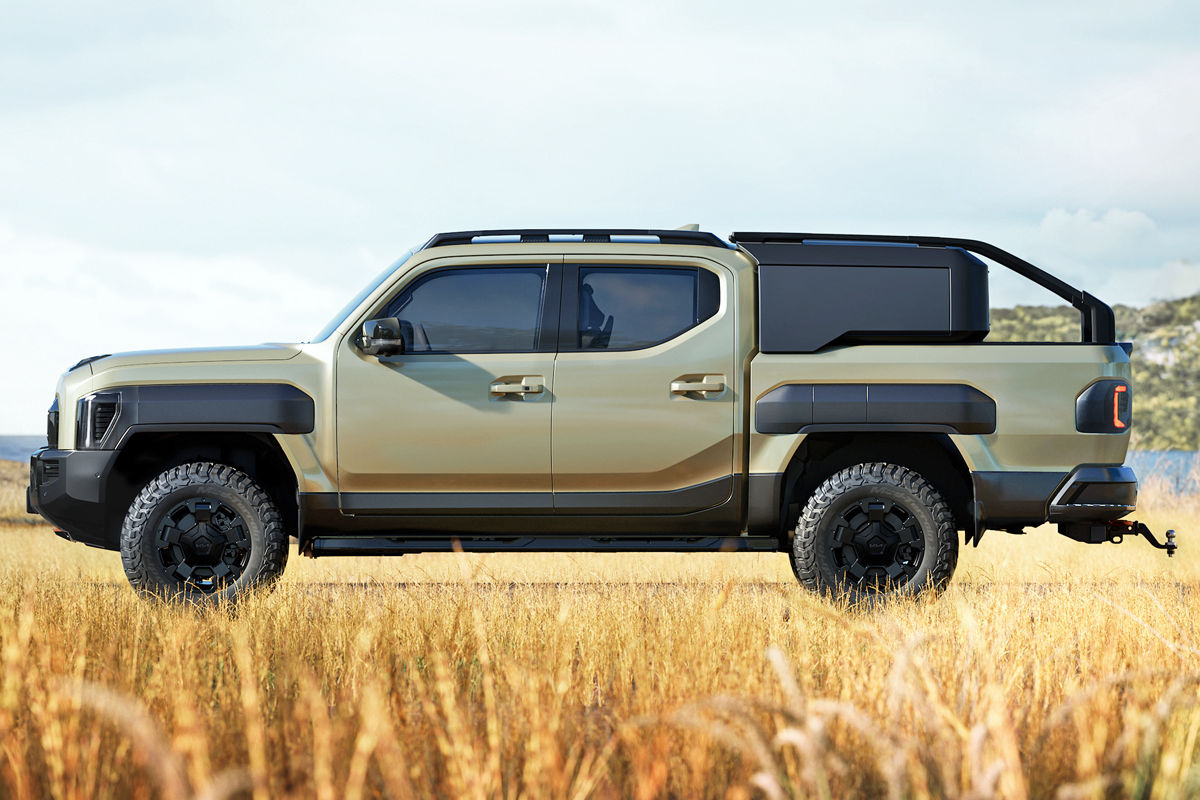
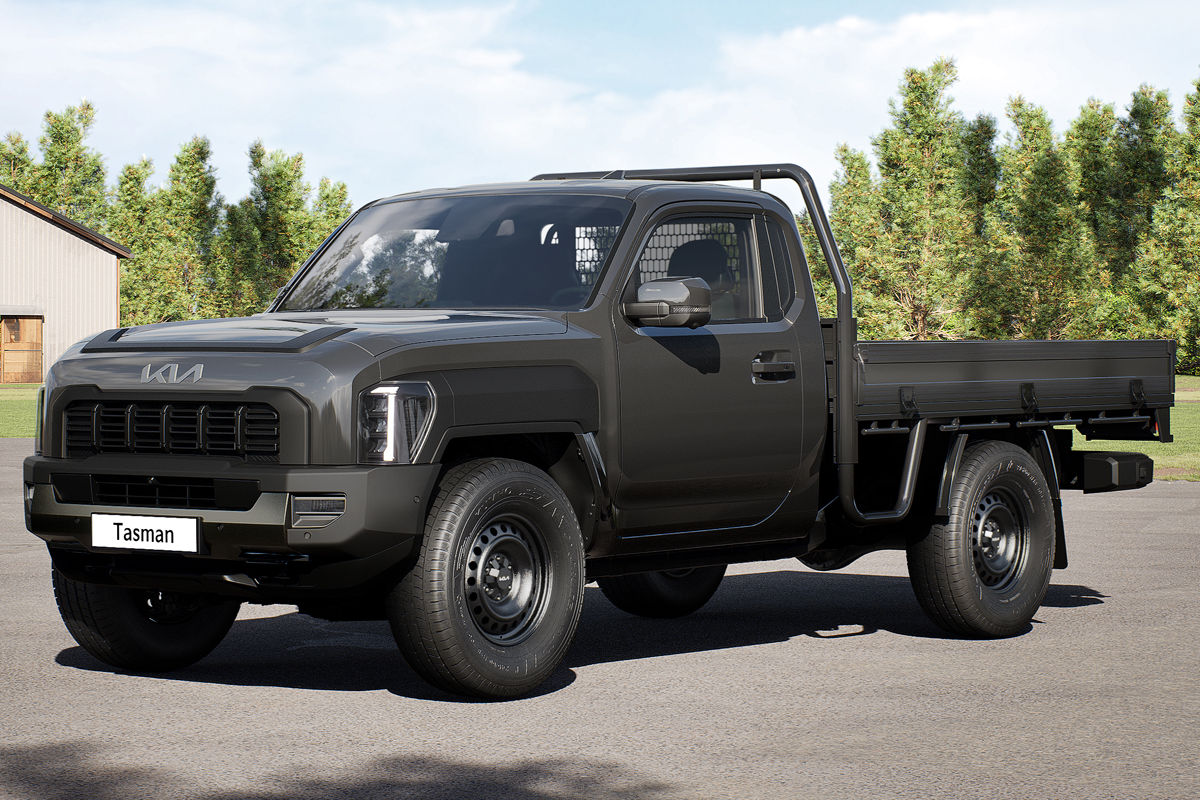
Meet the Kia Tasman – the South Korean brand’s new double-cab bakkie, which Kia South Africa aims to launch in our market during the second half of 2025.
After a lengthy teaser campaign, Kia finally unveiled its Tasman double-cab bakkie at the Jeddah Motor Show in Saudi Arabia this morning (October 29). Kia says it will introduce its bold newcomer in Africa (including Mzansi!), Australia and the Middle East, among other markets, next year.
“Kia’s first-ever pickup truck was created from the ground up to transform the market and respond to the growing preference for lifestyle-oriented trucks with advanced features,” said Ho Sung Song, President and CEO at Kia.
The new bakkie will be built in South Korea and features an all-new platform with a body-on-frame setup. It’s a clean-sheet design, but the grille and headlamps are interpretations of classic Kia design elements.
The Tasman will be produced in single and double-cab guises (including a specific off-road version), and for the commercial market, there will be chassis-cab variants as well.
I managed to make my way through the crowds for an up-close inspection of the newcomer. The design is very bold and quite unlike any other bakkie I’ve seen – it incorporates some interesting design details!
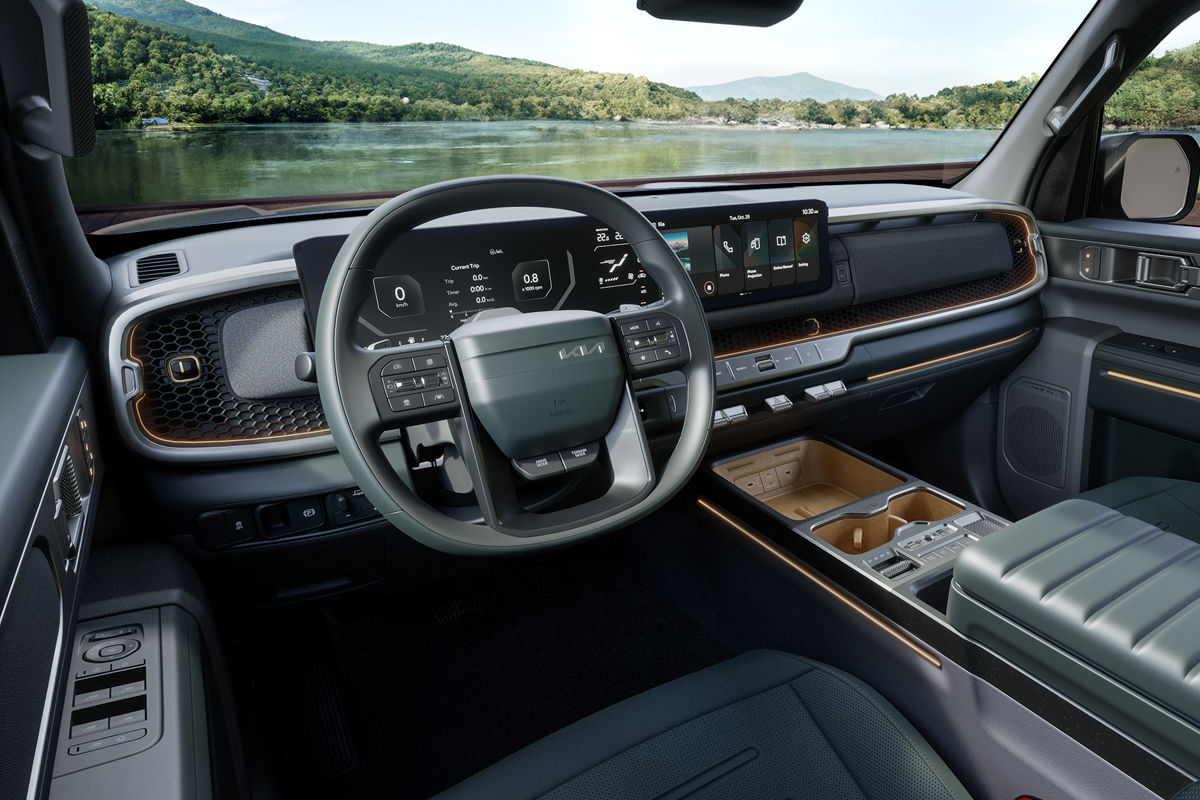
As for the interior, it looks excellent – the fascia is dominated by a panoramic wide display that includes a 12.3-inch digital instrument cluster, a 5-inch climate control console and a 12.3-inch infotainment touchscreen. Other notable interior features include a large folding console table, dual wireless charging pads and hidden storage bins concealed beneath the rear seats that offer a storage capacity of 33 litres.
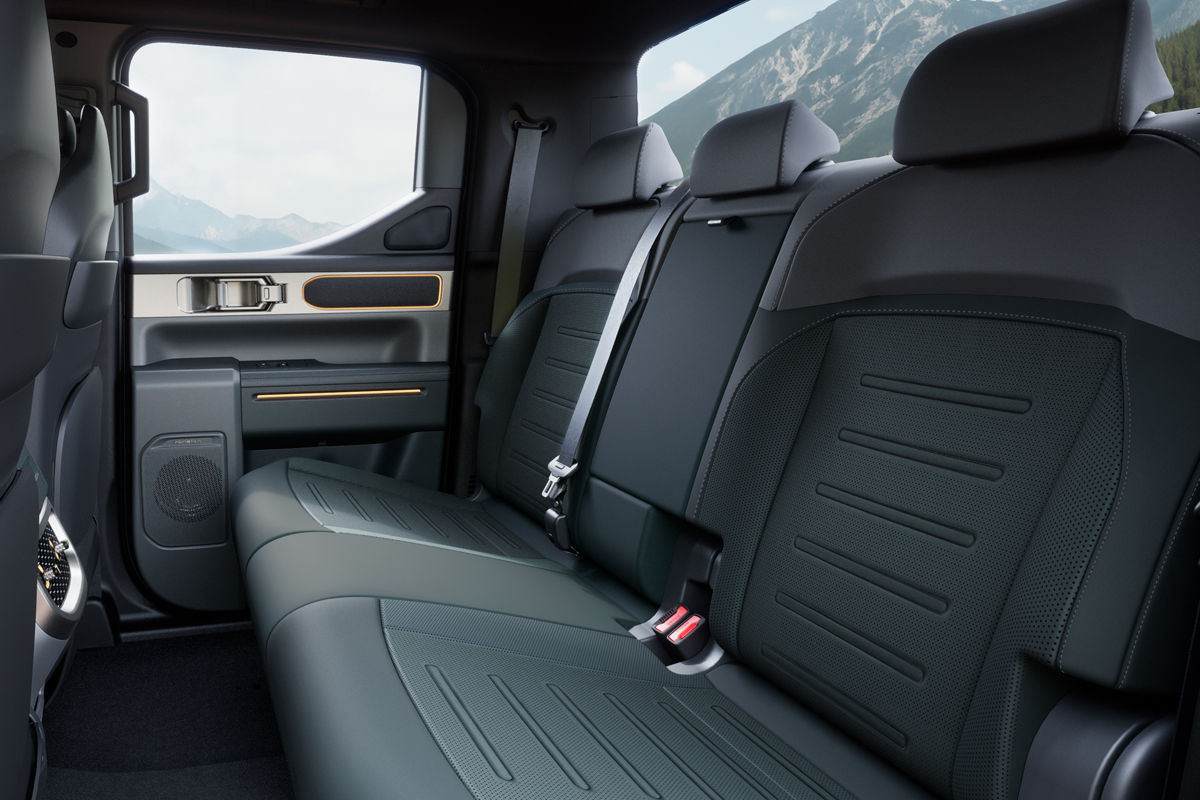
Moreover, it’s quite a spacious bakkie, especially at the back. The Kia Tasman is said to offer “best-in-segment headroom, shoulder room and 2nd-row legroom of 940 mm”, with the rear seatbacks able to recline between 22- and 30 degrees, the manufacturer says.
Engines and Transmission
The Kia Tasman will be powered by a 205 kW/421 Nm 2.5-litre turbopetrol engine, which is said to propel the bakkie from 0-100 kph in 8.5 sec, or a 154 KW/441 Nm 2.2-litre turbodiesel (it differs from market to market), and customers will be able to choose between an 8-speed automatic or a 6-speed manual ‘box.
Both the X-Line and X-Pro variants will be equipped with all-wheel-drive as standard, but the base version will be 2WD. Kia says the AWD system can switch automatically to the configuration required to provide optimum traction on different road surfaces and it offers 3 drive modes – ECO, Smart and Sport – with various terrain modes available within these settings depending on the relevant market.
Of course, being a bakkie means it has to be able to take on the toughest of terrain. Kia says the Tasman has 800 mm of wading depth and ground clearance of 224 mm (up to 252 mm for the X-Pro offroad trim). Higher-spec derivatives will have an automatically engaging rear electronic locking differential.
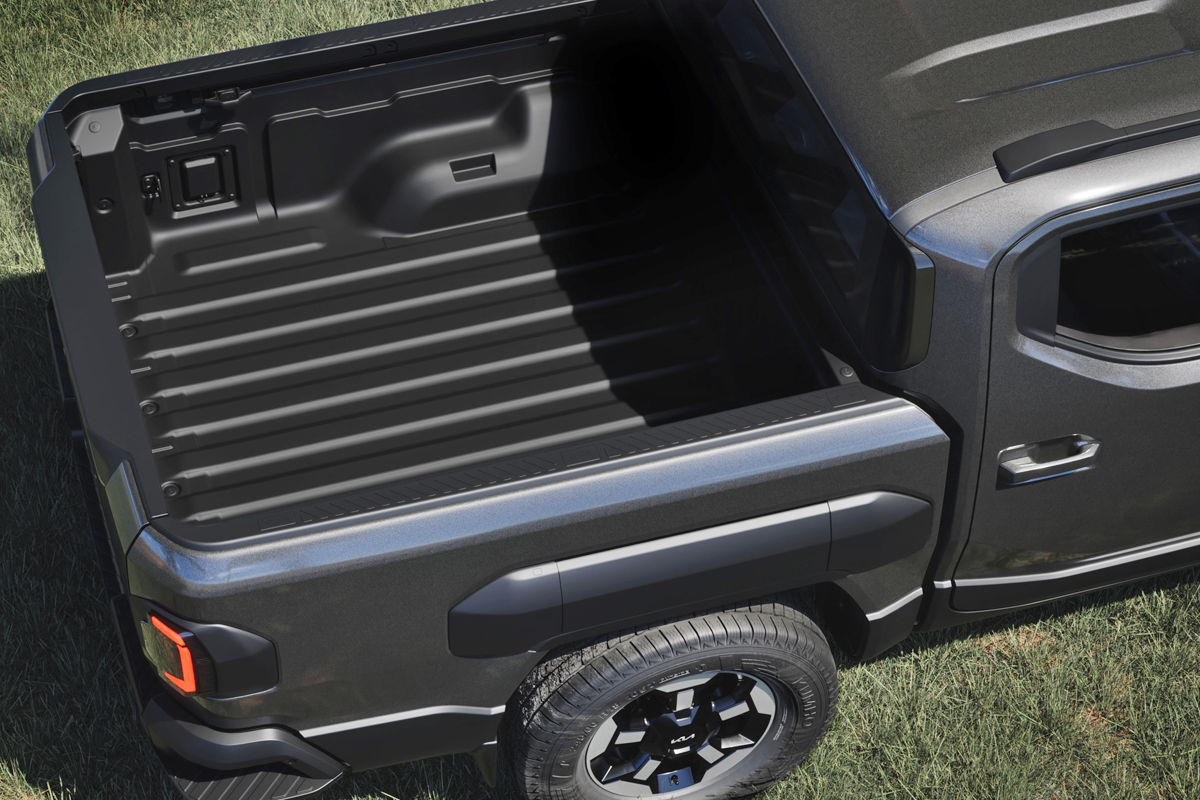
The Kia Tasman’s load bay is 1 512 mm long, 1 572 mm wide (1 186 mm between the wheel housings), and 540 mm deep, which according to Kia, provides best-in-class cargo capability of 1 173 liters.
When will Kia Tasman come to South Africa?
“The all-new Kia Tasman presents an exciting new opportunity for Kia globally, and indeed in South Africa,” says Paul Turnbull, the CEO of Kia South Africa.
“We are hard at work to make the Tasman’s local introduction a reality, and based on current planning, we aim to do this in the second half of 2025.”
The difference between Comprehensive & 3rd-Party Car Insurance
Don’t focus exclusively on affordability when choosing between a comprehensive- and 3rd-party car insurance policy. Budget Insurance offers this guide to help you consider the level of financial risk you are willing to be exposed to as a vehicle owner.
Don’t make this decision without understanding the differences between the 2 types of insurance. This article – brought to you by Budget Insurance – will assist you in making the right choice for your needs.
What is covered under Comprehensive Car Insurance?
Comprehensive car insurance offers the most extensive coverage – and peace of mind, because you’ll know you’re protected against the widest range of risks and the financial stress that comes with them.
With comprehensive car insurance, accident damage to your vehicle is covered, regardless of who is at fault. Whether you’re involved in a minor fender bender or a more serious collision, you’ll be covered for repairs or even a vehicle replacement if necessary. Additionally, when you’re at fault in the accident, damage to someone else’s vehicle or property is covered.
Your car insurance coverage extends to fire damage, whether it was the result of an electrical fault in your car or an external fire. And while you’d never want your car damaged by flooding, hailstorms, or falling trees, you are covered if it does happen.
Depending on the insurer, comprehensive car insurance usually includes additional benefits that enhance the cover or offer some convenience. These might include:
Roadside assistance: If you’re ever stranded by a flat battery or tyre, or even an empty fuel tank, your insurer will arrange for assistance.
Towing and storage: If your car can’t be driven following an accident, your insurer may arrange to have it towed and stored until repairs are approved.
Medical assistance: Some insurers also offer access to emergency medical assistance for injuries caused by an accident.
As with any insurance policy, you should take the time to carefully review the Terms and Conditions so that you fully understand the scope and limits of the cover.
What’s covered under 3rd-Party Insurance?
Third-party car insurance offers basic cover. It is mostly intended to ensure that the financial burden doesn’t fall solely on the other party involved if you’re responsible for an accident.
This means 3rd-party car insurance covers the cost of damage/injury to another person or their property if you are at fault in an accident, but you would still be responsible for the cost of damage to your vehicle.
Here’s an example: Susan is driving down a busy street and collides with another vehicle. In the process, she loses control of her car and crashes through a glass storefront. The other vehicle is significantly damaged, as is Susan’s car and the business she also crashed into.
Susan only has 3rd-party Insurance, so her insurer will cover the cost of repairs to the other vehicle and the business.
If anyone other than Susan was injured during the incident, her insurance would also cover their medical expenses. In this scenario, Susan would still need to pay for repairs to her car. However, without 3rd-party car insurance, the financial burden on Susan would have been much worse.
You could also consider 3rd-party car insurance that includes cover for fire and theft as an insurance option. While this still leaves you responsible for the cost of accidental damage to your vehicle, it does offer protection against your vehicle being damaged by fire or if it is stolen.
Unlike comprehensive car insurance, it doesn’t cover the cost of damage to your car following an attempted theft. And if your windscreen is damaged by hail and needs to be replaced, you will need to pay for that (unless you included windscreen cover as an add-on to your policy.
Third-party car insurance is a budget-friendly option, but you must understand the limits of the cover and the risks you will be exposed to.
What is better – Comprehensive or 3rd-Party insurance?
There is no one-size-fits-all answer when asking which of the 2 types of insurance is better. By offering different levels of cover, each serves a different purpose. Which one is better for you depends on your circumstances and your risk tolerance.
You have a low tolerance to risk:Comprehensive car insurance is the better option when you value peace of mind and don’t want to worry about unexpected expenses.
You want extra benefits: If you travel frequently, it helps to have roadside- and medical assistance available, plus the cost of towing and storage being covered following an accident or breakdown.
When 3rd-Party Car Insurance might be appropriate
Your car is old, with a lower value: If the car you need to insure is old and has a lower market value, 3rd-party car insurance would offer essential cover at an affordable price.
Your tolerance of risk is high: If you’re comfortable assuming the risk of covering potential damages to your car, 3rd-party car insurance would offer lower premiums while still shielding you from the cost of damages to someone else’s property.
Your budget is constrained: There are times when your budget could be a little tight, and you need to adjust. Having no insurance is never ideal, and 3rd-party car insurance could suit your budget while never leaving you without any cover.
Top factors to consider when choosing a policy
You’ve carefully evaluated your needs and now know what type of car insurance you need. But there are a few other factors to consider before finalising your insurance:
Coverage: Regardless of whether you’ve settled on comprehensive- or 3rd-party car insurance, you should still carefully assess what is covered by the policy and what is excluded. Consider the impact on liability, collision, personal injury, and uninsured/underinsured motorists.
Premiums: Insurance premiums don’t only vary between policy types but also among providers. Look for the best value for your budget, which won’t necessarily be the cheapest. You don’t want to sacrifice the benefits you need just so you can save a few Rands.
Excess: Your excess — or deductible — is what you need to pay out of pocket when making a claim. Lower premiums usually mean a higher excess, so look for an excess you can comfortably afford.
Reputation: Look at reviews and ask colleagues for recommendations. You want an insurer that has a reputation for great customer service, reliability, and efficient claims processing.
GWM South Africa has confirmed the facelifted Haval H6 is set to make local landfall in the 2nd quarter of 2025. Here’s what we know about the refreshed crossover so far…
A high-ranking GWM South Africa executive has confirmed to Cars.co.za that the facelifted Haval H6 – which was revealed in China as recently as April 2024 – is scheduled to launch in Mzansi in the 2nd quarter of 2025.
Desmond Els, Sales Director at GWM South Africa, told us during a wide-ranging interview at Naamsa’s recent South African Auto Week 2024 in Cape Town that the refreshed version of the strong-selling crossover has been locked in for SA.
This is the updated H6 currently marketed in China.
“H6, as it stands today, is going to get a facelift. H6 has been the segment leader for, call it, the last 18 months. So, there are definitely plans on H6 within the 1st half – call it 2nd quarter – of next year [2025],” Els confirmed to us.
While GWM South Africa has yet to reveal exactly what the H6’s mid-cycle update will entail for the local market, initial details have already been released in Australia, a country against which the Chinese firm’s local division benchmarks itself.
The outgoing H6 on the left and the facelifted version on the right.
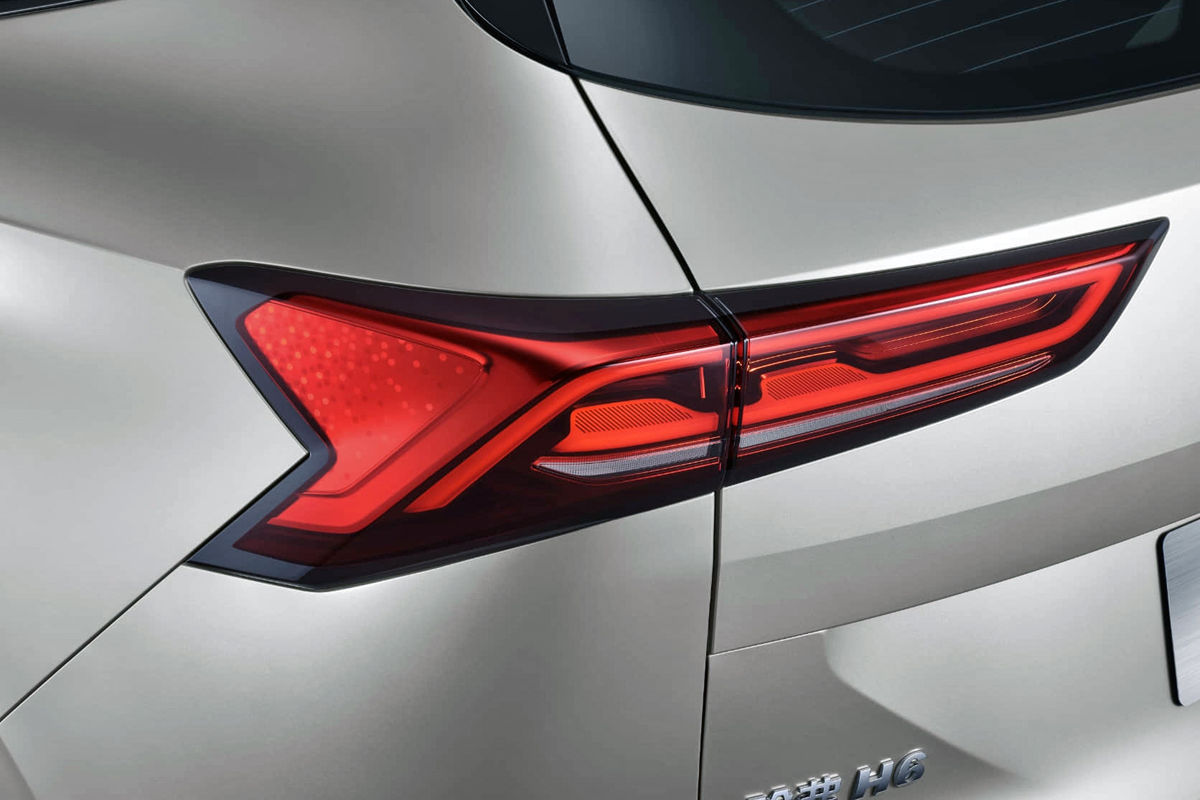
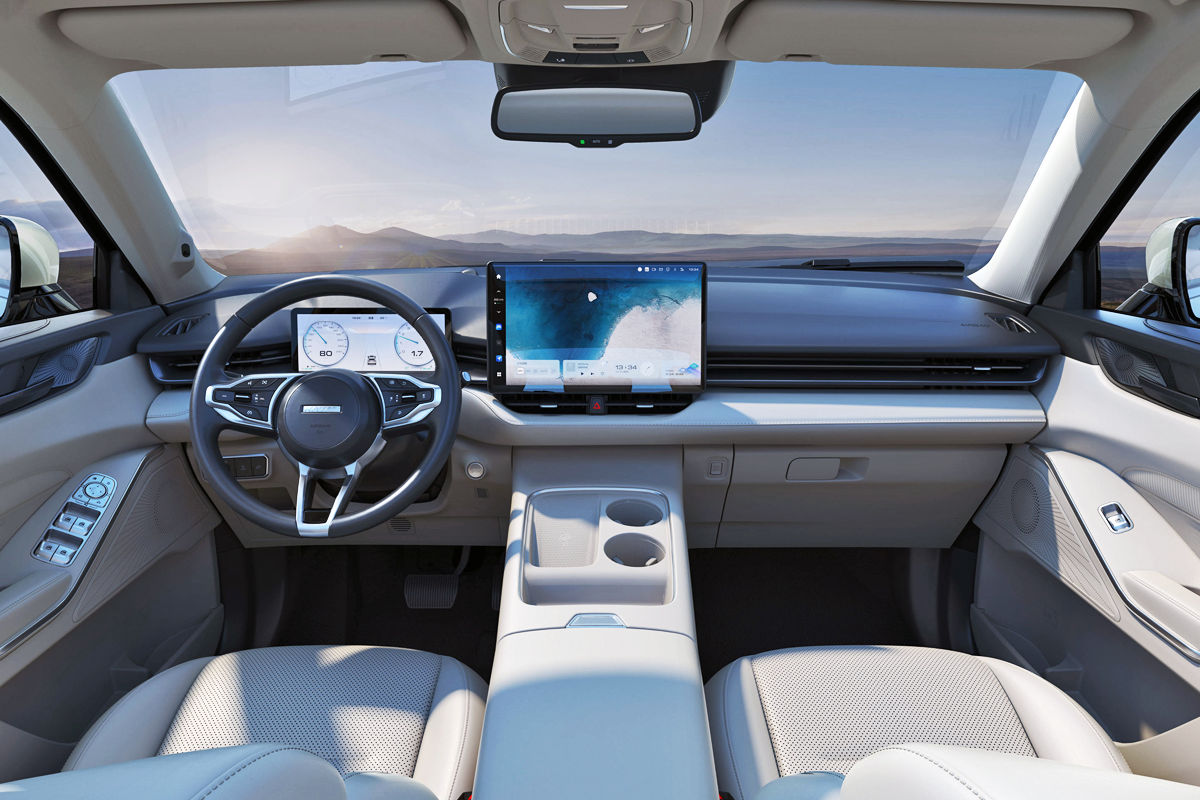
According to GWM’s Australian arm, the facelifted H6 will feature “a refreshed exterior design”, including styling revisions for the grille and taillamps, plus “significant interior updates”, from a new centre-console and a revised steering-wheel design to a “larger” central infotainment touchscreen running the brand’s latest operating system.
Though powertrain details have yet to be released, we’ve since determined that the mainstream derivatives will move to an upgraded turbocharged 2.0-litre, 4-cylinder petrol motor (offering more grunt than the current 150 kW/320 Nm version).
The styling revisions are most obvious up front.
Meanwhile, the flagship H6 hybrid electric vehicle (HEV) powertrain looks set to carry over unchanged, again combining a turbocharged 1.5-litre, 4-cylinder petrol mill with hybrid gubbins (and a continuously variable transmission), resulting in total system outputs of 179 kW and 530 Nm.
As a reminder, the H6 launched in South Africa in June 2021, with the HEV joining in September 2022. The current H6 line-up comprises 4 standard derivatives, alongside the HEV and GT. Over the opening 9 months of 2024, GWM SA reported 3 181 registrations of the H6.
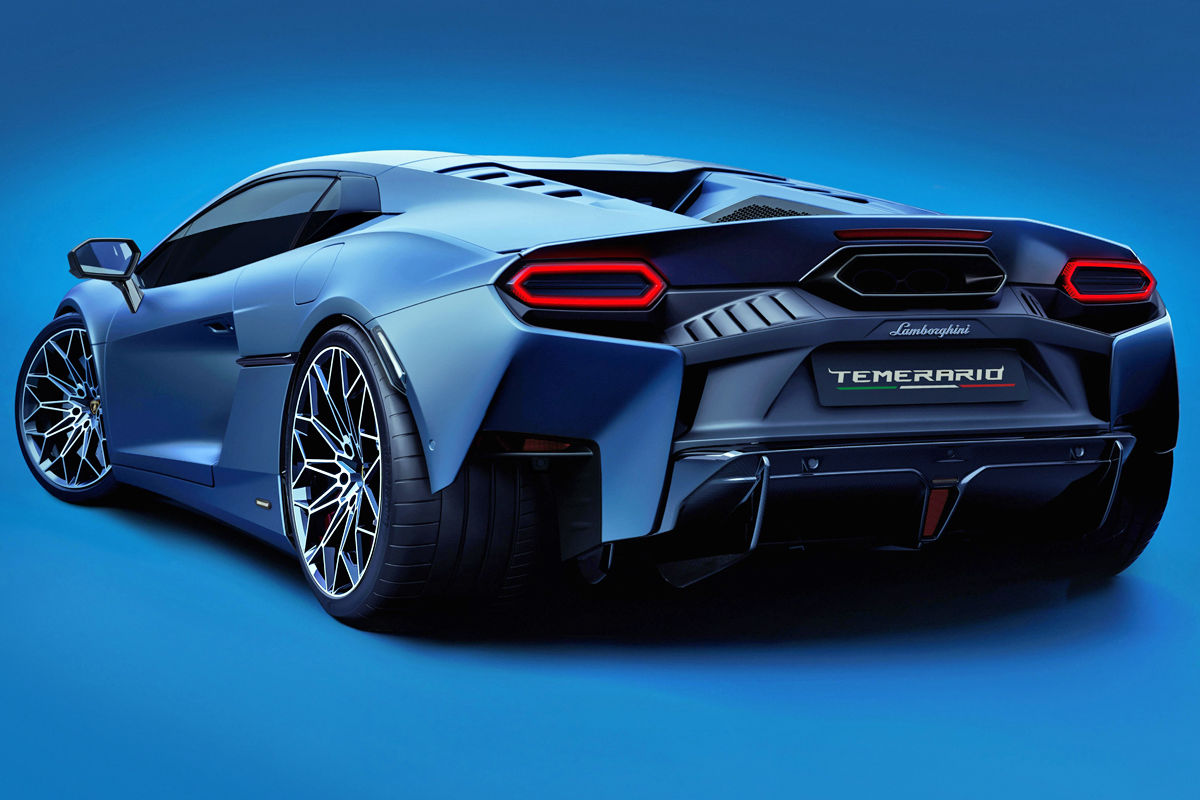
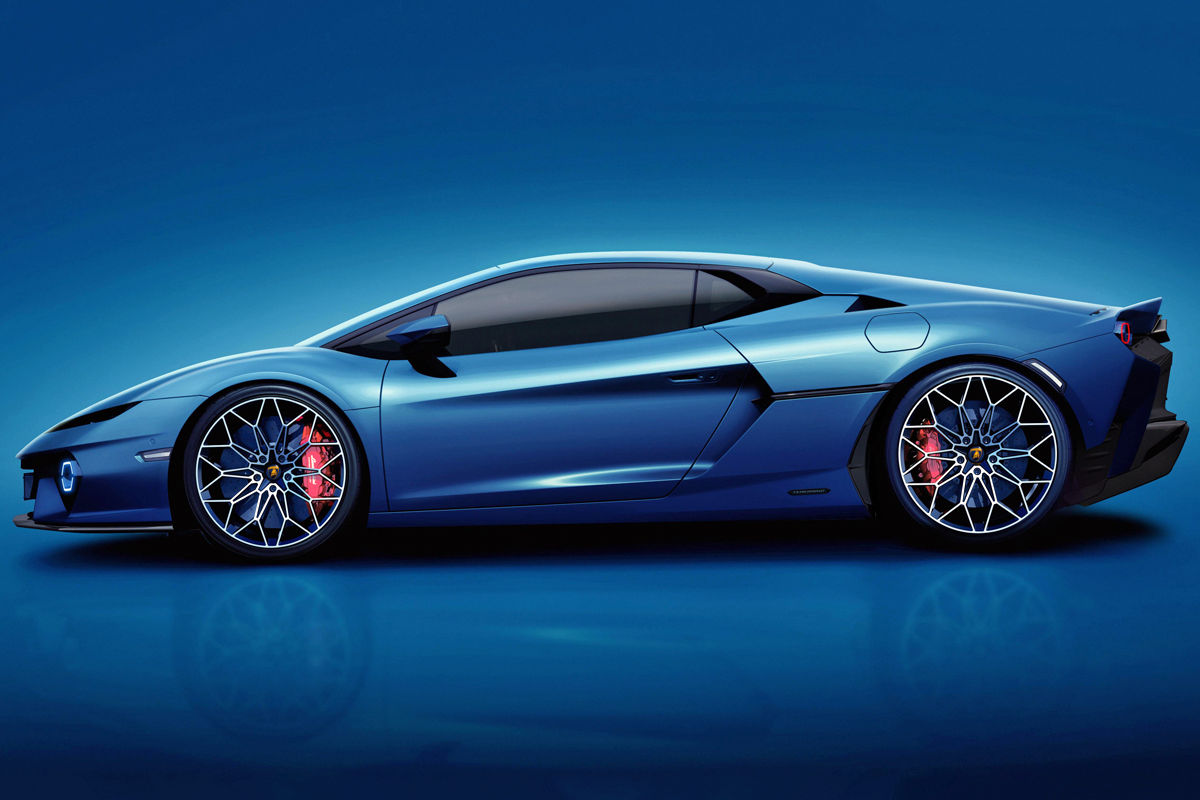
Though the new Lamborghini Temerario is expected to arrive in South Africa only in early 2026, local pricing for the Huracán replacement has been confirmed…
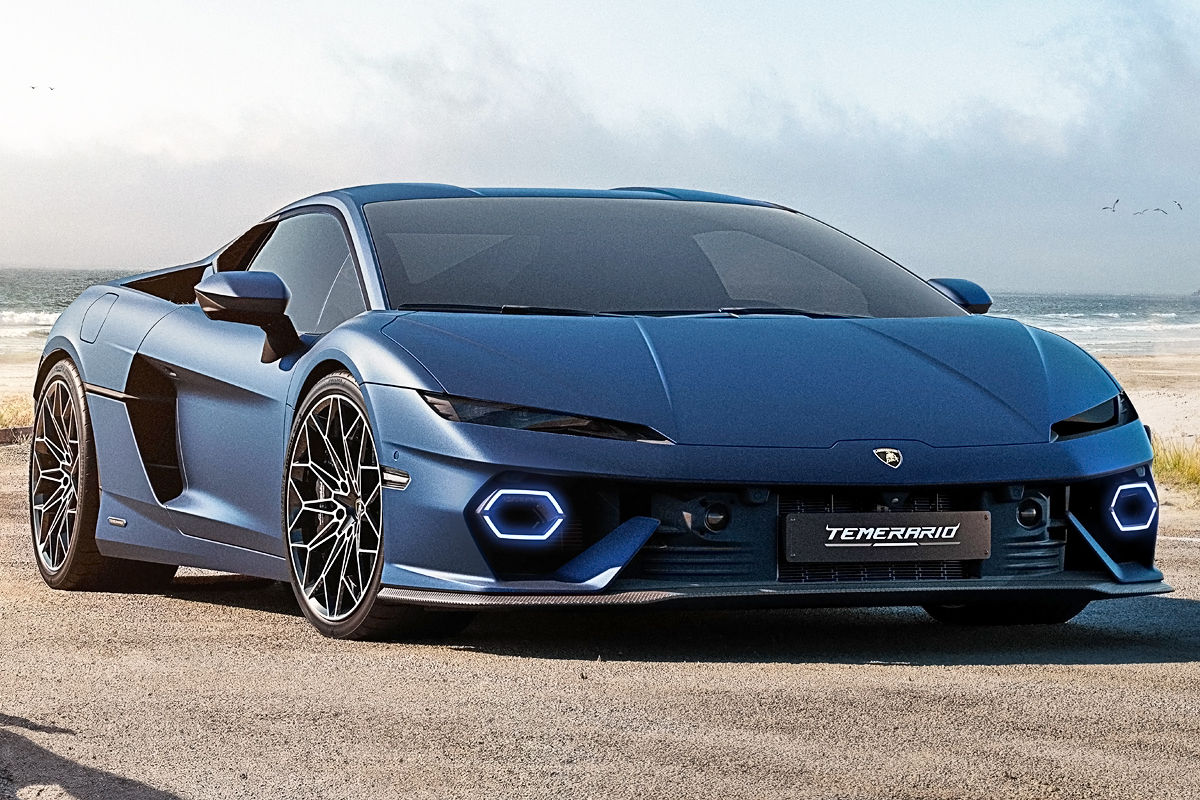
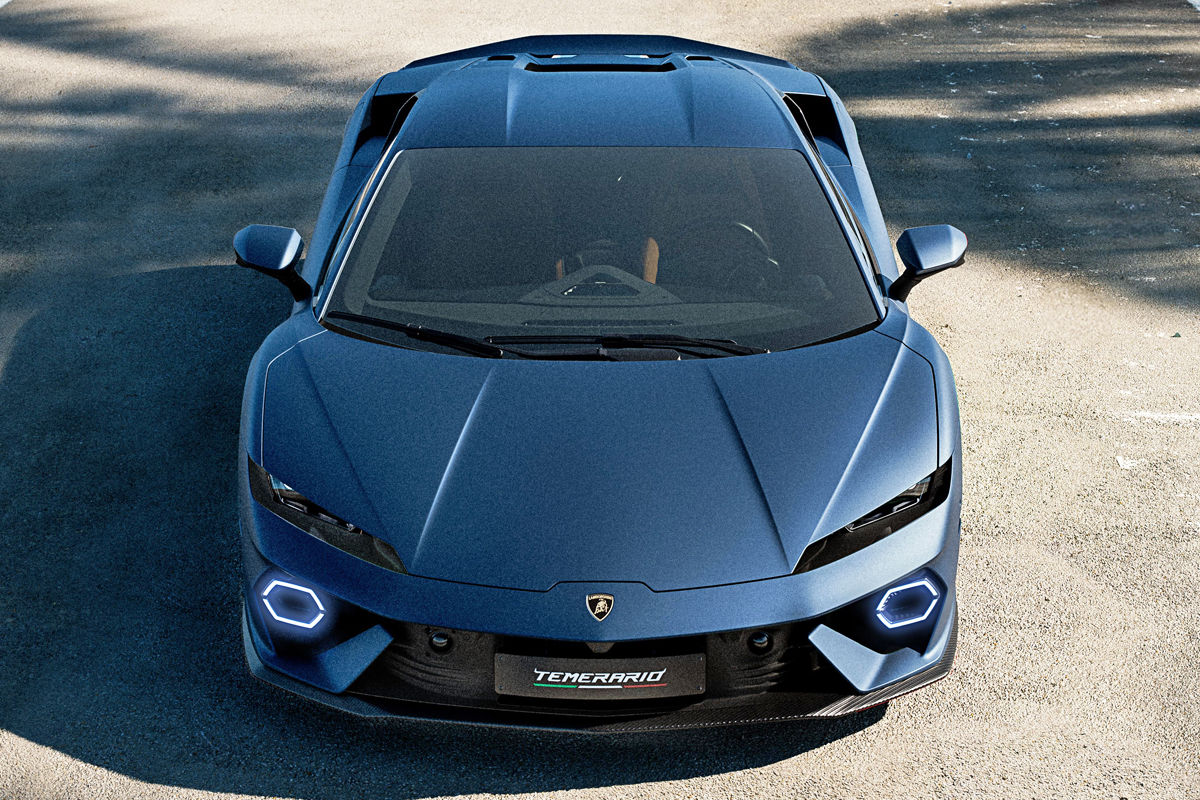
The new Lamborghini Temerario was revealed in August 2024, launching as the successor to the Huracán. Now, quite some time ahead of the Temerario’s expected Q1 2026 arrival in South Africa, the Italian brand’s local distributor has confirmed pricing.
Yes, thanks to the ever-resourceful vehicle-information specialists over at duoporta.com, we know local order books for the new Temerario have opened, with pricing starting at R7 525 000. Should the buyer wish to upgrade from the standard 3-year/unlimited kilometre maintenance plan to a 5-year item, that figure rises to R7 725 000.
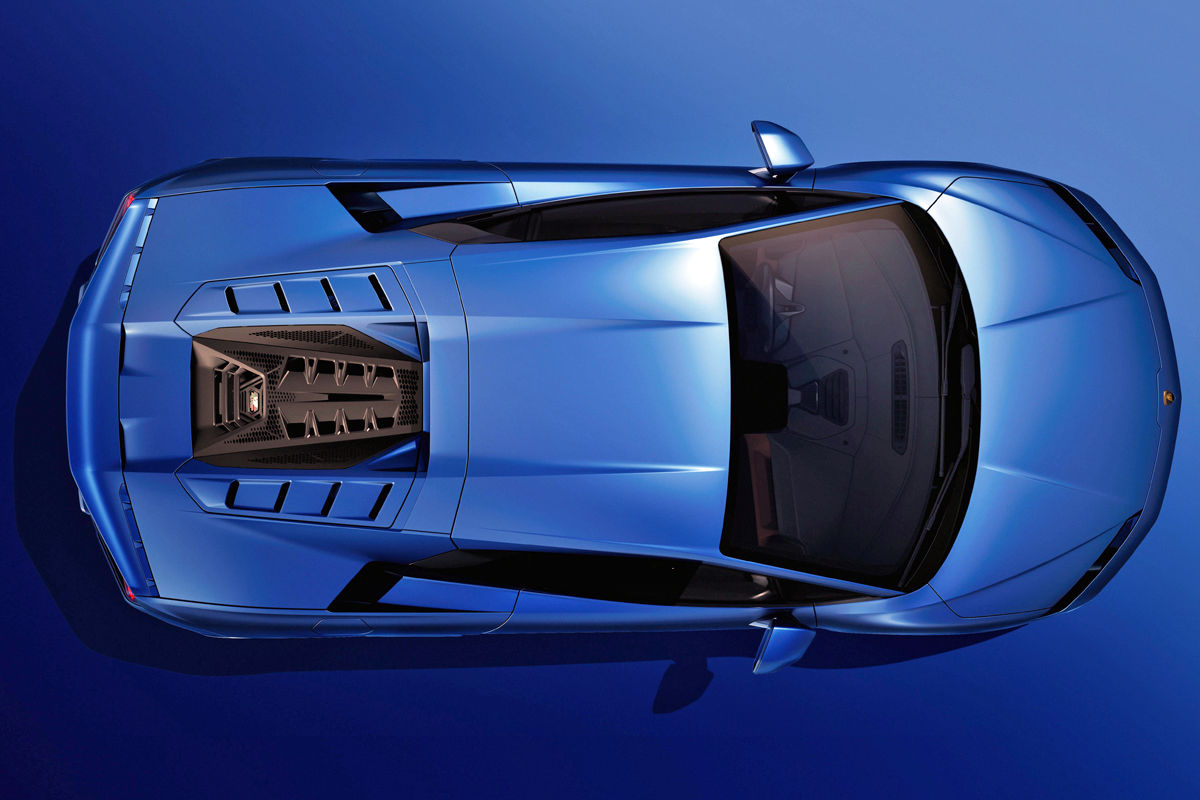
While the Huracán was revered for its naturally aspirated 5.2-litre V10 engine, the Temerario switches to a plug-in hybrid powertrain combining a new twin-turbo 4.0-litre V8 petrol mill with 3 electric motors (each offering 110 kW) and a 3.8 kWh lithium-ion battery pack. One electric motor is integrated in the V8 housing, with the other 2 sited on the front axle.
Total system power comes in at 677 kW, with the V8 engine – featuring the internal designation “L411” and spinning to a heady 10 000 rpm – alone generating 588 kW. The petrol motor’s maximum twisting force is 730 Nm, while the Sant’Agata Bolognese-based firm doesn’t list a combined system torque figure.
According to Lamborghini, the new Temerario can complete the 0-100 kph sprint in just 2.7 seconds, with top speed coming in at 340 kph. An 8-speed dual-clutch transmission is standard, installed transversally behind the V8.
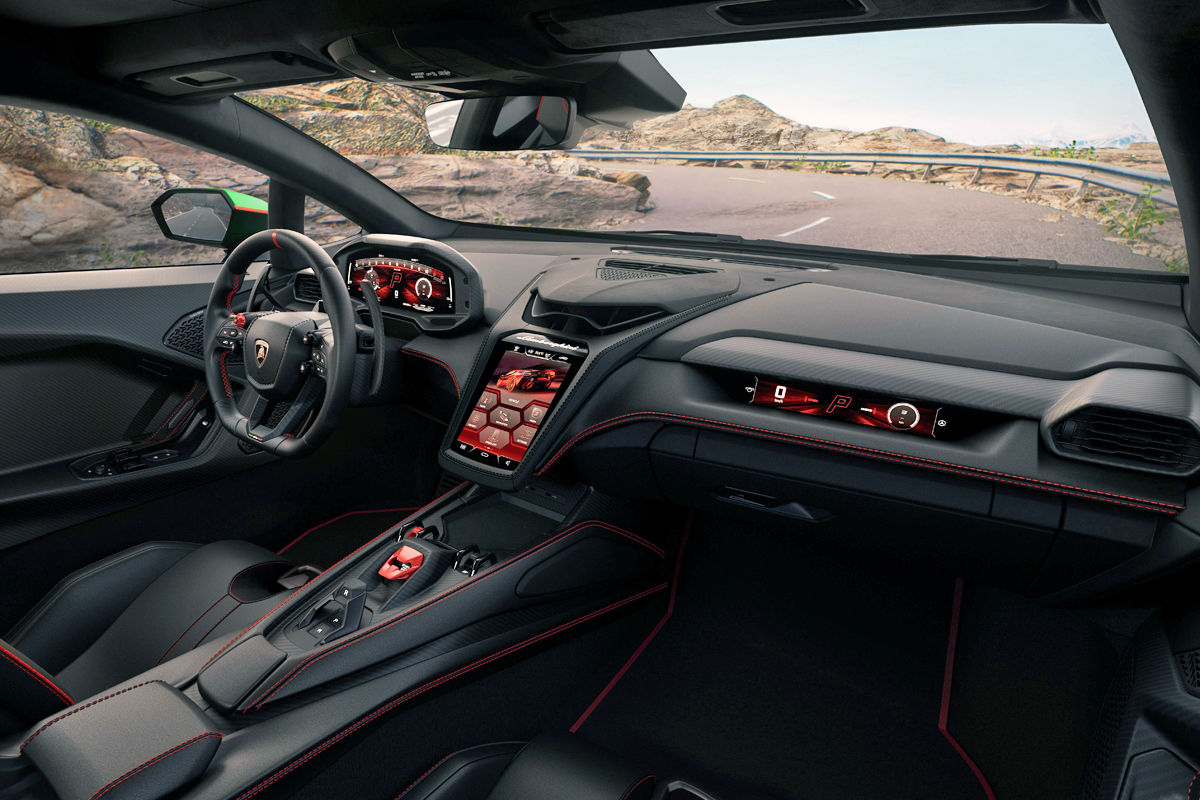
Featuring a wheelbase of 2 658 mm, the Temerario measures 4 706 mm long and has a claimed dry weight of 1 690 kg. Inside, the so-called “Human Machine Interface” system consists of a trio of displays: a 12.3-inch digital instrument panel, an 8.4-inch central screen and a 9.1-inch passenger display.
How much does the Lamborghini Temerario cost in SA?
Lamborghini Temerario – R7 525 000
This price above includes a 3-year/unlimited kilometre maintenance plan and increases to R7 725 000 should the customer specify the 5-year maintenance plan.
The new, 3rd-gen Mini Countryman offers loftier levels of sophistication in its biggest, most spacious package yet. But, has the model become too grown up and (gasp) sensible? We spent a few days with the turbopetrol-powered Countryman S.
We like: Most spacious Mini yet, well equipped for the price, fascinating design – inside and out.
We don’t like: Not the zestiest driving experience, quirky infotainment system not very user-friendly.
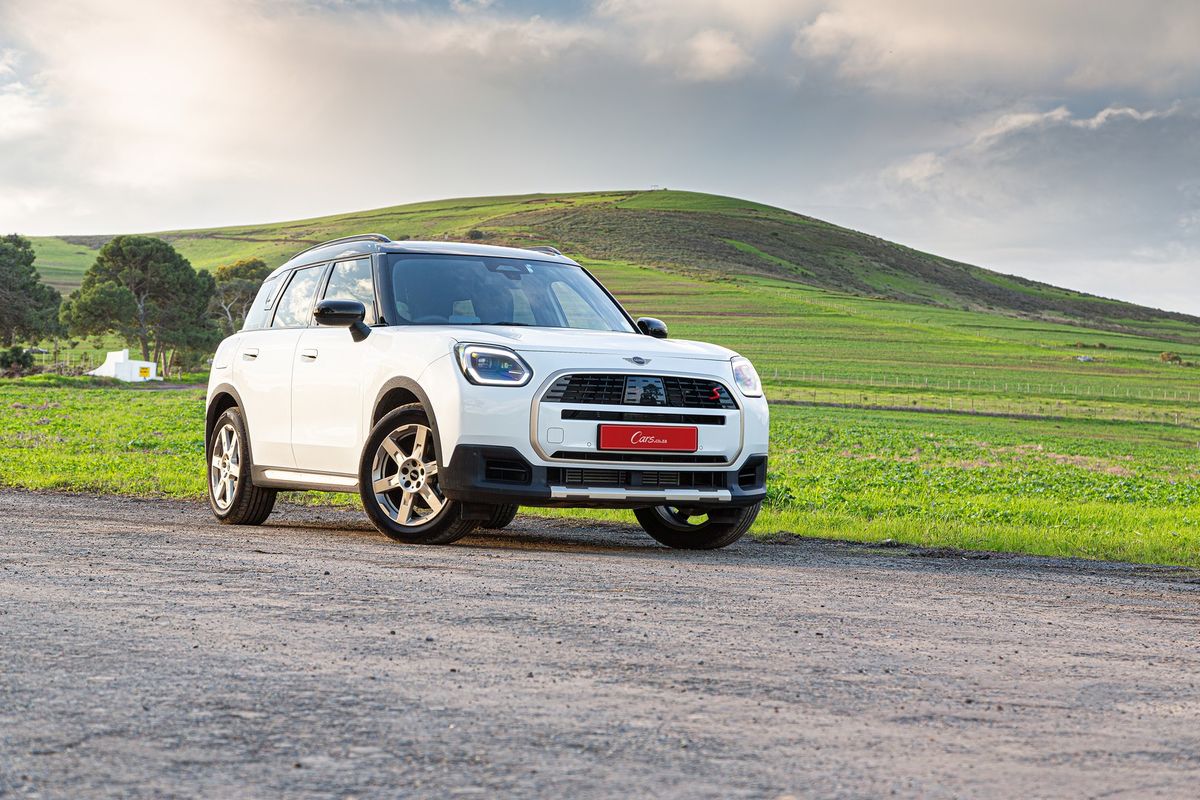
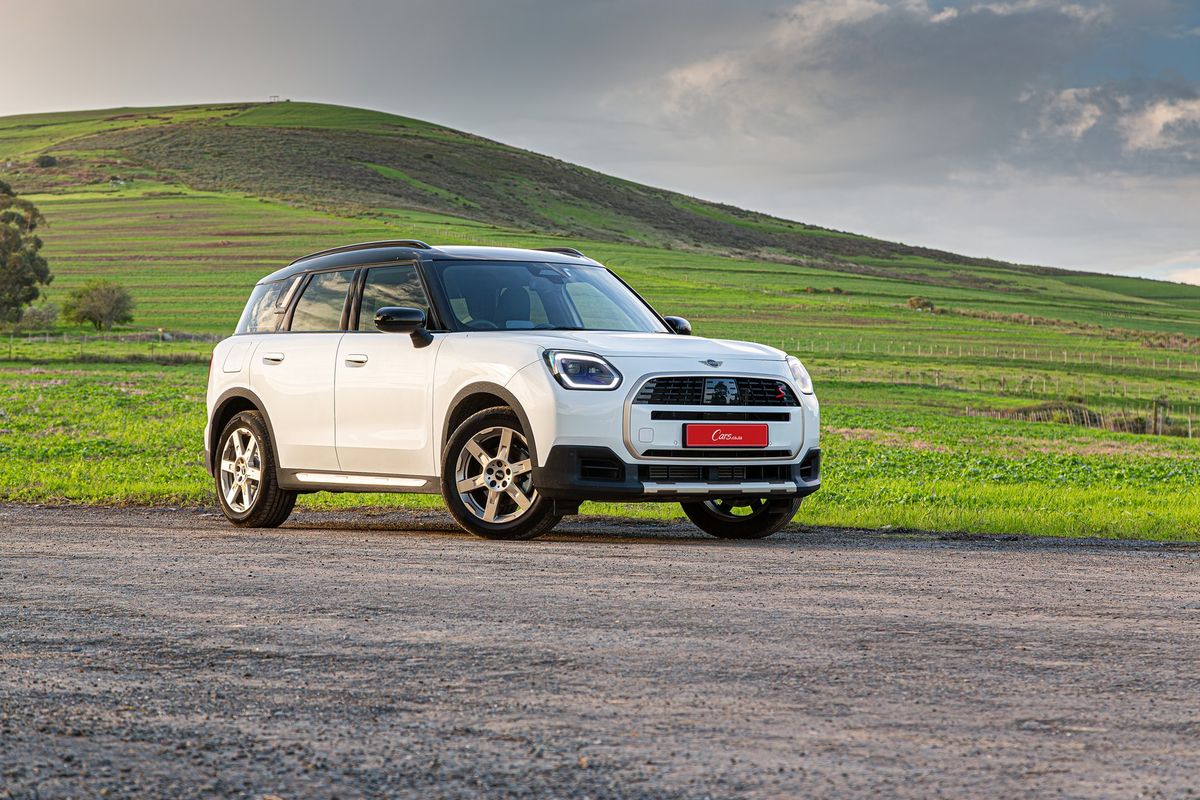
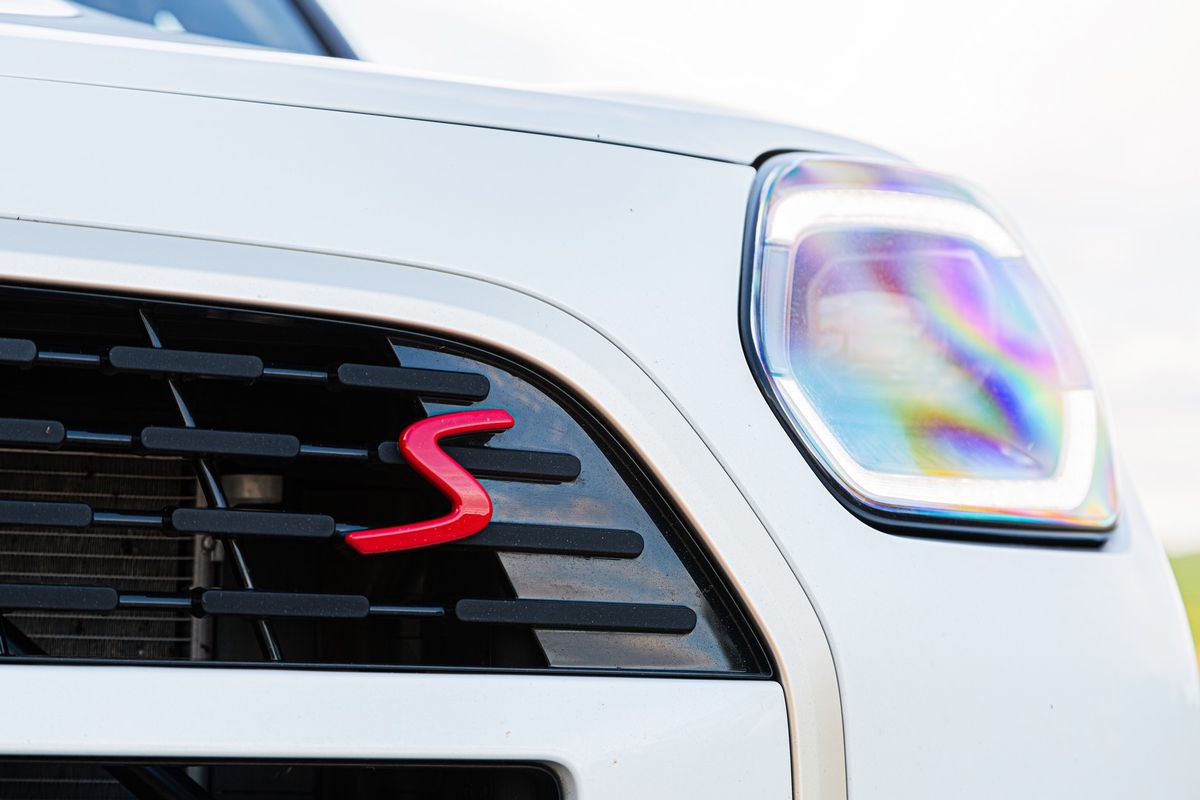
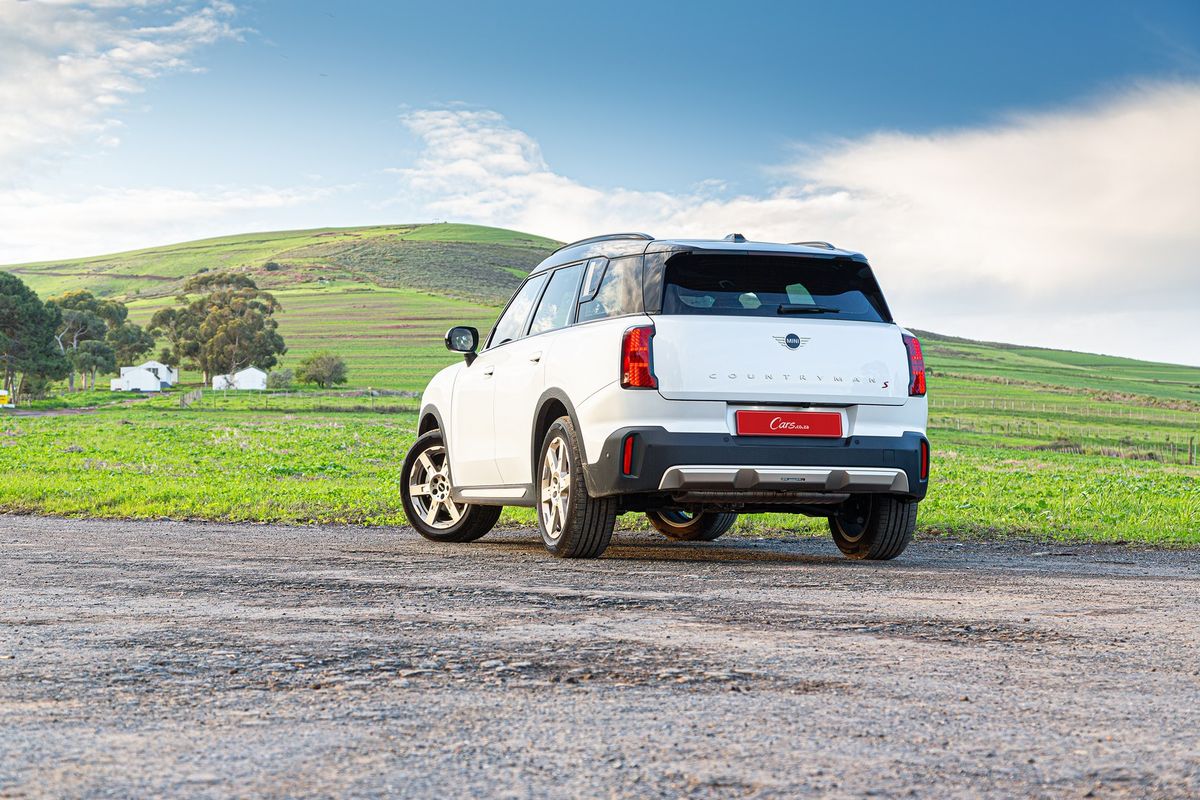
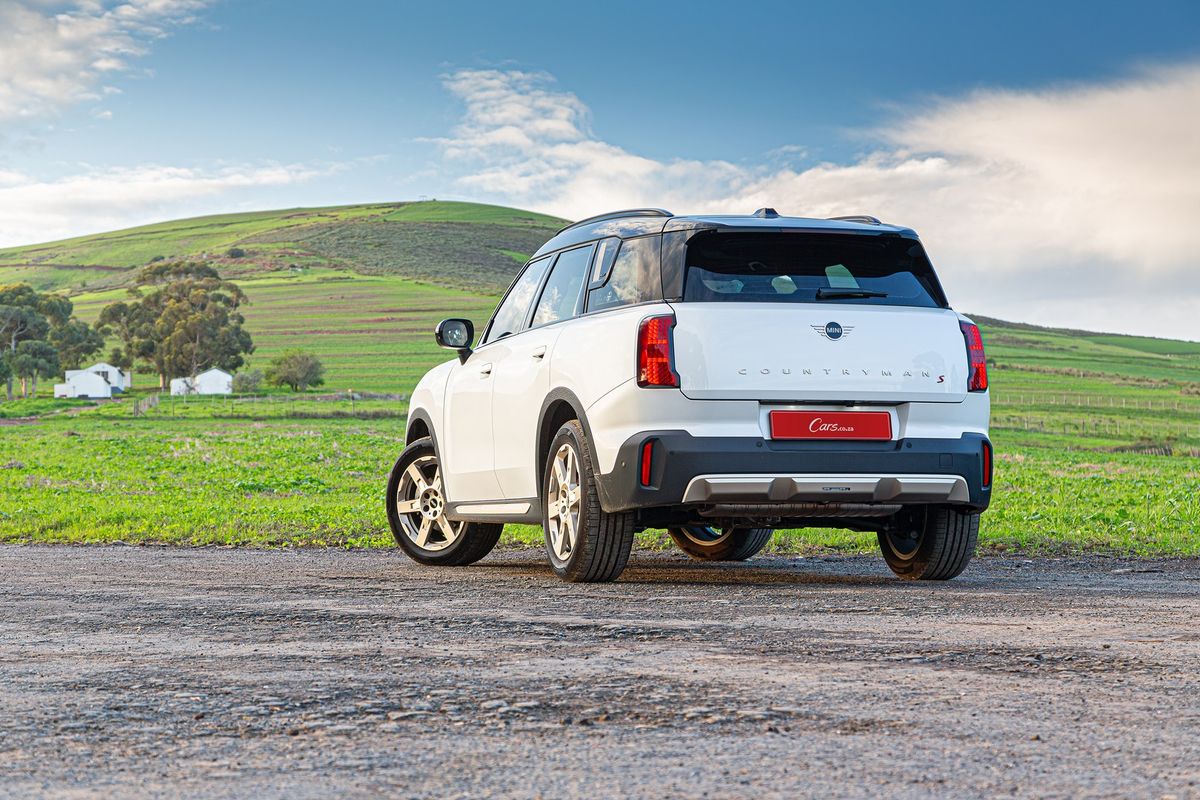
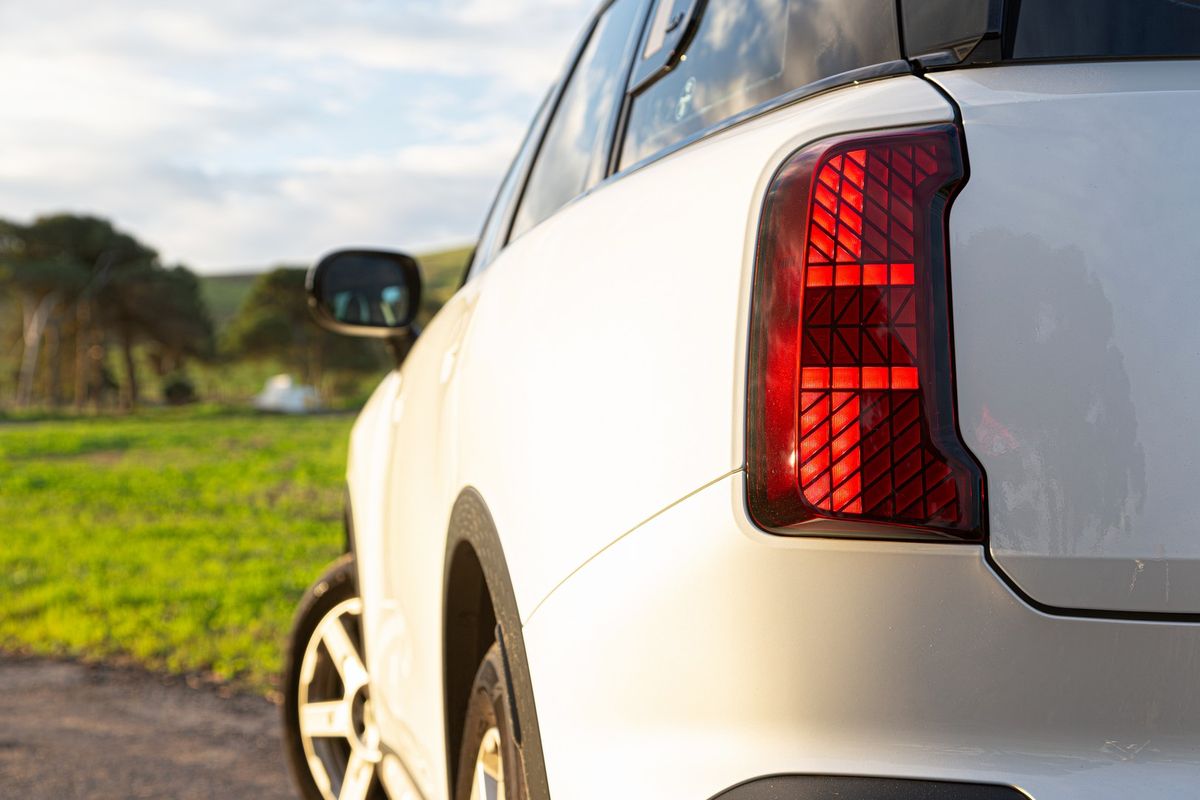
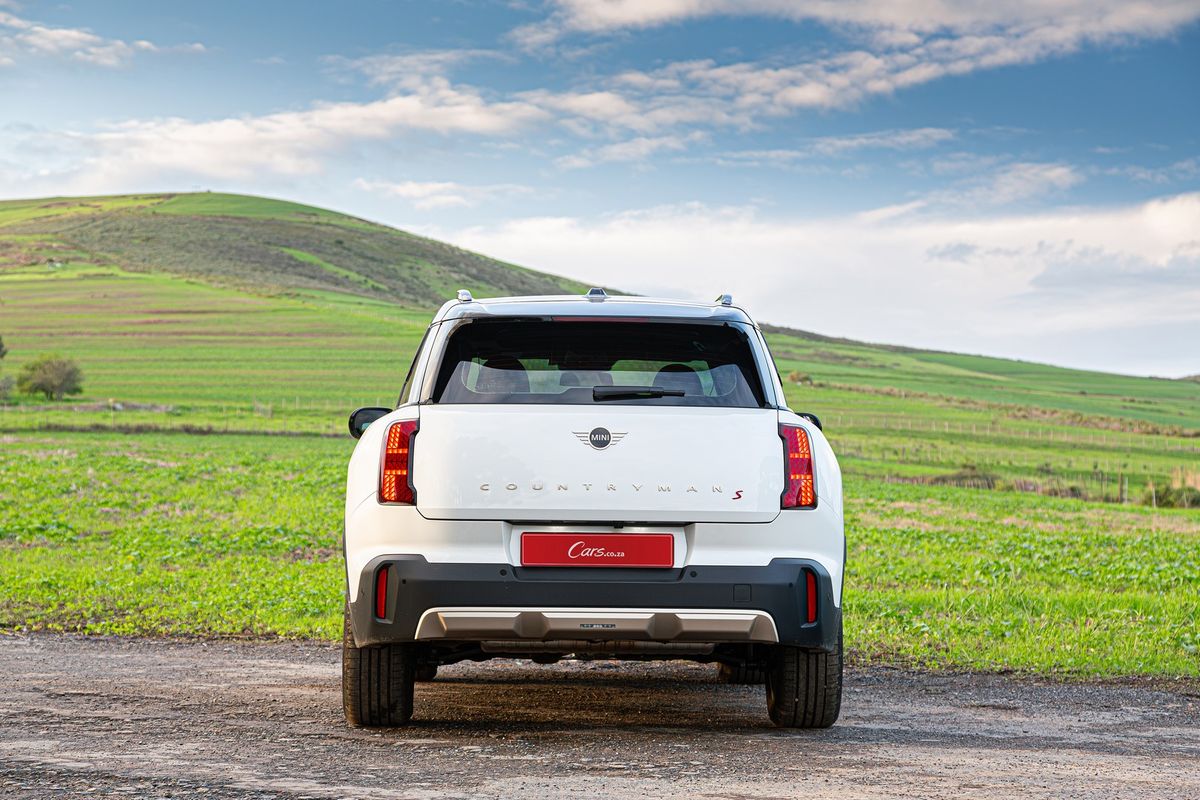
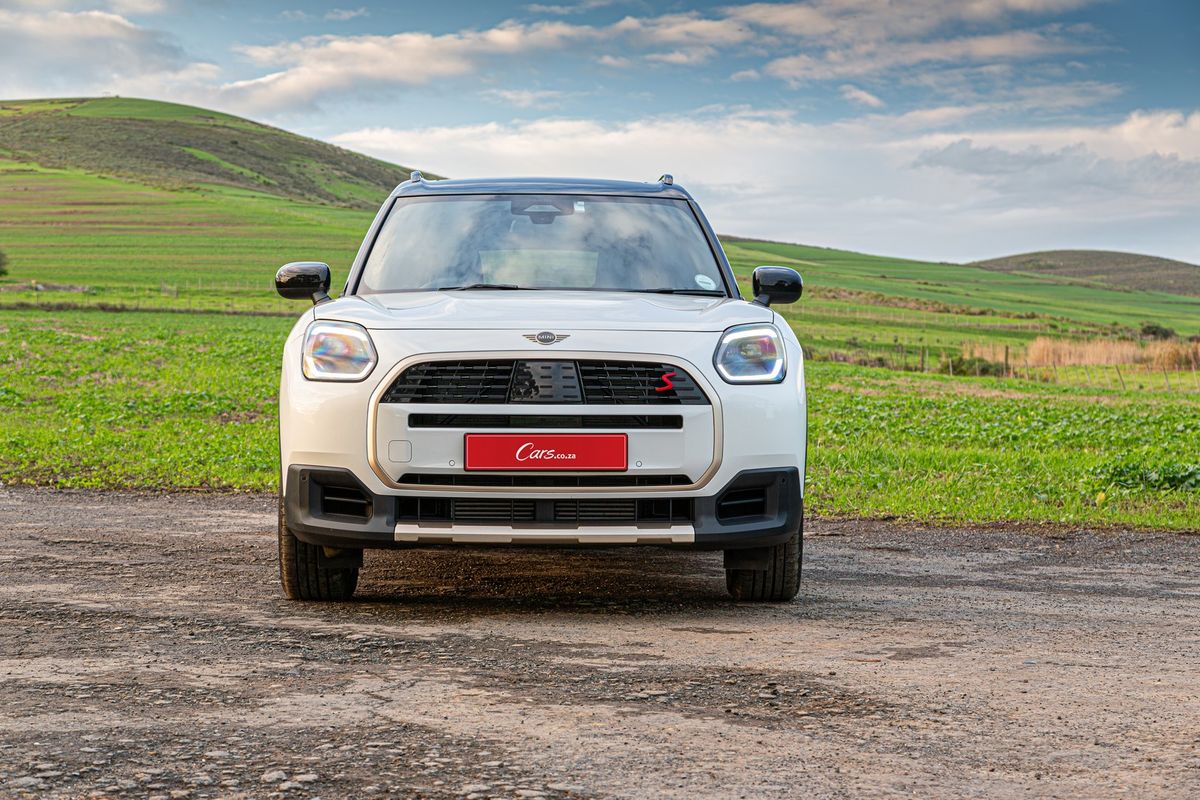
Some of the Countryman’s exterior styling is a bit quirky, but that’s typically Mini.
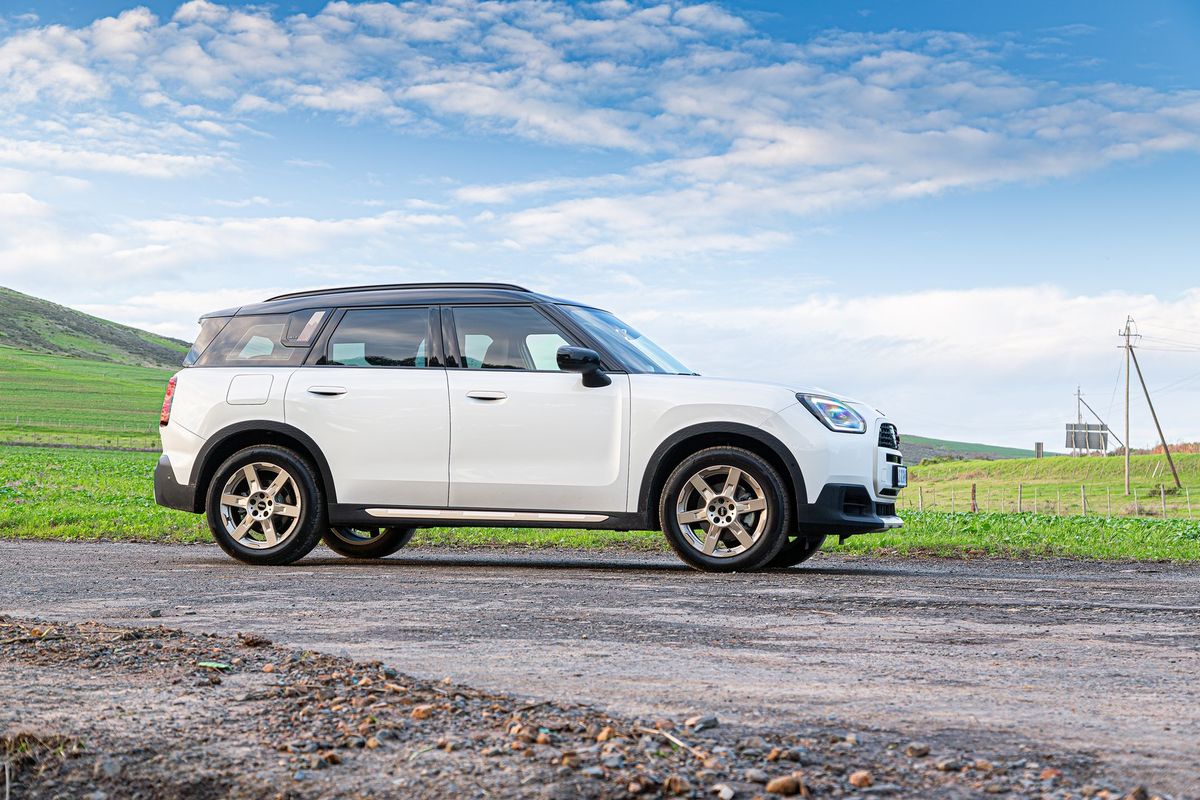
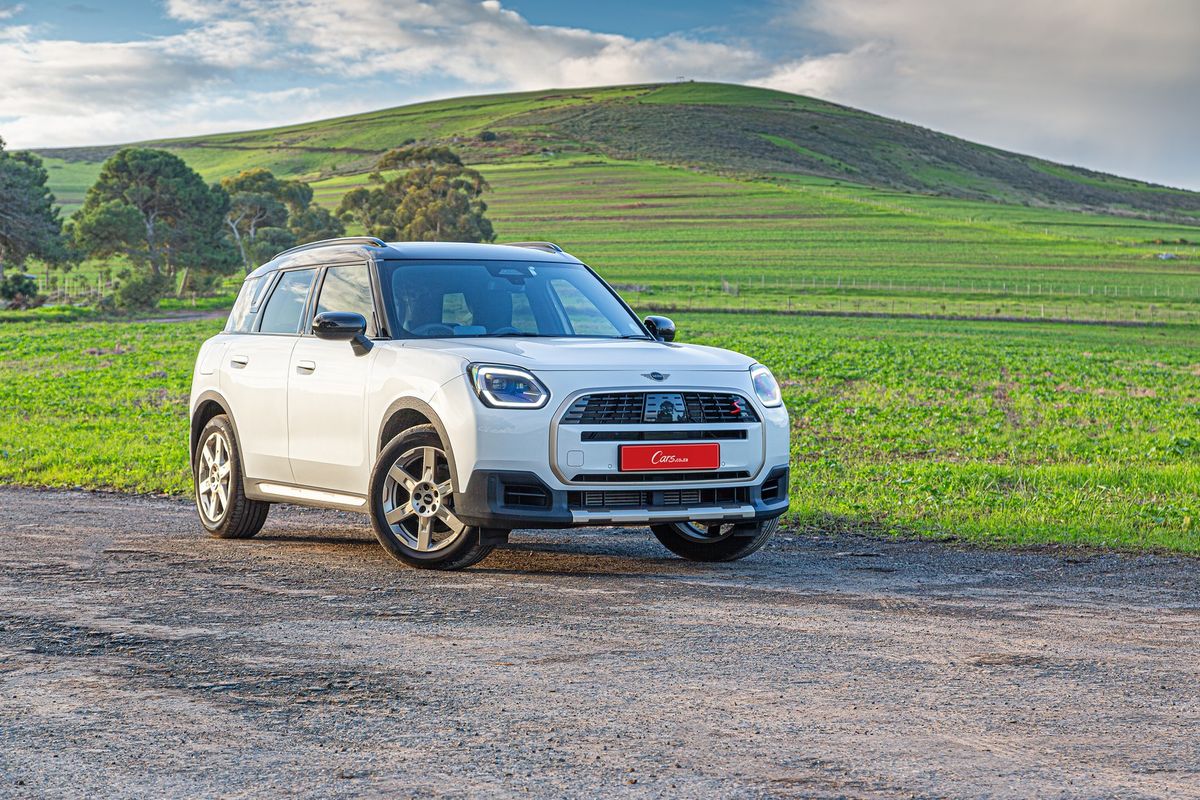
The Mini brand is commonly associated with small city cars with oodles of personality. Yet, the 3rd-gen Countryman is anything but compact. First impressions suggest the newcomer’s exterior dimensions are comparable with those of the outgoing X3, plus the boxy design makes the model look bigger than it is.
Compared with the outgoing model, the new Countryman is 130 mm longer, 22 mm wider and 80 mm taller, which means it offers much more cabin space than its predecessor, but more on that further below. Mini South Africa offers its Countryman in ICE (petrol-powered) and all-electric guises; the local line-up comprises C and S derivatives, the electric SE variant, with the John Cooper Works (JCW) at the summit.
The John Cooper Works derivative of the Countryman produces 233 kW!
The Countryman has no shortage of rivals – it has been thrust directly into a segment that’s inhabited by several sensible crossovers/medium SUVs. Considering the newcomer’s nonconformist design/image, you’d be forgiven for thinking it’s the odd one out. But if you look past the Mini’s eccentric bodywork, you will see its packaging is quite practical, at least more so than the British marque’s previous crossovers!
The Mini’s BMW X1 cousin (they share a platform and powertrains) is a rival, as are the Audi Q3 and Volvo XC40, which are all similarly priced and -sized premium crossovers. But then, if you’re shopping in the R800k price bracket, it would be amiss if we didn’t mention the fantastic value offered by the Chery Tiggo 8 Pro, Kia Sportage, Haval H6 GT, Hyundai Tucson, Omoda C9 and VW Tiguan.
The Countryman is available in turbopetrol and battery-electric guises.
How the Countryman S fares in terms of…
Performance and Efficiency
The Countryman’s petrol powertrains have been carried over from the previous model. You can choose between a 1.5-litre 3-cylinder turbopetrol that drives the front wheels with 115 kW/240 Nm (Countryman C) and a 2.0-litre 4-cylinder turbopetrol with all-wheel drive: 150 kW/280 Nm (Countryman S) or 233 kW/400 Nm (JCW). Every Countryman derivative has a 7-speed dual-clutch automatic transmission.
The Mini Countryman S we reviewed featured customisable light signatures.
With peak outputs that are comfortably higher than those of many of its immediate rivals, we expected the Countryman S to perform spiritedly, so we were keen to test its maker’s performance claims for this variant. Mini says that the Countryman S can reach 100 kph from a standstill in just 7.4 sec and, when we put the test unit through its paces, our equipment confirmed that time to be almost spot on: 7.46 sec.
It’s nippy, yes, but even when you’re accelerating hard, the Countryman S doesn’t egg you on to press further; Mini is a fun and funky brand, but the test unit’s straight-line efforts (and its muted soundtrack) left us wanting a bit more. Perhaps the model’s heightened refinement reflects its more family-oriented clientele – not everyone will want the exhaust to emit fruity pops and crackles – or such theatrics are reserved for the JCW version. Oh, did you notice the Countryman S doesn’t have visible exhaust ends?
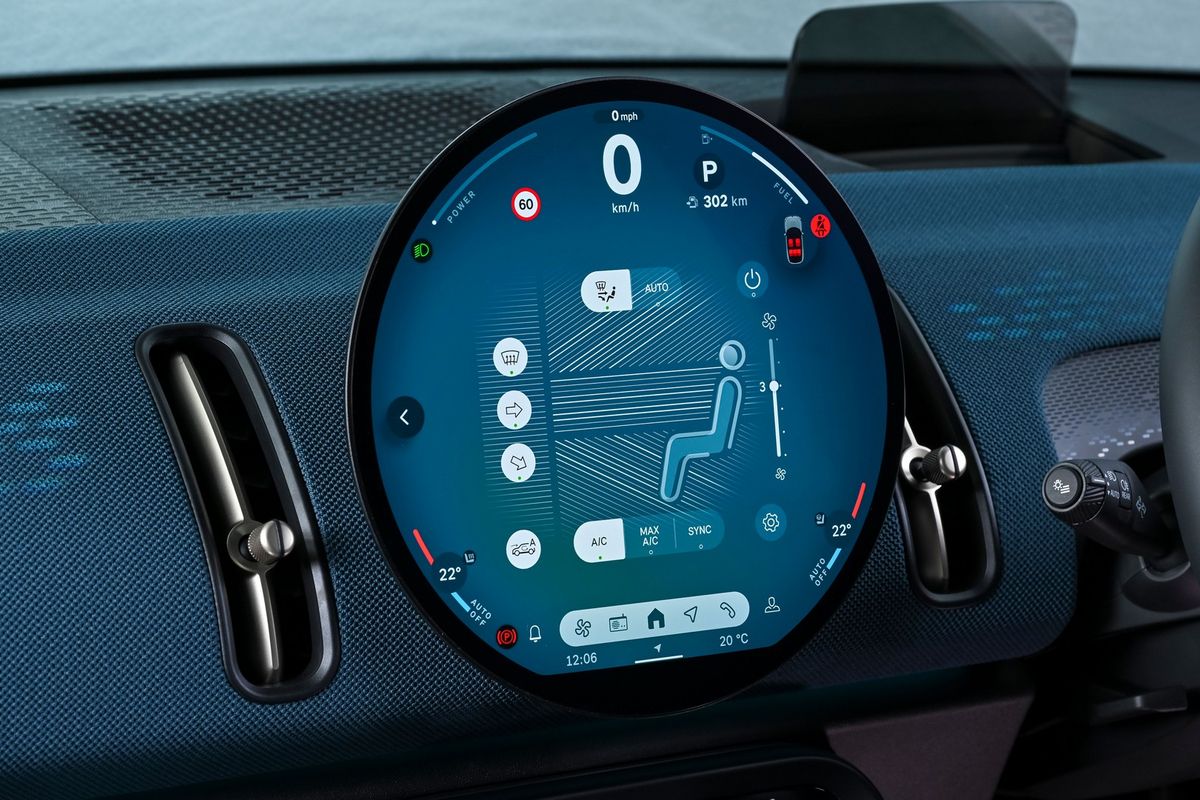
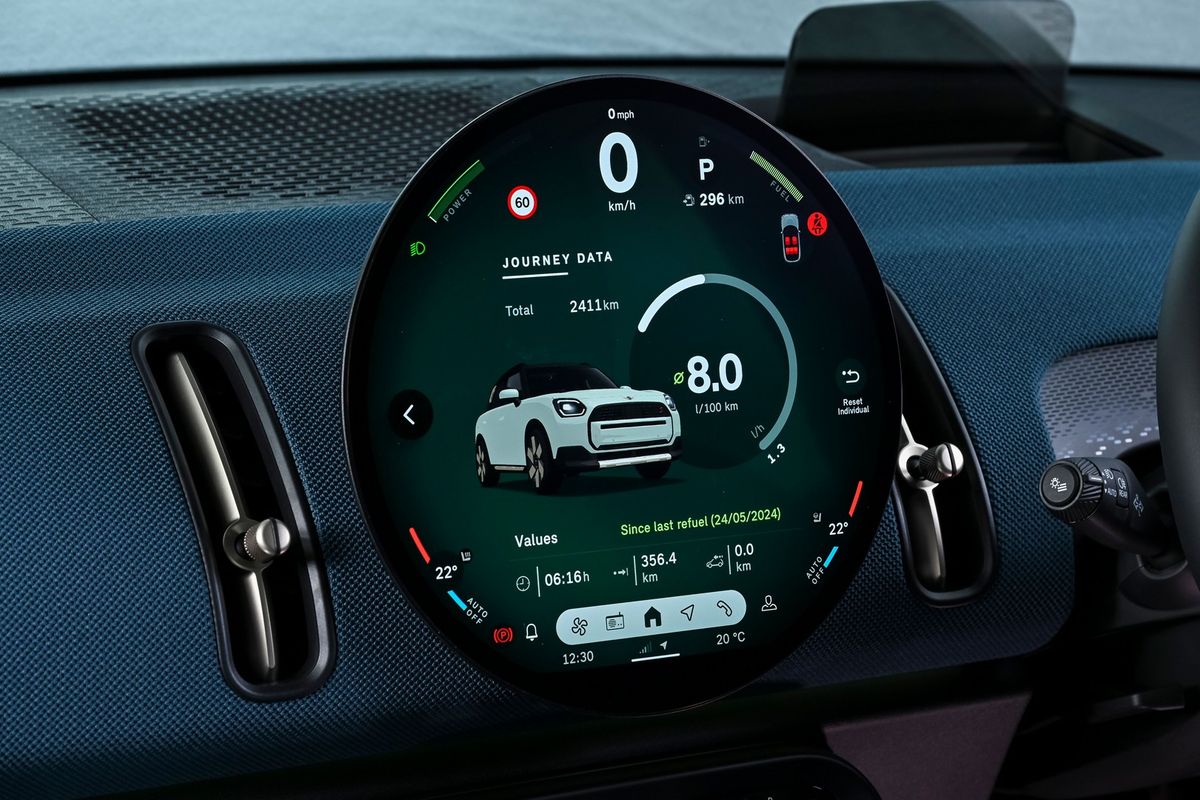
The circular OLED screen with its retro display theme.
If you want optimal driver engagement, you have to activate the Go-Kart “Mini Experience” mode, which is announced by an adorable “whoo-hoo” (when the infotainment screen adopts a motorsport-themed layout and sporty red accents illuminate the dashboard and fascia). Apart from sharpening the throttle response, Go-Kart mode makes the Mini pipe synthesised engine noise into its cabin via the speakers.
The Countryman has 8 experiences/modes to choose from (3 of which alter the driving experience: Eco, Comfort and Sport) and each of them has a distinct display, as well as -fascia and -dashboard lighting accents. Some may find this all a bit gimmicky, but our testers liked the myriad personalisation options.
The 2.0-litre turbo returned average consumption figures of around 8 L/100 km
Given its tank capacity (54 litres) and claimed consumption figure (6.5 L/100 km), the Mini Countryman S has a theoretical full-to-empty range of about 600 km. While this test unit was in our fleet, it indicated figures of between 7.8- and 8.1 L/100 km, which were reasonable. Interestingly, Mini SA’s technical data sheets state that you can optionally equip your Countryman with a larger fuel tank, which would give this variant a claimed range of 831 km, but we couldn’t find more info about that on Mini’s local website…
Ride and Handling
By this point, you’re probably wondering: “Does the new Countryman still have that fun-to-drive character that Minis are renowned for?” The answer to that question is not clear-cut, unfortunately.
The Countryman seems a notably more refined, upmarket (and sensible) proposition than before and the unavoidable price for “growing up” is the loss of what little “go-kart feel” its predecessor offered. On the upside, it now strikes a better balance between (sharpish) handling and (an admirably pliant) ride quality. The Mini’s ability to corner quickly with negligible body roll and excellent roadholding – is aided by all-wheel drive, the model’s relatively low kerb weight (of around 1 600 kg) and increased track width.
There’s no instrument cluster, but you can specify a head-up display helps at extra cost.
The steering is as responsive as you’d expect from a Mini; you can place the car accurately, and quickly, with ease. The Countryman’s UKL2 platform underpins some buttoned-up products, such as the BMW X1/X2, 1 Series and 2 Series Gran Coupe, but rest assured, the newcomer can indeed be “fun to drive”.
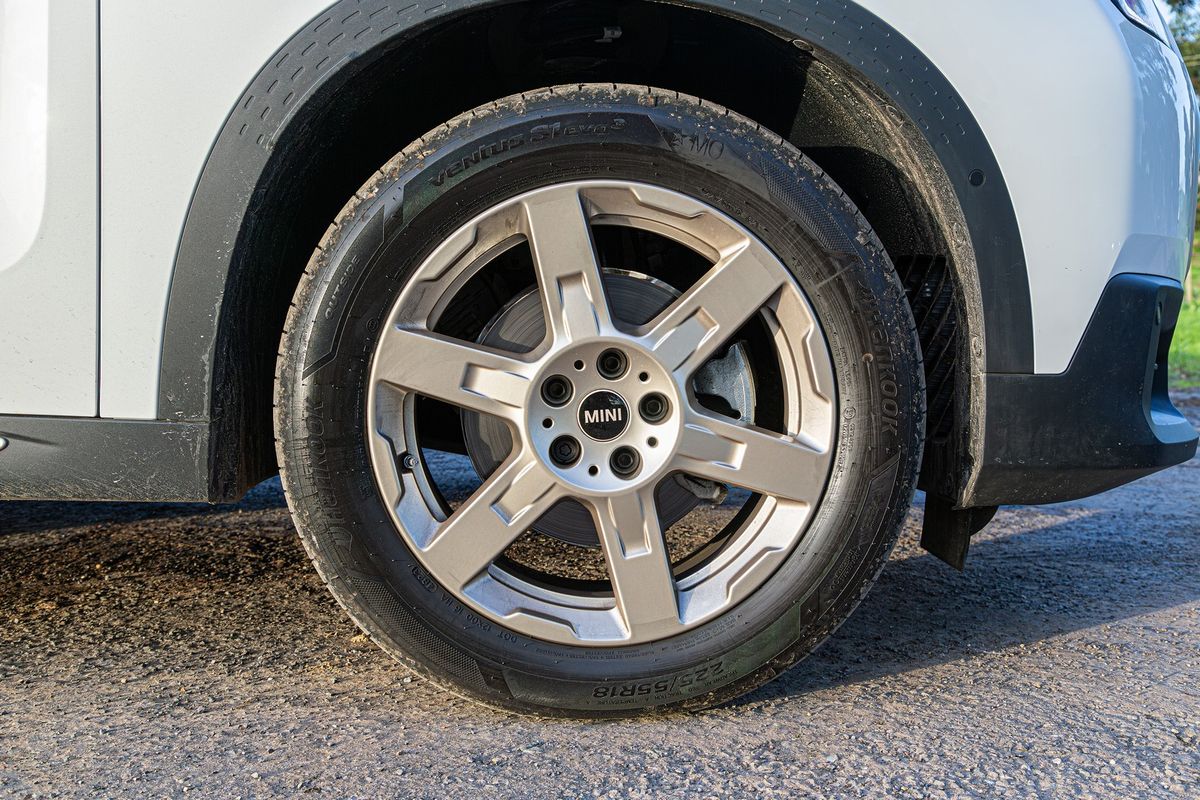
Even if the 3rd-gen Countryman is not quite as engaging to pilot as its predecessors, most prospective buyers would probably accept that in exchange for a more forgiving ride quality. Make no mistake, the Mini is pretty stiffly sprung, but its ride never becomes jarring when traversing poorly maintained asphalt roads. The Countryman S’ suspension, aided by tyres with high sidewalls (our test car came fitted with 18-inch alloy wheels wrapped in 225/55 rubber) will soak up most bumps without too much drama.
The 18-inch alloy wheels of our test unit were finished in a light bronze.
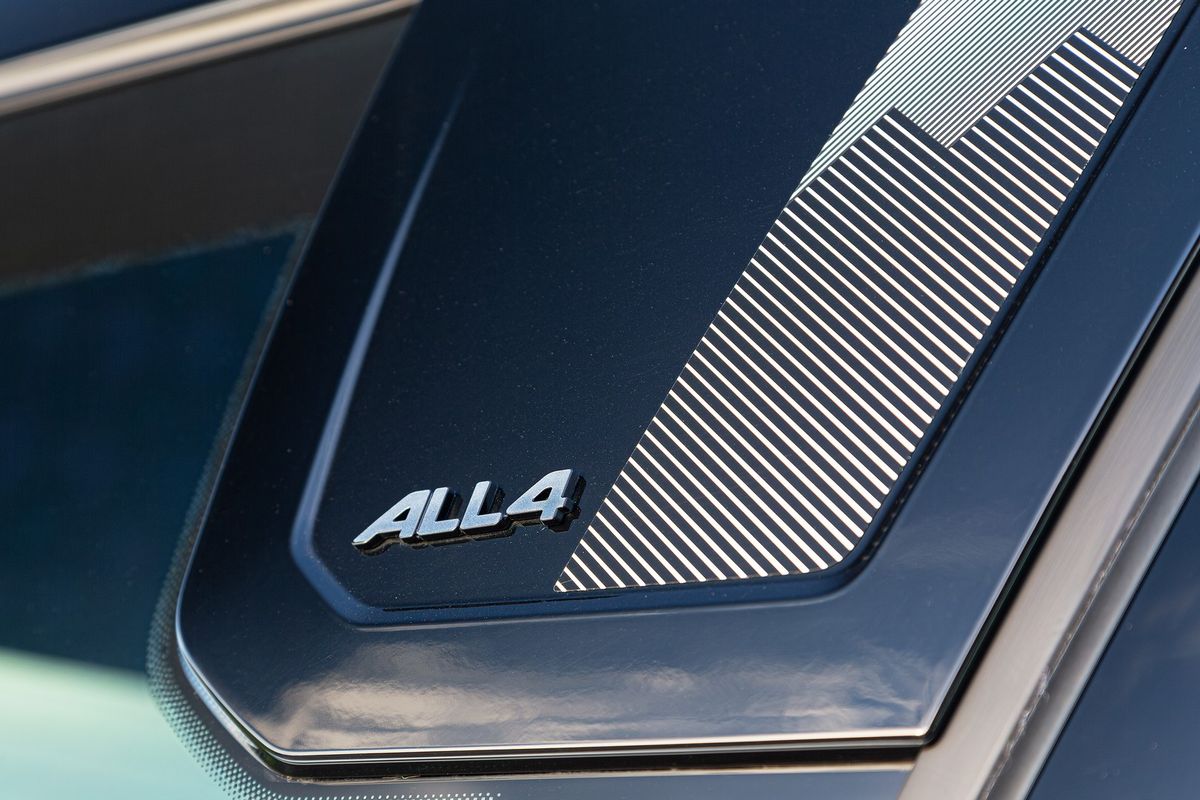
The Countryman S may have all-wheel drive, but its off-road capability is nominal. The All4 system can distribute power front-to-rear, which optimises traction on wet and gravel roads, but with only 202 mm of ground clearance, the Mini can’t hope to traverse anything more treacherous than a graded dirt track.
Design, Features and Practicality
The design of the new Countryman speaks volumes of the Oxford-based brand’s ambitions to progress into the lucrative premium crossover space. This is no half-baked “hatchback on stilts”; it has squared edges aplenty and just enough bulk to give it considerable presence, but it’s still unmistakably Mini.
Our test car offered a choice of no fewer than 3 daytime running-light display configurations, which seems a novelty, but, as with the Mini Experiences, it adds a level of personalisation we can appreciate.
The Countryman has grown to be a genuine family car/medium SUV.
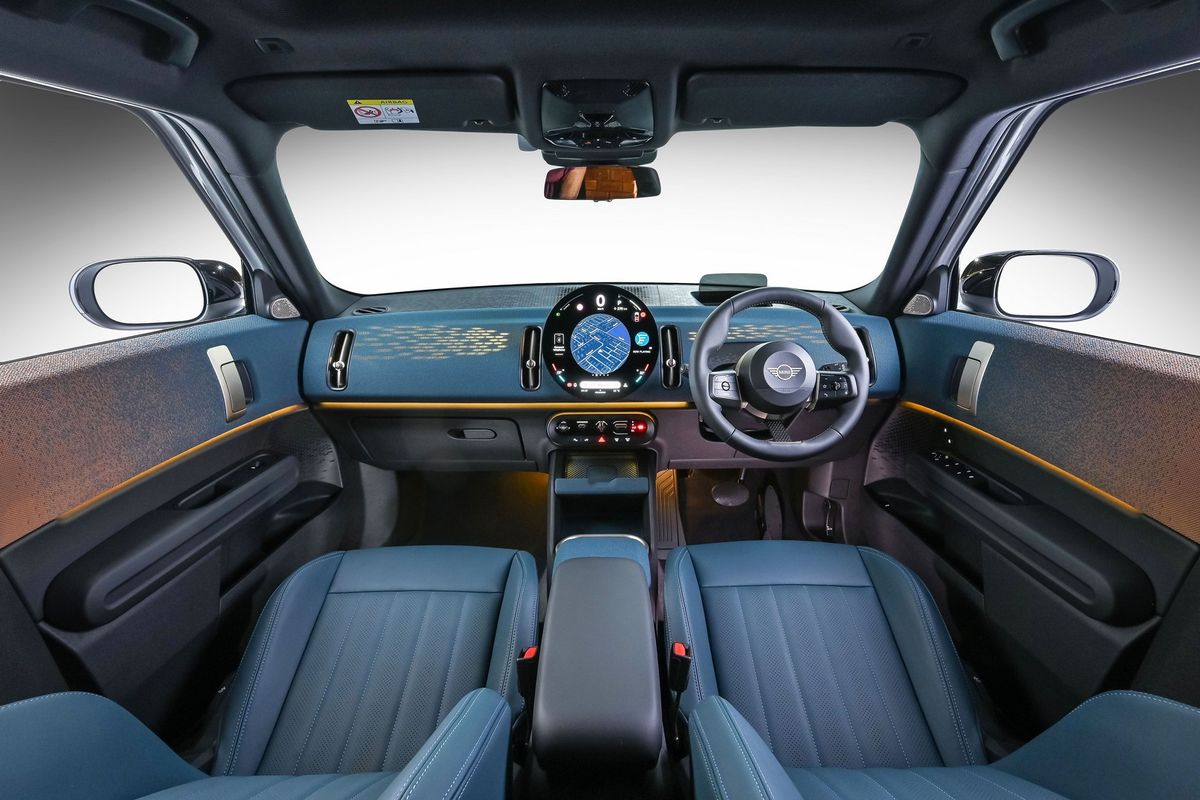
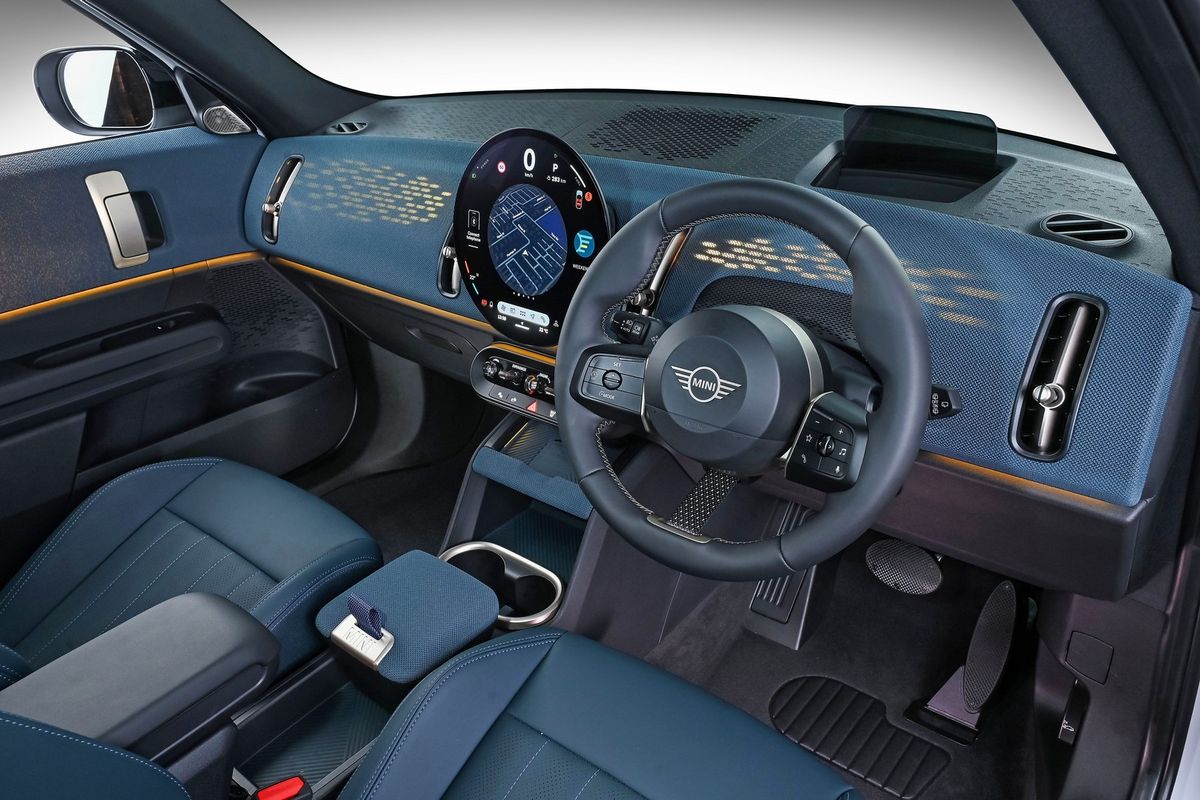
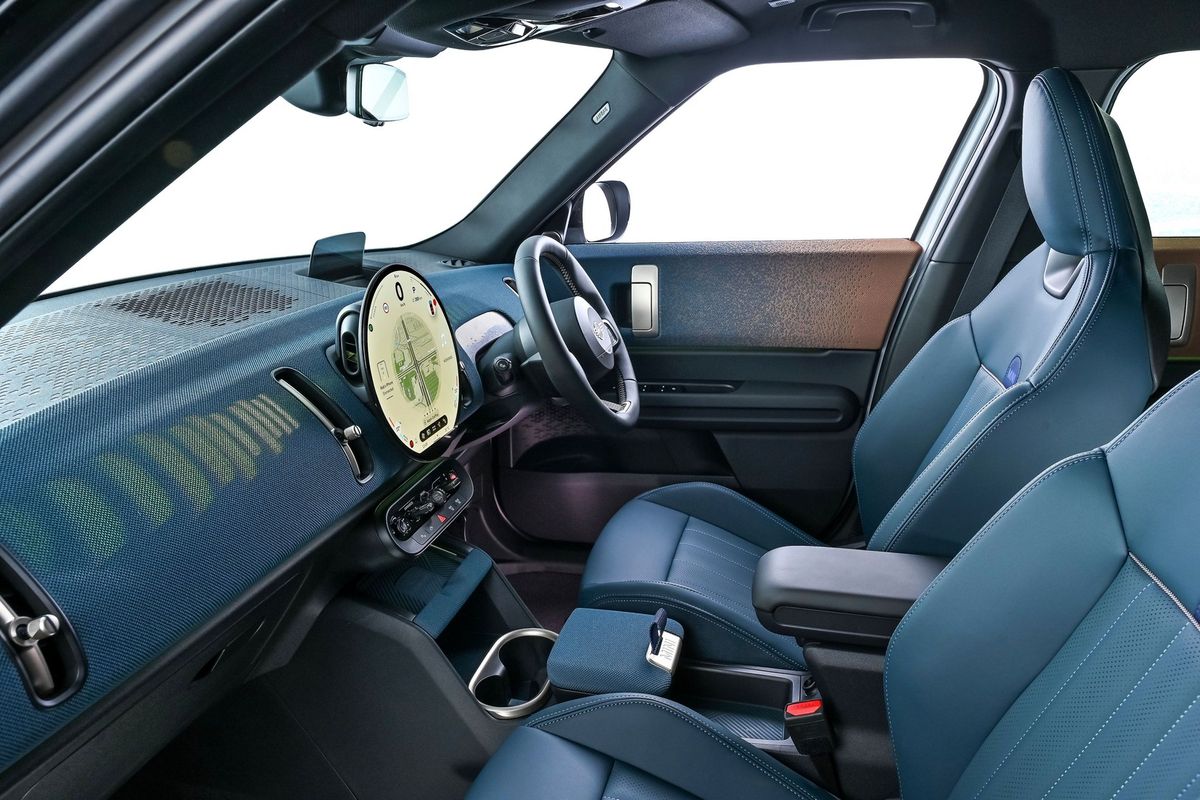
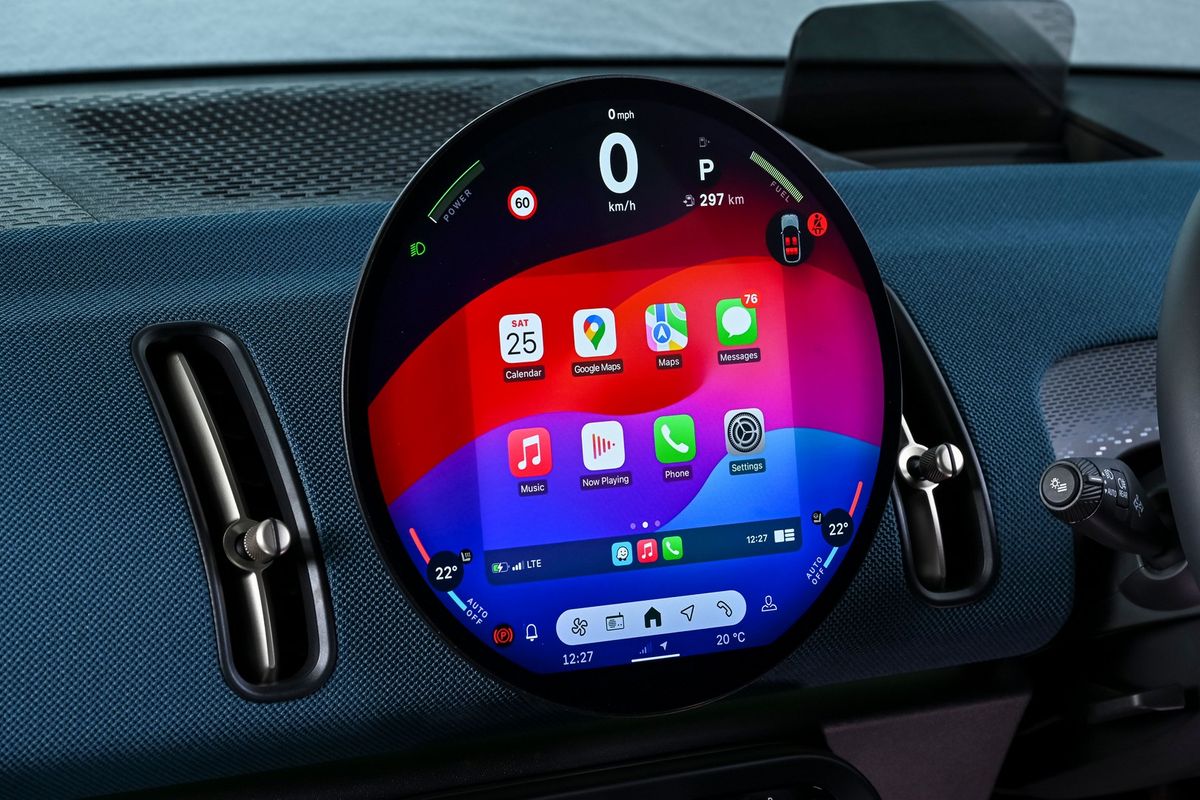
The moment you climb aboard, you’ll notice the sizeable circular infotainment touchscreen perched on a slabby cloth-trimmed dashboard. While the frisbee-sized OLED screen looks brilliant, both in terms of its positioning and the quality of its graphics, the user experience is, um, challenging. Many functions were tricky to figure out, but we suspect most Mini customers will enjoy becoming familiarised with the menu.
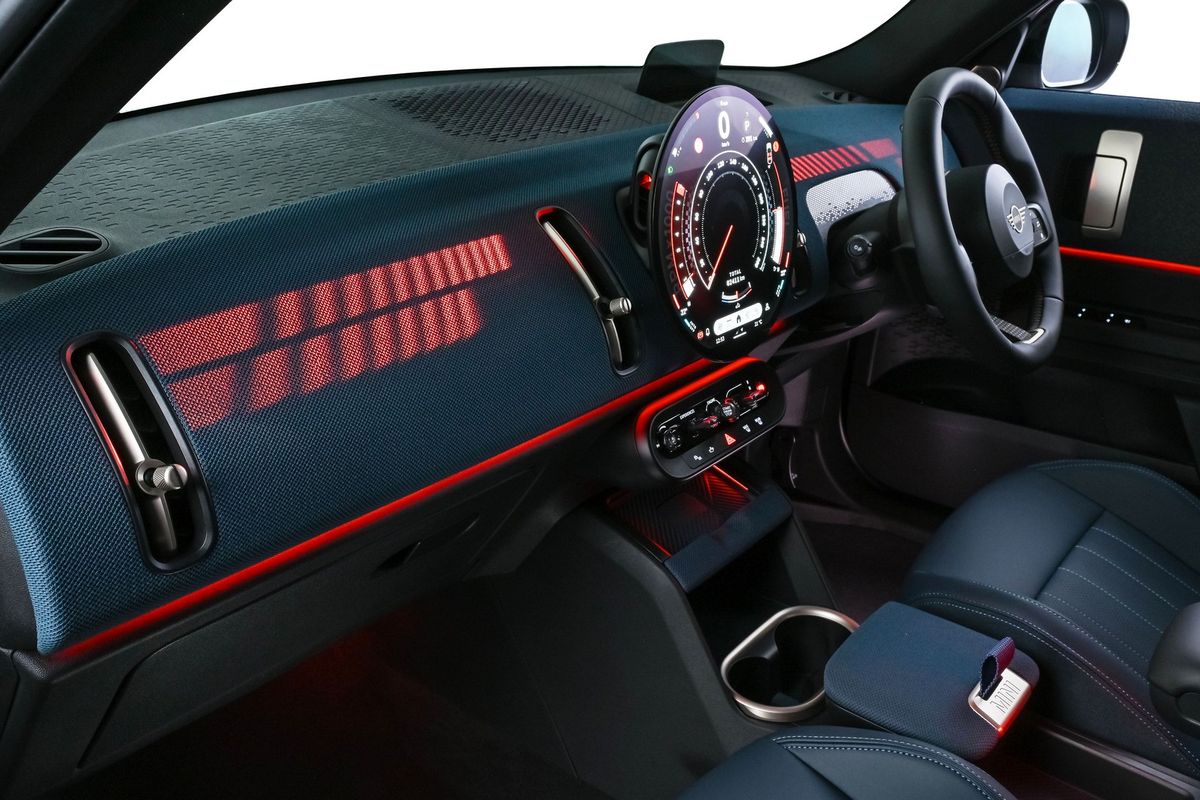
One of the most interesting cabin designs we’ve seen all year.
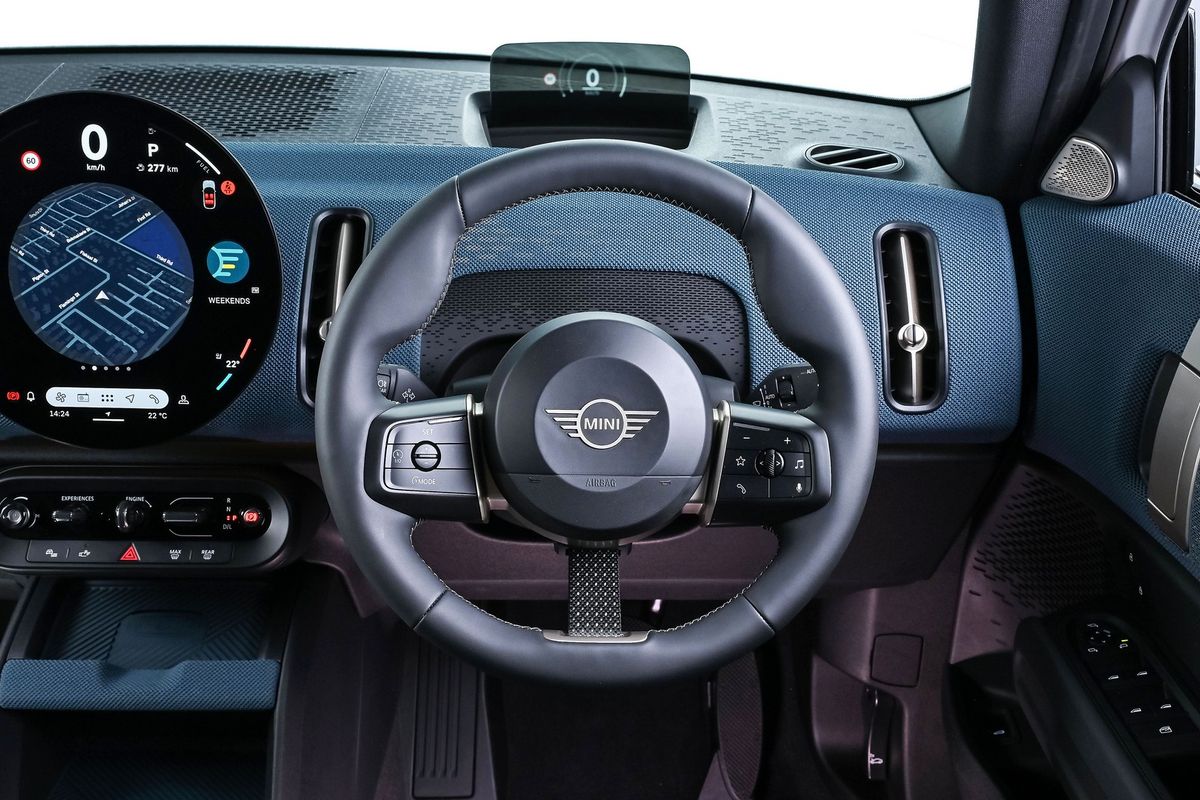
There’s no instrument cluster, which means critical car info, principally vehicle speed, is displayed at the top of the infotainment screen. Mini offers an optional head-up display (projected on a glass panel ahead of the tiller), which we’d heartily recommend; it feels more natural to have your eyes in line with the road.
The OLED screen is remarkably crisp, but the Apple CarPlay menu looks like an afterthought.
Any other criticisms? After starting the vehicle, we found the infotainment system needed a few seconds (too many?) to boot up completely. Apple CarPlay/Android Auto connectivity is available, but it’s a pity that their respective interfaces (squarish boxes that use only a part of the round screen) look inelegant.
What’s more, most onboard functions (apart from those located on the multifunction ‘wheel and column stalks) are only accessible via the touchscreen, so get used to “diving into menus”! Thankfully, the voice-controlled assistant is fairly responsive and obedient, and the climate-control sliders are easy to adjust.
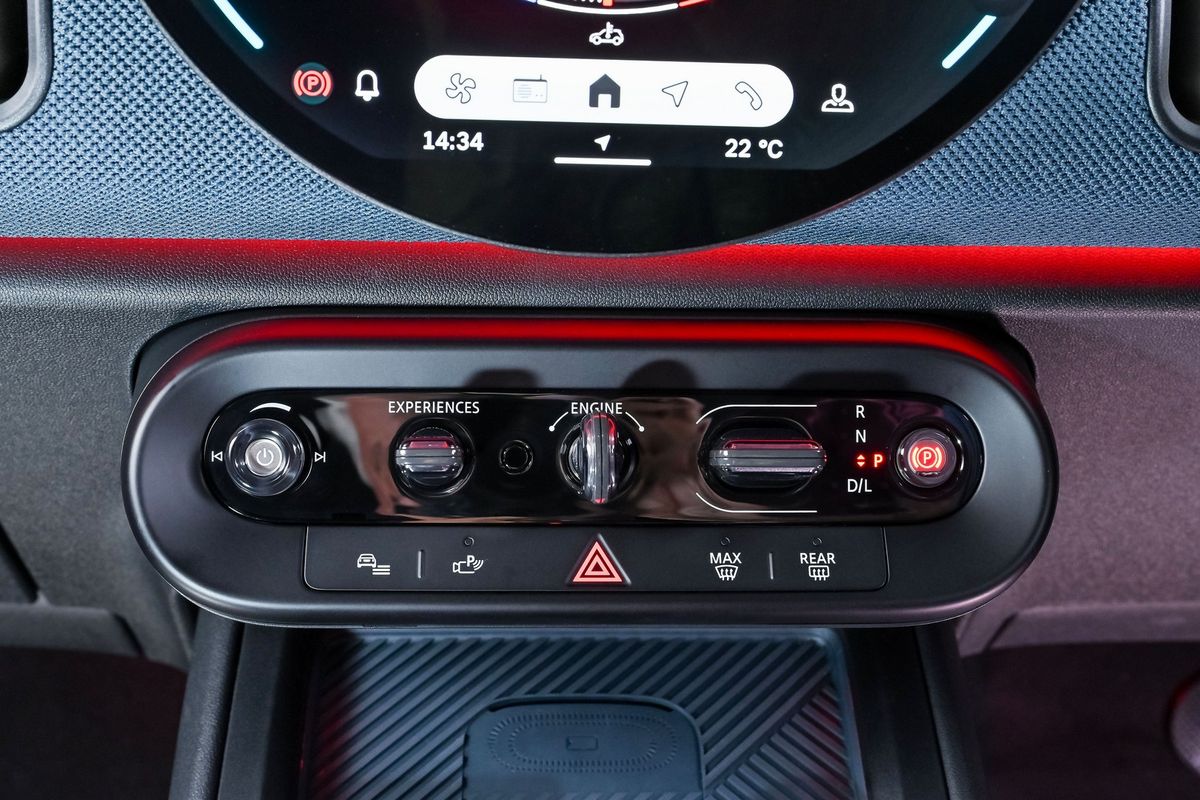
The fascia console is very simple… because most functions must be accessed via the touchscreen.
The fascia-mounted console is unashamedly quirky and features (from left) the volume-control/track-skip knob, the Mini Experiences toggle, a twistable engine-start switch (shaped like a non-removable key), a toggle for the transmission (instead of a conventional shift lever) and a parking brake button.
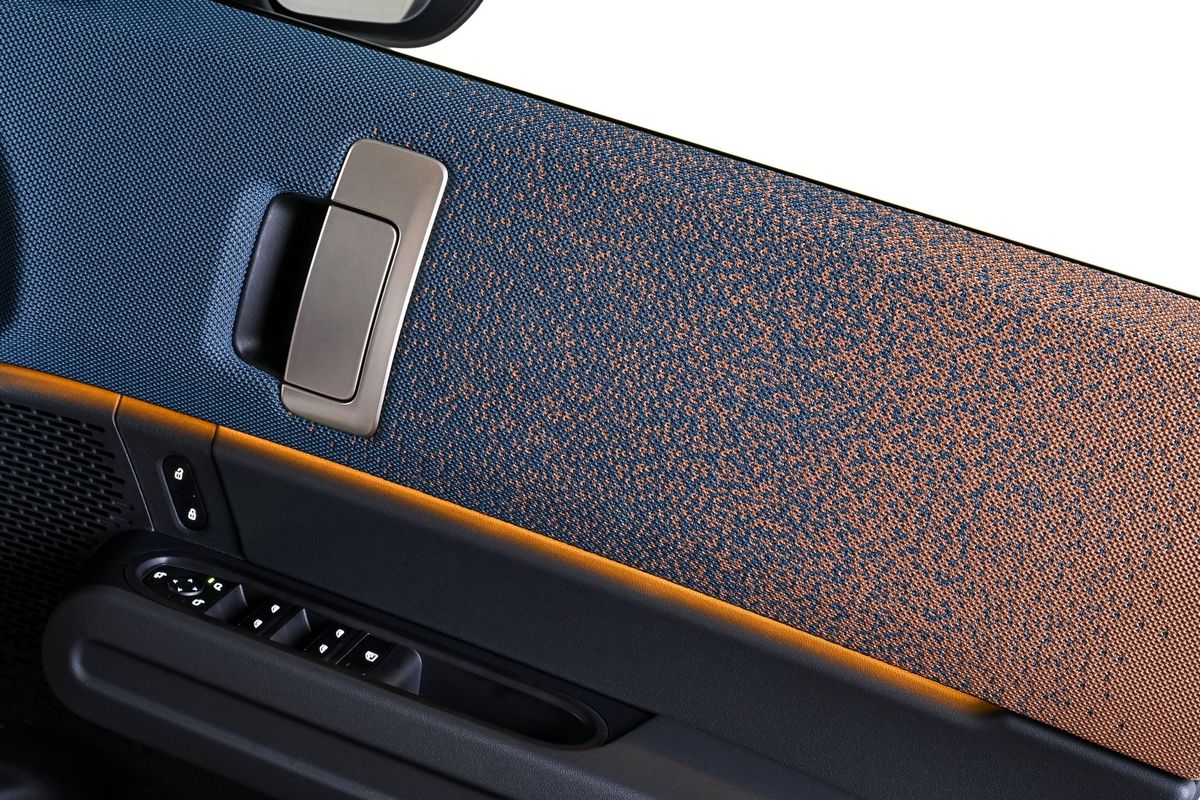
Recycled fabric endows the door trims with interesting textures and colours.
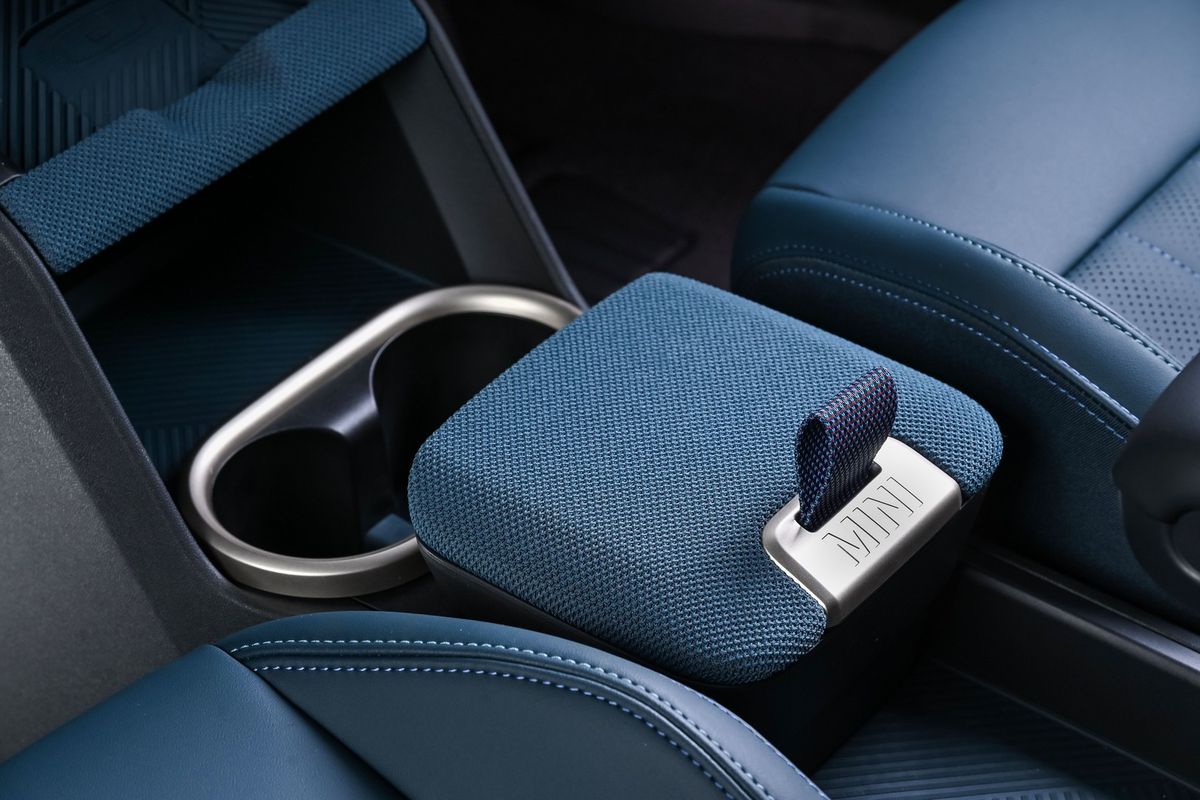
The cabin may represent a study in minimalism, but there’s no denying its lofty perceived build quality. Mini says it sourced several of the cabin finishes from recycled materials and soft-touch plastics abound.
Liberal applications of fabric add interesting, tactile textures to the cabin trim and a light projector, which emits colours and patterns (to suit the car’s various modes), is located behind the fancy circular screen.
The light projector illuminates the dashboard in a sporty red hue.
Of course, the biggest benefit of the Countryman growing in size is notably enhanced cabin space. There’s more occupant room – at the front and rear – and you no longer feel like you’re in a small car.
The load bay capacity is a more-than-useful 505 litres and, if you fold down the rear seats, you get 1 450 litres of utility space. For context, that’s almost as much capacity as in the new Volkswagen Tiguan family car. Aft passengers are availed of separate ventilation outlets, as well as a pair of USB-C charging ports.
Price and After-sales support
The Mini Countryman S ALL4 retails for R795 074 (October 2024) and is sold with a standard 2-year/unlimited km warranty and a 5-year/100 000 km maintenance plan.
The 3rd-gen Countryman is more refined and practical than before… and all the better for it.
Has the 3rd-gen Countryman successfully evolved to appeal to a wider range of family car/medium SUV buyers? The Mini’s rivals are also upmarket, but they’re comparatively predictable: practical (almost to a fault), stylish (but with restraint), and highly conformist. This new Mini is a refreshingly funky alternative.
The newcomer’s styling is polarising and its fascia layout defies the norm, but there is a market for cars that appeal to nonconformists – that’s why boutique crossovers exist. The Countryman’s quirkiness is charming and, by the end of this review, we felt there were still many cool facets of the car to discover.
So, should you consider buying a new Mini Countryman S? While the Countryman S “ticks many boxes”, as they say, its C sibling, with the slightly smaller engine, offers better value. Admittedly, it won’t be as quick as this variant and you lose the all-wheel-drive capability, but it costs about R70k less than the S.
Want to know more about the Countryman C? David Taylor presents the variant in a video review:
If you’re a fan of the BMW brand and looking for the best BMW models to buy in South Africa, then this article is for you!
BMW enjoys vast support in South Africa and the Munich-based firm is respected for its luxurious and dynamic cars.
The BMW range includes a hatchback, sedans, cabriolets, coupes, compact and large SUVs, sports cars and a wide selection of electric models. BMW’s selection of M cars are particularly sought after by performance enthusiasts.
If you’re looking for the best BMW models to buy in 2024 then look no further than the 2024/25 #CarsAwards finalists! The #CarsAwards sponsored by Absa is South Africa’s most comprehensive and authoritative motoring awards programme that recognises the best cars available in the new car market across 13 categories.
In this latest iteration of the Cars Awards, BMW has 5 finalists that can be considered to be the best BMW models on sale in South Africa right now. Here they are!
For those seeking more performance, the X2 M35i ups the ante with a 2.0-litre turbocharged petrol engine that produces 223 kW and 400 Nm and comes paired with a 7-speed dual-clutch cog-swapper.
The BMW X3 is built right here in South Africa and an all-new X3 is due to go on sale before the end of 2025! The X3 is undoubtedly one of the best executive SUVs on the market and this X3 30e xDrive M Sport is powered by a 2.0-litre turbocharged petrol engine and an electric motor combining 140 kW from the engine and 135 kW electric boost giving it a total outputs of 220 kW and 450 Nm.
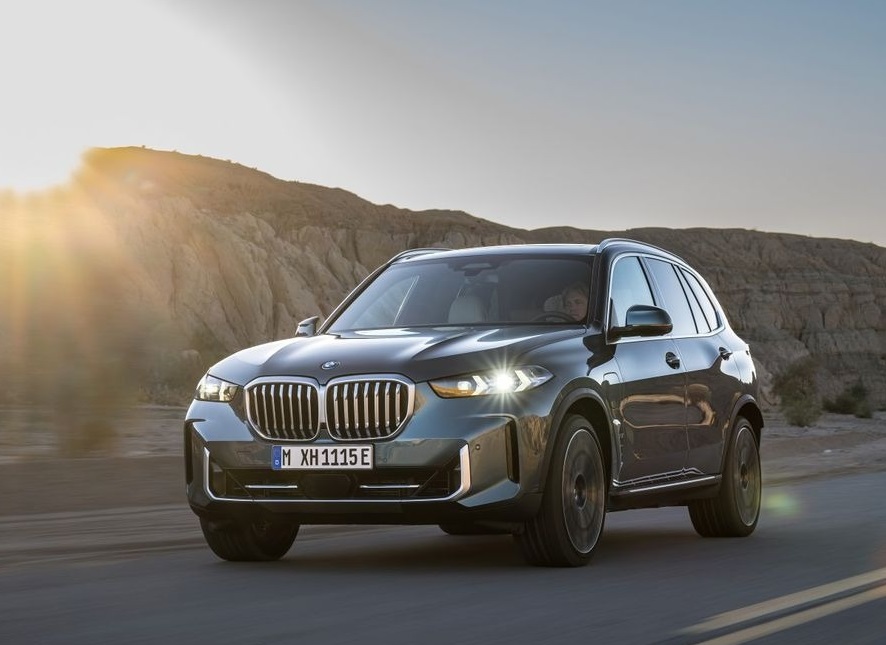
For higher levels of luxury and practicality, consider the BMW X5!
The X5 xDrive 30d strikes a good balance between power and economy and is powered by a 3.0-litre, 6-cylinder turbodiesel engine that offers 210 kW and 650 Nm. A 6-speed automatic transmission is standard.
For the performance thrill seekers, it doesn’t get much better than the BMW M2!
With a potent 3.0-litre, 6-cylinder turbopetrol engine that develops 338 kW and 500 Nm and is paired with an 8-speed automatic transmission. For the purists, a manual M2 is also available.
VW’s mystery small SUV: when SA will get its first glimpse
The head of Volkswagen Group Africa has revealed when South Africa will get its first glimpse of the upcoming small SUV that’s set to be produced at the Kariega plant…
In April 2024, Volkswagen announced a R4-billion investment in its Kariega facility, confirming plans to produce a new small SUV – alongside the Polo hatch and Polo Vivo – from 2027. But when will South Africa get its first glimpse of this as-yet-unrevealed model on local soil?
Martina Biene, Chairperson and Managing Director of Volkswagen Group Africa, told Cars.co.za at Naamsa’s recent South African Auto Week 2024 in Cape Town that the local teaser campaign for what the company refers to as its new “A0 Entry SUV” is scheduled to kick off in February 2025.
Production of the new small SUV is set to start early in 2027.
“We’re talking about a model coming in the beginning of 2027 to our market. We have started refurbishing [areas of] the plant and there will be a bigger [undertaking] in the plant in May 2025, when we put the robots into the body shop, which is a major operation,” Biene told us.
“But because it takes some time, we have not shown our small SUV car [yet], which is based on the Polo platform. We’ll show something at our Volkswagen Indaba 2025. Just to tease that [event] already: it’s on the 5th of February in Kariega, where we’ll show the first camouflaged model of what is coming, to keep you excited for the next 2 years.”
We’ve zoomed in and further lightened the teaser image.
In September 2024, the Wolfsburg-based firm’s Brazilian arm – which is leading the design and development of this new model – released the first official teaser image. Echoing an earlier statement that VW Group Africa would adapt this vehicle “to the local and continental requirements”, Biene told us her team would “Africanise” it.
“Brazil is the lead plant but Brazil is also left-hand drive. Brazil will launch over the course of the next year – I think, end of next year [2025], if I’m not mistaken. Then comes us, and we’re doing the right-hand-drive development and we’ll ‘Africanise’ it a bit, because it’s not a one-to-one copy, of course,” Biene explained.
VW says the new model’s name (in Brazil, at least) will feature “up to 5 letters”.
While Volkswagen has yet to reveal the name of the new small SUV (which is due to slot in below the T-Cross), its Brazilian division has invited the public to guess the badge that will be used, saying “we can only give one hint: the name will have up to 5 letters”. Whether the vehicle ends up wearing the same moniker in South Africa, of course, remains to be seen…
GWM South Africa’s sales director says critics who believe the Chinese firm is “arrogant” for pricing its Tank 500 at over R1.2-million are off the mark…
In August 2024, the Tank 500 launched in South Africa as GWM’s first model priced on the far side of R1-million, pushing the Chinese brand into unchartered pricing territory. But a high-ranking executive at the automaker’s local division says this just reflects the brand’s confidence in its product.
Desmond Els, Sales Director at GWM South Africa, made the comments during a wide-ranging interview conducted in Cars.co.za’s custom-built podcast booth at Naamsa’s recent South African Auto Week 2024 in Cape Town.
The top-spec P500 comes in just short of 7 figures.
“We’ve been, I’d say, the first Chinese OEM [original equipment manufacturer] that has brought a car to market over R1-million. So, we launched P500 HEV just under R1-million and we launched Tank 500 at the R1.2-million mark.
“People would say: ‘is that slightly arrogant, bringing something like that to market?’. And I would say ‘no’. We’ve got confidence. We’ve got confidence in our product – we know what we’re planning towards,” Els told us.
In South Africa, the Tank 500 is offered exclusively in petrol-hybrid form.
Priced at R1 222 900, the Tank 500 ladder-frame SUV is offered exclusively in petrol-hybrid form, boasting total system outputs of 255 kW and 648 Nm, with a 9-speed automatic transmission and 4×4 shipping standard. As has become the norm with Chinese brands, this model’s list of standard equipment is a lengthy one.
Its positioning, of course, sees the 7-seater Tank 500 2.0T Ultra Luxury Hybrid 4×4 9AT going head to head with established 7-seater SUVs, such as the V6 turbodiesel versions of the Ford Everest (the Wildtrak for R1 199 500 and the Platinum for R1 278 000, though those prices are sans service plans) and even the base model in the J250-generation Toyota Land Cruiser Prado range (the 2.8GD TX, priced at R1 296 300).
As has become expected from Chinese brands, the Tank 500 is crammed with standard kit.
For the record, the 3-row Tank 500 measures 5 078 mm from nose to tail, making it longer than both the Everest (4 940 mm) and Prado (4 925 mm) – and even lengthier than the Land Cruiser 300 (5 005 mm). However, we should keep in mind that GWM’s 7-seater SUV features a tailgate-mounted spare, which is seemingly included in this measurement.
In August 2024 (effectively a partial month in which the Tank 500 was launched), GWM SA reported 13 sales of its luxury off-road SUV, a figure that grew to 17 units in September. A further 8 units were registered prior to the local launch, presumably as part of the vehicle’s local homologation process.
New Chery models, including a small bakkie, coming to SA soon
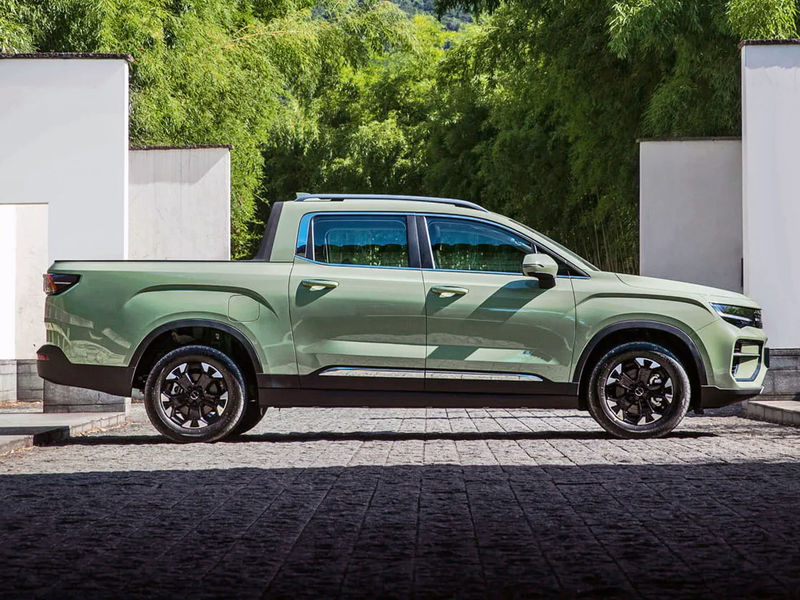
Chery is set to launch a new Tiggo 4 Pro variant, its Tiggo 9 flagship and revised family-car models soon, but the biggest news is that a small bakkie is set to arrive in Mzansi, possibly not long after the lifestyle double cab based on the KP11 concept.
We recently reported from Wuhu, China that the local subsidiary of the Chinese automotive giant was planning to launch a ladder-frame-based, lifestyle-oriented Chery double-cab in late 2025/early 2026.
This limited selection has forced small business owners to consider alternatives, such as single-cab or workhorse bakkies, or hatchback- and crossover-based LCVs from Hyundai (Cargo), Kia (Runner) etc.
The conversation about next-gen half-tonne bakkies is not new in South Africa. Over the years, several manufacturers – notably Volkswagen and Renault – have produced such vehicles for overseas markets, but these never saw local shores either owing to the lack of right-hand-drive availability; or the inability to secure competitive pricing. See also:VW’s planned SA-built half-tonne bakkie hits roadblock
Another potential half-tonne contender: Could Geely return to SA with Riddara RD6 bakkie?
However, Chery’s local subsidiary looks to set this paucity of possibilities right in 2026, when it brings a half-tonne double-cab to South Africa. This time, though, it’s real, as the contingent of motoring media visiting the company’s annual summit held in China last week – were shown design sketches of the vehicle in question, which is set to share the Tiggo 4 Pro/Tiggo 7 Pro platform.
While cameras were strictly verboten during the reveal, Chery South Africa’s top brass had no qualms about confirming the bakkie’s pre-production status in anticipation of its intended arrival date.
Chery SA’s crossover surge intensifies
Additionally, Chery South Africa affirmed enhancements of its existing line-up for the next year or so.
Set for imminent release is a Cross version of the Tiggo 4 Pro; with a petrol-electric hybrid derivative thereof following in the 2nd quarter of 2025. See also:Chery Tiggo 4 Pro DCT (2024) Review
Facelifted versions of the Tiggo 7 Pro and Tiggo 8 Pro family cars will arrive in early 2025, plus both model ranges will be expanded to include plug-in hybrid variants.
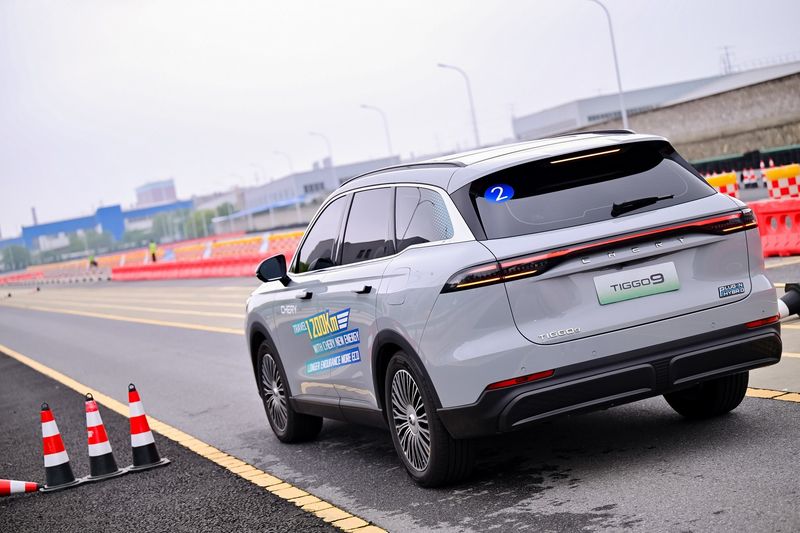
However, as far as its crossover line-up is concerned, the arrival of the Tiggo 9 in February is Chery’s biggest news for 2025. At 4.8 metres in length, the 7-seater family car is 90 mm longer, 65 mm wider and 36 mm higher than the Tiggo 8 Pro, plus it has a longer wheelbase (2 770 mm vs 2 710 mm).
It will be powered by Chery’s direct-injection Kunpeng 2.0-litre 4-cylinder turbopetrol engine delivering 192 kW and 400 Nm, which is mated to either a 7-speed dual-clutch transmission or a conventional 8-speed torque converter automatic (it differs from market to market) that drives the front wheels only.
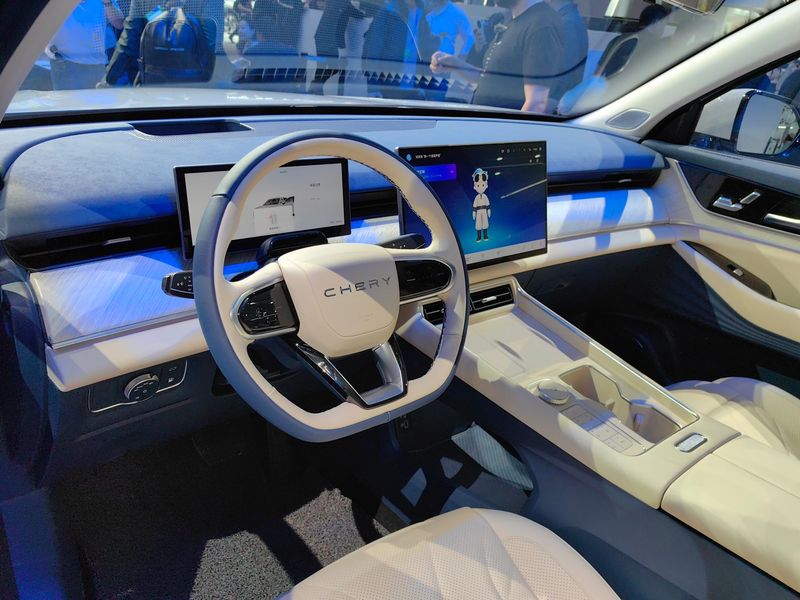
A 256-colour ambient lighting system is fitted as standard equipment, as is a Level 2 active safety suite that comprises road-sign recognition, adaptive cruise control, brake override system, blind-spot warning and lane-keeping assistant; as well as forward- and rear cross-traffic collision warnings – among others.
The local Tiggo 9 line-up will also include a PHEV hybrid version featuring Chery’s 1.5-litre T-GDi engine that develops a not-inconsiderable 175 kW and 385 Nm, with a claimed average fuel consumption figure of 5.2 litres/100 km. What it’s like to drive:Chery Tiggo 9 PHEV (2024) International Launch Review
The petrol engine works in junction with a 165 kW electric motor and a combined power output of up to 230 kW is sent to all wheels (20-inch alloys are standard), via a Dedicated Hybrid Transmission.
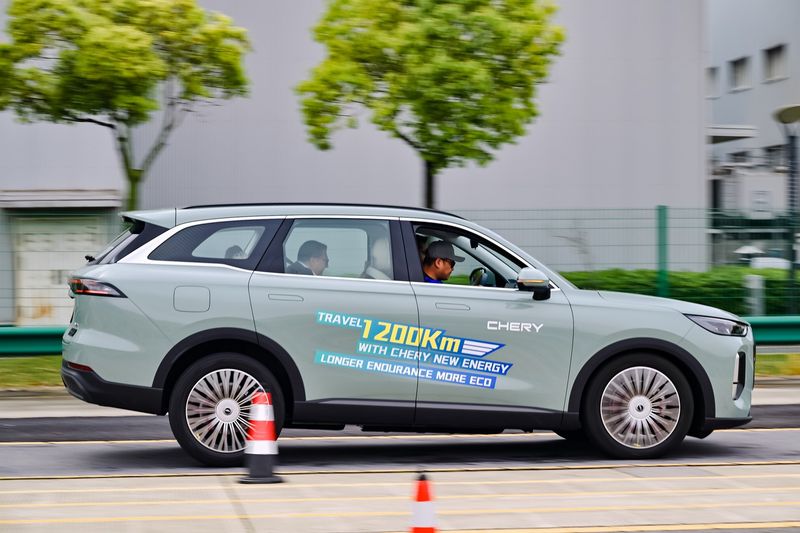
Recharging the 19.4-kWh battery pack from 30% to 80% with a fast charger is said to take 25 minutes and Chery claims the Tiggo 9 PHEV, which can reportedly travel up to 100 km in EV-only mode, is good for a combined range of more than 1 200 km (based on the Chinese light-duty vehicle test cycle).
Its PHEV configuration means the Tiggo 9 can run on its internal combustion engine (ICE) only; or the battery; or a combination of the two. The ICE is capable of charging the battery on the go, but to get the former to its full state of charge, the vehicle has to be plugged into an AC socket or a DC charger.
Indeed, if life is a bowl of cherries, Chery’s selection is about to get even sweeter!
At the recent M-Fest media day, BMW SA shared which of its models are the most popular in South Africa.
BMW M Fest is a three-day celebration of the Bavarian brand’s performance division and will feature demonstration laps, opportunities to purchase new vehicles as well as the local debut of all-new offerings like the locally-built BMW X3, BMW M5 hybrid as well as the BMW M3 Touring.
At the media preview event, BMW Group SA confirmed which of its M-branded models were the top sellers and the below list is a blend of pure M models like the M2 and M3, as well as M high performance derivatives.
Unfortunately, the supplied info does not mention a time period or specific numbers of units sold. But, it’s an interesting look at which vehicles are proving the most popular. Sadly, BMW do not give individual model sales figures monthly, but rather follows a strange strategy of sharing a month’s worth of sales data every quarter.
What are most popular BMW M cars for sale in South Africa?
1: BMW M2
Its looks were not initially well received, but there’s no denying the M2 is anything but a purists M car. Thanks to a turbocharged 3.0-litre inline 6 petrol engine, there’s 338 kW and 550 Nm driving the rear wheels. Customers have the choice of either an 8-speed automatic or a 6-speed manual gearbox.
With a slightly detuned V8 turbocharged petrol engine from the X5 M, it makes sense to get 90% of the performance for a bit less money than the full-fat BMW X5 M Competition. Outputs of 390 kW and 750 Nm are enough to see this luxury SUV hit 100 in 4.3 seconds.
The M40i follows a similar strategy to the M60i X5, by offering potent performance but not quite to the same level as the full-fat M Competition models. It has a 3.0-litre inline 6 cylinder petrol engine making 265 kW and 500 Nm, driving all four wheels via an 8-speed gearbox. BMW claimed 0-100 kph in 4.9 seconds. This X3 is being replaced by the all-new X3 M50.
The classic M3 Sedan manages to outsell its M4 Coupe sibling, although its not clear by how much or whether the split is between rear-wheel drive or the xDrive all-paw setup. As a reminder, the 3.0-litre turbocharged inline 6 cylinder makes 390 kW and 650 Nm, and can hit 100 kph in 3.5 seconds.
The M340i xDrive is one of our favourite cars, offering blistering performance without the immature image of being overtly sporty. It follows the traditional BMW recipe of a 3.0-litre turbocharged 6-cylinder but in this application, outputs are rated at 285 kW and 500 Nm.