Mercedes-Benz’s popular GLC scooped the Executive SUV trophy in the 2023/24 Cars.co.za Consumer Awards, sponsored by Absa, by the smallest of margins. But a win is a win. This is an excellent all-round luxury SUV with a smooth diesel engine.
Most premium brands now offer road-biased SUVs that combine prestige and practicality in packages that are renowned for superior refinement. The 2024 Best Executive SUV needs to have refined drivetrain performance and -road manners, while its cabin must be comfortable, trimmed in upmarket materials and feature the most up-to-date technology.
The Executive SUV category
This category is guided by both eligibility factors and pillars of success.
Eligibility factors for this category include a list price between R1 000 000 and R1 300 000 at the time of semi-finalist voting (September 1, 2023) to ensure both exclusivity and status. Eligible vehicles in this category must be medium-sized (Audi Q5/Mercedes-Benz GLC size), including their “coupe” variants.
Pillars of success for this category include powertrain technology, luxury, brand strength, design and quality appeal, driving dynamics, as well as space and practicality.
2024 Best Executive SUV: CarsAwards WINNER
Mercedes-Benz GLC220d 4Matic Avantgarde
Mercedes-Benz went to great lengths to ensure that the 2nd-gen GLC would regain its place at the top of the Executive SUV segment. Fresh looks give it standout kerb appeal, while its interior looks futuristic. There’s a great turbodiesel engine under the bonnet, giving the Benz ample performance that doesn’t come at the expense of fuel consumption. Overall, the GLC is a solid offering that deserves high praise.
With the current (recently facelifted) X3, it appears BMW can’t put a “wheel” wrong: it has well-resolved underpinnings, an acclaimed powertrain and a luxurious cabin laced with comfort features and tech. The turbodiesel engine offers a great blend of performance and economy, so it won’t surprise many to learn that the X3 is BMW SA’s best-selling model. It narrowly lost out to the Mercedes-Benz GLC this time round, however.
The new-gen Lexus NX represents a leap forward from its quirky predecessor. Sharp looks, impeccable build quality and a comprehensive list of standard features make the new NX a compelling prospect. The NX 350h F Sport’s hybrid powertrain is paired with a relaxed ride and drive, and its claimed fuel economy figure is one of the lowest in the segment. Backed by legendary reliability, this Lexus has a lot going for it.
The winners of the 2023/24 Cars.co.za Consumer Awards, sponsored by Absa (as well as the recipient of the prestigious Brand of the Year title) were named on 29 February 2024.
At a time when household budgets are stretched tighter than ever before, the “affordable” end of the market is where you will find some of the most popular cars in South Africa. Suzuki has dominated the Entry-Level Hatch category of the Cars.co.za Consumer Awards for many years, and continues to do so with the Swift 1.2 GLX.
The entry-level hatch segment is highly competitive and, even though budgets are tight and fuel prices keep rising, buying an affordable car doesn’t have to mean that you should compromise on safety, tech and quality. The 2024 Best Entry-Level Hatch represents “as much good car as possible for the money”.
The Entry-Level Hatch category
Value is very important, as are running costs and all other pertinent “common sense” considerations. The price cap for this category is set at R250 000.
This category is guided by both eligibility factors and pillars of success.
Eligibility factors include a list price not exceeding R250 000 at the time of semi-finalist voting (September 1, 2023), an anti-lock braking system (ABS), dual front airbags and a service plan.
Pillars of success for this category include fuel economy, value for money (the standard features the better), practicality and brand strength.
2024 Best Entry-Level Hatch: CarsAwards WINNER
Suzuki Swift 1.2 GLX
The Suzuki Swift is the Japanese firm’s most popular model in the new-vehicle market and the brand has notably won the Budget Car category of the #CarsAwards 5 times (4 times with a Swift derivative). Plus, in the 2021/21 programme, the Swift 1.2 GL was named the winner of the Entry-Level Car category.
The Swift is technically a B-segment hatchback (which makes it a more substantial car than most entry-level offerings) and in 1.2 GLX guise, the Swift offers a good spread of standard features while delivering a pleasing driving experience, nippy performance and miserly fuel consumption. The Swift represents excellent value; its 2-year service plan is a plus, but the 5-year/200 000 km warranty is the clincher.
Renault SA has shifted its product focus to crossovers, which has seen the Indian-made Kiger achieve remarkable sales success in the new-vehicle market. The keenly-priced Kiger offers attractive crossover-inspired looks, combined with a modern cabin and a healthy dose of practicality. The 1.0 Zen derivative is powered by a 1.0-litre petrol engine that delivers a good balance of performance and economy.
Budget-car specialist Suzuki has 2 finalists in this category, the first of which is the Celerio. It ticks the boxes for a value-for-money model with surprising cabin spaciousness, a relatively long spec list and a fuel-efficient petrol engine. However, could it be positioned too close to its Swift sibling? The Celerio is backed by 2-time #CarsAwards Brand of the Year winner Suzuki SA’s excellent after-sales support.
The winners of the 2023/24 Cars.co.za Consumer Awards, sponsored by Absa (as well as the recipient of the prestigious Brand of the Year title) were named on 29 February 2024.
Winners: 2023/24 Cars.co.za Consumer Awards, sponsored by Absa
Cars.co.za is proud to announce the 13 category winners of the 2023/24 Cars.co.za Consumer Awards, sponsored by Absa, as well as the recipient of the prestigious Brand of the Year title. See the complete list of trophy winners below.
Entry-level Hatch
Winner: Suzuki Swift 1.2 GLX
Runners up: Suzuki Celerio 1.0 GL, Renault Kiger 1.0 Zen
Budget Hatch
Winner: Suzuki Baleno 1.5 GLX
Runners up: Toyota Starlet 1.5 XR, Renault Clio 1.0 Turbo Zen
Compact Hatch
Winner: Volkswagen Polo 1.0 TSI 85kW R-Line
Runners up: Honda Fit 1.5 Elegance, Opel Corsa 1.2T Elegance
Entry-level Crossover
Winner: Suzuki Grand Vitara 1.5 GLX
Runners up: Haval Jolion 1.5T Premium Auto, Chery Tiggo 4 Pro 1.5 Elite Auto
Compact Family Car
Winner: Toyota Corolla Cross 1.8 XR
Runners up: Haval Jolion S Super Luxury, Renault Duster 1.5dCi Intens
Family Car
Winner: Kia Sportage 1.6CRDi EX
Runners up: Haval H6 1.5T HEV Ultra Luxury, Chery Tiggo 8 Pro Max 2.0TGDi 390 Executive
Premium Crossover
Winner: BMW X1 sDrive18d M Sport
Runners up: Volvo XC40 B4 Ultimate Dark, Audi Q3 Sportback 40TFSI quattro S Line
Executive SUV
Winner: Mercedes-Benz GLC220d 4Matic Avantgarde
Runners up: BMW X3 xDrive20d M Sport, Lexus NX 350h F Sport
Premium SUV
Winner: BMW iX xDrive40
Runners up: BMW X5 xDrive30d M Sport, Land Rover Defender 110 D250 SE County
Runners up: Volvo XC40 Twin Motor Ultimate, GWM Ora 03 Super Lux
Brand of the Year
Winner: Toyota/Lexus
Runners up: Suzuki, BMW/Mini
Suzuki Auto SA collected 3 trophies at the 2023/24 #CarsAwards gala; their total haul of category wins is 10.
Highlights of the 2023/24 #CarsAwards programme
BMW and Suzuki took the most category wins (3 apiece) in the 2023/24 Cars.co.za Consumer Awards, sponsored by Absa. BMW has the 2nd most category wins in #CarsAwards history (12), followed by Toyota (11) and Suzuki (10), but Volkswagen (20) comfortably leads the category trophies tally.
Nothing could stop the Ford Ranger Raptor from climbing to the top in the Leisure Double Cab category.
By winning the Adventure SUV and Leisure Double Cab categories, Ford returned to the #CarsAwards winners list for the first time since 2016/17.
While Ford did have a strong chance of clinching the Leisure Double Cab trophy (with 2 out of the 3 category finalists), which it did – with the Ranger 3.0 V6 EcoBoost Raptor 4WD, the Everest 3.0 V6 Wildtrak ended the Toyota Fortuner’s run of 4 consecutive category wins that began in 2017/18.
Ford was thrilled with its pair of category wins in the 2023/24 CarsAwards.
BMW, the first manufacturer to win #CarsAwards trophies with a fully-electric vehicle – with the i3 model in the inaugural 2015/16 programme – duly won the new Electric Vehicle (EV) category in the 2023/24 Cars.co.za Consumer Awards, sponsored by Absa with the iX1 xDrive30 M Sport.
BMW SA bagged a trio of trophies for their 3 category wins in the 2023/24 #CarsAwards programme.
In another notable achievement for BMW, one of the German marque’s EV models defeated a pair of internal combustion engined (ICE) rivals at the very first attempt when the iX xDrive40 took the spoils in the Premium SUV category ahead of its X5 sibling and Land Rover Defender.
Two variants of the BMW X1 (the sDrive18d and all-electric iX1) were victorious in the 2023/24 CarsAwards.
Suzuki won the Budget category for the 5th time out of 7 iterations of the #CarsAwards programme. The Baleno 1.5 GLX avenged its predecessor’s 2020/21 defeat to the Toyota Starlet 1.4 XR, while a Swift derivative (this time, the 1.2 GLX) won the Entry-level Hatch trophy for a second consecutive time. A Swift variant has won a #CarsAwards category 4 times in the history of the #CarsAwards.
Volkswagen won the Compact Hatch category of the #CarsAwards for the 4th consecutive time with a 1.0-litre turbopetrol Polo derivative (the 1.0 TSI 85kW R-Line).
Kia won a #CarsAwards category for the first time courtesy of the Sportage 1.6CRDi EX.
Kia took its first win in the history of the programme courtesy of the Sportage 1.6CRDi EX in the Family Car category. Kia is the first Korean brand to win a #CarsAwards trophy.
The Sportage was also the finalist vehicle with the highest individual score (81.9%). The narrowest margin of victory (0.1%) was in the Premium SUV category and the widest (6.4%) in Entry-Level Hatch. Meanwhile, Executive SUV had the smallest gap between the first and third places (1.2% – the category was fiercely contested) and Entry Level Hatch the biggest (18%).
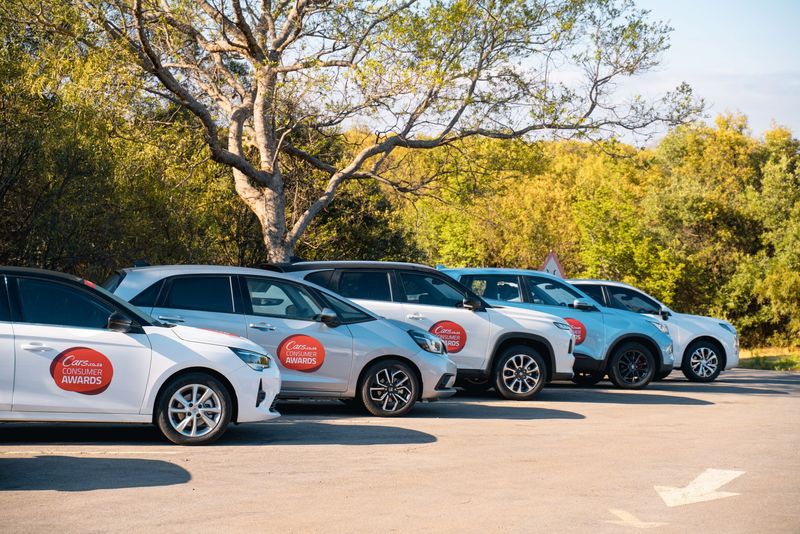
All 39 finalist vehicles were compared back-to-back at the Gerotek proving grounds in November 2023.
By winning the Brand of the Year consecutively, Toyota now leads the total #CarsAwards Brand of the Year wins tally with 4 trophies, followed by Suzuki (2) and Volkswagen (1).
About the 2023/24 Cars.co.za Consumer Awards
The winners of the 7th iteration of the Cars.co.za Consumer Awards – newly sponsored by Absa and endorsed by the National Association of Automobile Manufacturers of South Africa (Naamsa) – were revealed at a black-tie gala in Sandton City Mall on 29 February 2024. The glamorous event was attended by hundreds of guests, hosted by comedian Nik Rabinowitz and radio personality (and former #CarsAwards guest judge) Khutso Theledi and featured entertainment by the Ndlovu Youth Choir.
The glamorous 2023/24 #CarsAwards gala was hosted at Sandton City Mall Rooftop 8.
The Cars.co.za Consumer Awards (now widely known as the #CarsAwards) was established in 2015 to be South Africa’s definitive automotive awards programme – it plays a pivotal role in the company’s mission to help consumers make the best-informed purchasing decisions.
Cars.co.za Managing Director Amasi Mwela announced the return of the #CarsAwards programme, which was paused in 2021, last year. As before, vehicles would be judged against their peers in distinct categories, of which each had its own requirements. What’s more, 50% of the final scores would be based on brand-specific data incorporating direct feedback from South African car owners.
Cars.co.za managing director Amasi Mwela, who resumed the Cars.co.za Consumer Awards in 2023.
“The #CarsAwards underlines our commitment to helping our users understand the best way to spend their hard-earned Rands when purchasing new vehicles,” says Mwela. “As new-car prices escalate, it emphasises the need to make educated and informed buying decisions.”
The rejuvenated seventh #CarsAwards has turned out to be the most elaborate iteration of the programme. Not only did it attract sponsorship from leading bank Absa (a relationship that will take #CarsAwards into the future) – it attained significant gravitas by being officially endorsed by the Naamsa, which has represented, and advanced the cause of, the local motor industry for approximately 89 years.
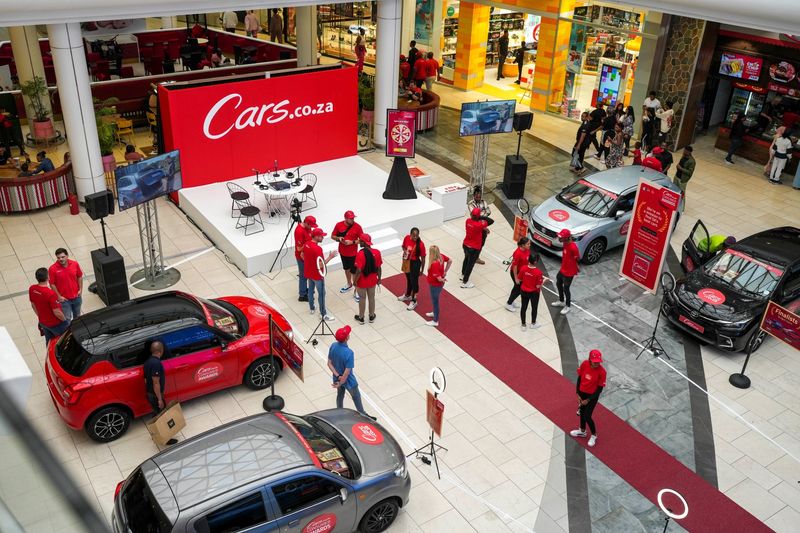
The 2023/24 #CarsAwards incorporated public experiences in the forms of the Mall of Africa and Sandton City roadshows.
“The Cars.co.za Consumer Awards, sponsored by Absa and galvanised by the endorsement from Naamsa, allows Cars.co.za to take a leadership position in our industry,” Mwela adds.
“Partnering with theCars.co.za Consumer Awards strongly resonates with our objective of endorsing innovative initiatives that bridge the gap between consumers, trusted dealers and manufacturers,” says Charl Potgieter, Managing Executive of Absa Vehicle and Asset Finance.
An electric car (the BMW iX) defeated its ICE rivals in the Premium SUV category of the 2023/24 #CarsAwards.
“This highly respected awards programme is not just about celebrating the automotive industry’s finest, it’s about strengthening the dynamic space in which the industry operates,” he adds.
“We continue to work very closely with all our partners to take the South African automotive industry to greater heights,” says Naamsa chief executive officer Mikel Mabasa.
Naama chief executive officer Mikel Mabasa addresses the audience at the 2023/24 #CarsAwards gala.
“Business leaders and organisations involved in the motor industry can play a progressive role in turning the negative sentiment in the automotive market into positivity. (Naamsa believes that) the #CarsAwards represents a number of things that should be going right in the country.
“Naamsa is now associating itself with products, brands and partners that can help to bring this ‘mood’ back up because that’s what South Africa needs. South Africans are exhausted from hearing negativity and I think Cars.co.za can play a very important role in lifting that mood.”
The multi-faceted judging process
The 2023/24 CarsAwards was adjudged by a panel of 20 judges from the motoring media and various fields of expertise.
The Cars.co.za Consumer Awards, sponsored by Absa utilises a unique scoring system that involves extensive testing by a panel of 20 judges, inputs from vehicle owners (based on their product quality-, reliability- and after-sales experiences of vehicles serviced through franchised outlets and less than four years old), as well as extra data provided by Lightstone Consumer.
Cars.co.za’s extended editorial team chose the 39 finalist vehicles, which included model derivatives from no fewer than 18 brands, out of a list of 65 semi-finalists. To be eligible for the #CarsAwards, vehicles had to be available on the new-vehicle market on 1 September 2023.
#CarsAwards judge Rebaneilwe Semakane.
The combined judging panel (including 14 respected guest judges from various fields of expertise) compiled the finalist vehicles’ scores after they evaluated the cars back-to-back during an intensive two-day test at the Gerotek testing facility on 2 and 3 November 2023.
However, the judges’ scores for the 39 finalists only counted 50% of the final standings, The other 50% was based on rankings that the respective vehicle brands represented by the finalists achieved in the Cars.co.za Ownership Satisfaction Survey.
#CarsAwards judge Bongani from MrHowMuch tests the Volkswagen Amarok at Gerotek.
How the Brand of the Year title was decided
As opposed to the category winners, the recipient of the 2023/24 Cars.co.za Consumer Awards Brand of the Year title was determined solely by market data, as well as the findings of the Cars.co.za Ownership Satisfaction Survey (brands’ sales and after-sales service ratings are particularly impactful, as are the percentages of purchase-price value the brands’ finalists retained after three years of ownership).
Toyota South Africa Motors has now won the #CarsAwards Brand of the Year title 4 times!
Although Toyota failed to win a category during the first two iterations of the #CarsAwards, the Prospecton-based manufacturer won the programme’s first Brand of the Year title in 2015/16 and 2018/19. Then, having finished well behind Volkswagen in 2019/20, South Africa’s top-selling new-vehicle brand rallied back to win the Brand of the Year title in 2020/21 and this year – 2023/24. The trophy was presented to Toyota SA Motors by Naamsa Chief Executive Officer Mikel Mabasa.
Toyota and its Lexus premium sub-brand achieved a score of 88.3%, which was a significant 9.2% ahead of the 2016/17 and 2017/18 Brand of the Year winner Suzuki, which finished in second place with 79.1%. BMW and its sister brand Mini finished third with 78.2%.
2023/24 Performace Car category winner Toyota GR Yaris proved its mettle at Gerotek.
“The Brand of the Year trophy is the ultimate accolade in the local automotive industry and represents validation from the people who matter most: car owners,” says Cars.co.za Consumer Experience Manager Hannes Oosthuizen, who has led the #CarsAwards project since 2015.
“By providing consistently superior after-sales support through the most extensive dealer network in the country, Toyota has put South African consumers first and – based on the feedback by thousands of vehicle owners – they evidently appreciate that,” he adds.
The Consumer Awards Roadshow at Sandton City Mall
The 2023/24 Cars.co.za Consumer Awards, sponsored by Absa incorporates an all-new consumer experience element. Having hosted the inaugural Awards Roadshow at the Mall of Africa late in 2023, where consumers could view and experience all 39 of the finalist vehicles, as well as interact with car salespeople and various #CarsAwards judges, Cars.co.za and Absa will present another, more sophisticated roadshow at Sandton City Mall from 1 to 3 March 2024.
After the #CarsAwards gala, Cars.co.za and Absa will take over the Sandton City Mall for three days. The motoring public will again be welcome to inspect, experience and possibly test drive the 39 finalist vehicles (13 #CarsAwards winners and 26 runners up), engage with Cars.co.za advisers and dealers’ sales representatives, plus stand chances to win cool prizes. However, Absa will also host a lounge and pop-up bank so that buyers can purchase carsat the mall.
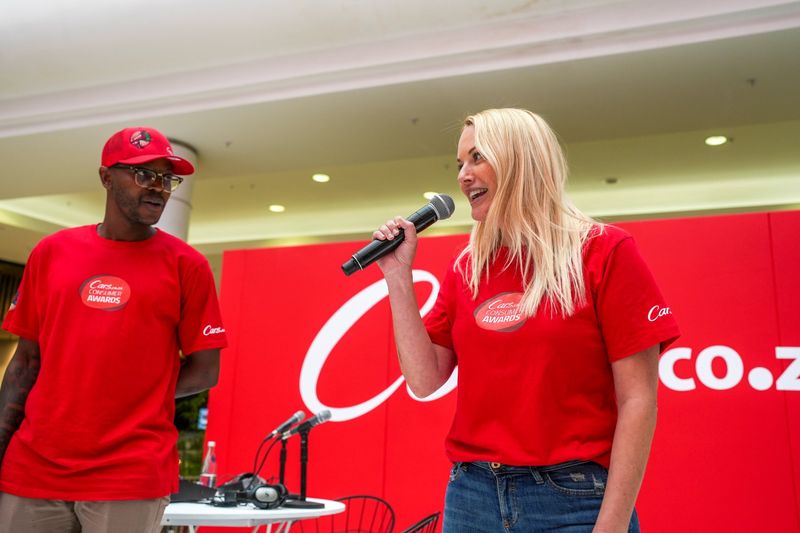
#CarsAwards judges MrHowMuch, Muzi Sambo, Rebaneilwe Semakane, Kumbi Mtshakazi, Juliet Maguire, Jacob Moshokoa and Ciro De Siena will be in attendance to interact with the public and, during the roadshow, Absa will award a grand prize of R500 000 to an eligible mall visitor – the winner will be able to spend that sum on buying a new or used car (Ts & Cs apply).
CarsAwards judges Jacob Moshokoa and Juliet McGuire will be at the Consumer Awards Roadshow at Sandton City Mall.
Ciro De Siena will help the winner make their decision and accompany them to one of Cars.co.za’s dealer partners, where they will be able to use the R500 000 to purchase the vehicle of their choice. Thereafter, the lucky winner will drive home in their new purchase!
Toyota’s ever-popular Fortuner finally met its match when the new Ford Everest was announced as the Adventure SUV category winner in the 2023/24 Cars.co.za Consumer Awards, sponsored by Absa.
The 2024 Best Adventure SUV needs to be the ultimate recreational vehicle with which to transport a family and all their holiday and lifestyle gear in comfort to almost any destination, on- and/or off-road. Off-road ability is emphasised, in combination with practicality, comfort and long-distance cruising.
The Adventure SUV category
This category is guided by both eligibility factors and pillars of success.
Eligibility factors for this category include a list price between R800 000 and R1 200 000 at the time of semi-finalist voting (September 1, 2023). Eligible vehicles must be equipped with an electronic stability programme (ESP), a minimum of 6 airbags, split-folding rear seats, all-wheel-drive capability (of course), as well as a minimum ground clearance of 200 mm.
Pillars of success for this category include performance, space & practicality, in-car entertainment, comfort and all-surface ability.
Best Adventure SUV: CarsAwards WINNER
Ford Everest 3.0 V6 Wildtrak
The 3rd-generation Ford Everest has brought new levels of space, comfort and technology to the bakkie-based 7-seater segment. With the most powerful engine in the segment, the 3.0-litre V6-powered Everest provides epic performance, both for driving and towing. The cabin is a plush place to be, providing luxury and comfort in abundance. All of this goodness comes at a steep price, however.
The Isuzu MU-X feels indestructible and could drive to any part of the planet (well, virtually). This new-generation model sees the introduction of new infotainment- and semi-autonomous safety technology, plus upgraded trim. The 3.0-litre turbodiesel engine may sound like it’s lumbering, but you get the feeling that the dogged MU-X is built to last. Inside, it offers impressive levels of comfort and cabin space.
Even though it’s the longest-serving finalist in this category, the Toyota Fortuner continues to be a top-selling Adventure SUV in Mzansi and it’s easy to understand why. It has an enviable reputation for build quality and reliability, backed by a substantial dealership footprint and excellent after-sales service.
The 2.8-litre 4-cylinder turbodiesel engine does a great job of balancing performance with economy, and the updated VX trim ensures several creature comforts, gadgets and gizmos are present and correct.
The winners of the 2023/24 Cars.co.za Consumer Awards, sponsored by Absa (as well as the recipient of the prestigious Brand of the Year title) were named on 29 February 2024.
If your new-car budget allows you to shop in the R250 000 to R350 000 segment, any of the 3 finalists in the Budget Hatch category of the 2023/24 Cars.co.za Consumer Awards, sponsored by Absa, should be on your shortlist. But Suzuki really knows how to build impressive, affordable cars and that’s why the Baleno took the top spot.
In these cash-strapped times, almost everyone is on a tight budget. Does buying an affordable new car therefore mean that you have to compromise on safety, technology and quality? No, not necessarily.
The 2024 Best Budget Hatch must represent “as much new car as you can get for your money”. Value for money is important, as are running costs and other “common sense” considerations.
The Budget Hatch category
This category is guided by both eligibility factors and pillars of success.
Eligibility factors for this category include a list price between R250 000 and R350 000 at the time of semi-finalist voting (September 1, 2023). What’s more, eligible vehicles in this category must have an anti-lock braking system (ABS), dual front (or more) airbags and a service plan.
Pillars of success for this category include fuel economy, value for money, practicality and brand strength.
Best Budget Hatch: CarsAwards WINNER
Suzuki Baleno 1.5 GLX
It’s a delight to find a spacious, well-thought-out and generously equipped budget hatchback that doesn’t cost a fortune to buy or own. Although it still utilises the underpinnings of its predecessor, the 2nd-gen Baleno remains one of very few “oversized” small hatchbacks that offer good rear legroom; it’s well-made, suitably comfortable, has a proven, fuel-frugal powertrain and is renowned for its reliability.
The latest iteration of the Renault Clio took its time to get to South Africa and while some suggest the B-segment hatch segment is no longer that relevant, the Clio (and the other finalists) represent great value. The Clio is powered by a small-yet-punchy turbopetrol engine, boasts a modern cabin and has all the “bells and whistles” considered essential at this price point. Luggage space is surprisingly generous too.
While it may be a clone of the Suzuki Baleno, the Starlet has a few tricks up its sleeve, such as Toyota’s renowned after-sales backup, a strong resale proposition and the support of the widest vehicle dealer network in Mzansi. The latest iteration of the model incorporates more obvious aesthetic differences to the Baleno, but the Toyota also impresses with its abundant cabin space, great engine and good value.
The winners of the 2023/24 Cars.co.za Consumer Awards, sponsored by Absa (as well as the recipient of the prestigious Brand of the Year title) were named on 29 February 2024.
Looking for a spacious, reasonably affordable hold-all for the family? Toyota’s locally-manufactured Corolla Cross is the 2024 Best Compact Family Car in the 2023/24 Cars.co.za Consumer Awards, sponsored by Absa. However, the 2 runners-up in this category are also well worth considering…
With household budgets stretched to breaking point, a reasonably affordable family car needs to wear many hats. The 2024 Compact Family Car has to excel at being a compact urban runabout, a sufficiently spacious school-run vehicle and, on occasion, a source of transport for weekend getaways.
Practicality and spaciousness are important considerations, but so are safety, technology, fuel efficiency and load-carrying flexibility.
The Compact Family category
This category is guided by both eligibility factors and pillars of success.
Eligibility factors include a list price between R400 000 to R500 000 at the time of semi-finalist voting (September 1, 2023), an anti-lock braking system (ABS) and electronic stability control (ESC), a minimum of 4 airbags, split-folding rear seats, air conditioning and a service plan.
Pillars of success for this category include powertrain flexibility, fuel economy, space and practicality, design and quality appeal, comfort and safety.
Best Compact Family Car: CarsAwards WINNER
Toyota Corolla Cross 1.8 XR
Toyota took its time to enter the small crossover market but now offers several models in that segment. The locally-assembled Corolla Cross is the crowning achievement in that line-up; by going the raised body route with the Corolla platform, the nameplate has captured a new audience. The Corolla Cross offers the best of Toyota: spaciousness and comfort, allied with excellent reliability, service and backup.
Haval has rapidly become one of the most popular brands in the South African new-vehicle market and the primary reason for the Chinese brand’s success is the Jolion, which ticks nearly all the boxes for a modern, connected, practical and resolved compact family car. At this price point, the Jolion comes with a long list of standard features, a cabin that feels upmarket, a 5-year warranty and a 5-year service plan.
The Renault Duster looks rugged and, fittingly, ready to take some of Mzansi’s less-than-well-maintained roads in its stride. It boasts commendable cabin space, a large load bay, and several in-car entertainment features. The ace in its deck is its turbodiesel motor, which offers excellent fuel economy to complement a pliant ride quality. What’s more, the raised ride height makes it quite capable of traversing gravel roads.
The winners of the 2023/24 Cars.co.za Consumer Awards, sponsored by Absa (as well as the recipient of the prestigious Brand of the Year title) were named on 29 February 2024.
Once one of the most important segments in the local market, the Compact Hatch has come under increasing pressure from affordable crossovers. However, the winner of this category of the 2023/24 Cars.co.za Consumer Awards, sponsored by Absa is the Volkswagen Polo, which hits back with increased sophistication and attractive design.
Cars in this segment appeal to a very wide audience – from young professionals to family-car buyers trading up from entry-level vehicles and pensioners buying down from something larger and expensive. The 2024 Best Compact Hatch has to be a well-balanced car and reflect what is best about modern automotive design and engineering, but present it in a distilled, reasonably affordable form.
The Compact Hatch category
This category is guided by both eligibility factors and pillars of success.
Eligibility factors for this category include a list price between R350 000 and R500 000 at the time of semi-finalist voting (September 1, 2023), an anti-lock braking system, a minimum of 4 airbags, aircon, USB support, Bluetooth connectivity and a service plan.
Pillars of success for this category include a balance of fuel economy and power/performance, value for money, practicality, brand strength, design and quality appeal, ride and handling and safety.
Best Compact Hatch: CarsAwards WINNER
Volkswagen Polo 1.0 TSI 85kW R-Line
The locally assembled Volkswagen Polo helped to establish South Africa’s compact car segment and remains a frontrunner – and benchmark – in the segment. The facelifted 6th-gen model is the biggest and most advanced Polo yet and comes with an array of engines suited to our market. We’d argue that it is the most modern-looking car in the segment too, but all of this excellence comes at a price premium.
Honda has followed an “if it ain’t broke, don’t fix it” approach with the latest iteration of its Jazz. Now called the Fit, the compact hatchback retains its cute city looks and incredibly practical setup, complete with those legendary “magic seats”. A 1.5-litre petrol engine offers adequate performance and fair economy, but it’s the only car here with a naturally aspirated powertrain, which may count against it in terms of performance, but on the other hand should prove incredibly reliable.
The Opel Corsa is a perennially underrated offering in this segment. The Russelsheim-based brand is now part of the Stellantis group (which includes Peugeot, Citroen, Fiat and other car brands) and the Corsa clearly benefits from Opel’s sister brands’ small-car nous. Its 1.2-litre 3-cylinder turbopetrol is one of the finest small engines around, the cabin looks and feels modern and the 5-year warranty is a plus.
The winners of the 2023/24 Cars.co.za Consumer Awards, sponsored by Absa (as well as the recipient of the prestigious Brand of the Year title) were named on 29 February 2024.
If you’re looking for a premium motoring experience, with all the luxury, performance and style in a compact shape, then any of the 3 finalists in the Premium Crossover category in the 2023/24 Cars.co.za Consumer Awards, sponsored by Absa, is worthy of consideration. In our view, however, the BMW X1 is the pick of the bunch.
These stylish vehicles offer a popular SUV look in a smaller, more city-friendly package. The 2024 Best Premium Crossover must attract attention with eye-catching looks, colours and a punchy powertrain. Individuality is the name of the game in this segment, where models’ interior and exterior looks can be tailored to buyers’ specific tastes, while still providing the most up-to-date in-car technologies.
The Premium Crossover category
This category is guided by both eligibility factors and pillars of success.
Eligibility factors for this category include a list price between R700 000 and R1 000 000 at the time of semi-finalist voting (September 1, 2023) to ensure exclusivity and status. To be eligible for this category, a model must be a crossover/small SUV in the mould of models such as the BMW X1, Volvo XC40 etc.
Pillars of success for this category include powertrain technology, driving dynamics, design and quality appeal, luxury and brand strength.
2024 Best Premium Crossover: CarsAwards WINNER
BMW X1 sDrive18d M Sport
The new BMW X1 feels a lot more substantial than the 2nd-generation model. Even though it’s still a city car first and foremost, the roomier U11 model has shaken off its predecessor’s “bland crossover” image; it presents as a small SUV endowed with the latest BMW infotainment, engines and technology. Its on-road manners are exceptional and the diesel engine perfectly balances performance and fuel economy.
RUNNER-UP: Audi Q3 Sportback 40TFSI quattro S Line
The Q3 is Audi South Africa’s best-selling model and it’s easy to understand why. The Ingolstadt-based brand’s premium compact crossover offers modern and upmarket exterior styling, a punchy turbopetrol engine, an all-wheel drivetrain, as well as a refined platform. Although its smart cabin feels minimalist, the 40TFSI quattro S Line is sufficiently specced at this price point.
In years to come, Volvo’s XC range may be remembered as some of the Swedish brand’s finest products. In the XC40 – the smallest of the trio of models – customers are treated to a compact, yet well-thought-out premium crossover. It has a beautifully finished cabin equipped with an innovative Google-powered infotainment system. The B4 mild-hybrid 2.0-litre turbopetrol engine delivers willing performance too.
The winners of the 2023/24 Cars.co.za Consumer Awards, sponsored by Absa (as well as the recipient of the prestigious Brand of the Year title) were named on 29 February 2024.
Shopping for an affordable car, but don’t want a traditional hatchback? There is plenty of competition in the Entry-Level Crossovers market, with new entrants announced almost every month! The winner in the Entry-Level Crossover category of the 2023/24 Cars.co.za Consumer Awards, sponsored by Absa, is the Suzuki Grand Vitara.
South African new-vehicle buyers now prefer crossovers over hatchbacks, sedans and MPVs. This category represents the entry point to SUV-inspired vehicles with a modicum of raised ride height.
Besides having additional body cladding and ground clearance (‘kerb-hopping capability’), the 2024 Best Entry-Level Crossover of the 2023/24 Cars.co.za Consumer Awards, sponsored by Absa needs to offer the best combination of practicality, spaciousness, safety, technology, fuel efficiency and flexibility.
The Entry-Level Crossover category
This category is guided by both eligibility factors and pillars of success.
Eligibility factors for this category include a list price between R300 000 and R400 000 at the time of semi-finalist voting (September 1, 2023), ABS, electronic stability control (ESC), a minimum of 4 airbags, split-folding rear seats, air conditioning and a service plan.
Pillars of success for this category include engine flexibility, fuel economy, space and practicality, comfort and safety.
2024 Best Entry-Level Crossover: CarsAwards WINNER
Suzuki Grand Vitara 1.5 GLX manual
Suzuki is renowned for offering great value for money at the budget end of the market. While some may feel that the Grand Vitara name was better suited to the last model that wore it (which had notable off-road ability), the 2023 Grand Vitara is undeniably a much more accomplished offering than its successor, the good – if rather basic – Vitara Brezza. It has a “bulletproof” engine that balances willing performance with admirable efficiency, a spacious cabin and, in GLX trim, comes generously specced with features.
Chery hopes to emulate fellow Chinese brand Haval’s rapid ascent up the new-vehicle sales charts and, based on the strengths of its Tiggo lineup and sales figures, it’s well on the way to doing that. The distinctively styled Tiggo 4 Pro comes well-appointed at the price, features a punchy 1.5-litre turbopetrol engine and quality materials abound in the cabin. The Chery is positioned as an affordable car, but it doesn’t feel like one.
When the Haval brand arrived in South Africa in 2017, it made an immediate impact with the feature-packed H2 compact family car and its successor – the Jolion – ticks even more boxes as a modern, connected, practical and well-thought-out entry-level crossover. The 1.5T Premium offers a plethora of features at the price, stands out in a segment known for cars that lack a bit of flair, and feels upmarket.
The winners of the 2023/24 Cars.co.za Consumer Awards, sponsored by Absa (as well as the recipient of the prestigious Brand of the Year title) were named on 29 February 2024.
The Family Car category is one of the most fiercely contested in the market. These vehicles are genuine all-rounders, offering not only spaciousness, but efficiency, luxury and performance in neatly-styled SUV bodies. While the Chinese brands have found favour in this segment, Kia claimed victory with its acclaimed Sportage.
A medium crossover or SUV, which we’ve categorised under “family car” ever since the #CarsAwards programme began in 2015, must perform a wide variety of duties; it needs to be a practical all-rounder. The 2024 Best Family Car should excel on the school run, but also be able to transport a family to a distant holiday location. In this category, interior flexibility, comfort and, of course, safety are paramount.
The Family Car category
This category is guided by both eligibility factors and pillars of success.
Eligibility factors for this category include a list price between R600 000 and R800 000 at the time of semi-finalist voting (September 1, 2023). The following features must be standard: ABS and electronic stability control (ESC), aircon, a minimum of 6 airbags, split-folding rear seats, as well as a service plan.
Pillars of success for this category include powertrain flexibility, fuel economy, space and practicality, design and quality appeal, comfort and safety and in-car entertainment.
2024 Best Family Car: The CarsAwards WINNER
Kia Sportage 1.6CRDi EX
The 5th-gen Kia Sportage burst onto the scene with bold and futuristic good looks, but under its shapely sheet metal you’ll find a well-packaged family SUV. Initially offered with petrol engines only, the Sportage range was bolstered by the addition of a turbodiesel powerplant, which promises excellent fuel economy. The EX grade includes most of the convenience features expected of a mid-spec derivative.
RUNNER-UP: Chery Tiggo 8 Pro Max 2.0TGDi 390 Executive
Chery recently enhanced the Tiggo 8 Pro Max, which was quite a compelling offering to begin with. The 2.0TGDi 390 Executive represents incredible value for money (considering it has a standard 7-year/90 000 km service plan) because, when it comes to features and comforts, it is comprehensively specced.
A 2.0-litre turbopetrol engine provides plenty of performance and it appears the Chinese carmaker has addressed some of the fuel-economy concerns. With its keen price point and 3rd row of seats, the latter of which is the exception to the rule in this popular segment, the Tiggo 8 Pro Max is a strong contender in this category.
The H6 is one of 2 models that have propelled Haval up SA’s new-vehicle sales charts. This is not a run-of-the-milll H6 derivative, however – it’s a self-charging petrol-electric hybrid. The 2.0-litre turbopetrol has been swopped for a 1.5-litre engine with an electric battery and motor. The result is a similar level of performance, but better fuel economy. Ultra Luxury trim includes a dazzling array of features and tech.
The winners of the 2023/24 Cars.co.za Consumer Awards, sponsored by Absa (as well as the recipient of the prestigious Brand of the Year title) were named on 29 February 2024.