New Mercedes-AMG GLC63 S E Performance Debuts With 4-Pot Power
The new Mercedes-AMG GLC63 S E Performance has been revealed (alongside the fresh GLC43), drawing its urge from an electrified 2.0-litre, 4-cylinder engine with 500 kW…
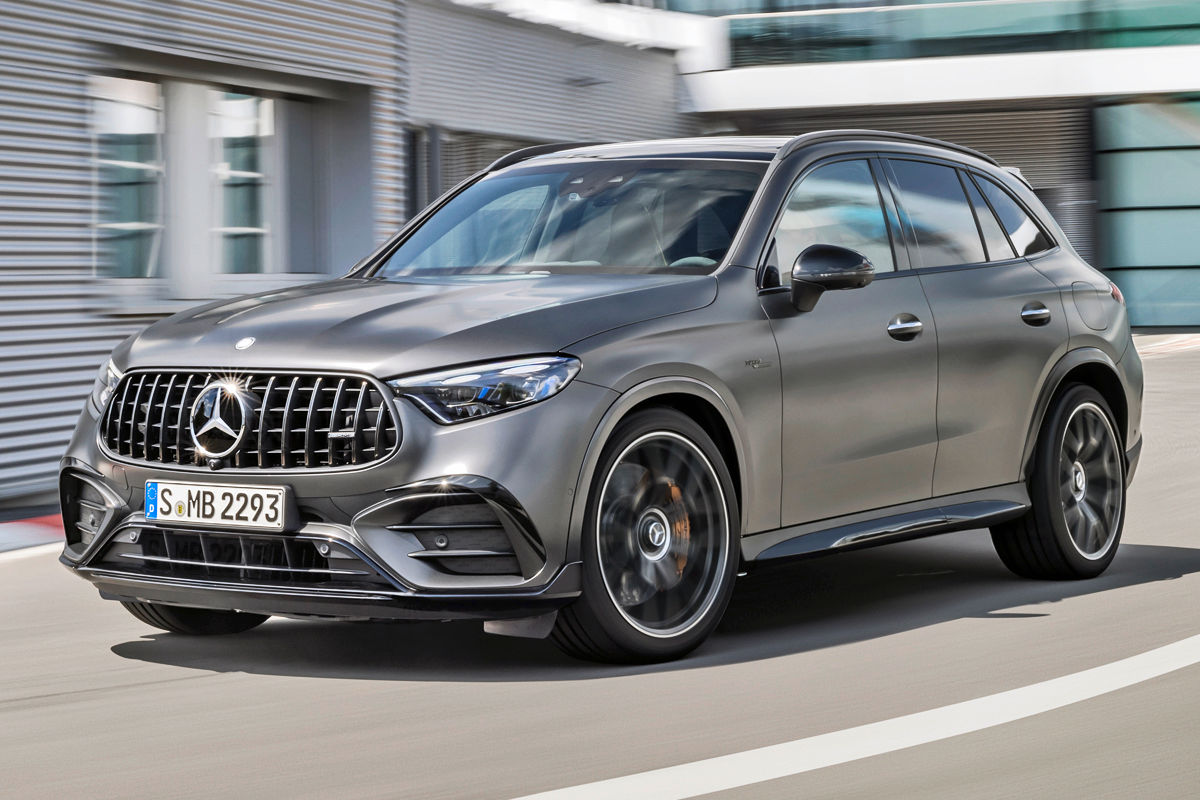
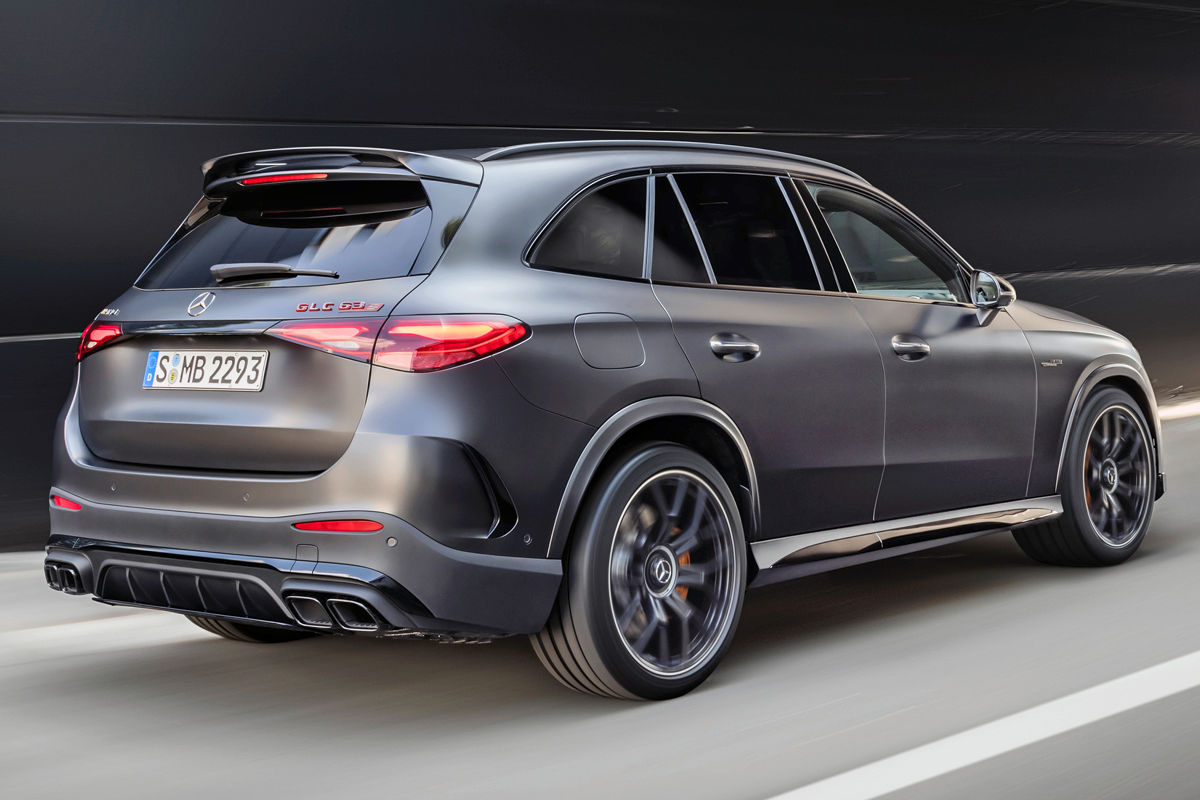
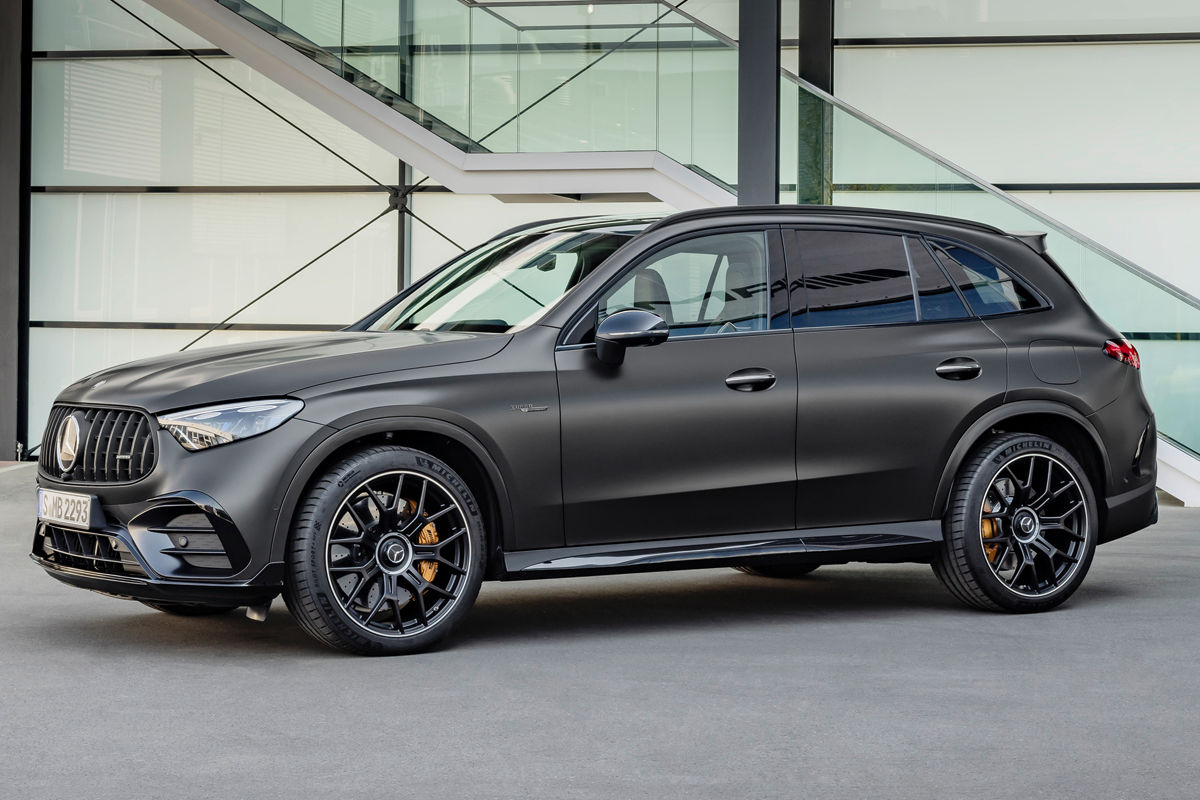
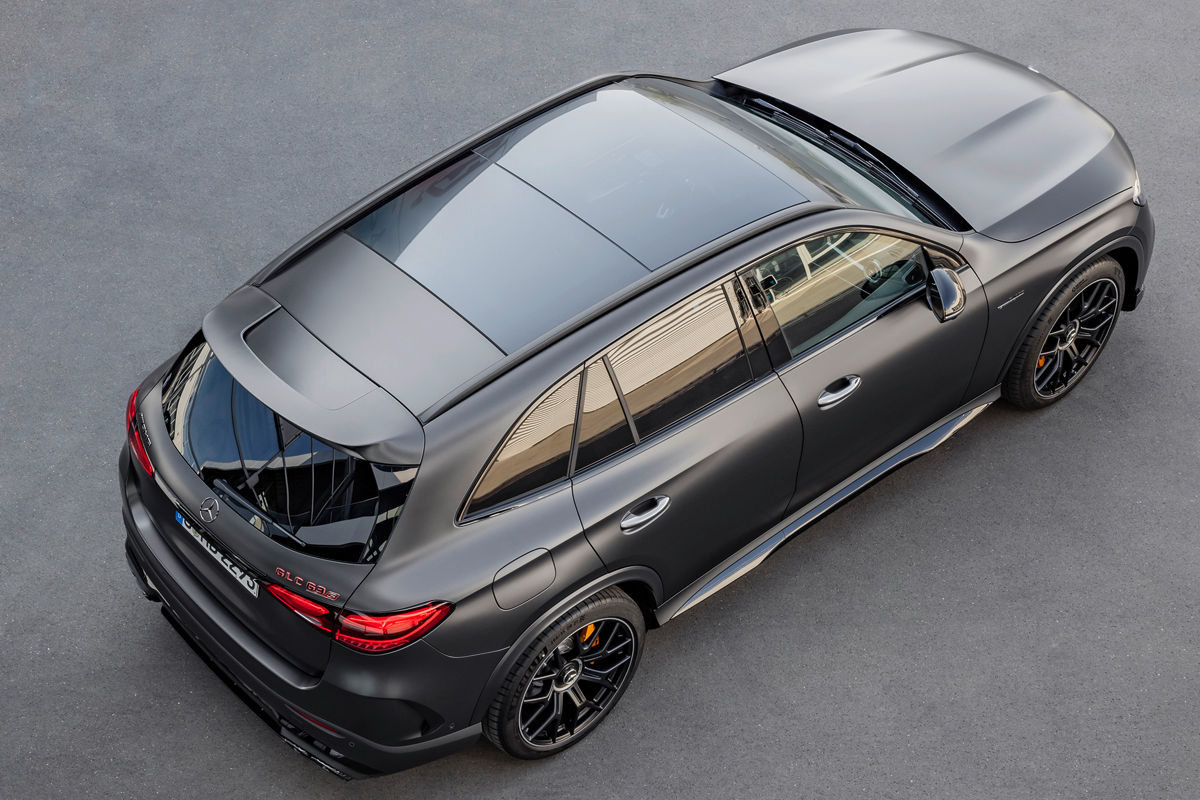
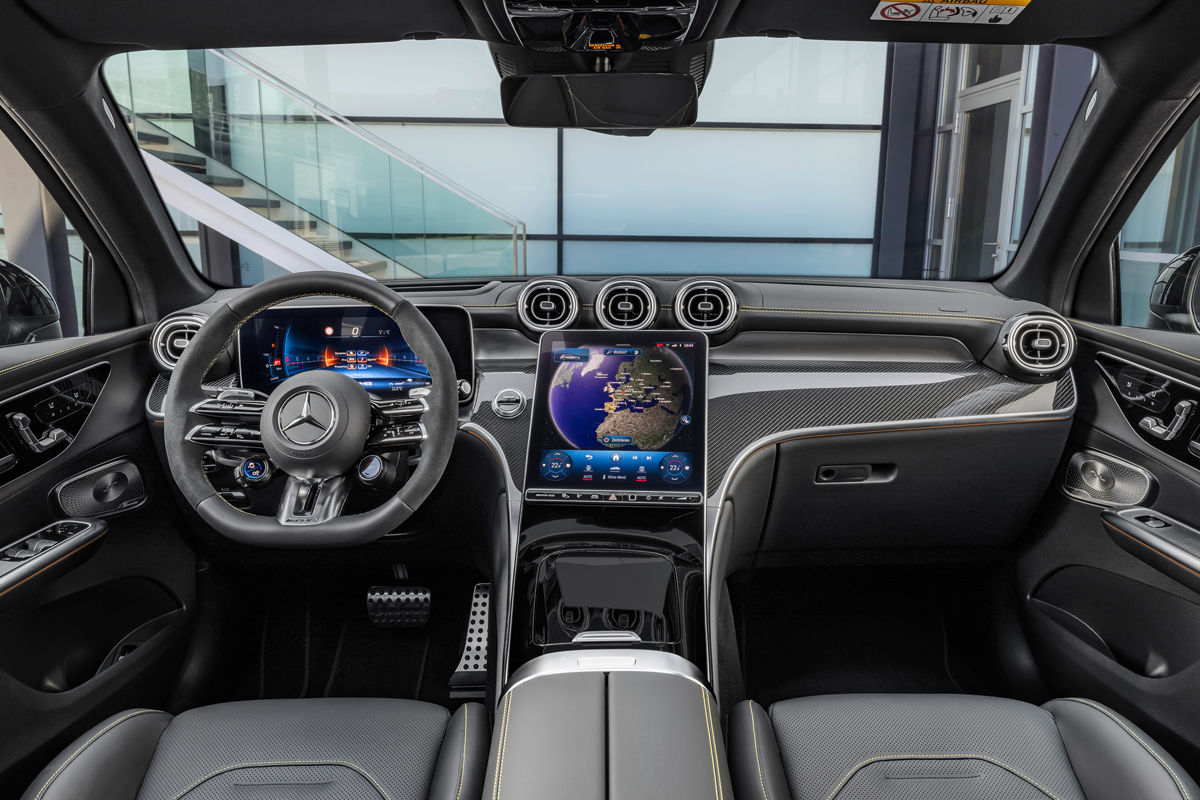
Meet the new Mercedes-AMG GLC63 S E Performance. Yes, just like the hottest version of the C-Class sedan, the apex GLC has ditched its twin-turbo V8 engine in favour of an electrified 2.0-litre, 4-cylinder mill. The GLC43, meanwhile, moves from a 6-cylinder motor to a 4-pot.
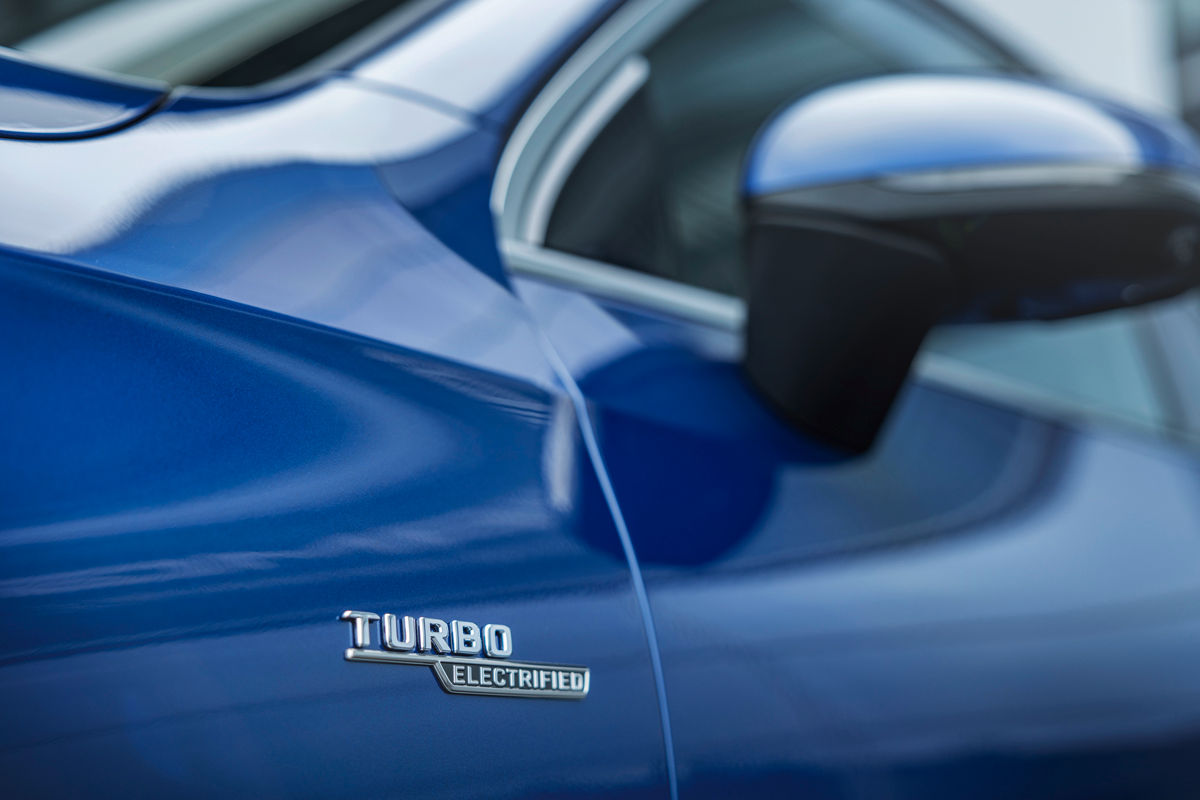
Arriving as the Stuttgart-based firm’s very first high-performance hybrid SUV, the GLC63 S E Performance combines a turbocharged 4-cylinder engine (known internally as M139l) with an electric drive unit (which offers an electric-only mode, with a claimed range of up to 12 km) positioned on the rear axle.
The combined system power output stands at a whopping 500 kW, while maximum torque comes in at 1020 Nm (compared with the old V8 version’s peak figures of 380 kW and 700 Nm). The petrol motor makes 350 kW (enough to earn it the title of the most powerful series-produced 4-cylinder engine in the world) and 545 Nm, while the permanently excited synchronous electric motor offers 150 kW.
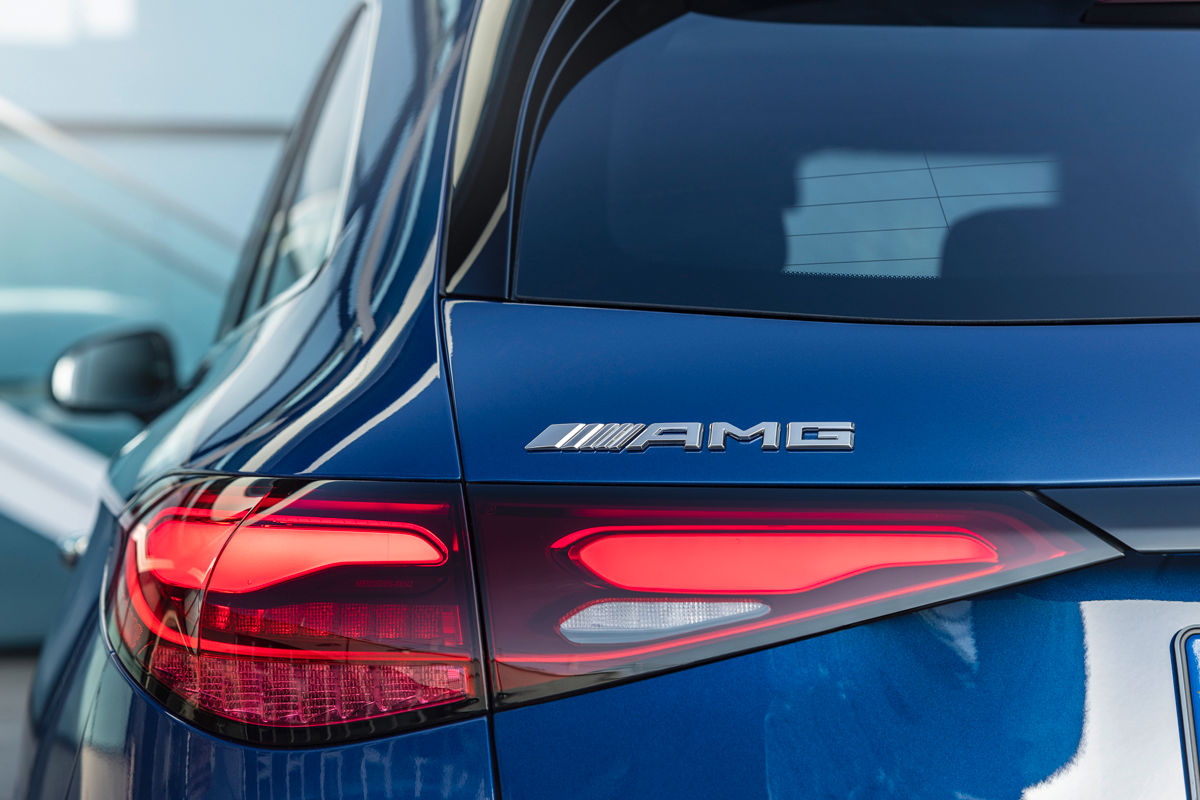
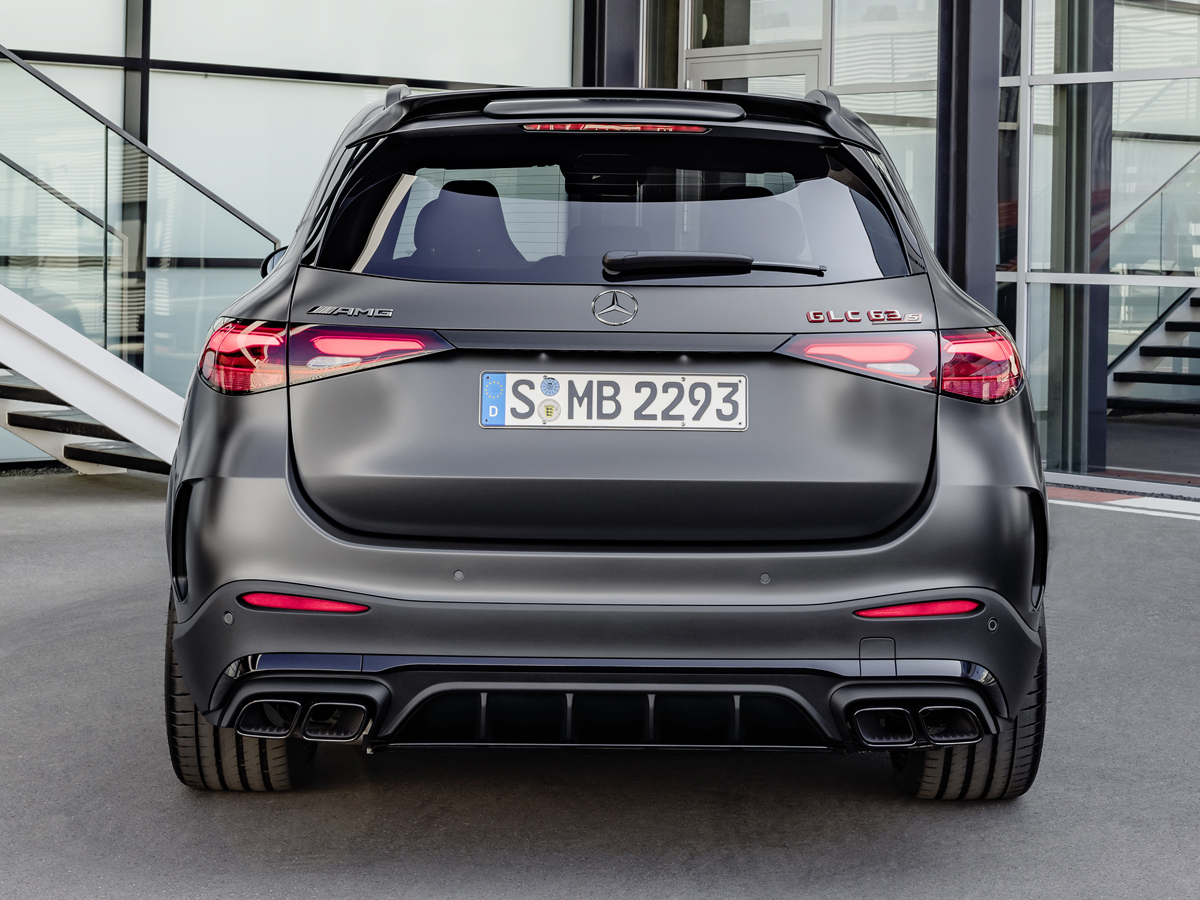
The GLC63 S E Performance features trapezoidal tailpipes, while the GLC43 employs round items.
According to the Affalterbach-based performance division, the plug-in hybrid GLC63 S E Performance will blast from 0-100 kph in a mere 3.5 seconds, with its top speed electronically governed to 275 kph.
And the battery? Well, Mercedes-AMG describes it as a “lightweight high-performance” unit which is located above the rear axle. The 400-volt battery offers a capacity of 6.1 kWh, continuous power of 80 kW and peak power of 150 kW for up to 10 seconds. Charging takes place via either energy recuperation or the 3.7 kW on-board charger (with alternating current). The German automaker makes a point of stressing the battery was designed for “fast power delivery and draw, not for the longest possible range”.
Power is directed to all 4 wheels via a 9G multi-clutch transmission, in which a wet start-off clutch replaces the torque converter. The 63-badged model features a fully variable all-wheel-drive system, which can allocate torque “continuously and as required” from 50:50 between the front and rear axles to up to 100% to the rear.
New Mercedes-AMG GLC43 makes 310 kW and 500 Nm
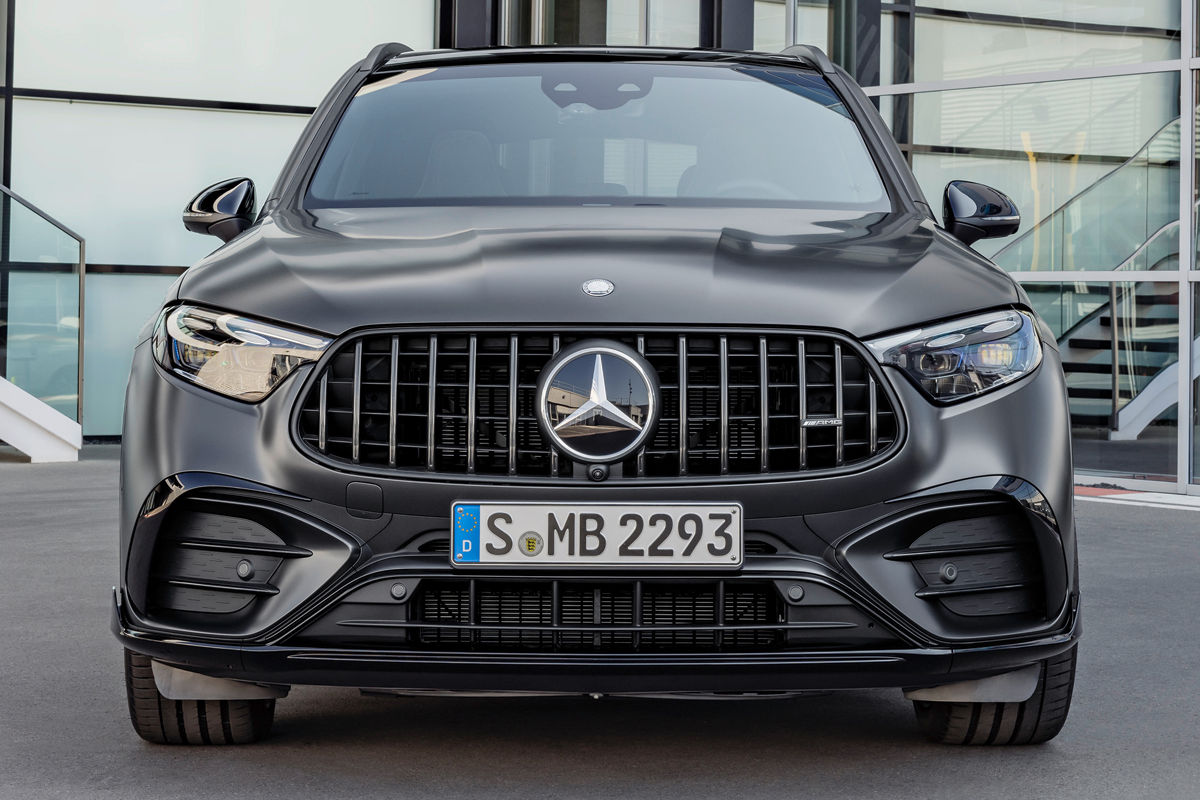
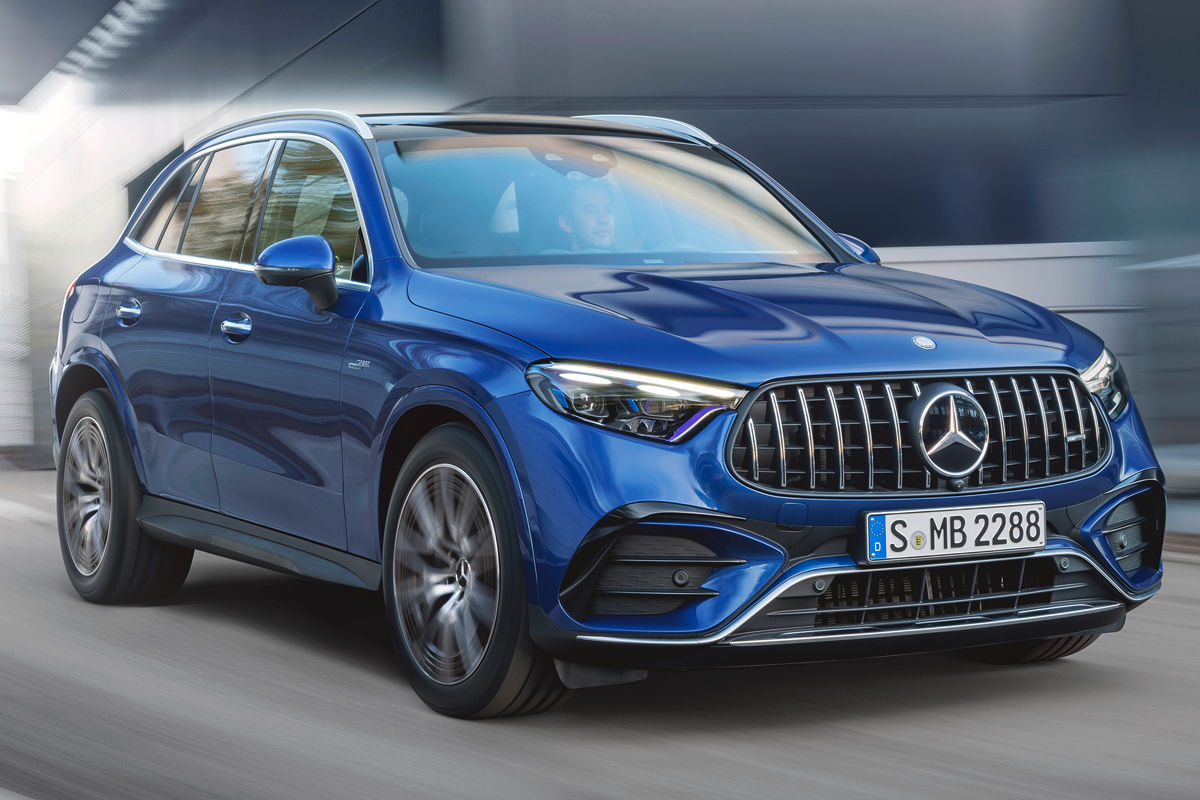
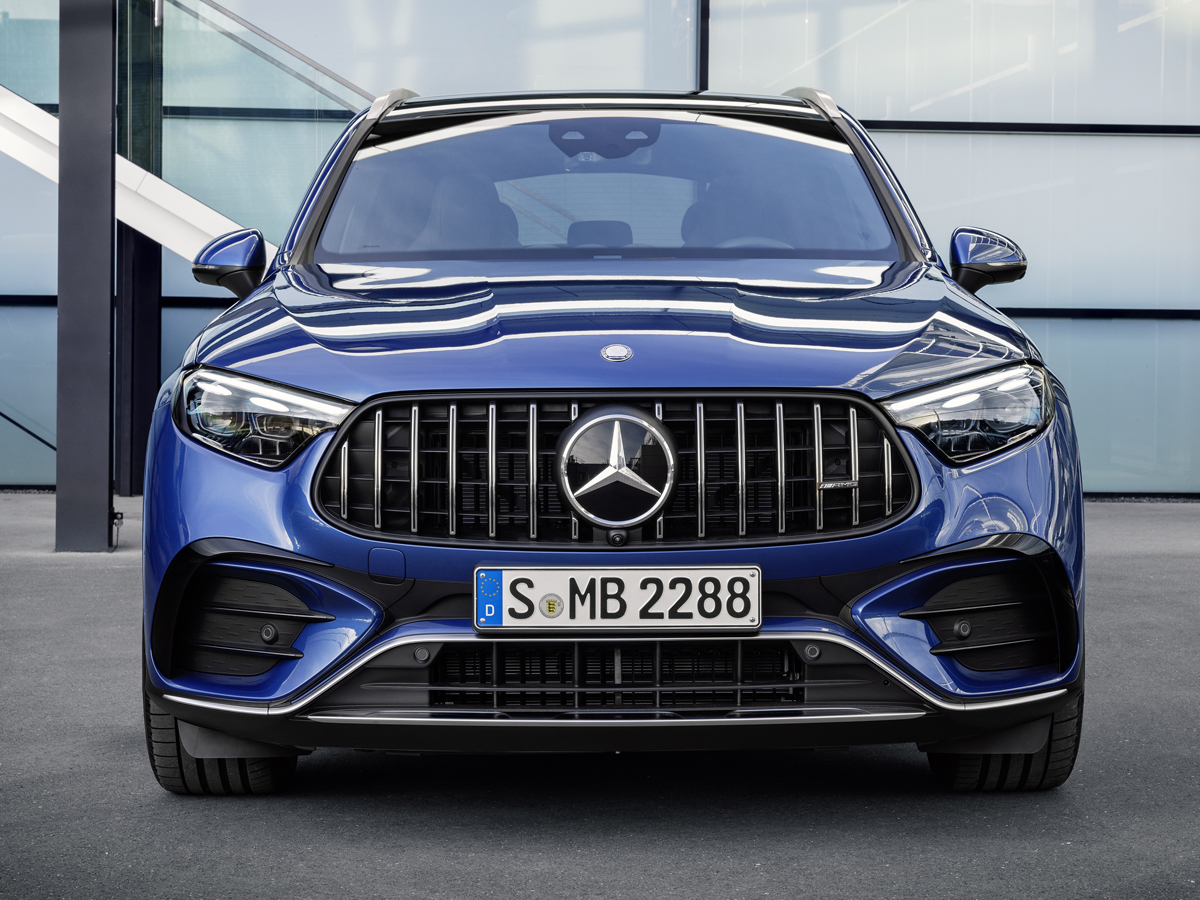
The GLC43 features the same AMG‑specific grille (with vertical struts) as the 63-badged model.
In the GLC43, the 2.0-litre, 4-cylinder engine – again with an electric exhaust gas turbocharger powered by a 48-volt on-board electrical system – produces 310 kW and 500 Nm (compared with 287 kW and a slightly higher 520 Nm from the old V6), and boasts an additional temporary boost of 10 kW via a belt-driven starter-generator.
Like its bigger brother, the 43-badged model employs a 9-speed transmission. According to the manufacturer, the GLC43 is capable of seeing off the 0-100 kph dash in 4.8 seconds, before hitting an electronically limited top speed of 250 kph. In the GLC43, the all-wheel-drive set-up features a permanent 31:69 power distribution between the front and rear axles.
Both the 43- and 63-badged models are equipped with Mercedes-Benz’s AMG Ride Control steel spring suspension with adaptive damping system as standard (though the GLC63 S E Performance furthermore scores the AMG Active Ride Control roll stabilisation set-up). There’s also a 3-stage speed-sensitive steering system as well as active rear-axle steering.
The AMG sports brake system in the GLC43 comprises internally ventilated and perforated discs measuring 370 x 36 mm with 4-piston fixed callipers at the front and 360 x 26 mm with single-piston floating callipers at the rear. In contrast, the GLC63 S E Performance gains 6-piston fixed callipers fore (with internally ventilated and perforated discs measuring 390 x 36 mm) and single-piston floating callipers aft (likewise internally ventilated and perforated discs, but measuring 370 x 26 mm).
Mercedes-Benz South Africa has yet to announce when the new AMG-badged GLC twins are scheduled to launch locally.
Kia has made good on its promise to add turbodiesel-powered derivatives to its Sportage line-up. We spent a couple of weeks behind the ‘wheel of the 1.6CRDi GT Line Plus to find out how good it really is. Should you choose it over its petrol siblings?
We like: Punchy yet frugal engine, comprehensive specification, superb fit and finish, bold design
We don’t like: Better value in the middle of the range, not the fastest off the line, but once it’s moving…
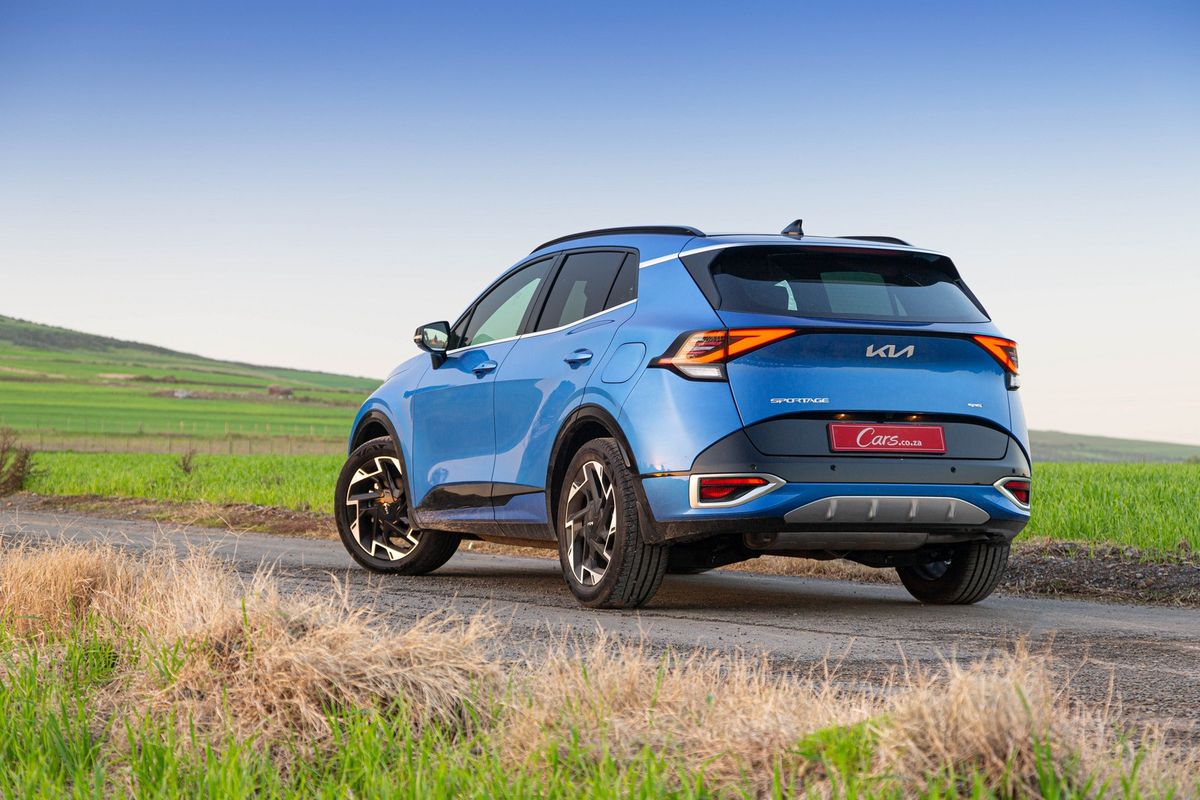
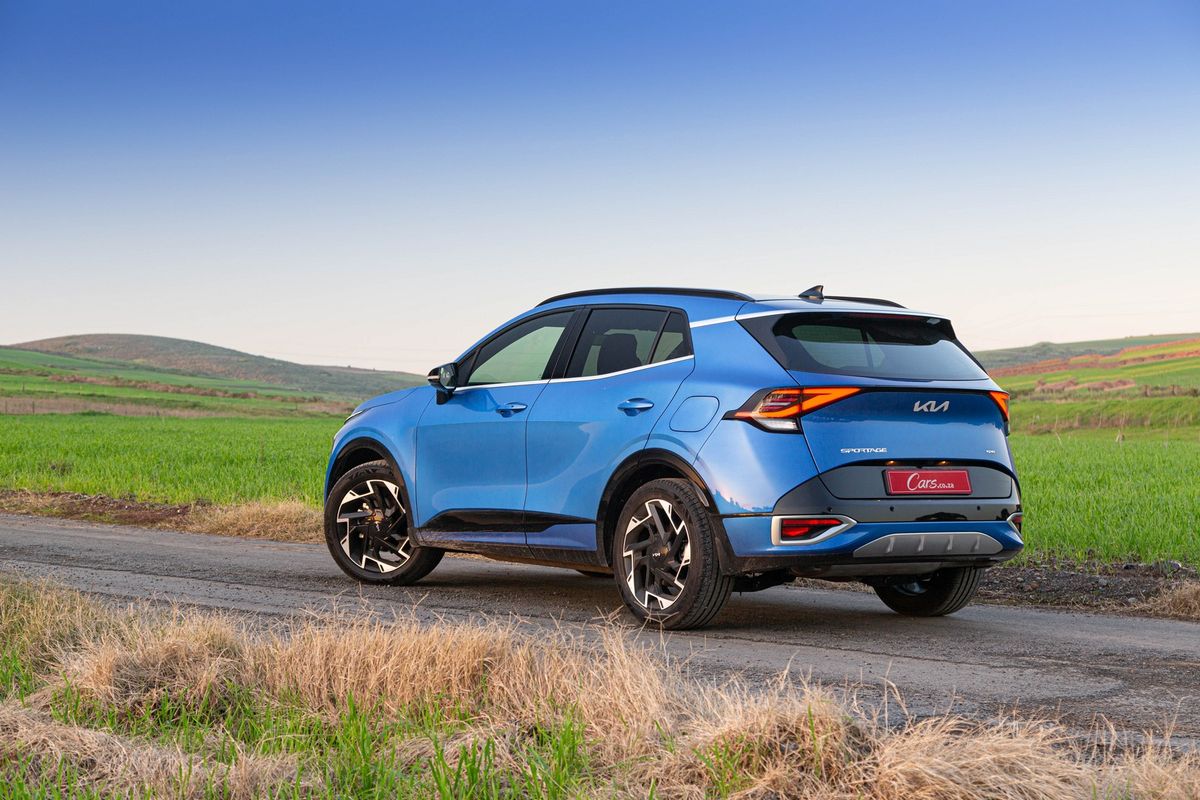
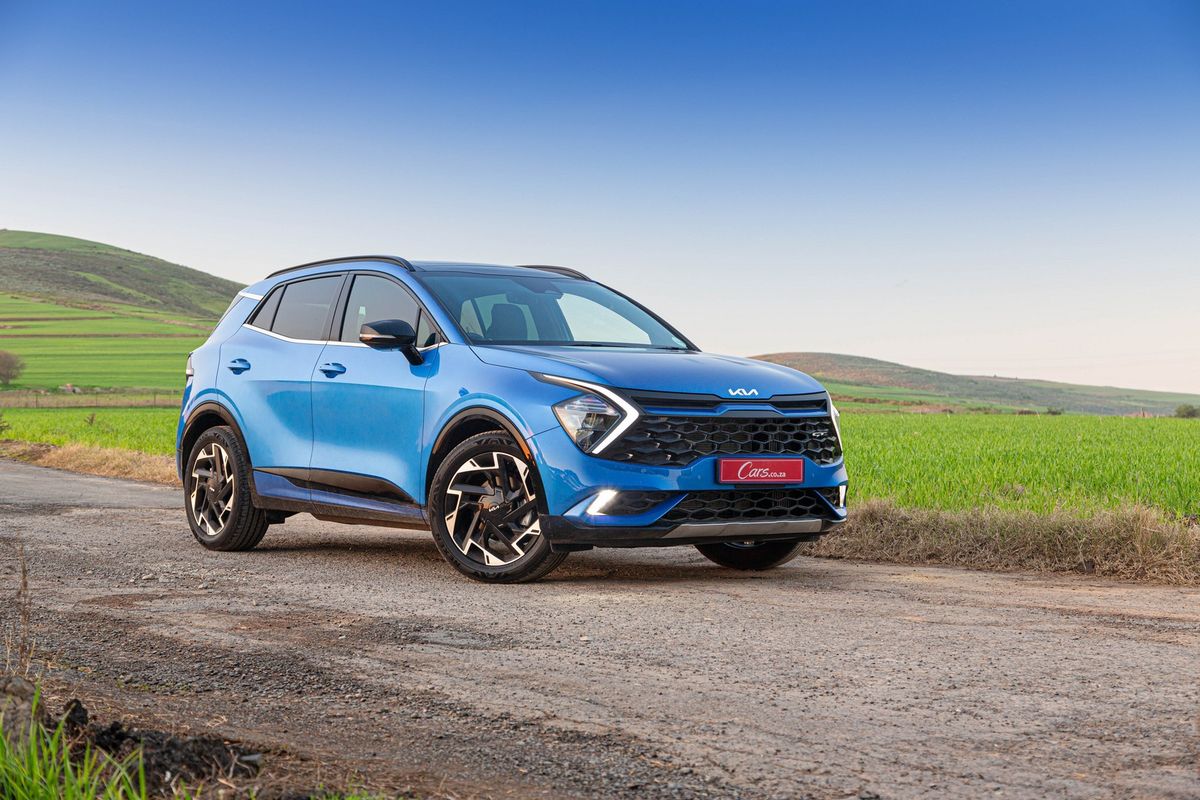
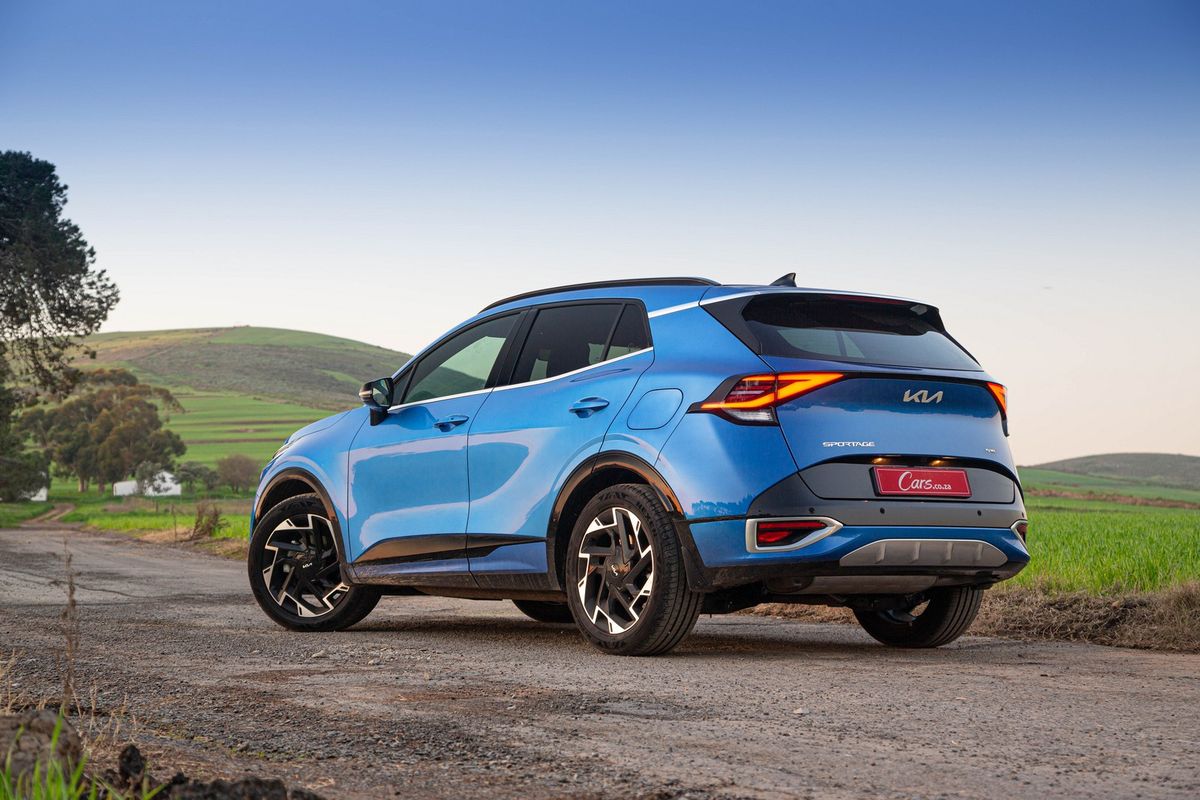
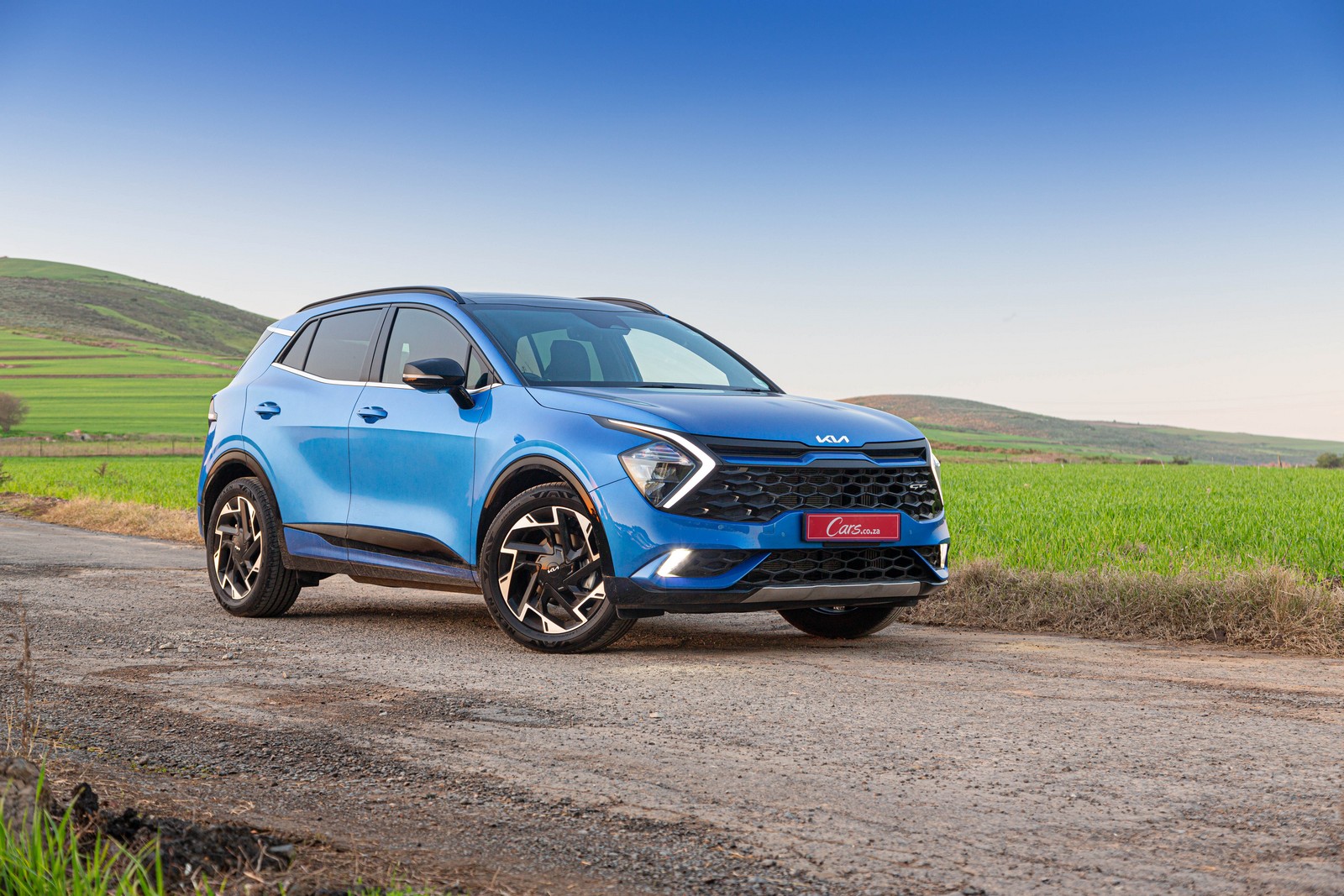
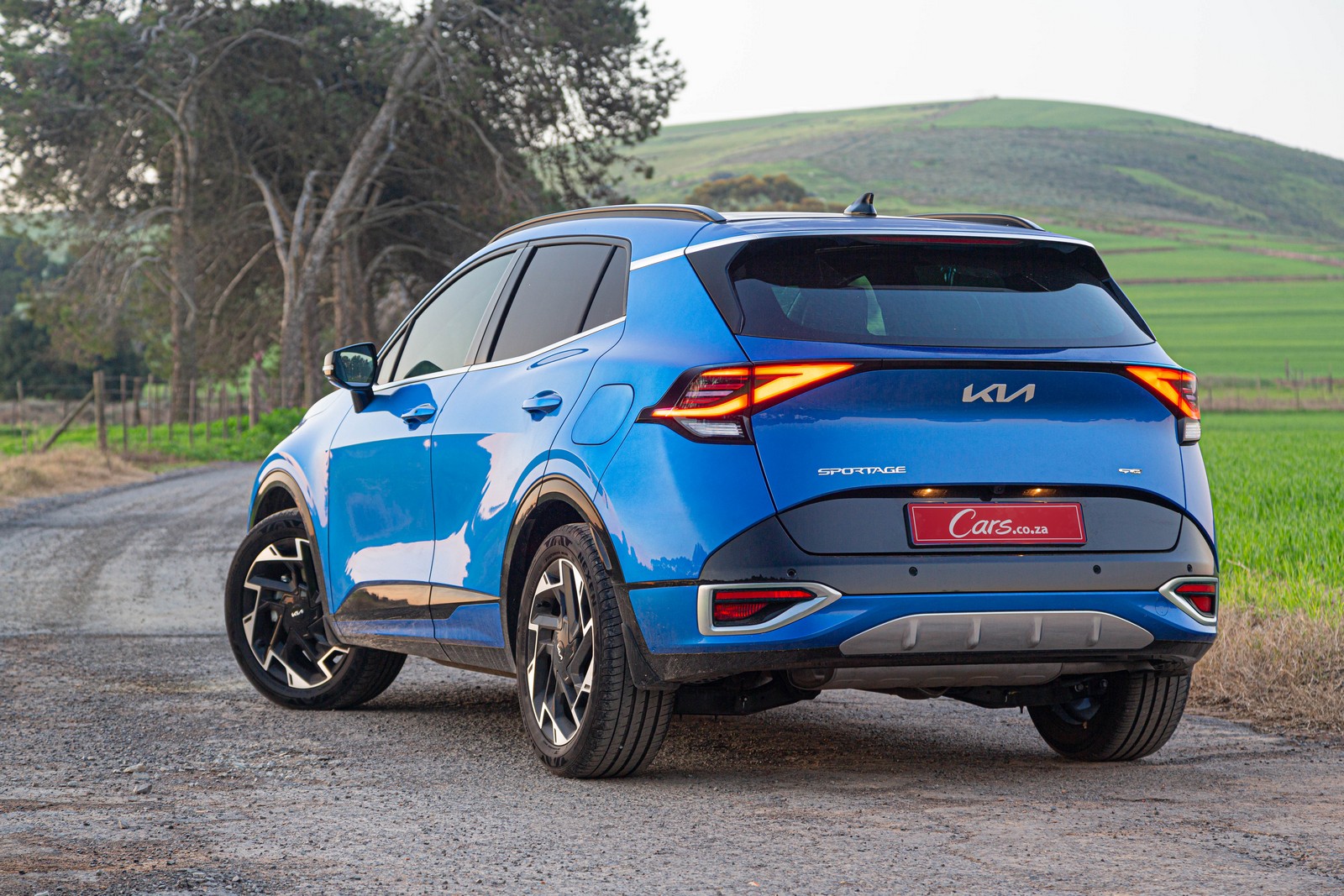
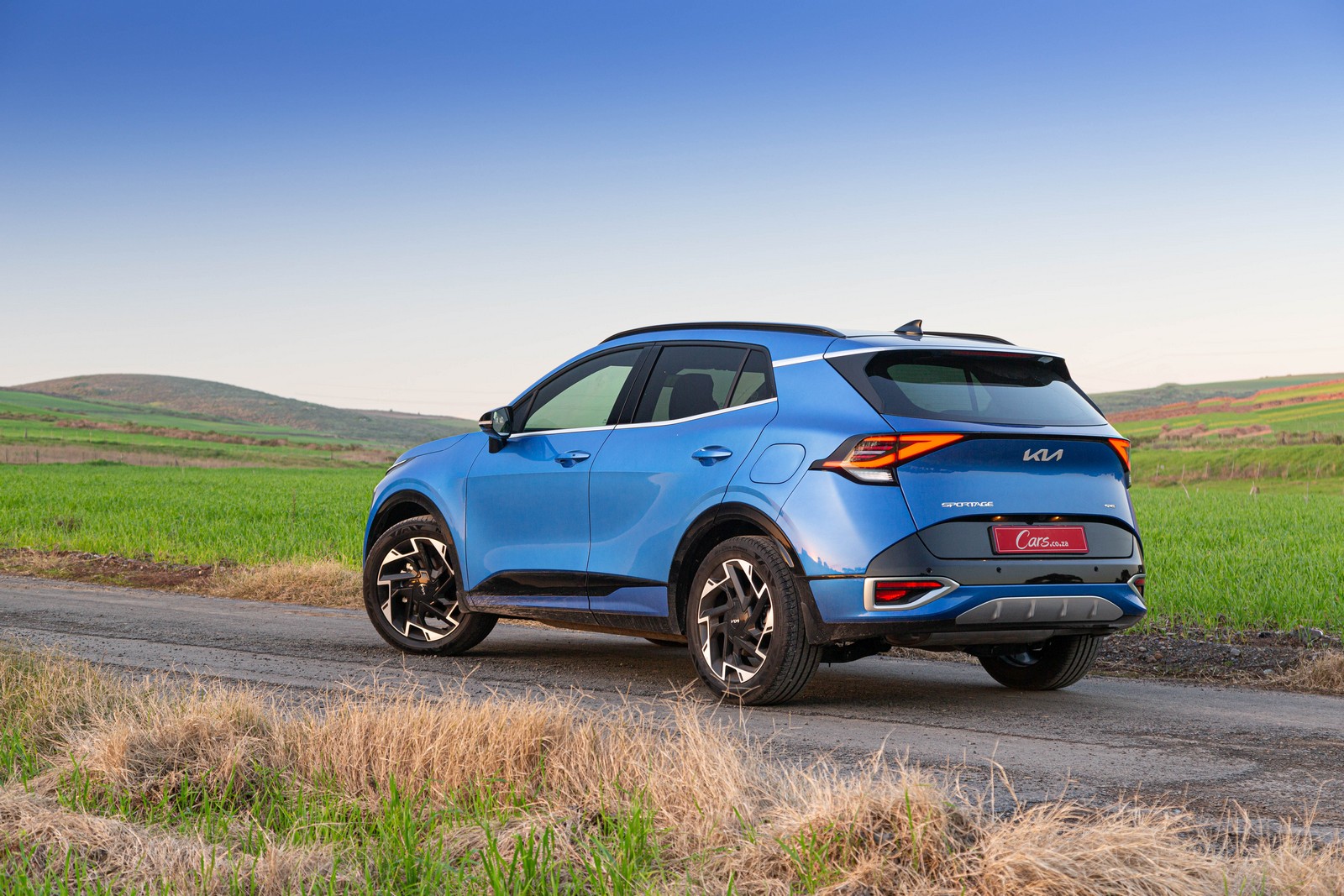
When clad in the right colour, the Kia Sportage is one of the most eye-catching medium SUVs in the new-vehicle market.
When the current (NQ5-gen) Sportage was launched in the local market in September 2022, it had an all-petrol-powered line-up, but Kia South Africa did not rule out the possibility that turbodiesel versions would be added later. Sure enough, a trio of 1.6CRDi Sportages arrived in May (when we drove one at the media launch), but we were keen to give a turbodiesel example a more thorough assessment…
As a reminder, the Sportage 1.6CRDi is powered by an older-gen 1.6-litre 4-cylinder turbodiesel motor, but we’re quite comfortable with the Korean brand reverting to technology that is proven in South African conditions. Remember the Kia Soul diesel? Its engine has made its way into the vehicle you see here.
Sadly, turbodiesel powerplants are no longer ubiquitous in passenger-car models; although they still feature in large SUVs (and commercial-vehicle-based models), most automotive brands are phasing them out of their product line-ups. In the medium SUV segment, the Hyundai offers a pair of 2.0D Tucsons, while Volkswagen and Mazda have all-wheel-drive turbodiesel Tiguan and CX-5 derivatives.
All in all, the Sportage range now comprises 8 derivatives (five 1.6-litre turbopetrols and three 1.6-litre turbodiesels) that are available in 3 trim levels – that is one of the most diverse line-ups in the class.
Subtle brushed light grey- and gloss black accents tastefully elevate the Sportage’s exterior appearance.
How the Kia Sportage Diesel fares in terms of…
Engine, performance and economy
With peak outputs of 100 kW and 320 Nm from the 1.6-litre 4-cylinder turbodiesel Smartstream engine, the Sportage 1.6CRDi GT Line Plus cannot match its turbopetrol siblings’ sprinting ability, but the oil-burner offers a higher torque output plus, in our experience (and, as expected) superior fuel economy.
Let’s let the numbers do the talking. When we had our test gear hooked up to the test unit, it sprinted from 0 to 100 kph in 10.37 seconds (quicker than the 11.4-sec claim) and consumed 6.6 L/100 km. While the indicated average consumption figure was some way off the claimed 4.9 L/100 km, we did often drive the Kia enthusiastically (when we weren’t spending a fair amount of time in bumper-to-bumper traffic).
Therefore, if you spend the majority of your commute in free-flowing freeway traffic – and employ a measured driving style as often as possible, a return of under 6 L/100 km is achievable. Given the Sportage’s 54-litre tank capacity, you could theoretically travel about 1 000 km between fill-ups.
Smart mode combines Eco and Sport drive modes. Note the 6.6-L/100 km consumption figure.
How do the test unit’s figures compare with those of the 1.6T-GDi GT Line S, which we reviewed late last year? Kia claims an 8.8-second 0-100 kph time and a 6.5 L/100 km average consumption figure for the turbopetrol derivative. Admittedly, we didn’t conduct a timed performance test of 1.6T-GDi GT Line S when we tested it, but it consumed 9.2 L/100 km during our fuel test. So, if you value eager off-the-line acceleration, favour the petrol option, but if long-term frugality is more important, diesel’s the way to go.
The powerplant under the bonnet is of an older vintage, so does it emit that characteristic diesel-engine clatter? Yes, when you stand outside the SUV while it’s idling, you can hear the clatter (especially after a cold start), but to the Kia’s credit, you can barely hear that noise in the cabin. That underscores just how refined the Sportage is; its interior is admirably insulated from road-, wind- and mechanical noise.
The 7-speed dual-clutch transmission is arguably the highlight of the powertrain.
The 1.6CRDi GT Line Plus’ middling outputs and 0-100-kph time don’t detract from its general driving experience either. During its tenure in our fleet, the Sportage never seemed to lack oomph; peak torque is only available between 2 000 and 2 250 rpm, but at least it is delivered smoothly (and low in the rev range), which endows the turbodiesel medium SUV with effortless overtaking performance – there is no need to fully depress the accelerator pedal. It’s impressive for a model that weighs just under 1.5 tonnes.
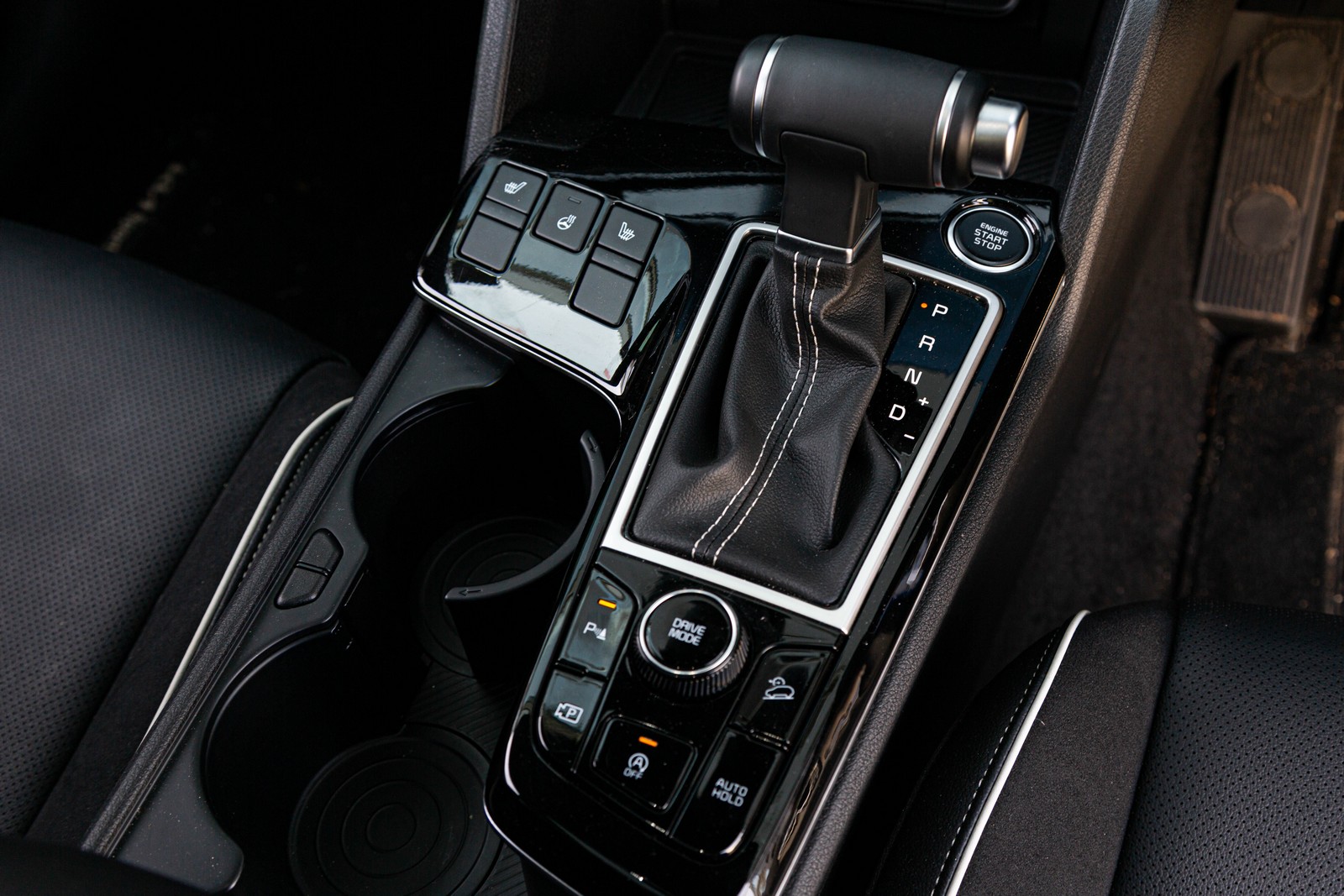
The 7-speed dual-clutch automatic transmission, which works harmoniously with the motor to deliver quick and slick gearshifts, is the powertrain’s secret weapon. There are shift paddles on the steering wheel (with which to actuate gear changes manually), but the auto’s shift mapping was so good – which speaks to excellent calibration – we felt no need to use them. There are 3 drive modes to choose from and, for the majority of the test, we utilised Smart, which combines the best elements of Eco and Sport.
Ride, handling and safety
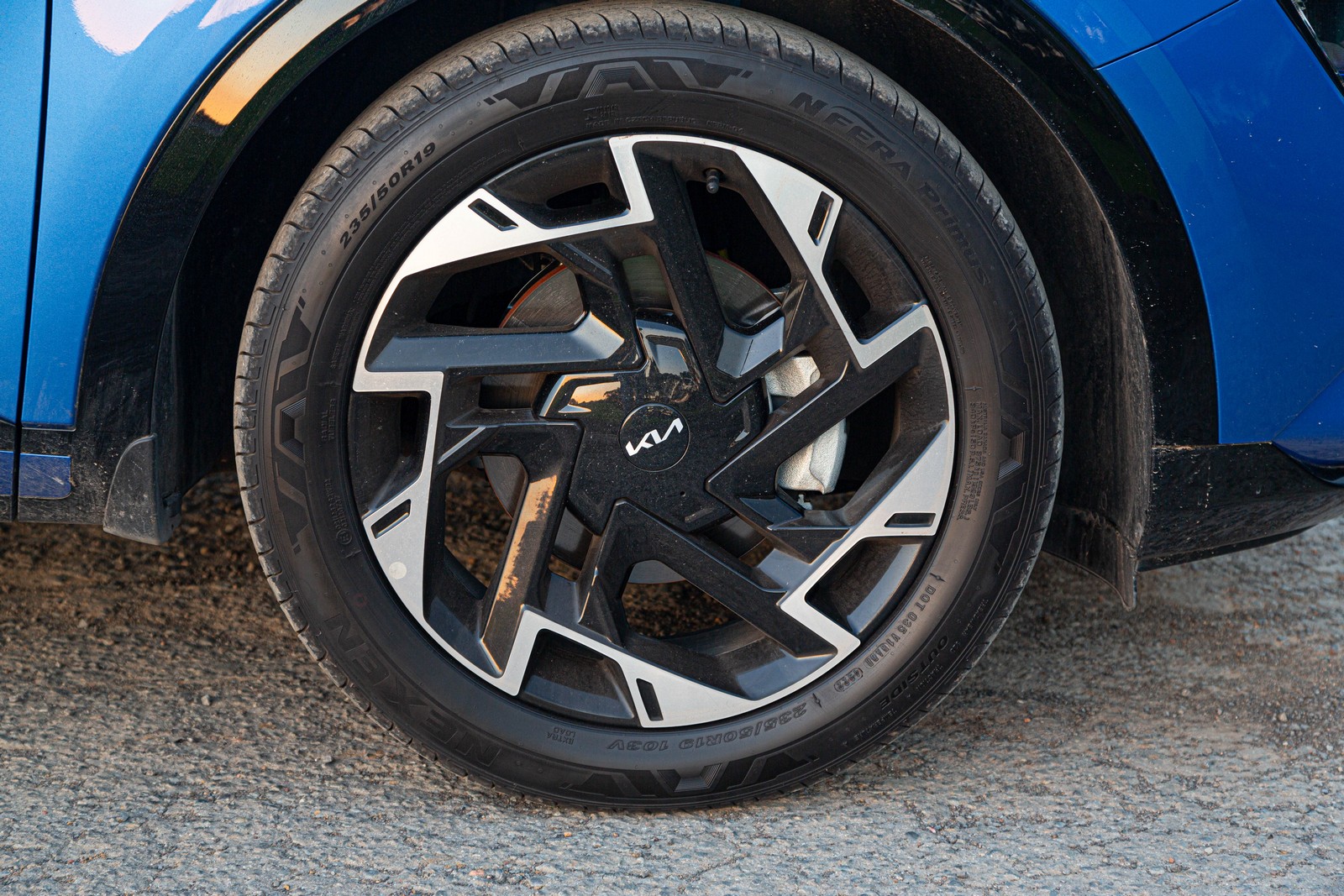
These 19-inch wheels really look the part and the plump tyres help to absorb minor dips and bumps in the road.
Seeing as the 1.6CRDi GT Line Plus has the highest trim level of the 3 turbodiesel Sportage derivatives, it rides on fetching 19-inch alloy wheels, whereas lesser versions have 17-inch (LX) and 18-inch rims (EX). The 19s look suitably sporty and, because they are wrapped in generously sidewalled 235/50 tyres, they don’t seem to diminish the test unit’s ride quality, which, although firm, is reasonably forgiving.
Meanwhile, this NQ5-generation Sportage’s road manners continue to impress. Medium SUVs tend to offer anodyne driving experiences, but the new Kia complements admirable ride comfort with a healthy dose of driver engagement, courtesy of a sweet steering setup that is quick, sharp and well-weighted.
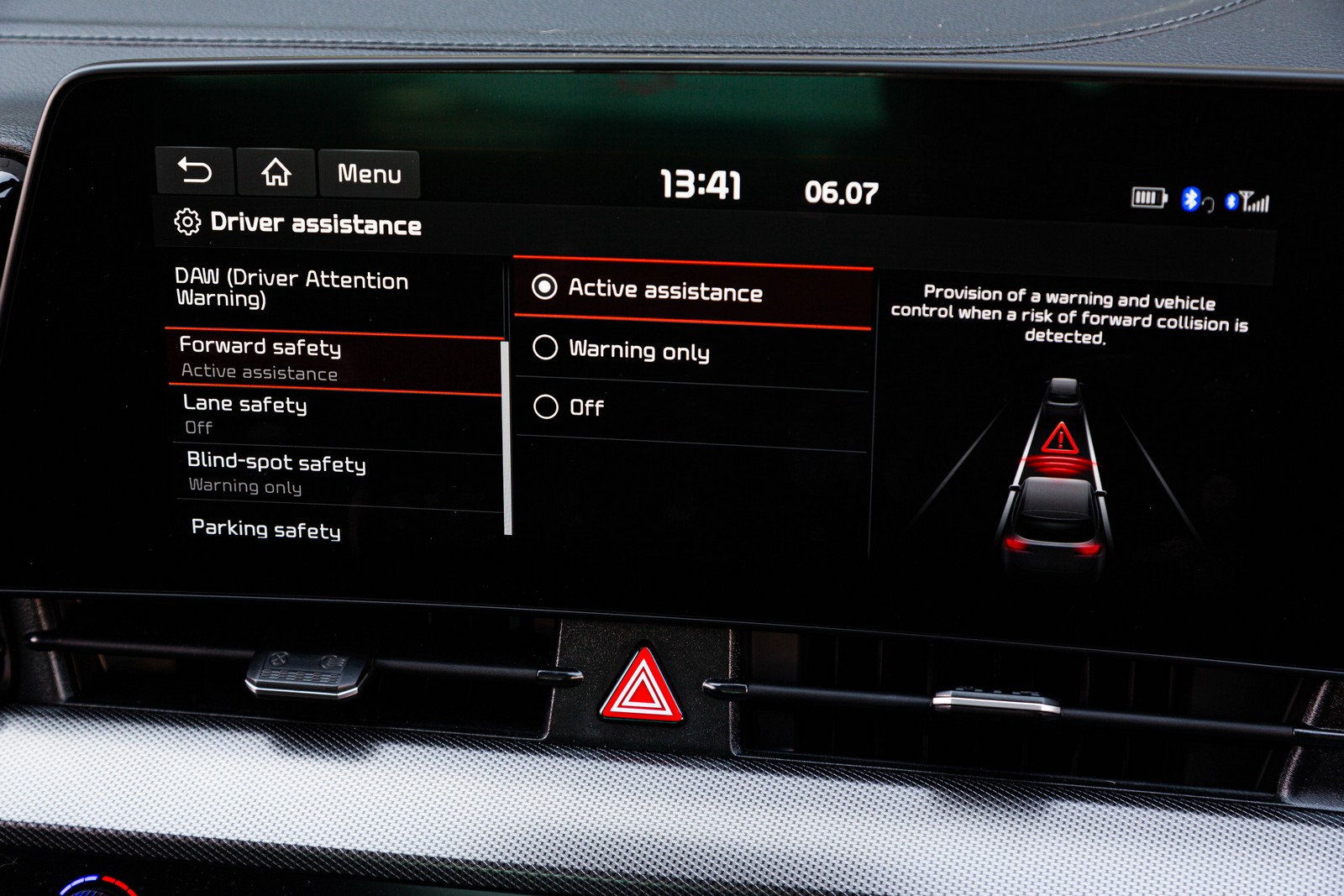
Auto emergency braking is a very helpful technology in congested city traffic.
In other words, when you traverse roads that inspire you to explore your vehicle’s handling dynamics, the Sportage is likely to be a joy to pilot; its suspension is pliant enough to soak up minor road imperfections, but that’s allied with reassuring handling and excellent body control. What’s more, we’d argue this is one of the most refined models in the segment in terms of in-car noise, vibration and harshness suppression.
As far as safety is concerned, all Sportage derivatives are fitted with 6 airbags, ABS with EBD, electronic stability control, blind-spot warning, hill-start assist and downhill brake control and trailer-stability assist. High-grade versions also feature various advanced driver-assistance systems (semi-autonomous tech).
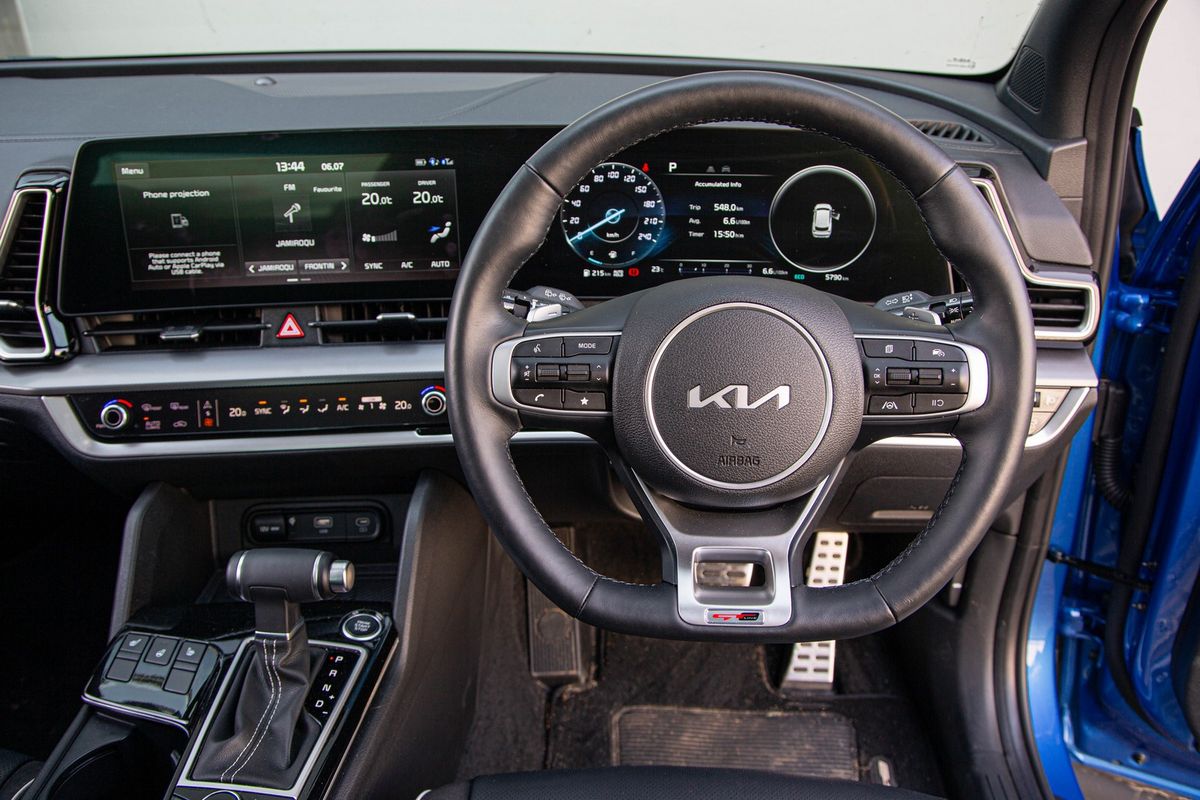
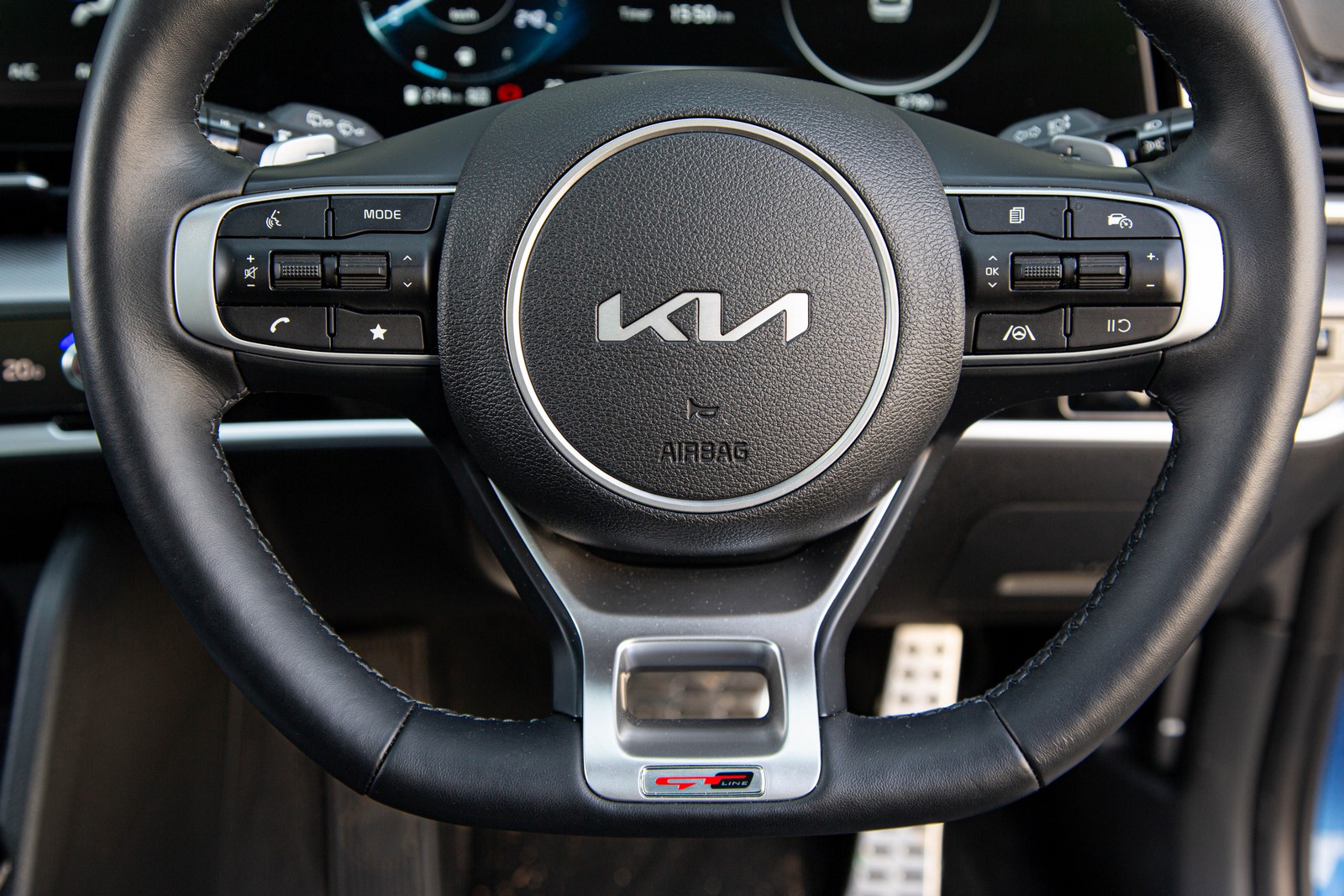
The sporty GT flat-bottomed wheel is a great touch
The 1.6CRDi GT Line Plus, for example, is additionally equipped with lane-keeping and -follow assist (they work in conjunction with blind-spot warning), as well as forward collision-avoidance assist (FCA). FCA will sound an alarm if the vehicle thinks a collision with a pedestrian, cyclist or a stopped vehicle is imminent, and if the driver doesn’t react quickly enough, the car will apply braking effort automatically.
Interior tech, features and space
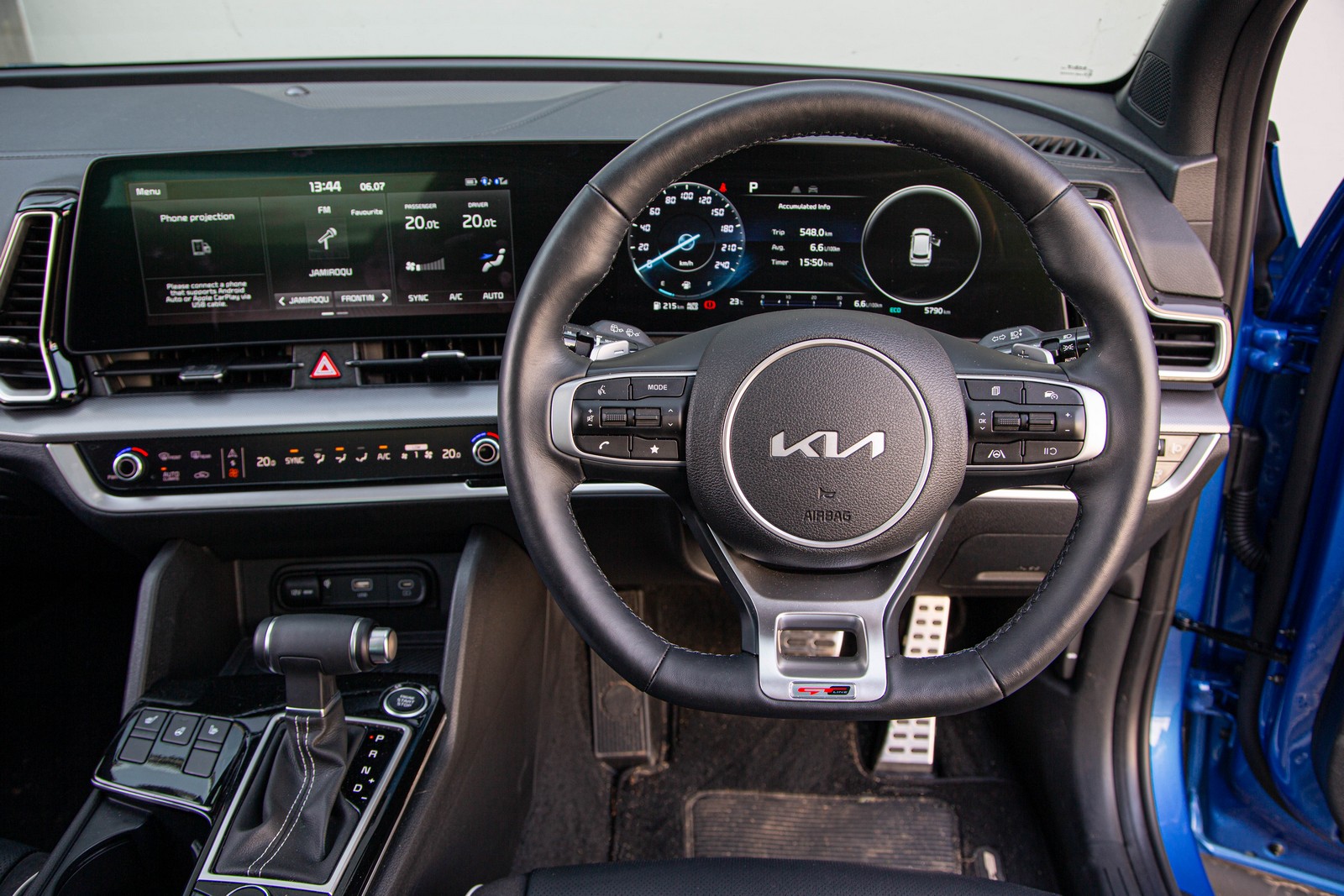
The NQ5-generation Sportage sports one of the more interesting-looking interiors in the segment.
When buyers are required to fork out R750k to purchase a medium SUV, they expect a comprehensive specification and the 1.6CRDi GT Line Plus fulfils that requirement. Whereas all new Sportage derivatives are equipped with smart entry with push-button start and a curved instrument cluster and infotainment screen combo, the test unit’s cabin stood out for its smart-looking GT steering wheel (equipped with metallic ‘shift paddles), LED interior lighting, alloy pedals and artificial leather suede combination trim.
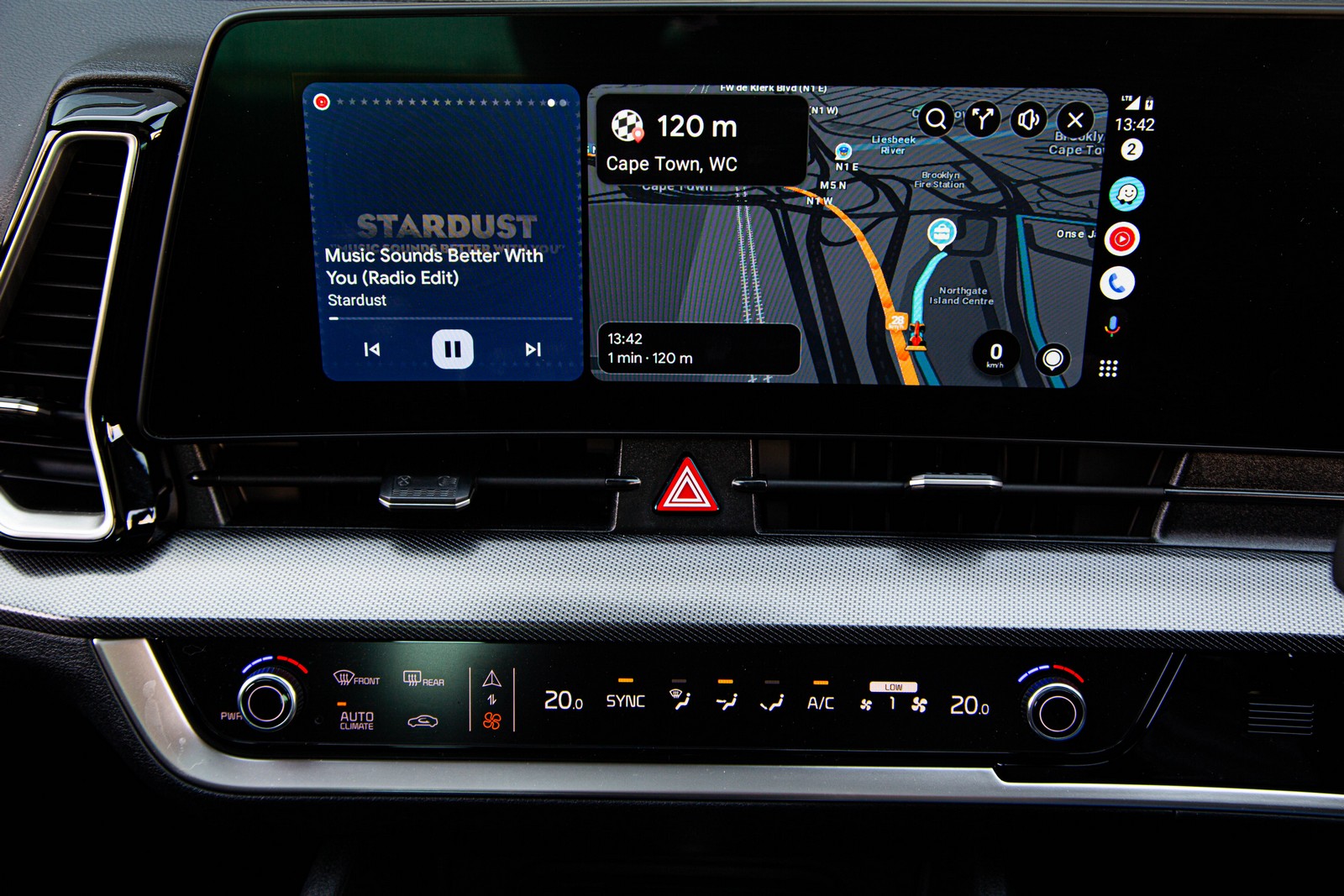
Android Auto active with Waze navigation and YouTube Music on the go.
The touchscreen infotainment system is Apple CarPlay/Android Auto compatible and the smartphone generation will love the provision of USB-A and -C ports, plus the wireless charging pad, at the front.
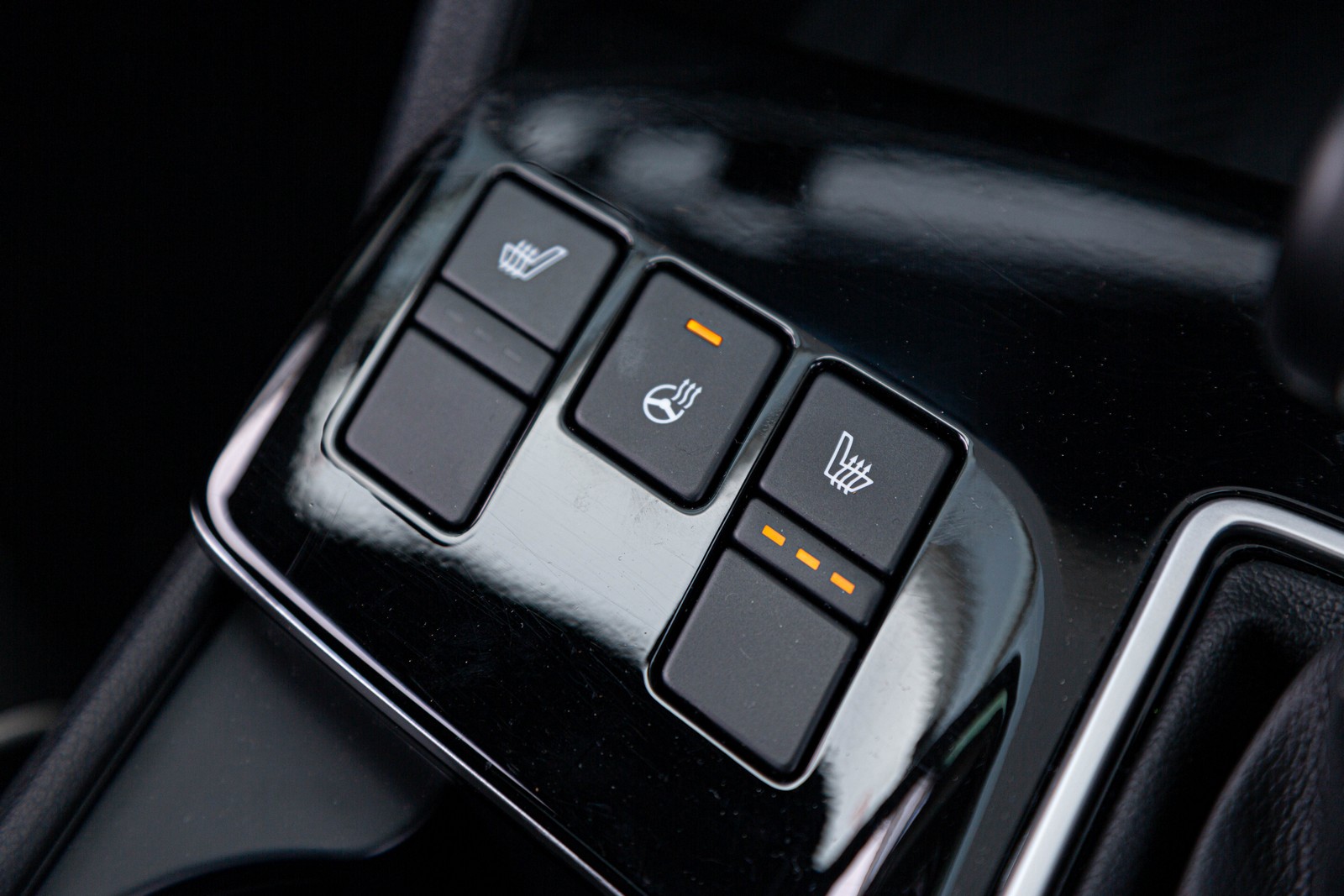
A heating function is available not only for the front seats and steering wheel, but rear passengers too. Plus, aft occupants are availed charging USB ports, which are cleverly placed in the seats ahead of them.
The rear seatback can be folded in a 40:20:40 split to create utility space. With the seats up, the load bay is said to hold 571 litres, which is more than what the Hyundai Tucson and Volkswagen Tiguan offer.
The heated seats and steering wheel are nice-to-have features.
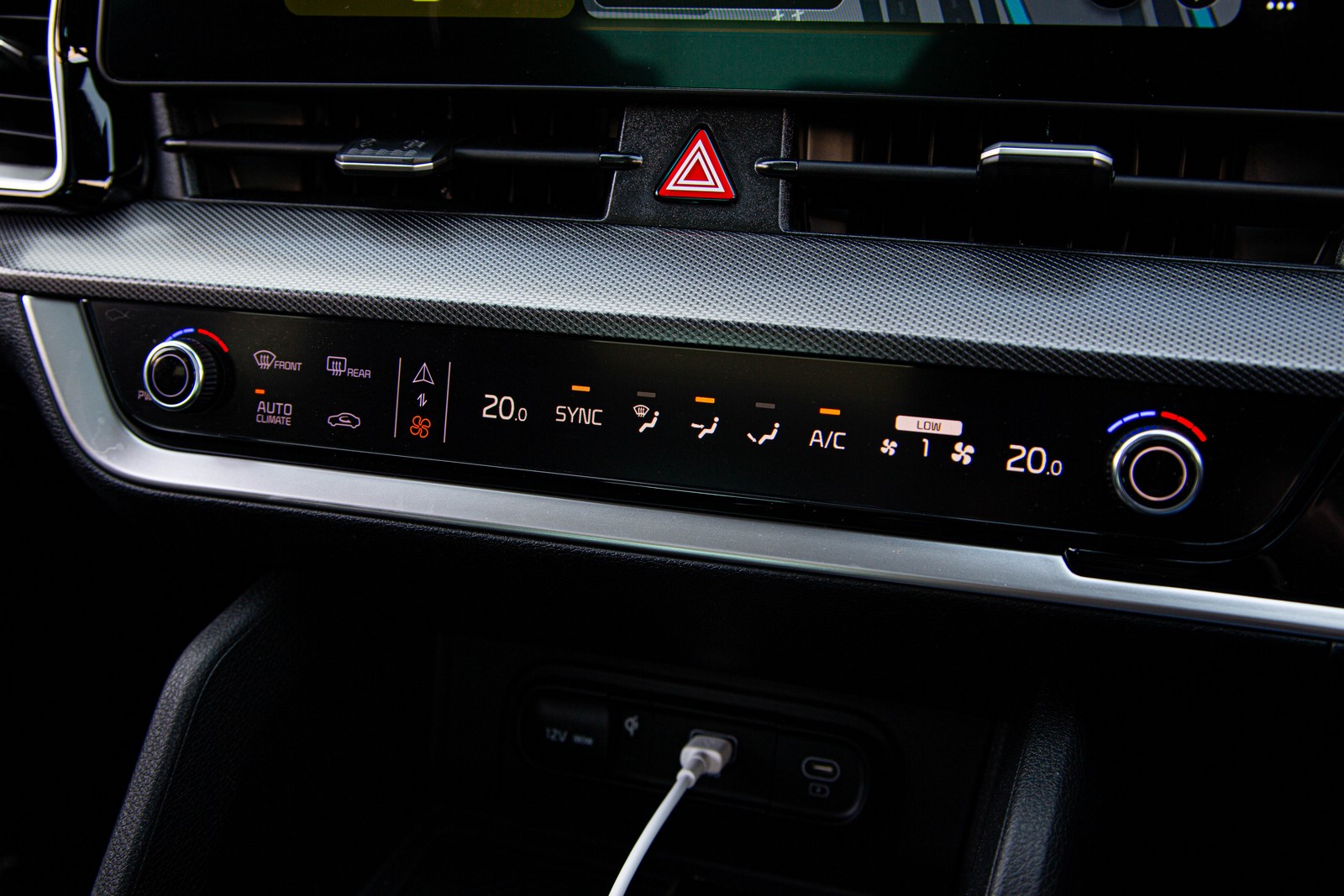
To minimise cabin clutter (prevent “button overload”), Kia has cleverly integrated the audio system- and climate controls into one bar. If you press the fan button, the knobs control temperature and the climate functions are displayed, but if you press the arrow, the knobs control the volume and toggle channels.
The cleverly integrated audio AND climate controls.
Other noteworthy luxury features on this derivative include a panoramic sunroof and powered tailgate.
Price and after-sales support
The Kia Sportage 1.6 CRDi GT Line Plus costs R747 995 (July 2023), which includes a 5-year/unlimited kilometre warranty, with roadside assistance. A 6-year/90 000 km service plan is included.
Kia Sportage 1.6 CRDi GT Line Plus
R747 995
Verdict
Kia SA has an absolute winner on its hands with the Sportage.
The Kia Sportage continues to impress with its great driving experience, a plethora of luxury features and excellent interior build quality (fit-and-finish). It’s a genuinely good product – some of our testers have even gone as far as to say that, right now, the Sportage is the best model in the medium SUV segment.
With inexorable rises in new-car prices moving the German premium trio’s compact crossovers out of reach of many, it’s understandable that buyers are “buying down”, which is why there is strong demand for Mazda, Haval, Hyundai, Volkswagen and Toyota’s medium SUVs (some have been in short supply).
However, the conclusion of this review goes sideways with the question of which type of Sportage is the better buy: petrol or diesel? “Hand on heart, you cannot go wrong with either”, but be sure to buy the derivative that suits your needs best. If you intend to travel longer distances regularly, such as a daily commute from Pretoria to Sandton, then a turbodiesel Sportage will be the more appropriate choice.
We’d also like to point out that while the 1.6 CRDi GT Line Plus is a fantastic offering, you can find better value lower in the range. The 1.6CRDi EX, which foregoes the additional safety tech, 19-inch wheels, ‘shift paddles and panoramic sunroof (to name a few features), costs R84 000 less. Keep that in mind.
The mid-month fuel price prediction for August 2023 has been announced, again showing big increases for diesel.
The unaudited mid-month fuel price data from the Central Energy fund has been released and the Automobile Association (AA) has shared its forecast for the month of August 2023.
As things stand, the price of unleaded 93 is the only grade showing a small decrease of just 1 cent per litre. However, everything else looks set to increase. Unleaded 95 will increase by around 7 cents litre while diesel users are in for a substantial 48 cents a litre increase. Paraffin will increase by around 47 cents a litre.
“At this stage of the month the numbers are more reflective of the way the fuel prices are likely to go when they are adjusted at month-end for August. Currently the trajectory indicates that all fuel will be more expensive in August, with the quantum of the increases most probably being higher than the current data indicates,” the AA notes.
“Naturally, we remain concerned that the effect of more diesel prices will impact directly on consumers through higher prices given that this fuel is a major input cost in so many sectors,” concludes the Association. As a reminder, its not just vehicles which use diesel and electricity generators are big consumers of diesel.
Diesel-powered vehicles will likely be paying more in August 2023
The reasoning behind the change is the current price of oil which is higher on average in comparison to the previous month. The exchange rate over the last few weeks has been relatively flat, according to the AA and thus not helping much with any potential decreases.
Of course, things can change between now (17th July) and the end of the month. A rapid change in the exchange rate as well as a sudden change in the global price of oil can throw this prediction out the window.
Are you thinking about buying a 2nd-generation Kia Picanto? Let’s take a look at the South African line-up of the South Korean brand’s popular city car; the model’s strengths and weaknesses; and what you can expect to pay for a used example…
2011 was a particularly significant year for Kia – both globally and in South Africa. In the space of a few months, the South Korean firm introduced fresh versions of its most compact cars – the Picanto and Rio – which ultimately helped set the foundation for the mainstream success the company enjoys today.
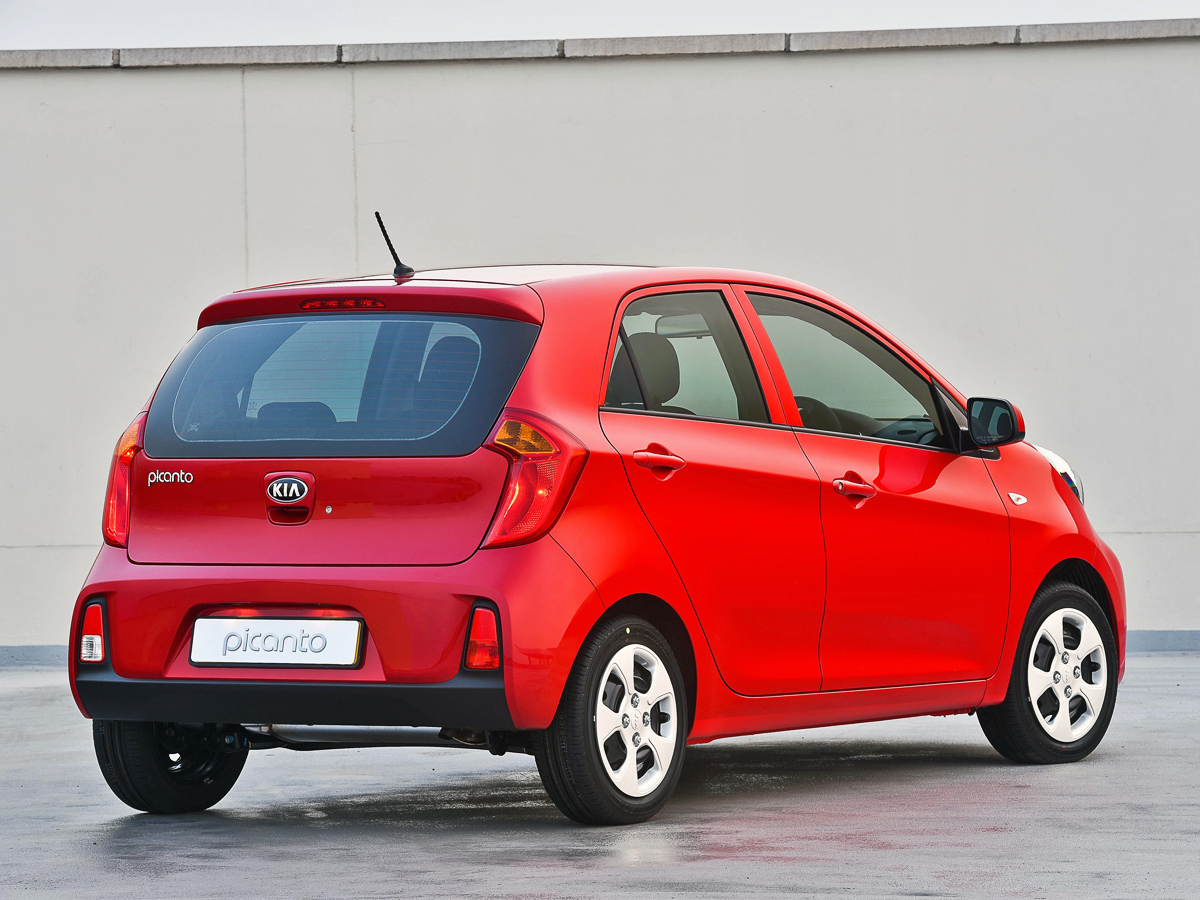
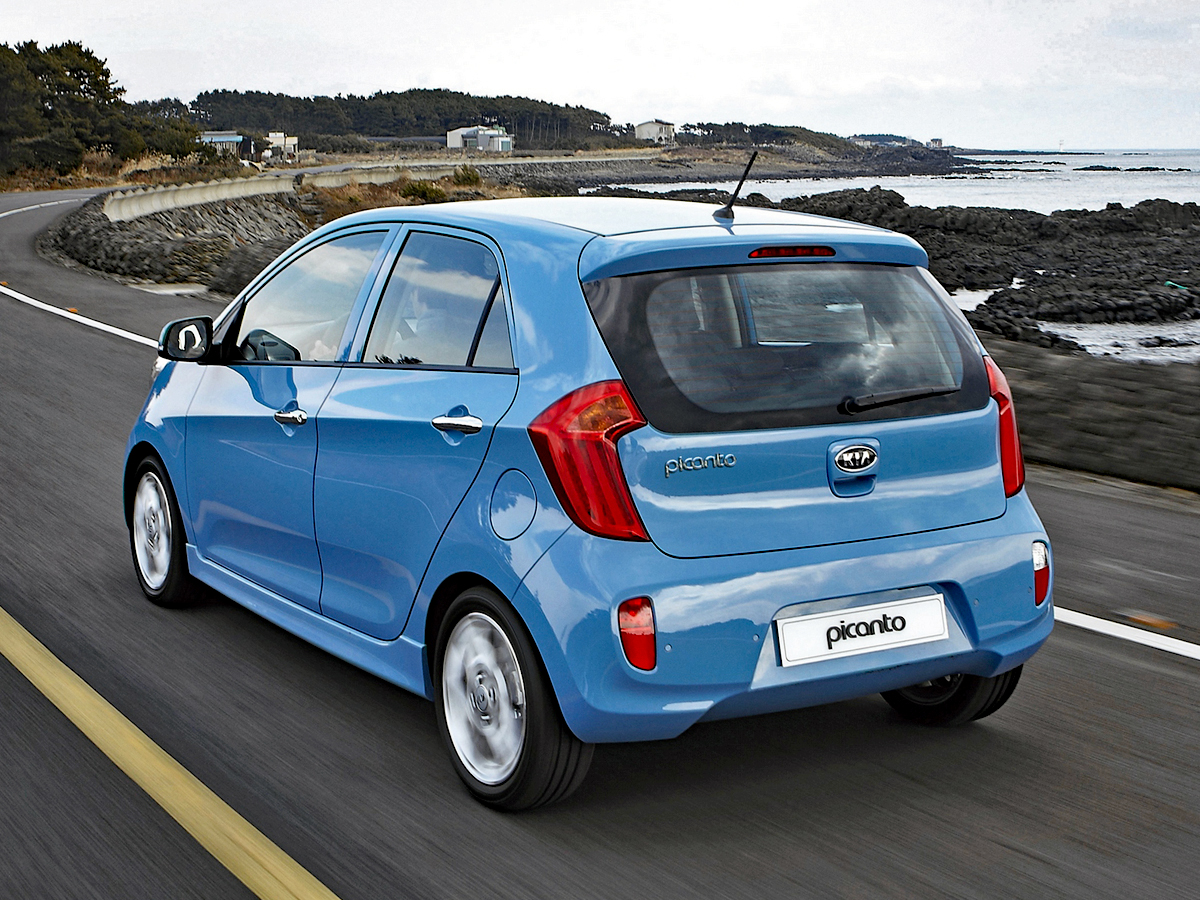
Just like its big brother – the Rio (which entered its 3rd gen around the same time) – the TA-generation Kia Picanto represented a considerable leap forward in areas such as exterior styling and cabin quality. Indeed, the 2nd-gen version of Kia’s A-segment city car was far removed from the generically styled and generally underwhelming original; it demonstrated just how far the automaker had come in a short time.
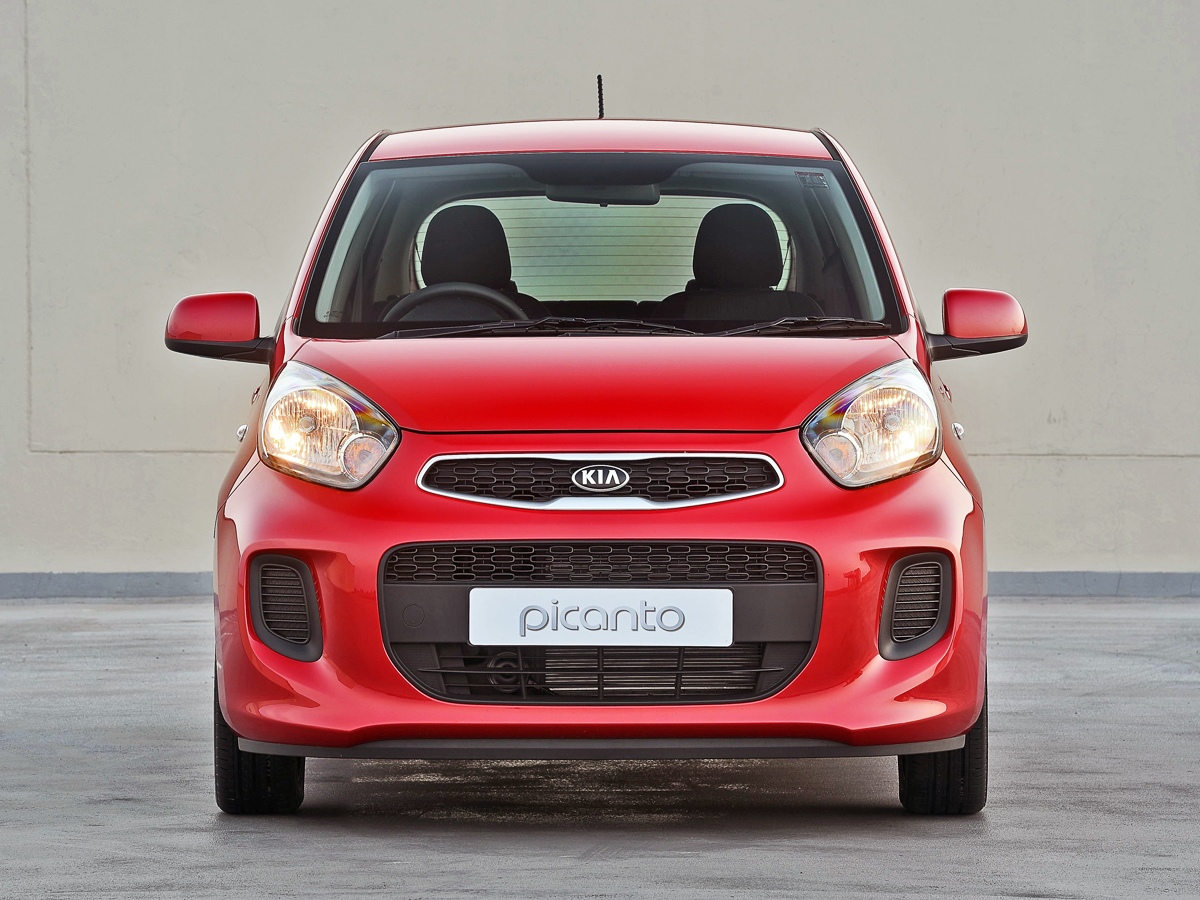
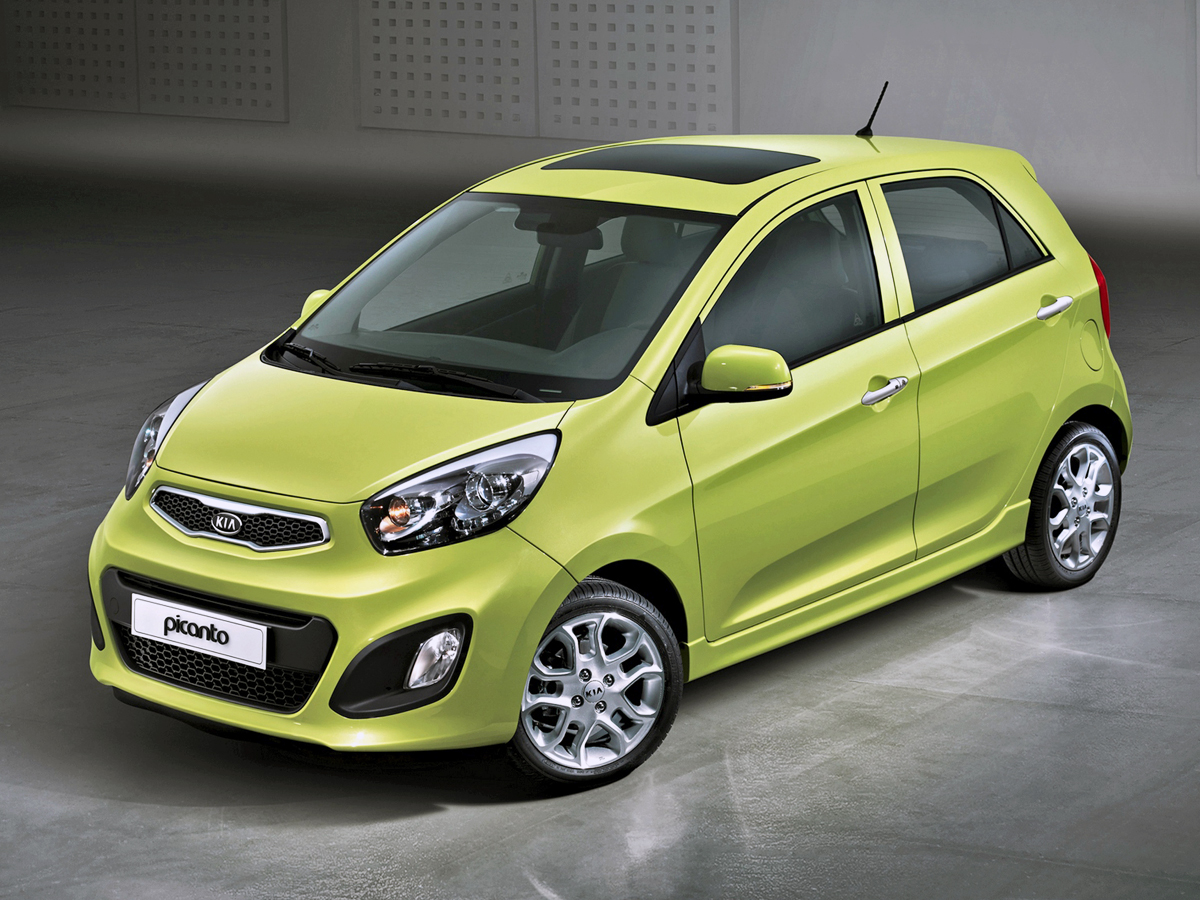
The Mk2 Picanto’s front-end styling has aged well.
Penned by Kia’s European design team under the direction of the influential Peter Schreyer, the Mk2 Picanto – which wore the “Morning” badge in its domestic market – gained a fresh identity courtesy of a striking exterior design that included a new interpretation of the brand’s trademark “tiger nose” grille.
Though a 3-door version was offered in some European markets, South Africa received only the 5-door body style. Measuring 3 595 mm from nose to tail, the 2nd-gen Kia Picanto was 60 mm longer than its forebear, with an additional 15 mm between its axles (the exact length of the wheelbase was 2 385 mm).
Of course, this version of the Picanto has since been superseded by the JA-generation model, but it remains a tempting option on the used market today. Let’s take a closer look at what you need to know.
Kia Picanto model line-up
The very first official image of the TA-generation Kia Picanto hit the Internet early in 2011.
Although the first images of the TA-generation Picanto were revealed online at the beginning of 2011, the model made its official debut at that year’s Geneva International Motor Show. It didn’t take long for the newcomer to hit the local market – the fresh-faced Picanto touched down in Mzansi a mere 4 months after rolling onto the stage in Switzerland. The SA version was built at Kia’s Seosan plant in South Korea.
With 2 naturally aspirated petrol engine options (Kia’s 3- and 4-cylinder Kappa units), the choice of 2 gearboxes (a 5-speed manual and a 4-speed automatic) and 3 trim levels (base, LX and EX), the initial line-up was much narrower than today’s range. At launch, 6 front-driven derivatives were available:
1.0 (51 kW/94 Nm) 5-speed manual
1.0 (51 kW/94 Nm) 4-speed automatic
1.0 LX (51 kW/94 Nm) 5-speed manual
1.0 LX (51 kW/94 Nm) 4-speed automatic
1.2 EX (65 kW/120 Nm) 5-speed manual
1.2 EX (65 kW/120 Nm) 4-speed automatic
The entry-level LS trim level was introduced in 2015.
Over the following 6 years, Kia South Africa made only a handful of small changes to its Picanto range, including quietly dropping the base derivatives around mid-2013. The mid-cycle facelift arrived in September 2014, when the model scored (what even Kia admitted was) a “mild” exterior update. The engine line-up was unchanged, with the upgrade comprising little more than minor front-end revisions.
In October 2015, Kia reintroduced a base derivative, this time handing it the “LS” specification. Just like the LX, the new entry-level offering was powered by the familiar 1.0-litre triple (in manual guise only), but it did without features such as daytime running lights and an audio system. By June 2016, the budget-friendly LS trim level was extended to the 1.2-litre powerplant, available in manual and automatic guises.
What are the advantages of a Kia Picanto?
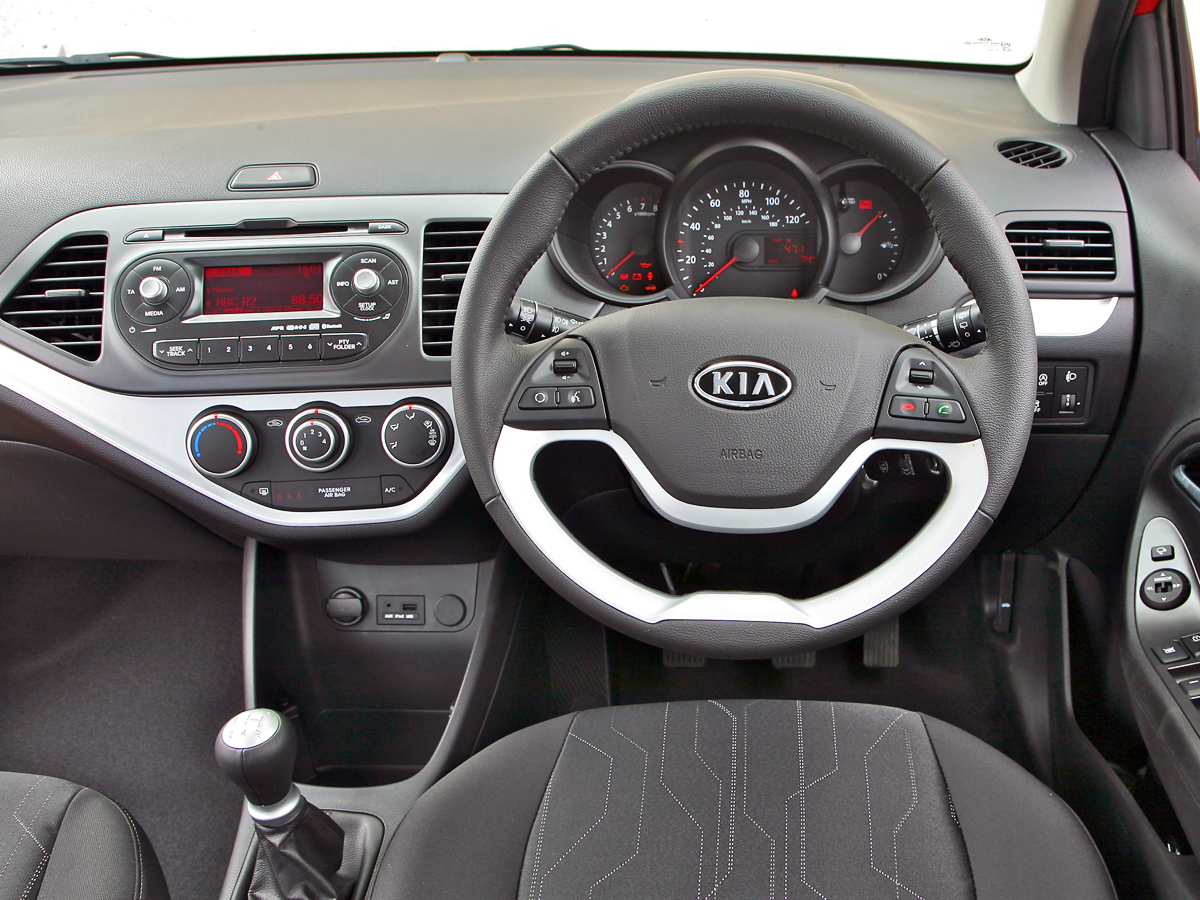
The perceived build quality of the Picanto’s cabin is lofty for the segment.
High-quality cabin (for the segment): During the 2nd-gen Picanto’s tenure in the local market, there was perhaps only a single vehicle in its segment – the Volkswagen Up, which arrived in South Africa only in 2015 – that boasted a higher perceived quality in terms of cabin materials. The majority of the little Kia’s controls operated with a pleasing level of solidity, the finishes were mostly appealing and the interior design was far more sophisticated than the average in this part of the market (rake adjustment on the steering column was also welcome). Note, however, only the 1.2 EX derivatives sported Bluetooth.
Impressive fuel economy: Of course, city cars tend to excel in the fuel-economy department and the TA-generation Picanto, which tipped the scales at well under 1 000 kg, was no exception. The 1.0-litre engine was said to sip a claimed 4.9 L/100 km in manual guise (or 5.6 L/100 km when mated with the 4-speed auto). Even with its slightly larger displacement, the 1.2-litre powerplant had the potential to be almost as fuel efficient, bearing claimed figures of 5.0- (in manual guise) and 6.0 L/100 km (in auto form).
Fine low-speed ride quality: Despite the fact the Mk2 Picanto’s running gear and suspension merely evolved from those of the original model, the city car boasted the low-speed ride quality of a larger, more expensive vehicle. The springs (front and rear) were softer than before, while larger trailing-arm bushes were fitted to the rear end’s torsion-beam arrangement. SA-spec derivatives also featured the “high” suspension set-up, which raised ground clearance by 10 mm (to 152 mm) compared with the European spec. It’s a pity that the steering tended to display an annoying vagueness, particularly around centre.
What are the disadvantages of a Kia Picanto?
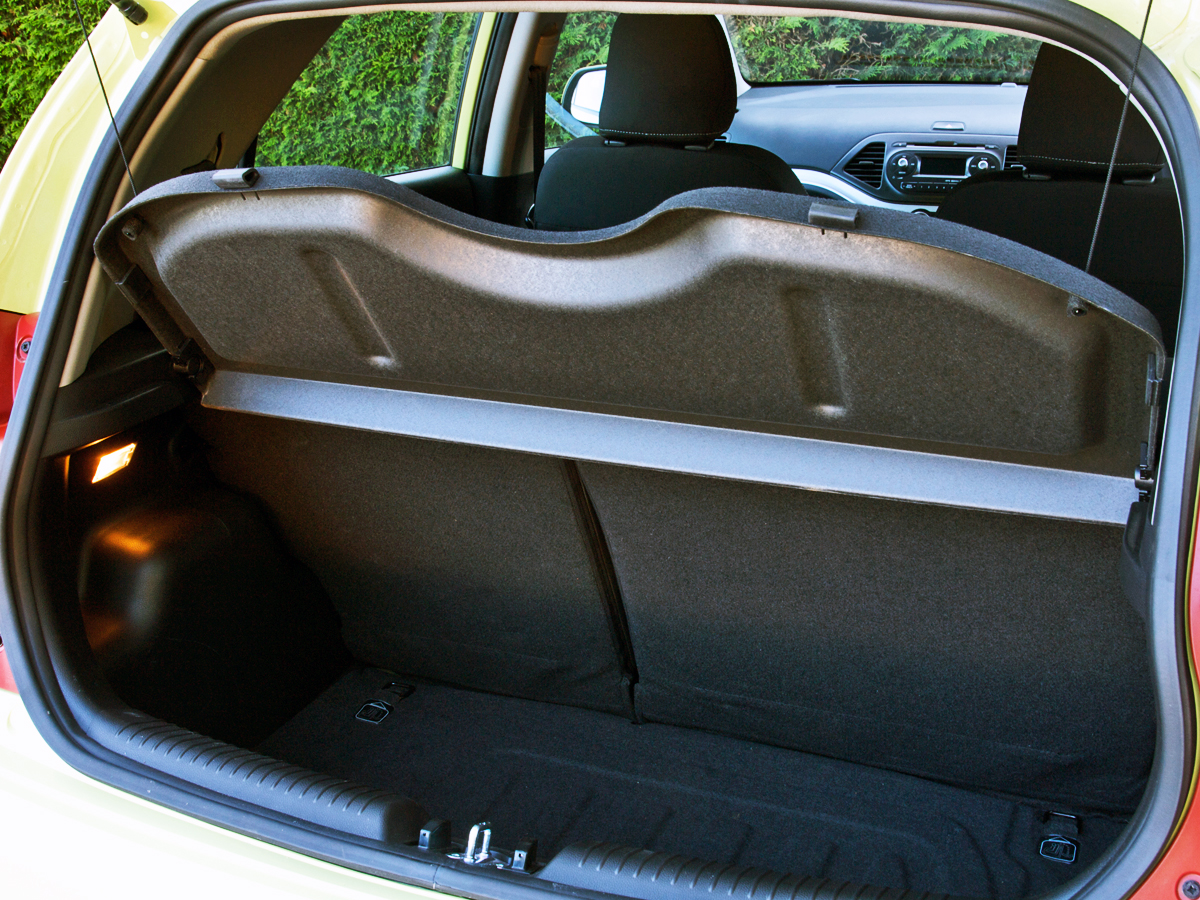
Note that the Picanto doesn’t offer much in the luggage-compartment department.
Meagre safety spec – on most variants: The relatively low level of safety kit on most derivatives of the Mk2 Picanto was surely the most glaring chink in the model’s armour. All variants bar the flagship 1.2 EX lacked an anti-lock braking system (ABS) – a basic safety feature that was arguably a “non-negotiable” even in 2011 – while electronic stability control was simply not available on SA-spec examples. In addition, the base version (and the LS that later replaced it) shipped with only a driver’s airbag, while the LX and EX trim levels added a front-passenger airbag (all, though, came with ISOfix child-seat anchors at the rear). Interestingly, the up-specced version offered in Europe scored 4 stars from Euro NCAP.
A service plan was optional: Throughout the TA-gen Picanto’s time on the local market, a service plan was optional. So, what does that have to do with buyers shopping for a 2nd-hand version today? Well, without such cover included in the model’s purchase price, some owners of the South Korean city car may not have been quite as fastidious about servicing their vehicles at regular intervals (mileage and time), which could result in more instances of patchy maintenance history. Keep your eyes open for this.
Compromised luggage space: While none of its A-segment rivals boasted capacious load bays, the Picanto’s boot was particularly cramped and a little way below the class average at the time. Kia claimed a capacity of 200 litres (saying the length, width and height of the cargo space had increased compared with that of the original), but believe us: the Kia’s load bay was tiny. However, the rear bench split 60:40, adding a degree of versatility when the back seats were not in full use, while a luggage floor box allowed owners to safely stash away smaller items. A space-saver spare wheel was also included as standard.
What is the Kia Picanto’s price on the used market?
Just over half of listings at the time of writing featured the 1.0-litre, 3-cylinder engine.
To reiterate, a service plan was optional across the range, so pay particularly close attention to the maintenance history of any potential purchase. The Picanto came with a 5-year/100 000 km warranty.
Of the used 2nd-gen Kia Picanto stock listed on Cars.co.za at the time of writing, 54% featured the 1.0-litre engine, with the remaining 46% employing the 1.2-litre lump. Predictably, the manual gearbox was the most popular transmission choice, accounting for 78% of all listings.
Mileage varied from 27 000 km (on a 2013 model’s odometer) to the 180 000 km achieved by a 2015 1.2 EX (considering the Picanto’s typical role of an urban runabout, it’s not really a surprise there were no instances of listed units with mileages in excess of 200 000 km). As is so often the case, white (31%) was the most common paint colour, followed by silver (28%) and red (12%).
Below R100 000: This bottom-most pricing bracket contained nearly a 3rd of all listings, most featuring the smaller engine (and just a single example with a self-shifting transmission). Should you be in the market for a base-spec unit, you’re likely to be shopping at this end of the spectrum.
From R100 000 to R125 000: The most densely packed pricing segment (by a small margin) fell between R100 000 and R125 000, and interestingly, included examples from all 7 model years and a fairly even split of trim levels. However, the 3-cylinder motor was again prominent here, accounting for nearly 70% of listings.
From R125 000 to R150 000: Keen on the 1.2-litre engine? Expect to pay somewhere between these 2 pricing bookends, with 68% of the Picanto units here featuring the larger-capacity engine. The auto was the dominant transmission, accounting for 56% of listings.
R150 000 and up: Only a small number of TA-generation derivatives were priced above R150 000 (most of them were 1.2 EX units). The neatest example we found was a 1-owner 2015 1.2 EX with an automatic gearbox, a full service history, 53 000 km on the clock and an asking price of R159 900.
Pick of the range?
The top-spec Picanto is the only derivative to feature ABS.
So, which of the derivatives should be at the top of your shopping list? Well, there’s no doubt in our minds that the 1.2 EX is the pick of the Mk2 Picanto range, chiefly because it was the only version that shipped with ABS (and EBD). We’d go for the manual gearbox, though the relatively unsophisticated 4-speed auto would admittedly be a boon for those who spend much of their commute in dense traffic.
The 1.2 EX also sported far more kit than its more modestly equipped siblings… It came standard with nice-to-have items such as 14-inch alloy rims (as opposed to steel wheels), chrome-effect exterior detailing, body-coloured side-sill mouldings, a leather-wrapped steering wheel, a multifunction steering wheel, electric windows at the rear, electrically adjustable (and heated) side mirrors, Bluetooth, as well as silver accents dotted around the cabin. It was also available with an optional tilt-and-slide sunroof.
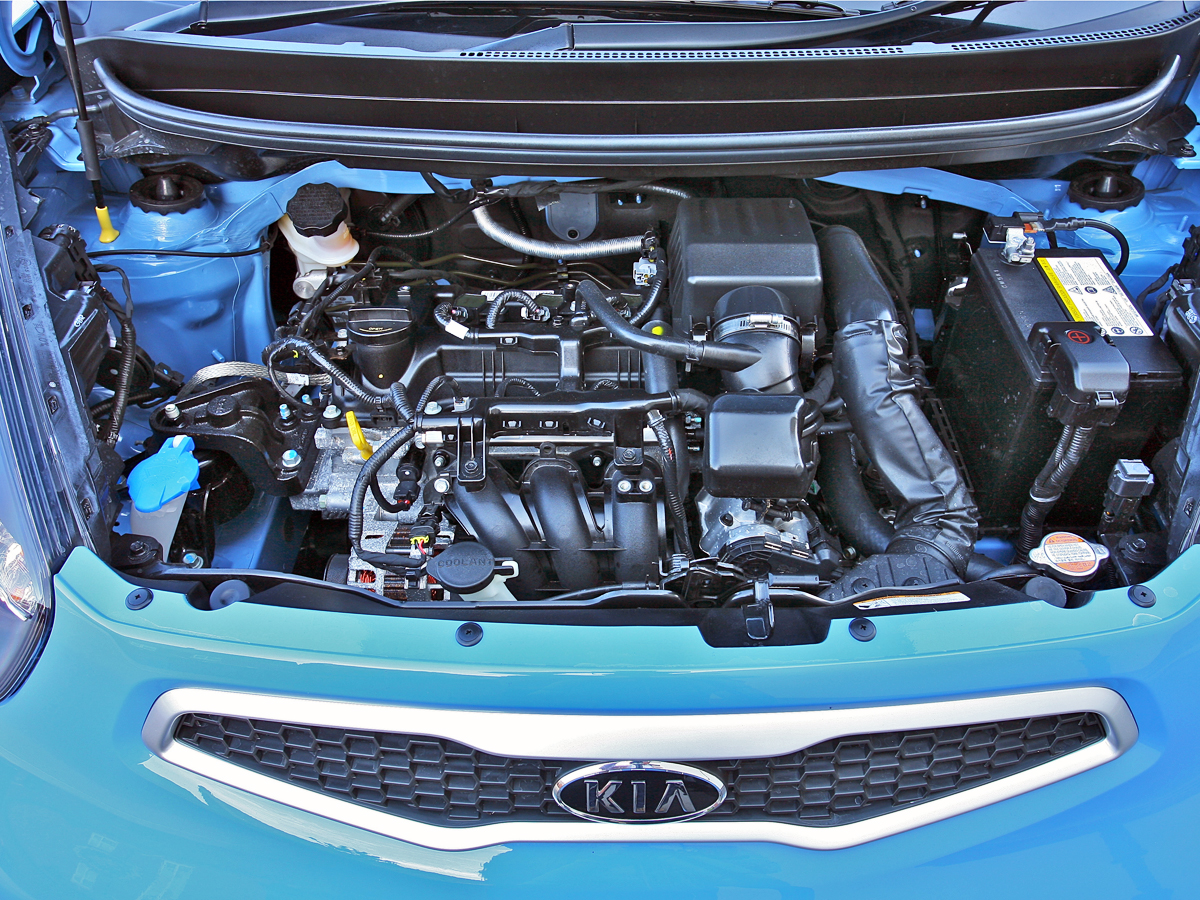
In addition, the 4-pot powerplant (G4LA) offered a little extra oomph than the 3-cylinder unit (G3LA), without much of a fuel-consumption penalty. The 1.2-litre motor was also inherently better balanced than the 1.0-litre unit, resulting in less vibration making its way into the cabin and a more refined driving experience overall. Generally speaking, though, both atmospheric Kappa engines are reliable when maintained properly (and both are chain-, rather than belt-driven, powerplants).
Is the Kia Picanto a good first car?
The Picanto continues to offer strong value on the used market.
While today’s A-segment features a raft of pseudo-crossovers (we’re looking at you, Suzuki S-Presso, Renault Kwid and company), the TA-gen Kia Picanto’s era was dominated by the traditional hatchback body style. Mainstream alternatives thus include the closely related Hyundai i10 and Grand i10, as well as the Toyota Aygo plus its platform cousin, the Citroën C1. Though the Peugeot 108 arrived in South Africa only in 2018 to replace the 107, it’s certainly worth considering as it boasted the most comprehensive list of standard safety kit in the segment by quite some margin.
The locally-built Chevrolet Spark is another budget-friendly option, as are Indian-produced alternatives such as the Suzuki Celerio (or even the Suzuki Alto before it) and the Honda Brio. The Renault Twingo is a left-field choice (though you’re unlikely to find many on the used market), while we’d suggest steering clear of the rather disappointing Mitsubishi Mirage.
In our view, the Kia Picanto’s closest rival is the 5-door version of the Volkswagen Up – the only vehicle to edge the Korean city car in terms of cabin quality. However, the little VW still enjoys generally stronger resale values in Mzansi, which means you’re likely to pay considerably more for one in a similar condition.
But that’s exactly what makes the 2nd-gen Kia Picanto – particularly in 1.2 EX guise – such a compelling option on the used market: it offers great value for money, making it an attractive choice as a first car or when downsizing from a larger vehicle. Not only is it sharply styled and light on fuel, but it boasts one of the highest-quality and best-designed cabins in its segment. What more could you want from a city car?
7 vehicles quietly axed in South Africa in 2023 so far
Over the first half of 2023, various automakers quietly axed vehicles in South Africa. Let’s take a closer look at the dearly departed, which are no longer available new…
While a few fresh nameplates have been launched in South Africa in the first half of 2023, a number have been axed as well. Of course, we’ve been keeping a close eye on the local automotive landscape’s comings and goings, which has afforded us the opportunity to compile this list of the dearly departed.
Of course, we should point out we’ve concentrated on instances of entire model ranges being scrapped, choosing to ignore single derivatives that have been removed from their respective line-ups. In addition, we’d like to thank the vehicle-information specialists over at duoporta.com for their help filling in a couple of gaps.
Before we get stuck in, note we’ve included only those models that are no longer listed on their manufacturer’s website. So, despite the fact the Ford EcoSport, Hyundai Atos and Suzuki Vitara Brezza are no longer in production, they’re not (yet) on this list since some new-vehicle stock remains in the country (though, as you can tell from the chart above, it’s fast running dry).
It’s a similar case with the Kia Rio, which is due to be phased out locally towards the end of 2023. We’ve also not included the Mahindra Scorpio here, seeing as the Scorpio-N badge that supplanted this nameplate is virtually the same (bar the addition of that single-letter suffix, of course).
Right, let’s take a closer look, in alphabetical order…
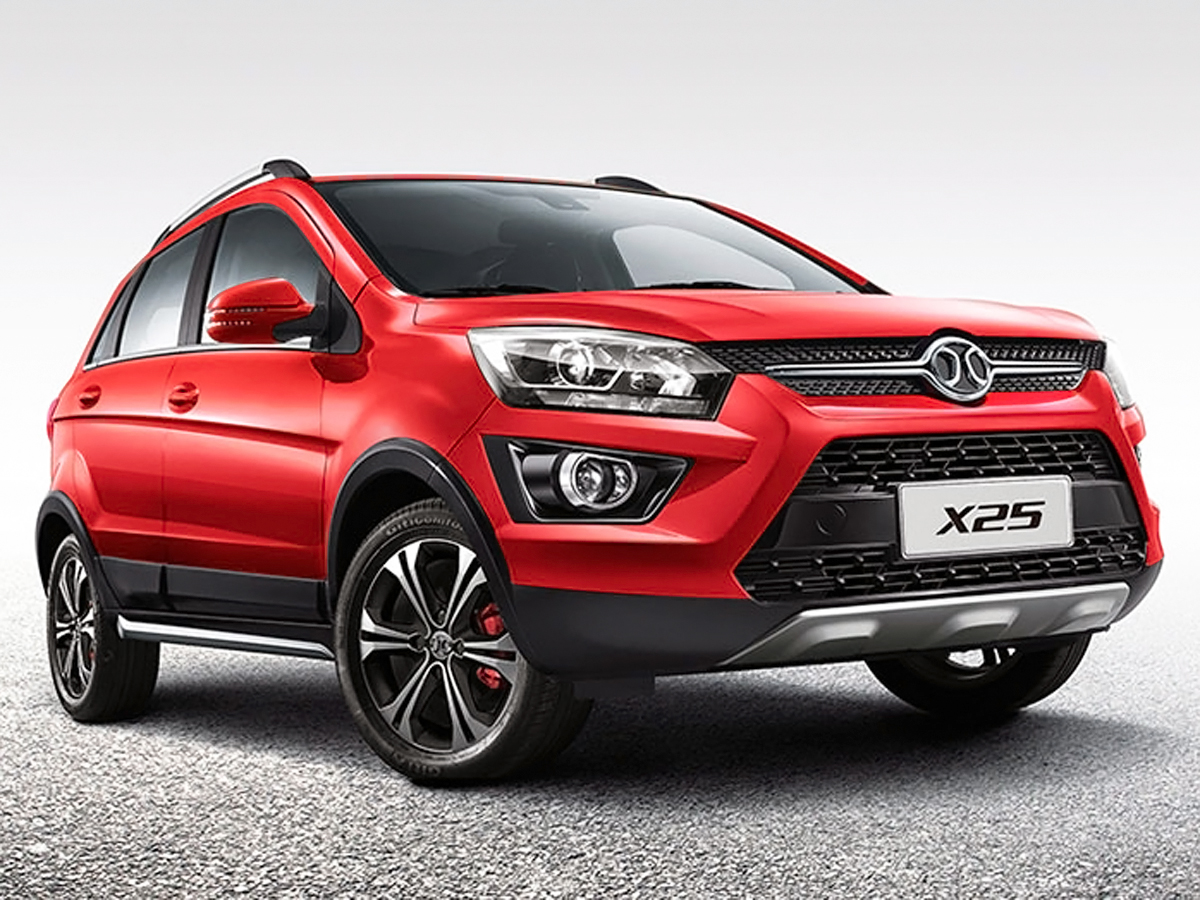
1. BAIC X25
The BAIC X25 was launched in South Africa in 2017, joining the D20 hatchback and sedan (both of which have also since been discontinued). Before this Chinese crossover was put out to pasture in the opening quarter of 2023, the X25 range comprised 4 derivatives, each powered by a 1.5-litre, 4-cylinder petrol engine sending 85 kW and 148 Nm to the front axle. Transmission choices included a 5-speed manual gearbox and a 4-speed automatic cog-swapper, while 2 trim levels were on offer.
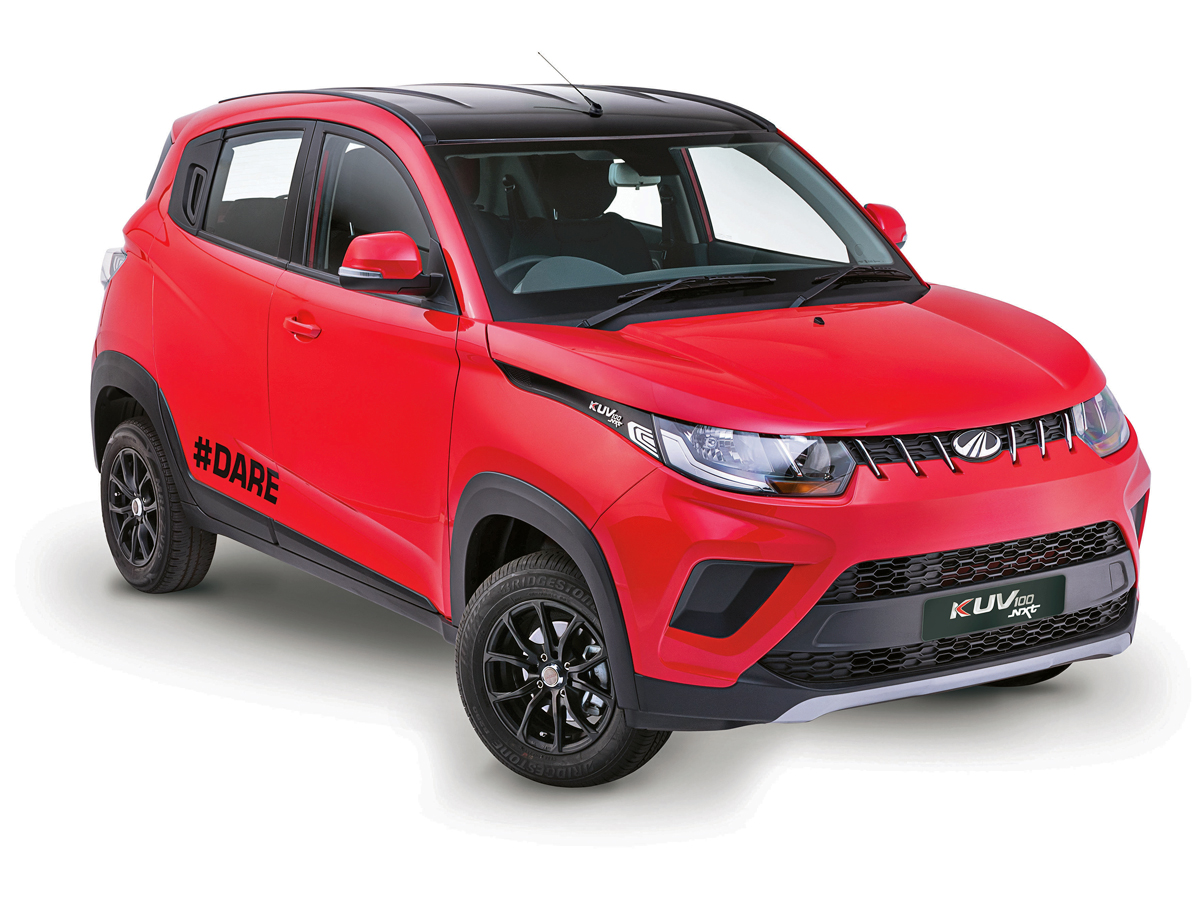
When picking apart the performances of South Africa’s least-expensive new cars a few months back, we noticed Mahindra KUV100 Nxt sales had tapered off markedly through 2022 (falling from 175 units in May to a mere 5 units by December of that year). The diminutive Indian-built model then quietly disappeared from Mahindra SA’s website. Before it was axed, the line-up included both petrol and diesel motors, as well as a panel-van derivative badged as the #Xprez.
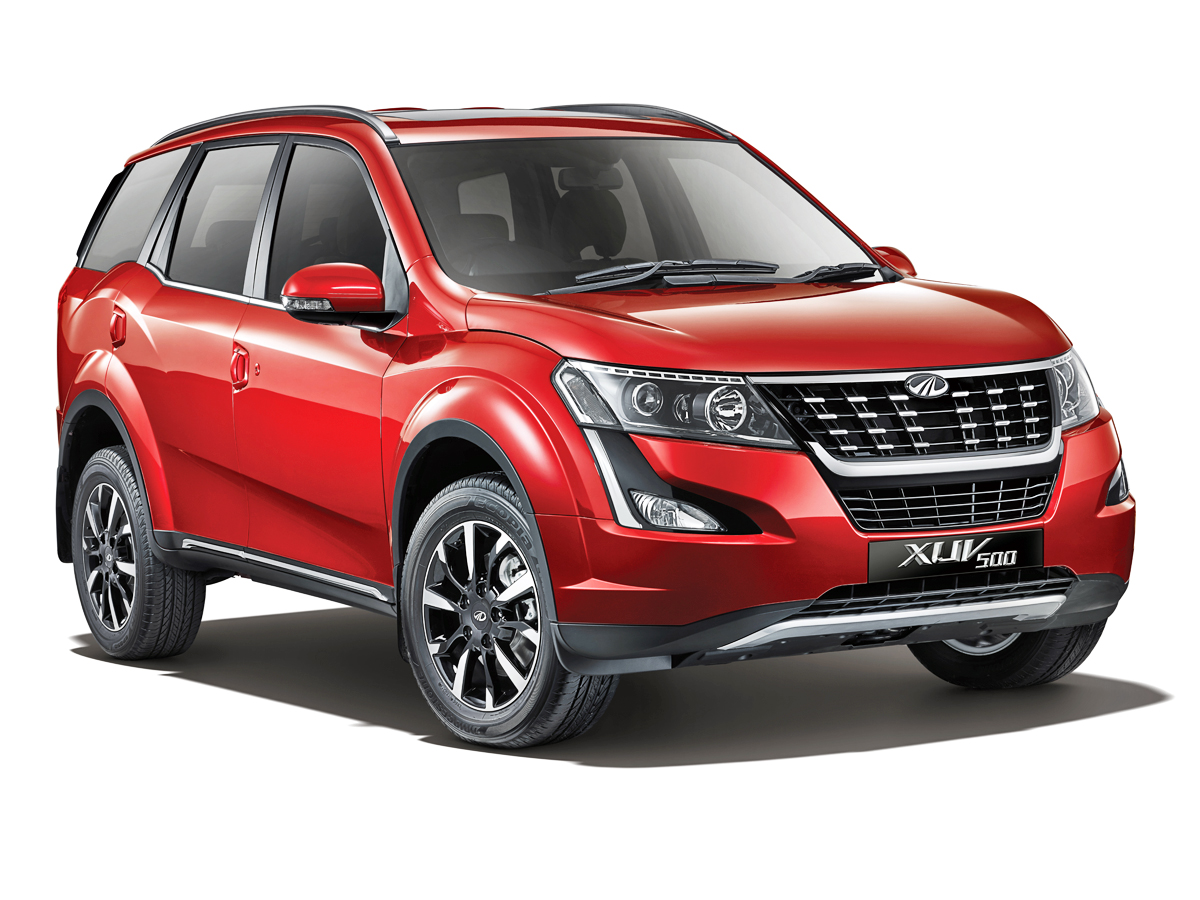
The death knell sounded for the Mahindra XUV500 – which had last received an update in 2018 – when the new XUV700 touched down in South Africa, with the latter model ultimately replacing it on the market. Before it was axed, all derivatives in the XUV500 line-up were powered by the Indian firm’s familiar mHawk 2.2-litre turbodiesel engine, which generated 103 kW and 330 Nm.
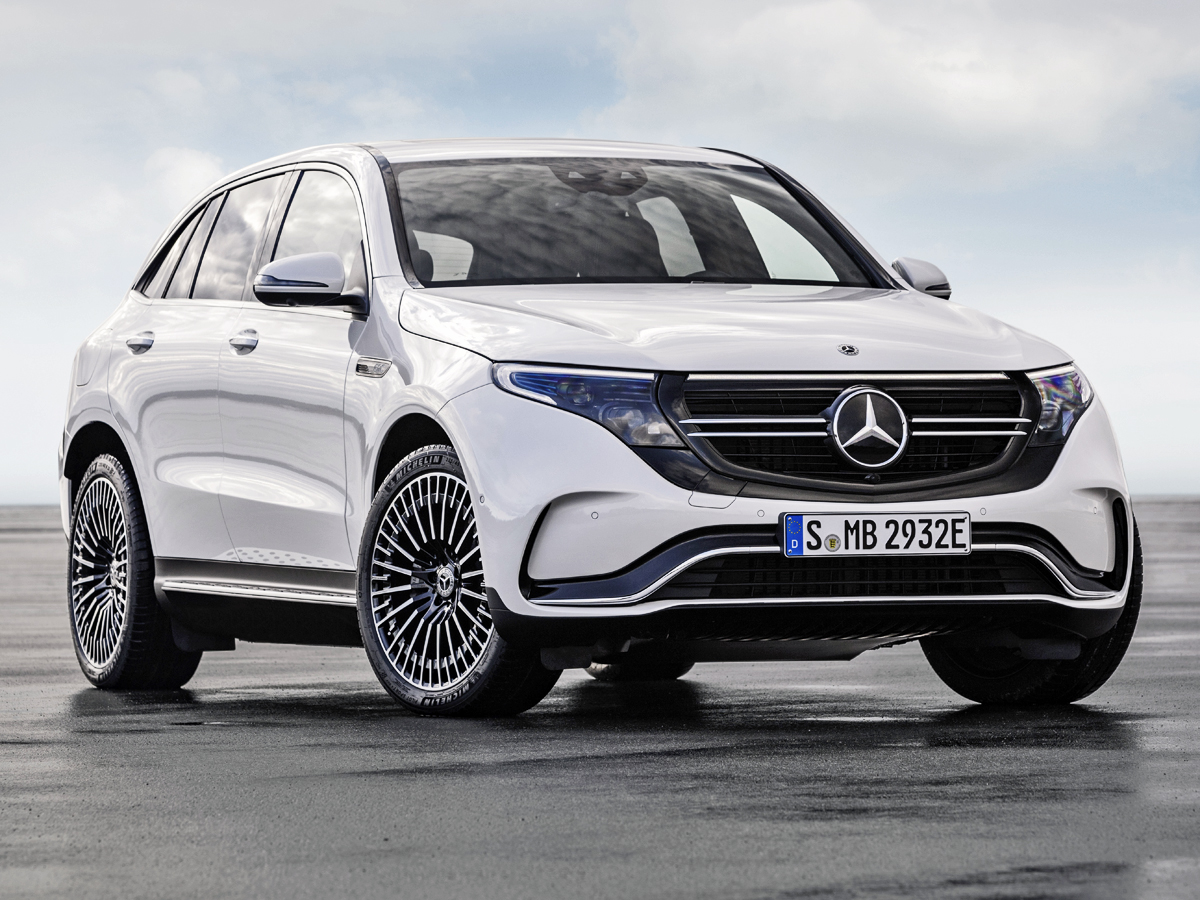
Yes, the Mercedes-Benz EQC was silently scrapped in South Africa earlier this year (did anyone notice?), with international reports furthermore suggesting production for all markets has ceased. We broke the news of pricing for this fully electric vehicle back in July 2022, revealing it would be offered exclusively in EQC 400 4Matic form. As a reminder, it employed an electric motor on each axle, offering peak system outputs of 300 kW and 760 Nm, and drawing their urge from an 80 kWh lithium-ion battery pack. Claimed range for the now-defunct 5-seater electric crossover was listed as “up to 471 km”.
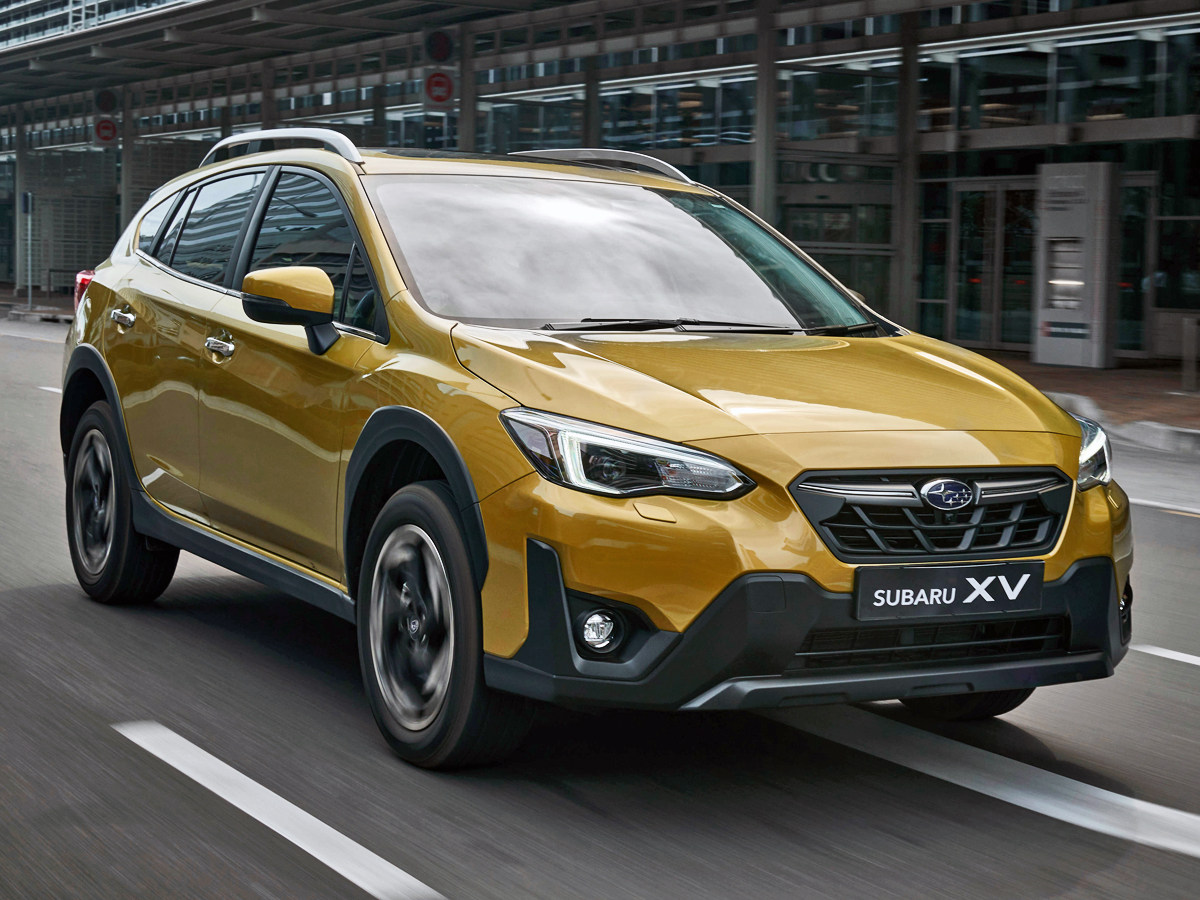
While it may seem a trifle unfair to include the Subaru XV on this list, it’s a fact the nameplate has been axed, even if it was replaced by the Crosstrek badge. Yes, over its first 2 generations in South Africa, Subaru’s Impreza-based crossover was known as the XV, but the Japanese brand the dropped this moniker when the 3rd iteration arrived. Before its departure, the XV was offered with Subaru’s naturally aspirated 2.0-litre, 4-cylinder Boxer petrol engine. With symmetrical all-wheel drive as standard, maximum outputs of 115 kW and 196 Nm were sent to all 4 corners via a continuously variable transmission (CVT).
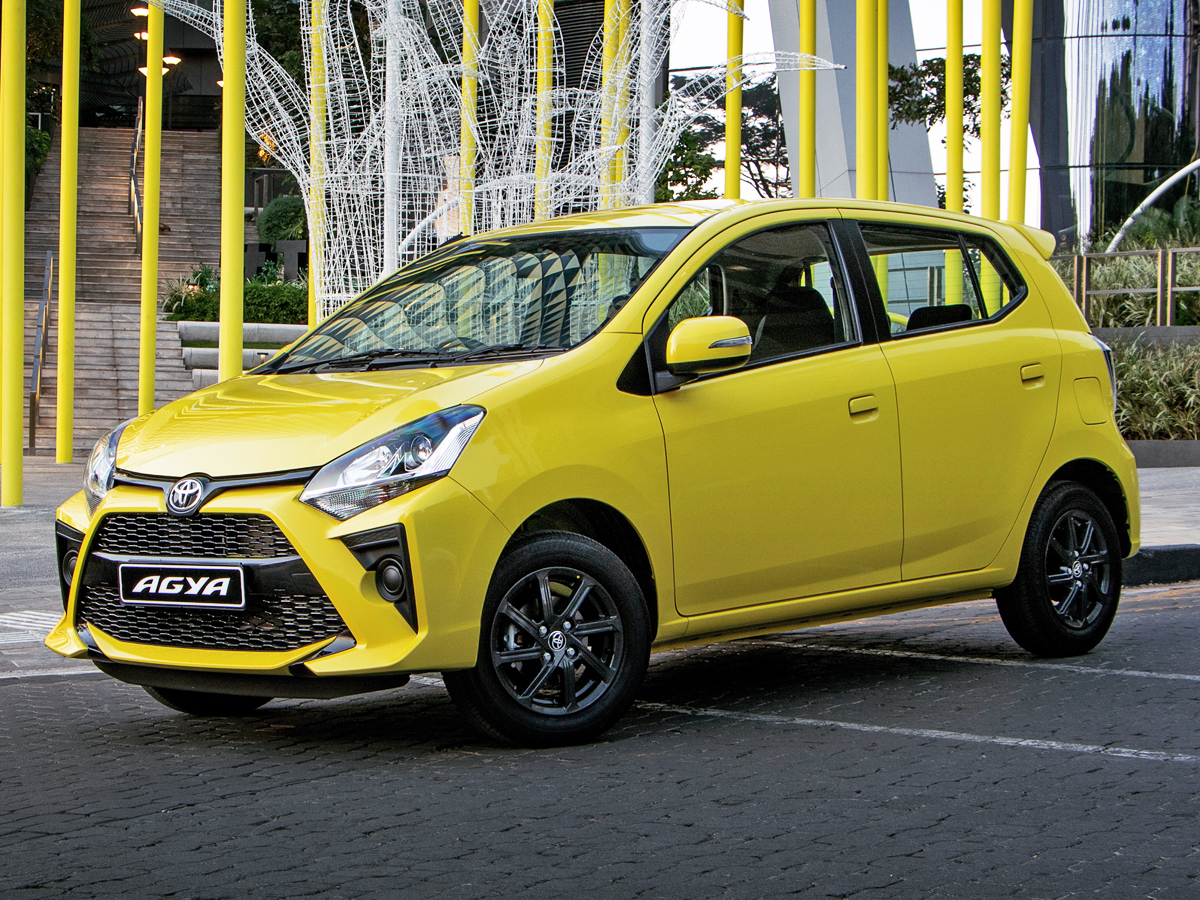
The Toyota Agya – which was based on the Daihatsu Ayla and manufactured in Indonesia – arrived in South Africa in late-2020 as a replacement for the Aygo. However, the budget hatchback left the local scene towards the middle of 2023, when the Vitz (a rebadged Suzuki Celerio) touched down as its successor. Before its demise, the Agya range had comprised 4 derivatives, each powered by a 49 kW/89 Nm naturally aspirated 1.0-litre, 3-cylinder petrol mill, offered with either a 5-speed manual or 4-speed auto transmission.
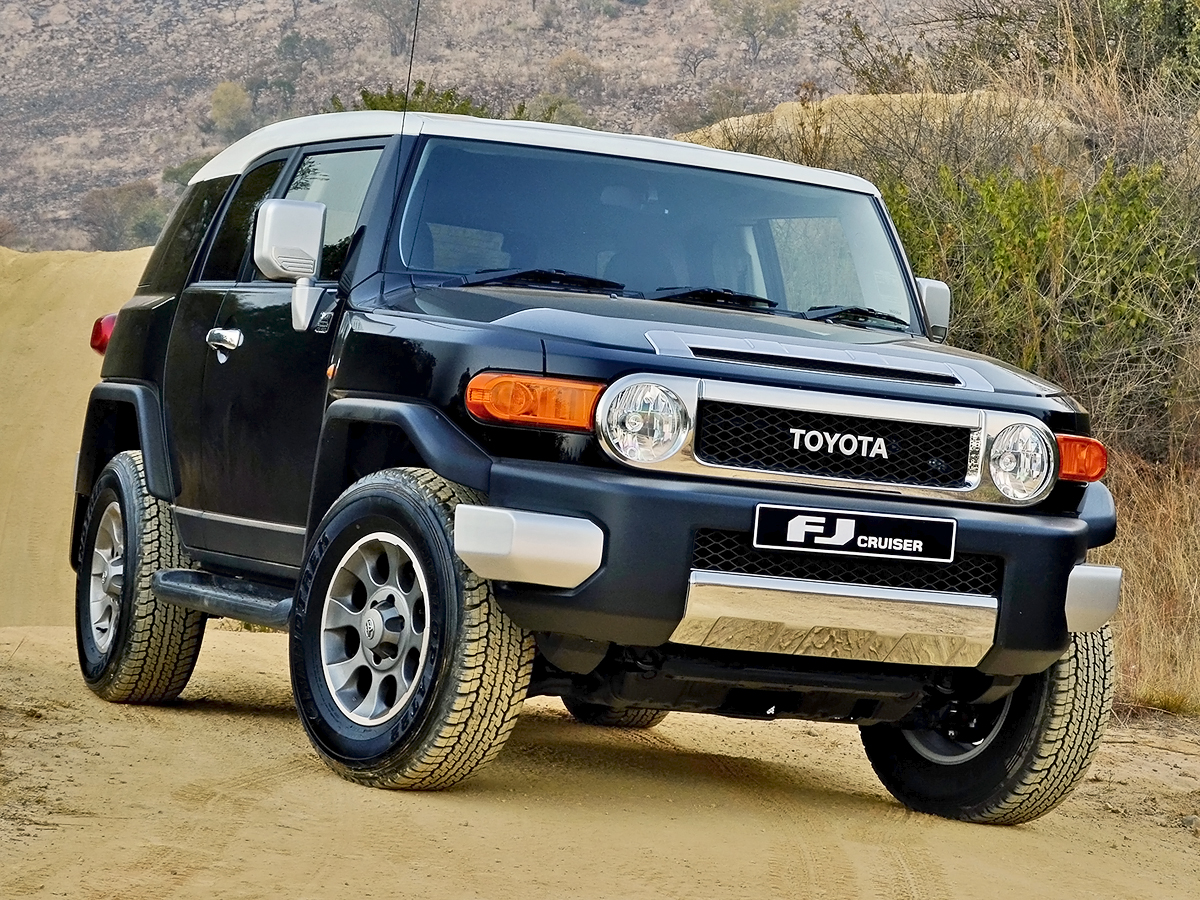
In April 2023, Toyota SA Motors confirmed to Cars.co.za global production of the FJ Cruiser had wrapped up, ending a 12-year local run for the retro-styled off-roader. Priced at R813 000 before its discontinuation in South Africa, the ladder-frame SUV employed the Japanese firm’s familiar atmospheric 4.0-litre V6 petrol (1GR-FE) powerplant, which sipped from twin fuel tanks and delivered 200 kW and 380 Nm to all 4 wheels via a 5-speed automatic transmission…
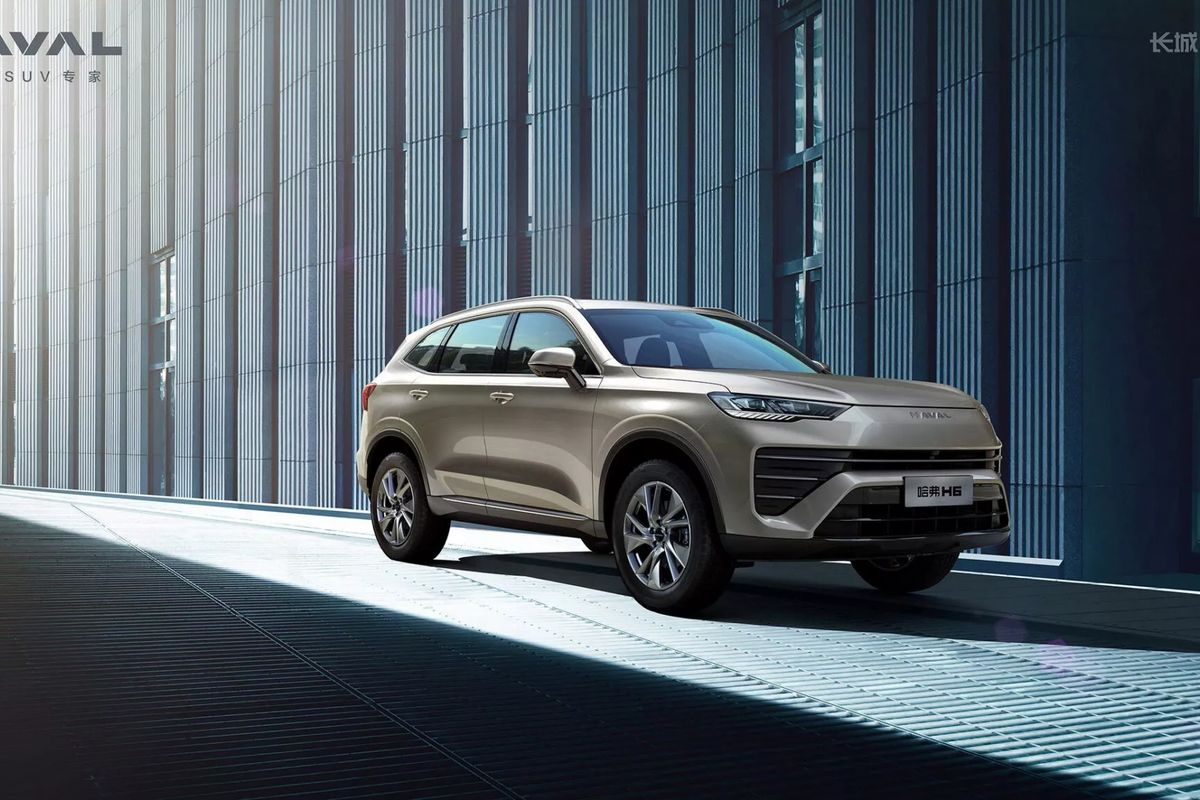
The Haval H6 facelift has been revealed by parent company Great Wall Motor. Here’s a first look!
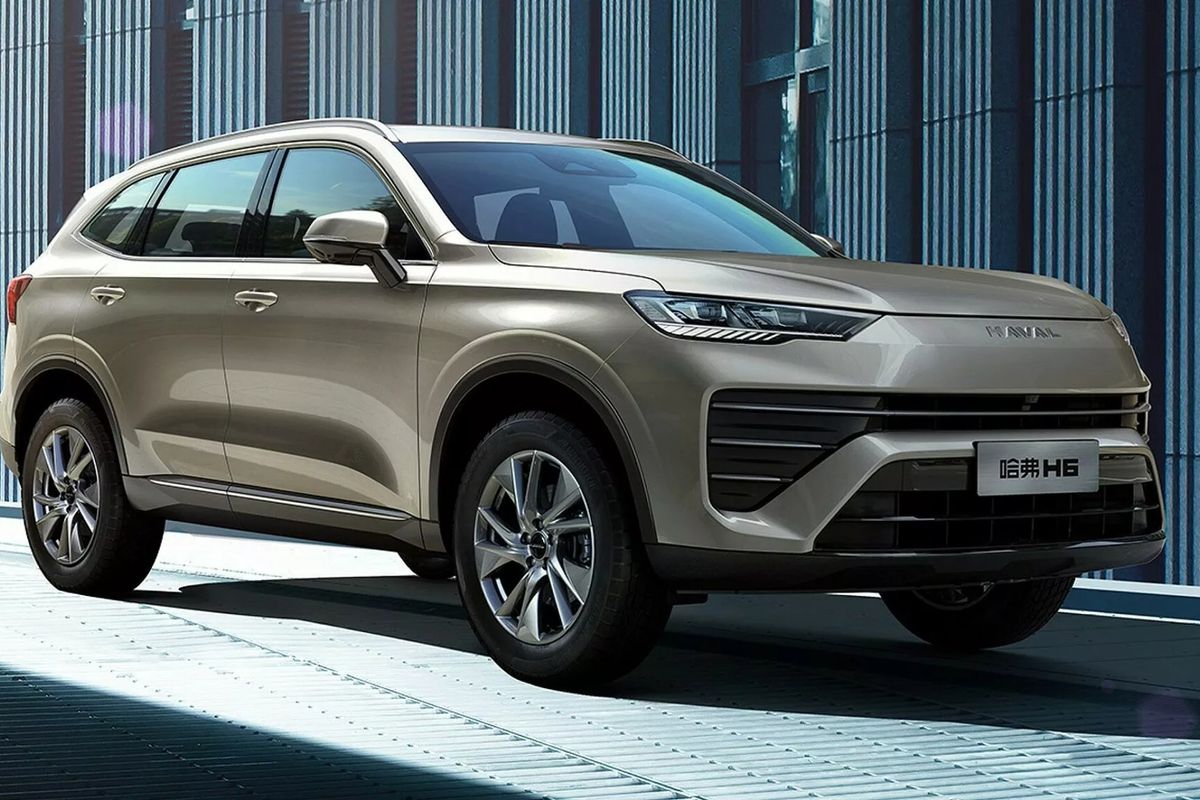
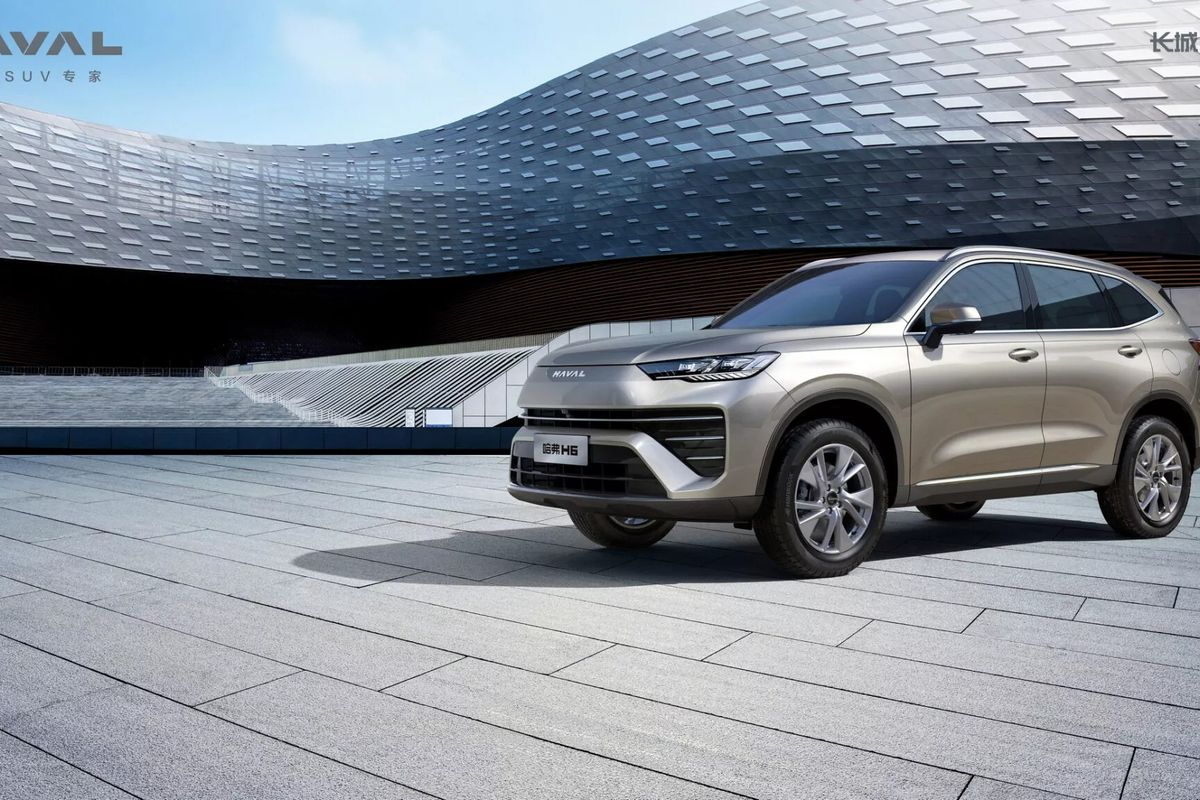
These Haval H6 facelift images were released by the brand and its expected to go on sale later this year in China. First appearing on Haval’s social media accounts, the Haval H6 looks set to continue its rampant sales success. Globally, over 4 million units have been sold.
In South Africa, the Haval H6 has proven popular thanks to a modern cabin, strong engine and excellent value for money. Globally, the H6 is Haval’s best-selling model but it has lost ground to the BYD Song in the sales charts, so Haval is hoping it can claw back some sales.
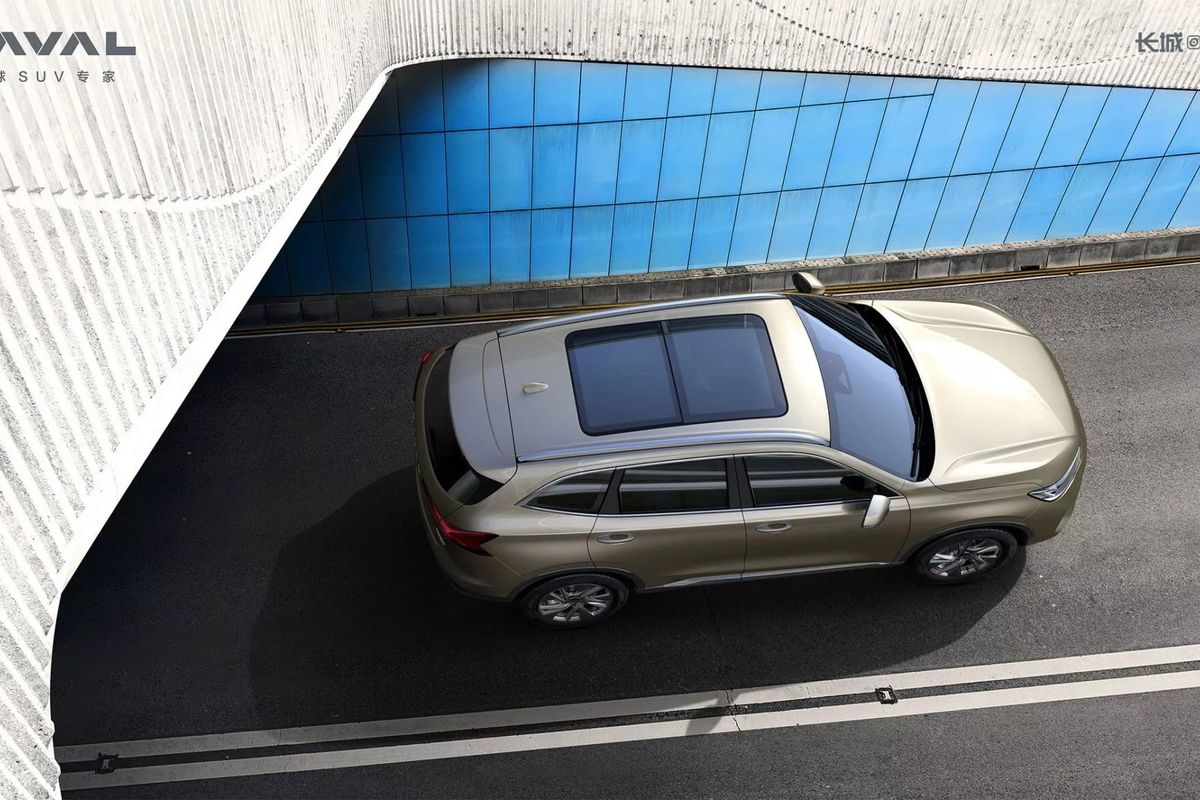
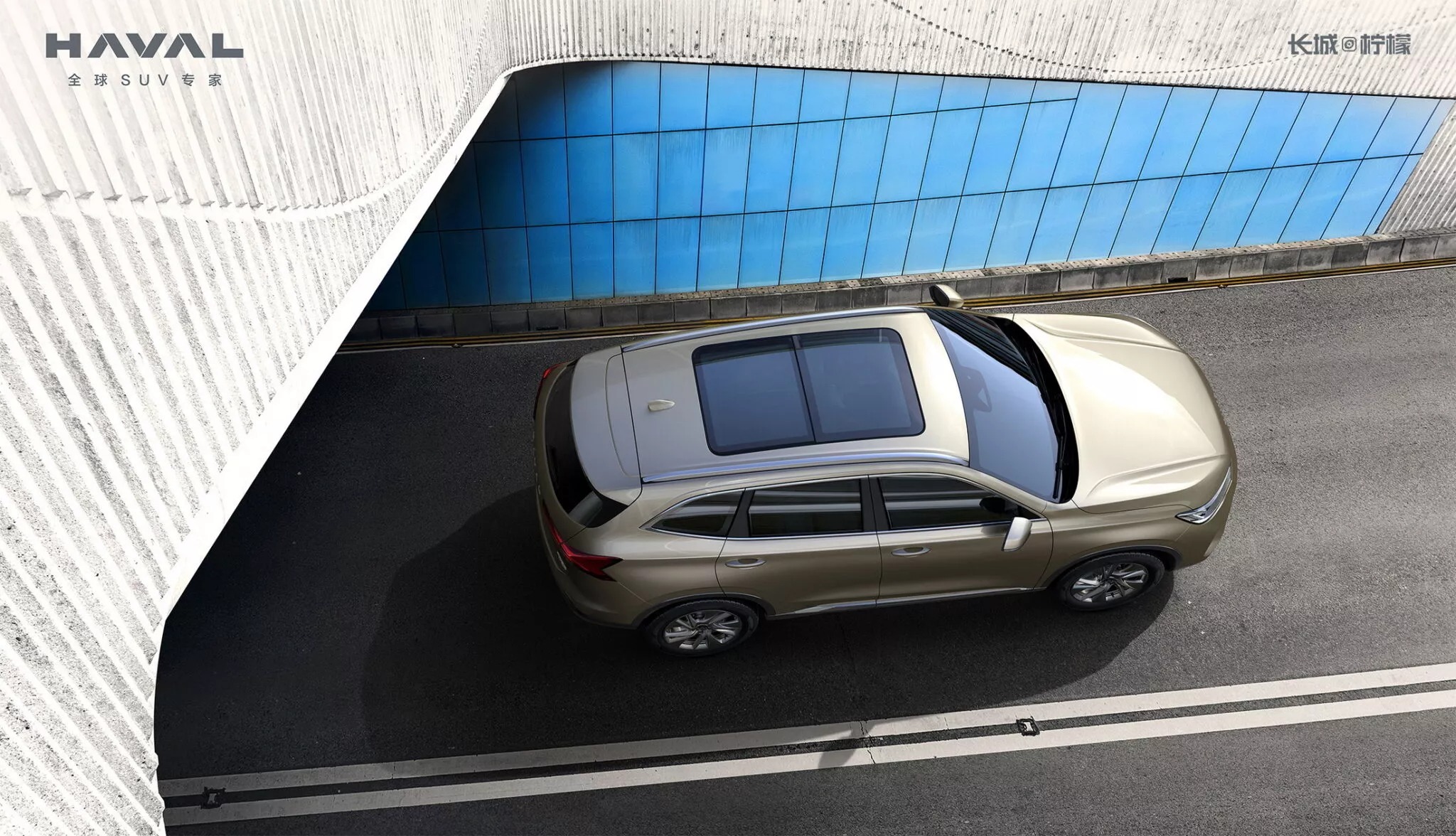
Visually, the Haval H6 facelift gains a new-look front bumper which replaces the previous bold grille for a sleeker and more aerodynamic face. The images showed off a double panoramic sunroof, which will please South African fans. No interior images were released, but we expect there to be significant changes there too.
It’s said via documents from the Chinese Ministry of Industry and Information Technology that the engine lineup will consist of 1.5-litre and 2.0-litre turbocharged petrol engines, with the option of a plug-in hybrid.
Will the Haval H6 facelift come to South Africa?
At this stage it is unclear if this model will come to South Africa and its not looking good if we take a look at what Australian motoring media is reporting. When it comes to market availability for Chinese vehicles, Australia and South Africa follow similar strategies.
They’ve gone to say that this model is unlikely to be sold in Australia, with GWM Haval focusing on an all-new generation of mid-sized family SUVs. If we hear anything, we’ll update this article with more information.
How many Land Rover Defenders were sold in SA in H1 2023?
Despite a starting price of R1 515 100, the Land Rover Defender is easily the British group’s best-selling vehicle in SA. Here’s exactly how popular it was in H1 2023…
Virtually every month for the past couple of years, there’s a single Jaguar Land Rover product that stood out on the sales charts. Yes, we’re talking about the Land Rover Defender, which is typically the only model in the British group’s South African range to crack 3 figures.
Exactly how popular is the Whitley-based firm’s re-invented off-roader, then? Well, we’ve tallied up its local sales figures for the first half of 2023 to find out.
In the opening 6 months of the year, as many as 767 units of the Defender have been registered in South Africa, according to figures reported to Naamsa. This translates to a monthly average of around 128 units. The Slovakia-built SUV’s best single month was March 2023, when 151 units were sold locally, closely followed by June 2023 (140 units).
The Defender’s total was enough for it to place just outside the top 50 on the list of South Africa’s best-selling passenger vehicles for H1 2023 (finishing in 51st), quite some way ahead of the Range Rover Sport (353 units), Range Rover (222 units), Evoque (156 units), Discovery Sport (101 units), Velar (58 units) and Discovery (52 units). The best-selling Jaguar, meanwhile, was the F-Pace, with just 41 registrations.
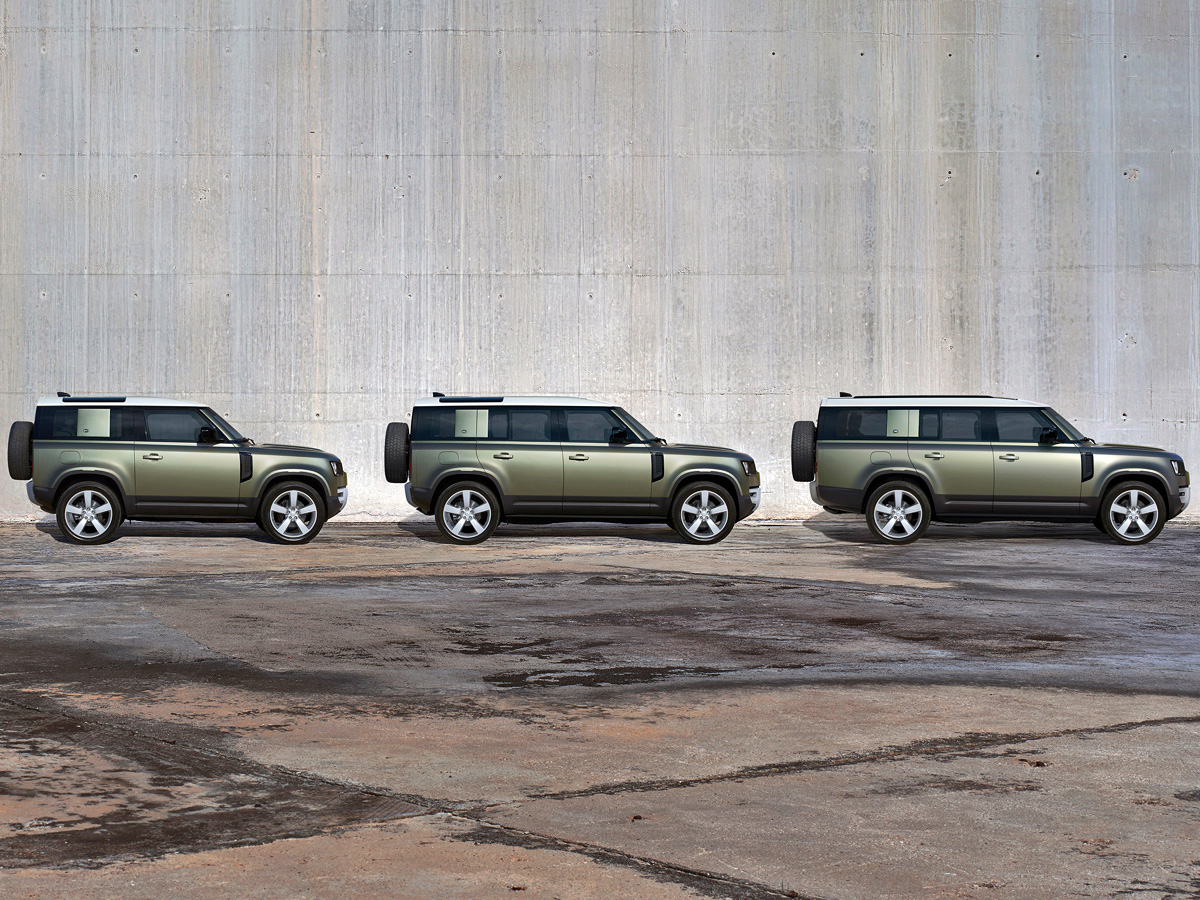
The Defender family comprises a trio of body styles: 90, 110 and 130.
According to our maths, as many as 1 335 units of the Defender were registered in South Africa in 2022. If sales continue at their current pace, the off-roader will beat that annual effort in 2023.
As a reminder, the local Defender line-up currently comprises 24 derivatives and features 3 body styles (90, 110 and 130) as well as various petrol (including plug-in hybrid) and diesel powertrains. Pricing kicks off at R1 515 100, while the range is topped by the Defender 130 V8, which offers 386 kW from its supercharged 5.0-litre V8 engine and starts at R3 015 700.
The modern-day (unibody) Defender was revealed in Frankfurt in September 2019, before initial examples of the 110 arrived in South Africa in mid-2020. The short-wheelbase Defender 90 followed in mid-2021, with the 1st V8-powered models touching down in November of that year and the long-wheelbase 130 joining the local range towards the middle of 2022.
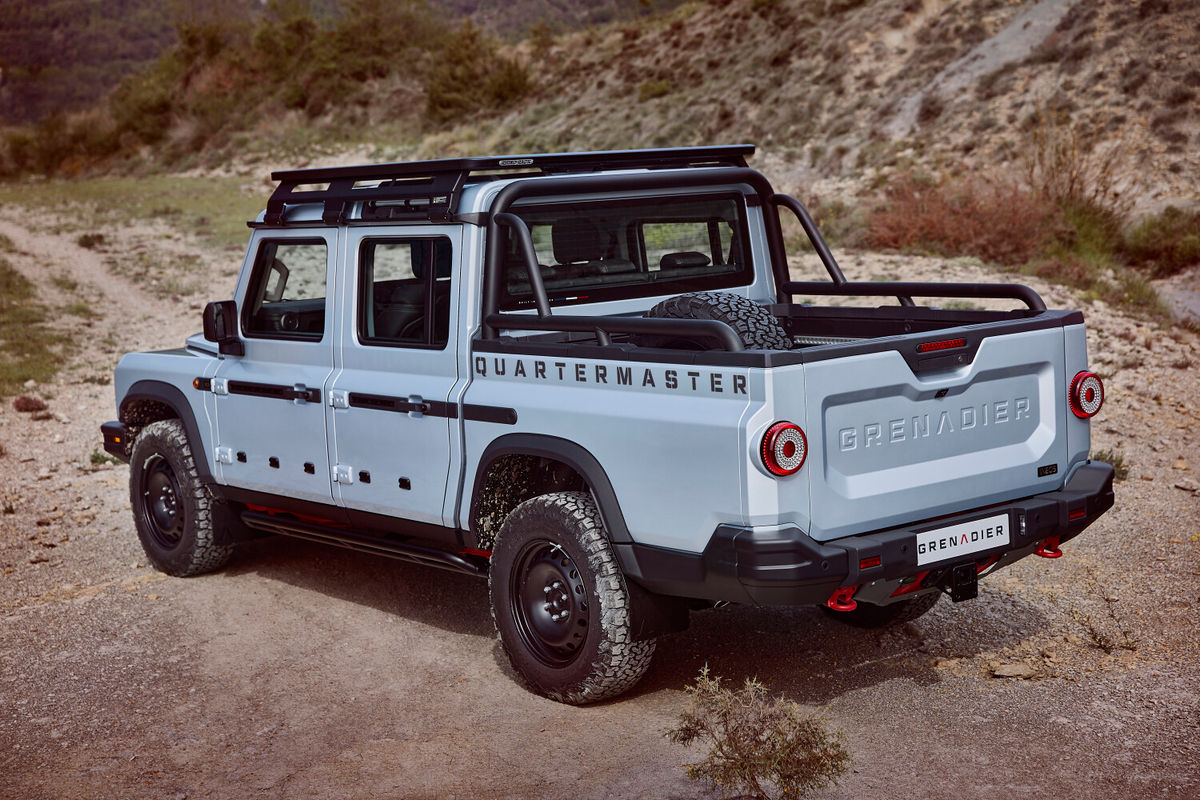
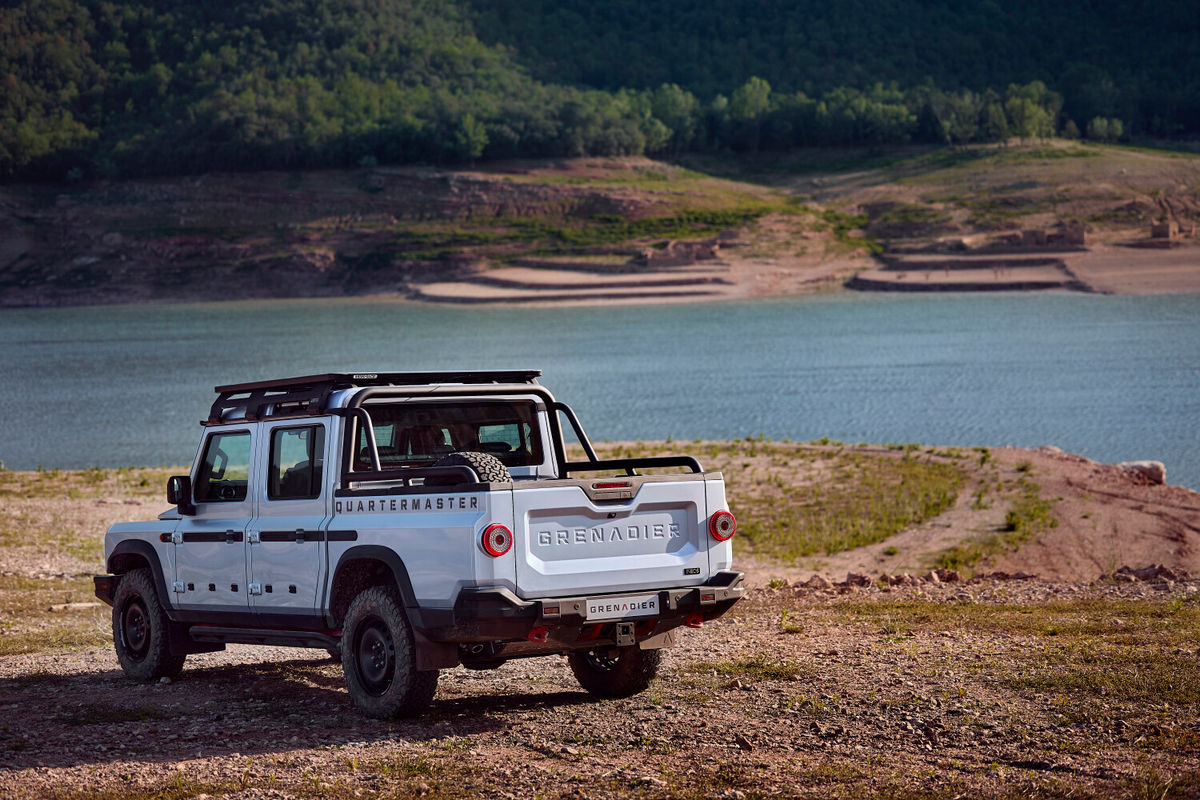
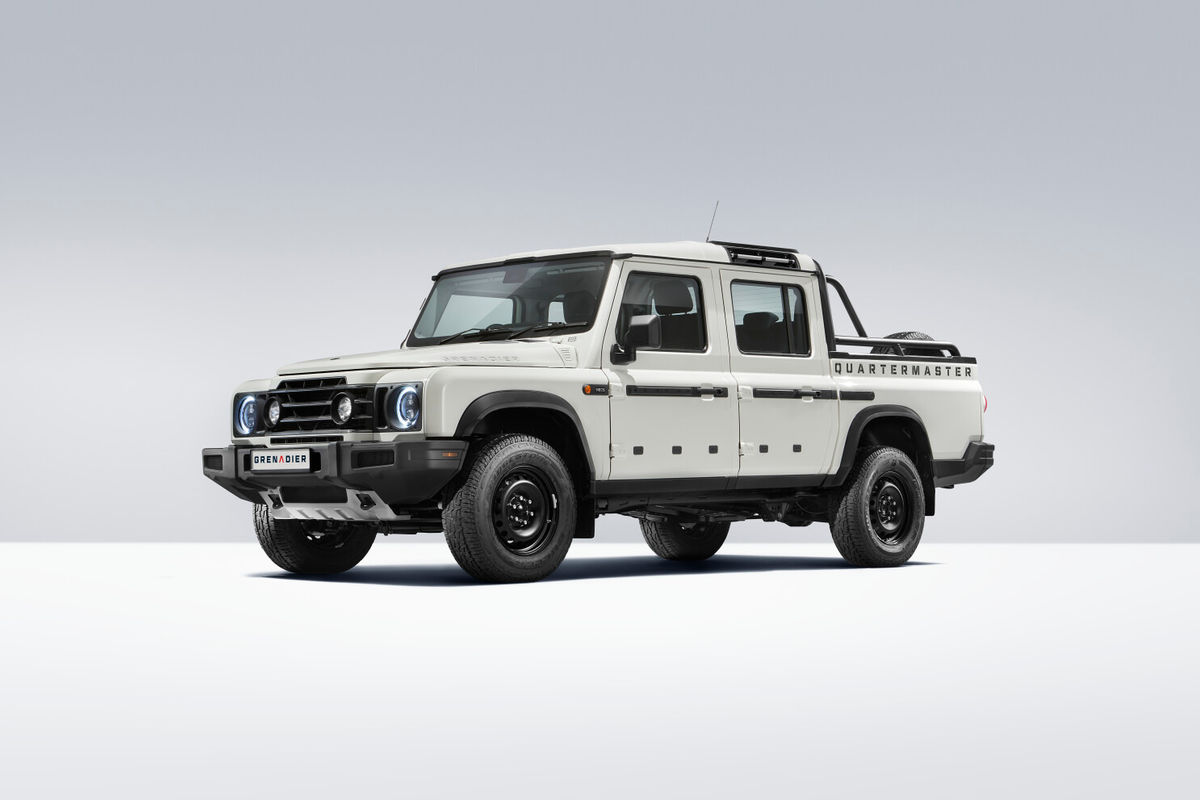
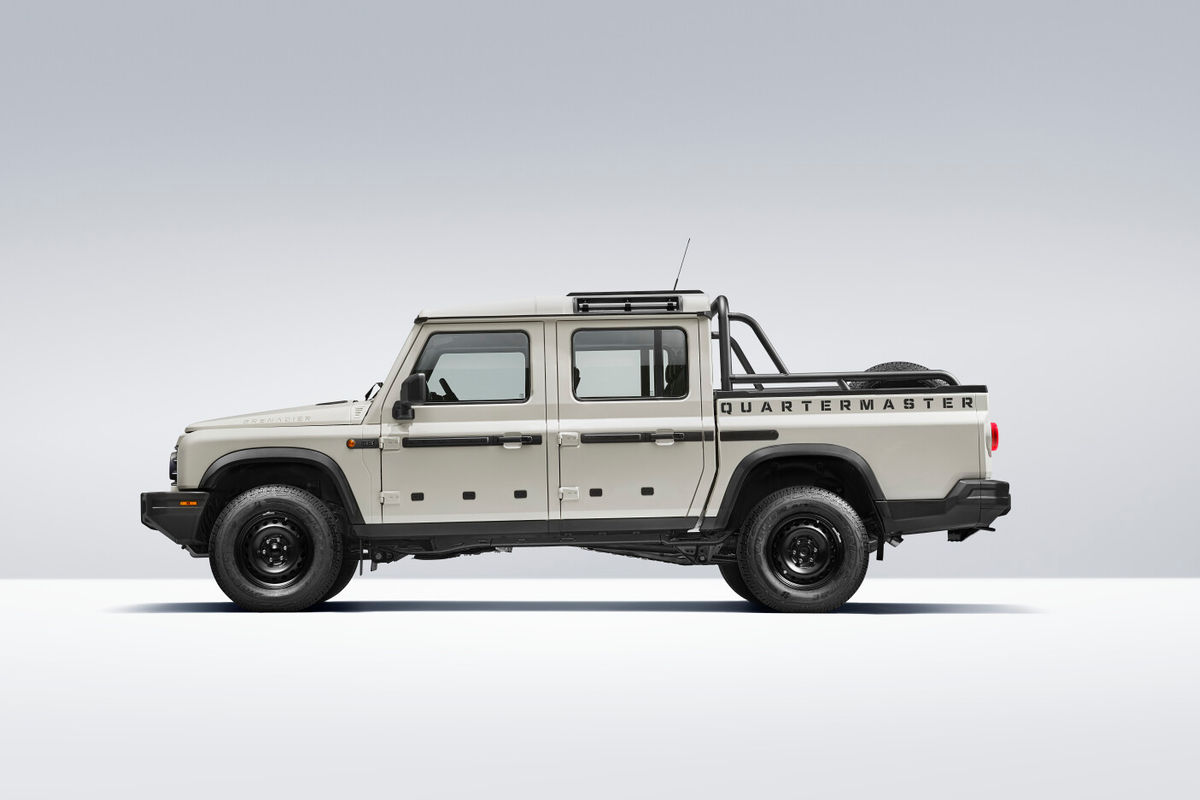
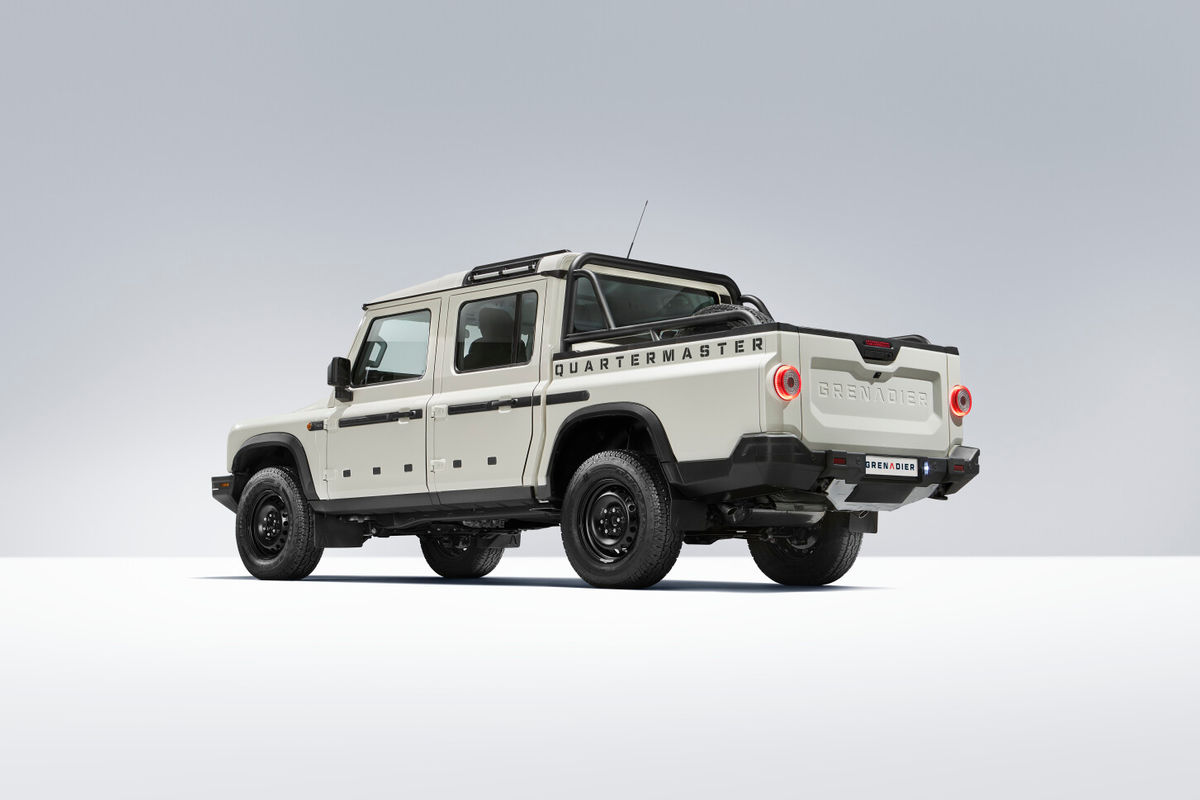
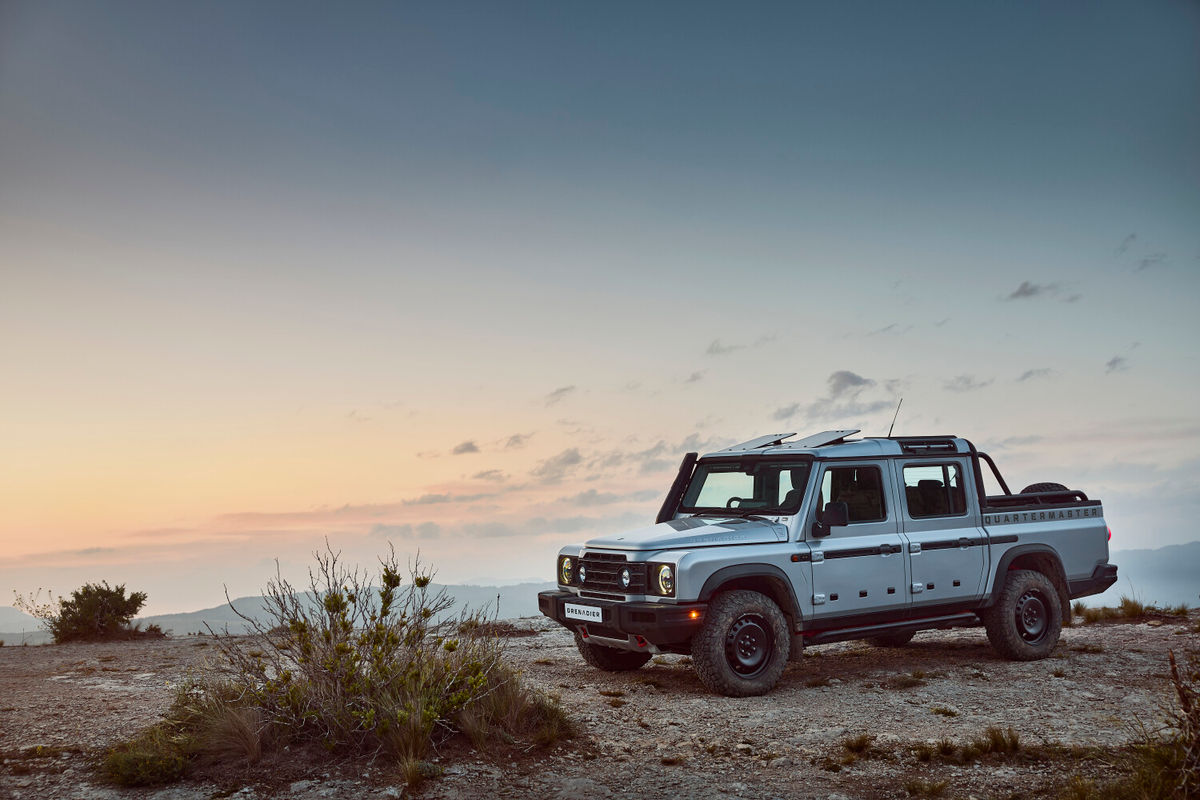
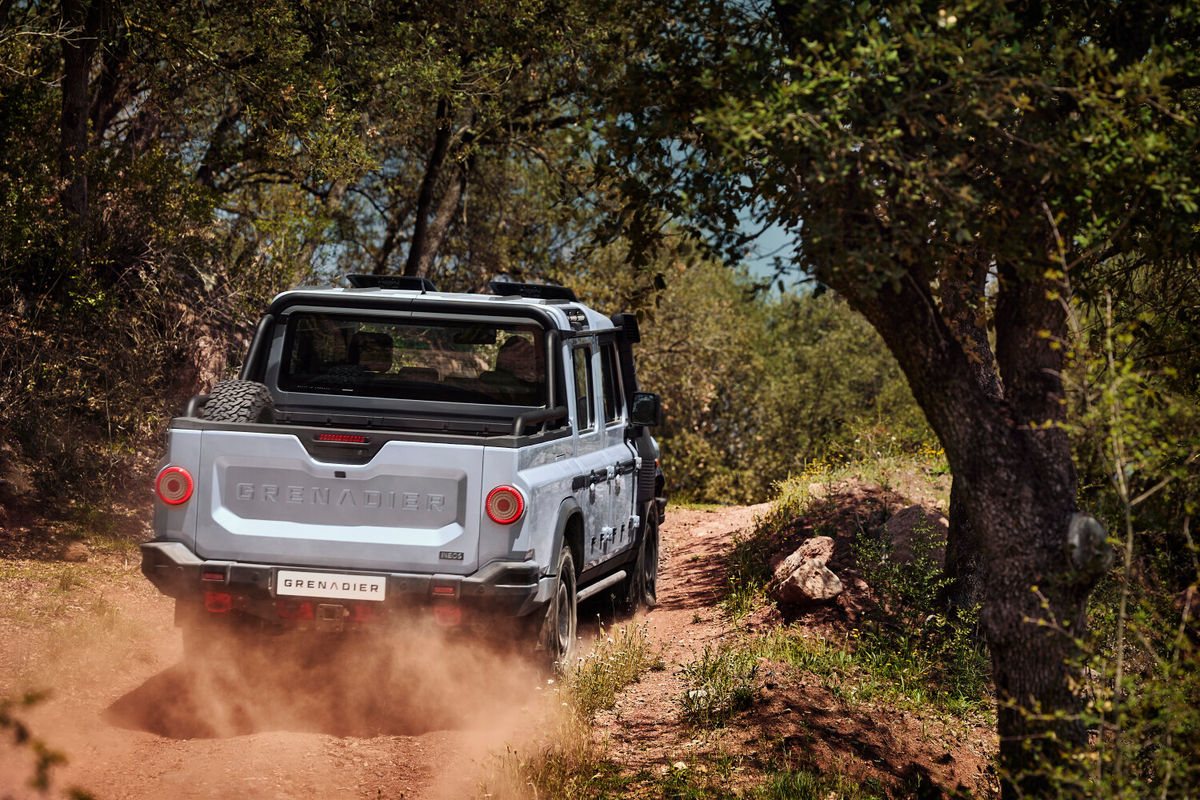
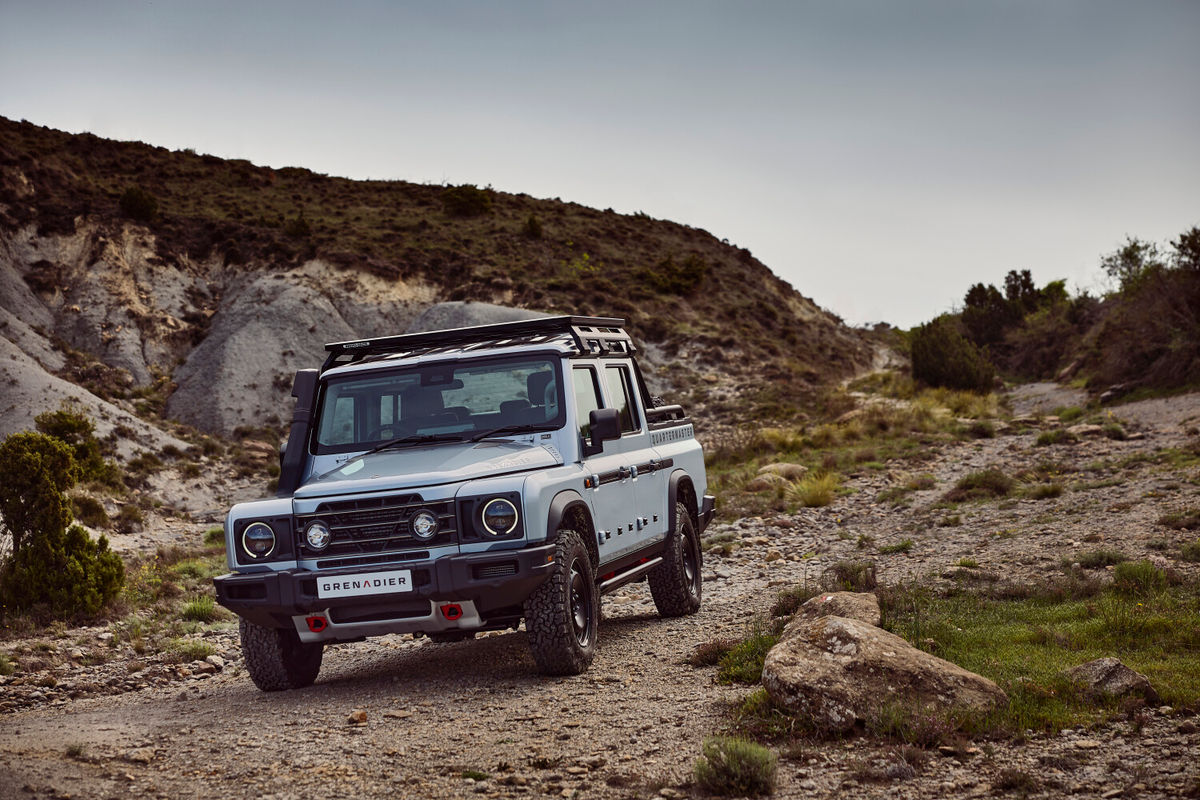
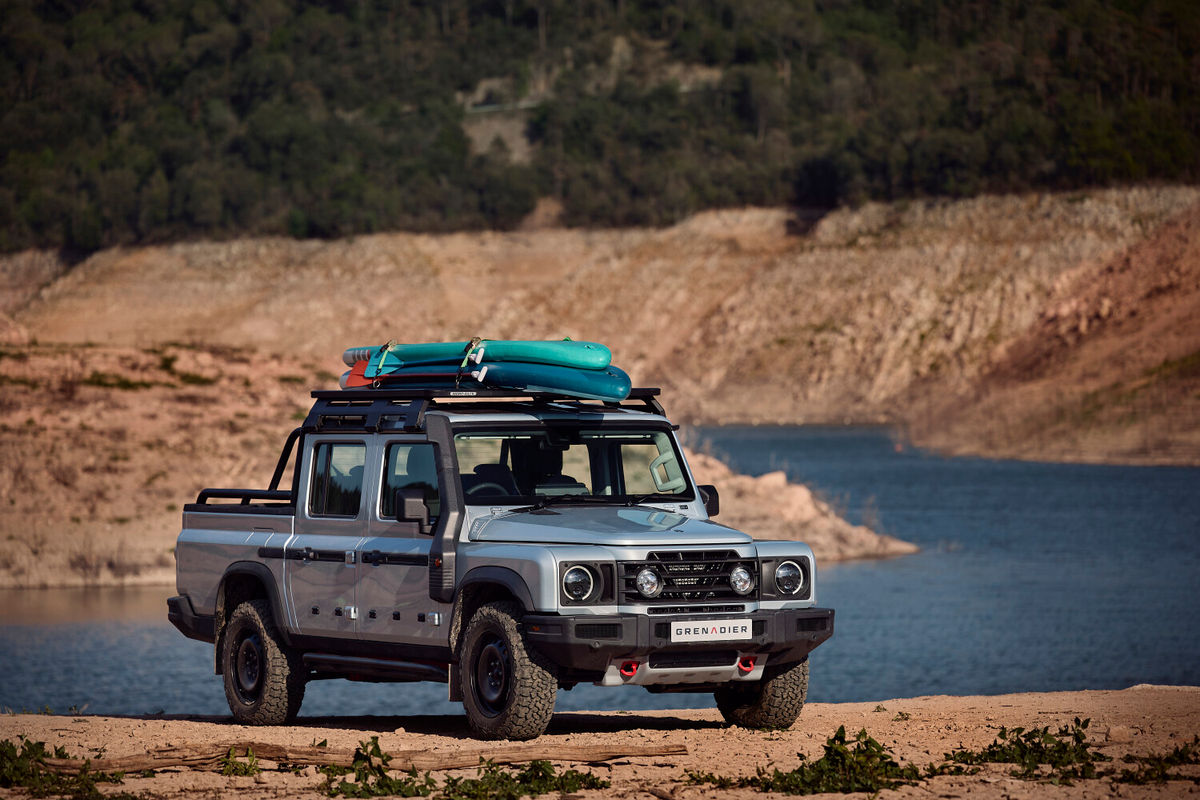
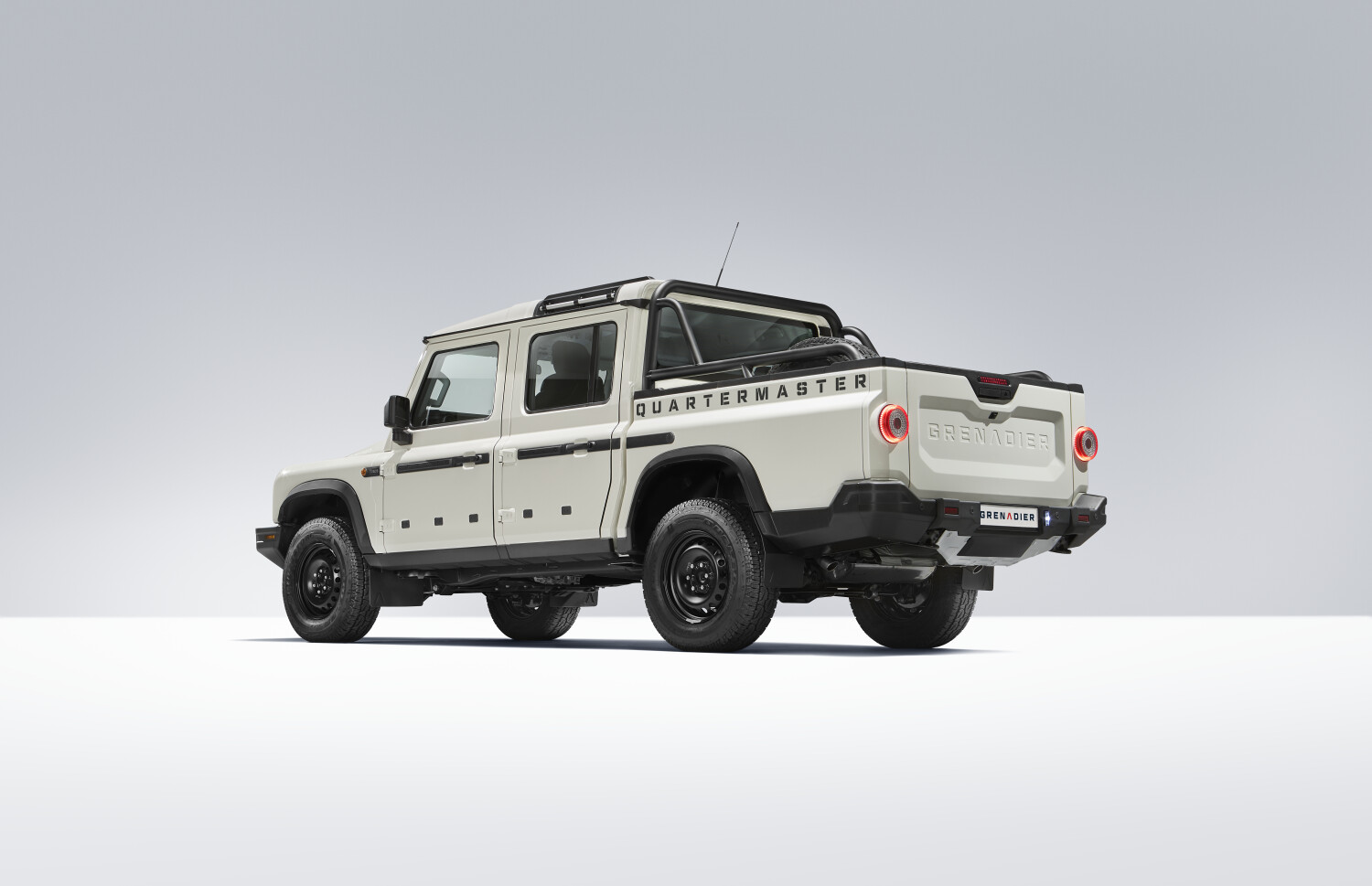
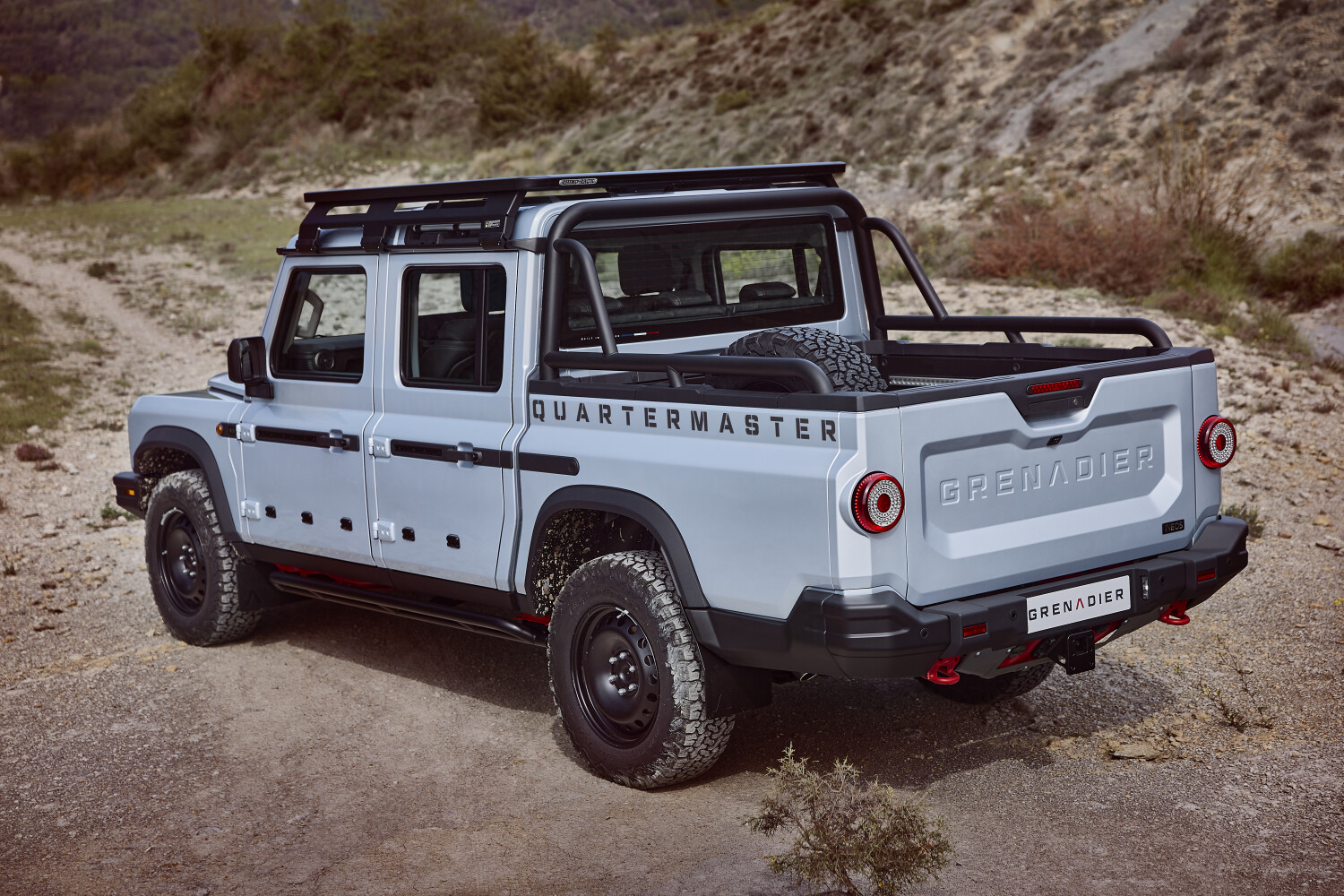
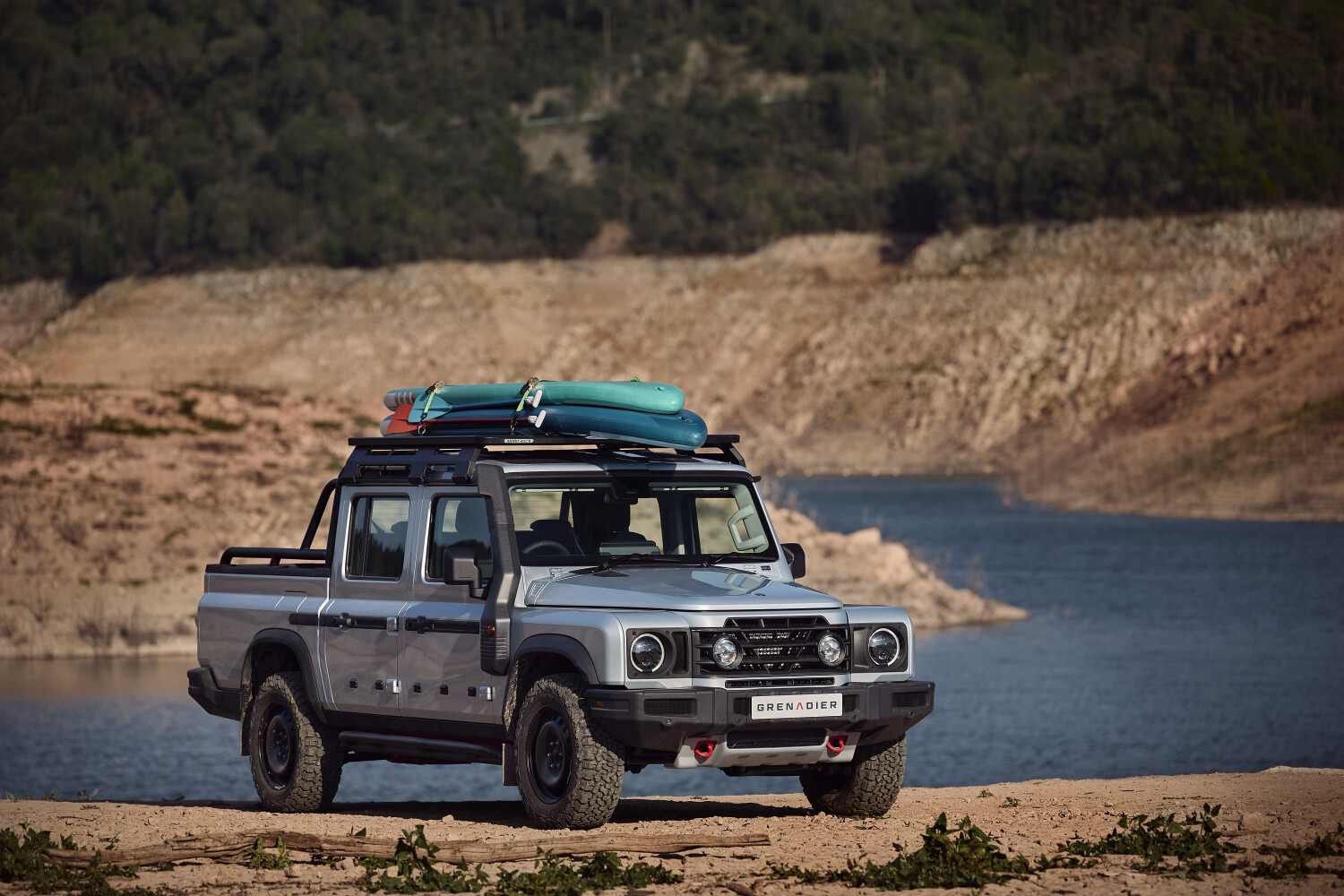
The chemical giant has made good on its promise of building a bakkie version of its new offroader. Meet the Ineos Grenadier Quartermaster.
The Ineos Grenadier is an interesting take on the rugged and capable SUV. The brand is not known for vehicles, instead specialising in chemicals. However, its founder Sir Jim Ratcliffe has a love and passion for the old Land Rover Defender and chose to build his own version.
The Ineos Grenadier Quartermaster bakkie looks rough and ready, and the offroad claims are impressive, with 264 mm of ground clearance, 800 mm wading depth and the brand claims the approach/departure/breakover angles are ‘unrivaled by any other series pickup.’ A centre differential lock and a two-speed transfer case are fitted as standard (front and rear diff locks are optional).
As a reminder, engines are sourced from BMW and these are the 3.0-litre inline-6 and customers can choose from petrol or diesel power. A ZF-sourced 8-speed auto box is standard. If ever you wanted a B58-powered bakkie, now’s your chance!
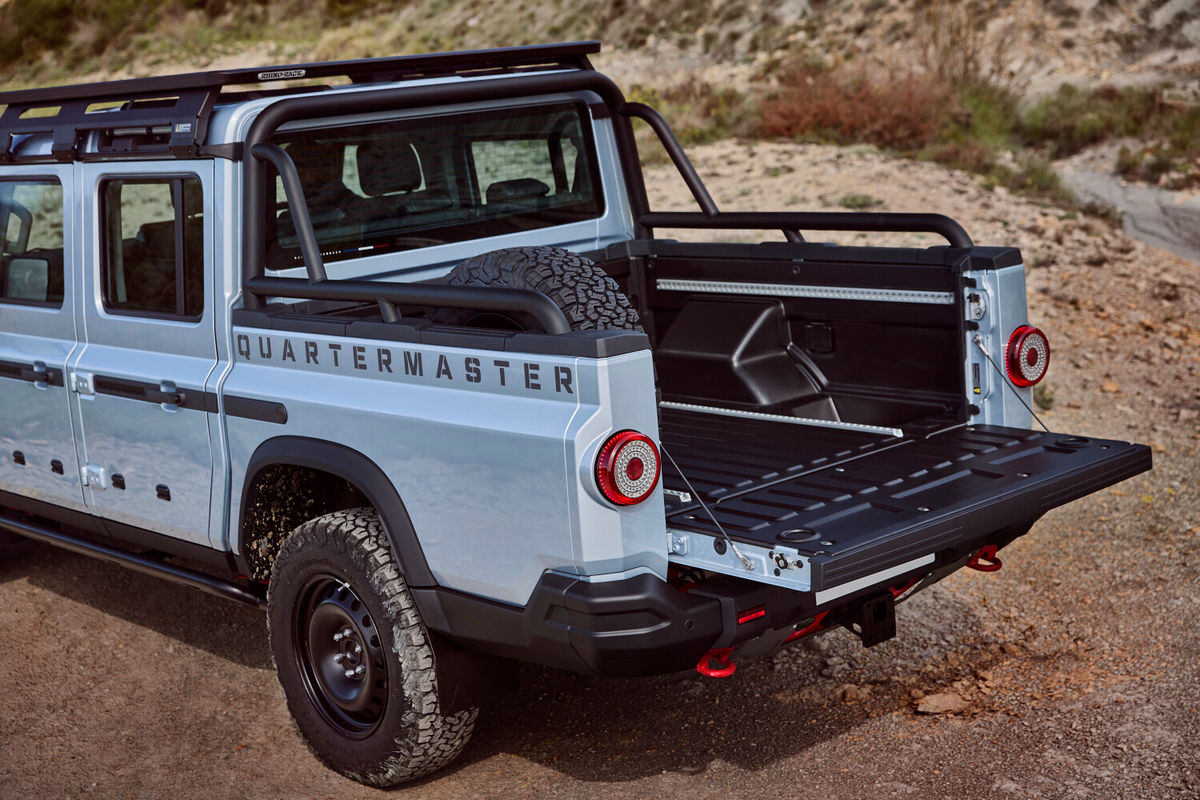
Mechanically, the Quartermaster is nearly identical to the Station Wagon, but the overall chassis length is 305 mm longer. The loadbay measures 1 564 mm long and 1 619 mm wide, which is enough to carry a standard Euro pallet. The payload rating is 760 kg and the Quartermaster has the same 3.5-ton tow rating.
Ineos has a full catalogue of accessories for its Grenadier range, and the Quartermaster will be available with things like a waterproof canvas canopy, lockable roller tonneau cover, roof rack, mounts for jerry cans/sand ladders/shovels and much more.
As far as rivals go, the Quartermaster’s going up against the Jeep Gladiator, Ford Ranger Raptor and the Toyota Land Cruiser 79.
Ineos Grenadier Quartermaster Availability in South Africa?
We understand that local pricing for the Ineos Grenadier Quartermaster will be announced on the 1st of August 2023, but no indication of when the first units will be touching down in South Africa.
As a reminder, the Ineos Grenadier has gone on sale in SA, with selected BMW dealerships offering servicing and sales. The Ineos Grenadier is priced from R1 513 100.
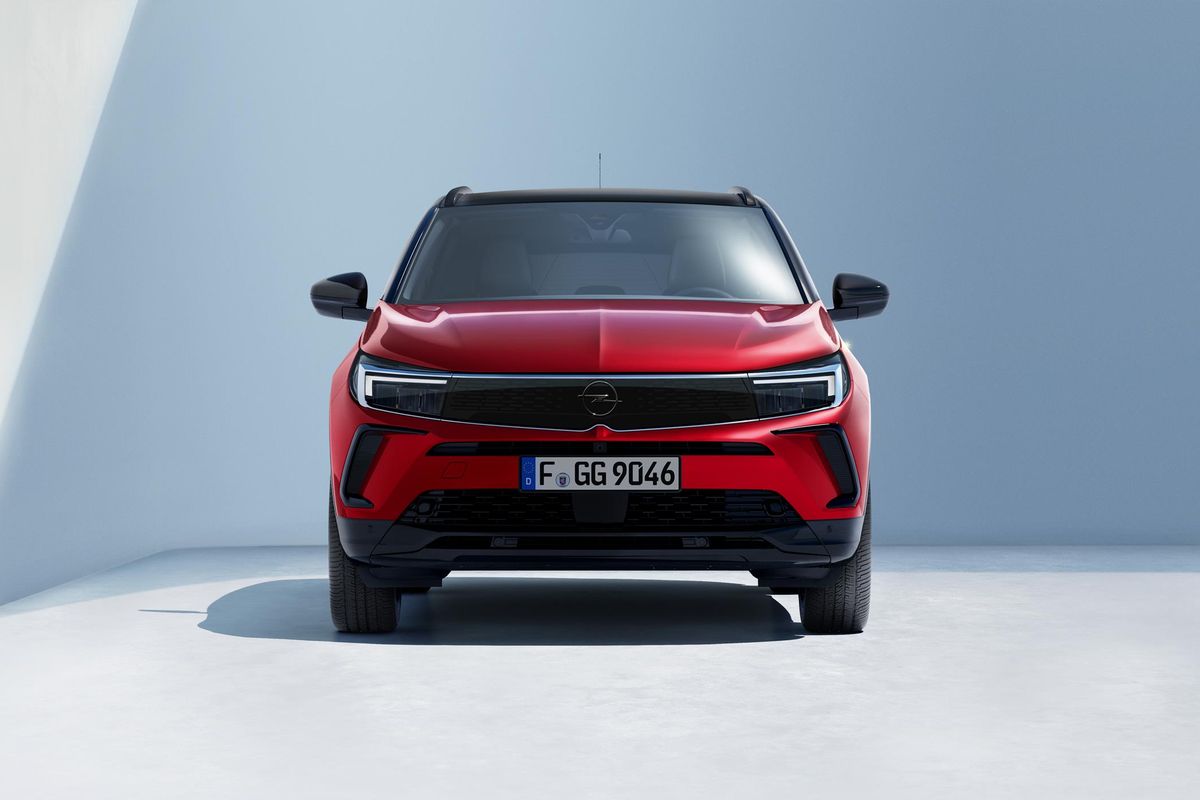
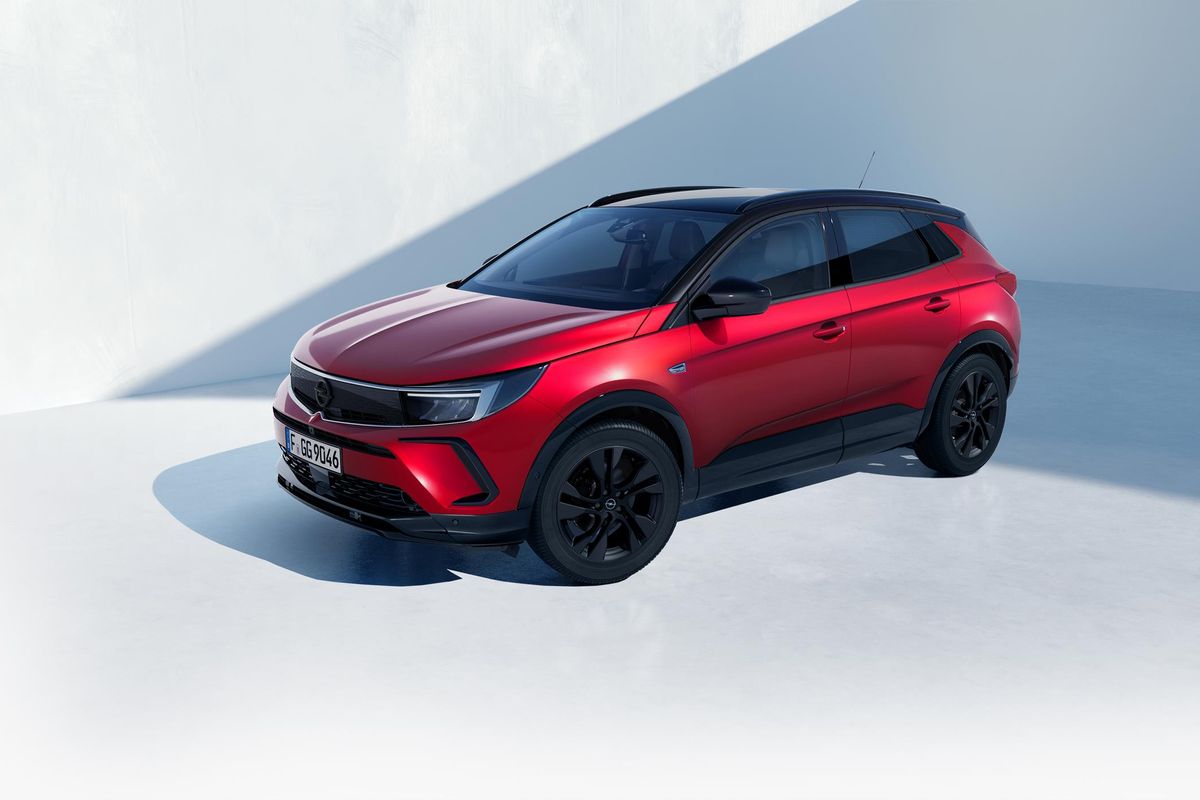
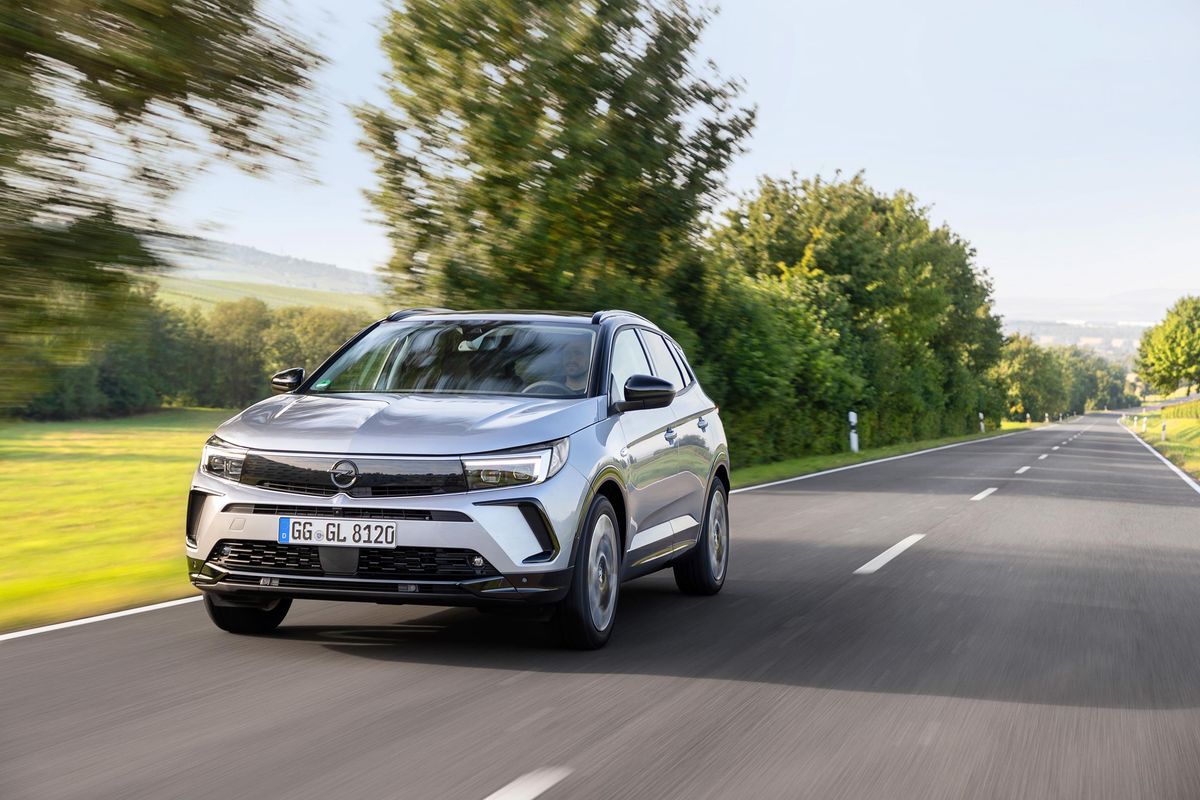
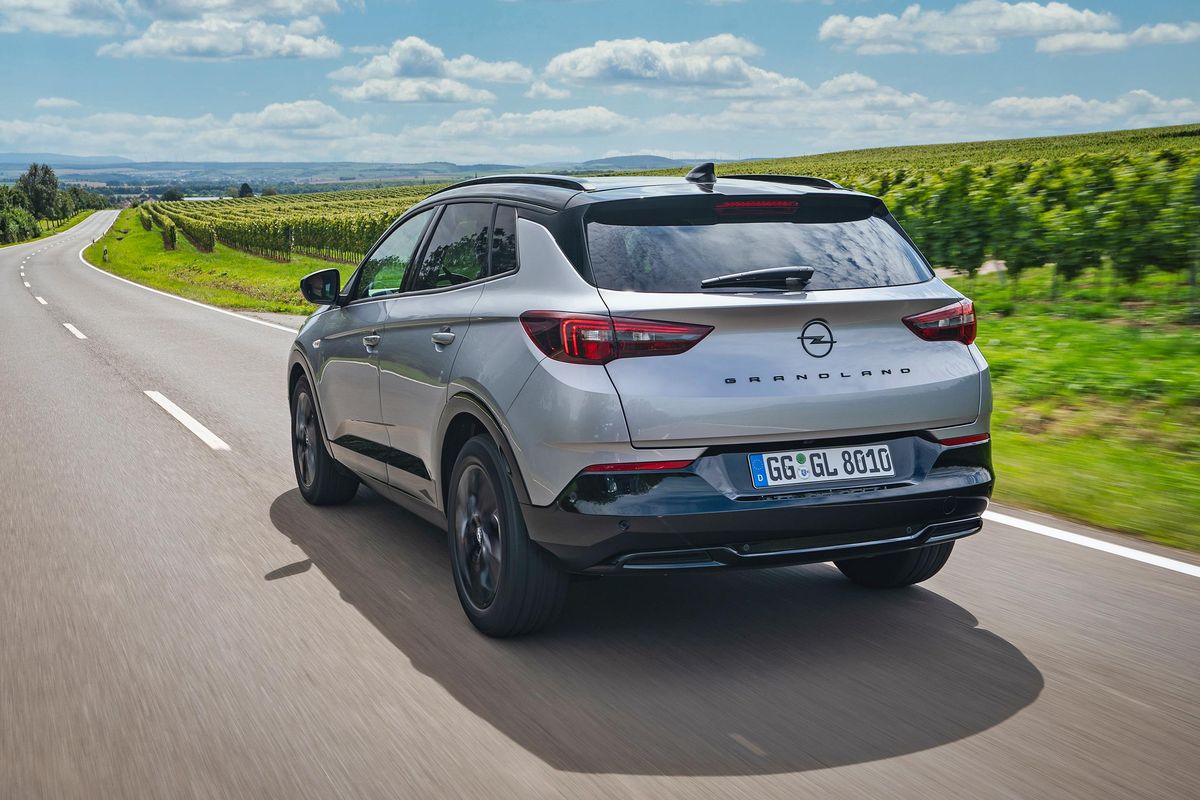
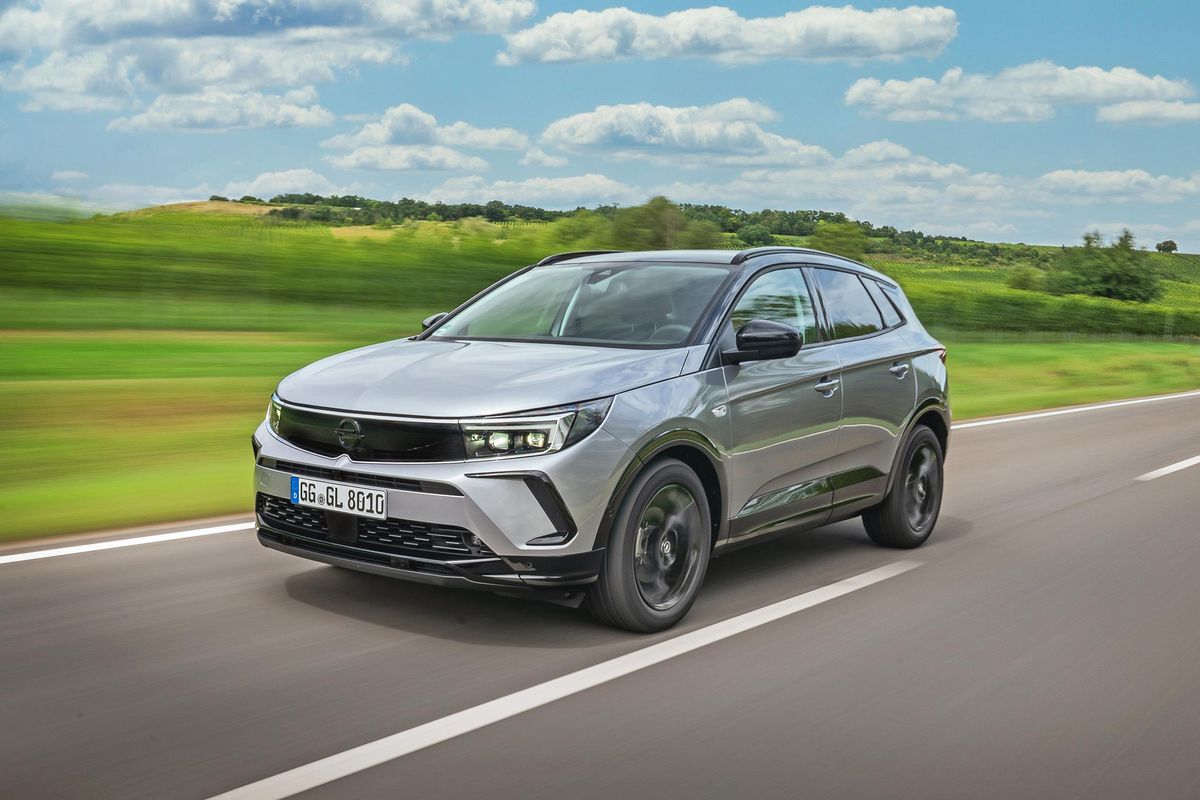
The Opel Grandland has been updated for 2023, here’s a first look at what’s new and how much you can expect to pay for this family SUV.
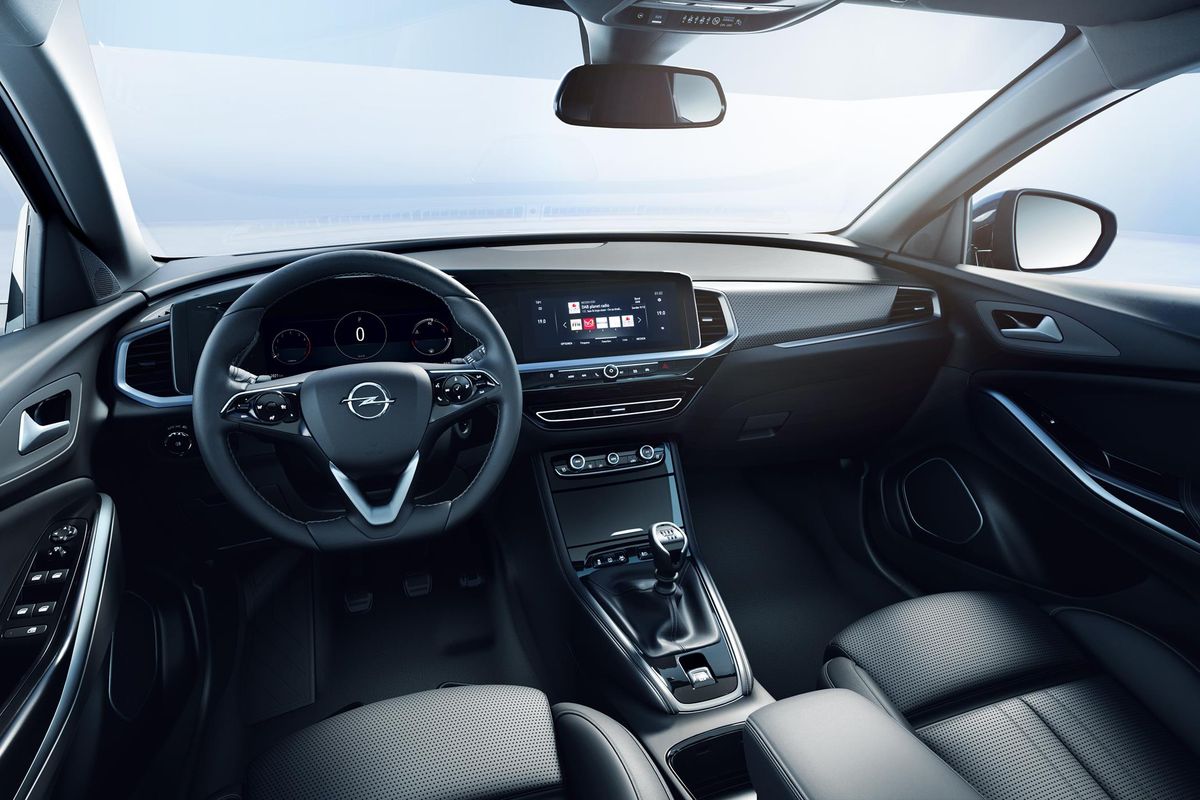
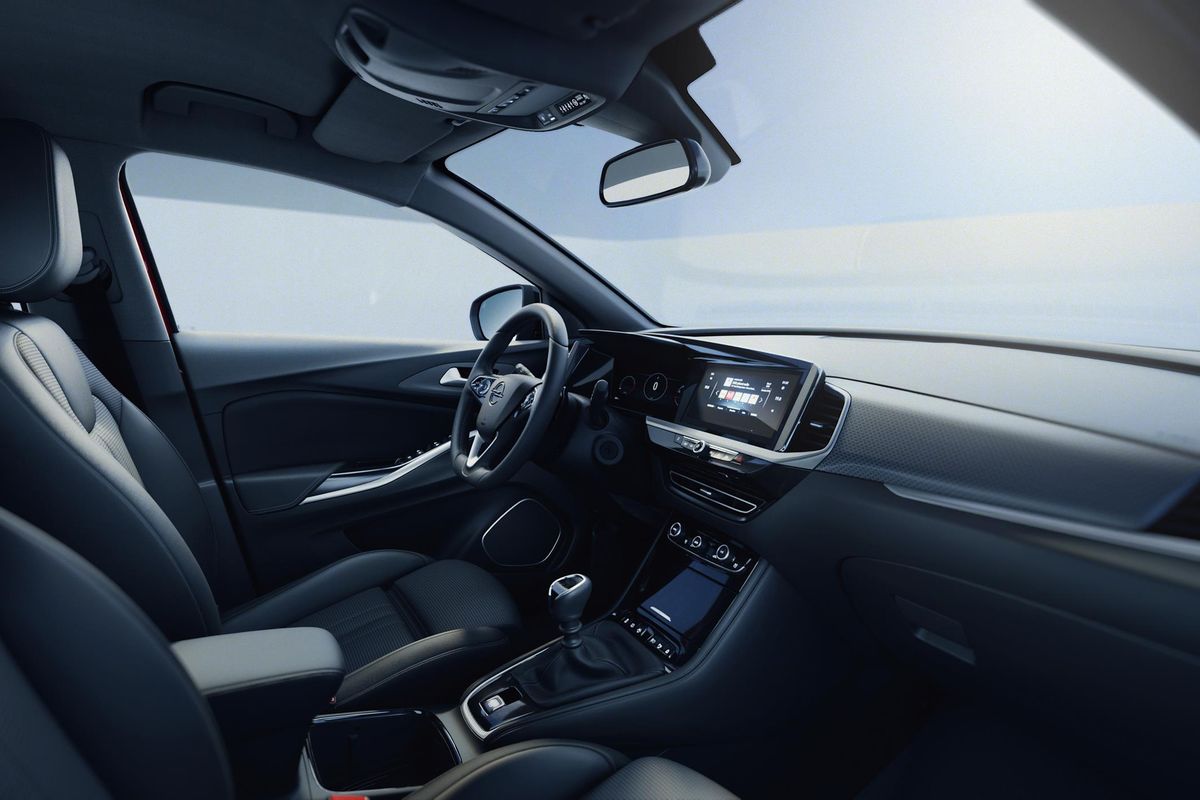
The Opel Grandland is not a common sight on SA roads, with just a handful of units finding their way into customer’s hands. The 2023 Opel Grandland has just touched down, featuring a revised exterior design, more advanced cabin and be available in a three-derivative lineup.
Under the bonnet is a 1.6-litre turbocharged petrol engine with 121 kW and 240 Nm, and all Grandlands feature automatic transmissions.
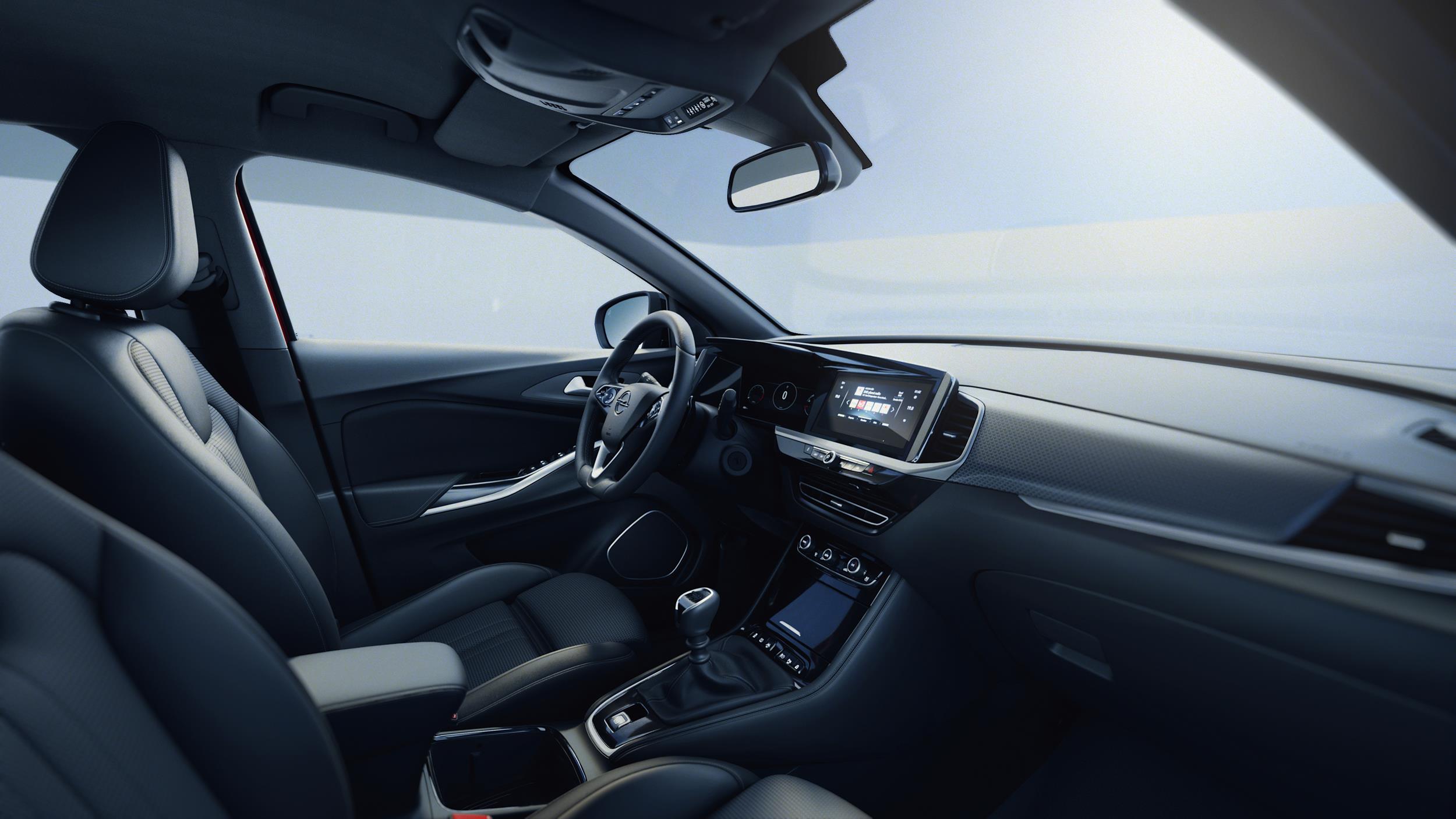
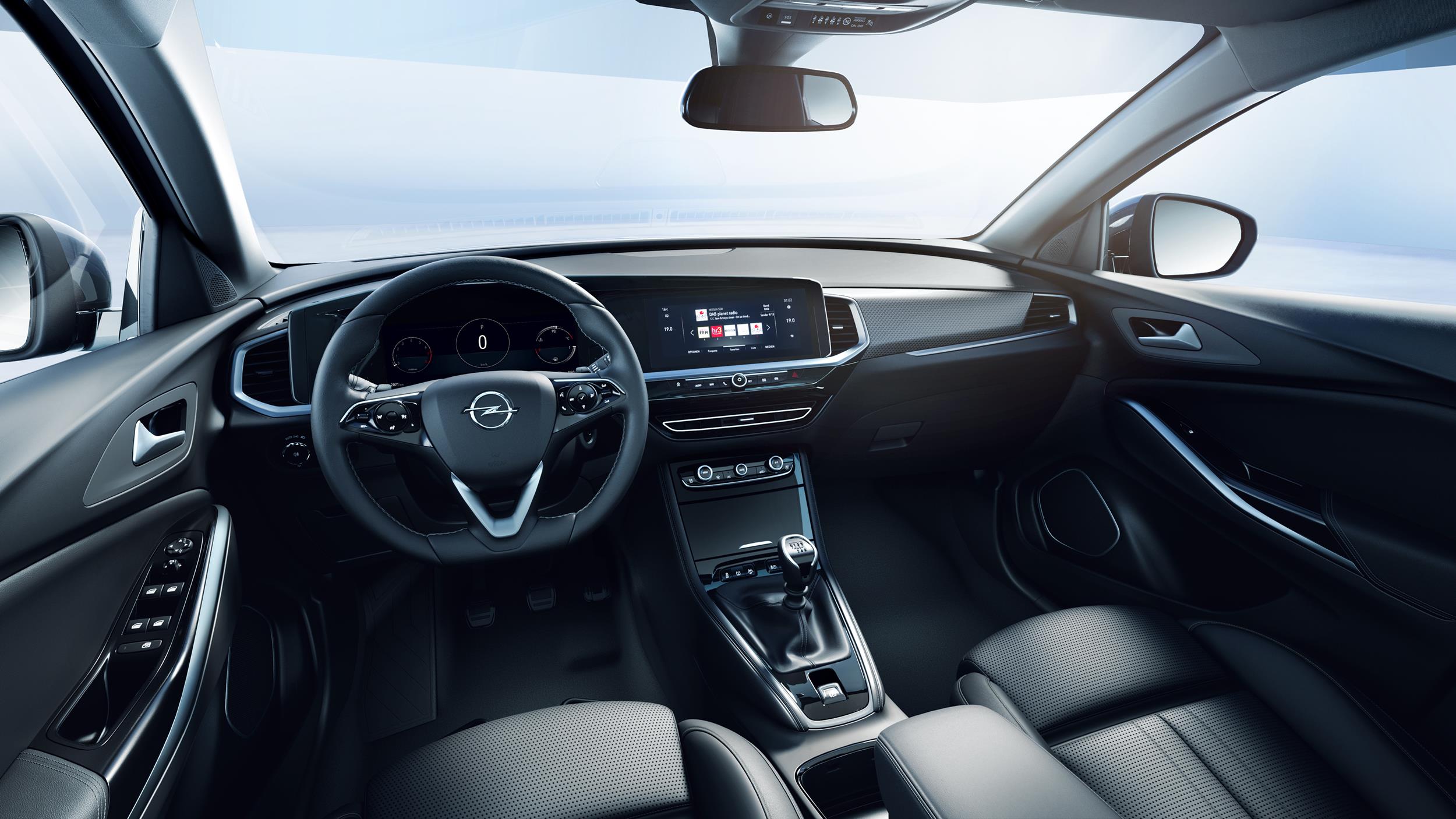
Visually, you can spot the newcomer with its design elements lifted straight from the stunning Mokka. A two-tone roof adds to the appeal. Inside, there’s been a focus on comfort in the Grandland. All models get the new-look digital instrument cluster that stretches across the dashboard to include the infotainment screen.
Trim Levels
Grandland
Cloth seats
Forward collision warning with auto emergency braking, lane keep, traffic sign recognition
Cruise control with speed limiter
LED daytime running lights
Intellilink Infotainment
6x speakers
Front/rear parking sensors
17-inch alloy wheels
Dual zone climate control
Apple CarPlay / Android Auto
Wireless charger
Reverse camera
Grandland GS Line (the above, plus:)
Alcantara seats with heating
Full LED adaptive headlights
Heated steering wheel
18-inch alloy wheels
Advanced park assist
Front/rear parking cameras
Grandland Ultimate (the above, plus:)
Leather seats with heating and ventilation
Heated rear seats
Keyless open and button start
Sensor controlled power tailgate
Satellite navigation
Blind spot monitoring
How much does the updated Opel Grandland cost in South Africa?
The Opel Grandland comes with a 5-year/100 000km warranty, 5-year/100 000 km service plan with roadside assistance as standard.
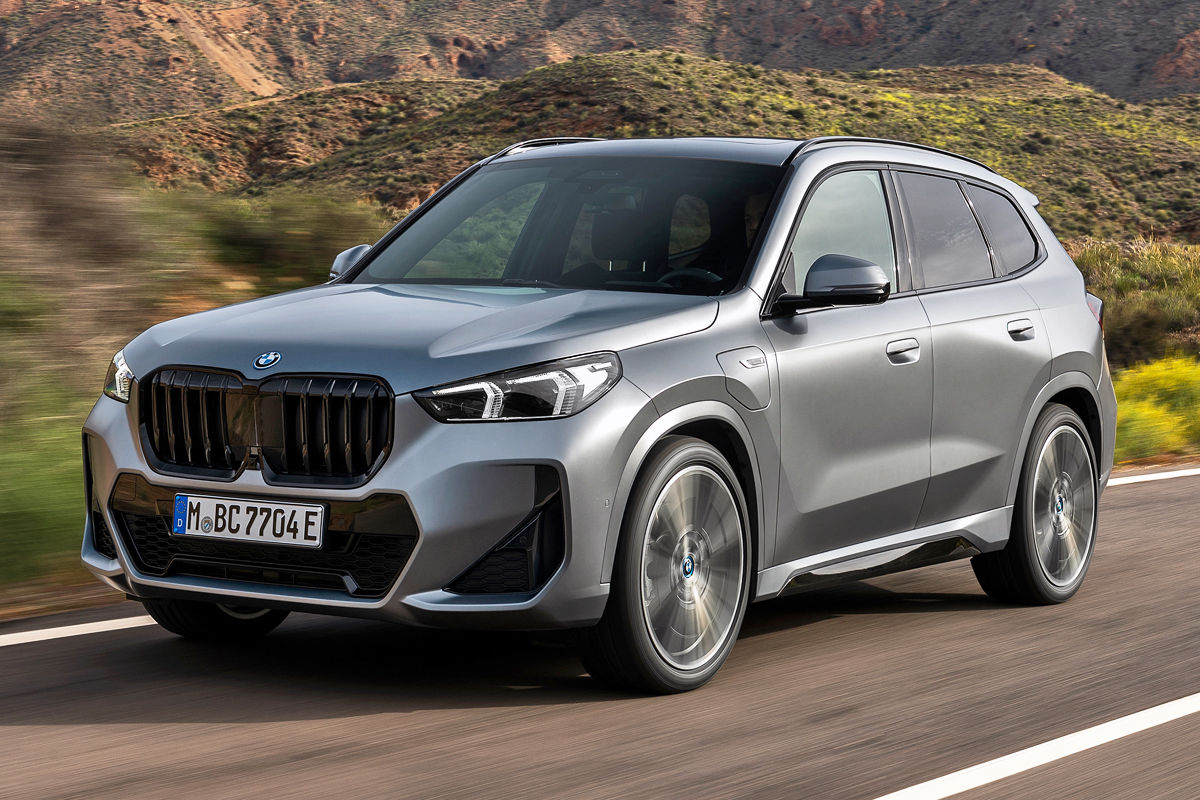
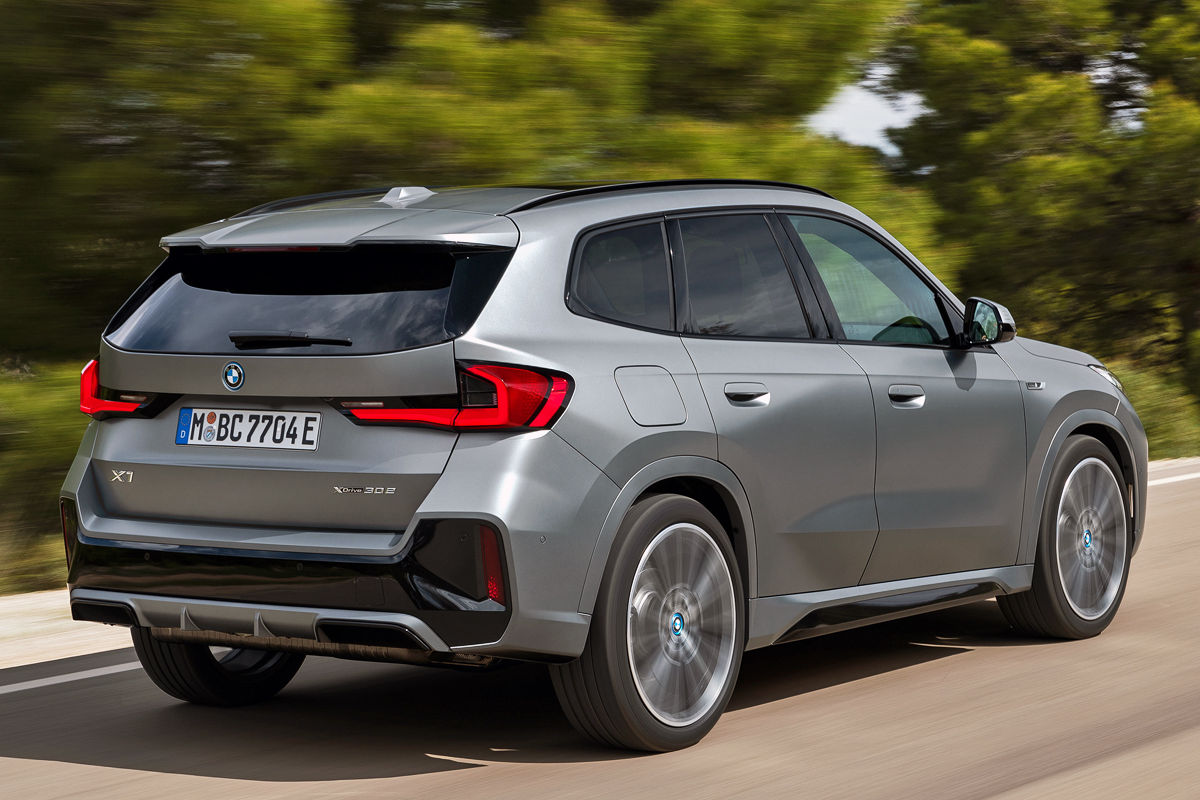
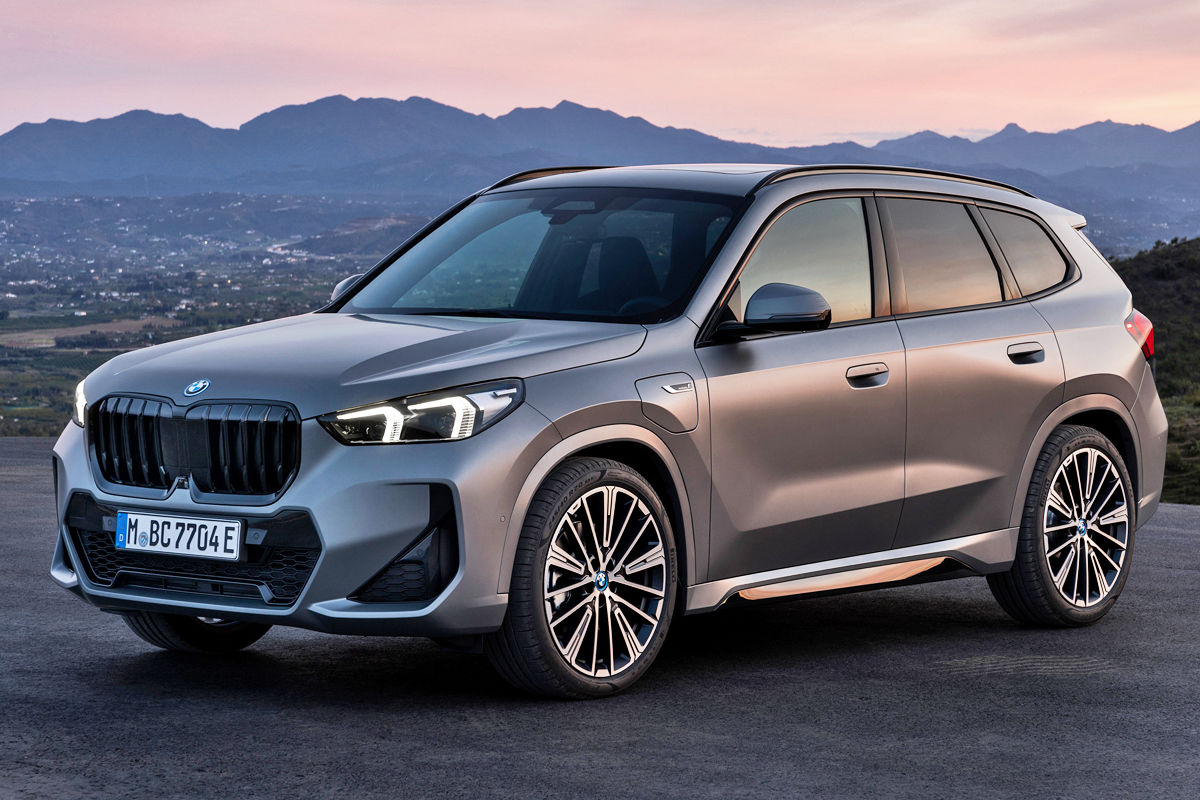
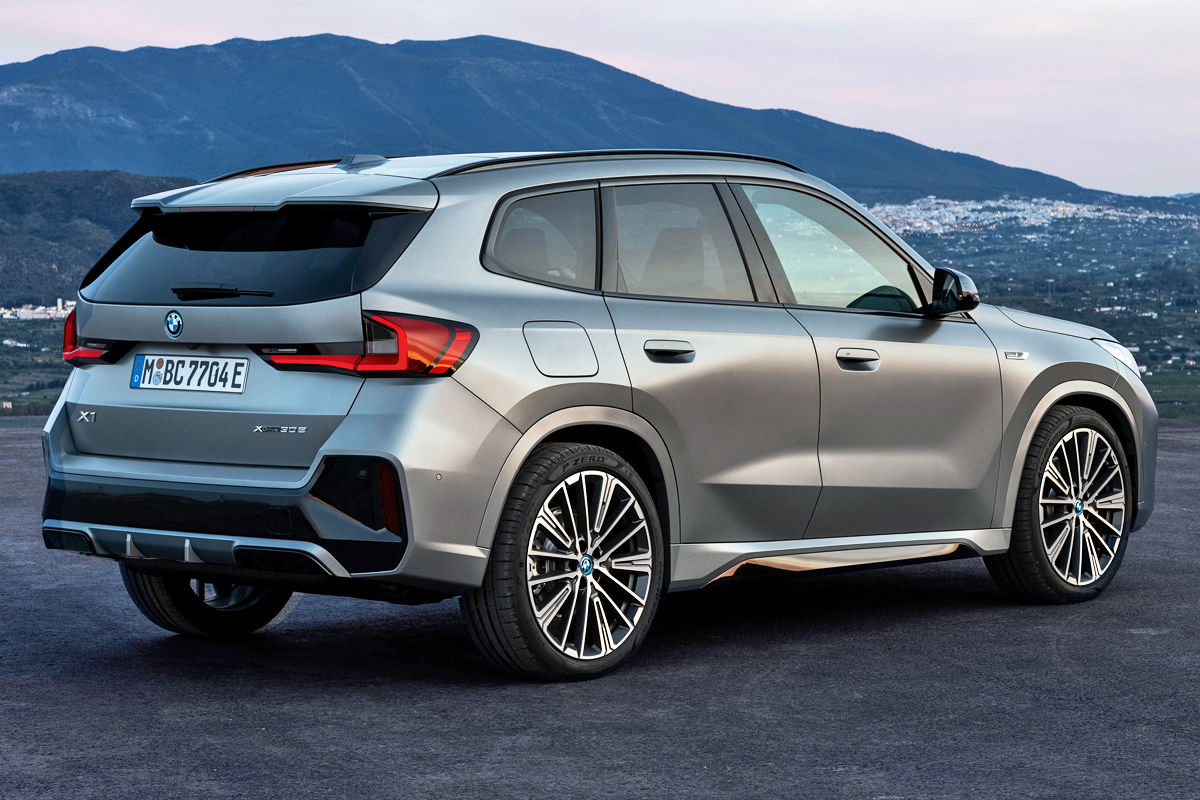
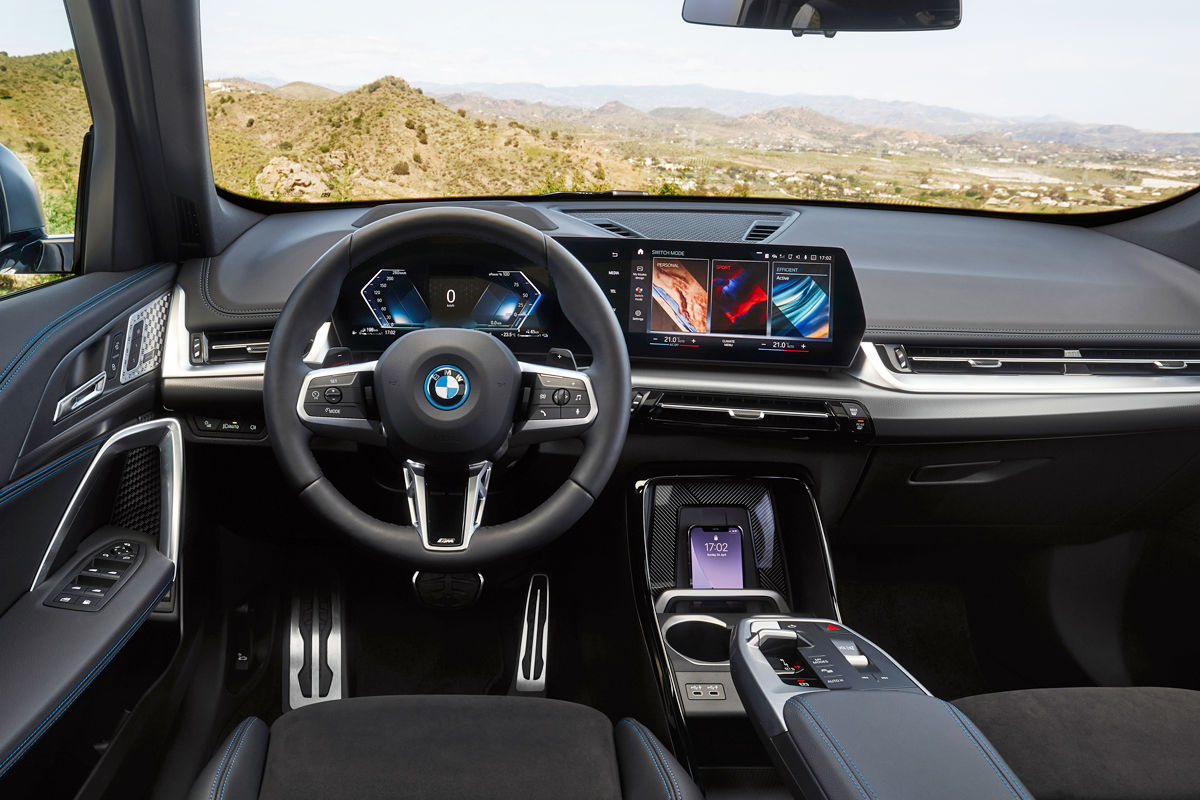
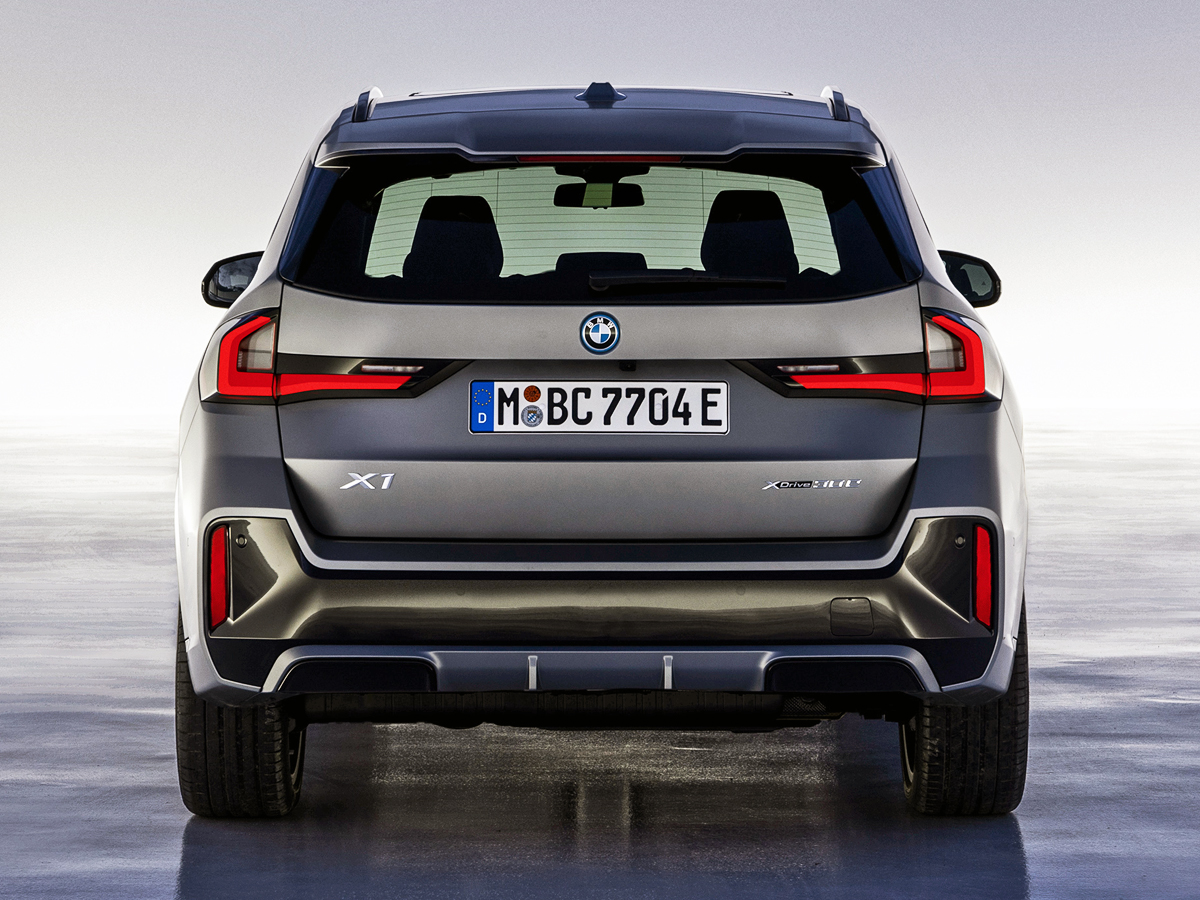
Despite BMW earlier stating the X1 xDrive30e was not destined for South Africa, this 240 kW plug-in variant has quietly joined the local line-up as SA’s most affordable PHEV…
When the wraps came off the U11-generation BMW X1 range in mid-2022, the German firm said the X1 xDrive30e PHEV would “not be offered in South Africa”. However, the company appears to have done an abrupt about-turn as this dual-powered derivative has now quietly joined the local line-up.
Yes, the plug-in hybrid version slots in above the purely petrol- and diesel-powered X1 variants, priced from R1 050 000 in standard xLine trim and R1 090 000 in optional M Sport guise. That makes it the most affordable PHEV on the local market. Of course, the newcomer is not to be confused with the fully electric iX1 xDrive30e, which kicks off at R1 205 000. As a result, the X1 range now includes petrol, diesel, plug-in hybrid and fully electric offerings.
So, what do we know about the X1 xDrive30e’s plug-in powertrain? Well, it comprises the Munich-based automaker’s familiar turbocharged 1.5-litre, 3-cylinder petrol mill along with a “highly integrated” electric drive unit and a 16.3 kWh (14.2 kWh net) lithium-ion battery pack. The petrol motor generates 110 kW/240 Nm and drives the front wheels via a 7-speed dual-clutch transmission, while the 130 kW/247 Nm electric motor powers the rear axle.
BMW says the X1 xDrive30e is capable of travelling on battery power alone for up to 90 km.
Total system outputs stand at 240 kW and 477 Nm (yes, that makes it more powerful than the recently revealed X1 M35i), which allows the X1 xDrive30e PHEV to complete the obligatory 0-100 kph sprint in a claimed 5.6 seconds before topping out at 205 kph. The high-voltage battery pack is positioned in the vehicle floor and offers an all-electric (claimed) range of 90 km, on the WLTP cycle.
The vehicle’s maximum charging capacity is listed as 7.4 kW, which BMW says allows it to be fully recharged from empty in 2.5 hours when using an AC wallbox. Hooked up to a conventional domestic power socket, a full charge is completed in a claimed 7.75 hours. As a result of its ability to use only electric power for periods, the X1 xDrive30e’s claimed combined fuel-economy figure is a rock-bottom 1.6 L/100 km, with a corresponding CO2 figure of just 36 g/km.
The xLine version is available with an optional R24 500 Equipment package that adds items such as adaptive LED headlights, high-beam assist, comfort access, a heated steering wheel and heated front seats. The M Sport derivative, meanwhile, can be specified with the R30 000 M Sport package Pro, which includes M Sport brakes, the high-gloss Shadow Line kit, tweaked headlights, a chunkier rear spoiler and M seatbelts.
There’s also the Equipment package Professional (R43 500), Deluxe Package (R40 000), 19-inch V-spoke alloy wheels (R15 000) and various upholstery options, not to mention a range of paint colours from which to choose.
How much does the BMW X1 xDrive30e PHEV cost in SA?
BMW X1 xDrive30e xLine – R1 050 000
BMW X1 xDrive30e M Sport – R1 090 000
The price above includes a 5-year/100 000 km Motorplan (though BMW Group SA says buyers can “elect to opt out” of this arrangement at the point of vehicle purchase).