The all-new Indian-built Citroen C3 has gone on sale and comes to market competitively priced. We get behind the ‘wheel to see if it’s worth a second look!
The 2023 Citroen C3 has landed in South Africa, but it’s no longer French-sourced it now comes from India. With a World Urban Car of the Year title under its belt, a fashionable crossover shape and a competitive price point, could this be the ideal type of budget car for our new-vehicle market?
In this review, Ashley Oldfield gets behind the ‘wheel of the new Citroen C3 and rates its driving experience. He also takes a close look at the features, the cabin space and the safety tech fitted.
5 fascinating facts from SA’s new-car sales figures in H1 2023
We’ve sorted through South Africa’s new-car sales figures for the first half of 2023 and pulled out 5 fascinating bite-sized facts. Here’s what you need to know…
Want to know which models led the sales charge in the opening half of 2023? Well, we’ve already covered South Africa’s most popular passenger vehicles as well as taken a look at the country’s best- and worst-selling bakkies. Now, we’ll turn our attention to a few fascinating morsels of information we’ve extracted from the H1 2023 new-car sales figures.
Yes, we’ve sorted through the new-car sales statistics at the halfway point of the year (with a focus on the passenger-vehicle market) and selected 5 interesting titbits that jumped out at us. Let’s dive right in…
1. SA’s cheapest new car places 22nd
The Suzuki S-Presso – which is currently South Africa’s cheapest new passenger car, starting from R169 900 – wasn’t quite able to bust into the top 20. Instead, the budget beater settled for 22nd place, with 2 488 units registered over the opening half of 2023. Interestingly, as many as 11 likewise Indian-built vehicles finished ahead of the S-Presso in the rankings.
2. Land Cruiser 300 outsells RAV4
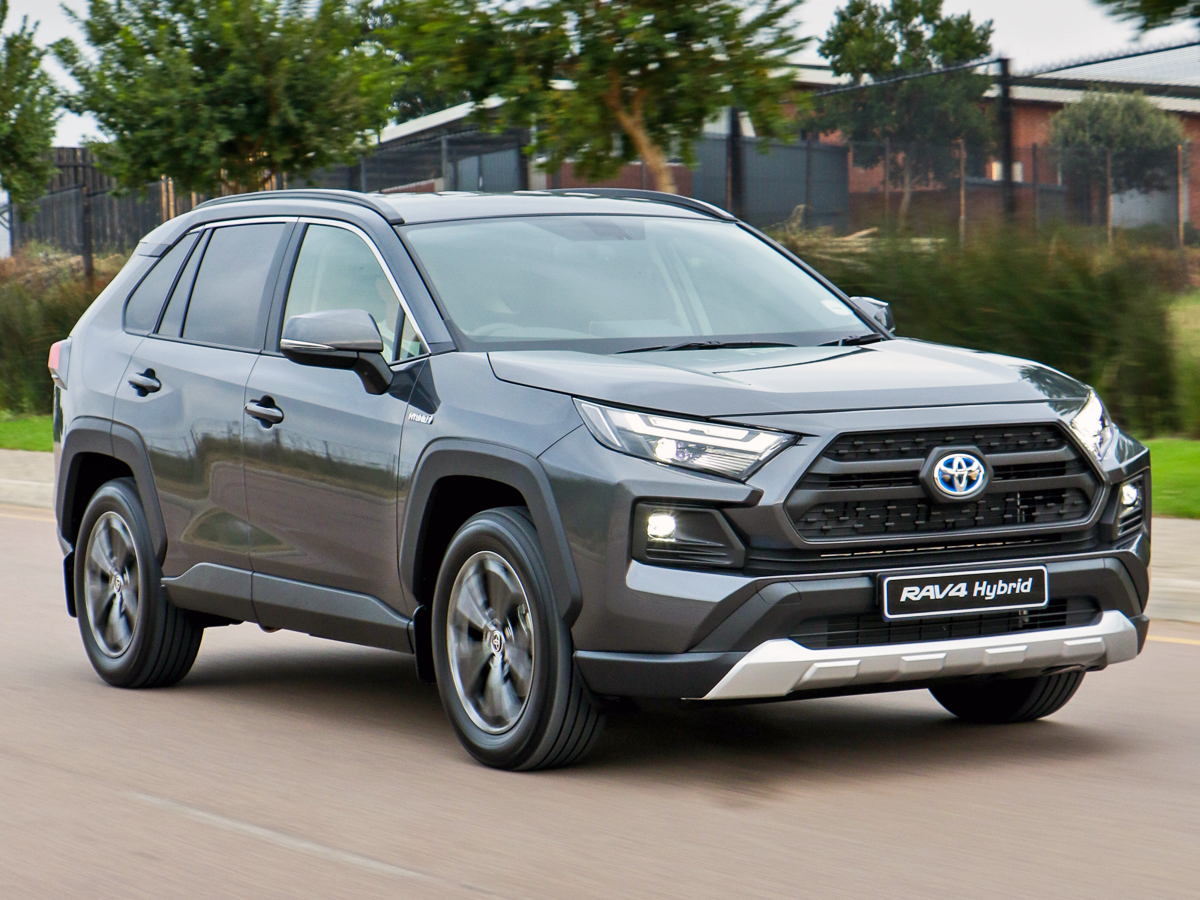
Once a local favourite (and the world’s best-selling vehicle in 2021), the Toyota RAV4 failed to crack even the top 50 in SA in H1 2023. In fact, with 586 units sold, the 55th-placed RAV4 was beaten by the Toyota Land Cruiser 300 (despite the latter’s starting price of R1 458 900), which finished in 41st position with 1 039 examples registered. Toyota SA Motors, though, tells us it has been “experiencing some supply constraints” with the RAV4.
3. VW Golf 8 GTI and R total 303 units
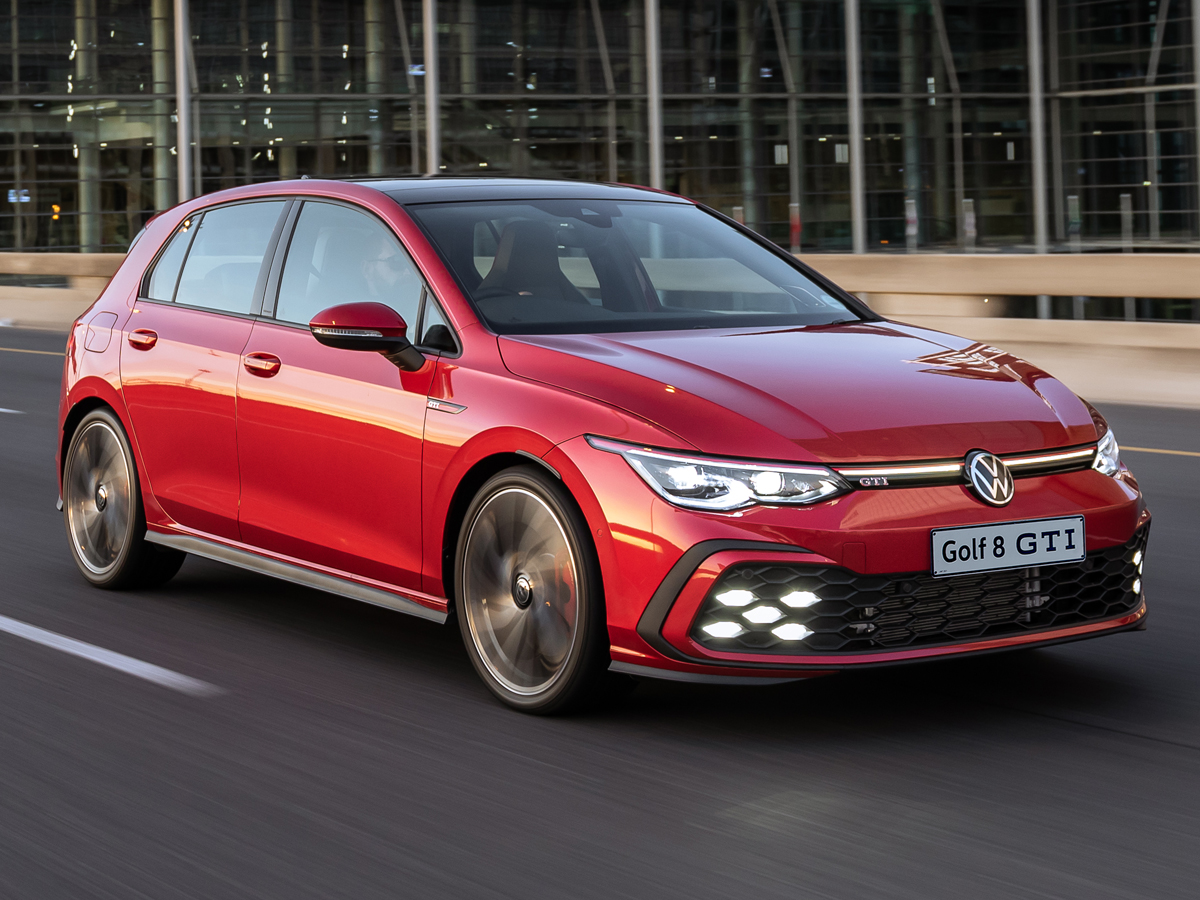
Though Volkswagen SA’s struggle to secure stock of the Golf 8 GTI and Golf 8 R seemingly continues, it’s intriguing to note the German hot hatches together managed a 6-month total of 303 units, translating to an average of around 50 examples a month (and a placing of 79th). Of course, since the all-paw Golf R officially went on sale only at the end of April 2023 – after a particularly protracted wait – the GTI accounted for the bulk of the total.
4. New Ford Everest cracks top 30
Despite stock of the new Ford Everest seemingly arriving only in February and the local line-up expanding only in April, the Blue Oval brand’s adventure SUV finished H1 2023 on a commendable 1 440 units, which was enough to secure it 29th position. It was the highest-placed of the few Ford passenger vehicles available in SA, with EcoSport sales slowing to 1 298 units (production of the latter has, after all, long since ended) and the Mustang ending on 108 registrations.
5. Hyundai i30 more popular than Toyota GR86
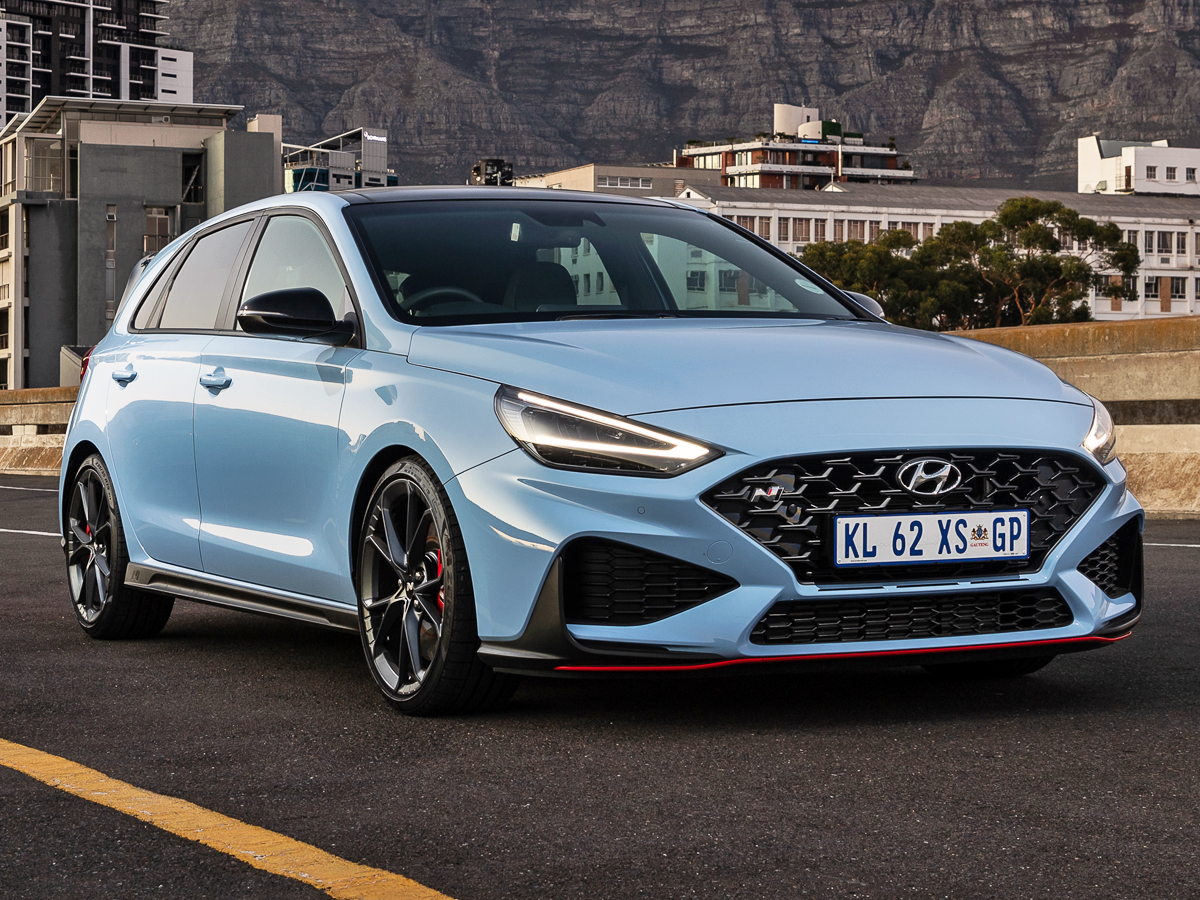
Though by no means direct competitors, it’s nevertheless intriguing to note the Hyundai i30 N hot hatch managed to outsell the Toyota GR86 in the opening half of the year. It was a close-run affair, though, with the i30’s tally coming in at 36 units and the GR86’s total sitting at 31 registrations. For the record, the South Korean hot hatch is priced from R811 900, while the 2-strong GR86 coupé range starts at R755 500.
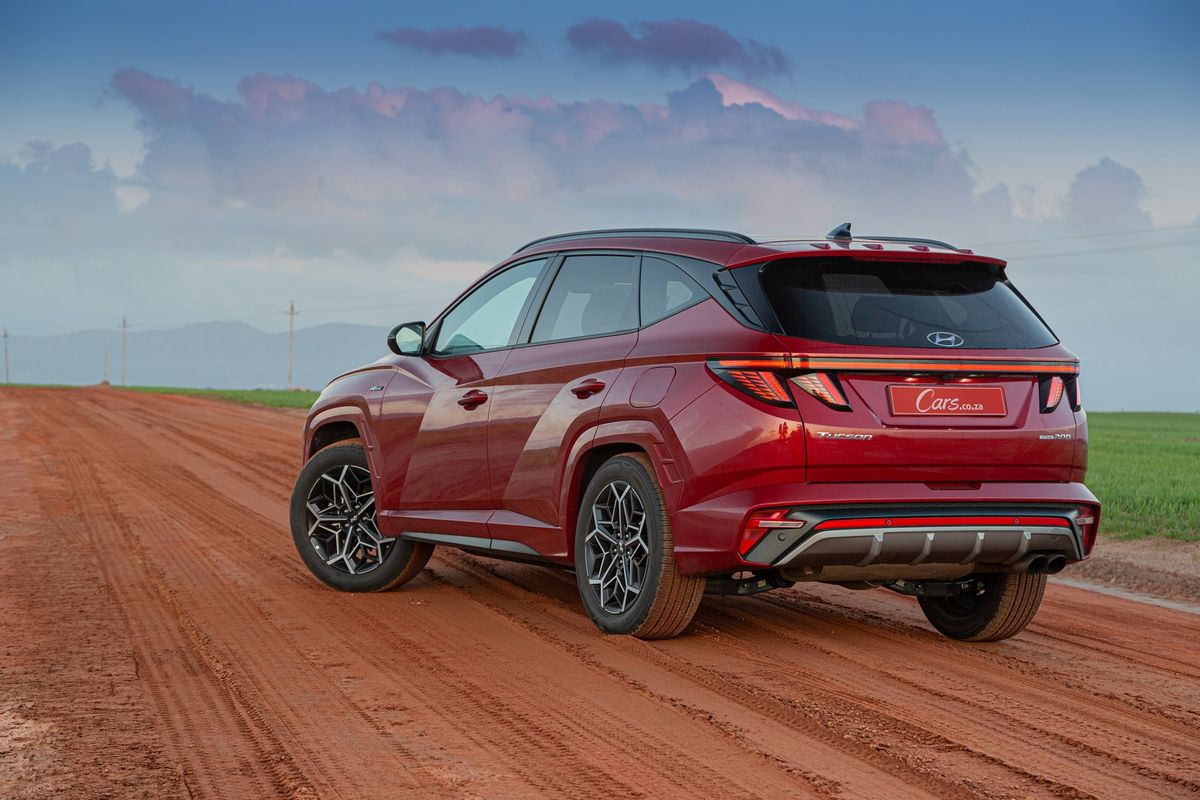
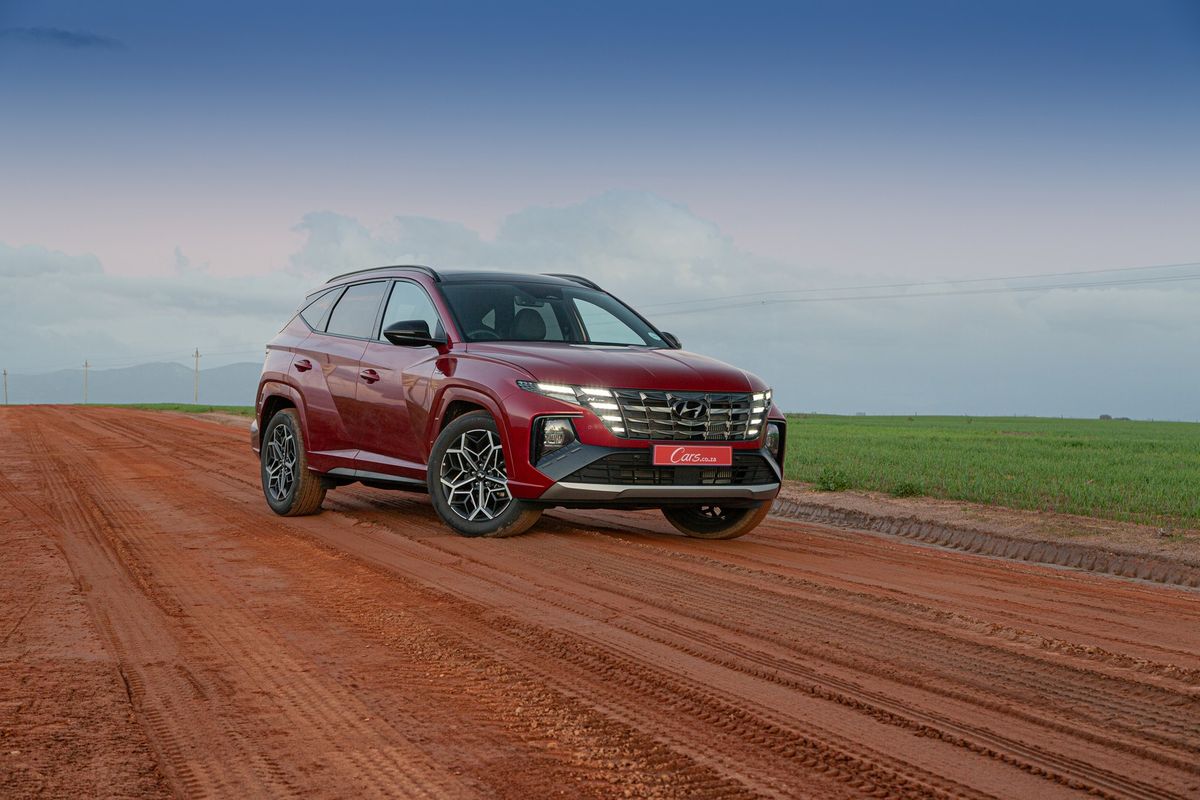
If a standard Hyundai Tucson isn’t distinctive enough to turn your neighbours’ heads, perhaps you should consider the new N Line flagship derivative, which is equipped with a turbodiesel motor and all-wheel drive! We spend some quality time with it.
We like: All-terrain grip, fully equipped, punchy performance, pleasant road manners
We don’t like: Not as edgy as the previous home-grown Tucson Sport, polarising styling
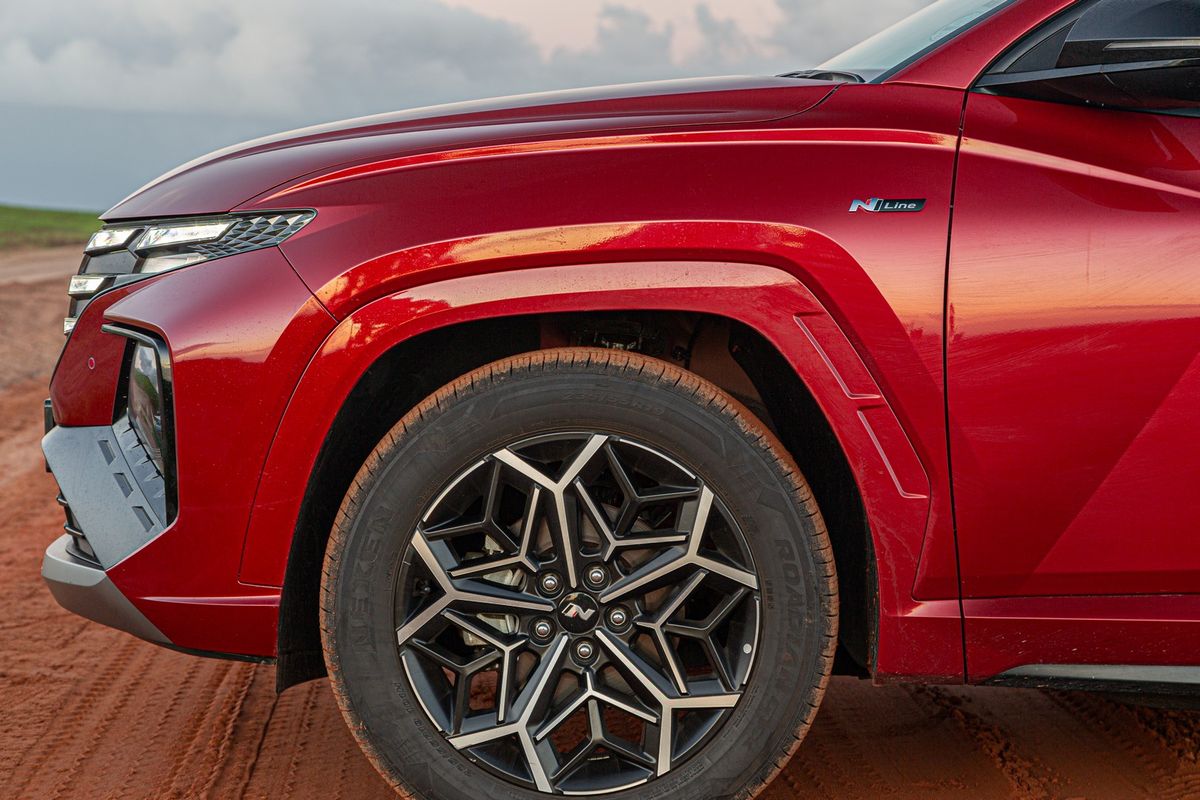
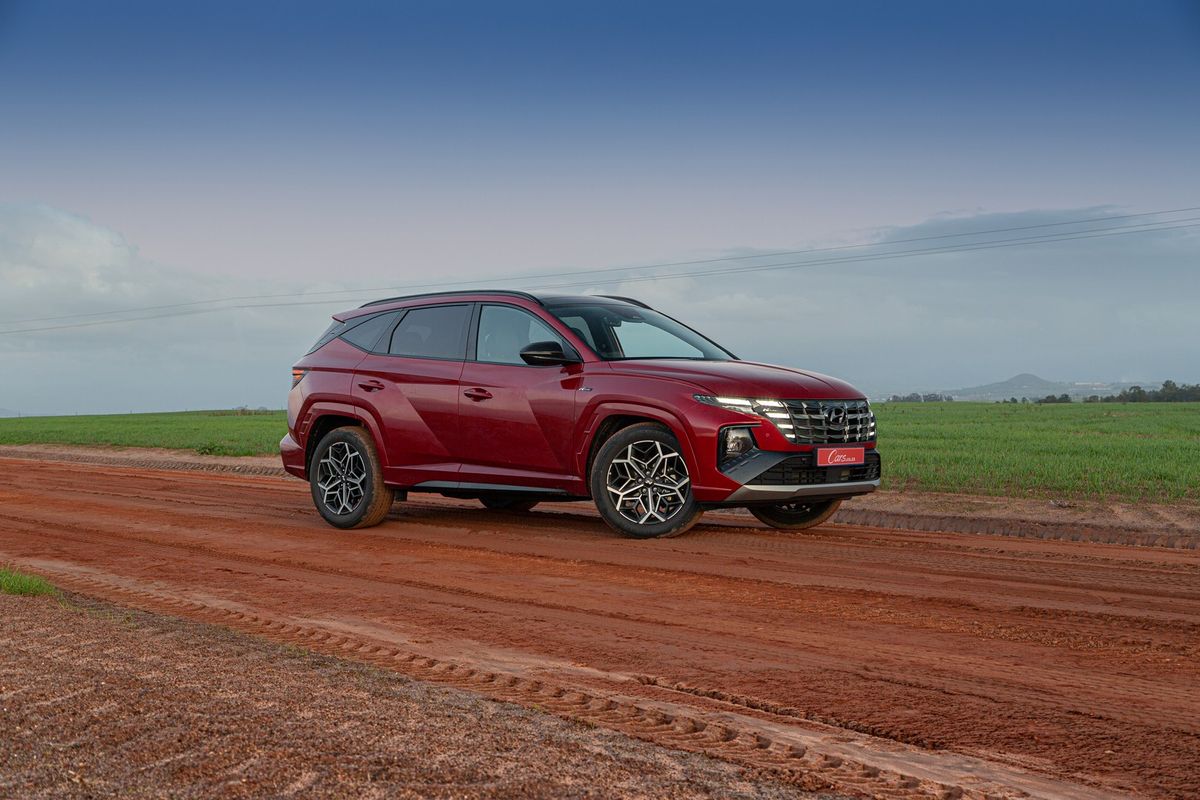
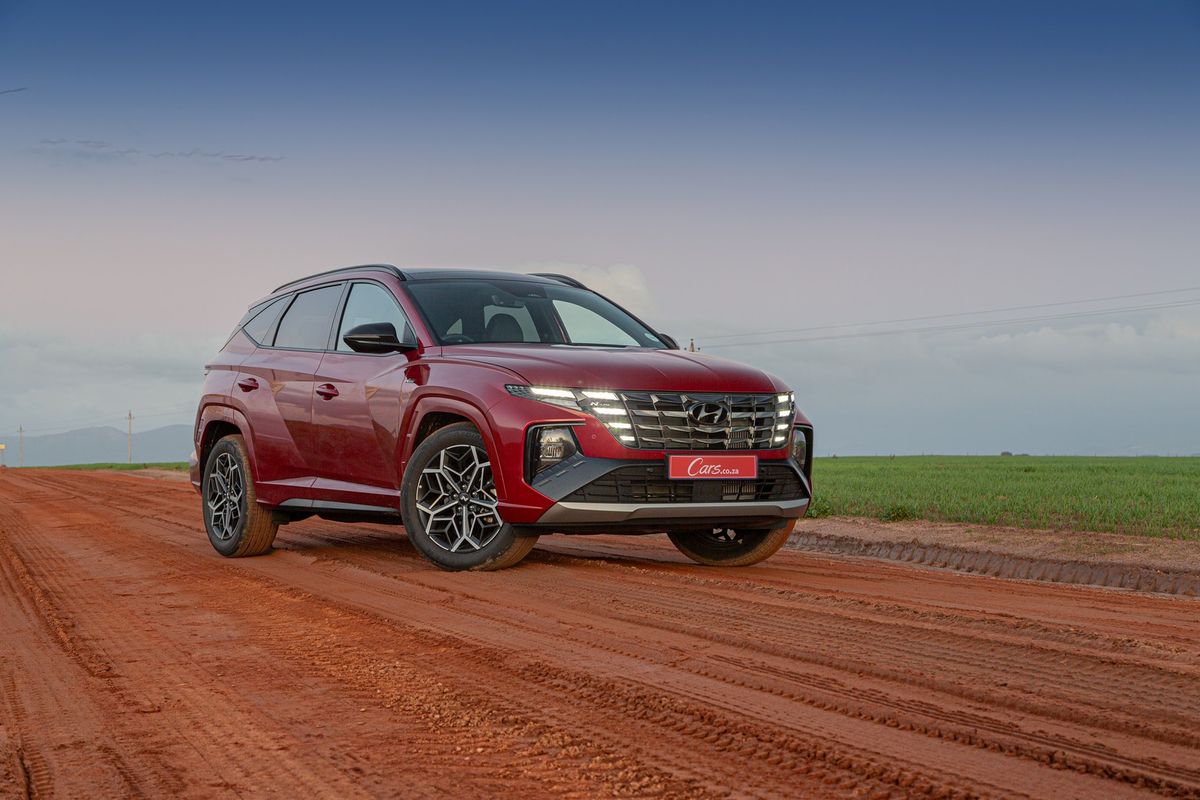
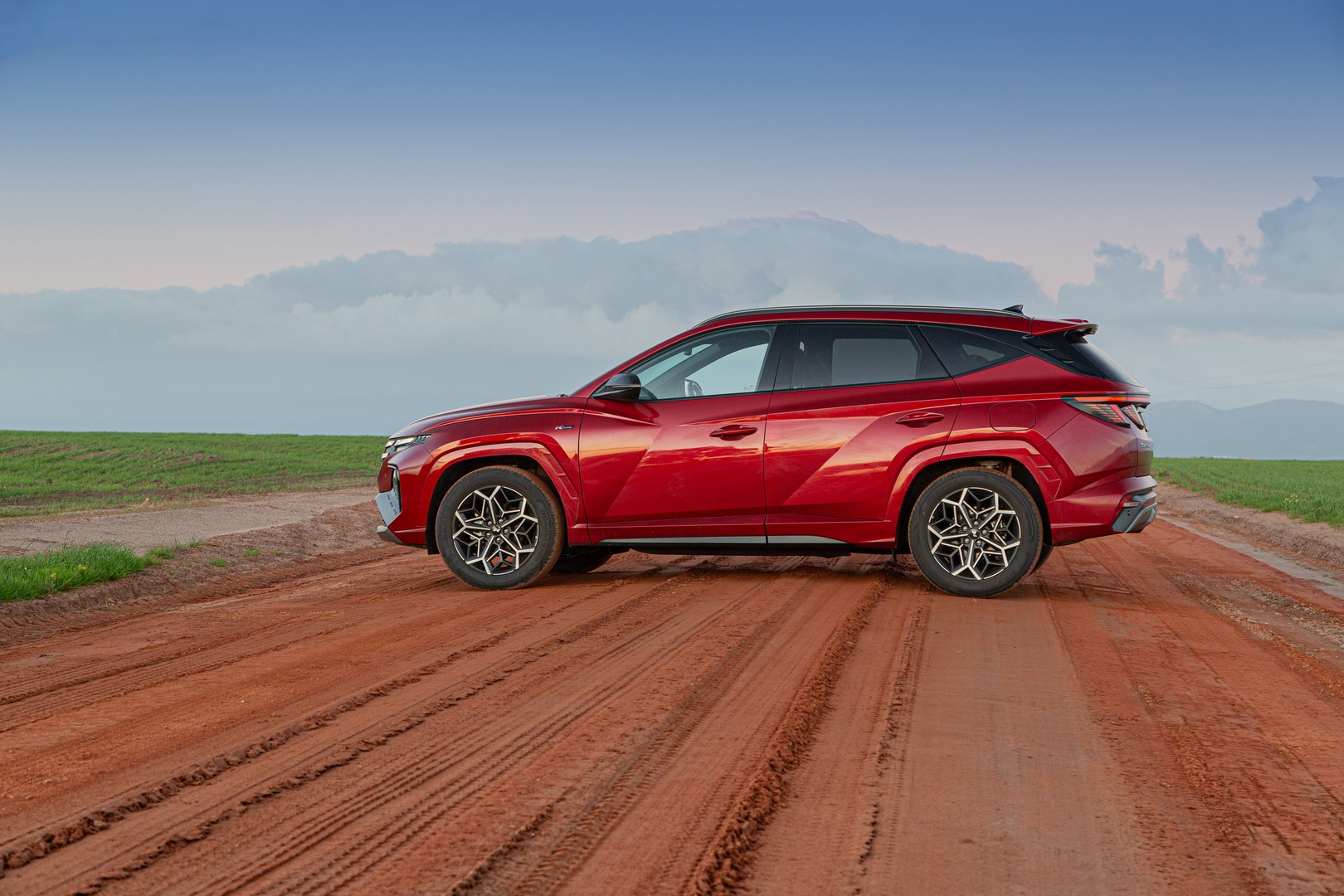
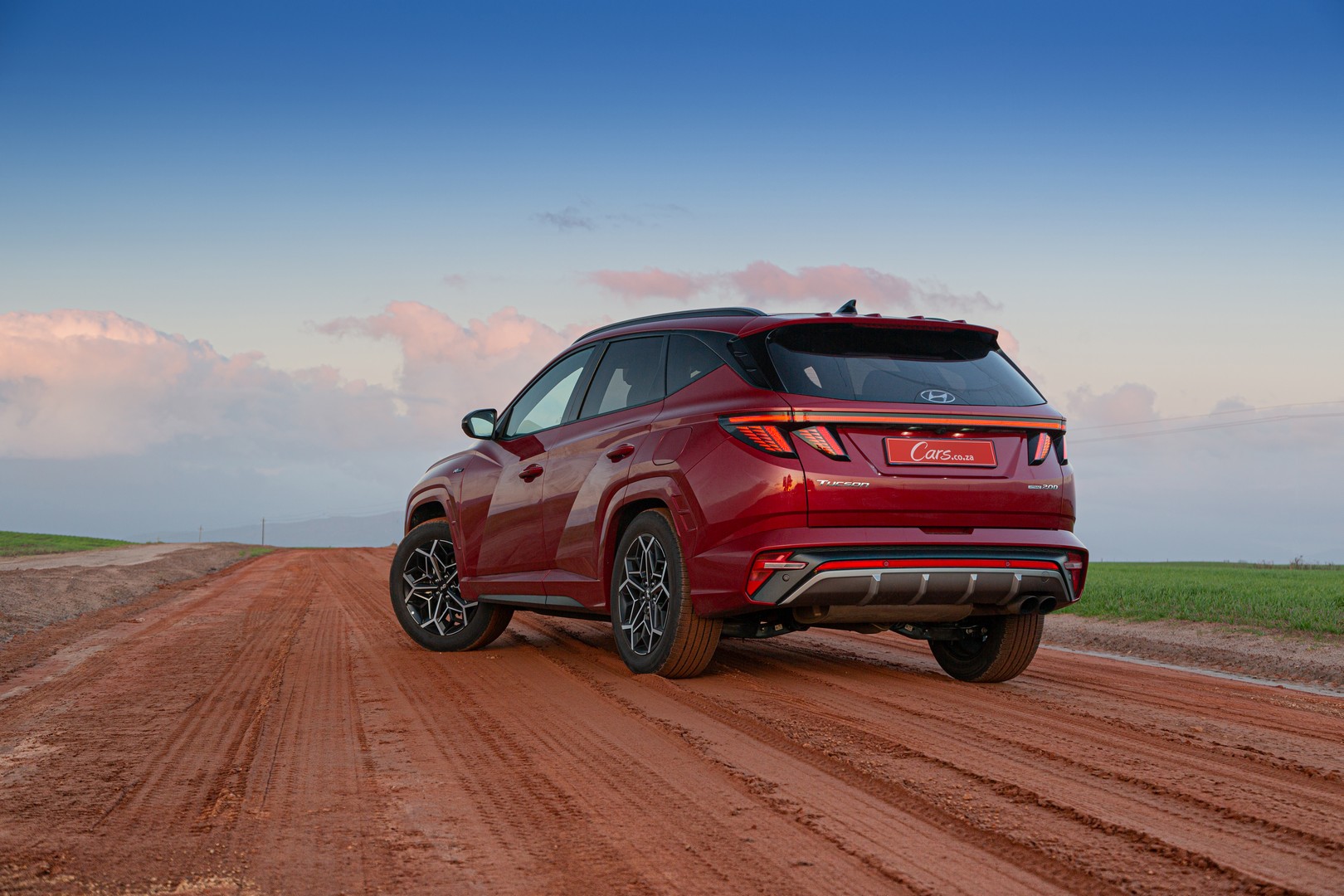
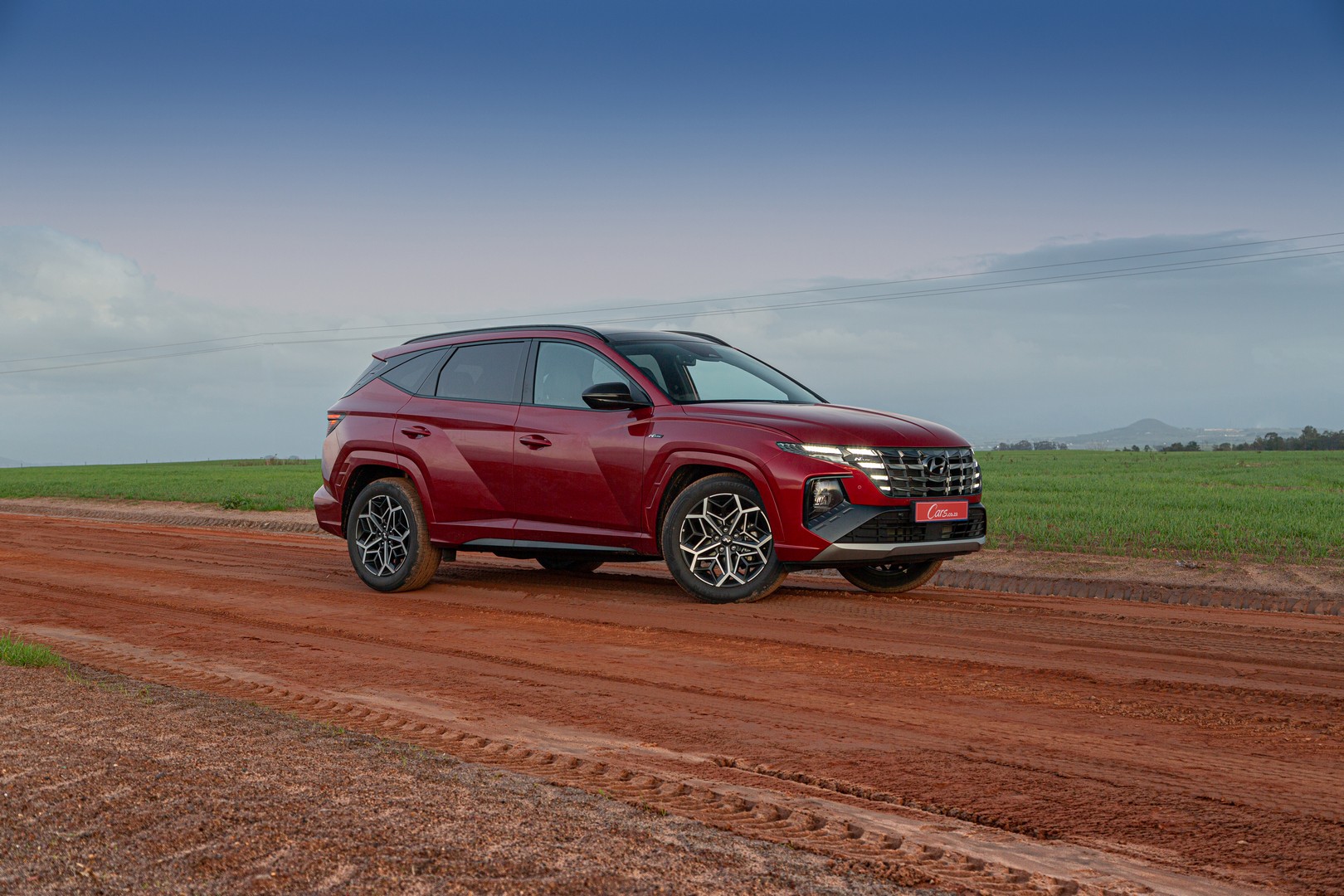
The Hyundai Tucson N Line has a distinctive profile and no shortage of kerb appeal.
The Hyundai Tucson N Line’s predecessor – the previous-gen 1.6T Elite Sport – was unique to our market, which made it an (undeniably cool) oddball. The derivative featured a locally-developed quad exhaust system, a performance upgrade and a unique body kit that separated it from its standard siblings. And, thanks to its 150 kW 1.6-litre turbopetrol engine, it also had the go to match the show.
The range-topping 2.0D AWD N Line version of the NX4-gen Hyundai Tucson is also packaged to draw admiring glances. It’s easy to spot thanks to its sportier bodywork, 19-inch alloy wheels and N-Line badges. Unlike its brash predecessor, it doesn’t offer additional performance over the 2.0D Elite; the 2.0-litre turbodiesel still produces 137 kW/416Nm. However, the N Line also features all-wheel drive (AWD).
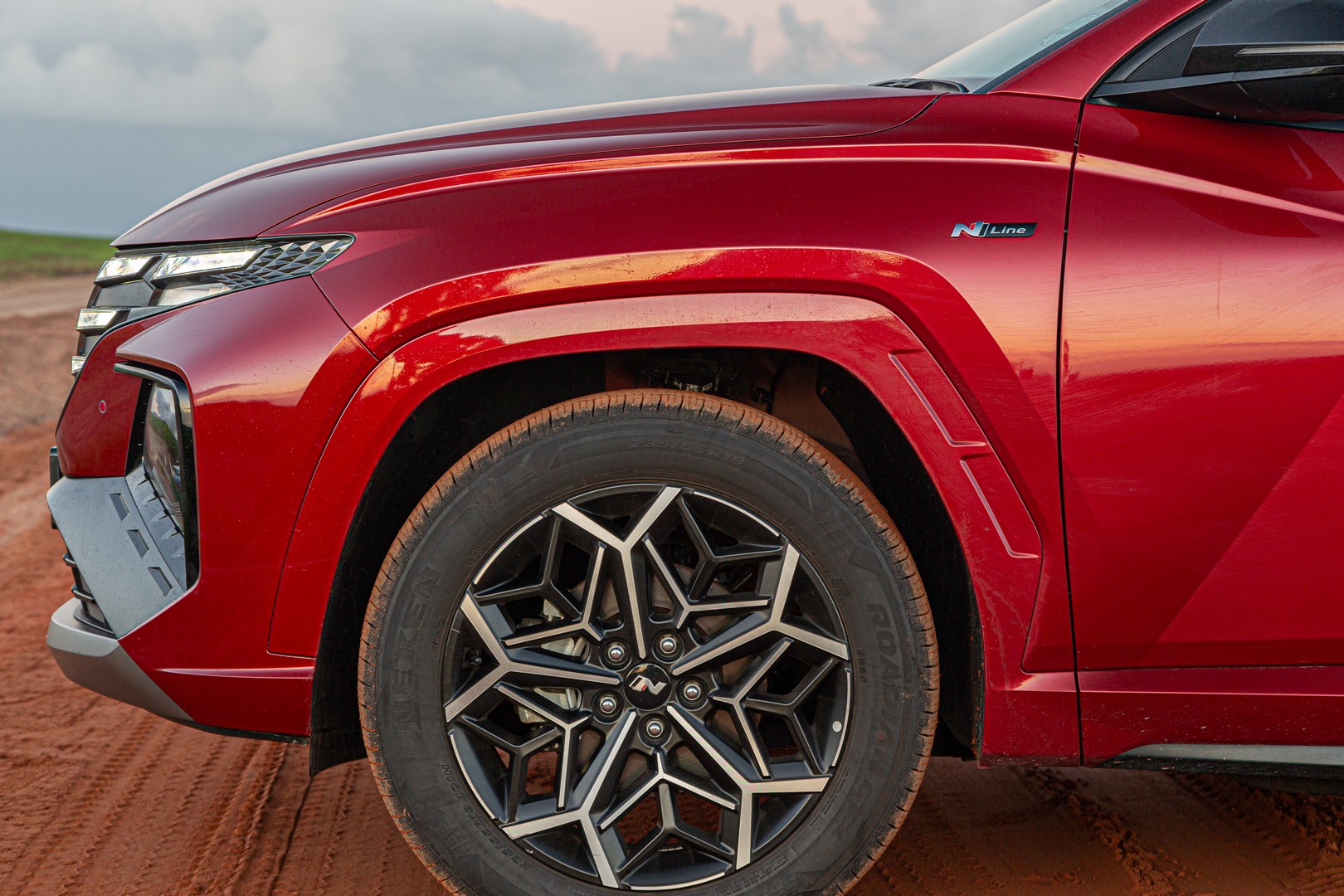
N-Line badges feature on the flagship derivative’s fenders and wheel caps.
If you were hoping that the Hyundai Tucson N Line would offer punchier performance than its 2.0D Elite sibling, which would befit the flagship’s sportier presentation – sorry, it doesn’t. That’s not to say that the 2.0-litre 4-cylinder turbodiesel is insufficient; its peak outputs (137 kW and 416 Nm) are adequate, plus all-wheel drive provides confidence-inspiring grip on all road surfaces, as well as quicker pull aways.
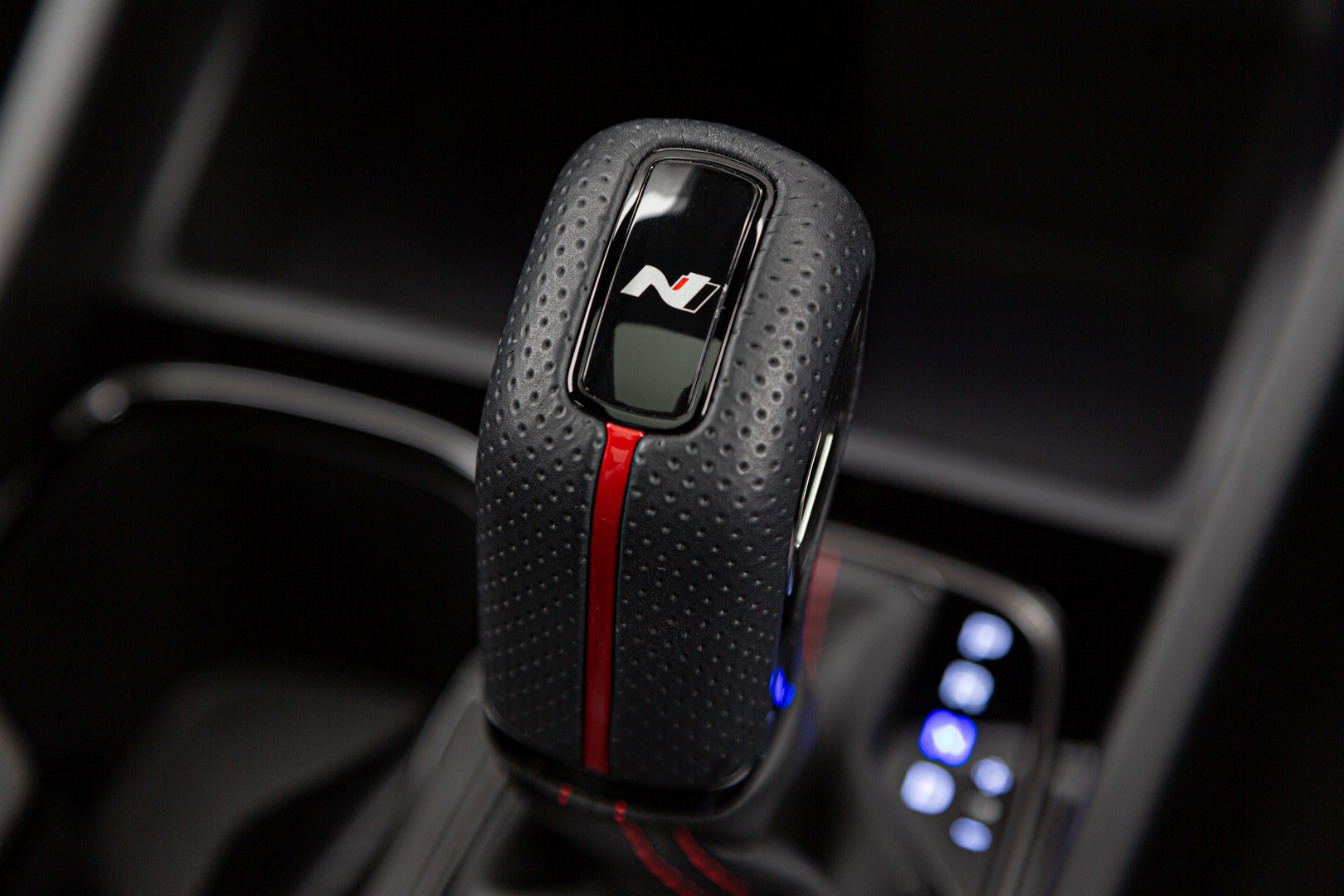
The N logo has pride of place on the Tucson N Line’s transmission lever.
With its sportiest drive mode engaged, the Tucson N-Line galloped from 0 to 100 kph in 9.16 seconds (that’s according to our test gear – and better than Hyundai’s claim of 9.4 seconds). Is that sporty enough? Well, the Volkswagen Tiguan 2.0TDI 130kW 4Motion R-Line completed the sprint benchmark in 8.78 seconds when we tested it, so the range-topping Tucson’s performance is in the same ballpark.
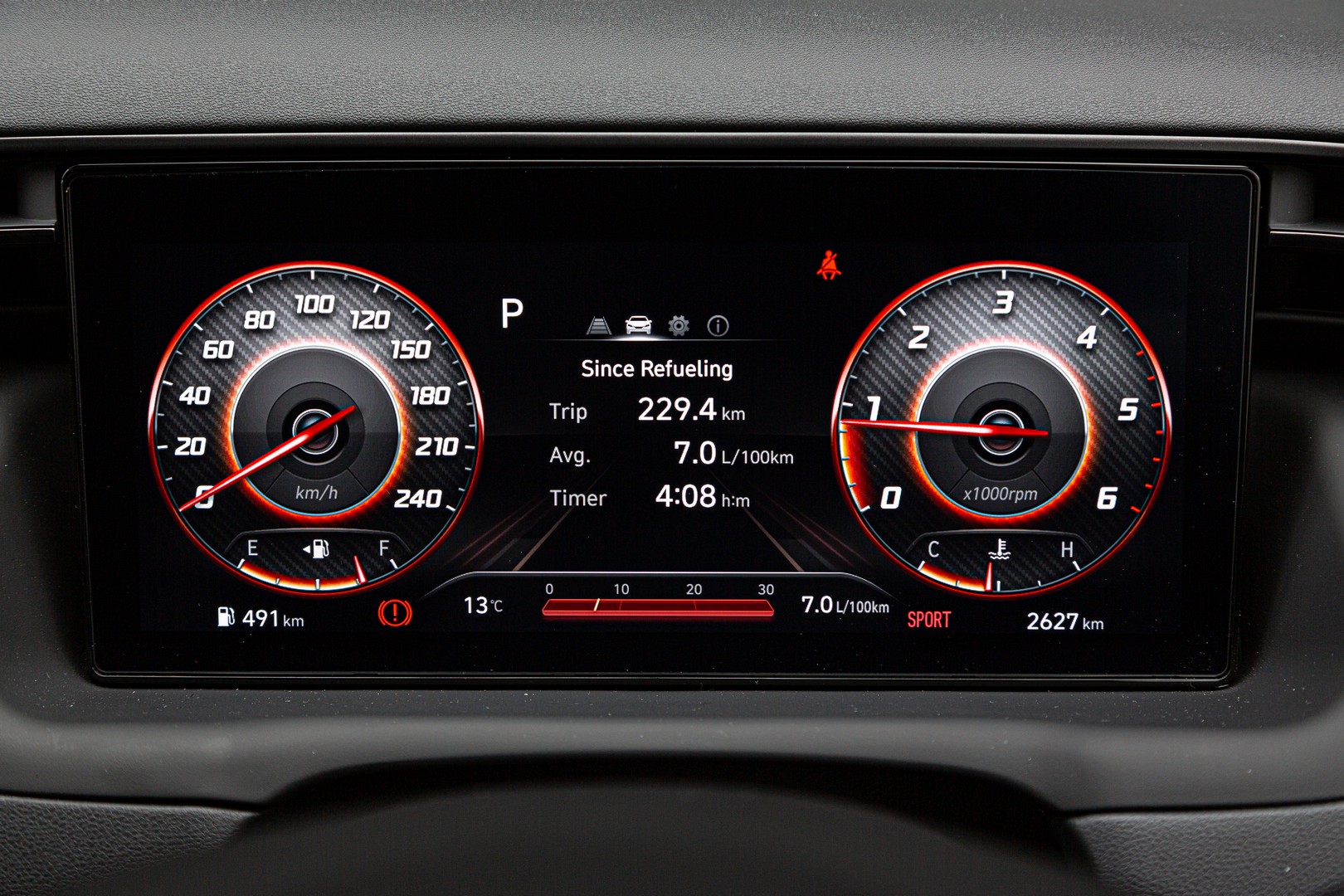
Each drive mode has a corresponding instrument cluster theme. Note the better-than-claimed consumption figure.
Besides, we anticipate that most prospective Hyundai Tucson N-Line buyers would be more than happy with the derivative’s performance in return for excellent fuel economy. Even after we had done some spirited driving in our test unit (including the acceleration test), it indicated an average consumption figure of 7 L/100 km, which was marginally better than Hyundai’s estimate of 7.4 L/100 km (given the Hyundai’s 54-litre tank, you should be able to travel around 720 km between fill-ups). If you engage the vehicle’s Eco drive mode and pilot in a restrained manner, that figure could easily dip into the sixes.
The slick 8-speed automatic transmission deserves a mention too. It shifts smoothly and predictably, which suggests it utilises clever mapping to make the most of the motor’s narrow peak-torque band (2 000 to 2 750 rpm). Sadly, there aren’t shift paddles on the ‘wheel, but we don’t think the car needs them.
Instead, simply employ one of the Hyundai’s drive modes to alter the vehicle’s responsiveness and performance to suit your diving style or traffic conditions. Eco is best for day-to-day driving, while Sport is for when you’re in a hurry. The Smart mode combines those settings and will self-adjust as you drive!
Ride, handling and safety
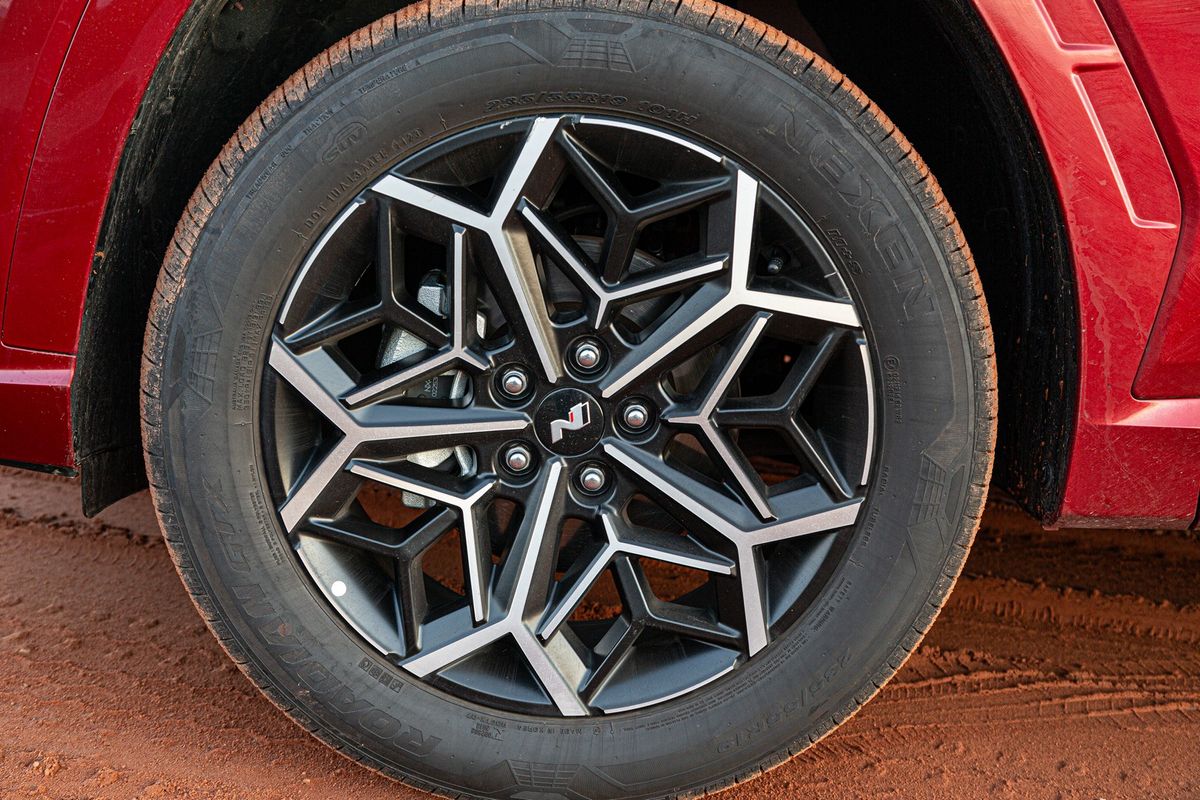
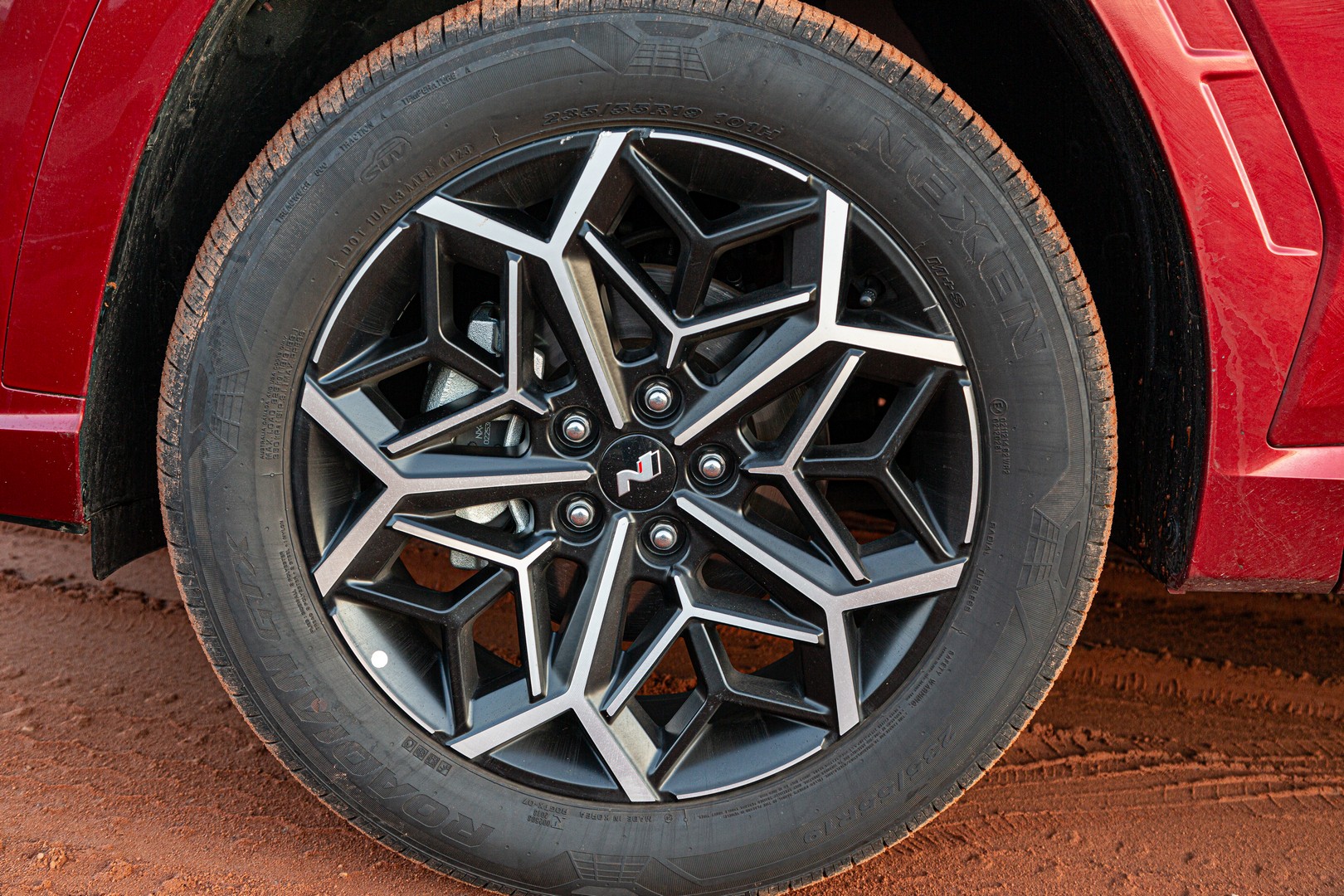
These 19-inch wheels blend comfort, style and performance.
The N Line’s ride quality is on the firm side of pliant, but we don’t believe it suffers much because the flagship Tucson rolls on larger alloy wheels. The 19-inch N-Line-branded rims are suitably eye-catching, but critically, they are fitted with 235/55 R19 tyres, which have plump sidewalls that help the suspension to soak up minor road imperfections, plus they don’t diminish the vehicle’s relative all-road capability.
Of course, the provision of all-wheel drive also benefits road holding and handling in low-grip conditions; suffice it to say, this vehicle performs with more surefootedness than you’re ever likely to require from a medium-sized family car. The steering is sufficiently sharp and Hyundai says it has engineered a touch of rear-wheel bias to the drivetrain (only when Sport mode is active), but the N Line’s driving experience is not the most engaging in its segment. For what it’s worth, that honour belongs to Volkswagen’s Tiguan.
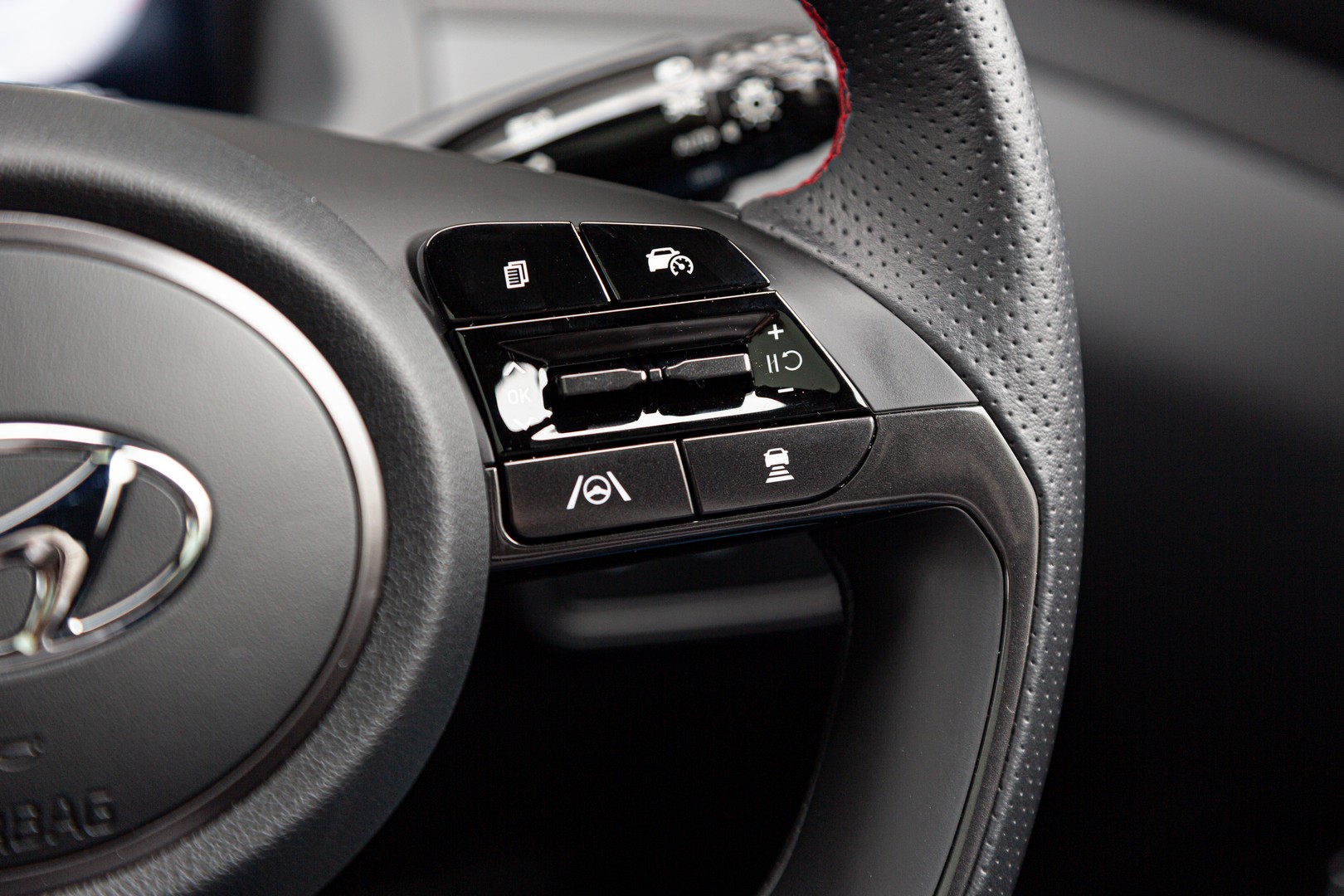
Lane-keep assist and adaptive cruise control are standard equipment.
You’d expect a flagship medium SUV to feature multiple safety technologies and the Hyundai Tucson N Line, which has a 5-star rating from the Euro- and Australasian NCAP, doesn’t disappoint. Apart from 6 airbags, it comes equipped with semi-autonomous driver aids such as adaptive cruise control, blind-spot- and forward collision avoidance, lane keep and follow assist, as well as rear cross-traffic alert.
Interior tech and space
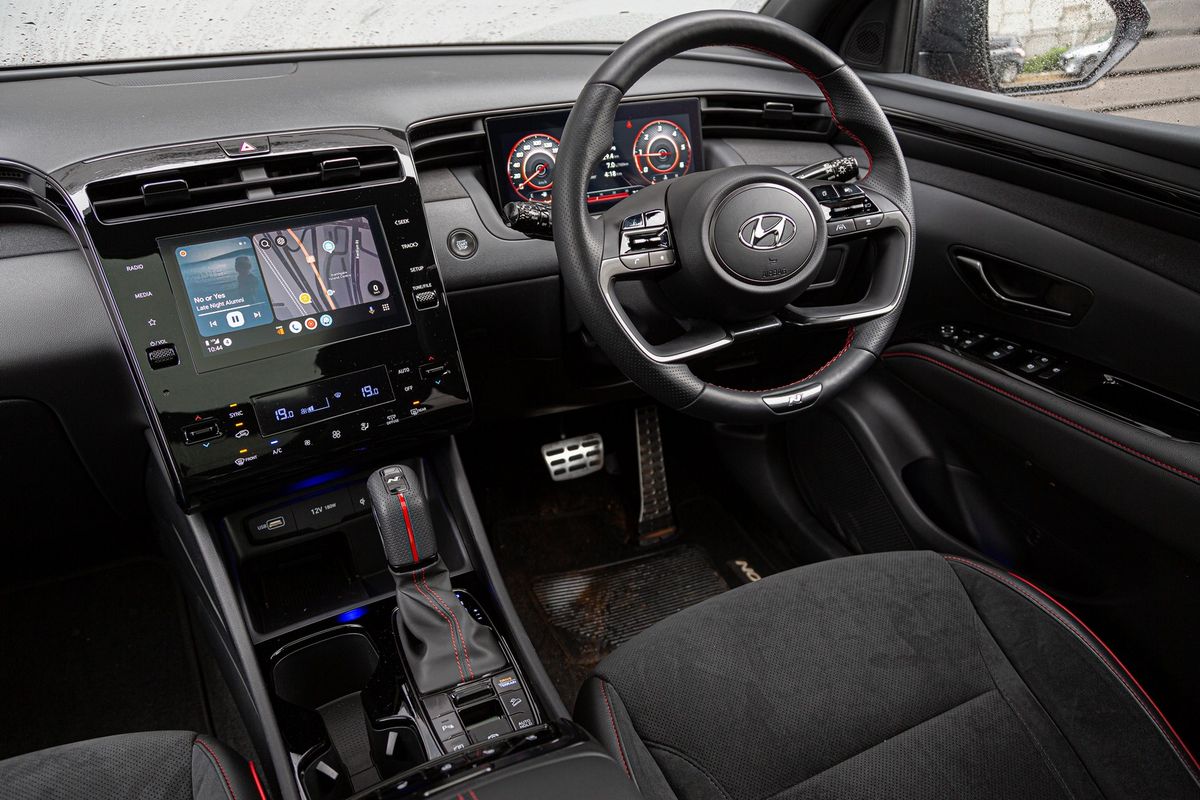
Hyundai tends not to go overboard with interior accents; the Tucson N Line features subtle N badging and red stitching.
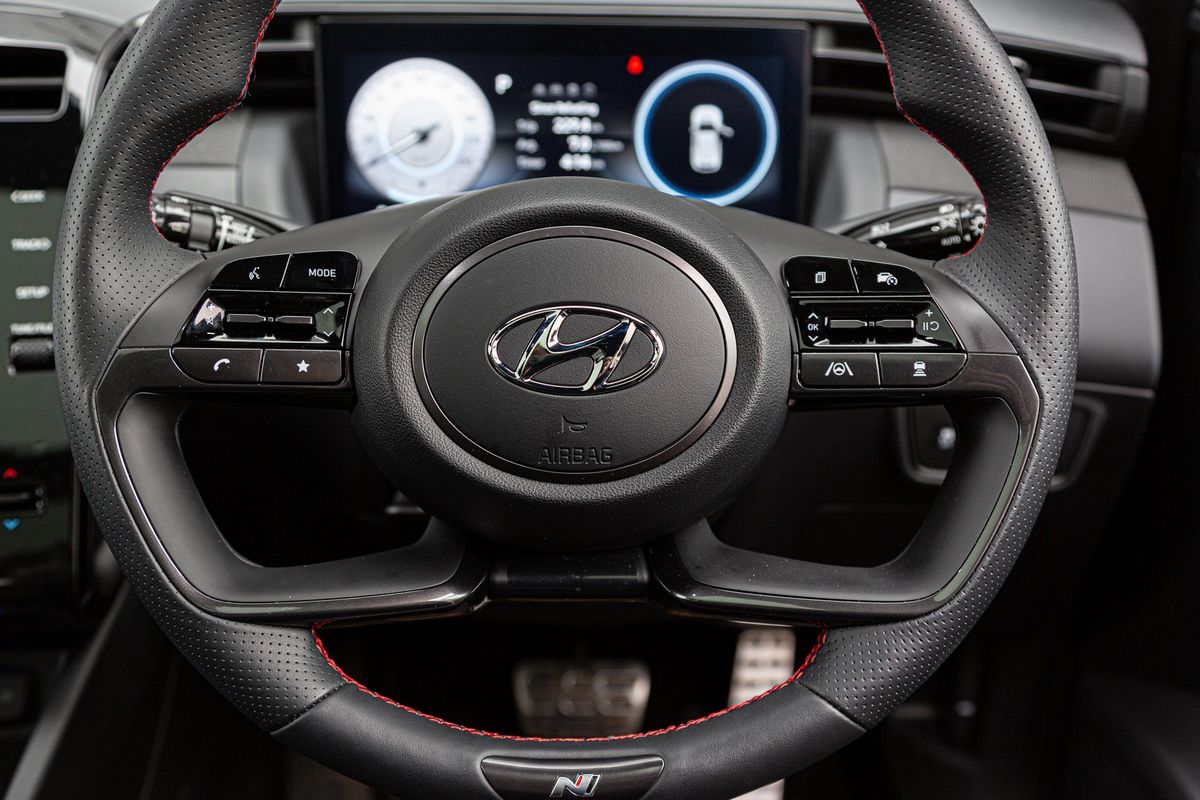
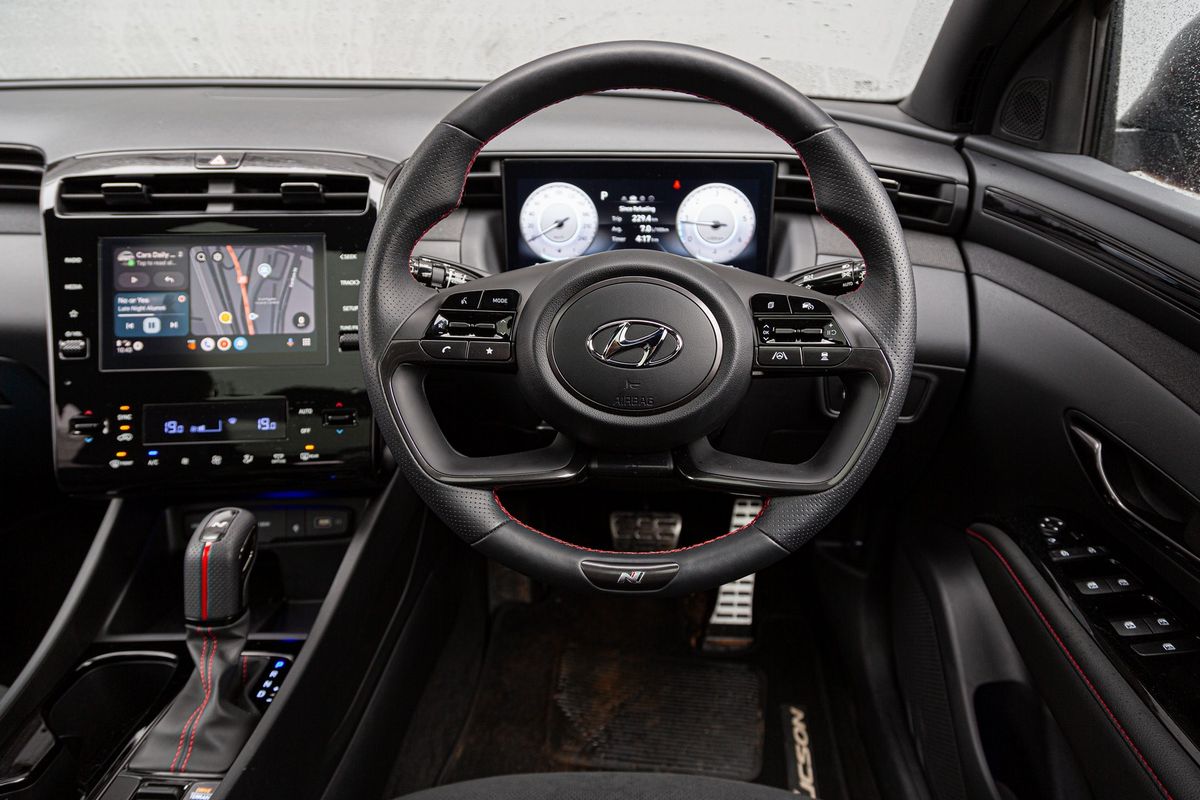
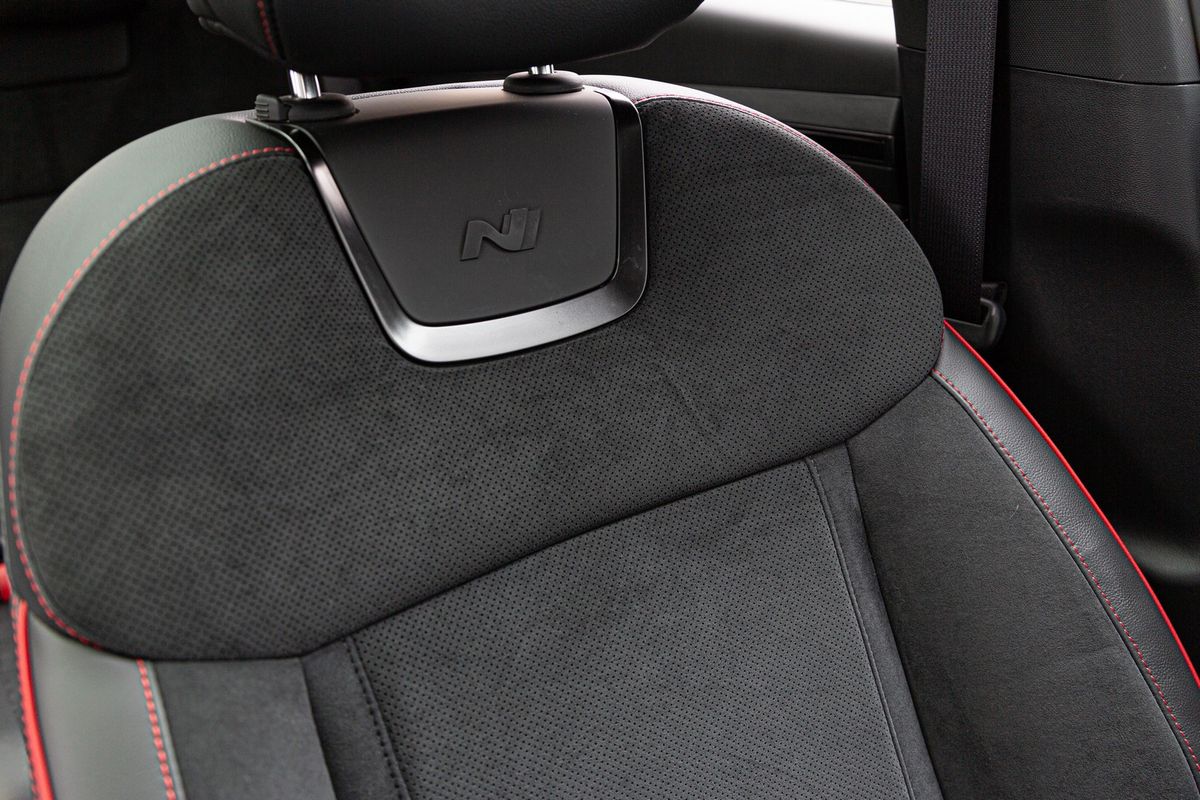
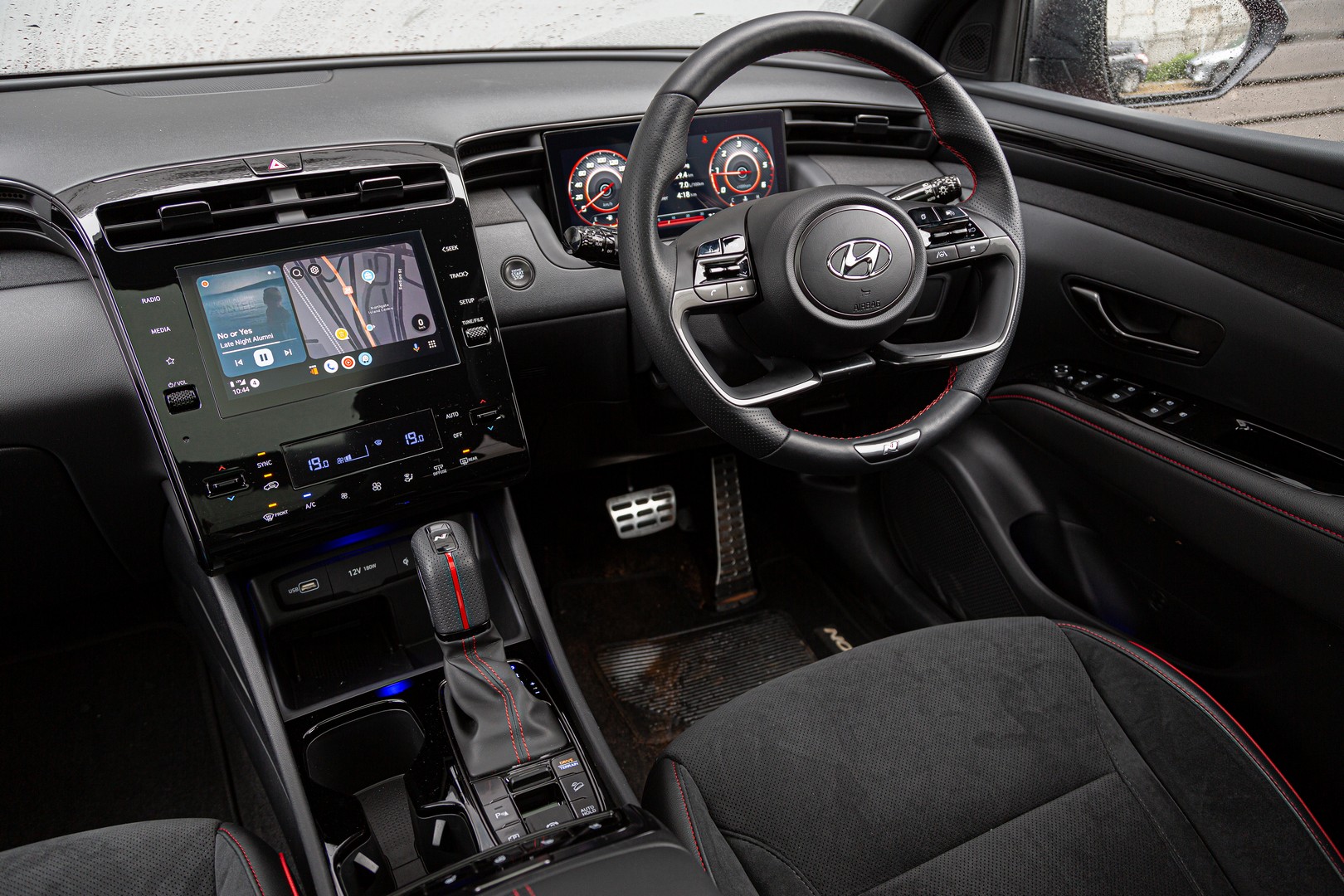
The cabin of the Hyundai Tucson N Line is suitably well-appointed and -made, plus it incorporates subtle hints that this is a sportier derivative. The go-faster add-ons are just noticeable enough: apart from N badges on the transmission lever and steering wheel, there is red stitching on the seats, door trims, transmission-lever boot and ‘wheel rim, plus the pedals and doorstep inserts have metallic finishes.
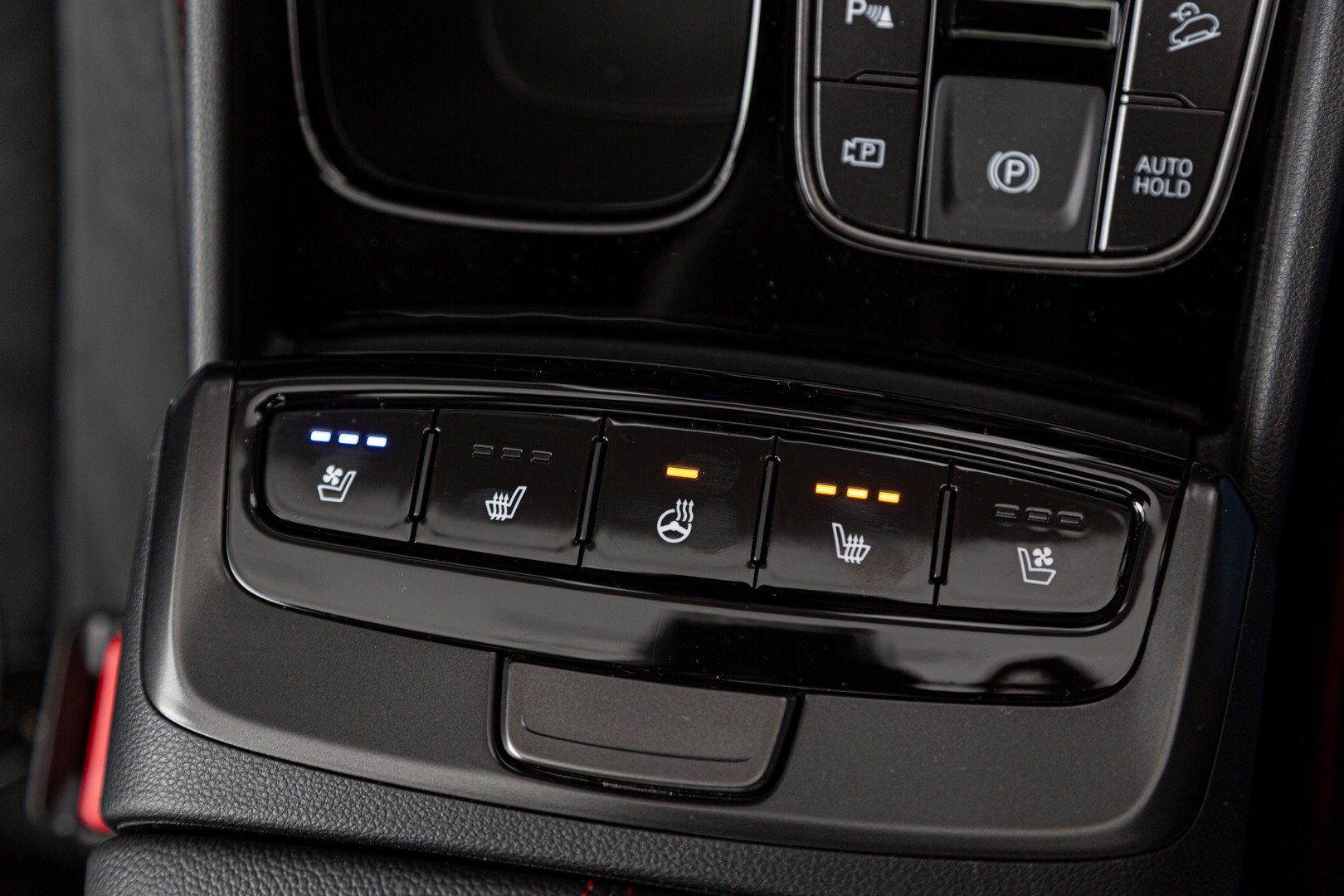
We were impressed with the sporty front seats, which are upholstered in a combination of suede/leather combination upholstery. Not only do they look the part, but they’re comfortable and feature heating and cooling. Given the cold weather gripping South Africa, you will appreciate the heated steering wheel too.
The heated seats and -steering wheel are game-changers in the colder months!
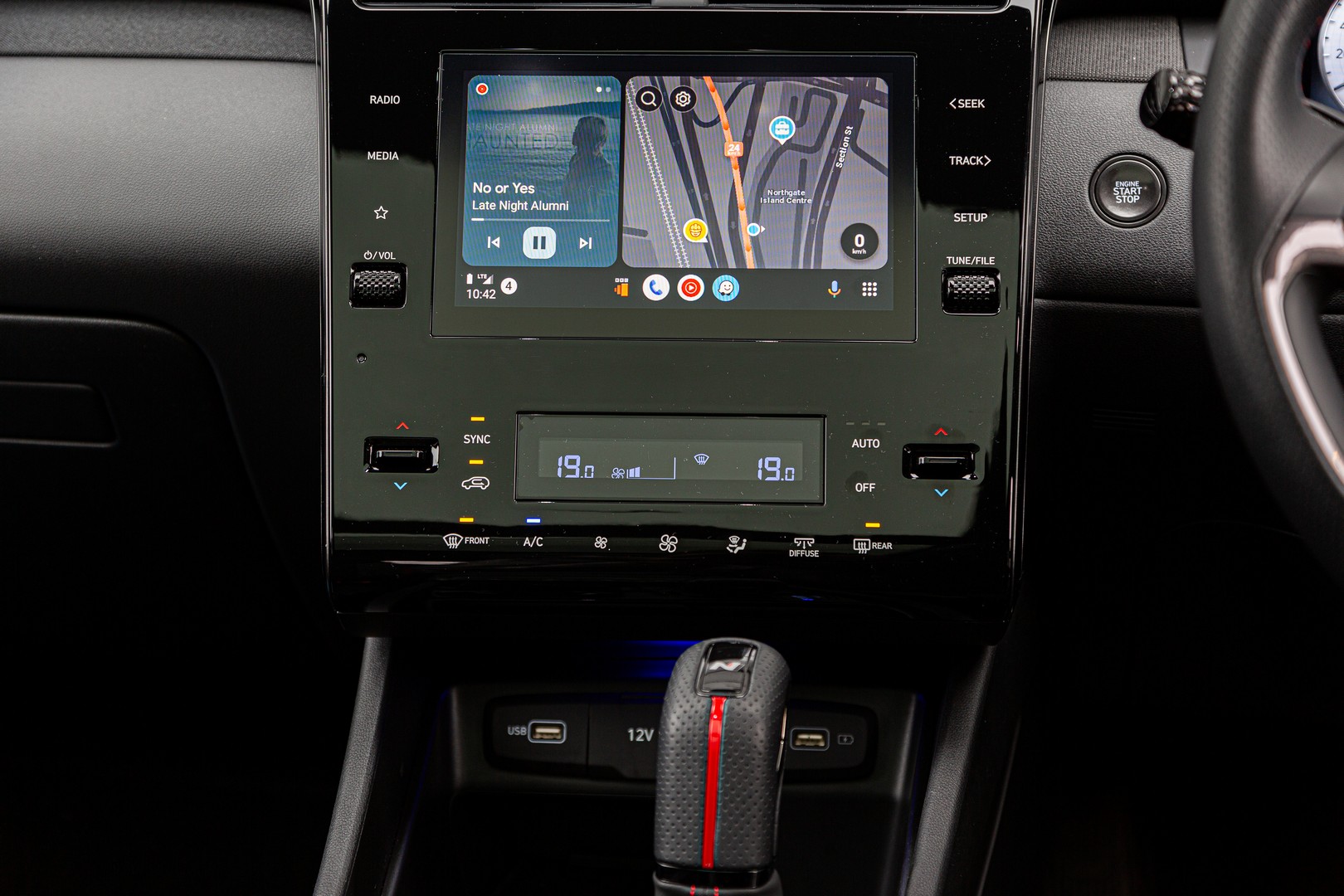
Buyers who are willing to pay R800k for a medium SUV will expect that model to feature almost every conceivable gadget and convenience feature available in the segment. Hyundai has, accordingly, fitted its flagship Tucson’s 8-inch infotainment touchscreen with wireless Apple CarPlay and Android, a 10.25-inch digital instrument panel, a wireless charging pad and several USB charging ports, front and rear.
Keyless access, push-button start, 3-zone climate control (with Multi-Air Mode technology), auto wipers, auto lights, a reverse-view camera and a powered tailgate are just some of the convenience features.
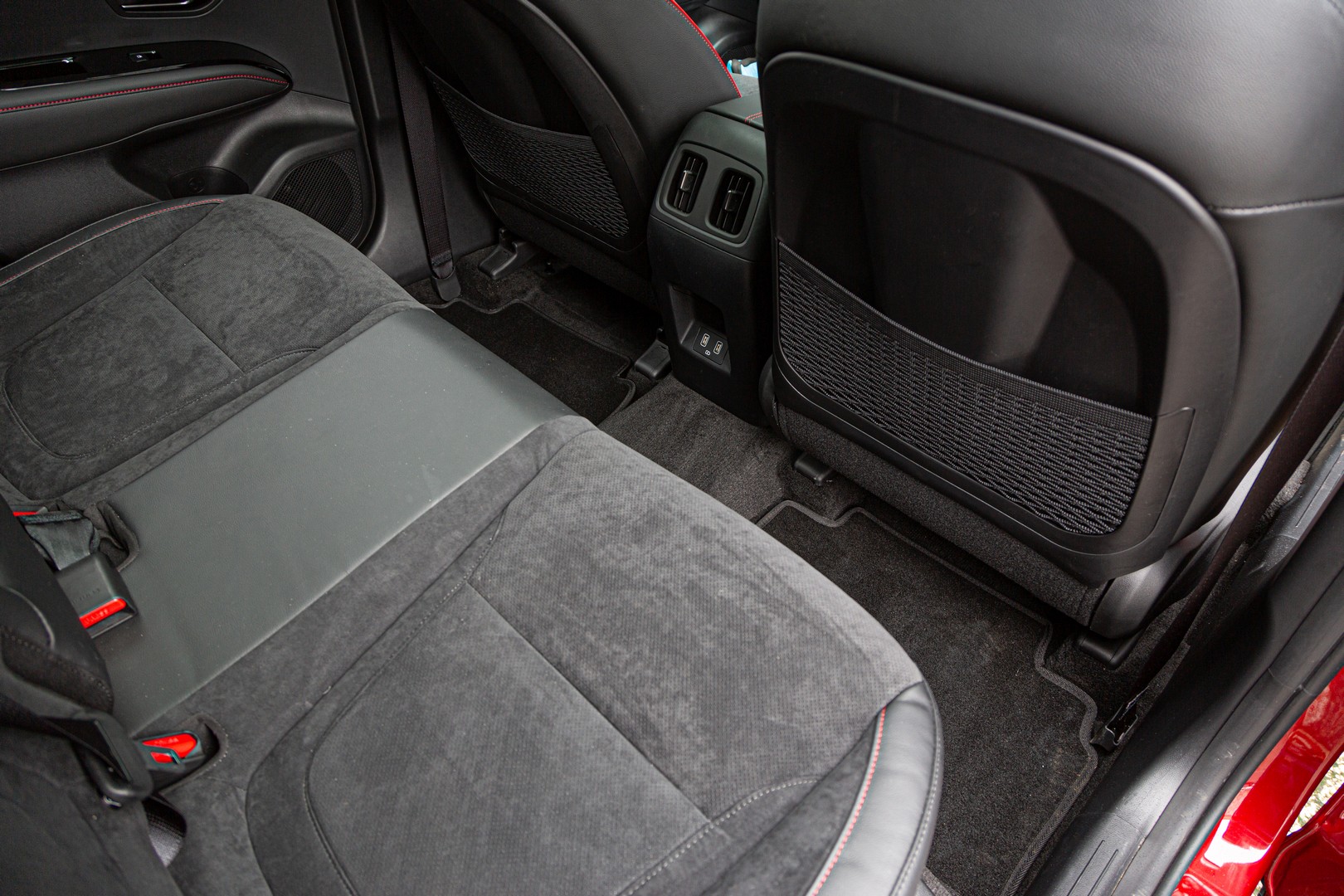
Rear legroom is on par for the segment. Clever seatbacks make room for knees.
One element of the Hyundai Tucson N-Line’s cabin that frustrated us was the piano black finish on the fascia and the centre console. While there’s no doubt that it looks appreciably smart and doesn’t feel flimsy (at all), the shiny surface proved prone to scratches and a real challenge to keep fingerprint-free.
Android Auto on duty. Pity about the swathes of glossy black plastic...
Off-road capabilities
We were keen to put the all-terrain ability of the Hyundai Tucson N Line to the test. After our brief off-tar experience at the launch, we felt confident enough to drive the newcomer on some decidedly muddy farm tracks. With the appropriate mode engaged on the HTRAC (Hyundai TRACtion all-wheel drive) system, the Tucson took it all in its stride; it only lost some momentum in the thickest/gooiest mud.
Even if a road appears to be made from chocolate brownie mix, the Hyundai Tucson is up for the challenge.
To test the adaptability of the Hyundai Tucson N Line’s part-time AWD, we enabled the test unit’s default drive mode and drove down the same muddy road; again, it coped well, with the HTRAC apportioning torque to the front and rear axles as required. Few customers will ever drive their Tucsons on what could best be described as chocolate brownie mix, but the Korean crossover’s more capable than you think.
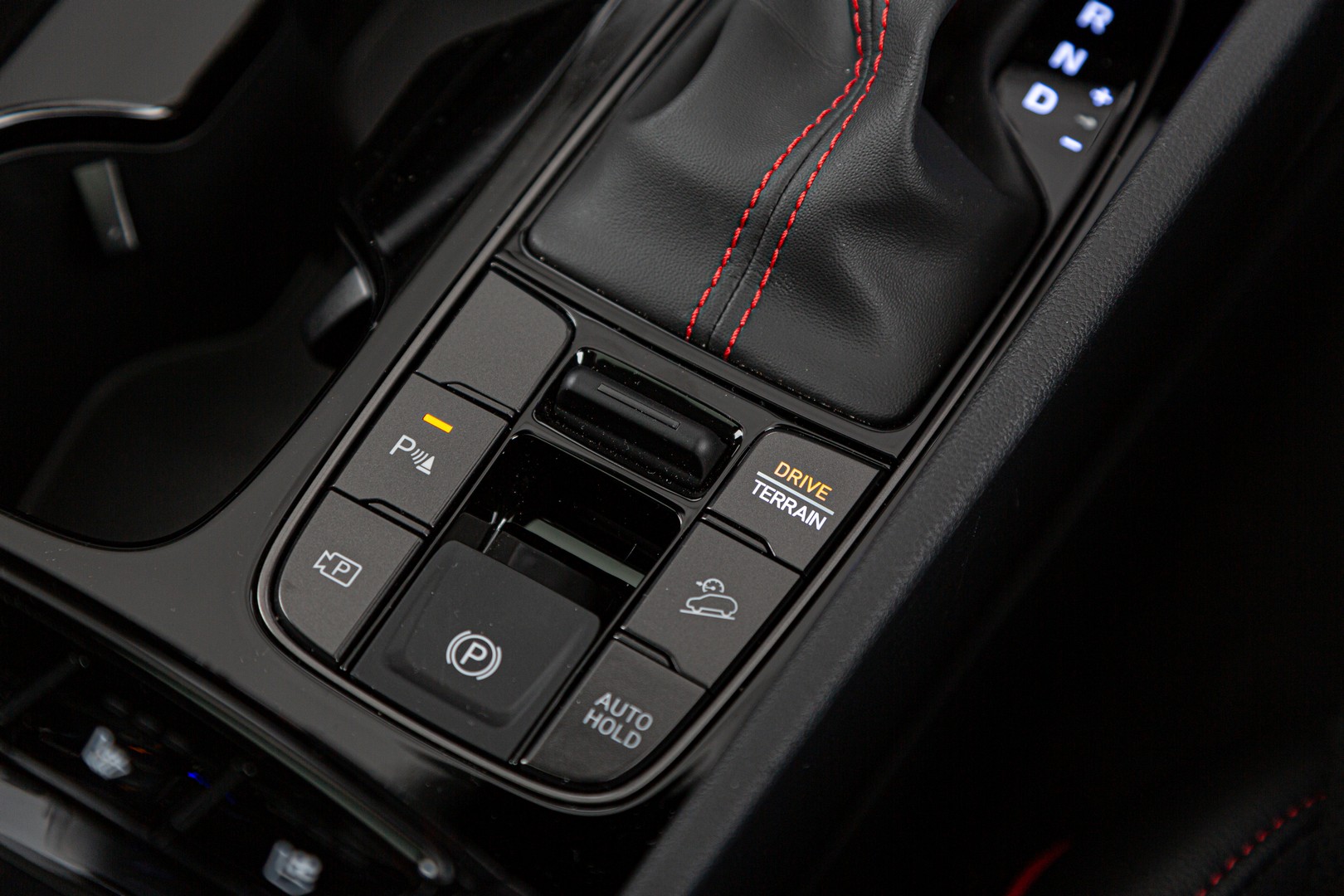
Remember, there’s only 181 mm of ground clearance, so you shouldn’t risk venturing too far off-road, but as far as a grip test goes, the N Line passed the test. The vehicle also features hill-descent control.
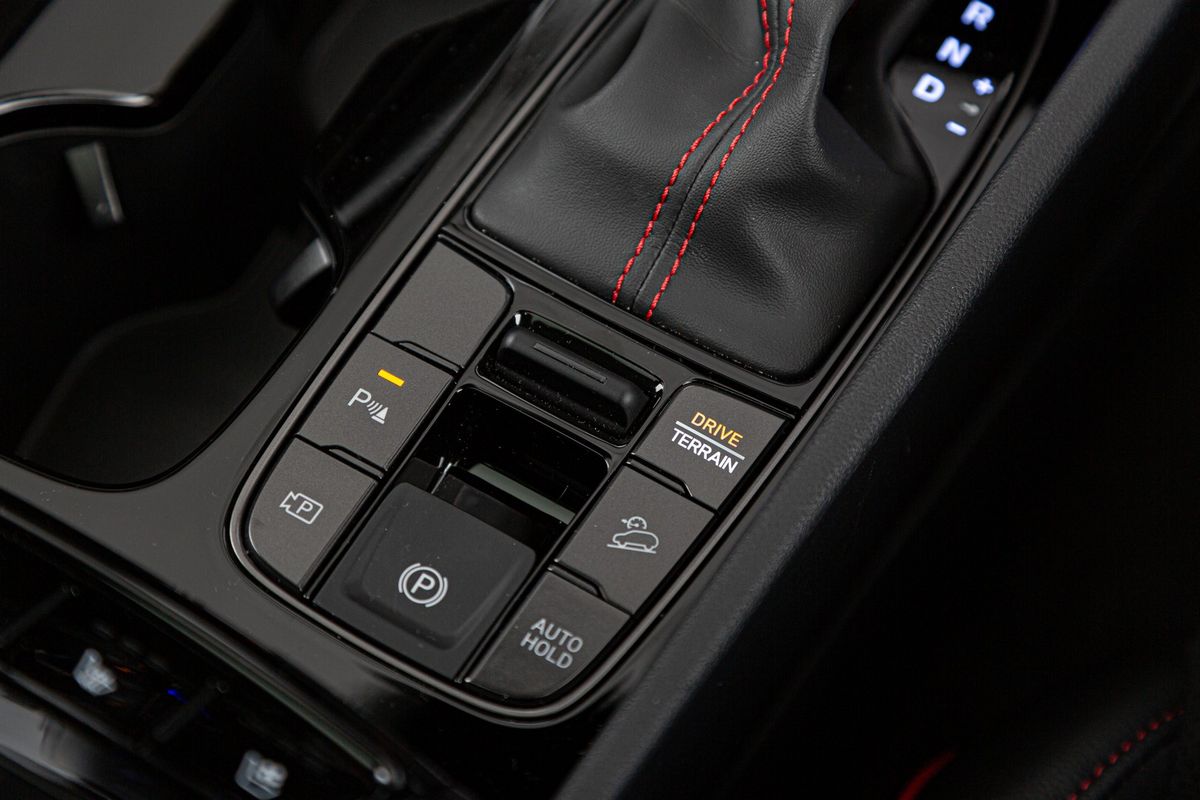
The Tucson N Line offers a variety of drive- and off-road modes, as well as hill descent control.
Price and after-sales support
The Hyundai Tucson 2.0D AWD N Line is sold with a 7-year/200 000 km warranty (a 5-year/150 000 km manufacturer’s warranty with an additional 2-year/50 000 km manufacturer’s powertrain warranty), as well as a 6-year/90 000 km service plan. Seven years/150 000 km of roadside assistance is included.
Tucson 2.0D AWD N Line
R799 900
Verdict
It’s easy to see why the (now discontinued) previous-gen Tucson 1.6T Elite Sport proved so popular in South Africa… It looked distinctively sporty in comparison with its standard siblings and boasted a notable power boost. However, its droning exhaust and polarising looks were an acquired taste.
The Hyundai Tucson N Line may lack the performance punch of its locally-developed predecessor, but the sensible turbodiesel powertrain combined with all-wheel drive makes it a more sophisticated – and sensible – proposition. Granted, by and large, the flagship derivative trades on its bold kerb presence, but if the Korean marque hopes to pinch sales from premium brands’ compact crossovers (it does not have many rivals in its own segment), it needs to be refined, well specified and distinctive – which it is.
Should you buy one? Forget about the N Line’s sporty image for a second (if that’s at all possible) – if you’re looking for a well-equipped and all-terrain-capable family SUV with a tremendous warranty that performs willingly and excellent fuel consumption, why wouldn’t you consider the flagship Tucson?
The Ford Ranger Raptor has a cult status among the bakkie community, but how many have actually been sold in SA so far?
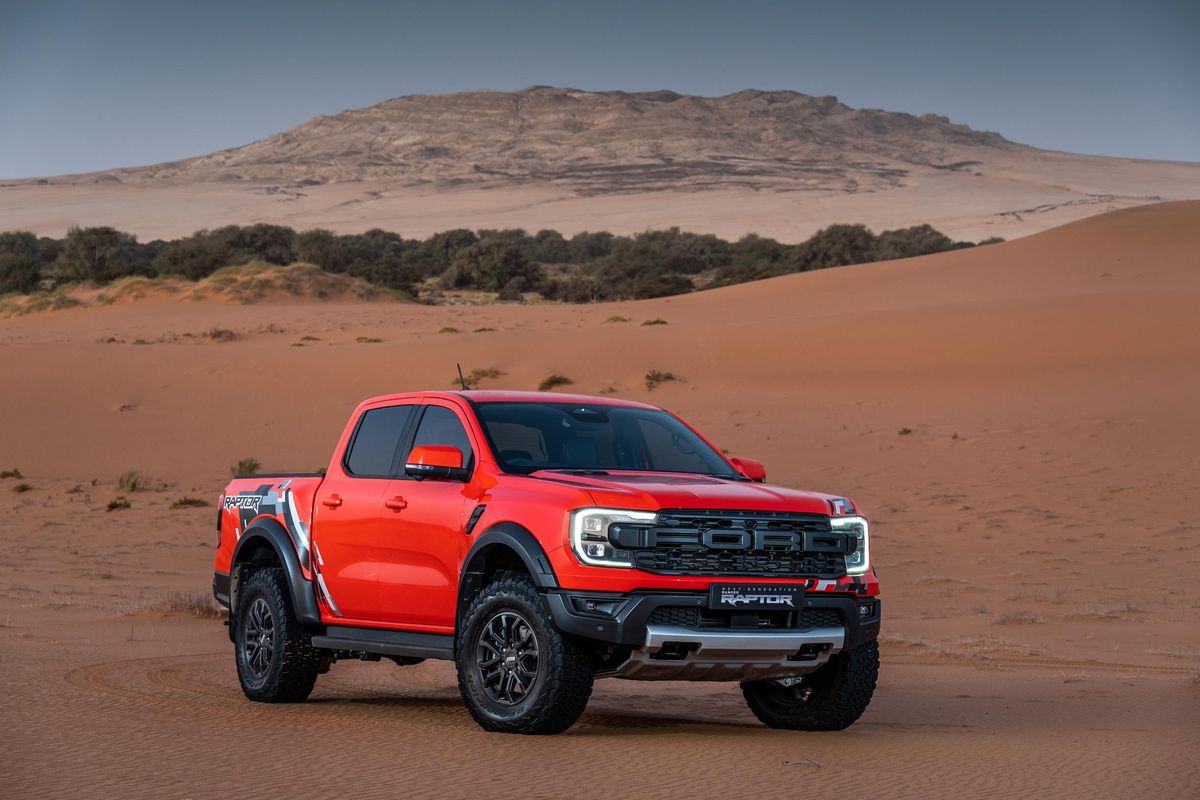
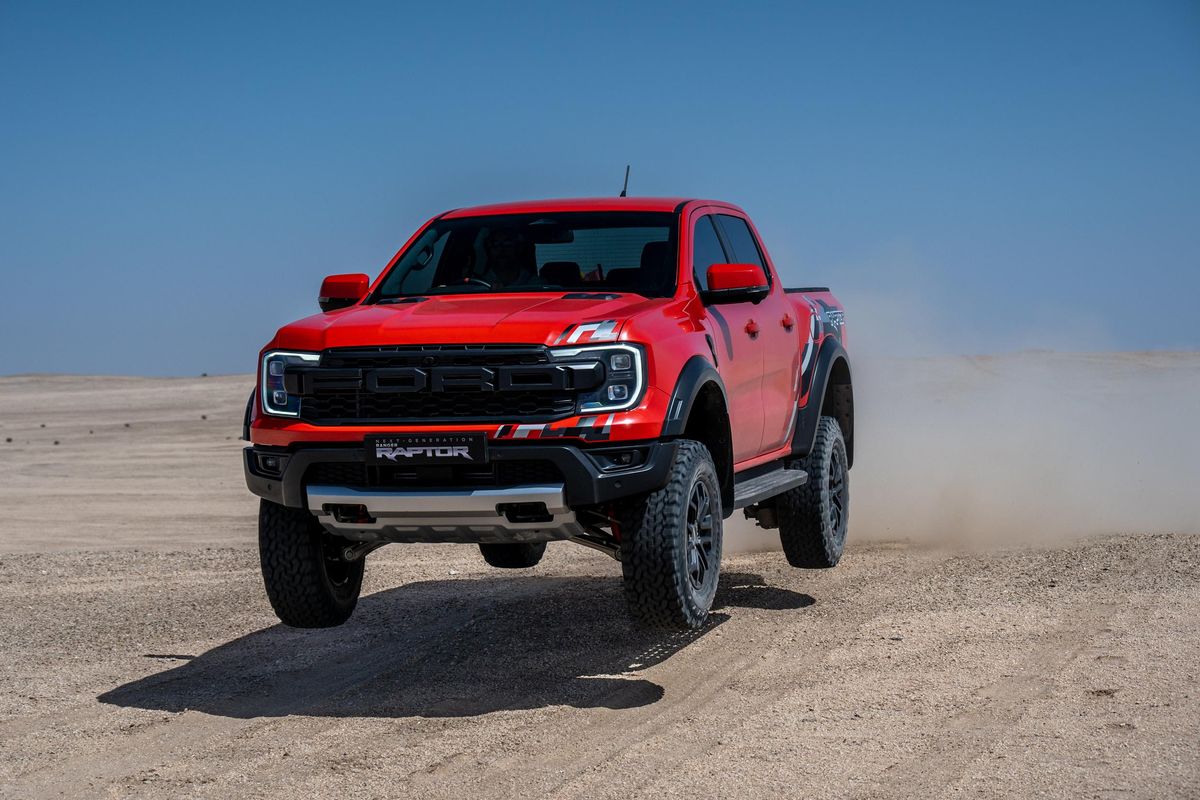
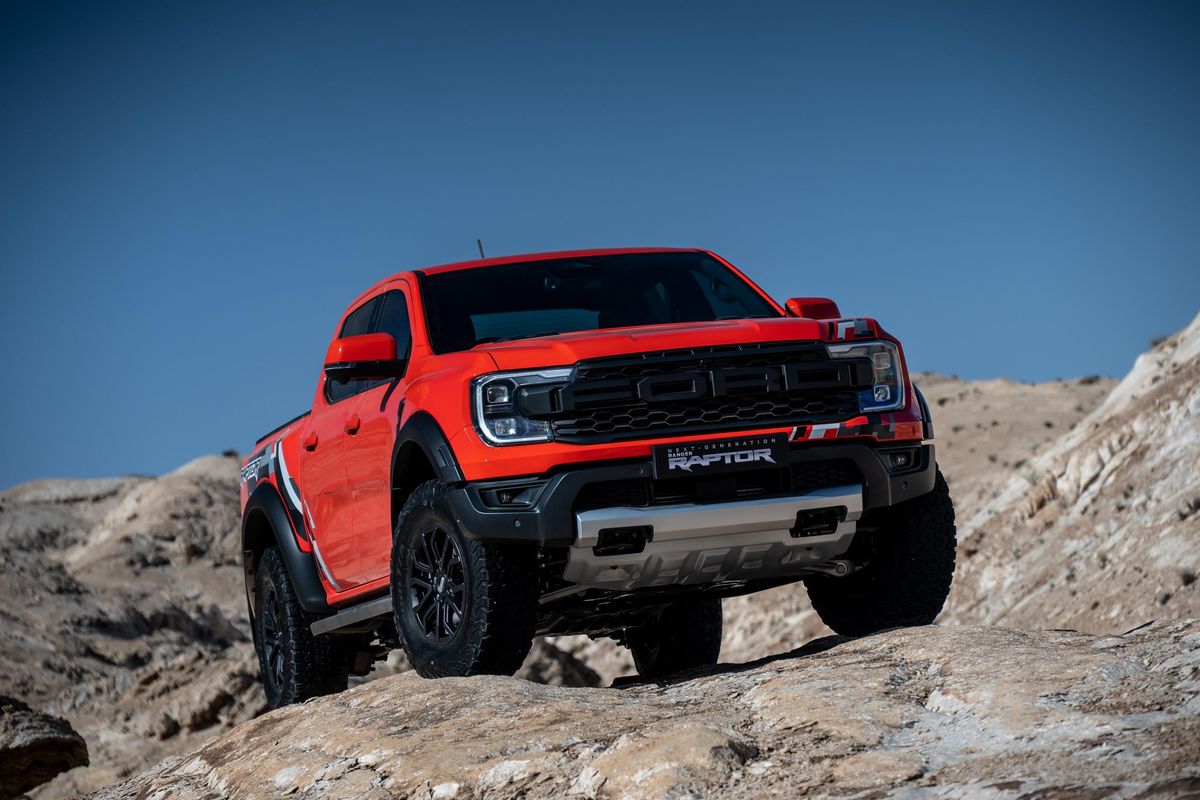
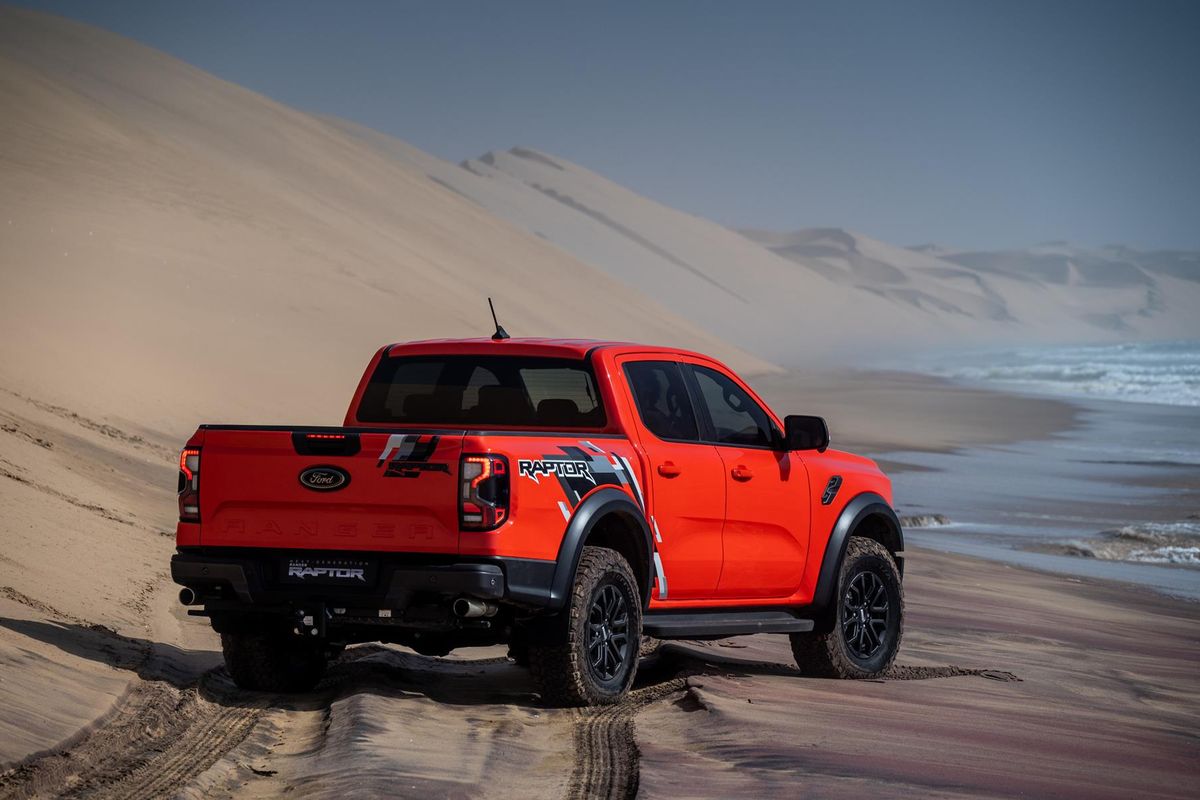
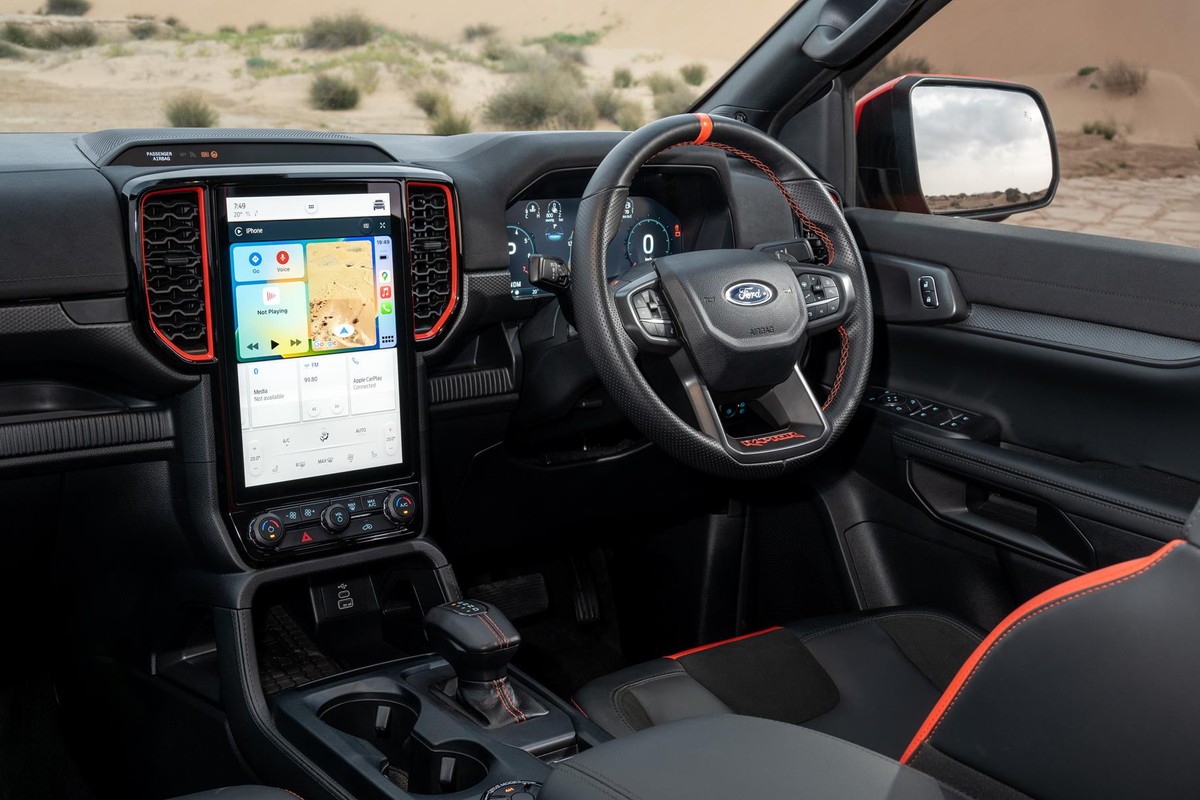
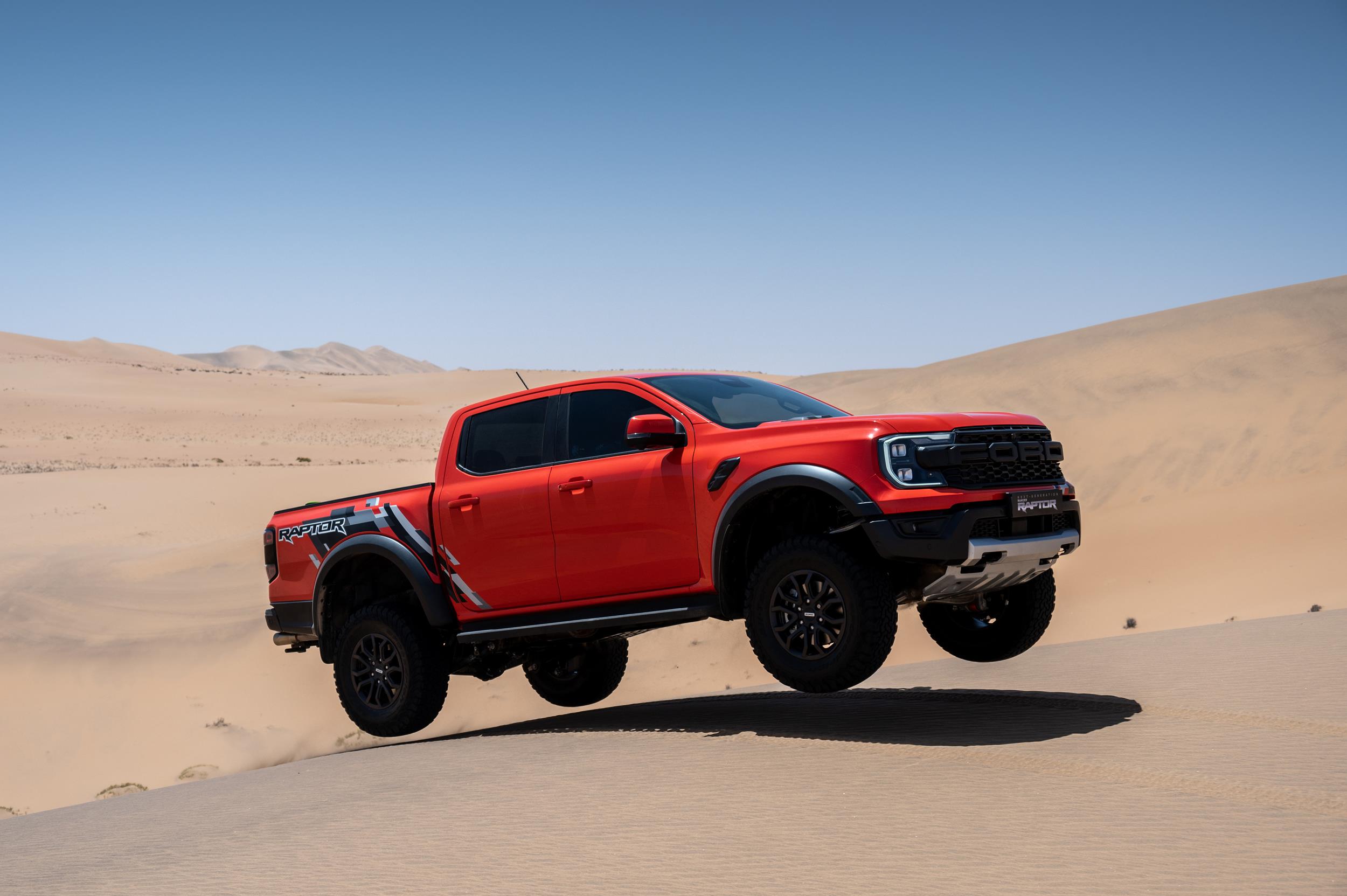
The second-generation Ford Ranger Raptor has been on sale since March 2023 and it has proven a hit, both on social media and in the sales charts. From launch up until the end of June 2023, 1 973 Raptors have found homes in South Africa.
What’s not to like? Just look at it, with the massive grille, oversized arches hiding large and all-terrain wheels and let’s not forget that specially-tuned Fox offroad suspension. Under the bonnet is a 3.0-litre, twin-turbo petrol V6 engine which has a whopping 292 kW and 583 Nm of torque, all of which is directed to the permanent 4-wheel-drive system via a specifically calibrated 10-speed automatic transmission.
As a reminder, it was only the first-gen diesel-powered Raptor that was manufactured in South Africa, at Ford’s facility in Silverton, Pretoria. These new petrol-powered Raptors are fully imported, from Ford’s factory in Thailand.
Ford Silverton: building standard Rangers for us and the world
With the Raptor (and Everest SUV) now coming in from overseas, the Silverton Assembly Plant has been ramped up for next-gen Ranger production, as well as Volkswagen Amarok. With a three-shift 24-hour production cycle, the plant is able to make 720 bakkies per day.
A total of 33 841 Rangers have been built at the Silverton plant from the middle of November 2022 up until June 2023, with these vehicles destined for local consumption and export. The engines for these vehicles have been coming from Ford’s engine facility in Struandale, near Gqeberha, Eastern Cape.
Should you fork out extra for the Raptor, or is the new V6-powered Ford Ranger Wildtrak enough to satisfy most of your needs?
You can no longer buy a new Ford Fiesta, but have you considered acquiring a used example? Let’s take a closer look at the 6th-gen iteration of the compact hatchback…
After a 47-year run, the Ford Fiesta is no more. Global production of the Blue Oval’s compact hatchback ended in mid-2023 (with little fanfare), although the supermini actually exited South Africa before that.
Yes, though the 7th-generation model was launched in South Africa in 2018, the facelifted version didn’t even make it to local shores, with stock running dry in early 2022. For the record, the Mk7 wasn’t nearly as popular in Mzansi as its predecessor and it’s for that reason we’ll concentrate on the Mk6 model here.
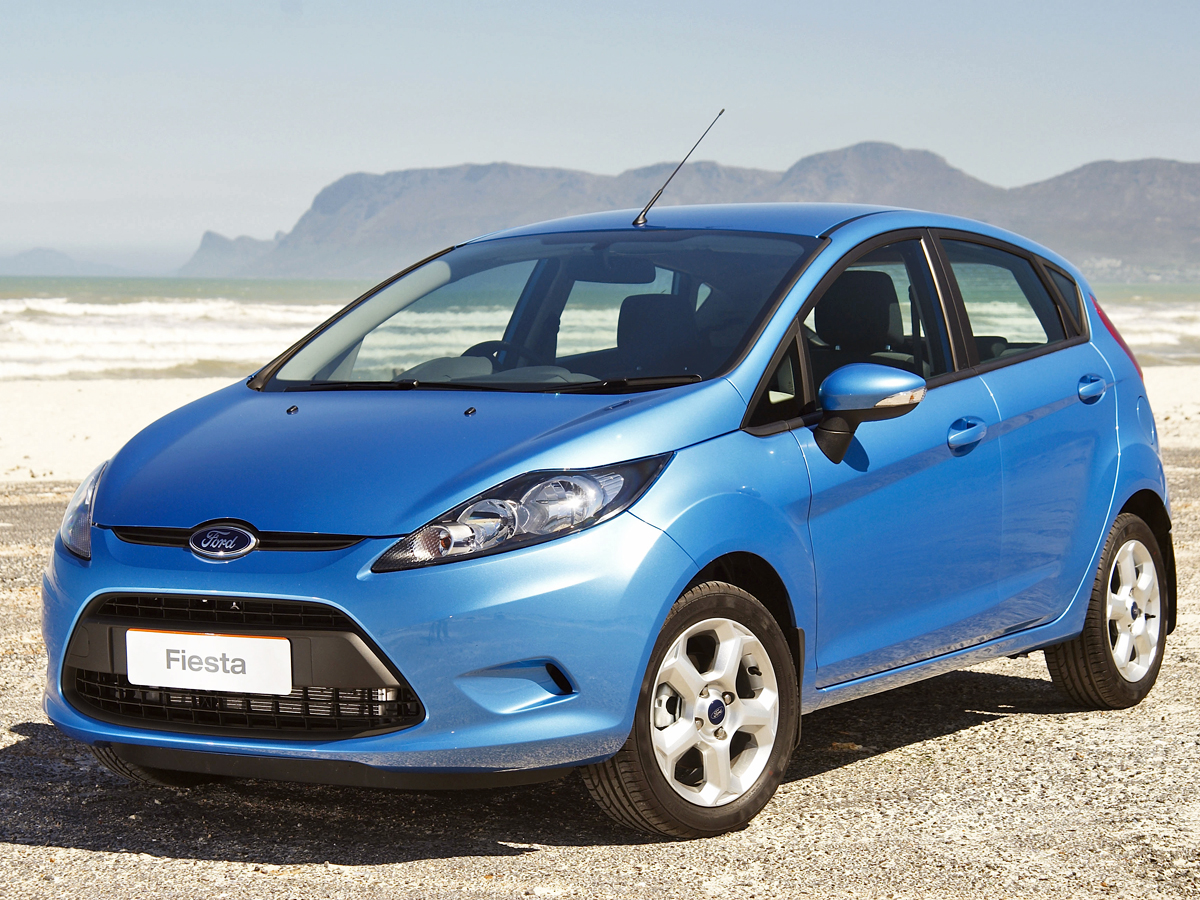
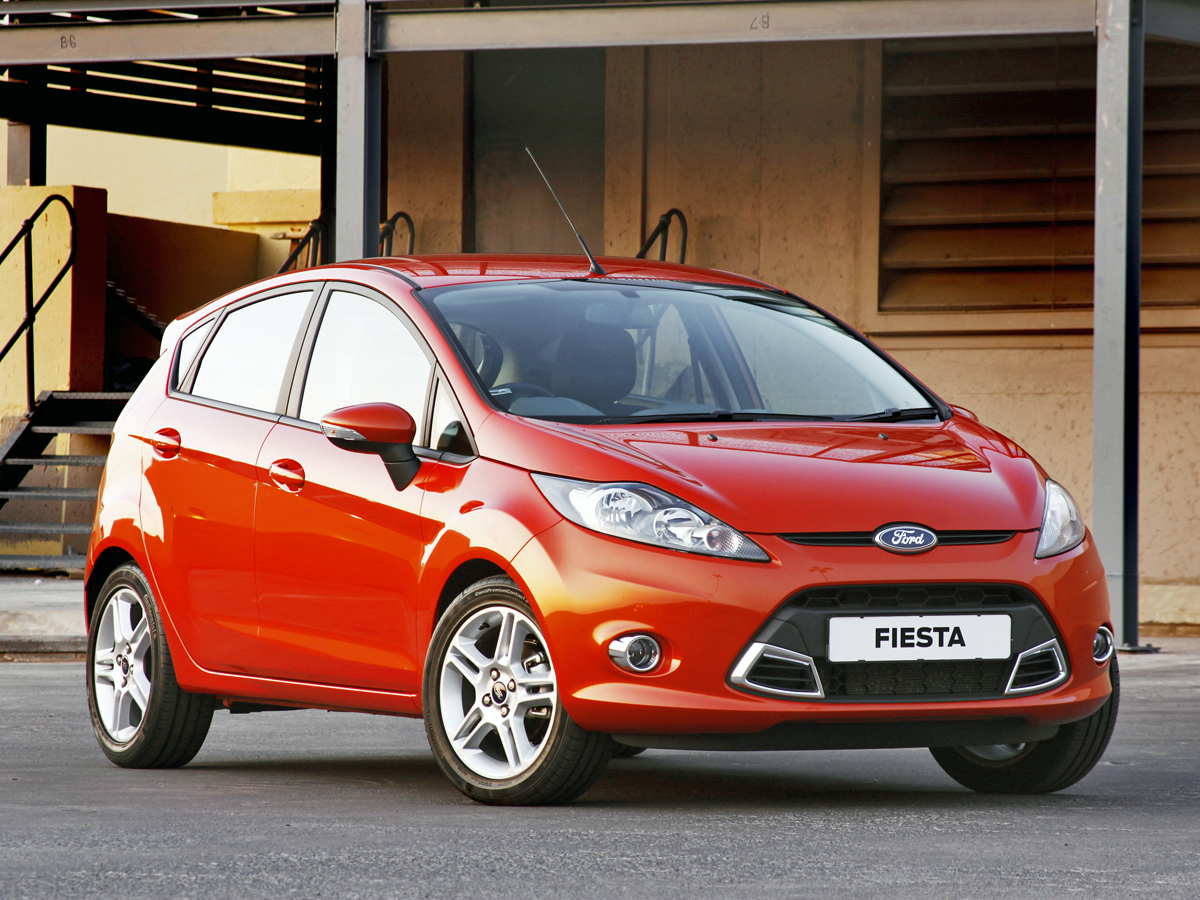
The Mk6 Fiesta touched down in South Africa towards the end of 2008.
As the first model conceived under the “One Ford” strategy (which would see the brand develop vehicles for a global audience instead of offering a variety of variants in regional markets), the 6th-gen Fiesta was described by the then FMCSA marketing manager as Ford’s “most significant project since the Model T”.
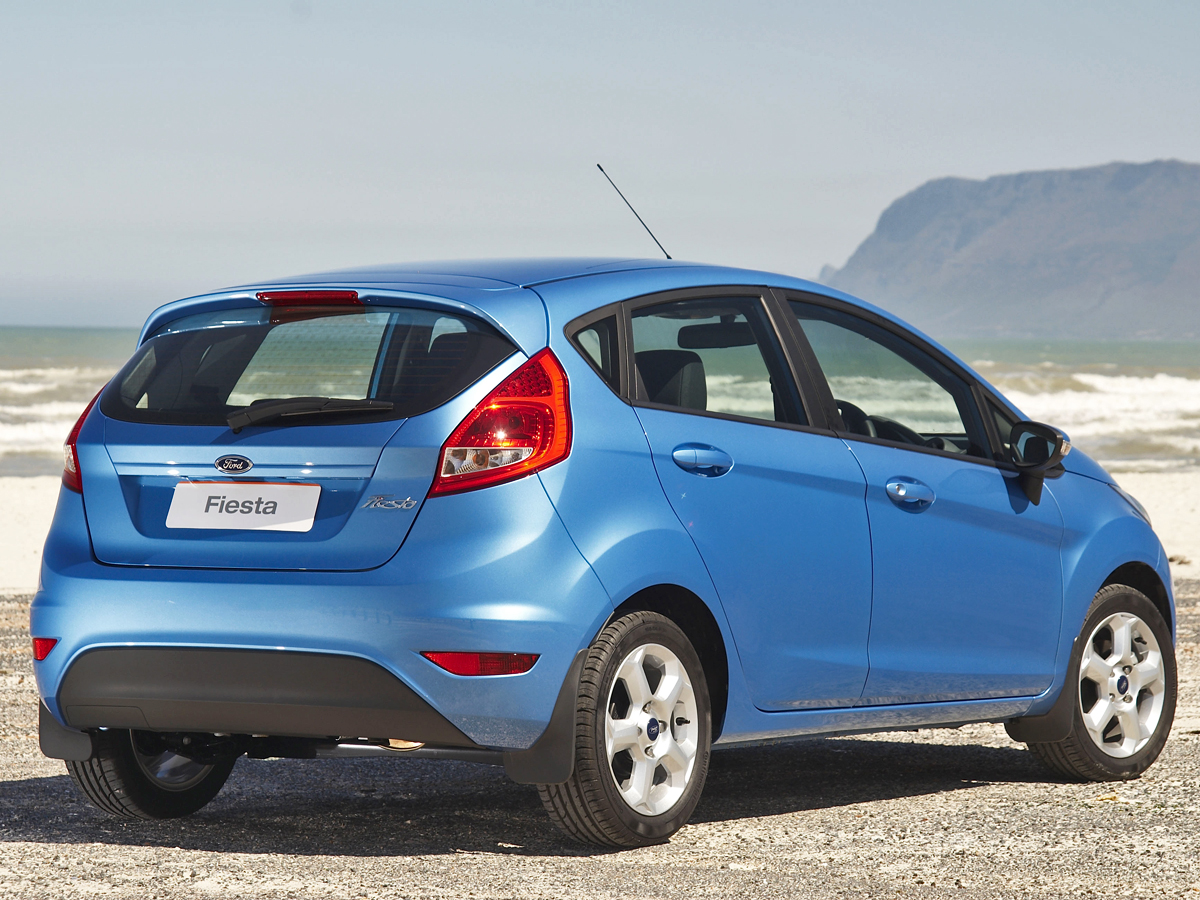
As such, the Cologne-manufactured hatch was underpinned by the B2E version of the Blue Oval’s global B-car platform. Ford did offer the Mk6 Fiesta in 4-door guise in our market, but we’ll focus on the 3- and 5-door hatchback variants in this article, because the sedan version sold in extremely limited numbers in South Africa. In fact, at the time of writing, not a single Fiesta sedan was listed for sale on Cars.co.za.
Ford Fiesta line-up in South Africa
At its launch, the Fiesta line-up comprised 8 hatchback derivatives.
Preceded by a trio of Verve concepts, the 6th-gen Fiesta enjoyed its global premiere at the Geneva International Motor Show in March 2008. By October of the same year (right after making an appearance at the Johannesburg International Motor Show), the new model rolled onto local dealership floors.
Initially, the front-wheel-drive Fiesta hatchback was offered with a choice of 3 engines (2 naturally aspirated petrol motors and a turbodiesel) and 3 trim levels. There were 3- and 5-door versions, though only manual gearboxes were available. At launch, the local range comprised the following 8 derivatives:
1.4 Ambiente 5-door 5MT (71 kW/125 Nm)
1.6 Ambiente 5-door 5MT (88 kW/149 Nm)
1.6 TDCi Ambiente 5-door 5MT (66 kW/200 Nm)
1.4 Trend 5-door 5MT (71 kW/125 Nm)
1.6 Trend 5-door 5MT (88 kW/149 Nm)
1.6 Titanium 5-door 5MT (88 kW/149 Nm)
1.4 Titanium 3-door 5MT (71 kW/125 Nm)
1.6 Titanium 3-door 5MT (88 kW/149 Nm)
The sedan body style arrived late in 2010, though not many examples were sold locally.
In November 2010, the Fiesta line-up expanded with the arrival of 5 sedan derivatives, along with a new 1.6 Sport 5-door. FMCSA also rolled out the option of a 6-speed dual-clutch automatic transmission (yes, the much-maligned PowerShift unit), mated with the 1.6-litre petrol engine and offered in either 5-door hatch or 4-door saloon form. With the 3-door 1.4 Titanium quietly scrapped, the range nevertheless ballooned to 13 derivatives at this point. Interestingly, engine outputs were adjusted slightly, with the 1.4 Sigma moving to 70 kW/128 Nm, the 1.6 TiVCT to 88 kW/152 Nm and the 1.6 TDCi DV6 to 66 kW/212 Nm.
In October 2012, Ford opened orders for the limited-edition Fiesta Magnet hatchback, which boasted 99 kW and 160 Nm from its uprated 1.6-litre petrol motor, along with sports suspension, a body kit, black 17-inch alloy wheels, leather-trimmed (and heated) front sports seats, alloy pedals and an upgraded audio system. Just 75 units were available, each finished in black.
Facelifted Ford Fiesta brings EcoBoost power
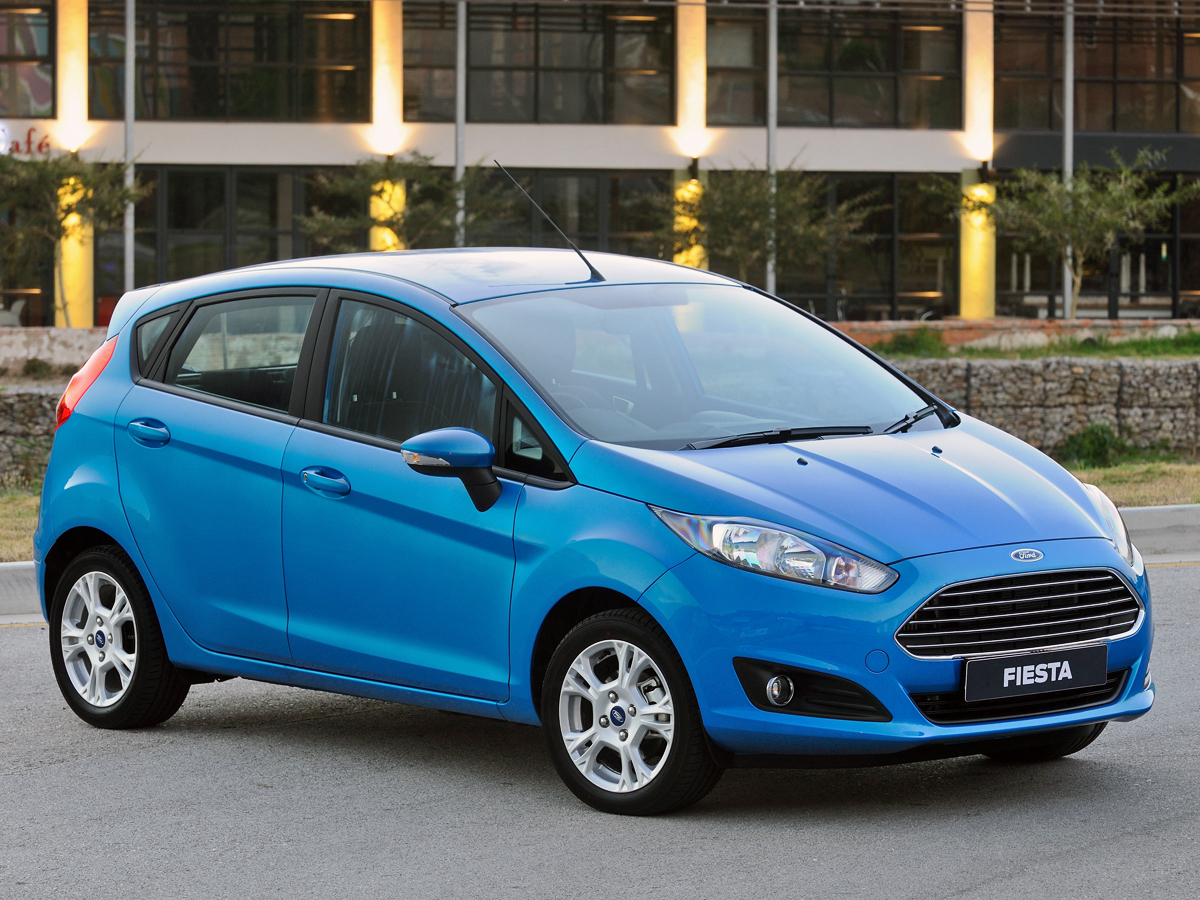
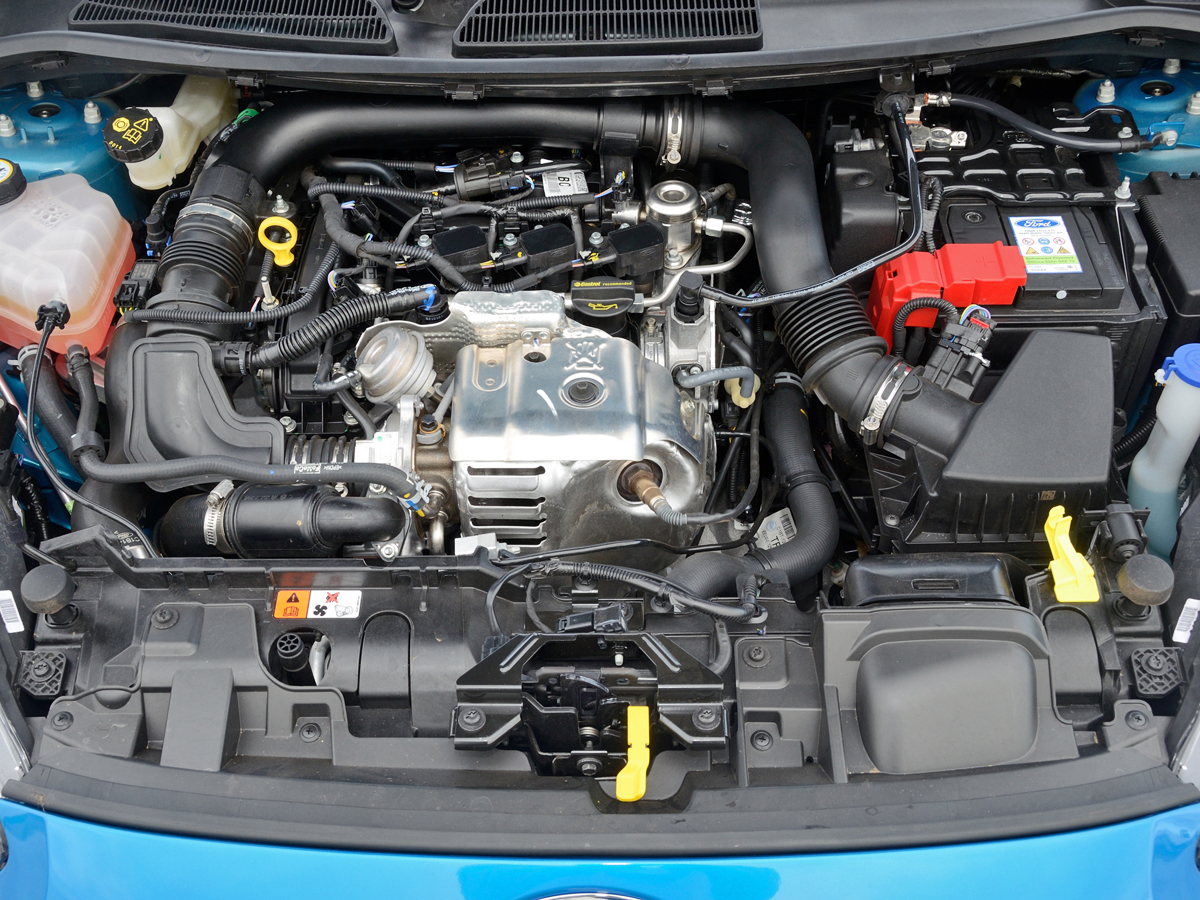
Ford added the 1.0 EcoBoost motor to the Fiesta range at the 2013 facelift.
In the opening month of 2013, the facelifted Fiesta hatchback made its local debut. It incorporated fresh exterior styling, a handful of cabin upgrades and the option of the Dearborn-based firm’s turbocharged 1.0-litre, 3-cylinder EcoBoost petrol engine. The latter generated 92 kW/170 Nm and was available in mid-spec Trend and flagship Titanium guises (each with a 5-speed manual gearbox as standard).
The 1.6-litre petrol powerplant fell away at this point, while the 1.6 TDCi’s outputs were now listed as 70 kW and 200 Nm (with its claimed combined fuel consumption improving to a mere 3.6 litres per 100 km). Both the 3-door body style and the sedan were removed from the local range at this mid-cycle update.
However, the 3-door option returned when the Fiesta ST blasted onto the scene in May 2013, powered by a 1.6-litre, 4-cylinder turbopetrol engine that churned out 134 kW and 240 Nm. With drive directed to the front axle through a 6-speed manual gearbox, the Blue Oval’s compact hot hatch was claimed to complete the 0-100 kph sprint in 6.9 seconds before topping out at 220 kph. Highlights included a new torque-vectoring system, 3-mode electronic stability control and Recaro front seats.
After the mid-cycle update, the ST was the only 3-door model available.
In November of the same year, the 1.0-litre 3-cylinder turbopetrol engine became available in conjunction with Ford’s 6-speed dual-clutch automatic transmission (in Trend trim), though peak power was reduced to 74 kW. By March 2015, the PowerShift cog-swapper had been extended across all 3 equipment grades, before an Ambiente version of the 1.0 EcoBoost (manual, but with the lower-output 74 kW tune) joined the range in December. At this stage, the line-up comprised 11 derivatives, including the ST.
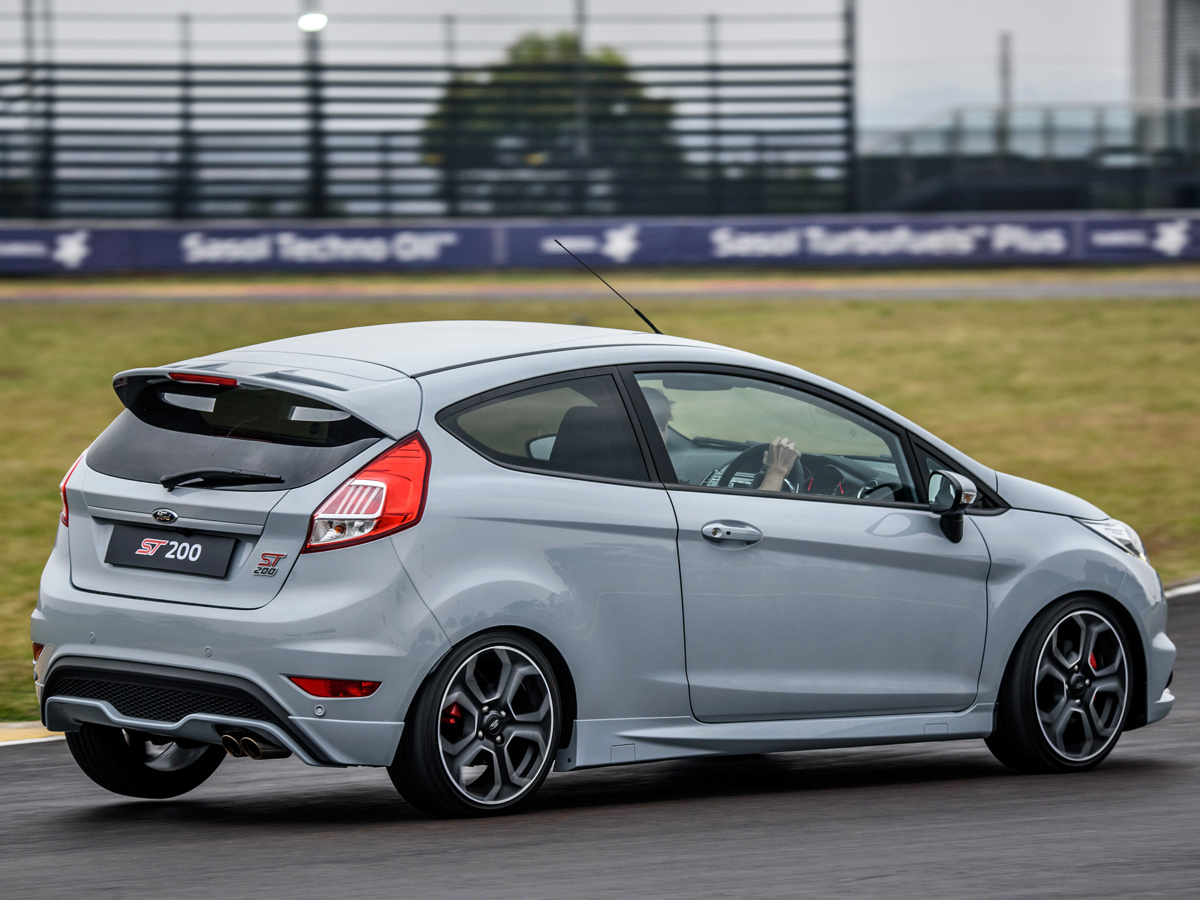
The final significant change to the Mk6 Fiesta range came in mid-2017, when the Fiesta ST200 arrived, armed with improved peak outputs of 149 kW and 290 Nm (with a further 11 kW and 30 Nm briefly available on overboost). Sporting a shorter final-drive ratio, the ST200’s claimed 0-100 kph time fell by 2-tenths of a second compared with the ST, while the suspension and power steering also benefitted from tweaks. Just 160 units were allocated to South Africa, each painted in Ford’s “Storm Grey” hue. Though we didn’t know it at the time, the ST200 would ultimately serve as a local swansong for the ST badge.
What are the advantages of a Ford Fiesta?
The Mk6 Fiesta range offered buyers a wide selection of powerplants.
Broad selection of engines: The Mk6 Fiesta range included a variety of engines, allowing this compact hatchback to appeal to all manner of tastes. The refreshingly uncomplicated (and naturally aspirated) 1.4-litre petrol motor was available throughout the decade-long lifecycle, while the likewise atmospheric (but pre-facelift-only) 1.6-litre version was pitched at buyers who sought a smidgen more grunt.
Of course, in pure power terms, the top step was occupied by the forced-induction mill from the ST hot hatch. The 1.6 TDCi, meanwhile, was the economy champion, while the introduction of the turbocharged 1.0-litre, 3-cylinder (with the facelift in 2013) attracted consumers seeking a balance between urge and economy (even if achieving anything near Ford’s claimed figures in the real world proved rather difficult).
The Fiesta ST200 had the ability to put a grin on virtually any keen driver’s face.
Fantastic fun to drive: In short, there was nothing in this segment that offered a more enjoyable driving experience than the dynamically gifted Mk6 Fiesta. Endowed with quick steering and superb mid-corner poise, the Fiesta was undoubtedly the segment’s “driver’s car”. Though the grin factor increased when more power was added (culminating in the frankly excellent ST200), even the common (or garden variety) derivatives were able to deftly balance impressive agility with the ability to cruise in comfort.
ST the last of a hot-hatch breed: While the Volkswagen Polo GTI and Renault Clio RS of the era each moved to a 5-door body shell and introduced a dual-clutch transmission (and the Opel Corsa OPC and Peugeot 208 GTi exited our market), the Fiesta ST resolutely stuck with 3 doors and a 6-speed manual cog-swapper. In essence, Ford’s baby hot hatch eschewed the “growing up” trend and was all the better for it – soldiering on as one of the last to offer old-school hot-hatch thrills. It’s a shame the ST version of the 7th-gen Fiesta – featuring a 1.5-litre 3-cylinder turbopetrol motor – never made it to South Africa.
What are the disadvantages of a Ford Fiesta?
Certain ST models were included in a recall sparked by the Kuga fire scandal.
Engine fire risk in Fiesta ST: While you’re probably familiar with the widely reported Kuga fire scandal, you may not be aware that FMCSA’s safety recall campaign (pertaining to its medium SUV) was extended to include the Fiesta ST’s 1.6-litre engine in March 2017. Insufficient coolant circulation could cause the engine to overheat, resulting in a crack in the cylinder head, which could, in turn, lead to a pressurised oil leak. This oil could then come into contact with a hot engine surface, increasing the risk of a fire.
In South Africa, Ford said the safety recall included approximately 1 078 units of the Fiesta ST (those produced between September 2012 and December 2014). So, depending on the model year, check whether the vehicle was taken in for the applicable hardware and software upgrades. In addition, we should point out we’ve heard of a few (local) instances of ring-land failure on this engine as well.
We’d suggest avoiding the much-maligned PowerShift automatic transmission.
PowerShift transmission woes: As we’ve noted in a couple of other Ford buyer’s guides (such as the EcoSport), the PowerShift-branded 6-speed dual-clutch automatic transmission in the Fiesta Mk6 tended to suffer from leaking seals that quickly led to oil contamination of the dry clutch module. This was a known fault – Ford even faced legal action in many countries and replaced countless clutches under warranty – that presented as excessive juddering, as well as jerking under acceleration.
Security-system shortcomings: In 2019, after facing a raft of complaints on social media, FMCSA said it was “aware” of potential security system problems with “certain older” EcoSport and Fiesta derivatives. The issues related to vulnerabilities around the key-lock barrel, as well as alarm systems that failed to sound when the locks were tampered with. The automaker offered customers various potential remedies at “below cost”, insisting the break-ins were “not related” to design or manufacturing faults on its part.
The pre-facelift model’s cabin hasn’t dated particularly well.
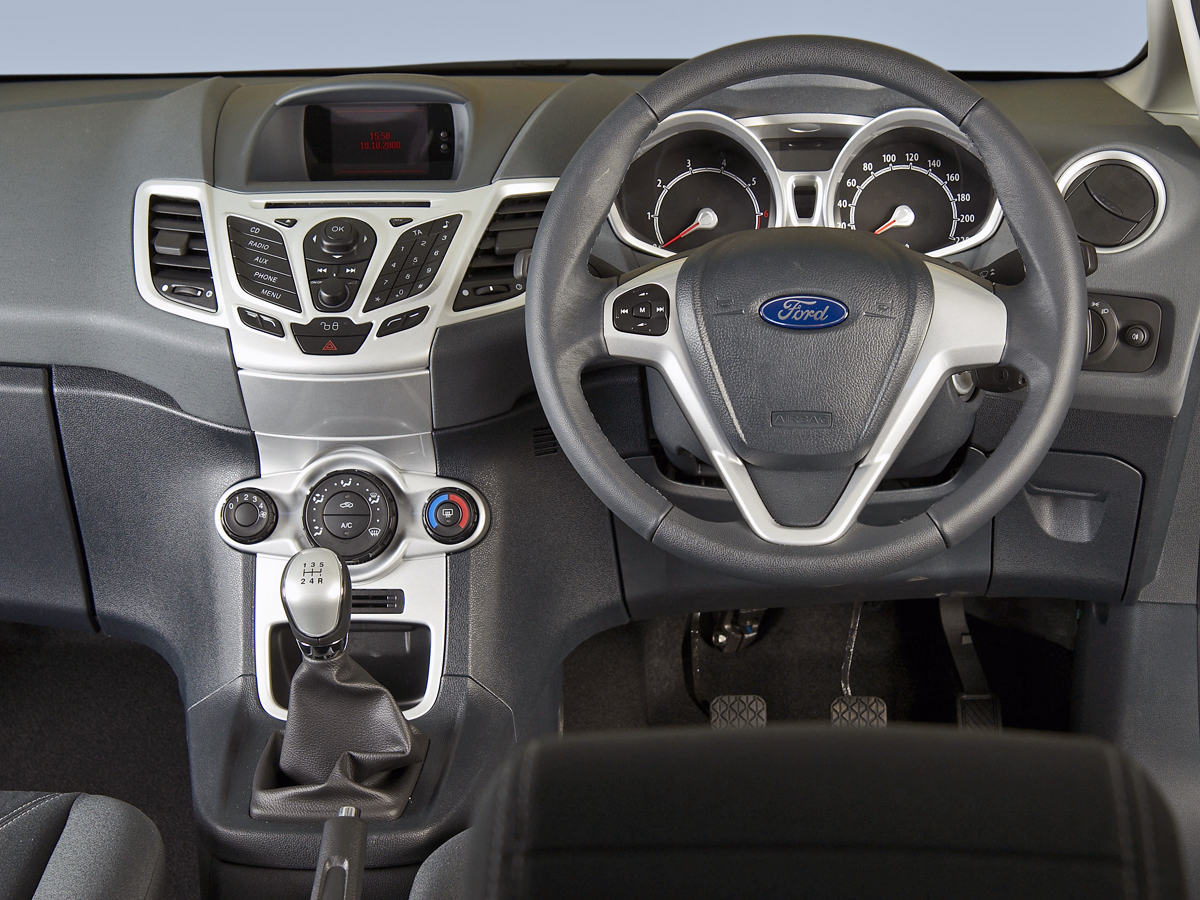
Somewhat outdated cabin: Sure, it’s a minor gripe, but we feel compelled to point out that the 6th-gen Fiesta’s cabin felt a touch outdated, particularly towards the end of its admittedly protracted lifecycle. Compared with more modern rivals, its infotainment screen was tiny and sited above a cluttered, button-festooned centre console that brought to mind the design of certain cellphones from the early 2000s.
How safe is the Mk6 Ford Fiesta hatchback?
The 6th-gen Fiesta (and the facelifted version of the model) scored 5 stars from Euro NCAP. However, it’s worth noting most SA-spec derivatives weren’t quite as well endowed in the safety department as their European counterparts. At launch, for example, all derivatives in the local range made do with dual front airbags and drum brakes at the rear. The Sport version, however, featured 7 airbags, while the PowerShift derivatives added an electronic stability programme, traction control and hill-launch assist.
At the facelift, the latter features (by then standard on the Titanium grade, in conjunction with the 1.0 EcoBoost mill) became available on Trend derivatives as an extra-cost option, while the full complement of airbags was also offered as part of an optional pack. Ford’s MyKey also made its debut at that point; the MyKey function enabled users to configure the Fiesta’s maximum speed and audio-volume limits…
How much is a used Ford Fiesta in South Africa?
This is the seldom-spotted 1.6 Sport 5-doorthat debuted locally in 2010.
The 6th-gen Fiesta came with a 4-year/120 000 km warranty and 4-year/60 000 km service plan (with intervals of 20 000 km for petrol versions and 15 000 km for turbodiesels). Since there’s no shortage of used Fiestas available, we’d suggest simply walking away from cars that don’t have full service histories.
Of the Ford Fiesta Mk6 examples listed on Cars.co.za at the time of writing, more than 97% featured petrol power; there was only a handful of 1.6 TDCi examples; 13% had the auto transmission and no sedan versions were listed. The base Ambiente trim level was specified on around 50% of the cars.
The 1.0 EcoBoost mill was easily the most popular engine, followed by the naturally aspirated 1.4-litre motor (34%). The 3-door ST, meanwhile, made up an appreciable 13% of listings. Mileage varied from 21 000 km (on a 2009 Fiesta 1.6 Ambiente) to 240 000 km (achieved by a 2016 1.4 Ambiente).
Below R100 000: Fascinatingly, virtually every model year was represented in the sub-R100 000 space, despite only around 7% of total stock being listed here. Many examples featured aftermarket accessories, such as alloy wheels.
From R100 000 to R150 000: We found plenty of facelifted Fiestas in this price bracket, including several 1.0 EcoBoost examples and most of the few turbodiesel units that were available. There were even a couple of (unfortunately modified) ST derivatives here.
From R150 000 to R250 000: At the time of writing, this was the most densely populated pricing bracket, featuring all model years and powertrains. Most buyers would likely be shopping in this space, where we discovered everything from low-mileage, early units to Titanium-spec 2018 models (not to mention a few more STs).
R250 000 and up: If you’re in the market for a clean ST, you’d likely be searching in this space. The most expensive vehicle we encountered here was a 2017 ST200 listed at R329 900. Note that if you want to spend more than R250 000, you could easily get into the driver’s seat of a 7th-gen Fiesta.
Which Ford Fiesta should I buy?
The overwhelming majority of Fiesta listings we found were petrol-powered models.
So, which is the best of the bunch? Well, let’s first rule out a few derivatives before settling on a winner. For instance, we’d advise giving PowerShift-equipped automatic variants a particularly wide berth, considering the transmission issues outlined above.
The base Ambiente trim level – as plentiful as it is on the used market – may not meet the needs of many contemporary buyers because it foregoes a number of features. Initially, for example, this grade settled for steel wheels and was missing remote central locking, rear electric windows, an alarm system, a basic driver-information system and Bluetooth. Curiously, the facelifted Ambiente even dropped aircon and an audio system from its list of standard features, with those items offered as options instead…
As part of the facelift, the cabin was updated to be more pleasing to the eye.
Though the 1.0 EcoBoost was an impressive motor (and a multiple winner of the International Engine of the Year award), we’d argue the naturally aspirated 1.4-litre motor – in facelifted, mid-spec Trend guise – would likely deliver a better long-term ownership experience, particularly for risk-averse buyers.
Why? Well, the high-compression downsized turbo-triple had to work hard to generate its peak outputs, with some early examples known to suffer from head-gasket issues, coolant leaks and fuel-pressure woes. Though meticulously cared-for examples of the 3-pot would surely still provide plenty of trouble-free miles, the 1.4-litre unit was an inherently less stressed – and indeed less complicated – motor.
As an aside, we’d certainly vouch for the frugality and low-down punch of the 1.6 TDCi powerplant (a turbodiesel engine likewise best experienced in facelifted Trend guise), though bear in mind there are very few available on the used market.
Is the Ford Fiesta a good used buy?
The Mk6 Fiesta faced all manner of rivals but was right near the top of its class.
While the Mk6 version of the Fiesta was certainly one of the more popular contenders in the B-segment space, it was comfortably outsold in South Africa by the locally produced 5th-generation Volkswagen Polo hatchback. Other mainstream rivals of the era included a pair of Korean siblings – the PB-generation Hyundai i20 and the UB-generation Kia Rio hatchback – as well as the 3rd-gen Toyota Yaris, Renault Clio IV, Opel Corsa (in both 4th- and 5th-gen guise) and the Mk2 Mazda2.
There was also the K13-series Nissan Micra (which briefly lived on locally as the Micra Active), as well as the 3rd-gen Honda Jazz (the latter being particularly well suited to buyers who prioritised versatility), along with somewhat left-field choices such as the A9-gen Peugeot 208 and the A51-gen Citroen C3.
Despite playing in a field crammed with strong competitors, the 6th-gen Fiesta was near the summit of its class. The local line-up was broad enough to meet virtually any compact hatchback requirement, ranging from a diesel-sipper to a scorching hot hatch. In short, the Fiesta was terrific to drive and suitably practical considering its compact dimensions, with most engines pleasingly light on fuel too.
While it’s a great pity Ford opted to unceremoniously axe this storied nameplate from its line-up, the Fiesta’s sustained popularity means there are thankfully still plenty of examples available on the used market today. And from where we’re sitting, the Mk6 was surely one of the best Fiestas that Ford made.
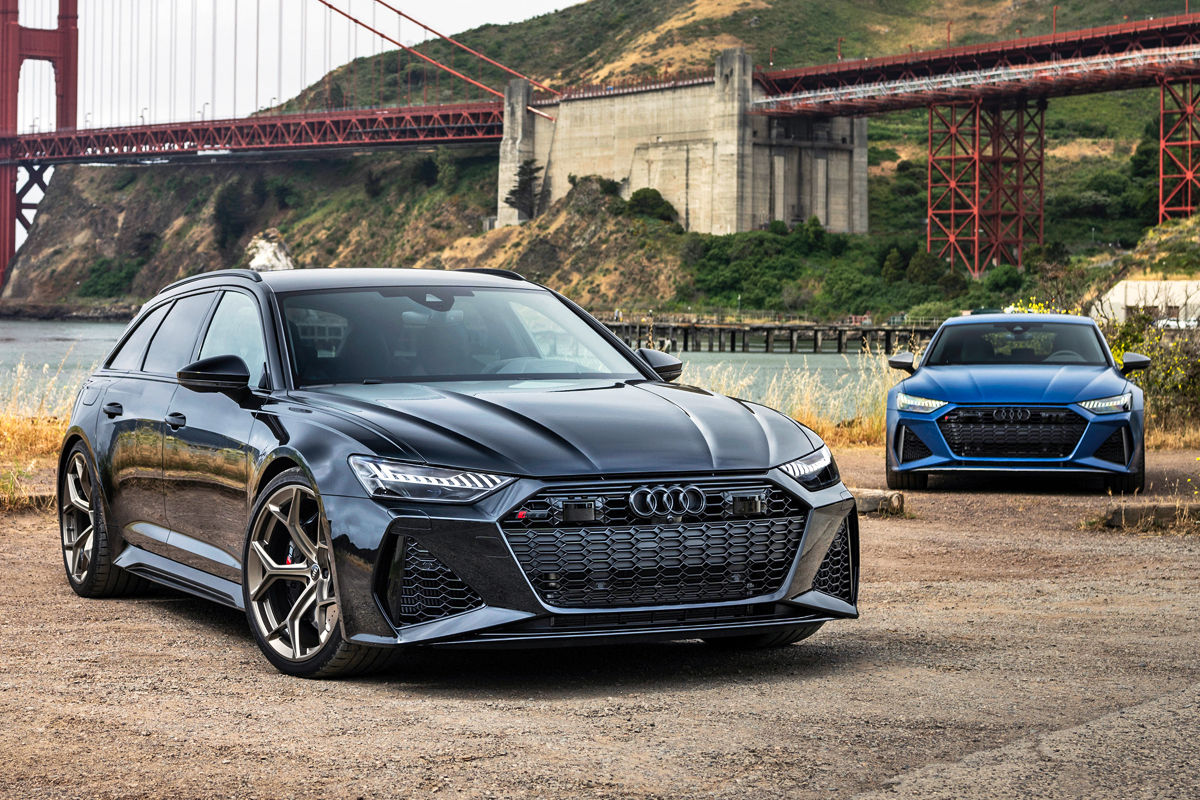
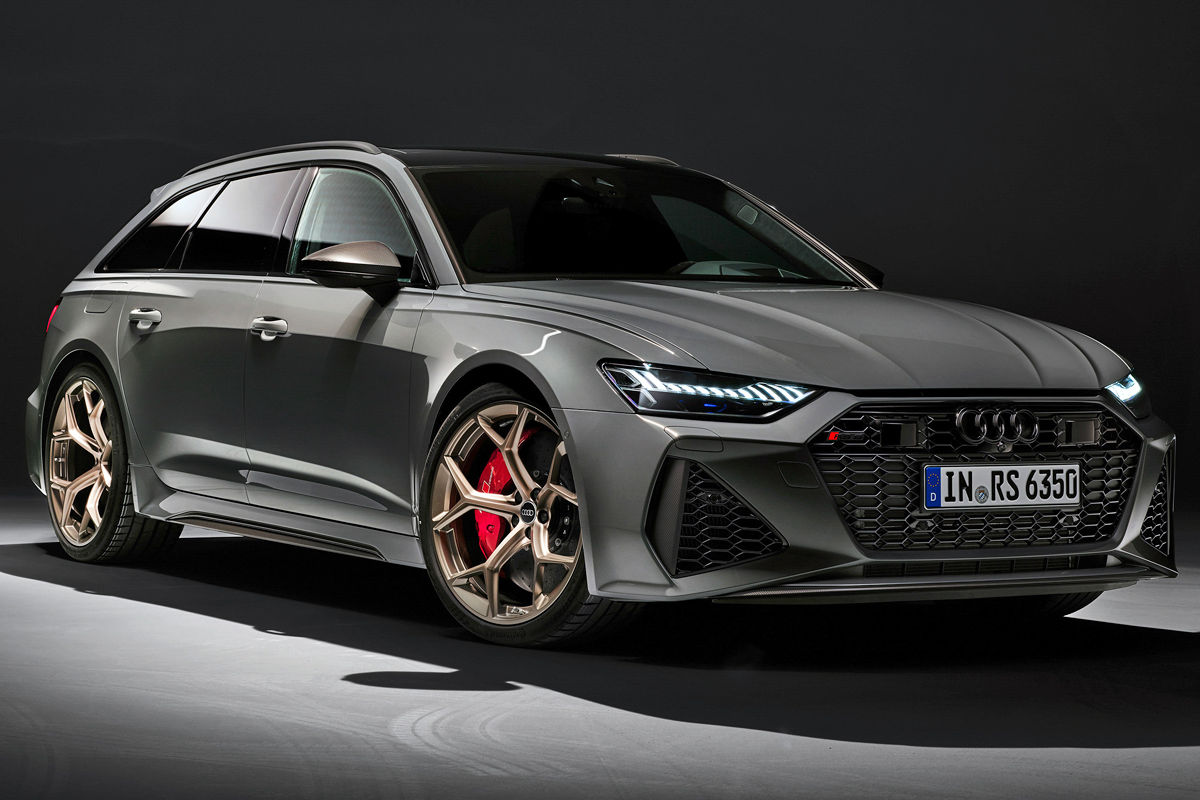
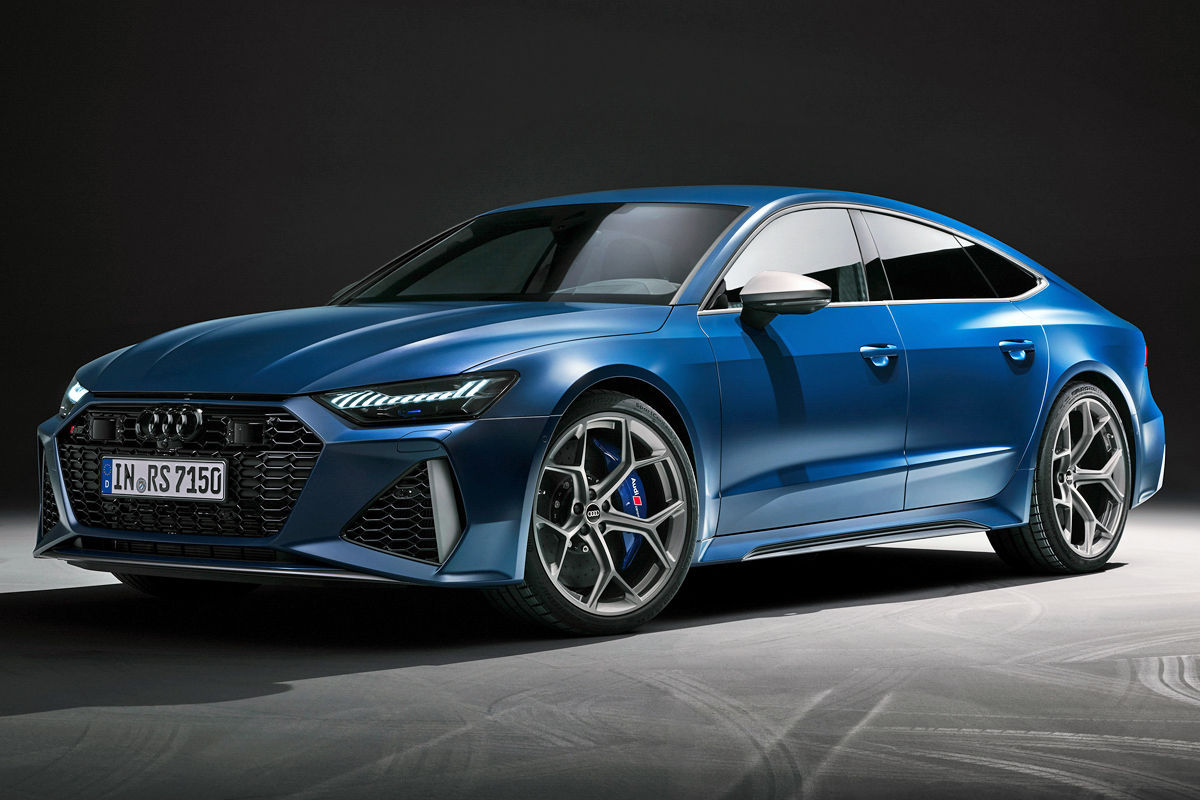
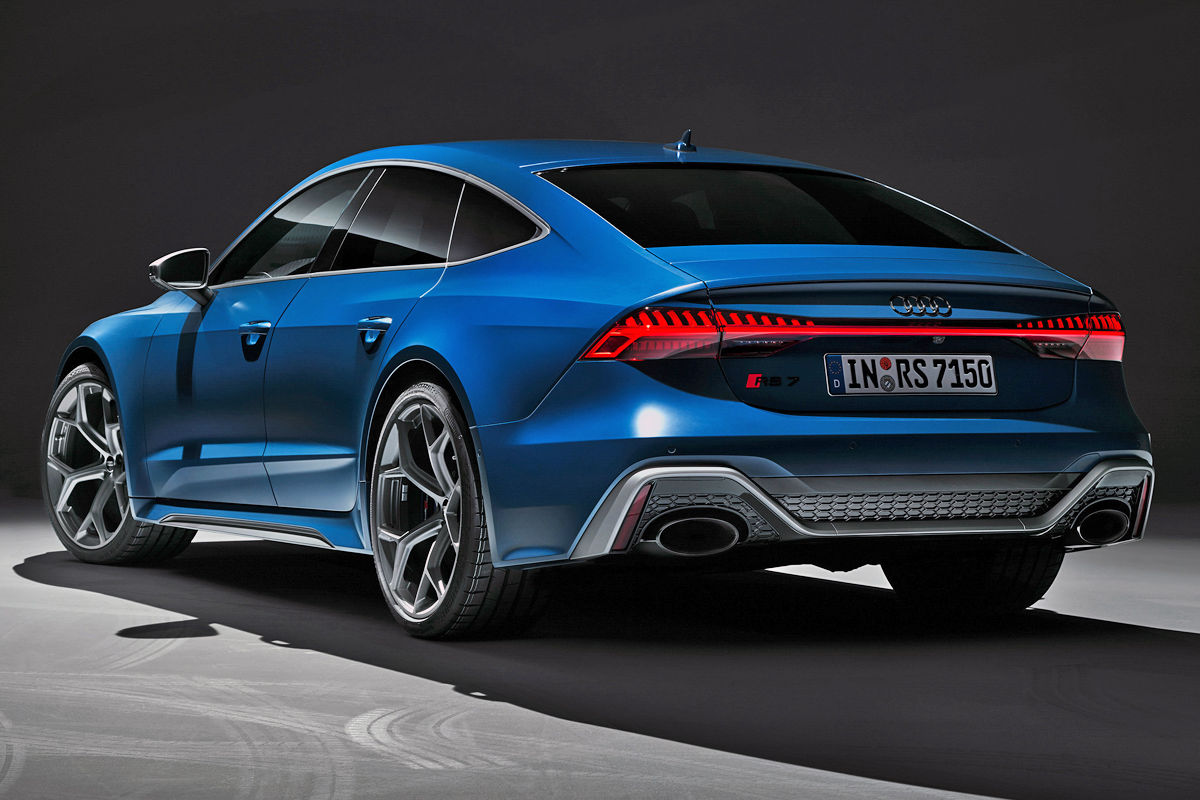
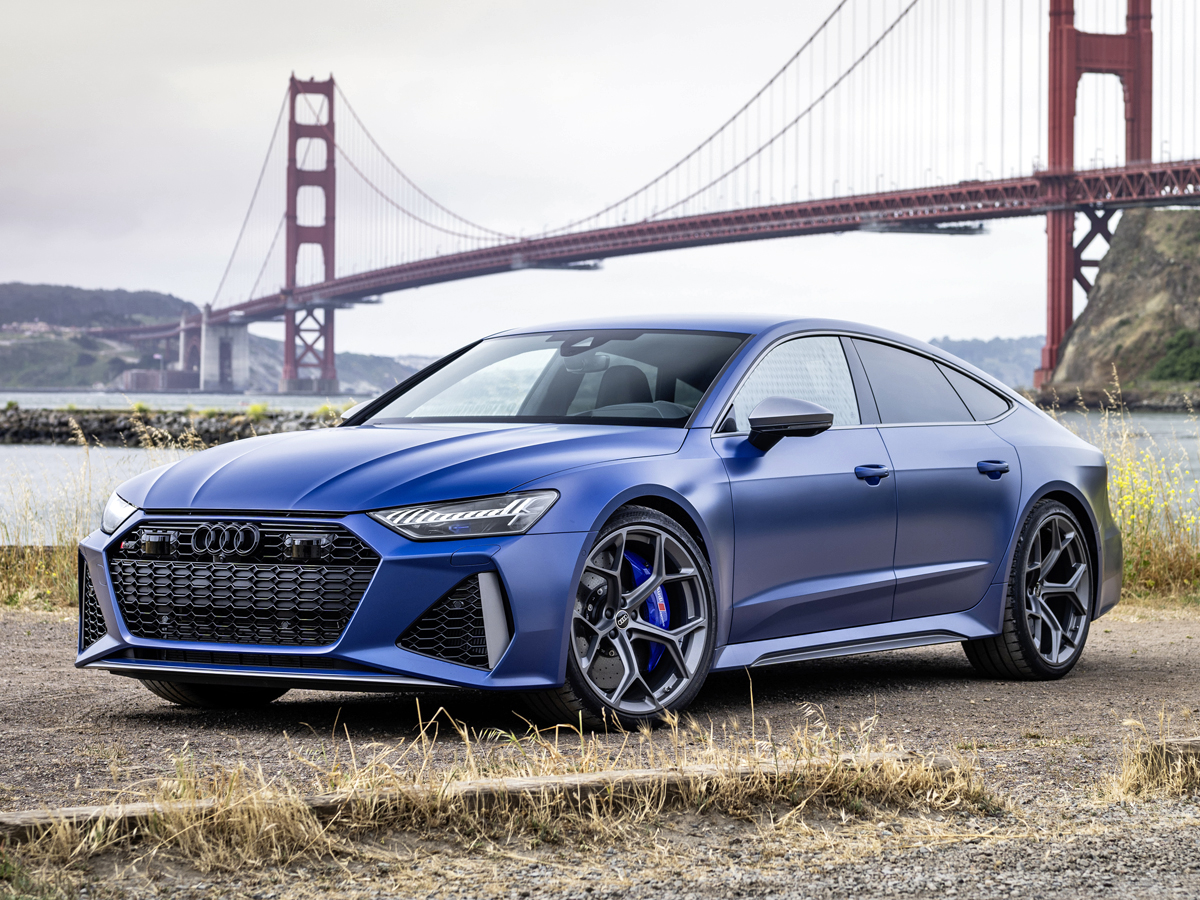
The new Audi RS6 Avant and RS7 Sportback Performance derivatives have touched down in South Africa, each boasting a heady 463 kW. Here’s how much these V8-powered monsters will cost you…
The new Audi RS6 Avant Performance and Audi RS7 Sportback Performance have arrived in South Africa, each offering more power, faster acceleration and less cabin insulation than their respective forebears. Interestingly, their launch furthermore sees the “standard” models fall away.
So, how much will they cost you? Well, the RS6 Avant Performance is priced from R2 332 700, while the RS7 Sportback Performance starts at R2 444 500. For the record, that’s a premium of R78 100 over the outgoing standard model in each case.
Revealed in November 2022, the new Performance-badged flagship derivatives each employ an uprated version of the Ingolstadt-based firm’s twin-turbo 4.0-litre V8 petrol engine. While the outgoing version of this 8-cylinder motor makes 441 kW and 800 Nm, the iteration used in the freshly minted Performance variants upgrades to larger turbochargers and features an increase in boost pressure.
As a result, peak outputs climb to 463 kW and 850 Nm, while the claimed 0-100 kph sprint time falls to a mere 3.4 seconds (for the record, that’s 2-tenths quicker than the standard models). So, Audi’s Performance badge here plays a similar role to the BMW M division’s Competition moniker and Mercedes-AMG’s S designation.
In addition, Audi has reduced the amount of insulation between the engine compartment, the cabin and the rear of the vehicle, both allowing the V8 soundtrack to resonate louder and saving a total of 8 kg (thus, the RS6 Avant Performance tips the scales at 2 090 kg, while the RS7 Sportback Performance weighs 2 065 kg).
The Performance derivatives each employ an 8-speed automatic transmission with updated software that makes for faster shifting, delivering drive via a permanent all-wheel-drive system. Audi says a “lighter and more compact” self-locking centre differential is also included in the deal, claiming this results in “more precise cornering” and less understeer at the limit.
In SA, both the new RS6 Avant Performance and RS7 Sportback Performance ship standard on 22-inch matte titanium grey wheels – which are also available in burnished glossy metallic black, matte black or matte neodymium gold.
The German company also says it has tweaked the drive select dynamic handling system, while the RS Dynamic Package – which hikes top speed to 280 km/h and adds dynamic all-wheel steering and a quattro sport differential on the rear axle – is standard equipment. Audi furthermore offers the RS Dynamics Package Plus as an option, which raises the maximum speed to 305 km/h and adds an RS ceramic brake system (saving a further 34 kg).
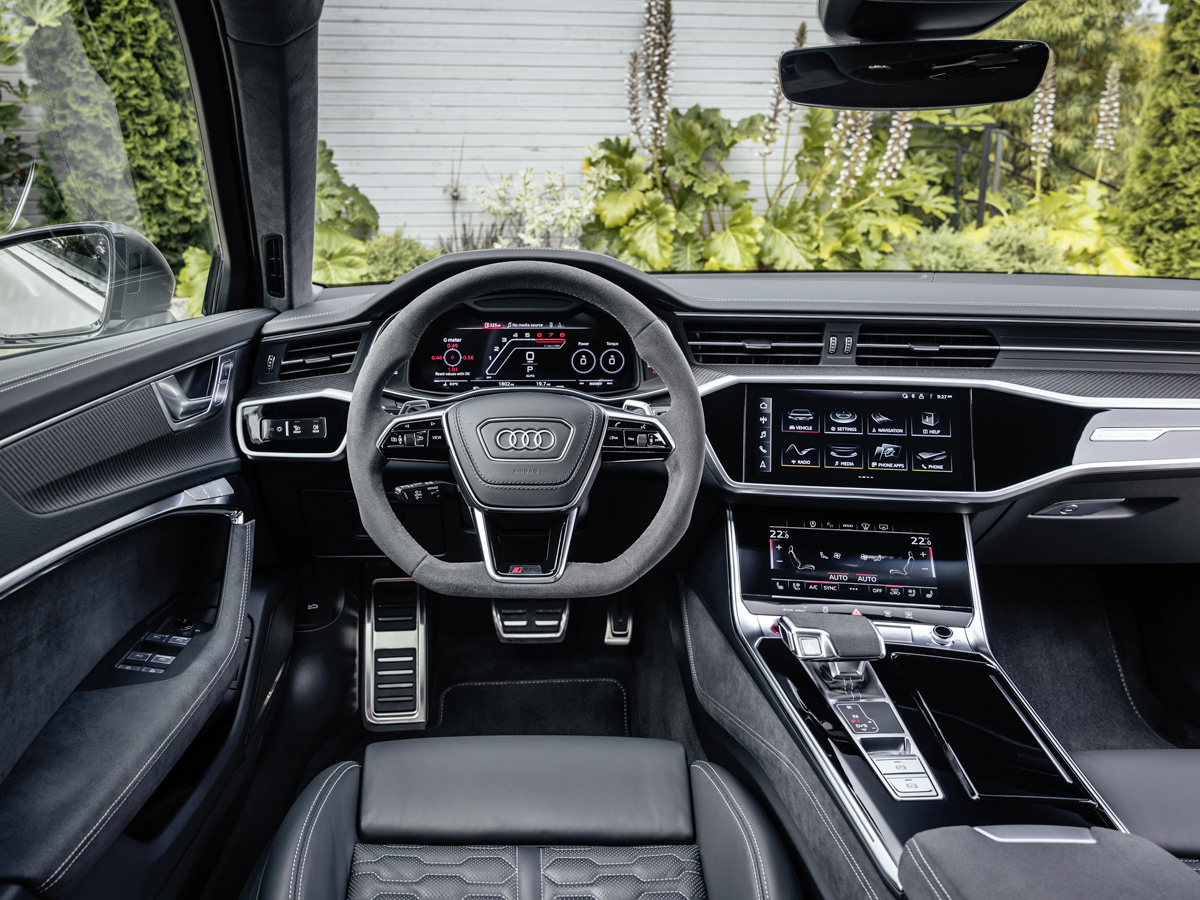
Inside, you’ll find a new RS design package in blue. Tick this box and the steering wheel rim comes finished in black with Mercato blue contrasting stitching, a treatment that is repeated on the floor mats, the side of the centre console and the selector lever cuff. The seat belts are full-surface ocean blue with the decorative inlays in a carbon twill structure with optional blue accents.
There are also entrance LEDs in the front doors that project “RS Performance” lettering onto the ground, while the 12.3-inch Audi Virtual Cockpit Plus offers additional features such as a blinking shift indicator in manual mode.
How much do the Audi RS6 and RS7 Performance cost in SA?
Audi RS6 Avant Performance – R2 332 700
Audi RS7 Sportback Performance – R2 444 500
The prices above include a 1-year/unlimited kilometre warranty and a 5-year/100 000 km maintenance plan.
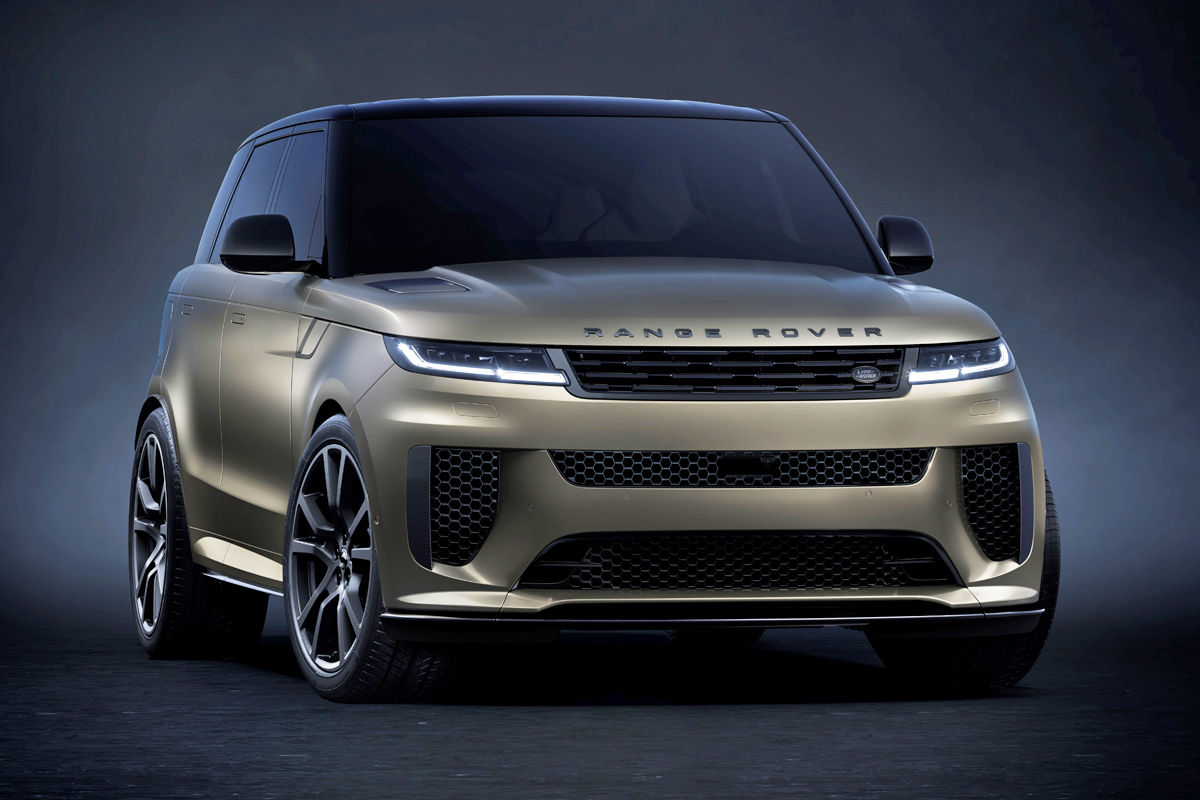
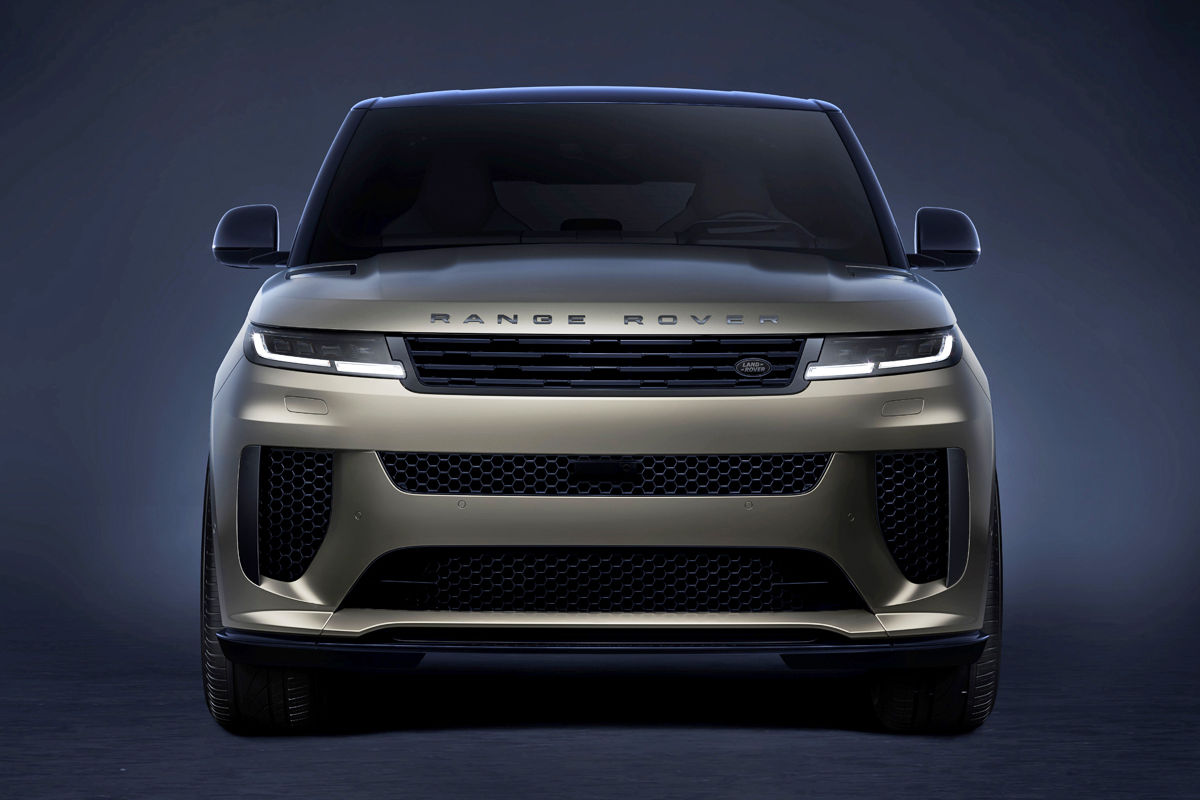
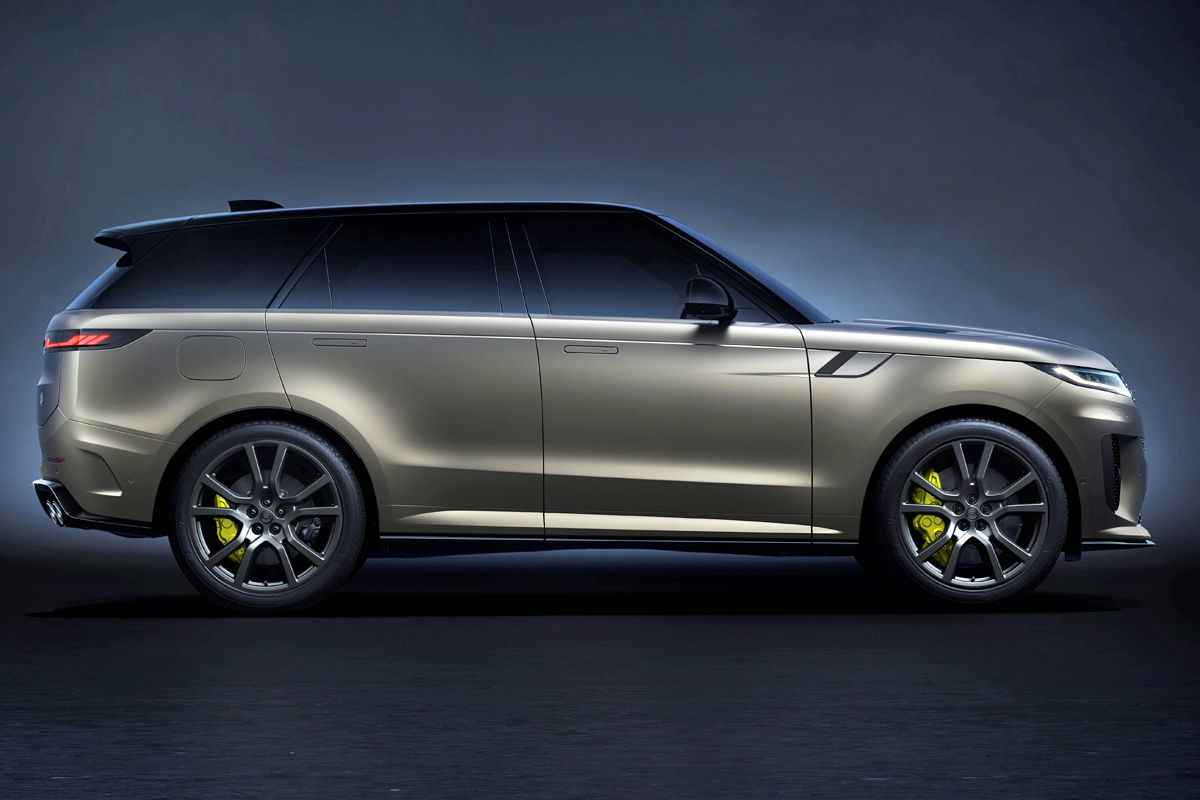
Range Rover Sport P635 SV Edition One (2023) Price & Specs
Keen on the most powerful Range Rover ever? Here’s how much the new Range Rover Sport P635 SV Edition One costs in SA, though note initial units are available only to “select clients” by invitation…
The new Range Rover Sport P635 SV was revealed in June 2023 as the line-up’s fresh performance flagship. Though this V8-powered model has been confirmed for South Africa, the Whitley-based firm says units from the 1st year of production will be available only to “select clients” by invitation, and exclusively in SV Edition One guise. Nevertheless, we now have local pricing.
Yes, thanks to our ever-in-the-know friends over at duoporta.com, we can confirm the Range Rover Sport P635 SV Edition One is priced from R3 965 000. Though the British brand’s local website says this limited-edition model is “fully allocated”, it does give would-be buyers the option to register their interest in “other” Range Rover Sport SV derivatives (presumably available only in the 2nd year of production).
As a reminder, the P635 SV Edition One is billed as the most powerful series-production Range Rover ever, thanks to its BMW-sourced (S63-series) twin-turbo 4.4-litre V8 electrified petrol engine. In the hottest Range Rover Sport yet, this 8-cylinder mild-hybrid motor sends a whopping 467 kW and 750 Nm (or 800 Nm for a brief period in Dynamic Launch Mode) to all 4 corners via an 8-speed automatic transmission.
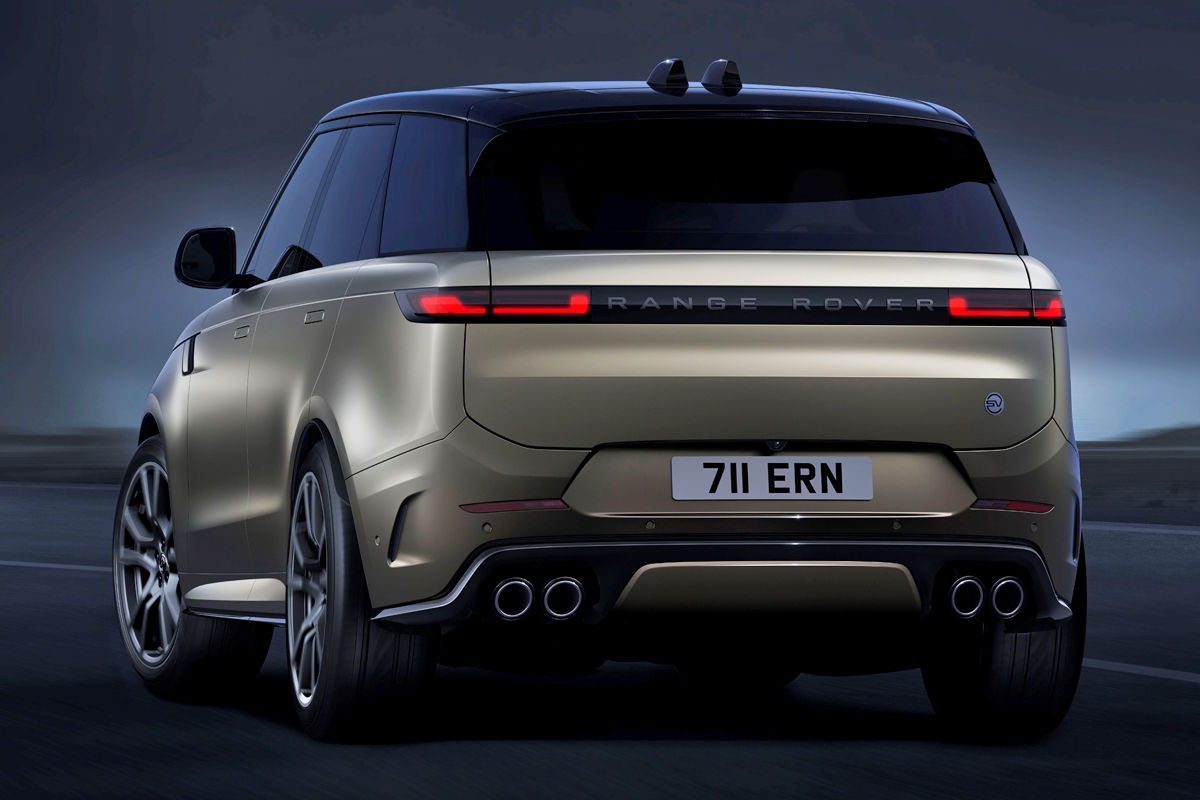
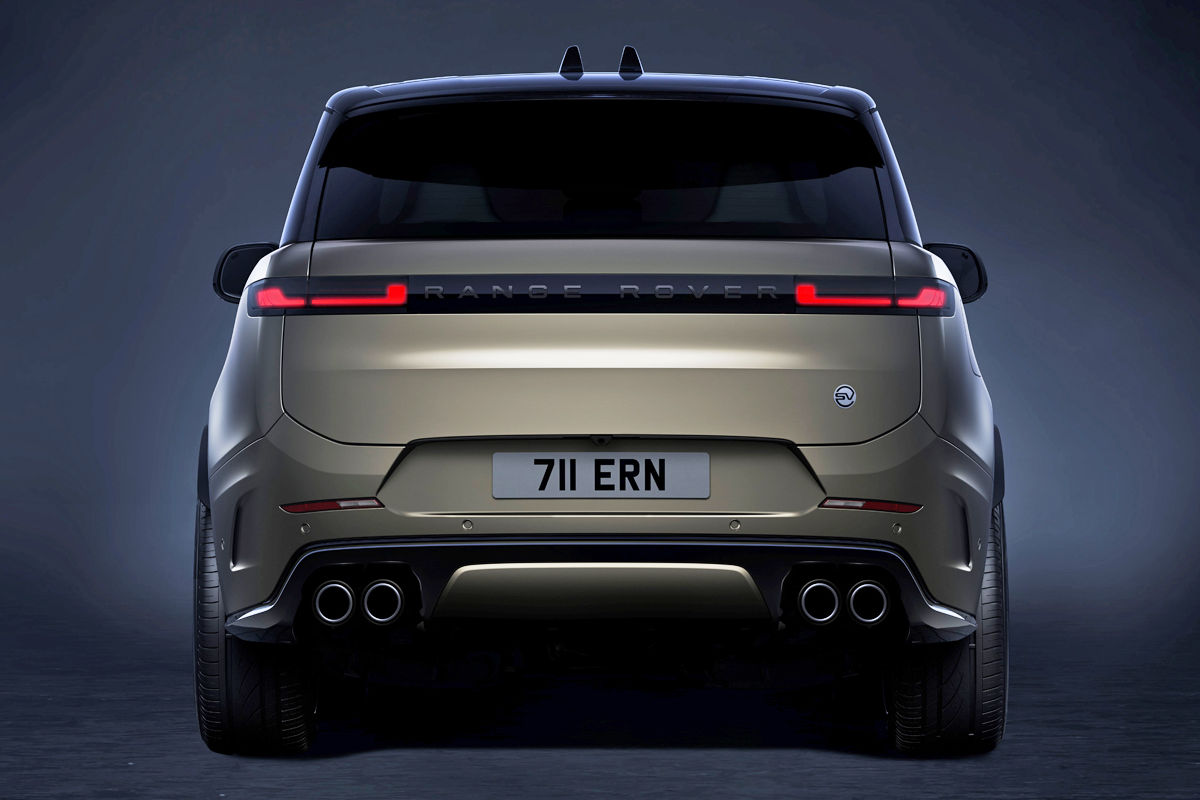
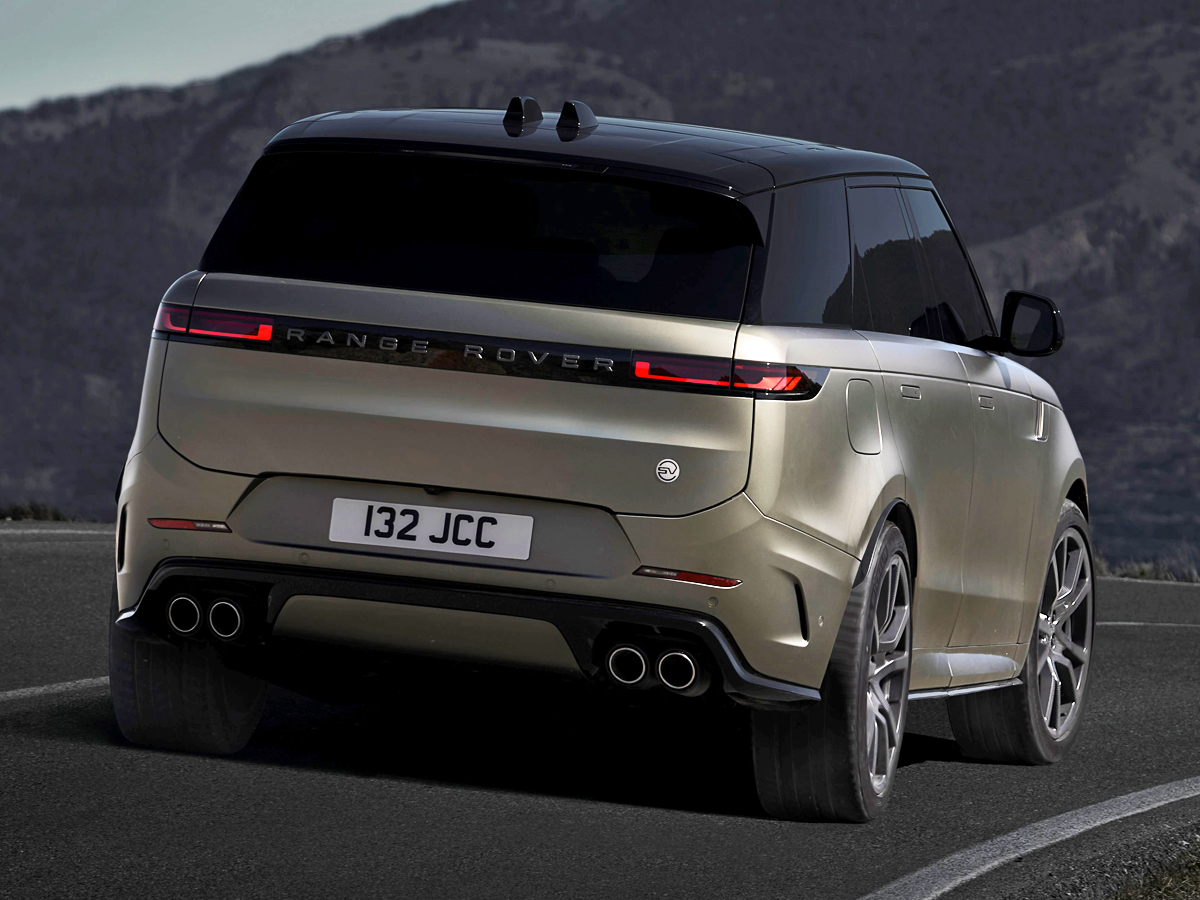
Note the subtle “SV” badge on the tailgate.
That sees the P635 SV Edition One outgun the previous-generation Range Rover Sport SVR, which offered 423 kW and 700 Nm from its supercharged 5.0-litre V8 engine. Top speed for the newcomer stands at 290 kph and the 0-100 kph sprint is completed in a claimed 3.8 seconds, a figure that improves by 1-tenth when the vehicle is “fitted with all lightweight options”.
Those weight-saving measures see a claimed 76 kg shaved off the kerb weight, and include optional 23-inch carbon-fibre wheels (an extra Land Rover describes as a “world first”) and carbon ceramic brakes (a first for the Range Rover brand), plus standard-fit items such as a carbon-fibre bonnet.
Other highlights include a new dynamic suspension system (debuting a combination of hydraulic interlinked dampers, height-adjustable air springs and pitch control), 305-section rear tyres (20 mm wider than the 285-section front items) and a fresh SV Mode, which “optimises” the steering, transmission, throttle response, exhaust note and suspension (including lowering the ride height by an additional 15 mm) at the touch of a button.
Range Rover Sport P635 SV Edition One price in South Africa
Range Rover Sport P635 SV Edition One – R3 965 000
The price above includes a 5-year/100 000 km warranty and a maintenance plan of the same duration.
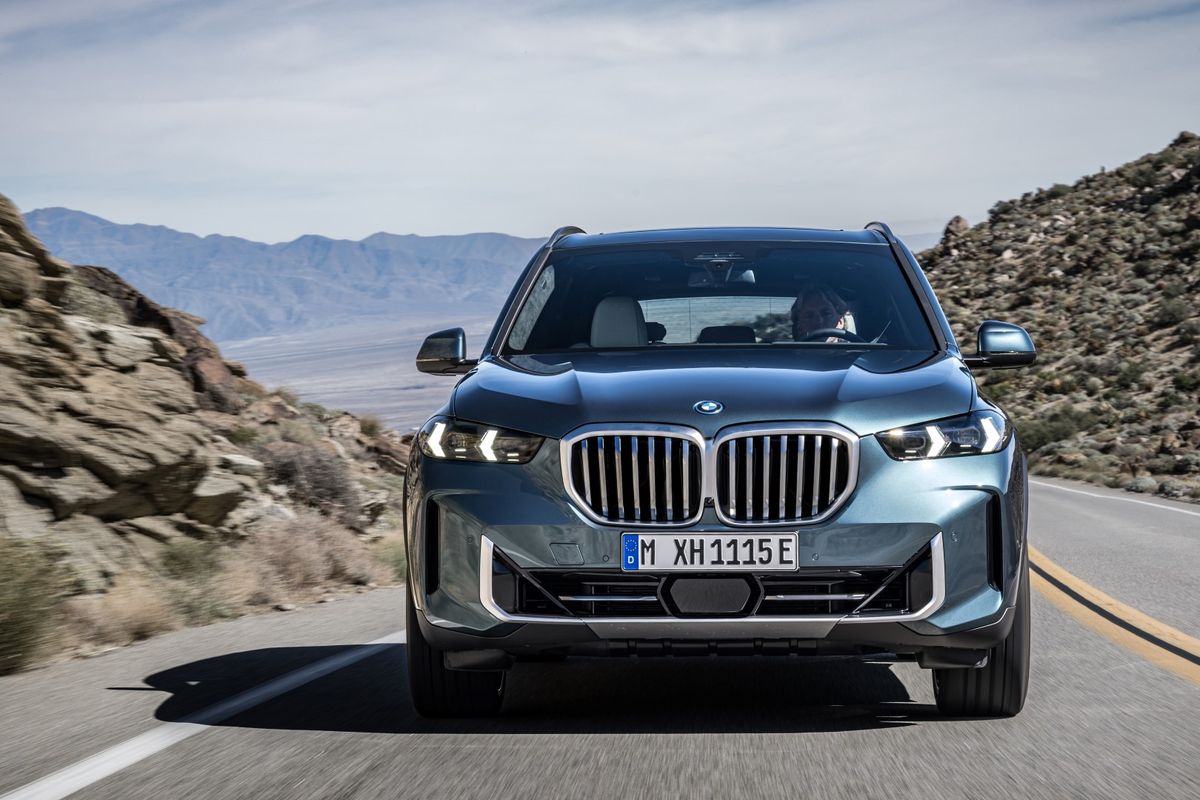
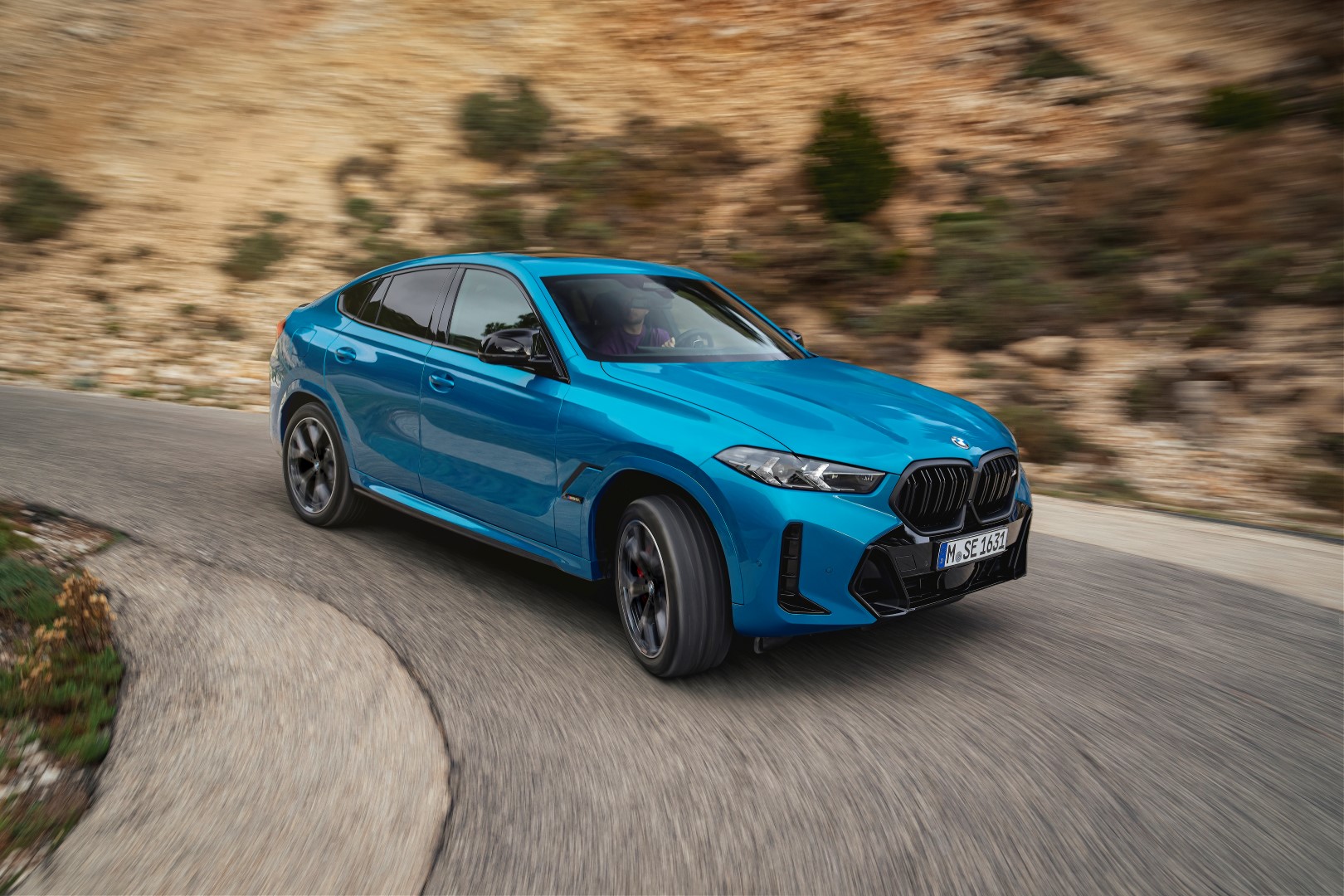
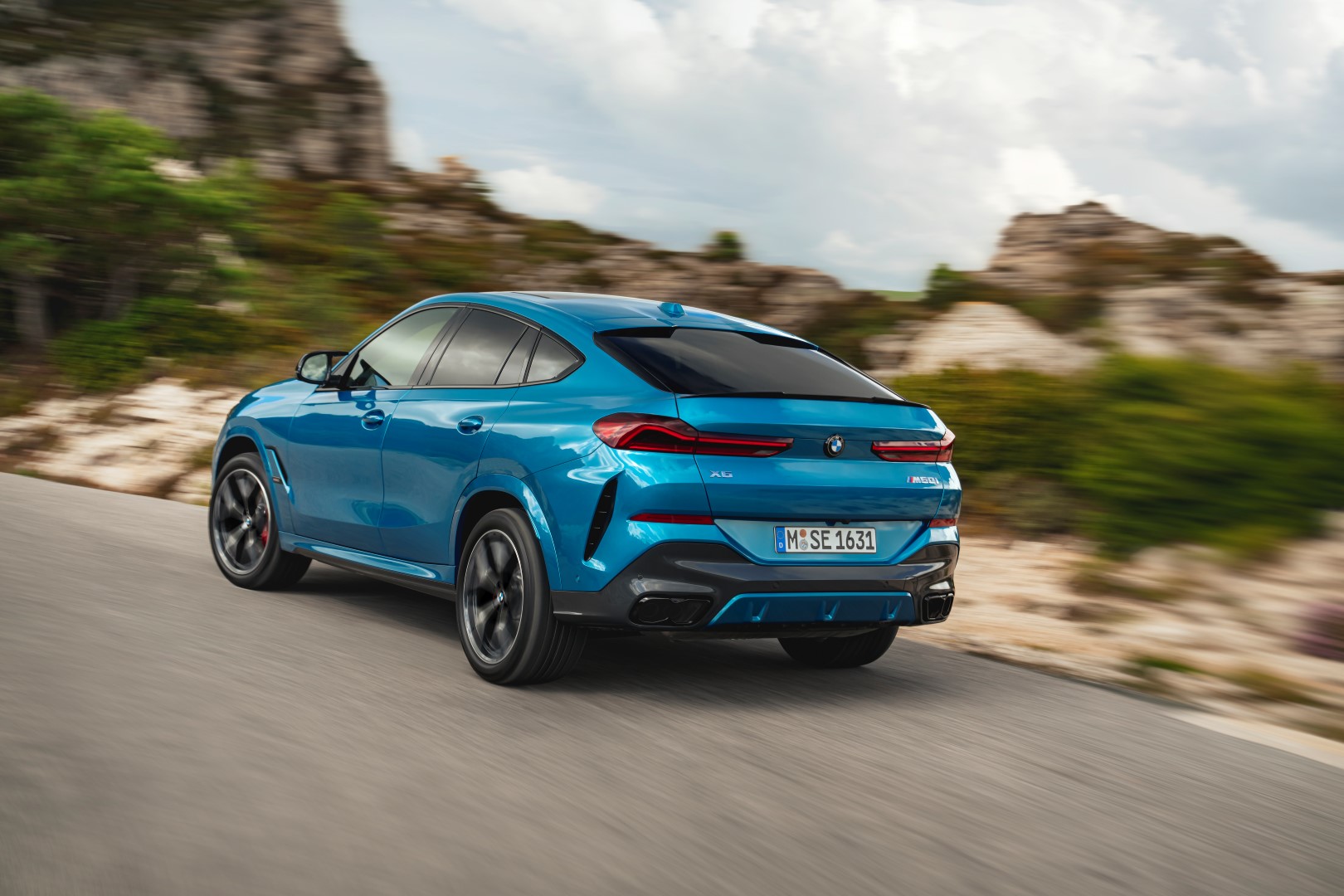
The BMW X5 SUV and X6 Coupe-SUV have received their Life Cycle Impulse (LCI) update boasting a revised exterior design, significant interior design and tech enhancements as well as powertrain updates. See what’s changedas well as what you can expect to pay!
The new fourth-generation BMW X5 arrived in South Africa back in 2018 and the luxury SUV has received a round of updates to keep it fighting fit against rivals such as the Mercedes-Benz GLE, Audi Q7, Porsche Cayenne, Volvo XC90, Range Rover Velar and Land Rover Discovery, to name a few…
Similarly, the third-generation X6 Sports Activity Coupe (SAC) has also been updated. The latest iterations of the BMW X5 and X6 have now arrived in local BMW showrooms!
Let’s take a look at some of the key changes.
What’s changed on the BMW X5 and X6?
BMW X5 Changes
BMW Iconic Glow illuminated kidney grille is now an option on the X5.
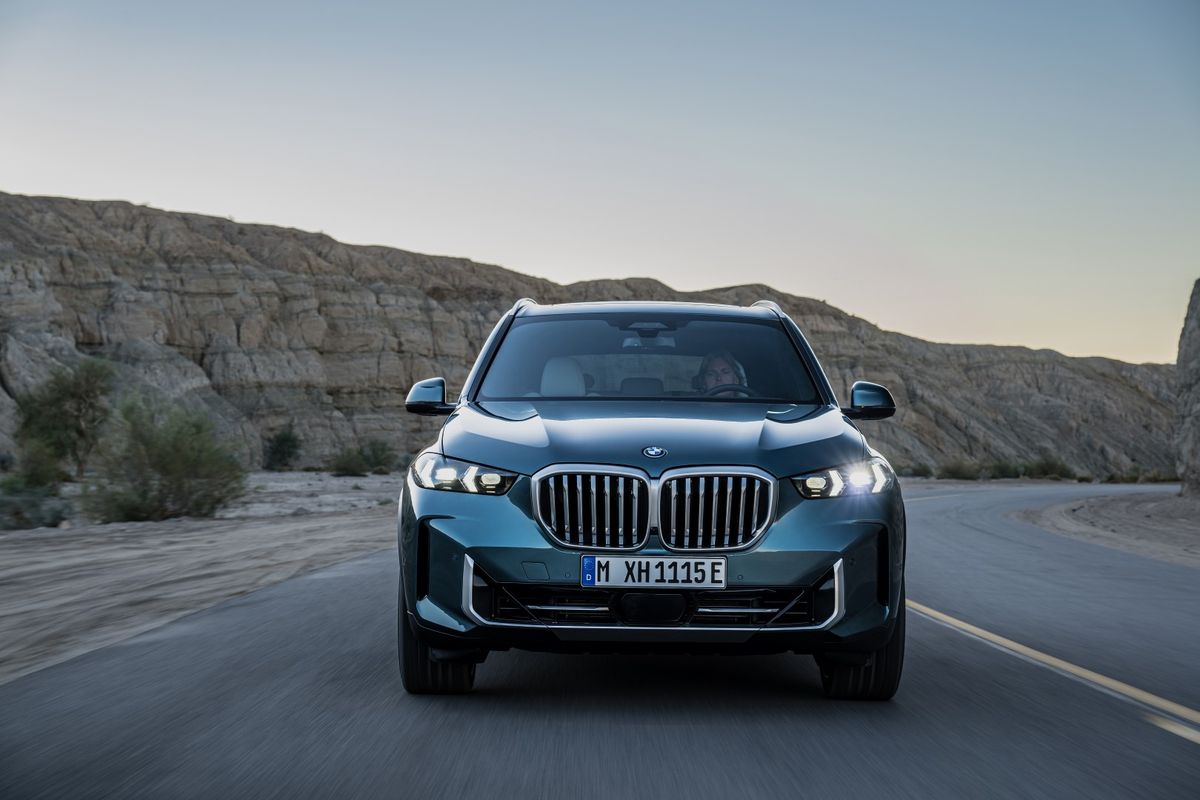
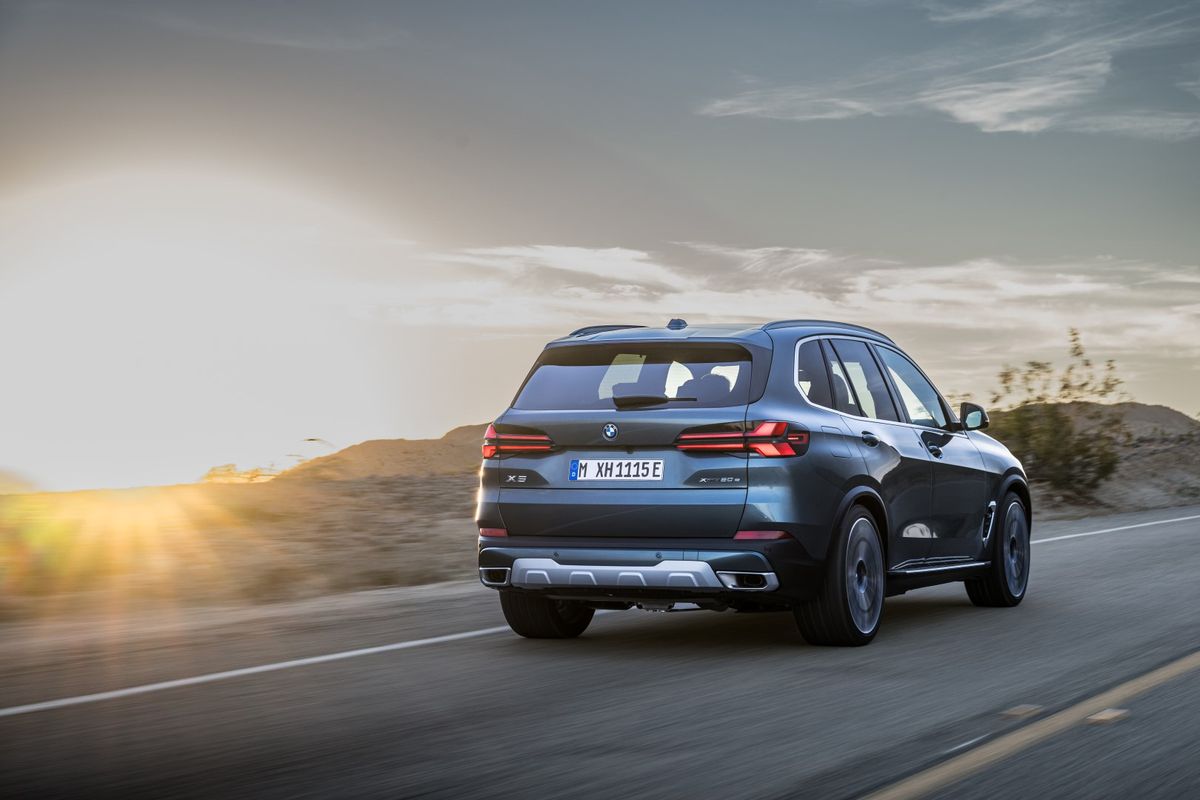
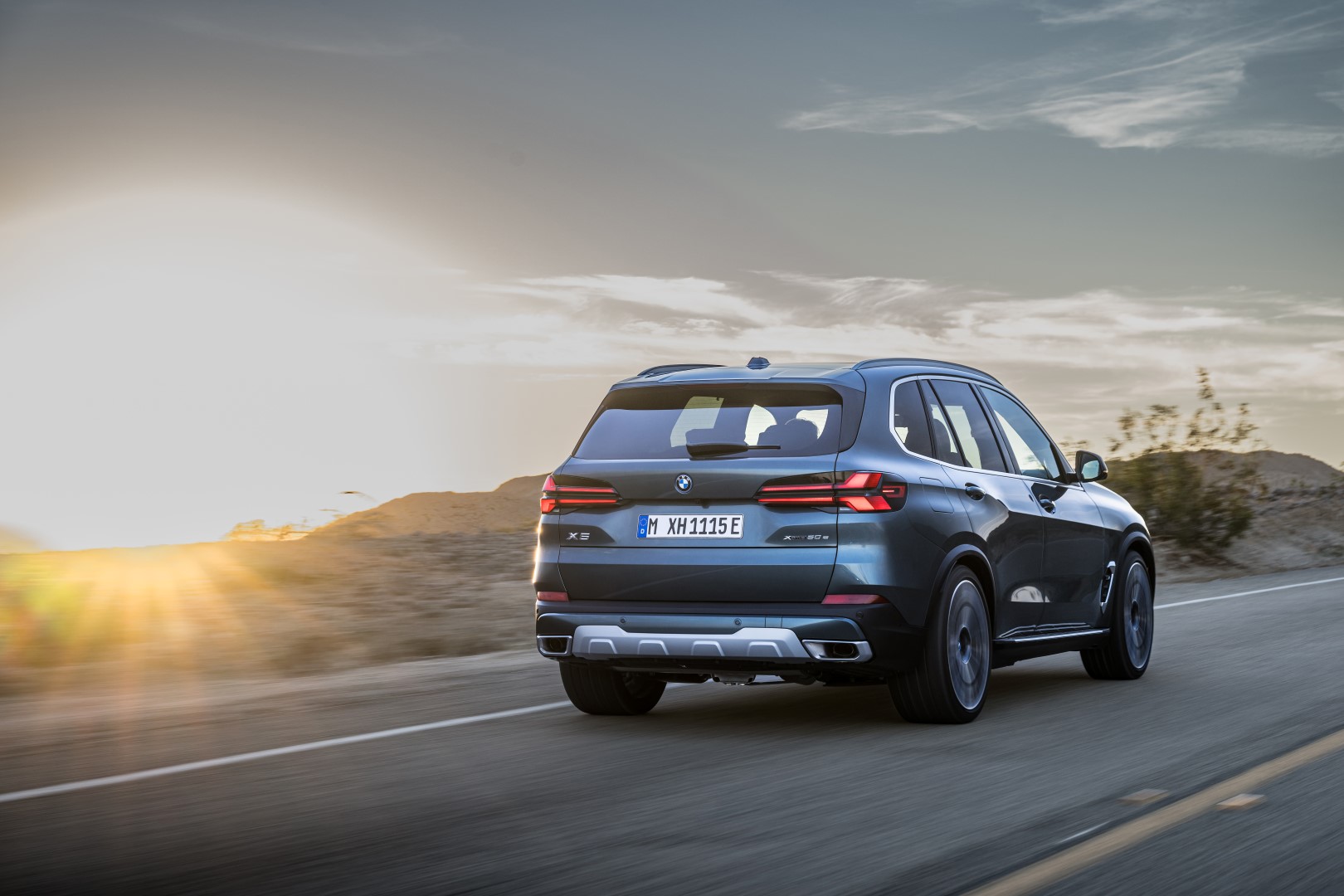
From the outside, you’ll notice that the latest X5’s face has been revised with a new front bumper design with redesigned vertical air curtains and lower air intakes. BMW has also fitted new slimmer and angular headlights which exude a sharper, more powerful look. Perhaps more significant is that the kidney grille is now optionally illuminated which emboldens the X5 / X6’s road presence, especially at night. The BMW Iconic Glow kidney grille will be offered on all 6-cylinder engined variants. The X5’s rear quarter gains new-look taillights with an X motif reflected horizontally for maximum effect.
BMW M Sport trim is an option on the X5 and take on a model-specific form for the X5 M60i xDrive which include double bars and an M logo for the BMW kidney grille, M exterior mirror caps in Black high-gloss, exhaust tailpipe trim in M quad-pipe style and a rear spoiler in Black high-gloss. In addition to this, all X5 variants can also be had with the M Sport package Pro.
New colours for the X5 M60i xDrive include M Marina Bay Blue metallic and M Isle of Man Green metallic while other X5 derivatives can be had in new hues including Blue Ridge Mountain metallic, Brooklyn Grey metallic, Skyscraper Grey metallic, Frozen Pure Grey metallic and around 40 BMW Individual special paint finishes.
BMW X6 Changes
The X6 gains an M Sport Package as standard.
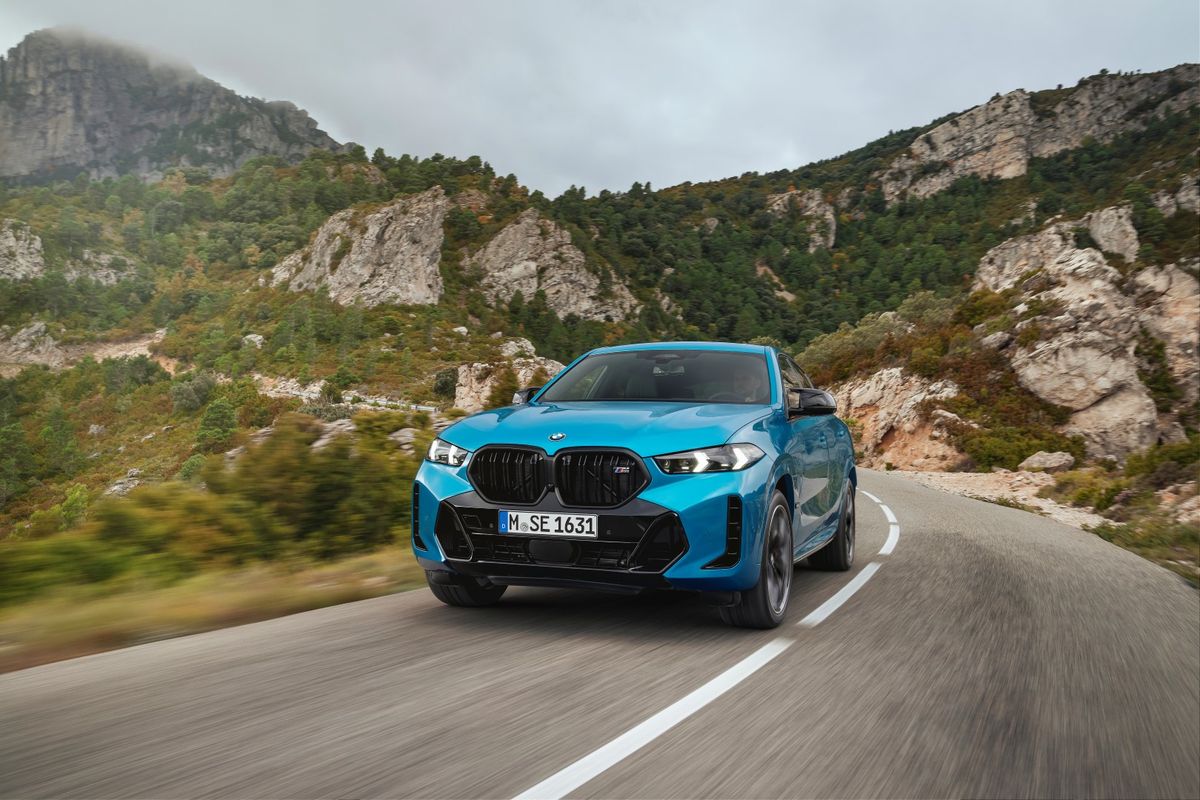
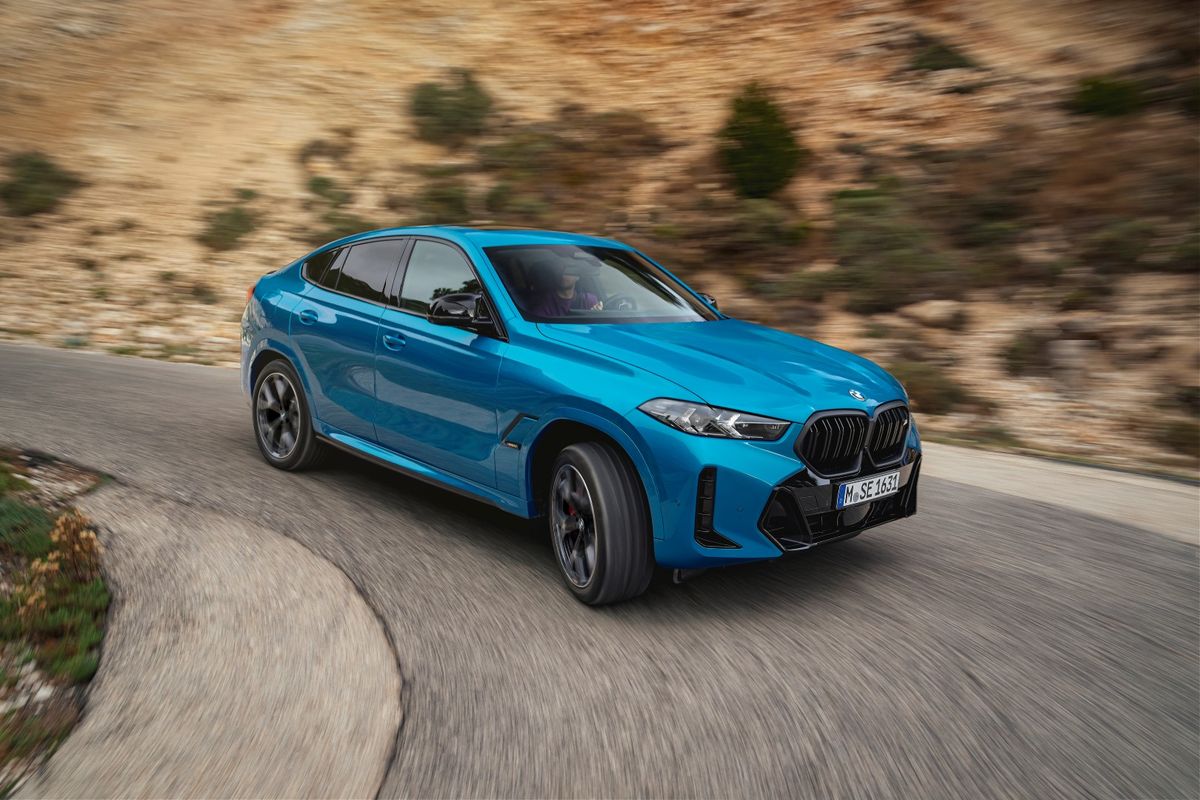
The X6 further gains BMW’s M Sport package as standard with the octagonal front-end signature with bold side apertures and black surfaces adding impetus to the stance as well as the sculpted 3-dimensional front apron which rounds off the aggressive look. Other details seen on the X6 include M-specific side skirts, M high-gloss Shadowline trim, Dark Shadow rear apron insert and new trapezoidal tailpipe trim.
Both the X5 and X6 are fitted with 20-inch light alloy wheels as standard while range-topping derivatives gain 21-inch wheels. Buyers can also choose optional 22-inch light-alloy wheels.
Interior Changes
A new curved screen makes its way into the X5 and X6.
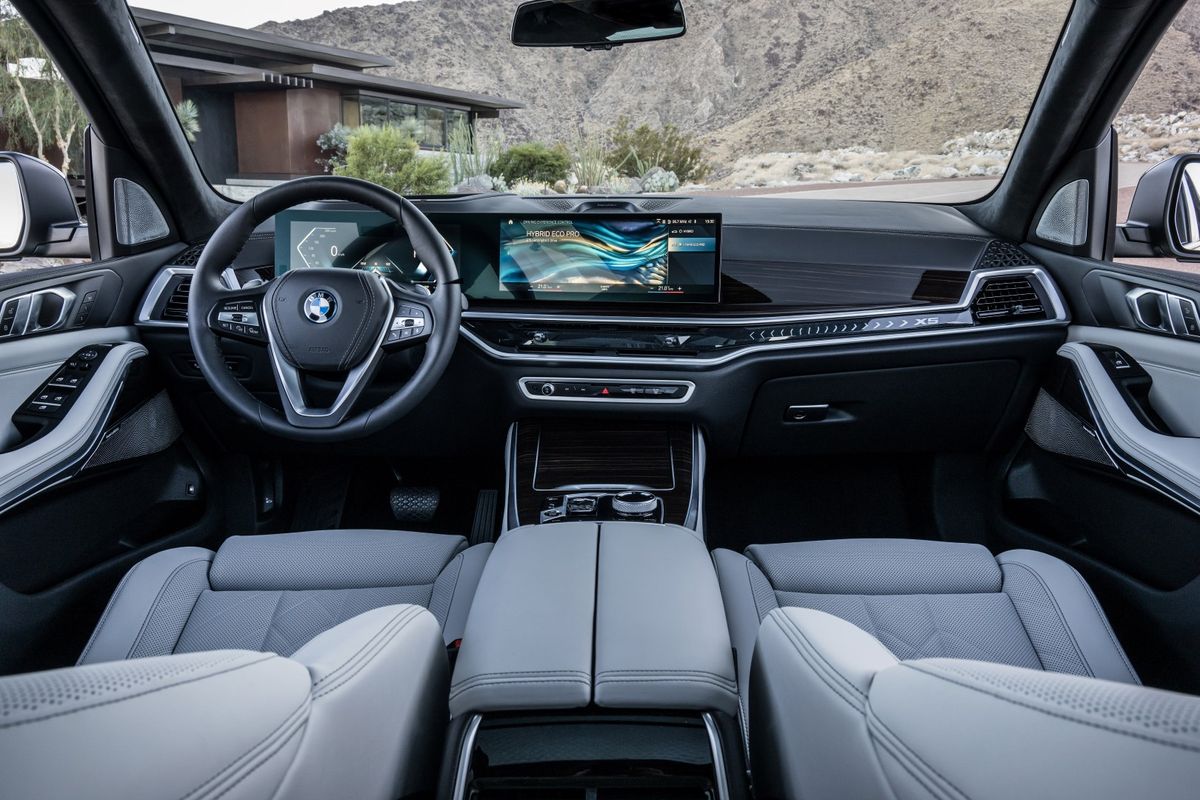
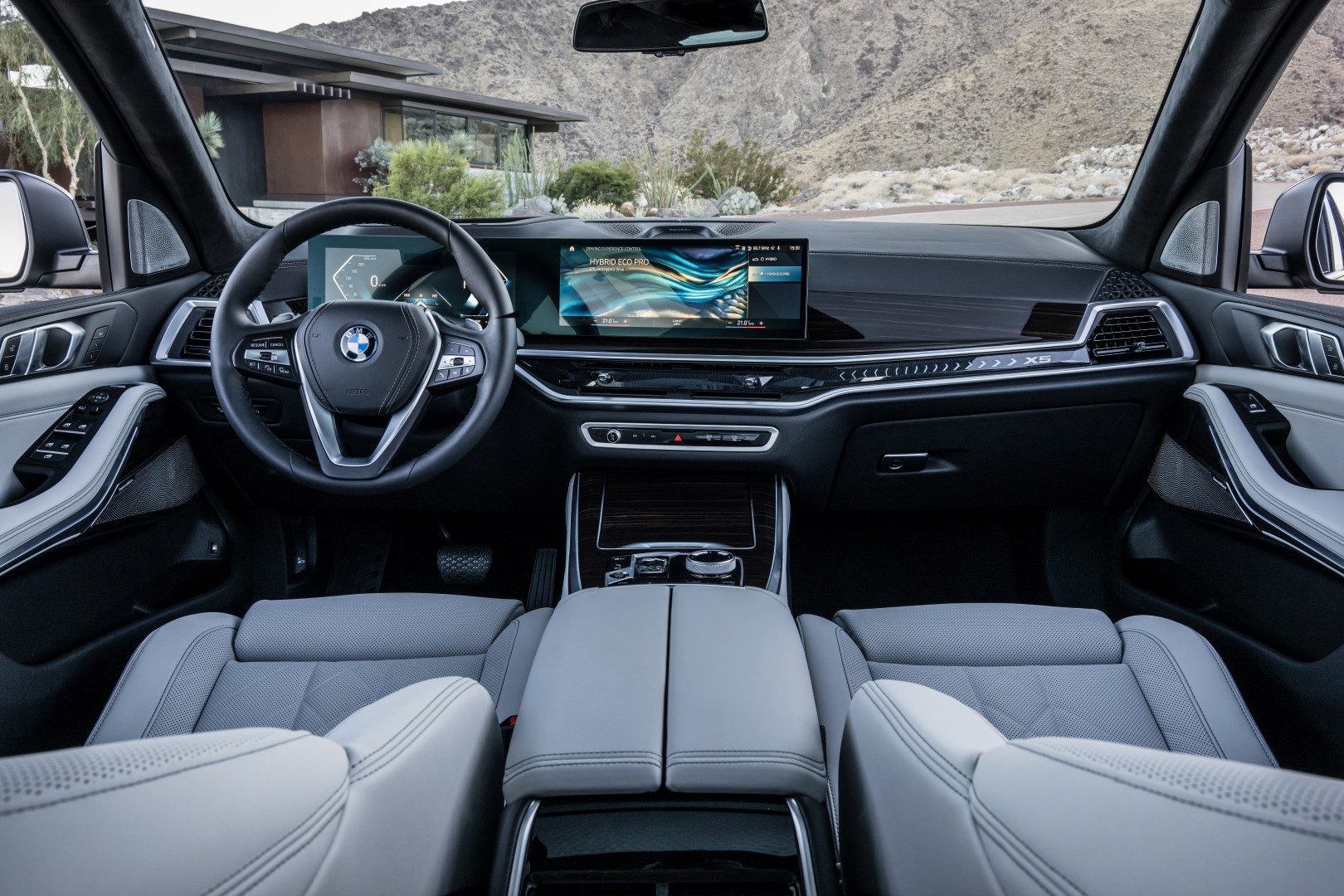
Moving inside, BMW has redesigned the interior which now houses a new curved display that incorporates a large 14.9-inch infotainment screen with the latest iDrive 8 operating system as well as a 12.3-inch digital instrument cluster all under a single glass surface. A keen eye will also notice that the revised centre console now features additional touch-sensitive surfaces the gear selector has also been redesigned. There are also noticeably fewer physical buttons thanks to the touch functionality of the new touchscreen.
The instrument panel itself is finished in leather-like Sensafin with elegant wood trim. A new ambient light bar with LED backlighting adds ambience to the cabin with the appropriate ‘X5’, ‘X6’ or ‘M’ lettering, the latter of which is seen on the flagship derivatives.
A variety of optional features are offered to buyers for the latest X5 and X6.
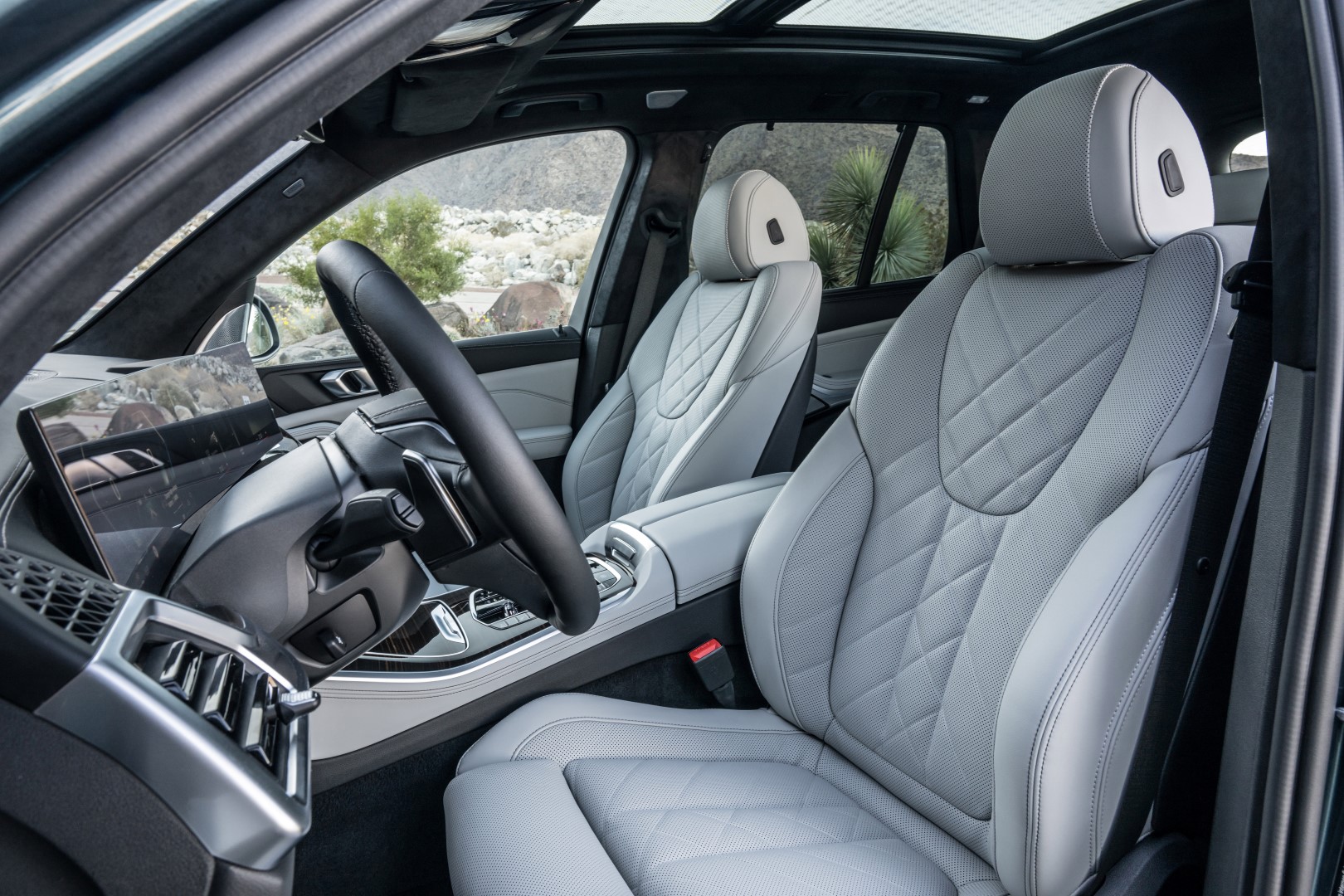
Sport seats are standard but Comfort seats will be offered as an option as are BMW Individual Merino leather upholstery and active seat ventilation and massage function.
Other options include a new Comfort Package which includes panel heating, ‘thermo’ cup holders, Sky Lounge panoramic glass sunroof with LED lights and a Bowers & Wilkins Diamond Surround Sound System.
BMW has also enhanced the X5 / X6’s driver assistance features and automated parking functions. the front-collision warning system can now reduce the risk of collision with cyclists, pedestrians and oncoming traffic when turning off a road. Other assistance options include Speed Limit Assist, exit warning, route speed control, Emergency Stop Assistant, and Lane Change Assistant.
The standard Parking Assistant (with Reversing Assist Camera and Reversivn Assistant) now also features drive-off monitoring and Trailer Assistant functions. Furthermore, the optional Parking Assistant Professional can automatically park at a distance of up to 200 metres and can be controlled from outside the car using the My BMW App (Apple iPhone).
What powertrains are offered for the BMW X5 and X6 LCI?
All powertrains are now supported with 48-volt mild hybrid technology.
From a powertrain perspective, the biggest change is that all powertrains now feature 48-volt mild hybrid technology offering better performance and efficiency.
The outgoing X5 and X6 M50i will be replaced with the M60i which features a new 4.4-litre twin-turbocharged V8 equipped with 48-volt mild hybrid technology. Outputs of 390 kW and 750 Nm are identical to the outgoing M50i but the incoming M60i is expected to deliver better performance while also being more efficient in conjunction with its 8-speed automatic transmission. Zero to 100 km is claimed in 4.8 seconds for both models. This new V8 powertrain will also make its way into the X5 M Competition but curiously, power outputs have yet to be revealed for the range-topper but are likely to me be marginally higher than the current 460 kW and 750 Nm.
This across-the-board mild-hybrid system incorporates an electric motor integrated into the transmission which adds up to 9 kW and 200 Nm boost. All derivatives make use of an 8-speed automatic transmission with shift paddles on the steering wheel.
Engine outputs for all 6-cylinder variants have improved significantly.
The outgoing X5 xDrive45e is now called the X5 xDrive50e and boasts increased performance, combining the latest-generation 3.0-litre turbopetrol engine with a new electric motor to produce combined outputs of 360 kW and 700 Nm (previously 290 kW and 600 Nm). The engine now produces 230 kW (20 kW more) while the electric motor produces 142 kW (62 kW more) with acceleration from zero to 100 kph claimed in 4.8 seconds. The 25.7 kWh battery is said to offer a claimed electric range of between 94 and 110 kilometres in the WLTP cycle.
The latest generation 3.0-litre, 6-cylinder engine in the X5/X6 xDrive40i now develops 30 kW more power than before with power peaking at 280 kW while torque has also increased by 70 Nm to 520 Nm (540 Nm on boost). BMW claims 5.4 seconds to sprint from zero to 100kph.
As for the sole diesel offering in the X5 xDrive30d, the 6-cylinder 3.0-litre turbodiesel engine has been updated with steel pistons (previously aluminium), an optimised oil separation process and a new direct injection system with solenoid valve injectors. Combined with BMW’s mild hybrid system, the X5/X6 xDrive30d now produces 219 kW and 670 Nm (previously 195 kW and 620 Nm) and is claimed to sprint from zero to 100 kph in 6.1 seconds.
Adaptive suspension will be standard across the X5 / X6 range while Adaptive M suspension (with M Sport differential and active roll stabilisation system) and Integral Active Steering (optional on other derivatives) will be standard on range-topping derivatives. Adaptive air suspension and xOffroad package will be offered as an option.
How much will the new BMW X5 / X6 Cost in South Africa?
BMW X5
BMW X5 xDrive 30d – R1 690 000
BMW X5 xDrive40i – R1 720 000
BMW X5 xDrive50e – R1 880 000
BMW X5 M60i – R2 090 000
BMW X5 M Competition – R3 095 000
BMW X6
BMW X6 xDrive30d – R1 810 000
BMW X6 xDrive40i – R1 840 000
BMW X6 M60i – R2 150 000
BMW X6 M Competition – R3 155 000
The new BMW X5 and X6 are sold with a 2-year/unlimited warranty and a 5-year/100 000 km maintenance plan.
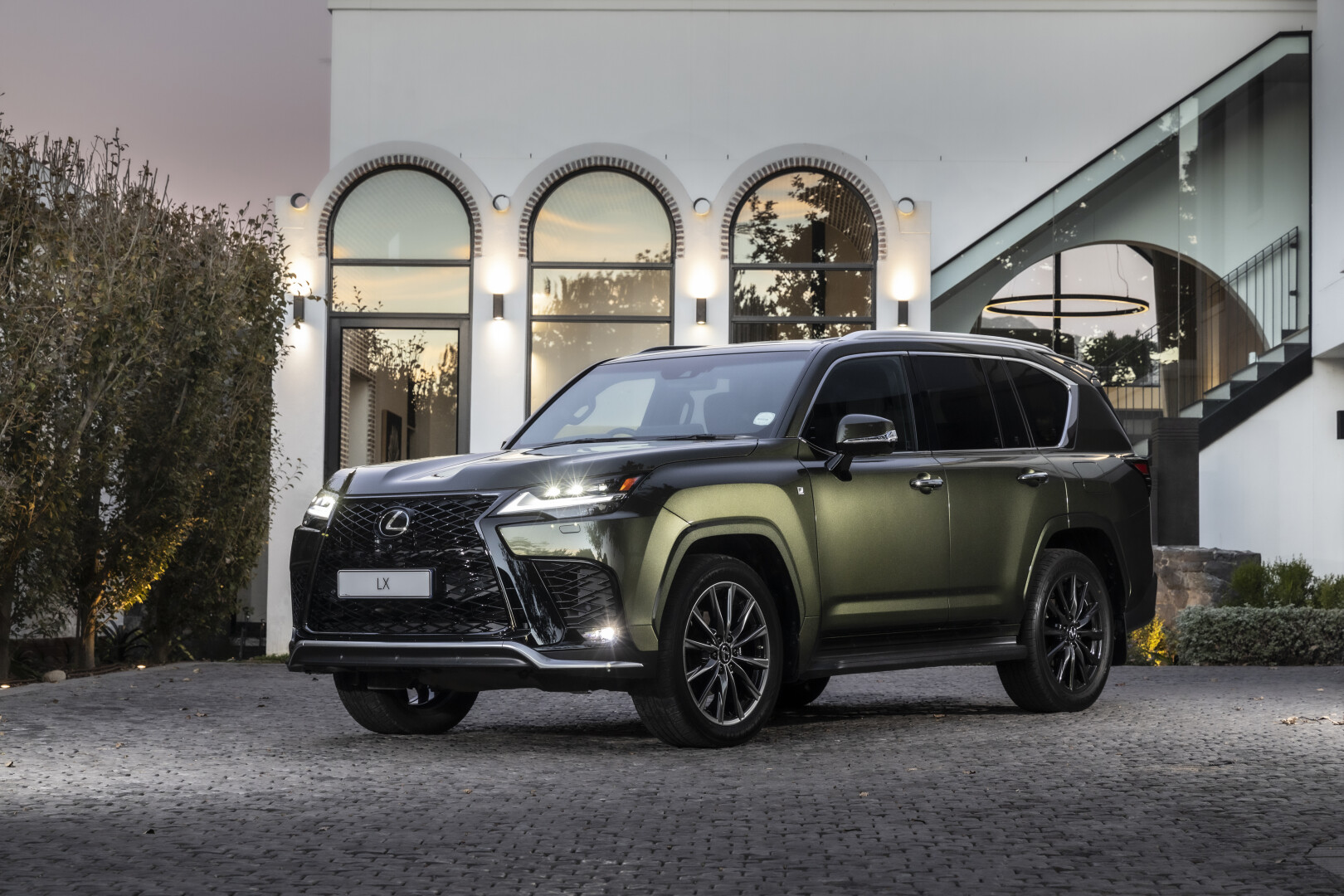
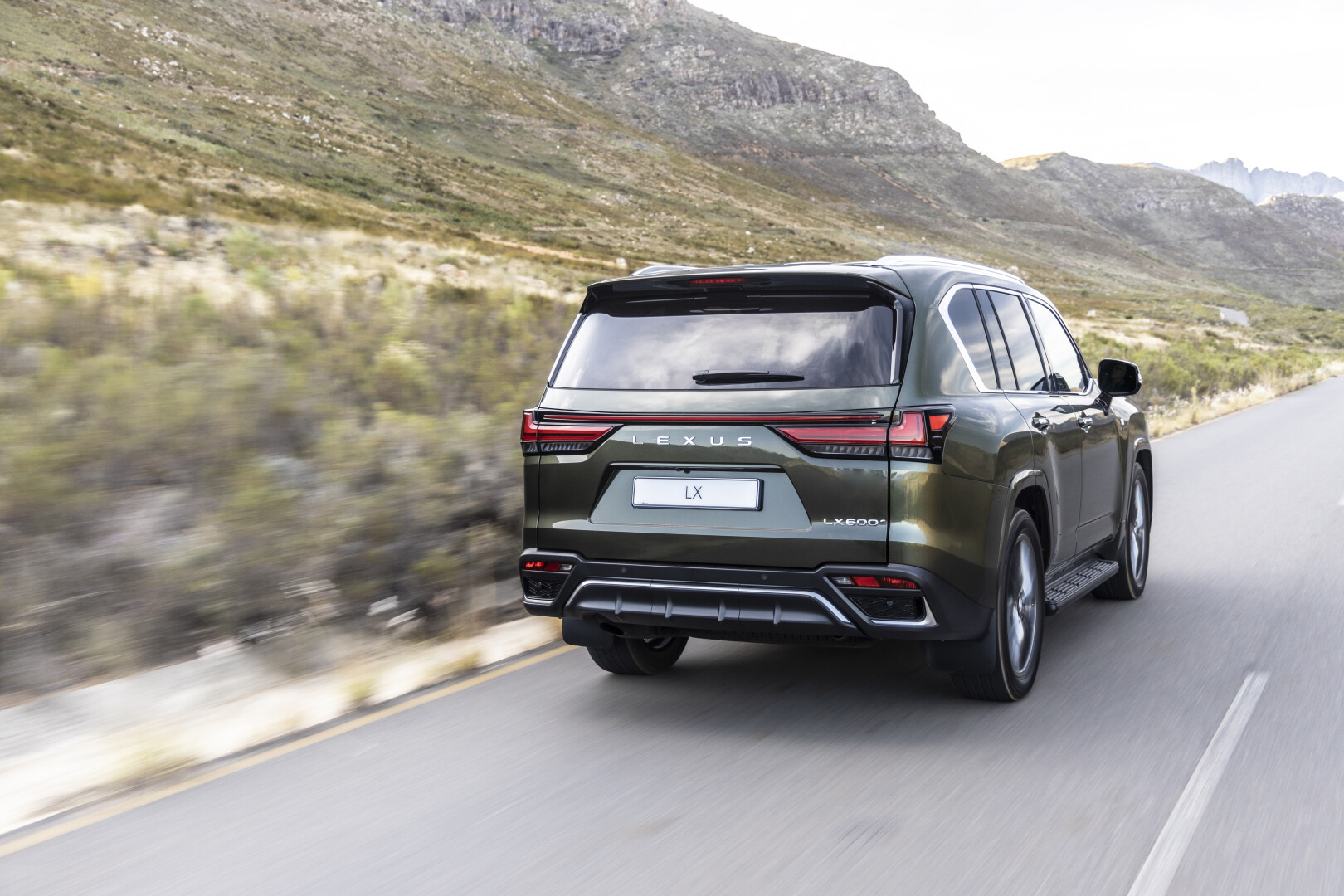
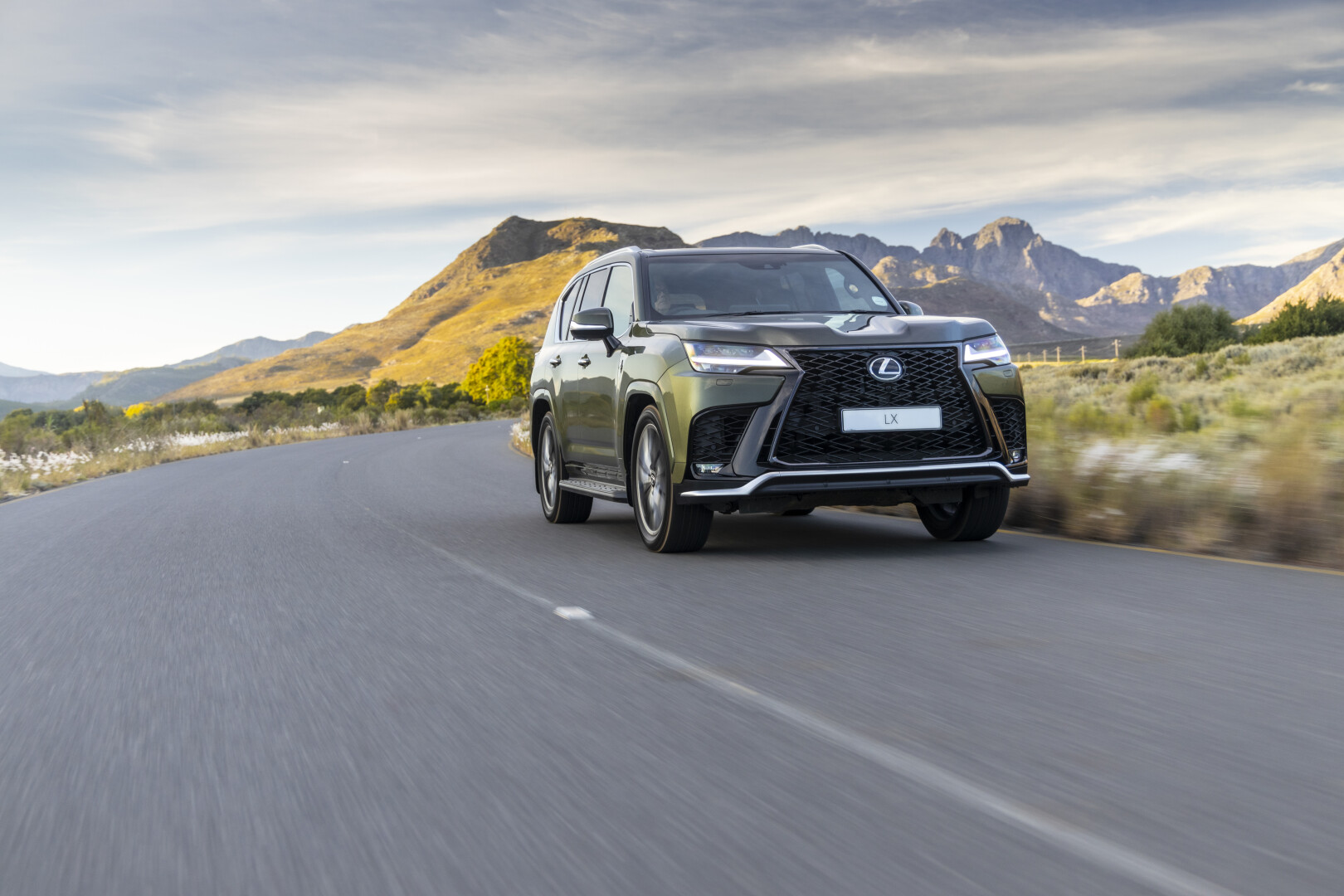
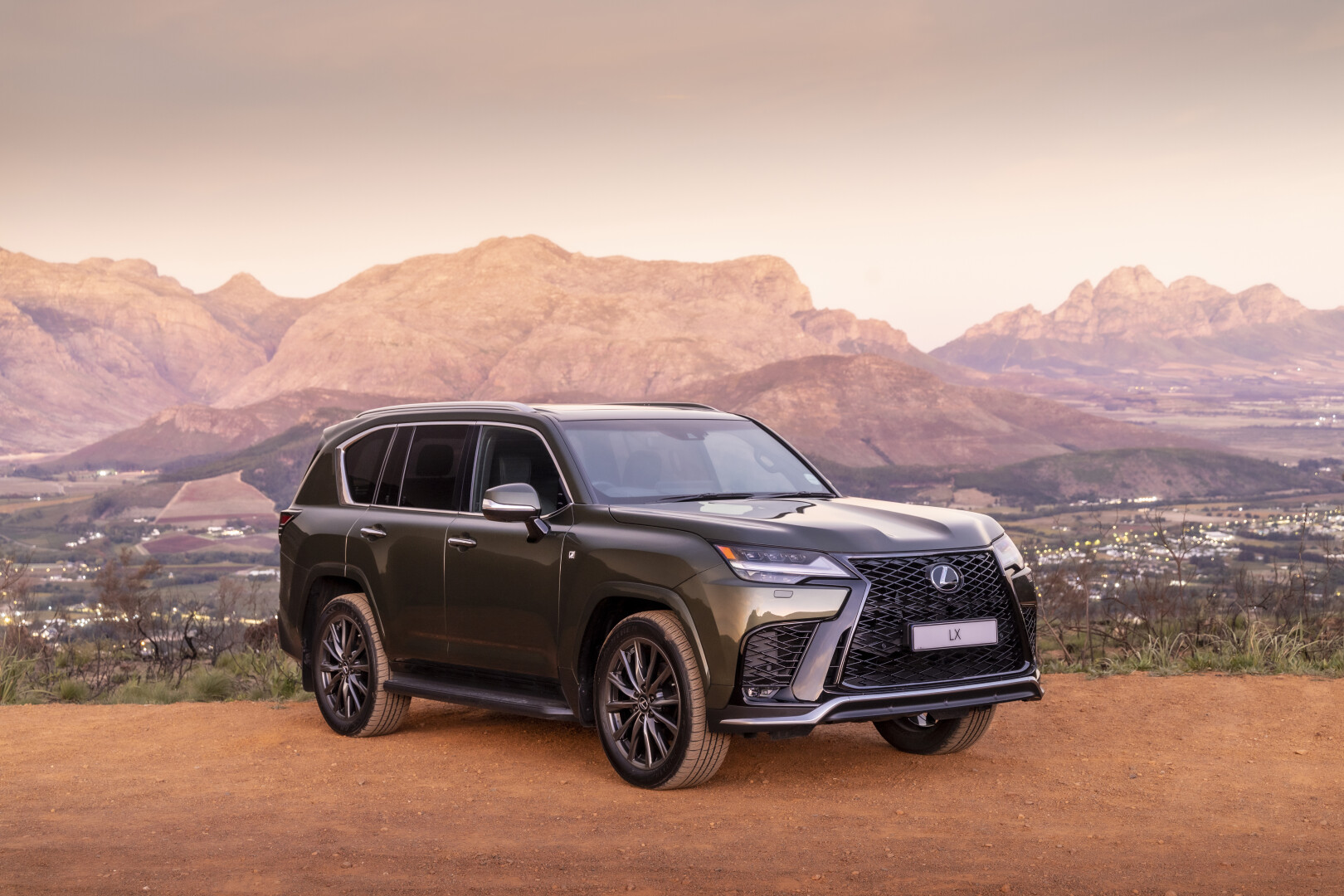
The 4th-gen Lexus LX offers kerb presence, luxury and technology in abundance. Does that mean the newcomer has what it takes to compete with marquee first-class SUVs? We drove the model at its (somewhat delayed) launch in the Western Cape to find out.
What is a Lexus LX?
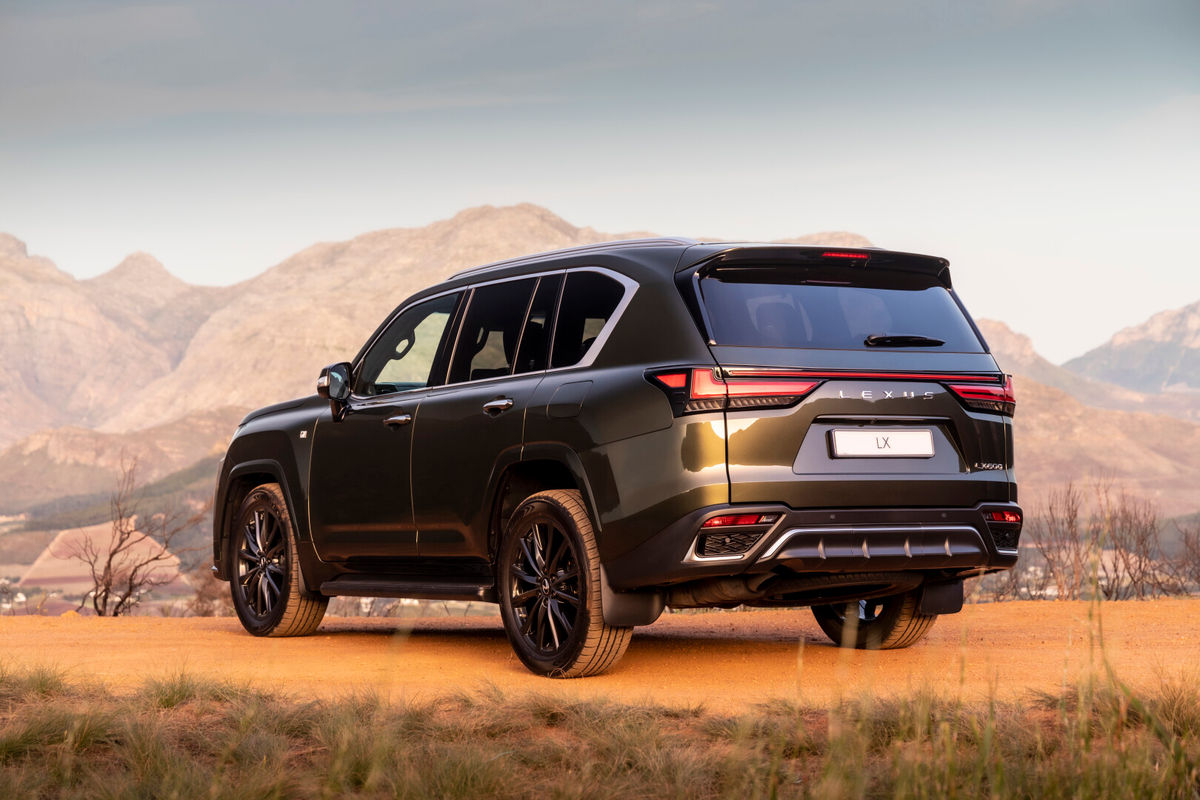
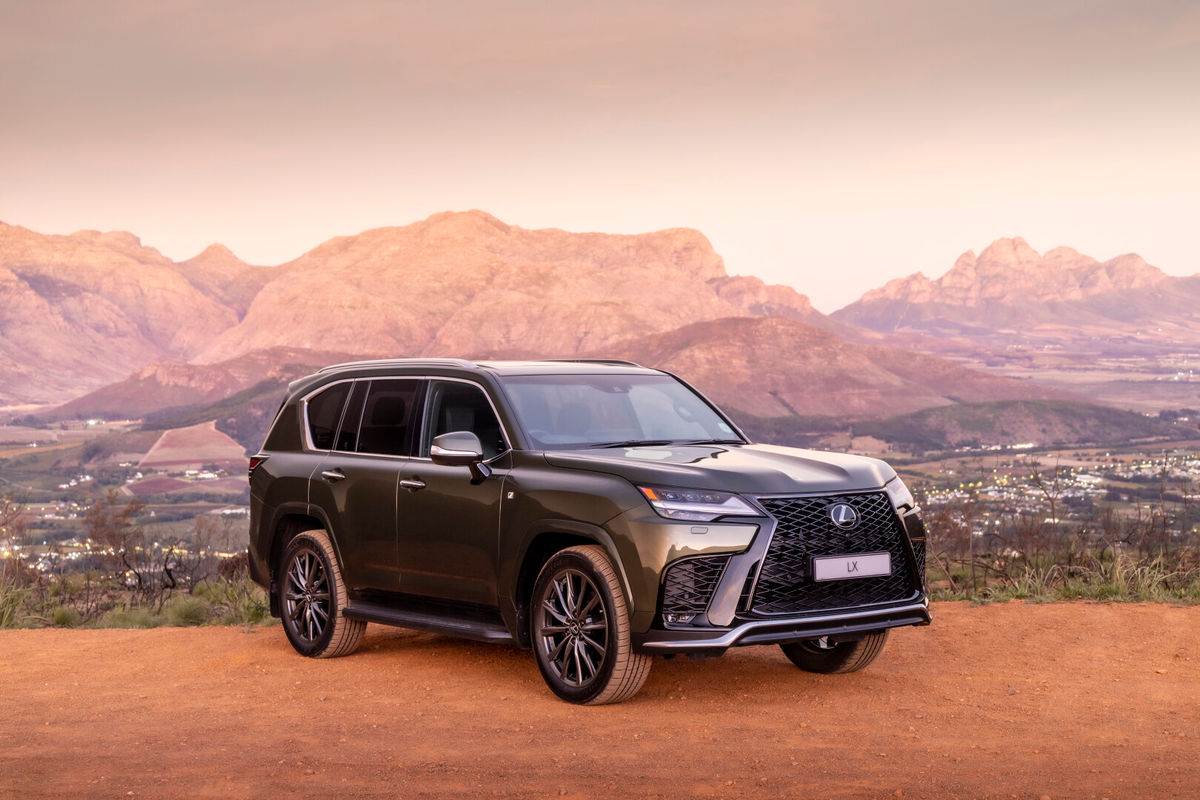
Big and bulky, the Lexus LX clearly makes a statement.
It’s a gargantuan first-class SUV based on the Toyota Land Cruiser 300. That means it is underpinned by a ladder-frame chassis; most of its competitors have monocoque bodies, which suit road cars better. But don’t be dissuaded by that: the ladder frame is well-proven (Toyota and Lexus have improved it greatly throughout the years) and besides, in tricky off-road conditions, it’s very strong and resists body flex.
The LX can be ordered in 4-, 5-, 6- and 7-seater configurations, depending on the derivative or grade that you choose. All versions have opulent levels of luxury in conjunction with ample occupant space.
This generation of the LX benefits from more modern infotainment tech with 2 touchscreens and a multitude of safety systems that showcase the very best of what Lexus has available in its arsenal.
What engines does the Lexus LX have?
The same engines that power the Land Cruiser are used in the LX.
The 4th-gen LX sports an extremely long, concave bonnet, under which you will find one of two engines that also feature in the LC300 line-up: a 3.3-litre turbodiesel V6 and a 3.5-litre twin-turbopetrol V6. Did you know that the Dakar Rally Hiluxes are powered by a more potent version of that petrol motor?
The outputs also remain unchanged: the diesel produces 225 kW/700 Nm and the petrol 305 kW/650 Nm. We drove the twin-turbopetrol version during the launch drive and the 3.5-litre V6’s creamy power delivery and linear acceleration felt well-suited to the luxurious theme of the new LX. It’s never going to be very fuel efficient on shorter, inner-city trips, but on long trips – where there’s more of a chance to stretch the V6’s legs and let the motor cruise at low RPM, you may see returns of around 12 L/100 km.
The turbodiesel is probably the more prudent choice. It’s undoubtedly more fuel efficient than the petrol and the higher torque figure, combined with a shorter rev range, sees the big unit get up to speed faster while using much less fuel. The claimed consumption of the turbodiesel version is just 8.3 L/100 km.
Both engines are mated with a 10-speed automatic transmission and, over and above permanent four-wheel drive (augmented with off-road drive modes, of course), the LX has low range available if you find yourself in a really tricky (or sticky) situation when traversing low-grip surfaces off the beaten track.
While we didn’t get a chance to test the LX in difficult off-road situations, we have extensive experience in the LC300, which essentially has the same running gear… and that coped with anything we threw at it.
What’s it like to drive?
Comfort above all else appears to be the LX philosophy.
The LX is a massive vehicle – and you’ll realise this when you stand next to the Lexus. The bulky, square proportions make it seem like the biggest vehicle on the road that doesn’t require a truck licence to drive. You feel that size when you navigate through smaller towns and roads, where manoeuvring the LX seems akin to hustling a king-sized bed up the stairs of a loft apartment… a lot of tight navigation is required.
That said, once you drive it on the open road and in areas with more space, the Lexus LX feels far less cumbersome. It’s set up to be a soft, comfortable cruiser, much more so than what’s on offer from rivals such as the BMW X7 or Mercedes-Benz GLS. The steering is light and uninvolving, but in a way that you want it to be. The whole “LX experience” is about travelling in unflustered comfort, not about getting behind the ‘wheel and having a blast from point A to point B while clipping corner apexes along the way.
A short stint on a gravel road showed that the suspension is cushioned enough to deal with long trips on the dirt, but you will have to temper your pace to mind the huge (22-inch) wheels specced on the LX.
In terms of comfort, in typical Lexus fashion, the leather is tightly wrapped in all areas and the attention to detail of the fit and shut lines is impeccable. No matter which seat you find yourself in, the levels of luxury and refinement are excellent and exactly what you would expect from a R2.5-million-plus SUV.
What’s the tech like on the new LX?
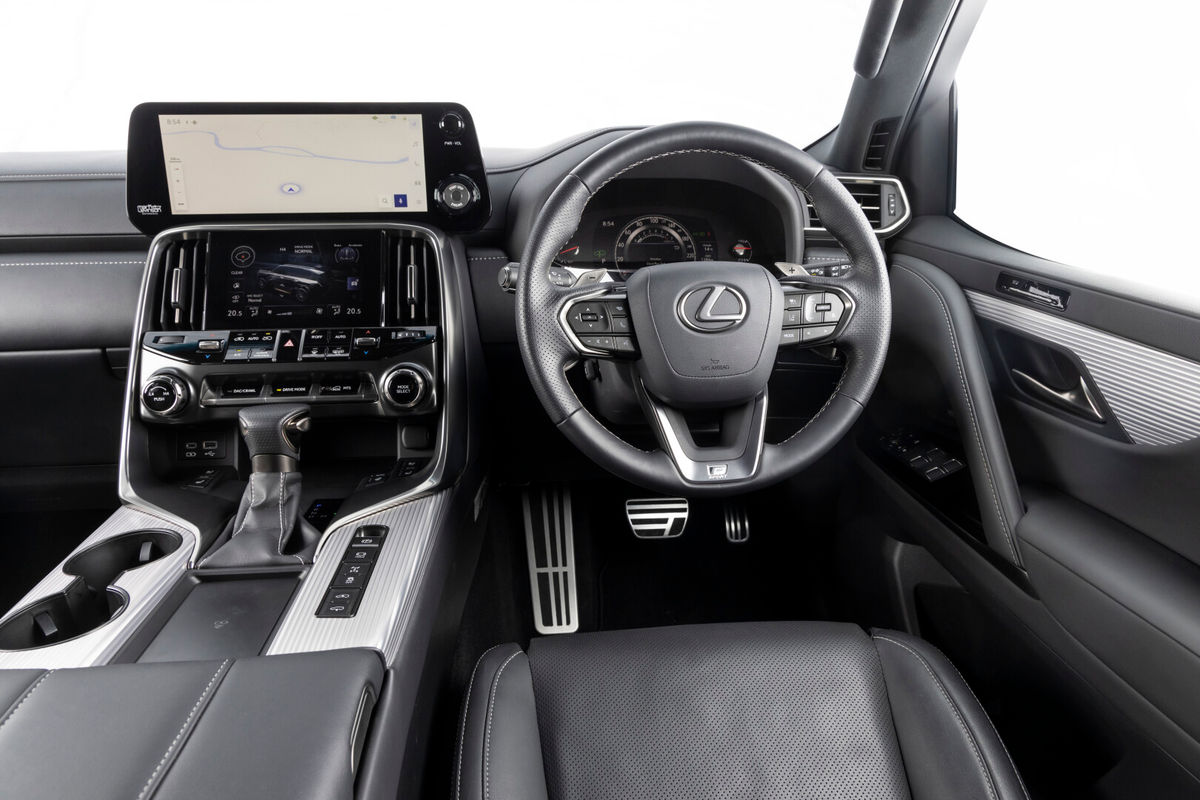
2 massive screens dominate the interior tech ambience.
It’s been about 15 years since the previous-gen LX was launched and even though Lexus implemented many updates throughout that model’s lifespan, the late implementation of digital screens felt tacked on. However, owners of the previous LX will experience quite a time warp when they step into the newcomer.
The centre screens catch your eye with their enormous size and clarity (12.3-inch at the top and 7-inch below), plus, unlike in previous Lexus models, the main infotainment screen is controlled via touch inputs and the software has been vastly improved to be more user-friendly. Simple tasks, such as searching for a radio station or connecting to Android Auto, no longer require a frantic phone call to the IT helpdesk.
The lower screen deals with functions such as climate control- and drive mode settings, although there appears to be physical buttons directly underneath the panel that serve the same purpose. For a modern luxury car, the Lexus has a multitude of physical buttons, which is quite unusual, but it does make some actions (like turning down the volume, lowering the ride height and controlling the heated seats) easier.
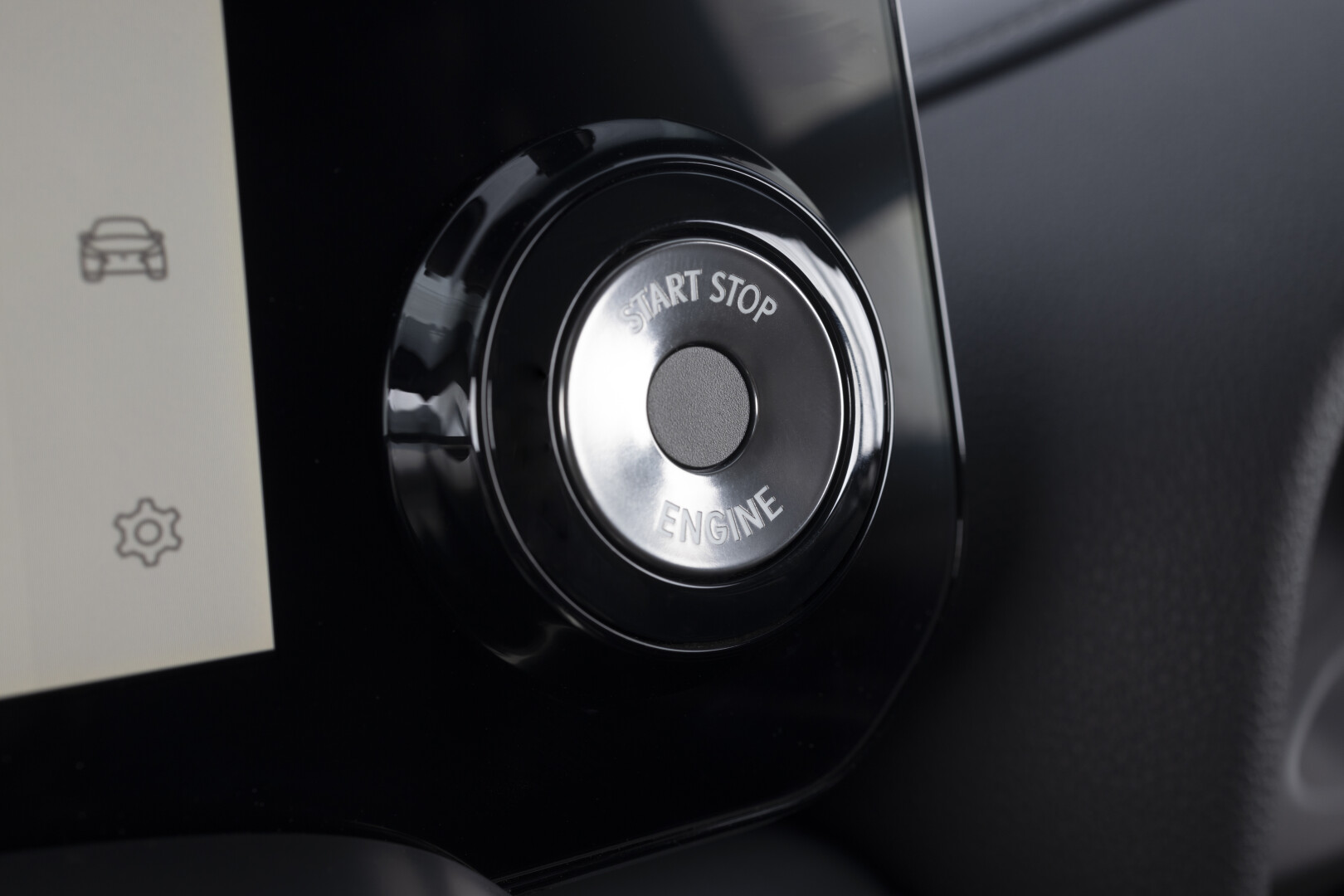
The start button with fingerprint authentication is quite nifty; you can programme it to recognise multiple fingers so that even if you have the key, you won’t be able to start the vehicle unless it reads a legit digit.
Android Auto and Apple Carplay are standard features, but have to be connected via a cable rather than wirelessly, which is a bit old school. At least a wireless charger is provided behind the transmission lever.
Lexus LX price and after-sales
The start button has a fingerprint authentication scanner.
The Lexus LX has been on sale since mid-2022 so the original pricing has increased somewhat due to inflation and exchange rate fluctuations. Each LX is sold with a 7-year/100 000 km warranty and a 7-year/100 000 km maintenance plan. For more detail, check out our original specs and pricing article.
Lexus LX 500d
R2 507 600
Lexus LX 500d F Sport
R2 517 500
Lexus LX 600 F Sport
R2 568 700
Lexus LX 600
R2 568 700
Lexus LX 600 VIP
R2 986 000
Summary
The Lexus offers a lot more standard kit than its German and British rivals.
The Lexus LX has turned Toyota’s purposeful large off-roader, the Land Cruiser 300, into a luxurious land yacht replete with modern tech, as well as an interior that is nicely laid out and exceedingly well-made. The new model’s driving experience clearly has a “comfort first” philosophy, which makes it quite soft and almost boat-like to pilot, but seems to fit the theme of the new LX: “unflustered comfort.”
Because of that, it’s tricky to pick out rivals to the Lexus LX. Models such as the BMW X7 and Mercedes-Benz GLS are certainly prestigious 7-seater first-class SUVs, but they won’t be able to match the LX in terms of off-road ability. The full-fat Range Rover, which is suitably lavish and highly off-road capable by design, is perhaps the most natural rival of the Japanese premium marque’s flagship SUV… However, prices for the Range Rover start at R3.3 million, whereas the Lexus LX comes comprehensively equipped.
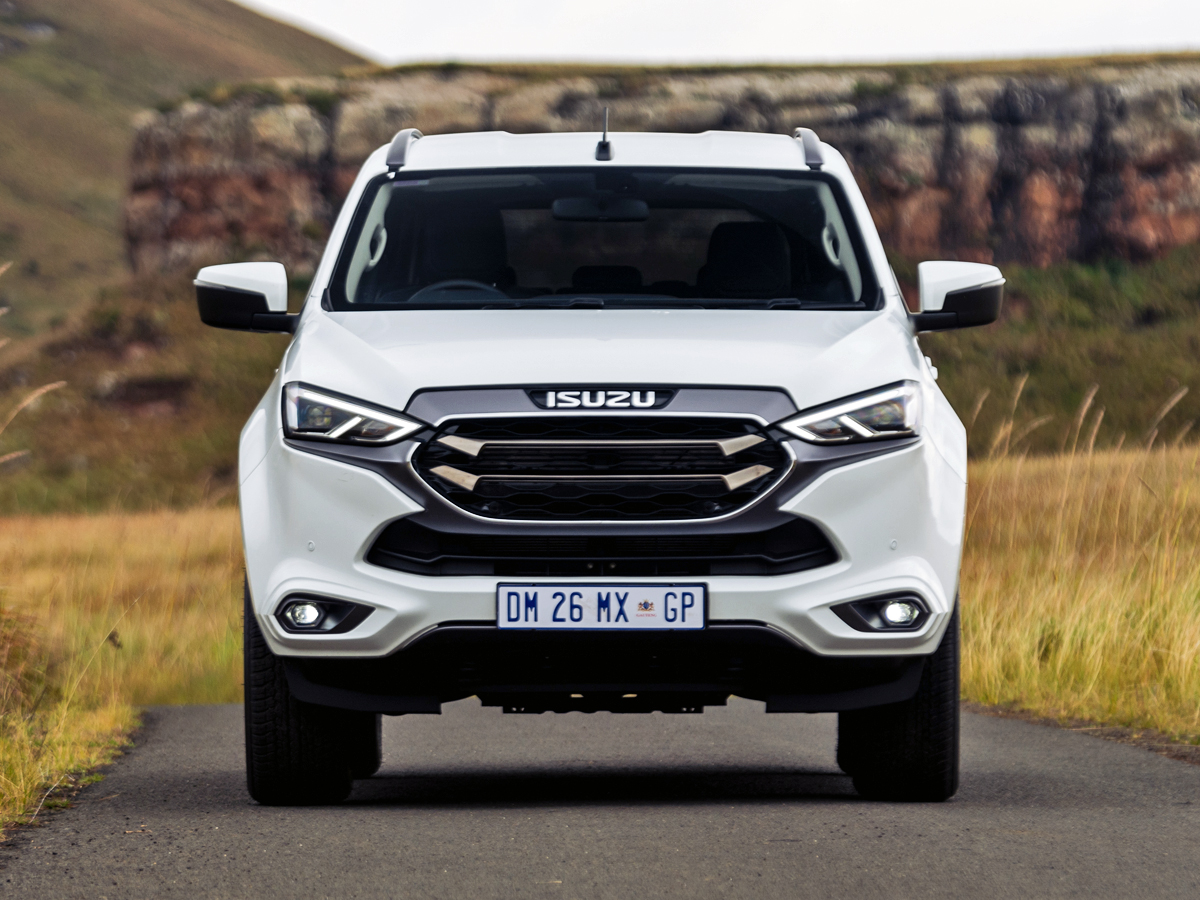
A new entry-level version of the Isuzu MU-X has arrived in South Africa, set apart by its 1.9-litre turbodiesel heart. Here’s what the “value-oriented” newcomer will cost you…
In May 2023, the Isuzu MU-X range was handed a bit of a refresh in South Africa, with the Japanese brand also confirming a new “value-oriented” base model was in the pipeline. Now, that entry-level derivative has arrived in the form of the MU-X 1.9 LS 4×2.
As the name suggests, the newcomer – which is part of Isuzu Motors SA’s latest effort to take the fight to the recently revised Toyota Fortuner range and the freshly expanded Ford Everest line-up – doesn’t employ the 140 kW/450 Nm 3.0-litre turbodiesel engine used by the 5 other derivatives in the range. Instead, the fresh base model is powered by the 1.9-litre, 4-cylinder oil-burning motor that we already know from the D-Max line-up (and the closely related Mazda BT-50, too).
This smaller-capacity unit generates 110 kW and 350 Nm, peak outputs that are delivered to the 7-seat adventure SUV’s rear axle via a 6-speed automatic transmission as standard. Fuel-consumption figures for the SA-spec version have yet to be released. From what we understand, there are no plans to offer the 1.9-litre variant in 4×4 guise.
The 1.9-litre engine is 30 kW and 100 Nm down on the larger 3.0-litre unit.
So, how much does the MU-X 1.9 LS 4×2 cost? Well, the newcomer is priced at R708 000, which represents a R92 000 saving over the MU-X 3.0 LS 4×2 (R800 000). Bear in mind, however, the range (like so many other line-ups in South Africa of late) was recently hit with a price hike, with the MU-X 3.0 LS 4×2 having been pegged at R784 300 at launch just a couple of months ago.
The 1.9-litre derivative inherits the LS grade, which suggests it should ship standard with items such as 18-inch alloy wheels, leather upholstery, a 7.0-inch touchscreen system (with Apple CarPlay and Android Auto), USB charging ports (fore and aft), cruise control, parking sensors (front and back) and a reversing camera. Safety kit will likely include electronic stability control (with traction control), ABS with EBD, hill-start assist, trailer sway control and 7 airbags.
We’ll update this story once more specification information becomes available…
How much does the Isuzu MU-X cost in South Africa?
Isuzu MU-X 1.9 LS 4×2 – R708 000
Isuzu MU-X 3.0 LS 4×2 – R800 000
Isuzu MU-X 3.0 LSE 4×2 – R842 800
Isuzu MU-X 3.0 LS 4×4 – R885 000
Isuzu MU-X 3.0 LSE 4×4 – R927 700
Isuzu MU-X 3.0 Onyx 4×4 – R960 600
The MU-X comes with a 5-year/90 000 km service plan (with intervals of 15 000 km), along with a 5-year/120 000 km warranty.