The Toyota Rumion has quietly received an update. Here’s what we know so far, including this refreshed 7-seater MPV’s revised price in South Africa…
The Toyota Rumion arrived in South Africa in October 2021, effectively replacing the Avanza. Now the 7-seater MPV has been handed a quiet update, including a revision to its pricing.
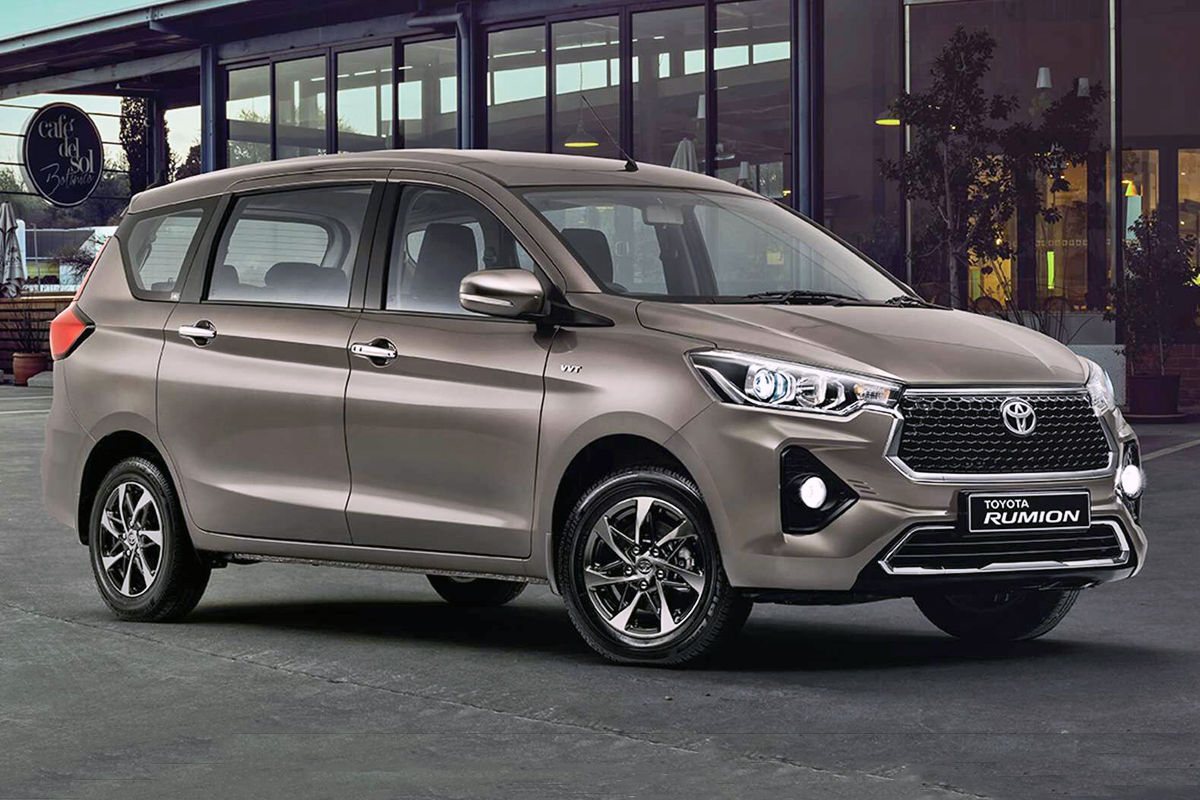
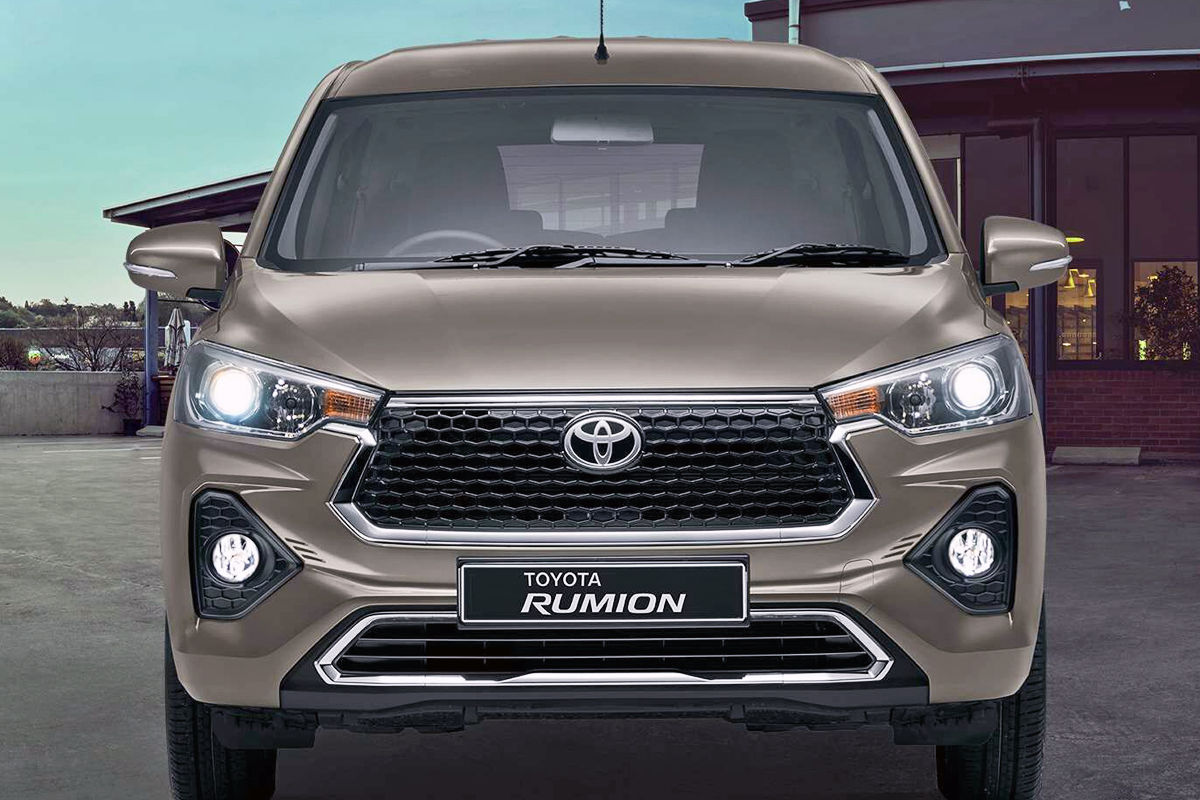
As before, the Rumion is based on the Suzuki Ertiga – which itself was refreshed in July 2022 – and manufactured by Maruti Suzuki in India. The local line-up again comprises 5 derivatives, though only the 1.5 S, 1.5 SX and 1.5 SX 4AT are currently available, with the top-spec 1.5 TX and 1.5 TX 4AT variants (pictured here) expected to be introduced in August 2023.
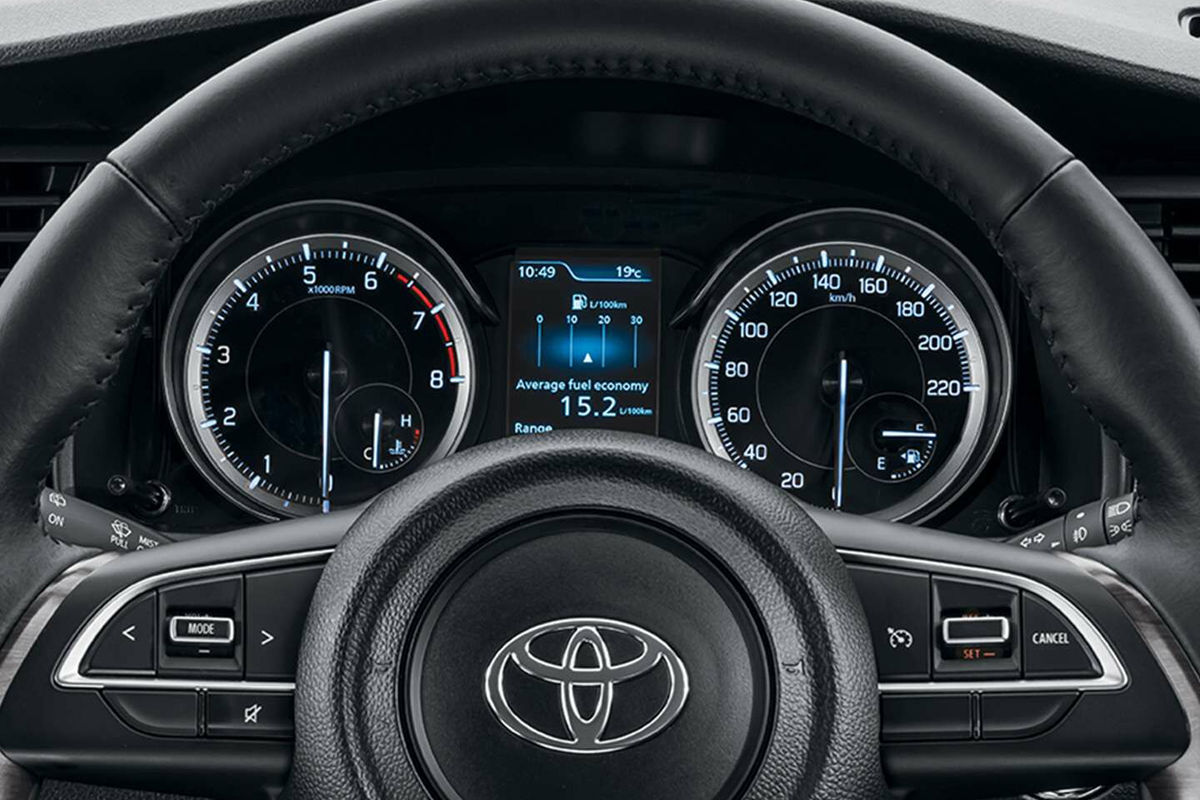
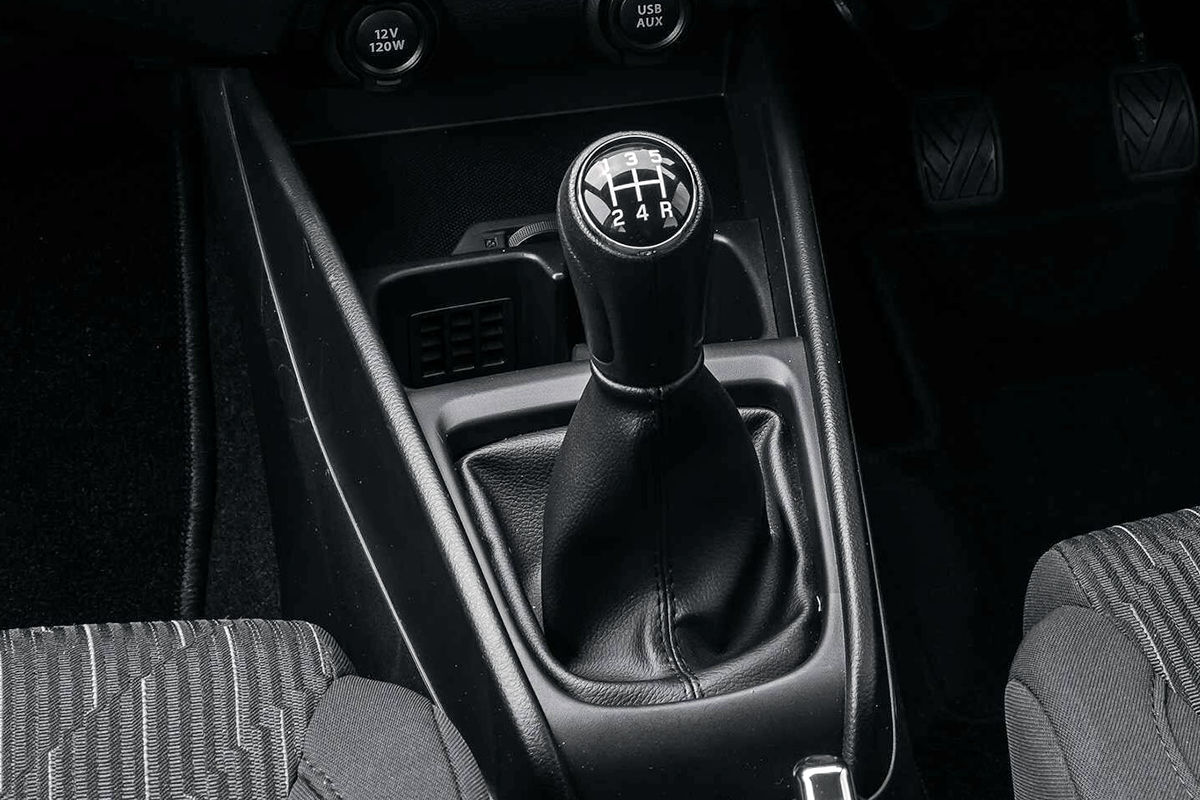
All derivatives are powered by a Suzuki-sourced naturally aspirated 1.5 litre, 4-cylinder petrol engine, which delivers an unchanged 77 kW and 138 Nm to the front axle via either a 5-speed manual gearbox or a 4-speed automatic transmission. The claimed combined fuel consumption is listed as 6.2 L/100 km regardless of the specified cog-swapper.
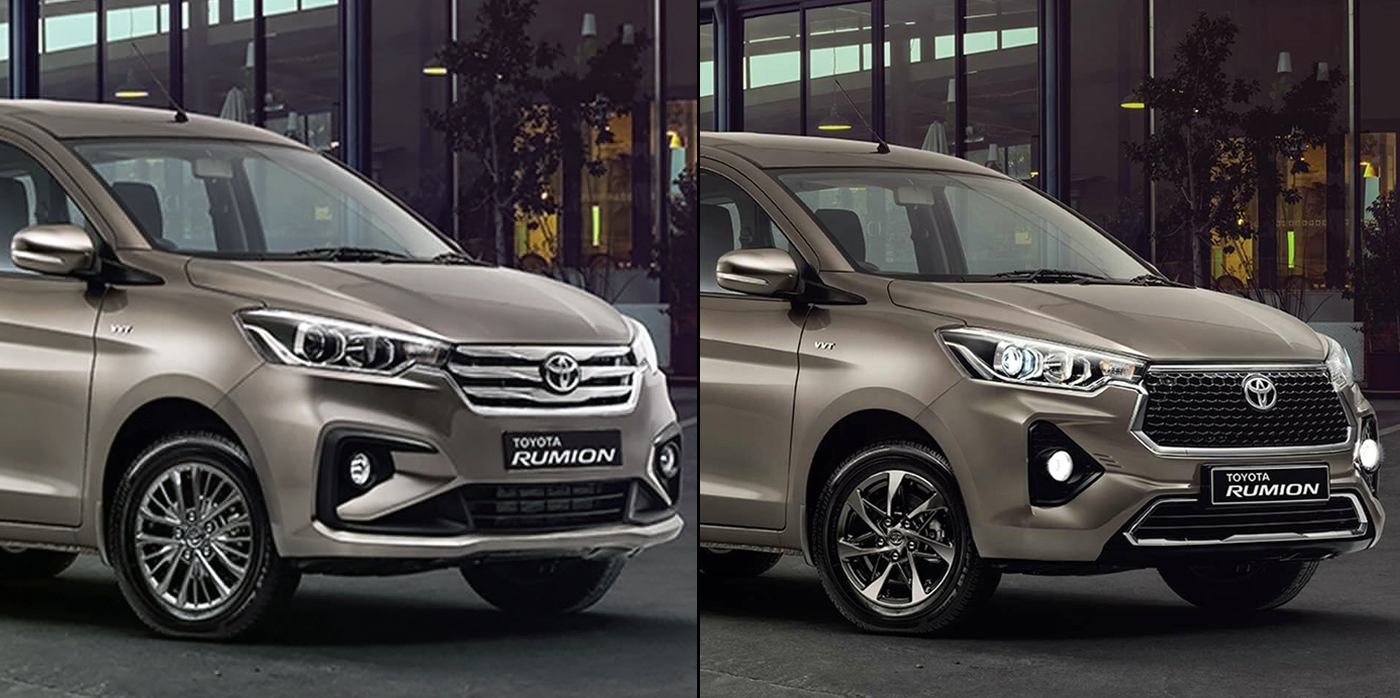
Outgoing Toyota Rumion on the left and the restyled version on the right.
Pricing for the Toyota Rumion now starts at R296 900, which is R13 500 up on the outgoing version’s base price of R283 400 (take note, too, the latter is a figure Toyota SA Motors increased just before the updated model hit the market). For the record, the 3-strong Ertiga line-up starts at R265 900.
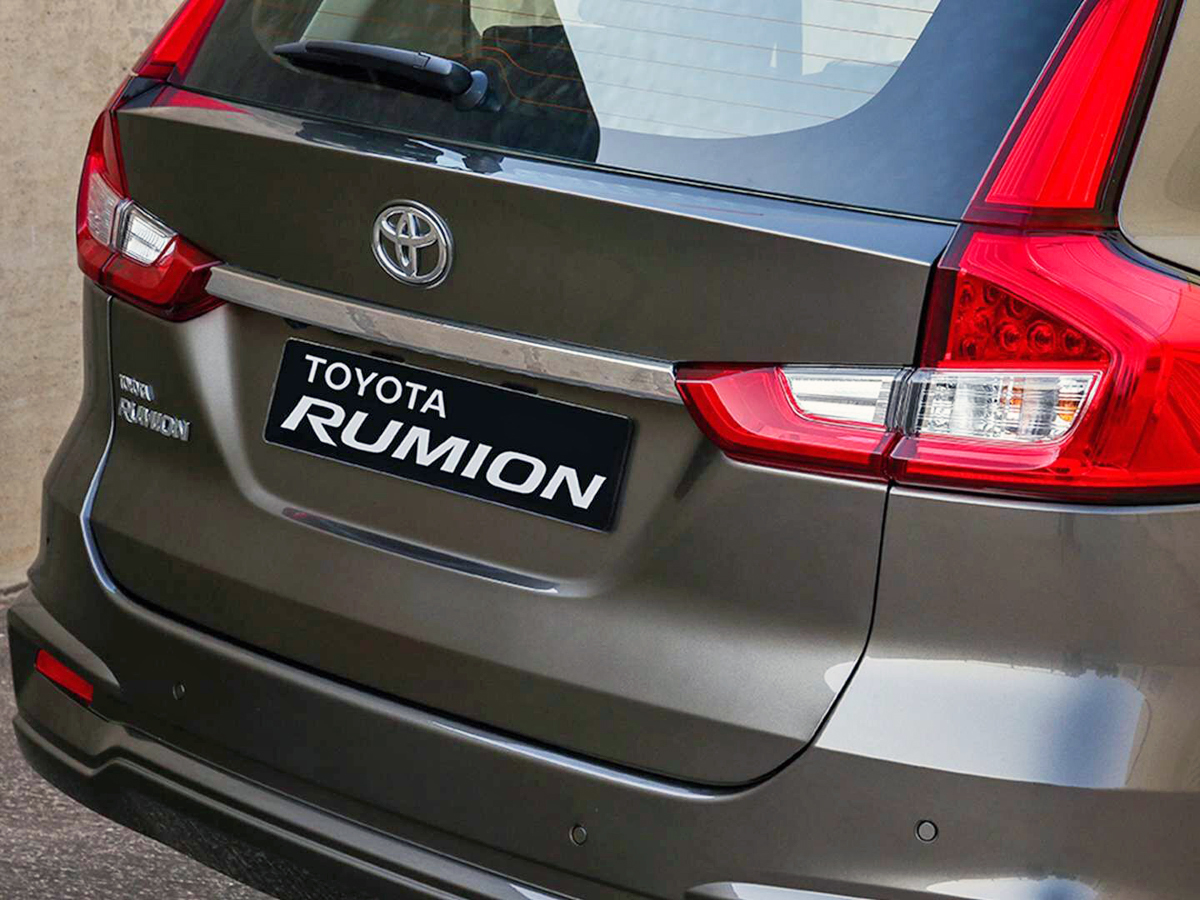
So, what’s new on the Rumion? Well, the most obvious change is the revised front-end styling, which is dominated by a new mesh grille framed by chrome-effect trim. The lower bumper has likewise been redesigned, while the top-spec TX’s foglamp bezels are new, too. In short, the Rumion’s face is now somewhat more clearly differentiated from that of the Ertiga. From what we can tell, the Rumion’s rear styling is unchanged.
In addition, flagship TX models appear to have received a fresh design for their 15-inch alloy wheels, while the base and mid-tier offerings again make do with steel wheels. Perhaps more importantly, however, is the fact electronic stability control (ESC), seatbelt warning and rear parking sensors are now standard across the range (yes, just like the updated Ertiga).
All derivatives now feature rear parking sensors and ESC.
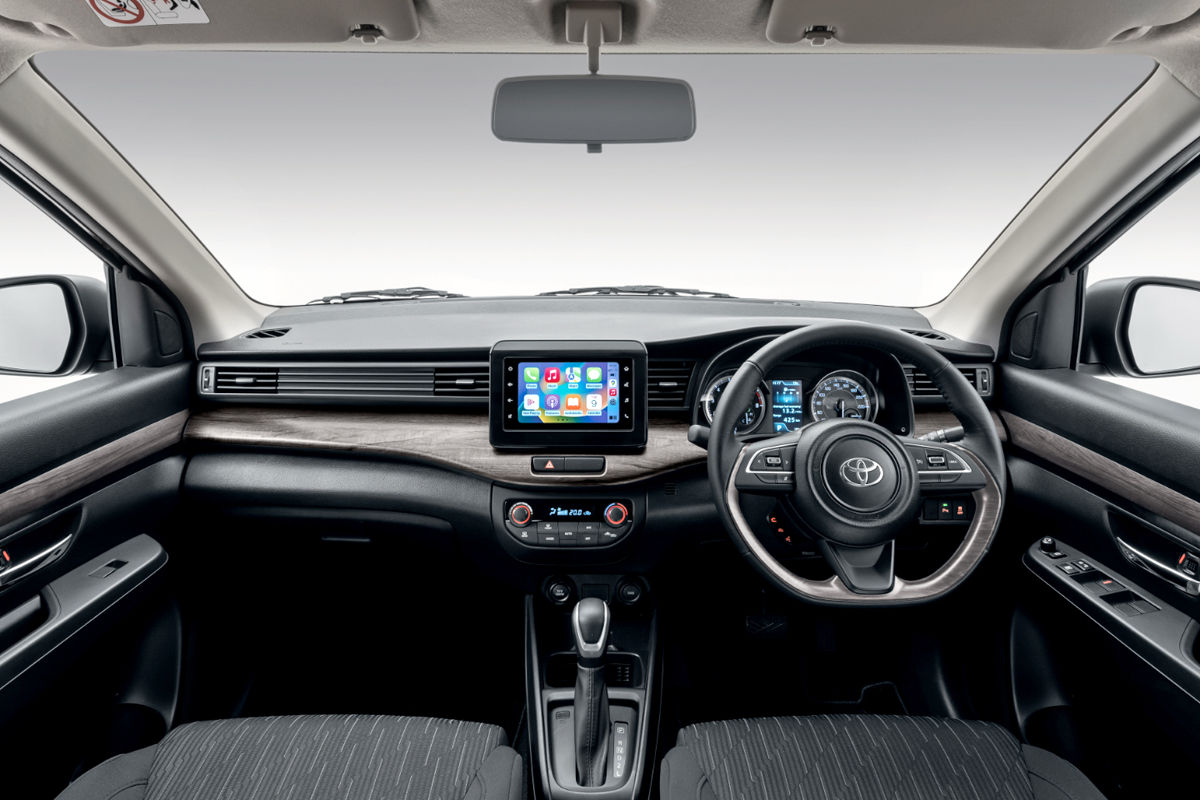
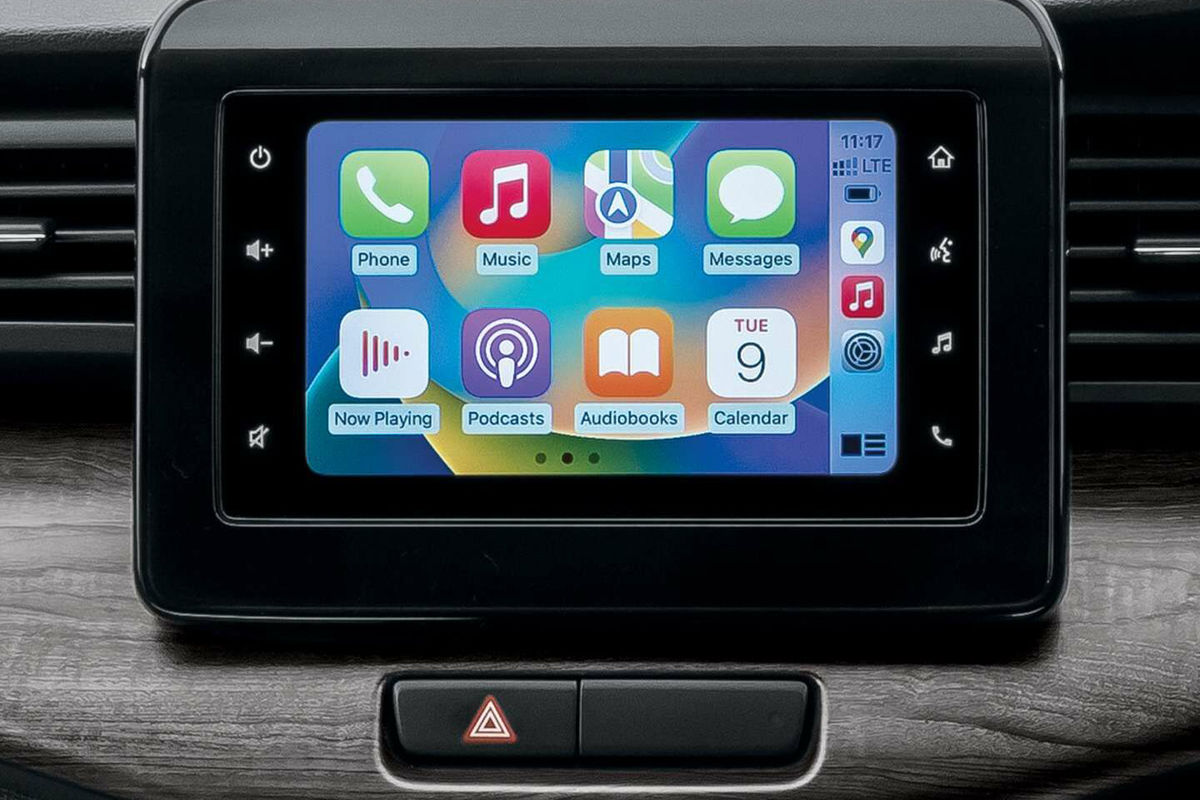
From what we understand, SX and TX derivatives furthermore now ship standard with a reversing camera (a feature previously reserved for TX) integrated into the centrally sited touchscreen (now offered as standard on the SX as well), while cruise control has also been added to the list of both, too.
As before, the entry-level S grade is easily distinguished by its black side-mirror caps, while the mid-tier SX adds items such as colour-coded exterior door handles, colour-coded (power-adjustable and retractable) side mirrors, a rear-window wiper, a rear-window demister, remote central locking, rear parking sensors and rear air-conditioner vents.
Meanwhile, the TX trim level adds features like keyless entry (with push-button start), chrome-effect exterior door handles, front foglamps and a wood-effect panel on the facia. All grades feature dual front airbags, ABS with EBD, IsoFix child-seat anchorage points, an immobiliser and an alarm, along with the aforementioned and freshly added ESC and rear parking sensors.
How much does the Toyota Rumion cost in South Africa?
Toyota Rumion 1.5 S – R296 900
Toyota Rumion 1.5 SX – R331 600
Toyota Rumion 1.5 SX 4AT – R351 700
Toyota Rumion 1.5 TX – TBC
Toyota Rumion 1.5 TX 4AT – TBC
The Rumion comes with a 4-service/60 000 km service plan (with intervals of 15 000 km), along with a 3-year/100 000 km warranty.
The Hilux and its US cousin – the Tacoma – could become much more alike in future, but how many of the Tacoma’s best bits might we see in the 9th-gen Hilux?
The only Toyota bakkie that has more legacy than the Hilux is the Land Cruiser pick-up. But the Toyota design that offers us the best clue to the 9th-gen Hilux is Toyota’s youngest bakkie nameplate – Tacoma.
Although it remains a tantalisingly left-hand-drive-only bakkie, which precludes it from being offered in the local market, the Tacoma – especially its latest version – has wowed American bakkie followers.
Toyota’s bakkie business is enormously successful. All around the globe. The Hilux dominates the entire South African new-vehicle market and, in the world’s most competitive bakkie market, the United States of America, the Tacoma has been the best-selling “mid-sized” pick-up truck (bakkie) for decades.
Despite its many successes, however, Toyota is under enormous powertrain development pressure to deliver electric vehicles. A consequence of that is building smarter with its available vehicle platforms, and this is where the 2024 Tacoma is a very symbolic vehicle for Toytoa’s bakkie business.
Unlike previous North American Toyota bakkies, the new Tacoma rides on a platform familiar to South Africans: TNGA-F. It’s broadly the same platform that underpins the Land Cruiser 300, and Tacoma is the first Toyota bakkie to offer hybridisation, which is an important clue to the 9th-gen Hilux’s configuration.
Electric… everything!
The 9th-gen Hilux should feature much of this cabin architecture, including the unseen benefit of electric power steering.
Electric power steering is ubiquitous in the passenger car segment, but the bakkie market persists with hydraulic assistance. Why? A hydraulic setup facilitates better terrain feedback – and more accurate steering corrections – in sand driving. The new Tacoma’s steering, however, is electrically assisted.
The evolution from hydraulic- to electric power steering might irk some 4×4 traditionalists, but there are clear advantages to the Tacoma having the latter. Beyond the dilution of steering feedback in specific terrain types, the configuration change from hydraulic- to electric steering has allowed Toyota engineers to increase the Tacoma’s front-end chassis rigidity. An additional chassis cross member should give the Tacoma better high-speed lane-changing dynamics and greater resistance to pothole strike damage.
With the Tacoma proving the validity of electric power steering, it’s nearly guaranteed that the 9th-gen Hilux will adopt an electric steering setup too. An underappreciated benefit of electric power steering is the diversity of driver assistance features that it enables, especially at parking speeds. Considering that (increasingly sizeable) bakkies are a nightmare to park in Sandton City or the Cape Town CDB, it would be terrific to have a Hilux with electric power steering, let alone automated parallel parking functionality.
Petrol hybrids or turbodiesels?
Will Hilux owners be convinced by a four-cylinder petrol and six-speed manual?
Toyota doesn’t sell any turbodiesel-powered bakkies in America, which explains why Tacoma engines have traditionally been of little interest to South African bakkie buyers. But that’s changing rapidly.
The Hilux and its Fortuner adventure-SUV sibling will soon integrate mild hybridity. And although these powertrains are becoming available at a very mature stage in the current Hilux and Fortuner lifecycle, expect hybridisation to feature strongly for the 9th-gen Hilux. And it might not be a turbodiesel motor!
Evaluate the global market for hybrid vehicles; you’ll notice the absence of diesels. Hybrid drivetrains work best with linear engines, such as naturally aspirated petrol powerplants. The least appropriate engine type for any hybrid powertrain is an atmospheric diesel, with turbodiesels being better, but certainly not ideal. That’s why hybrid power units feature petrol-fed internal combustion engines.
The unavailability of turbodiesel hybrids creates an issue for Hilux product planners. Almost all of the current double-cab Hiluxes are turbodiesel-powered, so what will happen in future? Ford’s Ranger gives us a clue. Despite Ranger’s local demand being diesel-biased too, the Raptor has a turbopetrol motor. Expect Toyota to do the same; the 9th-gen Hilux may use the Tacoma’s 2.4-litre turbopetrol hybrid.
Big numbers from the turbocharged 2.4-litre 4-pot
The most potent Tacoma 2.4-litre turbopetrol hybrid produces 630 Nm. That’s plenty of torque to keep Hilux buyers happy.
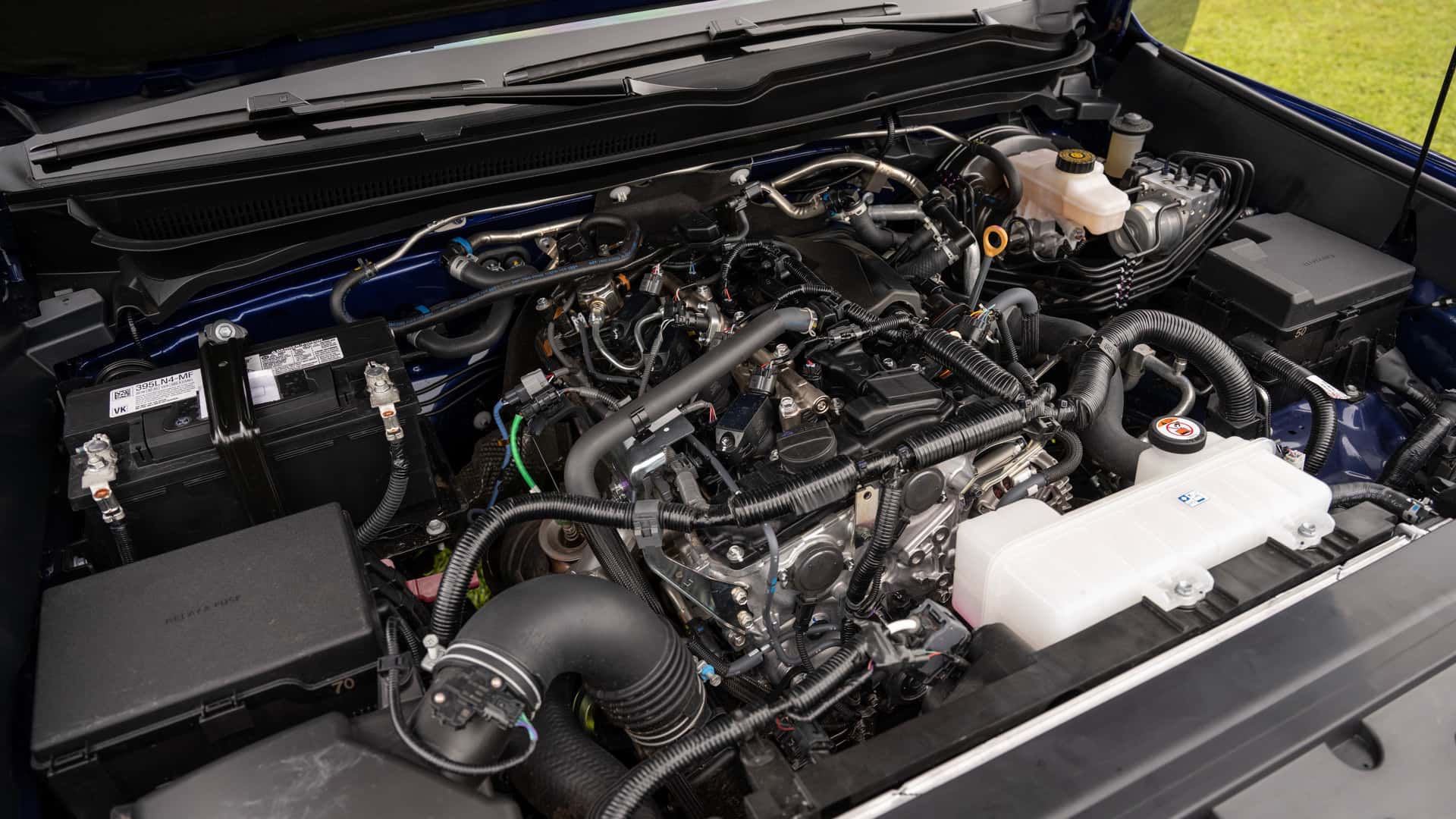
Available in 4 power ratings, the Tacoma’s 2.4-litre 4-cylinder turbopetrol iForce engine is impressive. As a power- and drivetrain, it addresses the Hilux’s powertrain shortcomings: lack of high-speed overtaking power and -gearing. Anyone who has driven a Hilux 2.8 GD-6 equipped with a 6-speed manual knows it has great gearing for off-road driving and dirt-road cruising, but the top gear is a very tall overdrive ratio. When you engage it, you could be forgiven for thinking you’ve accidentally brushed the brake pedal…
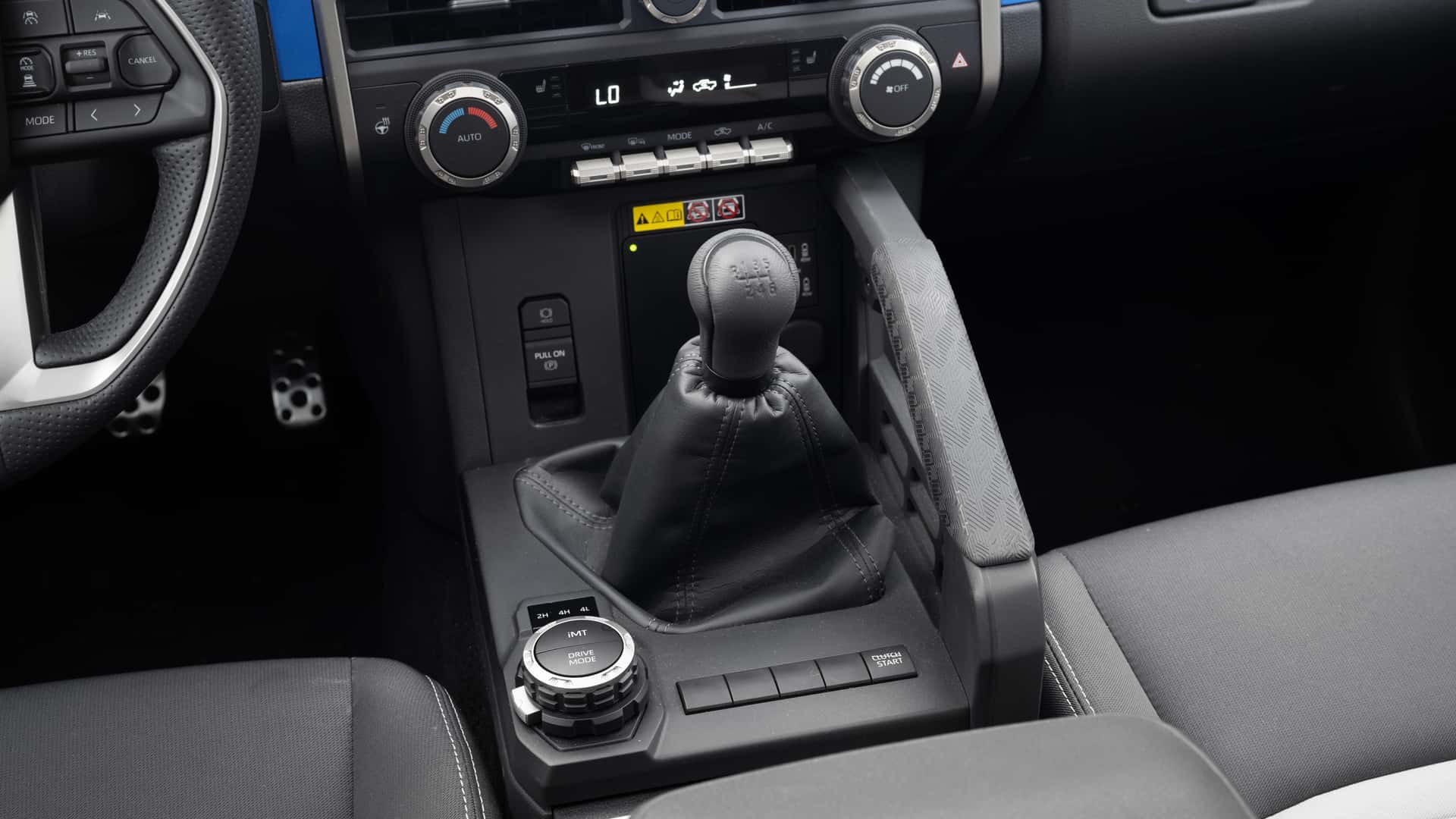
The Tacoma’s 2.4-litre iForce engines offer all the power Hilux owners could desire for highway cruising, plus additional gears. With Ranger and Amarok offering 10-speed automatic transmissions, Hilux would benefit from the Tacoma’s 8-speed set-up, compared with the current slightly limited 6-speed auto box. For Hilux drivers who prefer to self-shift and value the control of a manual ‘box for precision off-roading (especially in sand), the option of a 2.4-litre turbopetrol engine with a 6-speed manual will be enticing.
The 2.4-litre iForce engine is limited to 420 Nm, which is a comparable peak-torque output to a current Hilux 2.8-litre turbodiesel. However, its peak power number is a meaty 200 kW, which should offer dramatically better overtaking acceleration than Toyota SA’s current crop of 4-cylinder turbodiesels.
9th-gen Hilux could have a much better ride quality
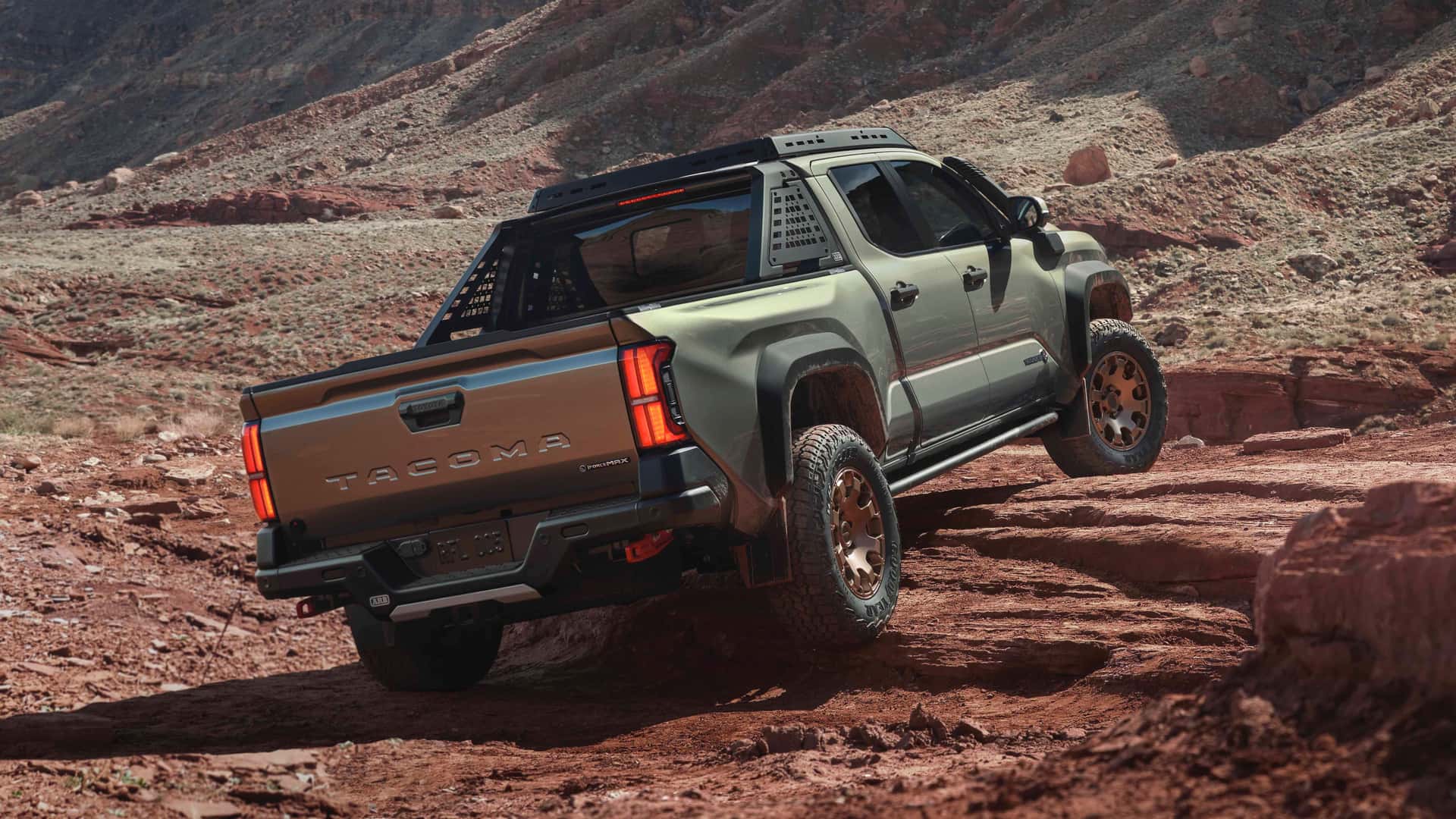
The Land Cruiser 300-related underpinnings make the Tacoma hugely capable off-road.
Virtually all double-cab bakkies have a ride quality issue. The reason is simple: bakkies feature a suspension configuration to handle their peak load box rating. And when they aren’t laden, they are entirely over-sprung… and ride awfully. With double-cab bakkies having become family cars instead of workhorses, they are never laden to capacity, and their harsh ride qualities are illogical and unnecessary.
The solution is to replace the leaf-sprung rear axle with a multi-link setup. When Nissan did this with its 3rd-gen Navara, it achieved very little market reward, but could Toyota do better with the next Hilux?
Toyota offers 2 suspension options to support the new Tacoma’s rear axle: underslung leaf springs or a multi-link setup. Ford’s Ranger has proven how a rear suspension configuration change can dramatically improve a double-cab’s ride quality. Anyone who has driven (or been a passenger in) a standard Ranger and Raptor, will attest to the latter’s superior ride quality, admittedly at the cost of reduced loadability.
Still, many upper-echelon Hilux double-cab owners aren’t interested in ever carrying the maximum load capacity of their bakkies and would prefer better ride quality on all road surfaces. A “luxury-spec” Hilux, with Tacoma-type multi-link rear suspension, would be popular among urban double-cab buyers.
Expect a much smarter cabin in 9th-gen Hilux
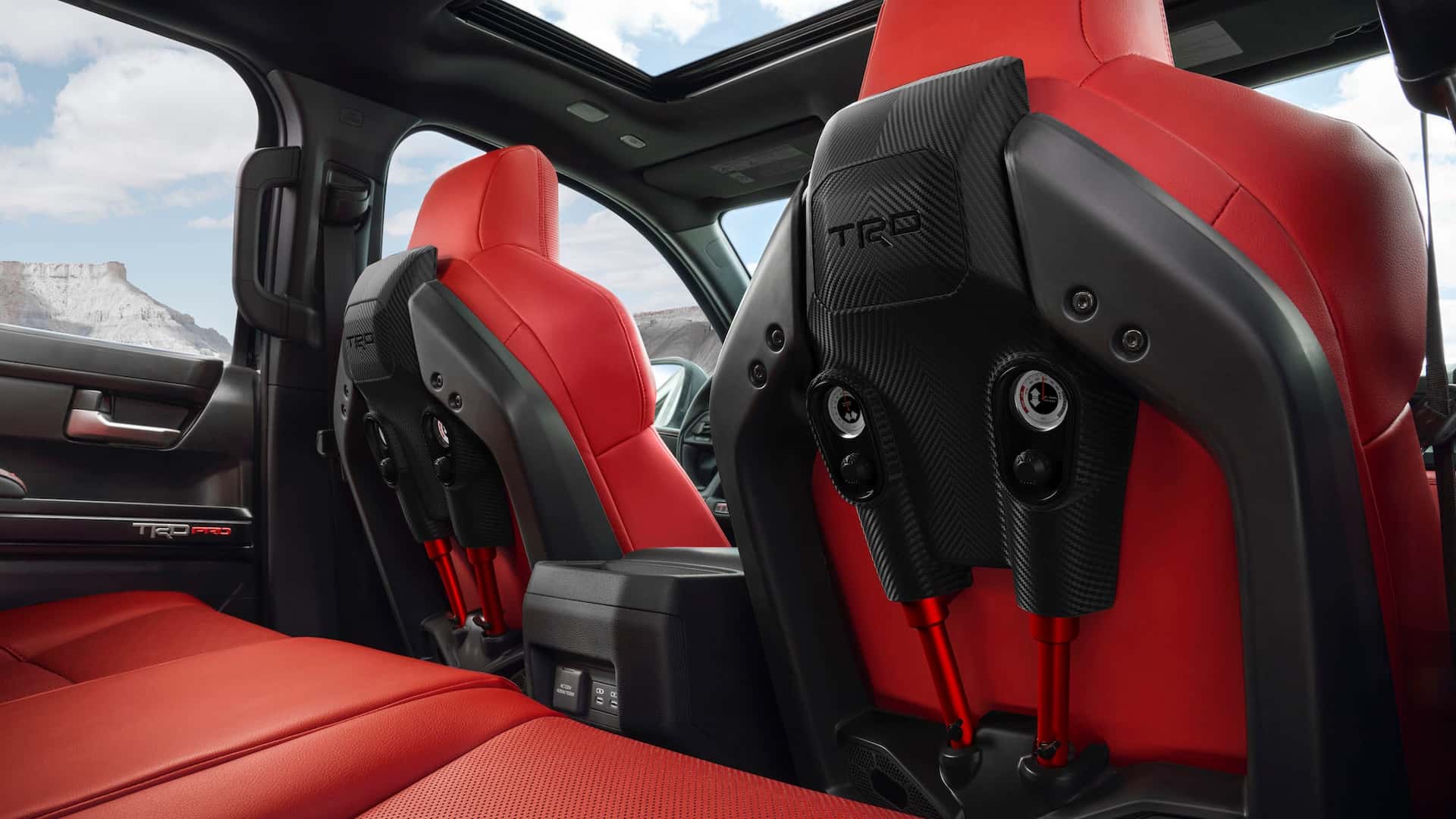
An incentive to test the warranty claim of your bakkie, if ever there was one: the Tacoma TRD’s suspension seats…
When the current iteration of the Hilux was launched in 2016, bakkies did not feature large touchscreen infotainment systems – let alone small-item storage spaces and non-slip surfaces. But that’s changed.
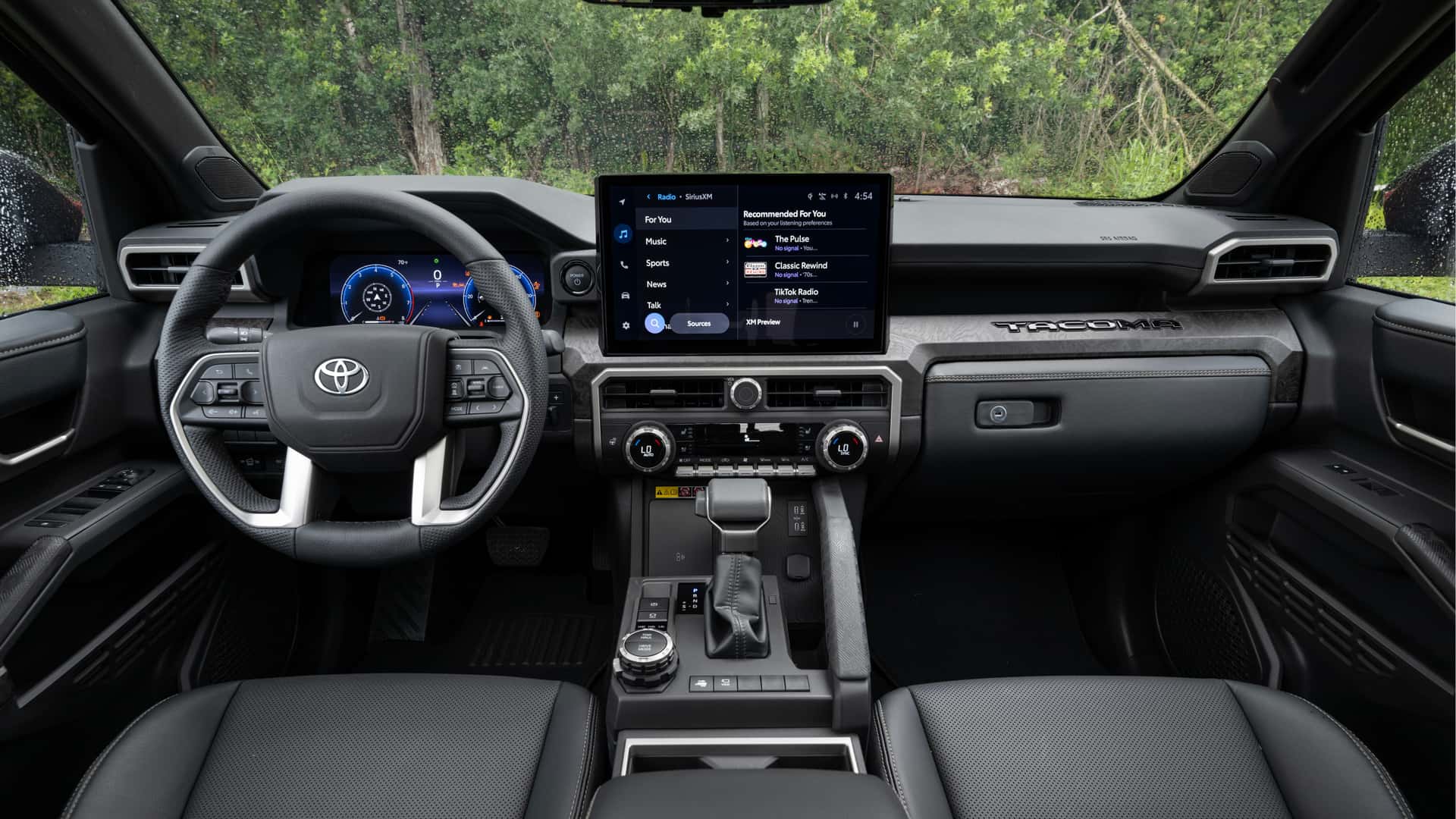
The new Tacoma features a huge (14-inch) optional touchscreen, but retains conventional dials for many functions, including climate control; there are many small item storage spaces – with non-slip surfacing!
The most impressive things in the Tacoma’s cabin (that may be of interest to Hilux owners) are its seats. The TRD version offers suspension-strut seatbacks to cushion passengers when the bakkie, um, lands.
Not everything available on the new Tacoma will be transplanted to the 9th-gen Hilux, but these two Toyota bakkie platforms are aligning ever closer. And that’s great news for South African bakkie buyers.
Is the Hilux still the sales king after the first half of 2023 or has the Ranger caught up? And what about SA’s worst-selling bakkies? A look at the H1 2023 winners and losers…
In the opening half of 2023, South Africa’s light-commercial segment – which includes bakkies, mini-buses and vans – grew 20.3% year on year to 76 519 units. So, how have things panned out for individual contenders in the bakkie segment?
Well, we’ve tallied up the sales figures for the first half of 2023, allowing us to identify South Africa’s best-selling bakkies, year to date (be sure to check out SA’s top-selling passenger vehicles, too). Of course, we’ll take a look at the bakkies that failed to crack the top 10, too. Right, let’s dive in…
Hilux way out in front as Ranger holds off D-Max
No prizes for guessing South Africa’s best-selling bakkie (and indeed most popular vehicle overall) in the 1st half of the year was the Prospecton-produced Toyota Hilux, which amassed 18 801 registrations in the 6-month reporting period. The Japanese contender was the only bakkie to cross the 3 000-unit mark in a month, a feat it achieved no fewer than 3 times in H1 2023. In fact, its monthly average came in at a whopping 3 134 units.
So, just how far behind was the Silverton-built Ford Ranger in 2nd place? Well, with 11 726 units sold over the opening half of the year, the Blue Oval bakkie was 7 075 units off the pace. It was impressively consistent, however, cracking 2 000 units in 4 of the 6 months, with its 2 worst performances coming in January and February (when single- and extended-cab models were not yet fully online).
Meanwhile, the Isuzu D-Max – which is manufactured in Struandale in the Eastern Cape – returned a figure of exactly 10 000 registrations at the halfway point, enough to secure the final place on the bakkie-sales podium. While the D-Max was virtually neck and neck with the Ranger over the opening quarter of 2023 (and indeed came within just 280 units of matching its foe in 2022), it fell off the pace slightly in April and May, before narrowing the gap again in June.
The market’s only half-tonne offering, the Nissan NP200, ended the reporting period on 6 757 sales, which netted it a comfortable 4th position. Meanwhile, 5th place went to the KwaZulu-Natal-assembled Mahindra Pik Up, which finished up on 4 478 registrations.
Evergreen Land Cruiser 79 and new VW Amarok climb
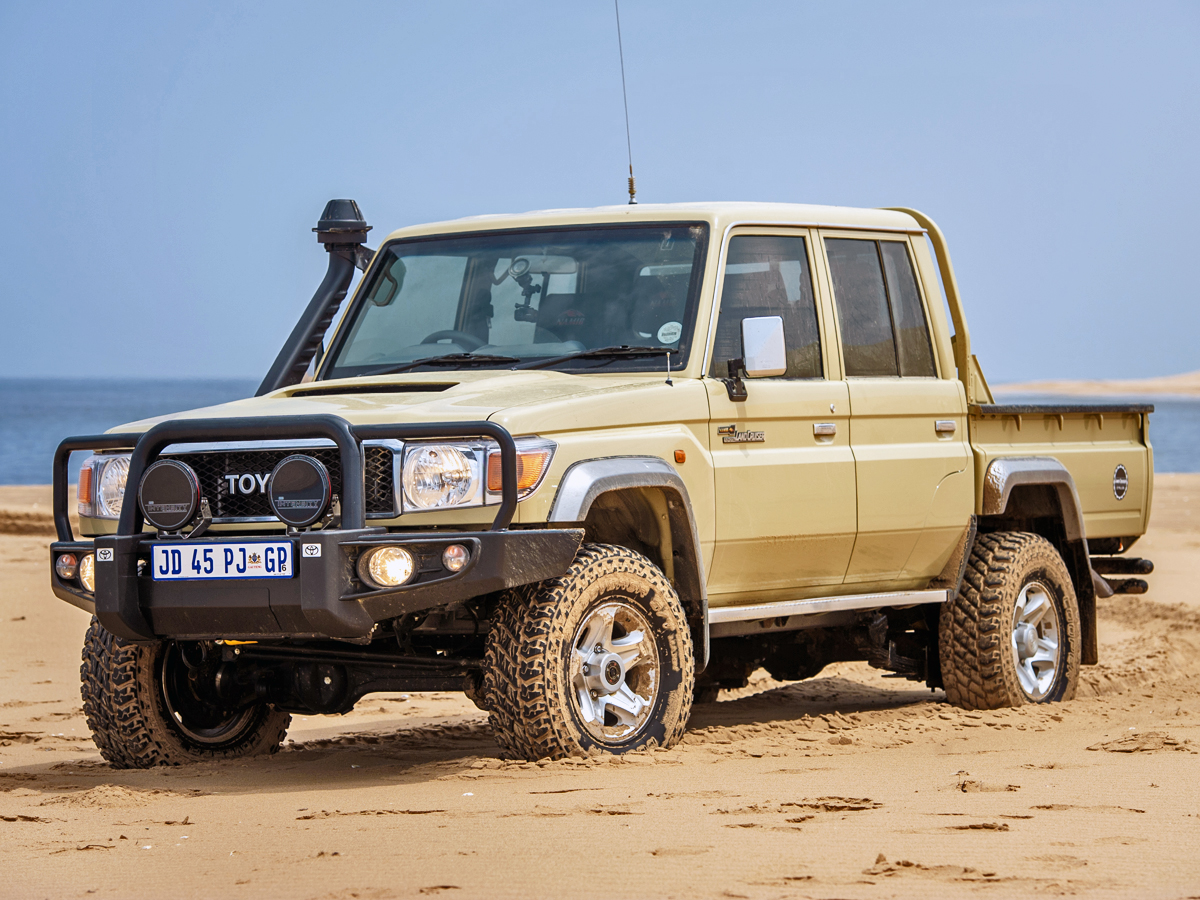
As was the case in 2022, the Rosslyn-made Nissan Navara (2 360 units) found itself in 6th position. This time, however, the seemingly evergreen Toyota Land Cruiser 79 was right on its tail in 7th, ending the reporting period on 2 349 units. Interestingly, Toyota SA Motors confirmed to Cars.co.za earlier in 2023 it was “studying” the possibility of introducing a 4-cylinder version of the long-in-the-tooth bakkie.
The GWM P-Series (2 084 units) held steady in 8th spot, with its best month being May 2023, when 494 units were registered. Judging by the improvement in sales figures compared with the opening quarter of the year, the Chinese firm’s local division appears to have secured a steadier supply of stock.
The new Volkswagen Amarok (1 452 units) climbed a position compared with its ranking last year, ending H1 2023 in 9th place. For the record, the Amarok – which moved into its 2nd generation in March 2023 – already finds itself just 444 units short of its full-year total for 2022.
The GWM Steed thus dropped to 10th, with its half-year total coming in at an underwhelming 586 units. It’s not exactly clear what’s behind this marked dip in performance, with the Chinese bakkie managing to crack 3 figures only twice over the opening 6 months. For context, the Steed attracted 4 522 sales in 2022, translating to a monthly average of 377 units.
A look at SA’s slowest-selling bakkies in H1 2023
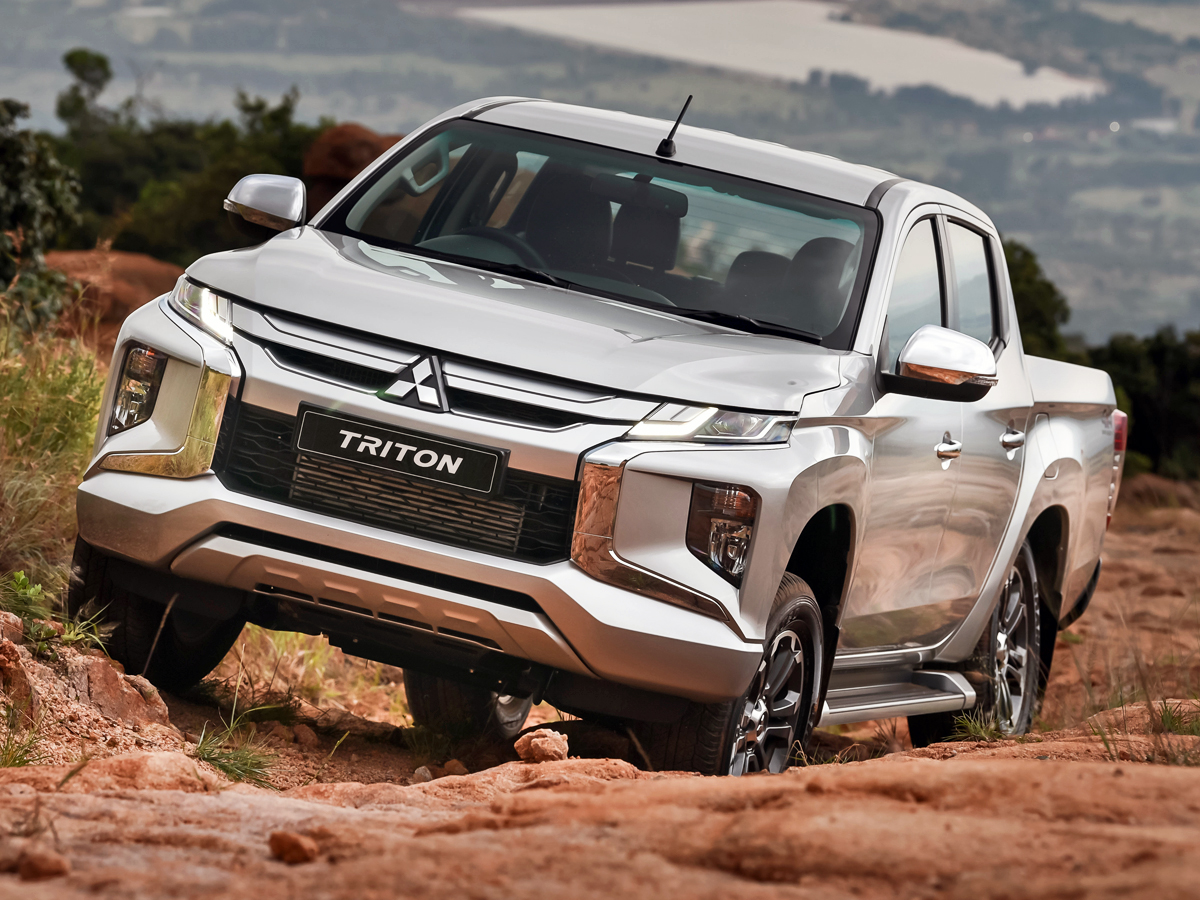
What about the bit-part players? Well, the under-appreciated Mitsubishi Triton effectively placed 11th (up a spot compared with 2022), with 380 units sold over the opening half of the year. Next came JAC’s T-badged bakkies – the Chinese automaker unfortunately reports only a combined figure for its T6 and T8 line-ups – with 244 units.
Local sales of the Mahindra Bolero slowed to just 185 units, putting it slightly ahead of the Peugeot Landtrek (177 units). Meanwhile, the Jeep Gladiator – South Africa’s most expensive bakkie at a cool R1 329 900 – was just behind its Stellantis sibling, finishing H1 2023 on 171 registrations (with a high of 83 units – 80 of which were sales to the rental industry, fascinatingly – coming in June 2023).
And the beleaguered Mazda BT-50? Well, the D-Max-based model was the worst-selling bakkie of all, with just 40 examples registered over the first 6 months of the year. For the record, we’ve focused on traditional bakkies here, excluding models such as the Hyundai H100, Kia K Series, Volkswagen Transporter Pick Up and Suzuki Super Carry.
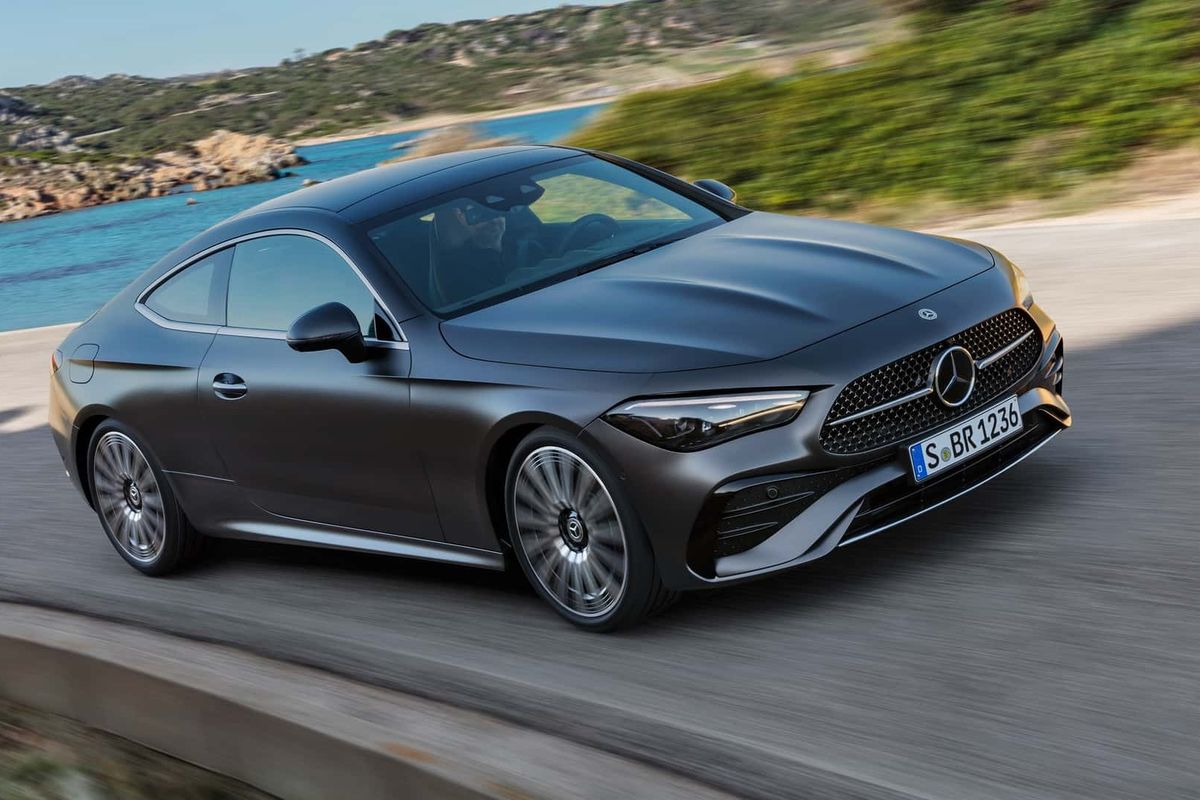
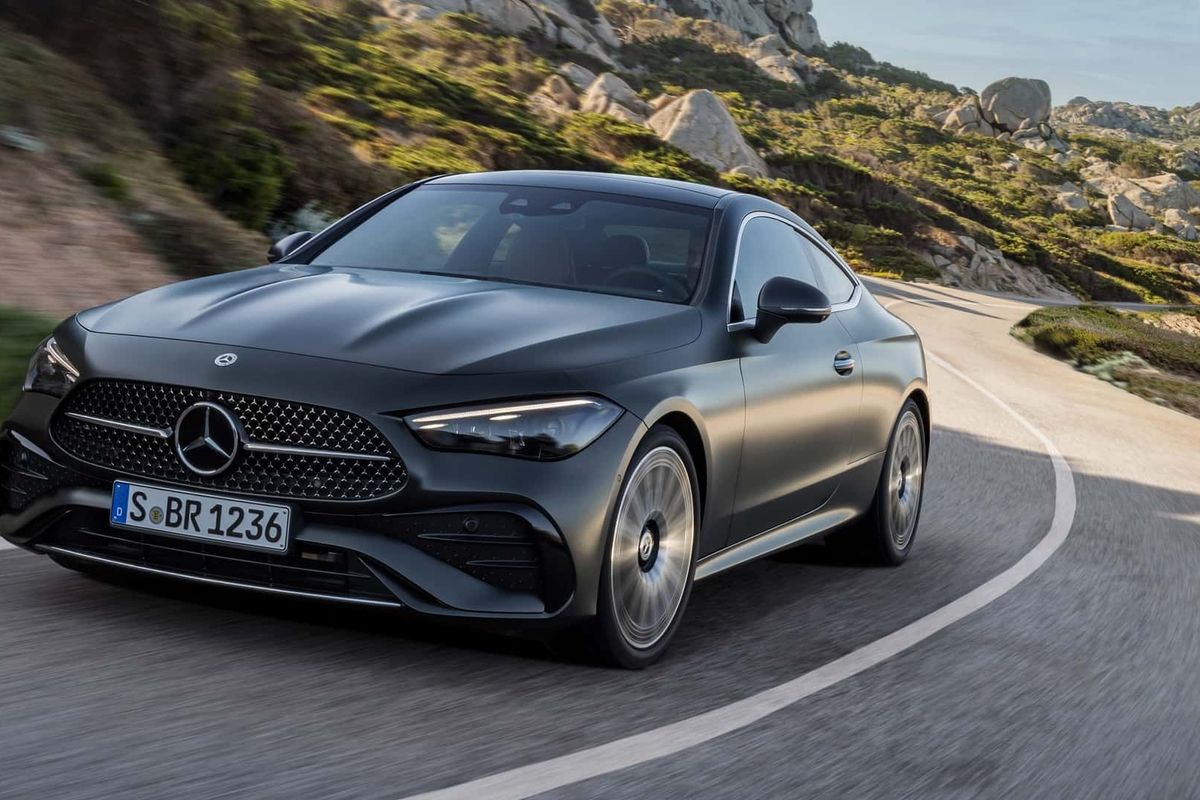
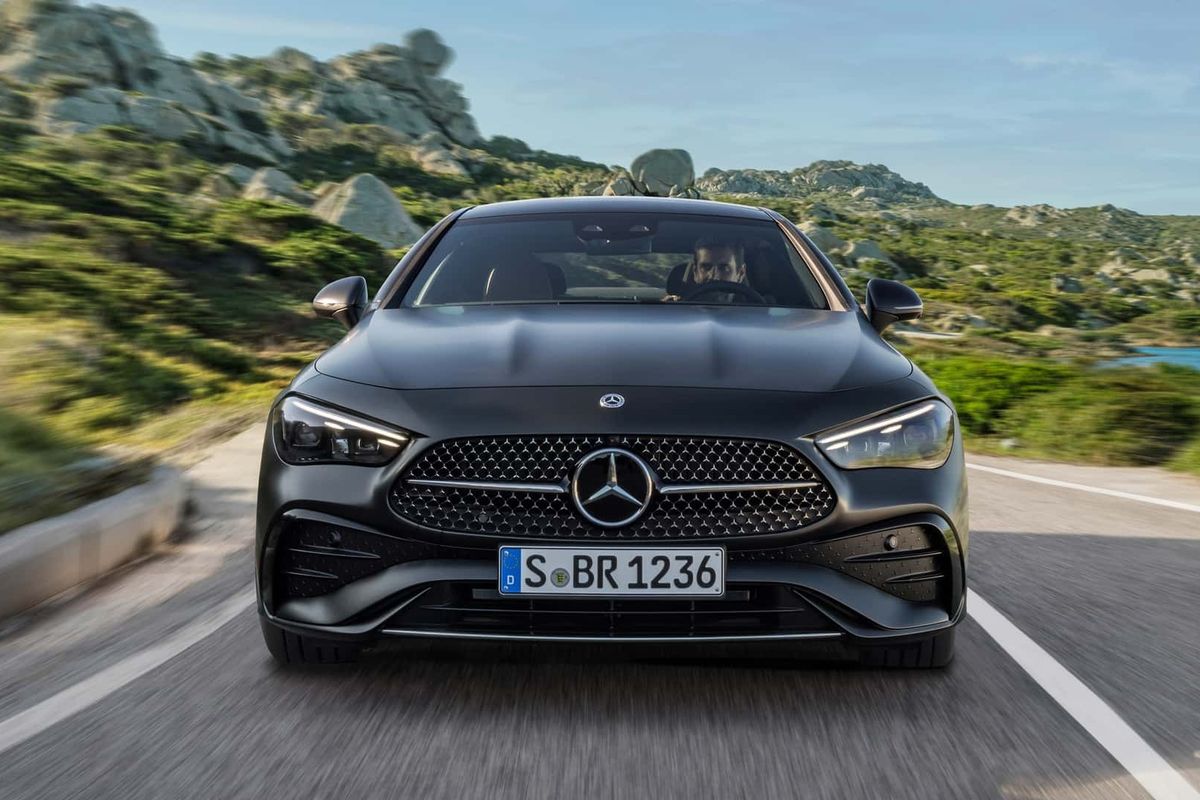
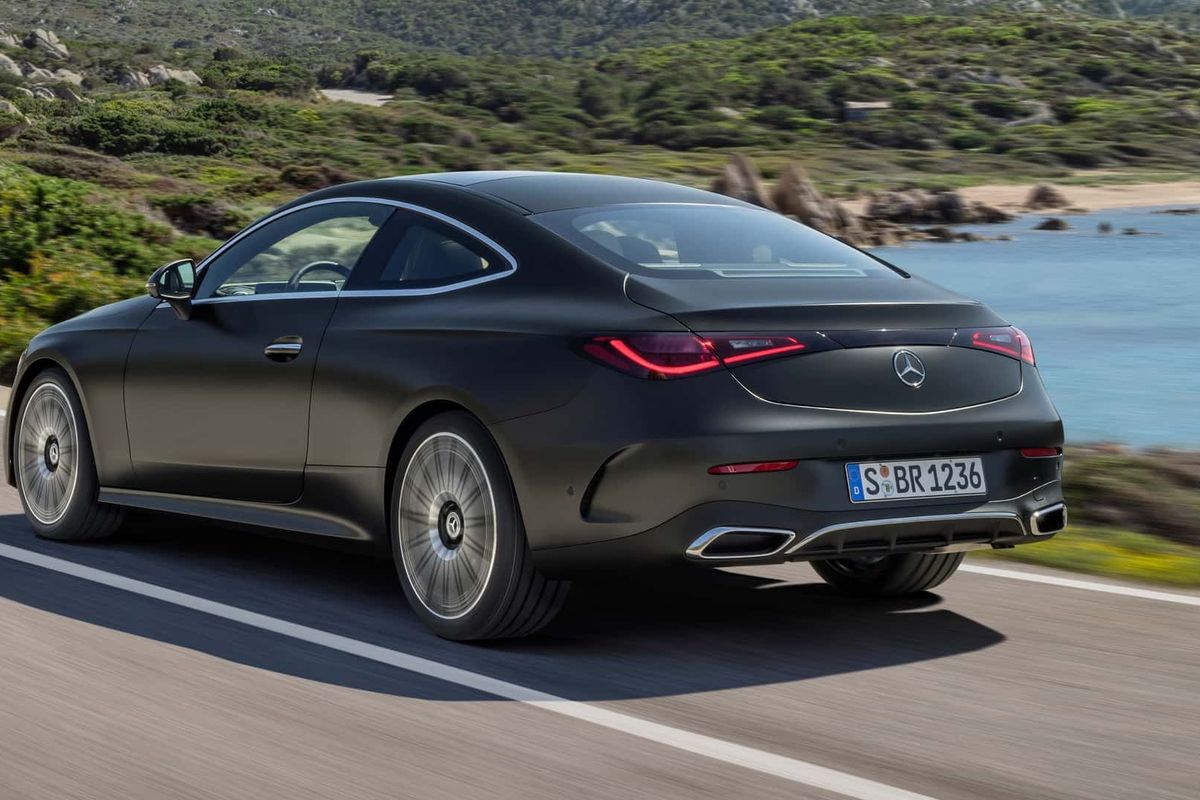
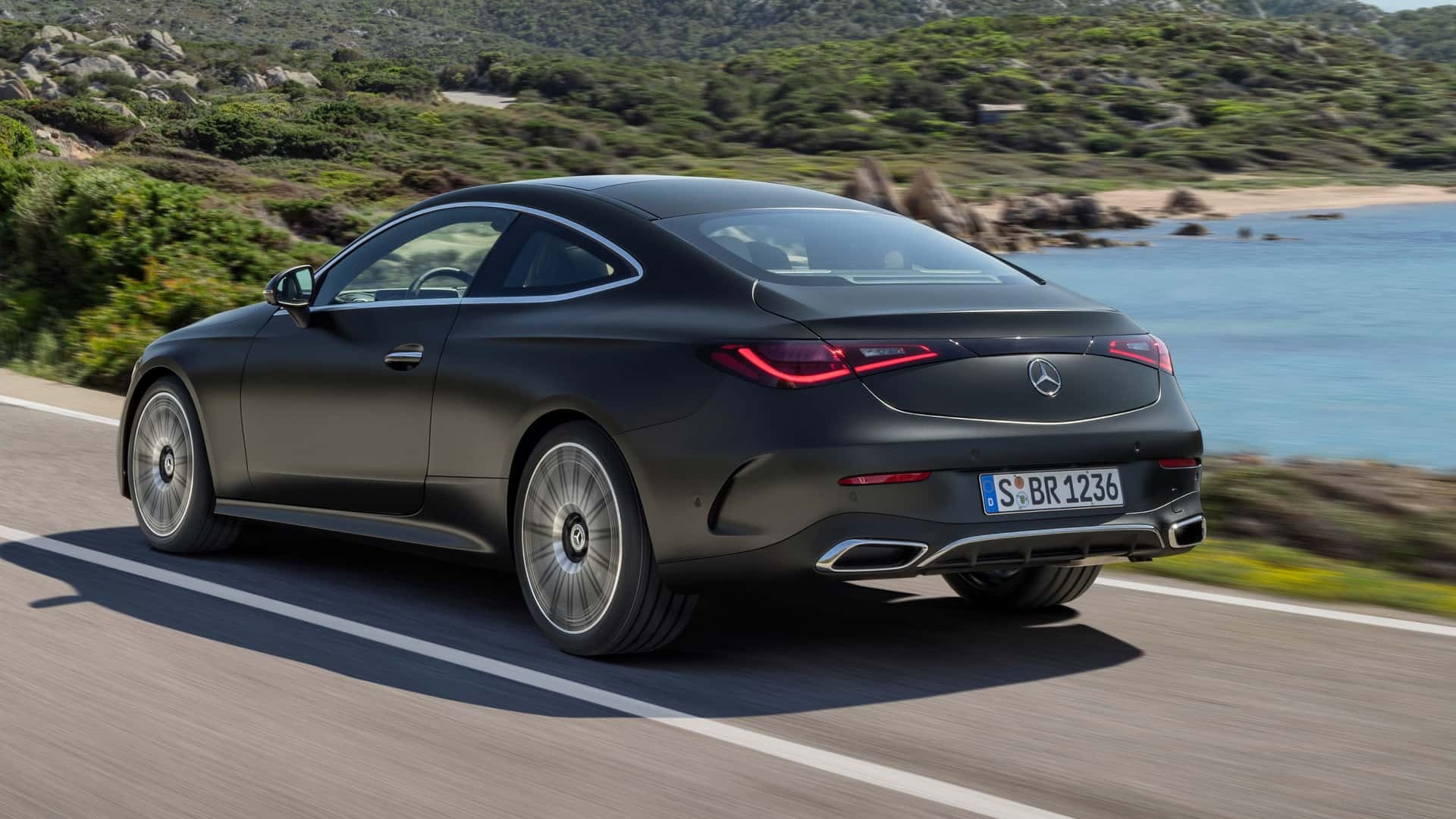
Despite the popularity of the SUV, there’s still room for a stylish luxury coupe. Here’s all you need to know about the new Mercedes-Benz CLE!
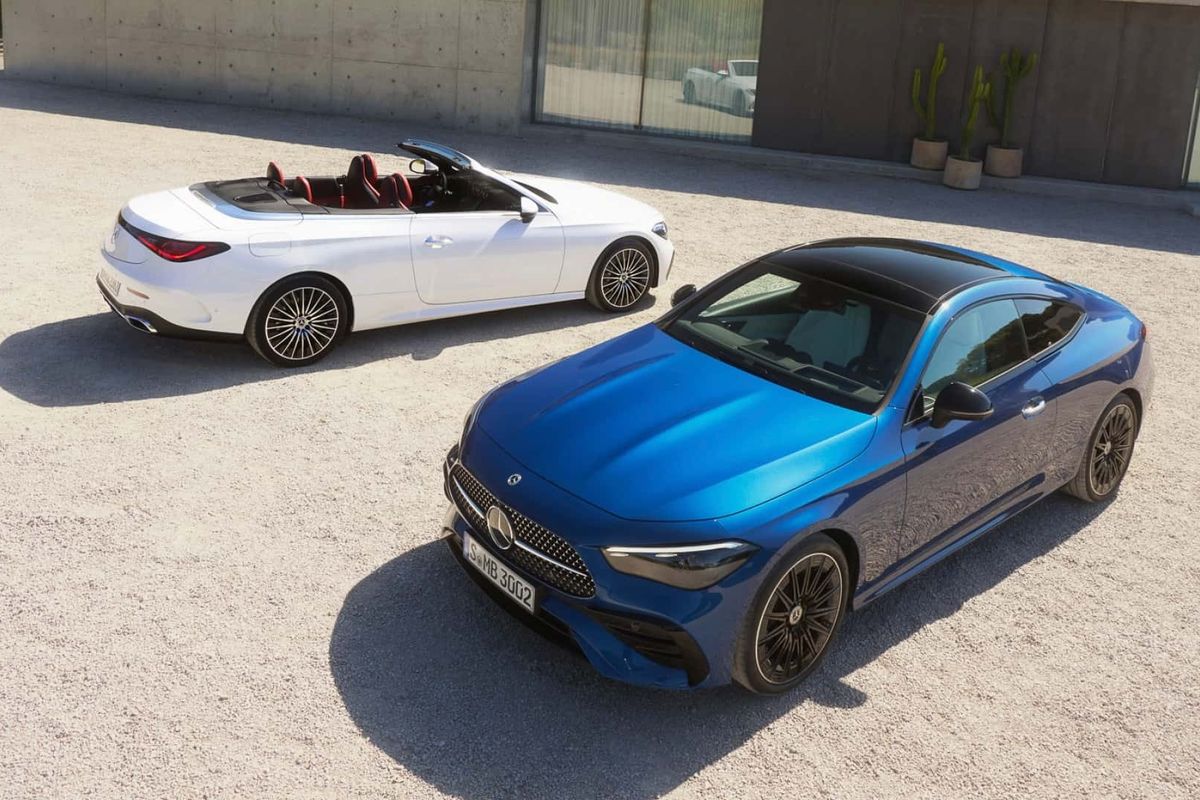
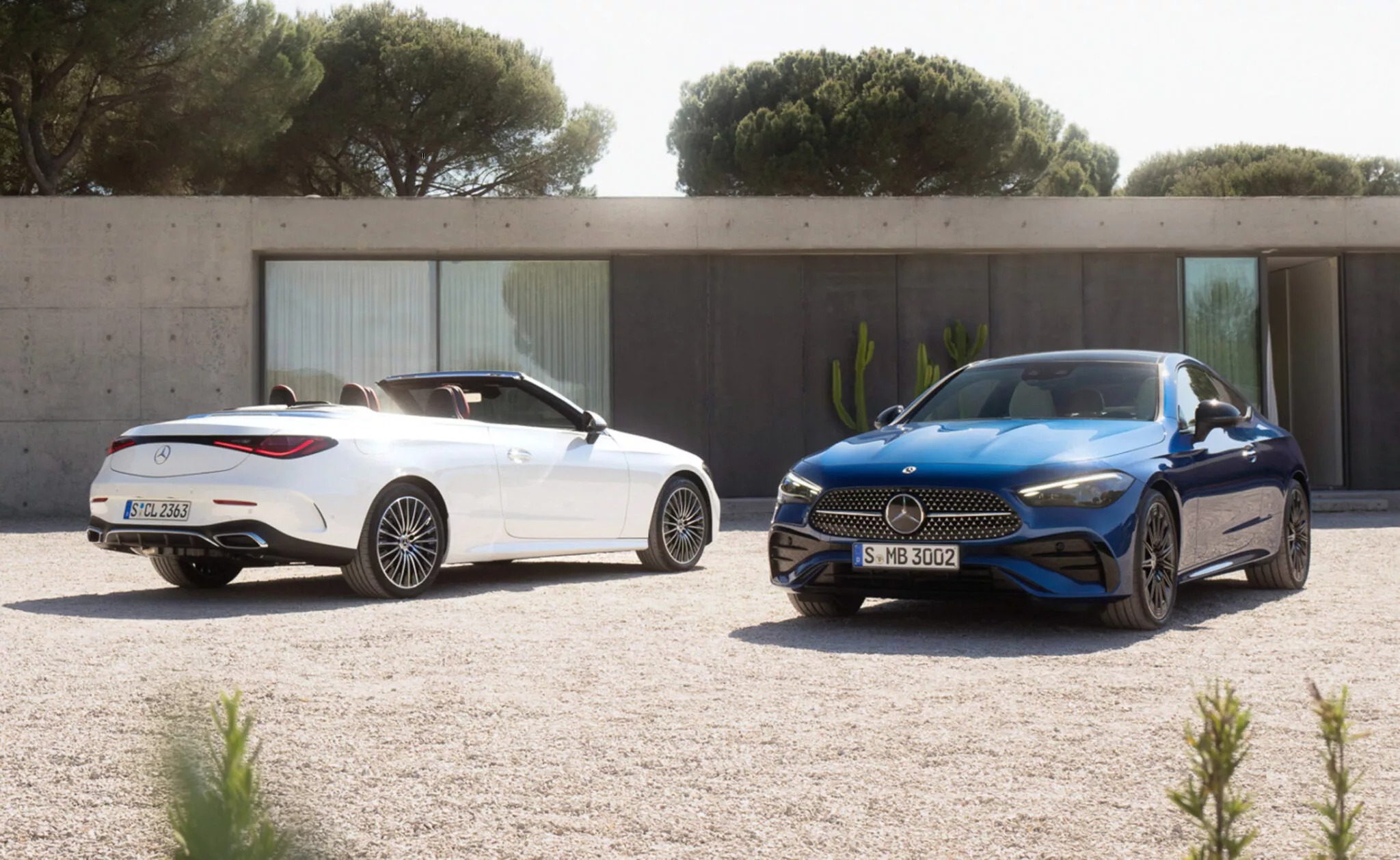
Mercedes-Benz has somewhat rationalised its coupe offering, waving goodbye to both the C-Class and E-Class Coupe and ushering in the Mercedes-Benz CLE Coupe which will be offered in both hardtop and cabriolet body styles.
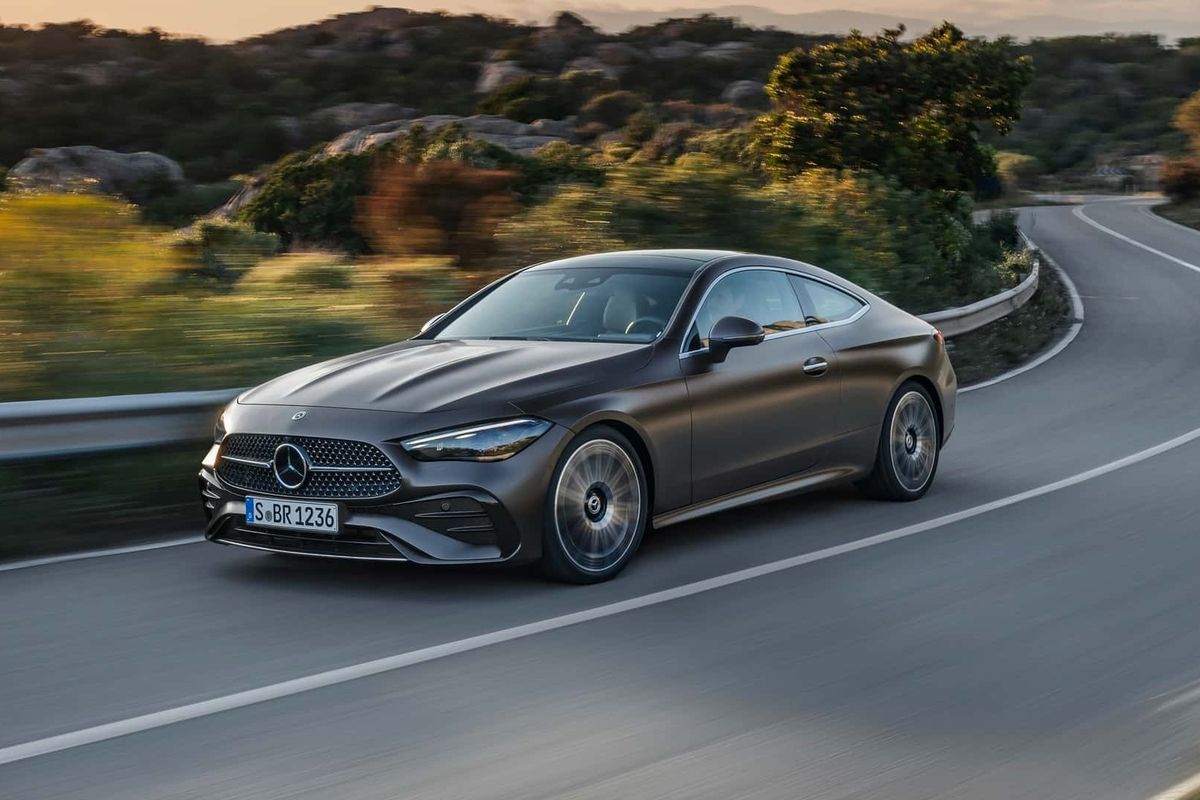
Hardtop or Cabriolet? Tough choices to be made with the new Mercedes-Benz CLE.
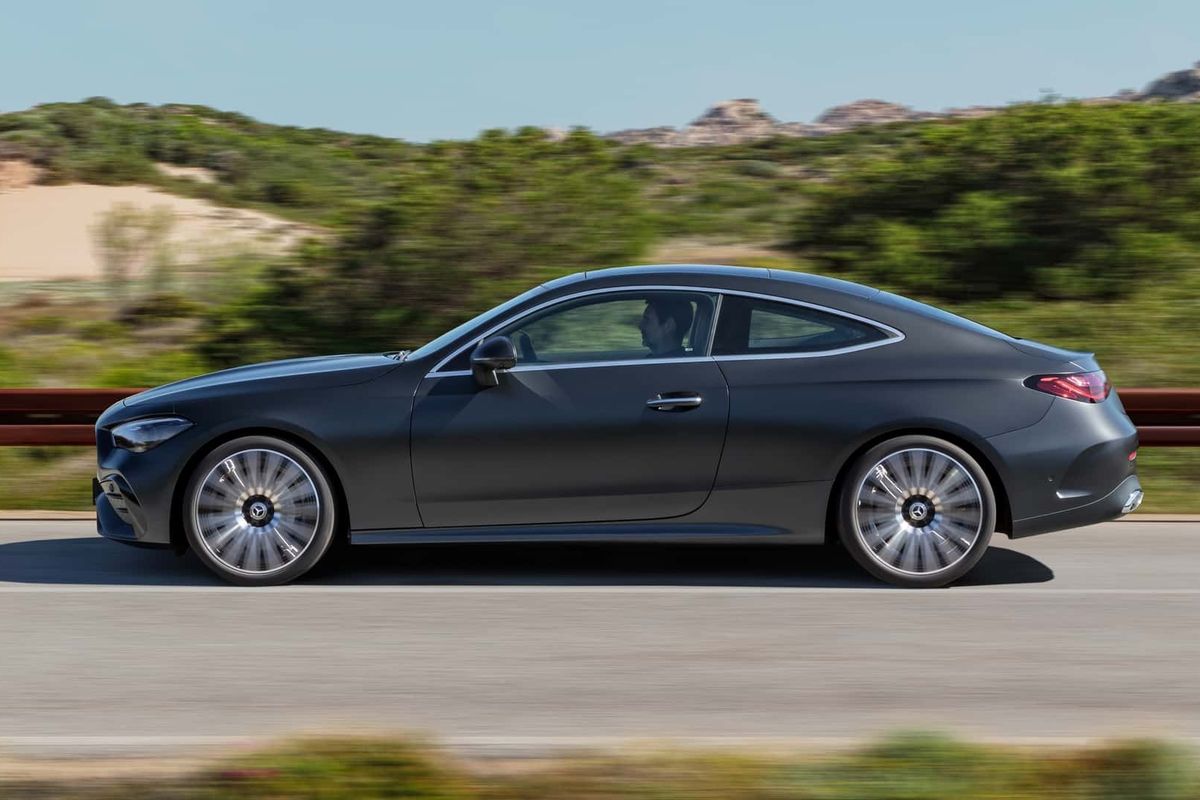
The new CLE Coupe stands 4 850 mm long, 1 860 mm wide, 1 428 mm high and adopts a longer wheelbase, 2 865 mm to be exact (25mm more than the new C-Class), resulting in a more spacious cabin with Mercedes-Benz claiming 72 mm more knee room, 10 mm improved headroom and 19mm better shoulder room. More so, the load bay is said to be 60 litres larger than the C-Class with up to 675 litres of space.
Stylistically, the CLE adopts somewhat familiar design cues such as a forward-leaning “shark nose”, a low-slung bonnet, flat LED headlights, 3D grille design and two-part LED tail lights. It’s worth knowing that the CLE sits some 15 mm lower than the C-Class and wheels sizes vary from 18 to 20 inches, depending on trim grade (either Avantgarde or AMG Line).
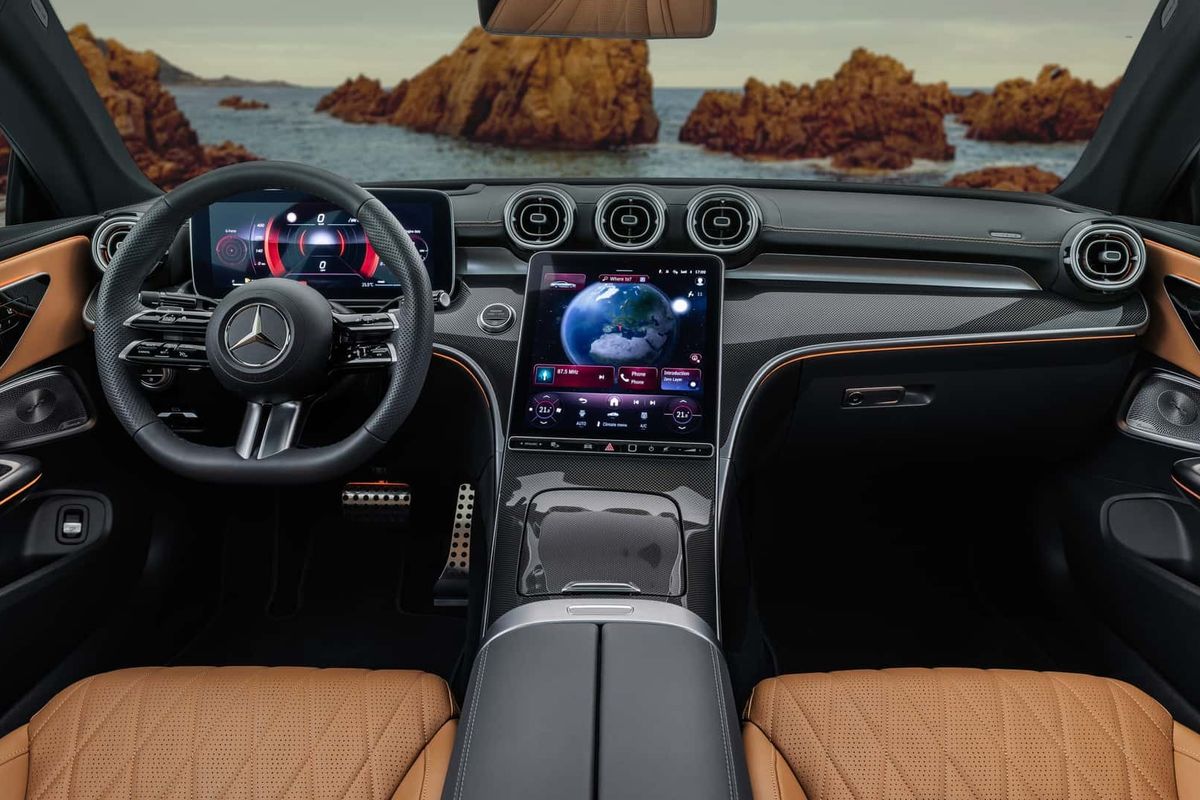
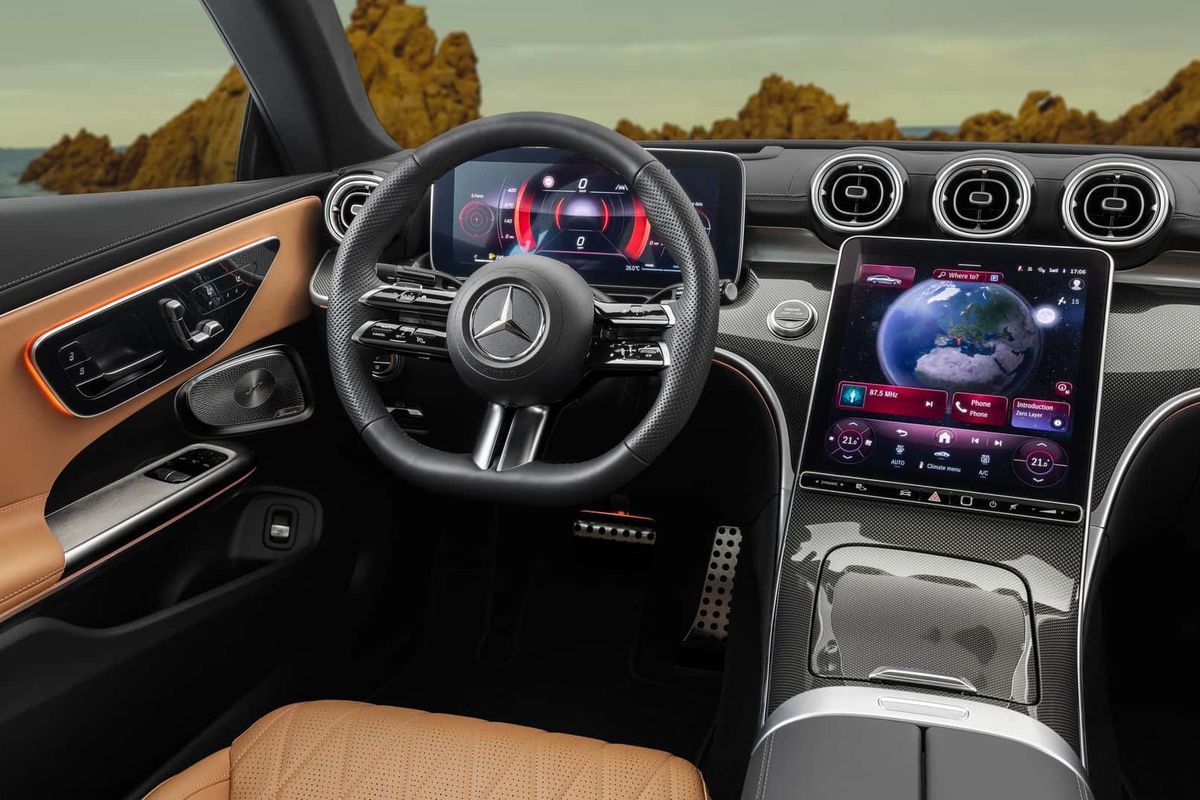
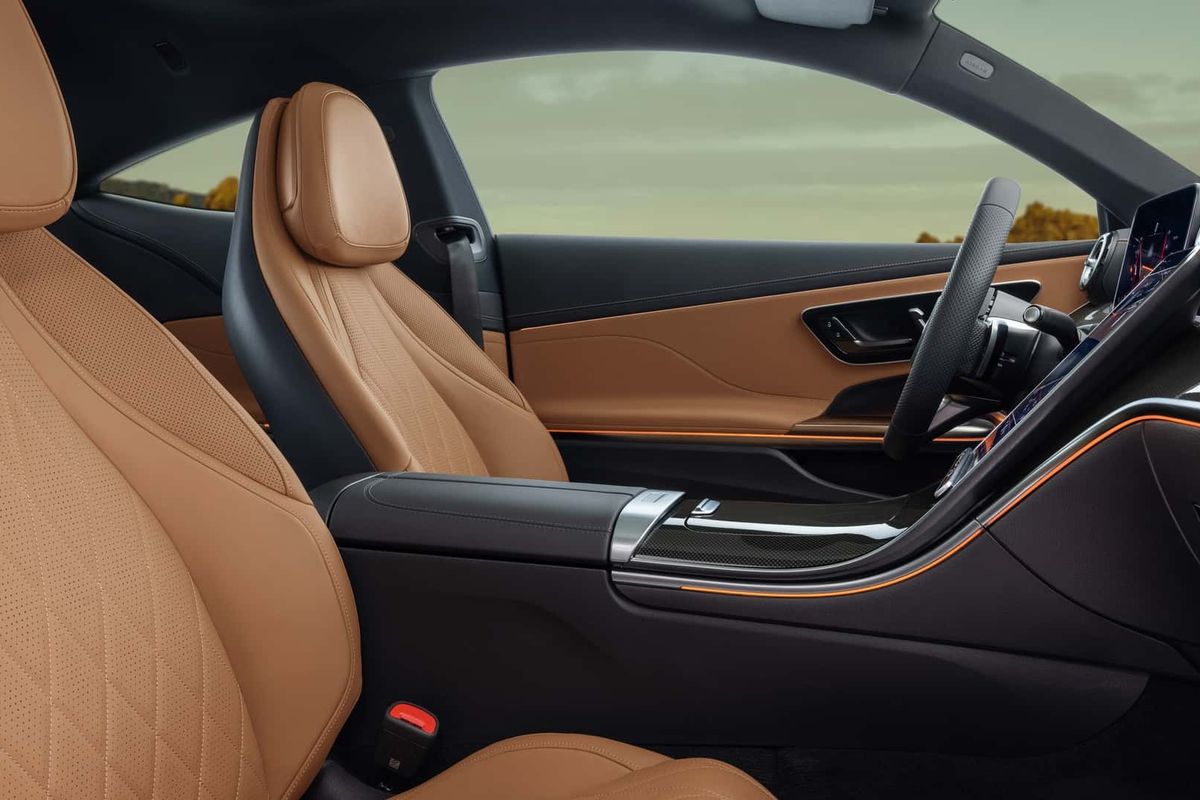
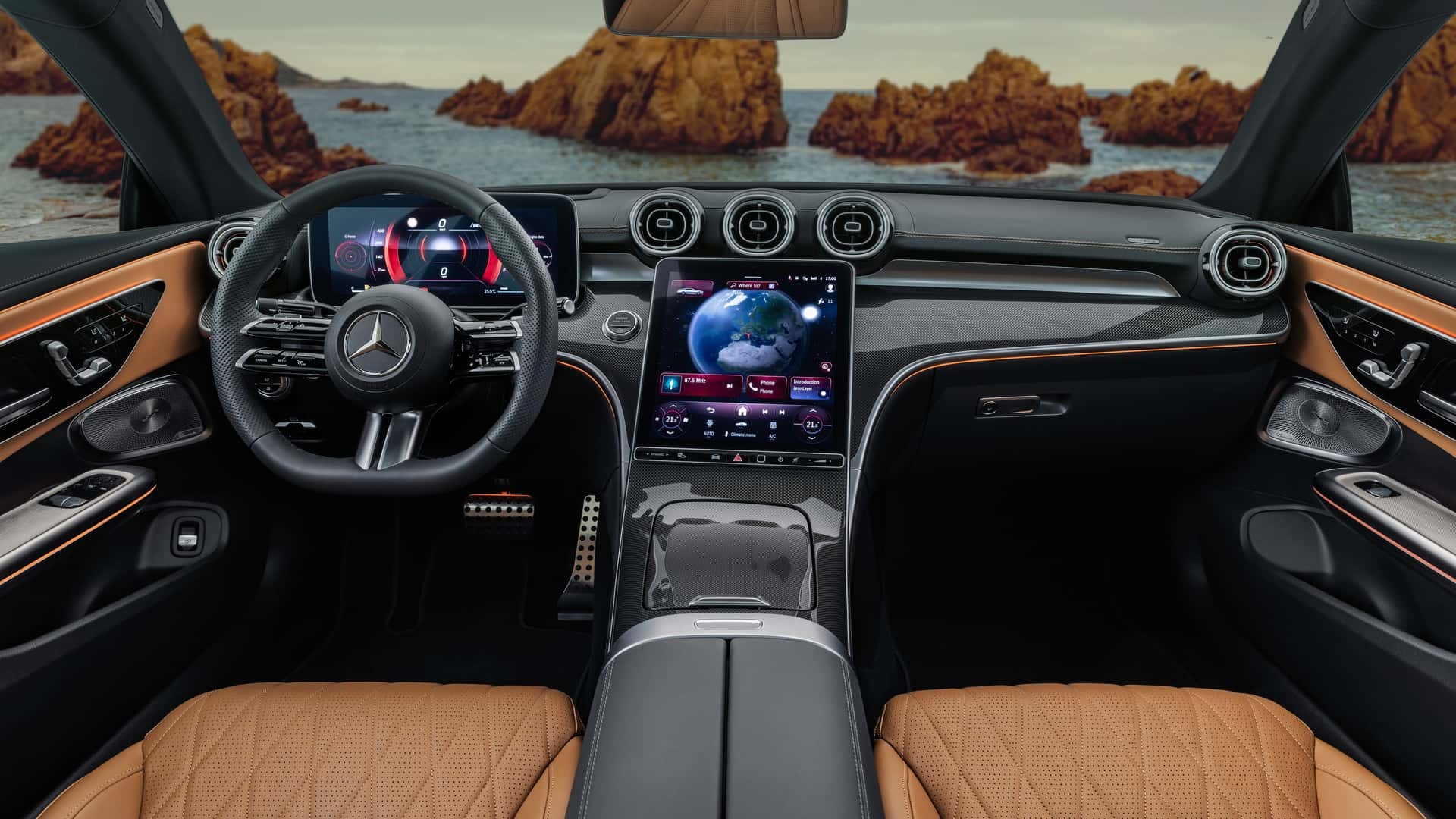
The CLE’s interior adopts technology from the E-Class.
As for the interior, highlights include a 12.3-inch digital instrument display, 11.9-inch infotainment display with Merc’s latest third-generation MBUX operating system and ambient interior lighting that offers up to 64 colours to choose from. The new CLE also gains specially-designed sporty front seats as well as a Burmester 3D surround sound system
What engines power the new Mercedes-Benz CLE?
Mild-hybrid powertrains are the order of the day with the new CLE.
Buyers will have a choice of mild-hybrid powertrains, incorporating an integrated starter generator and 48-volt electrical system combining with either a 4-cylinder 2.0-litre turbocharged petrol engine in the CLE 300 4Matic with 190 kW and 400 Nm of torque or a range-topping CLE 450 4MATIC with a twin-turbocharged 3.0-litre 6-cylinder engine which produces 280 kW and 500 Nm. The only diesel offering is the CLE 220d with a 2.0-litre turbodiesel engine producing 147 kW. All variants are paired with an optimised 9-speed automatic transmission. A CLE Plug-In Hybrid Electric Vehicle (PHEV) variant is also on the cards.
Merc’s Dynamic Body Control with continuously adjustable damping is optional in addition to rear axle steering as offered n the Technology Package.
When will the new Mercedes-Benz CLE come to South Africa?
At the time of writing, the local arrival of the new CLE has yet to be confirmed. However, Europe will receive the new CLE Coupe in November 2023 with the CLE Cabriolet following in 2024. Therefore, realistically, South African customers can expect the new CLE in South Africa sometime in 2024.
We will keep you updated as soon as we receive confirmation.
We compare the new Toyota Urban Cruiser to the Suzuki Grand Vitara. Same same, but different? Ashley Oldfield weighs up the pros and cons of each, with a definitive verdict.
The Toyota Urban Cruiser and Suzuki Grand Vitara are fundamentally identical, but in this video Ashley Oldfield takes you through the visual differences, trim levels and value offering.
We also assess the on-road driving differences between the manual gearbox and automatic transmission, and climb into the back to see just how much space there is.
If you’re wanting to buy a compact SUV that will be affordable to own and run, this is the video for you.
If you wish to crunch the numbers and do a spec-by-spec comparison, then we can answer that in our written comparison.
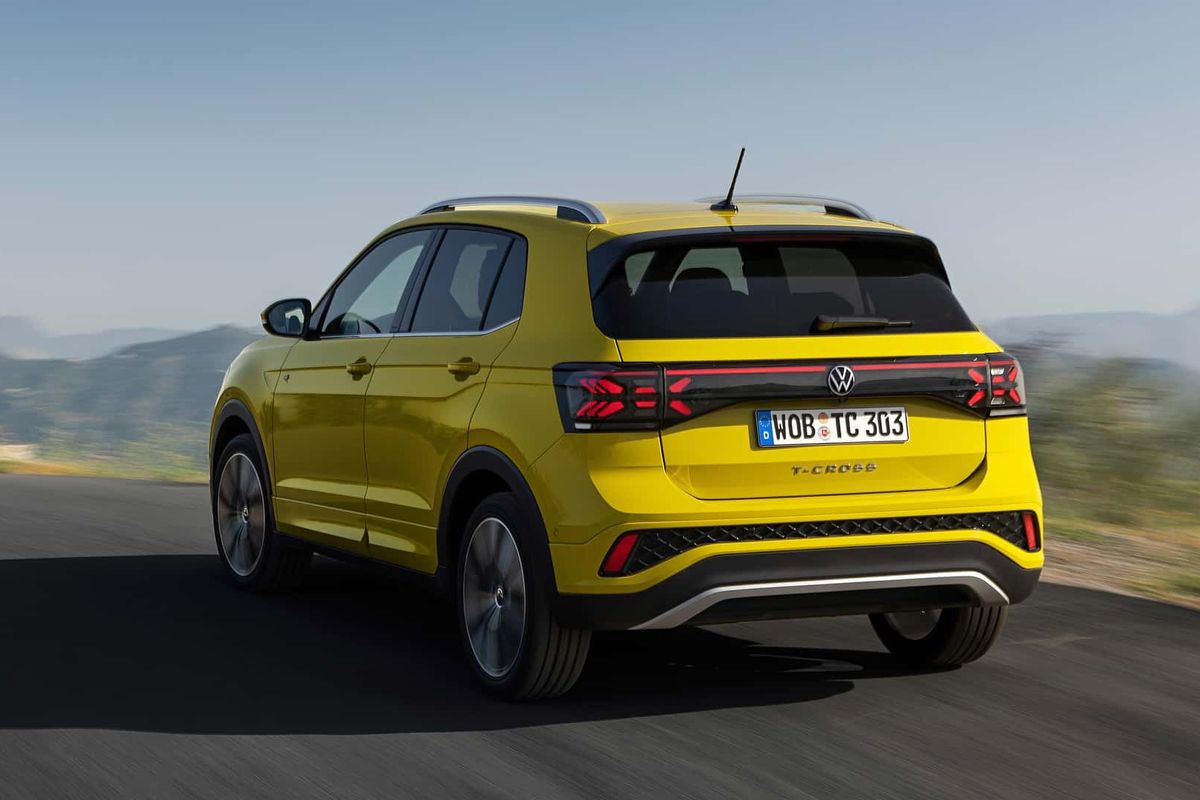
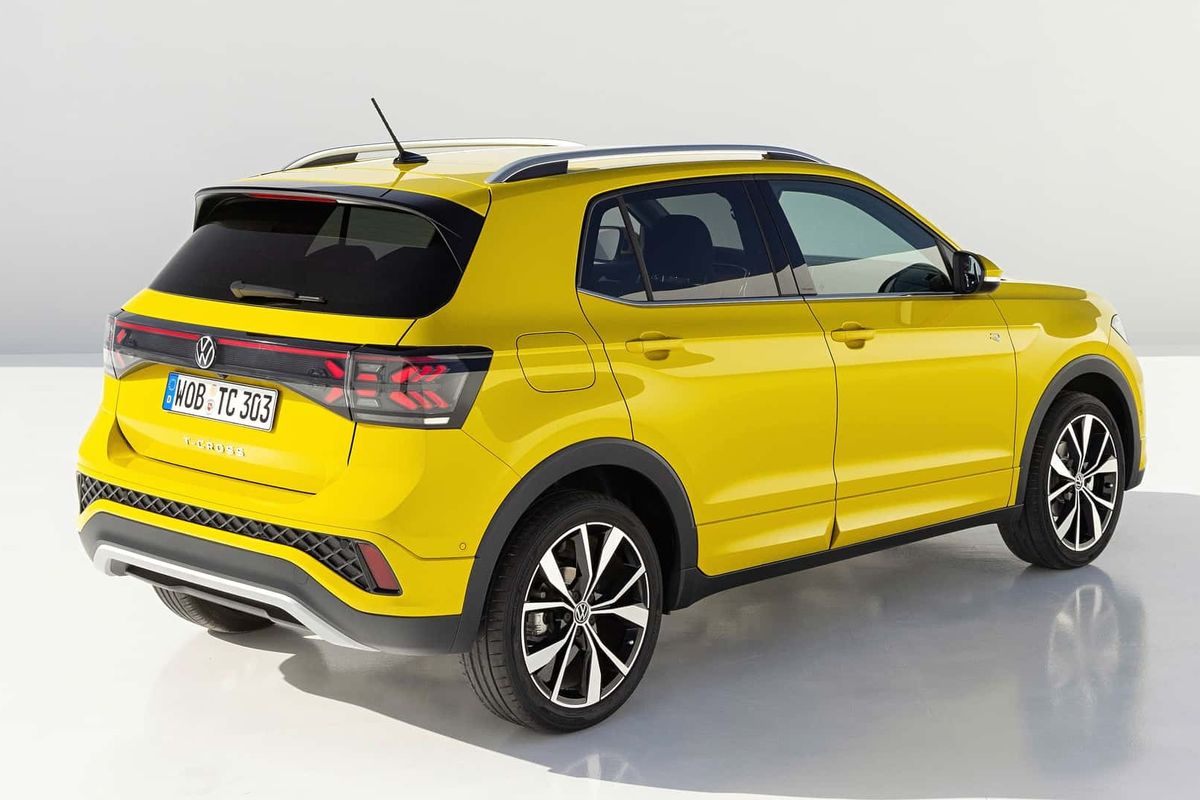
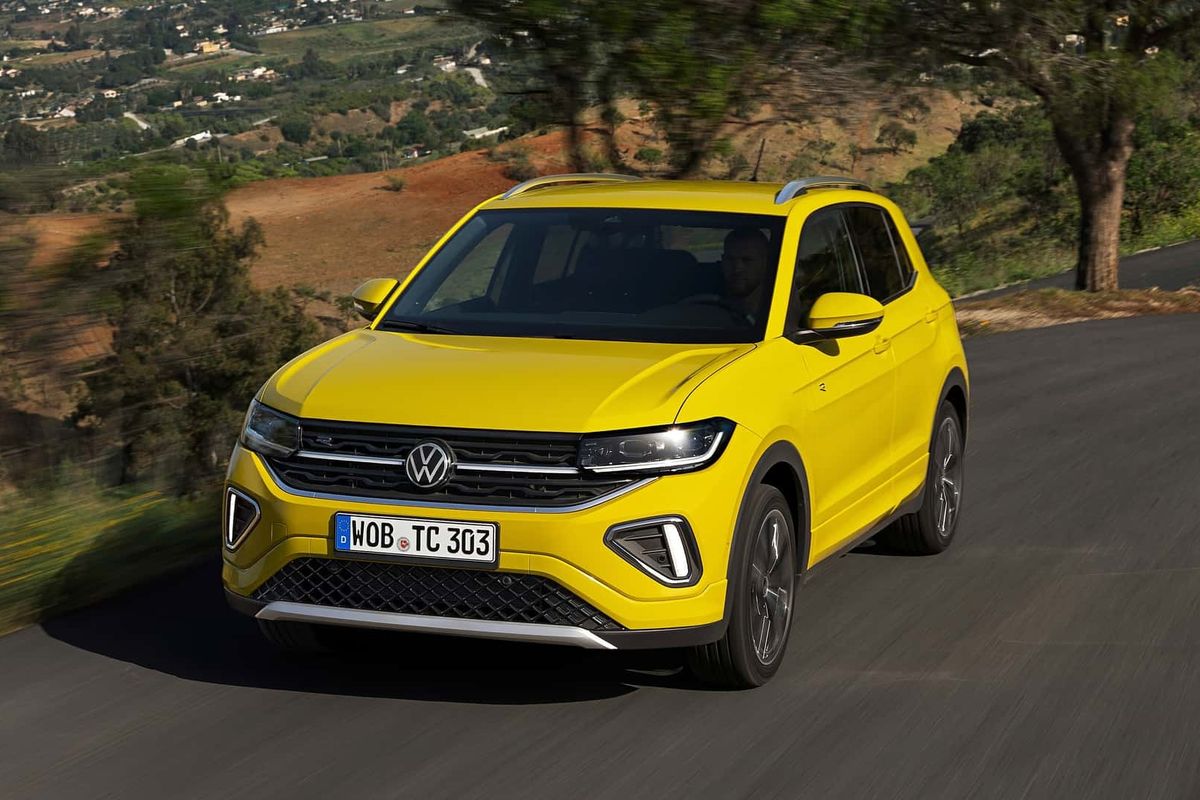
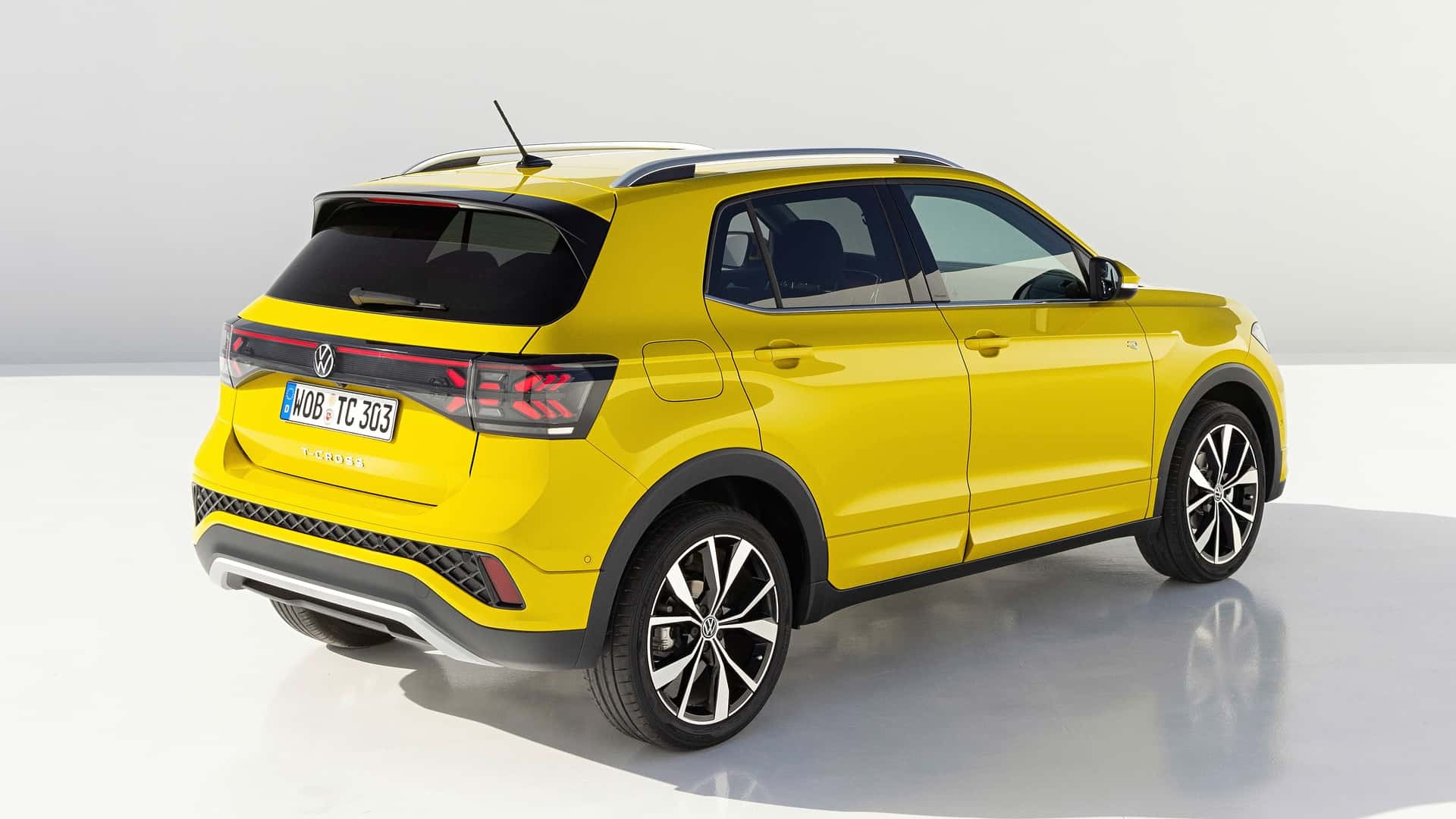
The popular baby SUV has been given an update. Here’s all you need to know about the 2024 Volkswagen T-Cross.
The T-Cross has been quite the success story for the Wolfsburg-based brand and as C-segment hatches decline in popularity, SUVs like the T-Cross and T-Roc are going from strength to strength. Globally, there have been over 1.2 million T-Cross units finding homes around the world since its debut four years ago.
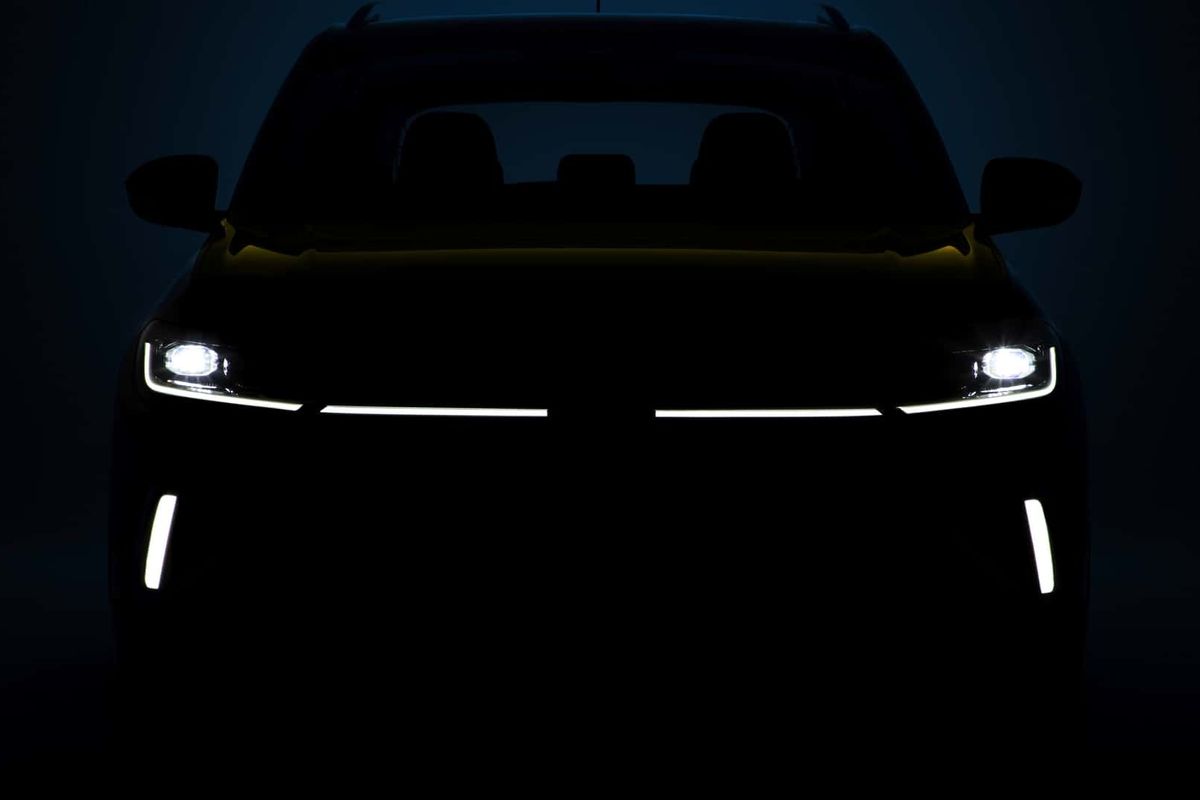
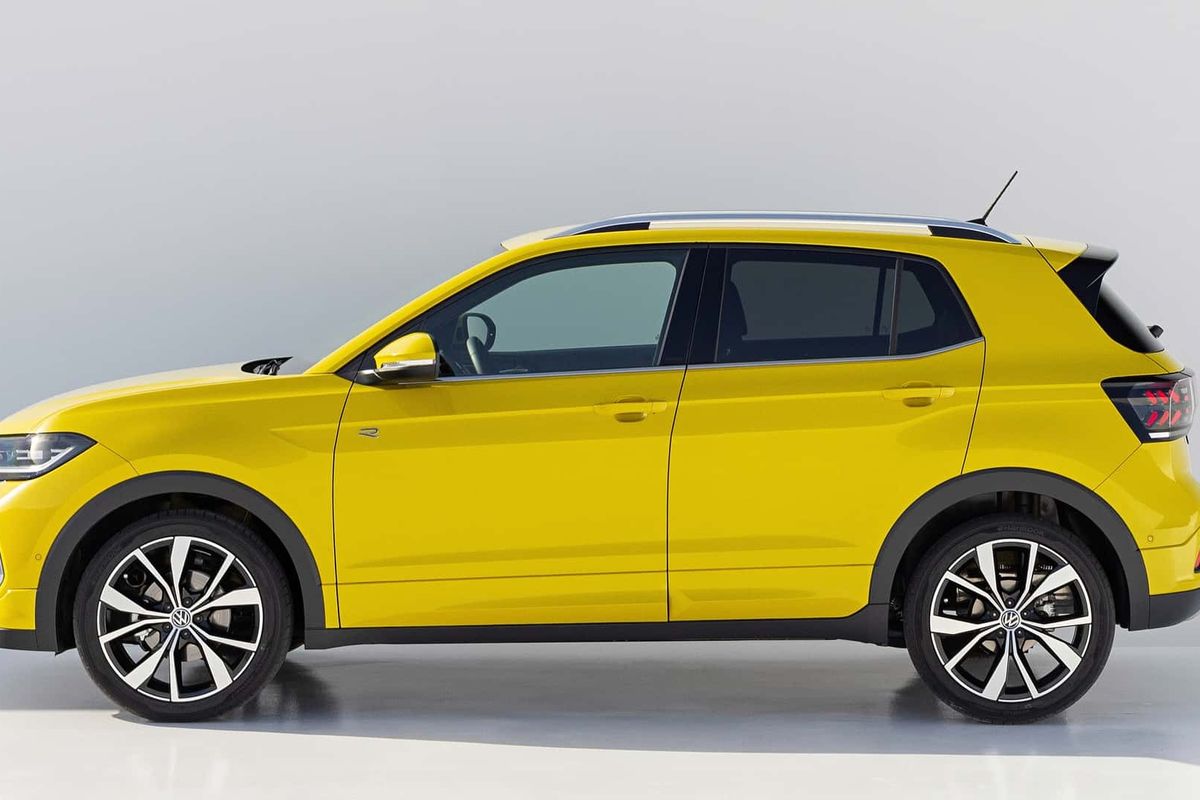
What you see here is the 2024 Volkswagen T-Cross which has just been announced. This is the R-Line trim level, which will sit at the top of the range. There are new colours on offer, but the real changes can be found in the design. The lighting structure has been overhauled with LED headlights and Matrix LED headlights (depending on trim level) and the front gets the trendy light bar.
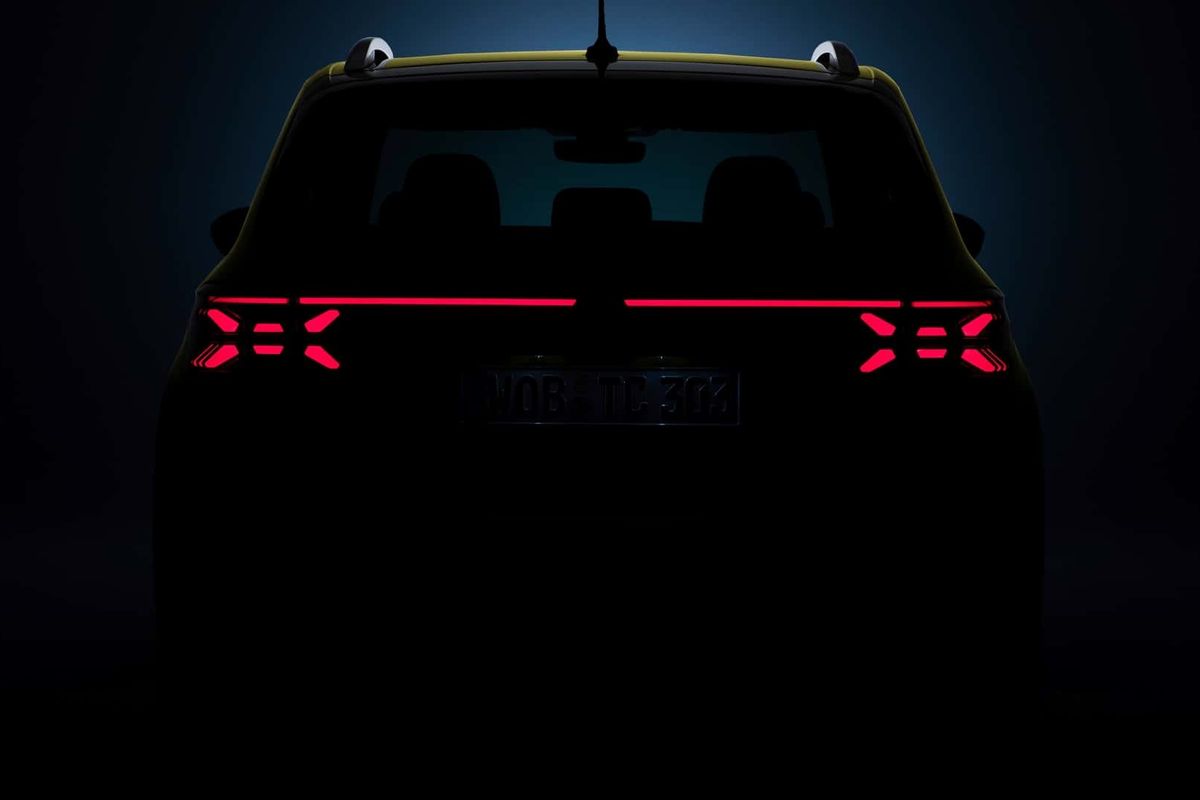
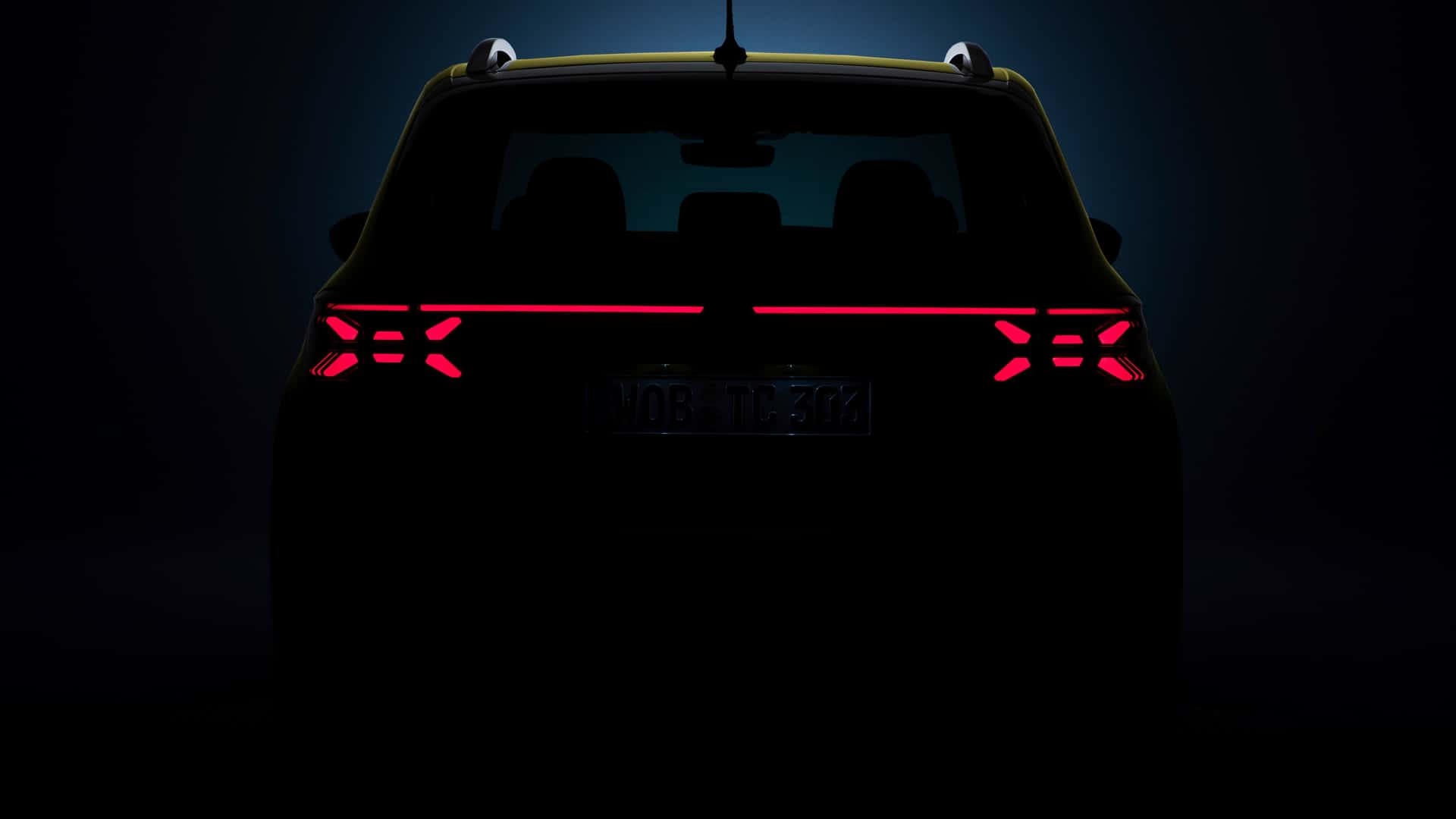
The rear gains some cool-looking LED tail lamps in an X pattern and there’s an LED lightbar linking them. Customers will be able to choose from 16-inch wheels for the base, while the top-spec models get 17-inch units.
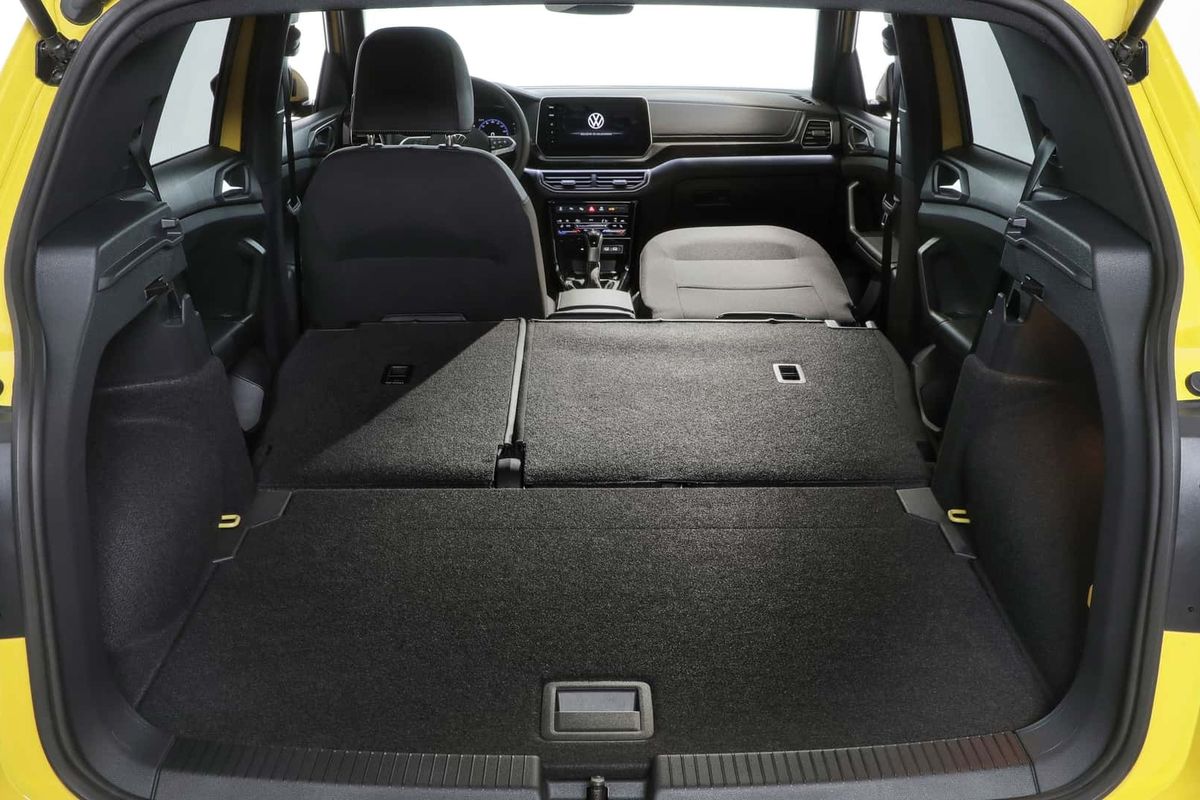
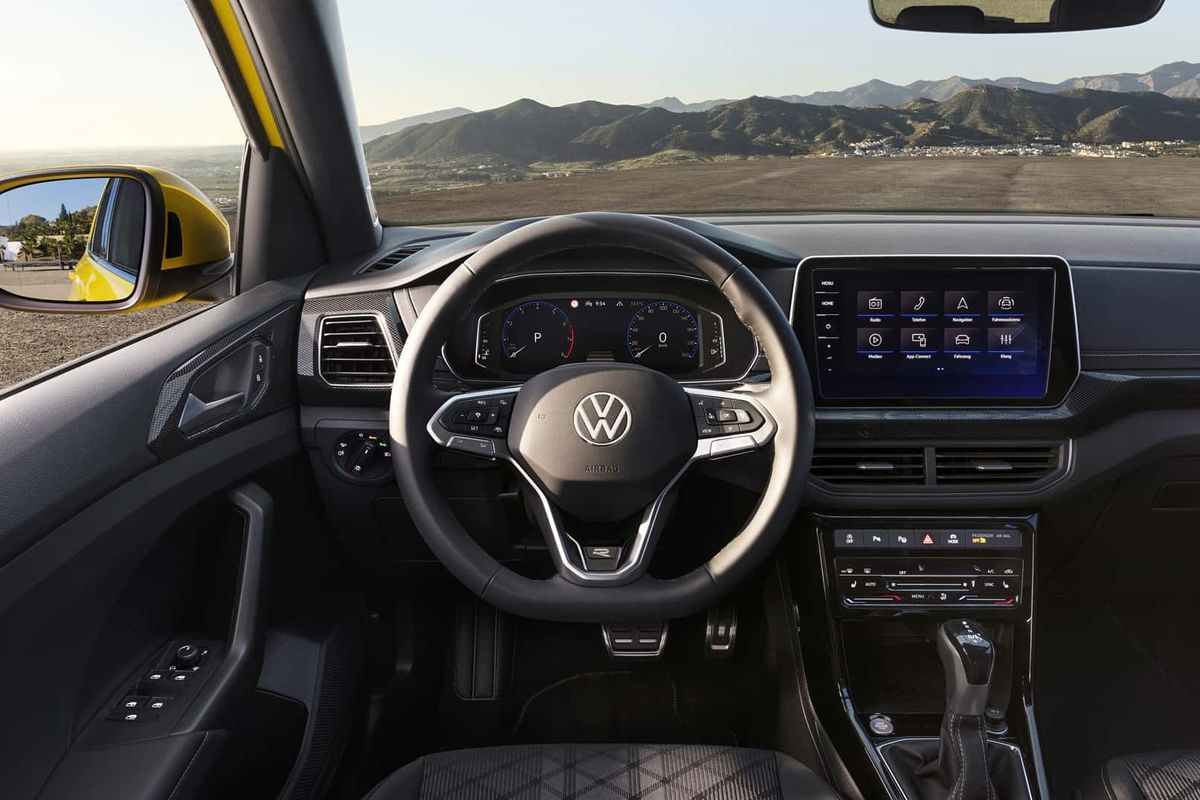
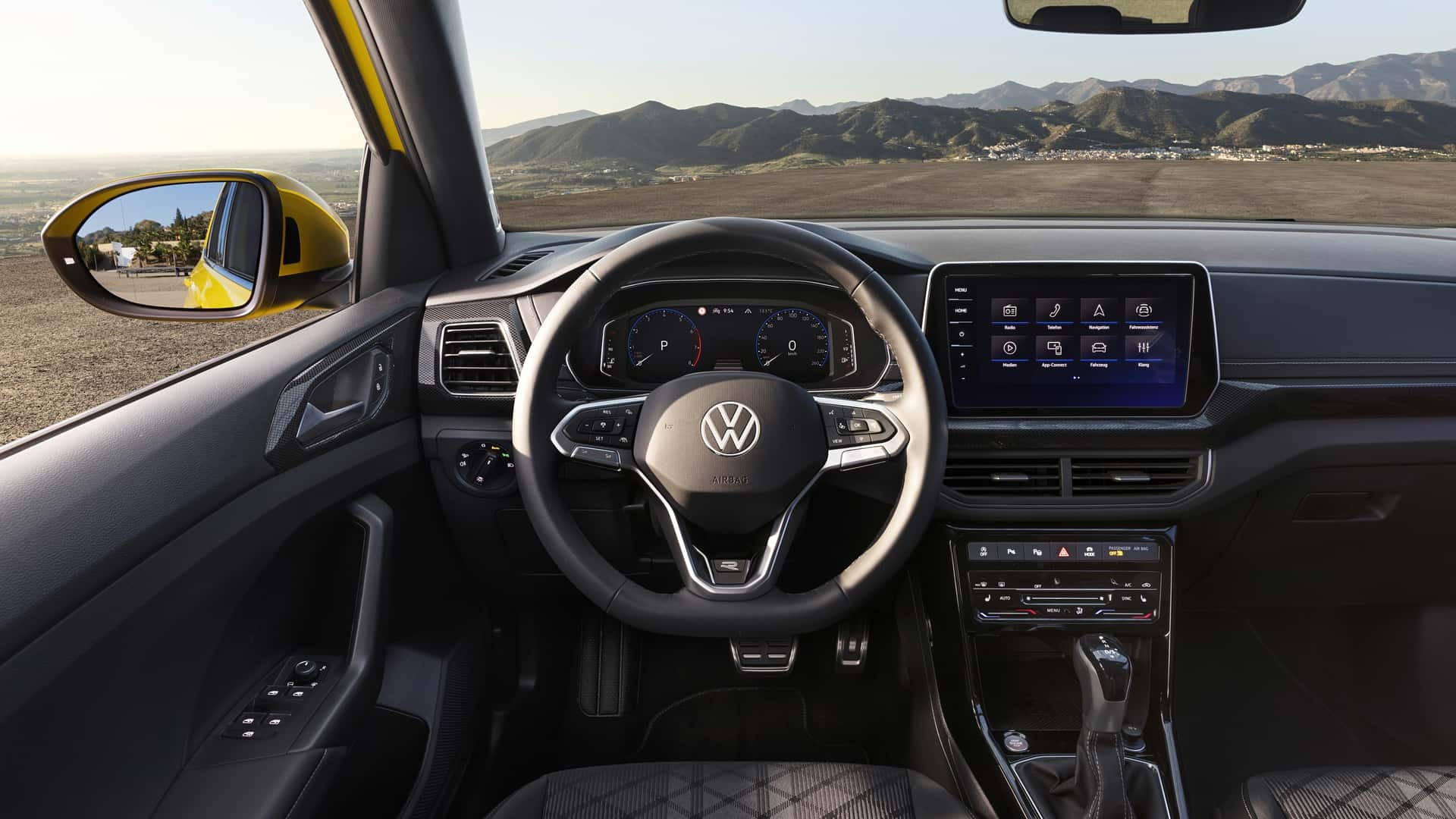
Inside, the 2024 Volkswagen T-Cross features a digital instrument cluster across the range, although entry-level models get an 8-inch unit, while 10-inch units are for the higher spec levels. The central screen has grown in size, with an 8-inch unit for the entry level modes and 9.2-inches for the premium offerings.
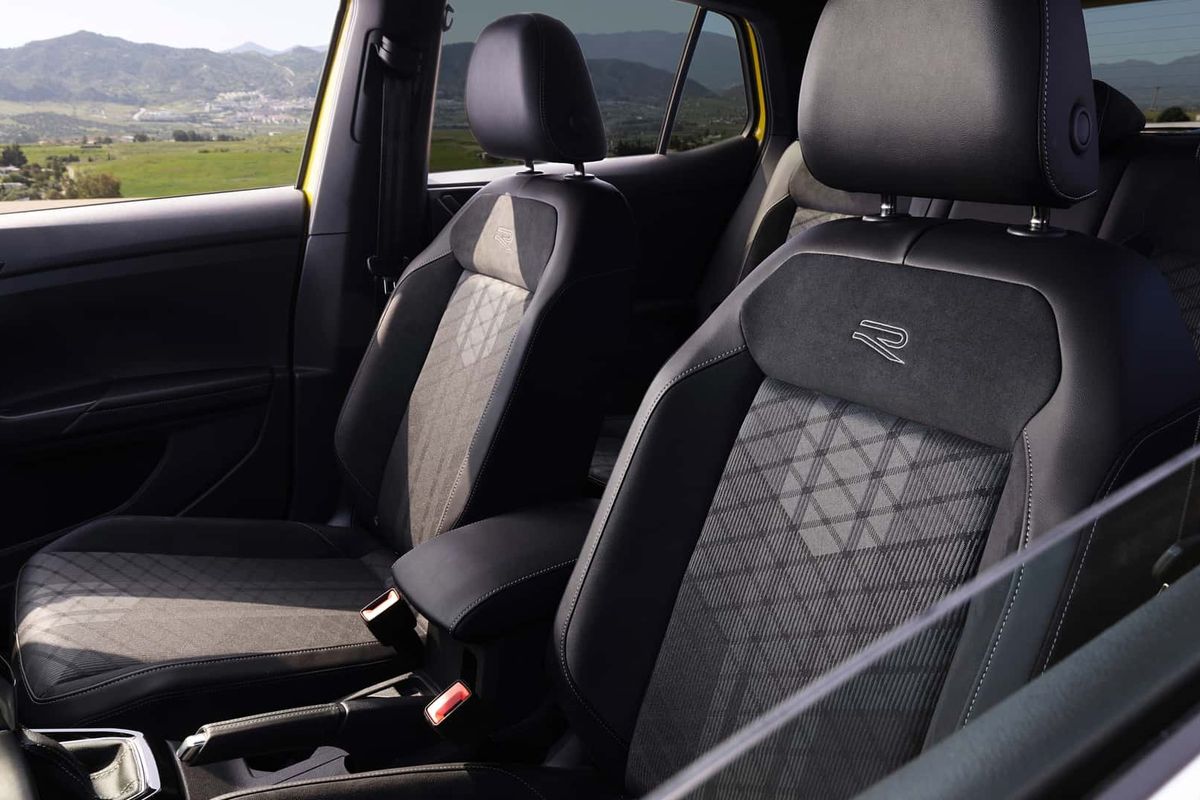
This new screen has been repositioned for better ergonomics and features Volkswagen’s latest hardware and software. There have also been claims of improvements to the cabin quality, with Volkswagen adding softer padding to the dashboard.
The engine lineup is mostly carried over, with the 1.0-litre 3-cylinder turbocharged petrol available in two states of tune (70 kW and 85 kW), and customers can choose from a 5-speed / 6-speed manual gearbox or a 7-speed dual-clutch transmission. The 1.5-litre 4-cylinder turbocharged petrol continues to be offered exclusively with the DSG.
2024 Volkswagen T-Cross Availability?
Volkswagen Europe says it will start accepting orders for the updated model in Autumn of 2023, with the first deliveries heading to customers in the first quarter of 2024. Volkswagen South Africa has confirmed that the updated T-Cross will go on sale in SA in 2024.
South Africa’s 15 best-selling passenger vehicles in H1 2023
The first half of 2023 has come and gone! Let’s take a look at year-to-date sales figures and identify the big winners on South Africa’s new passenger-vehicle market…
In the first half of 2023, South Africa’s new passenger-vehicle market saw year-on-year growth of 4.8%, despite facing a number of headwinds. Out of an industry total of 265 824 units, as many as 173 493 new passenger vehicles were registered locally in H1 2023 (this, though, represents a 1.3% decline compared to the same period in 2022). So, which models were the top performers?
Well, we’ve painstakingly sorted through the year-to-date sales figures and identified South Africa’s 15 best-selling passenger vehicles in H1 2023. For the record, Toyota boasts 4 models in the top 15 (and 3 in the top 5), while Volkswagen took 3 spots, with Suzuki and Renault grabbing 2 apiece. As many as 5 models on the list were locally produced, while 7 were manufactured in India. Let’s take a closer look at the statistics…
Toyota Corolla Cross keeps VW Polo Vivo in 2nd place
At the halfway point of 2023, the Prospecton-produced Toyota Corolla Cross – which placed 4th in 2022, a year in which production was halted for around 3 months thanks to the KwaZulu-Natal floods – was leading the pack, with a whopping 10 604 registrations (or a monthly average of 1 767 units). Its best month came in June 2022, when 2 115 units were sold.
That saw the Kariega-built Volkswagen Polo Vivo pushed into 2nd place, though at 9 936 registrations it was just 668 units behind the Corolla-badged crossover. As a reminder, the prolonged-lifecycle Polo Vivo was SA’s strongest-selling passenger car in 2022, when 20 866 units were registered.
Fascinatingly, the Toyota Starlet (8 355 units) – which is manufactured by Maruti Suzuki – grabbed the final position on the passenger-vehicle podium, while also securing the H1 2023 title of best-selling imported car.
The likewise Indian-built Suzuki Swift wasn’t far behind on 8 193 units and thus placed 4th, while the Toyota Fortuner (5 995 units) secured a strong 5th. Recently updated, the Prospecton-manufactured Fortuner was the highest-placed full-sized SUV, bouncing back from a somewhat disappointing (by its lofty sales standards, anyway) 2022.
Volkswagen Polo hatch slips while Chinese vehicles climb
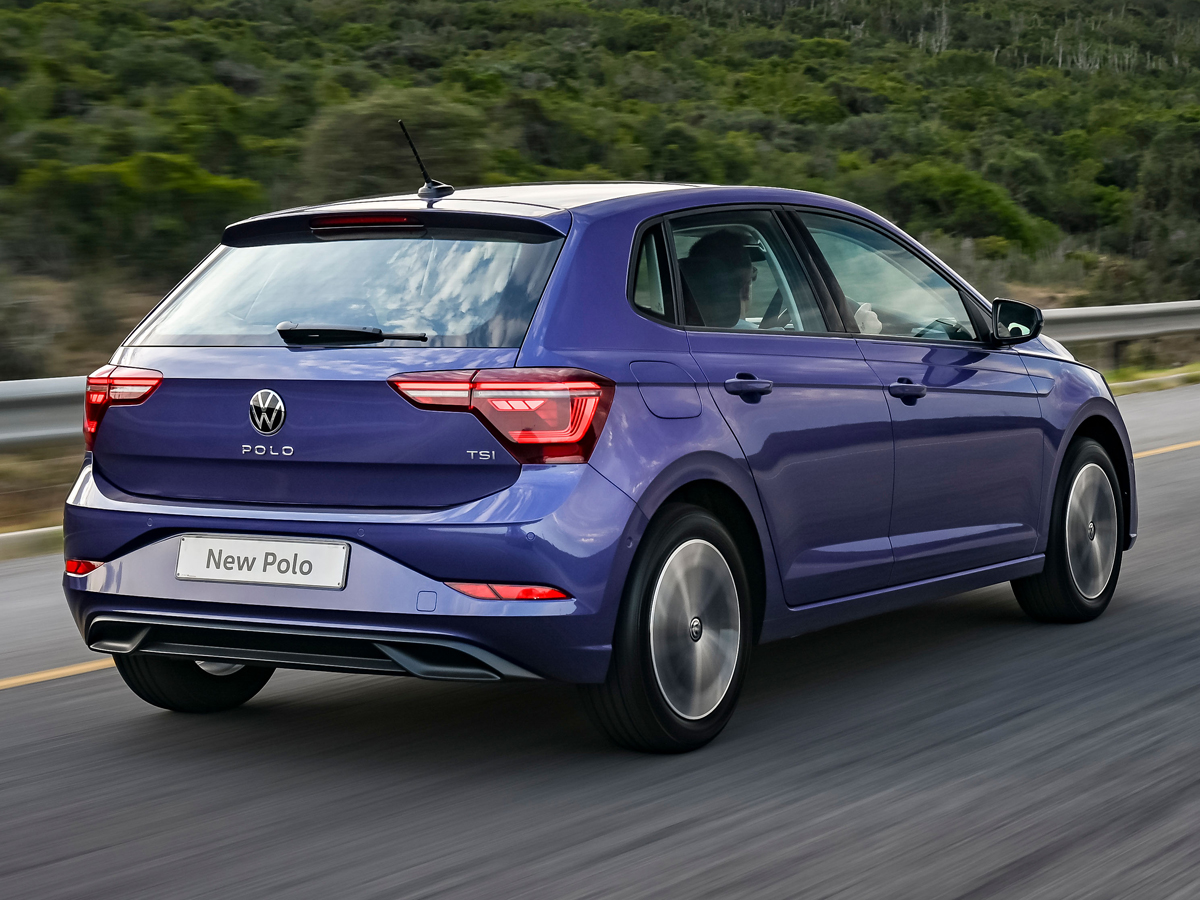
Yes, the Volkswagen Polo hatchback tumbled from the top 5, finishing the opening half of 2023 in 6th position, with 5 650 examples sold in South Africa (a monthly average of 942 units). As a reminder, in 2022, the German hatch placed 5th with 15 697 units registered, a figure it looks exceedingly unlikely to match this year.
While it’s not clear exactly what has caused the Polo’s sustained drop-off in popularity – we have considered various possible factors before, of course – we understand the VW Group’s Kariega facility continues to struggle with production stoppages. The numbers furthermore suggest the German firm has opted to prioritise the export market over the local market. Naturally, we’ll monitor sales for the remainder of the year and see whether we can glean any further insights.
The Hyundai Grand i10 hatchback (4 963 units, not including the Cargo-based light-commercial version) – which will soon be replaced by a facelifted version, complete with the option of a sedan body style – finished H1 2023 in 7th (up from 10th in Q1 2023), while the Chery Tiggo 4 Pro (4 954 units) was the highest-ranked Chinese car, finishing in 8th and narrowly beating the 9th-placed Haval Jolion (4 785 units).
The Spanish-built Volkswagen T-Cross completed the top 10, with 4 149 units registered in South Africa in the reporting period. After a strong start in the opening quarter (in which 2 613 examples were sold), T-Cross sales tapered off somewhat, with 1 536 units reported in the 2nd quarter.
Indian-made budget cars (and SA-built Quest) complete top 15
The Renault Kiger was the French firm’s highest-placed model (though it is, of course, manufactured in India), finishing H1 2023 in 11th with 4 053 units sold. The closely related Nissan Magnite (3 890 units) wasn’t far off the pace in 12th.
Another Indian-produced budget car in the form of the Suzuki Baleno – which is, of course, the vehicle on which the 3rd-placed Starlet is based – took 13th spot, with 3 449 units (or around 41% of its cousin’s effort) sold. The prolonged-lifecycle Toyota Corolla Quest ended the reporting period on 3 152 units, which was enough to see the KZN-built model secure 14th and rank as the highest-placed sedan.
The final place on the list went to the Renault Triber (3 034 units), yet another model sourced from India. Interestingly, the Triber was the only MPV to crack the top 15 as well as the 2nd 7-seater vehicle, behind the Fortuner.
A pair of Kia models and the Urban Cruiser bubbling under
So, what about the passenger vehicles that fell just short of making the top 15? Well, the Renault Kwid (3 004 units) found itself in 16th place on the list of SA’s best-selling passenger vehicles for the opening half of the year.
Fascinatingly, the Toyota Urban Cruiser (2 905 units) – which ranked 3rd with a whopping 16 992 units in 2022 – had to settle for comparatively lowly 17th in H1 2023. Of course, the switchover to a new, larger generation took place in April 2023, a month in which local sales dipped to just 317 units. However, that wasn’t the Urban Cruiser’s most modest monthly tally, which instead came in June 2023 with 281 units.
The Kia Sonet (2 902 units) ended the reporting period in 18th, ahead of the Haval H6 (2 633 units) in 19th and Kia Picanto (2 604 units) in 20th. The Hyundai i20 (2 515 units), Suzuki S-Presso (2 488 units), Hyundai Venue (2 312 units), Suzuki Ertiga (2 143 units) and Toyota Rumion (2 042 units) – each imported from India, easily the top country of origin for SA – occupied the next 5 spots.
South Africa’s best-selling passenger vehicles in H1 2023
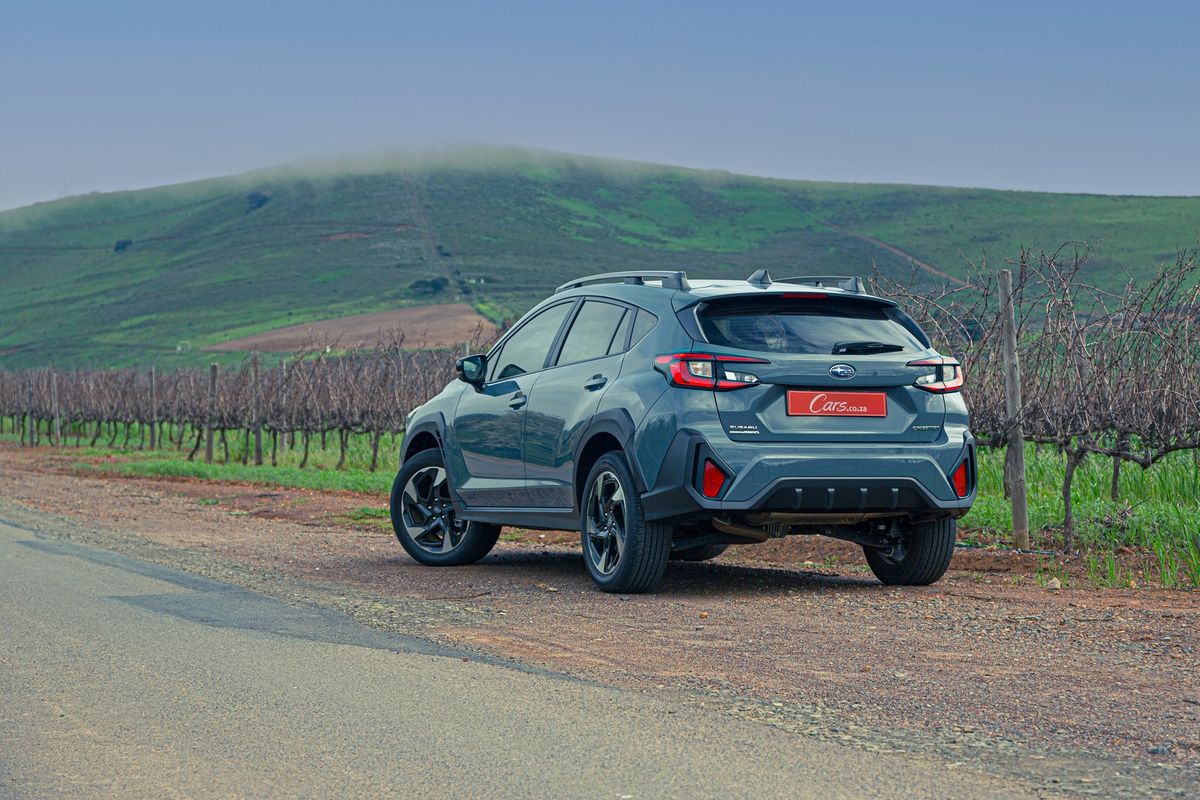
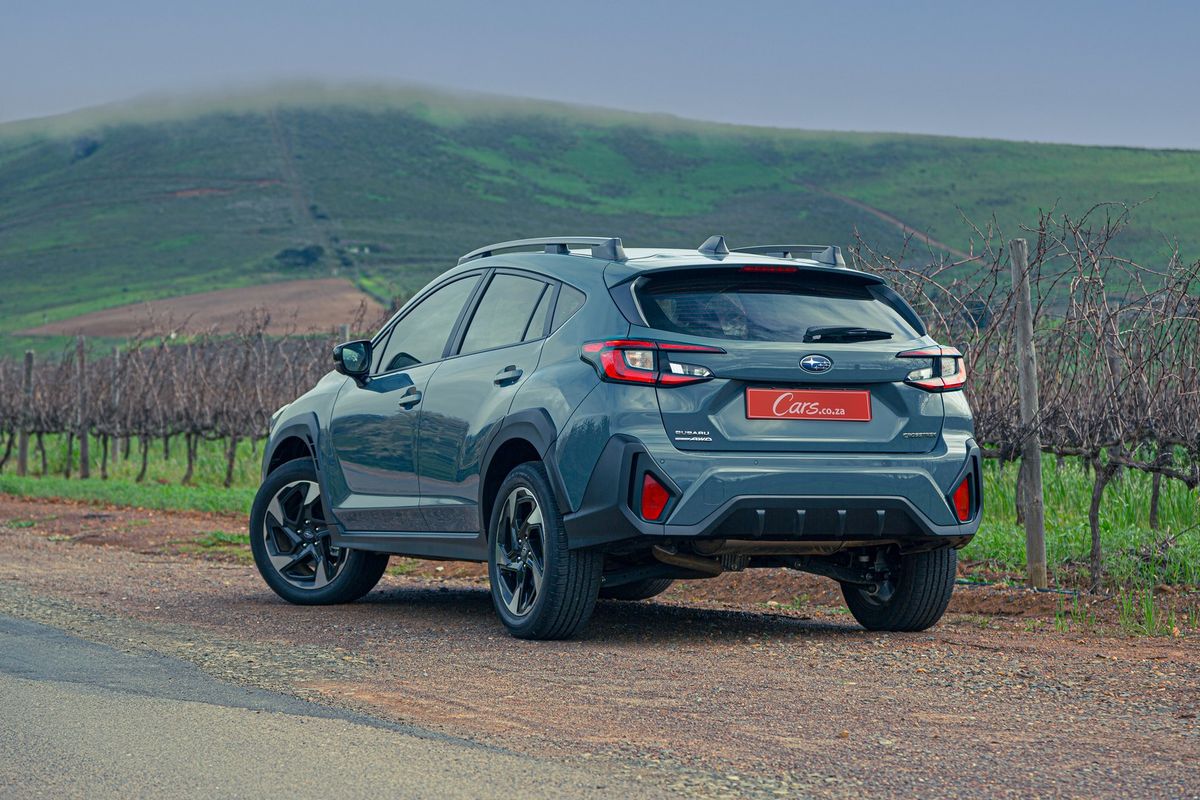
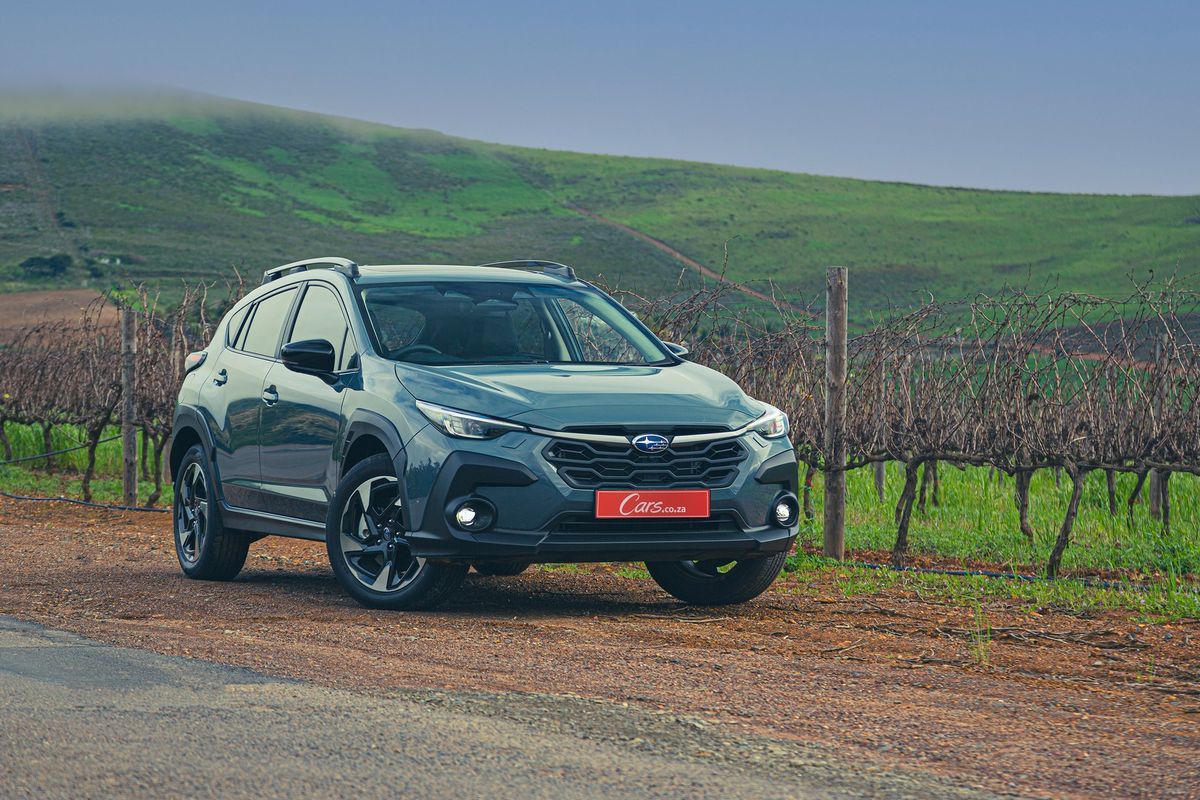
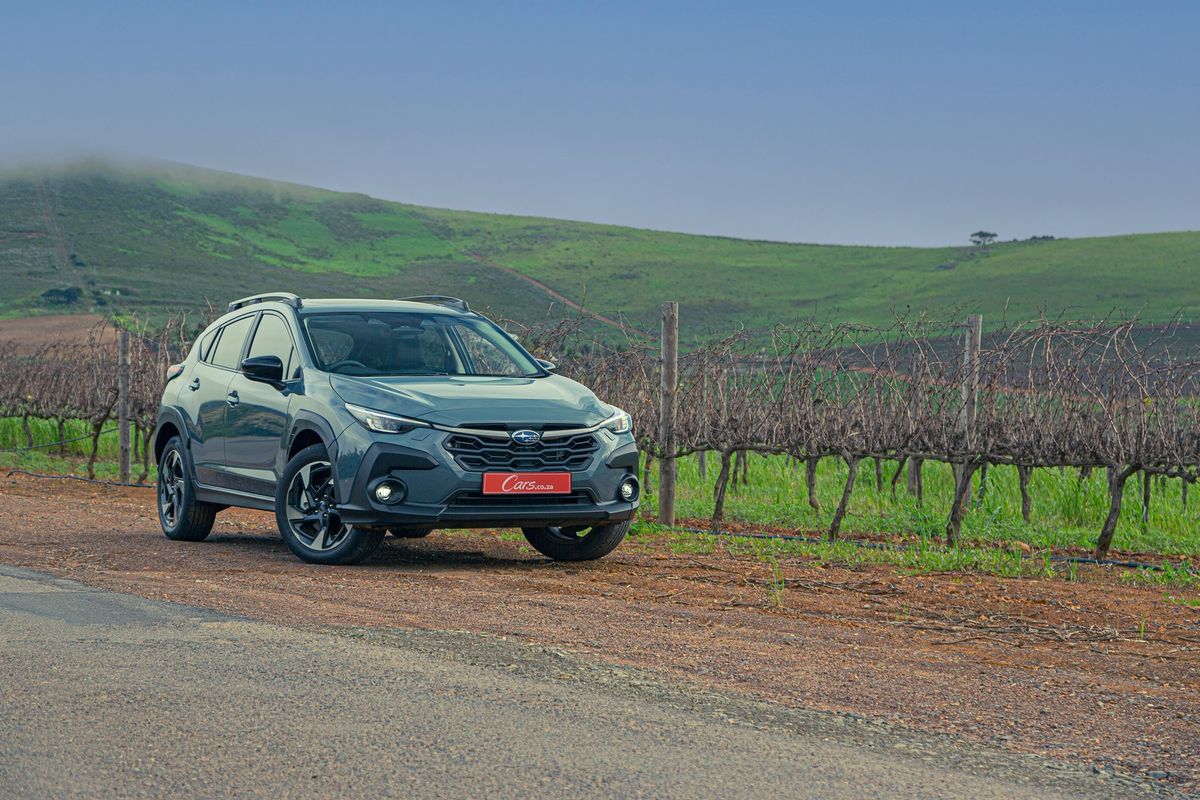
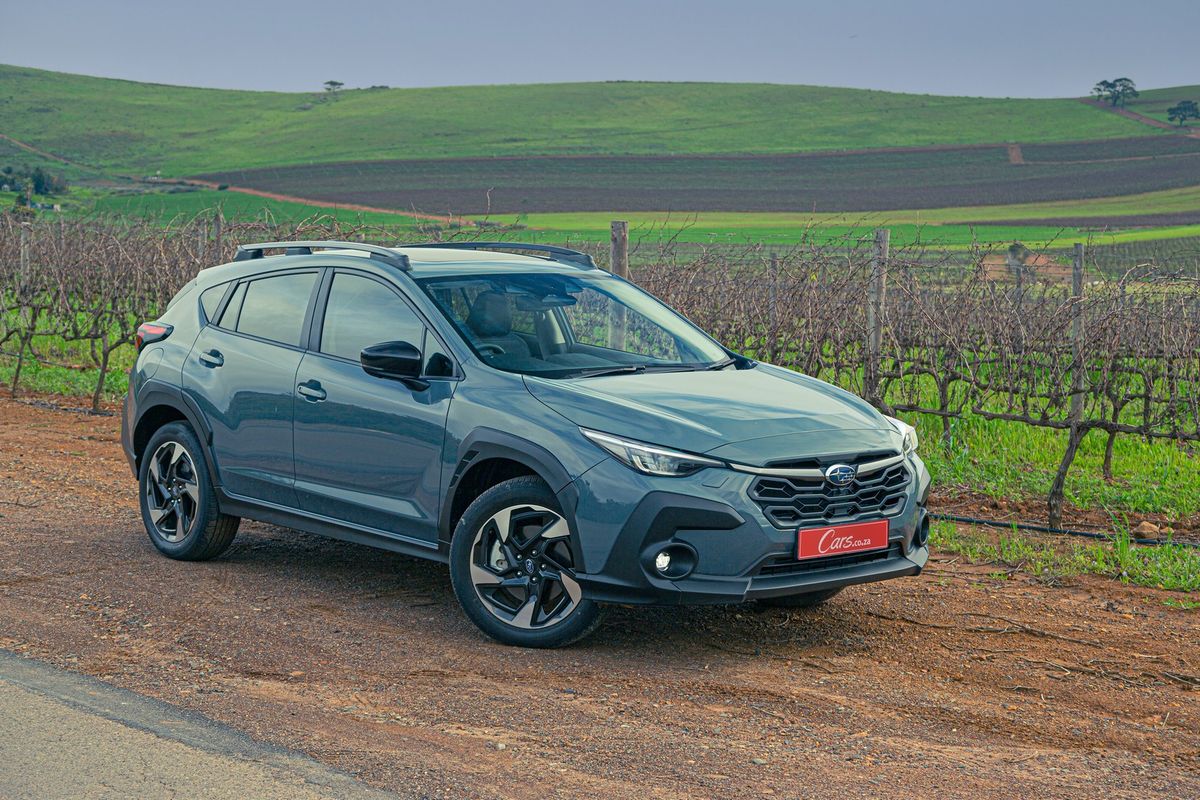
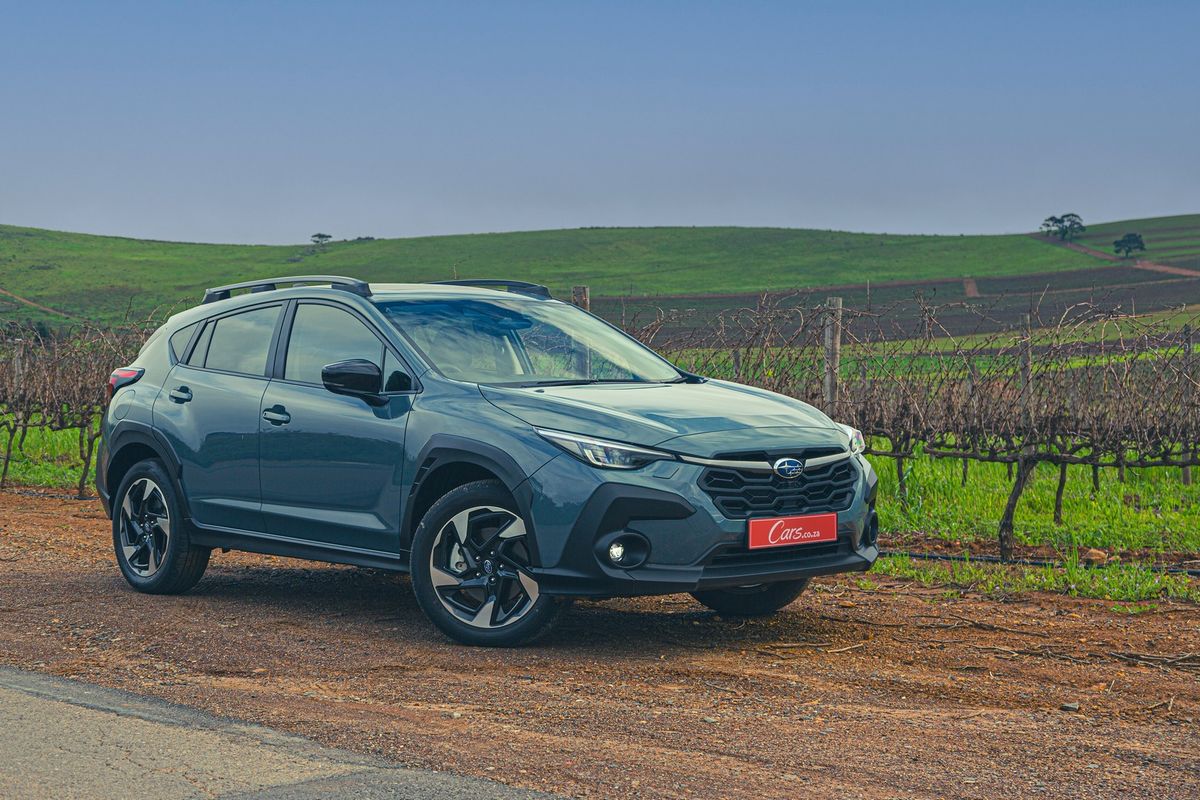
The 2023 Subaru Crosstrek recently went on sale in South Africa and we have put the top-of-the-range 2.0 iS derivative through its paces. Can the Japanese compact crossover’s all-road capability and generous features list justify its steep price tag?
We like: Ride quality, most off-road capable in class, cabin space, build quality, safety tech
We don’t like: Small boot space, pricey, not the most energetic performer
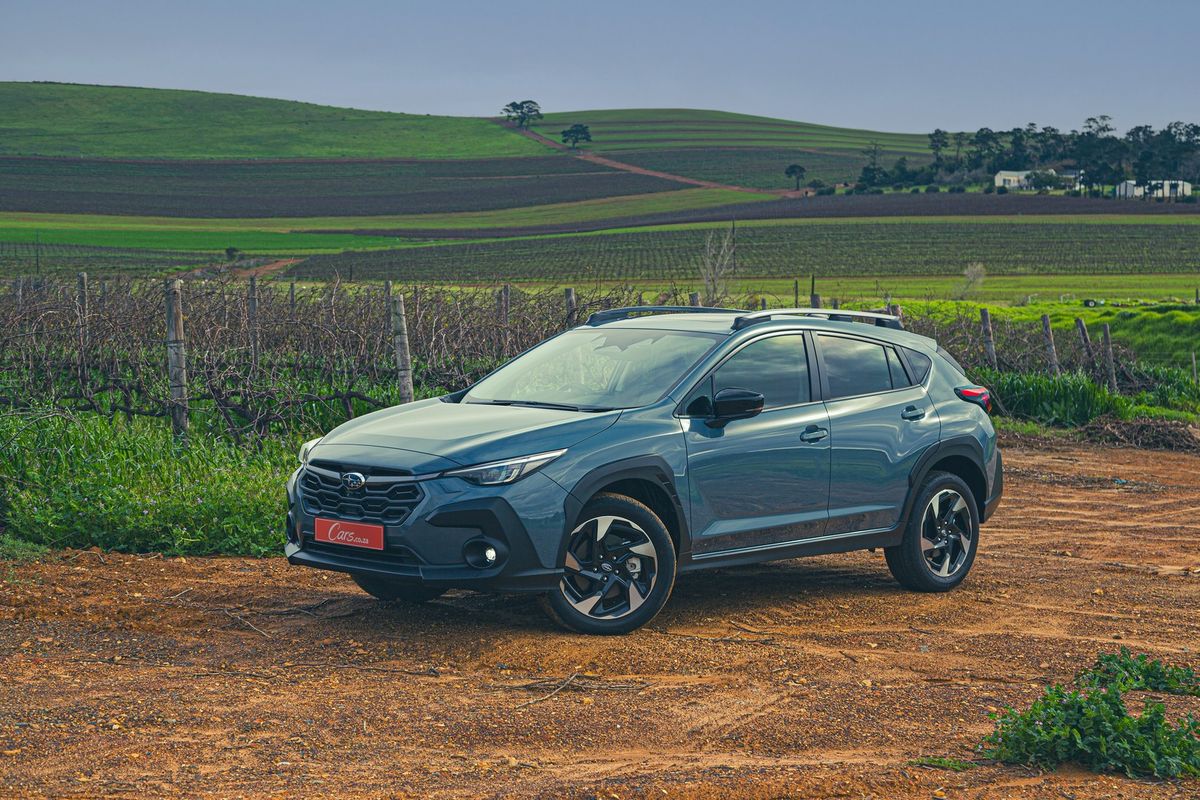
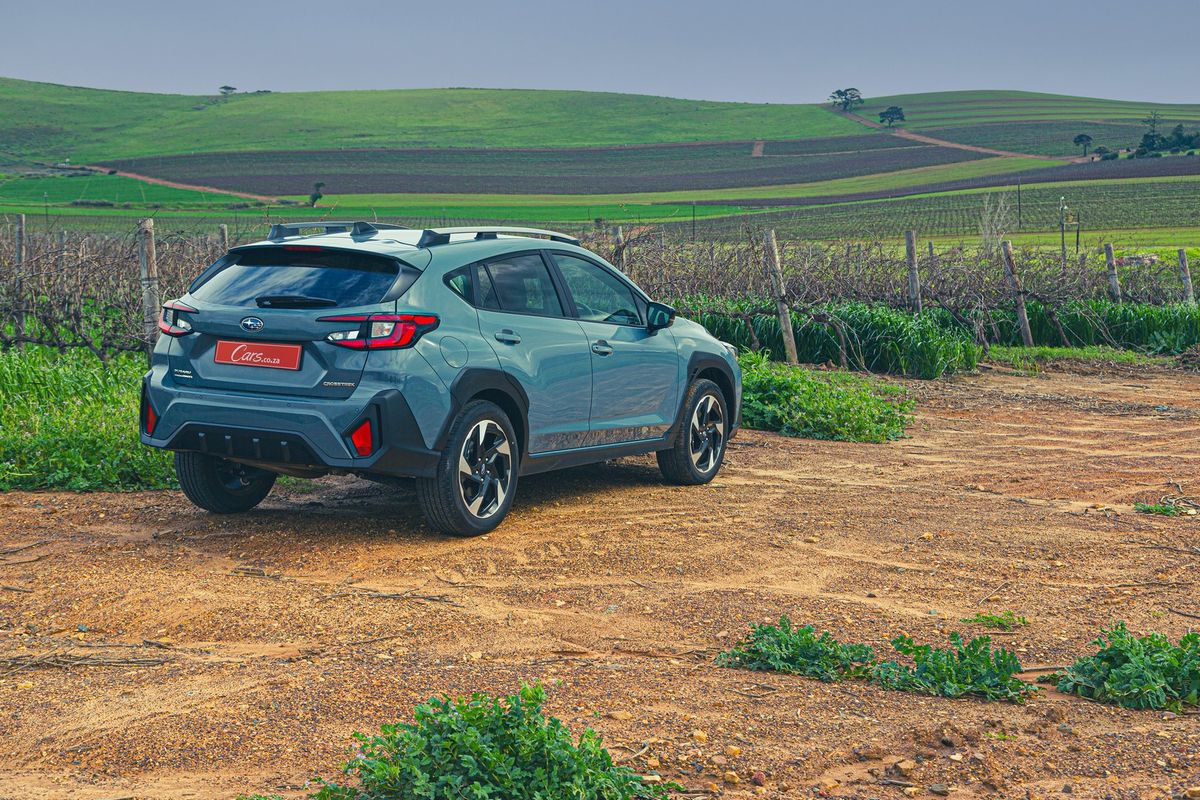
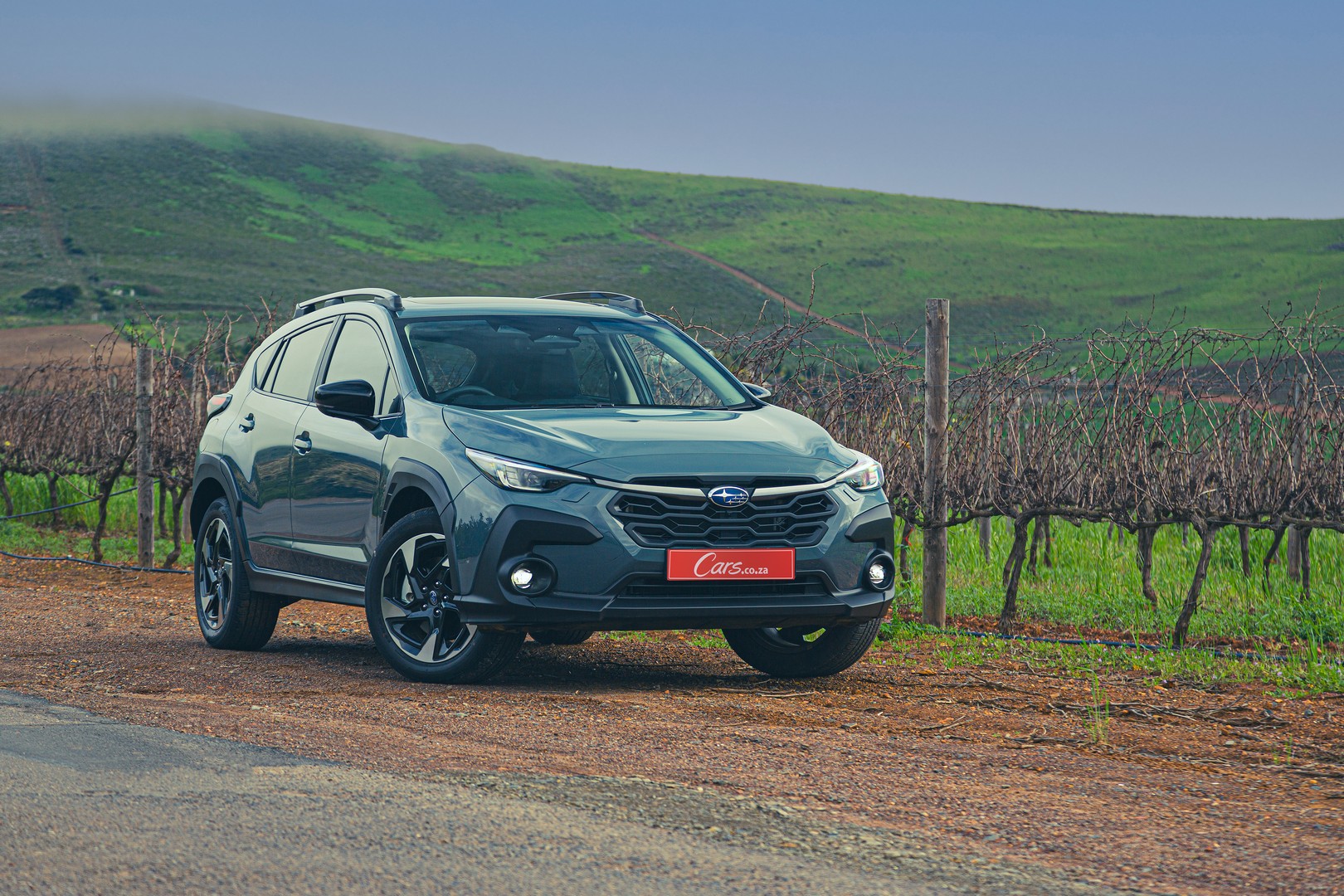
Subaru has styled the XV’s successor to more closely resemble the new WRX from the front.
Presenting the artist formerly known as XV… Yes, Subaru has given its compact crossover a fresh face and a new name in South Africa, which brings the model in line with international markets. What exactly is new under the Crosstrek’s sheet metal? Well, its platform has been updated and tuned for improved refinement, and the Shibuya-based marque has adjusted the model’s standard features list as well.
If you’re shopping around for a small family car with a raised ride height that offers hatchback dynamics and all the modern convenience features, you’re really spoilt for choice in the South African new-vehicle market. Spec for spec, the Volkswagen T-Roc 2.0TSI 140kW 4Motion Design is arguably the closest rival to the Subaru Crosstrek 2.0 iS. You could also consider the (soon-to-be-replaced) Hyundai Kona 1.6T N-Line, but the Korean model can’t match the Crosstrek’s ground clearance and all-wheel-drive capability.
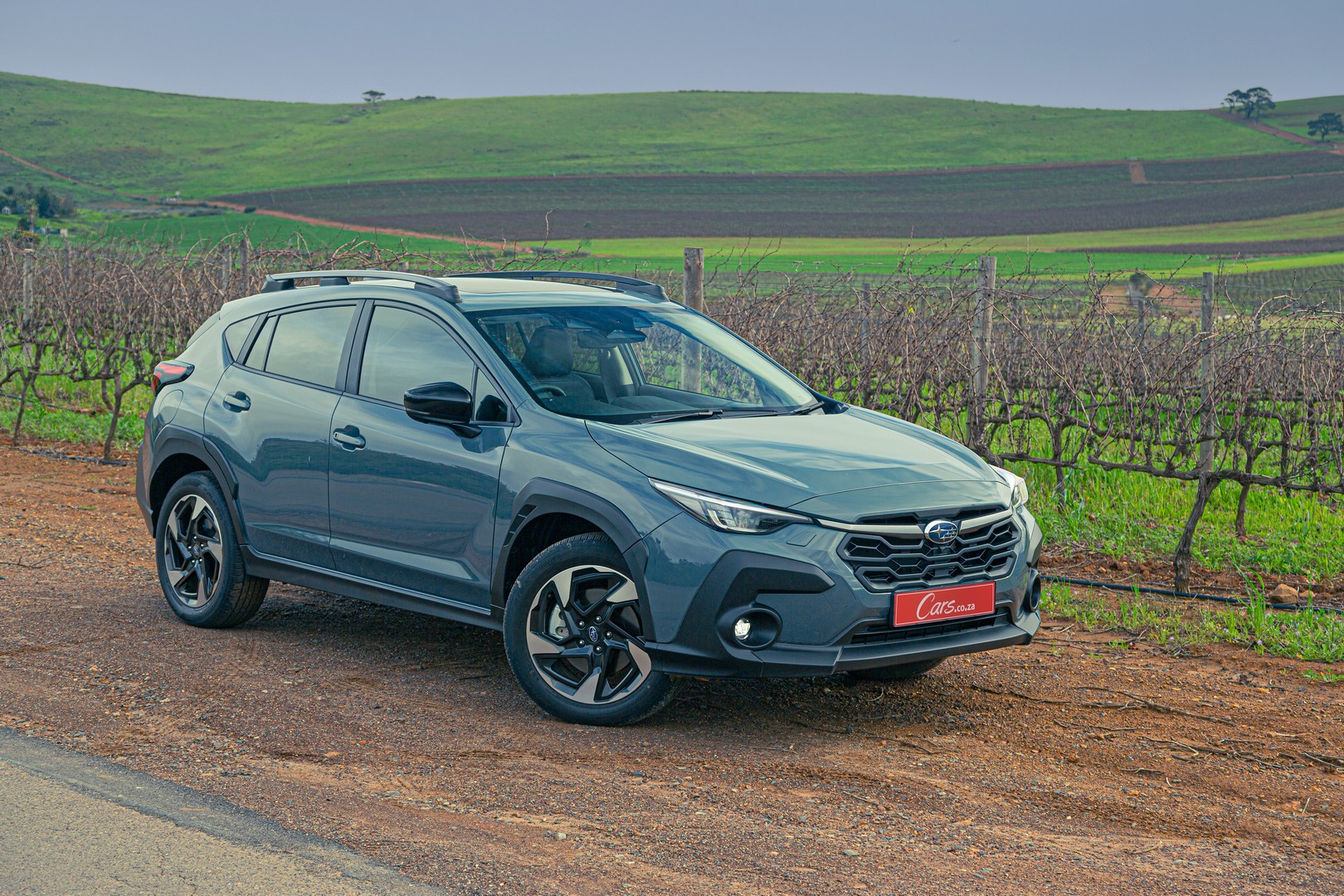
Compared with its iL sibling, the 2.0 iS features 19-inch wheels, plus self-dimming, -levelling and corner-following headlamps.
How the 2023 Subaru Crosstrek fares in terms of…
Engine and performance
The 2023 Subaru Crosstrek is powered by a 2.0-litre naturally aspirated petrol engine paired with what Subaru claims is an upgraded continuously variable transmission (CVT). Petrolheads tend to despise CVTs because they don’t deliver satisfying gear shifts… Why? because they don’t have gears – the automatic transmission utilises “steps” to utilise optimal engine performance. But CVTs do have their strengths: they’re less complicated than torque-converter-type ‘boxes and prioritise fuel efficiency.
With peak outputs of 115 kW and 196 Nm on tap, the Subaru Crosstrek’s 2.0-litre motor lacks that low-down turbocharged punch that many of its rivals offer, but data from our test equipment confirmed that the 2.0 iS could accelerate from 0 to 100 kph in 9.84 sec. Its overtaking acceleration is quite leisurely; evidently, the newcomer was engineered for comfort and efficiency rather than punchy performance…
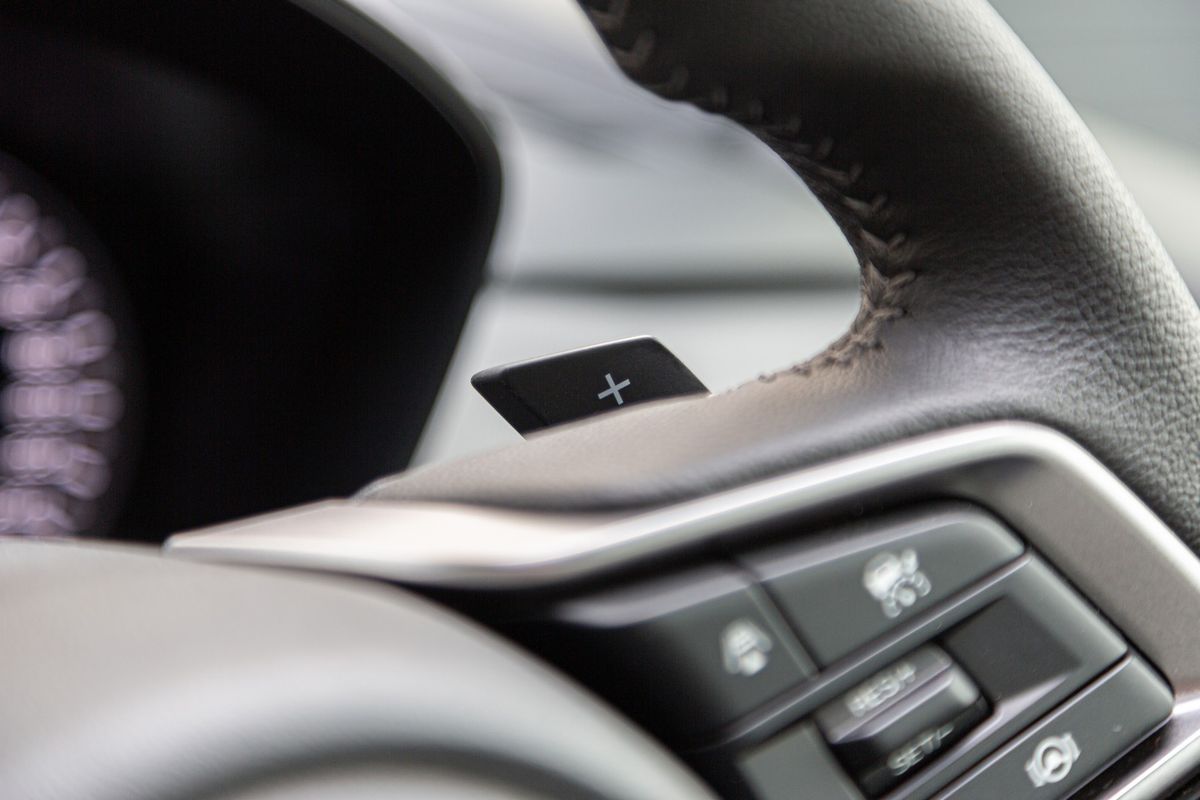
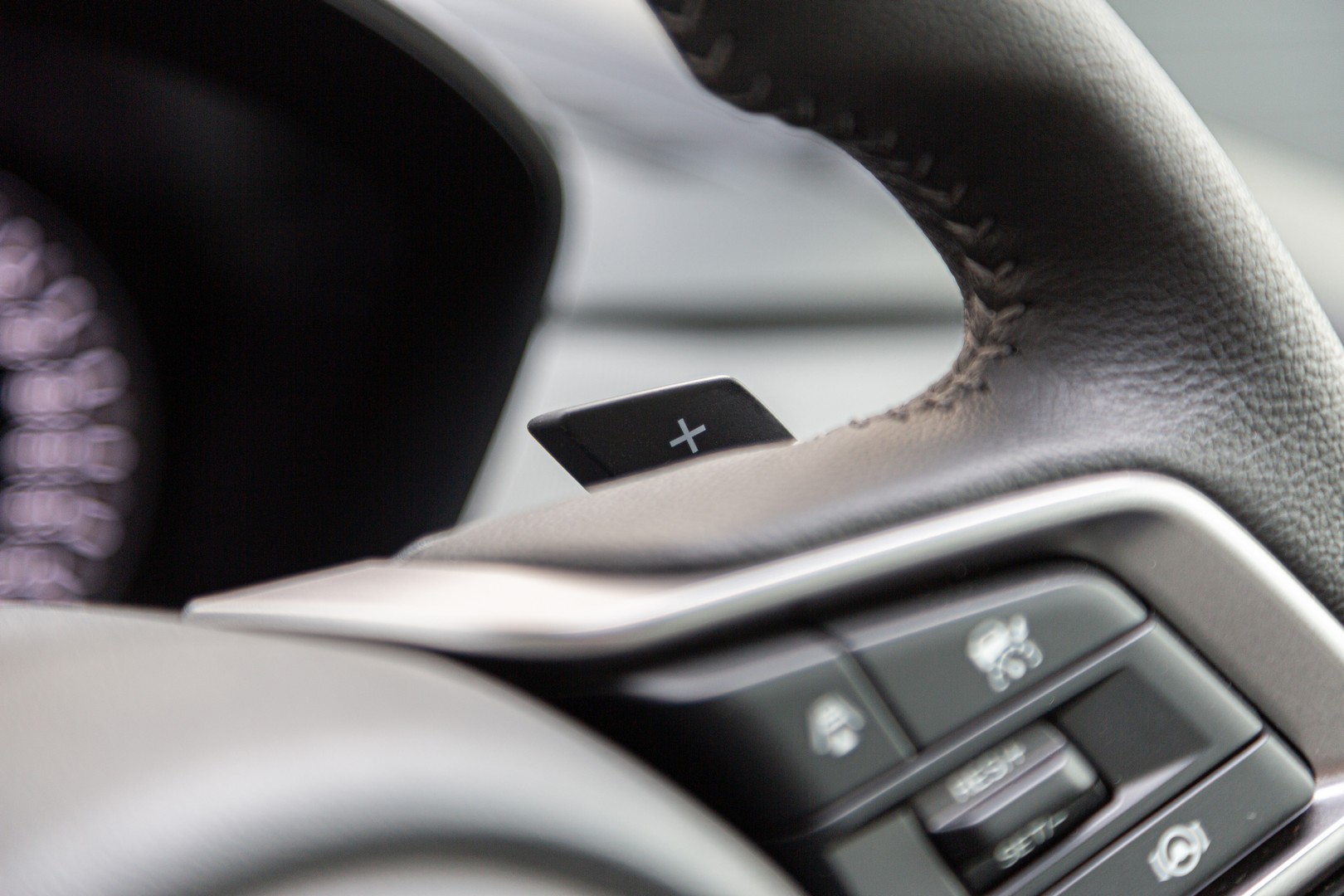
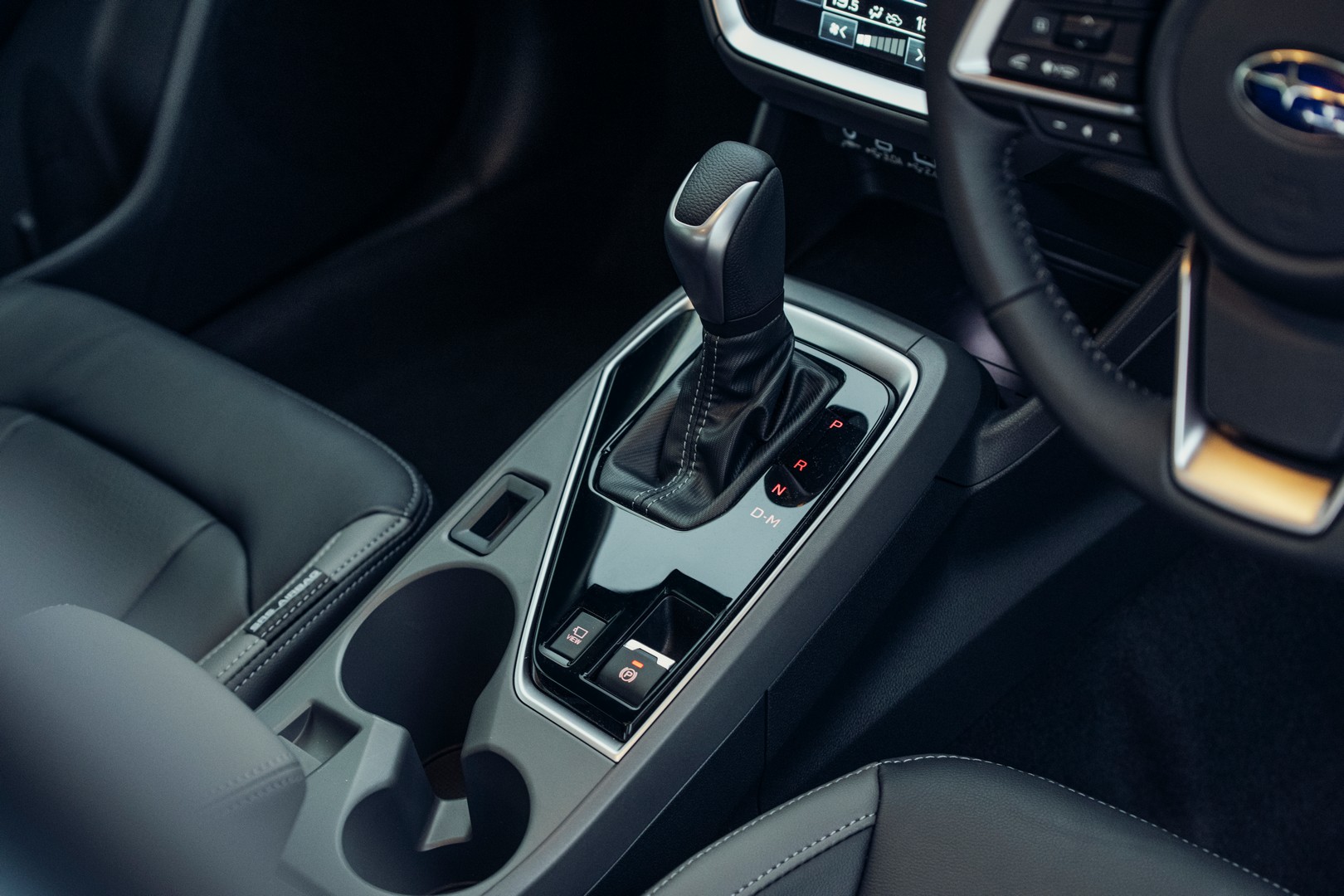
Although the Crosstrek’s transmission doesn’t shift gears, the steering wheel has paddles with which to simulate ‘shifts.
The flat-4 sounds quite vocal, but there’s little urge at full acceleration, which feels old-school compared with modern turbocharged motors paired with quicker-shifting automatic boxes. There are ‘shift paddles on the steering wheel and, when you utilise them, the CVT does an okay job of simulating gearshifts.
That’s not to say the Subaru Crosstrek feels slow or underpowered all of the time. Sure, when you want to execute a quick overtaking manoeuvre, the 2.0 iS may feel a little out of breath, but when you drive the crossover in a considered (unhurried) manner on the daily commute, its performance is quite adequate.
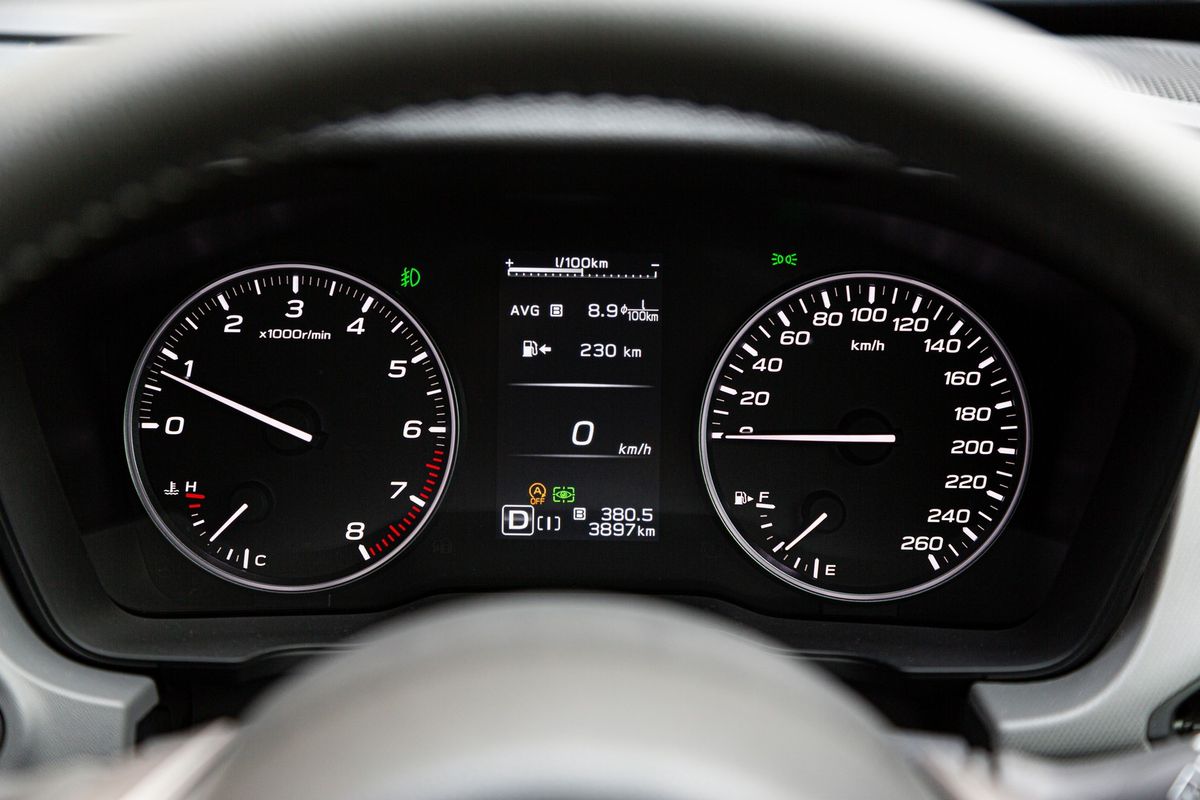
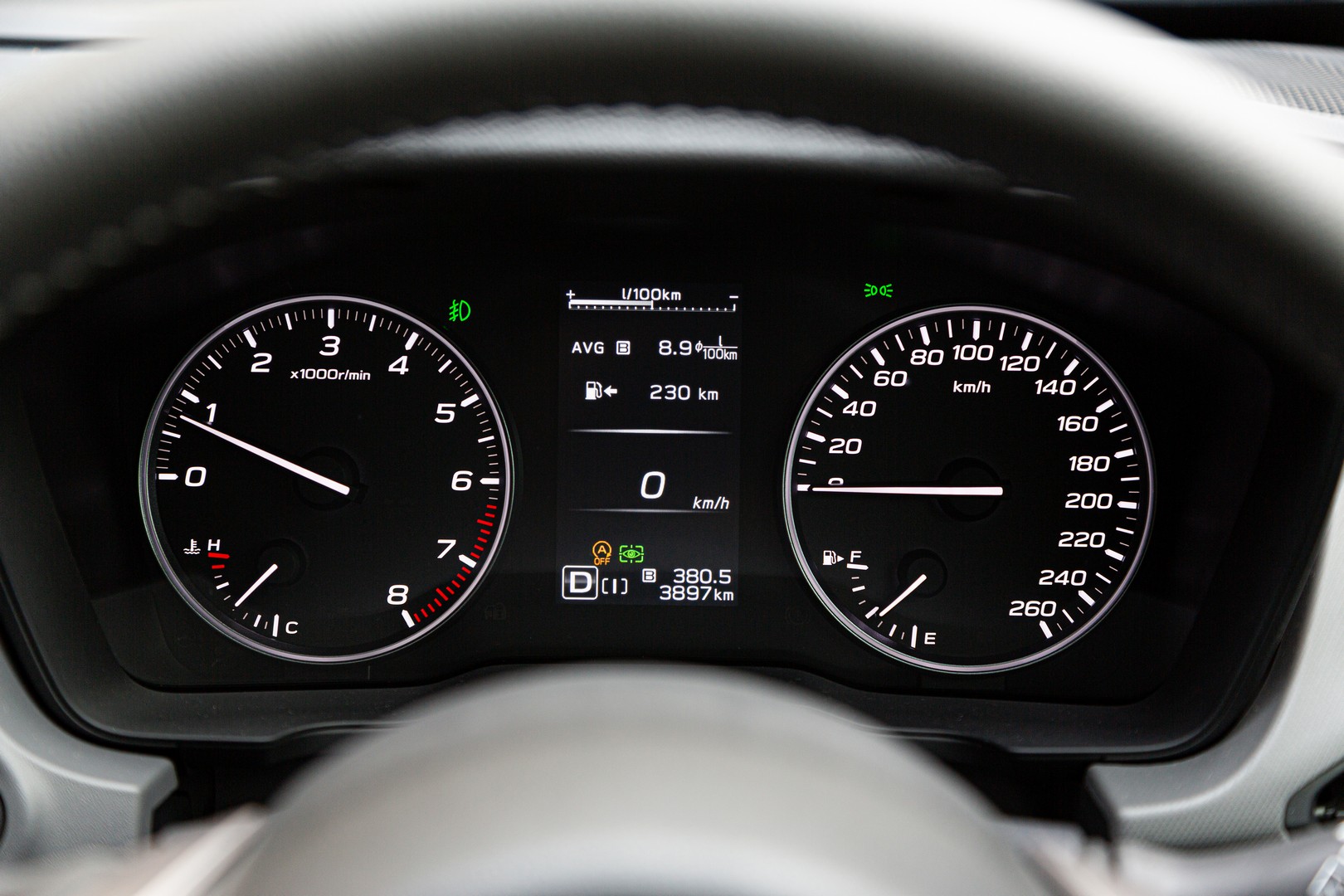
Subaru claims an average fuel-consumption figure of 7.2 L/100 km for the Crosstrek (which has a 63-litre tank) and, at the end of its tenure in our fleet, the test unit indicated 8.9 L/100 km… and that’s after we’d driven it in a variety of urban- and extra-urban conditions. In truth, we didn’t expect it to be particularly frugal – after all, the Subaru is saddled with the additional weight of its permanent all-wheel drivetrain.
The Crosstrek’s analogue instrument cluster is neat, but some of its rivals now feature all-digital screens instead.
Ride, handling and safety
Like the VB-series WRX, the Crosstrek utilises the Subaru Global Platform, which means the crossover emulates the sporty sedan’s impressive driving manners – even if it’s not as performance-oriented as its sibling. The steering setup is nicely weighted, which is to say that it’s light and quick enough to make city driving a cinch, but also provides reassuring heft and responsiveness when cornering at brisk speeds.
What’s more, the Subaru’s general ride quality is pleasingly composed and refined, which is a big plus, considering the Republic’s wildly divergent qualities of road surfaces! Allied with excellent build quality, the level of noise, vibration and harshness suppression in the Crosstrek is up there with the best in class.
Still, we can’t shake the notion that the model would benefit from having a more powerful motor under its bonnet. Come on Subaru, you know you want to slot the Forester’s 136 kW 2.5 litre in the Crosstrek!
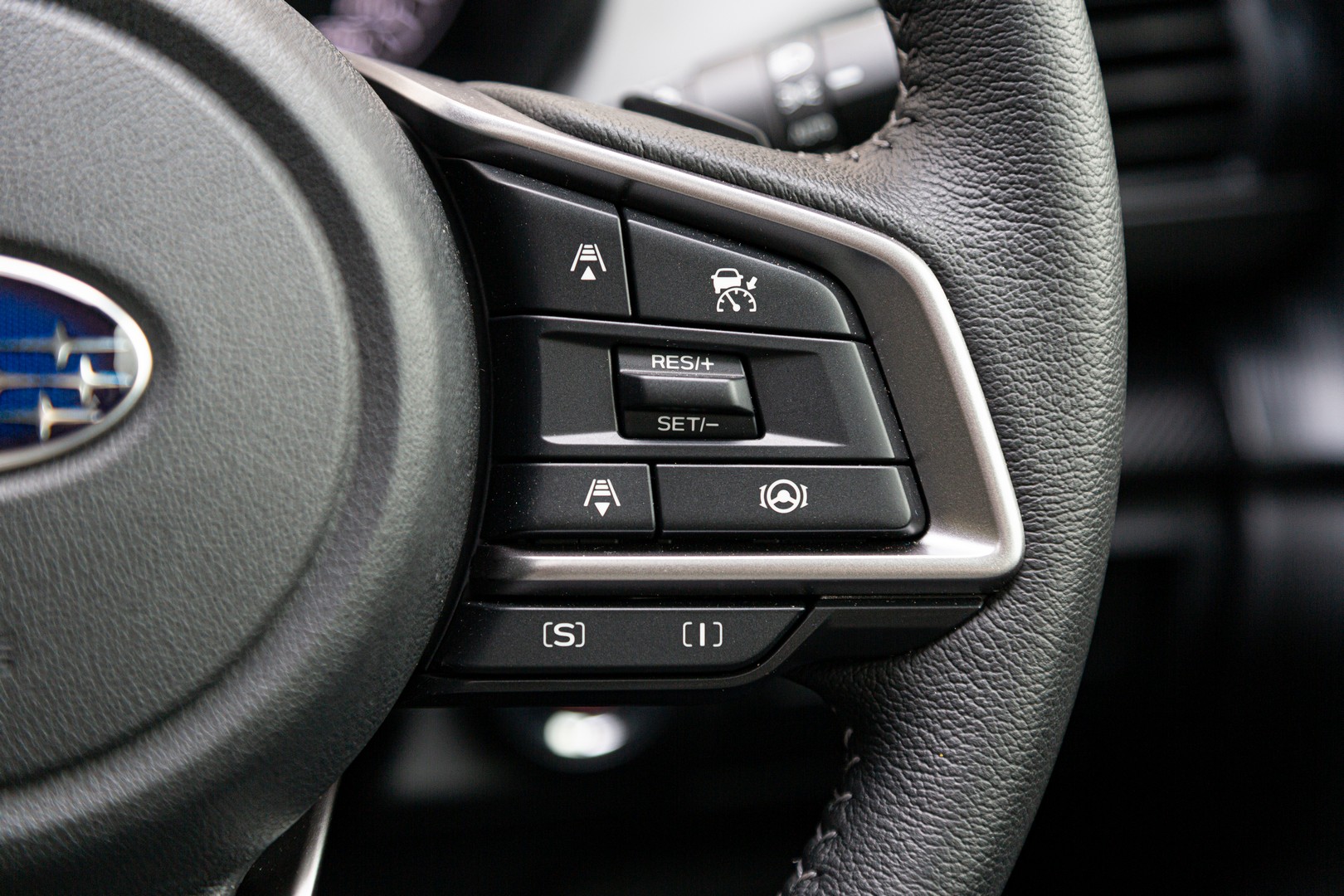
The provision of adaptive cruise control makes the Crosstrek a great vehicle for relaxed touring.
Comprehensive safety tech is a must-have at this price point and, to Subaru’s credit, the Crosstrek’s systems are well-integrated and not overly intrusive. Driving assist features (grouped under the EyeSight banner) include lane-departure prevention, adaptive cruise control, traffic-sign recognition, intelligent speed limiter and pre-collision braking. The key to the EyeSight moniker is the Subaru’s stereoscopic high-res camera setup, which can identify cars, bikes and pedestrians in the path of the vehicle (in most driving conditions) and apply the brakes to avoid – or reduce the impact severity of – a traffic collision.
Apart from ABS with EBD, electronic stability control and new fewer than 9 airbags, the 2.0 iS is equipped with rear cross-traffic alert with automatic reverse braking functionality, as well as a 360-degree camera.
As with many other contemporary Subaru models, the Crosstrek sports excellent interior build quality.
Interior tech and space
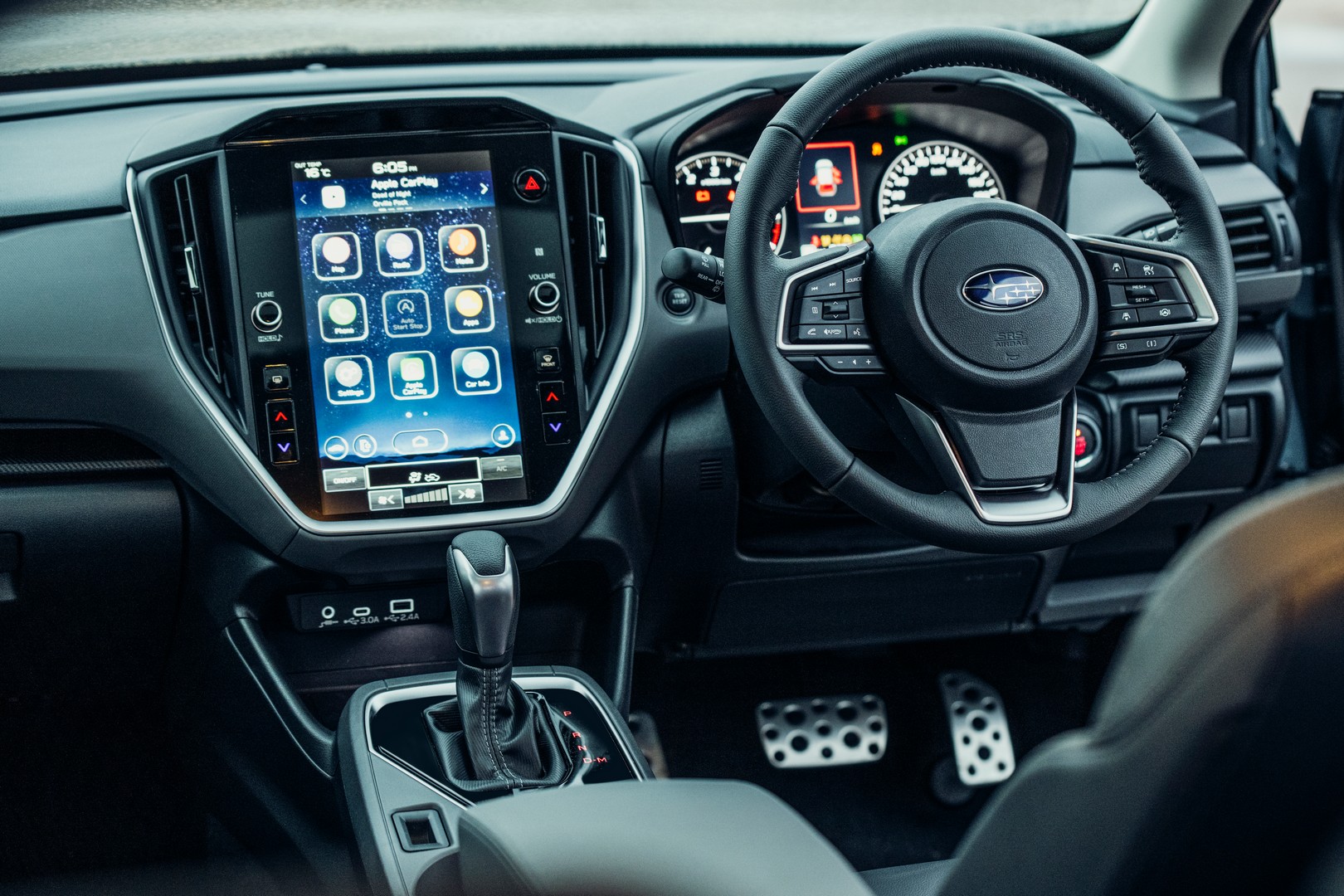
New for the 2023 Subaru Crosstrek is the addition of wireless Apple CarPlay/Android Auto, but while it doesn’t sound like much has changed, the outgoing XV was already very well specified. In addition to iL specification, the 2.0 iS comes fitted with auto high-beam assist, LED daytime running lights, steering responsive headlights, leather trim, 19-inch wheels, 2-mode X-Mode, plus a 360-degree camera view.
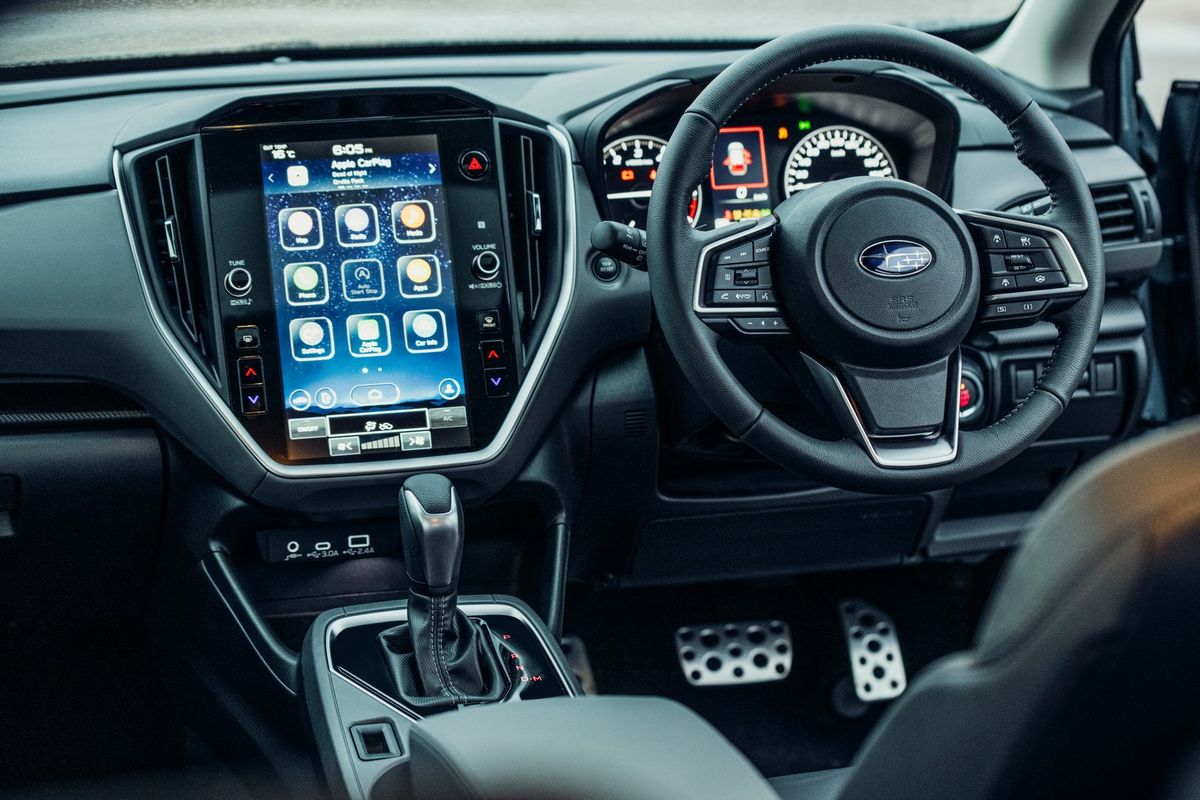
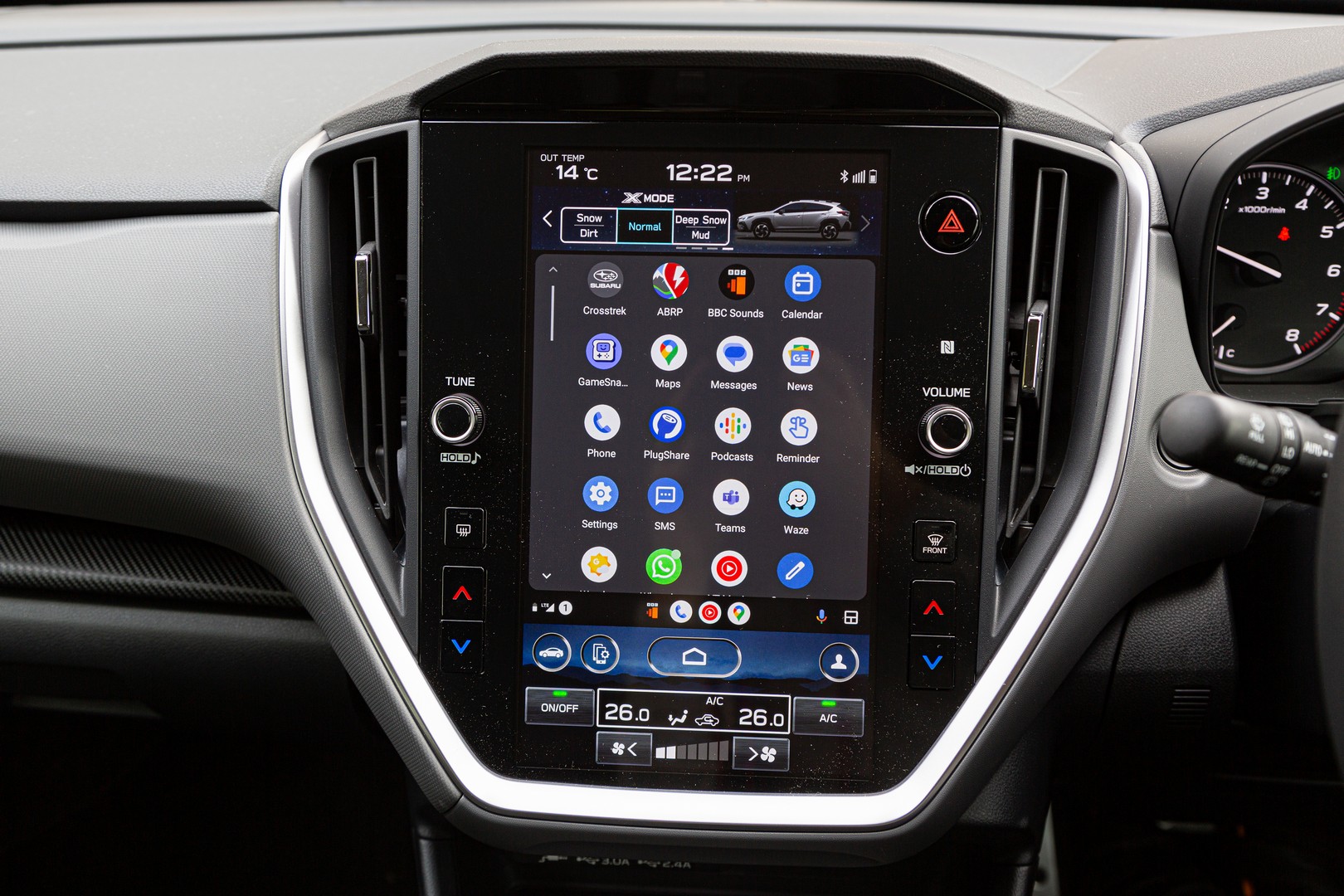
The user interface of the portrait-orientated infotainment screen takes some getting used to, but once you’re familiar with it, it’s a great system that houses an array of functions, including built-in navigation and climate controls. If you prefer old-fashioned climate control buttons, the Crosstrek has those too…
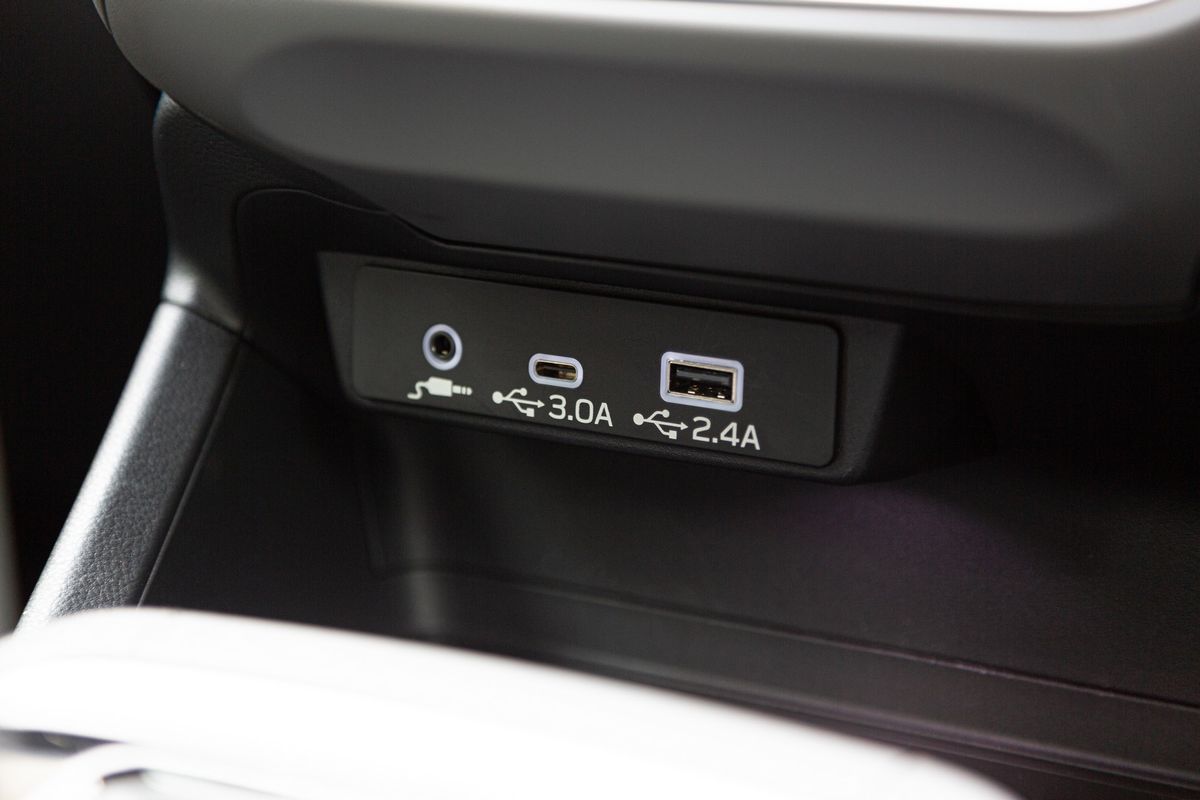
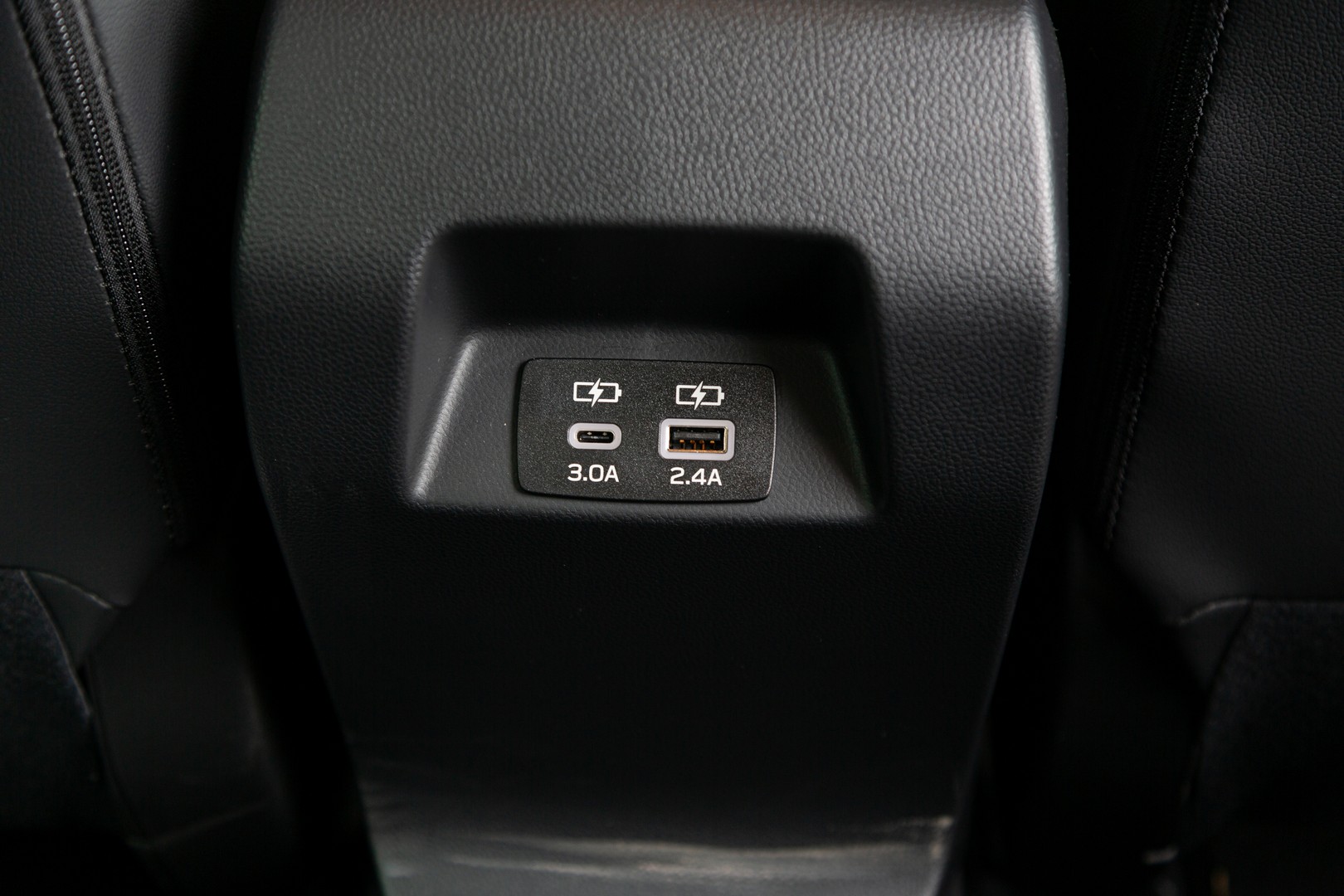
The Crosstrek offers device-charging options for those with the latest… and not-so-new devices.
Despite its compact size, the Crosstrek offers enough cabin space to accommodate 4 adults in comfort. There are no climate vents for rear occupants, but they are availed USB-A and USB-C ports to recharge their electronic devices. There is even enough head- and legroom for taller passengers and the sunroof contributes to the sense of spaciousness, but on the downside, the Subaru’s claimed load-bay capacity (320 litres), is substantially less than what most of its (fellow compact crossover) rivals offer.
The portrait-orientated touchscreen is sizeable and connects wirelessly with Apple CarPlay and Android Auto.
The front seats, which Subaru claims to have reworked extensively for improved comfort and support, are well worth a mention. Not only are they particularly comfy – this top-spec derivative features 8-way electric adjustment (including lumbar support) to help you achieve that perfect driving position easily.
Meanwhile, there is plenty of cabin storage space, including decently-sized drink holders, deep door pockets and, of course, you can rest things on the wireless charging pad when you’re not using it.
The Crosstrek’s cabin offers a multitude of storage spaces and scores high marks for occupant comfort.
Off-road capabilities
Thanks to its symmetrical all-wheel drive, the Crosstrek is arguably the most off-road-capable vehicle in its segment. While it lacks low range for true go-anywhere capability, the model may pleasantly surprise those who drive it through mud or on sand. Stability when traversing a gravel road is very impressive too.
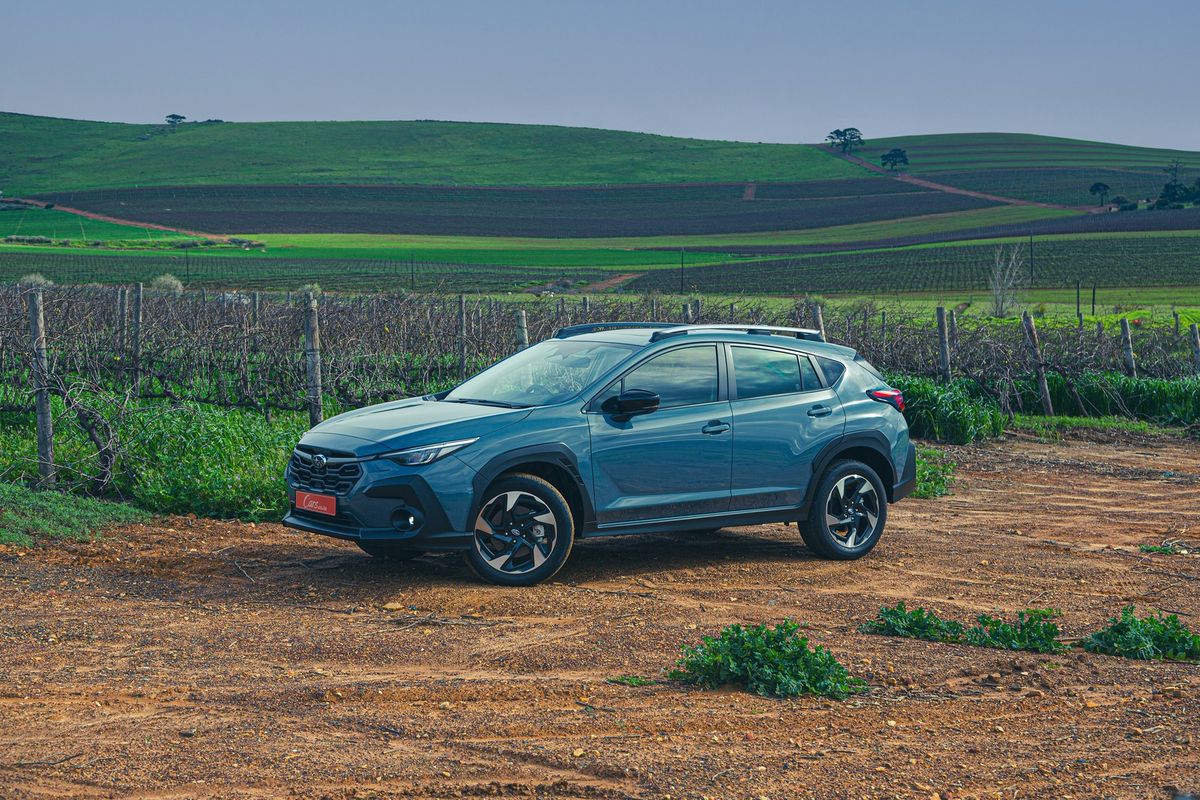
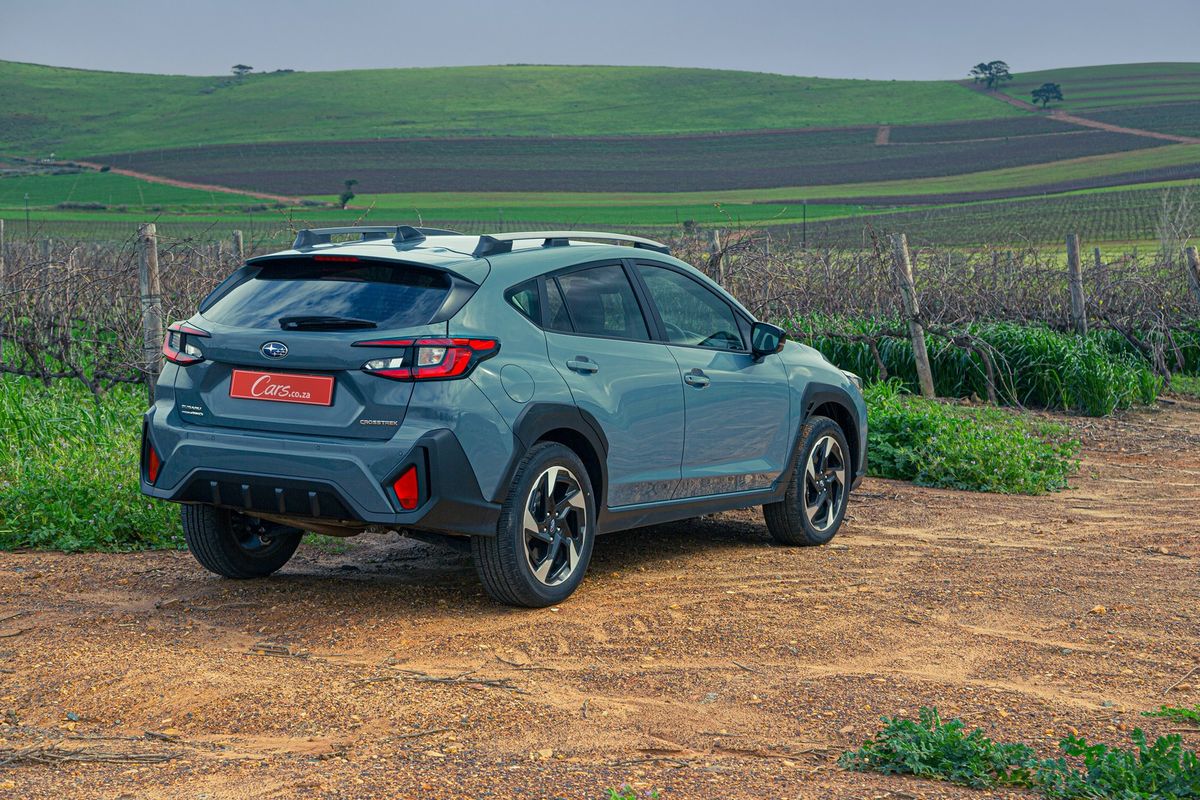
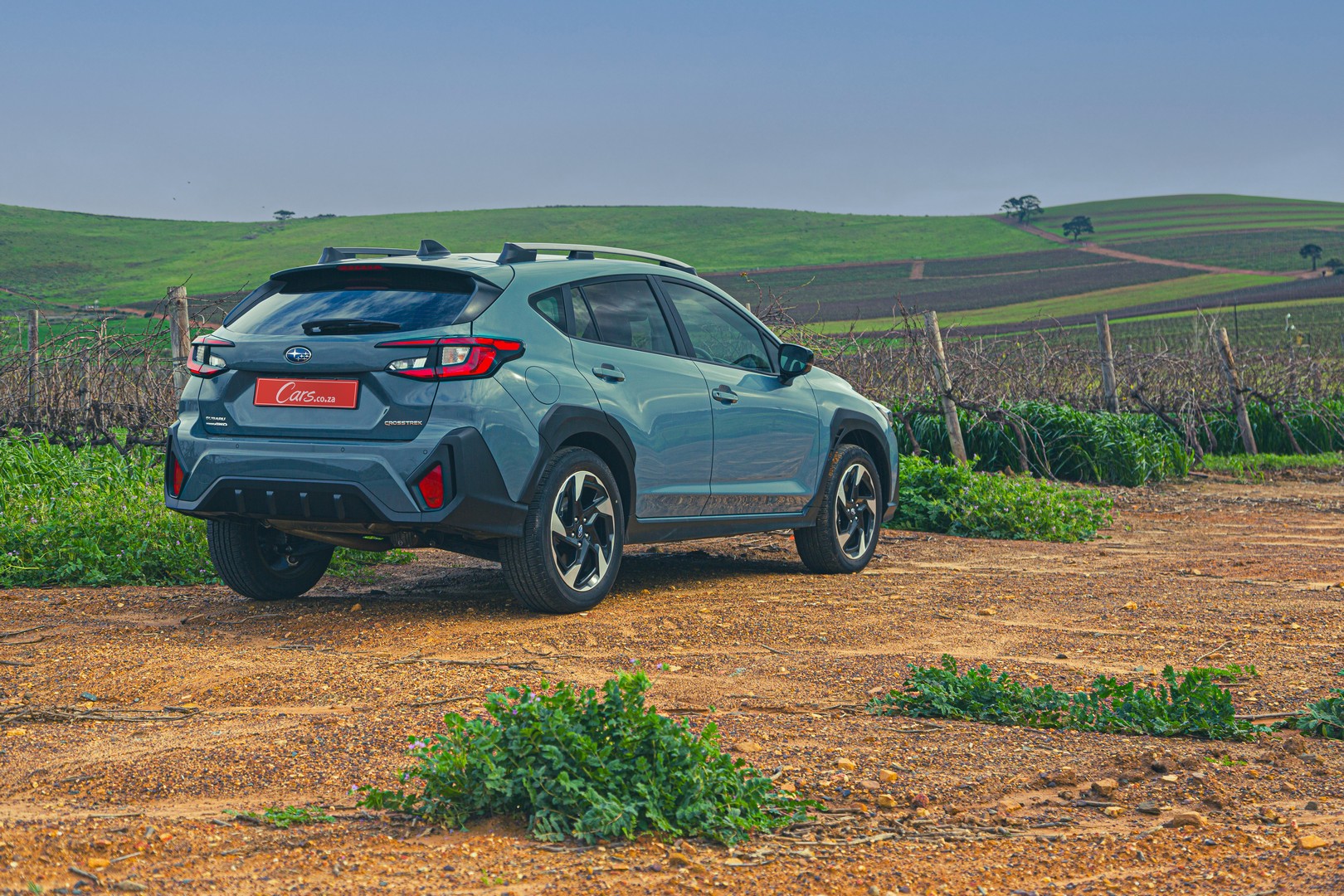
By compact-crossover standards, the Subaru Crosstrek is exceedingly capable on unsealed road surfaces.
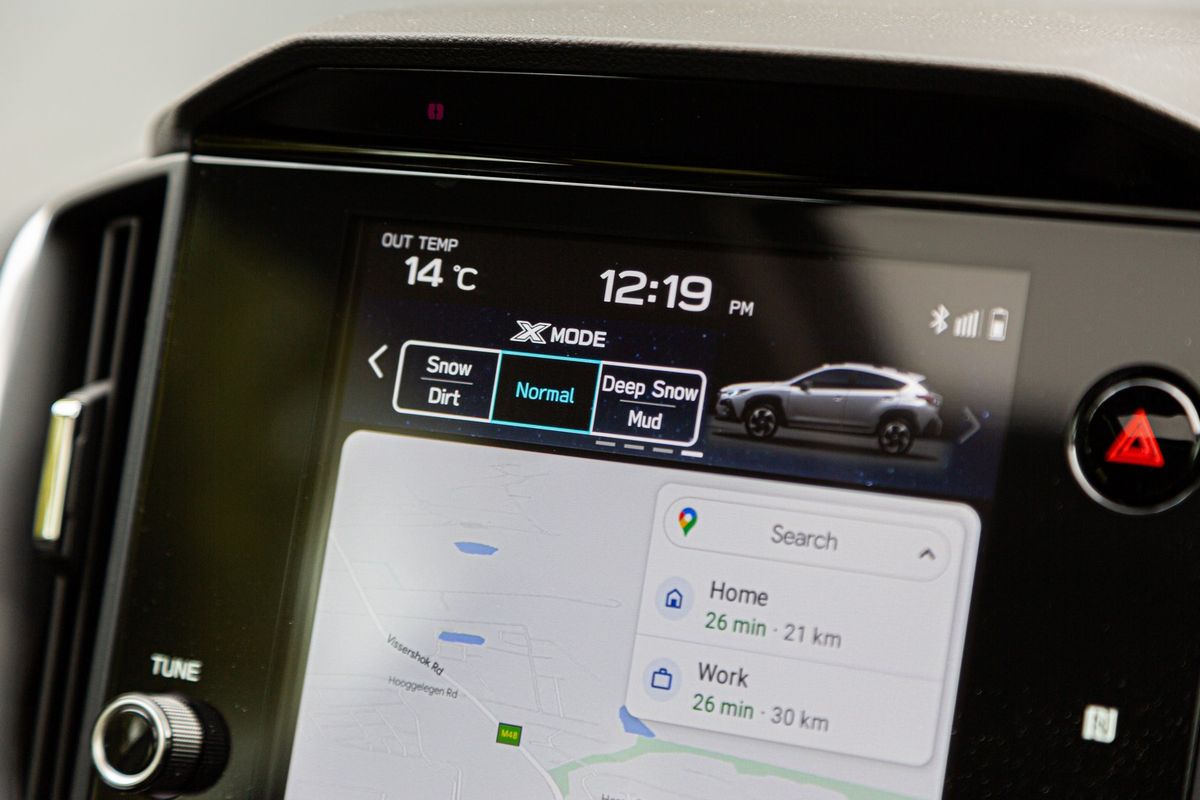
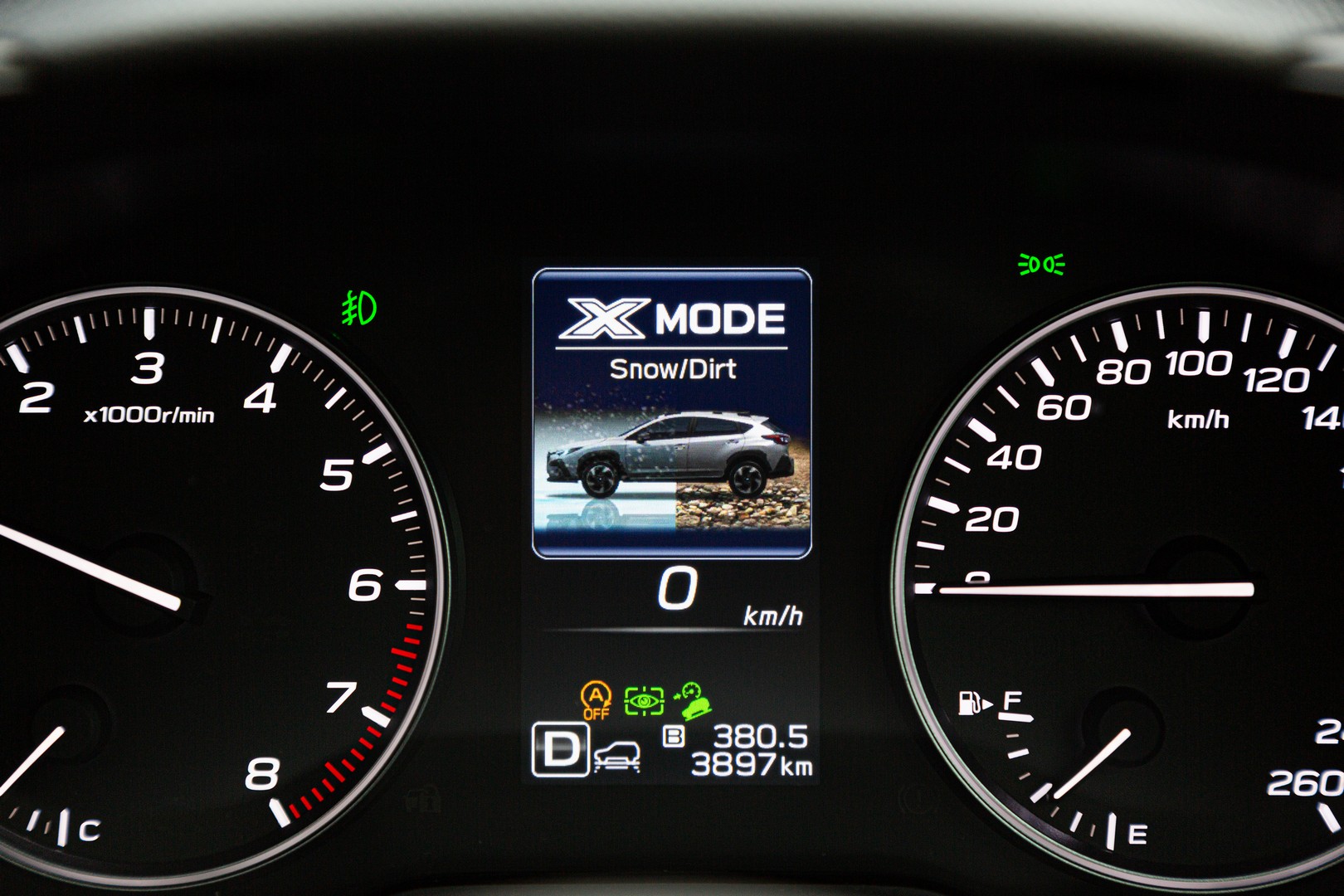
With 220 mm of ground clearance and the clever X-Mode (which reduces the likelihood of getting stuck (unless your off-road exploits are well and truly foolhardy), the all-paw Crosstrek made light work of the minor off-road obstacles it encountered during the test. Switching from tar to off-road doesn’t require much fiddling either: simply activate the appropriate X-Mode terrain setting – the vehicle will do the rest.
The Crosstrek 2.0 iS’ pair of X-mode settings are: Snow/Dirt and Deep Snow/Mud.
Price and after-sales support
The 2023 Subaru Crosstrek is sold with a 5-year/150 000 km warranty and a 3-year/75 000 km maintenance plan. Service intervals are every 15 000 km.
Crosstrek iL
R570 000
Crosstrek iS
R669 000
Verdict
If you are currently a Subaru XV owner, you’re unlikely to be blown away by the Crosstrek, because it incorporates incremental improvements over its predecessor. But if you’ve never considered Subaru’s entry model before and want a capable crossover that can do it all, well, the 2.0 iS may well fit the bill!
Look, it’s not without its flaws. The lack of real overtaking punch, middling fuel efficiency and limited load-bay capacity may be deal breakers for some prospective buyers, especially because, at the price point of the top-spec Crosstrek, lower-end medium SUVs represent more metal for your money.
Still, some buyers simply want a compact crossover that is a refined and nice-to-drive premium product (which the Subaru is), the 2.0 iS is not that thirsty (if you drive gently), plus it comes fully equipped (it has more standard kit than many of its rivals). We’d also contend that its on-road manners are excellent and, when the tar road ends, it’ll probably go further than anything else in this segment ever could.
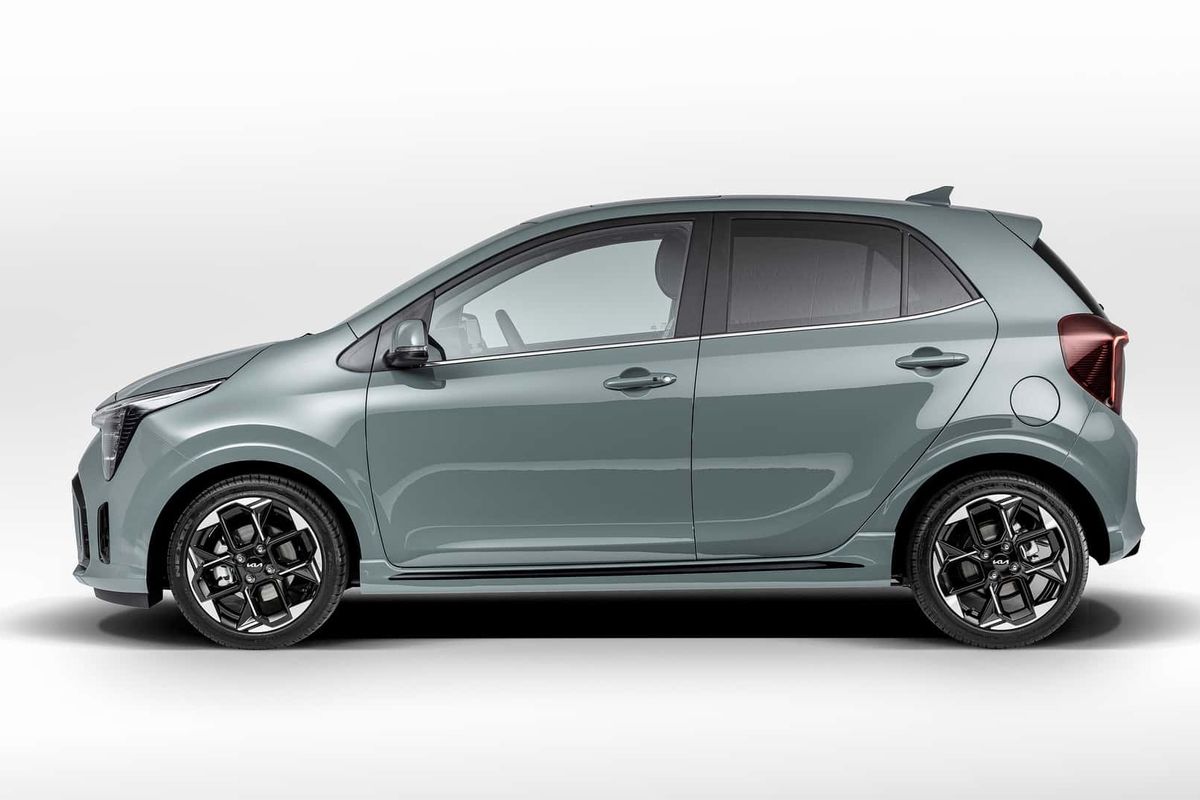
The Korean brand’s local best seller has been given an update. Here’s the 2024 Kia Picanto!
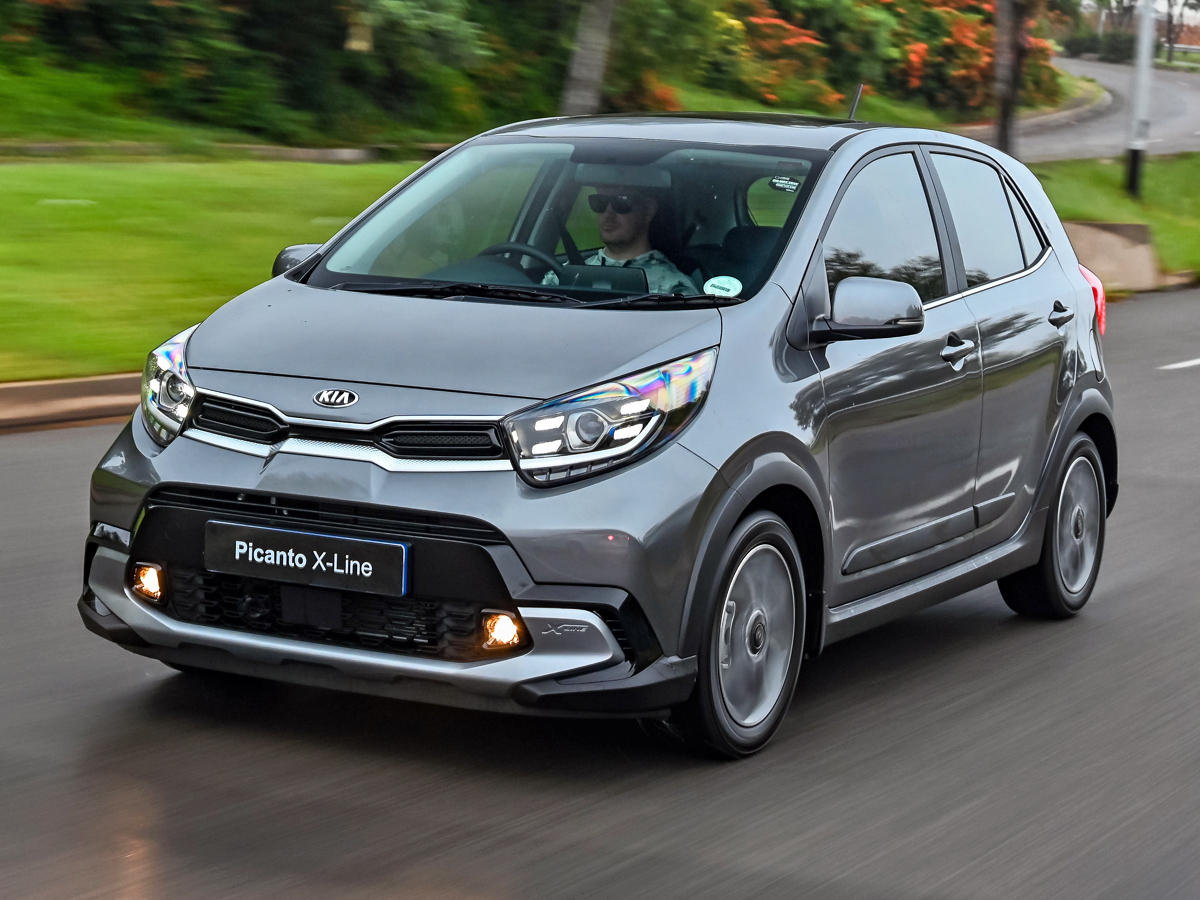
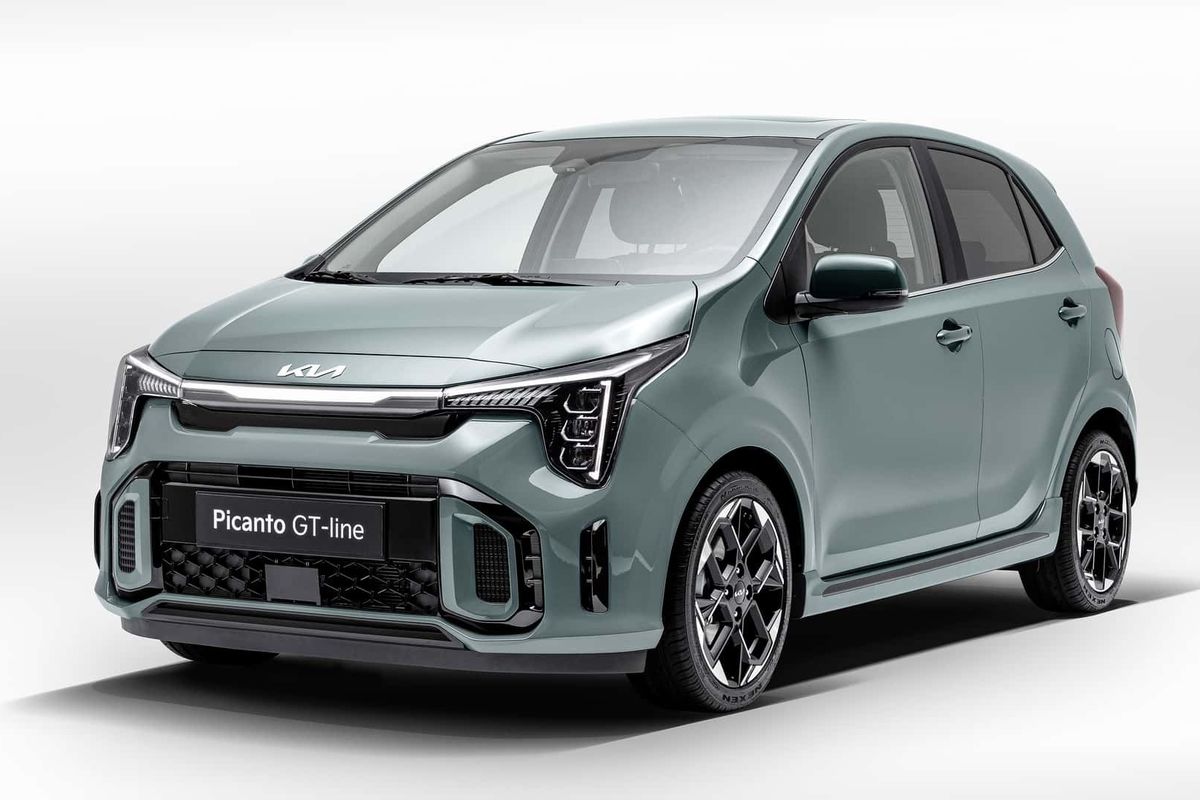
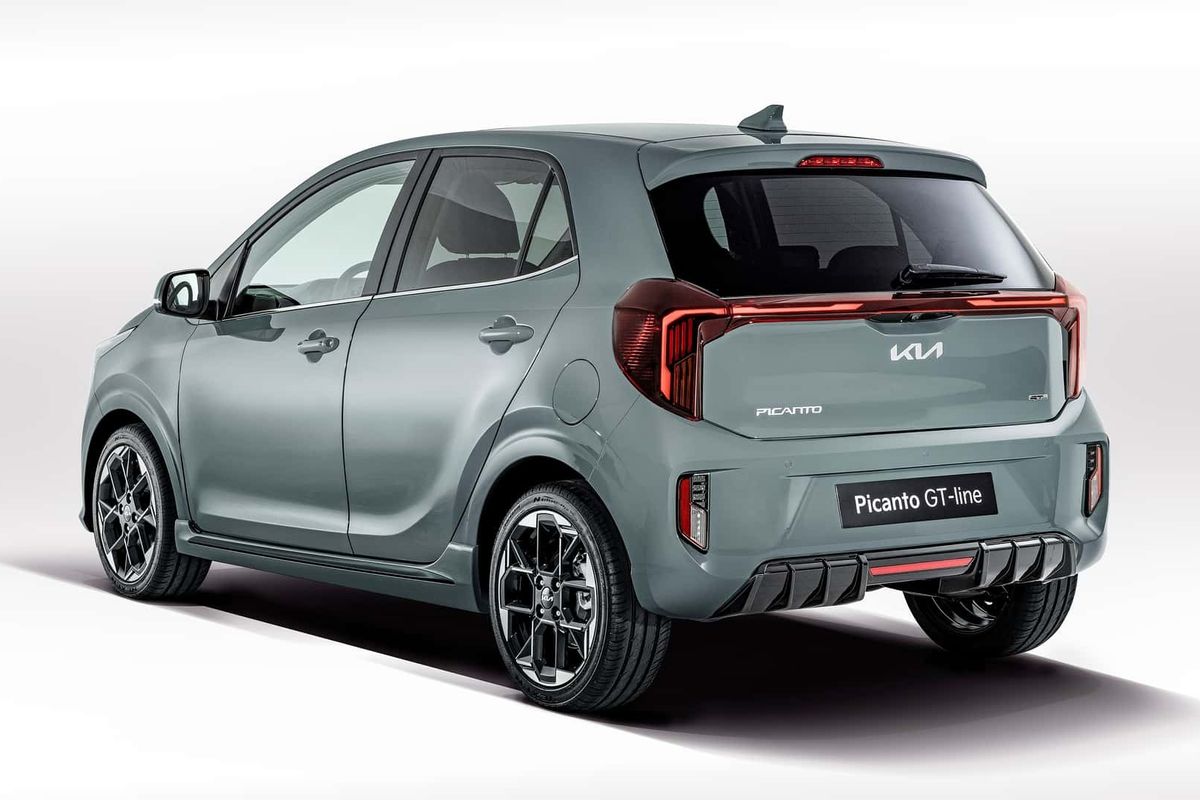
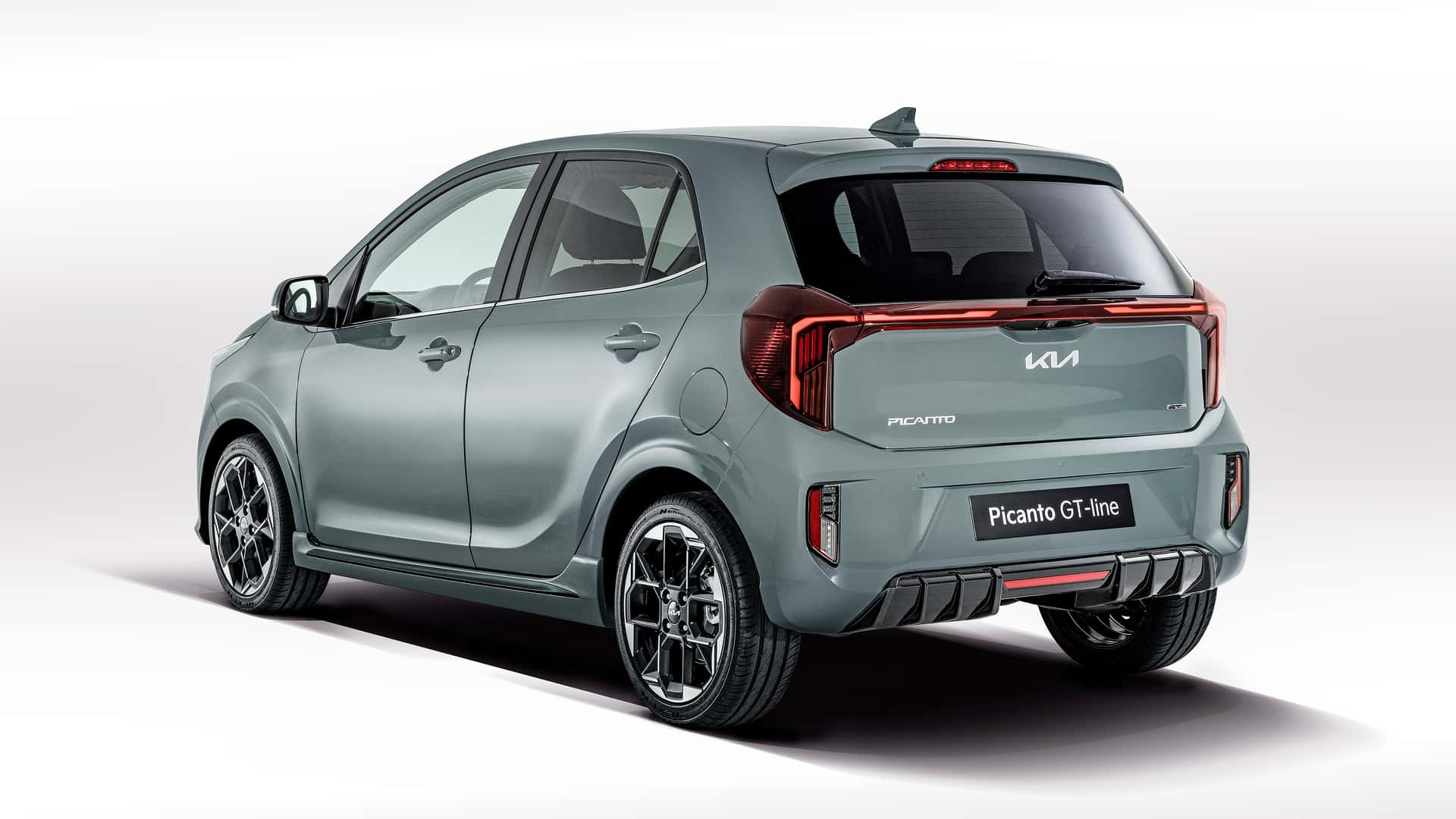
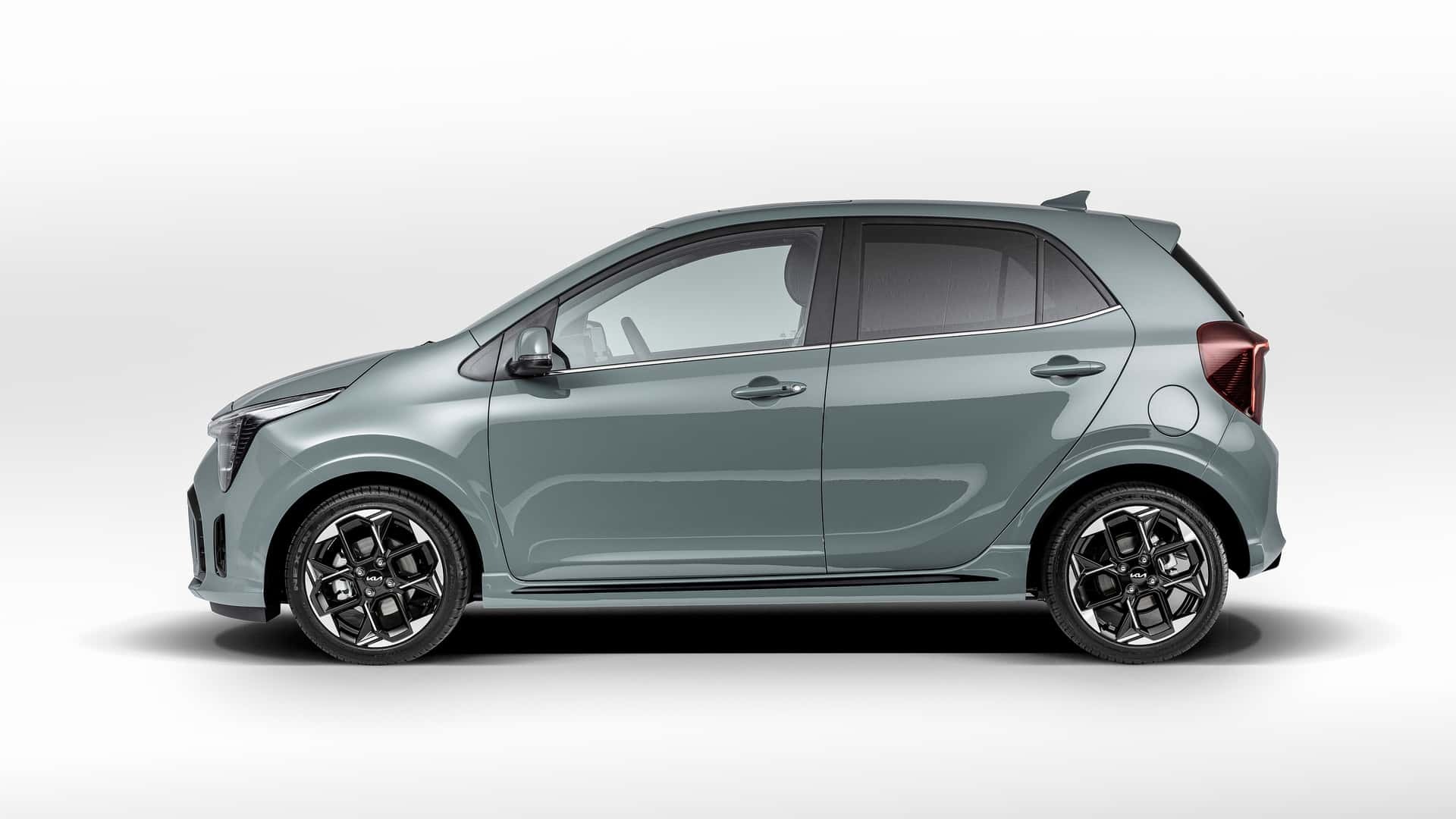
The 2024 Kia Picanto has just been revealed and what you see here is the sporty GT-Line flagship that shows off the extensive redesign. You’ll quickly spot the new paint finish, which is straight from the new-generation Kia Sportage and some of those design elements are very similar to that of both the aforementioned family SUV and the eco-focused Niro.
Despite the rise of the compact SUV and crossover, there’s still a considerable interest in affordable and uncomplicated city hatchbacks. Admittedly in some markets, the A-segment has shrunk dramatically, but right here in South Africa, the Kia Picanto flies the flag as the Korean’s best-selling vehicle, with the Kia Sonet in hot pursuit.
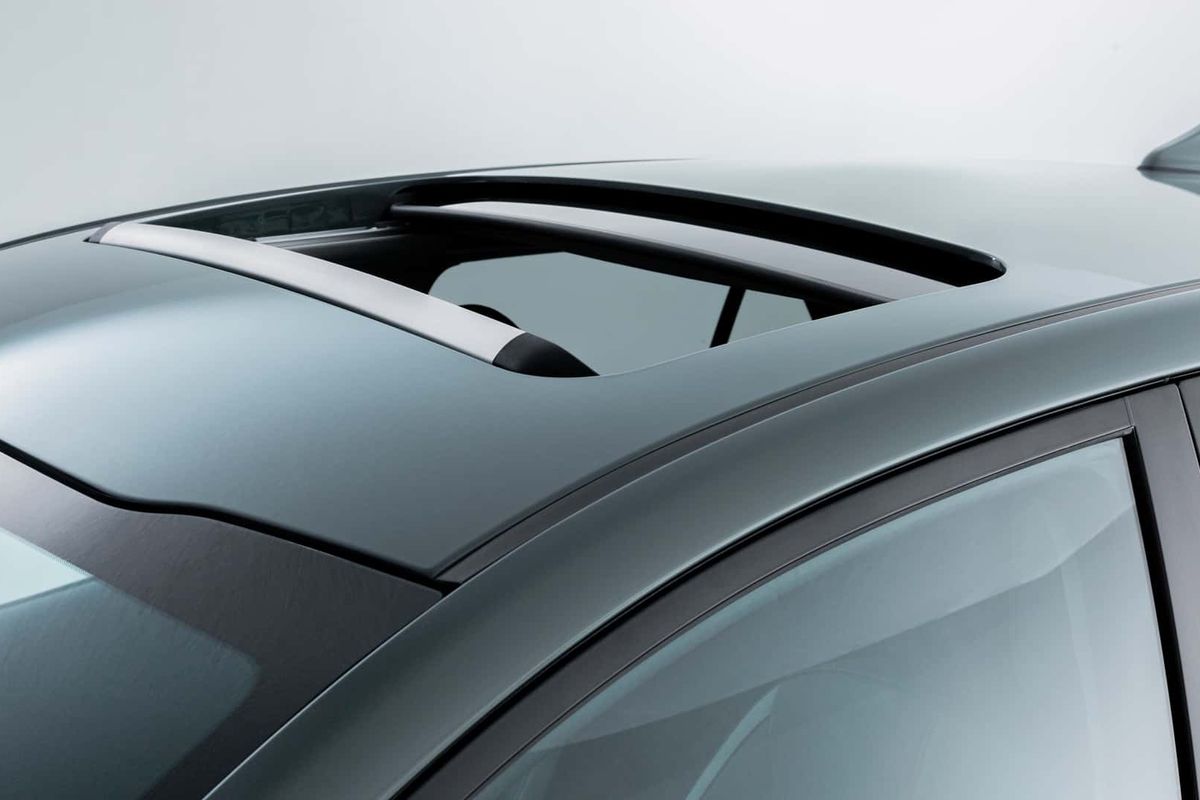
The vertical headlights get an LED bar across the front (like the Seltos GT-Line) and the rear gets the tailgate lightbar treatment. Its a striking upgrade and while this may be the sporty-looking GT-Line, we expect similar for the mainstream models. Pictured here is a European-spec car that comes with a sunroof! As far as wheel sizes are concerned, the Kia Picanto ranges from 14-inch units going up to the 16-inch GT-Line wheels you see here.
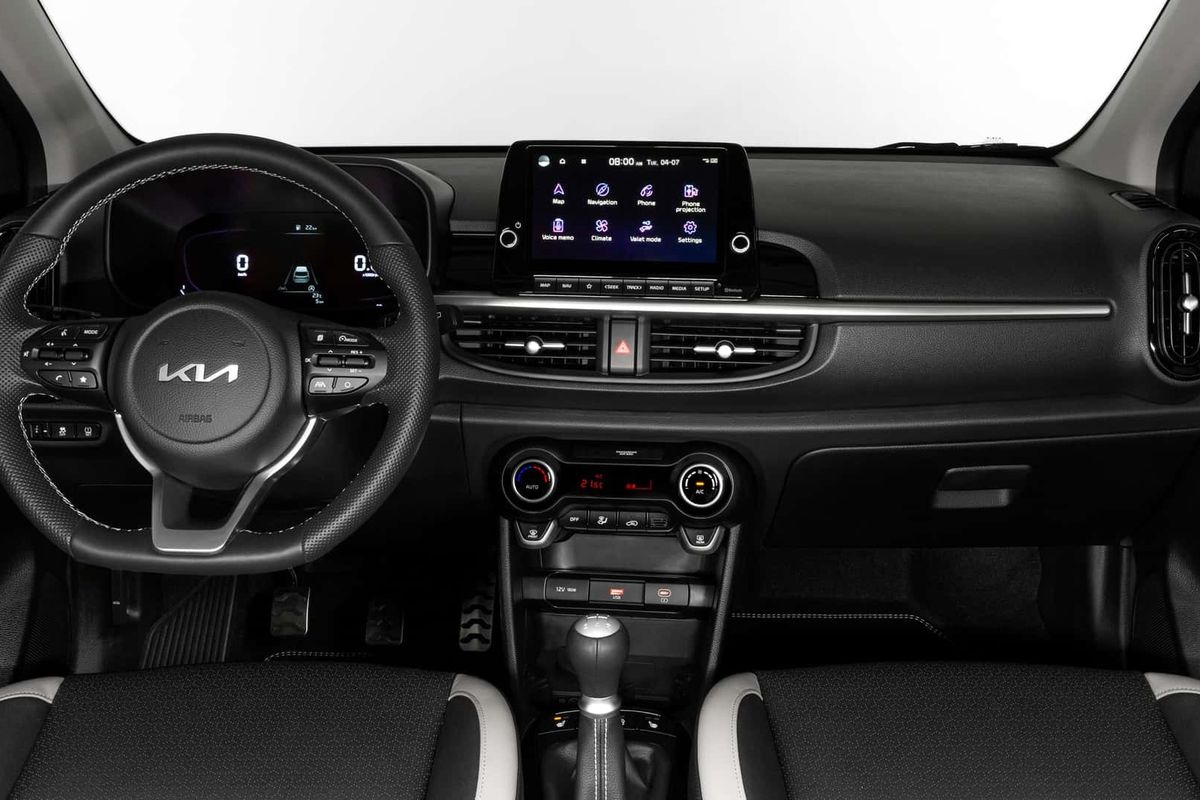
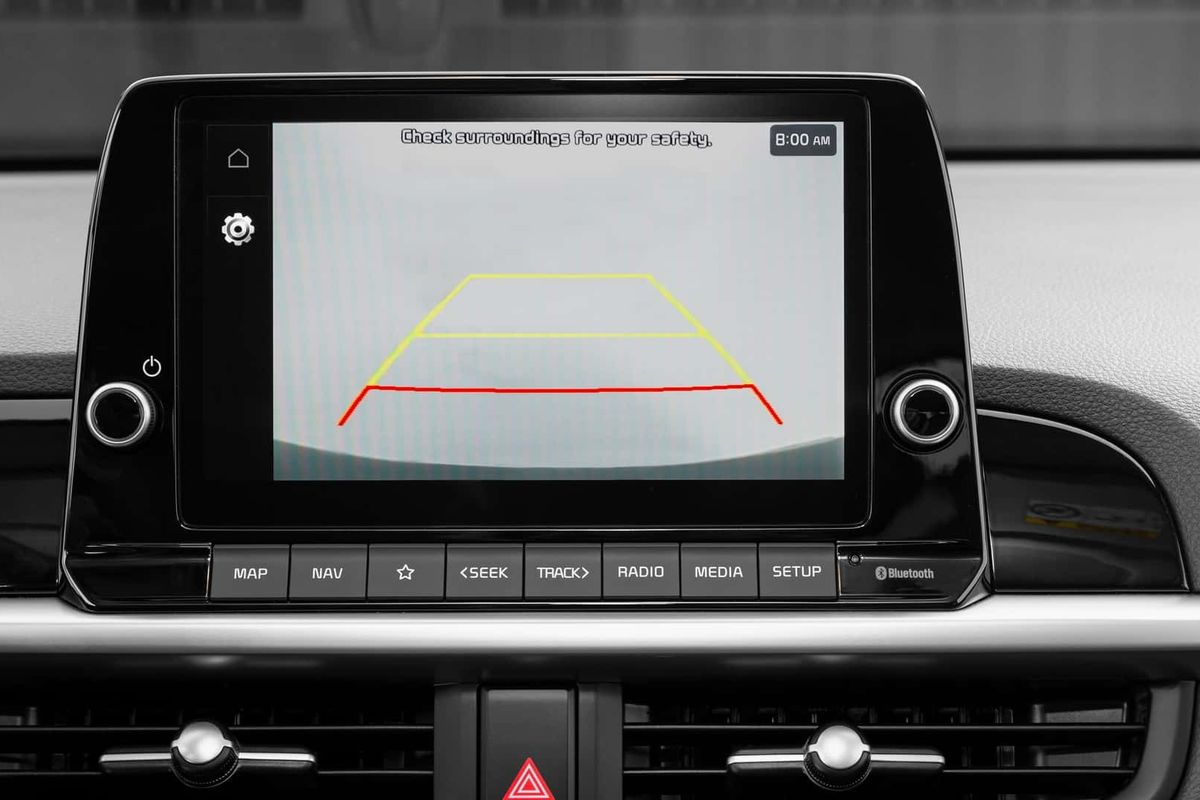
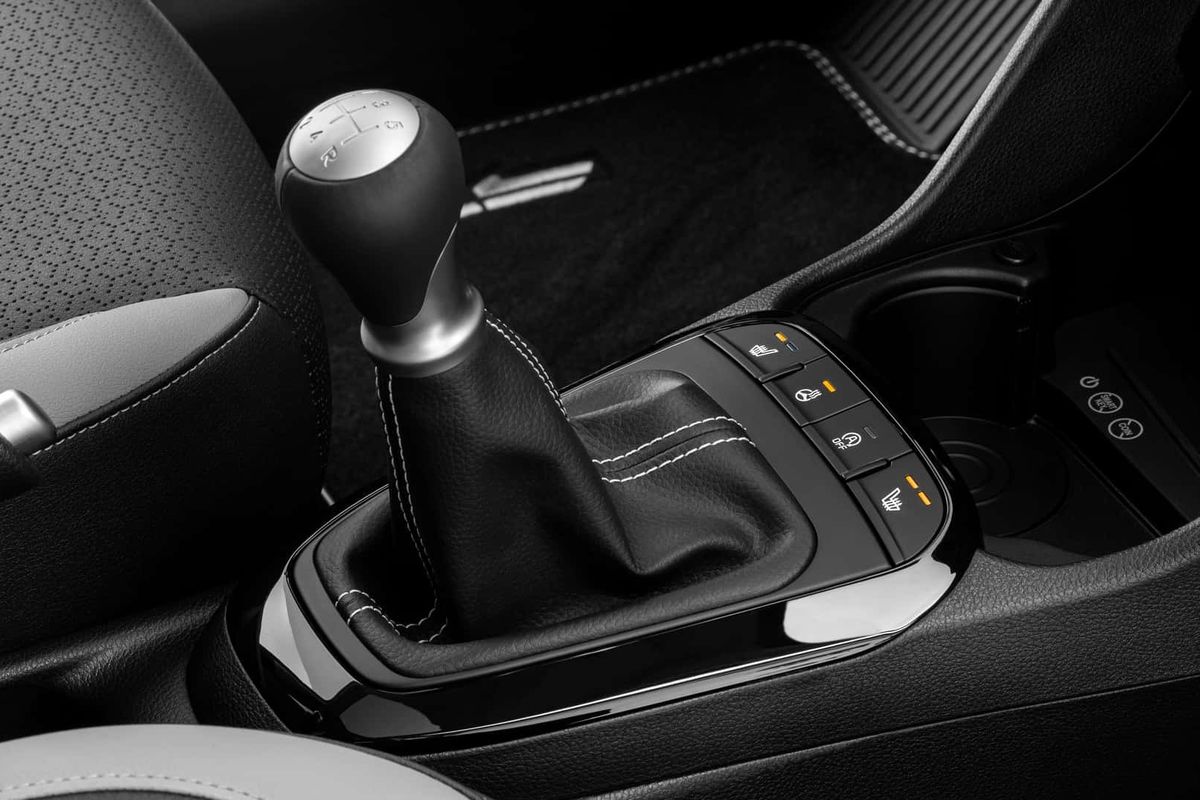
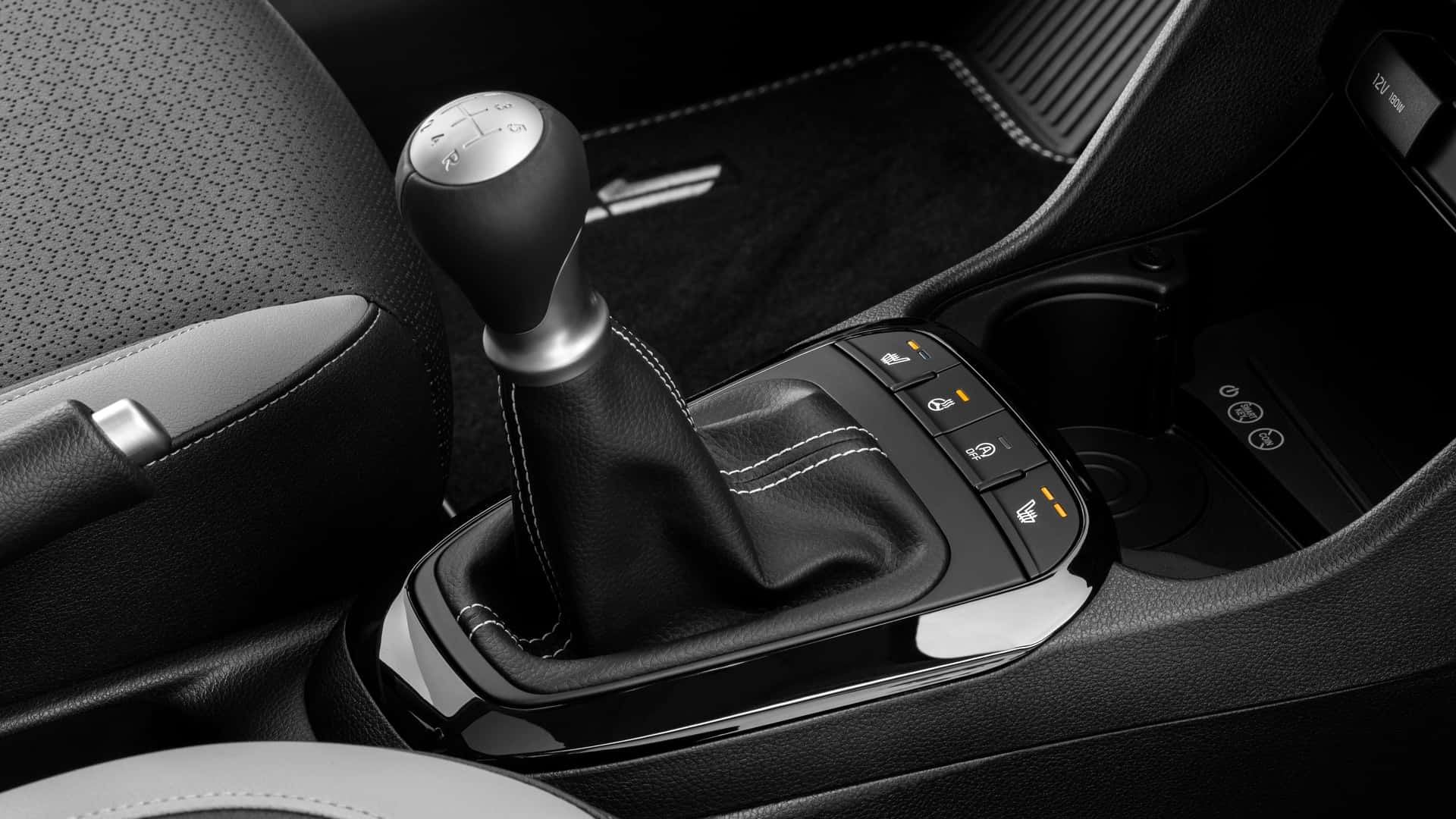
Inside, the 2024 Kia Picanto’s cabin has been given a subtle update with the addition of an 8-inch touchscreen and digital dashboard. The GT-Line gets the sporty-looking flat-bottomed steering wheel and as you can see, this Euro-spec flagship comes fully loaded with things like heated seats and a heated steering wheel.
Kia didn’t release too many details about the powertrain lineup other than confirming two engines; a 1.0 and a 1.2, and both of which are naturally-aspirated petrol 3-cylinders. Both a manual gearbox and an automated manual transmission (AMT) will be offered. Kia says these two engines have been updated for efficiency.
2024 Kia Picanto in SA?
Given the popularity of the Korean A-segment hatchback in our land, we will be very surprised if this model doesn’t come to SA. Kia SA put out a statement: “The enhanced Kia Picanto will be available in South Africa in due course – no official launch date is available at the time of release, and features or specifications applicable to the South African model will only be confirmed closer to its South African launch date.“
10 best-selling bakkies in South Africa: June 2023
The numbers are in! Here’s your monthly look at South Africa’s best- and worst-selling bakkies, this time for June 2023…
South Africa’s new-vehicle industry registered largely unexpected year-on-year growth of 14.0% in June 2023, finishing the month on 46 810 units. As was the case in May 2023, the light-commercial vehicle (LCV) segment was responsible for much of this positive momentum, with sales in this part of the market increasing a whopping 57.1% year on year to 13 945 units (though admittedly off a somewhat low base).
So, what happened on the list of South Africa’s best-selling bakkies? Well, the Prospecton-produced Toyota Hilux – which is set to gain mild-hybrid assistance in 2024 – retained the top spot, enjoying a particularly strong month with 3 792 units (or a month-on-month increase of 35.5%) registered in June 2023. According to the firm, 1 886 units took the form of double cabs, with 1 391 being single cabs and 515 extended-cab derivatives. For the record, Toyota SA Motors has just hiked Hilux pricing, a move that sees the top-spec model breach the R1-million mark.
The Silverton-built Ford Ranger – which has likewise just been hit with a price increase – thus had to settle for 2nd place (after narrowly taking 1st in April 2023). While the Blue Oval bakkie’s tally of 2 099 units was enough to secure the runner-up spot, the 3rd-placed Struandale-manufactured Isuzu D-Max (including the prolonged-lifecycle Gen 6 line-up) was just 146 units behind on 1 953 units. Interestingly, there’s still no sign of the D-Max Arctic Trucks AT35 derivative, which Isuzu Motors SA confirmed for the local market back in May.
The half-tonne Nissan NP200 (1 108 units) – which is produced in Rosslyn – held steady in 4th position, while the Mahindra Pik Up (662 units) and GWM P-Series (430 units) likewise retained 5th and 6th, respectively. The latter Chinese range recently gained a fresh flagship derivative in the form of the P-Series LTD.
The Rosslyn-built Nissan Navara finished June 2023 on 417 registrations, which saw it climb 2 positions to 7th. The Toyota Land Cruiser 79 (342 units) and Volkswagen Amarok (273 units) each thus dropped 1 place to 8th and 9th, respectively. The GWM Steed (99 units) again grabbed the final spot, though failed to crack 3 figures.
Best of the rest in June 2023: bakkies outside the top 10
Jeep Gladiator sales were boosted by the rental channel in June 2023.
So, what about those bakkies that didn’t manage to break into the top 10 in June 2023? Well, the Jeep Gladiator was best of the rest, though of its 83 registrations as many as 80 fascinatingly came via the rental channel. Next was the Mitsubishi Triton (69 units), followed by the Peugeot Landtrek (59 units).
JAC’s T-badged bakkies – the Chinese automaker unfortunately reports only a combined figure for its T6 and T8 line-ups – finished June 2023 on a total of 59 units. Then came the Mahindra Bolero (34 units), with the Mazda BT-50 again bringing up the rear with just 5 units.
Export winners in the bakkie segment in June 2023
What about the export market? Well, the Toyota Hilux moved back into top spot, with 3 957 units shipped off from the Prospecton factory in KwaZulu-Natal in June 2023. That meant the Ford Ranger was relegated to 2nd, with its export tally dropping to 2 373 units. Of course, whether or not the Ranger’s export number includes the new Volkswagen Amarok built at the same Silverton factory remains to be seen (though Ford SA has again emphasised the figure is indeed “Ranger only”).
The D-Max (427 units), Navara (364 units) and NP200 (6 units) again made up the numbers on the export charts. As has been the case for the past few months, the official Naamsa report furthermore showed a handful of imported models being exported from local shores in June 2023, this time in the form of the Triton (13 units), P-Series (9 units) and Steed (1 unit).
10 best-selling bakkies in South Africa for June 2023