Toyota GR Supra (Manual) Review – Is this one of the last great sportscars?
The updated and now manual gearbox Toyota Supra arrived at the same time as our GR Corolla arrived, so we decided to shut down a nearby mountain pass and give the Supra full beans.
Up until fairly recently, you may not have associated Toyota with performance cars, at least not in the last two decades. But seemingly overnight, Toyota has transformed into a brand offering some of the most exciting cars available on the market today.
A quartet of driver-focused cars is now available on the South African market, in the form of the GR Yaris, GR Corolla, GR 86 and GR Supra, the last of which is now available with a manual transmission.
This is a bold move from Toyota this really could be one of the last manual, rear-wheel-drive sportscars ever made. Along with the new ‘box, they’ve significantly bumped the power up too.
Our video journalist, Ciro De Siena, was particularly excited to get his hands on this updated Supra and, for his Christmas and birthday present, we shut down a mountain pass for the day to film this review.
SA’s top 10 automakers: winners & losers in 2023 so far
With 3 quarters of 2023 gone, we’ve crunched the numbers to see which of South Africa’s top 10 automakers grew and which ones shrunk so far this year. Here are the winners and losers…
Year to date at the end of September 2023, South Africa’s new-vehicle industry had grown 2.5% to 401 315 units, a relatively encouraging performance considering the raft of headwinds still facing the local market. So, which of the country’s mainstream automakers grew and which ones endured a dip in sales?
Well, with 3 quarters of the year already behind us, we’ve consolidated the sales figures for South Africa’s 10 best-selling automakers of 2023 thus far, allowing us to compare the latest numbers with those from the corresponding 9-month period in 2022. In short, we’ve effectively identified the winners and losers out of the top 10 companies.
For the record, 5 firms inside the top 10 managed to grow their respective tallies year on year, while 5 saw a decline. Right, here’s your full overview of the performances of the main players in South Africa’s new-vehicle market…
Toyota still top as Suzuki narrows gap to VW
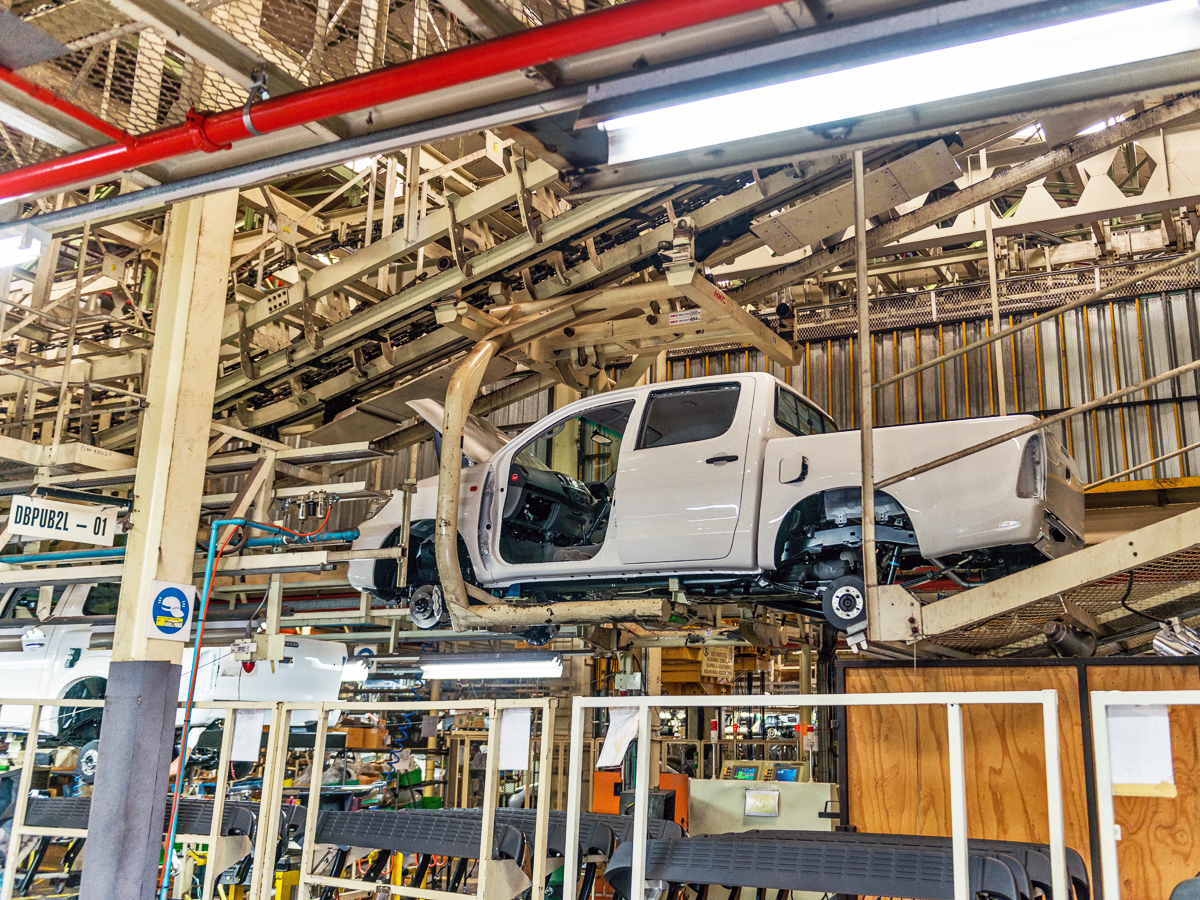
The Hilux accounted for more than a quarter of Toyota sales, year to date.
If you hold even a passing interest in SA’s new-vehicle industry, you won’t be at all surprised to see Toyota – which includes sales from the Lexus and Hino brands – at the very top of the charts. In fact, with a whopping 107 081 registrations over the opening 9 months of the year, the Japanese firm’s local division boasted more than double the number of sales of the 2nd-placed automaker (and an enviable market share of 26.7%).
For the record, Toyota registrations increased 13.5% year on year, though we should keep in mind the company’s 2022 performance was hit hard by the KwaZulu-Natal floods, which scuppered production at Prospecton for months on end. Regardless, Toyota is well on track to securing new-vehicle sales leadership in Mzansi for the 44th consecutive year, with the Hilux leading the charge on 28 341 units (or a little over a quarter of Toyota’s year-to-date total).
The Volkswagen Group (including Audi) placed 2nd, though the German automaker’s tally of 50 074 units represented a 5.8% year-on-year fall. Meanwhile, Suzuki sales (37 235 units) increased 4.2% compared with the same period in 2022, which saw the Hamamatsu-based brand’s local division close the gap somewhat to the VW Group. Year to date, 12 839 units separate the firms (a figure that’s far smaller if we look at sales through the dealer channel only).
Ford climbs as race for 4th place heats up
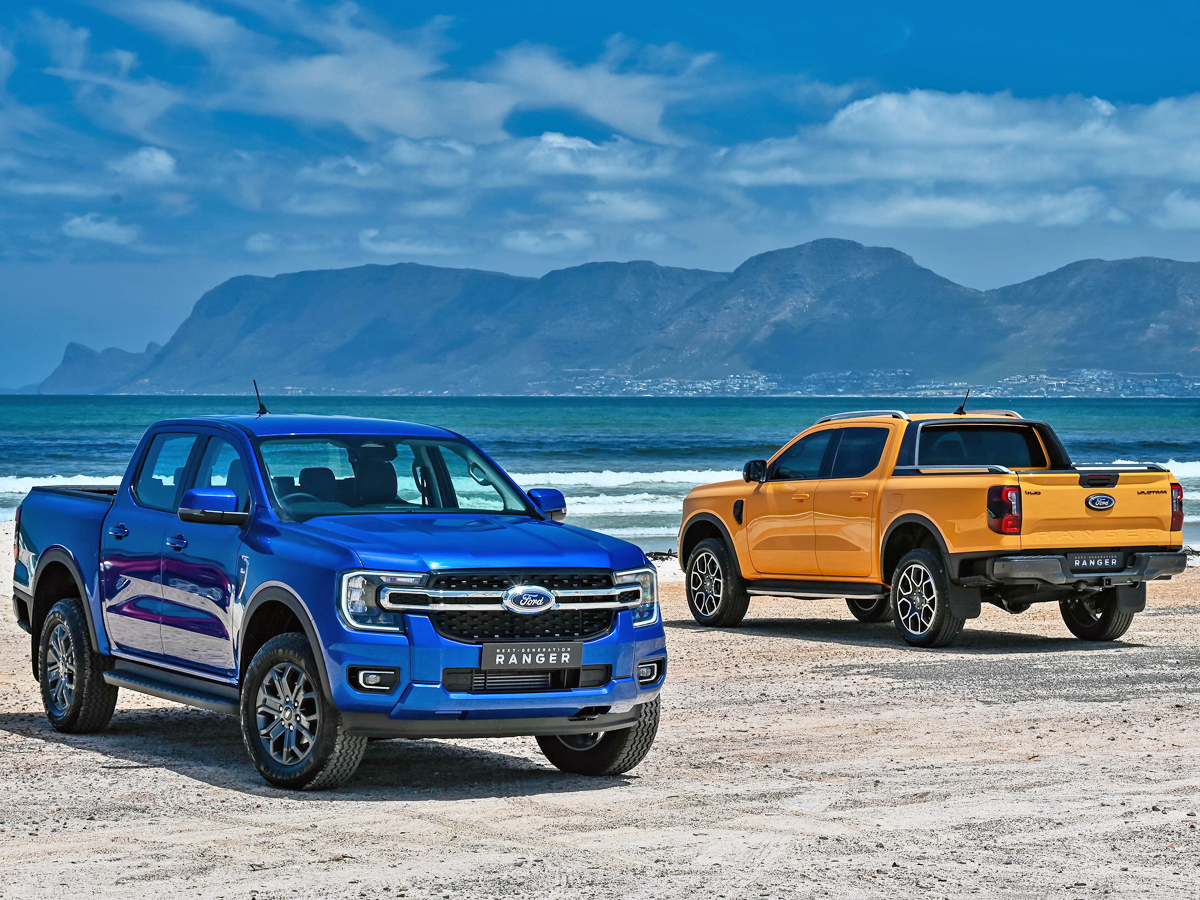
More than 80% of Ford sales year to date were Ranger units.
Though Hyundai sales were down 12.2% year on year to 24 213 units, the South Korean firm managed to hold on to 4th position. From January to September last year, Hyundai crossed the 3 000-unit barrier as many as 5 fives, a feat it could achieve only once in the corresponding period this year.
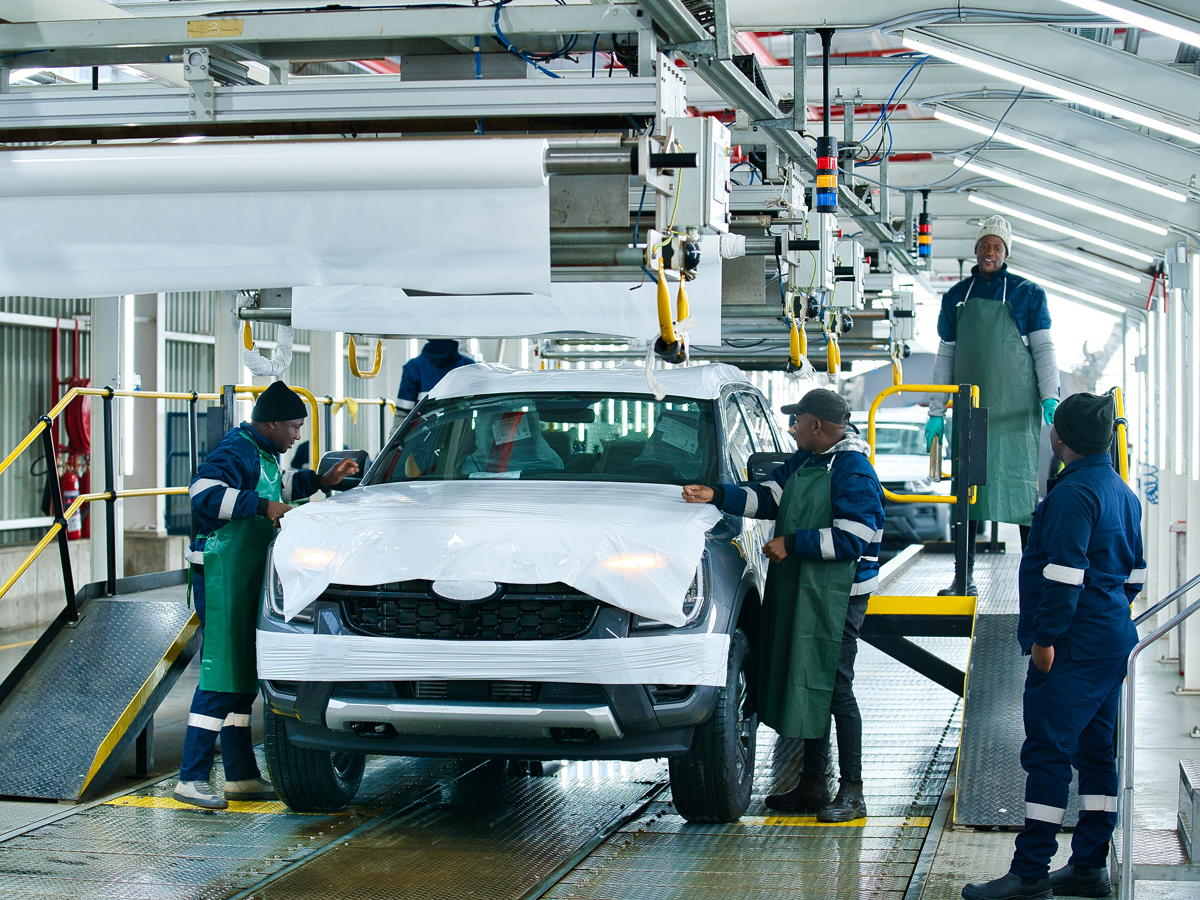
Meanwhile, with a year-to-date total of 22 993 registrations, Ford was just 1 220 units off the pace in 5th. With production of the latest-generation Ranger now fully online, the Blue Oval brand increased its tally 17.4% year on year (the strongest growth in the top 10), which saw it climb 2 rankings from the relatively lowly 7th spot it held in 2022. Fascinatingly, the locally built Ranger accounted for a whopping 80.9% of Ford’s total.
Nissan, meanwhile, dropped out of the top 5 to finish the reporting period in 6th, despite its sales holding relatively steady, year on year. Over the opening 9 months of 2023, the Japanese manufacturer’s local division registered 22 301 vehicles, representing a marginal year-on-year increase of 0.6%. It’s worth noting, of course, the NP200 – a model that accounted for nearly half of Nissan’s volume in 2023 thus far – will be put out to pasture in the 1st quarter of 2024.
Isuzu rises, Haval holds, Renault and Kia fall
Just under half of Haval’s YTD sales (including the GWM brand) came courtesy of the Jolion.
Though Isuzu relies on the Struandale-built D-Max bakkie even more heavily than Ford does on the Ranger (its only other model being the low-volume MU-X), the Japanese brand enjoyed an impressive climb from 10th to 7th place in the opening 9 months of the year. Isuzu’s sales tally increased 15.7% year on year to finish the reporting period on 17 882 units.
In contrast, Renault slipped from 6th to 8th, with its sales performance reflecting a 23.8% year-on-year decline to 16 431 units. That means the French firm’s local division experienced the largest percentage drop in the top 10, with former volume drivers such as the Clio and Captur struggling to match sales of years gone by (the Indian-built Kiger, though, was its top seller with 6 036 units).
Interestingly, though Haval sales slipped 3.8% year on year to 15 479 units, the Chinese automaker – bolstered by 7 005 registrations of the Jolion – retained the 9th place it secured last year. That said, it’s just 952 units behind Renault, year to date. Finally, Kia slid 2 places to 10th, with its total of 14 708 units representing a drop of 15.7% compared with the corresponding period in 2022.
Chery challenging just outside the top 10
Chery finds itself in 11th place, with the the Tiggo 4 pro accounting for 60% of the brand’s sales.
So, what about the automakers that didn’t manage to crack the top 10 over the opening 3 quarters of 2023? Well, Chinese firm Chery found itself in 11th with 12 115 registrations, which put it 2 593 units behind Kia (for the month of July 2023, Chery managed to crack the top 10 – at the expense of Kia – for the 1st time since it starting reporting sales figures to Naamsa).
The BMW Group (including Mini sales) was next on 10 307 units (though this figure includes Naamsa estimates as the German company doesn’t regularly report sales), followed by Indian manufacturer Mahindra (9 131 units) in 13th. Mercedes-Benz was technically 14th with a likewise a Naamsa-estimated tally of 6 271 units, while Stellantis – which distributes the Abarth, Alfa Romeo, Citroën, Fiat, Jeep, Opel and Peugeot brands in SA – rounded out the top 15, some way off the pace on 3 101 units.
South Africa’s 10 best-selling automakers of 2023 so far
Retail, Market & Trade-in Value: How it Affects Your Car Insurance
Understanding the differences between your car’s retail-, market- and trade-in values is key to making informed decisions about vehicle insurance. Ideally, you should strike a balance between keeping within your budget and managing financial risk sufficiently.
PARTNERED CONTENT
Your car’s value is an important factor when it comes to car insurance premiums. If you are like the majority of car owners, you know you need to insure your car, but you’re unsure how much. Should you insure it for its retail, market, or trade-in value? To help you decide, Budget Insurance offers this guide…
What it all means: Retail, market and trade-in value
Retail value represents the price at which a dealer will sell a car to a customer. This value – the highest of the 3 – includes the cost at which the dealer bought the vehicle as well as its markup (profit margin). When this value is applied to cars that were bought from new relatively recently, it assumes a vehicle is in good to excellent condition, with the remainder of its warranty and service/maintenance plan left to run.
The market value, also known as the fair market value, represents the current value for a specific make, model, derivative, year and condition of a car in the open market (such as when you buy/sell it privately). The market value of a car takes into account factors like the car’s age, mileage, condition and demand.
The trade-in value refers to how much a car dealer might offer you for your car when you trade it in for another vehicle. Typically, this is the lowest of the 3 values because the dealer still needs to make a profit when it resells the car. The trade-in value depends on factors such as the condition and mileage of the car. Insuring a vehicle for its trade-in value is a good option if you’re looking to replace your car soon.
Is it better to insure for market, retail or trade-in value?
Suffice it to say that if you choose to insure your car for its retail value, you will pay a higher monthly premium. But, if your vehicle is unrecovered after being stolen or written off in an accident, you’ll receive a higher amount back in a settlement or a replacement vehicle of a similar make, model, year and spec.
If you insure your car for its market value (a benchmark for the price at which such a vehicle may change hands if sold privately), your premium will be relatively lower. Your insurance firm will consider factors such as mileage, condition, and service history in determining your car’s market value. The method of valuing cars is standardised to make it easier for owners to determine what their vehicles are worth.
Trade-in value is what you’ll be offered if you sell your car to a dealer as part of purchasing a vehicle from that business. The monthly premium for insuring your vehicle for its trade-in value is usually lower than when insuring it for retail or market value because the trade-in value is based on the average price that dealers offer for a vehicle such as yours based on the trade’s Auto Dealers’ Guide and market conditions.
What option should I choose based on the value of my car?
The retail value may be the best option if you want to seamlessly return to driving the same car as before with minimal fuss. If you don’t mind getting a car that might not be the same make and model as the one that you bought, but operates as well as your previous one, the market value might be a better choice.
Insuring your vehicle for its trade-in value is suitable if you want to limit your expenditure on car insurance to a minimum, but would like to have more than basic 3rd-party, fire and theft coverage for your vehicle. Owners of older vehicles or small runabouts should also consider the Budget Lite option.
Budget Insurance offers another option, however. You can insure your car for its BetterCar Value, which pays out a minimum of 15% more than the retail value. That means if your car is written off or cannot be recovered after being stolen, you can buy the same model car but 1 year newer – and with lower mileage.
If your car was bought through a finance agreement and you still owe money on the vehicle, consider the repayment details carefully when you take out car insurance. For example, if you pay a high interest rate, you may owe more money on your loan than what your car is worth (usually the case in the early stages of a vehicle-loan term); if you no longer have the car, there may be a shortfall that you owe to the bank.
Comprehensive Car Insurance covers you for accidents, damages, theft, and any 3rd-party claims against you. It’s a great option for customers with new, financed cars. Finally, if you’ve enhanced your car with an upgraded audio system or tow bar, you’ll want to ensure your insurance covers the car and its upgrades. If not, you’ll have to forgo these additions if the insurer replaces or pays out for your vehicle.
Want to know more?
Do you want to learn more about car insurance or review your car insurance requirements with the help of experts? Budget Insurance’s team is always ready to assist; contact them on 086 1600 120 or utilise their online car insurance calculator, which gives you an accurate and budget-friendly quote in minutes.
How BMW’s South African race cars were born – BMW Group SA Chronicles (Ep 2)
BMW Group SA produced the first-gen 5-Series in the ’70s and 80’s, but in the spirit of “Win on (Saturday), Sell on Monday”, the Rosslyn-based brand produced a pair of homologation specials to take the E12 racing: the 530 MLE and 535i Lightweight.
Today, BMW is a desirable premium car brand in South Africa. But in the early ’70s, the South African division was a fledgling brand that had begun producing the E12-generation 5 Series.
In a stroke of marketing genius, the local subsidiary of the Munich-based brand decided to raise its public profile by developing homologation specials (derivatives of which a specific number needed to be built before they would be allowed to compete in national saloon racing) to compete in local motorsport.
In the 2nd instalment of a six-part video series, in which we take a deep dive into the history of this iconic brand in South Africa, Jacob Moshokoa presents the legendary 530 MLE and 535i Lightweight (both unique-so-SA derivatives of the E12-generation 5 Series) that were developed and built here in Mzansi.
Jacob also chats with renowned BMW racing driver and former head of vehicle testing, Geoff Goddard. Learning about the local ingenuity and resourcefulness that led to the creation of 530 MLE and 535i Lightweight.
Puma, Fronx & more: how SA’s newest nameplates sold in Sept 2023
Wondering how South Africa’s newest nameplates sold in September 2023? Let’s take a look at sales figures of the Ford Puma, Suzuki Fronx and more…
Several new nameplates have launched in South Africa over the past few months. So, just how well have they been received? We sifted through the sales figures to see exactly how these newcomers performed in September 2023.
Let’s start with the Ford Puma, which technically hit the local market only at the start of October (though we broke the news back in August). Despite having just hit the market, the Blue Oval brand reported 52 registrations in September, with dealers likely having taken these orders well before launch. Considering its positioning, it’ll be interesting to see how this small crossover fares in the months to come.
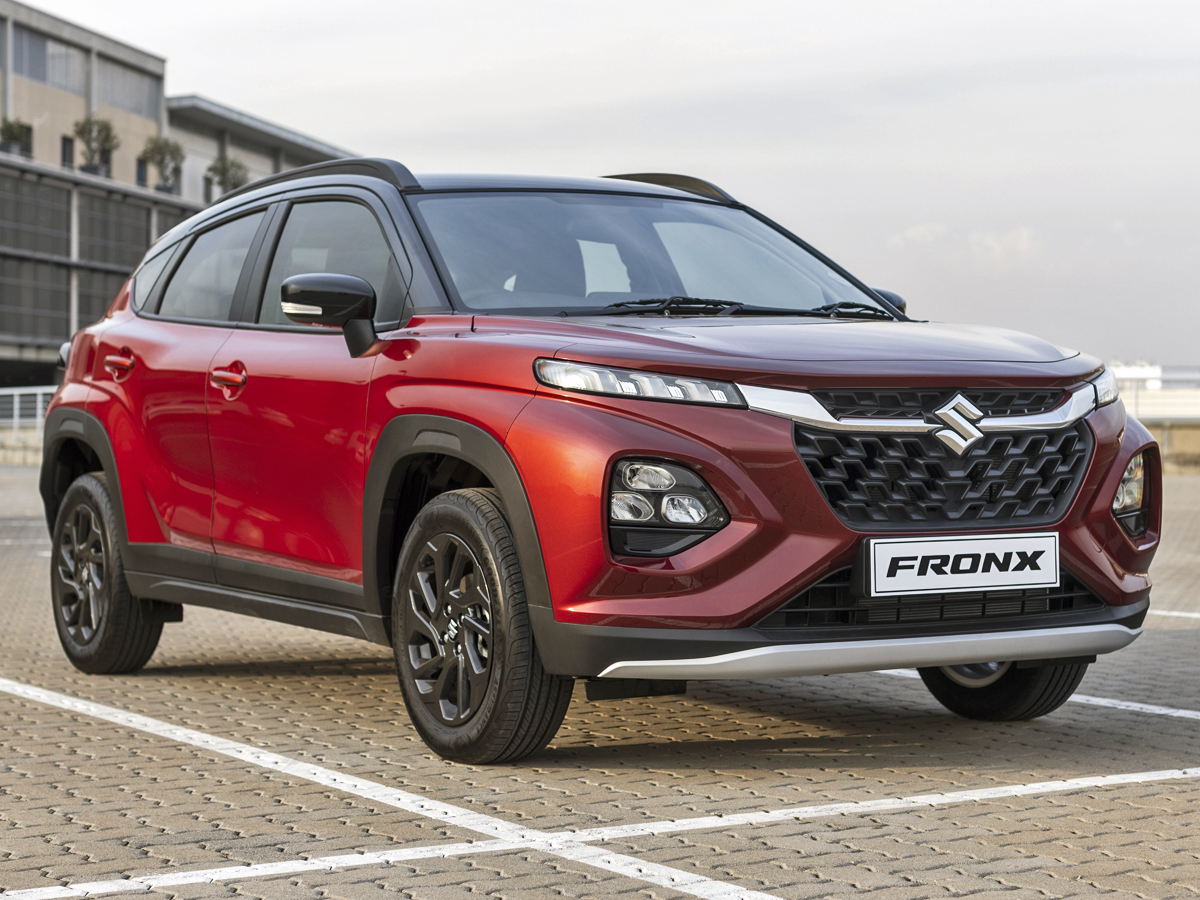
The new Suzuki Fronx is already finding favour with SA buyers.
What about the new Suzuki Fronx? Well, the Indian-built newcomer managed an impressive 527 units in its 1st full month on sale, after hitting a total of 302 units in August (despite the fact it had been on sale for just 2 weeks at that point).
It seems the Ertiga-based Suzuki XL6 hasn’t been quite as well received by local buyers, with 46 examples of the new 6-seater model sold in September (along with 6 units registered in the final few days of the prior month). Of course, it’s still early days…
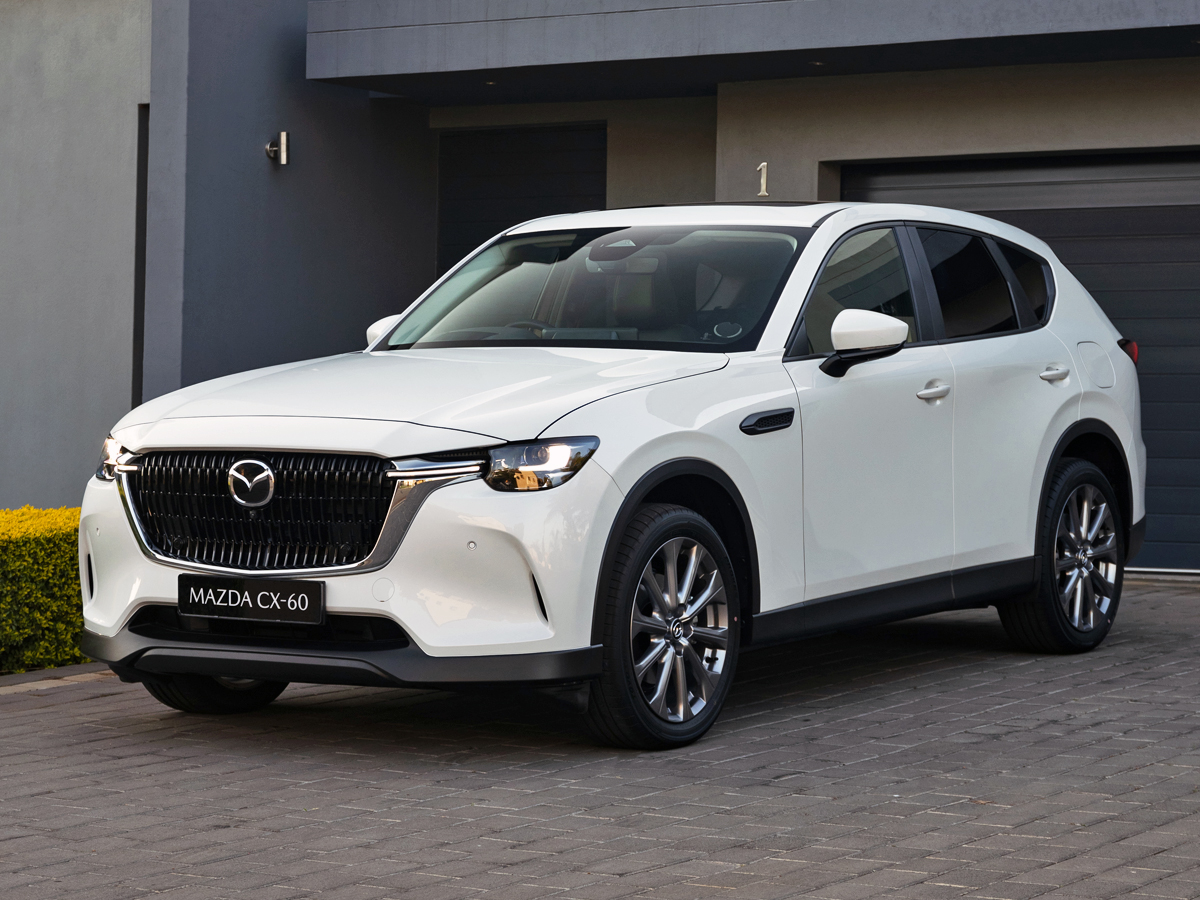
September was the Mazda CX-60’s slowest month yet.
A few other nameplates launched a little earlier in the year, such as the Suzuki Grand Vitara. The Japanese firm’s flagship SUV managed a tally of 320 units in September, after hitting a high of 382 registrations in May 2023. The Mazda CX-60 finished September on 17 units, its slowest month since launching in the 2nd quarter of this year, though the range is scheduled to expand with 6-cylinder turbodiesel power in early 2024.
Meanwhile, the Subaru Crosstrek – which arrived in Mzansi to replace the XV back in June 2023 – failed to hit double figures last month, settling for just 7 sales. The fully electric Volvo C40 Recharge finished September on 2 registrations, though we understand SA’s initial allocation was very limited.
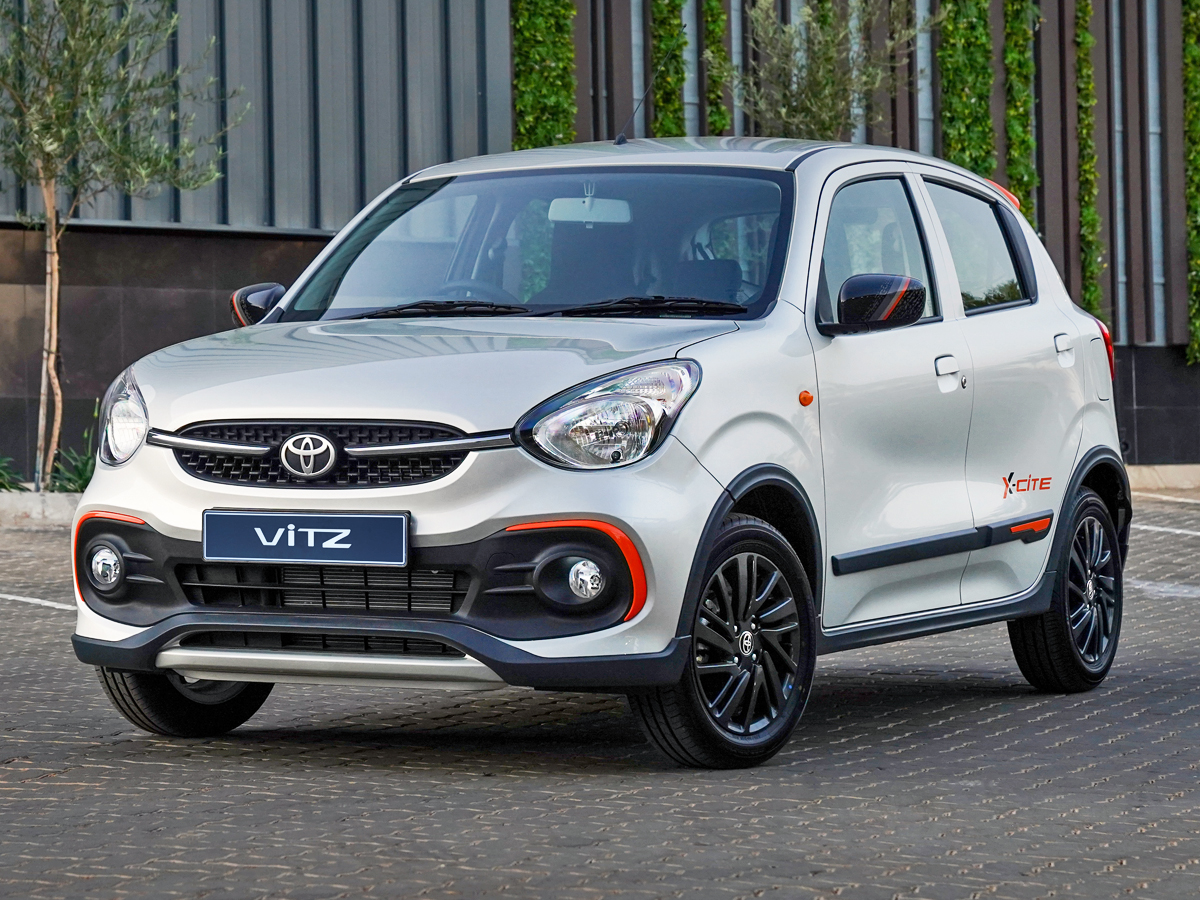
Toyota’s efforts to push sales of the new Suzuki-built Vitz appear to be paying dividends.
Finally, let’s look at a few new nameplates from the market’s biggest brand. The Toyota Vitz – effectively a rebadged Suzuki Celerio that touched down in South Africa in April 2023 to replace the Agya – enjoyed its best month of the year thus far, with 581 units sold in September. The Japanese automaker recently expanded its Vitz line-up by launching new X-Cite derivatives, after earlier cutting pricing by up to R25 000 (depending on the derivative) with a special “deal assist” offer.
In addition, 3 units of the Toyota GR Corolla were sold last month, though supply of this manual-equipped hot hatch to the local market is extremely limited. Finally, a single example of the Toyota Crown crossover was registered, but we should point out the brand isn’t actively marketing the newcomer as its allocation for 2023 has been “cut drastically”.
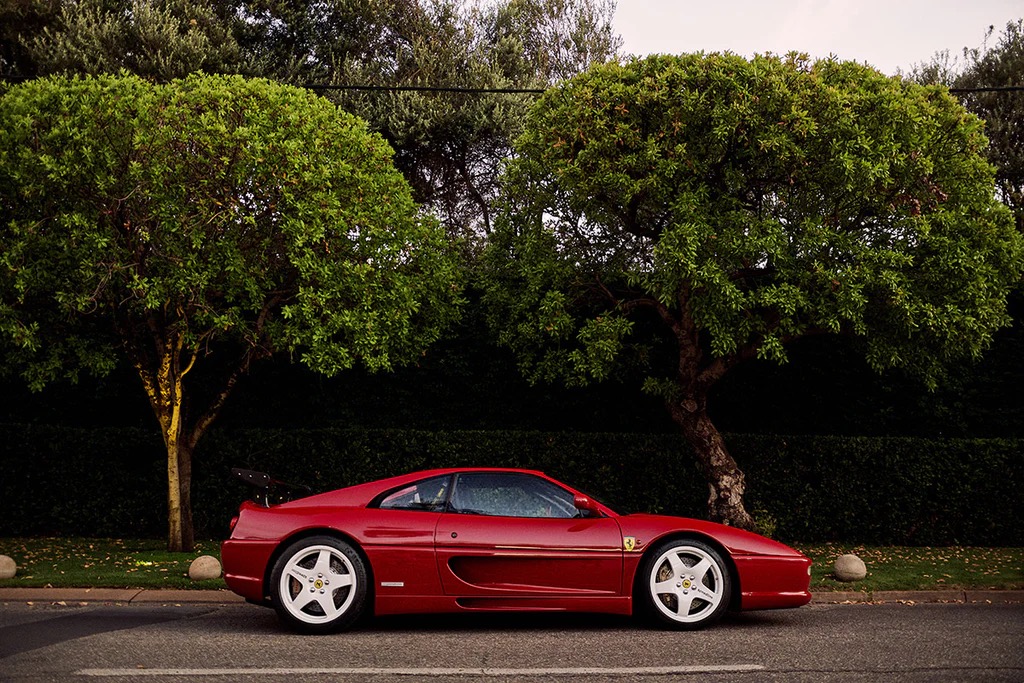
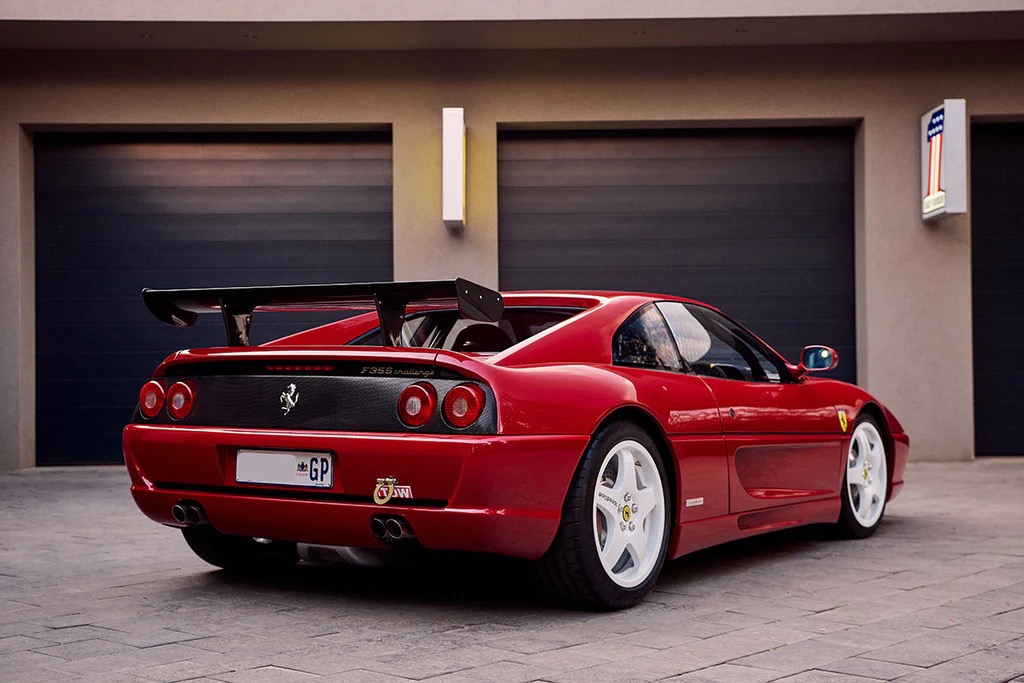
We get behind the wheel of (what is probably) the only Ferrari F355 Challenge in South Africa.
PICTURES: Stefan Kotze
The Ferrari F355 is, in the opinion of many enthusiasts, one of the prettiest Nineties-era Ferraris. It’s certainly better looking than its controversial 348 predecessor, while its compact dimensions and small footprint set it apart as a true sports car.
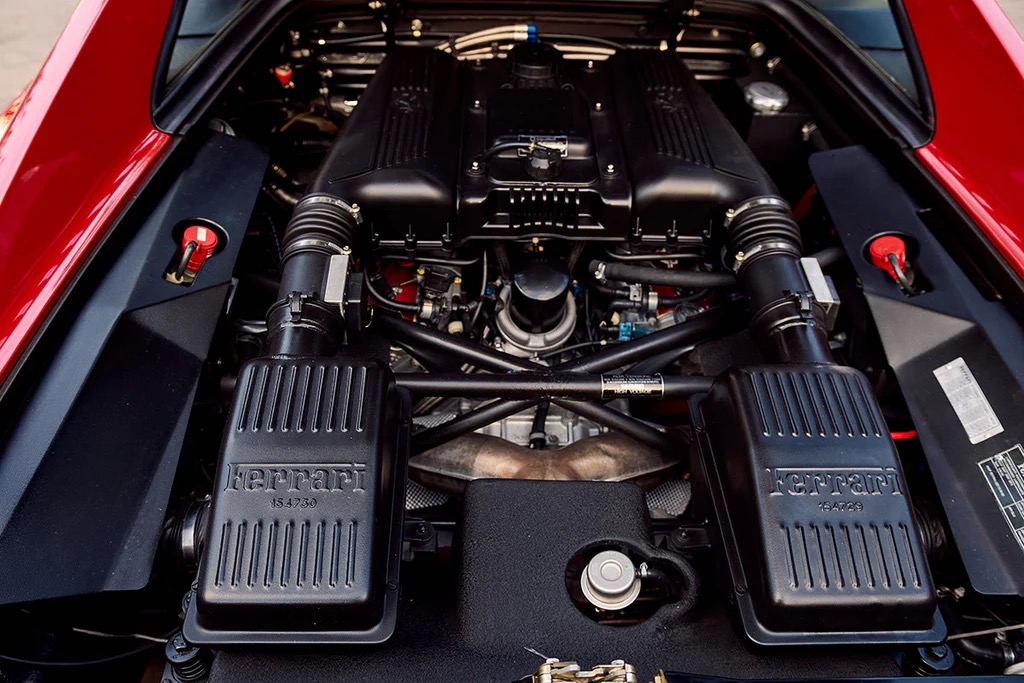
It is also loved because of its atmospheric 3.5-litre V8 engine (notably with that complicated 5-valve-per-cylinder configuration), which produces one of the most evocative, soul-stirring exhaust notes to be produced by a Prancing Horse.
Specifications
Model: 1996 Ferrari F355 Challenge
Engine: 3.5-litre, V8 petrol
Power: 279 kW at 8 250 rpm
Torque: 363 Nm at 6 000 rpm
Transmission: 6-speed manual, RWD
Weight: 1 355 kg
0-100 kph: 4.7 sec (standard car, claimed)
Top speed: 295 kph
I’ve never before laid eyes on a Ferrari F355 finished in this gorgeous Rosso Barchetta colour. It is a beautifully deep-red hue that gives the car an exceptionally classy presence and purposeful stance. But that is about the only dressy element of this F355…
The car’s history
The original invoice shows the price of the Ferrari F355 and the Challenge kit, the latter of which commanded a considerable premium (around 10 per cent of the car’s value in 1996). This is indicated on the document, which was issued by the (then) local importers in South Africa, T.A.K. Motor Co., along with the quoted 60 hours of labour to fit the accessories.
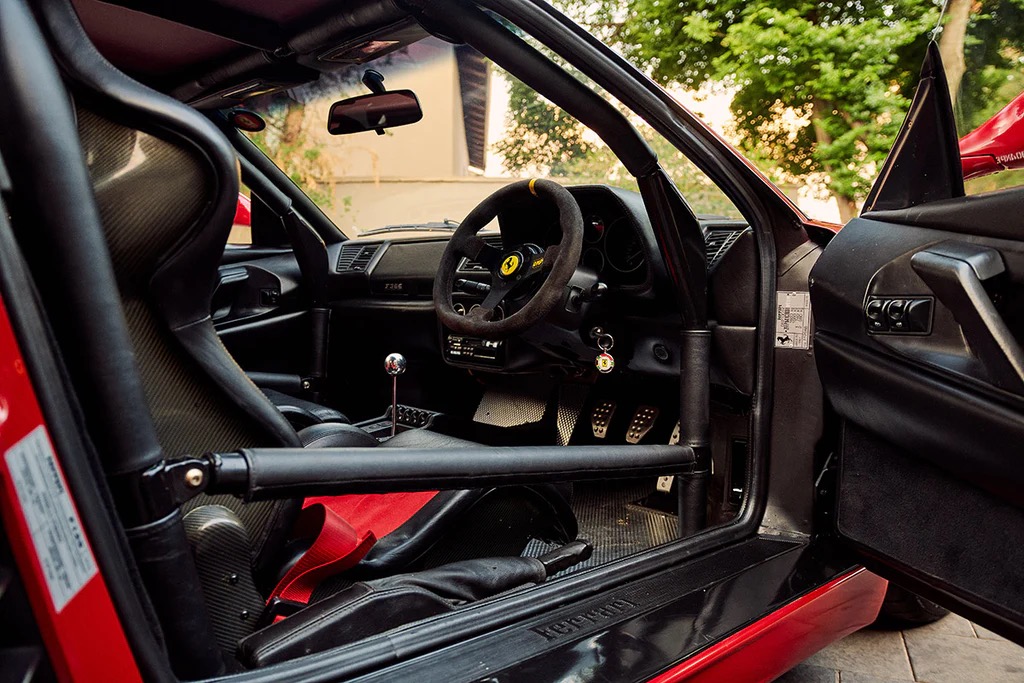
That includes, but is not limited to, the roll cage, which includes bars that trace the A-pillars and span the door apertures, the leather-clad sport seats (with four-point harnesses), an OMP racing steering wheel, a fire extinguisher and the stripped-out footwells, which are adorned with non-slip metal plates.
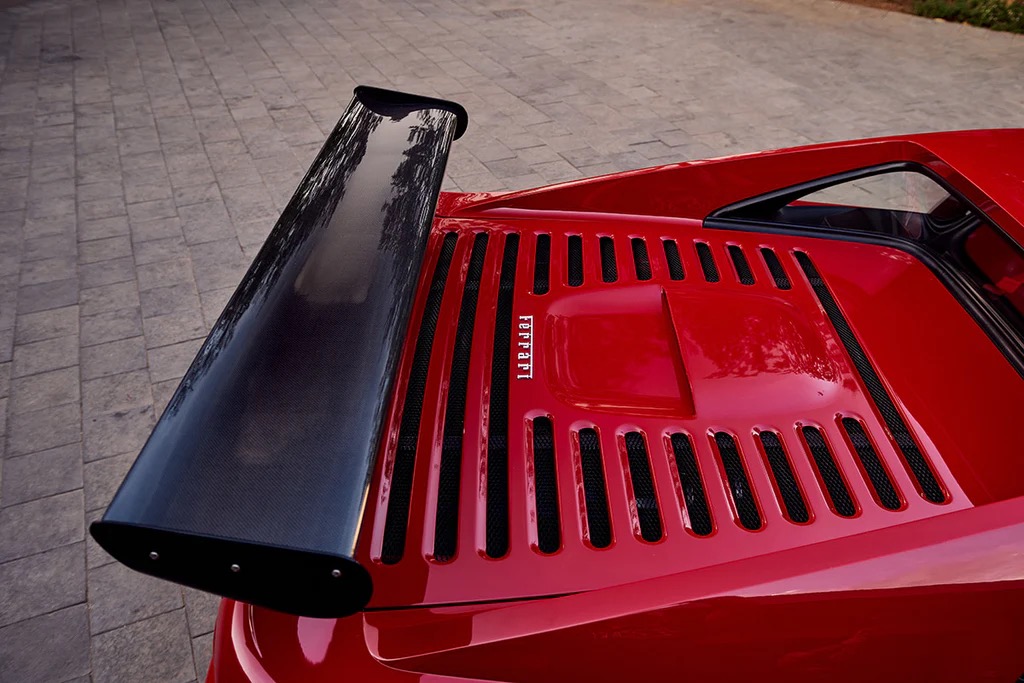
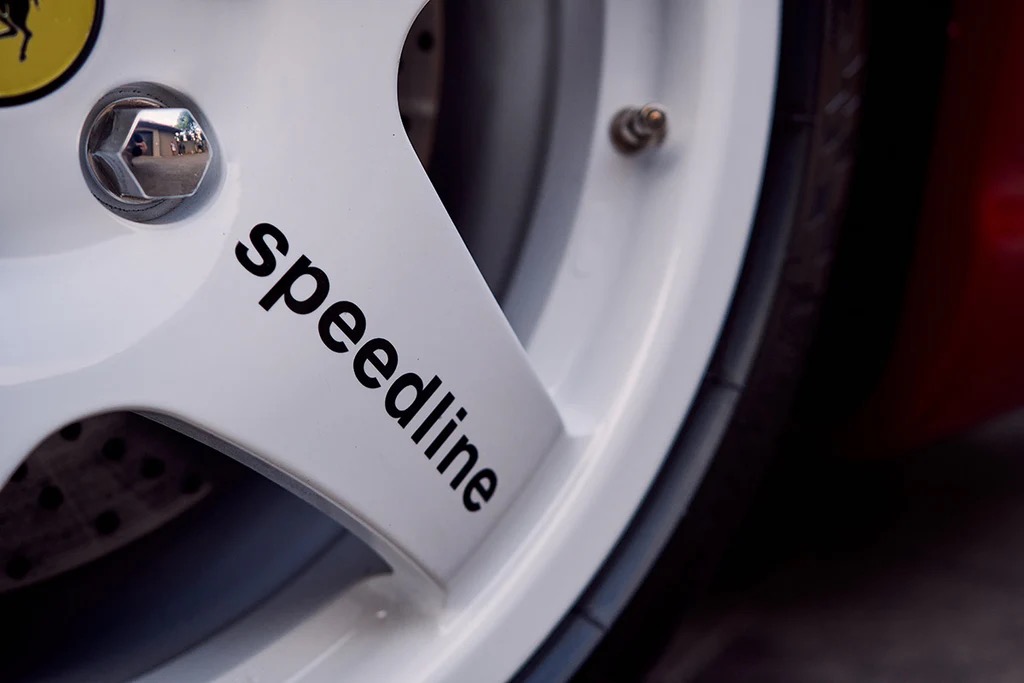
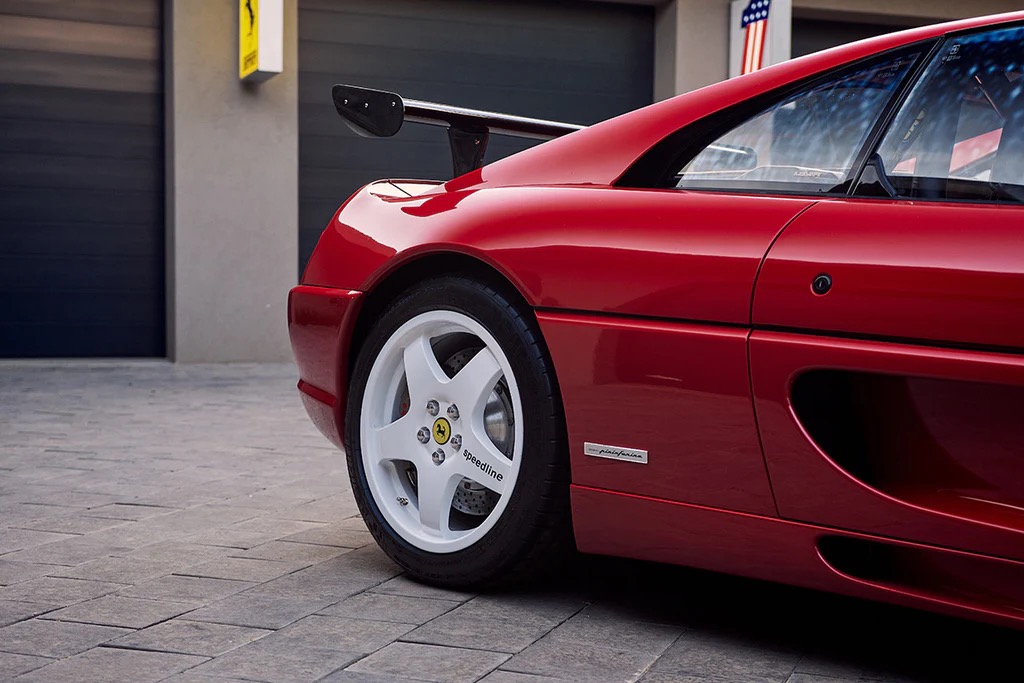
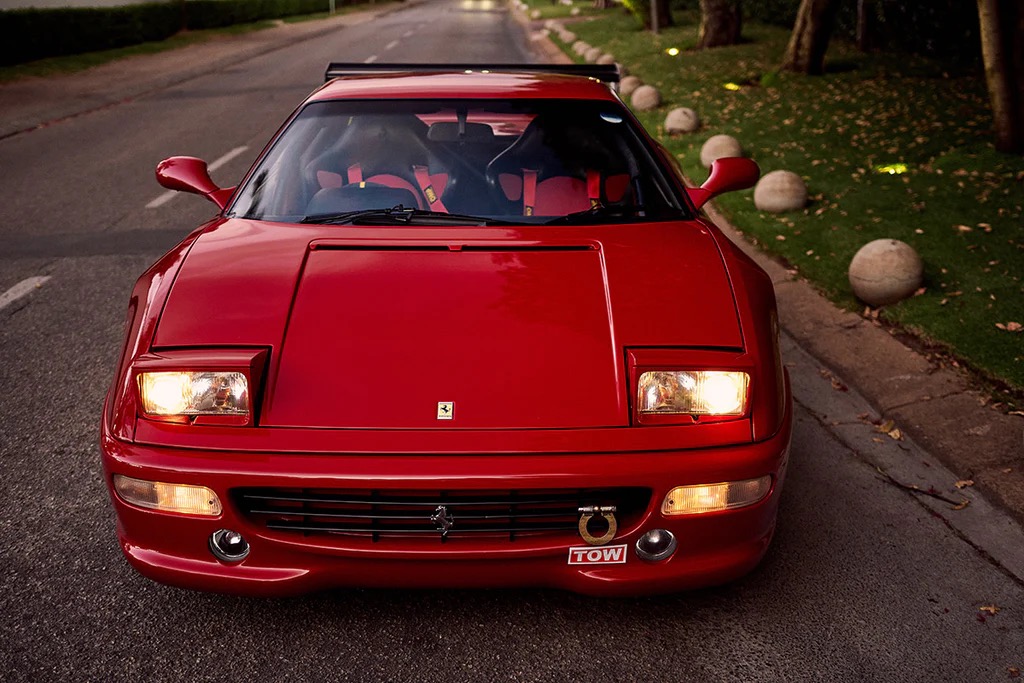
When you view the exterior, you notice two tow hooks (one at either end of the car), those gorgeous white Speedline wheels, the upgraded braking and exhaust systems, as well as that simple, yet quite dramatic, carbon-fibre rear wing. The bolstered suspension features, inter alia, rose-joints. The car has considerable presence, to say the least.
The Challenge embellishments effectively transform the F355 from a svelte supercar into a race car, most notably owing to the beautiful white Speedline rims and, secondly, that relatively small (at least by modern standards) and plainly styled rear wing.
When I looked at some archive photos of the F355 Challenge race events, I noticed that not all the competition cars featured the carbon-fibre rear wing; as a result, the early cars look relatively tame or understated without that addendum.
Climbing onboard
When I open the driver’s door and peer inside, any doubts as to the car’s purpose are immediately dispelled. Gone are the carpets, only a bare-metal floor remains. There is a smaller OMP steering wheel, and most notably the full roll cage, which encases the entire cabin. It is also thoughtfully covered so that you won’t scratch it during ingress and egress. Off course, climbing in and out requires extra effort, but that alone reminds you that you are about to drive something quite special.
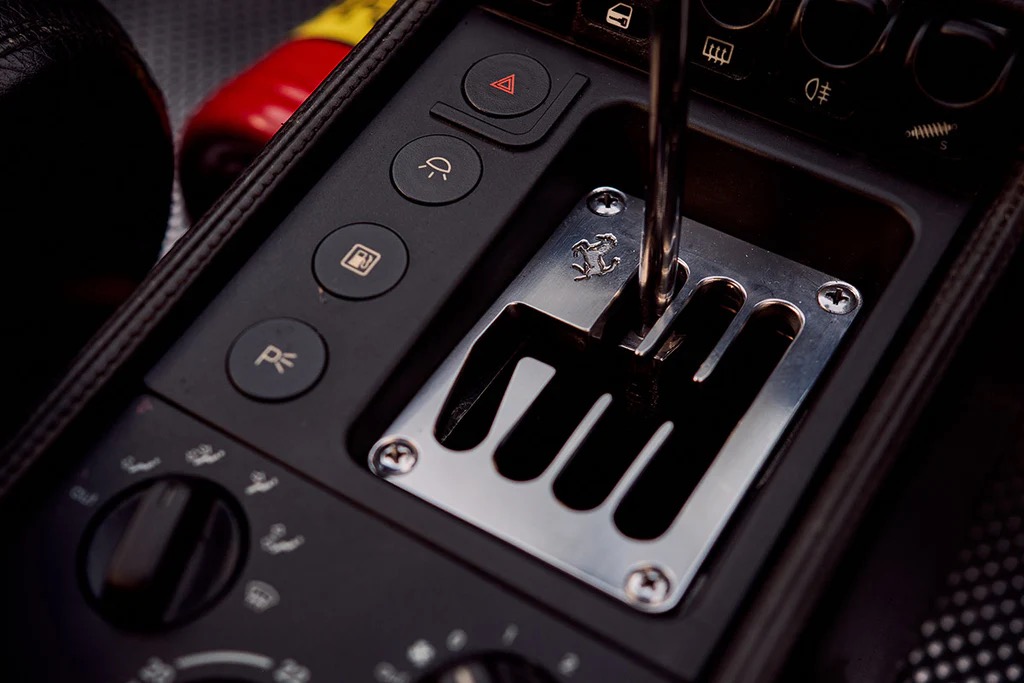
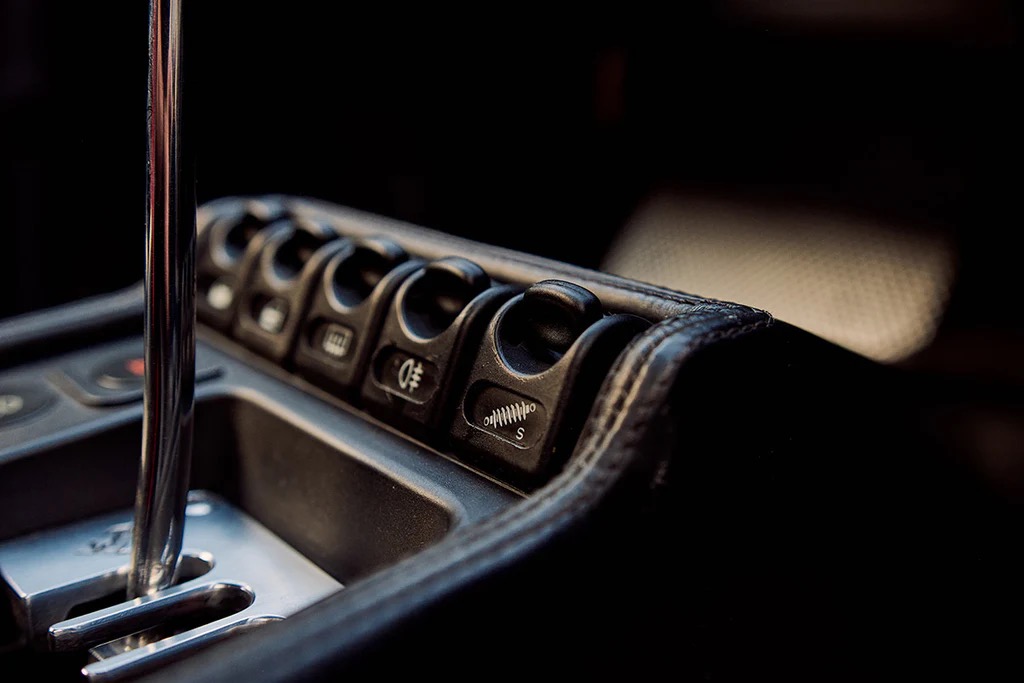
As expected, that characteristic minimalist metal shift lever with its shiny knob protrudes from the open gate, while some auxiliary buttons are scattered around the gearlever’s plastic surround – not that any of them will be important today. I cannot help but feel a jolt of excitement as I turn the key to start the engine
Perhaps I’m starting my F355 journey at the wrong side of the spectrum, because I’ve never been behind the ‘wheel of any F355 model before! But the moment the engine catches, an enthusiastic rumble escapes from those large exhaust ends.
My height is 1.87 metres, which makes me a few centimetres too tall to drive this car comfortably – but I won’t allow this minor discomfort to detract from the driving experience whatsoever. The F355’s seating position is far from perfect, but its successor, the 360 Modena, did address that problem.
As I prefer to sit relatively close to the ‘wheel, I move the seat forward slightly, only for my knees to be pushed up like a grasshopper’s rear legs on either side of the steering column, which would have benefitted from a bit more adjustment. Even so, I have a perfect view over the hood and the shift lever falls perfectly to hand. If you have a wedding ring, take it off, otherwise you’ll scratch the knob.
Behind the wheel
As I drive around the neighbourhood, the F355 Challenge looks alien compared to anything else on the road. Joggers look on in awe as the urgent exhaust note draws attention – even at low revs. The suspension is firmly-sprung and I can sense the car isn’t happy pottering around in the suburbs – on a track, the race-tuned dampers would suppress body roll under hard cornering with aplomb.
When the road clears a little, I press the accelerator a little harder and the pitch of the engine and exhaust notes intensifies immediately. It is a raw, cacophonous din that reminds you that this car thrives where silencers are superfluous.
Seeing as the F355 Challenge weighs in at just 1 355 kg (wet weight), the throttle inputs have a near instantaneous effect on the acceleration. The small steering wheel provides real feedback and feels decidedly racy in your palms.
My head is very close to the roof, which makes me wonder whether I would have been able to fit in the car if I was wearing a helmet. The brakes, which utilise some of the same parts as the rotors of the F40, have immense stopping power. The moment you press them a little harder they bite with even more conviction.
As is the case with virtually all manual-shifting Ferraris, each and every gear change in the F355 Challenge is a moment of magnificence. That shift lever is not only beautiful to look at, but its action is crisp and simple; it’s a sheer joy to use.
With the light fading, I switch on the main beams and the rectangular headlights pop up from the hood dramatically; how very period-correct and… appropriate.
As we parked the car while the photographer captured a final few shots before it got too dark, I realised several factors make this car truly special.
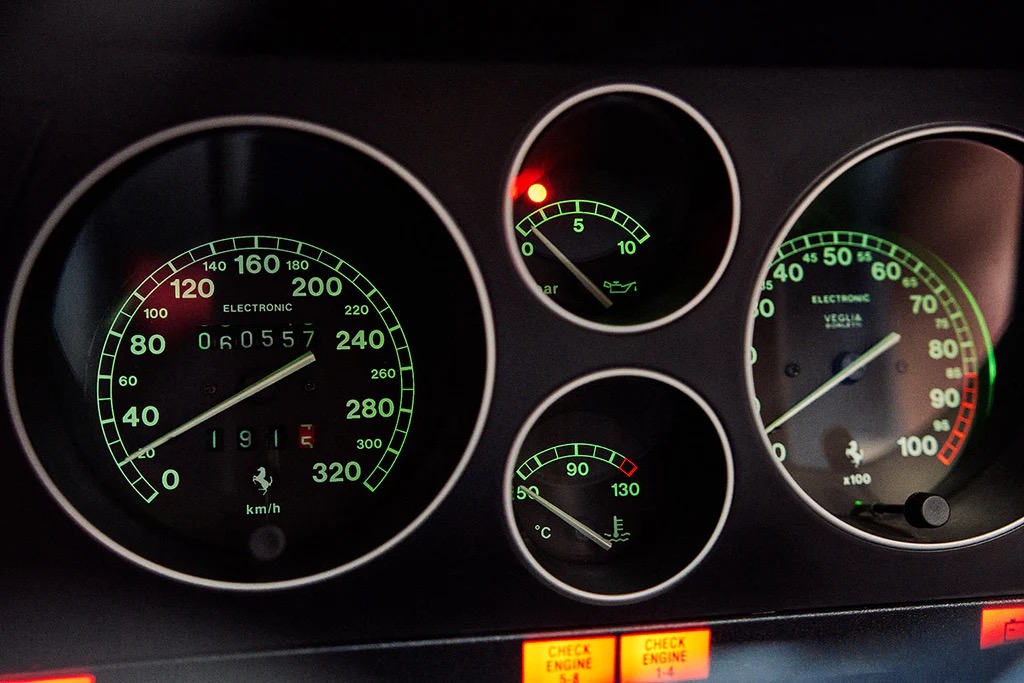
Compared with their roadgoing counterparts, race cars are flashy and loud, but not beautiful. However, the elegant simplicity of the F355 with its Challenge kit is truly special. Any outing with this car will be memorable from the moment you start that 3.5-litre V8 (codenamed F129), not to mention when you can rev the engine around the tacho to its heady 8 500 rpm (in the mid-Nineties!) redline.
As only 108 units of the F355 Challenge were manufactured and some, but not many, were converted by official dealers, this remains a very rare Ferrari. It is not a Ferrari you see often, but it delivers a thrilling, utterly engaging driving experience. It is undoubtedly one of the rawest Ferraris I’ve driven and I understand why the owner bought one.
Summary
It might not be the ideal car to use to pop out to the shops, which is something you can, as a matter of fact, do with any of this car’s successors, but then again, we’ve arguably become spoiled with modern cars. This F355 is a car that you need to set time aside for, pick your road, track or outing carefully and go and enjoy one of the most fun cars to come out of Maranello in the Nineties.
10 best-selling bakkies in South Africa: September 2023
The sales figures are in, bakkie fanatics! This is your monthly look at South Africa’s best- and worst-selling bakkies for September 2023…
In September 2023, South Africa’s new-vehicle industry registered a year-on-year decline of 4.1% to finish on 46 021 units. Yet again, the light-commercial vehicle (LCV) segment was the only sector to see growth, with registrations in this space coming in at 13 169 units, or 4.6% more than in the same month in 2022.
So, what happened on the list of South Africa’s best-selling bakkies? Well, there was again very little movement in the rankings, particularly in the upper half of the table. That meant the Toyota Hilux was again top of the charts, with 3 249 units of the Prospecton-produced bakkie registered around Mzansi in September 2023.
With 2 413 registrations, the Silverton-built Ford Ranger again claimed the runner-up position, ending the month 836 units off the pace (it’s interesting to note, however, the Ranger was slightly ahead of the Hilux in the year-to-date double-cab sales race at the end of August 2023). The Struandale-made Isuzu D-Max completed the podium once more, with 1 639 registrations.
With production scheduled to cease at Rosslyn in March 2024, the Nissan NP200 (997 units) dipped into 3 figures last month, though the half-tonner was still comfortably in 4th place. The KwaZulu-Natal-assembled Mahindra Pik Up (578 units) likewise retained 5th spot, with the Chinese-built GWM P-Series (376 units) holding steady in 6th.
The evergreen Toyota Land Cruiser 79 (325 units) – an updated version featuring the brand’s 2.8-litre turbodiesel engine and an automatic gearbox was revealed back in August – climbed a position to 7th in September 2023, forcing the locally manufactured Nissan Navara (287 units) down to 8th, with the latter posting its 2nd-weakest effort of the year thus far. The Ford-built Volkswagen Amarok (273 units) kept 9th place, while the Mitsubishi Triton returned to the top 10 with 80 registrations.
Best of the rest in September 2023: bakkies outside the top 10
The GWM Steed was knocked out of the top 10 in September.
So, what about the bakkies that didn’t manage to crack the top 10 in September 2023? Well, the GWM Steed (76 units) was relegated by the Triton, while JAC’s T-badged bakkies (the Chinese automaker unfortunately reports only a combined figure for its T6 and recently updated T8 line-ups) was next on 59 units.
The rationalised Mahindra Bolero line-up had to settle for just 20 registrations in September 2023, while the Peugeot Landtrek finished the month on 13 units. As was the case in August 2023, the Mazda BT-50 (6 units) and Jeep Gladiator (4 units) failed to make it into double figures.
Export winners in the bakkie segment in September 2023
The Prospecton-built Toyota Hilux led the bakkie export race last month.
What about the export market? Well, the Toyota Hilux also pushed ahead of the Ford Ranger in this space, with 5 741 examples of the Japanese bakkie shipped off in September 2023, compared with 5 536 units of the Blue Oval brand’s contender.
The Navara (427 units), D-Max (413 units) and NP200 (25 units) again made up the numbers on the export charts. As has been the case for several months now, the official Naamsa report furthermore showed a few imported models being exported from local shores in September 2023, this time in the form of the GWM P-Series (69 units), Mitsubishi Triton (26 units) and GWM Steed (2 units).
10 best-selling bakkies in South Africa for September 2023
SA’s best-selling brands and vehicles in September 2023
South Africa’s new-vehicle sales fell 4.1% year on year in September 2023. Here’s your comprehensive overview, including Mzansi’s most popular brands, best-selling vehicles and plenty more…
In September 2023, South Africa’s new-vehicle industry registered a year-on-year fall of 4.1% to finish on 46 021 units. While that made it 2 consecutive months of year-on-year declines in sales, it’s worth pointing out September at least represented a marginal (though not even 1%) increase over August 2023’s effort of 45 679 registrations.
Industry representative body Naamsa said “various external business factors”, such as rising fuel prices, “ongoing challenges” in transport logistics, Eskom’s “incapacity to meet industry’s energy demands”, the volatility in commodity prices and the overall “intricate external environment”, again exerted “significant pressure” on the market’s key performance indicators.
As such, export sales saw a decline of 12.6% to 36 247 units in September 2023, though this part of the industry was nevertheless still 8.3% ahead compared with the same period in 2022, with the year-to-date total reaching 285 200 units. At 401 315 units, Mzansi’s new-vehicle sales over the opening 9 months of 2023 were also ahead (by 2.5%) of the equivalent reporting period last year.
“Despite these challenging market conditions, the industry has displayed a modest yet commendable resilience in year-to-date new-vehicle sales and export performances for September 2023,” Naamsa pointed out.
Overall, out of the total reported industry sales of 46 021 vehicles, Naamsa estimated 37 149 units (or 80.7%) represented sales via the dealership channel, while 13.6% were sales to the vehicle-rental industry, 2.9% to industry corporate fleets and 2.8% to government.
In September 2023, SA’s new passenger-vehicle market registered a year-on-year decline of 8.4% to end on 29 669 units, though was well supported by rental fleet buyers, with the latter accounting for 18.9% of those sales. Yet again, the only sector to experience growth was the light-commercial vehicle segment, which enjoyed a 4.6% year-on-year increase to 13 169 units in September 2023.
Year to date, the industry’s new-vehicle export performance is up 8.3%.
According to Lebo Gaoaketse, Head of Marketing and Communication at WesBank, September 2023’s sales performance suggested “uncertainty” was “getting the better of consumers and business”.
“September sales show the biggest decline in market performance year-on-year since December 2021. However, comparisons remain theoretical given the market’s prolonged recovery from the pandemic and a broader context and assessment is necessary for a more realistic view of activity and sentiment,” said Gaoaketse.
“The fact that there are now 2 consecutive months of strain – September seemingly bigger than August – provides some measure of concern for new vehicle sales. But it is the signs of the trend that are concerning, not the outright numbers,” he added.
Meanwhile, Brandon Cohen, chairperson of the National Automobile Dealers’ Association (NADA), said retailers were witnessing “strong evidence” of pent-up demand for new vehicles, but added many consumers were adopting a “wait-and-see” approach when making their purchasing decisions.
“Sales remain under pressure, and September was generally a challenging trading month, although there were some sparks of positivity. Applications to financial institutions for financing were slightly up, as were approvals, as consumers test the waters regarding their creditworthiness for a loan,” explained Cohen.
New-vehicle sales summary for September 2023
Aggregate new-vehicle sales of 46 021 units decreased by 4.1% (1 963 units) compared to September 2022.
New passenger-vehicle sales of 29 669 units decreased by 8.4% (2 723 units) compared to September 2022.
New light-commercial vehicle sales of 13 169 units increased by 4.6% (581 units) compared to September 2022.
Export sales of 36 247 units decreased by 12.6% (5 217 units) compared to September 2022.
10 best-selling automakers in South Africa in September 2023
Kia was the only top-10 brand to climb the rankings in September 2023.
Another month, another example of crushing sales dominance from Toyota. The Japanese automaker finished September 2023 on a heady 12 704 units (or a market share of 27.6%), even more than it managed in August. The Volkswagen Group was again 2nd, though likewise enjoyed some month-on-month growth to reach 6 316 registrations, while Suzuki (4 478 units) again placed 3rd.
Ford (2 807 units) retained the 4th position it grabbed in August 2023, which meant Hyundai (2 665 units) again had to settle for 5th place. Similarly, Nissan (2 130 units) clung to 6th, while Isuzu (1 990 units) held steady in 7th.
Meanwhile, Kia recorded a tally of 1 703 units, which was enough to lift the Korean firm off the bottom of the table and secure it a more comfortable 8th spot. With 1 702 registrations, French brand Renault was a single unit behind in 9th, while Chinese contender Haval (1 532 units) dropped 2 rankings to complete the table in 10th.
After breaking into the top 10 in July 2023, Chery (1 240 units) had to be content with 11th place once again, though that still put the Chinese automaker some way ahead of the BMW Group (1 037 units), Mahindra (784 units) and Mercedes-Benz (692 units).
1. Toyota – 12 704 units
2. Volkswagen Group – 6 316 units
3. Suzuki – 4 478 units
4. Ford – 2 807 units
5. Hyundai – 2 665 units
6. Nissan – 2 130 units
7. Isuzu – 1 990 units
8. Kia – 1 703 units
9. Renault – 1 702 units
10. Haval – 1 532 units
10 best-selling vehicles in South Africa in September 2023
The Suzuki Swift was the only top-10 vehicle to move up the rankings in September 2023.
Yet again, the Toyota Hilux led the sales charge, finishing September 2023 with a whopping 3 249 registrations (the 5th time this year the Prospecton-built bakkie has breached the 3 000-unit mark). The Kariega-manufactured Volkswagen Polo Vivo (2 698 units) again placed 2nd (bolstered by 1 200 sales to the rental industry), with the Silverton-produced Ford Ranger (2 413 units) likewise holding steady in 3rd.
There was no movement across the next 3 positions either, with the Toyota Corolla Cross (2 259 units), Isuzu D-Max (1 639 units) and Toyota Hi-Ace (1 462 units) again ranking 4th, 5th and 6th, respectively. That meant the top 6 once more comprised exclusively locally built models.
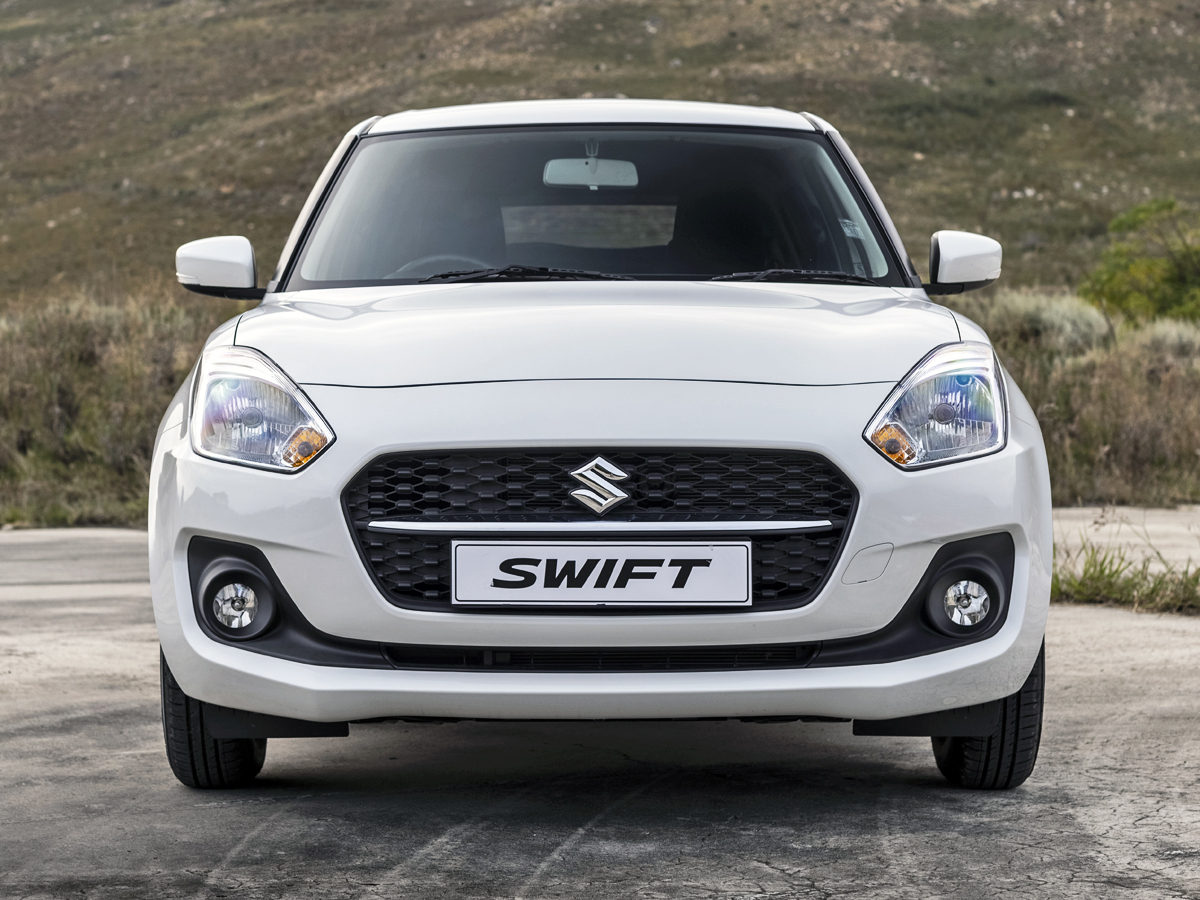
Meanwhile, the Suzuki Swift (1 291 units) – which ranked as the best-selling imported vehicle in September 2023 – climbed a place to 7th, pushing its nose ahead the likewise Indian-sourced Toyota Starlet (1 247 units), which slipped a position to 8th. The locally built Volkswagen Polo hatchback (1 148 units) and soon-to-be-axed Nissan NP200 (997 units) rounded out the table.
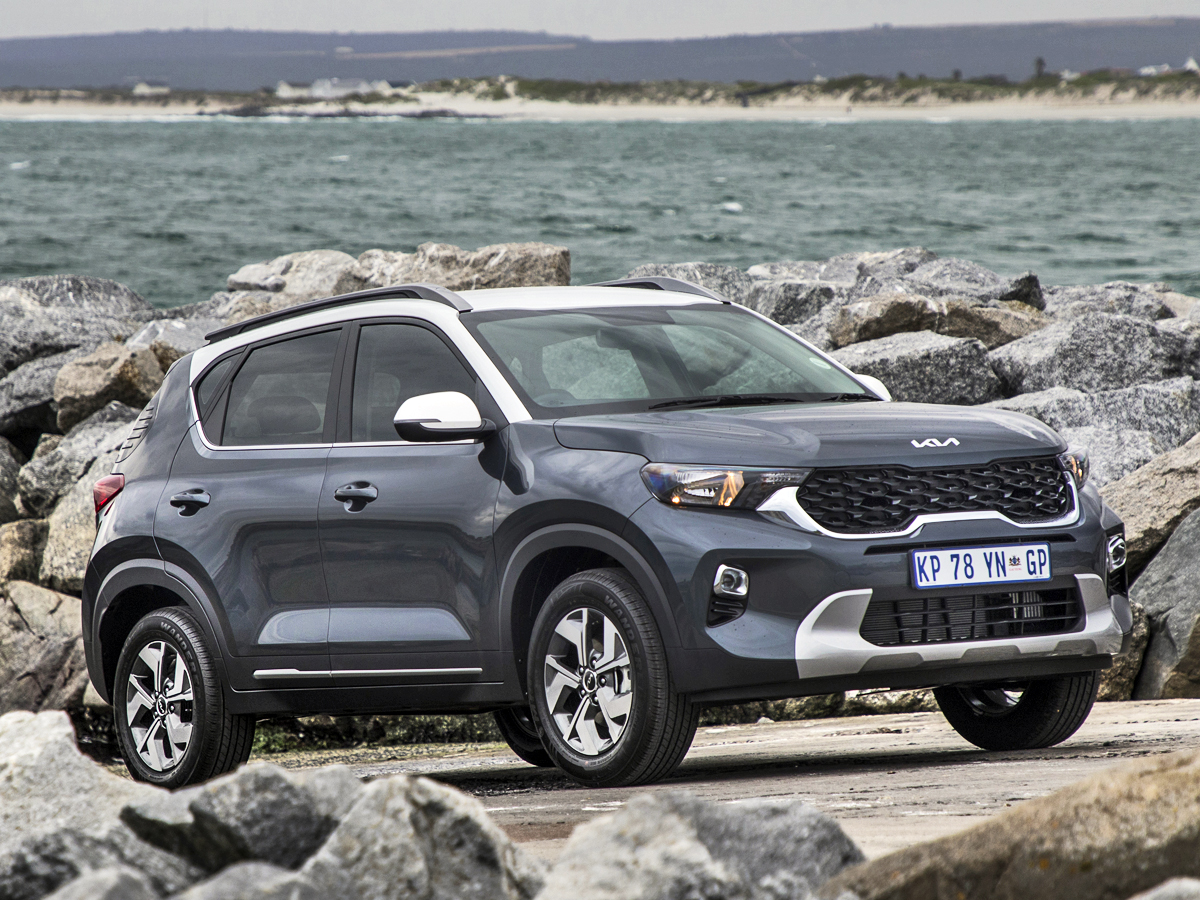
So, what about models that were bubbling under in September 2023? Well, the recently facelifted Hyundai Grand i10 (949 units) range – which now includes sedan derivatives, along with hatch and light-commercial panel-van variants – was next, ahead of the Toyota Fortuner (893 units), Chery Tiggo 4 Pro (858 units), Nissan Magnite (797 units) and Kia Sonet (743 units). Special mention must also go to the new Suzuki Fronx, which hit a total of 527 registrations – all via the dealer channel – in its 1st full month on sale.
Top 10 vehicles exported from South Africa in September 2023
VW’s Kariega plant exported 11 402 examples of the Polo hatch in September.
For the 5th month on the trot, the Volkswagen Polo hatchback topped the export charts, with a whopping 11 402 examples shipped off from the Kariega factory in September 2023. The Rosslyn-built BMW X3 was 2nd on 6 230 units, with the Munich-based automaker reporting detailed sales figures for the 1st time this quarter.
Meanwhile, the Toyota Hilux (5 741 units) pushed ahead of the Ford Ranger (5 536 units) in the exports race in September, with the popular Prospecton-built and Silverton-made bakkies settling for 3rd and 4th, respectively.
Once again, the Nissan Navara, Isuzu D-Max, Toyota Fortuner, Toyota Corolla Cross, Nissan NP200 and Toyota Corolla Quest made up the export numbers. As always, we should point out Mercedes-Benz did not submit detailed figures, so it’s not clear how many new C-Class sedan units were exported during the month (but for the record, Naamsa’s estimate for September 2023 stood at 5 905 units).
1. Volkswagen Polo (hatch) – 11 402 units
2. BMW X3 – 6 230 units
3. Toyota Hilux – 5 741 units
4. Ford Ranger – 5 536 units
5. Nissan Navara – 427 units
6. Isuzu D-Max – 413 units
7. Toyota Fortuner – 148 units
8. Toyota Corolla Cross – 129 units
9. Nissan NP200 – 25 units
10. Toyota Corolla Quest – 3 units
Vehicle-sales outlook in SA for the remainder of 2023
So, what does the future hold for South Africa’s new-vehicle market? Well, Naamsa warns the automotive industry “continues to grapple with concerns over consumer affordability”, despite the fact the South African Reserve Bank (SARB) maintained the repurchase rate at 8.25% last month.
“The most recent SARB report indicates a 0.3% contraction in household consumption expenditure, with household debt surpassing household disposable income by 62.5% in the 2nd quarter of 2023. Additionally, the industry faces potential upward pressures stemming from an elevated inflation outlook, fluctuations in the exchange rate, rising fuel prices and increased energy costs,” the industry representative body cautions.
“On the positive side, Stats SA reported that the manufacturing and finance industries were the core drivers of GDP growth in the 2nd quarter of 2023, recorded at 0.6%. Motor vehicles, parts and accessories, and other transport equipment grew by 9.5%, contributing 1.0% to the GDP. This unequivocally demonstrates that, despite the less-favourable economic prospects, the outlook for the South African vehicle market in 2023 remains distinctly optimistic.”
Naamsa adds the year-to-date new-vehicle sales volumes and exports have “held their own, indicating a positive trajectory” toward achieving the organisation’s annual forecasts of 563 000 units for the former and 380 900 for the latter.
Meanwhile, WesBank’s Gaoaketse says while the “cold data shows 2 months of negative growth, a market of 46 000 units is in line with volumes during 2019”.
“This indicates a continued resilience and sustained slow recovery as experienced and predicted in the aftermath of the pandemic. Whilst there is no doubt that the market has major headwinds to overcome, new-vehicle sales continue to defy the odds,” he points out.
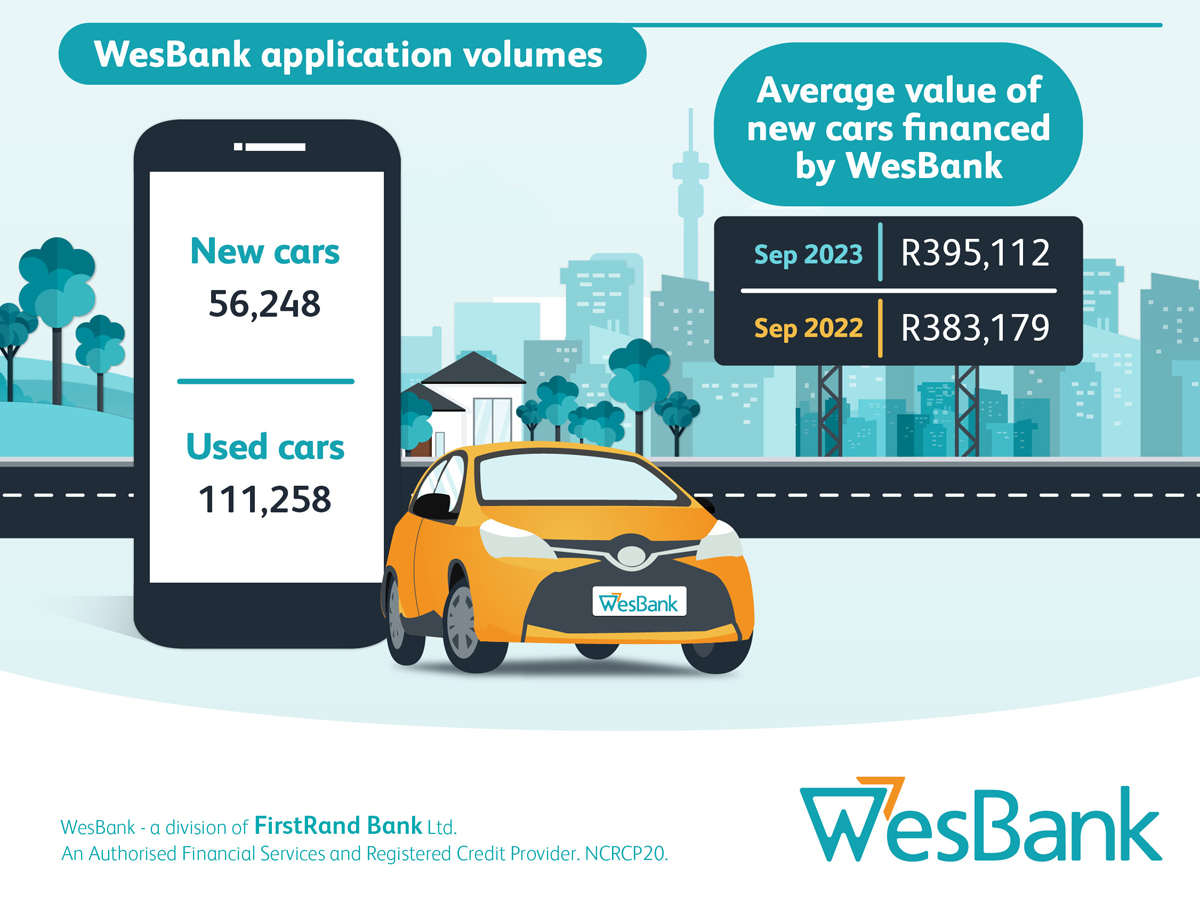
The average value of new vehicles financed by WesBank in September 2023 was almost R400 000.
“The reprieve in September from further interest-rate hikes will be welcomed in constrained household budgets. But other economic pressures from fuel prices, inflation, restricted income growth and the energy crisis will continue to play on consumer and business confidence and sentiment to make new-vehicle purchase decisions.”
According to NADA’s Cohen, there are currently (and will continue to be) attractive deals on offer for new-car buyers, despite the challenges facing the industry.
“Original Equipment Manufacturers (OEMs), distributors and importers have begun offering a wide range of incentives and discounts on vehicles, from luxury to budget cars. Banks are also introducing innovative finance schemes to stimulate buying activity. The market currently offers favourable opportunities for buyers seeking a good deal,” concludes Cohen.
BMW in South Africa – Celebrating 50 years of BMW Group SA Chronicles (Ep 1)
In this six-part video series, Cars.co.za collaborated with BMW Group South Africa to take a deep dive into the history of this iconic brand in South Africa. In the process of filming this series, we assembled a never-seen-before gathering of classic ‘Werke cars.
This BMW series represents an unprecedented attempt to visually showcase, for the first time, the South African ‘Werke story, as told by the cars themselves.
The iconic Munich car brand that has woven itself into the fabric of South African motoring and culture. We even have our very own proudly South African nicknames for iconic models.
In many ways, South Africa has played an important role in the story of the brand itself. A number of unique models were developed and sold in our market which went on to inspire the development of models for the global market. Some of the most celebrated rare BMW performance cars, are uniquely South African homologation specials. Highlighting the deep history of customer demand and technical development within the local market.
Presented by radio and motoring personality, Jacob Moshokoa, the series also features interviews with key players in the history of the company in South Africa. All of whom played pivotal roles in building the brand and the cars themselves.
As September draws to a close, fuel price adjustments for October 2023 are looming and unaudited month-end data indicates that the price of petrol and diesel will increase substantially.
Motorists and the South African economy must brace for another consecutive fuel price increase for October 2023.
The upward trajectory of international oil prices in September is the main contributing factor for the increases, further deepened by a generally poor Rand-US Dollar performance during September 2023.
The latest data available from the Central Energy Fund points to the following potential increases:
Petrol 93 – up by about 77c per litre
Petrol 95 – up by about 83 c per litre
Diesel 0.05% – up by about R1.65 per litre
Diesel 0.005% – up by about R1.62 per litre
Illuminating Paraffin – up by about R1.50 per litre
The Automobile Association (AA) commented, “As was the case with the previous increases, these latest significant adjustments are mainly attributable to rising international oil prices. While the weaker Rand/US Dollar exchange is also playing a role in the hikes for all fuels, its contribution is less substantial than the international product prices”
The projected fuel price increases come at a difficult time for consumers who are already overburdened with the rapid rise in general living costs. The recent spell of increases will continue to put pressure on food inflation in the short term.
“These increases are going to hit all consumers hard, and they come at a time when most South Africans are feeling extreme financial pressure. It remains concerning, however, that in the face of these increases, government remains silent on its plans, if there are any, on a way forward to deal more effectively with fuel price increases,” notes the AA.
With the December holiday season fast approaching, motorists are advised to budget for further fuel prices increases. Motorists can also cut fuel costs by minimising trips through effective planning and by keeping their car in good mechanical condition while also making sure that tyres are correctly inflated to help reduce fuel consumption.
Predicted Fuel Price for October 2023
Fuel Type
Sept ’23 Inland
Sept ’23 Coast
Oct ’23 Inland*
Oct ’23 Coast*
Petrol Unleaded 93
R24.14
R23.42
R24.91
R25.19
Petrol Unleaded 95
R24.54
R23.82
R25.37
R24.65
Diesel 0.05%
R23.82
R22.33
R25.47
R23.98
Diesel 0.005%
R23.29
R22.58
R24.91
R24.20
*October figures are forecast figures and not official.