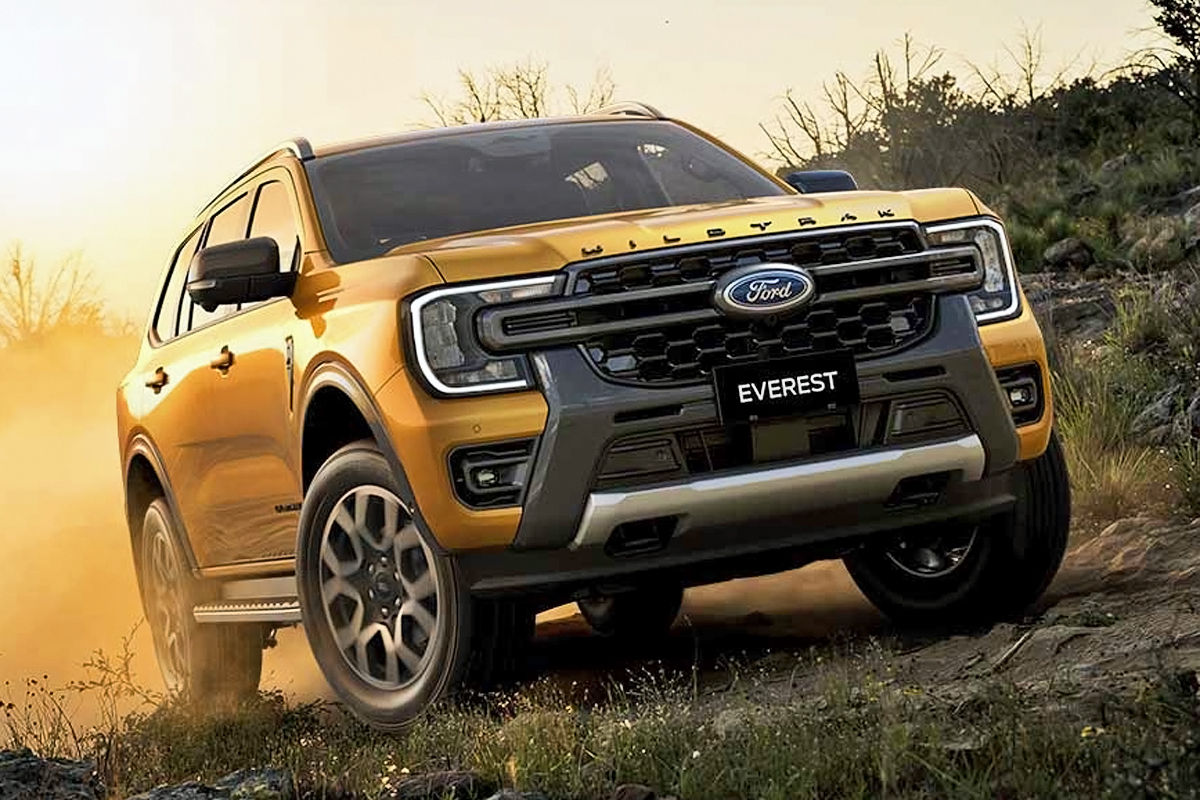
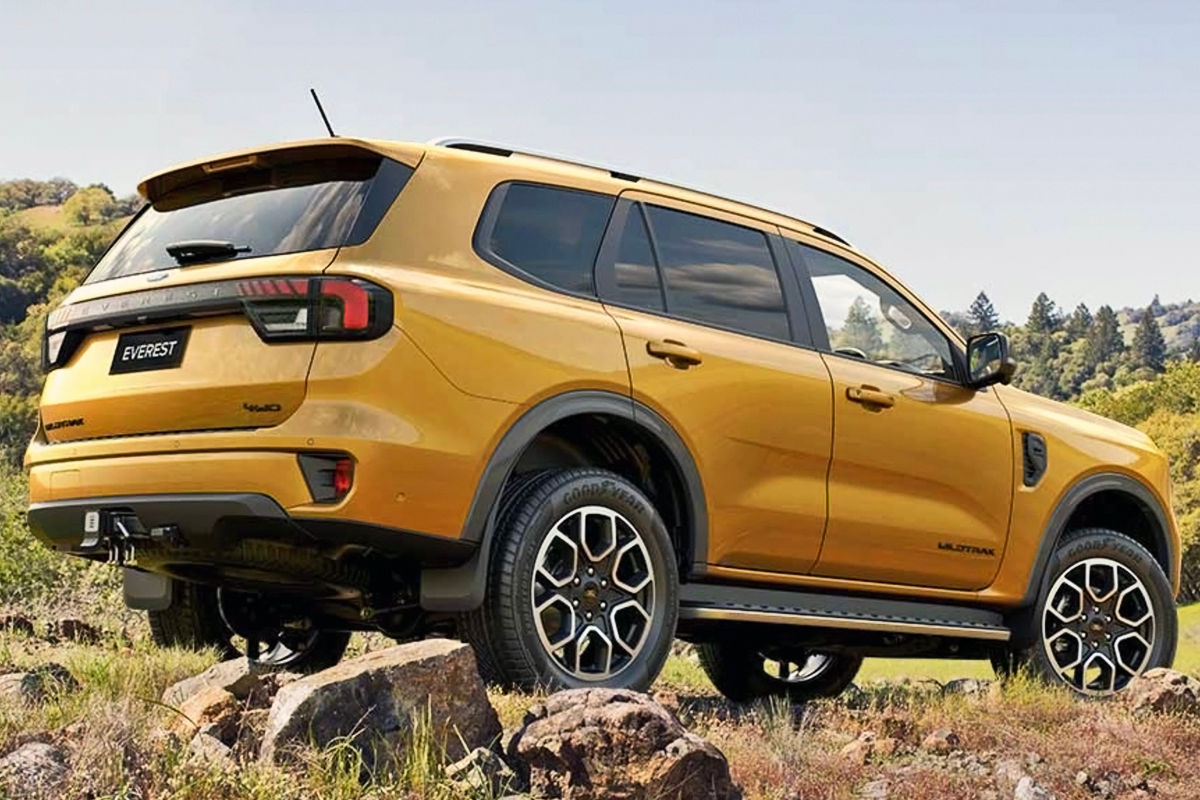
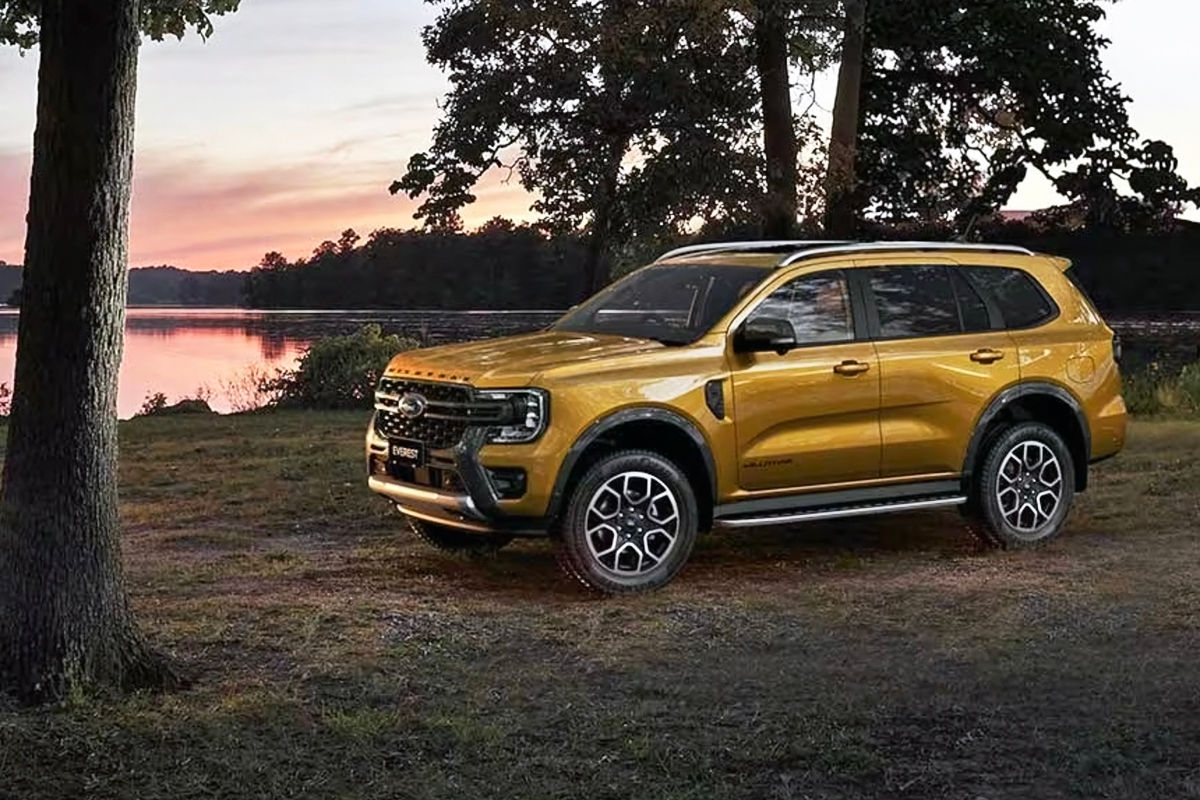
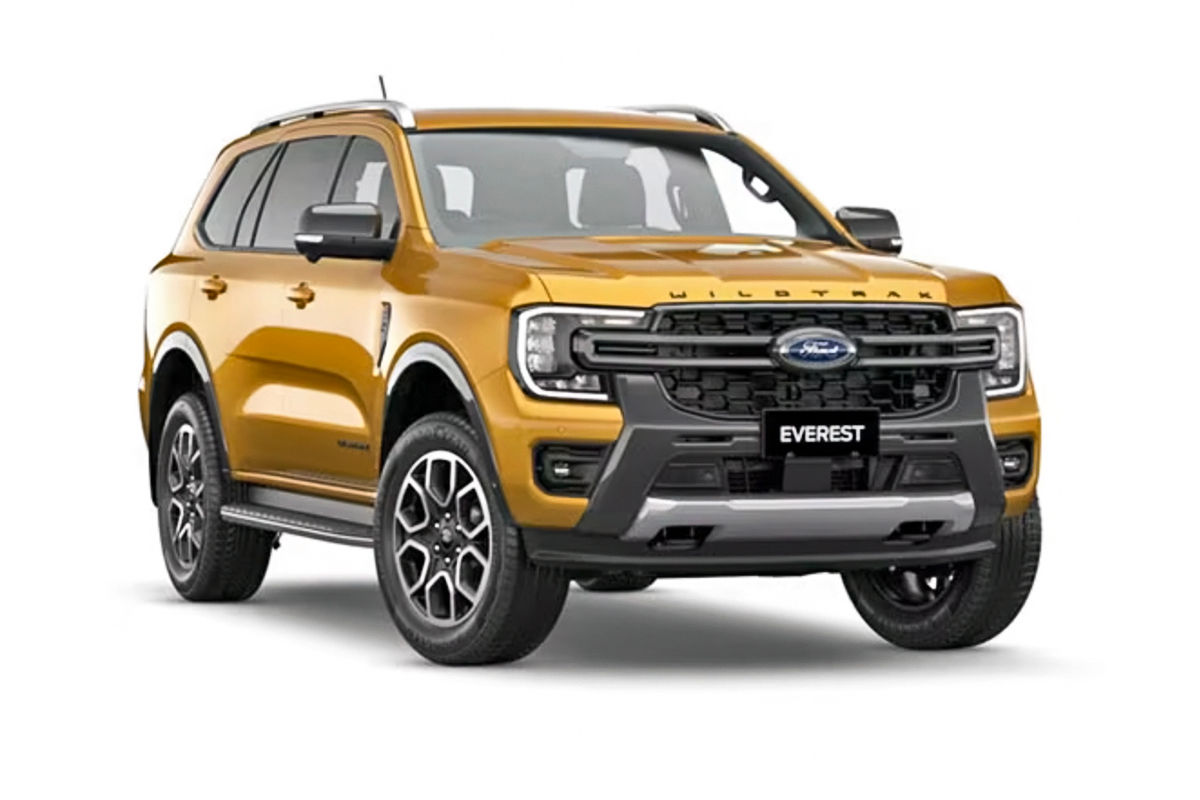
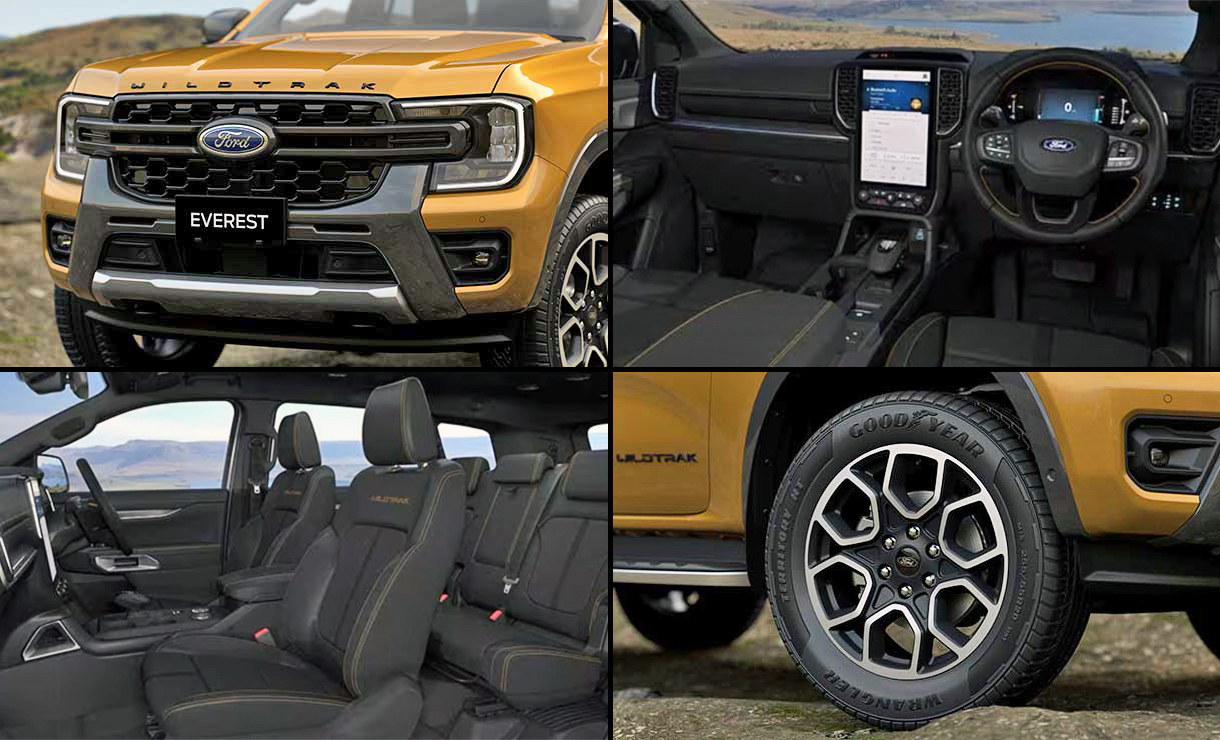
The rumours were true! Ford has revealed the first-ever Wildtrak version of the Everest, handing its adventure SUV a trim level previously reserved for the Ranger…
Back in mid-2022, we reported on patent images suggesting the new Ford Everest would receive the Wildtrak treatment, a specification previously reserved for the closely related Ranger bakkie. Now, exactly that has happened.
Yes, the Blue Oval brand’s New Zealand division has just whipped the wraps off the first-ever Everest Wildtrak, confirming the newcomer will hit that market by July 2023. As you might have guessed, it will be available there exclusively in conjunction with the flagship 184 kW/600 Nm 3.0-litre turbodiesel V6 engine (driving all 4 wheels through a 10-speed automatic transmission as standard).
So, what makes an Everest Wildtrak? Well, this top-spec version of the Dearborn-based automaker’s 7-seater SUV features what Ford describes as “a range of design and styling enhancements” that emphasise the vehicle’s “off-road attitude”.
Like the Ranger equivalent, this high-spec iteration of Ford’s ladder-frame SUV will be available in the Wildtrak-only “Luxe Yellow” exterior paint colour, the first time this hue has been offered on the Everest (though the line-up will also include black, white, grey, aluminium and orange paint options). The Everest Wildtrak furthermore scores a model-specific grille and front bumper, along with 20-inch alloy wheels with “Bolder Grey” detailing.
A closer look at some of the Everest Wildtrak details, inside and out…
The latter colour has also been applied to elements of the front bumper, the grille surround, the fender vents and the side-mirror caps. Meanwhile, the “functional” side steps feature steel inserts and the alloy roof rails add “extra practicality”. The requisite “Wildtrak” lettering is included on the front doors, tailgate and bonnet.
Inside, the Everest Wildtrak features oodles of leather trim as well as power-adjustable front seats (10- and 8-way for the driver and front passenger, respectively) complete with heating and cooling functions, not to mention yet more “Wildtrak” logos embroidered into the seat backs in “Cyber Orange” stitching. The ebony leather-and-suede seat trim likewise features contrast stitching in this orange hue, which is also carried over to the rear seats, centre armrest, instrument panel, door trim, dashboard and gear-shifter.
In New Zealand, the Wildtrak derivative will ship with a 12.4-inch fully digital instrument cluster and a portrait-oriented 12-inch touchscreen. It will also feature a 10-speaker audio system and wireless smartphone charging as standard.
“The 2022 Everest set new standards for performance, comfort and versatility in the 7-seat, mid-sized SUV segment. Now, we’re giving customers all that, wrapped in an SUV that looks as comfortable pulling up outside a hip hotel as it does on the trails,” David Grice, Chief Programme Engineer for Ranger and Everest.
In South Africa, the Everest range – which is imported from Thailand – currently comprises only Sport and Platinum variants. We’ve asked Ford Motor Company of Southern Africa whether the Everest Wildtrak is destined for local shores and will update this story once we hear back…
Update: Ford Motor Company of SA says it is unfortunately unable to share any details on a potential local introduction of the Everest Wildtrak, adding “information about future vehicle programmes will only be confirmed closer to local launch”.
Cars.co.za contributor and seasoned motoring journalist Lance Branquinho put the Toyota Hilux GR-S (GR-Sport) through its paces during the recent end-of-year break. Here’s what he discovered about one of South Africa’s most desired double cabs.
South African upper-middle-class families go on vacation with Toyota Hilux double cabs. I don’t need to tell you that. It’s self-evident.
Which vehicle type and model were you competing with most for the best shopping-mall parking bays during December and the beginning of January? Exactly. A double cab and usually, a Hilux.
The 4-door version of South Africa’s most popular vehicle range occupies more parking space in coastal towns and inland water resorts than any other vehicle. But how good is the Hilux as a leisure vacation vehicle?
I don’t have a spouse, kids or pets to transport during the annual vacation break. My priority is to haul outdoor activity gear… mostly mountain bikes and, occasionally, surfboards. In theory, the Toyota Hilux GR-S (GR-Sport) should be my ideal vacation vehicle: it’s all-terrain capable and has a generous load box. But is it really that good, as a passenger car, when you aren’t stacking the load box with stuff?
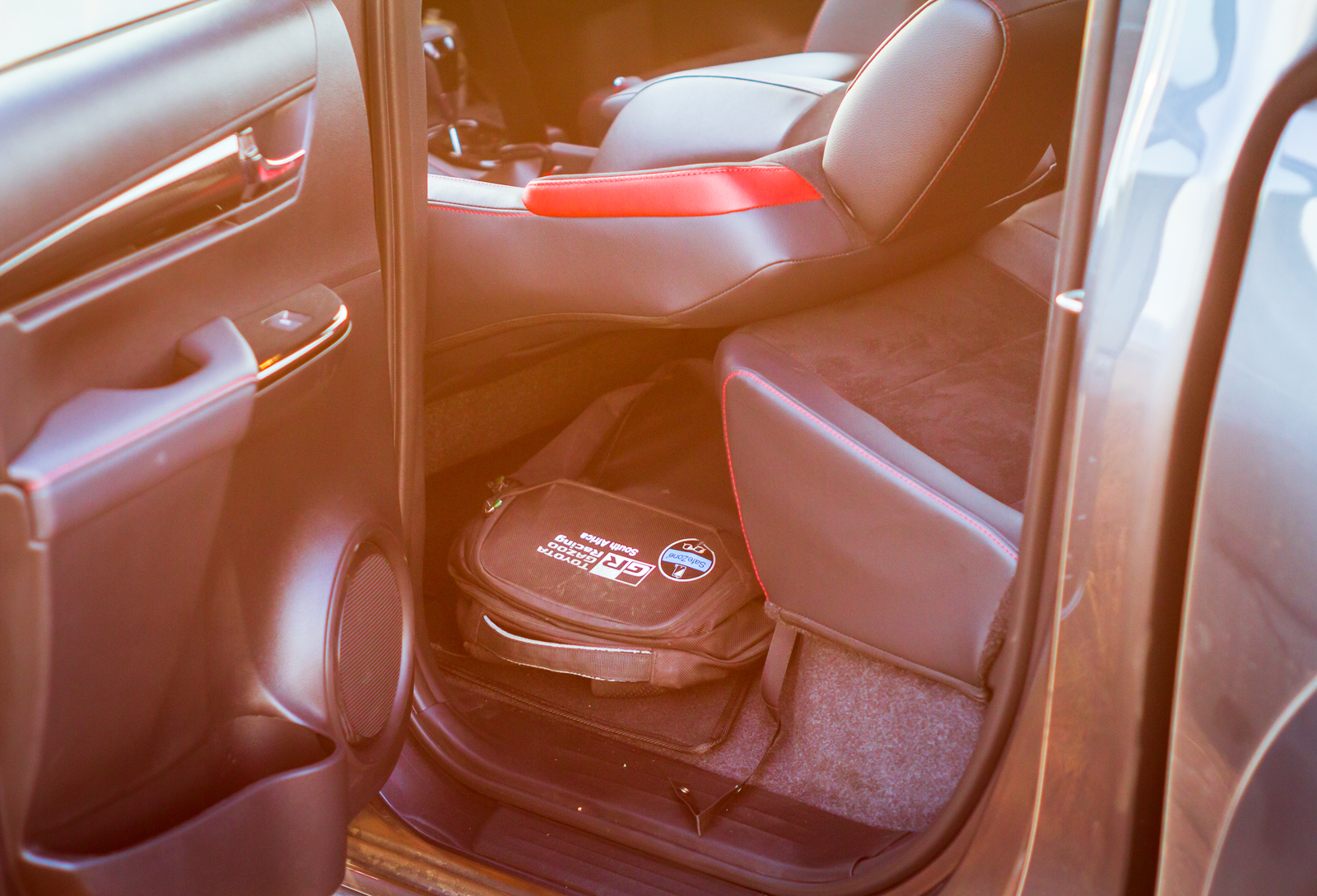
A double-cab doesn’t offer safe storage for your laptop bag, but you can hide it underneath the fully lowered front passenger seatback.
Toyota Hilux GR-S in the role of ‘a car’
Despite its popularity, the double-cab (DC) bakkie has several flaws as a family car. And that applies to all DCs, not the Hilux specifically.
However, there are things that the Hilux does differently from its rivals. And some of Toyota’s “tried and tested” (some would say “dated”) features make a lot of sense when living with a double-cab bakkie.
South Africans are deeply image-conscious, especially regarding the vehicles that they are seen to be driving. And during the summer break, the fixation with how they appear in public, well, borders on an obsession. You know exactly what I mean: those crowds of young men who cruise the parking areas and boulevards of coastal resort towns (at 15 kph) in double cabs. Often, their parents’ double cabs.
The double-cab bakkie may have commercial-vehicle underpinnings, but it’s a statement vehicle in the local market. South Africa is one of the few global markets where a rare specification double-cab bakkie can outshine an Italian supercar or the latest Mercedes-AMG. And although the Hilux isn’t rare, the GR-S is.
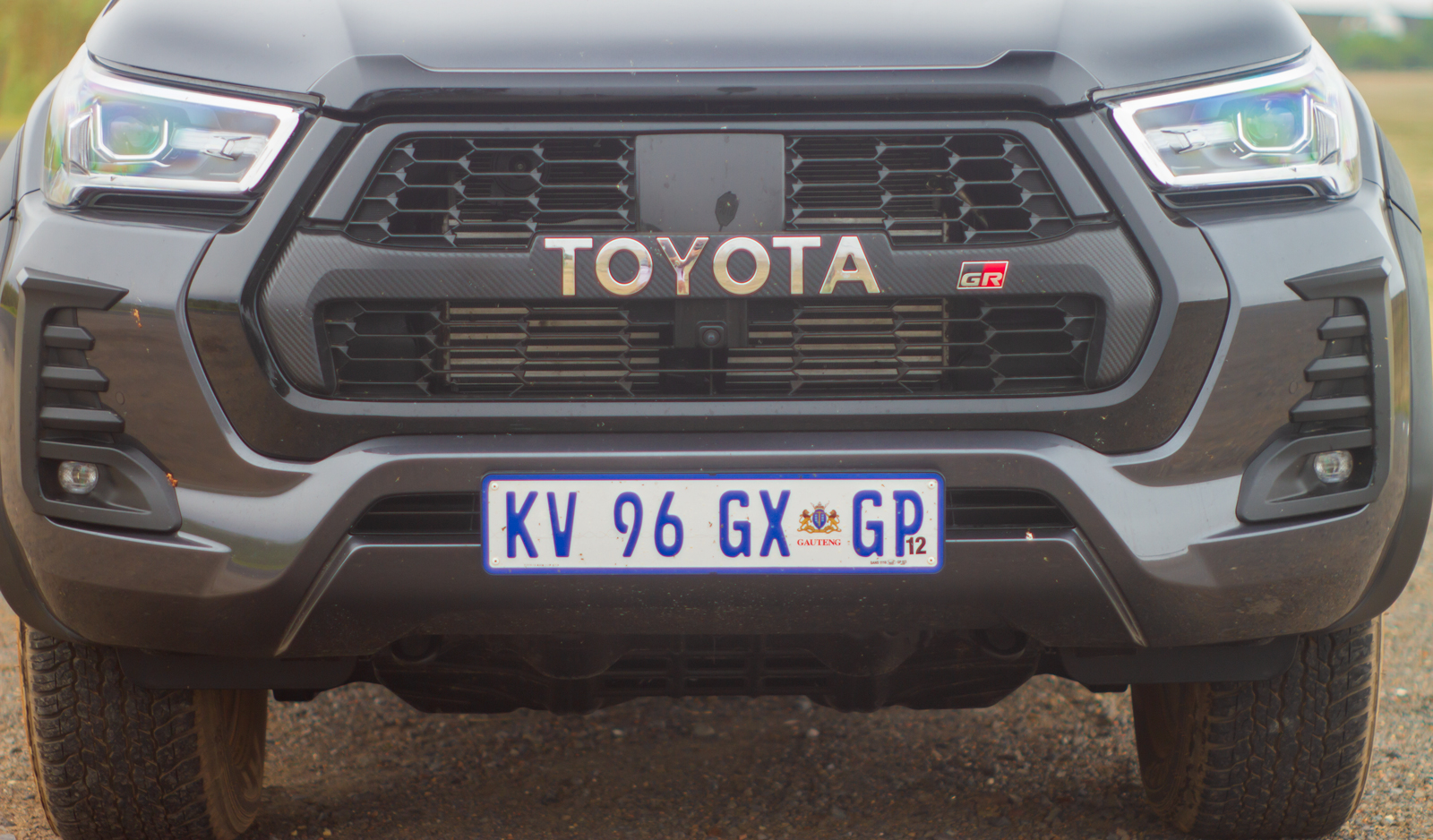
Appearance and aesthetic interpretation are deeply subjective. I think the current Hilux has an awkwardly oversized grille and those red GR-S fender graphics look, um, terrible. But what do I know? There’s an enormous waiting list for these bakkies, and Hilux remains South Africa’s most popular vehicle.
My opinion of what the Toyota Hilux GR-S is like to travel and live with may, however, be less subjective.
Forward collision detection hardware looks awkward but is very useful. The blacked-out grille is an acquired taste.
Toyota Hilux GR-S’ power matters, when you need it most
The most headline-grabbing difference between the GR-S and its fellow 2.8-litre Hiluxes is its higher peak outputs (by 15 kW and 50 Nm). Do those slightly higher numbers matter? Of course, they do.
Nobody enjoys long drives to their holiday destination; our country’s highways are fraught with danger (including stationary vehicles, wandering animals and the ill-judgement of road users), especially so during the festive season. When you want to overtake a train of slower vehicles, every advantage helps.
First, the bad news. When you require mild acceleration, such as when cruising around town, there’s no difference between a 150kW Hilux 2.8-litre and the 165 kW GR-S. But, at sustained peak throttle loads, when you are trying to overtake 2 or 3 trucks at 120 kph, the GR-S’s 165 kW makes its presence felt.
The 6-speed automatic transmission is very average. I don’t think you necessarily need the 10 gears that Ranger offers, but 8 gears might be the ideal spread of ratios. I’ve driven examples of every self-shifting bakkie that’s been sold in South Africa since the mid-2000s. None of them has equalled or surpassed the 1st-generation Amarok’s ZF 8-speed transmission for its calibration, smoothness and responses.
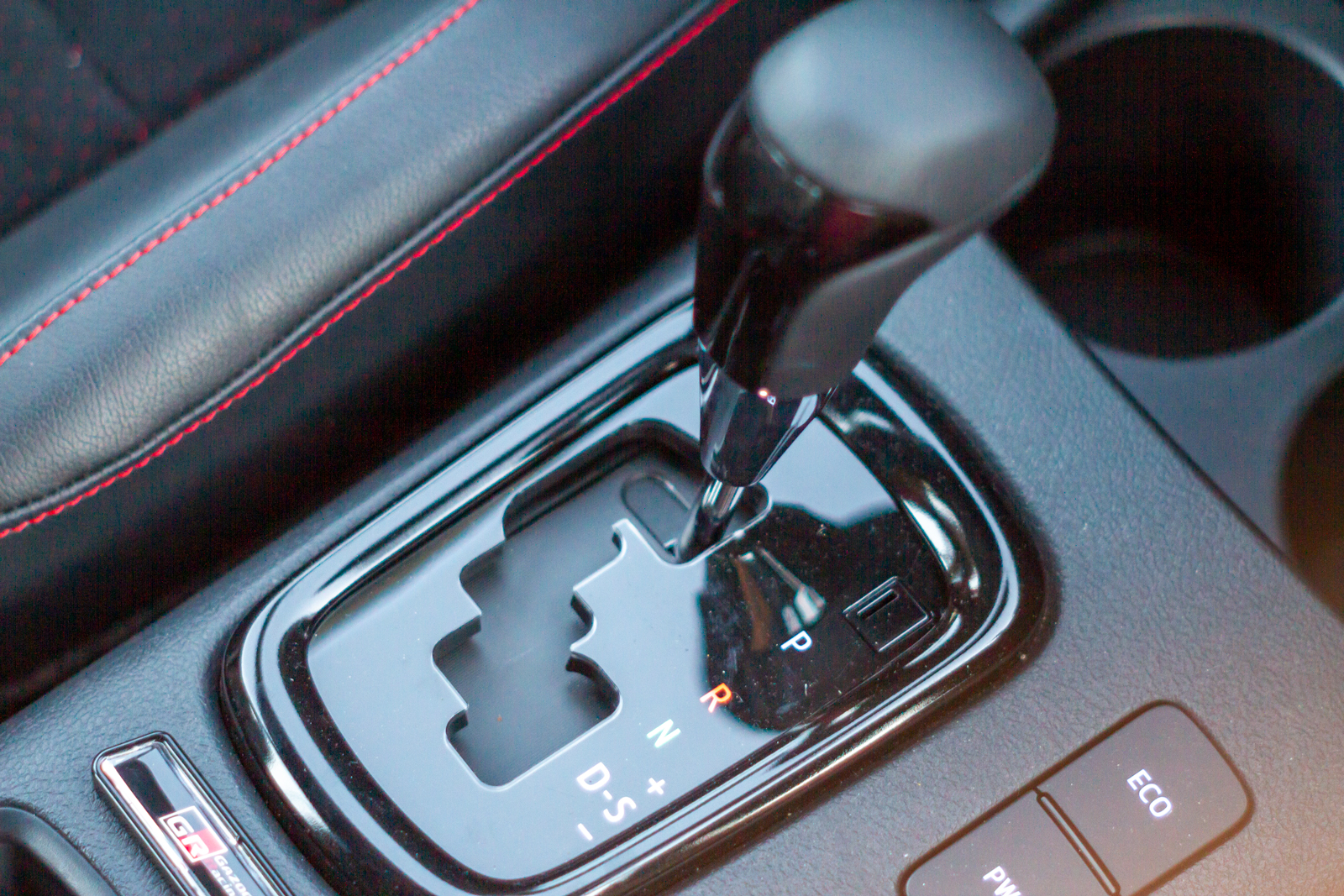
The jagged shift gate might be an ancient design, but it works brilliantly when you need to park in a hurry.
Why the Toyota Hilux GR-S’ jagged shift gate is so clever
The Toyota Hilux GR-S’s 6-speed automatic transmission might be average when compared with those of its rivals, but there’s a little bit of Toyota genius to its shift gate.
Most double-cab bakkies with auto boxes have covered shift gates, which is to say the transmission lever moves forwards and backwards in a direct mechanical line. It’s an elegant layout, but not always that effective because you must press a trigger button on the shifter, to move the lever.
Toyota uses a jagged-pattern shift gate, which moves up and down, yes, but also diagonally. Mitsubishi is another brand with a jagged-pattern shift gate, on its Triton. For interior design aestheticists, it looks awkward. But it works so much better than the covered shift gates on most other double-cab bakkies.
Why do I say that? If you drive a double-cab, you are going to do many 3-point turns. It’s a simple reality of a bakkie’s titanic dimensions and poor turning circle, narrow urban roads, and shrinking parking bays. Three-point turns require rapid Drive-Reverse-Drive shifting, and the Hilux GR-S’s auto transmission can be slam-shifted through that jagged-gate pattern without fear that you’d engage the wrong gear.
“But does it matter?” Yes, it certainly does. When you are trying to keep calm and retain optimal posing value while a family in their white rental car impatiently waits for you to vacate the parking bay that they dearly want to occupy, the Hilux’s jagged-pattern gate shifting is an enabler. You can slam that shifter down and it will always find Reverse, without accidentally slipping into Park or Neutral respectively.
It’s the same action when you want to re-engage Drive. You never have to look down or at the digital shift guide in the driver-info display of your sporty silver- and red-accented instrument binnacle. It’s pure haptics. You can feel and know, with intuitive confidence, that you are in the gear you want to be. This is not always the case with some of the newer bakkies, especially those that feature electronic shifters.
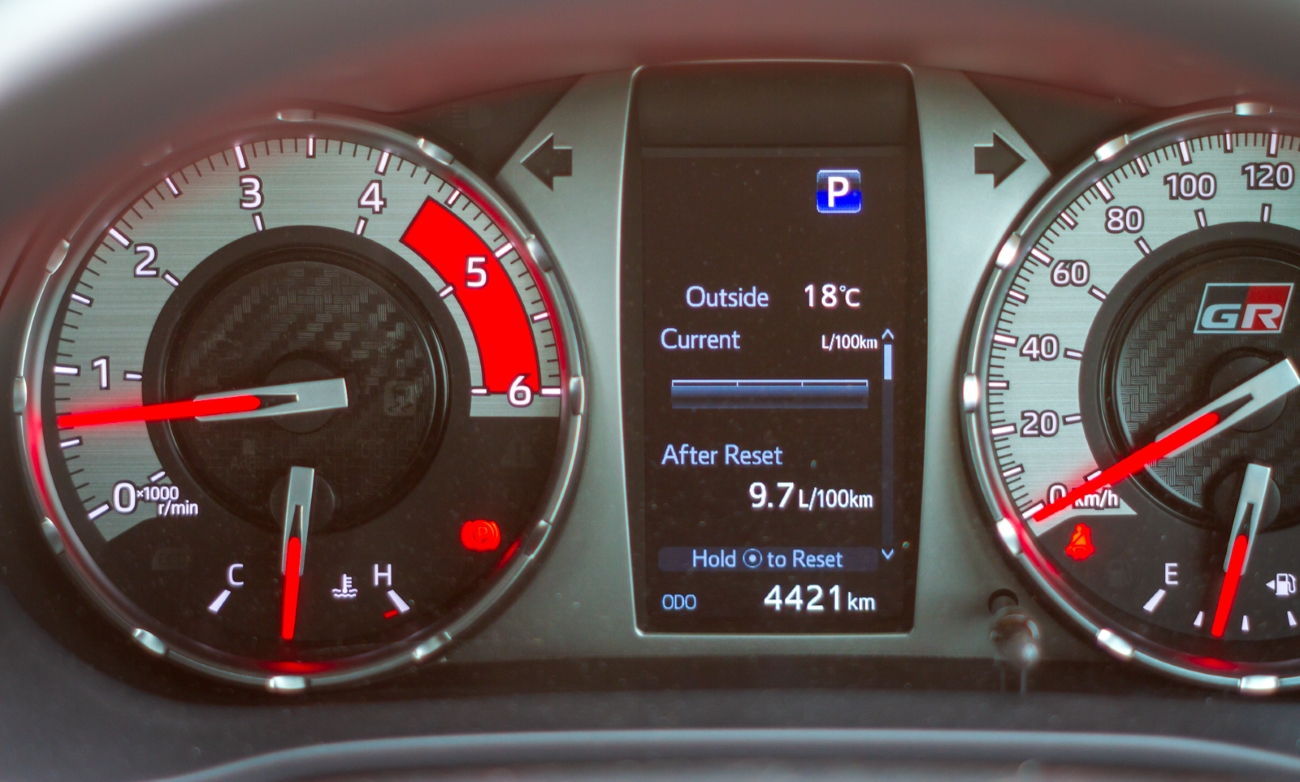
Analogue instrumentation is showing its age in a market with digital displays. The cabin needs more USB ports, too.
Toyota Hilux GR-S: the theft issue
Popularity can be a curse. Successful as Hilux is for Toyota as a business, it has created a theft issue, which is troubling for Hilux owners. It’s the dark side of Hilux’s status as South Africa’s most successful model. It also reveals some of the unhappy aspects of operating a double-cab in the family-vehicle role.
During my time with the Toyota Hilux GR-S, Toyota deployed a security upgrade to counter keyless-start jamming. That meant a visit to the local dealership… during the festive season (sigh). Toyota Tygervalley were typical of the Japanese brand’s franchisees: busy, but comprehensively professional and efficient.
I dropped the Hilux at 07:30 and it was ready for collection by midday. Before I left, the service agent explained all the work that had been undertaken – it was a welcome, transparent human interaction in a world where the service experience is mostly digitising and creating discrepancies of understanding.
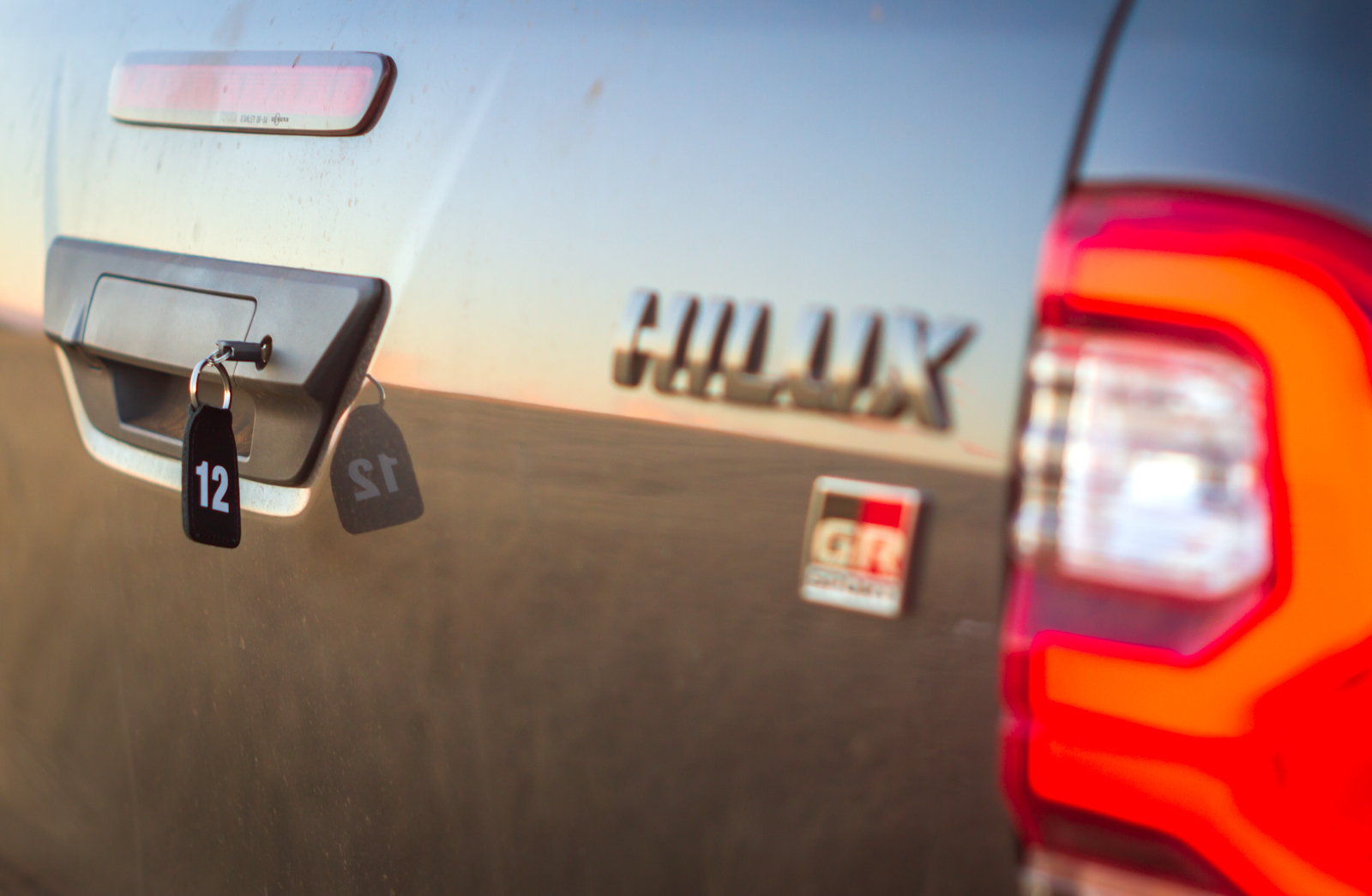
Manual tailgate locking. Annoying? Mostly. But also remote-jammer proof.
Tailgate central locking in the South African context
It is a very South African irony when a lack of features becomes an advantage due to the country’s security and crime issues.
A double-cab bakkie that doesn’t integrate the load-box tailgate into its central locking system, is a fail. You are going to rush and forget that something valuable is loaded under that tonneau cover, and if the tailgate doesn’t lock in unison with your key fob action for the doors, well, it’s a theft waiting to happen.
No, the Toyota Hilux GR-S doesn’t feature a tailgate with central locking. But it’s a win. If remote signal jamming is your fear, the Hilux GR-S tailgate can be locked and unlocked by using a key. As our parents did with their bakkies.
You simply remove the traditional ignition key, which operates the doors and tailgate, from the key fob. And that enables the Toyota Hilux GR-S to use legacy technology to defeat the ebbing tide of (let’s just call it) increasingly technologically advanced automotive criminality in South Africa.
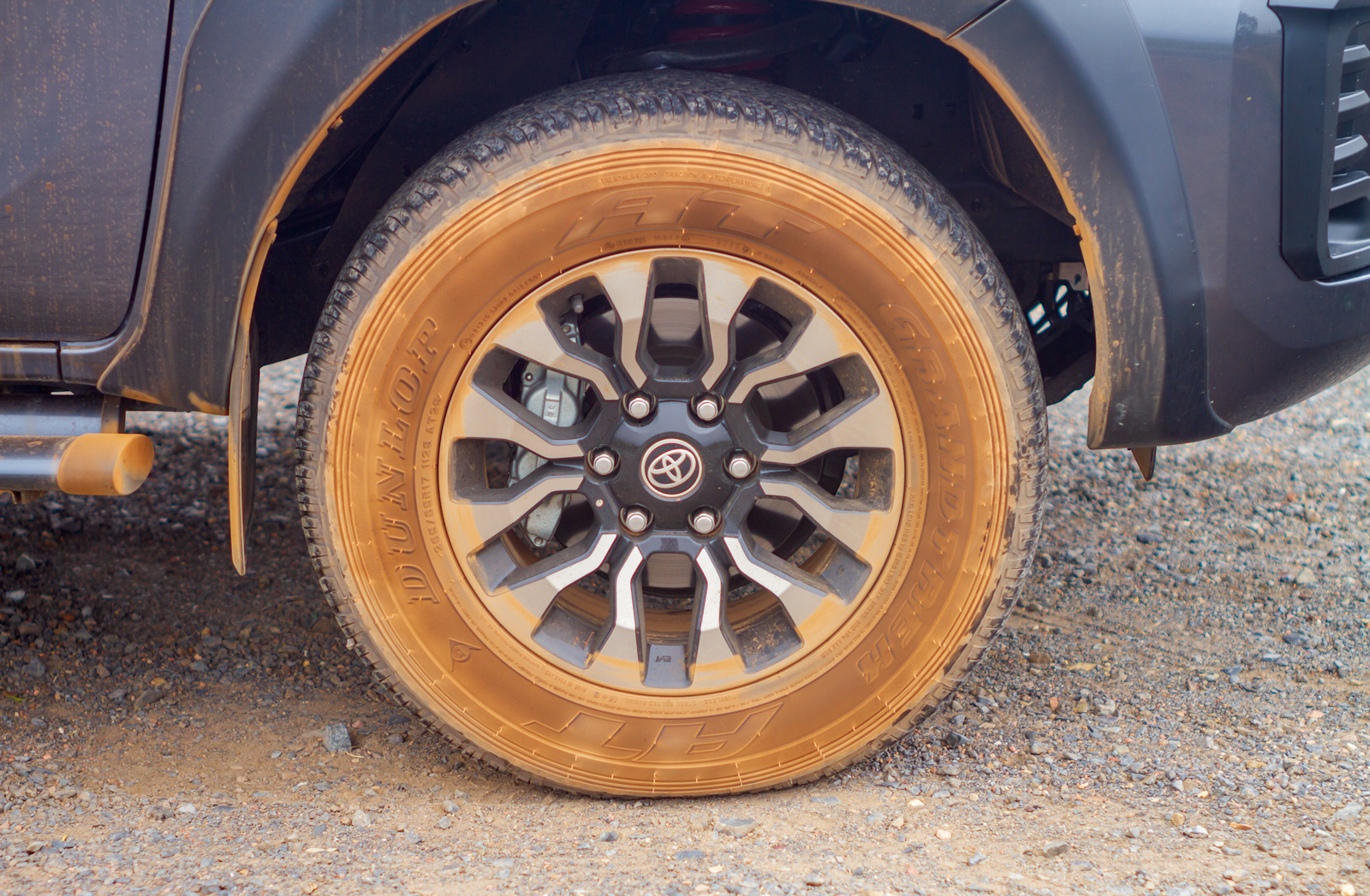
THe GR-S proves, yet again, that 17-inch wheels are best for South African roads and terrain.
There’s a correct wheel size for bakkies. Trust us.
The Toyota Hilux GR-S validates as a South African all-purpose family vehicle: it’s better than it should be when you need to execute a 3-point turn quickly and charmingly immune to nefarious signal jamming.
But what’s it like to drive? For the reality of South Africa’s depreciating road network: much better than a luxury crossover.
Bakkies should never roll on statement wheels. The current trend towards 19-, 20-, and 21-inch double-cab wheels is a false economy. A generous sidewall beats a design statement every day, or at least within the context of the real-world double-cab driving experience.
The cushioned ride quality, pothole-strike survivability and superior traction for off-road driving (when slightly deflated) make the GR-S’ 265/65 R17 tyres the only ones you should have on a Hilux double-cab.
It’s reasonably fuel-efficient too. After all, you are unlikely to be using the 165 kW power peak all of the time… Driven mildly, and largely unladen, we averaged 9.7 L/100 km over the festive-season test period.
Crucial off-road function buttons, such as diff-lock and ESP, should be easier to reach – not hidden.
Dislikes
South Africa is a warm-climate country – to put it mildly – and that means that a vehicle’s cup holders get used to capacity on journeys, be they long or short. Especially during summer.
The issue with Toyota Hilux GR-S’ cupholders is their location. If you position a large hydration bottle in the centre console’s right cup holder, you’ll find it obscures the diff-lock engagement button. And that’s not great, because when you need to trigger a differential lock, you don’t want to fumble to find it. In a technically challenging off-road scenario, where the diff-lock might be required in a hurry, you are likely to feel anxious and don’t want to have a bottle obscuring your access to that “magic traction” button.
Toyota should consider moving such a crucial function to a more ergonomic position, such as closer to the ‘wheel. There’s space next to the starter button. Hopefully, the next-gen Hilux’s diff-lock button will be placed there because the cup holders are where they should be/can’t realistically be repositioned.
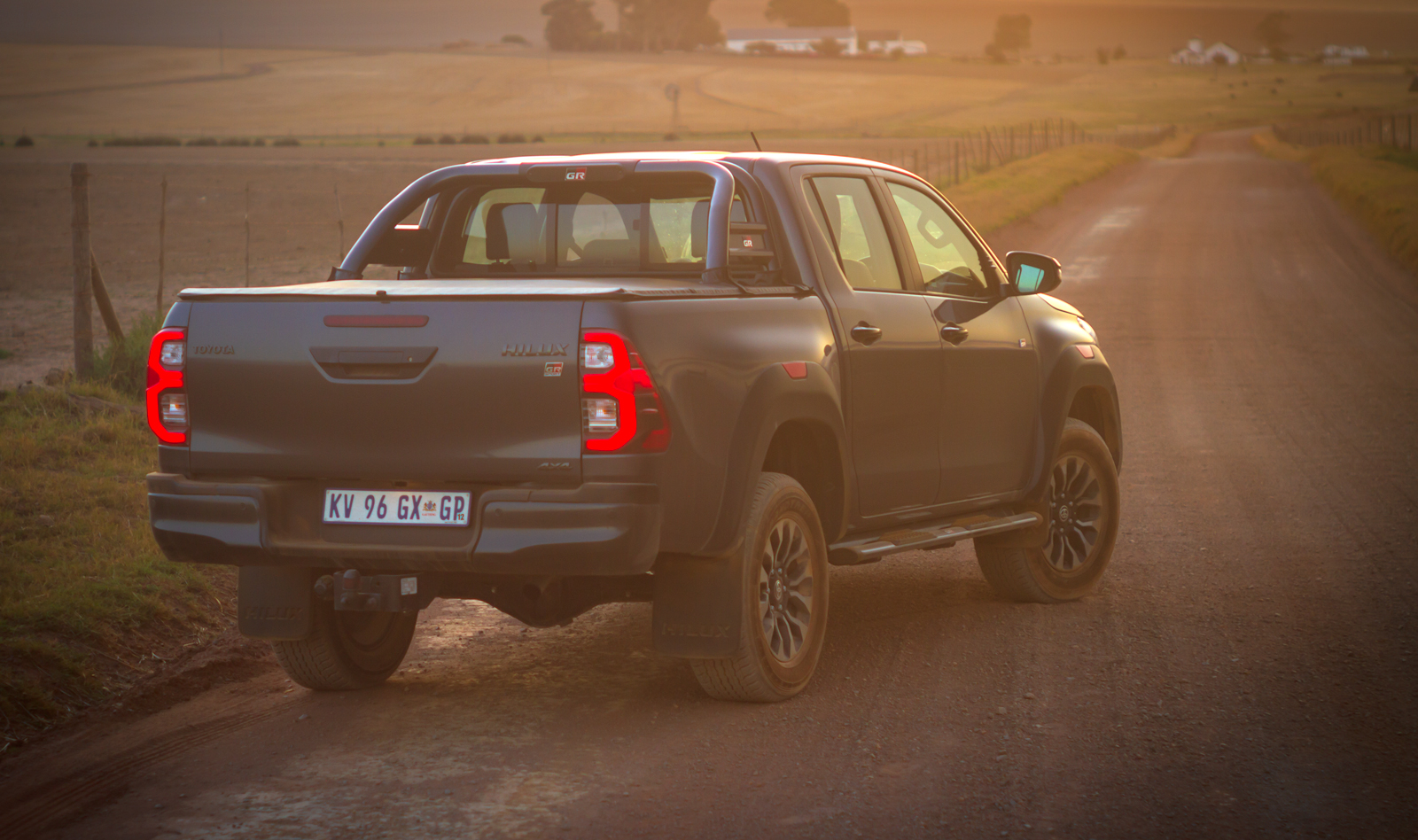
No vehicle rolls with more presence – from urban to rural South Africa – than a Hilux.
Summary
The Toyota Hilux GR-S has more power than any other Hilux. It also has clever coil springs and dampers, delivering more compliant ride quality. But curiously, it still has drum brakes at the rear.
For decades, double-cab bakkies had rear drum brakes because they were often used in the utility role. But that is no longer the case, is it?
Bakkies are more powerful and hardly ever loaded to capacity, but they run at high cruising speeds. And that’s where rear disc brakes will prove a genuine benefit compared to drums, which are okay when there’s weight on the rear axle, but not great in all other scenarios. And Toyota knows this, because the Australian specification GR-Sport, which was recently revealed, is fitted with disc brakes at the back.
Not the most expensive Hilux you can buy, but unquestionably the most rewarding to drive, the GR-S is a worthy halo derivative for South Africa’s most popular vehicle range. But it will be even better if the Australian specification becomes standardised on local Hilux GR-S double-cabs later this year…
Priced at R891 400, the Toyota Hilux GR-S is R54 000 cheaper than Toyota’s most expensive Hilux, the 2.8GD-6 double cab 4×4 Legend RS auto. And I don’t know if the latter’s bigger wheels or JBL premium audio system really justify the extra outlay. You can buy a lot of diesel for R54 000…
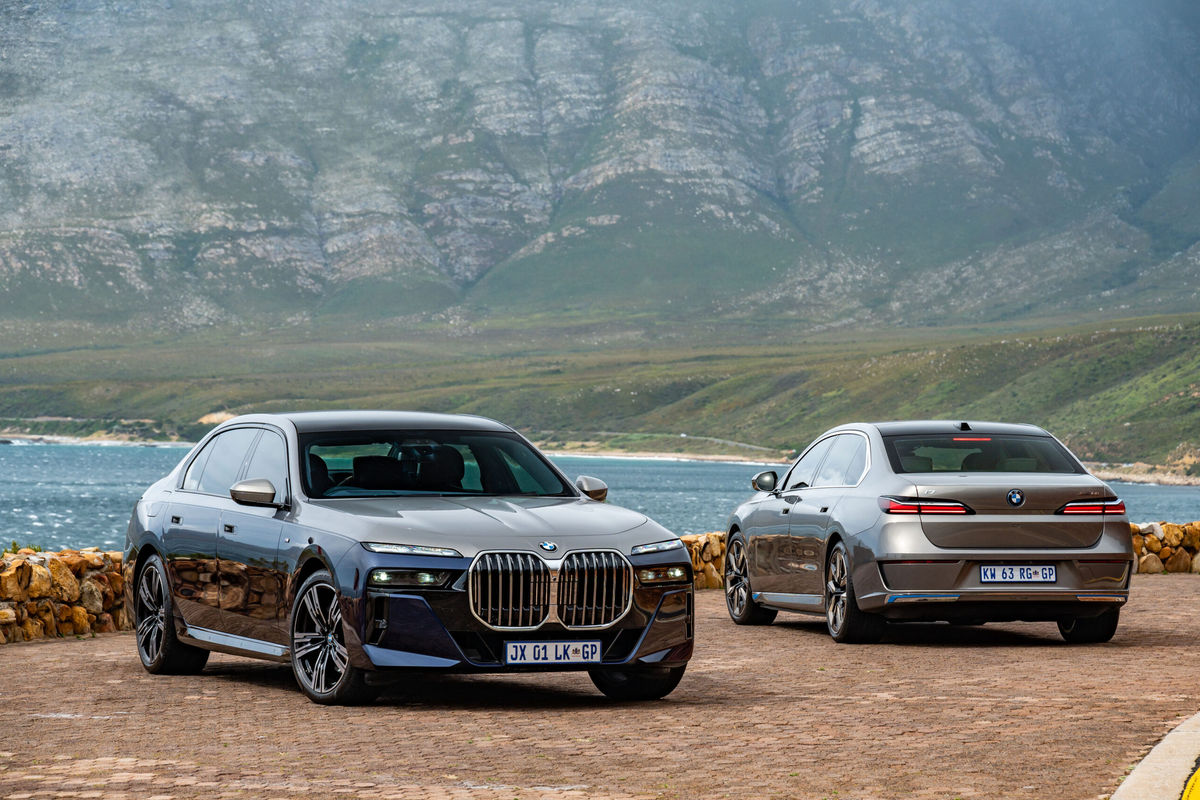
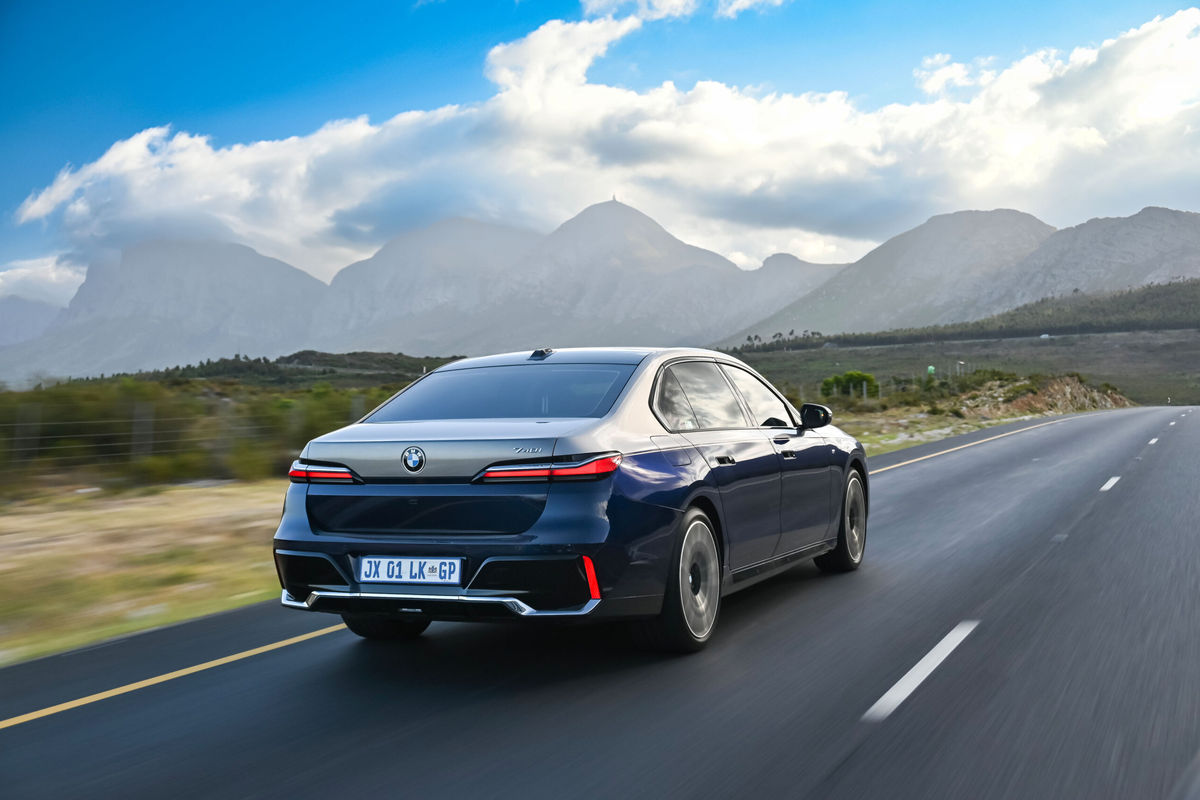
The all-new 7th-gen BMW 7 Series has gone on sale in South Africa and, for the first time, the first-class sedan range features an all-electric derivative – the i7. We spent some time behind the ‘wheel of the G70-generation limousine’s flagship offering.
Since its debut back in 1977, the BMW 7 Series has been the Bavarian brand’s answer to the mighty Mercedes-Benz S-Class and subsequently, the Audi A8 and Lexus LS (as far as our market is concerned, anyway). Despite the rise in popularity/prominence of the high-riding SUV, there’ll always be a market for a long-wheelbase sedan that boasts state-of-the-art technology, with comfort and luxury in abundance.
What’s New?
The 7th-gen 7 Series is now in South Africa and it’s a tour de force.
BMW has overhauled the 7er for its 7th iteration; it comes to market endowed with outrageous, in-your-face styling, deeply impressive tech (for the driver and other occupants) and an all-electric version.
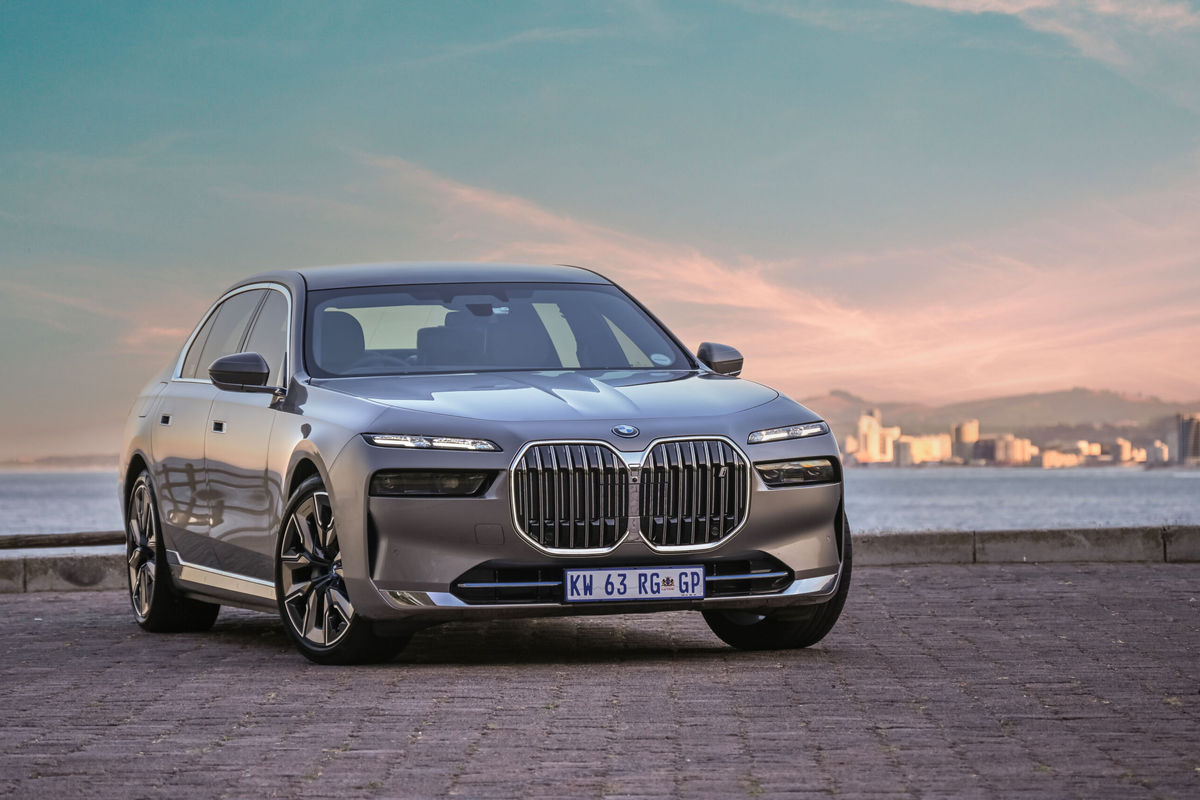
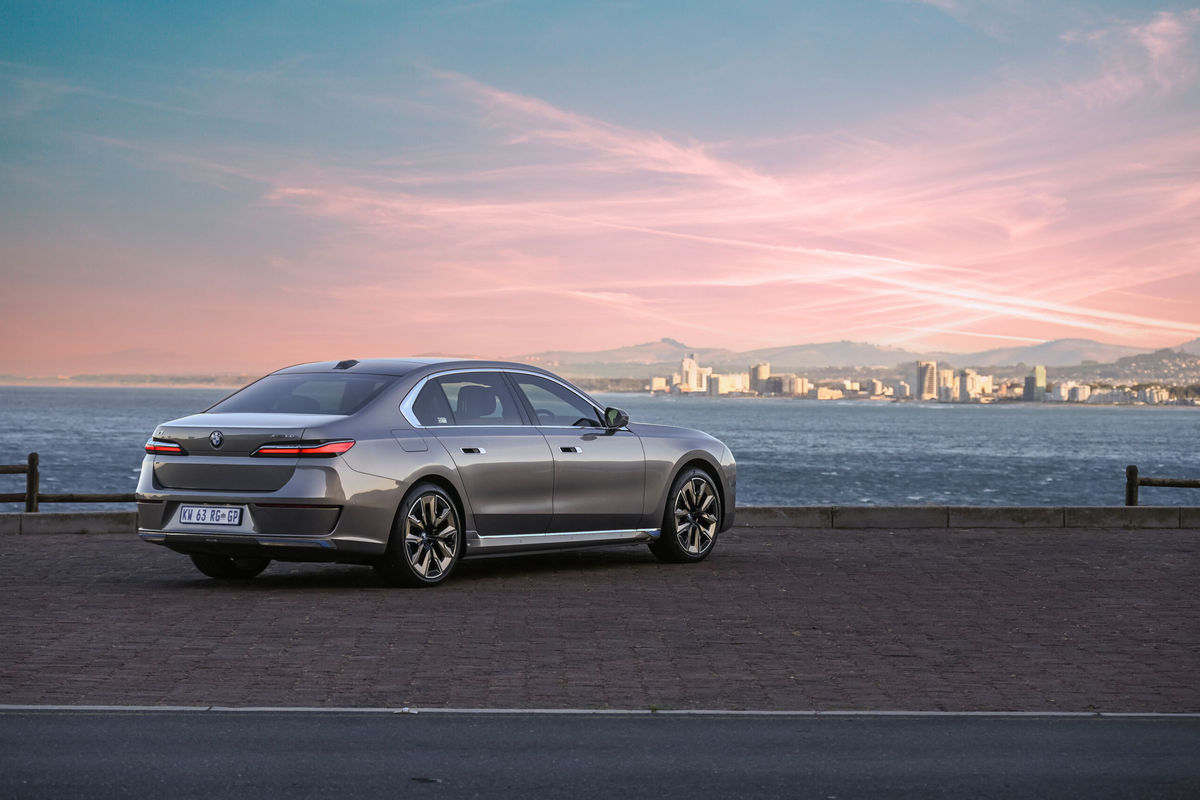
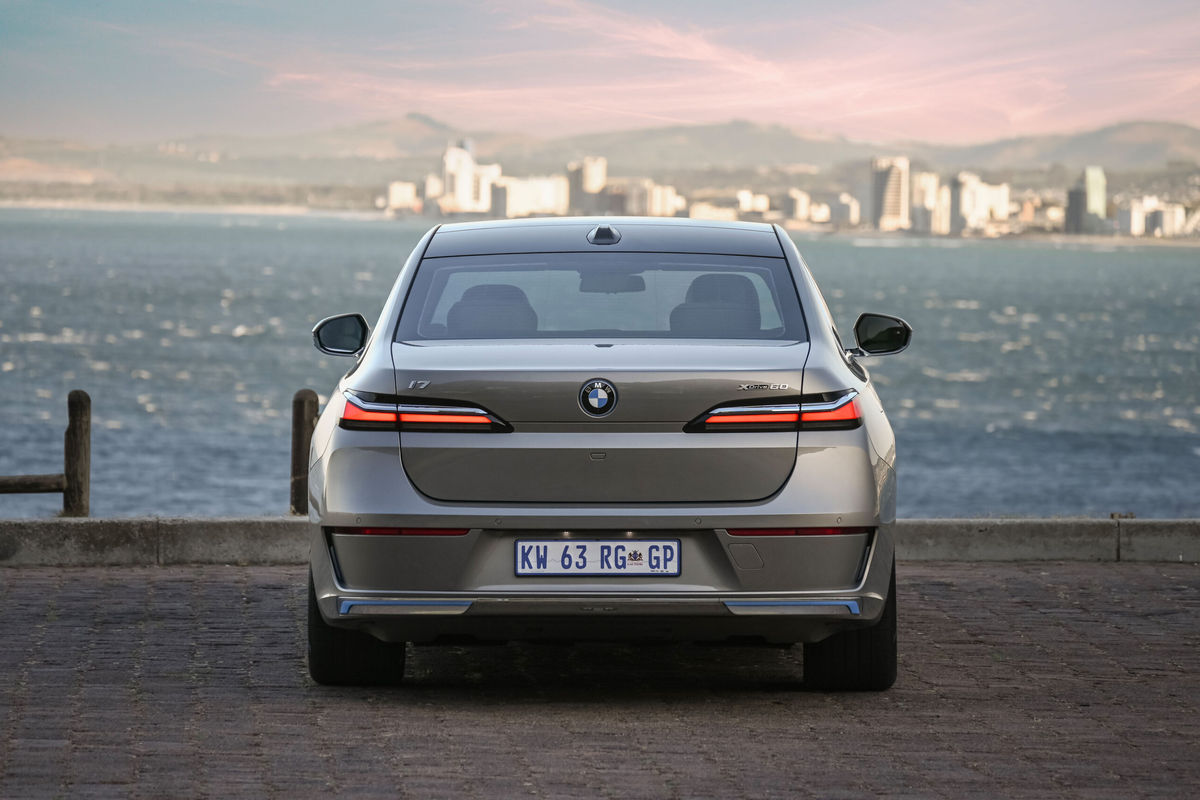
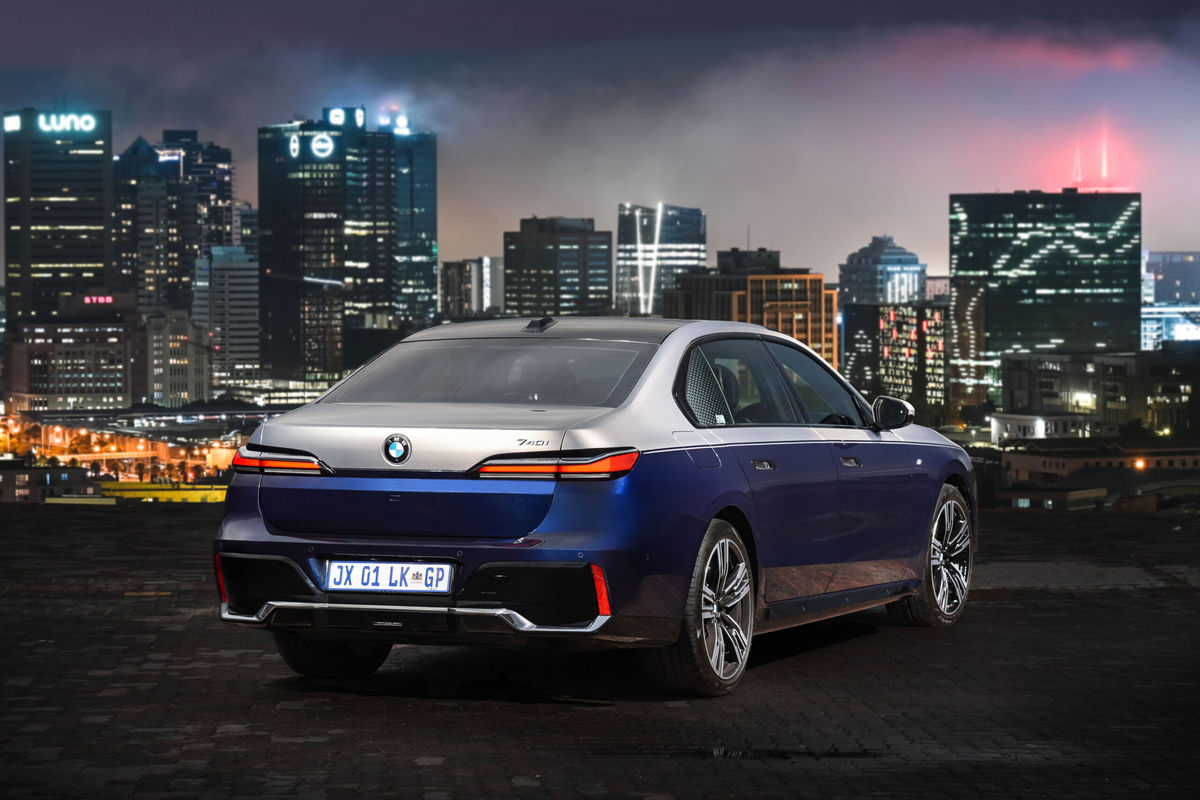
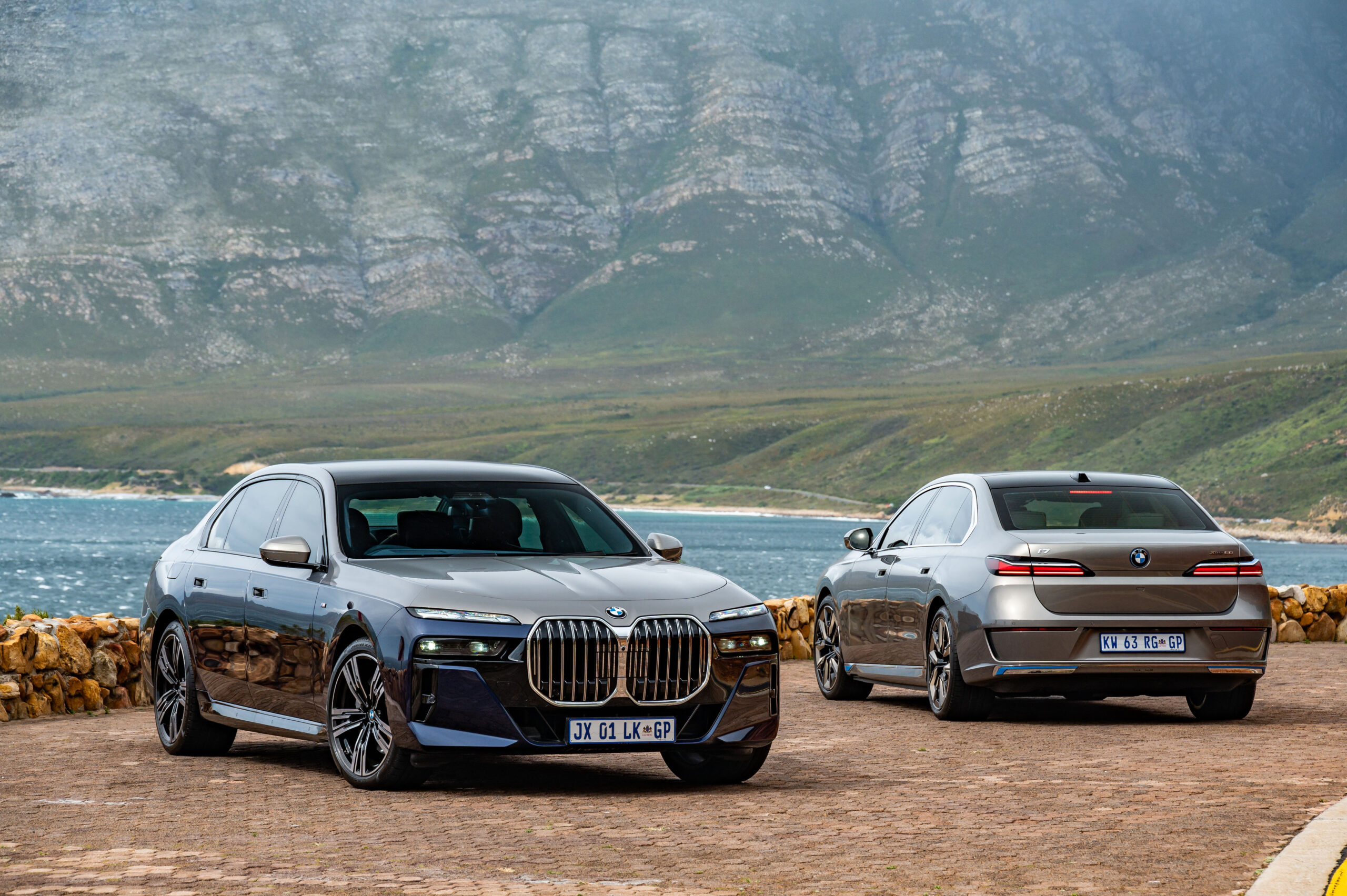
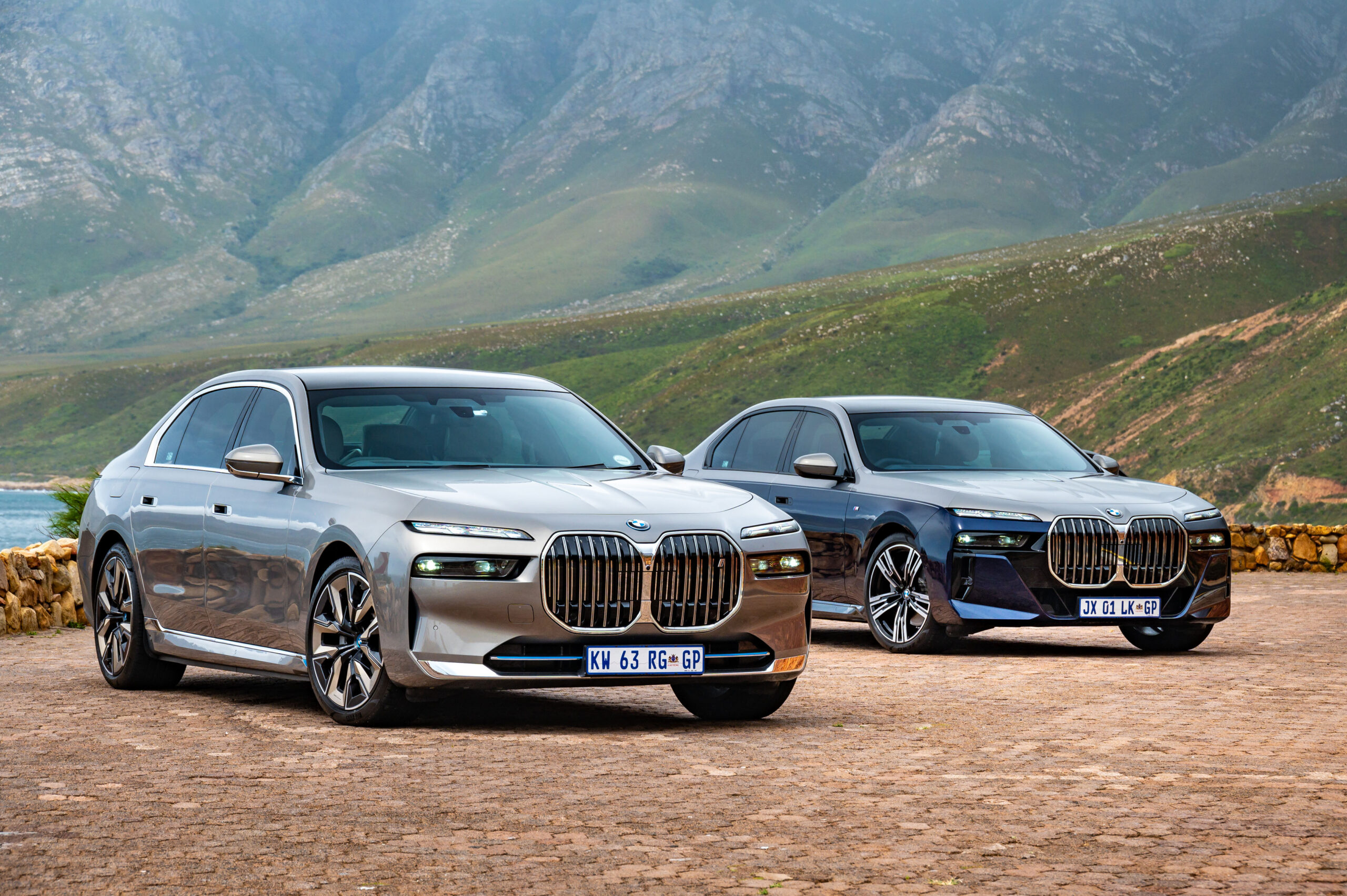
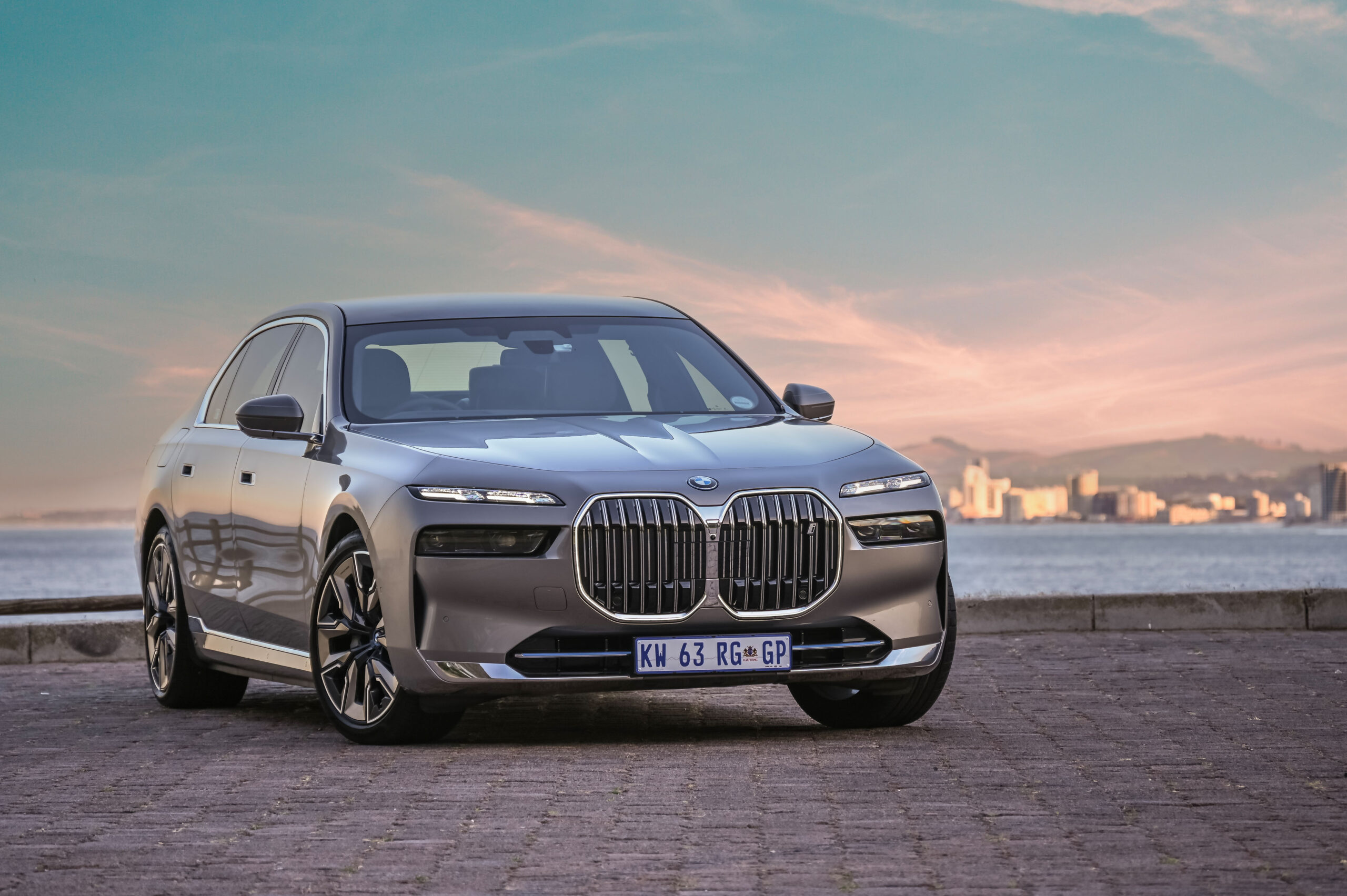
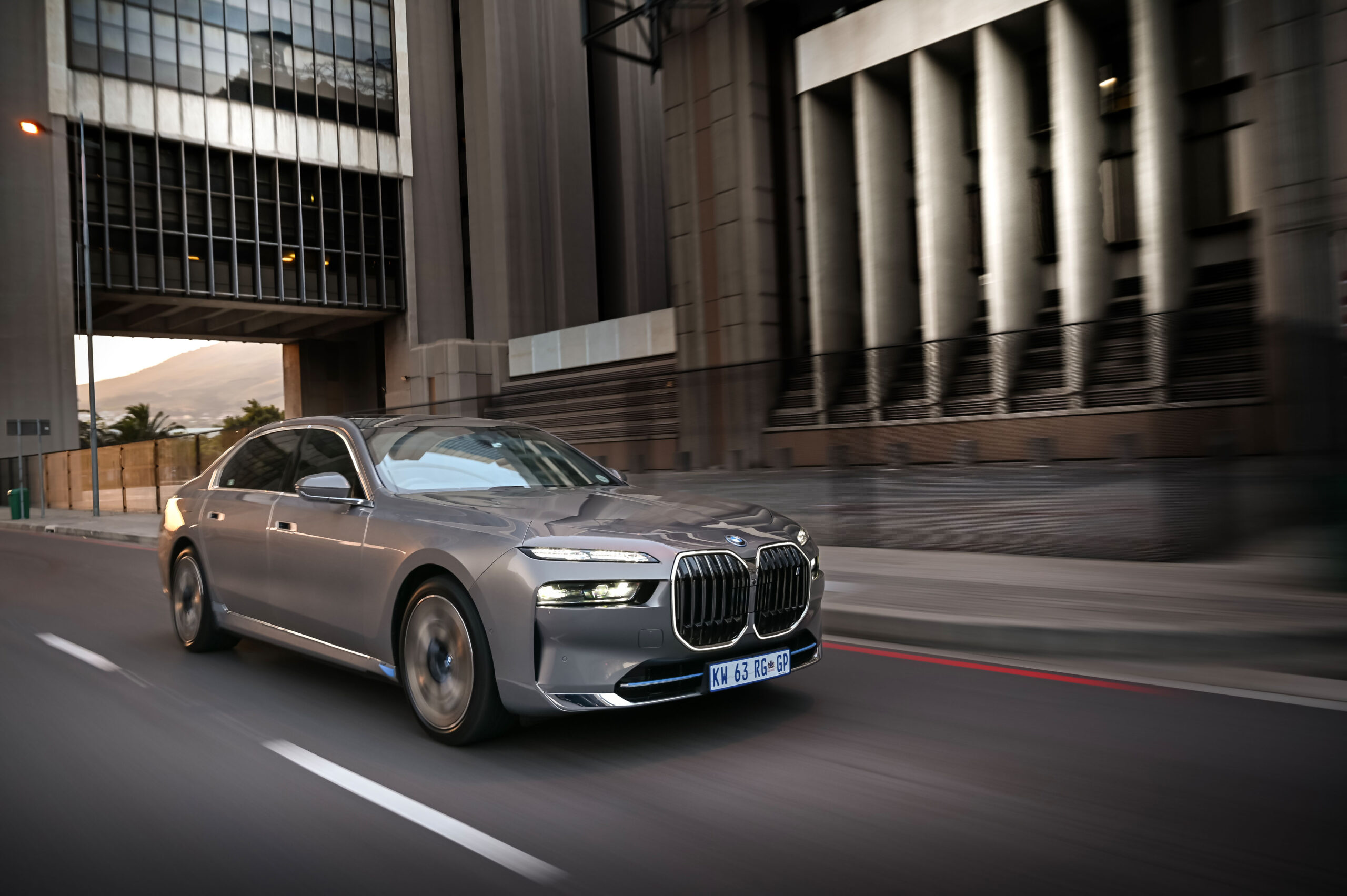
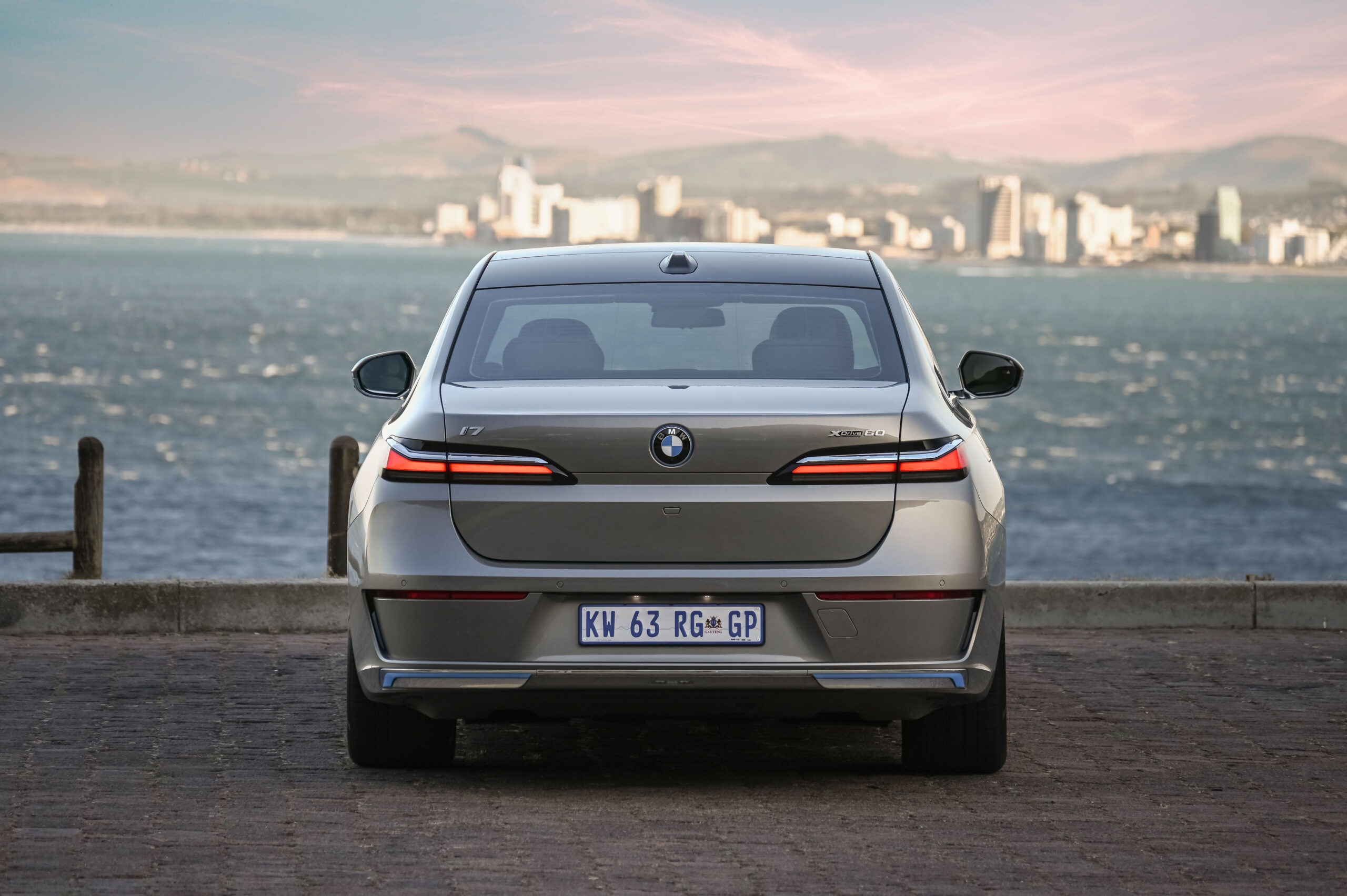
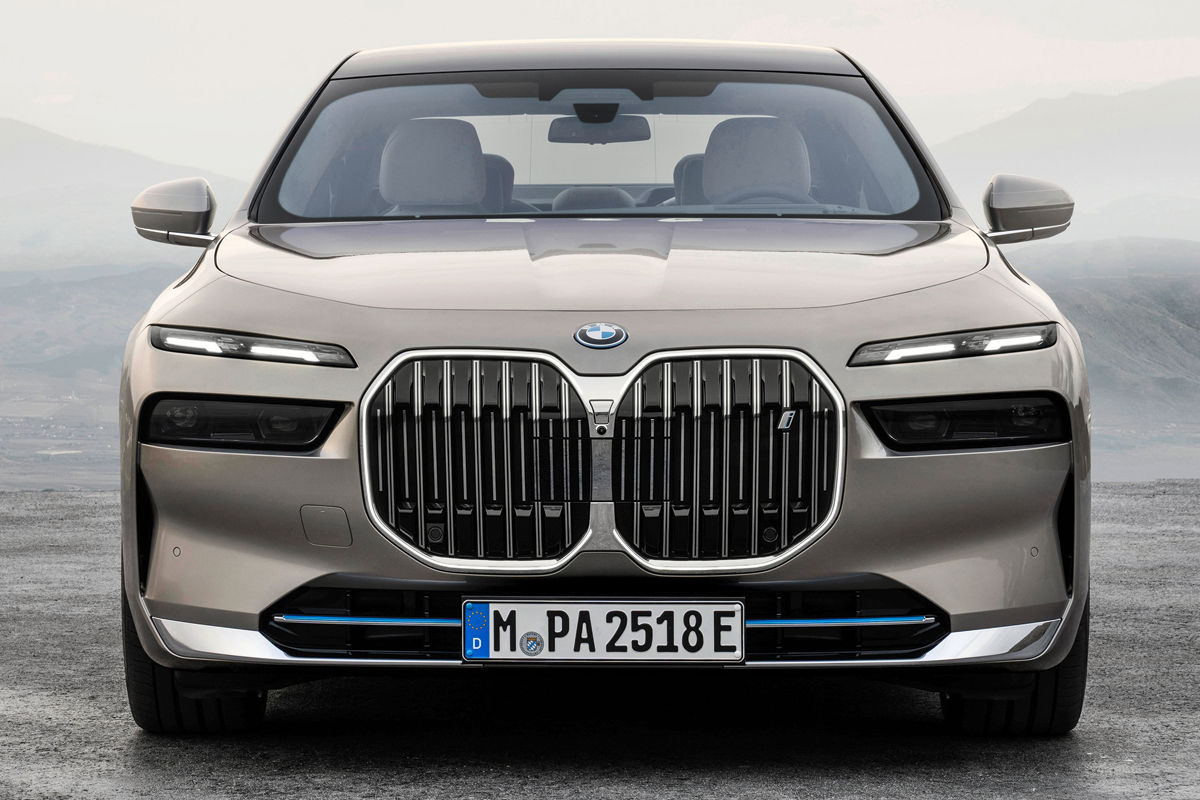
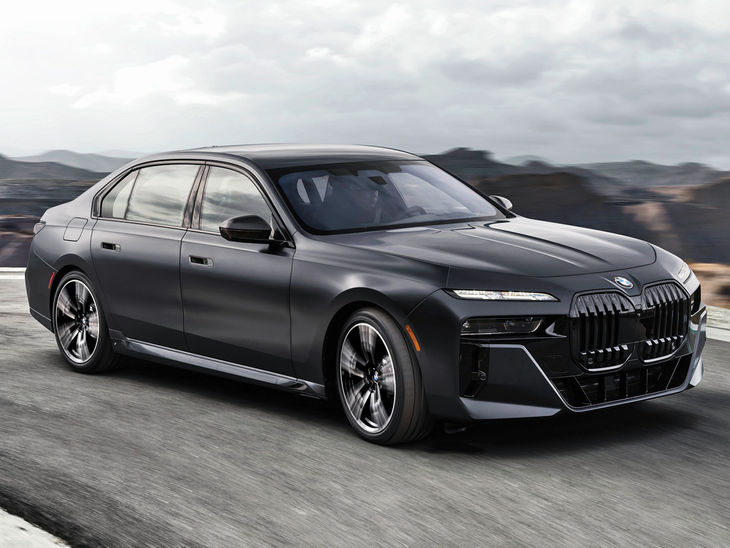
The exterior styling is a huge talking point. Suffice it to say, should a new BMW 7 Series appear in your rearview mirror while you’re driving somewhere, its humungous grille will fill up most of the lens. Yes, the styling is, well, an acquired taste. Given the model’s vast dimensions, it’s a seriously imposing limousine and we won’t be surprised if some owner lands up nicknaming their car “the battleship.”
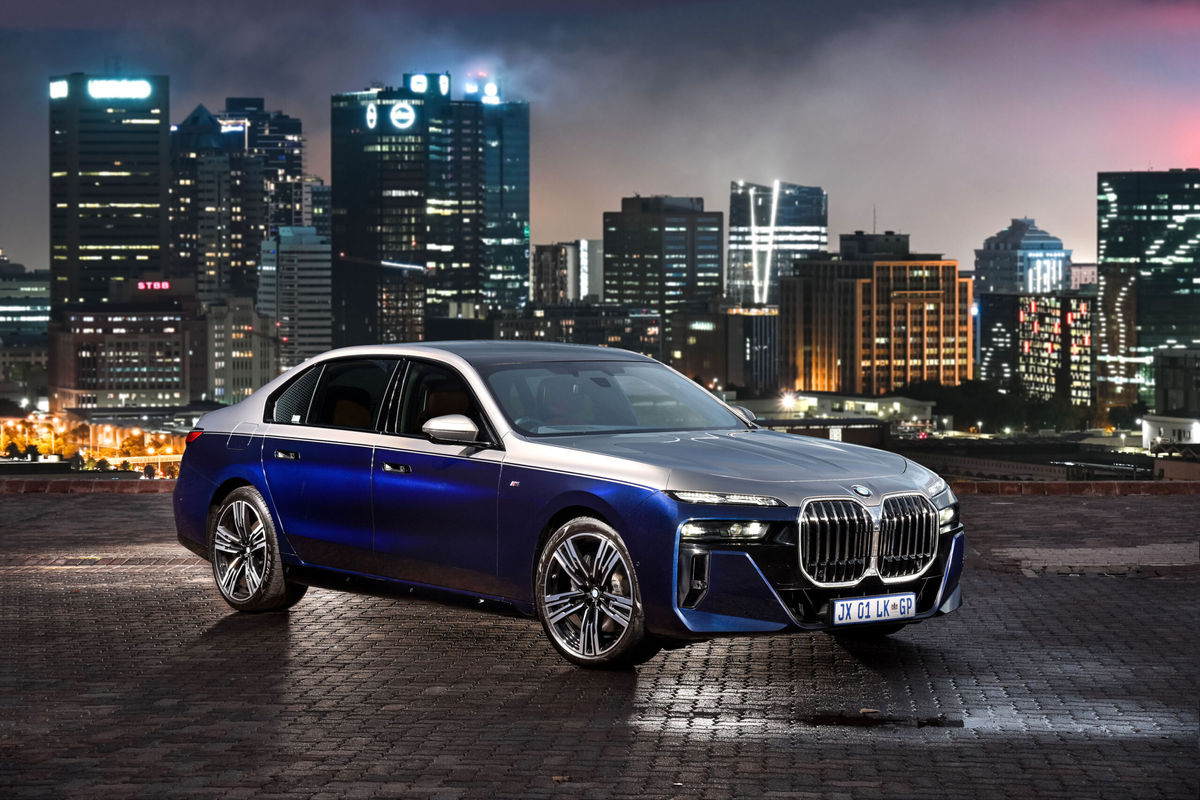
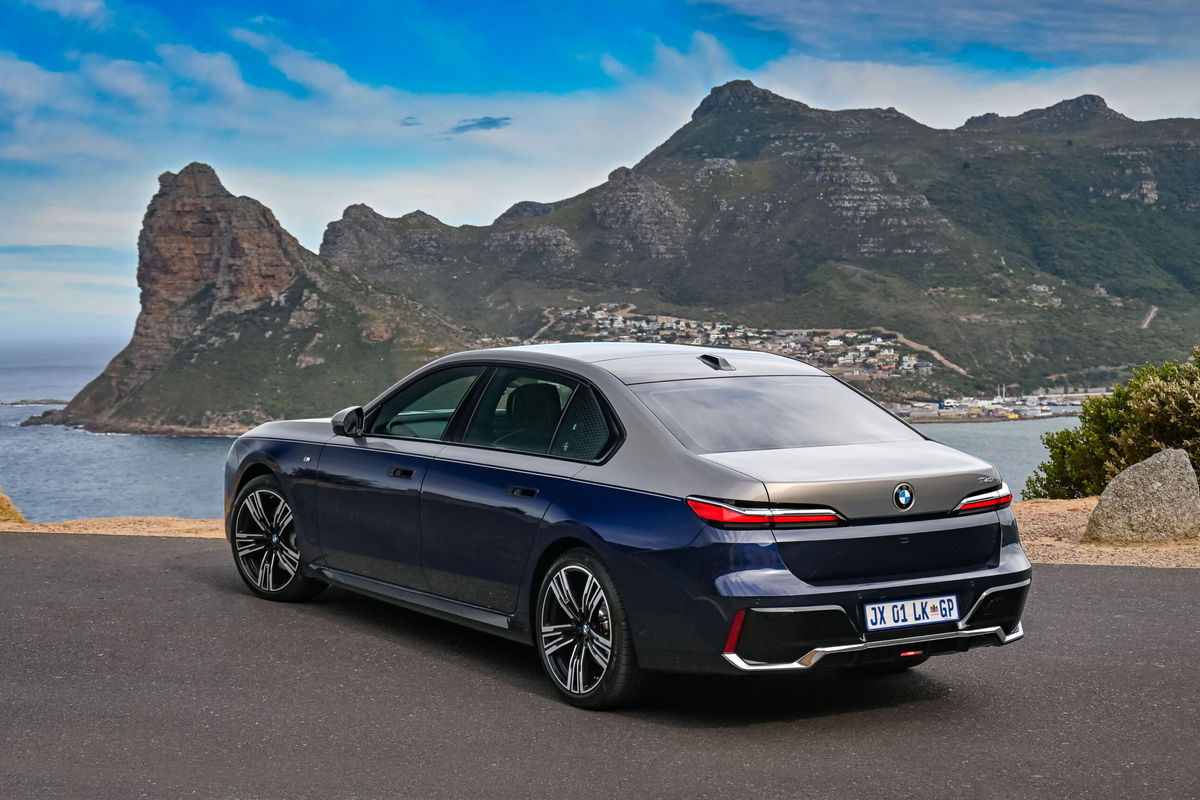
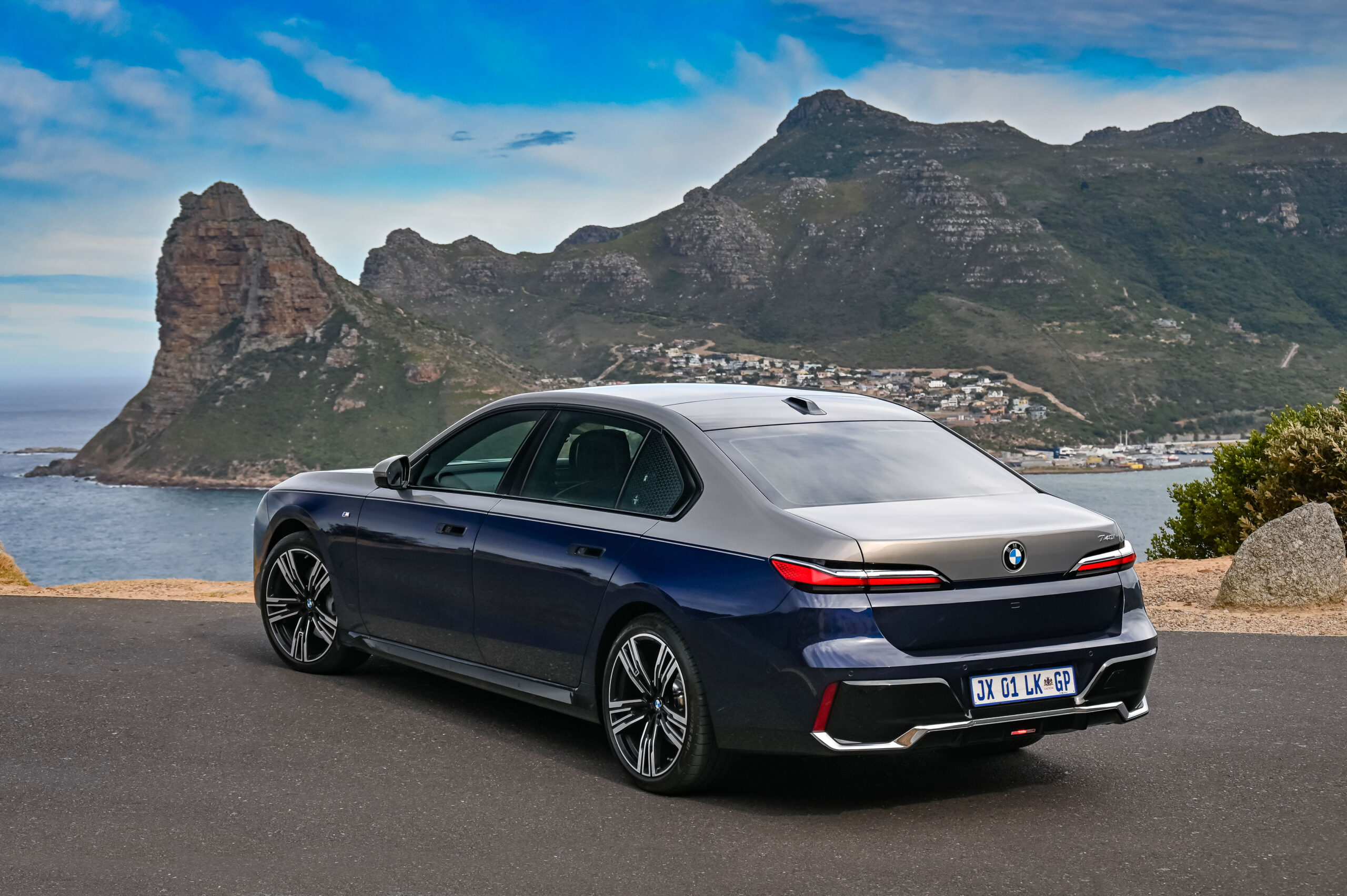
The 2-tone colour option adds to the visual statement and while traditional markets with a typical older customer profile may shun such a flashy look, BMW has revealed that China is the biggest market for the 7 Series (buyers on the Mainland have a predilection for long-wheelbase sedans) and the average age of the model’s customers there is 38, so they will want something that makes a bold statement.
The two-tone paint will appeal to buyers who want an extroverted look.
Physically, the new BMW 7 Series is longer and wider than ever, and extensive work has been done on the suspension setup, with BMW prioritising overall ride comfort. Given that the Bavarian marque’s claim to fame is “sheer driving pleasure” and so on, it’s hard to imagine a car as comfort- and luxury-oriented as the new 7 would be engaging to drive. It’s a conundrum; a sporty driving experience would be counter to passenger comfort and so, BMW sought a compromise – “the best of both worlds” – but did it work?
Everything in the new BMW 7 Series feels beautifully premium and well-finished.
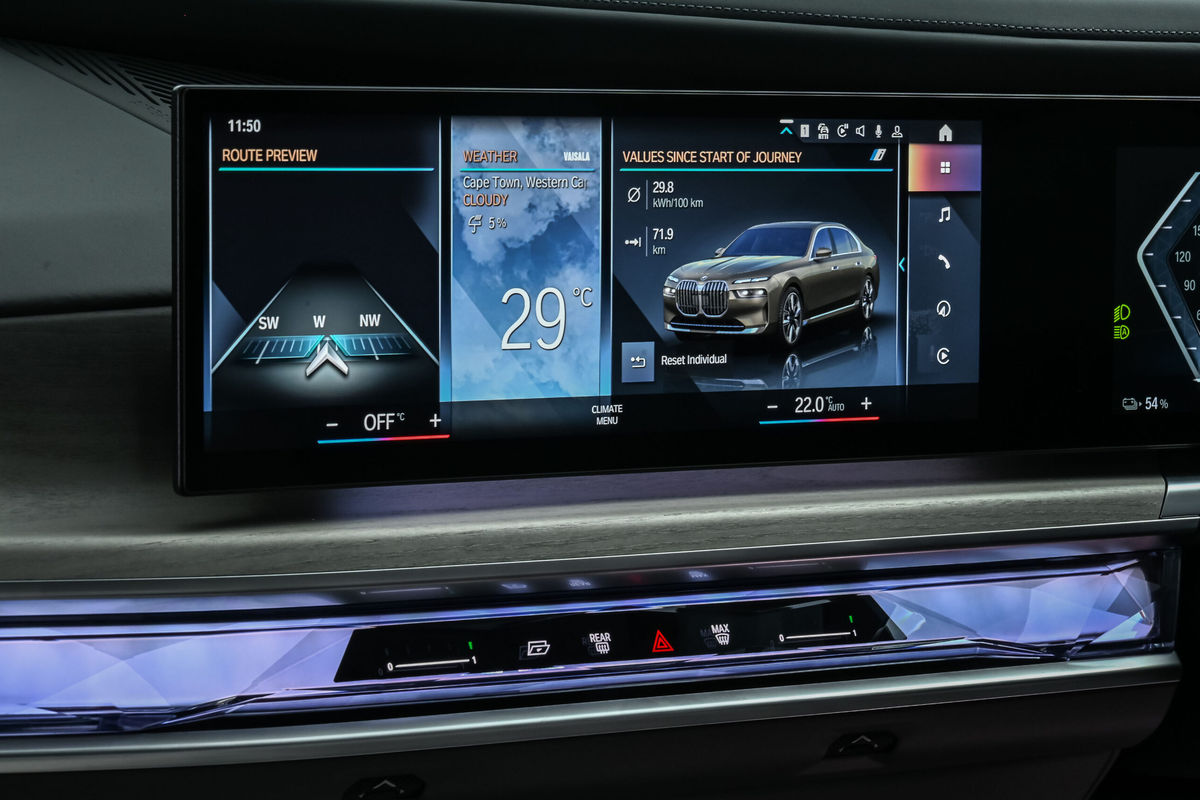
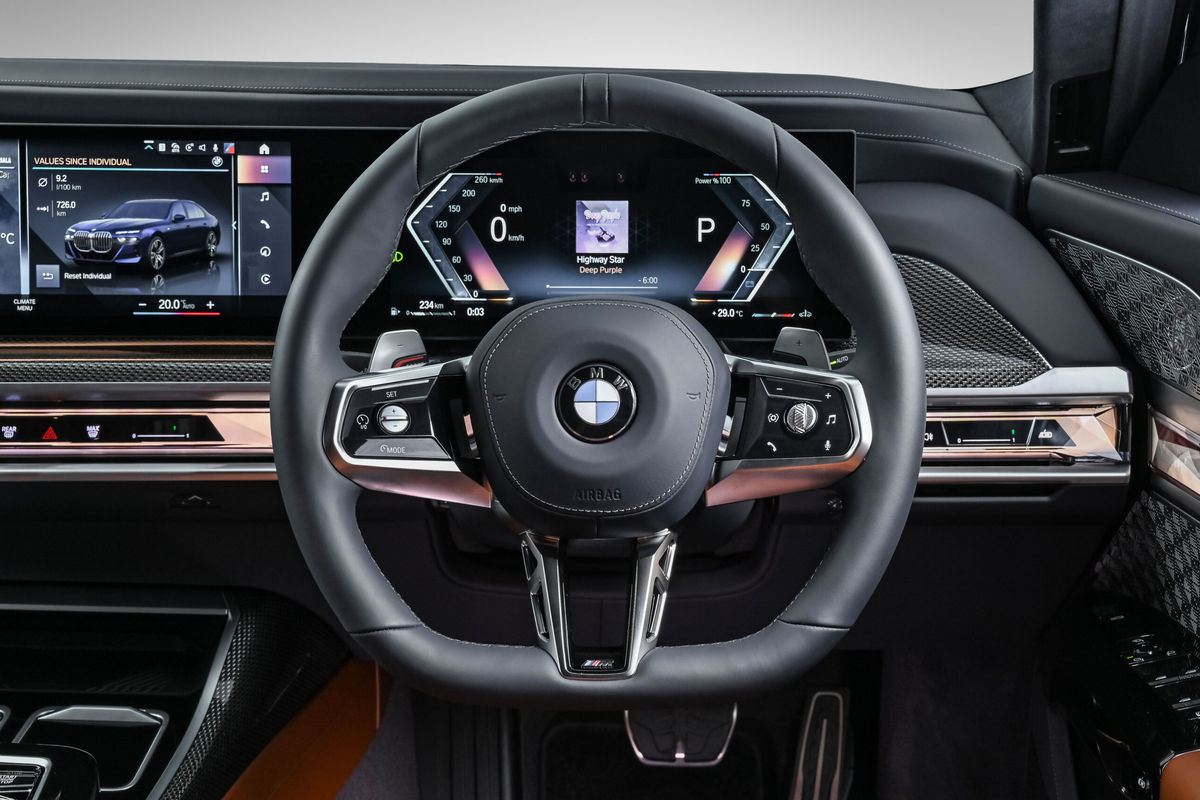
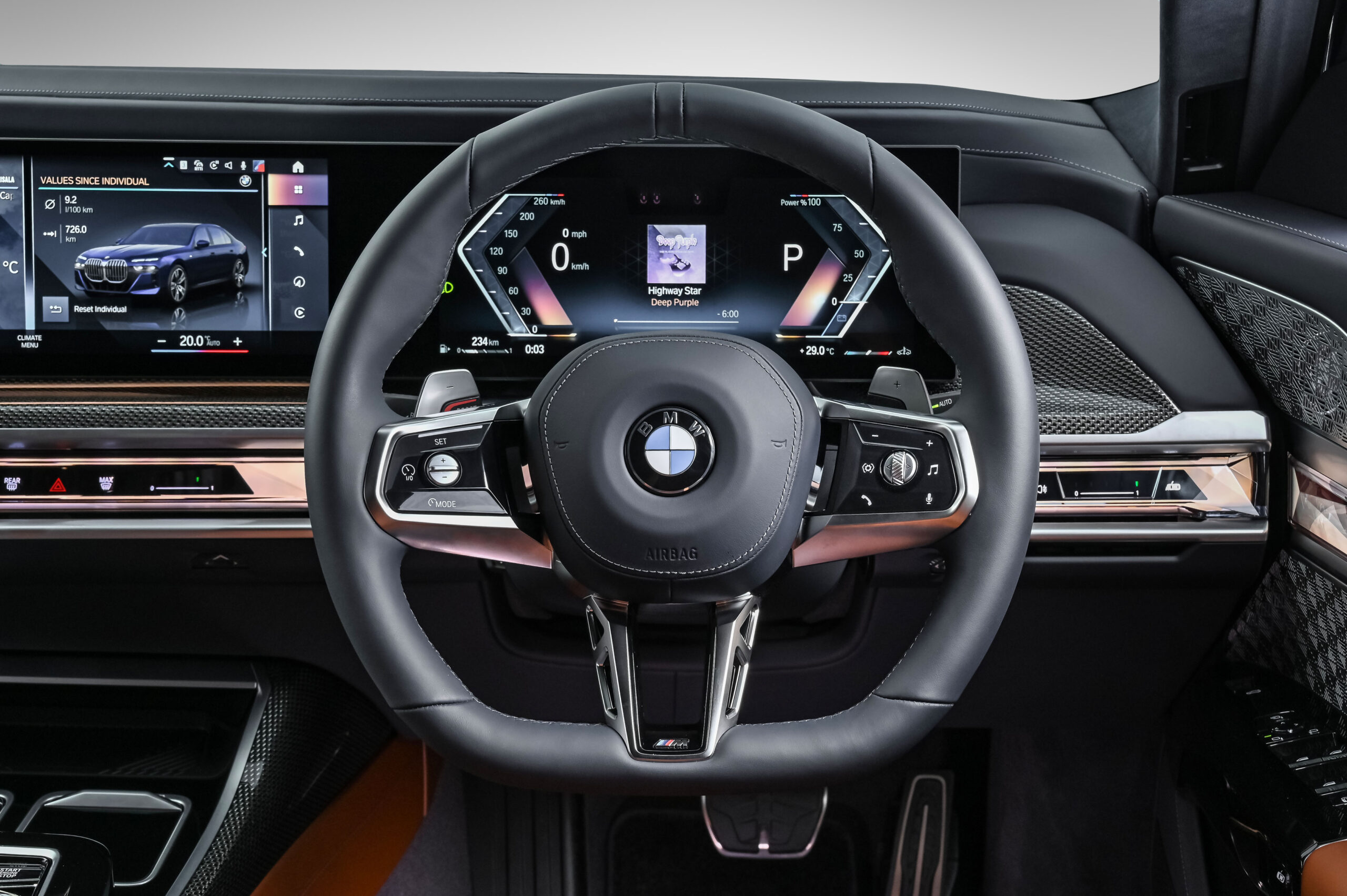
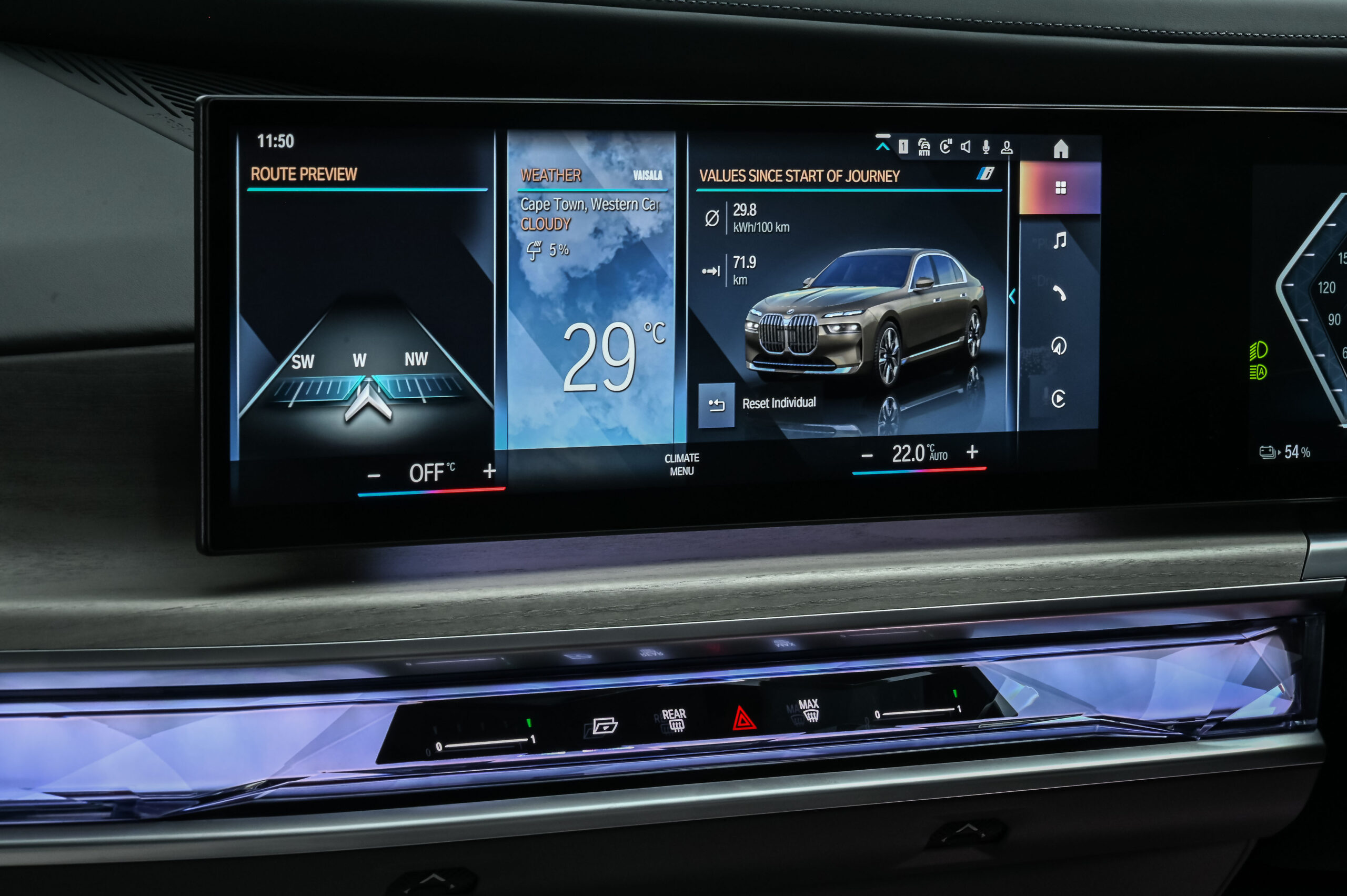
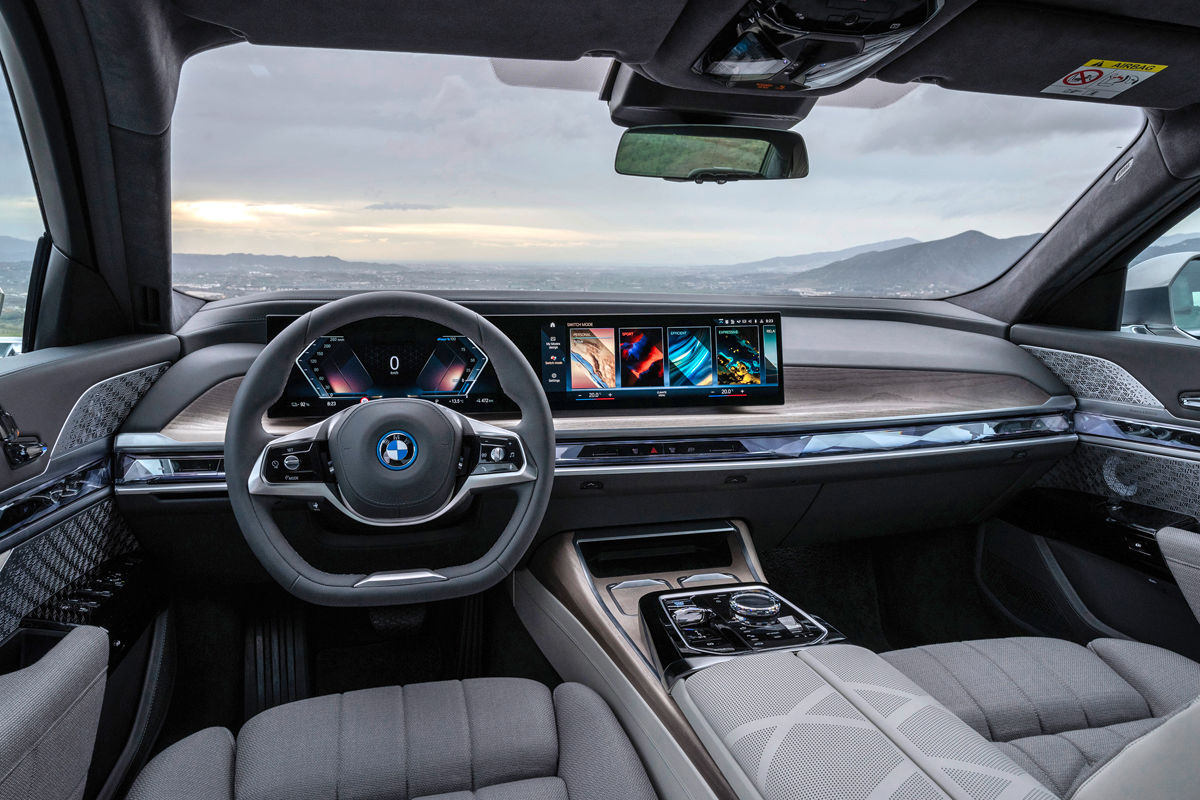
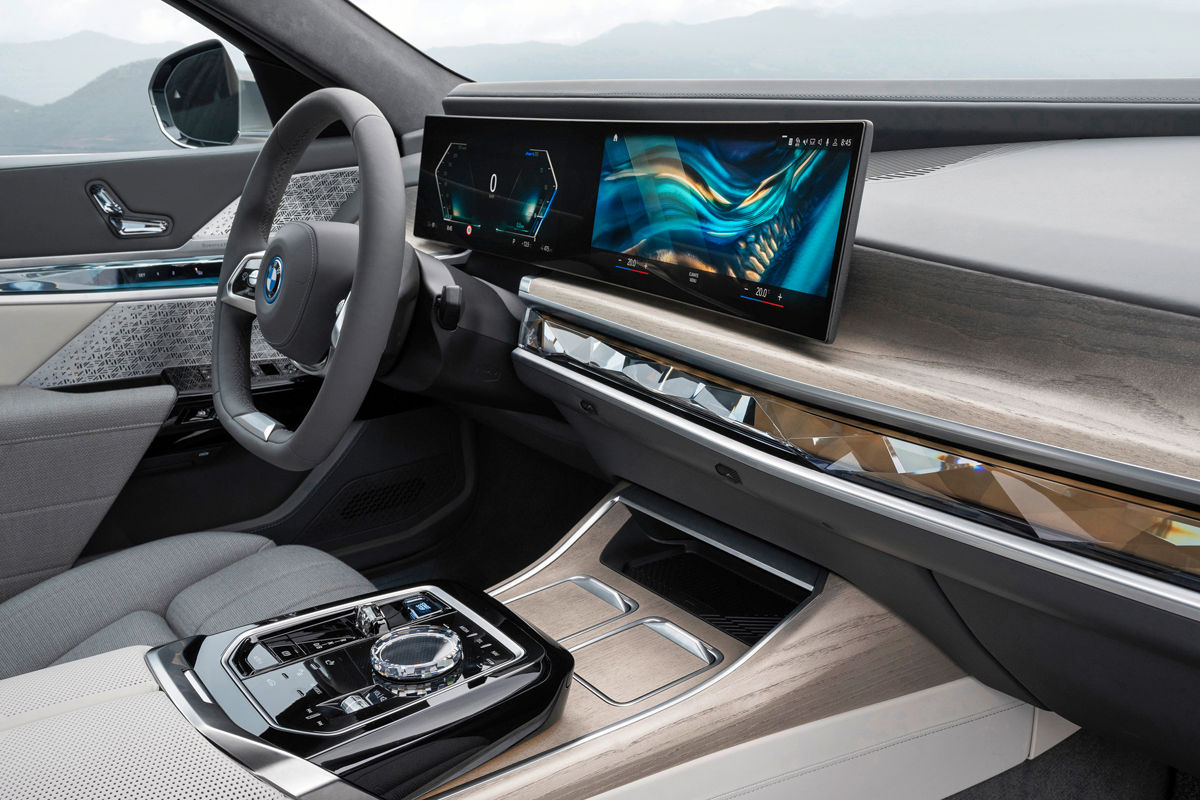
The biggest changes appear inside the lavish cabin, where iDrive Operating System 8 makes its debut. There’s a curved infotainment screen that incorporates a digital instrument cluster. Initially, it’s all a bit intimidating and unlike anything that we’ve sampled. There’s a LOT to take in, but we found that if you can’t find a setting or button, simply say “Hey BMW” and request the setting. That gets the job done.
We could fill this article with the standard features and specification details of the new BMW 7 Series, but you’d get bored and mentally overloaded really quickly, so we’ve used multiple images instead.
BMW SA offers the G70-generation 7 Series with petrol-, diesel- and pure electric powertrains.
BMW South Africa offers the new 7 Series with a choice of 3 derivatives, which are available in a trio of trim packages. For those who insist on petrol power, the 740i features a 3.0-litre 6-cylinder turbopetrol engine in conjunction with 48V mild-hybrid tech. It produces 280 kW and 540 Nm, and thanks to all-wheel drive, the 740i is capable of hitting 100 kph in a claimed 5.4 sec, while consuming 8.1 L/100 km.
If you think diesel power is the answer to your limousine needs, the 740d is powered by a 3.0-litre 6-cylinder turbodiesel engine (also augmented with 48V mild-hybrid tech) and the middle-of-the-range derivative develops 220 kW and 670 Nm. It’s said to consume around 6.5 L/100 km, which is still brisk, with a claimed dash to 100 kph of just 5.8 sec. The diesel version will arrive around the middle of 2023.
If that grille’s not prominent enough for your taste, it can be specified with built-in illumination.
Finally, sitting at the top of the pile is the all-electric i7. With a 101.7 kWh battery powering the front and rear axles, this electric flagship puts out a mighty 400 kW and 745 Nm of torque. Impressively, it’ll hurtle from a standstill to 100 kph in just 4.7 sec and it has a claimed range of up to 625 km on a full charge.
All 7th-gen 7 Series derivatives in our market have xDrive all-wheel drive and automatic transmissions. Sadly, the twin-turbocharged V12 engine in the M760Li has been nixed by ever-stricter emissions laws.
The i7 might be the flagship, but there are diesel and petrol options available too.
Unlike most new-car media launches, where you arrive at the location, have a press conference and are allocated a car to evaluate on a predetermined route, BMW SA chose to put those who attended the new 7 Series event in the back of the vehicle for the first leg. First impressions count and, just when you think you’ve seen it all in this industry, along comes a vehicle that redefines an eye-opening experience.
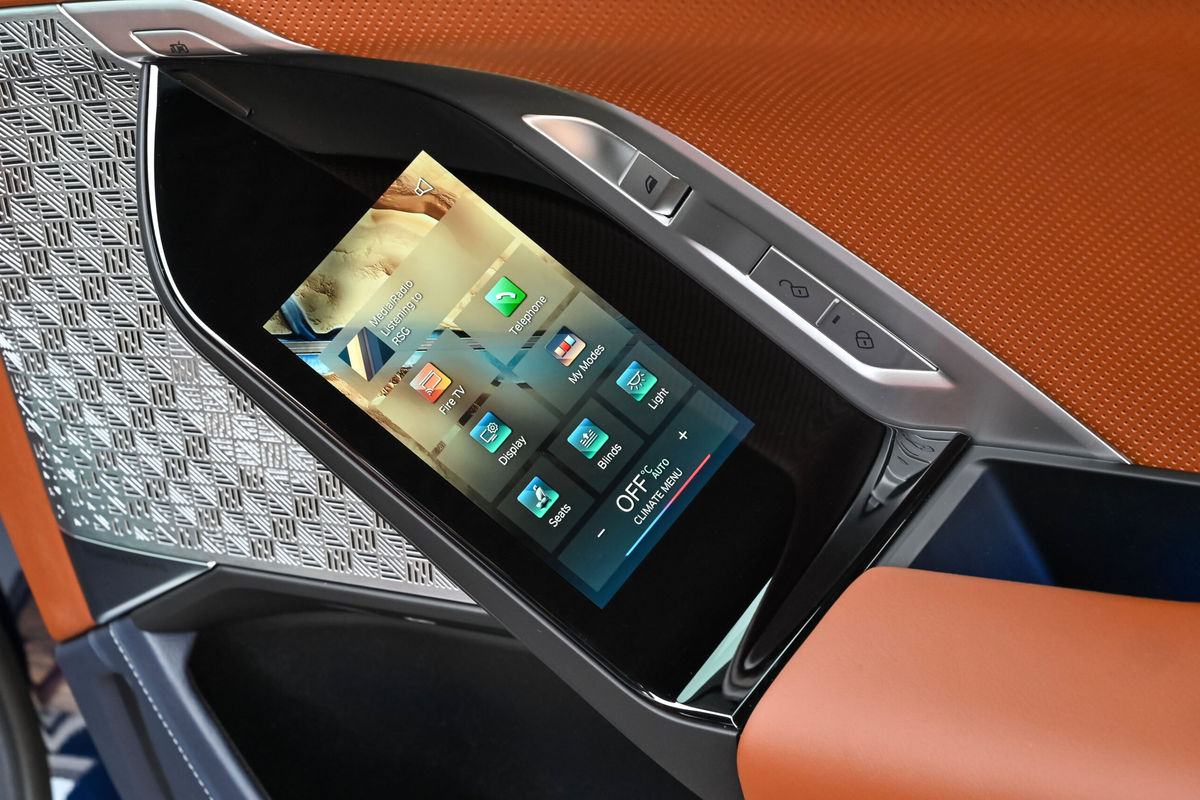
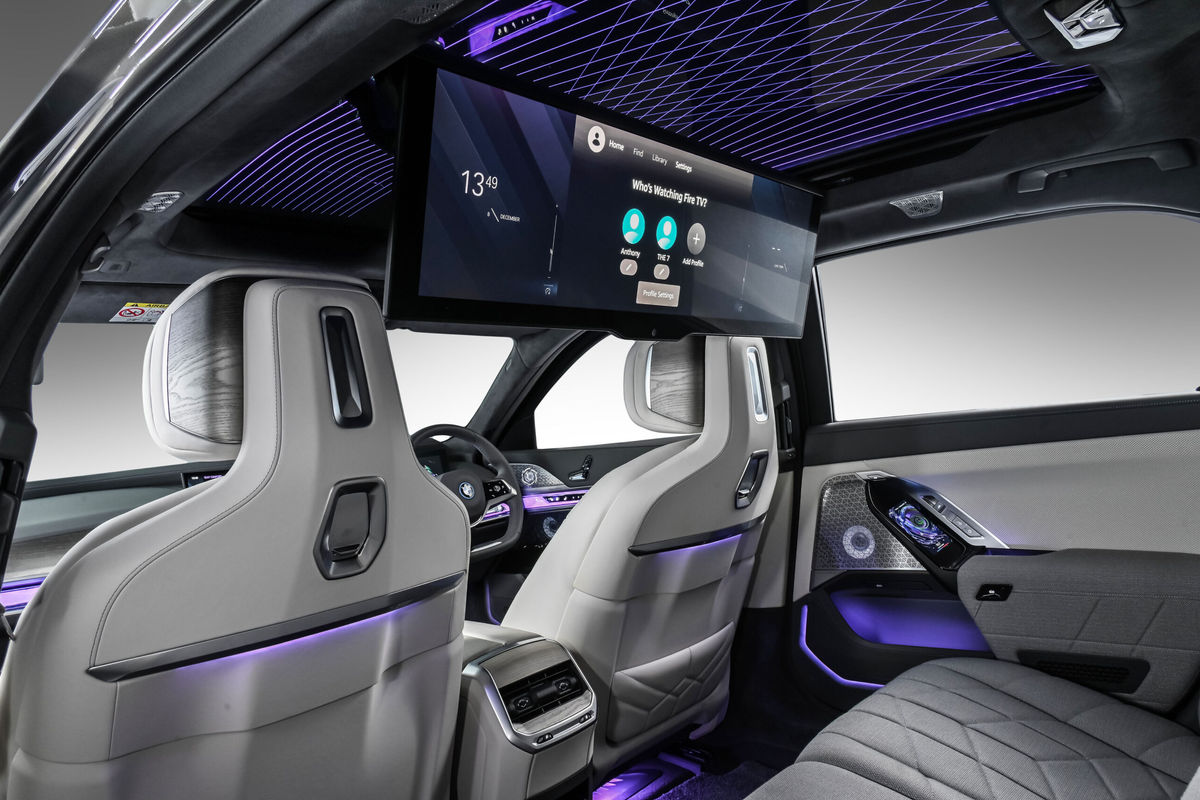
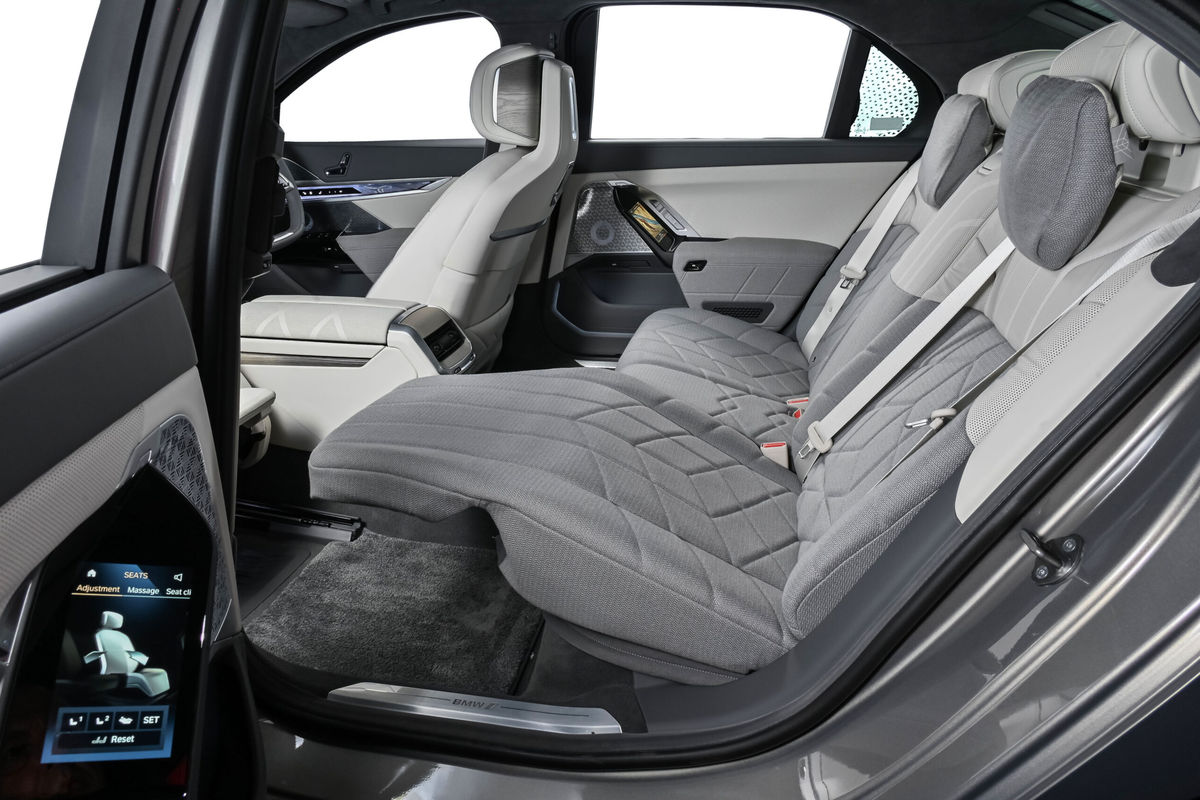
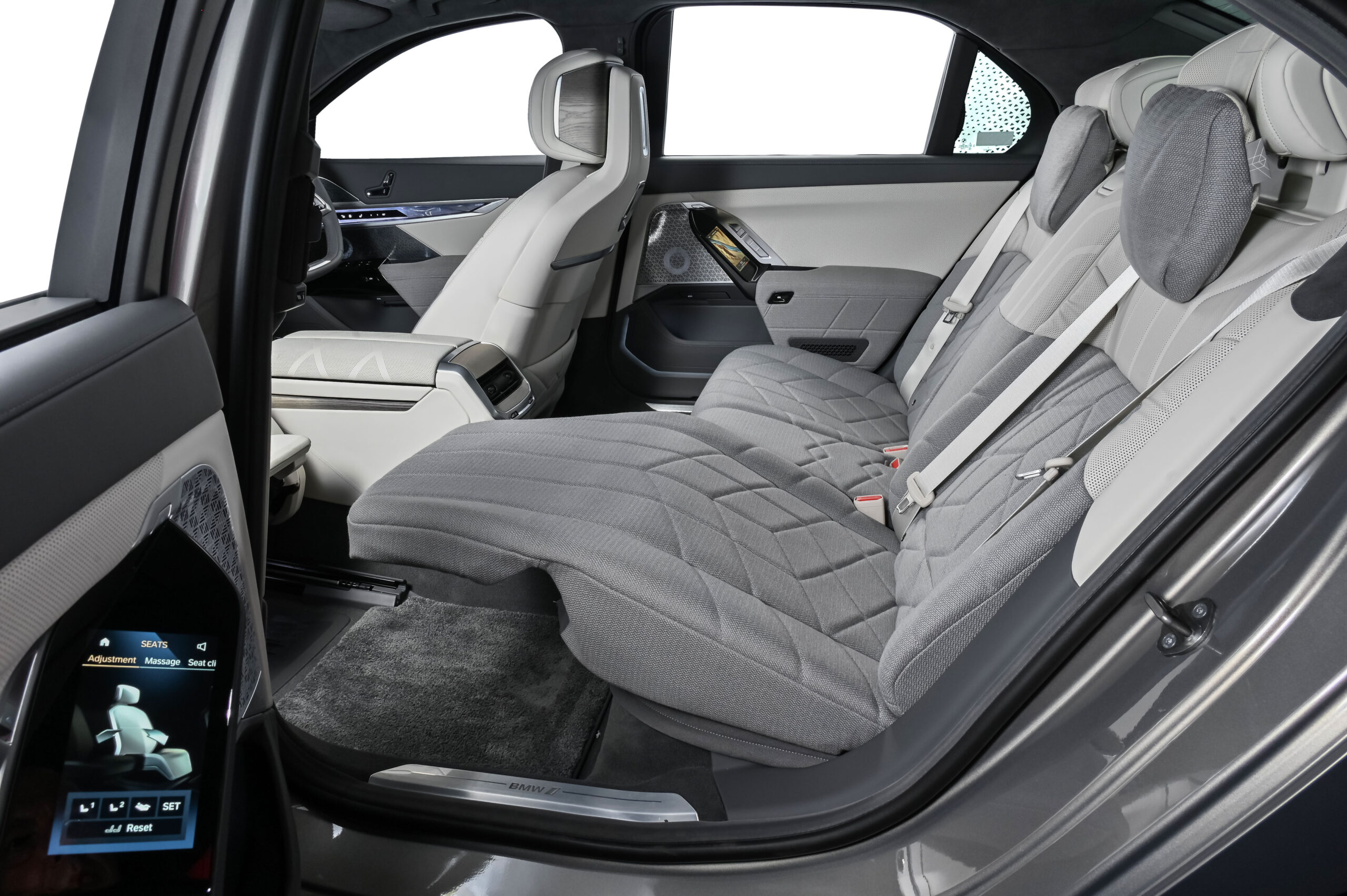
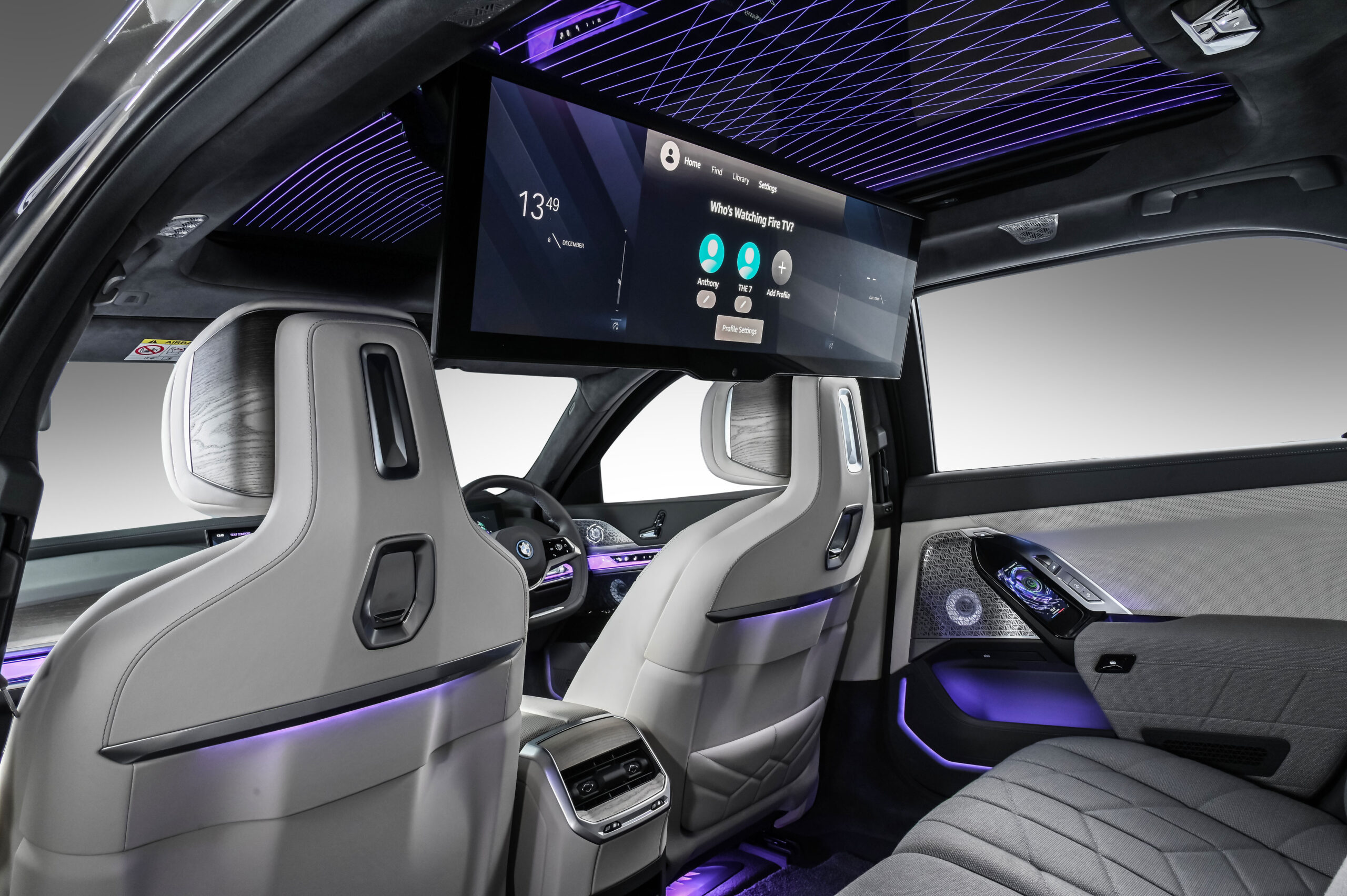
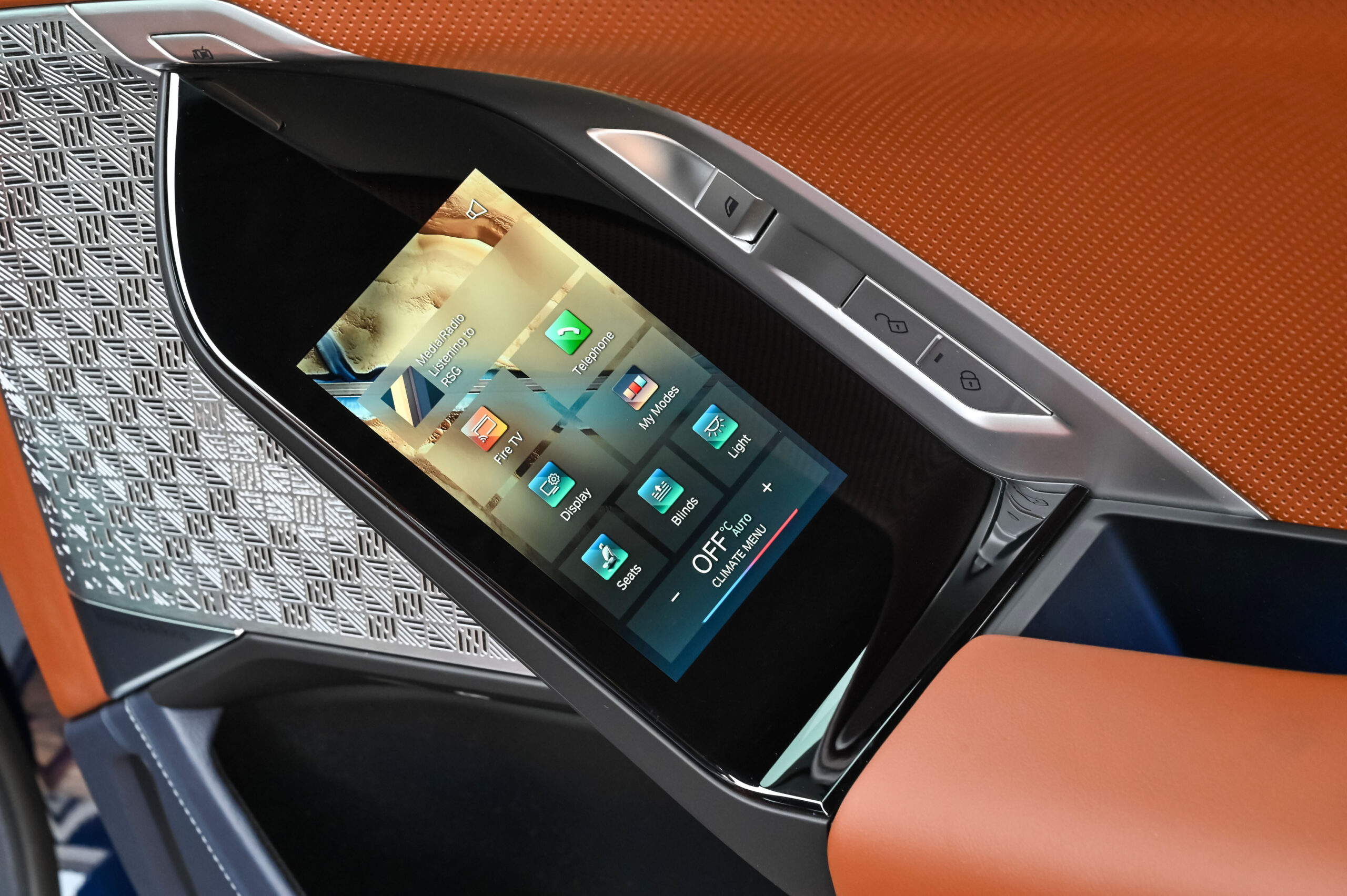
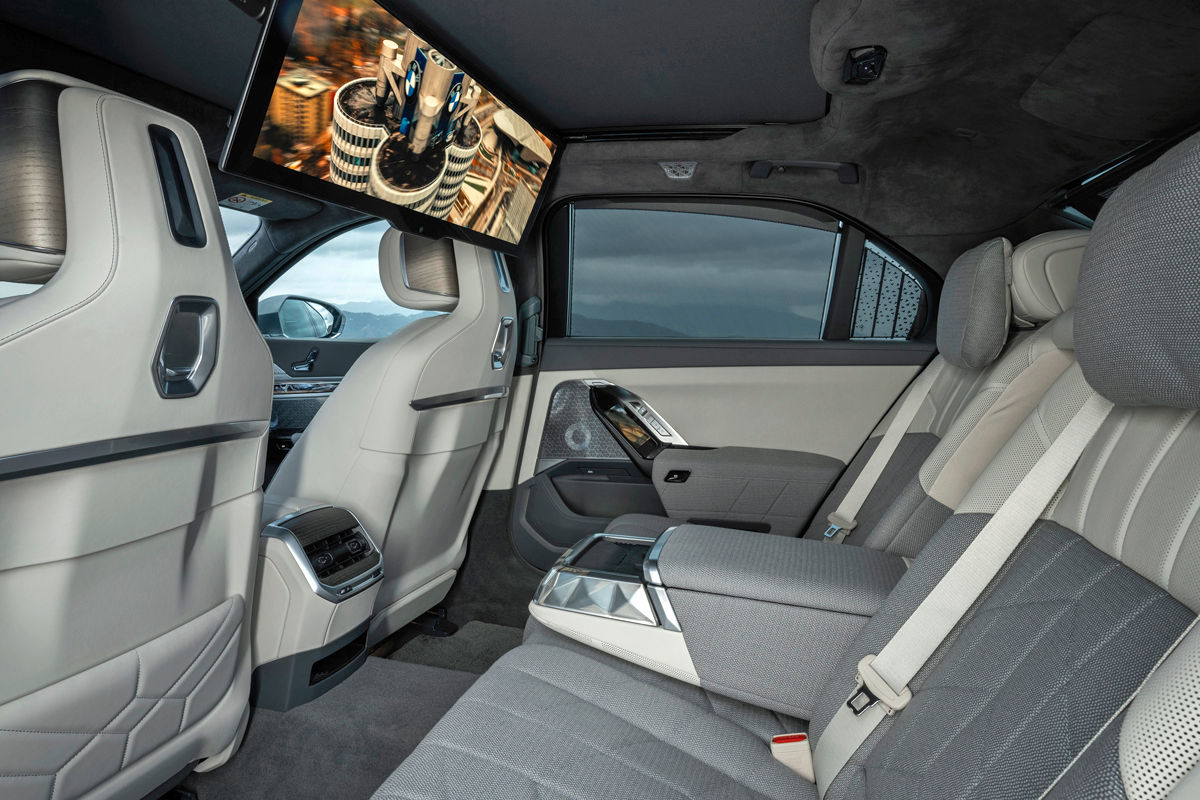
We were ensconced in the all-electric i7, which marks an exciting new chapter for BMW’s flagship sedan. You get in, push a button and the doors close automatically. There’s a touchscreen control panel built into the armrest of the door that allows you to adjust your seat position, access massage functions and climate control settings, plus deploy the optional 31-inch infotainment screen from the roof lining. Much like in a business-class seat in an aircraft, it’s possible to set the seats in near-horizontal positions.
If driving is a chore, how about having a nap in one of the fully reclining rear seats?
So, with the individual rear seat delivering cold air to my posterior and a gentle massage to my lower back while I watched a choice of either YouTube or Amazon content on the big screen, it was hard to stay focused and not give in to total relaxation. One journalist admitted he was so comfortable, he had a nap.
One of the important things to note about electric vehicles is that they’re incredibly quiet, which makes users more aware of other noises, such as road- and wind noise, but, in the new BMW 7 Series, the level of refinement is extremely high, with barely a whisper of the infamous South Easter buffeting the BMW.
Occupants of the individual rear seats can watch content on the optional 31-inch theatre screen.
While both the 740i and the i7 were available to drive, we spent most of our time behind the ‘wheel of the latter. Like its rivals, BMW has opted to incorporate a full EV in a legacy (or ICE) range, but in the not-too-distant future, most all-electric models will be based on dedicated electric platforms (as is the case with the iX). That’s why BMW is developing the Neue Klasse with 6th-gen powertrain and battery tech.
It’s probably a good thing that the i7 is encased in a conventional 7 Series body because so many (admittedly dedicated) electric vehicles’ exterior designs have been fussy and polarising. BMW has received criticism of the iX, but people won’t know the i7 is an all-electric vehicle unless you tell them.
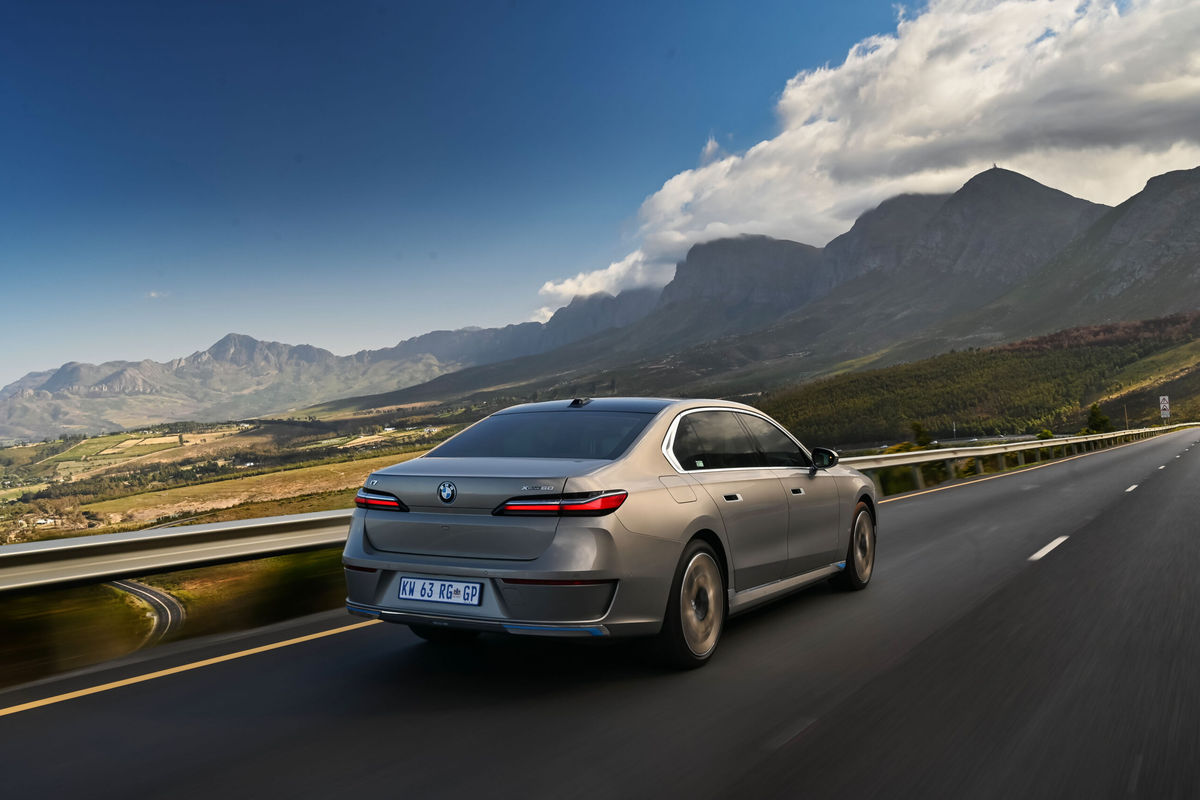
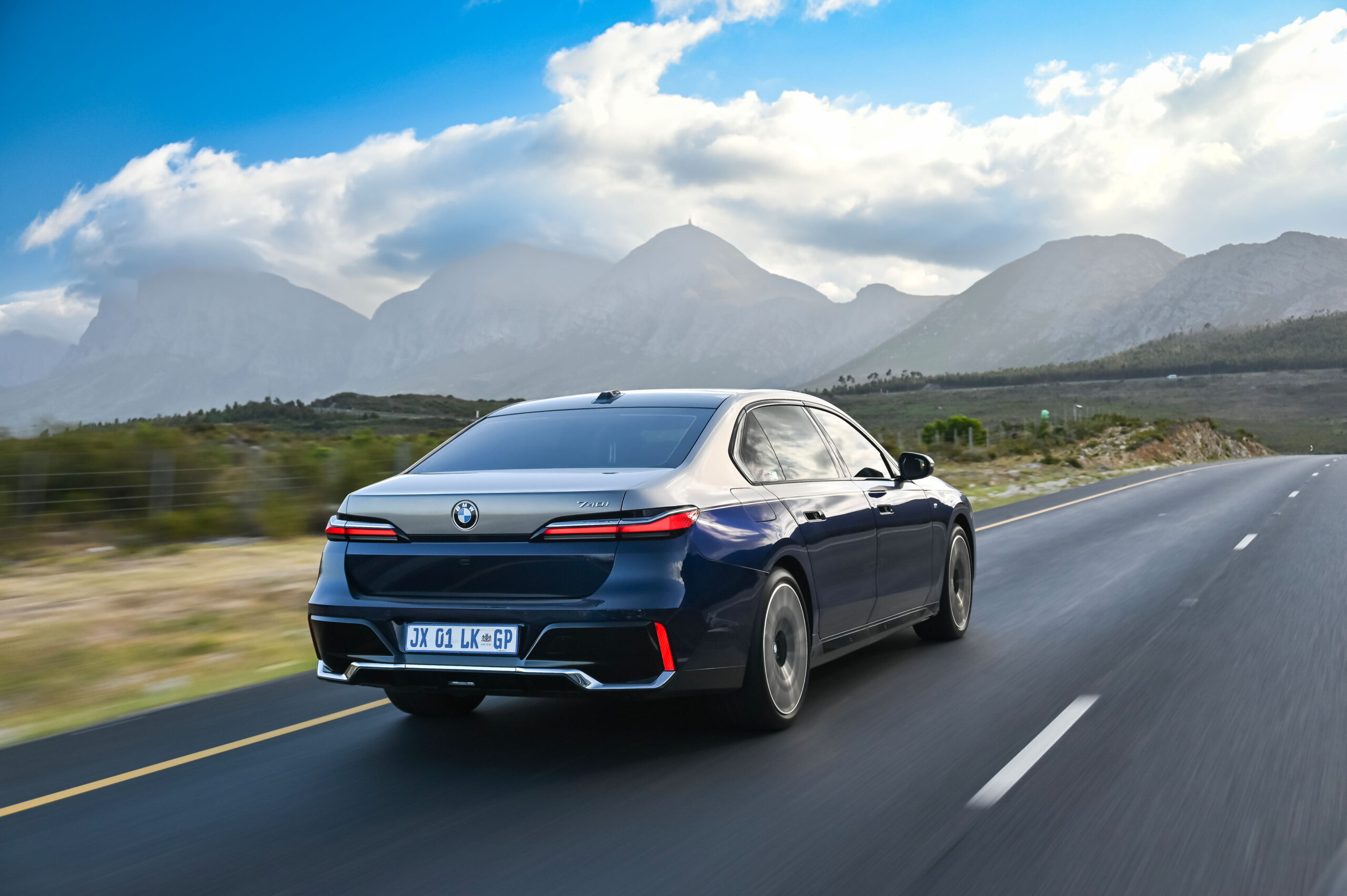
The BMW i7 seems to float over the road in quiet and relaxed comfort.
When you get in, you’re greeted by probably the most advanced instrument- and infotainment setup in a production model. When you start the i7, you’re greeted by the usual electric-car sound… silence, other than the ventilation system and a little chirp from the infotainment screen. Engage drive, and off you go.
One of the most remarkable things about the i7 driving experience is it behaves more like a conventional petrol/diesel vehicle than an electric vehicle. See, most EVs have this habit of decelerating the moment you lift off the accelerator pedal (to recover energy/increase the range). This results in a rocking horse motion, which, in some extreme cases, can induce motion sickness unless you adjust your driving style.
The new iDrive system is highly advanced; it will take some time to get used to.
You can set the i7 to be more proactive in this regard, but given the immense range it offers, we left the BMW to its own devices; the adaptive cruise control, aided by navigation data, gently applied the brakes on our behalf. It won’t replenish much battery charge, but the driving experience is vastly smoother.
The BMW i7 only has one shift paddle (on the left-hand side of the ‘wheel). It’s marked “boost” and we tested it when the road was straight and clear… For 10 seconds, the car delivered its utmost power and torque and it was eye-opening to experience just how brisk this large limousine is; it positively hurtled towards the horizon. This is accompanied by a sporty graphic on the curved screen and a sporty sound!
Rear passengers can utilise the touchscreen control panels located in the doors.
Granted, there is the possibility that all of the tech, gadgets and novelties in the BMW 7 Series will detract from the overall driving experience, but when we drove the i7, it delivered a deeply impressive ride quality on a variety of road surfaces, which is a credit to its novel dual-axle air suspension and adaptive suspension setup.
The steering setup does feel a bit artificial, but you can add a bit more feel and directness if you activate one of the sportier drive modes. Truth be told, on the winding road down to Cape Point, we did hustle the all-electric Bavarian juggernaut along at a brisk pace – it manages to hide its weight and feel reasonably nimble, but the laws of physics do apply; a 2.6-tonne sedan doesn’t excel at rapid changes in direction!
But, if you don’t care about driving precision and finesse, and just want overall comfort, relaxation and the feeling of riding on a proverbial cloud, then you’d struggle to match the competency of the BMW i7.
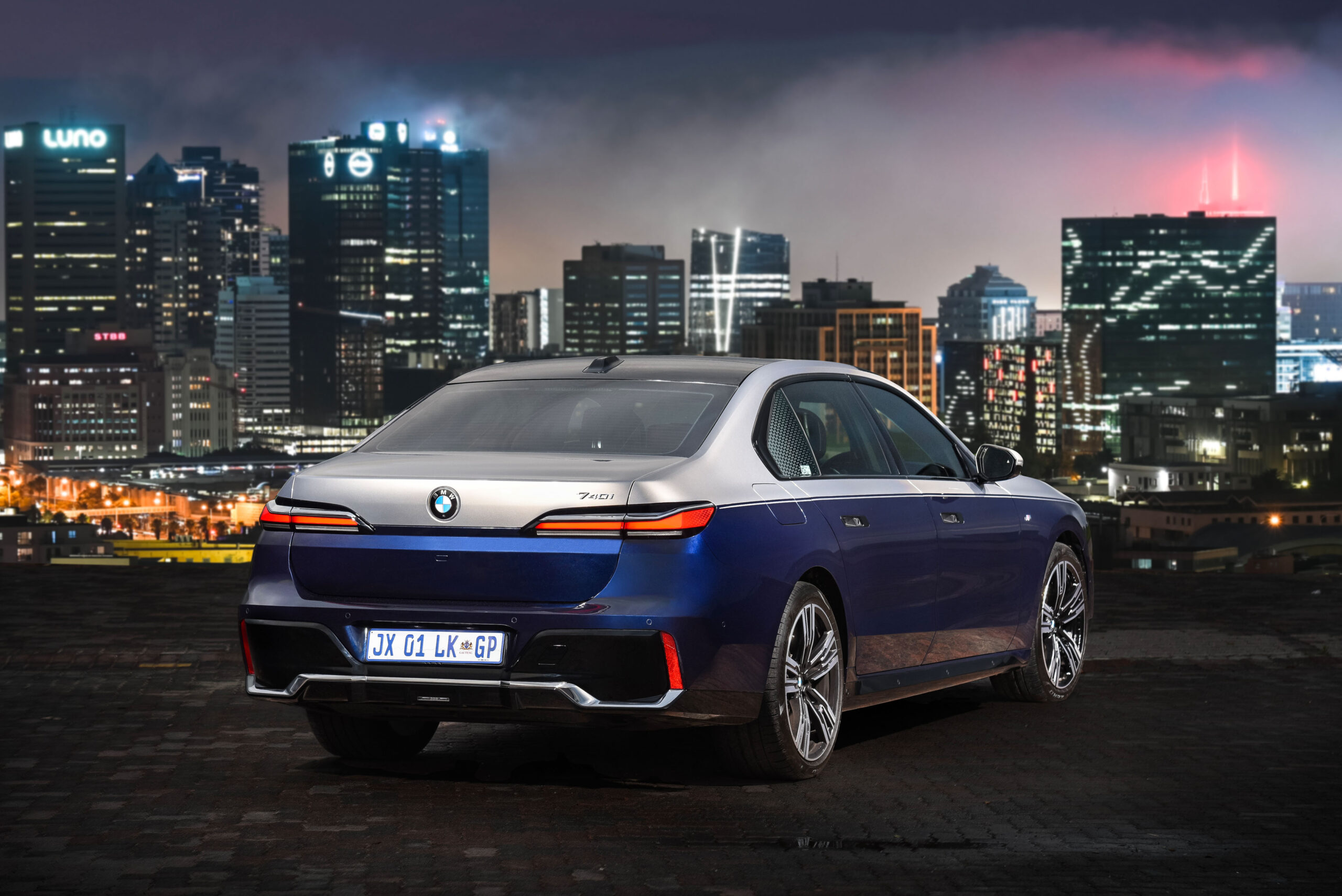
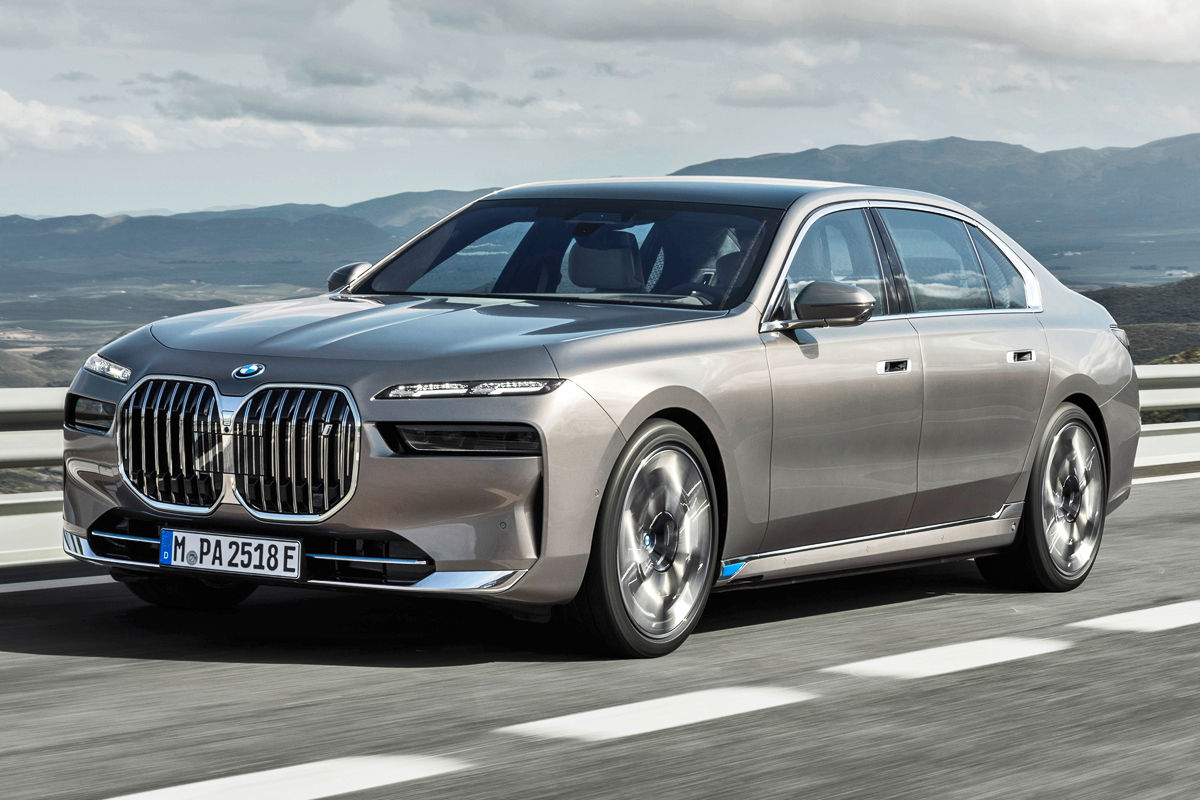
The styling is polarising, but we like the image that the G70-generation 7 Series projects.
How much does the new BMW i7 cost in South Africa?
BMW 740i
BMW 740d xDrive
BMW i7 xDrive60
Design Pure Excellence
R2 160 000
R2 280 000
R2 825 000
M Sport Package
R2 235 000
R2 355 000
R2 900 000
M Sport Package Pro
R2 275 000
R2 395 000
R2 940 000
Prices include a 5-year/100 000 km maintenance plan.
Summary
The new 7 Series – particularly the i7 – is one of the most advanced vehicles we’ve ever sampled.
We’re well into the era where high-end luxury vehicles are digital tech fests, but this BMW i7 feels like the most advanced first-class sedan, which is its raison d’etre. Given its multitude of gadgets and gizmos, it’s easy to get overwhelmed and it will take time to understand and appreciate all the 7’s functionality.
There are some great “rich-kid toys” to show off to people, including the BMW 7 Series’ doors, all of which can open and close by themselves, the hazard light button that activates lighting throughout the cabin, the rear entertainment package (and those touchscreen control panels), plus the incredible Bowers & Wilkins audio system that incorporates speakers in the seats.
BMW is claiming level 3 autonomous driving capability too. It’s a massive step forward and a glimpse into the future, not just for BMW or the luxury car segment. This is anything but a tool to get you from A to B.
Where can a premium manufacturer go after introducing a car like the i7? Granted, we have yet to drive the all-electric Mercedes-Benz EQS, but there’s a strong likelihood that it will prompt similar questions…
Given the absolute luxury and comfort offered in the rear, as well as the i7’s remarkably nimble road manners, we found ourselves feeling quite perplexed. Is this a car you want to drive – or be chauffeured in? We look forward to taking a deep dive into this highly-advanced, ultra-comfortable high-end sedan.
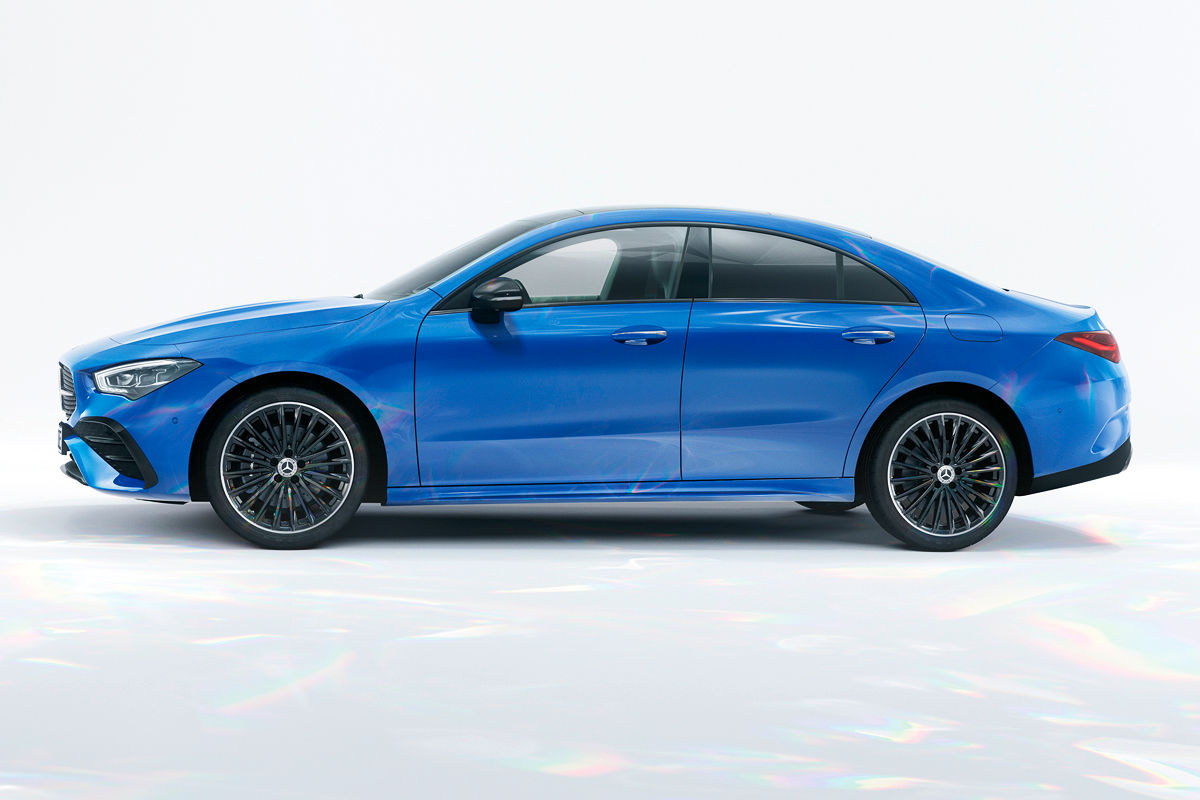
Mercedes-Benz CLA Handed Facelift and Mild-Hybrid Engines
Mercedes-Benz has handed its CLA a subtle facelift that includes an updated cabin and a shift towards mild-hybrid petrol powertrains…
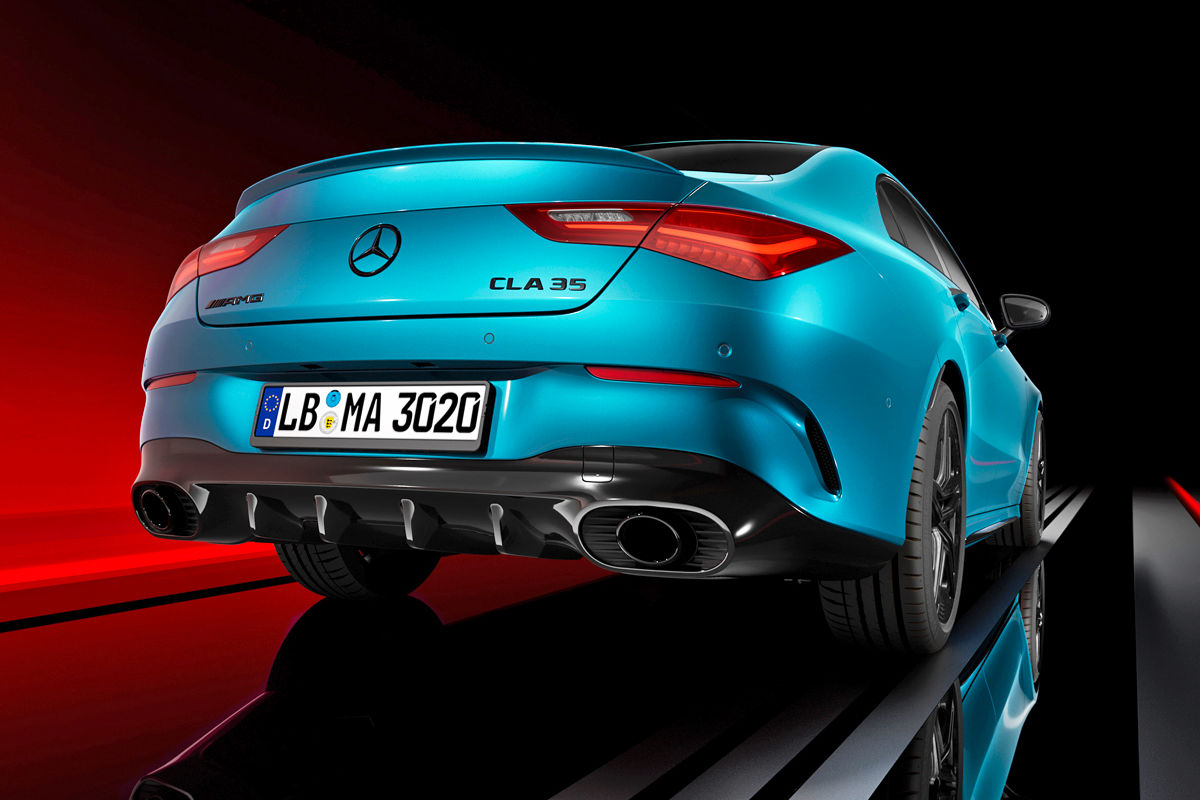
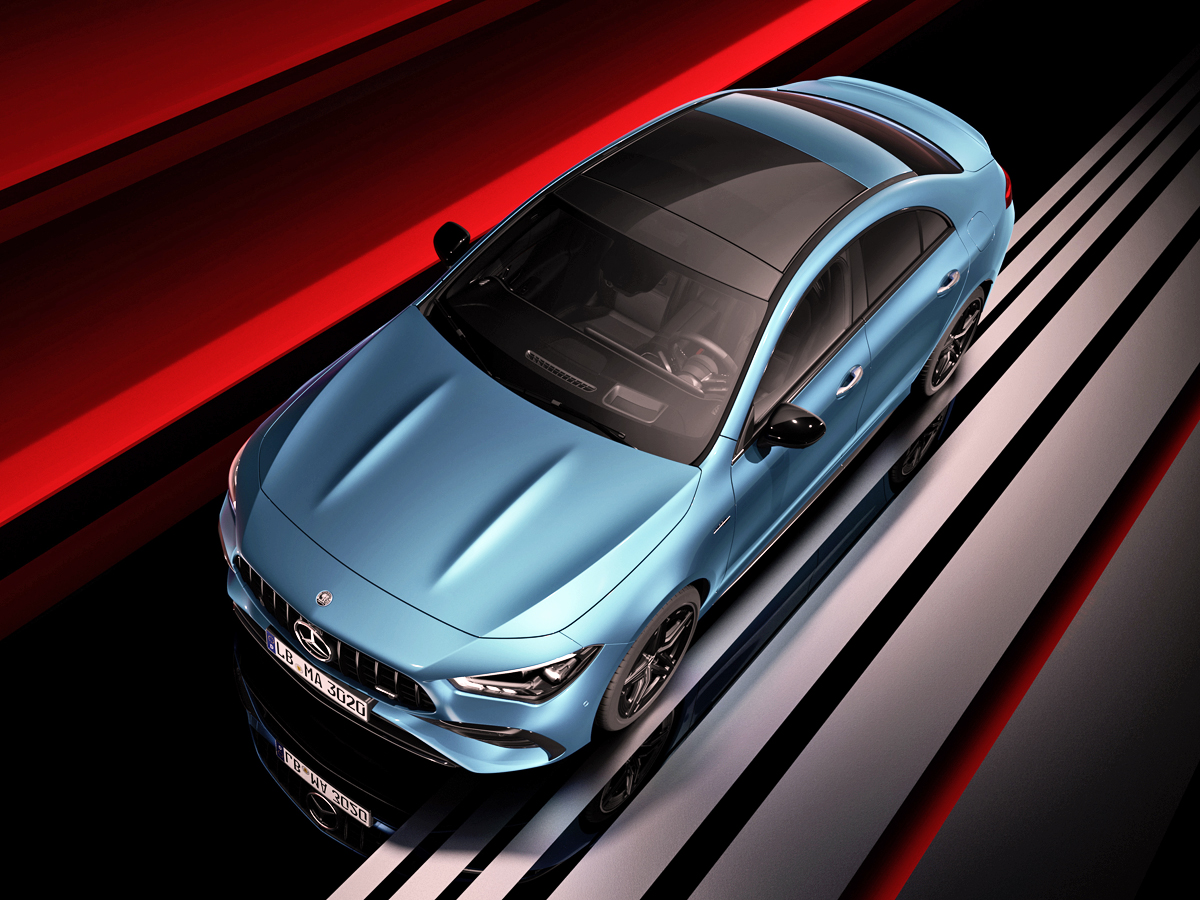
The C118-generation Mercedes-Benz CLA has gone under the knife, gaining subtly revised exterior styling, an updated cabin and the addition of mild-hybrid gubbins for the standard petrol models. The Mercedes-AMG CLA35 likewise gains a light form of electrification, while the range-topping 310 kW powertrain of the CLA45 S is unchanged.
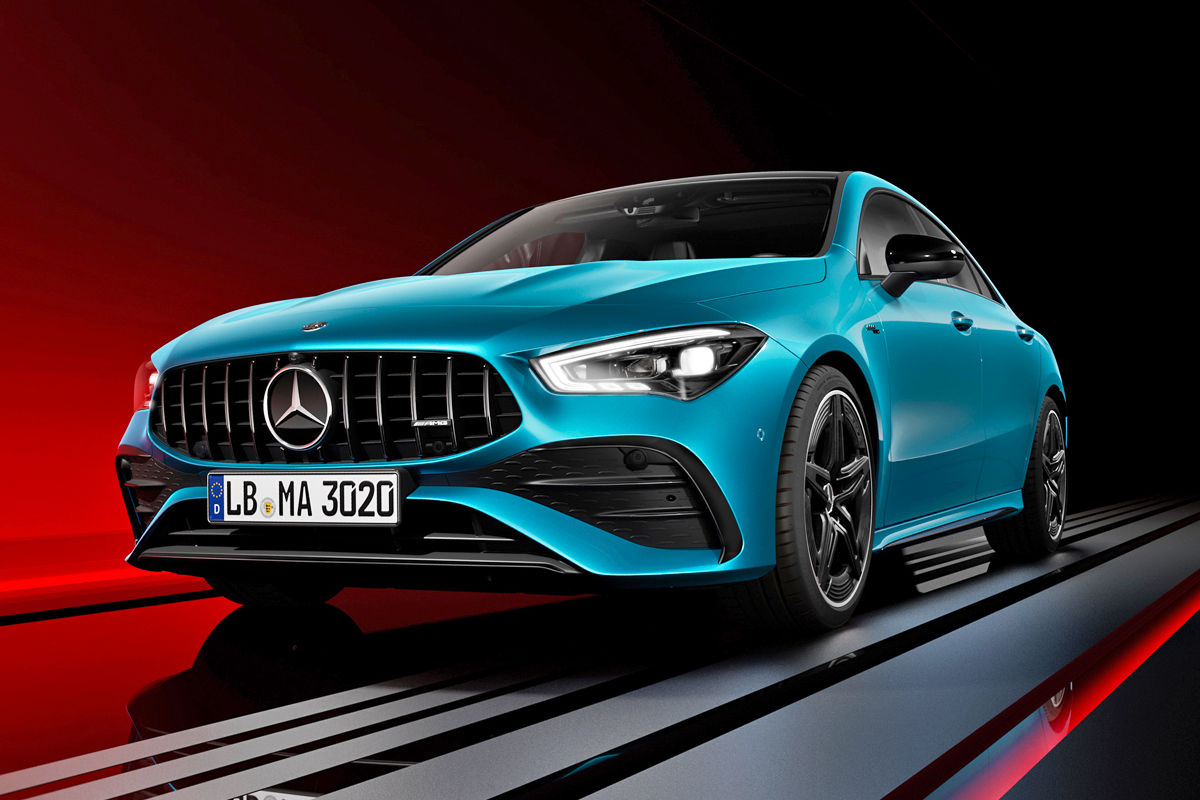
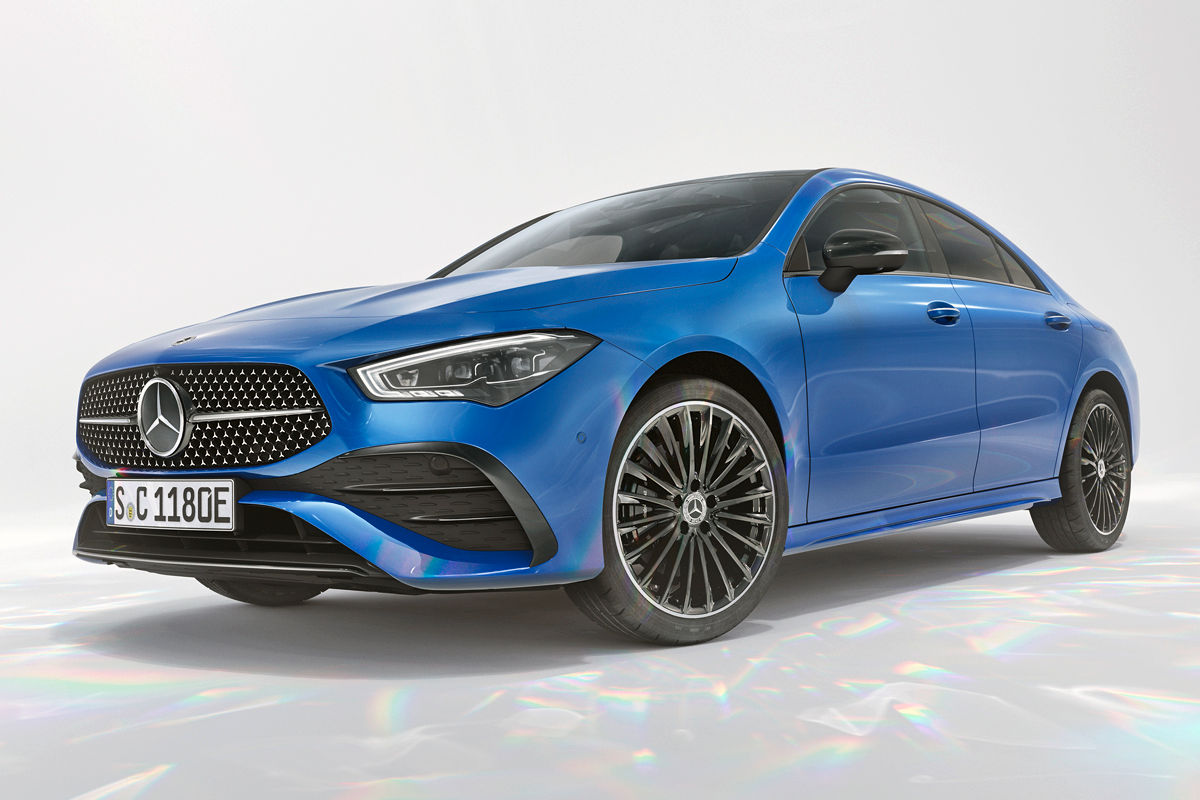
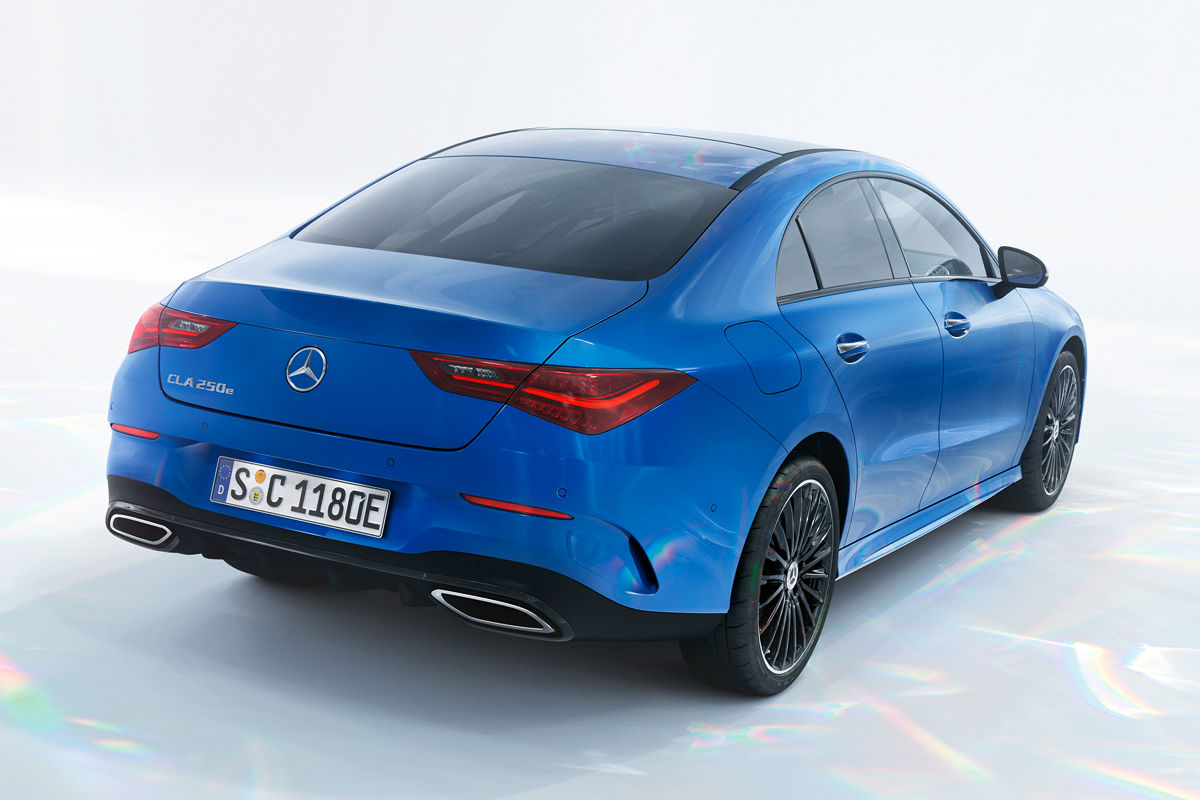
As with most mid-cycle updates, the 2nd-generation CLA’s facelift includes items such as a renewed front-apron design, a revised grille (with a star pattern in the case of standard models) and a redesigned rear diffuser. High-performance LED headlamps, meanwhile, are now standard and furthermore score “modernised graphics”.
Fresh paint colours have also been added to the range, including “hyper blue” (a hue exclusive to the CLA) and “spectral blue”, while 3 additional alloy-wheel designs (up to 19 inches) have been rolled out. As standard, the updated CLA rides on 17-inch 5-spoke wheels in vanadium silver or 5-double-spoke items in high-gloss black with a high-sheen finish.
Updated CLA moves to mild-hybrid petrol engines
Petrol engines (including the CLA35 pictured above but excluding the CLA45) gain mild-hybrid tech.
Though the engine range for South Africa has yet to be confirmed, all previously standard petrol mills in the updated CLA (expect that of the CLA45 S) are now electrified. As such, the 4-cylinder units are equipped with a 48-volt on‑board power supply as well as a new belt-driven starter‑generator. During braking and acceleration, the starter-generator recuperates what would otherwise be lost energy and supplies it to 12-volt on-board network and the 48-volt battery.
So, in the case of the CLA200 currently offered here in SA in pre-facelift form, the turbocharged 1.3-litre engine still makes 120 kW, though an additional 10 kW is briefly on offer thanks to the mild-hybrid tech. The turbodiesel lumps, however, are unchanged; the CLA 220d remains a 2.0-litre oil-burner generating 140 kW and 400 Nm.
In Europe, Mercedes-Benz furthermore offers a plug-in hybrid version of the sleek sedan (badged as the “CLA 250 e”), which upgrades to an improved high-voltage battery that offers a higher usable energy content (and thus better electric range). The power of the electric motor has also increased by 5 kW (to 80 kW) and again works alongside a 120 kW turbocharged 1.3-litre petrol unit.
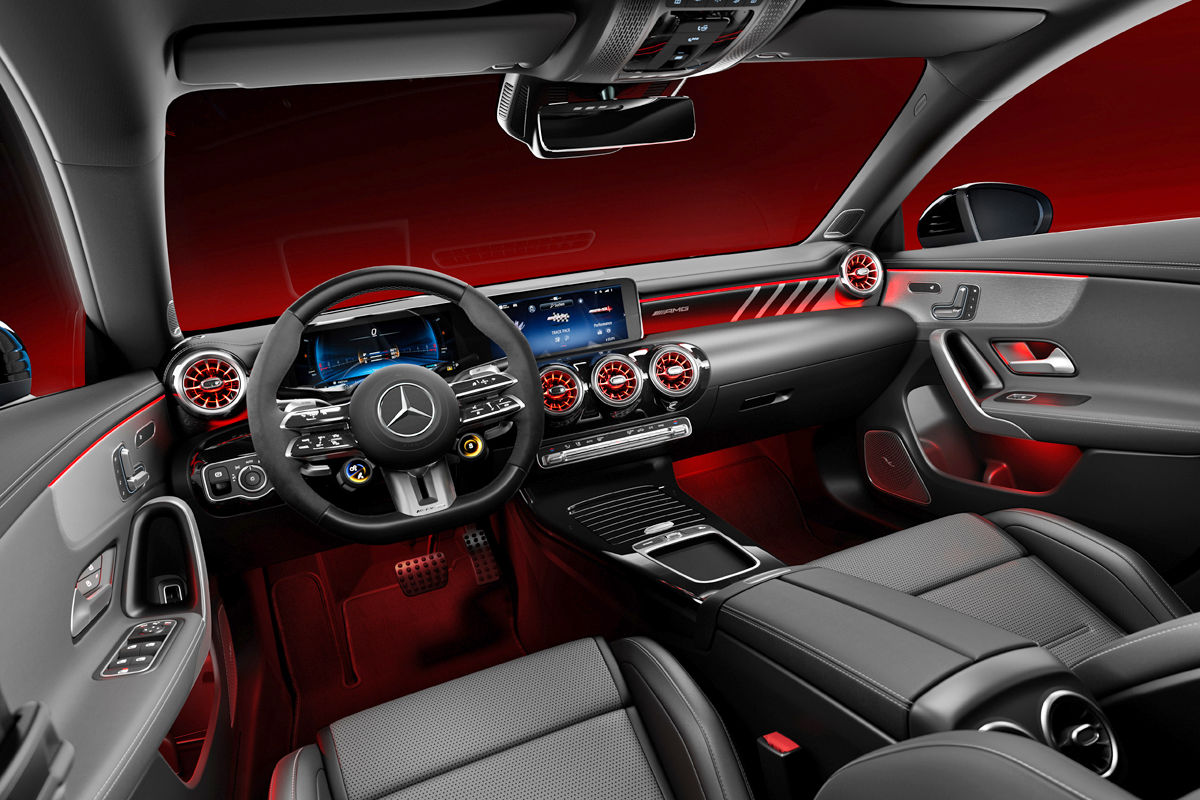
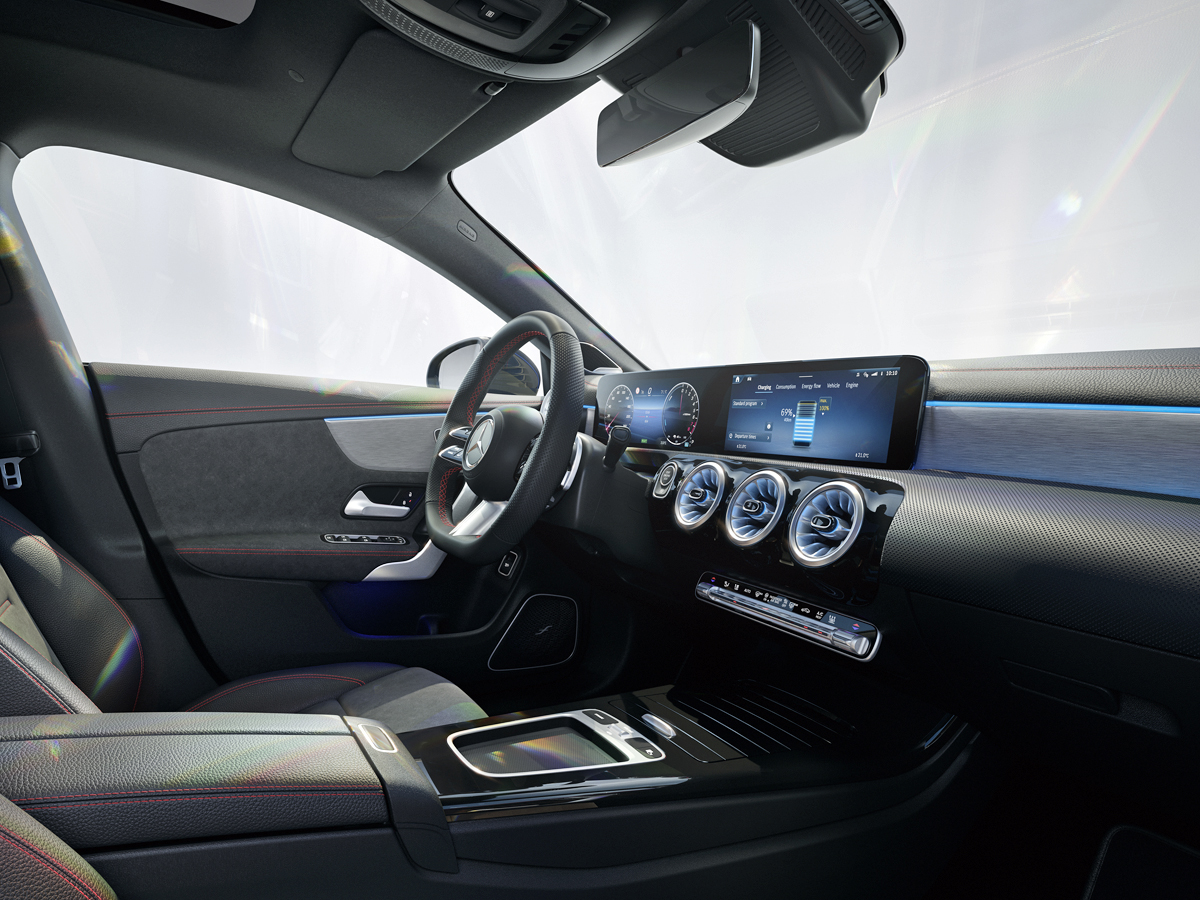
A peek inside the facelifted CLA’s cabin
Various minor changes have been made in the CLA’s cabin.
Inside, you’ll again find a free-standing double screen, though it now incorporates a 7-inch and a 10.25-inch display as standard (a pair of 10.25-inch displays creating a wide-screen effect is an option). The steering wheel is upholstered in Nappa leather, but is also available in Artico synthetic leather. Look closely and you’ll also notice new trim elements available in a dark carbon look, open-pore brown lime wood or brown microfibre.
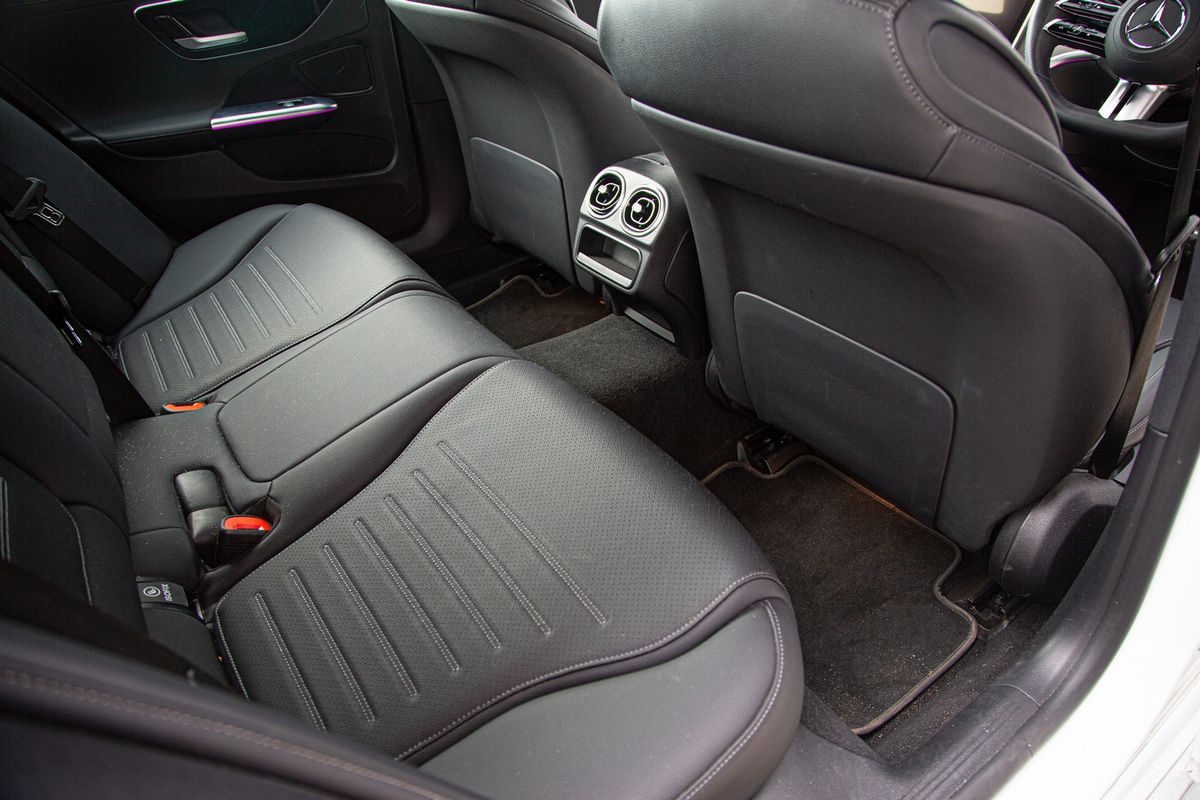
Comfort seats ship standard in a combination of synthetic leather and fabric (black as standard or sage grey as an option), with the latter upholstery comprising 100% recycled materials. Different interior colour schemes are available for each of the equipment lines (as many as 5 in the case of the AMG Line).
Though standard kit levels will obviously vary by market, Mercedes-Benz says the CLA’s equipment list has been “significantly upgraded”. In Europe, for example, the base CLA comes with items such as high-beam assist, a reversing camera and a USB package, in addition to a leather tiller and LED headlamps. The Stuttgart-based firm says “other functional equipment” is bundled into packages “based on real customer behaviour”.
The CLA also features the latest generation of MBUX, complete with newly designed display styles, a revised telematics system and “improved performance”. A fresh feature is wireless connectivity with smartphones via Apple CarPlay or Android Auto. There’s also an additional USB-C port as well as increased USB charging capacity, while all USB ports are now illuminated.
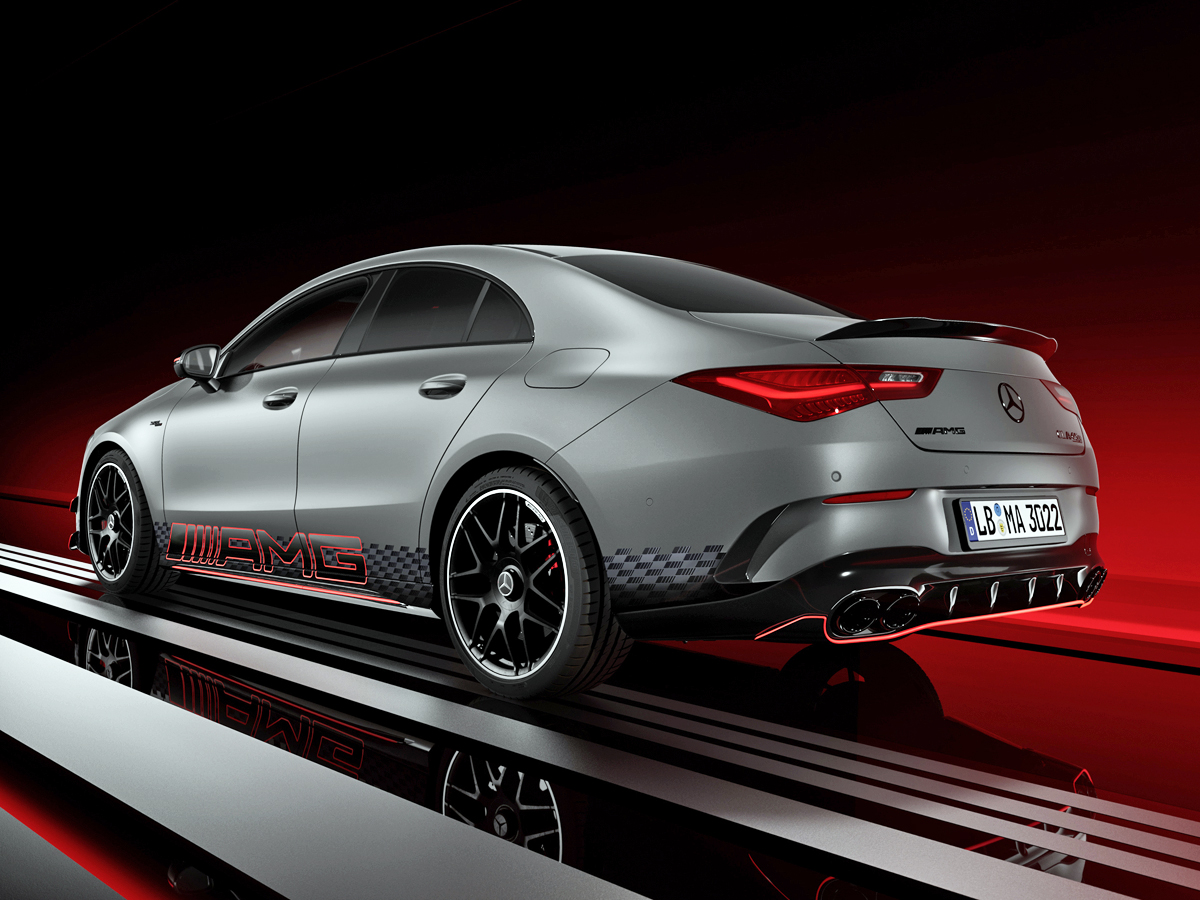
Mercedes-AMG CLA35 and CLA45 S also updated
This is the new AMG Street Style Edition of the facelifted CLA45 S.
The pair of CLA models fettled by the folks from Affalterbach also score a few updates. The CLA35, for instance, upgrades to a new AMG-specific grille with vertical slats, while also gaining a reshaped front apron and a round badge with the AMG emblem. Inside, there are new upholstery covers for the standard sports seats.
Redesigned light-alloy wheels for the 35-badged model includes 10-spoke 18-inch items in black and optional 5-twin-spoke 19-inch wheels. The CLA45 S, meanwhile, rides on 19-inchers as standard, with a 2nd design in the same size available as an option.
While the all-wheel-drive CLA45 S sticks with an unchanged version of its high-output 310 kW/500 Nm turbocharged 2.0-litre, 4-cylinder engine, the likewise all-paw CLA35’s 225 kW/400 Nm 2.0-litre unit gains a 48-volt electrical system and a belt-driven starter-generator (and again a temporary power boost of 10 kW). However, Mercedes-AMG has added a new limited-run version of the CLA 45 S called the “AMG Street Style Edition”, complete with fluorescent orange accents.
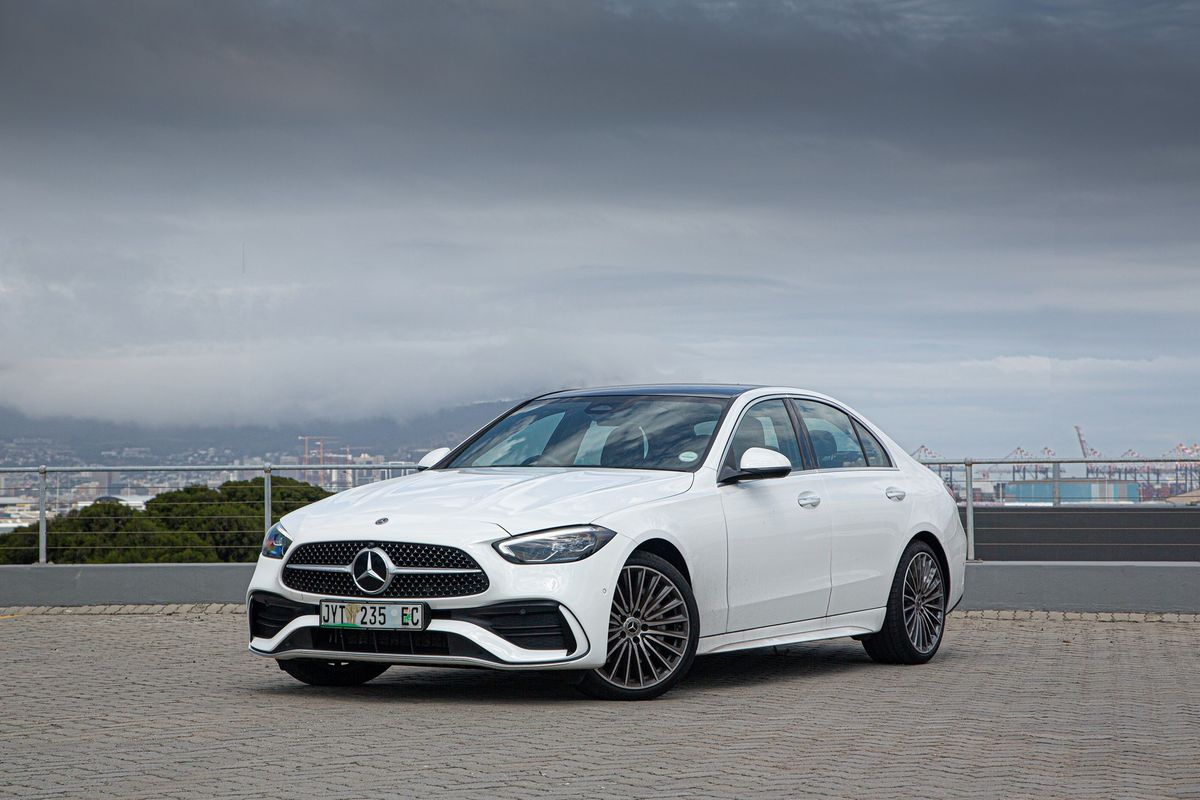
Our video guy – Ciro De Siena – sampled the turbodiesel-powered Mercedes-Benz C220d during the recent end-of-year break. Business-class sedans may no longer be popular, but nonetheless, the Three-pointed Star builds one of the best of the breed…
Considering market trends (such as the rapid uptake of crossovers/SUVs and the almost hysterical rush to electric mobility), cars such as the Mercedes-Benz C220d seem in danger of becoming extinct.
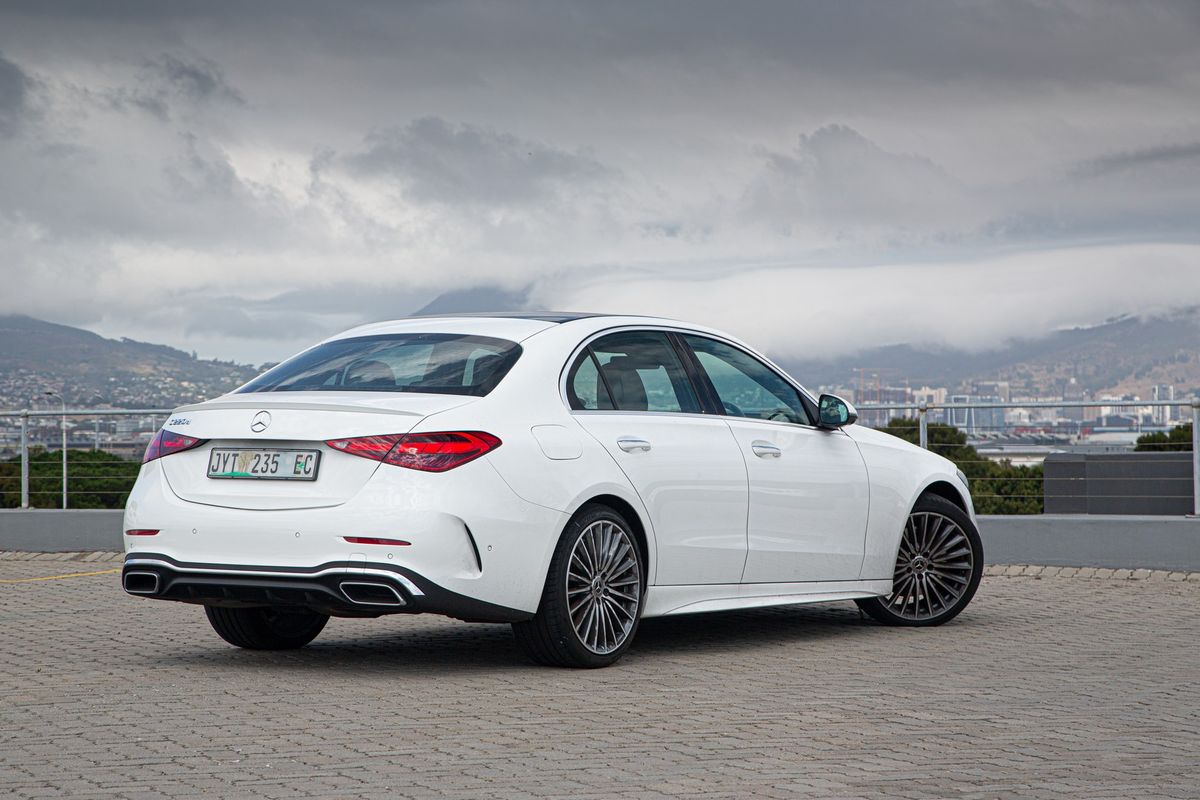
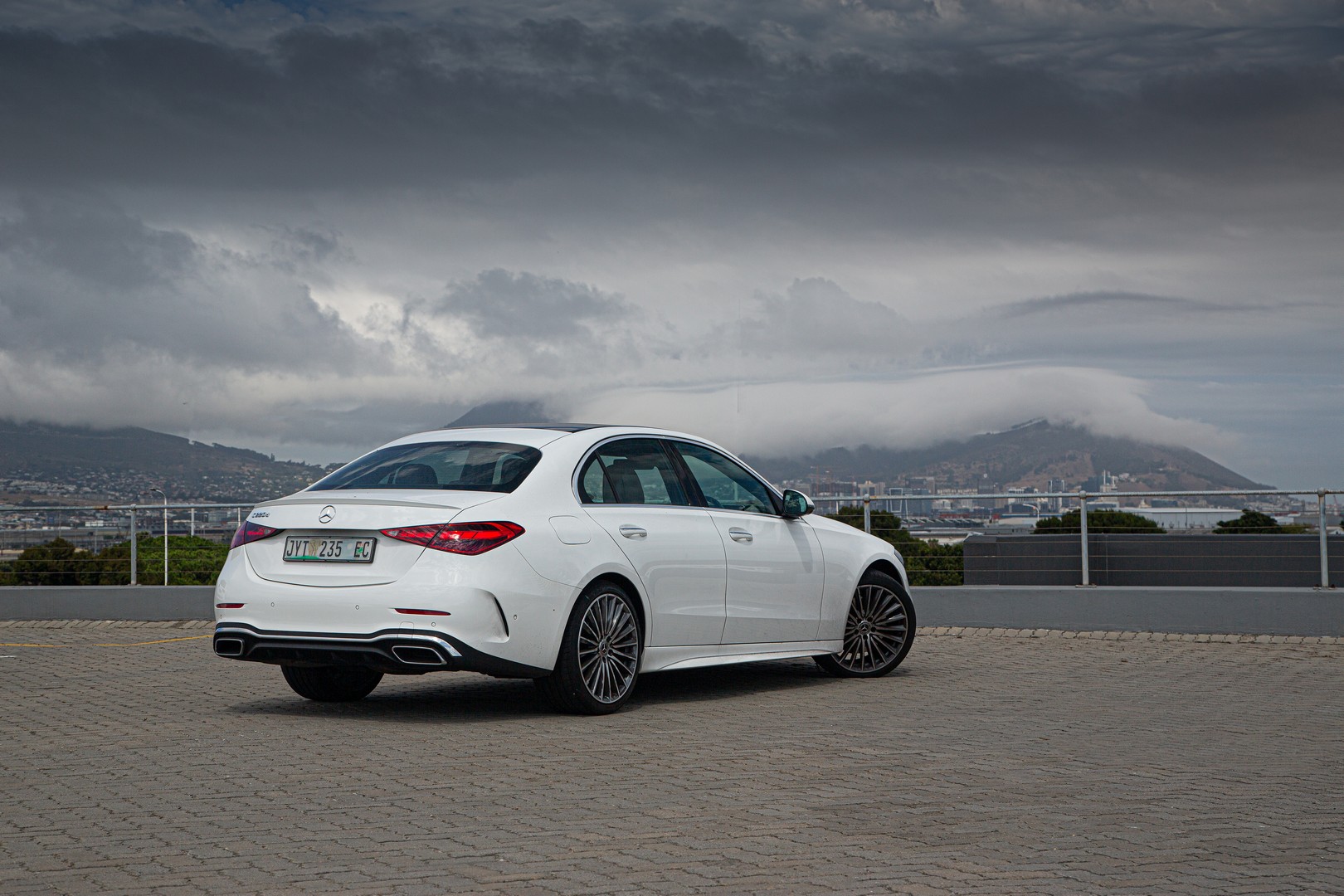
However, after spending a month with Mercedes-Benz’s latest offering – one that is built on home soil, in East London, no less – the W206 C-Class feels like it could easily have been a vehicle from our motoring future… or at least a recipe that solves some of motoring’s more current and pressing concerns.
I remember the days when the introduction of a new C-Class or BMW 3 Series was a big deal. Much fanfare was made about these respective brands’ flag bearers; BMW South Africa specially flew the Concorde to the Republic for the E36-generation 3 Series media launch in 1992 – true story.
Those days are long gone; the models are now far from the top 10 list of best-selling passenger models in the new-vehicle market. Excitement about new generations of German business-class sedans has certainly ebbed, seemingly as a result of modern motorists’ intense appetite for crossovers and SUVs.
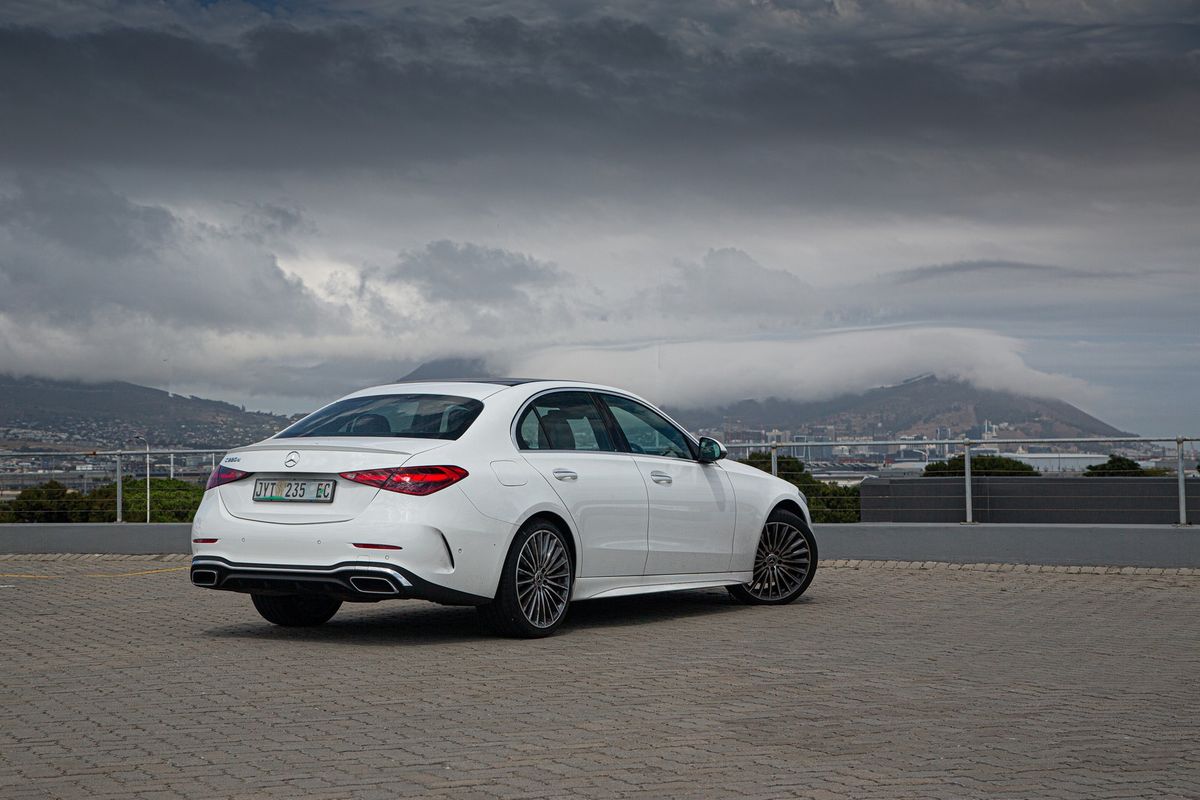
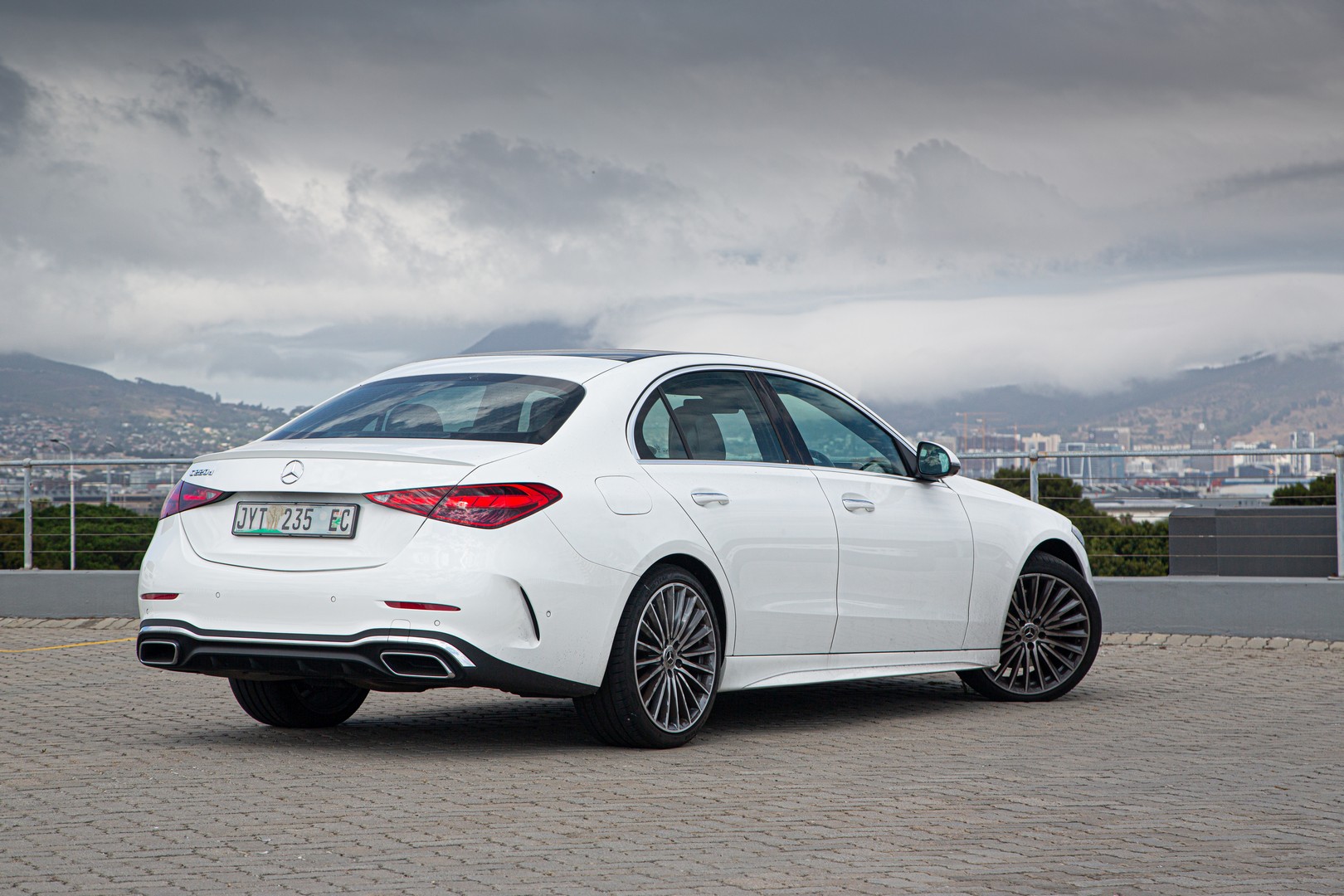
There are gloomy skies over the future of the traditional diesel-powered sedan.
The case for a sedan
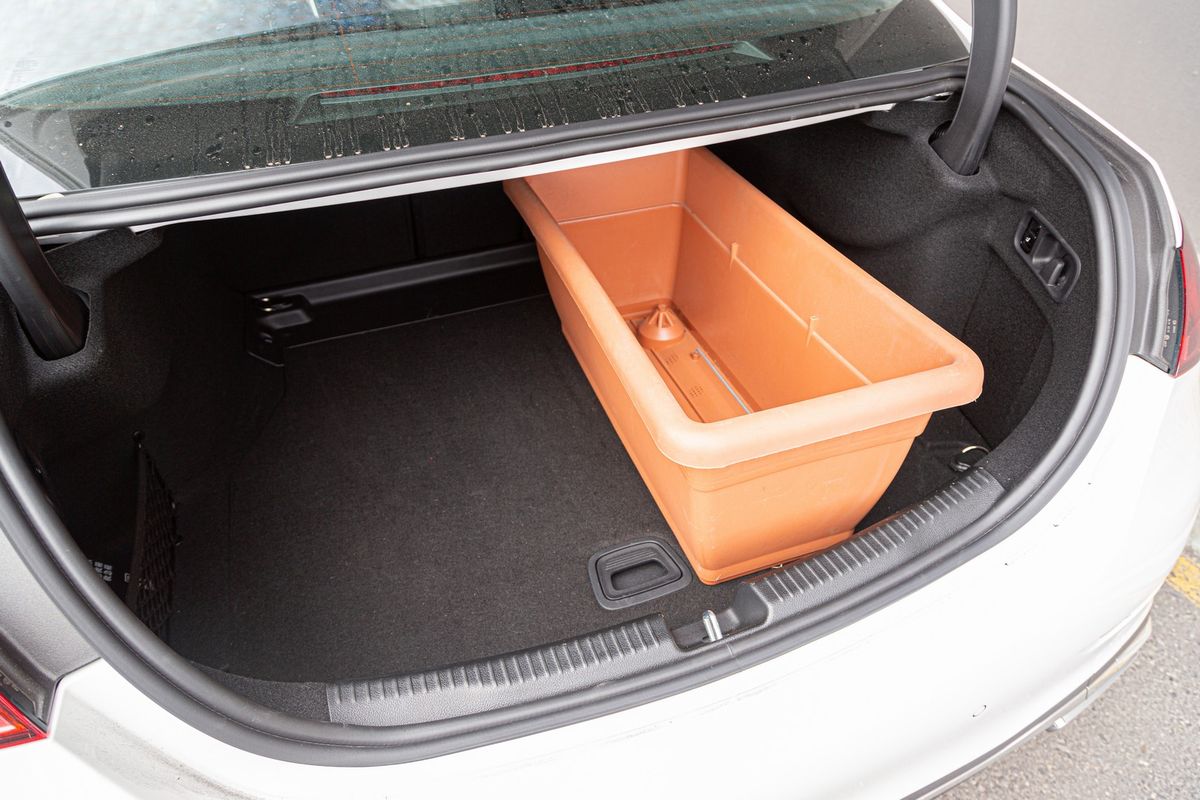
However, sedans do have their merits. They’re lighter and more aerodynamic, offer more involving and accurate handling, as well as excellent boot space; in many cases, they outclass equivalently sized SUVs and, moreover, their aesthetics are more elegant and less in-your-face than their high-riding siblings.
The new-generation C-Class is just about the best example of all of those characteristics available today. And, given the aforementioned market trends, this might be the high-water mark for business-class sedans. Who knows? This formula may be consigned to history when the next generation rolls around.
Mercedes-Benz C-Class’ interior specs & features
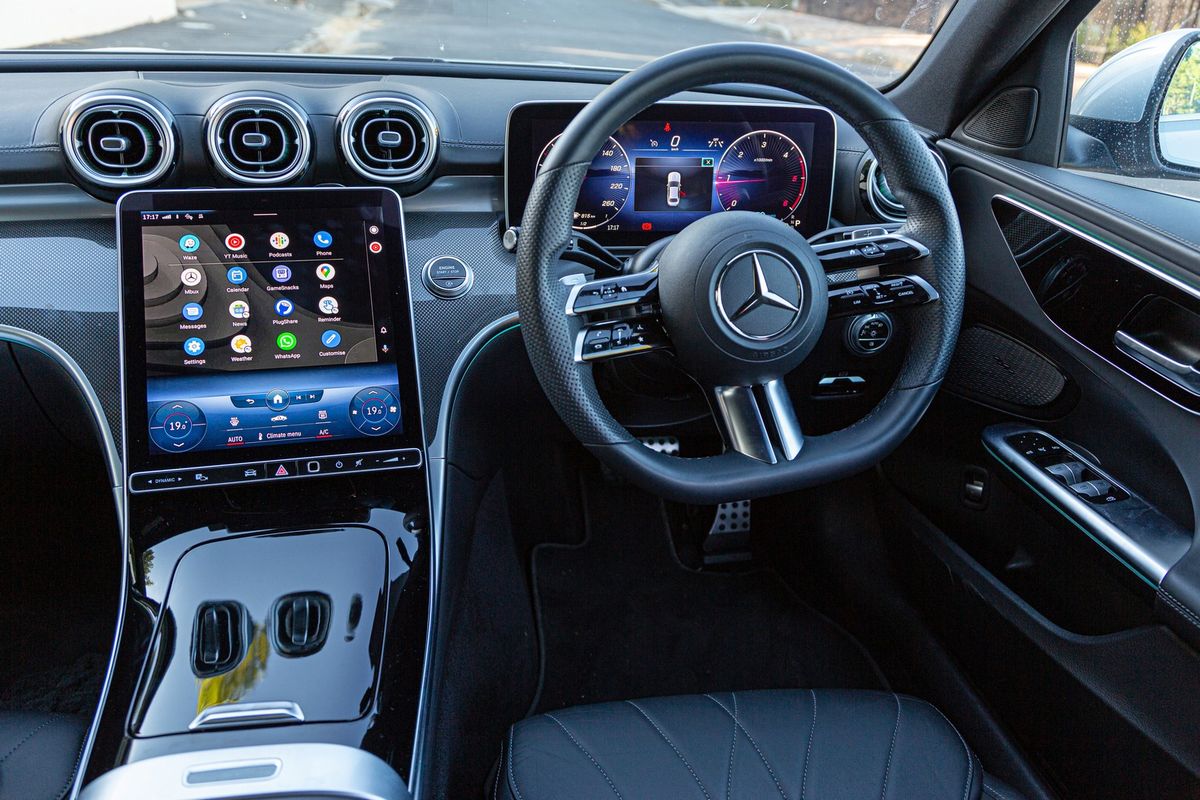
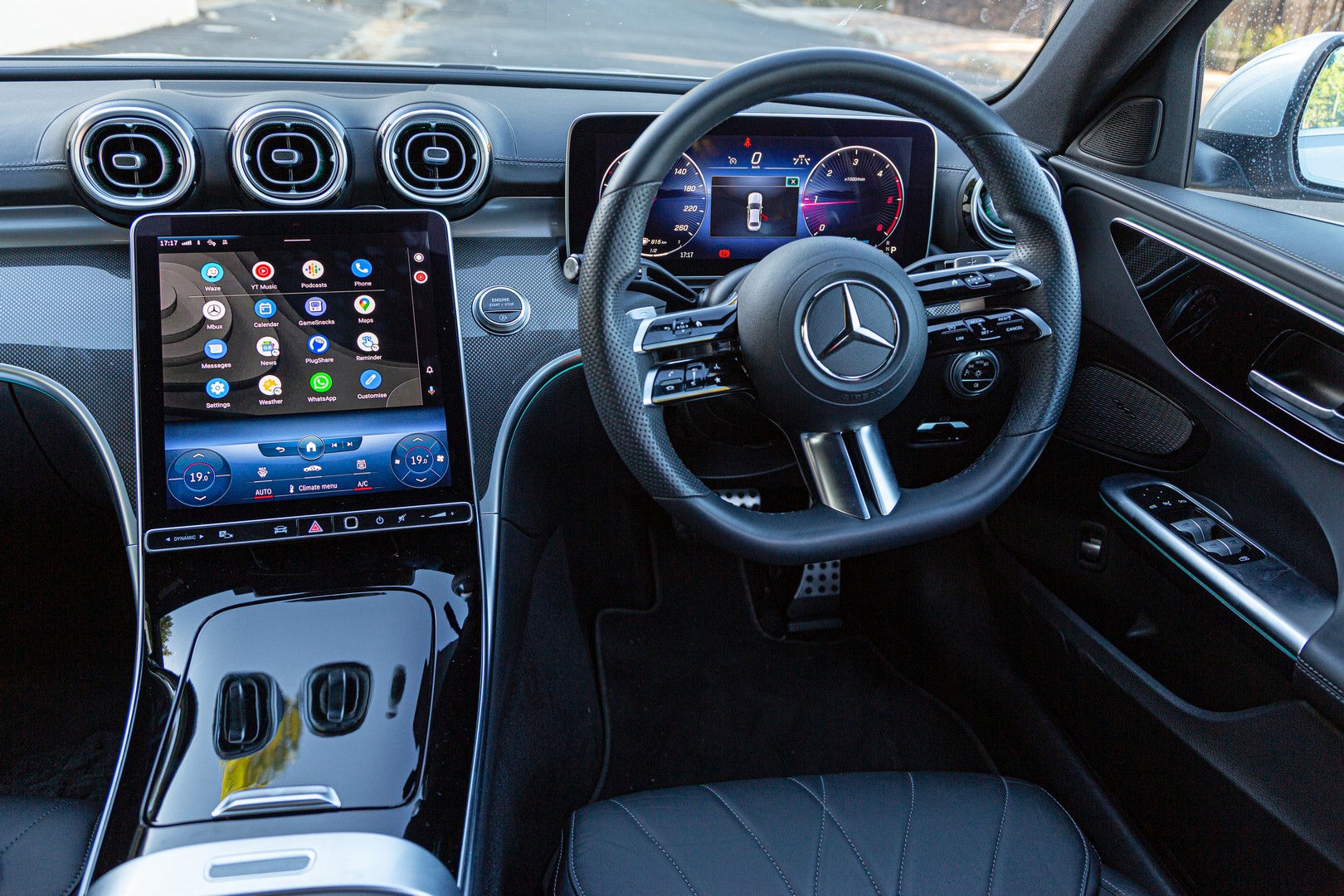
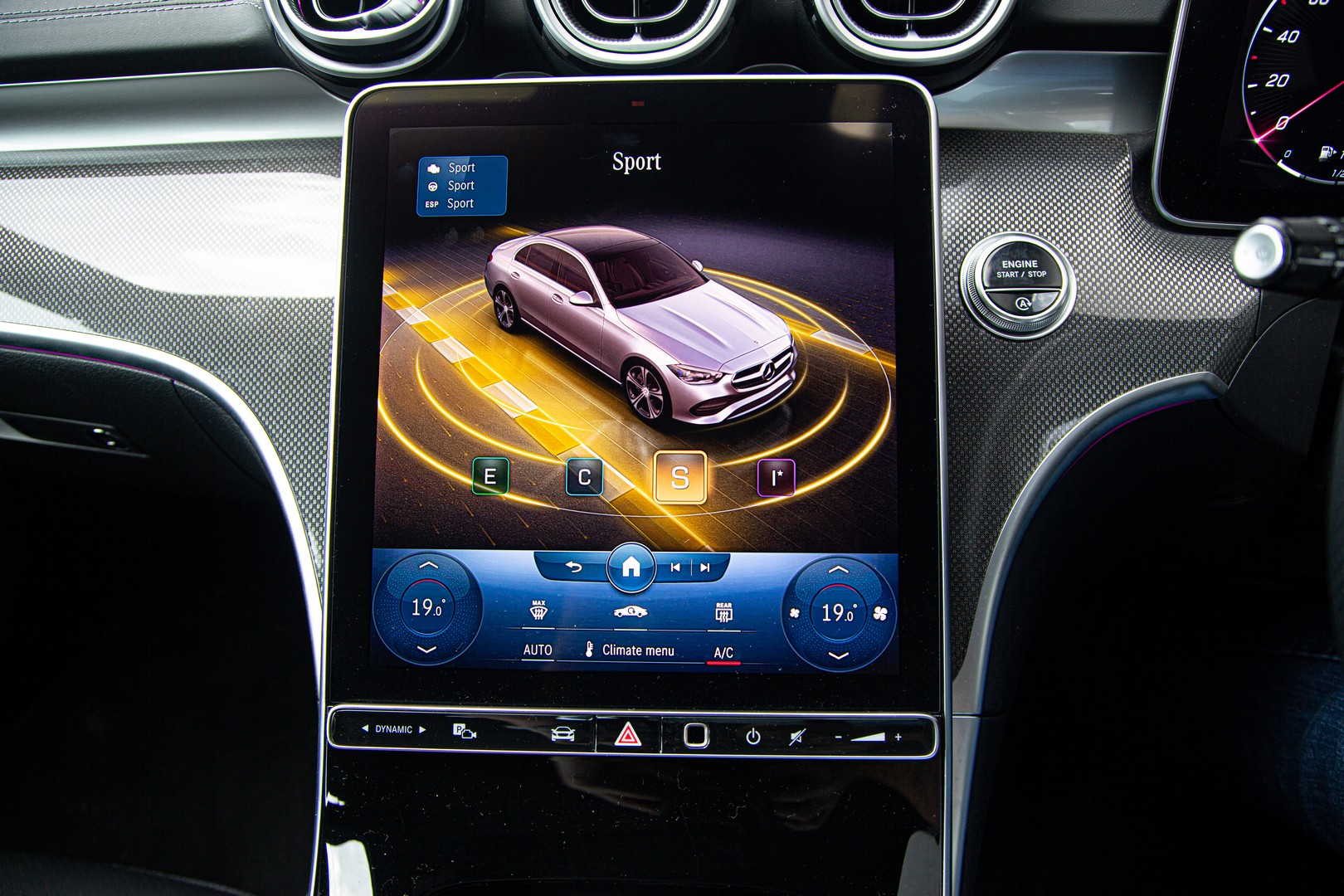
The cabin is dominated by the highly-advanced portrait-orientated infotainment screen.
The C220d AMG Line’s interior is a marvel; it really does feel special and, unlike any of its competitors, there is a real sense of occasion here; the cabin design feels inspired and inspiring, with the swooping centre console with a large portrait screen (angled gently towards the driver), being the star of the show.
It is a giant leap forward from the previous-generation model (the W205), which felt largely cheap and insubstantial in almost every way. Sure, if you really start prodding and yanking on the new C-Class’ trim materials, you might feel there is a thin veneer of quality in some places in the cabin, but for me, that’s quite forgivable, because the overall effect is impressive. The cabin is particularly pretty at night.
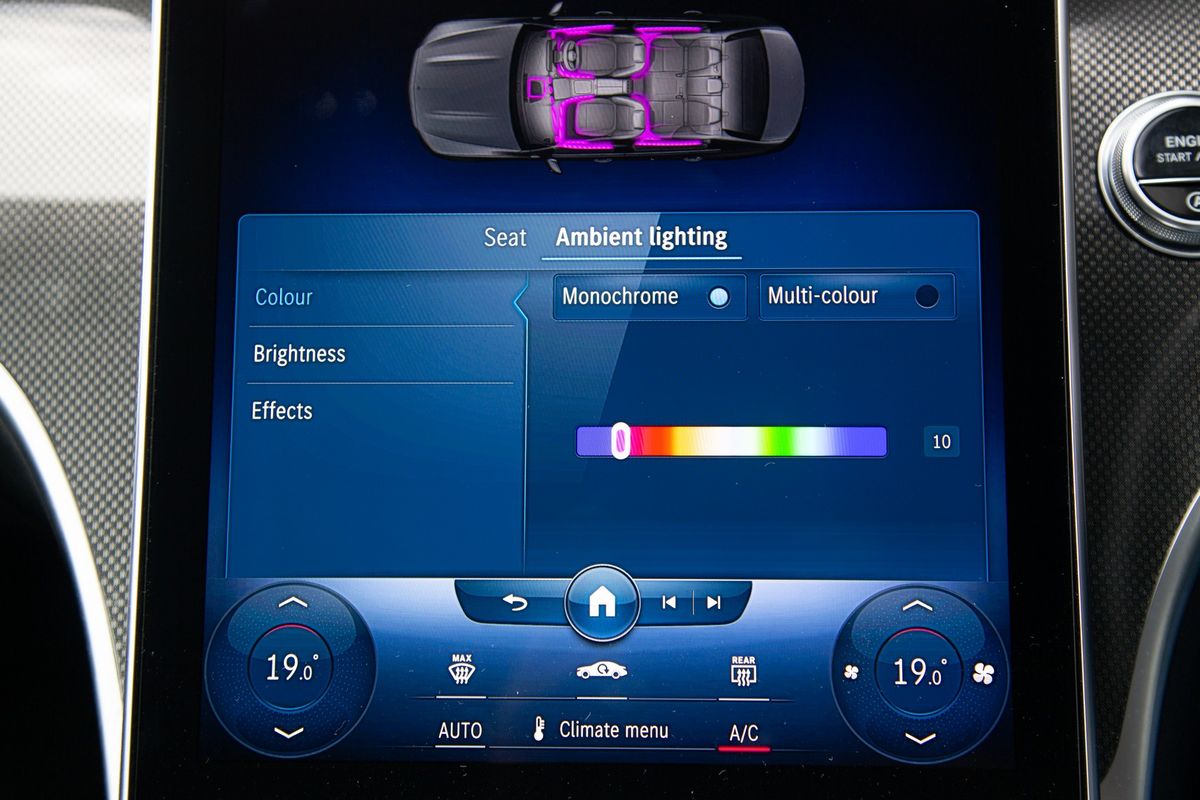
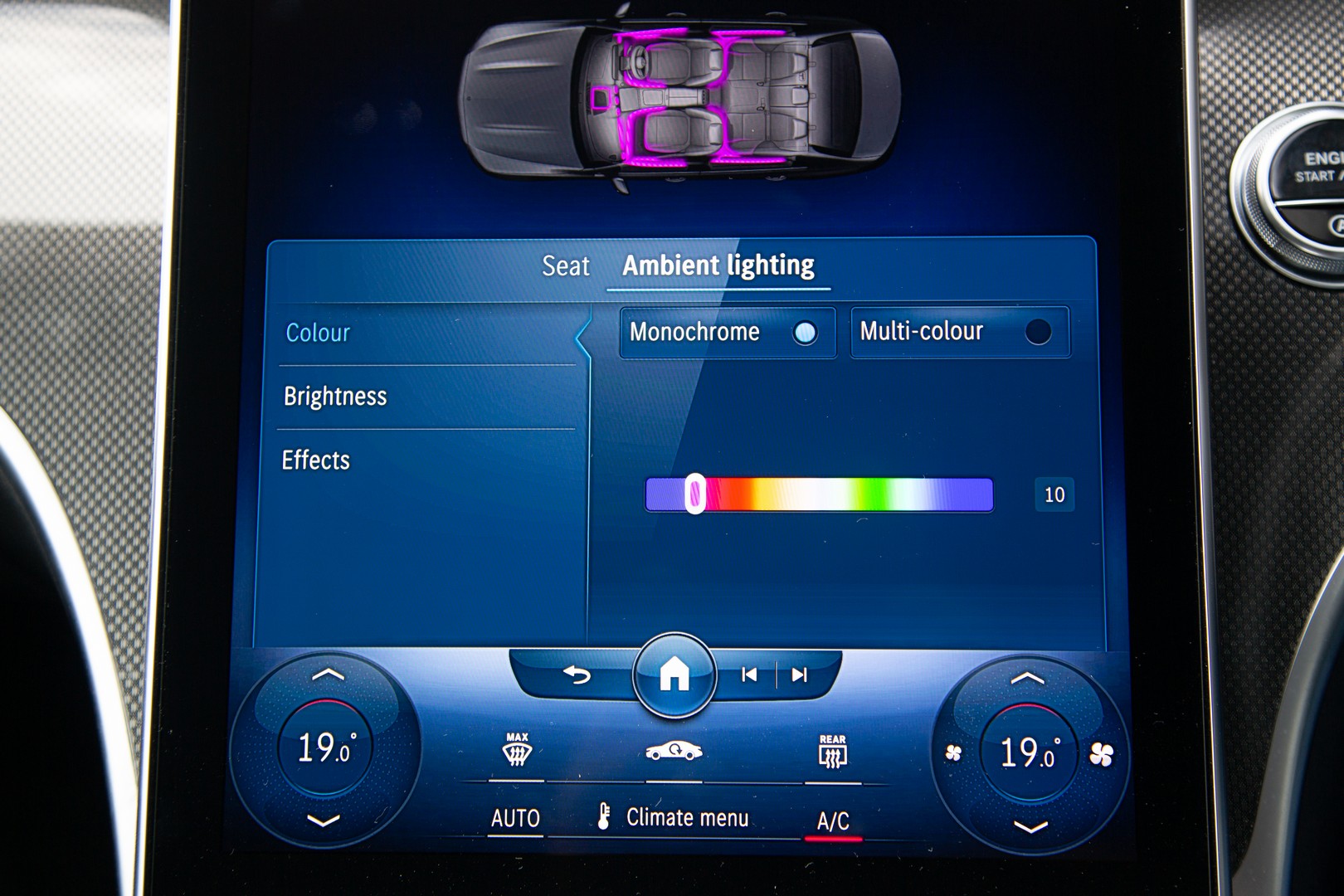
The ambient lighting is highly customisable (there are 64 colours to choose from).
However, at this price point, you might feel a little cheated in terms of standard features. The following features (some of which are standard on mid- to high-spec medium SUVs) are optional on the C220d AMG Line: the 12.3-inch digital instrument cluster (Driver Display), heated seats, wireless charging pad, keyless entry and ambient lighting. Of course, the options list is longer than that, but you get the gist.
The infotainment system is impressive, however, and its user interface is far more intuitive than those of previous-generation C-Class models. The 360-degree camera- (if specified) and park distance system is well presented and effective, although it sometimes seems to detect ghosts in the road; the barrage of beeps makes you nervous to maneuver! The audio system is impressive and I really like that 2 phones can be connected at the same time via Bluetooth, if you opt not to use Android Auto or Apple Carplay.
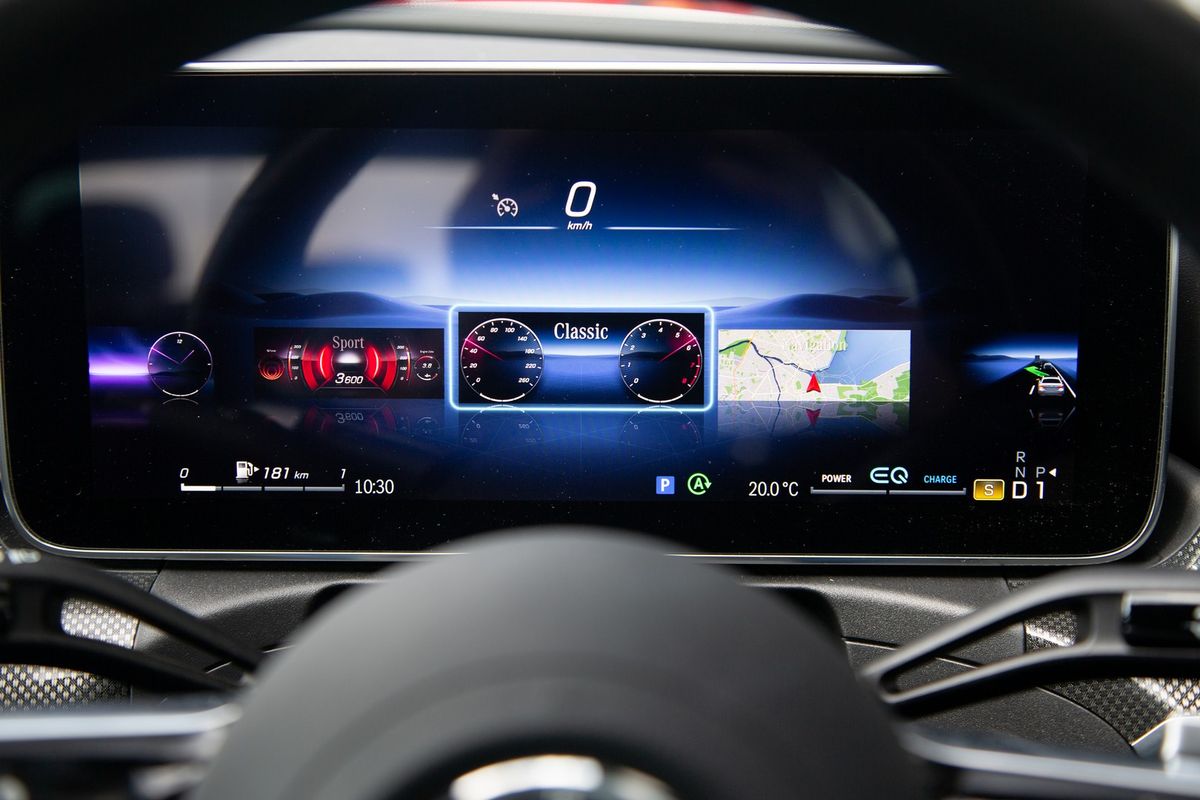
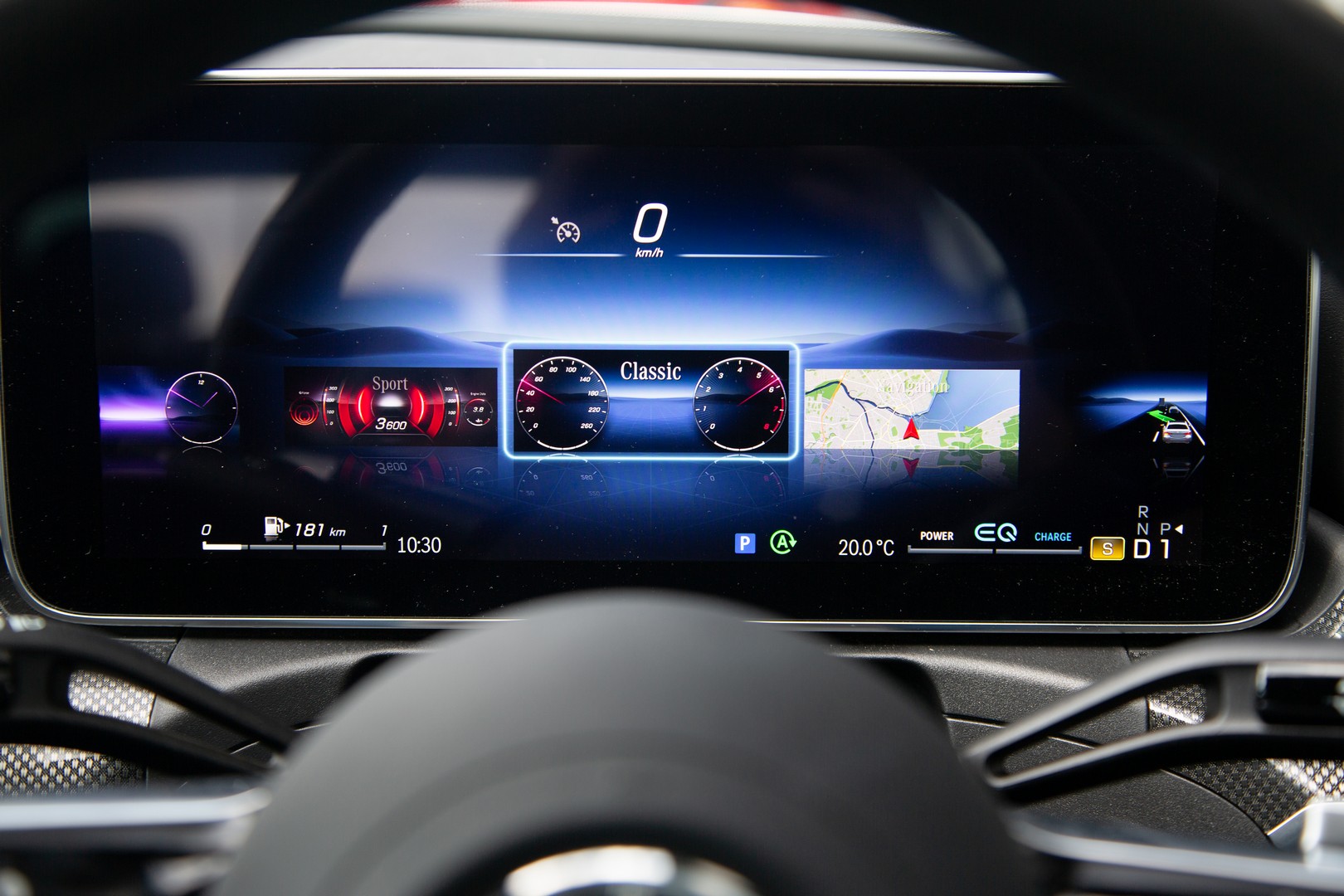
An array of digital themes for the driver to choose from.
What the Mercedes-Benz C-Class is like to drive
But where the C220d AMG Line really impresses is the fuel efficiency – and punchy performance – of the drivetrain. The car is a mild hybrid, courtesy of a 15-kW integrated starter generator (ISG) fitted between the transmission and the internal-combustion engine. This configuration holds multiple benefits.
Firstly, although the engine is a 2.0-litre 4-cylinder turbodiesel, the driver feels almost no turbo lag under acceleration, because the electric generator fills in the low end of torque production. As a result, the power delivery feels smooth, linear and predictable, which makes for a relaxing driving experience.
The electric generator also helps the car crawl at low speed, and coast at cruising speed, further reducing the effort asked of the combustion engine. Of course, its first task is to be a starter motor and help the combustion engine to cut out and come to life mostly seamlessly, especially for a diesel.
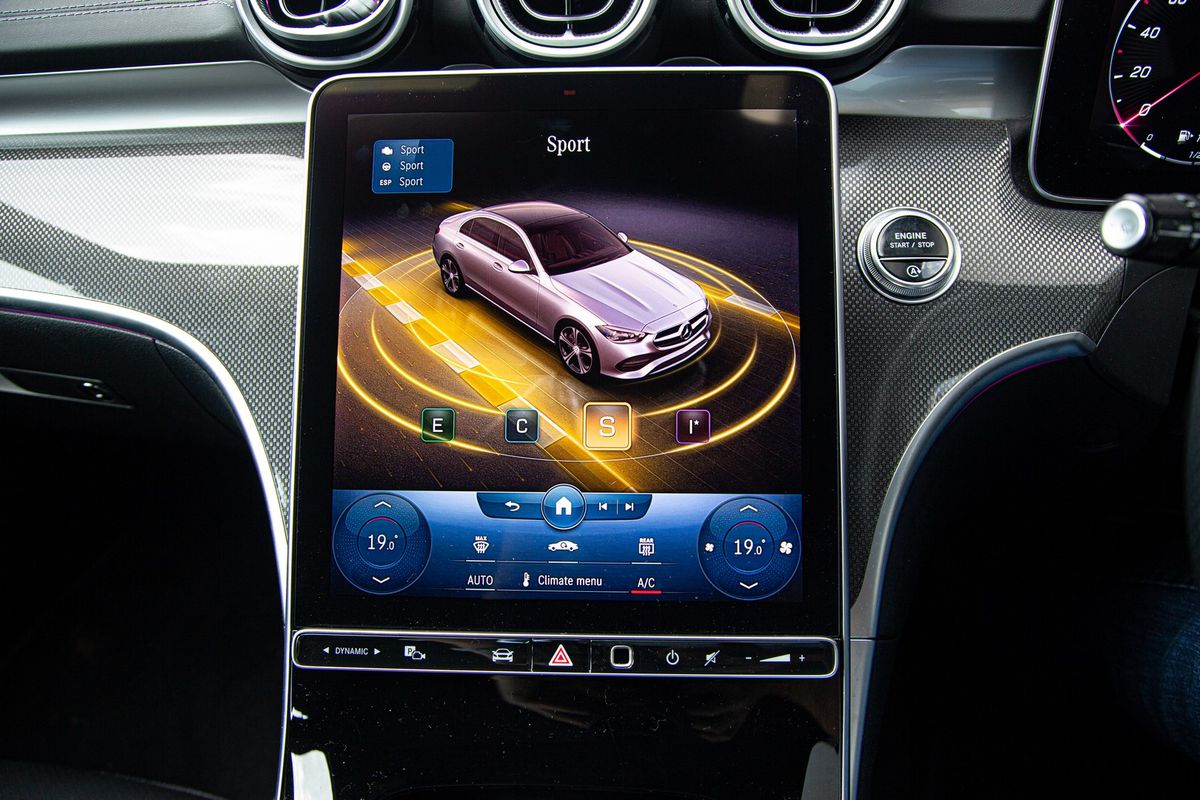
Sport mode in the C-Class results in some deceptively quick performance.
And, when you mash the accelerator pedal, the combined torque is remarkable. I was caught by surprise when accelerating through a right turn across an intersection – the car’s rear end stepped out for a brief moment before the traction control kicked in. I was not expecting to drift this C-Class! But it’s really easy with all that torque. And, of course, on the highway, the abundance of torque makes overtaking a breeze.
One downside to this setup is vague brake feel. I simply could not get used to it. When you first apply brakes, the car uses energy regeneration to slow the car down, and only when a certain pedal position is reached, do the hydraulics kick in. And, when they kick in, they really kick in, making coming to a stop quite uncomfortable, especially for passengers. It left me feeling that Mercedes-Benz could tune this all a bit better, and make the brake feel and application more progressive, rather than like an on/off switch.
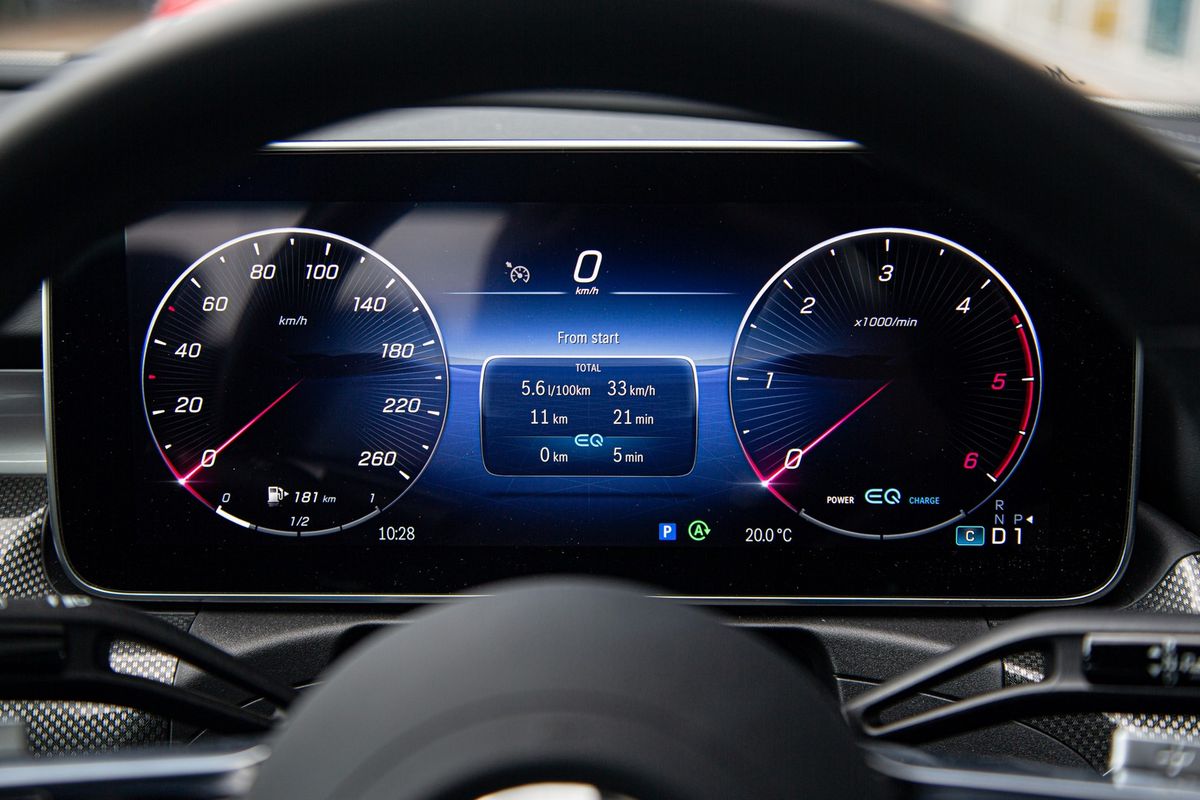
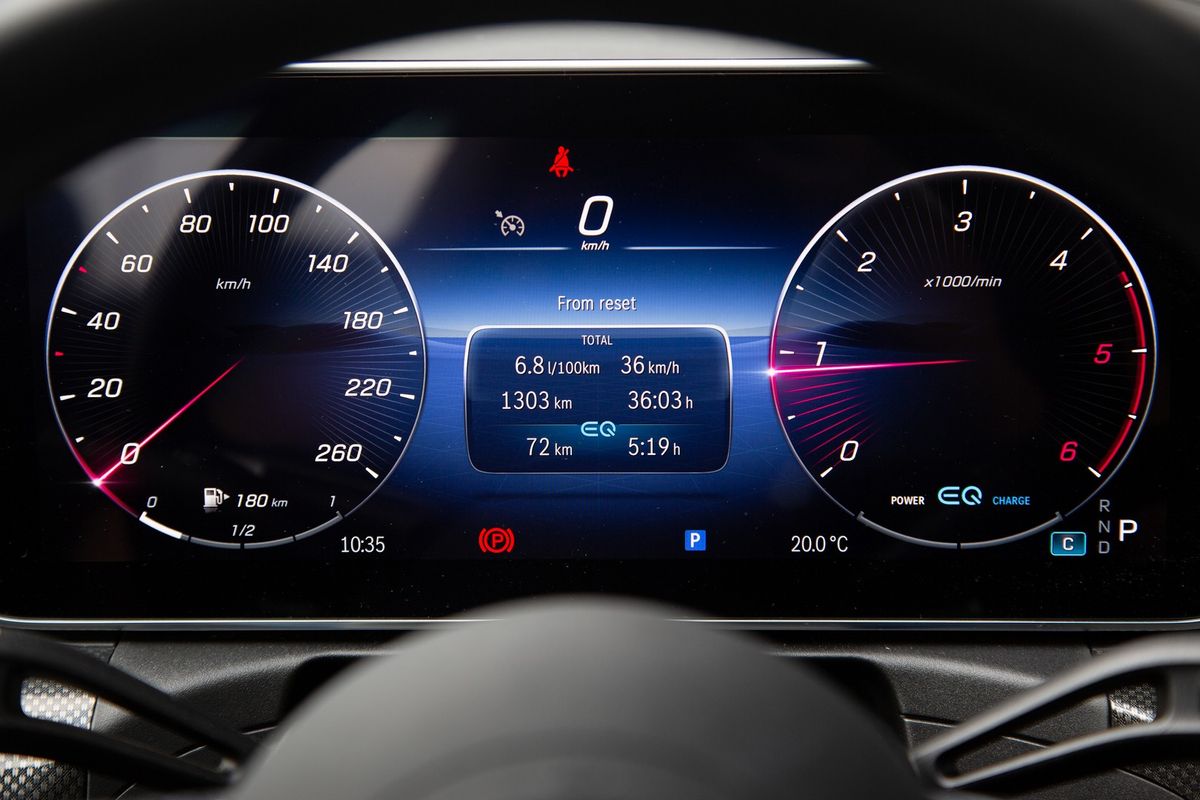
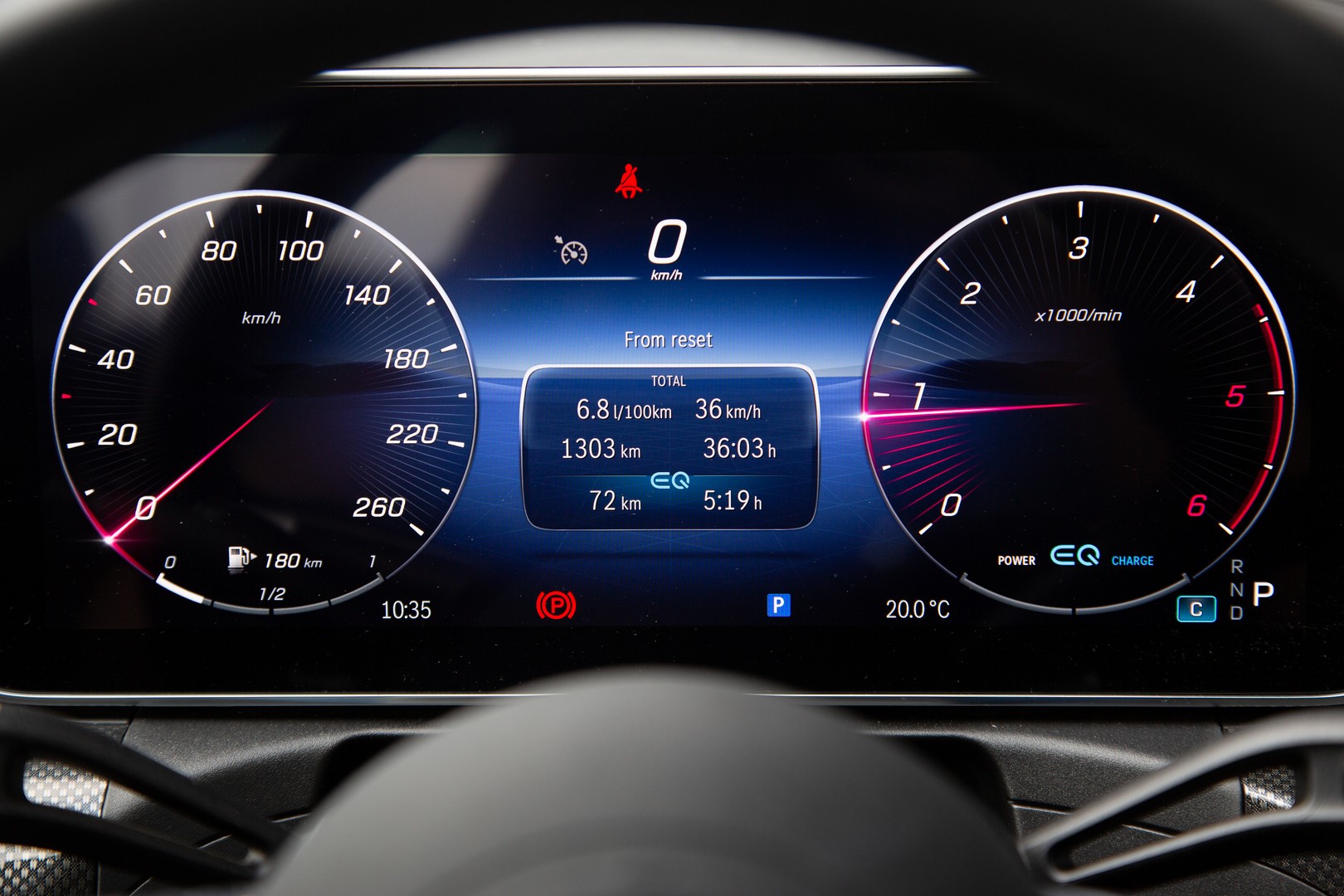
But, ultimately, the real benefit of this drivetrain is fuel consumption. On an airport run of about 50 km (when driving mostly on a freeway), the car returned an average of 4.7 L/100 km, and I wasn’t even trying to drive economically at the time. My average return at the conclusion of the month-long test was 6.8 L/100 km, but I feel it would be easier to better that, as I was often in a bit of a hurry. A figure in the 5s feels easily achievable; that’s almost 20 km per litre of fuel, which is a boon in our day and age.
My average consumption figure during December 2022, but forgive me, I was often in a hurry.
That is remarkable fuel economy. It equals or bests almost all of the full hybrids I drove in 2022 and, in terms of running costs, it will likely give battery-electric vehicles (full EVs) a run for their money, especially if you only recharge your vehicle using the public network.
In terms of ride quality, the suspension (which is not air sprung) represents an impressive combination of cushioned comfort with tidy handling in the corners. The C-Class ride never feels wooden when traversing small to moderate road imperfections and it’s quite sublime on the highway.
Summary
The W206 C-Class is a sublime offering. So what if it’s not an SUV?
While the Mercedes-Benz C220d AMG Line is pricier than its key rivals, I feel the price premium is fair, even though its standard spec is less than generous – even a little stingy. The ‘Benz makes a strong overall impression and is quite worthy of the badge on its grille, in a way that its predecessor wasn’t.
I feel that when buyers choose the Three-pointed Star, they expect a certain… posh experience, and the new C-Class delivers it. It is even superior to its stablemates (arguably better than the “bigger” E-Class) and offers a significant portion of S-Class glamour (especially in terms of the MBUX) at half the price.
Yes, a C-Class does cost a million Rand now, but the model is anything but an entry-level ‘Benz. Besides, Mercedes-Benz offers the A-Class sedan and its CLA sibling at more palatable price points.
Watch Ciro De Siena’s video review of the C220d AMG Line’s C200 sibling
If video killed the radio star, the SUV is certainly killing off the sedan, and electrification is certainly killing off the diesel, all of which, after a month in the C220d AMG Line, feels like a great pity.
With a little more investment in emissions-cleaning tech (before electrification seemed to become the sole focus of research and development in the motor industry), perhaps sufficiently less harmful diesel-engine emissions could have given ye olde turbodiesel a lifeline in the passenger-car segment.
For those who do choose the C220d AMG Line, however, for at least the next 5 years of ownership (the duration of its maintenance plan), you will enjoy the best of the past and the best of the current tech that Germany has to offer. And you’ll almost certainly do it all with a smile on your face, and a heavier wallet.
Mercedes-Benz has confirmed the EQE range for South Africa. Set to hit showrooms later in the first quarter of 2023, indicative pricing has now also been released.
The Mercedes-Benz EQ family will increase by two, with the addition of the EQE 350 and AMG EQE 43 confirmed for introduction in early 2023. The first customer deliveries are expected to take place by March. As it stands, Mercedes-Benz SA already has the EQA, EQB, EQC and EQS which were introduced to the market in 2022.
So, what’s the EQE? Essentially, it is an electrified sporty business sedan. From launch, there’ll be two offerings; EQE 350+ and EQE 43 4Matic, the latter fettled by performance specialists AMG. The EQE 350+ has 215 kW and 565 Nm, along with a range claim of up to 645 km, and is rear-wheel driven. As far as performance goes, 0-100 kph is dispatched in 6.4 seconds and will run to a top speed of 210 kph.
For those wanting some electrified performance, the Mercedes-AMG EQE 43 4Matic has 350 kW and 858 Nm. There’s a motor on each axle and it’ll sprint to 100 kph in a claimed 4.2 seconds. It has a range claim of up to 535 km, based on WLTP.
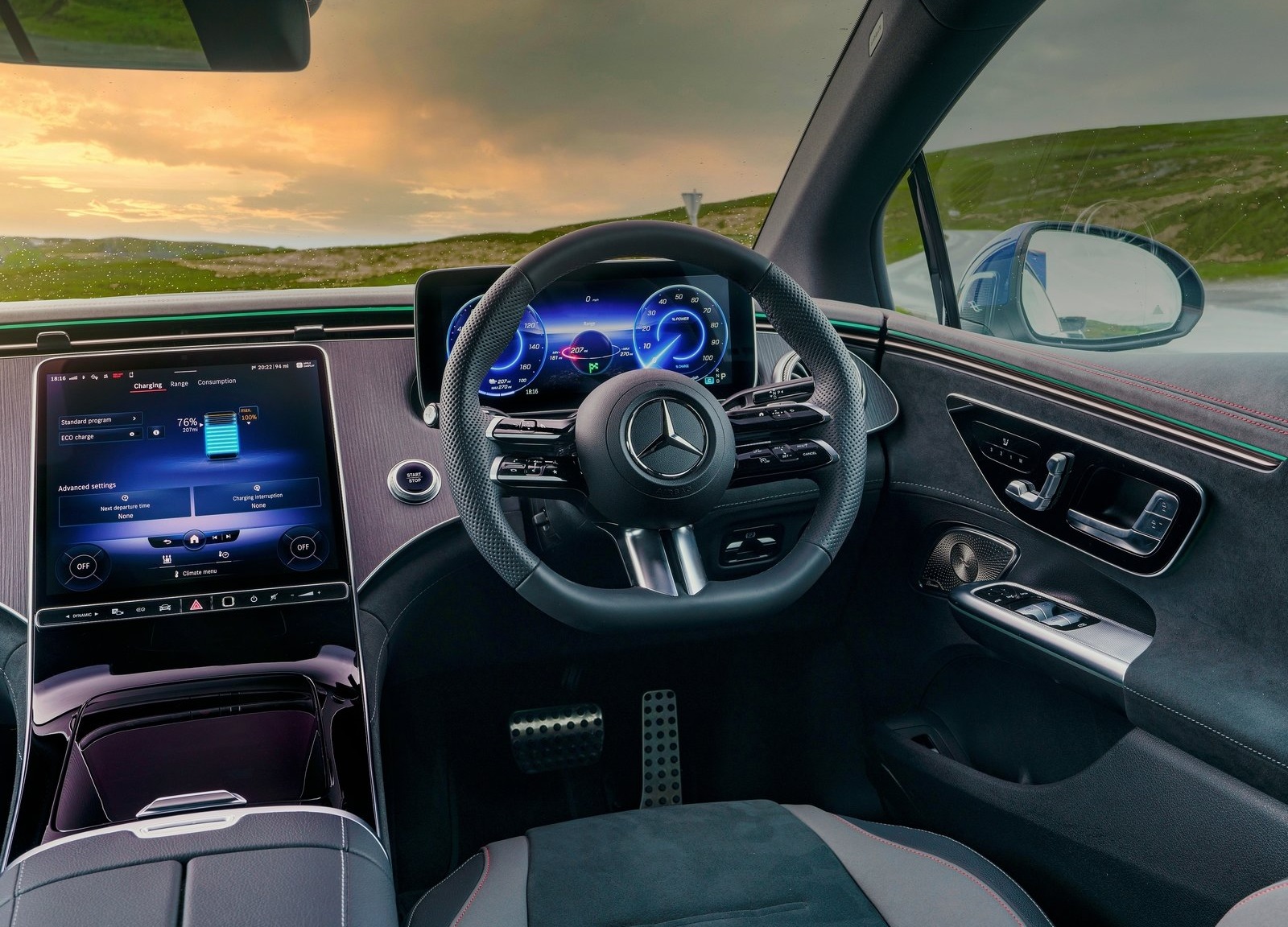
Inside, you can expect a highly-advanced cabin, complete with a massive infotainment screen that dominates the central cluster. MBUX software along with voice control will be available too, meaning you can say things like “Hey Mercedes, I am cold” and the car’s climate control will activate the heating.
How much does the Mercedes-Benz EQE cost in South Africa?
For now, Mercedes-Benz SA has released only “estimated” pricing, saying final figures “will be confirmed shortly”. So, check out indicative pricing below, which includes a PremiumDrive Platinum 5-year/100 000 km maintenance plan and a 10-year battery warranty.
Just 1 unit of each of these 20 vehicles was sold in SA last month
These 20 passenger vehicles could each muster just a single sale in South Africa in December 2022. Let’s take a look at last month’s 1-unit wonders…
While studying South Africa’s detailed new-vehicle sales figures for December 2022, we noticed an interesting phenomenon. In the passenger-vehicle segment alone – so, excluding bakkies, minibuses and trucks – as many as 20 models each managed just a single registration in the month.
Of course, there could be a variety of reasons a given model range might attract a mere solitary sale over a full (if admittedly somewhat truncated, in this case) trading month. For instance, many automakers continue to experience supply constraints driven by the semi-conductor crisis, broader shipping issues and still-frequent production interruptions.
Then there are models that simply sell in low volumes (some failed to even trouble the scorers in December). This could be because they’re pitched at a decidedly niche corner of the market, because they’re rather expensive or because they simply aren’t very popular with local buyers, for whatever reason. Examples from the list below that fit into at least 1 of these categories include Audi’s RS4 Avant, A7 Sportback and S8 sedan, as well as the fully electric e-tron GT and e-tron Sportback.
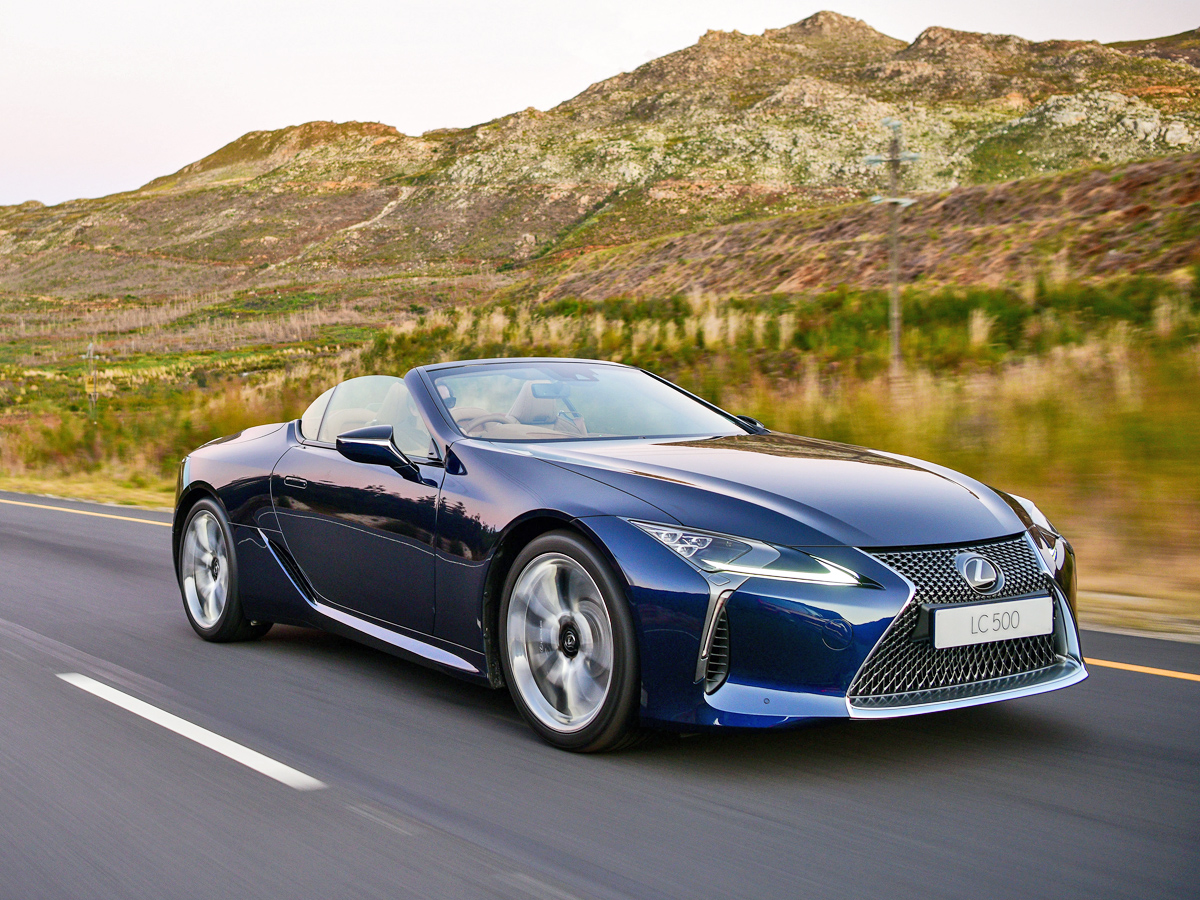
Relatively niche models such as the Lexus LC 500 Convertible aren’t intended to sell in large volumes.
Based on the make-up of the list below, though, there’s also another explanation for a few of these so-called 1-unit wonders. Sometimes, the vehicle in question is technically no longer marketed locally. So, when old stock of a since-discontinued model is finally registered, the nameplate makes a brief return to the official sales statistics.
That was the case with the BMW i3, with a single example of Munich’s no-longer-in-production electric model sold locally in December 2022. Nissan, meanwhile, registered a sole unit of the since-departedMicra hatchback as well as 1 example of the short-lived (locally, at least) Terra. Renault sold 1 Mégane (though this badge will make a brief reappearance later in 2023 on the special-edition Ultimé) and 1 Captur (presumably the previous-generation version as South Africa is still awaiting the new model).
Unaudited mid-month fuel price data released by the Central Energy Fund points to possible fuel price cuts for February 2023.
A slight reduction in the price of all fuels is projected for February 2023 if mid-month projections remain on target.
Based on data collected on 16 January 2023, the price of 50ppm diesel could see a reduction of 37 cents while 5ppm could see its price drop by around 50 cents. Petrol may not see as big of a reduction as unleaded 93 is set to drop by just 7 cents a litre with 95 possibly dropping by 14 cents per litre.
The current prognosis is that the Rand to US Dollar exchange rate has improved to R17.05 while the oil price has remained reasonably steady over the past 2 weeks. These numbers are due to change by the end of the month when the official numbers are calculated and the official price adjustments are relayed.
Politically and economically, things are rocky at the moment with SA suffering Stage 6 loadshedding bouts that provides uncertainty about the future of the economy and thus drastic fluctuations in currency value.
Demand for oil could see a surge as China returns to full economic functions after Covid policies that restricted movement. The knock-on of that was less of a demand for oil from the world’s largest importer of oil but the next few months could see a resurgence in the price of oil and with that, increases in the fuel price.
Current and projected Fuel Prices in South Africa
Fuel Type
Jan 23 Inland
Jan 23 Coast
Feb 23 Inland
Feb 23 Coast
Petrol Unleaded 93
R21.10
R20.45
R21.03
R20.38
Petrol Unleaded 95
R21.40
R20.75
R21.26
R20.61
Diesel 0.05% (wholesale)
R21.23
R20.58
R20.83
R20.18
Diesel 0.005% (wholesale)
R21.41
R20.79
R20.91
R20.26
Fuel price data courtesy of Central energy fund
We will update this article as soon as the official fuel price adjustments are announced at the end of the month.
How much will the new BMW 7 Series cost in South Africa? The Munich-based firm has released indicative pricing for its new flagship luxury sedan range, which includes the all-electric i7…
BMW Group South Africa has announced local indicative pricing for its seventh-generation 7 Series line-up, which is scheduled to touch down in the fourth quarter of 2022. The global reveal was as recent as April 2022.
In South Africa, the long-wheelbase G70-generation luxury saloon range will include petrol (though not the twin-turbo 4.4-litre V8), diesel and all-electric powertrains at launch. Three specification packages will be available: Design Pure Excellence, the M Sport Package and the M Sport Package Pro.
The 740i uses a turbocharged 3.0-litre straight-6 petrol engine (with a 48 V mild-hybrid system), offering the rear axle peak outputs of 280 kW and 540 Nm through an 8-speed automatic transmission. The result is a claimed 0-100 kph time of 5.4 seconds and a top speed of 240 kph. Indicative pricing for the 740i starts at R2 160 000.
The local market is also set to receive the 740d xDrive, a derivative that wasn’t detailed at the global reveal, but which will kick off here at around R2 280 000. This all-wheel-drive derivative’s 3.0-litre straight-6 turbodiesel heart generates 210 kW and 650 Nm, facilitating a claimed 6.3-second sprint to three figures.
Finally, the fully electric i7 tops the range, with indicative pricing starting at R2 825 000. Offered in xDrive60 guise, the i7 has two electric motors that draw their urge from a 101.7 kWh lithium-ion battery pack mounted beneath the floor. Delivered through a two-stage, single-speed transmission, maximum system outputs come in at 400 kW and 745 Nm. The claimed 0-100 kph time is 6.1 seconds, top speed is limited to 240 kph and claimed range is between 590 and 625 km (on the WLTP cycle).
The V8-powered 760i xDrive unfortunately won’t be offered in South Africa at launch.
A highlight inside includes the so-called BMW Theatre Screen (measuring a whopping 31.3 inches) that extends down from the headliner to entertain rear-seat passengers. In addition, the rear armrests feature 5.5-inch touch-operated screens.
Up front, the driver and front passenger are treated to a curved display comprising a 12.3-inch infotainment system with 5G connectivity as well as a configurable 14.9-inch digital instrument cluster.
How much does the BMW 7 Series cost in South Africa?
BMW 740i Design Pure Excellence – R2 160 000
BMW 740i M Sport Package – R2 235 000
BMW 740i M Sport Package Pro – R2 275 000
BMW 740d xDrive Design Pure Excellence – R2 280 000
BMW 740d xDrive M Sport Package – R2 355 000
BMW 740d xDrive M Sport Package Pro – R2 395 000
BMW i7 xDrive60 Design Pure Excellence – R2 825 000
BMW i7 xDrive60 M Sport Package – R2 900 000
BMW i7 xDrive60 M Sport Package Pro – R2 940 000
*note these indicative prices include VAT but exclude CO2 emissions tax
Porsche Cayenne is the brand’s best-seller for 2022
It should come as no surprise that an SUV would be legacy sportscar brand Porsche’s best-selling model for 2022. Here’s how the numbers look for last year.
In a media release, Porsche detailed its sales figures across its portfolio. 2022 was yet another challenging year, not just for Porsche, but the entire car manufacturing industry. It has been widely-publicised, but as a reminder, Volkswagen Group (VW, Audi, Porsche, SEAT, Skoda and more) have been particularly hard-hit by the semi-conductor shortage, supply chain interruptions and the war in Ukraine.
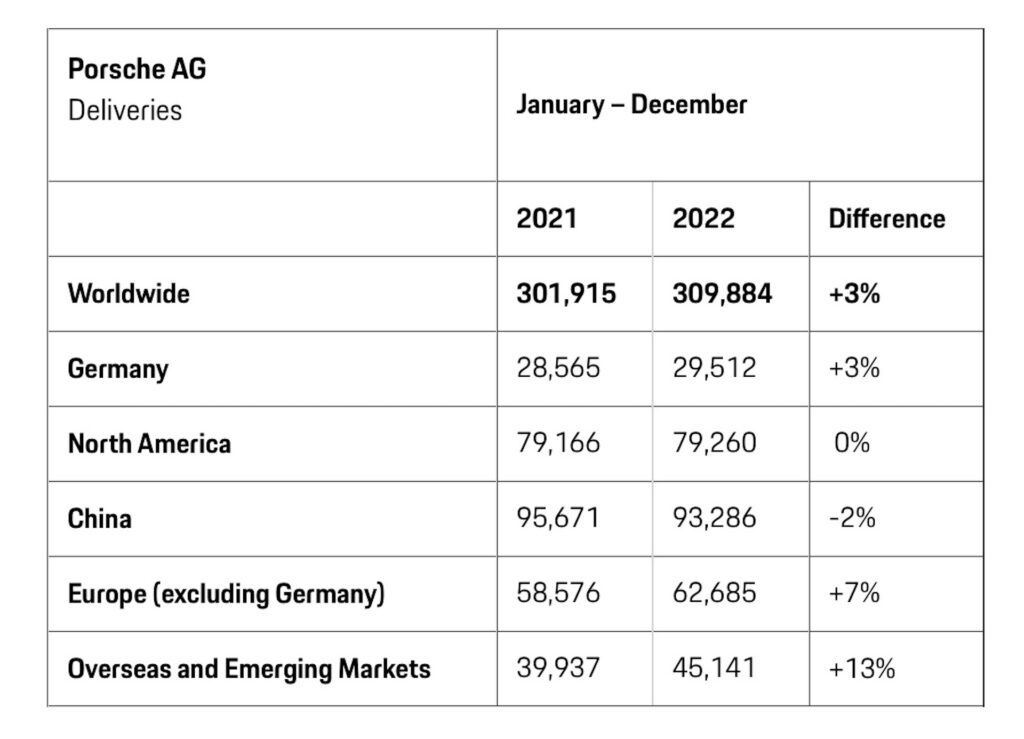
Still, in 2022 Porsche managed to sell 309 884 vehicles, which is up from 301 915 in the year before. 2021 was a record year for the brand, so despite the challenges, these numbers are impressive. At the top of the list was the Porsche Cayenne, which is due for an update/replacement. In second place was the recently updated Porsche Macan. So that’s two SUVs at the top – not bad for a brand best known for its iconic 911.
The below table from Porsche highlights which markets are growing. South Africa is classified as an overseas and emerging market, and it was the best-performing sector.