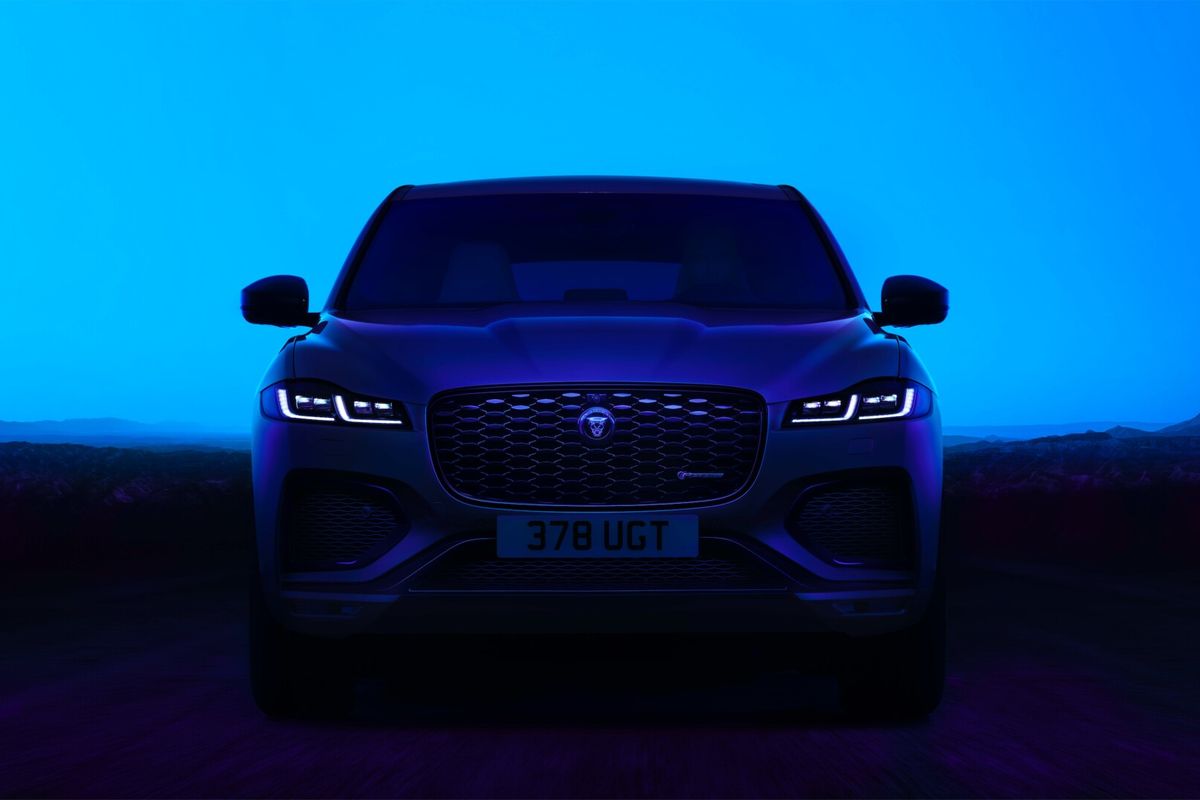
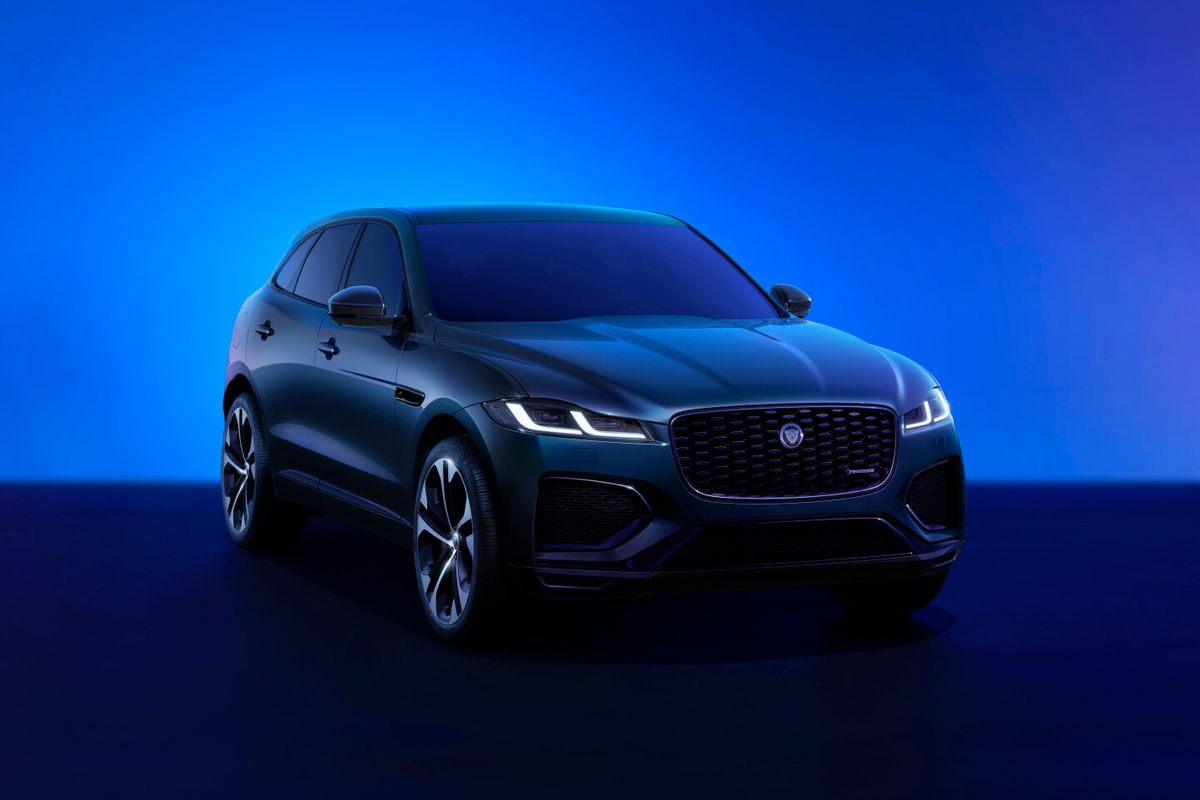
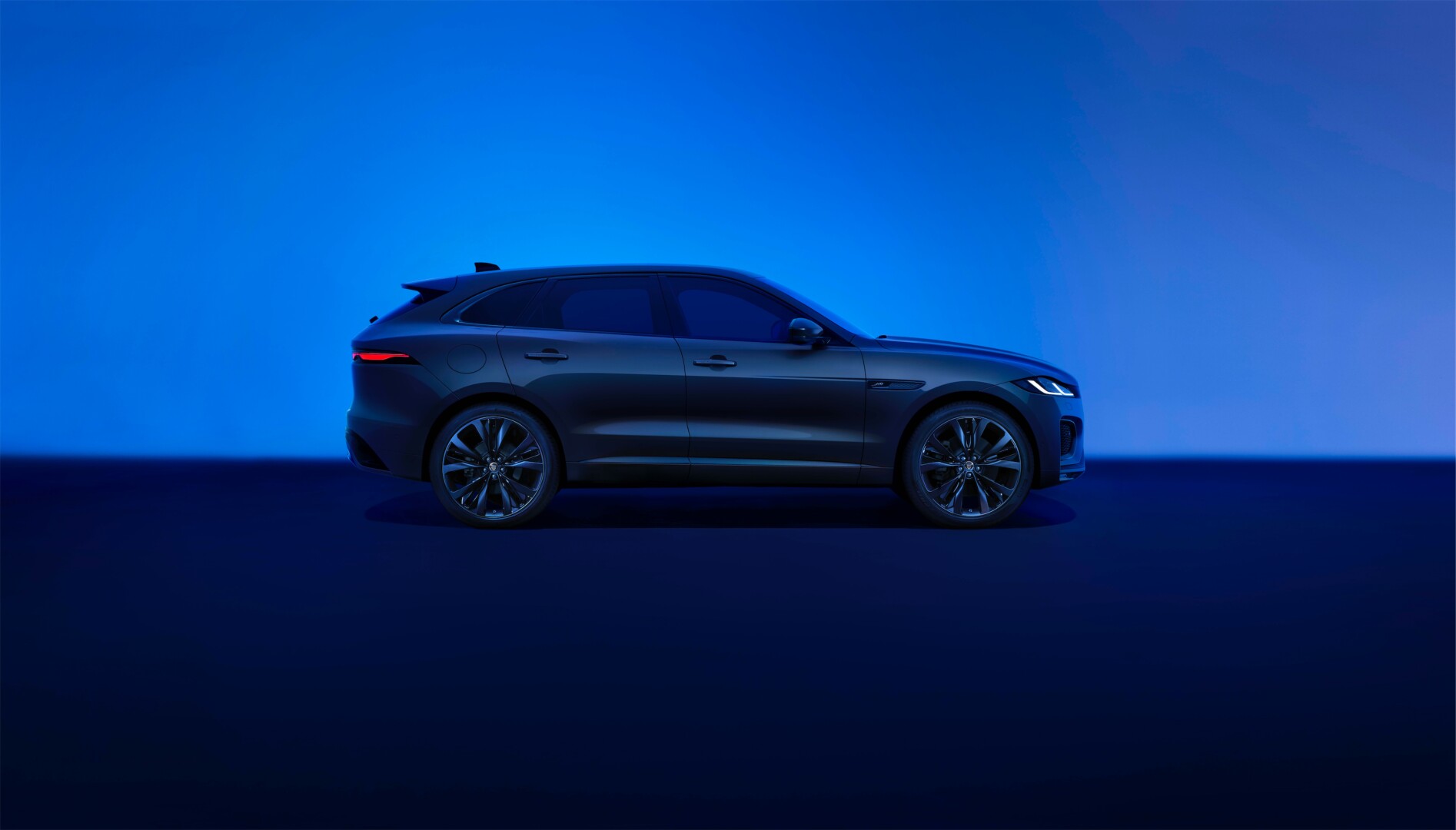
The updated Jaguar F-Pace SUV has been confirmed for SA in early 2023 featuring more EV range and more standard specification.
The Jaguar F-Pace has been one of the British brand’s success stories. Combining great looks, excellent driving manners and an assortment of powertrains, the F-Pace has proven popular.
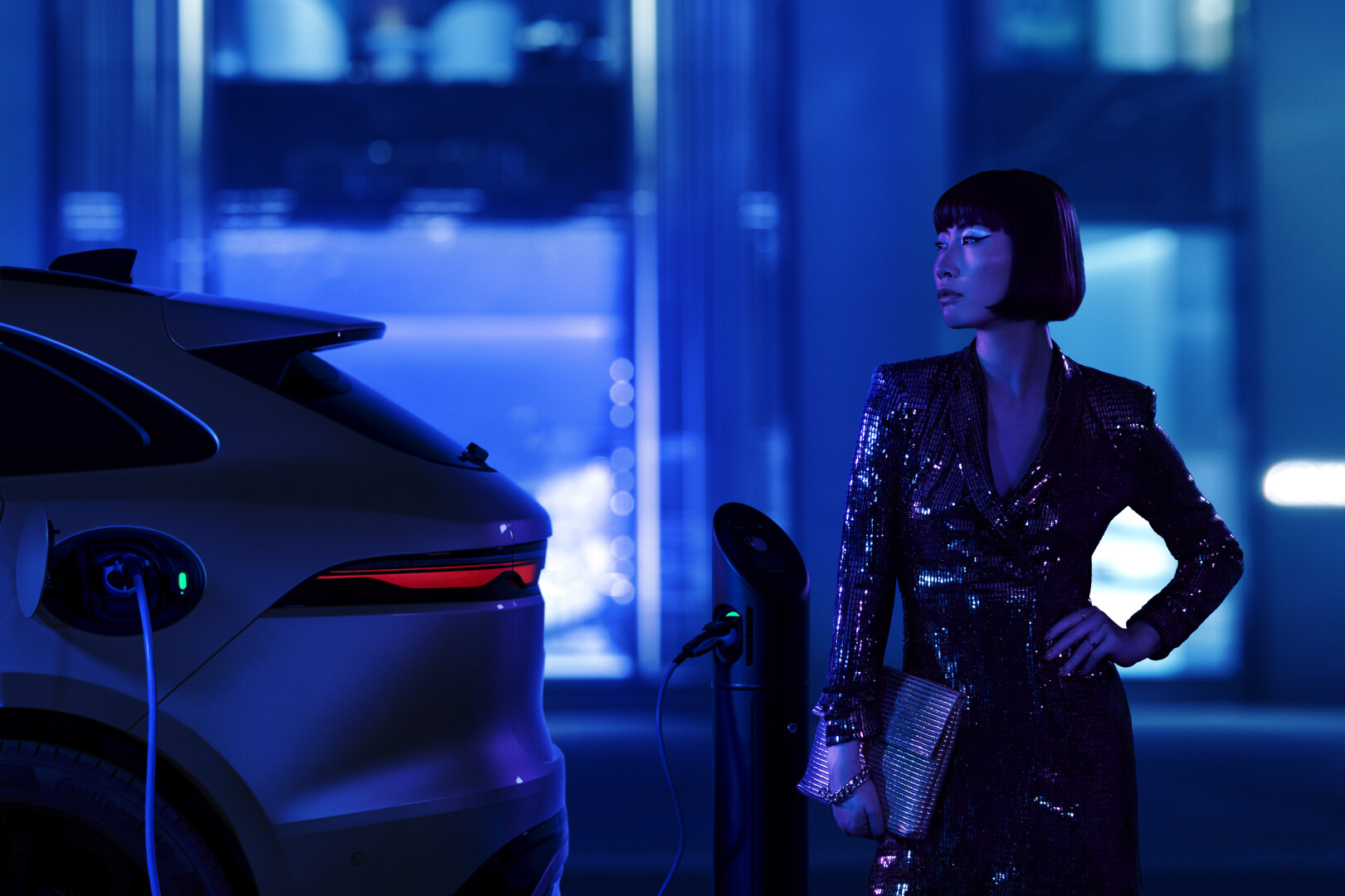
Now for 2023, Jaguar has confirmed some updates, with a focus on its electrified hybrid derivative. The update includes the addition of an upgraded battery back of 19.2 kWh that sees the pure electric range of the P400e climb to 65 km (based on WLTP) which is a 20% increase on the previous hardware setup.
The updated P400e features 297 kW and 640 Nm, which is enough to give it a 0-100 kph of 5.3 seconds and a consumption claim of 1.6 L/100 km. Jaguar claims this model accounts for 1 in 10 F-Pace sales.
The rest of the range has been tweaked for simplification purposes, with non R-Dynamic derivatives falling away, making it easier for customers to choose. The upside of this is enhanced specifications and standard loadout across the board.
R-Dynamic SE and HSE models are fitted with 20- and 21-inch wheels respectively, and all derivatives feature a space saver as standard, with the option of a full-size spare. The Black Pack is standard across all models, and this comprises a gloss black finish on things like the grille surround, mirror caps, rear bumper and so on.
Step inside and every F-Pace derivative features the responsive Pivi Pro infotainment system, with wireless Apple CarPlay, wireless Android Auto and over-the-air updates, as well as wireless charging.
Updated Jaguar F-Pace South African ETA
When it touches down in SA, the updated Jaguar F-Pace range will comprise: R-Dynamic SE, R-Dynamic HSE and SVR, the latter with its 405 kW supercharged V8.
The South African powertrains comprise a 297 kW four-cylinder petrol PHEV, a 147 kW D200 diesel, a 221 kW D300 six-cylinder diesel and the mighty SVR. All models come with all-wheel drive and 8-speed automatic transmissions, and pricing will be confirmed in early 2023 when the vehicles land in SA.
Suzuki Swift (2011-2018) Buyer’s Guide
Searching for a big-on-value yet fun-to-drive used hatchback (or, indeed, sedan)? Let’s take a closer look at the 2nd-generation Suzuki Swift’s strengths and weaknesses, plus which variant you should consider…
When Suzuki returned to South Africa in early 2008 as a wholly owned subsidiary of the Hamamatsu-based company, it had just 2 products on offer: the original SX4 and the first-generation Swift (though the badge’s obscure history stretches back to 1983, the first global version debuted in 2004). Today, the Japanese firm’s local range comprises as many as 13 nameplates, with the 3rd-generation Swift leading the sales charge and helping Suzuki Auto SA slingshot itself into 3rd place on the list of the country’s biggest automakers by volume.
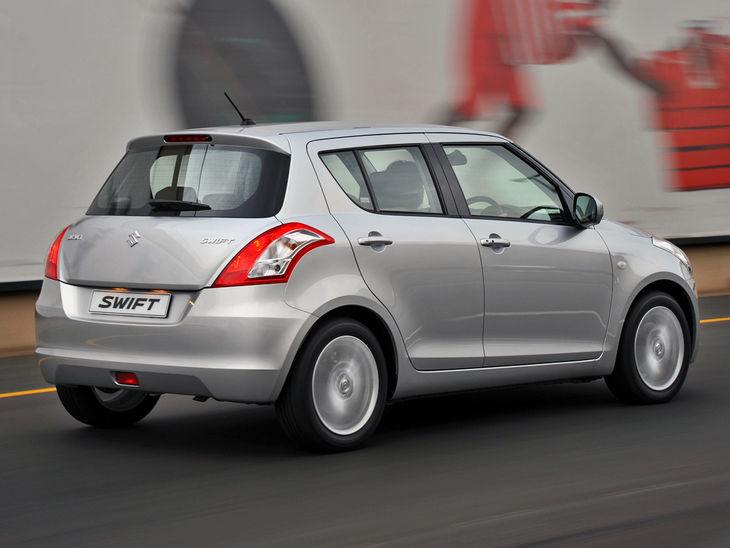
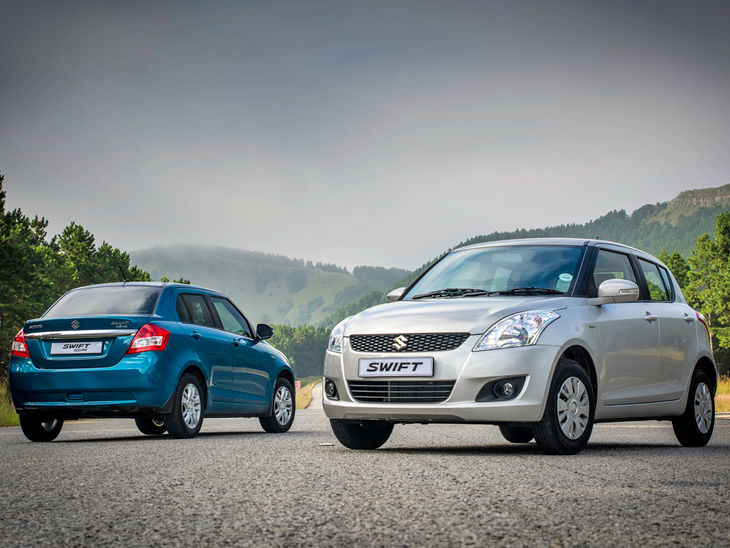
Of course, a 2nd-gen Swift was available locally from 2011 to 2018, and that’s the model we’ll focus on here. Though the AZG-generation Swift stayed true to its forebear’s winning formula, it was a little larger and featured a slightly smaller engine. While some overseas markets offered both 3- and 5-door body styles, only the latter was available in Mzansi (along with the 4-door notchback sedan that arrived in 2014 in the form of the somewhat awkwardly styled Swift DZire).
Suzuki Swift model line-up in South Africa
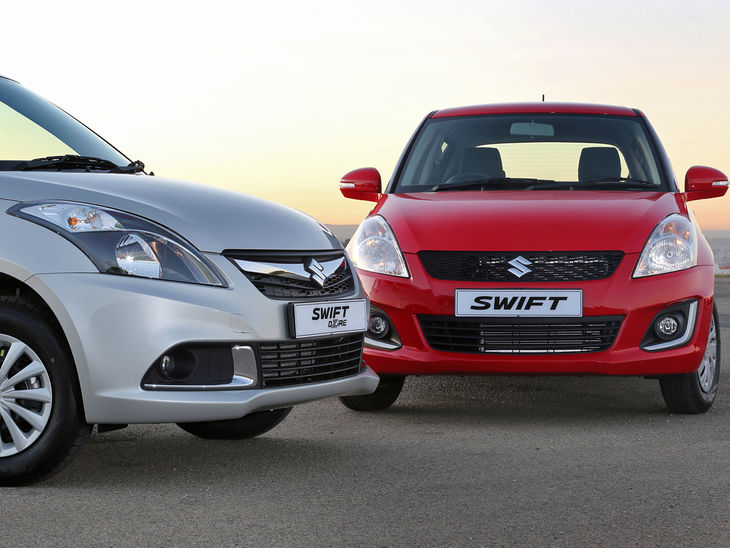
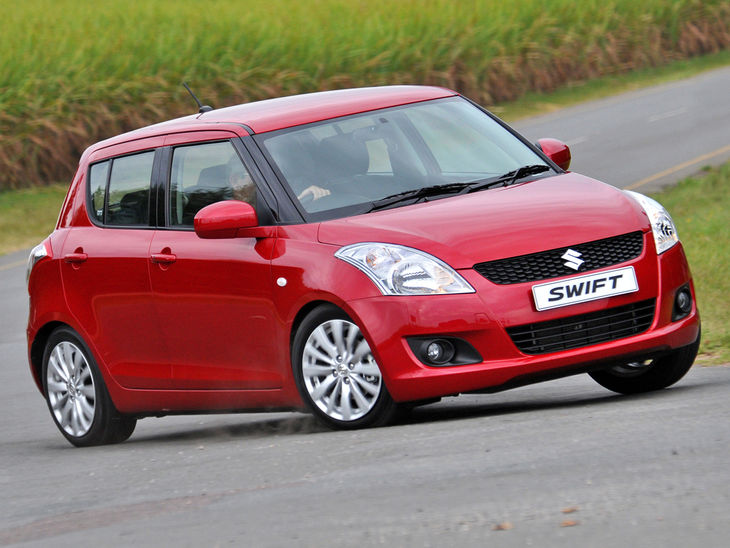
The styling of the AZG-generation Swift wasn’t far removed from that of its forebear.
The Swift Mk2 was revealed in June 2010, before officially hitting local roads in March of the following year. While the original Swift used a naturally aspirated 1.5-litre petrol engine, the 2nd-gen model switched to the likewise atmospheric, but slightly smaller-capacity K14B 1.4-litre motor, again driving the front axle. Peak outputs dropped a touch (from 74 kW to 70 kW and 133 Nm to 130 Nm), but fuel economy improved.
The GL trim level shipped standard with a 5-speed manual ‘box, while the GLS specification could be ordered with either the same cog-swapper or a 4-speed automatic transmission. At launch in South Africa, the following derivatives were available:
1.4 GL (70 kW/130 Nm) 5-speed manual
1.4 GLS (70 kW/130 Nm) 5-speed manual
1.4 GLS (70 kW/130 Nm) 4-speed automatic
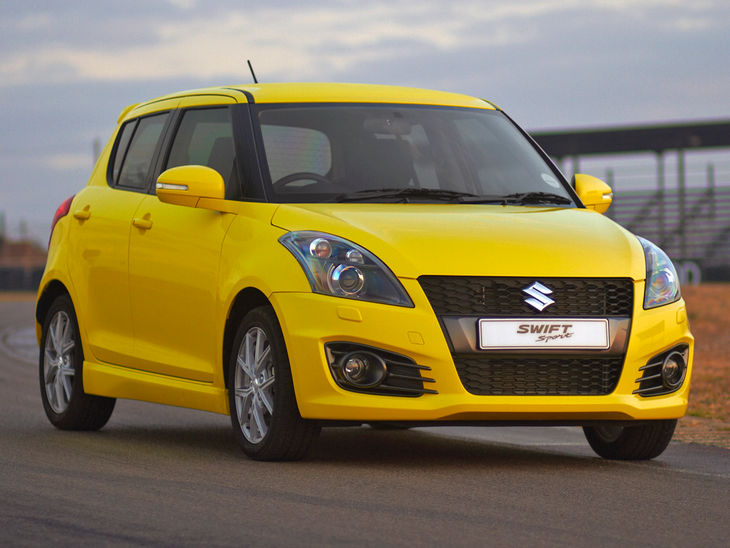
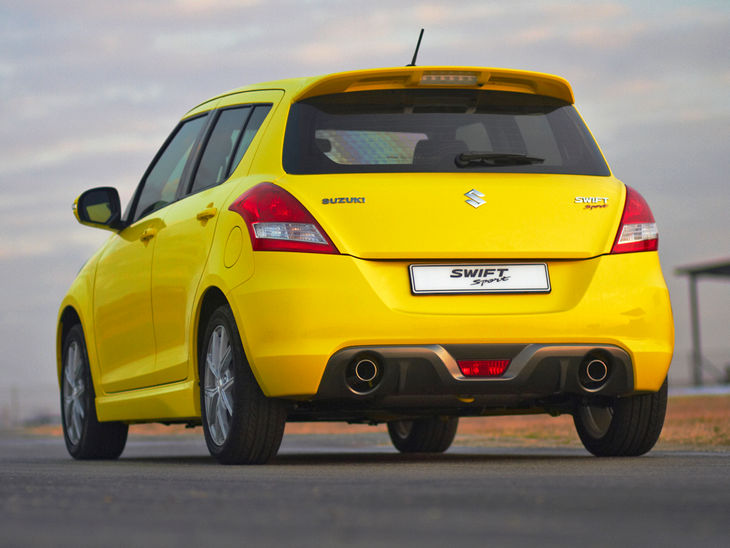
Just 3 months later (in June 2011), the flagship version arrived in the form of the Swift Sport. Although not quite a full-fat hot hatch, the warmed-up Swift Sport was nevertheless a thoroughly entertaining little thing, featuring the 100 kW/160 Nm M16A 1.6-litre petrol mill, a 6-speed manual ‘box, a 10-mm suspension drop, more aggressive exterior styling and a smattering of extra standard kit.
We’d argue the Swift Sport looks best in bright colours.
Inside, the Swift Sport boasted chrome detailing on the instrument panel, as well as red-stitched accents on the leather steering wheel, seats and gear-lever gaiter. There were also stainless-steel pedals, a model-specific “chronograph-style” meter cluster and cloth seat upholstery complete with a “Sport” logo embroidered in red.
The unimaginatively christened Swift Special Edition touched down in October 2012, available with the same powertrain as the cooking versions (including a choice of transmissions), but boasting extra items such as a subtle rear spoiler, 16-inch alloy wheels, silver-hued exterior door handles and upgraded front seats upholstered in silver-coloured fabric.
The Japanese-built Swift received a mild midlife update early in 2014.
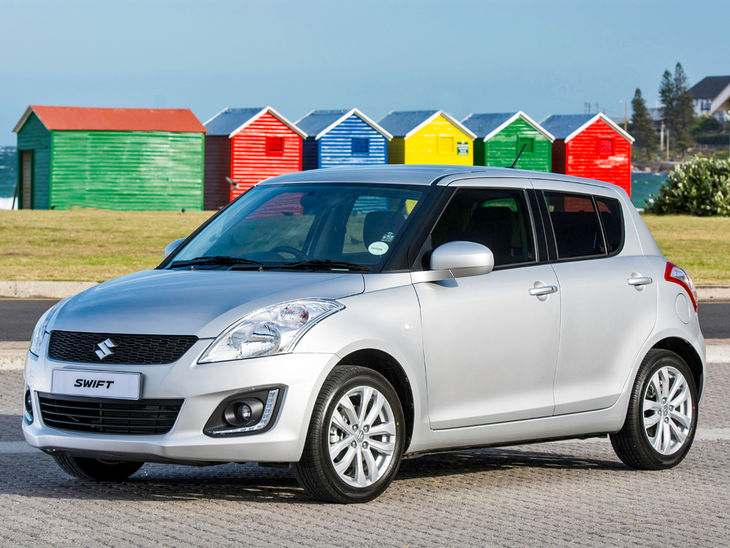
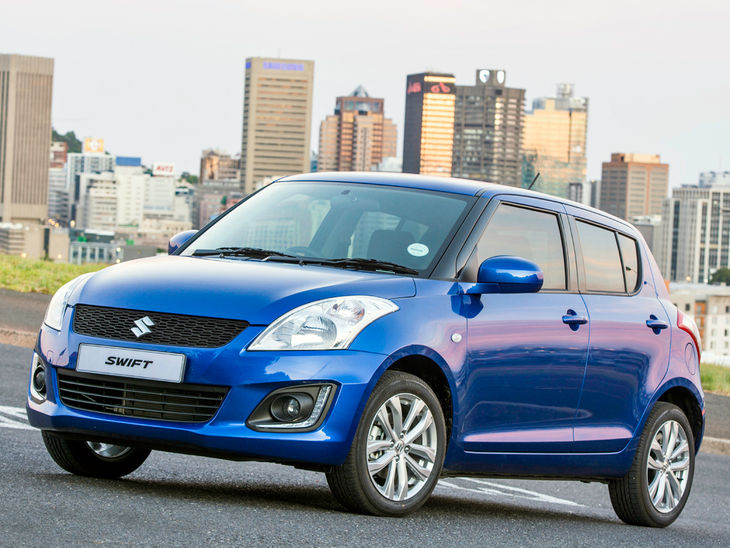
At the start of 2014, Suzuki Auto SA introduced the faintly facelifted Swift, distinguished from the outside by its updated grille, new front bumper and fresh wheel designs (alloys for the GLS and hub caps in the case of the GL). The GLS further gained LED daytime running lights positioned alongside its foglamps, as well as Bluetooth and cruise control (features also rolled out to the Sport model).
Indian-built models join the Suzuki Swift range
In 2014, the local Swift range grew with the arrival of the Indian-built 1.2-litre models (including the DZire).
Just a month later, the range virtually tripled in size thanks to the launch of new, more affordable 1.2-litre derivatives, offered in hatchback guise (alongside the 1.4-litre variants), as well as in DZire notchback sedan guise. In this application, the K12M engine generated 63 kW and 113 Nm, again delivered through either a 5-speed manual or a 4-speed automatic. While the 1.4-litre units came from Japan (although note that the 1.4 GL variant quietly fell away at around this time), as did the Swift Sport, the 1.2-litre units – which were available in base-spec GA and mid-tier GL flavours – were built in India, shipping with a loftier ride height and higher-profile tyres, but fewer airbags and a shorter service plan.
Late in 2014, soon after Global NCAP handed the Indian-built Swift a zero-star crash-test rating, Suzuki Auto SA released a statement saying the disappointing result was “not relevant to the model sold in South Africa”. Compared with the Indian-market Swift, the SA-spec 1.2-litre GL – which Suzuki Auto SA described as “an export specification version” – gained items such as dual front airbags and ABS (note early versions of the GA did without the latter). Still, it was concerning the Maruti-built version’s body shell was rated as “unstable”.
Note the model-specific frontal treatment for the sedan and hatchback, seen here in refreshed form.
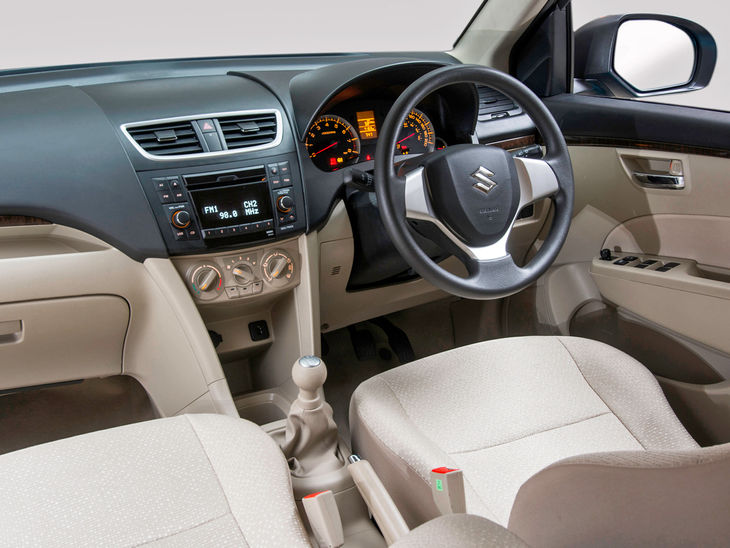
The same 1.2-litre derivatives were refreshed towards the middle of 2015, gaining revised styling, more standard equipment (such as Bluetooth for the GL derivatives) and an updated engine calibration adjusting peak figures to 62 kW and 115 Nm, as well as improving claimed fuel economy. In addition, the Swift DZire’s cabin ditched its divisive black-and-beige colour scheme (including faux-wood trim) in favour of a more aesthetically pleasing all-black set-up.
The 1.2 hatchback’s rear bench furthermore gained a 60:40 split for improved versatility, while fresh exterior paint colours were added to both the hatch and sedan palettes.
This black-and-beige colour arrangement inside the Swift DZire was thankfully axed in 2015.
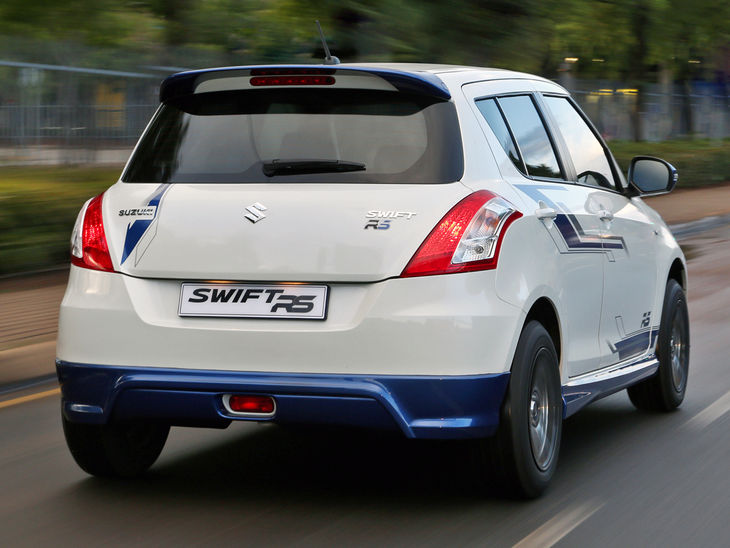
In February 2017, the Swift 1.2 RS was launched in South Africa in “limited numbers”; it was based on the 1.2 GL but featured extras such as a body kit (comprising lips, spoilers and side skirts), model-specific alloy wheels and blue side-mirror caps. Offered exclusively in Arctic White Pearl Metallic paint, the special edition also featured bold blue decals and “custom” seat covers. That RS badge, of course, was somewhat deceptive, since the newcomer employed a standard 1.2-litre engine and chassis.
Finally, the 3rd-generation Swift hit the local market towards the middle of 2018, bringing to an end its predecessor’s successful 7-year run in South Africa.
Product strengths
The Swift offers plenty of driving fun despite its budget positioning.
Handling and road manners: Suzuki certainly knows how to engineer a wonderful small-car chassis and the 2nd-gen Swift was a prime example. Despite its entry-level price tag, the nimble little Swift was a joy to pilot, benefitting from a distinct lack of weight, offering useful steering feedback and boasting a tight turning circle. With a dash more power and a lower ride height, the Swift Sport was even more fun to drive yet still utterly composed.
Though the Japanese-built 1.4 model felt noticeably more substantial than its Indian-sourced 1.2 sibling, the latter featured tweaks such as a lighter clutch action and an easier-shifting manual gearbox. Across the range, the ride was firm yet pleasingly compliant.
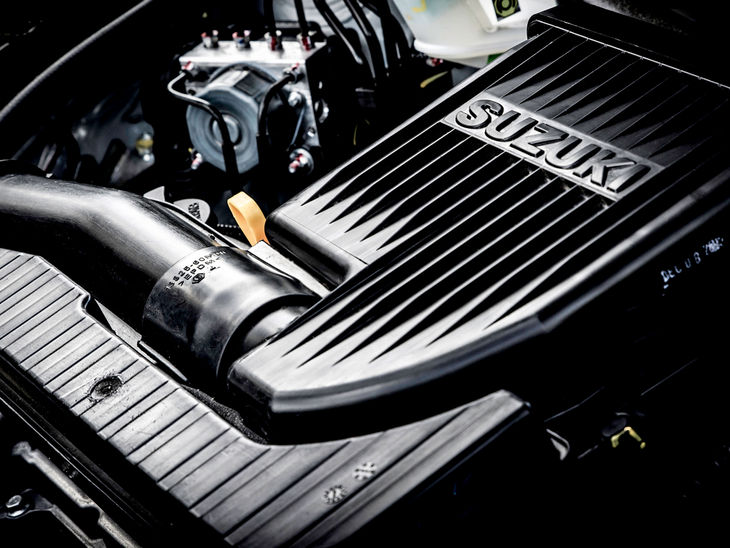
When looked after, all three engines in the range (K12M pictured) are capable of delivering reliable service.
Uncomplicated engines: The K12M, K14B and M16A powerplants are all relatively uncomplicated engines that are largely bulletproof when fastidiously maintained (they’re also all chain driven, which means no expensive timing belt services). These comparatively old-school naturally aspirated engines are well-proven and happy to rev, yet are capable of returning wallet-pleasing fuel economy with very little effort at all.
Impressive fuel economy: When this iteration of the Swift launched locally in 2011, the 1.4-litre engine mated with the 5-speed manual gearbox had an entirely achievable claimed fuel consumption of 7.7 litres per 100 km. That figure plunged to 5.7 with the arrival of the 1.2-litre 4-pot (with this variant weighing under a tonne), before dropping further to 5.3 with the update in 2015.
Product weaknesses
Boot space is not the Swift hatchback’s strongest point…
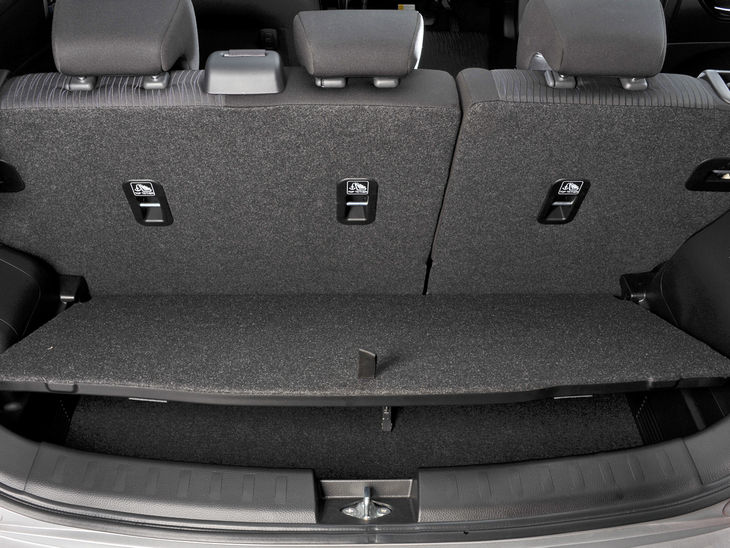
Not the most practical: Despite having grown in size compared with its forebear, the AZG-generation Swift certainly wasn’t the most practical hatchback of its era. The rear seats were relatively cramped, while its luggage capacity was limited to a claimed 210 litres (or a little more useable 300 litres in the Swift DZire). The luggage compartment was further saddled with a fairly high-loading lip.
Considering the competitive pricing when new, it was no surprise the cabin featured plenty of cheap-feeling plastics, too. These materials tended not to wear well, so make sure to do a thorough inspection for deep scratches in both the passenger area and the load bay. In addition, take note the Swift Sport shipped sans a spare wheel, instead making do with a mobility kit.
Clutch judder: Though there appear to be very few widespread mechanical problems with the AZG-generation Swift, it’s worth noting models fitted with a manual ‘box (including the Swift Sport) have been known to exhibit clutch judder, particularly when cold. Check to make sure the vehicle hasn’t been quietly warmed up before your test drive and pay close attention to how the clutch responds to your inputs (for instance, is there a slipping sensation?), specifically in first gear and reverse.
What to pay?
The somewhat misleadingly named Swift RS featured an entirely standard 1.2-litre engine.
Since this generation of the Swift shipped standard with a 3-year/100 000 km warranty, even the later model years would no longer enjoy coverage. When scrutinising any potential buy’s service history (as you should), bear in mind the 1.4-litre models and the 1.6-litre Swift Sport featured a 4-year/60 000 km service plan, while the 1.2-litre versions (including the Swift DZire) made do with a 2-year/30 000 km arrangement.
Of the used 2nd-generation Swift models listed on Cars.co.za at the time of writing, nearly 92% featured a manual gearbox, suggesting the self-shifting versions remain quite hard to come by. The hatchback body style was even more dominant, with only 6% of listings featuring the DZire badge. Unsurprisingly, the 1.2-litre unit was the most common engine, representing 75% of all listings, followed by the 1.4-litre motor (18%) and finally the 1.6-litre Swift Sport (7%).
Below R100 000: Around only 13% of all stock fell below the R100 000 mark, though mileage varied from as low as 76 000 km to more than 210 000 km. Interestingly, the overwhelming majority of DZire examples fell in this price bracket, suggesting a lack of demand for these notchback-sedan models.
From R100 000 to R150 000: This is where most buyers will find themselves shopping, with more than 60% of all listings falling between these pricing bookends. We found everything from seemingly clean, early model-year 1.4 vehicles through to later model-year 1.2 units, including a couple of RS-badged special editions. There was even a 2014 Swift Sport on offer here.
From R150 000 to R200 000: Choice was interestingly very limited here (despite all three engine options being present), though most examples in this price bracket boasted low mileage.
Above R200 000: At the time of writing, only two models were priced on the far side of R200 000. Both were 2017 Swift Sport units, both had under 80 000 km on the clock and both were listed at R220 000. This derivative has clearly held its value quite well, considering it was priced at R264 900 when new in the middle of 2017.
Pick of the range?
The Japanese-built 1.4 GLS is surely the pick of the range.
Though the 1.2-litre variants are far more plentiful on the used market, we’d argue the Swift 1.4 GLS – particularly in facelifted form, with its even more generous list of standard kit – is the pick of the bunch. The 5-speed manual is our transmission of choice, though the 4-speed automatic isn’t nearly as dire as you might think (being a traditional torque-converter auto rather than the frankly dreadful automated manual transmission that followed in the next generation). Still, finding a 1.4 GLS AT in the used space would require an intensive search…
While the 1.2-litre engine itself would likely meet the needs of many urban drivers, the fact this powertrain was available only in the Indian-built version of the Swift brought a few compromises that remain entirely relevant to buyers today. The 1.4-litre models sourced from Japan boasted not only higher perceived build quality but also considerably better safety credentials, including six rather than two airbags as well as stability control. In addition, we have noted a few reports of Indian-built models rusting prematurely, though these appear isolated at present.
For those craving a little more pep, we’d wholeheartedly recommend the Swift Sport since the modest extra dose of performance really allows the brilliant chassis to shine. Still, keep in mind performance models – even comparatively mild examples such as the Swift Sport – tend to attract abuse from their drivers and sometimes even reliability-tainting modifications. So, inspect particularly thoroughly before signing on the dotted line.
Verdict
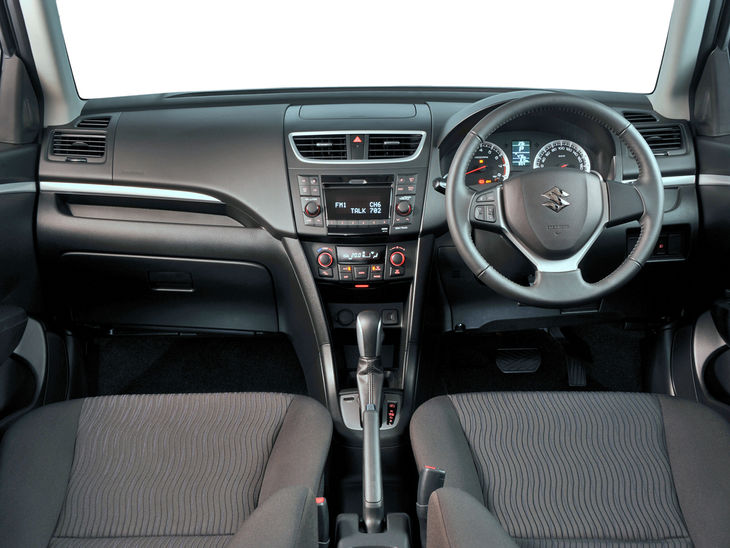
The cabin of a derivative you’ll likely struggle to find on the used market today: the pre-facelift Swift 1.4 GLS AT.
What are your alternatives in this space? Well, though traditional B-segment big-hitters such as the 5th-gen Volkswagen Polo, 6th-gen Ford Fiesta, 3rd-gen Toyota Yaris, Renault Clio IV and Opel Corsa (in both 4th- and 5th-generation form) might spring to mind, the AZG Swift was actually positioned below these models. As a result, the aforementioned superminis tend to command higher prices on the used market today.
This version of the Swift instead competes more closely with prolonged lifecycle models such as the original (Fiesta-based) Figo and the original locally built Volkswagen Polo Vivo (itself a rejigged 4th-generation Polo), as well as the Koreans of that era, the 1st-gen Hyundai i20 and the 3rd-gen Kia Rio. Smaller cars such as the Hyundai Grand i10, which arrived in South Africa in 2014, are also worth a look.
And the DZire? Well, those shopping for the 3-box version of the Swift should also consider the Honda Brio Sedan (which eventually became the Amaze in 2018), the Volkswagen Polo Vivo Sedan and the Toyota Etios Sedan.
The Swift Sport had few direct rivals as it slotted in below the traditional B-segment hot hatches of the era.
Meanwhile, considering its middle-of-the-road outputs, the Swift Sport has few direct rivals, with full-blooded hot hatches such as the Fiesta ST, Polo GTI, Clio RS and Corsa OPC all far more expensive and far more powerful. Still, Renault’s 98 kW Twingo RS would make for an intriguing left-field alternative, particularly in blue-and-white Gordini trim, while Opel’s 110 kW Corsa 1.4T Sport (or even the 103 kW Chevrolet Sonic RS) would appeal to those who prefer forced induction.
So, should this generation of the Swift be on your shortlist? Well, if you’re searching for a hatchback (or sedan) that’s both big on value and fun to drive, the answer is a resounding “yes”. Multiple #CarsAwards Brand of the Year winner Suzuki has long been regarded as the small-car expert and the AZG-gen Swift is just another example of that. The Japanese-built version is a particularly charming little hatch and the one we’d argue offers the best long-term ownership proposition.
What are the different Suzuki Swift models available in South Africa?
The 2025 Suzuki Swift in South Africa is available in three main derivatives: the GL, a new mid-tier GL+, and the top-end GLX.
What is the engine and performance of the new Swift?
The new Swift is powered by a Z-Series (Z12E) 1.2-litre, 3-cylinder petrol engine. This engine produces 60 kW of power and 112 Nm of torque, and is paired with either a 5-speed manual or a Continuously Variable Transmission (CVT).
What is the price of the new Suzuki Swift in South Africa?
The starting price for the 2025 Suzuki Swift is approximately R219,900, with the top-end GLX model priced around R284,900.
What safety features are standard on the 2025 Suzuki Swift?
Standard safety features across all models include six airbags, hill-hold control, ABS, electronic stability control (ESC), and ISOfix child-seat anchors.
What warranty and service plan are included with the Swift?
The vehicle comes with a 5-year/200,000 km warranty and a 2-year/30,000 km service plan.
Treat a Toyota GR Yaris badly… and it will reward you
Ashley Oldfield – our in-house race ace – puts a GR Yaris Cup race car through its paces in an attempt to break the Toyota over the course of a 9-hour endurance race.
Endurance racing has unique requirements in terms of reliability. You need parts that have been tested to exhaustion under racing conditions… Le Mans teams are renowned for completing multiple 30-hour tests throughout the year before entering cars in the 24-hour race. For example, unique suspension parts are required to deal with the bumps and high-G cornering loads. Before an event like the Killarney 9-Hour, every mechanical component on a race car usually gets replaced with something endurance-rated, well, except on our Toyota GR Yaris, which we raced in almost stock form (bar some heavy-duty brake pads).
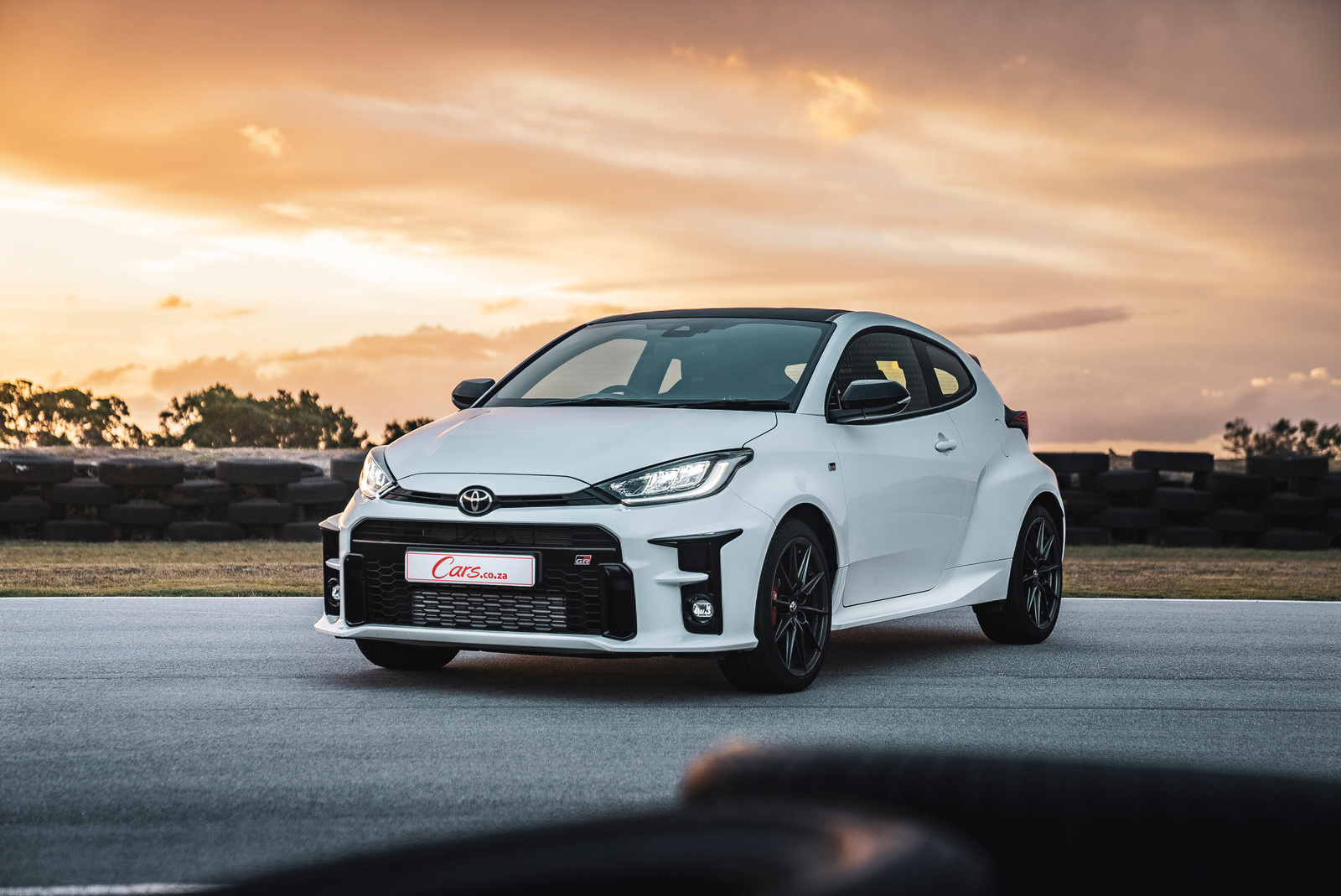
GR Yaris media car doing duty at a Cars.co.za film shoot in 2021 at Aldo Scribante.
In 2021, the Toyota GR Yaris was launched in limited numbers and, as is customary when a manufacturer wants publicity for its new model, a few units were put into the media fleet. Media cars – especially of the performance variety – get treated rather harshly. Every publication has (or wants) to test a media car’s maximum abilities on every drive, so these test units live their lives at 100% every time they are fired up.
After their time in the media fleet, test units are usually sold off as demos or kept as fleet cars, but for 2022, Toyota South Africa Motors (TSAM) decided to turn 6 of its GR Yarises into race cars. Why? So seasoned motoring journos, including me, could race each other in the single-make GR Yaris Cup.
To prepare the Toyotas for competition, each car’s seats were removed, Dunlop semi-slicks were fitted, a roll cage was installed and the brake hoses and fluid were uprated to deal with the increased pressure of racing. After that, the GR Yarises were thrown at every circuit in the country, where they took taking part in the Extreme National Race Series, along with Global Touring Cars, Polo Cup and Formula Ford.
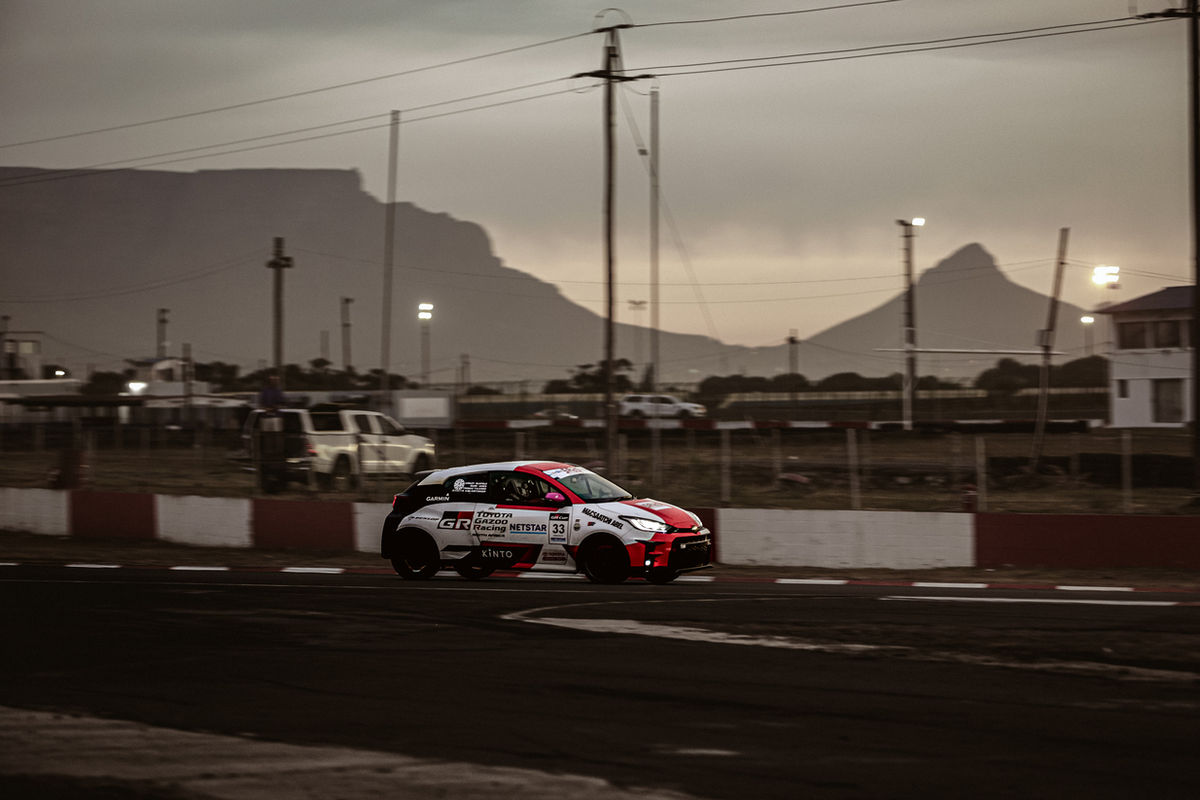
Early in the 9-Hour, the temperature hit 30C and Ash was behind the ‘wheel for 90 minutes.
They survived a few bumper bashings along the way, plus endured thousands of snap gearchanges and corner-cutting bumps. They lived to tell the tale at the end of the season with almost no mechanical issues (there were some overzealous shifters in the group that may have ground 4th gear too often).
Just when the GR Yarises thought they had been put out to pasture in the lovely life of day-to-day use, they were recalled for duty in the Killarney 9-Hour, which would prove their toughest test yet.
How a standard Yaris copes with 9 hours of racing
The sister GR Yaris was piloted by Toyota executives/ex-racing drivers.
You obviously don’t just race the 9-Hour and that’s it – there are multiple practice sessions leading up to the event that serve to get the drivers’ eyes in, but also continue to shift wear and tear onto every component as it’s all done at racing speed.
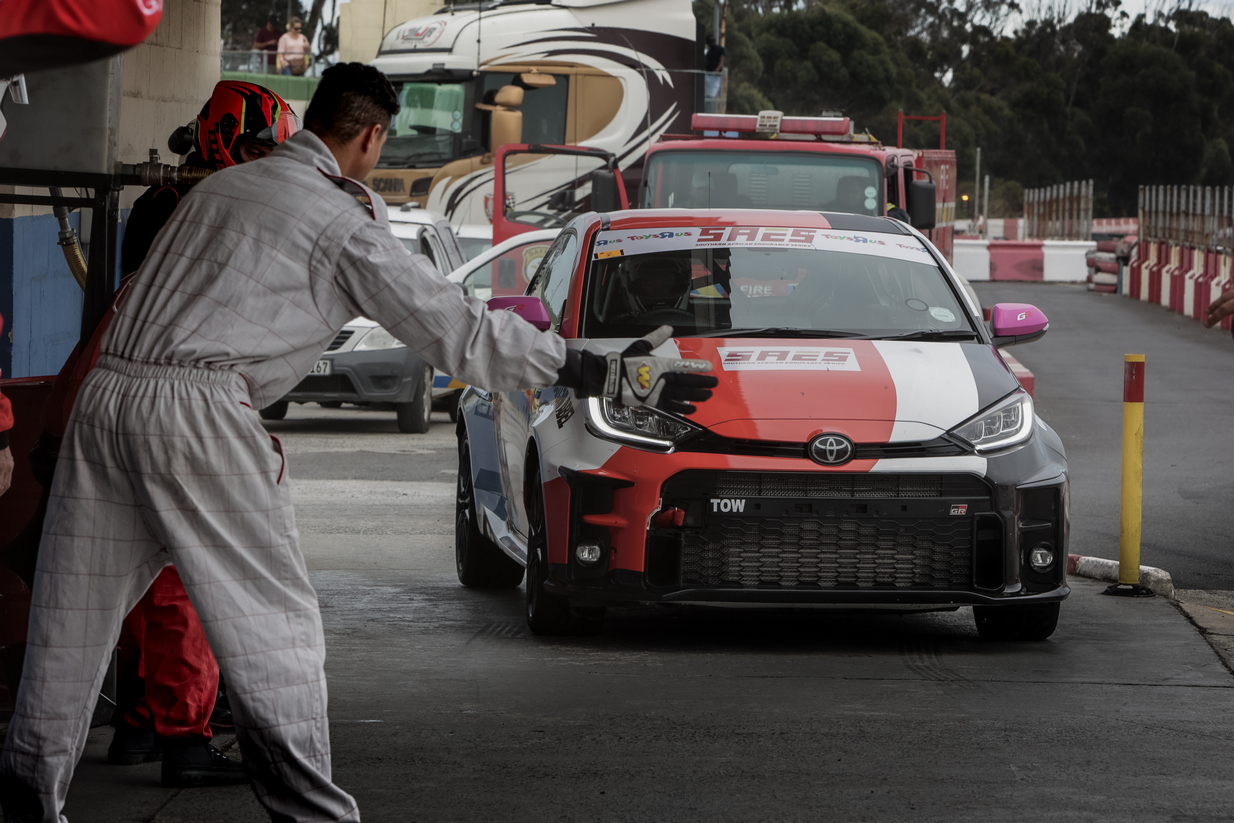
Cars were breaking down all around us during the practices. Some caught fire, some drove into each other on track, some drove into each other in the pit lane, some drove into pedestrians in the pit lane (fortunately, a mild butt-slapping from a wing mirror was the extent of the damage), while our GR Yaris managed to avoid everything bar the need for fuel. And all of this was still just in the practice sessions.
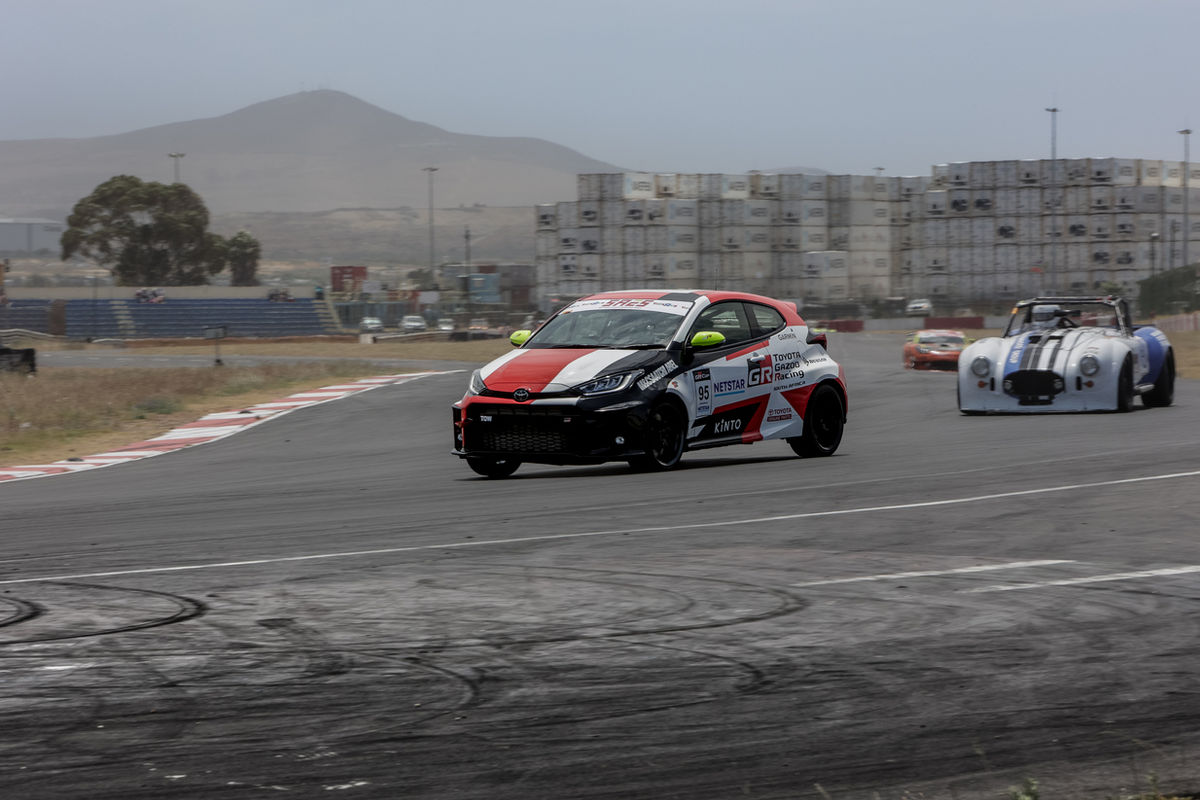
Come race day we lined up 31st and 32nd in our virtually standard GR Yaris race cars. There isn’t really any limitation on what can enter an event like the 9-Hour so there were plenty of fast, endurance-tested race cars out there, such as the GT3 category cars, including the Audi R8 GT3 and Lamborghini Huracan GT3, a few Ginettas driven by ex-F1 drivers, Porsche GT3 Cup cars and myriad open-top sportscars.
Indeed, the pair of GR Yarises were some of the slowest cars on track, but everybody knows that it’s a game of “the tortoise and the hare” over the course of a 9-hour endurance race.
Fuel and driver changes were planned for every hour but the fuel would last for 2hrs so we pushed on.
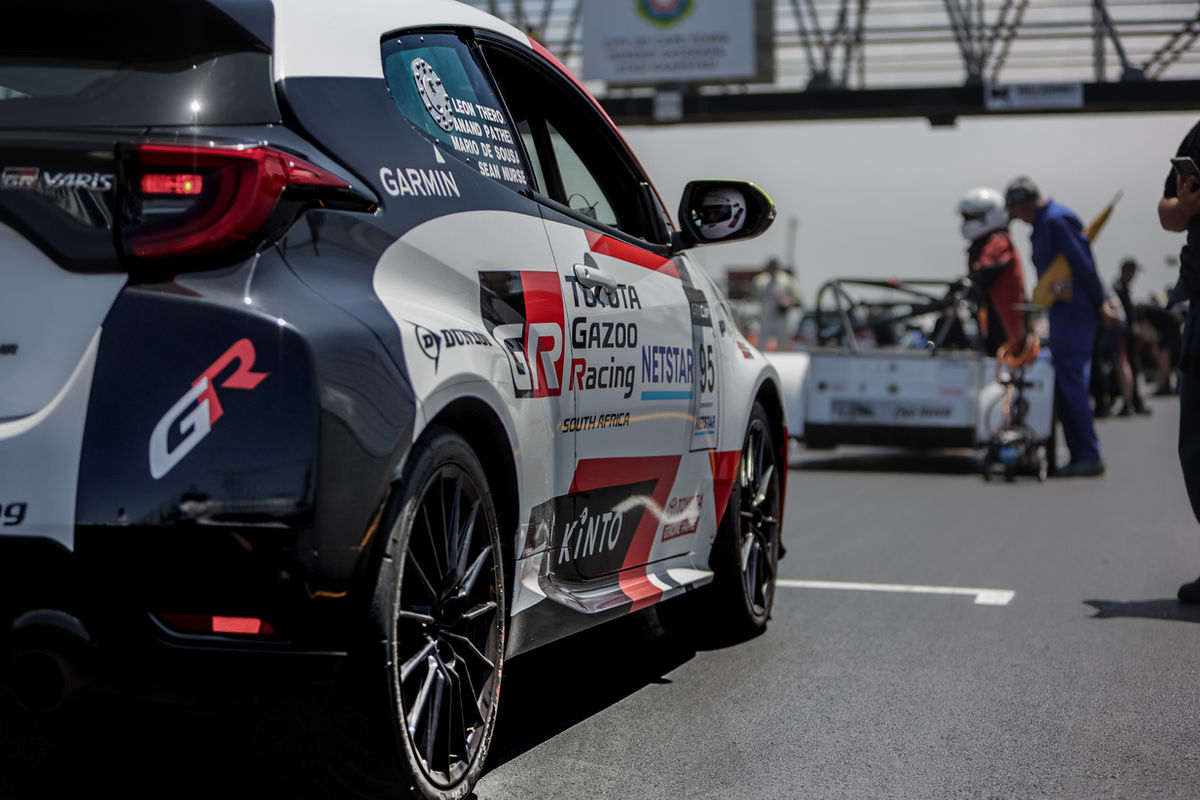
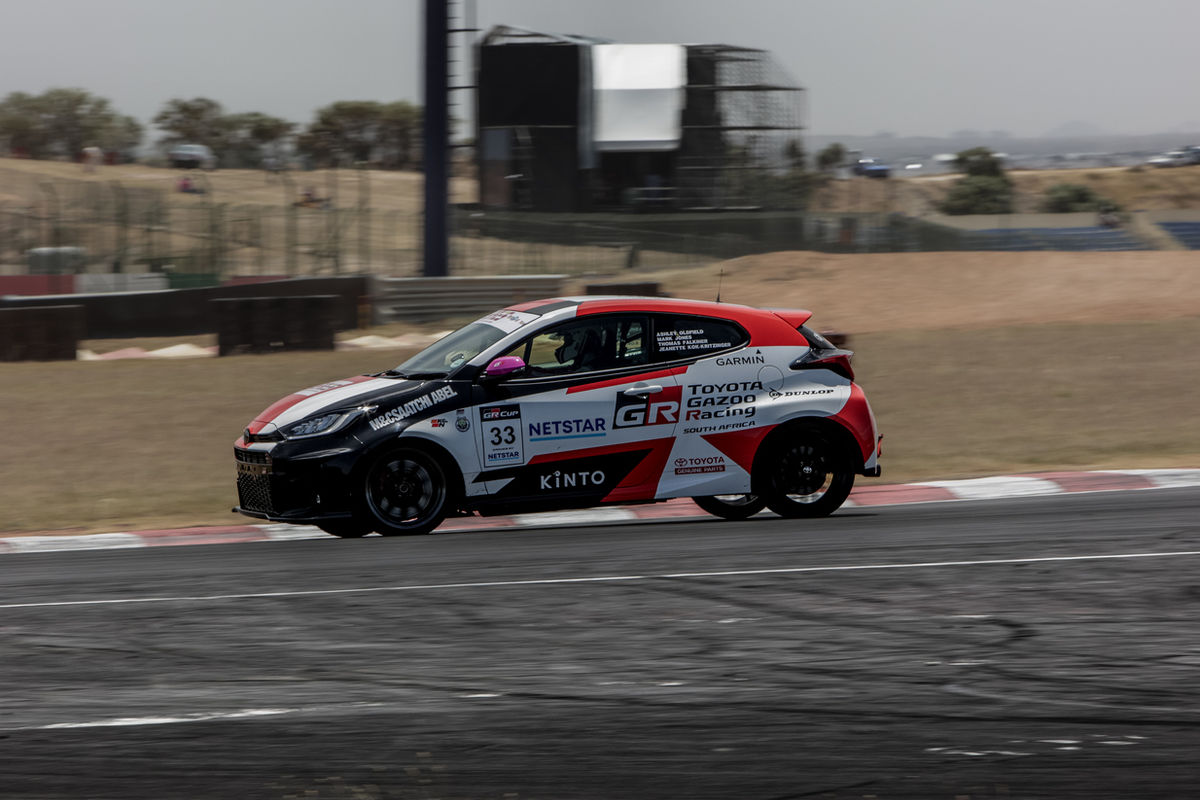
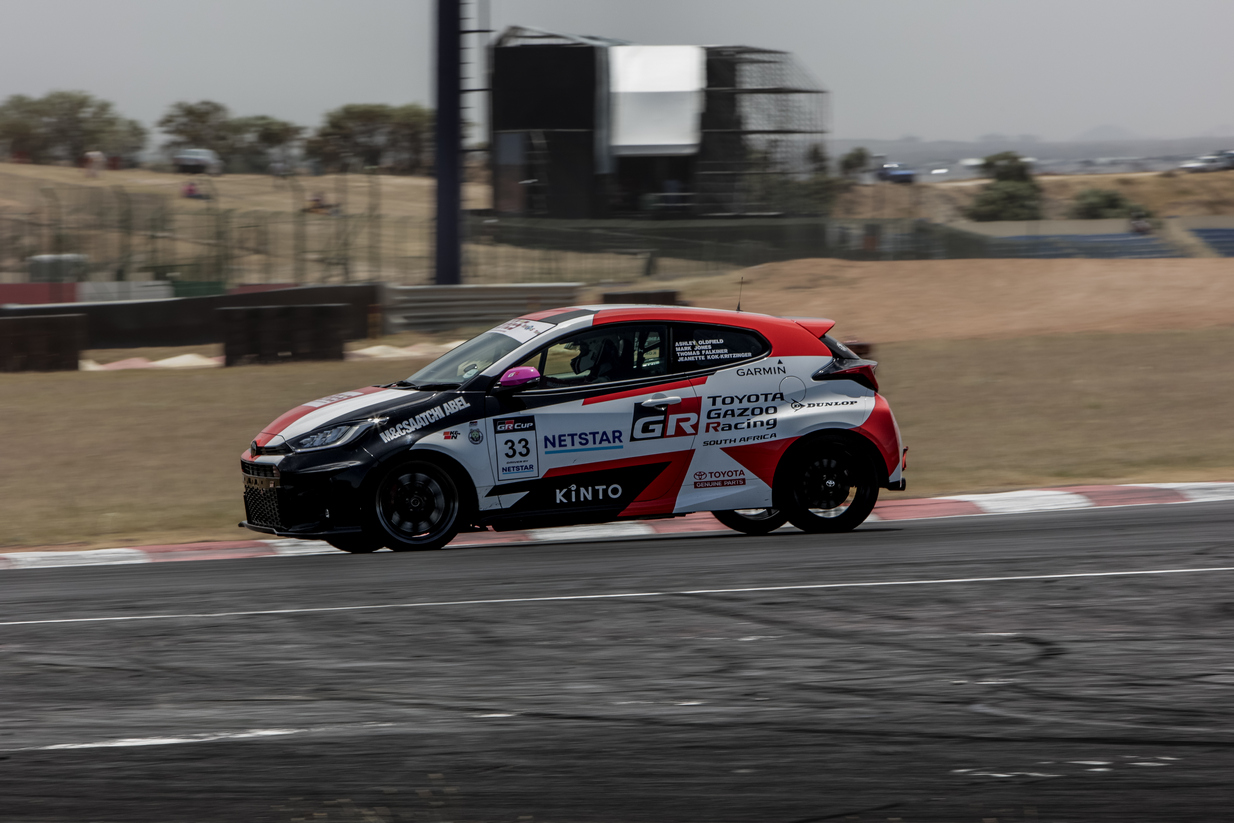
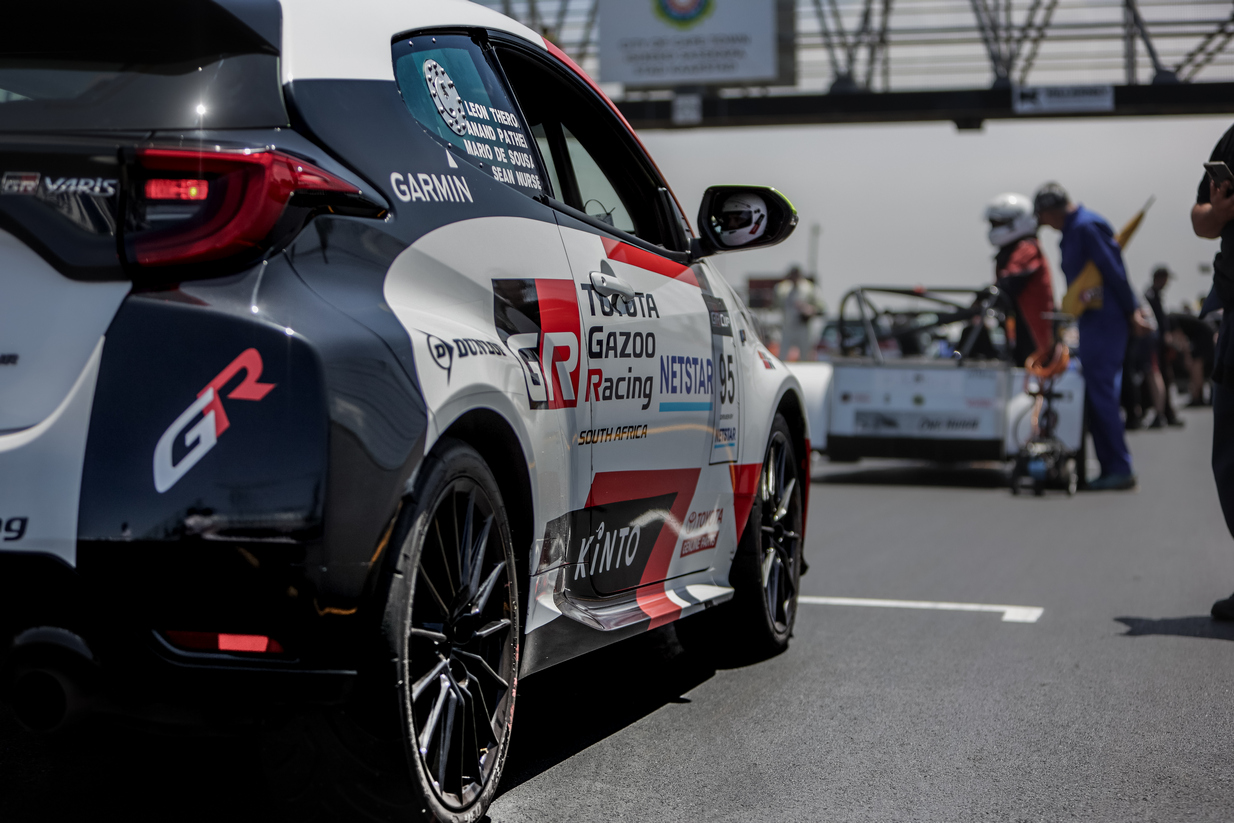
The two GR Yaris race cars were piloted by a media lineup in the 33 car (including me) and a TSAM executive and ex-racing driver lineup in the 95 car.
I qualified the 33 car and was behind the ‘wheel for the start of the race; I completed a 90-minute stint in searing heat (30° Celsius) while battling with multiple Lexus V8-powered Cobras. I also thought it would be wise to run with no aircon during the stint for the purpose of making significant fuel savings (most endurance cars have aircon as the drivers tend to cook in 4 layers of fireproof gear and crash helmet).
However, it turned out that switching off the aircon made little difference to the stint length… In fact, that had more to do with the ambient temperature, because when track conditions cooled later in the race, we could run for close to 2 hours on our 80-litre tank (we ran a 40-litre reserve tank in the car).
At the end of my first stint, the 33 car had climbed from 31st to 16th overall and was running 5th in its class. So, I handed it over to the next drivers and hoped the positive climb up the field would continue.
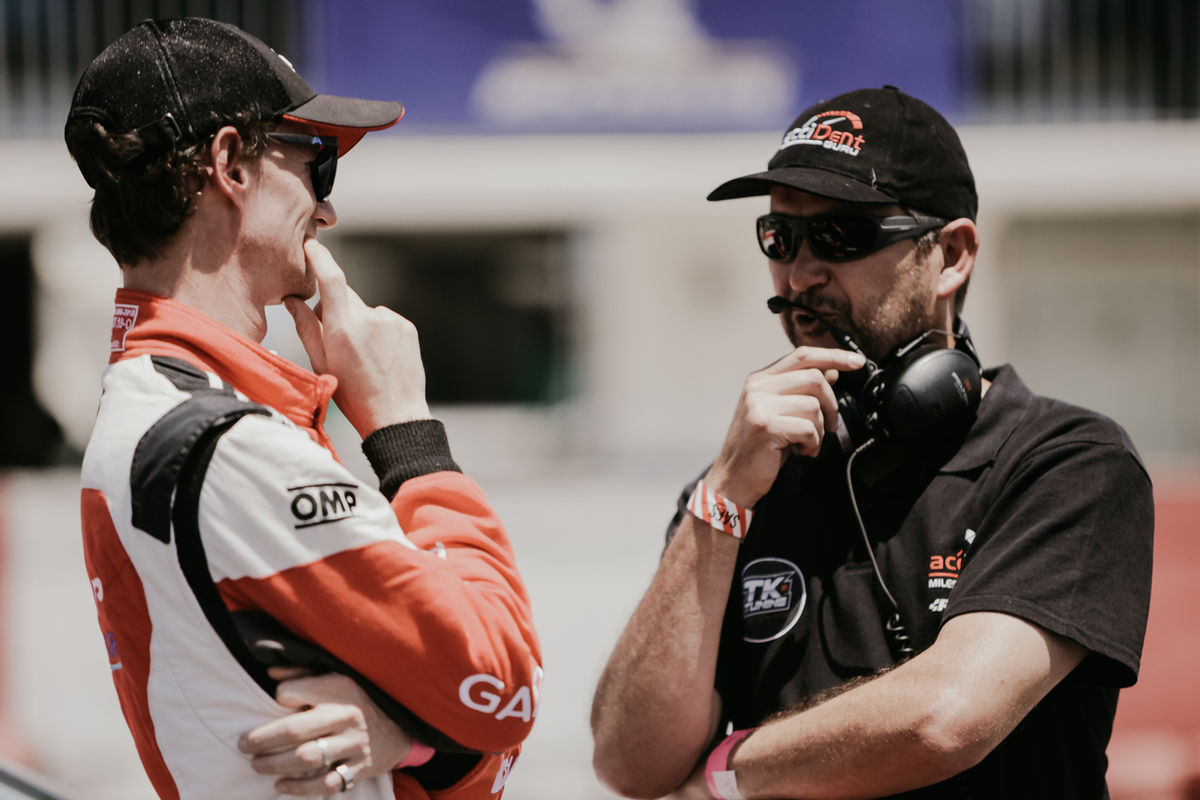
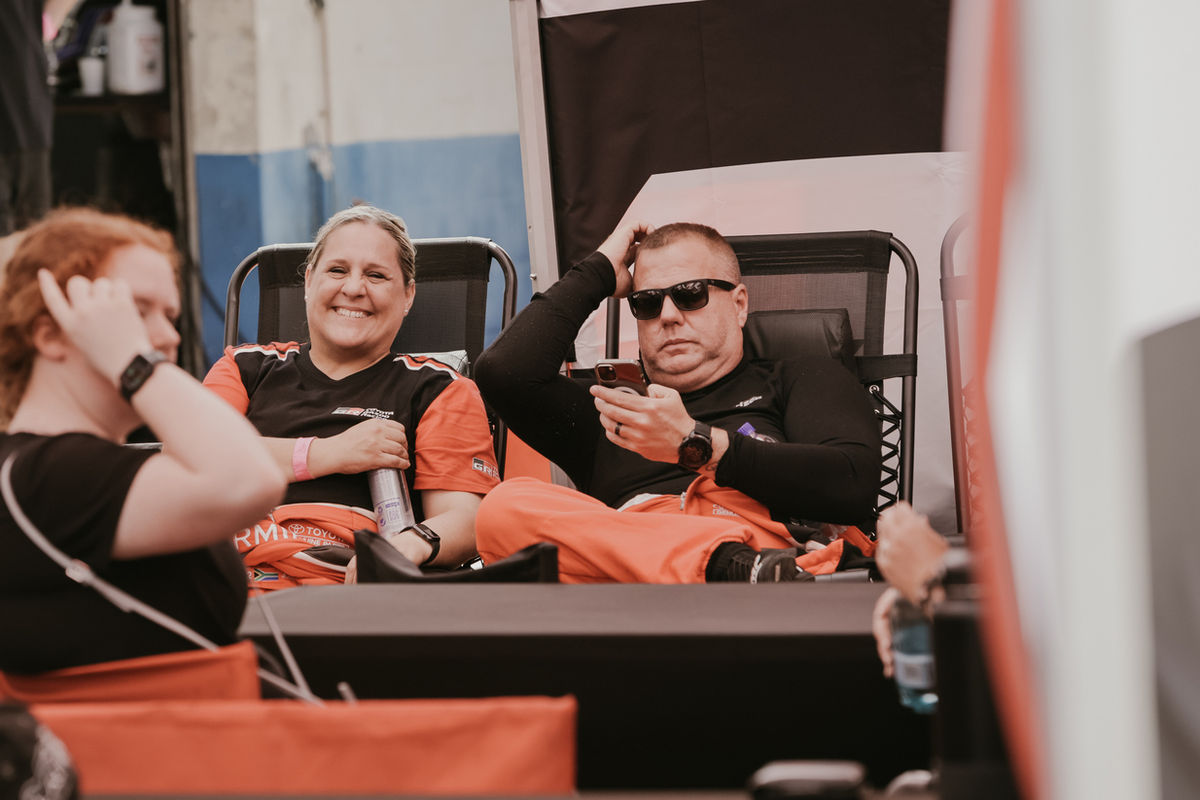
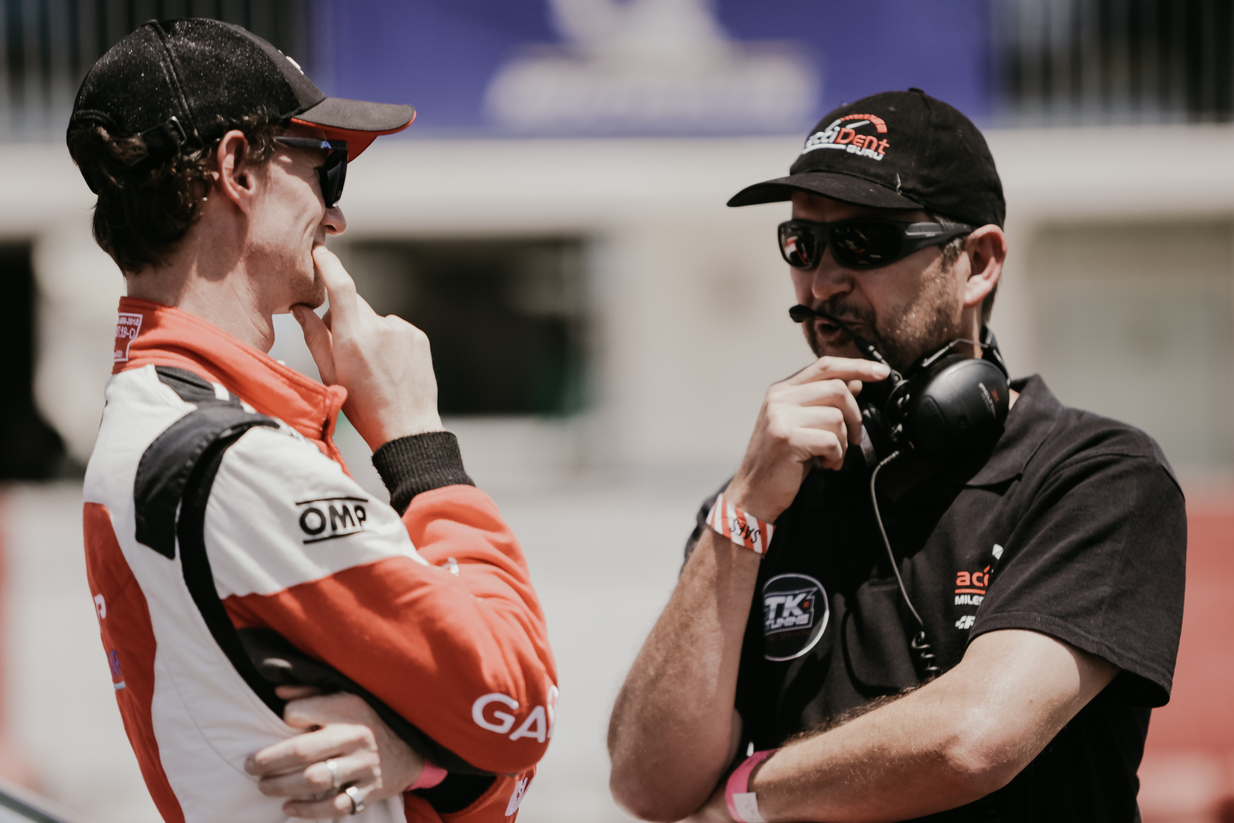
Ash (left) was the team’s chief strategist; he decided when to pit to make best use of the safety cars and fuel.
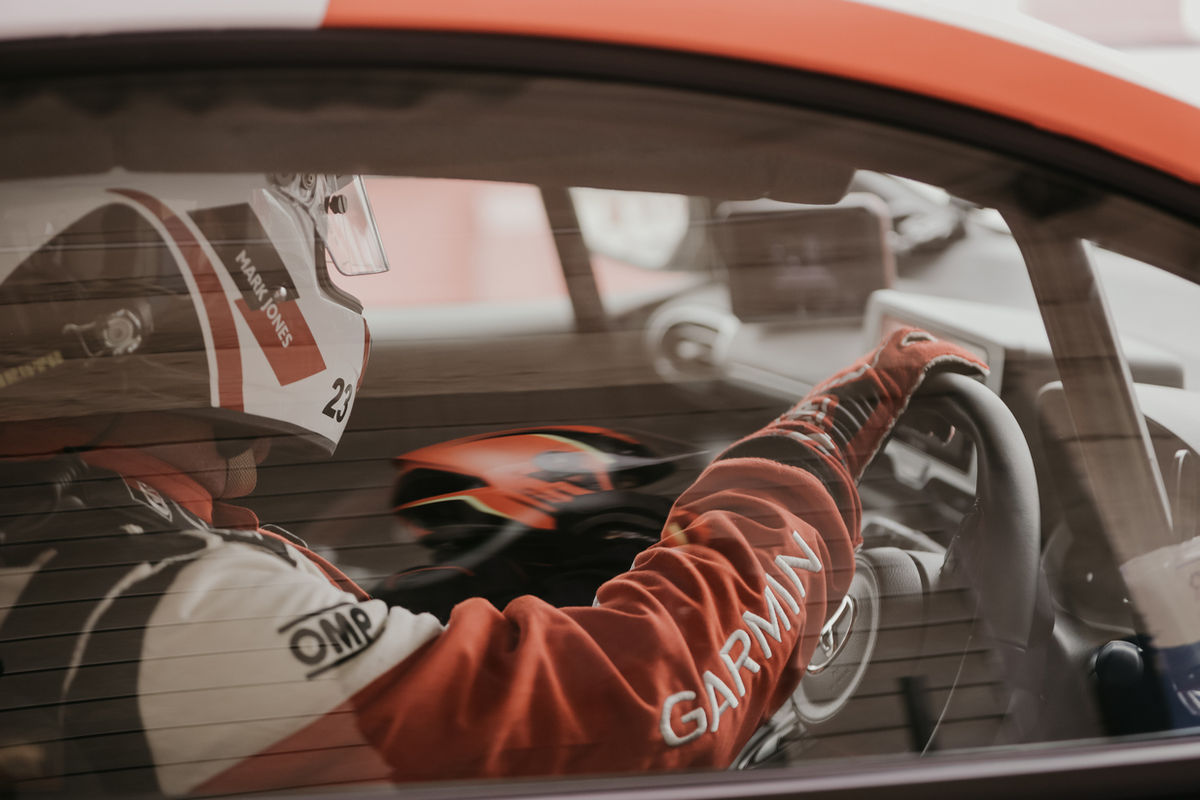
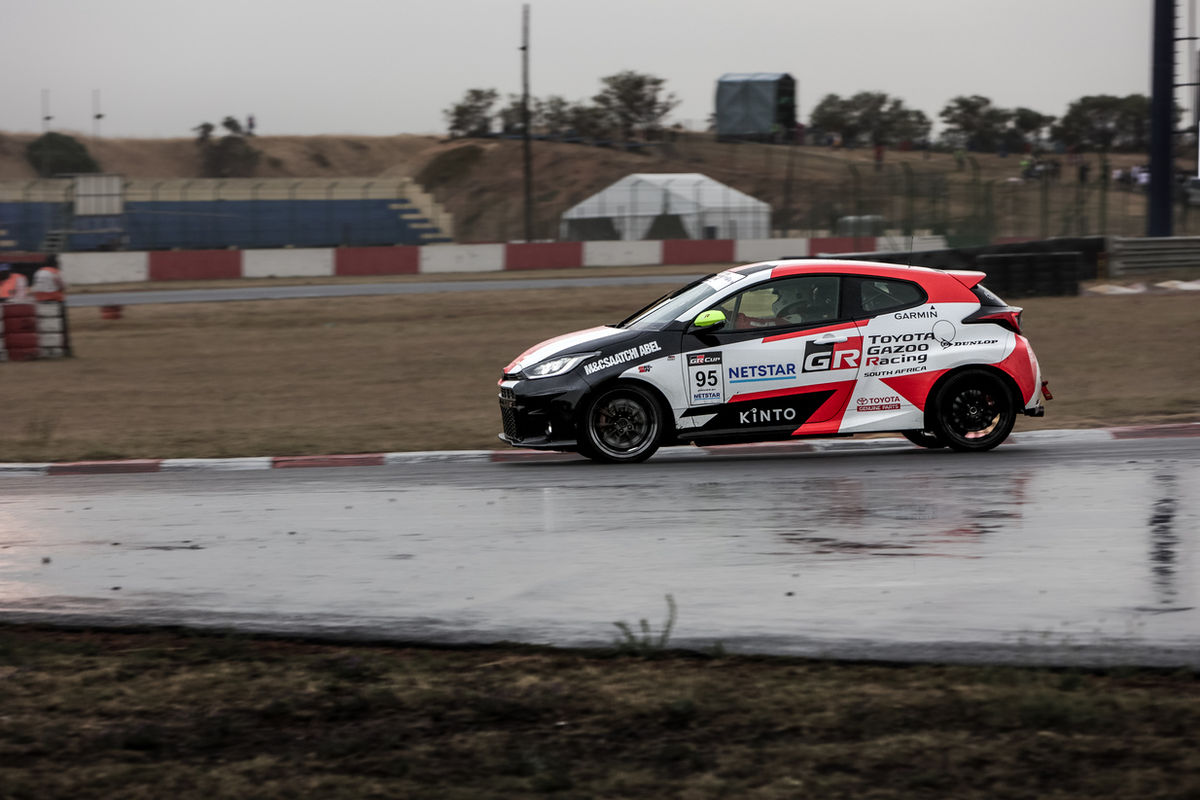
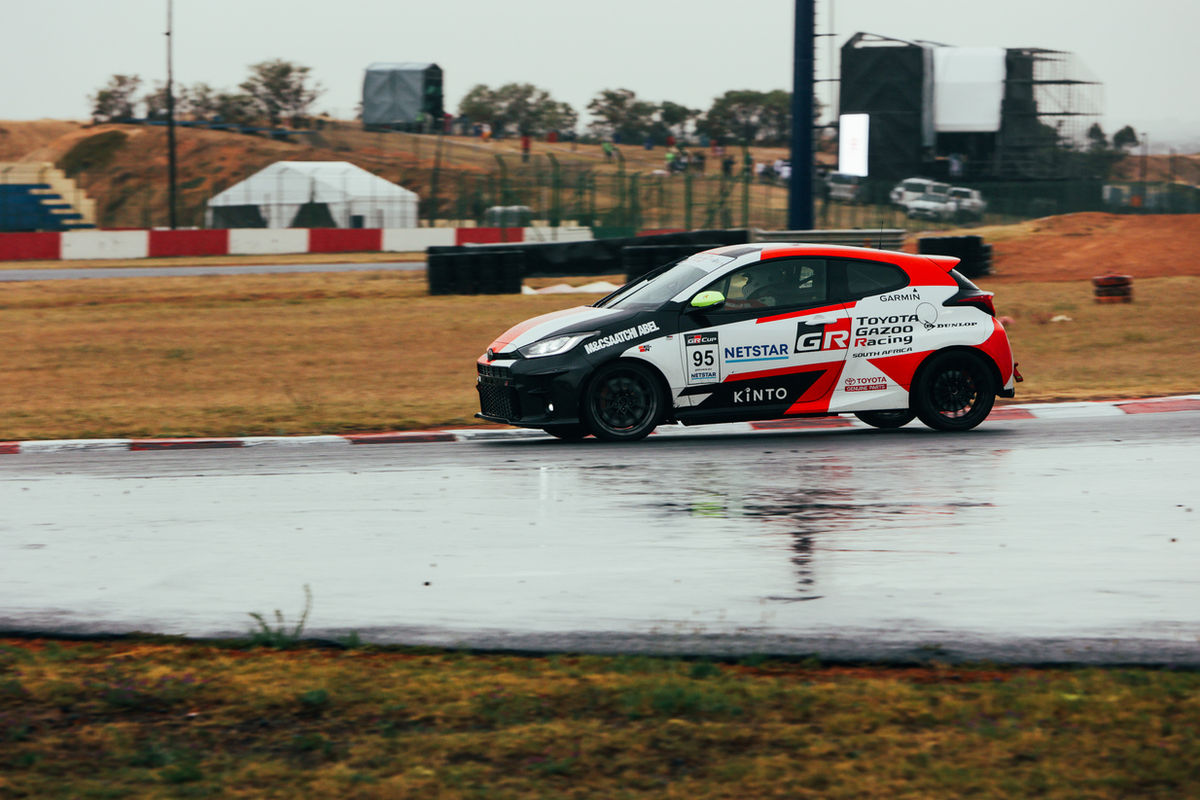
It may have been December in Cape Town, but rain began pelting down a few hours before sunset. In the calm hands of Mark Jones from The Citizen, our GR Yaris lapped consistently, avoided incidents and gave no trouble we couldn’t manage. We did see a warning that the car’s all-wheel-drive system was overheating (the GR Yaris was temporarily 2WD), but after a few laps, the 4WD thankfully re-engaged.
A road car’s all-wheel-drive system probably isn’t meant to distribute power up and down the driveline so often for hour upon hour, so that that was our only problem was still impressive. Considering that our lap times would only drop by a few seconds a lap and by the end of the race, we were able to lap at reasonably similar times in 4WD and 2WD as the track yielded so much grip after the rain cleared up.
Thomas Falkiner of TimesLive and Jeanette Kok-Kritzinger of Wiele2Wiele both completed their stints without any problems and it was up to me to complete the daunting final (2-hour) run to the finish.
The rhythm of the night
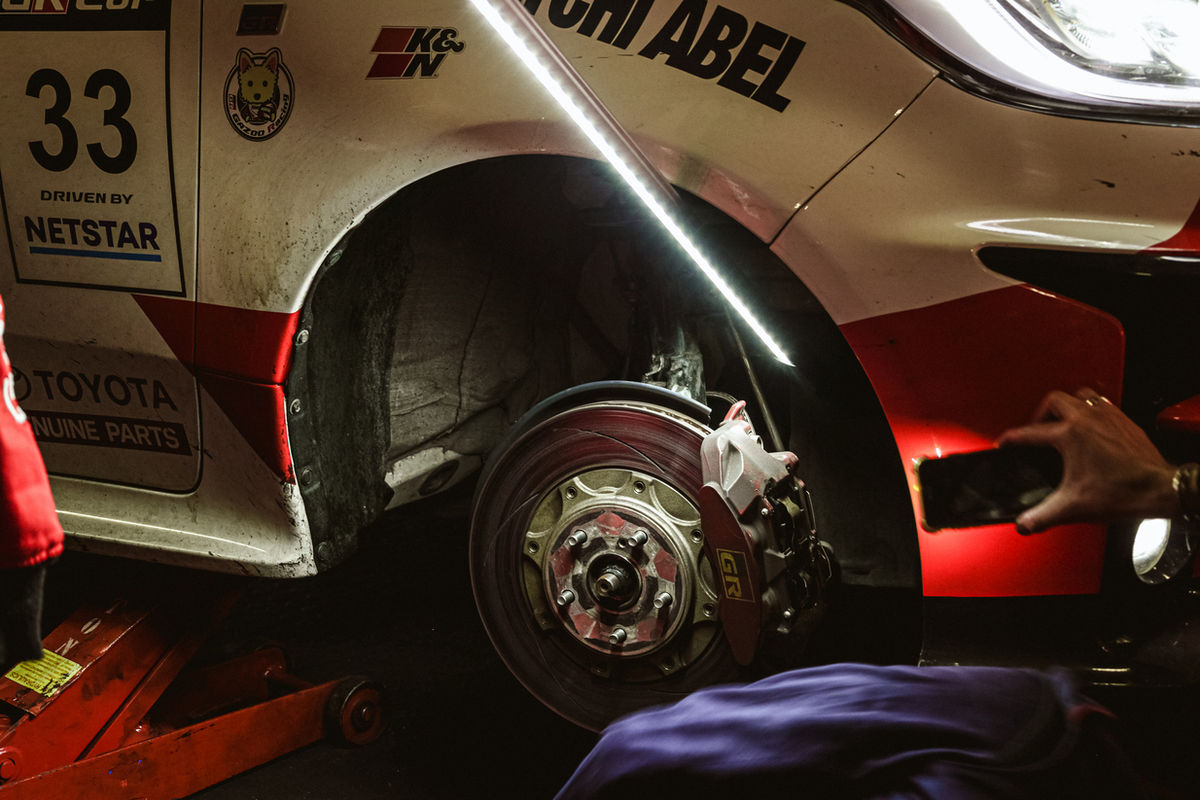
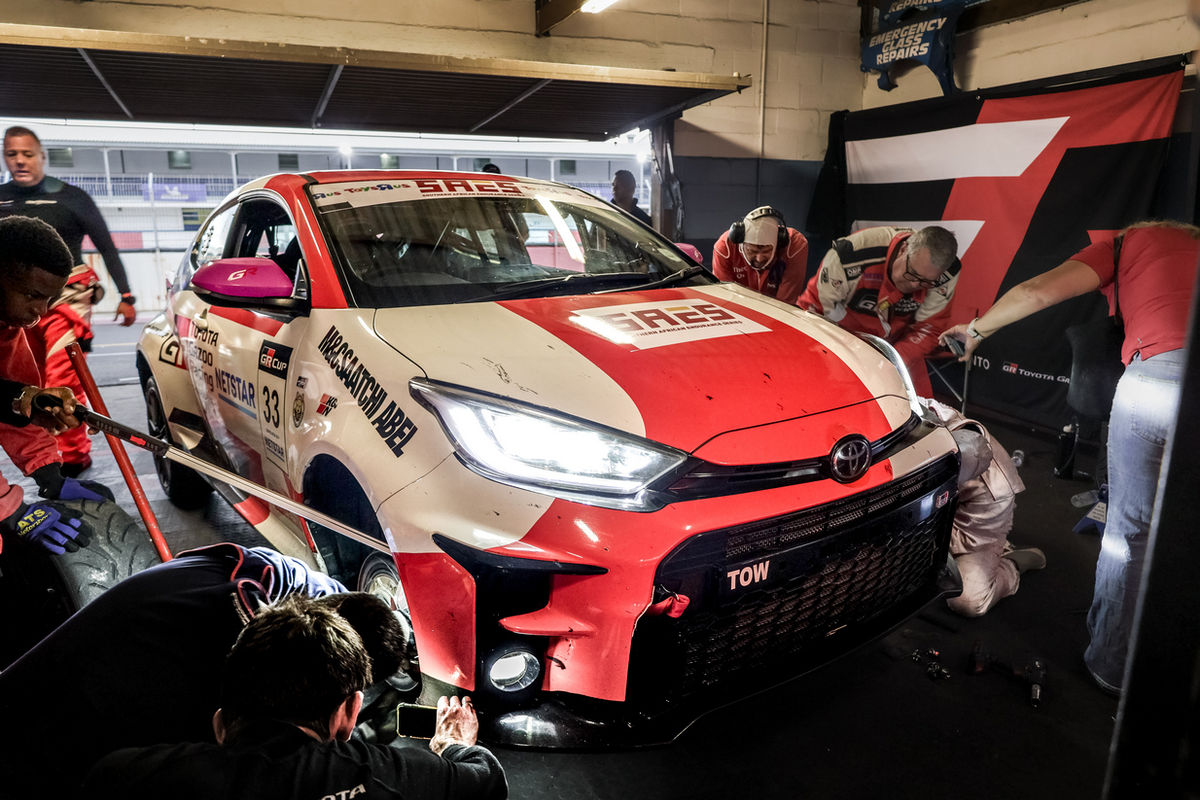
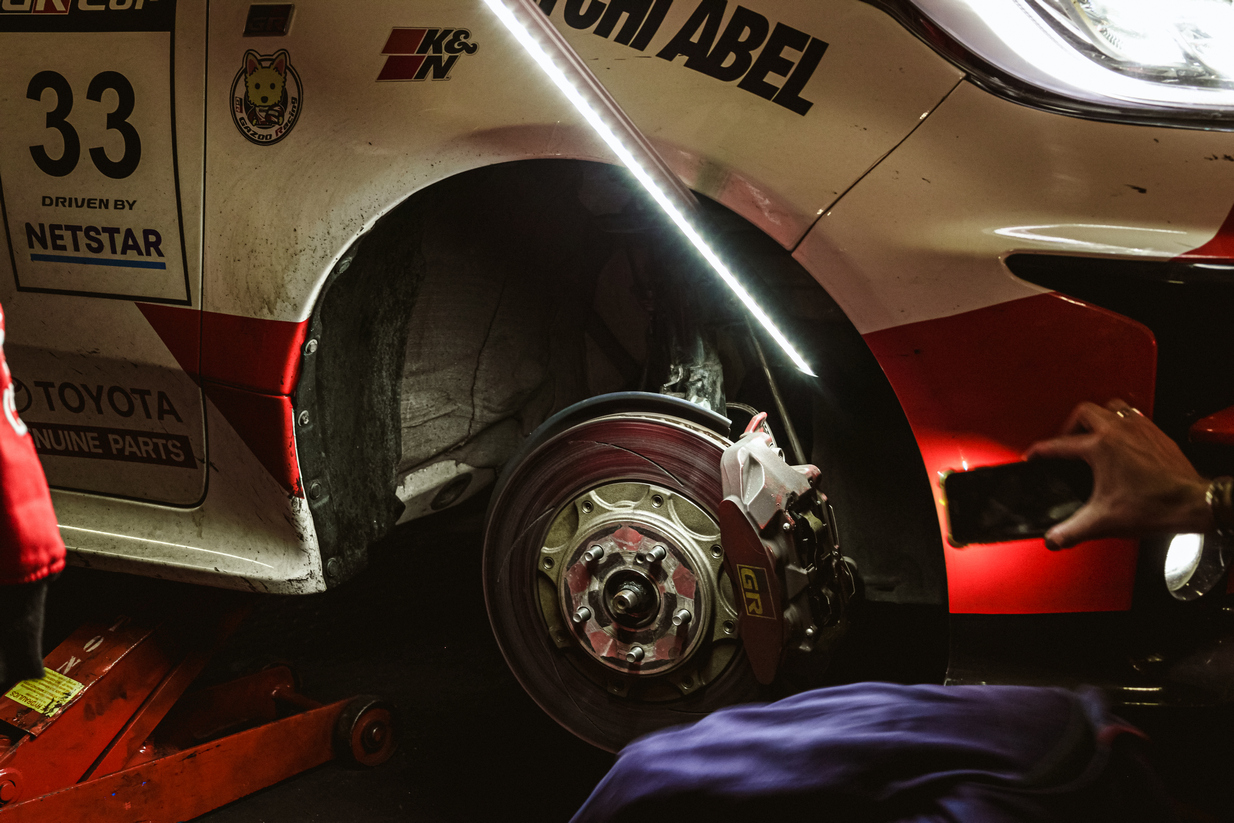
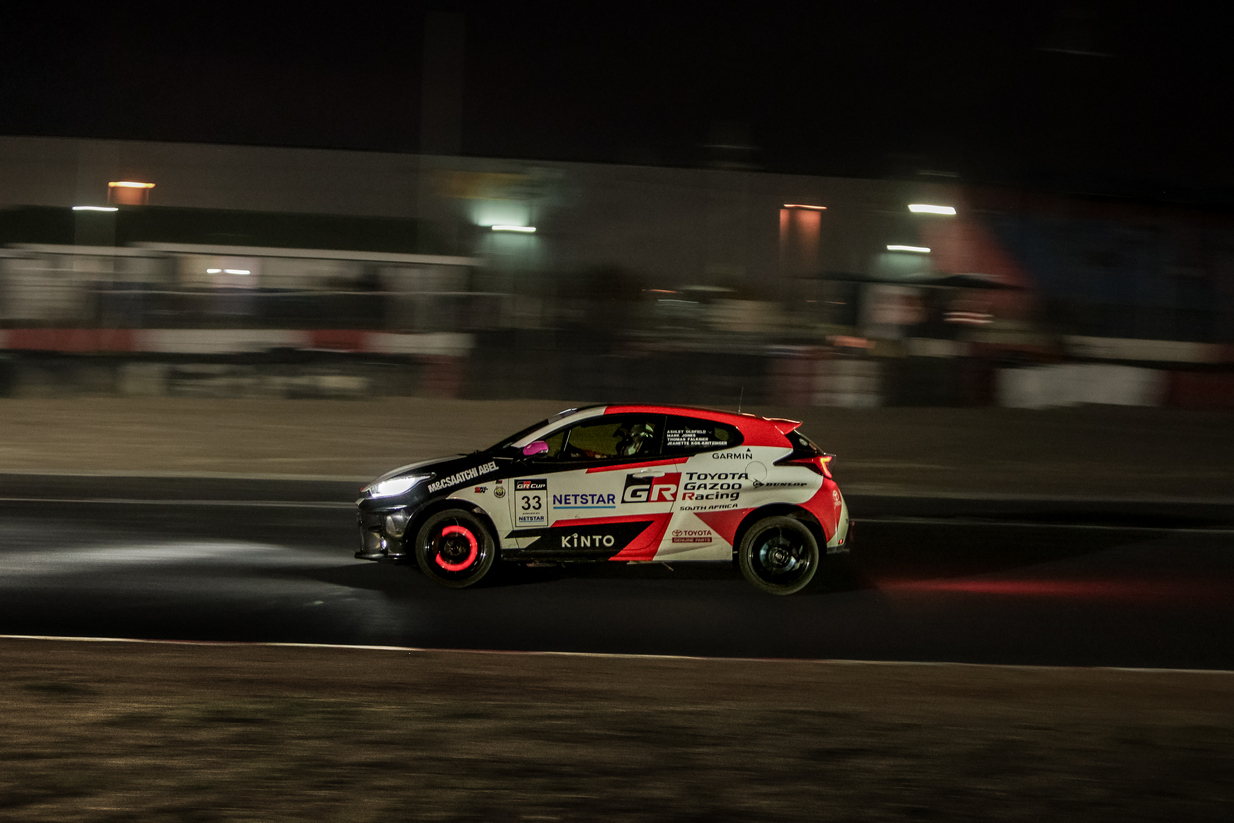
It took just 5 minutes to replace the pads during our pitstop.
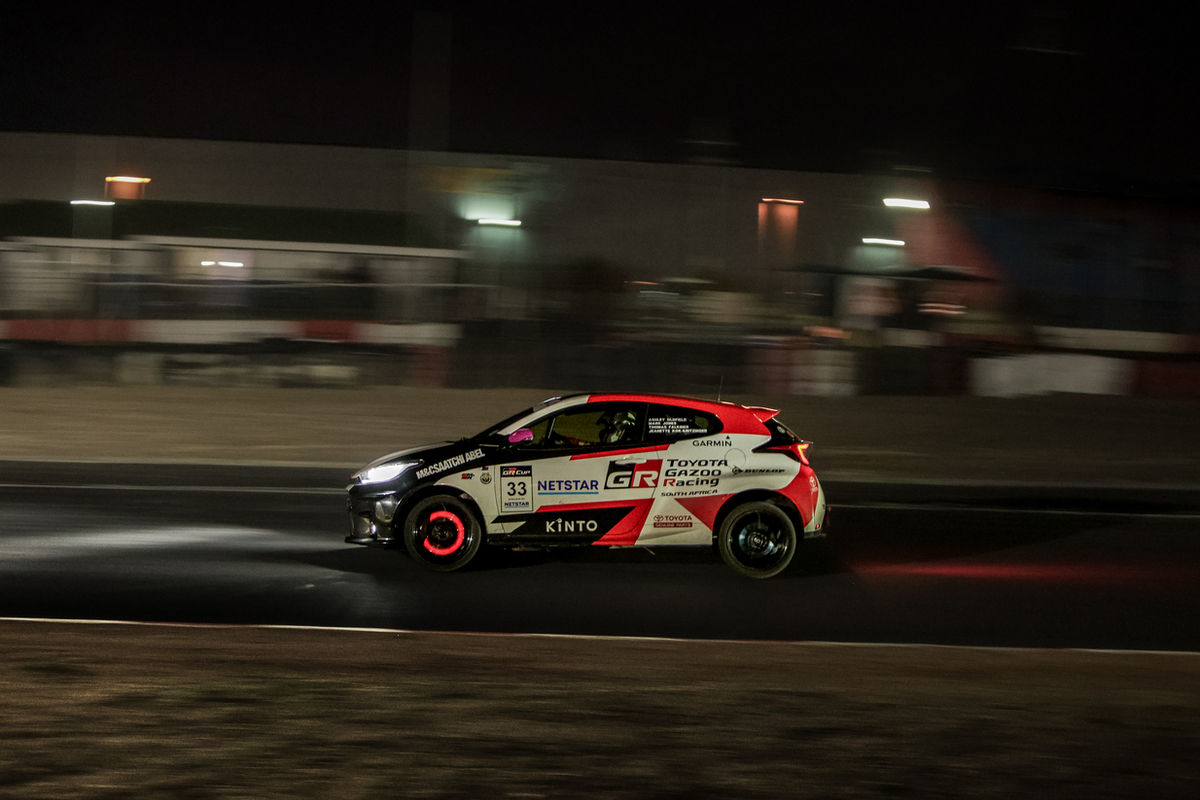
Due to the overcast conditions, darkness rolled in earlier than expected and the last hour and a half of the race was run in the dark. At that point, more cars seemed to career off the track because braking points were no longer visible, the cars behind you were no longer distinguishable and neither were the closing speeds with which they approached. In other words, you were never sure whether it was a flying Audi R8 or BMW M3 coming up behind you, all you saw were massive lights in your rear-view mirror.
In such conditions, overtaking – and being overtaken – comes with heightened risk, because you’re never sure what’s ahead of you or what car may have spun and could be stranded offline (it would be so easy to steam into its side). A few cars spun off and got trapped in the gravel during the final hour, after which they’d require assistance to get going again; meanwhile, our consistent GR Yaris piled on the laps.
Have you ever raced at night if you don’t have a photo of a glowing brake disc to prove it?
As we crossed the line at 9:15 pm, we had completed 314 laps of Killarney in 9 hours of hard racing. One precautionary change of brake pads for each car was the only mechanical replacement from the start of the weekend – a testament to the reliability of the little Toyota.
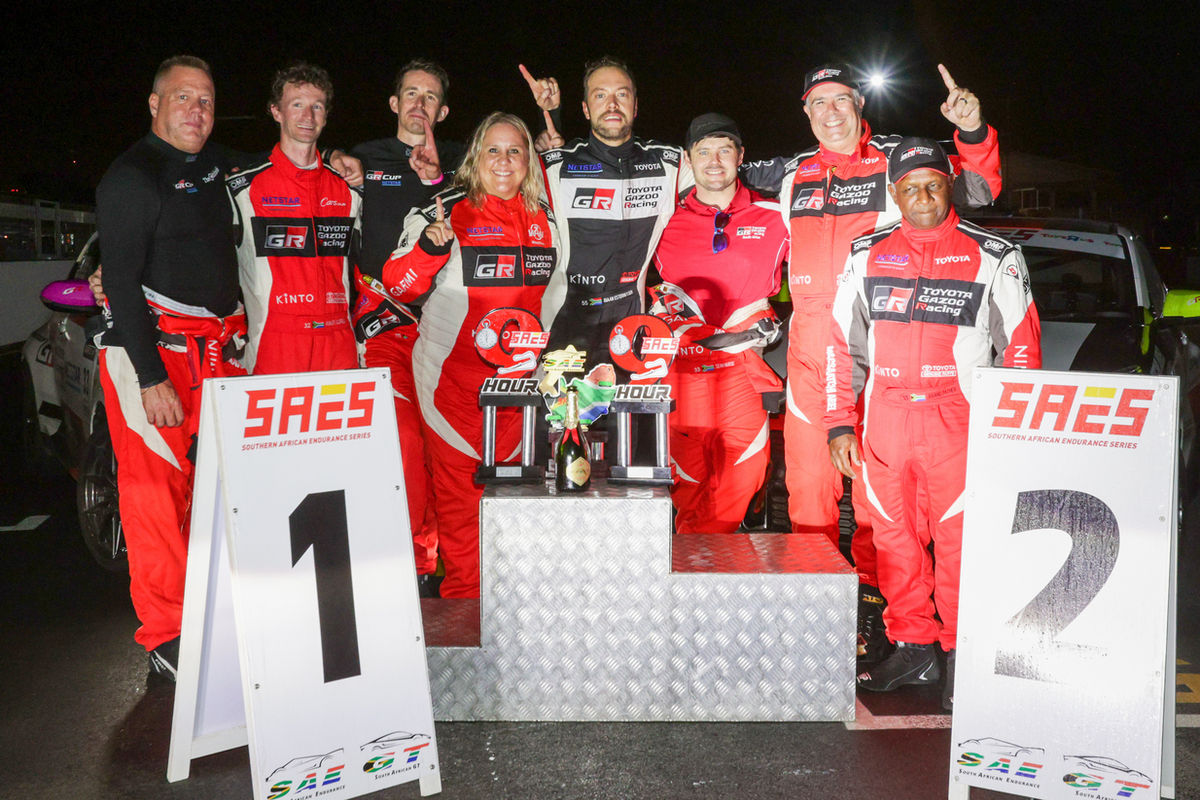
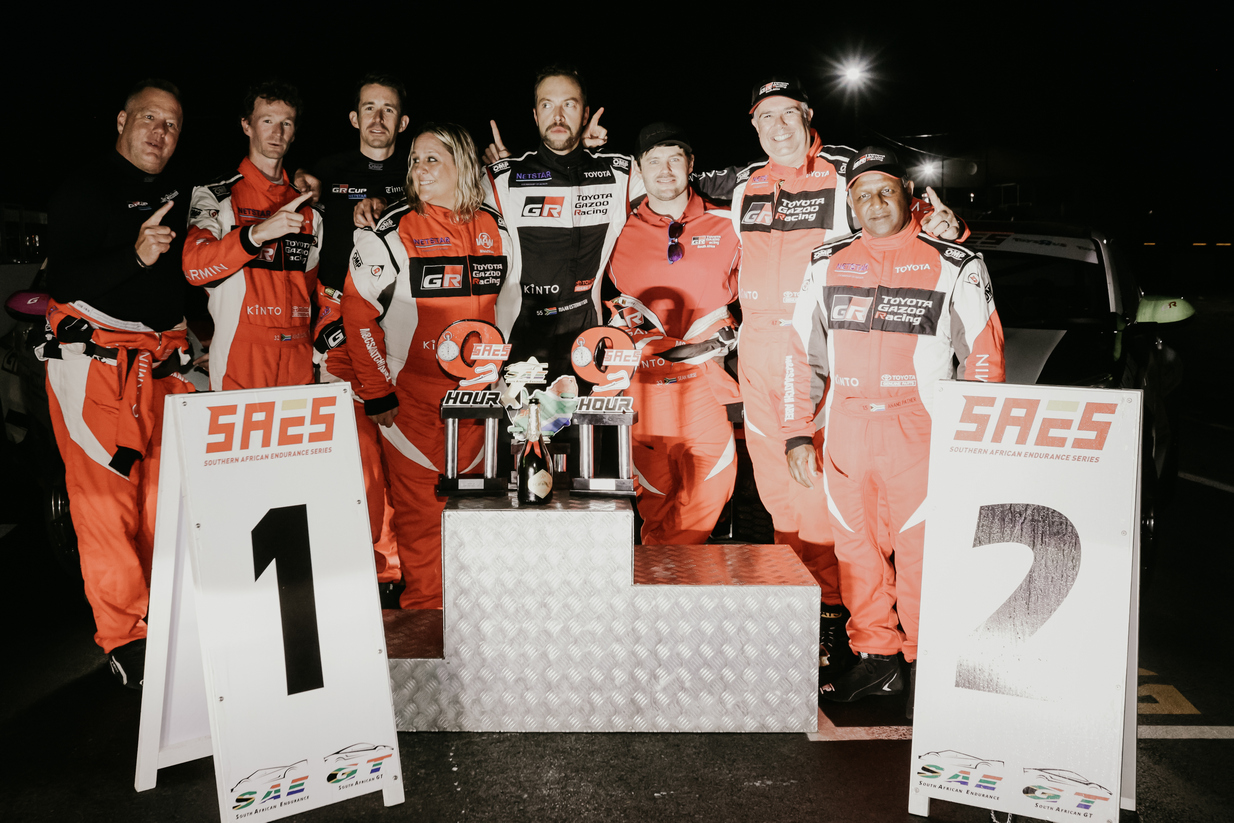
We finished 8th overall and 3rd in class, but the real honours were taken in the Index of Performance, where the GR Yarises finished 1st and 2nd as the most consistent cars over the course of the 9-Hour.
First and second for the GR Yaris teams in the Index of Performance category.
Apart from performing my duties as Cars.co.za’s content manager in 2022, I experienced an incredible year of racing. I raced the GR Yaris to championship honours with a round to spare and was rewarded with an outing in a GTC Corolla in SA’s premier circuit racing series. Let’s see what’s in store for 2023.
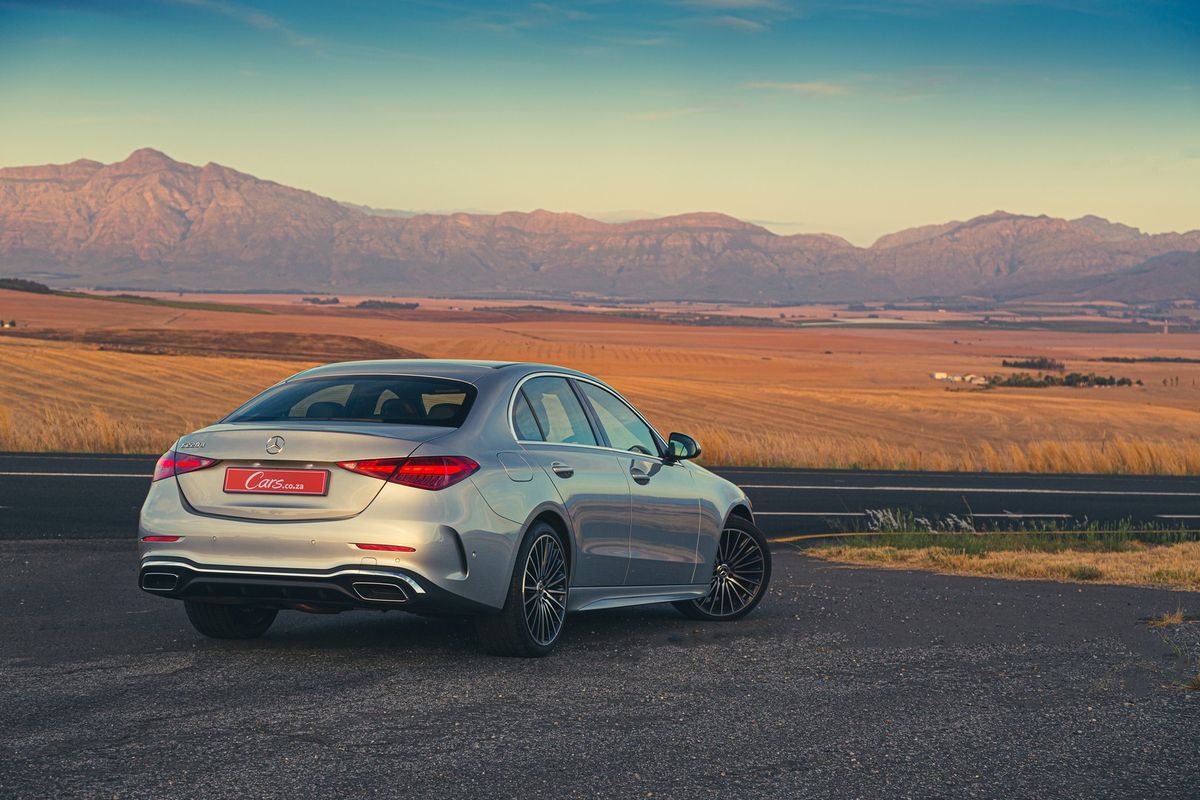
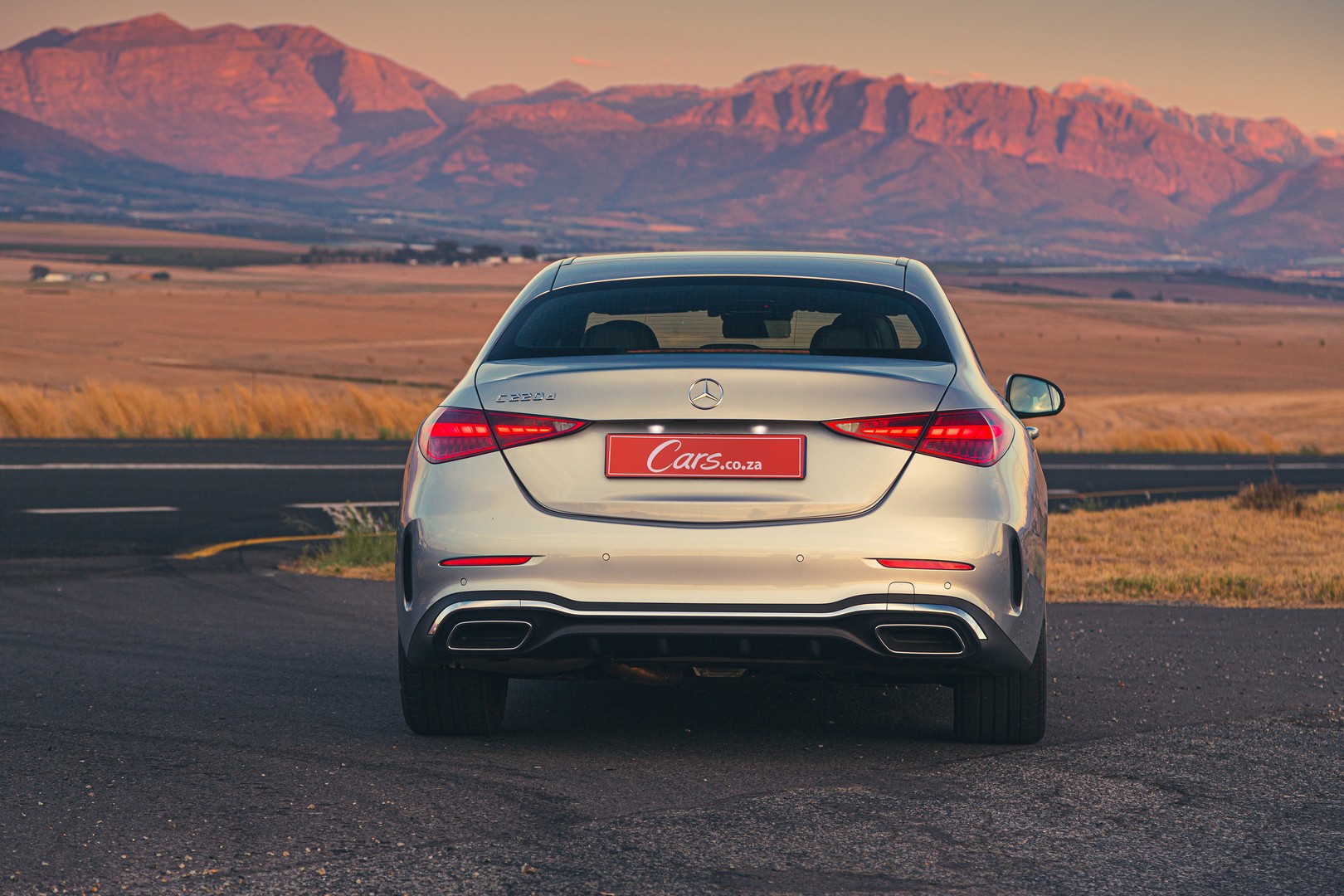
Mercedes-Benz SA has produced every iteration of the C-Class business-class sedan, and the W206-generation model is no exception. The newcomer has drawn a lot of praise for its more spacious, tech-focused interior and all-round ability, but does it live up to the hype?
We like: Superb engine and economy, tech-laden interior, refinement galore.
We don’t like: Small boot, some materials are cheap-feeling, price of options, steering controls will frustrate, expensive.
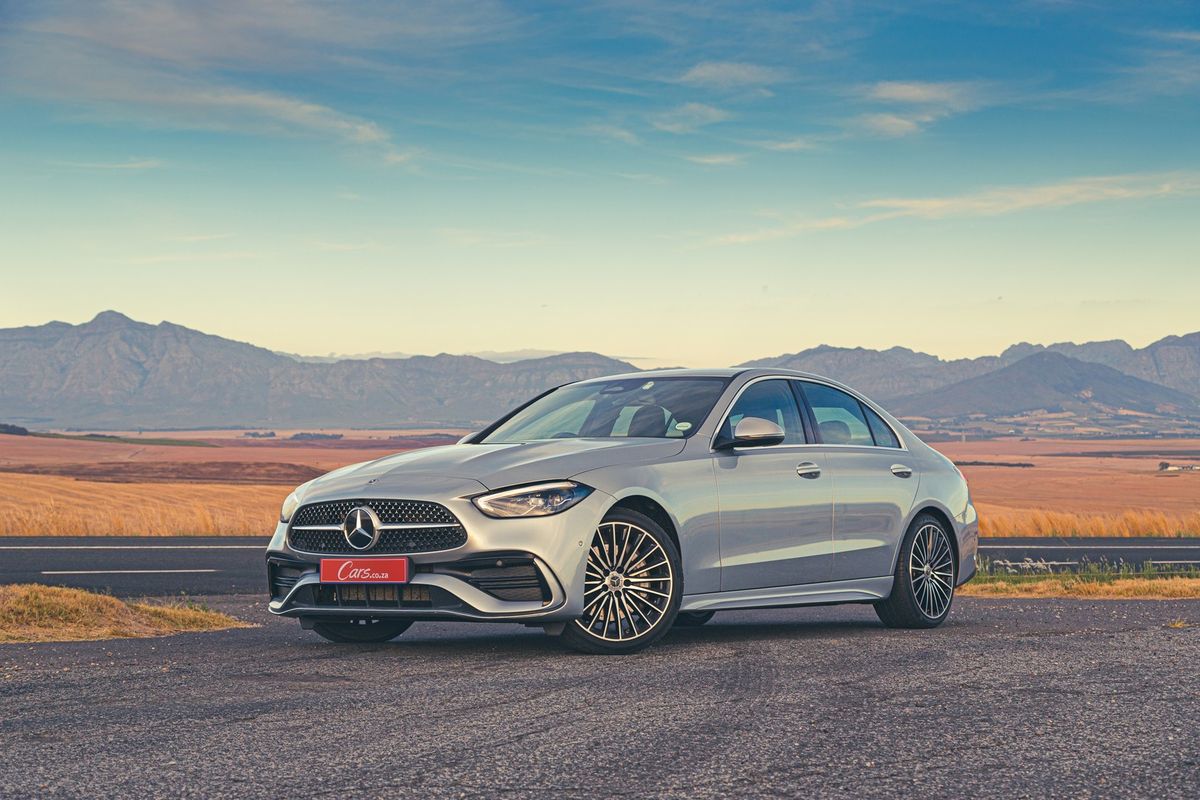
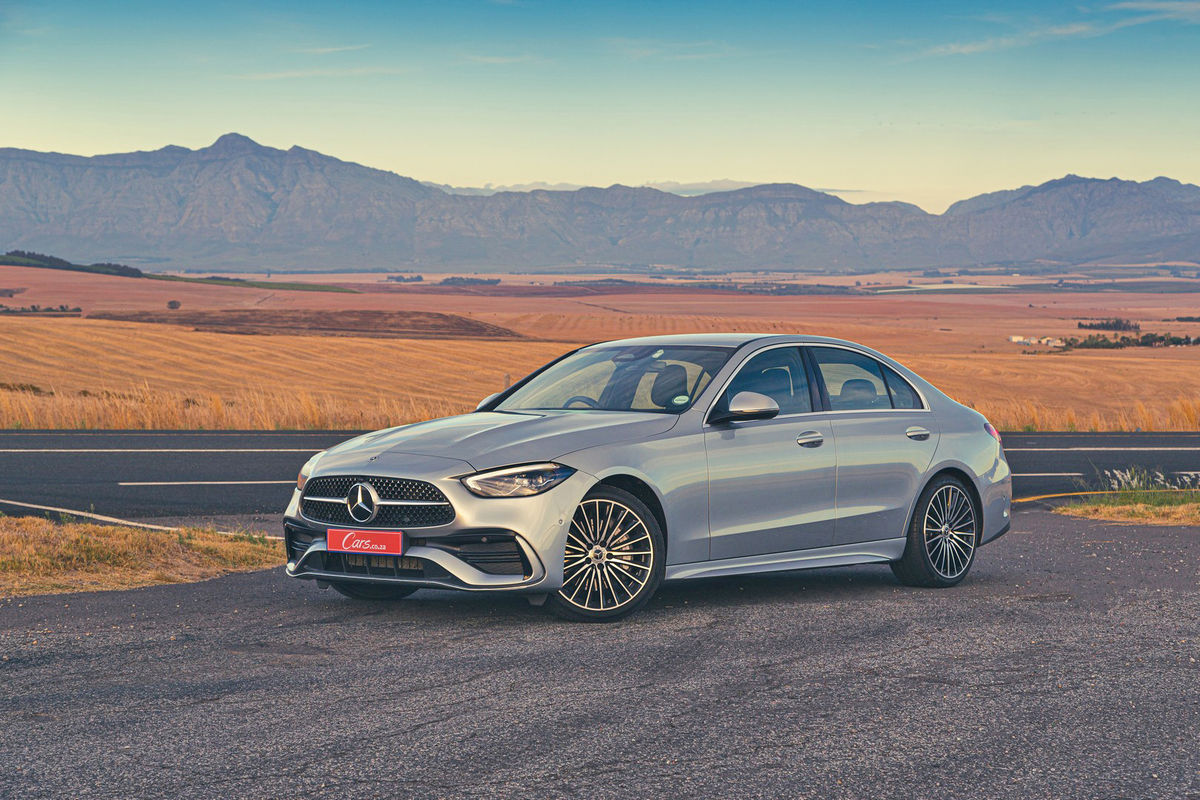
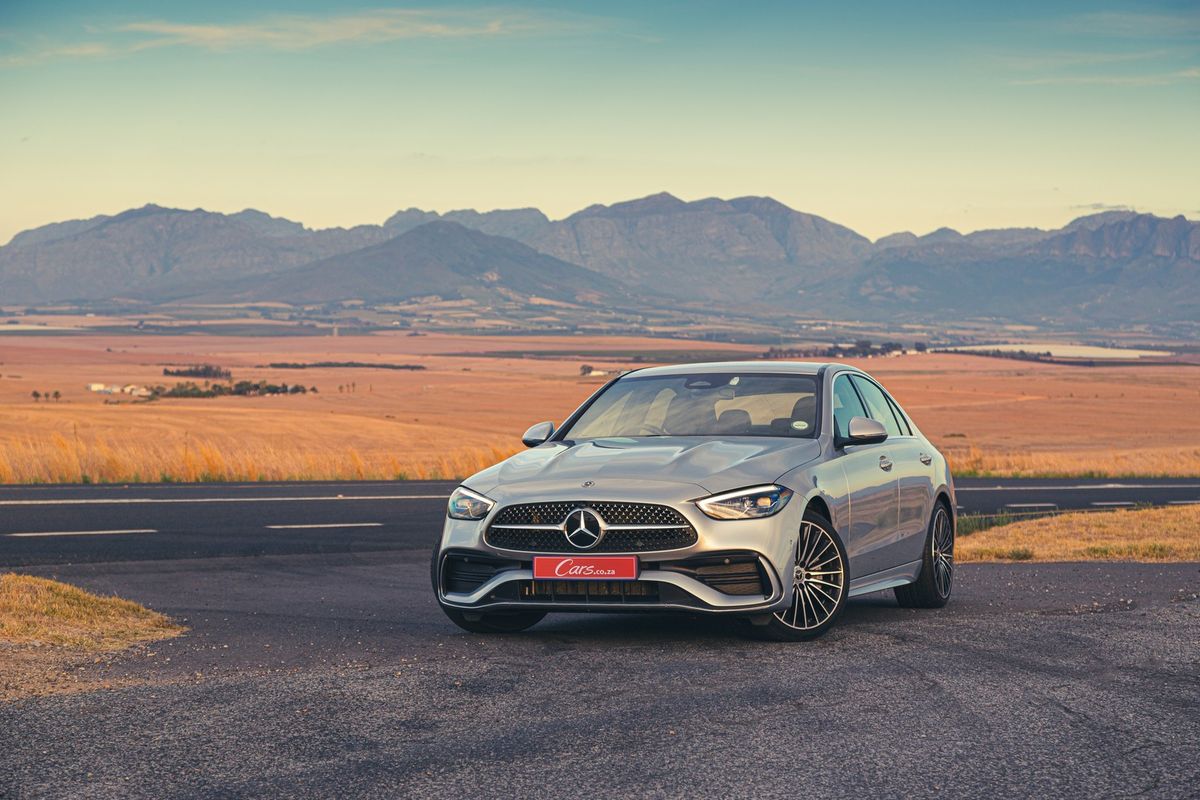
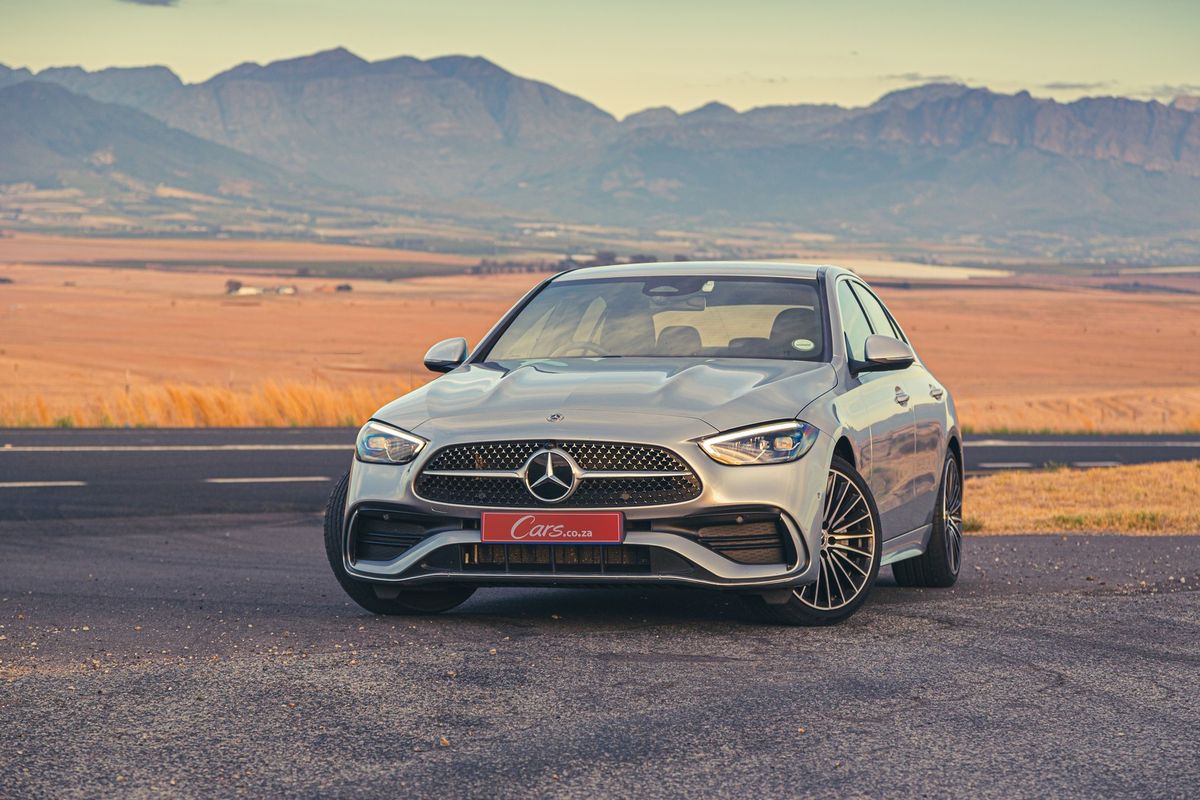
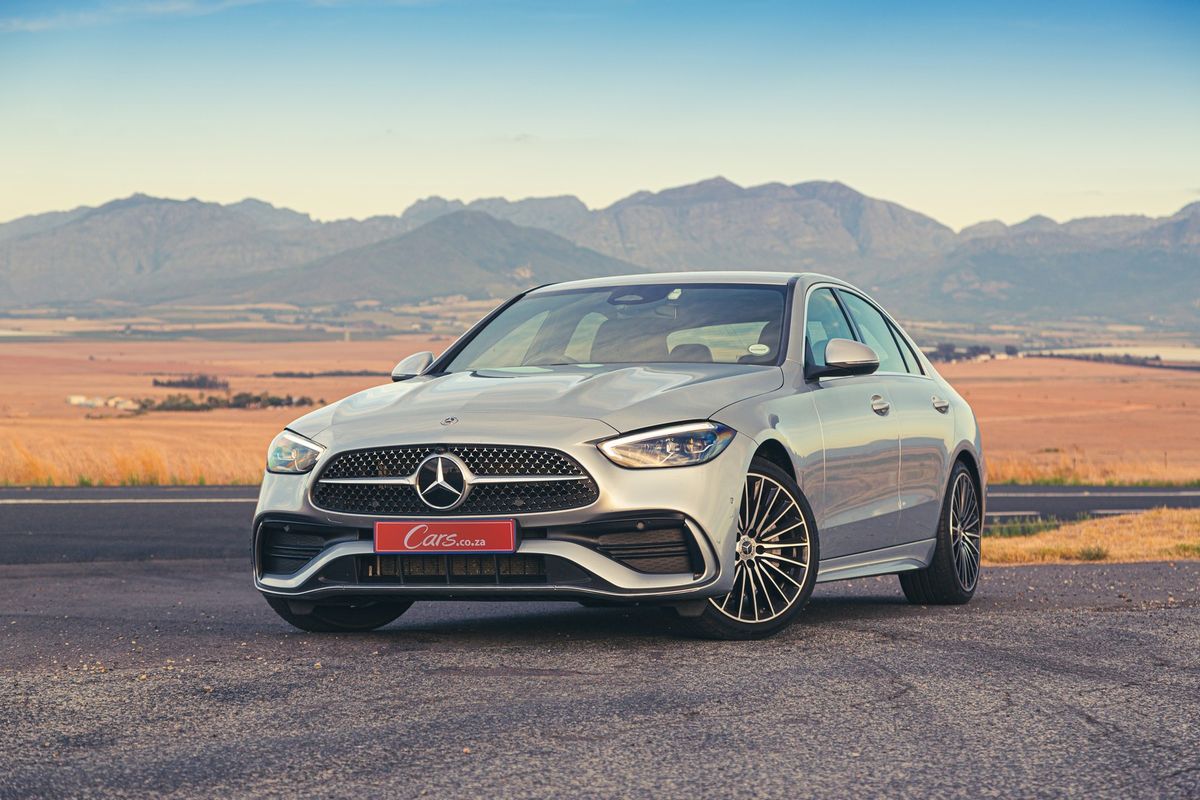
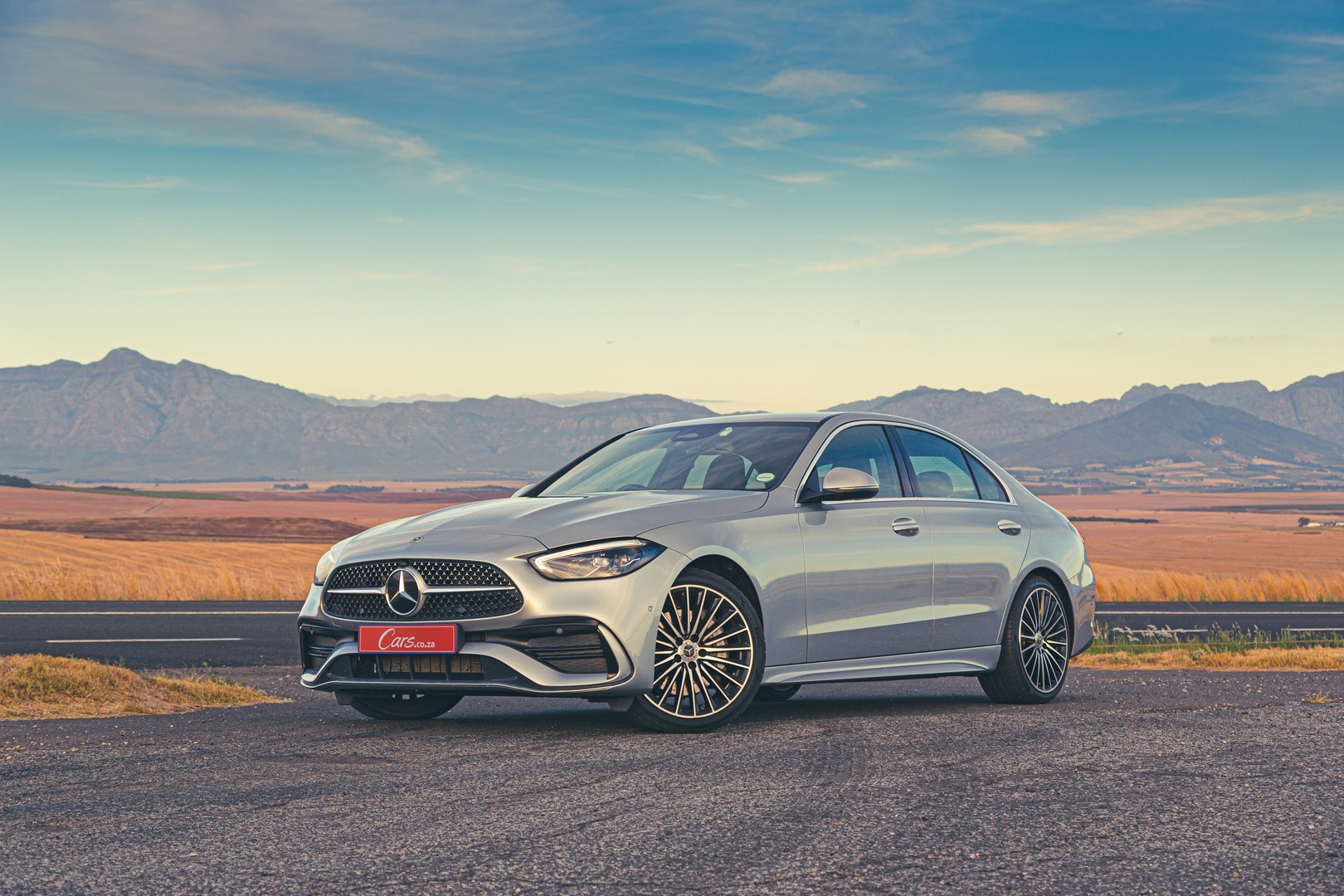
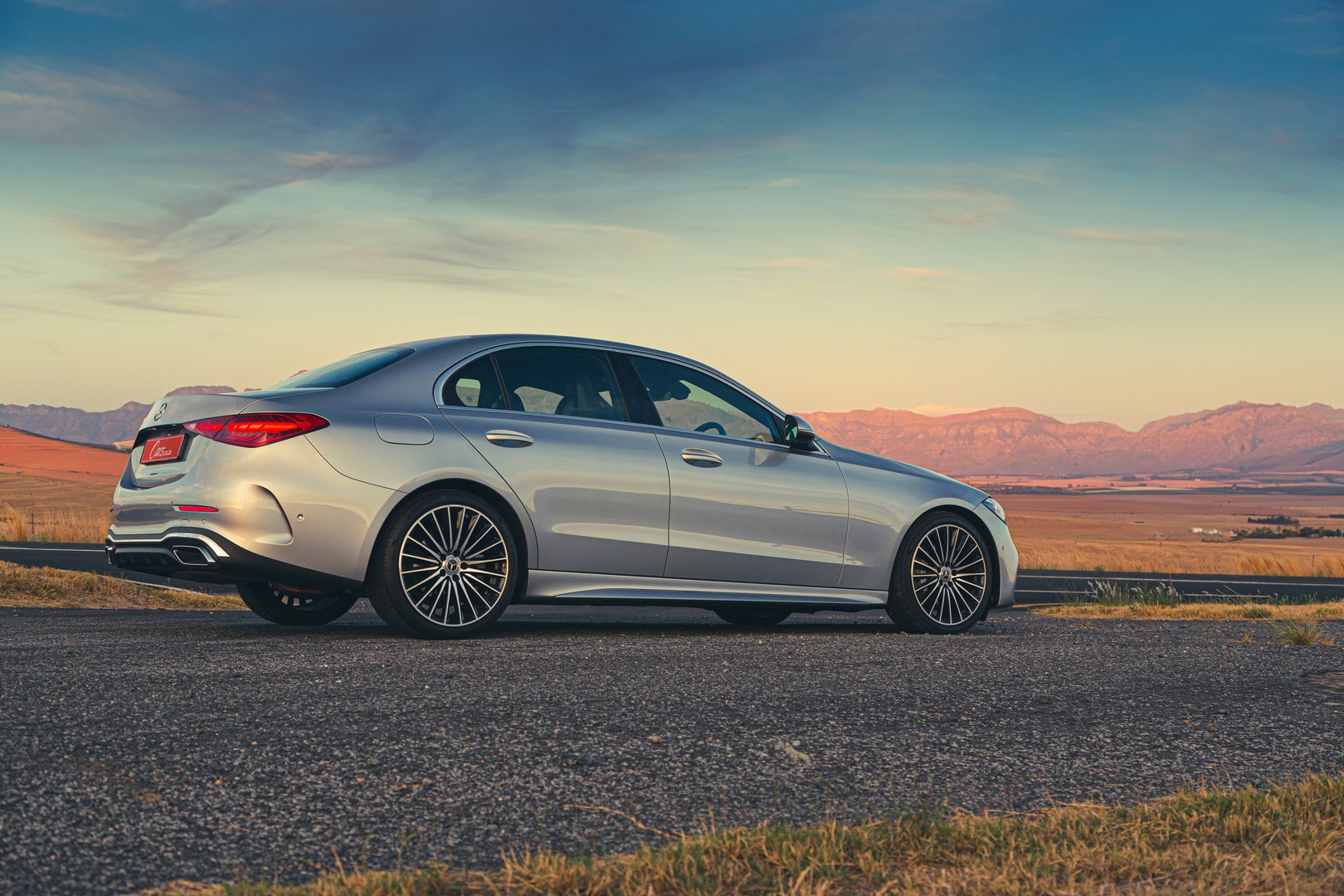
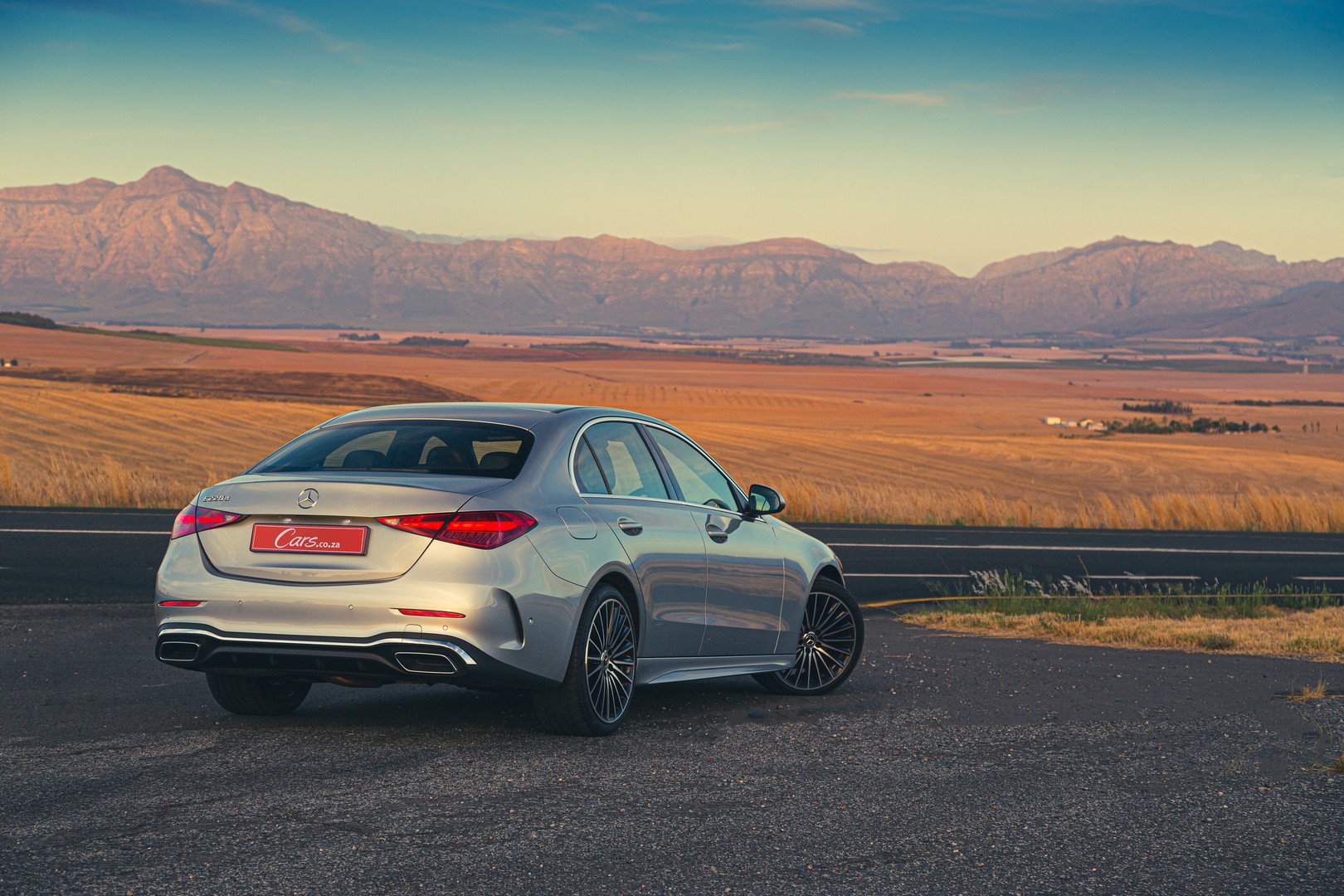
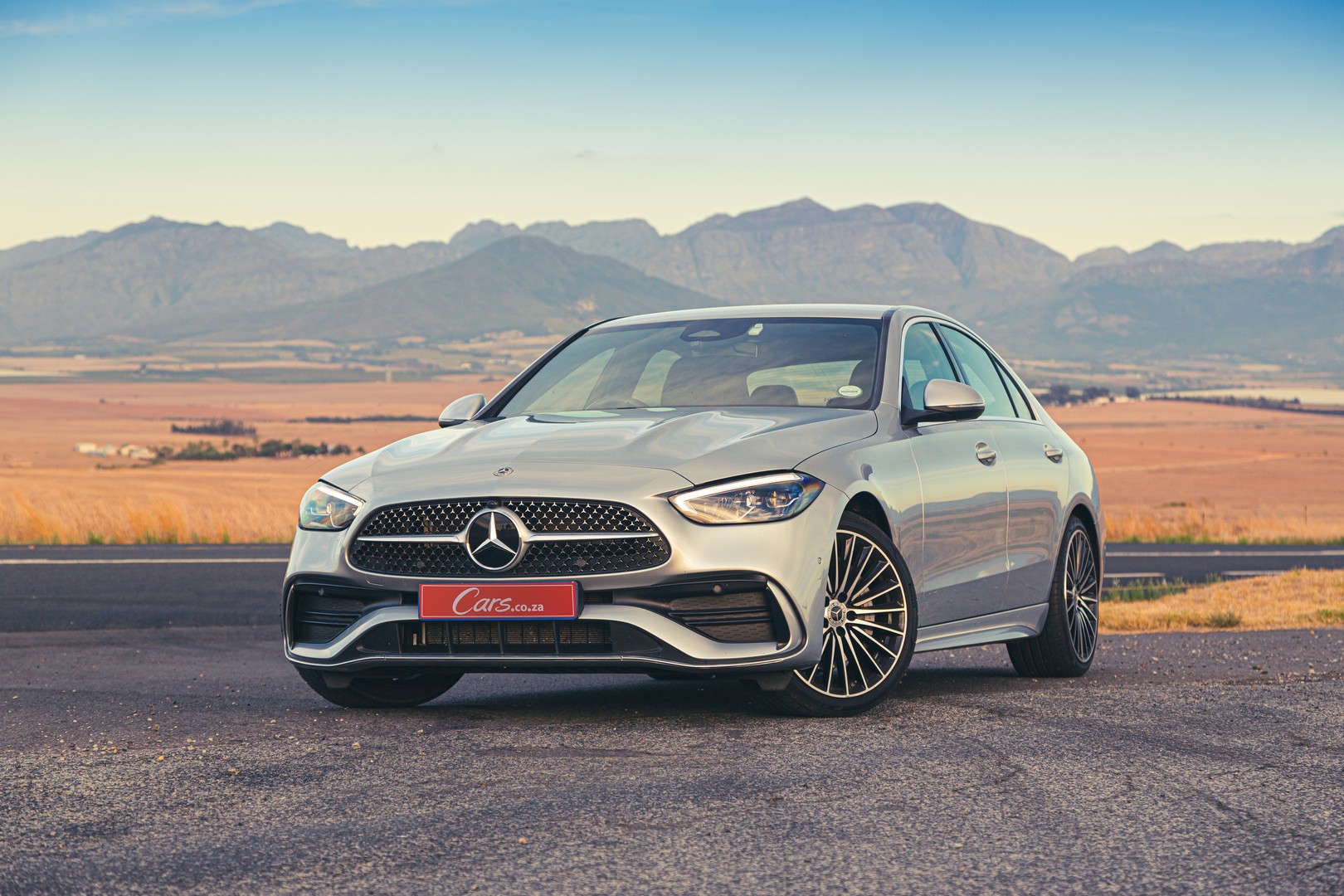
The new Mercedes-Benz C-Class takes styling cues directly from its S-Class flagship sibling.
Meet the all-new, W206-generation, Mercedes-Benz C-Class. The Stuttgart-based luxury carmaker, despite its expansive and diverse product portfolio, still believes there’s a core customer group that will opt for a traditional sedan over a fashionable crossover or SUV… Since the C-Class made its debut, sales have breached the 8.6-million mark.
Irrespective of how this review pans out, cars such as the locally made C-Class demonstrate that South Africa is still regarded as a crucial manufacturing locale by car firms. Mercedes-Benz’s East London factory has been active since 1958 and currently employs over 3 300 people. In 2018, Mercedes-Benz Cars announced an investment of €600-million to expand the Border-region plant and, right now, it’s one of 3 factories that assemble the C-Class for the global market.
Mercedes-Benz has given the new W206 mild-hybrid powertrains – ICE engines supplemented with a 48V electrical system and integrated starter-generator (ISG) – to keep pace with the demands of greater efficiency. There are also claims that the vehicle’s materials and assembly process “set standards with respect to sustainability”.
For the South African market, customers can choose either a turbopetrol-powered C200 or a turbodiesel-powered C220d, with either Avantgarde (standard) or AMG Line trim levels. The new sedan is longer, wider and lower than the outgoing model, while the wheelbase has been lengthened by 25mm to create additional passenger space.
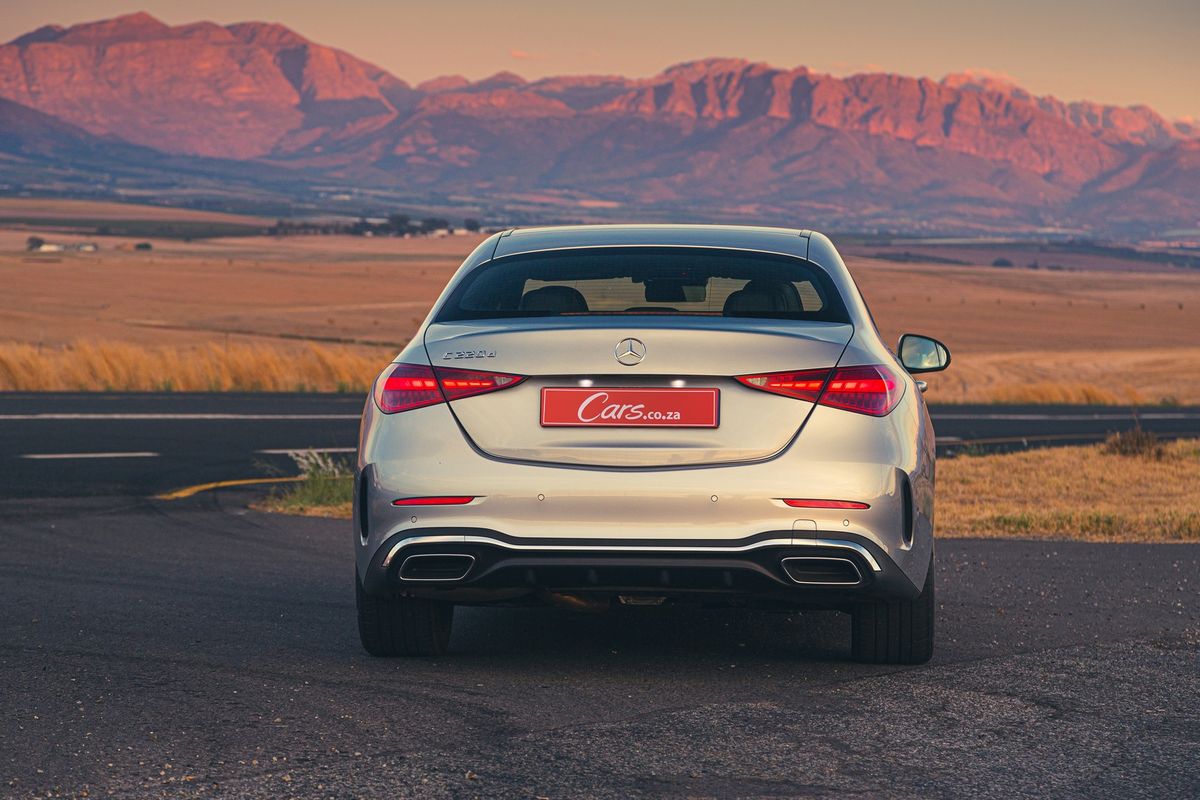
C220d is the pick of the bunch, with an excellent and refined diesel powertrain.
Rivals?
Despite the rampant popularity of crossovers/SUVs and, to put it bluntly, the ever-higher entry price of business-class sedans, this segment still offers excellent options if you’re looking for a comfortable, luxurious premium sedan. The C-Class’ fellow countrymen are its natural rivals, with the BMW 3 Series and Audi A4 jostling for position. The Audi A4 is focused on comfort, refinement and luxury, while BMW 3 Series has traditionally been the dynamic, best-to-drive option (not that it lacks any luxury features).
Alfa Romeo still has some skin in the game – the recently-refreshed Giulia sedan arguably offers the finest driving dynamics of the lot, but that badge may not carry enough prestige in this elite segment. For something different, Jaguar will sell you its XE, a nice-to-drive, well-appointed sedan. Finally, for some Japanese reliability, Lexus comes in with not one, but two entrants – the IS and ES – both of which feature hybrid petrol engines.
How the 2022 Mercedes-Benz C-Class fares in terms of…
Design and Packaging
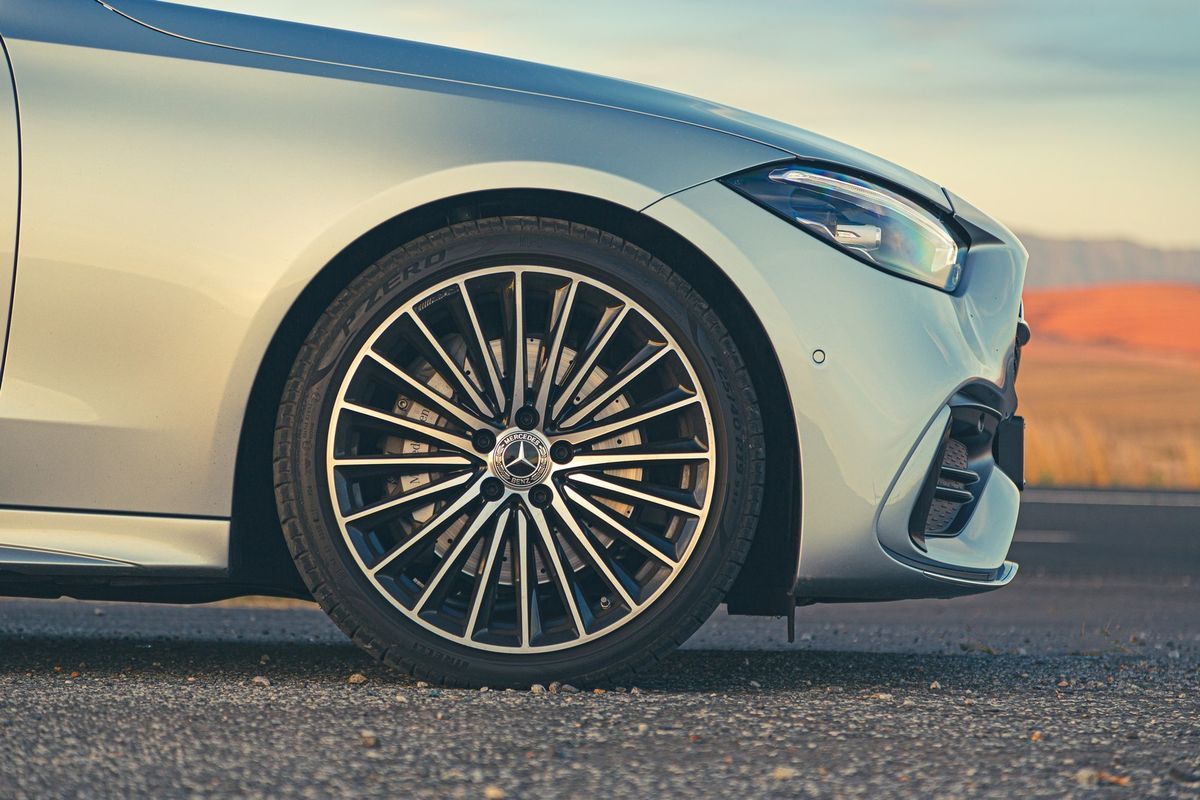
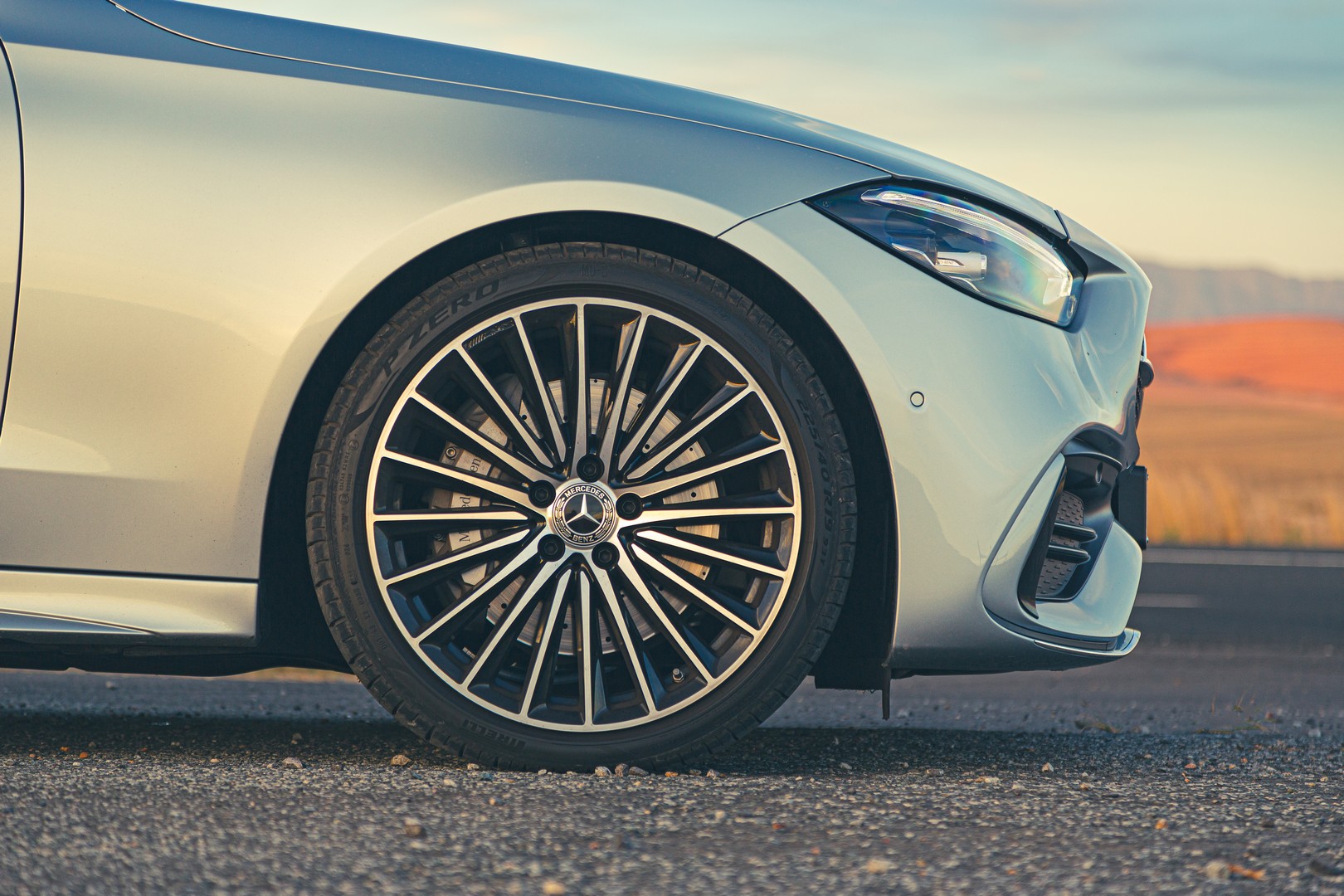
The AMG Line kit adds some visual punch in the form of a glitzy grille and traditional AMG multi-spoke alloy wheels
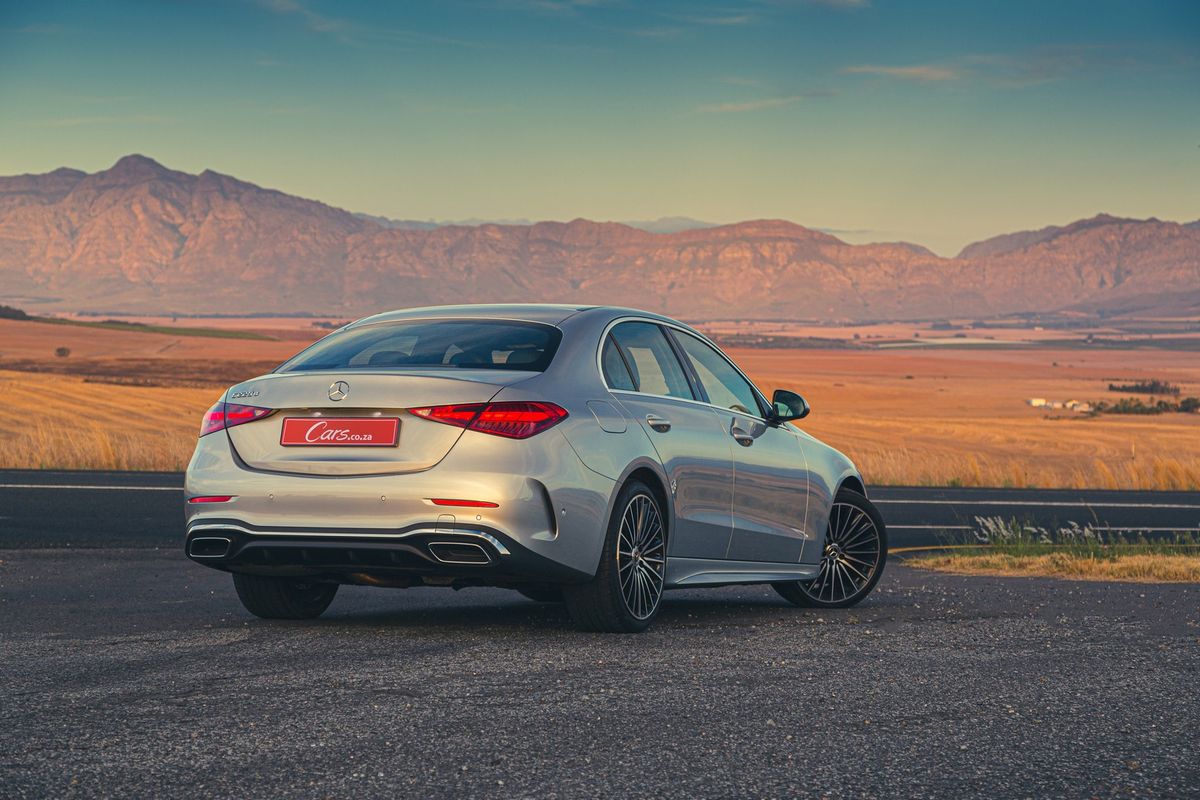
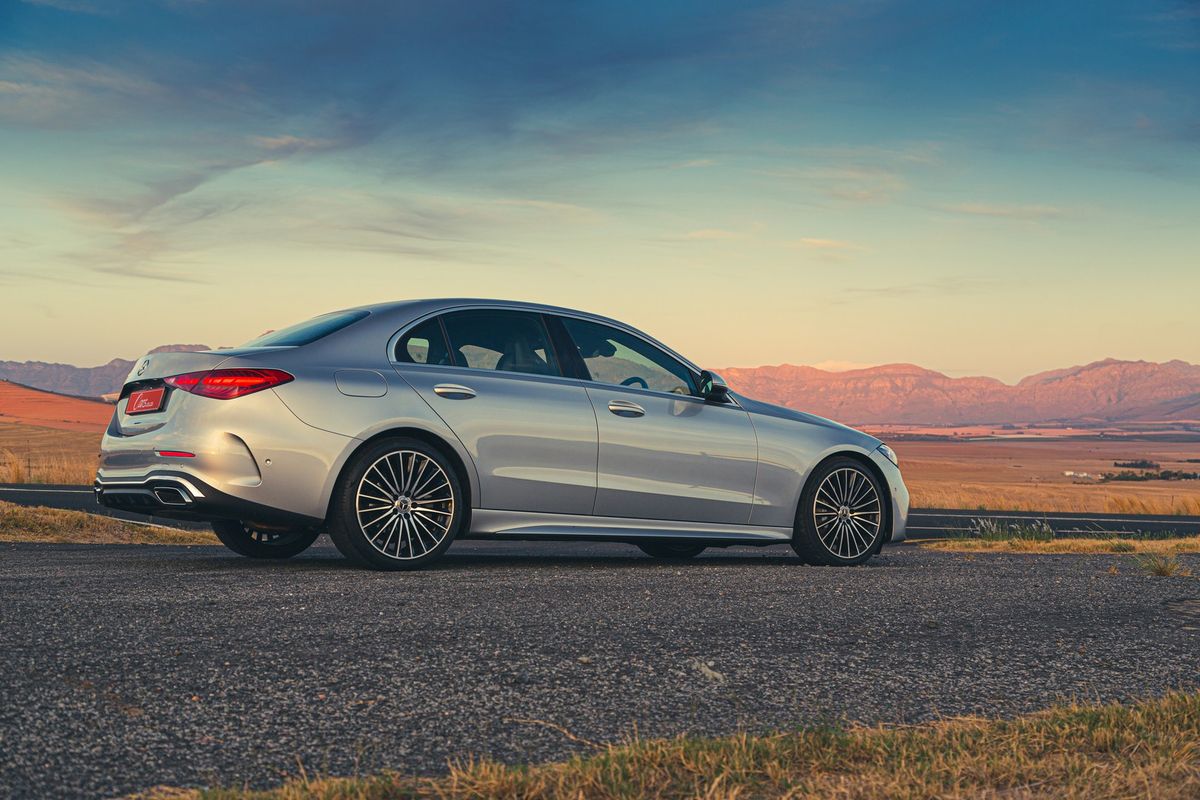
“Honey, I shrunk the S-Class” would be the perfect tagline for the C-Class’ design execution. Elements from Benz’s S-Class flagship (both exterior and interior) have made their way to the W206 and there’s no denying this is a fresh and modern-looking motor car, with the AMG Line’s gorgeously detailed grille and sporty-looking wheels further enhancing the kerb appeal.
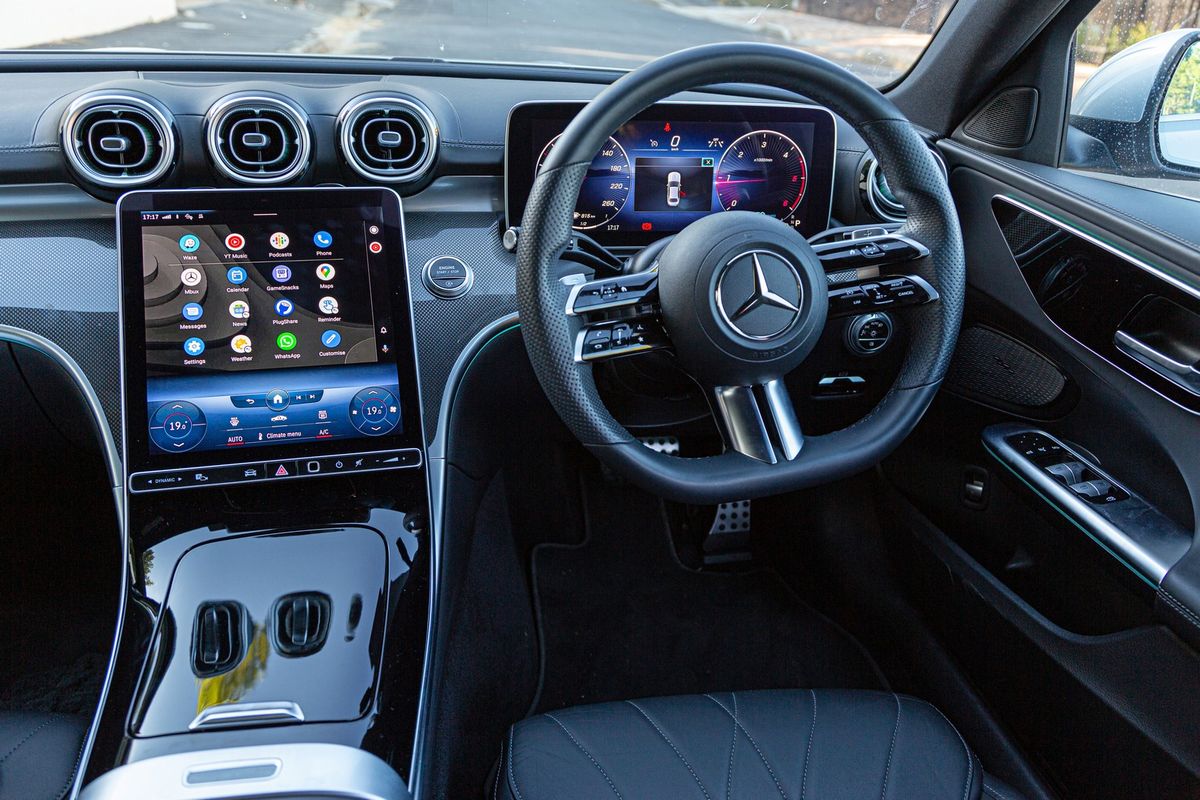
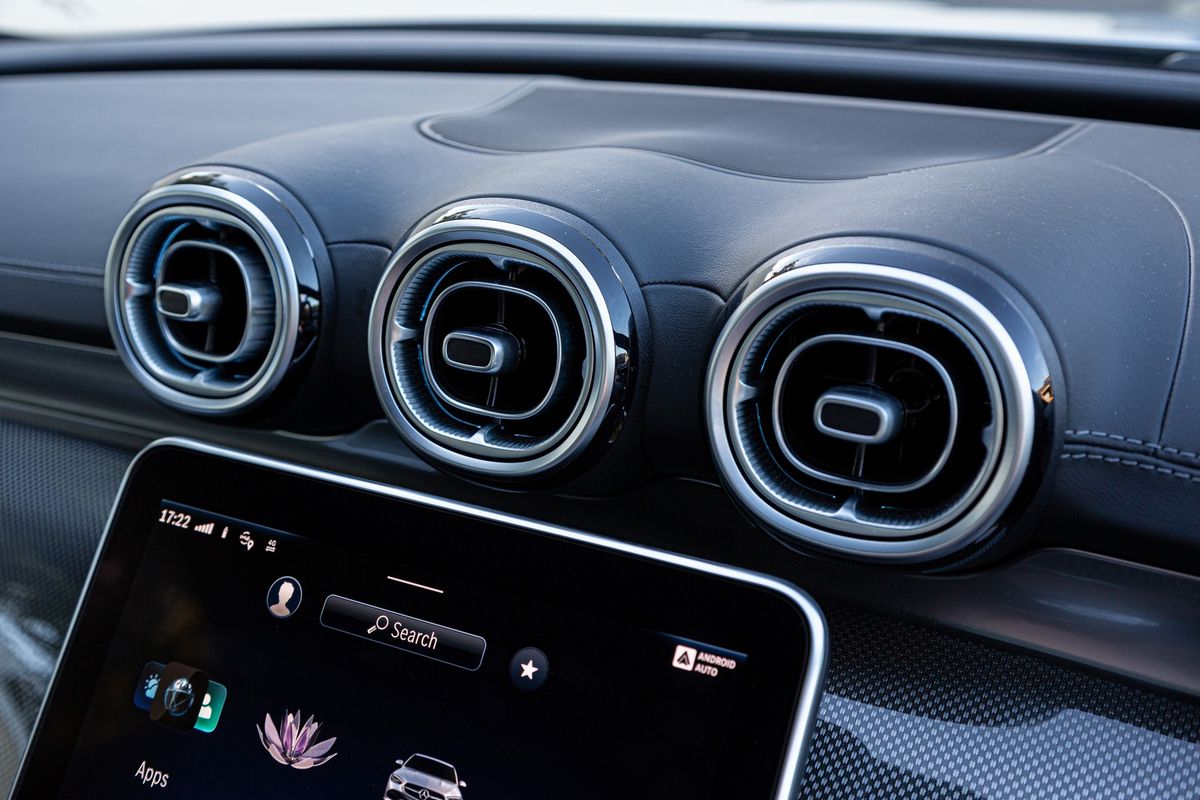
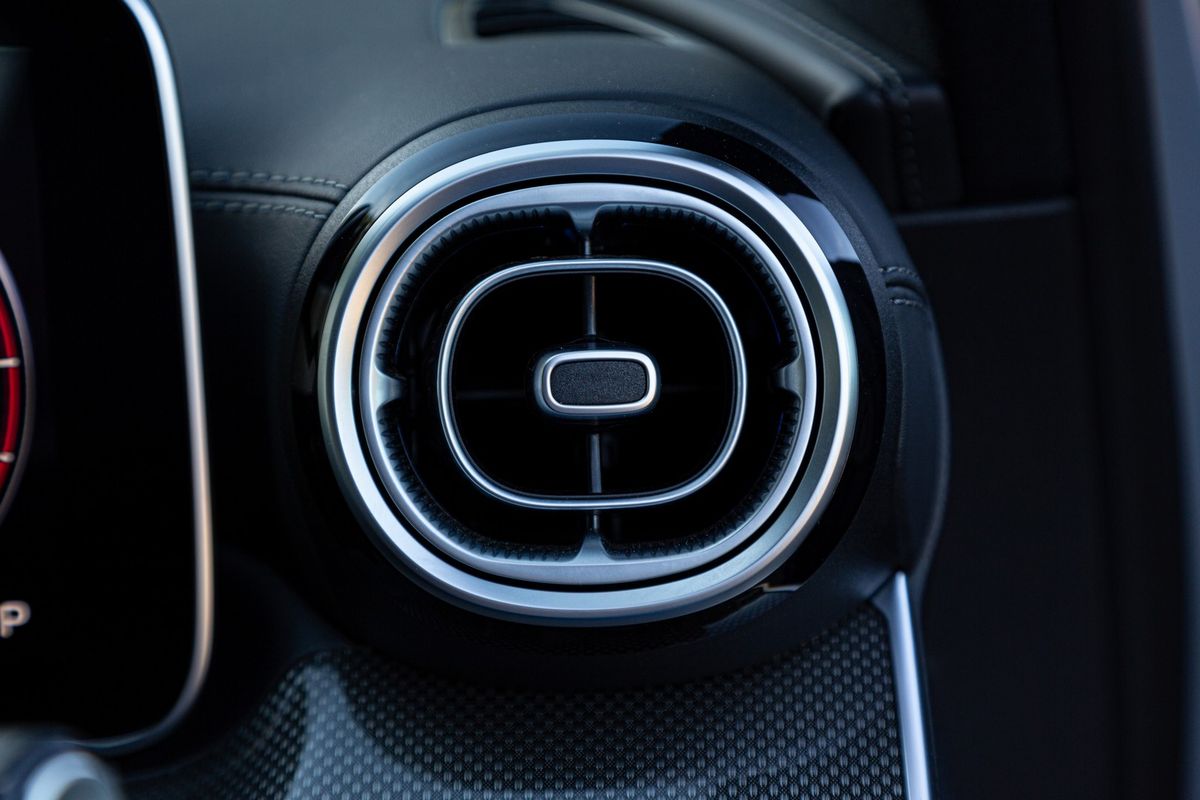
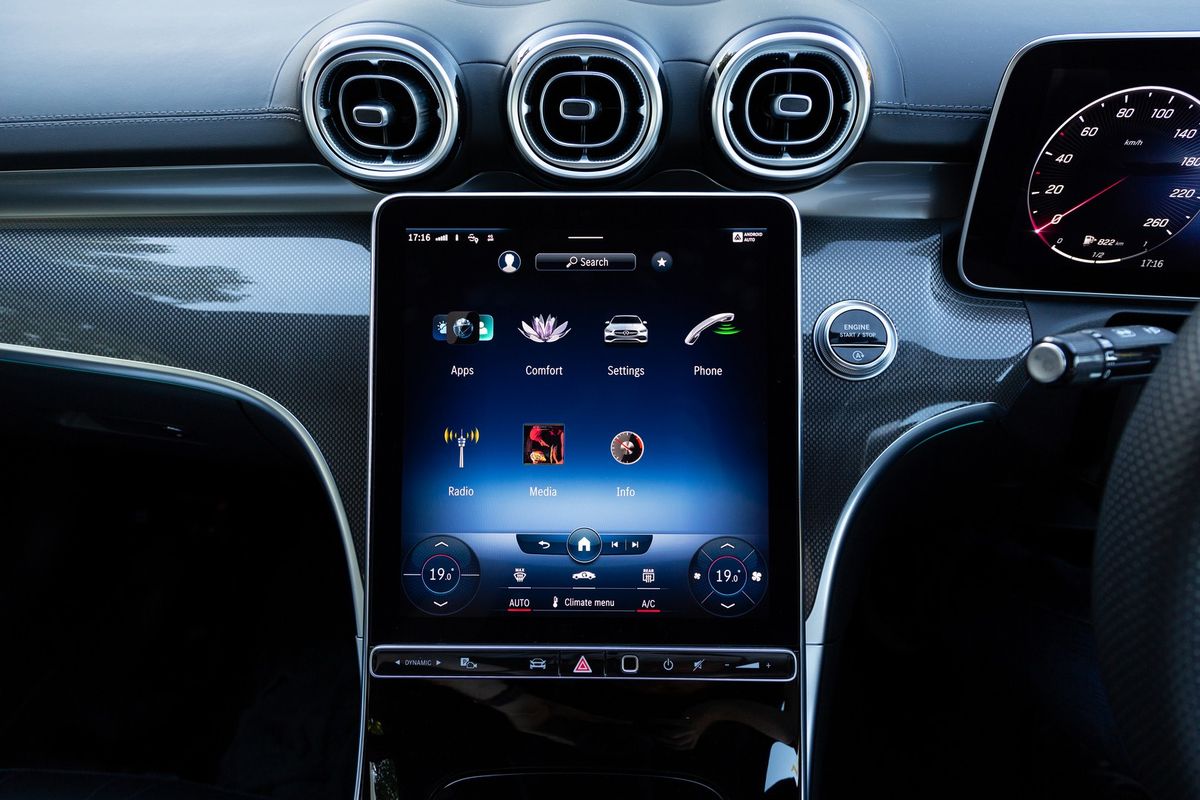
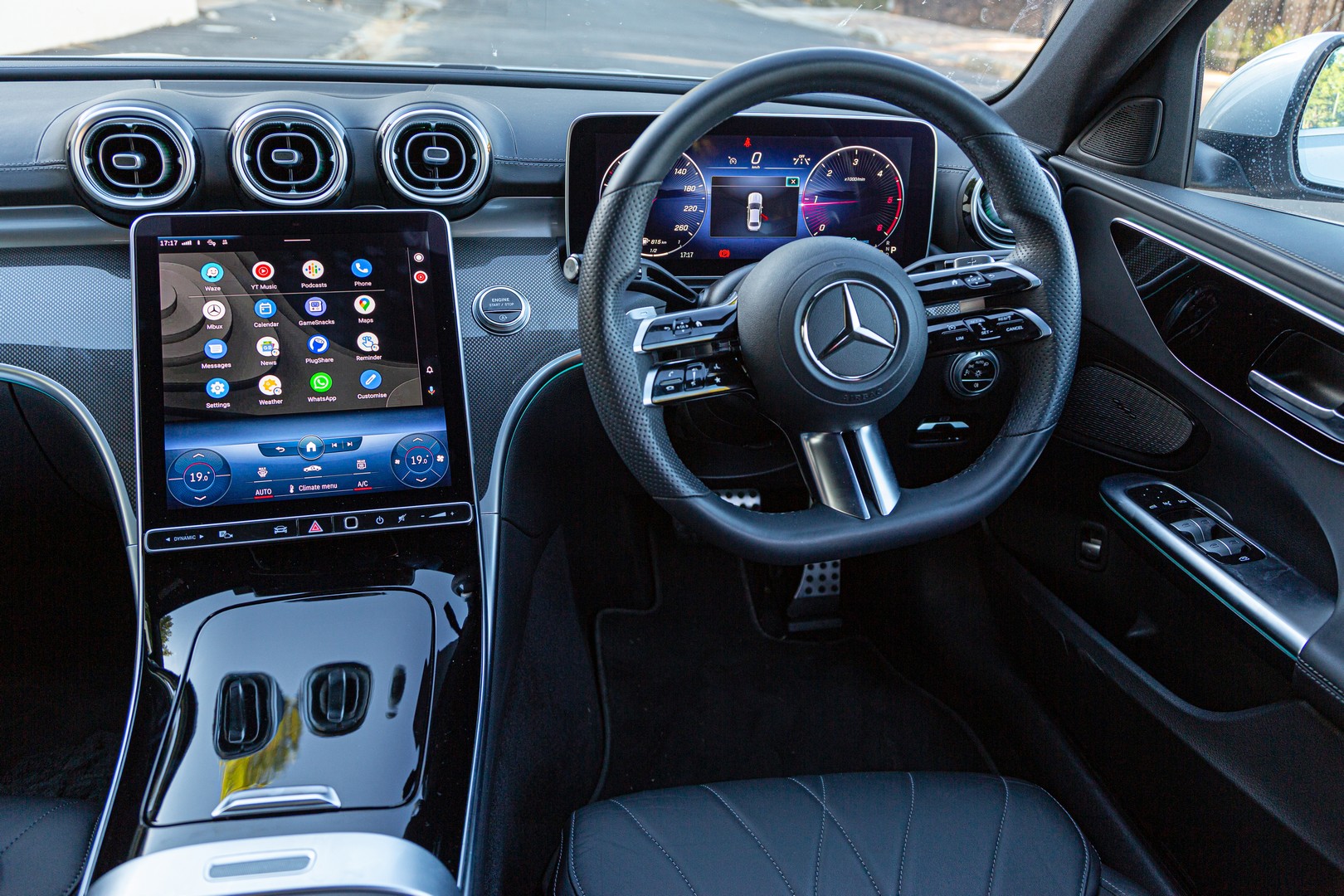
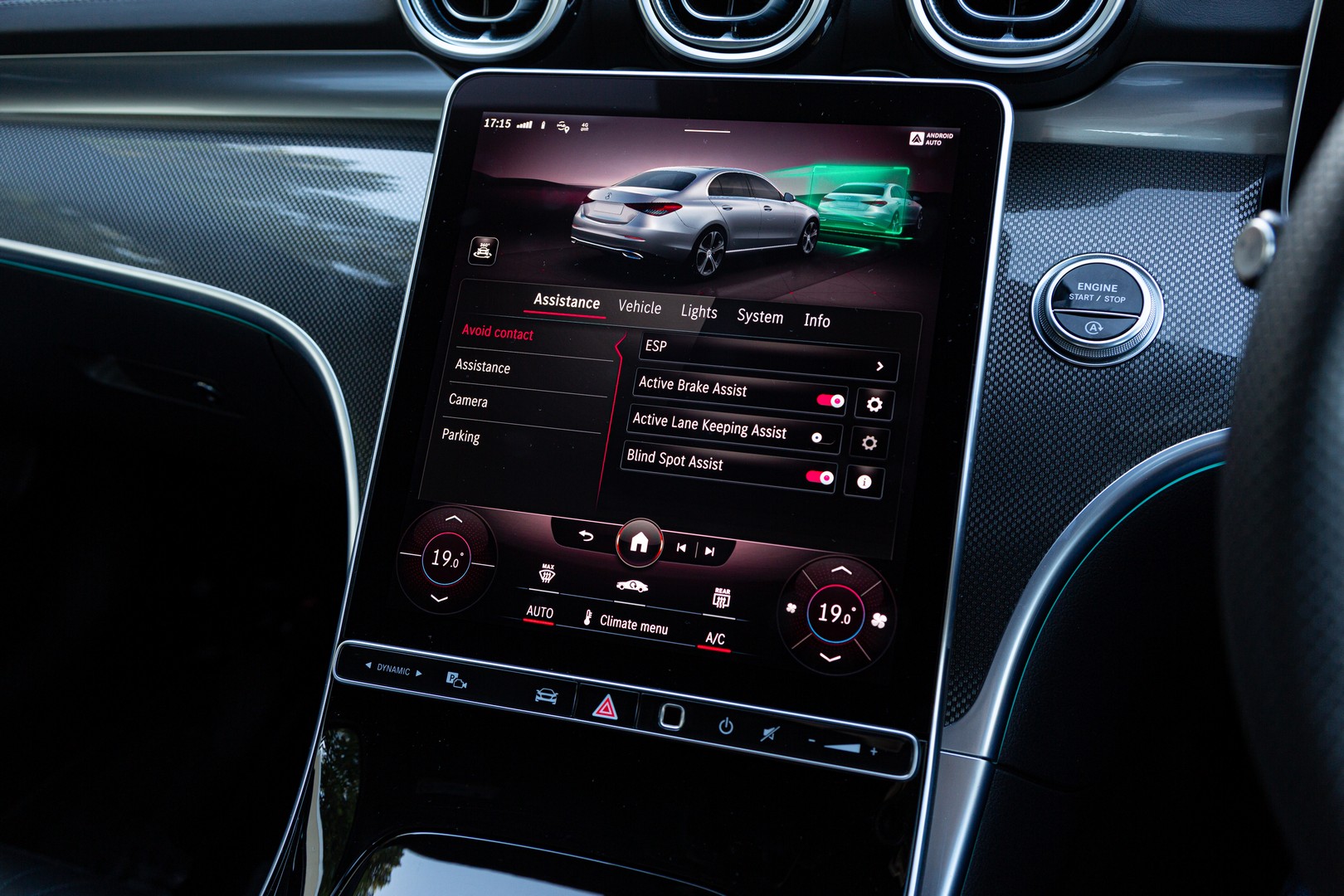
The cabin, meanwhile, represents a huge leap forward for the C-Class, not only in terms of visual appeal, but the minimalist instrument panel and vertically-orientated, iPad-like infotainment system. Other highlights include the stitched dashboard, the ornate turbine-like air vents and the smartly trimmed – and rather expansive – fascia.
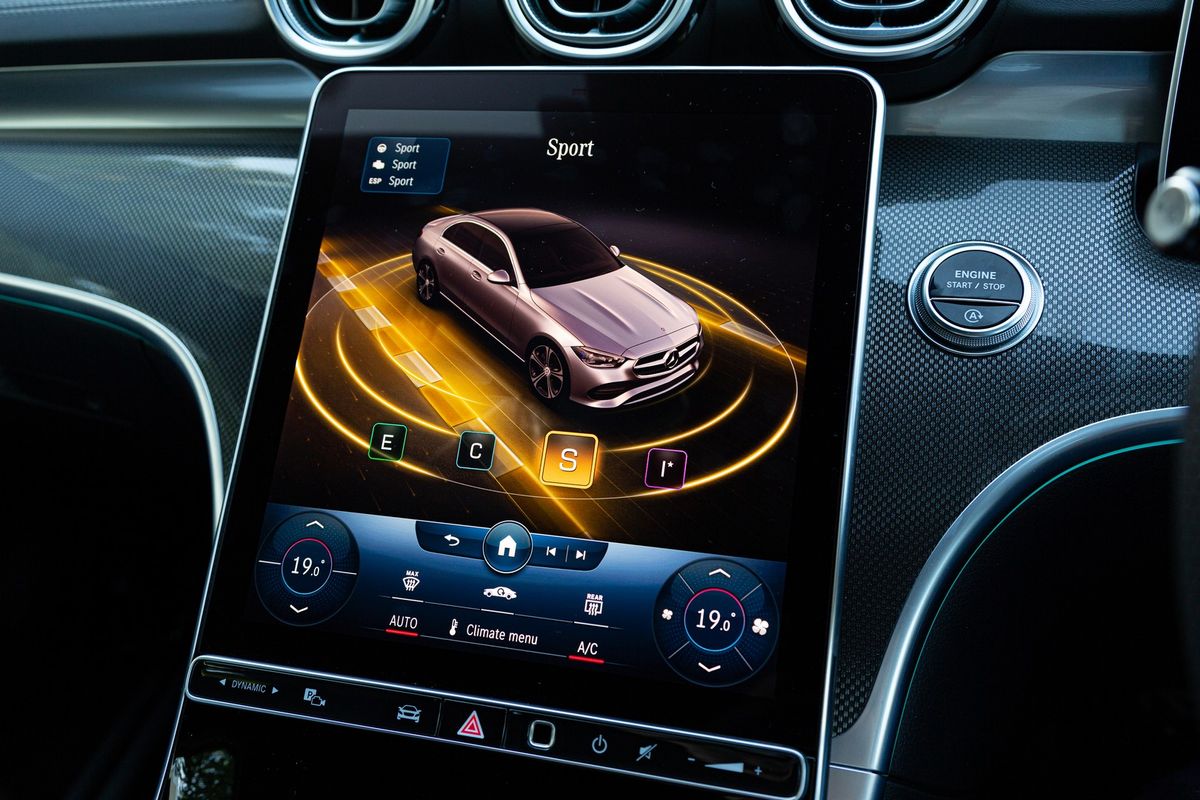
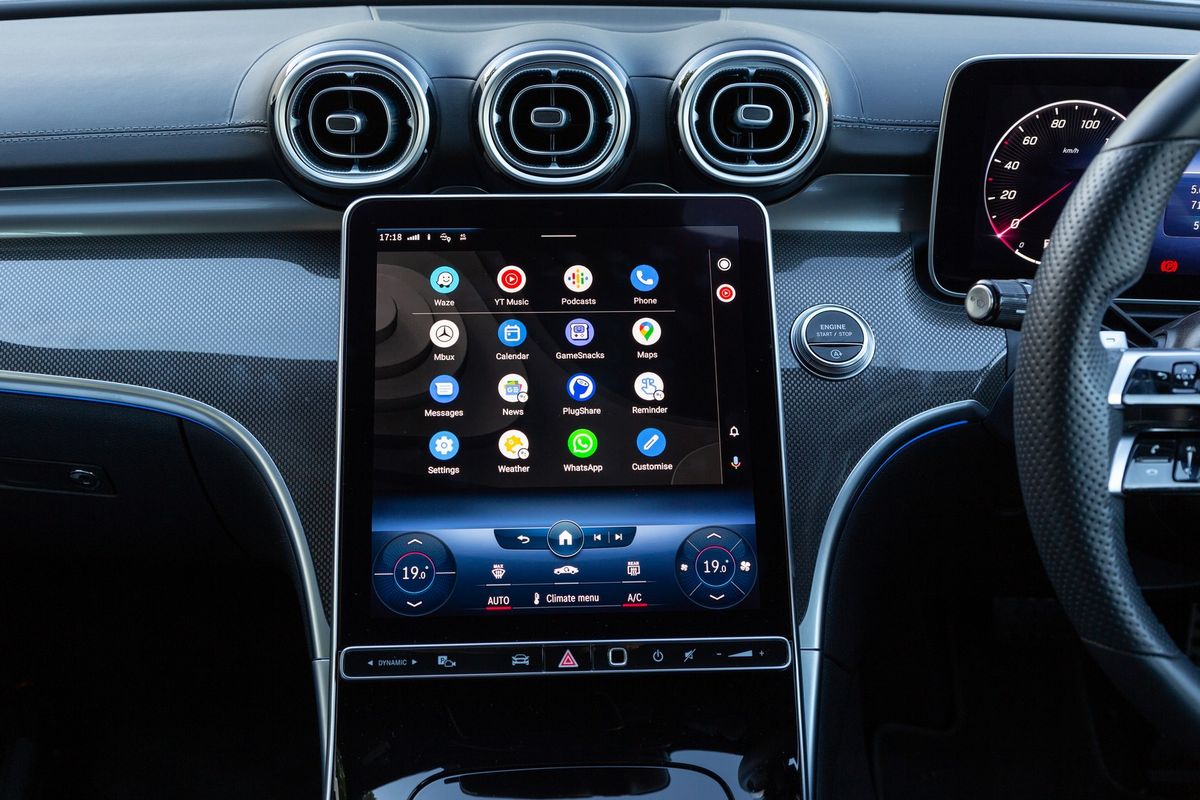
The biggest talking point in the cabin has to be the iPad-style infotainment tablet.
Performance and Efficiency
The C220d is powered by a mild-hybrid 2.0-litre 4-cylinder turbodiesel engine that produces 147 kW/440 Nm and propels the sedan’s rear wheels via a 9-speed automatic transmission. The ISG (powered by the 48V system) is located between the engine and transmission and produces an additional 15 kW. Essentially, when your car is coasting, it’ll recover energy, which it then discharges when you pull away, or execute an overtaking manoeuvre, thereby reducing the engine’s workload and negating turbo lag.
Does it work? Yes, brilliantly so, and you can feel that tiny “electric booster” working away quietly. It also has the benefit of negating the intrusiveness of the start/stop system – you’ll find the car’s ignition restarts instantly and seamlessly when you pull away from a standstill (or at intersections).
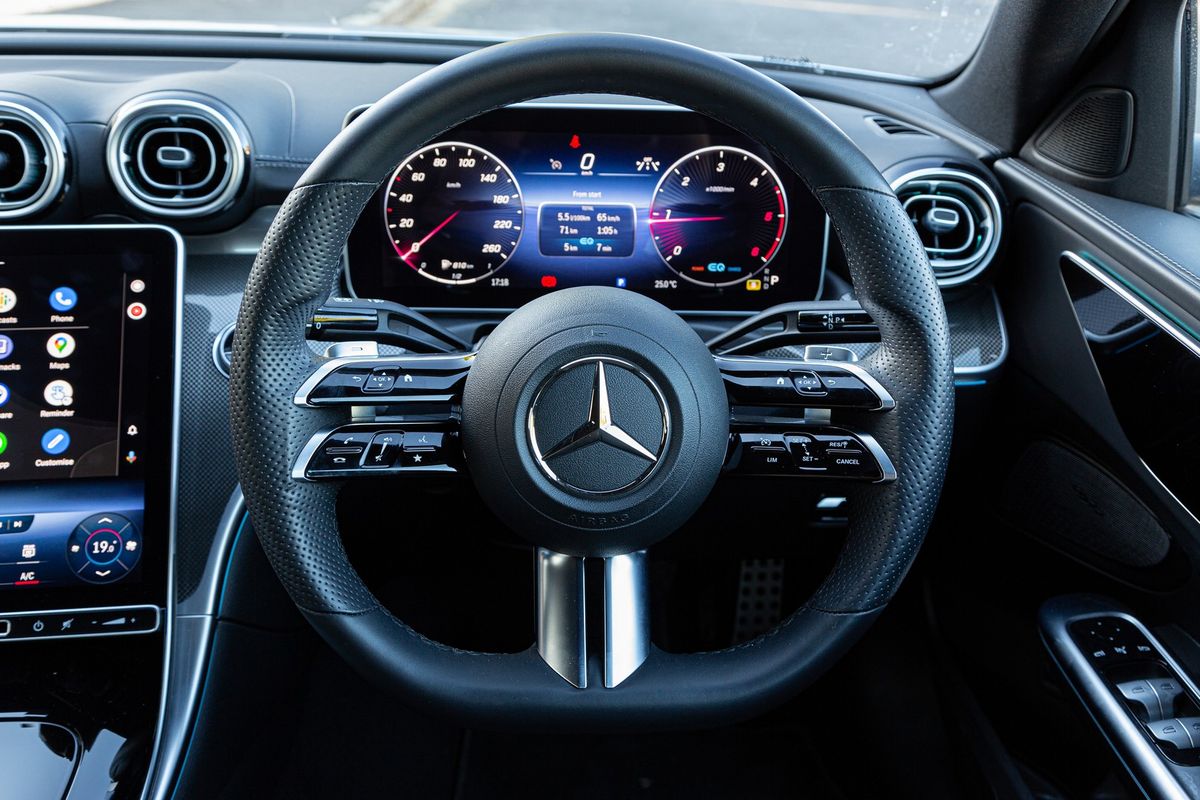
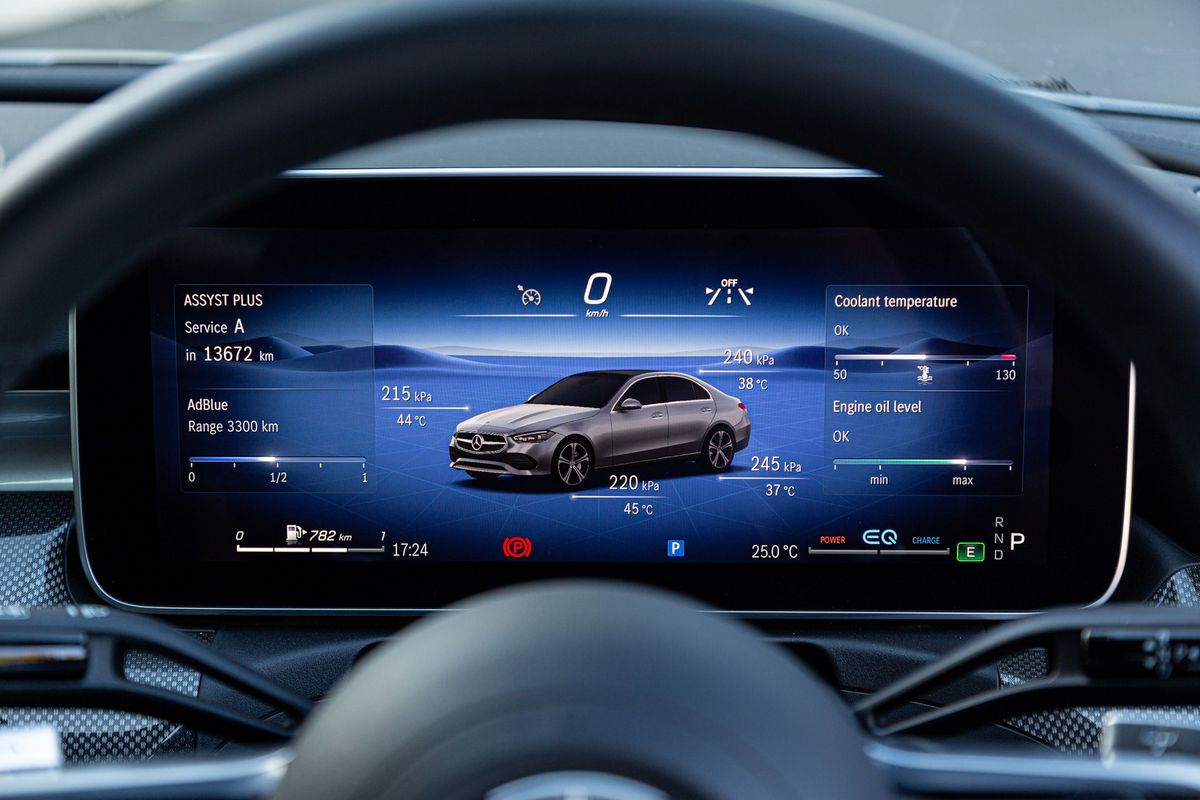
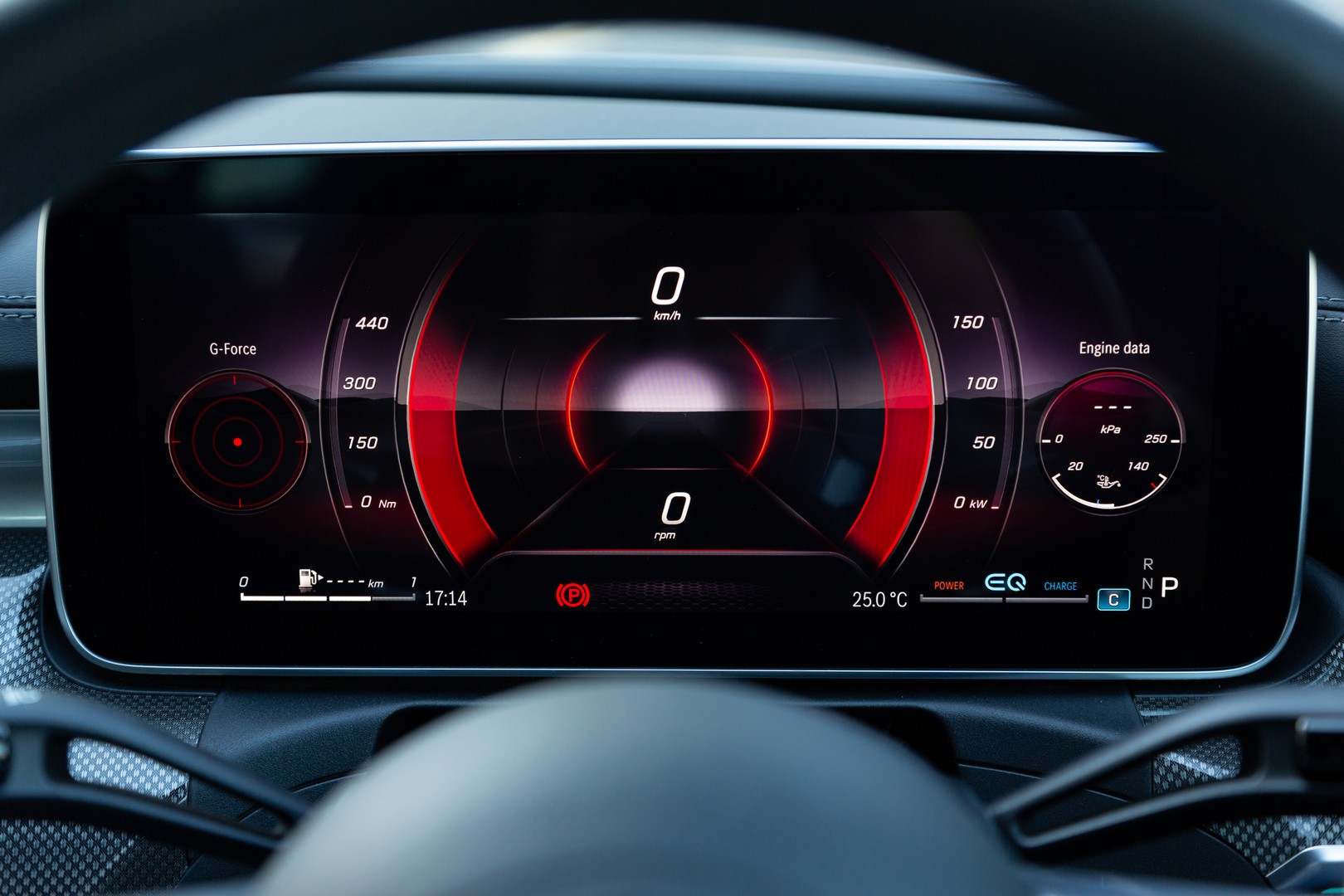
There is so much digitalisation in the Mercedes-Benz C-Class cabin, including customisable dashboard themes.
When you hit the start button for the first time, you’ll notice the engine has a clattery idle, which is typical of a diesel motor. However, once the oily bits get up to operating temperature, the engine quietens down significantly. There are various drive modes on offer and they radically change the car’s driving characteristics. Sport and Eco are poles apart when it comes to power delivery and responsiveness, with the latter making the most of the car’s mild-hybrid tech.
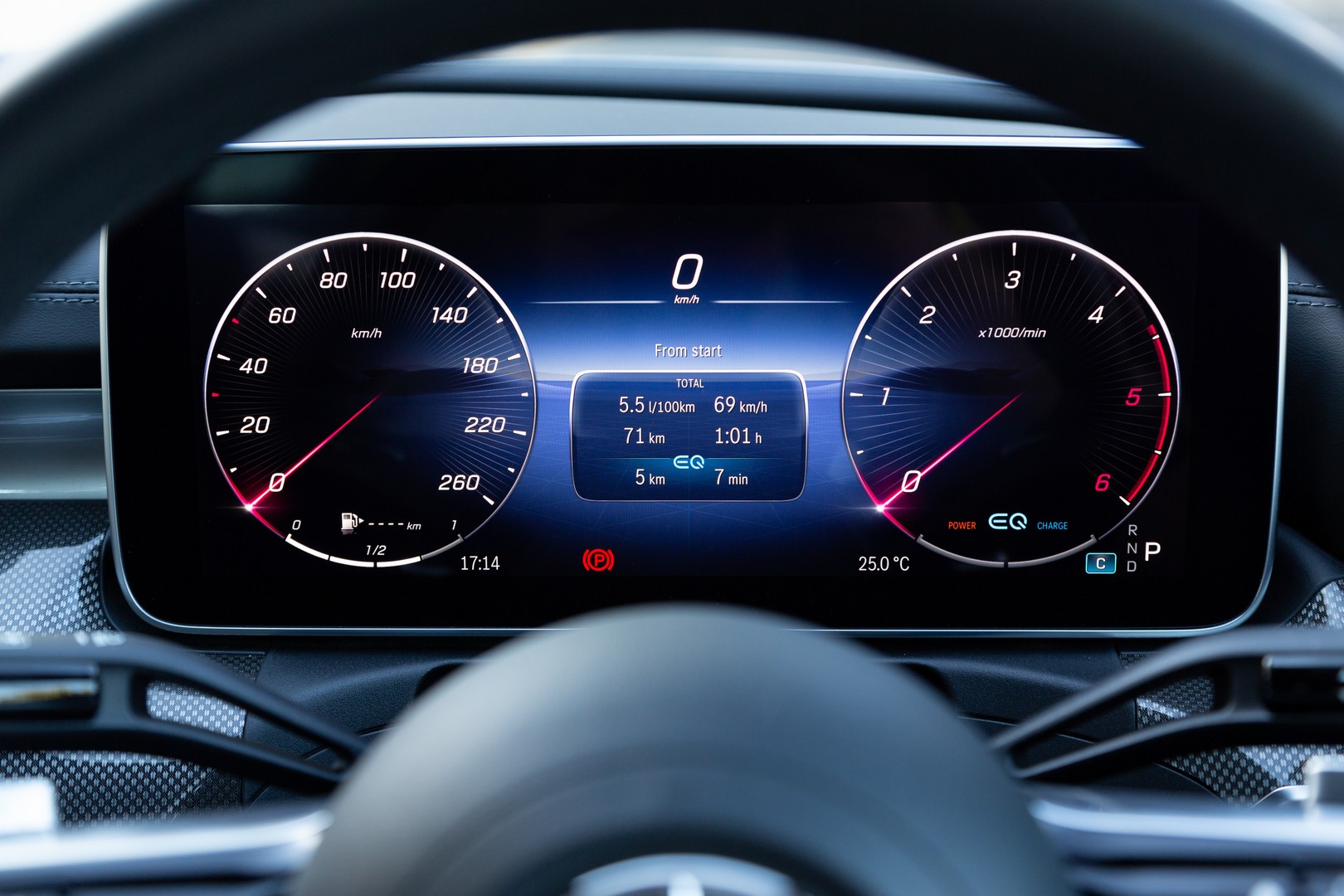
Rattly cold starts notwithstanding, we can easily say this 2.0-litre diesel motor is the best in class for performance, efficiency and refinement. Without too much effort and despite being called upon to deliver bursts of urgent performance from time to time, our C220d test unit returned a figure of 5.5 L/100 km, which is highly commendable… we’re confident that it’ll dip under 5 if owners really put their minds to it. A fuel tank of 66 litres means 1000 km (from full to empty) is doable.
Despite some enthusiastic driving, the C220d proved efficient, with commendable fuel economy returns.
Ride and Handling
Right, so what’s the W206 like to drive? That engine delivers a great blend of performance and economy. If required, the car can get a real move on, with the 0-100-kph sprint dispatched in a claimed 7.3 seconds – that’s quicker than some of the sportier small hatchbacks. The thrust is always delivered in a quiet and unflustered manner, even when you stomp on the accelerator pedal. It’s only towards the top of the rev range that engine noise becomes really noticeable.
When you’re not in a hurry, the C220d gets down the road in a wonderfully refined and restrained manner. It’s hushed inside at two-digit speeds – proof that ‘Benz’s engineers were hellbent on replicating the S-Class’ on-road demeanour. Wind noise? There’s precious little, even when a moderate South Easter is huffing. Road noise? There’s a bit of that, depending on the grade of tar, but on a national highway at 100 kph – you can still whisper your conversations.
These tasty-looking AMG 19-inch wheels are wrapped in Pirelli rubber.
A key aspect of the C-Class’s excellent driving experience is that 9-speed transmission. Granted, you can take control with the well-placed paddle shifters on the steering wheel, but we found it best to let the transmission decide when to execute shifts, which it does smoothly. You’d think that with as many as 9 ratios, there’d be some hunting, but somehow, the ‘box is constantly in the right gear at the right time, and there’s no hesitation when downshifts are required.
Previous C-Classes have favoured ride comfort and on-road refinement over dynamism, unlike their rivals from Munich. However, the W206-generation C-Class’ handling feels markedly sharper and the steering feel is both quicker and well-weighted. Does it deliver a knock-out blow? Well, no, we’d still say the 3 Series and Giulia are more engaging and fun to drive, but the C-Class blows the BMW and Alfa Romeo into the weeds in terms of overall ride quality and refinement.
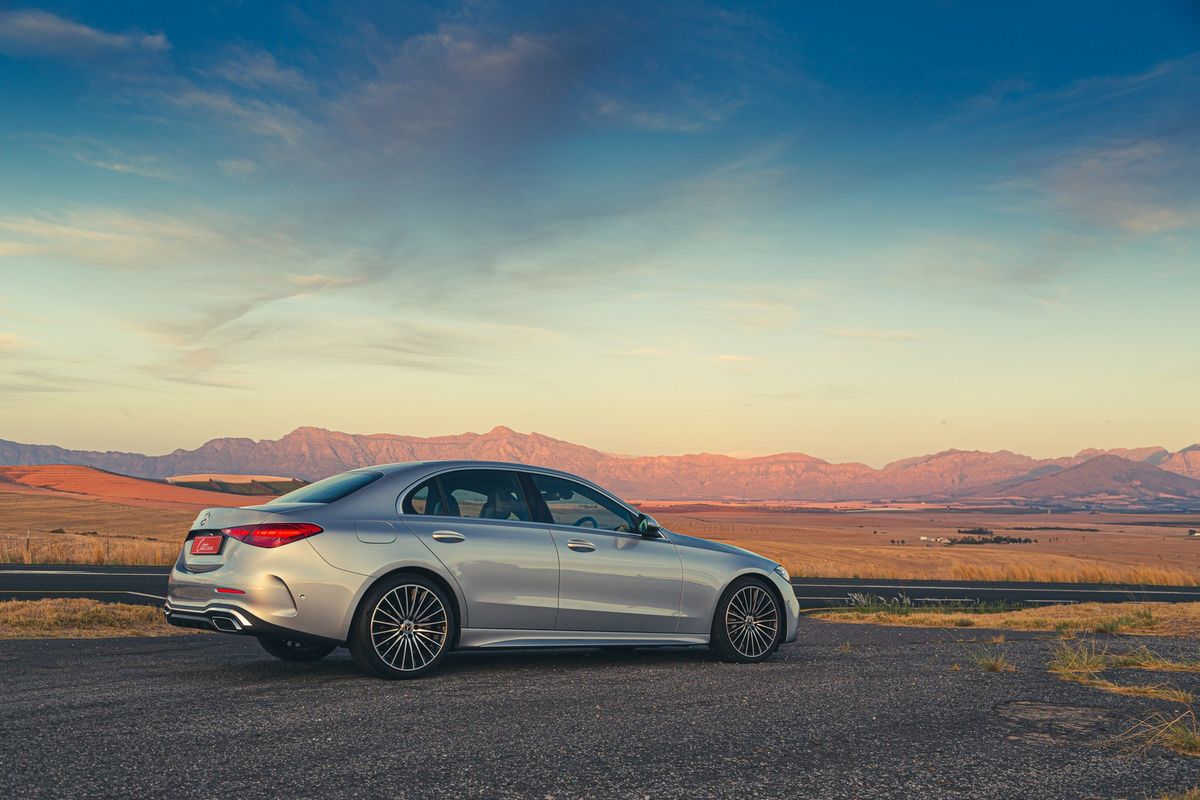
With excellent on-road refinement, the new W206 is the most accomplished C-Class to date.
Over the years, Cars.co.za test team members have come to expect Mercedes-Benz test units to offer firm ride qualities. Perhaps it’s because most units that were supplied to us featured AMG Line packages, replete with sporty suspension tuning and oversized wheels shod with low-profile tyres, but, for the first time in what feels like an eternity, we’re delighted to report that the C220d’s suspension didn’t thump or clunk over even the slightest of road imperfections.
In fact, we purposely travelled to the tree root-infested Mamre road north of Cape Town to put the new C-Class’ underpinnings to the test and came away deeply impressed. If ever you wanted to inflict cruel and unusual punishment on your enemies, send them on a jaunt on that road in something like a Honda Civic Type R or BMW M4…
Comfort and Features
As we’ve mentioned, Mercedes-Benz has paid close attention to the W206’s comfort and luxury characteristics. The cabin is a marvel, both to look at and occupy. There are gadgets and design elements straight from the flagship S-Class, but that’s okay as the models have disparate target markets. The iPad-like screen looks intimidating, but you’ll get the hang of it pretty quickly. The lack of physical buttons is initially a little disturbing, but again, it just requires familiarisation.
The new MBUX infotainment system looks pretty daunting to use, but it’s more simple than you think.
The materials used in the cabin’s assembly are a mixed bag. We used to lament the W205’s dashboard feeling cheap and nasty, and creaking upon the slightest push or prod, which thankfully has been rectified in W206. There are still some cheap touches though, such as the inside panels of the doors and the glovebox, which doesn’t shut with a reassuring thud. It would be totally acceptable in something like an A-Class sedan, but in a C-Class costing close to R1 million?
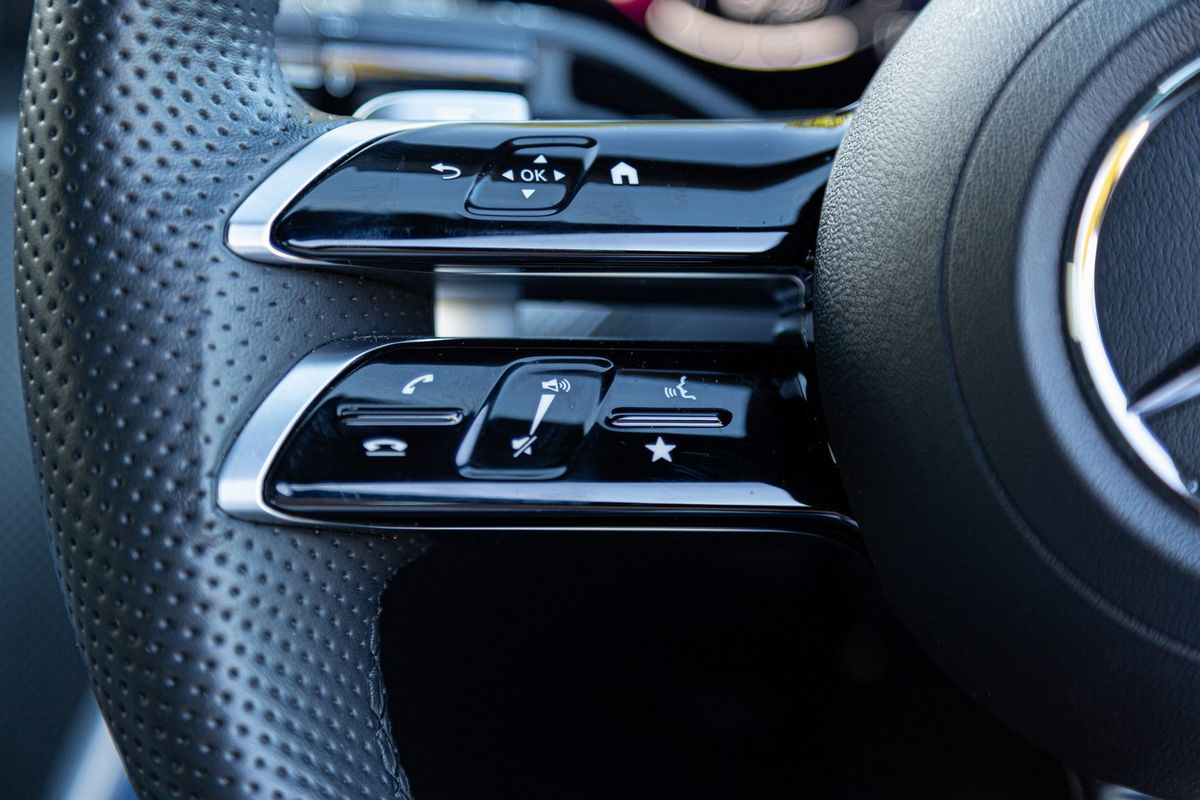
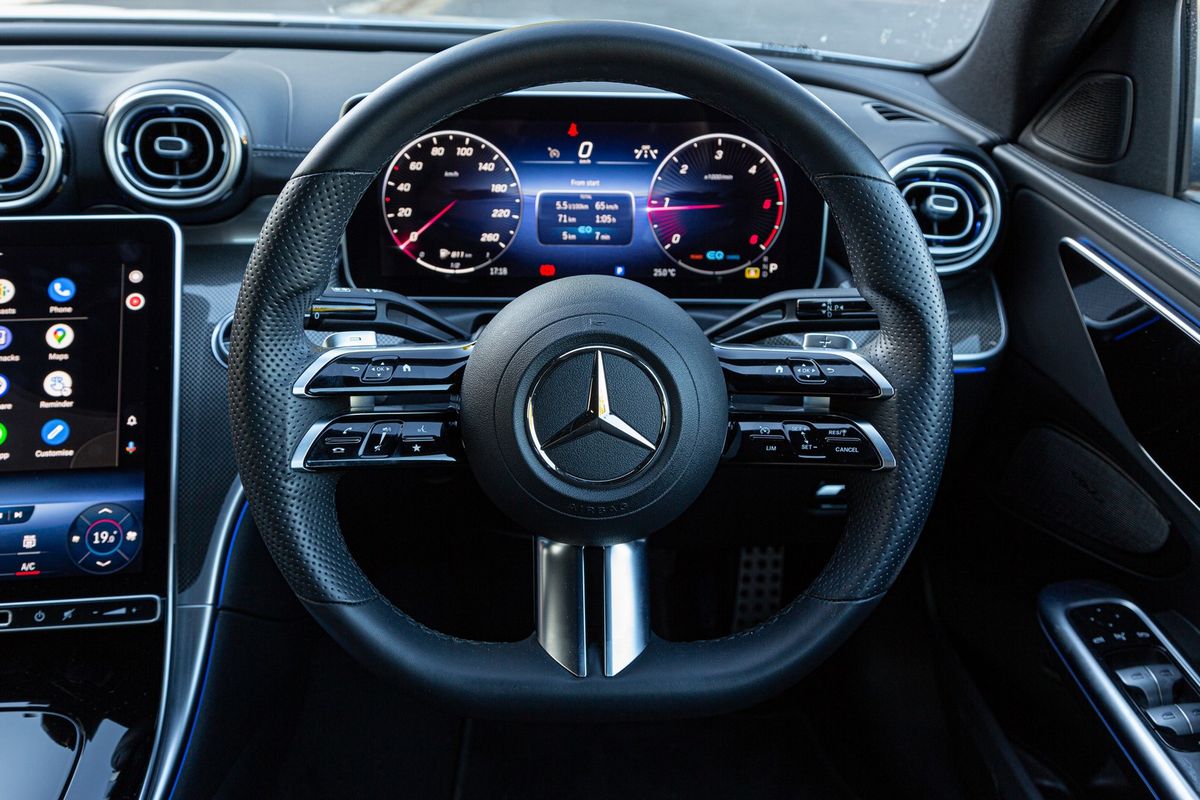
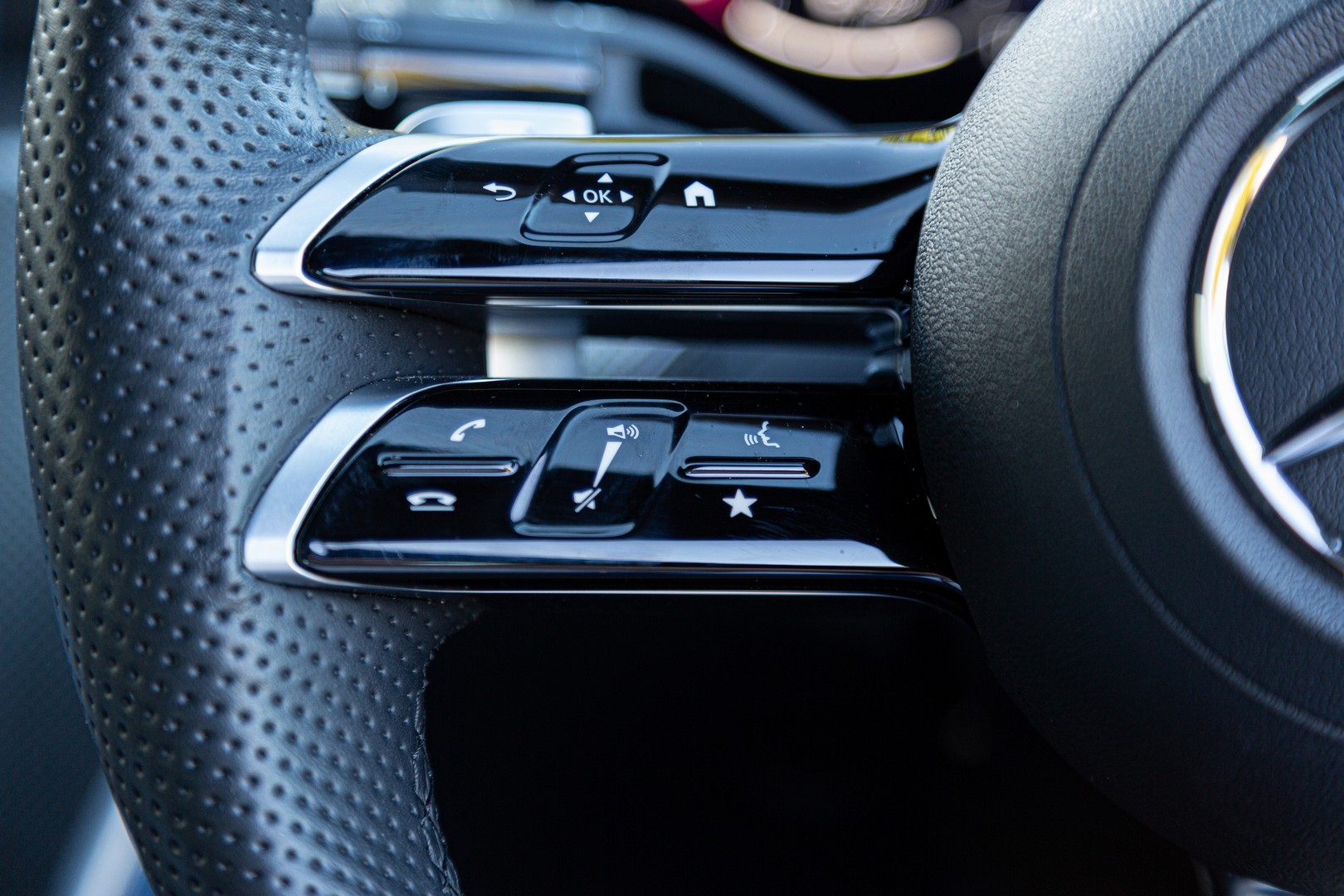
These steering wheel controls are a bone contention. They’re just not as good as conventional buttons.
The controls of the multifunction steering wheel were a source of frustration too. Now, this isn’t the C-Class’ fault, as we’ve experienced these “capacitive toggles” in the E-Class Coupe. We were irritated by the gloss black plastic that got mucky quickly, plus the functionality was “not all there”. We had to swipe, tap, poke and prod numerous times before we got the desired responses. Good luck with adjusting the volume while on a call without taking your eyes off the road!
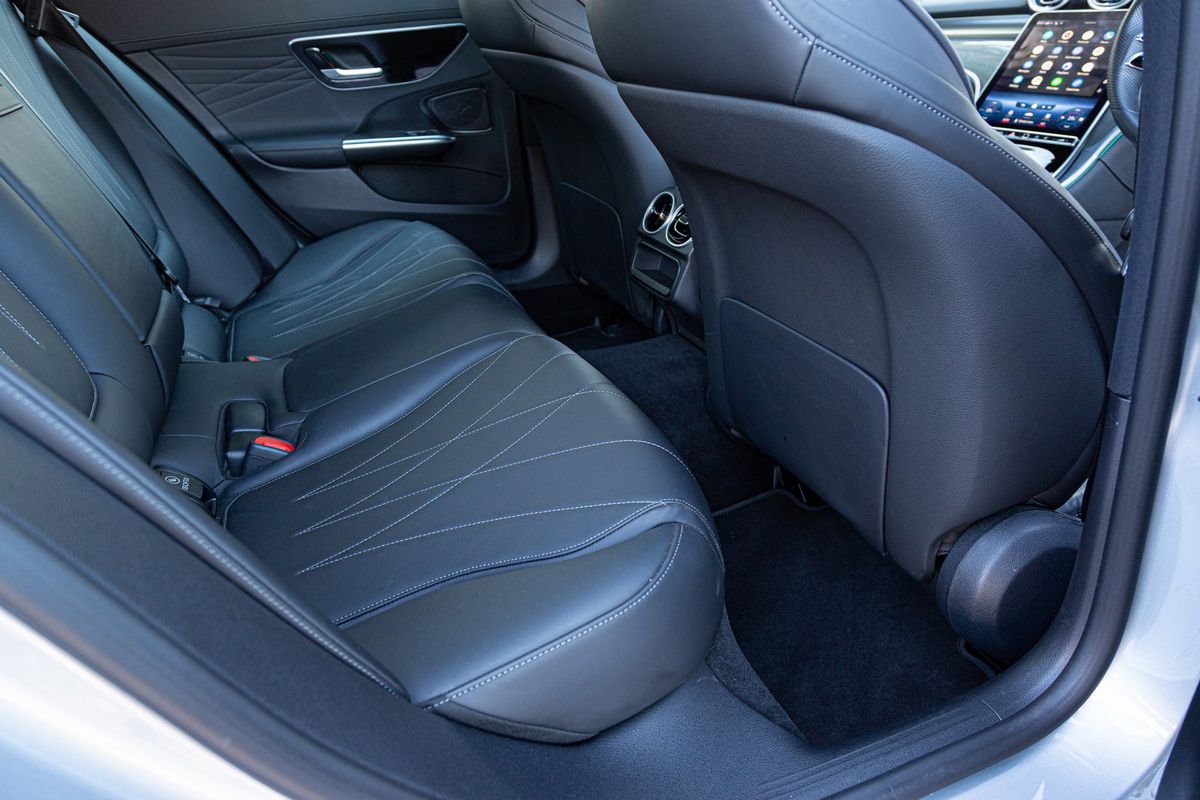
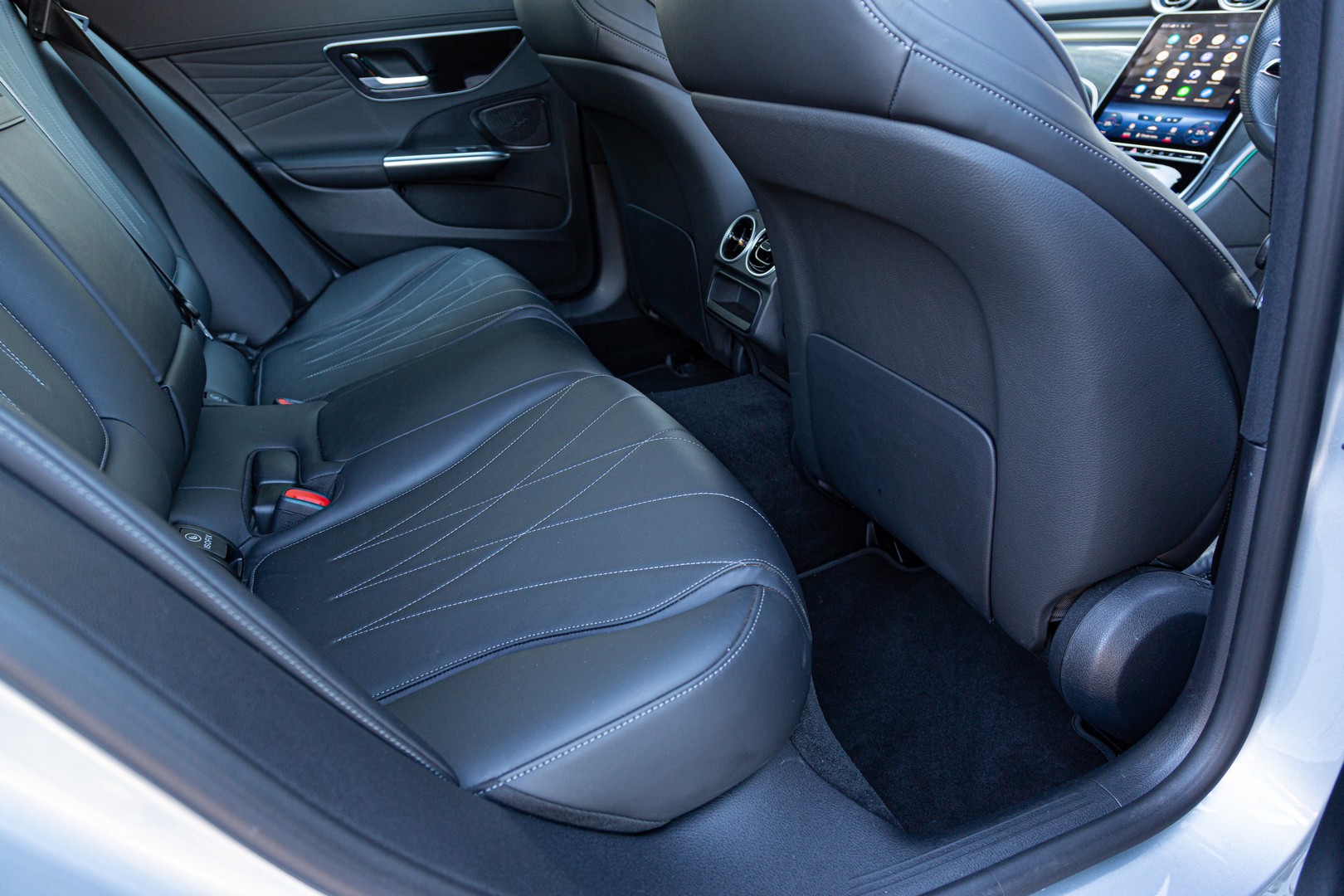
Any other gripes? Yes, the rear legroom – while it’s an improvement over that of the outgoing model, is still a bit tight for tall adults. What’s more, the C-Class’ boot capacity is the smallest in the class (455 litres). For what it’s worth, the BMW 3 Series offers up 480 litres, the Audi A4 460 litres and the Alfa Romeo Giulia 480 litres.
Rear legroom has improved somewhat in the new-gen W206.
For a price tag of about R1 million, you get a lot of standard kit in the C220d, which makes up for a few of its shortcomings. The 2nd-gen MBUX voice control is brilliant. Say “Hey Mercedes” and issue commands like “I’m tired”, “Take me home” and so on… the results are sometimes entertaining, but always useful. This system will only get better; Mercedes-Benz is now offering over-the-air updates and the C-Class will receive upgrades that can be installed at your comfort.
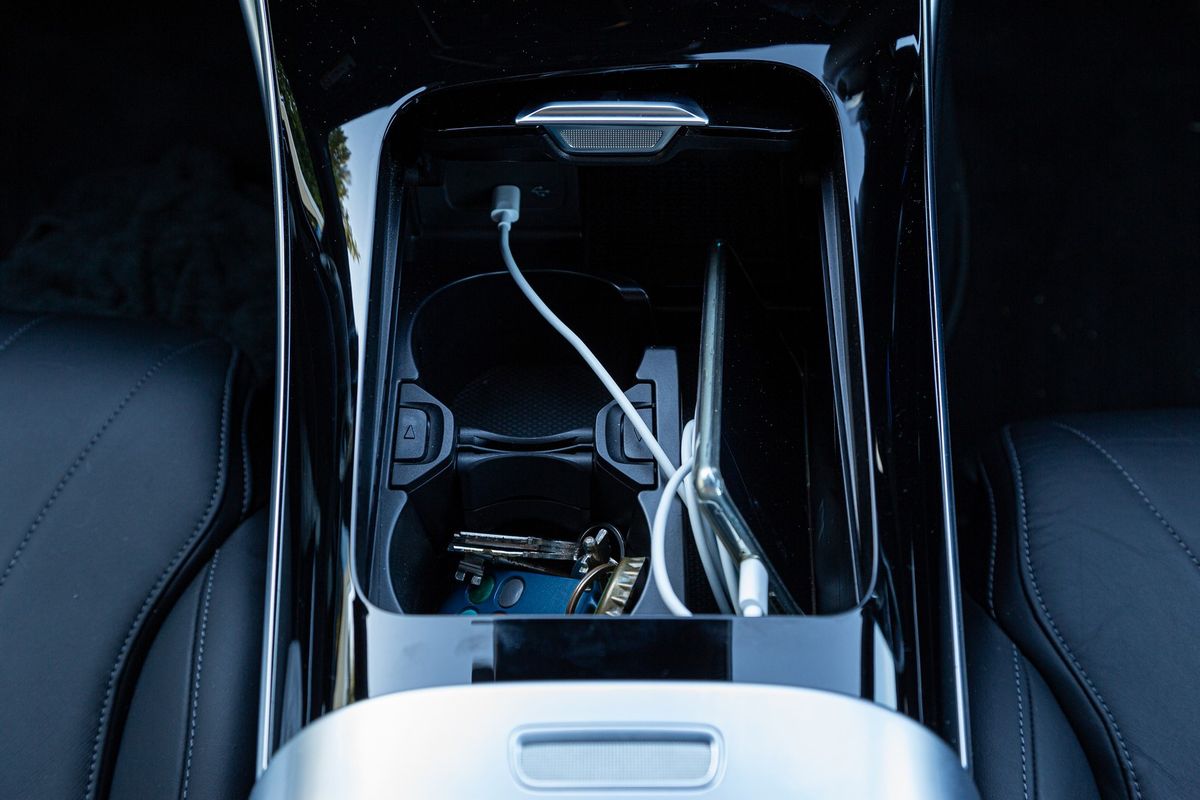
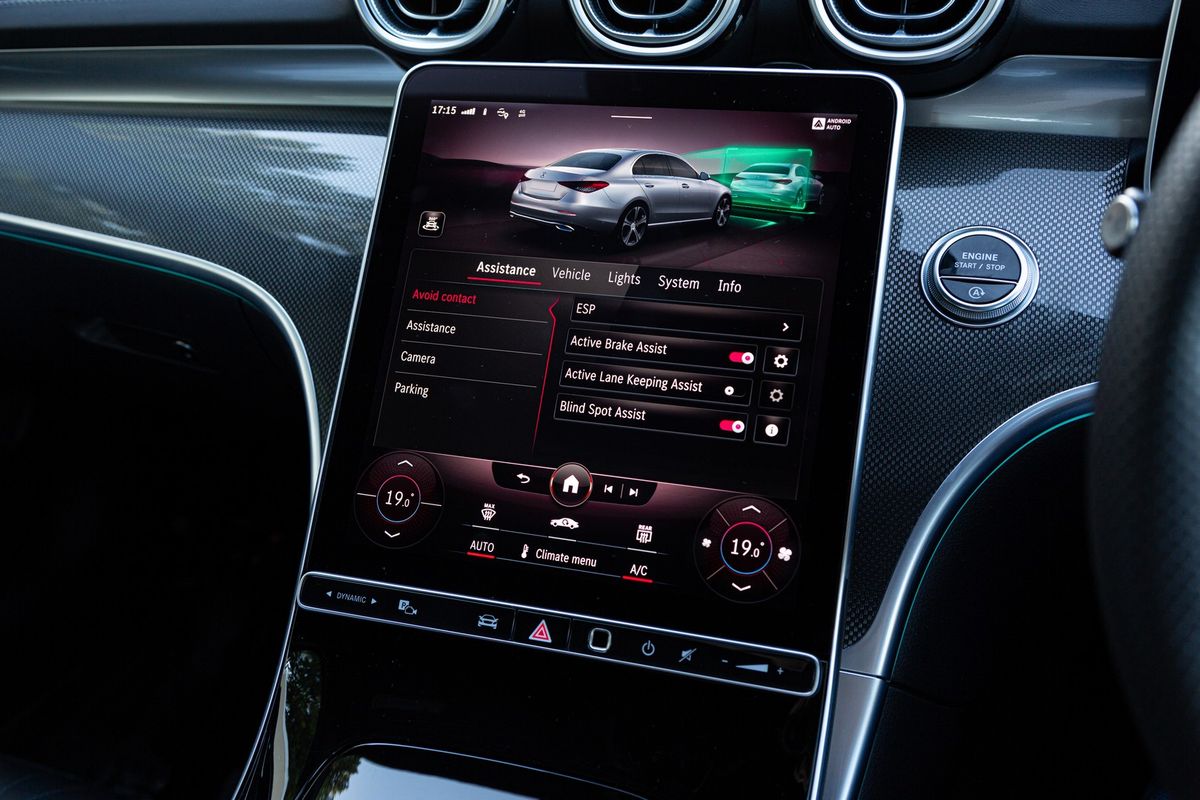
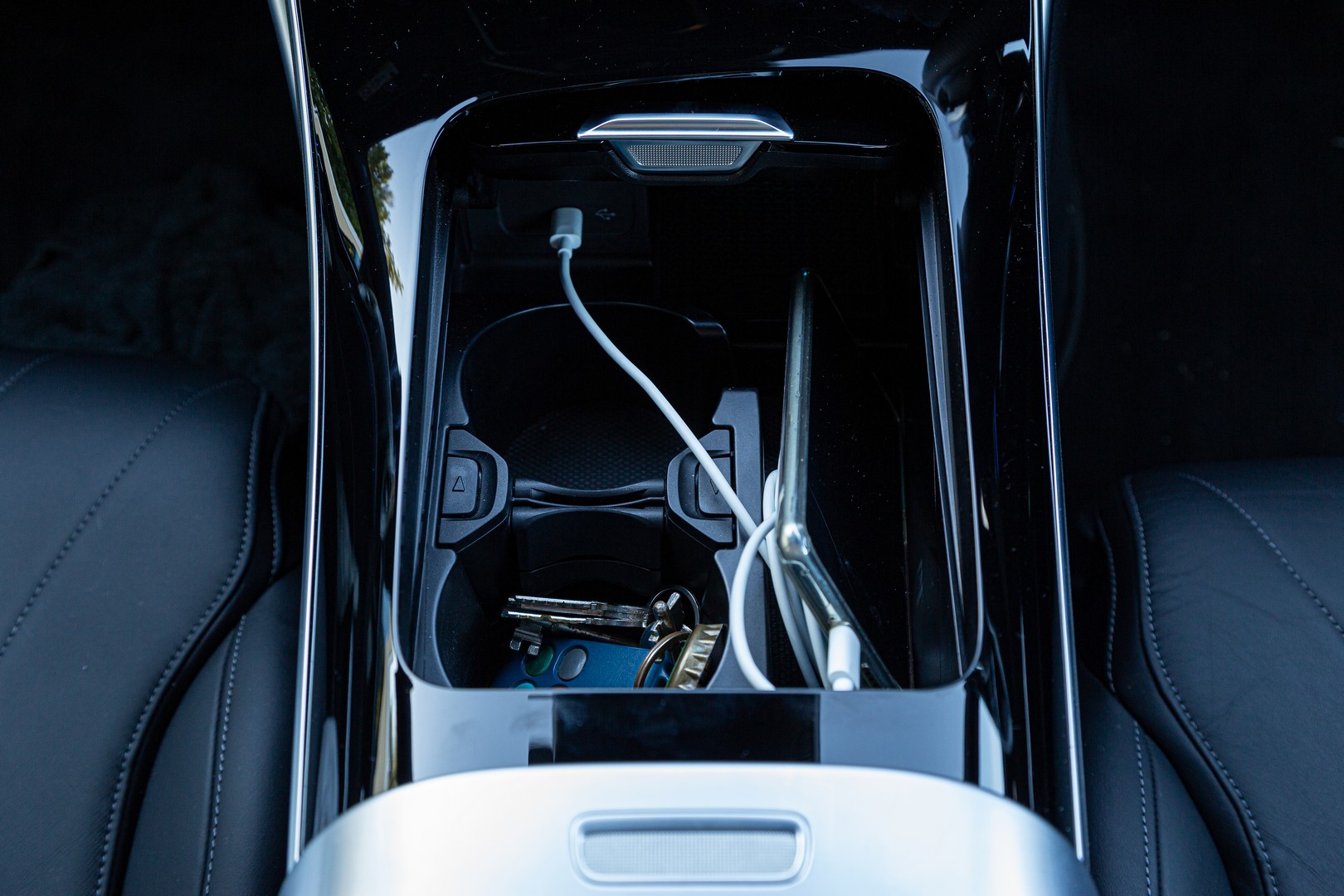
If you’ve used any electronic tablet, you’ll appreciate the detail that has gone into the user experience of the massive portrait-oriented touchscreen, which positively dominates the central dashboard. Climate control functionality is close at hand, as are the audio controls. The system features Android Auto and Apple CarPlay, the former integrating neatly into the oversized screen. There’s wireless charging too – and more USB ports than you’ll ever need.
Our test unit came with the no-cost option of additional USB-C ports.
Price and after-sales support
The Mercedes-Benz C-Class range starts from R857 956 for the C200 Avantgarde, with this C220d AMG Line coming in at R1 008 749, before options. The new C-Class is sold with a 2-year/unlimited-kilometre warranty and a 5-year/100 000 km maintenance plan.
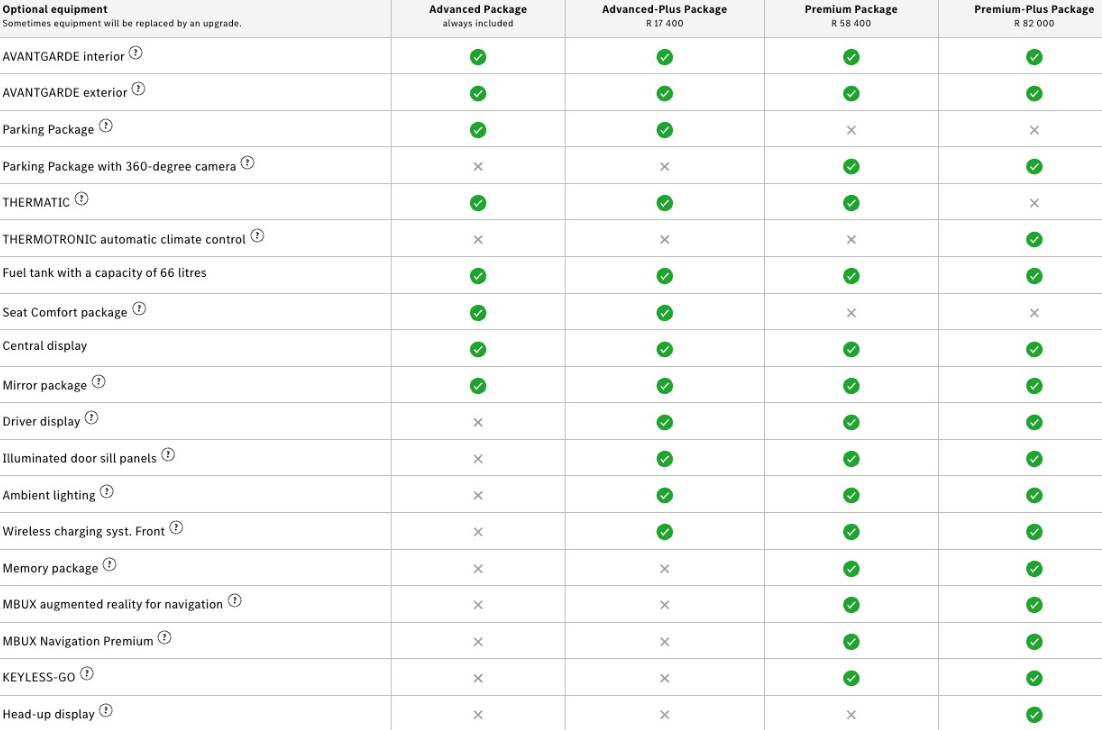
Option Package Pricing
–
Other options available (according to Mercedes-Benz SA’s website), include rear-wheel steering (R22 400), head-up display (R22 000), MBUX Premium Navigation (R13 900), a panoramic sunroof (R22 900) and a lane-tracking package (R14 400).
Verdict
Has the new C-Class been worth the wait? Definitely. Meet your new segment champion.
Despite Mercedes-Benz embarking on its crossover/SUV offensive (that is to say raising the ground clearance of virtually every model and slapping a GL badge on it), there’s still a market for buyers who prefer NOT to go the raised-up-vehicle route. The sedan will always be the answer for that particular client base, which is why the Sindelfingen-based brand’s C-, E- and S-Class models endure.
With the new W206 C-Class, Mercedes-Benz has focused intensely on luxury and refinement, and it shows. This is easily the most comfortable and refined vehicle in the business-class sedan segment. “A baby S-Class” is an awful cliche, but there is a kernel of truth to it. While it’s not the most dynamic and involving offering in the segment, this is the sportiest C-Class yet.
Be mindful when ticking those options, as they add up quickly. For convenience, Mercedes-Benz has grouped some of its more popular options into well-priced packages.
Should you buy one? To reiterate, the C-Class range is currently limited to the turbopetrol-powered C200, which, according to our launch review of the W206, can feel a bit lethargic, and this, the turbodiesel-powered C220d. If you’re seeking excellent refinement and luxury in abundance, plus the bragging rights of that glitzy interior, then it’s definitely worth a look, because this, all in all, is the most accomplished C-Class to date.
If less than hands-on dynamics and a lack of outright driving thrills are not deal-breakers, the W206-generation C-Class is the new segment champion.
New Electric Cars for South Africa in 2023
Take a look at what new electric cars will be arriving on South African shores in 2023.
Interest in electric vehicles (EVs) and hybrid cars is at an all-time high in South Africa. In fact, In the first 9 months of 2022, a total of 3 092 New Energy Vehicles (NEVs), including electric, hybrid and plug-in hybrid vehicles, were registered in South Africa, representing a notable 245.1% compared with the 2021 total of 896 units sold (see the report here).
Electric cars, specifically, are generally prohibitively expensive and thus the uptake of EVs in the South African market is considerably lower than hybrid vehicles, for example.
Nonetheless, there are a few notable new EV products destined to reach South Africa in 2023.
Take a look at what’s on the way!
New Electric Cars for South Africa in 2023
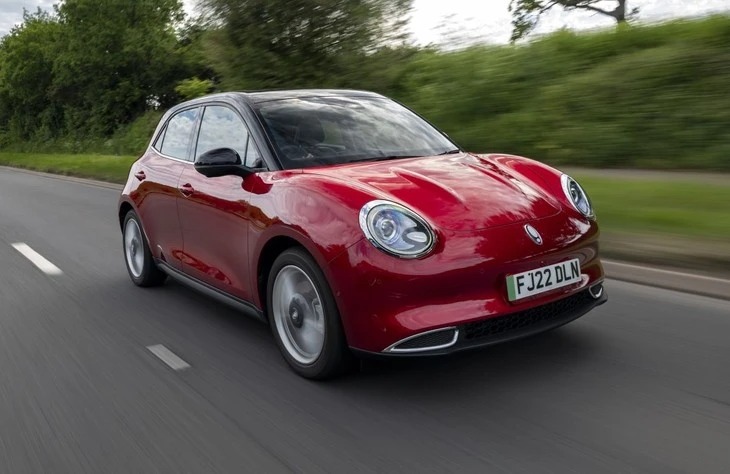
GWM Ora Cat
GWM’s electric sub-brand, ORA, is expected to arrive in South Africa in the third quarter of 2023. The ORA Cat, depending on the derivative, can deliver up to 126 kW and 250 Nm from a front-drive motor and importantly offer a range of up to 501 km with a 59.7 kWh battery pack while even the smaller 47.8 kWh battery pack is said to return a WLTP driving range of 310 km. Recharging the battery from 15% to 80% will take about 40 minutes when using an 80-kW DC fast-charging station.
While pricing for the Ora Cat has yet to be confirmed, we suspect that the Ora Cat will be the most affordable EV in South Africa when it arrives and we anticipate pricing to come in at around R600k, which would be less than the current cheapest EV, the Mini Cooper SE priced from R723 000.
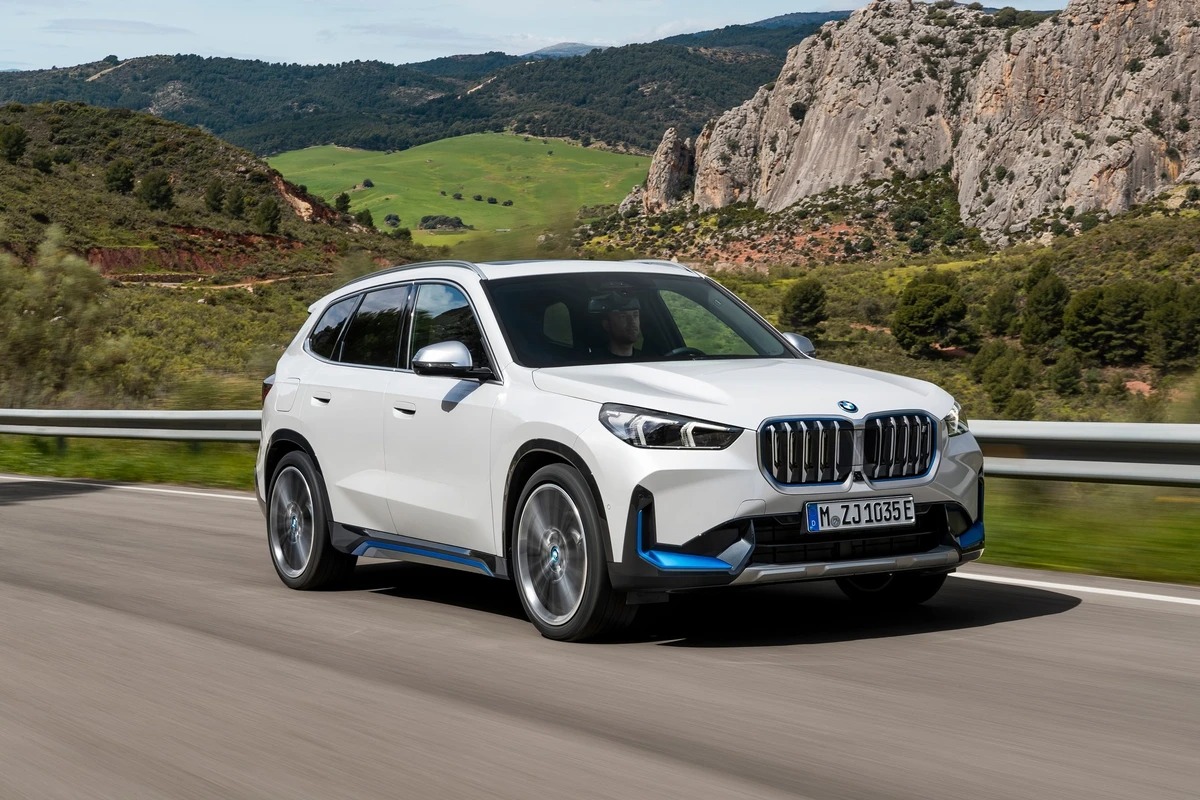
The BMW iX1 was revealed earlier in 2022 and is due to go on sale in South Africa in the second quarter of 2023. The iX1 xDrive30 will be the sole derivative on offer and it’s BMW’s first all-wheel drive EV to compete in the growing premium compact segment.
Forward propulsion is made possible with 2 electric motors that produce 230 kW and 494 Nm. BMW claims just 5.7 seconds in the sprint from zero to 100kph with a top speed of 180 kph. The BMW iX1 is equipped with a 64.7 kWh battery pack located on the vehicle’s floor and 130 kW DC fast charging is supported.
As a result, 120 km of range can be obtained in just 10 minutes while charging from 10%-80% takes just 30 minutes. There’s also single and 3-phase AC charging at up to 11 kW. A range of between 413 km and 438 km is claimed.
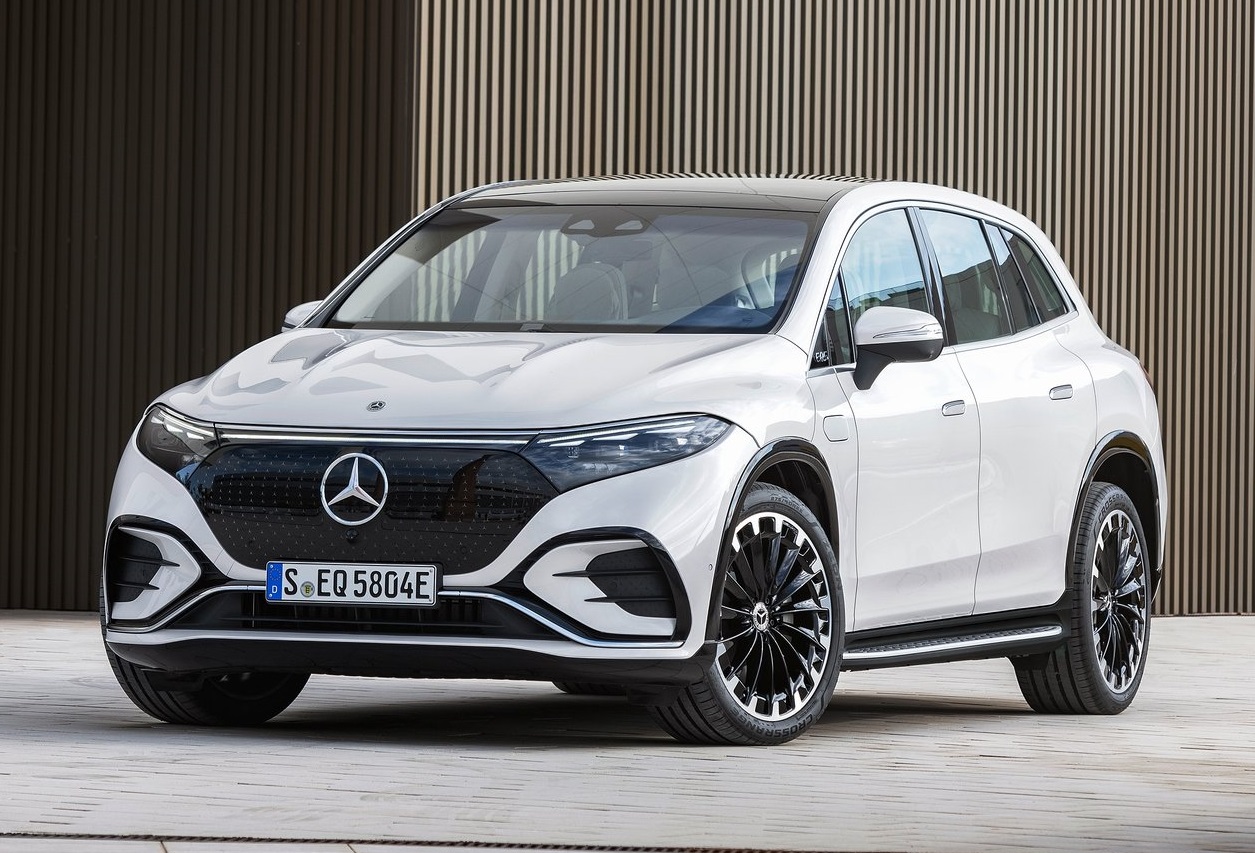
The EQS SUV is offered with 2 powertrain options including the EQS 450+ and the range-topping EQS 580 4Matic. In the EQS 450+, the rear axle electric motor generates 264 kW and 568 Nm while the EQS 580 4Matic delivers 400 kW and 858 Nm. Mercedes-Benz claims a driving range of 600km. Both EQS SUV models will go from 10-80% in just 30 minutes when connected to a DC fast charger, with a maximum charging rate of 200 kW.
Local specifications and pricing details will be communicated closer to launch in 2023.
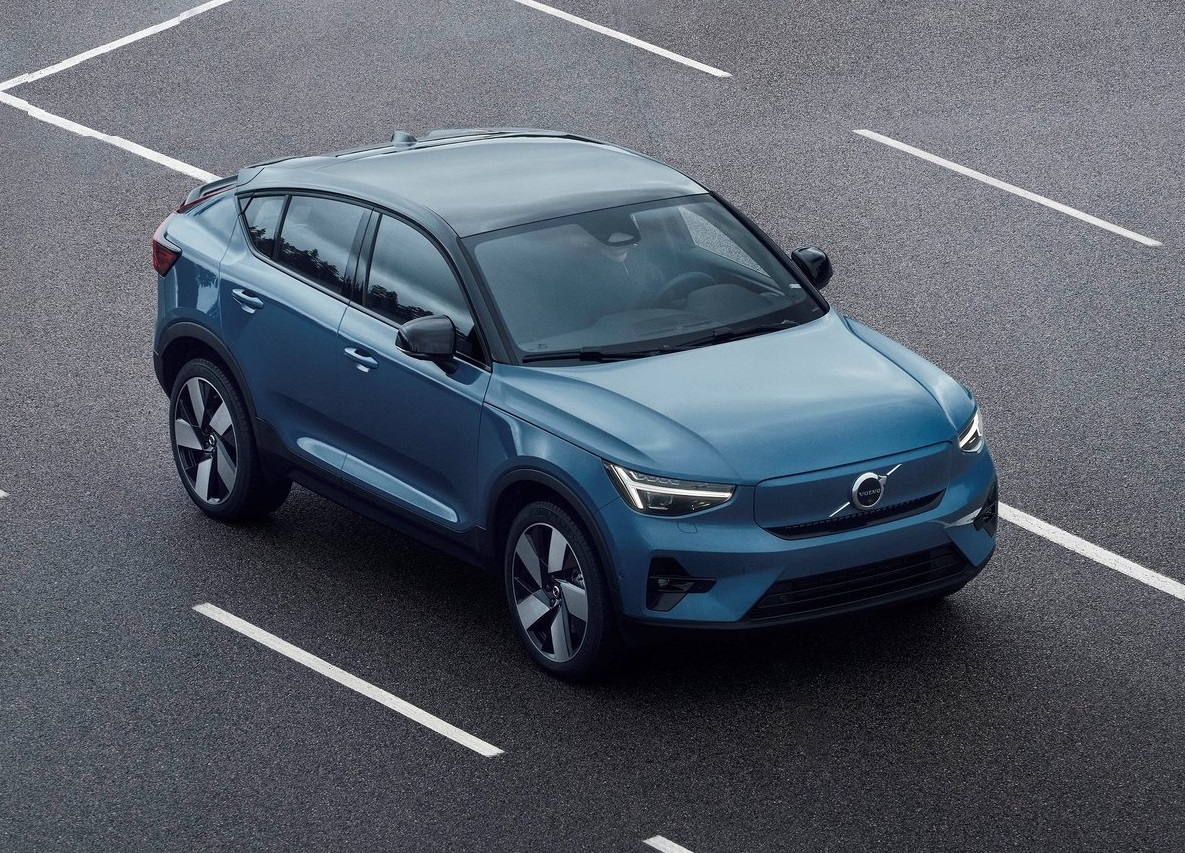
Volvo’s EV footprint is also growing in South Africa and the Swedish firm is planning to introduce its electric C40 Recharge crossover in the first half of 2023.
The Volvo C40 Recharge is powered by 2 electric motors, one over each axle, and supplemented with a 78 kWh lithium-ion battery pack that offers up to 451 km on a single charge (WLTP). The C40 Recharge offers outputs of 300 kW and 660 Nm and is capable of accelerating from zero to 100 kph in 4.7 seconds.
Local pricing and specification details for the Volvo C40 Recharge will be confirmed closer to launch in the first half of 2023.
Kia’s powerful EV6 GT will make an appearance on South Africa’s roads in 2023, albeit in limited numbers.
Equipped with a 160 kW front electric motor and a 270 kW rear-mounted electric motor and a 77.4 kWh battery, the EV6 GT delivers impressive performance with 430 kW and 740 Nm of torque. Zero to 100 kph is claimed in 3.4 seconds with a top speed of 258 kph.
Using a 350 kW DC fast charger, the EV6 will recharge from 10% to 80% in under 20 minutes. However, slower charging times can be expected in South Africa as our most powerful charging infrastructure is currently 150 kW of which only 4 exist at the present moment in time.
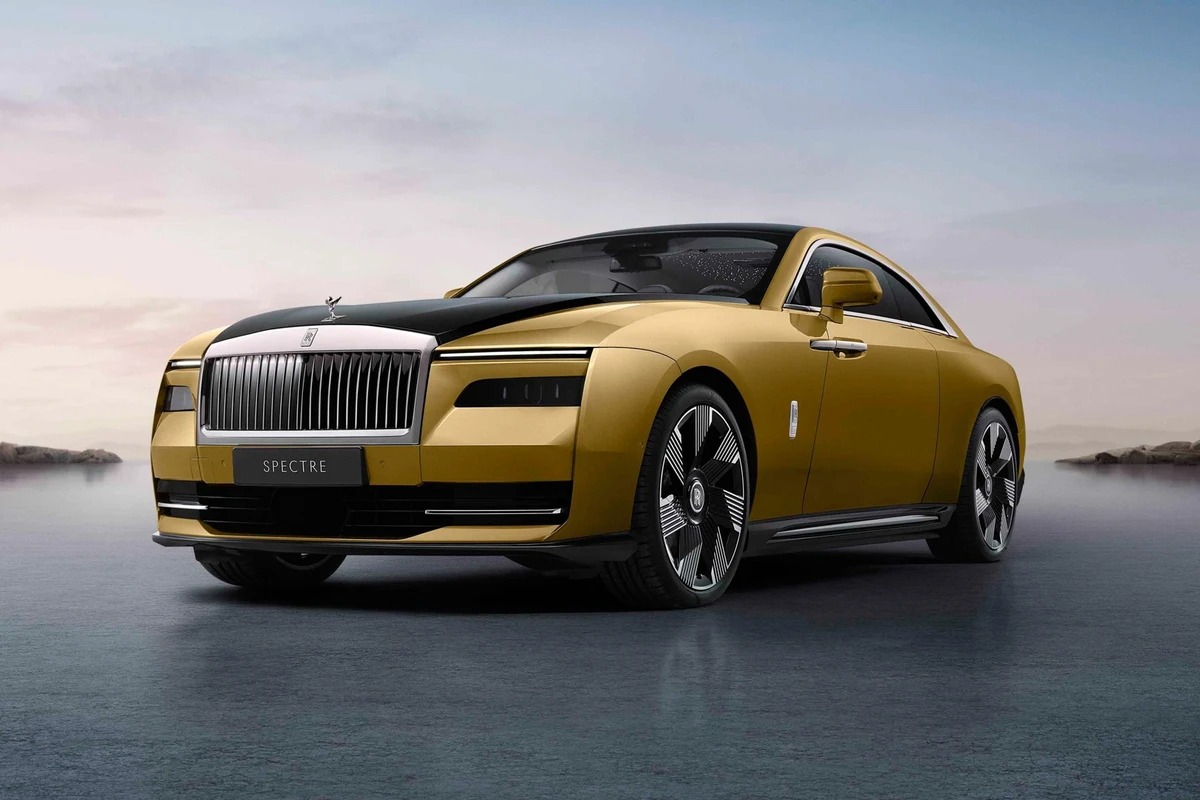
The first EV to come from Rolls-Royce is also expected to make landfall in South Africa in 2023. The Rolls-Royce Spectre will no doubt come with a hefty price tag but it will also undoubtedly be lavishly equipped with luxury features.
Exact powertrain details are expected to be made public early in 2023 but Rolls Royce has stated that the Spectre will offer in the region of 430 kW and 900 Nm of torque while offering a driving range of 520 km (WLTP). Zero to 100 kph is said to be done and dusted in 4.5 seconds.
We will keep you updated as more details become available.
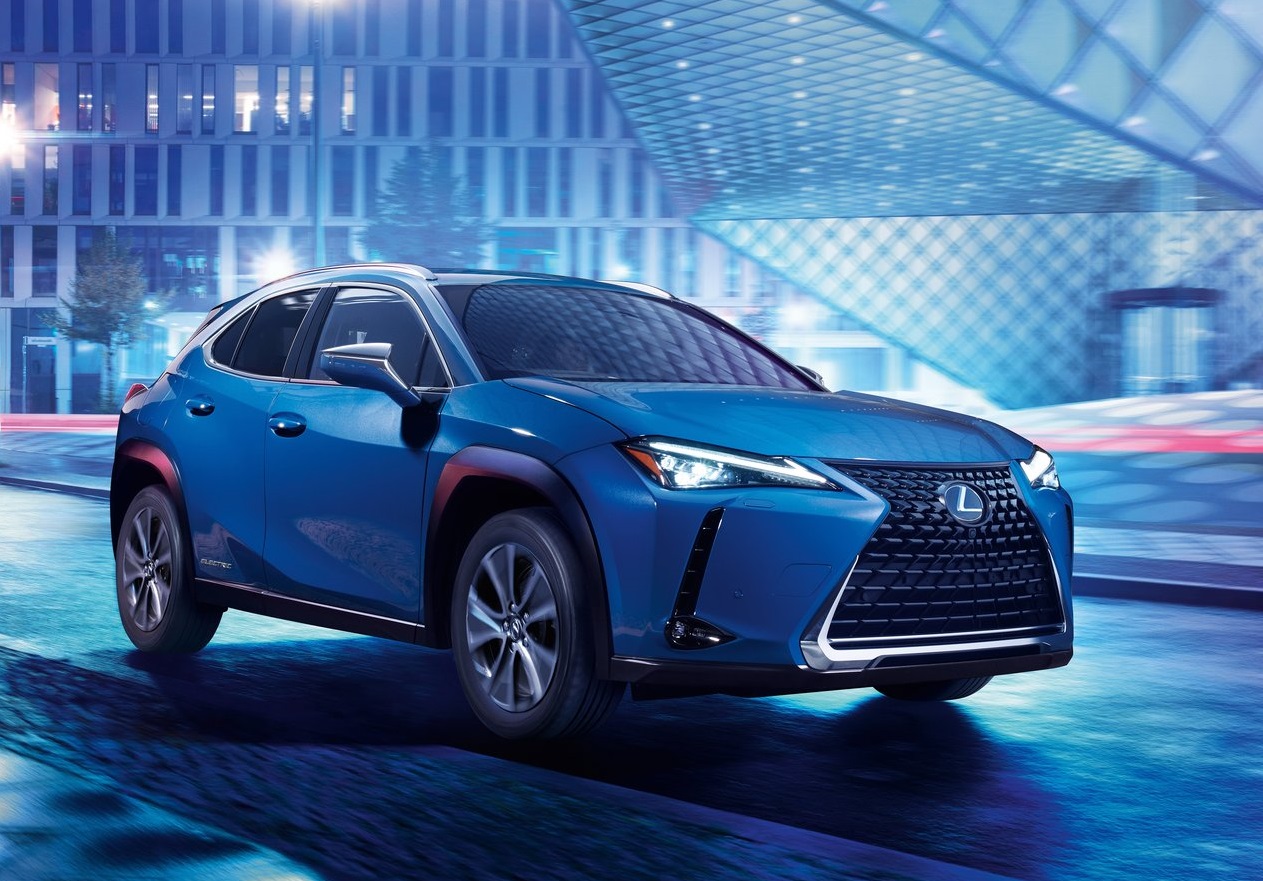
Lexus is considering the introduction of the UX300e in South Africa. The UX 300e was recently updated with a larger 72.8 kWh battery pack (previously 54.4 kWh) and now offers a driving range of 450 km. Outputs from the electric motor, however, remain the same at 150 kW and 300 Nm.
We will keep you updated as soon as more details become available.
How Toyota SA could replace Urban Cruiser with larger Hyryder
With the Toyota Urban Cruiser on the way out in SA, the identity of its replacement has been the topic of much speculation. But we now have details suggesting the firm will massage the Hyryder into a suitable successor…
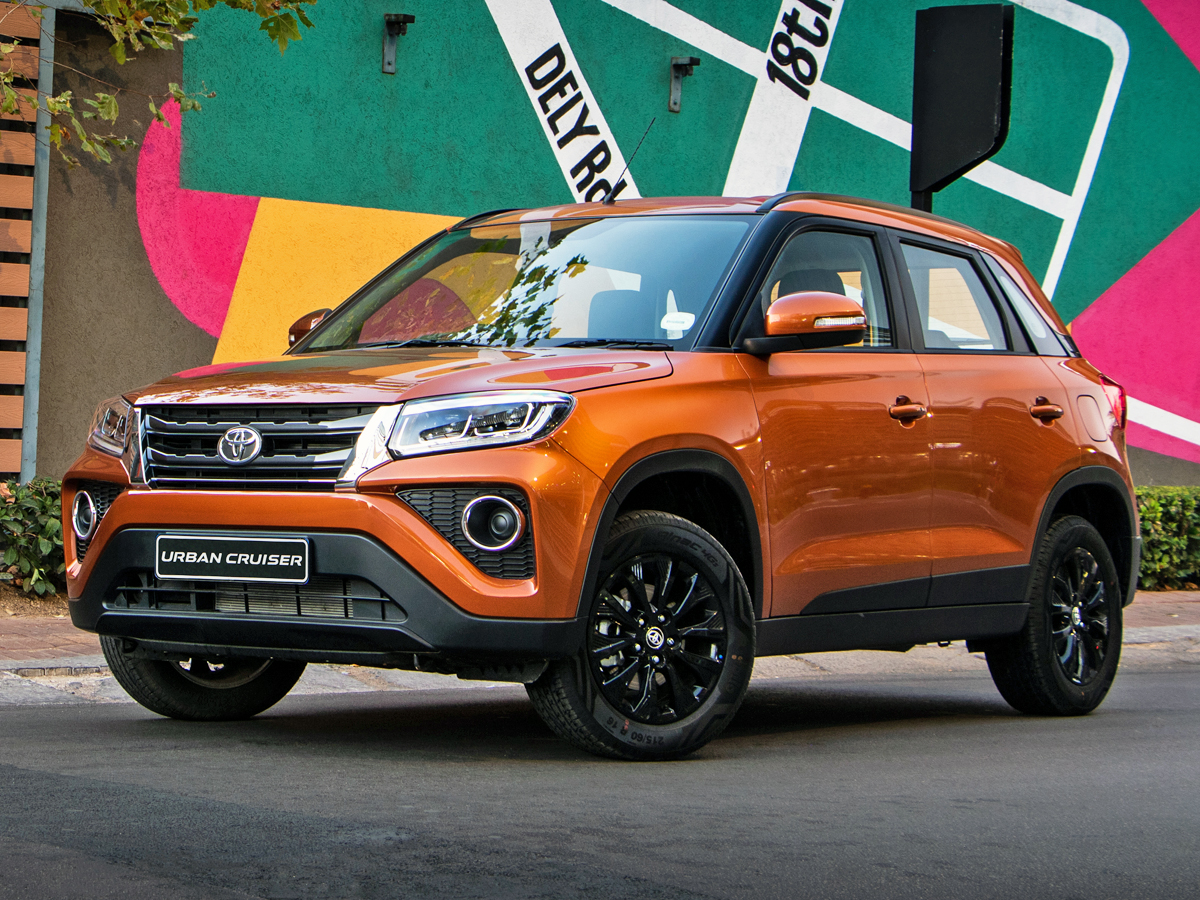
When news of the Urban Cruiser’s shock axing first emerged in November 2022, Toyota South Africa Motors confirmed to us it “had a replacement lined up”, though wouldn’t be drawn on its identity. Now, finally, we have some information suggesting the larger Hyryder will indeed serve as its successor.
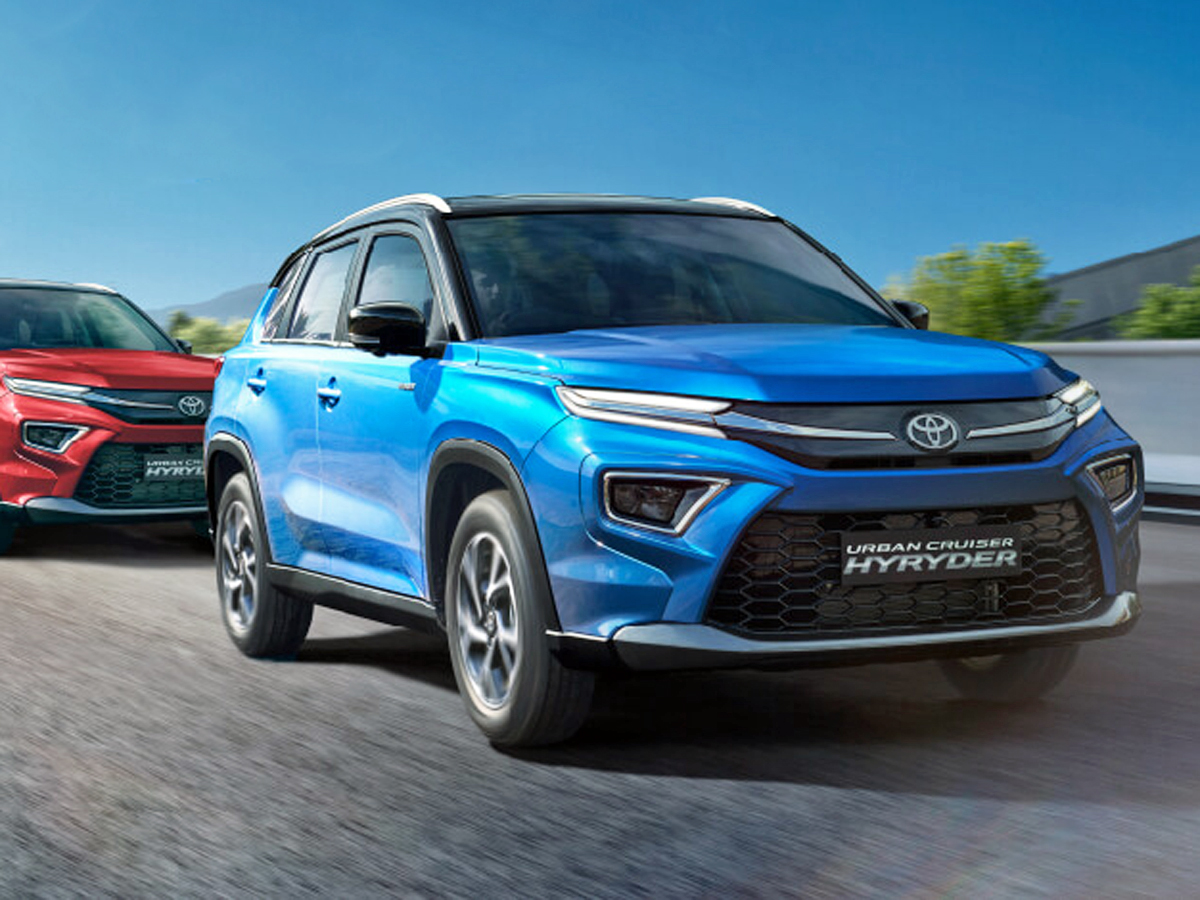
According to our intel, the Urban Cruiser Hyryder – to use its full name – will join the local range at some point in 2023. Though no official launch date has yet been confirmed, we may well see the Hyryder (if it ends up wearing that badge here) on local soil as early as the first quarter of the year.
Back in June 2022, Toyota Kirloskar Motor (the company’s division in India) confirmed it would export the Hyryder to “markets outside India, including Africa”, before Toyota SA Motors announced the model was “under study” for a local introduction.
As a reminder, the Hyryder is the latest product of Toyota’s global alliance with Suzuki. The newcomer was developed by Suzuki alongside the closely related new Grand Vitara but is produced by Toyota Kirloskar Motor at its Bidadi plant in India. The outgoing Urban Cruiser, of course, was built by Maruti Suzuki at its Gurgaon facility and based on the Vitara Brezza.
Isn’t the Hyryder much larger than the Urban Cruiser?
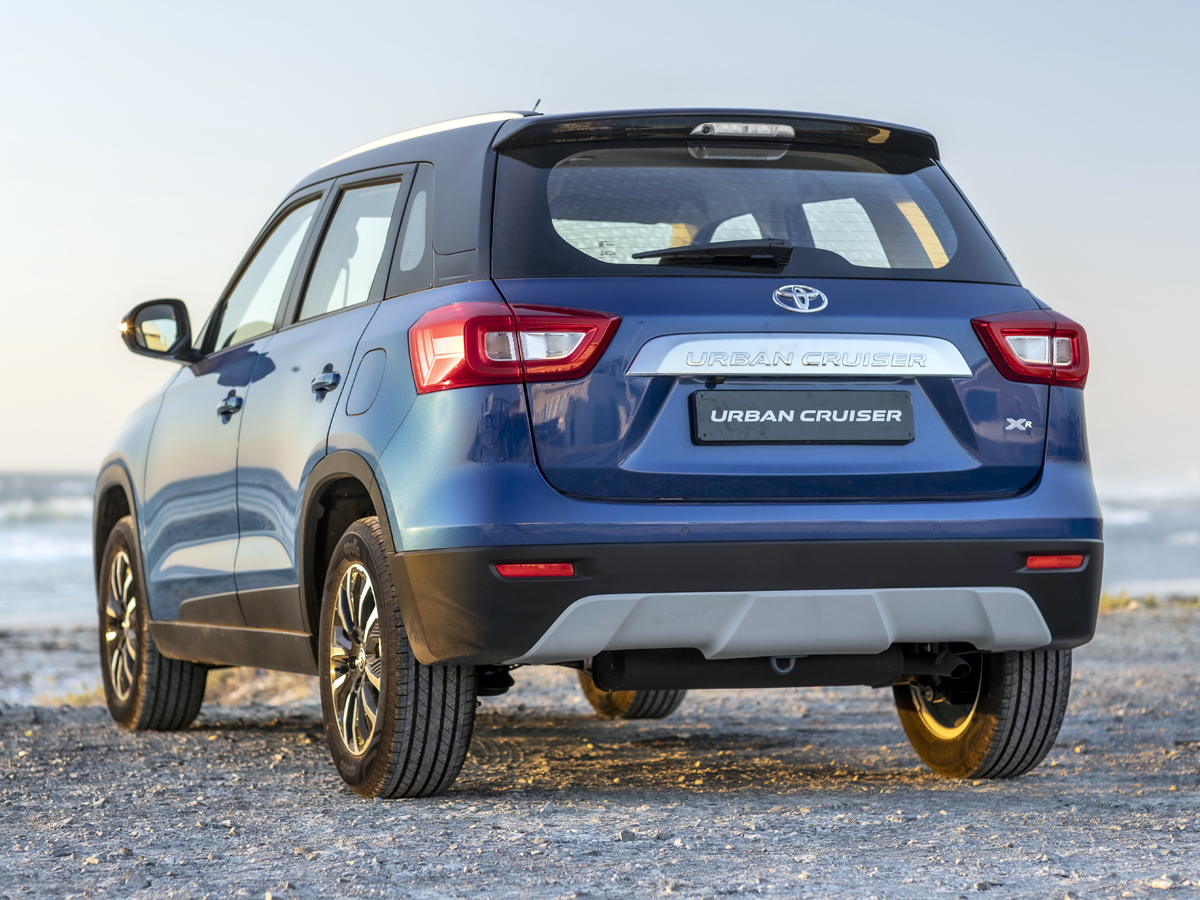
Toyota’s outgoing Urban Cruiser is a sub-4-metre vehicle.
The Urban Cruiser – which will continue to be marketed in South Africa into the new year – measures 3 995 mm from nose to tail, with 2 500 mm separating its axles. The Hyryder, meanwhile, is 370 mm longer at 4 365 mm, with its wheelbase 100 mm lengthier at 2 600 mm.
Those dimensions put the Hyryder closer in size to the locally produced Corolla Cross, which comes in at 4 460 mm long (95 mm more than the Hyryder) with a wheelbase of 2 640 mm (40 mm up on that of the newer model). However, there’s seemingly just enough space to justify the presence of both in the local market, particularly if Toyota is shrewd with the new model’s engine options and specification list.
In addition, the small gap created below the Hyryder may well end up being filled by an upcoming coupé-style crossover reportedly based on Suzuki’s Baleno and possibly wearing the Taisor badge. More details on that rumoured model – and the likelihood of it being offered locally – should come to light in early 2023.
Won’t the Hyryder be more expensive than the Urban Cruiser?
Despite the “Hy” in its name, our info suggests the SA-spec model won’t be offered with a hybrid powertrain.
The biggest obstacle we initially saw standing in the way of a local introduction of the Hyryder as a replacement for the Urban Cruiser involved its surely higher price tag. However, from what we now understand, Toyota SA Motors is working hard to price the Hyryder not too much above than the Urban Cruiser’s current bookends of R280 400 and R353 600. After all, it can’t afford to tread on the toes of the Prospecton-produced Corolla Cross, which currently runs from R360 400 to R461 700 (and offers larger engines, including the option of a full hybrid set-up).
One way Toyota’s local division might be able to keep pricing in check is to forego the Hyryder’s relatively expensive hybrid powertrains offered in India in favour of a more basic (that is, non-electrified) engine. We’d speculate a version of Suzuki’s K15B naturally aspirated 1.5-litre petrol mill – as employed by the Vitara Brezza and indeed the outgoing Urban Cruiser – is the most likely choice.
Whereas the new Grand Vitara scheduled to launch in South Africa in the first quarter of 2023 will be available with both this unit and the latest K15C 1.5-litre dual-jet mild-hybrid motor, our information points to the SA-spec Hyryder sticking with the KB15 lump. We furthermore wouldn’t be surprised were it to be offered exclusively in front-wheel-drive guise, rather than with the option of a multi-mode all-wheel-drive system, as will be the case with the SA-spec Grand Vitara.
In addition, while the Grand Vitara will be crammed full of standard kit (including a 360-degree camera system, head-up display and wireless smartphone charging on range-topping derivatives) and serve as the flagship of Suzuki Auto SA range, the locally available Hyryder looks set to make do with a somewhat shorter specification list more befitting of its positioning below the Corolla Cross, C-HR, RAV4, Fortuner, Land Cruiser Prado and Land Cruiser 300.
Will the Hyryder sell as strongly as the outgoing Urban Cruiser?
The Urban Cruiser nameplate has been a hit with South African buyers.
Despite its time on the market coming to an end, the Urban Cruiser looks poised to finish 2022 as South Africa’s best-selling crossover. As many as 16 047 examples have been registered across the country over the first 11 months of the year, making it one of Toyota’s top-performing models locally.
Whether the Urban Cruiser Hyryder will be able to match these lofty sales figures remains to be seen, but its success will surely depend on just how sharply Toyota SA Motors is able to price the newcomer. If it costs only marginally more than the Urban Cruiser but offers similar kit and appreciably more space, the company may have yet another smash hit on its hands.
Fascinatingly, Suzuki Auto SA has yet to outright confirm the facelifted Brezza (revealed in India in June 2022 and ditching the Vitara prefix) for a local introduction, saying the current version will “continue to be sold in South Africa for this year and next year [2023]”, before adding “some model updates/changes are in the pipeline from mid-2023”.
Mercedes-Benz South Africa has launched a flurry of electric vehicles late in the year and we’ve had a quick drive in the new EQB. Here’s what we thought of it…
It has been a challenging year for many automotive brands and Mercedes-Benz has been one of the marques severely affected by stock shortages. Remember that while Mercedes-Benz SA continues to produce the entire C-Class sedan range at its East London plant, every other model is imported.
Owing to production disruptions (caused by shortages of components such as semiconductors and wiring looms), cars have not been coming off the line quickly enough to satisfy demand, plus there have been shipping delays. Again, this is not just a Mercedes-Benz problem; many brands have suffered shortages and delays. Most recently, logistical issues hampered the local launch of the VW Golf 8 R.
Benz’s all-electric EQ range is broad; while some models are based on ICE-model platforms, some of the newer additions to the line-up are based on the brand’s dedicated MEA electric-vehicle architecture.
So if you want something fresh, luxurious and different, you are likely to find what you’re looking for within the EQ range. Kicking off the range is the EQA, essentially an electrified GLA and, if you desire a bit more space and poke, there’s the EQB (modelled on the GLB). There’s an EQC, which you guessed it, is an electrified (previous-gen) GLC. For those shopping for a sedan, Benz offers the EQE and EQS.
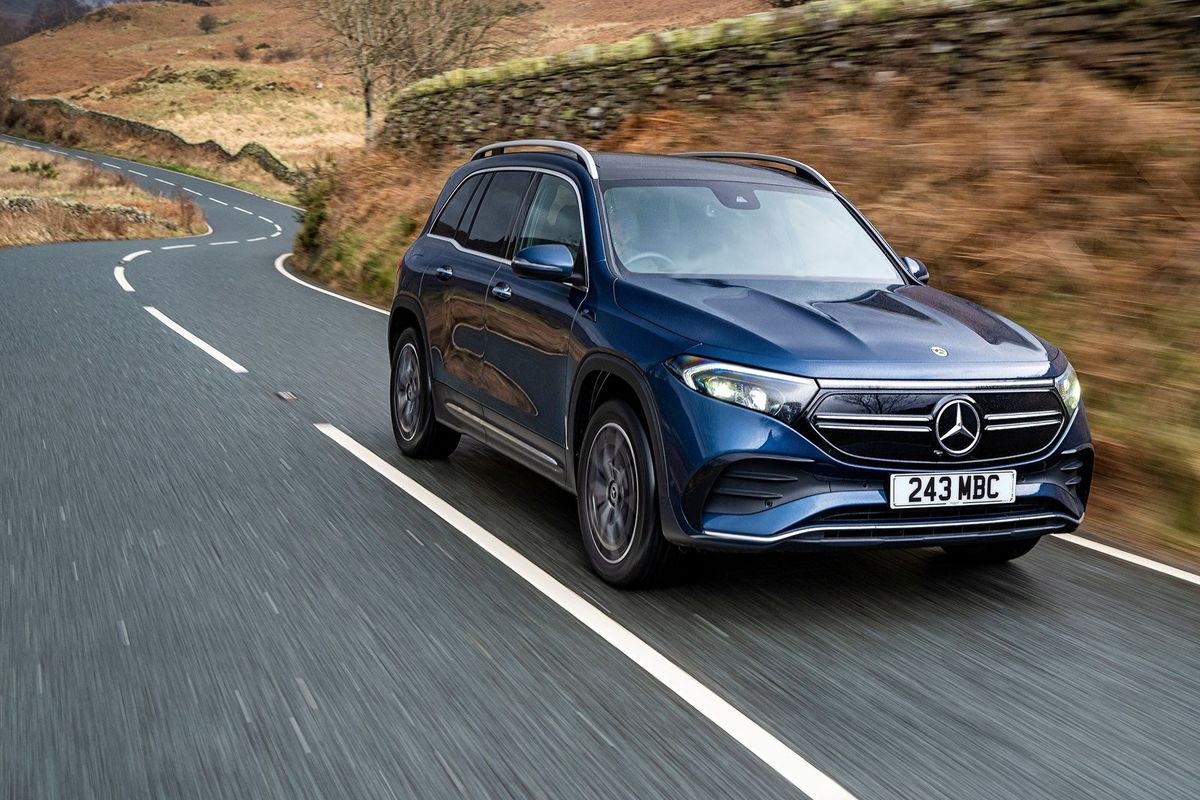
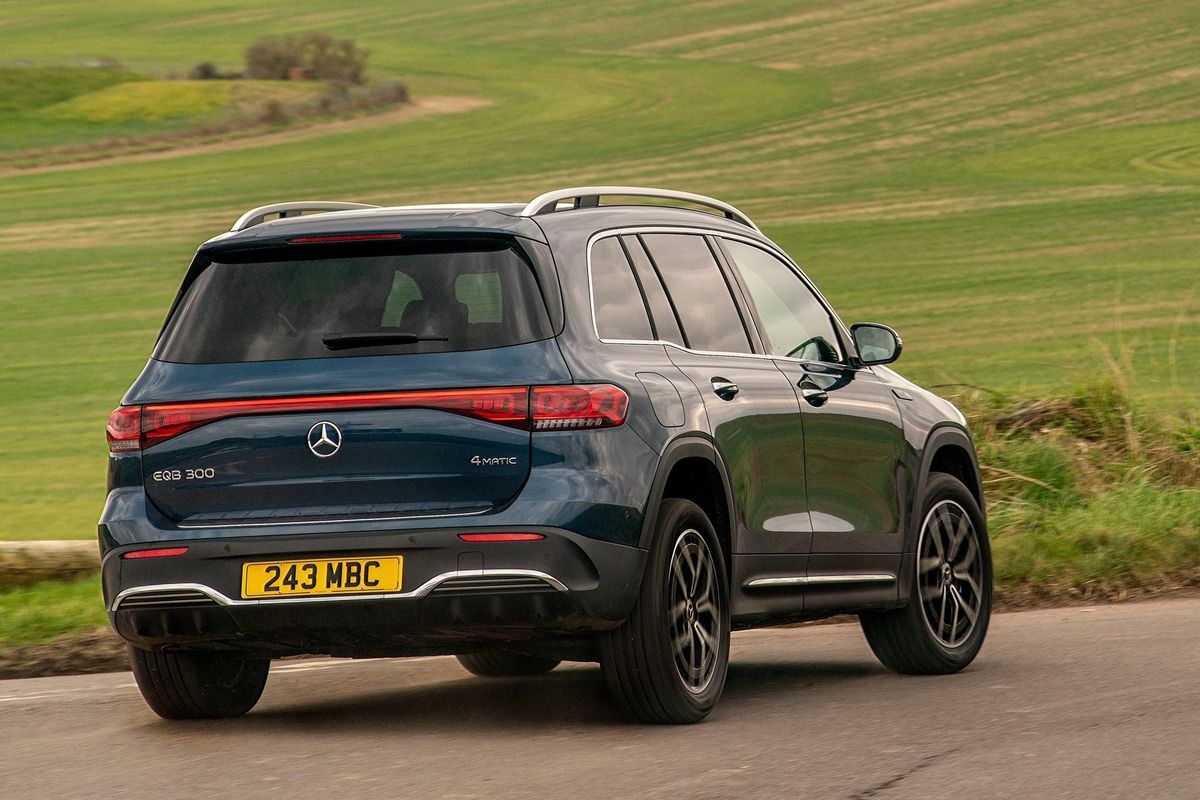
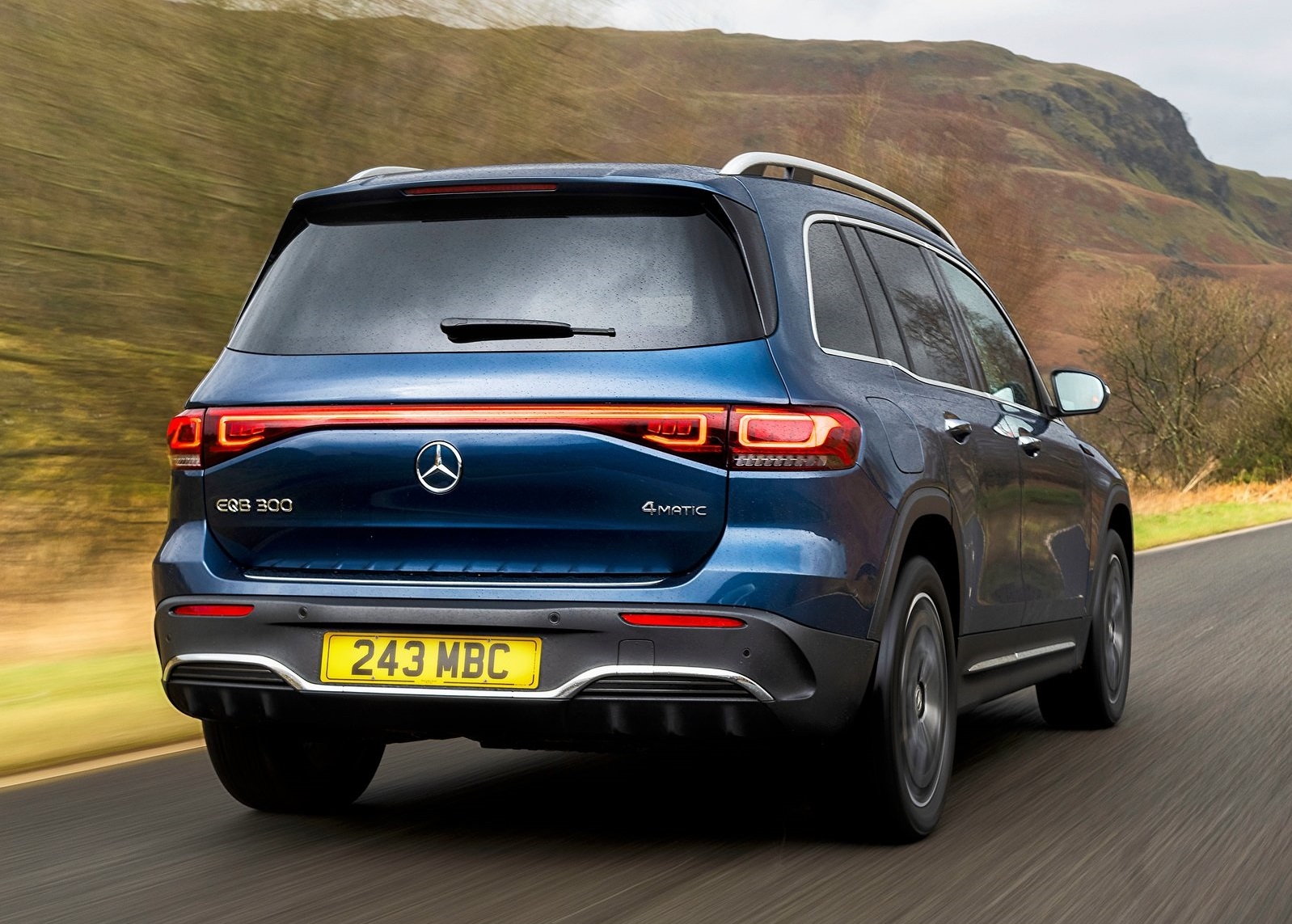
Mercedes-Benz SA offers its EQB with one powertrain and 3 trim levels. Many brands have opted to endow their EV models with bold – but polarising – styling, but even though the EQB has some futuristic cues (enough to distinguish it from its ICE sibling), its appearance is altogether conventional. It’s a tricky game to play, just ask BMW with its iX. It’s brilliant, but those quirky looks aren’t to everyone’s taste.
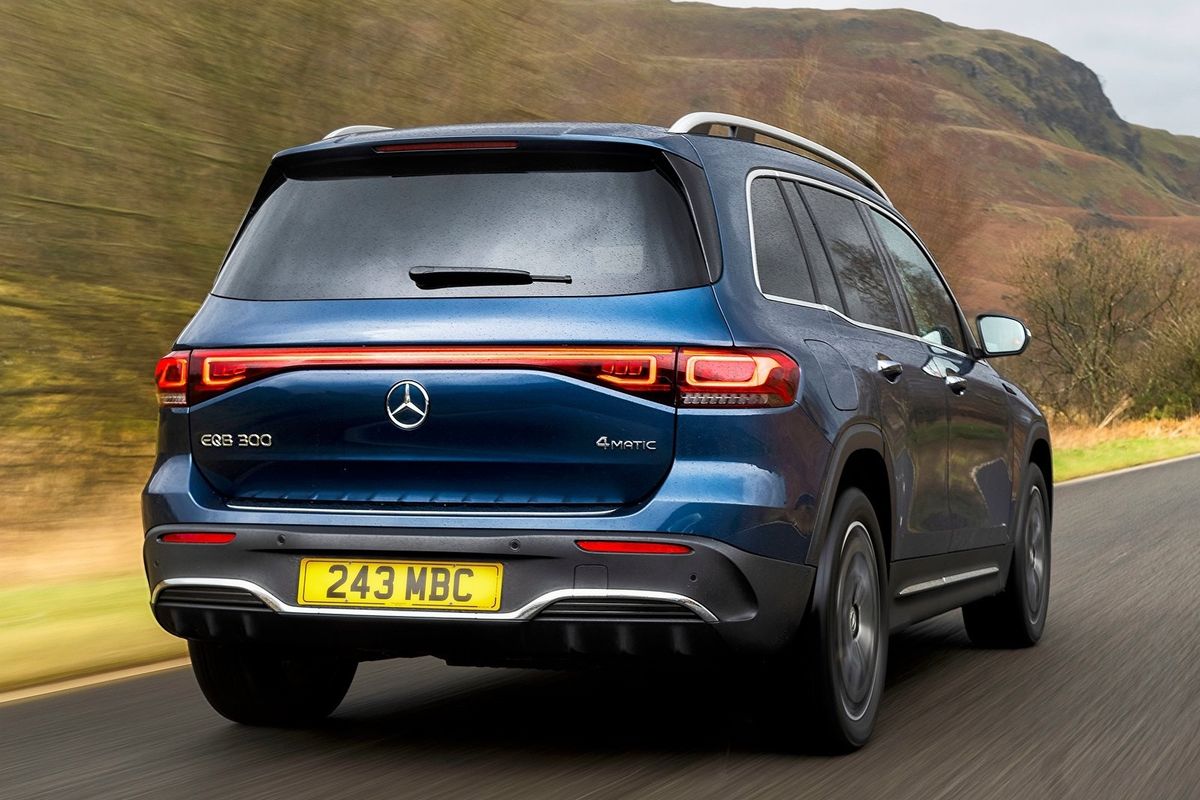
With the EQB, you actually need to tell people that it’s an EV. If you look closely, however, you can spot some subtle clues that it is an all-electric model, such as the Mercedes-EQ black panel grille, continuous light strips at the front and rear of the vehicle, aerodynamically optimised light-alloy wheels (in a bi- or tri-colour design, up to 20 inches in size), as well as specifically adapted front and rear wheel spoilers.
There are two motors on duty (one on each axle) and they deliver peak outputs of 215 kW and 520 Nm of torque. Power is directed to all four wheels via an automatic transmission.
As for the performance claims for the EQB, 0-100 kph is said to be dispatched in a brisk 6.2 seconds and its stated top speed is 160 kph. It’s not the lightest car around (with a kerb weight of just over 2000 kg), but then again, neither are its rivals, with most of the additional portliness coming from the battery pack.
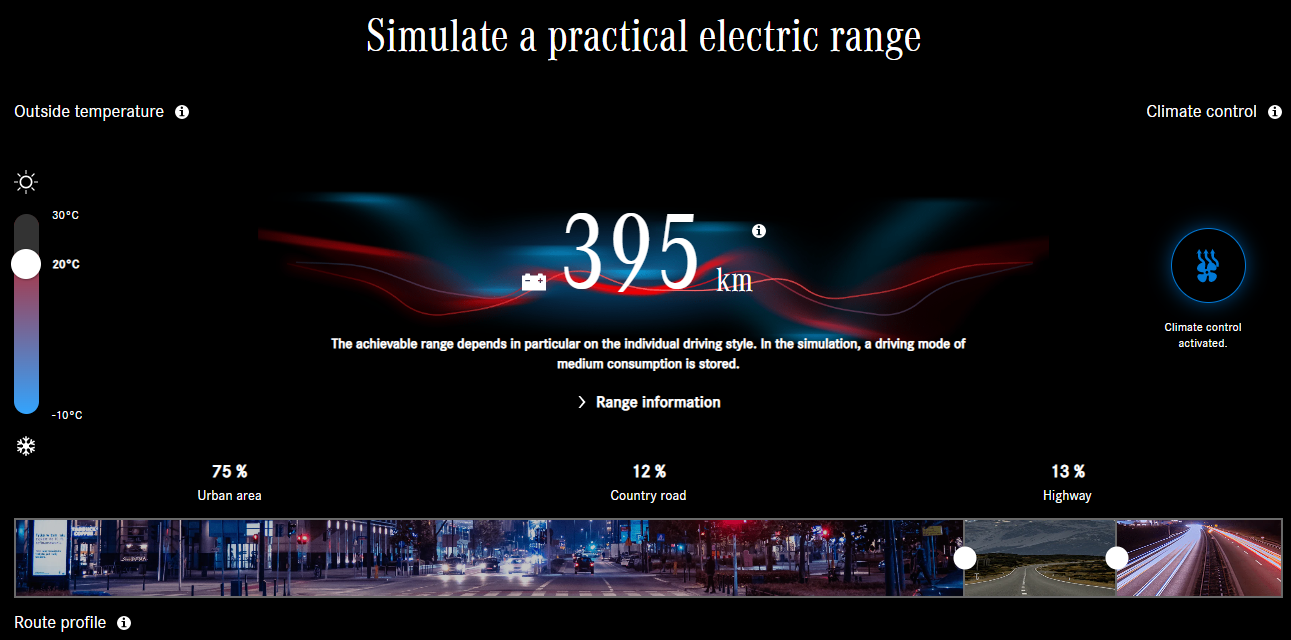
The battery is rated at 66.5 kWh and the claimed range (from 100% charged) is between 395 and 423 km. Mercedes-Benz SA’s website has a nifty range simulator that allows you to input your driving style, road conditions and weather conditions to calculate the distance you could achieve on a single charge.
At this price point, the EQB’s standard equipment list is expectedly generous, but you can play around with the configurator to your heart’s content (or until your bank balance or -manager cries “enough!”).
Plenty of optional packages are available for the EQB, along with various individual options such as a panoramic sliding sunroof (R16 400) and adjustable damping (R17 600). Should you wish to specify that 3rd row (of two seats) to turn your EQB into a 7-seater, be prepared to part with an additional R22 000.
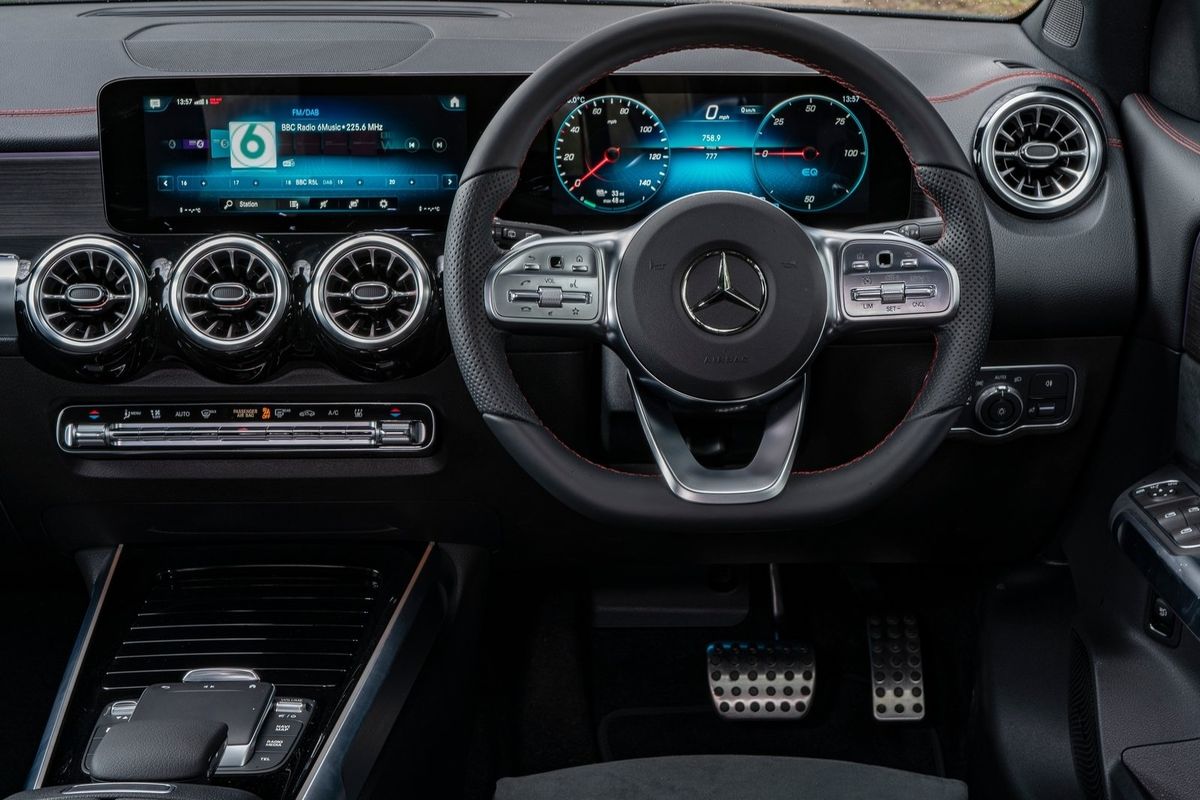
The MBUX digital instrument cluster and infotainment touchscreen are fitted as standard.
What’s it like to drive?
Our short test route was comparable to (what we’d imagine is) a commuter’s average route; it comprised stints of freeway driving and trundling along congested urban roads. The EQB’s ride quality was pliant, despite being fitted with large (20-inch) wheels, but we suspect this was due to the roads being well-maintained. We’d like to drive the EQB on a variety of road surfaces to see how forgiving its suspension really is.
Like the vast majority of electric cars, the EQB operates in near silence. In EVs, there’s nowhere to hide unpleasant sounds because there is no ICE to mask excessive wind or road noise. We’re happy to report that, at 100 kph, we discerned only a gentle wind sound emanating from the side mirrors. Some artificial powertrain noise is plumbed into the cabin, but we understand it can be switched off if it gets annoying.
The electric motors deliver maximum torque right from the get-go and thanks to all-wheel drive, the EQB launches off the line with impressive urgency. The torque delivery is instantaneous, and you don’t even need to fully depress the accelerator pedal to exact urgent performance from the powertrain.
Besides, in the interests of maximising your range, you shouldn’t be stomping on the long pedal too often in any case; rather rely on momentum and brake regeneration to eke out those extra kilometres.
Summary
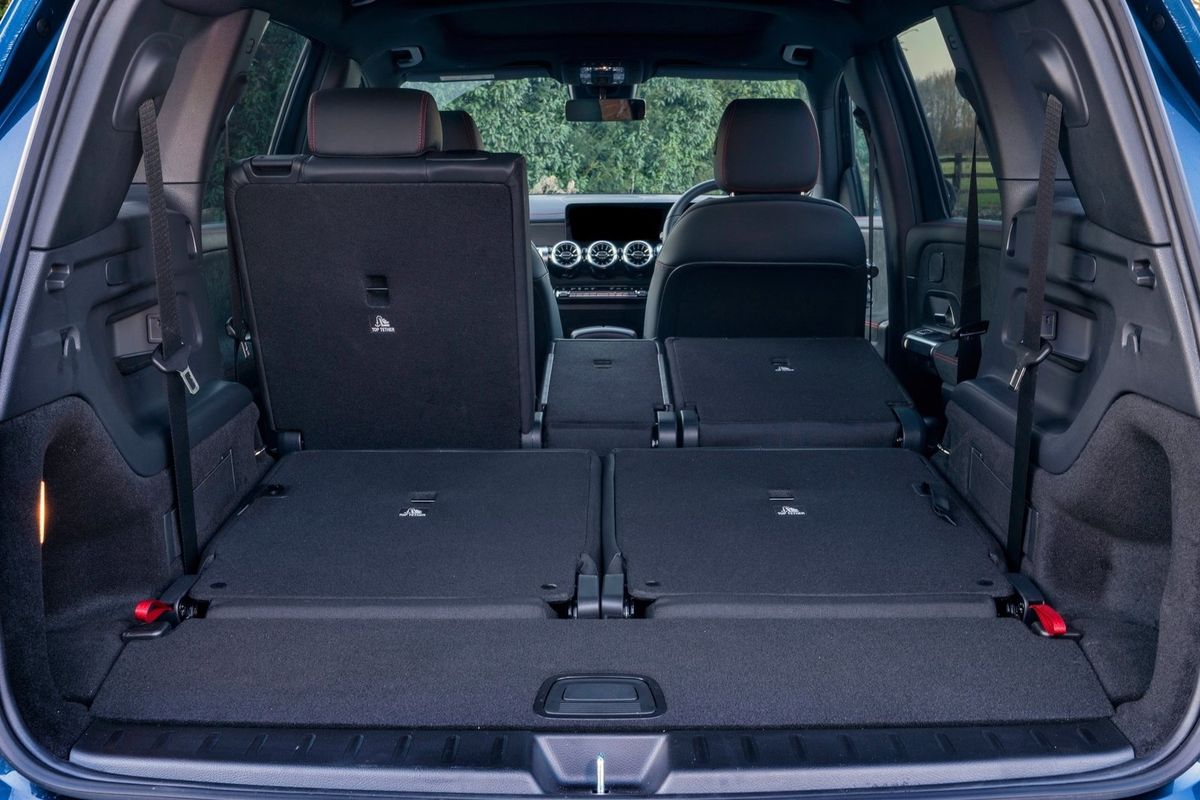
Our test drive was short and sweet, which is also an apt description of the EQB, come to think of it. Yes, its design is boxy, but taller passengers will be thankful for the excellent headroom and exterior visibility. With a realistic range of well in excess of 300 km and ground clearance of 165 mm, the EQB should be well suited to dirt-road journeys, with the added bonus of a large load bay, plus the option of a 3rd row.
Many may wonder why the EQB exists when there is EQA. Yes, the EQB is a touch more expensive in comparison to its smaller sibling, but the benefits are notable. You get more space, more performance (215 kW/520 Nm versus 140 kW/385 Nm) and the sure-footedness of all-wheel drive.
Now for the kicker. With prices starting above R1.3 million, the EQB isn’t exactly ‘cheap’ or ‘affordable’, by compact SUV standards anyway. As things stand, all-electric motoring remains the preserve of the wealthy, not least those who can afford the extra cost of installing solar panels and home chargers.
Toyota SA Rolls Out Free Anti-Theft Updates for Certain Vehicles
In response to new modus operandi from local vehicle-theft syndicates, Toyota SA says it has developed a range of vehicle security systems enhancements…
Toyota South Africa Motors says it has developed various “enhancements” for the security systems of certain of its popular vehicles, with these updates available for free at dealerships around the country.
The Japanese firm’s local division says the move is in response to “new modus operandi on the part of criminals and syndicates”, including the use of “sophisticated technology” to target vehicles featuring keyless or smart-entry systems.
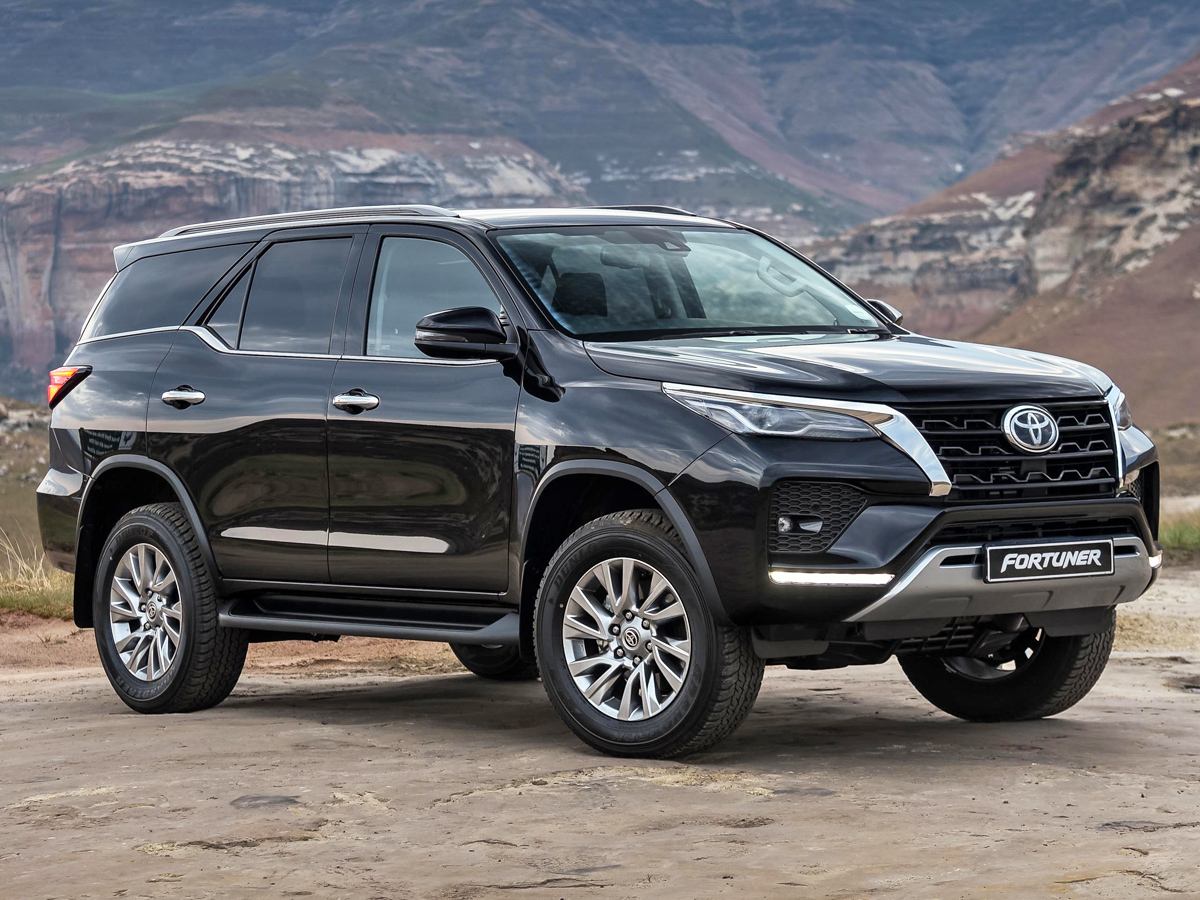
The vehicles eligible for the enhancements include all Hilux Legend models from 2019 and all Fortuner models from 2016, along with all VX and VXL derivatives of the Land Cruiser Prado from 2017. Finally, all Lexus RX and LX models registered from 2015 also qualify*.
All new vehicles as well as those arriving at dealers for routine servicing will automatically receive the enhancements. Though the company opted not to detail the updates, it claims to have developed “several measures to mitigate possible theft of Toyota- and Lexus-branded vehicles in the country”.
These measures have been shared with the Toyota dealer network as well as reviewed and evaluated by VSS Administration, which the brand describes as an “independent South African organisation that specialises in vehicle security and automotive systems”.
Three areas of focus for Toyota’s security enhancements
Fortuner models registered from 2016 are eligible to receive the updates.
After “proactively” conducting research and development into the enhancement of its vehicle-security systems, Toyota SA Motors says it found three main ways criminals are exploiting a given vehicle’s various computer-controlled systems.
The first involves the vehicle’s Control Area Network (CAN), which criminals infiltrate using “highly sophisticated electronic equipment”, gaining entry and then accessing the computer system to start the engine.
Then there’s fob relaying, which involves the use of receivers and transmitters to remotely read the vehicle’s security key (while it is still in the possession of the owner), ultimately allowing the criminal to unlock and start the vehicle.
Toyota describes the third method as a “combination of forced entry and key cloning”. This sees the use of “advanced techniques and equipment” to disable the vehicle’s alarm system, clone its security key and gain access to the vehicle.
“We, as Toyota, are committed to developing safe and reliable vehicles and we will continue with our research and development to further enhance our vehicle security systems. I would also like to add that vehicle owners will not negate the warranty on their vehicles should they elect to fit an aftermarket security device – provided that these are installed correctly by a reputable fitment centre,” said Leon Theron, Senior Vice President of Sales and Marketing at Toyota SA Motors.
*initially, Toyota SA Motors said all Land Cruiser 200 models with smart entry and all Land Cruiser 300 units were also eligible, but the company has since removed these models from the list.
Continental Icons Part 4: The Gorgeous Mercedes-Benz SLS AMG
It is without a doubt one of the most impressive sports cars Mercedes-Benz has given us in the 21 st century. Sana-Ullah Bray shares his car history with us and the story behind his passion for cars, Mercedes-Benz and in particular his SLS AMG.
The task to develop a car to replicate and remind us of the performance and beauty that the 300SL Gullwing offered in 1954, was no small task. But in 2009 Mercedes-Benz did just that and unveiled the SLS AMG at the Frankfurt Motor Show while sales started in 2010.
Apart from the performance (the wonderful M156, 6.2-litre V8 was fitted), the styling and gullwing doors were two elements that grabbed the attention of all of those who saw it.
A number of these cars were exported out of South Africa when their values were very low a few years ago. However, interest in these cars quickly started to climb and so did their prices.
Automotive enthusiast Sana-Ullah Bray’s history with Mercedes-Benz goes back several decades, and he even had to wait several years before an SLS, and the right SLS, crossed his path.
“My family has had several cars over the years and some of them were really iconic. My one uncle had a Ford Capri Perana V8 and my other uncle had a BMW E36 M3. As a youngster you always remember these cars fondly. Seeing these cars and talking about them with friends and family cultivated the environment in terms of what I like about cars.
“At one stage my dad had a W114 Mercedes and my uncle a W108 280SE. I always had this aspirational idea of a Mercedes. Then in 1999 I bought my first Mercedes-Benz, it was a 300CE AMG. My passion for the brand and their cars grew from then as I then bought a 1994 E320 AMG. The passion continued as I then started with collecting classic cars by purchasing a 1958 220S Ponton.
“For me it is about the hunt and finding the right car. I then also bought one of my dream cars, a 1968 280SE Coupé. I still own that car and have owned it for more than 10 years. In terms of classic cars, that shape is really special to me.”
Sana-Ullah’s path through classic and modern classic cars took several turns as he also owned and still owns some R129-series models.
“My father had a Mercedes-Benz 190E which we had for many years. It is still in our family and I look after the car. Classic Mercedes-Benz is really part of our life.” Sana-Ullah is also part of the Mercedes-Benz Club where he can share his passion and information about these cars with fellow enthusiasts.
“The idea of owning an SLS AMG was always an aspirational dream for me. The first time I saw one in the metal was at Mercedes-Benz Century City during the launch of the car. I decided that evening that one day I would like to own one.
“I looked for the right one at the right time for many years, plus, I wanted to buy one from a Mercedes-Benz dealership. Then, about a year ago my local Mercedes-Benz dealer in Paarl sent me a picture of an SLS parked on their showroom floor. I was on my phone and told him “Ek is nou daar!”.
“I wanted a car with full-service history and all the books. A deal was done and I now have this SLS which I am very proud of. Pulling up to the fuel station is always an occasion as you soon have a crowd of people around the car. Also, everywhere you go people want to hear the engine and exhaust note!”
Sana-Ullah is also quick to point out that he is thankful for his wife, children and extended family that shares a similar passion for cars and Mercedes-Benz.
During the final couple of hours following the day’s shoot, his daughter joins us to watch the sunset, as the team takes the final video clips of the SLS AMG. Soon thereafter father and daughter climb onboard and head down Du Toitskloof Pass in what is now firmly a true modern classic ‘Benz.
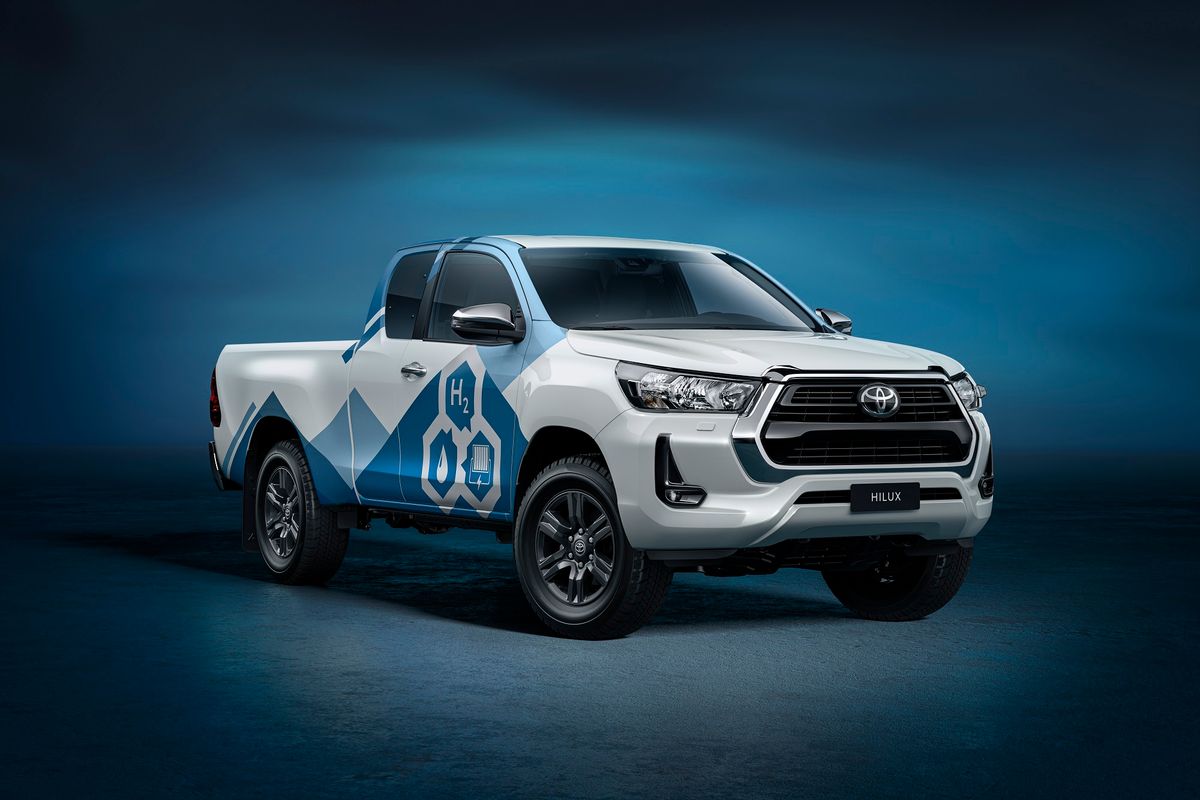
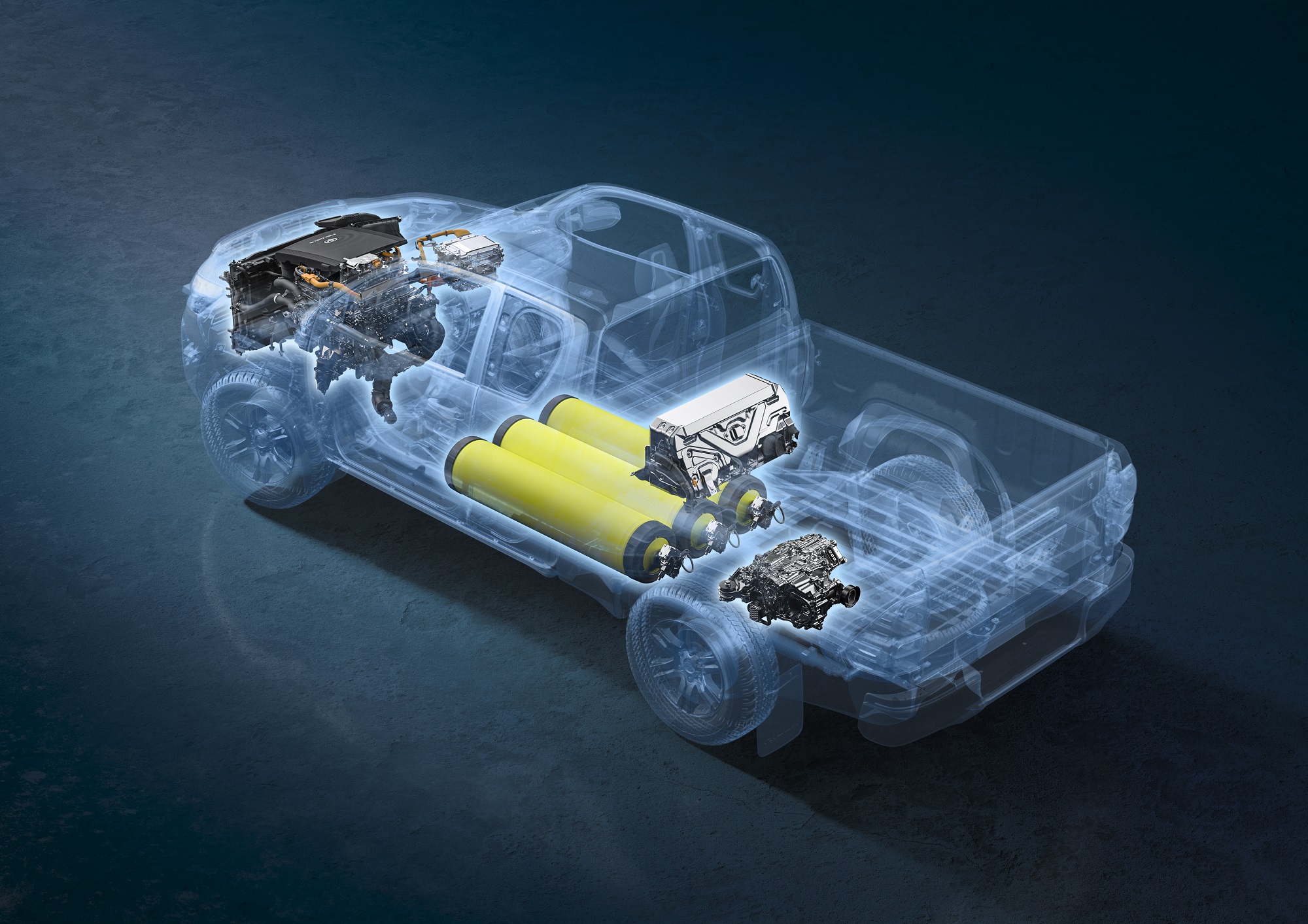
While it’s still a long way from being a production reality, research and development of a hydrogen-powered Hilux from Toyota has begun.
While the world seems to be focused mostly on electrification, there are still other options to be explored when it comes to alternative sources of propulsion. Things like biofuel and hydrogen are gathering momentum, and Toyota reckons a hydrogen-powered Hilux is worthy of investigation.
Toyota UK will be receiving funding from the UK government to investigate and develop a hydrogen fuel cell-powered prototype Toyota Hilux. Toyota’s 2nd-gen fuel cell technology will be utilised, straight from the current Mirai.
“The UK is one of the key markets for pick-up trucks and is an important market for Toyota. This funding represents a tremendous opportunity to develop a zero emission solution in a critical market segment. We would like to thank the UK Government for the funding that will enable the consortium to investigate the development of a fuel cell powered powertrain for the Toyota Hilux, supporting our carbon neutrality ambition,” said Matt Harrison, President & CEO of Toyota Motor Europe.
Toyota will be teaming up with a few engineering partners like Ricardo, ETL, D2H and Thatcham Research and together the goal is to convert a Hilux into a fuel cell electric vehicle.
The first initial prototypes are expected to be built at Toyota UK’s facility in Burnaston, England in 2023 and if things go according to plan and testing is successful, the goal is small series production.
Challenges? Well, we think range and weight will pose and interesting challenge, but we’re excited by the idea of a revolutionary new powertrain in something as iconic and popular as the Hilux. Yes, the vast majority of customer will likely prefer the tried-and-tested diesel powertrain, but this is one way of future-proofing the Hilux.