CONTINENTAL ICONS Part 3: Epic Opel GT Road Trip Across SA
Join us on an epic journey across South Africa as our very own Hannes Oosthuizen reunites with his beloved Opel GT after 11 years of separation! Watch the video!
The Opel GT is a very rare car in South Africa, with fewer than 20 speculated to have arrived on our shores, and even fewer currently on the road. For Cars.co.za’s Hannes Oosthuizen, the little Opel was an object of desire from his childhood, having grown up on the backseat of an Opel Rekord. For him, seeing such an exotic shape from a relatively conservative brand was just incredible and so he really wanted a GT.
In the early 2000s, he finally stumbled across the car you see in this video, and had it restored (badly), but it nevertheless cemented his love for the car, and even his then very young son fell in love with the car. Unfortunately, in 2011 he had to let the car go, and regretted it immediately.
Then started a near-five-year-long search for his Opel, which he eventually tracked down in Kimberley, but the new owner didn’t want to sell. He kept trying though, and in early 2020, just as the world became aware of the COVID-19 pandemic, he bought his beloved Opel GT back. His busy schedule meant that he had not seen the car in the metal until the first day of shooting of this film. So, would he still feel the same love for the car after nearly a decade apart? And would the little Opel, which had been standing for much of the past 11 years be capable of a 1 600km road trip to Cape Town? With its new Continental tyres fitted, and some new cooling pipes, it was time to hit the long road, with our trusty Opel mechanic, Werner Meyer.
Mercedes-Benz Says First Electric Van ‘On Track’ for SA
Mercedes-Benz Vans has reiterated its aim to launch fully electric options in the South African market, saying its plans for the first model are still “on track”…
After studying the feasibility of marketing van-based electric vehicles in South Africa, Mercedes-Benz Vans says its plans remain entirely “on track”.
Marinus Venter, Head of Product and Marketing at Mercedes-Benz Vans SA, says the Stuttgart-based firm’s local strategy is geared towards it becoming a “pioneer” in the field of electric mobility solutions, for both private and commercial use.
“In 2022, we have engaged in several insightful conversations regarding the feasibility of electric vans in South Africa. We are excited to share that we are on track to introduce our first electric van in South Africa by our target date,“ Venter says, without revealing exactly when that would be.
“We believe that our electric vans will take locally emission-free transportation to the next level in South Africa,” he adds.
Back in July 2022, Venter confirmed the division had plans to bring in battery-powered vans at some point in the future, though stopped short of letting slip exactly which models were under consideration. Though there’s still no clarity on this question, there are currently a few potential options.
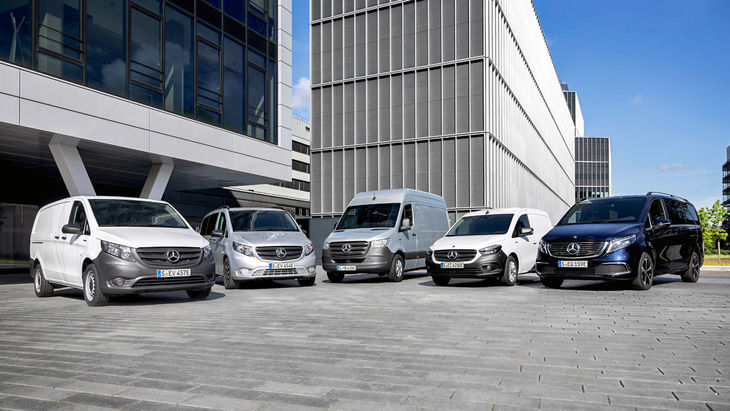
Mercedes-Benz Vans already offers a number of EV options in Europe.
In the commercial sector, there’s the eSprinter, which is scheduled to be replaced by a new-generation model in 2023, as well as the eVito, which is available in some markets in both panel van and Tourer guise. There’s also the eCitan, a model that features a claimed single-charge range of around 285 km.
Outside of the commercial sector, Mercedes-Benz Vans also markets the EQV. This model is positioned as a fully electric premium MPV and is effectively a battery-powered V-Class with a claimed range of 405 km. An electric version of the T-Class (dubbed the EQT and previewed by the Concept EQT) is also set to be unveiled in the near future.
Of course, the Mercedes-Benz passenger-vehicle brand has already introduced a raft of all-electric models (including EQA, EQB, EQC and EQS sedan) in South Africa, with yet more (such as the EQE sedan, EQE SUV and EQS SUV) on the way…
If you are under the impression that the MPV segment is dead, think again! Luxury minibuses are doing very well on the sales charts – and Opel wants a slice of the pie with its Zafira Life.
We like: Spaciousness, practicality, good performance/efficiency balance
We don’t like: Huge dimensions, but 7 seats only. Lags in terms of cabin tech.
FAST FACTS
Model: Opel Zafira Life 2.0TD Elegance
Price: R902 900 (October 2022)
Engine: 2.0-Litre, 4-cylinder, turbopetrol
Power/Torque: 110 kW/370 Nm
Transmission: 8-speed automatic
Fuel consumption: 6.3 L/100 km (claimed)
Boot/Utility space: 1 060 litres
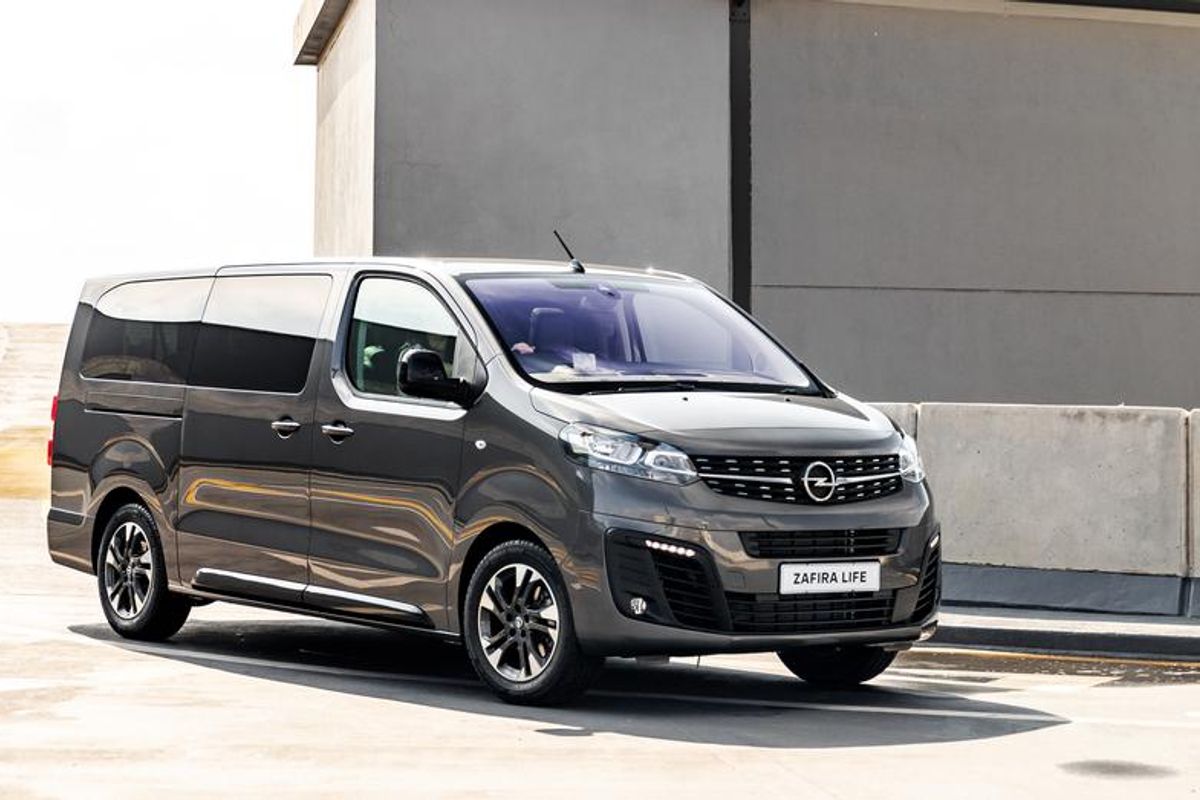
The Opel Zafira has transformed from an underappreciated compact MPV to a spacious people carrier.
Where does the 2022 Opel Zafira Life fit in?
The Zafira nameplate is, of course, not new to South Africa, but it’s applied here to a markedly different vehicle. While previous Zafiras sold in South Africa were 7-seat MPVs that rivalled the likes of the (discontinued) Volkswagen Touran and Renault Scenic, the new Zafira Life is a much bigger vehicle that shares its underpinnings with the Toyota ProAce Verso, Fiat Ulysses, Peugeot Traveller and Citroen Spacetourer. None of those buses is offered in the Republic, but there is nevertheless plenty of competition in the local market, particularly in the shape of the Hyundai Staria, which is available in various configurations.
The subject of this review is the flagship 2.0TD Elegance, which, despite its enormous proportions (it’s just over 5.3-metres long) is a 7-seater only. The focus here is on a combination of luxury (for all passengers) and useful packing space, even when all seats are taken. If you want more seats in your Zafira Life, you’ll have to opt for the more affordable “Edition” specification, which adds one more chair, but at the cost of several luxury features.
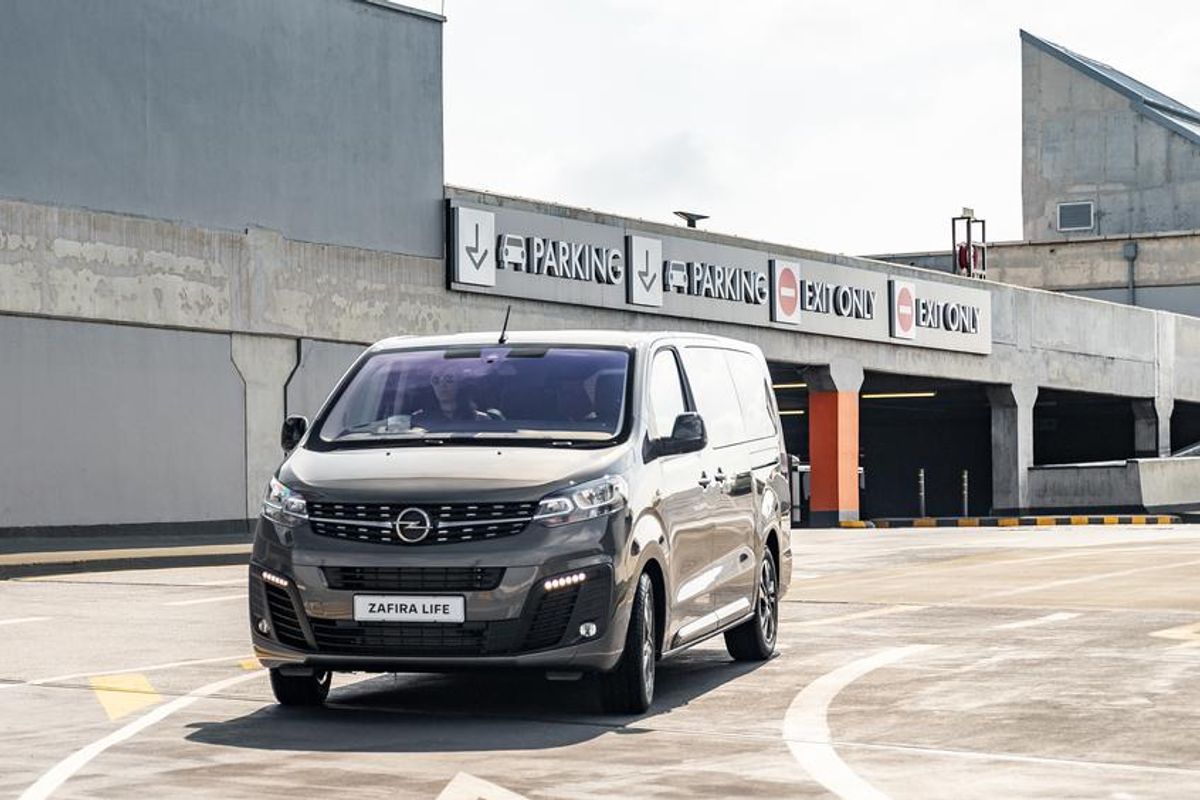
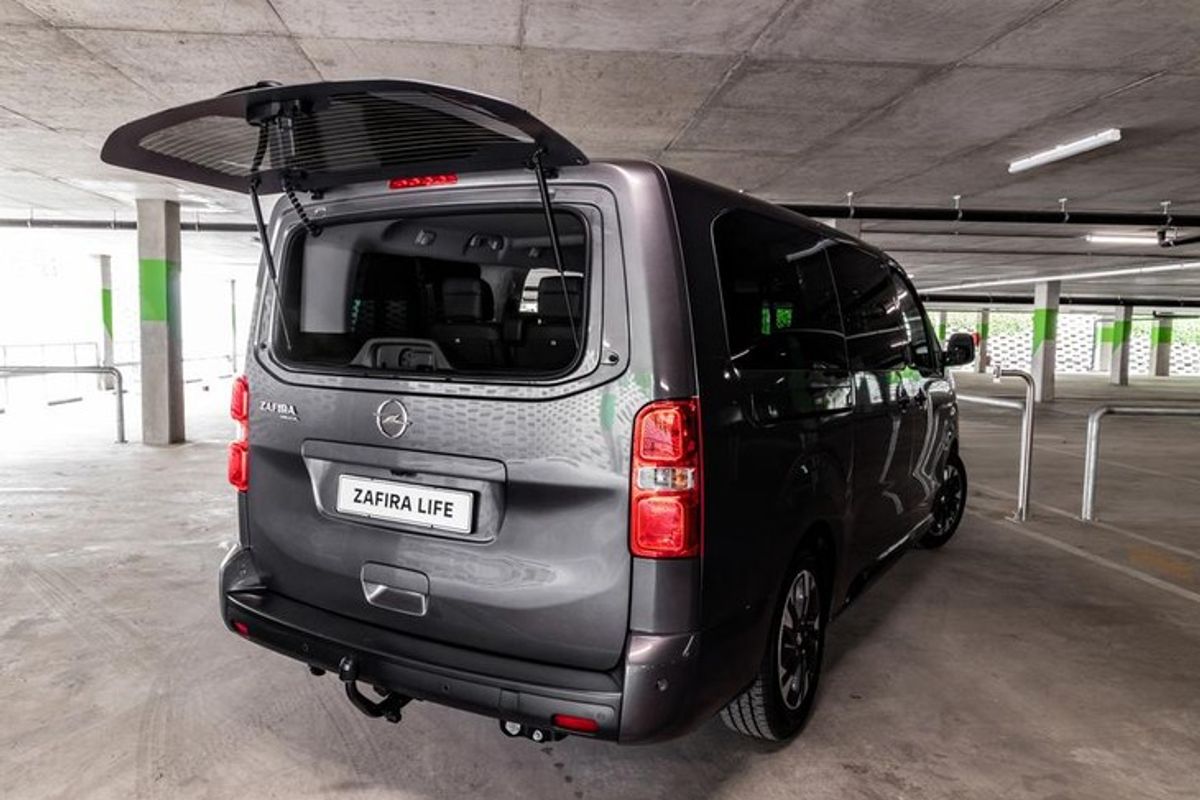
The Zafira Life is a sizeable vehicle; make sure you have a parking spot that’s big enough to accommodate it.
How the 2022 Opel Zafira Life 2.0TD Elegance fares in terms of…
Design and Packaging
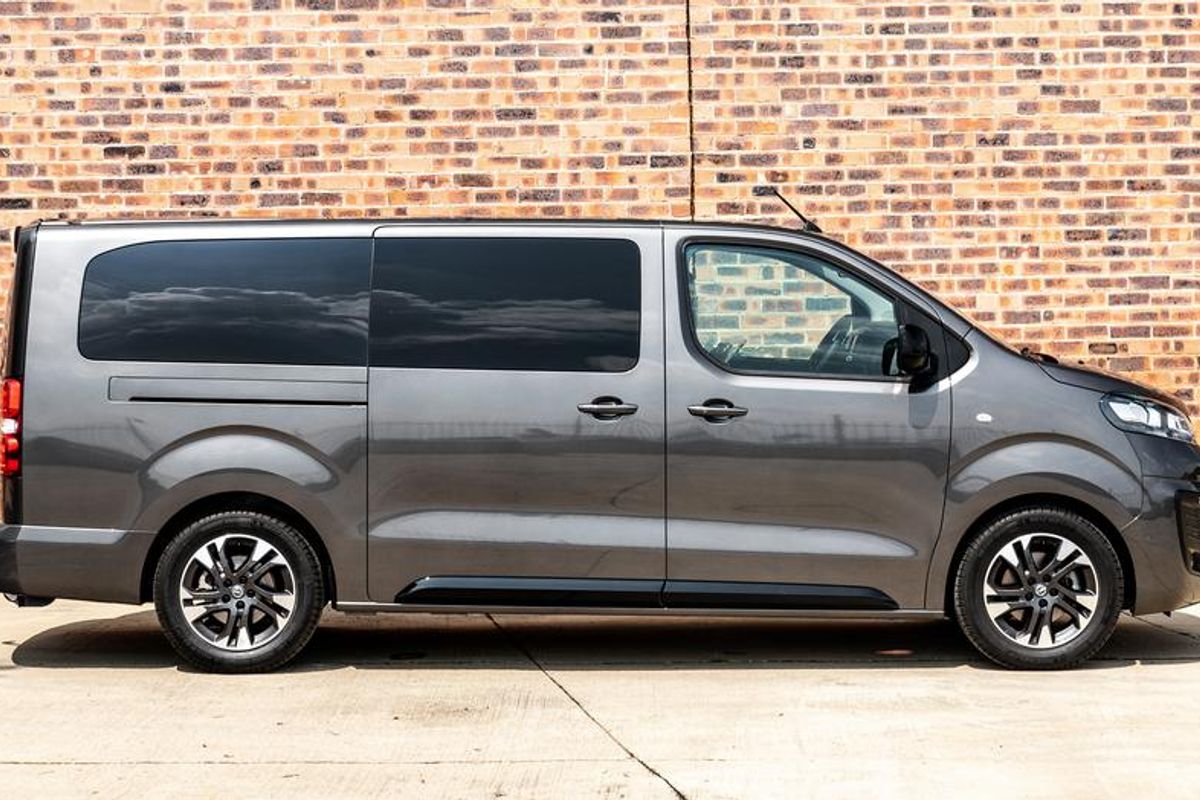
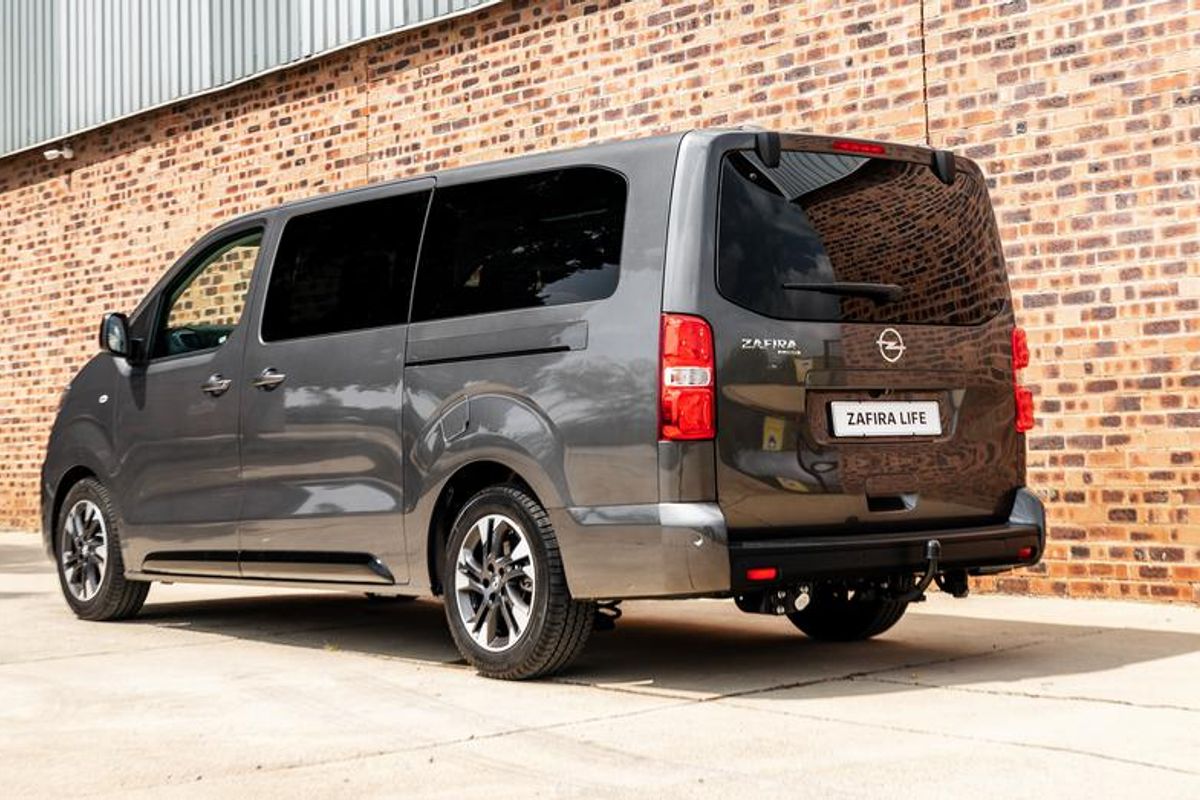
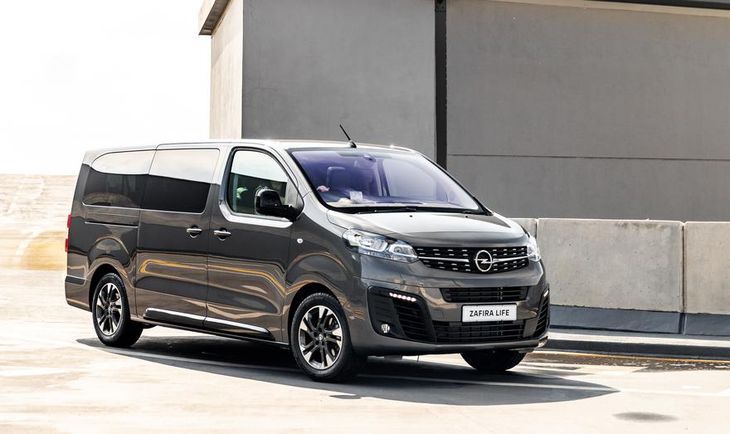
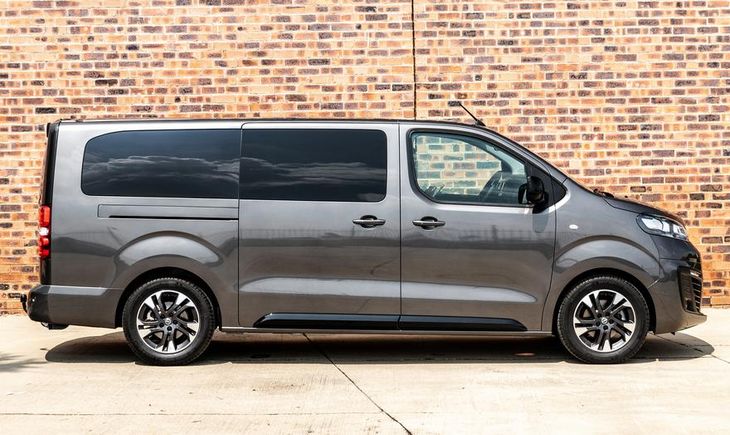
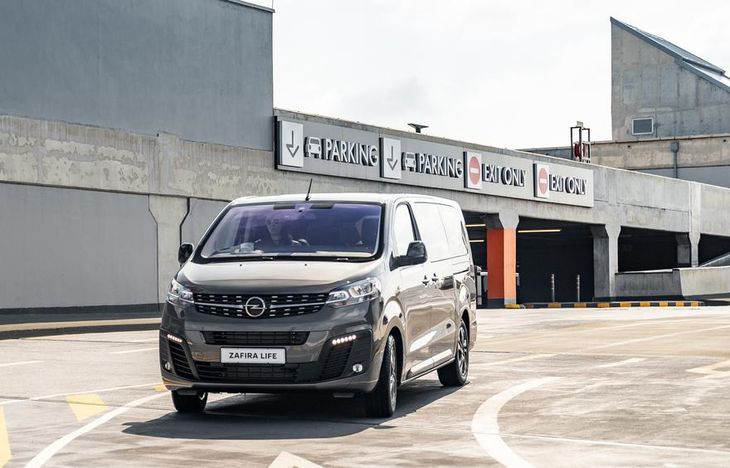
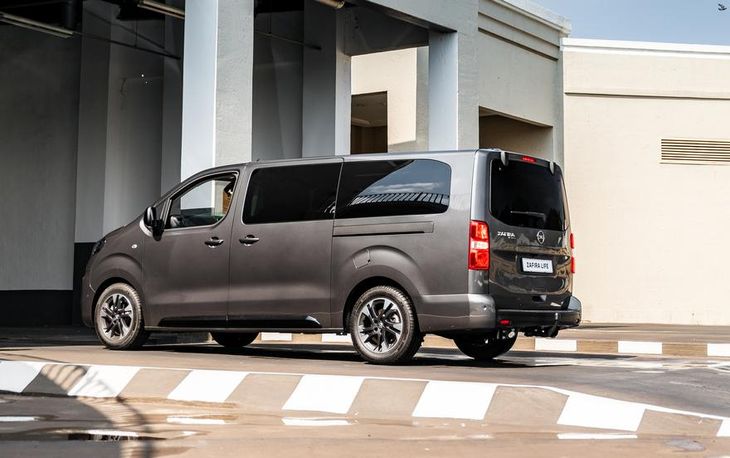
Opel has done well to hide the Zafira Life’s commercial roots, and this 2.0TD Elegance flagship boasts such stylish features as dual-tone 17-inch alloy wheels, privacy glass, LED light strips at the front, and an interesting dual sunroof setup. It might not have the space-age looks of the Staria, or the badge appeal of a Mercedes-Benz V-Class, but by minibus standards, it’s quite a handsome vehicle.
It is also very large. Measuring in at just over 5.3 metres in length and standing 2.2 metres wide and nearly 2 metres tall, you will have to make sure it will fit in your garage before signing on the dotted line. The wheelbase measures 3 275 mm, which is among the longest in the segment. With its box-like cabin, you would rightfully expect it to be very spacious inside, and that it certainly is.
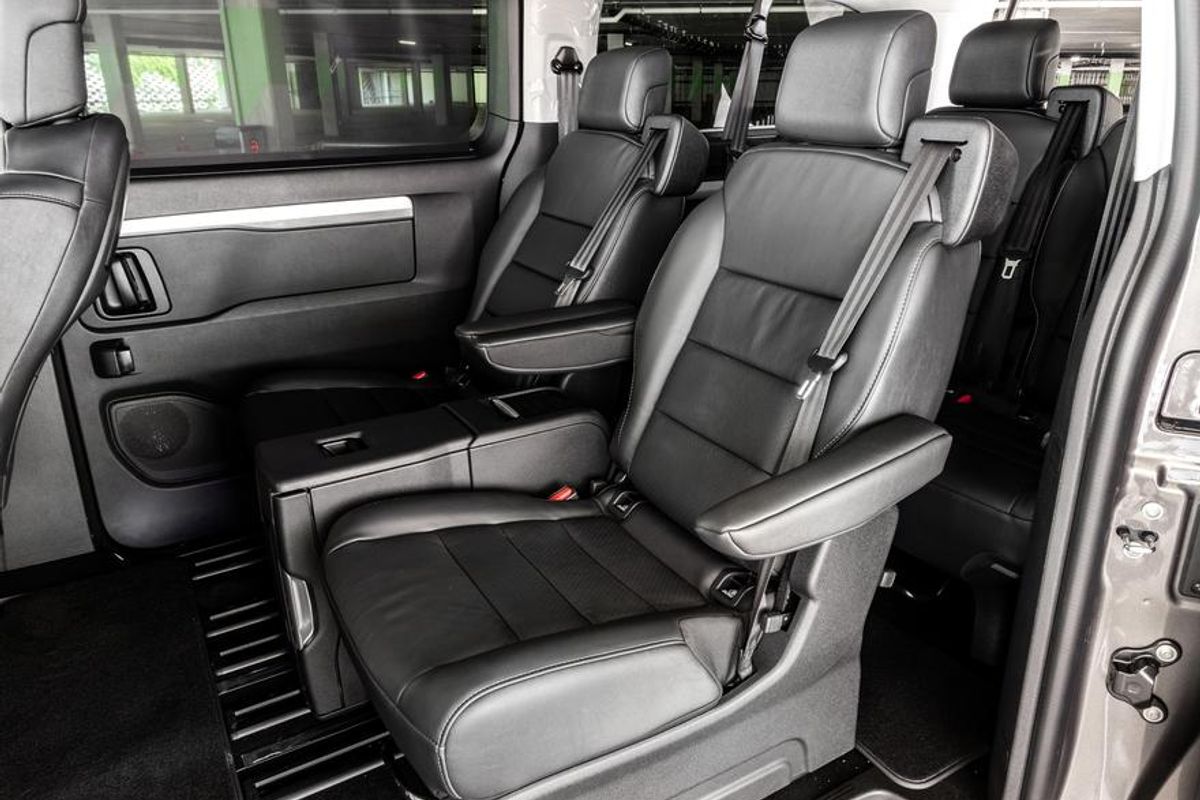
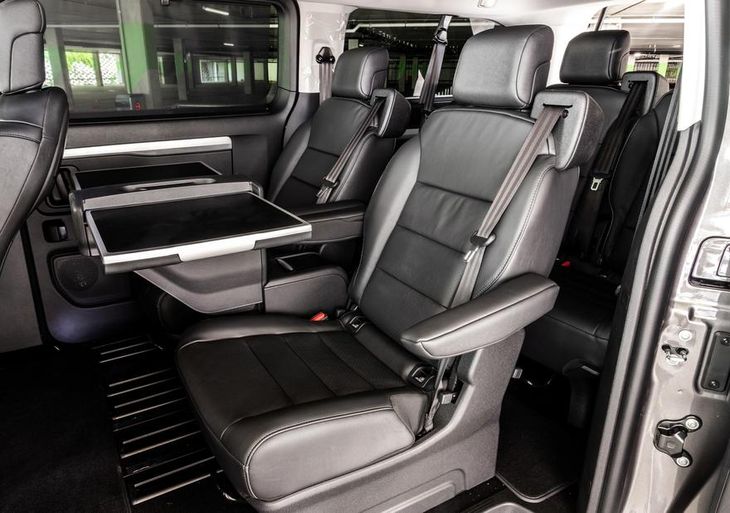
A cabinet is located between the two middle-row seats and it holds a fold-out table.
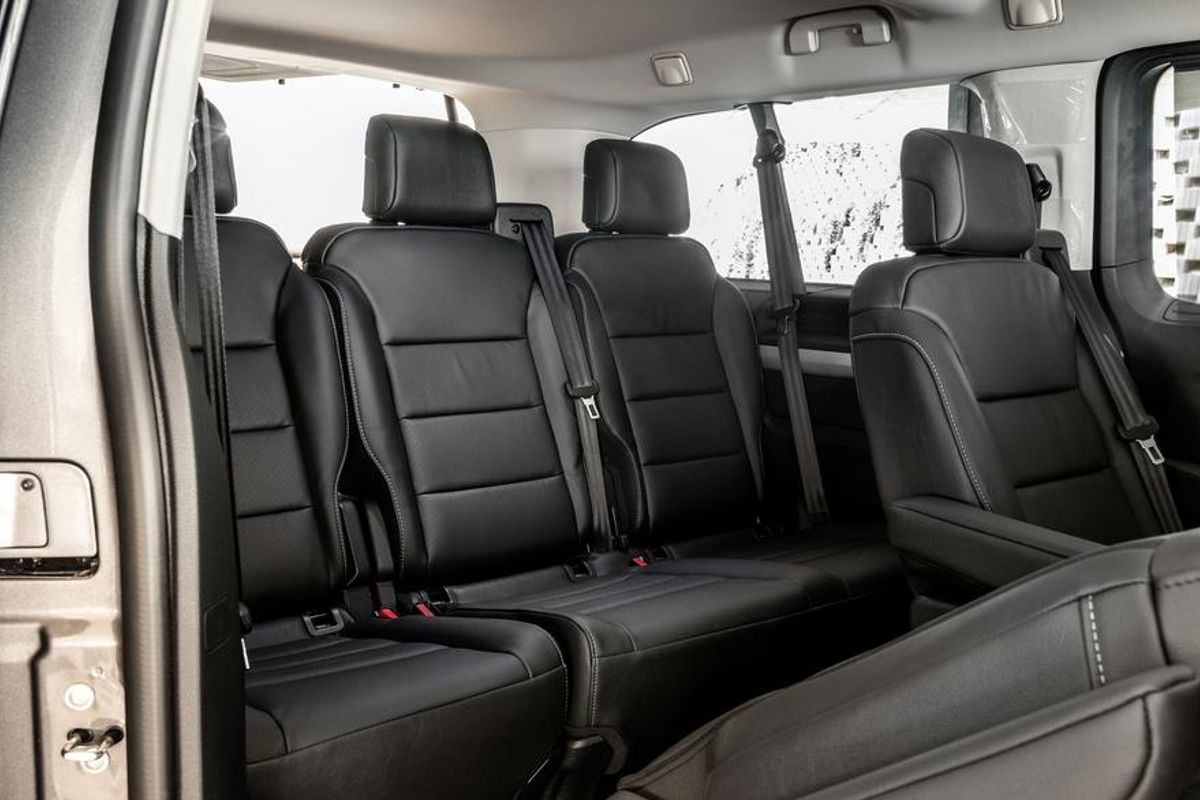
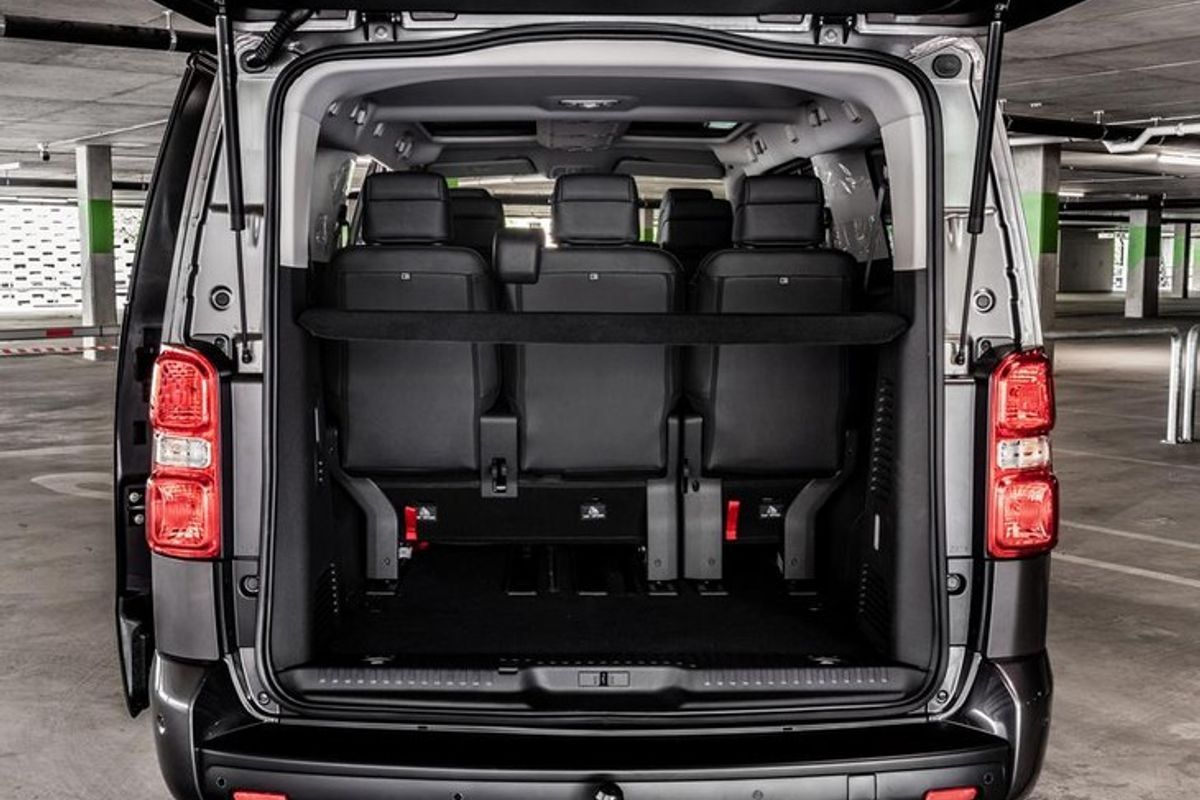
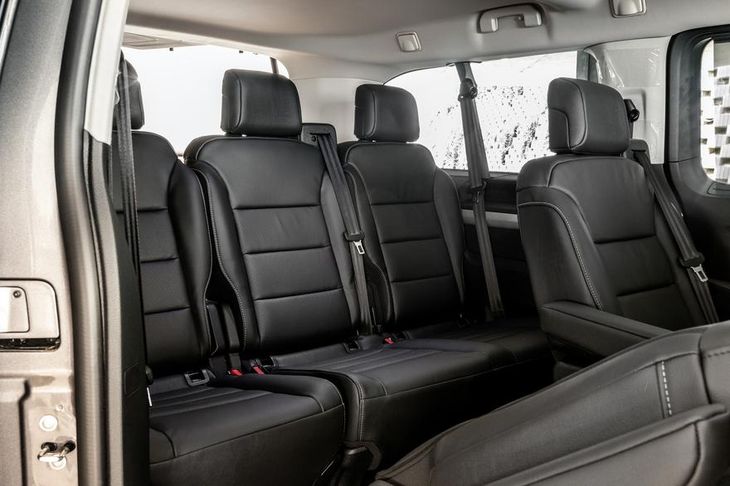
The 2.0TD Elegance’s 7-seat configuration is as follows: 2 front seats, 2 individual chairs in the middle row and space for 3 at the back. The seats are mounted on a rail system and can be slid fore or aft as required, removed entirely, or you can turn the pair of middle-row seats around to face those in the rear. Mounted between the 2 middle-row seats is a cabinet that holds a fold-out table that provides a solid base to work on, or in a leisure application (when it’s turned around), middle-row and rear-seat passengers can play card games on it, for example. Mounted on the front seatbacks are flip-up trays with built-in drink holders.
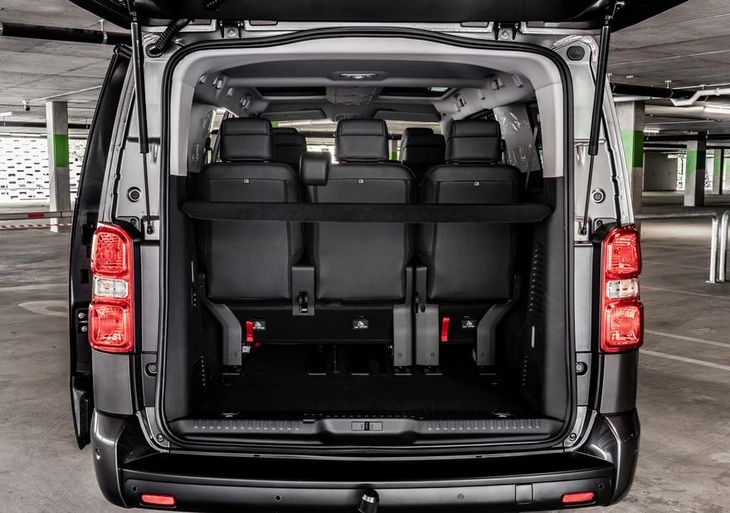
Importantly, the load bay is cavernous – even with all 7 seats taken – and so, unlike similarly-priced 7-seat compact or adventure SUVs, this is a genuine family car, with stretch-out space for all occupants and all their luggage. A minor criticism is that the Zafira Life is a little short on practical storage spaces. There is a handy felt-lined bin on top of the fascia, and the cubby is decently sized, but the drinks holders are small and mounted at the base of the A-pillars.
Instead of a solid rear bench, the Zafira Life is equipped with 3 chairs in the rear.
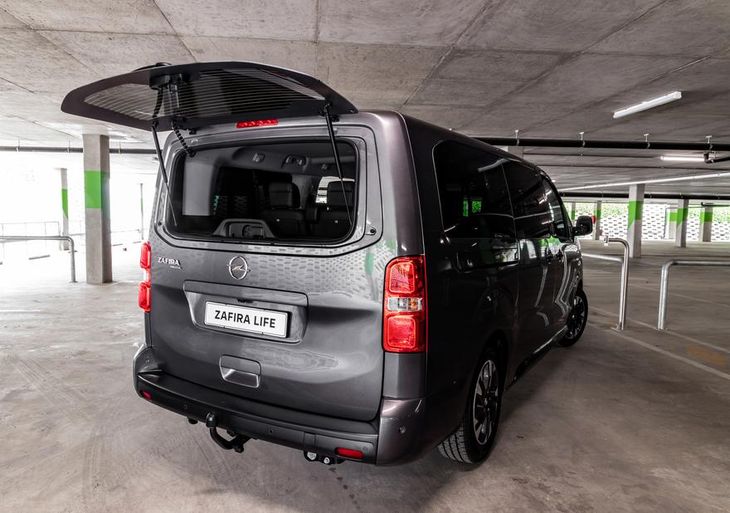
The door pockets are large, but not shaped to be practical drink holders either. And the few flat surfaces provided (to place your keys and/or smartphones) don’t have rubber linings, so items tend to rattle around or slide out. Oh, and a small criticism of the load bay – the tailgate is large and heavy, and manually operated, so it may prove difficult to open and shut for those of a smaller build.
Opel has also done well to give the Zafira Life’s cabin a luxurious and sophisticated ambience, with smart black leather upholstery, and cool dual sunroofs (with individual blinds), as well as satin-silver accents around the front of the cabin. Overall, the Opel’s interior seems well screwed together, but note that the plastics are almost entirely of the hard variety.
The Zafira Life may be a minibus, but 7-seat adventure SUVs can’t match the Opel’s luggage capacity when they’re fully occupied.
Performance and Efficiency
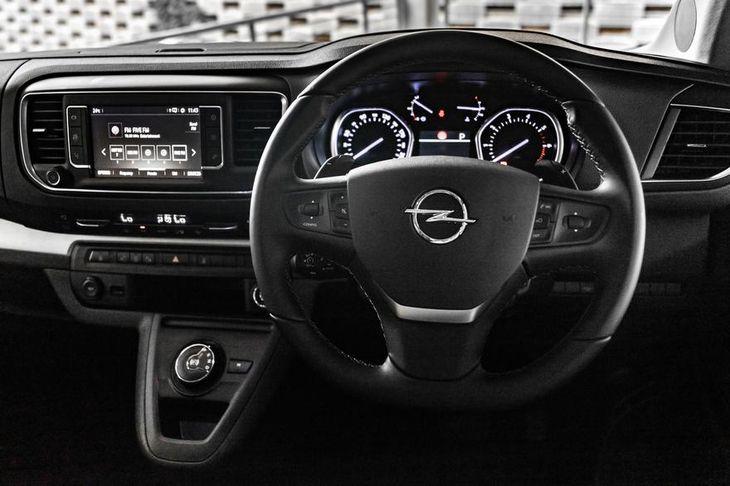
Powering the Zafira Life is a 2.0-litre 4-cylinder turbodiesel engine that delivers 110 kW and 370 Nm of torque (at 2 000 rpm). Power goes to the front wheels via an 8-speed automatic transmission, which is controlled via a rotary controller on the fascia, or sporty gearshift paddles behind the steering wheel (although the latter addenda seem rather unnecessary).
We expected the Opel to be a trifle underpowered, considering its bulk, but it proved more than capable on a long road trip, even when it was fully laden with passengers and their luggage. The best part of the drivetrain is undoubtedly the slick 8-speed automatic transmission, which is very well-matched with the torque characteristics of the engine. As a result, the big Opel is nicely sensitive to throttle inputs and there is sufficient overtaking grunt at, or near, the national speed limit.
While the turbodiesel engine delivers workmanlike performance, it dovetails nicely with the 8-speed automatic transmission.
Opel claims an average fuel consumption of 6.3 L/100 km, which is highly optimistic, but the indicated average of 8.5 L/100 km (at the end of the Zafira Life’s tenure in our test fleet) is pretty good, particularly when considering the fact that we used the vehicle as intended – fully loaded and for long road trips. The tank capacity is 70 litres and so you should be able to achieve a range of just over 800 km before a refill is needed.
Oh, and should you want to tow a trailer, note that the maximum (braked) tow rating is a relatively meagre 600 kg.
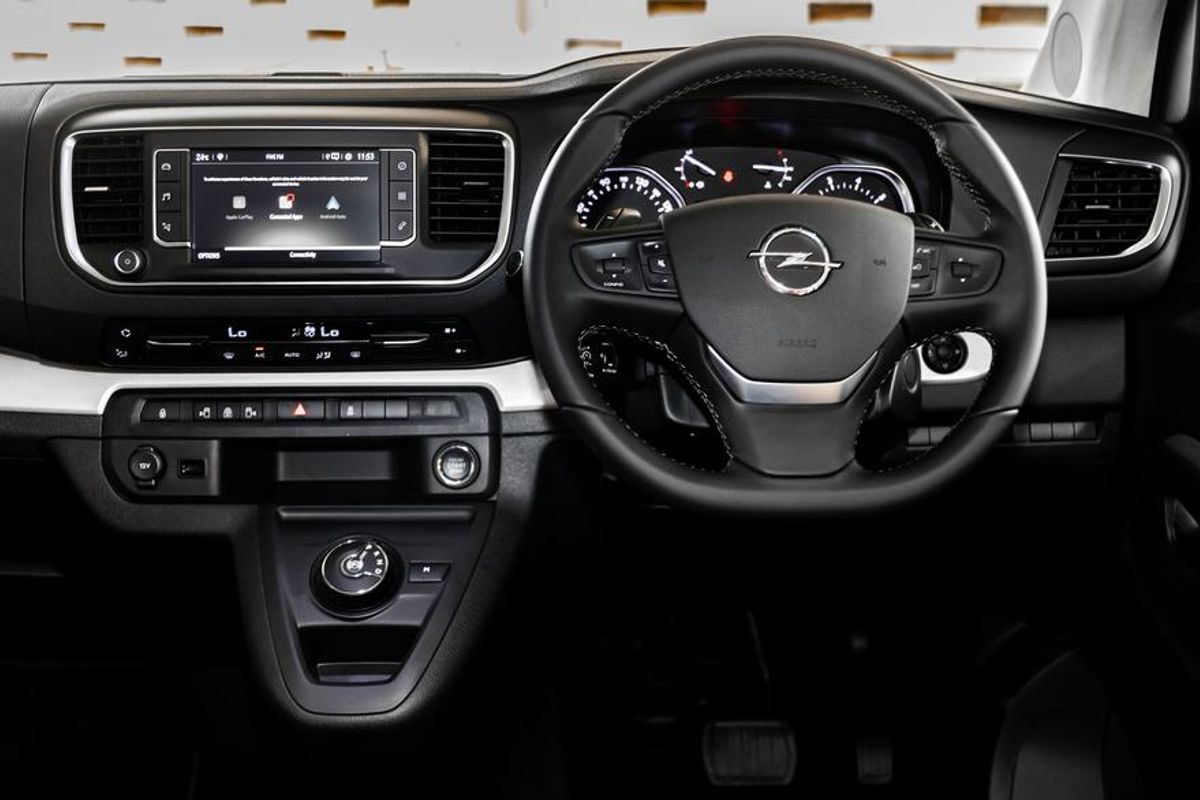
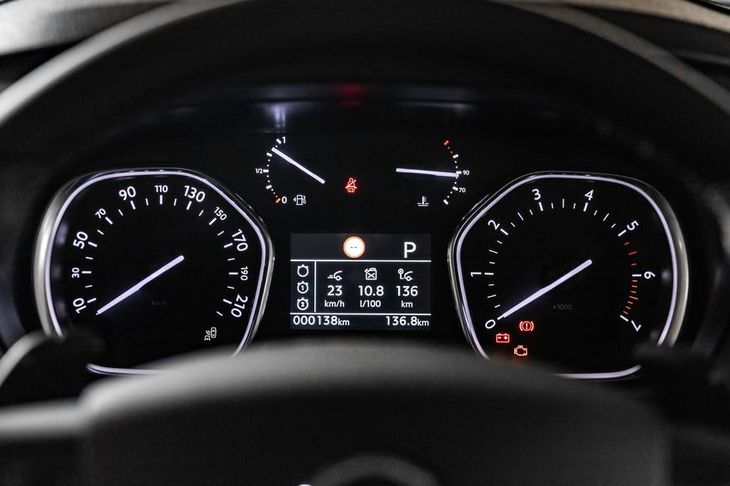
Despite the Opel’s commercial-vehicle origins, it has a neat, modern and car-like fascia design with tasteful finishes.
Comfort and Features
Opel is a relatively small brand in South Africa these days, so it probably couldn’t be too pushy when it came to selecting a specification level appropriate for our market. As a consequence, the Zafira Life Elegance has some really startling “surprise-and-delight” features, while lacking some basic necessities.
Let’s start with the seats. Opel has always been good at providing great seating comfort and the Zafira Life certainly continues the tradition. Both front seats feature electric adjustment (including height), as well as heating and even a massage function! The column of the leather-wrapped steering wheel is rake- and reach-adjustable and so a comfortable driving position will be very easy to find.
The instrumentation binnacle is comprehensive (including speed-sign recognition) and then it is complemented by a heads-up display. The latter seems superfluous, seeing as the instrumentation is clear and comprehensive anyway.
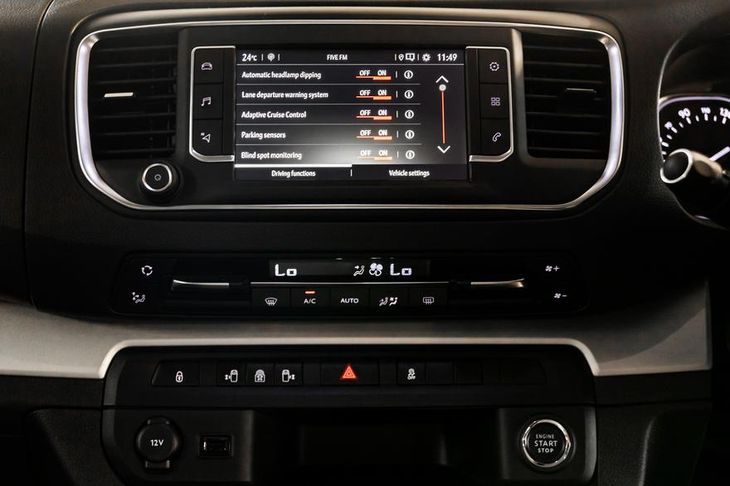
The infotainment system’s touchscreen seems a little dinky.
Infotainment access comes courtesy of what is – by current standards – a small 7-inch touchscreen. It’s easy enough to operate and features Apple Carplay and Android Auto compatibility, but it just feels a bit old-fashioned. When you hook reverse gear, it doubles as a display for the rear-view camera, while there is also a bird’s eye view of the vehicle – useful, but again, not as crisp and interactive as some other systems out there. Furthermore, there is a single USB outlet in the entire vehicle (in the front) and it also lacks a wireless charging pad.
Of course, any of the numerous 12V power sockets distributed throughout the vehicle could be turned into USB ports, but it nevertheless highlights a specification package that is not quite in tune with South African usage patterns. As if to highlight the issue even further, the 3-point power point mounted underneath the driver’s seat will require an adapter to be useful to South Africans.
Although the tailgate is heavy, the rear screen can be opened separately.
All that said, there are some very nice, practical touches, too. As if the rear privacy glass isn’t enough, there are also retractable sunblinds. A separate ventilation control unit (for 2nd- and 3rd-row passengers) is mounted on the roof lining with outlets distributed throughout the cabin. Oh, and you can open and shut both the sliding side doors using the remote.
Sadly, the most disappointing aspect of the Zafira Life’s skewed specification level is the fact that it only has 4 airbags, which is odd, given that it comes with relatively high-tech features such as lane-keep assistance and blind-spot detection.
The Zafira Life’s driving experience is still bus-like, but it’s no worse than that of the Mercedes-Benz V-Class.
Ride and Handling
Much like the (significantly more expensive) V-Class, the Zafira Life’s driving experience is still very bus-like. At its core, it remains a commercial vehicle that has been turned into a luxuriously-trimmed minibus. And so, the driving experience is not nearly as car-like or refined as something like a Kia Carnival, for example, but relatively similar to what is offered by the ‘Benz, which should not be seen as a criticism… after all, the V-Class is more than R300k more expensive.
Engine noise is well-contained, but there is noticeable road rumble and you will, as expected, feel crosswinds. All that said, you (all passengers, actually) sit nice and high and have a great view out of the vehicle. The steering is well-weighted and the turning circle isn’t too laborious. The ride is generally supple around town, but can feel a little skittish at higher speeds on poor surfaces. Stopping power (ABS with EBD) is good, plus you have the safety net of stability control.
Dynamism is, of course, not a priority in a vehicle such as this. Simply set the adaptive cruise control, switch on the massaging function for the front seats, sit back and enjoy the journey, that’s what the Zafira Life driving experience is about.
Price and After-Sales Support
The Opel Zafira Life 2.0TD Elegance sells for R902 900. A 5-year/100 000 km warranty is included, as is a 5-year/100 000 km service plan. The service intervals are scheduled for every 12 months/15 000 km.
The Zafira Life is a fine example of a people carrier adapted from a commercial vehicle, but it has tough competition.
Verdict
At just over R900 000, the Opel Zafira Life 2.0TD Elegance is an interesting proposition, but one that left us scratching our heads. On the one hand, it provides a very similar experience to the popular Mercedes-Benz V-Class, but at a much more affordable price. On the other hand, it lacks the tech and number of seats of something like the Hyundai Staria. If you want a plush, spacious 7-seater, then there is no better vehicle than the Kia Carnival in our opinion, but if you want the load-carrying capability of a bus (with all its seats removed), then the Zafira Life is pretty much unbeatable.
So, ultimately, it will come down to what you need the vehicle for. If you require a dual-purpose people carrier for the family that can also haul some bulky items now and then, the Zafira Life is well worth considering, given its spec and size.
Kia Sportage (2022) Review
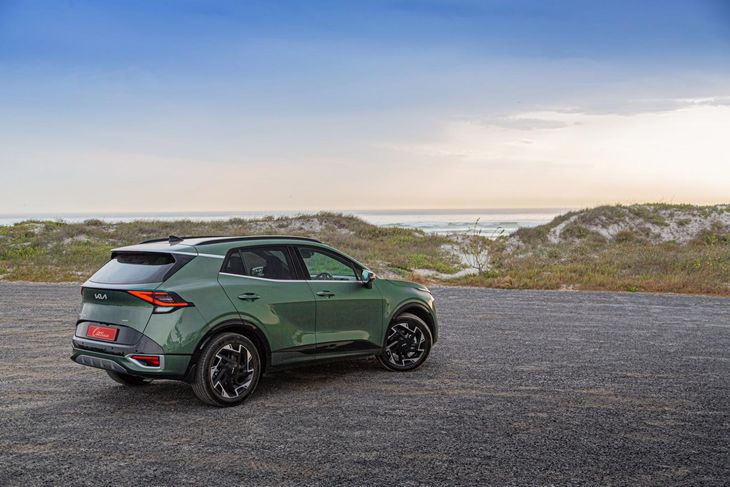
The all-new Kia Sportage is a boldly styled family SUV that’s full of high-tech equipment and quality finishes. However, in a segment awash with excellent models – does the Sportage stand out enough? We test the top-spec GT Line S to find out.
We like: Interior quality and upmarket feel. Drivetrain refinement
We don’t like: It’s pricey. Design may not appeal to all.
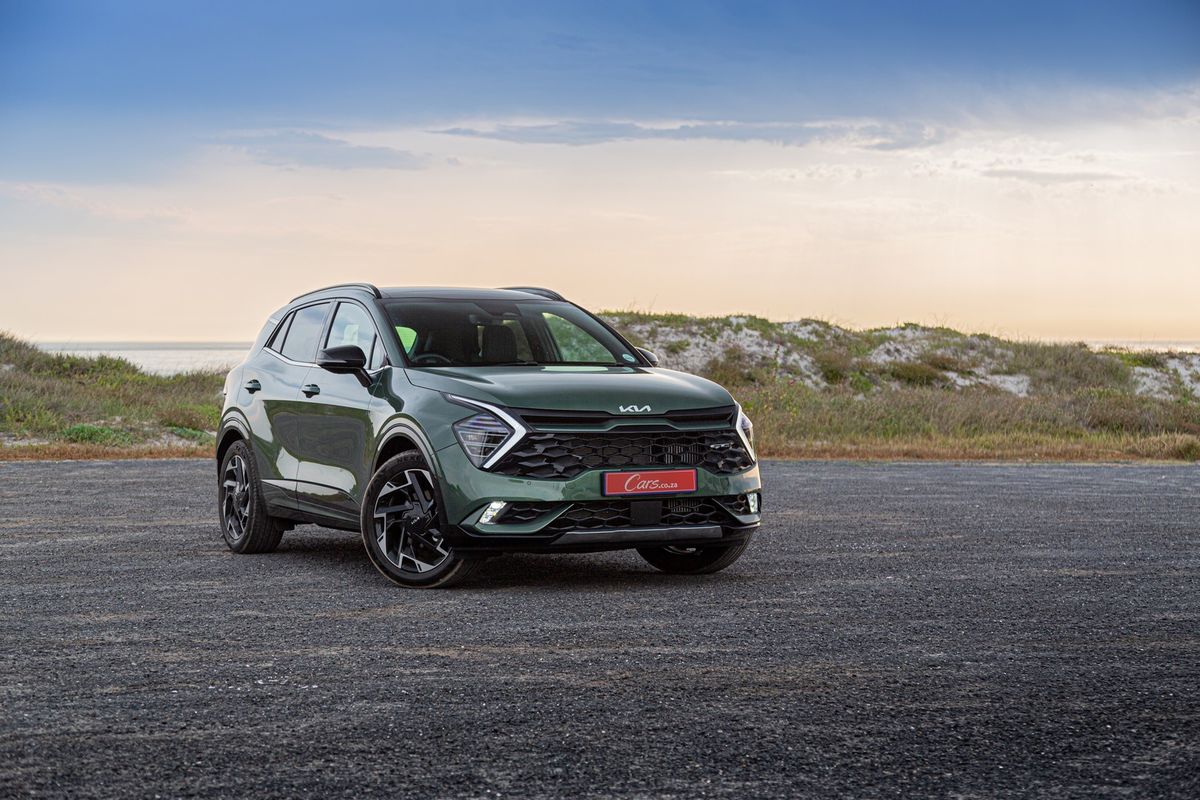
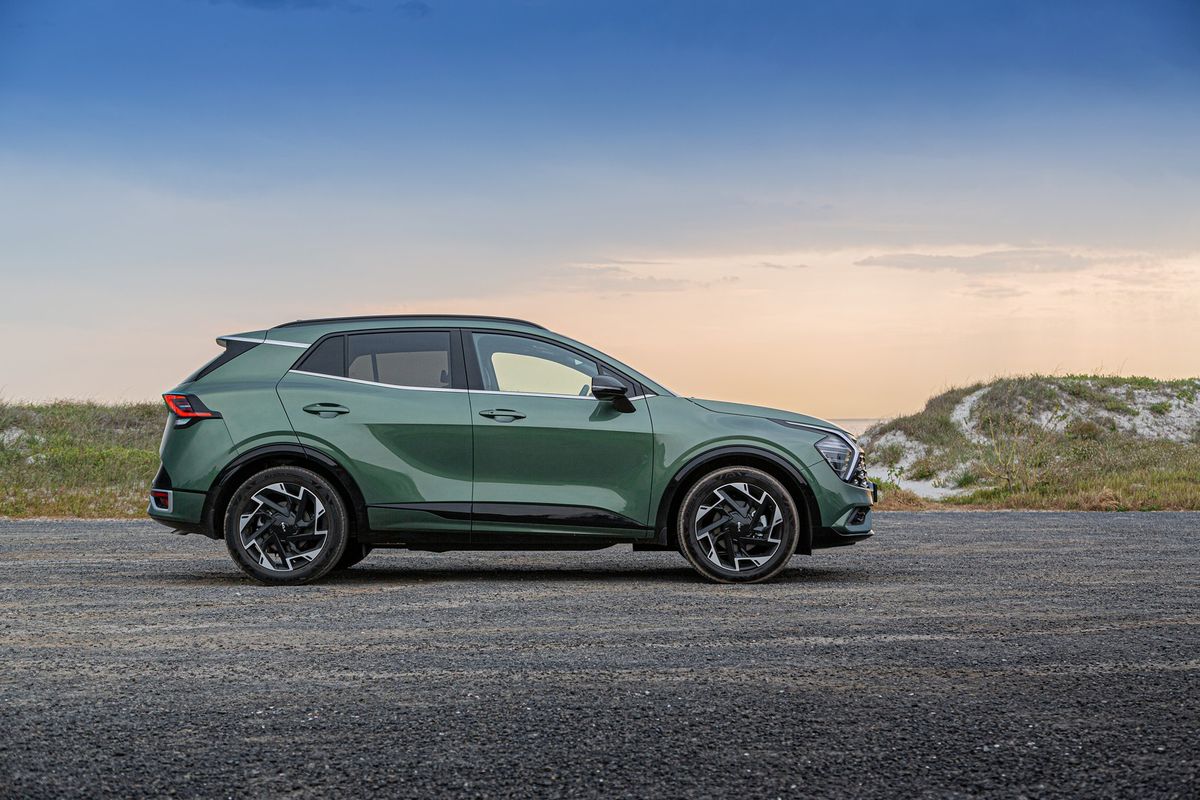
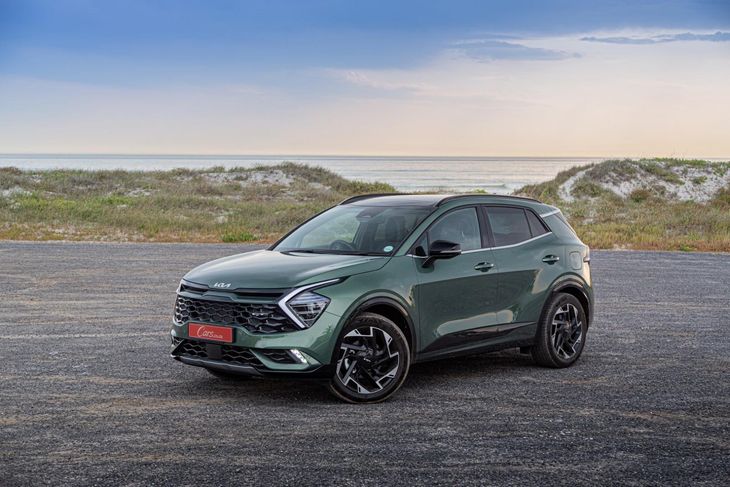
The Kia Sportage has evolved into one of the most adventurously styled models in the medium-SUV segment.
Where does the Sportage fit in?
A few years ago, family cars (medium SUVs) were the hottest segment in the new-vehicle market. However, the proliferation of small crossovers has seen once top-selling models such as the Volkswagen Tiguan, Hyundai Tucson, Kia Sportage and Toyota RAV4 lose sales to their smaller T-Roc/T-Cross, Creta/Venue, Seltos/Sonet and Corolla Cross siblings.
Much of that has to do with rising new-car prices – medium SUVs are now barely within reach of cash-strapped family-car buyers, plus the segment has been adversely affected by stock shortages (more so than most). The entry price of the previous generation Sportage in 2016 was R370k but that’s moved up to R540k for this generation, with the top-spec GT Line S coming in at R734 995. It’s not just Kia – the entire market has seen double-digit percentage price increases.
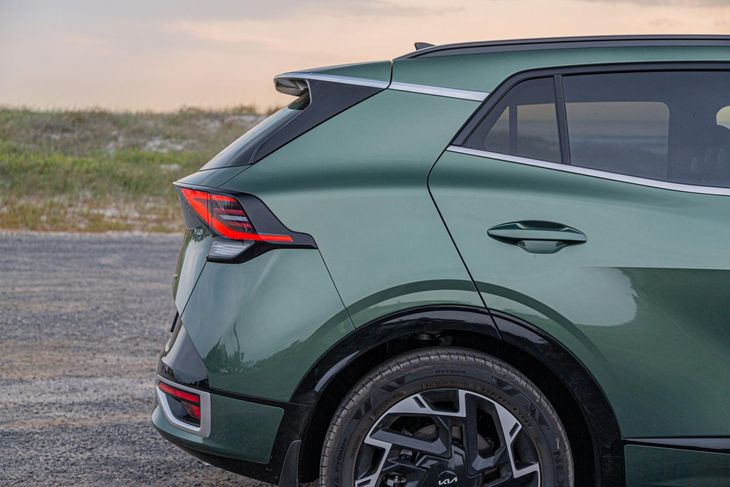
The GT Line body kit sees the addition of sporty gloss black exterior accoutrements that complement the light-grey accents.
The 5th-generation Sportage is positioned to win over premium-car buyers, especially those who’d usually consider luxury brands’ compact crossovers and lower-end executive SUVs; in other words, those who want to downsize/buy down without losing much in terms of luxury. Whereas previous Sportages offered excellent value for money in the middle of the family-car segment, the new model sits right at the top of the segment, where it rivals the likes of the VW Tiguan.
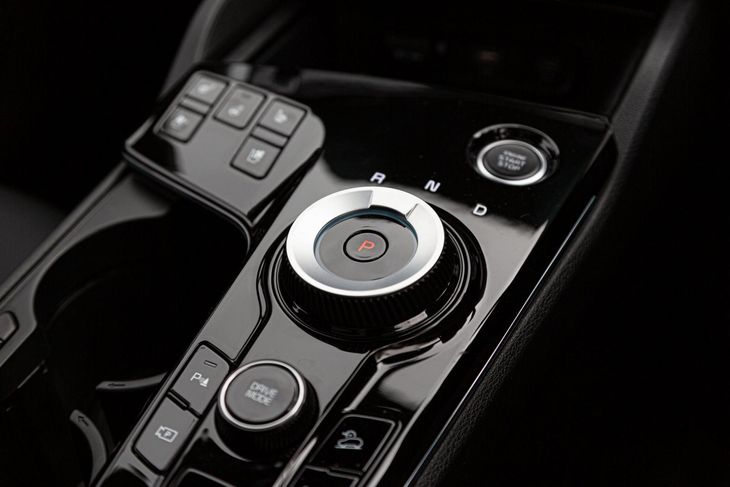
The interior looks so sophisticated; the fascia features digital displays, piano black surfaces and brushed-metal finishes.
How the Sportage fares in terms of…
Premium cabin ambience
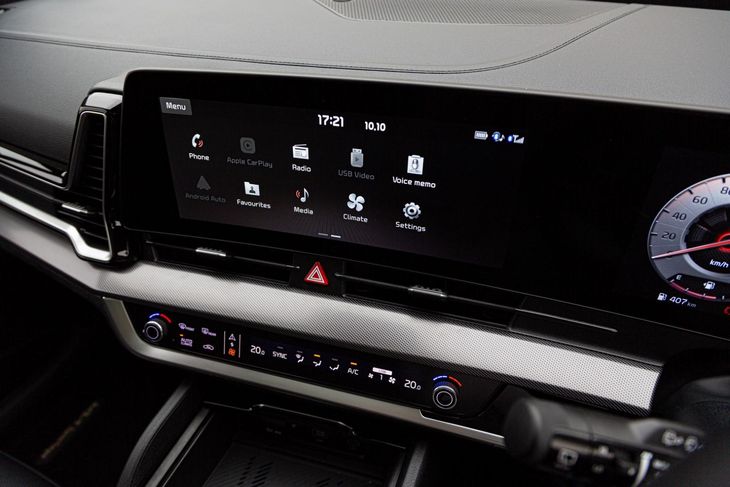
Specification-wise, the 1.6T-GDi Sportage GT Line S is equipped with virtually every feature that Kia can offer on the local market. The expansive infotainment touchscreen is the first fixture to catch your eye when you step into the cabin – it genuinely resembles a small, curved LED TV!
Mind the bend! The generously sized touchscreen is encased in a curved section of the fascia.
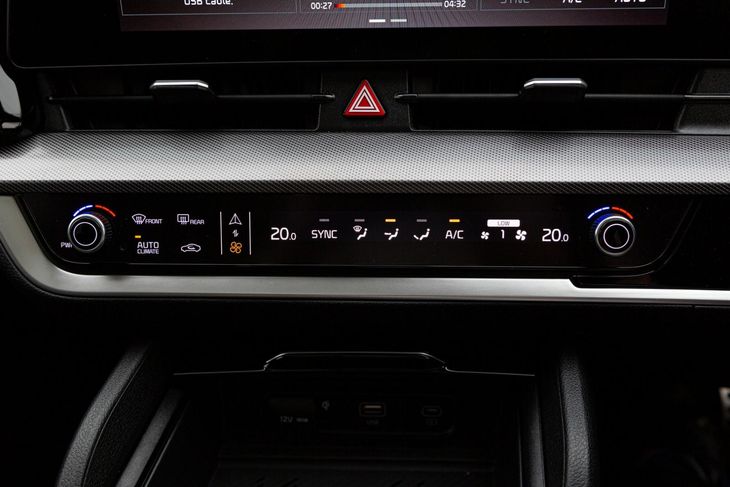
Underneath that is a climate control panel complete with physical knobs to adjust the left/right temperature zones. The clever part is that if you press the up arrow on the panel, it transforms into a media console with the knobs becoming volume- and track selection controllers. Of course, those settings can also be adjusted within the infotainment menu, but integrating them in a panel like that makes good use of shortcuts within the otherwise expansive digital interface.
The connectivity options are plentiful. Apart from a high-speed wireless charging pad, USB-A and USB-C ports are availed at the front, while rear passengers are provided access to USB-C ports in the backs of the front seats. The front seats are heated and cooled (plus there’s a steering-wheel rim warmer), while the rear seats are equipped with a heating function only.
The climate-control console supports both analogue and digital inputs and doubles as an audio/media playback shortcut menu.
Suffice it to say, Android Auto and Apple CarPlay compatibility is standard and Google Maps looks impressive – almost mesmerising – when displayed on a 12.3-inch high-res curved screen. It certainly makes navigation easy, even in the tightly knit grid of a city’s CBD.
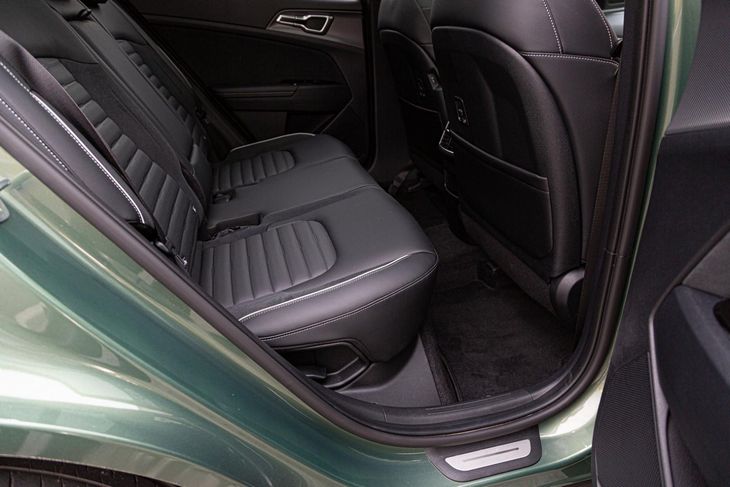
In terms of comfort, you sit deep in the front seats, but they still offer good outward visibility and facilitate a comfortable driving position, courtesy of plentiful thigh and lateral support. The rear legroom is acceptable; the new Sportage is based on the European model (rather than the longer general-market variant), so its wheelbase is only 10 mm longer than that of its predecessor.
Rear occupants are afforded reasonable legroom, even though the new Sportage’s wheelbase is nominally longer than before.
As a result, the new Sportage measures a mere 4 mm longer than the older-generation (but recently updated) Tiguan, but features a bigger load bay (591 litres vs 520 litres) and more utility space once the rear seats have been folded down (1 780 litres vs 1 655 litres) – that’s something to bear in mind if you are looking for outright practicality in a family car/medium SUV.
Driving comfort
Kia continues to improve the level of noise, vibration, and harshness control in the Sportage with each and every new iteration of the model. The 1.6T-GDi GT Line S was serenely quiet inside and the excellent refinement speaks volumes of the cabin’s overall build quality and the upmarket nature of its materials.
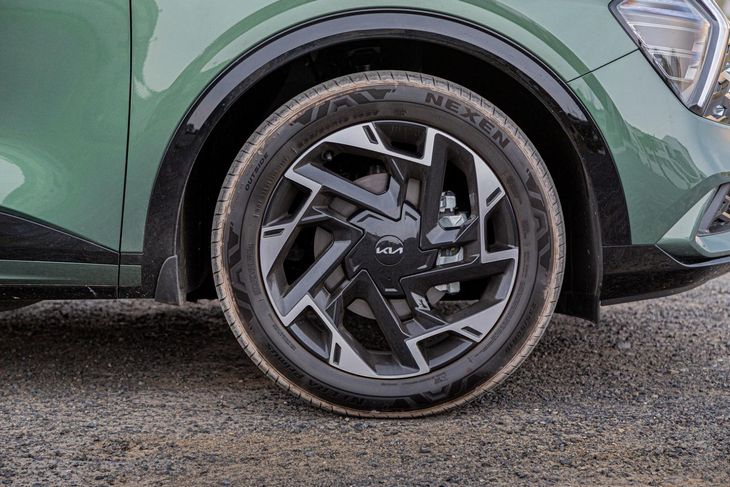
The GT Line S’ standard 19-inch wheels aren’t shod with super-skinny tyres, but the ride quality is still a trifle too firm.
The newcomer’s suspension is probably tuned for smoother road surfaces than what we have in the Republic, which is why the ride quality is a bit firmer than ideal. Bear in mind the GT Line S is fitted with 19-inch alloys (with 235/50 tyres), so its suspension doesn’t absorb abrupt impacts entirely.
However, on better-maintained roads (such as freeways), the Kia feels eminently planted, easily controllable and well-damped. It’s a comfortable family car for travelling long distances and one that continues to surprise you with just how capable it is in every situation, whether it be the school run, the holiday trip (to the bush/coast) or dealing with the traffic on the way to (and from) work.
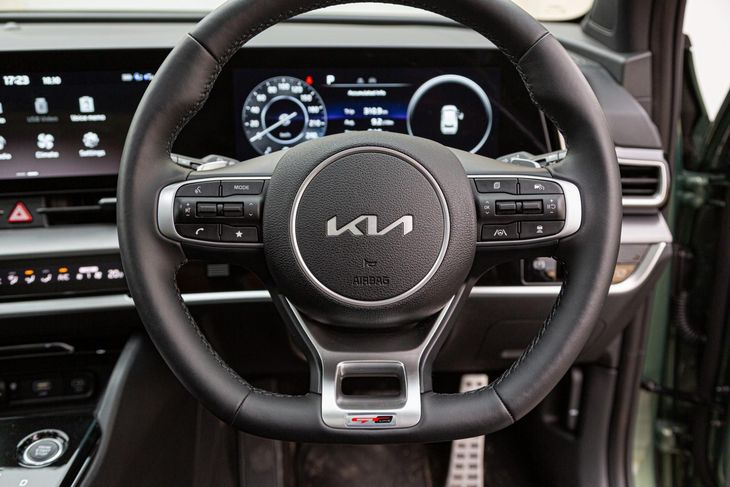
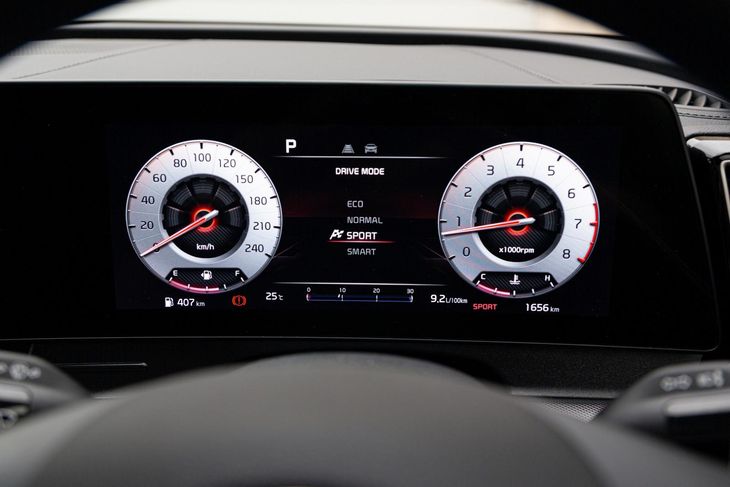
When the Sport drive mode is active, the digital instrument cluster displays retro-inspired sportscar-like dials.
Engine performance
The Sportage range consists of a single powertrain – a 132 kW/265 Nm 1.6-litre turbopetrol mated with a 7-speed dual-clutch automatic transmission that sends power to the front wheels. We understand that all-wheel-drive derivatives won’t be available soon, but a hybrid version (as Toyota and Haval offer in their RAV4 and H6 line-ups) would be a welcome addition. Given the GT Line S’ already lofty price tag, such a derivative might be prohibitively pricey, however.
In developed overseas markets, diesel engines are being substituted with hybrid- and battery-electric drivetrains (in passenger vehicles) and small-capacity turbopetrols are preferred to larger, non-turbocharged motors. But although they lack the torque and towing ability of diesel motors, turbopetrols can be quite fuel-efficient… During the Sportage’s tenure in our fleet, it averaged 9.2 L/100 km (indicated), which is above the claimed 6.5 L/100 km, but not drastically so.
The Sportage’s dual-clutch transmission shifts crisply, but manages not to stumble in stop-start driving conditions.
The 1.6-litre turbopetrol motor certainly feels well up to the task in the Sportage, but at this price point (well beyond R700k, remember?) some buyers may expect a more powerful and torquier powerplant. That said, the engine-transmission combo is particularly well-calibrated; it provides smooth acceleration and is well-tuned for the hustle and bustle of inner-city driving.
Price and after-sales support
The Sportage 1.6T-GDi GT Line S retails for R734 995, which includes Kia’s class-leading 5-year/unlimited km warranty and a 6-year/90 000 km service plan for added peace of mind.
Verdict
The new Sportage represents a conscious foray into the premium family-SUV space on the part of Kia South Africa. Whether you love or hate the standout exterior styling (few observers seem to be indifferent to it), the newcomer looks suitably sharp, sophisticated and expensive (but in a good way).
Although the Sportage is priced towards the top of the family-car segment, it has aspirations of snaffling sales from premium marques.
From the moment you step into its cabin, you’re treated to a luxurious experience. The sizeable, curved touchscreen is the highlight, but the overall quality of materials and smart finishes should not be overlooked. This is a premium product from top to bottom.
The engine and transmission deliver smooth progress, but the Sportage doesn’t provide the most exciting or brisk driving experience in the segment. Performance-wise, it matches the similarly priced Volkswagen Tiguan 1.4TSI 110kW R-Line, so if you want more punch, you’d need to fork out another R49k for the Tiguan 2.0TSI 162kW 4Motion R-Line, which is not an insignificant premium.
At close to R740k, the top-of-the-range Sportage 1.6T-GDi GT Line S is expensive, but it lacks for nothing in terms of specification – or style. Compared with its direct rivals and, if you take the price out of the equation for just a second, the Sportage is arguably the best family car in the segment.
Volkswagen R Going Fully Electric by 2030
Is time running out for the likes of the Golf R? Volkswagen has confirmed its high-performance R division will be a fully electric sub-brand by 2030…
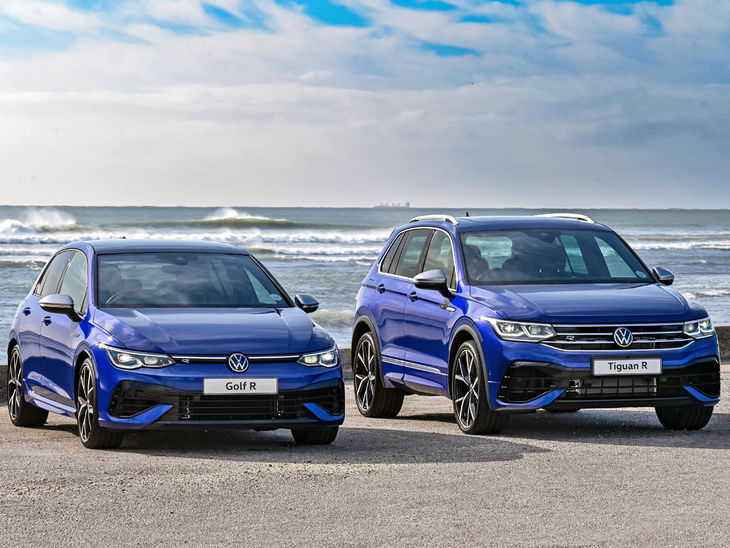
Wondering what the future holds for Volkswagen’s high-performance R division? Well, if everything goes according to the Wolfsburg-based firm’s latest plans, the sub-brand will be electric only by 2030.
Yes, VW has confirmed to various British publications – including Autocar and Auto Express – it is “gradually converting its portfolio, with several electric R models in the planning stages”.
“We’re currently assessing various concepts and possibilities but will only offer R models that meet our requirements. One thing is certain: the future of R is electric.” Those are pretty emphatic words from VW, leaving us wondering what’s next for the likes of the Golf R.
Well, unless established nameplates live on in Volkswagen’s electric future, models such as the Golf R, T-Roc R, Tiguan R, Arteon R and Touareg R will not be part of the performance division’s line-up by the end of the decade. Instead, we will likely see R-badged versions of the German firm’s ID models.
Don’t expect to see petrol-powered R models such as the Golf R and Tiguan R after 2030…
“In order to become a fully electric brand by the end of the decade, we’re already taking the necessary steps today for the forthcoming transformation. The globally successful products from Volkswagen R are part of this exciting change process and will stand in future for sustainable electric mobility,” said Reinhold Ivenz, Head of the R Business Unit at Volkswagen.
Interestingly, according to the Autocar report, the forthcoming electric R models will ride not on the current MEB architecture but rather on the VW Group’s upcoming (and likewise electric only) SSP underpinnings. The British publication furthermore speculates the first examples will hit the road in the second half of this decade.
Where does that leave the GTI badge? Well, though nothing is yet official, indications are the GTX moniker that has already been rolled out to the likes of the ID.4 and ID.5 will effectively cover that space.
As a reminder, the R badge has been around for 20 years, having debuted on the original Golf R32 back in 2002 before being applied to the fifth-generation Golf in 2005. The year 2009 saw the launch of the Golf 6 R, with the Golf 7 R following in 2013. Today, as many as five model ranges include a full-fat R model, while the R-Line specification has also become popular.
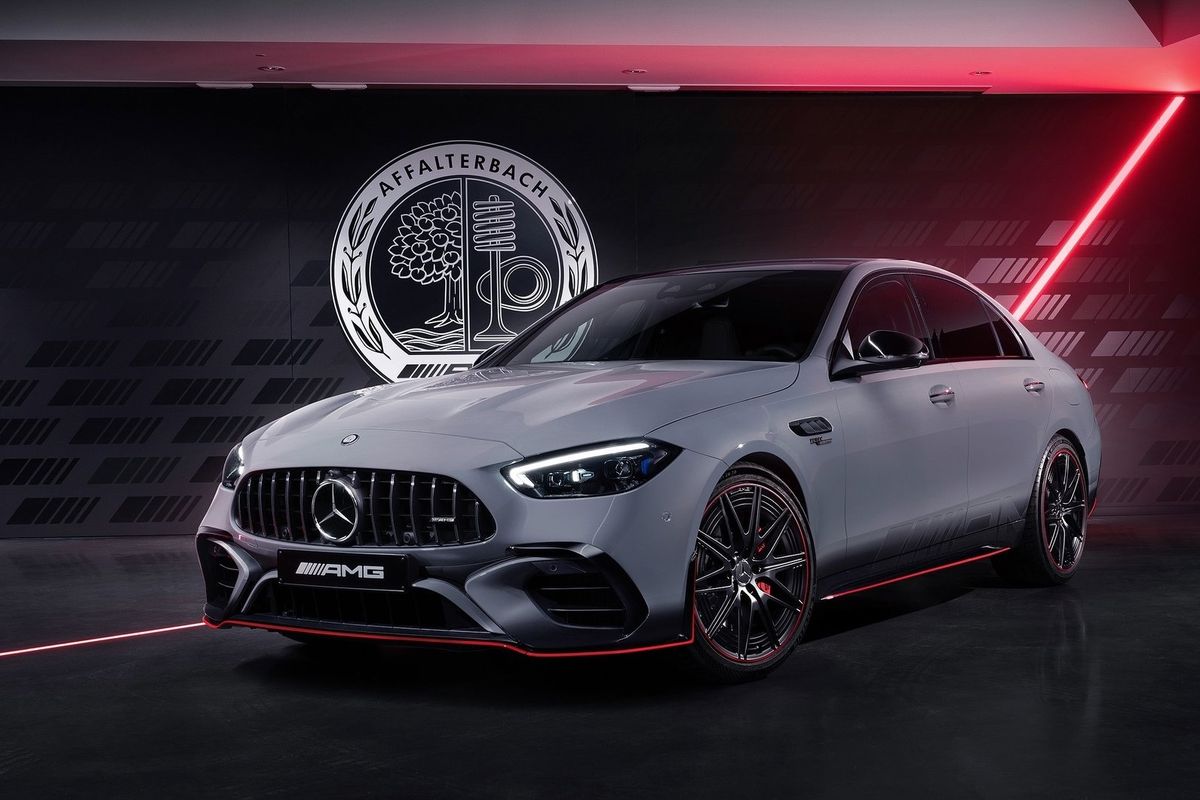
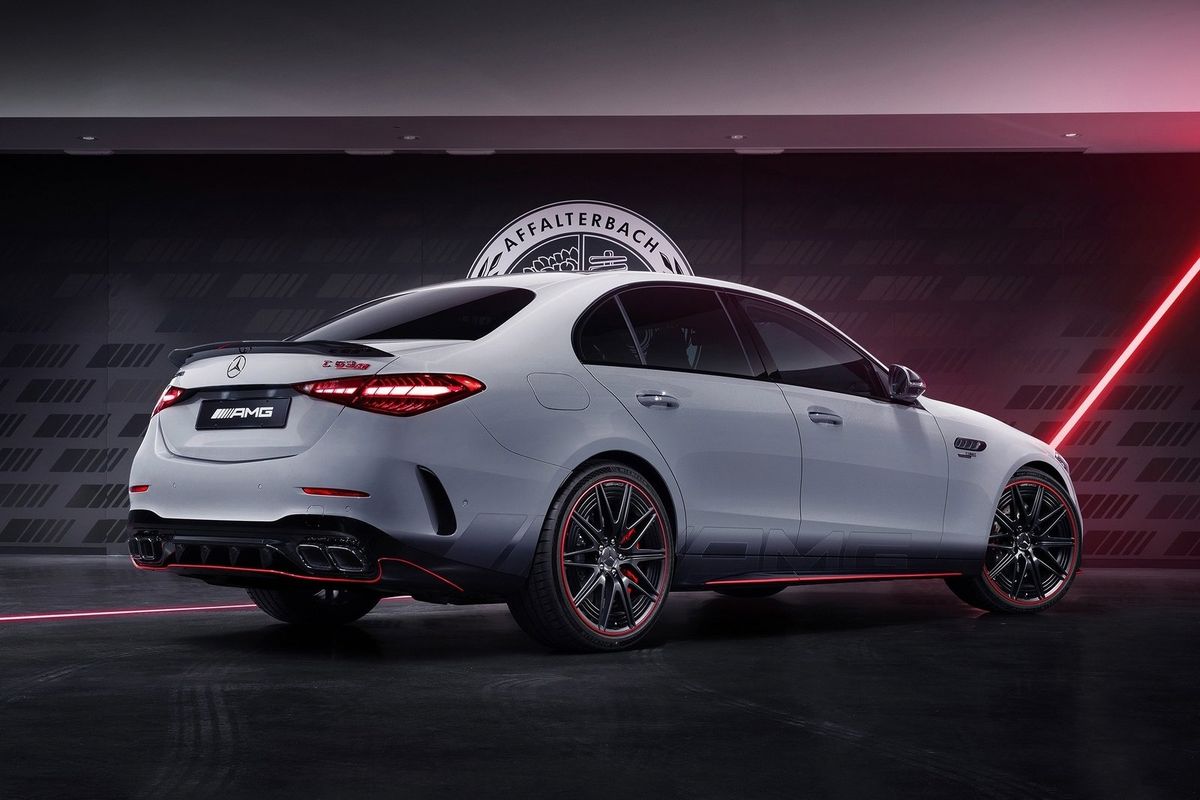
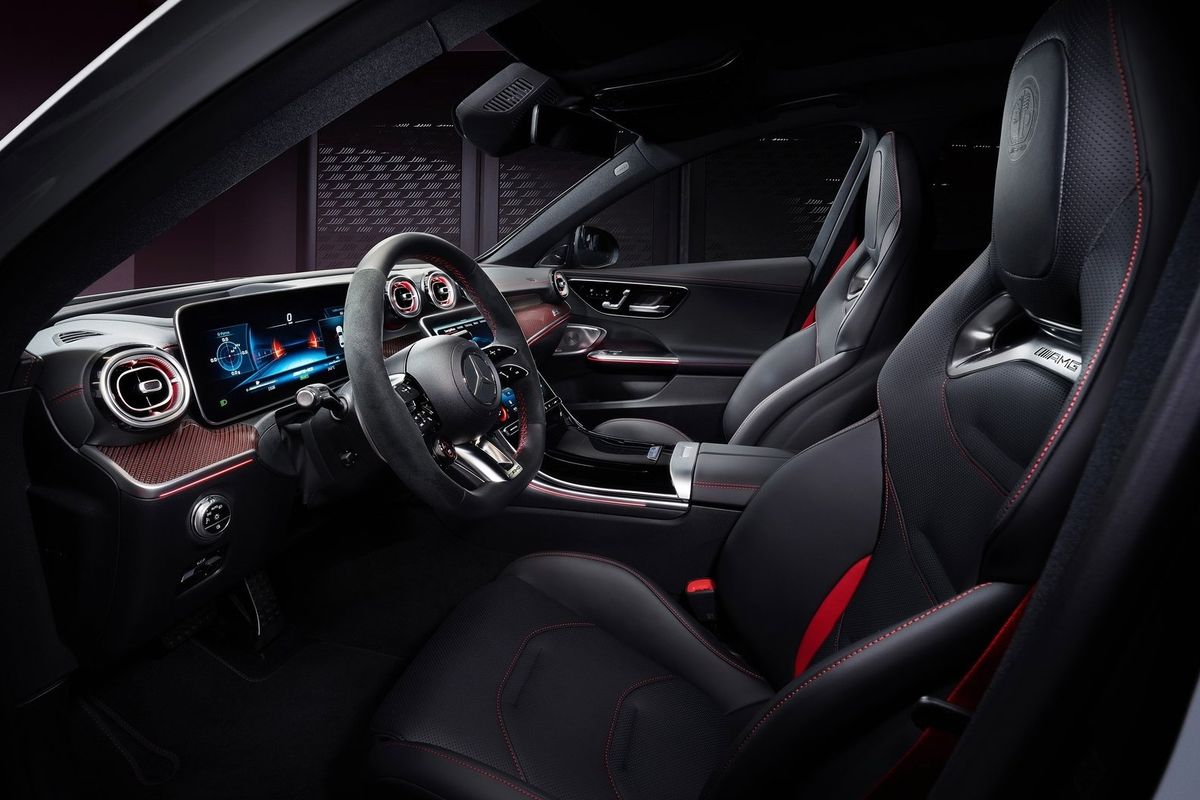
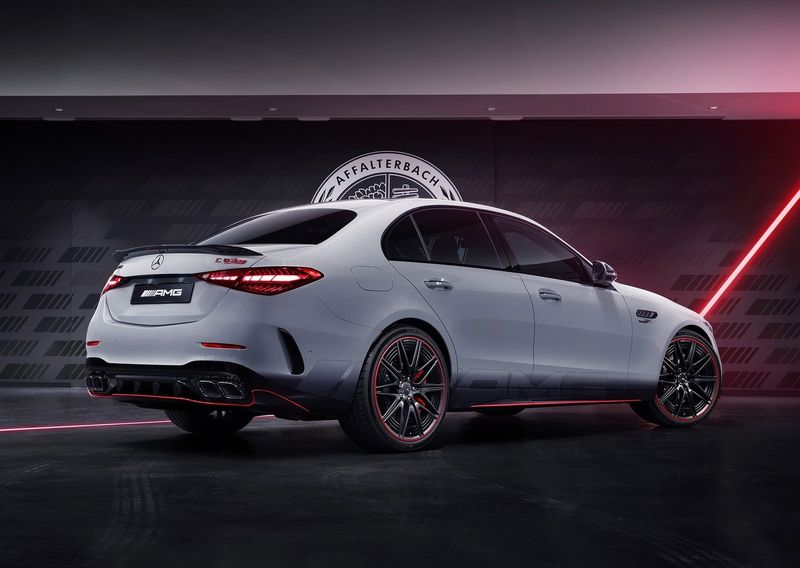
Mercedes-AMG has revealed the C63 S AMG F1 Edition, which offers an exclusive look both inside and out.
The C63 S AMG F1 Edition will be available globally for just one year from the start of sales. It’s an interesting strategy that has seen many car makers offer a ‘first edition’ that comes with some extra goodies, to try entice customers to start putting down early deposits and to gauge interest.
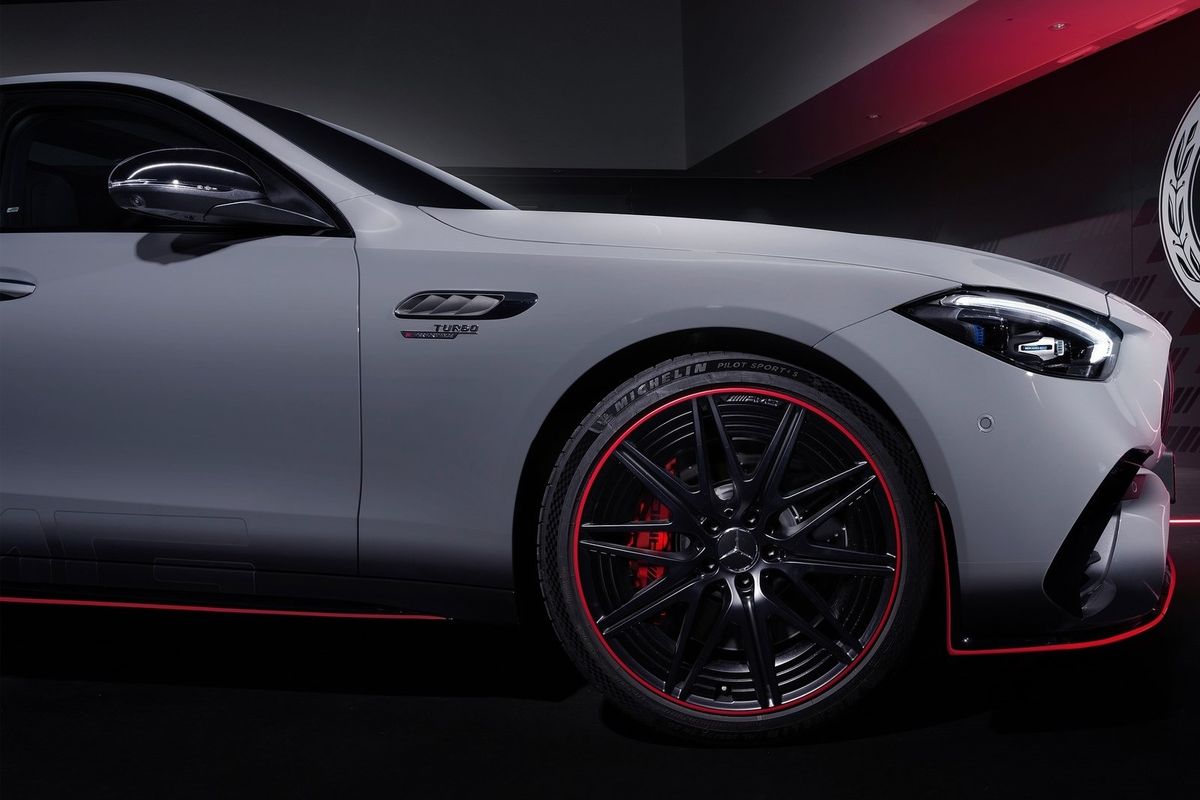
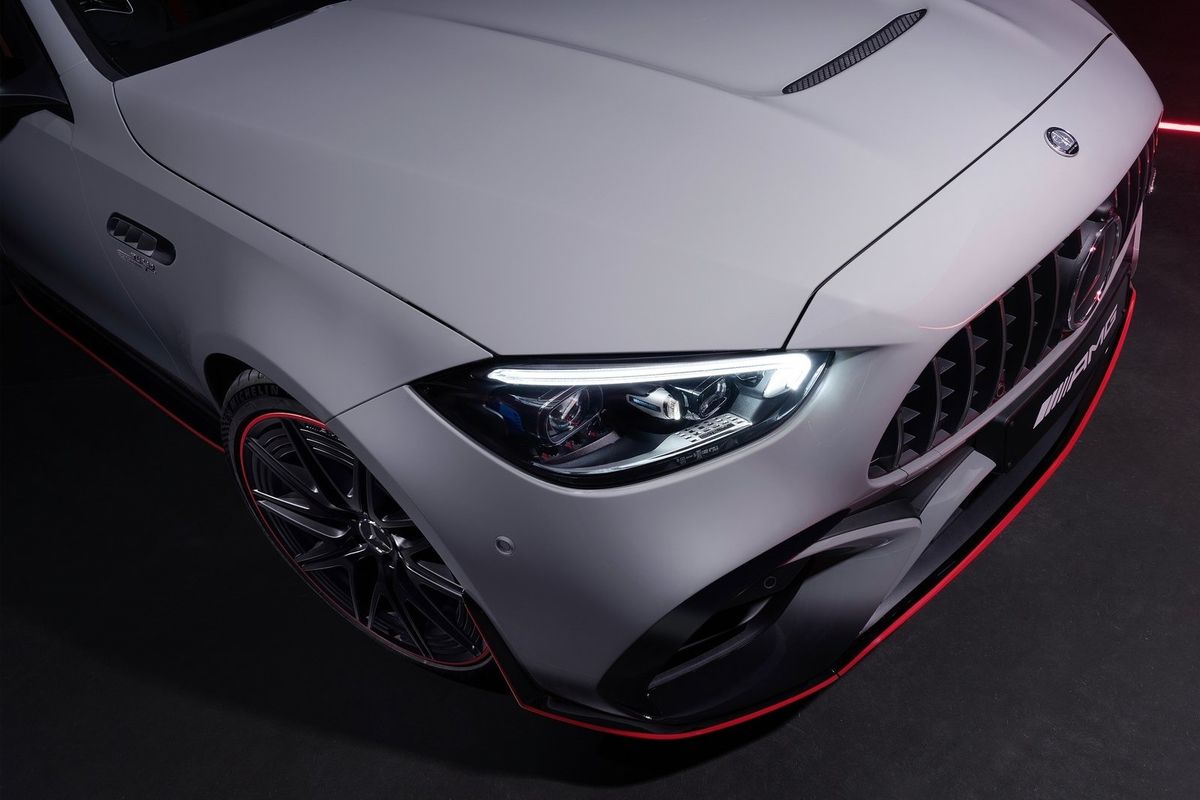
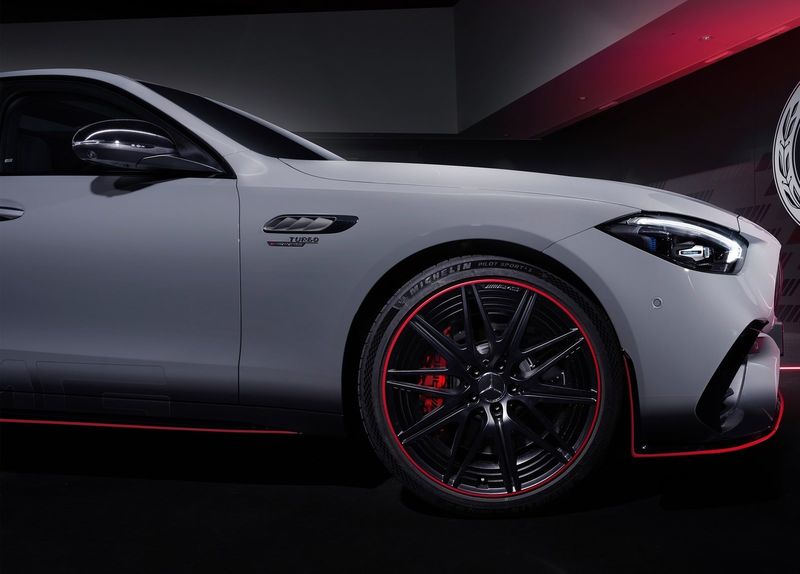
So, what does the C63 S AMG F1 Edition entail? Available for both the sedan and estate model (the latter we’re unlikely to see in South Africa), the upgrade comprises a unique Alpine Grey Uni paint straight from Merc’s MANUFAKTUR catalogue.
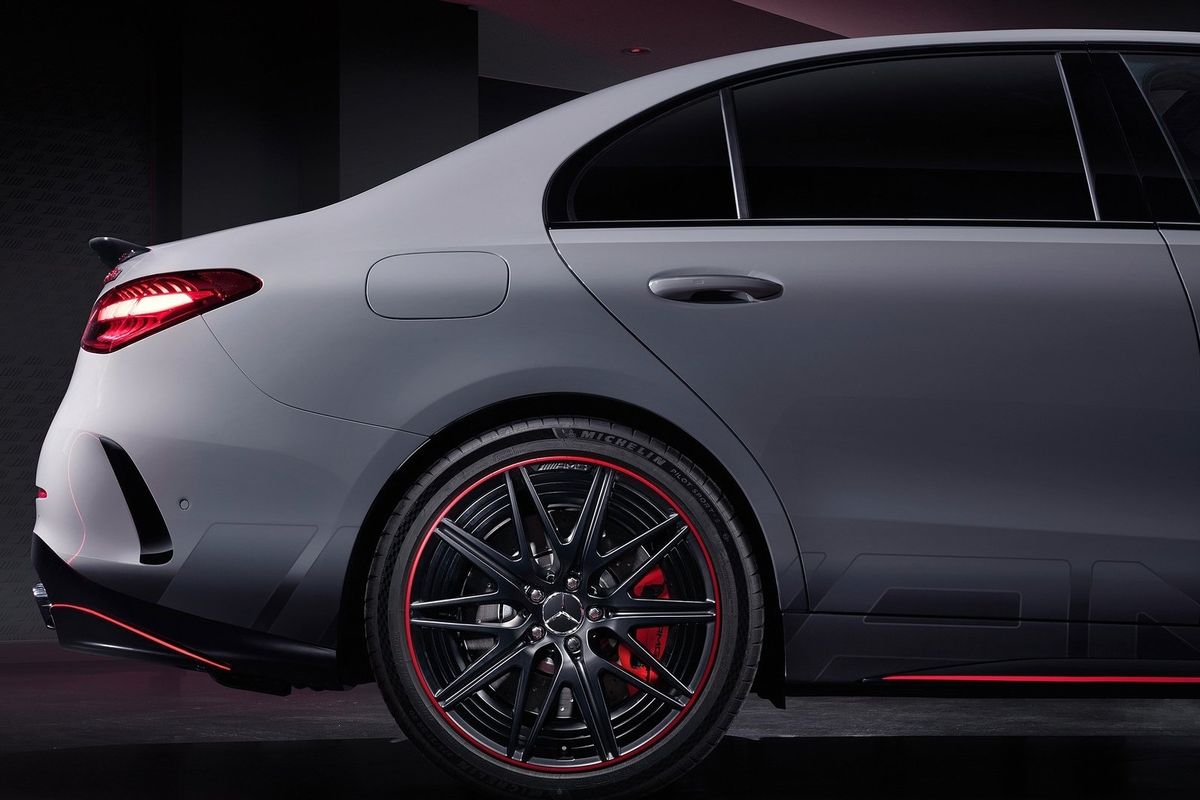
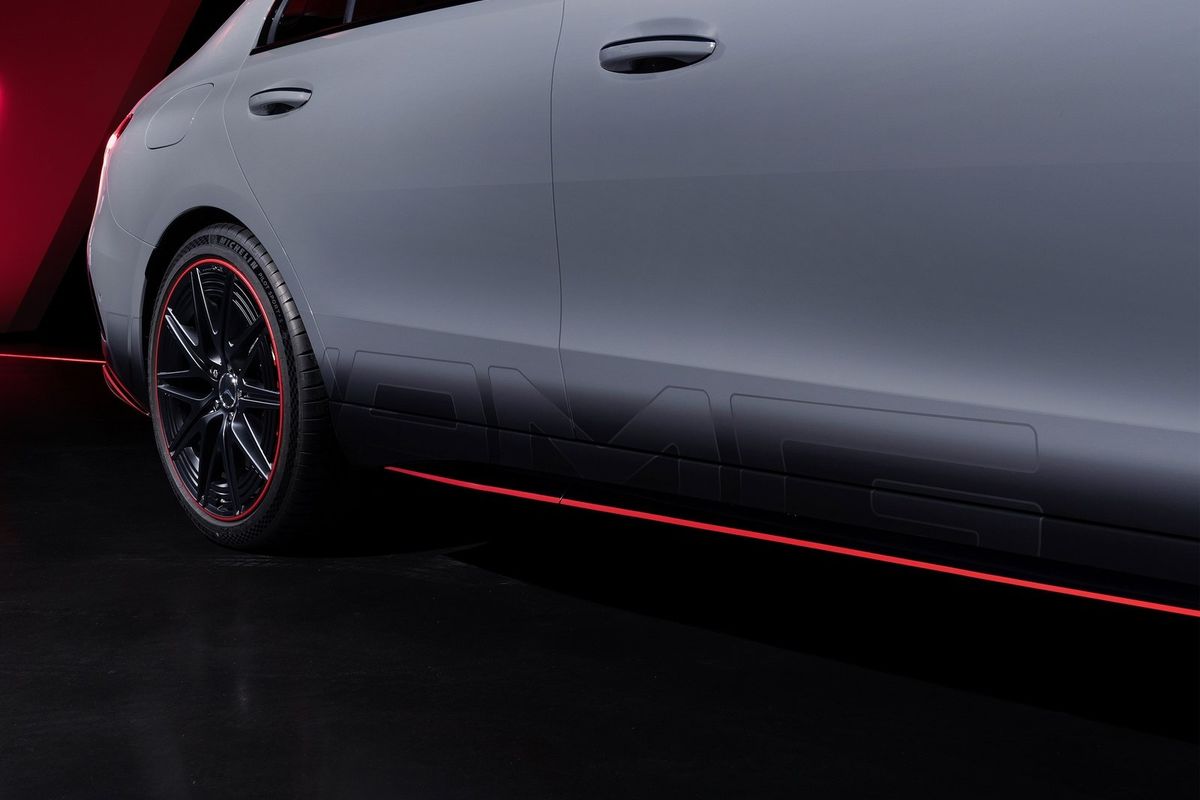
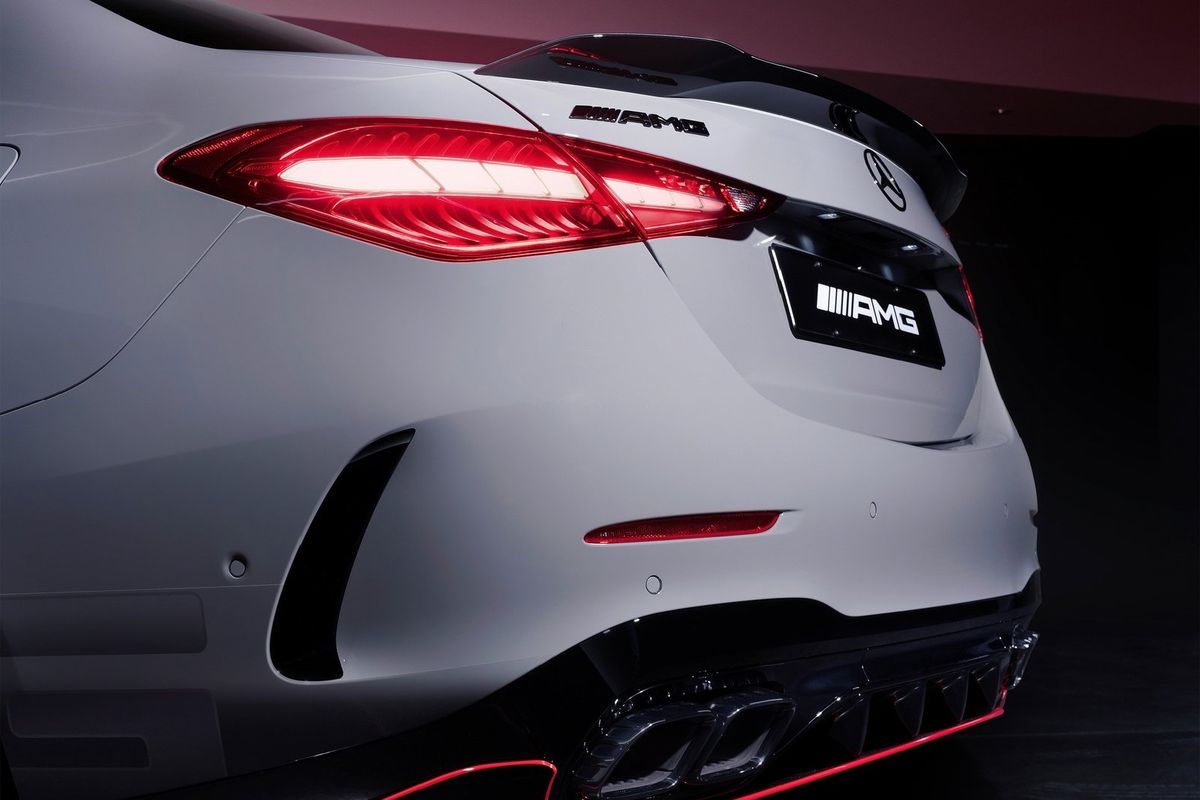
On the sides is the AMG logo and a colour gradient that goes from grey to black. There’s red detailing on the sides, front and rear as well as unique wheels. These 20-inch AMG forged units are finished in matte black and have red rim flanges that AMG says replicates the colour scheme of the official FIA F1 medical car.
The AMG Aerodynamics Package is standard and includes a larger front splitter, boot lid spoiler and redesigned side skirts and an additional diffuser board. Night Package 1 and Night Package 2 are also thrown in and these include details like window surrounds and mirror housings in gloss black.
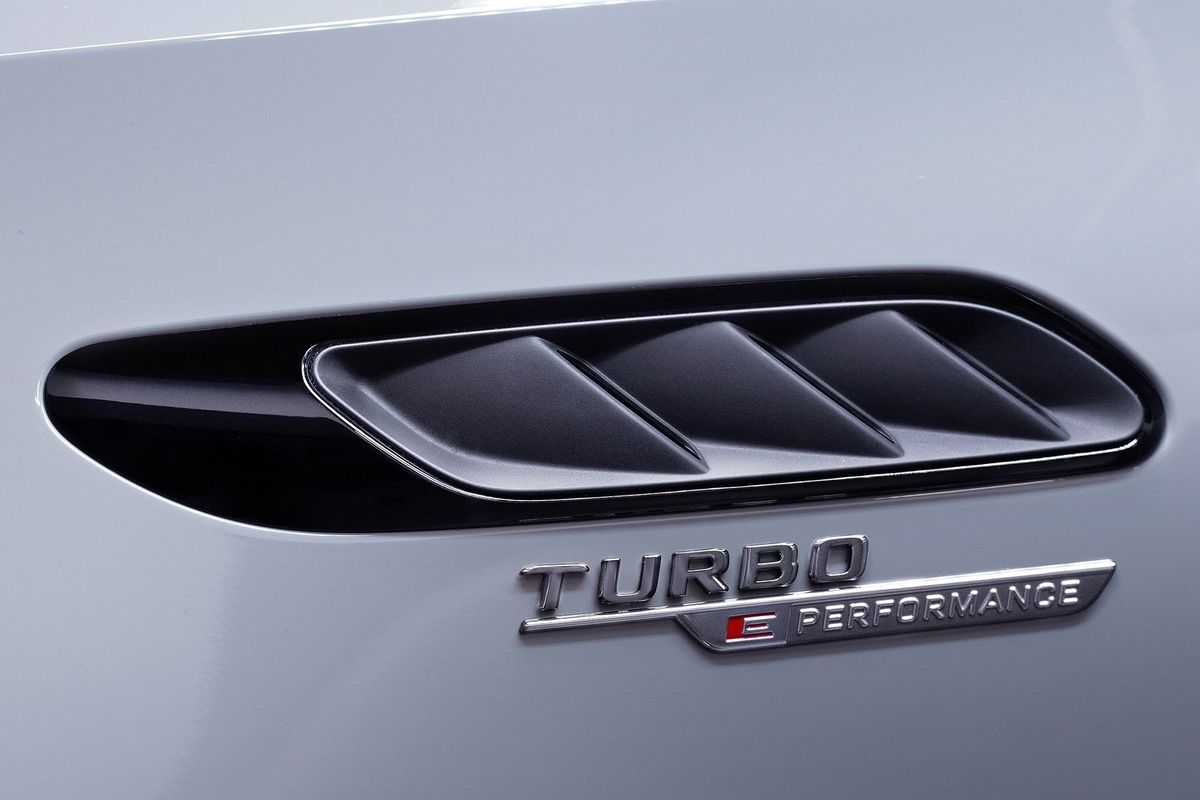
The radiator grille louvres and twin tailpipes are finished in black chrome, and there’s an AMG fuel filler cap in silver cap to further set it apart. Inside, there are AMG Performance seats in exclusive black nappa leather with red stitching and AMG embossed into the headrests. There are also red seatbelts and exclusive items like the Edition badge and AMG floor mats. Customers will also receive an AMG indoor car cover with F1 logo to help protect the vehicle.
As a reminder, the new Mercedes-AMG C63 S will be assembled right here in South Africa at the brand’s facility in East London, along with the new C43 which is going on sale in the first quarter of 2023. The C63 made headlines for the controversial ditching of its much-loved V8 powertrain for a hybrid 2.0-litre turbo setup with 500 kW and 1 020 Nm, driving all four wheels.
In our latest podcast, Ciro De Siena sat down with Mark Raine, the co-CEO of Mercedes-Benz South Africa to discuss electrification.
With the comprehensive EQ portfolio, Mercedes-Benz SA is confident that it can make inroads into the premium EV segment. We also chat about the Mercedes-Benz facility in East London and the challenges facing the South African EV landscape.
Ford Fiesta to be Axed Globally from 2023, Claims Report
Is the Ford Fiesta nearing the end of the road? Though the hatch has already been killed off in SA, a new report claims production will end for all markets in 2023…
The Ford Fiesta nameplate has been around for 46 years – spanning seven generations – but its time appears to be fast running out. According to a fresh report out of the United Kingdom, production of the Cologne-built hatchback is set to end by the middle of 2023.
Yes, Auto Express claims the writing is very much on the wall for the Fiesta, which traces its roots all the way back to 1976. Of course, the Blue Oval brand’s B-segment hatchback was discontinued in South Africa earlier in 2022 (along with the Figo), though the facelifted version of the seventh-generation hatch (including the ST version pictured above) has soldiered on in many other markets.
However, the British publication reports “select parties” will soon be informed of the Fiesta’s apparent demise as Ford continues to charge towards widespread electrification.
The last iteration of the Fiesta to be marketed locally was the pre-facelift seventh-generation model.
“We are accelerating our efforts to go all-in on electrification and therefore review our vehicle portfolio in line with our business strategy. We do not comment on speculation and will share more information in the coming months,” the Dearborn-based automaker told Auto Express when asked for comment.
Of course, there’s at least a chance the Fiesta badge will live on should Ford opt to affix it to a battery-powered vehicle in the future. Such a model would likely share much with the upcoming fully electric version of the Puma, which will start rolling out of Ford’s facility in Romania in 2024.
Ford previously announced plans to invest over $50-billion in electric vehicles through to 2026, while also aiming for more than half its global production to be electric by 2030. In addition, the company plans to be a fully electric brand in Europe by 2035.
The larger Focus (which was culled locally in the first half of 2019) is facing a similarly bleak global future, with production at Ford’s Saarlouis factory scheduled to end in 2025.
As the number of new Electric Vehicle (EV) introductions steadily increases in South Africa, mostly from luxury car brands, the need for more affordable EVs is growing and the incoming Funky FE-1 is expected to be the cheapest EV in South Africa when it reportedly arrives in 2023.
Image courtesy of Nafisa Akabor
If there’s a person that has her finger on the pulse in the world of technology, it’s renowned technology and EV journalist, Nafisa Akabor.
Nafisa is no stranger to Cars.co.za and not only has she been a regular content contributor over the years but she has also been a judge in previous iterations of the #CarsAwards.
In a recent article published by TimesLive, Nafisa details the forthcoming introduction of what will likely be South Africa’s cheapest EV when it goes on sale in 2023, the Funky FE-1.
Earlier this year, the Eleksa CityBug was deemed to be the cheapest electric vehicle in South Africa and it’s currently priced at R237 000, but that crown will likely be passed on to the incoming Funky FE-1 which is expected to be priced at roughly R190 000.
Earlier this month, the Funky FE-1 made an appearance at the Smarter Mobility Africa summit in Gauteng and is expected to undergo homologation in November 2022. If successful, the Funky FE-1 will be available to local buyers in 2023.
The Funky FE-1 might appeal to consumers who commute short distances within a city environment.
Co-founder of Funky Electric (sole distributor), Adele Theron, commented, “It’s small, but big enough, it’s got a cuteness factor and it’s perfect for suburban use because of its top speed. We are targeting moms taking kids to school, students going to university, dads on a short commute to work or those on quick shopping trips. It’s perfect as a second car.”
What powers the Funky FE-1?
The Funky FE-1 is powered by a 4kW electric motor and is equipped with a 100Ah lead-acid battery that offers a range of up to 100 km. Top speed is rated at 60 kph and the Funky FE-1 is said to weigh only 450 kg. Charging takes about 10 hours using a standard 3-point plug and the battery has a lifespan of 2 years after which it can be swopped for a new battery or replaced with a lithium-ion battery.
Some key features include a multifunction steering wheel, a touchscreen system with Bluetooth, reverse cameras, a rudimentary sound system, electric windows, central locking and an emergency stop button.
Funky Electric will be the sole distributor for the FE-1 in Africa, Australia, New Zealand and the UK while South Africa will be the first market to receive the Funky FE-1. Interestingly, due to its diminutive size and weight, the Funky FE-1 isn’t subjected to the same crippling import duties that plague a typical EV and pricing is therefore far more reasonable.
Is the Funky FE-1 something you are willing to entertain considering rising fuel prices and the increasing maintenance cost of ICE vehicles?
We will keep you updated as soon as more information becomes available.
Affordability Calculator: Can you afford the car you want?
Which car do you want? That’s the easy bit. Working out whether you can afford the monthly finance instalments with your salary – that’s the hard bit! Alan Quinn sets out what you need to keep in mind when making this weighty financial decision.
You want a car, but there are so many choices. Do you find it tough to choose what you want?
Now, let’s get real for a second. Deciding which car you WANT is, in actual fact, EASY. Every time I drive to work I see cars that I want! The tricky bit is whether you can AFFORD it on your salary. Cars cost a lot of cash and vehicle-finance agreements can be 6 years long – that’s a serious financial commitment.
This article deals with the logic you should apply before making a vehicle purchase decision. Of course, you don’t necessarily need to apply logic – you can just go with your feelings and follow your dream. “Fake it till you make it,” as they say. You would not be the first person to do this – or the last – but, if you want to live with less stress for the next 6 years, I suggest you read on!
Quick Fix: Cars.co.za has created a handy Affordability Calculator to help you work out the value of the car you can afford, plus enable you to draw up a realistic monthly budget, which I describe below. The best advice is to quickly read the article below and then use the Calculator.
Step 1: How much Moola have you got coming in?
Start with your “net income”, which is your salary AFTER the South African Revenue Service (SARS) has taken its cut (deducted pay-as-you-earn tax). In other words, it’s the amount at the bottom of your payslip and the line on your bank account which says “salary”.
Step 2: What are you paying for a car right now?
Are you paying off a car right now? If so, how much is that per month and does it seem easy – or a real burden – to meet those payments?
Step 3: What are your current expenses?
To be completely honest, this is the toughest question to answer, because working out what you spend on things that you HAVE to do, versus things that you WANT to do, can be difficult.
Start with things where you have signed a contract. Think about credit agreements such as loans, store cards, credit cards etc. You cannot avoid them because you have committed to them; they’re also the first things banks will look at to decide whether you can afford more credit.
Then think of everything else. If you are going to buy a car, then the monthly instalments on the vehicle finance agreement (car loan) might mean that you have to live without some of these.
Tip #1: As a general rule, your car budget should not be more than 20% of your net income. That is the figure you got in Step 1 minus the things you MUST pay in Step 2.
Tip #2: If you have too many credit commitments already, the bank will start to get nervous and regard you as a higher-risk candidate for a vehicle finance agreement. This will result in you paying a higher interest rate (the Cars.co.za Affordability Calculator takes this into account).
Step 4: Are you keeping up with your payments right now?
This is a reality check for a couple of reasons. If the answer to this question is not a clear YES, then you need to ask yourself a hard question. Car Finance generally starts at R3 000 to R4 000 per month. If the current bills are making you sweat each month then how do you expect to pay that kind of moola each month in car payments, as well as insurance-, fuel- and servicing costs.
Tip #3: If you are not regularly keeping up with your current payments, then your bank (or other banks) may think of you as a “high risk” candidate. You may be refused a new loan, or at least have to pay a high interest rate. The Cars.co.za Affordability Calculator takes this into account.
Now Get Started:
I hope this article has given you some background. Now jump across to the Cars.co.za Affordability Calculator and start your search for a car that will fit your monthly budget.