New Kia EV9 7-Seater Electric SUV Fully Revealed

Meet the production version of the new Kia EV9, the South Korean firm’s box-fresh 7-seater electric flagship SUV…

The Kia EV9 has finally been fully revealed in production form, arriving as the South Korean brand’s new 7-seater electric flagship SUV. And, yes, it looks hardly any different to the concept version unveiled back in late-2021.

Kia describes the new EV9 as a “pivotal step forward” in the automaker’s journey towards becoming a “sustainable mobility solutions provider”, adding the vehicle “paves new paths for future electric SUV design”.

“The Kia EV9 breaks new ground, aiming to redefine standards for design, connectivity, usability and environmental responsibility,” said Karim Habib, Executive Vice President and Head of Kia Global Design Center. “The Kia EV9 offers customers an exceptionally high-quality proposition and a fresh EV perspective in the family SUV sector. This new vehicle typology provides instinctive experiences and excellent comfort for not just the driver, but all occupants, through innovative use of space, technology and design.”

Unfortunately, the automaker has yet to release any official details on the EV9’s electric powertrain (so, battery capacity, power output and range claims are all unconfirmed), while dimensions have also not yet been announced. For the record, though, the concept version measured 4 928 mm long, 2 057mm wide and 1 778 mm tall, with a wheelbase of 3 099 mm.

Kia EV9
The 2nd-row seats are able to swivel up to 180 degrees.

One of the defining features of the EV9’s front end is the vertically arranged headlamp design, with clusters of small “cube lamps” within the bodywork adjacent to each headlamp. Expect this lighting signature to feature on the brand’s next EV models, too. In profile, you’ll notice the EV9’s flush door handles, while the rear end features slim taillights mirroring the design of those at the front.

And inside? Well, Kia says its designers prioritised “space, comfort and technology” for all passengers. Built on Kia’s E-GMP platform, the EV9 benefits from a long wheelbase, a low beltline and a completely flat floor. The result, according to the brand, is “lounge-style comfort” for all 3 rows of seats. While the 7-seat version will likely be the most popular, Kia also plans to offer a derivative with 6 pews.

Occupants in the first- and 2nd-row seats are able to simultaneously recline their seats when the EV9 is charging. In addition, the chairs in the 2nd row can be swivelled up to 180 degrees to allow their occupants to interact with those sitting in the final row. The latter furthermore offers cup holders and charging points for mobile devices.

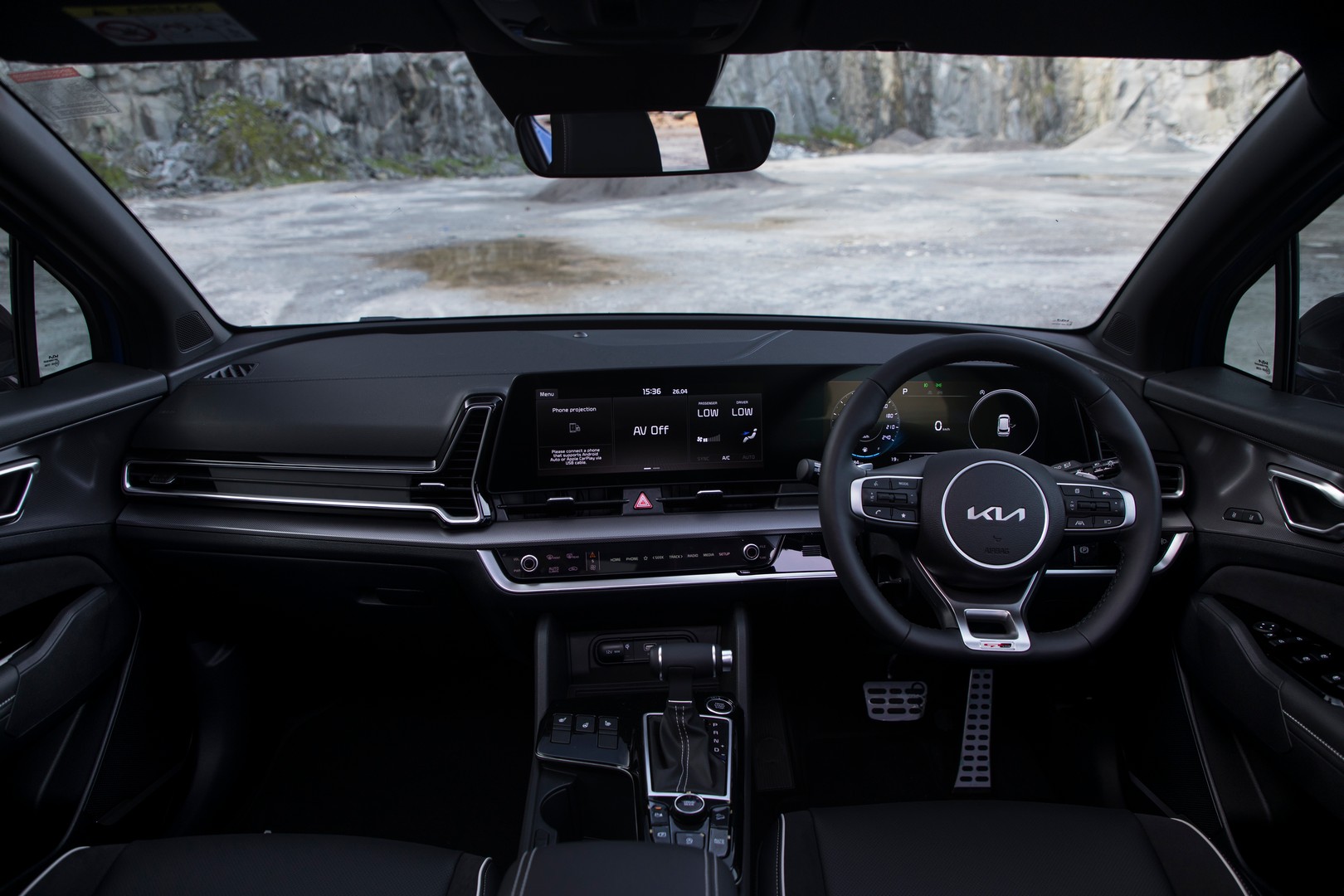
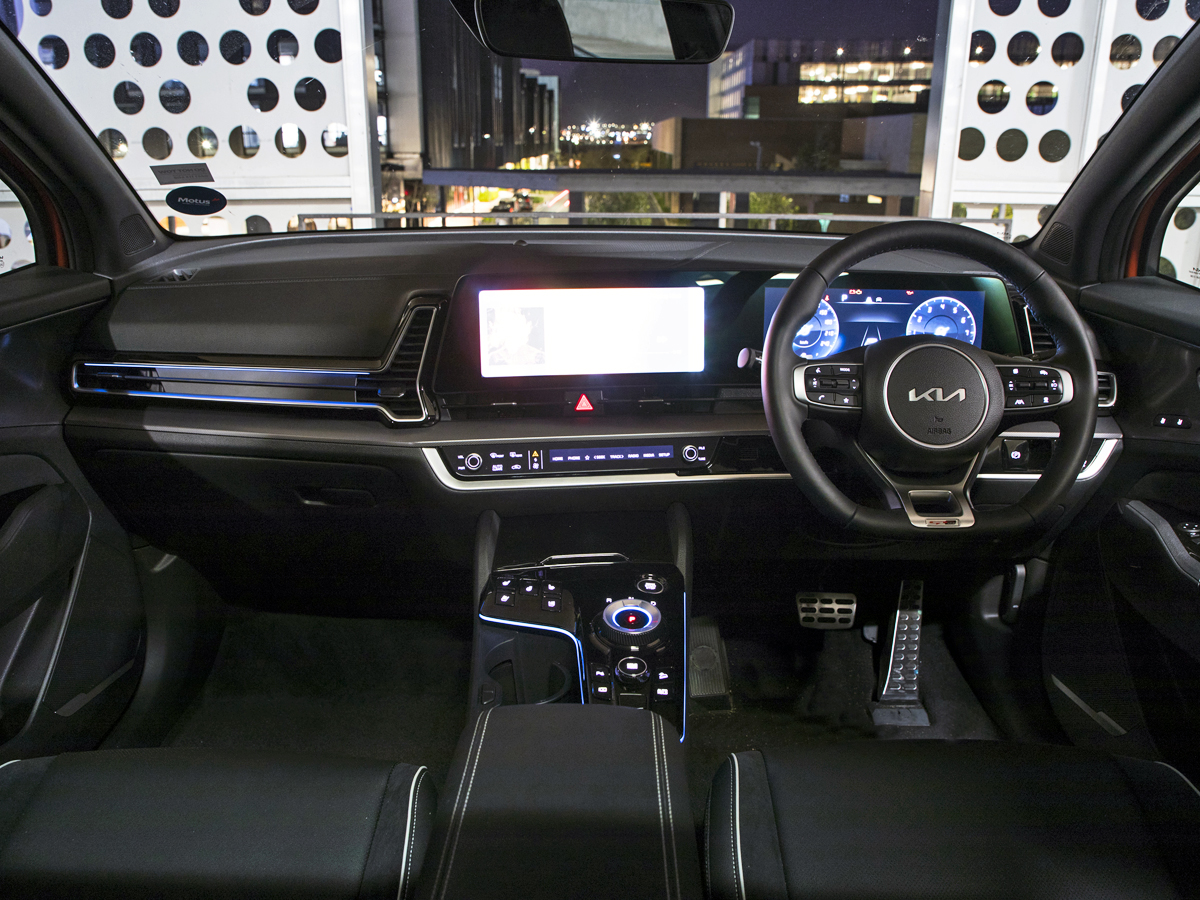
Up front, you’ll find a pair of 12.3-inch touchscreens integrated with a 5-inch segment display (Kia says it has ensured “physical buttons are kept to a minimum”), along with a centre console equipped with “ample” storage options. Beneath the main screen, there’s an array of “hidden type-touch buttons” to control functions like heating, ventilation and air conditioning.

No word yet whether we’ll see the new EV9 in South Africa, though the EV6 is scheduled to hit local roads in “limited numbers” at some point.

Related content

Kia EV6 Coming to SA in Limited Numbers

It’s Official: Kia Rio to Exit South Africa at End of 2023

Kia’s V6 Diesel Bakkie Could Redefine Double Cabs

Spy Shots: Ineos Grenadier Bakkie

It’s taken some time, but the Ineos Grenadier Bakkie looks to be nearly ready for a production reveal. Here’s what we know so far.

Picture credit: S. Baldauf/SB-Medien. We have paid for these photos and at the photographer’s request, have watermarked them.

These spy shots show the Ineos Grenadier Bakkie undergoing final testing in Europe. As a reminder, the Ineos Grenadier is inspired by the original Land Rover Defender. Chemical giant Ineos’ founder Jim Ratcliffe initially tried to buy the rights/plans for the Defender, but naturally Jaguar Land Rover fought tooth and nail to protect one of its most iconic nameplates.

So, Ratcliffe decided to create his own version. Given how the market has moved away from the hardcore offroad and semi-military applications and there are just a handful of models playing in this space (think of your non-AMG Mercedes-Benz G-Class and Toyota Land Cruisers), Ratcliffe and Ineos reckon they’re onto something. Impressively, BMW is the engine supplier and the Grenadier will be powered by Munich’s petrol and diesel 3.0 straight-6 engines.

The best part? The Ineos Grenadier is confirmed for a South African market introduction and will be sold through selected BMW dealerships in SA.

MORE: Read about the Ineos Grenadier SA dealership plans

So, what do we have here then? This is the Ineos Grenadier Bakkie prototype which was spotted in Scandinavia, completing its winter testing. Its arrival is not exactly a closely-guarded secret as Ineos did say it would be offering multiple body styles right from the very beginning of the project. There’s no spec or tech data, but from the images, that load bay looks fairly large and practical.

The Ineos Grenadier bakkie will be the brand’s second model in the line up, after the 4-door SUV, and we understand that a single cab version will also be launched, along with an alternative fuel-powered derivative which could be electric or hydrogen.

Further Reading

Ineos Grenadier Price and Specs

Ineos Grenadier Prototype Drive, at G-Class territory!

Ineos Grenadier Production Begins

Nissan Qashqai (2007-2014) Buyer’s Guide

In the market for an original Nissan Qashqai? Let’s take a look at this popular small crossover’s history in South Africa, as well as its strengths and weaknesses as a used vehicle, plus which variant you should consider buying.

Automakers often make bold – sometimes even wildly mistaken – claims, usually all in the name of marketing. Nissan, for instance, has declared on more than one occasion it “created the crossover segment” with the unveiling of the original Qashqai back in 2006.

History would suggest otherwise, since the J10-generation Nissan Qashqai was preceded by a number of contenders that straddled more than one vehicle class (though perhaps not with quite such an urban edge). Still, the Qashqai certainly was a pioneer for the modern crossover, sparking the development of similar vehicles from virtually every other mainstream brand, playing the role of segment benchmark and ultimately popularising what has since become the fastest-growing sector in the industry. Yes, it rewrote the playbook, at the very least.

Nissan Qashqai
The Qashqai was created to take on C-segment hatchbacks like the VW Golf.

Pronounced “Kash-Kai”, Nissan’s prototypical crossover was named after a semi-nomadic tribe in southern Iran but interestingly wore the Dualis badge in its domestic market of Japan, as well as in Australia (the latter seemingly over concerns it would be dubbed – not entirely inaccurately, it must be said – Nissan’s “cash cow”).

Fascinatingly, the Qashqai was conceived as an indirect replacement to the N16-generation Almera C-segment hatchback that was never offered here in South Africa (but was struggling against the likes of the Volkswagen Golf and Ford Focus in Europe). Styled by Nissan’s design office on the Old Continent, the Qashqai was positioned as a “robust alternative to the more generic hatchbacks in the segment”. It was a brave move from Nissan but one that paid dividends remarkably quickly, with the model going on to sell up an absolute storm all over the world.

Nissan Qashqai model line-up

Nissan Qashqai concept
The production version of the original Qashqai was previewed by this concept.

Codenamed P32L, the Mk1 Qashqai was previewed in concept form at the 2004 running of the Geneva International Motor Show. The reveal of the production version followed in September 2006 in Paris, shortly before the first units began rolling off the assembly line at Nissan’s Sunderland factory in the United Kingdom.

Just a month after its global unveiling, the Qashqai was displayed at Auto Africa 2006 in Johannesburg. The local launch, meanwhile, took place around a year later (in September 2007), when the newcomer slotted neatly into Nissan’s line-up below the X-Trail.

At the time, Nissan SA declared it had mere “solid expectations” of the Qashqai in terms of local sales. Hindsight suggests the Japanese firm’s local division could have been far more bullish (it later admitted the vehicle had “exceeded all expectations”), as South Africans took a swift liking to the newcomer. When all was said and done, well in excess of 20 000 units had been registered across the country over a period of six years.

Nissan Qashqai
Nissan’s bold move to launch the Qashqai quickly paid off, including in South Africa.

At launch, the Nissan Qashqai was available in three flavours, with a mix of two naturally aspirated, 4-cylinder petrol engine choices, two gearbox options and a pair of trim levels (Visia and Acenta). The following variants – each front-wheel-driven – were offered at market launch:

  • 1.6 Visia (81 kW/154 Nm) 5-speed manual
  • 1.6 Acenta (81 kW/154 Nm) 5-speed manual
  • 2.0 Acenta (102 kW/198 Nm) 6-speed manual

In July 2008, the local Qashqai range expanded with the arrival of a turbodiesel engine and the option of 4×4. Developed by Renault and Nissan, the 2.0-litre dCi unit generated 110 kW and 320 Nm, and was linked to a 6-speed manual gearbox. In Acenta guise (with either cloth or leather upholstery), the oil-burner drove the front wheels, while the Tekna flagship gained Nissan’s so-called “All Mode 4×4” system.

Nissan Qashqai
A diesel engine (plus the option of 4×4) was added to the local range towards the middle of 2008.

The limited-edition N-Tec derivative arrived in October 2009, employing the familiar 2.0-litre petrol powertrain. Just 200 units were set aside for South Africa, each boasting extra items such as 18-inch alloy wheels, tinted rear windows and chrome trim for the grille, roof rails and exterior door handles.

By April 2010, with more than 5 500 units having been sold locally, Nissan introduced the facelifted Qashqai. The most significant styling changes came up front, where the crossover gained a new bonnet, front bumper, wings, grille and headlamp arrangement. A continuously variable transmission (CVT) was also added to the range, available exclusively in conjunction with the 2.0-litre petrol motor.

Nissan Qashqai
The somewhat more modern front end of the facelifted Qashqai.

Just a month later, the Qashqai+2 body style arrived, offered in 1.6 Visia and 2.0 Acenta form, and growing the line-up to eight derivatives. Exactly as its name suggested, the NJ10 model added a third row of two chairs, transforming the crossover into a 7-seater (Nissan’s official specification sheet actually listed it as an “MPV”). Compared with the 5-seater, the Qashqai+2 scored an extra 135 mm between its axles and measured 211 mm longer from nose to tail. The roofline was furthermore re-profiled, improving headroom all round.

In July 2011, the N-Tec special-edition nameplate made a return to the local market, this time limited to 648 units and available in both 1.6 Acenta and 2.0 Acenta guise (the latter with or without a new glass roof option). Perhaps more significant, though, was the arrival of a new, more affordable oil-burning engine later that year. The 1.5 dCi was available only in Acenta trim, sending 78 kW and 240 Nm to the front axle through a 6-speed manual gearbox. Claimed combined fuel economy came in at 5.1 L/100 km.

Nissan Qashqai+2
The Qashqai+2 boasted a longer wheelbase, longer body and a pair of extra seats.

With more than 16 000 units sold in South Africa, a quartet of fresh Nissan Qashqai variants wearing the unimaginative “Limited Edition” badge touched down in April 2013. Production was limited to 12 months, with the models available in Limited Edition form being the 1.6 Acenta, 1.5 dCi Acenta, 1.5 dCi Acenta (with glass roof) and 2.0 Acenta.

The Limited Edition package included 18-inch diamond-cut black alloy wheels, gloss-black roof rails, gloss-black side-mirror caps and privacy glass. Inside, these models boasted cloth-and-leather combination seats with white stitching, a treatment that was also extended to the interior door panels and gear lever trim.

Finally, the second-generation Qashqai hit the global stage late in 2013, before arriving in South Africa in mid-2014 and bringing to an end local sales of the J10-generation model.

Product strengths

Nissan Qashqai+2 rear quarters
The Qashqai+2 was the more versatile body style of the two.

Practicality: One of the Mk1 Qashqai’s key selling points was its practicality. In 5-seater form, the luggage compartment could swallow 410 litres, a figure expandable to 1 104 litres with the rear bench folded down. Though the third row of perches in the Qashqai+2 was better suited to children than adults, the 7-seater model offered even more versatility. Its luggage compartment could be varied from 130 to 450 to 1 520 litres, depending on the configuration of the pews, while the second row could handily slide fore and aft. The facelifted Qashqai also gained various added oddments storage areas in its cabin.

Comfort: In terms of comfort, the driver benefited from a steering column that adjusted for both rake and reach, while the ride quality was close to plush (particularly on 16-inch wheels with plump tyres), thanks in part to the adoption of a relatively sophisticated multilink rear suspension. Ground clearance came in at 200 mm, allowing for some light gravel-road travel. However, be warned that derivatives fitted with the larger (18-inch) alloy wheels suffer from a hard ride quality owing to their low-profile rubber.

Nissan Qashqai pre-facelift cabin
Even the pre-facelift Qashqai came with tilt-and-telescopic adjustment for the steering column. 

Safety: Though local specifications may have differed slightly, it’s worth noting the Nissan Qashqai scored the maximum 5-star safety rating from Euro NCAP back in 2007. In fact, the crossover was awarded 36.83 points out of 37, the highest rating ever dished out by the safety organisation at that time.

Locally, all Qashqai derivatives shipped standard with driver, passenger, side and curtain airbags (for a total of six), along with ABS with EBD and brake assist, plus Isofix child-seat anchors. Still, be aware only the 2.0-litre petrol and 2.0-litre dCi models came standard with stability control, meaning the 1.6-litre petrol and 1.5-litre dCi derivatives did without this safety feature.

Product weaknesses

Nissan Qashqai
Early models may suffer from fast-wearing dampers at the rear.

Flimsy tailgate handle: The tiny plastic clips moulded on the inside of the Qashqai’s broad tailgate handle are unfortunately prone to snapping. Once this happens, it becomes tricky to open the tailgate.

The solution? Either attempt to repair the clips (a fiddly exercise) or purchase a replacement handle and have it colour coded to the vehicle’s paint (an expensive exercise). Make sure to closely examine this area on any potential buy.

Fast-wearing rear shocks: Some early versions of the J10-generation Qashqai suffered from fast-wearing rear shock absorbers. During your test drive, make sure to listen closely for any rattles or knocks coming from the rear of the vehicle. Also take note of the vehicle’s damping behaviour, particularly over less-than-perfect tarmac.

J10 Nissan Qashqai instrument cluster
The 2.0 dCi engine has been known to suffer from the occasional clogged DPF. 

Defective steering wheels: Back in September 2012, Nissan South Africa issued a recall for around 500 examples of the Qashqai (both 5- and 7-seater variants) after a defective batch of steering wheels was used at the Sunderland factory. The remedial action was sparked by a (no doubt shocked) Finnish driver’s experience of the steering wheel coming off in his hands during a routine parking manoeuvre. At the time, Nissan SA contacted affected customers directly, but it’s still worth closely examining the tiller.

Miscellaneous issues: Another thing to look out for when shopping for a used oil-burning Mk1 Qashqai is a clogged diesel particulate filter (DPF). Locally, this seems to be specific to the 2.0 dCi engine; as we understand it, the early SA-spec 1.5 dCi units did without a DPF (though the next-gen version certainly gained one). The latter engine, however, does require a timing belt change every five years. Though less common, we have also heard complaints of ignition-barrel failures and water leaks around the windscreen due to failed seals (check under the front carpets for dampness).
What to pay?

Nissan Qashqai post-facelift cabin
The cabin of the facelifted Qashqai, here featuring the CVT option.

As always, give preference to vehicles that come with a full (preferably verifiable) service history. Since all J10-generation Qashqai models sold in South Africa shipped with a 3-year/90 000 km service plan (as well as a 3-year/100 000 km warranty), pay particularly close attention to the recorded maintenance history from three years after registration.
Of the used first-generation Qashqai models listed on Cars.co.za at the time of writing, nearly 75% were petrol-powered examples, with the 2.0-litre unit being the most common. Illustrating the buying public’s apparent aversion to CVTs (back in the early 2010s, at least), a whopping 99% of all listed models employed a manual gearbox, while not even 2% featured the 4×4 option. We found one example with more than 300 000 km on the clock and a further 16 showing north of 200 000 km (a group interesting containing all four engine options). 

  • Below R100 000: We discovered just 10% of all stock was priced below this mark. Unsurprisingly, the majority of models here featured high mileage and early model years. Unless you’re looking for a project car (and we’re not sure such a description would often apply to a Qashqai), we’d steer clear.
  • From R100 000 to R125 000: This price bracket contained a little more variety, from high-mileage 2014 1.6 Acenta (so, base-spec) models through to lower-mileage, earlier model-year turbodiesel variants and even a handful of Qashqai+2 examples. Search wisely here and you might just unearth a bargain.
  • From R125 000 to R150 000: Still plenty of powertrain variety in this section, with all four engine options represented. Most units listed here had more than 150 000 km on the odometer, though there was one particularly low mileage example.
  • From R150 000 to R200 000: More than half of all first-gen Qashqai listings were nestled between these final pricing bookends, including a fair few units of the 1.5 dCi (though both petrol engines were again more plentiful). We also found a handful of limited-edition models here, plus a couple more 7-seater derivatives, CVT-equipped models and the only 4×4 models on offer. No first-gen Qashqai units were priced above R200 000.

Pick of the range?

Nissan Qashqai
It pays to narrow your search to the refreshed version of the J10-generation Qashqai.

So, which derivative should you consider? Well, we’d recommend focusing your search on a facelifted model, which benefits from somewhat more modern styling up front as well as additional in-cabin storage space, improved refinement levels (thanks largely to extra insulation and the fitment of an acoustic windscreen) and the option of a 7-seater body style. This approach makes even more sense once you consider around three-quarters of all local J10-generation sales were post-facelift models.

When it comes to engine choices, the 2.0-litre petrol is obviously the thirstiest, but is also the only mill available with a self-shifting transmission (in the form of a CVT, since no conventional torque-converter automatic was offered in this generation) and the most common on the used market. There’s certainly an argument to be made for the likewise naturally aspirated 1.6-litre petrol unit as a long-term ownership prospect, as it’s generally cheaper to purchase than the other engine derivatives and will furthermore appeal to owners who’ve experienced expensive turbo headaches with other cars. However, take note it does without stability control.

The far-less-common 2.0 dCi offers the highest torque figure of the bunch, but like the petrol model of the same capacity, shipped standard in facelift form on large 18-inch alloy wheels (detracting somewhat from the ride quality). That leaves diesel lovers with the 1.5 dCi, which is arguably the best all-rounder in the range, offering a pleasing mix of low-down punch and wallet-friendly fuel consumption. As with the 1.6-litre petrol model, the only real fly in the ointment with the 1.5 dCi is its lack of stability control.

Verdict

Nissan Qashqai N-Tec
The N-Tec badge returned to the local Qashqai range in mid-2011.

Though the first-generation Qashqai was largely responsible for popularising a slightly raised driving position (something that resonates even more strongly with modern buyers), alternatives nevertheless include traditional C-segment hatchbacks such as the VW Golf 6 and Ford Focus (Mk2 and Mk3). More conventional higher-riding rivals come in the form of crossovers such as the Hyundai ix35 and 3rd-gen Kia Sportage, while an early model-year 4th-gen Toyota RAV4 would make for a compelling substitute.

While the original Qashqai paved the way for the modern crossover all those years ago, it remains an attractive option today for buyers searching for a relatively inexpensive middle ground between a compact hatchback and a full-size SUV. Since many shoppers would likely instead spring for the fresher J11-generation model, there’s plenty of value to be found in the older subject of this buyer’s guide.

Looking for a Nissan Qashqai to buy?

Find one on Cars.co.za here.

Or sell your car here, for free.

New Mercedes-Benz GLC Coupe Revealed 

While we wait in anticipation for the new Mercedes-Benz GLC to reach South Africa, the German firm has now lifted the covers off the sporty GLC Coupe. Herewith the key details!

The new Mercedes-Benz GLC is mere weeks away from its local arrival in South Africa but for those who prefer a sportier execution of Merc’s luxury SUV formula, enter the new GLC Coupe!

What powertrains will be offered for the new GLC Coupe? 

Mercedes-Benz GLC Coupe
The GLC Coupe will be powered by both mild-hybrid and PHEV powertrains.

The big news for the new-generation GLC Coupe is that mild-hybrid technology incorporating a second-generation integrated starter generator (ISG) and 48-volt on-board electrical system is now available in conjunction with 2.0-litre petrol and diesel engine derivatives mated with 9-speed automatic transmissions. More so, the GLC Coupe will also be offered in PHEV guise, (Plug-In Hybrid Electric Vehicle), in certain markets. 

The range starts with the GLC 200 4Matic which offers 150 kW and 320 Nm of torque with fuel consumption claimed at between 7.1-8.0 L/100km. The more powerful petrol GLC 300 4Matic raises the bar to 190 kW and 400 Nm with fuel efficiency claimed at between 7.3-8.2 L/100km.

The diesel-powered range starts with the GLC 220d 4Matic with 145 kW and 440 Nm of torque and a notable fuel efficiency claim of between 5.1-5.8 L/100km. Finally, the powerful GLC 300d 4Matic offers a heady 198 kW and 550 Nm of torque with fuel consumption claimed at between 5.5-6.1L/100km. 

The GLC Coupe PHEV derivatives include the 230 kW/500 Nm GLC 300 e 4Matic (0.5-06L/100km), the 280 kW/650  Nm GLC 400 e 4Matic (0.5-0.6 L/100km) and finally the 245 kW/750 Nm diesel GLC 300 de 4Matic (0.4-0.5 L/100km). All GLC Coupe PHEV derivatives are equipped with a 31.2 kWh battery with an electric range estimated at between 119-131 km for the petrol PHEVs while the diesel PHEV claims an electric driving range of 113-130 km. 

The new GLC Coupe will also be offered with the optional Tech Package which will include AirMatic air suspension (for enhanced ride comfort) and active rear-axle steering with a 4.5° steering angle (for enhanced agility and handling ability).     

The new GLC Coupe will be offered in either Avantgarde guise with 18-inch light alloy wheels and chrome package fitted as standard while the sportier GLC Coupe AMG Line gains either 19-inch or 20-inch mixed profile tyres with wheel arch liners in body colour. Customers will also be able to fit optional extras such as running boards and a Night Package. 

Note that the range and specification for South Africa has yet to be confirmed.

What’s the new GLC Coupe’s interior like? 

Mercedes-Benz GLC Interior
The GLC Coupe’s interior appears to be more advanced and better equipped as standard over its predecessor.

The GLC Coupe’s interior design follows on from its SUV sibling with the fitment of a large 12.3-inch digital instrument cluster and an 11.9-inch central display that’s slightly angled toward the driver. The infotainment runs Merc’s latest MBUX operating system while providing all the smartphone and telephonic support (including voice control) that you’d expect. Mercedes-Benz has also bolstered the standard equipment list with heated seats, smartphone integration and wireless smartphone charging while also rationalising equipment packages for the sake of streamlining the customer experience. As always, you will be able to choose from a variety of interior trims and finishes to meet your taste. 

In terms of practicality, the new GLC Coupe stands 31 mm longer and 5 mm higher than its predecessor. Rear storage space is claimed at 545 litres (45 litres more than before) expanding to 1 490 litres (45 litres more than before) with the rear seats folded down. Comparatively, the GLC Coupe PHEV offers 390 litres expanding to 1 335 litres. An electronic Easy-Pack tailgate is standard. 

When will the new Mercedes-Benz GLC Coupe come to South Africa? 

Mercedes-Benz South Africa (MBSA) has confirmed that the GLC Coupe will arrive in South Africa in Q4 of 2023. Pricing will be confirmed closer to the launch. 

Buy a Mercedes-Benz GLC Coupe on Cars.co.za

Related Content 

2024 Mercedes-Benz GLE Revealed

Mercedes-AMG GLE53 Coupé (2023) Price & Specs

Hyundai Venue Cargo (2023) Price & Specs

The Hyundai Venue Cargo is now on sale in South Africa! Take a look specification and pricing details of this new business-orientated crossover.

Over the past few years, online shopping and delivery services have grown exponentially. With local shopping apps like Takealot and soon-to-be-launched Amazon, the market is going to require more and more vehicles to get goods to your destination. Scooters just aren’t going to be adequate.

Enter the Hyundai Venue Cargo, Hyundai SA’s entry into the last-mile delivery ecosystem. Essentially, Hyundai takes a standard base-spec Venue, removes the rear seating bench and installs a partition and voila, you now have a commercial cargo crossover! This division will help secure packages and stop cargo from moving about in the event of sudden braking.

Hyundai SA claims the Venue Cargo has a licensing mass of just 990 kg and a payload of 500 kg, which we think is impressive. As far as rivals are concerned, Hyundai is benchmarking the Volkswagen Caddy and while the latter is priced quite a bit higher, it does come with a stronger engine and more space.

Hyundai will be classifying this vehicle as a light commercial, and it will be sold alongside the Korean brand’s Atos and Grand i10 Cargo offerings.

MORE: The latest prices and specs from Hyundai

Engine and Transmission

The Venue Cargo comes with a 1.2-litre 4-cylinder naturally-aspirated petrol engine delivering 61 kW and 115 Nm. Power goes to the front wheels via a 5-speed manual gearbox. There’s a 45-litre fuel tank and Hyundai claims a consumption figure of 6.5 L/100 km.

Key Interior Features

The Venue Cargo has a load capacity of 1 296 litres with the cargo compartment measuring 1 200 mm in length, 1 200 mm wide and 900 mm high.

The driver has access to an 8.0-inch infotainment display with Android Auto and Apple Carplay as well as a rearview camera.

Safety features include dual front airbags, ABS with EBD and brake assist.

How much does the Hyundai Venue Cargo cost in South Africa?

The Venue Cargo is sold with a 7-year / 200 000 km warranty, 3-year / 45 000 km service plan and 7-year/150 000km roadside assistance.

  • Venue 1.2 Motion Cargo MT – R329 900

Further Reading

Browse new or used Hyundai stock for sale here

Mercedes-AMG GLE53 Coupé (2023) Price & Specs

We’ve managed to unearth pricing for the refreshed Mercedes-AMG GLE53 Coupé ahead of its arrival in South Africa later this year. Here’s how much it’s set to cost…

The facelifted Mercedes-Benz GLE range was revealed as recently as January 2023, but we’ve already come across local pricing for the Mercedes-AMG GLE53 Coupé ahead of its launch in South Africa later in 2023.

While there’s no sign yet of the updated standard (non-AMG) derivatives nor the flagship GL63 S variants, we now know the starting price for the Mercedes-AMG GLE53 4Matic+ Coupé. Yes, our information shows the refreshed version of this 6-cylinder model will kick off at R2 344 103 (note this figure does not include the price of a maintenance plan). Interestingly, this derivative has since disappeared from Mercedes-Benz SA’s online configurator.

As a reminder, the 3.0‑litre straight‑6 petrol engine under the bonnet is mated to all 4 wheels through a 9-speed automatic transmission. It benefits from twin turbochargers and is electrified courtesy of an integrated starter generator and a 48 V system. Though peak power remains at 320 kW (with an additional 16 kW available for brief periods), maximum torque rises 40 units to 560 Nm thanks to a “software update and a larger turbocharger”. As a result, the claimed 0-100 kph time improves from 5.3 to 5.0 seconds.

The most noticeable change is the new lighting signature courtesy of the DRLs.

So, what else is new on this 53-badged derivative? Well, it scores newly designed LED daytime running lights as well as a revised front apron that Mercedes-Benz says moves it “visually closer” to the 8‑cylinder models. Round back, you’ll find revised LED taillamps, while a pair of new exterior colours has been added to the line-up: Alpine Grey and Sodalite Blue.

In addition, the bonnet now bears the AMG emblem rather than the Mercedes-Benz star (which is, of course, still present in oversized form on the grille). New 22‑inch forged wheels in a 10‑twin‑spoke design are now also available as an option. Inside, you’ll find fresh leather-upholstery colour schemes and the latest generation of the MBUX infotainment system, complete with an AMG-specific screen design.

The Affalterbach-based performance division furthermore says the list of standard features is more generous than before, and now includes the AMG Performance exhaust system, a Burmester sound system, the memory package, a 360‑degree parking pilot, the keyless‑go package and blind-spot assist. The GLE 53 4MATIC+ Coupé also boasts climatised front seats, the MBUX Augmented Reality function and multibeam LED headlamps as standard.

Of course, there are still a number of options available, too, including the AMG Night Package (R19 700), various alloy-wheel designs (up to R73 486), the AMG Active Ride Control system (R52 200) and the AMG high-performance braking system (R51 799). There’s also the option of upgrading to the Premium Plus Package, which adds a raft of extra individual features for R144 600.

How much does the Mercedes-AMG GLE53 Coupé cost in SA?

Mercedes-AMG GLE53 4Matic+ Coupé – R2 344 103

The above figure does not include the price of a maintenance plan, though does include a 2-year/unlimited kilometre warranty.

Buy a used Mercedes-Benz GLE on Cars.co.za!

Related content

Mercedes-AMG SL43 (2023) Price & Specs

Mercedes-AMG C43 (2023) Price & Specs

Mercedes-AMG A45 S and A35 (2023) Price & Specs

The Toyota Tazz Transformer is a Crazy SA Build

Take a Toyota Tazz and add a big dollop of imagination and this is what you get! Watch the video!

Ofentse Mphatsoe (@ofentse7115 on Instagram), by his own admission, is not necessarily a car guy. But, it’s obvious that he has a deeply creative spirit, and he loves art and the art of creating something special.

When this Transformer Tazz hit South African social media last year, it immediately went viral and was the talk of the town. There is just nothing like it on our roads.

We spent some time with Ofentse and got the real story behind this incredible custom build. Watch the video!

Buy a Toyota Tazz on Cars.co.za

Mahindra XUV400 EV Announced and Under Consideration for SA

The Mahindra XUV400 brings a range of 456 km to the party and will be hitting the Indian market in March 2023. Should it come to South Africa as potentially SA’s cheapest electric car?

This looks like your ordinary run-of-the-mill Mahindra XUV300, doesn’t it? But, if you look closely and spot the clever wheels, fuel filler cap towards the front of the vehicle and the different tail lights, you’ll realise this is different.

Mahindra SA is in a strong place right now, with the recent arrival of the family-focused XUV700 and the offroad-ready Scorpio-N.

Mahindra XUV400

Meet the Mahindra XUV400, an electric vehicle that’s available in two derivatives. There are two battery sizes on offer; 34.5 kWh and 39.4 kWh, giving a range of 375 km and 456 km respectively. This claim is based on the Indian driving cycle standards.

As far as performance goes, there’s 110 kW and 310 Nm and the Mahindra XUV400 is said to hit 100 kph in just 8.3 seconds and gp to a top speed of 150 kph. Physically, the XUV400 is 4 200mm long with a wheelbase of 2 600 mm, which puts it roughly in the same size bracket as things like the Haval Jolion and Hyundai Creta.

Standard Features

When it comes to features, the XUV400 is reasonably well equipped. The entry-level model features:

Single Pedal Drive
3 Intelligent Drive Modes
2 Airbags
R16 Steel Wheels
Connected Car
Fabric Seats
All Disc Brakes
Electrically Adjustable ORVM
LED Tail Lamps
60:40 Seats
2 Charger Options – 3.3 kW, 7.2 kW

The higher-spec model adds the following content:

6 Airbags
Bi-tone colour options
R16 Diamond Cut Alloy Wheels
Connected Car + Smartwatch Connectivity
Leatherette Seats
Electrically Adjustable + Foldable ORVM
Rear View Camera
17.78 cm Infotainment System
Android Auto, Apple CarPlay
Electric Sunroof
Projector Headlamps with Daytime Running Lights

Mahindra XUV400 for South Africa?

Interestingly, the XUV400 is priced around R365 000 in India if we go on the current exchange rate in early March 2023. As a reminder, South African electric cars are subject to an additional tax that pushes the prices up and there’s no government subsidy or incentive. Even then, we’d guesstimate that if it were to come to South Africa, it would still be substantially cheaper than the current most affordable EV, the Mini Cooper SE (R742 102).

Could Mahindra SA bring it to South Africa? There’s already one big advantage as India is a right-hand drive market and thus compatible for our roads. We reached out to Mahindra South Africa for comment.

“Mahindra South Africa shall soon commence a study to evaluate the product fit and viability of the all-new XUV400 EV. At the same time, Mahindra is participating in the national discussion on electric vehicle policy as championed by NAAMSA. We hope to see the final national policy on EVs soon.”

“The XUV400 EV shares the dynamics and world-class safety of the XUV300, which is well established in South Africa, and it would be a success in the local market where there is a definite need for an affordable and practical electric model” said Mr Rajesh Gupta, CEO of Mahindra SA.

Want to buy a new or used Mahindra? Browse units for sale here

Mercedes-AMG SL43 (2023) Price & Specs

How much will the new Mercedes-AMG SL43 roadster cost in South Africa? Well, here’s your first look at pricing for the German firm’s fresh-faced open-top 2+2-seater…

The R232-generation Mercedes-AMG SL was revealed – in twin-turbo 4.0-litre V8-powered SL55 and SL63 guise – as long ago as October 2021. In April of the following year, the 4-cylinder SL43 make its global debut. And now we have local pricing for the latter.

Yes, while the 350 kW SL55 and 430 kW SL63 are nowhere to been seen (for the time being, at least), the entry-level version of the open-top 2+2 seater has just been loaded onto Mercedes-Benz South Africa’s online configurator.

So, what’s the starting price for the Mercedes-AMG SL43? Well, the configurator lists a figure of R2 316 547, though take note this excludes the price of a maintenance plan, which can be purchased separately (UPDATE: The official price list has since been released, which shows a figure of R2 449 500, including a 5-year/100 000 km maintenance plan, plus maximum emissions tax of R16 547, taking the total base price to R2 466 047).

As a reminder, the 43-badged version of the rear-wheel-drive roadster – which has a listed kerb weight of 1 810 kg – employs the brand’s M139 2.0-litre, 4-cylinder petrol engine with what Mercedes describes as a “world-first” electric exhaust gas turbocharger (yes, just like the latest C43). The Affalterbach-based performance division claims the latter “guarantees particularly spontaneous throttle response across the entire rev range”.

The turbocharger is operated via a 48V electrical system, which furthermore feeds the belt-driven starter-generator (effectively rendering the roadster a mild hybrid). As a result, the SL43 boasts a peak power output of 280 kW and a maximum torque figure of 480 Nm, plus an additional “short-term boost” of 10 kW “in certain driving situations”.

The electrified 4-pot motor sends 280 kW to the rear axle.

Drive is channelled to the rear axle through a 9-speed multi-clutch transmission featuring a wet start-off clutch in place of a torque converter. Mercedes-Benz claims a 0-100 kph sprint time of 4.9 seconds, with a maximum speed of 275 kph.

The R232 series SL employs an electric “Z-folding” soft top rather than a retractable metal roof. Opening and closing of the 3-layer roof takes a claimed 15 seconds and is possible at speeds up 60 kph. Interestingly, the soft top can be operated either using the switch panel in the centre console or the standard MBUX multimedia touchscreen.

Should you want your SL43 to appear (rather than sound) similar to the 8-cylinder models, Mercedes-Benz SA offers a “V8 Exterior Styling Package” for an additional R59 030. A number of other packages are also available, including the AMG Aerodynamics Package (R56 994) and AMG Exterior Carbon Package (R97 704).

While 19-inch alloys ship standard, there are plenty of additional wheel options available, measuring up to 21 inches in diameter. The standard black-fabric soft top, meanwhile, can be binned in favour of a red or grey version (for R8 142 each).

Further individual options include AMG Performance seats (R39 692), a head-up display (R20 151), the Burmester high-end 3D surround-sound system (R99 740), rear-axle steering (R38 675) and the AMG Dynamic Plus Package (R59 030), which incorporates AMG Ride Control suspension, active dynamic engine mounts, the AMG electronic rear-axle limited-slip differential and yellow-painted AMG brake callipers.

How much does the new Mercedes-AMG SL43 cost in SA?

  • Mercedes-AMG SL43 – R2 316 547

According to Mercedes-Benz SA, the above figure does not include the price of a service or maintenance plan. It does, however, include a 2-year/unlimited kilometre warranty.

Related content

Mercedes-AMG C43 (2023) Price & Specs

Mercedes-AMG A45 S and A35 (2023) Price & Specs

Mercedes-Benz GLC (2023) Price & Specs

2023 World Car Awards: Finalists Announced

We’re a step closer to knowing which are the best cars in the world as the top three finalists in six categories of the World Car Awards have been announced.

The World Car Finals powered by Brembo has announced the top three finalists in six awards categories. The finals are on the 5th April 2023, and the winners will be announced as part of the 2023 New York International Auto Show.

As a reminder, a jury of 100 distinguished international automotive journalists from 32 countries selected the finalists by secret ballot, based on their respective evaluations of each eligible vehicle as part of their professional work. Cars.co.za’s very own Hannes Oosthuizen, who is South Africa’s longest-standing representative on the World Car of the Year jury, has also had his say.

“With so many electric vehicles in the running, it has become almost unnecessary to have a separate category for them, but having recently tested the BMW i7, I expect that vehicle to win its category quite easily.” Oosthuizen said.


World Car of the Year

BMW X1 / iX1
Hyundai Ioniq 6
Kia Niro

World Electric Vehicle

BMW i7
– Hyundai Ioniq 6
– Lucid Air

World Luxury Car

BMW 7 Series / i7
– Genesis G90
– Lucid Air

World Performance Car

Kia EV6 GT
– Nissan Z
Toyota GR Corolla

World Urban Car

Citroen C3
ORA Funky Cat / Haomao
Volkswagen Taigo/Nivus

World Car Design

– Hyundai Ioniq 6
Land Rover Range Rover
– Lucid Air

Related content

SA’s top 10 automakers: 2022’s winners & losers by market share

Stellantis has confirmed it will build cars in South Africa