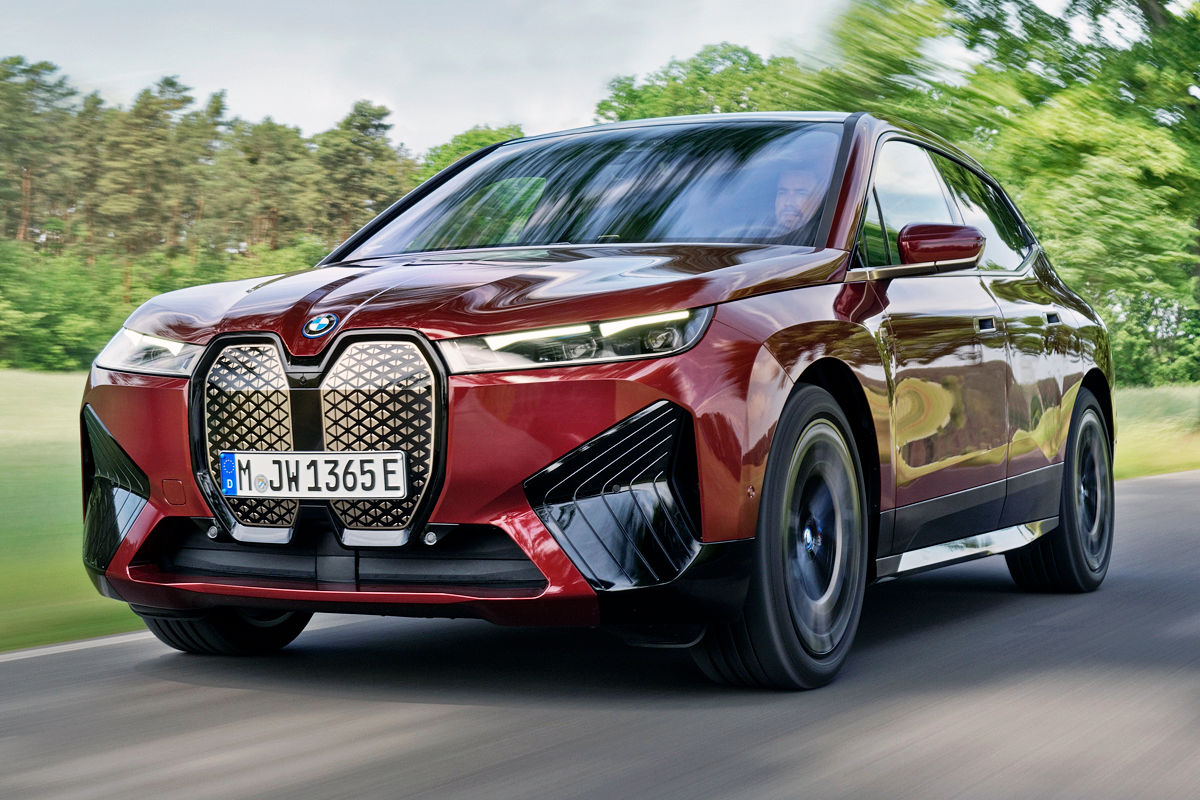
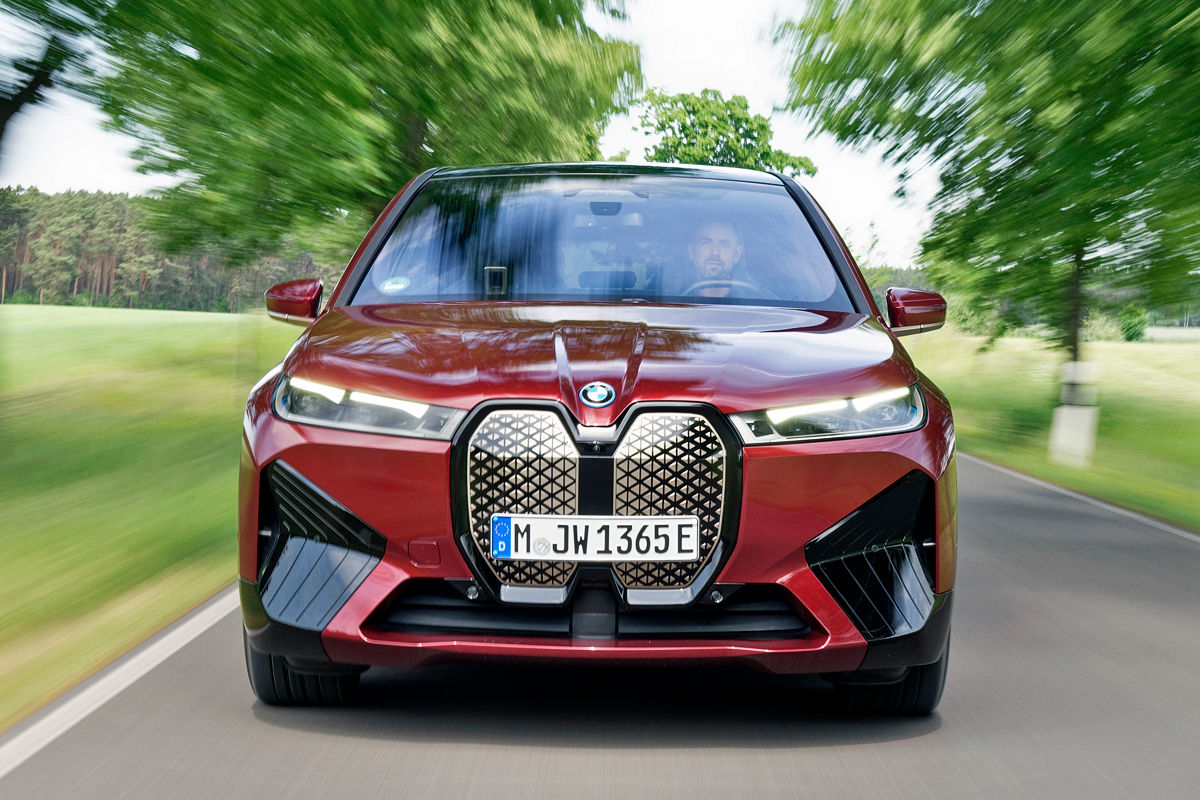
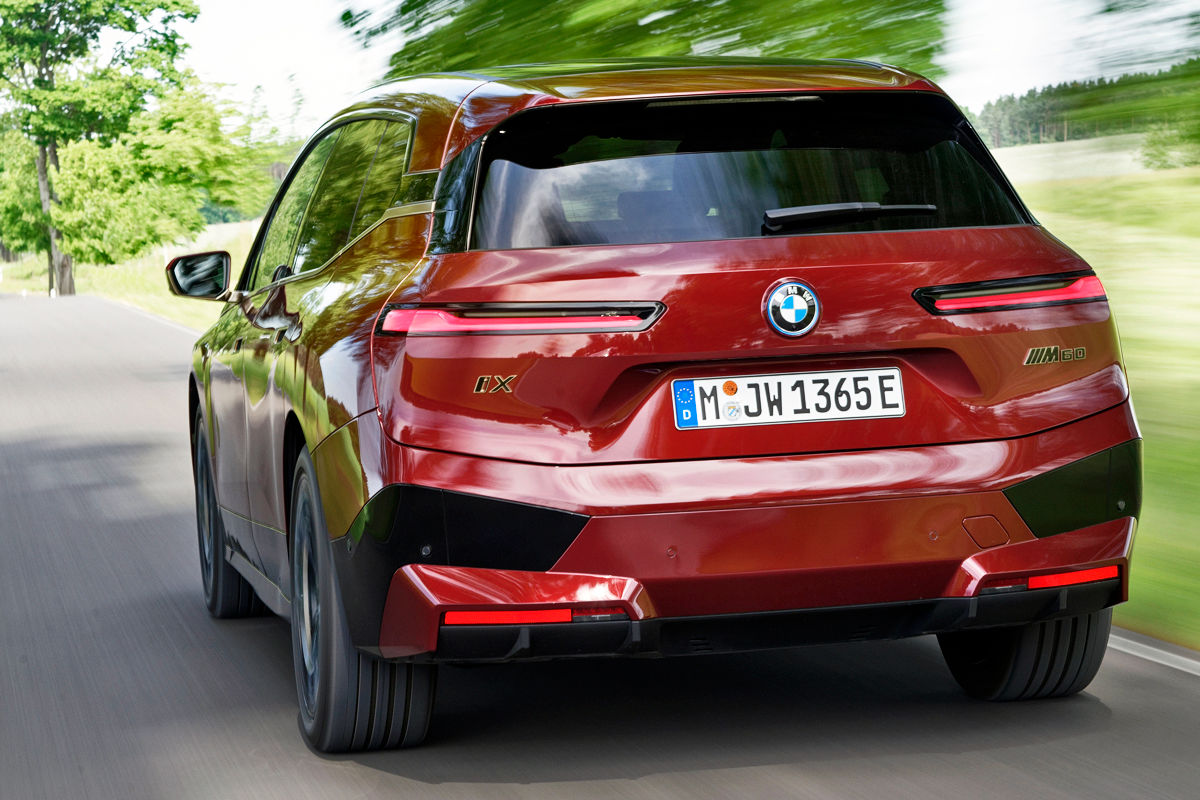
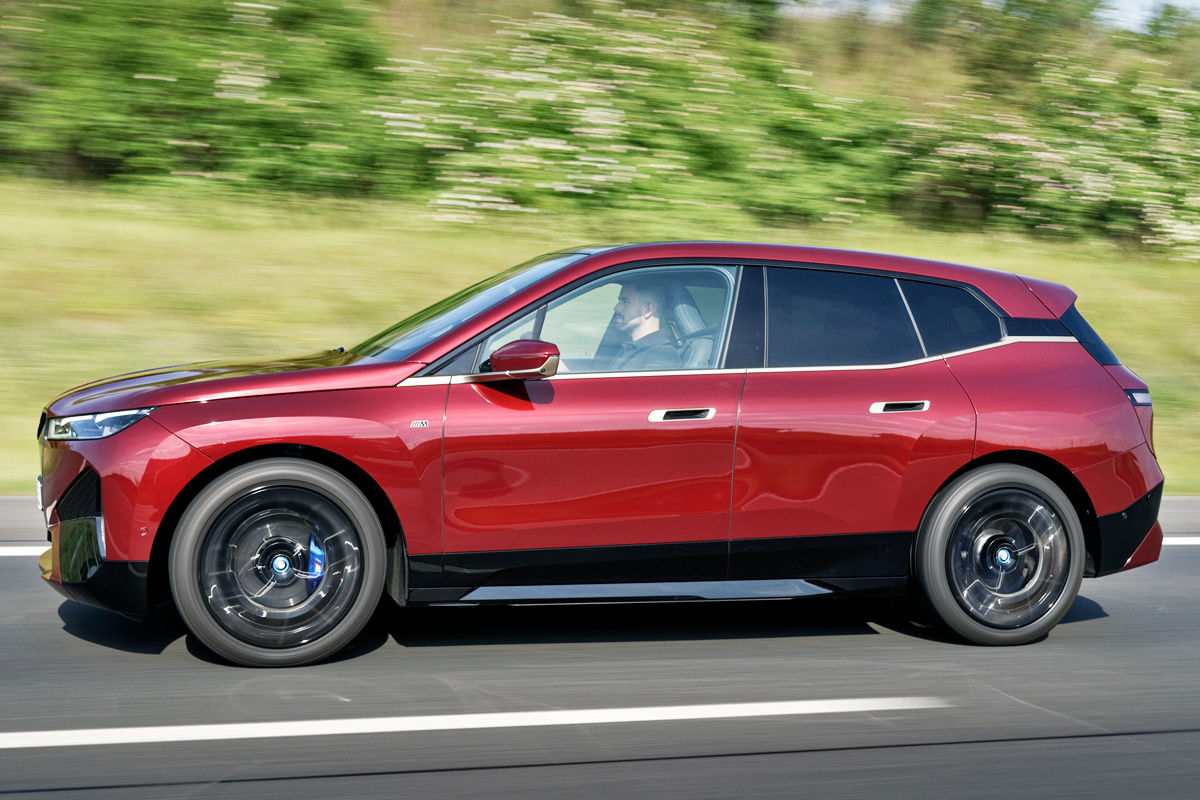
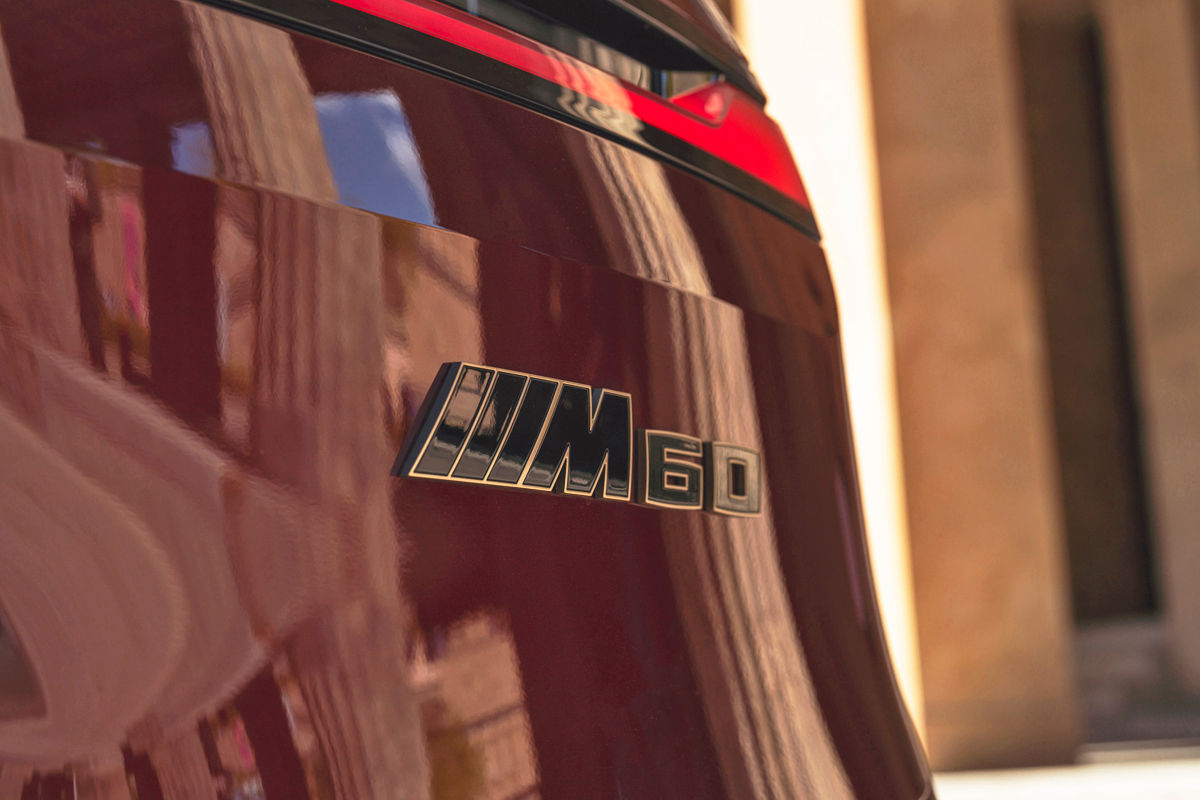
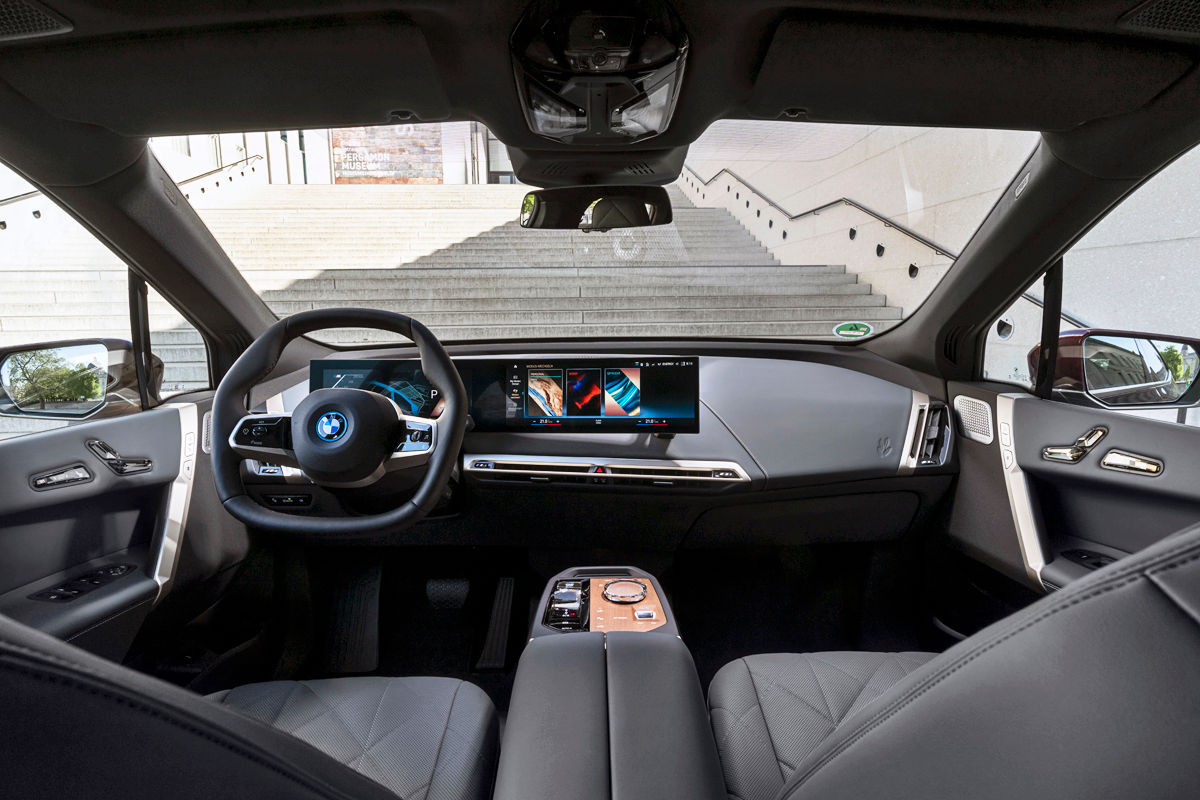
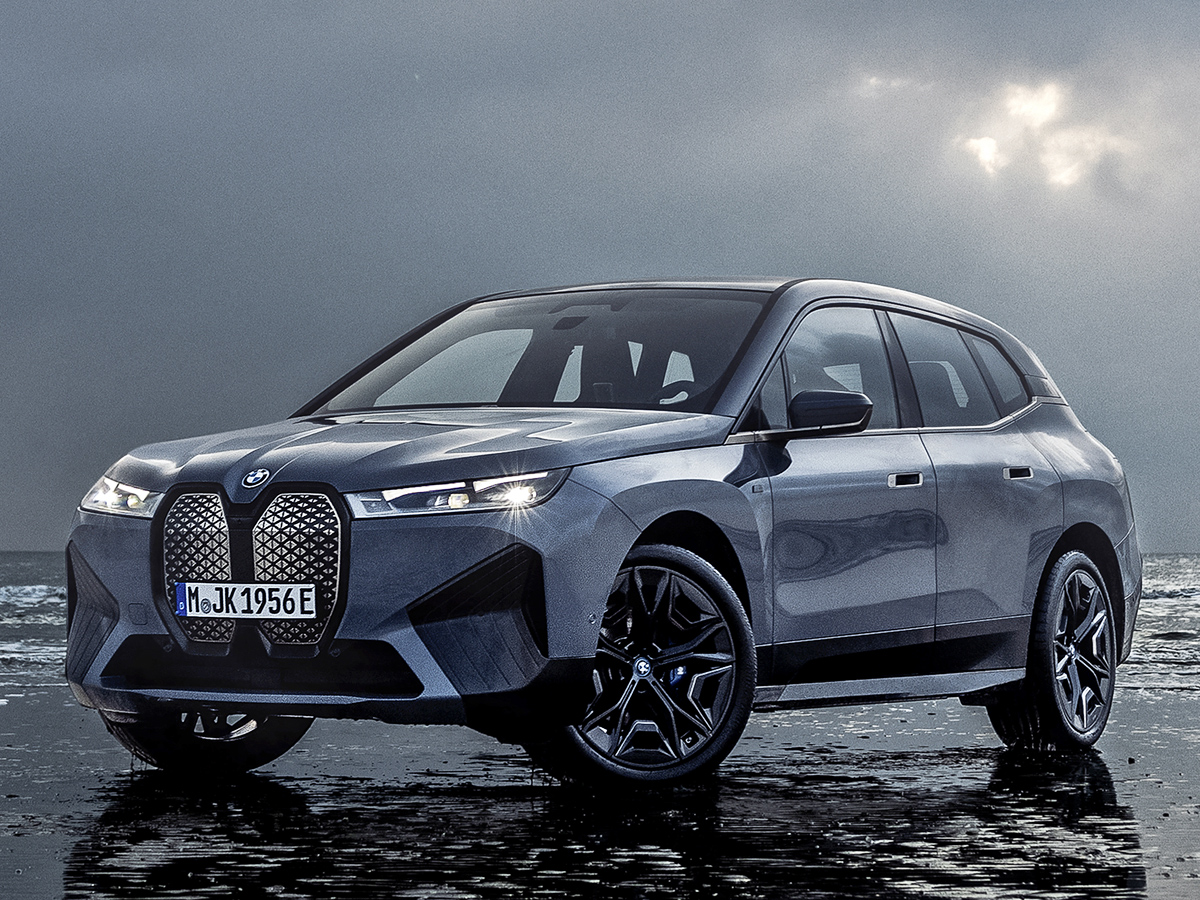
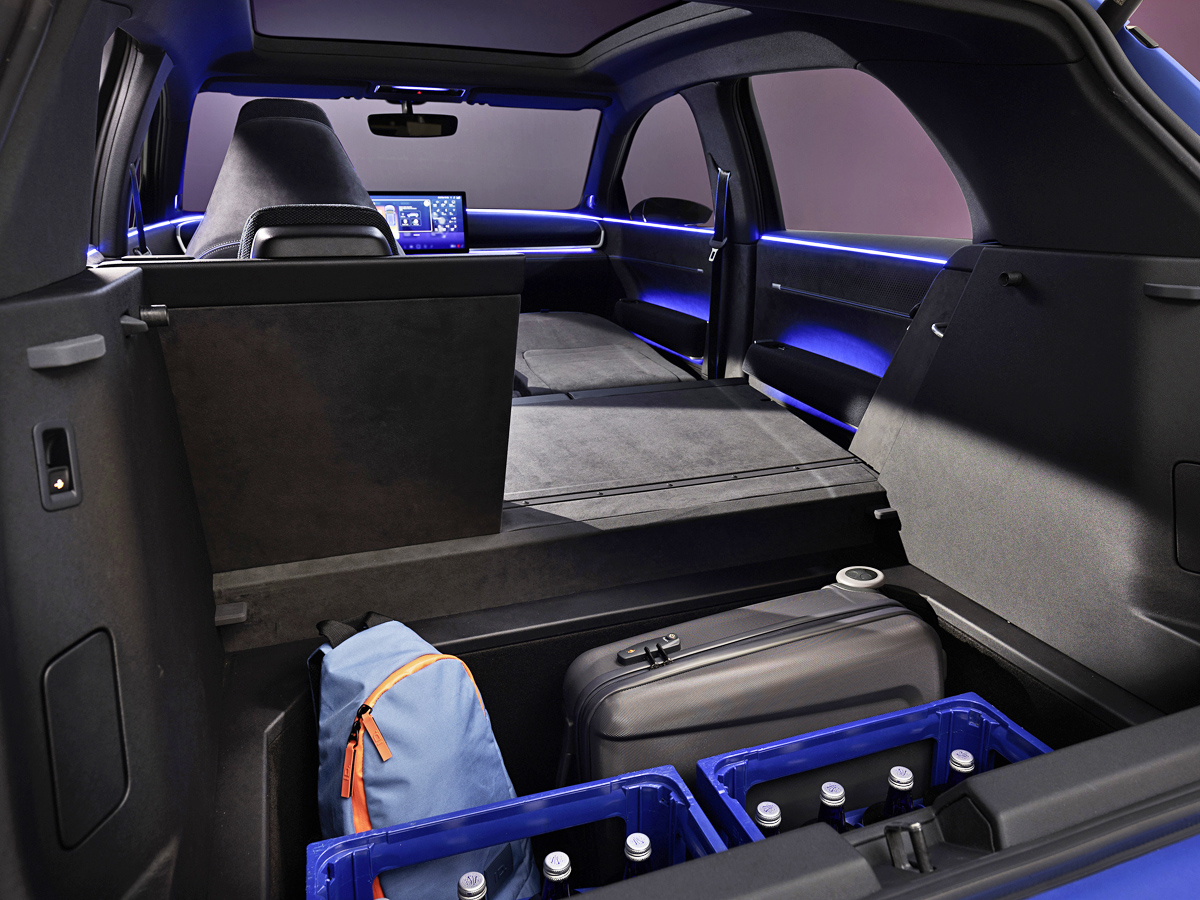
A M Performance version of the BMW iX (with 455 kW!) has stealthily joined the local range. Here’s how much the iX M60 – the most expensive electric BMW in SA – will cost you…
Keen on the fully electric BMW iX but crave more power than the 240 kW offered by the xDrive40 derivative and the 385 kW generated by the xDrive50 variant? Well, the Munich-based firm’s local division has you covered, having quietly added the new iX M60 to the line-up.
Yes, the new BMW iX M60 features an electric motor on each axle, together churning out up to 455 kW and a whopping 1 100 Nm. For the record, peak power sits at 397 kW for the most part but can be temporarily increased to 455 kW. Similarly, maximum twisting force comes in at 1 015 Nm in Sport mode, though is boosted to 1 100 Nm with Launch Control activated.
All that oomph is enough for the all-wheel-drive iX M60 to complete the 0-100 kph sprint in a claimed 3.8 seconds (in defiance of its near-2 700 kg unladen weight), before topping out at 250 kph. The lithium-ion battery pack, meanwhile, boasts a net capacity of 105.2 kWh, allowing a claimed single-charge range of up to 561 km.
The BMW iX M60 is the most expensive fully electric model in the German firm’s local range.
So, what will the iX M60 cost you? Well, thanks to a heads-up from our studious friends over at duoporta.com, we know the starting price stands at R2 975 000. That’s a lofty enough figure to make the iX M60 the most expensive fully electric BMW available in South Africa right now (yes, it costs a little more than even the i7 xDrive60 M Sport).
Still, the battery-powered SUV ships standard with plenty of features, including a panoramic glass roof, BMW Laserlights, 22-inch M aerodynamic alloy wheels, tyre-pressure monitoring, high-beam assist, 4-zone climate control, BMW Live Cockpit Professional, a Bowers & Wilkins Diamond surround-sound system, Driving Assist Professional, Parking Assist Professional and soft-closing doors. In fact, the only paid extra listed on BMW SA’s configurator at the time of writing was the option to switch to blue seatbelts for R6 000…
How much does the BMW iX M60 cost in South Africa?
BMW iX M60 – R2 975 000
The purchase price includes a 2-year/unlimited kilometre vehicle warranty, an 8-year/100 000 km battery warranty and a 5-year/100 000 km maintenance plan.
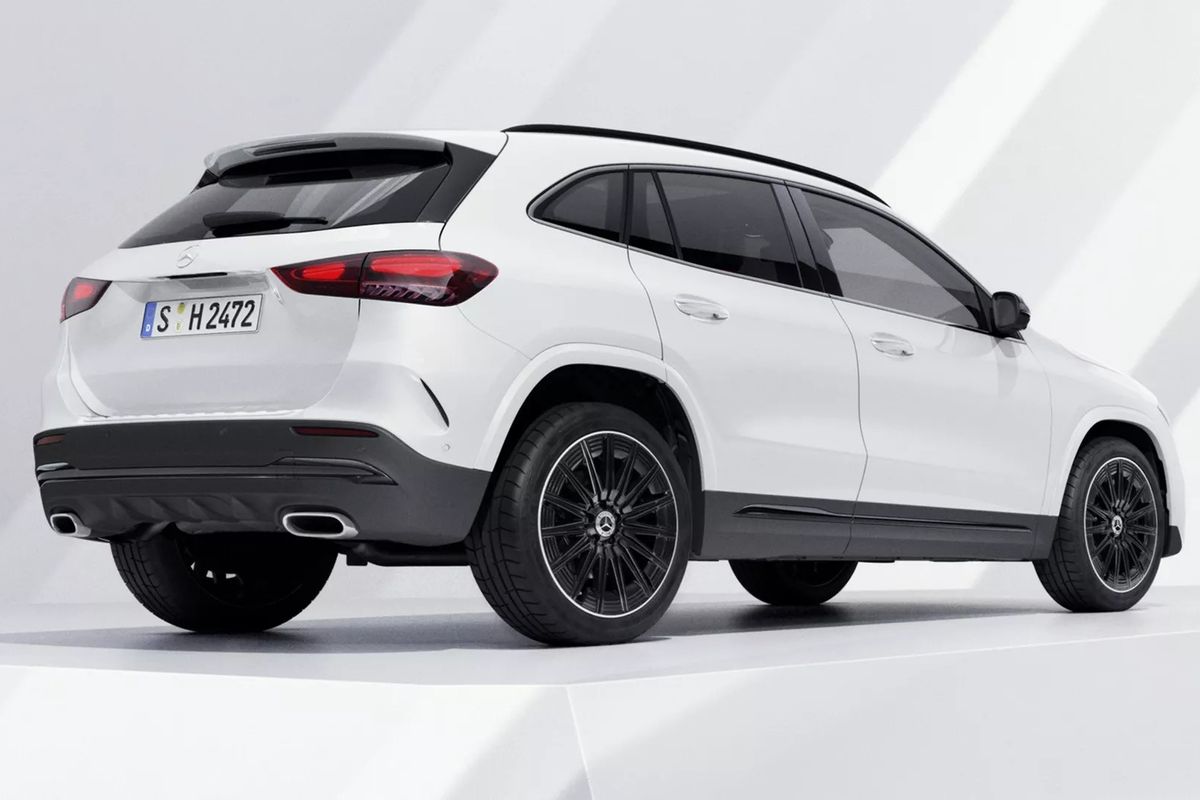
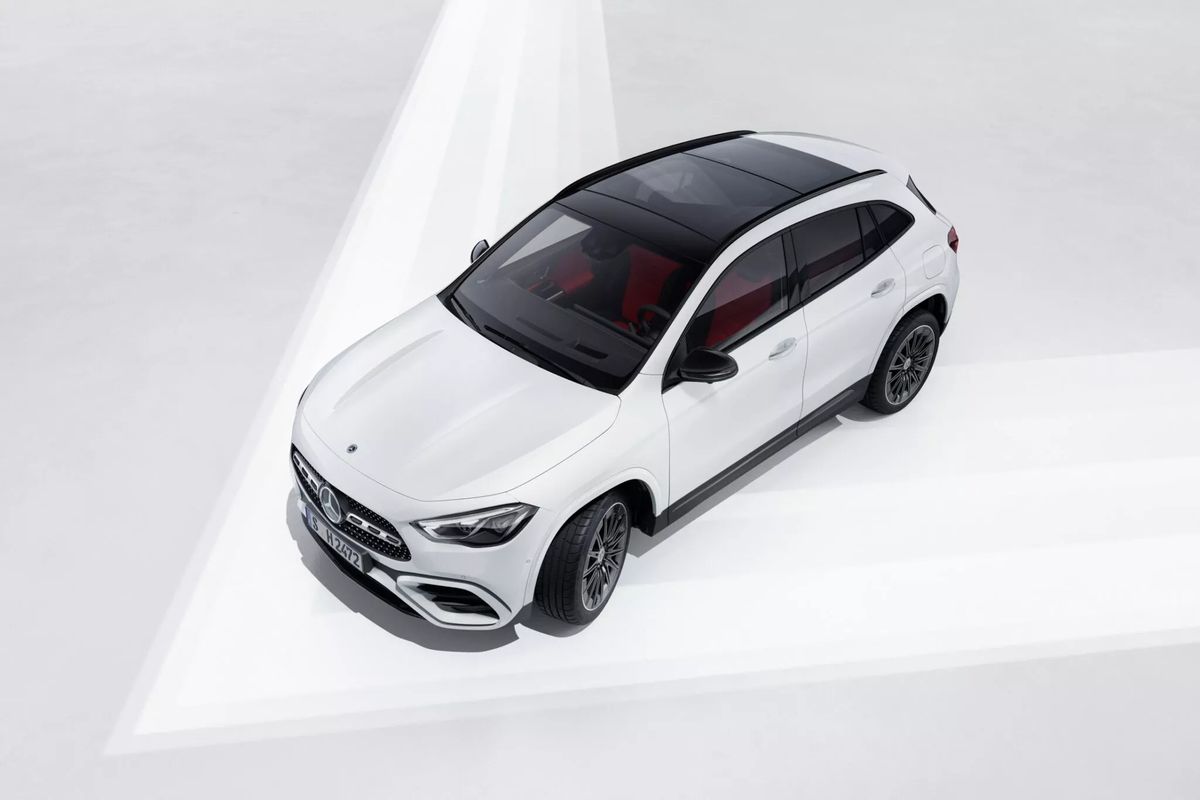
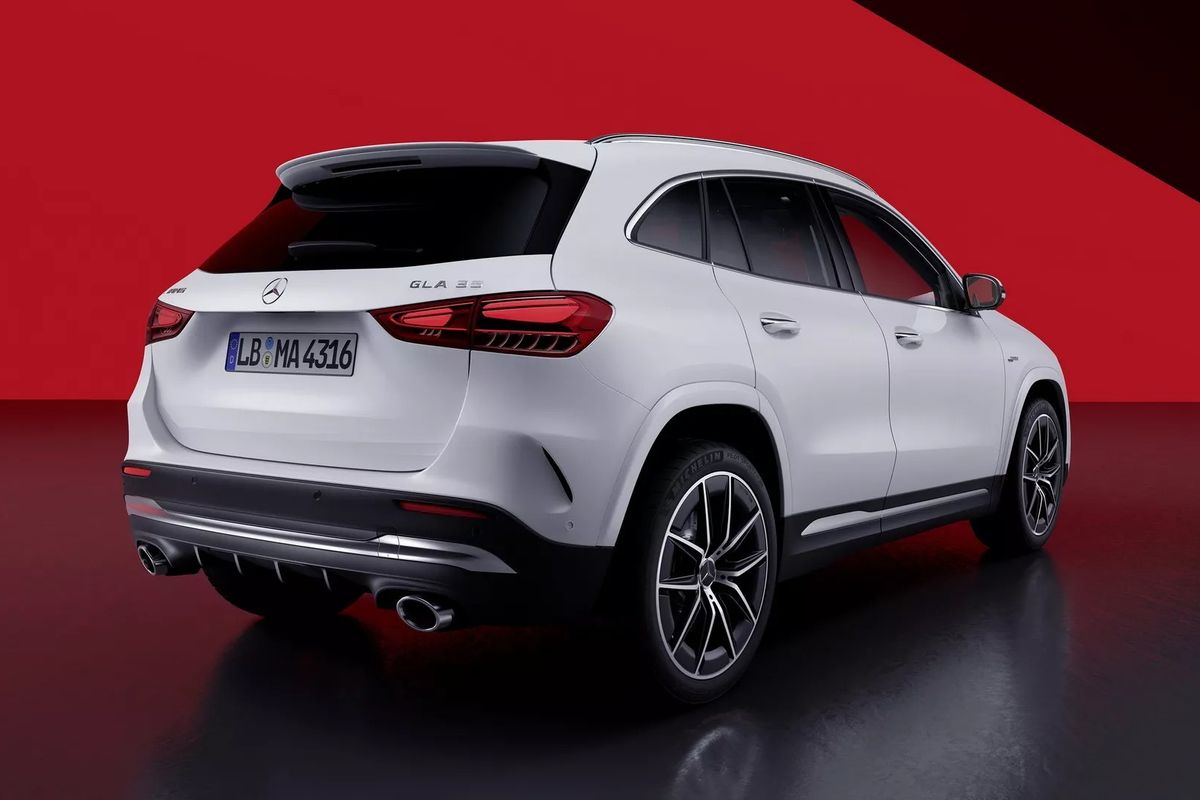
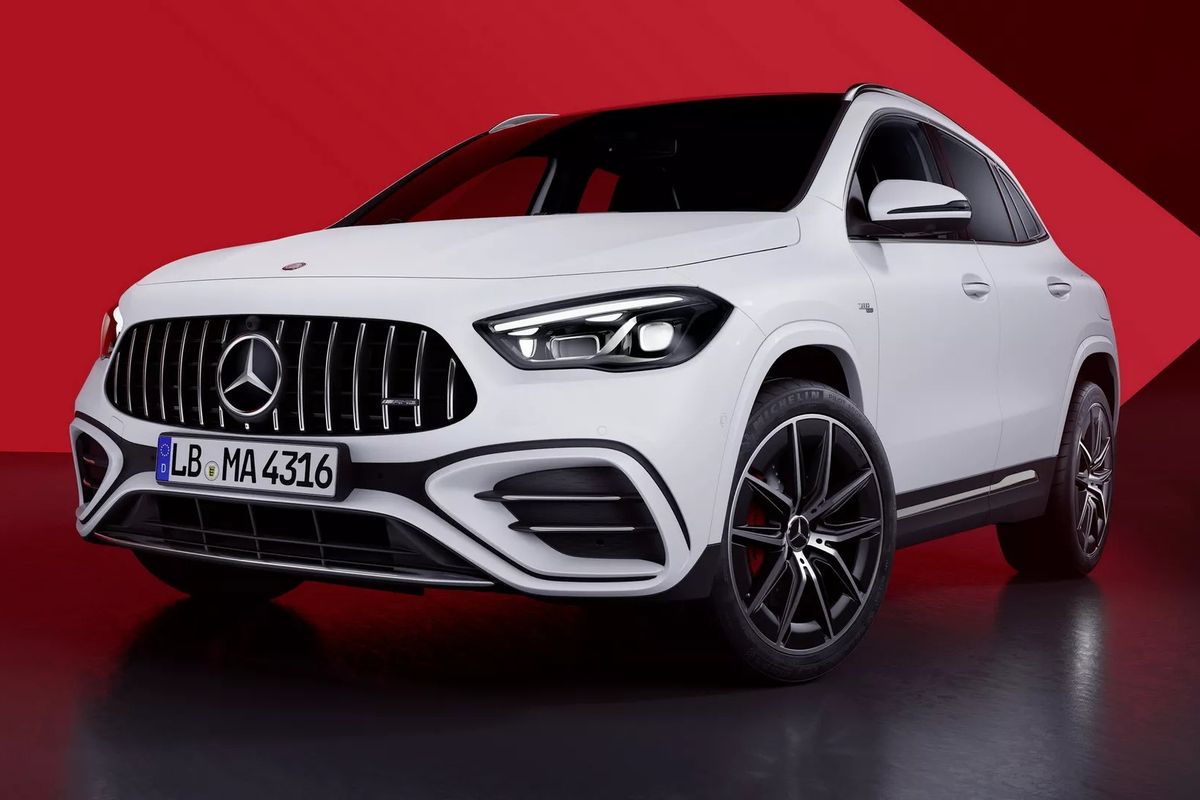
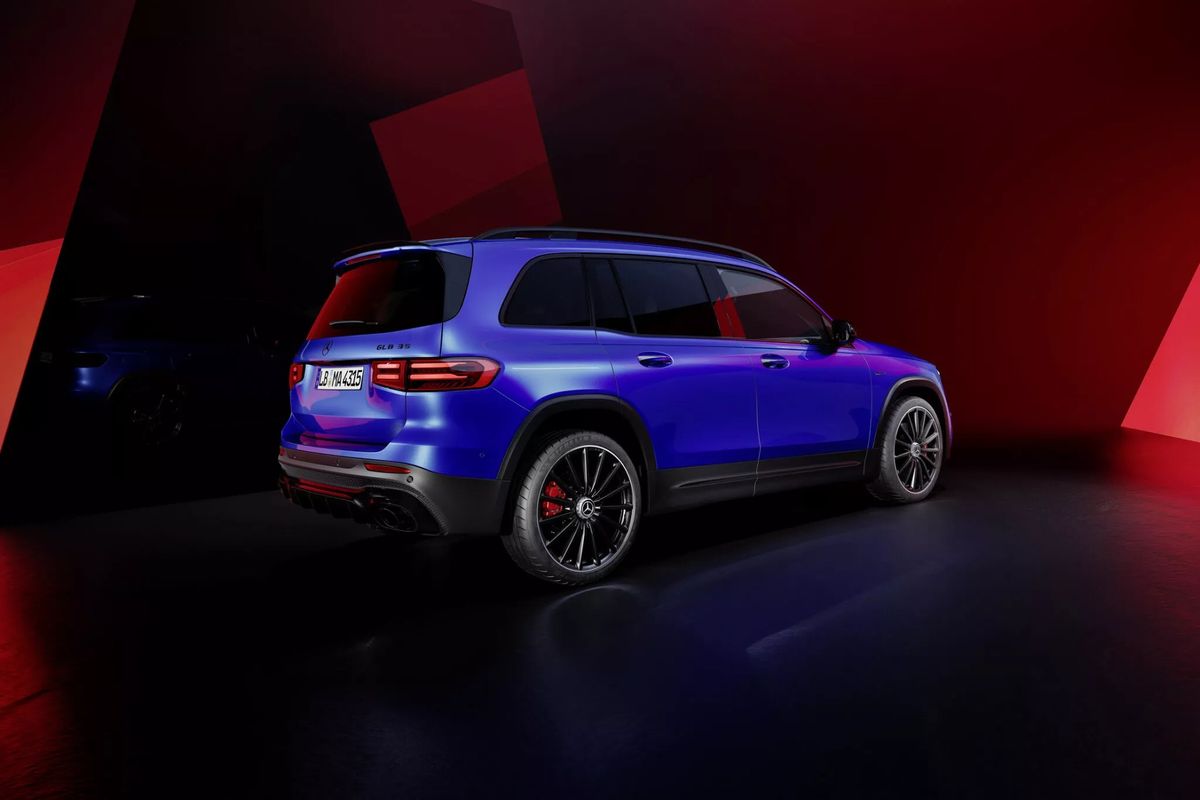
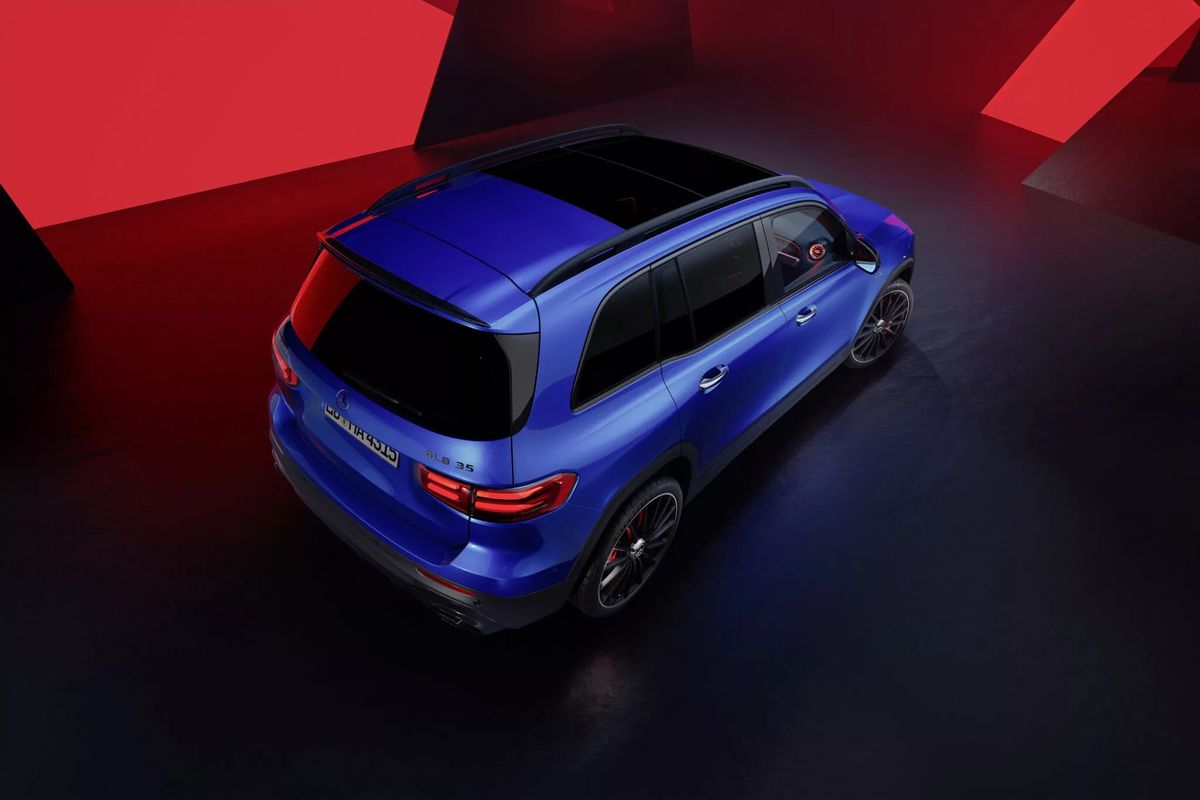
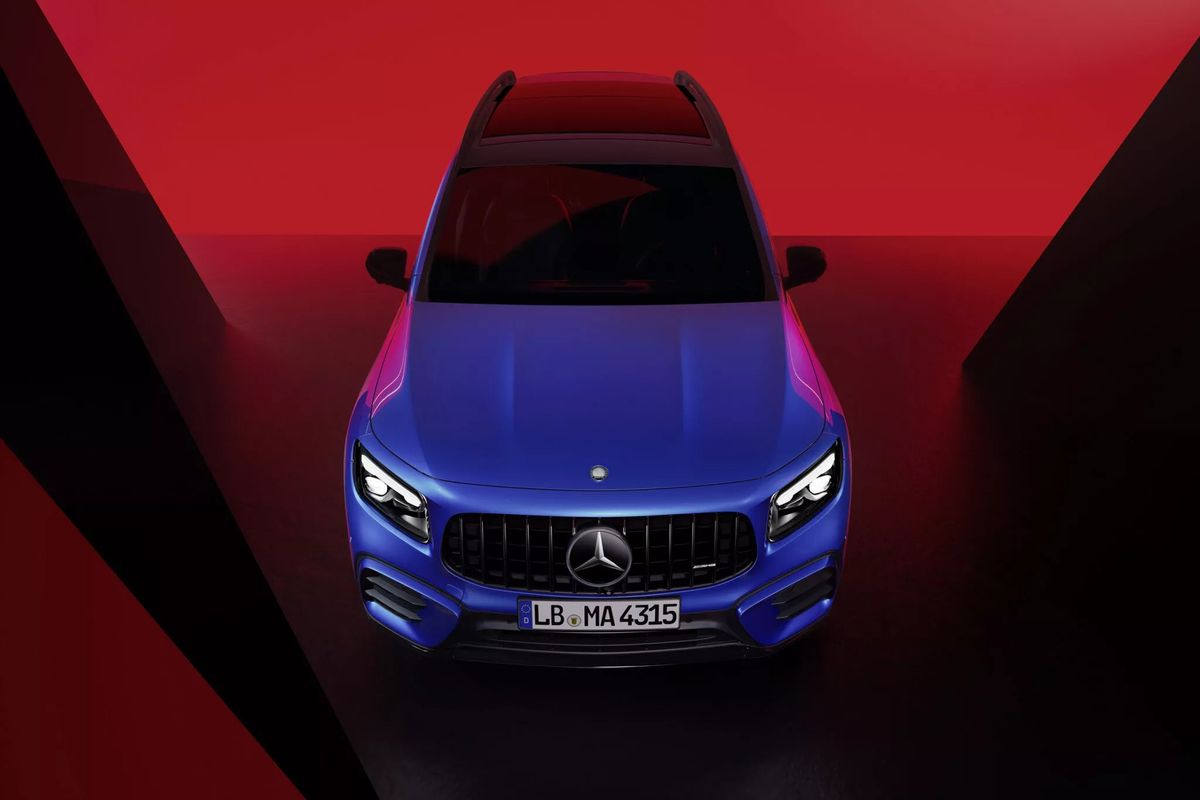
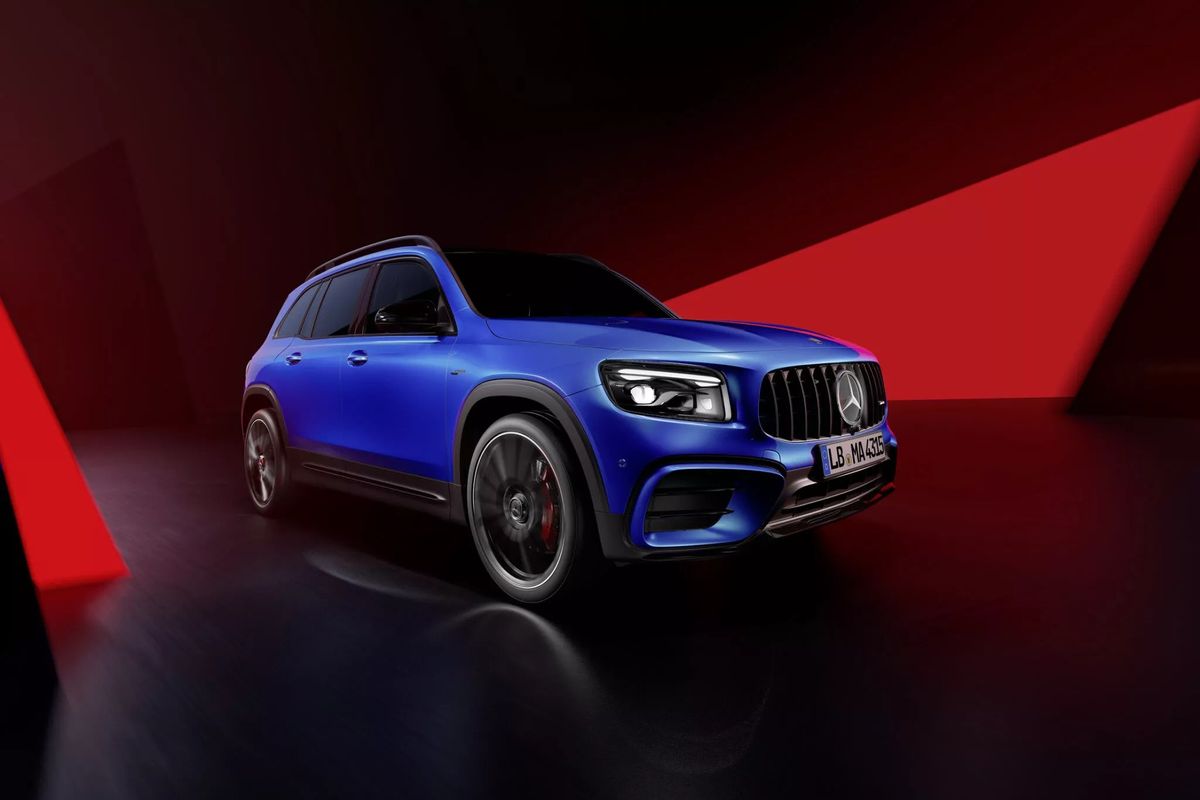
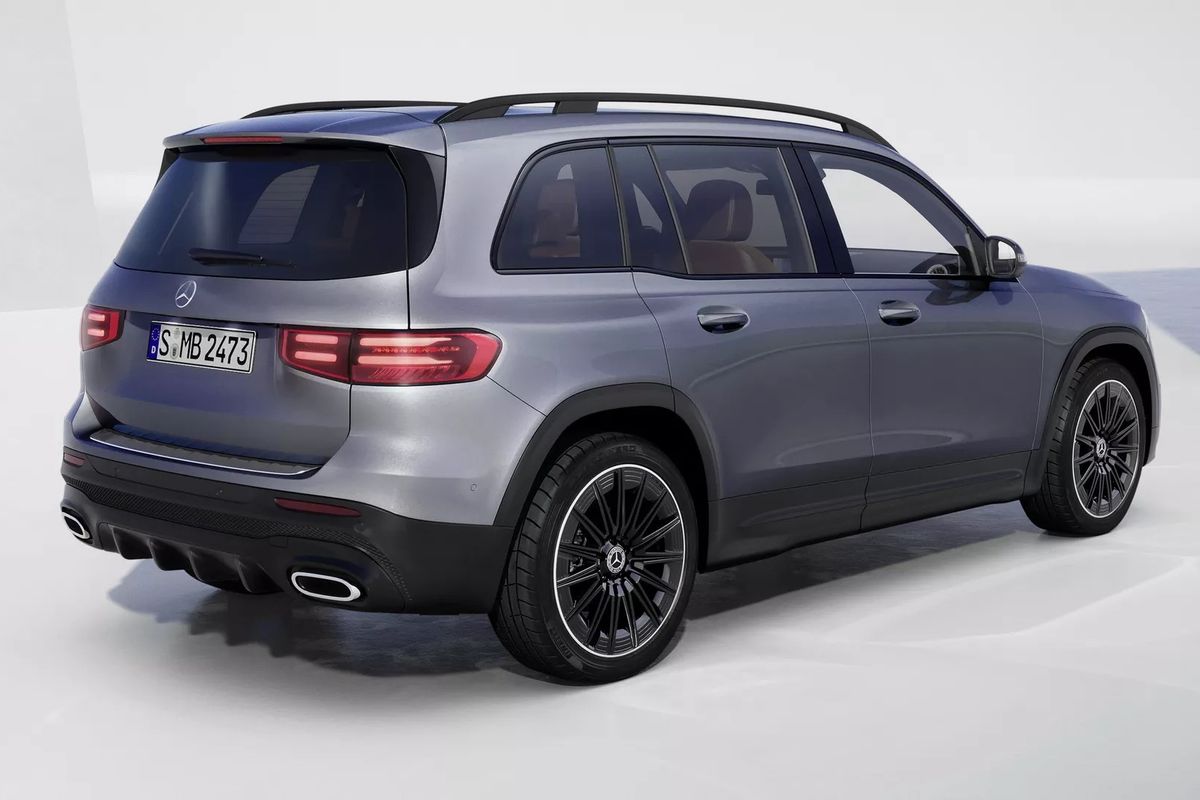
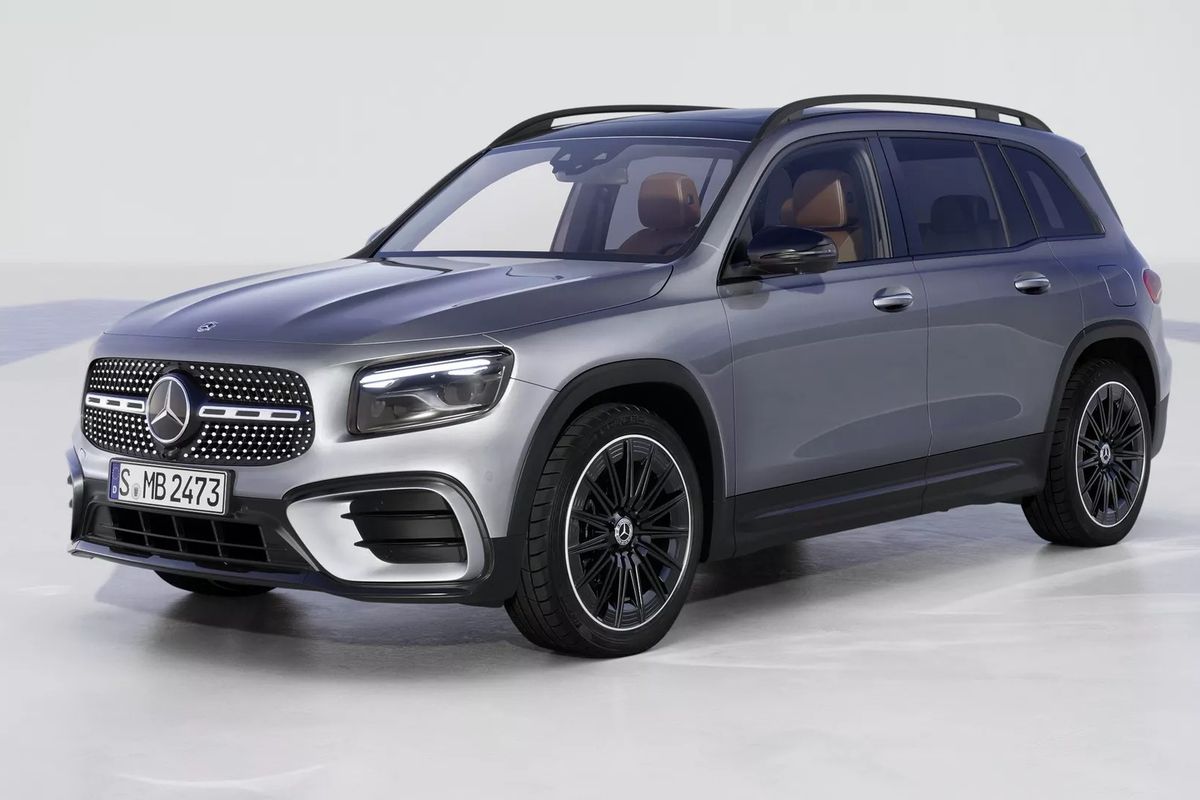
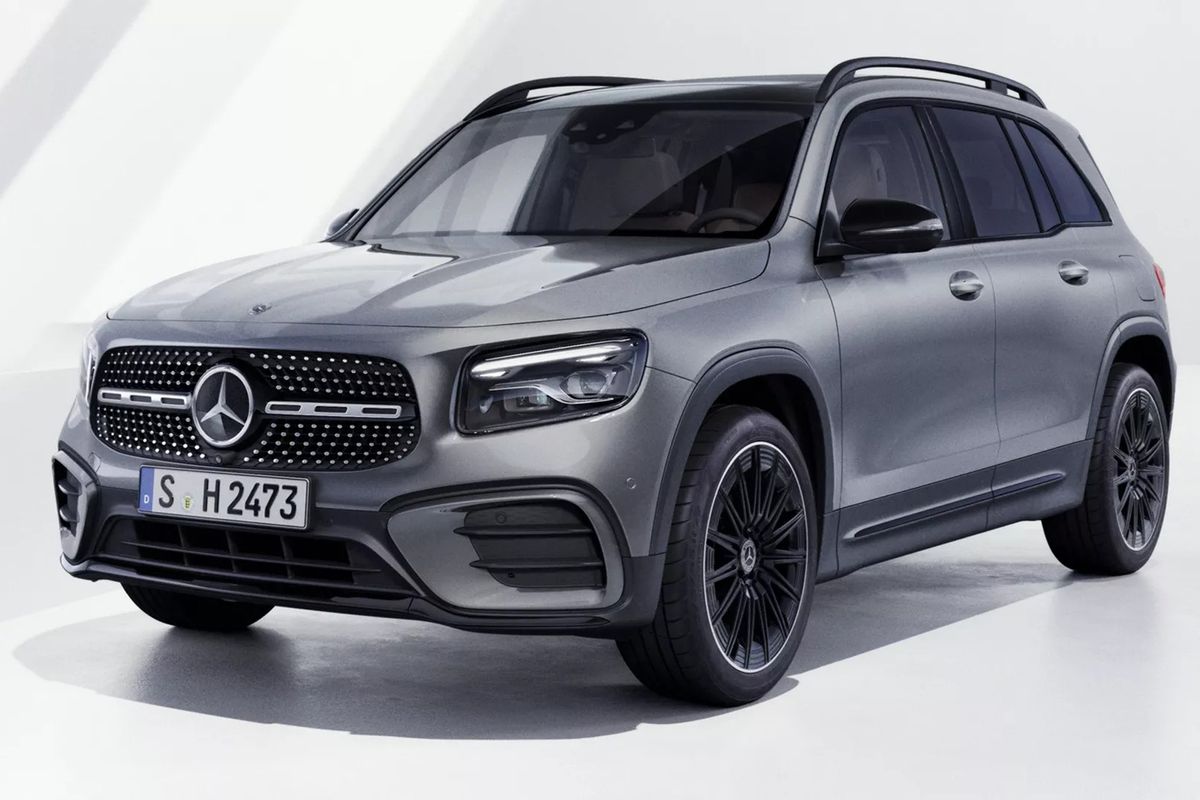
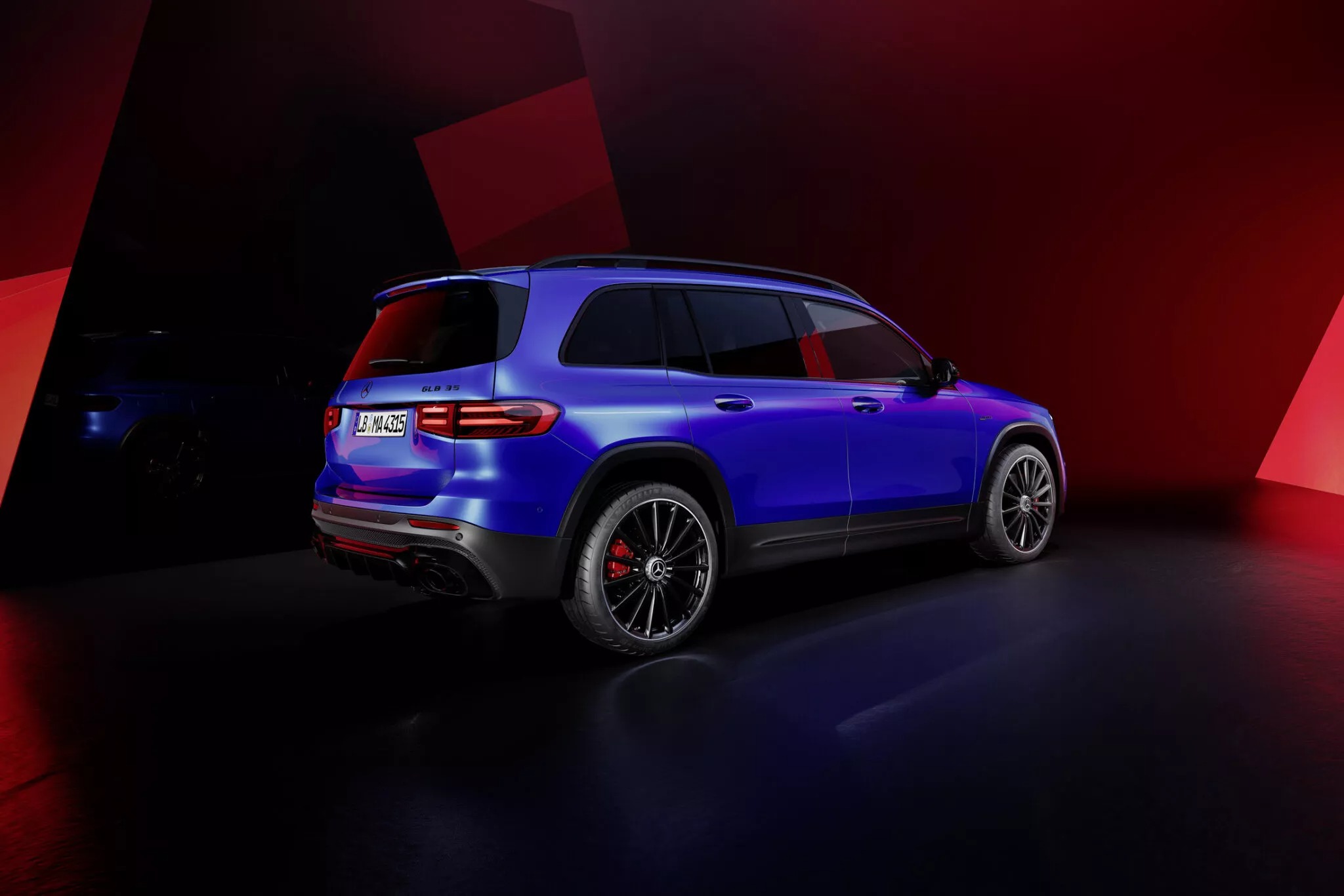
The Mercedes-Benz GLA and GLB have been given a mild facelift for 2023. Here’s a quick look at the changes.
The updated Mercedes-Benz GLA and GLB follows on from the recent updates to the rest of Merc’s compact range; the A-Class and CLA. The raised GLA/GLB gets similar updates with the slightest change visually to the exterior, additional features and the powertrains gaining mild-hybrid technology to the engine lineup.
Visually, you can spot the newer models with a new-look front bumper with slightly more aggressive intakes and new-look grille. The daytime running lights and headlights have been changed too, along with the taillamps. Mercedes-Benz says there’s a new paint finish and four new alloy wheel designs, with customers able to choose from 17- to 20-inch.
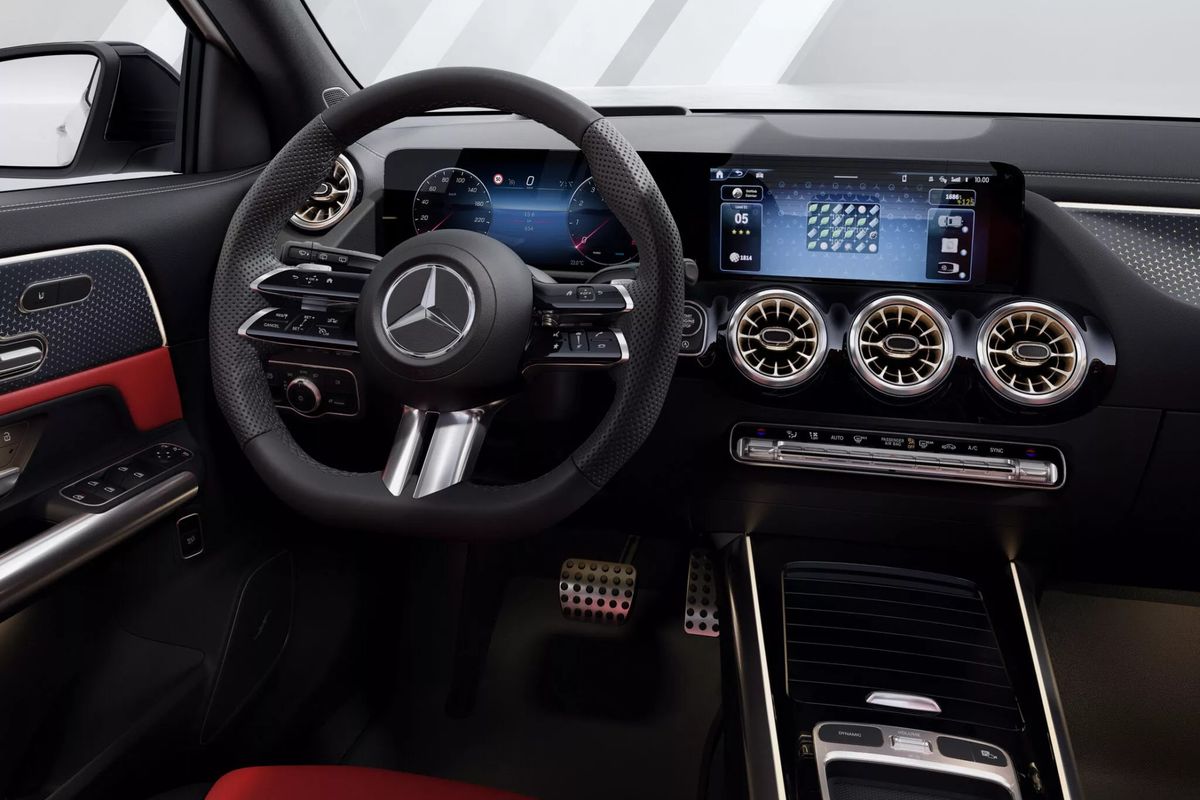
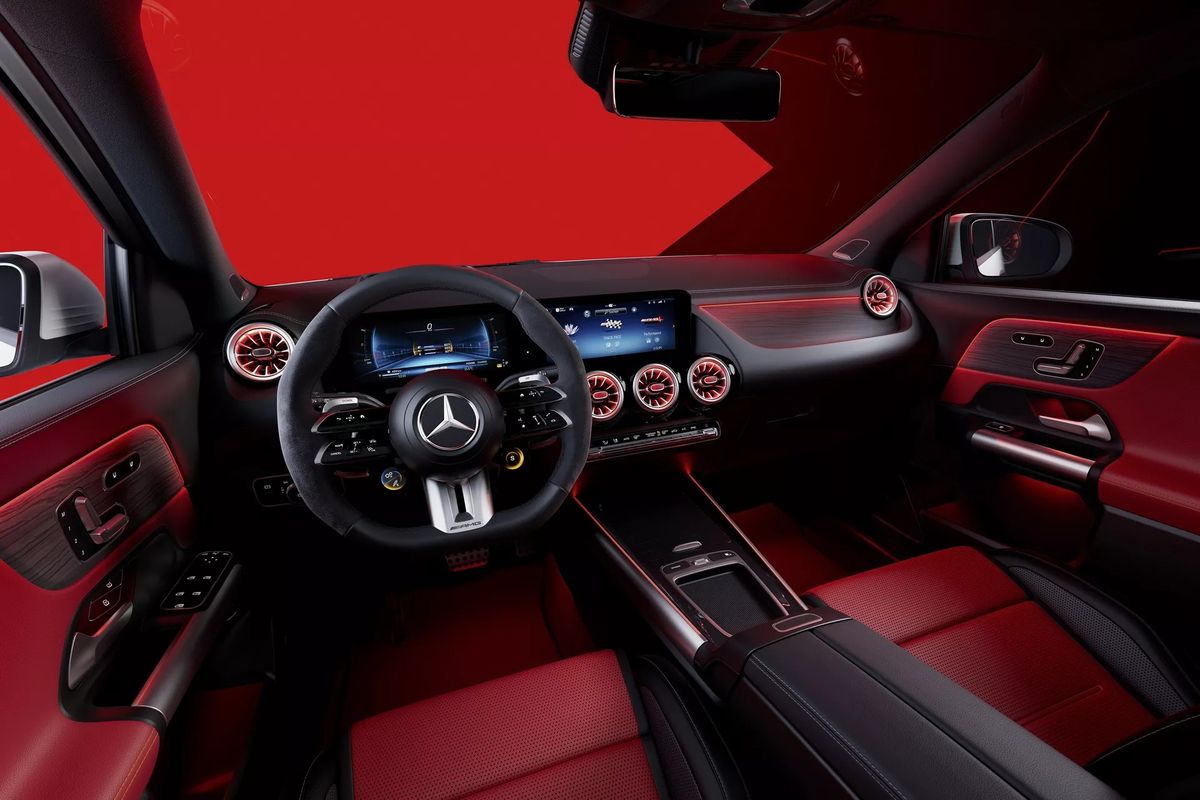
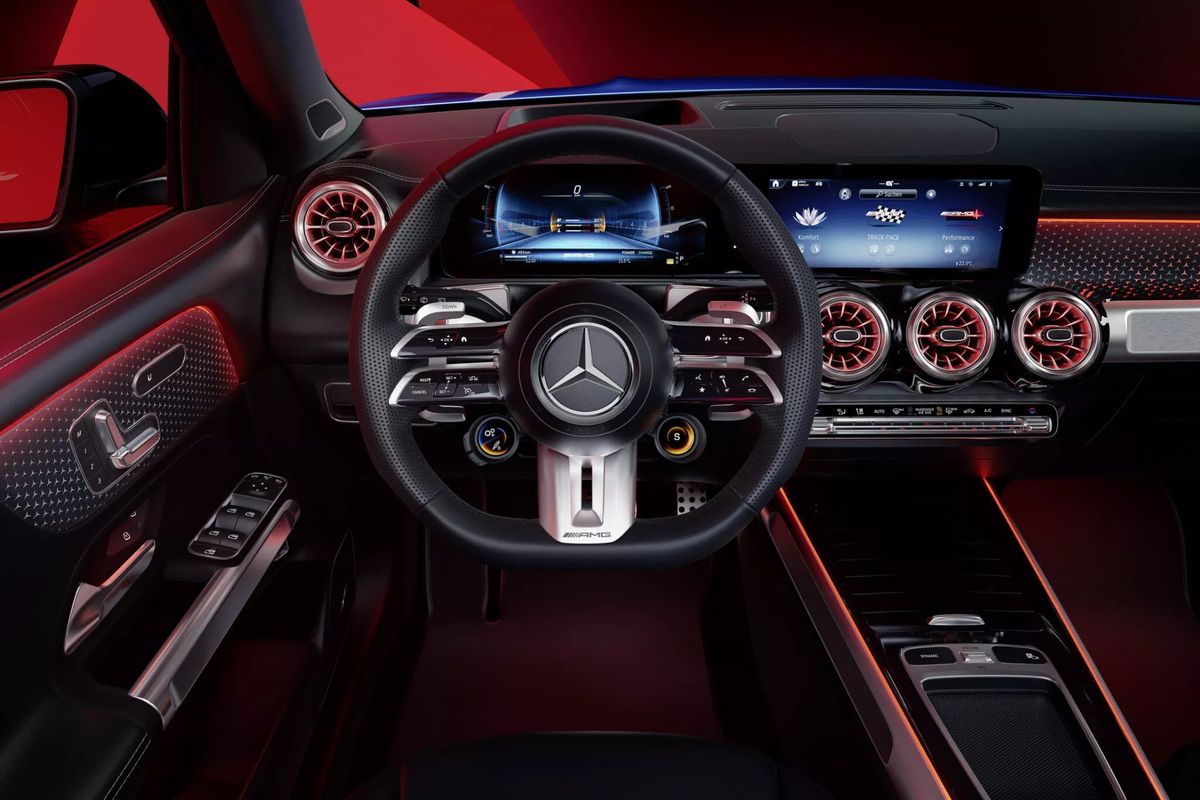
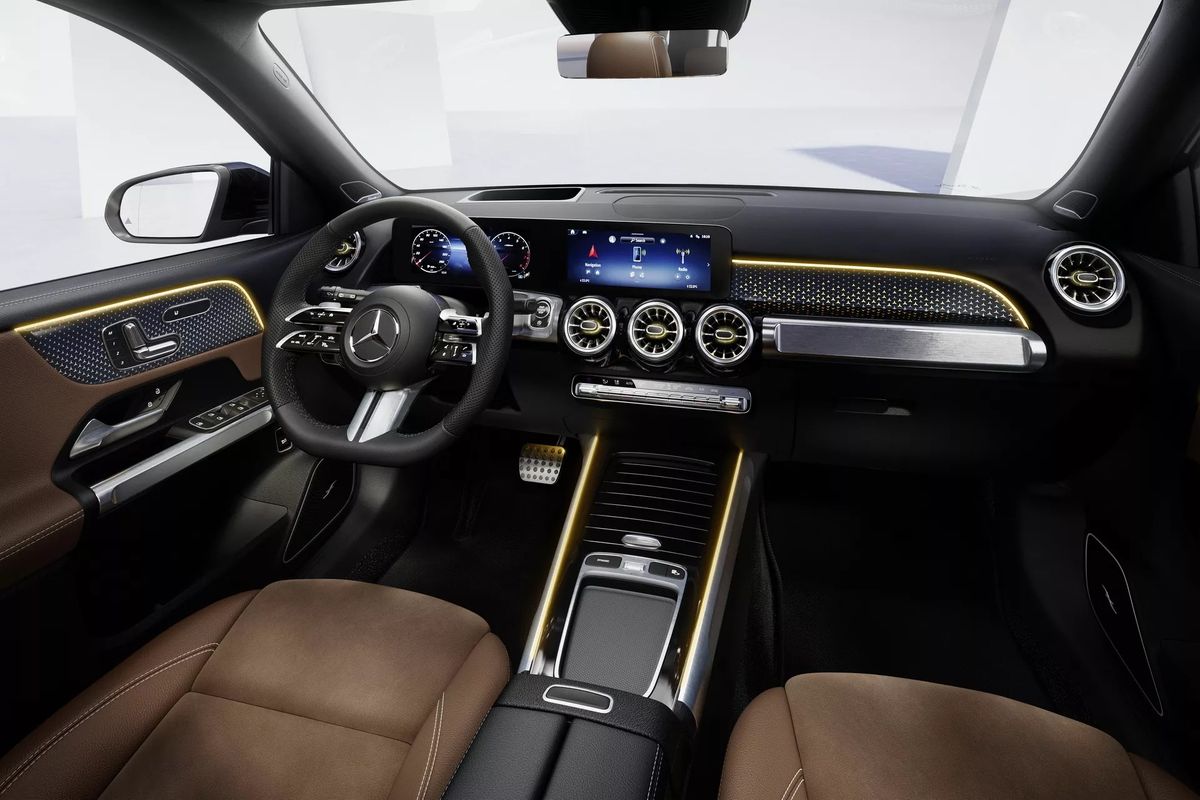
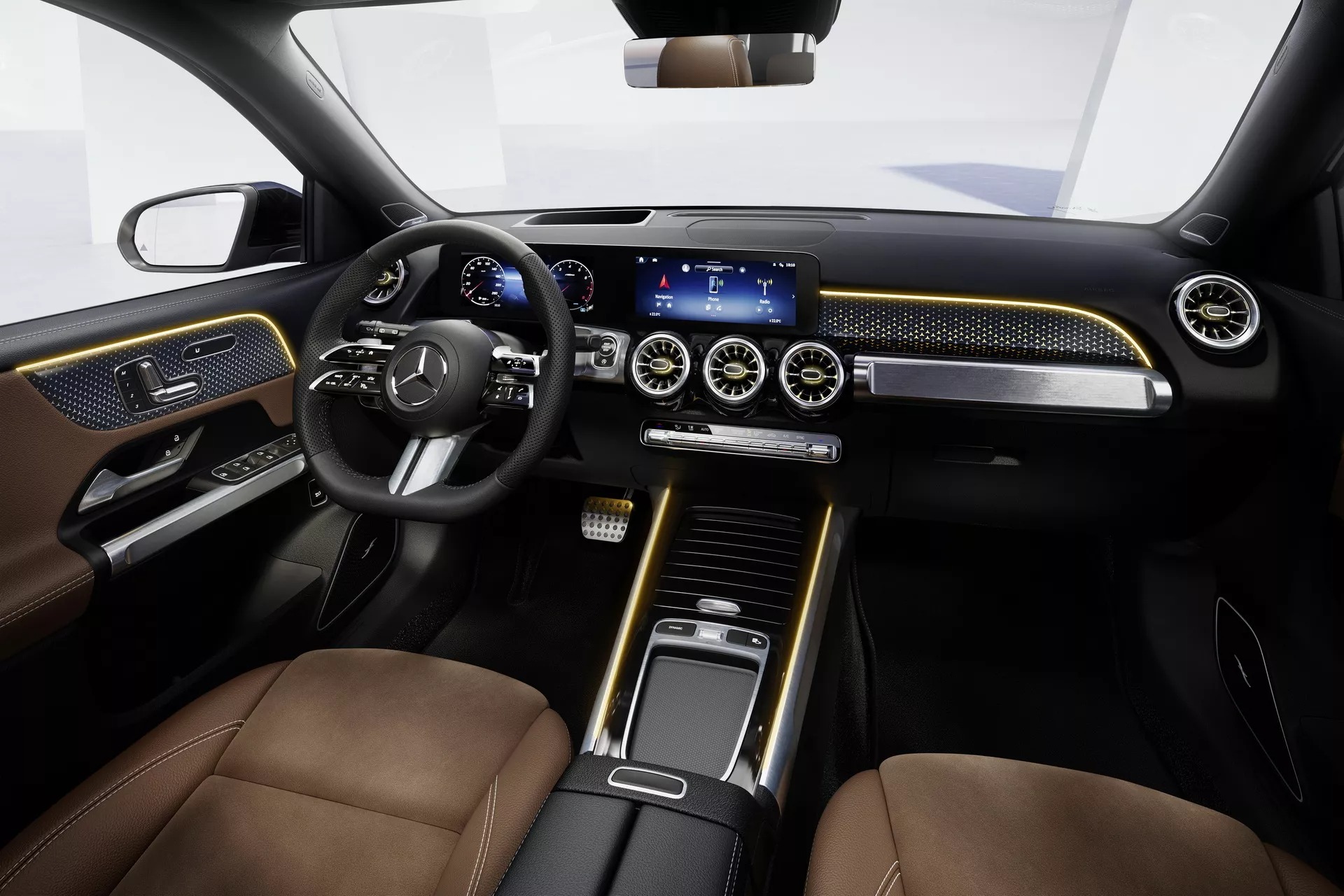
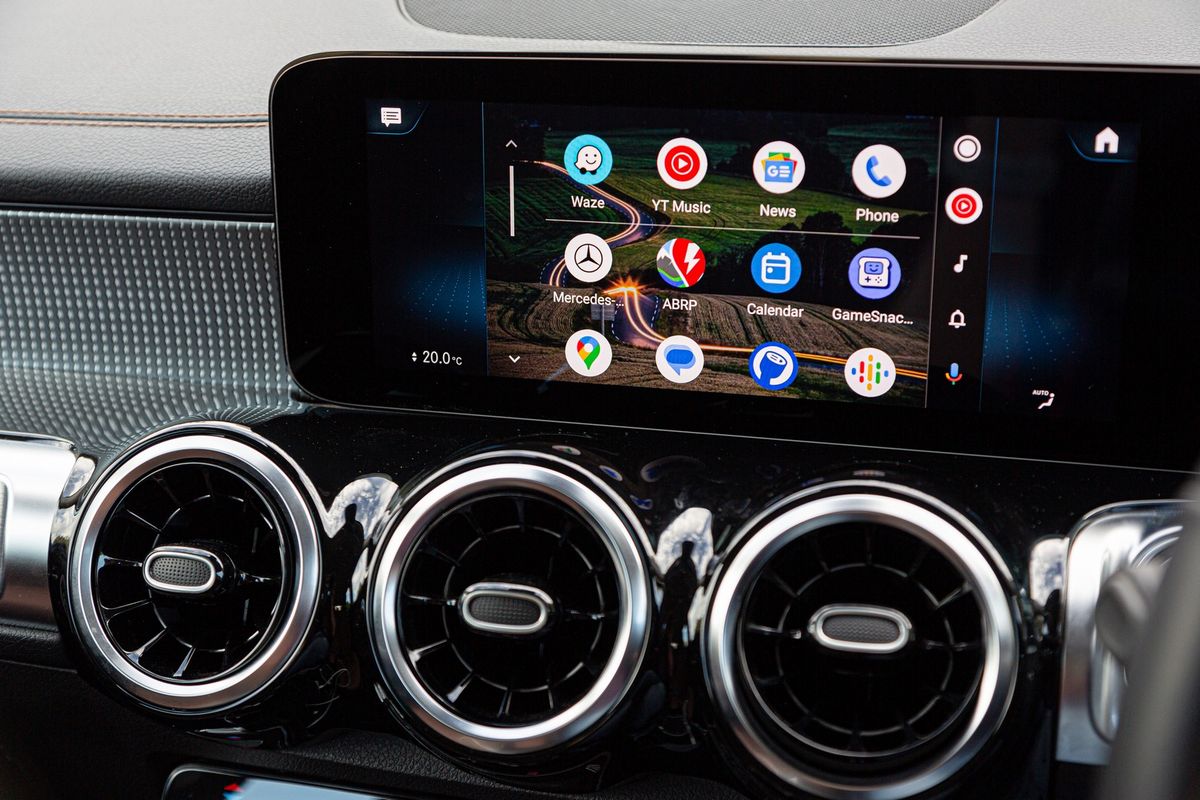
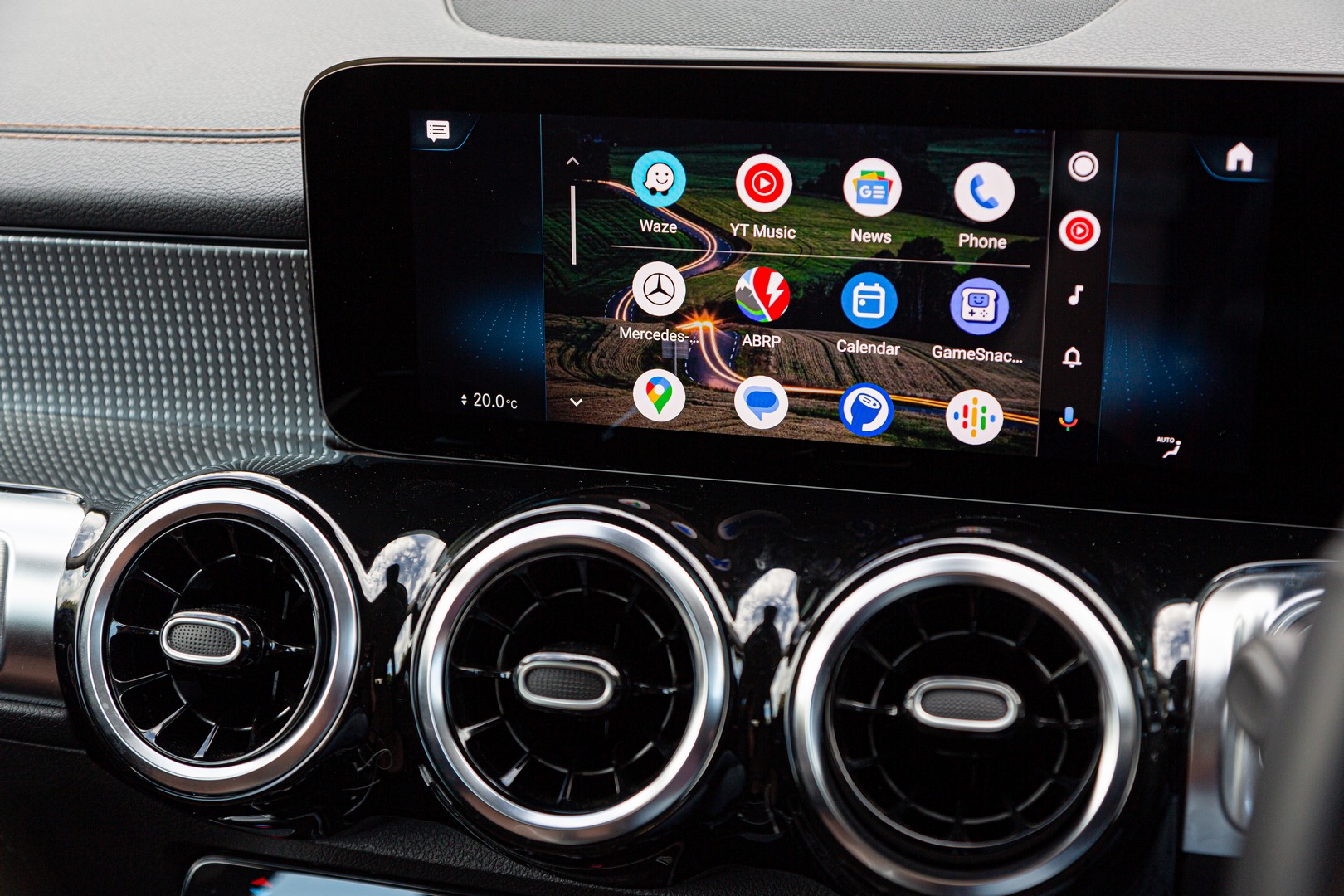
The entry-level cabin has a 7-inch digital dashboard and 10.25-inch central touchscreen, with the dual 10.25-inch display units for the higher-spec models. The MBUX system has been updated to include wireless Android Auto and Apple CarPlay and a smarter voice assistant.
An additional illuminated USB-C port with faster charging has been added to the cabin and the newer models get a new-style of leather wrapped steering wheel. The standard seats feature Artico manmade leather. Mercedes-Benz has improved the safety tech with upgrades to the Driving Assistance Package and Parking Package with a new 360-degree camera. Trailer Manoeuvring Assist makes its debut in both models.
When it comes to engines and transmissions, both the GLA and GLB gain mild-electrification for the petrol-powered derivatives, while the diesel powertrains are carried over. The hybrid petrol system helps reduce consumption and emissions, while offering up to 10 kW for a short period.
As a reminder, both the Mercedes-Benz GLA and GLB are available with an assortment of engines. For the petrol fans, there’s the 180 (100 kW 230 Nm), 200 (120 kW 270 Nm), 220 4Matic (140 kW 300 Nm), 250 4Matic (165 kW 350 Nm) and 35 AMG (225 kW 400 Nm).
Diesel fans are well catered for with 180d (85 kW 280 Nm), 200d (110 kW 320 Nm), 200d 4Matic (110 kW 320 Nm) and 220d 4Matic (140 kW 400 Nm).
South African engine lineup will not include all of these options, based on what the current selection looks like. All models are available with a dual-clutch transmission with either 7- or 8-speeds, depending on engine. A flagship GLA 45 AMG performance derivative is expected in the near future. We expect the updated GLA and GLB to be hitting South African showroom floors in 2023.
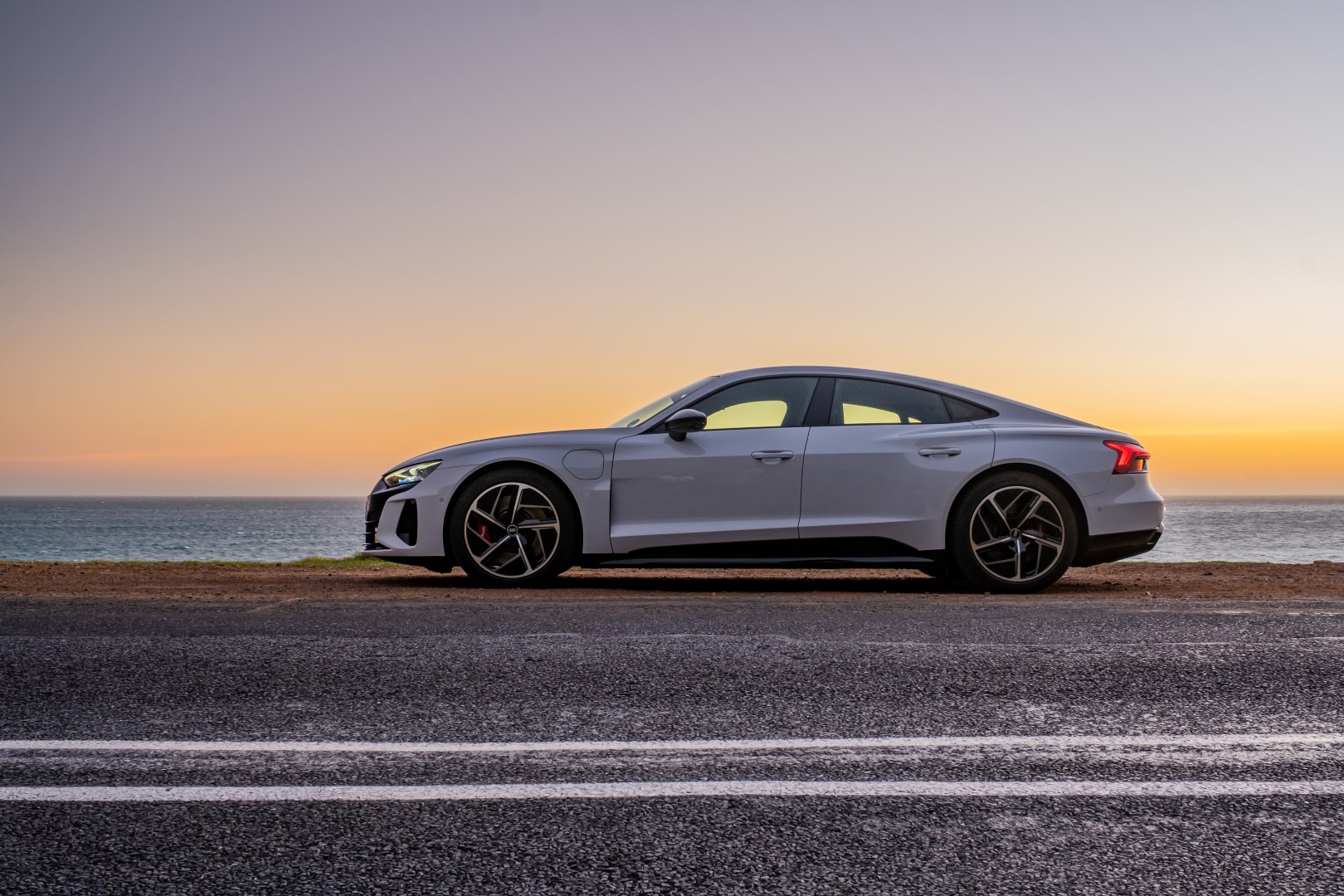
The Ingolstadt-based brand has a new naming strategy to differentiate between internal combustion engine and electric power.
Rumours have been plentiful about Audi’s new naming structure, but finally Audi has confirmed it. At Audi AG’s Annual Media Conference, CEO Markus Duesmann said the new next-generation Audi A4 will be sold as the A5, while the A6 will become the A7.
Essentially, Audi products with odd numbers (3, 5, 7) will be powered by internal-combustion engines, while the even numbers (2, 4, 6, 8) will have electric powertrains. We’re already seeing this with the launch of the Audi Q8 e-tron, and it wouldn’t be too far-fetched to image the ICE-powered Q8 to become the Q7/Q9.
But what about the current-generation electric vehicles with the e-tron name? Well, Duesmann has confirmed it won’t be dropped, which is interesting, as Mercedes-Benz is considering offloading its EQ brand with new vehicles due in 2024, while BMW will continue to use the ‘i’ as a way of showcasing its EV range.
We’re expecting a quiet year locally for Audi South Africa, but Audi global has quite a few products on the way, with a successor to the Audi A4 earmarked for a global debut at some point in 2023. The Audi A6 is due for an update soon too. Audi is expected to continue to build ICE-powered vehicles until the early 2030s even though it won’t introduce any new ICE models beyond 2026.
“We are on the verge of the biggest product initiative in our history. By 2025, we will have launched around 20 new models, more than 10 of which will be all-electric. We have set the course to go 100% electric. By 2027, we seek to offer an all-electric vehicle in each core segment. We recently decided to launch an additional electric entry-level model below the Audi Q4 e-tron as well. The upcoming Audi Q6 e-tron model series is the first to be based on the new Premium Platform Electric. With it, e-mobility is coming from Ingolstadt for the first time.” said Markus Duesmann during the recent Audi Annual Media Conference.
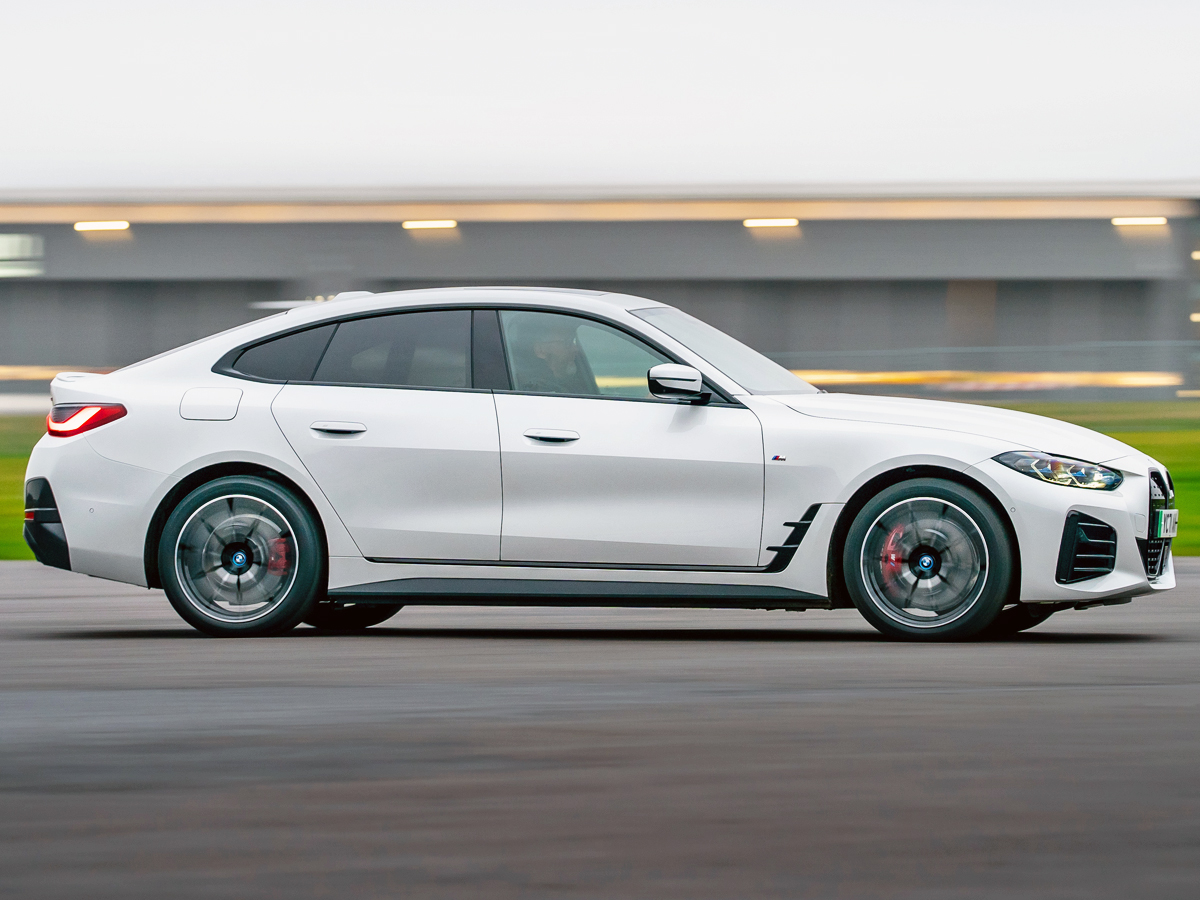
BMW South Africa has quietly launched an entry-level version of its i4. Here’s how much the i4 eDrive35 M Sport – for now the least expensive fully electric BMW offered in SA – costs…
The BMW i4 has been on the market in South Africa since mid-2022, though just a single derivative – an M Performance variant called the i4 M50 – has been available locally. Now, that’s changed with the introduction of a new entry-level version called the i4 eDrive35.
Available exclusively in M Sport trim, the rear-wheel-drive i4 eDrive35 arrives as the least expensive fully electric BMW in the local range (until the launch of the new iX1, we suspect). Big thanks to our eagle-eyed friends over at duoporta.com for alerting us to the new variant’s stealthy arrival.
So, how much does this version of the Munich-based firm’s electric gran coupé cost? Well, the i4 eDrive35 M Sport starts at R1 293 300, which makes it R352 900 less expensive than the 400 kW i4 M50 (which, incidentally, was the M division’s best-selling model globally in 2022). That starting price furthermore sees the newcomer slot in just below the iX3 M Sport, which kicks off at R1 306 400.
The i4 eDrive35’s base price is actually listed as R1 285 000, but the BMW SA configurator forces the selection of the R8 300 Parking Assist Plus package.
The i4 eDrive35 features a rear-wheel-drive configuration.
So, what’s there to know about the new model’s powertrain? Well, like the i4 M50 (and indeed the i4 eDrive40 that is not available locally), the i4 eDrive35 employs BMW’s 5th-generation eDrive technology. Here, the rear axle is powered by an integrated electric motor generating 210 kW and 400 Nm, allowing a 0-100 kph sprint in a claimed 6.0 seconds and a top speed of 190 kph. The lithium-ion battery pack has a net capacity of 67 kWh, translating to a claimed range of up to 483 km (for the record, that’s 18 km more than the all-paw i4 M50).
Produced at BMW Group’s plant in Munich, the i4 eDrive35’s list of standard features includes items such as bi-tone 18-inch M aerodynamic alloy wheels, tyre-pressure monitoring, a Leather “Vernasca” Black interior (with decorative stitching), high-beam assist, BMW Live Cockpit Plus and the widescreen display.
The list of options, meanwhile, includes larger wheels (up to 20 inches in diameter, for R25 700), various paint finishes (up to R52 800) and special interior trim finishes (up to R13 600). There’s also the M Sport Package Pro (R24 500), the Deluxe Package 2.0 (R37 700, which includes a glass sunroof and uprated audio system) and the M Carbon Exterior Package (R83 600).
How much does the BMW i4 eDrive35 M Sport cost in SA?
BMW i4 eDrive35 M Sport – R1 293 300
The purchase price includes a 2-year/unlimited kilometre vehicle warranty, an 8-year/100 000 km battery warranty and a 5-year/100 000 km maintenance plan.
A mega battle between two of the world’s largest carmakers is about to go down in South Africa. In one corner you have the new Toyota GR Corolla and in the other, the Volkswagen Golf 8 R. Which one of these hatchbacks will win the fight? Let’s square them up!
South African hot-hatch enthusiasts are in for a treat as 2 formidable performance hatchbacks are due to arrive in this second quarter of 2023.
First up, is the Volkswagen Golf 8 R. Yes, it’s been a painfully long wait but Volkswagen’s range-topping Golf is due to go on sale very soon (April 2023)! We have tested the VW Golf R on local soil.
Toyota is stepping up to the plate to take the fight to the Golf 8 R and the Japanese firm recently confirmed that its beefed-up GR Corolla will be offered in South Africa in limited numbers in the second quarter of 2023.
This ultimately means that these potent hot-hatchbacks will meet on the tar for a showdown but how do they compare on paper and how do they differ?
While we have yet to sample the new GR Corolla on local soil, we will have to reserve judgment on its performance delivery and handling ability. Nonetheless, this comparison will give you a good idea of how these vehicles stack up against each other in terms of on-paper performance and key interior features. Note that pricing details for both cars have yet to be confirmed.
This article will be updated as soon as more details are confirmed, so stay tuned!
Toyota GR Corolla vs Volkswagen Golf R
Engine, Performance and Efficiency
Toyota GR Corolla
Volkswagen Golf 8 R
Powertrain
1.6-litre, 3-cylinder, turbopetrol
2.0-litre, 4-cylinder turbopetrol
Power
224 kW @ 6 500 rpm
235 kW @ 5 350 rpm
Torque
370 Nm @ 3 000 – 5 500 rpm
400 Nm @ 2 100 – 5 350 rpm
Transmission
6-speed manual, AWD
7-speed dual-clutch, AWD
Fuel consumption (Claimed)
TBC
7.8 L/100km
Zero to 100kph
5. 0 secs
4.8 secs
Top Speed
230 kph
250 kph
Kerb weight
1 475 kg
1 476 kg
Performance Prediction
The Volkswagen Golf R looks to be stronger on paper but both cars are quite evenly matched. The 2023 Toyota GR Corolla employs an uprated iteration of the 3-cylinder, 1.6-litre turbopetrol engine that powers the GR Yaris and as was proven in the GR Yaris, this powertrain shouldn’t be underestimated by any means.
The GR Corolla, with less engine displacement minus 1 cylinder compared to its Golf R rival will undoubtedly have its work cut out. Both cars feature all-wheel-drive but a key difference is that the Corolla GR will be offered exclusively with a 6-speed manual which means that the driver will have to initiate perfect shifts to get the most out of the powertrain while the driver in the Golf 8 R will enjoy the convenience of a fast-shifting dual-clutch transmission.
The GR Corolla employs an electronic multi-plate clutch all-wheel-drive system capable of quickly shuffling drive between the front and rear axles and the selectable AWD system allows for 60:40, 50:50 and 30:70 front-to-rear torque split settings, depending on the driver’s preference.
The Golf 8 R’s 4Motion all-wheel-drive system offers R-Performance Torque Vectoring which is linked to the Vehicle Dynamics Manager (VDM), electronic centre and rear differential and Adaptive Chassis Control to deliver precise and agile dynamic handling ability.
We think that the Volkswagen Golf R will have an edge over the Toyota GR Corolla but we can’t wait to line both of these cars up on the drag strip! Which car do you think will win?
Interior Comparison
Note that the GR Toyota Corolla is offered in 3 trim levels namely, Core Grade, Circuit Edition in range-topping Morizo Edition guise. We suspect that Toyota South Africa will introduce the Circuit Edition locally and we have therefore included this derivative in the comparison table below to give you a more accurate indication of what to expect.
Toyota GR Corolla
Volkswagen Golf 8 R
Infotainment system
Yes, 8.0-inch
Yes, 10-inch
Digital instrument cluster
Yes, 12.3-inch
Yes, 10.25-inch
Android Auto and Apple CarPlay, Bluetooth, voice control, USB, wireless charging
Nappa leather heated sport seats, heated leather steering wheel
Safety Features
10 airbags, ABS with EBD, Brake Assist, Electronic Stability Control with Traction Control, pedestrian and cyclist detection, lane-departure warning with lane-keeping assist, blind spot alert, rear-cross traffic alert, tyre pressure warning system, road sign assist
9 airbags, ABS with EBD, Brake Assist, Electronic Stability Control with Traction Control, Parallel Park Assist, blind spot monitor, rear traffic alert, lane keep assist, travel assist, tyre pressure monitoring system
Load Capacity
TBC
341 – 1 200 litres
Seat Configuration
60:40 split
60:40 split
Interior execution
The GR Corolla’s interior execution follows from the Corolla hatchback but adds numerous sporty details such as aluminium sport pedals, GR badging on the headrest and steering wheel, red stitching/seat inserts and a GR-themed instrument cluster.
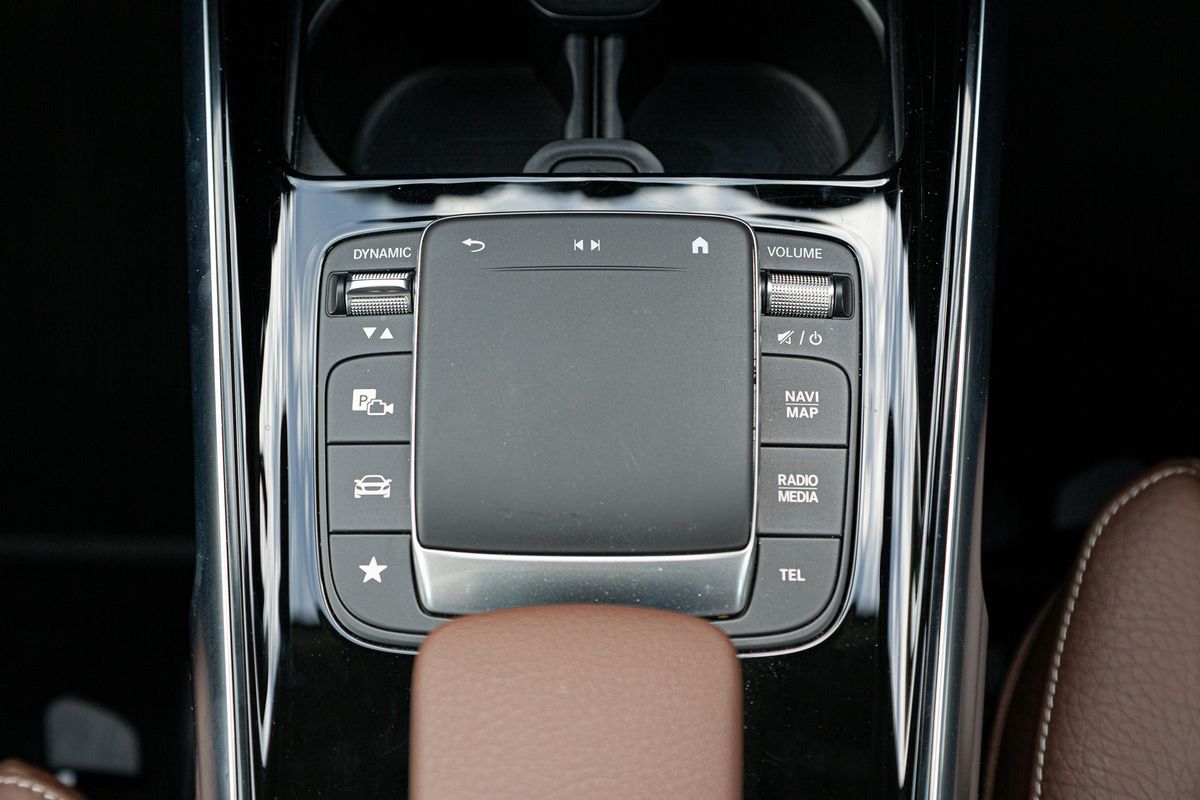
Comparatively, the Volkswagen Golf 8 R’s cabin exudes more of a tech feel but is no less impressive in catering to the driver’s needs. However, the Golf 8 R’s capacitive touchpads and sliders on the steering wheel and centre console are not very user-friendly and the infotainment system does take a fair degree of familiarisation to get used to.
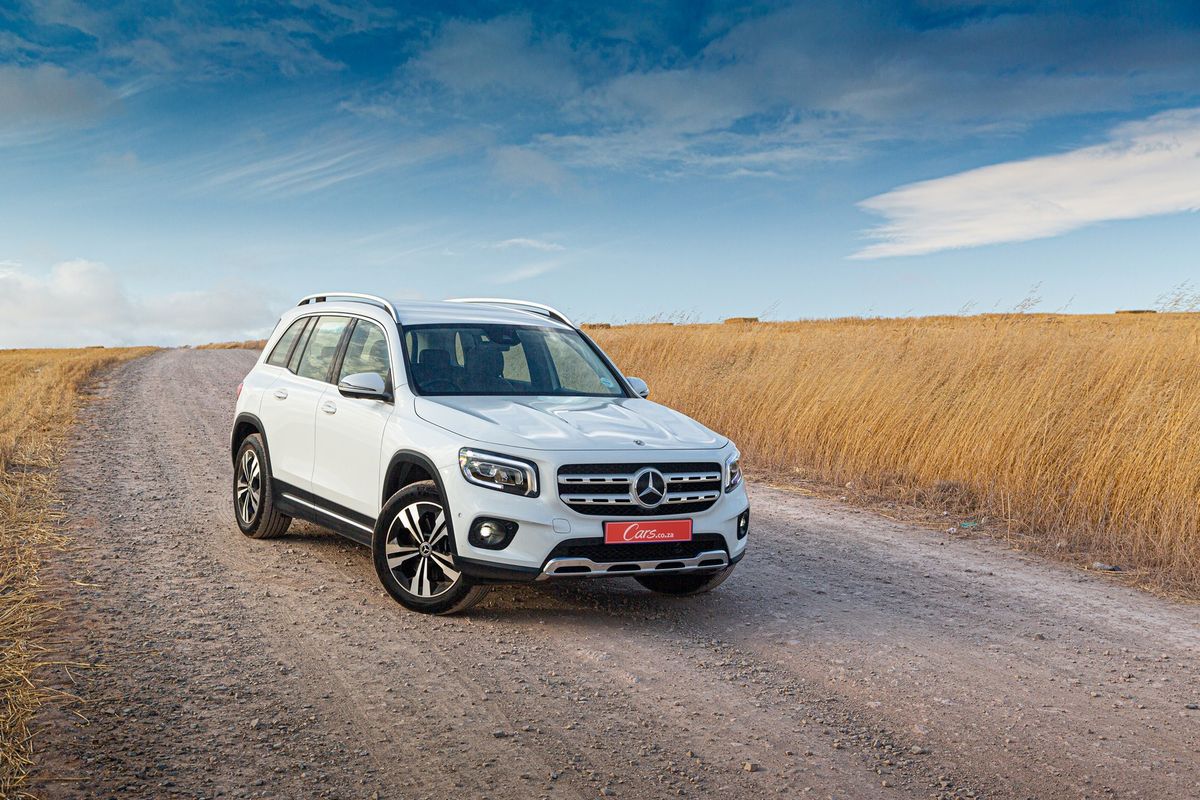
The Mercedes-Benz GLB is the largest of the compact models that the Three-pointed Star offers in South Africa. The GLB220d 4MaticProgressive offers plenty of space and has a great powerplant, but can the boxy small crossover justify its price tag?
We like: Excellent engine performance, efficiency, spaciousness, smart infotainment system.
We don’t like: Not the final word in overall comfort or dynamics, pricey.
How many SUVs do we really need from Mercedes-Benz? “Yes”, was the brand’s response.
Not too long ago, Mercedes-Benz had a fascinating product strategy. The Sindelfingen-based brand tried to cover all corners of the premium passenger car market by offering a model bearing the Three-pointed Star in every segment. Granted, there were overlaps, but this blanket approach (which is only feasible if you have the vast resources of a large OEM) was a way of keeping its brand ubiquitous.
The Mercedes-Benz compact range is all-encompassing; the A-Class is the C-segment hatchback, the B-Class targets the few remaining small-MPV fans, while the CLA and A-Class sedans appeal to those whose budgets couldn’t quite stretch to the larger and luxurious C-Class. The GLA is a popular entry point to the luxury raised-body crossover market, while the GLB is a more off-roader-esque family SUV.
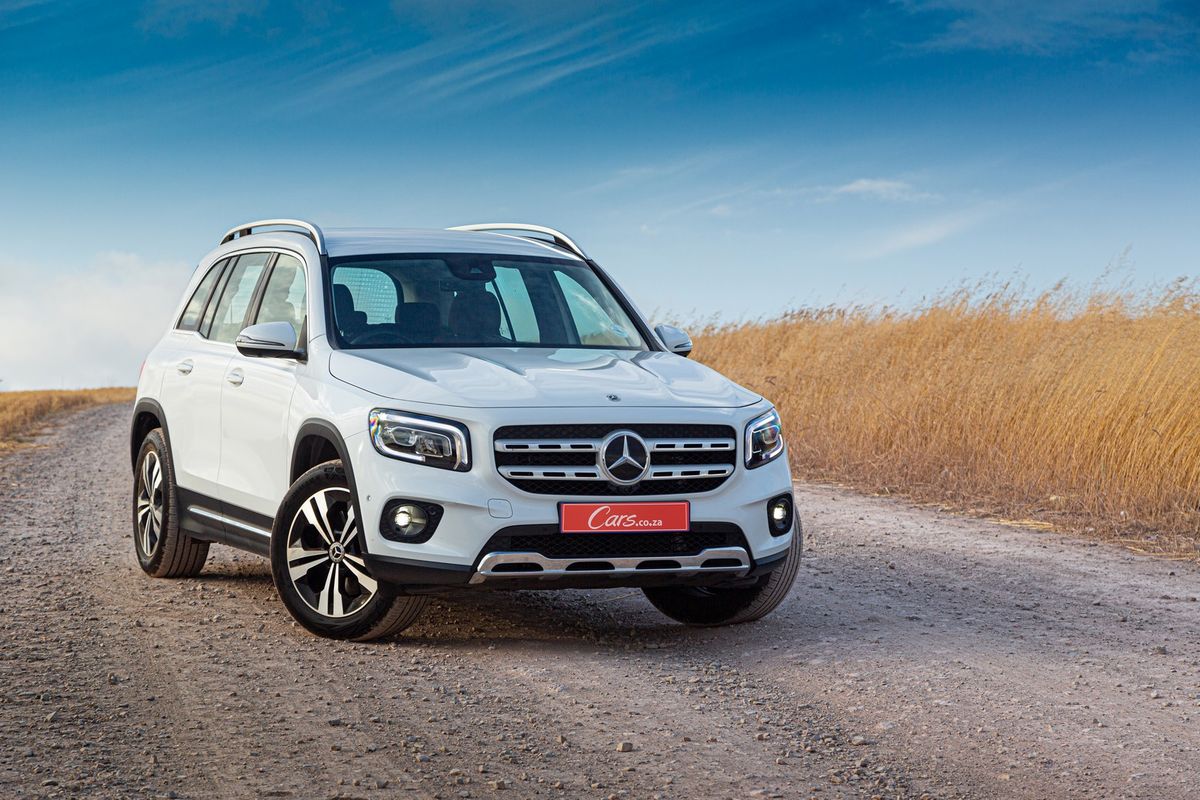
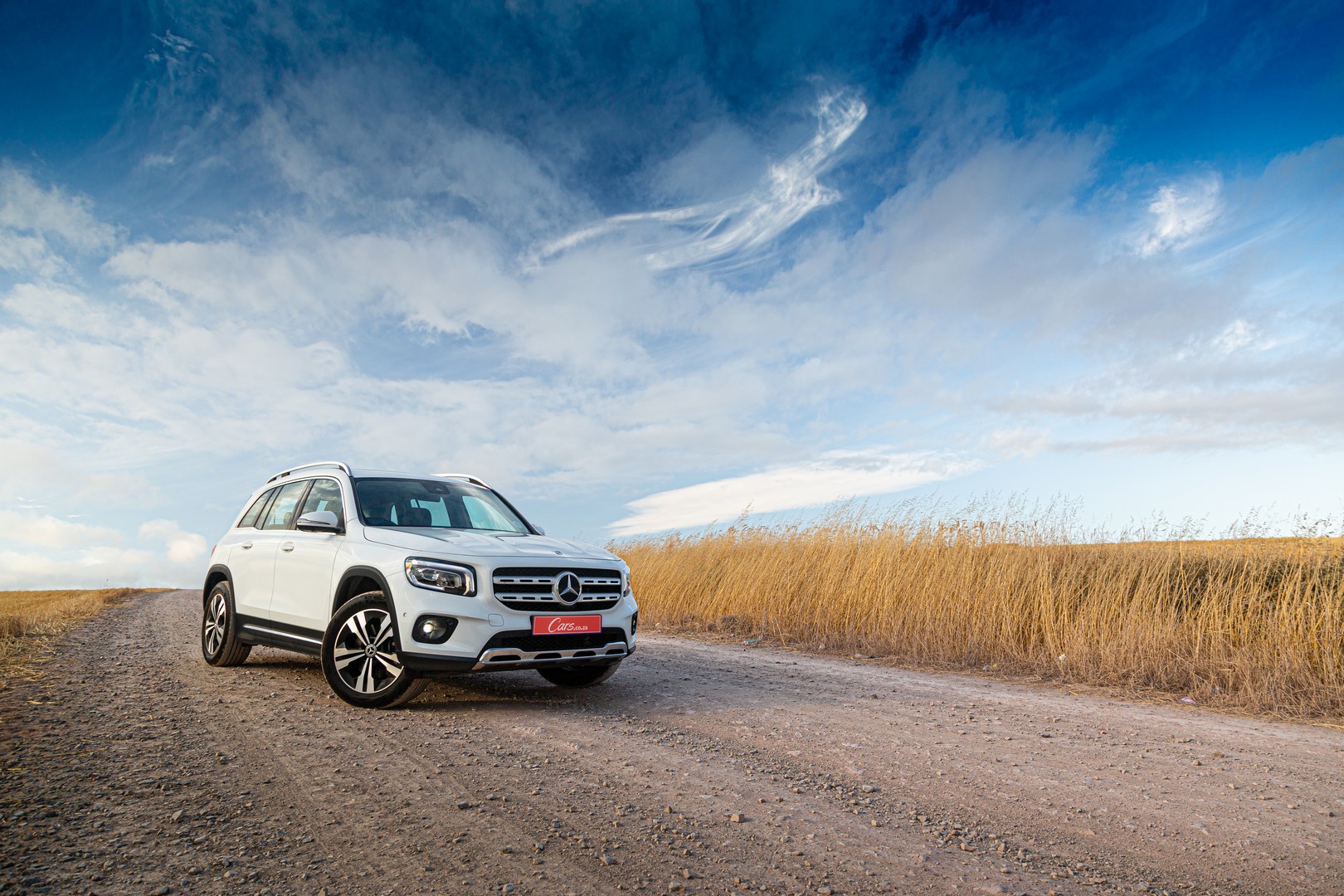
The GLB220d 4Matic Progressive test unit was tastefully specced.
The 2023 Mercedes-Benz GLB is a 5-seater (but is optionally available with a 2-seat 3rd row) and is the biggest of the small crossovers that the brand offers. Customers can choose between turbopetrol and -diesel powerplants – the former in combination with front-wheel drive and the latter with all-wheel drive.
As far as rivals are concerned, if you have R1 million and want a premium small crossover (or “baby luxury SUV”, if you want to call it that) your choices are surprisingly diverse, please see below.
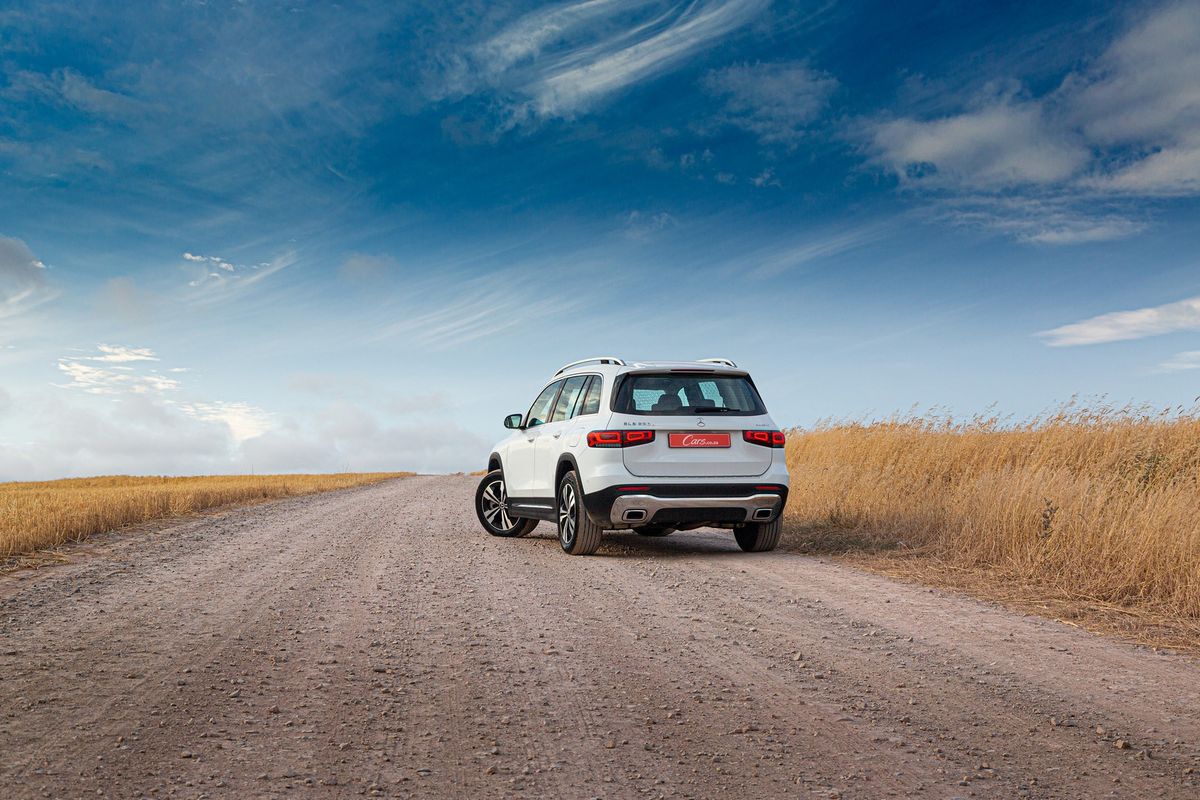
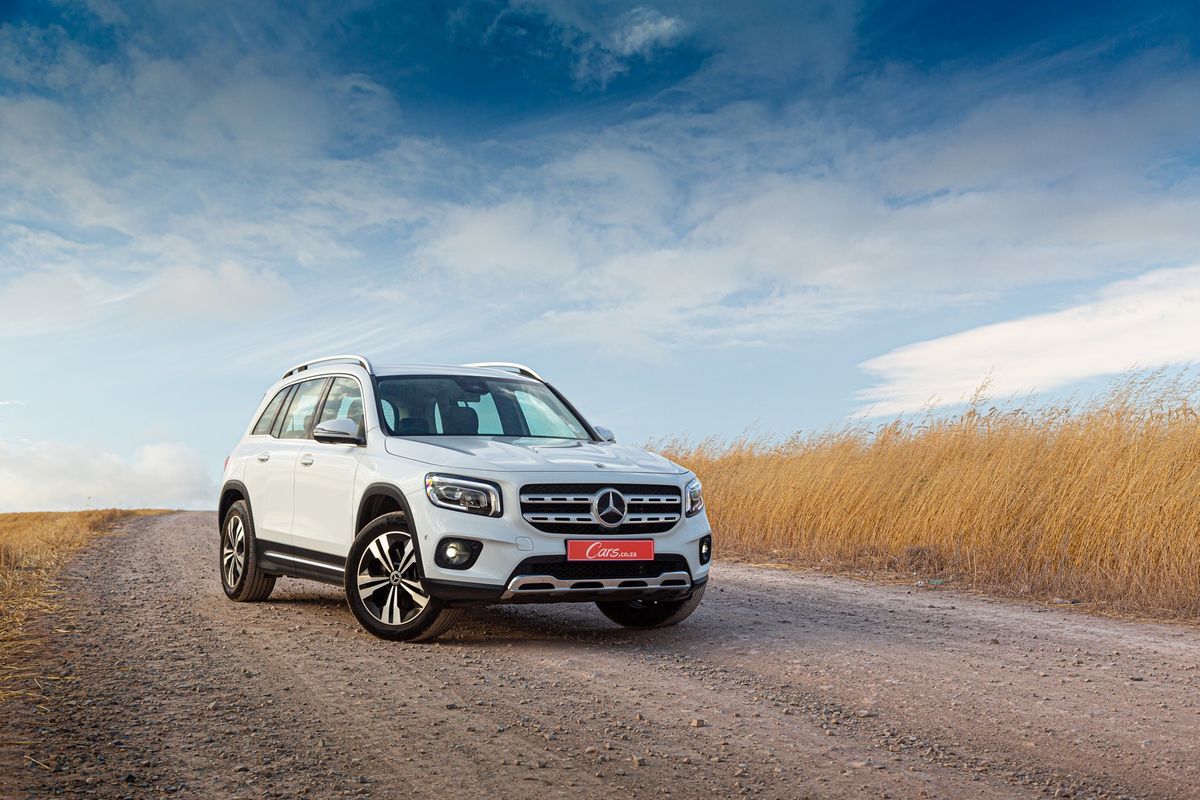
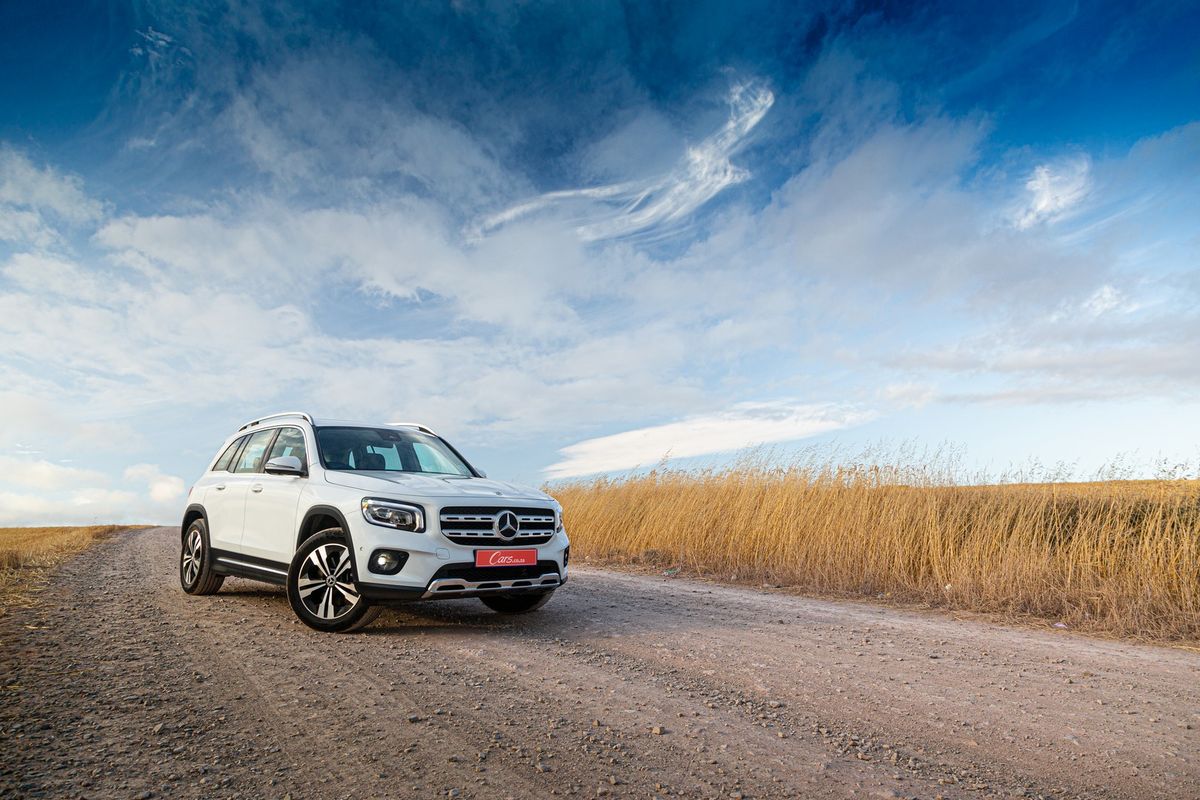
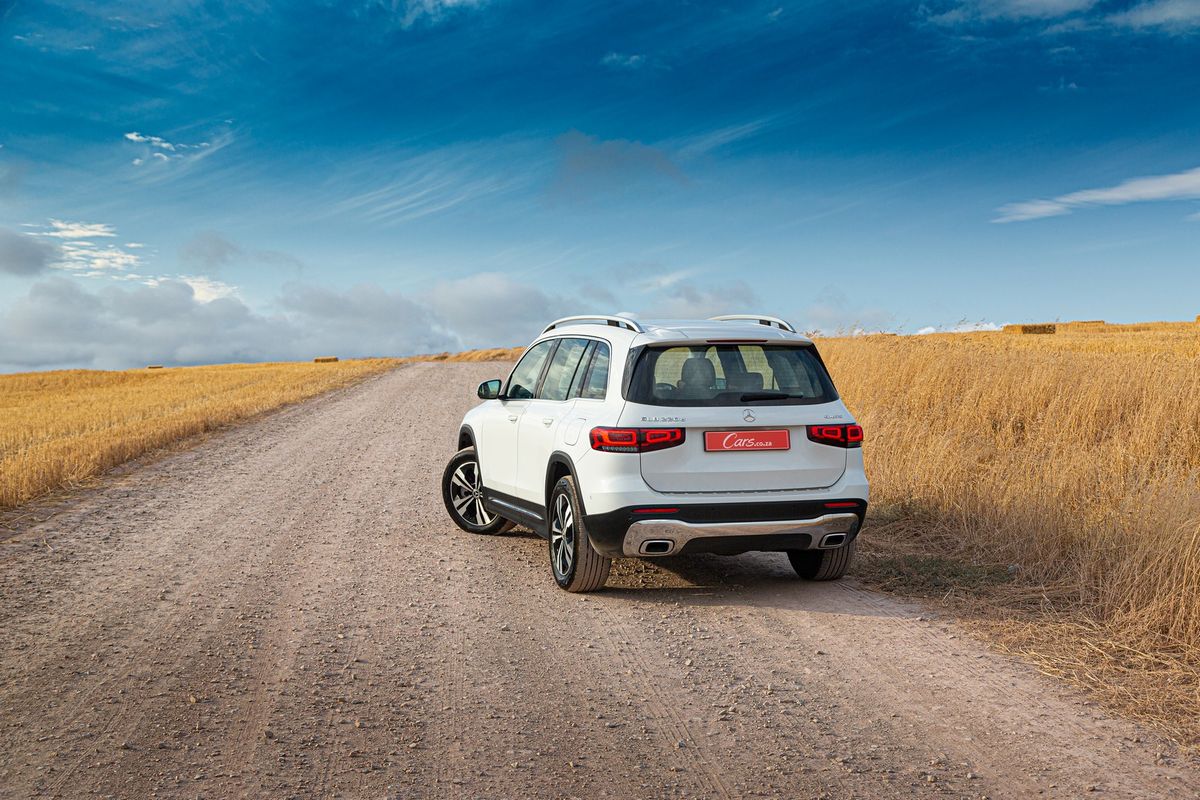
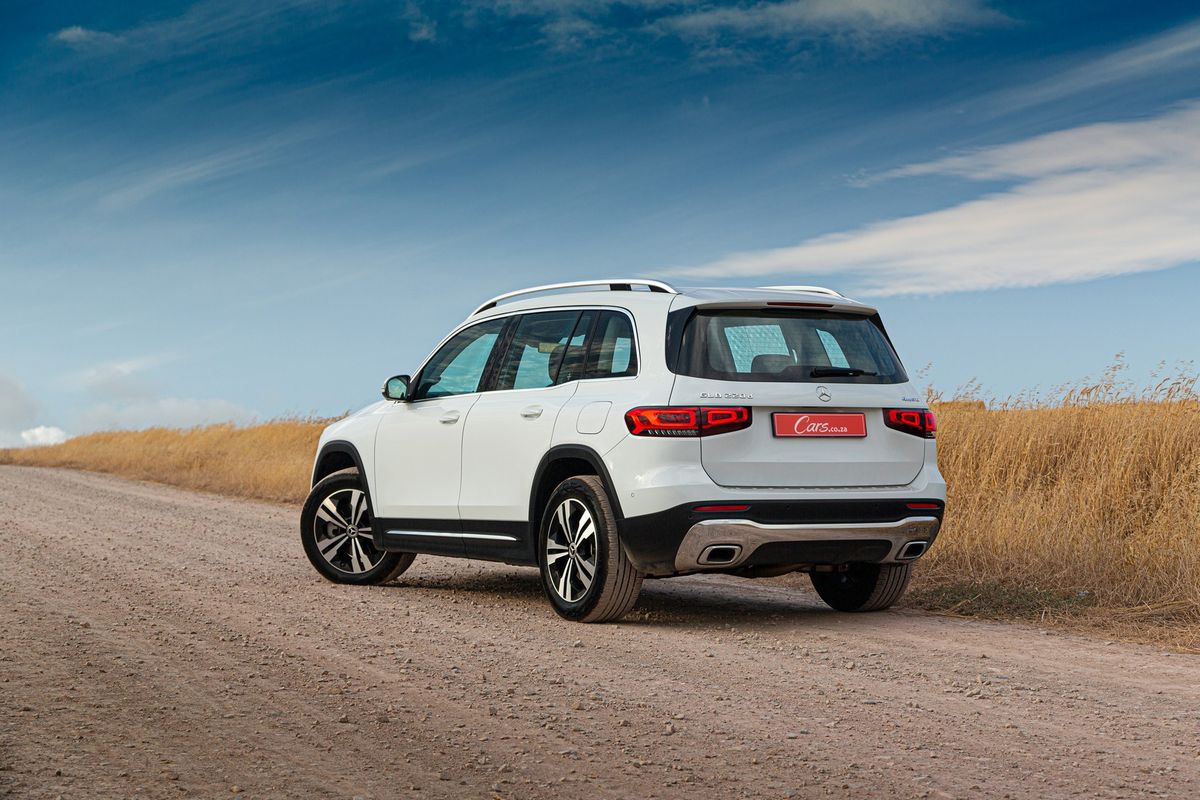
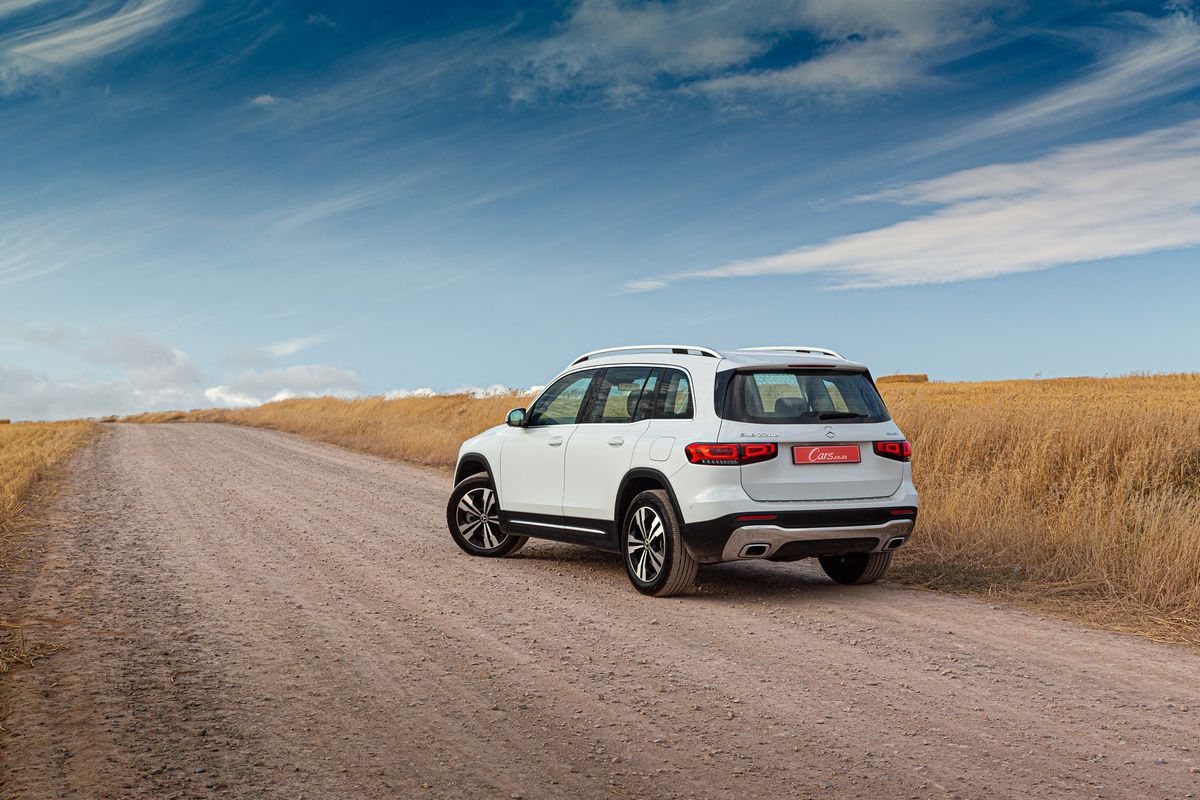
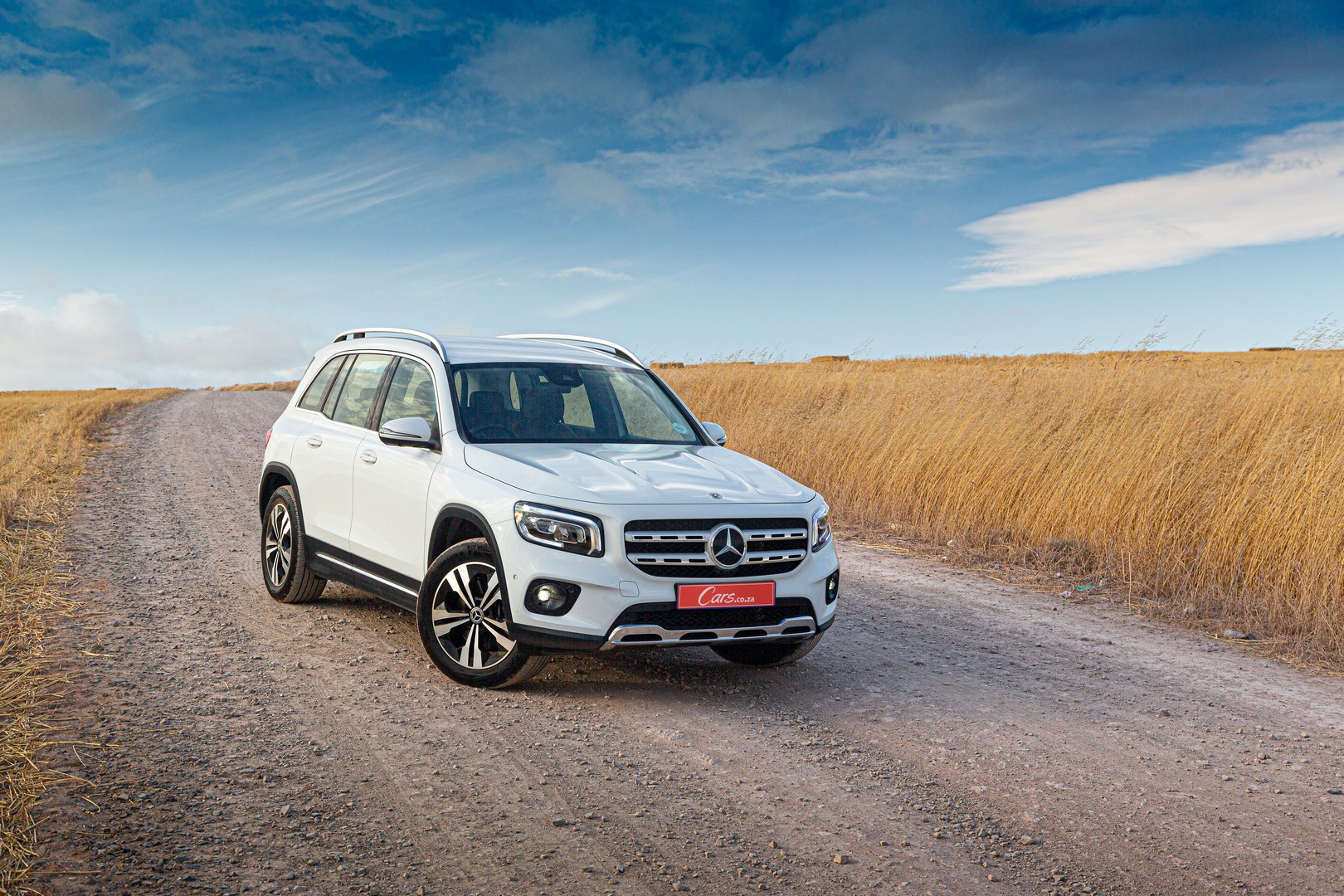
The GLB in its happy place: traversing dusty farm roads.
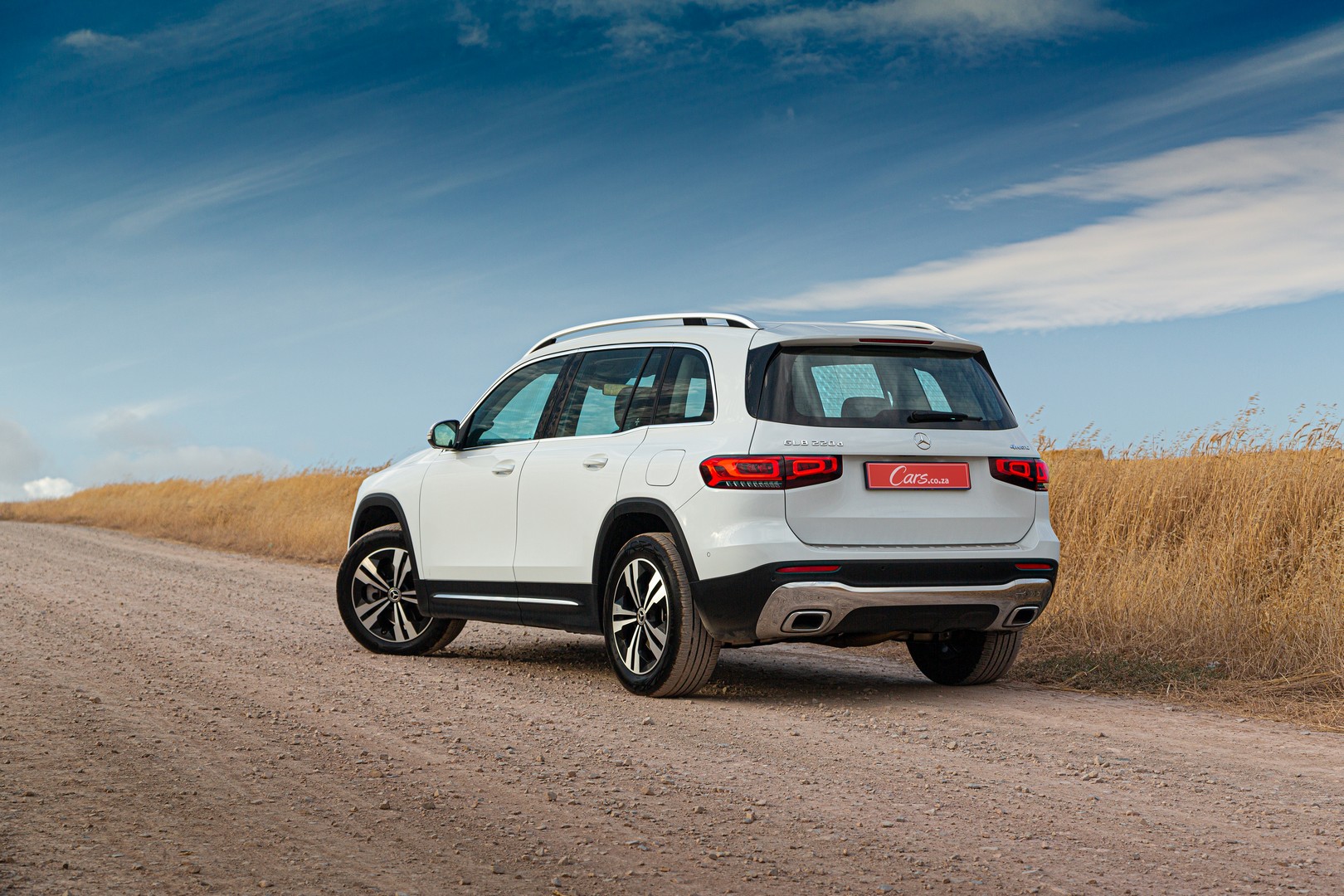
As ever, first impressions count; the Mercedes-Benz GLB’s blocky old school off-roader-like styling is eye-catching and handsome. It may be positioned as one of the brand’s compact models, but the ‘Benz is anything but dinky. In fact, thanks to its boxy shape, it offers more cabin space than you may expect.
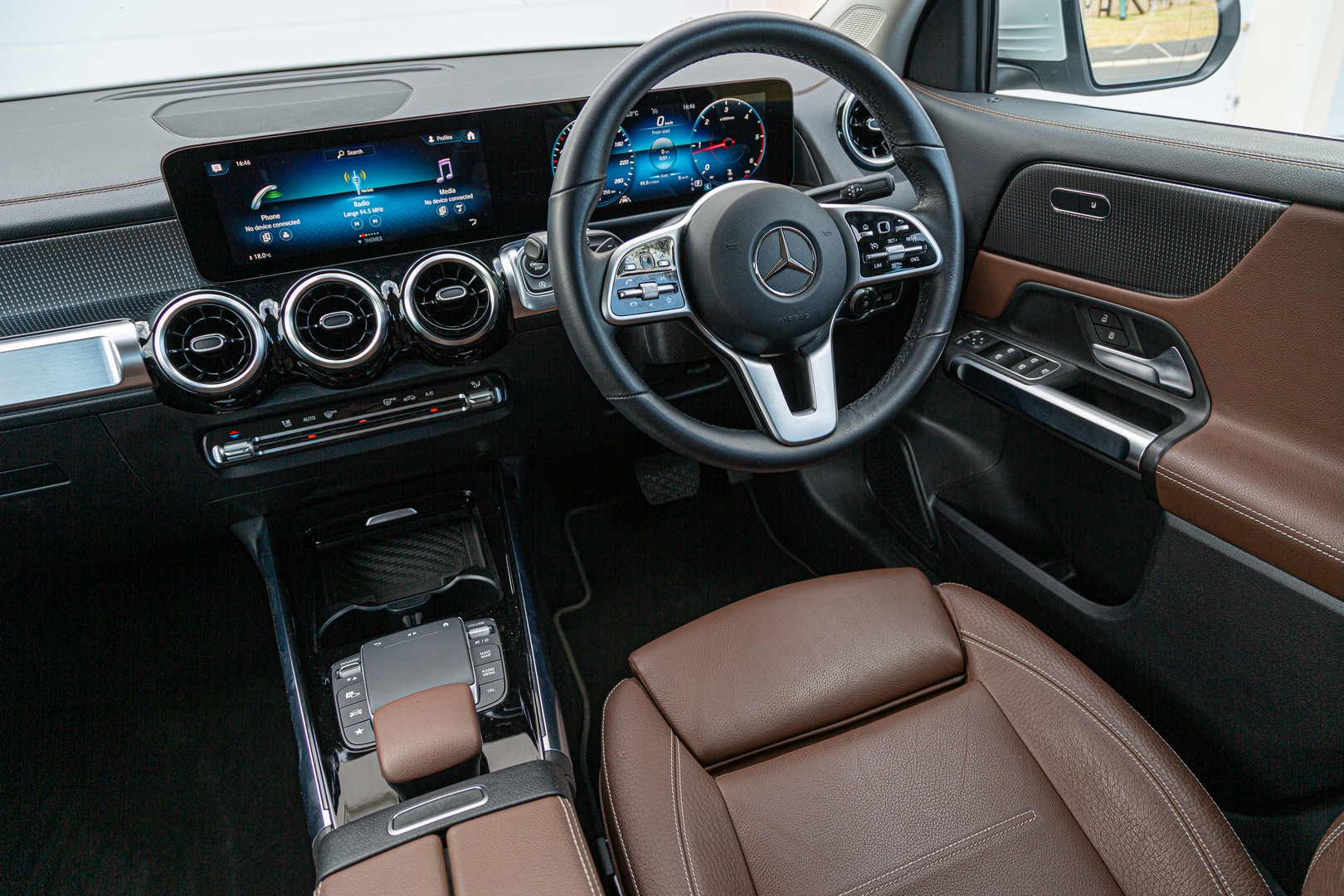
The driver’s seat is positioned quite high (for a compact car) and it affords its occupant a commanding view of the road, as well as excellent all-round visibility. In fact, the ‘Benz’s “big car” feel applies to its entire cabin, which seems as spacious as a significantly larger family SUV. Is this really the GLA’s sibling?
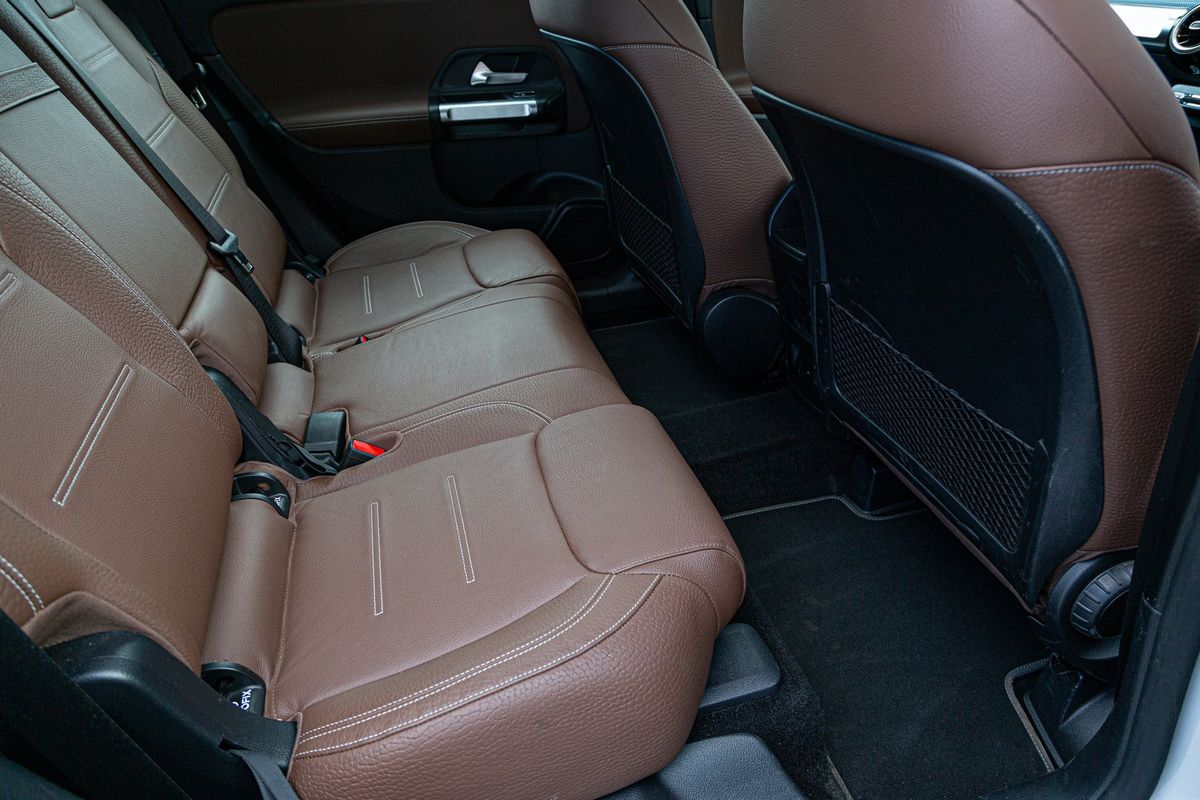
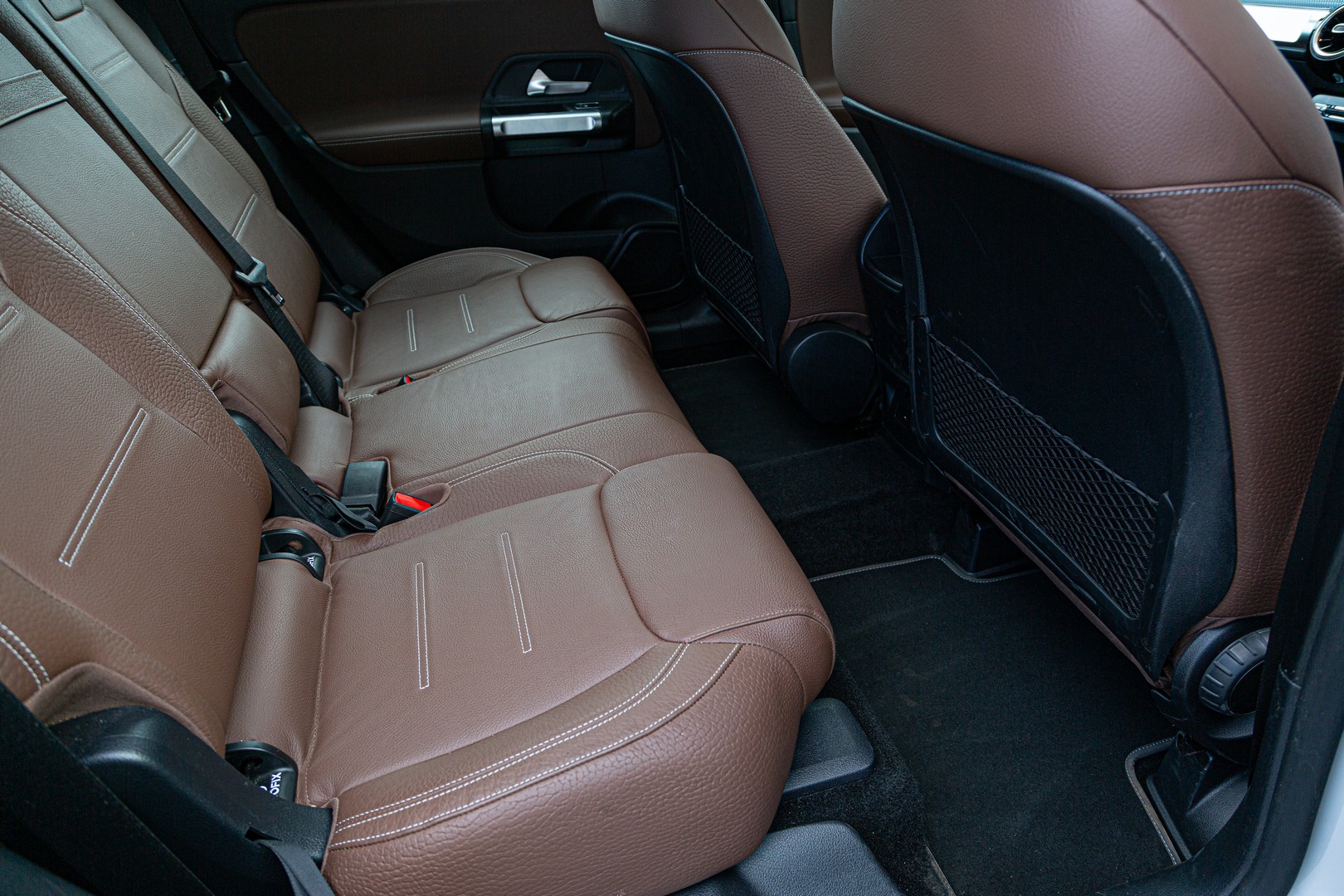
Rear passengers have excellent leg and headroom, plus they can make use of (standard fitted) USB ports.
The GLB offers ample leg- and headroom for all passengers. It’s one of few vehicles in which this author (who is 1.92-metres tall) could sit behind the driver’s seat (set to his driving position) with ample room to spare. The fact that the ‘Benz can easily accommodate 4 average-sized adults bodes well for occupant comfort on long journeys. Cleverly, the rear bench can slide fore and aft to increase comfort further.
If you want the GLB220d 4Matic Progressive in 7-seater configuration, you’ll have to fork out R20 200 (March 2023) to get a 3rd row, which isn’t an unreasonable premium given the GLB’s pricing structure. Bear in mind, however, that the pair of rearmost seats would be suitable for small children only and reduce luggage capacity; we think the GLB works better as a 5-seater with a capacious load bay…
On SA’s pockmarked roads, a higher-profile tyre is always recommended.
In our experience, Mercedes-Benz’s compact models ride quite firmly, which is perhaps exaggerated by the fact that media evaluation units tend to be specced with AMG Line trim and/or optional larger wheels.
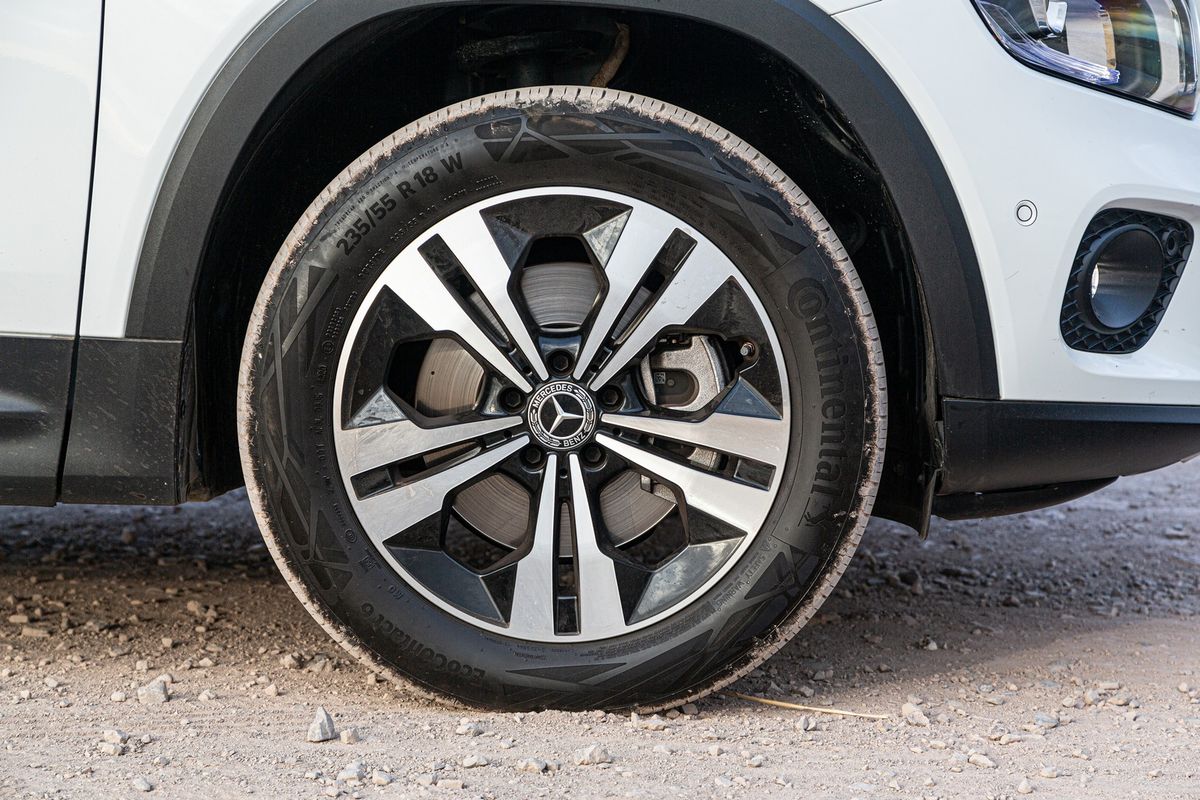
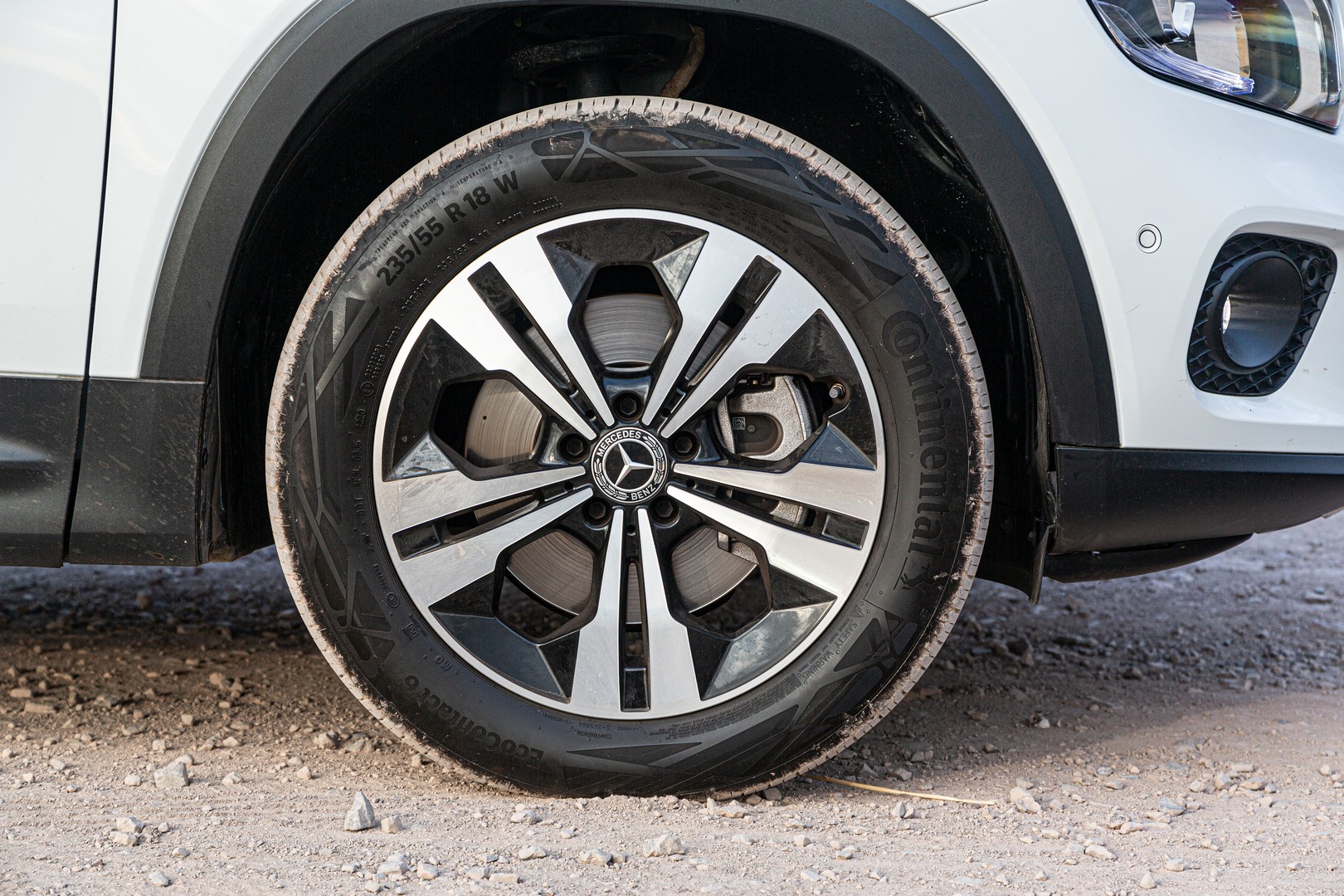
Customers can specify 19-inch alloys on the Progressive (and go up to 20-inch items on AMG Line versions), but we suggest doing what Mercedes-Benz South Africa did with this GLB unit: stick with the 18-inch wheels; they look fine and their higher-profile tyres (235/55) absorb road imperfections better.
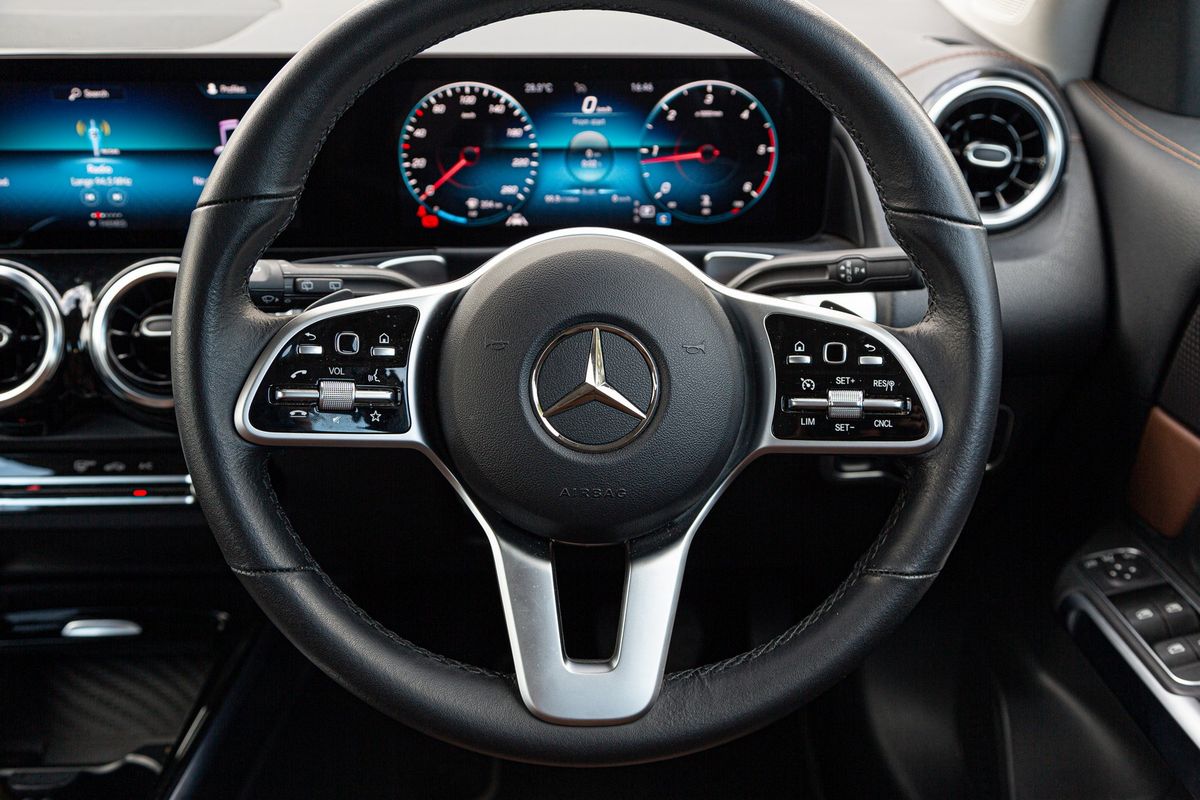
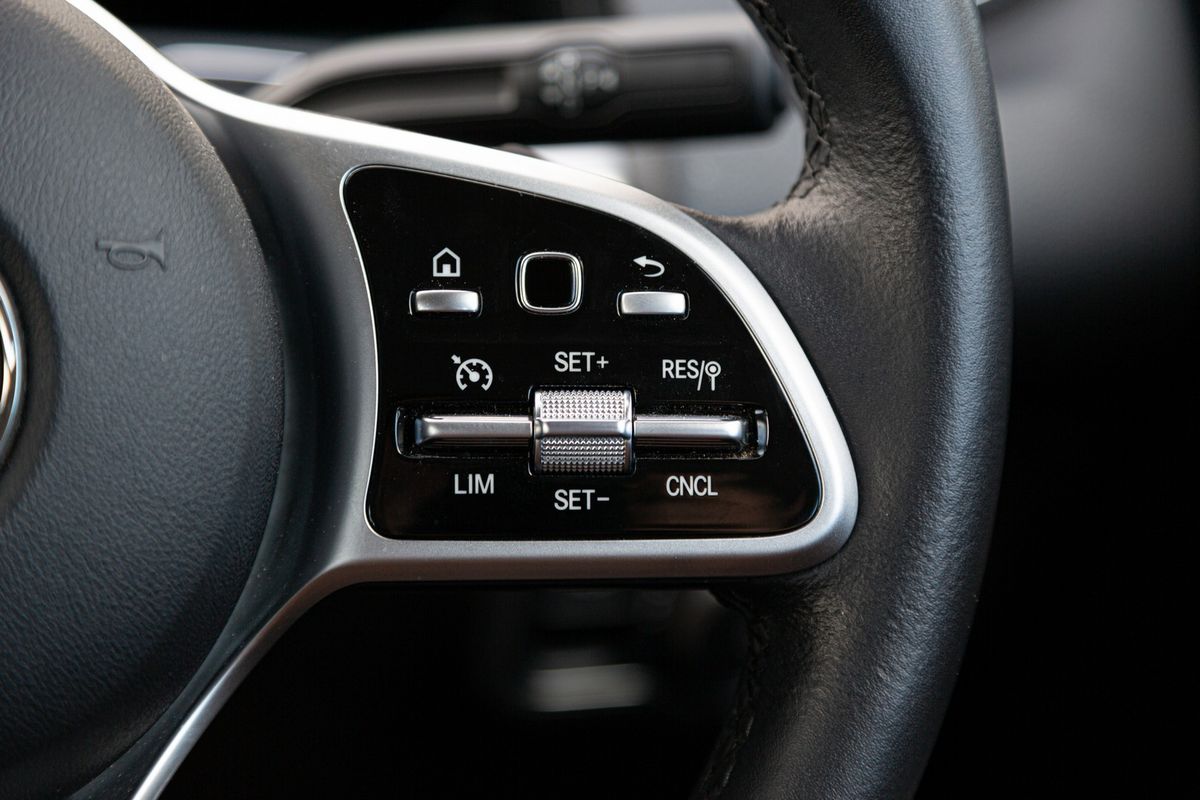
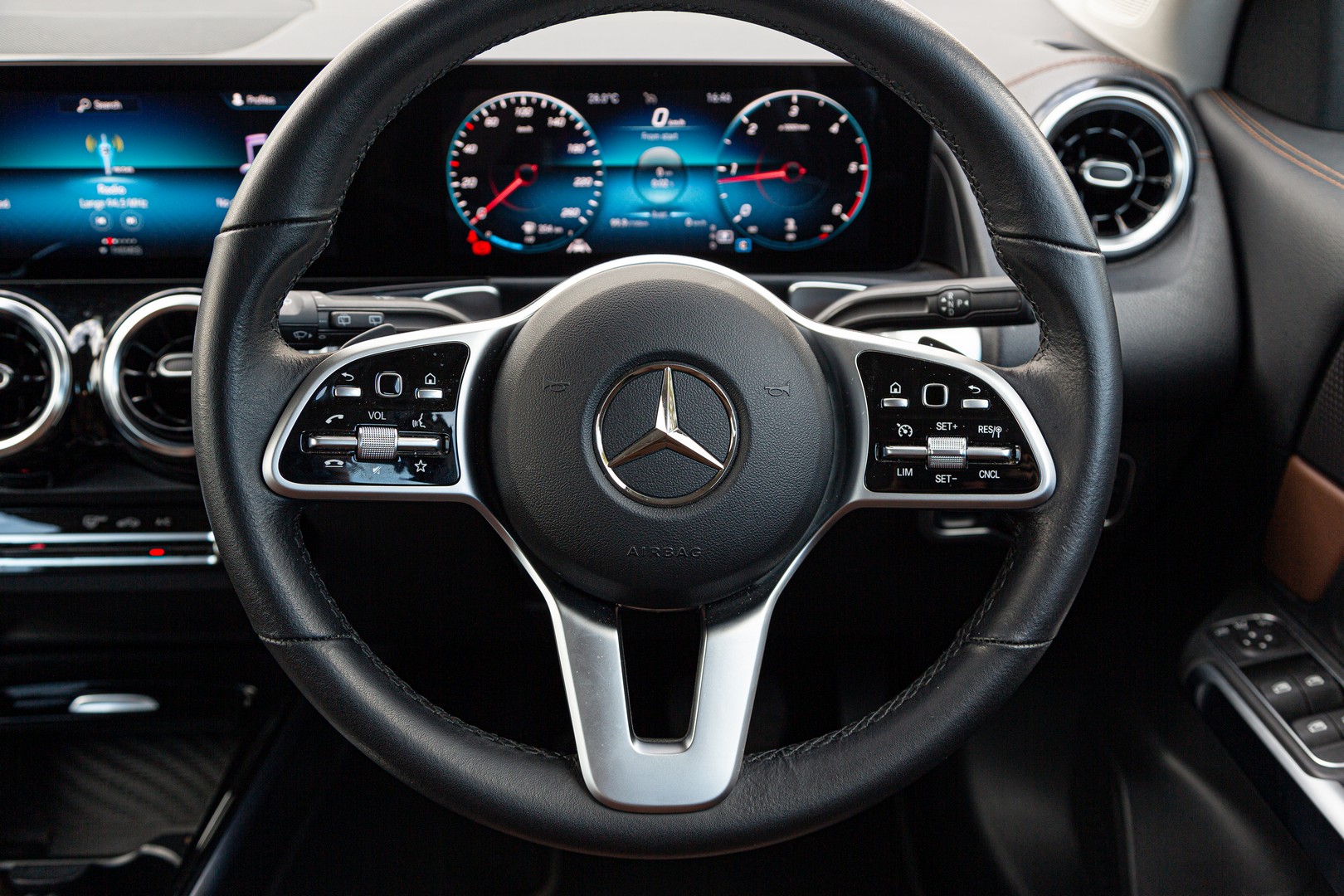
A neat steering wheel, but the touchpads take some time getting used to.
During the GLB220d 4Matic Progressive’s tenure in our test fleet, its suspension did a reasonable job of soaking bumps on coarse gravel- and uneven asphalt roads, plus its wheels and tyres withstood several pothole impacts. Overall, the ride comfort is fair, but there’s still some element of stiffness/sportiness.
Perhaps consider the “adjustable damping” option (R18 000) – it allows a more pliant suspension setting in Comfort mode, as well as a firm setup when you engage Sport with the Dynamic Select mode selector.
If you’re looking for an engaging driving experience, the GLB won’t wow you (but, to be fair, none of the ‘Benz’s rivals are fun to pilot). To its credit, the steering setup strikes a good balance between lightness and responsiveness, which help round town, and heft and damping, which feel good on the open road.
Performance and Efficiency
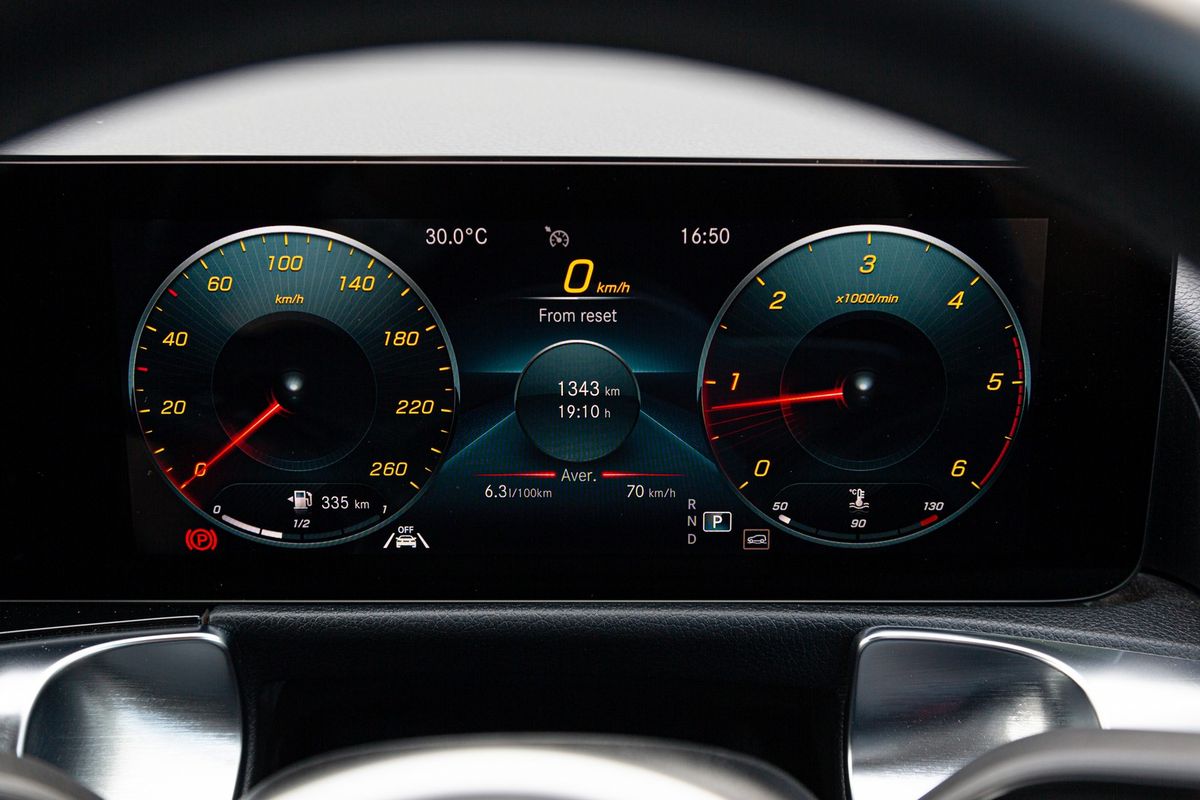
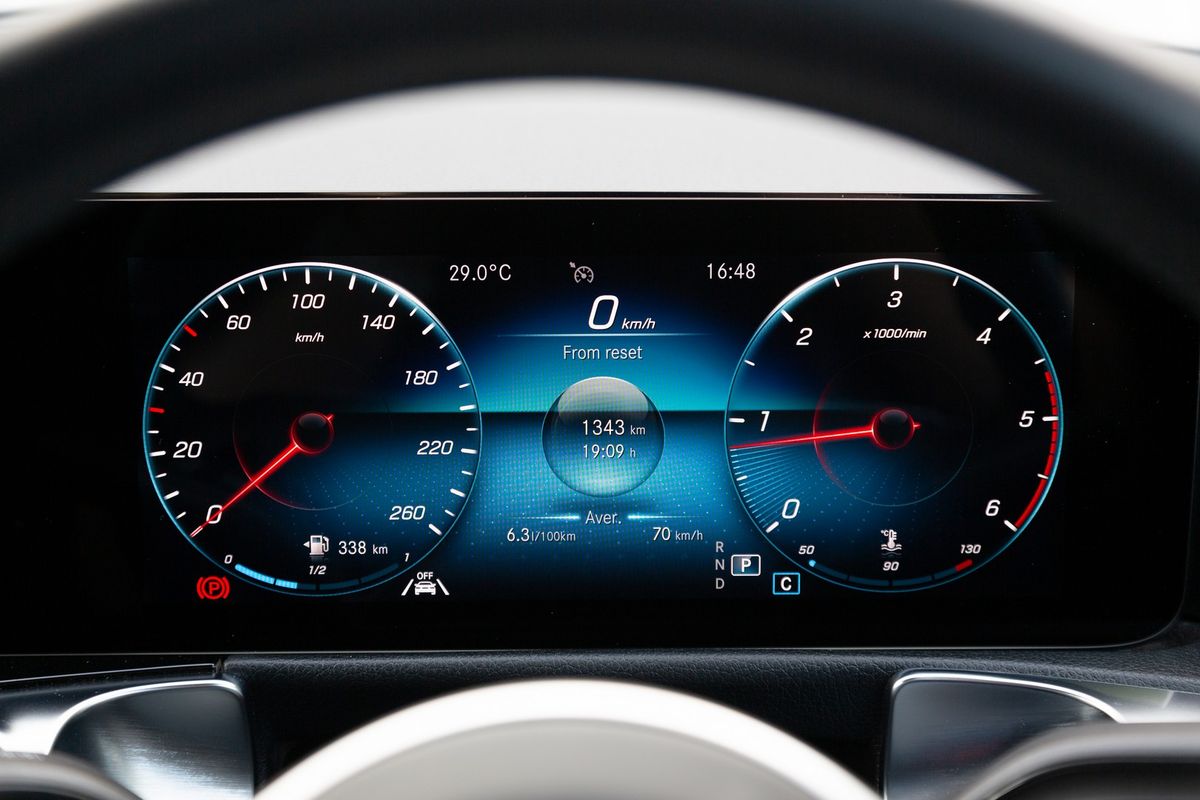
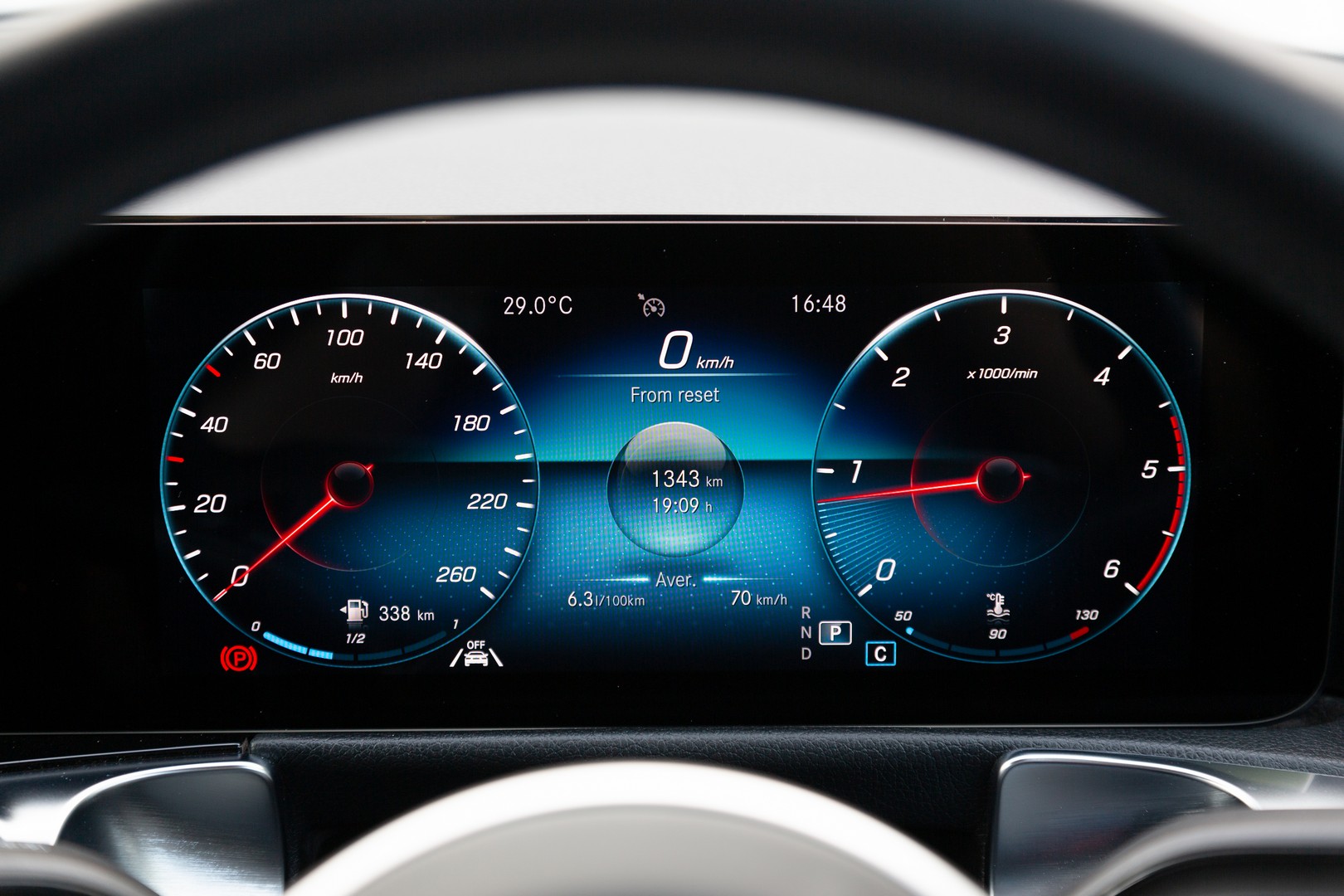
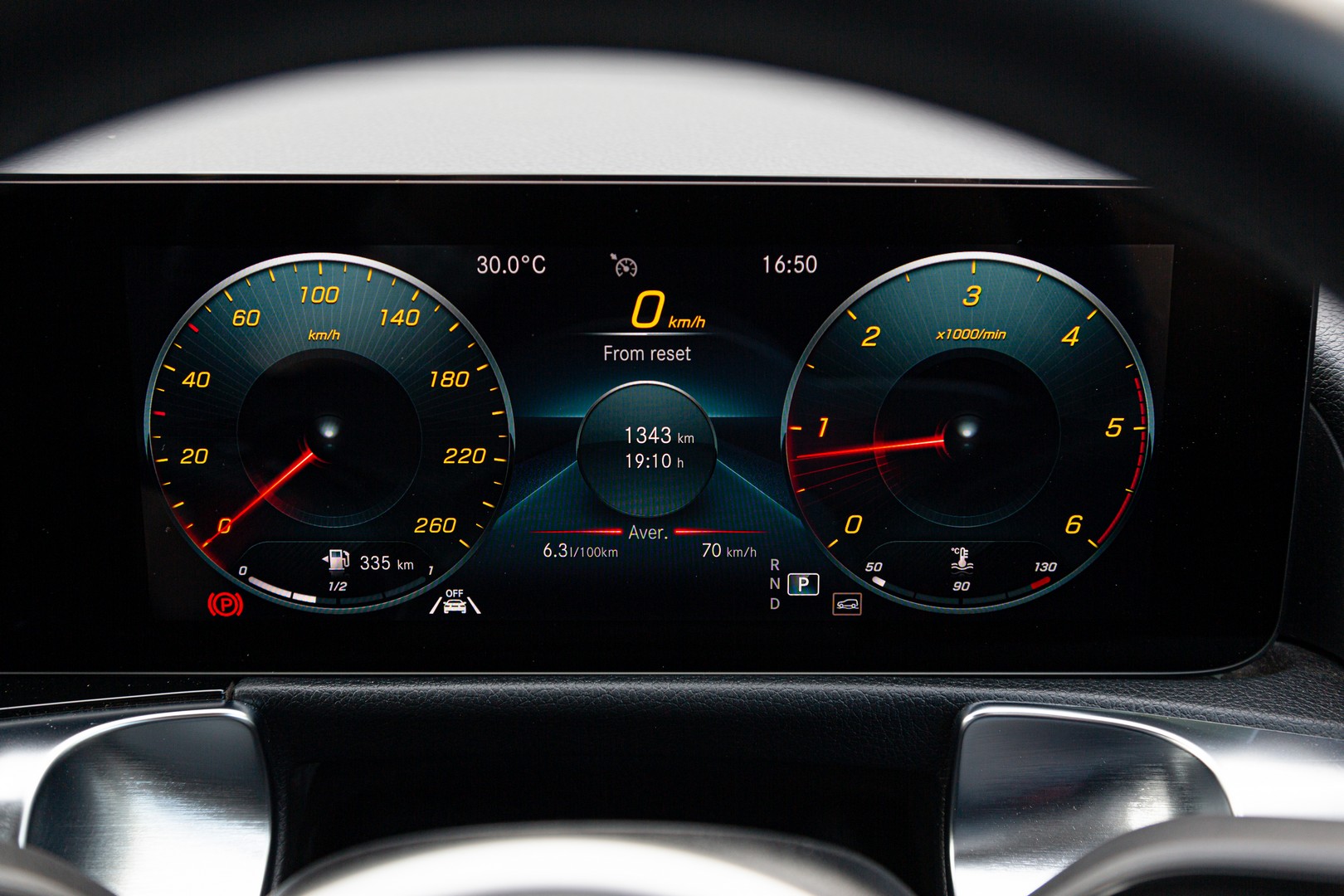
By the end of the review period, the test unit’s indicated fuel consumption sat at 6.3 L/100 km.
Under the bonnet of the GLB220d 4Matic Progressive is a 2.0-litre 4-cylinder turbodiesel engine, which produces 140 kW and a generous 400 Nm. The 2.0-litre 4-cylinder turbopetrol in the front-wheel-drive GLB250, in turn, makes 165 kW and 350 Nm, while there’s the option of full electrification with the EQB.
The 8-speed automatic dual-clutch transmission is mated with ‘Benz’s 4Matic all-wheel-drive system, which cleverly directs torque to the wheels that have the most traction. Primarily, the vehicle is front-wheel driven, but the rear axle can be called upon to deliver propulsion in low-grip road conditions.
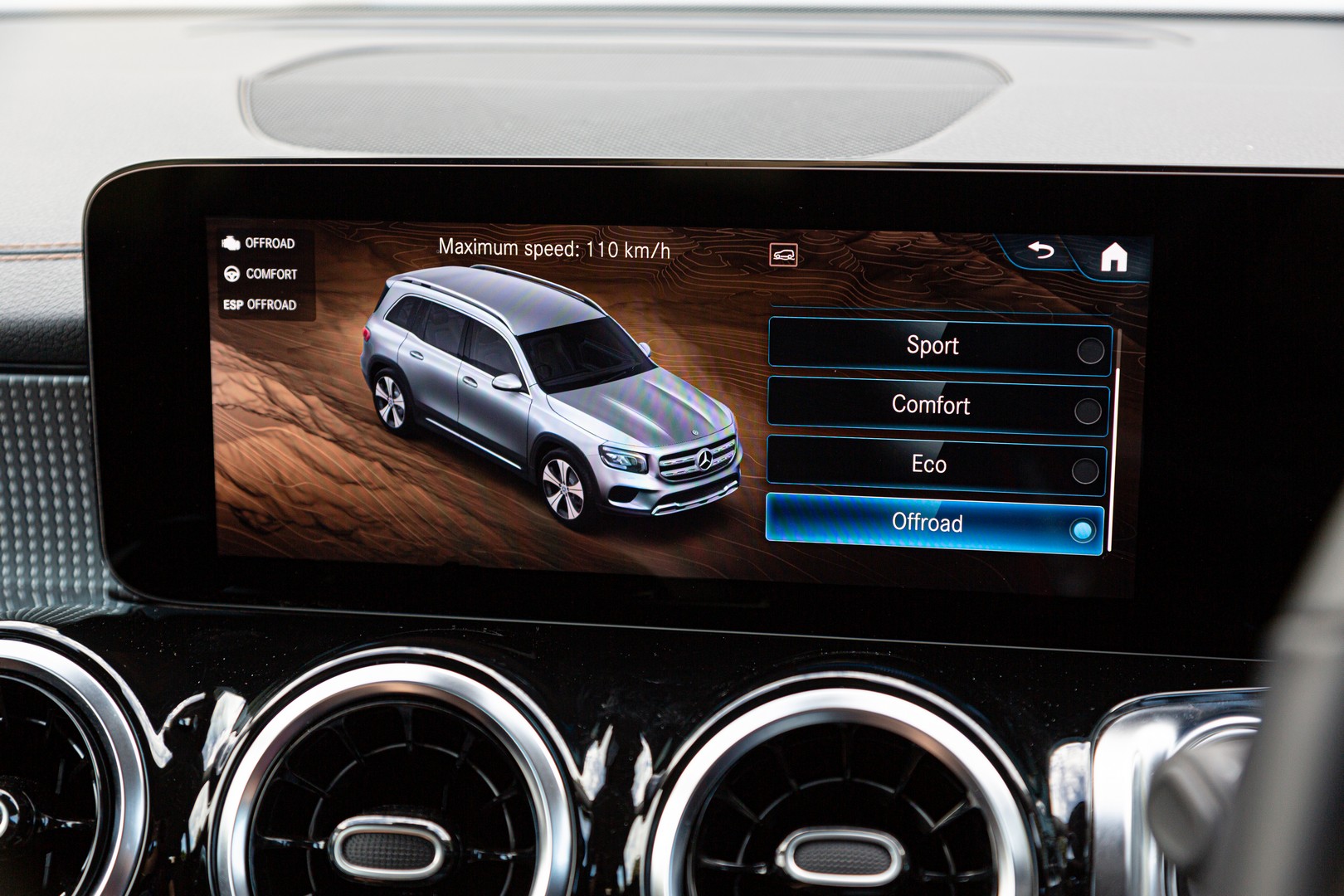
Off-road mode is useful when you’re travelling on a gravel road.
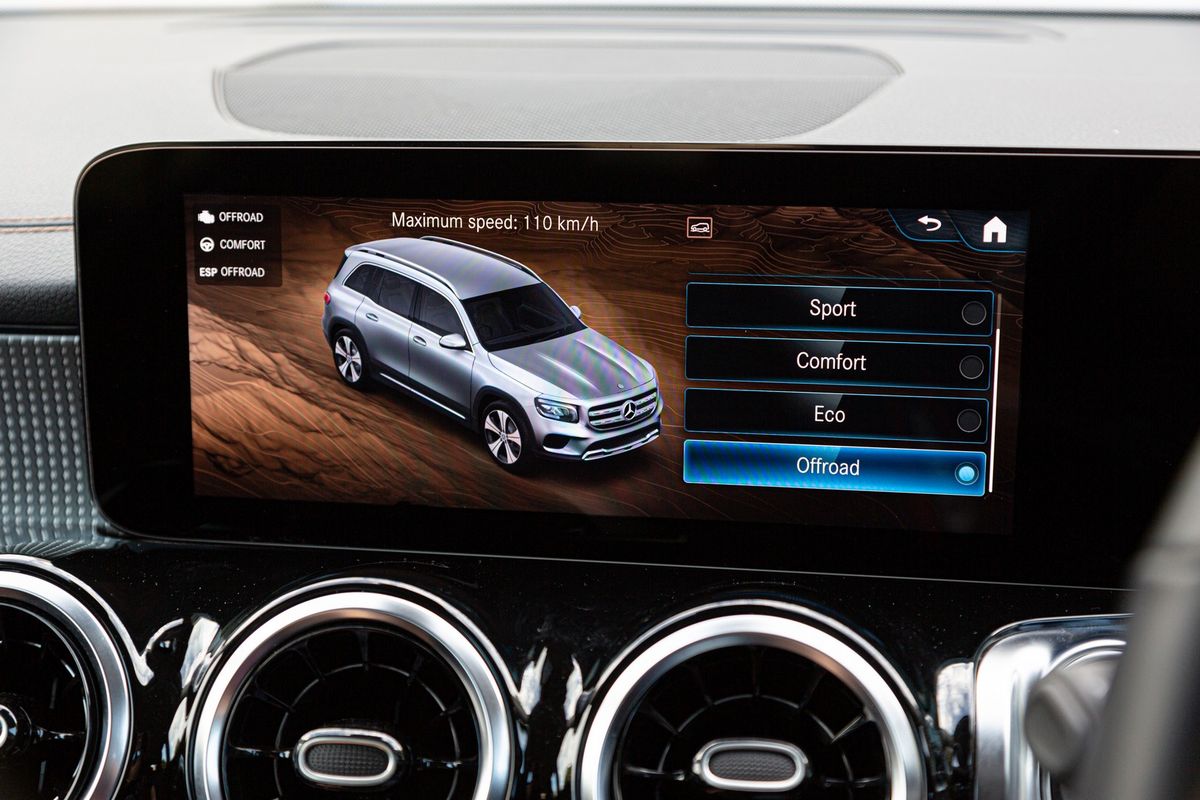
Apart from the Comfort, Eco and Sport drive modes, the GLB220d 4Matic Progressive offers an Off-road setting that optimises traction on loose road surfaces. But as handy as all-wheel drive and the Off-road mode are, the ‘Benz doesn’t have generous ground clearance, which makes its underside vulnerable to rock impacts. Therefore, it isn’t an off-roader, but it’s well suited to travelling on gravel roads… or snow.
Meanwhile, the ‘Benz’s 2.0-litre turbodiesel motor proved rather muscular: not only when accelerating from a standstill, but when overtaking slower vehicles. Our test gear confirmed that the GLB dispatched the 0-to-100 kph sprint in just 7.71 sec (close to the claimed figure). Its in-gear performance was even more impressive; that 400 Nm of torque between 1 600 and 2 600 rpm certainly made its presence felt.
In terms of fuel economy, Mercedes-Benz claims this derivative will consume an average of 5.5 L/100 km, which, given its 60-litre fuel tank, gives the GLB220d 4Matic Progressive a theoretical range of more than 1 000 km. After completing a road trip up the Garden Route, the test unit indicated 5.4 L/100 km, but, following a subsequent stint of urban driving (in severe traffic) the figure climbed to 6.7 L/100 km.
Overall, the GLB’s turbodiesel engine delivers a great blend of performance and economy, plus it’s an impressively quiet/refined motor. Given the excellence of this powertrain, it remains a pity that most brands are bowing to pressure and phasing out their diesel-powered passenger car derivatives.
Tech and Safety features
The infotainment system supports Android Auto and Apple Carplay.
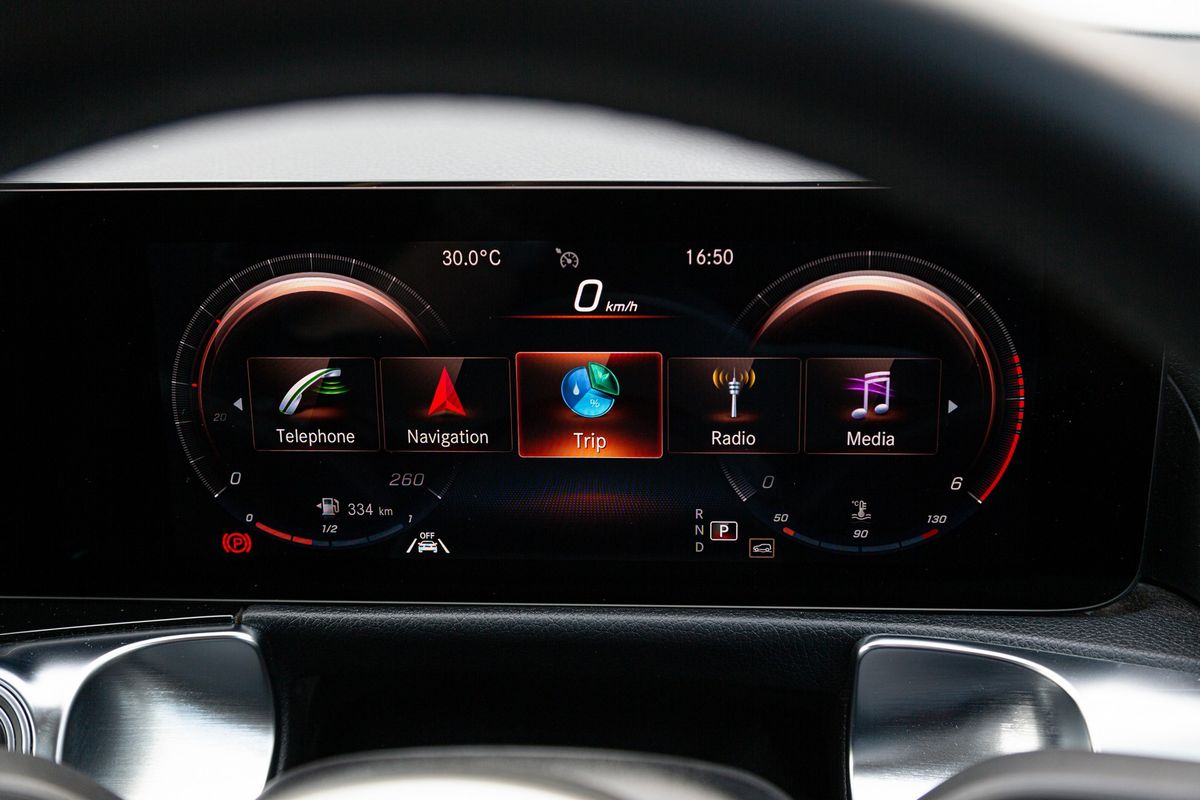
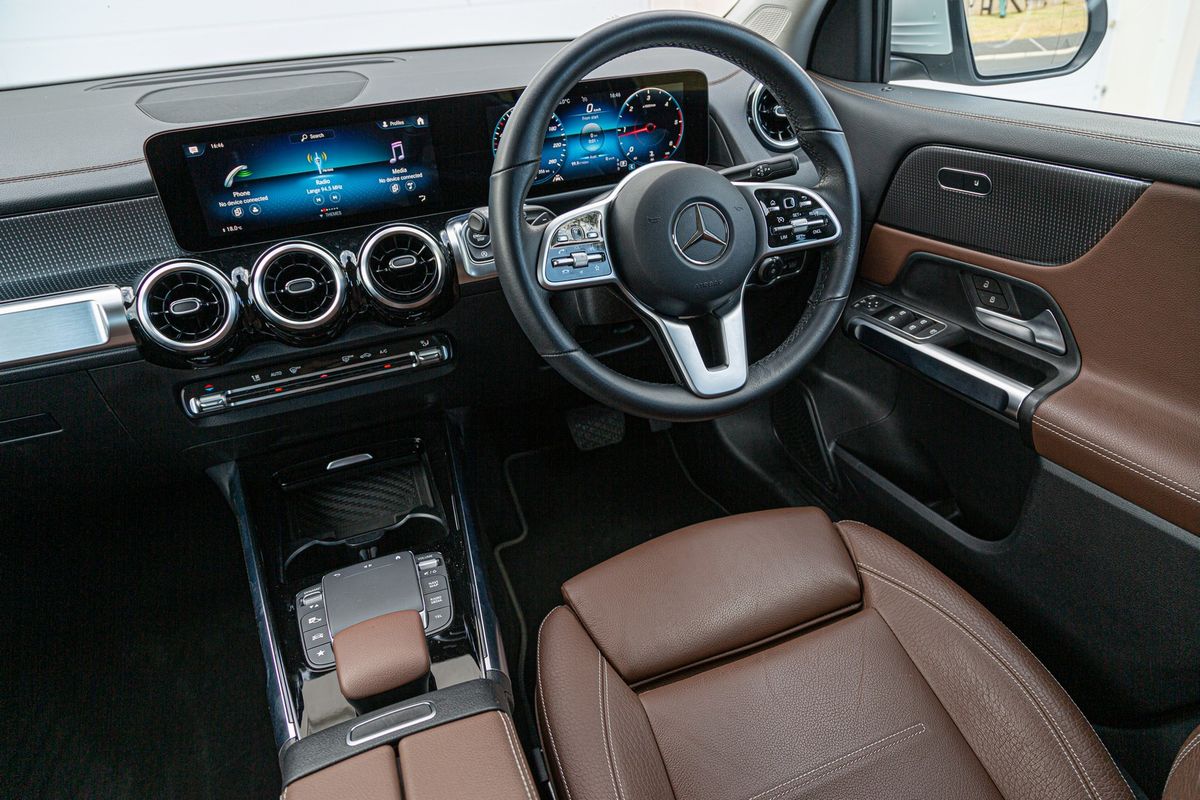
Once ensconced in the driver’s seat, you’re greeted by the latest generation of Mercedes-Benz’s all-digital instrument cluster and infotainment touchscreen, which combine into the MBUX interface. The latter’s menu system is initially a little intimidating, but after some familiarisation, it becomes easy to operate. If all else fails, just make use of the voice-command system, which is pleasantly effective. “Hey Mercedes, I am hot” is a quick and sure-fire way of getting the climate control to blast you with Arctic air.
The screens’ displays are pleasingly responsive and feature crisp and modern graphics. The instrument cluster’s look is configurable with various different dial colours and themes. If there’s one drawback, the steering wheel features those Blackberry-style swipe pads, which are not the most accurate to use.
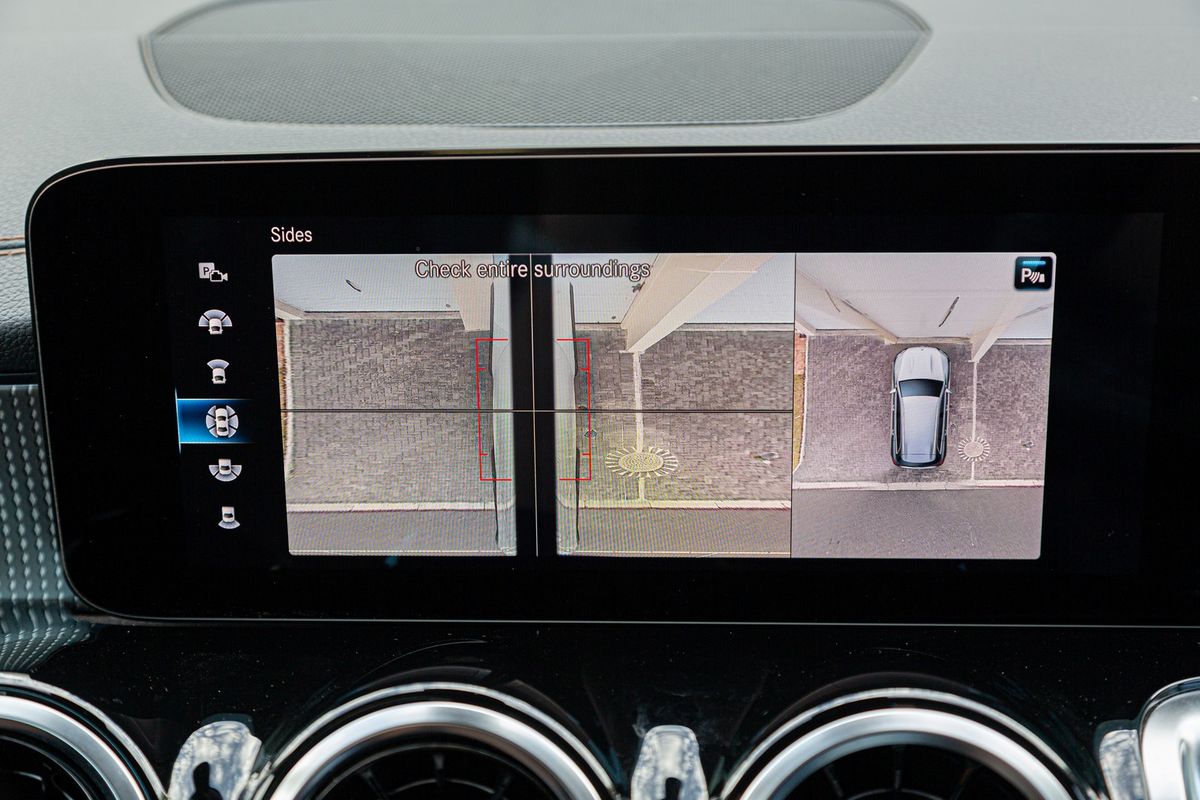
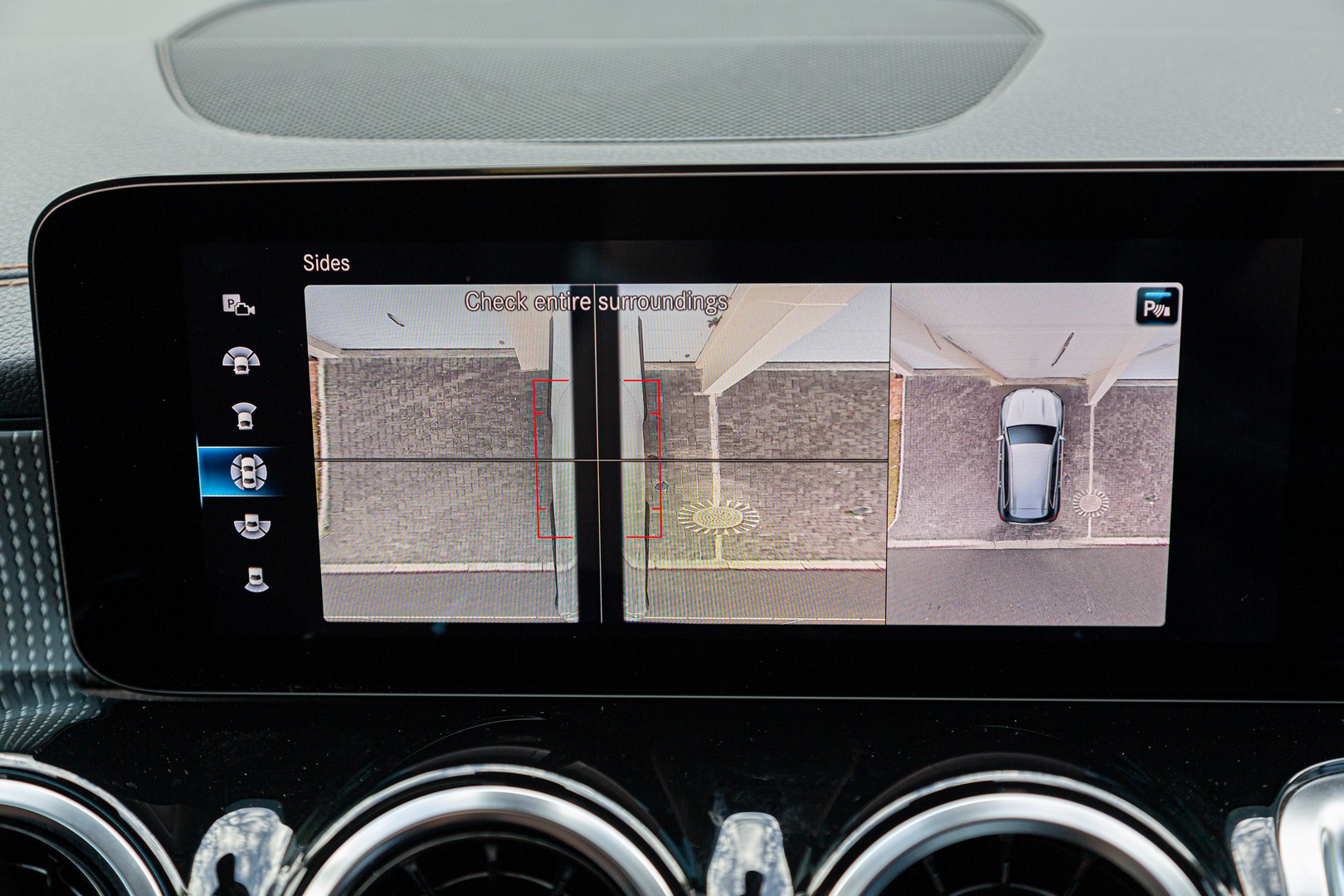
A 360-degree camera setup makes parking so much easier.
At this price point, buyers expect a comprehensive standard features list and, even in stock standard guise, the GLB220d 4Matic Progressive comes equipped with a fair number of comfort, tech and safety features. Having said that, there are some optional features that we think you should consider adding.
Our test unit was fitted with R160 000 worth of additional content and, while it may look like a sparsely equipped vehicle from the outside (due to its standard wheels), the ‘Benz was, in fact, cleverly optioned.
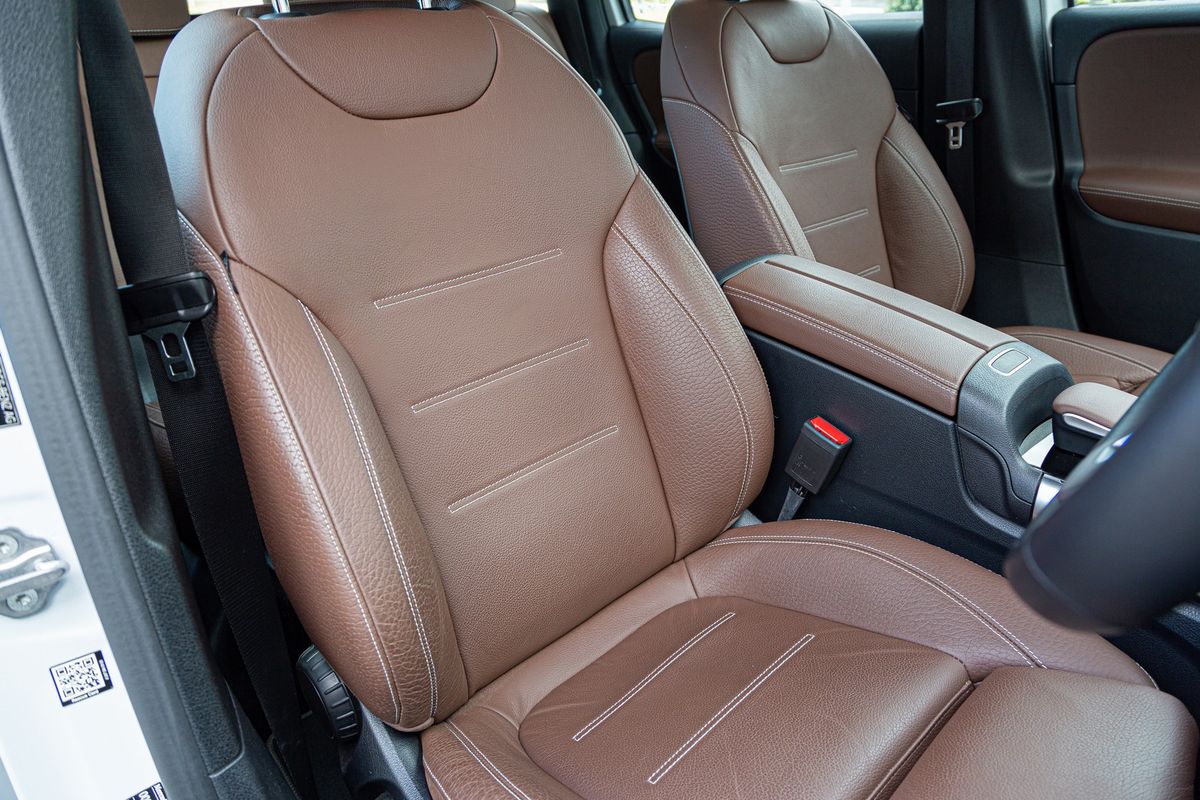
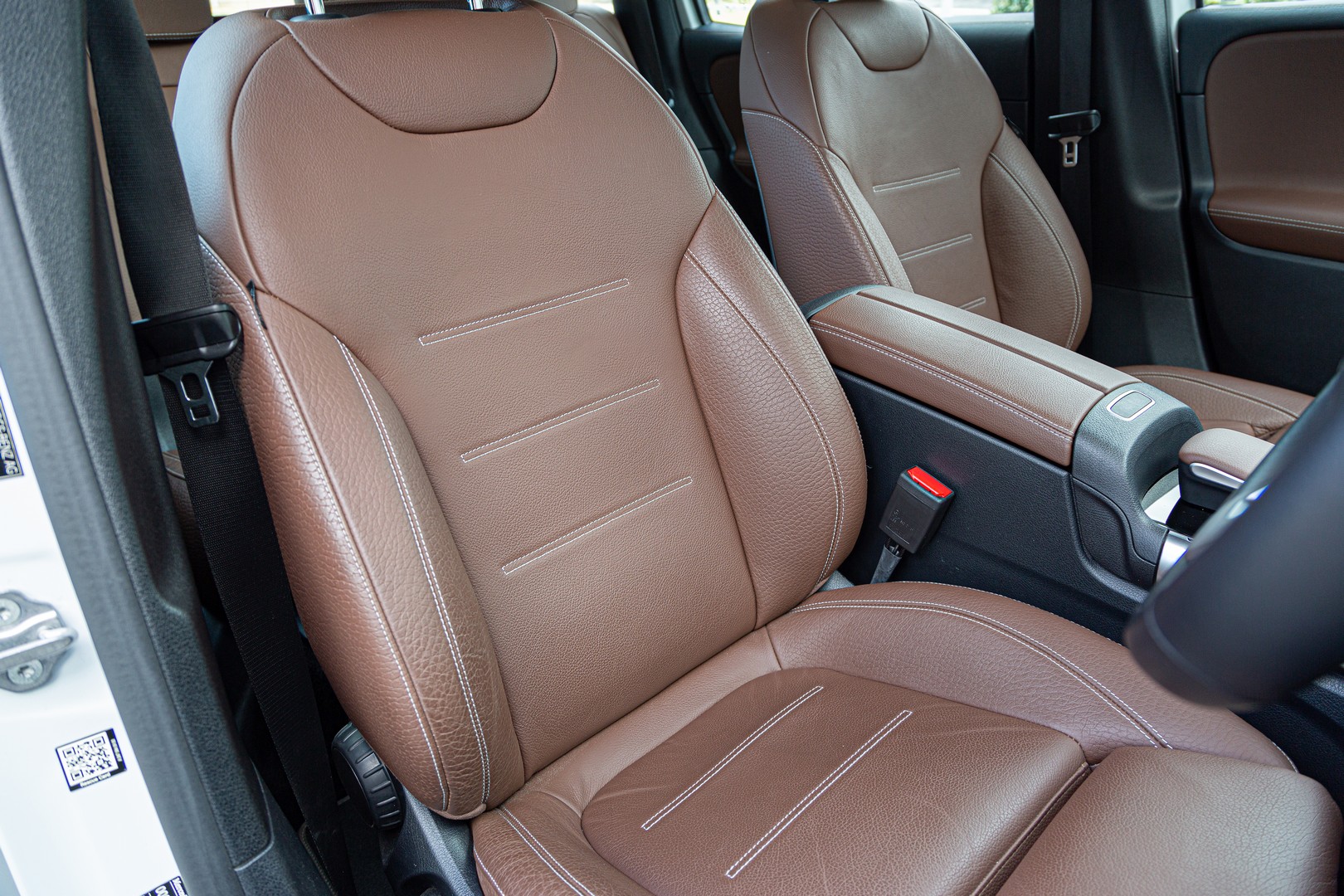
The colour may not appeal to everyone, but the driver’s seat is nicely perched and comfortable.
Leather sports seats with a heating function (R36 000) and the Premium Package (R51 000) were fitted, with the latter including some really useful features such as wireless device charging, a 360-degree parking camera system and built-in navigation, to name but a few of the gizmos. Most testers suggested that they’d add adaptive dampers (R18 000) for extra comfort, as well as a panoramic sunroof (R20 100).
In terms of safety equipment, the GLB220d 4Matic Progressive has 7 airbags, but you specify a couple more. In addition, the vehicle features semi-autonomous emergency braking and traction/stability control as standard. If you want blind spot- and lane-tracking assist functions, they’re optional (R13 800).
Price & After-sales Support
The Mercedes-Benz GLB range starts from R998 338 and goes all the way to R1 050 287. The vehicle is sold with a 2-year/unlimited kilometre warranty, as well as a 5-year/100 000 km maintenance plan.
Verdict
A punchy-yet-frugal engine, combined with huge practicality, culminate in an appealing premium small crossover.
Out of all the models in Mercedes-Benz’s compact-car lineup, the distinctive GLB arguably makes the most sense (assuming the all-new GLC executive SUV is just out of your reach). At the time of writing, the new GLC‘s entry-level GLC220d 4Matic Progression was R126k dearer than its GLB counterpart.
As for the GLB, with its charming blocky looks and capacious interior, it’s a pricey proposition, but does make an intriguing case for itself. With lots of space for occupants and their luggage, it’s suited to well-heeled buyers with small kids (or perhaps empty nesters) who like going on road trips, when they take their lifestyle gear with them. The diesel engine offers the best balance of performance and efficiency.
However, if you’re the adventuring type, the GLB’s looks are a trifle deceiving. It resembles an off-road- capable SUV, but its limited ground clearance will prohibit you from ever venturing too far off the beaten track. Stick to the simple gravel roads (like the ones we used for the photoshoot), and you’ll be okay.
The GWM Hi4 is the brand’s new-generation electrified hybrid platform with impressive numbers like outputs of 340 kW and a pure electric range of 100 km.
Chinese car giant Great Wall Motors (GWM) has announced its latest hybrid technology platform that will underpin future products. It’s called the GWM Hi4 (Hybrid Intelligent 4-wheel drive) and is said to “optimise efficiency in all road conditions and driving scenarios.”
What you see here is what Chinese media dub the B07 / Xiaolong Max a soon-to-be revealed plug-in hybrid from Haval, but if we follow GWM Haval’s naming conventions, it’ll likely have a more conventional name. Right now, thanks to the Chinese Ministry of Industry and Information Technology, we know this newcomer is larger than the current Haval H6.
The new GWM Hi4 platform will be available with two power sources (ICE and EV) with a maximum total output of 340 kW, which is quite the claim. A pure electric range of around 100 km is offered, and while no numbers were given, GWM said the advanced lithium-ion battery pack is “high capacity” and can be charged from 30% to 80% in under 30 minutes. Again, no mention of actual charging speeds, so we can’t comment on whether this performance is good or not.
The new powertrain features a smart system comprising three power sources and dual-axle distribution, where two motors work in parallel to deliver a four-wheel drive hybrid experience. The GWM Hi4 also features intelligent torque vectoring to cleverly adjust the balance of power/torque delivery between the front and rear axles, preventing wheelspin and loss of traction on slippery roads.
GWM Hi4 Product Rollout
GWM plans to launch the first model with this hybrid technology in April 2023 and by 2024, GWM’s entire new energy product lineup will be equipped with electric four-wheel-drive technology, providing users with a more powerful and environmentally friendly driving experience.
Of course, this is not GWM or Haval’s first taste of electrification and both the new Haval H6 hybrid and Jolion hybrid have been well received. GWM will be introducing its all-electric Ora to South Africa in 2023 and the new Tank 300 offroader features a hybrid engine.
Under the current economic circumstances, the business case for investing in South African automotive production appears, well, poor. However, that is (apparently) not dissuading the people in charge of Alfa Romeo, Jeep, Fiat, Opel, Peugeot and Citroen.
Despite South Africa’s world-class automotive assembly industry, with its courageous and skilled small-scale suppliers, there are too many risks associated with setting up a new production/assembly facility in the Republic. Most relate to the dismal state of Eskom and Transnet, militant trade unions, as well as the lack of Government urgency to apply policies that may future-proof the local automotive industry.
Although incentivised and skilled suppliers exist, you can’t have a successful automotive assembly industry without an abundant and consistent electricity supply – or a functional rail system.
Transporting newly built vehicles by truck instead of rail is ridiculously inefficient. One way to avoid this is to have an automotive assembly plant domiciled in a harbour, where new vehicles are driven straight onto ships for export.
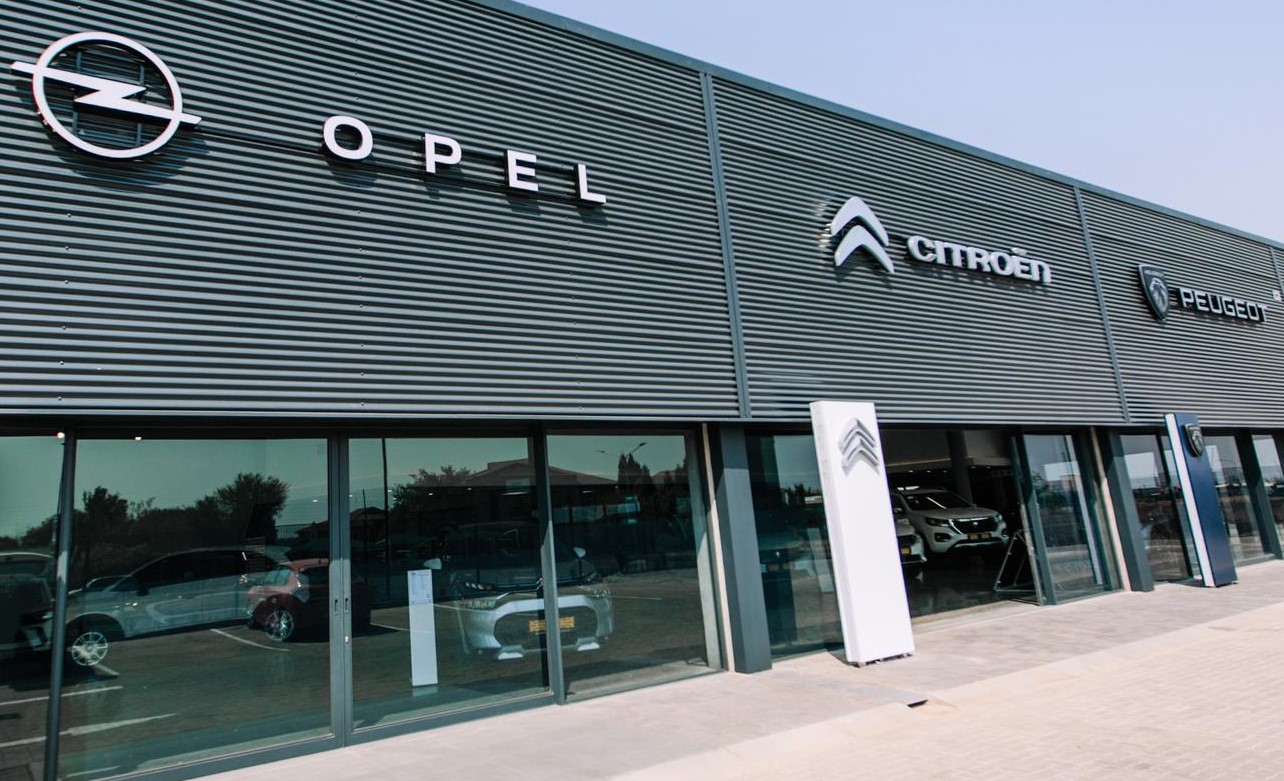
Stellantis multi-brand dealerships in South Africa. A consolidation of once competing brands and models into one entity.
Things are dour, but Stellantis doesn’t think so
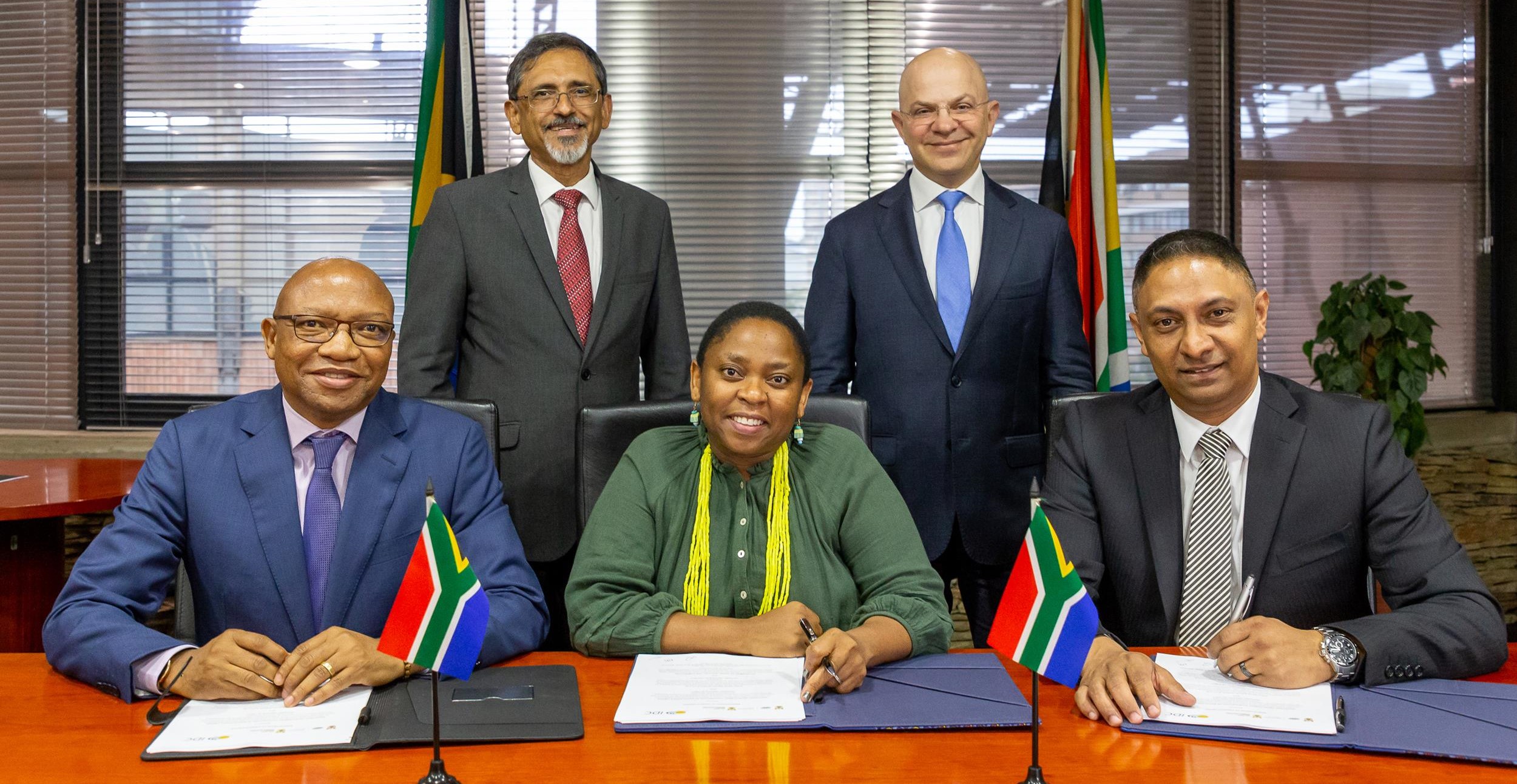
Last week’s announcement regarding Stellantis’ plans for a local automotive assembly facility wasn’t very detailed. All we know, for now, is that the group has signed a memorandum of understanding with the Department of Trade and Industry (DTI), which is the arm of the Government that manages the destiny and incentive framework for South Africa’s automotive industry. For the record, the DTI has been ponderous in adapting to new energy vehicle realities for South Africa’s automotive export markets.
The memorandum of understanding between Stellantis and the DTI is, well, like a left swipe on an online dating app. And the date for Stellantis to open its South African automotive facility is 2025. But as we all know, a lot can happen between that left swipe and a meet-up in the real world.
What’s one of the most challenging aspects of online dating? Choosing a venue for that first meeting. And that is a crucial detail that Stellantis and the DTI aren’t sharing, at least not yet.
They have confirmed the Stellantis automotive facility will be in a special economic zone (SEZ). There are 11 of these in Mzansi. Ford dominates the only automotive SEZ, in Tshwane. But it’s an inland location with all the terrestrial local transport issues one would want to avoid, relating to trucks and trains.
Stellantis South Africa’s management and officials from the Department of Trade and Industry. Smiling. For now.
More automotive assembly for the Eastern Cape?
Ideally, you want a South African automotive assembly asset located in a port, which would help the facility avoid Transnet’s pending rail transport disaster. Luckily for Stellantis, most of South Africa’s commercial ports are SEZs. And one, in particular, has a lot of excess capacity and space: Coega.
The greater Gqeberha area has VW’s plant in Kariega, with Isuzu’s bakkie assembly and Ford’s engine plant in Struandale. Despite 3 significant automotive assembly facilities in Gqeberha, the adjacent ports’ overall handling and shipping logistics aren’t overburdened. Volkswagen (VW) has never been interested in exporting cars through Coega’s port; the Wolfsburg-based firm’s subsidiary is quite comfortable with its Port Elizabeth harbour arrangement. Well, this leaves a lot of excess capacity at the former.
For Stellantis, an automotive assembly facility in Gqeberha would make the most sense. The rumour is that the group would set up some form of facility sharing or expansion of an existing site. BAIC’s facility in Coega’s special economic zone would be the most likely candidate for that…
Revealed with great fanfare and promise in 2018, the BAIC facility doesn’t appear to be doing much at present, although that could change this year. Assuming complementary assembly volumes exist between them, Stellantis and BAIC could cooperate in a single facility.
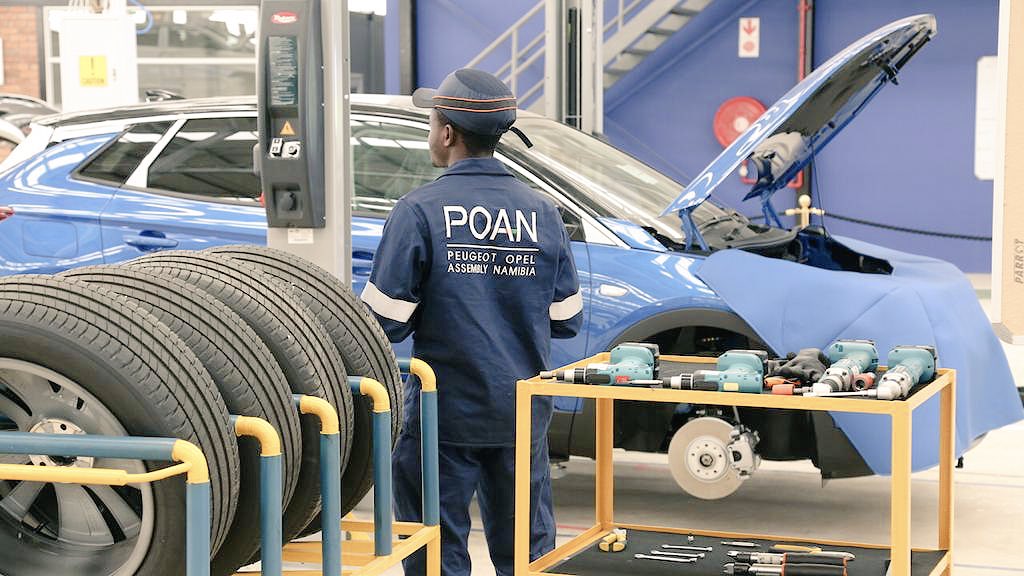
The Namibian situation is something Stellantis inherited from PSA.
What about the Peugeot-Opel ‘factory’ in Namibia?
If you want to build vehicles in South Africa, you have 2 options: import CKD kits or do what BMW, Ford, Isuzu, Nissan, Mercedes-Benz, VW, and Toyota do – complete assembly. But to do the latter, where most government incentives are, you need great local suppliers and a considerable investment in machinery.
There is an excellent local automotive supply chain, but many of its constituents are aligned with BMW, Ford, Isuzu, Nissan, Mercedes-Benz, VW and Toyota.
If it intends to build complete vehicles, Stellantis would need to set up engine milling, body stamping, chassis welding and intricate cabin trimming. What’s more, it would need to find, secure and onboard many local suppliers. That could be challenging; CKD (completely knocked down) kits are much easier.
Amid the fanfare about Stellantis’s intent for a 2025 automotive assembly project in South Africa, it’s worth remembering they already have one, in neighbouring Namibia.
In 2018, PSA (the Peugeot-Citroen group, which later incorporated Fiat Chrysler Auto to become Stellantis) announced it would access the broader Southern African market (with a primary focus on South Africa), via a Namibian assembly facility in Walvis Bay.
This Namibian project has been quite a disaster, measured in productivity and viability. Since 2018, the Walvis Bay facility has only assembled 153 Peugeot 3008 and Opel Grandland units. It would effectively have no future with the presence of a dedicated Stellantis equivalent in South Africa.
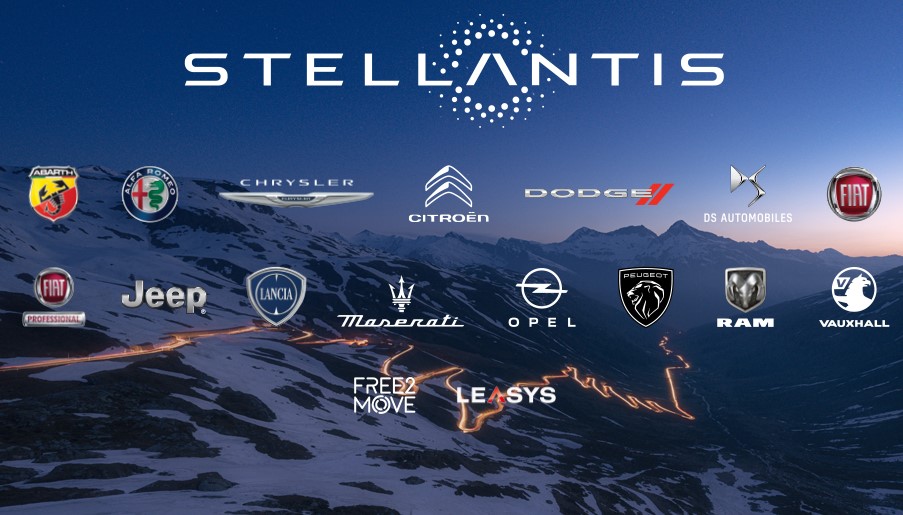
Stellantis includes American, French, and German brands, but the background to this organogram image is an Italian landscape.
Stellantis is a complicated company
To help us imagine what Stellantis will build in its South African SEZ facility (by 2025), we need to evaluate where the group makes the most money – and with which models.
North America is the reason that Stellantis does well. Last year, it outperformed General Motors and Ford, for profitability. The most significant proportion of Stellantis revenue transacts in North America. Ironically, a market where only 7 of its 16 brands trade.
Stellantis is a very complex car company. Only the VW Group is more diverse in its product range, but it doesn’t have to account for the complex cultural adjacency that exists at Stellantis.
The VW Group is almost completely German. At Stellantis, you have Jeep and RAM, which are products that make very little sense in Europe, but those RAM bakkies and Jeeps drive most of Stellantis’s profits. American products with European management. It’s very unusual.
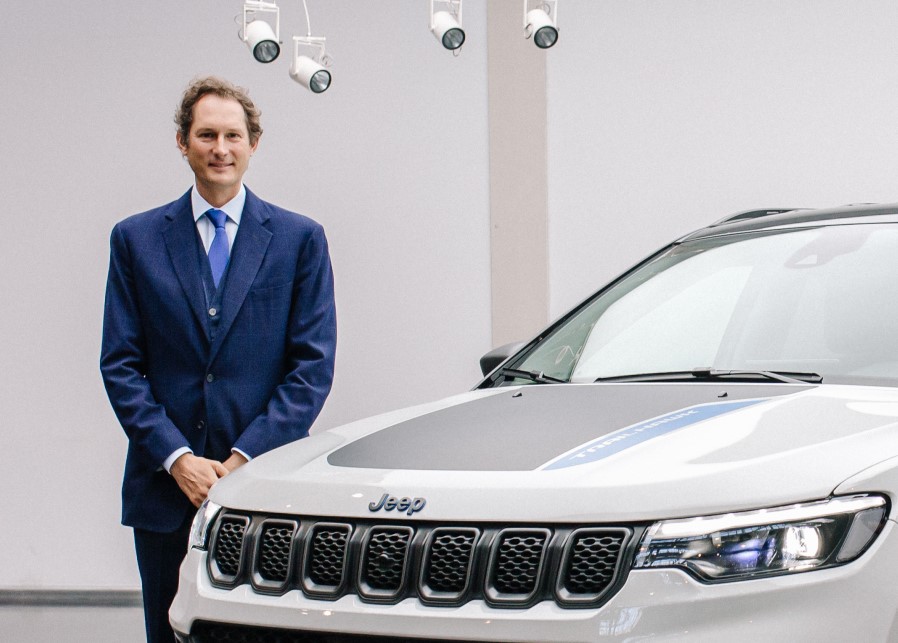
John Elkann has an American name, but Stellantis’ chairperson is the grandson of Gianni Agnelli, the richest man in modern Italian history.
Don’t forget about the Italian factor
Despite America being where Stellantis makes most of its money is made, the group’s strategy and corporate decisions are made by a majority European board. And it’s one with significant influence from Italy’s powerful industrial family, the Agnellis, via their shareholding in Fiat.
The Stellantis business is effectively American-engineered products making money, while French and Italian directors make the decisions. As we said: it’s complicated.
Stellantis’ board is familiar with managing the company’s cultural complexity. That could be the reason for – and confidence in – Stellantis’ belief that it can establish an assembly presence in South Africa, which is a complex risk case, for any international business.
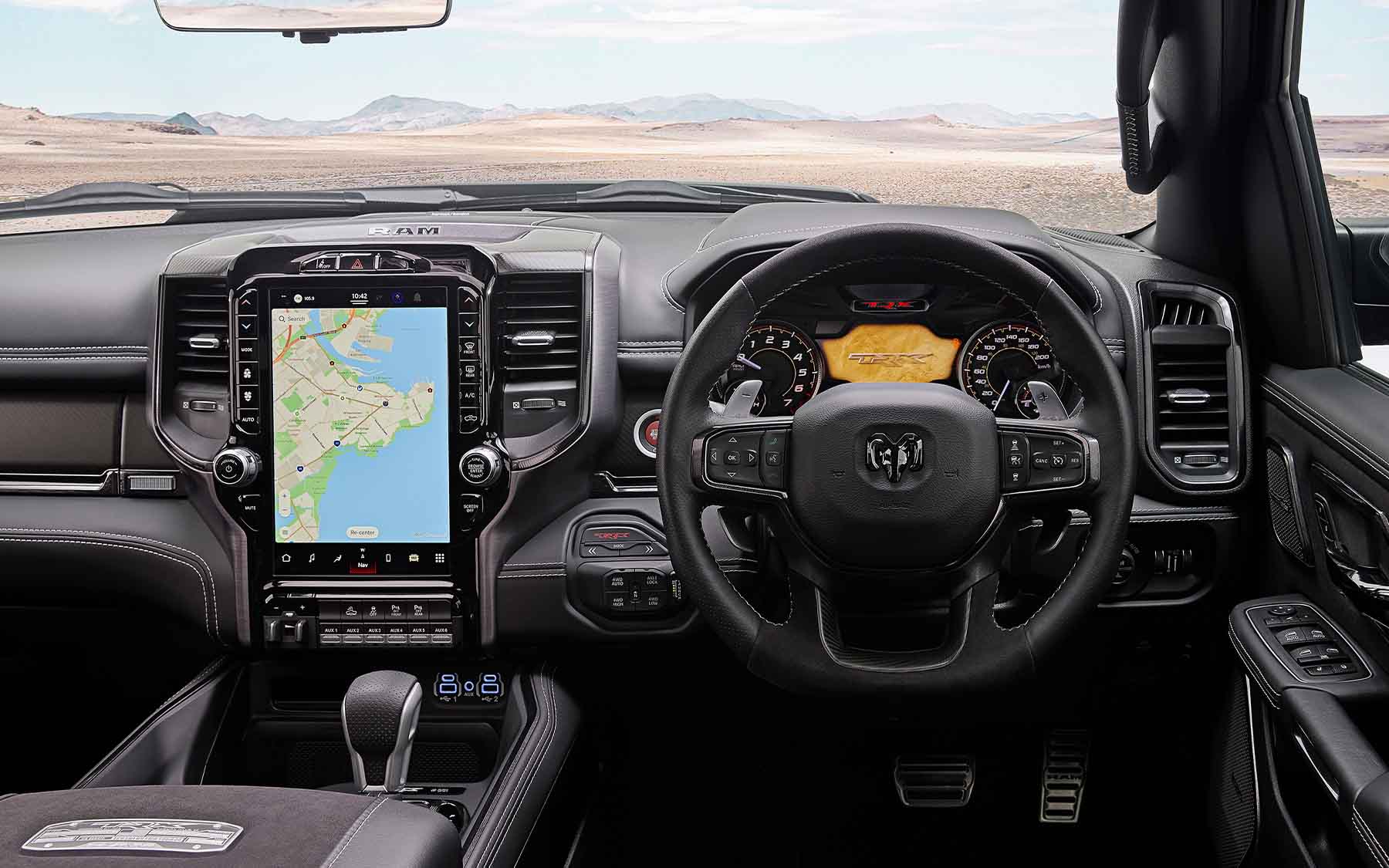
Yes. That is a right-hand-drive RAM 1500 bakkie, with a 6.7-litre Cummins six-cylinder engine. RAM retails in Down Under.
What will Stellantis possibly build in South Africa?
South African automotive factories make many more vehicles for export than local consumption. For Stellantis, it will be no different. But what would be the smartest model line to produce locally?
Domestic automotive assembly has established bakkie expertise. Few countries know bakkies better than we do; demanding customers have shaped the market and assembly excellence of our industry.
What the South African automotive industry does not have, is an established supply chain to support battery-electric vehicle (BEV) manufacturing. That discards the business case for locally built Citroens, Peugeots, Opels and Fiats – which are all brands that are electrifying their entire product portfolios.
Stellantis’ global product business is quite simple: you either build Jeep and RAM, or you produce much smaller and more complex, battery-electric vehicles for Citroen, Fiat, Peugeot and Opel. Guess where South Africa would fit in? Exactly. Bakkies.
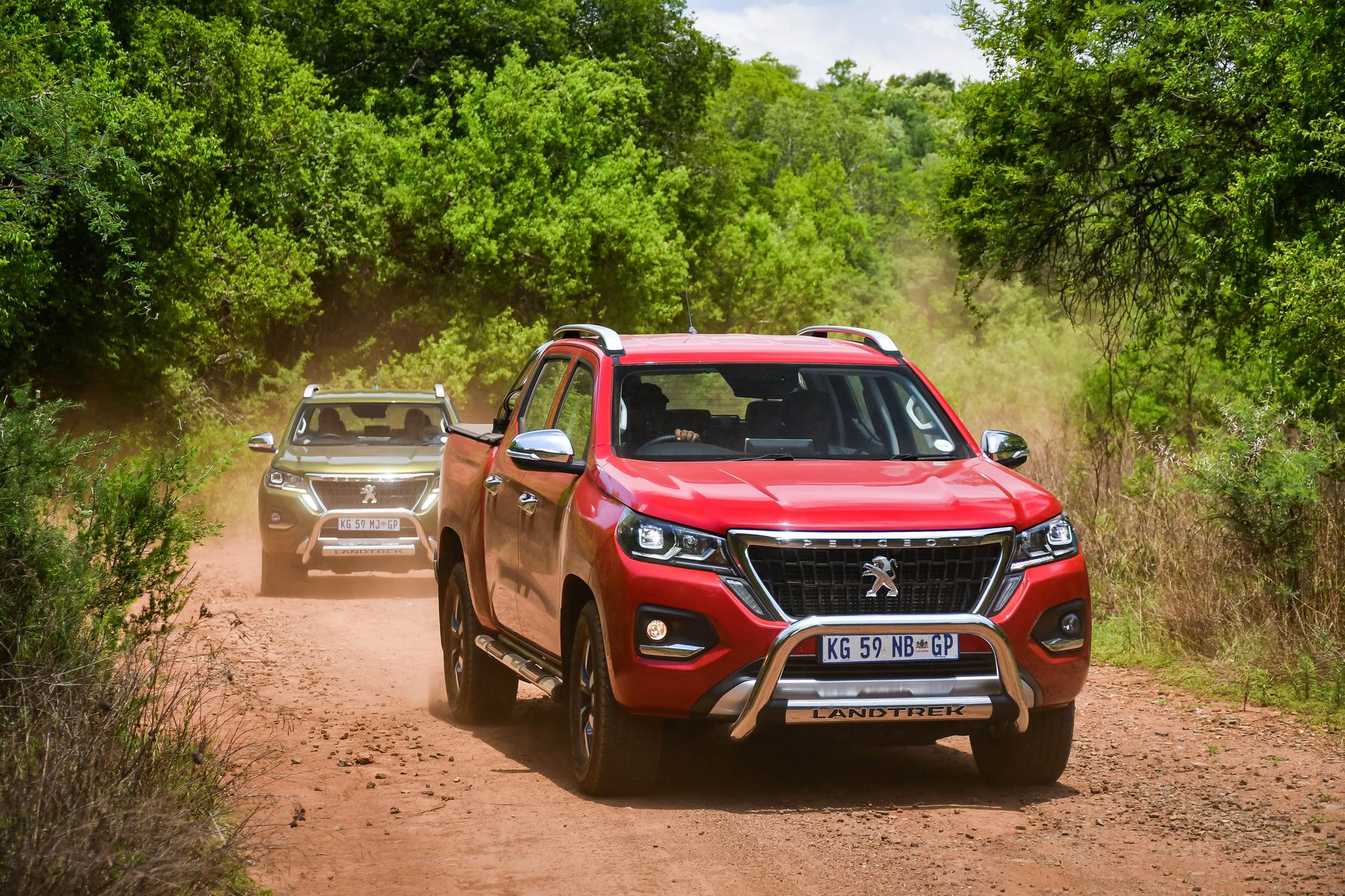
Locally built Landtreks could be a lot more price competitive and project the French bakkie model into Africa.
Huge, mid-sized or small bakkies?
If Stellantis is most likely to build bakkies in South Africa, will you be driving a right-hand drive RAM in 2025? Probably not… despite the proven viability of right-hand-drive RAM bakkies in Australia.
The two most likely existing vehicles for Stellantis to assemble at its South African facility would be Peugeot’s Landtrek bakkie or the Fiat Strada.
RAM product planners have spoken of a “global” bakkie to rival Ford’s Ranger, but it would be a large project with significant volume aspirations – possibly beyond the capacity of Stellantis’ South African vision. That said, the 2025 dateline would correspond to a new global vehicle platform launch for RAM.
The Peugeot Landtrek has substantial export potential into Africa, the Middle East and South America. And it’s quite a simple vehicle to assemble. The Landtrek could possibly be rebranded as a Fiat Fullback.
Compared with passenger cars, bakkies aren’t sophisticated and require reasonably straightforward assembly. It’s how Mahindra has managed to scale its local business so quickly, as demand has increased… because the Mahindra bakkies sold in South Africa are assembled from CKD kits.
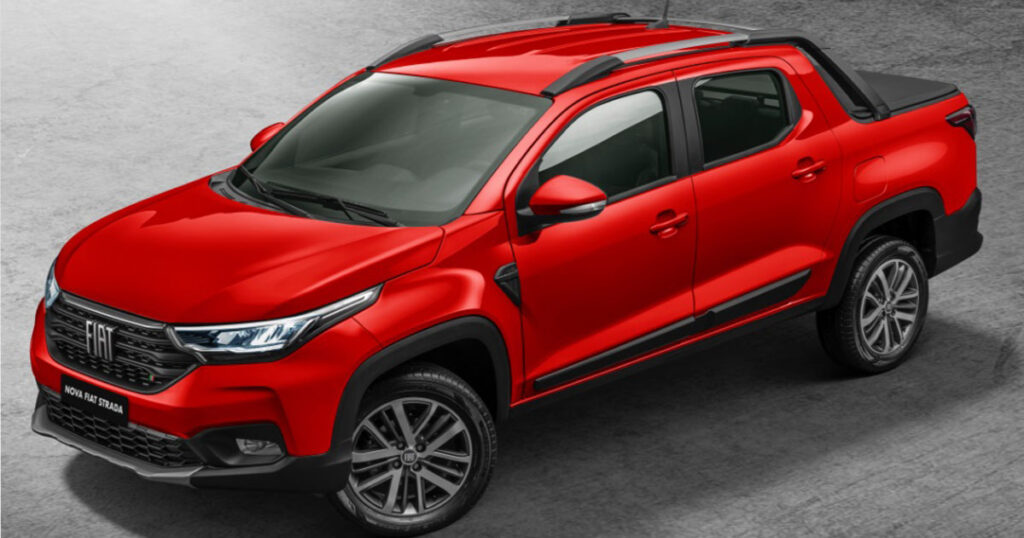
Strada double-cab would have no rival from South Africa’s dominant bakkie brands: Toyota, Ford and Isuzu.
A compact bakkie comeback for Fiat?
More interesting than Peugeot’s Landtrek, would be Fiat’s Strada. Many South Africans still pine for the era when the Ford Bantam, Opel Corsa/Chevrolet Ute, Fiat Strada and Nissan NP200 were all vying for local compact bakkies customers.
The Strada is a compelling bakkie product, especially the double-cab version (shown above). And it would enter the local market without any rivals. In a market where bakkies dominate, the absence of a small bakkie model range is unquestionably an opportunity, but not one without difficulty.
An issue with Strada is its limited export potential into Africa and the Middle East where larger bakkies are preferred. Why do African markets outside ours, and the Middle East in general, prefer mid- and full-sized bakkies? Because they are more appropriate for rough road conditions and hauling heavy loads.
But still, you’d love a Fiat Strada double-cab, wouldn’t you?
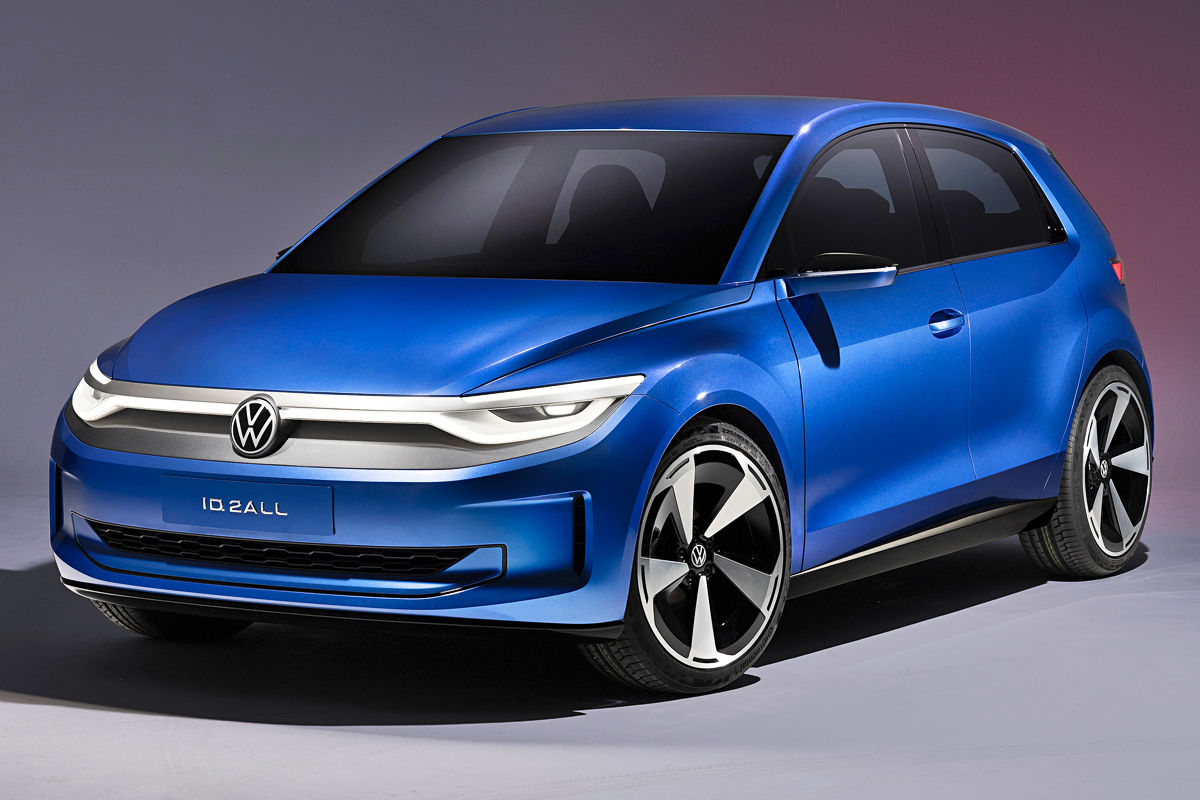
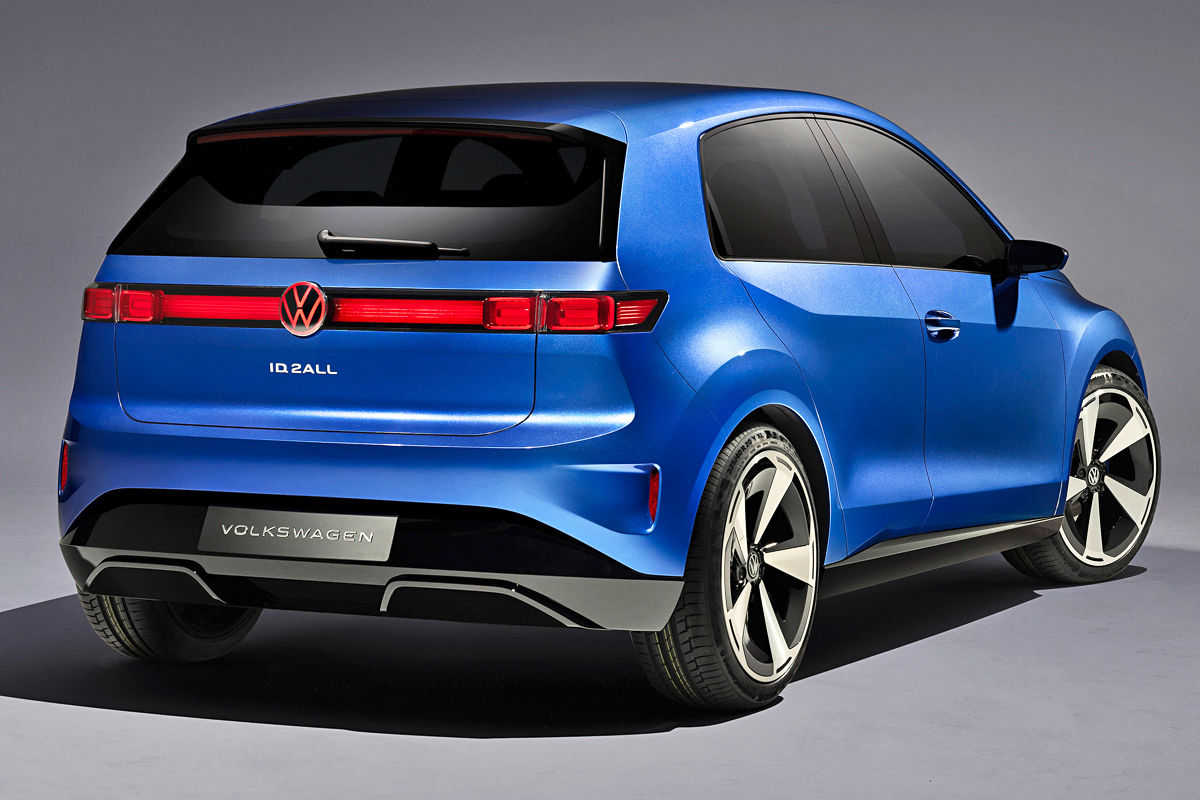
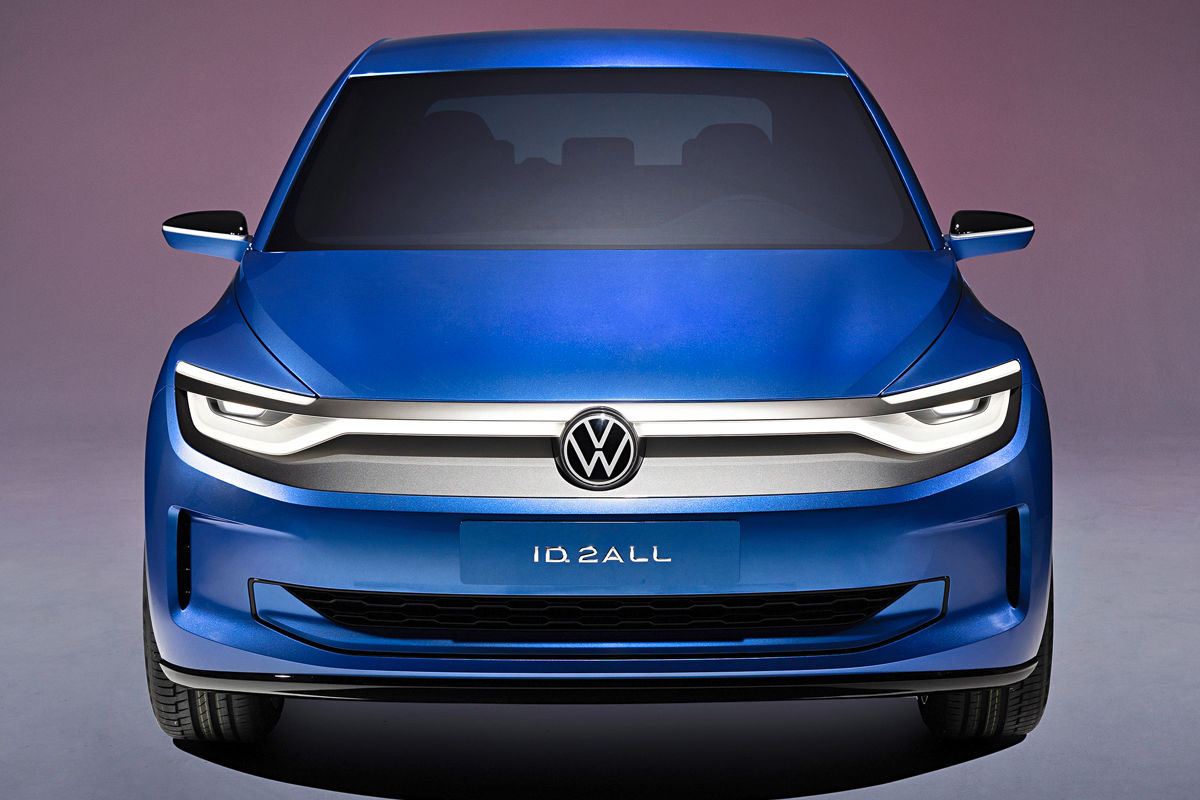
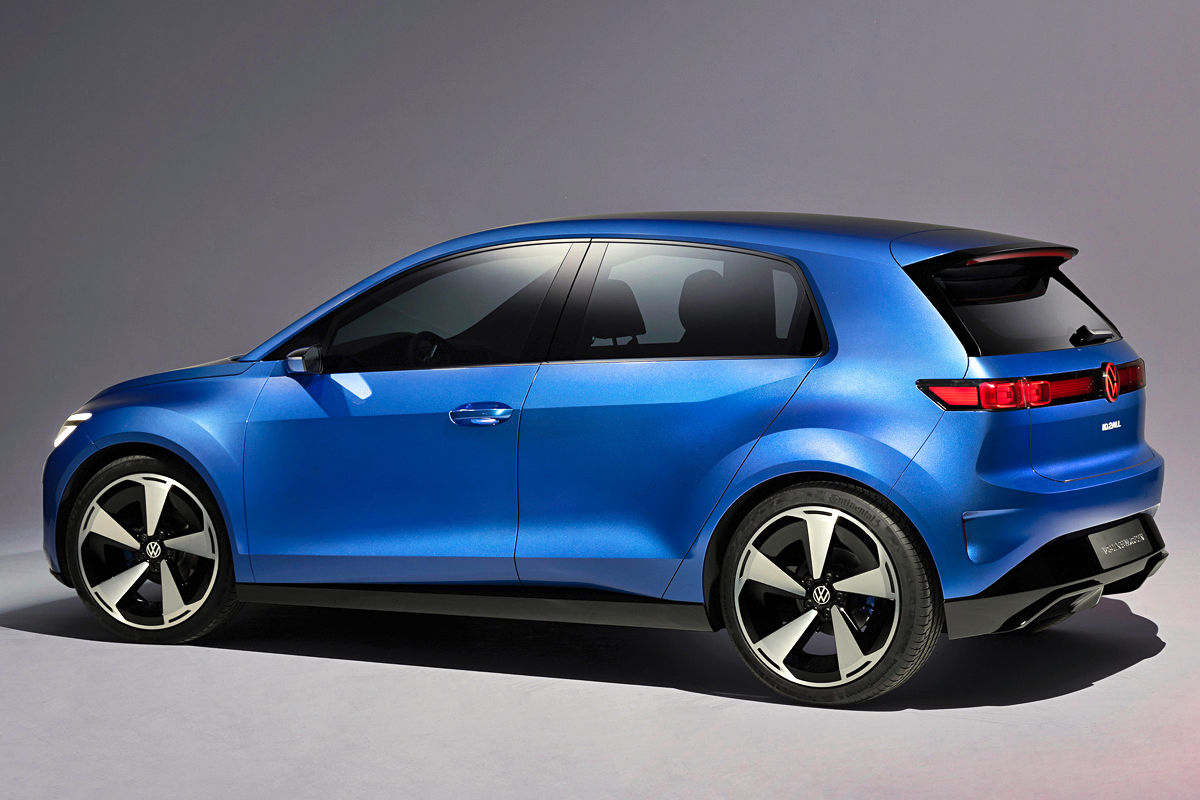
The new Volkswagen ID. 2all concept has been revealed, previewing a production electric vehicle the German brand promises “will be as spacious as a Golf and as inexpensive as a Polo”…
The wraps have come off the new Volkswagen ID. 2all, a concept car that gives us a foretaste of an upcoming electric vehicle (EV) the Wolfsburg-based firm promises “will be as spacious as a Golf and as inexpensive as a Polo”.
VW says the production version of the ID. 2all will be based on the group’s so-called “MEB Entry” platform and presented to European markets in 2025 with a targeted starting price of “less than €25 000” (so, under around R490 000, at the current exchange rate). It will be one of 10 new electric models Volkswagen plans to launch by 2026.
Of course, the Kariega-built Polo hatchback is potentially facing the axe in Europe thanks to ever-tightening emissions regulations in that part of the world. Should the Polo be pulled from the Old Continent, the production version of the ID. 2all may well serve to fill the gap, along with another EV positioned below it (ID.1, anyone?).
Will we see the production version of the ID. 2all here in South Africa? Well, there’s no confirmation for the moment, though battery-powered models are indeed on the way, with VWSA head of passenger cars, Steffen Knapp, recently telling Cars.co.za the ID.4 would be the brand’s first EV to launch locally.
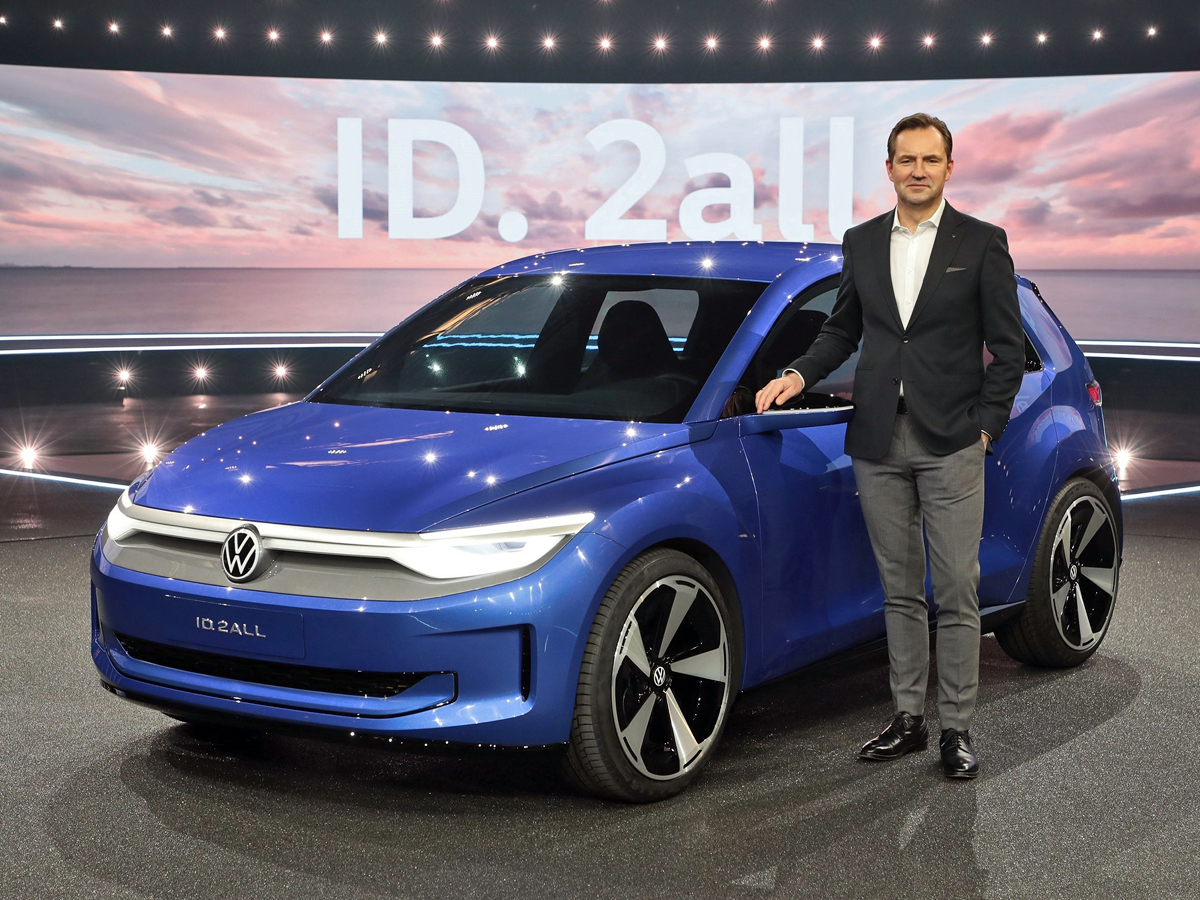
Thomas Schäfer, CEO Volkswagen Brand, poses with the new ID. 2all concept.
The front-wheel-drive ID. 2all concept uses a 166 kW electric motor and boasts a calculated single-charge range of up to 450 km (based on the WLTP cycle). Though VW has yet to officially announce the battery-capacity details (reports suggest 38 kWh and 56 kWh packs will be available), it does say DC quick-charging stations will allow replenishing from 10 to 80% in 20 minutes. The German manufacturer furthermore claims a 0-100 kph sprint time of under 7.0 seconds, with the top speed set at 160 kph.
Measuring 4 050 mm long, the VW ID. 2all concept is a mere 24 mm shorter from bow to stern than the Polo hatch. However, thanks to its MEB Entry underpinnings, the show car scores a 2 600 mm wheelbase, or an extra 48 mm between its axles compared with the popular hatchback. At 1 530 mm, the battery-powered concept furthermore stands 79 mm taller than its combustion-engined sibling.
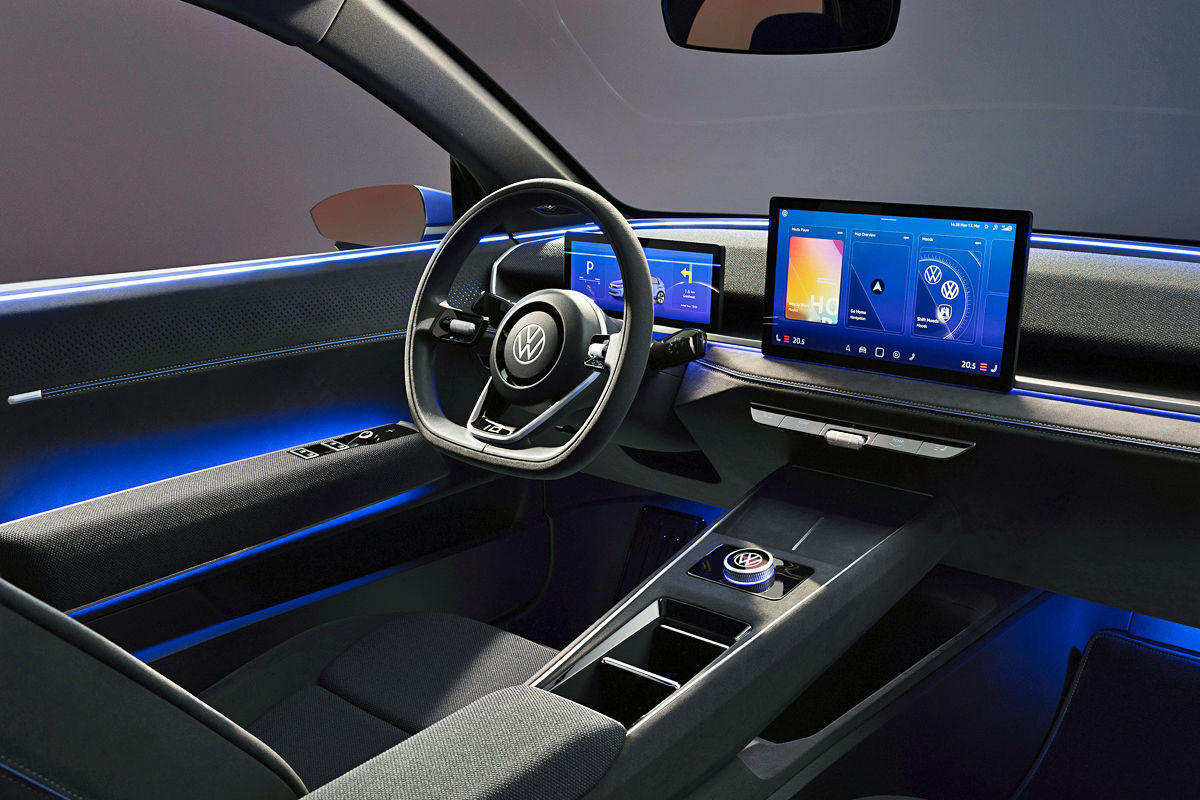
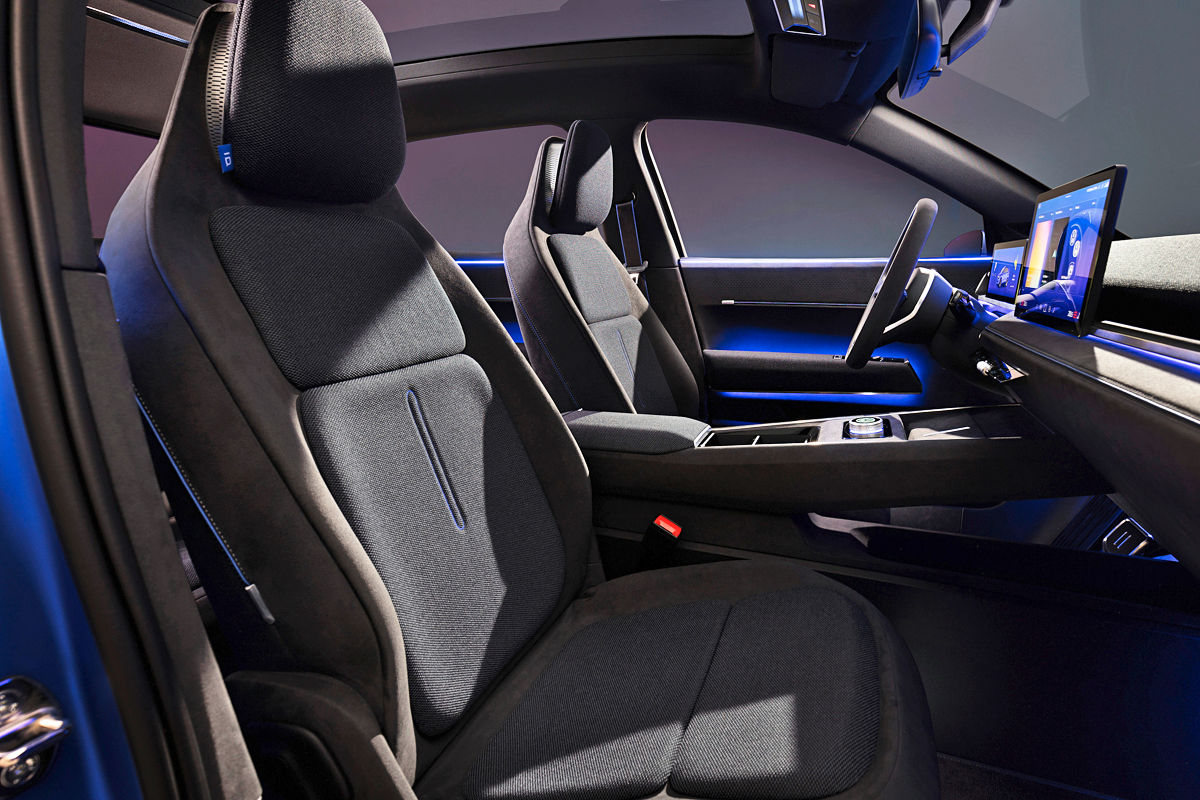
Volkswagen says the interior is “characterised by a high-quality appearance”, while the “self-explanatory” 12.9-inch infotainment system employs a physical volume control and a separate air-conditioning block. Luggage capacity is a claimed 490 litres, a figure that is expandable to 1 330 litres with the seats dropped flat (yes, that’s appreciably more than a Golf 8).
And the exterior design? Well, VW says the ID. 2all also serves to preview the brand’s new design language, which is based on 3 pillars: “stability, likeability and enthusiasm”. The automaker believes it was important to lend the concept a “friendly face”, as well as a “good portion of dynamics and timeless elegance”. In addition, the German firm points out the concept’s new interpretation of a C-pillar design signature that harks back to the Mk1 Golf.
Claimed luggage- and utility-space figures eclipse even those of the Golf 8.
The ID. 2all concept was designed by Andreas Mindt, who took over as the new Head of Volkswagen Design at the start of February 2023. Mindt – who also spent time at VW Group brands Audi and Bentley – was responsible for designs that include the original Tiguan and the 7th-generation Golf. “We are transferring the DNA of our icons into the future. The ID. 2all is therefore also an homage to the Beetle, Golf and Polo,” said Mindt.
Thomas Schäfer, CEO of Volkswagen Passenger Cars and former head of Volkswagen Group South Africa, promised the production model would bring electric mobility “to the masses”.
“We are transforming the company rapidly and fundamentally – with the clear objective of making Volkswagen a genuine ‘Love Brand’. The ID. 2all shows where we want to take the brand. We want to be close to the customer and offer top technology in combination with fantastic design. We are implementing the transformation at pace to bring electric mobility to the masses,” said Schäfer.
Before the production version of the Volkswagen ID. 2all debuts, the automaker will introduce the new ID.3, a long-wheelbase version of the ID. Buzz and the ID.7, all in 2023. These models are expected to be followed by a “compact electric SUV” by 2026 and, “in spite of all the challenges”, Volkswagen says it is also working on an electric car “at a price of less than €20 000”, which will surely wear the ID. 1 badge…
Based on the unaudited fuel price data from the Central Energy Fund (CEF), the Automobile Association (AA) says SA motorists should prepare for an increase of around 25 cents/litre in the price of petrol, however it’s not all bad news, as diesel should drop by 20 cents/litre. The price of illuminating paraffin is also expected to drop by around 68 cents/litre.
“The weaker Rand to US Dollar exchange rate is contributing to the increases in petrol and clawing back some of the decreases to diesel and illuminating paraffin, with lower international oil prices having the reverse impact. However, in the case of diesel and illuminating paraffin, the weaker Rand is not resulting in increases,” notes the Association.
As a reminder, these numbers are not confirmed and are based on the data right now in the middle of March 2023 and a lot can happen between now and the end of March. “Firstly, this data is mid-month, so the numbers should change positively before the official adjustment is made by the Department of Mineral Resources and Energy at month end. The second factor is that the Rand appears to be steadying against the US Dollar, which should bring further relief in specifically the petrol prices,” says the AA.
Interestingly, the fuel levies will not be increasing in April 2023 which helps ease the pain on South African motorists. “Fuel levies are traditionally increased in April, but the Minister of Finance heeded calls by the AA and in his February Budget Speech indicated that this will not happen this year. Although not a saving as such, any increases would have added additional pressure to fuel prices, and we again welcome his decision not to increase these rates for 2023.” said the AA.
Fuel Price Forecast for April 2023 in South Africa
Fuel Type
March 23 Inland
March 23 Coast
April 23 (projected) Inland
April 23 (Projected) Coast
Petrol Unleaded 93
R22.60
R21.95
R22.85
R22.20
Petrol Unleaded 95
R22.90
R22.25
R23.15
R22.50
Diesel 0.05% (wholesale)
R21.60
R21.95
R21.40
R21.75
Diesel 0.005% (wholesale)
R21.70
R21.06
R21.50
R20.86
Fuel price data courtesy of the department of mineral resources and energy