Fuel price adjustments for August 2022 are confirmed and after a long bout of brutal increases, motorists will finally see fuel prices slashed.
Fuel prices in South Africa have ballooned in the first half of 2022 putting huge strain on household budgets while also having a negative impact on commodity prices.
At the halfway mark of July 2022, mid-month fuel price is indicated that the price of fuel would be slashed in August 2022. That indication came to fruition at the end of July following the announcment of fuel price cuts that would bring some relief to heavily over-burdeoned motorists.
Numerous factors impacted the reduction including the drop in the price of Brent Crude oil and petroleum products during the period under review and falling demand for Brent Crude oil. However, the Rand weakened against the dollar during the same period which eroded the depth of the fuel price decrease. Furthermore, the government-imposed reduction of the General Fuel Levy (75c/l) is set to come to an end on 2 August 2022.
Fuel Price Decreases for August 2022
The fuel price adjustments will take effect on Wednesday, 3 August 2022.
Petrol (93 / 95 ULP and LRP) will decrease by R1.32 per litre.
Diesel (0.05% sulphur) will decrease by 88 cents per litre.
Diesel (0.005% sulphur will decrease by 91 cents per litre.
Illuminating Paraffin will decrease by R1.44 per litre.
Earlier in July 2022, the Automobile Association (AA) noted that despite the forecast decreases, fuel prices in South Africa remain high and that the previous sizable increases will still impact the economy in coming months.
“Decreases offer immediate relief but increases filter into the economy over time, especially as those sectors affected by them don’t immediately adjust their prices downward but instead wait for more consistent fuel cuts that lower their input costs. We stand by our call that a review of the fuel price structure, and an audit of the components that comprise the fuel price, is essential and long overdue to offer sustainable solutions that mitigate against rising fuel costs in the country,” said the AA.
The facelifted version of the flagship BMW X7 has been confirmed for SA. Here’s when it’s arriving and which models we’re getting.
The BMW X7 is the Bavarian brand’s take on a flagship luxury SUV. As a rival to the Mercedes-Benz GLS, the X7 brings luxury in abundance, paired to powerful engines.
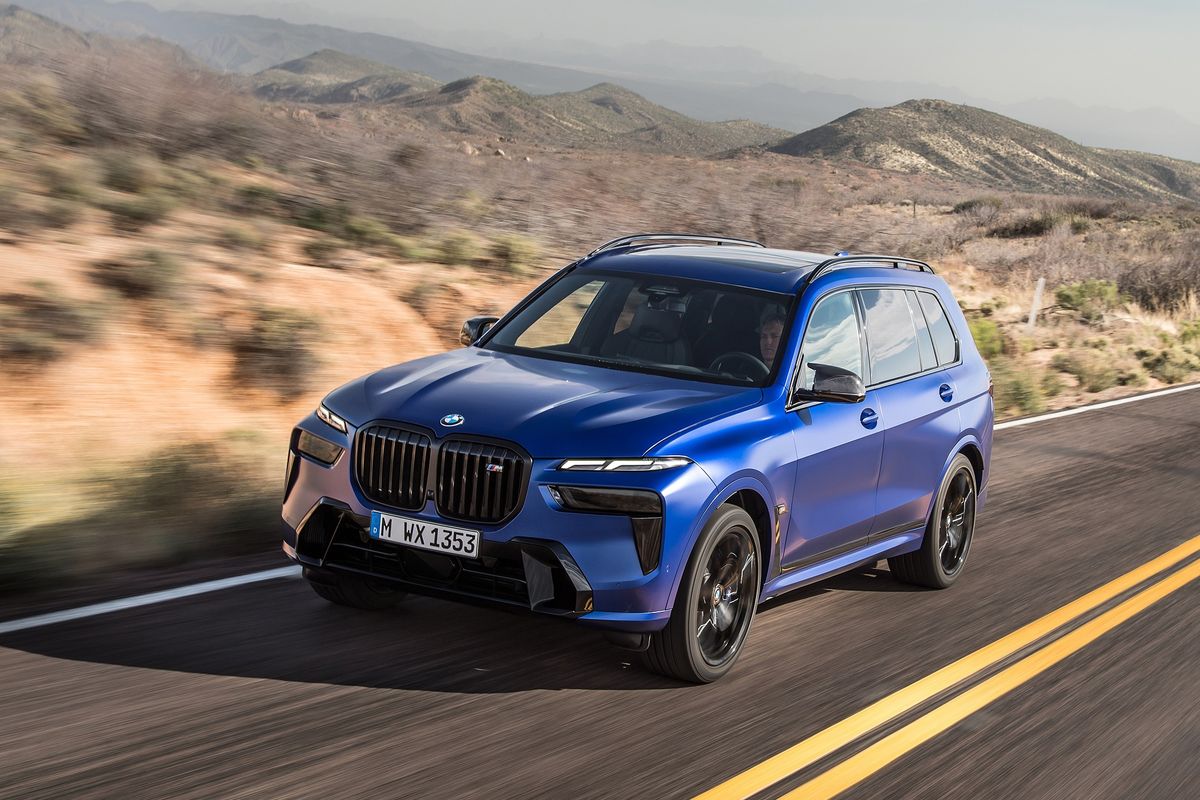
The design gets a rework with horizontally split LED headlights with the upper section featuring daytime running lights and matrix LED headlights seen in the lower section. The large kidney grille gains an optional Iconic Glow illuminated grille and for the first time the X7 can be equipped with 23-inch BMW Individual wheels. The rear end gains new LED light units with 3D graphics and BMW has also updated its M Sport packages and added a new Sparkling Copper Grey metallic body colour to the range.
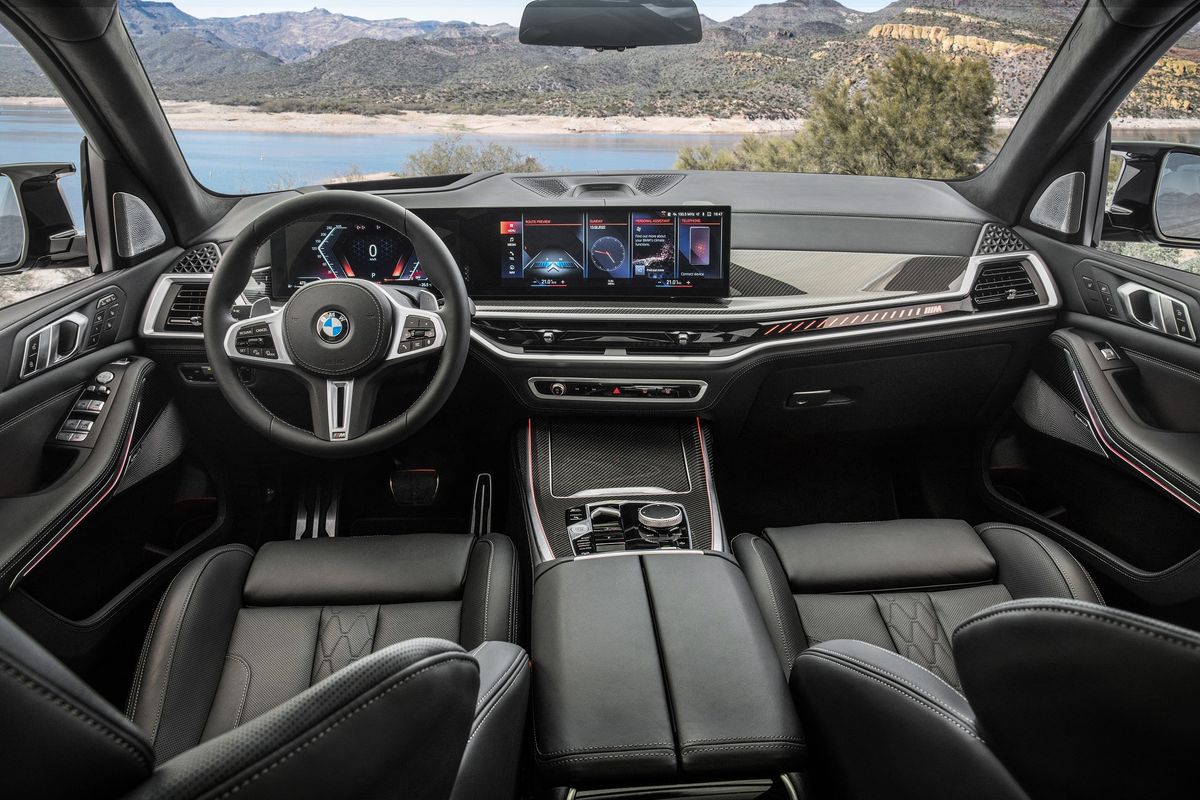
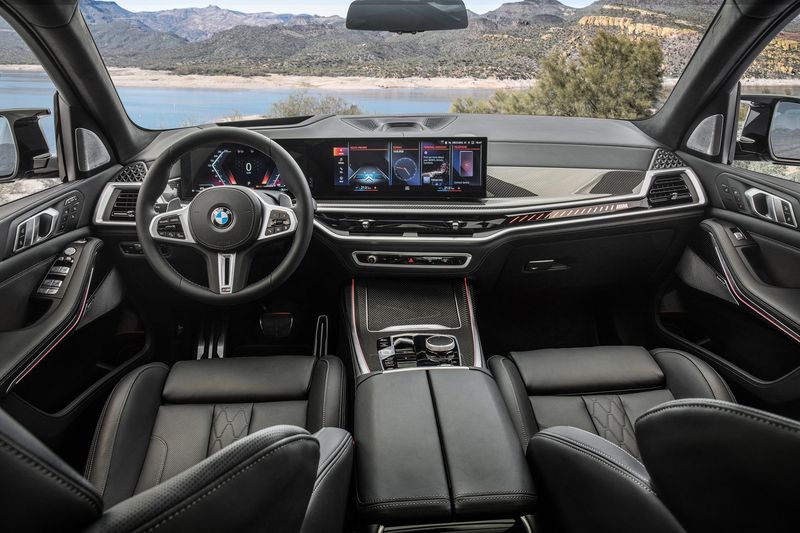
Key interior features include a large 12.3-inch instrument cluster and an even larger 14.9-inch infotainment system with the latest BMW Operating System 8. BMW has also added standard features such as Comfort Access, panoramic glass sunroof and heated front seats. If you look carefully, you’ll spot the gear knob has been removed, in favour of a much more discrete gear selector.
The X7 can seat 7 passengers as standard but it can be had as a 6-seater with 2 comfort seats in the second row as an option.
BMW X7 South African arrival
The facelifted BMW X7 will be arriving in the 4th quarter of 2022 and customers will be able to choose from two engines. For the diesel fans, the xDrive40d features 259 kW and 720 Nm from a 3.0-litre 6-cylinder. Headlining the X7 range is the M60i xDrive, a petrol-powered rocketship. A 4.4-litre turbocharged petrol engine produces 390 kW and 750 Nm.
As far as performance goes, the diesel powered xDrive40d is good for a 0-100 kph in 6.1 seconds while the M60i xDrive is said to sprint to 100 kph in 4.7 seconds. Both models feature automatic 8-speed gearboxes.
There will be 3 levels of trim for the xDrive40d (Design Pure Excellence, M Sport Package, M Sport Package Pro) and 2 trim levels for the M60i xDrive (M Performance, M Sport Package Pro)
How much does the updated BMW X7 cost in South Africa?
Not since the launch of the first-generation Cayenne has there been quite as much uproar about a new high-riding Porsche as with this, the new Cayenne Coupe Turbo GT. The reason? For the first time, Porsche’s premium SUV bears the evocative GT badge, which is usually reserved for the brand’s purest driver’s cars. The question is, can an SUV really justify it?
We like: Stonking performance, build quality, ride/handling balance, superb dynamics
We don’t like: Four-seat only, some of the extra-cost options should be standard
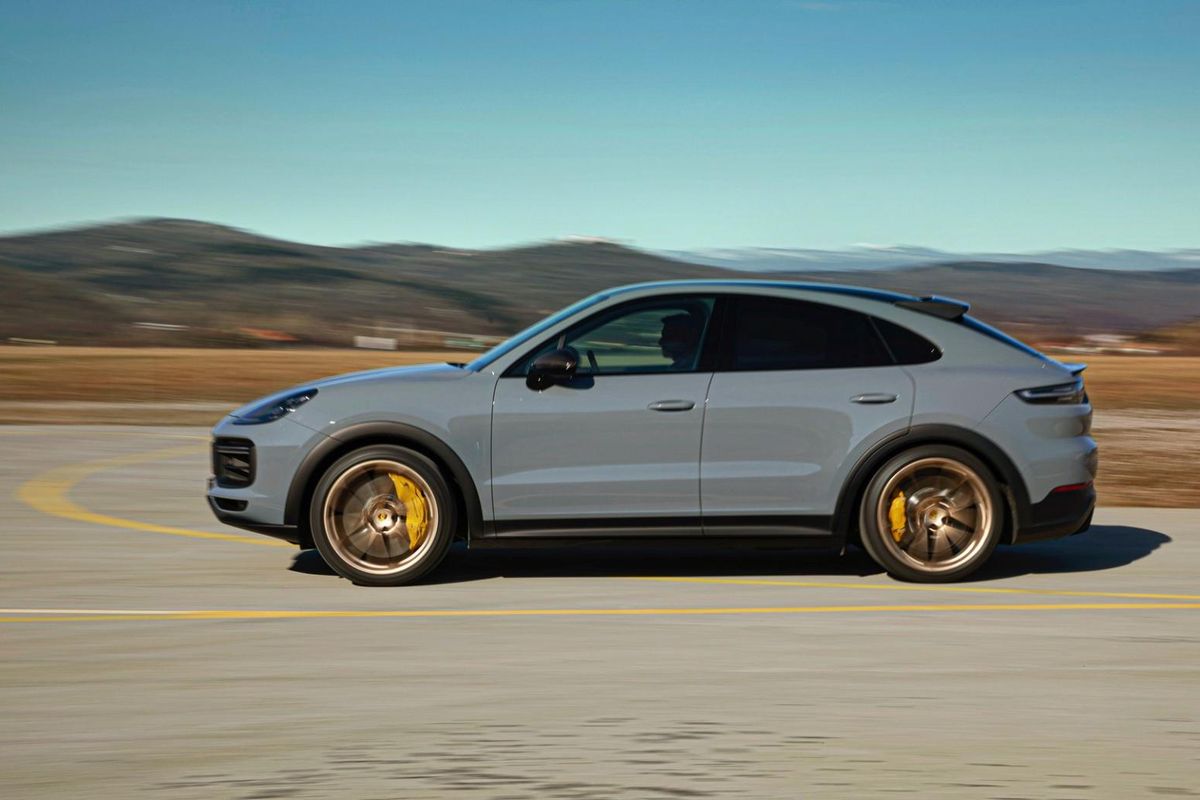
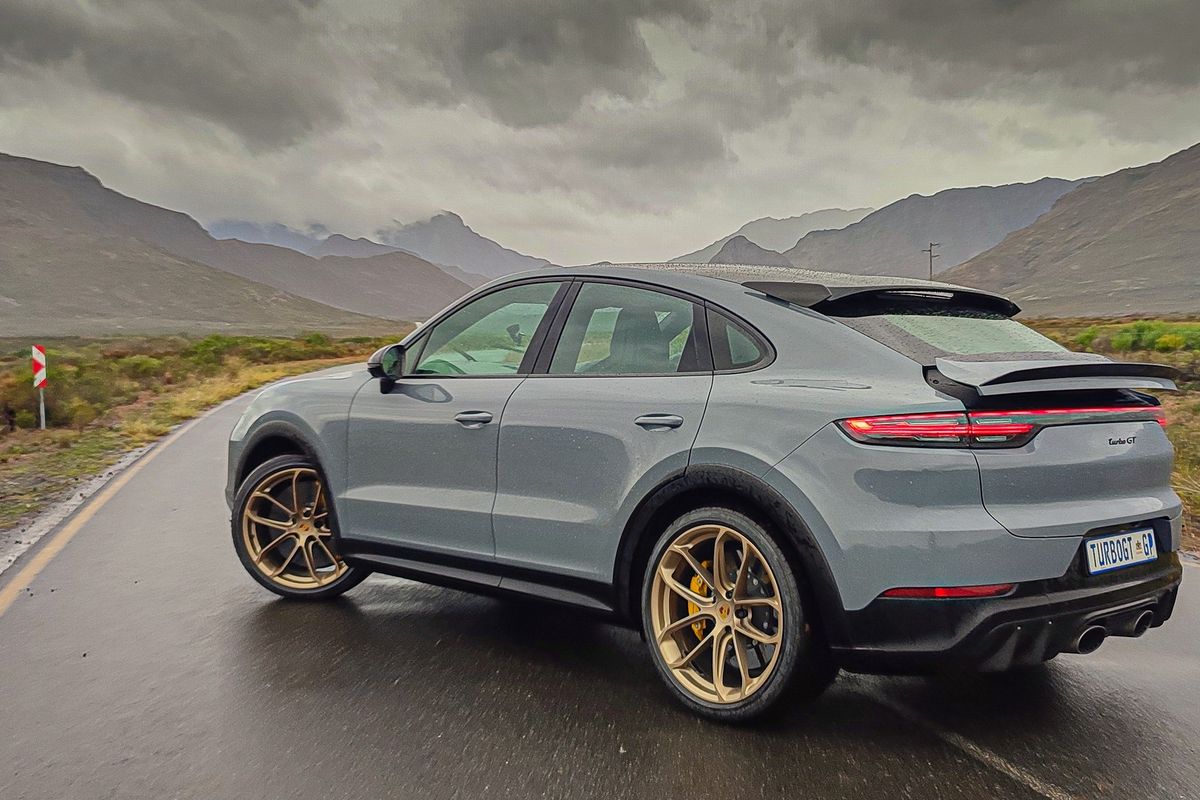
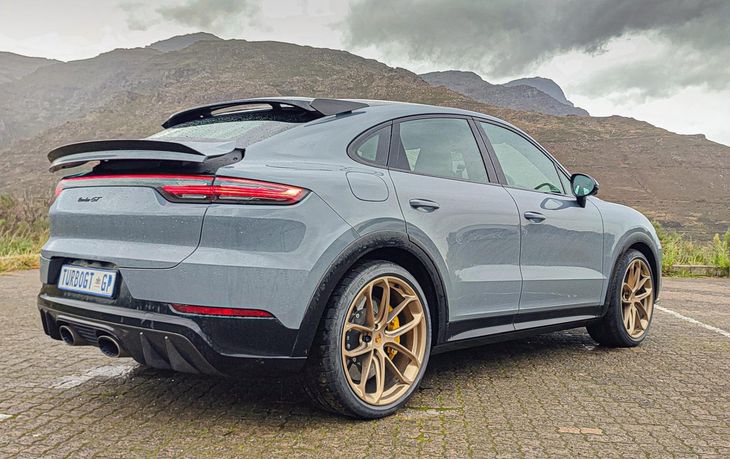
The Coupe Turbo GT is distinguished by its sportier front bumper, black cladding and a host of carbon-fibre addenda.
Where does the 2022 Porsche Cayenne Coupe Turbo GT fit in?
When Porsche first unveiled the Cayenne SUV in 2002, brand enthusiasts were up in arms. According to many of them, a company with such a storied history as a manufacturer of purist driving machines (exclusively sportscars, up to that point) simply had no business building high-riding SUVs. Nevertheless, the company persevered and the Cayenne quickly became Porsche’s cash cow, allowing the brand to not only survive, but thrive. And, as many have subsequently discovered, the Cayenne was indeed the “Porsche of SUVs”, with exceptional dynamics given its proportions and weight. These days, most of those folk who lamented the model’s introduction… drive Cayennes as their daily cars.
But now Porsche aficionados are upset once more, this time because the Zuffenhausen-based company has dared to apply the GT badge to a Cayenne for the first time. You see, in Porsche’s long and illustrious history of incredibly focused driving machines, a GT badge symbolises a Porsche distilled to its purest form. The fact that the GT team that usually works on Porsche’s hardcore road cars was involved in this new flagship Cayenne’s development should provide some hope that the company has made it work, but the question remains… Can a Porsche SUV truly be worthy of the GT badge?
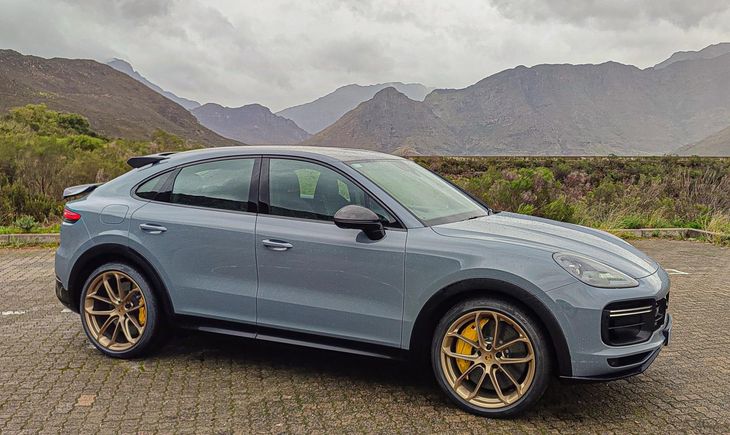
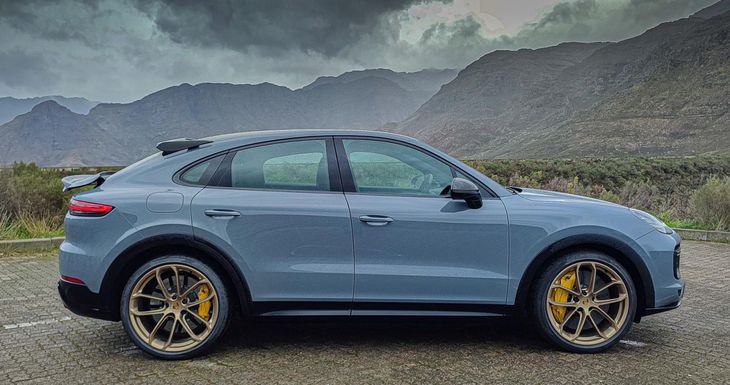
The 22-inch satin Neodyme (matte gold) wheels are standard on the flagship Cayenne.
How the 2022 Porsche Cayenne Turbo GT fares in terms of…
Design and Packaging
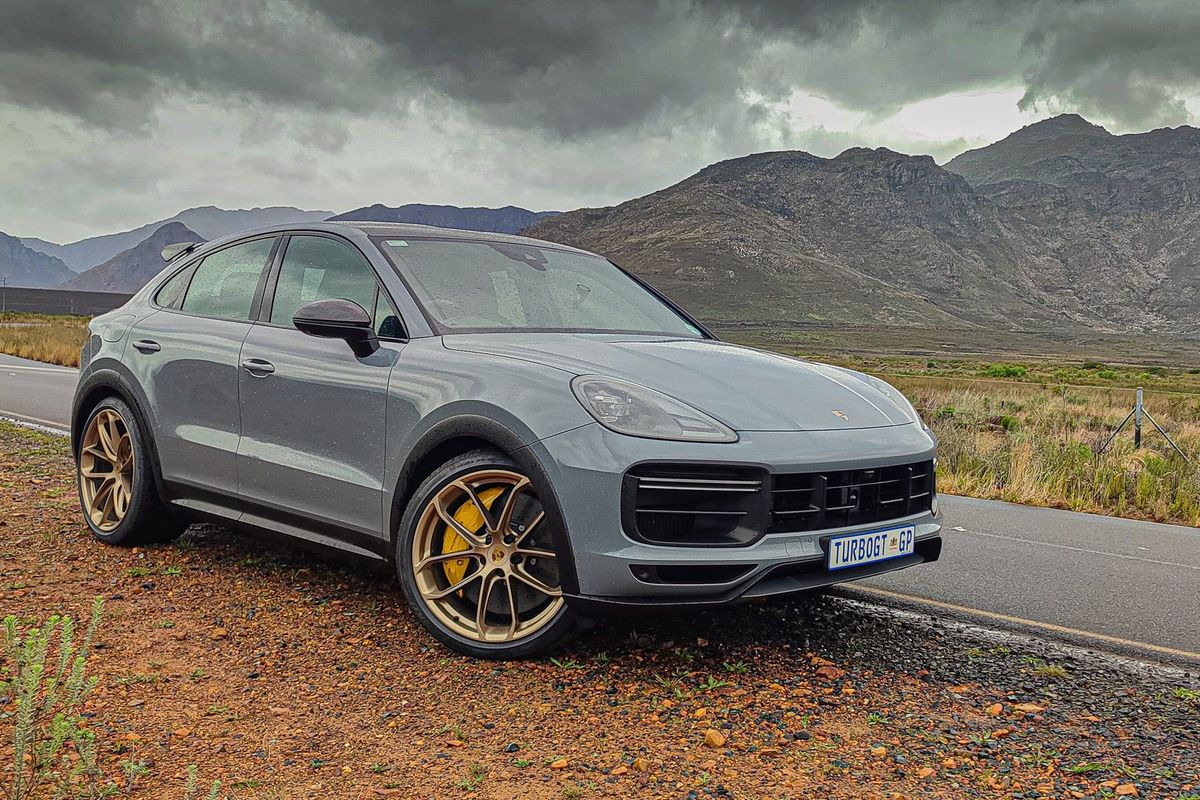
The Cayenne Turbo GT is only available in the Coupe body shape and is the new flagship of the range. Our test unit came specified in striking Arctic Grey paint (a R54 390 option), which contrasted nicely with the massive (22-inch) satin Neodyme (matte gold) wheels, which are standard fitment.
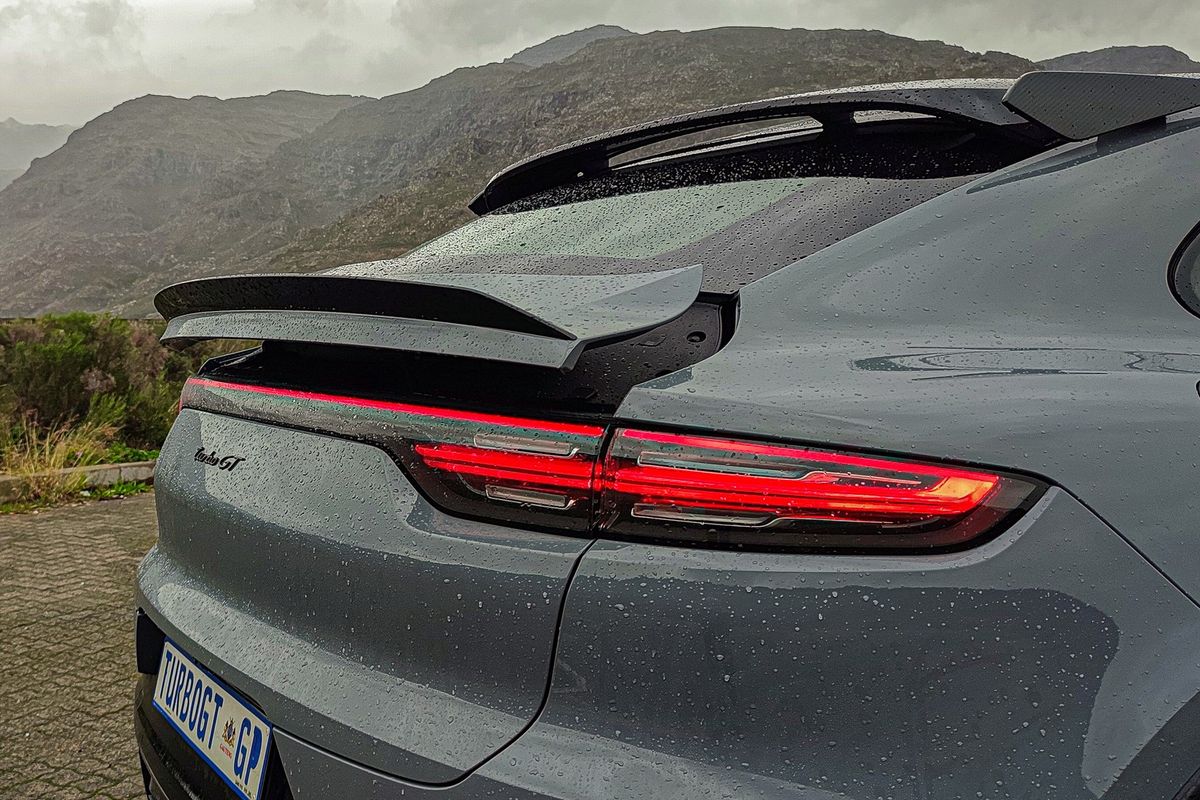
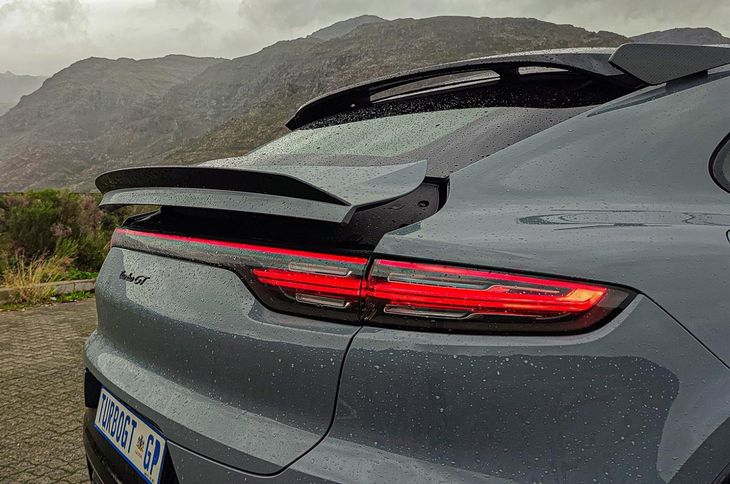
Look closer and you’ll spot a whole host of other distinguishing features – and many of them are functional, not merely cosmetic. The carbon-fibre roof, for example, is there to lower the centre of gravity. You also get a GT-specific front apron and spoiler lip, as well as larger side air dams. Black wheel-arch extensions add visual width (muscle) to the car, and there’s a neat carbon-fibre roof wing, in addition to an adaptively extendable rear spoiler lip that’s 25mm larger than the one fitted to the Turbo. Consequently, Porsche claims a downforce increase of around 40kg at the Turbo GT’s top speed. At the rear is a carbon-fibre diffuser panel, which frames the massive titanium exhaust outlets.
The elaborate roof wing and diffuser are fashioned from carbon fibre, while the adaptively extending spoiler is upsized.
Even so, our test team was of the opinion that the Cayenne Turbo GT didn’t present as “brash” or “blingy” (as is the case with its aforementioned rivals). In fact, those who don’t really know their Porsches might consider it a (tastefully) upgraded “normal” Cayenne Coupe. This endows the Turbo GT with considerable sleeper appeal…
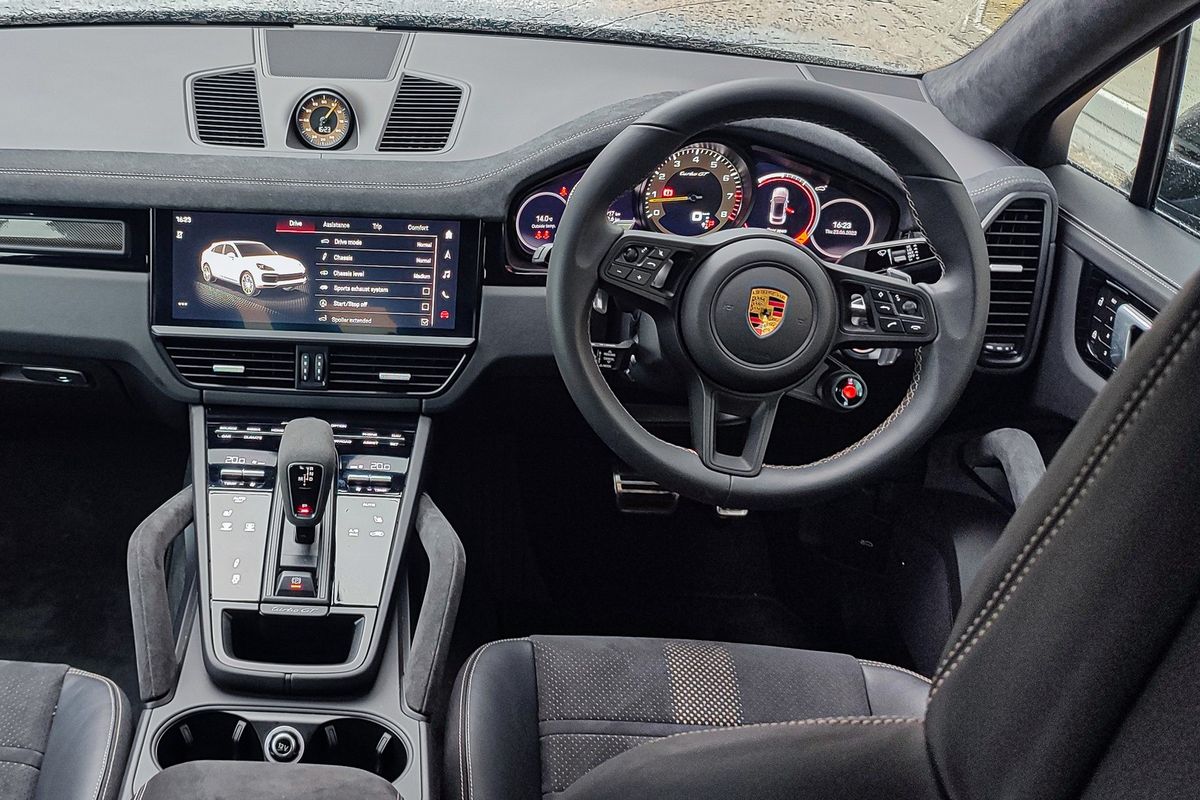
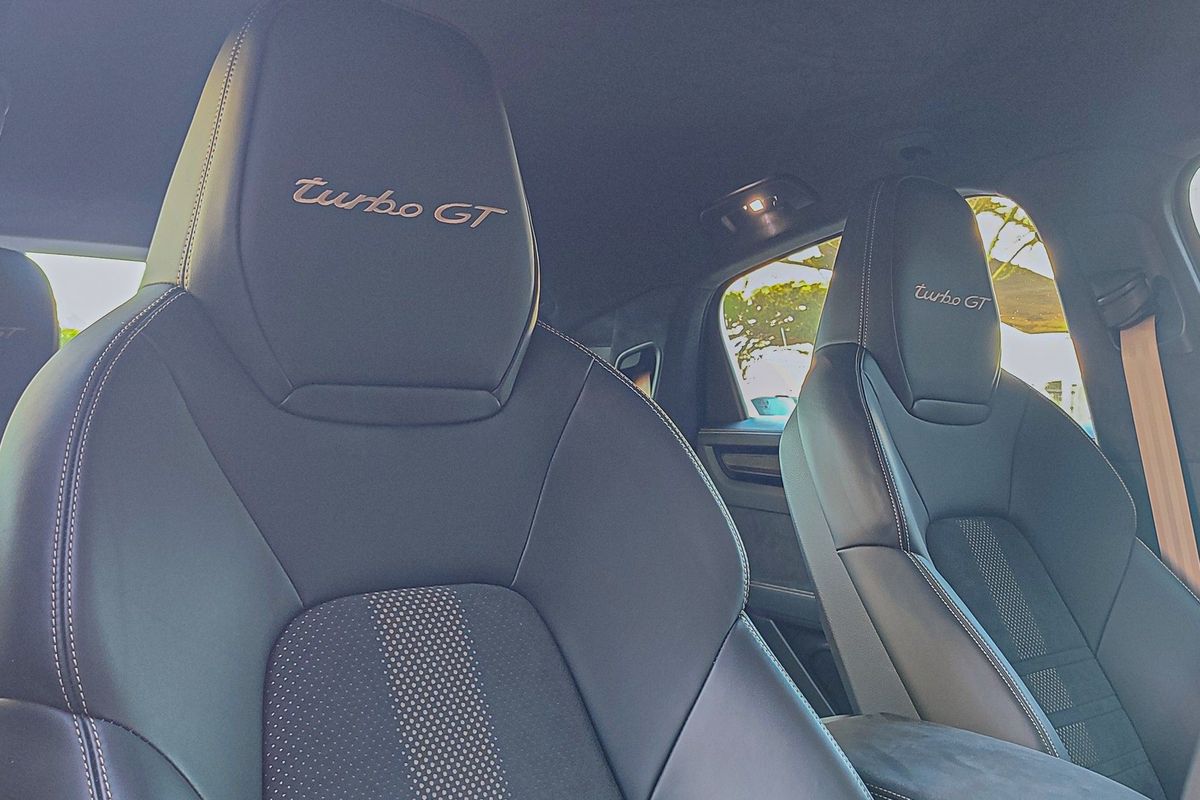
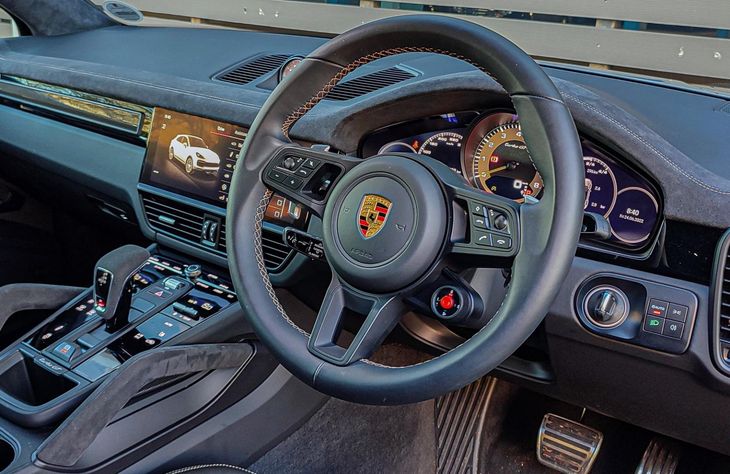
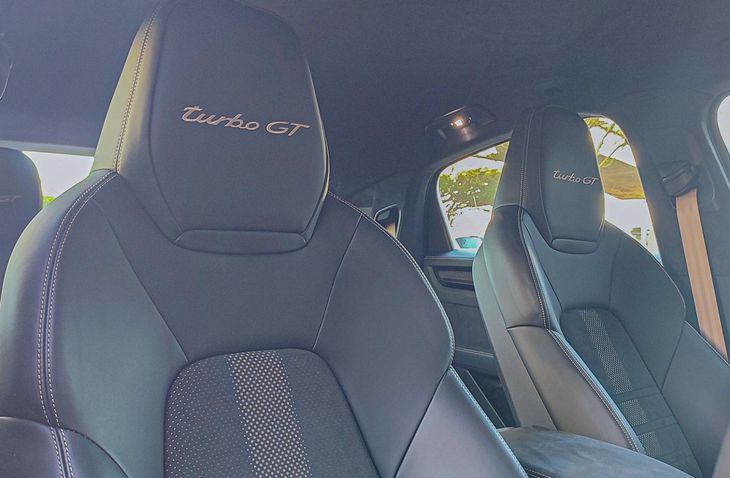
Inside, there are many, many little details to remind you that you’re in something special, such as Turbo GT lettering on the headrests of all 4 (yes, only 4) seats, lovely Alcantara upholstery and contrasting trim elements. As ever, build quality feels rock-solid and comfort levels are exceptional. The fascia is mostly unchanged from what you’ll see in the current-generation Cayenne, but it does debut the company’s new PCM 6.0 infotainment system, which has a revised user interface and “improved operating logic”, says Porsche. We found its interface pretty straightforward to get used to. Of course, Apple CarPlay/Android Auto compatibility is standard.
The interior is highlighted with applications of Alcantara upholstery and contrasting trim elements.
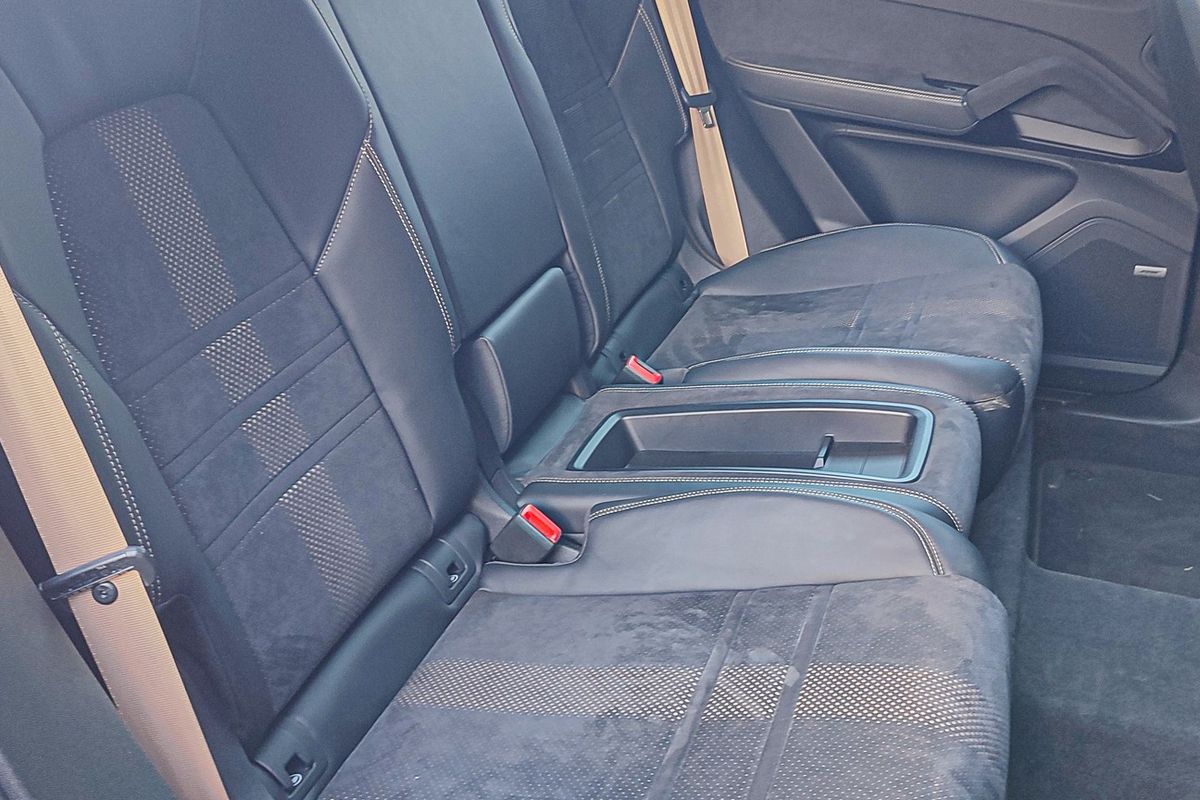
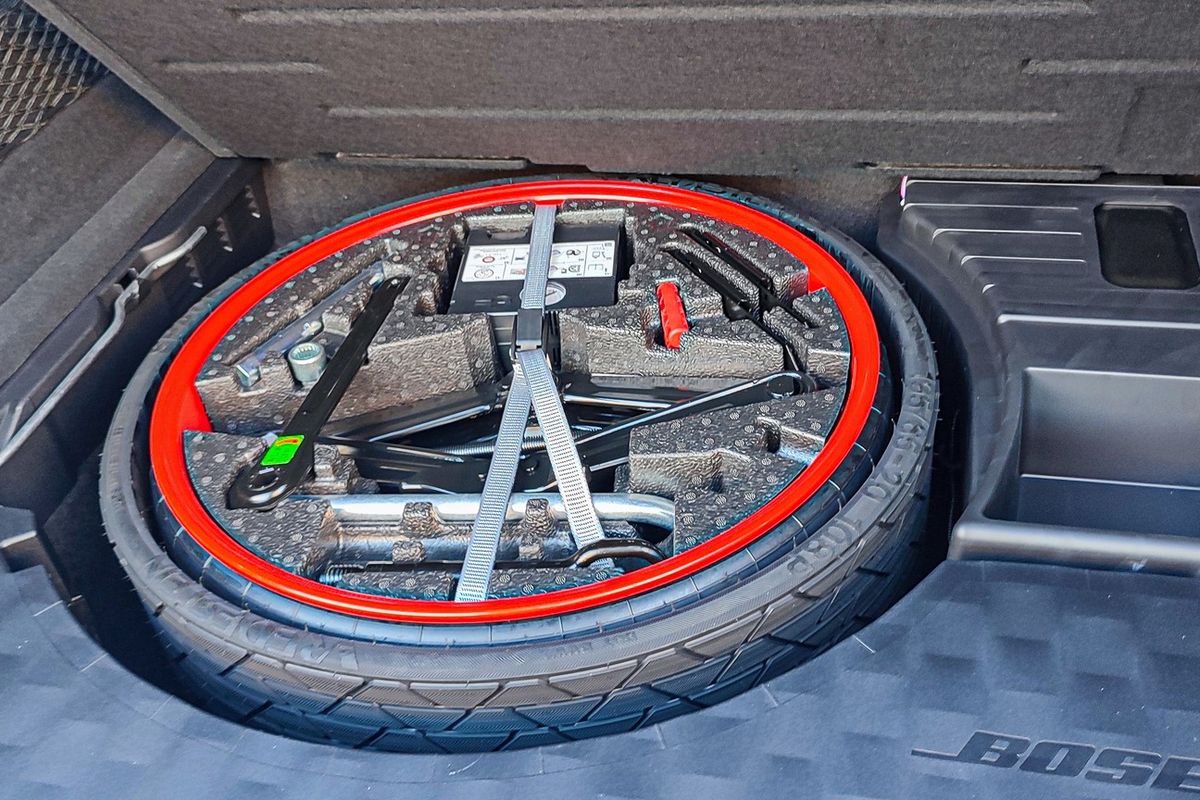
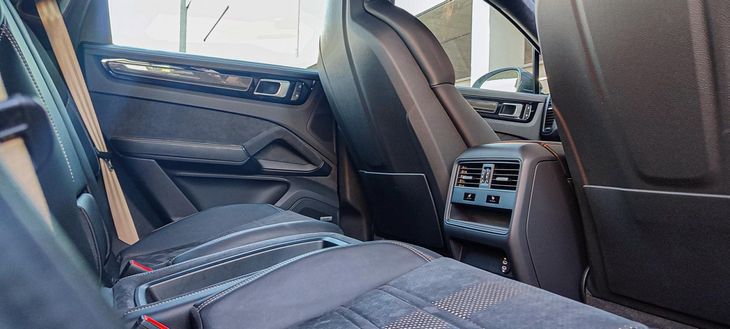
Space is good for the 4 occupants, with a 1.8m-tall adult able to sit comfortably behind a similarly tall driver. Lanky occupants may struggle with the downward sloping roof impinging on rear headroom, however. The load bay is spacious (at 549 litres), but is nevertheless bested by those of the BMW and Mercedes-Benz. Utility space (with the rear seats folded down) is also slightly down on the class leaders, but we’d still rate the Turbo GT as a surprisingly spacious, practical car.
Performance and Efficiency
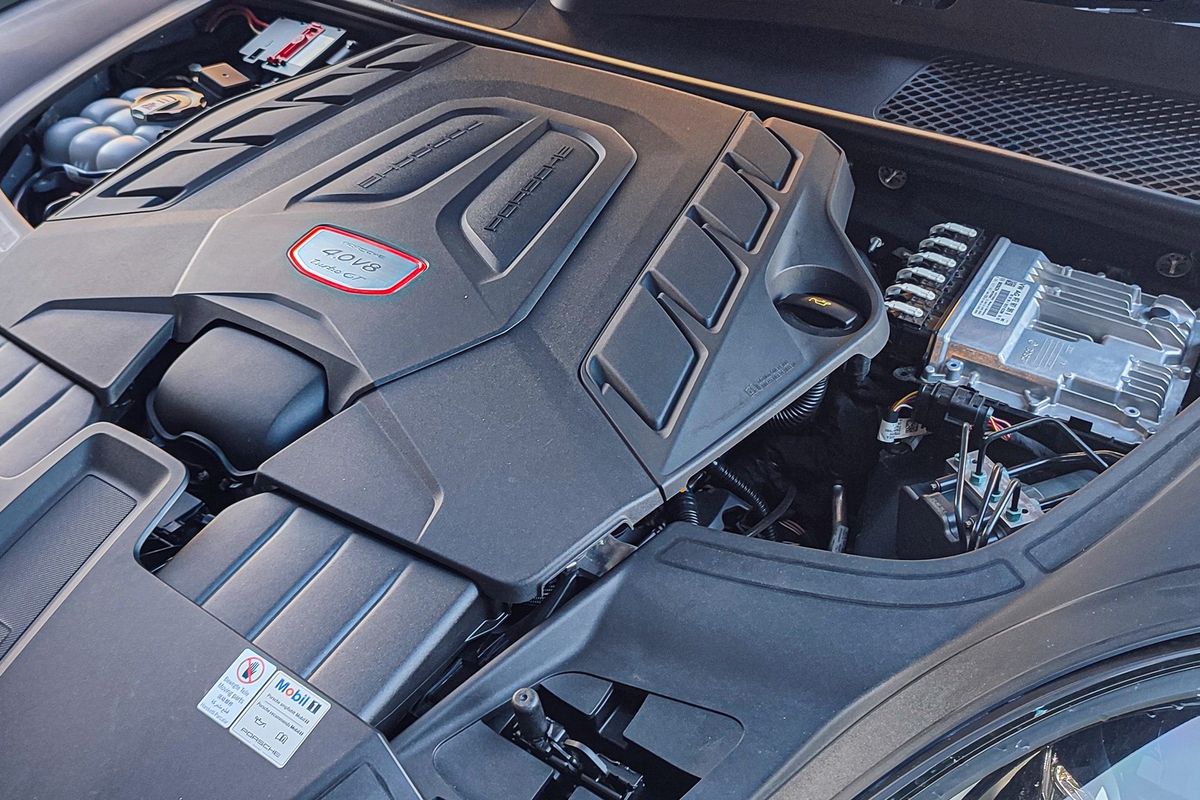
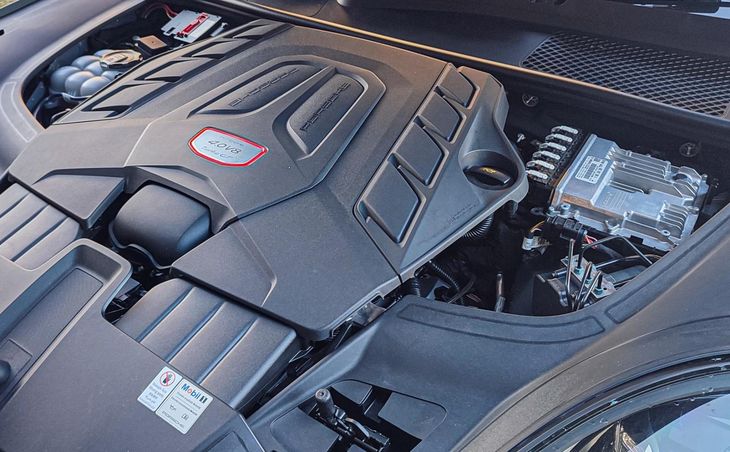
The Turbo GT is powered by the most powerful version of the marque’s bi-turbocharged 4.0-litre V8 engine (which is also used in various other Volkswagen Group products). For use in the Turbo GT, it pumps out a heady 471 kW at 6 000 rpm and 850 Nm of torque from 2 300 to 4 500 rpm. These outputs compare favourably with its rivals from BMW and Mercedes-AMG, with the Cayenne having the most power of the trio and only the AMG being able to match the Porsche’s torque.
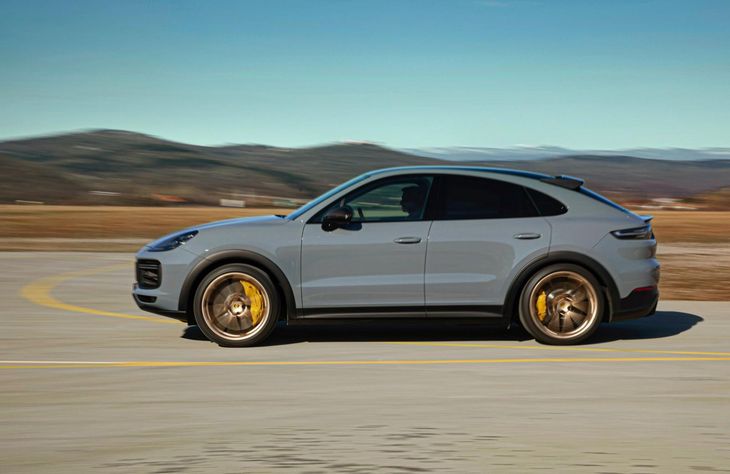
The Cayenne Coupe Turbo GT holds the official Nurburgring lap record for an SUV (7:38.9 minutes).
Importantly, however, keep in mind the Cayenne is relatively light compared with its rivals – by around 250 kg. Therefore, its significant performance advantage should not come as too much of a surprise. Fitted with an 8-speed automatic transmission (not a PDK dual-clutch), the Turbo GT can blast from 0 to 100 kph in 3.3 sec, while its rivals take around 3.8 sec… Astonishingly, this 2.2-tonne beast will hit 200 kph in only 12.2 seconds and go on to a top speed of 300 kph.
Porsche’s engineers haven’t only worked their magic on the engine in the pursuit of more power; they have also upgraded it for better durability. Compared with the standard Turbo, the Turbo GT’s engine differs in such parts as the crankshaft, connecting rods, pistons, timing-chain drive and torsional vibration dampers. The standard sports exhaust system, which is unique to this derivative, is made from lightweight and heat-resistant titanium. To save weight, there is no centre silencer. Due to the presence of a soft limiter when the vehicle is parked, you can’t quite get it to bark very loudly at a standstill, but on the go, the crackles and pops from those large 2 central exhaust outlets are particularly pleasing.
The Turbo GT’s not only more powerful than its siblings; its 4.0-litre bi-turbo V8 powerplant has several bespoke upgrades.
Impressively, and again probably largely down to the Cayenne’s relatively low weight, the Turbo GT has the lowest claimed consumption figure of vehicles of its type (11.9 L/100 km). You’ll probably average closer to 13.5 L/100 km, however.
Comfort and Features
Priced at R3.5 million before options, the flagship Cayenne is significantly more expensive than its Audi/BMW/Mercedes-AMG rivals, and once you start adding options (of which there are several), you might get to a point where a Lamborghini Urus or Bentley Bentayga are not unreasonably out of range, but having said that, you’ll still have to go through a speccing-up process with the Porsche’s Italian and British cousins anyway. So, in reality, the Cayenne Turbo GT is positioned neatly between its “mainstream” German rivals and those more evocative prestige-brand offerings.
The “turbo GT” embroidered headrests add a sense of occasion to the Porsche’s interior.
The Cayenne Coupe is an inherently comfortable vehicle with great NVH (noise, vibration, harshness) control and a cabin that, even before options, ticks the most important boxes in terms of luxury and entertainment. You get heated seats front and rear as standard, for example, but if you want ventilation (for the front seats), that’ll be an extra R32 140. As mentioned before, Porsche’s latest infotainment system offers full Apple Carplay and Android Auto compatibility, but if you want a wireless charging pad, Porsche charges an additional R13 310 for that.
And so the list goes on… Yes, a reverse-view camera and rear park assist are standard, but if you want a surround-view (360-degree) monitor, which is increasingly common on cars priced at around the R500 000 mark, you will have to fork out another R16 850. You get cruise control, but if you want adaptive cruise control with autonomous braking, the extra charge is R38 890. You can also have rear-seat entertainment fitted for R43 890. So it’s very easy to go overboard and end up with a seriously pricey car that would have to be extremely good in some other aspect to justify the outlay…
The Turbo GT’s cabin has a four-seater configuration. Note the Neodyme-coloured seat belts and trim accents.
Ride and Handling
And so, welcome to the section that will detail that “other aspect” needed to justify this car’s heady pricing (options included). Fettled by the same team that works on Porsche’s GT sportscars, the Cayenne Turbo GT’s underpinnings have been significantly revised. The result? A Nurburgring lap time of 7:38.9 minutes, which is an official new record for an SUV around the Green Hell. That’s impressive…
The Turbo rides 17mm lower than the Cayenne Coupe Turbo, and the Turbo GT’s development team substantially re-engineered the car’s passive and active chassis systems to improve its dynamic performance. The rigidity of the 3-chamber air suspension has been increased by up to 15% and, as for the damping characteristics of the active suspension management system, they’ve been altered significantly.
The engineers took an all-inclusive approach to the development, and nothing that had an impact on the Turbo GT’s dynamic ability was left untouched – even the power steering characteristics were modified and rear-axle steering was added to the mix. The active roll stabilisation system now operates with new performance-oriented software.
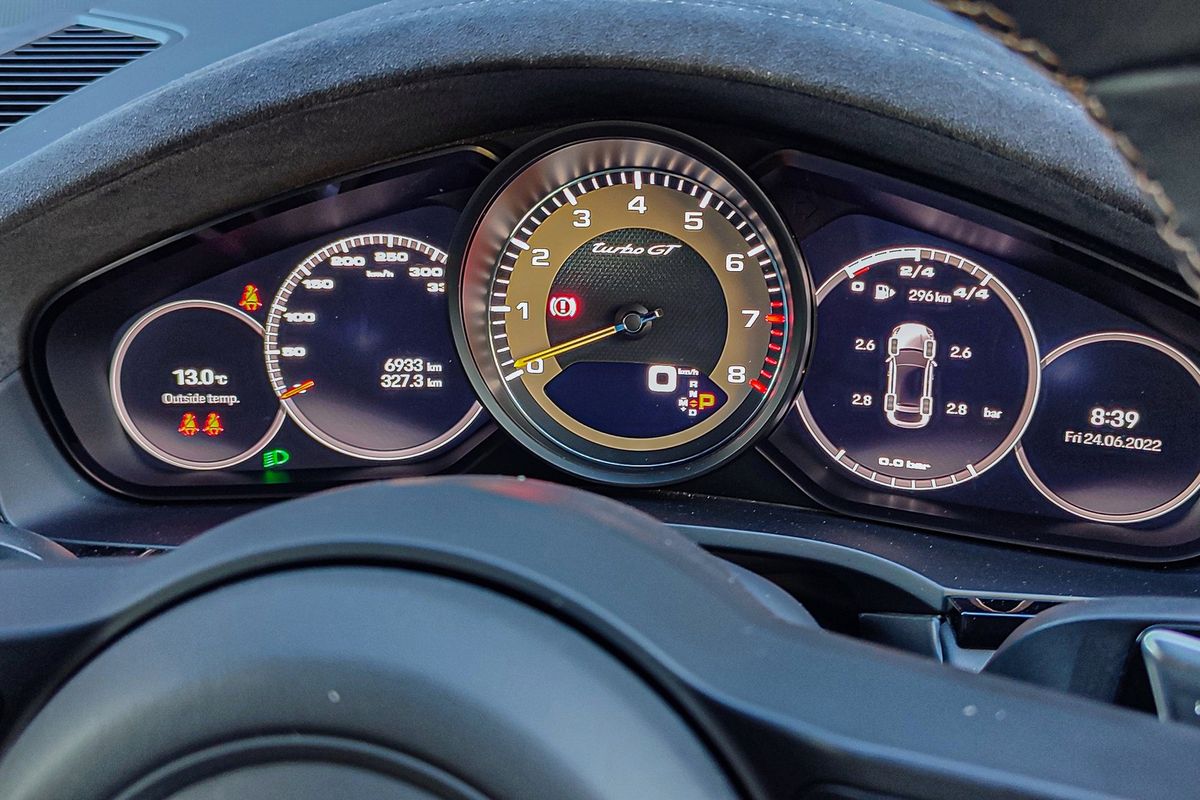
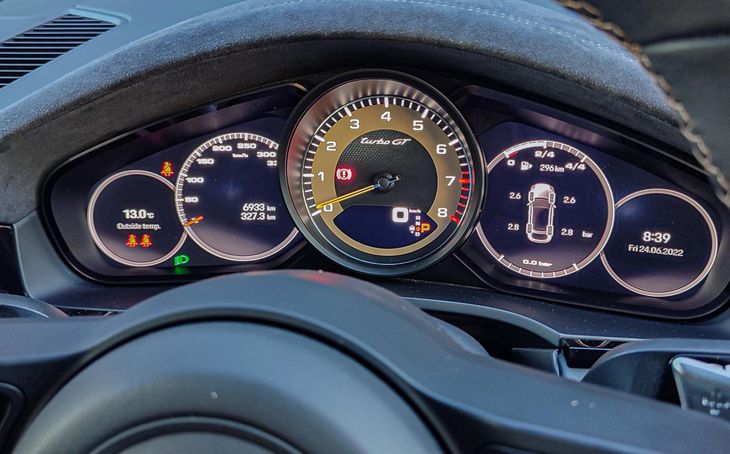
Traditionalists will appreciate the (gold accented) analogue rev counter that’s flanked by 2 pairs of digital dials.
The result of all the fiddling is, quite frankly, mind-blowing. No big, hefty SUV such as this should be able to feel so light-footed, eager to change direction and, dare we say it, “engaging” to drive. Porsche Torque Vectoring is also part of the package, which includes a “comprehensively optimised front axle” and greater negative camber for the massive front wheels; they’re shod with 22-inch Pirelli P Zero Corsa tyres specifically developed for the Turbo GT.
It is really quite an experience to drive this Cayenne Coupe Turbo GT on a particularly challenging piece of road and experience it virtually “shrinking around you”. The steering feel reminds us very much of Porsche’s sportscars, and the way it pivots around its centre is something we have not yet experienced in any other SUV. This Porsche just never feels like a lumbering SUV – in terms of its handling dynamics, the Turbo GT is, in a word, magnificent…
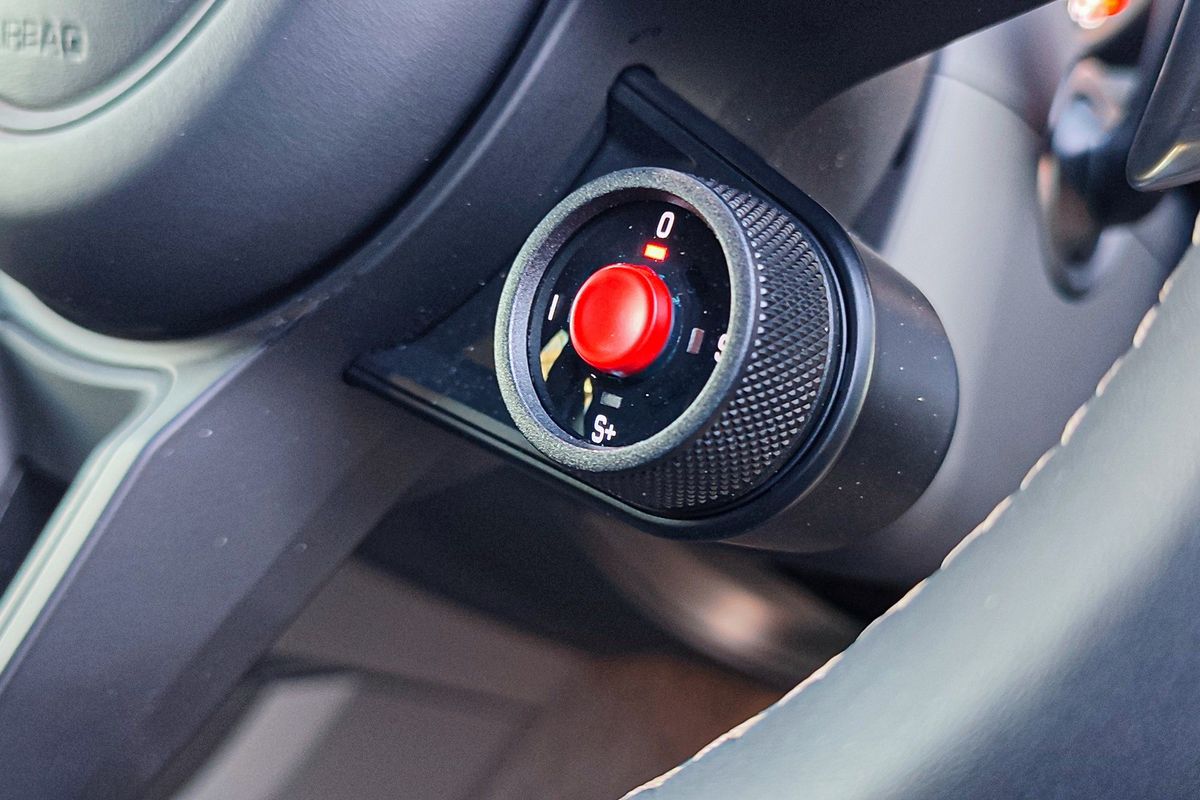
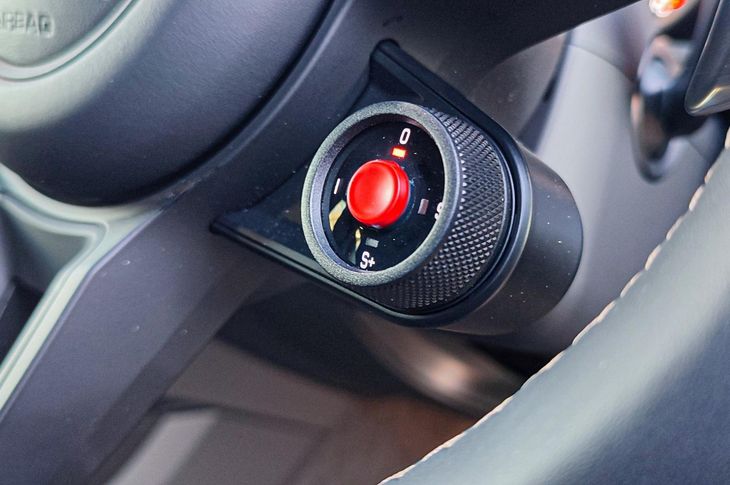
Drivers can easily toggle between drive modes using the rotating knob on the Porsche’s multifunction sports steering wheel.
Price and After-Sales Support
The Porsche Cayenne Turbo GT is only available in the Coupe bodyshell and sells for R3.5 million (before options), which includes a 2-year/unlimited km warranty and 3-year/100 000 km maintenance plan. As mentioned in other parts of this article, there are numerous optional extras to pick from.
At R3.5-million, the Cayenne Coupe Turbo GT is pricey, but it does undercut its cousin, the Lamborghini Urus, by R500k.
Verdict
Porsche has done it again. By delivering an SUV that justifies the GT badge, the Zuffenhausen-based brand has proved the naysayers wrong once more. It occupies a very specific niche in the market and will likely be a rare sight on our roads, but for buyers who crave the practicality and comfort of a large SUV, but who are unwilling to compromise on the thrill of driving promised by Porsche’s GT badge, nothing in this class will come close to the Cayenne Coupe Turbo GT.
JAC has bolstered its local T6 double-cab bakkie offering with the introduction of a more affordable petrol powered derivative. See specification and pricing for the JAC T6 petrol below!
JAC’s T6 double-cab bakkie arrived on local soil back in 2018 and was solely offered with a 1.9-litreturbodiesel engine. Now, JAC has listened to market feedback and welcomes a petrol-powered 4×2 double-cab to market at a more affordable price.
“The market feedback is clear. Customers, especially big transport operators, want petrol engine derivatives in their fleets. With the limited offer of one-tonne petrol engine workhorses in the local market, we have decided to add a petrol engine derivative to our local T6 range,” says Karl-Heinz Göbel, CEO of JAC Motors South Africa.
Under the bonnet is a naturally-aspirated 2.0-litre petrol engine that develops 108 kW and 190 Nm and comes paired with a 5-speed manual transmission. JAC claims a fuel consumption figure of 10 L / 100km.
Standard features include a Radio/MP3 player, height-adjustable multi-function leather-clad steering wheel, cruise control, electric windows and of course, air conditioning. On the safety front, the JAC T6 is fitted with 2 airbags, ABS with EBD, Brake Override System (BOS), rear park distance control,
Some practical features for the J6 include a 198 mm ground clearance, 900 kg payload, 2 000 kg braked towing capacity and a sizable load bed measuring 1 520 mm × 1 520 mm × 470 mm which is sprayed with an anti-scratch and corrosion-resistant bed liner.
JAC T6 Price in South Africa (July 2022)
JAC T6 2.0L VVT 4×2 Lux – R324 900
T6 1.9L TDI 4×2 Comfort – R359 900
The JAC T6 is sold with a 5-year/150 000km warranty and a 5-year/60 000km service plan.
Hilux Units Incoming! Toyota SA Resumes Production in KZN
Toyota has officially resumed production at its Durban factory, with most product lines – including that of the Hilux – finally back online (though not yet at full capacity)…
Toyota South Africa Motors has confirmed production at its Prospecton plant in KwaZulu-Natal has resumed after the facility was forced to halt assembly back in mid-April 2022 owing to severe flood damage.
While Hino truck production recommenced as early as 23 May, Toyota’s passenger-car and light-commercial vehicle lines remained suspended until just a few days ago.
The Durban factory sustained major damage when a wall of water and silt came down the river alongside the plant after the sluices at the overflowing Shongweni Dam were opened. Toyota said cleaning the mud and fine silt from the many pieces of electronic and mechanical equipment in the various production areas had proved “extremely time-consuming”.
The Prospecton plant finally started building the Hilux, Fortuner, Corolla Cross and Hi-Ace again in the past few days, though Toyota SA Motors told Cars.co.za production was “nowhere near” full capacity just yet. The Japanese firm’s local division added units would start trickling through to dealerships in “any significant numbers” only from mid- to late-August, with full production levels set to be reached by September.
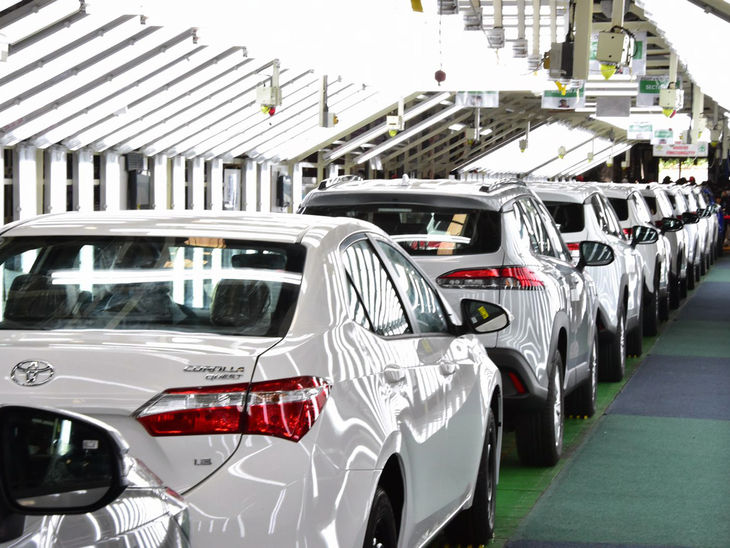
Meanwhile, the Corolla Quest line remains idle, with Toyota SA Motors saying production of the prolonged lifecycle sedan would likely resume at some point in August.
While production of the Corolla Cross has resumed, the Corolla Quest has yet to join the party.
Many of the factory’s operational parts were reconditioned rather than replaced since new parts were not immediately available. Therefore, the company says it has opted against implementing overtime weekend shifts, saying it would instead reserve weekends for the replacement of these reconditioned parts as new components are delivered.
Despite not building a single passenger car or light-commercial vehicle in June 2022, Toyota managed to keep its nose well ahead of all challengers in the sales stakes that month, with the 7 439 units it registered proving more than enough to keep the Volkswagen Group (5 627 units) in second and Suzuki (4 622 units) in third.
The Hilux, though, had to settle for fourth place on the list of South Africa’s best-selling bakkies in June 2022, with its 969 sales seeing it slot in behind the Ford Ranger (1 601 units), Isuzu D-Max (1 280 units) and Nissan NP200 (1 249 units). Year to date, however, the Hilux is still well ahead, with its 15 992-unit total more than double that of the second-placed Isuzu D-Max (7 140 units).
Mercedes-Benz SA Confirms Electric Vans are Coming
Mercedes-Benz Vans says it aims to “completely transform the South African van industry” by launching fully electric models in this corner of the market…
We recently brought you local pricing for a raft of fully electric Mercedes-Benz passenger vehicles, including the EQA, EQB, EQC and EQS. But what about the Stuttgart-based firm’s vans division? Well, Mercedes-Benz Vans South Africa has now confirmed it has plans to bring in battery-powered vans in the future, though stopped short of revealing exactly which models are under consideration.
Marinus Venter, Head of Product and Marketing at Mercedes-Benz Vans SA, hinted that though such launches may be a little way down the line, the wheels are at least turning.
“It is our unwavering goal to deliver the most desirable all-electric vehicles to our customers, worldwide. Although we have some challenges in South Africa, the South African market remains an integral part of this plan,” he said.
“Our goal in the coming years is to completely transform the South African van industry as we know it, by providing exceptional electro-mobility solutions in both the private and commercial sectors,” Venter added.
Globally, Mercedes-Benz Vans reported a “significant increase” in demand for its electric vehicles in the second quarter of 2022, particularly in the commercial sector, driven by the eSprinter and eVito. In fact, the automaker claims sales for its electric vans rose by more than 80% to 3 500 units in the reporting period.
So, besides the aforementioned eSprinter (which is scheduled to be replaced by a new-generation model in 2023) and eVito (which is available in some markets in both panel van and Tourer guise), which electric vehicles are currently in the Mercedes-Benz Vans portfolio globally? Well, there’s also the soon-to-launch eCitan, which features a claimed single-charge range of around 285 km.
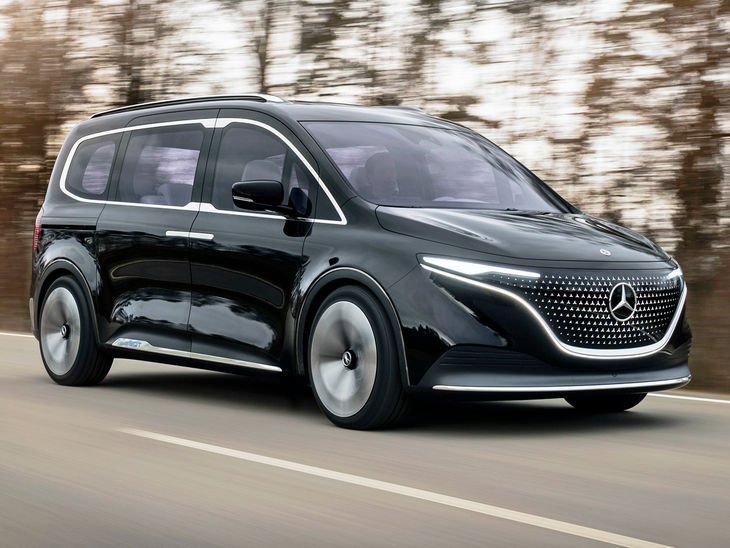
The Concept EQT previews an upcoming electric version of the T-Class.
Outside of the commercial sector, Mercedes-Benz Vans has the EQV. Revealed back in 2019, this model is positioned as a fully electric premium MPV and is effectively a battery-powered V-Class with a claimed range of 405 km. An electric version of the T-Class (dubbed the EQT and previewed by the Concept EQT pictured above) is also set to be revealed in the relatively near future.
While Mercedes-Benz Vans SA seemingly hints electric models are part of its medium- rather than short-term plans, the firm also claims to be in rude health locally. In fact, it has forecast “record V-Class sales” for 2022, as well as “strong projected sales” for the Vito and Sprinter ranges. Nadia Trimmel, President of Mercedes-Benz Vans SA, has high hopes for the rest of the year.
“The first half of 2022 is behind us and, looking at what we have accomplished, I am exceptionally proud of how the Mercedes-Benz Vans team has persevered. We have demonstrated outstanding resilience in the wake of many challenges and uncertainties. I look forward to a successful remainder of 2022,” said Trimmel.
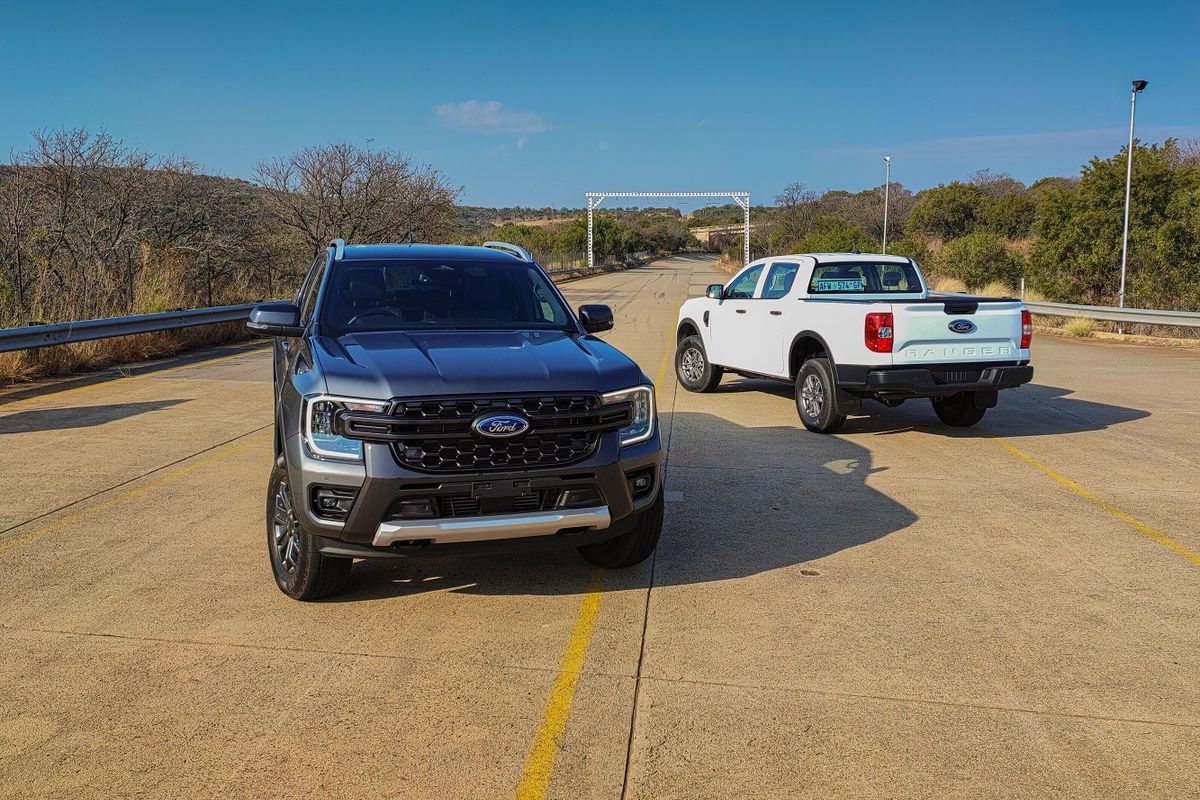
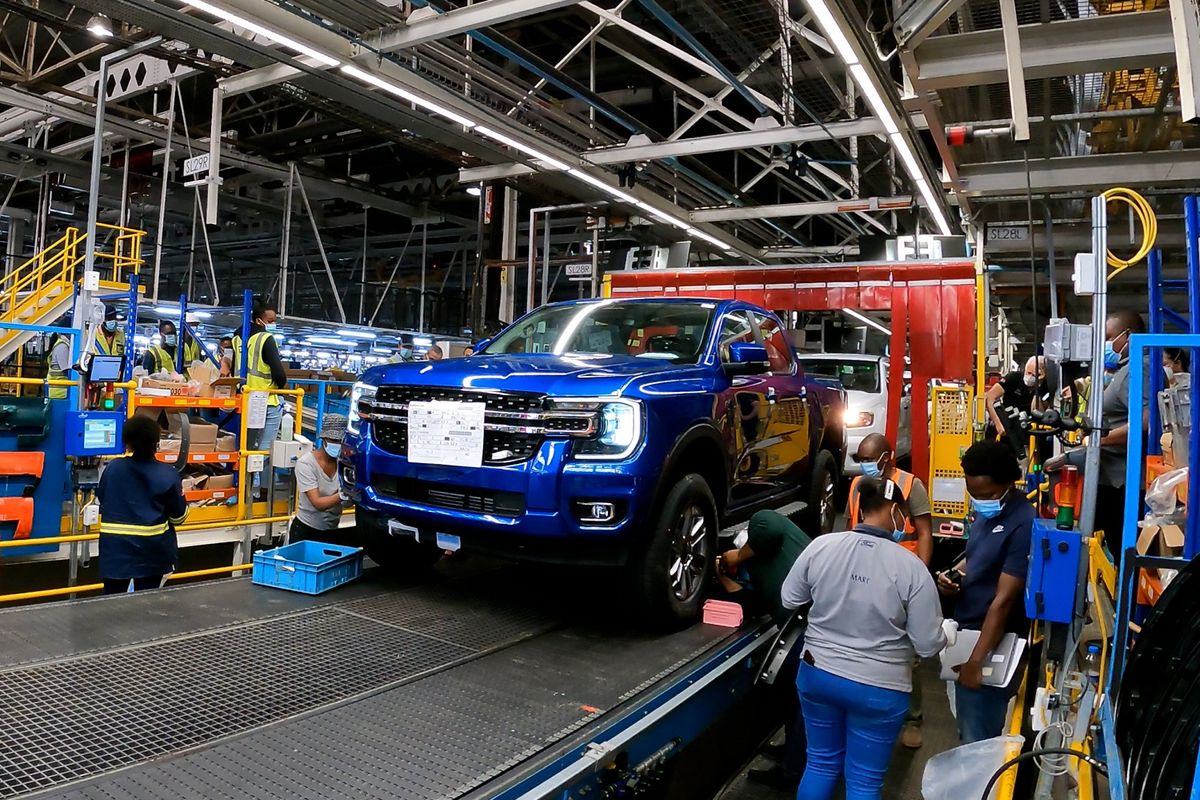
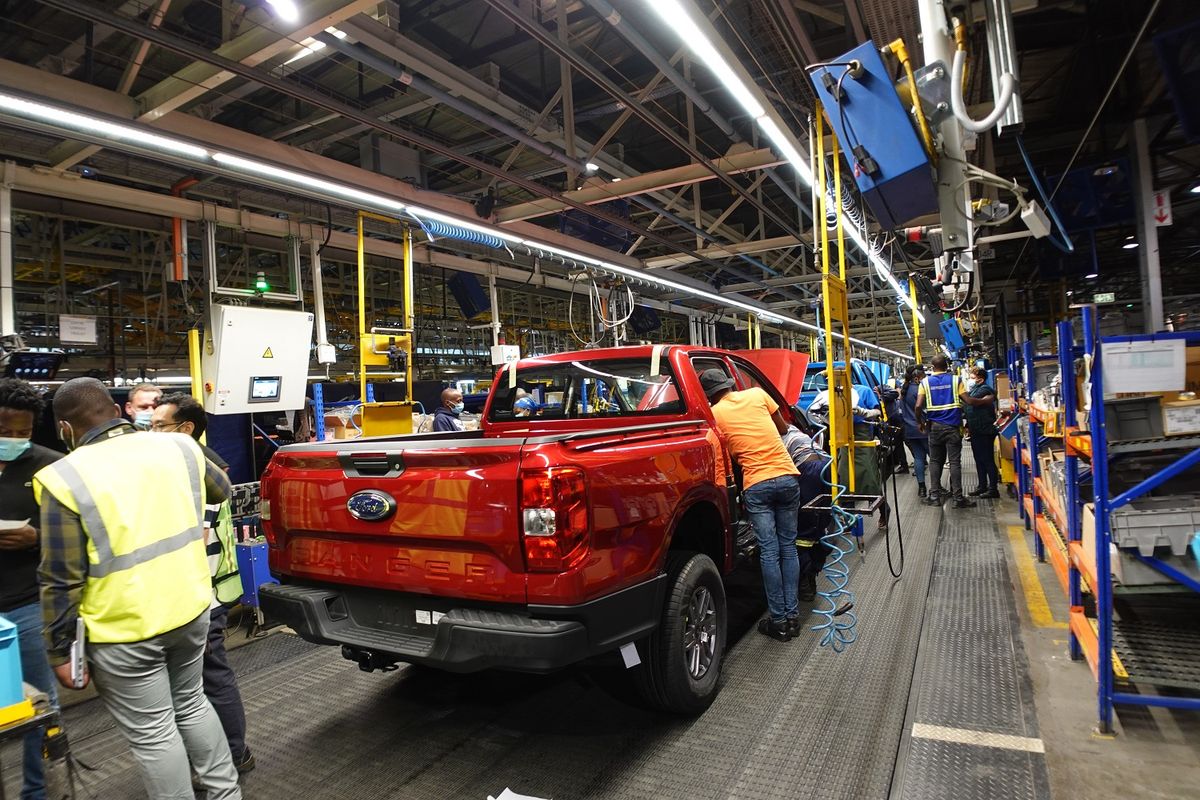
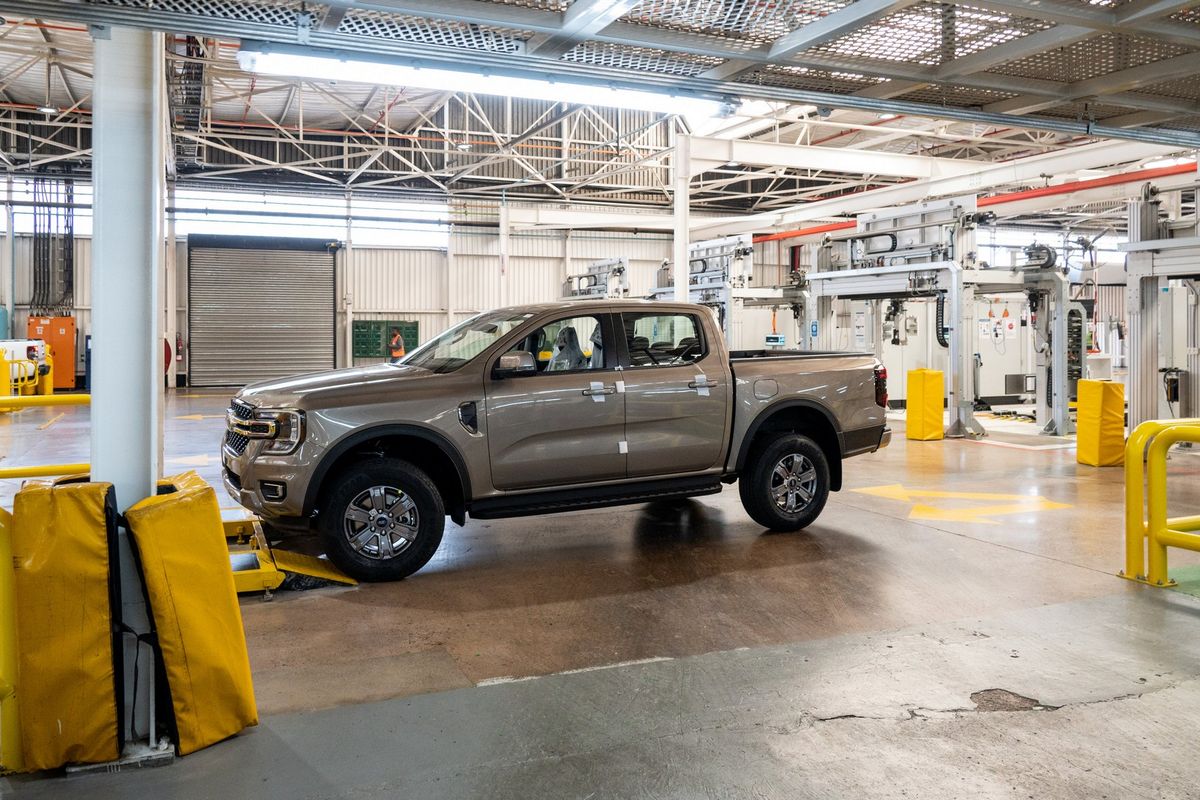
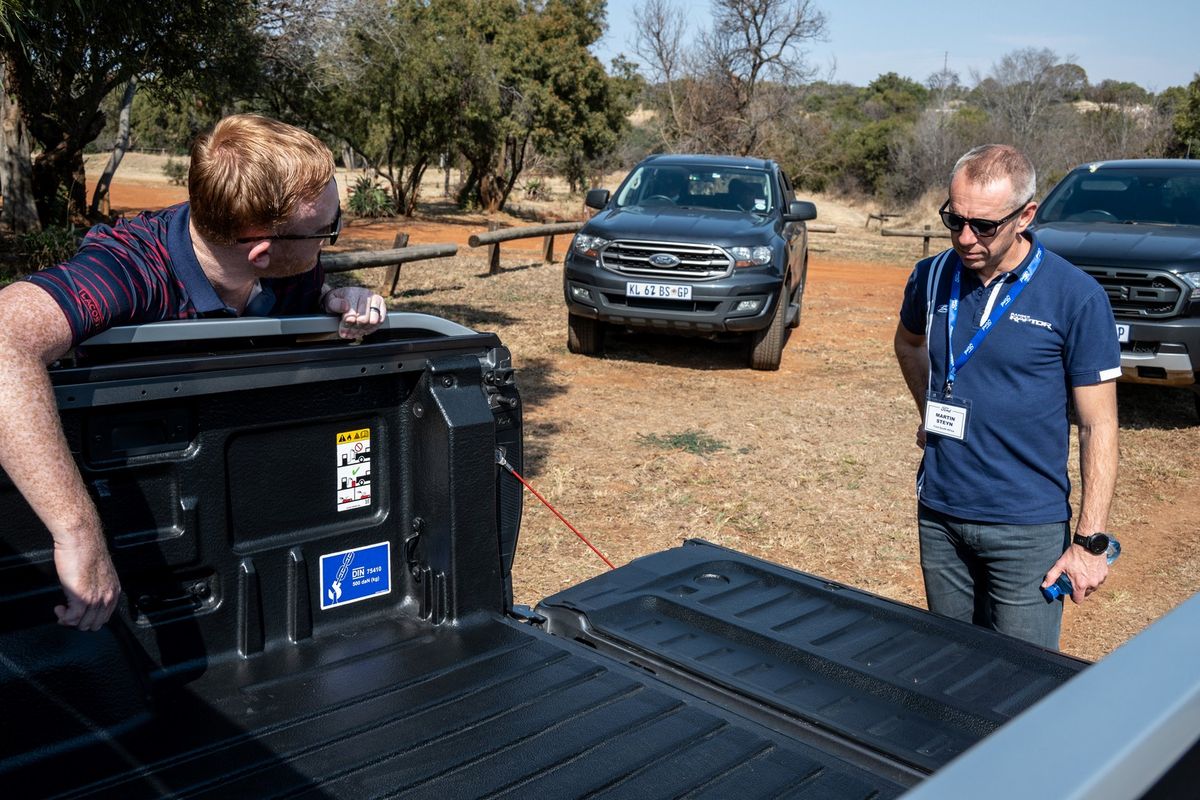
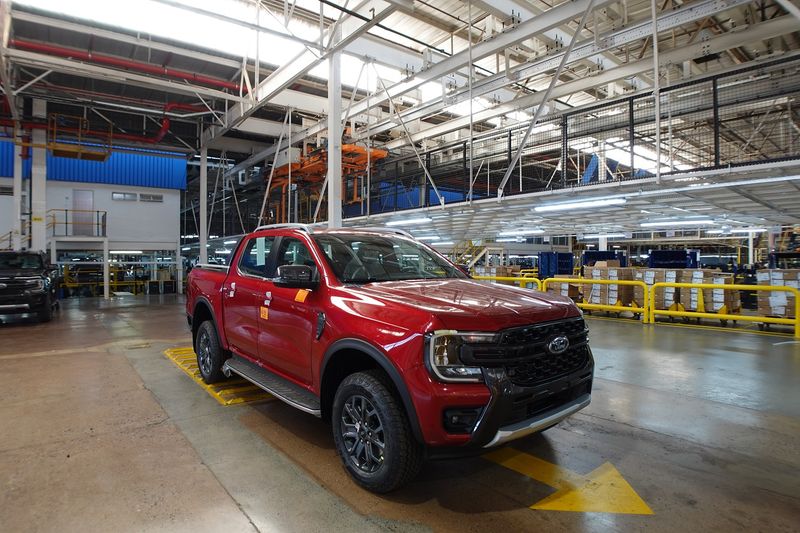
We headed to Ford Motor Company of Southern Africa’s assembly facility at Silverton, Pretoria to gain insights into the production process of the new Ford Ranger, then we had a quick look inside the new Ford bakkie and drove a couple of tooling-trial units. Here’s what we discovered…
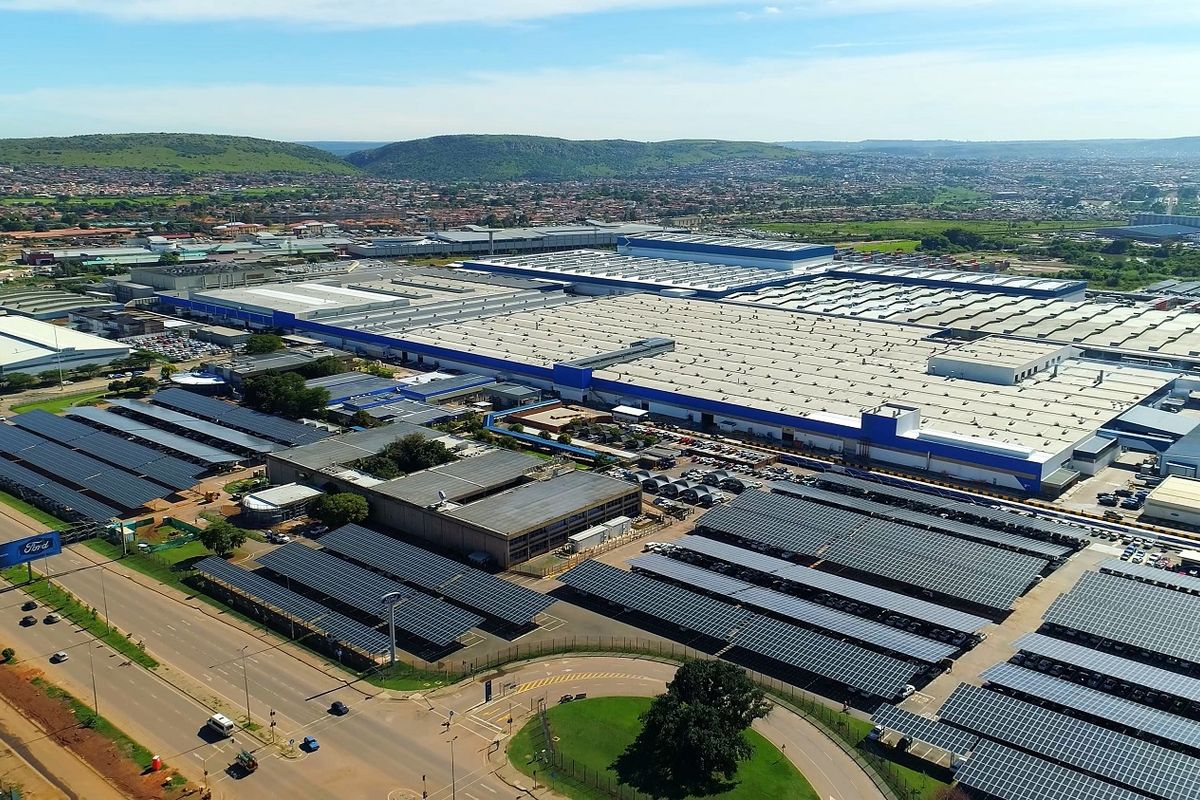
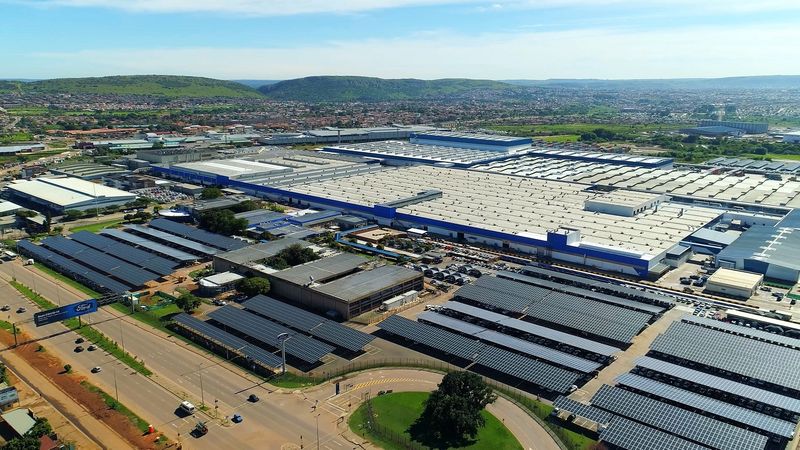
For the local motor industry, the arrival of the all-new Ford Ranger is arguably one of the biggest news stories of the year. Not only will it be built locally at Ford Motor Company of Southern Africa’s (FMCSA) plant near Pretoria and thus employ thousands of South Africans, but the facility has undergone a radical transformation over the past 2 years.
The Dearborn-based firm has invested the equivalent of R15.8 billion in the factory (which gained a new high-tech stamping plant, for example) and, by bringing some production processes in-house, the Blue Oval has unlocked efficiencies and facilitated the assembly of better-finished vehicles, FMCSA says. The overall upgrades are said to “introduce the latest tech and quality control systems, as well as redesign the production flow of the plant for maximum efficiency.”
Without going into too much detail (we don’t want to bore anyone), a LOT has been happening at Silverton – the facility is wrapping up current-shape Ranger production, while preparing to begin assembly of the new-generation Ranger and its “twin”, the Volkswagen Amarok… meanwhile, the construction of new buildings and implementation of various upgrades are being finalised. Impressively, this began during a period of uncertainty and interruptions due to the pandemic.
It sounds like a logistical nightmare, but, as the project nears completion, Ockert Berry, VP of Operations- and Tim Day, Plant Manager at FMCSA, are positive and optimistic that full production of the brand-new Ranger will begin as planned.
In fact, once construction ends and everything comes online, FMCSA’s Silverton plant will be capable of building 200 000 Ford Rangers annually for the global market, making it the epicentre of the model’s product line. As a reminder, the SA-spec Ford Everest and new V6-powered Ford Ranger Raptor will now be sourced from Thailand.
The size and scale of the new facilities beggar belief. The stamping section alone is 1.5 times the size of a standard soccer field, at just over 10 000 square metres. The body shop? 44 000 square meters with extensive automation thanks to 493 robots. The entire complex is hooked up to more than 30 000 solar panels generating 13.5 MW of electricity.
For those who want to personalise their Rangers, Ford has also built a modification centre for the fitment of optional Ford-approved accessories. These accessories will also be thoroughly tested to ensure that OEM quality standards are met. Time will be the real test, but Ford is doing an awful lot of groundwork.
During our visit, there was extensive use of the word “quality”, but the reality is that FMCSA is well aware of public perceptions that its products aren’t as tough or long-lasting as those of other players in the segment. Ford hopes that its substantial upgrades will improve its reputation among the most finicky of bakkie buyers.
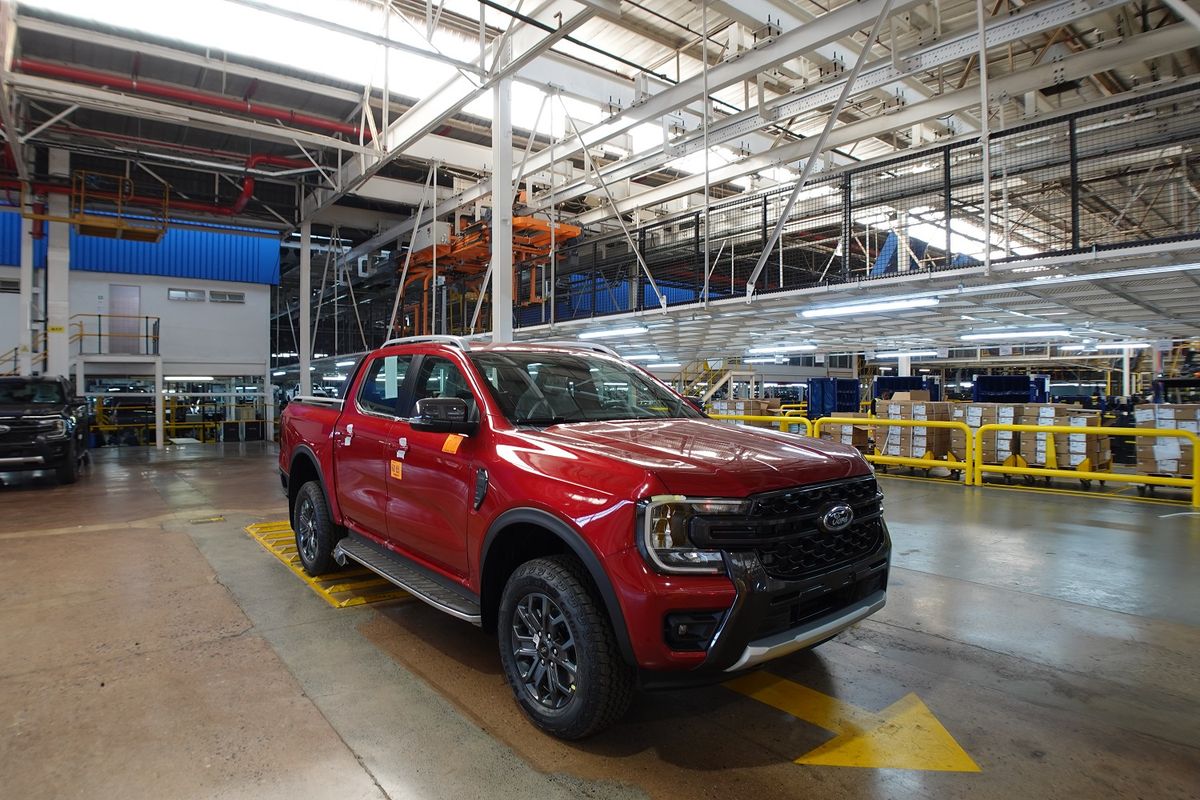
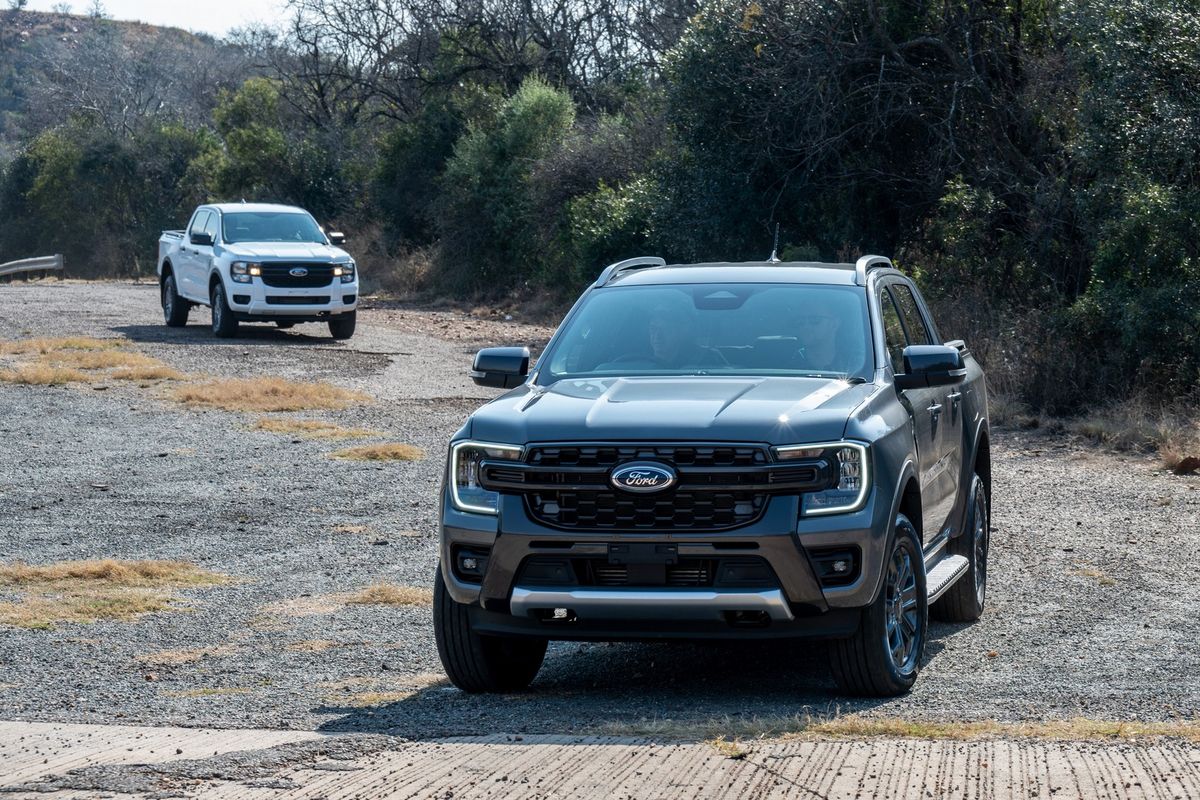
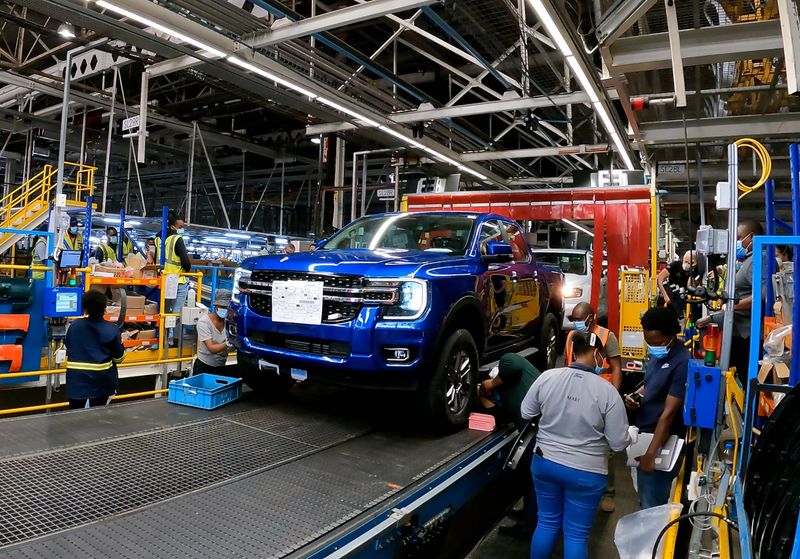
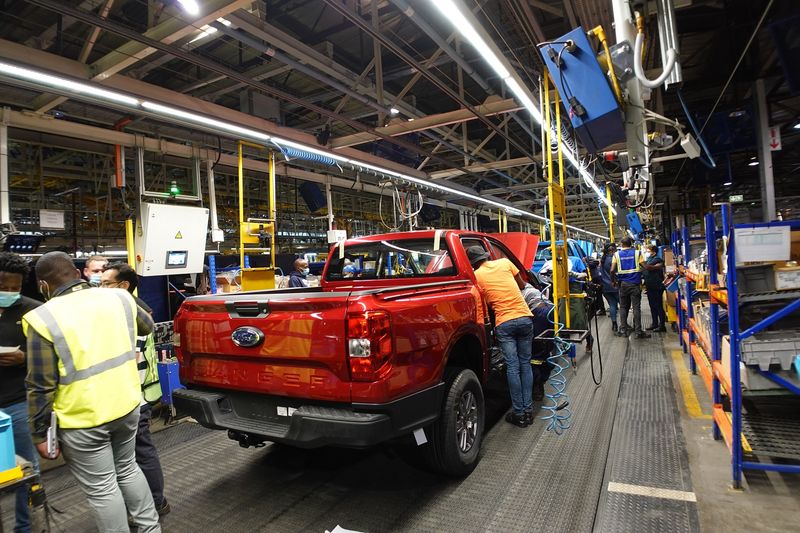
We had a first-hand viewing of the production process of some of the first new-generation Rangers. They are known as tooling-trial units – vehicles that are used to assess the effectiveness of the manufacturing process. Think of it as preparing a test pancake to ensure that your pan is at the right temperature and that your batter is ready.
Once the tooling-trial period is over and bugs in the body manufacturing and component installation processes are ironed out, pre-production can begin. At the time of writing (end of July 2022), the first pre-production units were on the assembly line. The pre-production units will undergo even more rigorous testing to ensure expectations of quality, reliability and toughness are met.
We’re still some way off from seeing brand-new Rangers on showroom floors, with current timelines suggesting an on-sale date at the end of 2022. The first production vehicle is scheduled to roll off the line at the end of October 2022.
2023 Ford Ranger in the metal
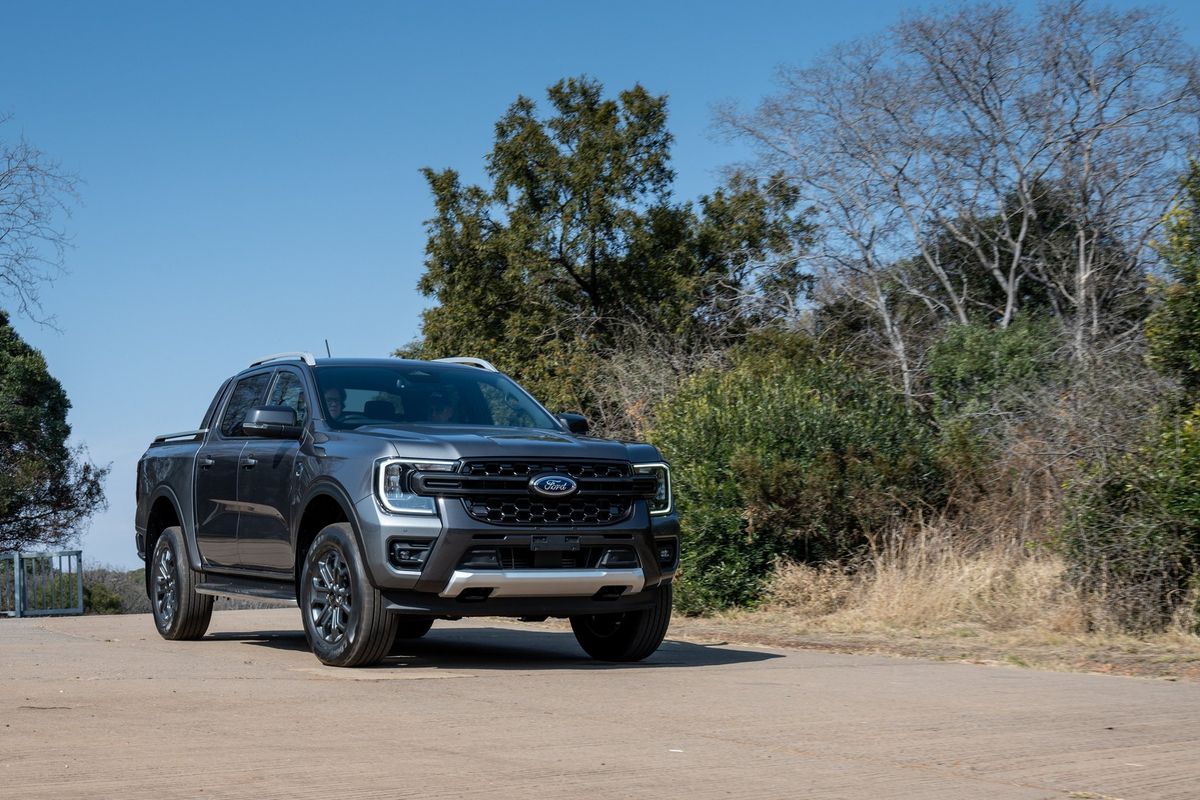
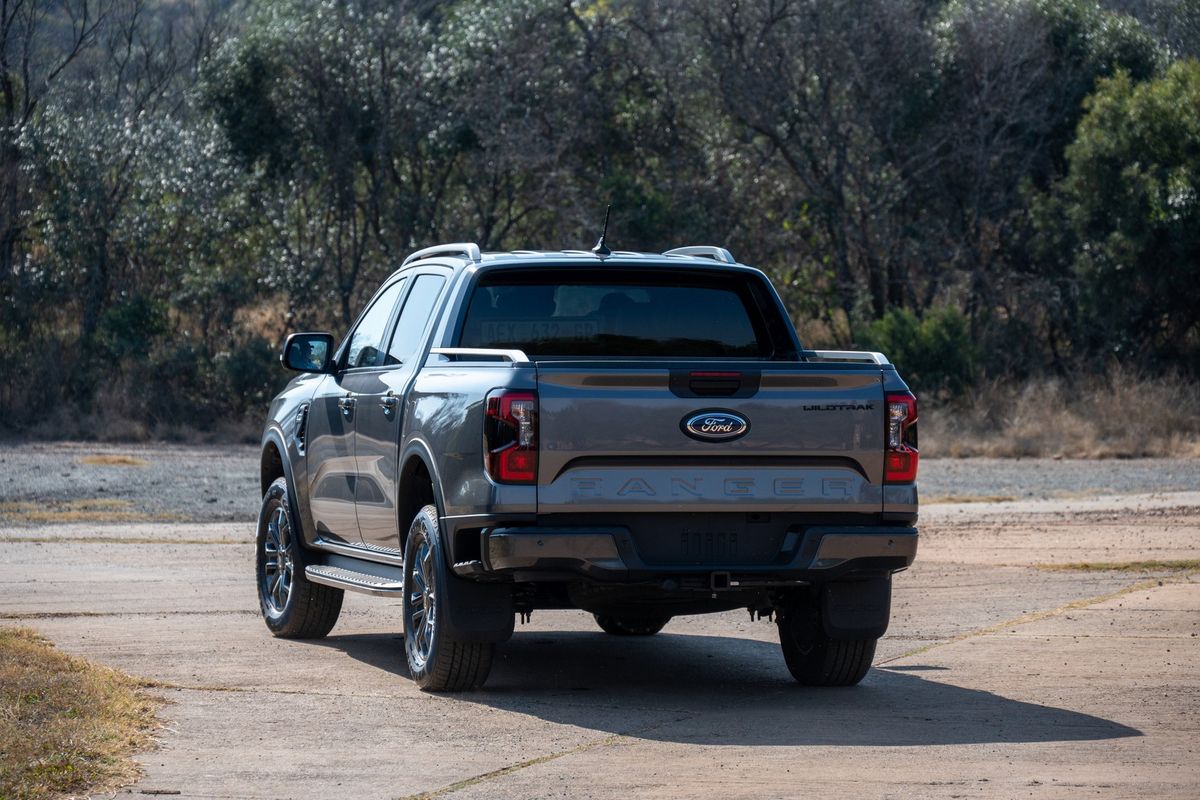
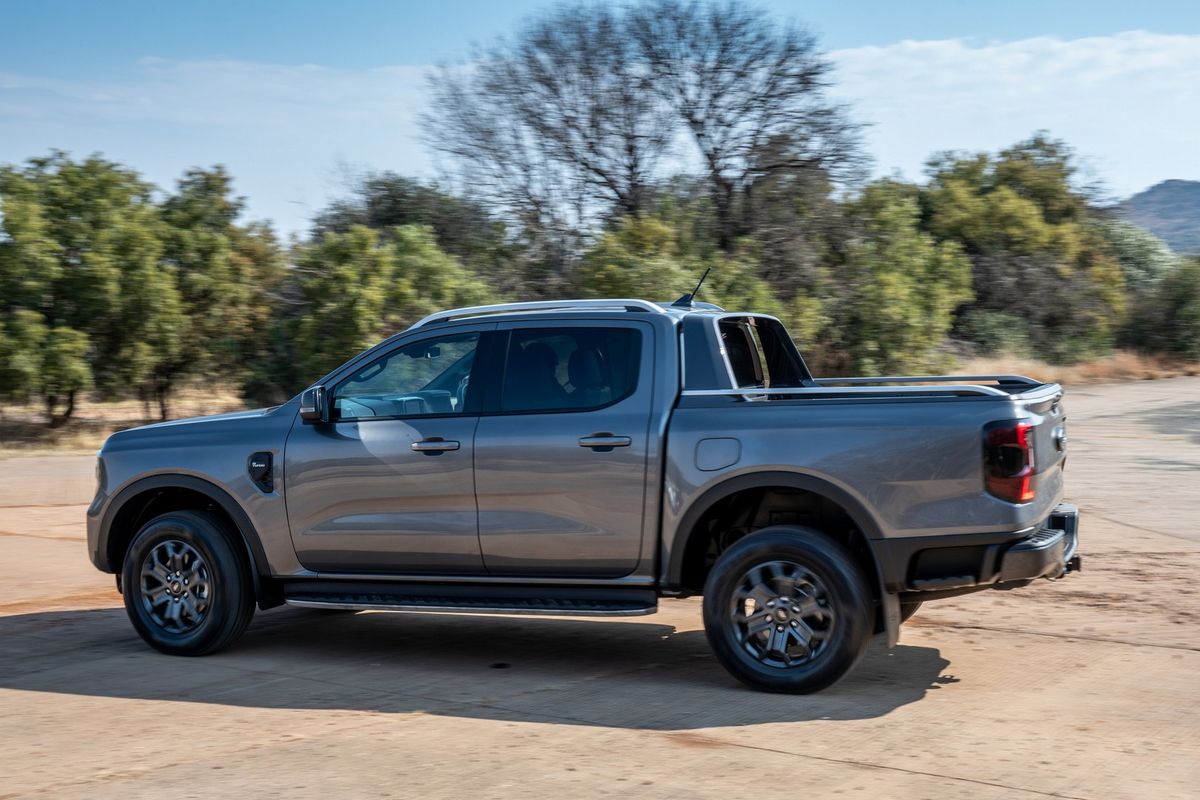
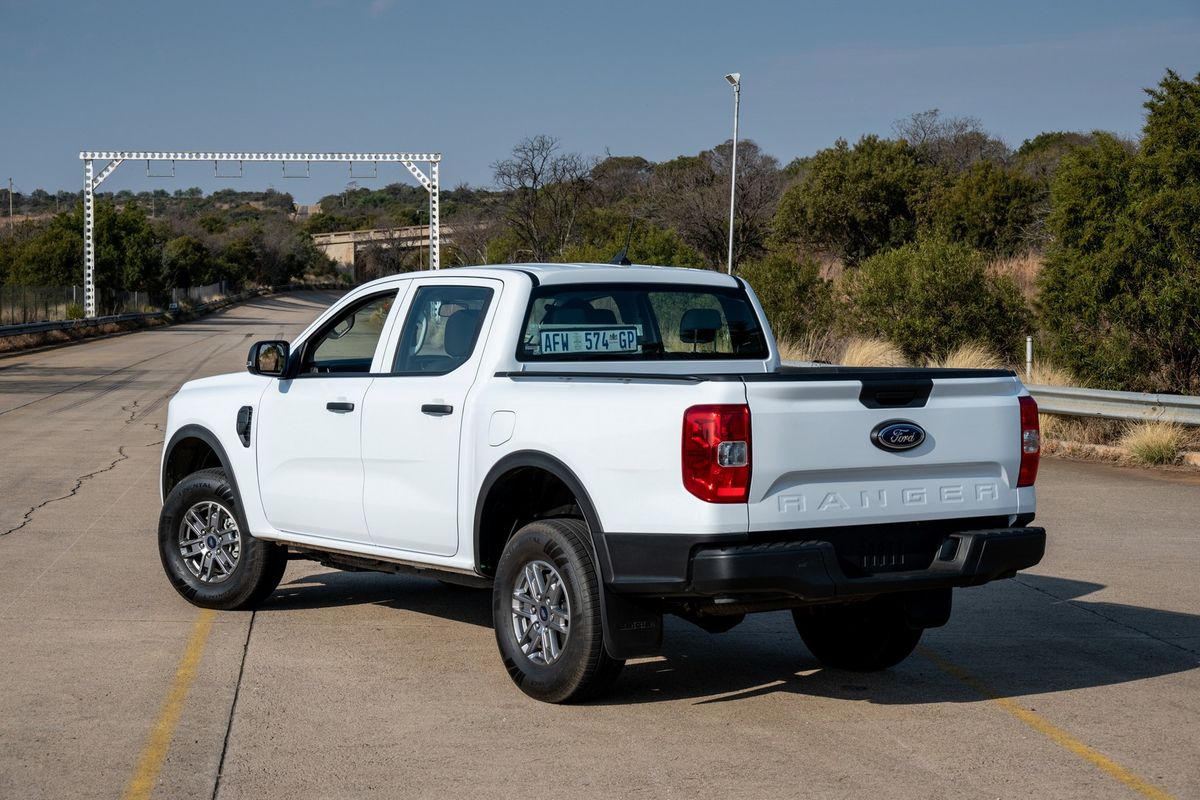
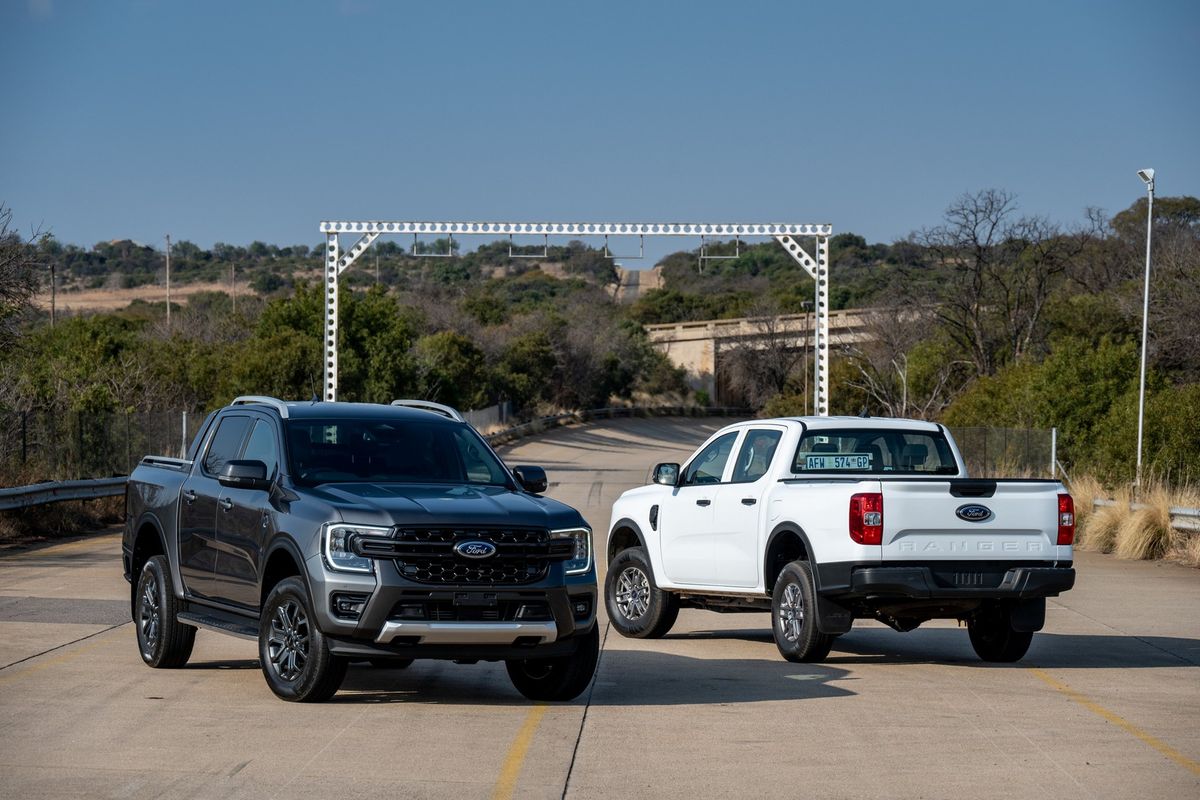
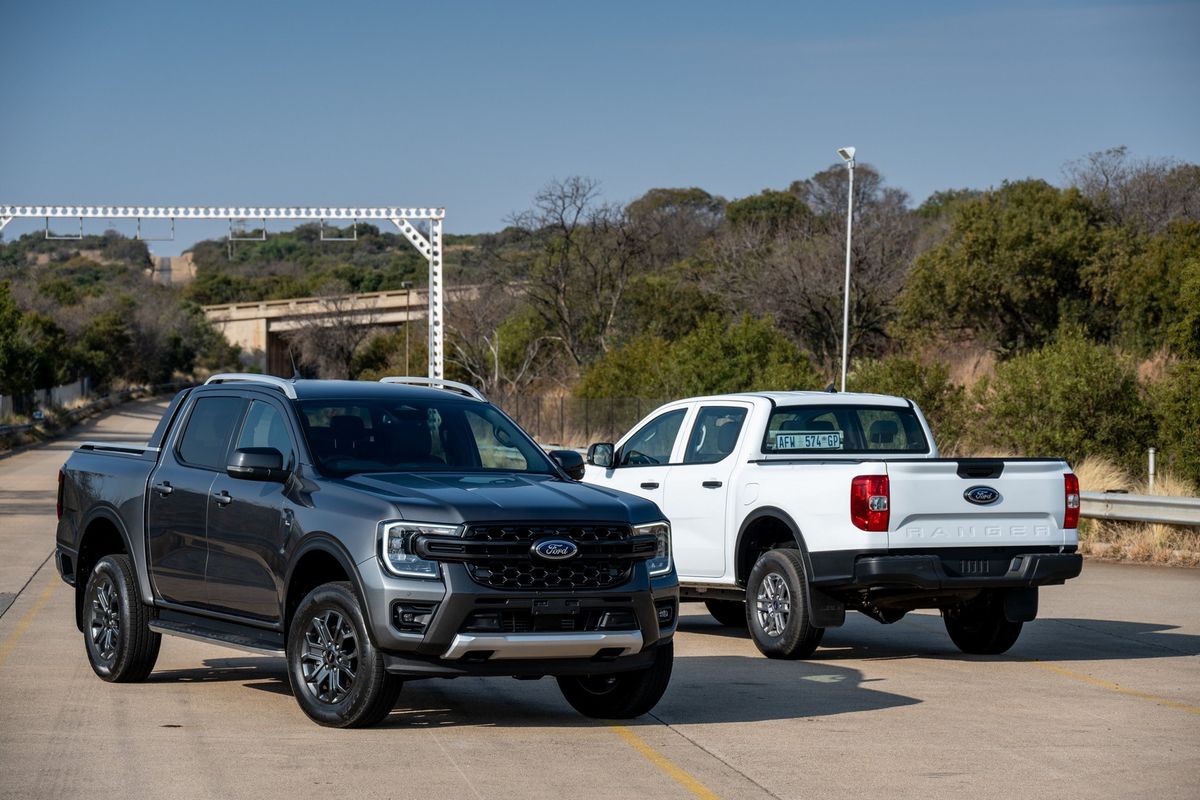
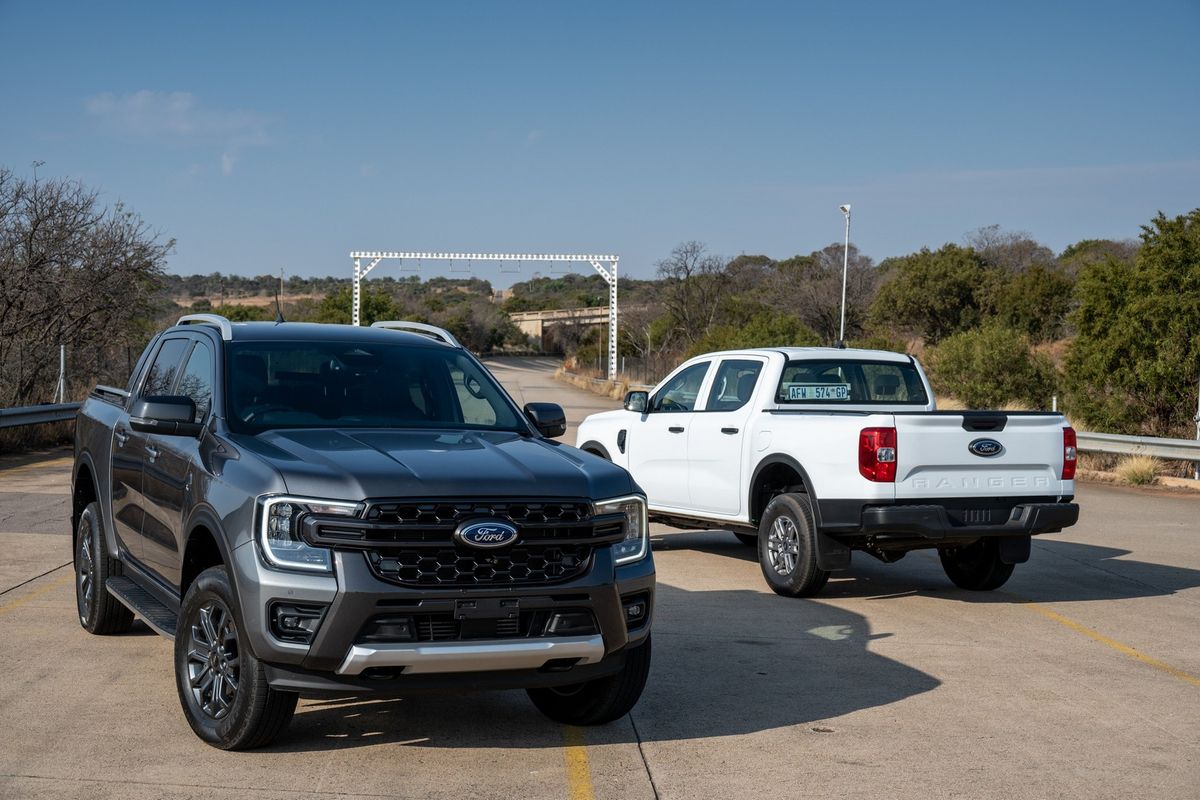
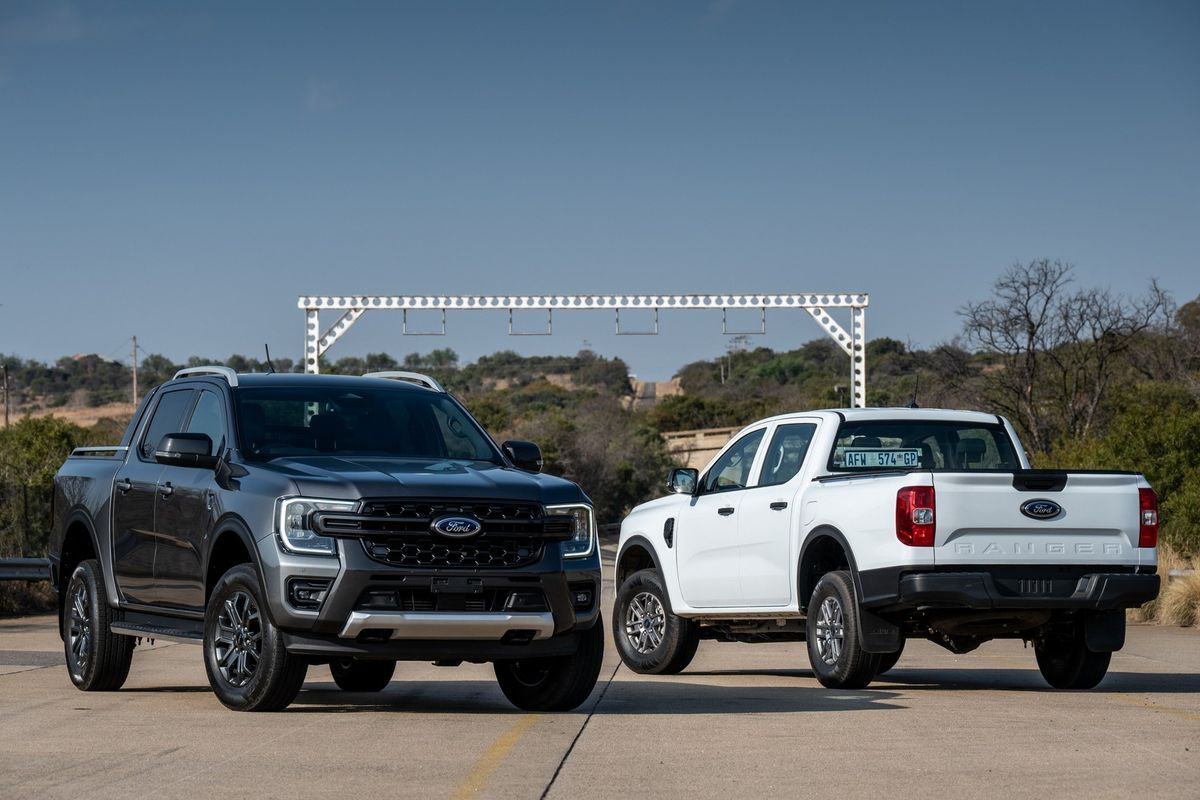
Right, so what’s the new Ranger like in the metal? Media images don’t quite do it justice and the Wildtrak, in particular, has a bold and imposing appearance – those new C-shaped daytime running lights give it considerable kerb presence.
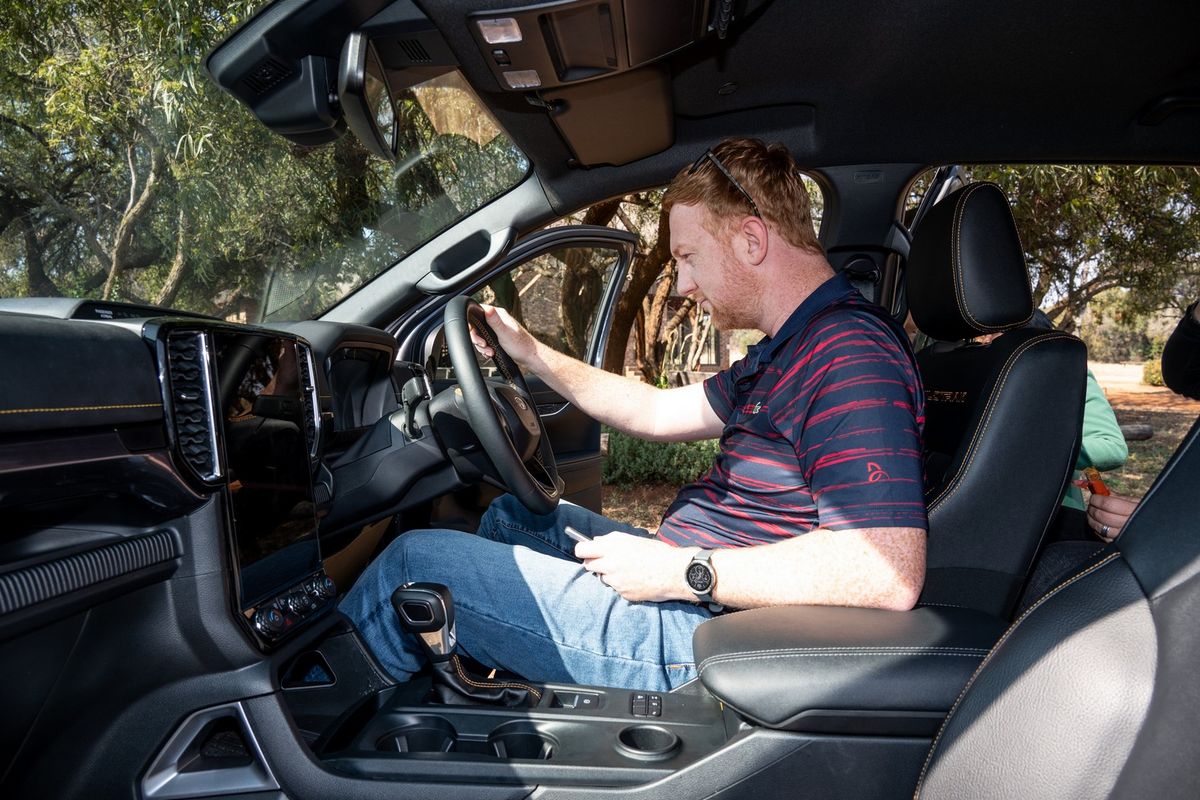
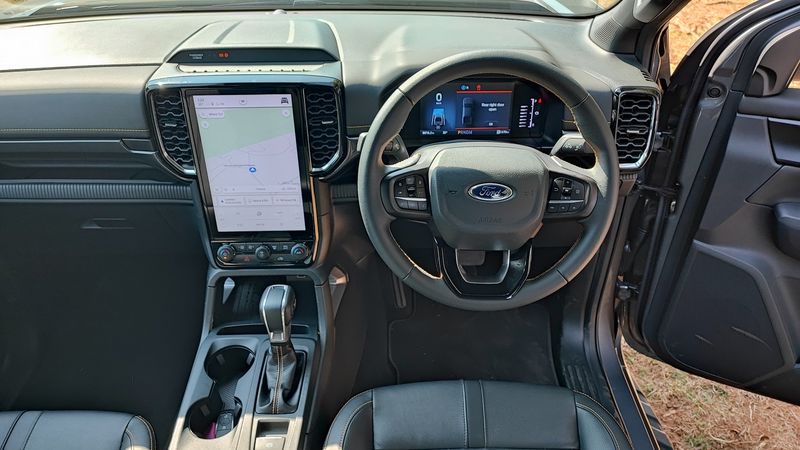
When we climbed inside the new Ford Ranger interior, it made a good first impression, which counts for a helluva lot. It’s hard to believe that what you see here are pre-pre-production units (no, that wasn’t a stutter) – they’re unfit for public consumption. Clearly, the massive upgrades to the facility are paying dividends as, at face value, the vehicle’s cabin looks virtually showroom-ready. It marks quite a leap forward and makes the current Ranger’s cabin look and feel dated.
It was only when we started inspecting the finer details of the interior that we noticed that not everything was quite finished. The Wildtrak unit we sat in, for example, had a loose cubby door and you could see some of the interior trim wasn’t quite flush-fitting. You could also see tape where engineers had been testing for wear and tear, as well as body flex. Still, for “a first draft”, it seemed a pretty good attempt. We can’t wait to see what the customer Rangers will be like.
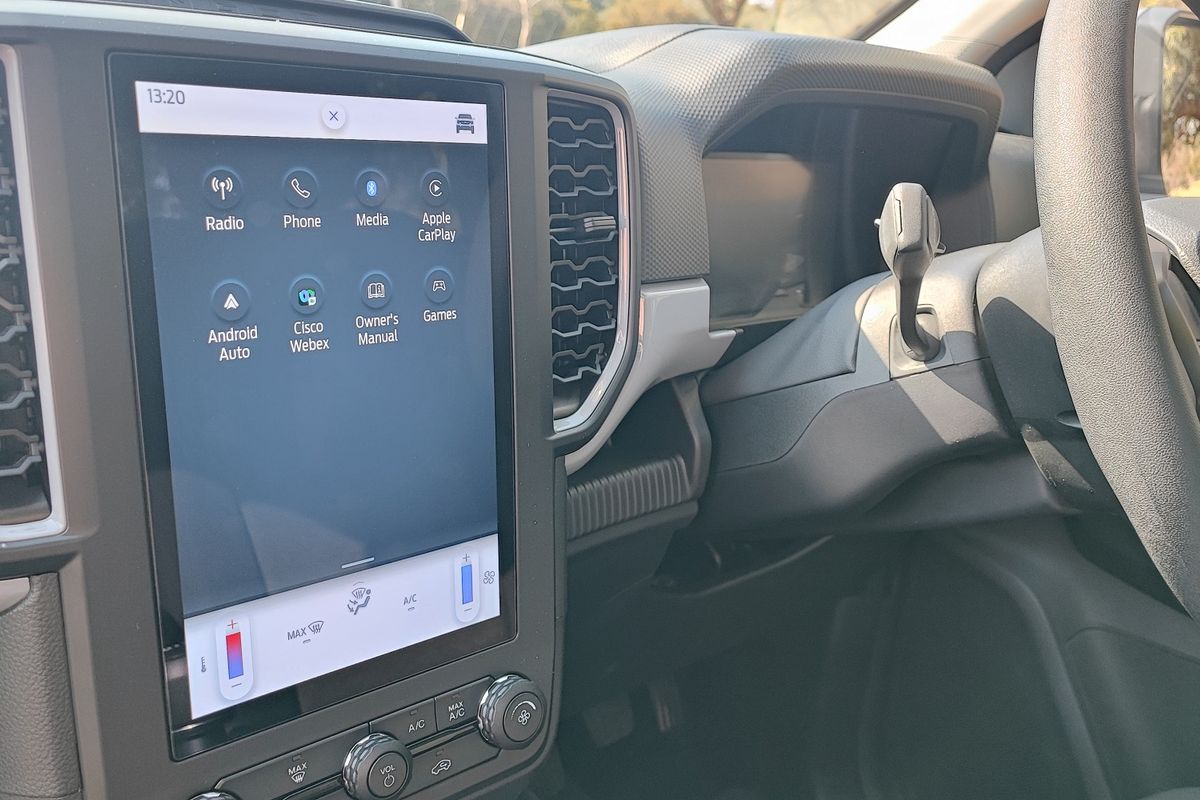
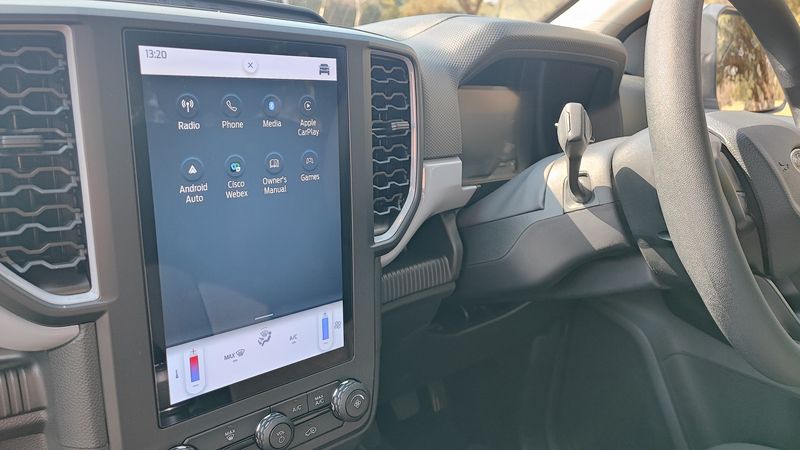
The highlight of the new Ranger’s interior has to be that vertically-orientated infotainment screen. Not only does it look advanced and make for a good conversation starter (it’s perhaps the first thing that you’d show off to your mates when you take them for a spin in your new Ranger), but, within a few seconds, we understood how the menu system worked and, despite the screen’s daunting size, it was straightforward to use. The good news is there are still analogue buttons too.
Other noteworthy interior touches are the one-hand door handles. Instead of the conventional two-handed operation (where one hand pulls the release lever and the other pushes the door open), you can now do that with just a single hand as the lever is integrated into the handle. And, when you close the door, it shuts with a reassuring and solid thud. Ahh.
Summary
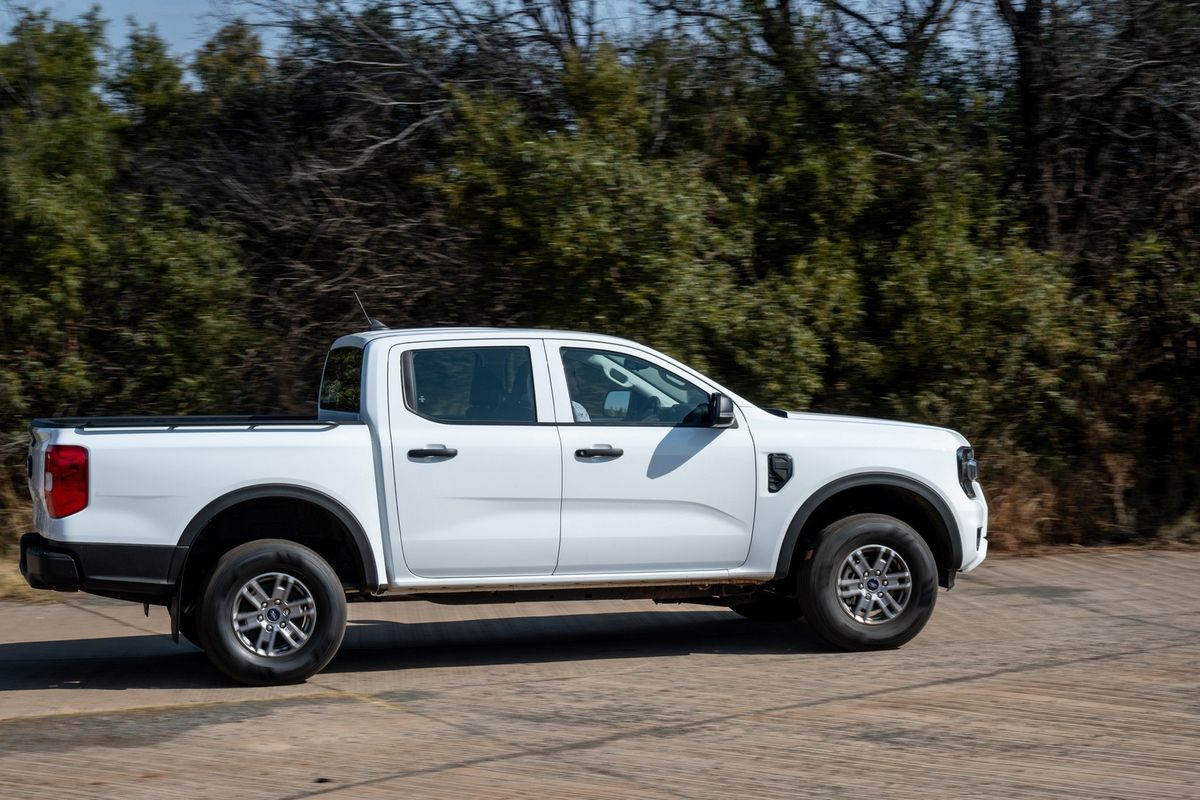
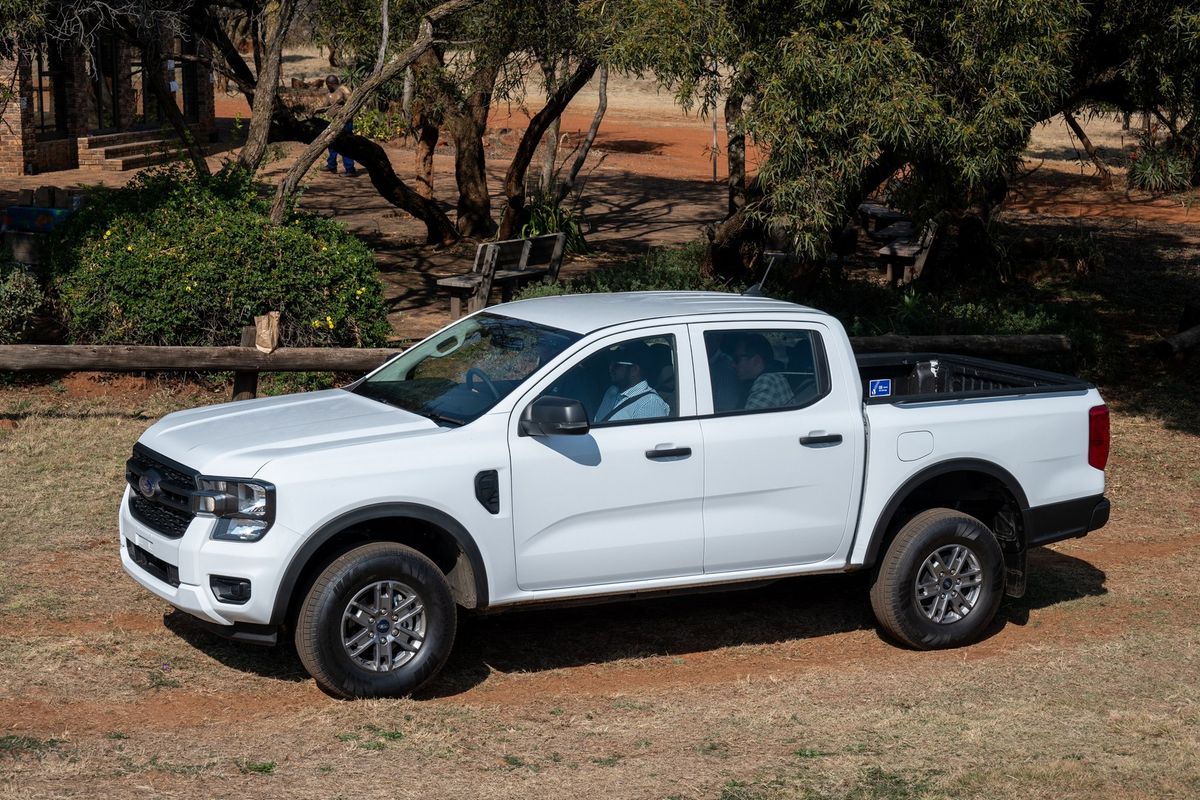
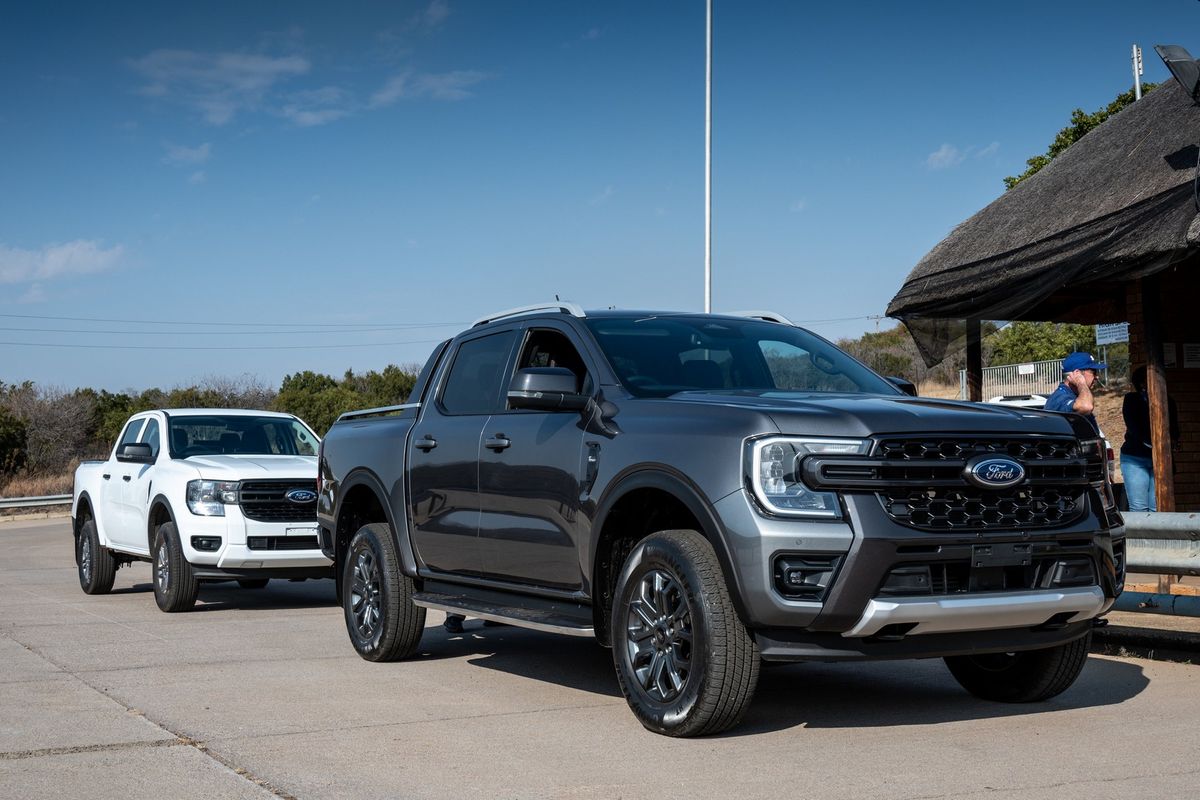
We briefly drove manually-equipped base-spec and automatic Wildtrak derivatives of the new Ranger. While there was a limit to what we could learn from the experience, it was immediately apparent that the Ford is no longer a specced-up workhorse with a rattle-prone cabin and a jiggly ride quality – the newcomer is a more upmarket (even SUV-like) vehicle. Refinement and quality levels have improved markedly; we noticed low wind noise and very little NVH in the bakkies.
At this stage, we have no confirmation of the range’s engines and trim levels, but we don’t expect the local lineup to be radically different. The basic range will offer single- and bi-turbo 2.0-litre and 3.0-litre V6 diesel engines in combination with manual gearboxes and automatic transmissions in single-, supercab and double-cab guises. We also expect the XL, XLT and Wildtrak trim lines to be carried over.
Mark your calendars – the Ranger, Ranger Raptor and Everest will be in South Africa before the end of the year.
New Honda HR-V Review – Is the range-topping HR-V worth the extra spend?
Honda’s new HR-V has arrived in South Africa and Ciro De Siena takes an in-depth look at what the newcomer has to offer. Watch the video for insight!
Honda has always had a knack for making practical vehicles. Unique elements like the patented rear Magic Seating set Honda SUVs apart from the rest of the field.
However, arguably, Honda’s SUVs have never been as stylish or desirable as some of the competitors. With this latest generation of the HR-V, it seems Honda has set out to tick both boxes, and offer a solid combination of practicality and kerb appeal.
In this video, our video man, Ciro De Siena, takes us on an in-depth tour of the new Honda HR-V, including pricing in South Africa, specs and features, the interior, rear seat practicality, boot space, fuel consumption, the new dimensions of the vehicle and dishes out his opinion on what it’s like to drive.
He also details the price and differences between the entry-level 1.5 Comfort and the 1.5 Executive.
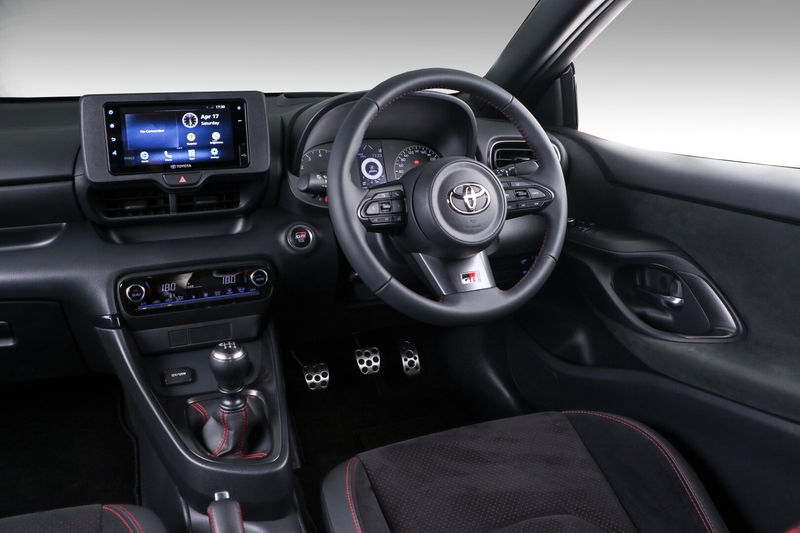
Polo GTI Fighter? Toyota Mulls FWD GR Yaris – Report
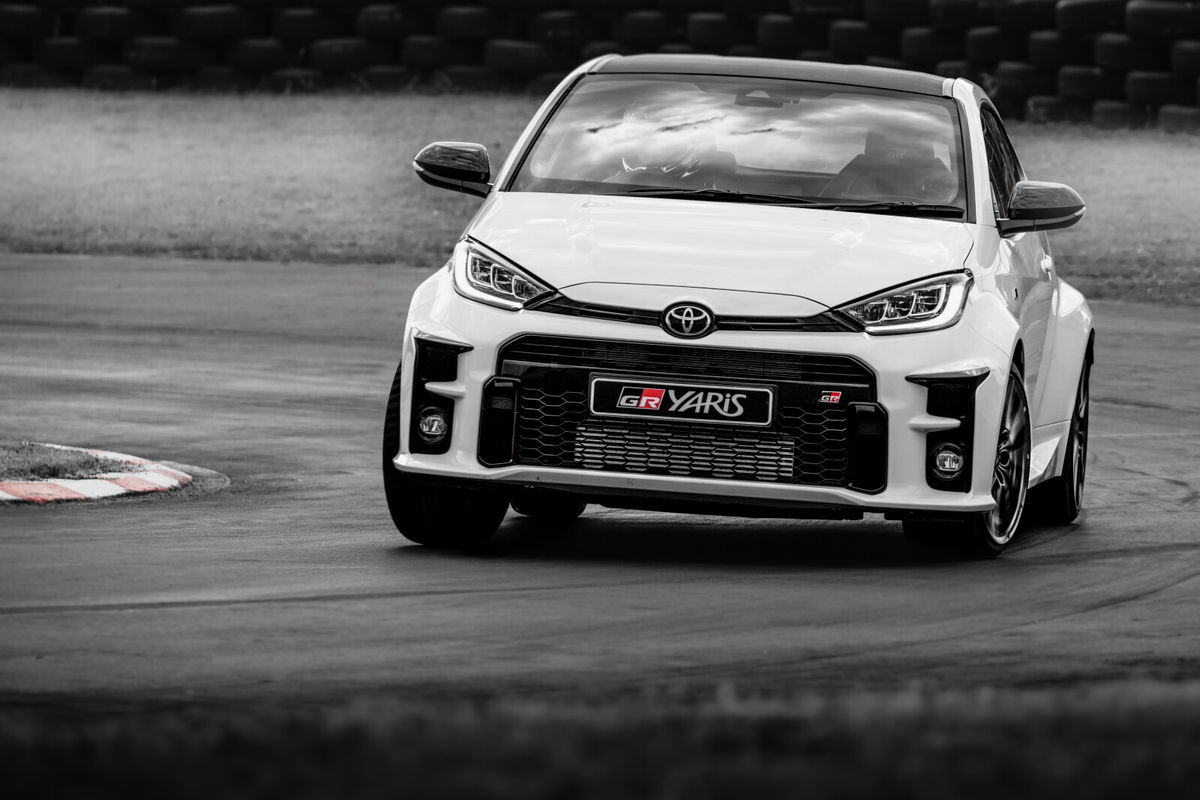
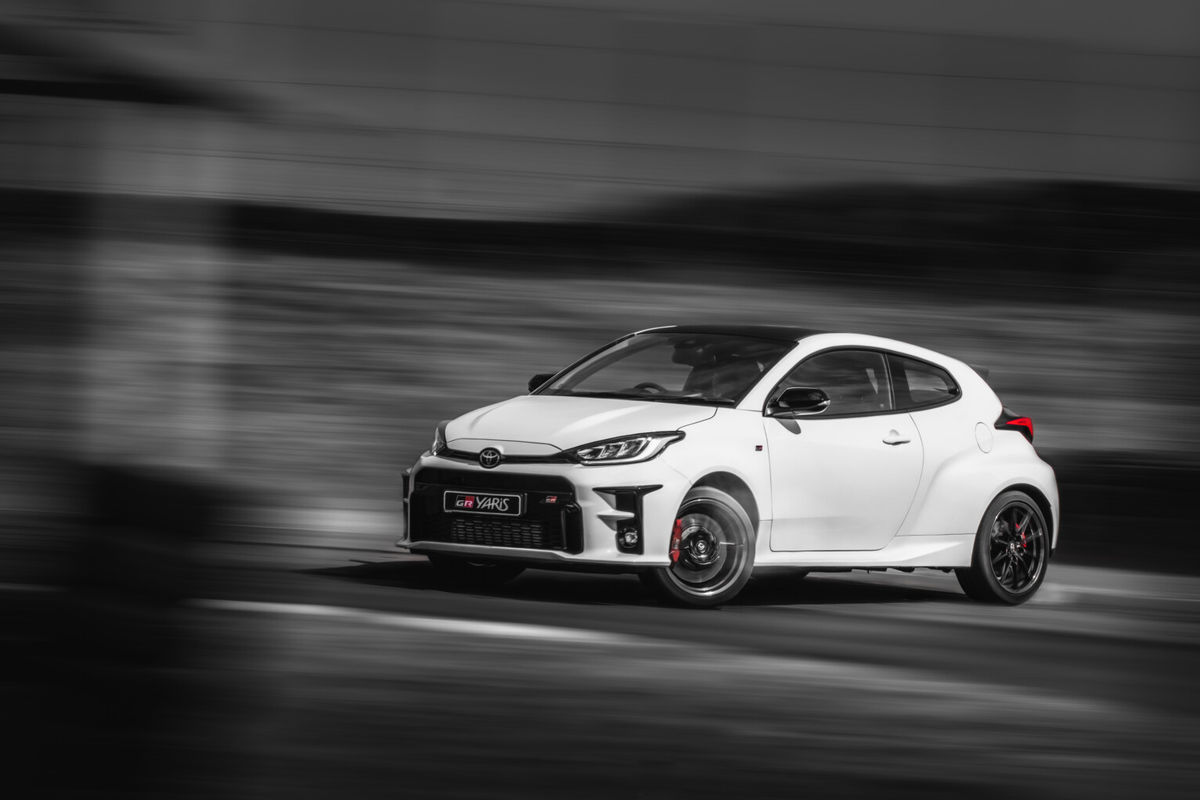
Most of the Volkswagen Polo GTI’s rivals have long since departed. But a fresh report out of Japan suggests Toyota is mulling a front-wheel-drive version of its GR Yaris, complete with an automatic transmission…
While the Toyota GR Yaris has earned critical acclaim – including from the team here at Cars.co.za – it’s not exactly the most accessible hot hatch, with units in the second consignment destined for South Africa priced from R761 200. But what if the automaker built a somewhat more affordable, front-wheel-drive version?
Well, if the latest reports out of Japan are to be believed, that may just happen – though only in 2023, at the very earliest. According to Japanese publication Magazine X (via Drive), Toyota is considering creating a rival for the Volkswagen Polo GTI. This rumoured version of the GR Yaris would ditch its all-wheel-drive system, with power instead delivered to the front axle courtesy of a torque-converter automatic transmission (rather than a 6-speed manual cog-swapper).
The publication furthermore claims such a model would employ a detuned version of the full-fat turbocharged 1.6-litre, 3-cylinder petrol engine used by the GR Yaris, though stops short of speculating about its peak outputs. For the record, the SA-spec version of the all-paw hot hatch makes a heady 198 kW and 360 Nm, while the DSG-equipped Polo GTI that a front-wheel-drive model would theoretically target offers 147 kW and 320 Nm.
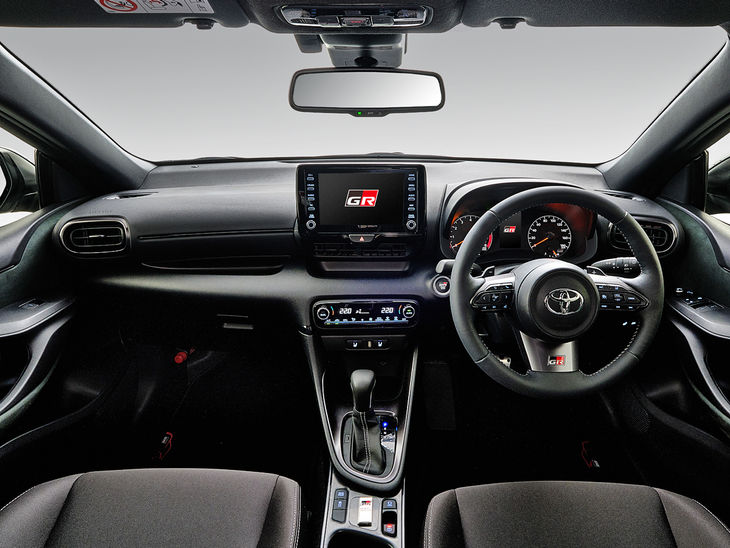
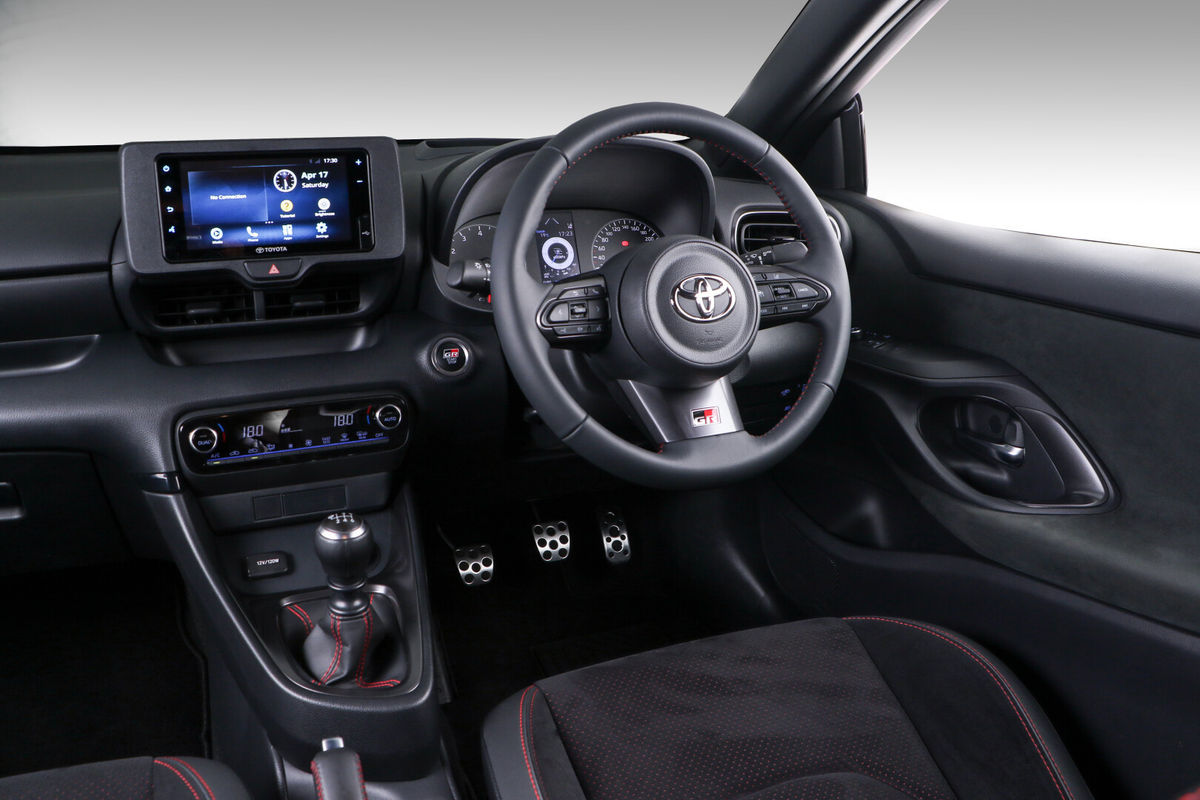
The cabin of Toyota’s JDM-spec GR Yaris RS, complete with an auto (albeit CVT) shifter.
Of course, a lower-powered version of the GR Yaris technically already exists, but to call it a hot hatch would be something of a stretch. Yes, Toyota offers the Japanese market (which also gets the sharper GRMN variant) something a little deceptively called the GR Yaris RS, which uses the same 3-door body shell but downgrades to a naturally aspirated 1.5-litre, 3-cylinder petrol engine. Generating a comparatively meagre 88 kW and 145 Nm, this unit drives the front wheels via a (gasp) continuously variable transmission (CVT) with 10 virtual steps.
Still, if Toyota were to conjure up a front-driven, self-shifting GR Yaris making around the same power as the Polo GTI – at a similar price – we can’t help but think the world would be a far better place for it.
After all, with the likes of the Renault Clio RS, Opel Corsa OPC and Peugeot 208 GTi no longer in production (and the latest Ford Fiesta ST and Hyundai i20 N not available in SA), the Polo GTI needs some competition. We’re pretty sure such a move would help Toyota recover the no-doubt hefty developments cost that came with creating the GR Yaris in the first place.
Here’s hoping it comes to fruition…
More GR Yaris Units for SA
Good news as Toyota SA confirms a second batch of its brilliant GR Yaris is on its way to our shores. Here’s pricing and what’s coming.
You could say Toyota has well and truly shaken off its ‘boring car’ image. With the GR Supra, GR86, GR Corolla and GR Yaris, there’s enough performance to suit all needs and budgets.
The Toyota GR Yaris has been an absolute revelation and has received global praise for its performance and what it brings to the table. We at Cars.co.za adore the crazy little GR Yaris too with its 198 kW/360 Nm 1.6-litre 3-cylinder. A manual gearbox and all-wheel drive give it proper credentials on both tar and gravel.
Sadly the first batch in South Africa was quickly snapped up and some enthusiasts missed the chance to own one of these wicked road-legal rally cars. Good news as Toyota Motor Corporation has extended production and will be making many more.
Toyota SA has confirmed more units for us and they’ll be the top-spec Rally version, featuring a Torsen limited slip-diff on both the front and rear axle, as well as trick Michelin Pilot Sport 4S tyres. Standard kit includes things like keyless entry with push start, LED-headlamps with Daytime Running Lights (DRL) and auto function, LED foglamps, heated and power-retractable exterior mirrors, plus rain-sensing wipers. On the inside, an auto-dimming rear-view mirror, dual-zone climate control, Multi-Information Display (MID), 12-volt power outlet and a tilt-and-telescopic adjustable steering column deliver on convenience.
A 6-speaker touchscreen audio system is standard on all models, and features Apple CarPlay/Android Auto functionality for smartphones as well as Bluetooth and USB inputs. The second batch of cars will also feature a reverse camera and rear park distance control.
Toyota GR Yaris Rally Price
All GR Yaris models are sold with a 9-services/90 000 km service plan (intervals set at 10 000 km) and 3-year/100 000km warranty. Customers can also purchase a variety of service and/or warranty add-ons at their local dealership.