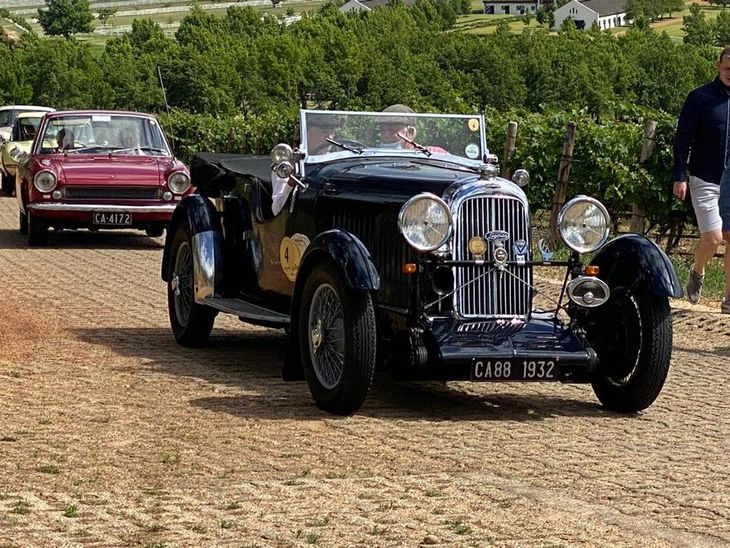
Inspired by “the most beautiful race in the world”, the Mille Miglia, the Cape 1000 is a new classic car event that will take place in the Western Cape in March 2022. Only 60 cars will be selected to take part, so if you think you have a car worthy of the Cape 1000, then here’s what you need to know!
If you’re a dyed-in-the-wool petrolhead, then the name “Mille Miglia” will immediately stir emotions. This storied 1 000-mile race took place in Italy from 1927 to 1957, and helped cement iconic names such as Tazio Nuvolari and Stirling Moss in our memories of motorsport’s golden era. The spirit of the “Mille Miglia” actually still thrives to this day. Since 1977 it has been run as an historic rally that attracts some 350 high-profile entrants annually, all in cars manufactured between the original racing years. The event is so admired, that so-called “tribute” races have popped up around the world, in places such as Japan, the United States, Dubai and now, for the first time, in South Africa, with the announcement of the Cape 1000.
With the most incredible scenery and roads that the Western Cape has to offer, it is the obvious location for a similar road rally that pays tribute to “the most beautiful race in the world.” The event will be run in partnership with SCL Travel and Cars.co.za.
“We are excited to be paying tribute to such an incredible part of motorsport history right here in the fair Cape,” says Dave Alexander, Route Convenor. “With some of the best and rarest motor vehicles taking part, it should be quite a spectacle!”
“Classic car culture is alive and kicking in South Africa,” added Hannes Oosthuizen, Consumer Experience Manager at Cars.co.za. “We are thrilled to partner with the Cape 1000’s organisers, and look forward to bringing all the glamour and excitement to our audiences, across all our platforms, including Youtube. We are also excited to confirm that we will be participating – and documenting the journey – in the Cape 1000 with our freshly restored Ford Capri Perana!”
Cape 1000 organiser, Ross Crichton, commented, “For this inaugural 1000 Mile Tribute event we decided on a limit of 60 cars, and I’m pleased to announce that just about half of those available slots have already been snapped up!”
The event, which takes place from 8-13 March 2022, will be run over the course of four days (five nights). It will include grand touring, regularity stages and non-competitive track events. Entries are limited to certain brands, models and by invitation or application (and subject to approval by the admissions committee to ensure a line-up of top-end entrants).
The categories are;
1927-1957: Mille Miglia Specific
Pre-1976: Classic
1977-1996: Modern Classic
1997-2021: Sports
“Based on the feedback thus far, we anticipate a stellar line-up of rare and exotic vehicles, ranging from cars nearly 90 years old, to more recent, modern classics,” says Crichton. It promises to be quite a fantastic sight when the 60 entrants leave the starting point at the V&A Waterfront in Cape Town in March next year”, he adds. He encourages owners who are unsure about the eligibility of their cars to get in touch.
Some of the Mille Miglia Class cars already confirmed include a super-rare 1961 Mercedes-Benz 300 SL Roadster, a 1955 Jaguar XK140 OTS, 1974 Porsche 911 2.7 RS as well as an iconic 1990 Ferrari F40. Other entrants from the Franschhoek Motor Museum could include a Bristol 401, a 1957 MGA, 1956 Triumph TR3 and 1934 MG K-Type.
Beneficiaries of the Cape 1000 include the Motorsport Legends Benevolent Fund and QuadPara Association of South Africa (QASA).
Take a look at what transpired in terms of new car sales in South Africa during the month of December 2021 as well as what to expect in 2022!
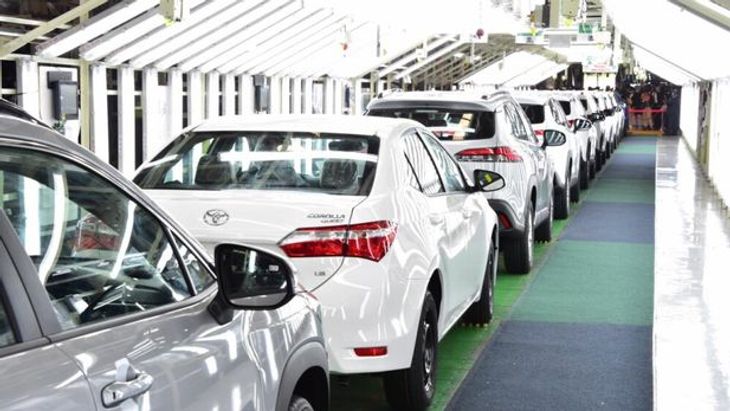
New car sales remain under pressure but the local automotive industry bounced back somewhat in 2021.
Covid-19 wreaked havoc on the industry in 2020 with a massive 29.2% decline in new car sales. Consequently, 2021 was a year of recovery with a year-on-year increase of 22.1% and total industry sales amounting to 464 122 units. Those gains are fairly impressive when you consider the major challenges faced by the industry during 2021, such as global supply chain disruptions, stock shortages, load-shedding, increasing fuel costs, cyberattacks, strikes and civil unrest.
December 2021 new car sales reflected mixed results as indicated below.
New Car Sales for December 2021
Aggregate new car sales of 35 948 units down by 3.5% (-1 302 units) compared to December 2020
New passenger car sales of 24 949 units up by 1.7% (+408 units) compared to December 2020
Light Commercial Vehicle (LCV) sales of 8 990 units down by 16.6% (-1 794 units) compared to December 2020
Export sales of 21 430 units up by 19.4% (+3 487 units) compared to December 2020
Top 10 Car Brands in South Africa fro December 2021
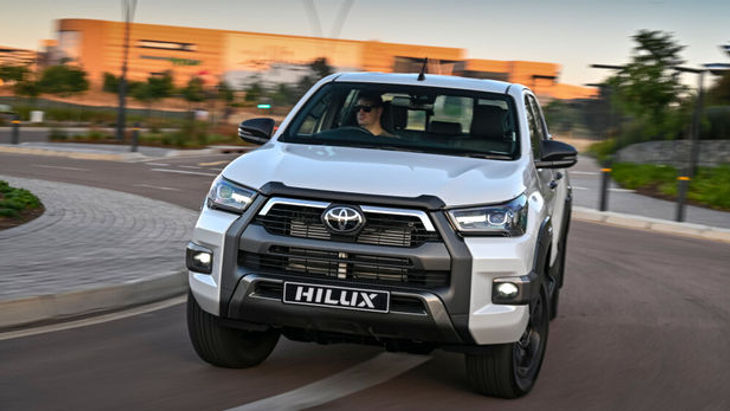
1. Toyota – 9 580 units
2. Volkswagen – 5 131 units
3. Hyundai – 2 892 units
4. Nissan – 2 417 units
5. Ford – 2 181 units
6. Suzuki – 2 102 units
7. Kia – 1 862 units
8. Renault – 1 758 units
9. Isuzu – 1 481 units
10. Haval – 1 453 units
Best-Selling Cars in South Africa for December 2021
Many of the above-mentioned challenges will continue to have a negative impact on the local automotive industry in 2022 and the global semi-conductor shortage will continue to affect stock availability for certain models for the short to medium term.
Loadshedding will continue to hamper and prevent the economy from reaching full capacity while rising interest rates will negatively impact vehicle affordability and apply further pressure to household budgets. As a result, economic recovery will be slowed.
The GDP growth forecast for 2022 is pegged at 1.8% and the new vehicle market is expected to recover slowly during the year with an aggregate year-on-year improvement of 8% expected. Export performance is expected to improve by 15% while local vehicle production is expected to increase by 17%.
But what could be even more interesting is the potential of a V8-powered Ranger.
The current T6 Ranger was going to receive a V8 derivative, but that project never evolved into production maturity. That doesn’t mean the idea has faded into obscurity.
How could a V8 Ranger happen? Thanks to the Bronco, that’s how! Ford has seen tremendous demand for its revived Bronco and a competition-specification version, which uses the brand’s Coyote 5.0-litre V8 petrol engine.
With the Bronco built on an advanced Ranger platform, the proof of concept exists for a V8 double-cab version of Ford’s global bakkie.
Speaking to CarsGuide.com, Trevor Worthington, Ford’s vice-president of global product development, and Mark Rushbook, Ford Performance motorsports global director, alluded to the appeal of a V8 Ranger.
Worthington recognized the parts commonality between Bronco and Ranger. “There is a lot of that Bronco DR that is standard Bronco. And the underpinning of the standard Bronco and the underpinnings of the new Ranger, is the same architecture.”
Rushbook echoed the sentiments. Regarding the Bronco DR V8, it is worth remembering how this is an Australian project, not an American one. “It’s developed by our team in Melbourne. So, there’s a lot of opportunity.”
Melbourne is where the Ranger T6, Everest and new Ranger have been developed. It is the location for one of Ford’s global engineering hubs.
The global demand for high-performance double-cab bakkies shows no sign of ebbing. And that could be an adequate incentive for Ford to finally bring a V8 Ranger to fruition.
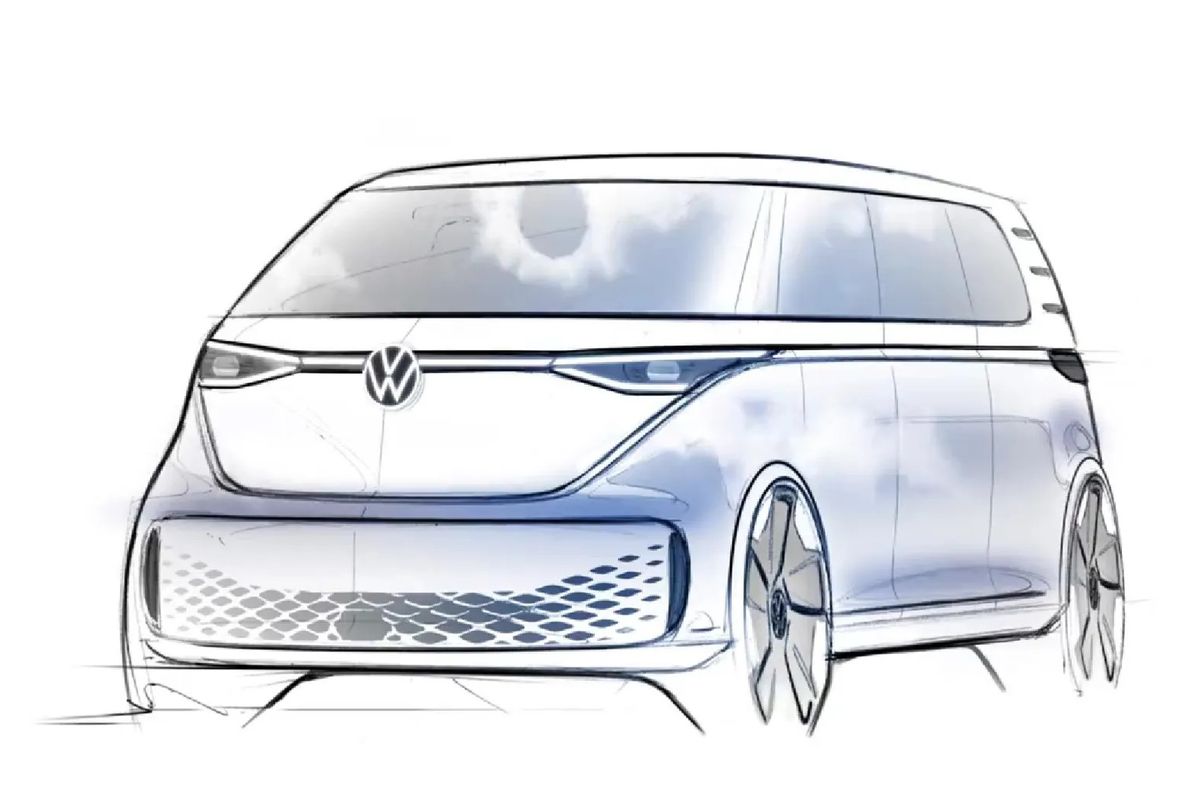
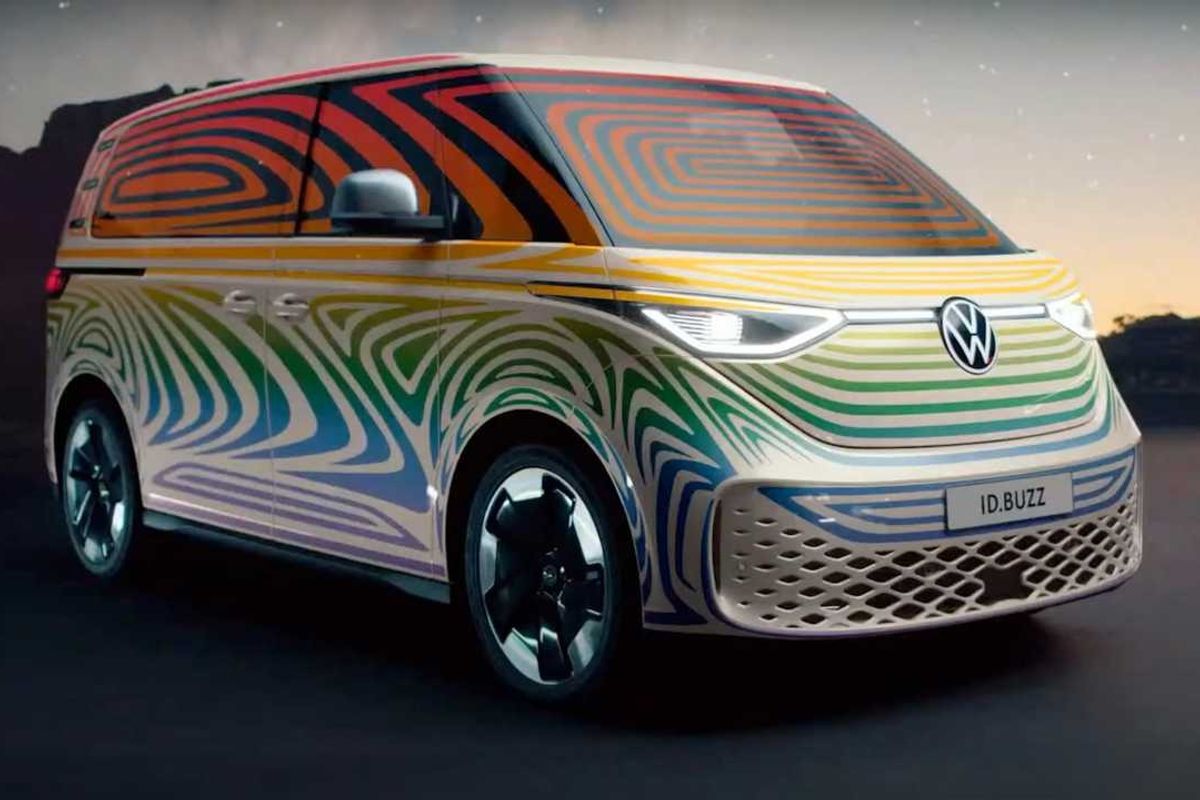
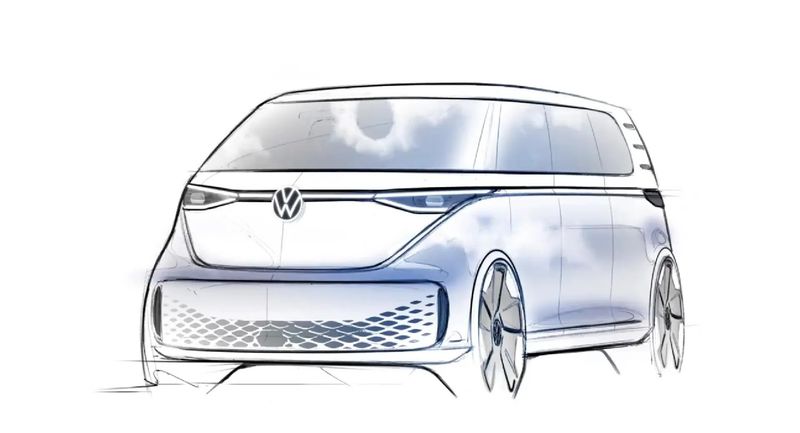
The reveal in March 2022 is a long time coming, with the original concept making its debut at the Paris Motor Show back in 2016. The tweet was accompanied by a simple drawn animation, that gives us some idea of what the new Volkswagen ID.Buzz will look resemble, but sadly it does appear that some of the futuristic elements from the concept have been lost.
We’ve already had a chance to see a preview of the new model, as Volkswagen teased the ID.Buzz during the ID.5 presentation.
Under the skin, the Volkswagen ID.Buzz is expected to share the same platform and running gear as the ID.4. The VW MEB platform will serve as the base and if the ID.4’s lineup is anything to go by, the electric buss will have a multi-model portfolio. An entry-level model with a single electric motor and 150 kW/310 Nm is expected to kick off the range. The top-spec will feature all-wheel drive and have two motors producing 220 kW and 459 Nm. An estimated range of around 480 km could be possible.
The Volkswagen ID electric family is growing at a considerable pace, with the brand offering a product for nearly every segment it sells an ICE equivalent in. The Volkswagen ID.3 kicked things off, offering a Golf-sized hatchback with the entry-level bringing 330 km to the party.
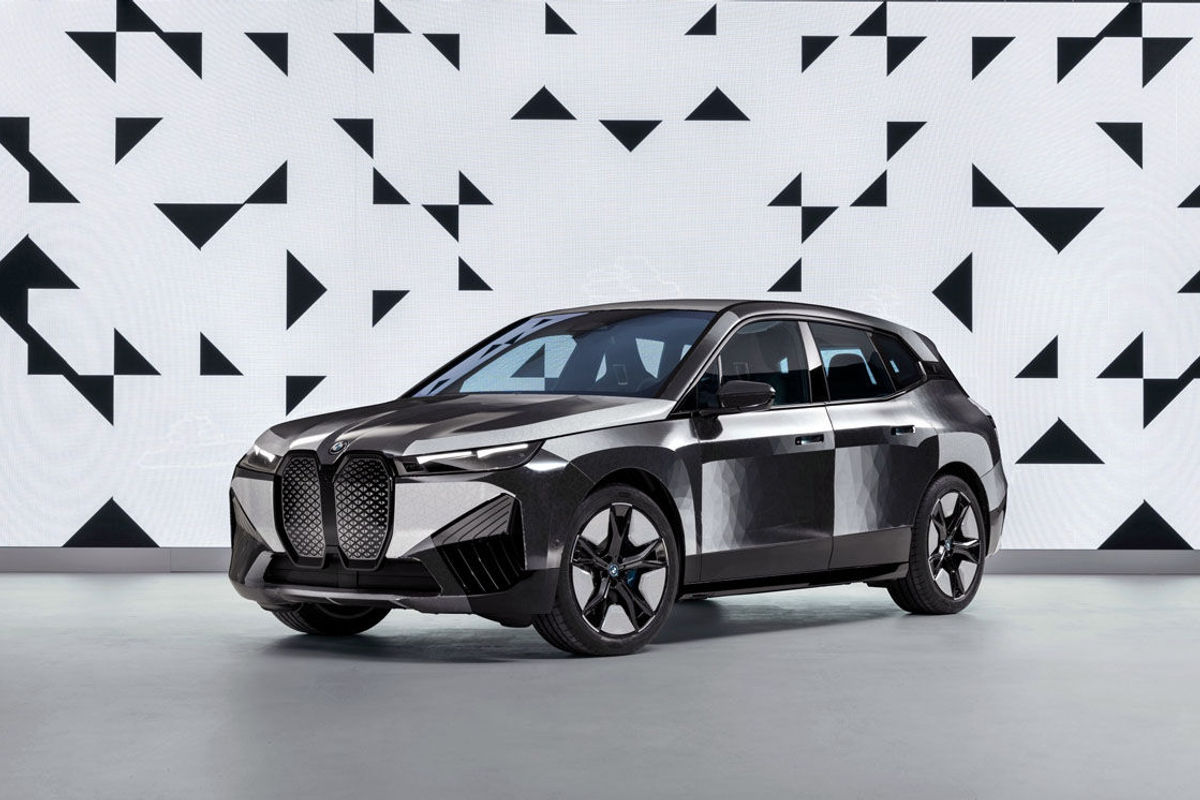
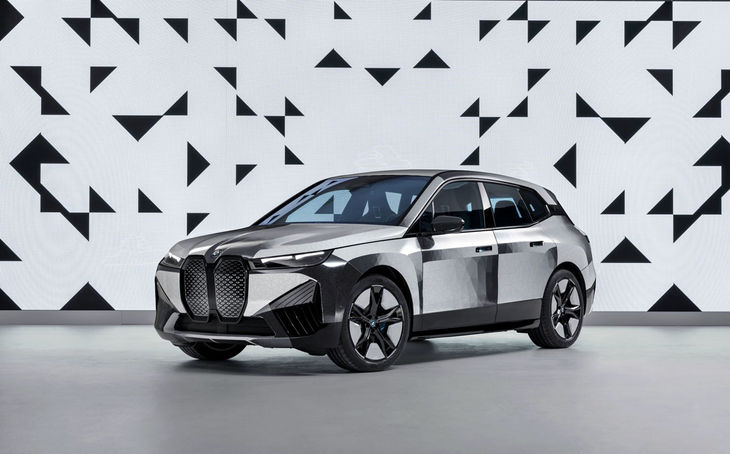
Having unveiled its range-topping iX M60 at the 2022 Consumer Electronics Show (CES), BMW has further showcased an array of future technologies. For example, the idea that the colour of a car’s exterior finish could be changed instantly used to be a pipe dream, but not anymore…
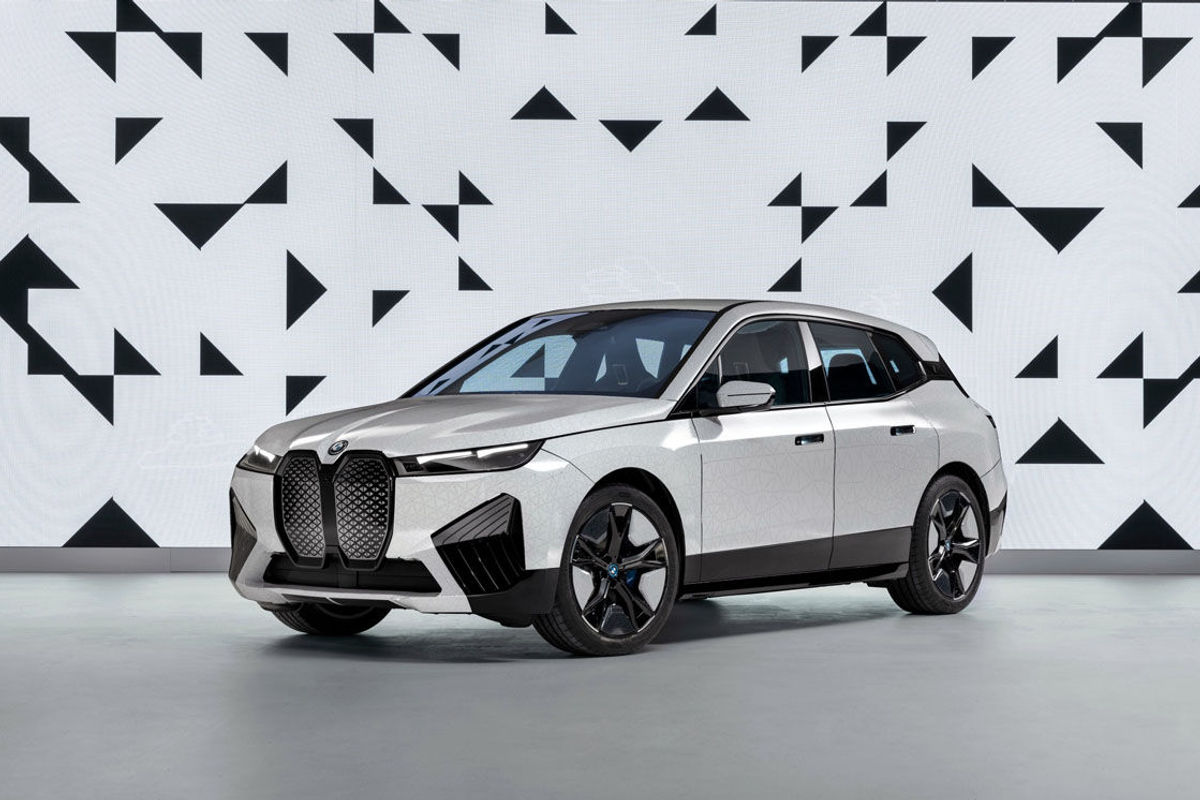
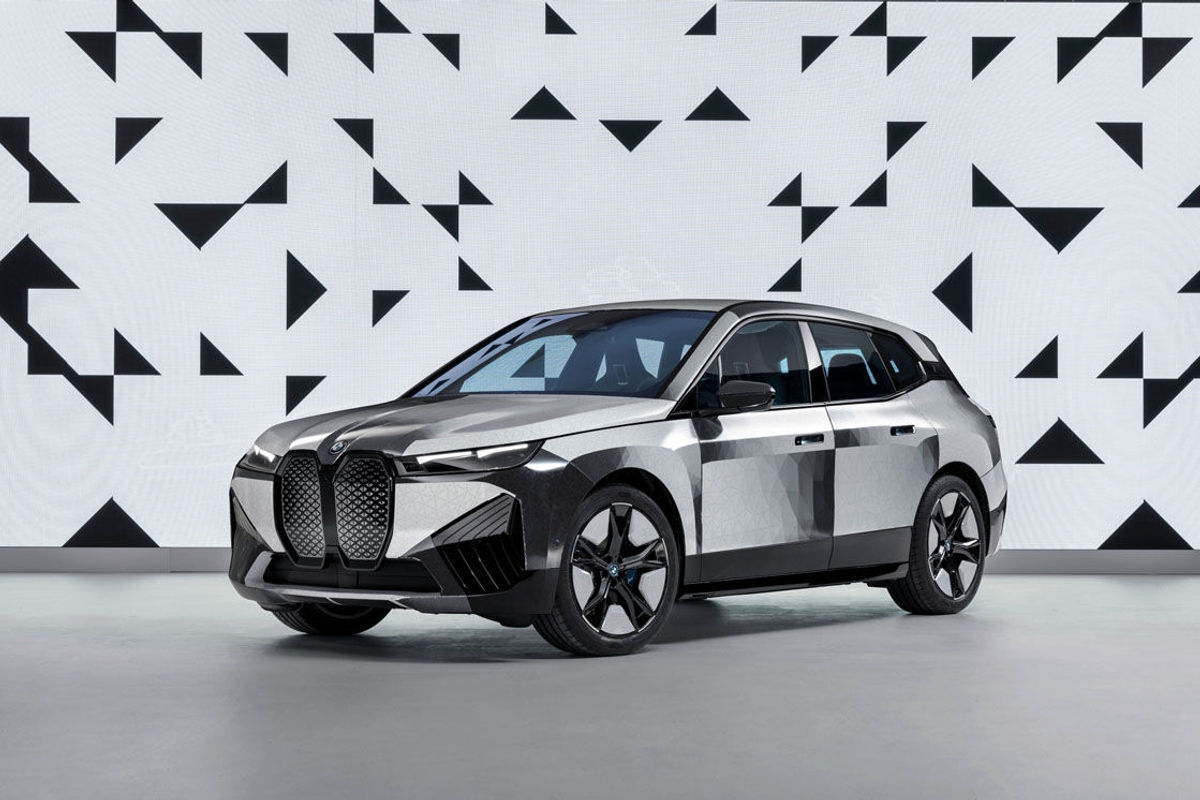
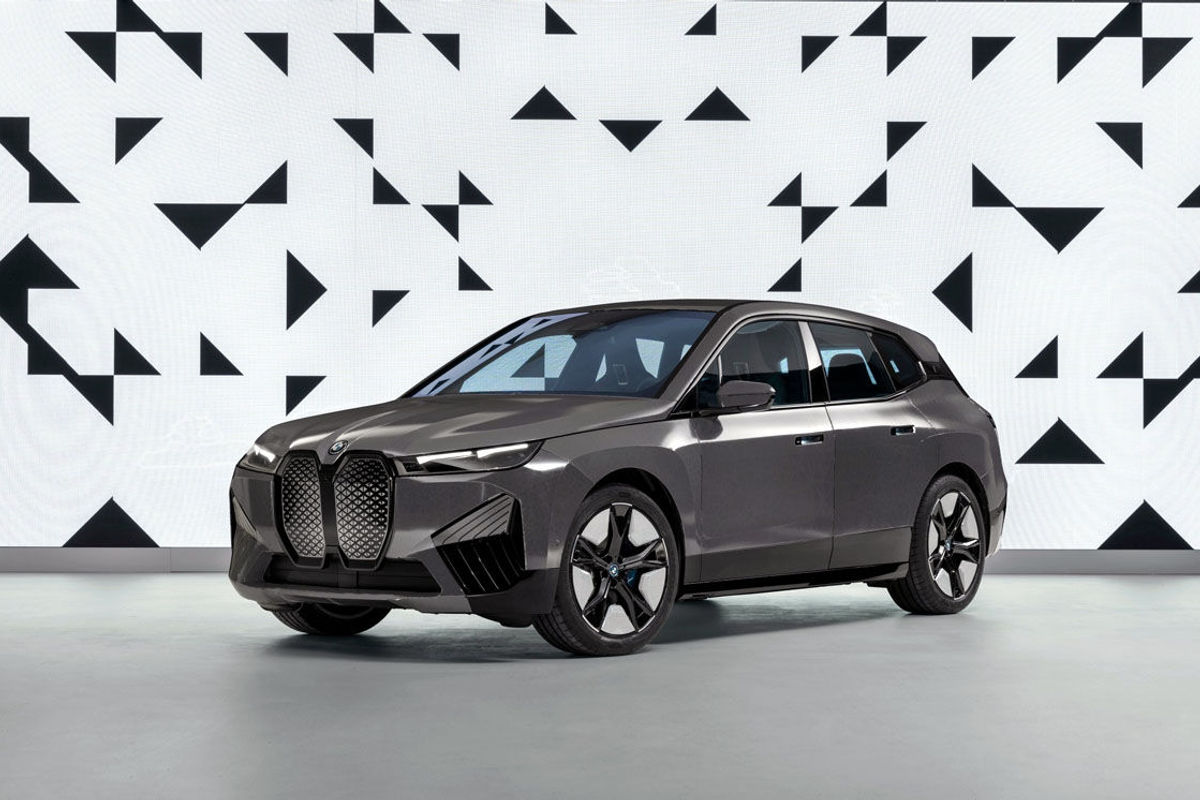
Some of the innovations that the Bavarian brand unveiled, such as new My Mode iDrive settings and accompanying BMW IconicSounds Electric soundtracks/-scapes, will be made available on the brand’s i-models soon, but, the sci-fi-esque BMW iX Flow concept (featuring E Ink technology), which allows users to change the exterior colour of their vehicle at the push of a button, is certainly worth a closer look.
The colour-changing technology (developed by E Ink) is derived from eReader displays; the BMW iX Flow’s surface coating is made up of millions of microcapsules, each of which contains negatively charged white pigments and positively charged black pigments. When they’re stimulated by means of an electrical field, either the white or black pigments collect at the surface of the microcapsules, which is how the colour of the exterior finish can be transformed from white to black (and vice versa, of course).
The Bavarian brand says that generative design processes and laser-cutting technology were implemented to ensure that the multitude of precisely fitted “ePaper segments” conformed with the contours of the iX’s sheet metal and produced life-like variations of light and shadow.
Although the colour-changing technology seems several years away from being introduced in production cars, the technology itself is very energy-efficient. Unlike displays or projectors, for example, the electrophoretic technology needs no energy to keep the chosen colour state constant, BMW says – current only flows during the short colour changing phase.
BMW iX Flow featuring E Ink technology can only alternate its entire exterior between black and white at this stage (with a range of shades of grey in between), but it’s not beyond the realms of possibility that, in future, a vehicle’s exterior finish could be manipulated to display themes and branding too, either on some of its exterior panels – or its entire bodywork.
There are some practical applications as well. BMW suggests drivers could choose a light surface on warm sunny days (white) and a heat-absorbing one (black) on cold days, for example.
“This reduces the amount of energy the vehicle electrical system needs and with it also the vehicle’s fuel or electricity consumption,” the firm said. “In an all-electric car, changing the colour in line with the weather can therefore also help to increase the range. In the interior, the technology could, for example, prevent the dashboard from heating up too much.”
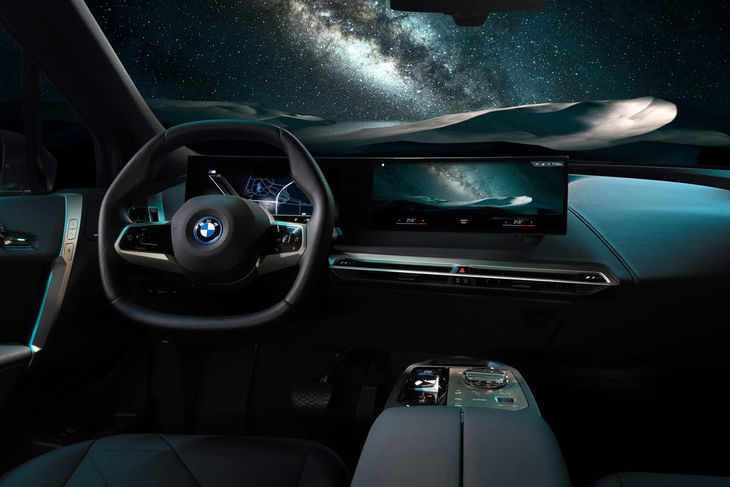
Meanwhile, the latest generation iDrive operating system in the iX already affords greater personalisation of the driving experience via its selectable My Modes. At CES 2022, BMW showcased new Expressive and Relax My Mode settings, through which future BMW customers will be afforded additional ways of adapting their vehicle settings to suit various “situations and moods”.
In the new My Mode Expressive, the appearance of the graphics on the BMW Curved Display is characterised by expressive colours and abstract patterns. In My Mode Relax, the focus is on wellness, harmony and relaxation, with a display inspired by natural landscapes.
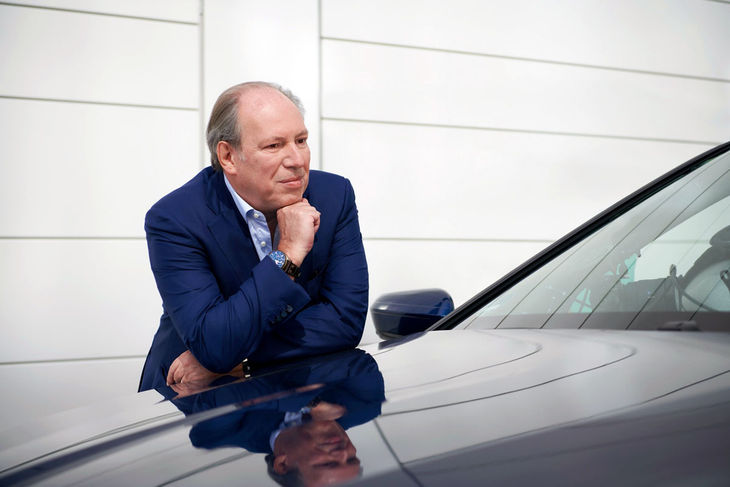
Of course, all of the My Mode settings are accompanied by distinctive BMW IconicSounds Electric soundscapes, created in cooperation between the BMW Group and the Academy Award-winning film-score composer Hans Zimmer (pictured above). The electrified BMW M models also employ variations of the BMW IconicSounds Electric suite developed specifically for them.
BMW IconicSounds Electric generates driving sounds that reflect the specific performance characteristics of each of the modes. “In this way, the acoustic feedback to the movements of the accelerator becomes an elementary part of the driving experience,” BMW says. To put it another way, when you accelerate, the i-model will emit a specific audible tone, the intensity of which matches the pedal position.
BMW IconicSounds Electric will be available for the first time for the i4 in the first half of 2022 and for the iX in the second half of 2022, BMW said at the event.
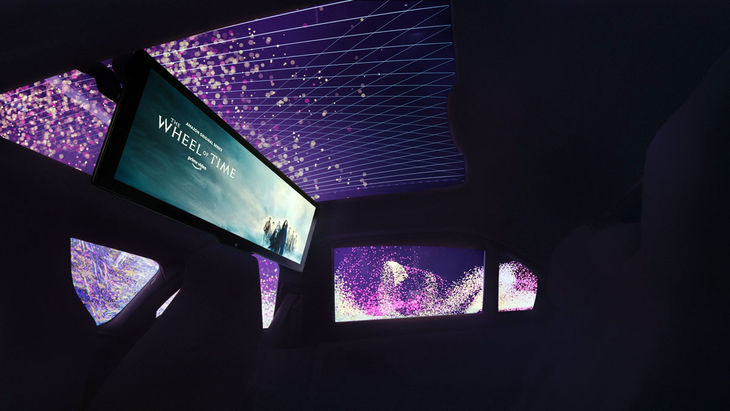
Finally, the brand demonstrated also the in-car entertainment system of the future with My Mode Theatre, which is said to transform the rear of an i-model’s cabin into a private cinema lounge. When activated, a BMW Theatre Screen lowers from the headliner and rear occupants can operate the entertainment system via direct touch fields and touch panels in the doors.
The theatre screen is a 31-inch ultra-wide display in 32:9 format, with a display resolution of up to 8K. It operates in conjunction with surround sound audio, as well as 5G connectivity.
The BMW Group is working with Amazon to fully integrate the Fire TV experience within the Theatre Screen system to give rear passengers access to a wide variety of content so they can stream videos, listen to music, and watch downloaded programs, all while on the road, the firm said.
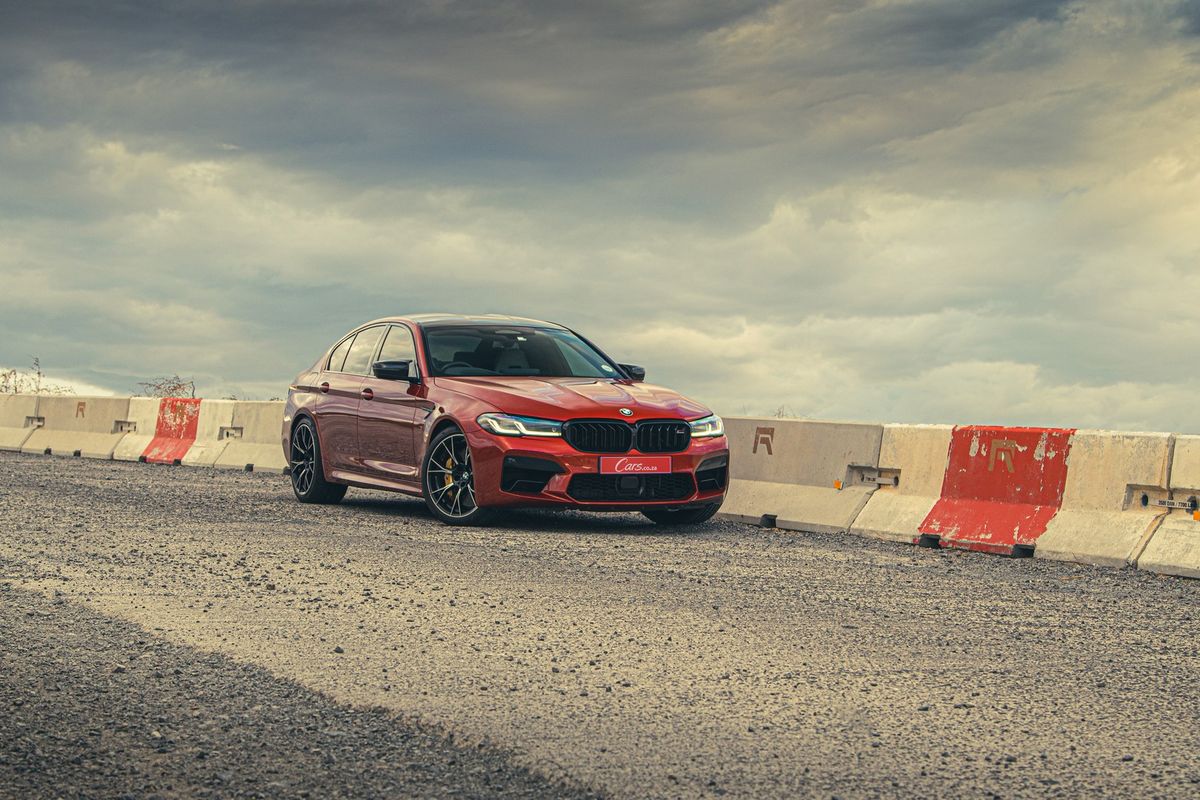
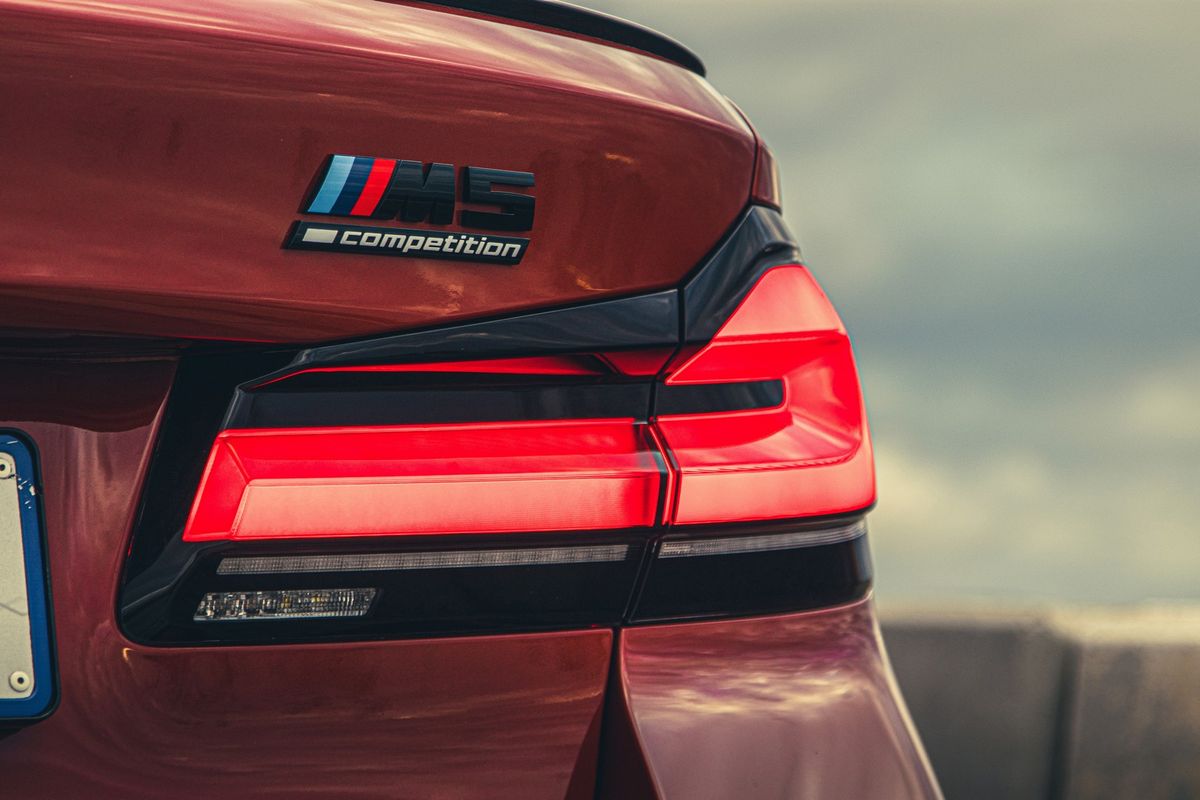
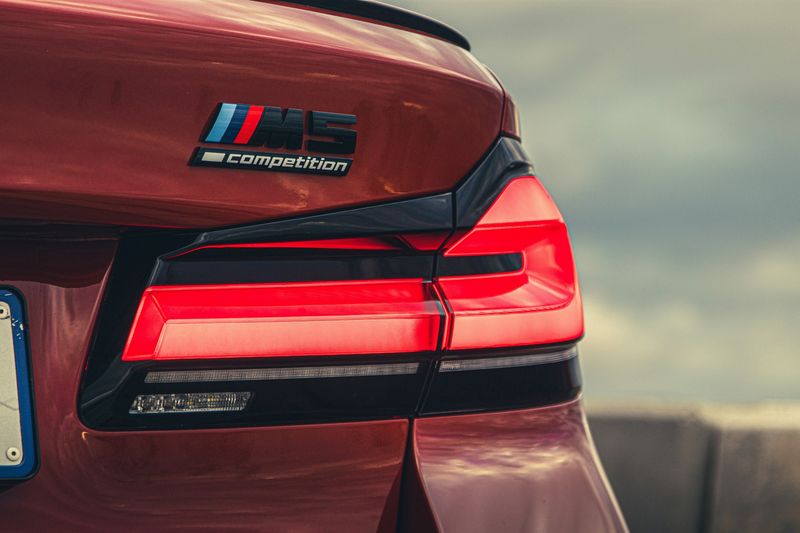
The BMW M5 Competition is one of the few remaining performance sedans in the new-vehicle market. With its existence threatened by rapid battery-electric cars (let alone tar-shredding SUVs), we wonder if this is the last ICE-powered M5 that we’ll ever see.
We like: Stupendous performance, excellent balance of pace and luxury, ease of use.
We don’t like: Ravenous appetite for unleaded, optional exhaust may be too loud for some, complex vehicle settings interface
M5. The iconic letter and number combination began the era of the sports sedan in 1984.
The M5 is one of BMW’s most iconic nameplates. Now in its 6th generation, the BMW M5 continues to follow the recipe of shoehorning a large-capacity petrol engine into an executive sedan to create a car that’s both formidable and relatively family-friendly. Recently, the BMW M5 Competition underwent an LCI (Life Cycle Impulse), which is essentially an update to a product in the middle of its product cycle.
Changes to the BMW M5 Competition LCI ranged from some mild exterior updates to the more serious under-the-skin mechanical upgrades, such as the damper control system that BMW claims “will enhance ride comfort during high-speed highway driving as well as over bumps” and updated shock absorbers, which lifted from the BMW M8 Gran Coupé. There are also revisions to the BMW M Servotronic power steering setup. Inside, the updated BMW M5 gets a larger 12.3-inch-screen infotainment system that now features Android Auto and cloud-based navigation.
While there’s still strong demand for the BMW M5 (and its immediate rivals, such as the Mercedes-AMG E63 S and Audi RS6 quattro), this segment’s growth aspirations have been curtailed somewhat by the popularity of high-performance premium SUVs produced by American, British, German and Italian premium brands. But, as stellar and in-demand as the BMW X5 M Competition is, its name doesn’t quite have as much pedigree as an M5, does it?
As far as rivals go, the performance sedan segment is on the decline with just a handful of models on offer. If the BMW M5 Competition isn’t your cup of tea, Mercedes-AMG offers up the E63 S that boasts a thundering biturbo V8 engine and plenty of luxurious touches. Audi doesn’t make a sedan version of the RS6 anymore, so you’ll have to settle for a station wagon or the 4-door coupé that is the RS7. For something just as ballistic, but quite different, look to the Porsche Panamera Turbo S. At this price point, a BMW M850i Gran Coupe offers most of the M5 Competition’s performance, for a bit less money and is prettier to look at, but it is not an out-and-out M car.
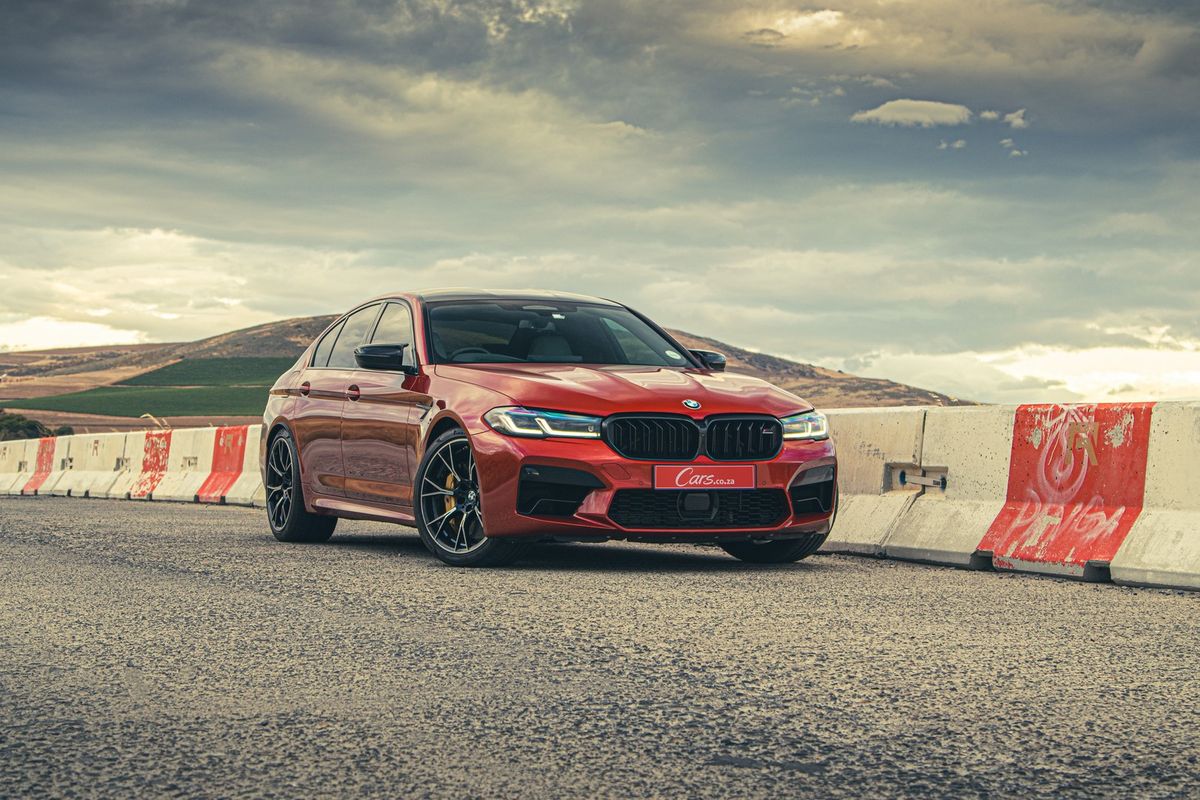
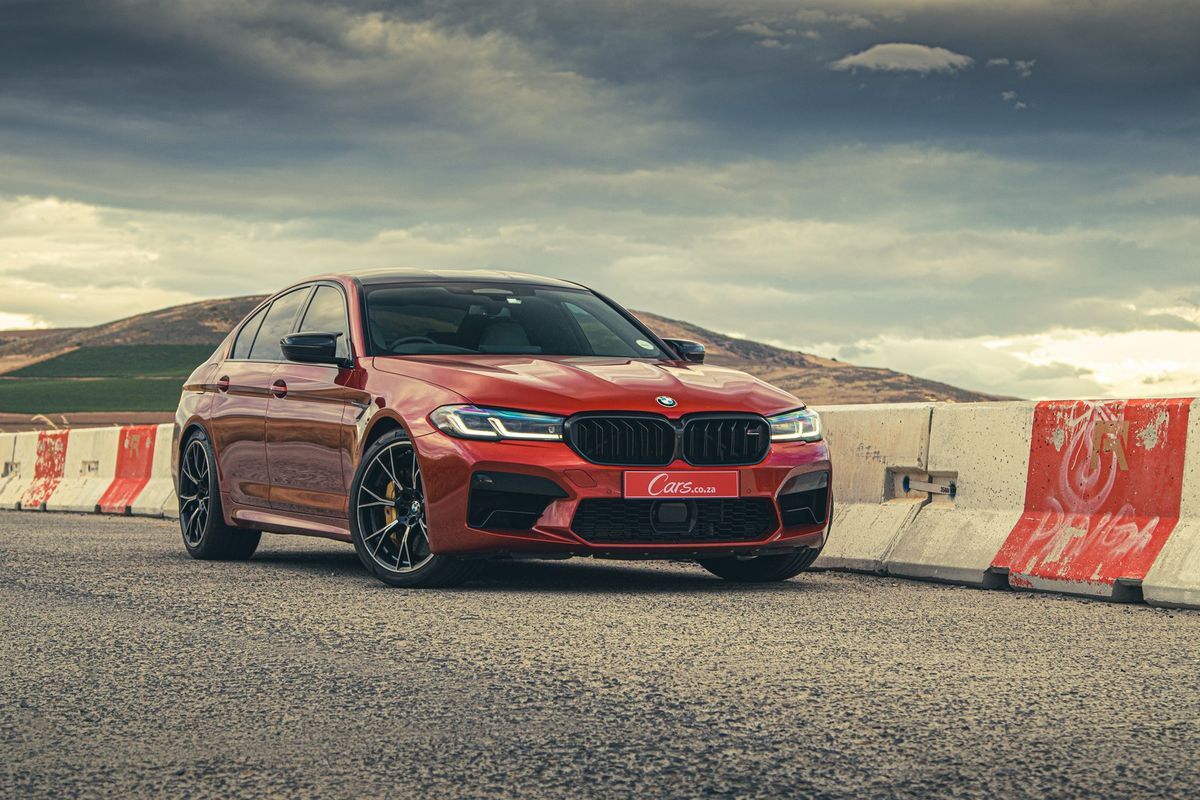
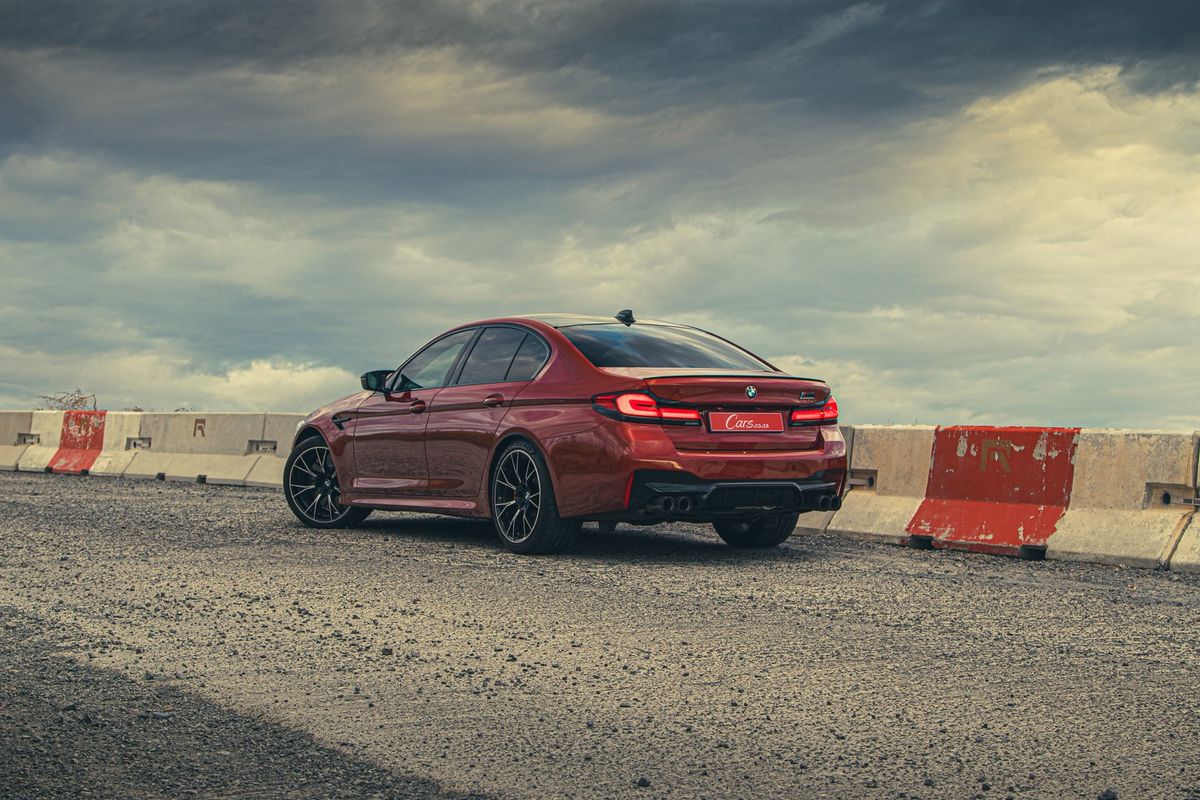
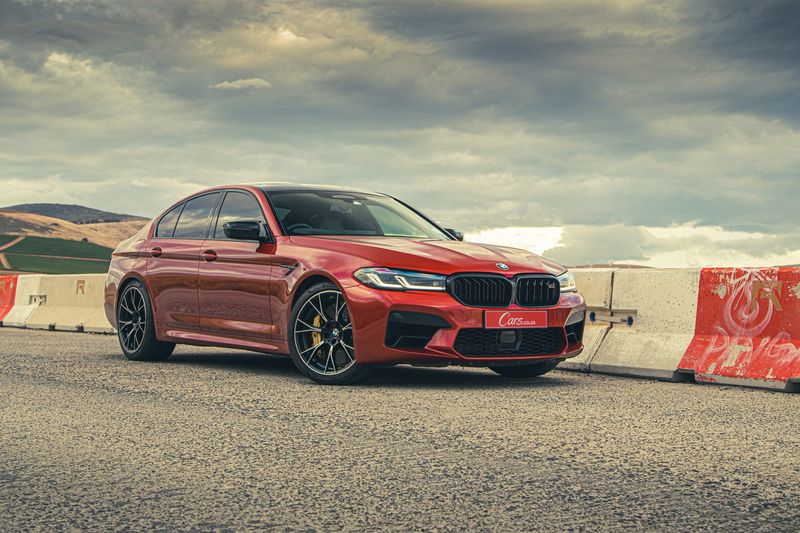
Red, with yellow brake callipers and a gloss-black grille… Have you ever seen a BMW sedan that looks this menacing?
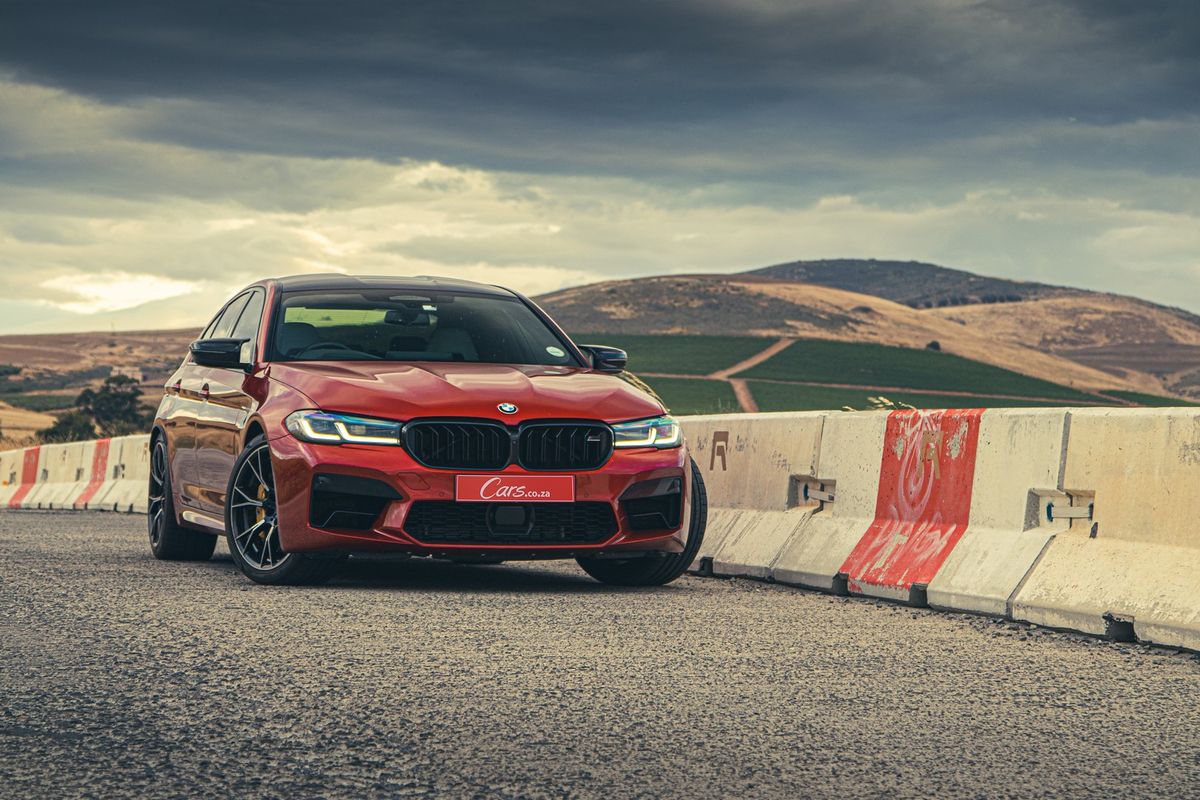
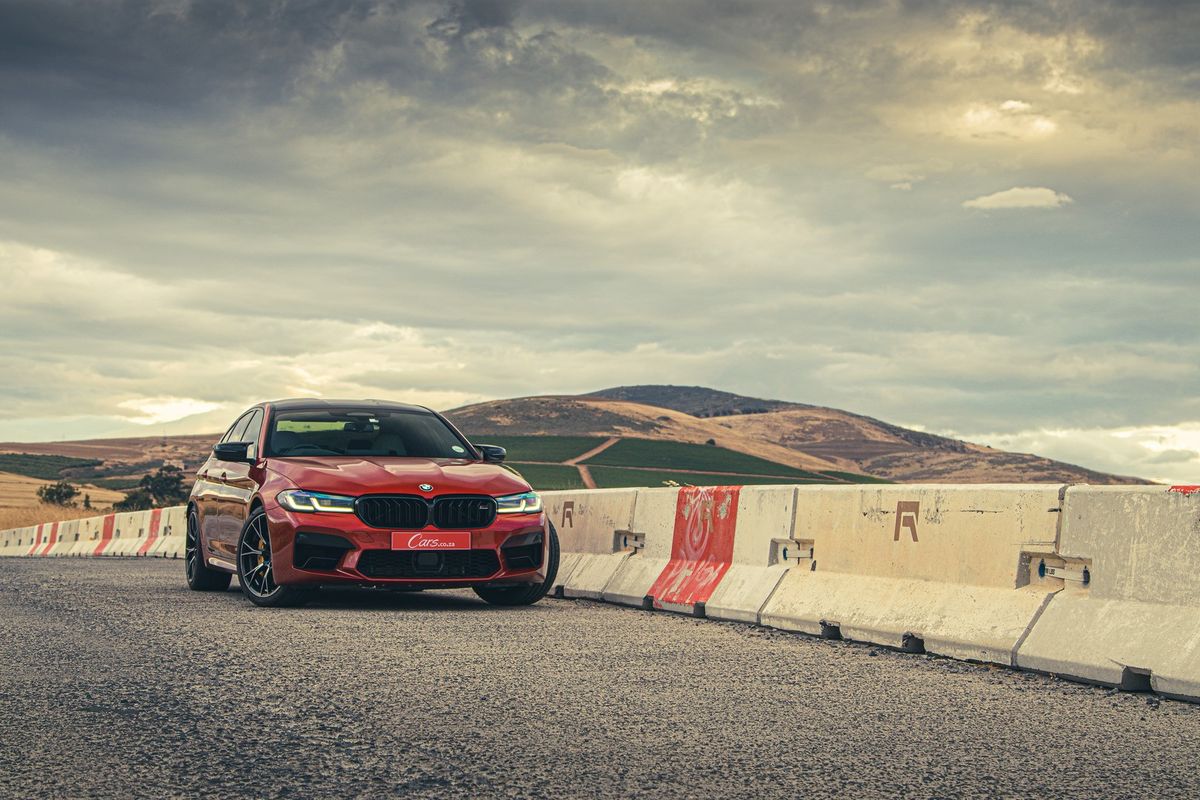
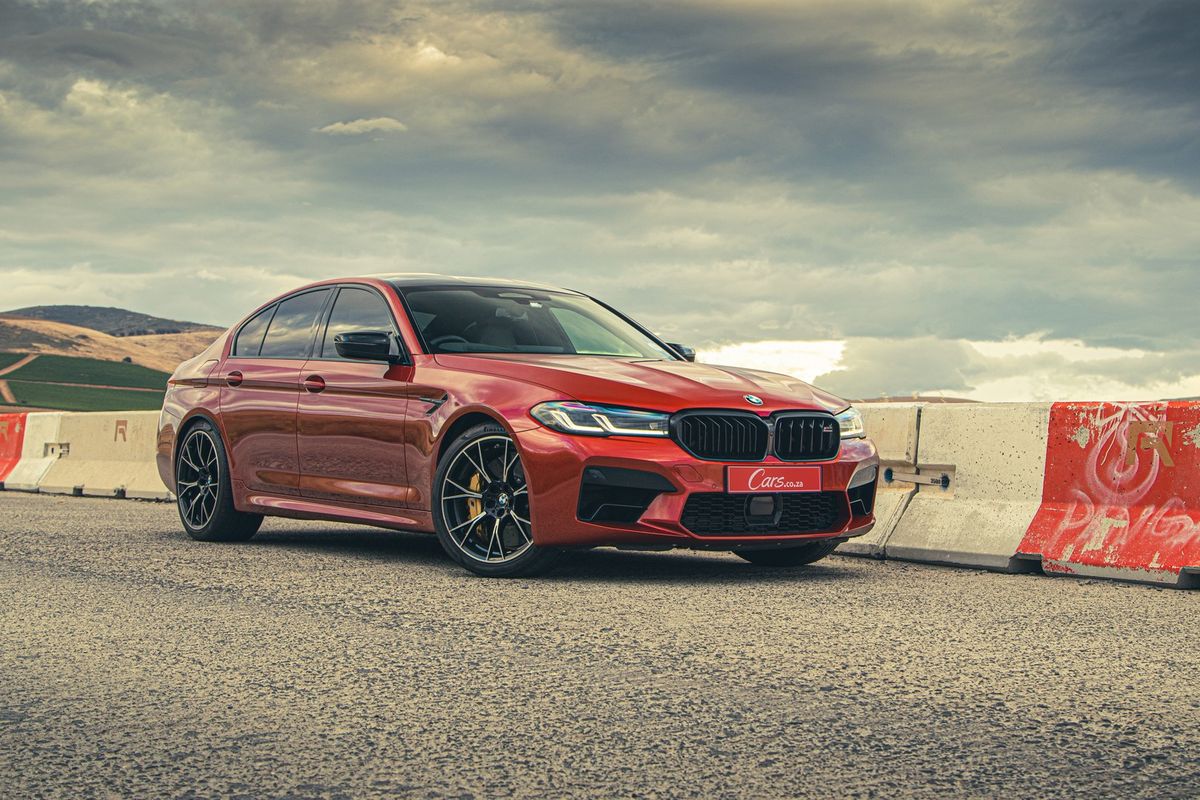
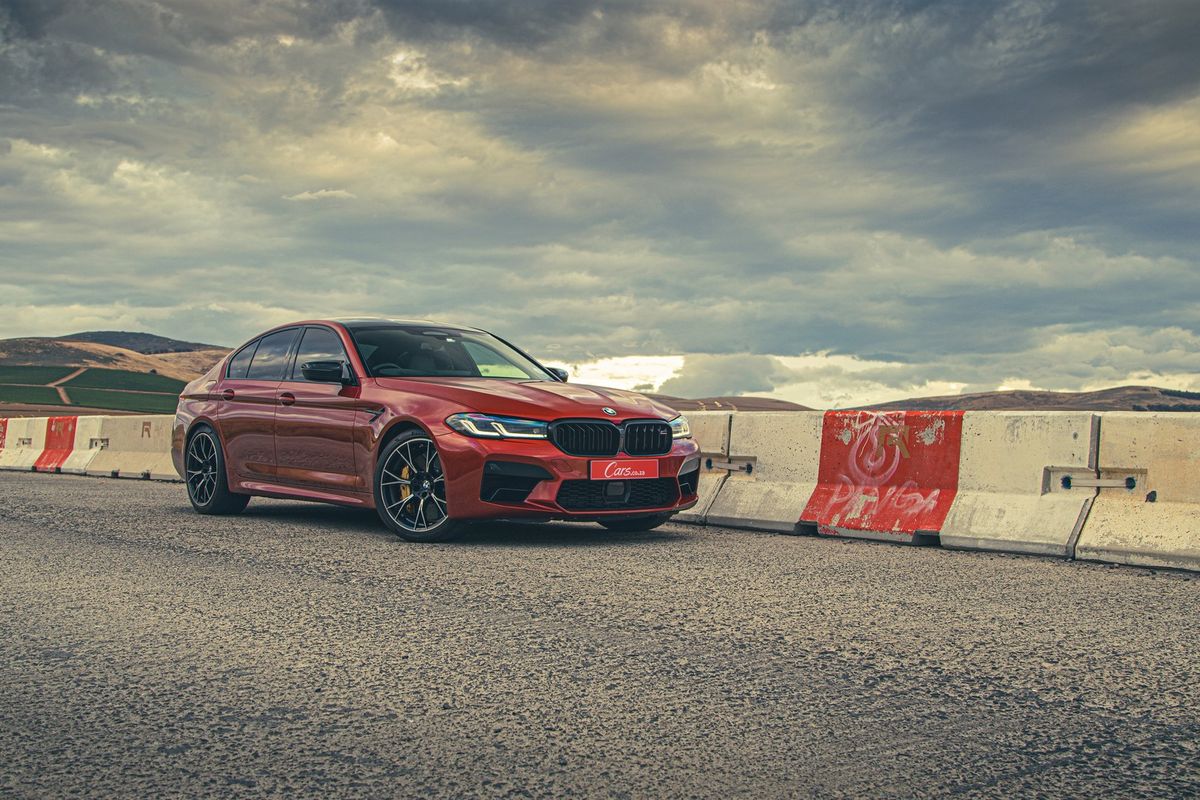
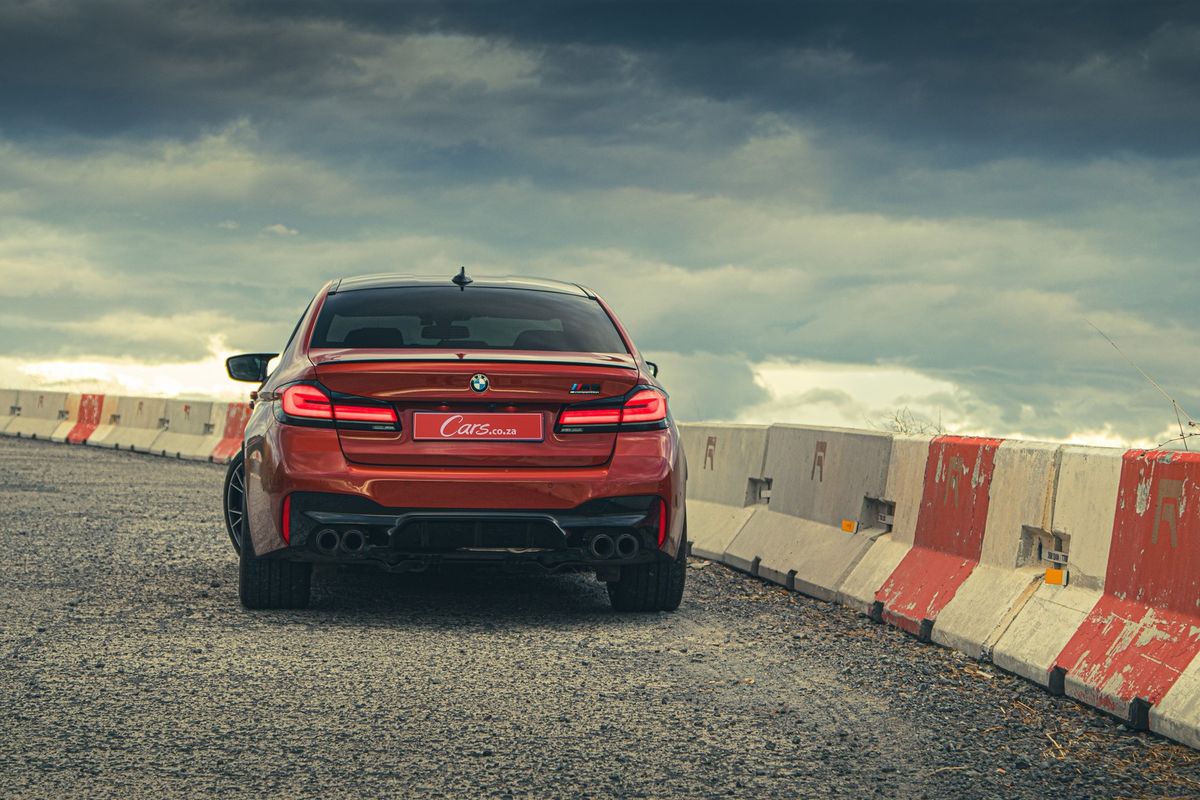
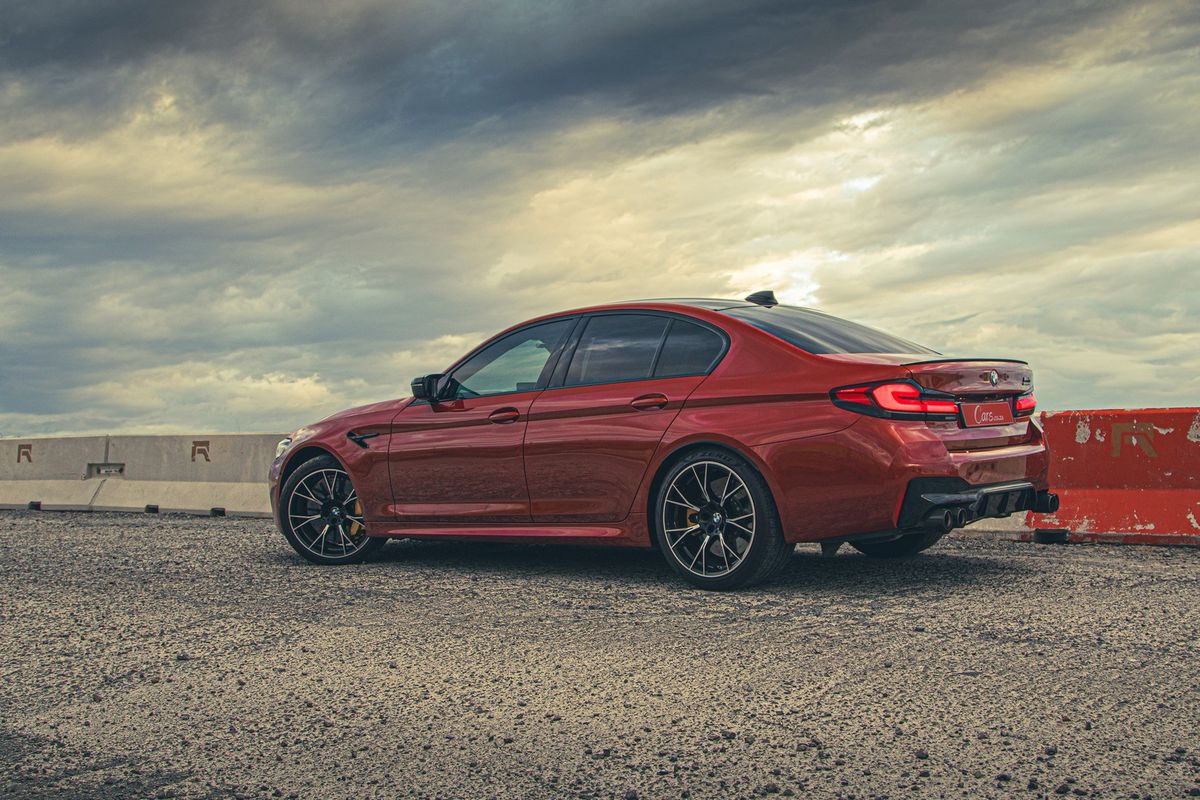
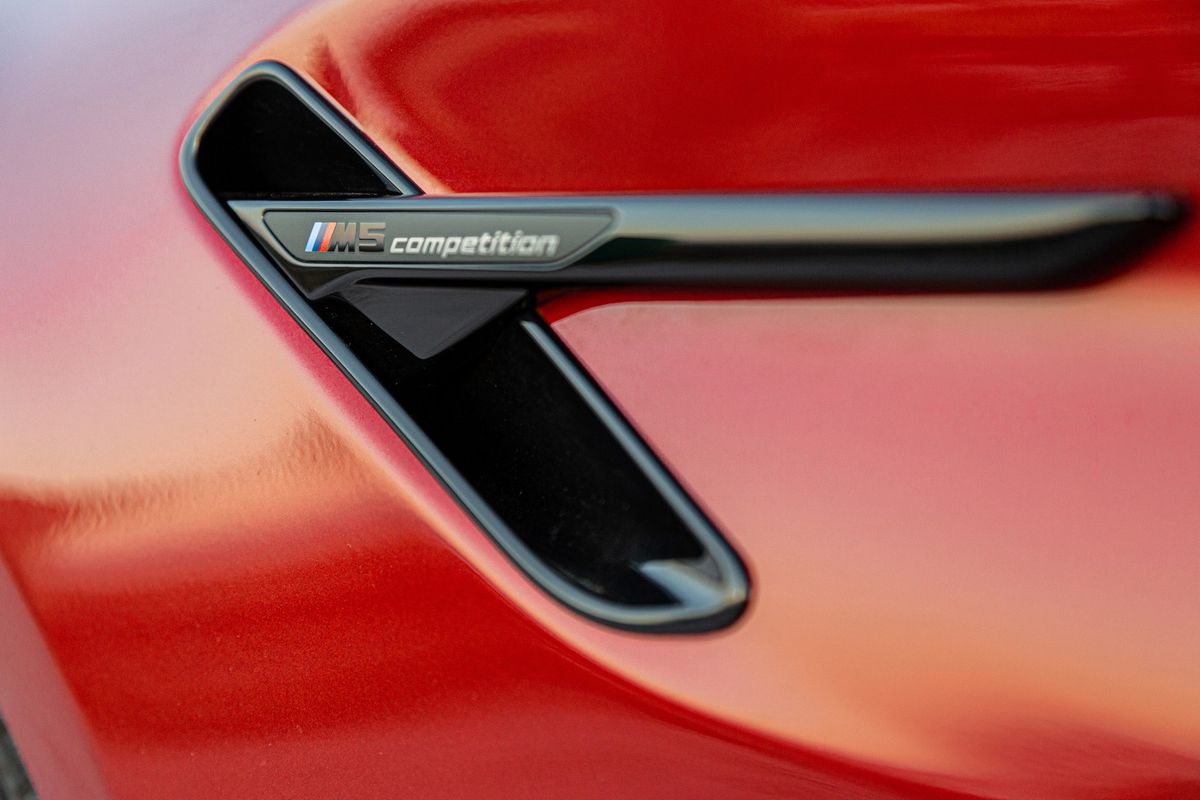
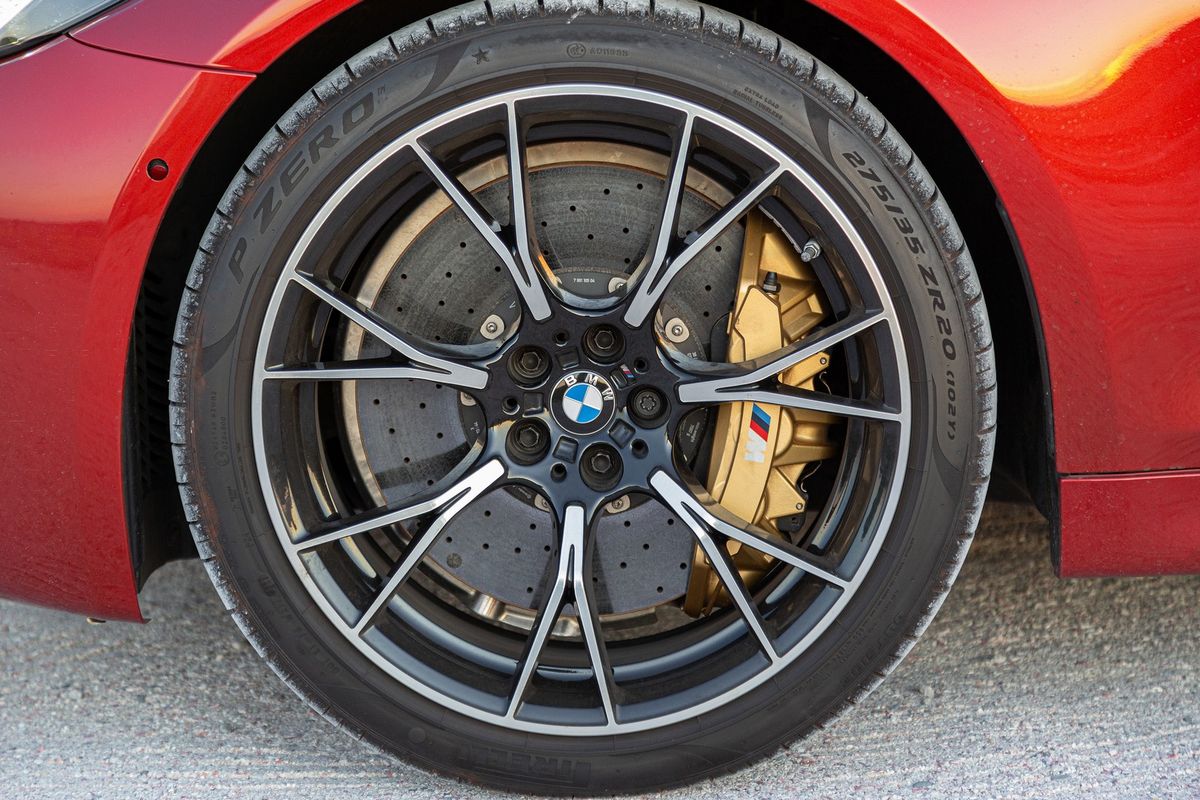
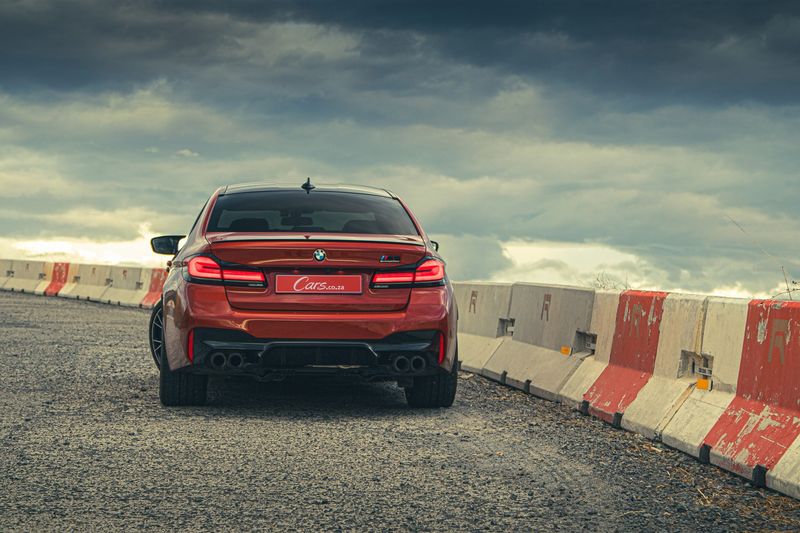
Executive sedans tend to be conservatively styled, even the performance-oriented versions, but in this case, the paint job did all the talking. Finished in metallic Aventurine red, our BMW M5 Competition proved particularly eye-catching. This hue paired well with the 20-inch alloy wheels, carbon fibre-tipped exhausts, and dazzling daytime running lights.
As far as packaging goes, one of the first things you’ll realise about the BMW M5 Competition is its size. This is no small car and it tips the scales at just under 2 tonnes. An overall length of 5 metres will make you hesitate about those cramped parallel parking spots in town, but thanks to its excellent array of parking cameras and sensors, threading the M5 into those spots shouldn’t send your blood pressure soaring.
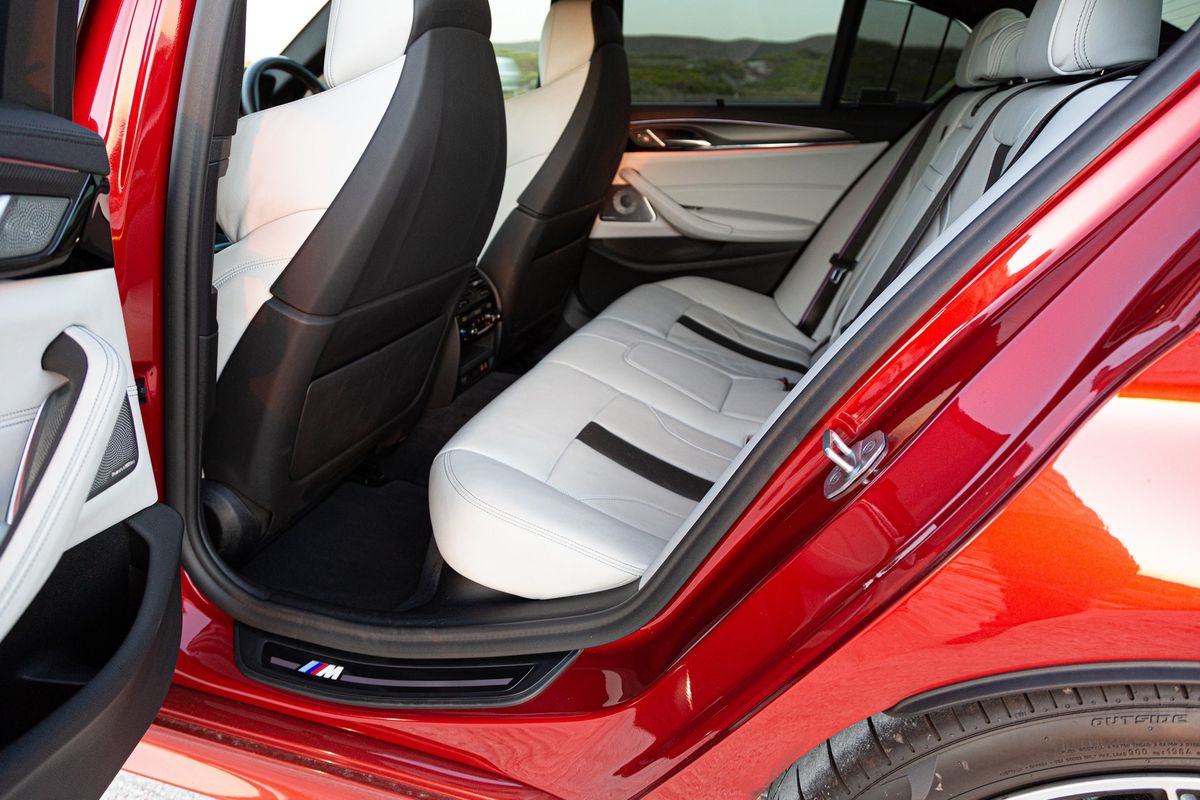
That lengthy shell translates into excellent rear legroom and despite its performance add-ons, this is still a BMW 5 Series at heart. That means it still possesses generous space for 4 adults, plus their luggage, although the 545-litre boot is on the smaller side of offerings in the segment.
Performance & Efficiency
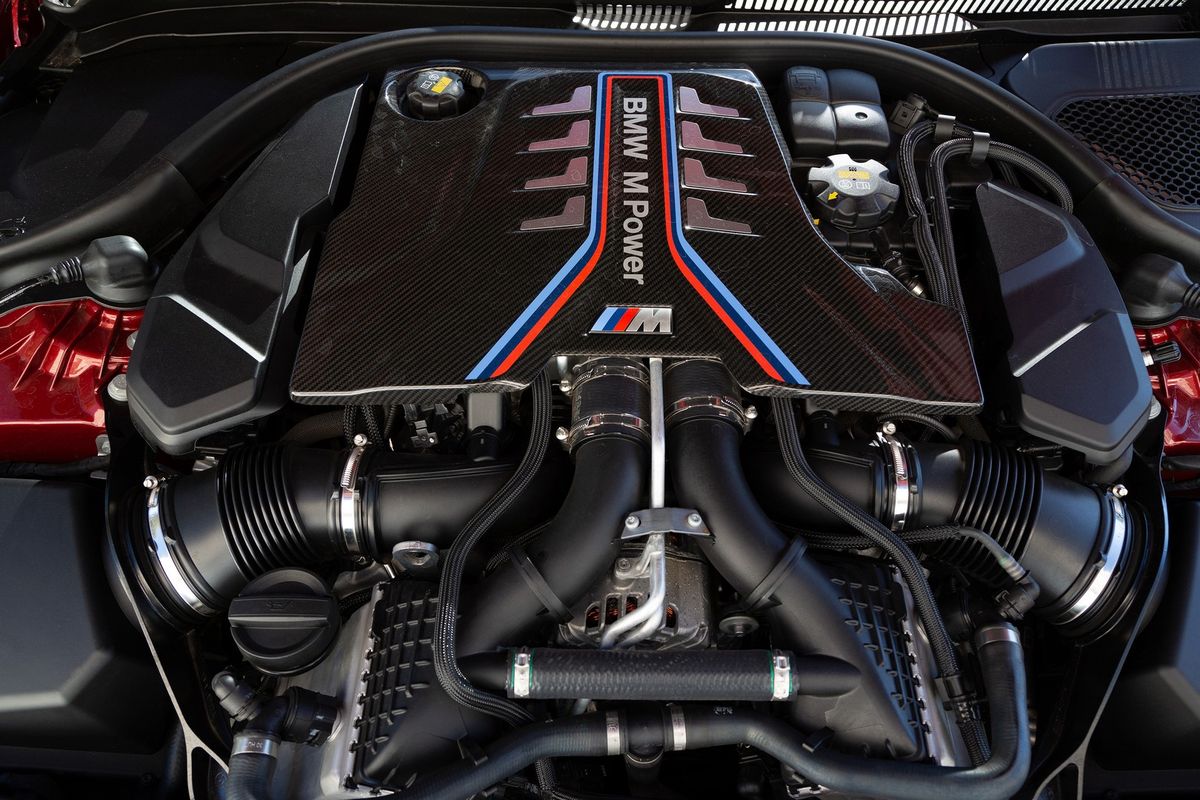
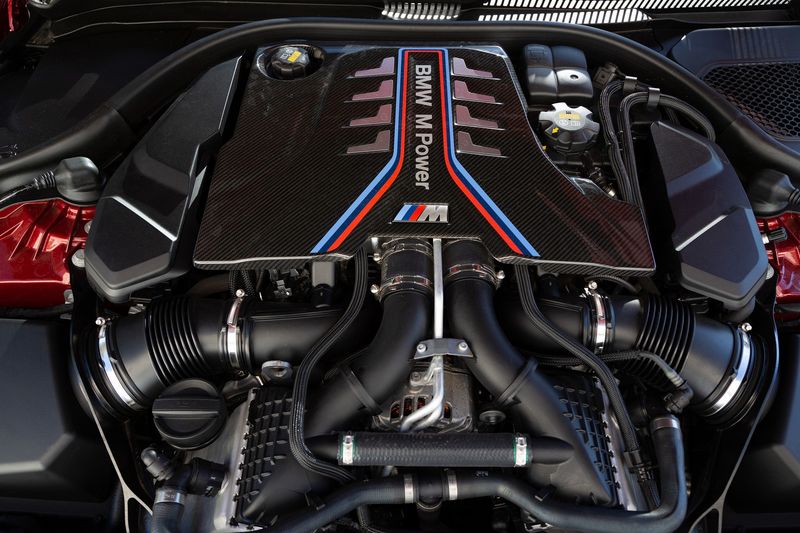
The M5 Competition’s carbon-fibre engine cover is a work of art.
Onto the most important aspect of the BMW M5 Competition. With 460 kW and 750 Nm coming from a 4.4-litre twin-turbo V8 petrol engine and a claimed 0-100 kph sprint time of just 3.3 seconds, the on-paper prospects are mouth-watering.
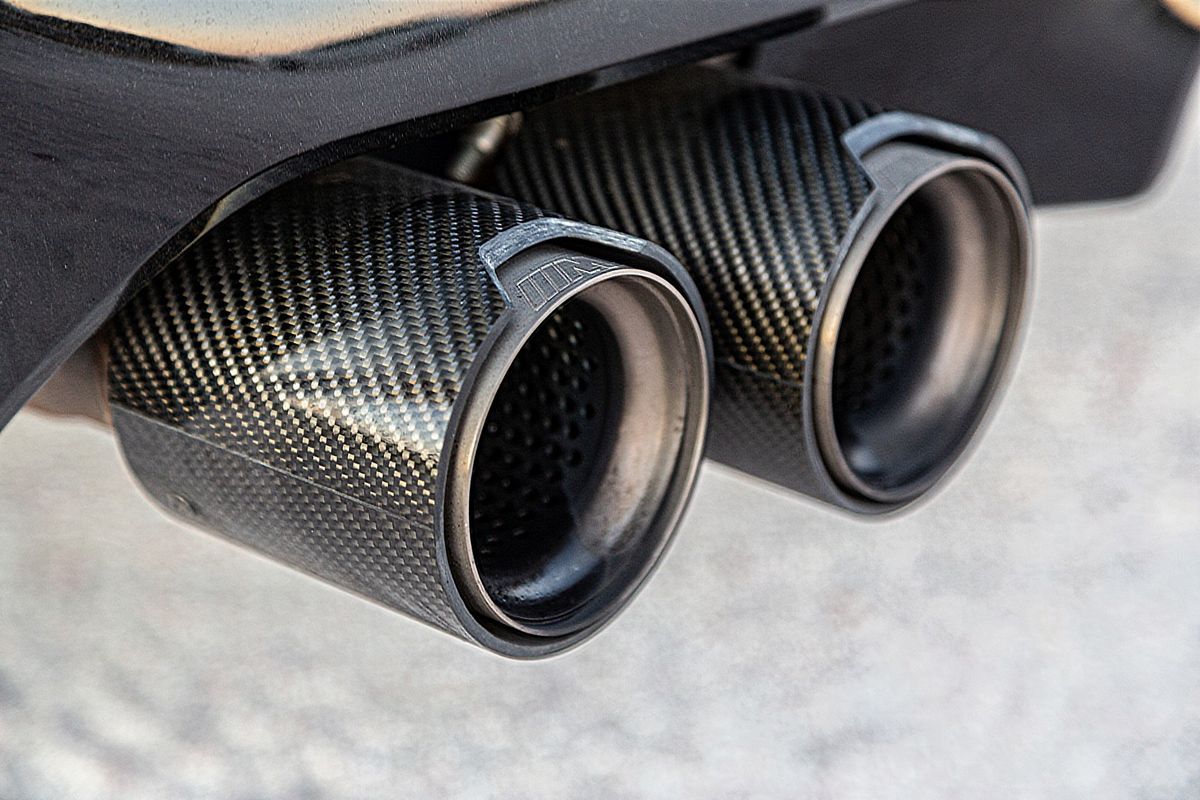
What we weren’t prepared for was the optional BMW M Performance exhaust, replete with carbon-fibre tips. They’re a far cry from the standard unit’s tailpipes, both in terms of appearance and noise output. A cold start will wake the neighbours, even if you fire up the M5 in its most docile setting; rev the engine at a standstill and the subsequent thunder cracks will probably get you some death stares from otherwise peace-loving folks. It’s gloriously rude and well worth ticking the additional R88 000 box on the options list.
Our first impression when driving to our straight-line testing location with every setting dialled back was just how comfortable the M5 was. Road noise from the big Pirelli tyres wasn’t intrusive – a trait that seems to affect most modern AMG offerings – and if there weren’t so many sporty touches in the cabin, you could be fooled into thinking you’re driving a standard BMW 5 Series. The illusion does not last long, however…
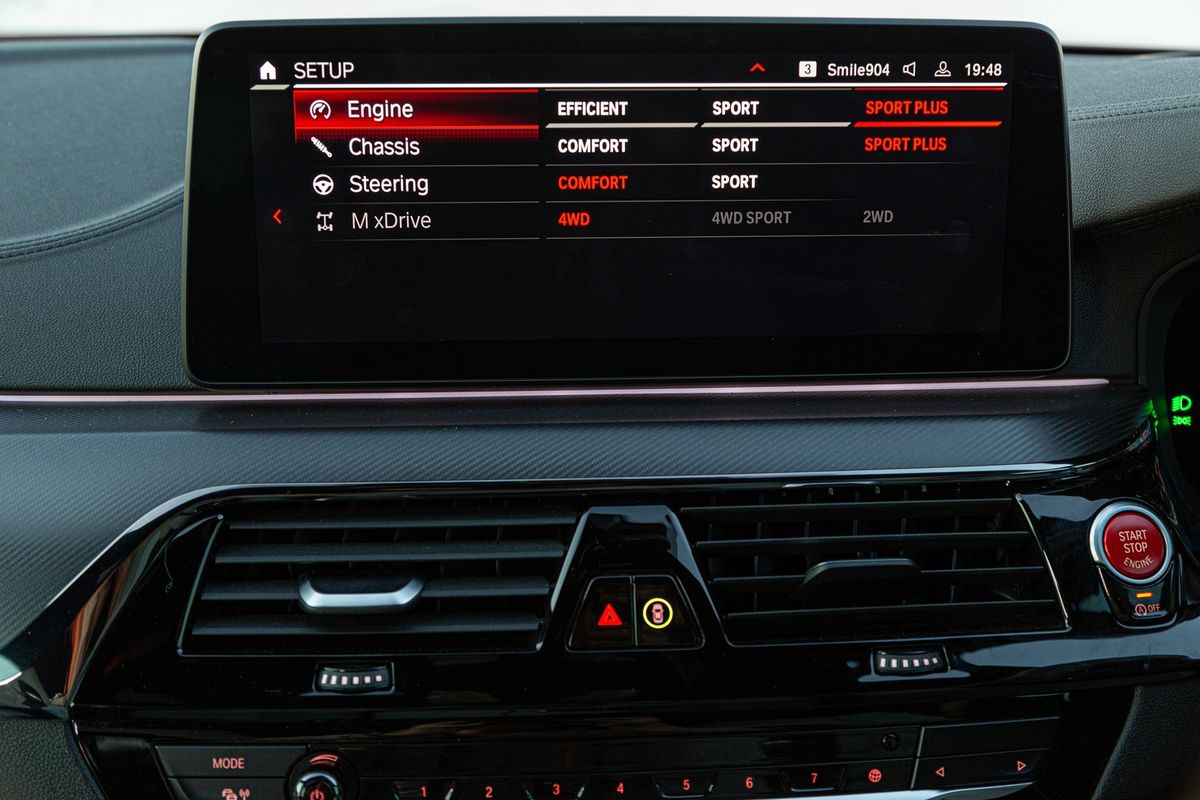
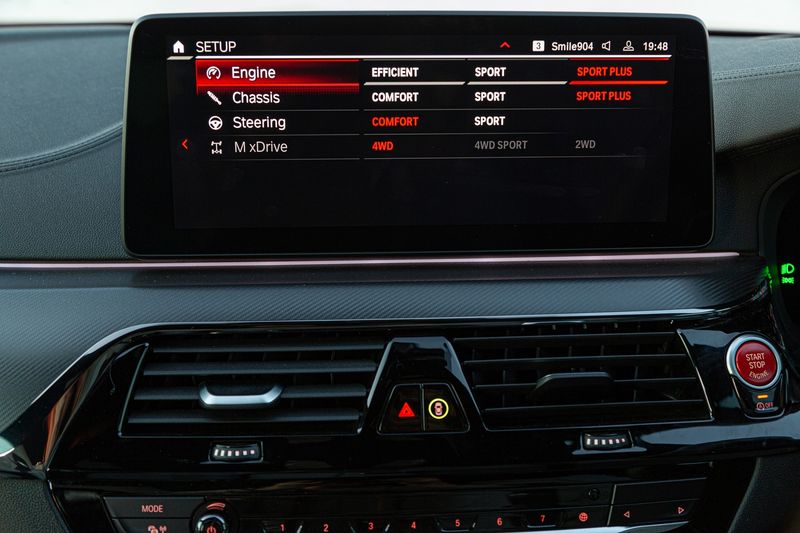
As you can see and hear, it’s not exactly subtle and that’s just how we think a BMW M5 Competition should be. There are various customisation options to adjust engine response, adaptive suspension setup and steering feel, plus you’re afforded 3 transmission settings. Do you prefer the ‘shifts to be seamlessly smooth, or do you want to feel jolts when the ‘box slams in successive cogs while the Bimmer charges towards the horizon? It’s up to you.
The M5 Competition offers a wide range of customisation in conjunction with the drive modes.
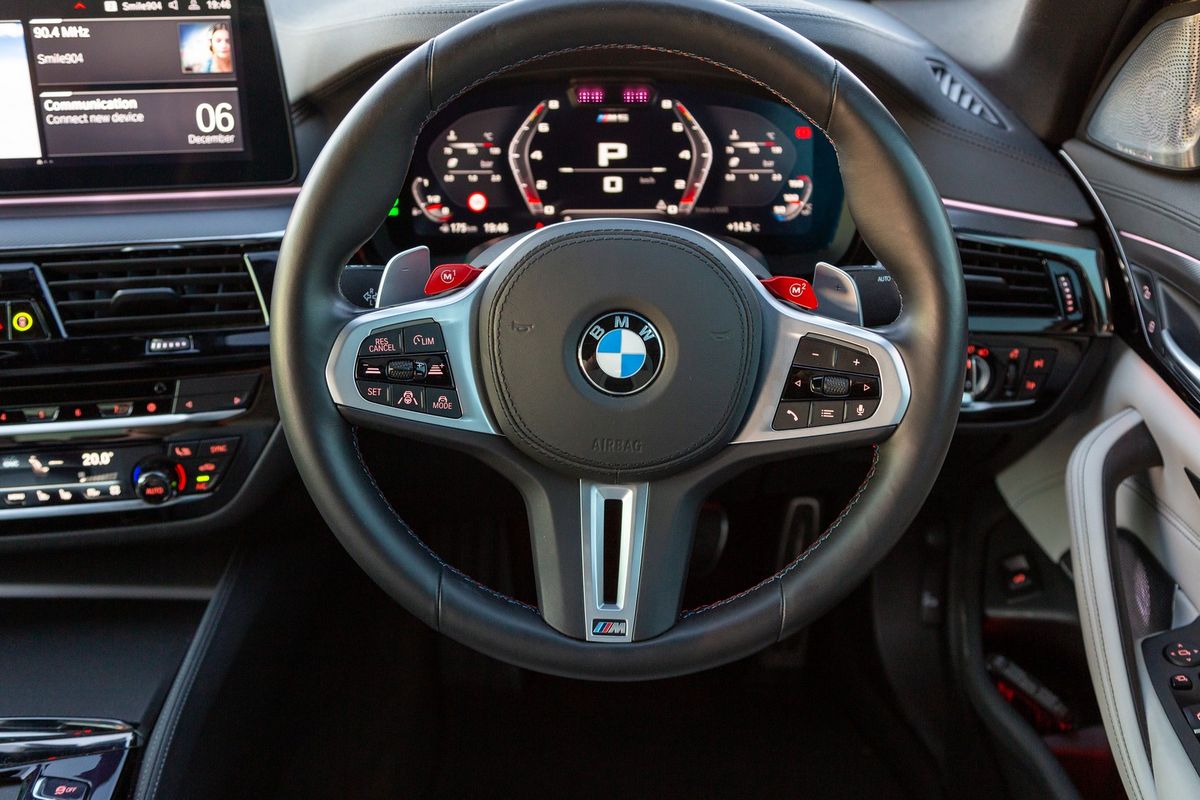
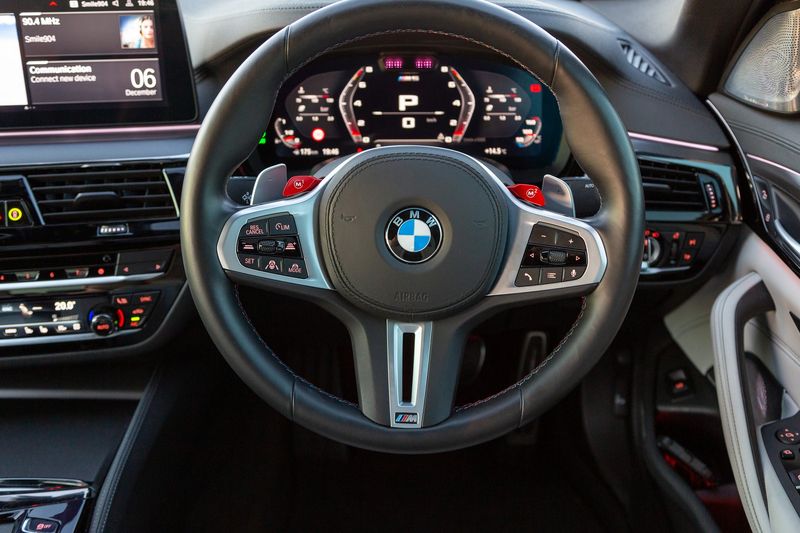
The best part is you can mine the drivetrain menu to customise the settings to your heart’s content and then program those shortcuts into the M1 and M2 buttons located on the steering wheel. Typically, M1 would place the engine and chassis into Sport, and M2 sets everything to their Sport and Sport Plus presets, with the stability control set to Sport too. It sounds complex, but it’s worth playing around for your perfect balance. Us? We’re all about that comfort life, with the engine set to Sport.
There are even track-specific modes, as well as the option to switch the M xDrive from 4-wheels to rear-wheel drive, but given we didn’t have access to an appropriate test facility at the time, we didn’t go near those settings.
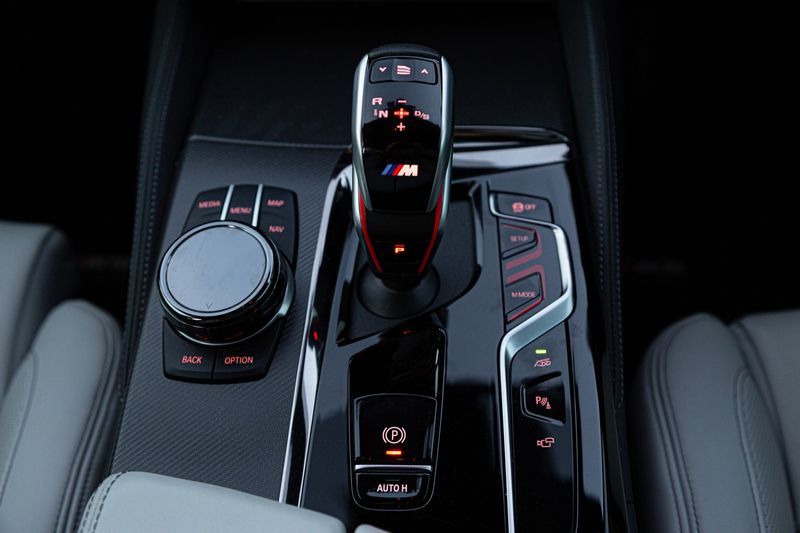
The car’s happiest in full auto mode, but we did enjoy the tactile feel of the paddles located behind the steering wheel. The raucous artillery battery of an exhaust system also emits a pleasant noise each time you shift down.
The key takeaway here is performance accessibility. Never has it been easier to access liberty-endangering speeds with so little effort; the BMW M5 Competition is just that fast. What’s scarier still is you don’t need to be in the sportiest settings either. A simple overtaking manoeuvre on a motorway with half-throttle application can easily see you touching triple-figure speeds starting with 2… so you do have to be mindful when extending your “throttle foot”.
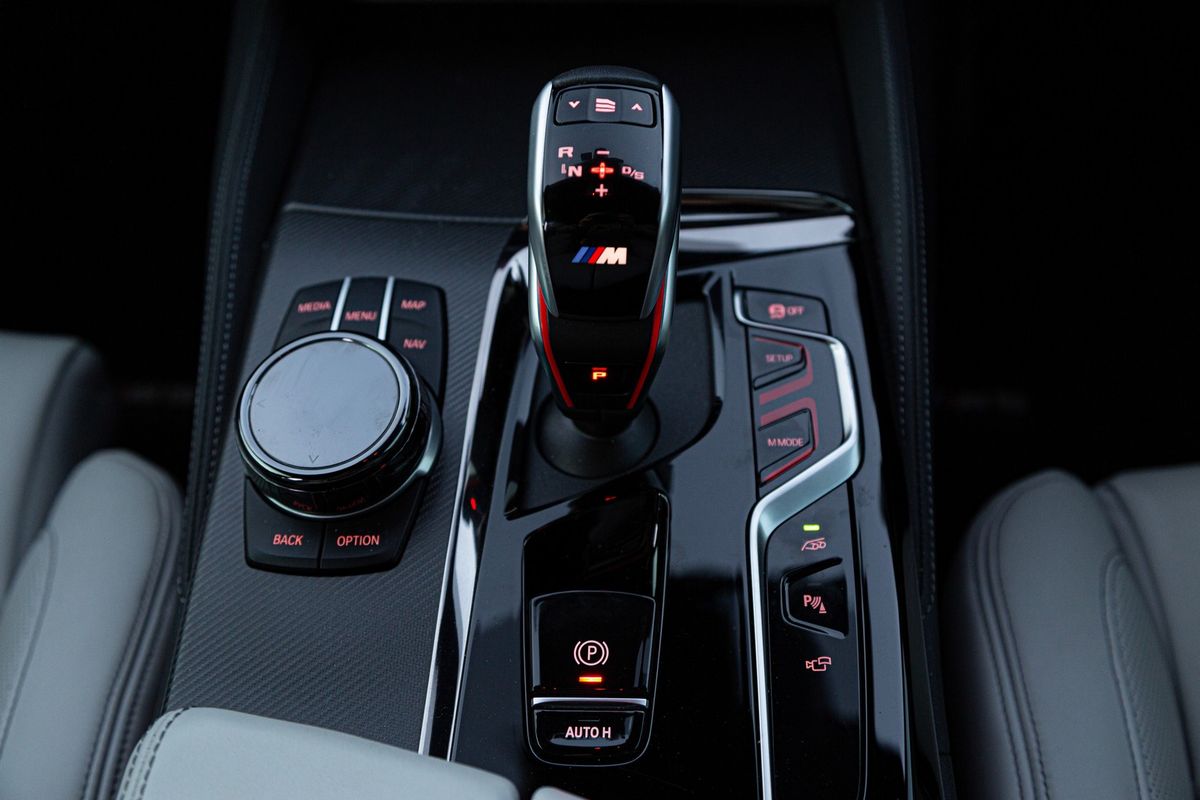
The M5 Competition utilises a torque-converter-type transmission, but we don’t miss its predecessor’s dual-clutch setup.
Ride & Handling
With this much outright performance on offer, you’d think the car would require 100% concentration all of the time, but the reality is the BMW M5 Competition is not going to be a handful unless you blatantly go looking for trouble.
The handling and pace of the M5 Competition are deeply impressive. It’s jaw-dropping how a car of this size and weight can traverse a tight and twisting section of tarmac without breaking a sweat. The key things here are the chassis, suspension setup and xDrive, which all combine to make it a wonderfully balanced offering. The steering wheel rim (like all performance BMWs) may be a touch too thick, but the rack’s light weighting and directness make up for it.
The xDrive deserves a special mention as it highlights just how far the all-wheel-drive system has come as far as driver engagement and engineering are concerned. By switching to xDrive Sport, the car sends a bit more power to the rear axle, so you still get that slight feeling that the rear is capable of breaking traction but, barring some foolish provocation, it’s highly unlikely to do so. By enabling a rear bias, there’s virtually no understeer and the result is a large sports sedan with a turn of agility that belies its almost two-tonne kerb weight.
You can, of course, make the M5 Competition purely rear-wheel driven, but past experience with the pre-facelift model a few years ago resulted in burnouts as the rear axle couldn’t cope with the sheer amount of power on tap. The marketing material calls it “drift mode”, we call it destroying a set of perfectly good tyres.
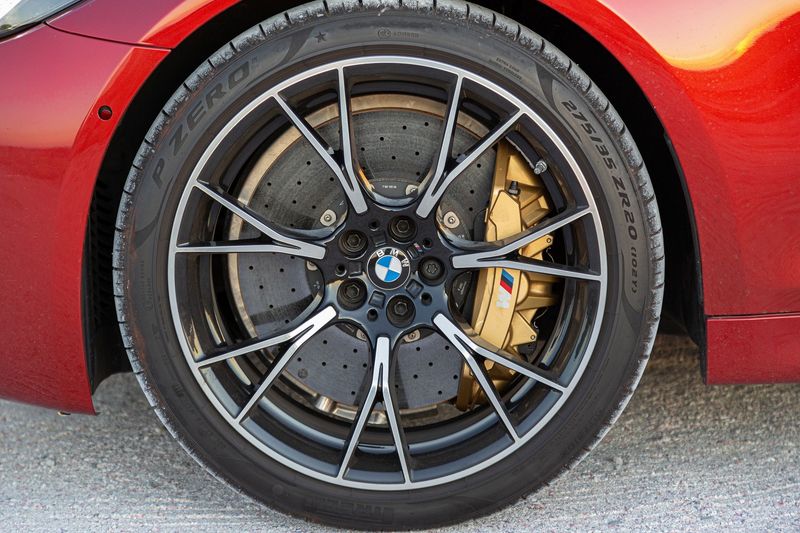
The M5 Competition we tested was additionally specified with a carbon-ceramic braking system.
The brakes are worth a mention, too. Our test unit came with the optional carbon ceramics which provided immense stopping power, bringing the M5 Competition to a halt far quicker than you’d expect.
Once you’re done carving up your favourite stretch of corners, you simply put everything back into Comfort and the M5 transforms into a quiet and refined German executive sedan.
Comfort features
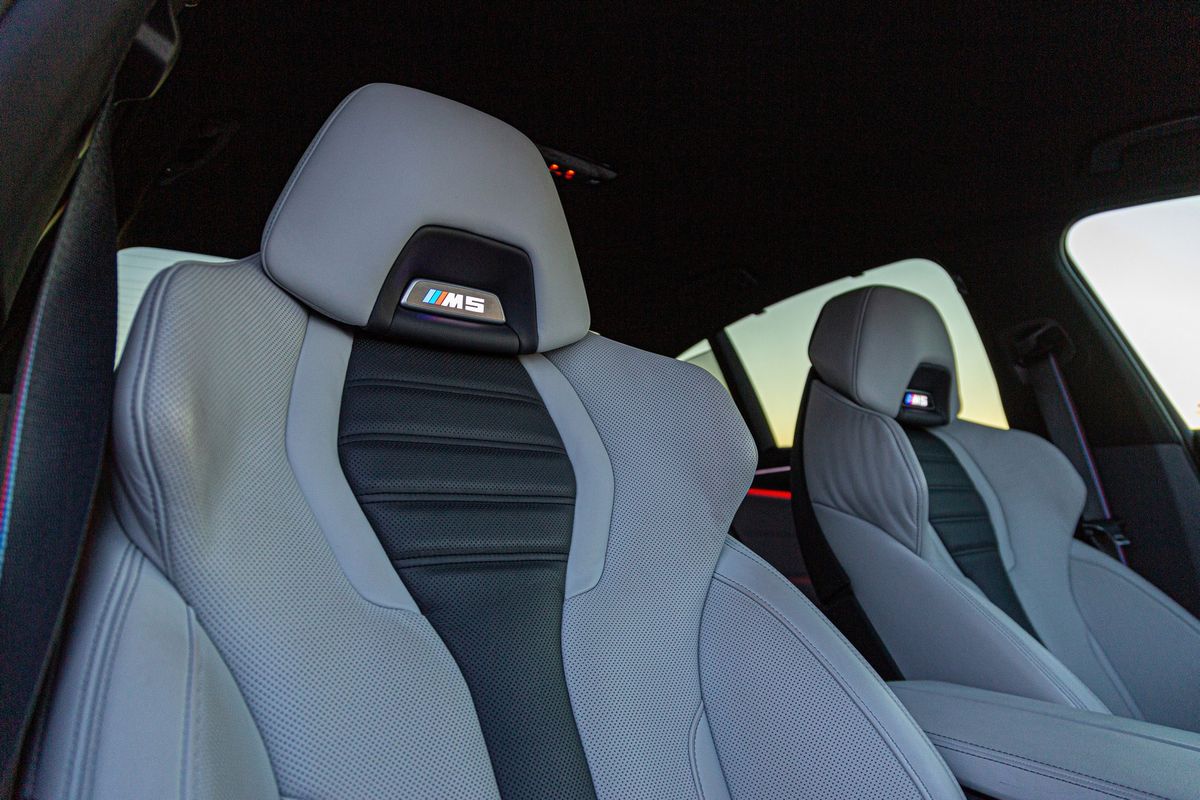
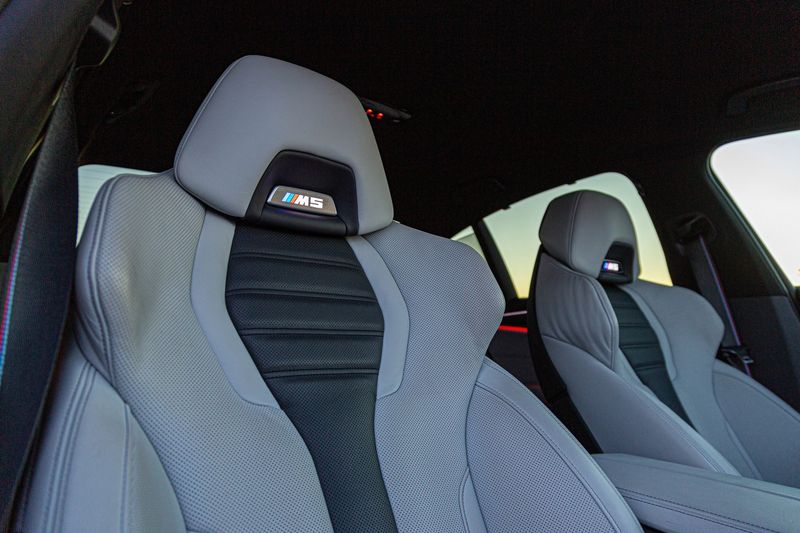
These great-looking front sports seats offered massage, heating and cooling functions.
Everything thus far has been about how fast and loud the BMW M5 Competition is, which is all great, but ultimately, what makes this car (and the aforementioned E63 S and the RS6) so complete is its levels of comfort and luxury.
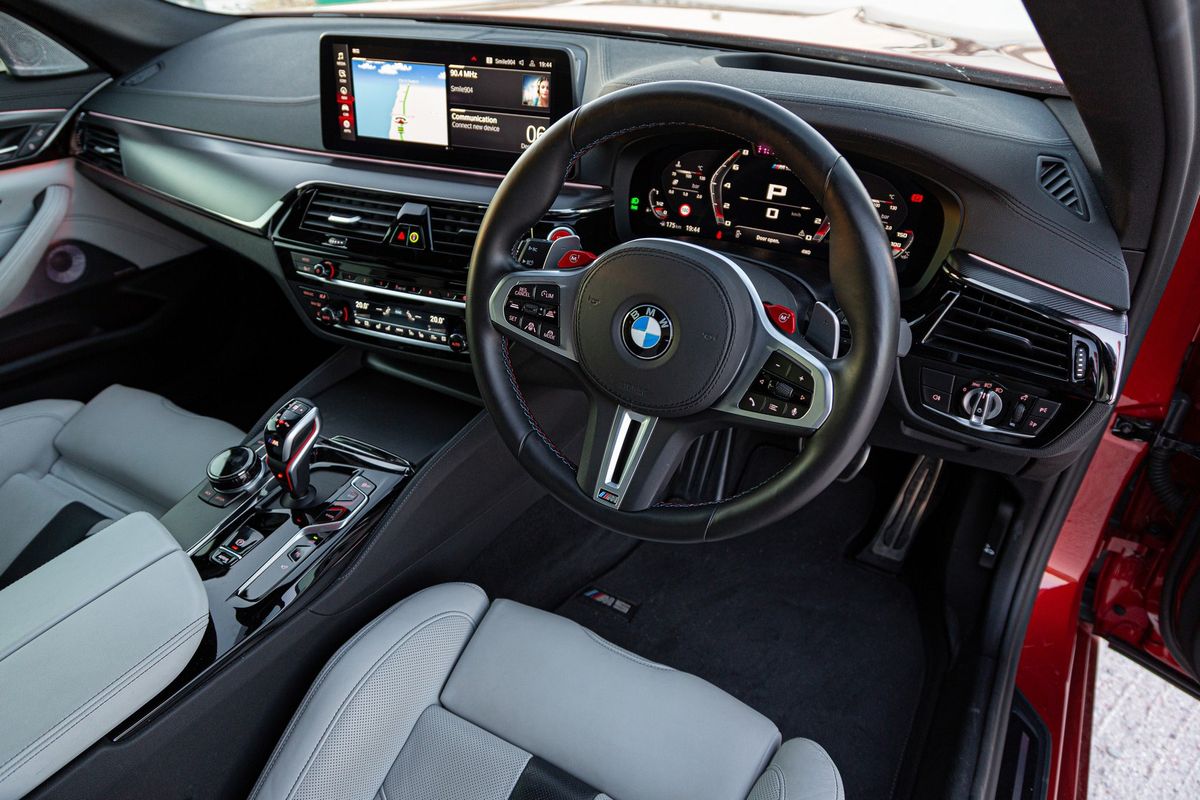
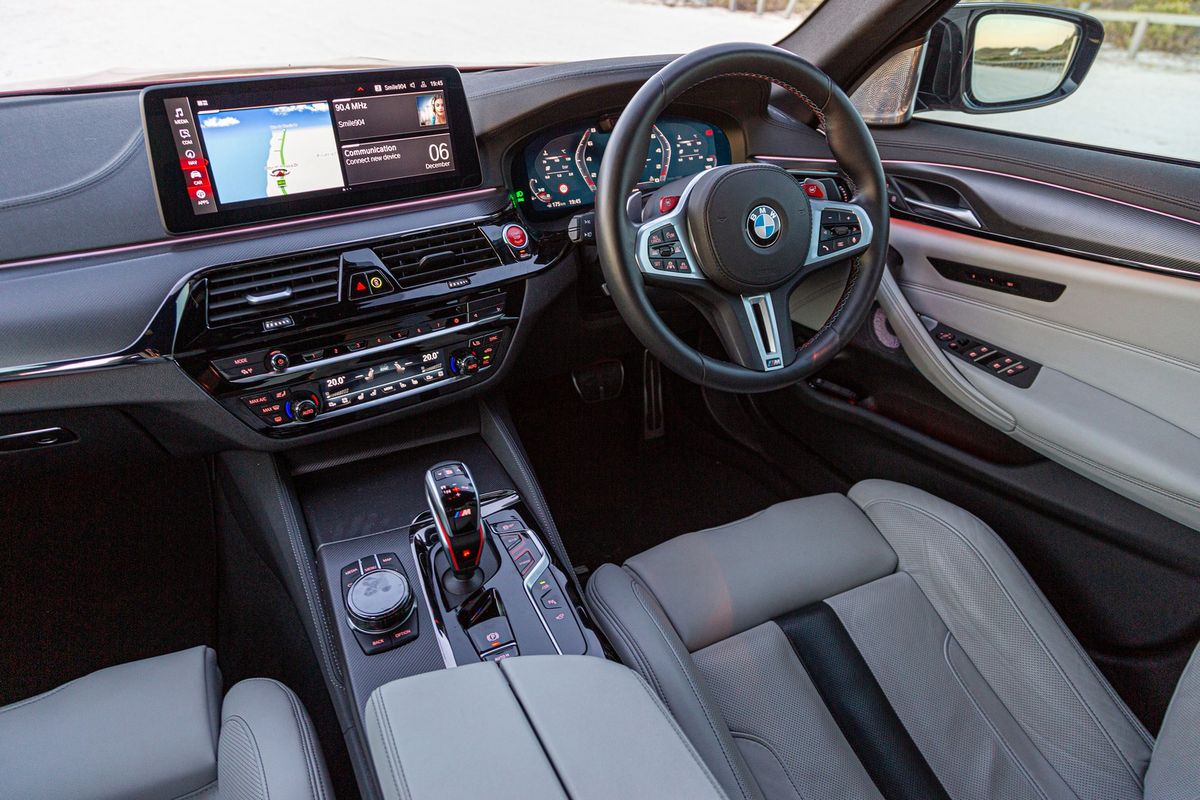
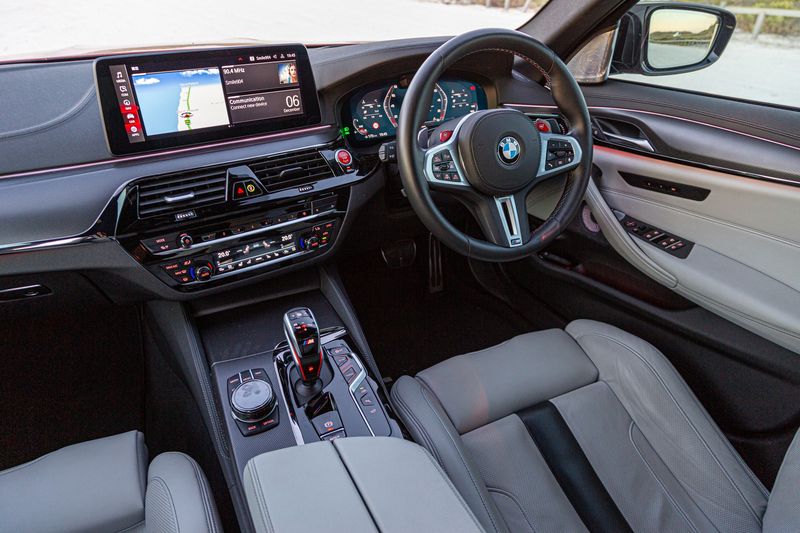
Step inside the cabin and you’ll be greeted by an overtly sporty theme about the place. The big red start engine button will catch your eye, as will the two M buttons on the steering wheel. The seats are an absolute joy as they’re not only some of the most comfortable and supportive in the business, but also happen to look like works of art by themselves. The glowing M logo in the headrest is a great touch.
The interior incorporates a number of updates introduced as part of the recent 5 Series facelift.
New for this model is a much larger infotainment screen, the introduction of Android Auto as well as over-the-air updates. In fact, during its tenure with us, the car received one such update and after a 30-minute installation process, the car boasted updates to the lane departure system, maps, front radar sensor and some Android Auto connectivity upgrades.
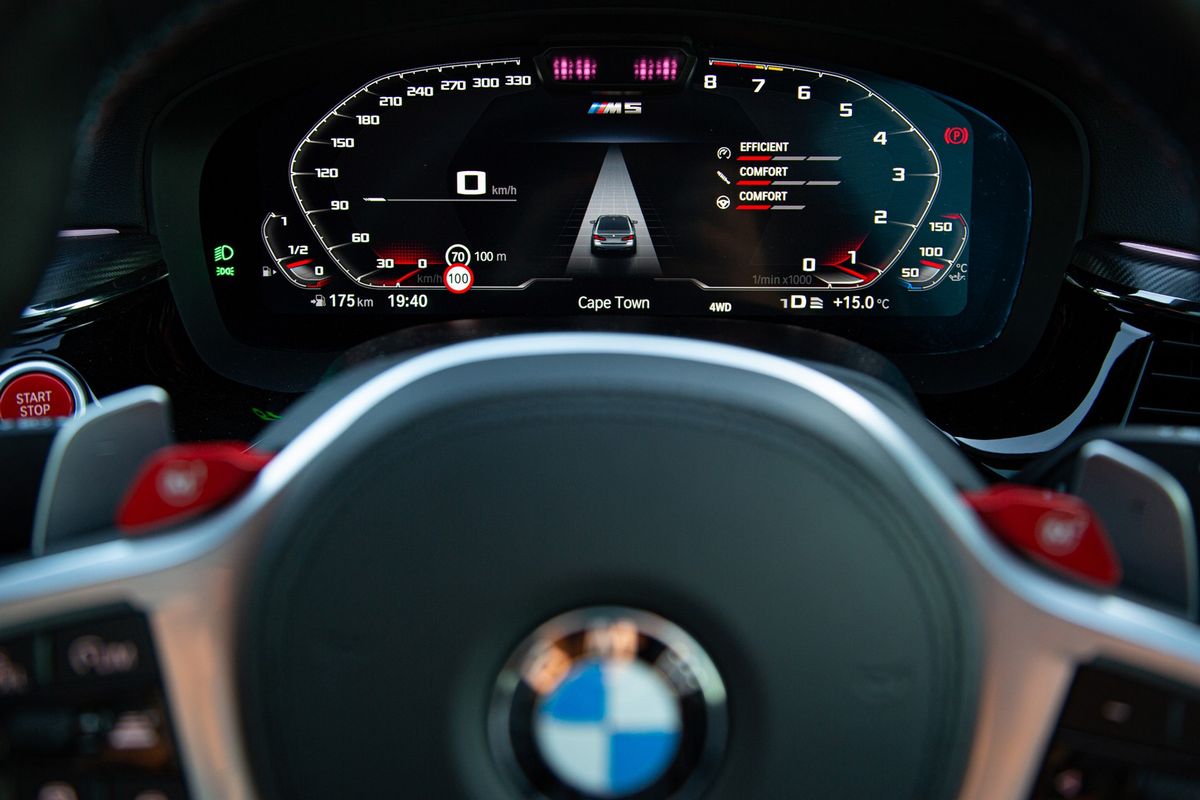
One of the highlights of the M5 Competition is its digital dashboard and the head-up display. It really looks the part, particularly when you’re in the sportiest of settings. Every bit of useful information is readily at hand. The cabin feels upmarket and expertly assembled and despite the age of our test unit, showed no sign of creaks or rattles.
At this price point and given that it is the flagship derivative in the 5 Series range, the M5 Competition comes with a full house of features. You can dip into the options list naturally and our test unit came with the potent Bowers & Wilkins audio system, the rorty M Performance exhaust, carbon-ceramic brakes and M-branded seat belts.
From the driver’s seat, the M5 Competition feels every bit the tech-laden performance sedan that it is.
How much does the BMW M5 Competition cost in South Africa?
The BMW M5 Competition is available for R2 328 224 and is sold with a 2-year unlimited warranty and a 5-year / 100 000 km service plan.
Verdict
Does the M5 Competition represent the high-water mark for the ICE-powered performance sedan? Yes, probably.
While we’re probably looking at the beginning of the end of the “super sports sedan” era, there’s no denying that right now we’re spoilt for choice. The German trio of the BMW M5, Mercedes-AMG E63 S and Audi RS6/RS7 all offer twin-turbocharged V8 engines, are ludicrously quick yet have tech, space and comfort in abundance. All three are at the top of their game and all three are exceptional products.
With the F90-generation BMW M5 Competition, the Munich-based brand has addressed the issues of the earlier model, like its harsh ride and lack of character as far as the engine sound was concerned.
Should you buy one? If you have R2 million and are still chasing that exotic supercar dream, but are put off by the sacrifices like impractical packaging and awkward ingress/egress, then you should consider the BMW M5 Competition. Unlike most thoroughbred performance offerings, this is not a compromised one-trick pony.
The Bavarian offering will not only thrill with its devastating performance ability and enthral with its sheer sense of theatre, but it can effortlessly transport your family for a holiday across the country. Being able to perfectly balance supercar levels of performance with real-world daily-driven usability is why this car deserves a second look.
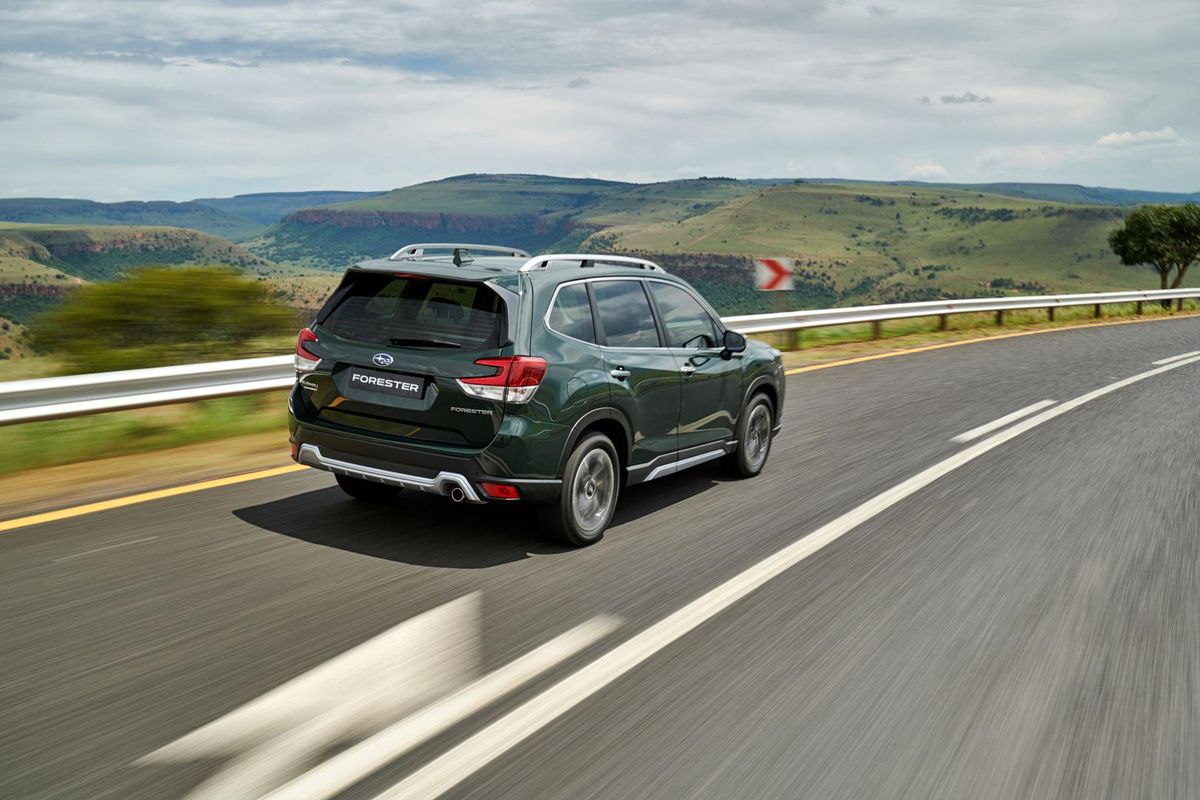
Subaru Forester (2022) Specs & Price Announced
The popular Subaru Forester has been given an update as its in the middle of its lifecycle. What’s changed and how much does it cost? Read on…
The Subaru Forester is the Japanese brand’s most popular product in Southern Africa. 2022 marks 30 years of Subaru’s presence in Southern Africa.
What’s New?
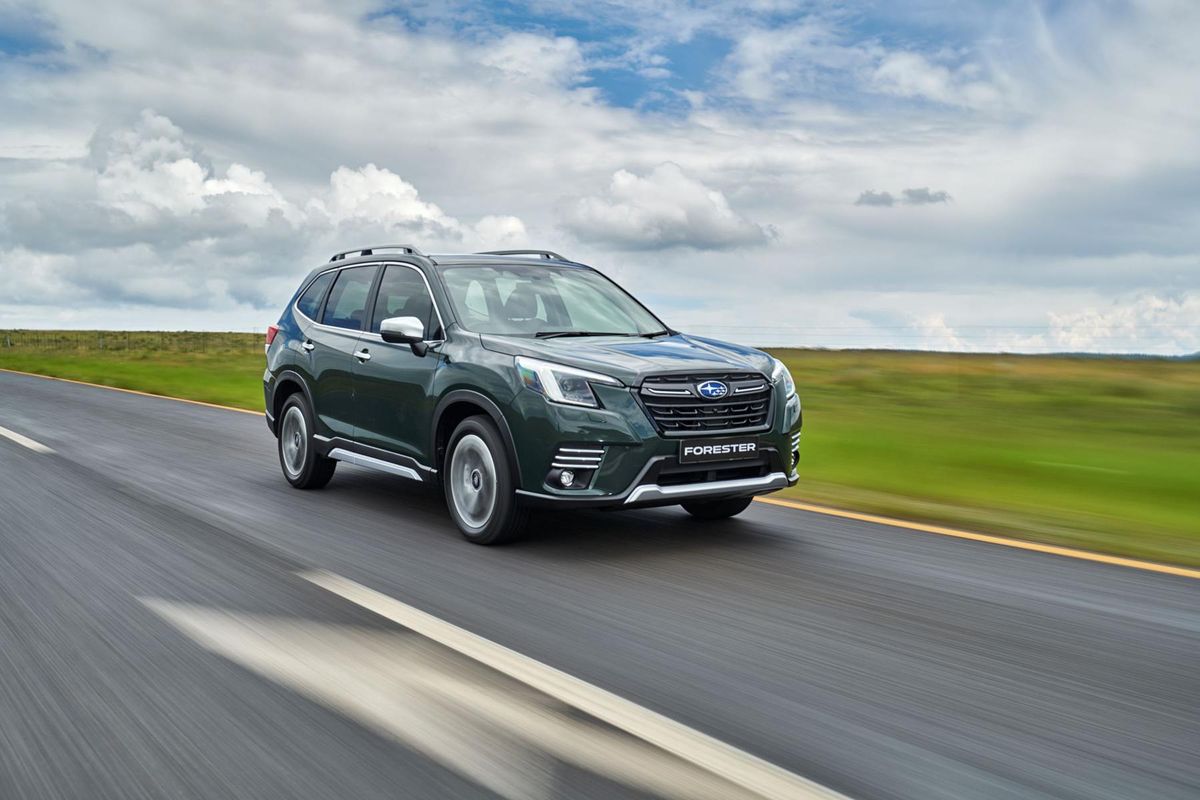
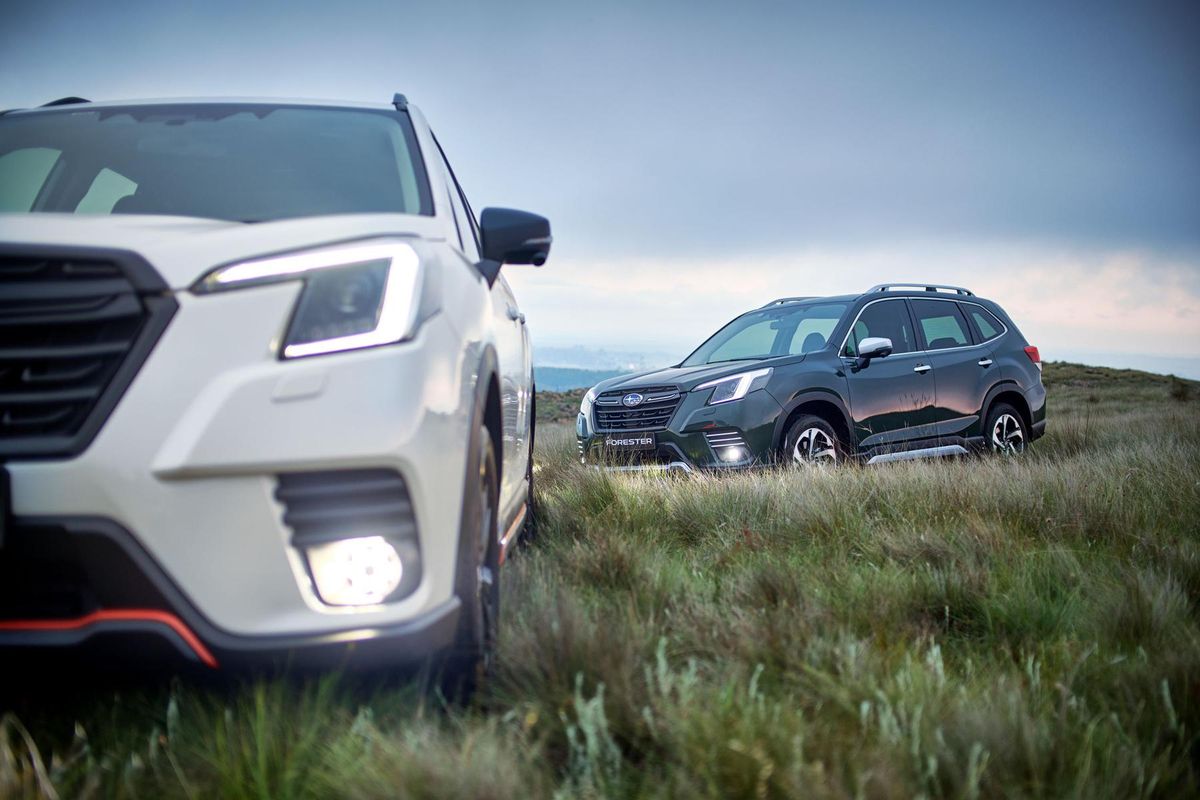
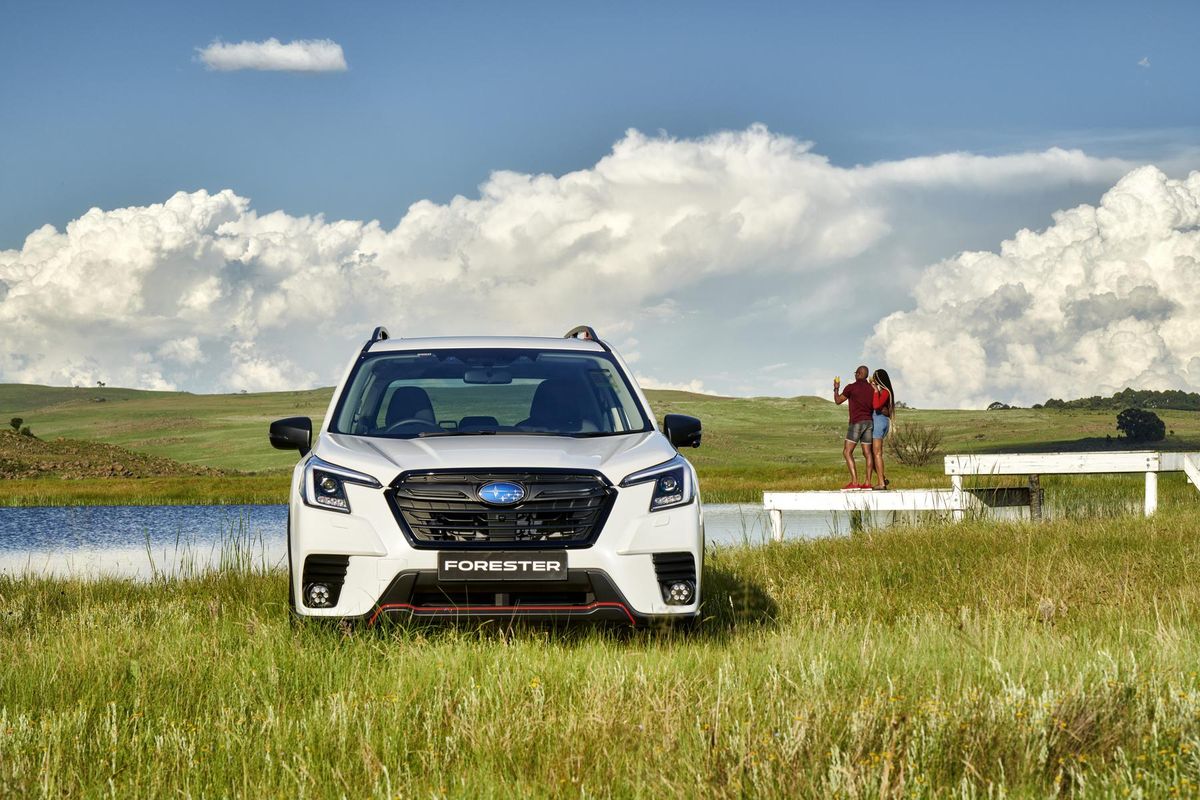
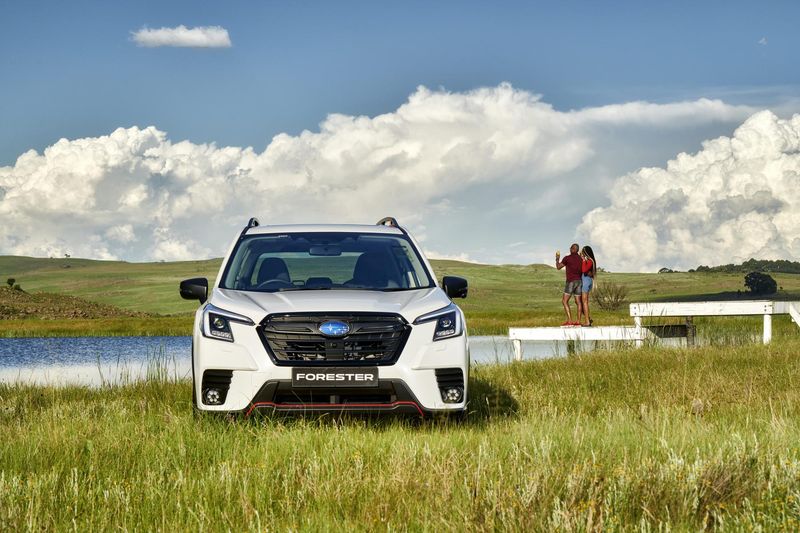
The 2022 Subaru Forester has received some major design changes at the front of the vehicle with a new bigger hexagonal grille and new-look headlights. These new lights feature LED bulbs, while the Forester Sport gains 6-bulb LED fog lamps.
The rest of the Forester receives enhanced finishes to the mirror caps, A and B-pillar covers and rear spoiler. For the Sport, the mirror caps are finished in a textured geometric material, while the Premium gets chrome and high gloss black treatment.
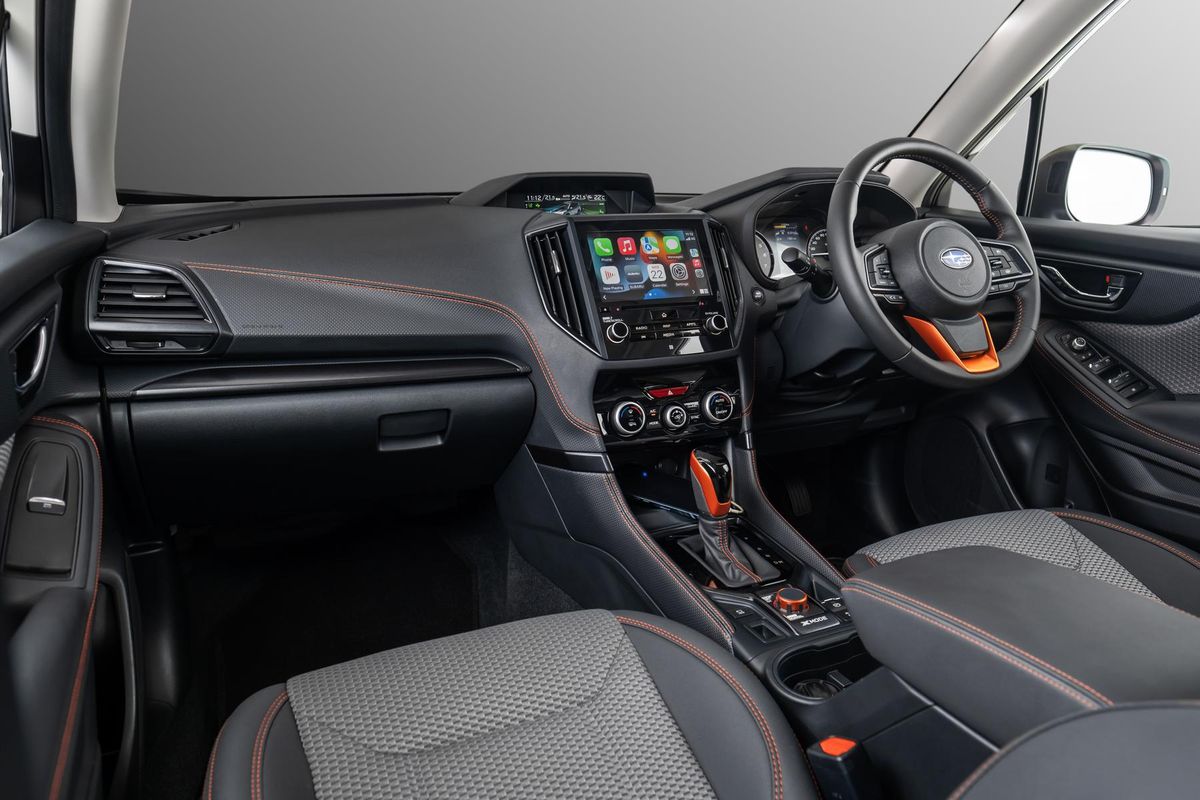
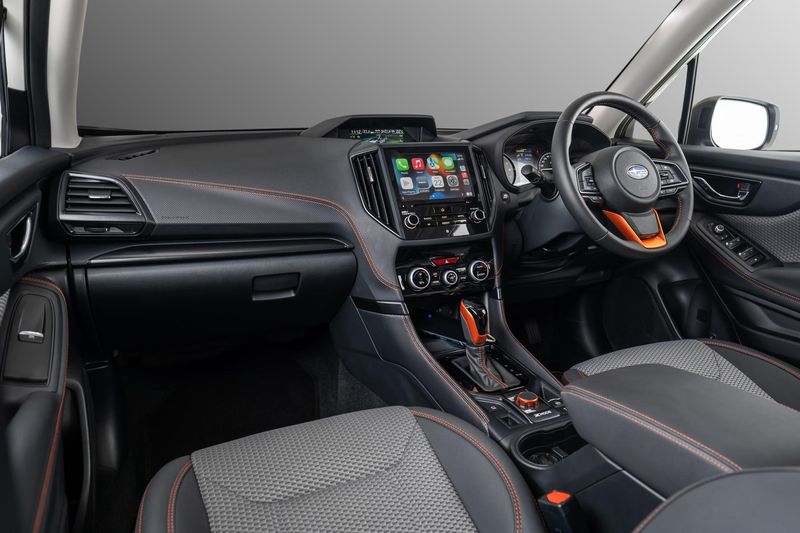
The new Forester gets 17-inch alloy wheels on the base spec, while the high-spec gets an 18-inch unit. Customers get a new Cascade Green Silicia colour as a choice, along with the already comprehensive palette. The Subaru Forester Sport gets a revised orange and black theme both inside and out.
Mechanical changes include a tweaked front suspension to improve steering responsiveness, reworked coil springs to enhance the ride quality and handling, while the noise/vibration/harshness levels are managed by the new aluminium engine mount brackets.
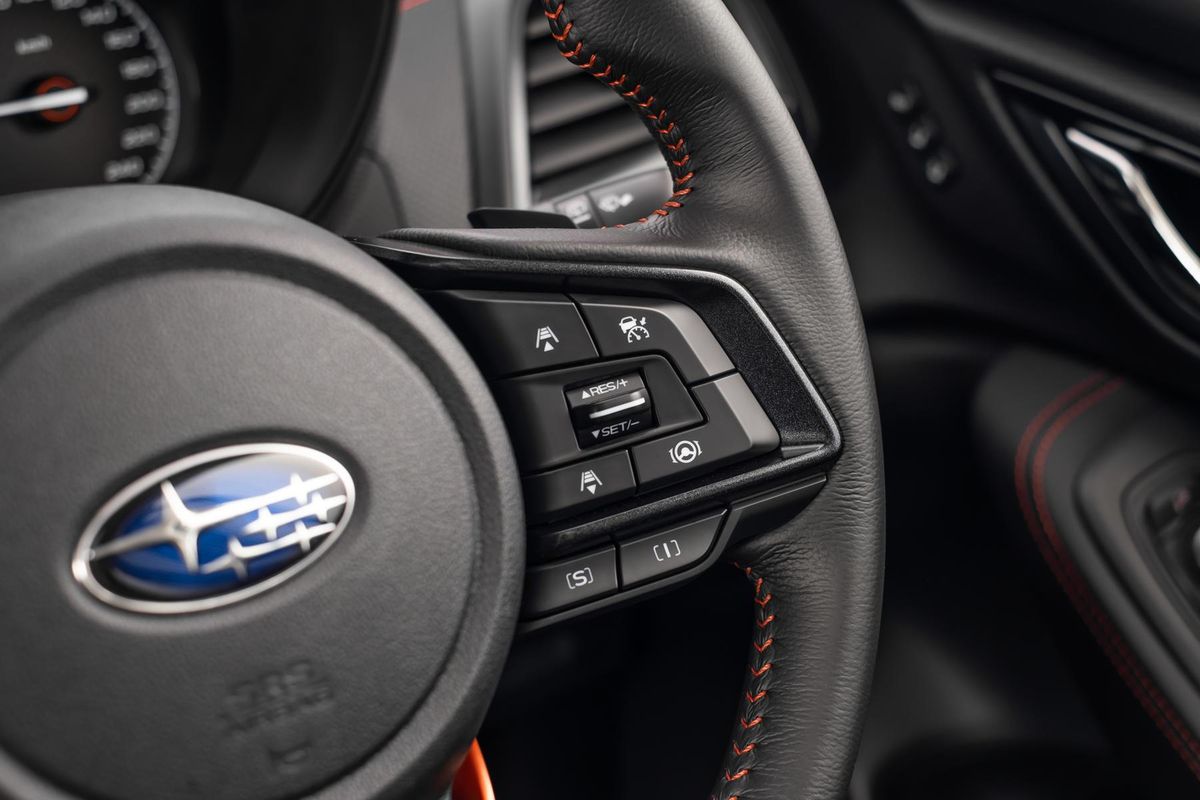
The Subaru X-Mode has been enhanced with updated Hill Descent Control, while the more advanced version of Subaru’s EyeSight makes its debut. As a reminder, this system covers the car’s Adaptive Cruise Control, Automatic Pre-Collision Braking, Lane Departure and Sway Warning.
Also offered with EyeSight are three new technologies that employ active steering inputs:
Active Lane Centering works within the Adaptive Cruise Control function to ensures the vehicle remains in the centre of the lane. This reduces driver fatigue. When the system is active, the driver’s Multi-Function Display as well as the Information Display screen show the Active Tracking graphics, depicting the system at work.
Lane Departure Prevention assists in keeping the vehicle within the correct lane by actively steering back into the correct lane.
Autonomous Emergency Steering works as an accident prevention function and can steer the vehicle to avoid an accident, be it a pedestrian, another vehicle or a cyclist. Autonomous Emergency Steering sometimes works in conjunction with the Emergency braking function but can also work when the system deems emergency braking is not adequate to reduce the severity of a collision.
The Subaru Forester gains strengthened roof rails to allow for more cargo-carrying capacity as well as roof tents.
What’s on offer?
Subaru will be offering its 2022 Forester in a 4-model lineup. There are two engines on offer; 2.0 and a 2.5. Both engines are naturally-aspirated and are horizontally opposed in layout.
The 2.0-litre produces 115 kW and 196 Nm, while the 2.5-litre offers up 136 kW and 239 Nm. All Subaru Foresters feature CVTs and all-wheel drive.
How much does the updated Subaru Forester cost in South Africa?
The new Subaru Forester is sold with a 3 year/75 000km full Maintenance Plan as well as a 5 year/150 000km Warranty. These are extendable, with various plans available.
A test drive is a vital part of the car-buying process, but if you’re shopping for a used car, it’s even more important to make sure that your prospective purchase has no mechanical problems and that its functions and features are in good working order. We bring you 8 insider tips for that all-important test drive…
PARTNERED CONTENT
Once you have compiled a shortlist of cars that suit your budget and meet your requirements, it is time to conduct a test drive or two. Remember these tips when test driving a vehicle with motus.cars.
A salesperson will usually accompany you on a short test drive in the vicinity of the dealership, but it’s better to undertake a lengthier on-road evaluation (if you can) because it will allow you to “live” with the car for a bit longer. Ask to take the vehicle out for a 45-minute drive so that you can assess how easy the vehicle is to park and manoeuvre at low speed. You should drive it in town and on the freeway.
Ideally, take a friend or family member with you; they may pick up on things that you might miss. However, before you drive off, it is important to know what you might be liable to pay in the event you are involved in an accident during the test drive, such as the insurance excess.
Before you sign a test-drive agreement, make sure you read it to ensure you’re comfortable with all the conditions.
For a new car, the test drive will help you determine whether you like the driving feel and comfort of the vehicle… and whether it’s a practical fit for your specific needs.
A used car test drive is a bit different: you’re also looking for mechanical faults or other issues that may have arisen as a result of wear and tear or insufficient maintenance on the part of previous owners.
Herewith is an 8-point test drive checklist from motus.cars, supported by Motus Nissan (previously Imperial Nissan), to comprehensively consider every aspect of a prospective car purchase:
Test drive checklist:
Before you drive off, check whether the vehicle has exterior damage such as dents, chips or scratches. Make sure they are noted by the salesperson, or you could find yourself being held responsible for damage that occurred before you tested the vehicle. Should you want to make an offer to purchase at a later stage, that damage will need to be corrected or the cost of repairs factored into the asking price.
1. Engine and suspension
The car should run smoothly when accelerating, decelerating and travelling at a steady speed. Once the powertrain has warmed up, the water-temperature gauge reading should remain stable (about halfway between the cold and hot markers) – and the temperature warning light should stay off! Harsh rattling or knocking sounds may be signs of incorrect tuning or worn/faulty engine or suspension components.
2. Steering and brakes
The vehicle’s steering should be responsive with no vibration or “free play” on the ‘wheel. Ensure that the car stops smoothly, strongly and in a straight line when you press the brake pedal firmly.
3. Clutch and gears
If you’re test-driving an automatic car, check that the transmission changes gears smoothly and consistently (when you expect it to). In a manual vehicle, the shift action should be positive (the gear lever should notch precisely into its slots) and the clutch pedal must disengage/engage the car’s clutch progressively… in other words, the leftmost pedal should be easy to modulate once you’re used to it.
4. Comfort
Adjust the driver’s seat, steering-column rake/reach, as well as the positions of the rear-view and side mirrors to your preference before you start the test drive. Ensure you are completely comfortable behind the ‘wheel, with clear vision to the front and rear of the vehicle. Sit in all the seating positions. Check whether there is enough leg- and headroom for the intended occupants.
5. Switches
Locate and test the main switches, such as the wipers/washers, headlights, cruise control stalk/buttons (if applicable) and hazard lights.
6. Aircon and Technology
Turn on the aircon to ensure it works effectively. Try out all the tech features, such as the infotainment system, including Bluetooth audio streaming/telephony and Apple CarPlay/Android Auto compatibility.
7. Safety
Check that all seat belts are in working order and, if you have young children, take along car seats to test if they fit in the car with easily accessible anchor points and seat-belt buckles.
8. Space
Check the boot size or load-bay capacity to ensure that it would be able to accommodate any large items you will need to transport, such as golf clubs, prams or large suitcases.
More about motus.cars
It’s always advisable to buy a used car from a name you can trust. With motus.cars you can even book a test drive online. Simply click on the car you’re interested in, fill in the enquiry form and remember to tick the “book a test drive” box. Remember to take your valid driver’s licence along with you!
Browse the motus.cars range of quality, Motus-certified new, used and demo crossover vehicles for sale here.
If you would like to get your car valued as a trade-in, why not enquire about your new dream car on motus.cars and get your current car valued at the same time!
Make use of free tools available to further help you decide what the best vehicle finance option is for you. Use these simple affordability and finance calculators to help you determine what you can afford and what finance option will be best for your needs.
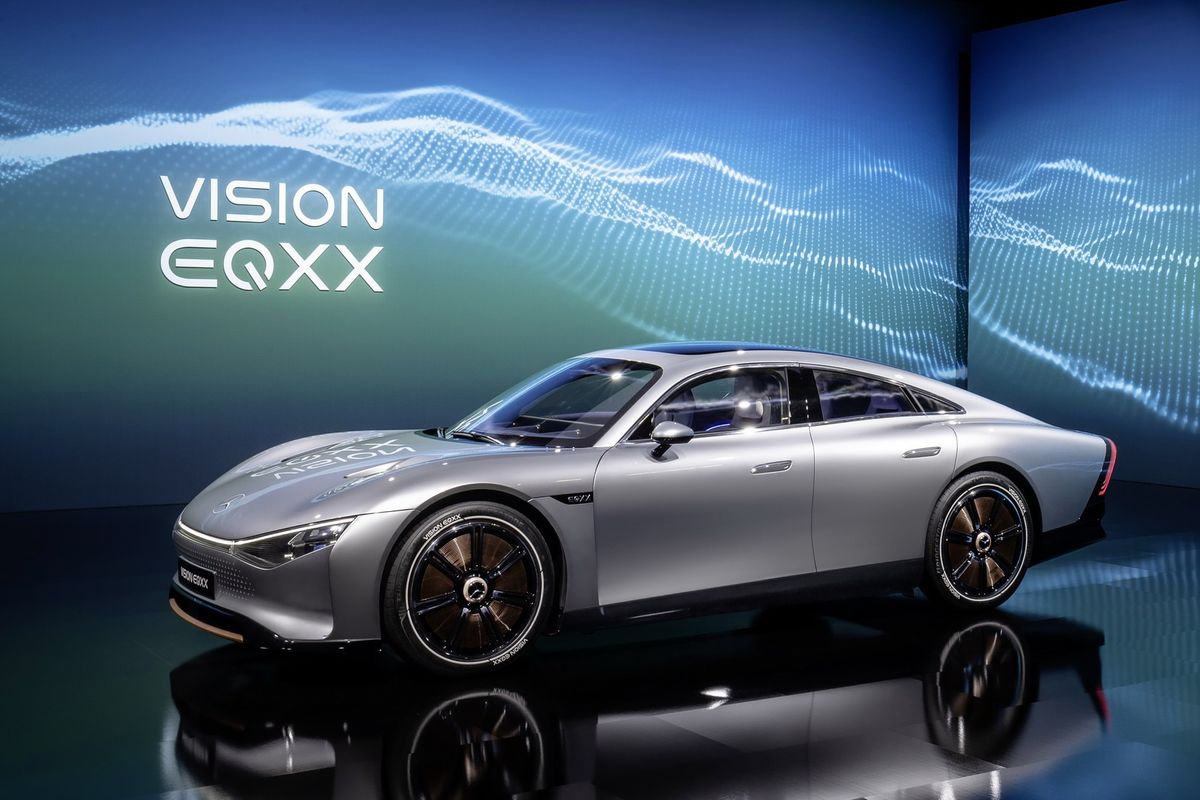
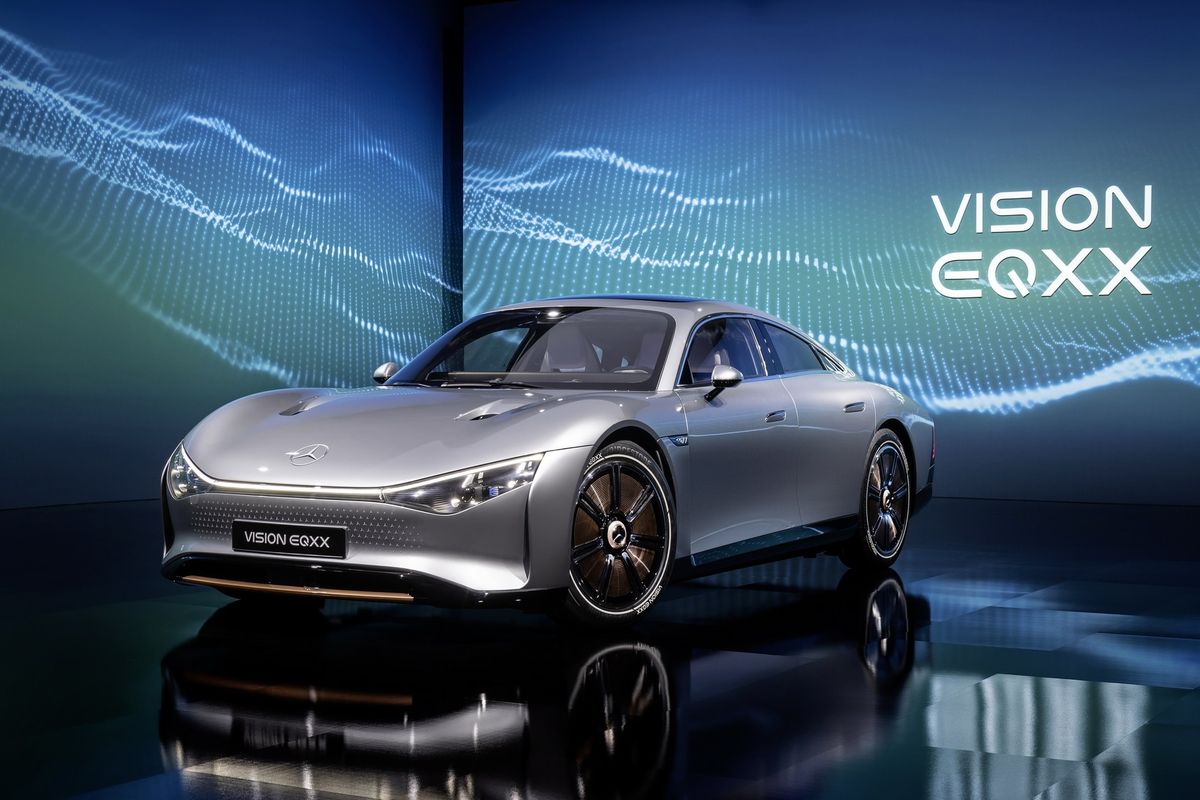
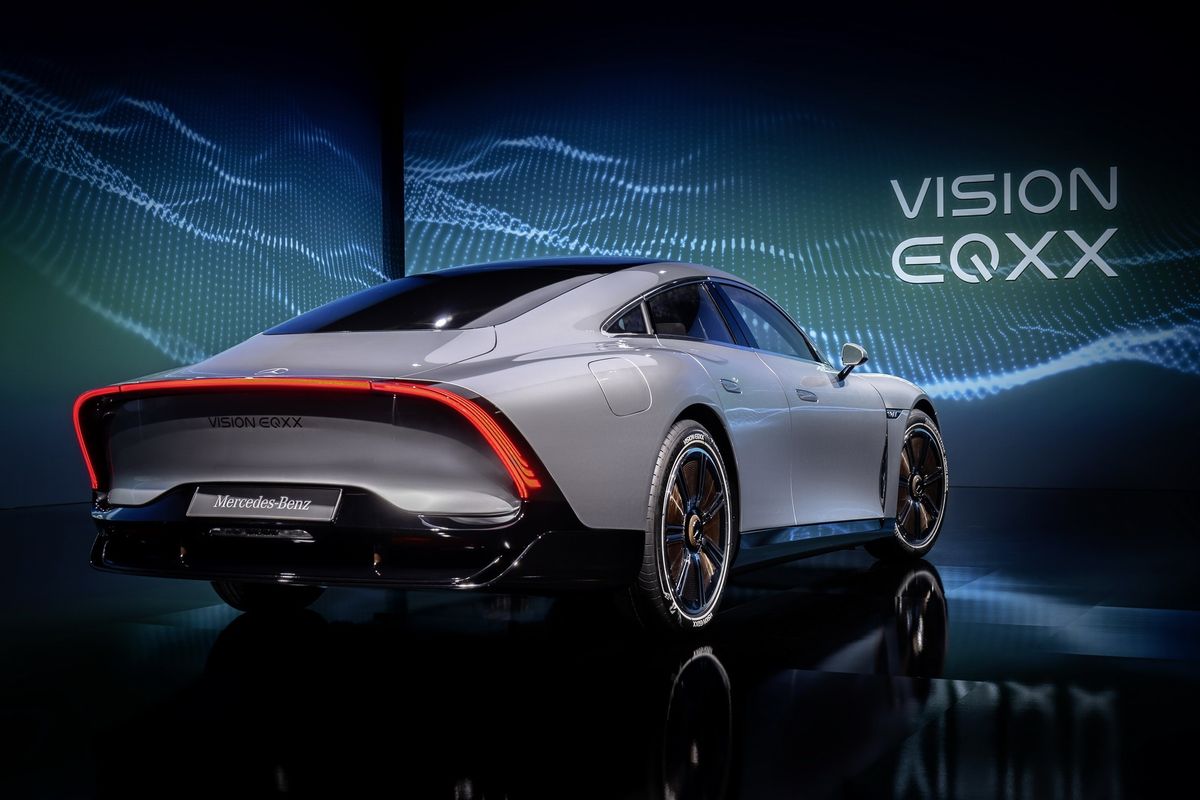
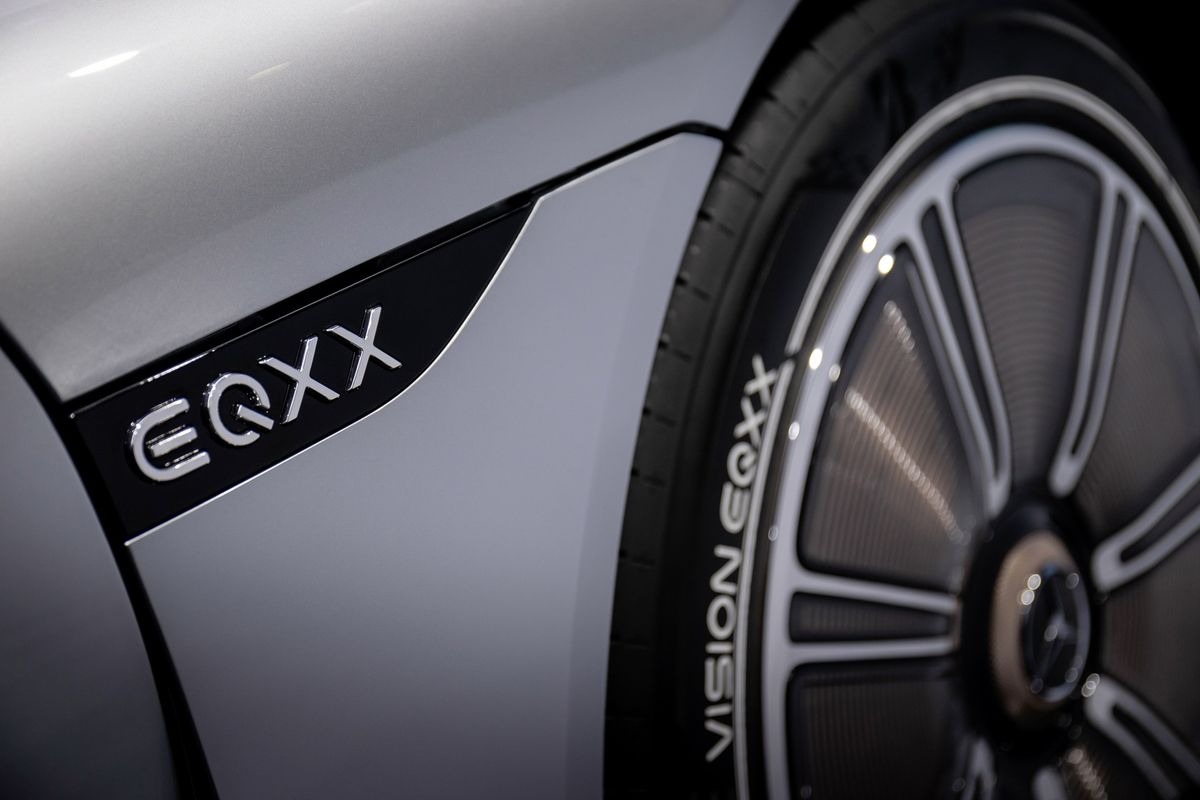
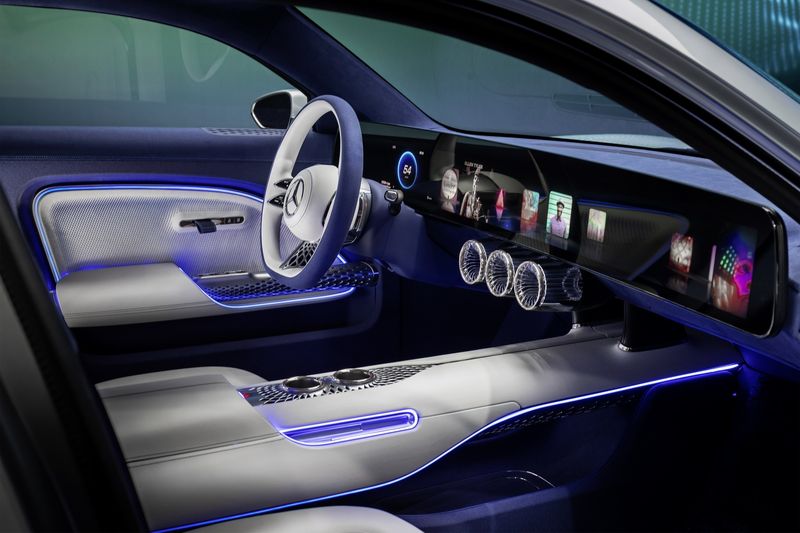
Mercedes EQXX Concept Previews Merc’s Electric Future
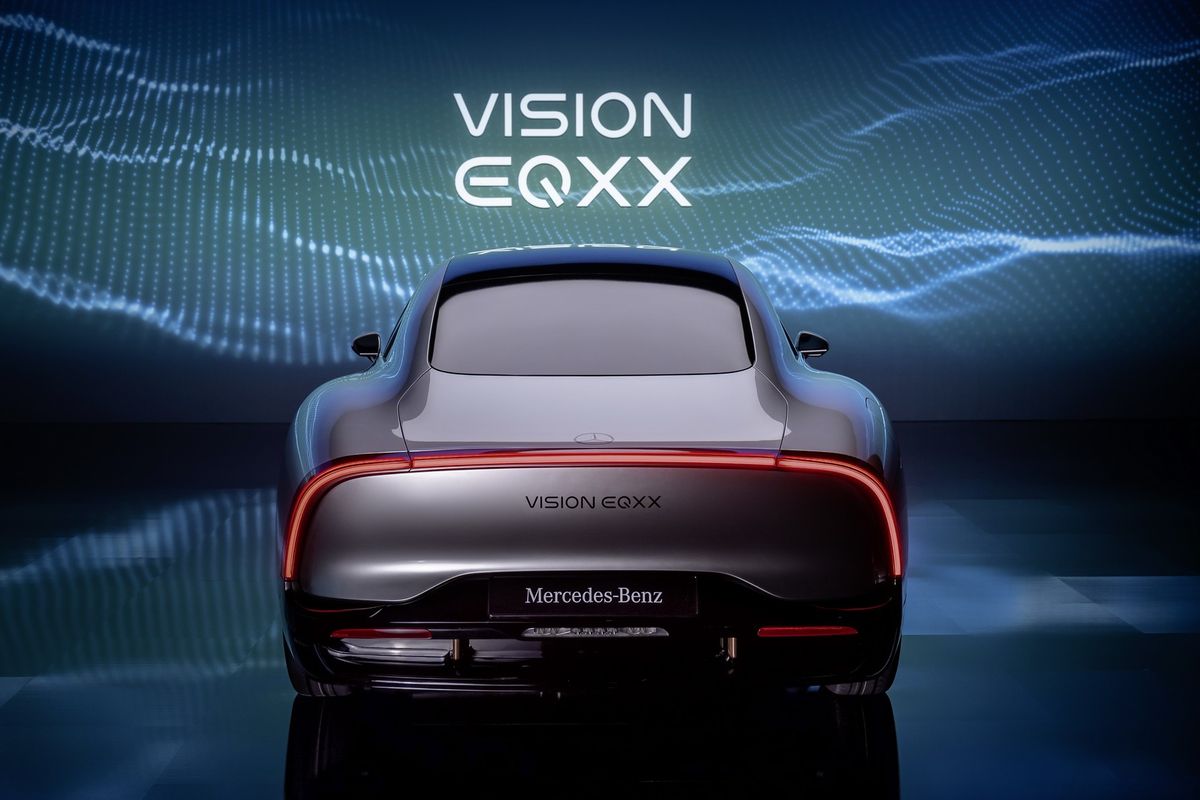
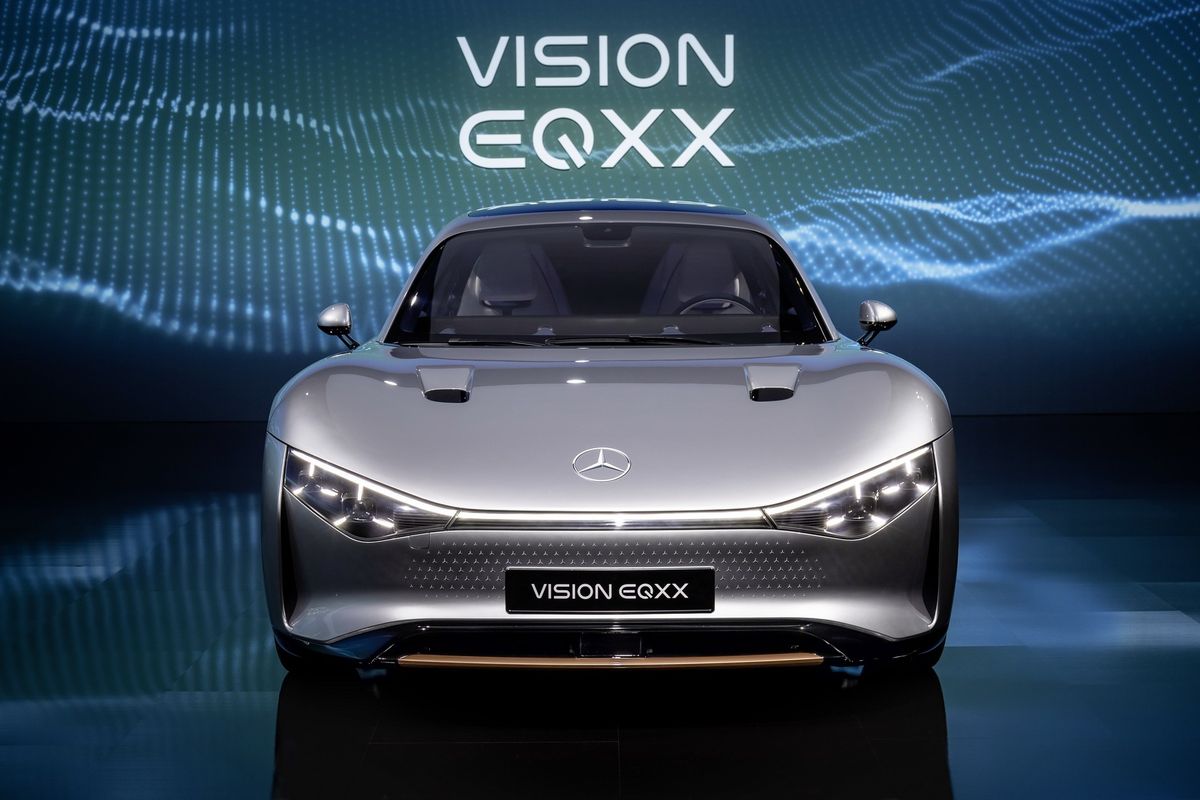
The radical-looking Mercedes-Benz EQXX gives us a preview of what the German carmaker is planning for the future.
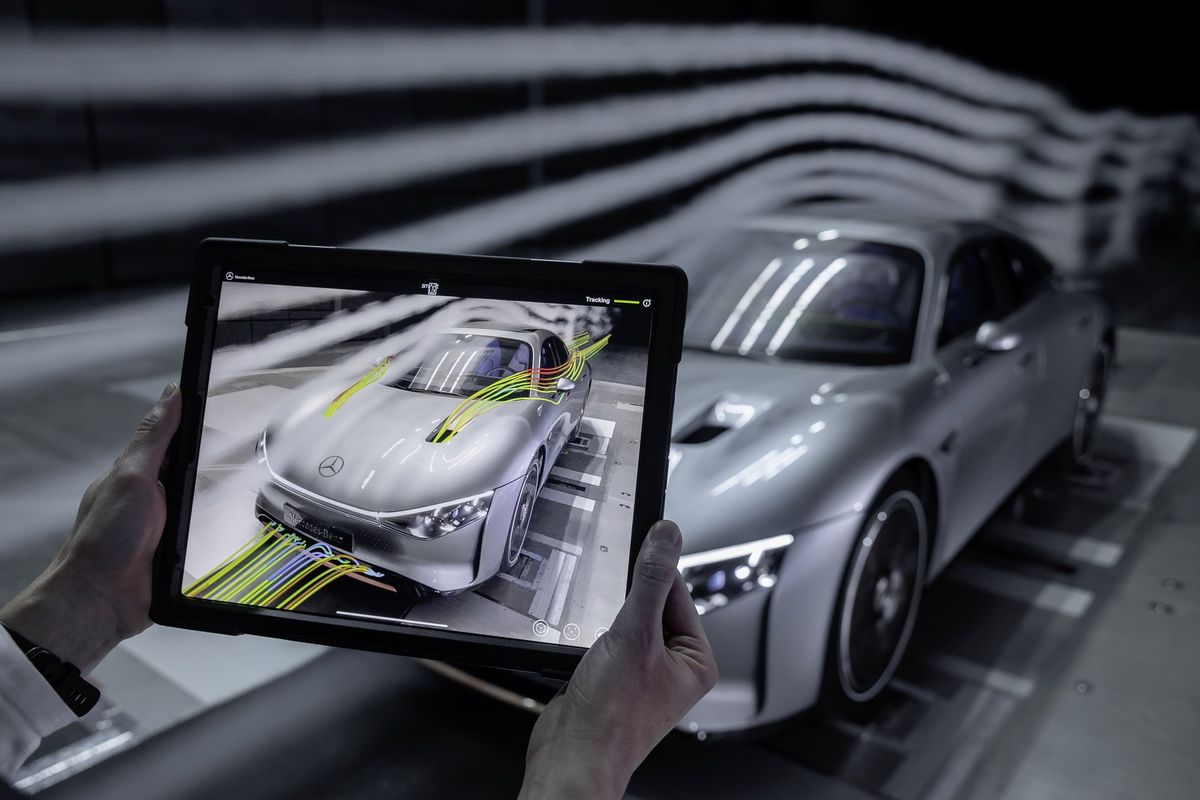
Mercedes-Benz EQXX Concept is said to be able to travel 1000 km on a single charge, which should satisfy the range-anxious. The secrets behind its phenomenal range is not a giant battery pack, but rather some impressive aerodynamics and weight saving.
The Germans could have always loaded a giant battery pack into the car, but this would increase the weight dramatically, and heaviness is a common factor associated with every non-ICE vehicle. The BMW iX for example weighs 2.3 tons. The Mercedes-Benz EQXX Concept tips the scales at 1 750 kg, which is deeply impressive for a big electric vehicle.
The 900-volt battery pack was developed in conjunction with Mercedes-Benz’s F1 team and has the same power rating of 100 kW, which is identical to the current EQS. Clever packaging and engineering have resulted in this pack being physically smaller by 50% and 30% lighter.
The roof features solar cells which add 25 km to the overall range, trick low-rolling-resistance tyres and an incredible aerodynamics drag coefficient rating of 0.17.
The engine is a single 150 kW motor that drives the rear wheels. It’s not going to be the fastest thing around, but pace was not Merc’s target here.
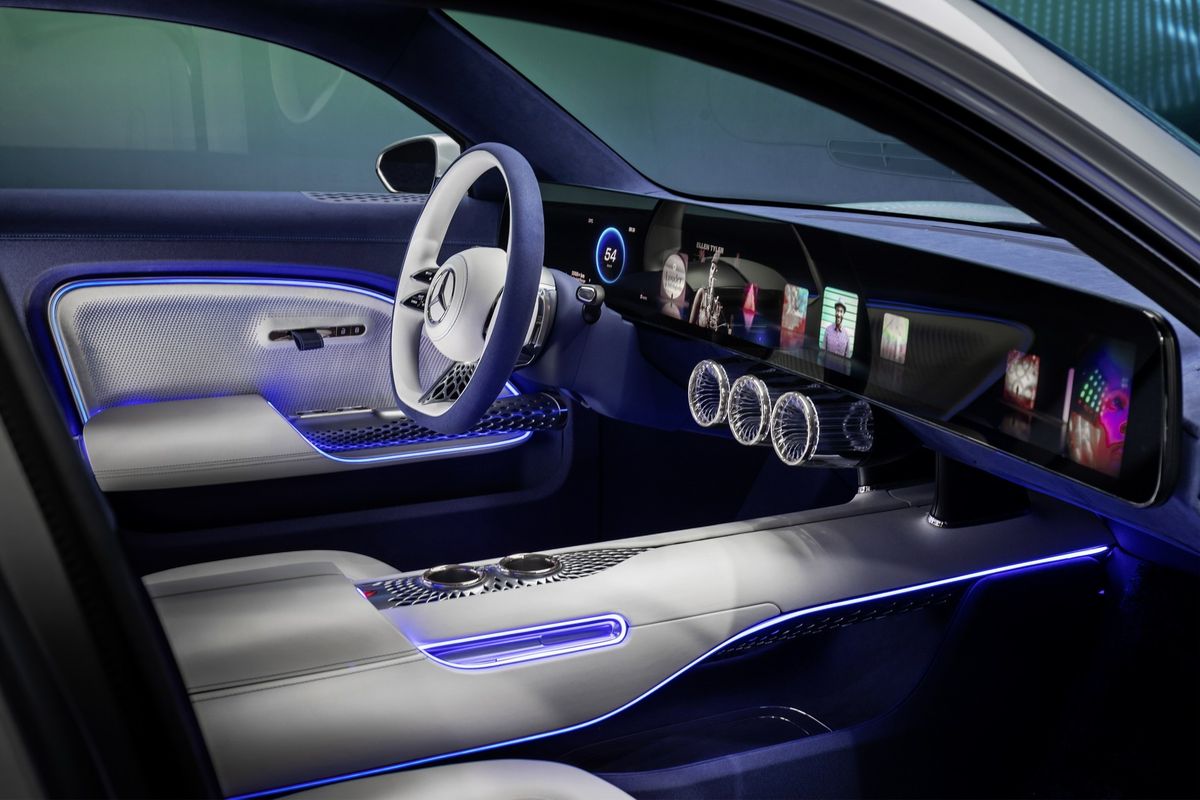
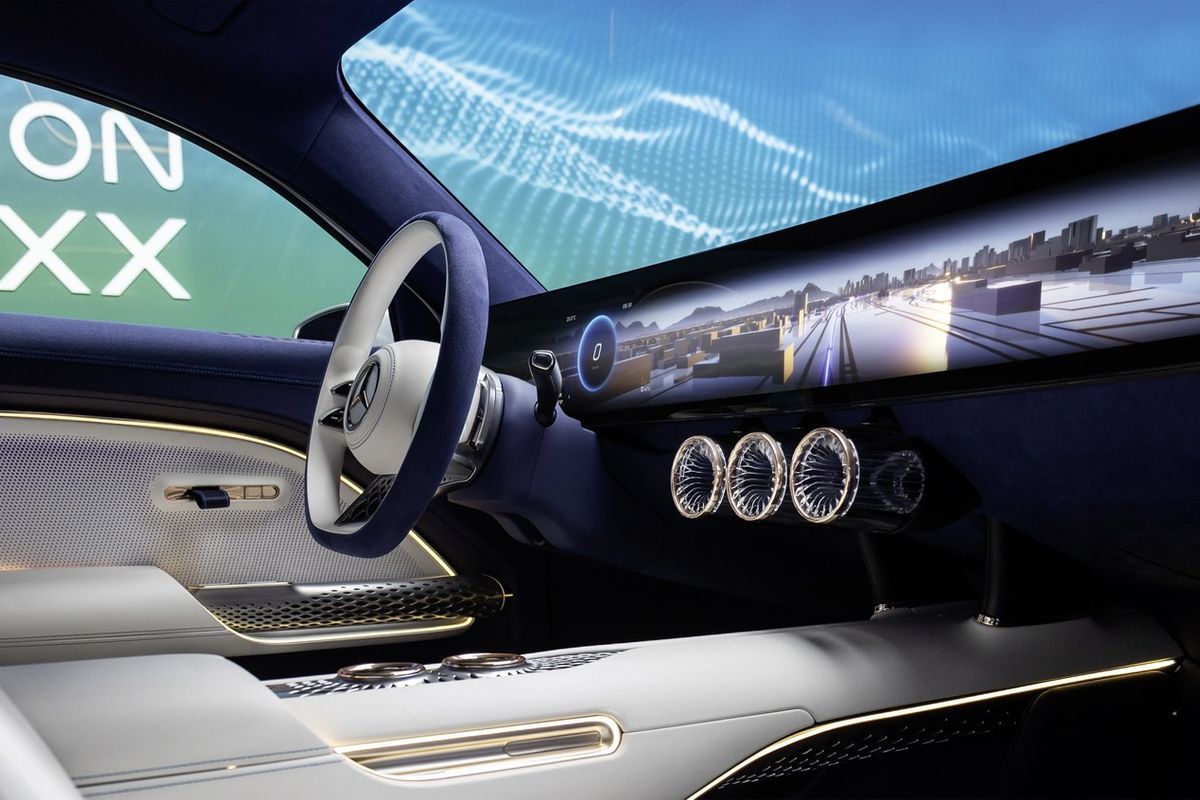
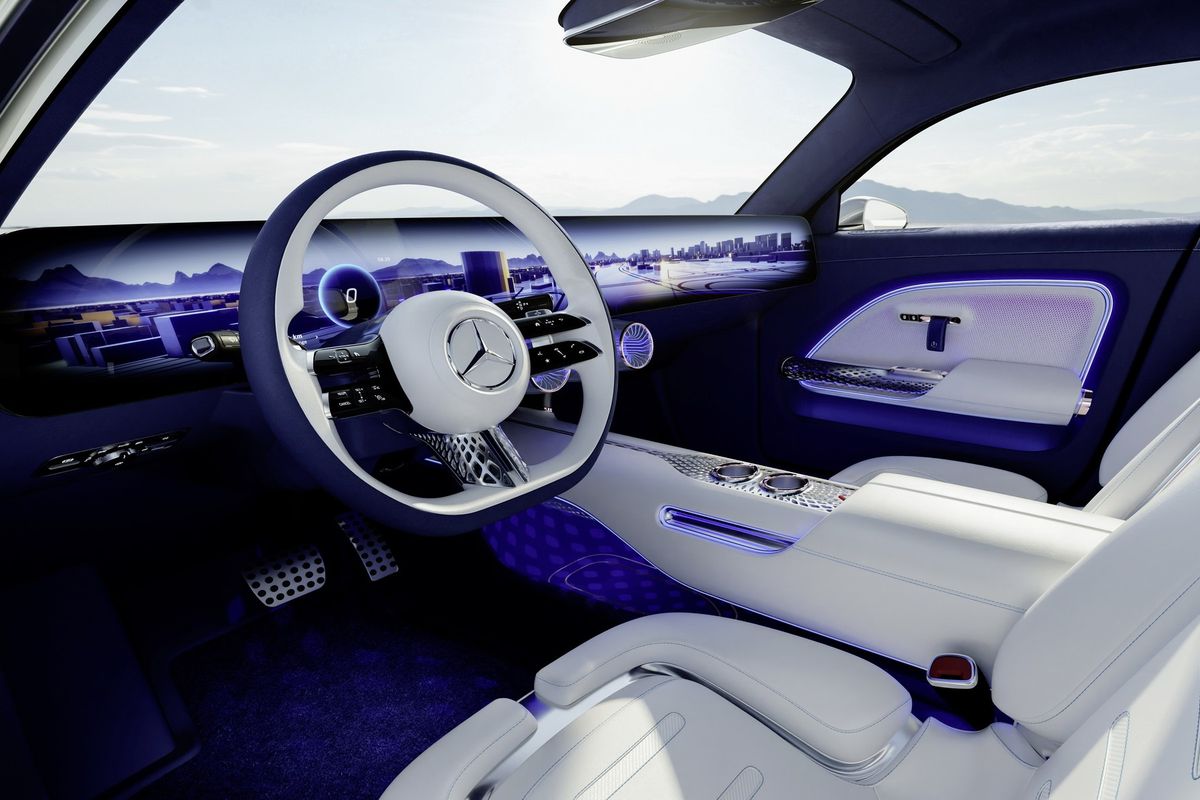
The cabin looks like something out of a futuristic movie, with an 8K screen stretching across the entire dashboard. The interior is assembled from sustainable materials, with the seats being made from cactus plants and some of the trim comes from mycelium mushroom vegan leather. The plastics used in the non-structural parts of the cabin are made from recycled plastic.
The Mercedes-Benz EQXX is a concept for now, but expect to see some of the technology from this vehicle make its way into future products from the German carmaker.
Mercedes-Benz South Africa will be launching an array of EQ electric vehicles in 2022.
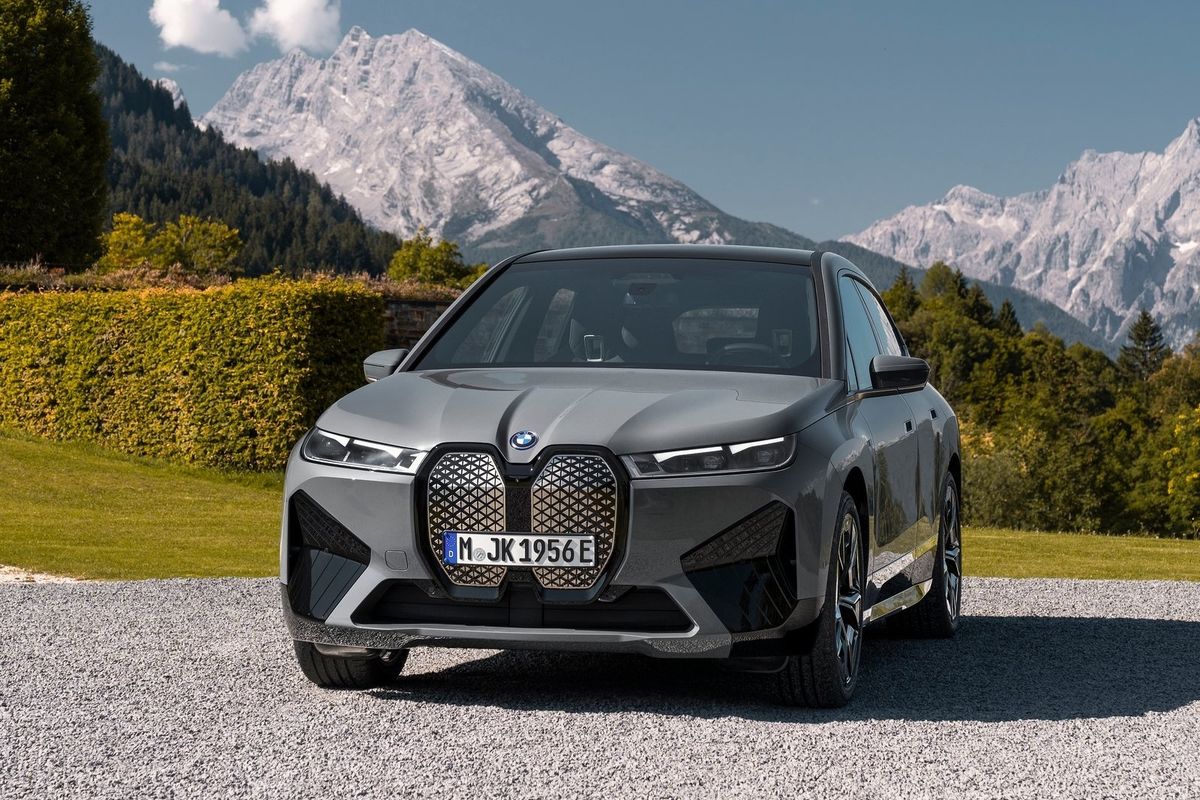
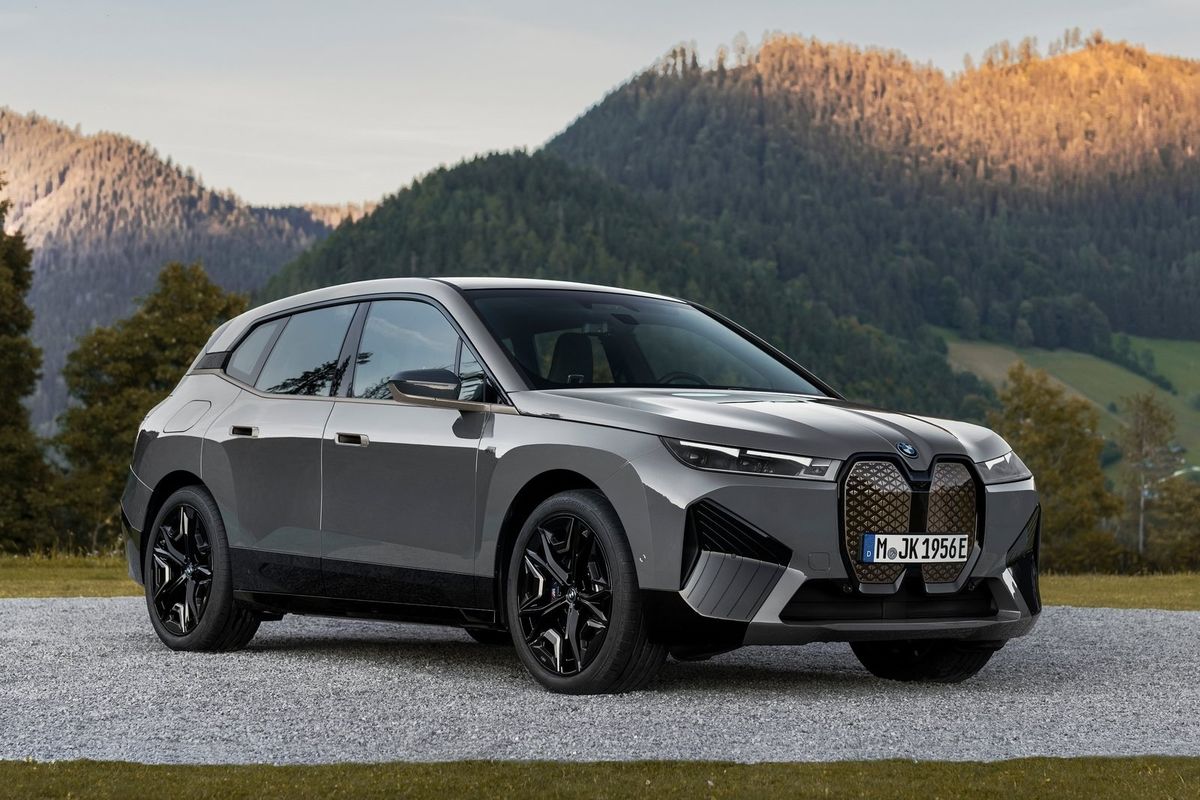
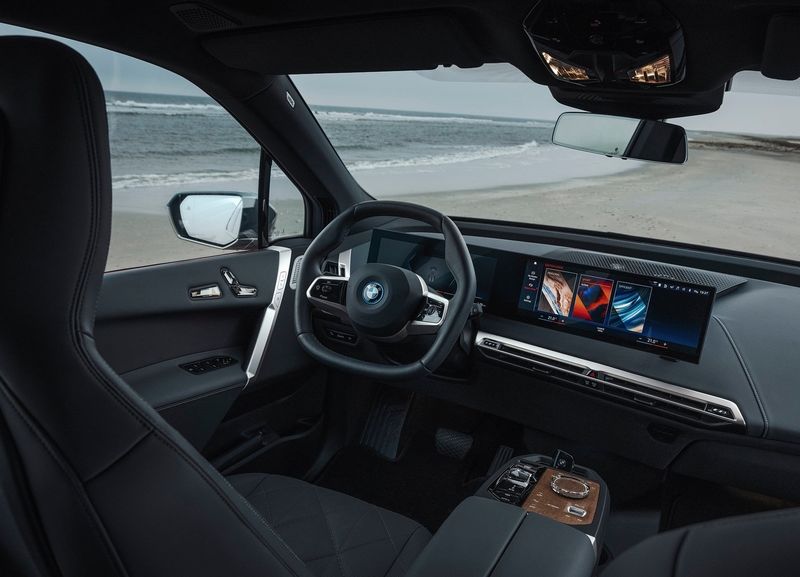
The BMW iX M60 marks the debut of a pure electric BMW M sports activity vehicle. Boasting a large battery pack and a pair of electric motors, this is one quick electric family vehicle.
The BMW iX M60 was originally earmarked for an early January 2022 introduction at CES 2022, which is an annual trade show organized by the Consumer Technology Association and hosted in Las Vegas. However, rising pandemic numbers saw a few exhibitors pull out, including BMW.
BMW instead chose to release some images accompanied by some specifications. With the claim of delivering ” a performance-focused take on all-electric driving pleasure,” the BMW iX M60 sits at the top of the iX range.
There are a pair of electric motors which combine to deliver over 440 kW. BMW claims the M60 is good for a 0-100 kph sprint time of just 3.8 seconds – impressive for a bulky electric family vehicle.
It’s not just about straight-line shenanigans either, with a clever all-wheel-drive setup and sporty chassis ensure a dynamic drive is on offer.
There’s no mention of battery capacity, but it’s likely the M60 will have the larger 111.5-kWh battery pack from the iX xDrive50. A potential range of 482 km is possible, which is just shy of the xDrive50’s 550 km. BMW does claim 21.6 kWh per 100 kilometres as far as consumption is concerned.
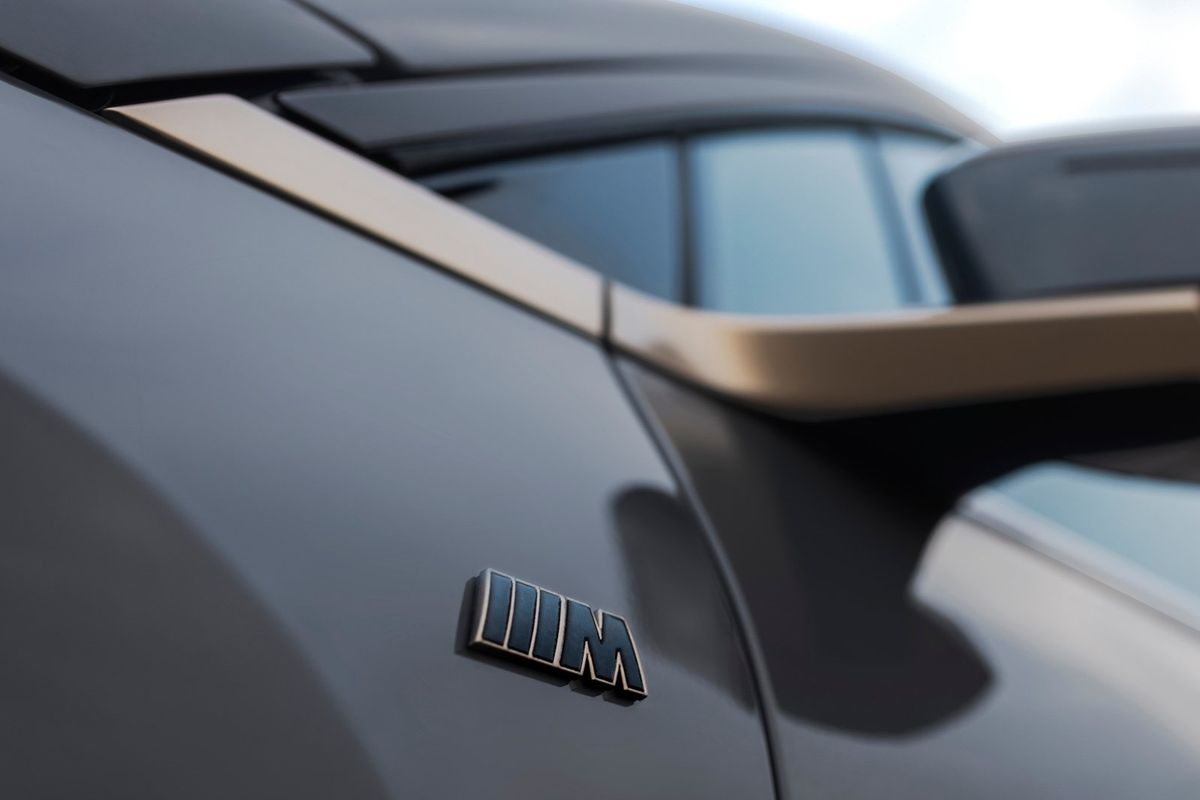
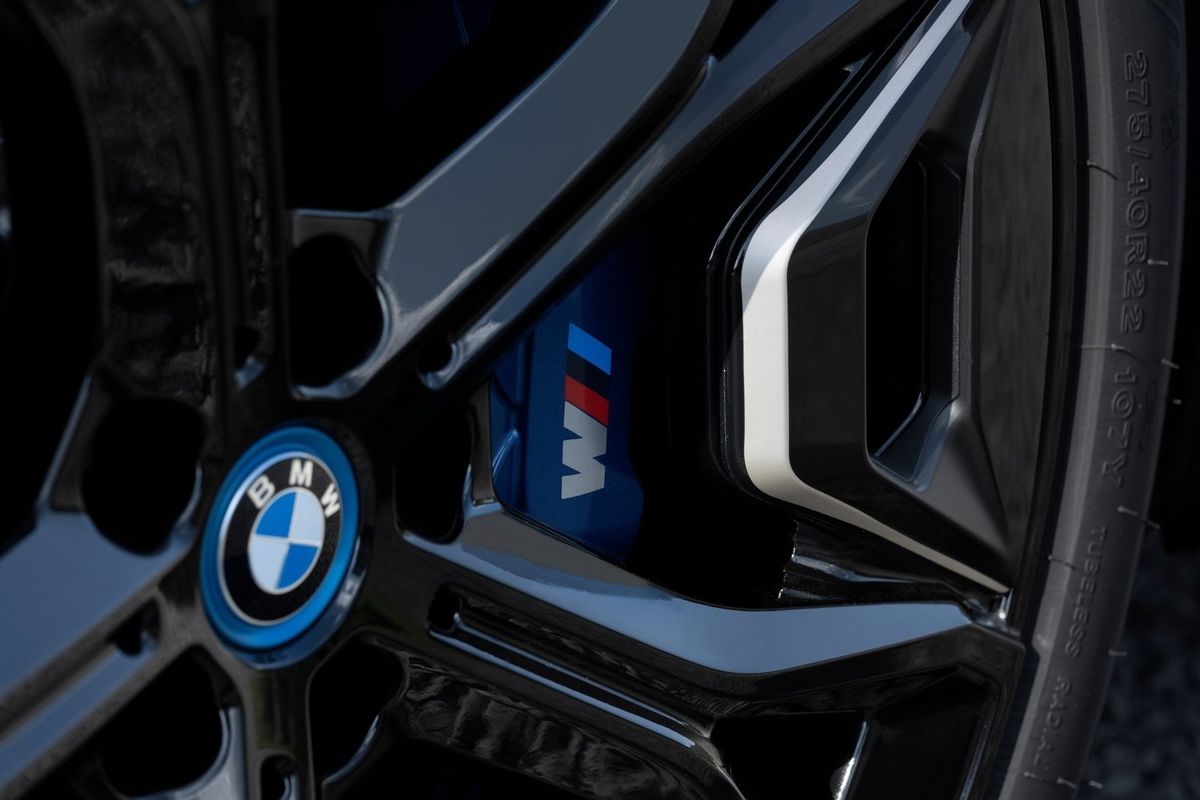
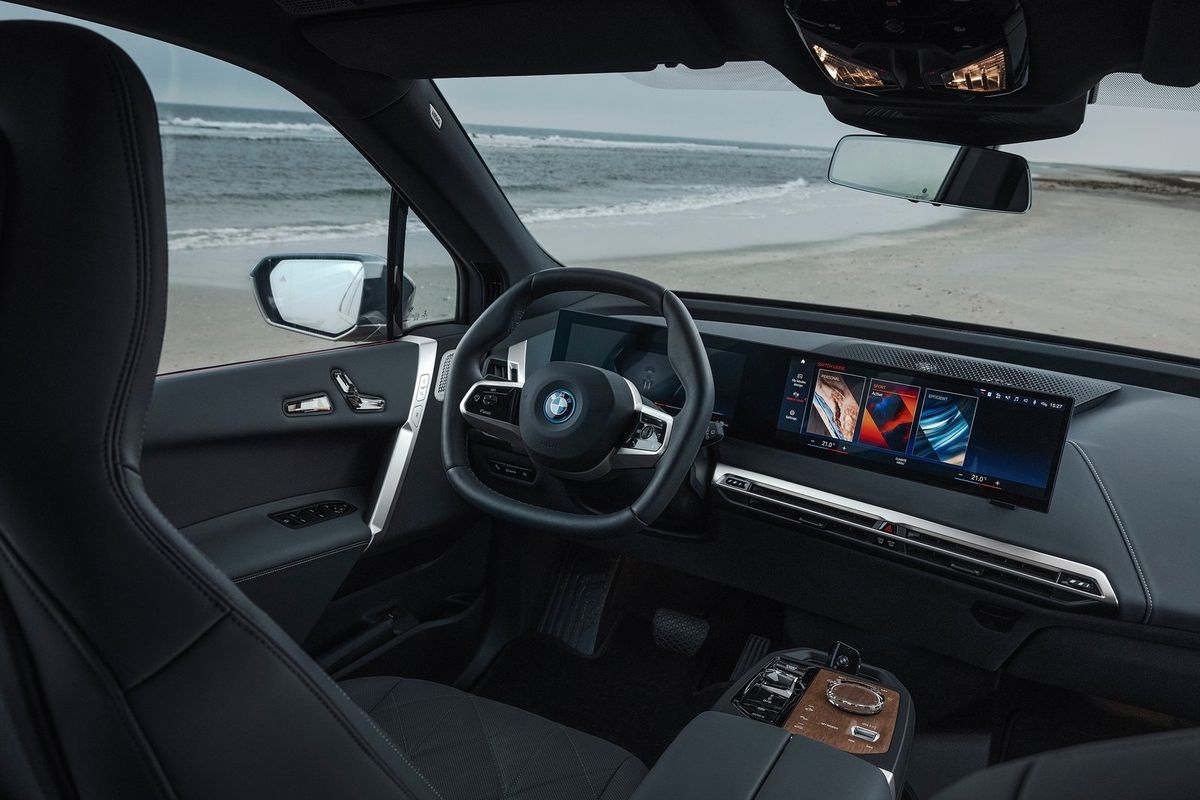
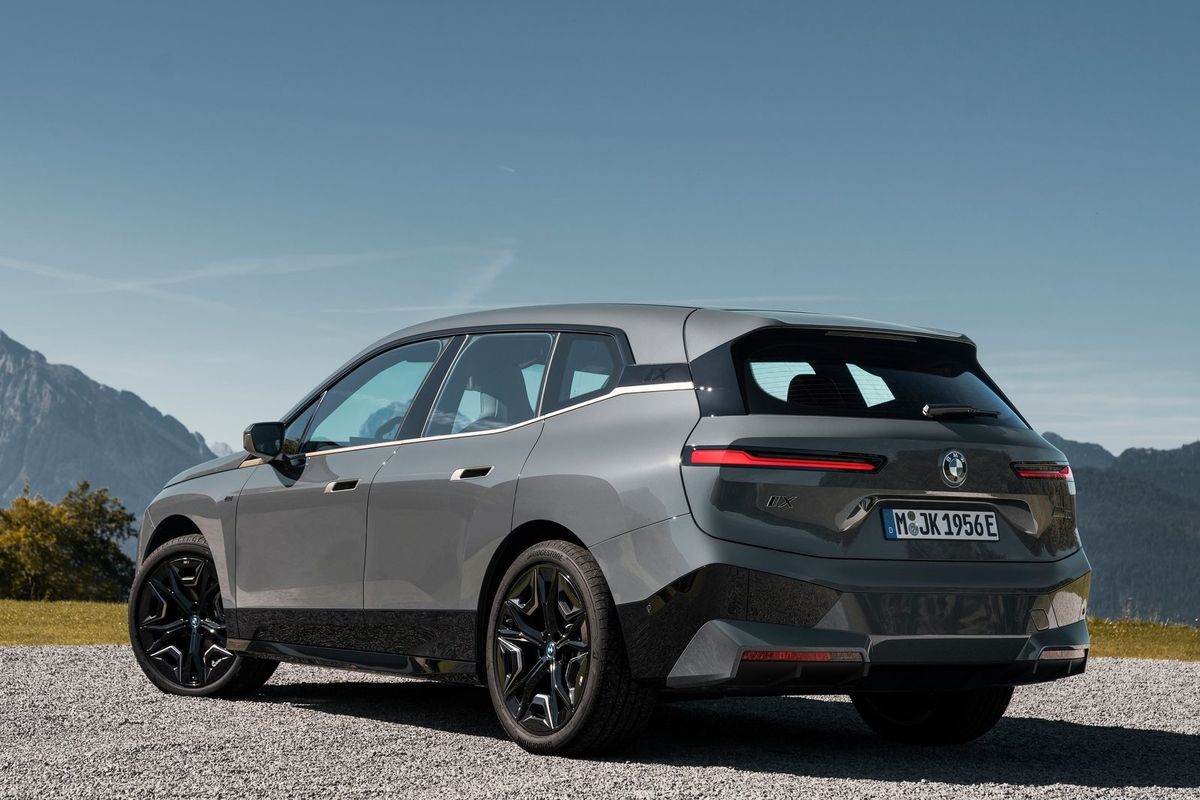
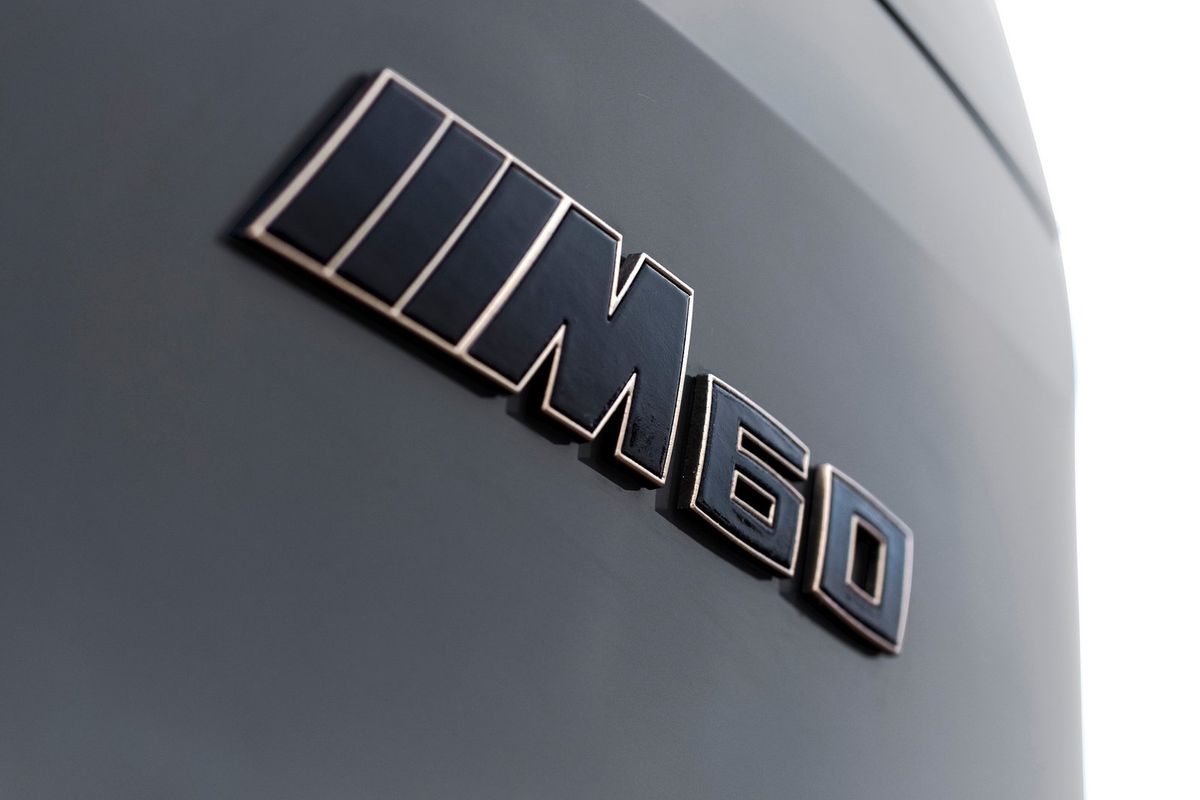
Visually, the M60 can be spotted with its subtle M branding, blue M Performance brakes, sportier wheels wrapped in 22-inch rubber and a bold black M60 badge on the rear. The cabin gets a sporty look too. It’s an interesting look which has polarised the car community, but it is one of those cars that looks far better in the metal than on a screen. It’s not as radical as the BMW Concept XM, however.
At this stage, there’s no confirmation from BMW with regards to M60 availability locally, but seeing as the SA market just received the xDrive40 and xDrive50, we reckon it’ll be on the way before the end of 2022.