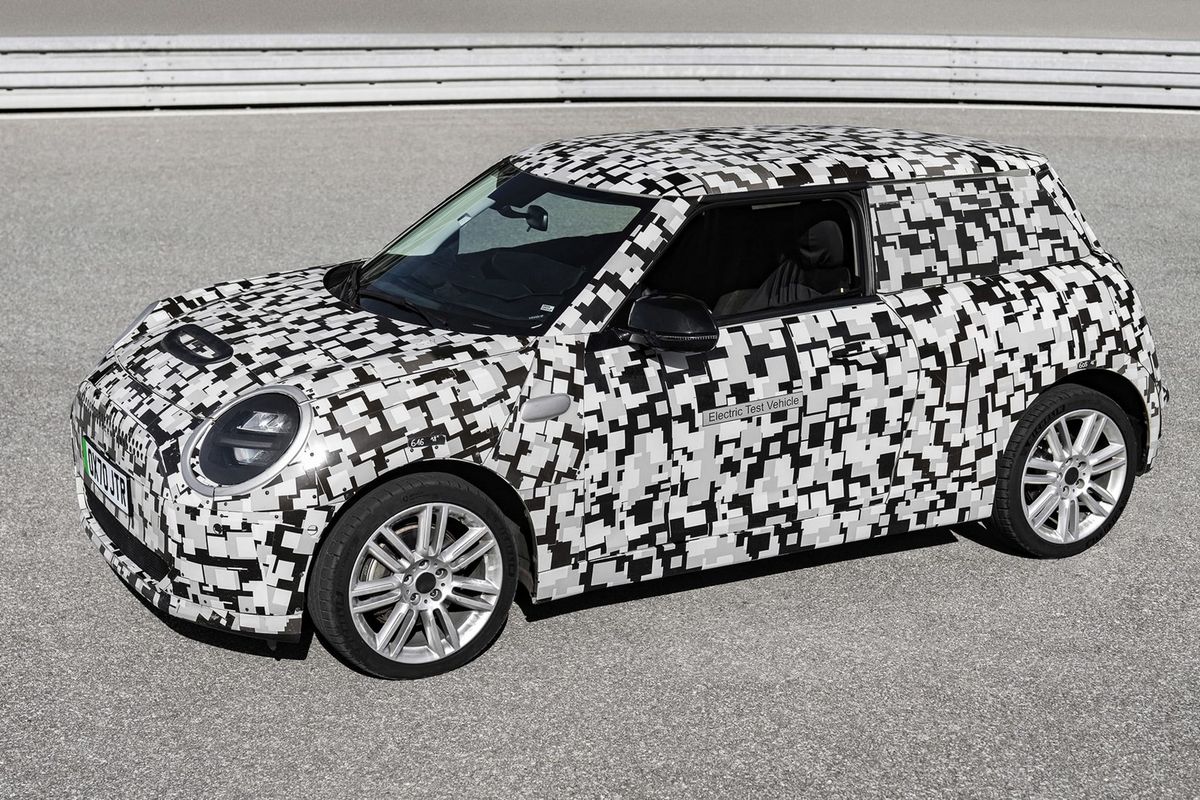
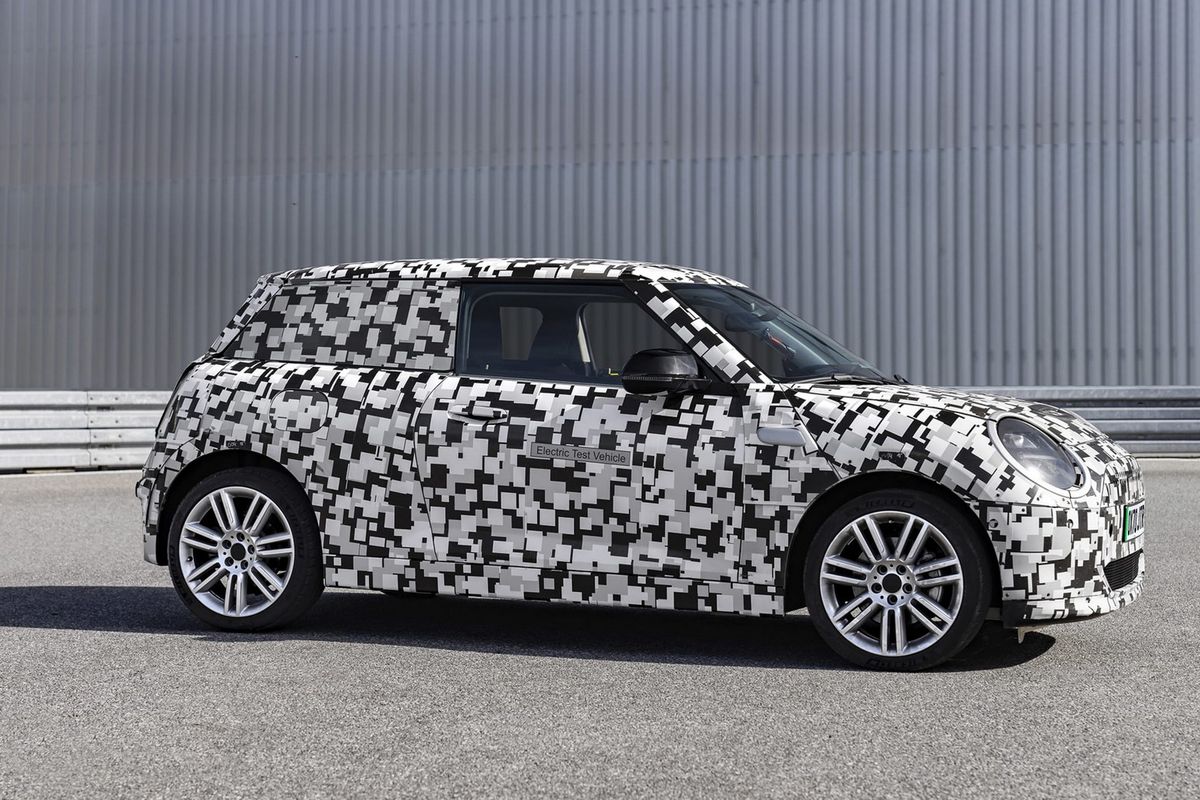
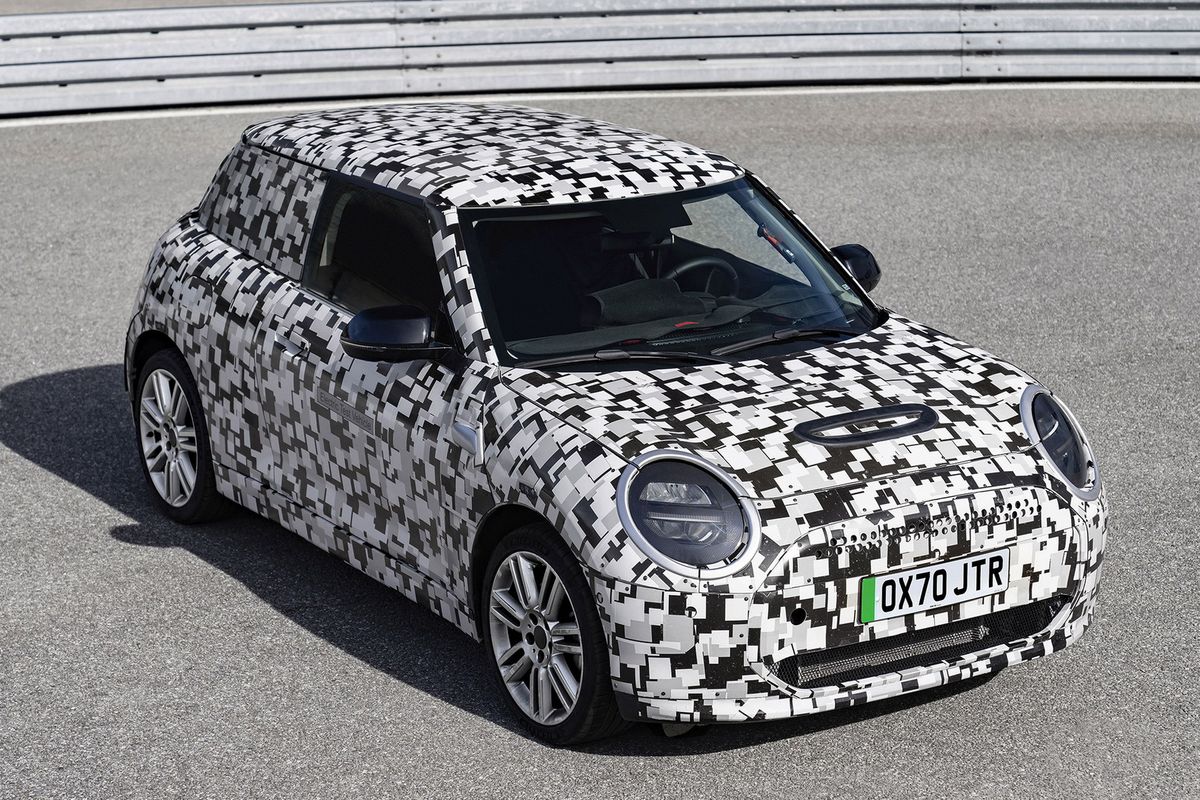
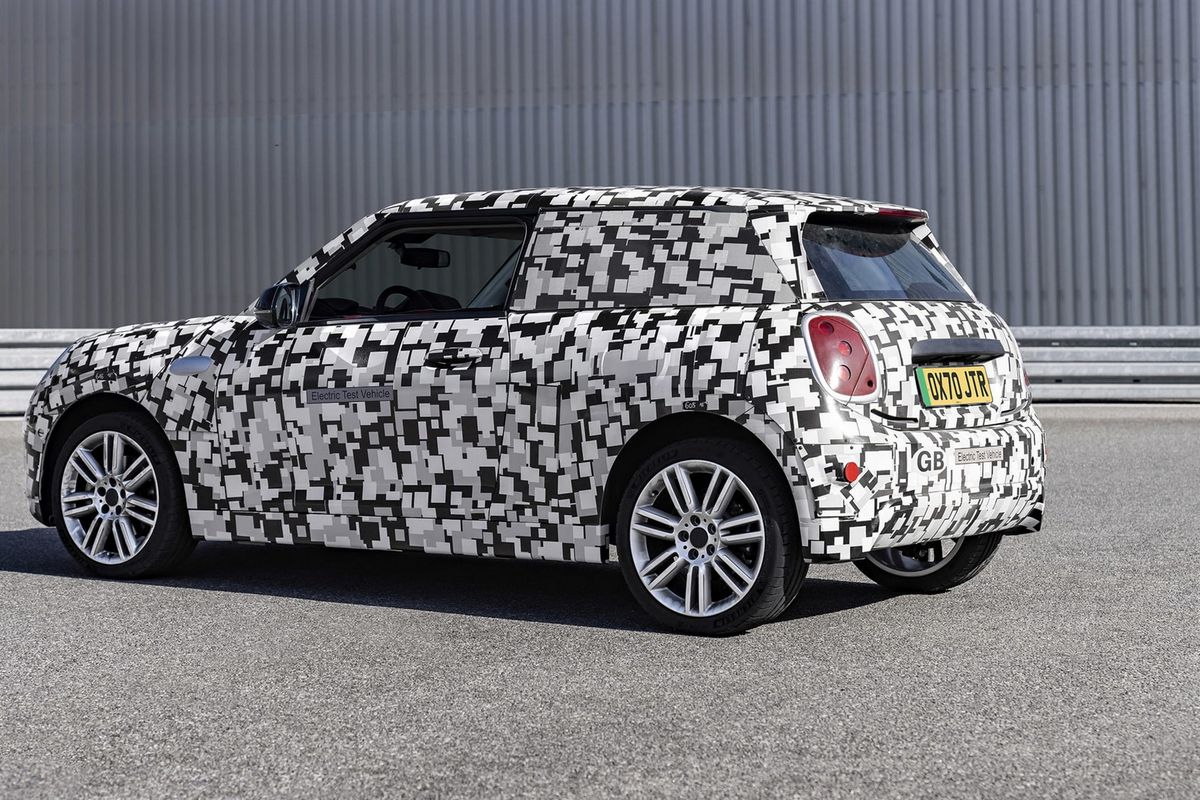
As for the new Mini Hatch, both Internal Combustion Engine (ICE) and Battery Electric Vehicle (BEV) variants will be offered. The new Mini Hatch, as well as a new Countryman, are expected to come to market in 2023.
The all-new next-generation Mini EV will be assembled in China on a new platform with Great Wall Motors, BMW Group’s joint venture partner.
As seen in the images, the overall shape and design of the new Mini Hatch isn’t expected to be a radical departure from the current iteration but will be more of an evolutionary design exercise. Note that all-important circular headlights and bonnet scoop have been retained as these are crucial design cues. Other features to note include the new taillight clusters and the roof-mounted spoiler for a sportier
The Mini Hatch will be underpinned by a modified version of the FAAR platform which will also underpin the Countryman and other BMW Group models such as the BMW 1-Series, 2 Series Active Tourer, BMW X1 and X2.
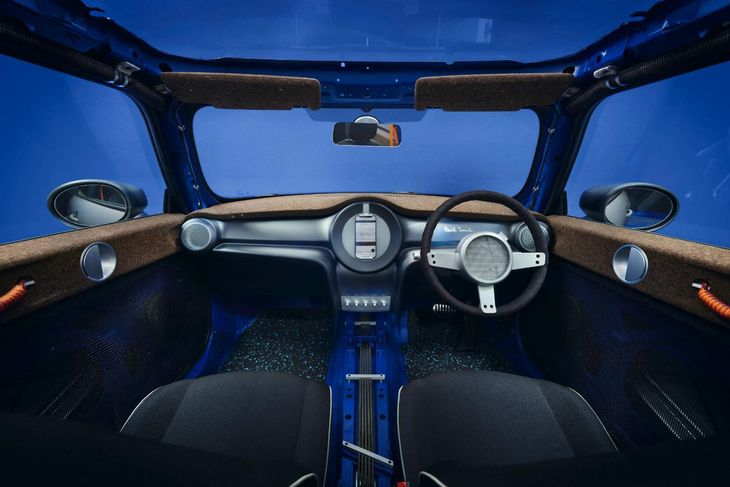
The Mini Strip Concept shows what’s possible using sustainable, recycled materials.
As for the interior, you can expect to see more recycled materials making their way into future Mini products, including the new Mini Hatch, as the brand seeks to be more environmentally friendly. The Mini Strip Concept (pictured above) is a good example of how Mini intends to create sustainable and eco-friendly interiors. For now though, details regarding the interior of the new forthcoming Mini Hatch are scant.
The new Mini Hatch will be produced at the firm’s production facility in Oxford, UK, while the new Countryman will be produced in Leipzig, Germany (alongside the BMW X1/X2).
But that’s not all, Mini will also be releasing a fully electric crossover with production starting in China in 2023. By 2027, 50% of Mini’s global sales will be electric.
Creative credit must be given to Wat Ford, the tuning firm responsible for this surprisingly striking Ranger Mustang. It looks pretty good, don’t you think?
The body kit incorporates a Mustang Shelby GT350 front bumper, new headlights, Mustang emblem on the nose and white racing stripes for a more purposeful look. The stance of the Ranger Mustang has also been widened with bolt-on fender extensions and a custom dual exhaust system has also been fitted. Ride height has been lowered with air suspension and the Ranger Mustang rides on wider custom wheels too, giving the bakkie some bad-ass appeal.
The base for this build was a Ford Ranger XL 4×2 double-cab bakkie with a 2.2-litre turbodiesel engine with 118 kW and 385 Nm and mated with a 6-speed manual transmission.
While some might find that tidbit disappointing, this build illustrates that power isn’t everything and this is a fine example of what’s possible when you accept and embrace what you have and make the most of it and turn it into something remarkable.
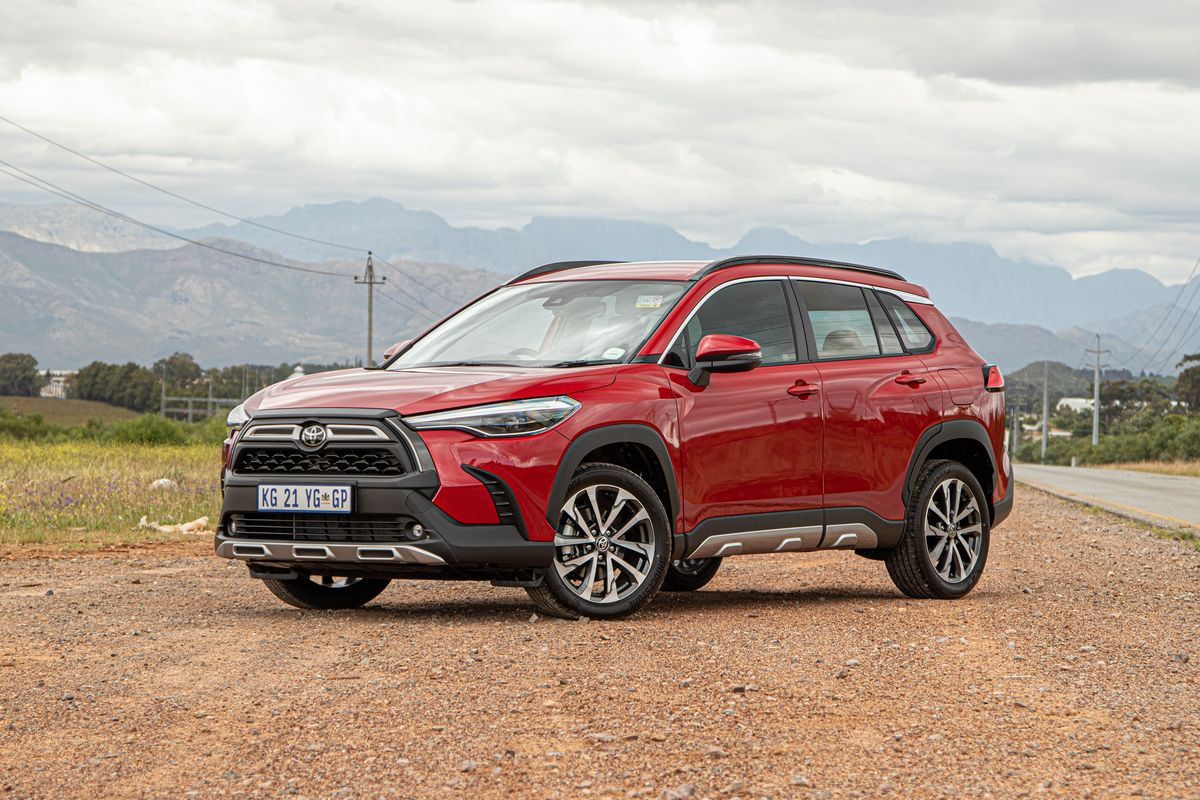
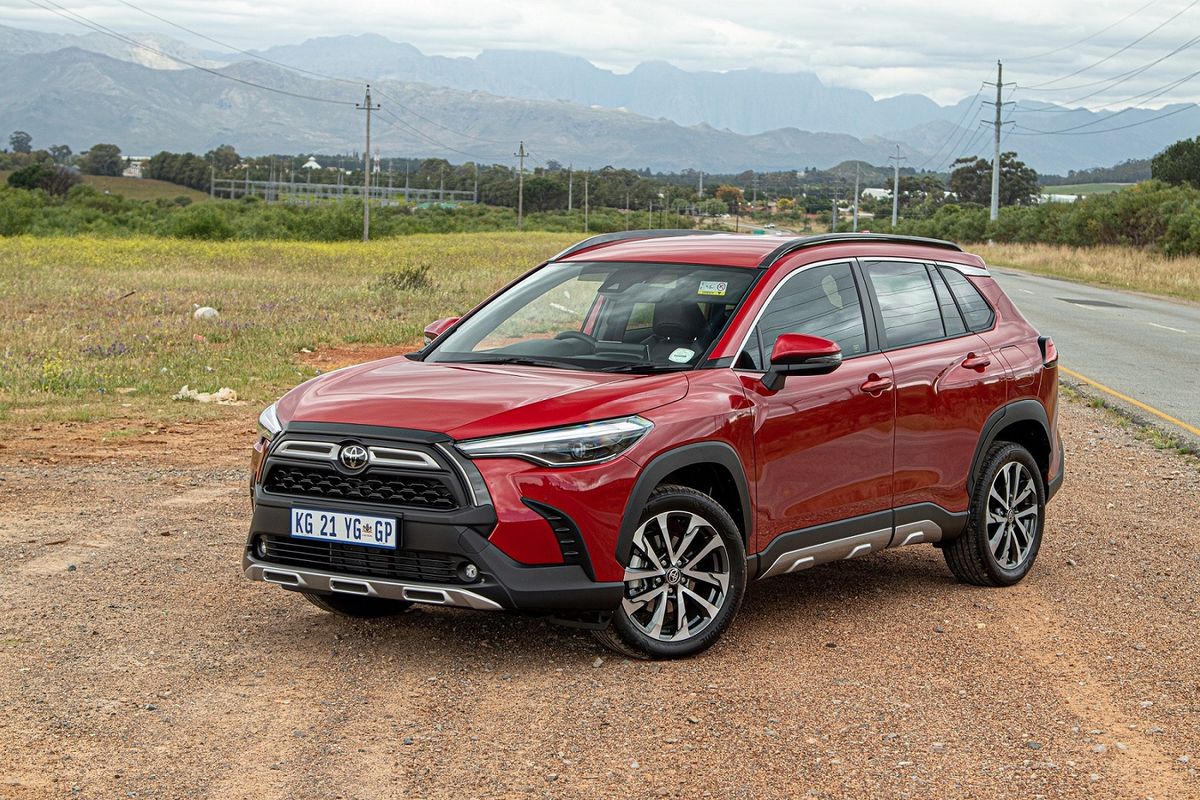
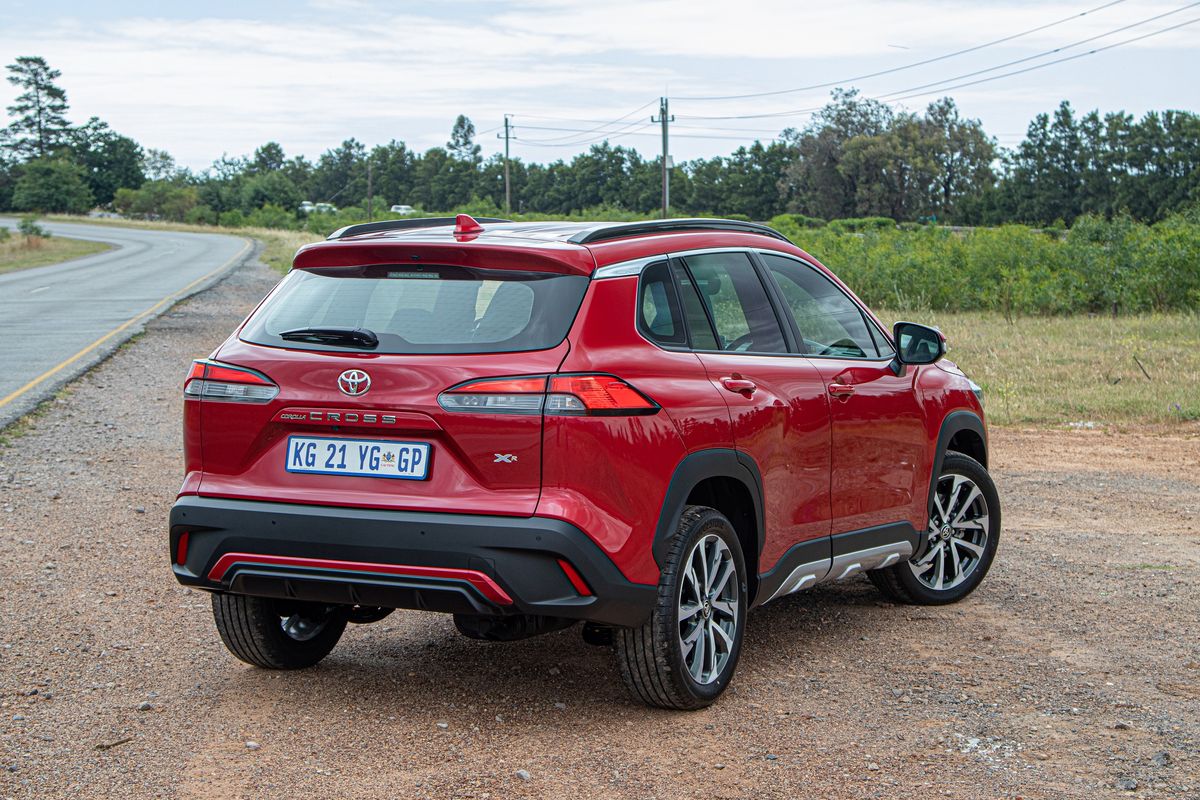
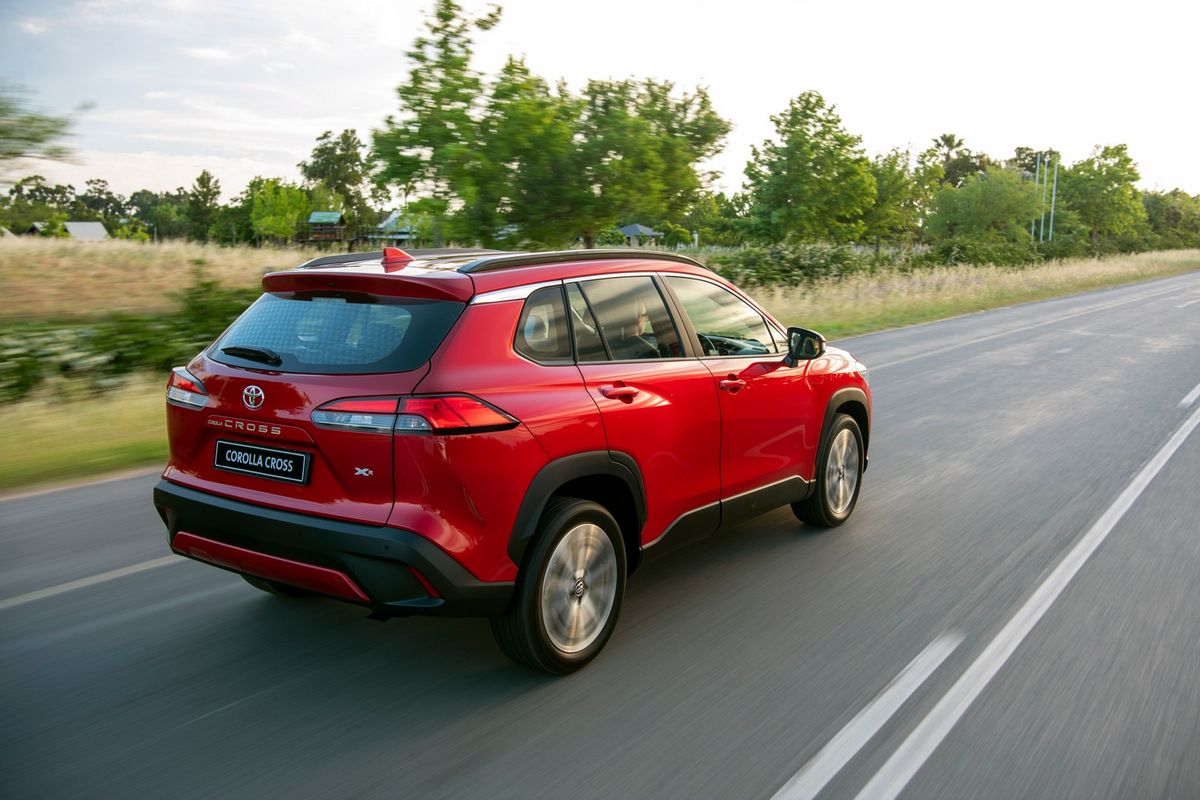
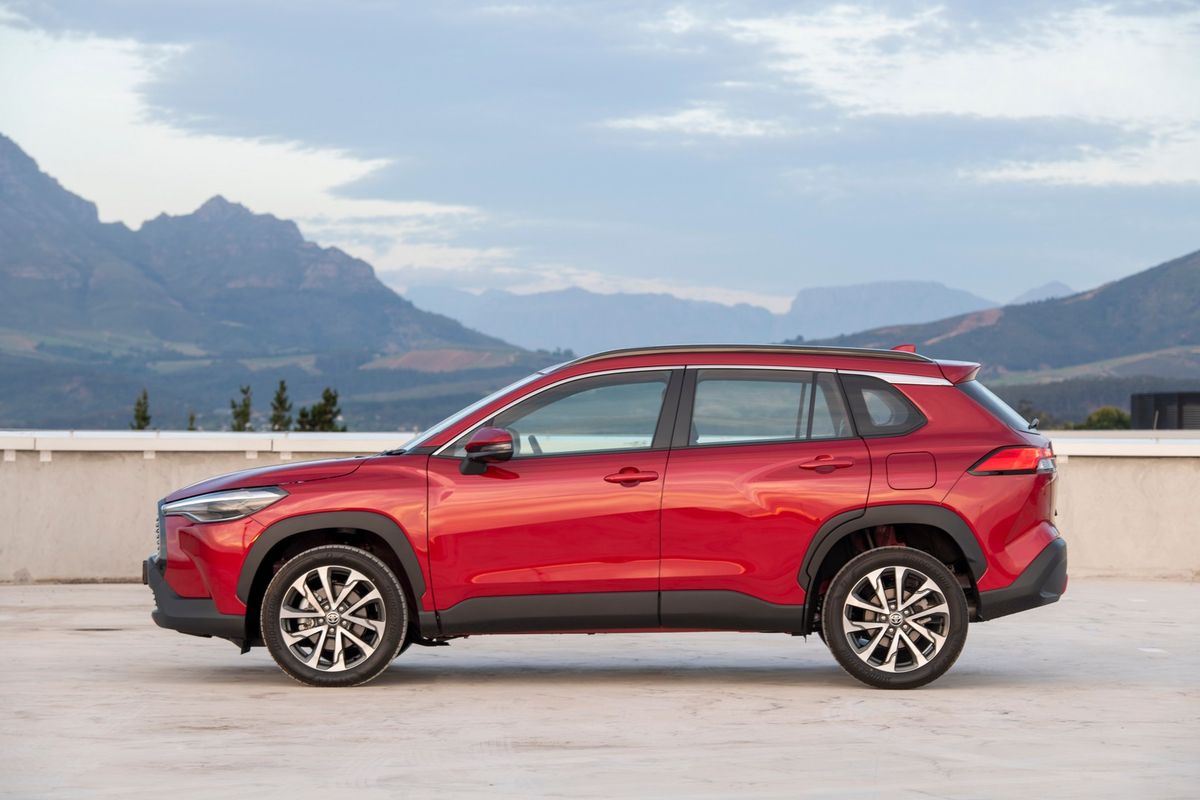
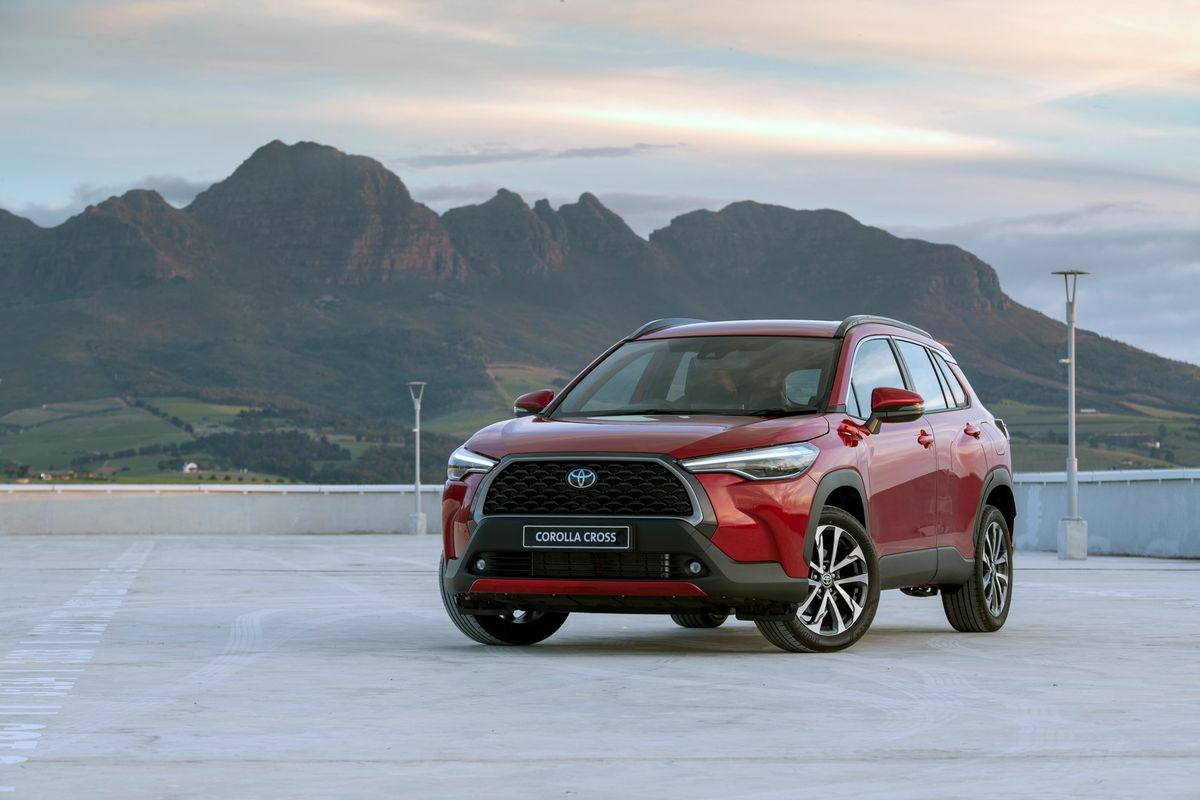
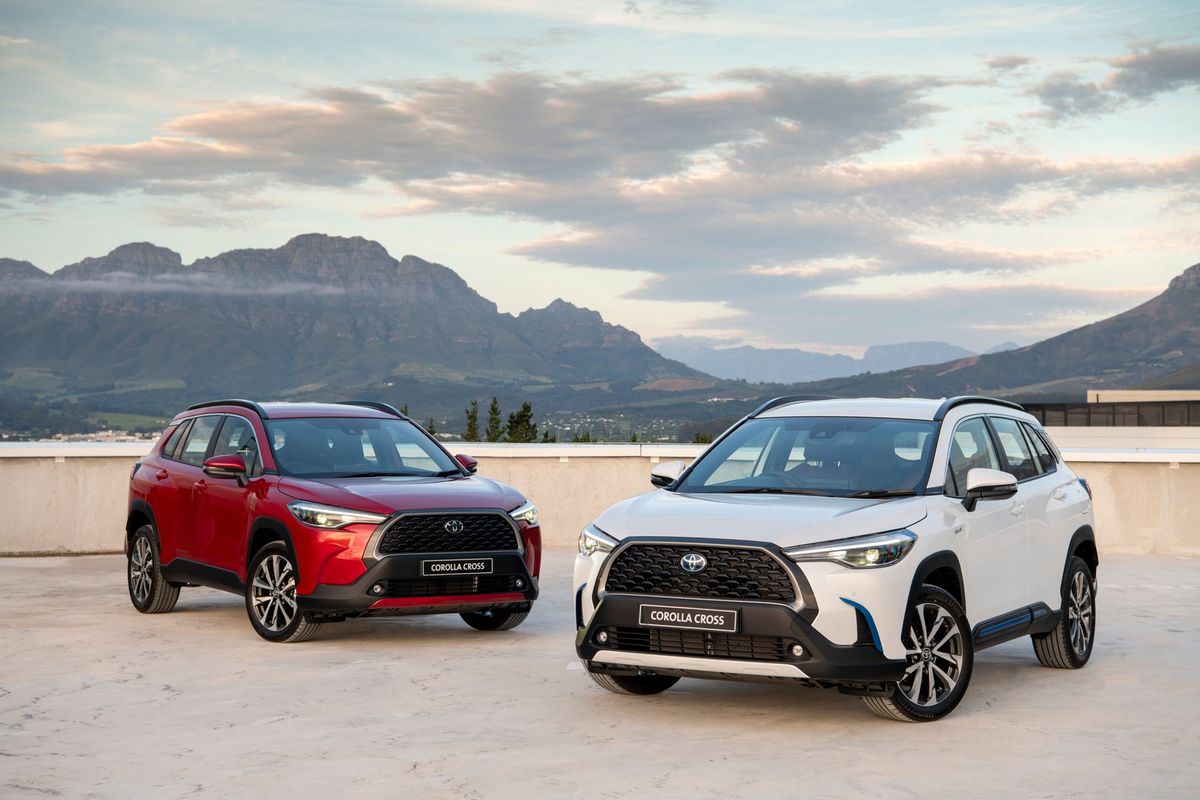
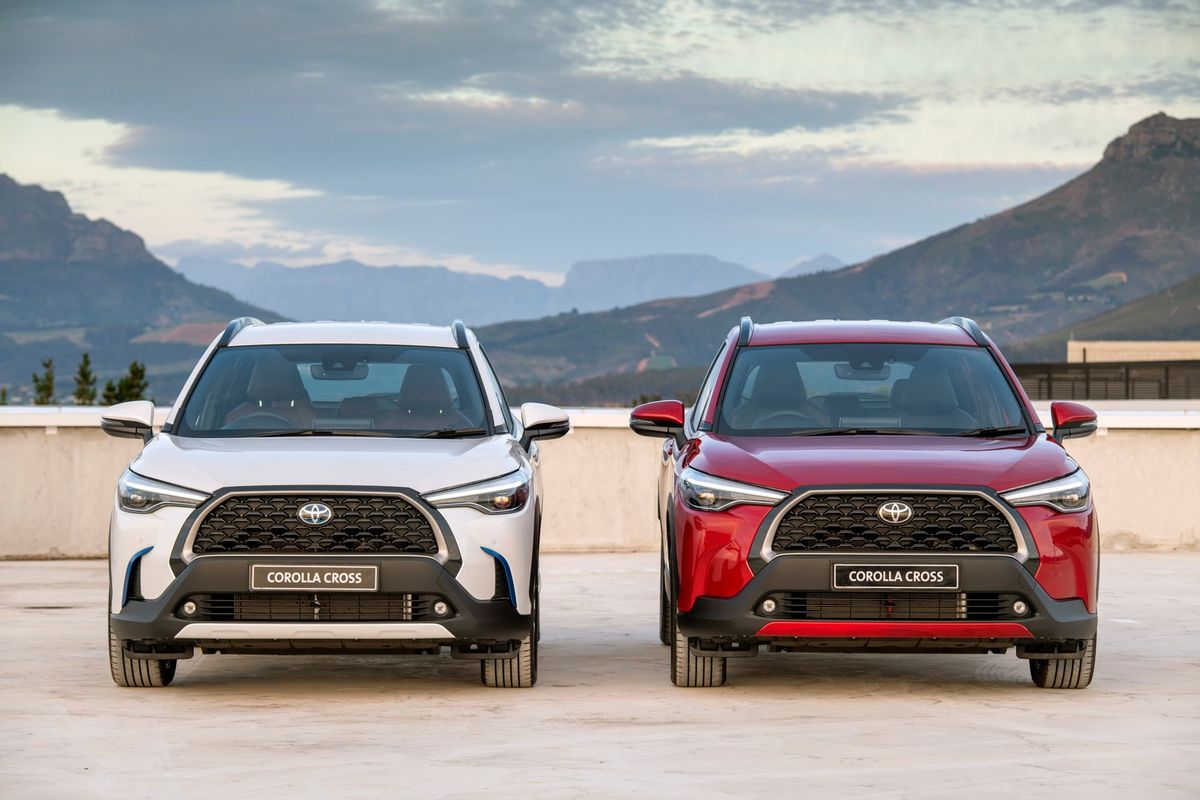
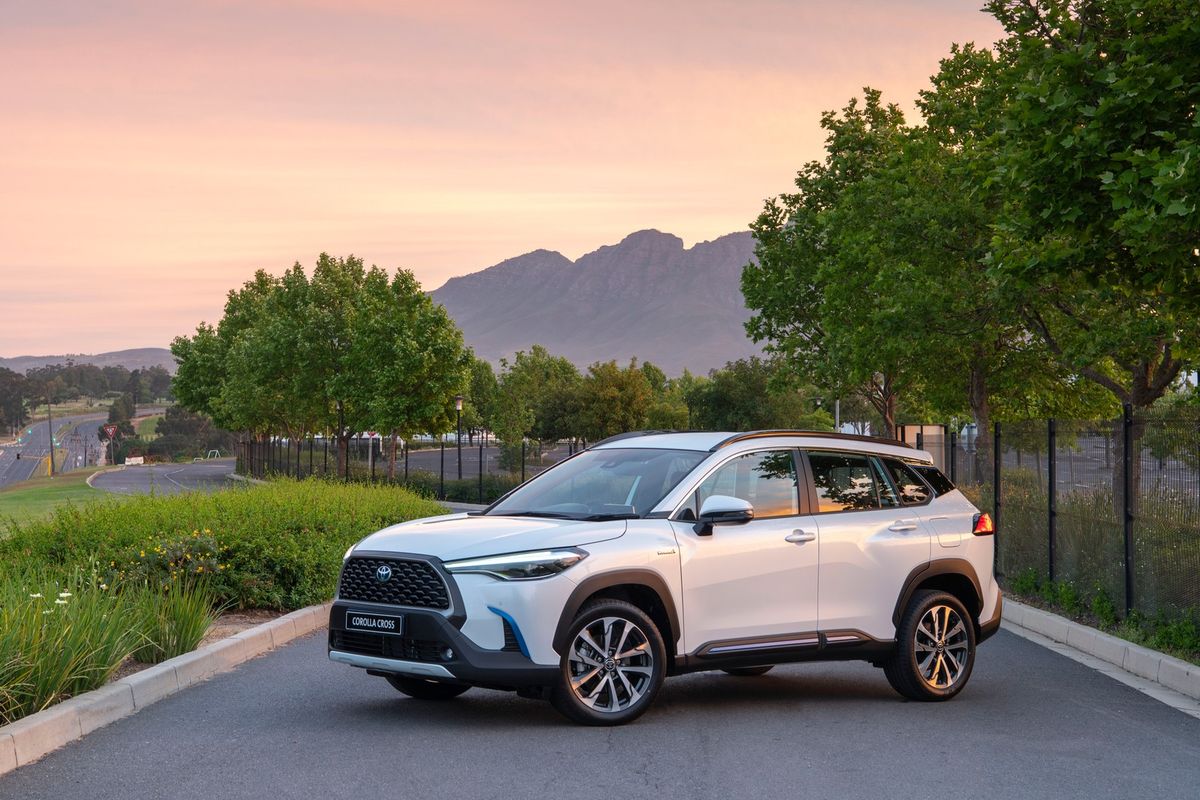
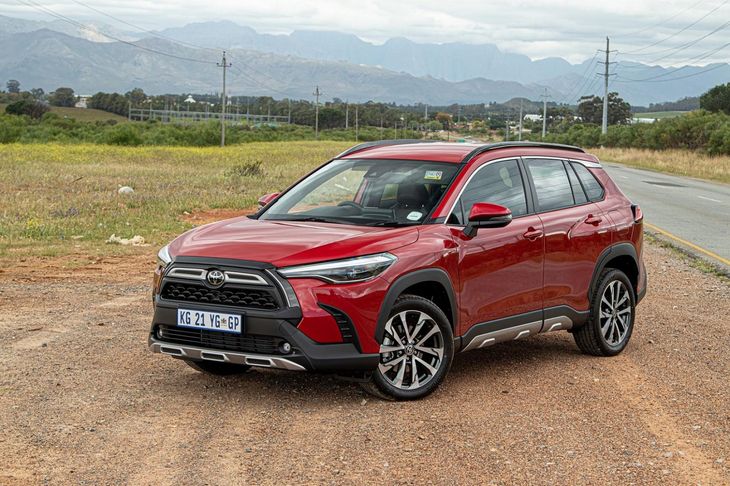
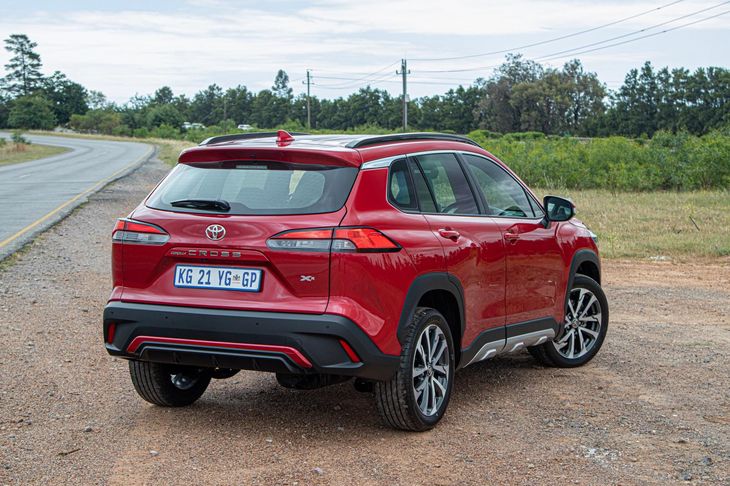
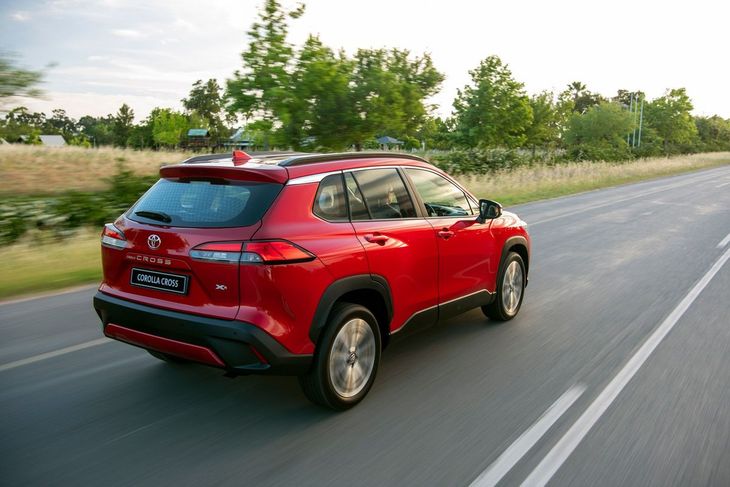
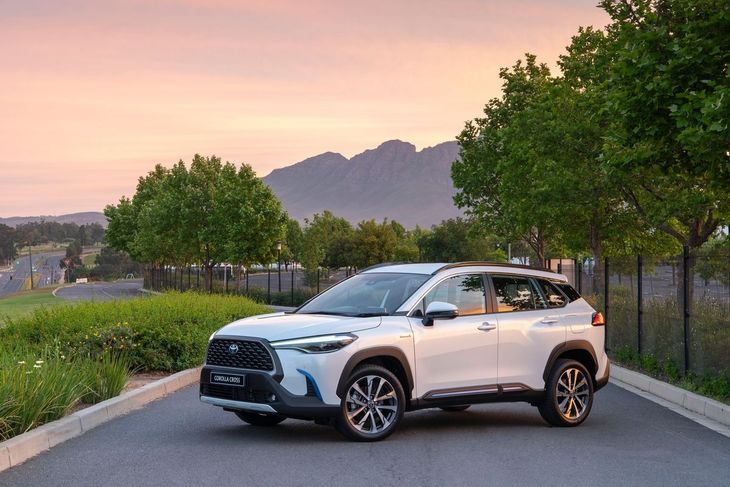
The Toyota Corolla Cross has finally been launched in South Africa and we got behind the ‘wheel of the locally-produced compact family car in the Western Cape. Given its keen pricing, practical configuration and admirable refinement, this newcomer looks set to make a big impact on the monthly new-vehicle sales stats
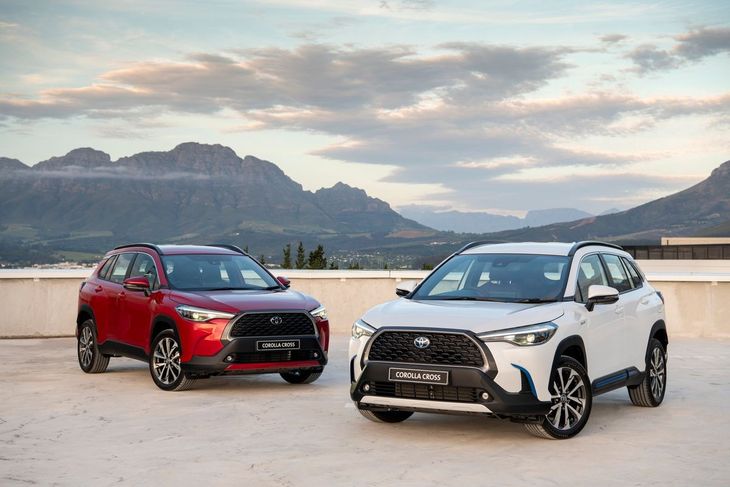
The introduction of the Corolla Cross is bound to be remembered as one of South Africa’s biggest vehicle launches of 2021. No fewer than 70 journalists attended the newcomer’s presentation event in the Western Cape and for good reason: not only is the Corolla Cross produced in KwaZulu-Natal (following a R2.6-billion investment in Toyota’s Prospecton plant), but it has landed slap bang in the middle of a tightly-contested segment. Whereas Toyota used to be rather underrepresented in the small crossover market (just the C-HR), the Japanese brand now offers the Urban Cruiser and Corolla Cross too!
And the Corolla Cross will have its work cut out for it! Toyota claims there are 31 offerings in the B- and C-segment SUV market. At this price point, consumers have myriad of quality products to choose from, such as the Ford EcoSport, Hyundai Creta, Mazda CX-3, Kia Seltos, Renault Duster and the Volkswagen T-Cross, to name just a few. Let’s not forget that runaway success called the Haval Jolion either.
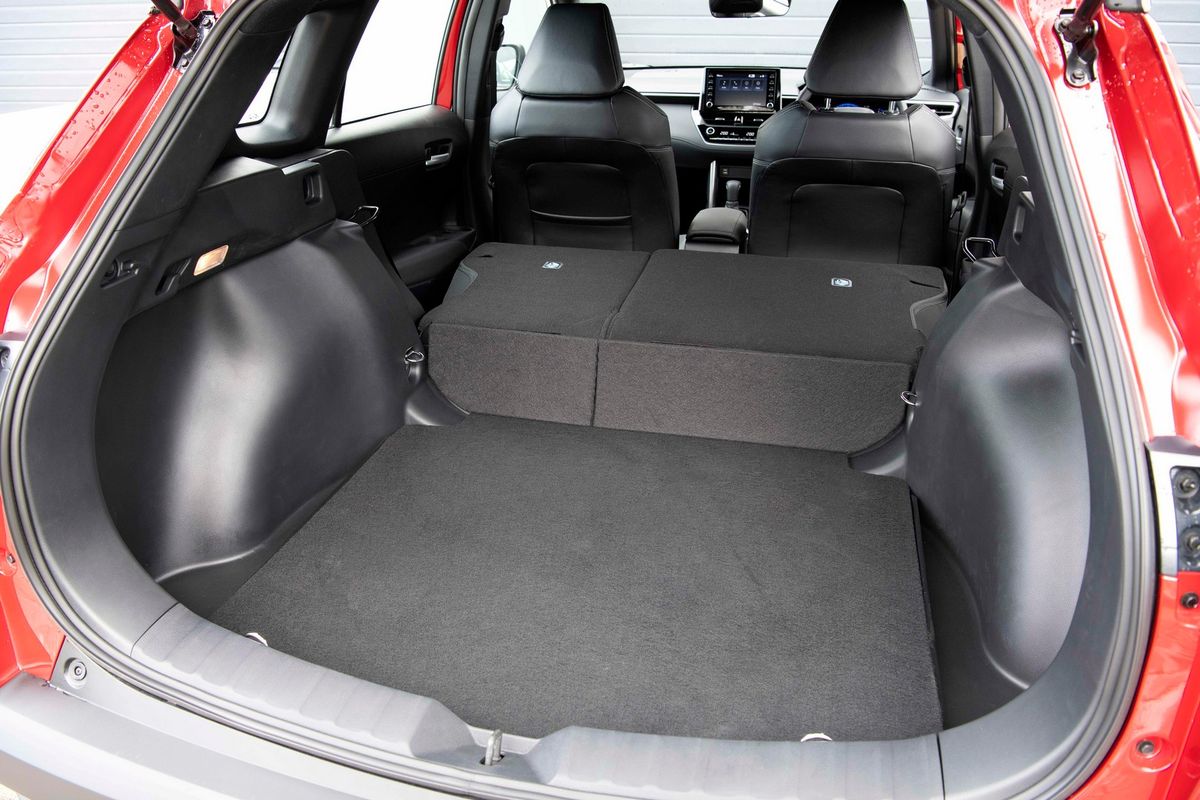
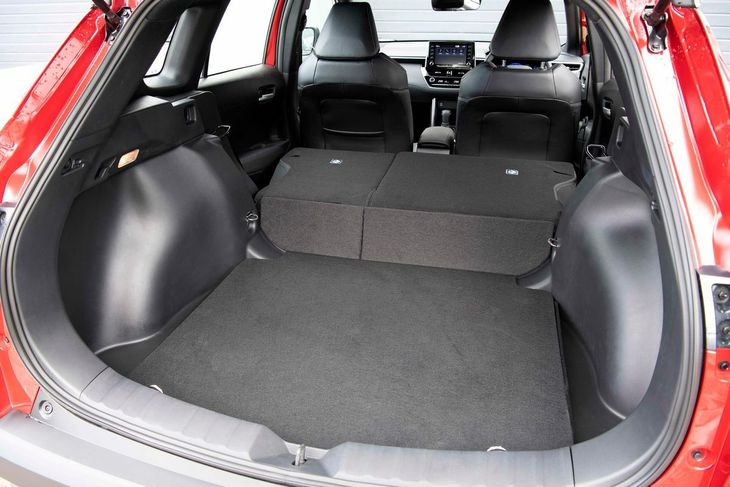
The Toyota Corolla Cross does have a couple of significant advantages. Its dimensions make the newcomer one of the biggest offerings in its segment; with a wheelbase of 2 640 mm and an overall length of 4 460 mm, the compact sedan/hatchback-based newcomer eclipses many of its rivals. Those proportions mean it’s spacious inside, with commendable rear legroom as well as a capacious load bay.
What’s on offer?
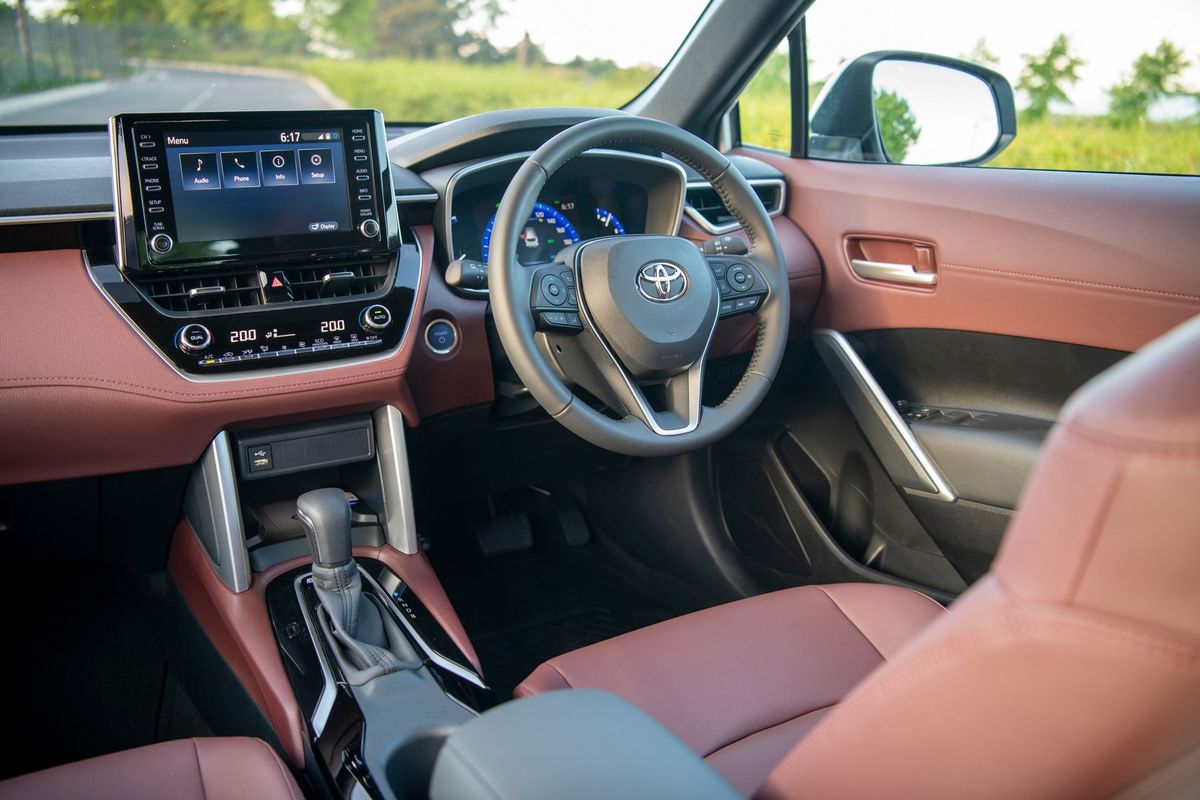
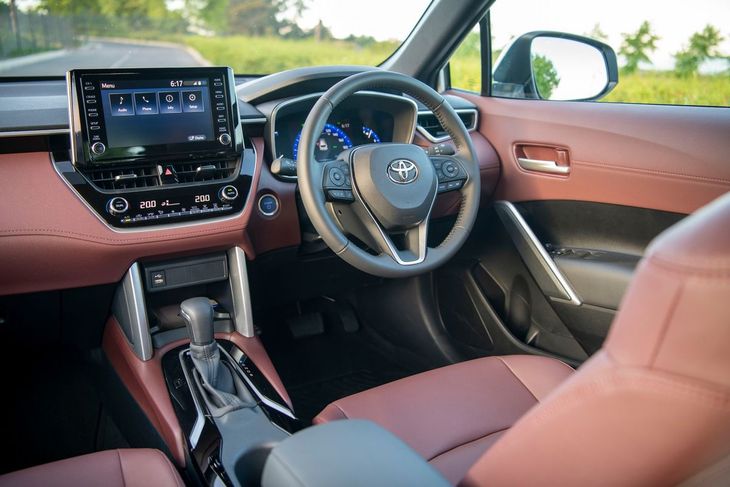
The new Corolla Cross range comprises 5 derivatives. There are no turbodiesel powerplants or manual gearboxes on offer, with Toyota following this segment’s trend of mating petrol motors with automatic transmissions. Customers have 7 exterior colours to choose from and the Xi entry-level derivative has cloth upholstery, whereas the XS has black leather and the XR either black- or Terra Rosa leather.
As for the engine line-up, the Toyota Corolla Cross is available with either a naturally-aspirated (non-turbo) 1.8-litre 4-cylinder engine with 103 kW and 172 Nm of torque or a 1.8-litre petrol-electric hybrid with total system outputs of 90 kW and 163 Nm. When it comes to consumption, the standard petrol derivative is said to consume 6.8 L/100 km, while its hybrid sibling is said to use only 4.3 L/100 km.
What is it like to drive?
We drove the top-spec 1.8 XR and the mid-spec 1.8 XS Hybrid on the quiet roads in and around the towns of Paarl and Malmesbury. The driver’s seat position is good – you are availed excellent outward visibility. The Corolla Cross’ interior feels quite roomy – even for tall occupants – and, when we conducted the “sit-behind-yourself test”, we were impressed by how much rear legroom was available.
The engines offer workmanlike, rather than punchy, performance. In this segment, quite a few models have small, turbocharged motors (including Toyota’s own C-HR, with its 1.2-litre turbo), but the Corolla Cross doesn’t. The outputs of the 1.8-litre naturally-aspirated motor and its hybrid equivalent seem sufficient, but they’re not going to deliver that satisfying low-rpm punch many have grown used to getting from, say, the Volkswagen T-Cross and Kia Sonet GT Line. Bear in mind, however, that turbo motors tend to deliver better in-gear performance at the expense of fuel efficiency; the Corolla Cross, by contrast, is all about efficiency.
To illustrate our point, the petrol unit that we drove indicated an average consumption figure of under 8 L/100 km, with the hybrid below 7 L/100 km – and we weren’t cruising. All Corolla Cross derivatives have continuously variable transmissions and while the “elastic” nature of a CVT won’t find favour with petrolheads, this type of automatic transmission purposely sacrifices driver engagement in the interest of optimal fuel economy. So, once you’ve adapted your driving style to the powertrain’s characteristics, you’ll reap the rewards of silky power delivery and a notably relaxed cruising experience.
In terms of its ride/handling balance, the Toyota Corolla Cross has stolen the march on many of its rivals, most of which are based on simpler light-hatchback underpinnings. The levels of comfort facilitated by the newcomer’s excellent TNGA-C platform will surely please customers. The C-HR, Corolla and RAV4 also have this platform to thank for their excellent cabin refinement and absorbent ride qualities…
Indeed, it’s a repeat performance for the Corolla Cross. The model’s basic torsion-beam rear suspension setup certainly does not make the on-road demeanour unsophisticated. It’s interesting to note that, in overseas markets, the model is available with all-wheel drive and a fancier multi-link setup at the back, which is probably even more refined. Ultimately, despite its cost-effective suspension, the Corolla Cross exhibits surefooted, but nonetheless composed, road manners. We did discern some road noise, but a thorough test (on a greater variety of road surfaces) will clarify whether this is an issue or not.
The Corolla Cross’ driving experience isn’t exactly sporty, but to be fair, that can be said of the vast majority of offerings in this segment. When you do corner a little faster than usual, the Toyota responds with mature predictability – a touch of body roll and not much in the way of feedback from the steering system. It’s not bad – it’s just insulated; if you want a touch more sportiness, well, look elsewhere.
Summary
With the new Corolla Cross, Toyota has successfully plugged the gap between its boutique crossover model – the C-HR – and the wildly popular (but increasingly expensive) RAV4 family car. If you consider that the compact family-car segment now accounts for a fair chunk of the new-vehicle sales in the Republic, Toyota South Africa Motors (TSAM) understandably wants a bigger share of it
We reckon that this car will achieve instant sales success. Its arrival comes courtesy of a massive investment by Toyota in its Durban plant, which has increased jobs both at the factory and in the immediate supply chain. Let’s hope the plant can keep up with public demand, because if the 800 pre-orders for the Corolla Cross are anything to go by, TSAM will be moving quite a few units in the coming months.
The Corolla Cross’ level of overall specification is excellent, with the flagship derivatives boasting the latest in semi-autonomous safety tech and all the modern connectivity that the younger generation desires/demands. While the model’s powerplants perform adequately, they’re not class-leading, but the rest of the package certainly ticks a multitude of those proverbial boxes, especially at the price.
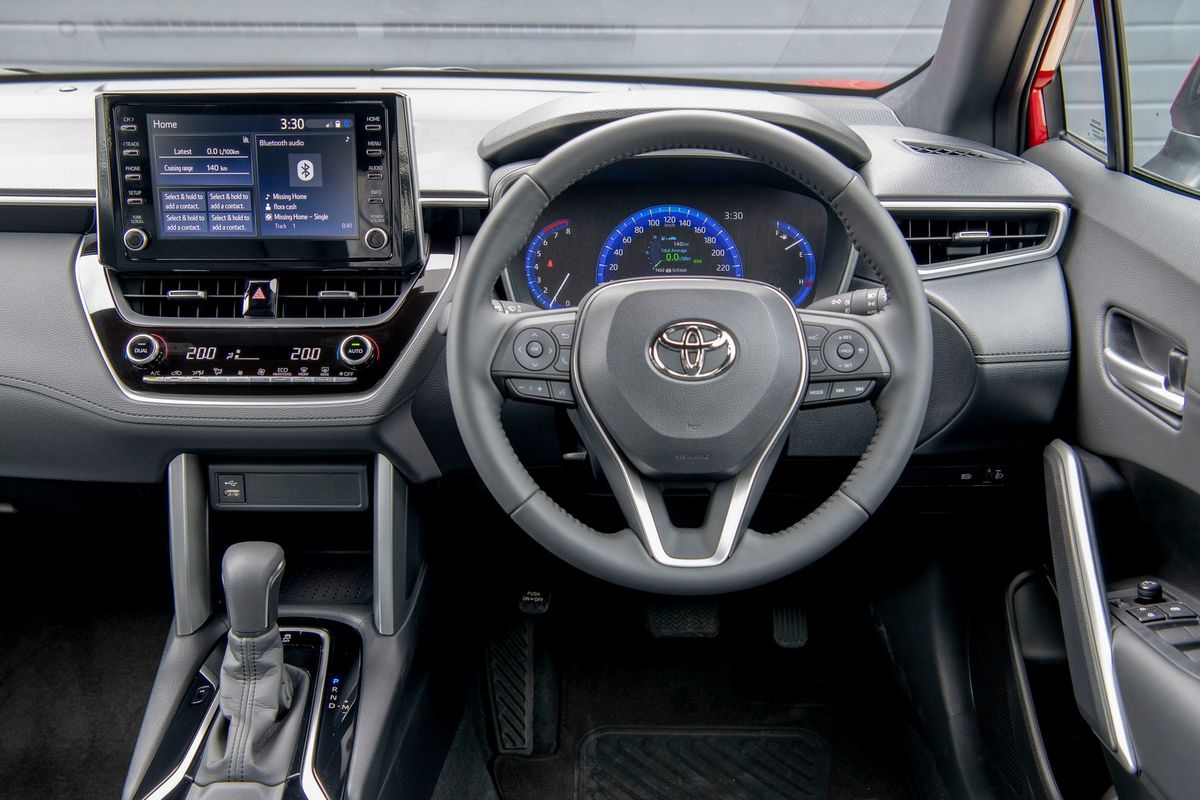
Buyers who’d like to buy into the RAV4 range, but can’t quite afford to, will find the Corolla Cross’ load bay capacity and rear legroom exceptional. What’s more, the newcomer feels very well put together with plenty of soft-touch plastics. The cabin has a rather generic layout (it’s unlikely to win any design awards), but that’s not the point – it’s ergonomically sound; everything is where you’d expect it to be.
Given the seemingly cruel and unusual punishment of never-ending petrol price increases in South Africa, we’d say that the pick of the range is the mid-spec 1.8 XS Hybrid, which offers most of the creature comforts you’d want, plus that clever powertrain (of a petrol-electric power unit mated with a continuously variable transmission) that should sip fuel if you adopt a suitably efficiency-minded driving style.
How much does the Toyota Corolla Cross cost in South Africa?
The vehicle is sold with a 6 services/90 000 km service plan, a 3-year/100 000 km warranty, while the hybrid battery has an 8-year/195 000 km warranty.
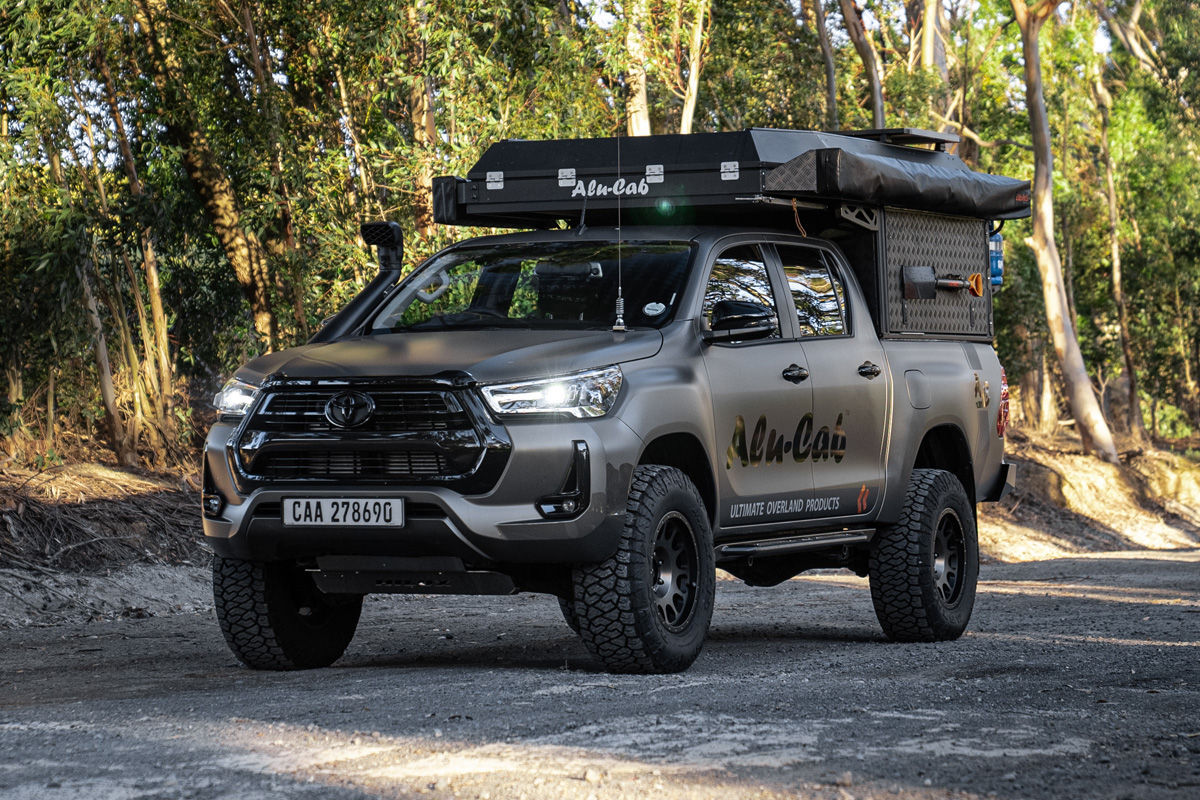
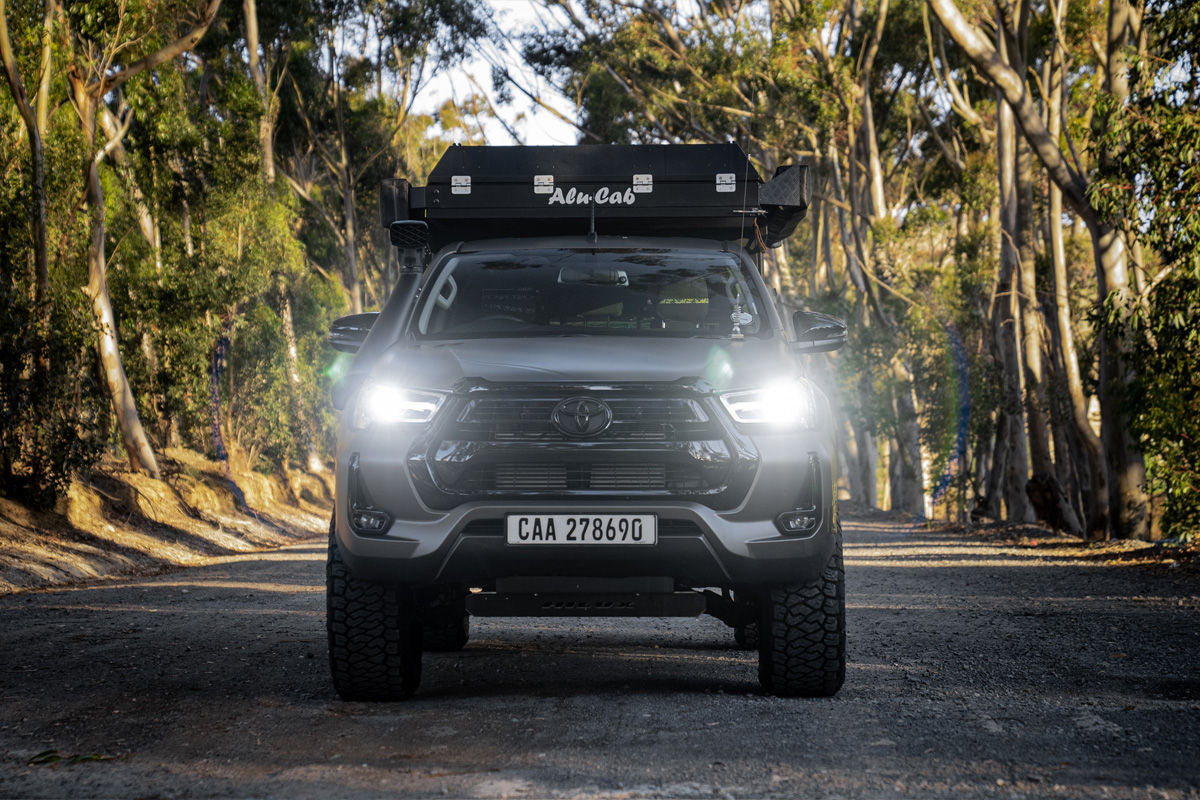
Ultimate Overland Hilux: The perfect glamping bakkie
How does one transform a standard Toyota Hilux double-cab into the ultimate overland Hilux?… and why would one want to? We had a chat with the managing director of Cape Town-based firm Alu-Cab, Warwick Leslie, to discuss the intimidating world of Overlanding, which, as it turns out, is not that intimidating…
If you think about it, Overlanding is just an extreme form of camping; it’s different to the activity of loading gear into a family car and then driving to a designated campsite, where you and your entourage will “semi-rough it” for a couple of days (while making use of various communal facilities), after which you have to pack up your detritus and return from whence you came. No, Overlanding is reserved for those who really want to rough it out in the wild; true Overlanding is, as the name suggests, “self-sustained vehicle travel over vast distances”, during which time its exponents live largely self-sufficiently.
As for the ideal Overlanding vehicle, well, that’s a large, spacious 4×4 with good off-road ability and space for all manner of camping gear and accessories, isn’t it? But, of course, not everyone can afford a vehicle like that. Alternatively, one could attempt Overlanding with a very basic vehicle (many have), but it’s not a very practical, let alone enjoyable, pursuit. Besides, both of those kinds of vehicles need to be painstakingly unpacked and carefully re-packed to set up and break camp… and if you plan to do lots of exploring over a large area with plenty of stops in between, that can become very tiresome.
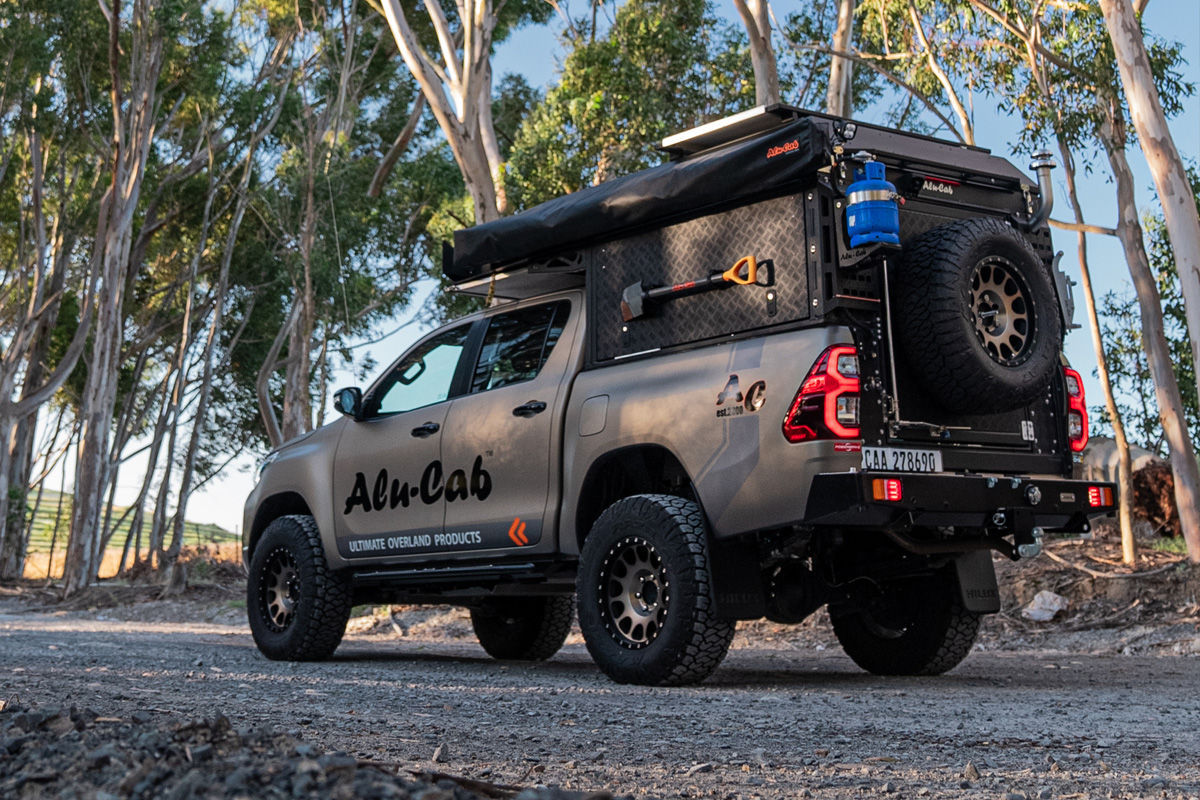
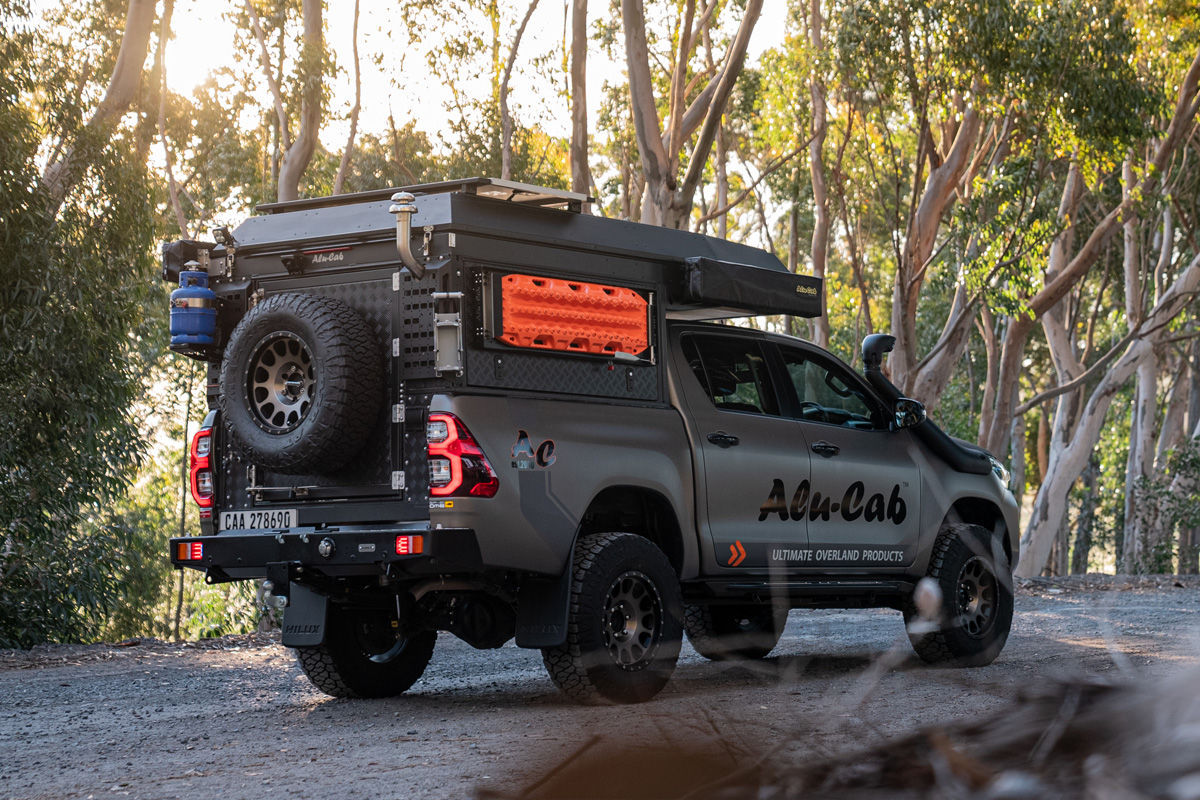
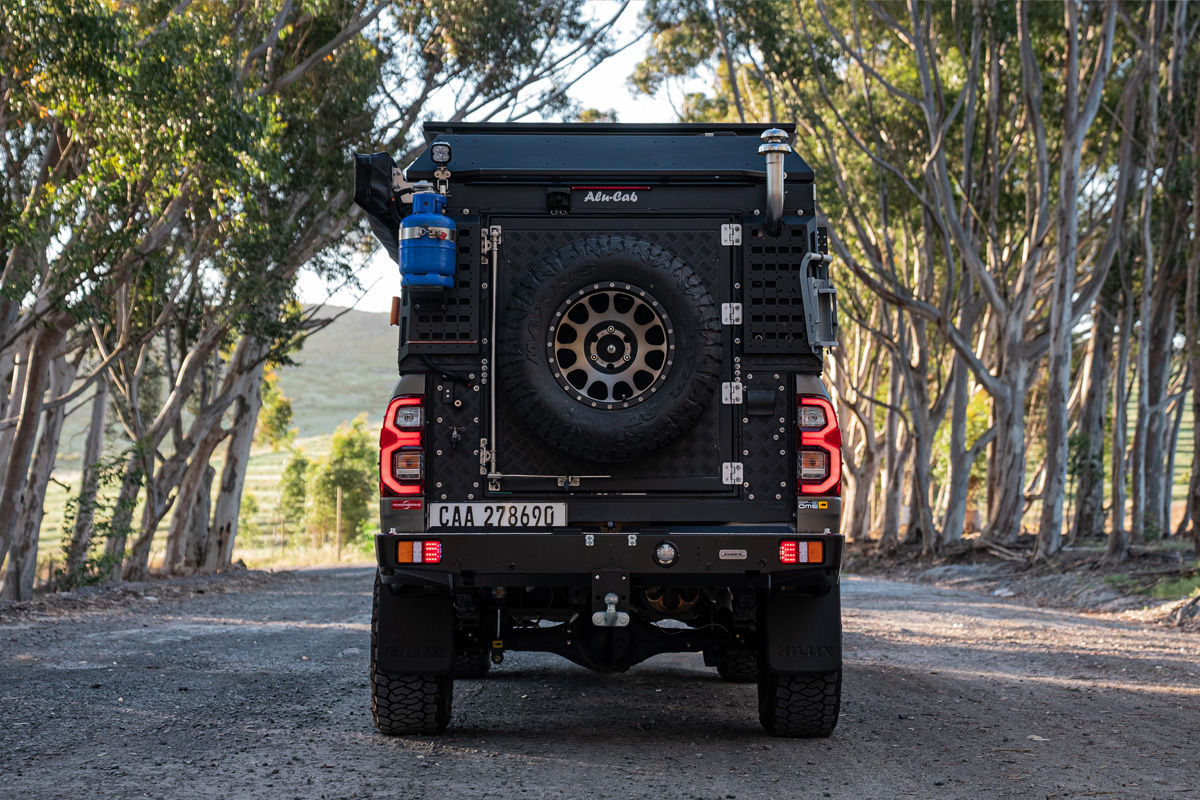
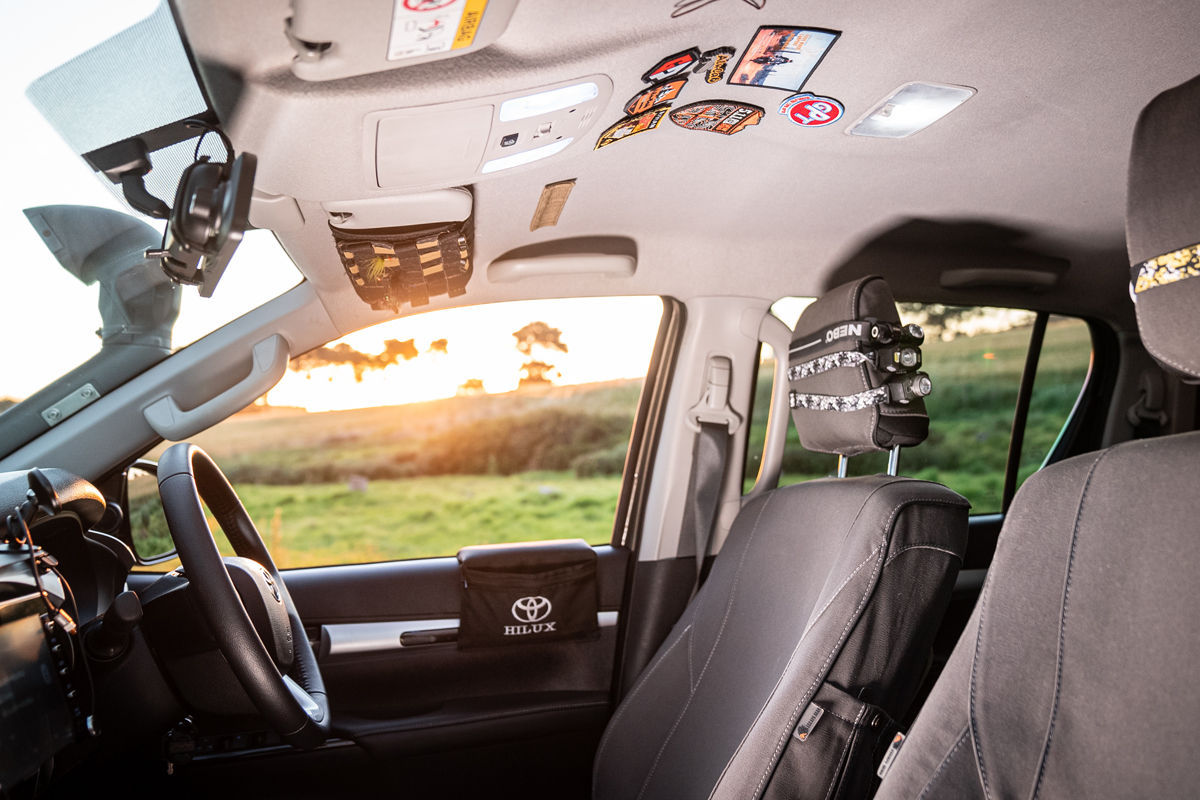
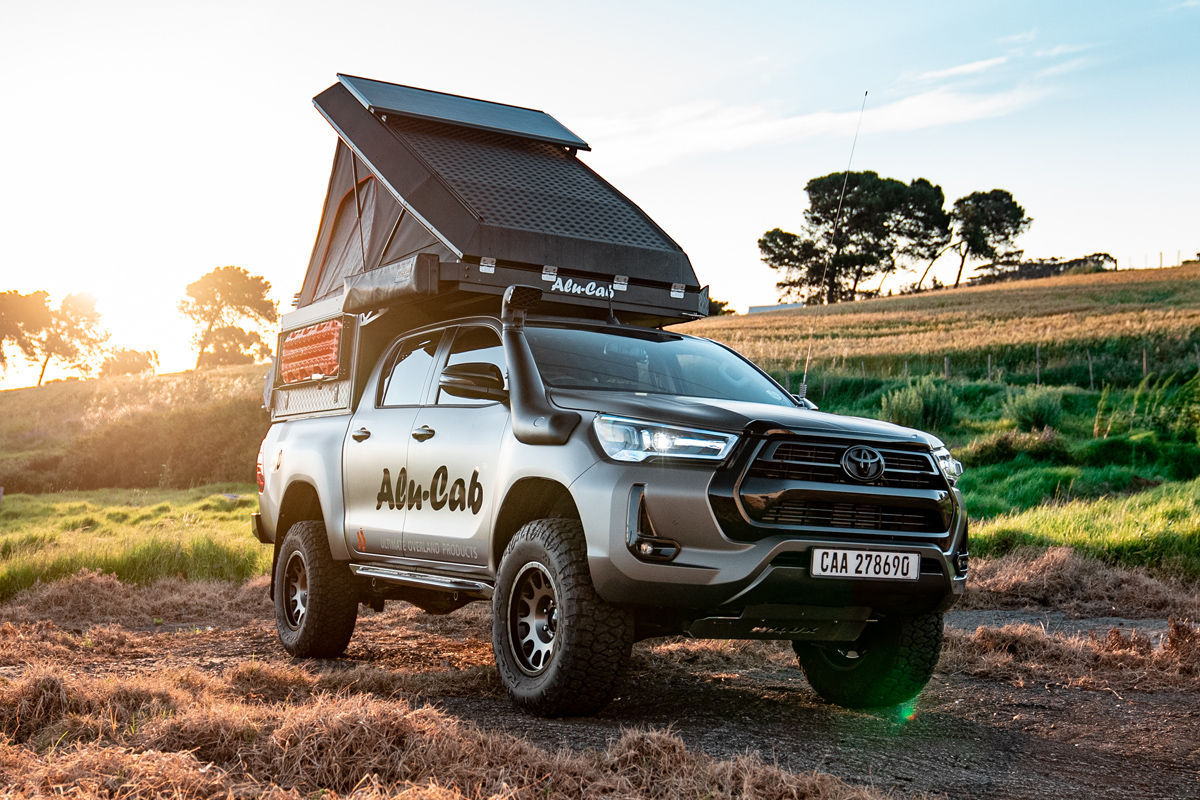
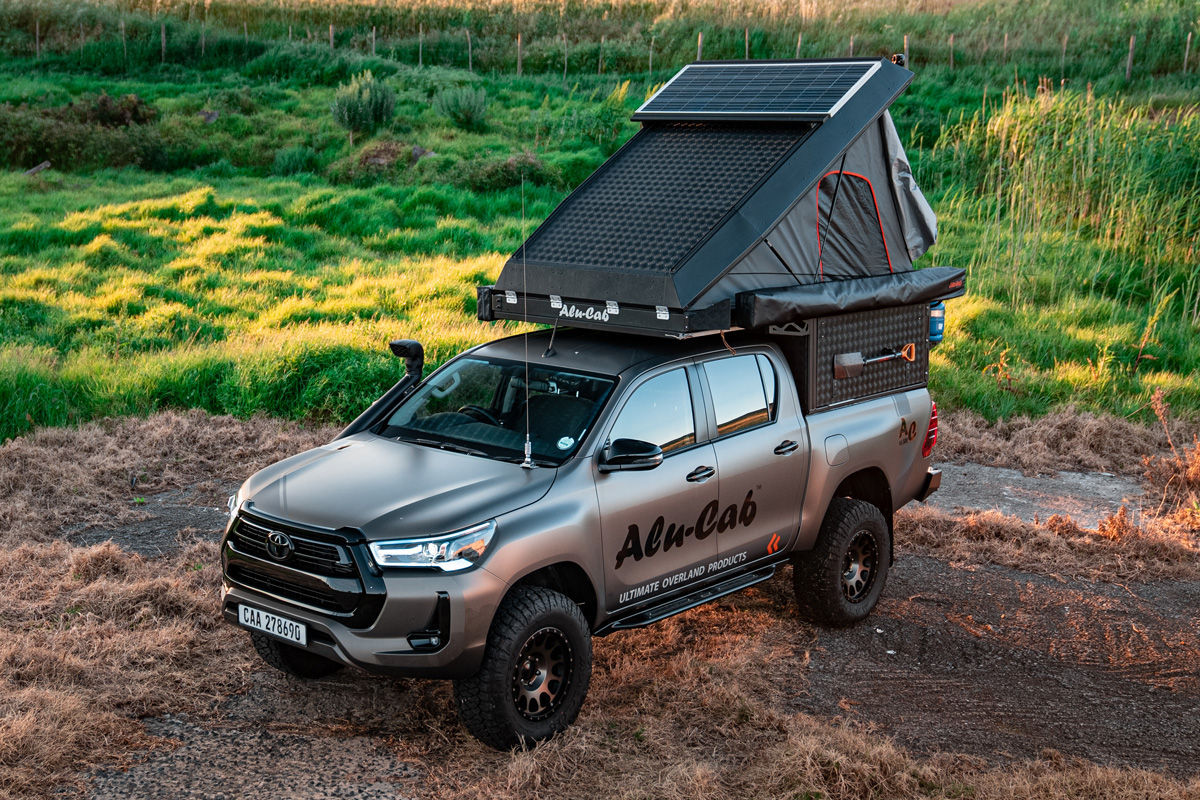
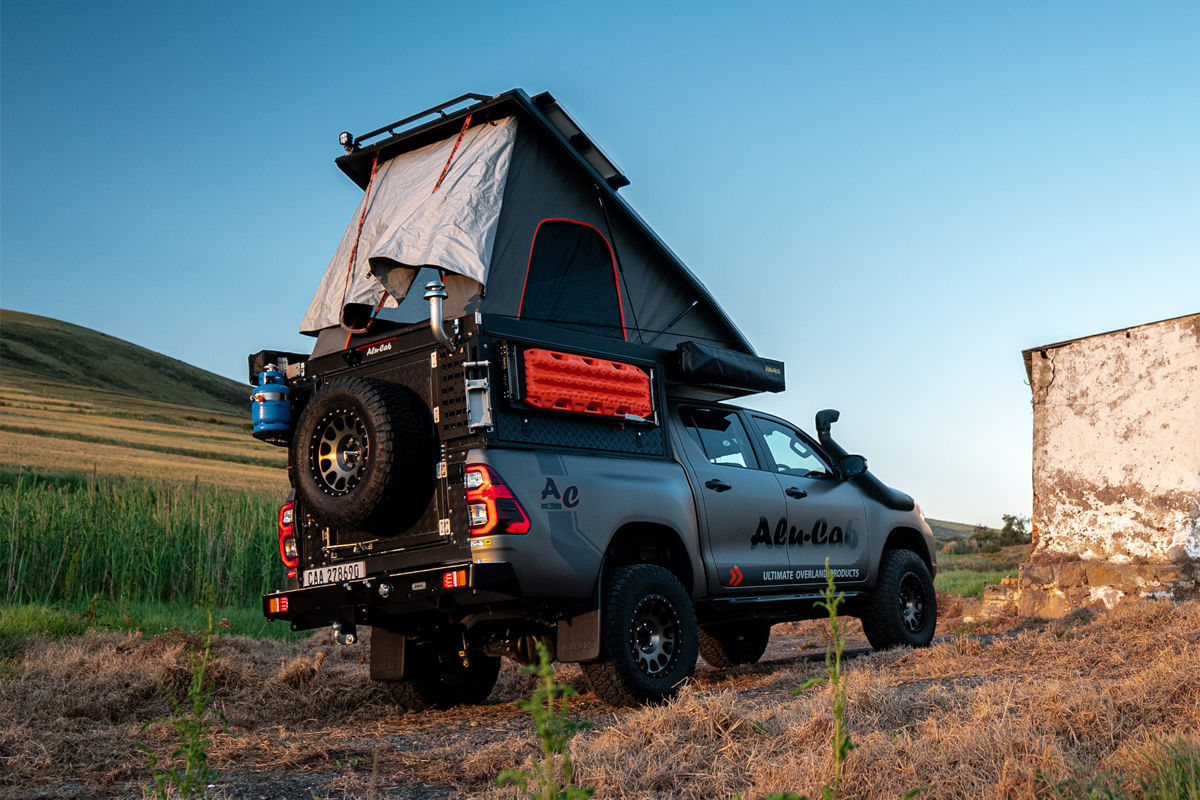
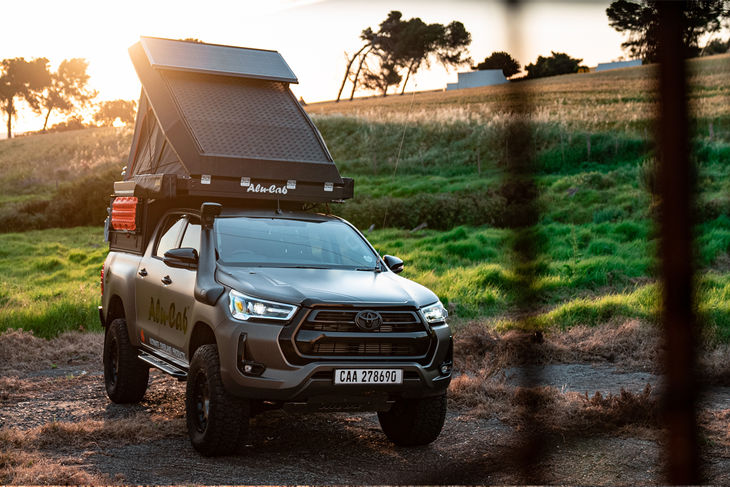
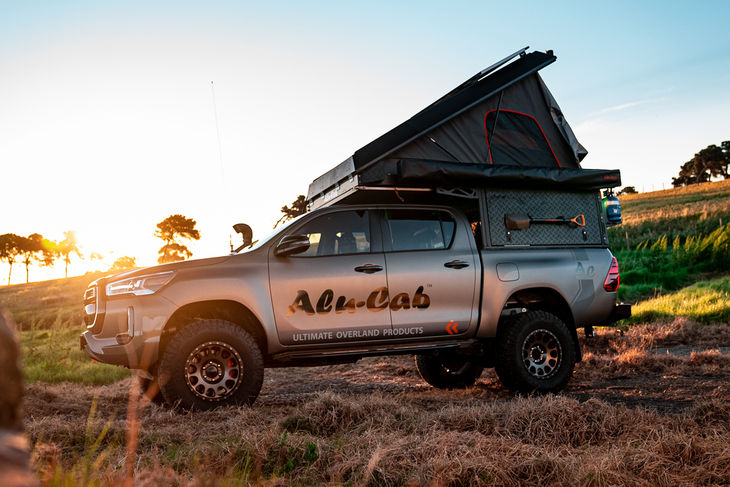
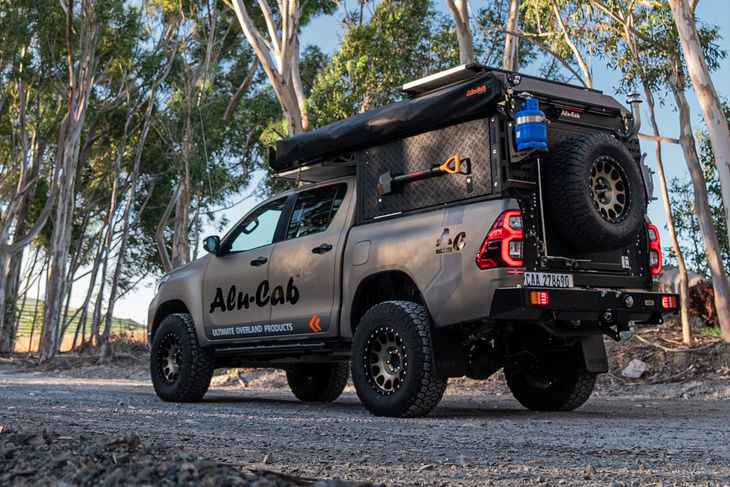
Warwick Leslie’s “Ultimate Overland” Hilux (shown here) demonstrates that, with considered modifications, a humble bakkie can be transformed into a vehicle that will not only get you to (and from) far-flung remote locations with relative ease, but allow you to enjoy the experience more when you get there – because it incorporates the living quarters entirely in its bespoke (and liberally accessorised) canopy.
Warrick says the Overlanding industry gradually rose in popularity from 2010 to 2016, but really took off after that owing to, inter alia, technological advancements in design, improved GPS mapping software and more players entering the customisation market. What’s more, in the Covid-19 era, an increasing number of people have sought less mainstream escapes to, as they say, get away from the madding crowd. Meanwhile, American consumers began to favour modified pick-ups as Overlanding vehicles and it became an international trend, from which South Africa has not been excluded.
How does one even get into Overlanding?
It’s easier to start than you might think. Start with your vehicle, a map and set yourself a challenge to spend extended time outdoors… it’s all about getting out of your comfort zone and finding enjoyment in getting truly close to nature; get involved with local clubs and get to know your vehicle to fast track the learning curve. That is the basic essence of Overlanding (without committing too much at the onset).
For many, however, like with virtually all specialist lifestyle pursuits, to get the best experience you need to invest in the right gear. Standard kit will only get so far – to find that top-tier experience, you need to spec up. But surely it takes a lot of courage to transform a perfectly utilitarian bakkie into a specialist vehicle? We set out to understand what it takes to turn a standard Hilux into an Overlanding Hilux…
Why the Toyota Hilux?
When it comes to a choice of vehicle to use for Overlanding, the Toyota Hilux double cab is one of the best (new) vehicles available from a sheer-capability-for-Rands-spent point of view. It’s reliable, comfortable, spares are readily available, it has a reasonable turning circle and loads of aftermarket accessories are available, which makes it the ideal choice – it’s the benchmark in the bakkie market.
Not much is required to begin with, because the Hilux is an immensely capable package. It’s more a case of leveraging the vehicle’s abilities… You can, within reason, travel to certain remote locations with a 4×2 and decent ground clearance, but the ideal setup is 4×4 with low range and a diff-lock, as well as a mild shock-absorber upgrade and the fitment of all-terrain tyres. As the general standard tyre is more suited to sealed road surfaces, good multi-terrain tyres are a must. The standard suspension will not take the punishment on the longer bumpier roads so an upgrade is advisable (from a safety perspective). Other safety items include a tyre-repair kit and an air compressor; you’re going to get your hands dirty! Next, one can look at a canopy that incorporates an awning, as well as a ground tent.
Other basic items to consider fitting include a front skid plate, a long-range (larger fuel) tank, a battery system (to provide some alternating current to power basic appliances) and a fridge. Sure, all that extra gear certainly helps, but as Warwick comments: “My best adventure was in a 2-wheel-drive Kombi, with a ground tent, a cooler box and 2 chairs for four of us over 4 weeks, but the gear certainly makes your life vastly easier… If you’re in Botswana, doing your game drive, you don’t want to battle to ‘close things up’. You want to get to the next camp, pop up your tent, unpack and enjoy the sunset.”
In truth, the customer-specific nature of Overlanding means that “must-have equipment” is a matter of perspective, because everyone’s needs are different… What you want and what you need could be two different setups based on the type of journeys that you plan to undertake and, as I learnt by observing Warwick’s Hilux, it’s the result of many trips and lessons learnt about what is efficient – and what simply isn’t. You’ll learn as you go along, but be warned: customising can be a very addictive activity. Therefore, set yourself a budget and stick to it. Start small and gradually build your way up from there.
What modifications have been done to the Ultimate Overland Hilux?
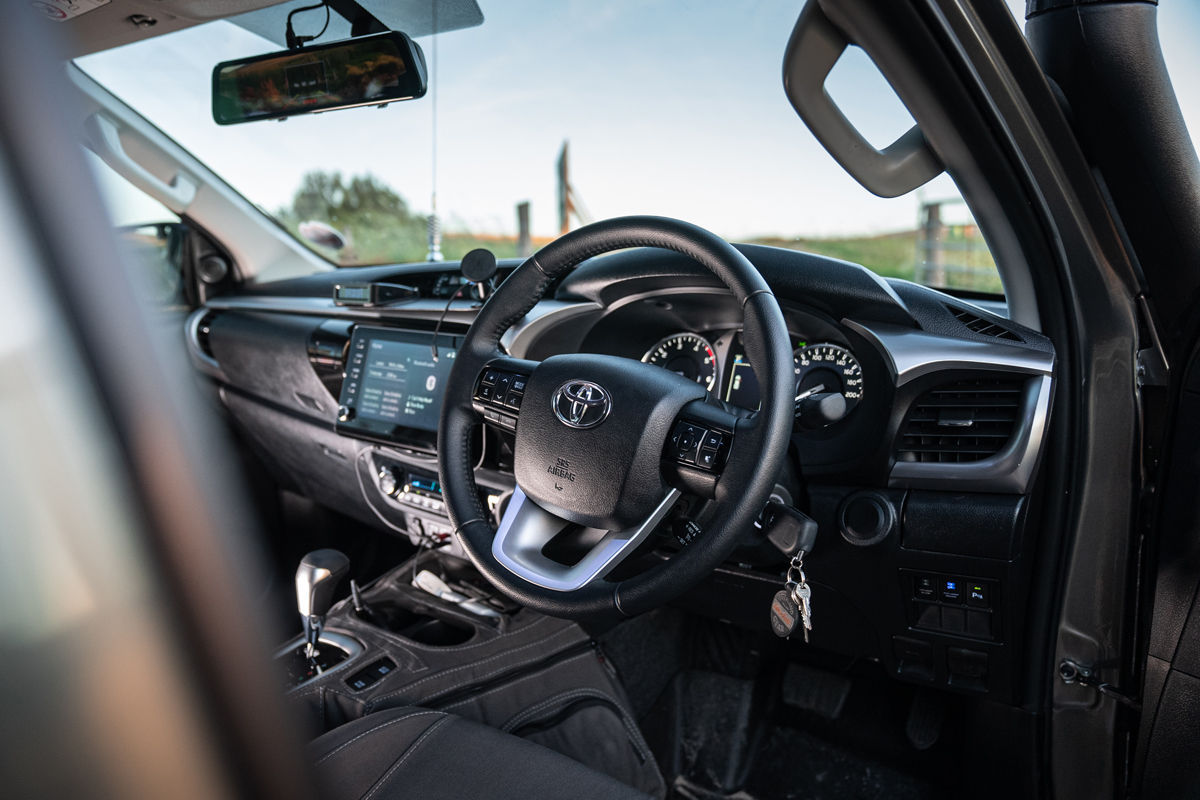
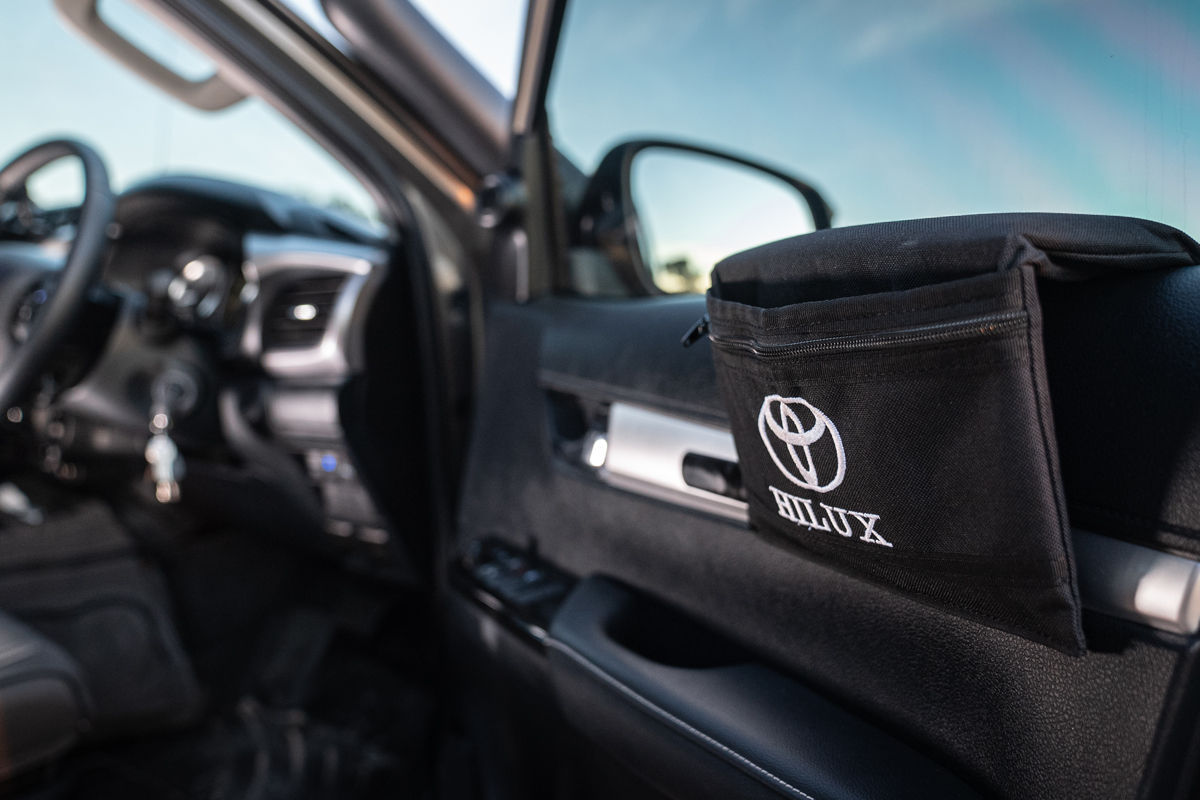
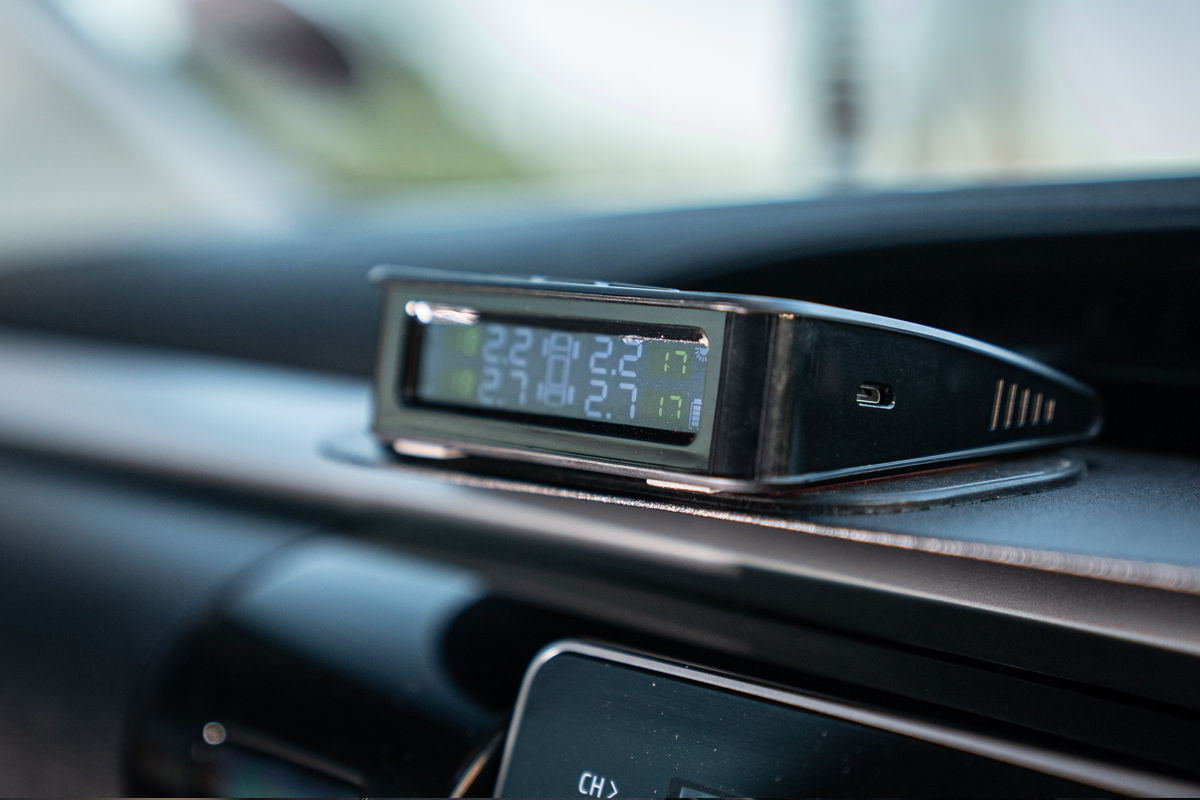
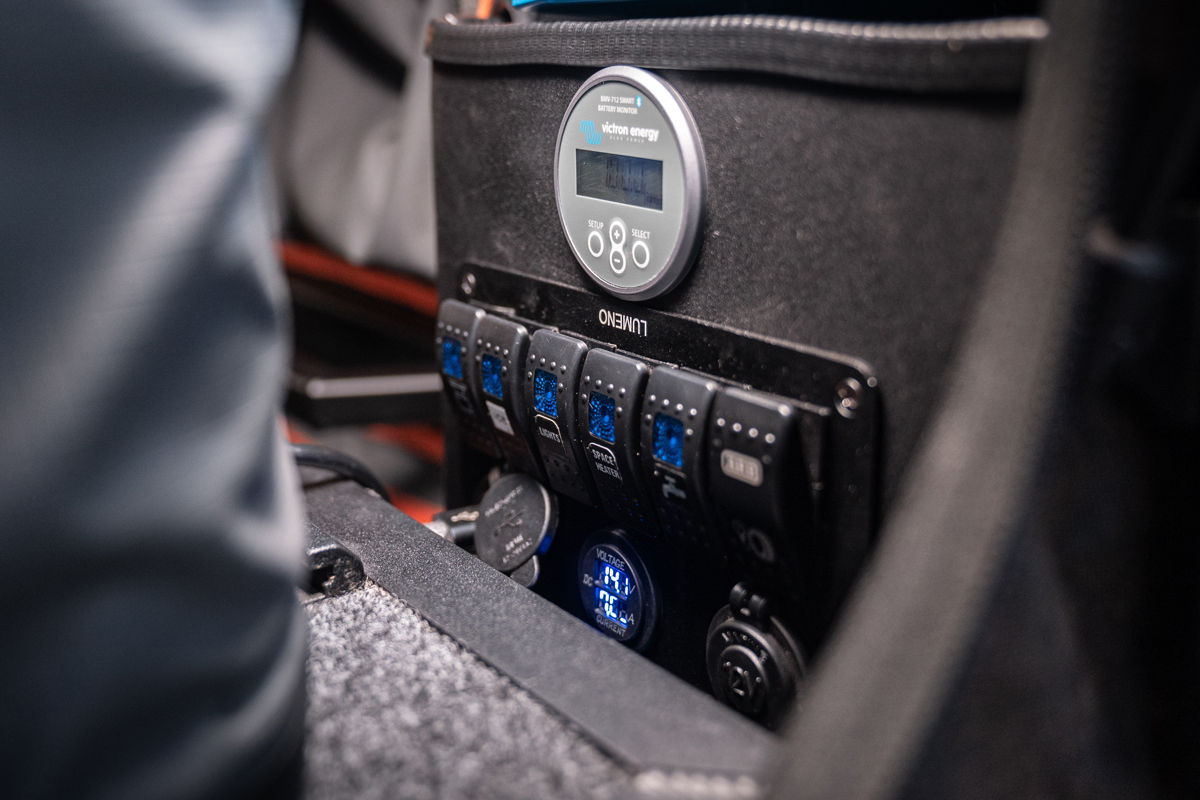
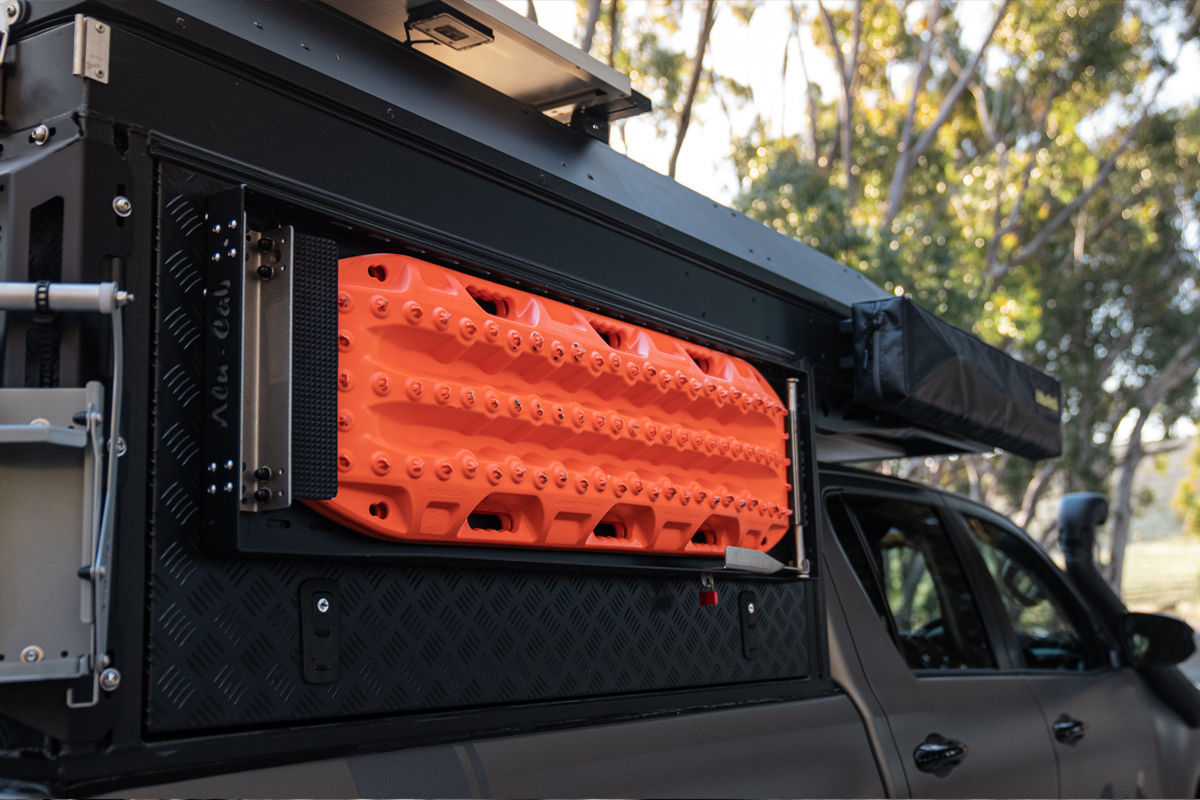
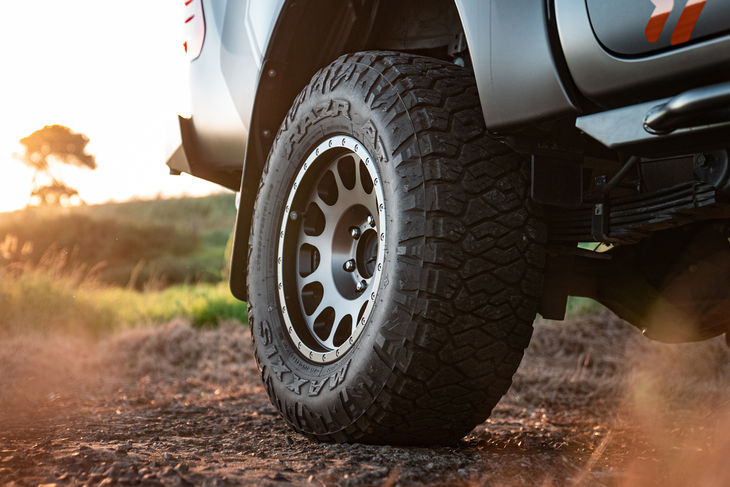
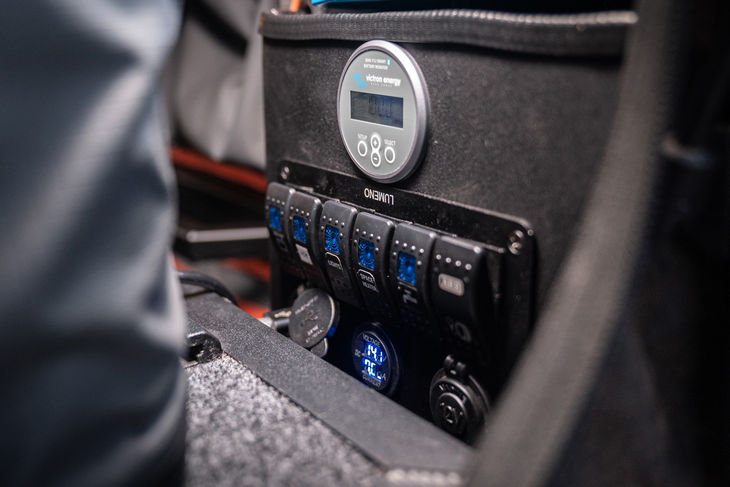
Despite dwarfing a standard Hilux, you’ll be surprised to learn that not much has been done to Warrick’s “Ultimate Overland” Hilux. Modifications include aftermarket wheels, shod with Maxxis all-terrain tyres, Gobi-X front and rear bumpers that serve as mounts from which to jack up the vehicle, skid pans, an Old Man Emu fully adjustable suspension, a torque-converter lockup kit and Power Sport 6-pot calliper brakes. Other functional items include seat covers, rubber mats, additional storage compartments, extra power points, a killer audio system upgrade, tyre-pressure monitors (which may save a tyre or two… and your life), a battery system with a solar panel and a lithium battery, 2 fridges, a water tank, lighting, as well as a 150-litre fuel tank, which is said to extend the bakkie’s range to about 1 000 km.
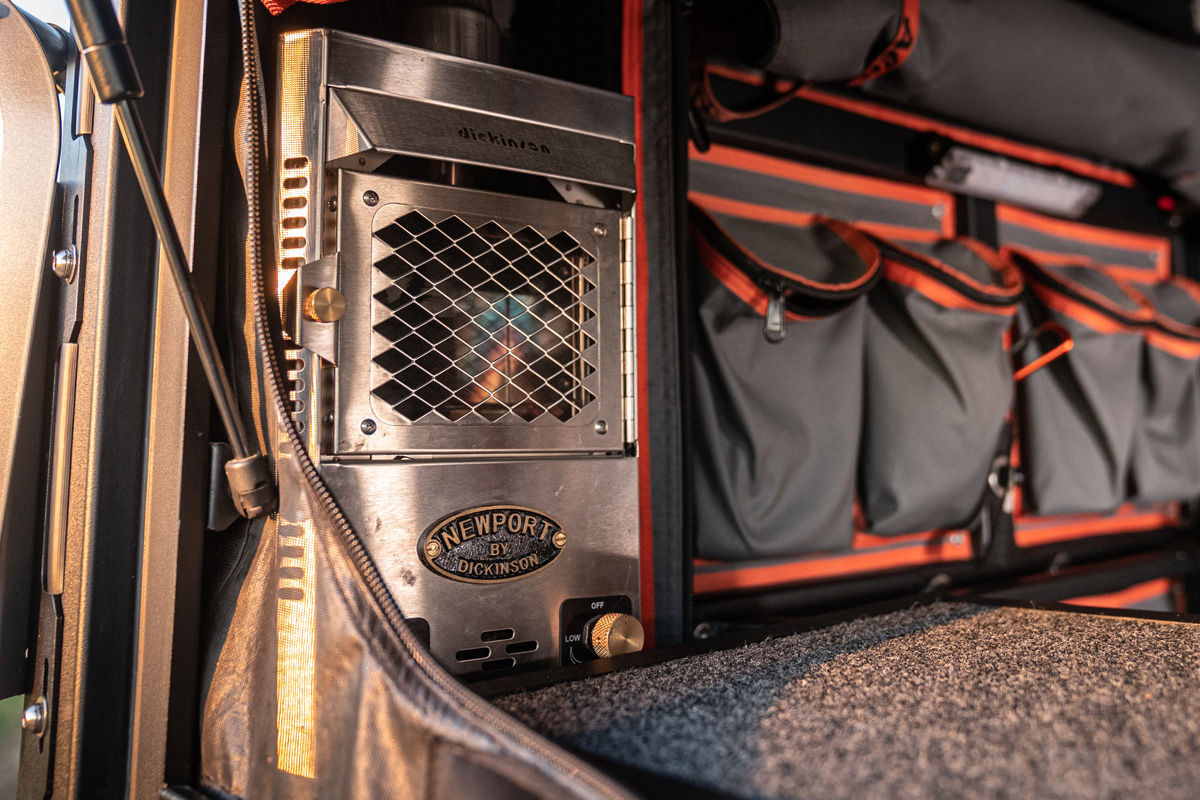
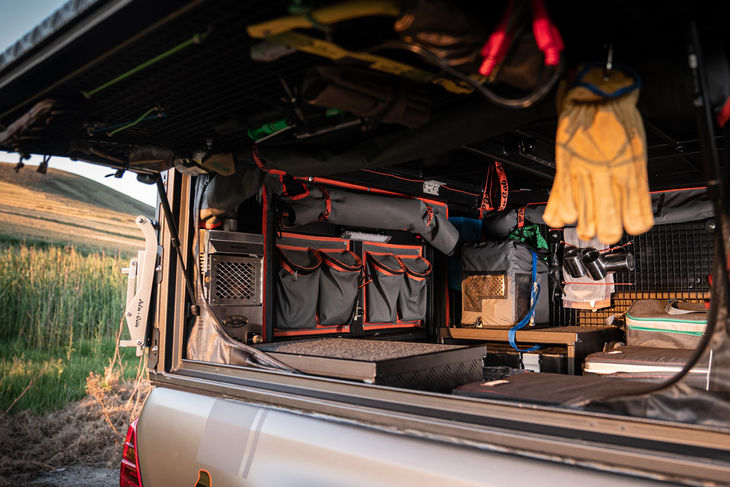
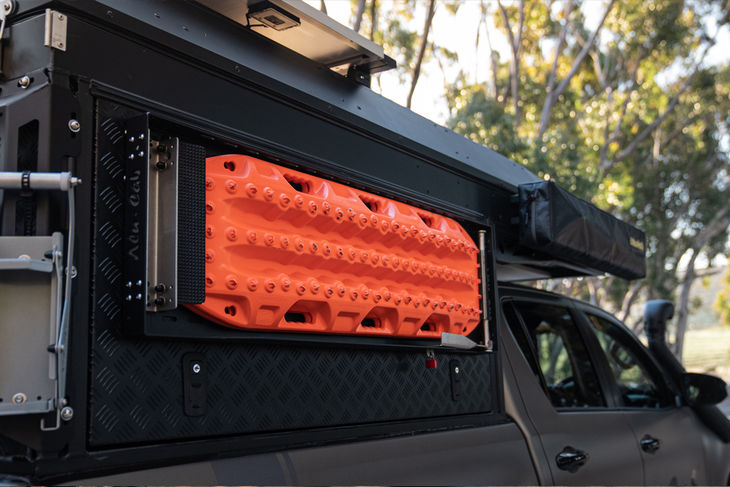
But the real adventurous element is the Alu-Cab Canopy Camper setup, which incorporates a rooftop tent and a 270-degree shadow awning and houses various creature comforts such as foldaway table and chairs, a solar panel and charging system, plus an imported gas furnace to beat off winter’s harshness. If you’re familiar with Karoo winters, the latter is exceedingly likely to put a smile on your face.
What about maintenance and the vehicle’s warranty?
It’s imperative that your vehicle undergoes its standard scheduled servicing as prescribed by the manufacturer and, if you’re doing a lot of dirt driving, it is advisable to change the engine’s air filter in between services. Strict maintenance of the front upper control arms will help you to avoid poor wheel alignment and -tyre wear. What’s more, strongly consider rotating the tyres every 5 000 km.
To ensure that your vehicle’s warranty will be honoured, the rule of thumb is that if an Overlanding modification you’ve implemented affects a vehicle’s system that would usually be covered under warranty (in case of malfunction or failure), it won’t be covered. Each warranty claim is, however, treated on a case-by-case basis. Old Man Emu shocks, for example, happen to be Toyota-approved. The most important step is to have a conversation with your dealer about the nature of the modifications that you intend to make to your vehicle before you commission a firm to carry them out on your behalf.
I’ve got my gear sorted… so, what’s next?
Sub-Saharan Africa offers some of the best options for the Overlanding adventurer, but plan your voyage carefully. Get involved with community pages on social media. If you’ve gotten that far, then you’re likely going to be engaging with kindred travellers who will be more than willing to help. You may even spark up new friendships that last a lifetime, ones that make you wonder why didn’t start this earlier.
Remember, there are real-life challenges, like inadvertently trespassing on property or getting to a border only to realise that it’s been closed thanks to Covid. Some areas require permits to access and, for crossing privately-owned land, make contact well before you set off. Engage on a human level and, who knows, you may gain access to locations that few people, apart from the proprietors, have seen.
When you plan your route, mark off points of bucket-list interests such as camping under the Milky Way on the Makgadikgadi Salt Pans in Botswana or nestling down at the bottom of the Baviaanskloof Mountain Reserve. Be conscious of the season during which you’ll be travelling; may overflowing rivers block your route? Just getting involved in the research will spark the interest further, believe me.
What happens if I get stuck out there?
The chances are that you will, eventually, get stuck in sand or mud somewhere along your route, but it’s all about the adventure… if everything was always going to go smoothly, what would be the fun in that? Sure, humour me, but there are limits to this – you have to have your wits about you. Something that is often overlooked is undergoing a basic 4×4 course that, inter alia, deals with vehicle-recovery procedures. That (knowing that you can venture out further on your own), will bolster your confidence and evoke the freedom to explore more. However, it’s always best to travel in groups of vehicles.
Overlanding… the marriage of lifestyle choices
The chances are that if you’ve read the article this far, you’re likely to be keen on doing more than one outdoor activity. Perhaps you have a predilection for a little bird-watching (ahem, of the winged variety), mountain biking, kayaking, hiking, fishing or just sitting under your shaded awning while you view a herd of elephants converge at the riverside to enjoy a drink of water. I think of Overlanding as the ability to create a mission outpost beyond your conceived borders. It serves as a natural extension of the outdoor activities you’re passionate about; getting to those special places not many get to enjoy.
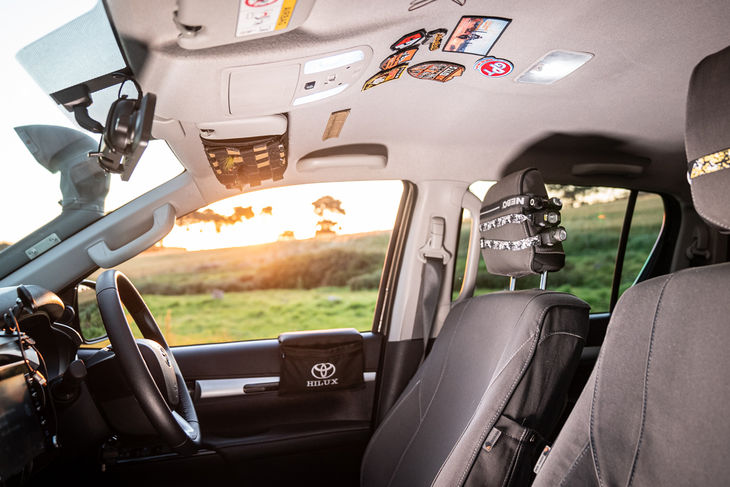
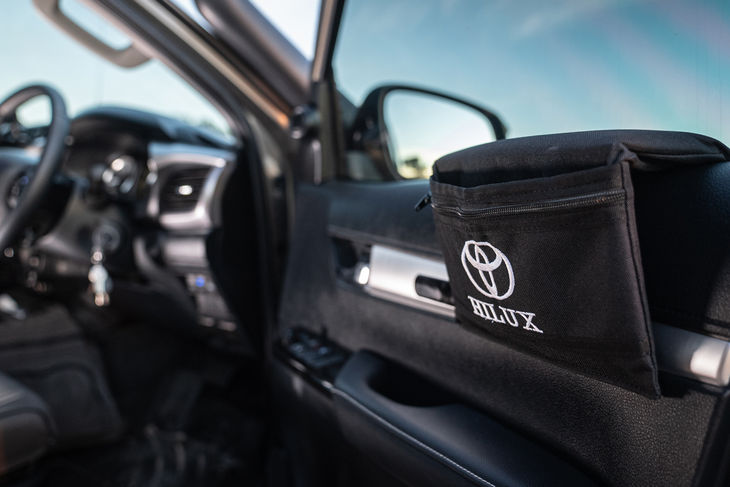
As Warwick enjoys fishing, it was refreshing to see various flies positioned in a custom holder attached to his bakkie’s sun visor. A painful reminder that each commute to work is a fishing trip you aren’t on.
Get out there and adventure…
While you don’t need to have a vehicle that is as extensively equipped as Warwick’s “Ultimate Overland” Hilux, it certainly helps to know that, at any time, you can pick up and go on a trip to just about anywhere (with relatively little preparation) – that is indeed a true intrinsic attraction of Overlanding. Whether the next adventure is the game-viewing trip in the Lowveld or sojourns to the surrounds of the Cederberg or the Tankwa Nature reserve or other desolate areas, including the Northern Cape close to the Orange River, it’s good to know that you can keep it simple when starting and then, who knows where to from there (as you progress on the equipment front)? Perhaps the next discovery of a once-believed-to-be-extinct tribe in Central Africa? “What are you waiting for”? Adventure awaits…
If you want more information about vehicle builds such as Warwick’s “Ultimate Overland” Hilux, visit the firm’s website at www.alu-cab.com, follow their Alu-Cab Instagram page to find more inspiration and even reach out to the chosen fitment centre on 4×4 Mega World. Other helpful resources include the app and website called Tracks4Africa, which is a community-driven map source.
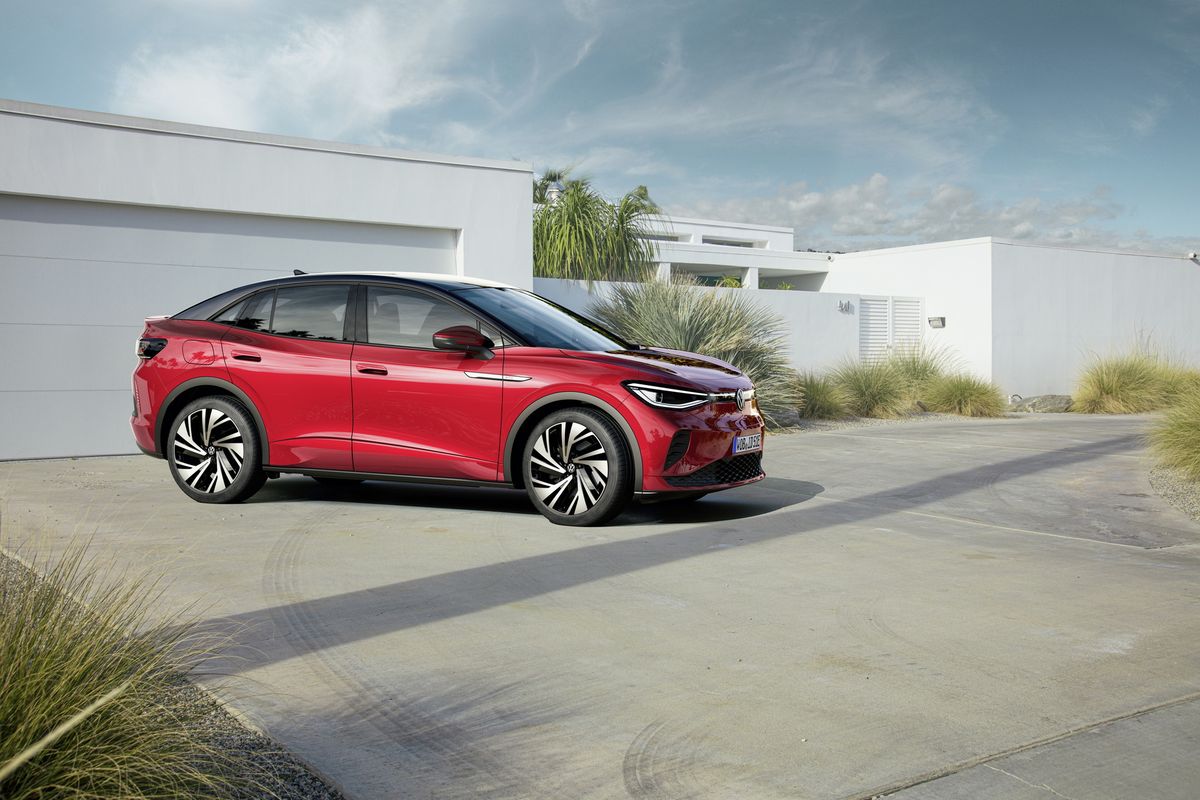
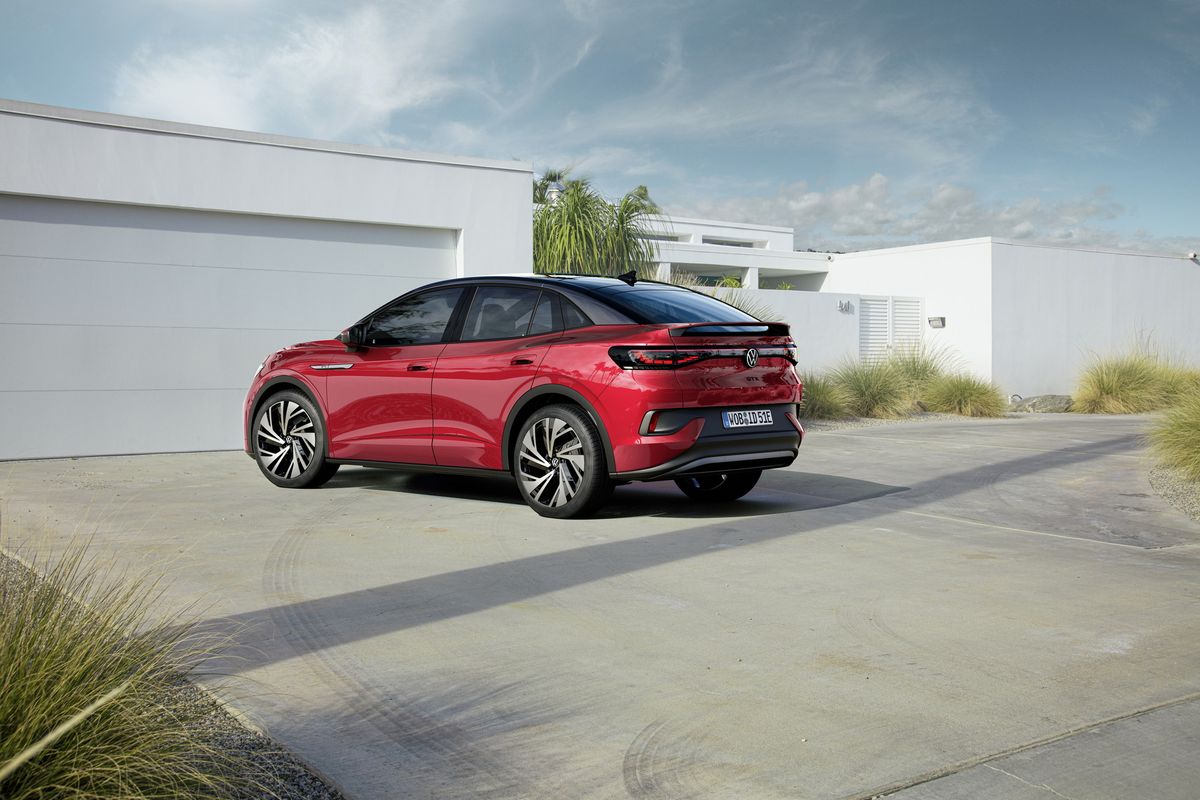
New VW ID.5 Shows Coupe Style
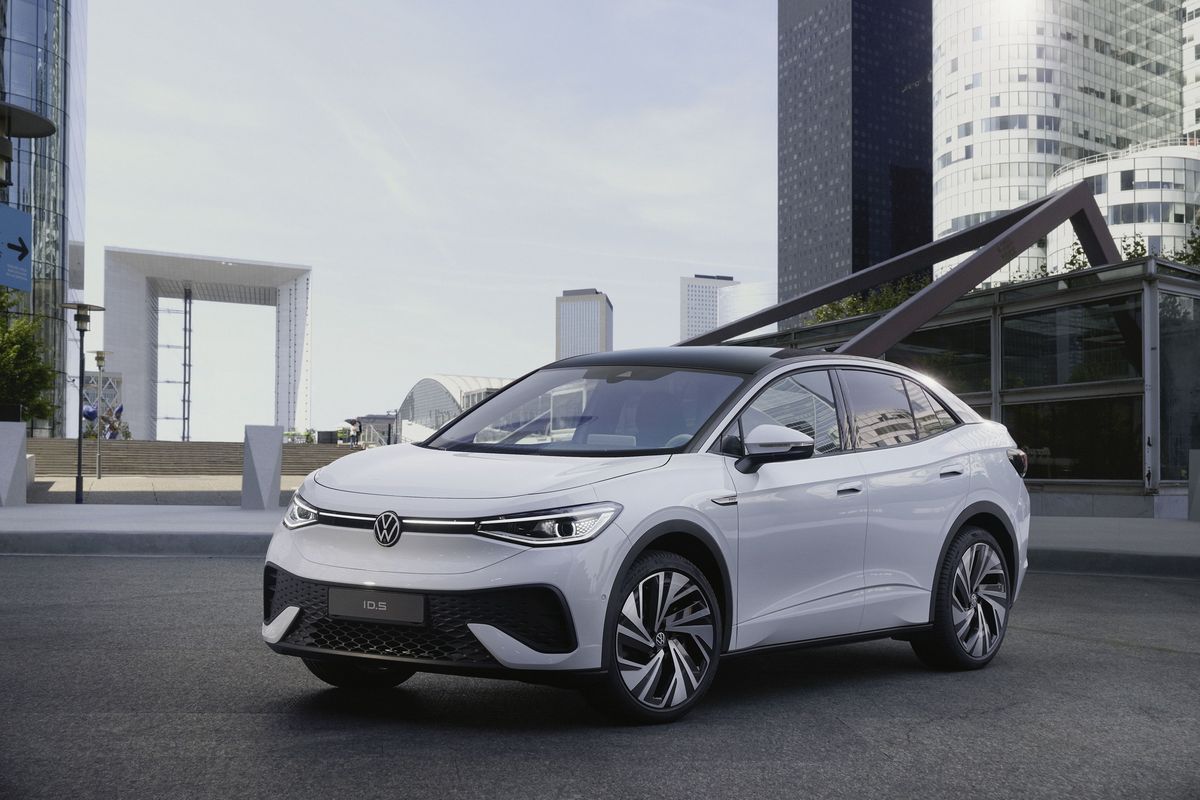
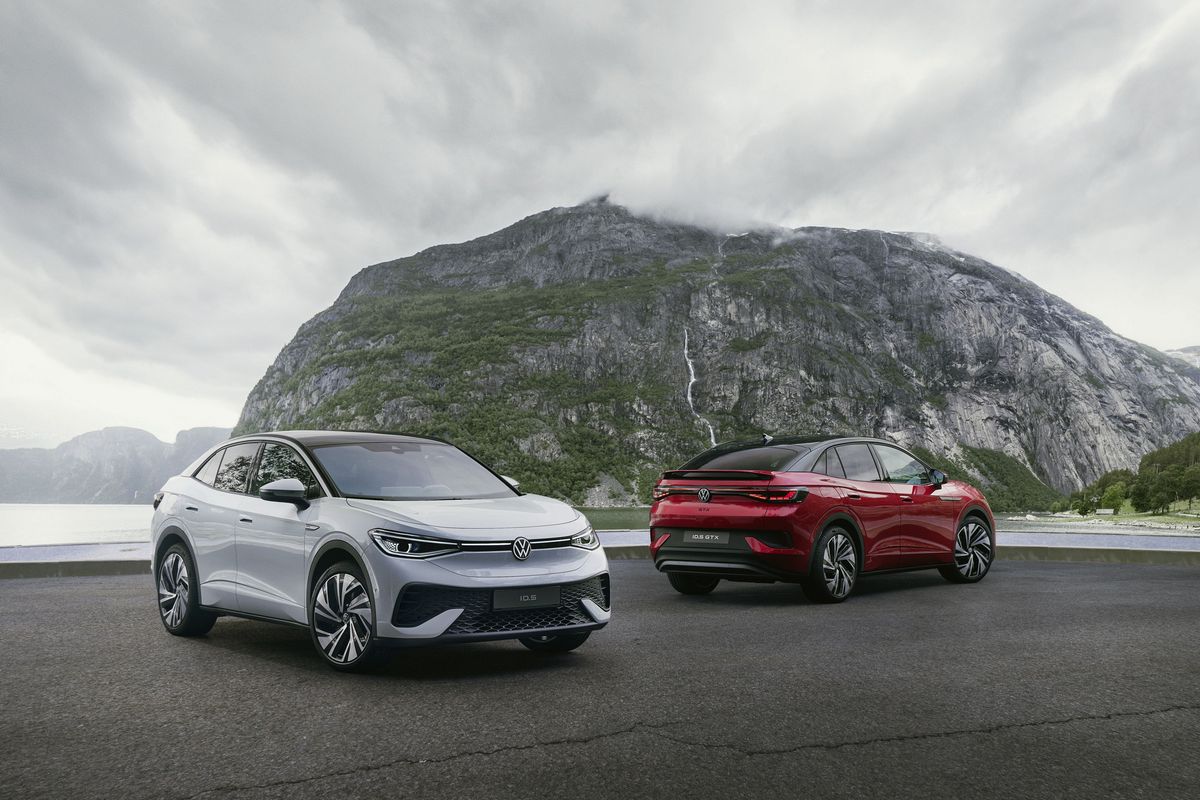
Volkswagen has revealed its electric ID.5 boasting sleek coupe-like styling. Check it out!
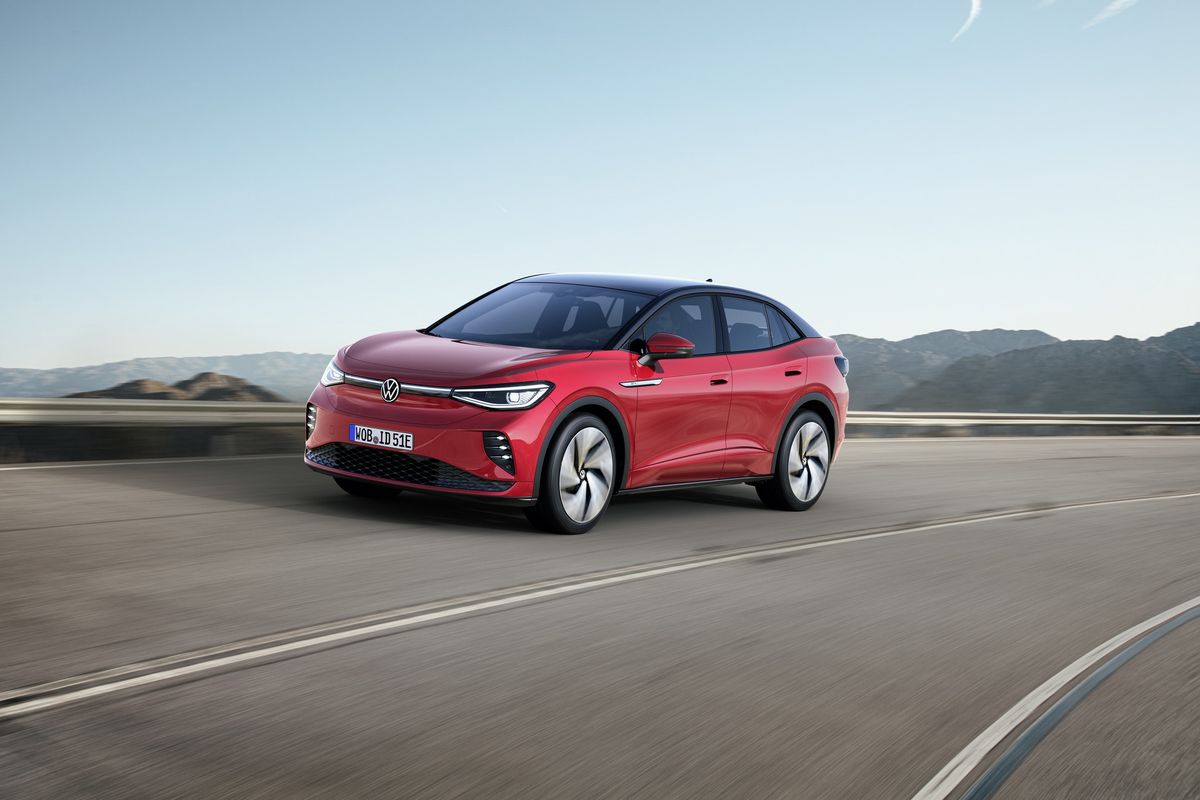
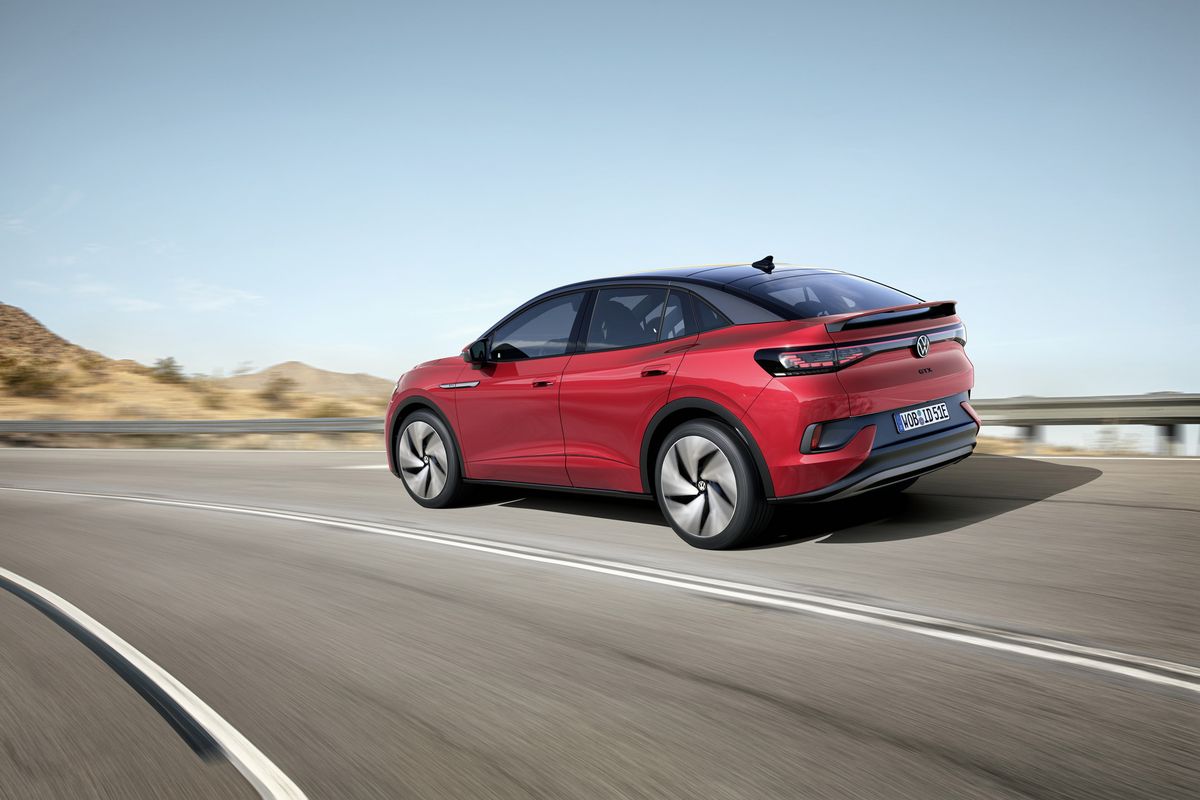
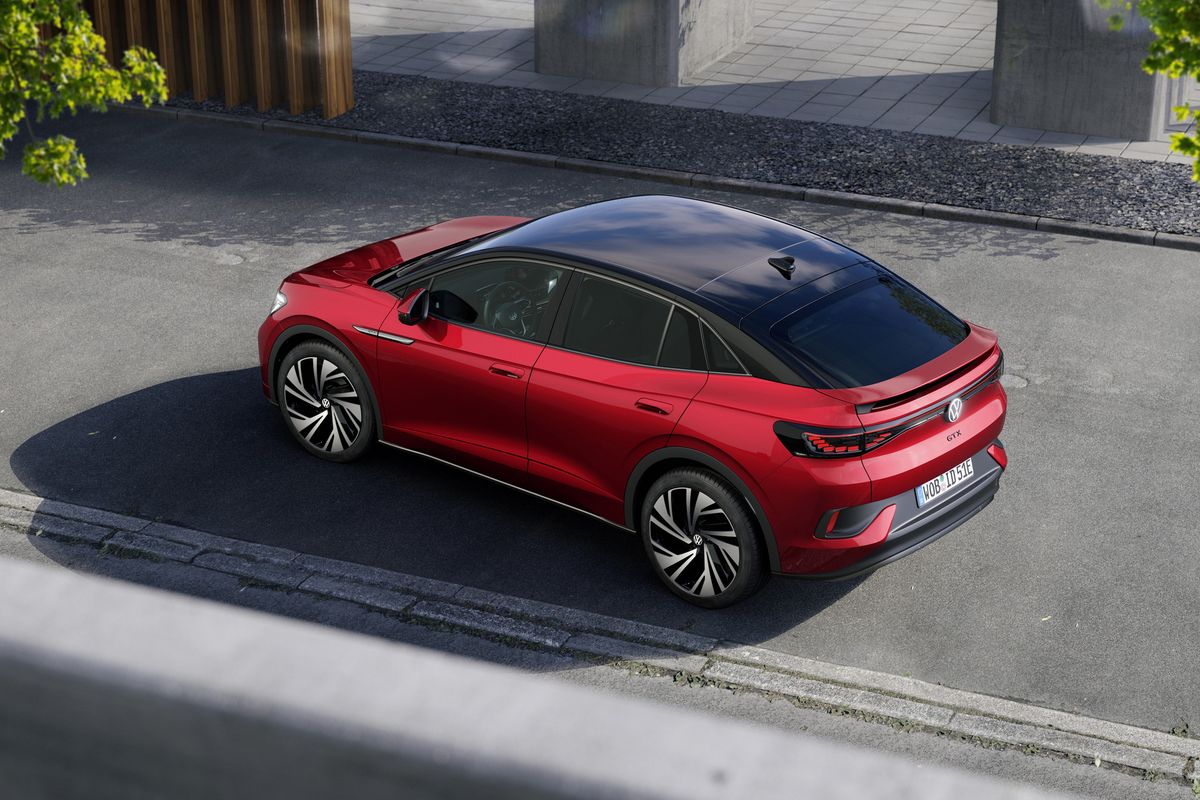
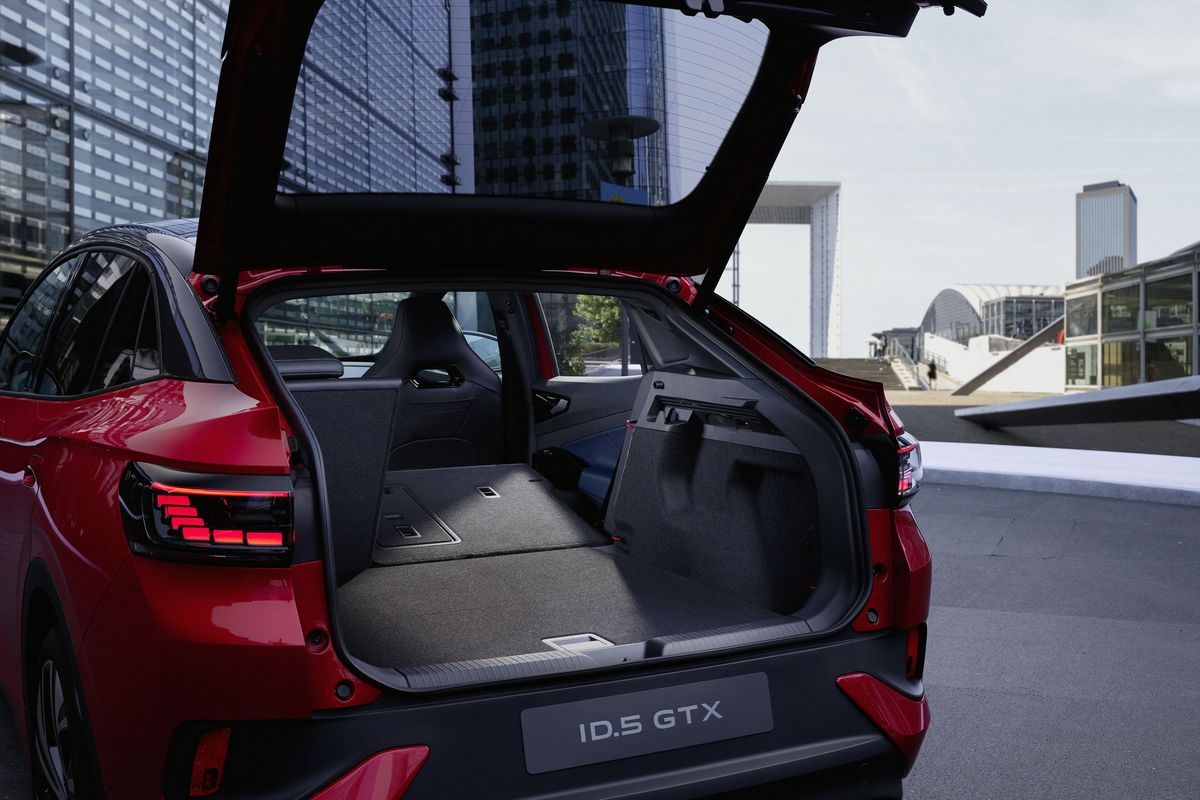
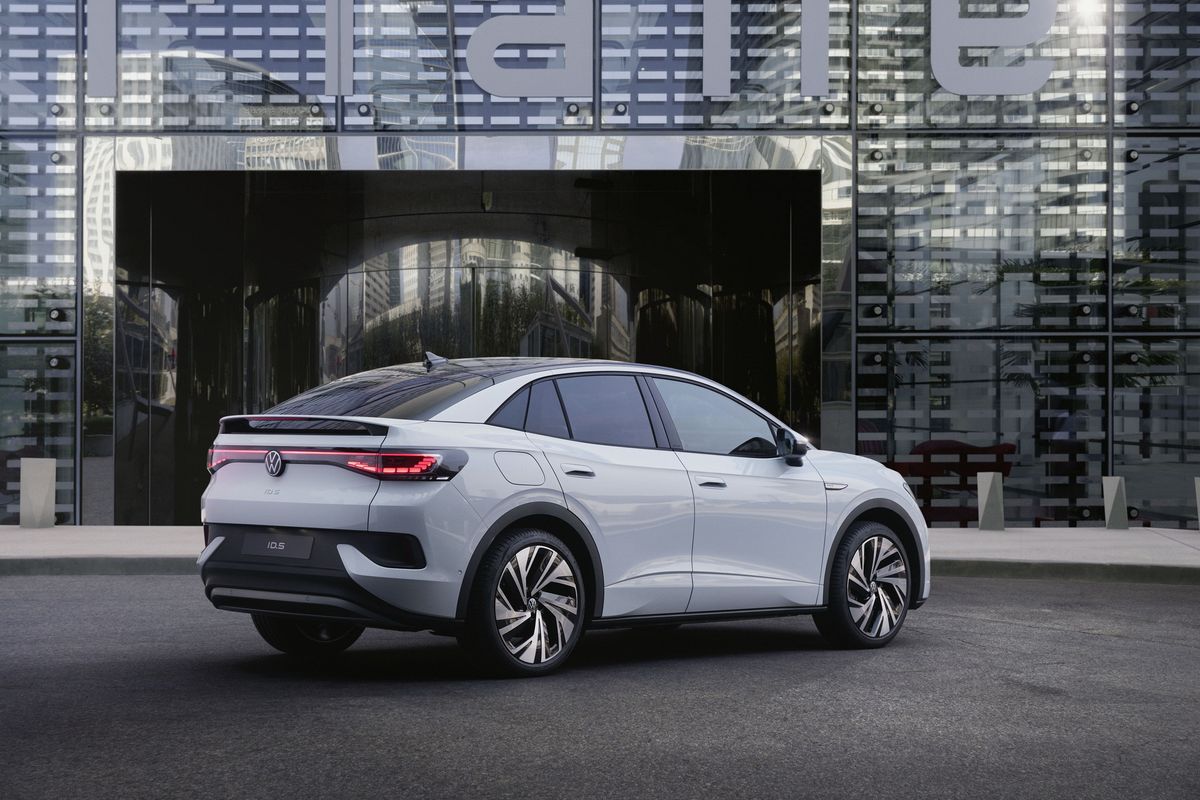
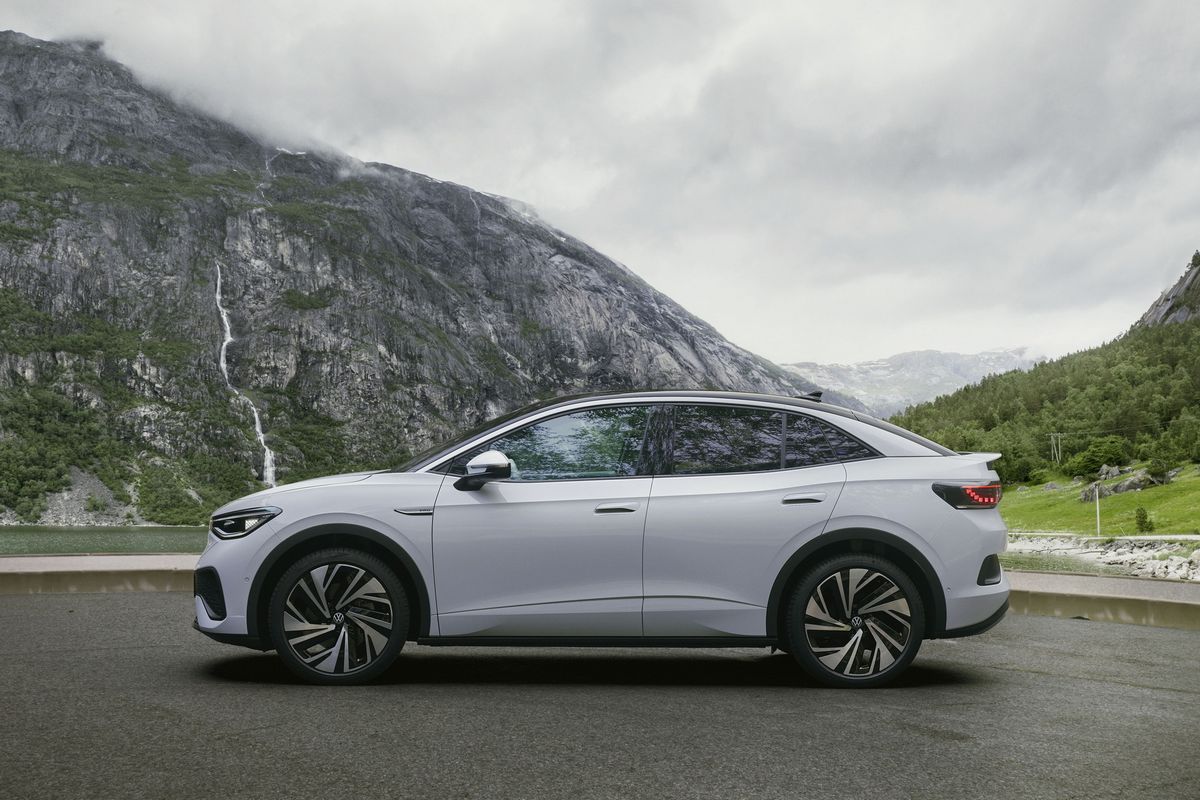
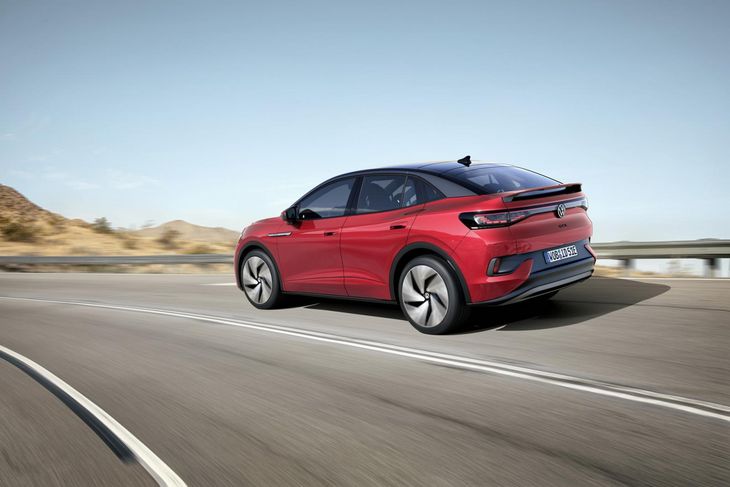
The new VW ID.5, in simple terms, is the stylised SUV-coupe version of the existing ID.4 compact SUV, which is currently VW’s best-selling EV. Like the ID.4, the ID.5 is built on Volkswagen’s MEB platform. The ID.5, however, is differentiated by a sloping roofline that transitions into a rear spoiler, giving the model a sportier look, but it’s not quite extreme enough to hamper practicality. In fact, the ID.5 still offers a not-too-shabby 549 litres of loading space, which is decent.
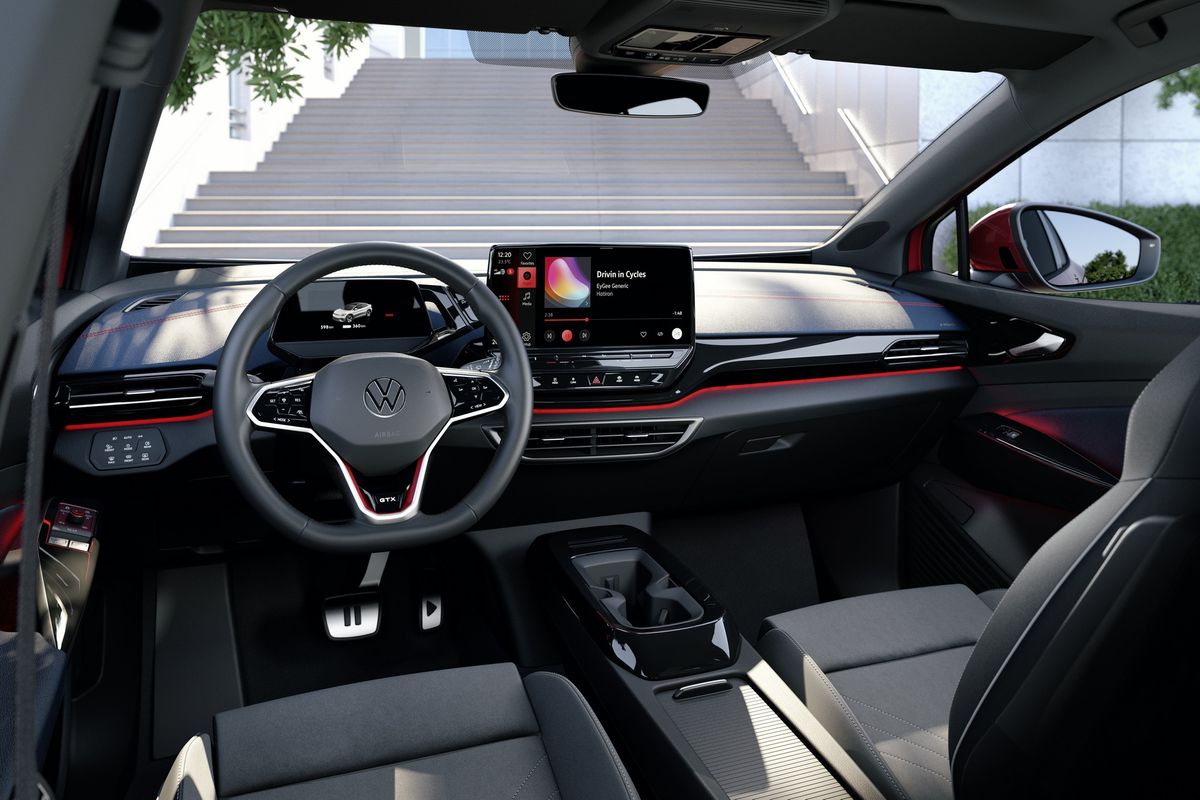
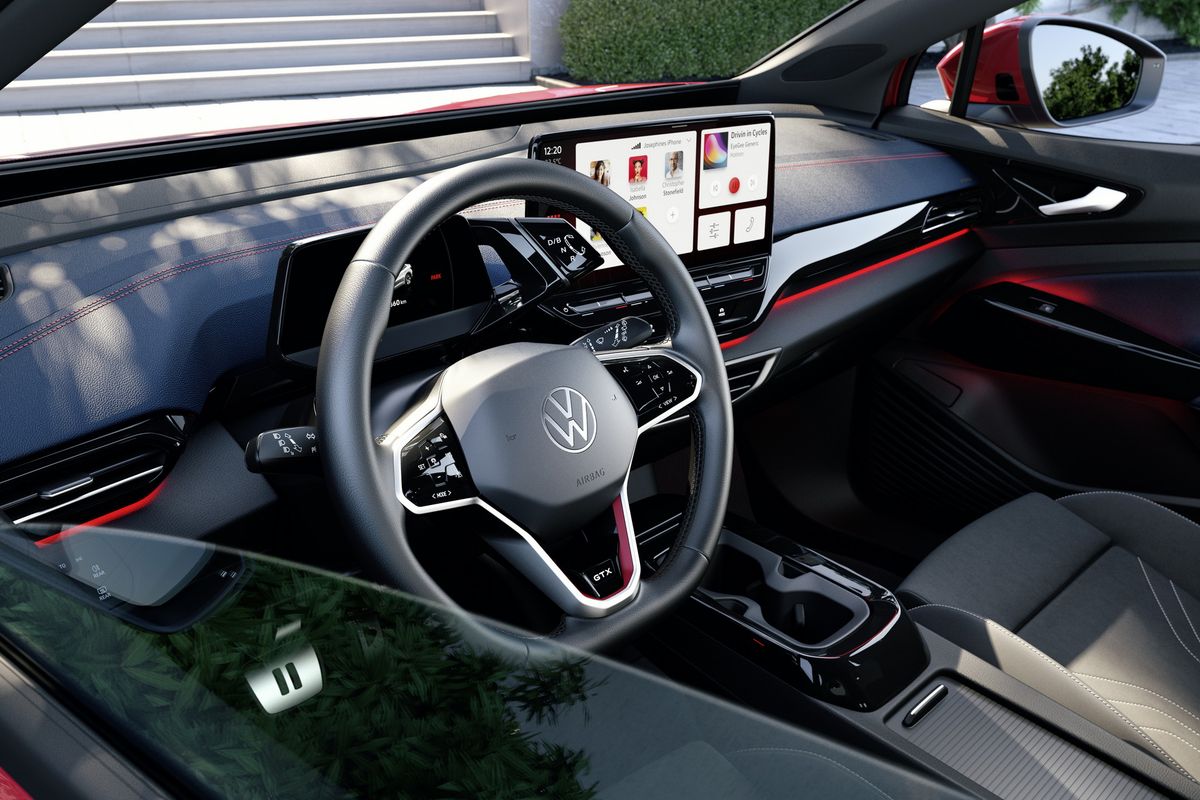
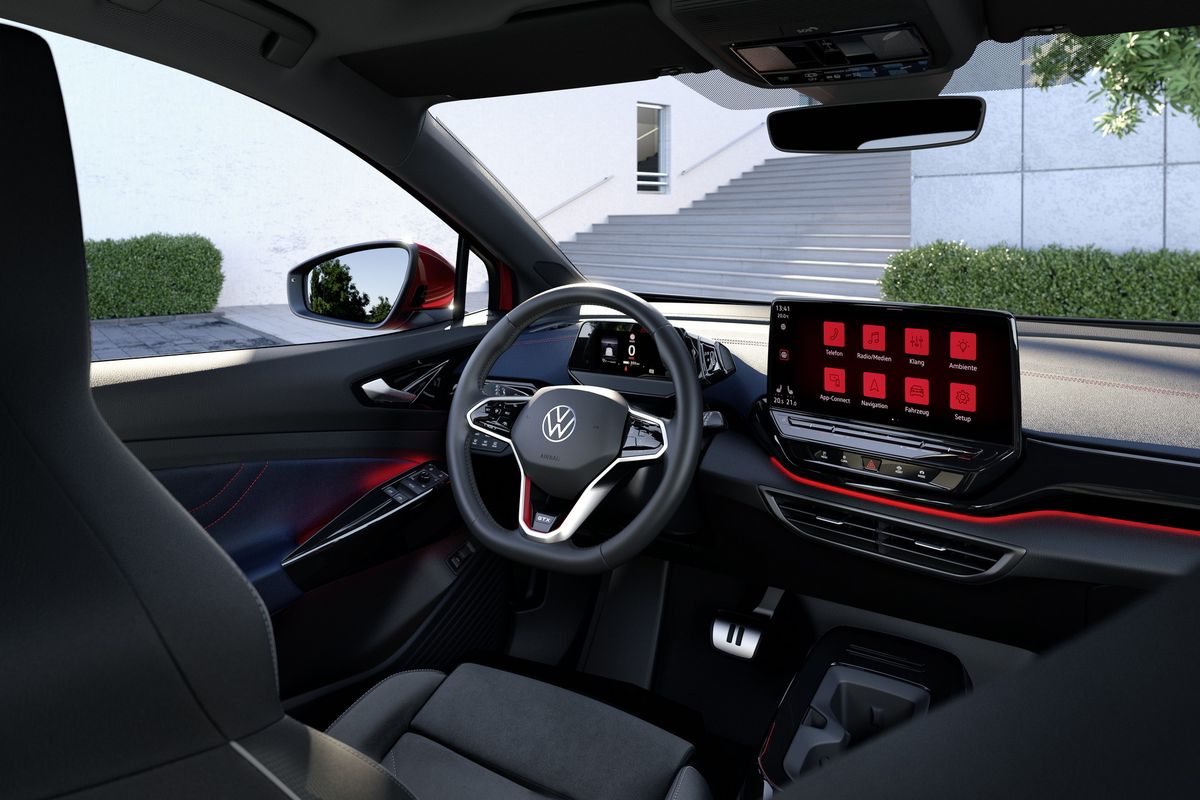
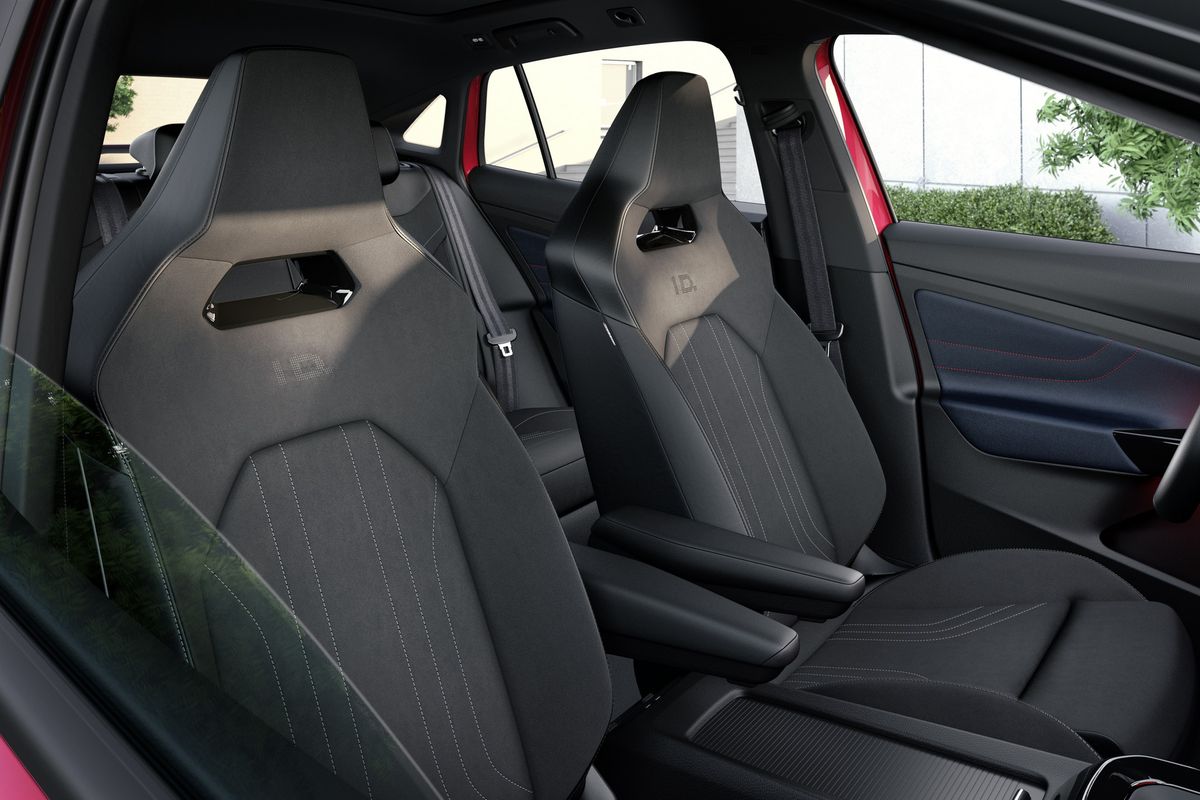
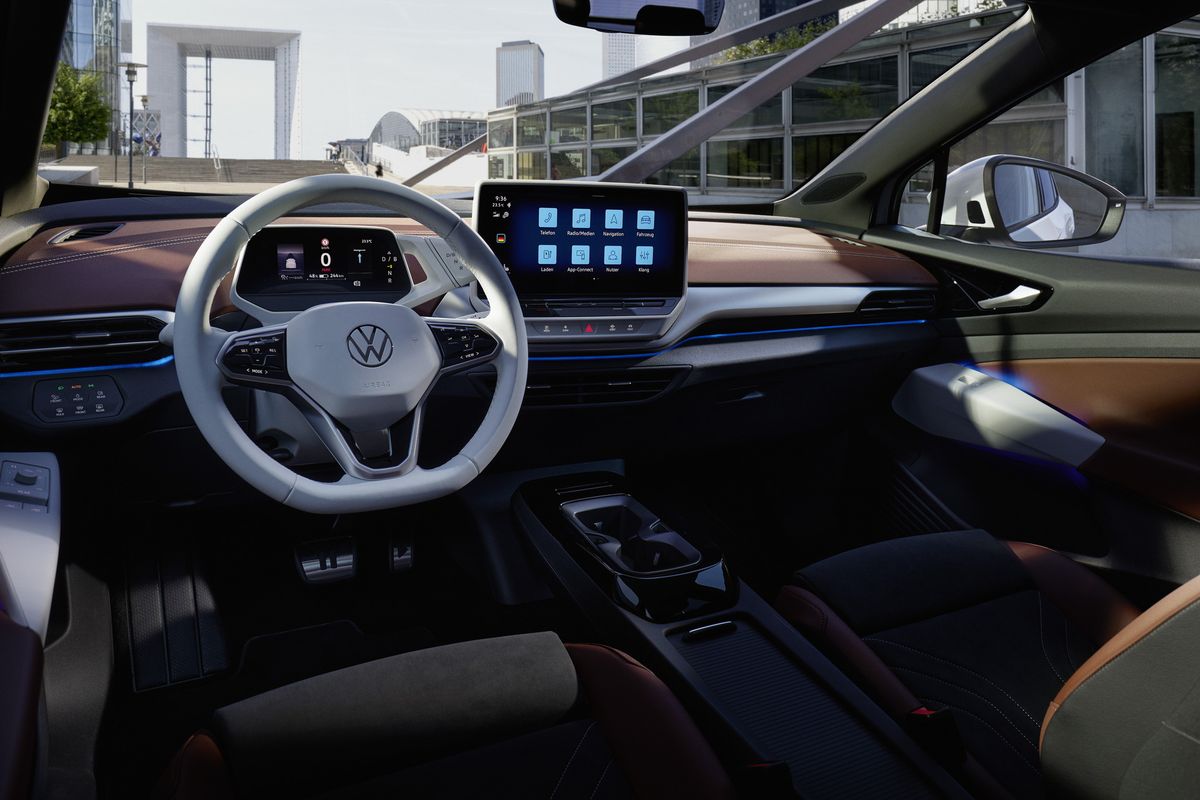
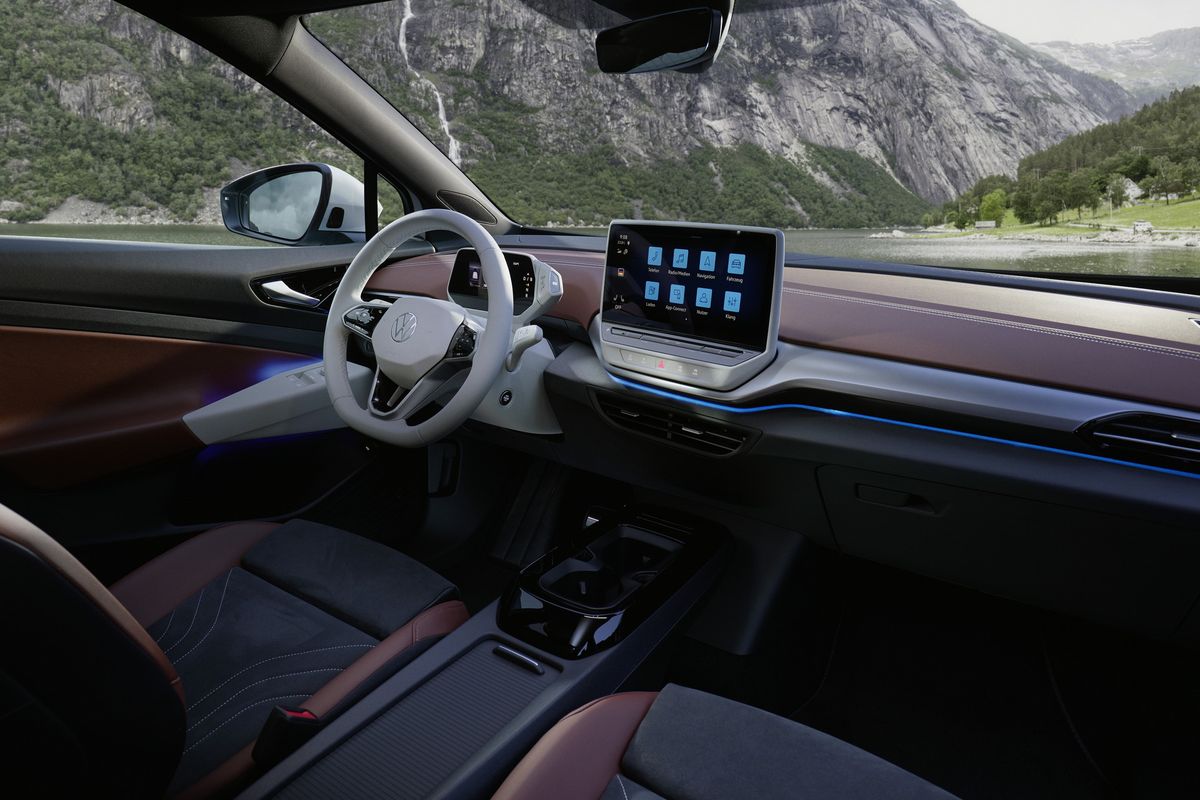
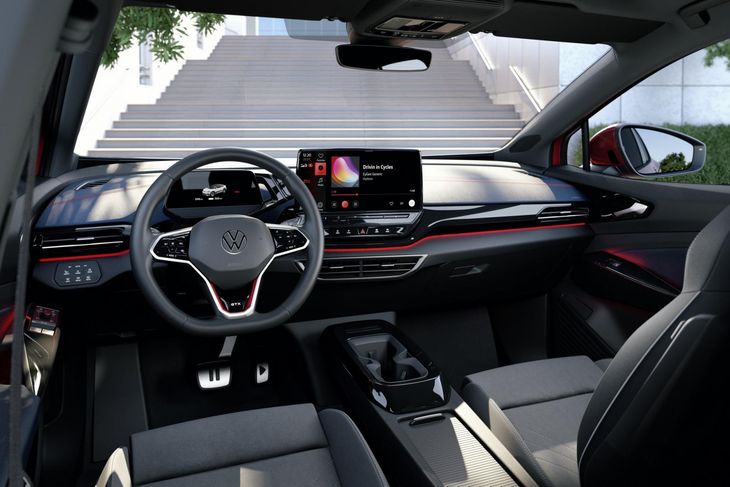
The ID.5 shares its cabin design with its ID.4 sibling.
On the inside, the interior design mimics that of the ID.4 with a clean, modern design approach. As you would expect, the ID.5 is equipped with modern conveniences such as a mounted digital instrument cluster, comprehensive infotainment system with over-the-air updates, augmented reality heads-up display and useful driver-assist features such as adaptive cruise control and lane-keeping assist, to name a few.
Is the VW ID.5 fast?
The ID.5 will be offered in 3 flavours with the ID.5 GTX topping the range.
The ID.5 is expected to go on sale in Europe in early 2022 and will be offered with 3 trim levels and 3 power options, all featuring a 77 kWh battery pack.
The ID.5 range starts with the ID.5 Pro which is powered by rear-mounted electric motors with a power output of 128 kW/310 Nm and a zero to 100 kph sprint time of 10.4 seconds.
Next up is the ID.5 Performance which also features rear-mounted electric motors but offers 150 kW / 310 Nm with a zero to 100 kph sprint time of 8.4 seconds.
The range-topping ID.5 GTX, however, features a dual-motor, all-wheel-drive setup (like the ID.4) and boasts a power output of 220 kW (80 kW /162 Nm on the front axle and 150 kW/310 Nm on the rear axle) and is capable of a zero to 100 kph sprint of 6.3 seconds.
The ID.5 Pro and ID.5 Performance claim a range of 520 km (WLTP) while the ID.5 GTX claims 480 km. Charging at a 135 kW fast-charging station will replenish 320km to 390 km in about 30 minutes.
Audi’s A8 luxury sedan has gone under the knife for its midlife update. See what’s changed below…
The new 4th generation Audi A8 was revealed back in 2017 (the Audi S8 arrived locally earlier this year) boasting notable technological advancements over its predecessor, including Level 3 autonomous driving capability. Now, Audi has given its luxury sedan a midlife cycle update to keep the A8 competitive against the BMW 7 Series and the new Mercedes-Benz S-Class.
Key changes for the Audi A8
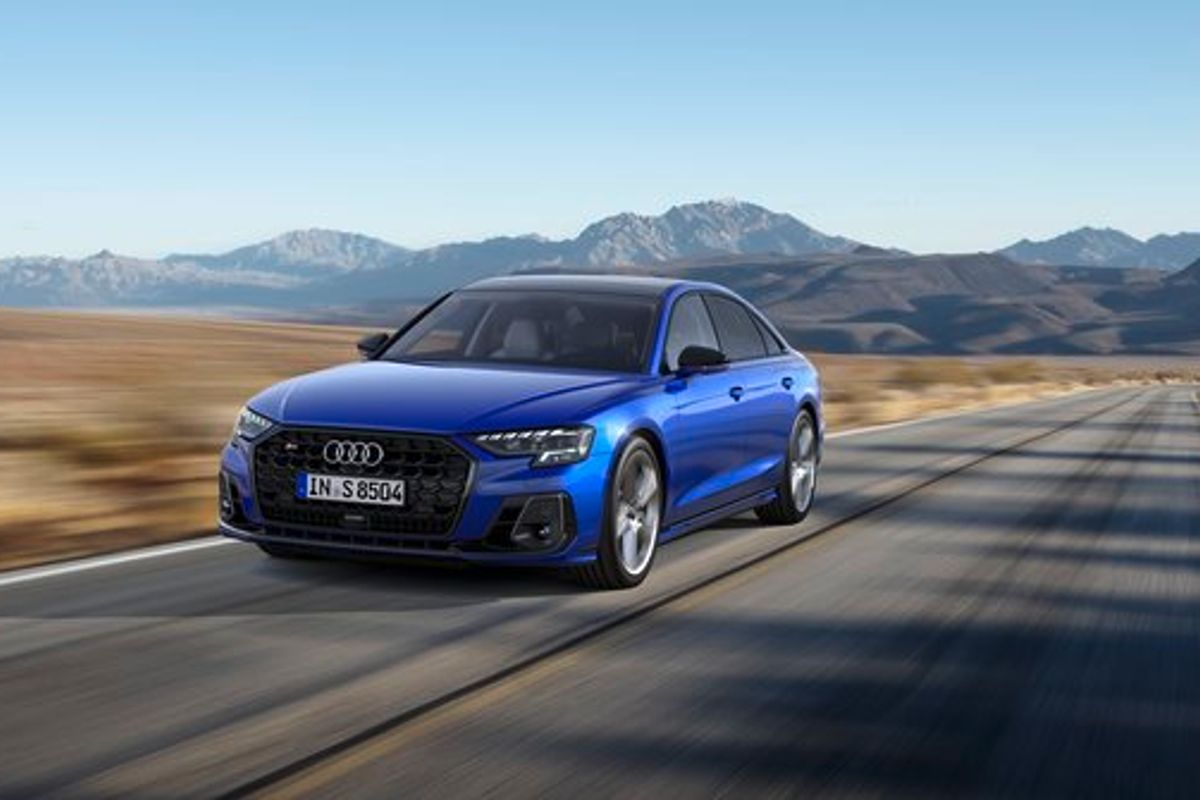
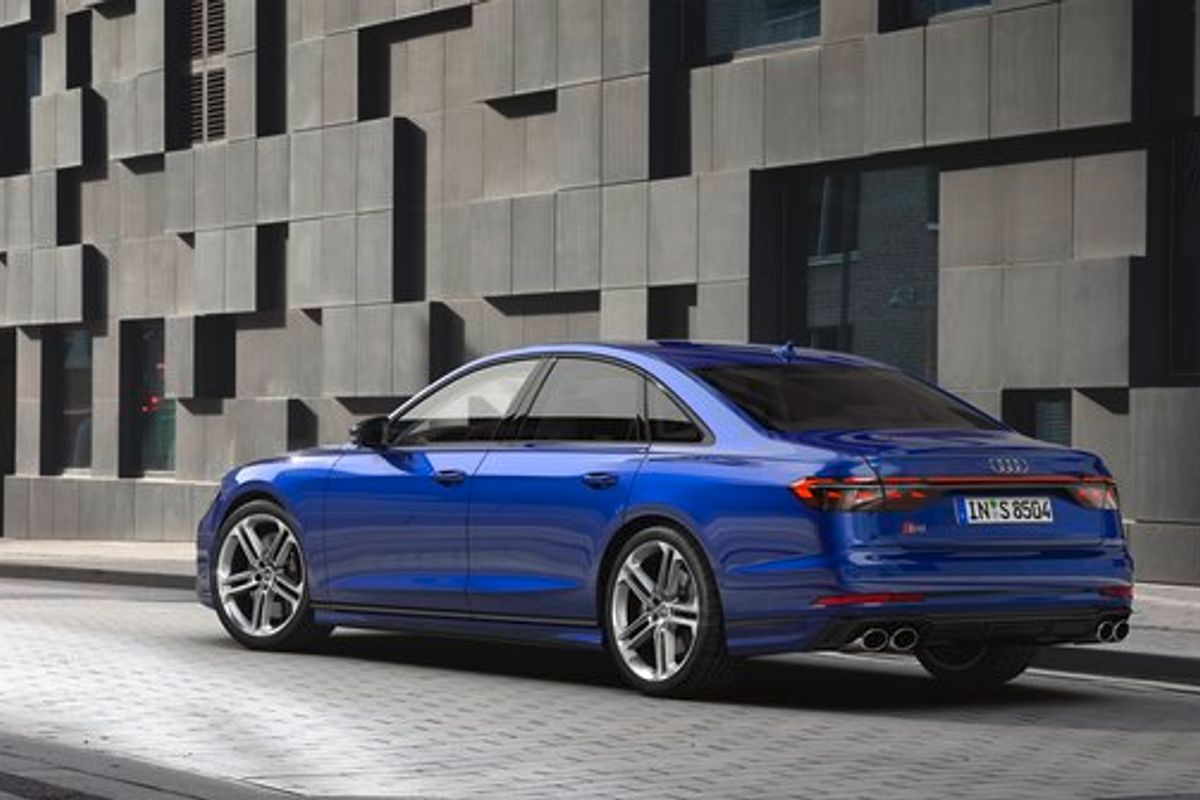
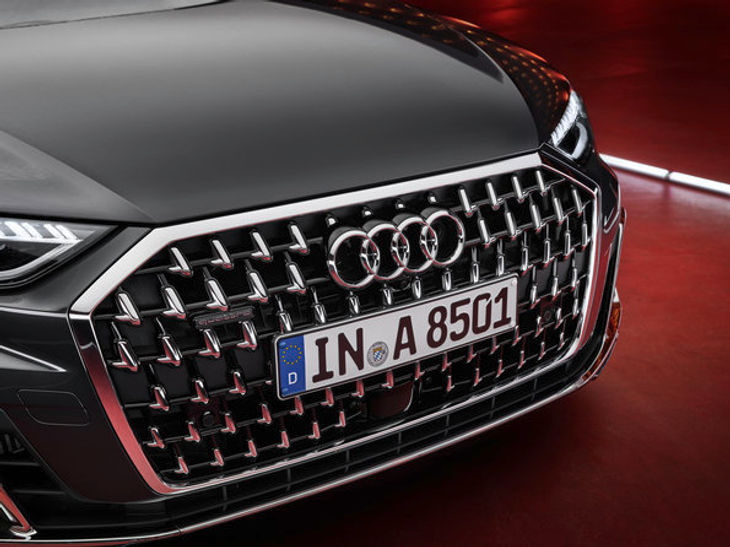
Audi has given the A8 a generous splash of chrome.
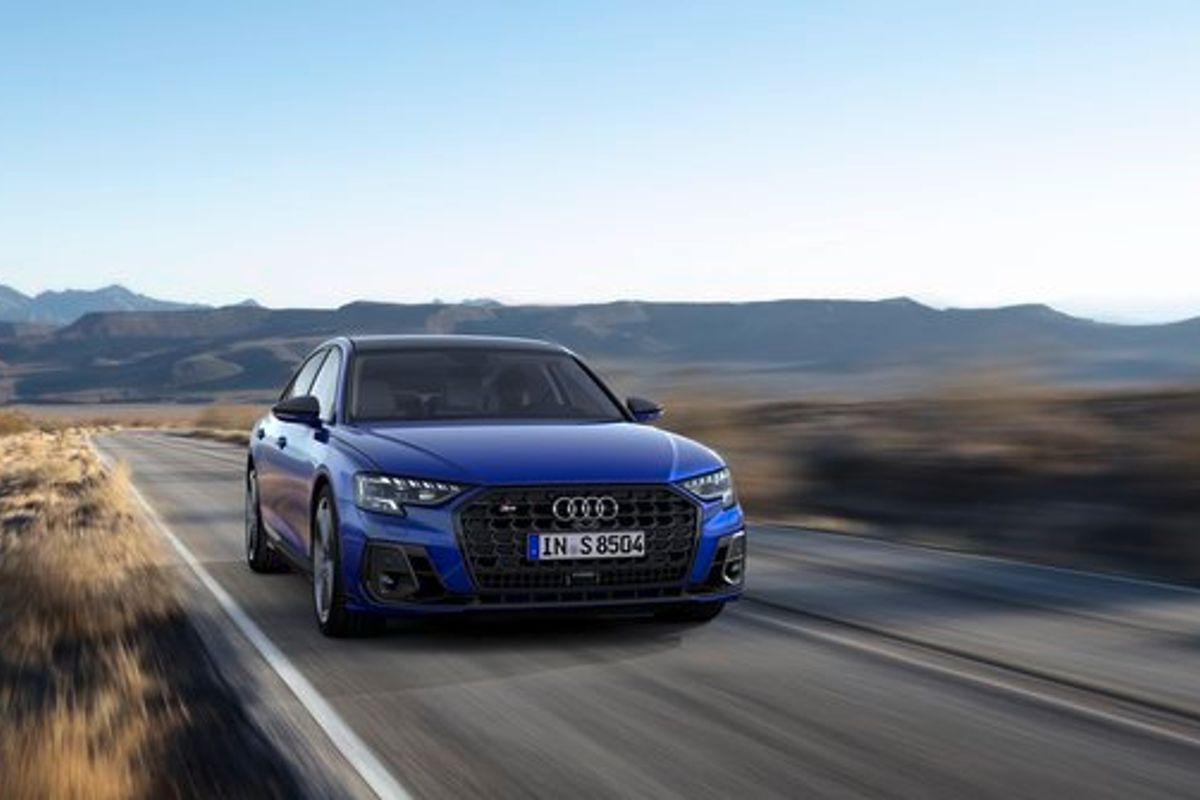
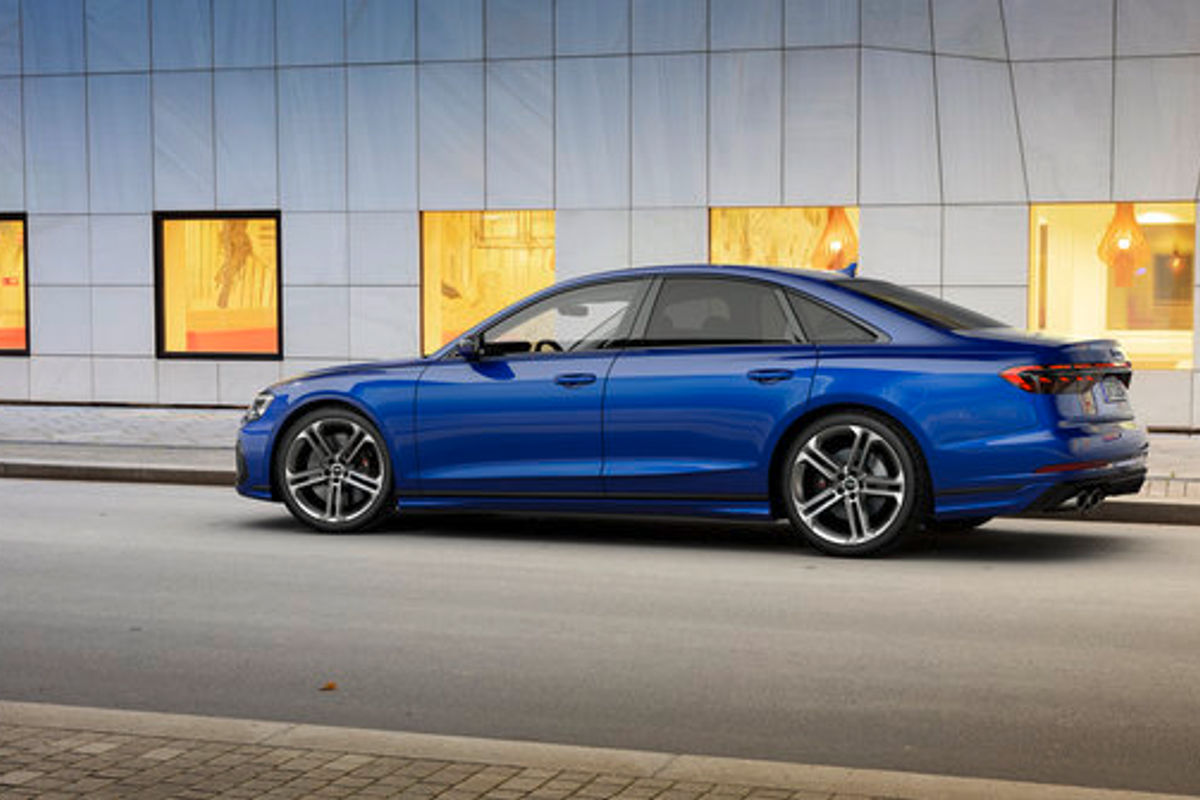
The most prominent visual change can be seen on the A8’s front-end design where the new grille has been generously splashed with chrome and new, sharper-looking headlight units with Digital Matrix LED technology have been fitted. The lower bumper sports larger air intakes which are also bordered in chrome. The new A8’s design is now perhaps more expressive than before.
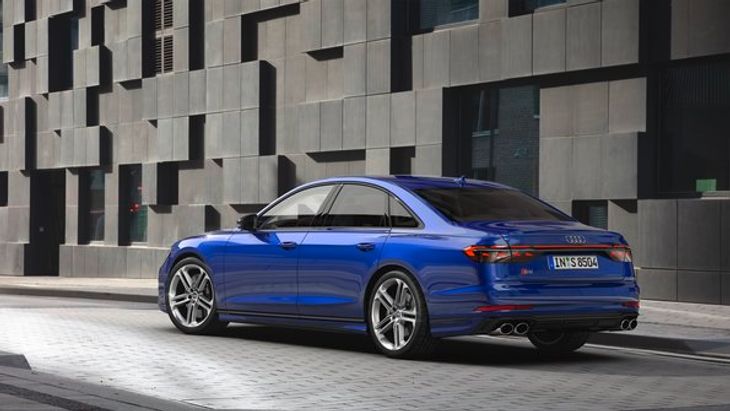
Audi has also expanded on the A8’s body colour palette with new metallic finishes such as District Green, Firmament Blue, Manhattan Gray and Ultra Blue. New matte shades include Daytona Gray, Floret Silver, District Green, Terra Gray and Glacier White. In addition to this, the A8 can also be had with a chrome exterior package and, for the first time on the A8, an S line exterior package.
A new selection of wheel designs will also be offered for the A8 in sizes ranging from 18- to 21-inches. Digital OLED taillights are a standard feature and are equipped with proximity indication which illuminates all the OLED segments if a vehicle approaches the A8 from behind within a distance of 2 metres.
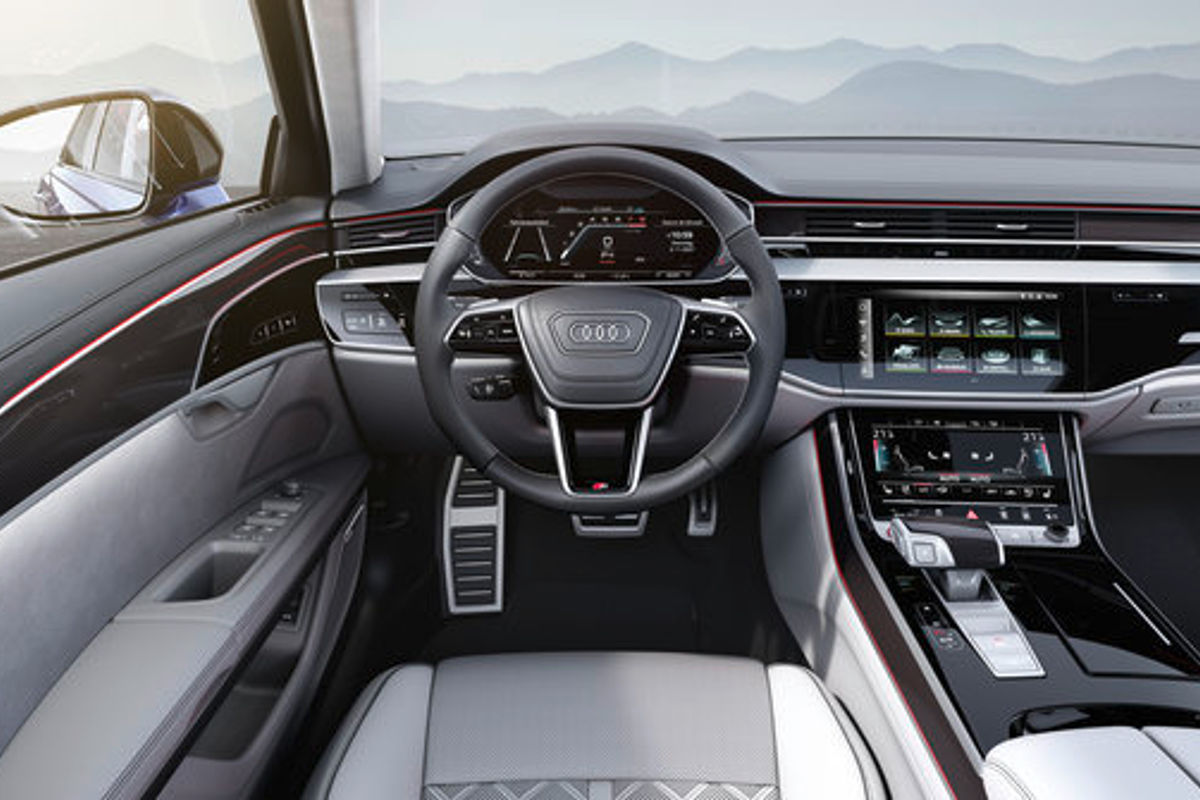
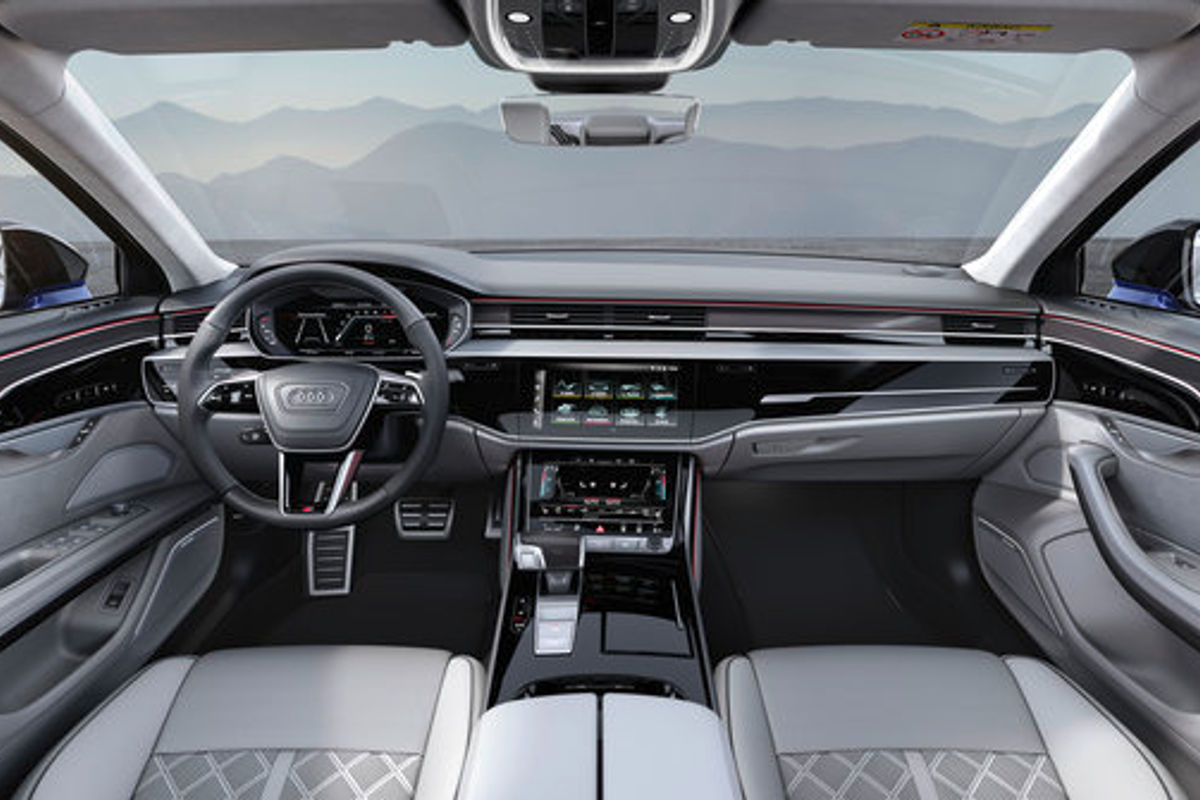
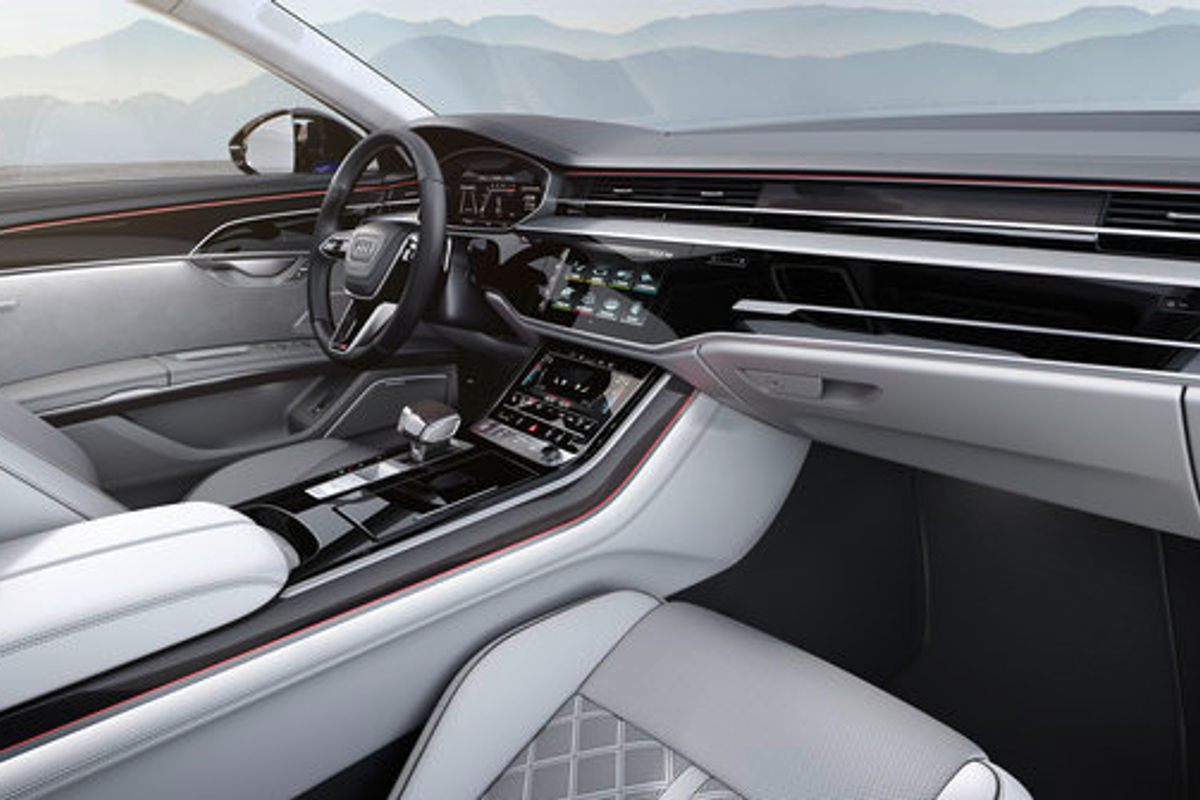
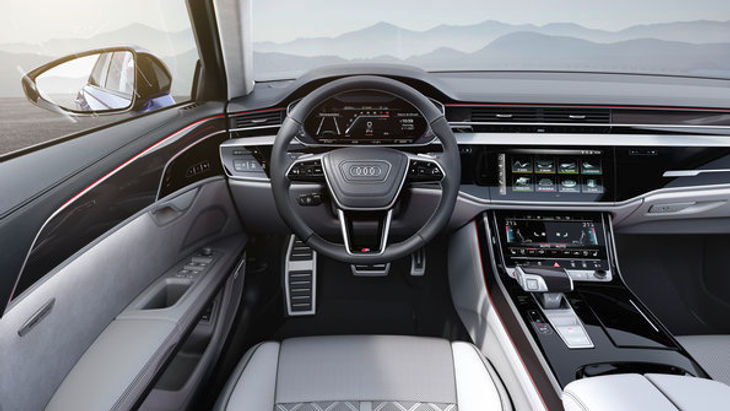
Audi’s A8 interior features the best technology in the firm’s arsenal.
As for the interior, as you would expect, it features the very best technology in Audi’s arsenal including a digital cockpit comprising a 10.1-inch digital instrument cluster and an 8.6-inch touchscreen running Audi’s latest MIB3 infotainment software. Rear passenger entertainment has now been bolstered with two 10.1-inch full HD displays while superb sound quality is delivered by a high-end Bang & Olufsen Advanced Sound System boasting no less than 23 speakers and 1 920 W amplifier.
Audi says there are about 40 driver assistance systems available in the updated A8. Some, such as Audi pre sense basic and Audi pre sense front safety systems are standard but other driver assistance systems are bundled into packages and offered as optional equipment. The packages include Park, City and Tour while the assistant package plus consolidates the packages. The Park package is highlighted by the remote park assist plus feature, for example, while the City package includes features such as intersection assist, cross-traffic assist, side assist, exit warning, and the Audi pre sense 360° safety system, which induces a side crash enhancement in combination with the active suspension. The Tour package includes features such as adaptive cruise assist while the central driver assistance controller (zFAS) continuously calculates a model of the environment.
Over and above this, Audi offers an extensive list of optional features that will cater for just about any need or want you can think of and you will only be limited by how much you are willing and able to spend on such features.
What engines are offered for the Audi A8 in South Africa?
The range-topping S8 is the only A8 derivative available in SA. We’re not complaining…
In South Africa, the A8 is only offered in range-topping S8 guise featuring a bi-turbocharged 4.0-litre V8 engine with 48V mild-hybrid technology that develops no less than 420 kW and 800 Nm and is coupled with an 8-speed automatic transmission that lays those numbers down on the tar via Audi’s quattro all-wheel-drive system. Zero to 100 kph in the S8 takes just 3.8 seconds. Driving comfort and dynamic ability is enhanced with predictive active suspension, sport differential and dynamic all-wheel steering.
In other markets, the A8 is powered by a 3.0-litre V6 petrol, 3.0-litre turbodiesel and a 4.0-litre V8 petrol engine.
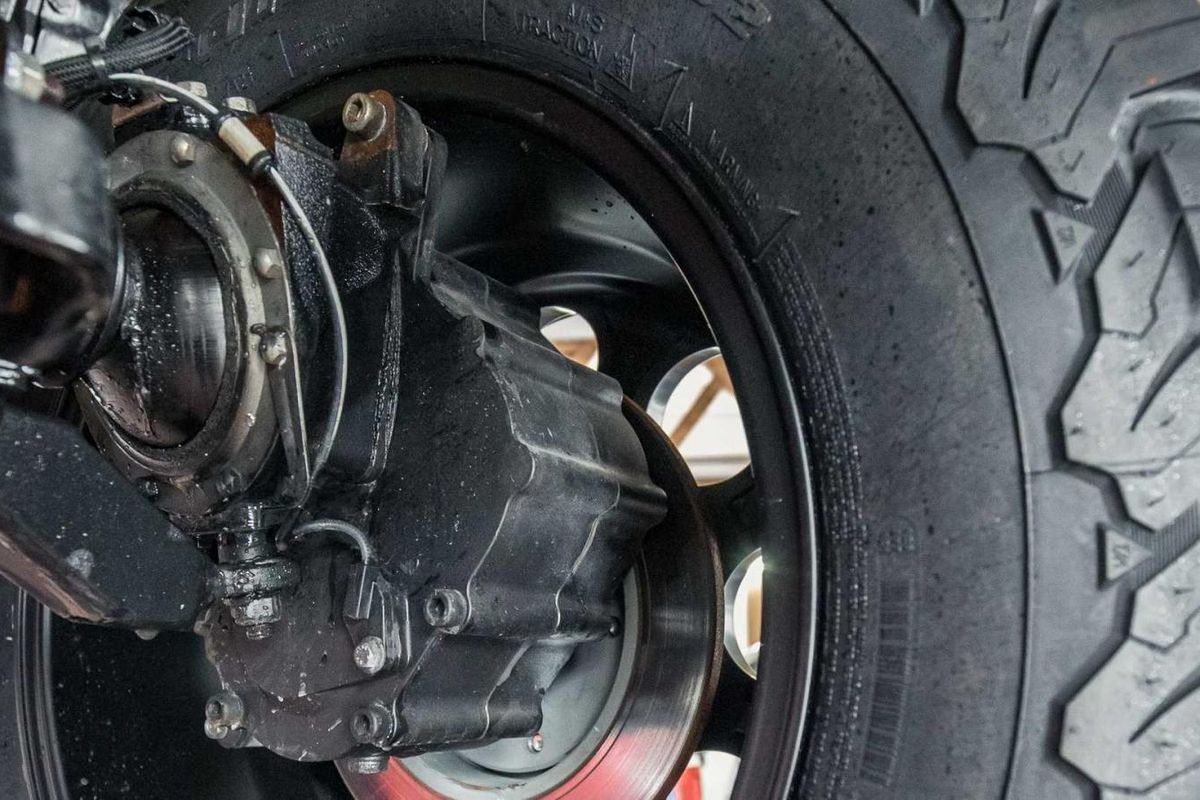
Huge increase in underbody clearance for Suzuki Jimny.
Is your Suzuki Jimny struggling off-road? Probably not, but to be sure, there is an impressive new mechanical upgrade for the Suzuki 4×4.
The Jimny has a deserved reputation for all-terrain conquering ability. Despite its size, it has all the core design elements that make for a very successful off-road vehicle.
It has a ladder frame platform, solid axles and a low-range transfer case, to crawl up steep inclines, at slow speed with maximum engine torque.
With its short wheelbase and small overall size, the Jimny has beneficial off-road driving geometry. And it’s not short on ground clearance, either, at 210 mm.
But for German aftermarket specialist, Delta4x4, there was the promise of more. A lot more.
The Mercedes-Benz Unimog and Gelandenwagen have long proven the worth of portal axles. And these designs influence the way that German engineers and off-road drivers view their vehicles.
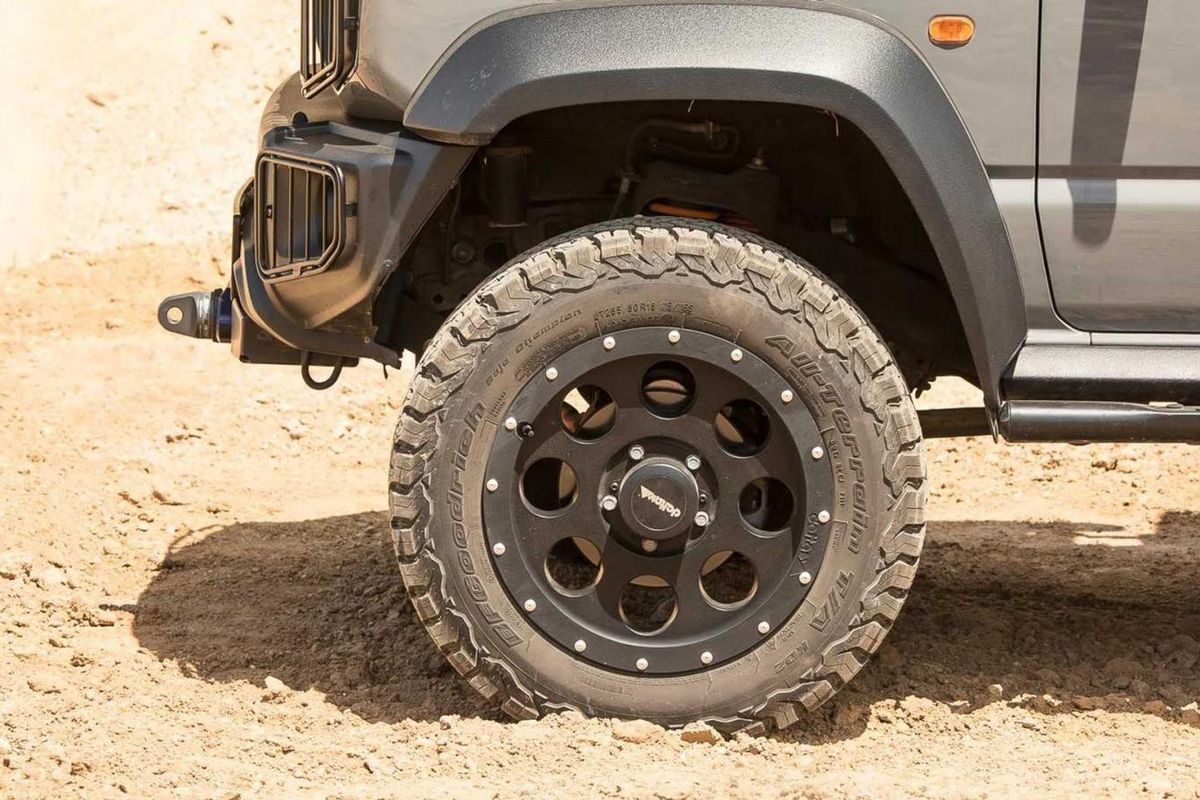
You can radically increase ground clearance with a portal axle by not driving the wheels, directly into their hubs. This allows the half-shafts to be move much higher, dramatically improving ground clearance.
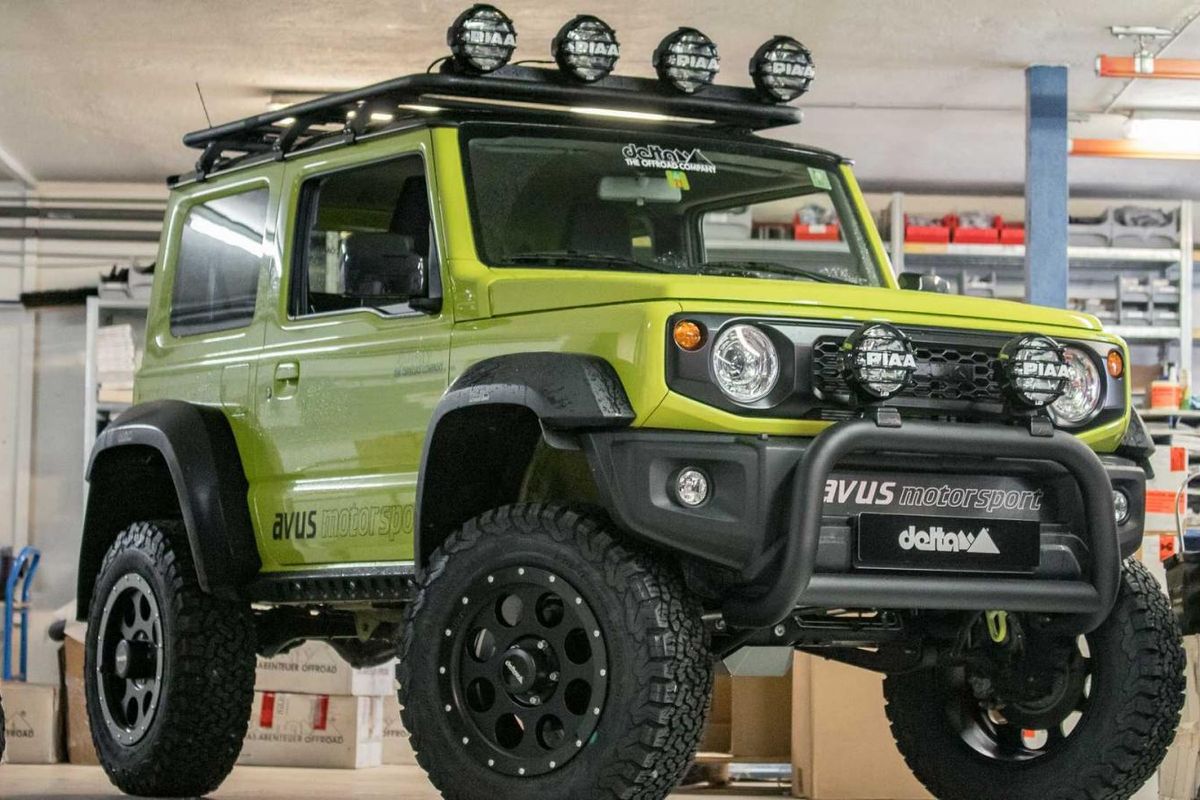
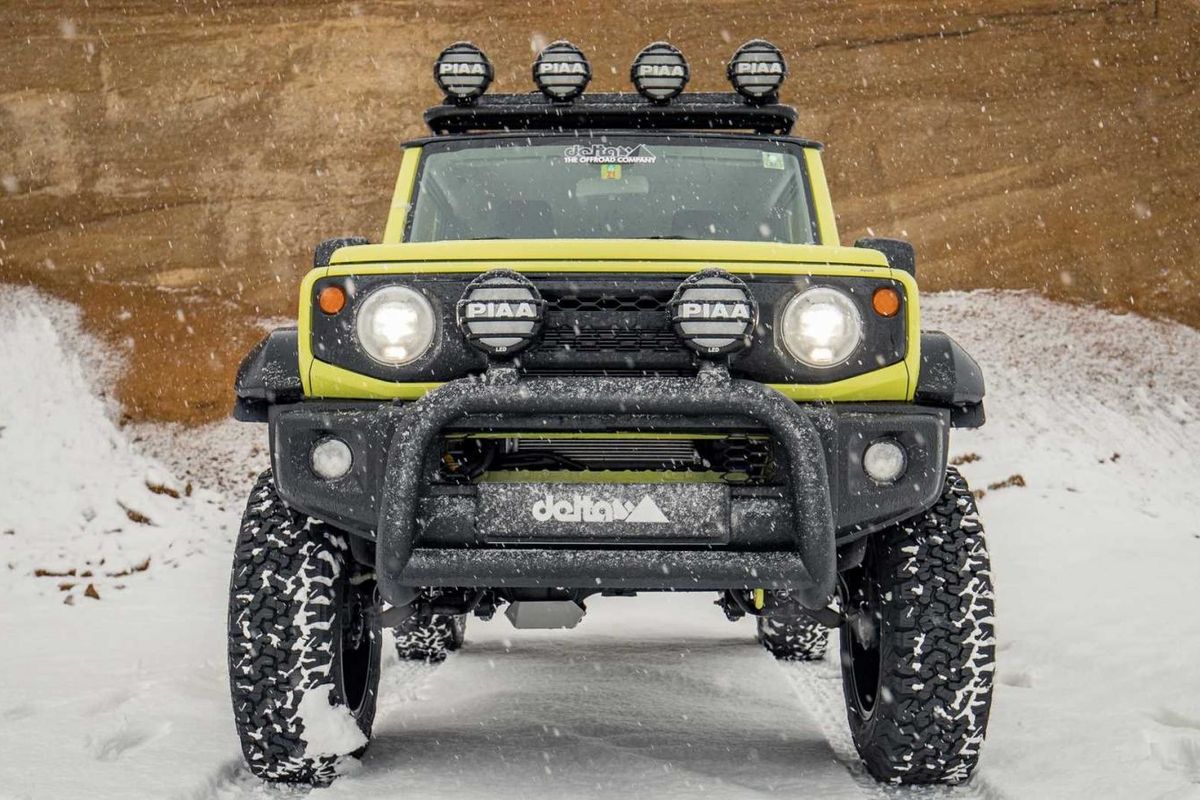
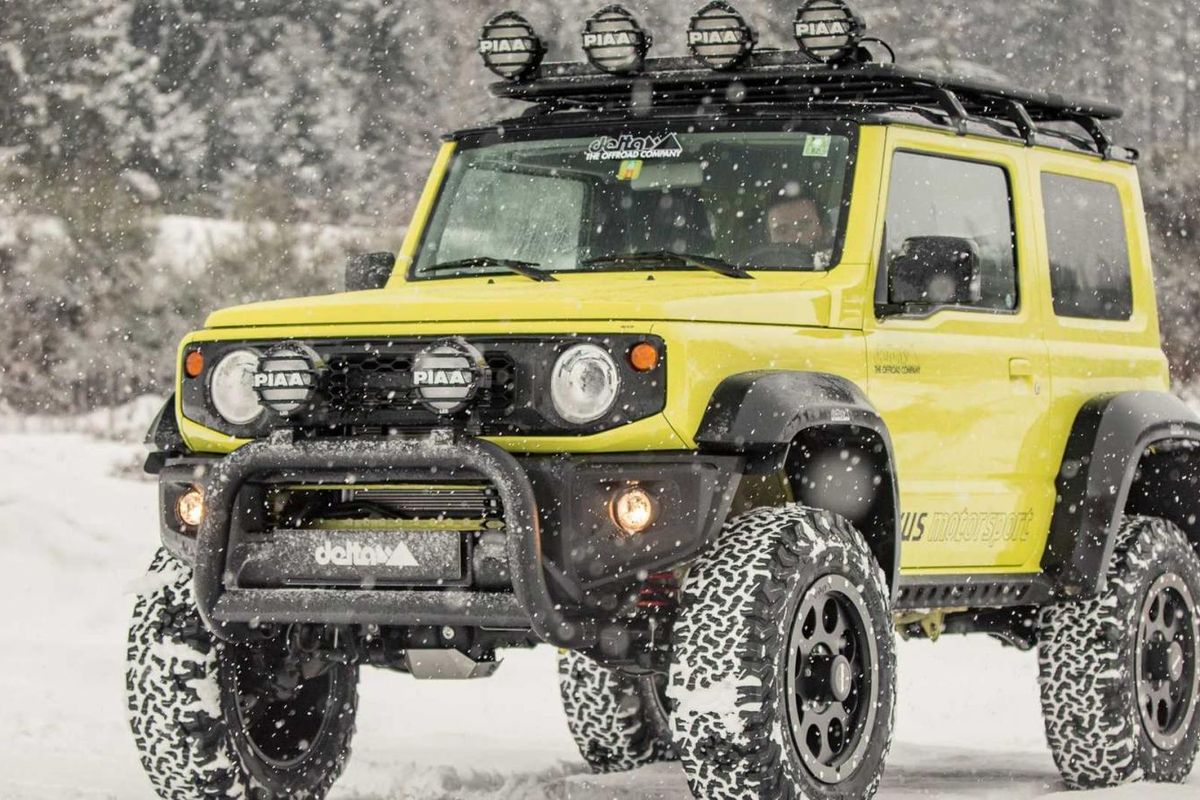
Delta4x4 has developed a new portal axle solution for Suzuki’s latest Jimny. Meticulously engineered to typical German standards, it nearly doubles the Japanese 4×4’s ground clearance.
Beyond the impressive stance, with a Delta4x4 portal axle Jimny, you have an impressive 400 mm of ground clearance.
There are improved dampers to balance the increase in ride height, preventing nasuating levels of lean, pitch, and bodyroll.
With 400 mm of ground clearance and no increase to its overall length or width, there is no question that a portal axle equipped Jimny is more off-road capable than anything else you could imagine.
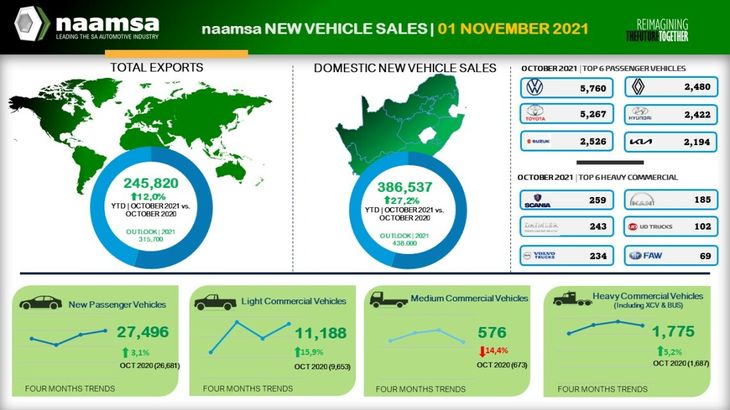
Take a look at new car sales in South Africa for October 2021 as released by naamsa | The Automotive Business Council.
The month of October 2021 was yet another tough month for new car sales in South Africa. Demand for new cars remains high but supply constraints, owing to the global chip shortage and supply chain delays, are preventing the local new car market from realising its full potential.
Nonetheless, new passenger car sales and light commercial vehicle (LCV) sales registered positive growth during the month but exports took yet another heavy knock as a result of a 3-week strike in the steel and engineering sector as well being severely impacted by load shedding.
New Car Sales in SA for October 2021
Aggregate new vehicle sales of 41 035 units up by 6.1% (+2 341 units) compared to October 2020.
New passenger car sales of 27 496 units up by 3.1% (+815 units) compared to October 2020.
LCV sales of 11 188 units up by 15.9% (+1 535 units) compared to October 2020.
Export sales of 23 685 units down by 30% (-10 159 units) compared to October 2020.
Best-Selling Car Brands in South Africa
Toyota – 9 928 units
Volkswagen – 5 975 units
Nissan – 3 059 units
Hyundai – 2 804 units
Suzuki – 2 593 units
Renault – 2 480 units
Kia – 2 343 units
Haval – 2 330 units
Ford – 2 148 units
Isuzu – 1 934 units
New Car Sales Outlook
The South African automotive industry is likely to remain under pressure in the short to medium term. All indications are showing that the global chip shortage will continue to disrupt supply into 2022 and this will be exacerbated by logistical complications caused by the ongoing vessel and container shortages that are impacting not only the delivery of new cars but goods in general.
In addition to this, on a local level, load shedding is expected to continue and will further disrupt and cripple South Africa’s already-struggling economy.
As the supply of new cars remains constrained, local buyers have been taking advantage of deals in the used car market and this trend is likely to continue until the new car market stabilises.
Cars.co.za currently has over 65 000 used cars listed for sale and if you are in the market for a used car, you have come to the right place!
Volkswagen South Africa is one step closer to introducing its Electric Vehicles (EVs) on local soil and will run a fleet of ID.4’s in 2022 as part of its electric mobility strategy.
In 2020, Volkswagen SA announced its local 3-phase electric mobility strategy.
The first phase of the strategy saw the introduction of a fleet of 6 e-Golfs that were used for local EV research, media and dealer exposure in an effort to gain insights into EV ownership in South Africa. The firm also ‘tested’ a fleet of ID.3s.
Cars.co.za tested the e-Golf in Johannesburg, watch the video below.
“It is important for us to conduct thorough research on electric vehicles before introducing them in South Africa. With the e-Golf test fleet, we exposed hundreds of Volkswagen customers to electric vehicles and over 90% of those customers indicated that they would consider buying an electric vehicle in the future,” said Steffen Knapp, Head of the Volkswagen Passenger Car Brand.
Now, Volkswagen has announced that it will embark on the second phase of its strategy which will see a fleet of ID.4 compact SUVs taking to the streets in 2022. The ID.4 is the 2021 World Car of the Year currently the firm’s most best-selling electric car with a range of 522 km.
The third and final phase of Volkswagen’s electric mobility strategy will finally see Volkswagen EV products go on sale to customers in South Africa. The ID.4 is expected to be the first EV model from Volkswagen to be offered to local buyers.
A host of new EV products from brands such as Audi and Mercedes-Benz will reach South Africa next year while BMW is expected to introduce its iX locally this month. However, if widespread EV adoption in South Africa is even remotely possible, more affordable EV products are needed to stimulate and build demand. Volkswagen’s EV products can’t come soon enough…
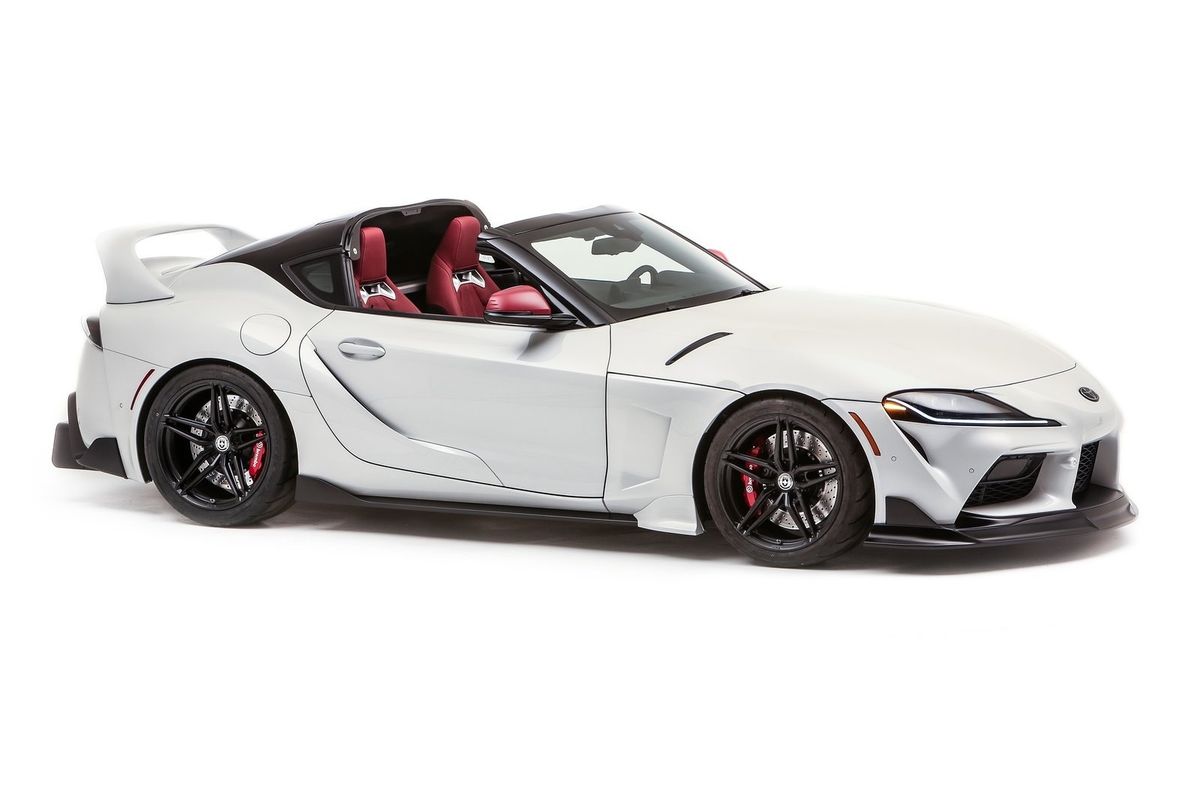
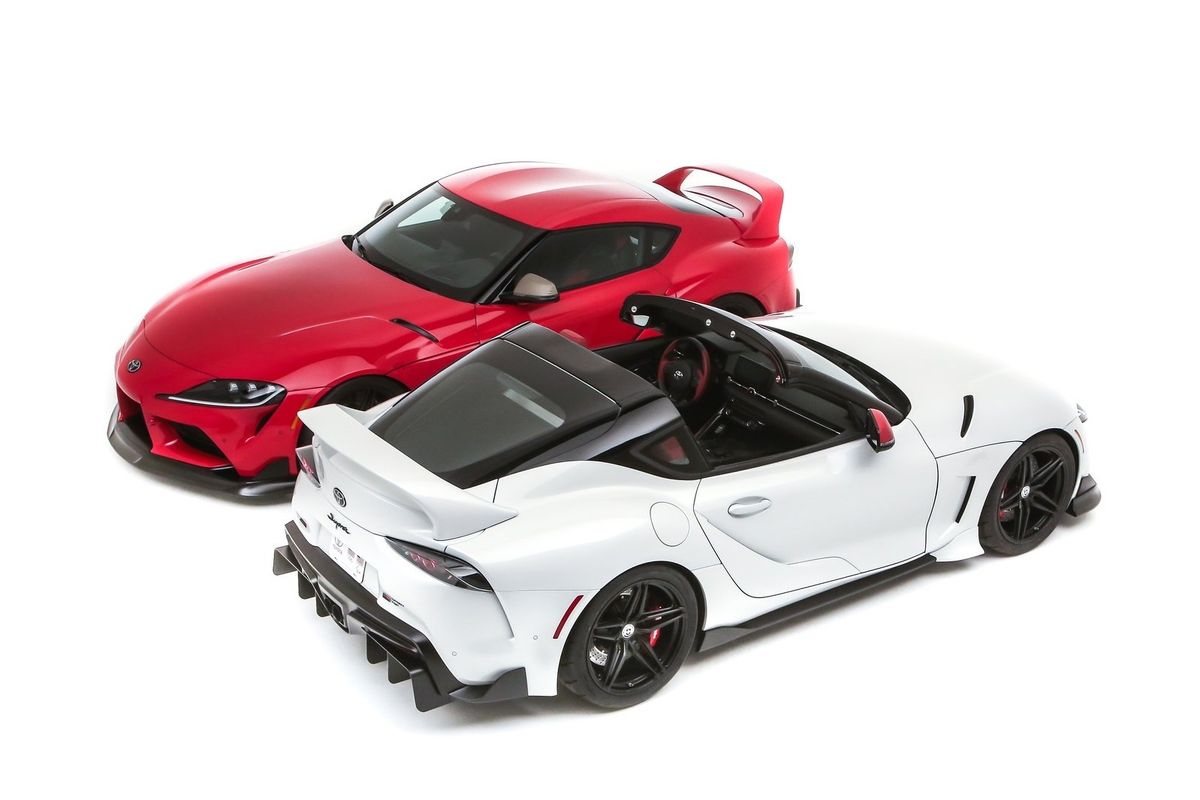
The Toyota GR Supra Sport Top Concept is a fascinating preview of what a Supra convertible would be like.
The Specialty Equipment Manufacturers Association (SEMA) is an annual event where aftermarket companies and OEMs come to display their tuned wares. Last year’s show was cancelled due to the pandemic, but it didn’t stop Toyota from hosting an online version.
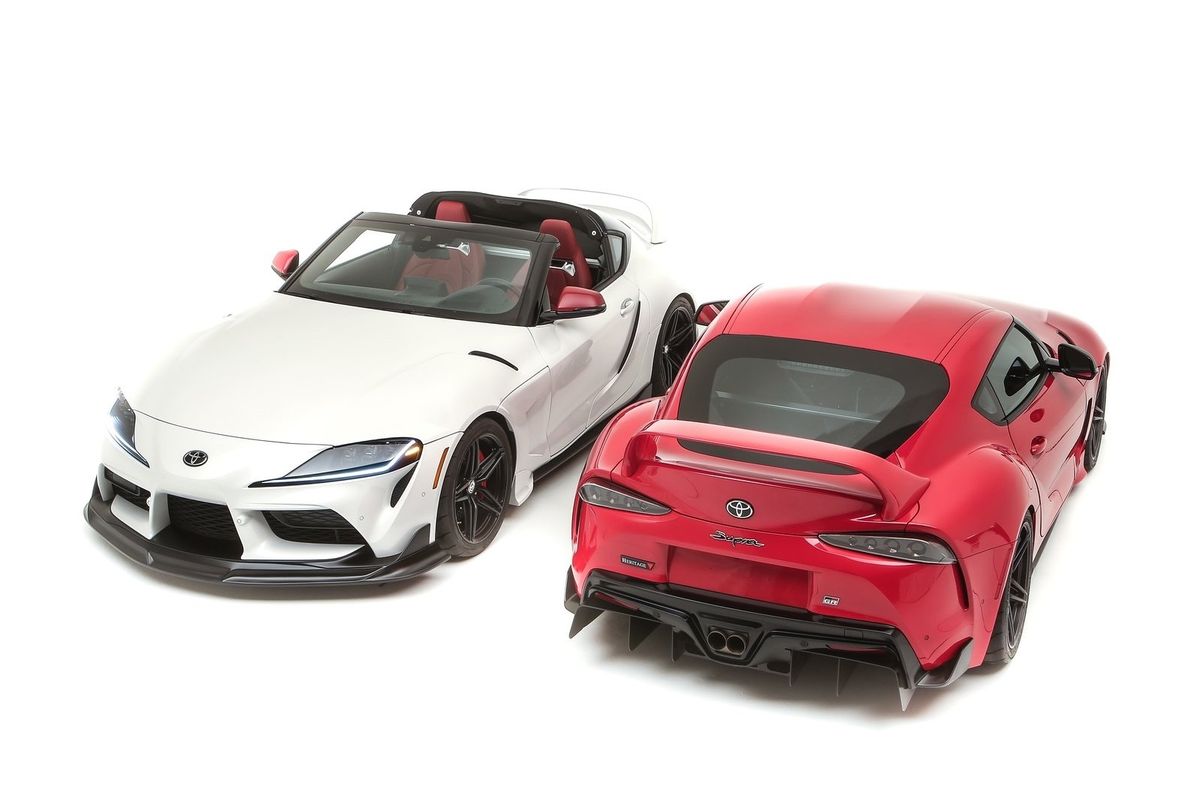
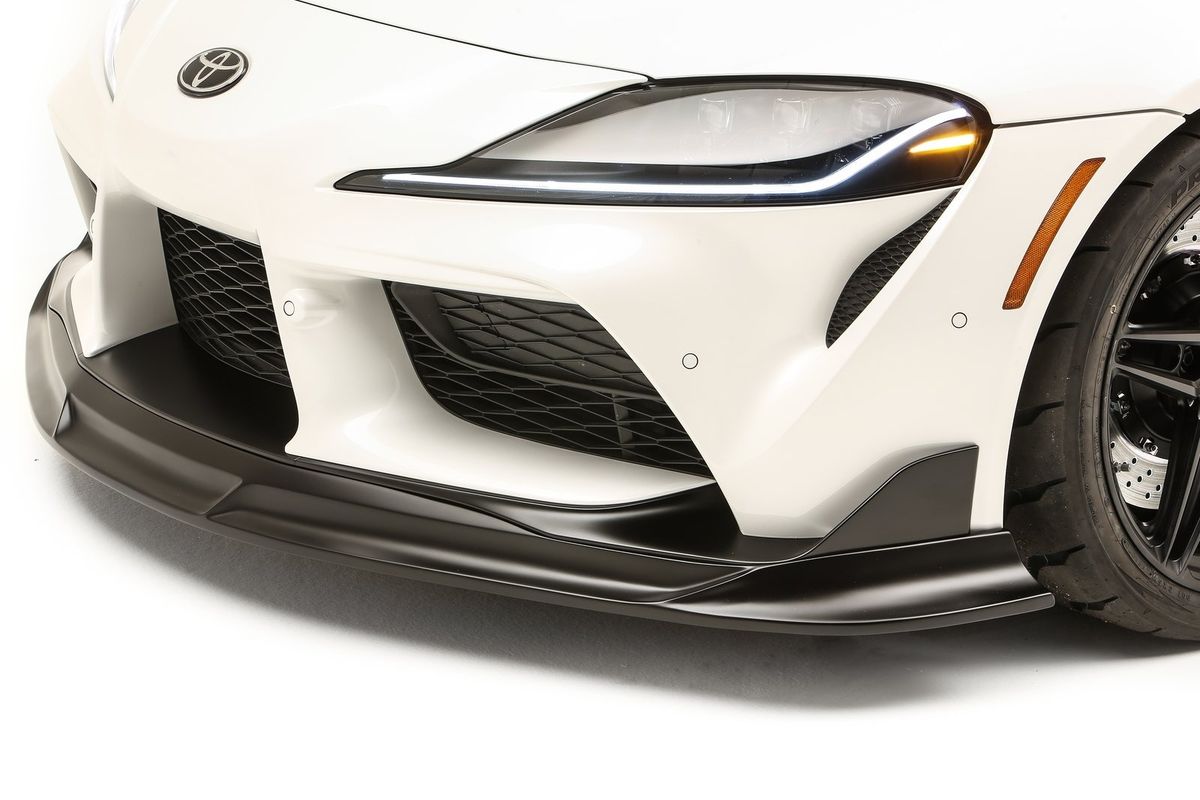
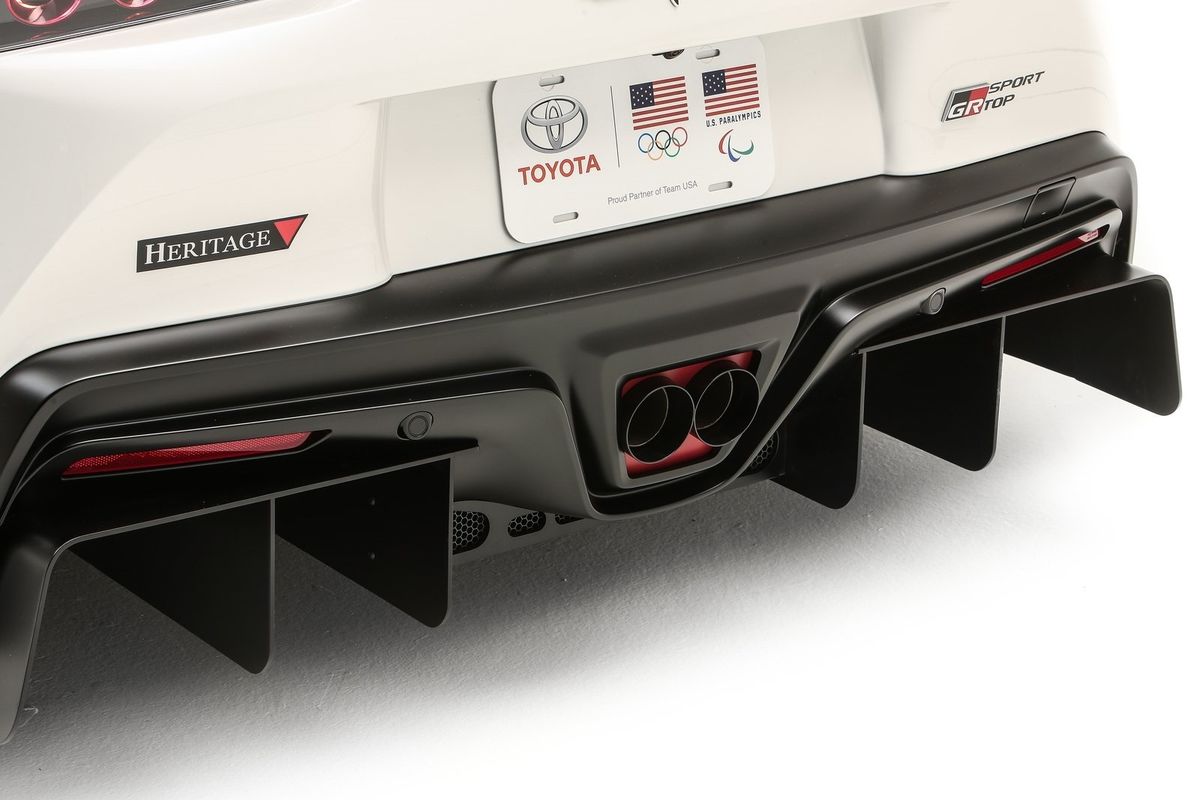
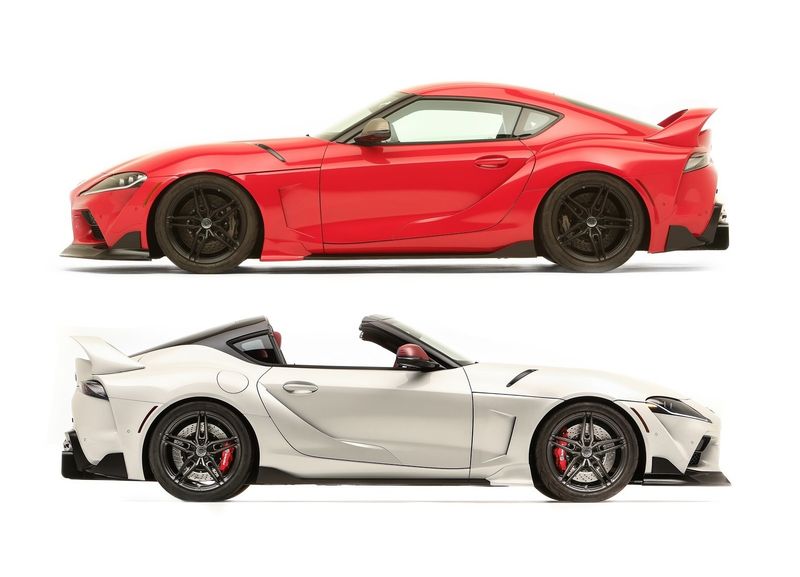
For the 2021 event, the Japanese brand was keen to show off its creations. This is the Toyota GR Supra Sport Top Concept and it’s said to be a tribute to the adored Mk4 Supra of the early 1990s, which was available with a removable roof for some markets.
“We are very excited to finally get a chance to show off both of these incredibly cool GR Supra builds at the SEMA Show,” said Lisa Materazzo, group vice president – Toyota Division Marketing. “The team did some spectacular customization and fabrication work to pay tribute to Supras that came before, and we’re finally going to show them together so SEMA fans can see them up close and personal.”
This Toyota GR Supra Sport Top Concept is a proper conversion, built by Marty Schwerter and the Toyota Motorsports team.
“Toyota really wanted to have a companion to the Heritage Edition. But, this was no easy build, and we put a lot of thought into cutting the roof and removing a significant part of the car’s structure,” Schwerter said. “It was way more complicated than we originally thought. Removing the top was extremely tough and required some innovative work to retain the GR Supra’s rigidity. I love how it came out, and I hope others love it, too.”
Chopping a car’s roof off is not as easy as you’d think as in the vast majority of cars, the roof forms an integral part of the structure and rigidity. In some convertibles, the chassis and body can flex in extreme dynamic circumstances in a phenomenon known as scuttle shake.
In the case of the Toyota GR Supra Sport Top, the roof design features two 3D-printed composite roof panels which have been contoured to the body lines, so the vehicle retains its windshield header and bodywork by the outer roof structure. Impressively, the vehicle’s rigidity has been retained by the additional reinforcement from the engine bay to the back of the tub.
As a reminder, the Toyota GR Supra is powered by a 3.0-litre inline-6 turbocharged petrol engine and for our market, we get the 250 kW and 500 Nm state of tune. This is good for a claimed 0-100 kph of just 4.3 seconds and it’ll run to a top speed of 250 kph.