For this latest round of updates, Porsche has left the Taycan’s styling intact, after all, if it ain’t broke don’t fix it!
So, what’s changed on the Porsche Taycan?
New colours, more tech and improved efficiency encapsulates this update.
However, when the updated 2022 Taycan eventually arrives in South Africa buyers will be able to choose from some truly vibrant colours via the optional Paint to Sample and Paint to Sample Plus palettes which offer no less than 65 colours including Rubystar, which you see in these images. Other colours include Acid Green, Moonlight Blue Metallic, Riviera Blue, Viola Metallic and the list goes on. This is in addition to the 17 standard colours.
Moving inside, perhaps the most notable change is an updated infotainment system which now includes Android Auto capability but note that it’s not yet wireless which is odd for a car that’s so technologically advanced. Porsche’s Voice Pilot voice recognition system has also been updated to better identify and act on instructions and the navigation system is also said to be more streamlined in calculating routes and now also features enhanced graphics.
As an option, the Taycan can also be equipped with Remote Park Assist. With this feature and used in conjunction with the Porsche Connect app, the Taycan can enter and exit a parking space without a driver and it’s also able to execute parallel parking manoeuvres.
In terms of the Taycan’s electric powertrain, range performance is expected to improve due to “extensive technological developments”. In the all-wheel-drive Taycan, the front electric motor can now be ‘decoupled’ when driving in Normal and Range mode and the rear electric motor can be deactivated when coasting or standing still.
Porsche has also placed its focus on improving operational efficiency by enhancing thermal management and charging capability. The Taycan now has a Turbo Charging Planner which prepares the battery for optimal performance by heating the battery which allows for primed fast charging and reducing charge times while still maintaining a high charge level. Furthermore, heat expelled from electrical components is more efficiently used for battery temperature regulation.
The local arrival of the updated Porsche Taycan has not yet been confirmed but we expect to see it on South African roads in 2022. We will keep you updated as soon as more information becomes available.
Developed by Special Vehicle Operations (SVO), the special edition Range Rover Sport SVR Ultimate will be offered in 3 body colours namely Maya Blue Gloss, Marl Grey Gloss and satin-finished Ligurian Black. These colours are in contrast to details in Fuji White seen on the side vents, bonnet and tailgate lettering. The paintwork features fine white glass flake particles in the base coat resulting in a magnificent sparkle. The paint job is matched with a contrasting Narvik Black roof.
The limited-edition Range Rover Sport rides 22-inch split 5-spoke forged alloy wheels with black brake callipers.
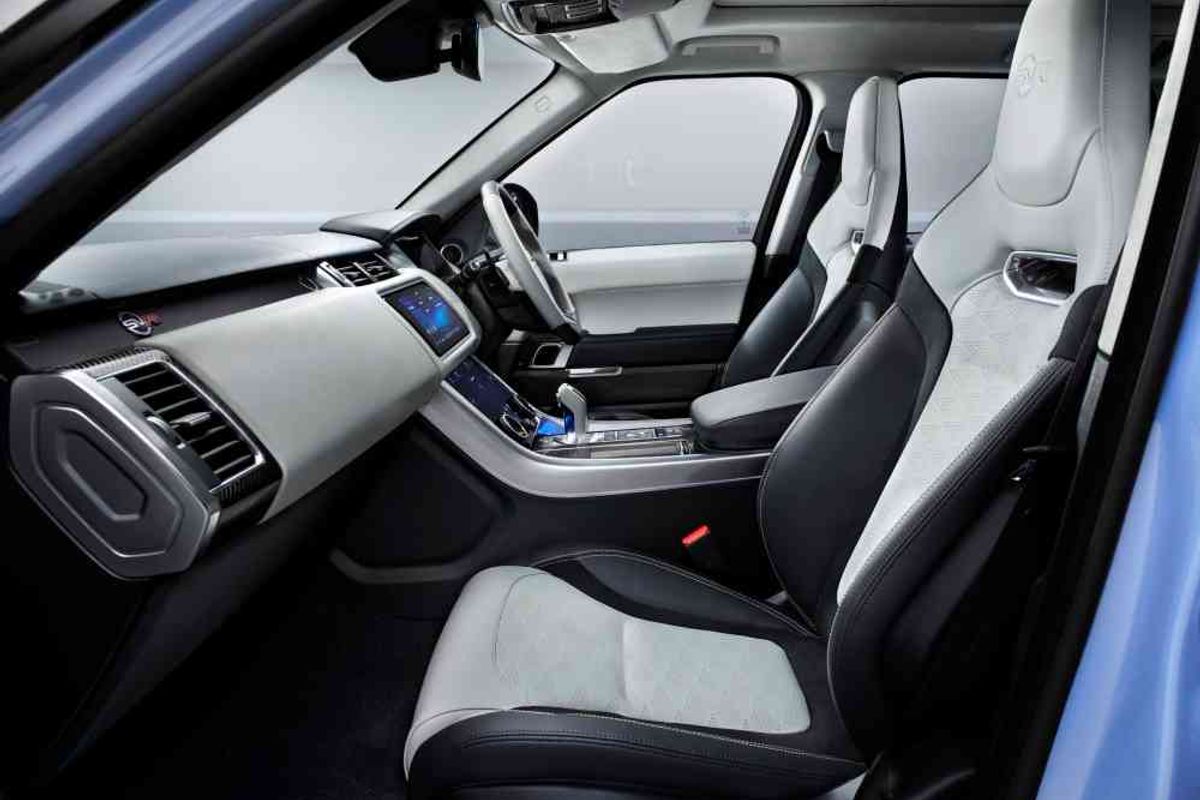
On the inside, the Range Rover Sport SVR Ultimate features SV Bespoke details such as chrome-finished badges on the B-pillar, black anodised metal gear shift paddles and Ultimate edition treadplates. Lightweight performance seats wrapped in Windsor leather and contrasting suede cloth are also fitted.
In terms of performance, the Range Rover Sport SVR Ultimate is powered by the familiar supercharged 5.0-litre V8 engine that produces 423 kW and 700 Nm and it will sprint from zero to 100 kph in just 4.5 seconds before reaching a top speed of 283 kph.
Pricing details will be revealed closer to launch early in 2022.
A new coupe-like Haval H6S family car is due to be introduced in China soon. Do you want to see it in South Africa?
The success story of Haval in South Africa is nothing short of phenomenal. Since its local arrival in 2017, Haval has been climbing the sales charts and scalping some big brands along the way, such as Renault and Kia, with Suzuki firmly in its sights. The Chinese firm is currently ranked 7th and is achingly close to claiming a spot in the Top 5 best-selling car brands in Mzansi.
Following the successful local introduction of the Haval Jolion compact SUV, Haval recently welcomed the new H6 to market. We are eagerly waiting to test the new H6 but based on the pricing and specification of the new H6, we have a sneaky suspicion that the H6 is going to sell up a storm in the months to come.
Enter the Haval H6S, a sporty coupe version of the H6
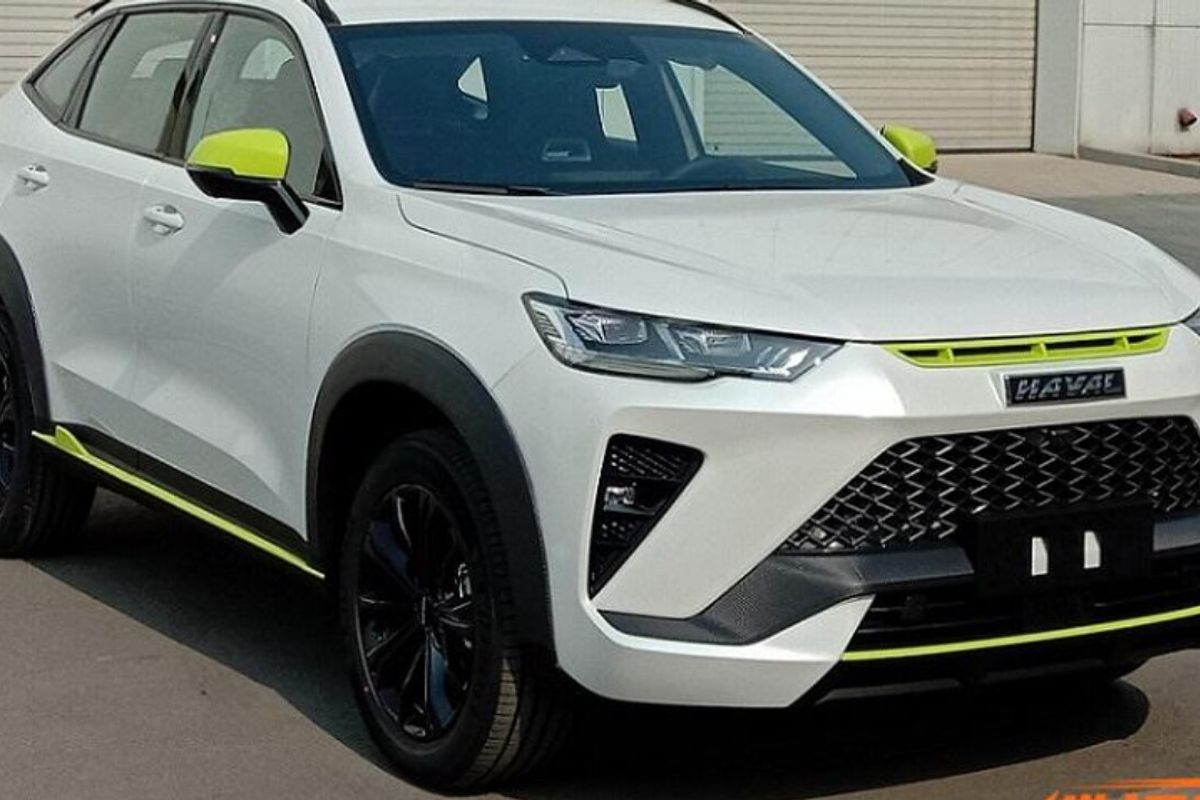
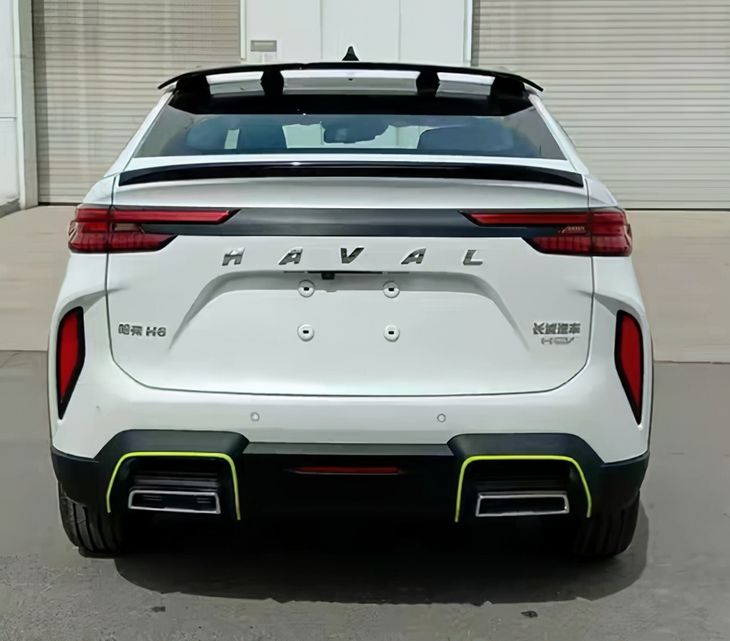
Spoilers and an expressive tailpipe design gives the H6S a sporty look.
The H6S is initially destined for the Chinese market and is said to take design inspiration from sharks, hence the double rear spoiler and edgy line work. Note that there’s also an integrated spoiler in the boot lid. At the front, the H6S gains a bold design with a large bumper, mesh-like grille and air intakes that look like gills, perhaps… Dual exhaust outlets are found at the rear, with pronounced edging which emboldens its rear end.
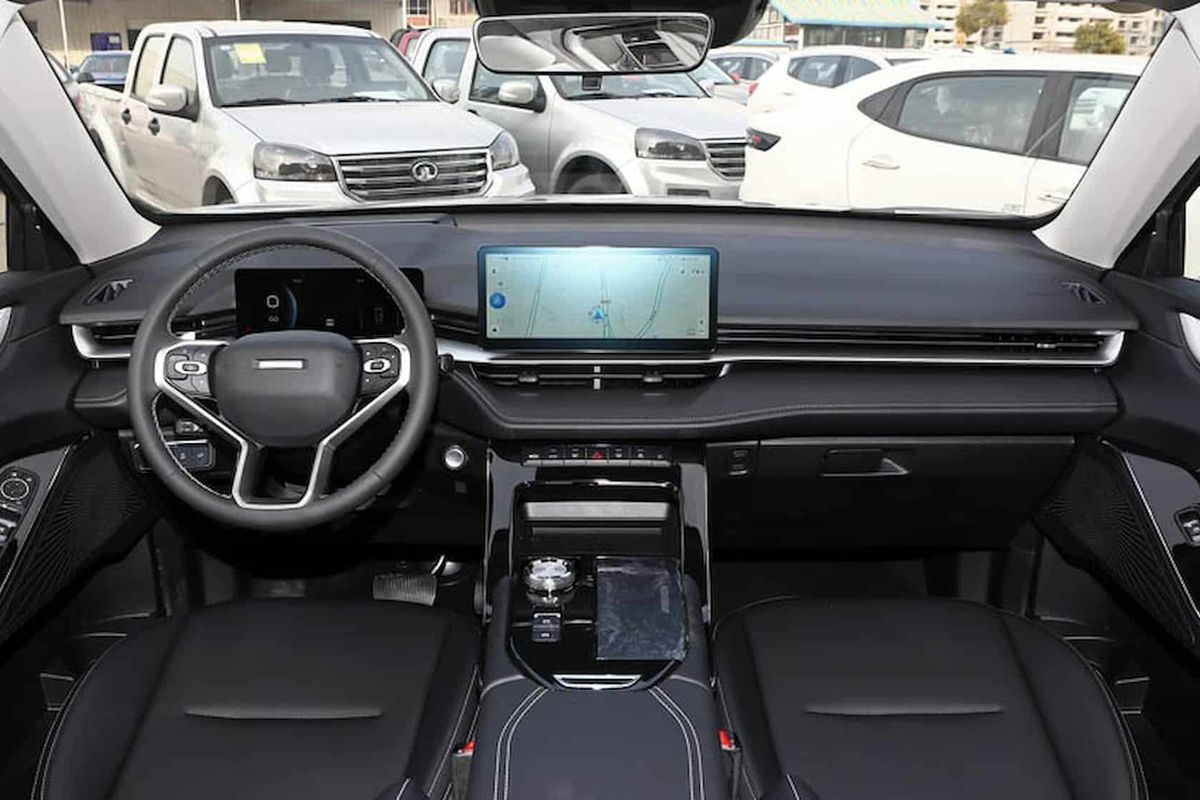
The sportiness is carried into the interior with Alcantara wrapped bucket seats and the H6S is equipped with a large 12.3-inch infotainment touchscreen and a 10.25-inch digital instrument cluster and heads-up display.
Unlike the standard H6 which employs a 2.0-litre turbopetrol engine with 150 kW and 320 Nm, the hybrid H6S combines a 1.5-litre turbopetrol engine with an electric motor to produce a heady 179 kW and 530 Nm, driving the front wheels via a 2-speed automatic transmission. Haval claims a fuel consumption figure of 4.9 L/100km.
The Haval H6S doesn’t appear to have any direct rivals other than the Toyota RAV4 Hybrid (which is not on sale in SA yet) but perhaps the Volkswagen T-Roc and Hyundai Tucson N Line are the closest rivals in terms of styling.
Further details regarding the Haval H6S are expected soon and it’s not yet clear whether it will be produced for right-hand-drive markets.
Would you want to see this Haval H6S in South Africa?
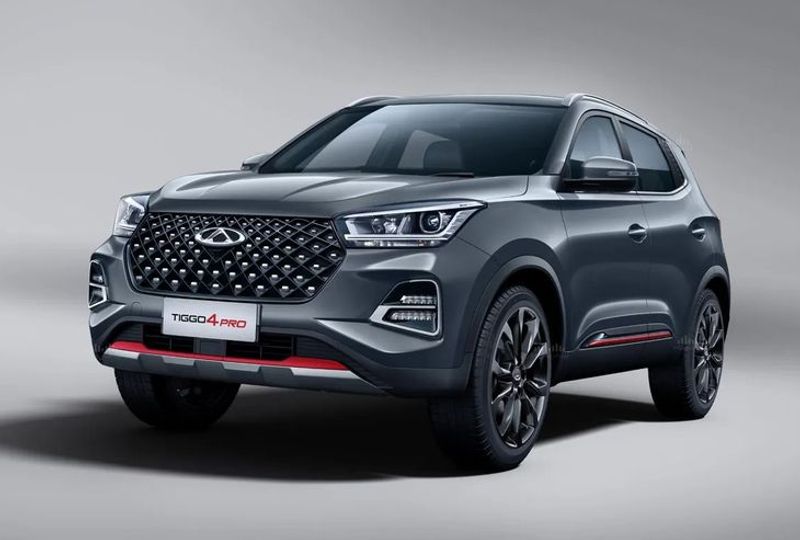
Haval has transformed into a substantive local brand despite the challenges, and with South Africans buying down, Chery is also keen to reengage with the local market.
Forget about the memory of awful Indicas and Indigos. The new Tata passenger vehicle range will trend towards compact crossovers – and we’ve now seen the first image of exactly such a vehicle, from Tata.
It is called the Punch and is an evolution of the Indian company’s HBX Concept. What size is it? Tata hasn’t confirmed dimensions, but the HBX Concept was 3.84m long and served as the base for this new Punch.
Engines? The standard configuration for this segment is a three-cylinder and the expectation is that Tata will equip the Punch with 1.2-litre triples, both naturally aspirated and turbocharged.
These engines are already in service with the Altroz, where a naturally-aspirated 1.2-litre is good for 63 kW and 113 Nm, with the turbo version boosting 81 kW and 140 Nm.
The only gearbox that Tata has available with its 1.2-litre engines, is a five-speed manual.
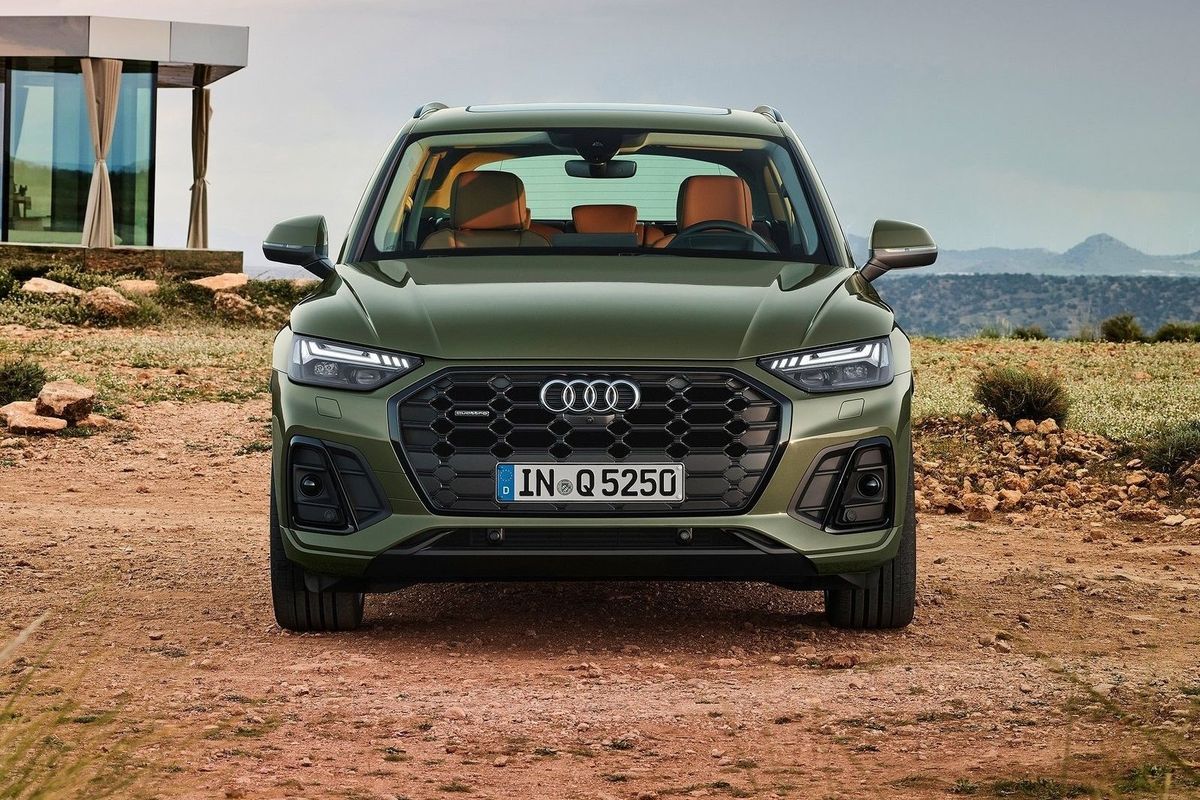
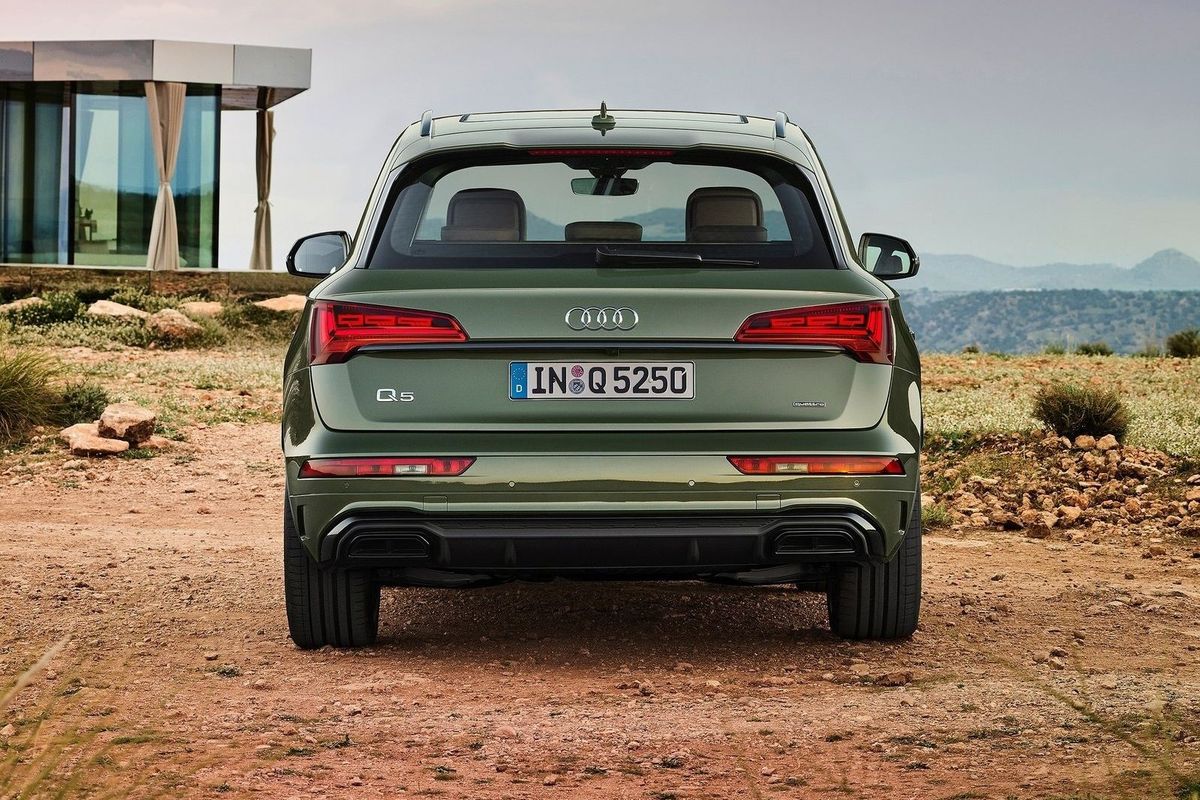
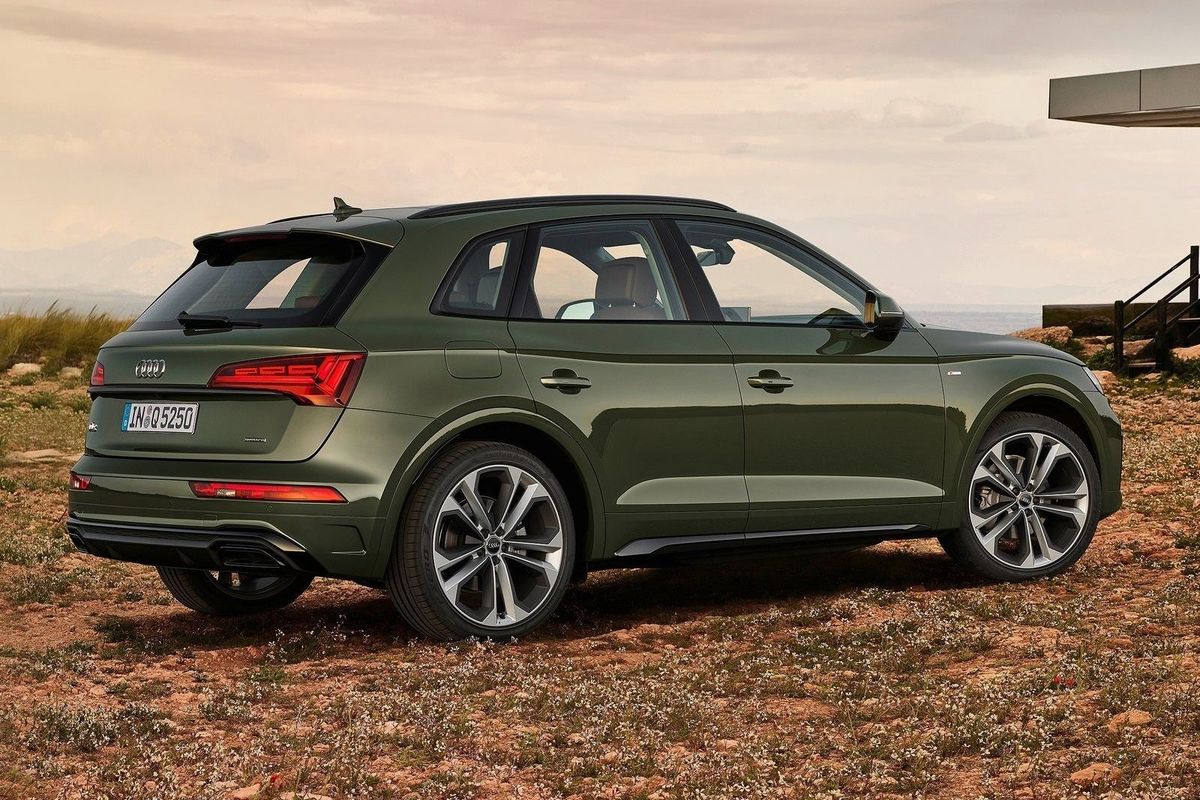
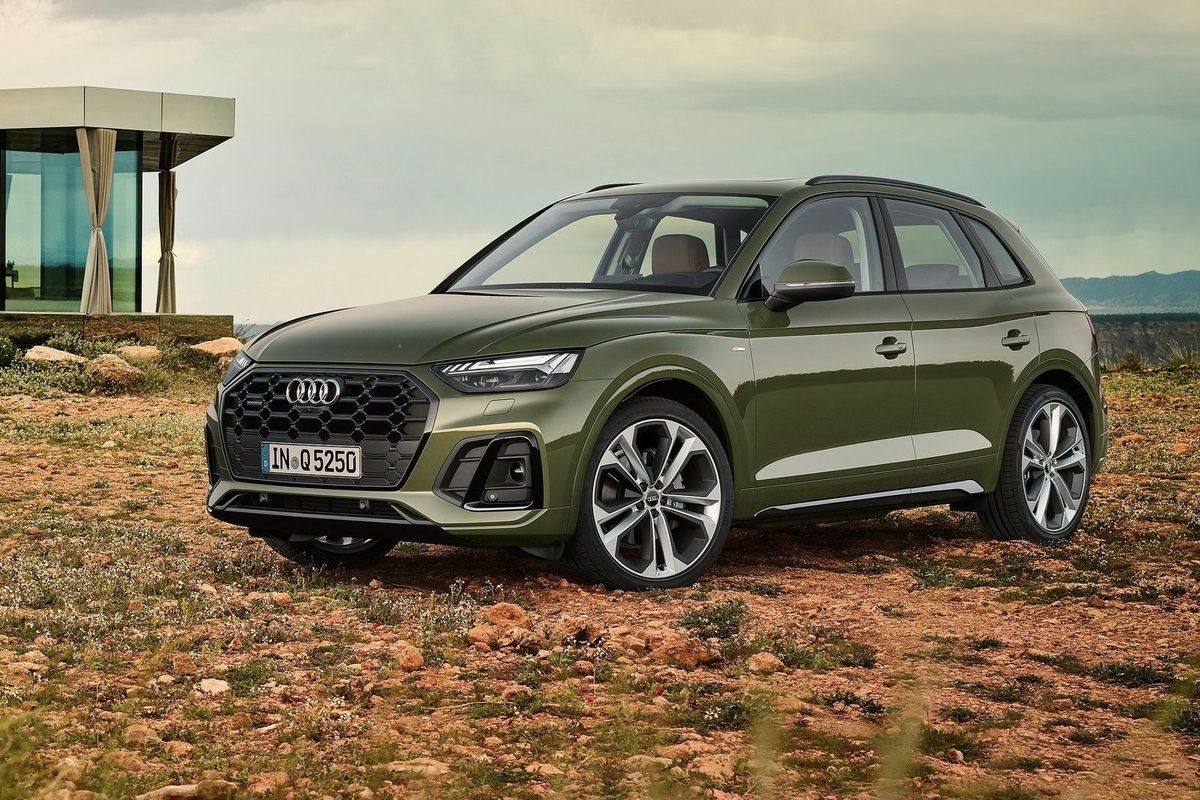
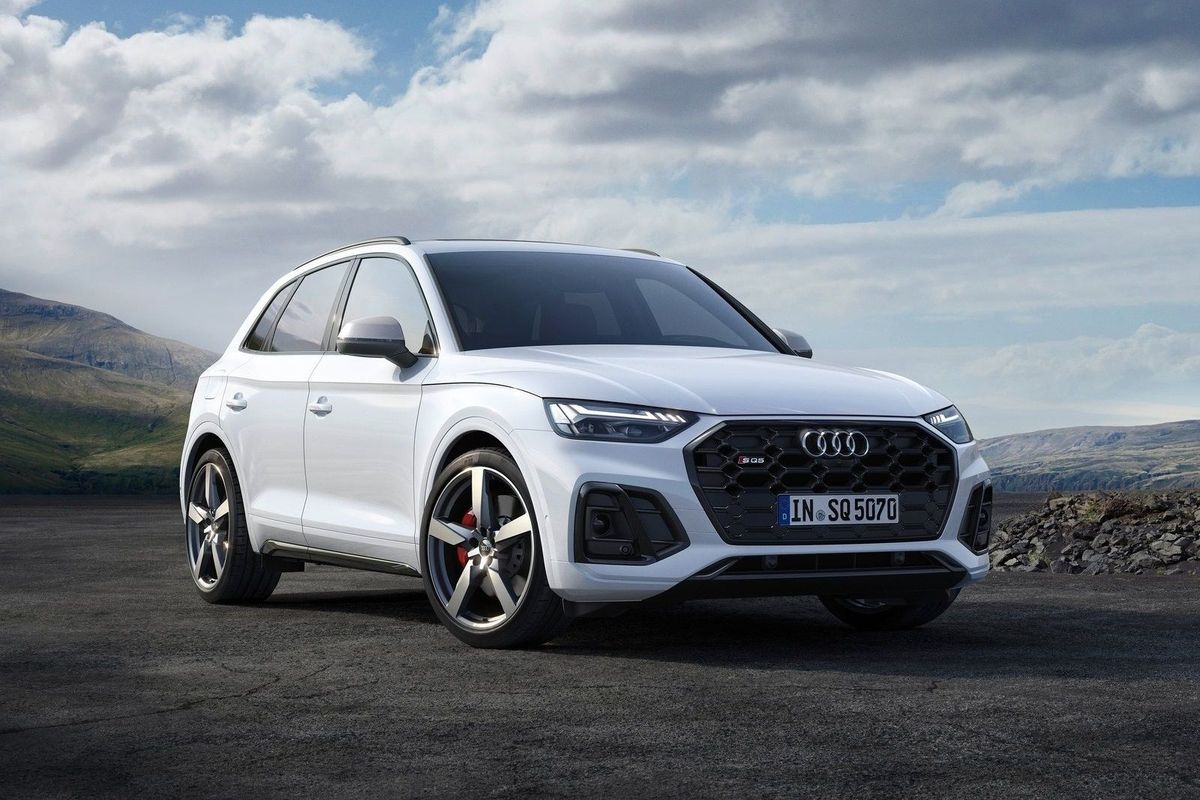
The updated Q5 will be touching down in South Africa on the 1st September 2021. Here we list some of the changes, the model line-up and how much you can expect to pay for the 2021 Audi Q5.
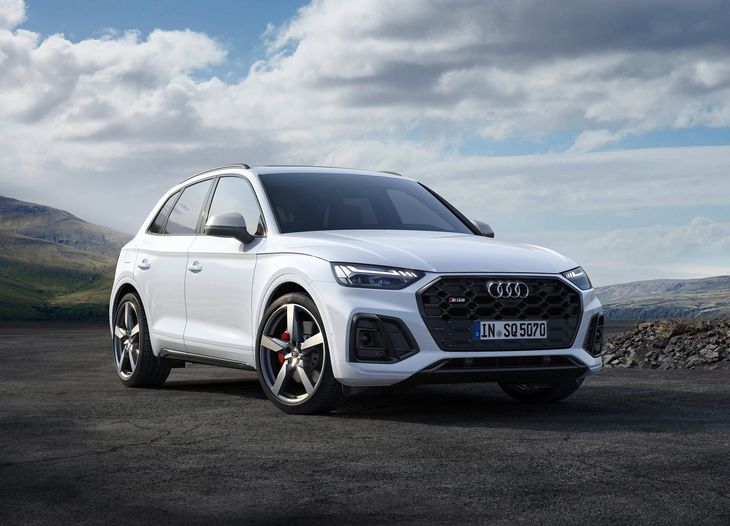
Visually, the updated Q5 wears a more refined face that incorporates a revised octagonal single-frame grille design flanked by newly designed LED headlights (Matrix LED optional) with a new, integrated Daytime Running Light (DRLs) signature. More so, the air intakes adopt a more vertical design approach which exudes more sportiness which is reminiscent of the brand’s RS models. Moving to the rear, a new diffuser element with a horizontal fin is seen as well as a new trim element between the rear light clusters. Talking about the rear light clusters, Audi has introduced digital Organic Light Emitting Diode or OLED lighting technology which now features on the Q5 for the very first time. OLED’s are said to be far more efficient than conventional or even LED lighting solutions.
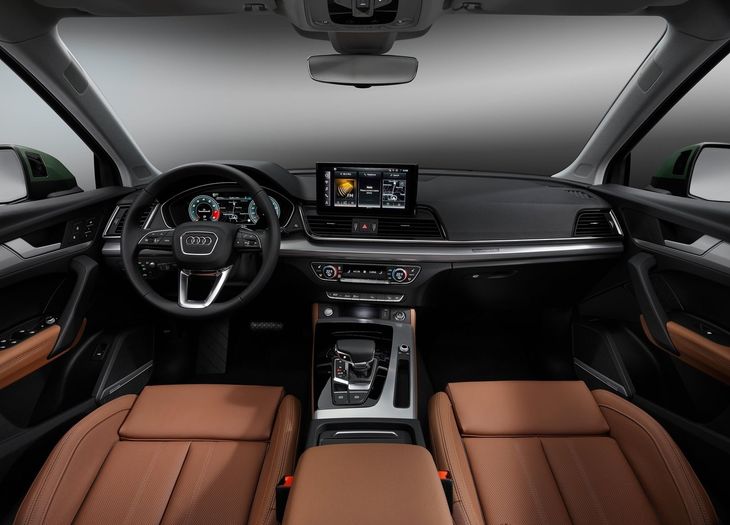
The interior of the Q5 remains mostly familiar and now features a new 10.1-inch MMI touch display with acoustic feedback while the previous rotary/push control in the centre console is no more and has been replaced with a storage bin. The Q5 is also equipped with the third-generation Modular Infotainment Platform (MIB 3) which is said to offer 10 times more processing power than the previous MIB 2 system.
The Audi Q5 interior
Audi Q5 Engines and Performance
Audi South Africa is offering the updated Q5 SUV in both petrol and diesel derivatives, with a flagship performance SQ5 sitting at the top of the pile. Every Q5 features quattro all-wheel drive as well as a 7-speed S tronic dual-clutch gearbox. Starting us off is the diesel 2.0-litre with 140 kW and 400 Nm. Audi claims 4.9 L/100 km and the vehicle is good for a 0-100 kph in just 7.9 seconds and a top speed of 218 kph.
For those wanting some petrol, the 2.0-litre develops 185 kW and 370 Nm, and is brisker to 100 kph at 6.3 seconds and it will reach a top speed of 237 kph. It’s slightly heavier on juice at 6.9 L/100 km. Finally, the SQ5 packs 260 kW and 500 Nm from its 3.0-litre turbocharged V6. It’s quick, with a 0-100 kph sprint time of 5.4 seconds and it has a limited top speed of 250 kph.
The Audi SQ5 will be the fastest model in the lineup
How much does the facelifted Audi Q5 cost in South Africa?
The new Q5 range will officially go on sale in South Africa from 1 September 2021 and comes standard with a five year Audi Freeway Plan:
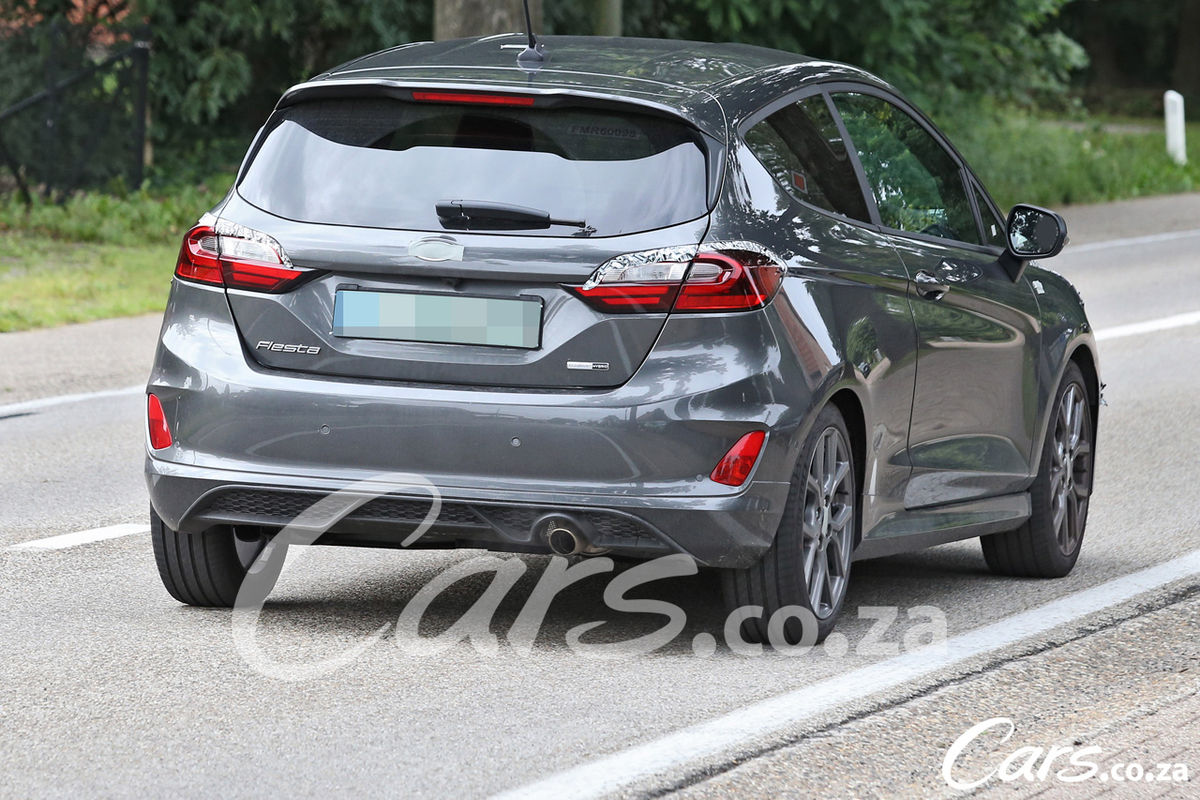
Ford’s globally popular compact hatchback is due a facelift having not undergone any significant changes since this generation’s introduction in 2017.
Picture credit: S. Baldauf/SB-Medien. We have paid for these photos and at the photographer’s request, have watermarked them.
Ford South Africa may be moving towards an SUV and bakkkie future but its Fiesta remains a favourite in the compact hatch segment, even if sales are a fraction of the heights they were some 5 to 10 years ago.
The Fiesta used to be the segment-leading Polo’s closest competition but rivals have taken over its spot offering newer, more advanced tech at similar prices. Then, there’s the compact SUV segment, which has further cut Fiesta sales leaving it languishing down on the sales charts. There is hope though as the facelift looks to be ready for 2022.
These spy shots don’t reveal any major design changes for the updated model beyond some new front bumper and light treatment as well as a new rear light signature. We can be fairly sure that nothing new is going on with the chassis either as this generation is expected to run until 2024/25. Minor suspension tuning may take place, but fundamentally this chassis has been around since the 2008 Fiesta was launched (barring a few tweaks to the suspension here and there).
With the Fiesta being produced by Ford Europe, the question of what will happen to the Fiesta after 2024/25 is up for discussion. Ford Europe has committed to an electric future from 2030 in Europe so the next model may be all-electric or be scrapped for something entirely different. Outside of Europe, Ford would have to decide if it’s worth selling an ICE Fiesta in markets where it can exist or whether the cost is worth it.
Ford has already canned its ST models locally, causing some strife with local fans of the brand but poor fuel quality and expensive import costs have made it difficult to make a business case for the ST brand. Check out our favourite ST models here.
Ford Fiesta engines
The entire Fiesta range is powered by the 3-cylinder turbopetrol engine, which will in all likelihood continue in the facelift model too. A 48V hybrid model would certainly be on the cards for Europe but globally, the standard, non-electric assist models would be more popular.
Ford South Africa has still yet to confirm if the facelifted Fiesta will be sold in SA.
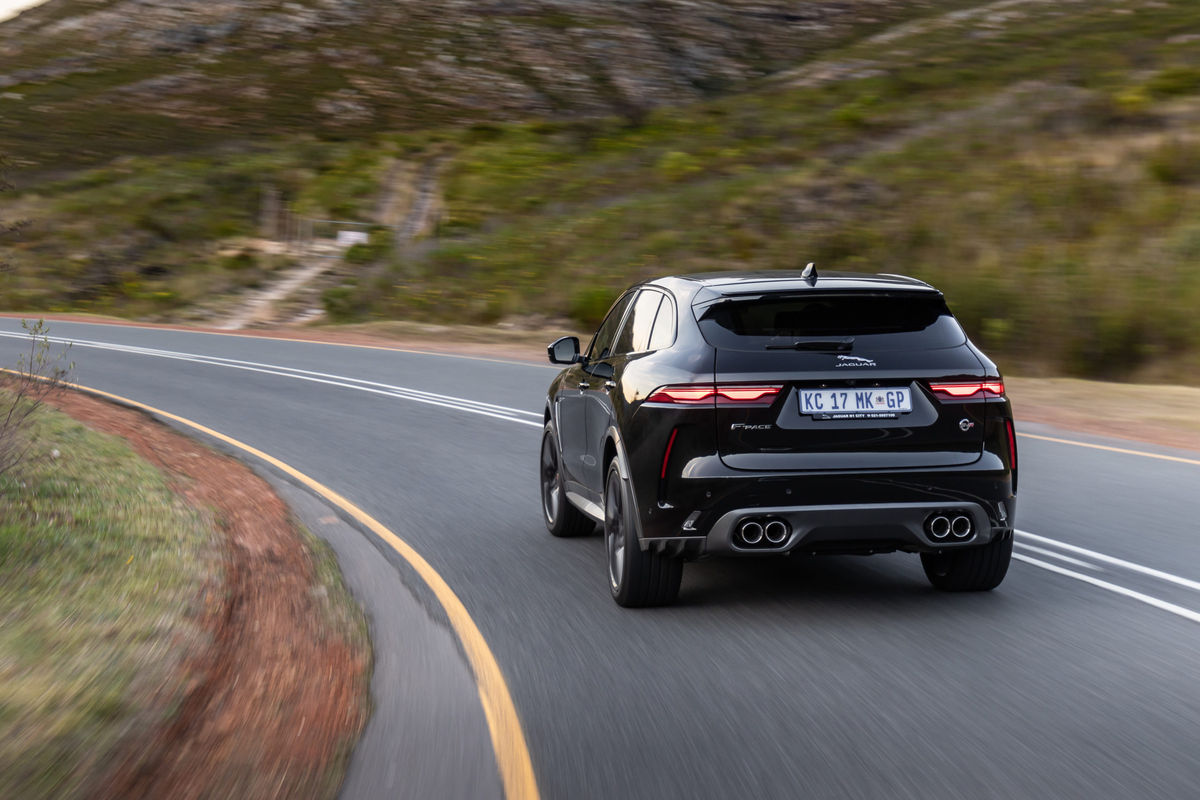
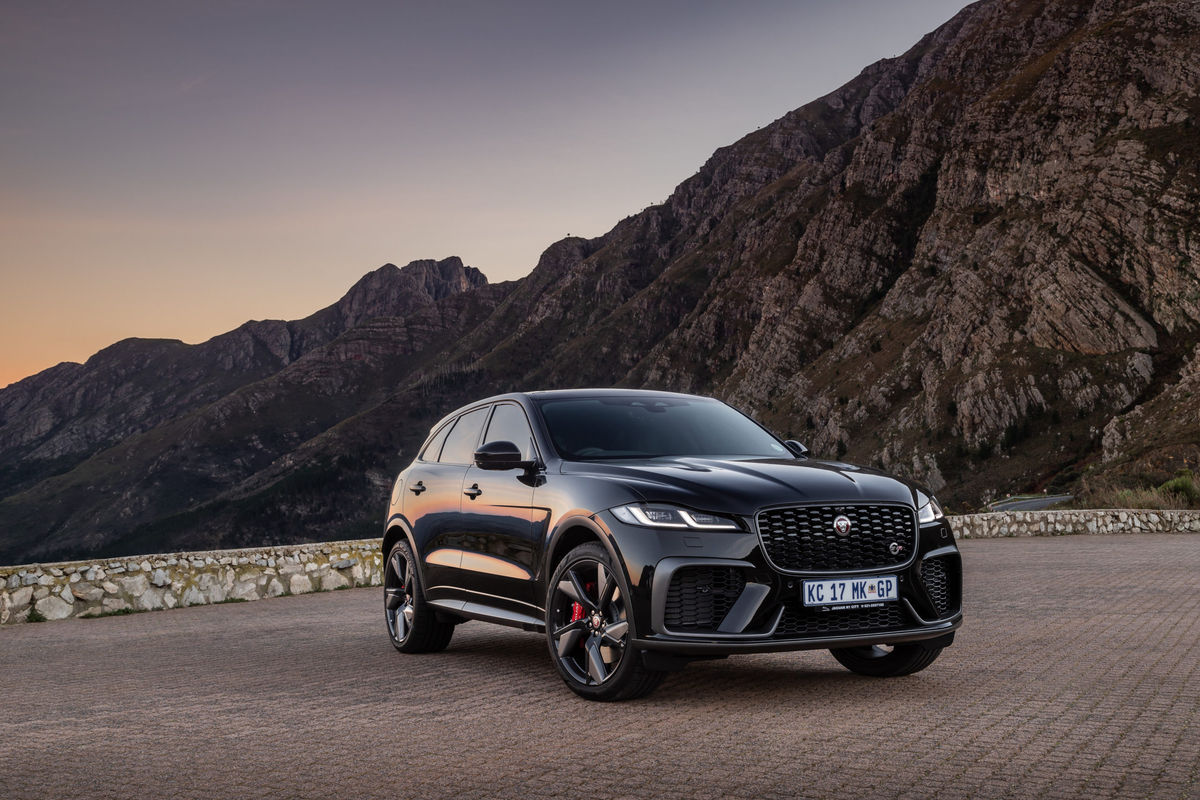
The flagship performance derivative of the updated Jaguar F-Pace has landed in South Africa. See how much the facelifted F-Pace SVR with a supercharged V8 costs, plus just how fast is it?
Performance SUVs are all the rage currently. With big capacity turbocharged petrol engines, all-wheel drive and space for the whole family, many would say the performance SUV is all the vehicle you’d ever need.
With the segment dominated by the German trio, many forget that the British have some pretty potent offerings too. The SVR range features a supercharged 5.0-litre V8 petrol engine and it sounds absolutely magnificent.
Jaguar has shoved this engine into its facelifted F-Pace and created the F-Pace SVR. In this application, the 5.0-litre supercharged V8 is tuned to deliver 405 kW and 700 Nm, giving it a claimed 0-100 kph of 4 seconds and a top speed of 286 kph. In comparison, the outgoing model featured 20 Nm less and could muster a 4.3-second run to 100 kph.
Jaguar says its additional performance comes from the same 8-speed torque converter transmission that’s found in the Jaguar XE SV Project 8 super sedan plus a new dynamic launch feature that helps maintain engine power to the wheels during gear shifts. The vehicle is driven by all 4 wheels and is available with adaptive dampers, which have been recalibrated to offer a comfier ride at slower speeds.
Other noteworthy mechanical upgrades range from the new electronic power-assistance steering system and improved brakes which is said to offer a sportier feel. There’s also additional cooling for the brakes, which you can imagine is vital as they work hard to bring this vehicle to a stop.
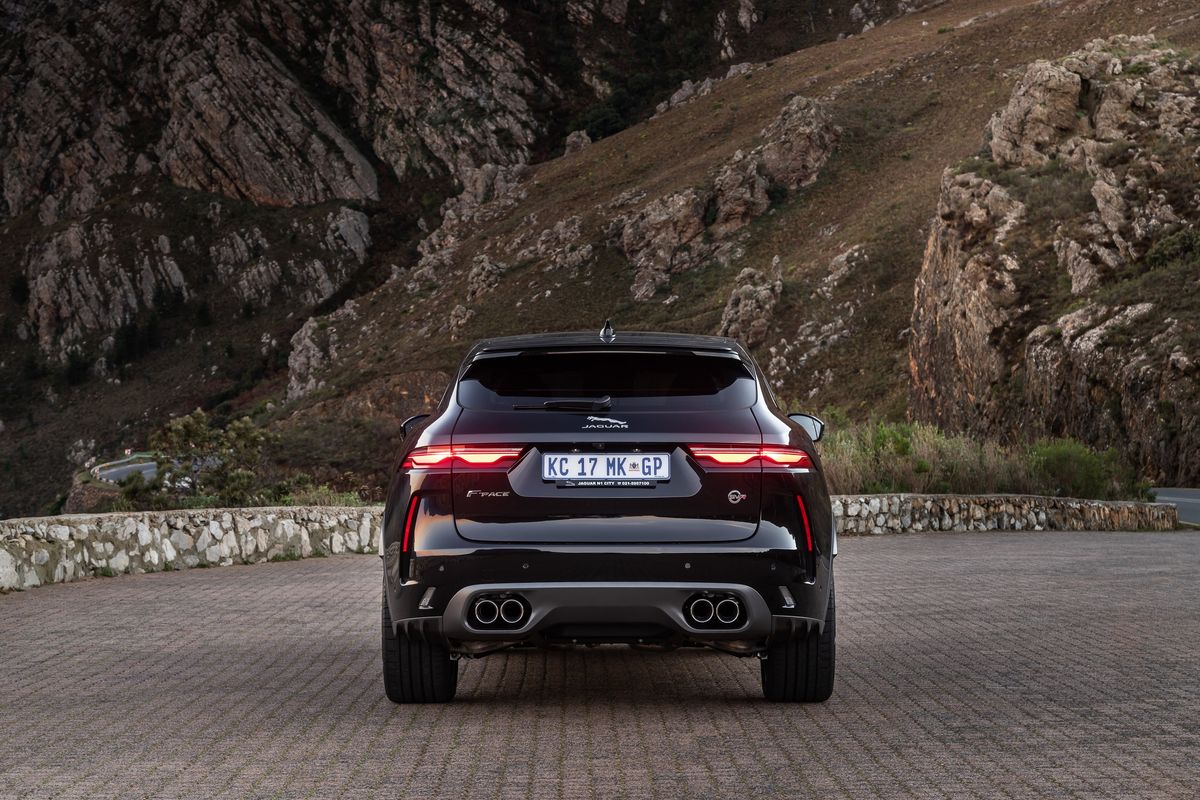
You can spot the updated Jaguar F-Pace SVR with its enhanced aerodynamics package. There are plenty of vents and ducts to improve cooling and how it cuts through the air. Jaguar says its new aero reduces aero lift by 35% and its drag coefficient has improved slightly. Jaguar is offering its updated F-Pace SVR with the Black Pack styling option.
Inside, the updated Jaguar F-Pace SVR features a redesigned cabin with new trim and materials, a new 12.3-inch digital dashboard, new Pivi Pro infotainment system as well as a new Jaguar Drive Selector, complete with SVR logo. There’s also a new SVR steering wheel with zinc-alloy gear shift paddles.
How much does the F-Pace SVR cost in South Africa?
The new Jaguar F-PACE SVR is available in South Africa now with a starting price of R1 835 700. The vehicle is sold with a standard 5-year/100 000km Jaguar Care Plan and warranty.
We spent a weekend getting to know the Ford EcoSport 1.5 Ambiente Black a bit better. Do the cosmetic changes enhance the appeal of this long-serving compact family car?
The Ford EcoSport has been the segment’s top-seller for quite some time and, in response to recent arrivals of fresh-faced competitors, Ford has given its base Ambiente 1.5 Auto derivative a makeover.
Considering that the newcomer’s nomenclature is EcoSport (1.5 Ambiente) Black, you would expect it to feature some dark visual enhancements, but whereas the cosmetic embellishments of the Sport versions of the Ranger and Everest models are part of an optional add-on package (or pack, in Ford parlance), the Blue Oval’s latest small crossover is a new, standalone mid-range derivative.
In time-honoured tradition, the Ford EcoSport Black looks even sportier by virtue of its “go-faster stripes”.
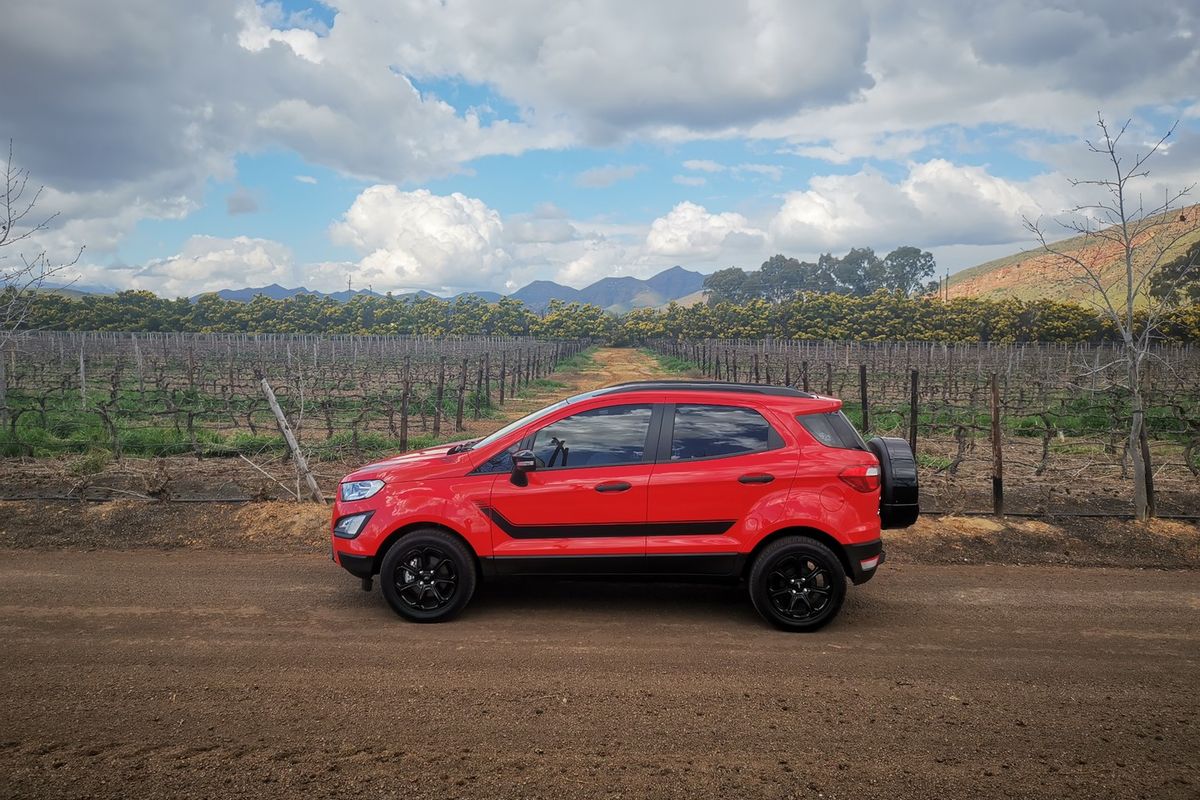
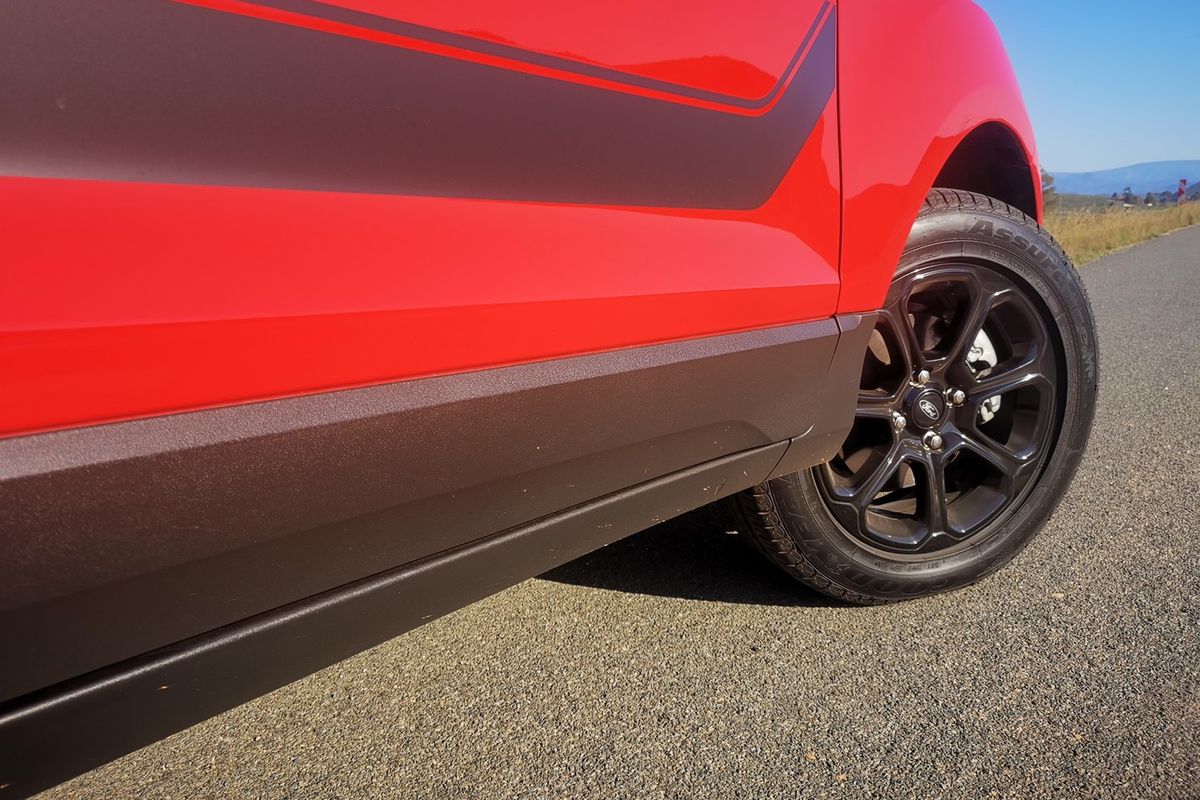
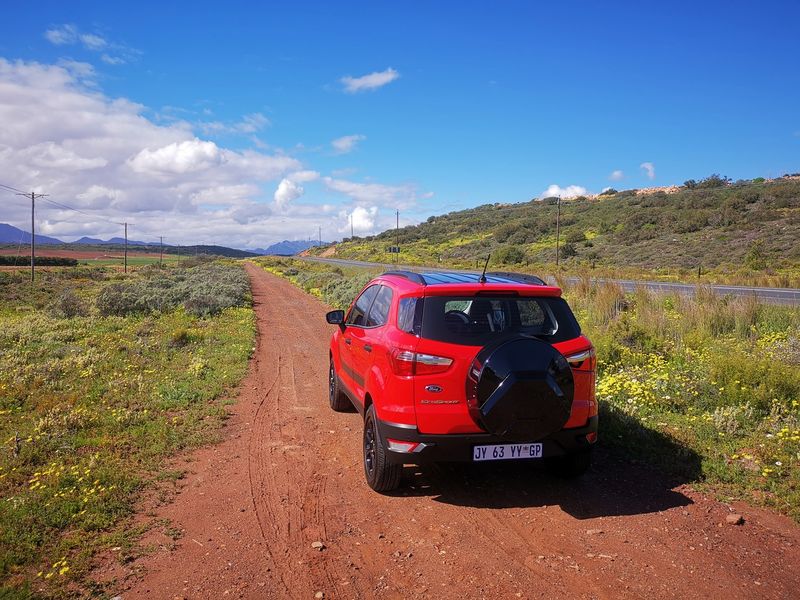
At first glance, you’re likely to notice the black decals on the EcoSport’s flanks and bonnet, with matching finishes for the grille, bumpers, side sills, wing mirrors, roof, 16-inch alloy wheels (which replace the standard 15-inch steel units) and even the spare wheel cover on the tailgate. Our test unit was finished in very bright red, which, interestingly, doesn’t seem to be available on Ford SA’s local configurator.
The EcoSport Black is powered by a 1.5-litre 3-cylinder petrol engine that drives the vehicle’s front wheels via a 6-speed automatic transmission. The motor’s stated peak outputs are 91 kW and 151 Nm and, like most compact family cars, there’s no part-time 4×4; the Ford relies on its 206 mm of ground clearance to get you through – or up and over – the rough stuff.
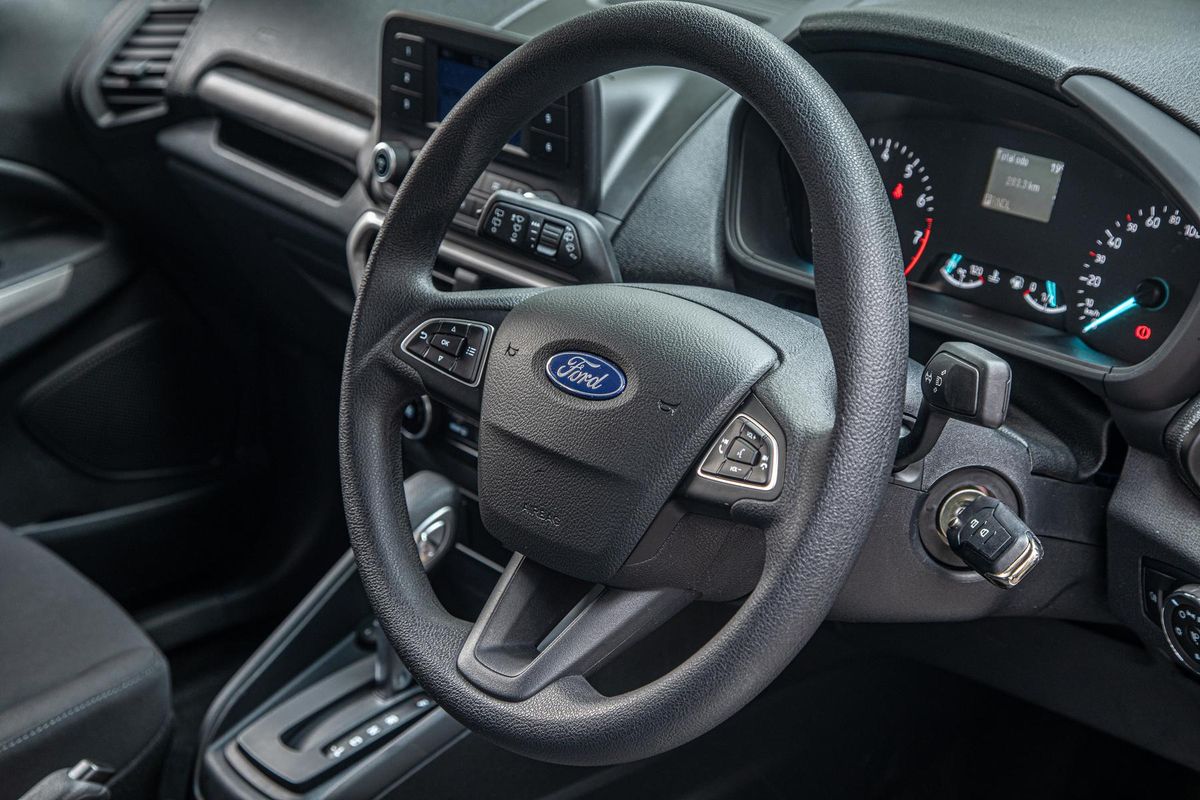
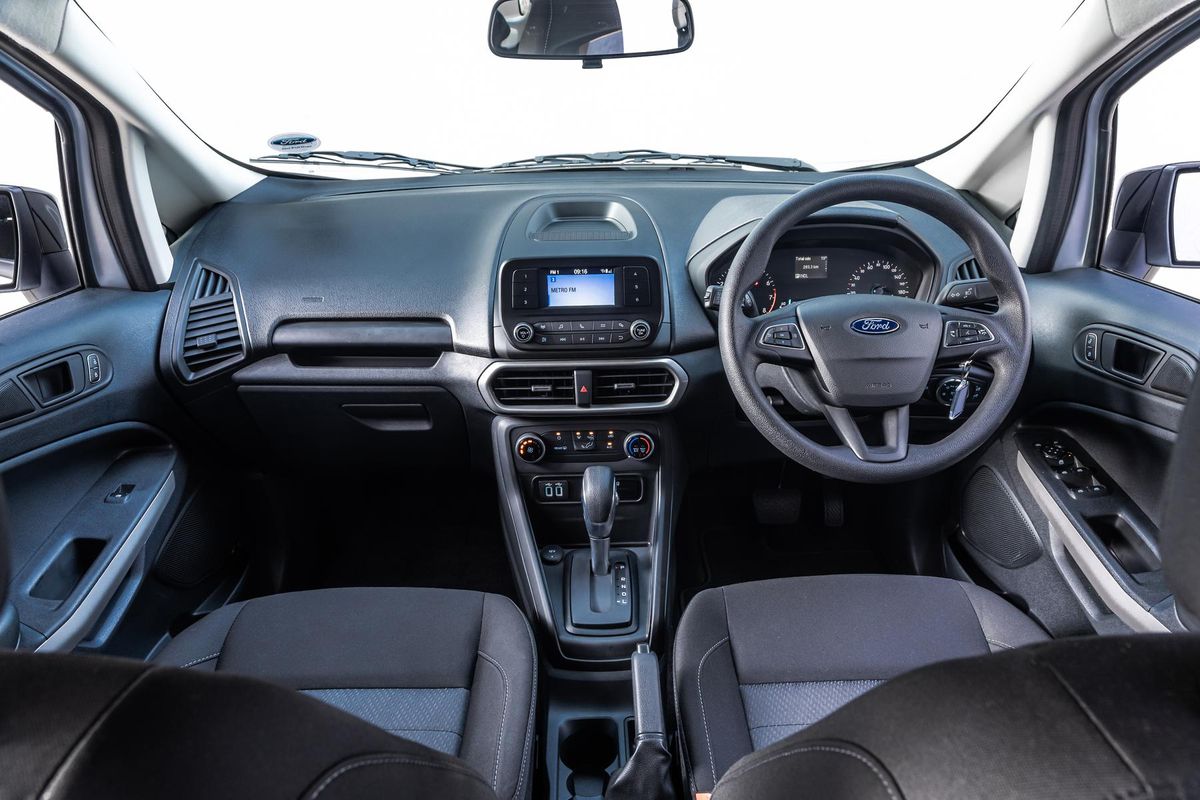
Standard equipment covers the basics, including a (particularly effective) air-conditioner, power steering, electric windows all around, rear parking sensors, and a 4.2-inch infotainment system with 2x USB ports, Bluetooth connectivity and 6 speakers. Safety-wise, the EcoSport Black has 6 airbags, anti-lock brakes and electronic traction- and stability control.
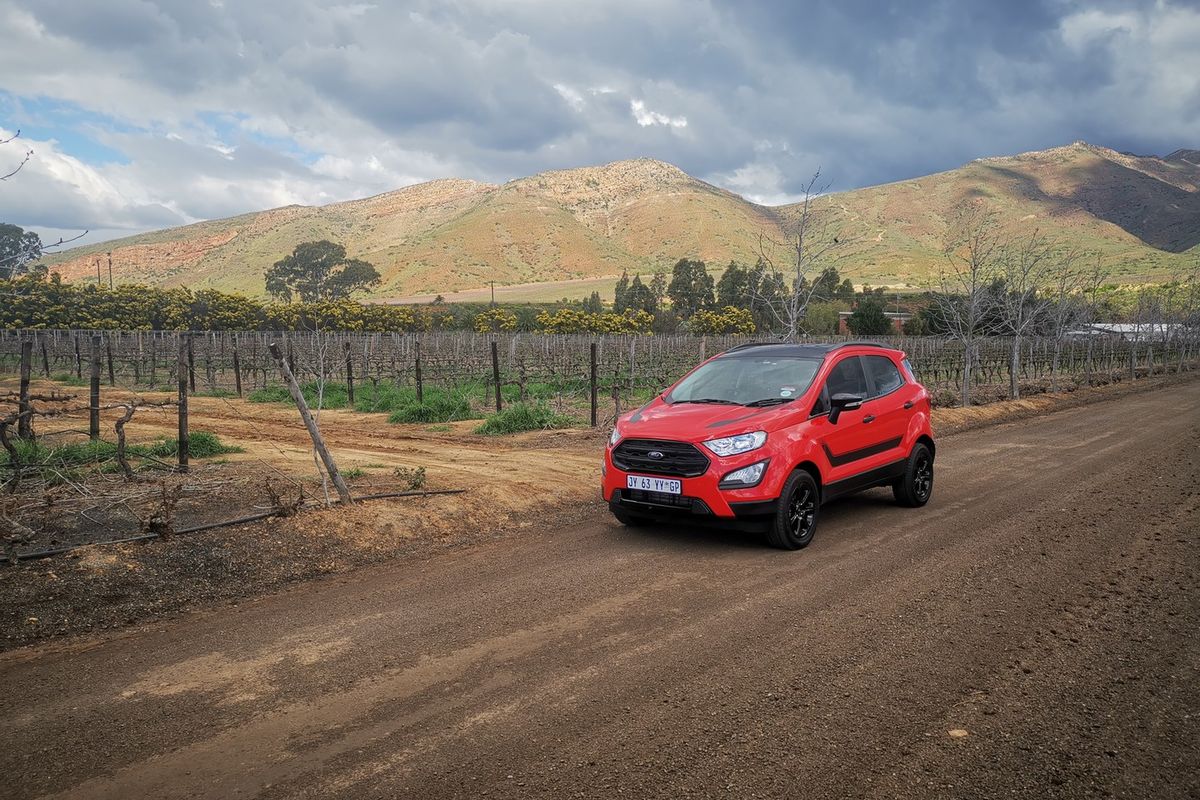
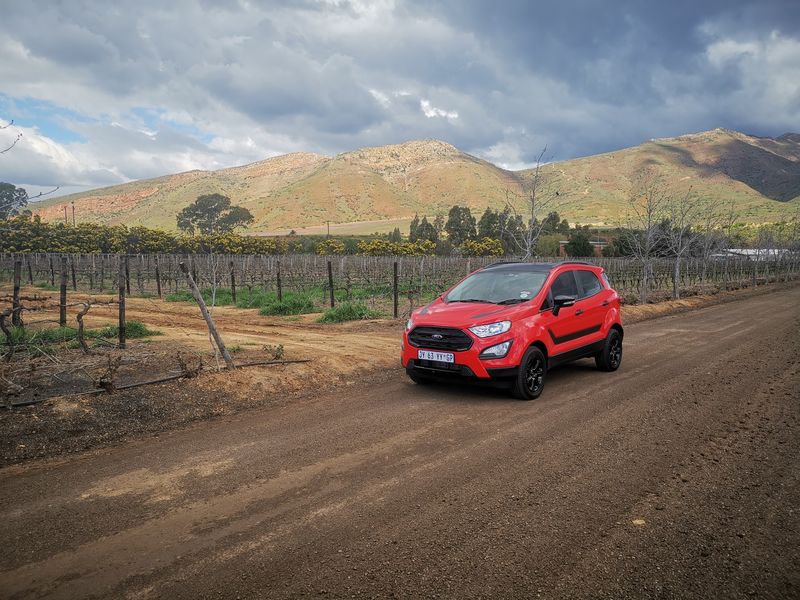
The Ford EcoSport Black is adept at travelling on the dirt.
What is the Ford EcoSport like to drive?
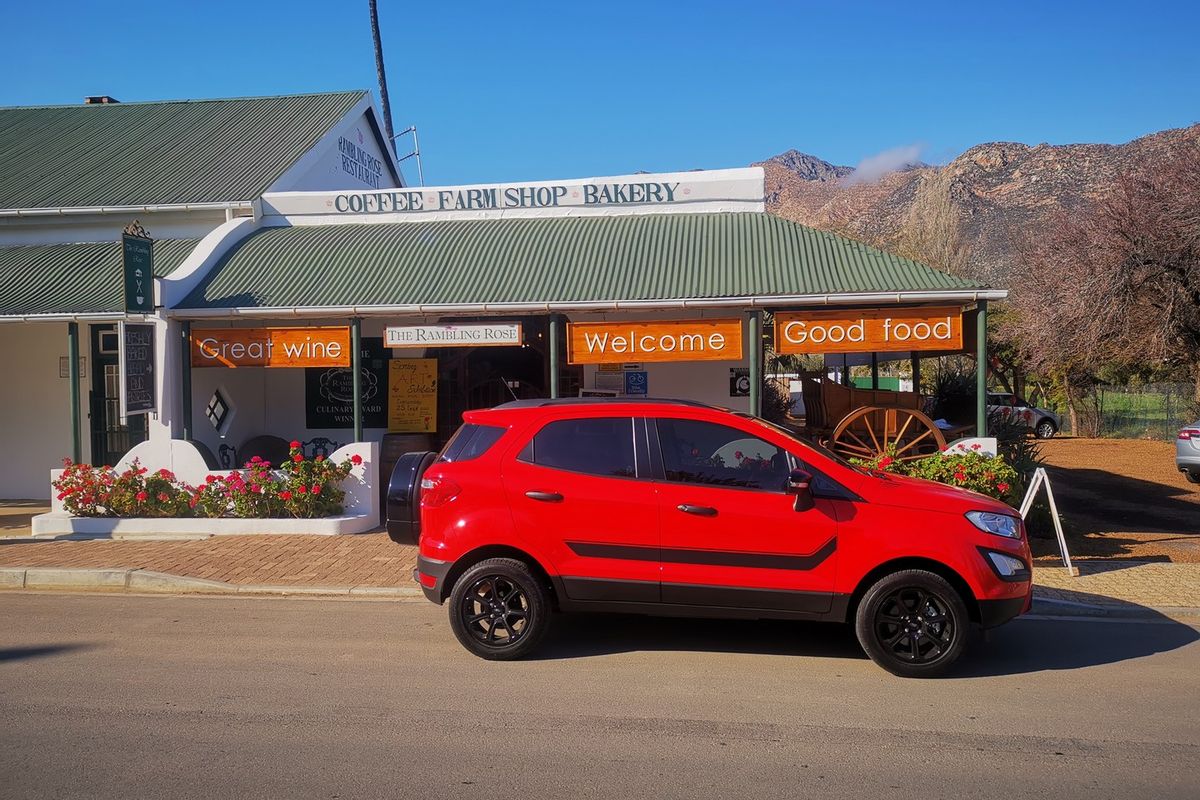
Thanks to the ongoing Covid-19 pandemic, new-vehicle launches have changed dramatically. Suffice to say large gatherings of people in one place (such as the country’s motoring journalists assembling at a new-vehicle launch venue) is a rarity these days, so smaller regional events have become the norm. In our case, we were asked to drive to Montagu and set off on a weekend adventure in the EcoSport.
A weekend-long road trip presents a great opportunity to find out what a car’s all about. You get to travel your own route – at your own pace and can discover a vehicle’s various strengths and foibles on the way to and from your destination. We also put the Ford’s practicality to the test – with some careful packing, we managed to squeeze in a full-sized mountain bike as well as sufficient luggage for 2 adults.
That rear-hinged door is not the easiest to use, but we eventually got the bike and luggage in.
On paper, the engine’s outputs seem adequate; the EcoSport’s performance should compare well with those of its fellow naturally-aspirated rivals, but we suspect the 6-speed automatic transmission blunts the vehicle’s forward urge. It’s interesting, as the same engine felt more energetic in the Ford Figo Freestyle, but that was paired with a manual gearbox. The EcoSport’s engine also tended to be quite noisy under full acceleration (such as when overtaking at freeway speeds). The gearbox doesn’t help matters: it’s far too eager to kick down a ratio when you depress the accelerator more than a 3rd of the way.
Alas, this powertrain is not the punchiest, but, to be fair, it’s all about offering value for money at this end of the segment. If you want more performance, then you need to look to EcoSport derivatives powered by the 1.0-litre 3-cylinder turbopetrol engine, but you’ll be paying more, both in terms of list price and poorer fuel economy. The diesel engine makes a good case for itself, but we have yet to test it.
After a 455-km round trip, the test unit indicated an average fuel consumption figure of 7.2 L/100 km, which was reasonably close to Ford’s claim of 6.2 L/100 km.
The Ford EcoSport Black replaces the stock 15-inch steel units for these black 16-inch alloys.
As far as ride quality is concerned, the EcoSport does the basics right; on this trip, it rode comfortably on a variety of surfaces. We even drove on farm roads; the Ford proved more than adept at traversing gravel routes.
The refinement is not great, however – the 16-inch wheels and tyres seemed to generate a lot of road noise and the interior panels emitted quite a few rattles. What we did like about the EcoSport was its driving position… You sit well perched, from where you have excellent forward visibility. To its credit, the driver’s seat is also height-adjustable.
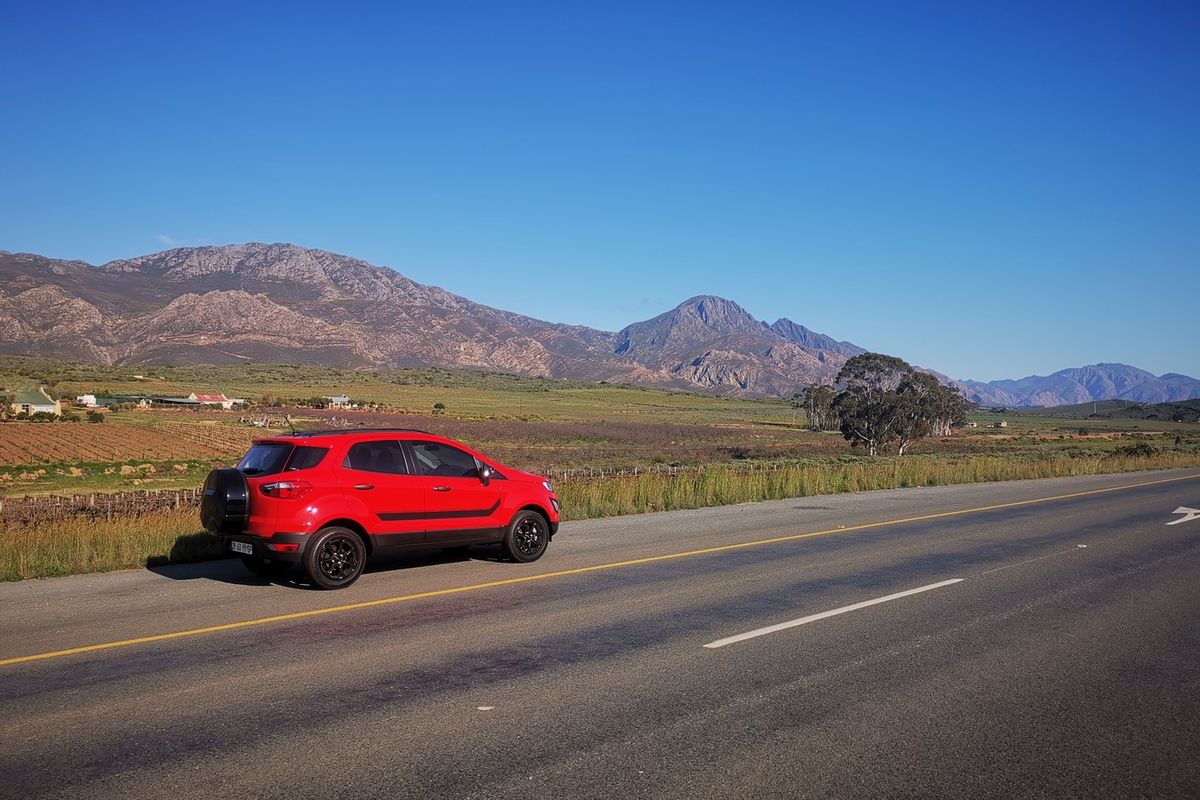
The vibrance of the EcoSport Black was only matched by the spring flowers.
How much does the Ford EcoSport cost in South Africa?
The Ford EcoSport range kicks off at R303 900 and this Black derivative costs R337 400. The 1.0-litre turbo engine range comes with more standard specification and starts from R346 000.
A 4-year/120 000 km warranty, 3-year/unlimited-km roadside assistance and 5-year/unlimited-km corrosion warranty. A 4-year/60 000 km service plan is included, with intervals every 15 000 km.
Summary
There seems no end in sight to the expansion of the compact family car segment. Considering that Ford has managed to keep its EcoSport fresh and specified in line with customer expectations. The Blue Oval is well aware that new offerings from Kia (Sonet), Nissan (Magnite), Suzuki/Toyota (Vitara Brezza/Urban Cruiser, Honda (WR-V) and Haval (Jolion) all want a slice of the segment leader’s share.
The Ford EcoSport does show its age in some ways (it’s been in Mzansi since 2013) and, given the stiff competition in this segment, customers are spoilt for choice. That said, the EcoSport does blend the roles of urban runabout and gravel cruiser rather well. Despite some cheap-feeling finishes, it feels like it can handle rough roads (mechanically speaking) and its packaging makes quite a visual statement.
This week’s news you need to know (August 2021, Week 3)
In this week’s automotive news you need to know: Lamborghini’s throwback Thursday causes a stir among purists, Nissan further extends the life of its long-serving Z-car, Chinese brand Chery gets a second bite at Mzansi and Toyota SA may just make “driving green” more affordable.
Countach Revival – Let sleeping dogs lie?
Nothing polarises car enthusiasts’ opinions and sets the petrolhead community abuzz quite like the unveiling of a Lamborghini. Such is the mystique of the mid-engined super- and hypercars produced by VW’s St’Agata-based vanity brand (well, it’s technically Audi-owned, ja ja) that every new model is expected to be more outrageous than the one that came before it. Sure, I’m all for improvements, but I do feel that we might all be expecting too much of the “new” Countach, which will be produced in limited numbers and is based on the Sian, which, in turn, is an Aventador with a 48-Volt supercapacitor.
The newcomer simply draws its inspiration from the car that appeared on millions of children’s bedroom walls; it’s not an all-new model that repurposes a famous name. Lamborghini never said it was, because, as a rule, it doesn’t re-use model names. Besides, revival cars aren’t taboo. There were revivals of the Lancia 037 and Delta Integrale, both of which allowed a defunct brand’s legendary models to live on through niche manufacturers. We didn’t throw our arms up then, did we? No, they weren’t genuine 037s or Delta Integrales, but hardcore enthusiasts who could afford them, couldn’t care less.
The original Countach was a game-changer, but this new/re-imagined one exists because Lamborghini is leveraging its 47-year-old intellectual property while simultaneously squeezing more profit out of a long-serving platform. Why? So that it can continue producing ludicrous machines for years to come. Call it a cynical repackaging exercise or flagrant nostalgia-mining; in my book, it’s just business.
New Nissan Z – ‘Z’ marks the spot
Okay, so you get 2 types of car people in this world – those who love the Nissan Z and… those who don’t. It’ll be a huge relief to performance-car aficionados – and the producers of future Fast and Furious films, I’m sure – that with the gradual decline of ICE offerings in the sportscar sector, Nissan has decided to stick to its knitting with this one; the new Z is a twin-turbocharged 3.0-litre V6-engined coupe with a close-ratio 6-speed manual ‘box (if you must, a 9-speed automatic transmission is available too) that drives the newcomer’s rear wheels via a mechanical limited-slip diff. In short, it’s one for the purists.
Nissan decided against doing what Toyota did when it enlisted BMW’s help to develop the new Supra (in doing so, TMC saved on research and development costs of a low-volume model). Nissan’s not flush with cash – that’s no secret, so it repurposed an existing Infiniti powerplant and freshened up the platform of the previous Z (Z34, which arrived on the local market in 2009) to produce the “2023 Z” – an elemental fun car that incorporates just enough subtle styling cues of its famous sportscar progenitors… and fills a vacuum created by manufacturers pursuing greener aspirations and emission targets.
Nissan and Toyota (GT86, Supra) seem to be the only ones making new fun cars in the modern age. These relatively uncomplicated machines keep the Japanese sportscar heritage alive and well, which we should all be thankful for. By the year 2040, when 80% of all cars on the road will be electric, I bet the Japanese will still be making fun cars, and by then, we’ll all be Z fans. Now, bring on that new Skyline!
Chery – the second coming
The great Chinese takeover is happening! This time, Chery’s back and instead of catering for the budget end of the market as before, they’re targeting the ever desirable compact crossover/SUV segment. Call it “fishing where the fish are”, but after Chery’s less than auspicious performance the first time around in Mzansi, the now fully-owned subsidiary of the Chinese powerhouse is armed with the lessons they’ve learnt, plus they have a cheat sheet provided by the ex-Haval SA employees who have joined their ranks. This is a potent blend of business experience that can only result in a serious offering.
As consumer confidence in Chinese brands grows stronger (perhaps the resurgent Haval SA should send Chery SA an invoice for that), Chinese models become a bigger threat to their European, Korean and Japanese counterparts, because they no longer have to rely on too-low-to-say-no pricing as their unique selling proposition. Another masterful move is the knock-down plants Chery plans to set up on local soil in the future; it remains to be seen how these facilities will slot into the country’s broader automotive manufacturing industry, but job creation and lower landed costs create favourable headlines.
Corolla Cross – Finally, a locally-made hybrid family car
A good example of wealth disparity in South Africa is the vast difference in incomes between those who can afford new hybrids and battery-electric vehicles and those who can’t. So-called “green(er) cars” are ruinously expensive in Mzansi (as I’ve discussed before, because of a luxury-car tax levied on top of import duties and other taxes), but that may be changing soon courtesy of a nameplate that has had a major impact on SA motoring for more than 4 decades: the Toyota Corolla. It’s only fitting and almost poetic that the Corolla will make its precedence felt again, this time in the new age of green motoring.
The Corolla Cross, which will be built at Prospecton in KZN, will include at least one hybrid derivative. It’s a fillip for the motor manufacturing sector and an investment that will do its bit to facilitate South Africa’s transition from ICE to electrified vehicles. Some of those aforementioned luxury taxes won’t apply to the Hybrid, which will help from an affordability perspective. This means the Corolla Cross could be the first option for a greener commuter with mass appeal, plus it will fill a gap while tech firms find more cost-effective battery solutions and our country’s charging station infrastructure gets upgraded.
All-new Honda Fit Review – Goodbye Jazz, hello to a proper JDM Honda
Honda has rebadged its popular but ageing Jazz with Fit stickers. It’s also imported from Japan now instead of India, has that made it a more desirable product? We review it over the course of 2 weeks in the Cape.
The Honda Jazz has been a mainstay on the South African market for decades now but for whatever reason, Honda South Africa has decided to retire the nameplate in favour of this, the Fit.
On sale as of June 2021 in South Africa, the Fit has impressed us with its super build quality, ride quality and impressive warranty.
In this video, Ciro De Siena takes an in-depth look at this latest generation of Honda’s venerable practical hatchback, compares it to its rivals and gives you a detailed overview of the interior spec and features, as well as the Magic seats in the rear.