A significant design defection has occurred in the French car industry.
The country’s most powerful automotive company, Renault, has managed to lure away PSA’s chief designer, Gilles Vidal.
It has been confirmed that the 47-year old Frenchman will now report to Renault’s head of design, Laurens van den Acker, after two and a half decades at PSA.
Vidal originally joined Citroën in 1996, after graduating from the prestigious Art Centre College of Design, in Vevey, Switzerland. Vans might not figure as design icons, but one of Vidal’s first projects was restyling the Berlingo, which became hugely popular in Europe after his intervention.
Promotion came swiftly for Vidal, who assumed control of Citroën’s experimental design and concept cars, by 2005. With an ability to make seemingly mundane vehicle configurations appear aspirational, Vidal proved his skill with the C4 and C4 Picasso, before moving to Peugeot in 2009.
Over the last decade, he is credited with the recovery in design values at Peugeot and most of the brand’s cars carry his influence. The Polo-rivaling 208, 2008, 3008, 5008, and 508 are examples.
Citroën and Peugeot’s cars have always been regarded as superior designs to most rival products from Renault. Vidal’s departure from PSA, and his new position at Renault, could meaningfully alter how the balance of design accolades are applied to French cars.
Although Laurens van den Acker retains his position of absolute authority regarding Renault’s overall design direction, Vidal has quite obviously been hired to reinvigorate the brand’s product portfolio. His eye for detail and ability to integrate a unique feel and distinguishing appearance to relatively affordable vehicles at Peugeot should transfer well to Renault. Fans of the brand will be keenly anticipating Vidal’s new work.
PSA has not announced Vidal’s replacement yet, but his loss will be keenly felt, especially at a time of great disruption at the company, as it prepares for a deeply complicated merger with FCA.
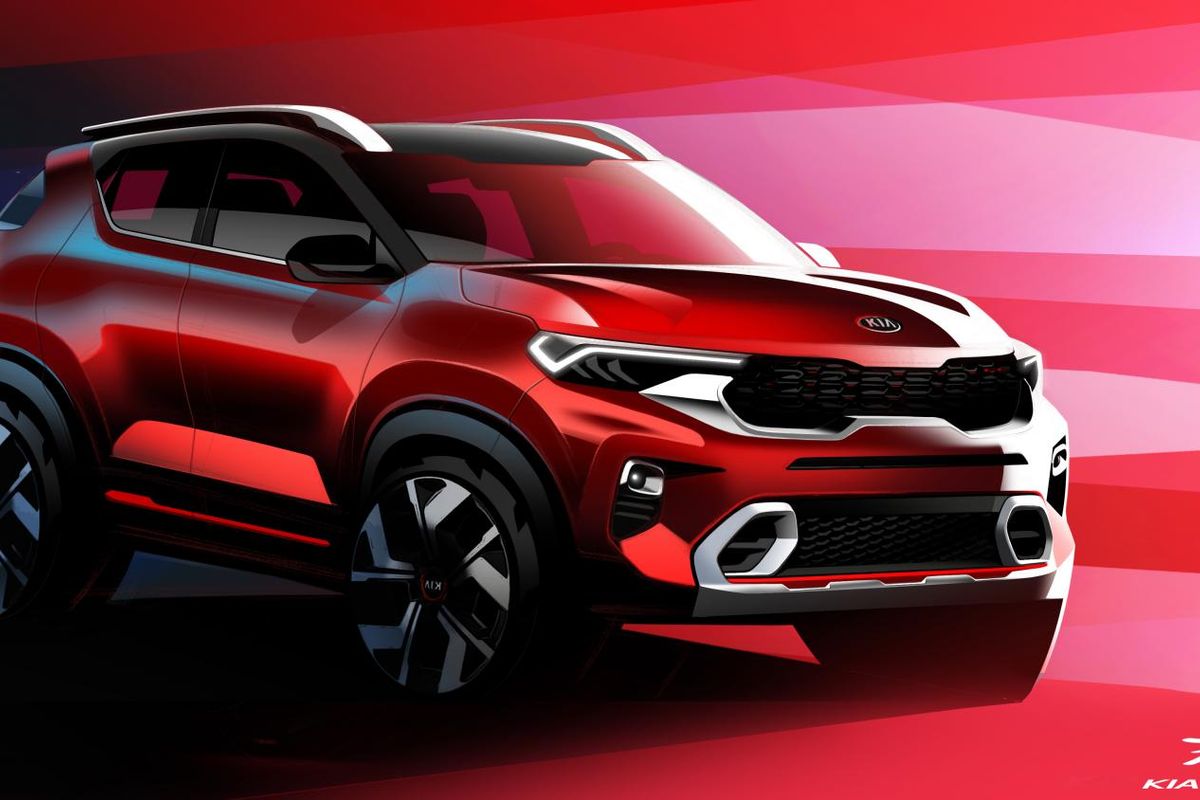
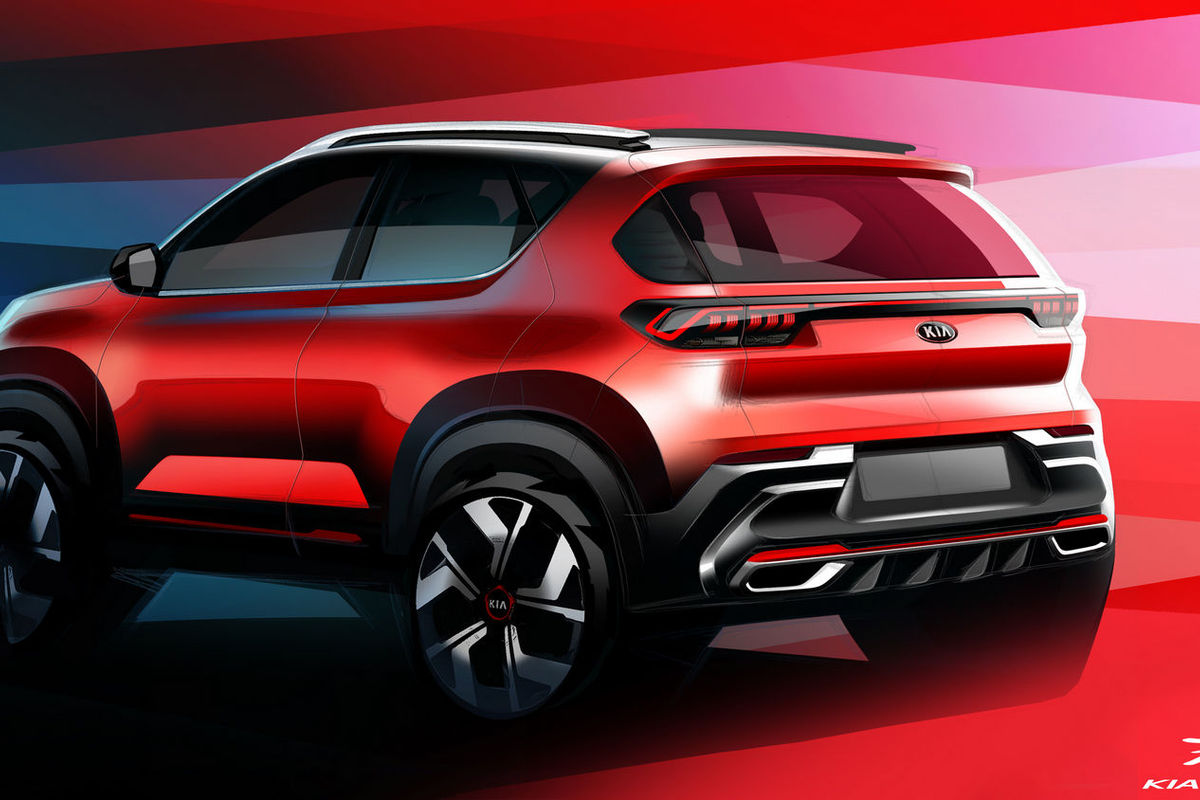
Kia has released an official render of its upcoming compact family car – the Sonet. Here are some details about the new model, as well as some information regarding the newcomer's arrival in South Africa.
The first image of the production-spec Kia Sonet has been revealed and it gives us some idea of what the compact newcomer will offer. Kia is already on a good run with its Seltos, which is one of the more interesting-looking vehicles in the segment. The Sonet is set to be officially revealed (in the metal) on 7th August 2020.
Kia says its new Sonet "aims to set new design benchmarks and inject a new dynamism in the compact SUV segment when it is revealed later this summer." Based on the funky-looking Kia Sonet Concept which was revealed earlier in 2020, the production model Sonet will be the Korean brand's second vehicle to come from its plant in India and is aimed at the global market.
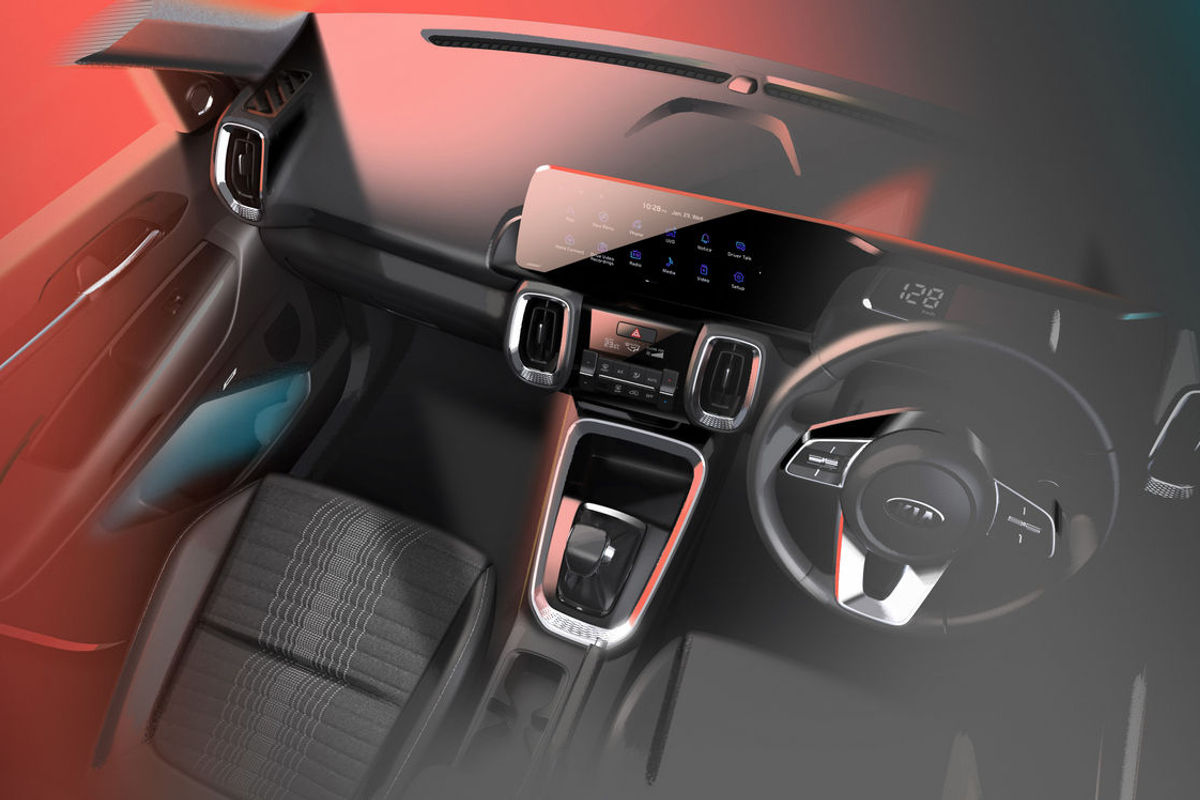
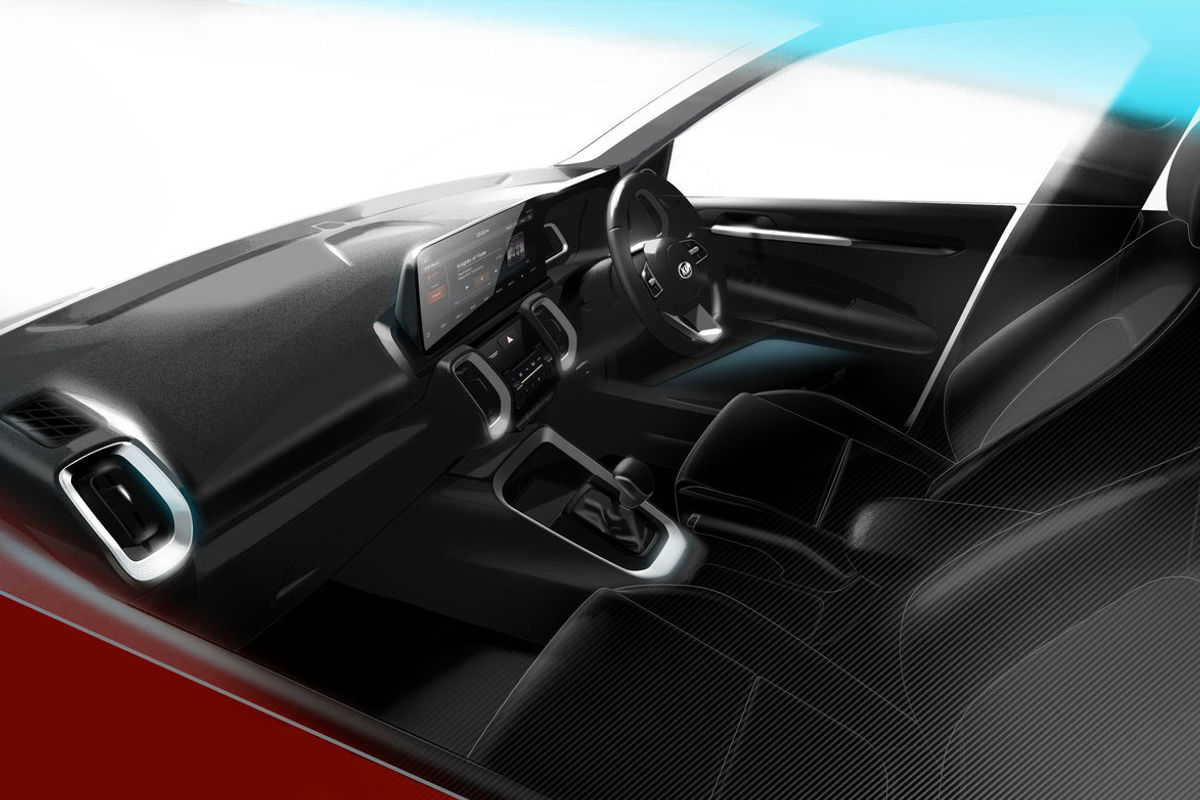
Kia South Africa confirmed the all-new Sonet will be making its way to South Africa late in 2020. Engine details and specifications will be announced closer to the SA launch date. Based on what we've seen from Korean sibling Hyundai, we're expecting a 1.0-litre 3-cylinder turbocharged petrol motor and connectivity options like Apple CarPlay/Android Auto. There's a 10.25-inch infotainment screen up front that deals with media and navigation requirements.
Kia India has also noted that the Sonet will have up to 6 airbags in what it calls class-leading safety for occupants. The spec for the South African models is still under consideration, but we expect to hear what will be on offer soon.
Crossley & Webb launches new online auction platform for collectible cars
The respected Cape Town-based classic and exotic car dealer, Crossley & Webb, has launched an online auction website for collector cars.
The goal with Crossley & Webb Online is to create a safe trading platform focused on collector cars, says Gareth Crossley. Unlimited by physical constraints, the virtual marketplace allows for better presentation and a more detailed description of listings, regardless of where the sellers are based.
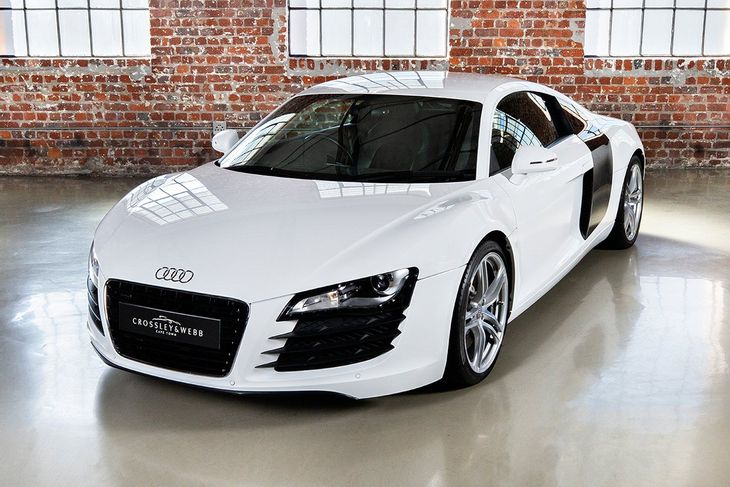
One of the cars currently on auction is this 2009 Audi R8.
The platform is geared to provide sellers with the best opportunity to maximise value within a predefined timeline and to provide buyers with a well-informed and transparent purchasing experience. In both instances users of the platform are guided through the process by Crossley & Webb who are experienced at selling hundreds of collector cars in South Africa.
Sellers can submit their car for auction online, complete a vehicle grading document and take their own photos using Crossley & Webb’s photography guide.
There are three packages, Basic, Pro and Custom:
Basic – R 999 incl. VAT.
What you get:
Expert advice and pricing research
Marketing support and guidance on presentation techniques
A professionally curated listing
Access to qualified buyers
Pro – R 2999 incl. VAT. Basic package with the option for professional photography
Custom – POA using the Pro package as a base where Crossley & Webb controls the whole process on behalf of the seller with hosted viewings. Technical inspections and vehicle snagging part of the package.
BUYING
Buyers can register to bid on Crossley & Webb Online and are vetted prior to approval. A R5 000 refundable deposit is required to bid and bidders are guided by Crossley & Webb in order to complete the due diligence process and be confident of the condition of the car prior to placing a bid. Crossley & Webb charge a 10% buyers premium including VAT (eg. If R200 000 is bid then the total cost is R220 000).
Currently on auction: 1959 Jaguar XK 150
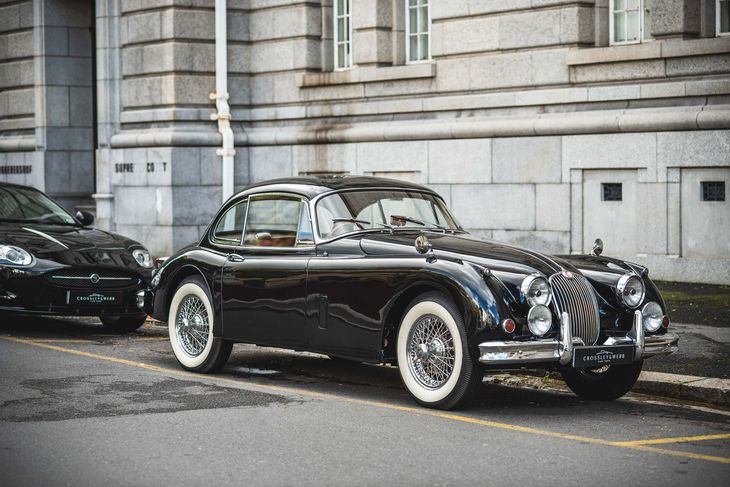
Here's something for the discerning collector – a gorgeous 1959 Jaguar XK 150.
Launched halfway through 1957, the XK 150 was Jaguar’s answer to the growing demand for a more comfortable and refined sportscar. This 1959 example is equipped with a special equipment package (comprising wire wheels, spot lamps and twin exhaust pipes) and an upgraded 3.8-litre engine, which was fitted to the car in the UK prior to it being imported to South Africa around 1983. Various modern upgrades (such as air-con and a modern audio system) were fitted during a restoration in 2009.
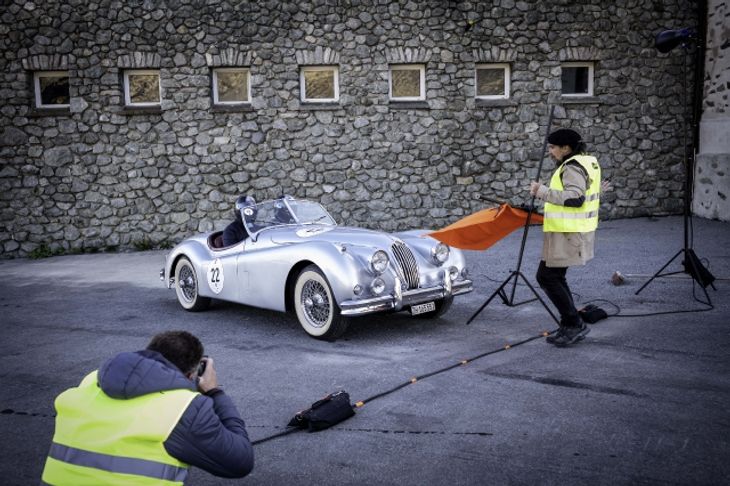
How often will you have the opportunity to bid on the experience to drive a Jaguar XK120 in the Bernina GranTurismo HillClimb?
Another notable auction is the charity auction for the experience to drive a race prepared Jaguar XK120 roadster on the Bernina GranTurismo Hillclimb in September 2020 with the option to defer the experience to 2021. This is a charity auction to assist funding of the Zip Zap Circus charity in Cape Town.
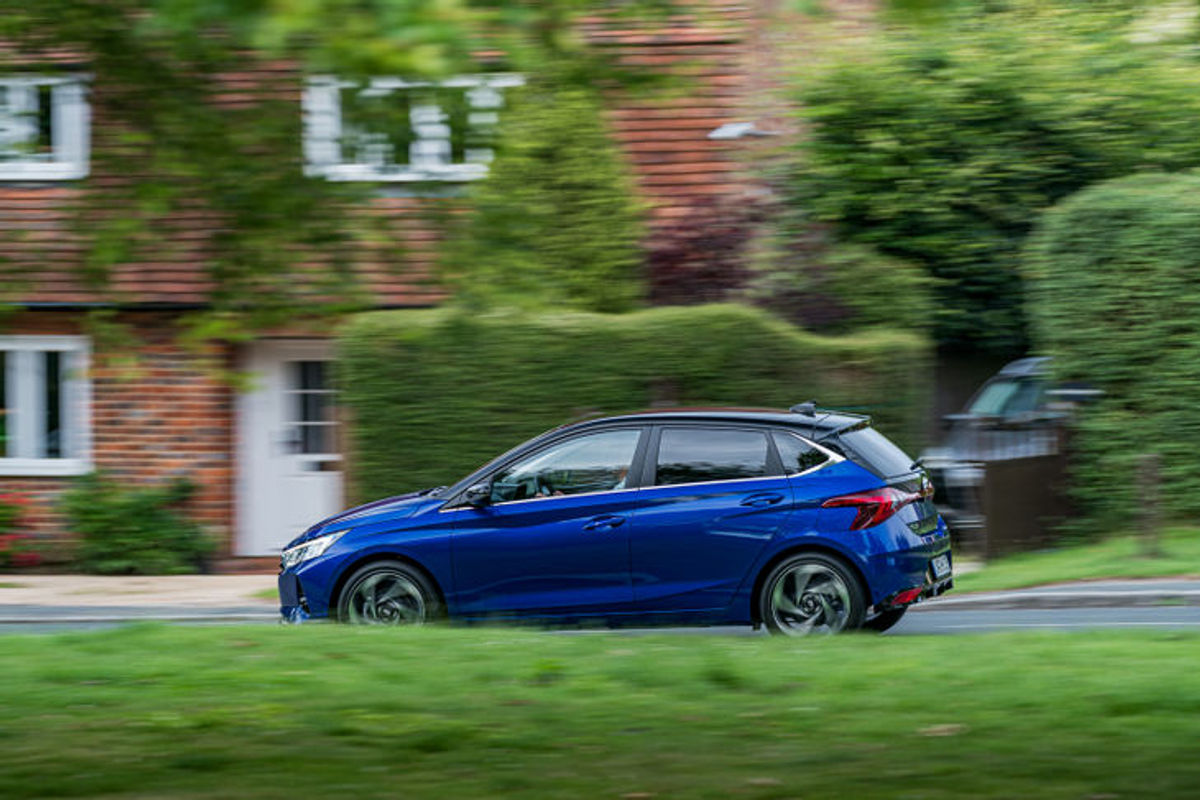
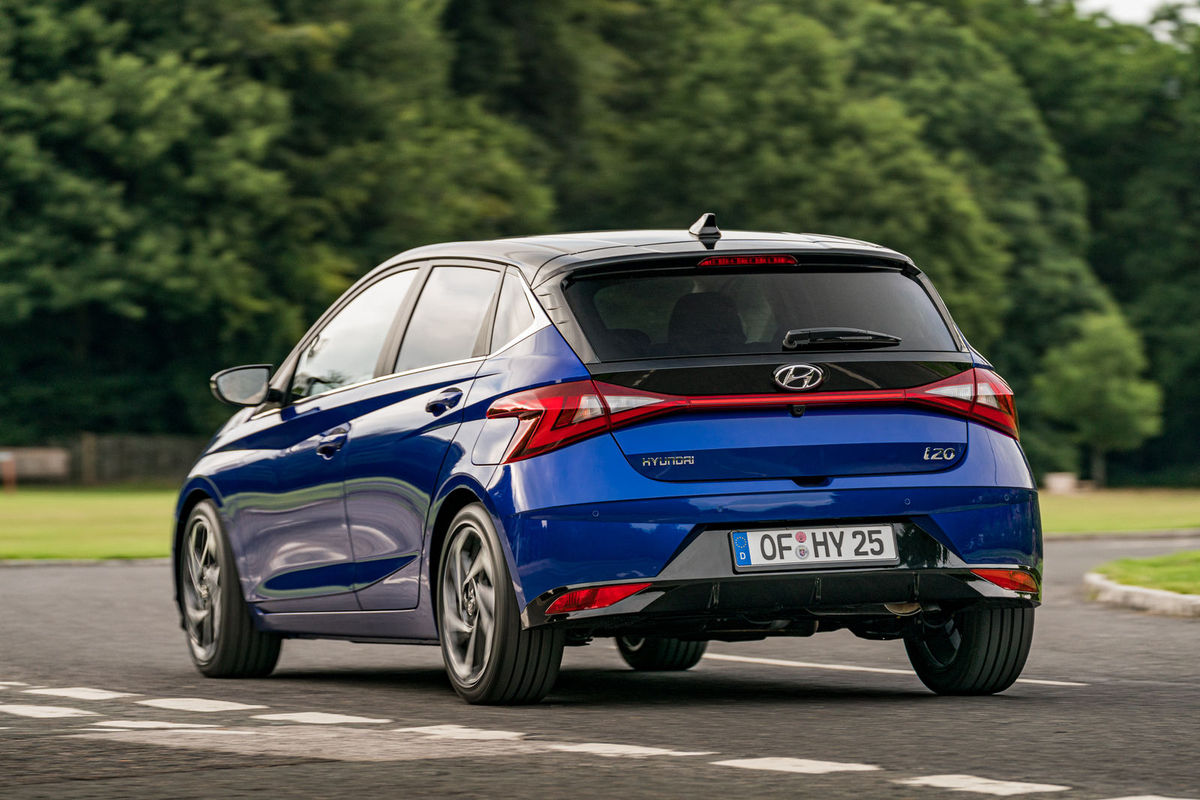
The current-generation Hyundai i20, which arrived in South Africa in early 2015, now seems long-in-the-tooth compared with the Ford Fiesta, Volkswagen Polo and other newer compact hatchbacks. However, an all-new model is set to arrive in local showrooms in 2021 and our international contributor, Simon Davis, has had the opportunity to drive an almost complete pre-production model…
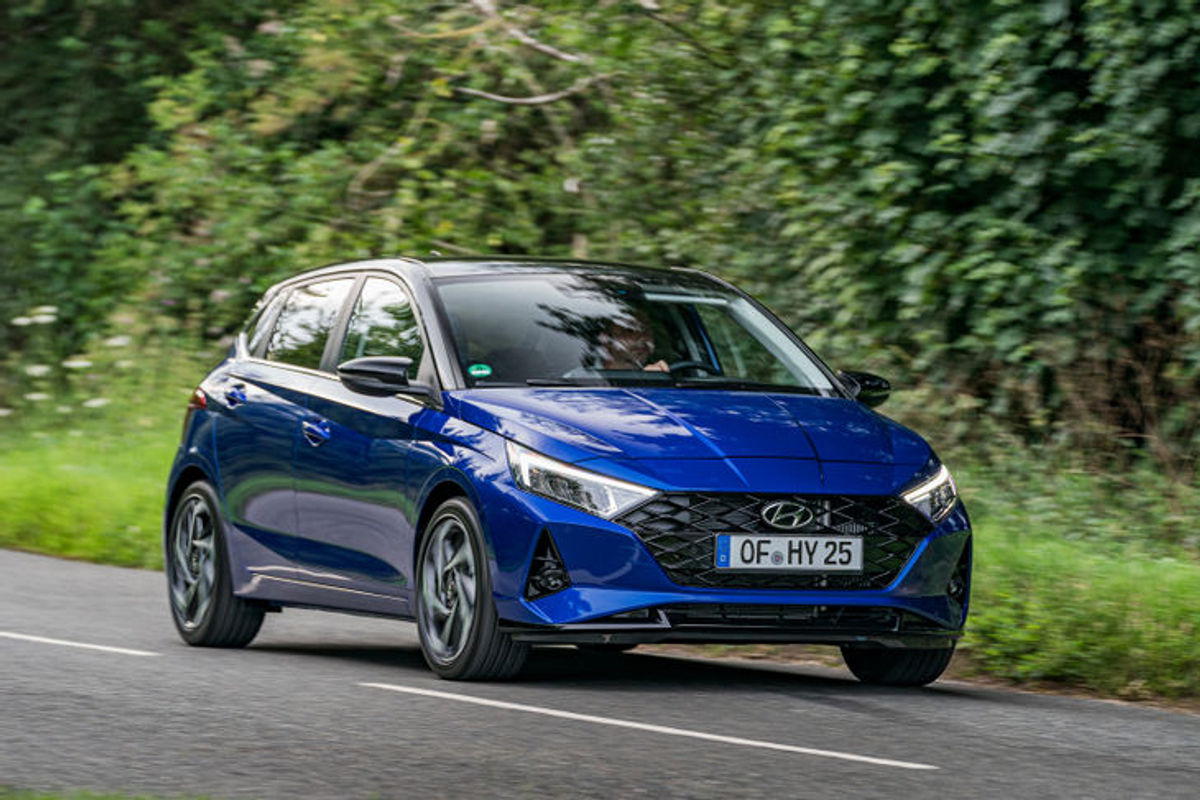
Say hello to the new 3rd-generation Hyundai i20, driven here for the first time in not-quite-finished pre-production guise. A definitive first drive report will come once we've been able to get our hands on an example with a properly finished interior, production-spec refinement-enhancing tweaks, and a correctly calibrated transmission, but for now, this left hooker should give us a reasonably accurate idea of what we can expect from the new i20 when it officially goes on sale in Mzansi towards the middle of next year.
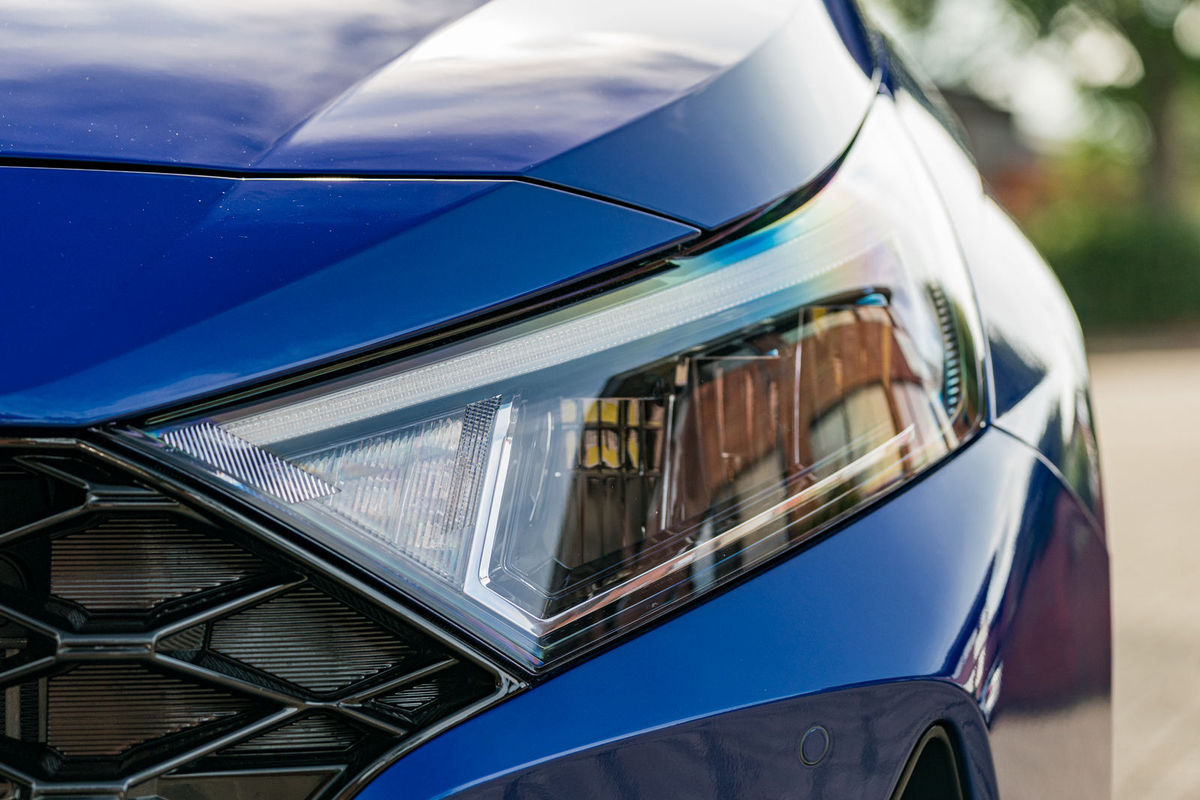
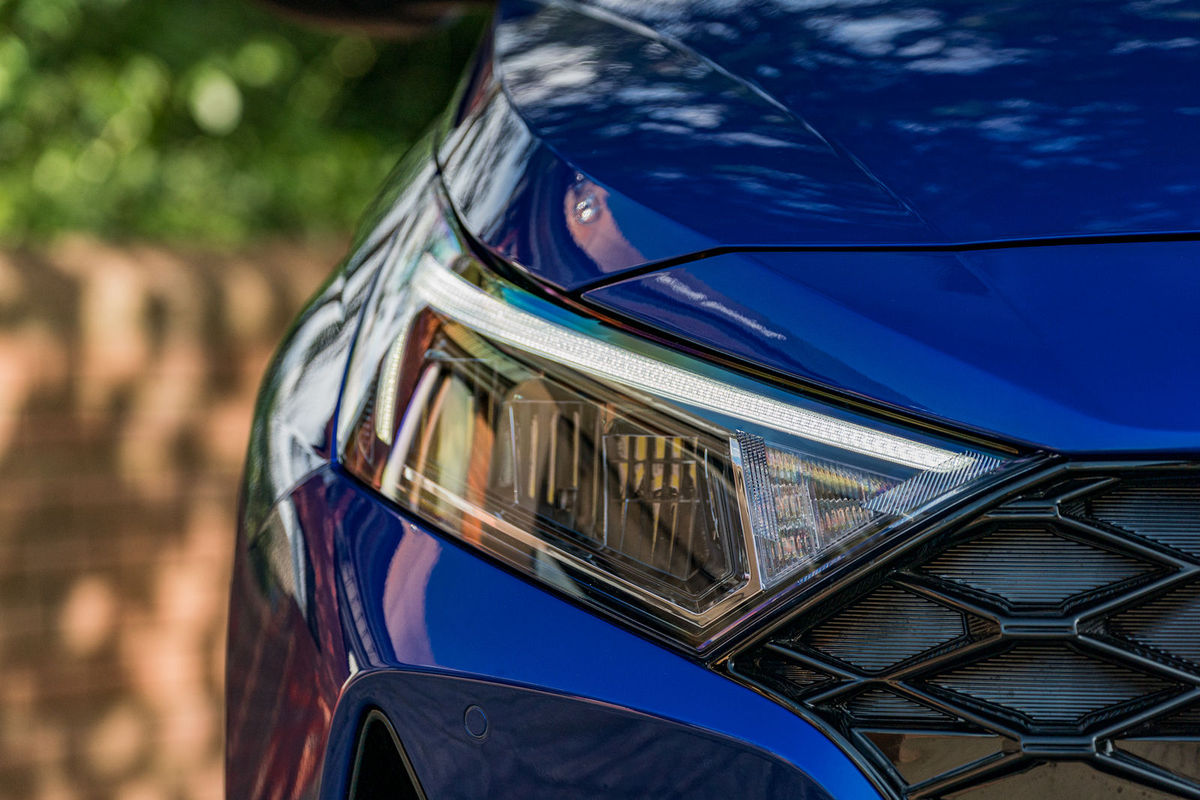
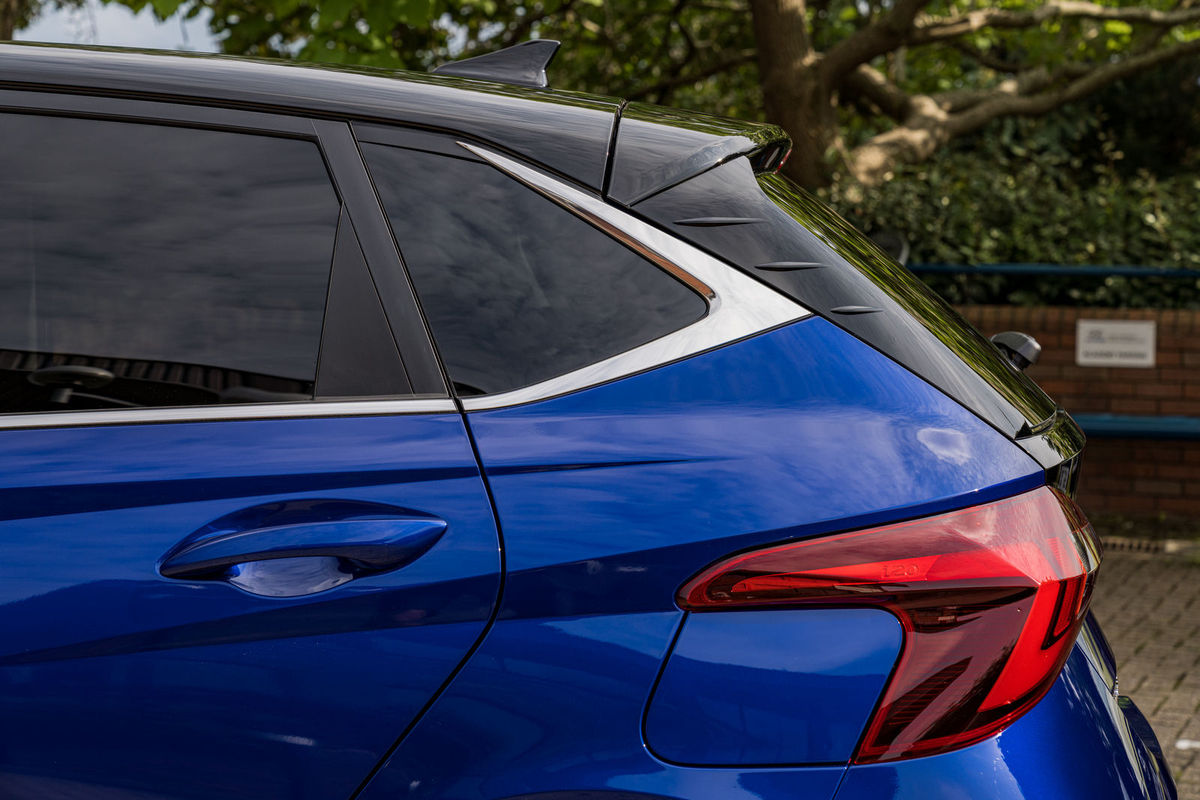
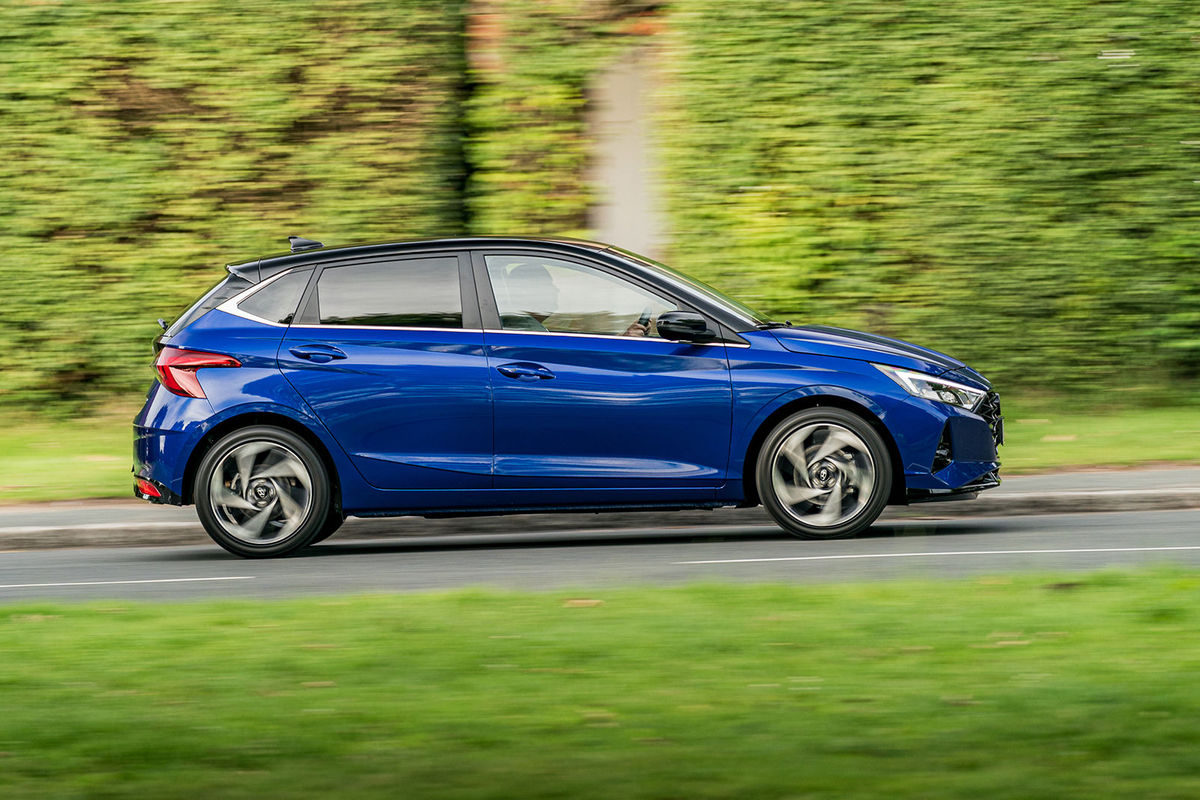
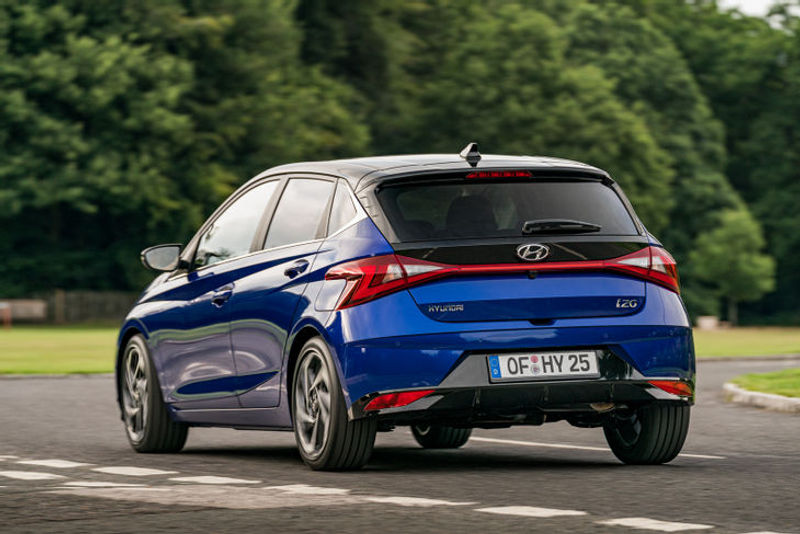
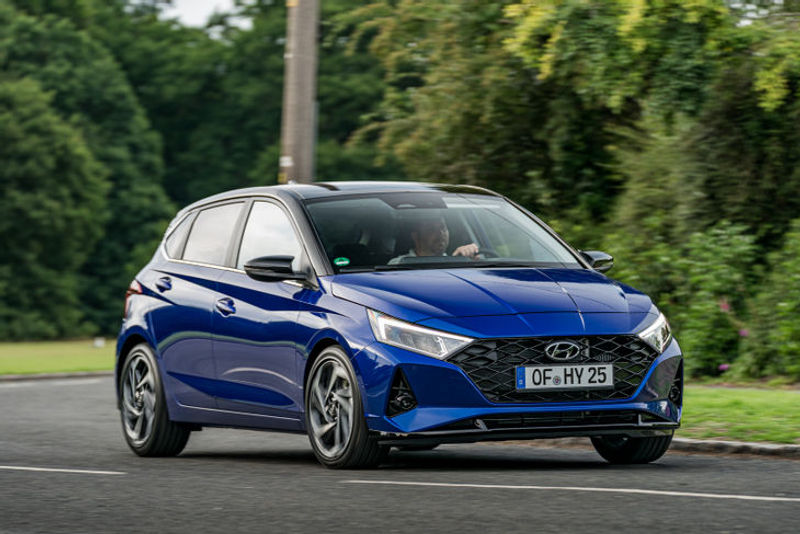
Stylistically, the new i20 is much more interesting than the previous generation.
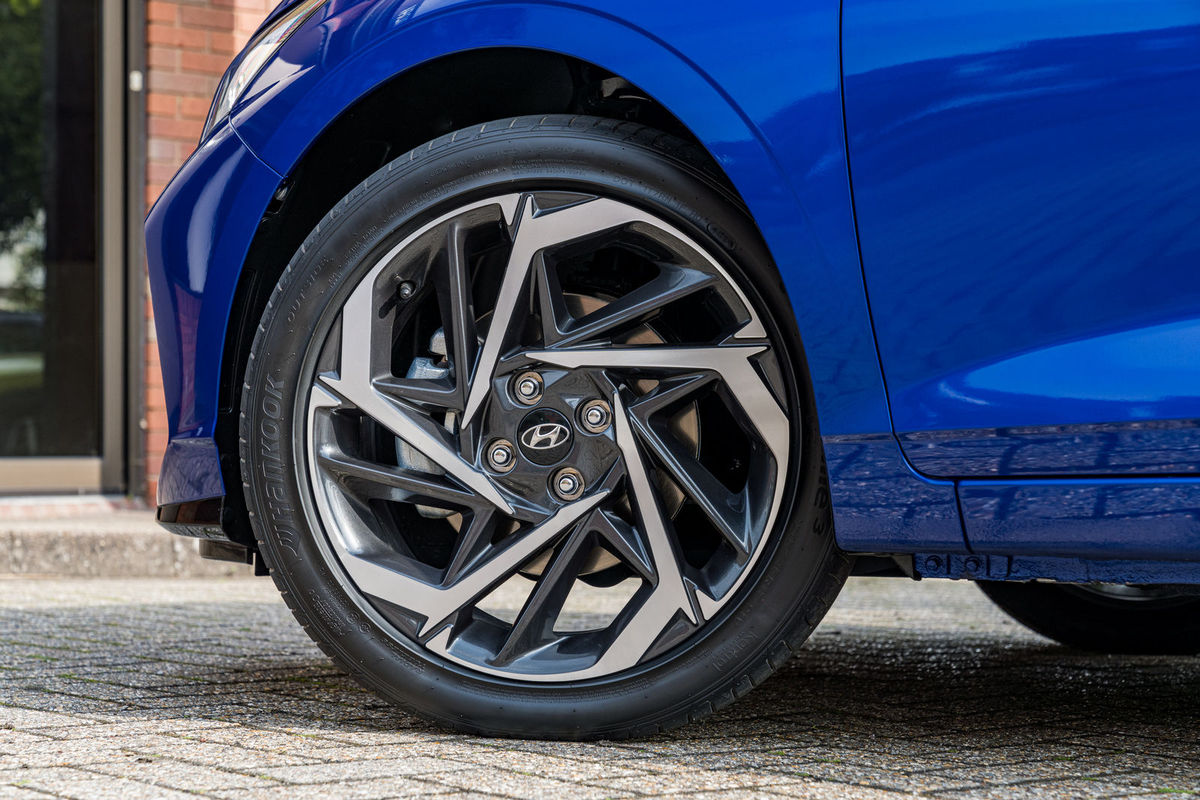
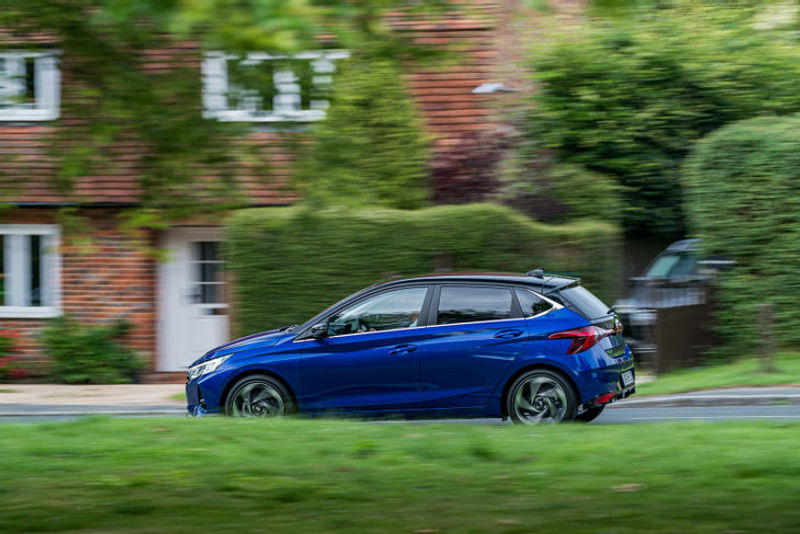
Stylistically, the latest i20 represents a fairly dramatic departure from its predecessor. Whereas the outgoing model was handsome, yet relatively plain-looking, this model is much more radical. Hyundai's "Sensuous Sportiness" design language has introduced sharper surface treatments, a lower roofline and a wider body to endow this new i20 with a rather more aggressive stance than it had before. It's longer now, too, both nose-to-tail and between the axles, which should bode well for passenger- and luggage space.
The foundation for the forthcoming i20 N hot hatch certainly looks strong. Until that performance model arrives, the i20 engine line-up is pretty run of the mill. The engine line-up for the local range hasn't been finalised, but it should include a 61-kW 1.2-litre 4-cylinder petrol (paired with a 5-speed manual gearbox), a 74 kW 1.4-litre petrol mated with either a 6-speed manual or 4-speed auto and the Venue's 88 kW 1.0-litre turbocharged 3-pot, which is available with either a 6-speed manual or 7-speed dual-clutch auto.
The new i20's roadholding is par for the course, but its "eager" electric power steering system can benefit from fine-tuning.
In Europe, the 1.0-litre engine is augmented with a 48V mild-hybrid system (not confirmed for SA), which is the version we're evaluating here. The pre-production unit was equipped with a 7-speed dual-clutch 'box (which drives the front wheels); Hyundai's will also make its newly developed 6-speed Intelligent Manual available for this derivative.
Although it’s pretty apparent that our i20 test car isn’t quite the finished article, it’s still a very likeable package. Despite the really quite noticeable levels of audible suspension thump and pitter-patter being transmitted into the cabin, it rides in a largely respectable fashion for a car of its size. Body control over undulations is good, and although sharper impacts make themselves felt, the car never feels overly agitated or upset on particularly coarse stretches of road.
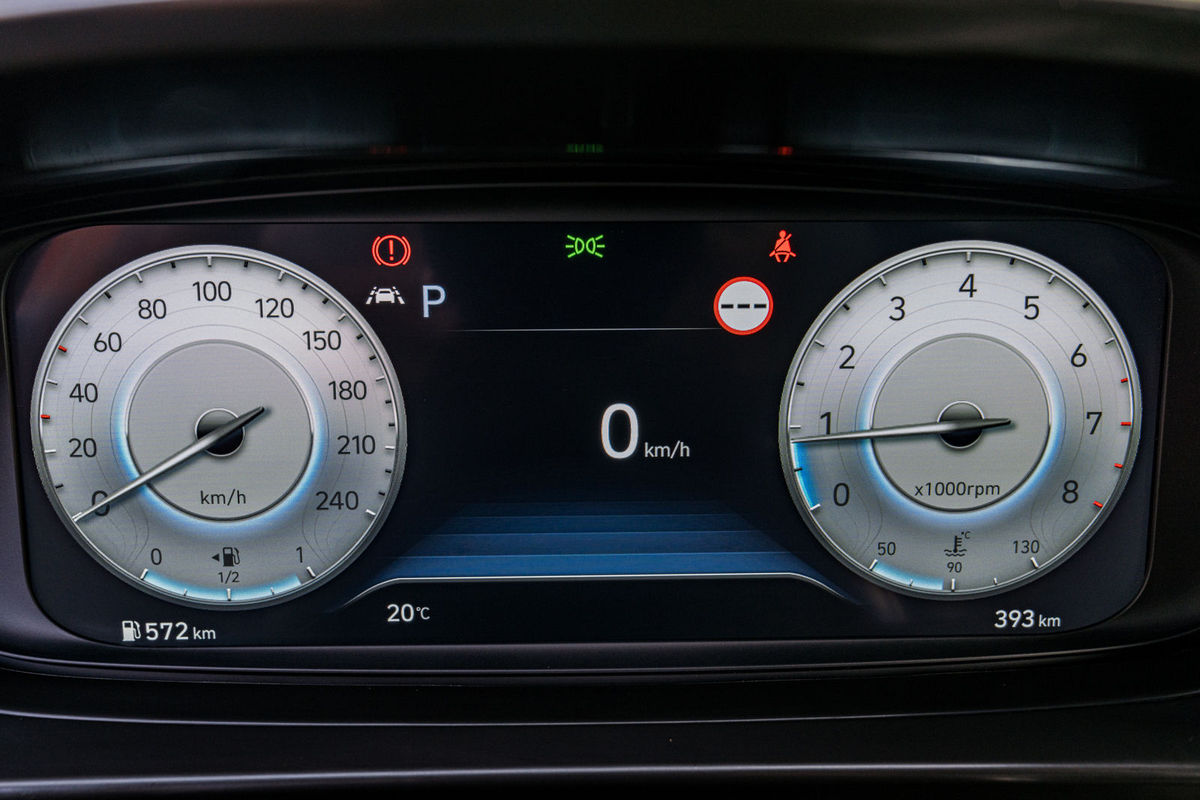
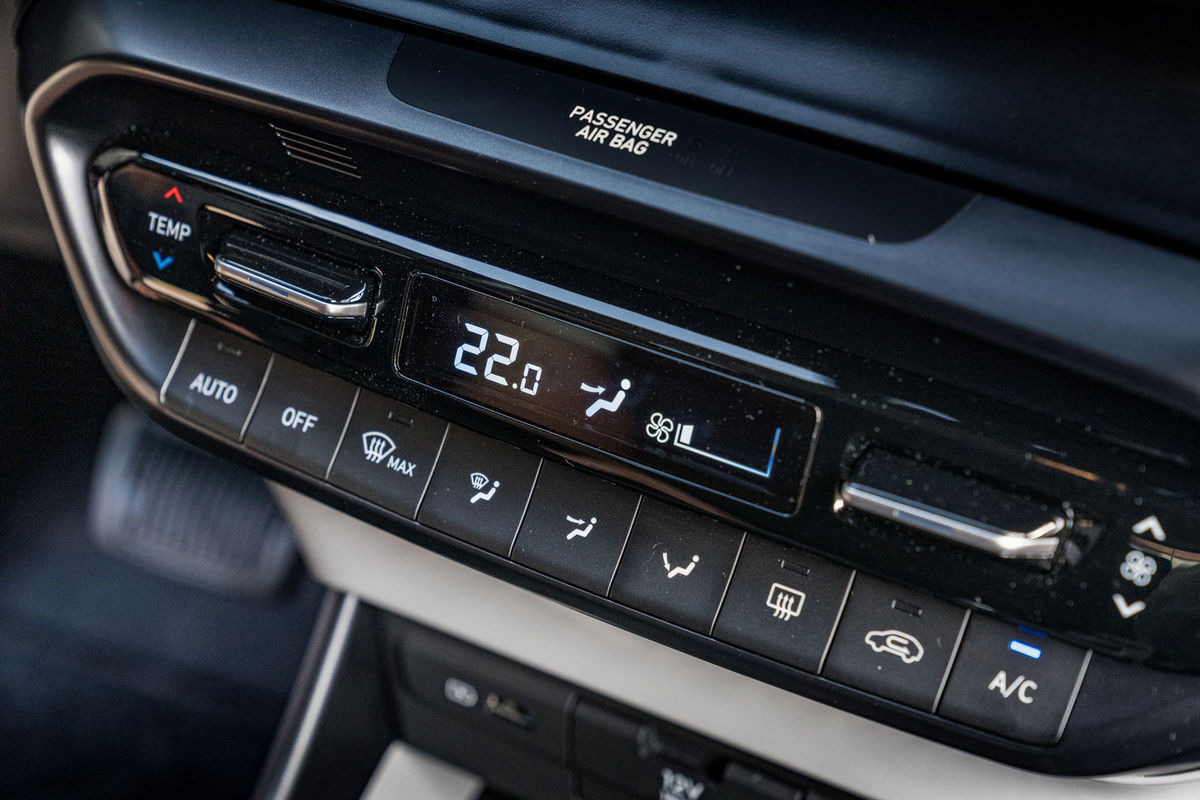
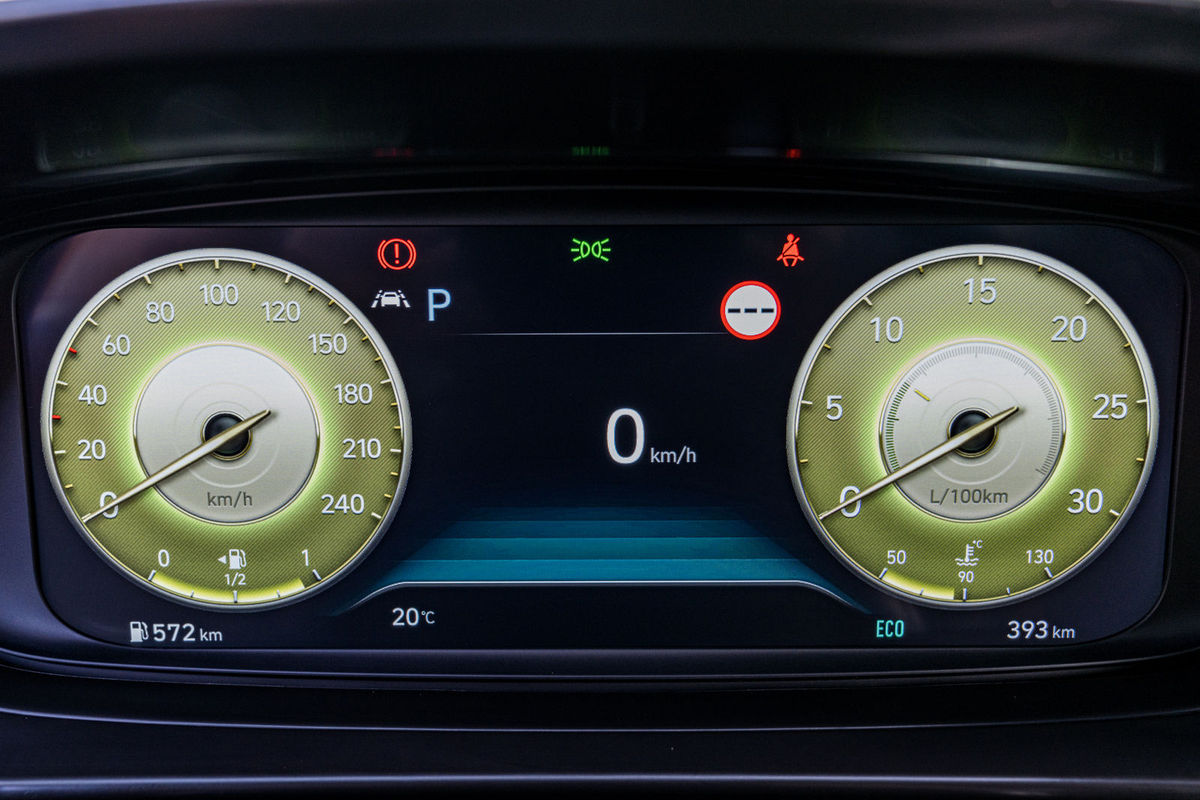
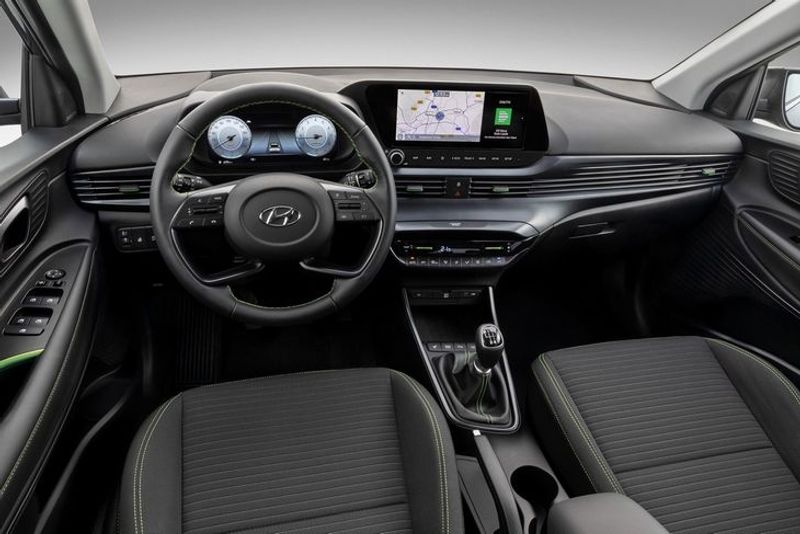
Hyundai-supplied images of its newcomer's interior, which features a large infotainment screen and digital instrument cluster.
It changes direction with a certain keenness, too, but not with quite as much zest as a Ford Fiesta. That’s probably as a result of the generously-assisted electric power steering, which gives the 'wheel a slightly dead feeling, but even so, the front end responds pretty smartly to your inputs and grip levels seem fine for a car with this level of performance.
Things become a bit more interesting where the powertrain is concerned – and this is largely down to the fact that it’s tricky to ascertain just how far off production-spec this i20 really is. Its performance is adequate – the i20 isn’t exceptionally quick, but there’s enough shove from the 1.0-litre motor to get up to open-road speeds in a respectable fashion. The engine is generally pretty well mannered under load and you can really feel the extra electric assistance from the 48V system when moving off from a standstill.
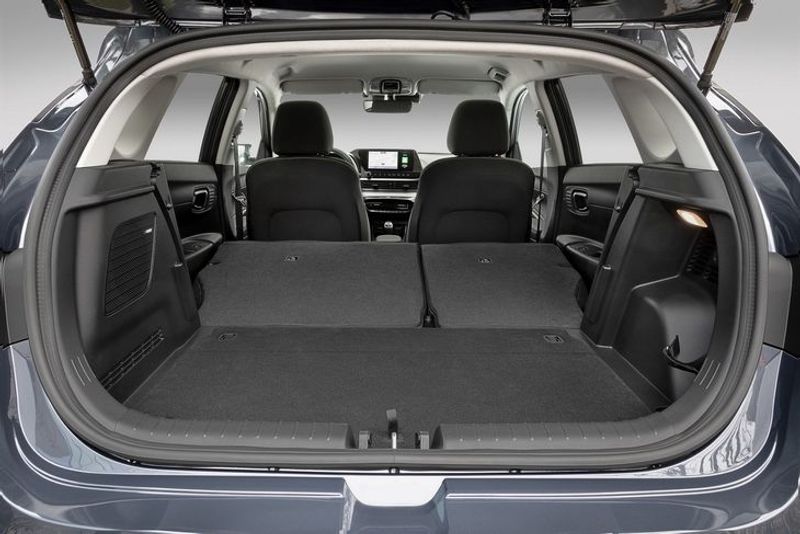
The new i20's longer dimensions (including a longer wheelbase) have resulted improved rear legroom and load-bay capacity.
The dual-clutch auto 'box is a bit of a sticking point in this test car, though. Big prods of the accelerator pedal tended to prompt the 'box to spend a fair while rummaging for a gear and it has a tendency to shunt a bit when shifting as well. There’s certainly room for improvement here.
Effective regenerative braking
The regenerative braking system also stands out. I’ve not come across a 48V system this powerful in a car this small before. A lift of the throttle leads to a noticeable amount of deceleration, if not quite enough for EV-style one-pedal driving. Given that our test car still wore some of the shiny black plastic trim pieces that often adorn pre-production car interiors, it’s tough to say how much or how little design appeal will carry over from the exterior to the cabin, but the previously-released interior images look promisiing.
But that aside, the interior impresses for the sheer space it offers. Rear passengers are afforded (relatively) generous legroom and a fair bit of headroom too, so moderately-tall adults should be able to fit in just fine. The load bay, meanwhile, offers up to 351 litres of luggage capacity, although it’s likely to be slightly less in mild-hybrid derivatives.
The new i20 feels like a solid base to develop new N performance models on.
Hyundai South Africa imports the i20 from India and the same will apply to the next-generation model, of which production is set to commence on the subcontinent towards the end of the year (according to recent reports). It's unlikely that the Indian-made i20s will be quite as generously specced as their European counterparts, but they're likely to be more smartly-equipped than the current derivatives. In any instance, watch this space: based on this brief preproduction drive, things seem pretty promising for the new i20.
The BMW 2-Series Gran Coupe has landed in South Africa and we gave the keys to Ciro De Siena to try make sense of what's on offer.
In a world where no niche is left unfilled, BMW has had to come up with a rival to the Mercedes CLA and A-Class sedan and the Audi A3 sedan. The easiest solution seems to have been this, the 2 Series Gran Coupe – a 4-door version of the 2 Series.
It is essentially just a 1 Series with the boot, meaning it runs on BMW's new front wheel drive platform. But having tested the new 1 Series, we've found that for most drivers, this won't even be a consideration.
No, buyers interested in a car like this are not searching for exciting cornering abilities, they're looking for practicality, comprehensive tech, a comfy ride day-to-day and of course a premium badge on the nose.
So we forced Ciro to put his consumer journalist hat on and give us a review of the new 220d.
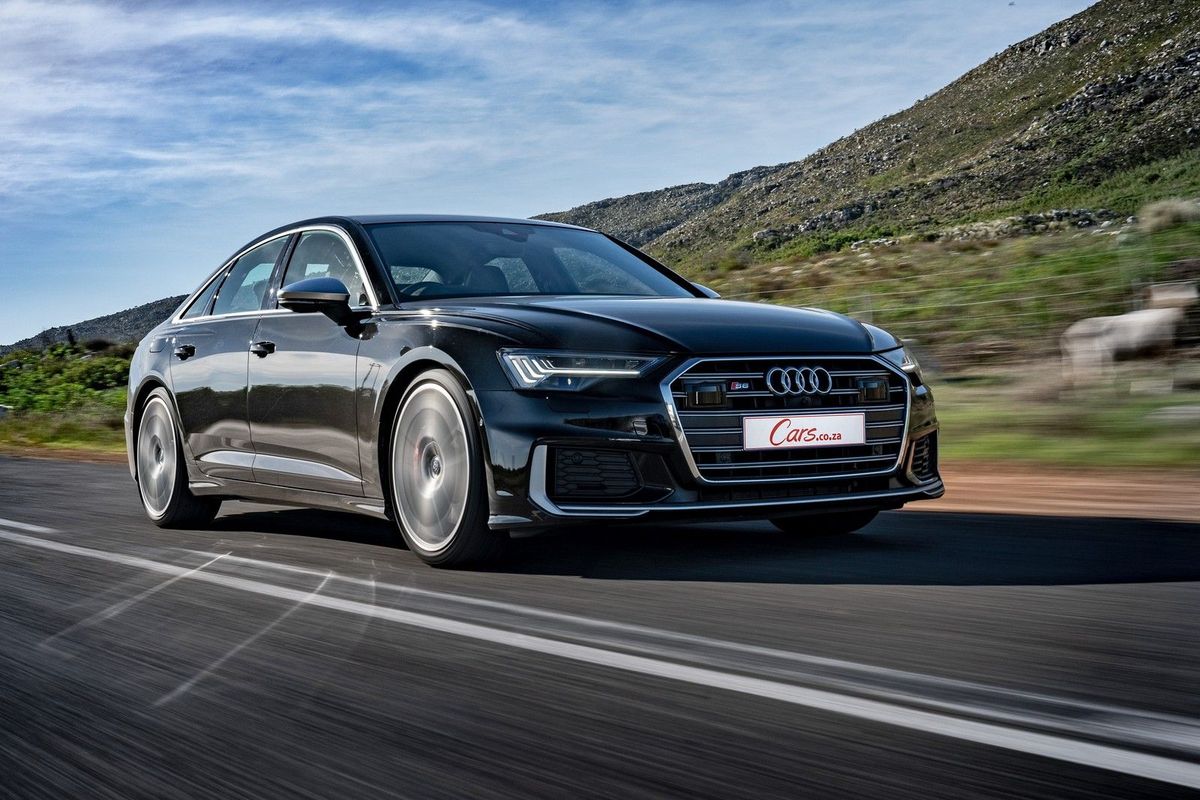
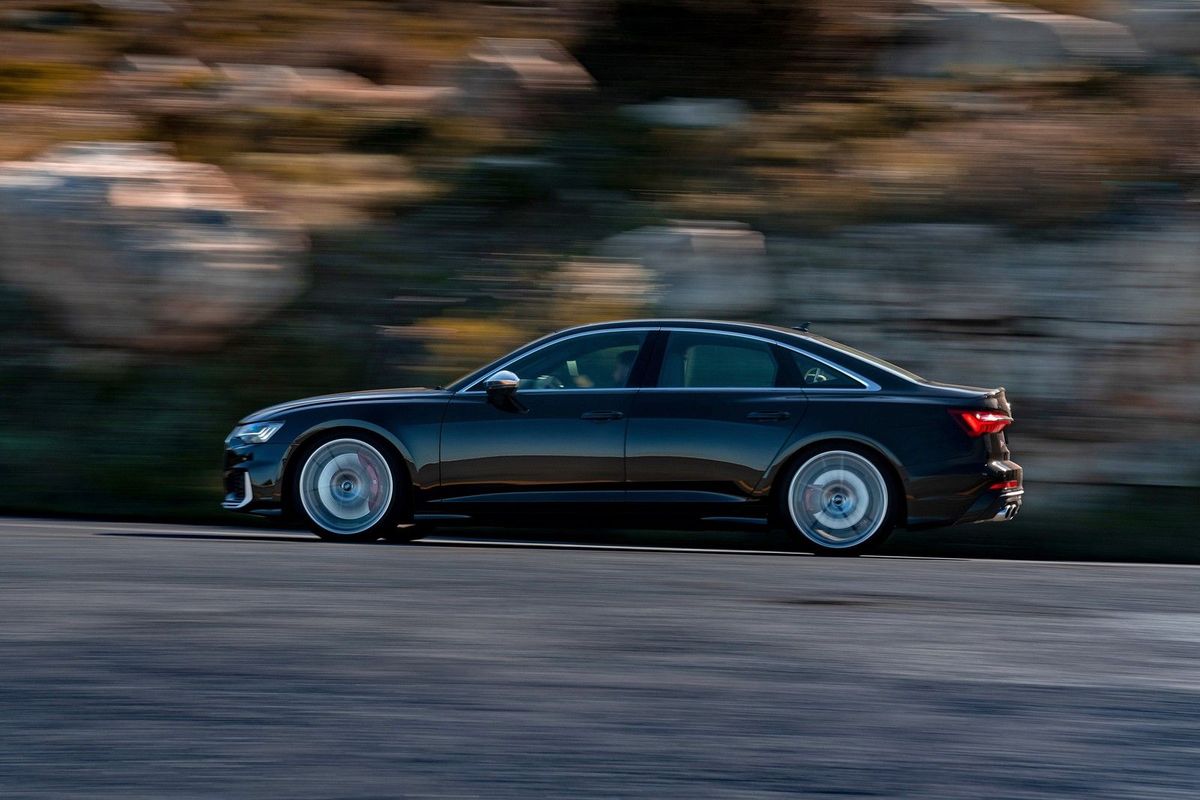
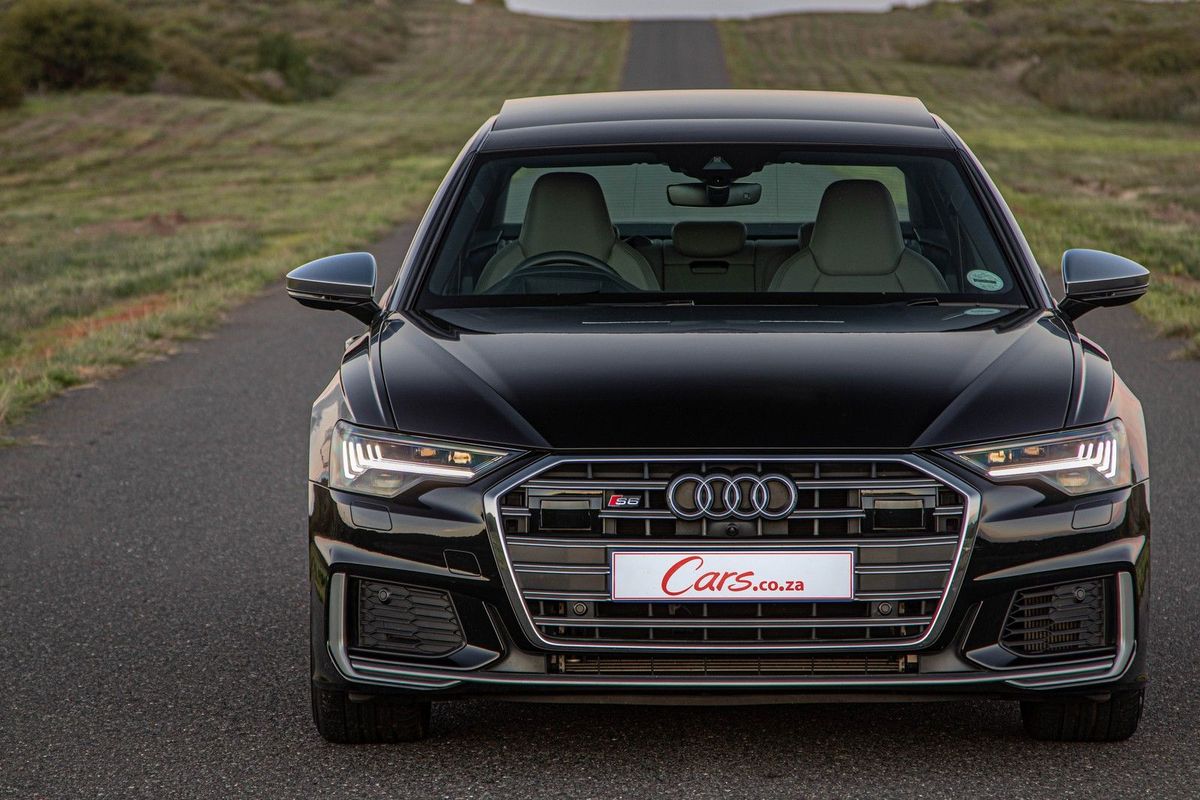
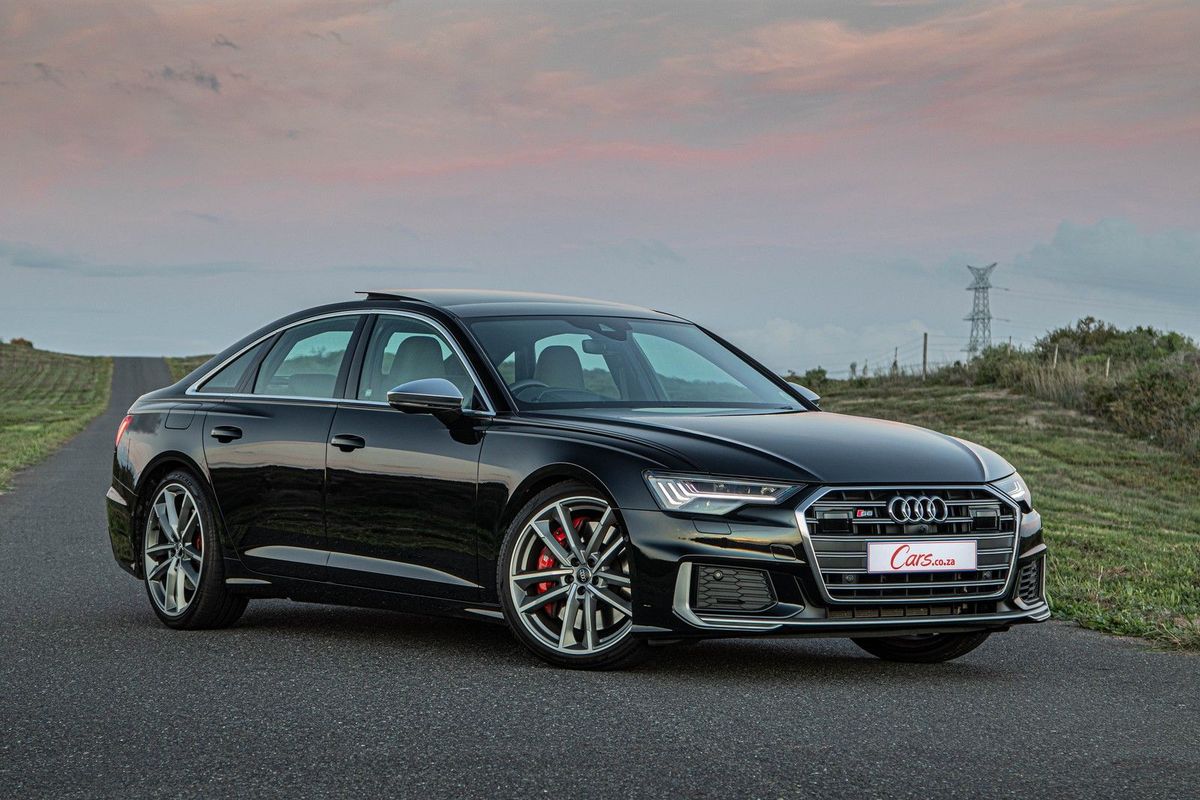
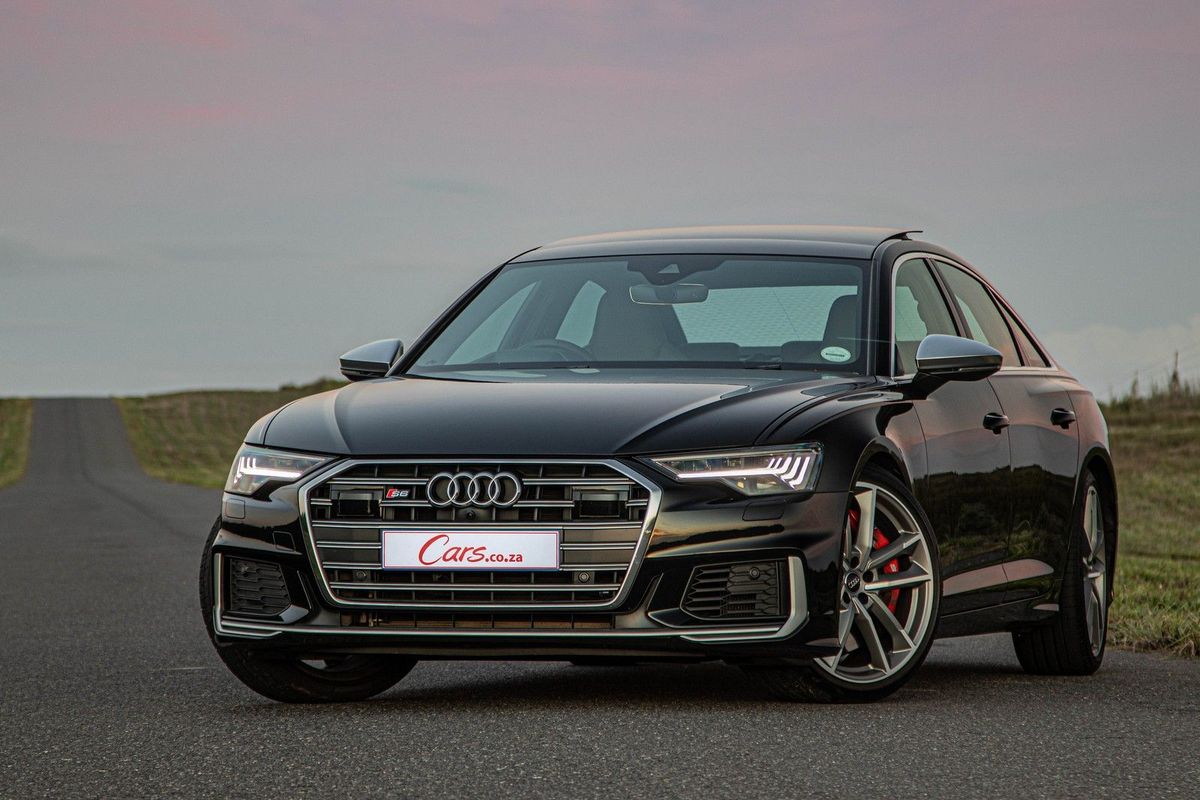
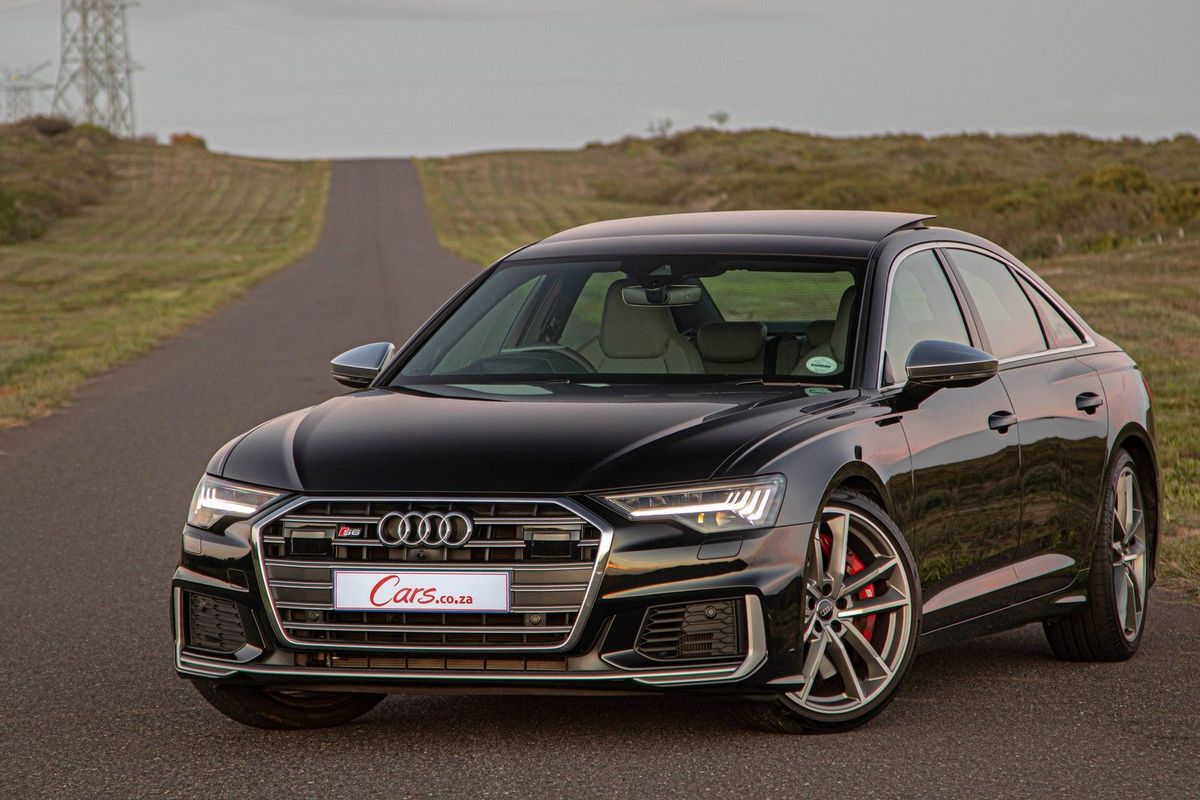
Audi's new A6 has finally arrived in South Africa and the range's line-up comprises 3 derivatives – a brace of sensible turbodiesels and this, the fire-breathing S6 flagship. It's certainly an impressive package, but in the "Age of the SUV", is there still room for an executive sedan?
We like: Refinement and comfort, faultless built quality, top-notch performance and handling, modern and advanced cabin.
We don’t like: Adaptive air suspension and dynamic all-wheel steer ought to be standard
Fast Facts:
Price: R1 401 500 (R1 582 400 price as tested)
Engine: 2.9-litre twin-turbo V6 petrol
Power/Torque: 331 kW/600 Nm
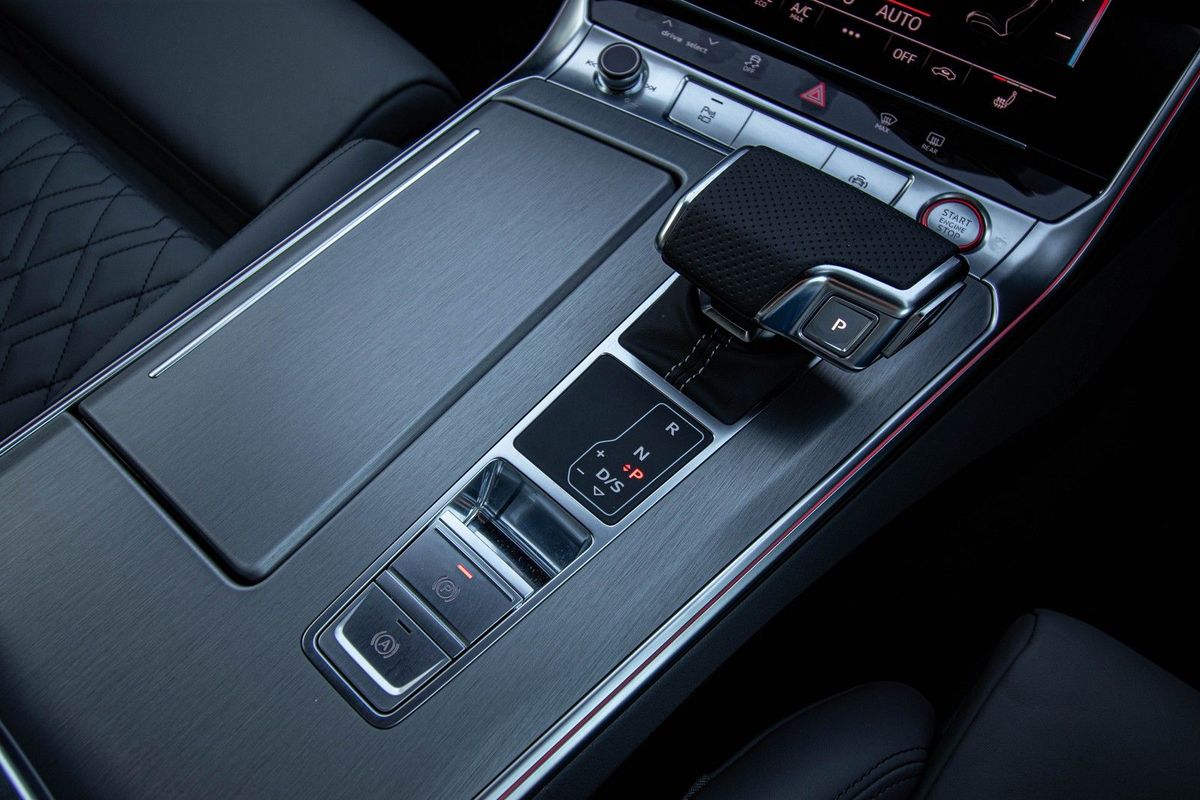
Transmission: 8-speed Tiptronic
Fuel consumption: 8.3 L/100km
Boot capacity: 520 litres
?Performance: 0-100 kph in 4.5 sec
What’s new?
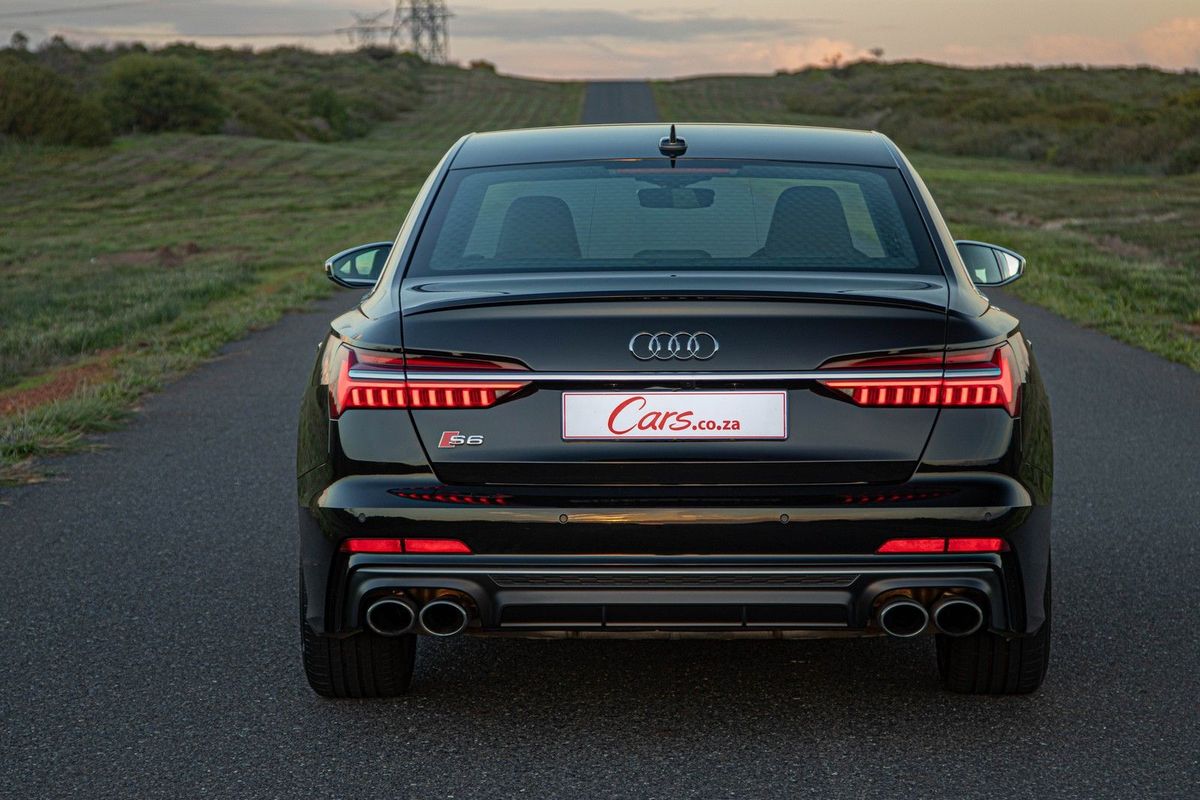
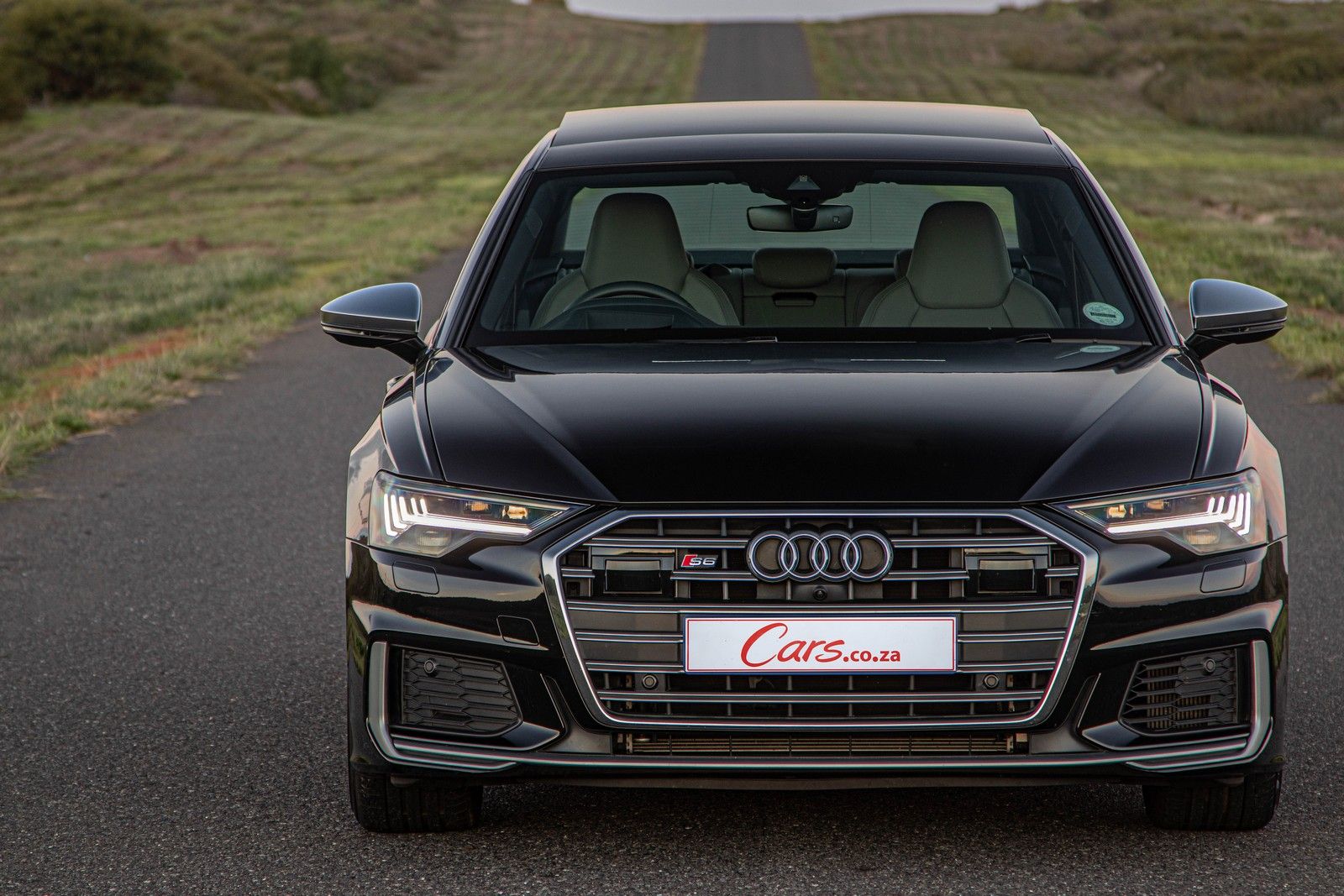
Quite a menacing sight to see in your rearview mirror, isn't it? New-look daytime LEDs really look the part.
This new-generation Audi S6 is a quite different animal to the previous model's S6 derivative, which we reviewed in 2015. The delicious-sounding 4.0-litre twin-turbo V8 is gone; it's been replaced by the RS5's 2.9-litre twin-turbo V6. But, as you'll read below, the loss of 2 cylinders is outweighed by significant advancements in the sedan's other facets. In terms of rivals, the Audi S6 faces competition from the Mercedes-AMG E53 and, to a lesser extent, the BMW M550i, which is due to arrive in Mzansi towards the end of 2020.
The A6 is now in its 8th-generation and the range's arrival is belated… The international unveiling of the A6 happened more than 2 years ago (February 2018), but despite the long delay, we're happy the Audi's here. The question we find ourselves asking is this: Are large luxury sedans are still viable in a market that's totally dominated by SUVs?
Whether you like it or not, SUVs of all shapes and sizes are selling in their droves, and more are scheduled to arrive in the next few years. Audi has updated versions of the Q5 and Q7 in the pipeline, and Sportback versions of the Q3 and Q5 are on their way as well. Let's not forget the S and RS performance derivatives of those models either. The business case for sedans looks dire when you glance at the A4 sedan's sales figures; it was one of the brand's top-sellers for many years, but that's no longer the case.
So, for sedans to survive the SUV onslaught, they will have to be brilliant products with stand-out appeal. Without further ado, let's see if the Audi S6 is worth a closer look.
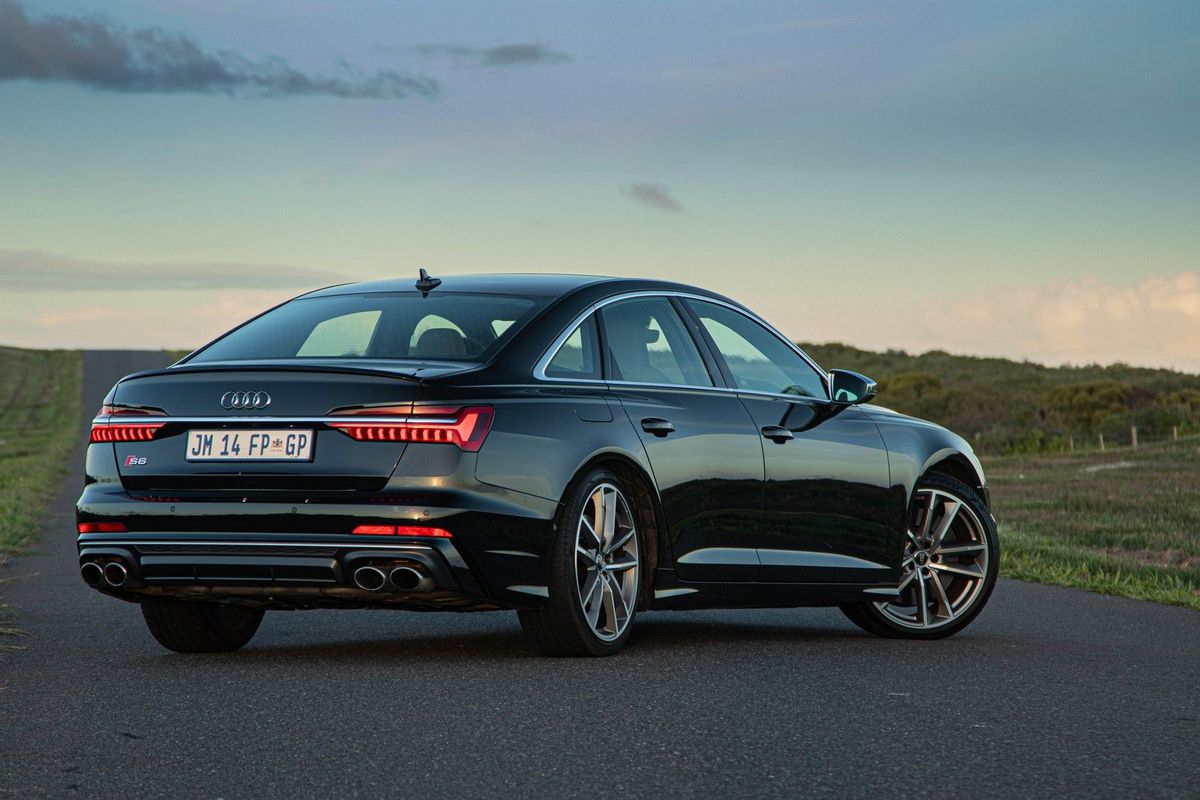
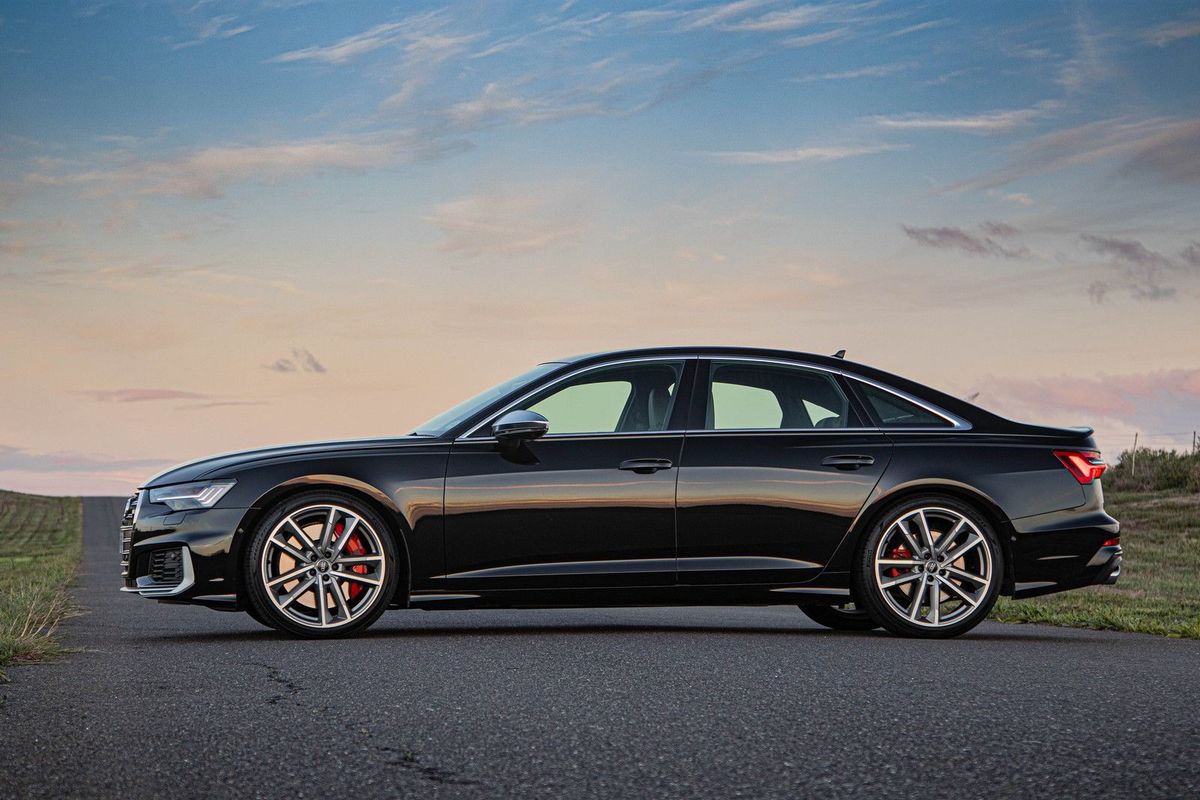
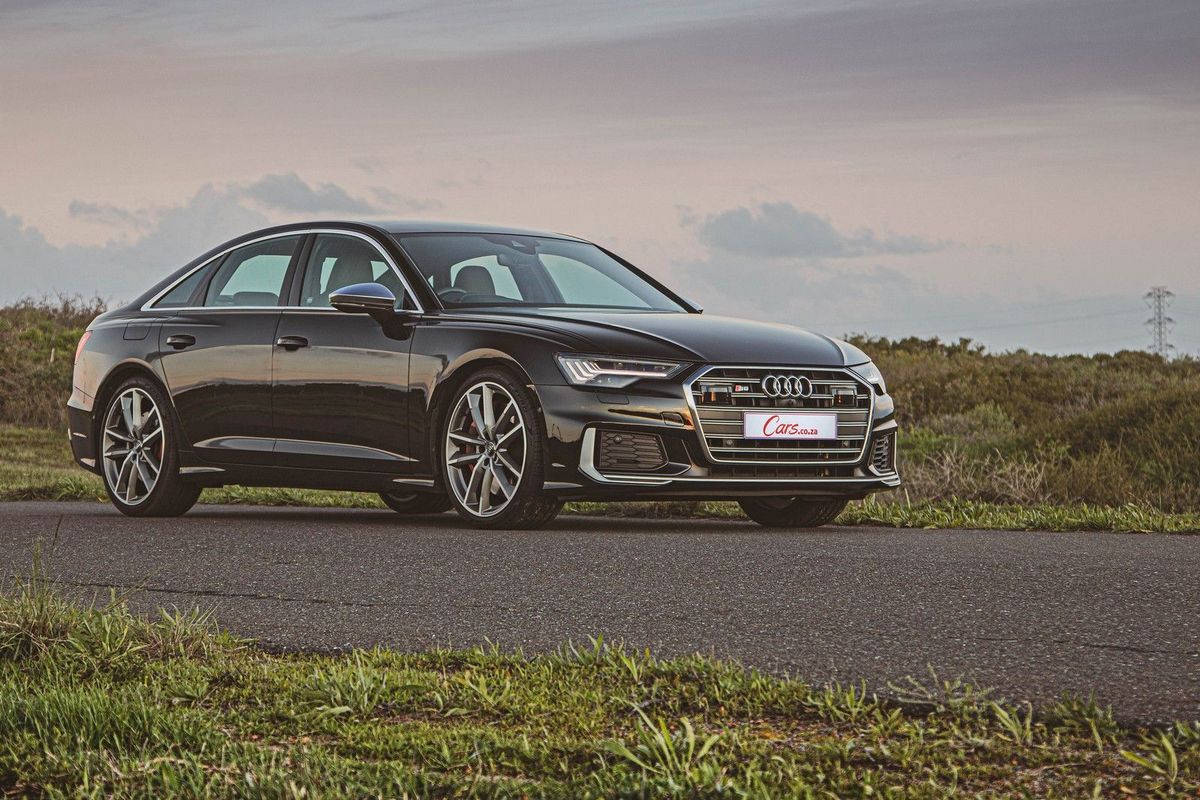
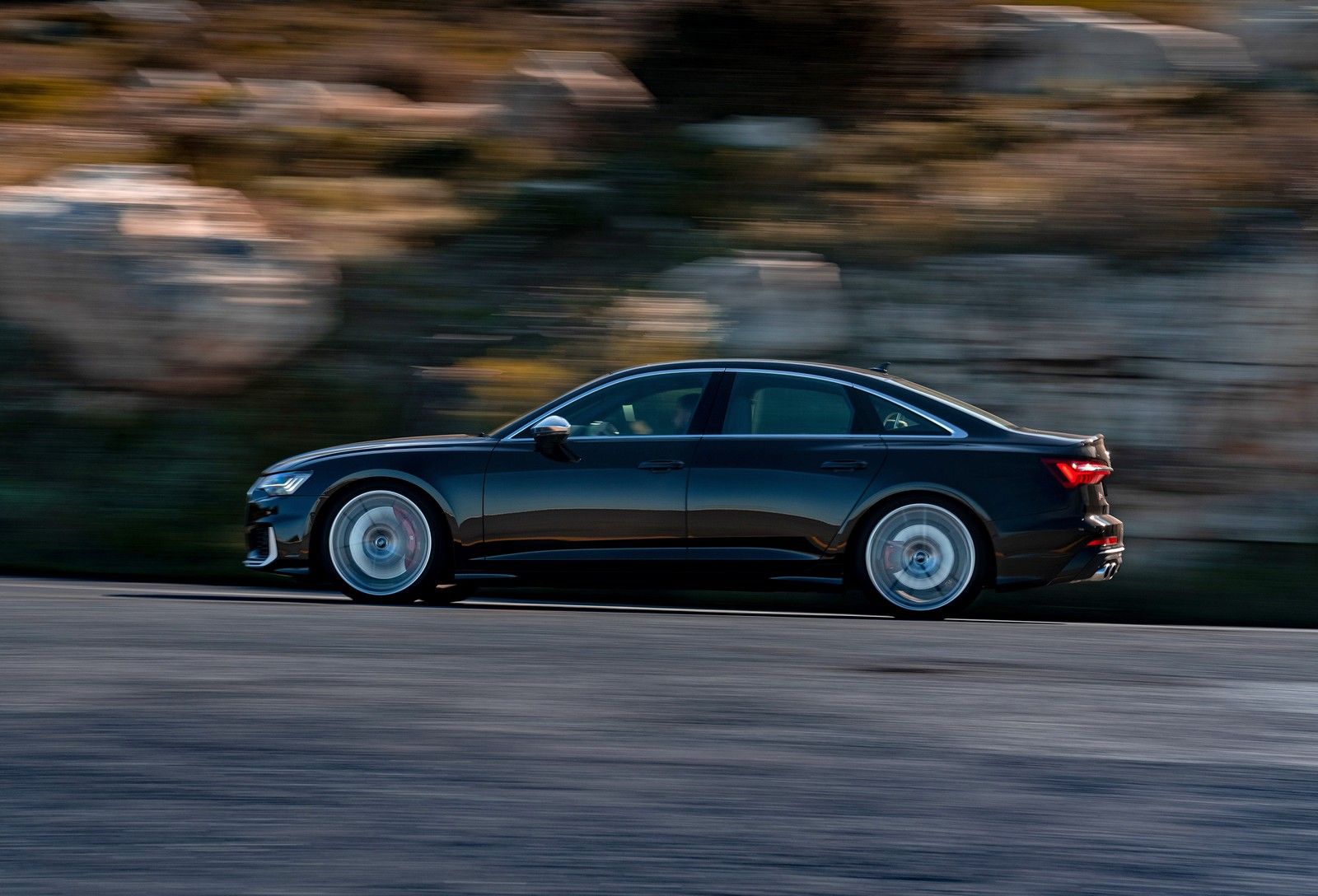
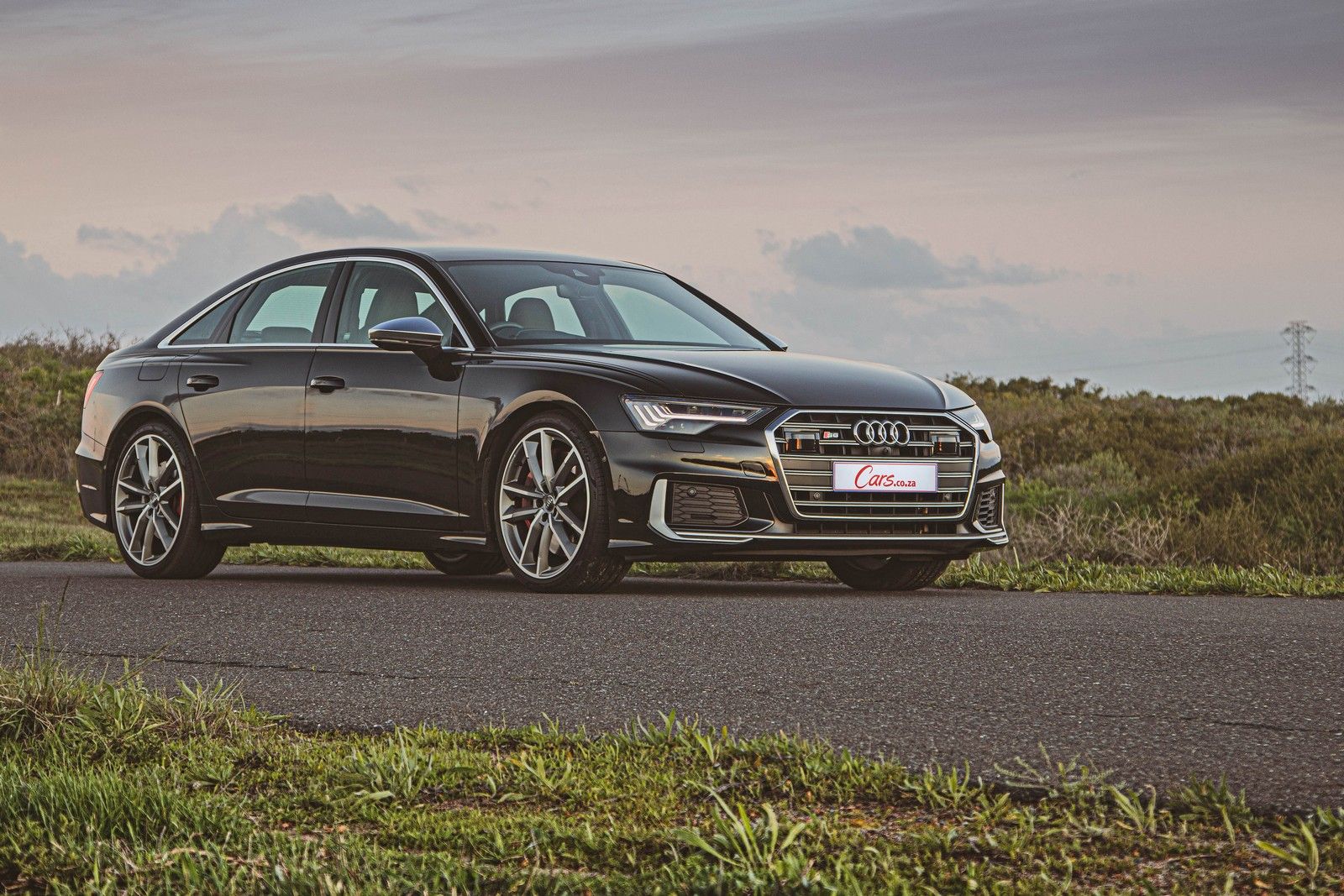
The styling is generic, but the large wheels, sporty bumpers and flared side skirts indicate that this is no ordinary Audi A6.
How it fares in terms of…
Performance
As we mentioned earlier, this generation of Audi S6 is powered by a 2.9-litre twin-turbocharged V6 motor, which we've previously experienced in the RS4 Avant and RS5 coupe. However, in S6 application, it features mild-hybrid technology, as well as an electric compressor. Without getting too technical, this compressor helps to minimise turbo lag, which means the engine feels ever-responsive. If you listen carefully, you can hear the electric motor whizzing away when you stab the Audi's accelerator pedal at idle. There's 331 kW and 600 Nm on tap (for the record, 50 Nm more than the V8) and Audi claims the S6 can hit 100 kph from standstill in 4.5 seconds, which is quite quick for a big sedan.
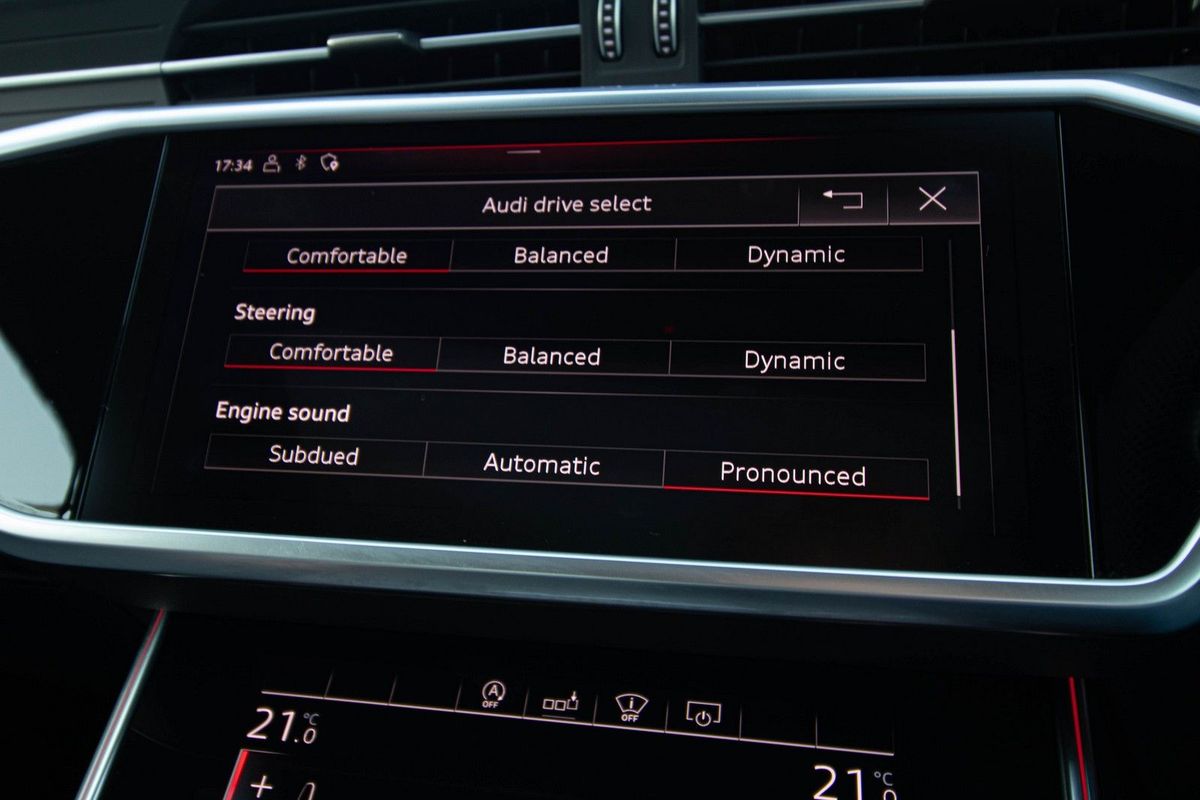
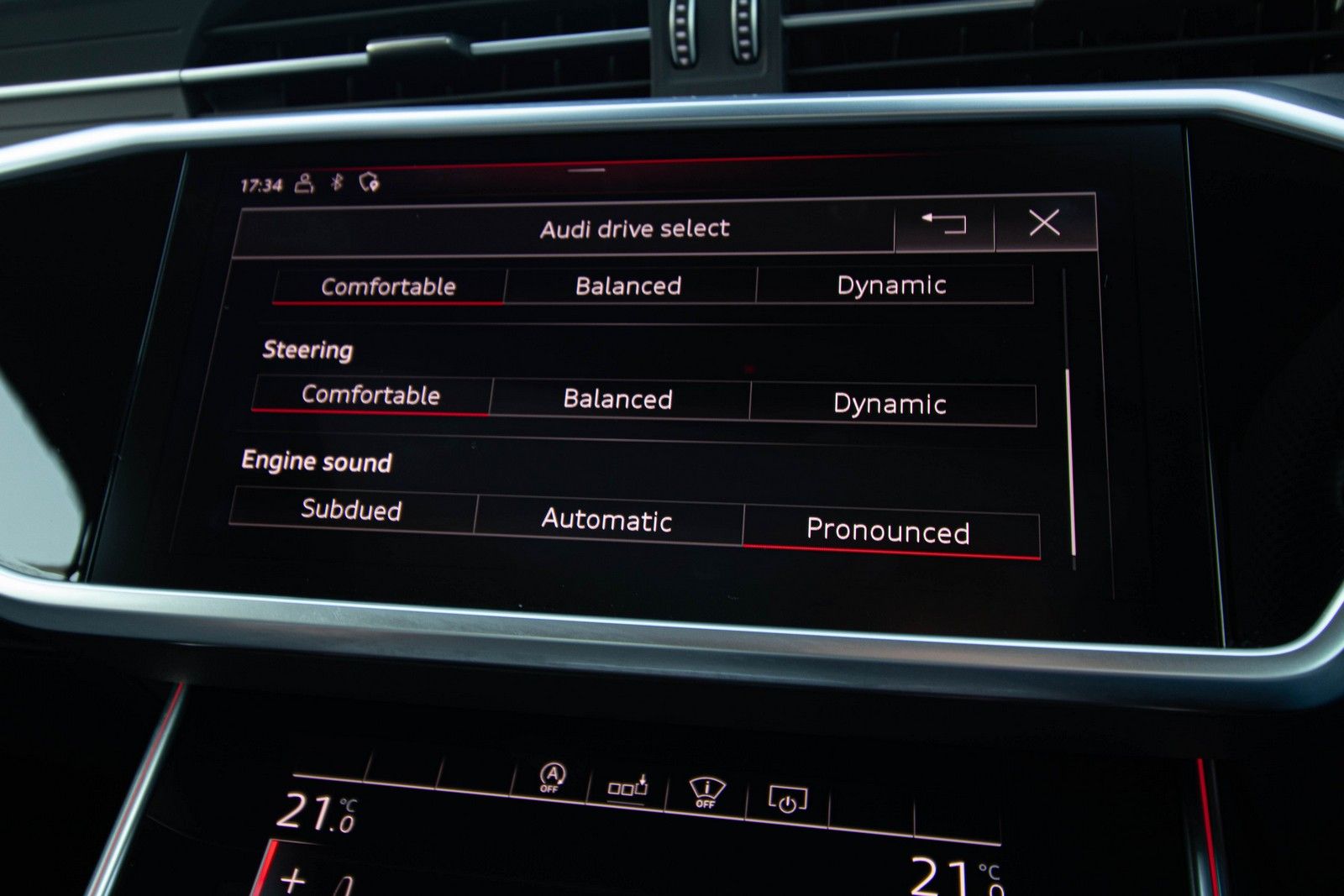
You can configure the S6's settings to your heart's content. Exhaust in Pronounced mode, all day and every day. Sorry neighbours.
With Dynamic mode engaged and the launch control primed, the Audi S6 seems like an athlete awaiting a starter's pistol. When you release the brake pedal, the V6's copious grunt is dutifully directed to all 4 wheels via the 8-speed automatic transmission. There's minimal wheelspin – the Audi S6 hurtles off the line in a bizarrely calm, yet satisfying, manner. When we usually engage launch control in a performance vehicle, we're accustomed to hearing loud pops from the exhaust – let alone the chirrup of scrabbling tyres, yet in the case of the S6, there's little drama. It just takes off like a fighter jet. Granted, we don't think the S6's clientele includes drag-racers, but it's impressive nonetheless.
The Audi really excels in terms of in-gear acceleration. With 600 Nm available and a well-calibrated 'box on duty, it doesn't take much pressure on the accelerator pedal to breach 3-figure speeds. The S6 proved wonderfully competent in the time-honoured 80-120-kph test, in which we simulate the scenario of quickly accelerating to overtake a slow-moving vehicle on a freeway. The sedan leaps forward without a hint of hesitation and lunges towards the horizon (no matter which drive mode you've selected). The transmission is just sublime. It's not a dual-clutch unit, but feels as just as responsive when you want crisp 'shifts, yet it quietly and smoothly goes about its business in traffic.
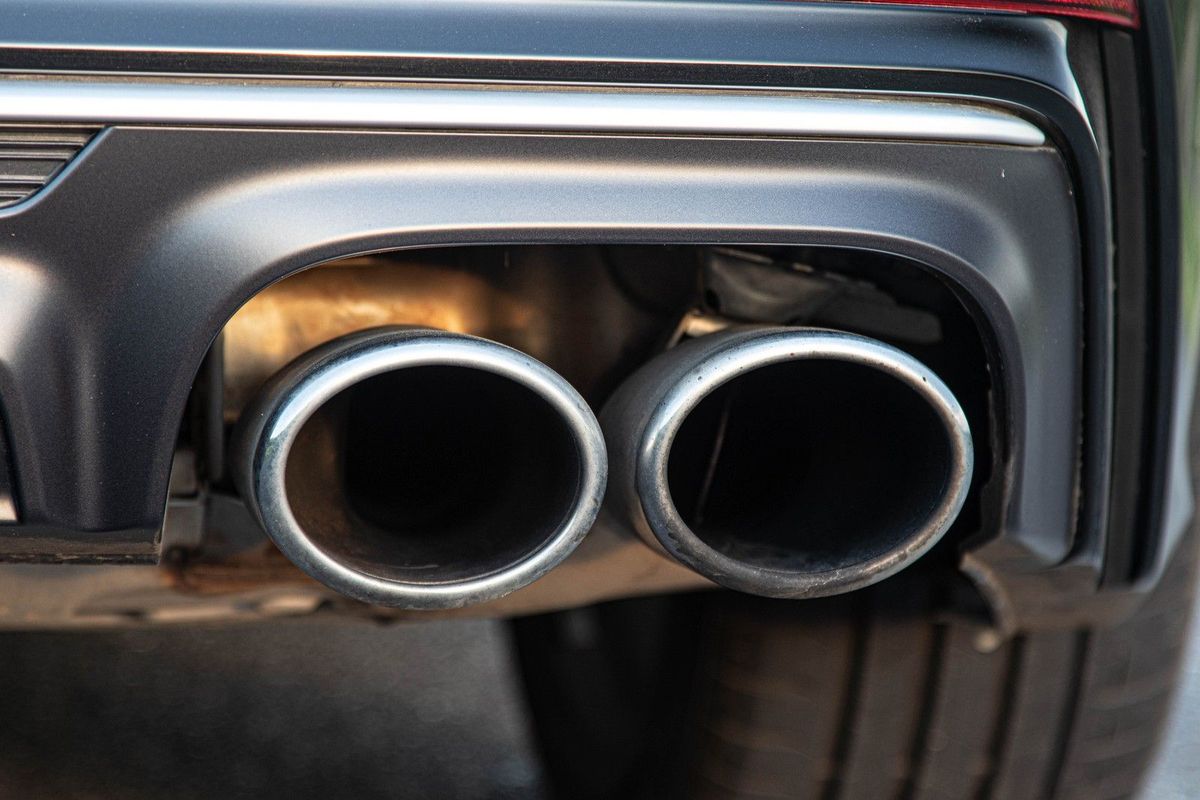
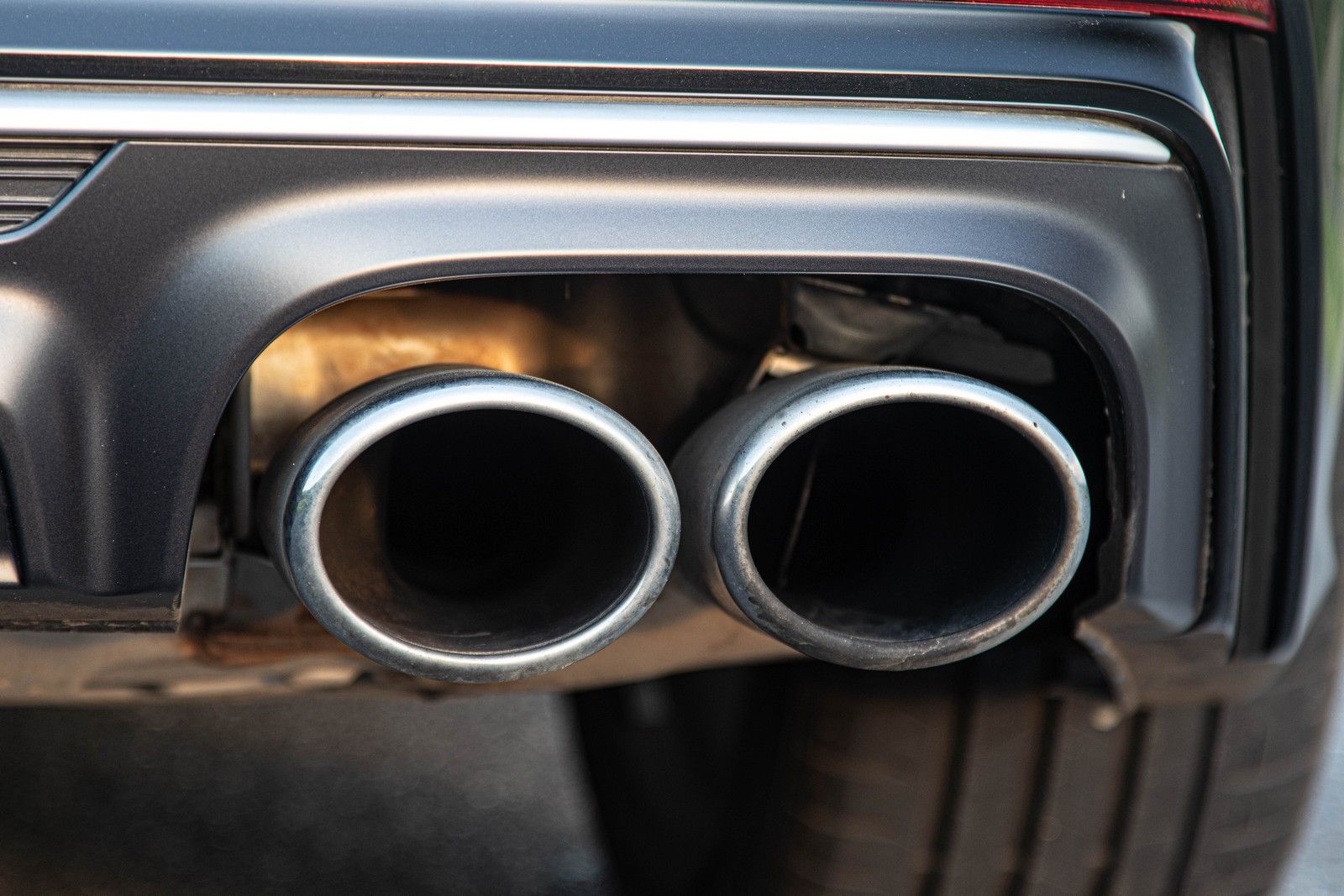
The Audi S6 exhausts are real and you can see the active noise flap in the right pipe. One of the few times it was closed…
Yes, the newcomer produces a lovely engine note, but you'll have to have the car in its sportiest settings to hear that creamy V6 howl, because the exhaust valves are closed in most drive modes. If you happen to be in the confines of a city and have the windows down, you'll hear that typical Audi/Volkswagen bruhp! that accompanies each gear shift (also known as vrr-pha, but let's stay on topic). The Audi does not employ a sound symposer here… those 4 exhaust tips are real and that soundtrack is utterly magical.
We liked this engine in the RS5, but we didn't fall in love with it, because it failed to match the aural drama generated by the V8-engined Mercedes-AMG C63 S and the straight-6 roar of the BMW M4 – the V6 just sounded tame by comparison. However, this motor is far more fit for purpose in the S6; it suits the car's mature executive image better.
Ride & Handling
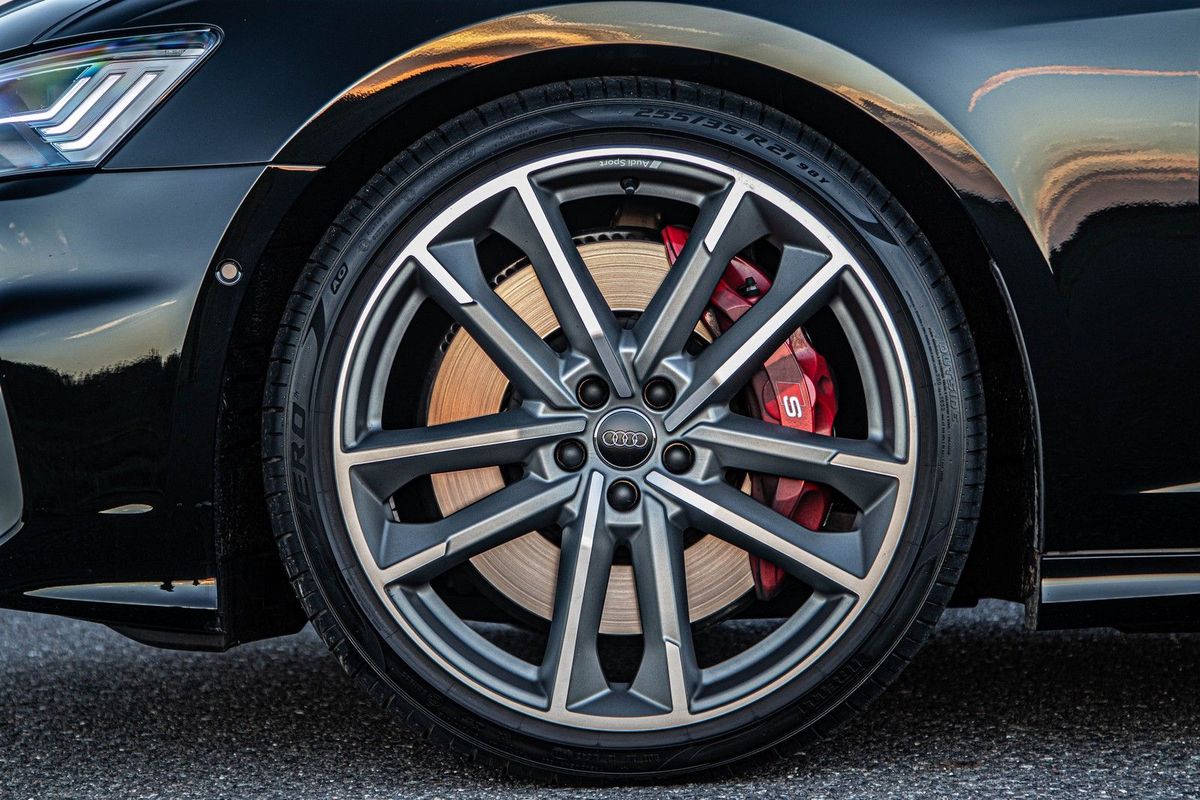
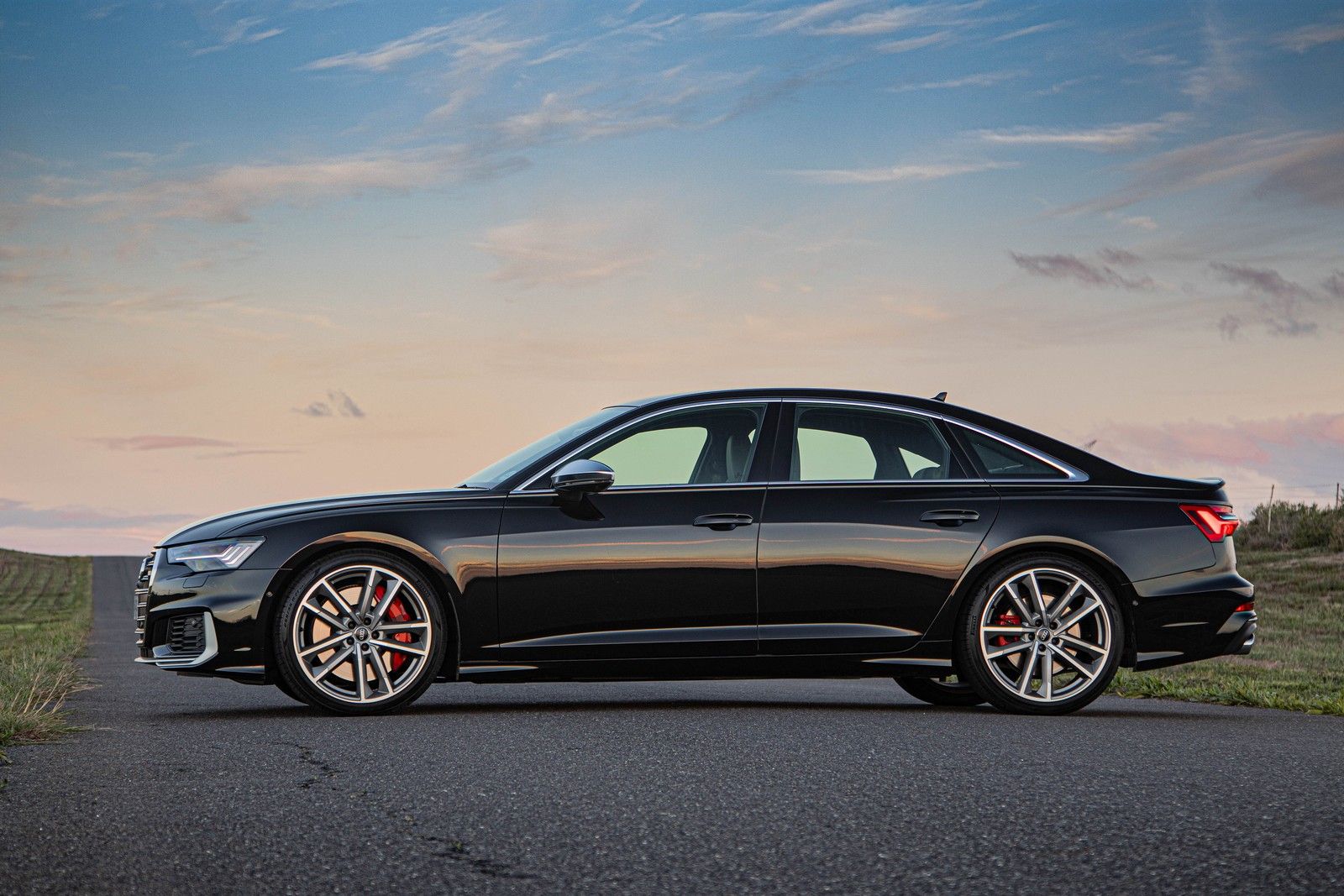
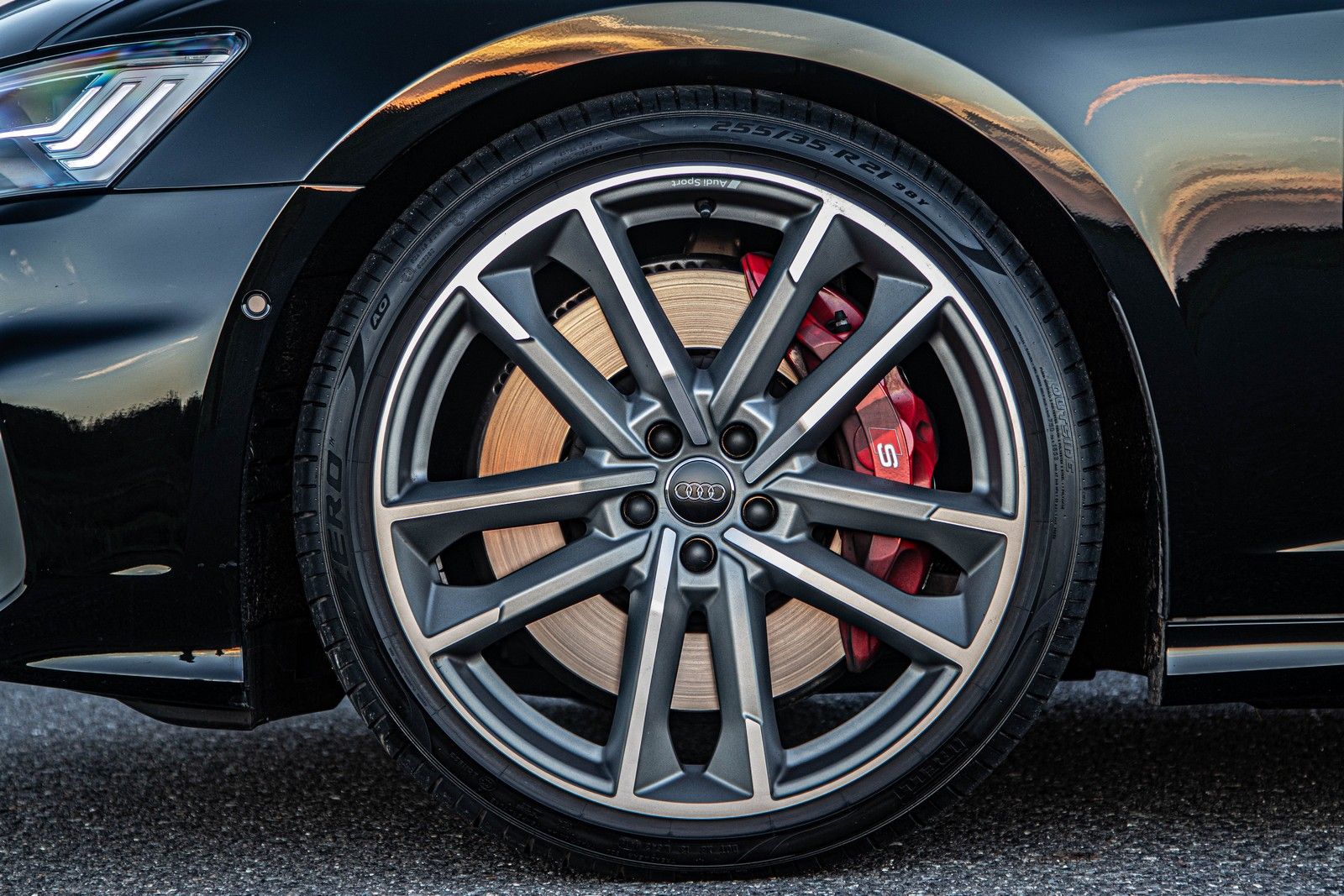
Stylish 21-inch alloy wheels conceal the Audi Sport brakes which are effective.
While the Audi S6 is marketed as a performance sedan, we suspect most of its customers would appreciate comfort far more outright performance. So, is it comfortable? This particular test unit came fitted with the optional adaptive air suspension (R16 490), which certainly adds extra pliancy to the sedan's ride quality. We must mention the optional large wheels fitted to the test unit: at 21-inches, they aren't subtle. Despite the low-profile tyres and sporty suspension, though, Audi has made its S6 ride, no, glide beautifully.
We say that because the Audi delivers admirable on-road refinement – and then some. It's unreal just how smooth it is to drive, but with the adaptive air-damping in the mix, you're can revel in the soft comfort setting of the suspension the one moment and then, at the touch of a button, firm things up when you want to exploit the S6's performance.
Our test unit also came fitted with Audi's Dynamic all-wheel steering (R28 770), which means both the front and back wheels turn. How does it work? Well, at speeds of up to 60 kph, the rear wheels can turn up to 5 degrees in the opposite direction to the front wheels, which means the car has a tighter turning circle and, therefore, parking maneuovres are simpler to execute in confined spaces. Above 60 kph, however, the aft wheels turn as much as 2 degrees in the same direction as the fronts, which improves stability. Can you feel the system working? While you're parallel parking, yes… definitely. Plus, when you change lanes at high speed, you'll feel the car change direction with minimal fuss.
In Dynamic mode, the car's air suspension lowers it fractionally and gives it a hunkered-down stance.
The Audi S6's steering setup is also worth a mention, because it is 3-way adjustable in terms of firmness. We found the newcomer's 'wheel pleasantly light for the purposes of city driving; it becomes progressively weightier as speeds increase, but not too drastically – the tiller remains effortless to twirl. Like most high-end performance Audis, the S6 boasts a quattro all-wheel-drive setup. This quattro system has been enhanced for 2020 and is rear-biased, which means most of the propulsion comes from the aft axle.
Audi claims up to 80% of torque can be sent to the rear wheels, but for us, quattro is all about predictability and stability; the S6 grips prodigiously – it's going to take some real ham-fisted or careless driving for this sedan to come unstuck. If things to go awry, don't worry, the brakes are excellent; they invariably bring the large vehicle to a prompt stop.
The key takeaway here is that the all-wheel steering, quattro and air suspension all work together to deliver some deeply impressive levels of handling prowess. The S6 a large luxury car (a luxobarge, to be blunt)… it should not feel this agile and yet, we could happily pitch the 1 800-kg sedan into tight bends. It's a joy to drive. The S6 does its utmost to deliver driving thrills and while it's not the most dynamic Audi model, its performance is more than adequate for an S-badged product. Want more go? Buy an RS6.
Comfort & Practicality
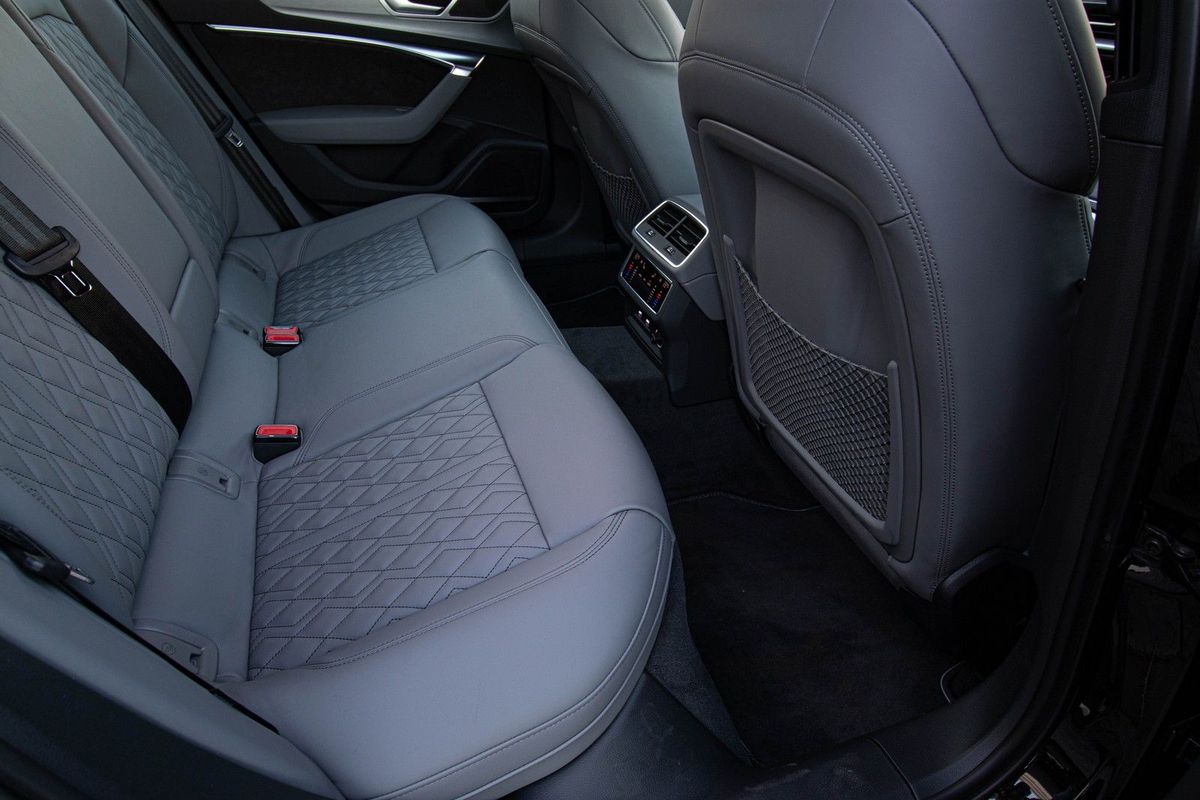
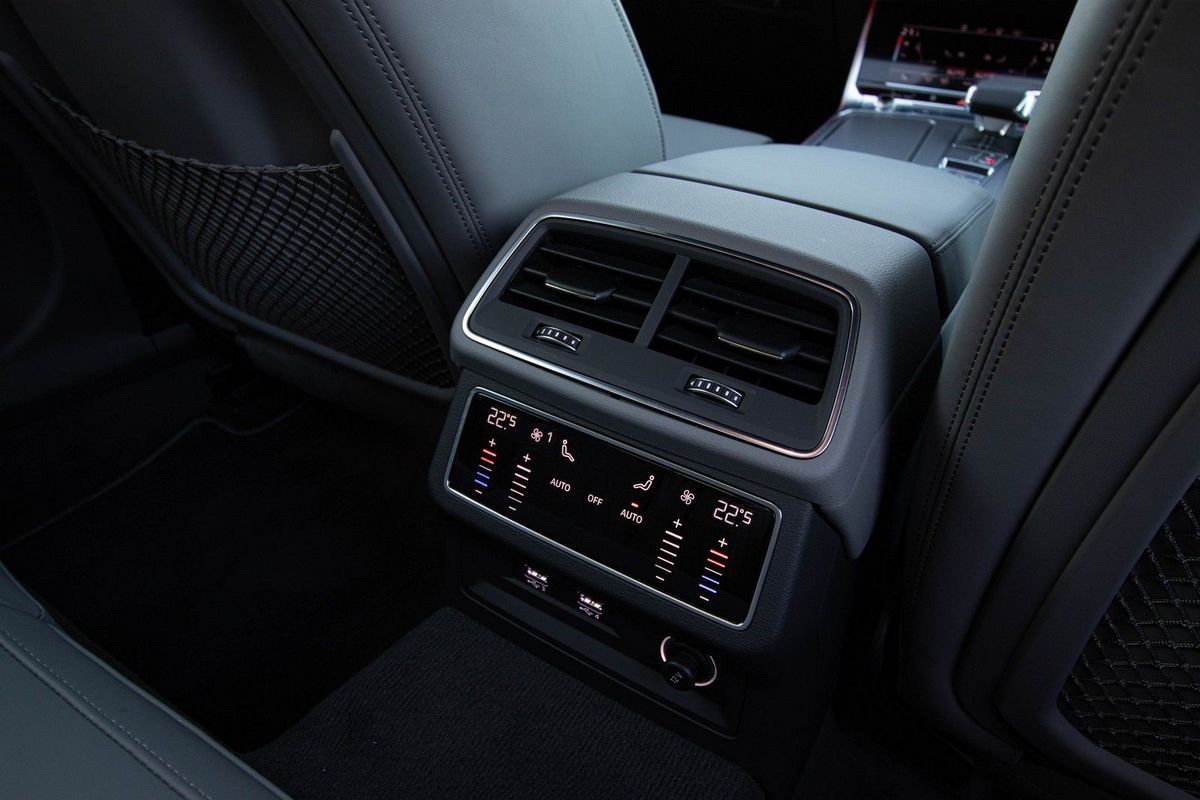
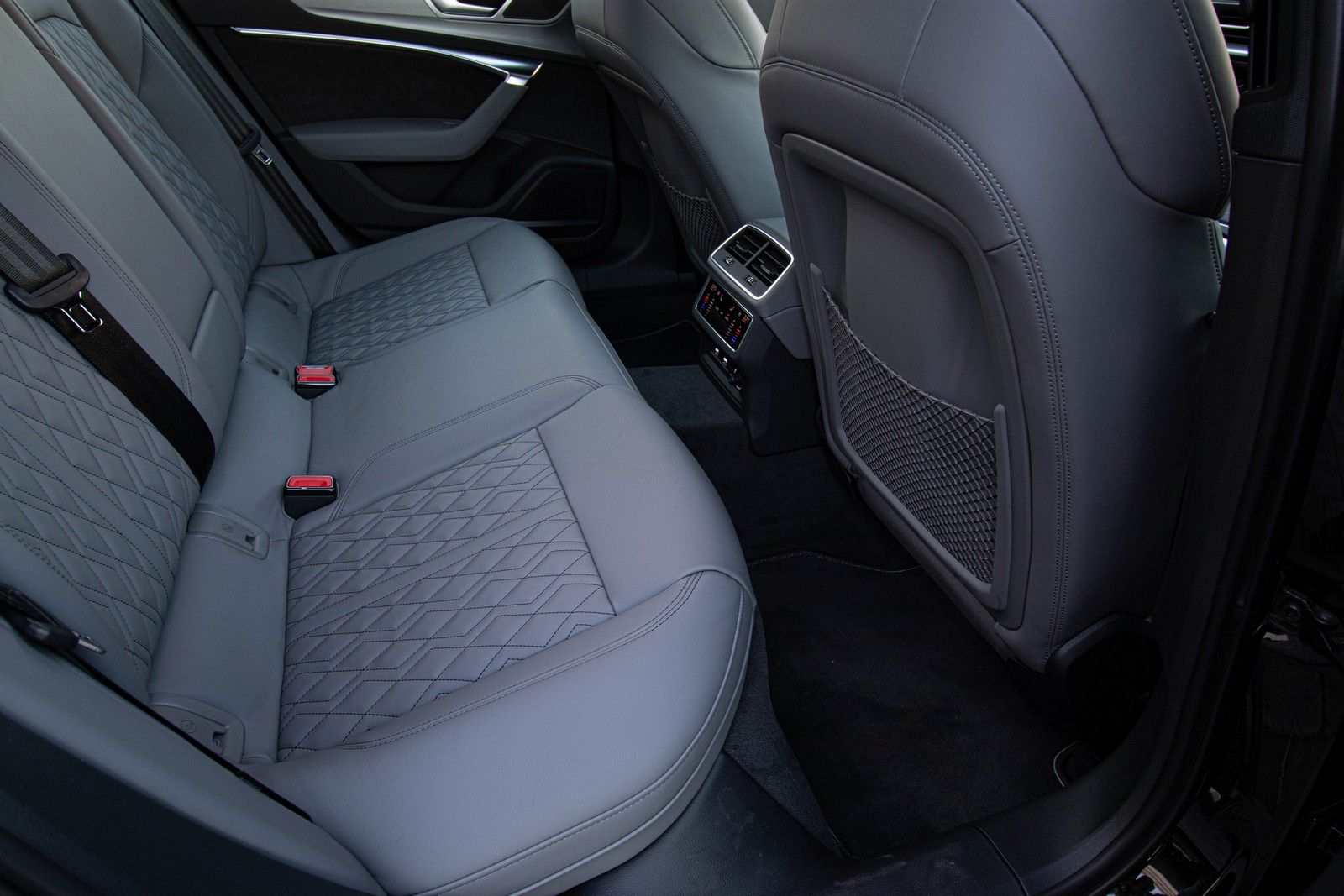
Rear legroom and space is generally good. Rear passengers are afforded device-charging functionality.
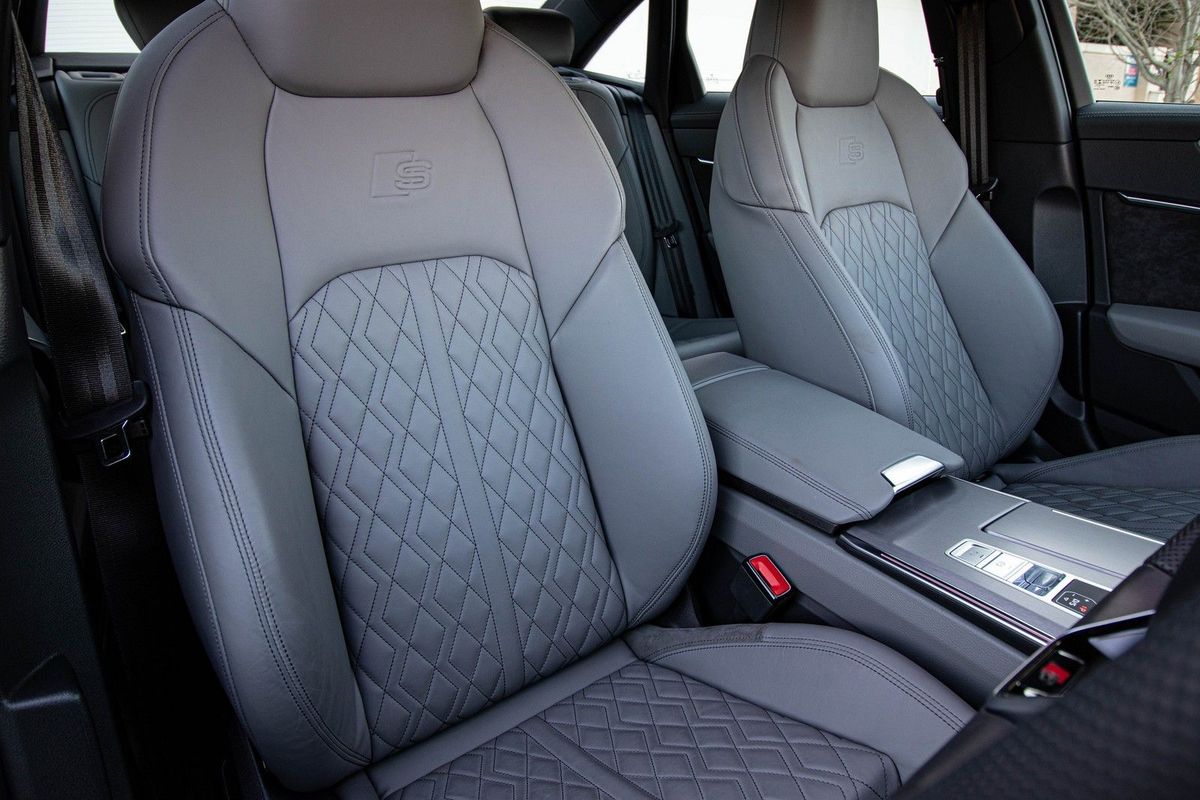
The use of the MLBevo platform bodes well for the A6's interior space and practicality. This is, after all, the platform that underpins the Audi Q7 and A8, which are physically larger than the Audi S6. Suffice to say that front occupants are ensconced in comfort, while there is enough rear legroom, as well as headroom, to accommodate tall adults. Our test unit came equipped with the sports front seats (R18 270) and we found them to offer a fine balance of support (during spirited cornering) and long-haul comfort. Boot space is rated at 520 litres, which is fractionally less than its rivals. The Mercedes-Benz E-Class is the segment leader at 540 litres, with the BMW 5 Series coming in at 530 litres.
Connectivity & entertainment
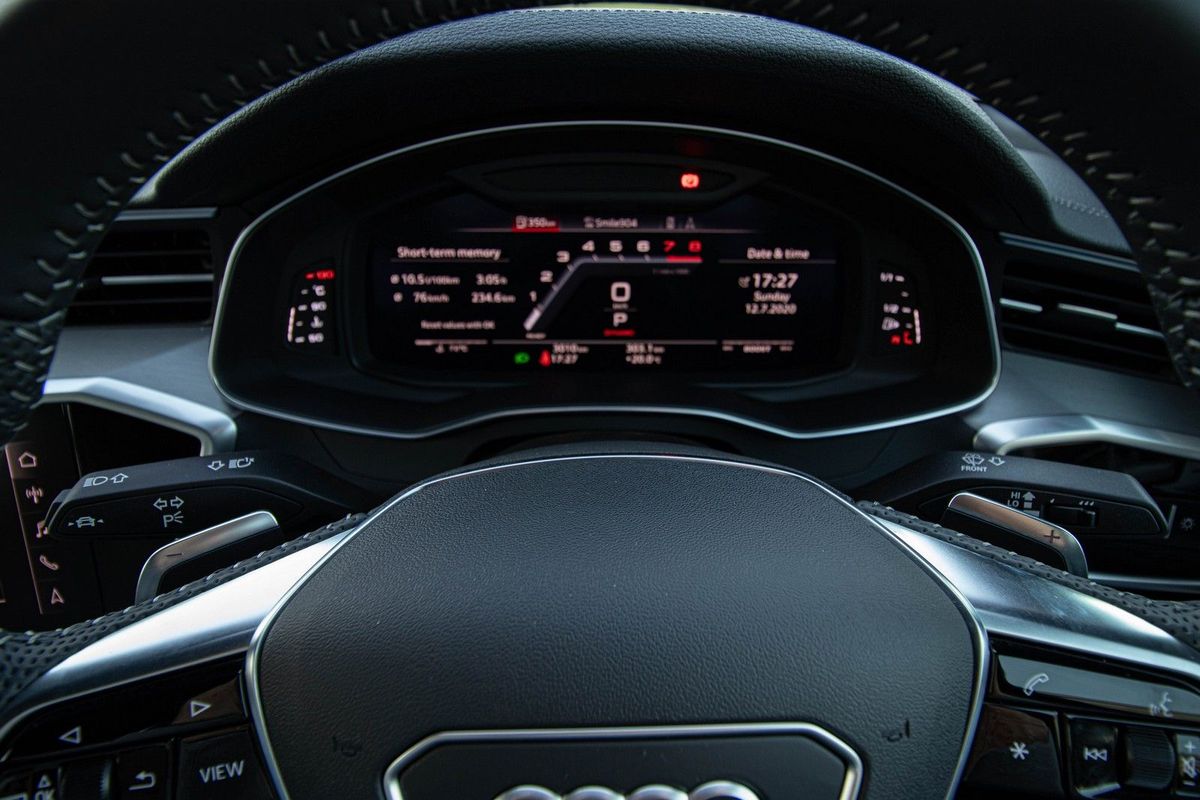
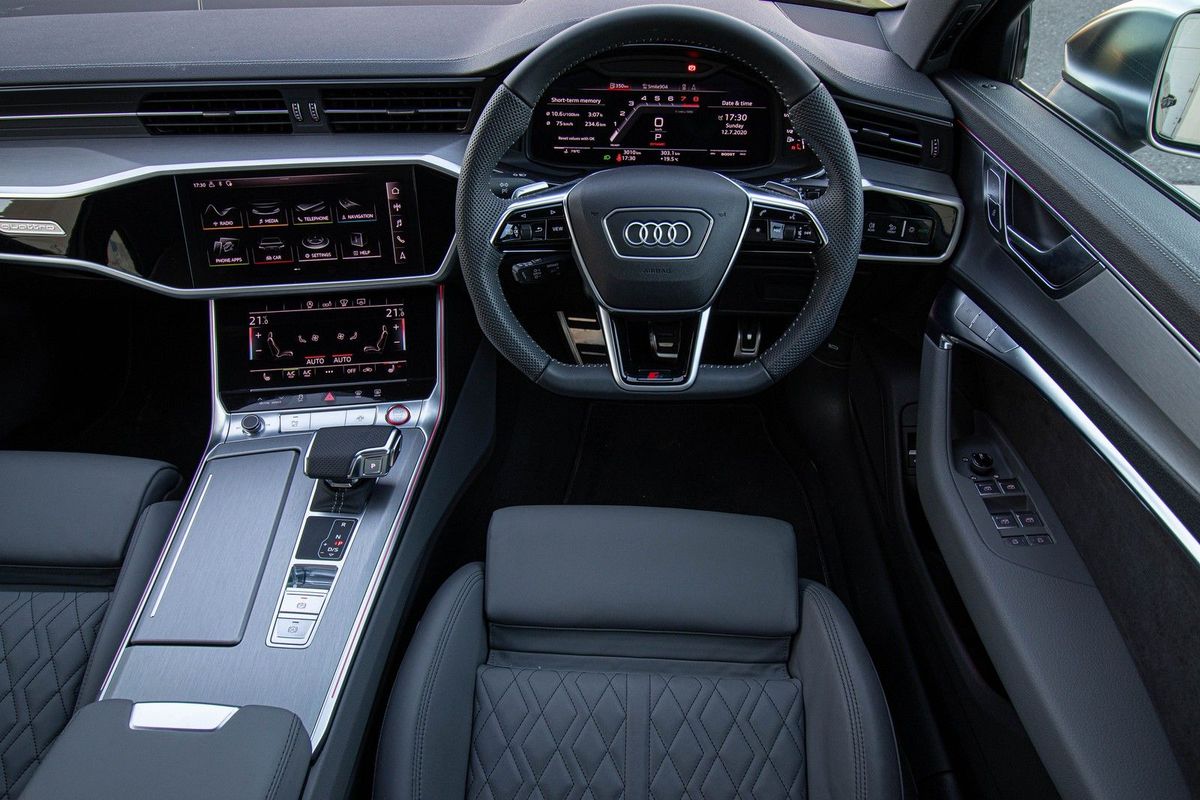
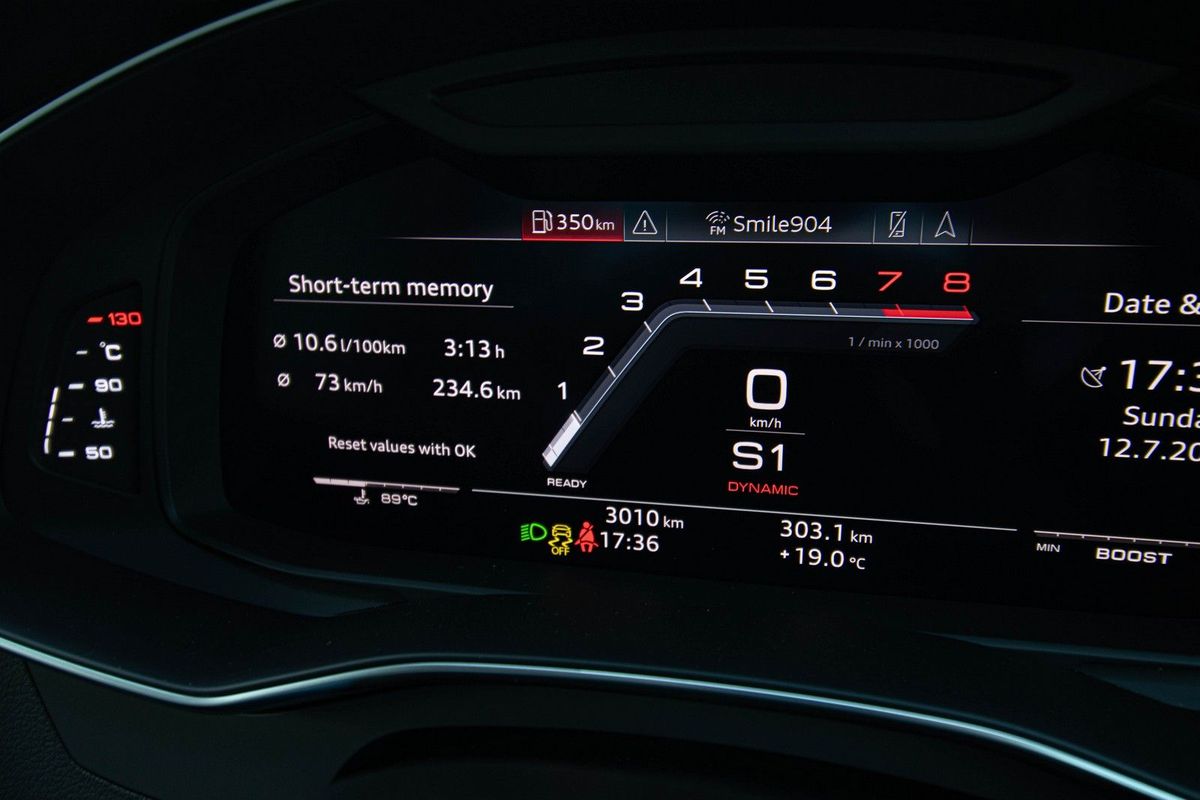
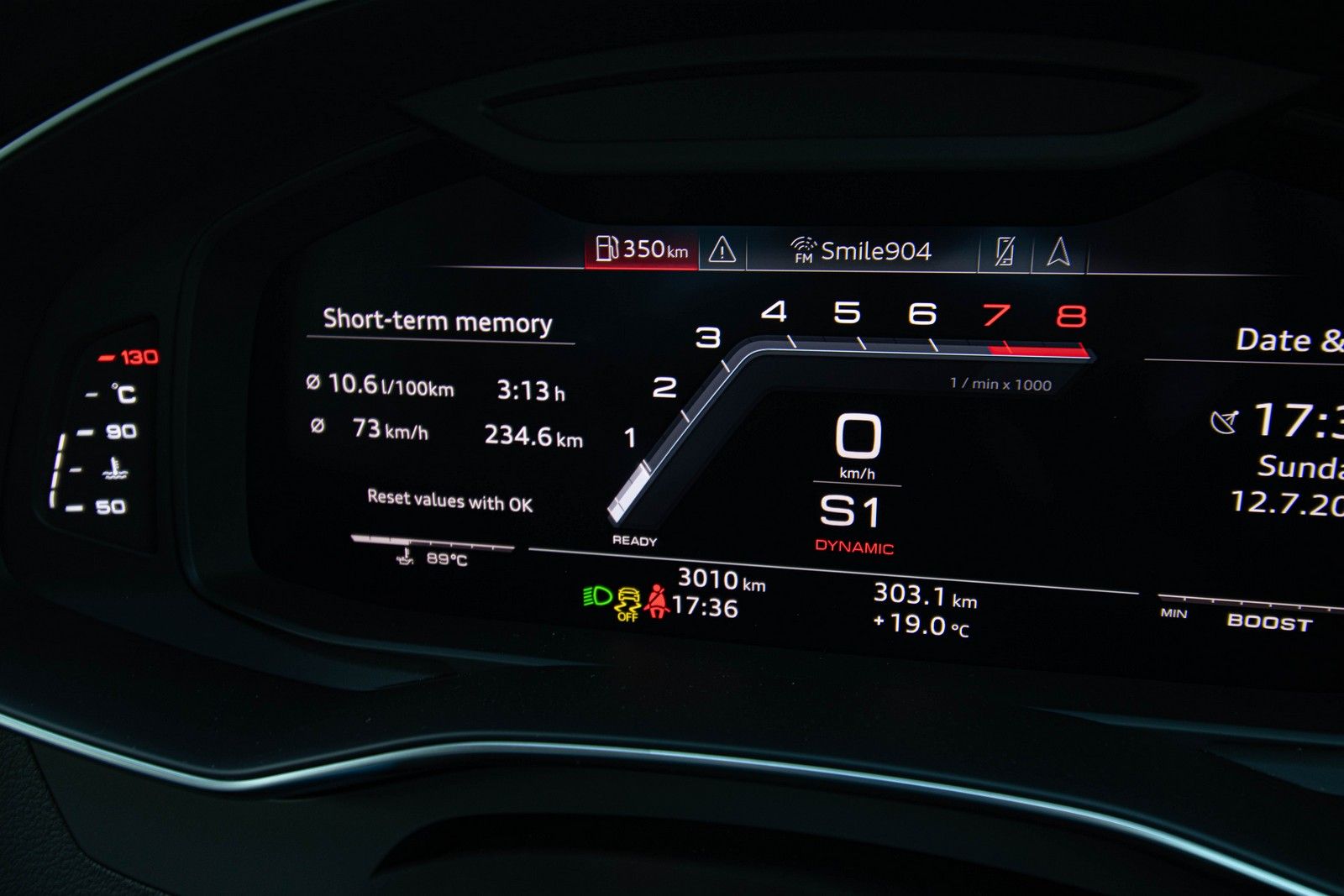
Audi Virtual Cockpit features this unique S6-specific rev counter
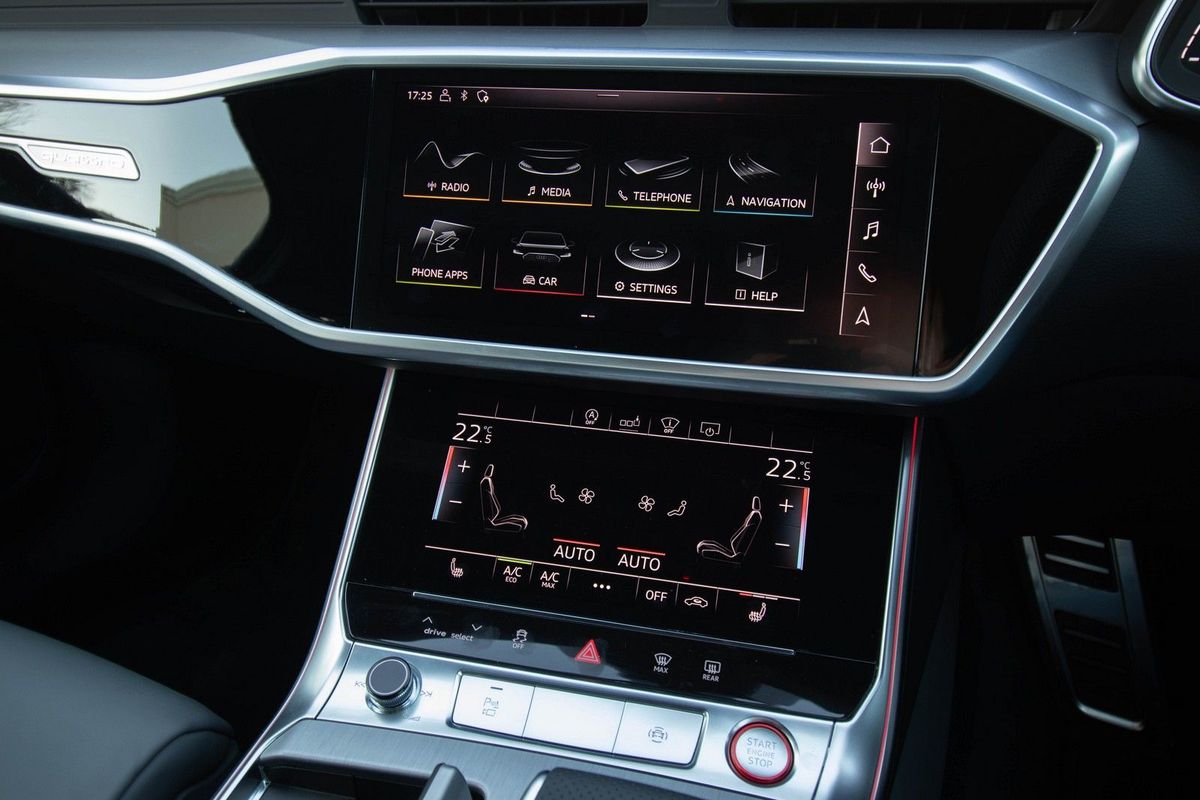
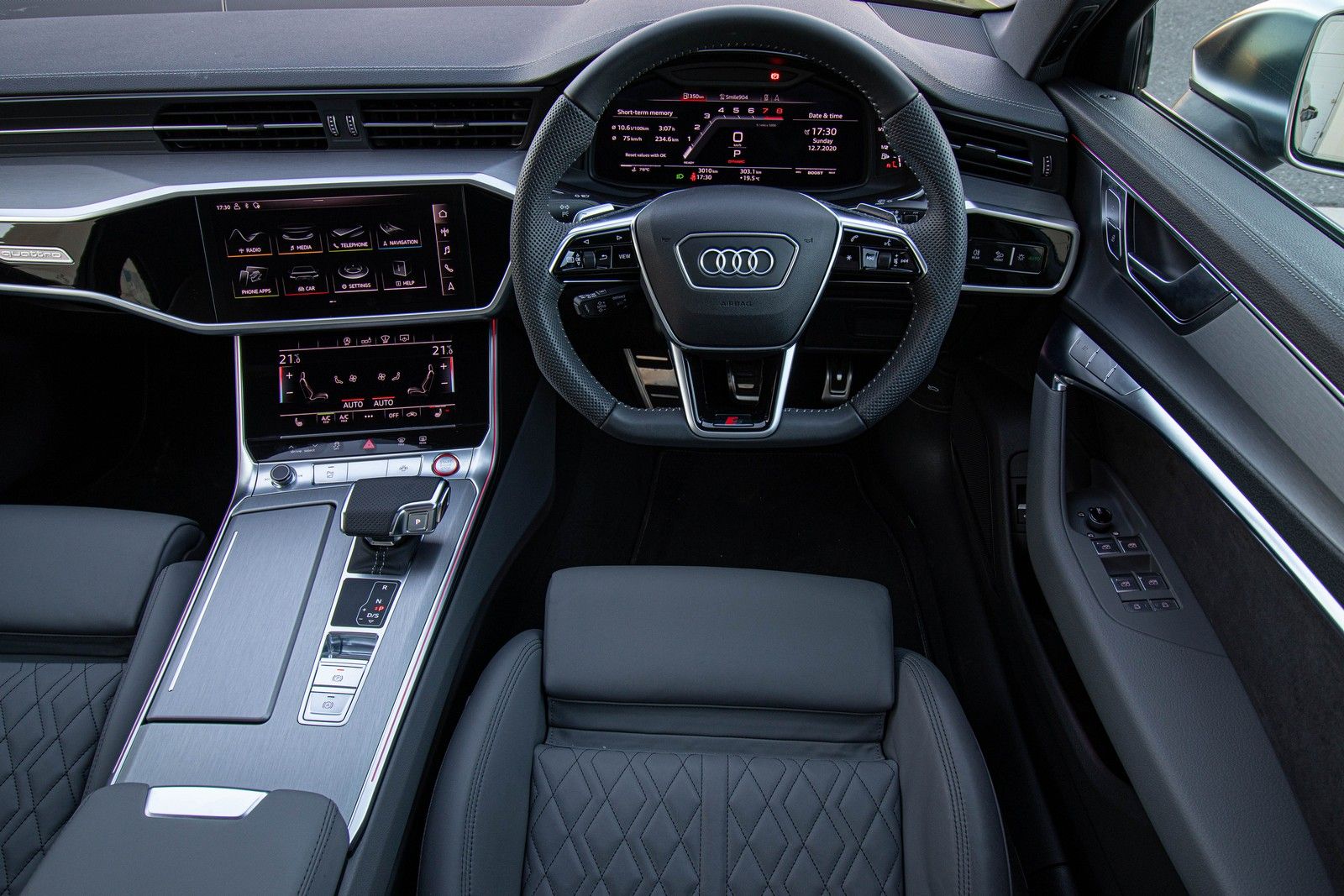
The Audi S6's electronic user interface benefits greatly from the fitment of the latest Audi infotainment system. Dubbed MIB3, this system first made its debut in the Audi Q8. Comprising a tiered 2-screen setup, the infotainment system has futuristic graphics and a slick interface. What's more, Audi has integrated a haptic feedback system, so it feels like you're clicking a button when you select a function. The only downside to this nifty system is that it tends to collect fingerprints, so store some wipes in the door pocket.
By virtue of sitting near the top of the A6 line-up, the S6 is generously specced; it lacks very little in the way of onboard gadgetry. Standard kit is substantial and we're big fans of the Audi Virtual Cockpit digital dashboard (with specific S6 graphics), Audi Matrix LED headlights, the Bang & Olufsen audio system and the Audi phonebox, with its wireless charging capability and Apple CarPlay/Android Auto compatibility. Our vehicle also featured heated seats as standard, which are oh-so-useful on crisp winter mornings.
Does the Audi S6 offer the finest interior in the executive sedan segment? Possibly. It blends modernism and luxury terrifically, plus the tactile surfaces feel suitably premium. It all feels expensive and well finished, which is exactly what customers want in this segment. Road and wind noise? Pah, the cabin is well insulated from "such trivial things".
The driving tech's also worth a mention. We discovered the Predictive Efficiency system, for example. We're guessing it's dialling into the navigation to do this, but as you approach an intersection or circle, the car vibrates its accelerator pedal to tell you to ease off the power and coast to a stop (to save fuel). Such attention to detail!
The Audi S6's arguably combines high luxury and extensive technology better than most executive sedans.
Pricing and after-sales service
The Audi S6 TFSI quattro costs R1 401 500 (as of July 2020, before options) and comes standard with a 5-year/100 000-km Audi Freeway (maintenance) plan.
Verdict
An all-rounder is a cliche, but the Audi S6 nonetheless epitomises the term. Are you sure you still want that SUV?
All Audi's models are accomplished, even if the brand's sedan offerings tend to err on the side of understatement. It's going to take quite the offering to separate the good from the great in this segment, but this S6 is exceptional, inside and out. The keyword here is balance. If you want a luxurious, refined, and sophisticated sedan to commute in (often gridlocked) traffic, the big Audi will do that with ease. If you're looking for a vehicle with which to undertake long-distance journeys in absolute comfort, the S6 fits the bill.
But, if you like to occasionally break free from the rigours of everyday life and carve up a twisty set of corners with your chariot – which emits a captivating V6 soundtrack no less – the S6 delivers. Not only does the Audi cocoon its occupants in a beautifully finished interior, it effortlessly balances luxury and comfort with performance and handling.
And do you know what's the best part? The majority of SUVs can't blend those attributes nearly as well as the S6. Even though Audi's S and RS engineers are trying their utmost to engineer corner-carving ability into the Q range, a sedan will always be one step ahead dynamically. The executive sedan segment will soon heat up – an updated Mercedes-Benz E-Class is on the way and the facelifted BMW 5 Series is due to make landfall before the year is out, but the new Audi A6 presents a strong alternative.
If you want even more presence and performance than the S6 offers, you'll have to wait until early 2021, when the Audi RS6, which churns out 441 kW and 800 Nm (courtesy of its 4.0-litre twin-turbo V8) is set to make its arrival in the local market. It'll have its drawbacks, however. The RS6 will be offered in Avant (station-wagon) guise only, which limits its appeal, plus its performance will probably be overkill, given the limitations of South Africa's road network. The S6 is the next best thing, but far from a piecemeal derivative.
A petrol, diesel and paraffin price increase is on the cards for the month of August 2020.
With the oil price high during the month of July 2020, it's certain we'll see increases in the fuel price, despite a surprisingly good performance from the Rand. This information comes from the Automobile Association, who comments ahead of the month-end fuel price data released by the Central Energy Fund.
As far as changes go, petrol is set to increase by between 9 and 16 cents a litre, diesel will increase by up to 48 cents a litre and paraffin by 43 cents a litre.
"Oil traded in a fairly tight range throughout July, but it was a substantial climb at the beginning of the month, plus some recent volatility, that combined to push prices higher," the AA says. "The Rand gained eight cents against the US dollar during July and the average exchange rate has firmed to below R16.90.With so much negative news surrounding the economy, the Rand's firmer trend is welcome, but we would like to see the government support this trend in the area of economic policy certainty."
Mitsubishi has announced a 3-year mid-term business plan that aims to focus on the brand’s key strengths. New products are on the way and some are being axed…
Mitsubishi is re-focusing its efforts following the announcement of its Small but Beautiful plan which aims to reduce fixed costs by optimising production as well as implementing a new regional and product strategy.
As such, Mitsubishi will no longer sell new vehicles in Europe but will instead focus its attention on developing its business in the ASEAN markets, Africa, Oceania and South America.
"We will shift our strategy from all-round expansion to selection and concentration," says Takao Kato, representative executive officer and chief executive officer of MMC. "First of all, we will complete our structural reform and further strengthen our competitive areas, ultimately to build a corporate structure that can surely generate profits during this mid-term period."
Let’s talk product
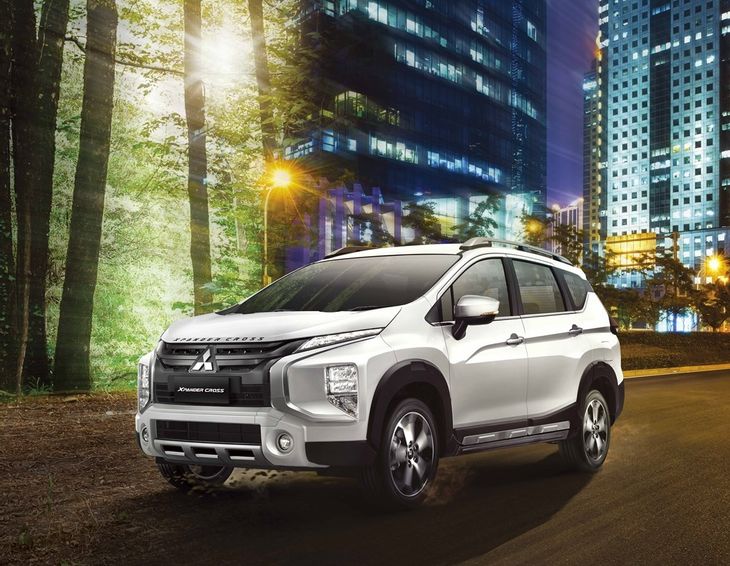
The Xpander Cross is expected in South Africa in coming months…
We reported this week that the legendary Mitsubishi Pajero was no longer viable and production in Japan is expected to come to an end in the near future. Mitsubishi South Africa has, however, stated that it will continue to offer the Pajero locally until production comes to an end.
The Pajero Sport will, however, forge on in the 7-seat Adventure SUV segment with an all-new model expected in 2023. More so, a new Outlander is also expected to be revealed in coming months too with a plug-in hybrid version expected later in some markets (not likely for SA). Mitsubishi will also introduce an Eclipse Cross PHEV in select markets.
South African buyers can expect the new Mitsubishi Mirage budget hatchback and the new Xpander Cross to reach our shores in the near future.
As for the Triton double-cab bakkie, it will play a critical role for Mitsubishi going forward and a new Triton has been confirmed for 2022. It will share a platform with the Nissan Navara and while the 2 bakkies will share key componentry such as engines, transmissions, suspension and so forth, they will each feature their own distinct design.
Further down the line in 2023, two all-new SUV / crossover products are in the pipeline but details of these new products have yet to materialise. Let's hope a replacement for the ageing ASX compact family car is in the works…
We will keep you updated as more information becomes available
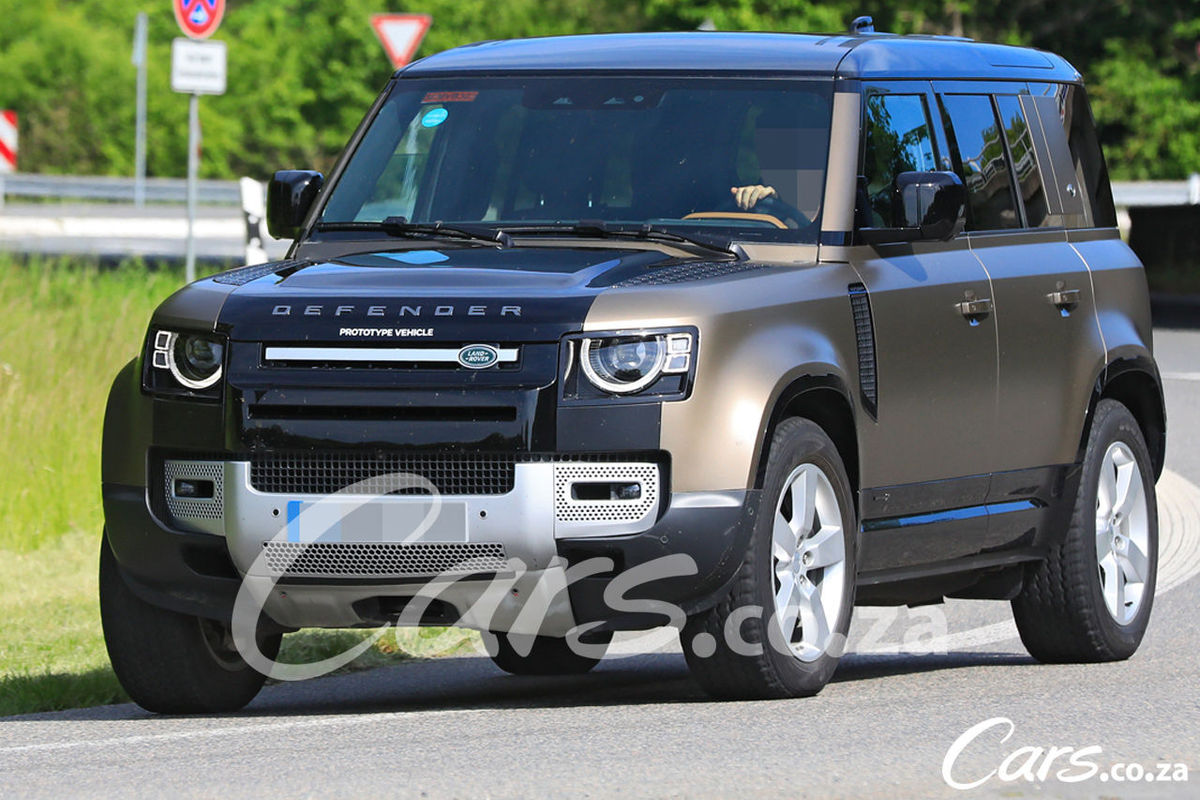
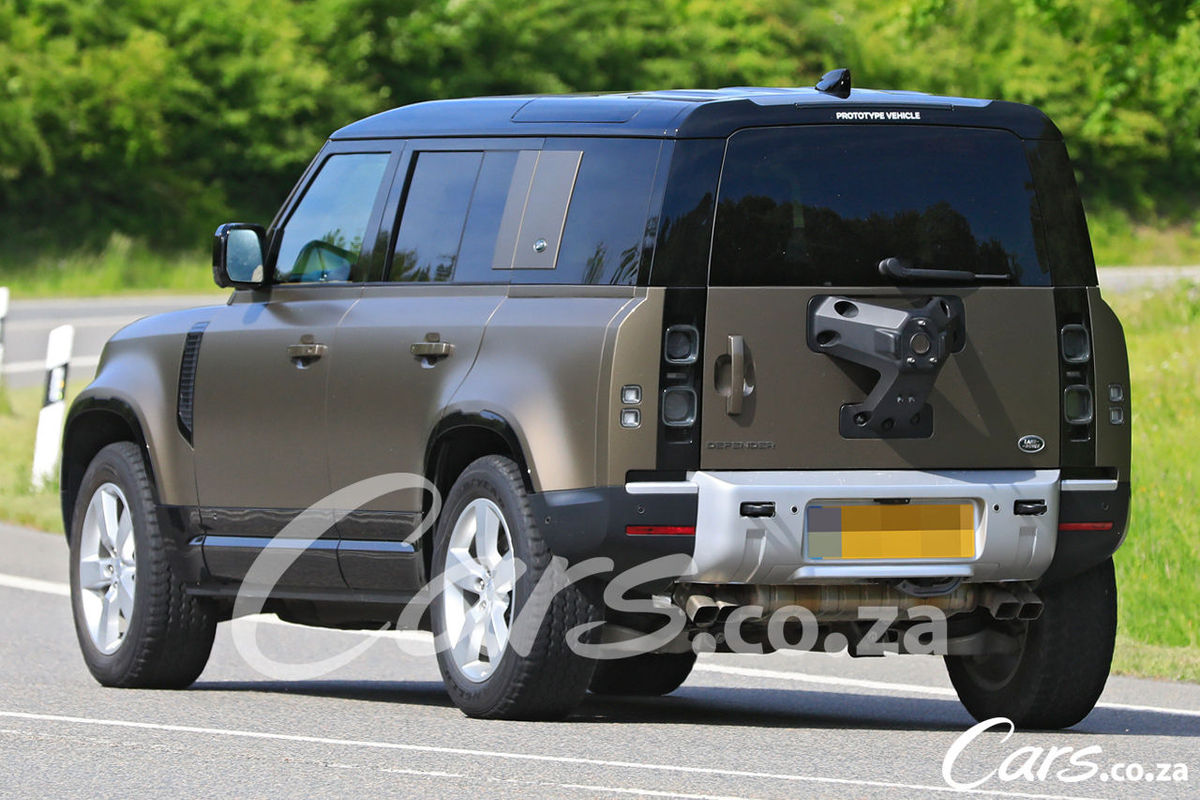
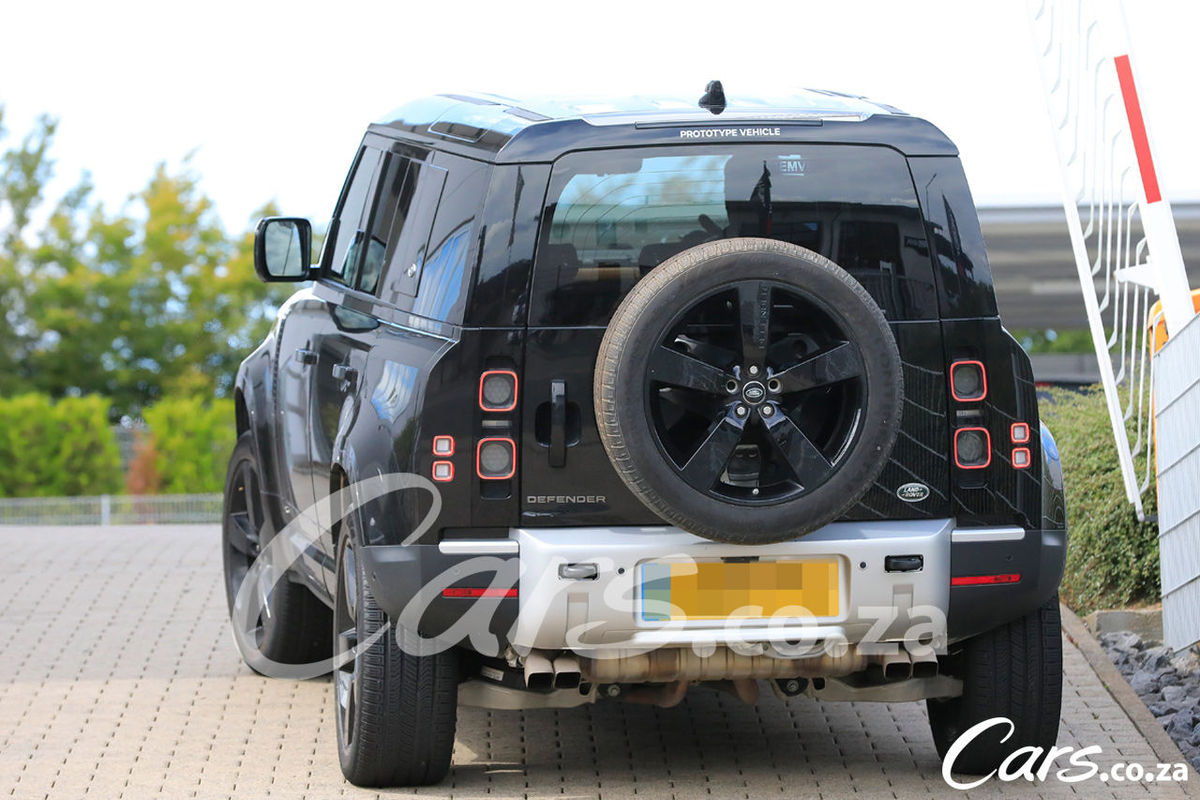
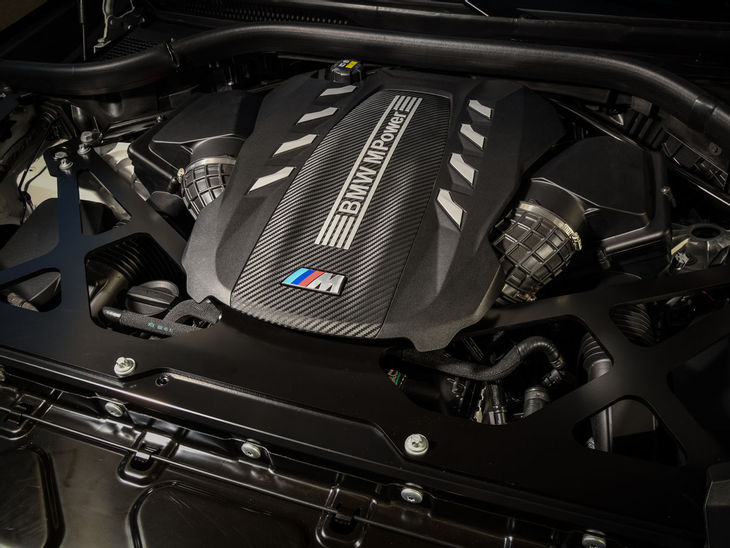
Mercedes-Benz G-Glass be warned: Land Rover is developing a V8 version of its new Defender; the prototype is believed to be powered by JLR’s long-serving supercharged 5.0-litre V8, but the production version could utilise a 4.4-litre V8 turbopetrol from BMW.
Picture credit: S. Baldauf/SB-Medien. We have paid for these photos and at the photographer's request, have watermarked them.
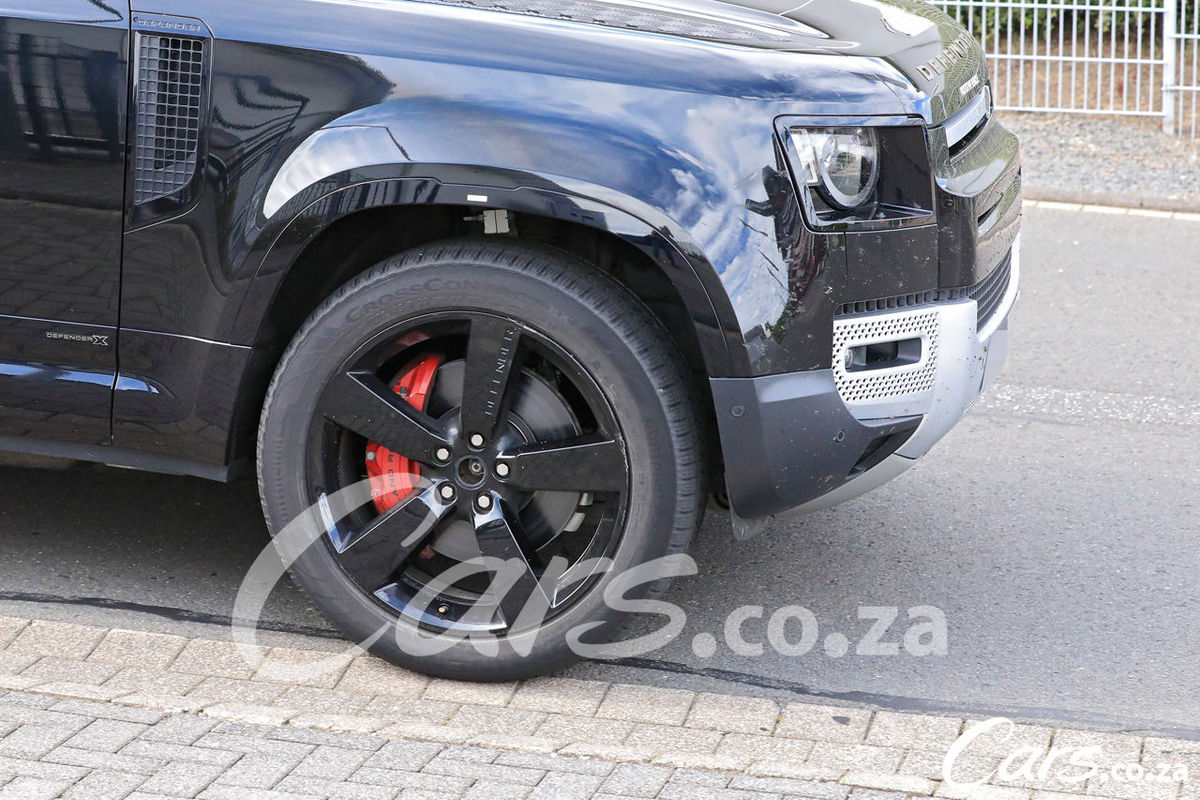
*Update* More recent photographs showing a Defender prototype with high-performance brakes have emerged. We can also clearly see the quad exhaust system.
As Land Rover looks to an electrified future and thriving in a post-Brexit and Covid-19-lockdown automotive landscape, the Coventry-based firm is focusing its efforts on producing fleet-emissions-reducing hybrids and EVs such as the I-Pace; that is not to say that Land Rover has lost its penchant for producing high-performance off-roaders, however.
Far from it – apart from the fact that Land Rover is applying the finishing touches to its next-generation Range Rover, Autocar has published spy photographs of an undisguised Defender sporting “Prototype Vehicle” stickers (reserved for testing mules). The vehicle was photographed near the firm’s development facility in Warwickshire in the United Kingdom.
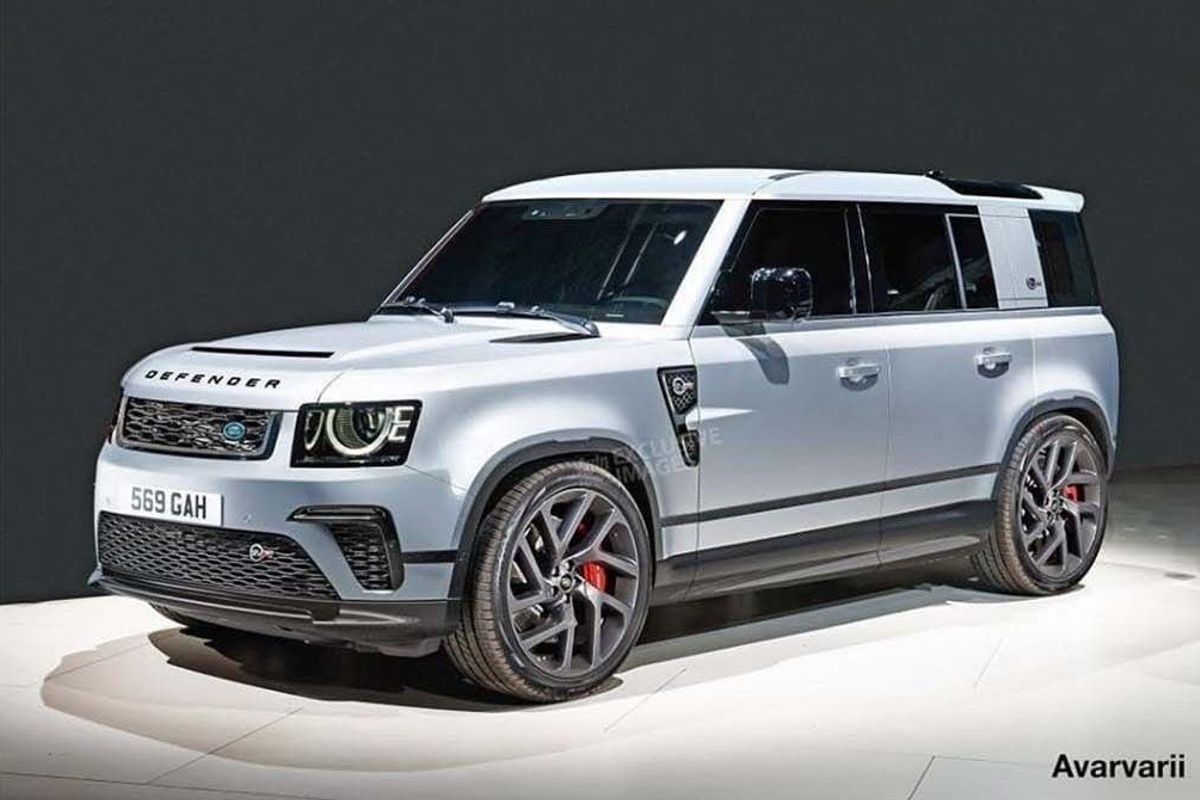
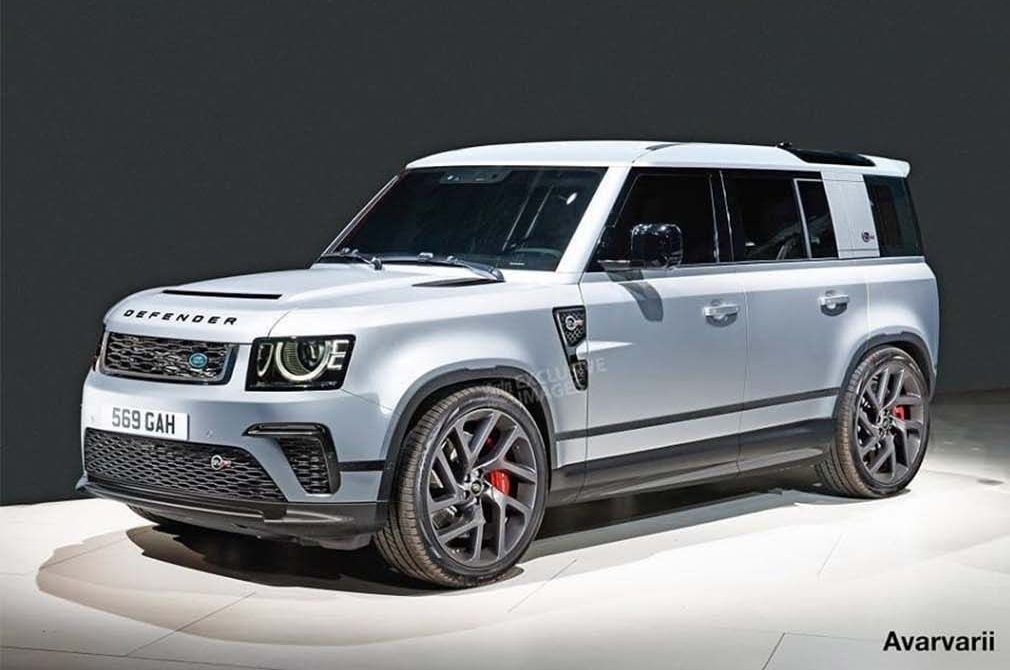
Render of the Land Rover Defender SVR via Avarvarii/AutoCar
The new Defender’s international media presentation event was recently hosted in Namibia – where our correspondent Danie Botha duly put the newcomer through its paces – and we’ve already published a Specs & Price article of the new range. The initial line-up consists of a 2.0-litre turbopetrol and –diesel engines, as well as a P400 MHEV – a mild hybrid that utilises a 3.0-litre V6 turbopetrol with an electric supercharger and a belt-integrated starter generator linked to a 48V system.
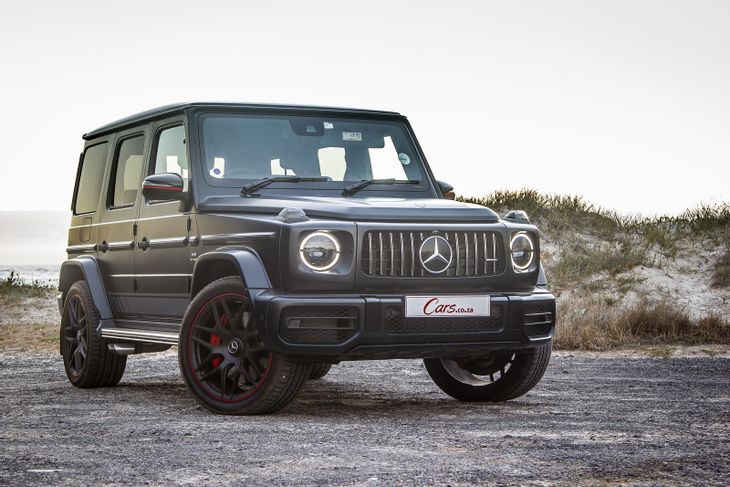
But just as the new Defender is a premium SUV with notable off-road ability, but a far cry from its archaic utilitarian predecessor, it might be naïve to believe that Land Rover would be content to limit its newcomer to 4- and 6-cylinder engines. After all, if the Coventry-based firm hopes to take the fight to the equally iconic Mercedes-Benz G-Class, of which the overwhelming majority of sales are accounted for by the 4.0-litre V8 turbopetrol-powered G63 AMG, it will need much more firepower.
Land Rover has made no secret of the fact it wants to benchmark the top Defender against the iconic Mercedes-Benz G-Glass.
Last hurrah for the SV8?
Land Rover engineers have previously suggested to Autocar that the Defender could be adapted to utilise a V8 motor and the images it has published clearly show that the 110-bodied prototype has a quad exhaust system. What’s more, registration data for the car indicated it was equipped with a 5.0-litre petrol engine, which suggests it had a 5.0-litre supercharged V8 under the bonnet.
The engine, which has powered the Jaguar XFR, XJ and Range Rover derivatives, the Range Rover Sport SVR, Range Rover Velar SVAutobiography and, of course, the Jaguar F-Pace SVR, is a well-known quantity, but it’s an old, thirsty (if throaty and potent) motor near the end of its production life. The Bridgend Ford factory in which it’s made will close its doors at the end of the year.
Autocar understands Land Rover intends to produce the V8-engined Defender as a low-volume derivative aimed at performance enthusiasts… If so, it stands to reason that the firm would stockpile the Ford-built V8 to build the special versions; after all, emissions targets are much less of a priority for low-volume special editions.
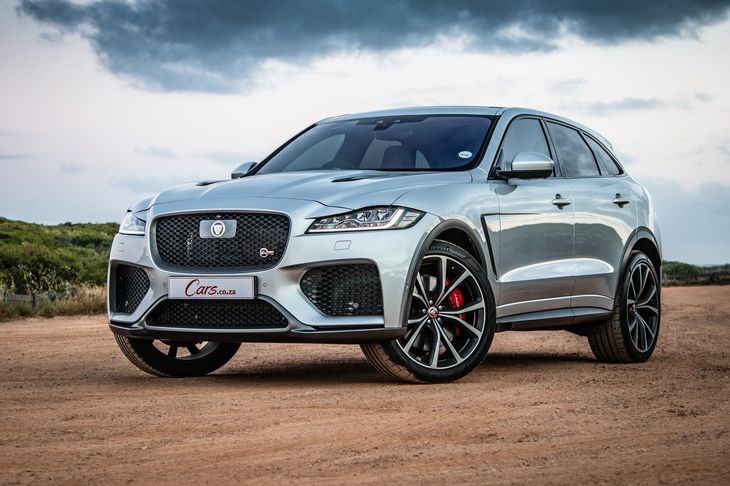
The Jaguar F-Pace SVR, which we tested late last year, is powered by the supercharged 5.0-litre V8 petrol motor.
This is apparently not a project of Land Rover’s Special Vehicle Operations (SVO) division, but an offshoot of the existing Defender engineering operation and it is believed the Defender V8’s motor will be tuned to produce about a moderate peak power output of 375 kW (lower than SVR versions) and mated with an 8-speed ZF automatic transmission.
Underpinned by the Defender’s aluminium-intensive body shell – claimed to be the stiffest Land Rover has ever produced – the flagship should feature larger wheels, a lowered ride height and an air suspension, as well as an optimised selection of on- and off-road driving modes. Suffice to say the thundering quad exhausts will be retained.
The case for BMW power…
However, why would Land Rover produce a low-volume, if enthusiast-pleasing, Defender V8 – even as a farewell to the supercharged 5.0-litre motor? Selling such a product could be quite profitable for the Coventry-based company in the short term, but in these cash-strapped times for the automotive industry, research and development costs need to be kept to a minimum and are expected to be fully amortised through series production.
The most powerful iteration of BMW's 4.4-litre V8 is reserved for the Competition versions of the X5 M/X6 M siblings.
Besides, limited editions tend to come out near the end – not the beginning – of a product’s lifespan; the Defender is brand new. But what if Land Rover was using the supercharged V8 primarily to test the SUV’s dynamic responses with the weight and power increases of the larger motor? What if the motor was about to make way for a BMW powerplant?
Consider that Jaguar Land Rover will, in all likelihood, begin to the use BMW’s twin-turbocharged 4.4-litre V8 under a wide-reaching powertrain deal struck between the British and German firms. It has not been officially confirmed by the Coventry-based firm, but Autocar understands that it’s a mere formality. In X5 M trim, that motor produces peak outputs of 460 kW and 750 Nm!
Last year it was announced the two companies would co-develop electrified powertrains, but sources close to BMW have recently revealed the deal had been extended to include supplying JLR with a range of internal-combustion engines, ostensibly so that the latter could focus its efforts on developing electrified power units.
Remember, some Land Rovers were famously powered by BMW engines when the Munich-based firm owned the Coventry-based brand 25 years ago… We'll keep you posted.
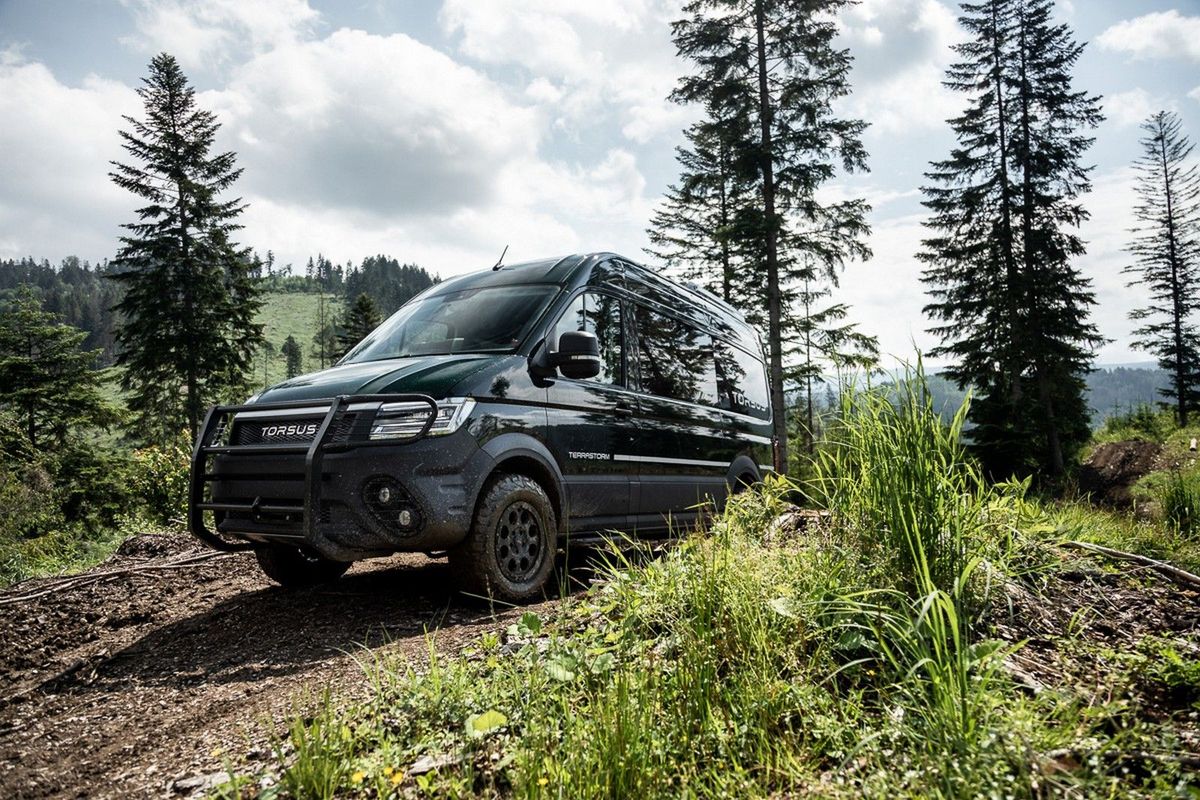
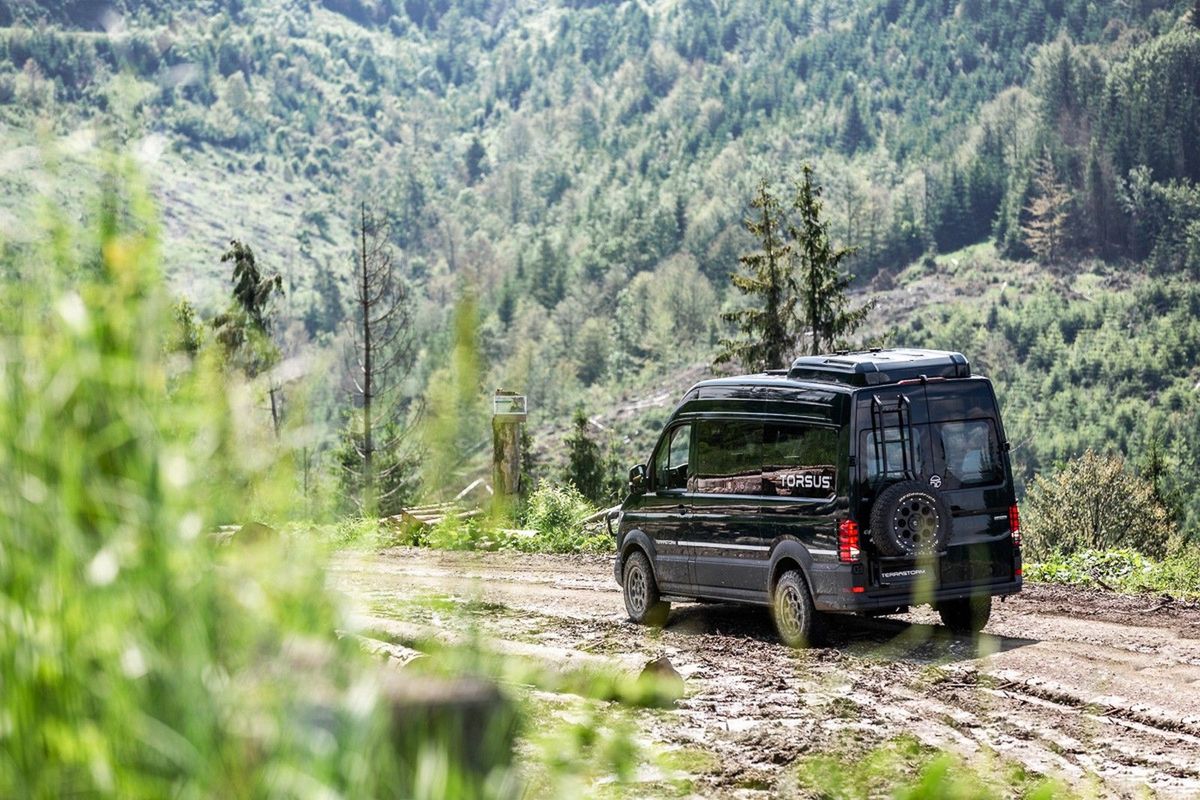
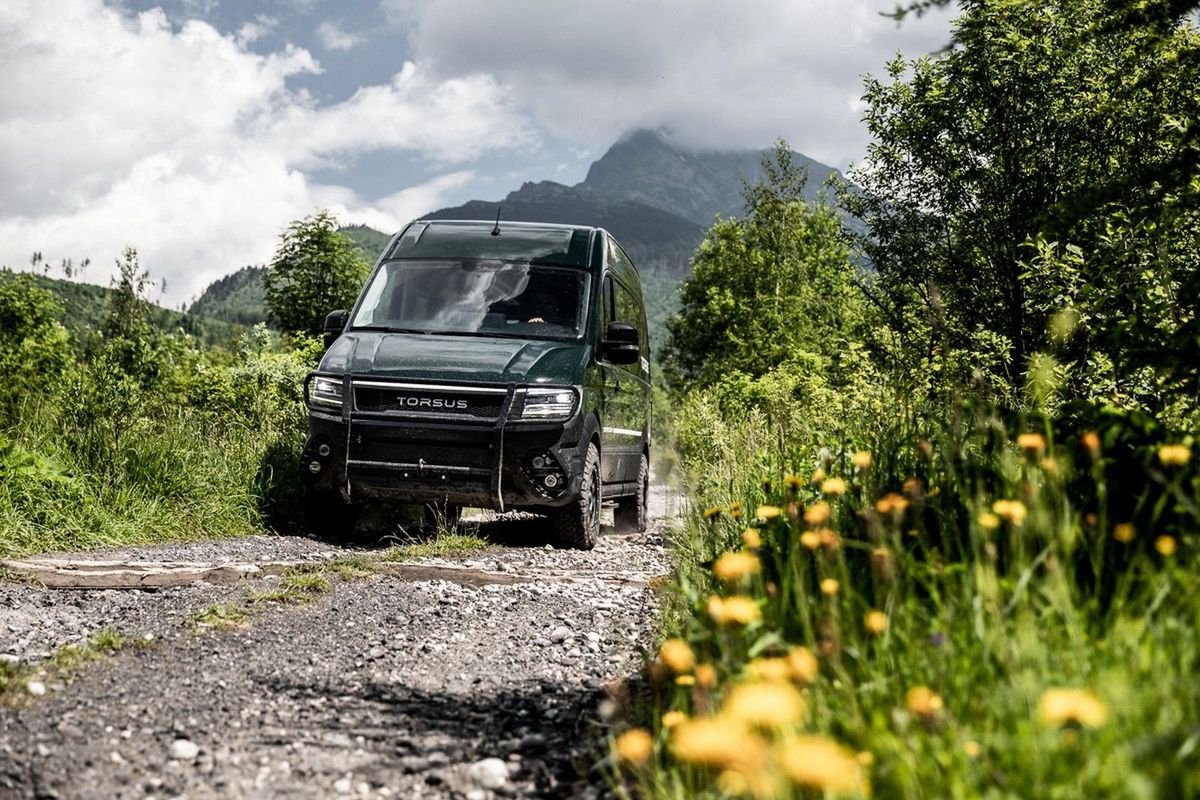
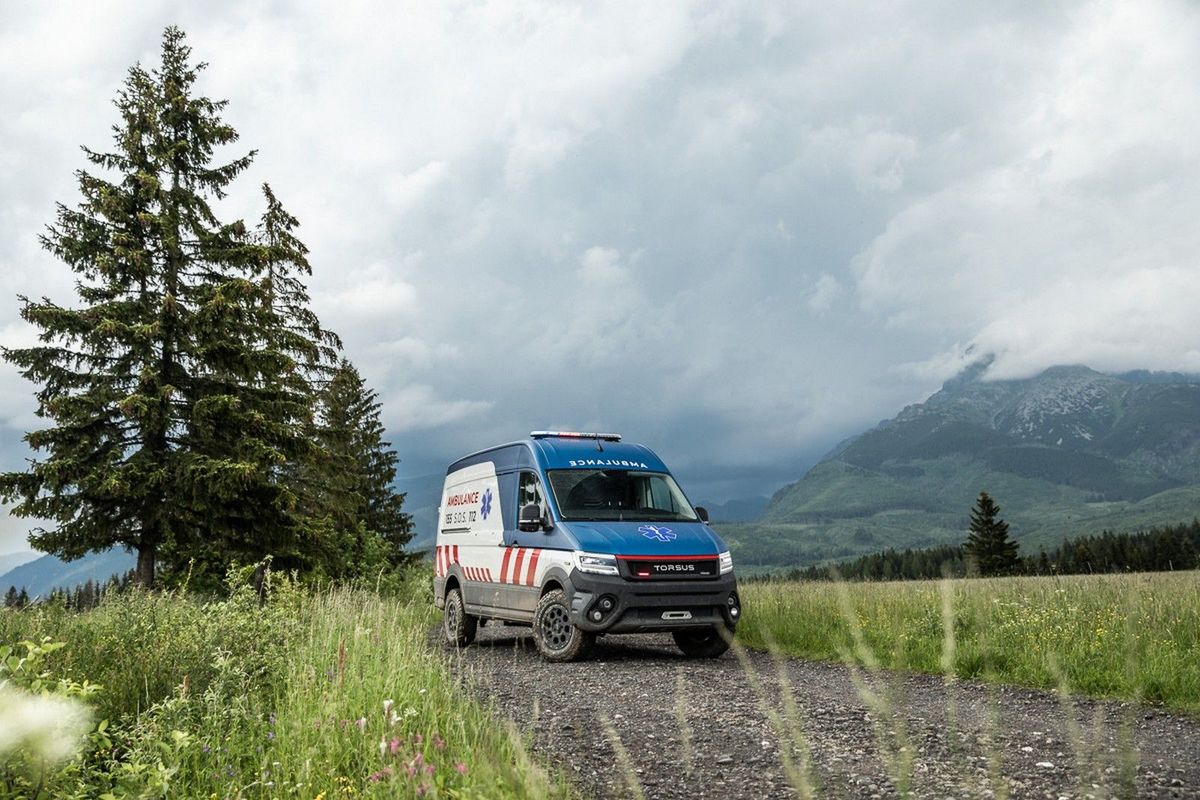
Torsus has revealed its Terrastorm, the hardcore offroader built on the Volkswagen Crafter.
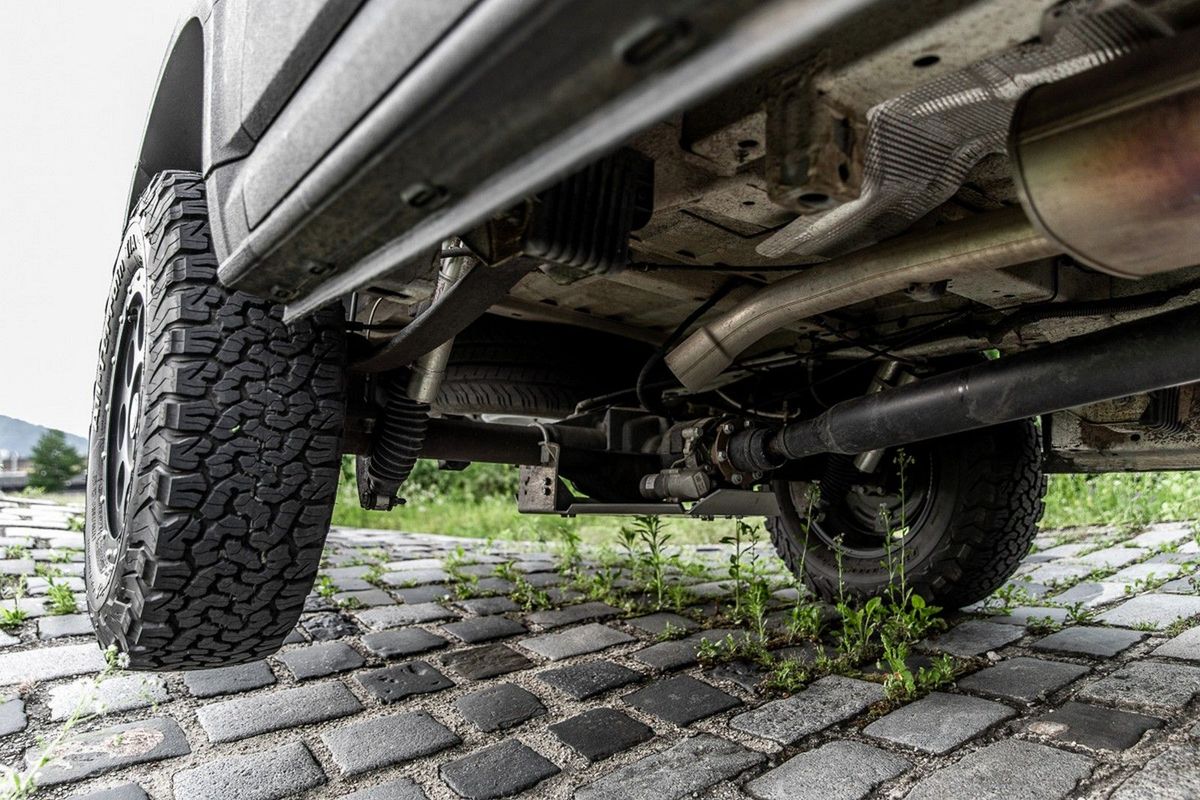
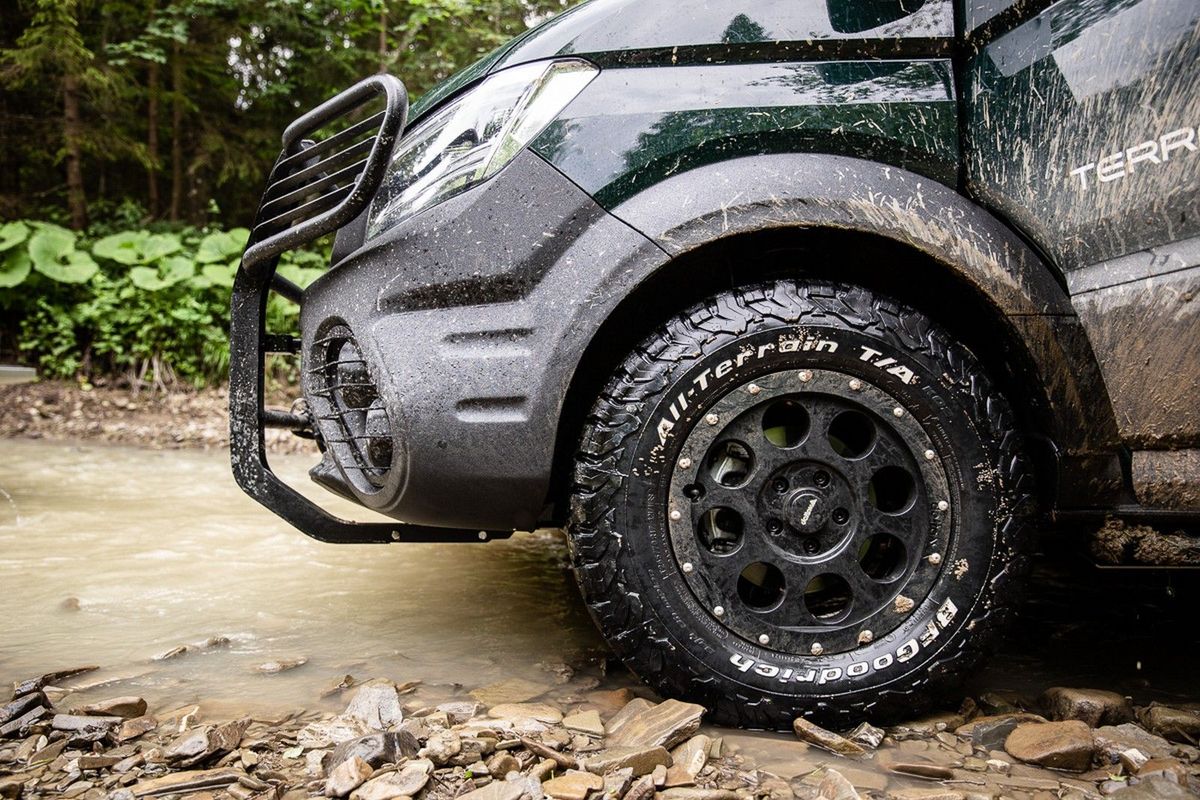
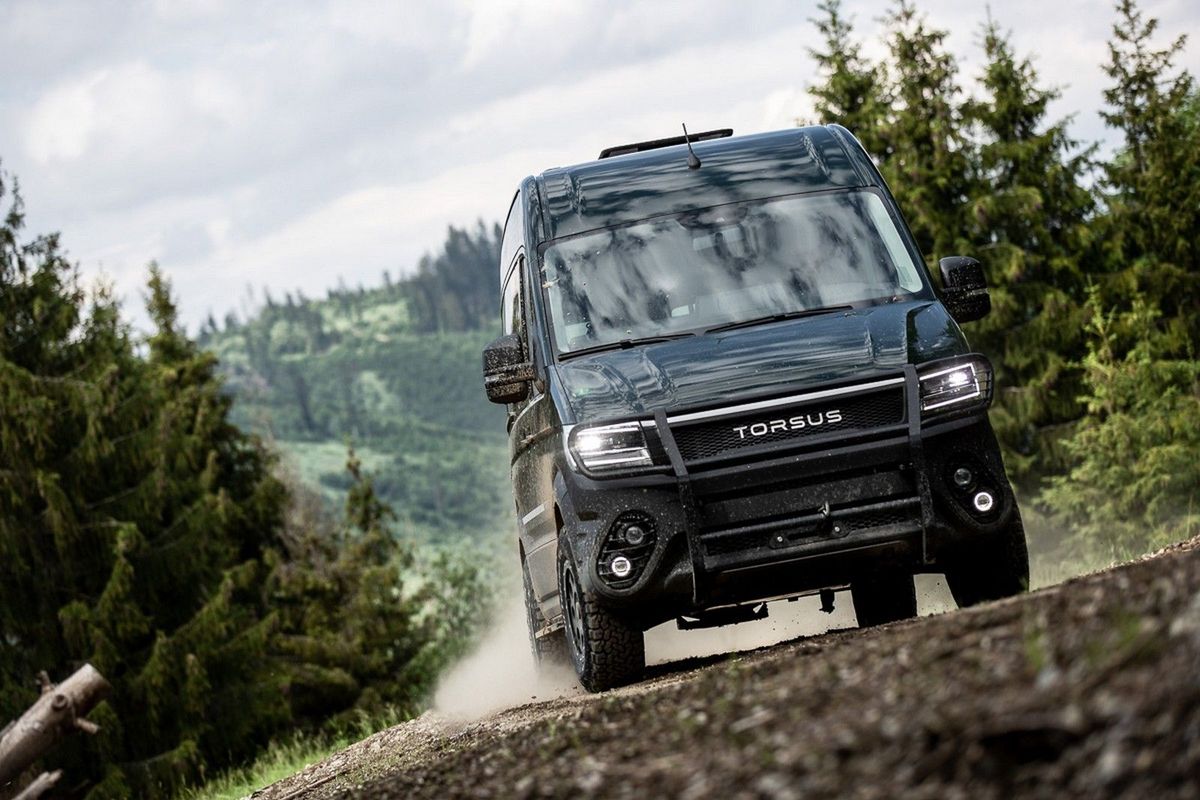
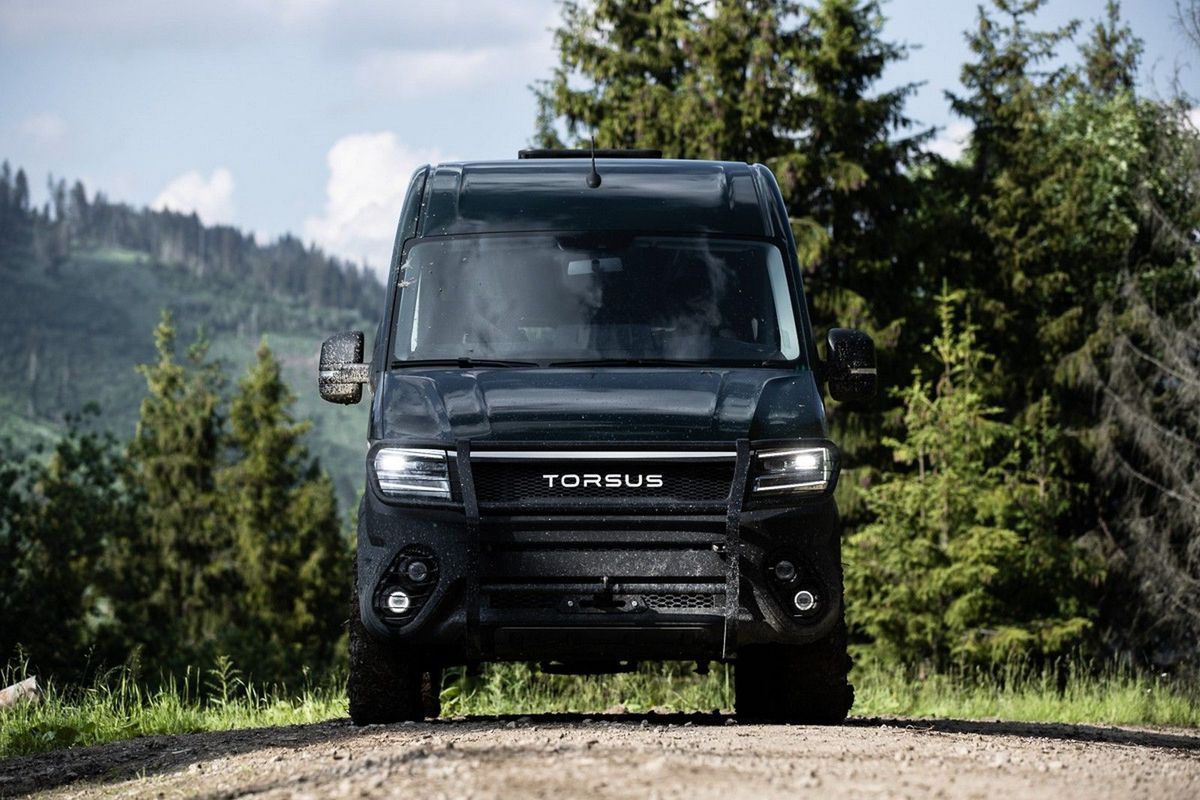
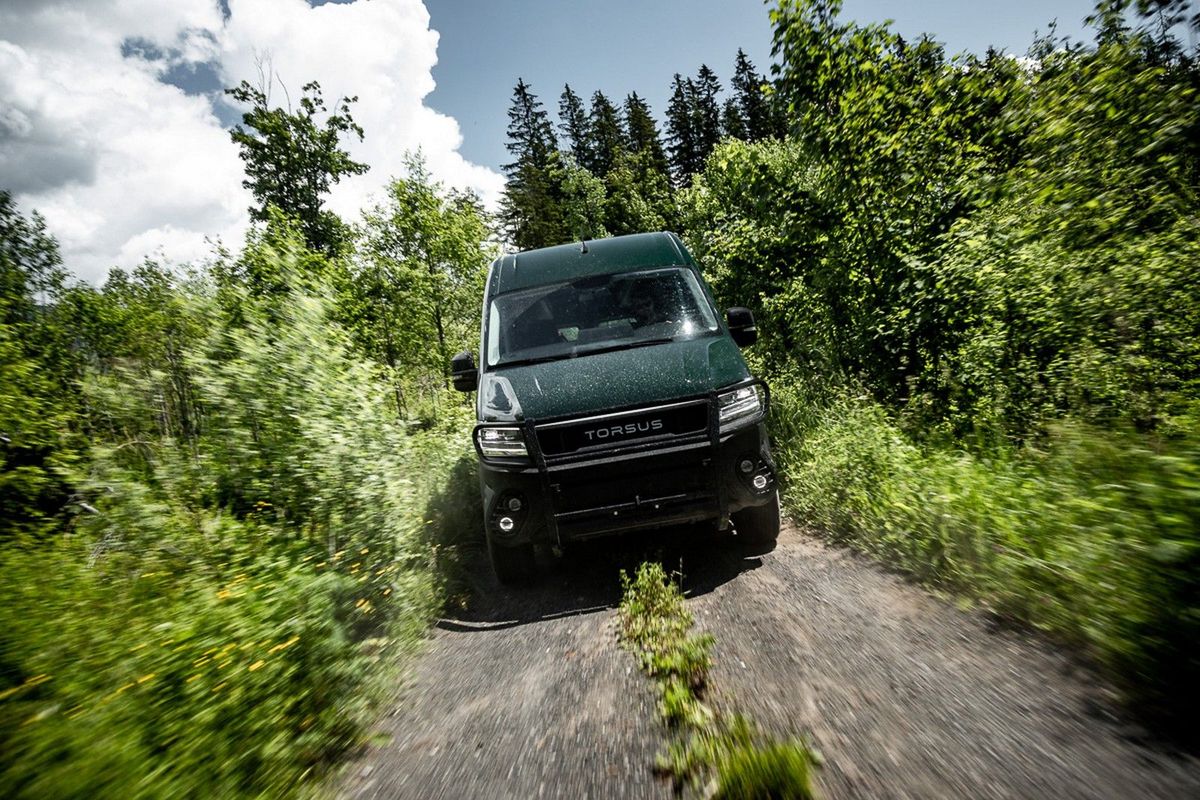
If there was an award for the 'Most Awesome Name for a Vehicle', surely the Terrastorm would be in line for the win. Still, take a look at how awesome this thing is. Built on a Volkswagen Crafter chassis and powered by a 2.0-litre biturbo diesel engine, the Torsus Terrastorm looks ready to tackle any surface.
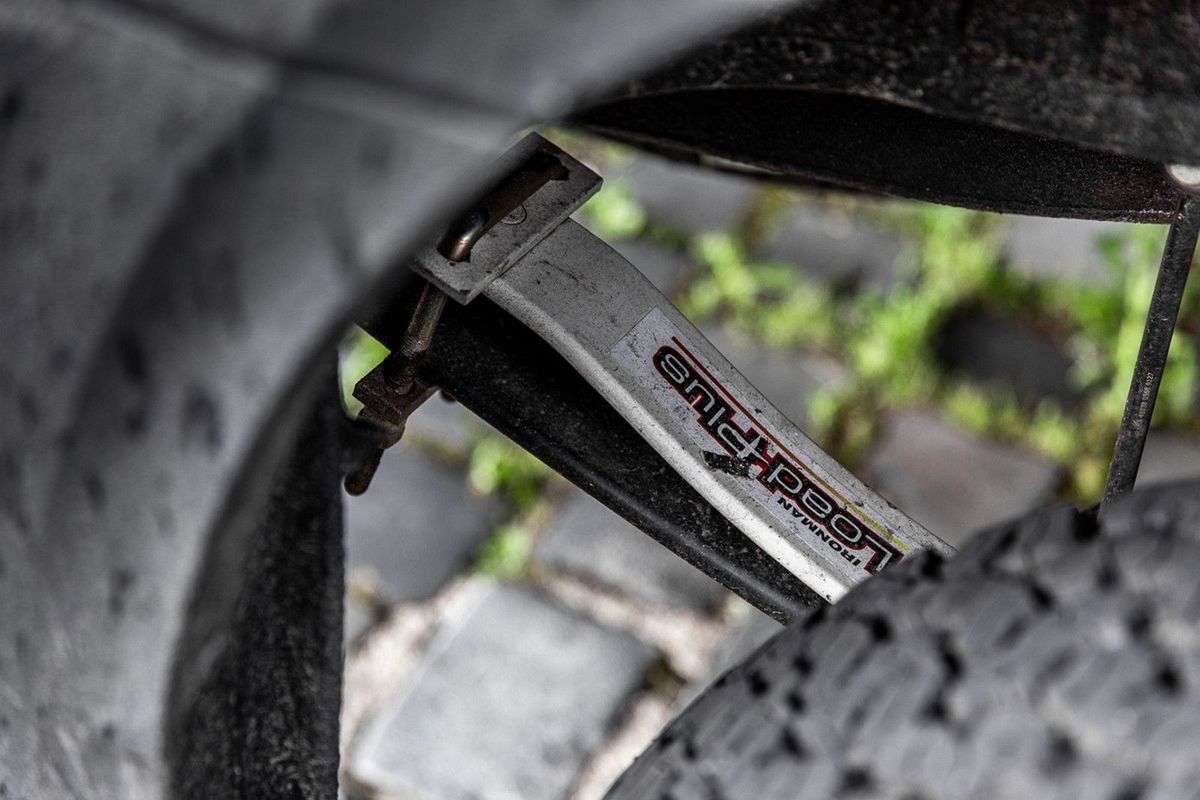
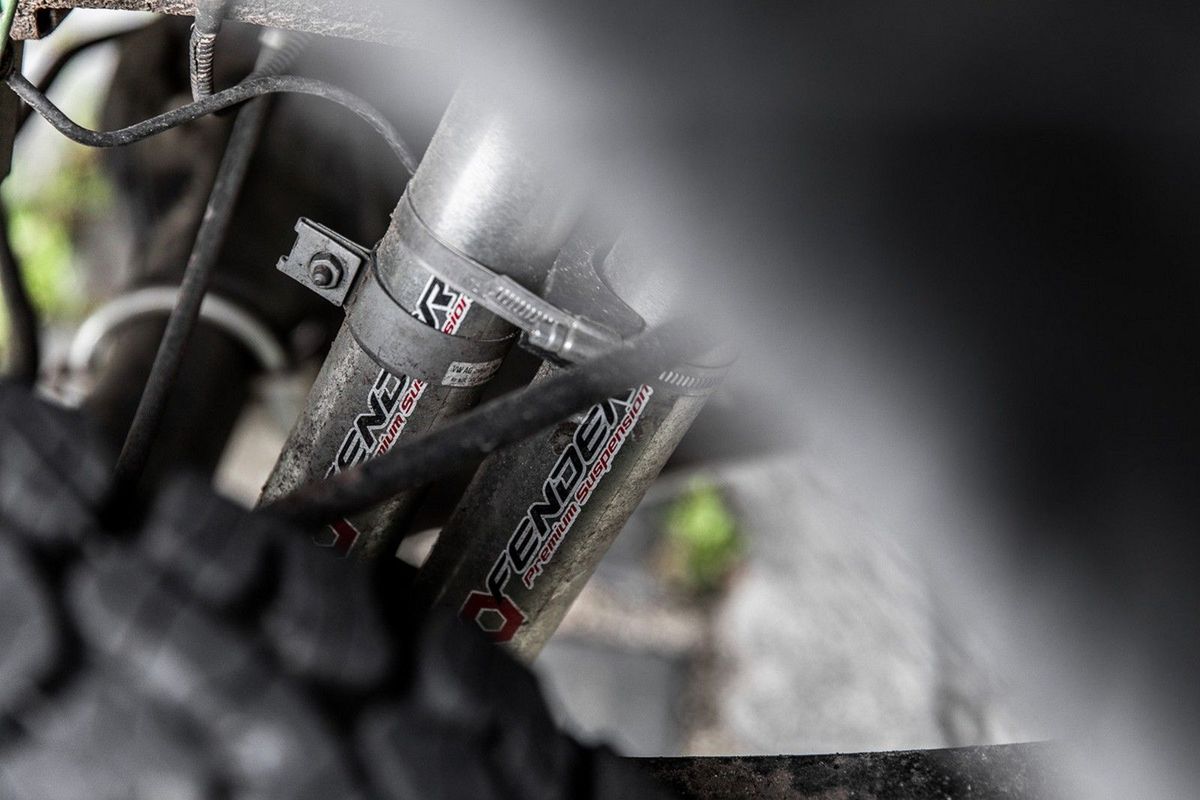
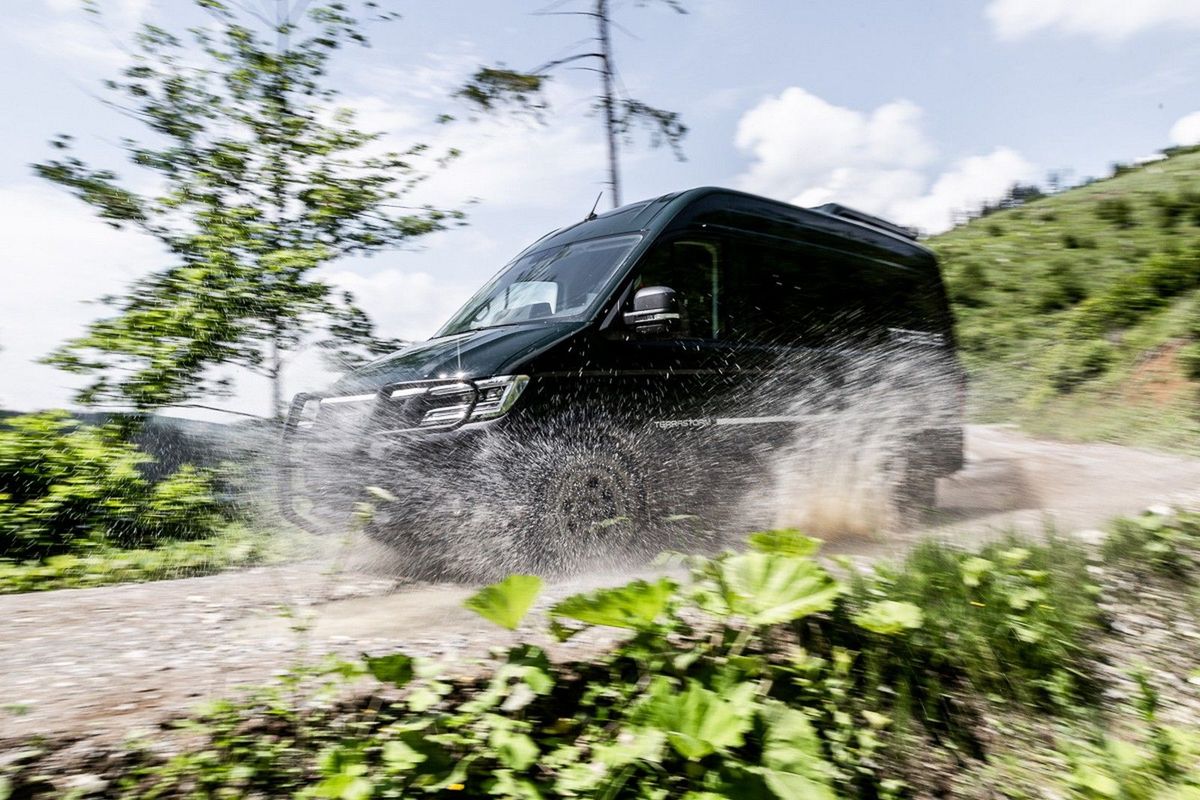
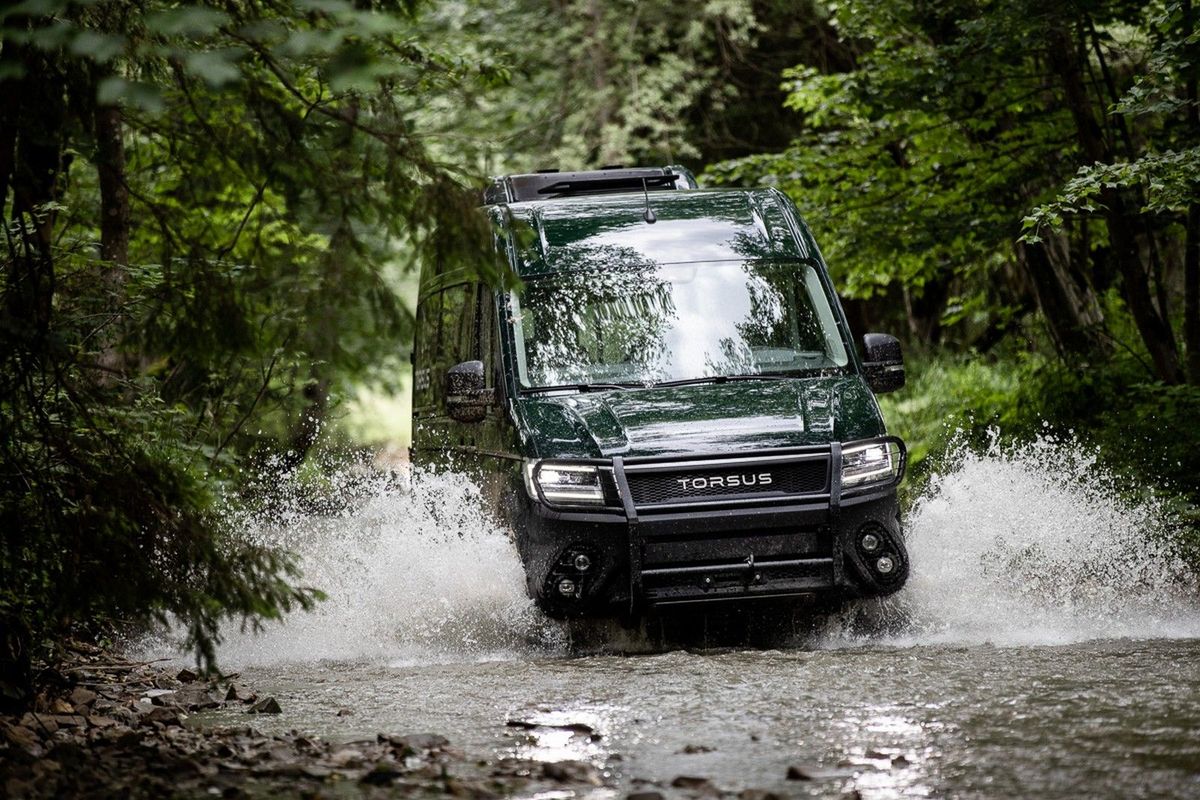
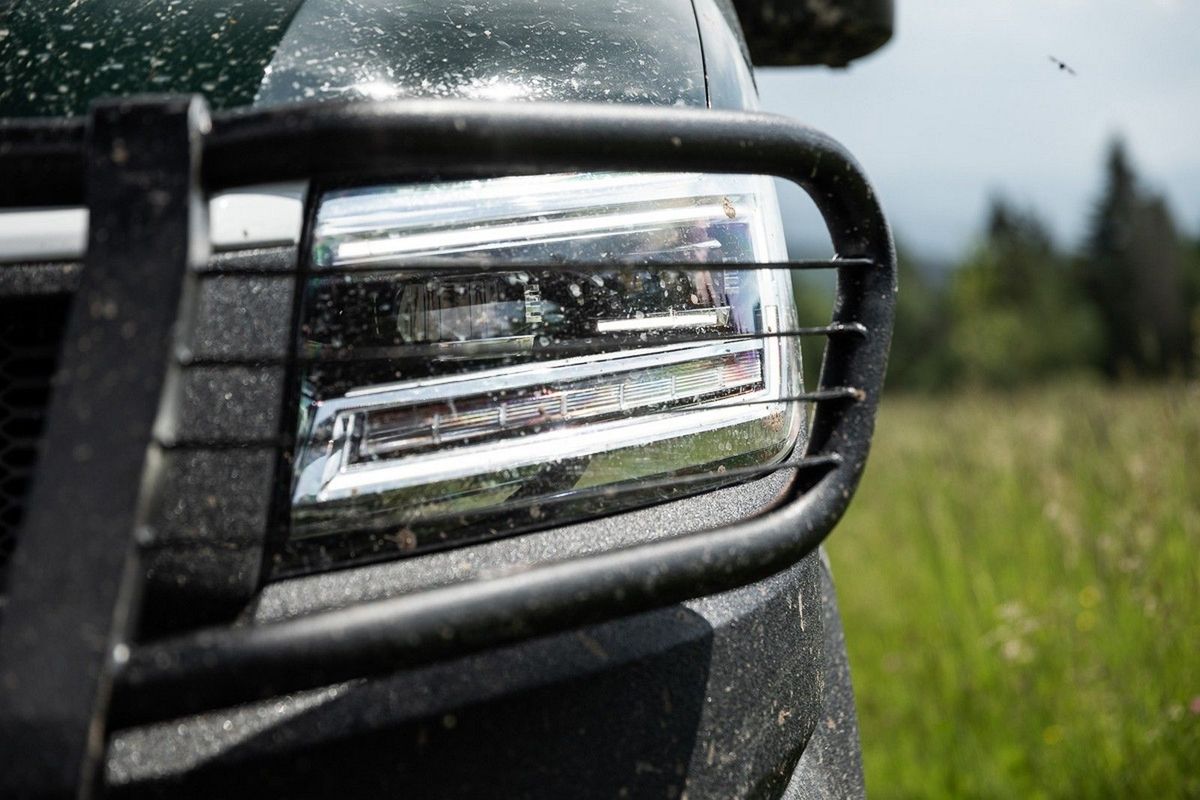
There are 2 power options, 103 kW and 130 kW, with 410 Nm and you have the option of a 6-speed manual gearbox or an 8-speed automatic. It's the offroad capability that has us fascinated though. The chassis has been upgraded and Bilstein off-road suspension has been installed. All-wheel drive with a locking rear differential is on offer and the vehicle features a ground clearance of 290 mm and a wading depth of 690 mm. Customers can choose the Deep Wave pack which allows wading through 820 mm of water. The vehicle also features underbelly protection to keep the diff and fuel tank protected.
Vakhtang Dzhukashvili, founder and CEO of Torsus said, “Terrastorm is a vehicle that will be at home on the dunes of the Sahara to delivering packages and emergency care work in the mountainous regions. The vehicle is versatile in its configurations, it is always able to offer more capability to serve multiple markets and industries.”
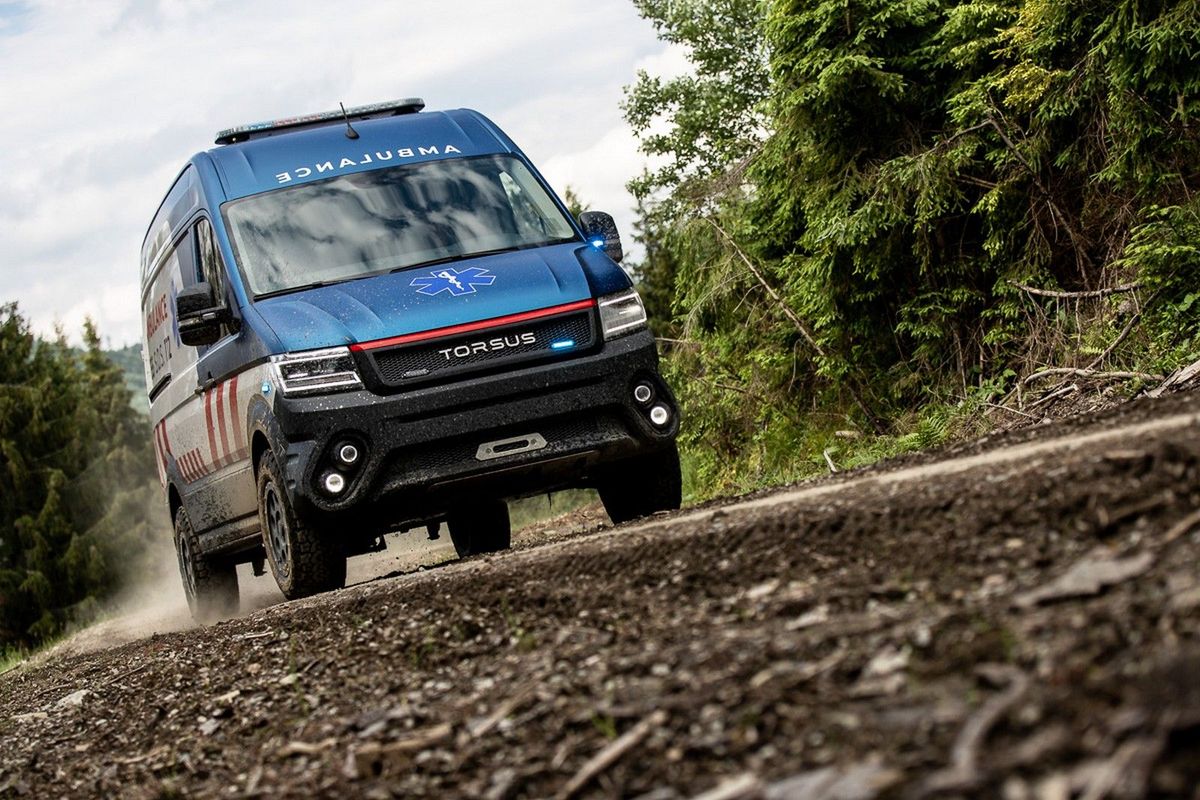
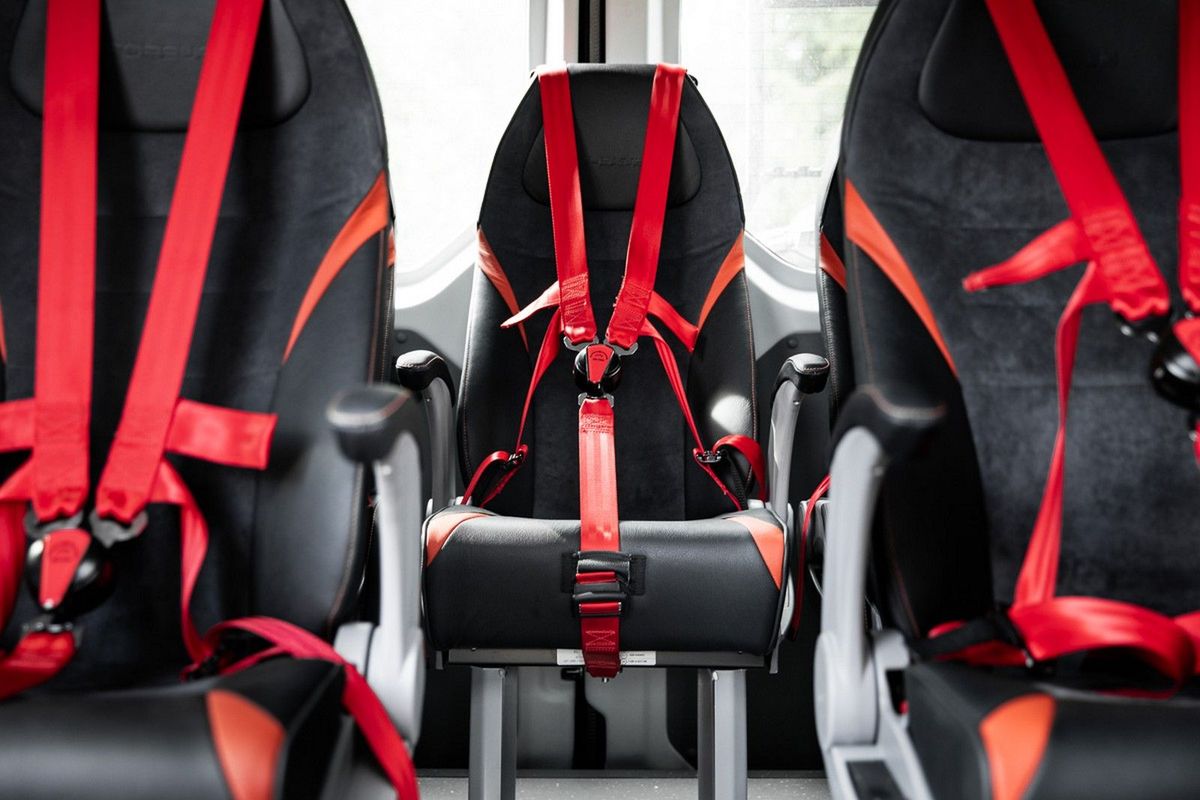
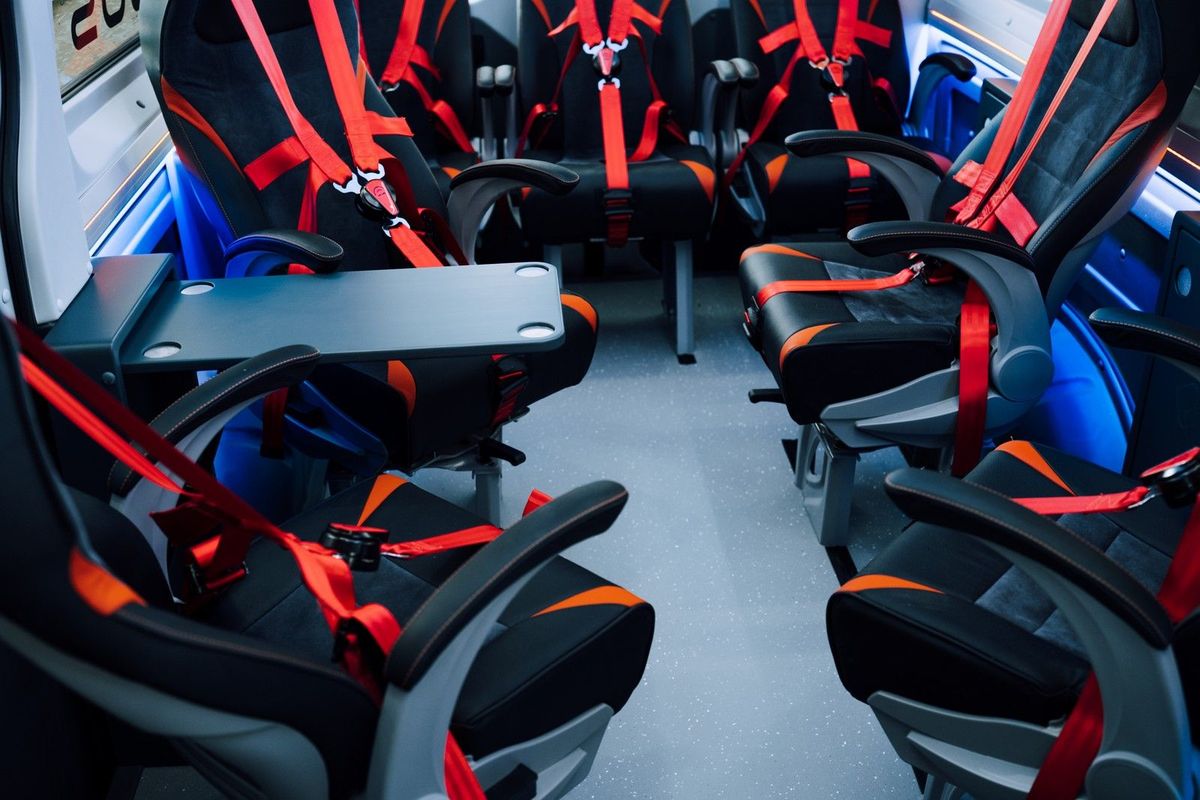
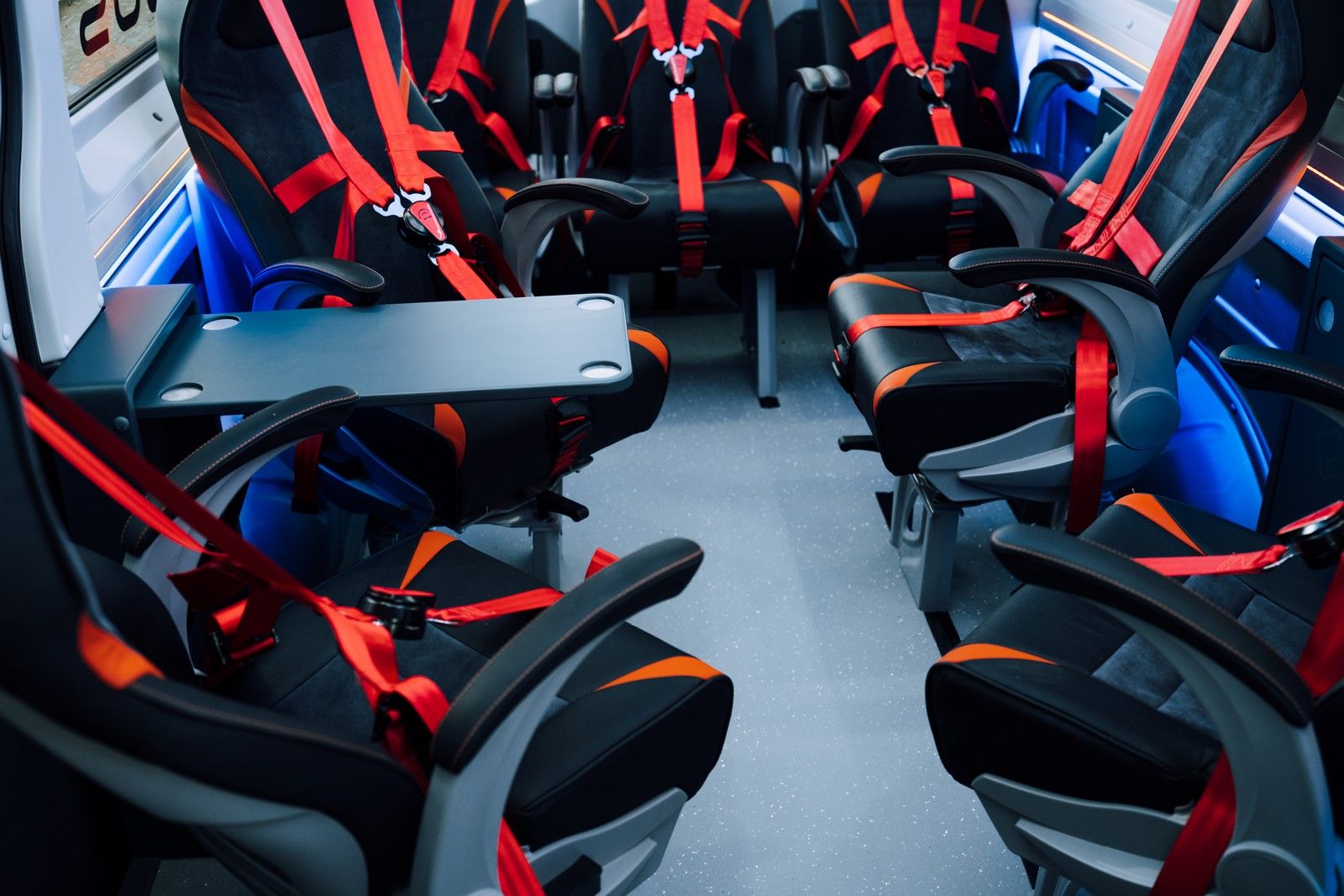
Inside there's seating for 9-20 passengers and everyone gets a bucket seat with 3-point harnesses. A 5-point harness to keep passengers secure is also offered. Torsus is claiming there's a market for cargo hauling to remote areas, as well as getting people to inhospitable places. Think of emergency workers getting to a disaster-hit region, that sort of thing. Torsus also offers the Terrastorm as an ambulance.