Volkswagen Golf GTI 7.5 vs 8: What’s the difference?

The Volkswagen Golf 8 GTI has just been revealed. How does it fare in comparison to the outgoing model? We compare the newcomer to the outgoing Volkswagen Golf GTI 7.5.

The all-new Volkswagen Golf 8 GTI should arrive in SA before the end of 2020 and the excitement is high. When it comes to Golf sales, nothing touches the GTI and its easily one of the most successful products from the Wolfsburg-based manufacturer. How does it fare when compared to its popular predecessor? We compare the two GTIs.

1. Engine

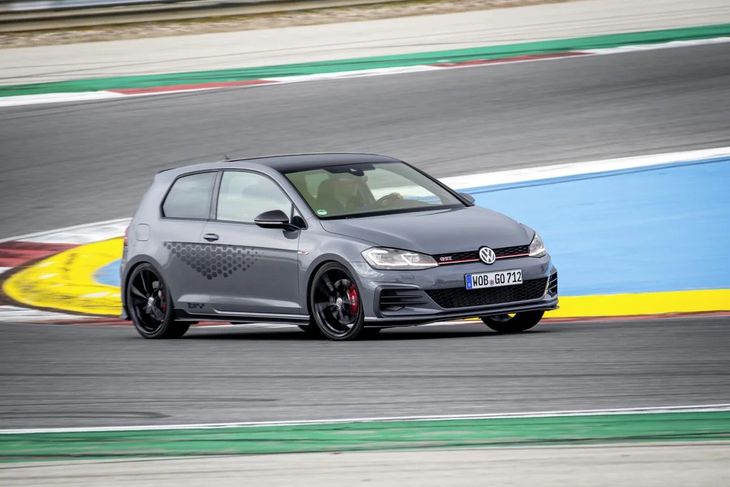
The Golf GTI 7.5 was no slouch thanks to a quick-shifting gearbox and responsive 2.0.

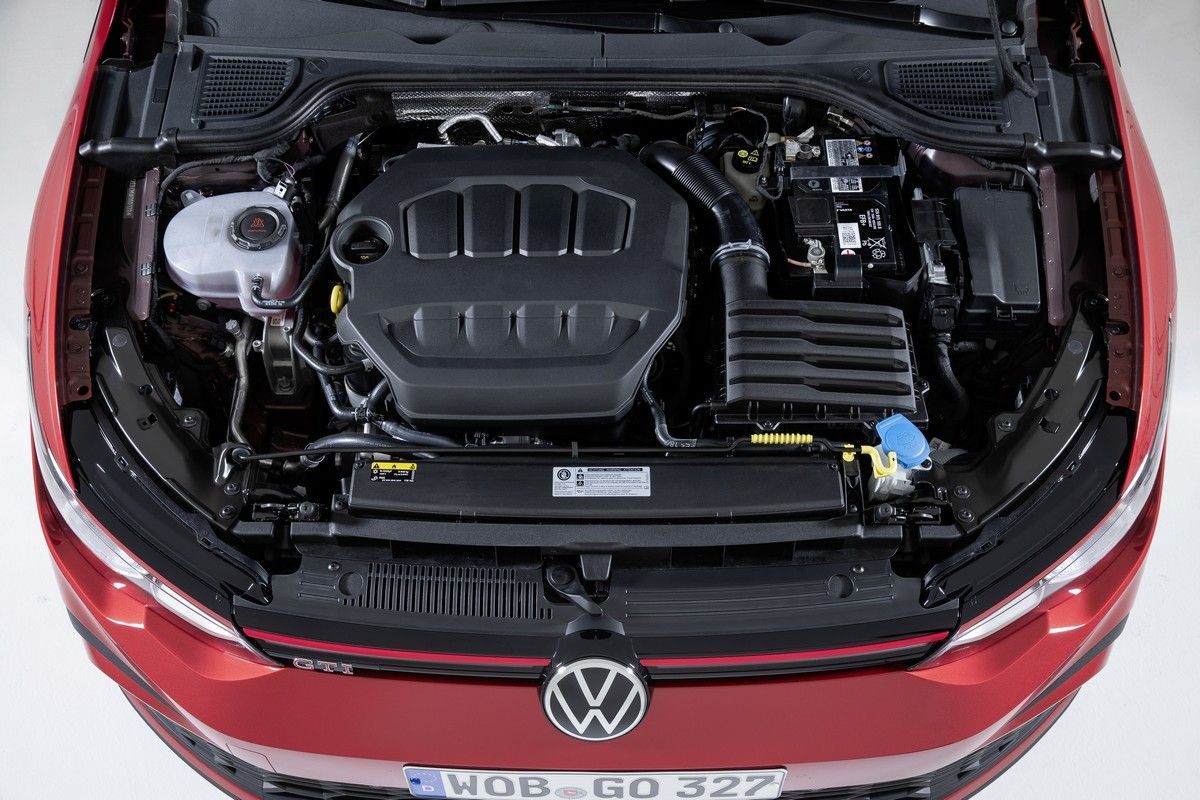
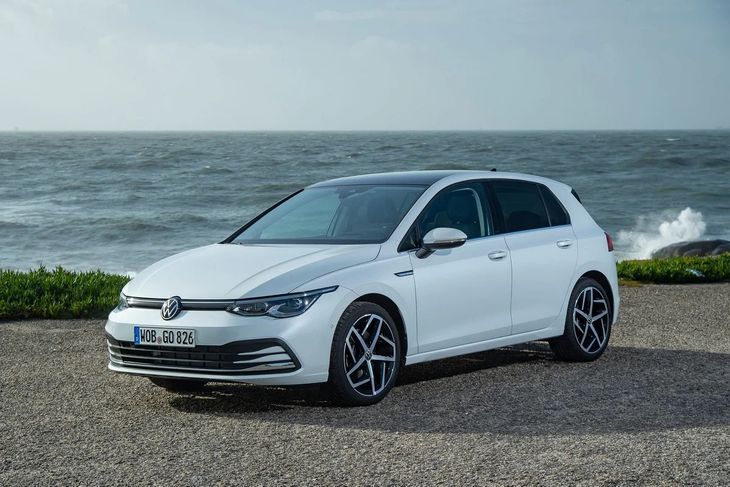
At the heart of the Volkswagen Golf GTI is a 2.0-litre turbocharged 4-cylinder engine. In the 7.5, it delivered 169 kW and 350 Nm, with power going to the front wheels via a 6-speed dual-clutch transmission. Volkswagen claimed a 0-100 kph time of 6.4 seconds thanks to launch control. For the new Volkswagen Golf GTI, the engine outputs have increased to 180 kW and 370 Nm, plus the transmission has been replaced by the updated 7-speed dual-clutch transmission. Official figures have not been issued, but we suspect it'll shave some time off that. How does 6.1 to 100 kph sound?…
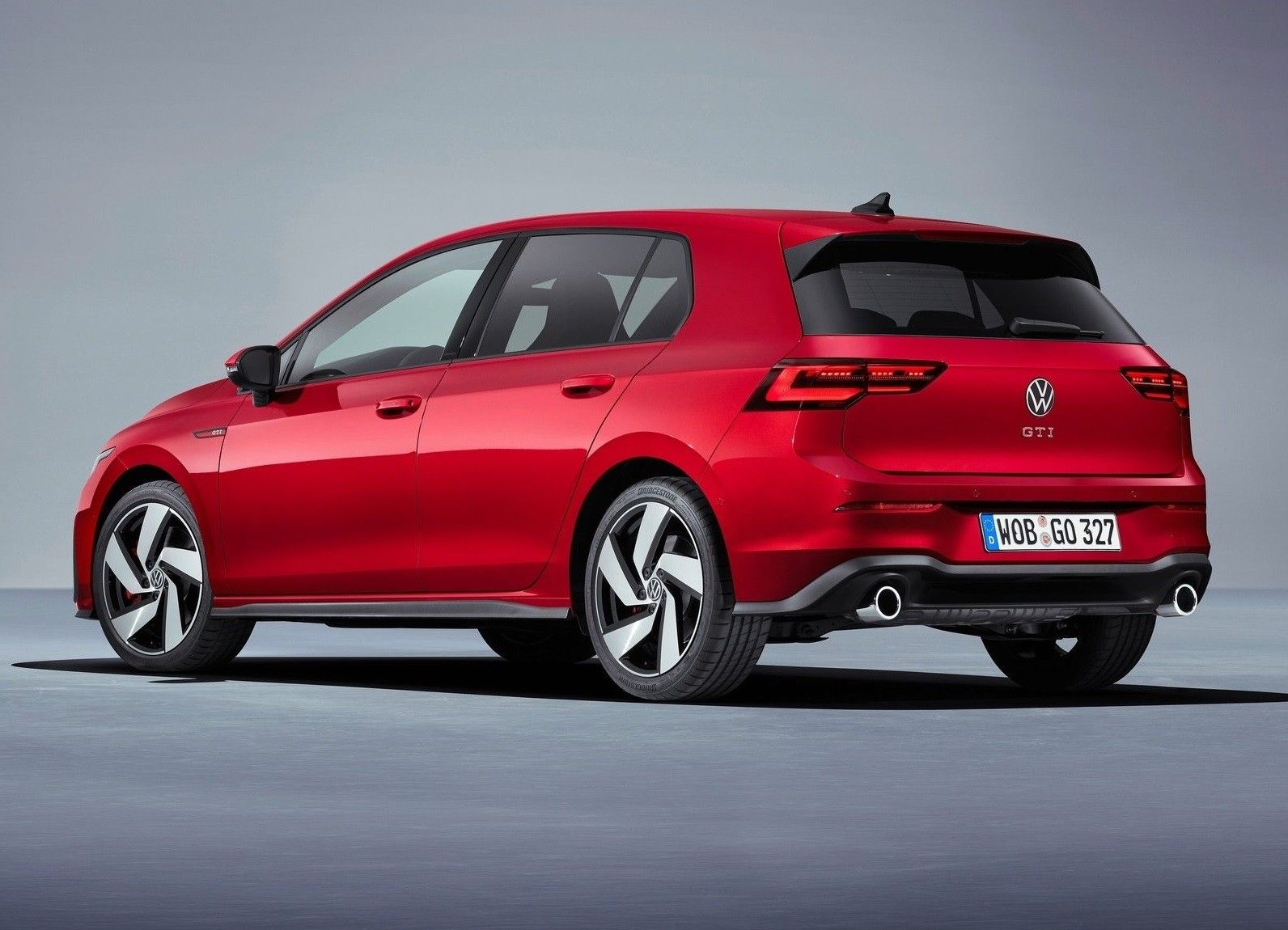

The Volkswagen Golf GTI 8 has improved engine performance, but you'll have to wait a bit longer for R and TCR/Clubsport.

2. Visual appeal
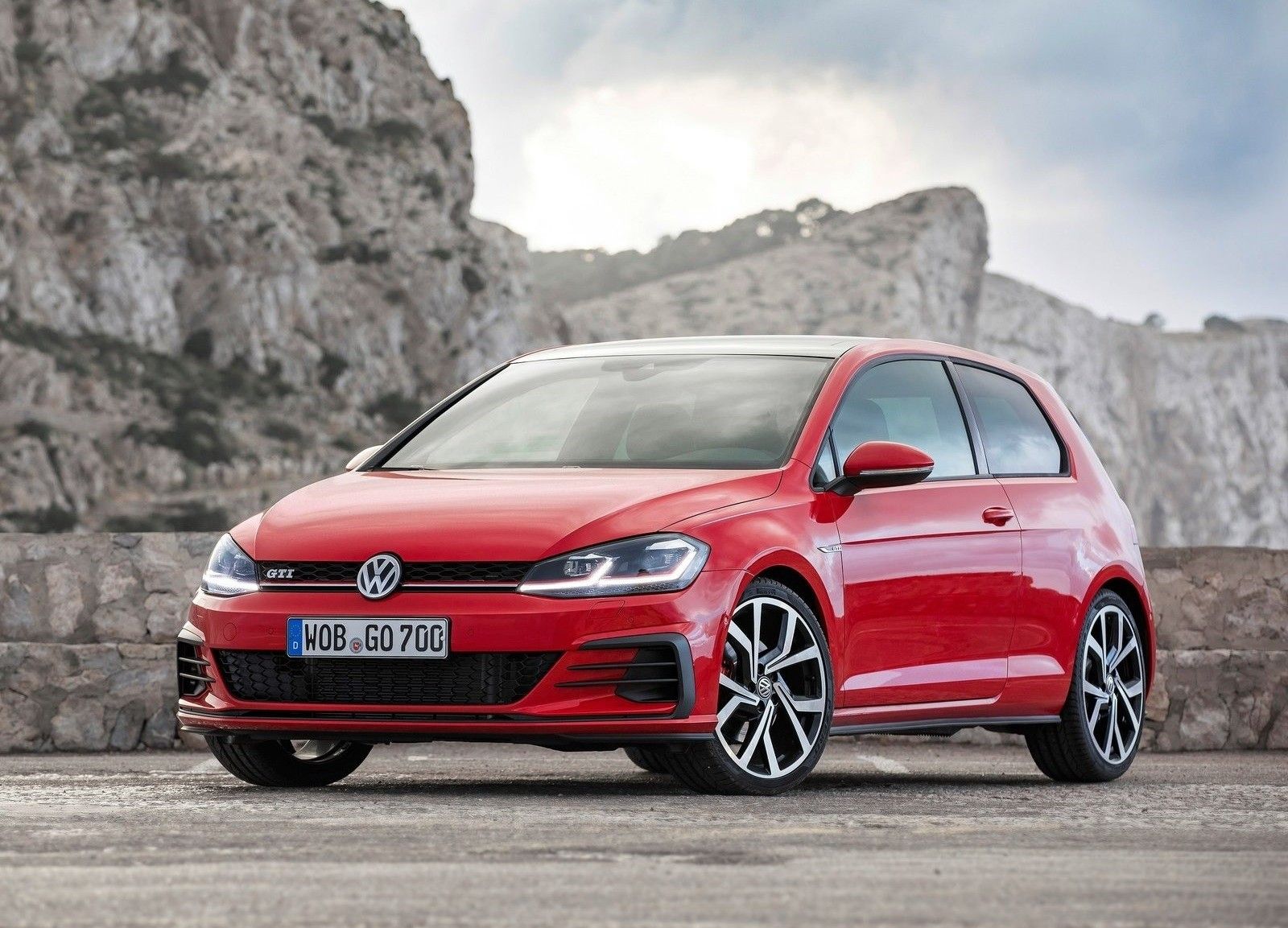

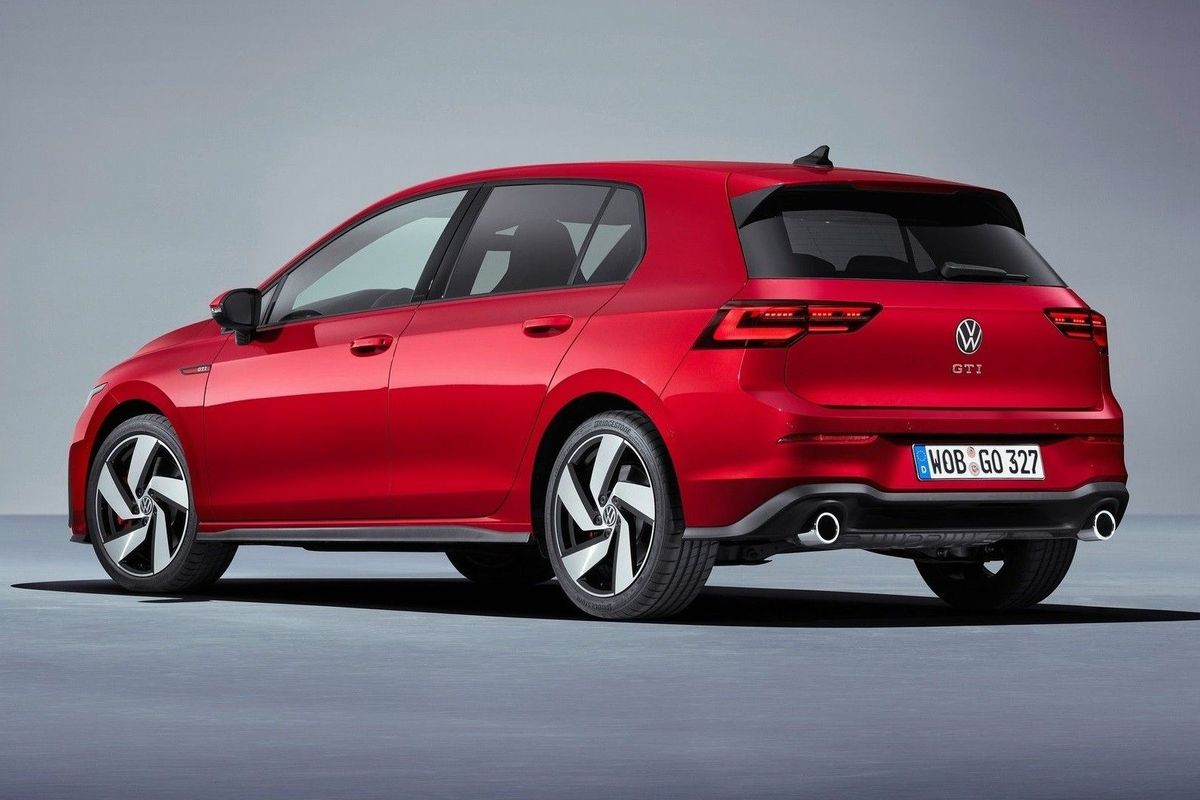
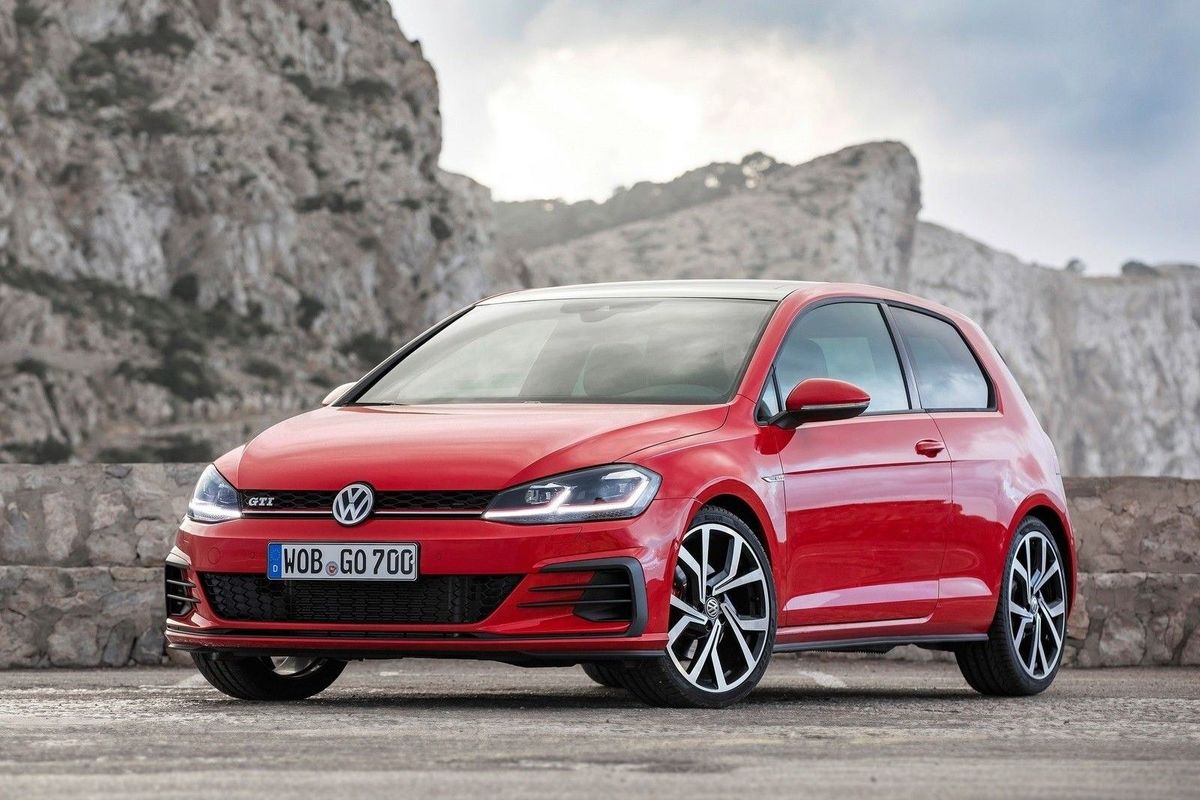
The Volkswagen Golf GTI 7.5 was a sharp-looking product, especially in 2-door guise which sadly wasn't offered in SA.

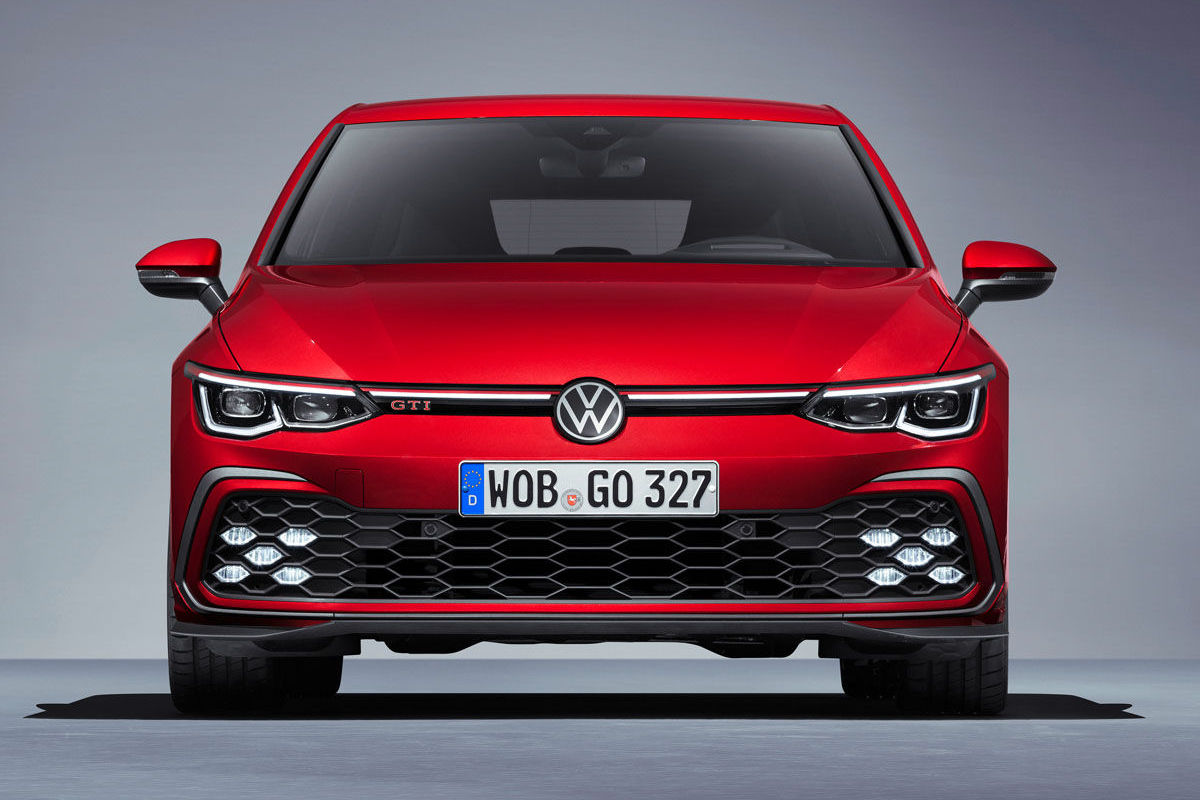
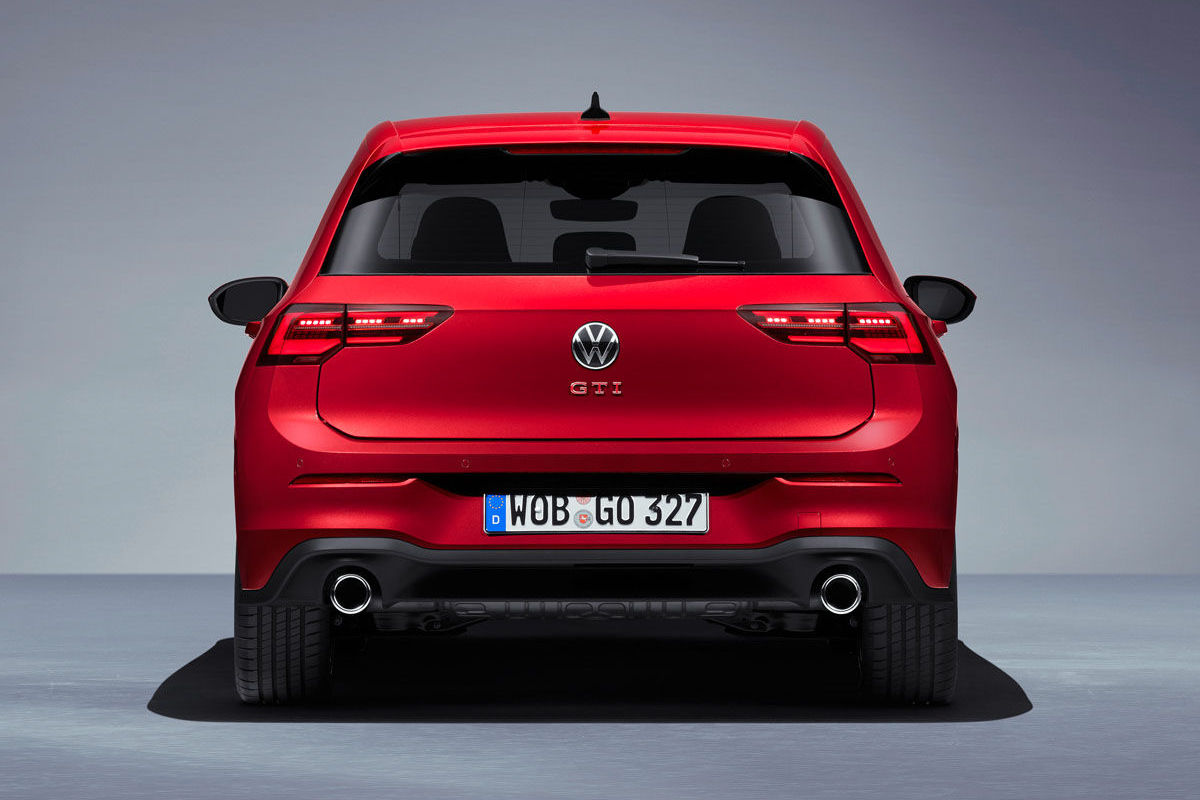
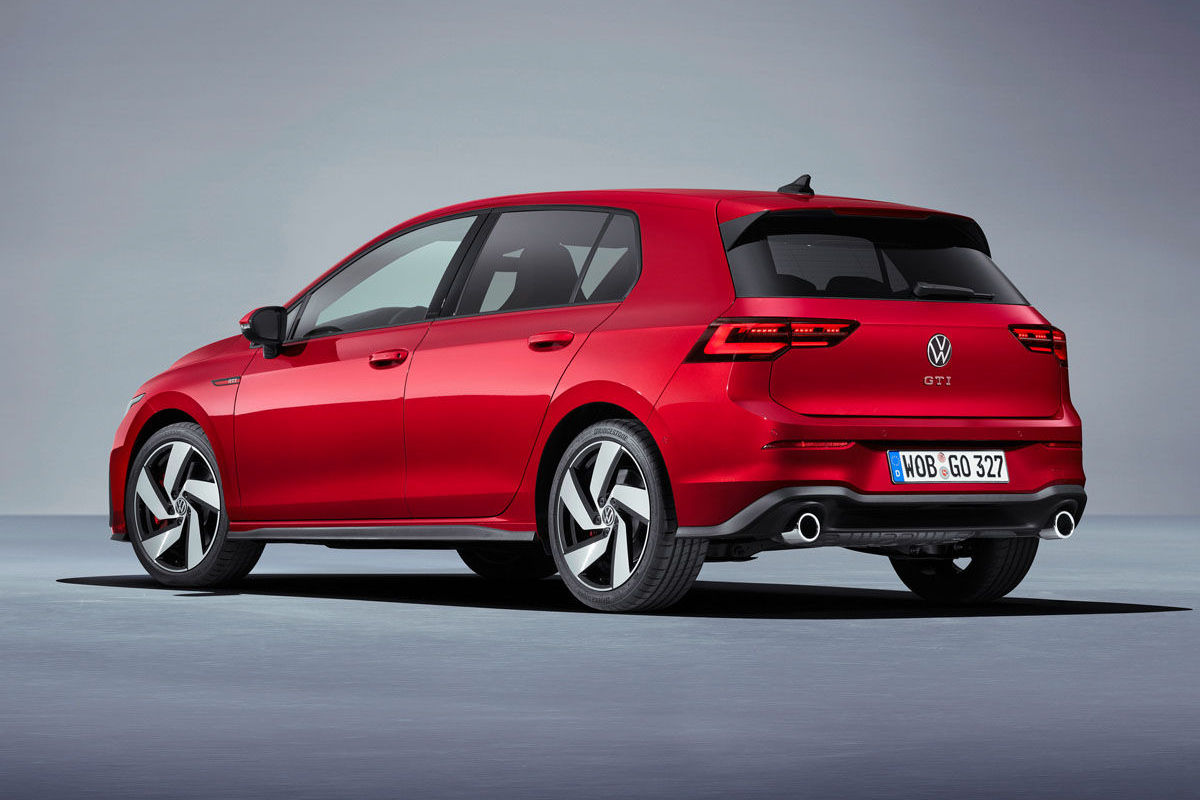
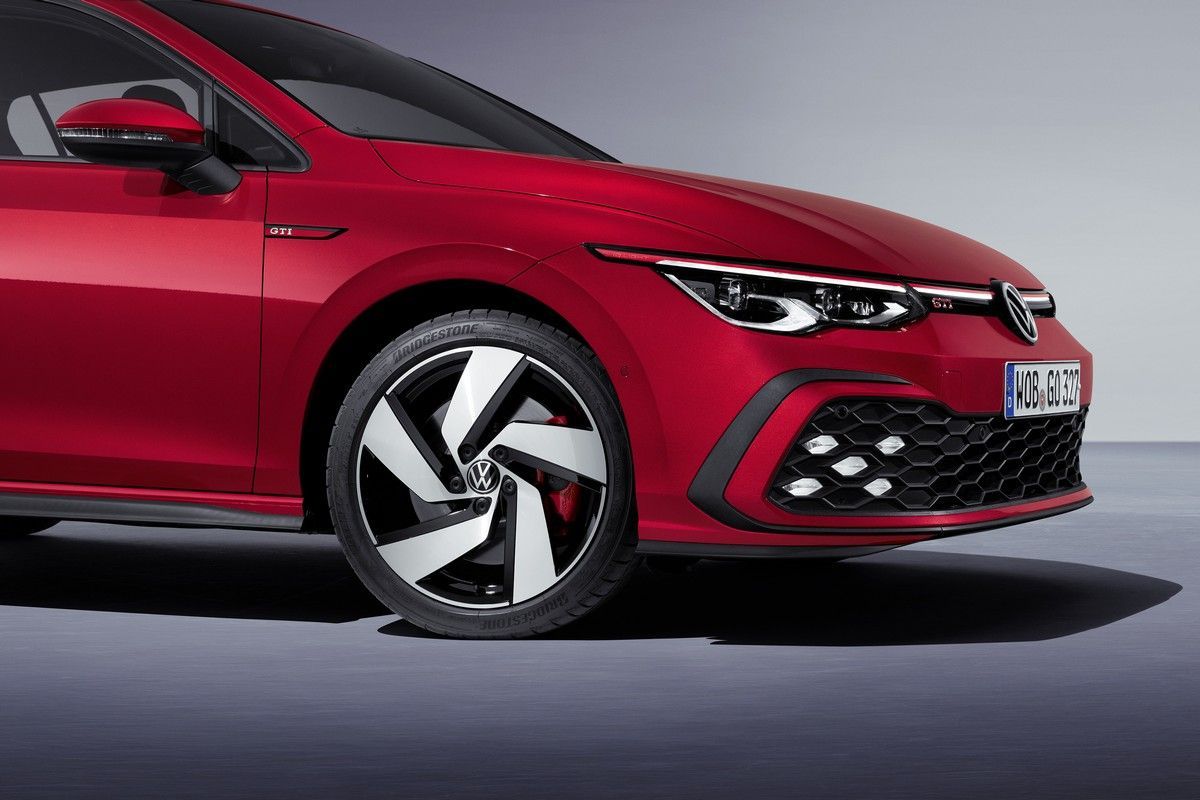
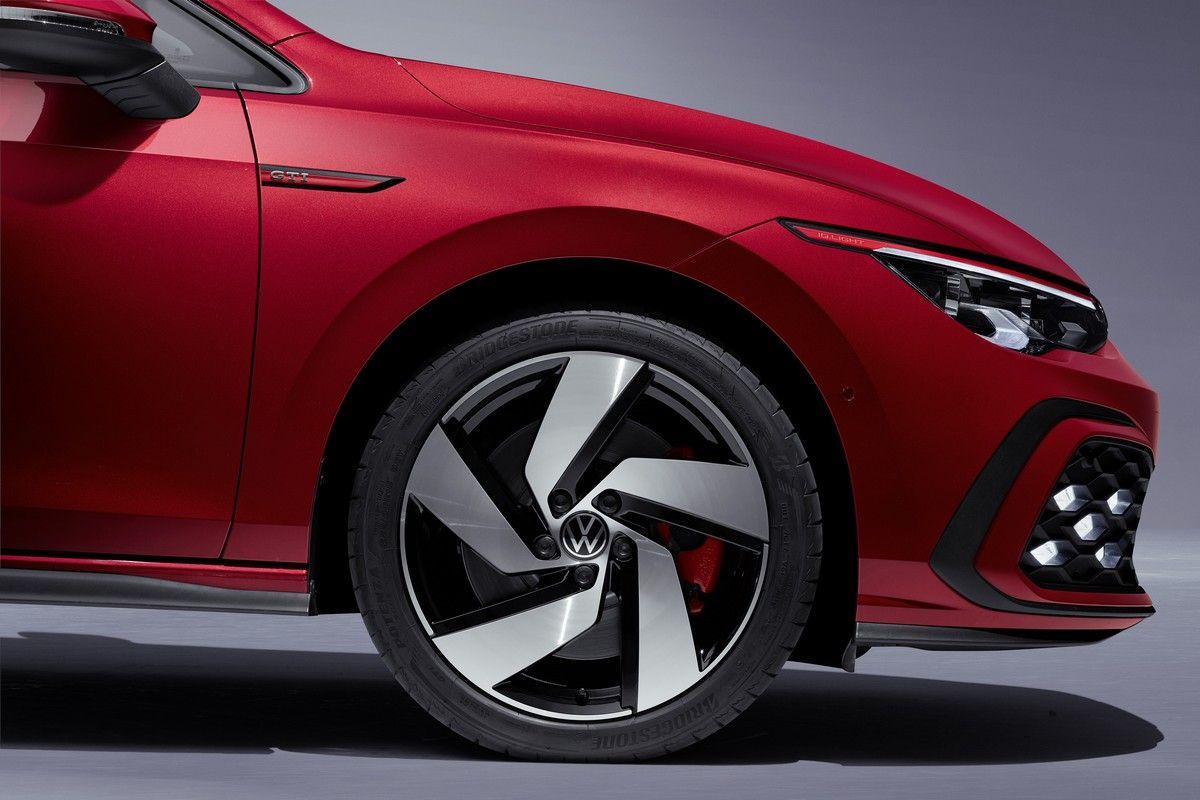
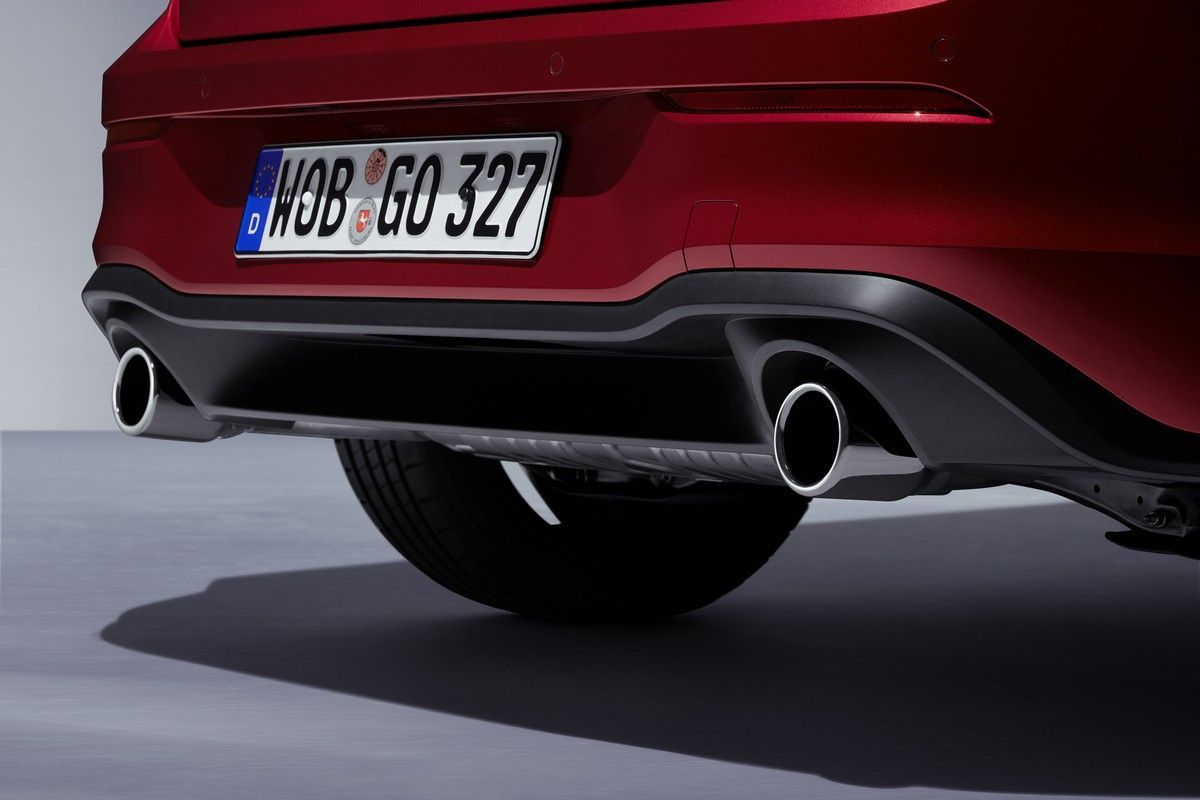
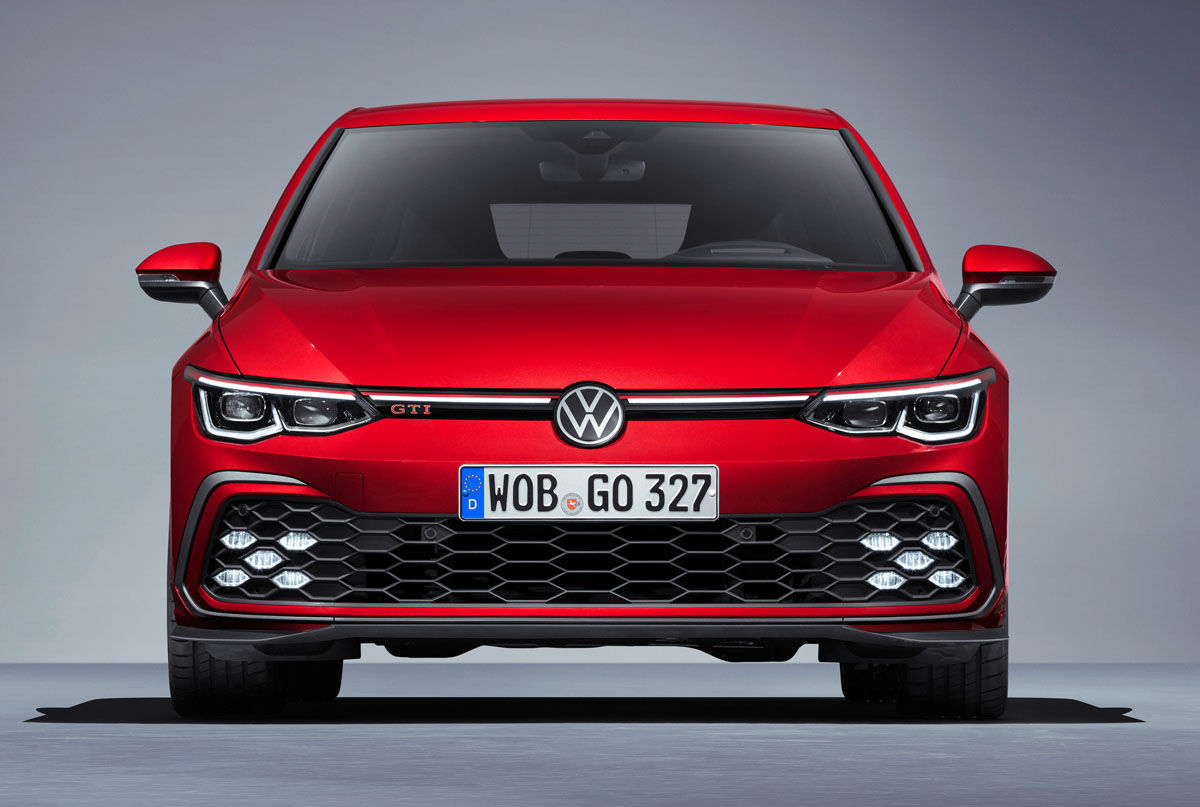
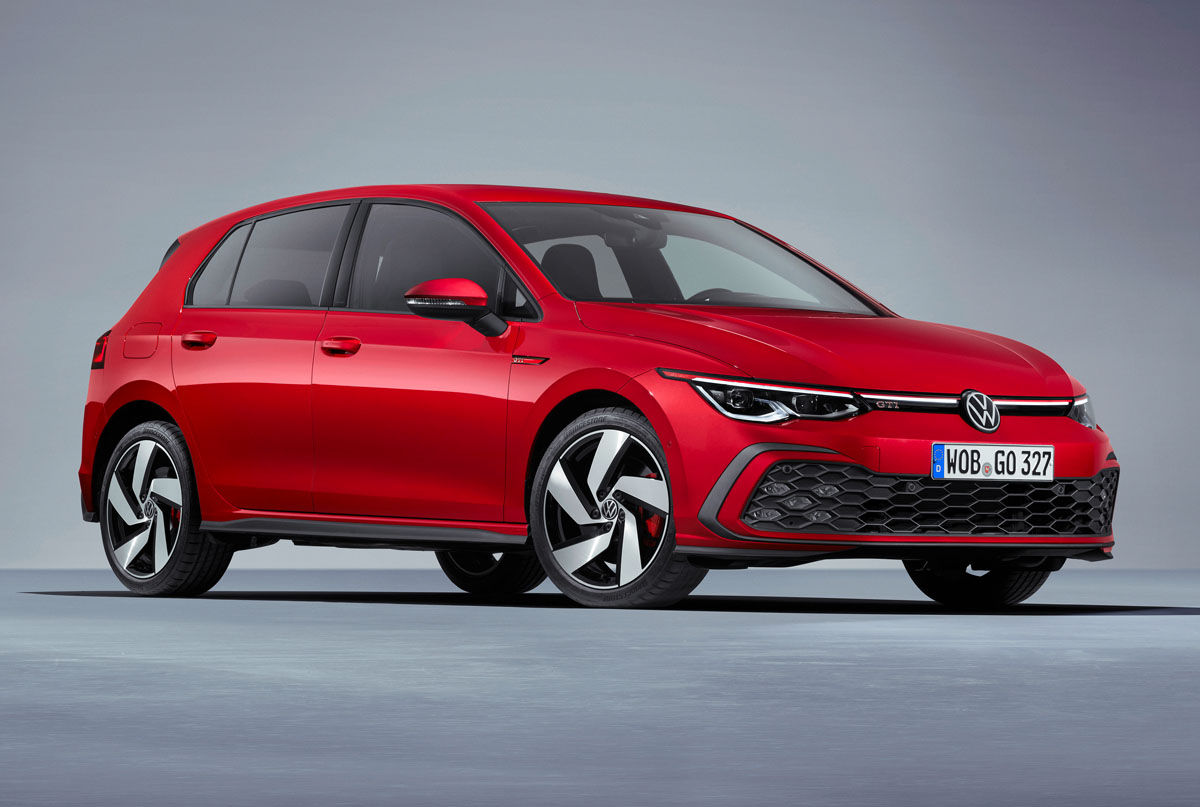
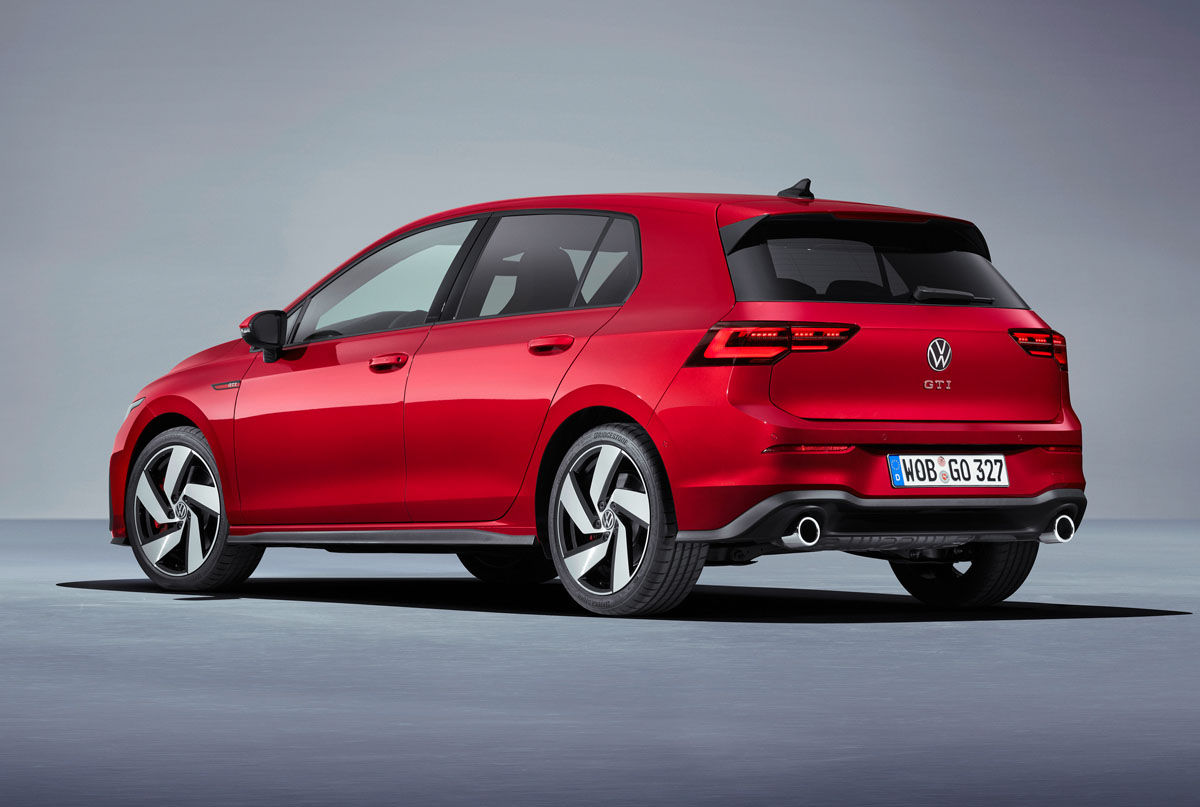
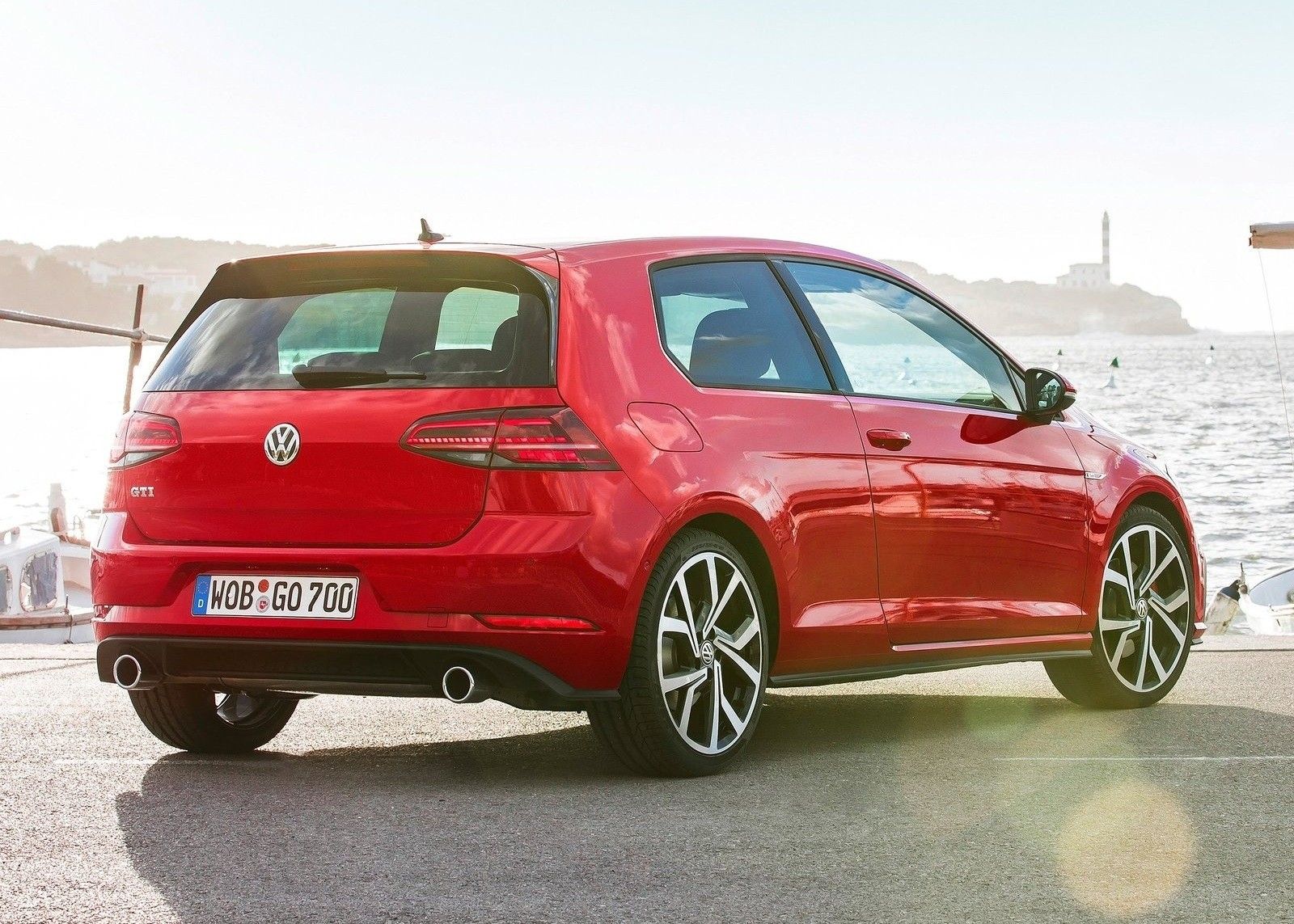
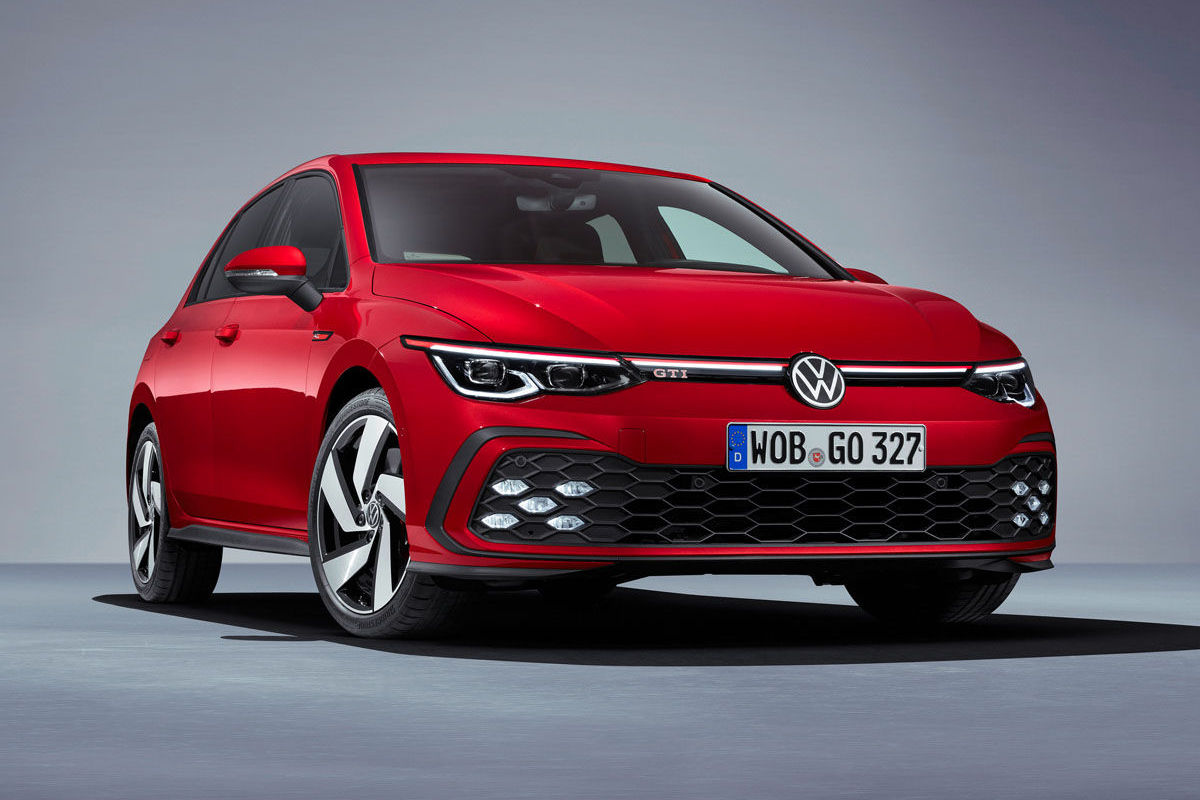
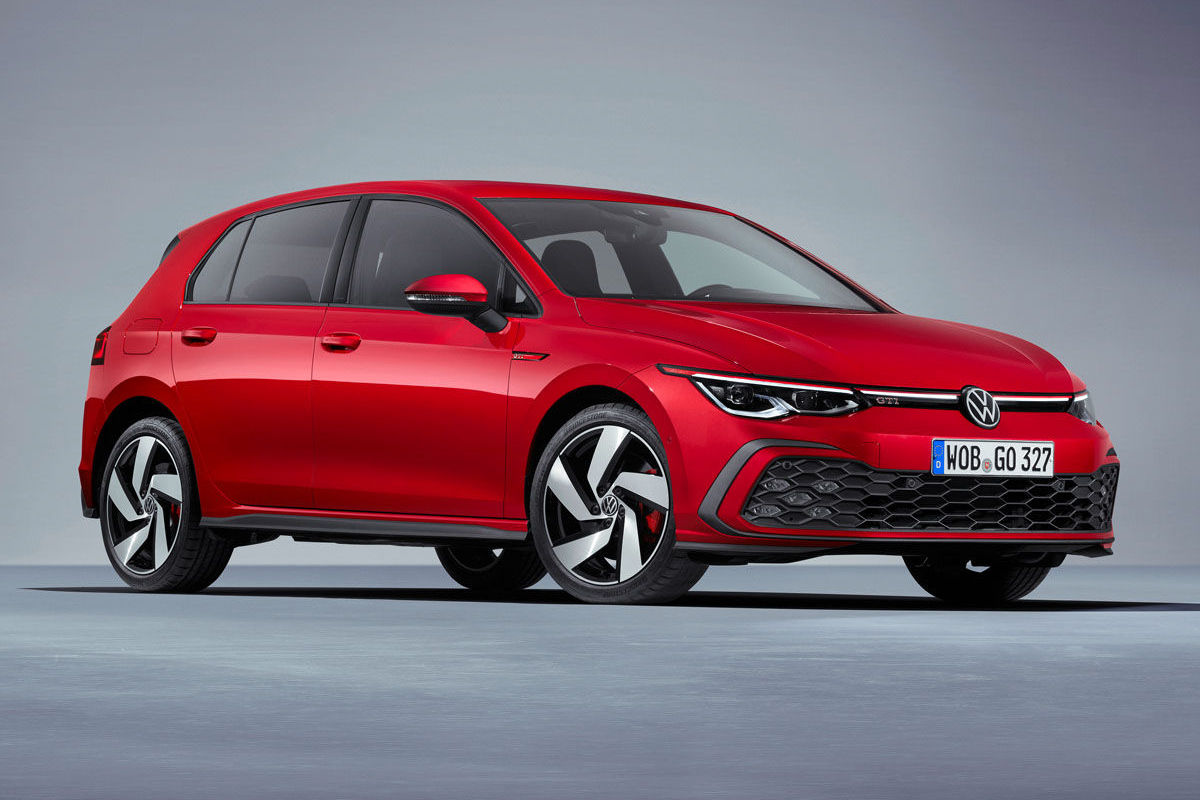
To use that petrolhead cliche, 'it's an evolution rather than revolution' and is particularly accurate when it comes to the Volkswagen Golf GTI family. One does not mess with a winning formula and for those who think the design is too tame, the good news is there will be more aggressive models coming. There are some common elements across both cars, like the subtle wing, the twin exhausts and honeycomb grille. The first thing you'll notice are the attractive LED lights located in the grille and lower bumper. For a usually restrained design, the GTI is marvellously detailed: note the ornamental 5-piece fog light clusters that create a pair of X-shapes, one at either end of the lower bumper. Finally, there are 17-inch alloy wheels as standard, but we suspect there'll be bigger units available as optional extras. 
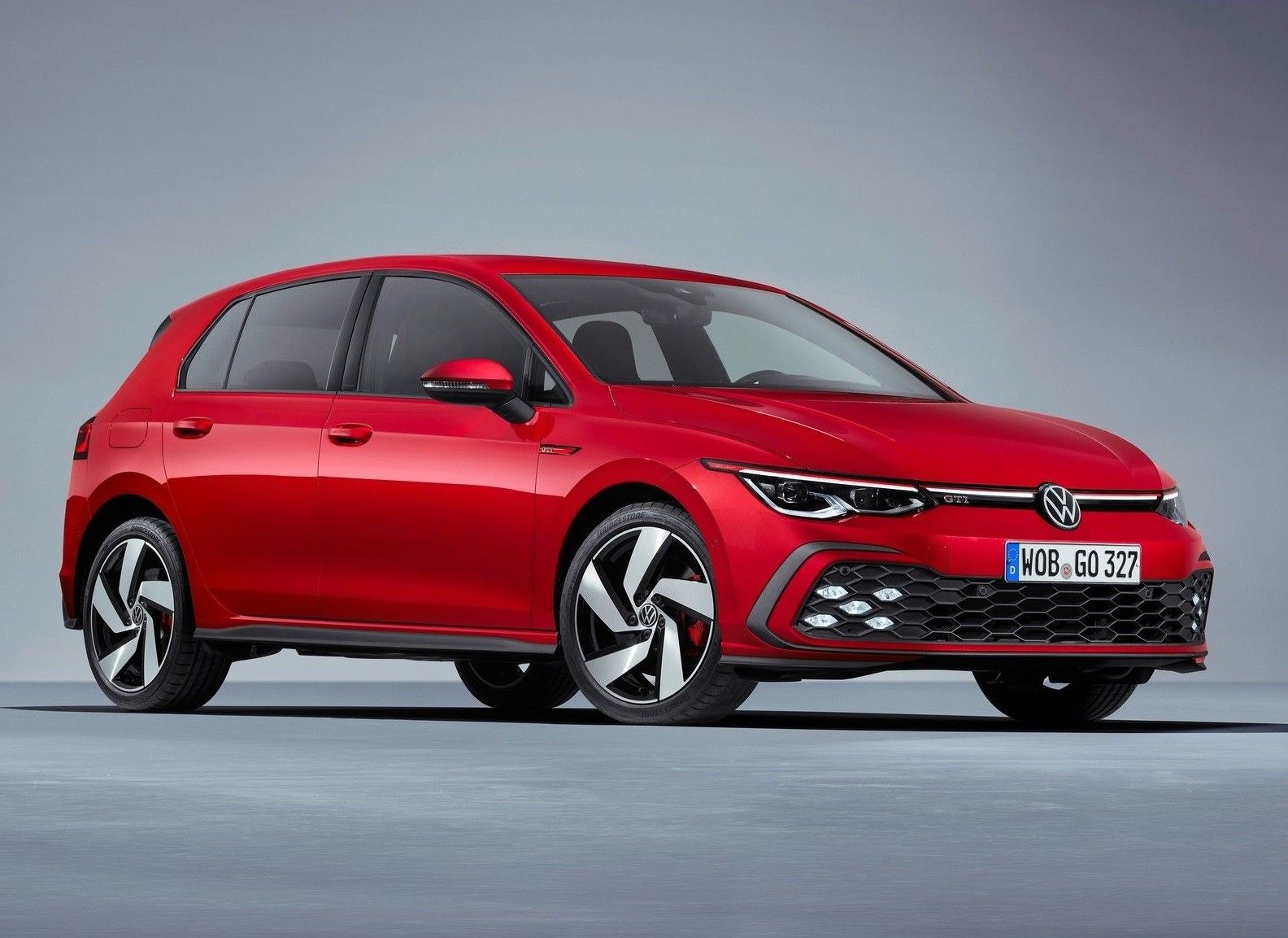

How good-looking are those daytime-running lights?

3. Tech
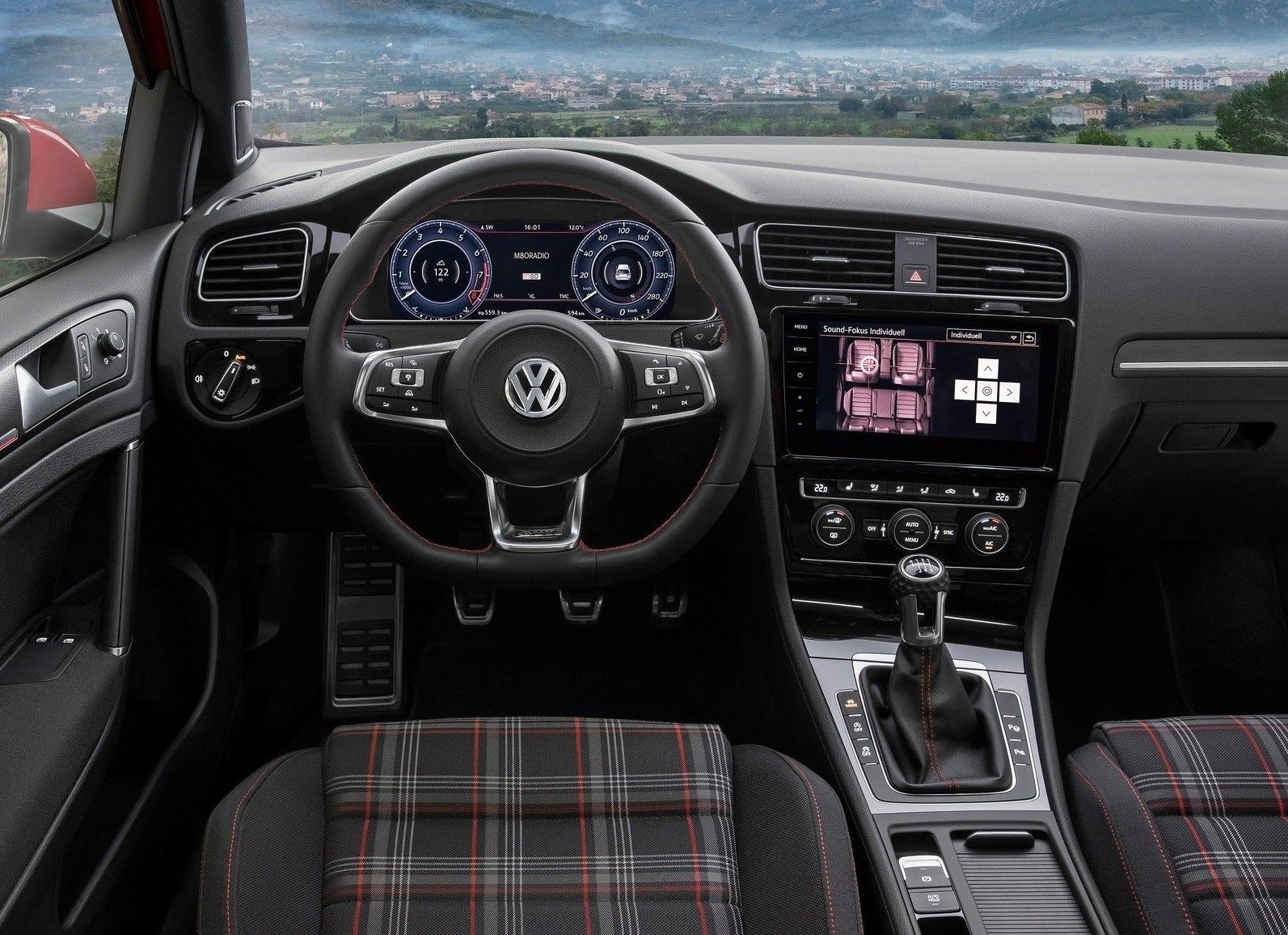

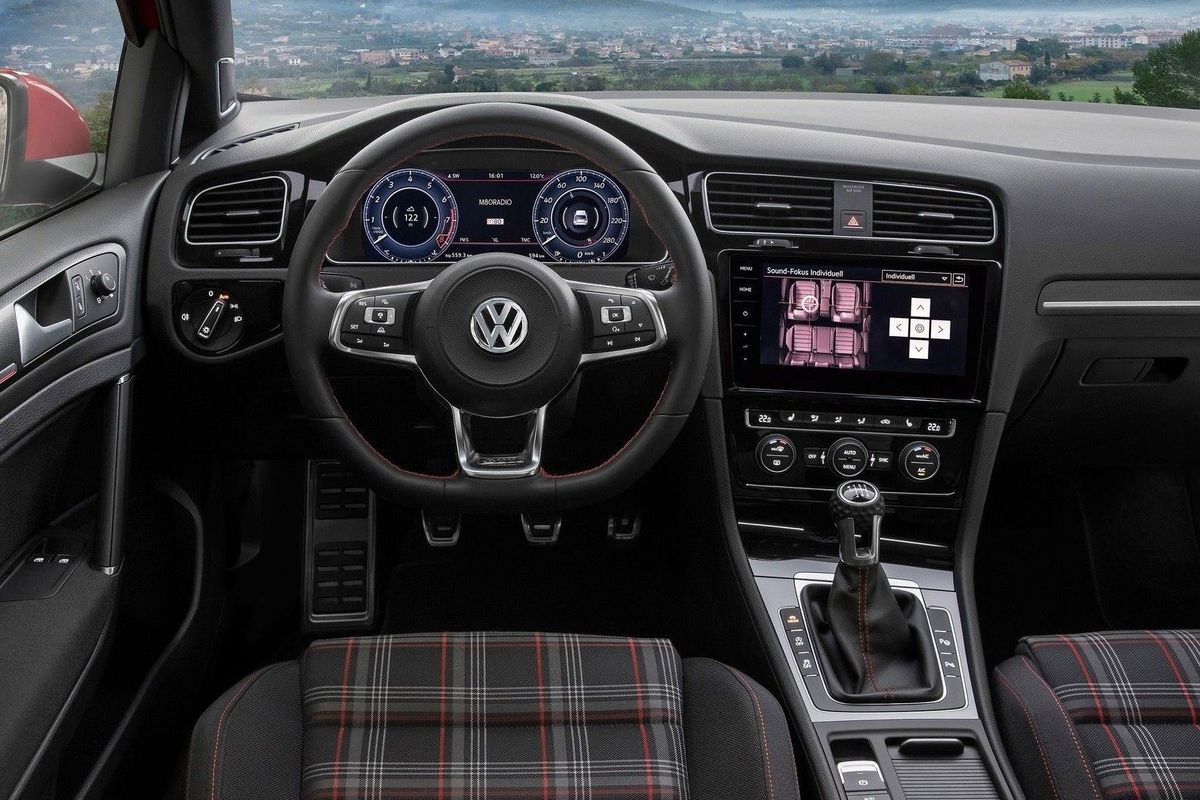
The cabin of the Volkswagen Golf GTI 7.5 was smart, sporty and splashed with luxury

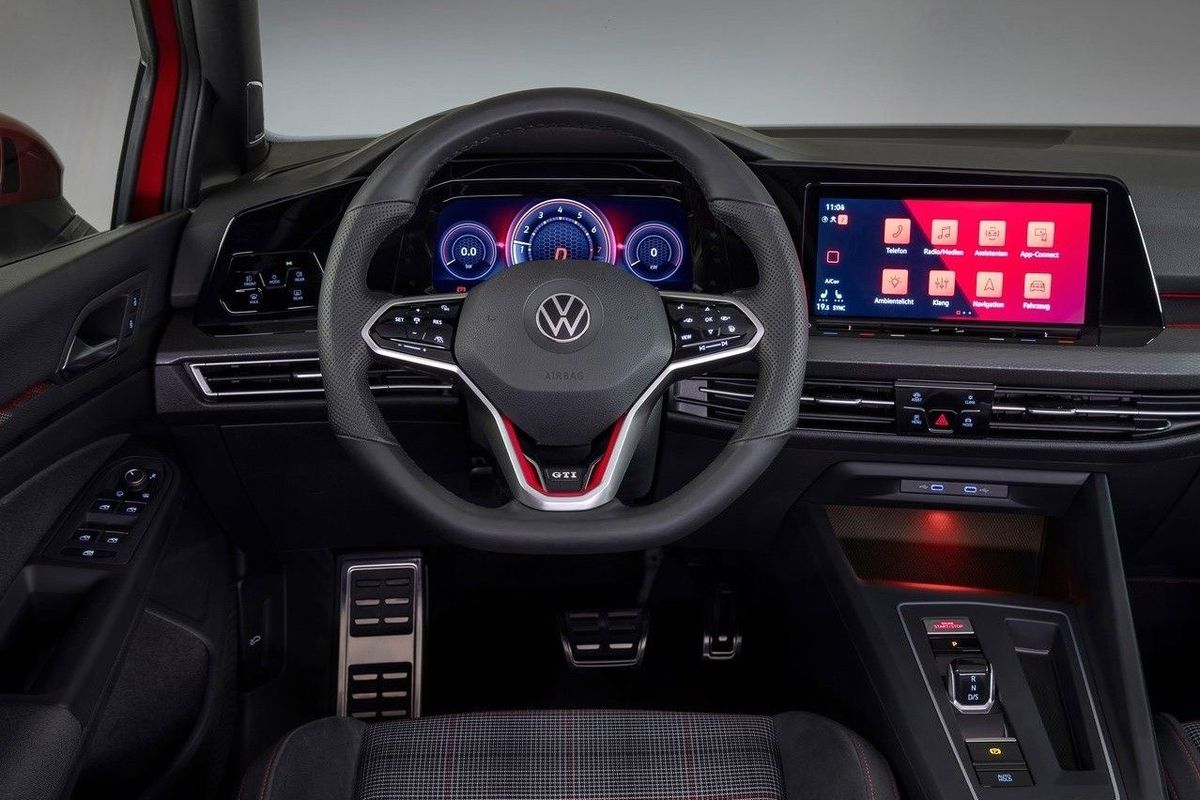
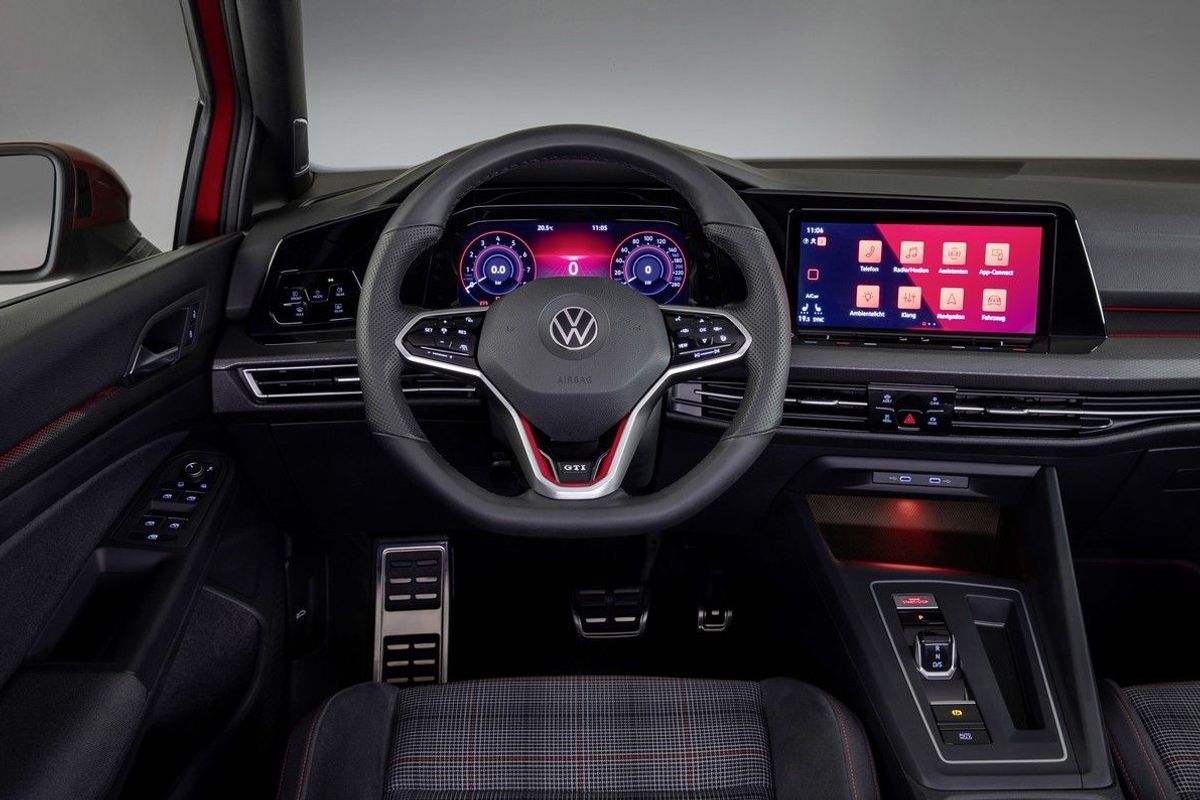
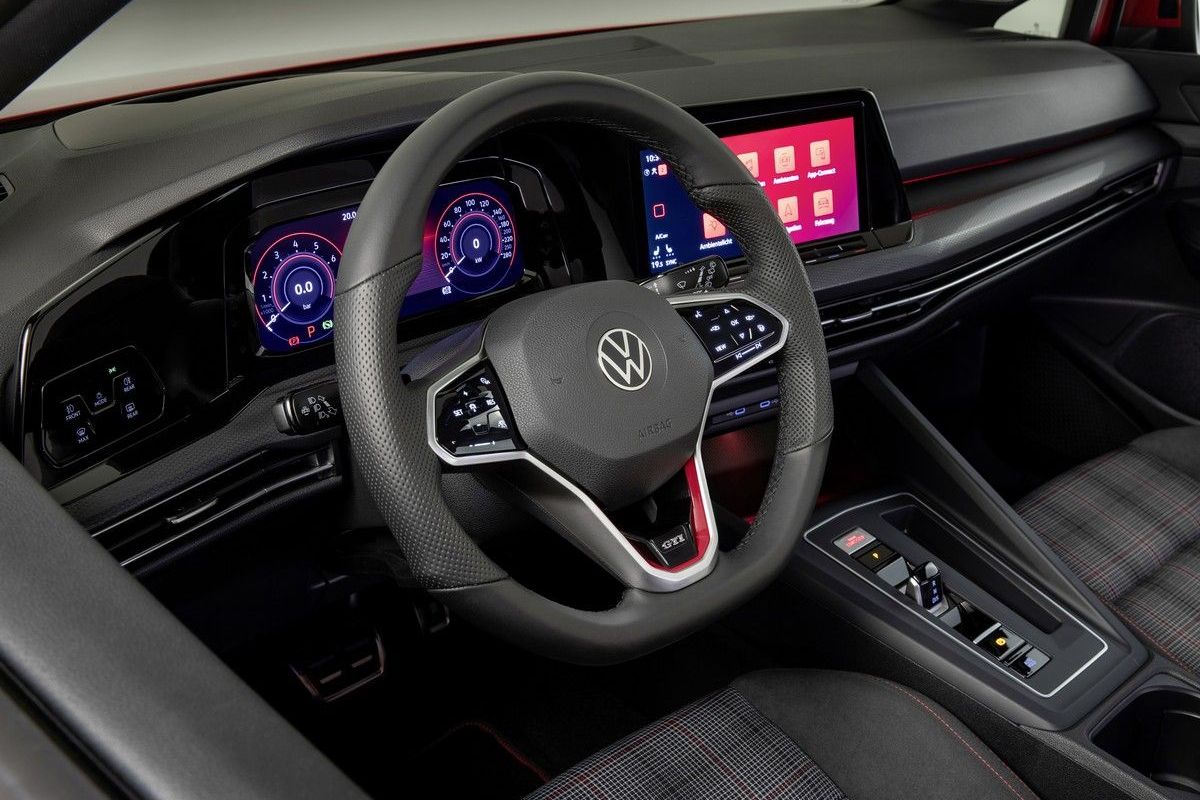
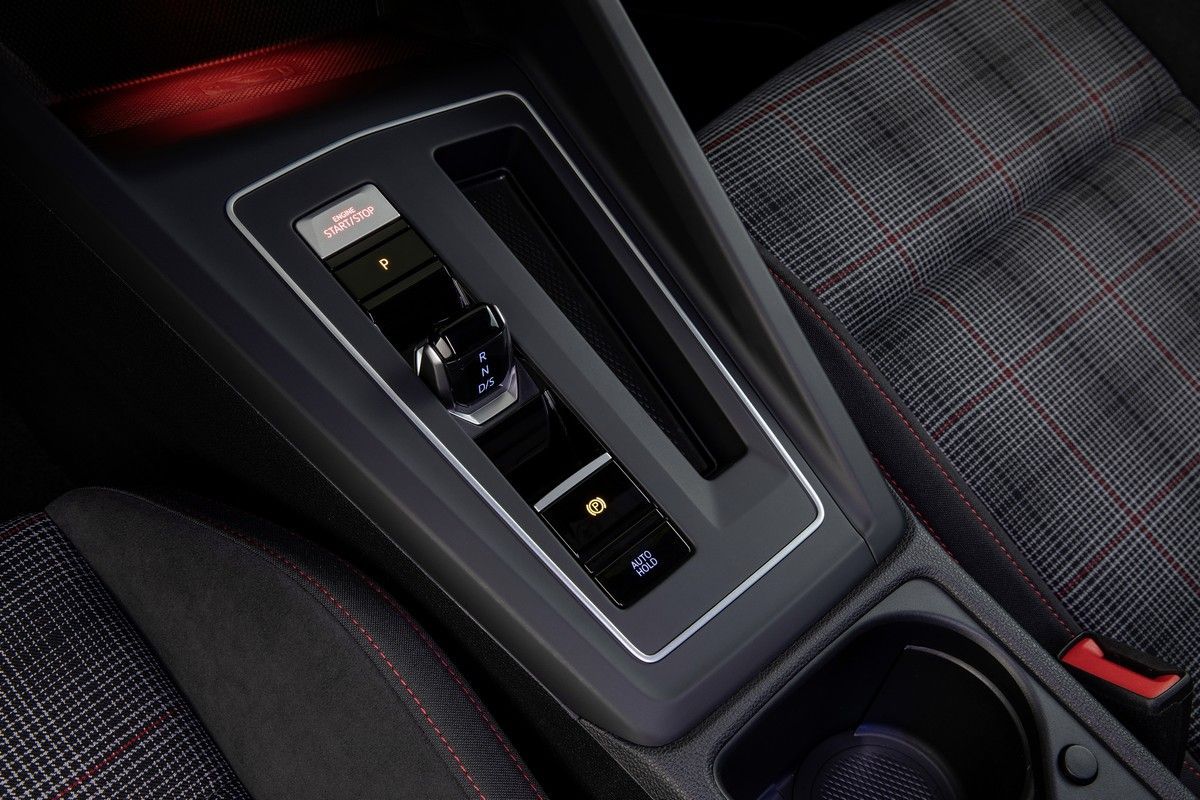
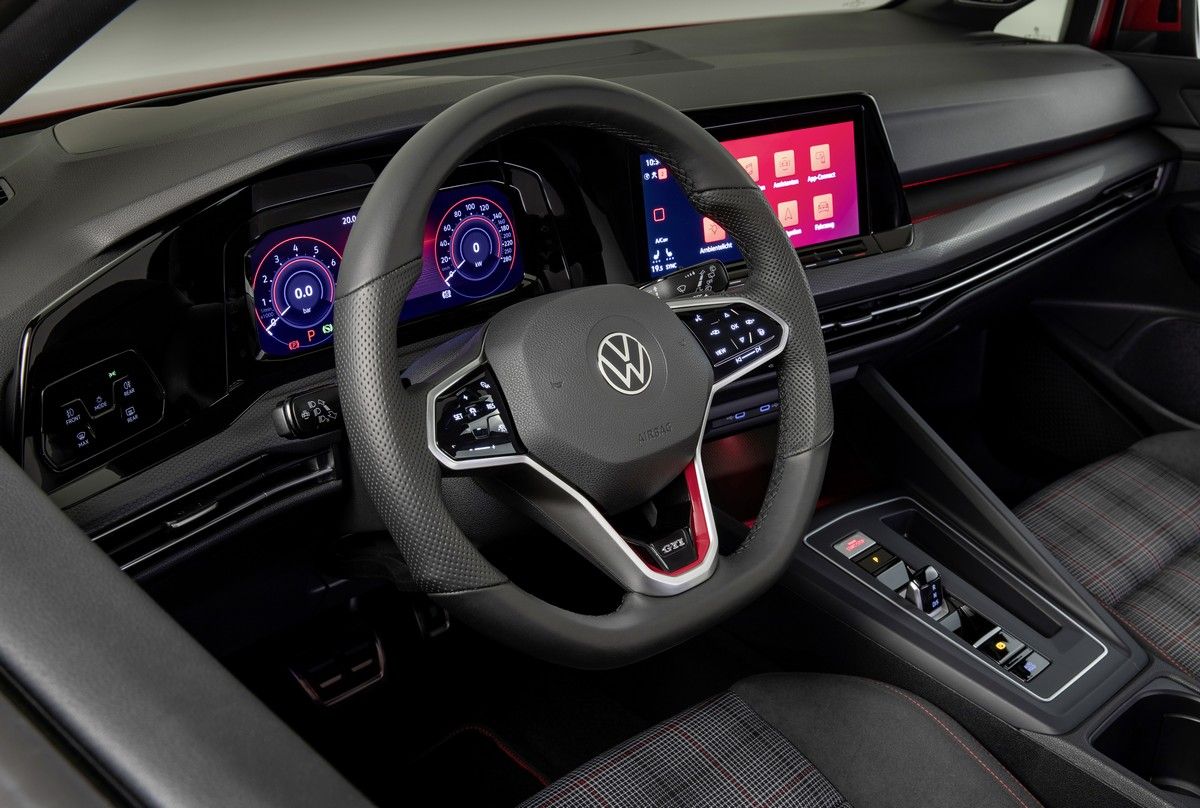
It's in this department where the Volkswagen Golf 8 GTI moves away from its predecessor. The interior of the vehicle is a big step up, with its digital dashboard and instrument cluster. You'll also notice the lack of a gear knob, drive selections are actioned by a discrete lever. Once you step into the Golf 8 GTI’s cockpit, its Innovision Cockpit (the combination of the 10.25-inch Digital Cockpit instrument cluster and the 10-inch touchscreen infotainment system, including navigation) is automatically activated and the start/stop button pulses red until the engine is started. The car features single-zone automatic climate control (Climatronic), the comfort start system, LED reading lights and two USB-C ports. The Lane Assist lane-keeping system, Front Assist (Autonomous Emergency Braking with Pedestrian Monitoring), Car2X (local communication with other vehicles and the traffic infrastructure) and We Connect and We Connect Plus online services are included, but obviously not all of those systems are confirmed for South African-spec GTI derivatives.
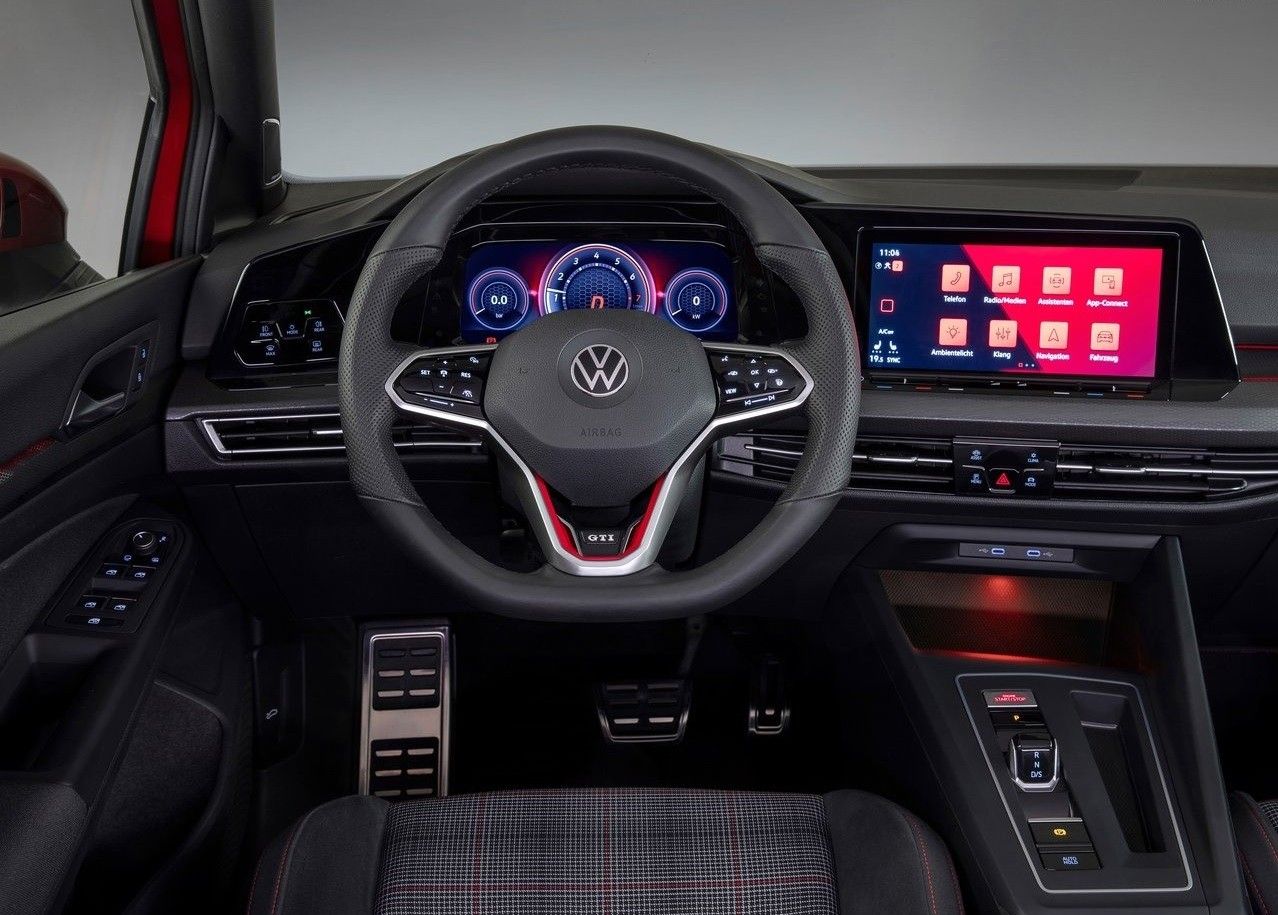

The Volkswagen Golf GTI 8 cabin continues where its predecessor left off but brings massive amounts of tech into play.

Further Reading

Volkswagen Golf 8 GTI officially revealed

Volkswagen Golf GTI TCR vs GTI – What’s the difference? 

New VW's Coming to SA in 2020

Volkswagen Golf GTI TCR (2019) Specs & Price
Volkswagen Golf 8 (2020) International Launch Review

2020 Volkswagen Golf 8 Officially Revealed

Fuel Levy to Increase

One of the announcements in the 2020 Budget Speech was an increase in the General and Road Accident Fund levies.

The Automobile Association (AA) is not impressed by these decisions and claims it is 'dismayed at the increases to the General Fuel and Road Accident Fund levies.' 

According to Finance Minister Tito Mboweni, there'll be a combined 25 cents increase which will contribute to both. The breakdown is 16 cents towards the General Fuel Levy, which now makes it R3.63 for every litre of fuel, while the Road Accident Fund levy increases by 9 cents to R2.07. This means that R5.70 or around 40% of the price of a litre of fuel is just pure tax. 

“We acknowledge that revenue must be collected towards the fiscus, and the difficult decisions the Minister had to make in preparing this Budget. However, as we pointed earlier, the increases to the fuel levies will hurt the poorest of the poor hardest, and will make transport costs that much more expensive for many who rely on transport daily to earn a living,” says the AA.

“These increases will invariably be reflected in increases to public transport and taxi fares. For those in our country who count each cent to get by each month, this is extremely worrying. The financial impacts of the increases cannot be underestimated and we are concerned about how this will impact on these citizens,” notes the AA.

Further Reading

Last Minute Changes for Feb Fuel Prices

Fuel Price Breakdown: What do you pay for?

5 Ways to Beat the Fuel Price Hike

Most Fuel Efficient Budget Cars in SA

Most Fuel-Efficient Double-Cab Bakkies in SA

5 Fuel-Saving Car Features & How They Work

Most Fuel Efficient Budget Cars in SA

Most Fuel Efficient Diesel Cars in SA

Most Fuel Efficient Petrol Cars in SA

Volkswagen Golf 8 GTI officially revealed

We can finally show you the production version of the Golf 8 GTI! After poring over myriad speculative renderings and spy shots of the eagerly awaited hot hatch for several months, we now know what the kingpin of the 8th-generation Golf range in South Africa looks like. It’ll be here in the last quarter of 2020.   

As the clock counts down to the opening of the Geneva Show, Volkswagen has already shown its Touareg R and followed it up with a media release about the Golf 8 GTI, GTE and GTD. As is often the case with pre-show information, technical details (including performance details) of the new GTI are still thin at this stage, but the marketing machine is in full swing: “Newly designed and engineered, (the Golf GTI) is fully digitalized and networked. Put simply, it’s a Golf GTI that’s perfect for the modern era,” the company claims.


The Golf 8 GTI's characteristic X-shaped fog light clusters consist of 5 LED modules apiece.

Going on to describe the GTI “as an agile, raw, efficient and high-tech compact sportscar”, the Wolfsburg-based firm confirmed the newcomer is powered by an EA888 (evo4) 2.0-litre turbocharged and direct-injection 4-cylinder engine with peak outputs of 180 kW and 370 Nm of torque; don't be worried, fanboys, there will definitely be hotter versions to come! A 6-speed manual gearbox (MQ350) is standard in the Europen market, but we believe the local GTI will be exclusively equipped with the 7-speed dual-clutch transmission gearbox (DQ381 DSG).

The Golf 8 GTI is underpinned by a McPherson strut-type front- and a multi-link rear suspension (it rides 15-mm lower than its stablemates), but further incorporates a new Vehicle Dynamics Manager driving-dynamics control system that coordinates the workings of the electronic differential lock (XDS) and the lateral functionality of the adaptive damping system (DCC) – if so equipped.


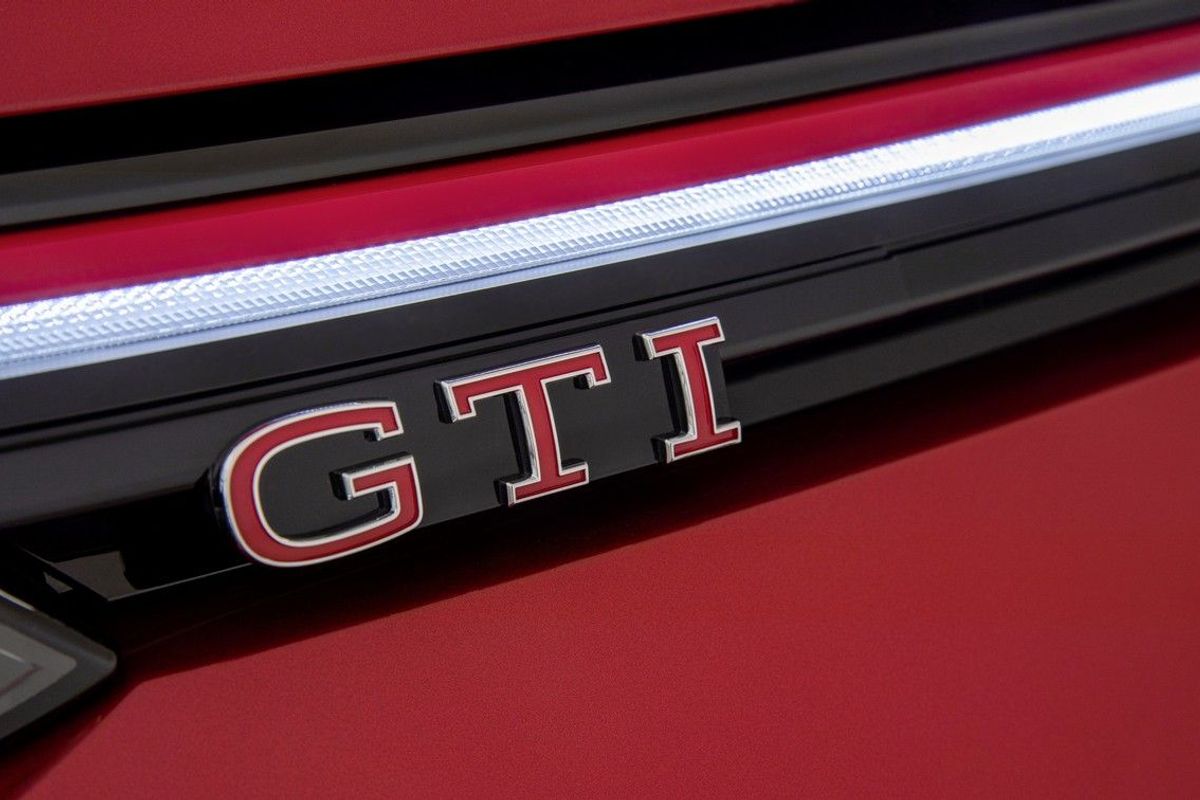
This view of the Golf 8 GTI shows the illuminated bar that runs above the newcomer's headlights and along the top edge of its grille.

The Volkswagen's vehicle setup can be extended in Individual mode to go beyond the range of Comfort, Eco and Sport driving modes and the driver can set/store their personal driving profile using a digital slider, the firm says. For example, beyond the Comfort setting, “the body (can be) ‘decoupled’ from the road surface as much as possible”, to select as pliant a ride quality as possible. Beyond the Sport setting, however, the driver can select the firmest damping available for minimal body movement and optimal handling responses.

Restrained, but purposeful looks

Those who have studied the appearance of the Golf 8 will recognise that the premium hatchback's (standard LED) headlights are positioned low to form a striking crossbar in conjunction with the top of the hatchback’s slim radiator grille. In the Golf 8 GTI derivative, the crossbar is topped off by a distinctive red line that runs the width of the GTI’s front end. What’s more, once the daytime running lights are activated, such as when the driver approaches the vehicle with the remote fob, LED strips atop the headlamp clusters and the leading edge of the grille light up to underline the red strip.  


The black cladding strips accent the side skirts and extend into the diffuser-style rear-bumper apron.

The front bumper features a typically large, honeycomb-pattern lower air intake grille framed on the outside by swoopy black inserts. For a usually restrained design, the GTI is marvellously detailed: note the ornamental 5-piece fog light clusters that create a pair of X-shapes, one at either end of the lower bumper.

The GTI 8 GTI comes standard with 17-inch Richmond aluminium-alloy wheels accented by red brake calipers (18- or 19-inch rims will be optional) and its wider side skirts sills feature black cladding strips that extend into the motorsport-inspired rear diffuser. A spoiler extends the roofline at the back of the car and the GTI lettering has been reposition to appear centrally under the VW emblem.  


Volkswagen ensured the design of the multifunction steering wheel recognised the tillers of GTIs past.

Retrolicious high-tech interior

As a nod to its storied heritage, the Golf 8 GTI’s sports steering wheel features a trio of silver "double spokes" and a recessed Wolfsburg emblem; the pedals are festooned with stainless-steel covers.

As retro as it looks, however, the multifunction leather-trimmed wheel is all new and features the usual array of touch controls as well as a Travel Assist button (if specified) that enables the hot hatchback to offer driving assistance at speeds of up to 210 kph when the system is engaged.

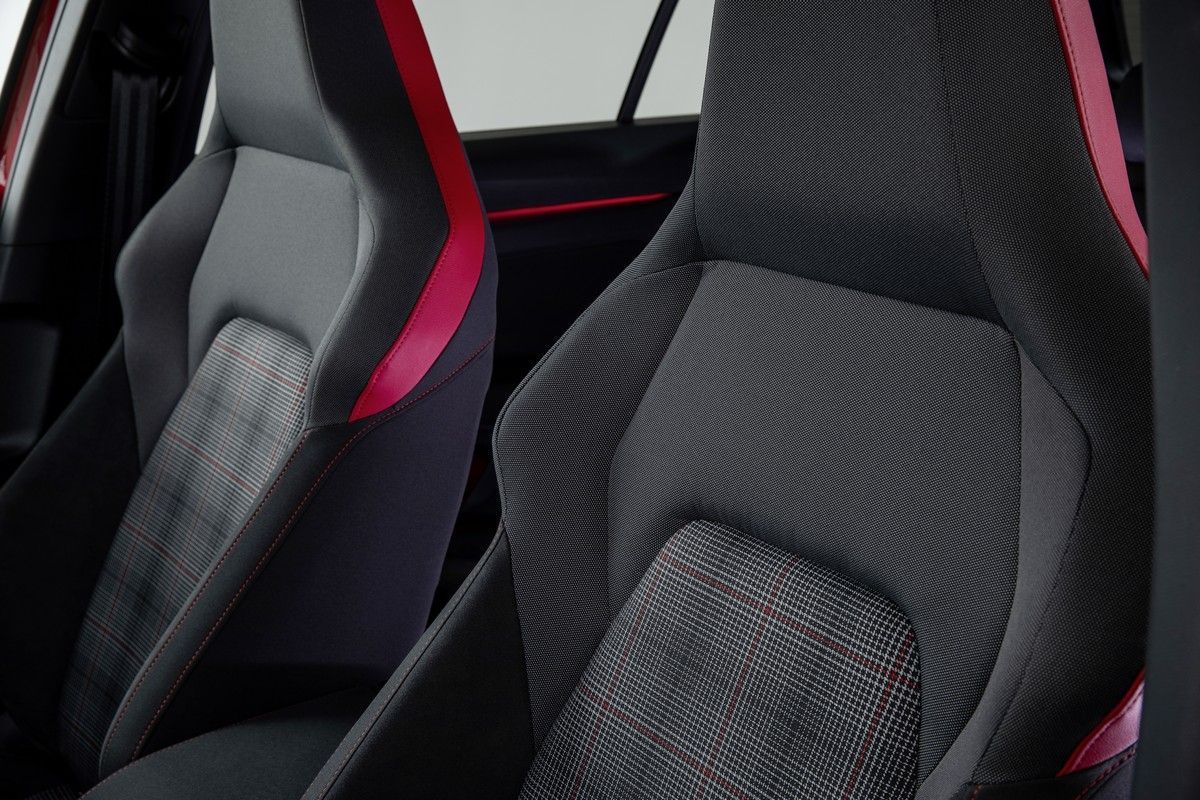
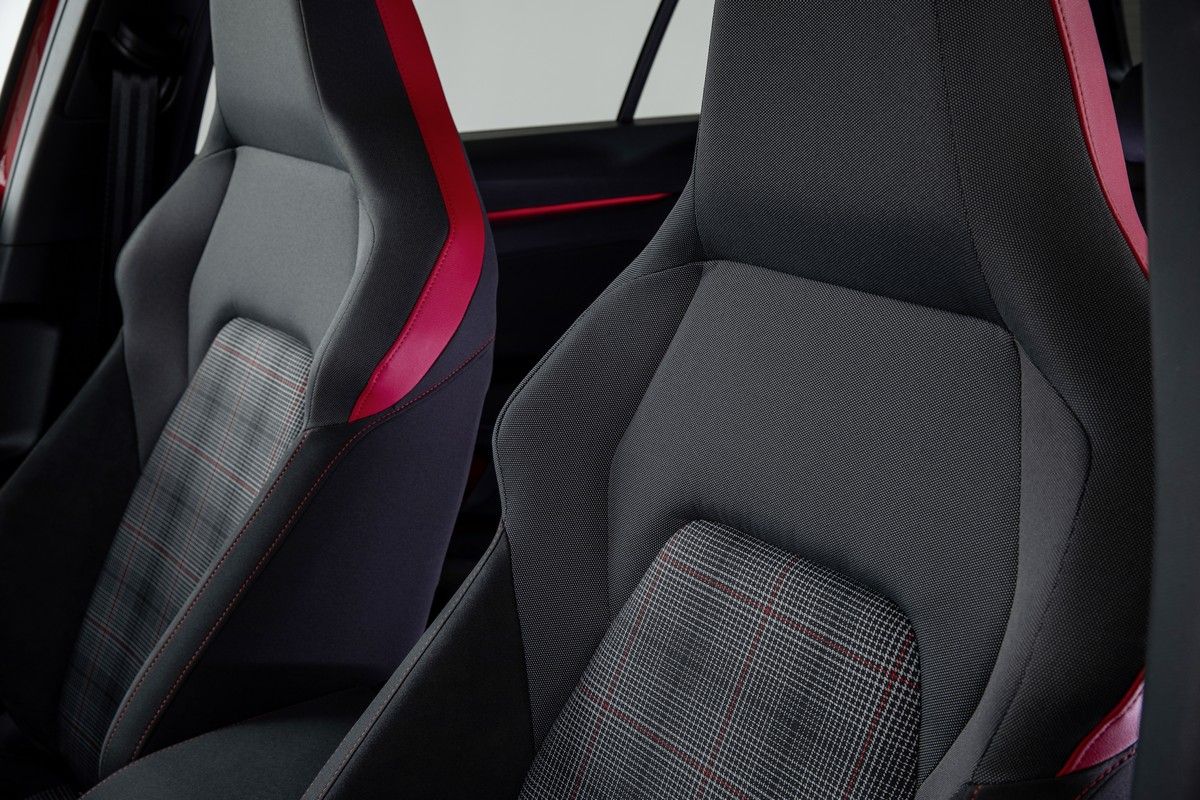
Meanwhile, the classic plaid fabric trim for the GTI’s sport seats makes another appearance in the 8th generation hatchback, but in a new checked design called Scalepaper. The seams of the grey-and-black design are red, which is complemented by the similar-coloured accents on the edges of the steering wheel’s lower spoke.


The front sports seats feature red detailing on their side trim as well as in the weave of the tartan fabric.

Once you step into the Golf 8 GTI’s cockpit, its Innovision Cockpit (the combination of the 10.25-inch Digital Cockpit instrument cluster and the 10-inch touchscreen infotainment system, including navigation) is automatically activated and the start/stop button pulses red until the engine is started.

The featured car features single-zone automatic climate control (Climatronic), the aforementioned Press & Drive comfort start system, LED reading lights and two USB-C ports. The Lane Assist lane-keeping system, Front Assist (Autonomous Emergency Braking with Pedestrian Monitoring), Car2X (local communication with other vehicles and the traffic infrastructure) and We Connect and We Connect Plus online services are included, but obviously not all of those systems are confirmed for South African-spec GTI derivatives.

And lastly, the LED background lighting, which also comes as standard on the GTI, embeds the displays and all other illuminated interior areas (dash panel, door trim, storage compartment – with an interface for a mobile 'phones, as well as the footwell) in a spectrum of 30 configurable colours. We'll bring you more info on the Golf 8 GTI as it becomes available.

Related content:

New VW's Coming to SA in 2020

Spy Shots: 2021 Volkswagen Golf 8 R

Volkswagen Golf 8 (2020) International Launch Review

Volkswagen Golf GTI TCR (2019) Specs & Price
Volkswagen Golf GTI TCR vs GTI – What’s the difference?

Hyundai i30N (2020) Launch Review

Updated Toyota C-HR (2020) Launch Review

Toyota has hit the refresh button on its C-HR and we took the opportunity to sample the updated compact family car during its local launch in the Western Cape this week. Take a look at what’s changed and what you can expect from this latest iteration of the C-HR…

Upon its local release back in 2017, the C-HR was the second TNGA product (after the Prius) to reach local shores. At the time, it turned heads with its edgy and sporty looks, but it's definitely not everyone’s cup of tea, especially if you are, like most South African car buyers, conservative in your purchasing decisions. Toyota SA knew the C-HR wouldn’t be a volume seller, but even so, it still manages to garner reasonable sales number (151 units were sold in January 2020). In Europe, however, the C-HR is hugely popular, especially in Hybrid guise (the C-HR hybrid is not sold in South Africa). Now, in an effort to keep the C-HR relevant in an increasingly crowded segment, Toyota has given the model a mild styling upgrade, replete with a host of new equipment features.

Tweaked styling 


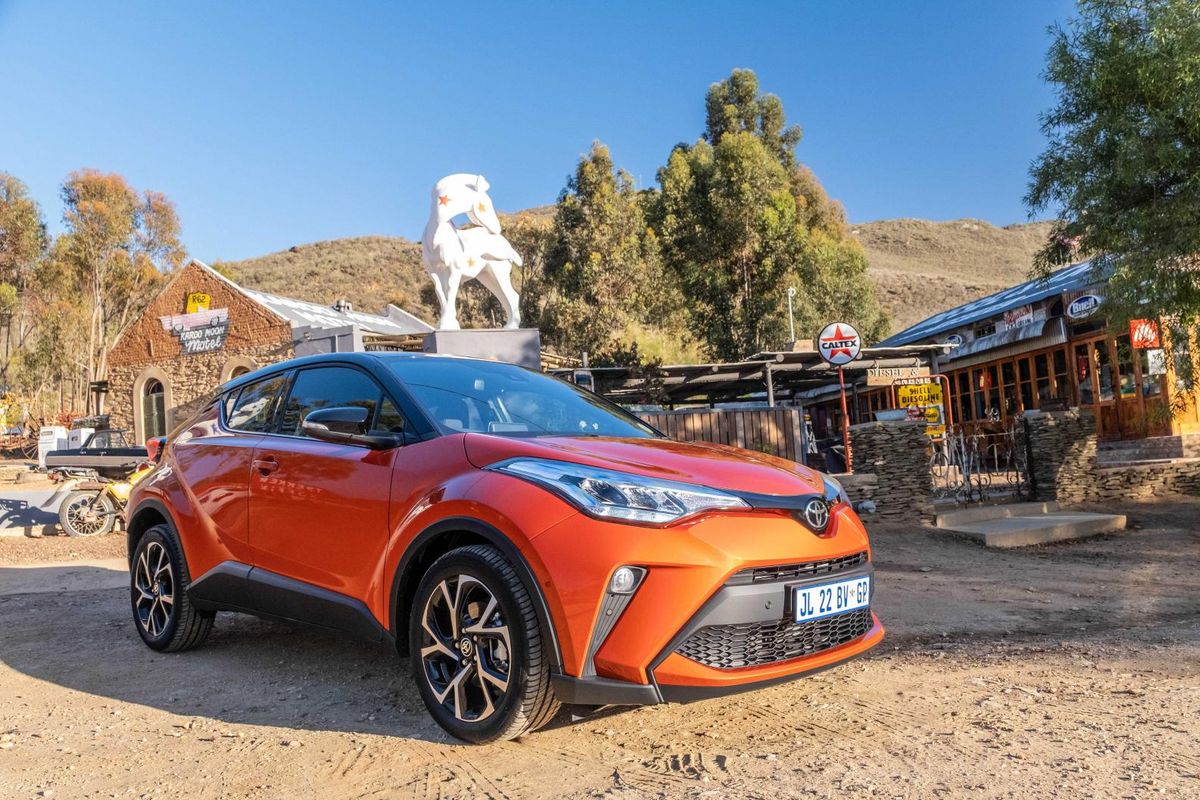
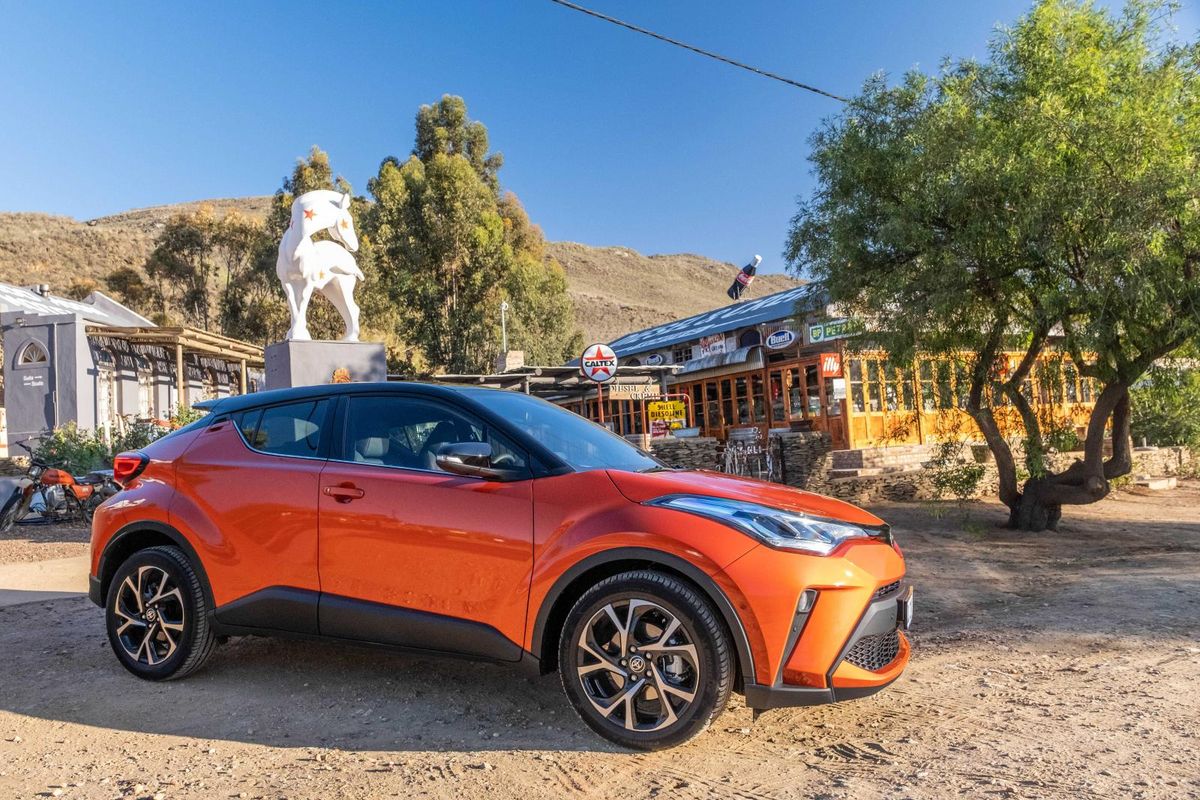
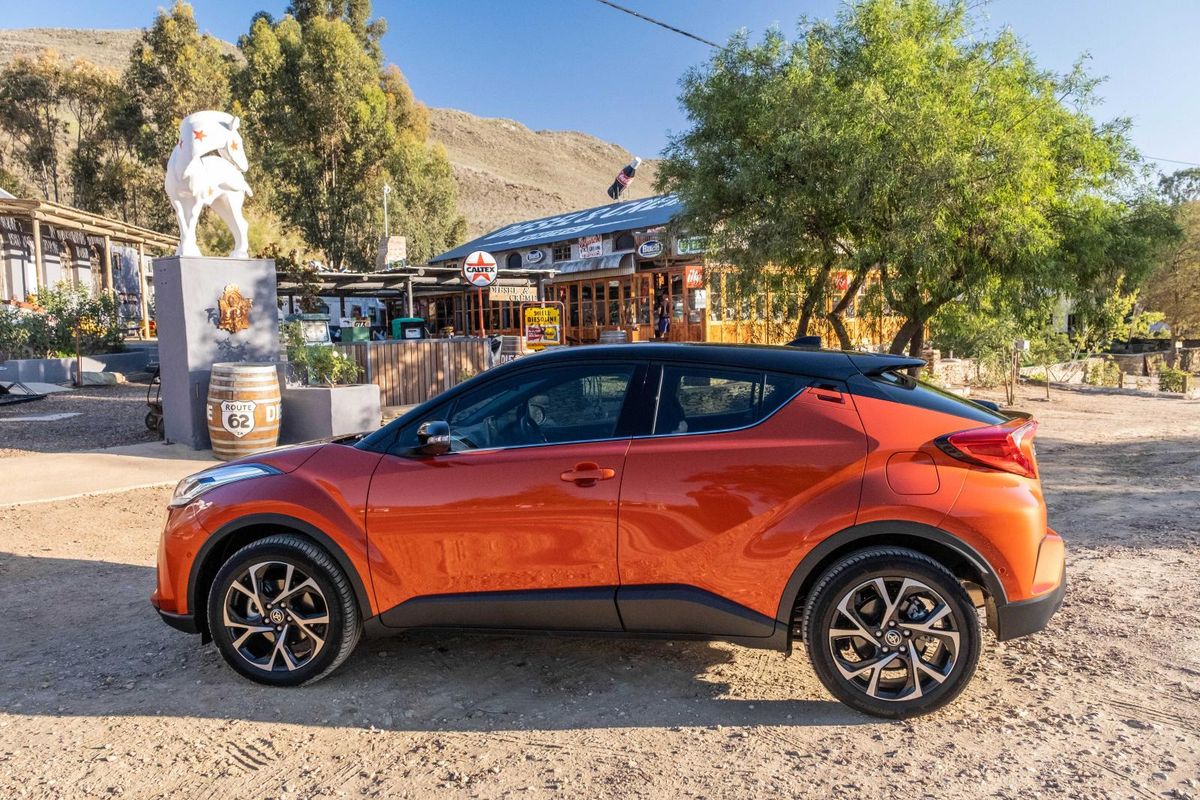
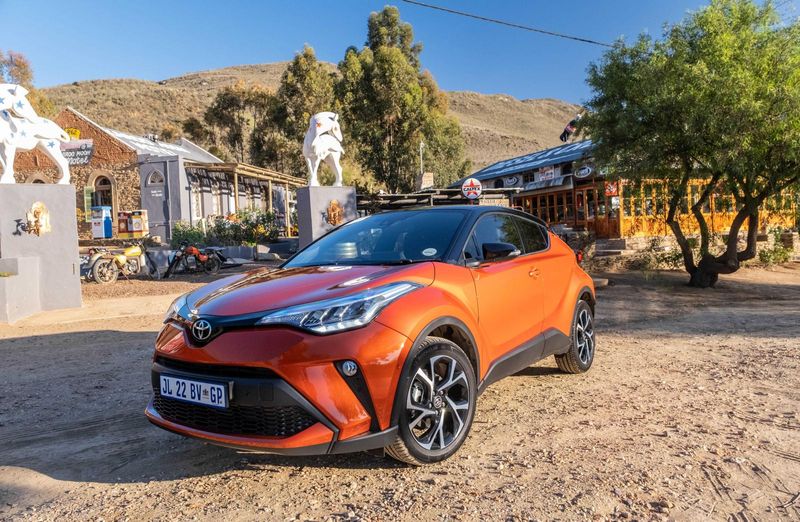
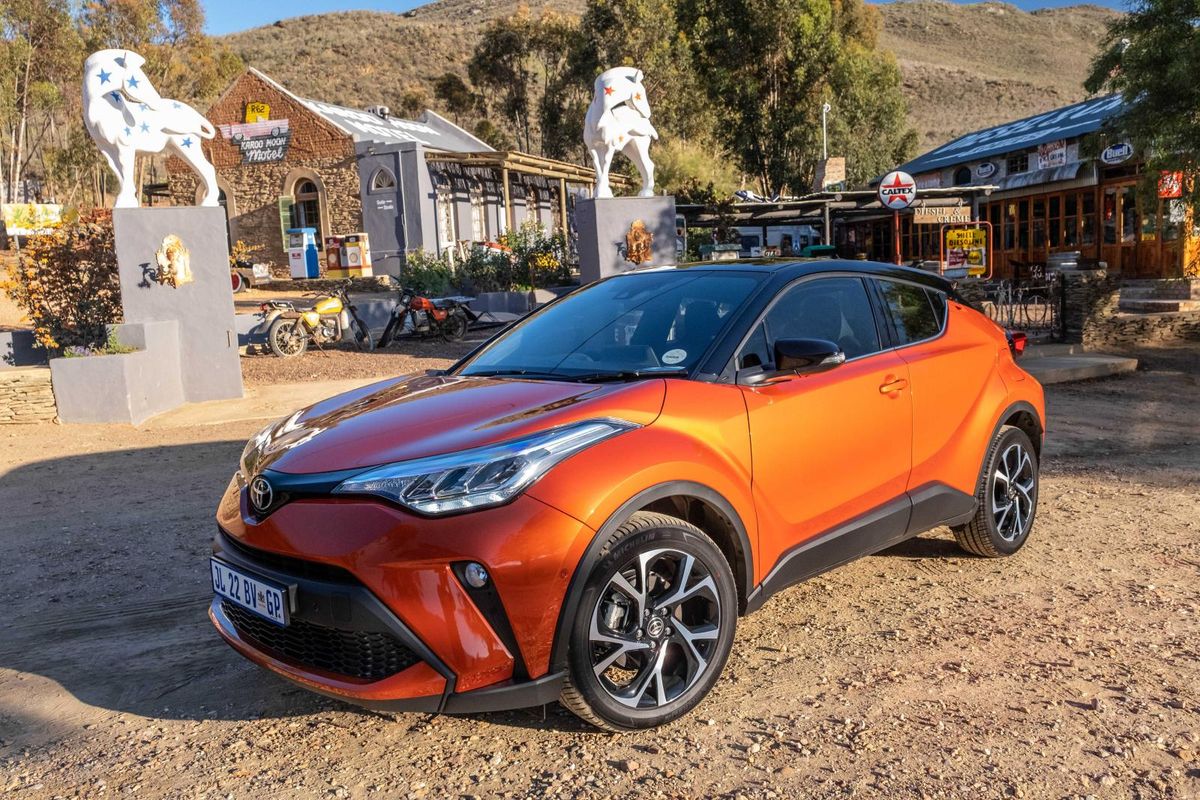
The C-HR retains its edgy styling and remains one of the more flamboyant design offerings in the small crossover segment. 

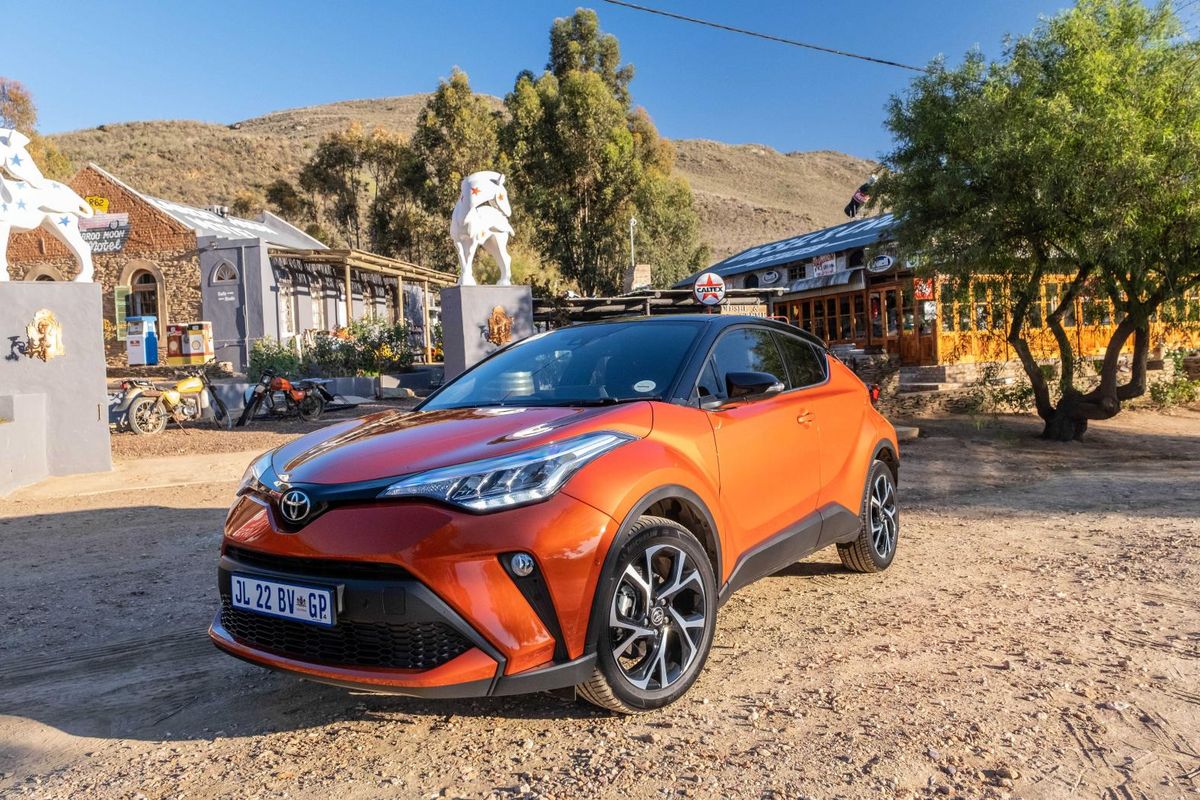
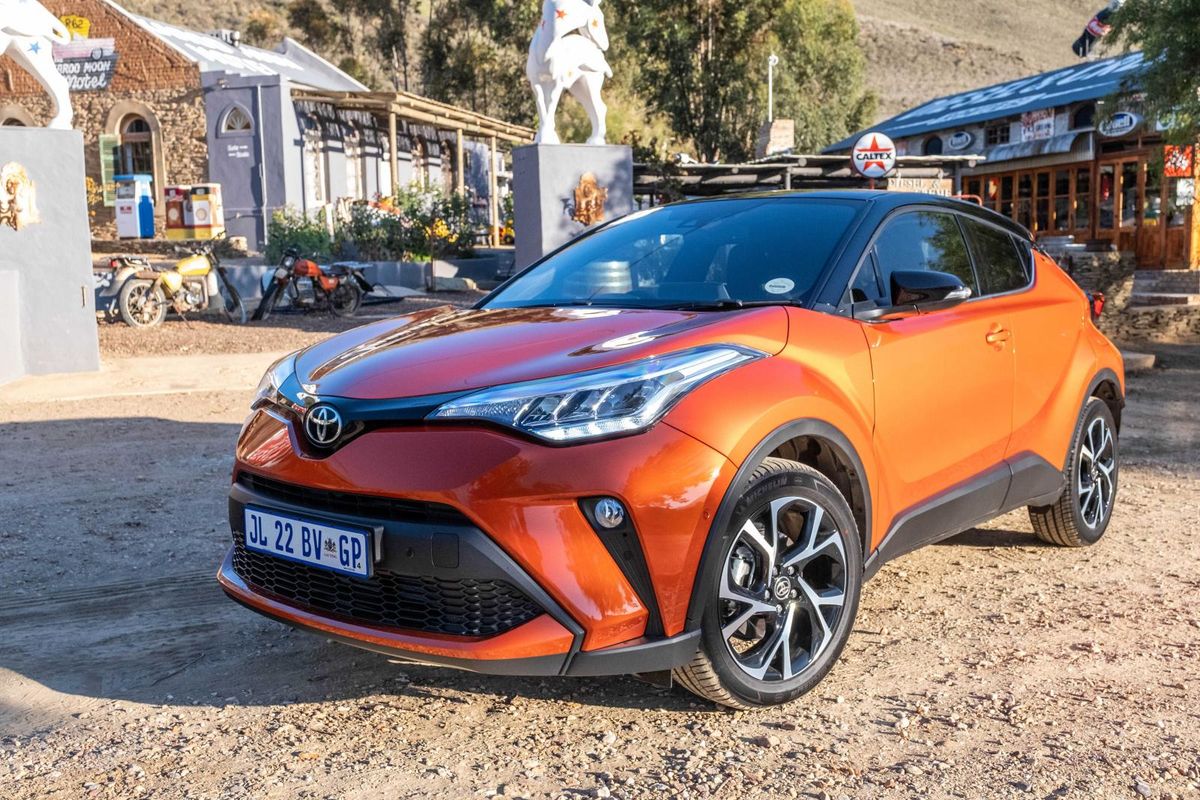
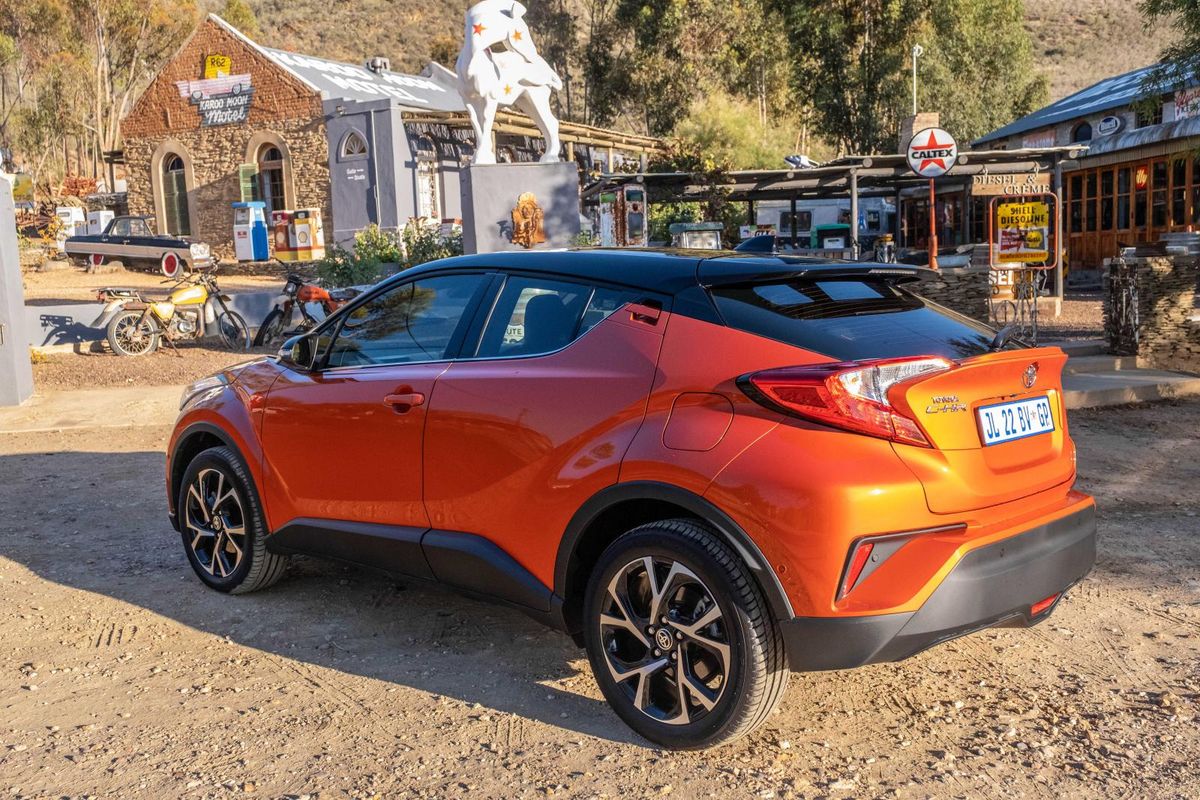
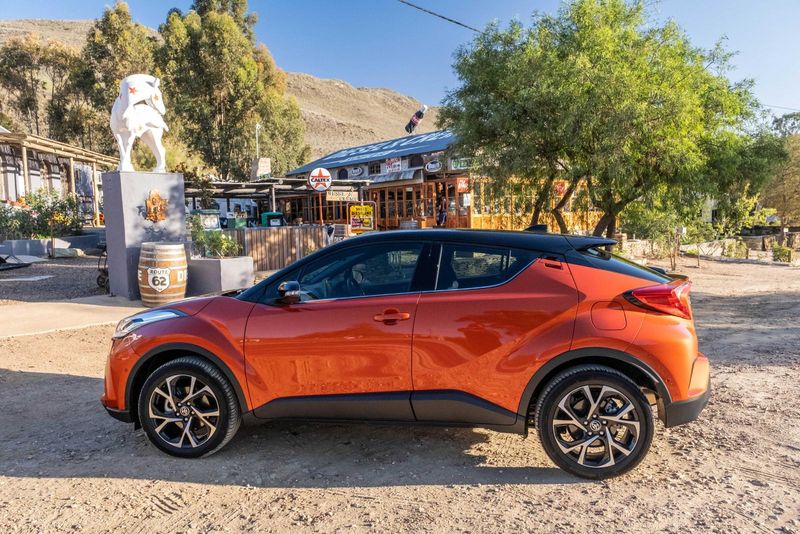
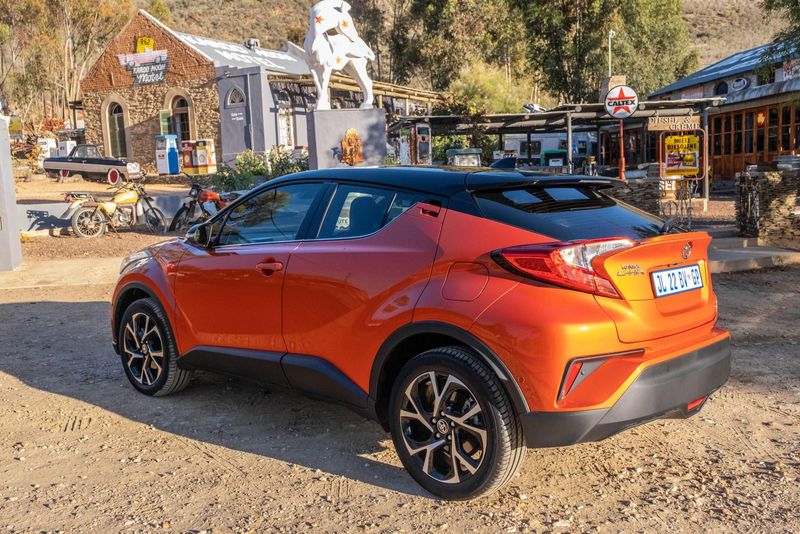
In terms of exterior styling changes to the front of the C-HR, the front spoiler lip is now in body colour and the bumper has been widened; LED headlights are standard on all derivatives (Standard, Plus and Luxury); the fog lights have been repositioned and side air intakes are more vertical in appearance. At the rear, the large red tail-light clusters are connected by a gloss black spoiler. 

There are also some striking body colours on offer including the new Inferno Orange and Oxide Bronze (offered on Standard and Plus trim), while the high-spec Luxury trim can be had in a 2-tone design with a black roof. The C-HR, in our opinion, is still one of the best looking compact family cars/small crossovers in the new-vehicle market. 

Safer and more connected 


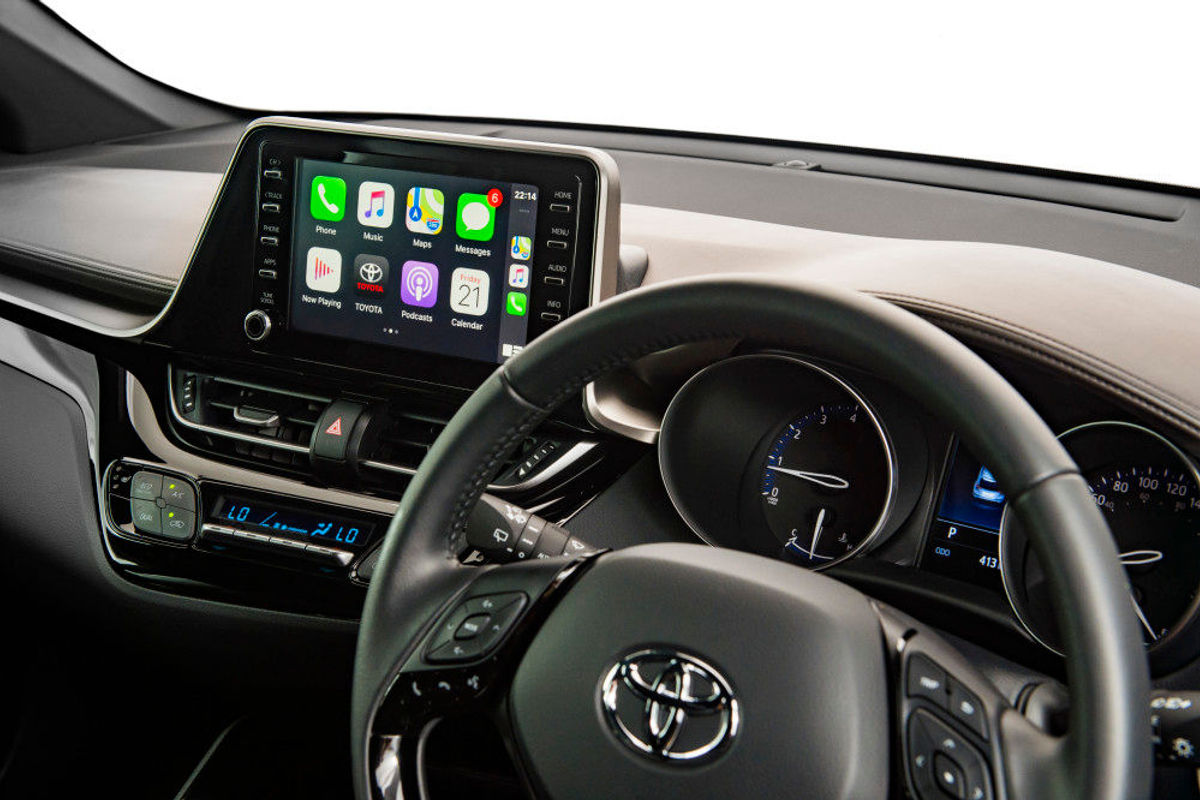
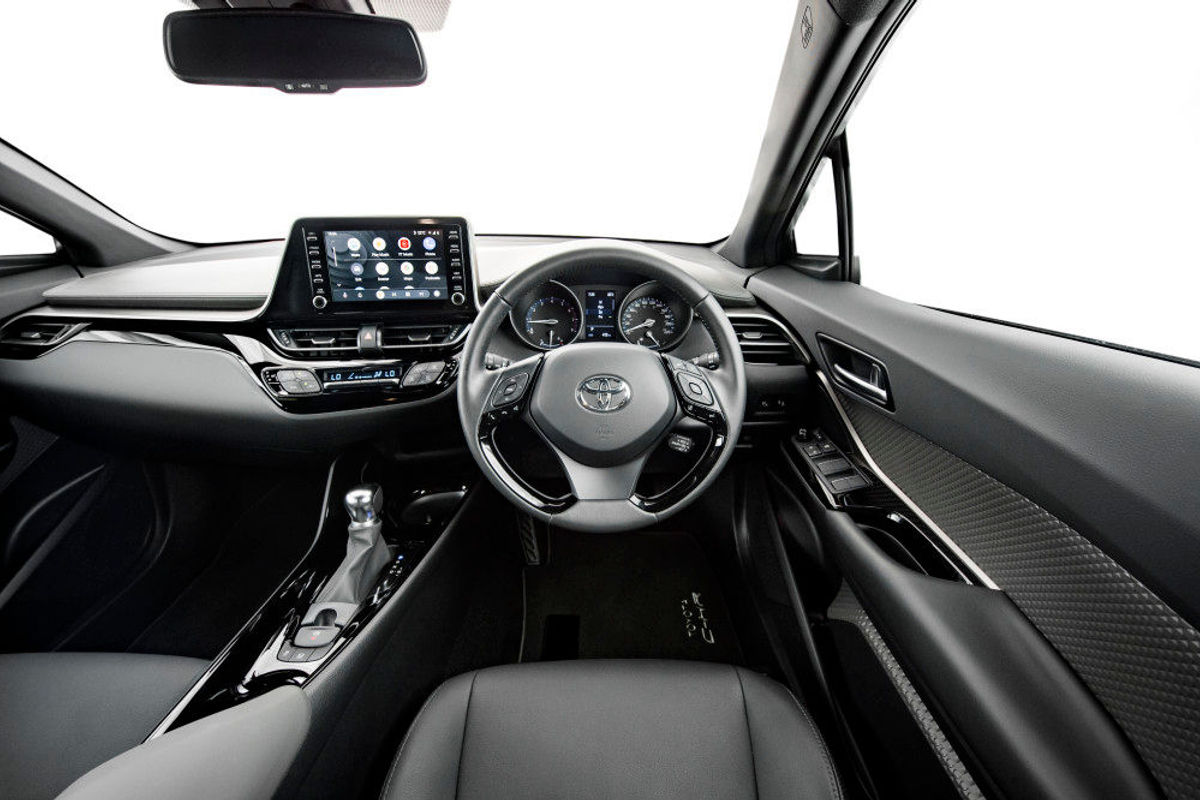
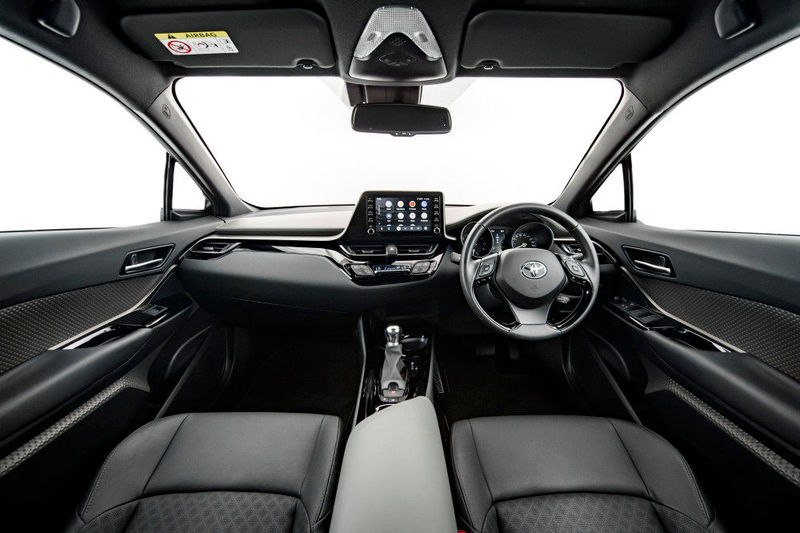
A bigger infotainment screen with Android Auto and Apple CarPlay is a welcome addition to the specification sheet.

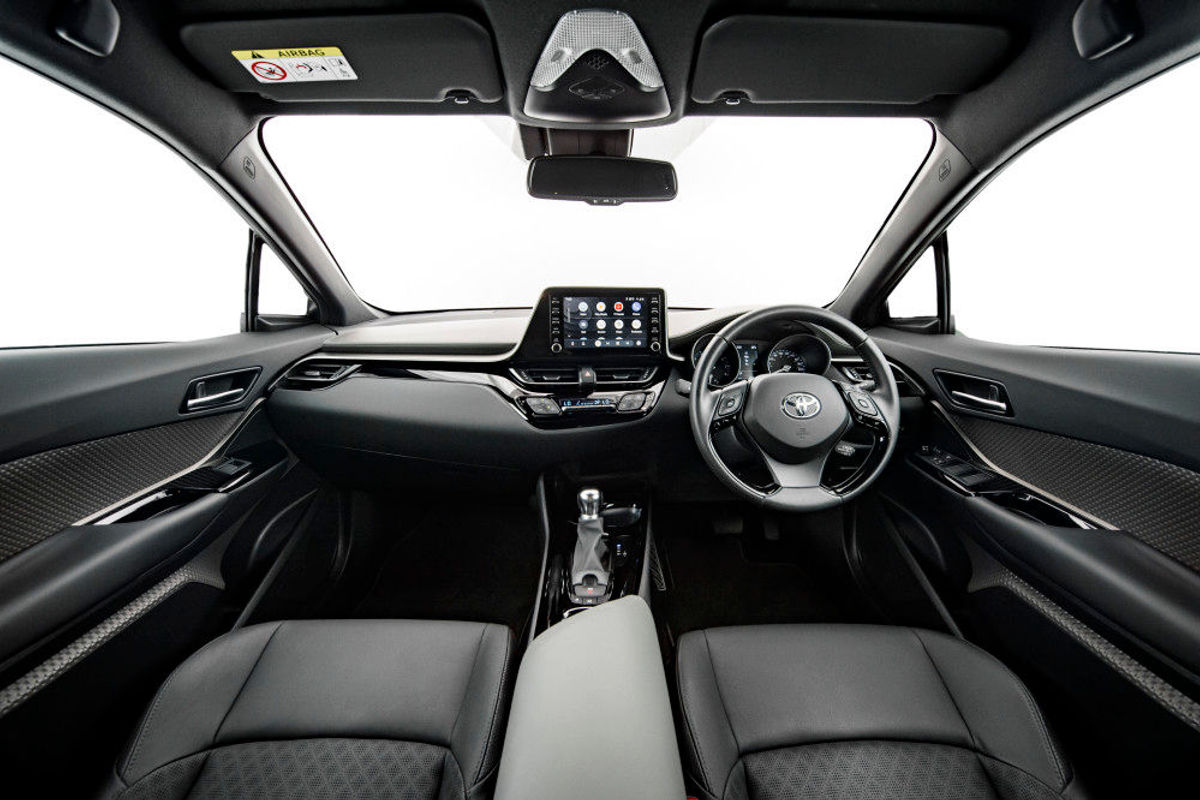
The big change for this update, however, pertains to C-HR's feature specification: the model now gains a larger 8-inch infotainment screen, which is equipped with Android Auto and Apple CarPlay capability. Toyota has been late to the party in this regard, but the good news is these connectivity features will be rolled out across other Toyota models in due course. 

Safety specification has also been beefed up – the C-HR now has 6 airbags as standard (previously only 2). Moreover, Toyota Safety Sense makes its way into the Luxury trim, which adds features such as Blind-spot Monitoring (BSM), Lane Change Assist (LCA), Rear Cross Traffic Alert (RCTA), Pre-crash system, Adaptive Cruise Control (ACC) and Lane Keeping Assist. 

What’s it like to drive? 

It’s been a while since we drove the C-HR and we were keen to re-acquaint ourselves with the product. The familiar turbocharged 1.2-litre petrol engine still does duty under the bonnet with outputs of 85 kW and 185 Nm and comes mated with either a 6-speed manual gearbox or continuously-variable automatic transmission (CVT).

The launch route was lengthy and took us from Cape Town to George via the popular Route 62, which was a great opportunity to experience the capability of the C-HR on the open road. Its engine performs surprisingly well with good overall acceleration and cruising ability. We sampled the CVT and we are pleased to report that it’s not as annoying and cumbersome to drive as some other CVTs on the market.

The C-HR gets up to highway speed in good time and you can toggle between drive modes such as Normal, Eco and Sport depending on your driving needs. Overtaking is done swiftly and without much fuss. Toyota claims 6.4 L/100 km for the C-HR CVT and we saw returns of around 7.8 L/100km during our drive. 

It has a solidly planted feel which gives the driver some confidence through corners. The CH-R also delivers a comfortable ride and while the suspension soaks up imperfections well, it also has a firmness to it which gives a bit of a sporty feel. The C-HR’s electronic steering has been tweaked too and while it’s light in feel, it’s also quite direct. 

We must also mention that the seats in the C-HR are very comfortable and the soft cushioning was very much appreciated on this longer drive. As for the infotainment system, Google Maps was easily connected via Android Auto and we even connected to the car’s WiFi which comes with a complimentary 15GB of data. Perceived interior build quality is still very good.

There are, however, some well-known drawbacks to the C-HR that consumers need to be aware of. Firstly, rearward visibility is poor due to an oversize C-pillar/door moulding. Secondly, due to its compact dimensions, rear passenger space is also on the tight side and the load bay is small for a car in this segment, offering a claimed 328 litres. So, in terms of practicality, the C-HR lags behind the best in this segment. 

Look at specification details for the Toyota C-HR range here!

Let’s talk money…


The Toyota C-HR has the style but lacks the practicality to effectively compete in this segment, making it a pricey niche choice. 

It’s interesting to note that when the C-HR came to market in 2017, pricing started at R318 500 and went up to R356 000 for the top-spec derivative. Fast forward to the present and the starting point is now at R371 700 for the Standard derivative and going all the way up to R476 600 for the top-of-the-range C-HR Luxury. You can get into a spacious Toyota RAV4 for that money.

While we applaud the latest safety and tech upgrades, the C-HR has become a pricey proposition when you factor in its practicality woes and similarly-sized products on offer, such as the Hyundai Kona and Mazda CX-3 which can be had for much less money. As a result, buyers may be tempted to look for more practical options or higher-value offerings, especially in the tough economic environment that is currently gripping the country.

The C-HR is not an ideal compact family car but it does remain an enticing proposition for young empty-nesters who place more value on style and care less about practicality. For those looking for more practical options, there are a myriad of options available in the R380 000 – R500 000 price range. With that said, the C-HR will likely remain a fringe player, albeit a stylish one.

Toyota C-HR – Price in South Africa 

The Toyota C-HR is sold with a 6 services /90 000 km service plan, with service intervals set at 15 000 km. A 3 year/100 000 km warranty is also provided.

Toyota C-HR 1.2T – R371 700

Toyota C-HR 1.2T Plus – R403 000

Toyota C-HR 1.2T Plus CVT – R415 100

Toyota C-HR 1.2T Luxury CVT – R476 600

Buy a Toyota C-HR on Cars.co.za

Related Content 

Toyota Teases New Compact SUV Ahead of Geneva 

Toyota C-HR 1.2T Luxury (2018) Quick Review 

Into the Wild with the Toyota C-HR
 

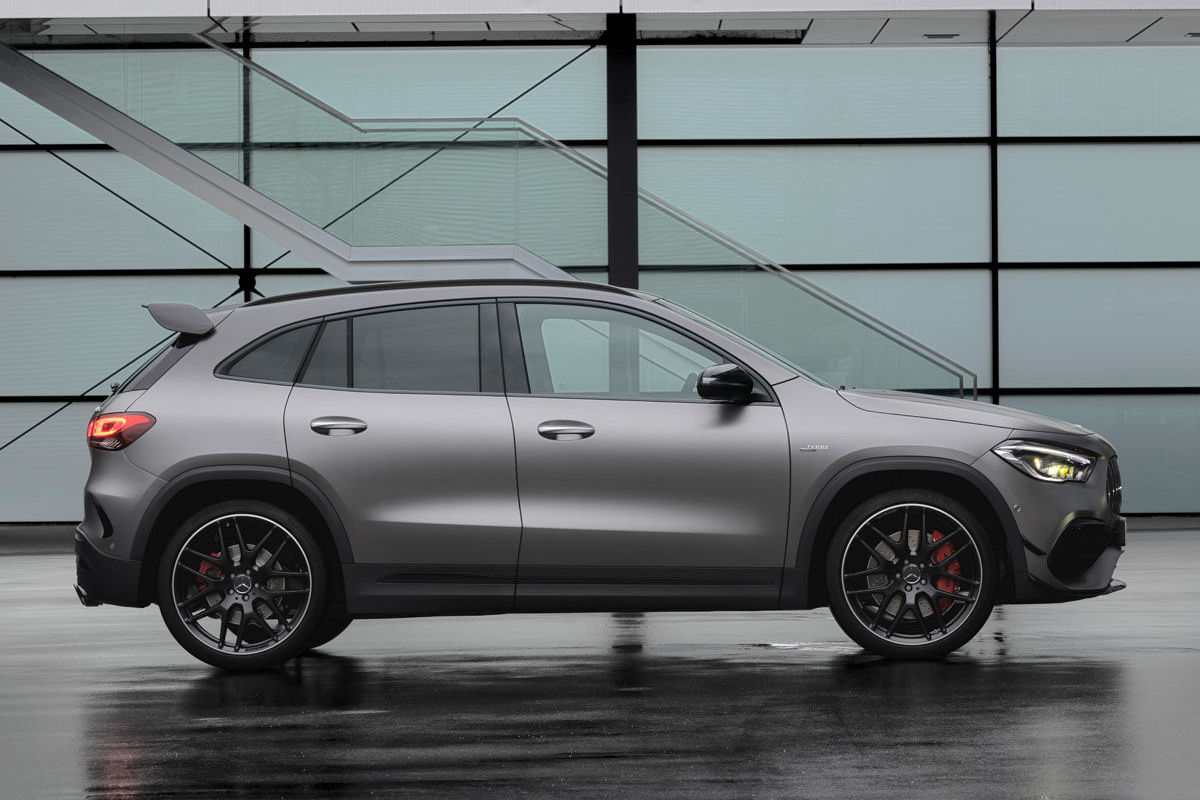
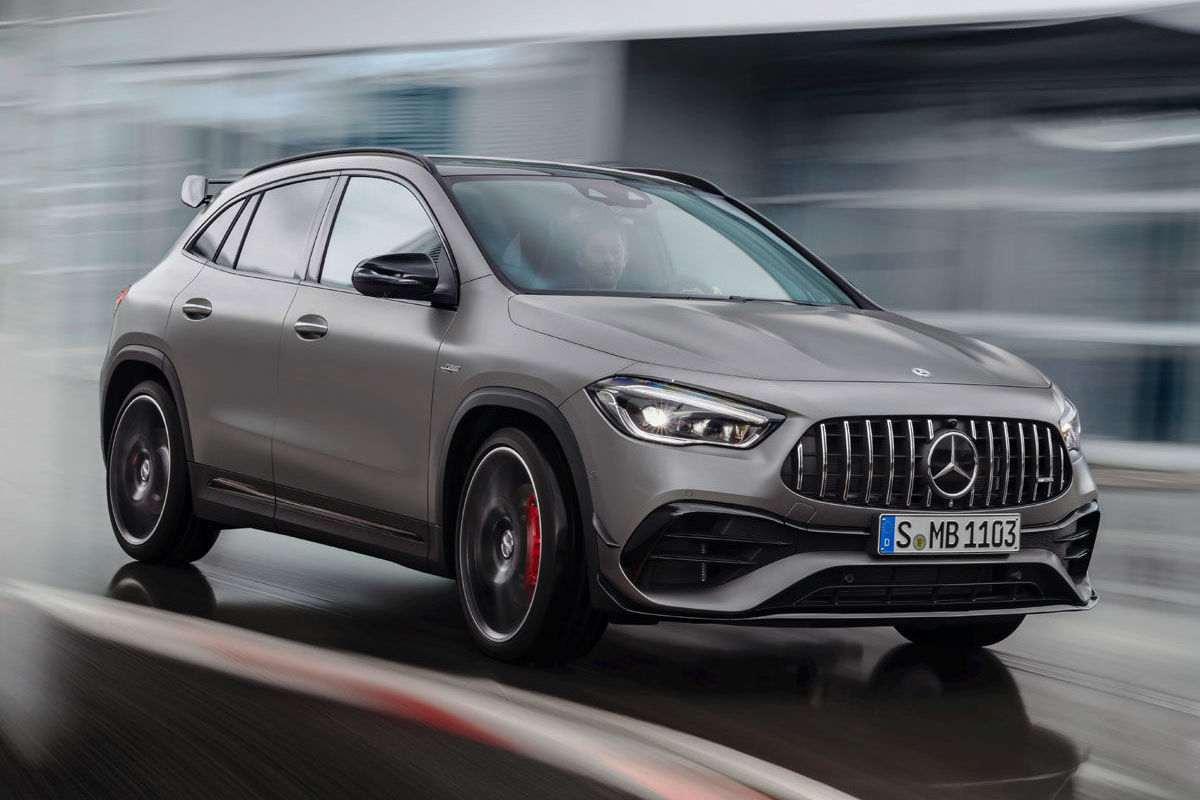
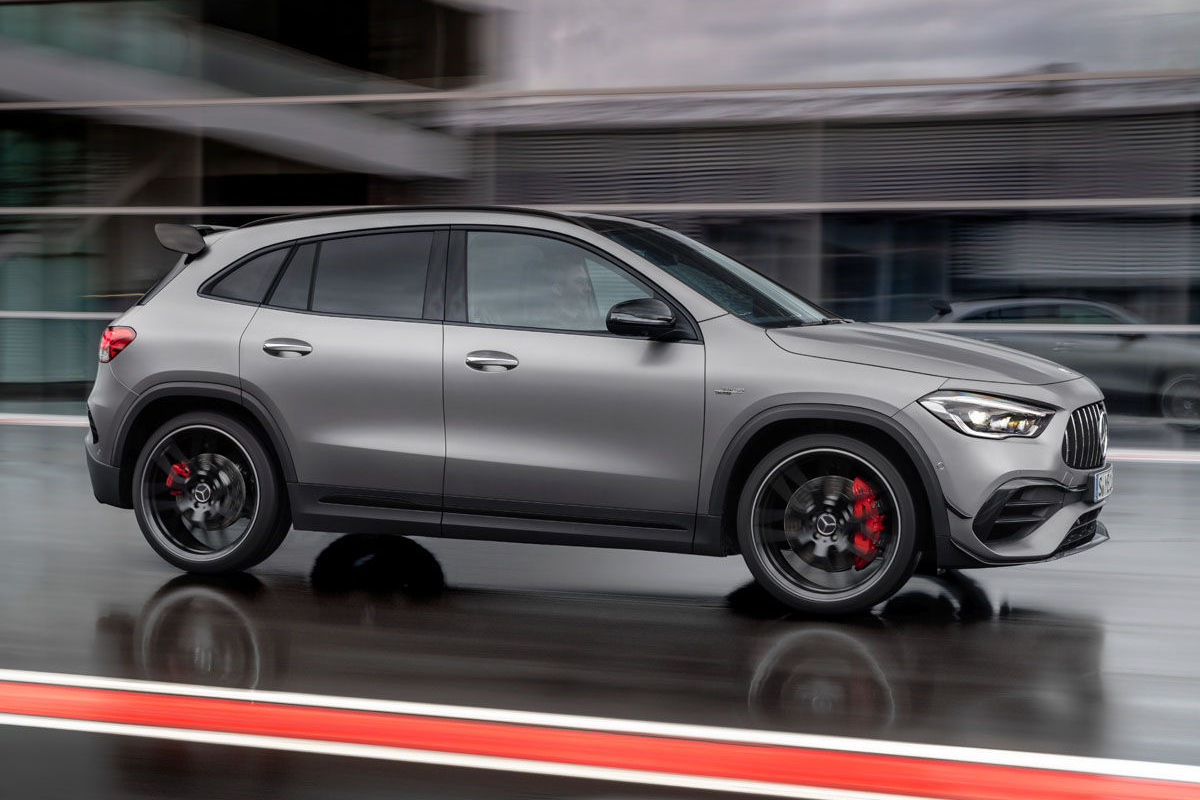
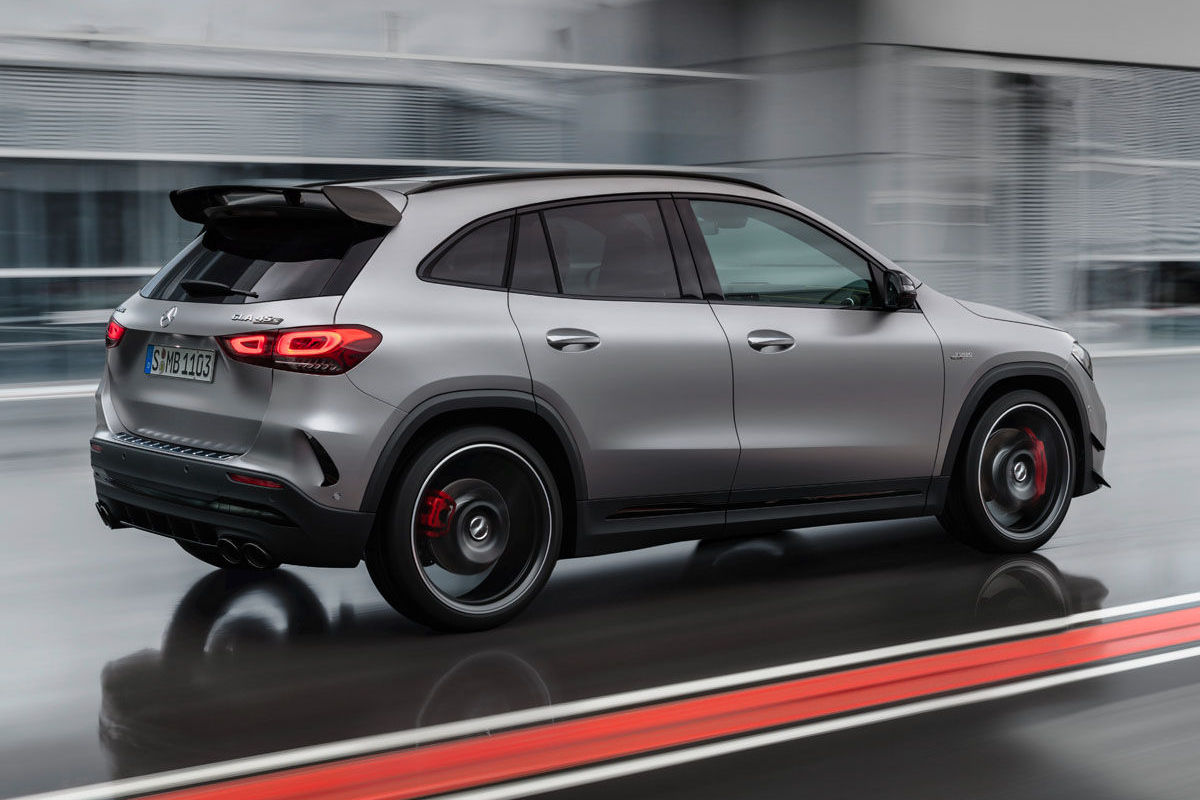
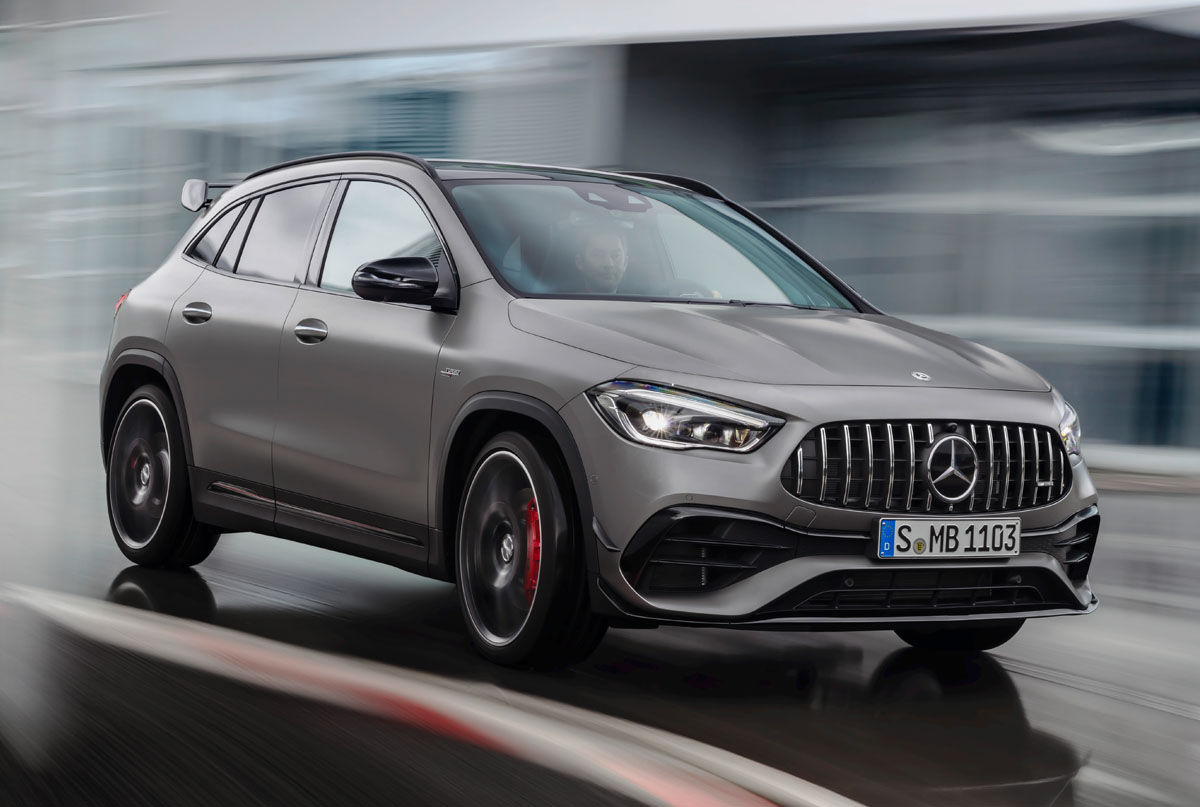
Mercedes-AMG GLA 45: Powerful, if a bit pointless…

Does the motoring world really need high-performance premium family cars? Whatever the right answer is, Mercedes-AMG has produced another firecracker to inhabit that market niche. Producing 310 kW/500 Nm in S guise, the second-generation GLA 45 is ready to put its Audi RS Q3 rival firmly in its place.

Powered by the M139 2.0-litre turbocharged engine – the most powerful series-produced 4-cylinder car engine in the world – the GLA 45 produces 285 kW and 480 Nm (plus 25 kW and 20 Nm for the S version), thanks to a plethora of technical upgrades compared with its predecessor. The GLA 45 S’s outputs outstrip those of the RS Q3 (294 kW/480 Nm) and BMW X2 M35i (225 kW/450 Nm).

Mercedes-AMG claims the GLA 45 will gallop from 0 to 100 kph in 4.4 sec and go on to a top speed limited to 250 kph (4.3 sec and 270 kph for the S), but interestingly, the Affalterbach division says it has purposely tuned the motor to have “a power delivery akin to a naturally aspirated engine”… Turbocharged engines are renowned for offering maximum twist at low engine speeds, but by contrast, the M139’s peak torque is available from 4 750 to 5 000 rpm (5 000 to 5250 in the S), so drivers are encouraged to exploit the rorty engine’s rev range…


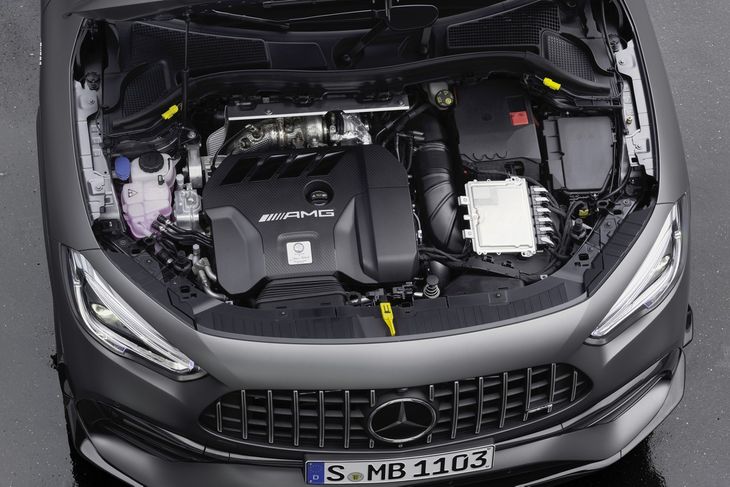
The GLA 45's engine isn't simply a higher-output version of the unit that powered its predecessor, it's been extensively modded.

Apart from the engine being repositioned (the turbo and exhaust manifold are now at the rear of the engine bay, the intake system at the front), it features a 2.1-bar twin-scroll turbocharger (with anti-friction bearings), 2-stage fuel injection, an electronically-controlled wastegate and updated cooling system, with separate water pumps to cool the cylinder head (mechanical) and crankcase (electric).

The motor is mated with an 8-speed AMG Speedshift dual-clutch transmission (operable by steering-wheel-mounted shift paddles, of course) with a Race Start function, a characteristic drive sound with partial ignition interruption when shifting up (South Africans know this particular auditory phenomenon as vrrr-phaa), as well as, when required, automatic double-declutching when changing down.


The addition of AMG Torque Control sees improved traction for the rear wheels, which are favoured by the GLA 45's 4Matic+ setup.

Furthermore, the AMG Performance 4Matic+ all-wheel drivetrain is appended by AMG Torque Control: the rear-axle differential is equipped with a pair of electronically controlled multi-disc clutches, each of which is connected to a driveshaft. This allows the AMG 45 to variably apportion power – not only between the front and rear wheels, but also selectively between the left and right rear wheel.

To help keep the Benz’s 19-inch wheels and tyres (or optional 21s) planted on terra firma, the McPherson-strut front- and 4-link rear suspension is aided by AMG Ride Control adaptive damping with 3 selectable modes (Comfort, Sport, Sport+), while Mercedes-AMG has bolted a lightweight aluminium “shearing plate” underneath the engine and diagonal struts at either end of the underbody to improve the GLA 45's body rigidity.


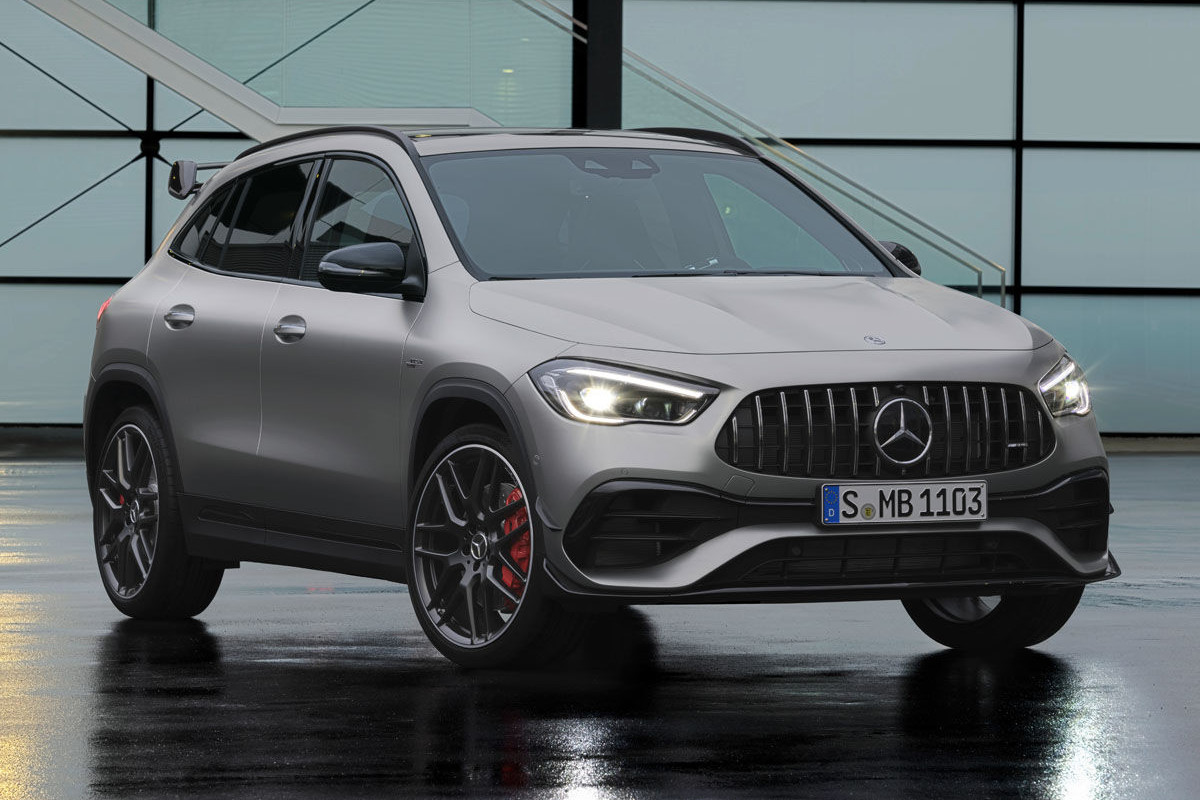
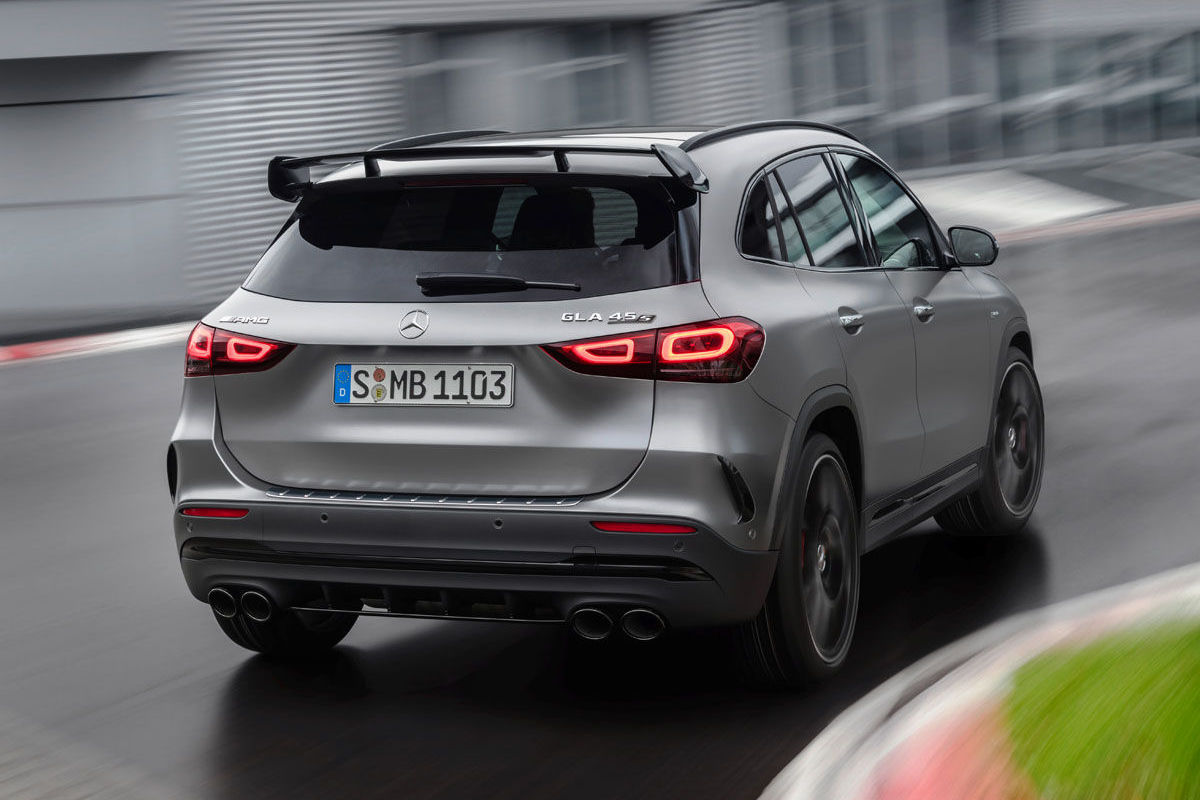
The GLA 45 was designed to be the most powerful light crossover in the market; it outpunches both its Audi and BMW rivals. 

Stopping power comes courtesy of 350-mm front discs with 4-piston fixed calipers and 330-mm discs at the rear, which can be beefed up with the AMG Dynamic Plus package. What’s more, the GLA 45’s integrated agility control facility enables brief braking interventions at inner-rear wheels when cornering at speed for improved body control and quicker, more precise to steering inputs.

There are half a dozen AMG Dynamic Select drive settings to choose from: Slippery, Comfort, Sport, Sport+, Individual and Race, each of which appropriately modify the GLA45’s throttle and shift mapping, all-wheel drive and traction settings, suspension stiffness and the loudness of the active-exhaust sound from those 31-mm pipes.


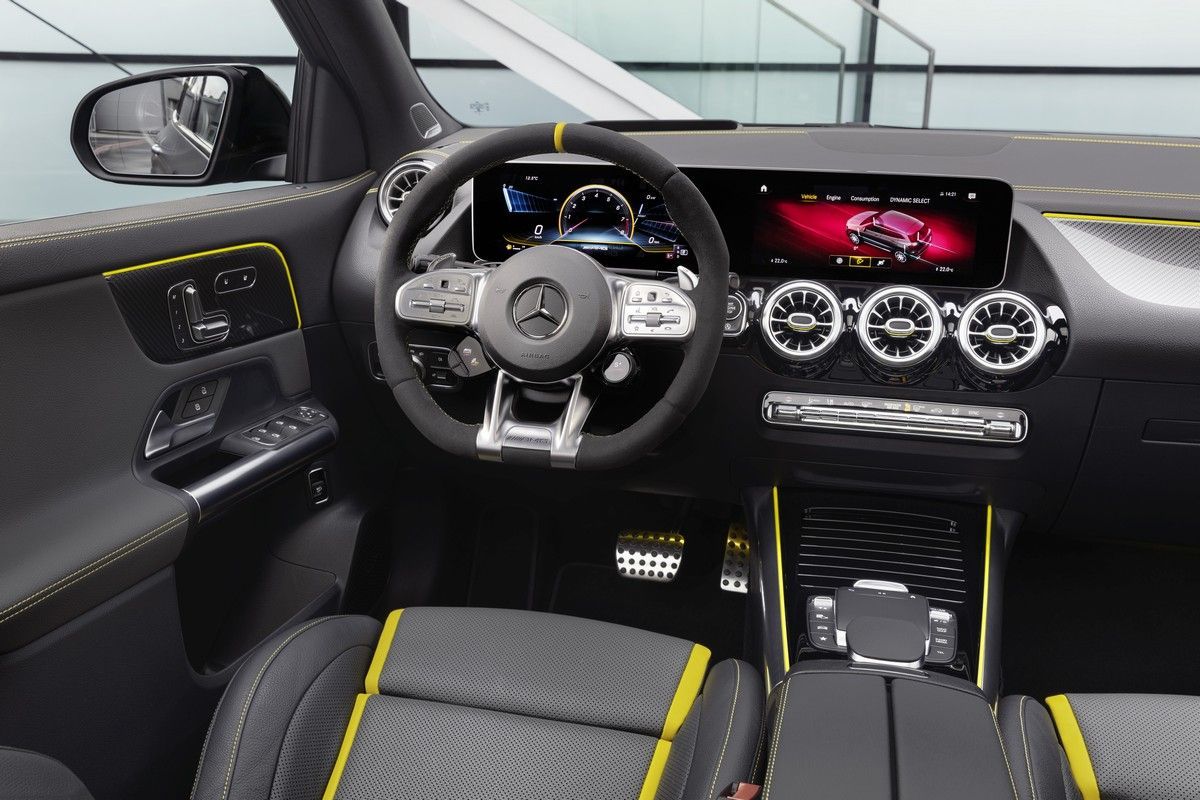
The GLA 45 benefits from eye-catching AMG detailing and its MBUX comes equipped with model-specific functions and readouts. 

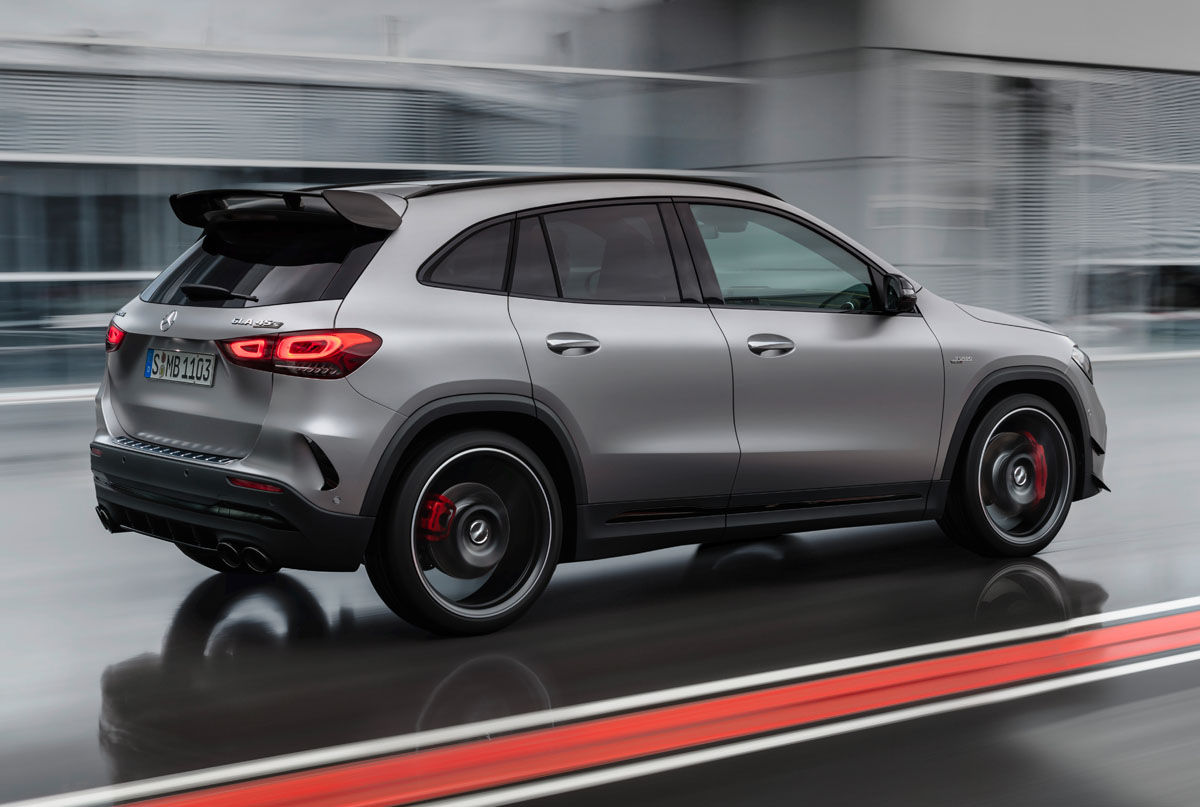
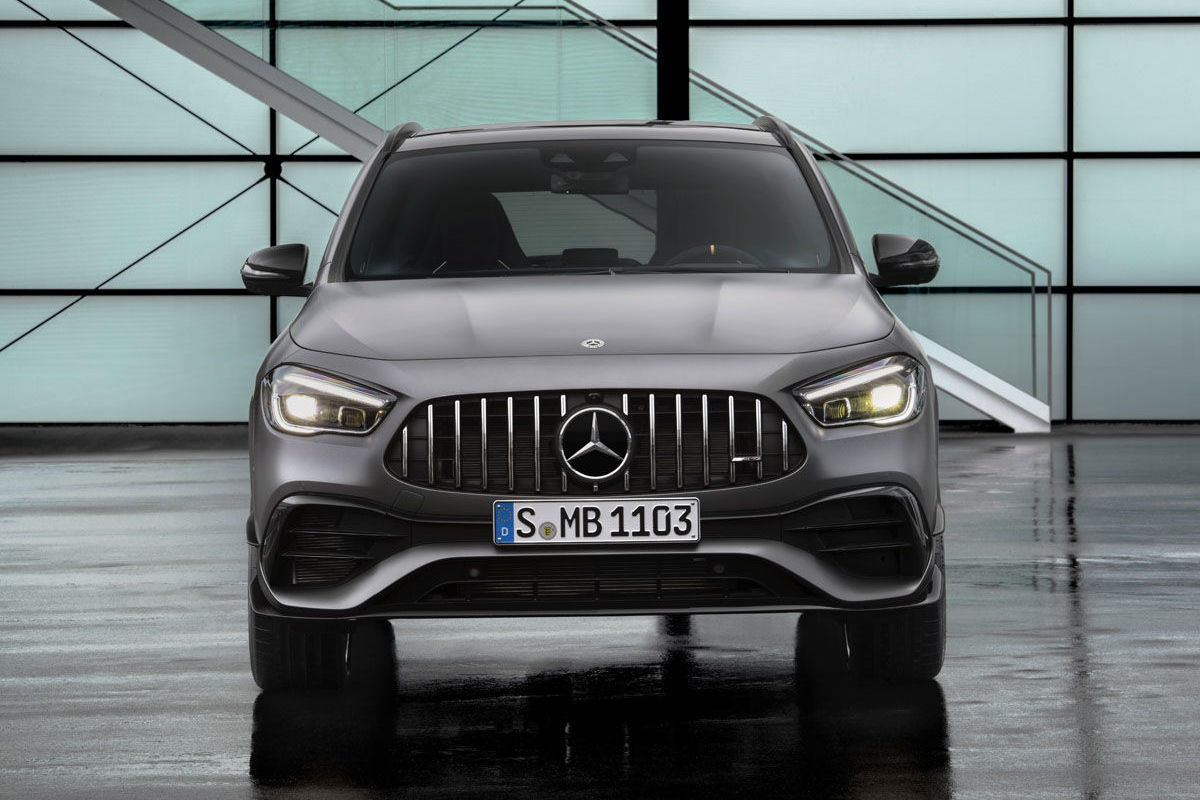
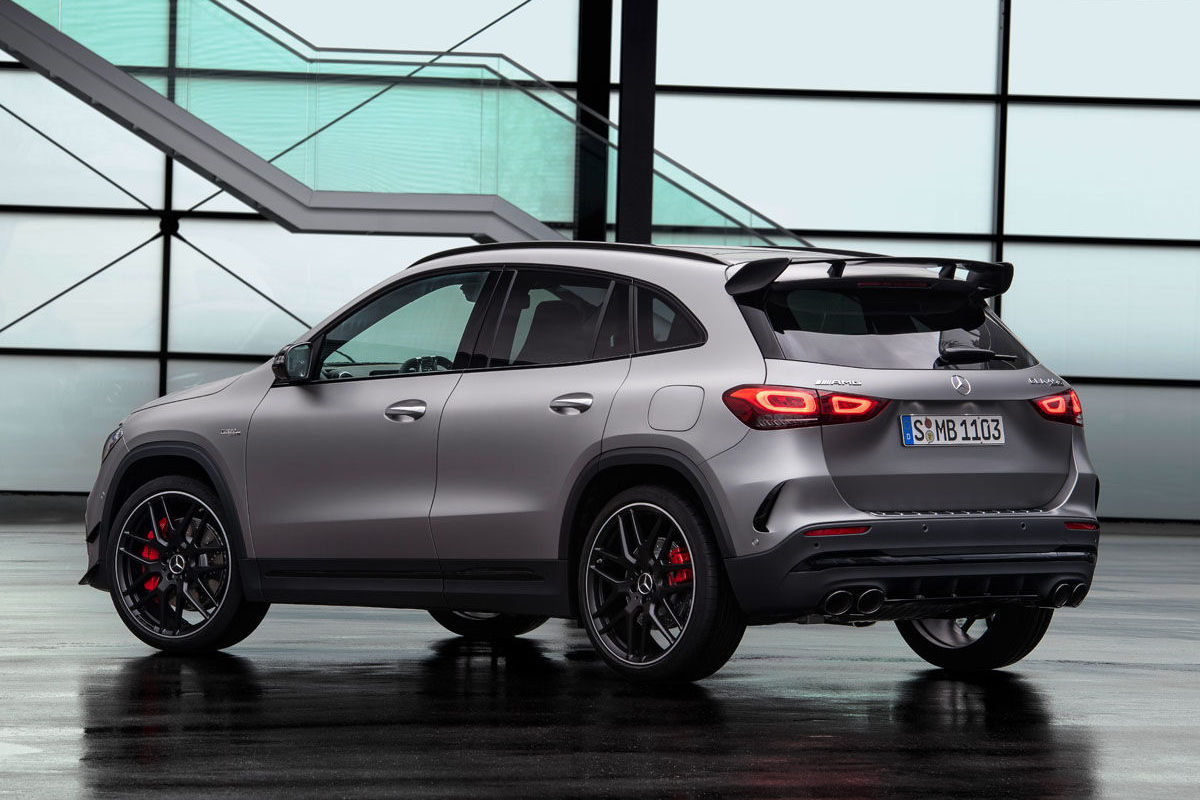
In terms of the GLA 45’s exterior execution, as one would expect, it’s not meant for shy and retiring types… Benz’s newcomer stands out by virtue of its standard LED high-performance headlamps, AMG-specific grille, a bulged bonnet, purposefully-sculpted front and rear bumpers (including a diffusor), 2-piece tail light clusters, and a motorsport-inspired wing spoiler.

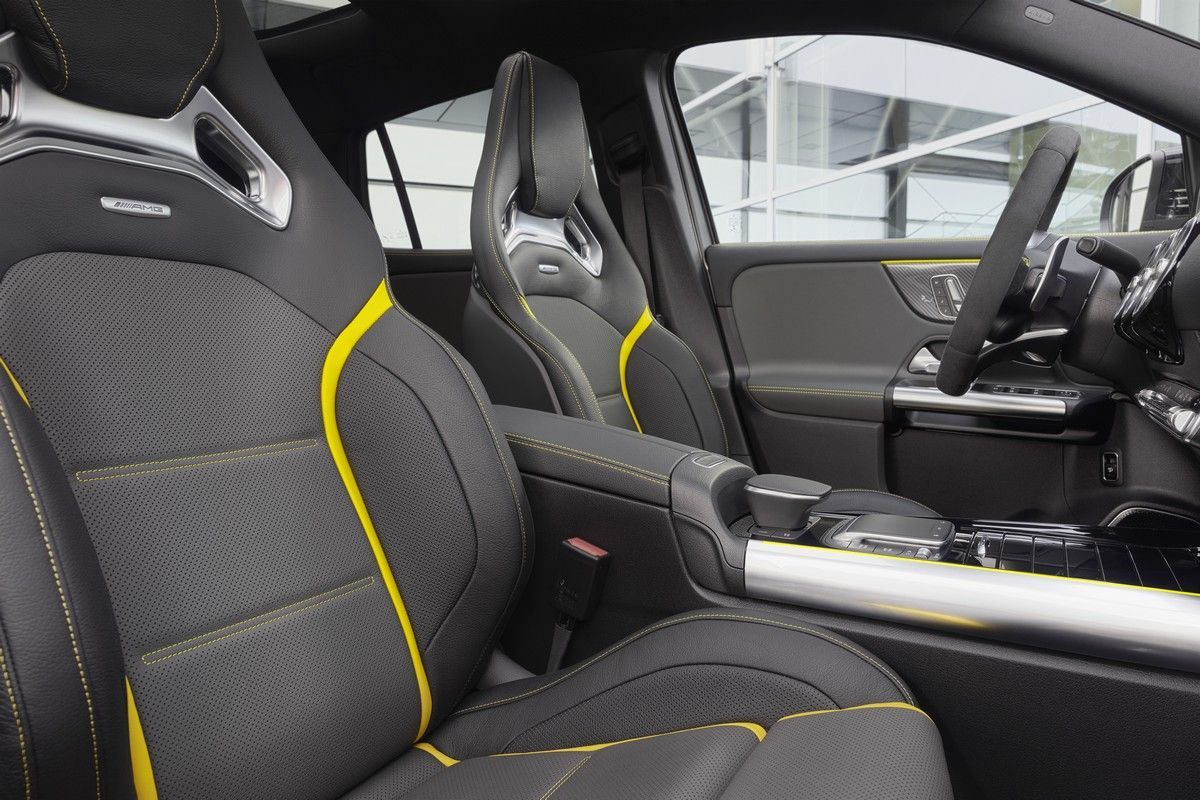
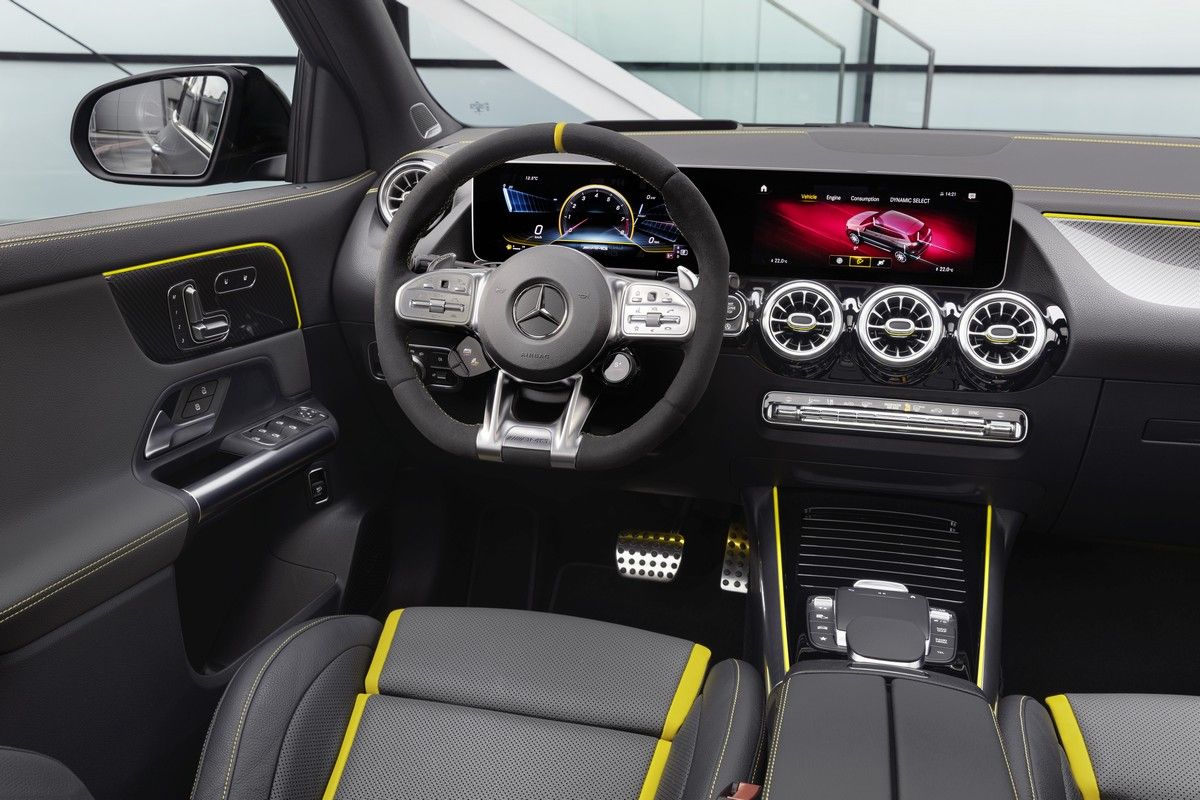
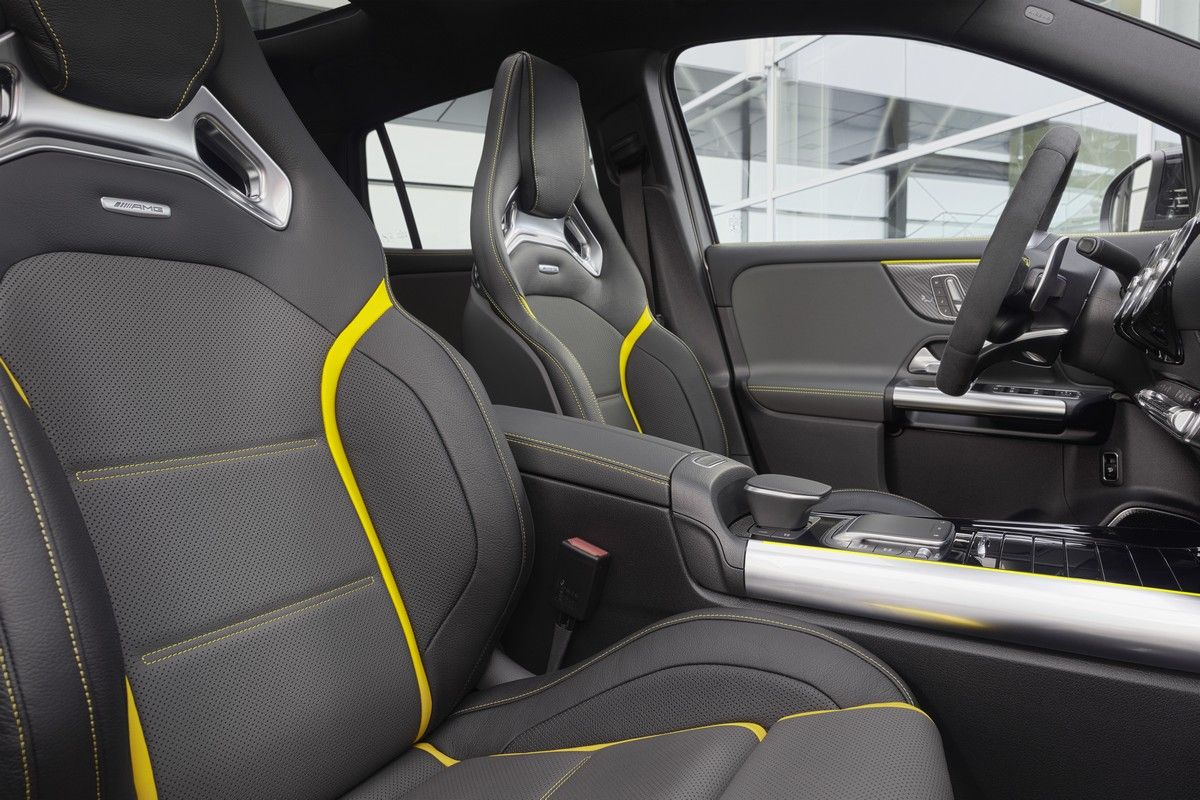
As is the case in its A45 sibling, there is no shortage of go-faster detailing inside. The front sports seats are trimmed in an MB-Tex-with-Dinamica combination, complemented by coloured double topstitching and trim accents. AMG Performance seats and colour safety belts are optional, but the carbon-fibre inlays and chrome-look pedals are standard.

As for the MBUX infotainment system, drivers can choose between "Classic", "Sport" and "Supersport" AMG display styles for the all-digital instrument cluster and, via the AMG menu, call up various special displays such as gear speed indicator, Warm-up, Set-up, G-Meter, Race Timer and Engine Data.


AMG Performance seats are an extra cost option, as is full leather trim, if that is more to your taste…

Other tantalising extra-cost features include the AMG Performance steering wheel (trimmed in Nappa leather, Dinamica or a mix of Nappa/Dinamica) and the AMG Track Pace data logger. When negotiating a race circuit, the latter continuously monitors more than 80 vehicle-specific data. On top of this, lap and sector times are displayed, as well as the respective difference from a reference time. Because specific display elements are shown in green or red, the driver is able to see at a glance without reading numbers whether they are going faster or slower than their best time.

What’s more, the AMG Track Pace's MBUX Augmented Reality function allows the ideal line of a stored race track to be displayed on the multimedia display or optional head-up display, so that the driver can improve their lap times with the help of "a virtual instructor". We doubt many GLA 45 buyers will ever drive their cars on track, but those who do will absolutely love this gizmo…

The more demure GLA compact crossover range, on which the GLA 45 is based, is expected to arrive in South African showrooms in the coming months (at least by mid-year). As for the GLA 45 and GLA 45 S, they should arrive here before the end of 2020. How much demand there will be for this fiery compact crossover (like its predecessor, it's a very niche offering)? That remains to be seen.

Related content:

Audi RS Q3 Sportback Revealed

Mercedes-AMG A45 S (2019) International Launch Review

BMW X2 M35i (2019) Review

Mercedes-AMG GLA 45 4Matic (2017) Quick Review

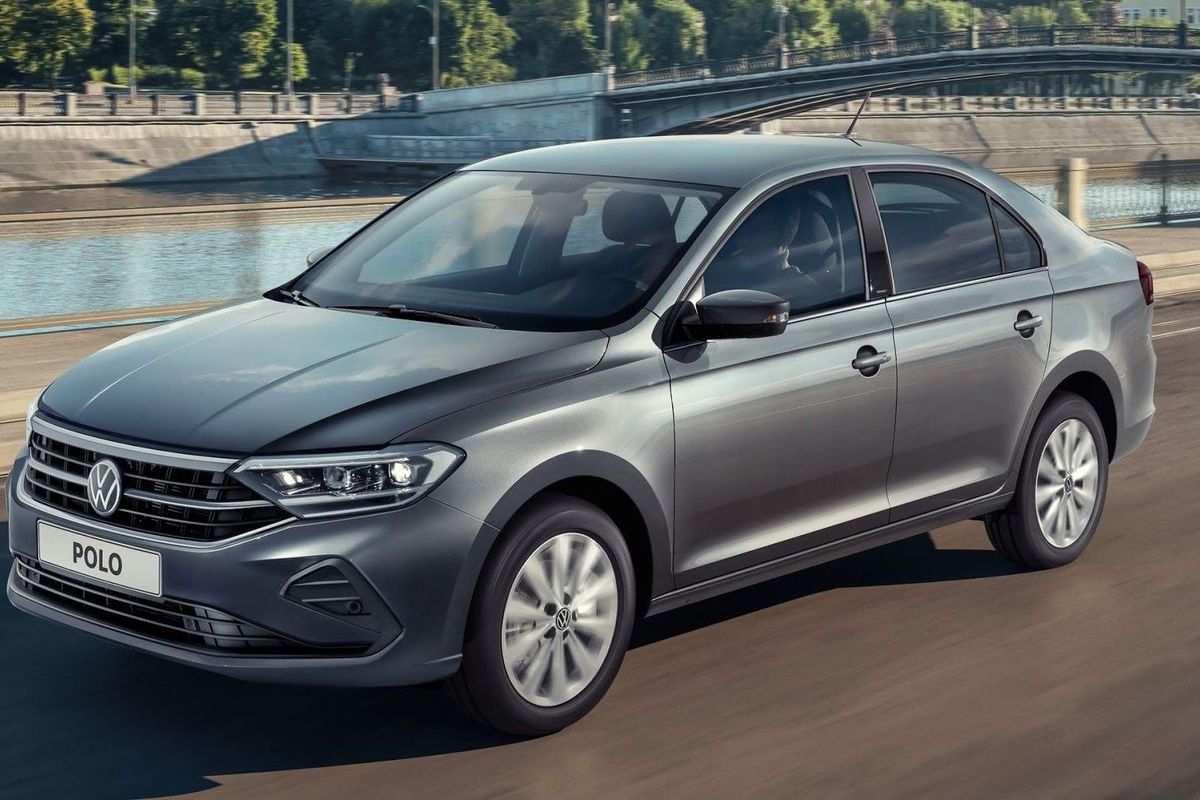
2021 Volkswagen Polo Sedan Revealed

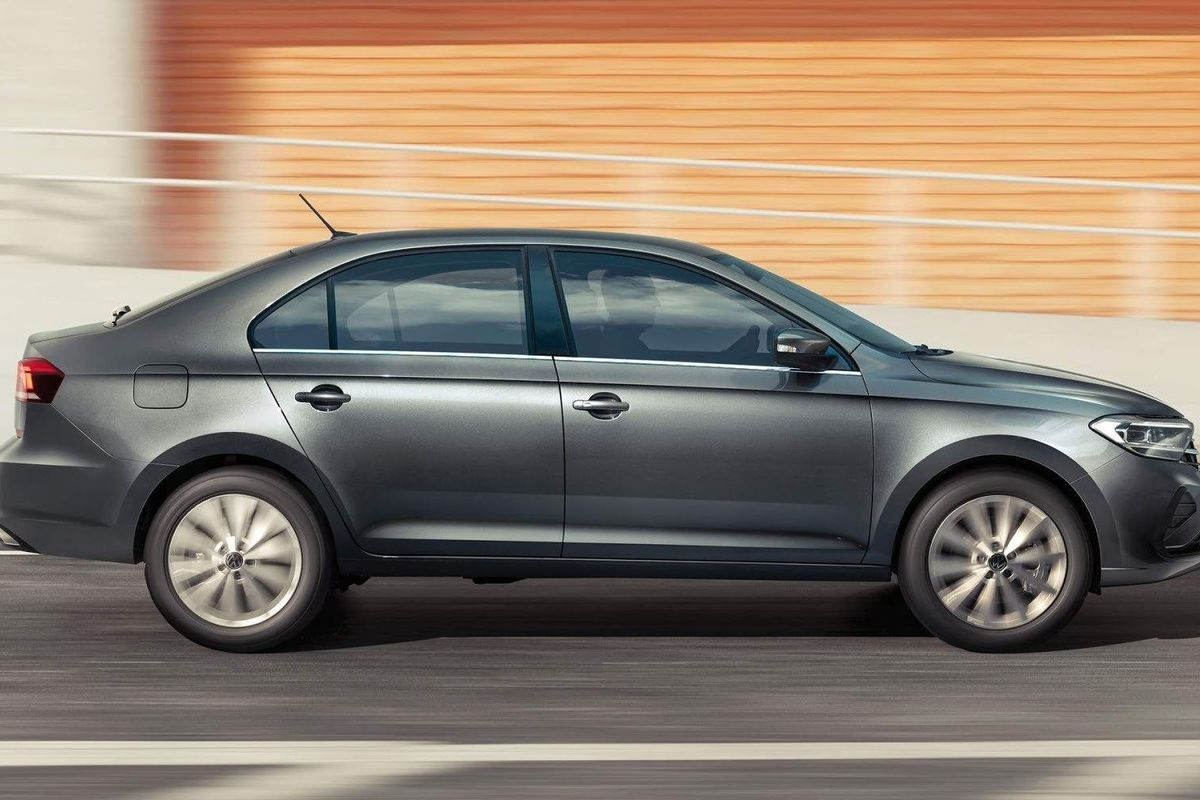
Volkswagen has revealed the all-new Polo Sedan. Sadly, it's for the Russian car market only. Should it come to South Africa?

Volkswagen Russia has released the official details of its new-generation Polo Sedan. It's being offered in that market with a choice of trim levels and several engine outputs. A manual gearbox, 6-speed automatic and 7-speed DSG are offered too. Mechanically, the new Polo sedan will be powered by two versions of VW’s 1.6-litre naturally-aspirated petrol engine, good for either 66- or 80 kW. There will also be a 1.4 TSI engine, producing 92 kW.

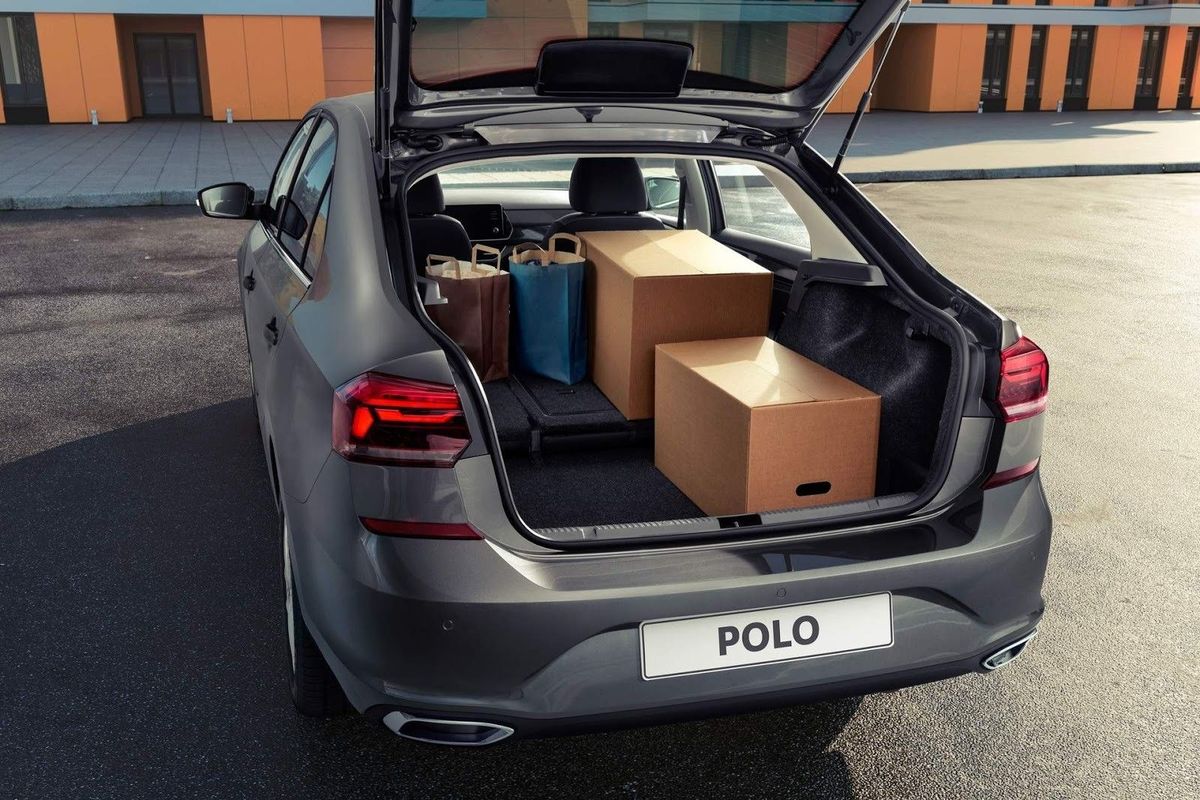
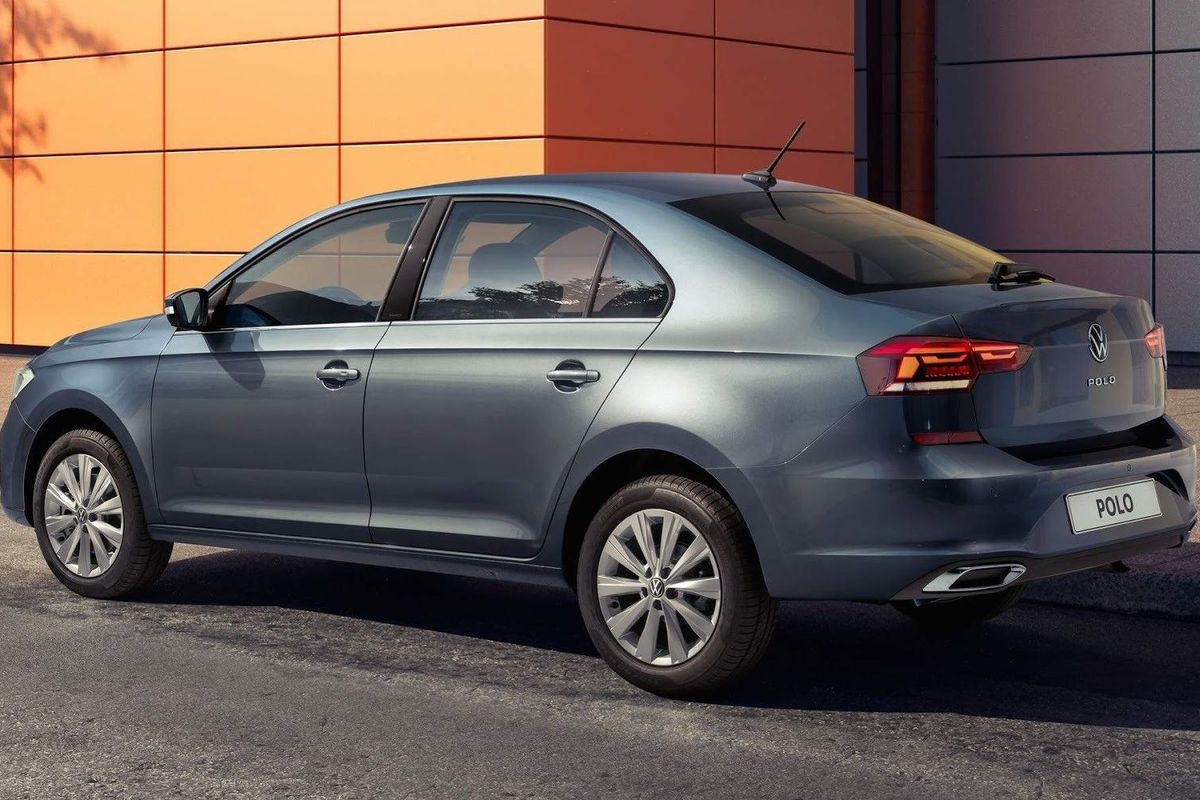
The new-generation Volkswagen Polo sedan is longer, wider and higher than the outgoing model and Volkswagen claims the boot space has grown by 90 litres to 550 litres total capacity. Interestingly, Volkswagen says the newcomer boasts a ground clearance of 170 mm to cope with poor quality roads and the vehicle features a tyre pressure monitoring system.

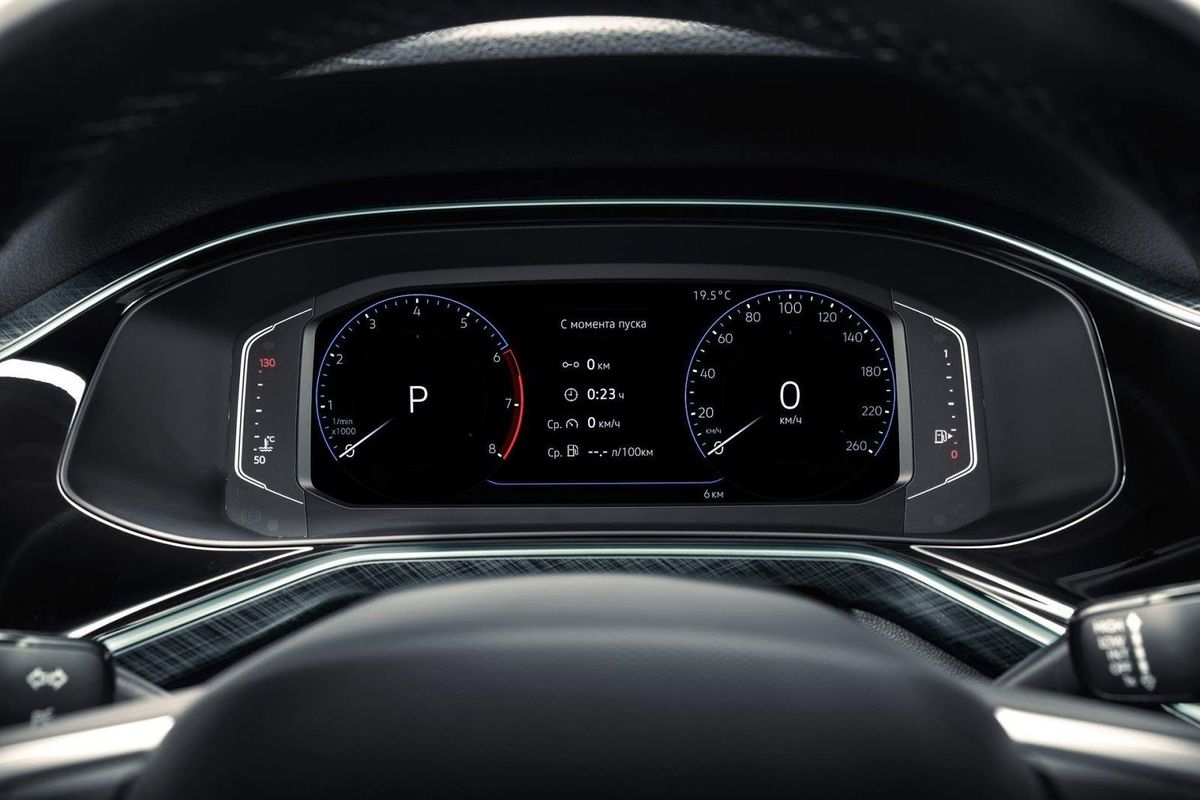
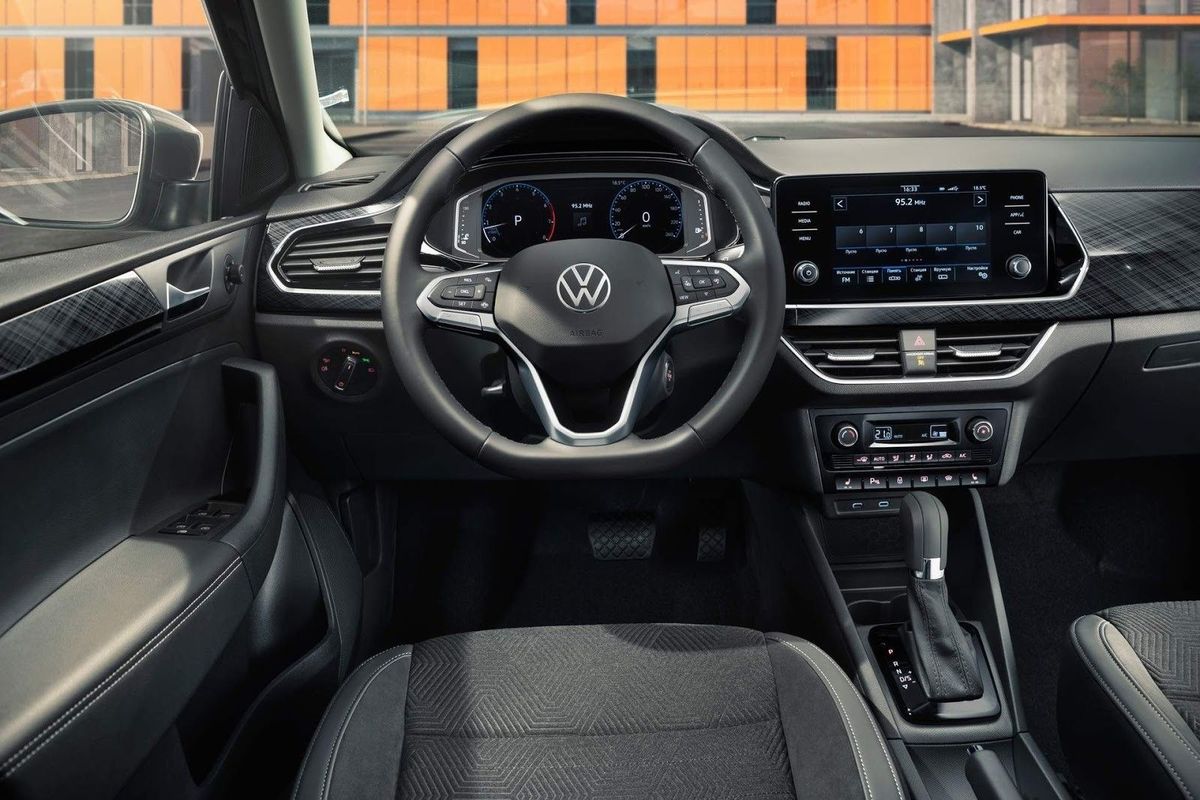
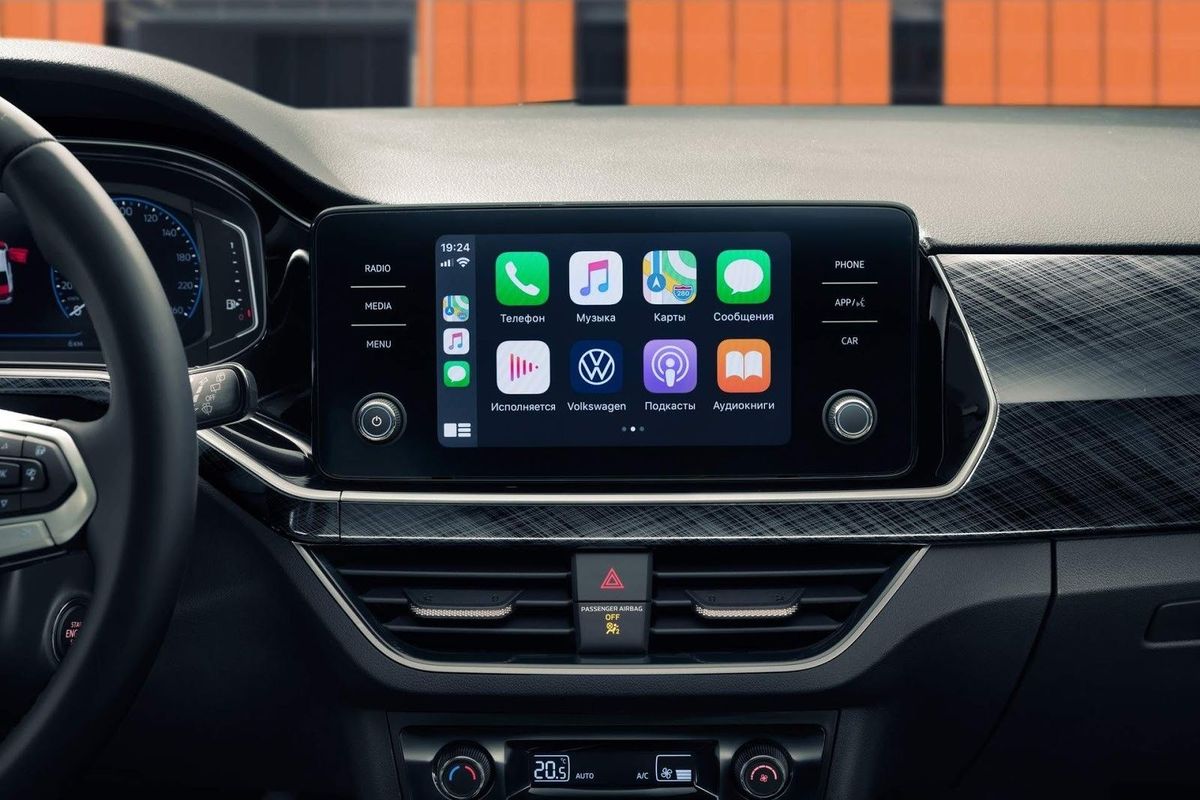
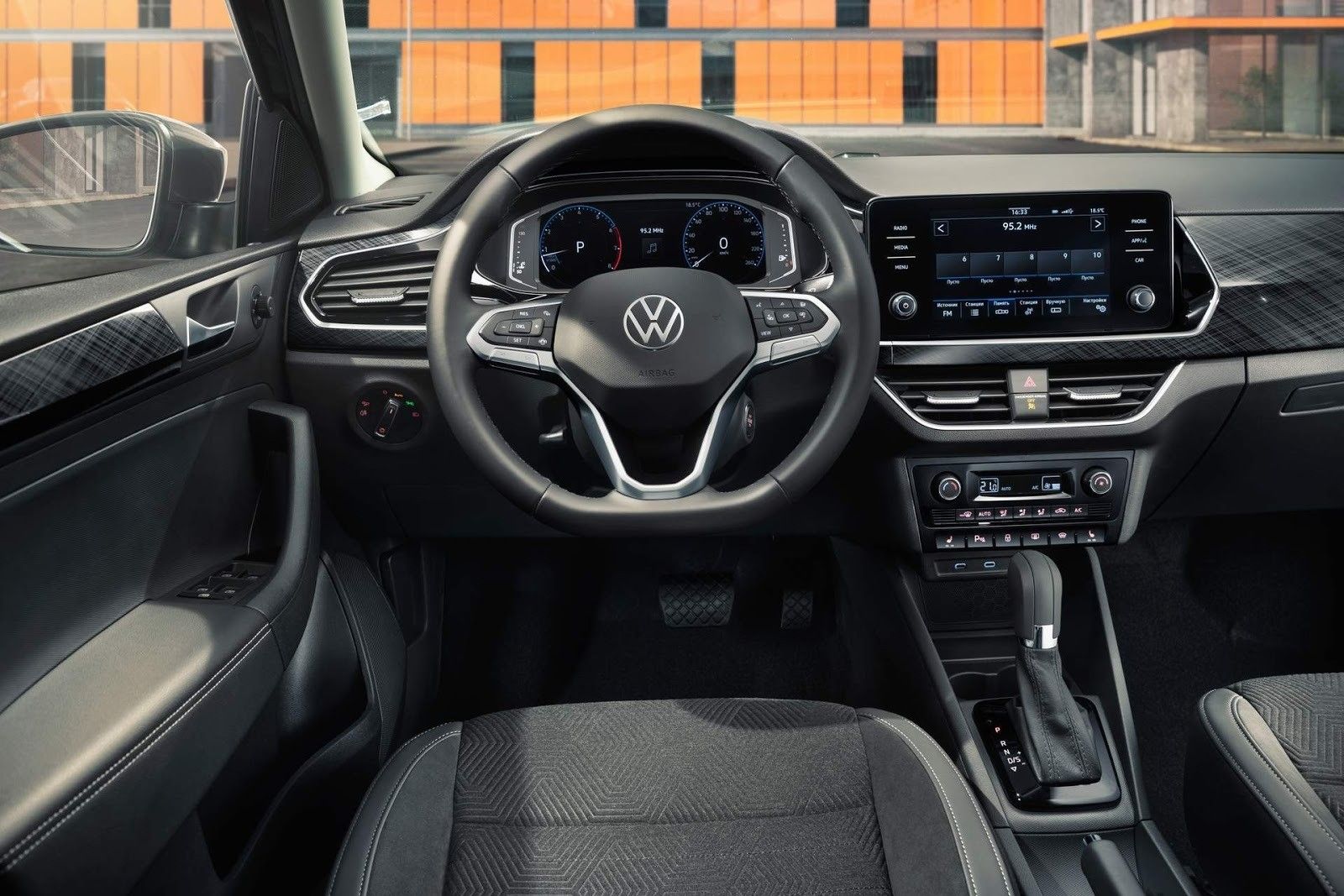
Inside, there's a new seat design, new multifunction steering wheel and the top-spec model gains a digital dashboard and quality infotainment system. It appears Apple CarPlay comes with this model too. In terms of safety, there are 2 airbags, with the option of additional units. There's a very clever boot mechanism which opens like a hatchback, but the vehicle retains its sedan looks. 

Further Reading

VW previews new Polo sedan

Volkswagen Polo 1.6 Conceptline (2016) Specs & Price
Volkswagen SA has built 200 000 new Polos

Volkswagen dominates 2019/20 #CarsAwards [Video]

Polestar Precept Revealed

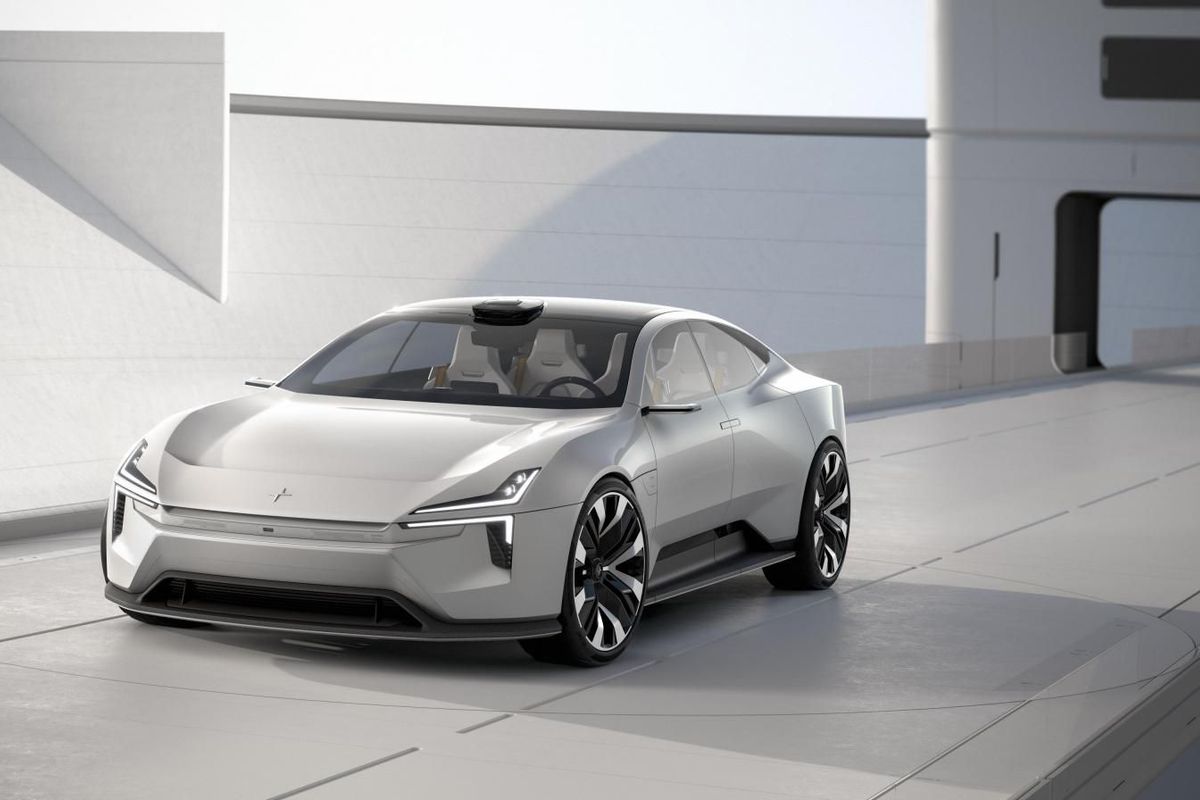
Swedish electric car brand Polestar has revealed the Precept, showcasing the brand's direction for the future.

“Precept is a declaration, a vision of what Polestar stands for and what makes the brand relevant,” comments Thomas Ingenlath, CEO of Polestar. “The car is a response to the clear challenges our society and industry face. This is not a dream of a distant future, Polestar Precept previews future vehicles and shows how we will apply innovation to minimise our environmental impact."

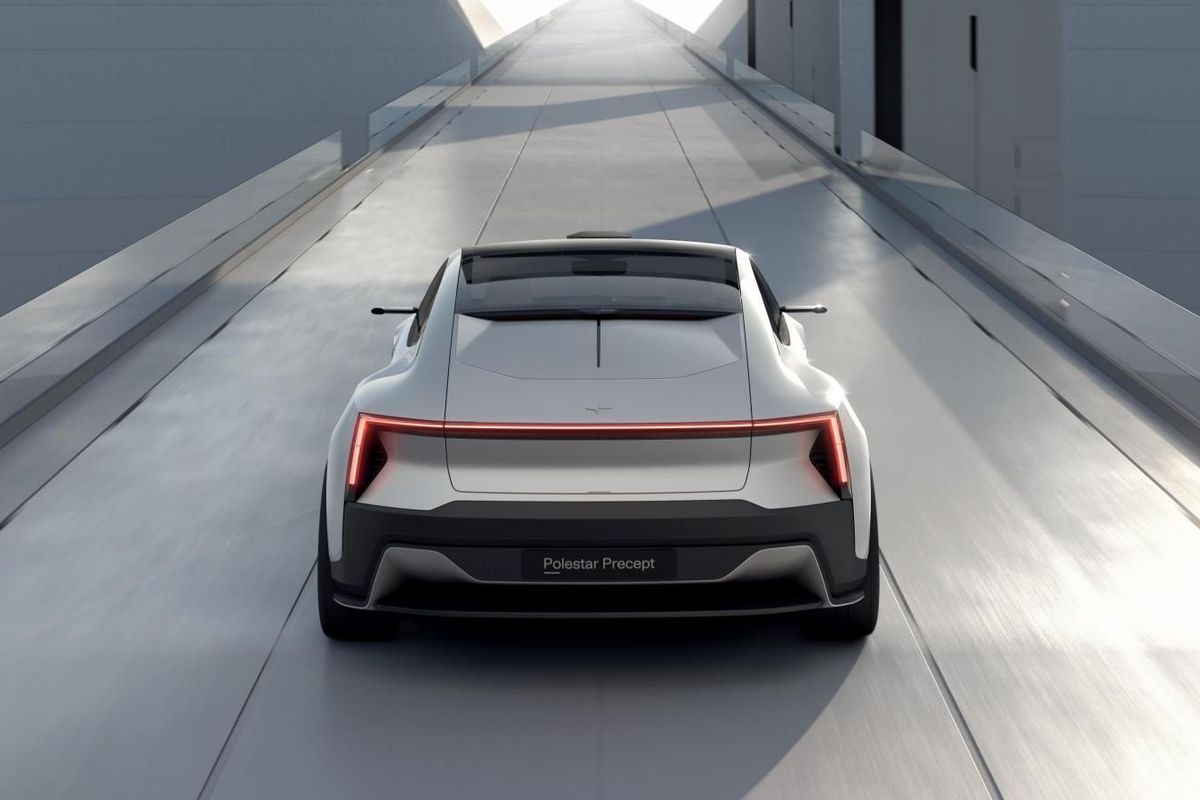
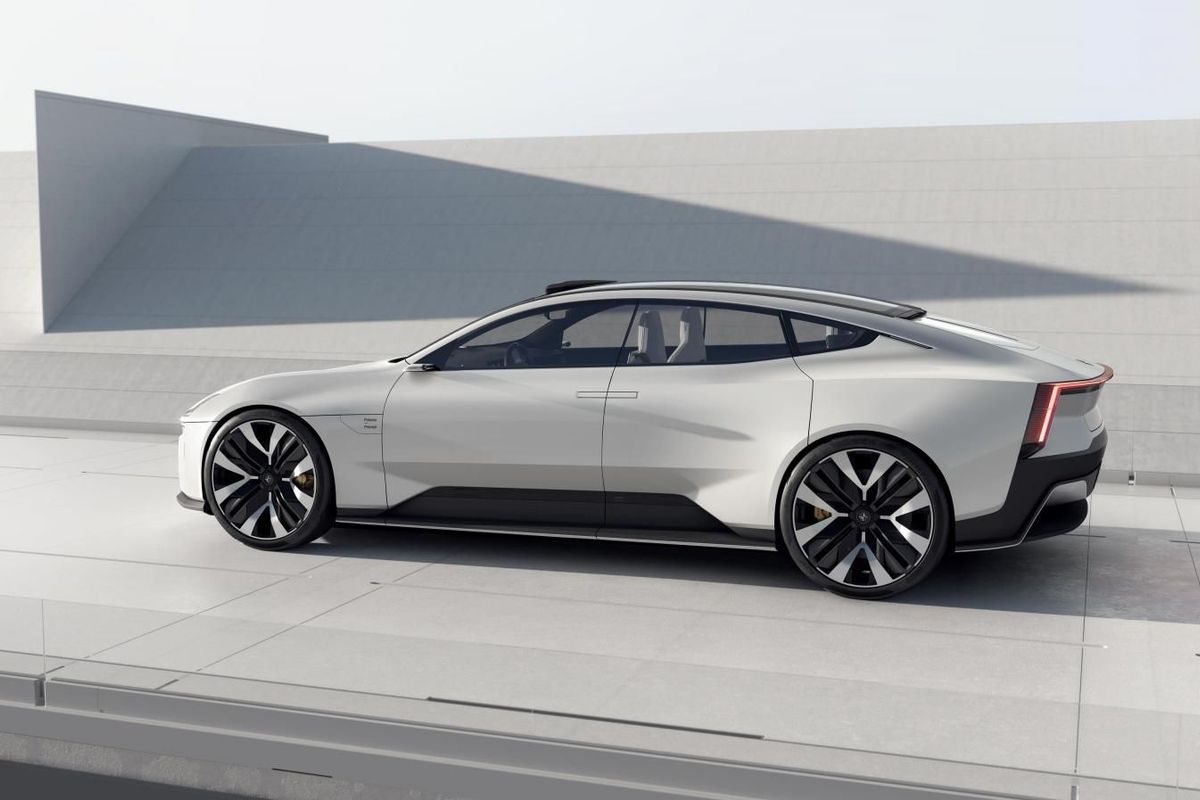
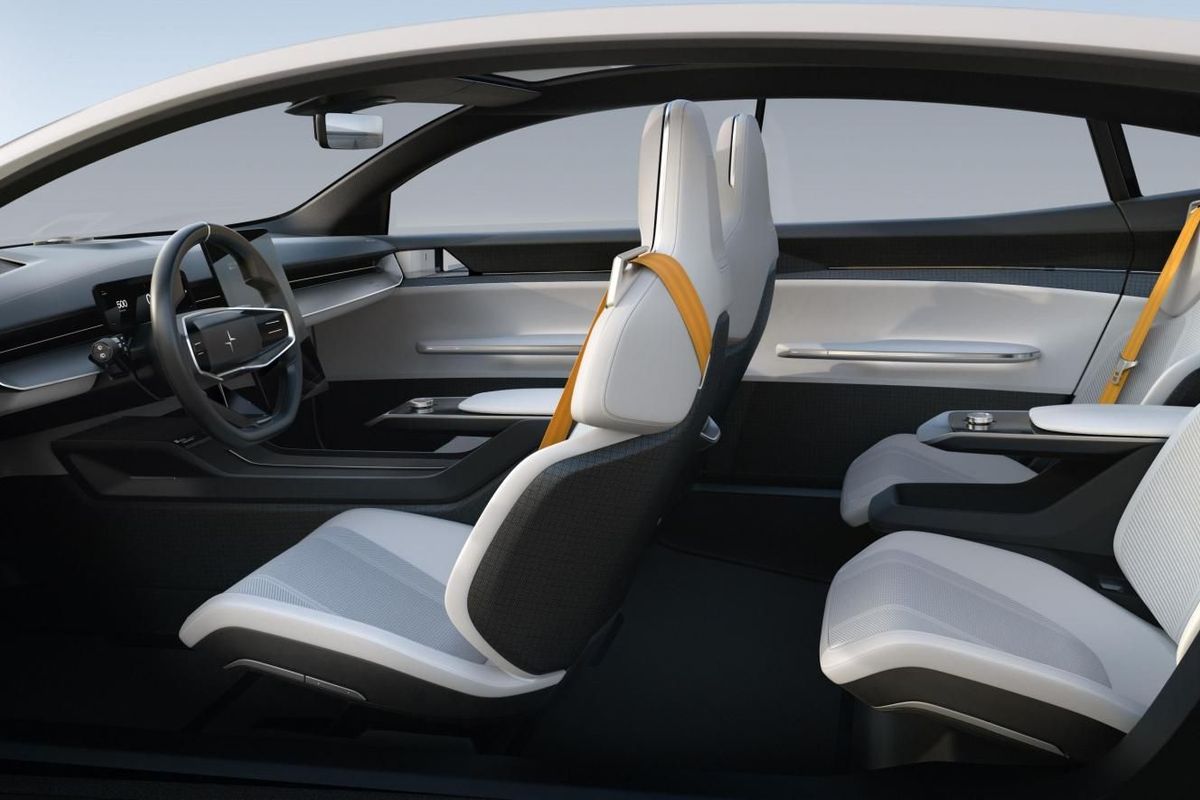
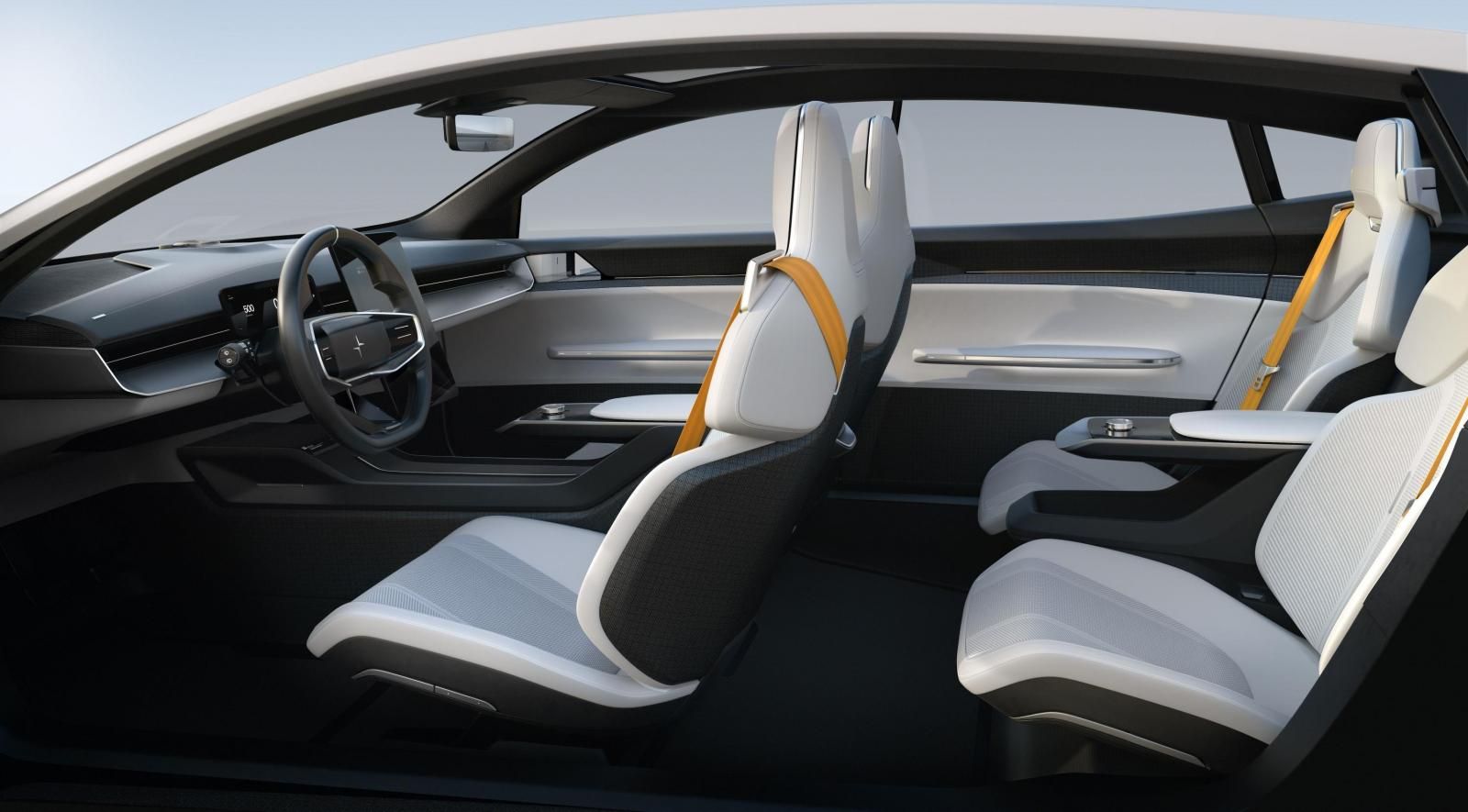
The Polestar Precept has a wheelbase of 3.1 metres and features high-tech driving aids such as LIDAR. The traditional side mirrors have been replaced by camera units and Polestar claims its Precept 4-door grand tourer focuses on aerodynamic efficiency. Inside, the cabin is crafted from sustainable materials and parts of the interior come from recycled plastic which Polestar says saves weight and reduces plastic waste. In an extraordinary claim, Polestar says its Precept carpets are made from reclaimed fishing nets. The portrait-oriented 15-inch infotainment system comes from Google, who Polestar are working with. 

The Polestar Precept will be on display at the 2020 Geneva Motor Show. 

Further Reading

Polestar 1 Shows Off Electric Performance Future

Volvo S60 Polestar (2015) Review

Volvo S60 Polestar (2016) Review

Polestar 1 Testing in Arctic Circle [w/Video]

New VWs Coming to SA in 2020

New special editions and a boosted bakkie are all part of VW’s local product strategy for 2020. 

The largest of all German automotive companies is investing massively with deep electric powertrain R&D. 

A flood of new VW battery cars and technology features are expected in the next few years. Amidst all the marketing noise, it can be confusing to understand what is global, and what is local, within VW’s planning.  

There is no question that VW is going big in 2020, but how does that impact the German brand’s local strategy and product schedule? 

After being given access to the company’s local planning specialists, we have some official dates and details about what VW will be doing, and when, in South Africa during 2020. 

Electric Golf and ID.3


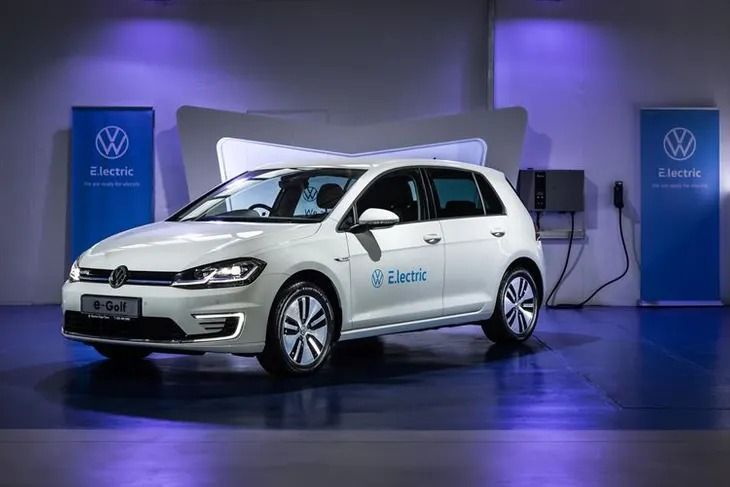
The e-Golf is been used as a testbed for VW's electric plans in SA. 

Battery-powered vehicles are going to be VW’s global business of choice in future. South Africa is way behind the international curve of charging infrastructure and government policy regarding the taxation and incentivisation of electric vehicles. 

Despite this, VW is keen to show South Africans what it can offer in terms of electric mobility. A limited fleet of e-Golf models have arrived in the country and will be clocking mileages and acting as awareness vehicles. 

Later in the year, VW hopes to introduce a fleet of ID3 electric cars too. 

Crossing the Ts


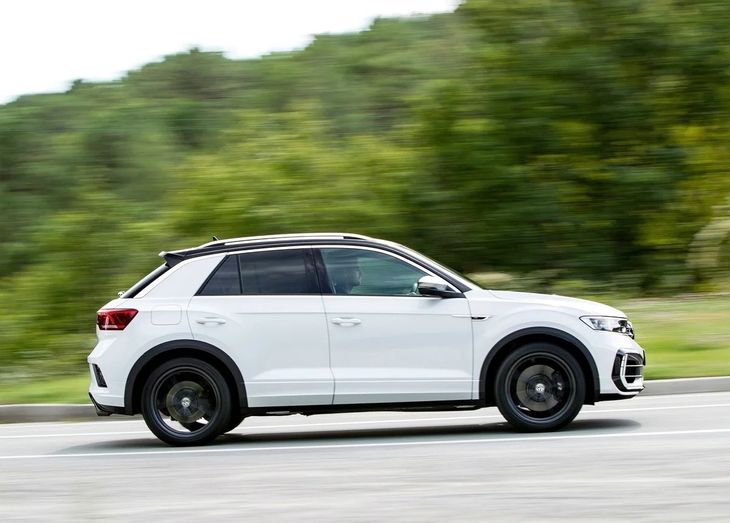
The T-Roc will land in SA sometime in Q3 of 2020.

VW’s T-Cross has been an astounding success since its local introduction late last year. The portfolio has now been broadened with a 1.5 TSI derivative. This 110 kW engine should appeal to those T-Cross customers who regularly load their crossover with a full complement of passengers, and luggage. 

Very much at the opposite end of the model range, VW will be introducing the sub-R300 000  T-Cross Trendline during the second quarter of 2020. This is the most modest version of T-Cross, with a 70 kW version of the 1-litre engine. 

The keenly anticipated T-Roc will debut in Q3, and it should be a rousing success. Golf sales have been edging lower as most traditional Golf customers have begun opting for Tiguan. VW brand fans who have Golf-money to spend, but don’t want the size of Tiguan, should flock to T-Roc in droves, as it offers a more compact Golf-based crossover experience. 

VW will also offer the facelifted Tiguan, towards the end of 2020, sharpening-up the appearance of an SUV which has established a local pathway for the brand’s compact crossover and SUV success. 

Goodbye to GTI


The swansong of the Golf 8 range, the TCR is limited to just 300 units in SA. 

VW is preparing for the arrival of its immensely important Golf 8 later this year, and that means the current Golf range will be tapered. 

It is a tradition that VW always produces a very special GTI derivative, to celebrate the end of any Golf model lifecycle. And with Golf 7.5, is it no different. 

VW has confirmed that its local consignment of 300 GTI TCRs will be arriving during Q2. Each of these very special Golf GTIs will feature a numbered certificate of authentication, which should make them collectable for owners intent on keeping their cars as an investment. 

The GTI TCR is good for 213 kW and will have some unique styling trim. With the GTI badge having such a strong following in South Africa, these cars might be the status-symbol hot hatches of 2020. 

Hello to Golf 8


The Golf 8 should arrive right at the end of 2020, replete with new VW branding.

The company’s crossover and SUV strategy has radically changed its volume dependency on Golf, but this remains the most important legacy car in VW’s product matrix. 

Golf 8 will become available locally in the last quarter of 2019 and should usher in a new era of digitisation for VW. Intuitive Smartphone pairing, superior App integration and driver assistance technologies will be hallmarks of the Golf 8.

The cabin is served by huge dual-screens, which promise to be of the highest calibre in terms of luminosity. A weakness of many cabin function screens has been their inability to remain clear and full of contrast when bathed in harsh African sunlight. 

VW has been developing a new generation of infotainment and instrumentation screens, which are fantastically legible, especially in challenging local lighting conditions. 

Vivo special edition


SA's most-popular passenger vehicle is set to get another special edition variant.  

Amidst all the latest platform and technology deployments that VW is planning for 2020, it has not forgotten of the humble Vivo. 

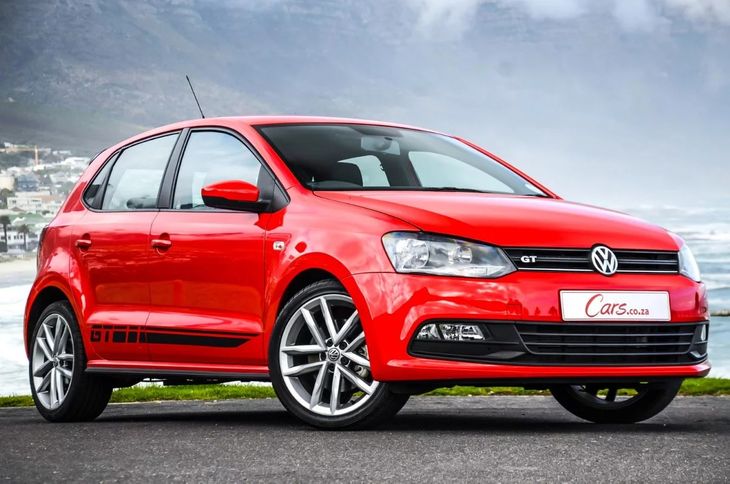
The perennial South African passenger car favourite is due to gain a special edition variant. VW is the South African budget-car special edition expert, having perfected its marketing strategy over decades, starting way back with Golf 1.

It is unclear exactly what specification changes will be applied to create this Vivo special edition. Our best guess would be some unique graphic elements, a possible infotainment upgrade or perhaps even a raised-ride height Vivo Cross edition.  

Ballistic bakkie


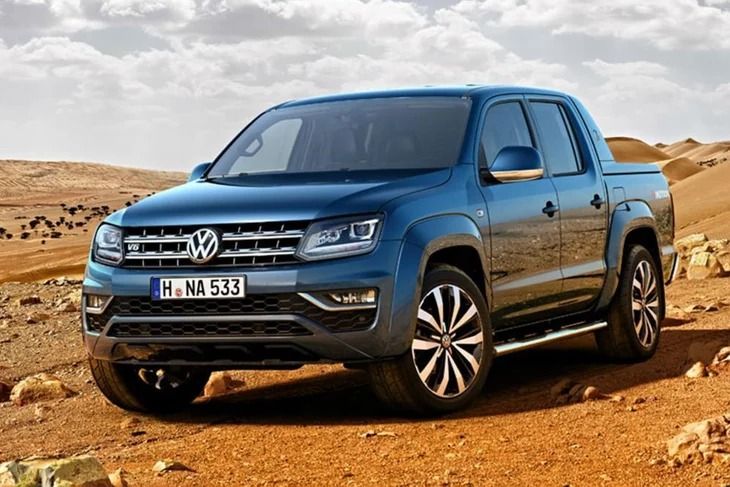
The 190 kW Amarok has been on the cards for a few years now, but it looks set to finally arrive during Q3 of 2020. 

VW might not be a volume player in the local bakkie market, compared to the likes of Ford or Toyota, but Amarok is inarguably South Africa’s most awarded premium double-cab. 

If you seek a bakkie with unmatched overtaking performance and high-speed cruising ability, the Amarok V6 is unrivalled. These 3-litre turbodiesel double-cabs are so popular, that VW sells them at a ratio of 70/30, in relation to the 2-litre bi-turbo Amarok. 

That ratio could shift to 80/20 when VW finally introduces its 190 kW version of the Amarok V6. Scheduled for Q3 it will become South Africa’s most powerful turbodiesel bakkie, a position which might go unrivalled for years, as Mercedes-Benz’s X350d is soon to be discontinued.

Related content

Amarok 580S is VW's 200kW Double-Cab Monster

Quad-exhaust VW Golf 8 R spotted

Electric Cars: Understanding the Terms

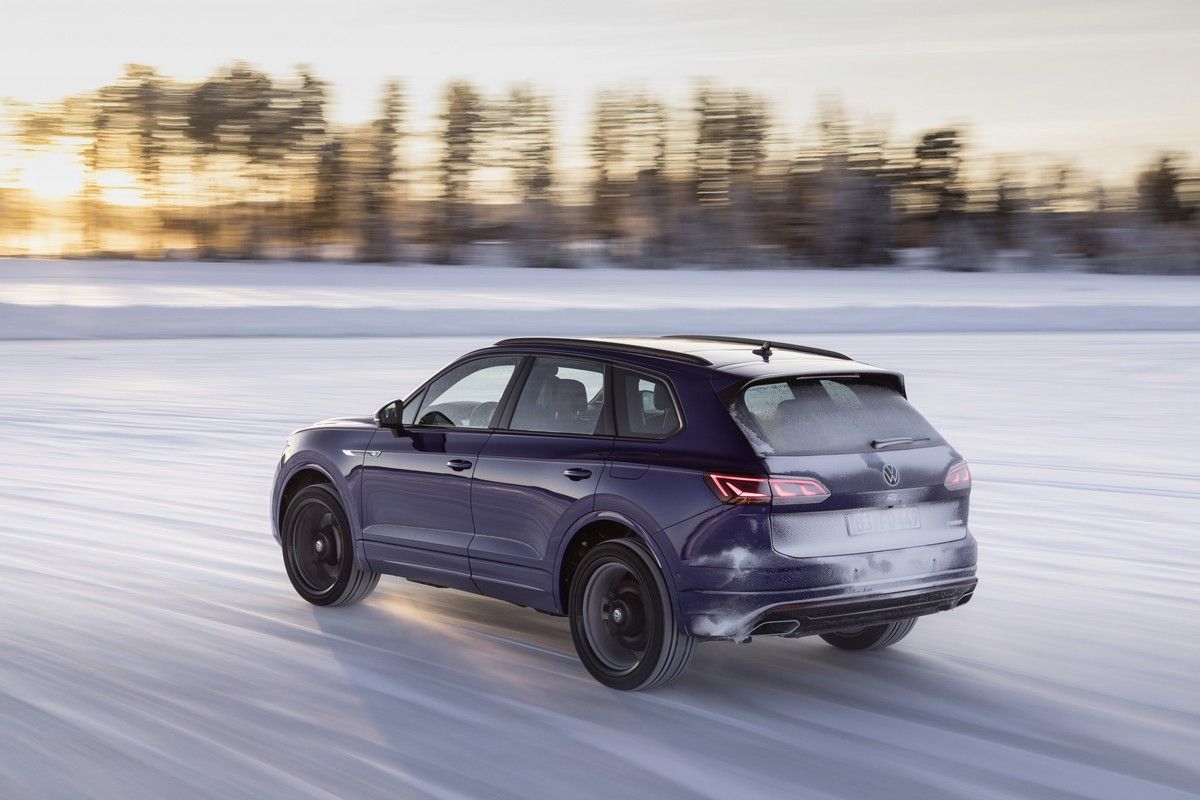
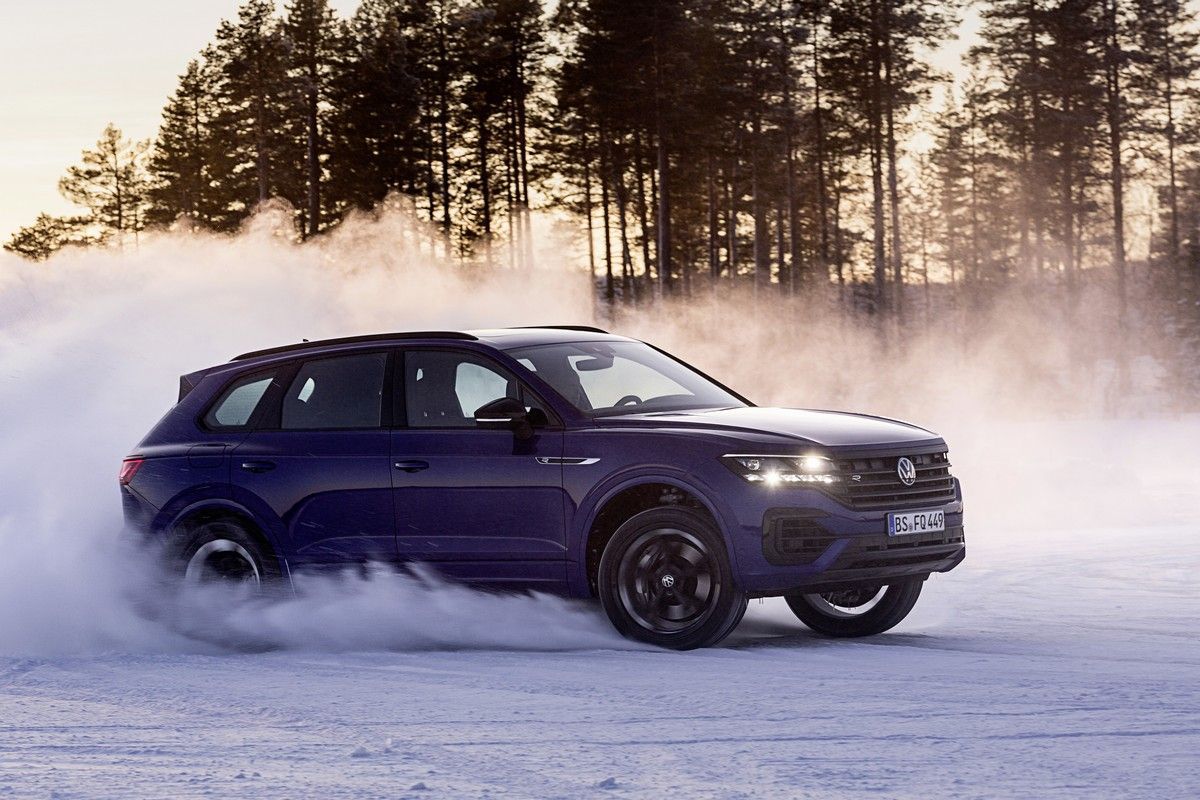
Volkswagen Touareg R: A car of many firsts

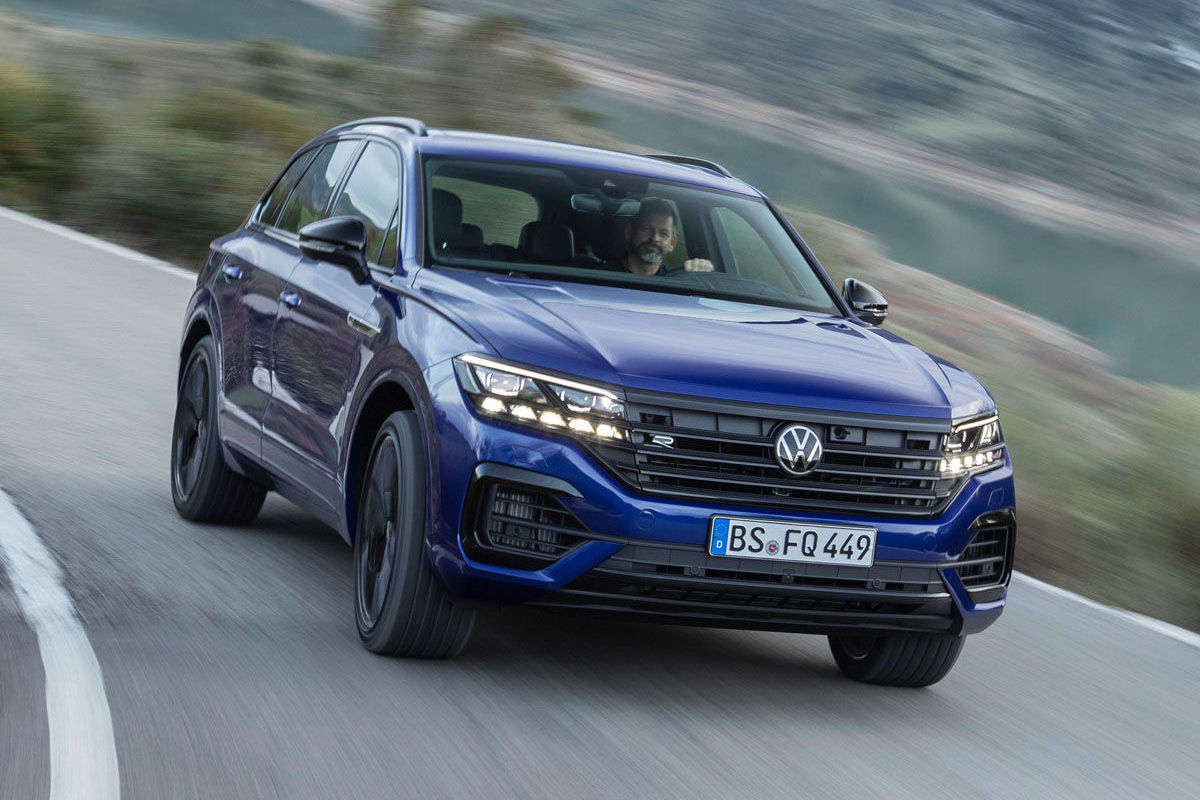
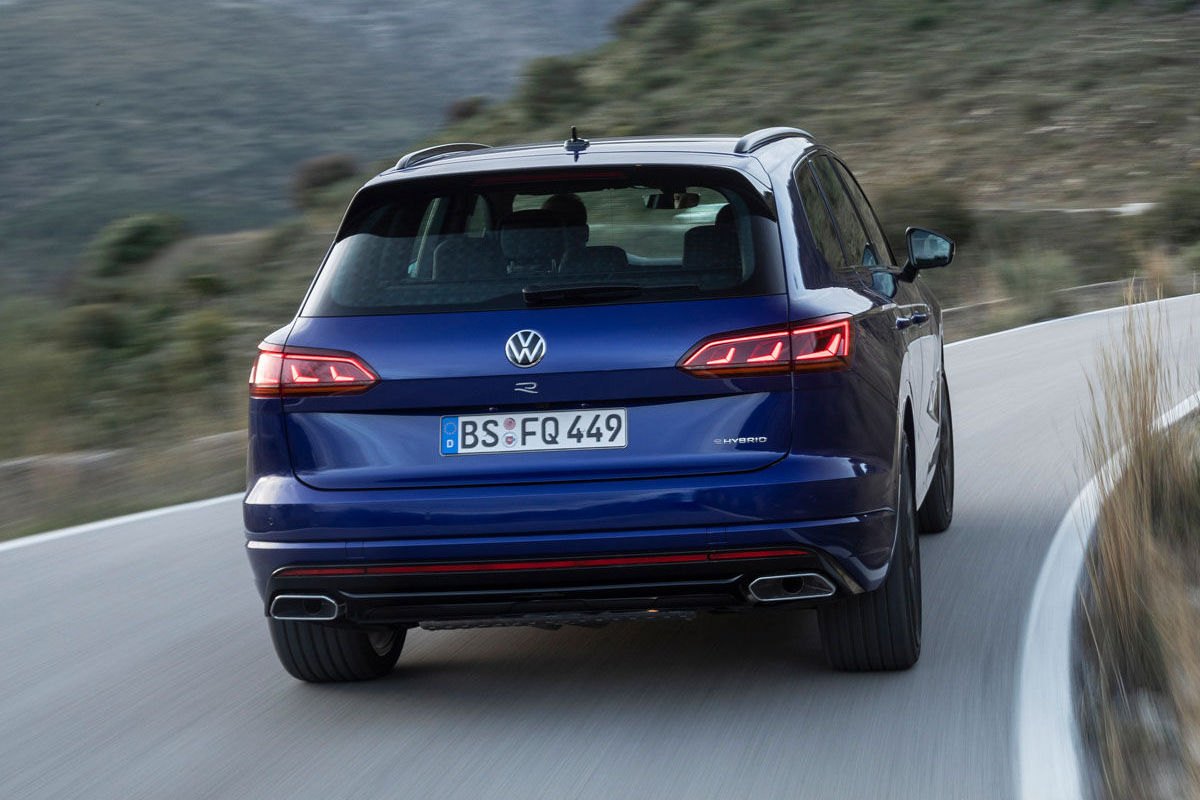
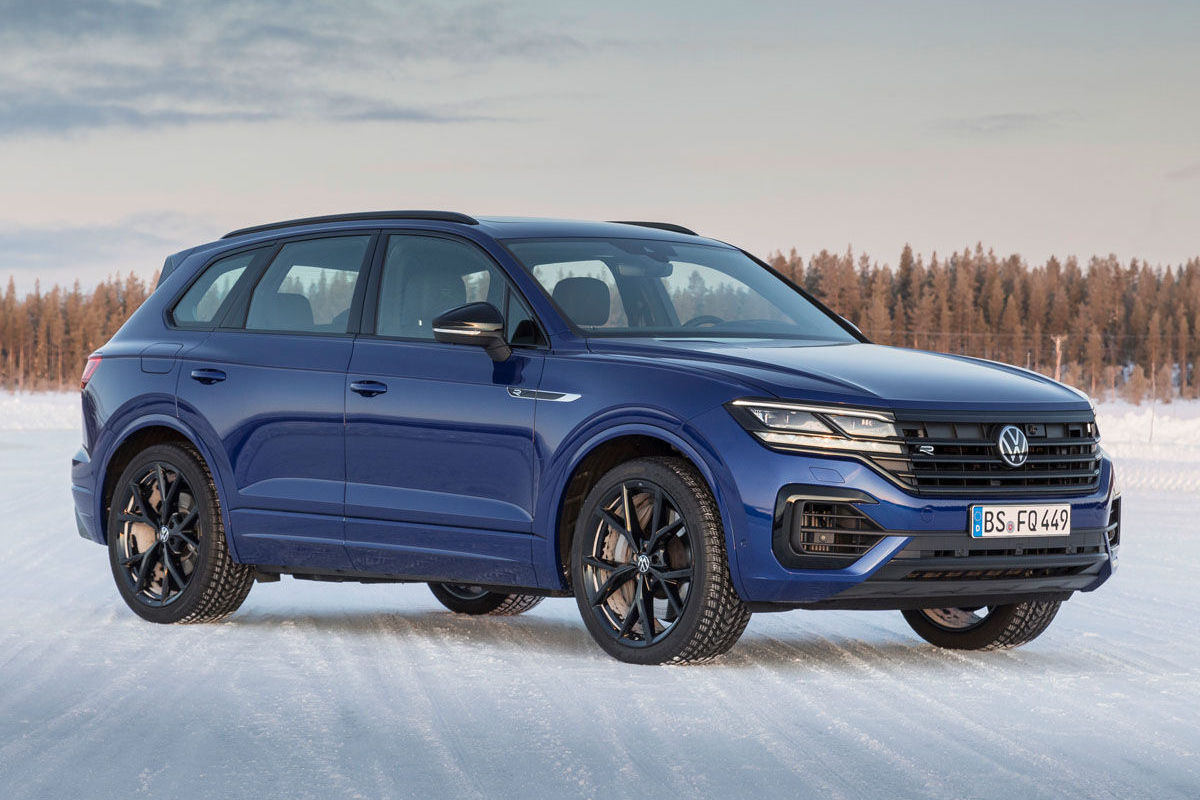
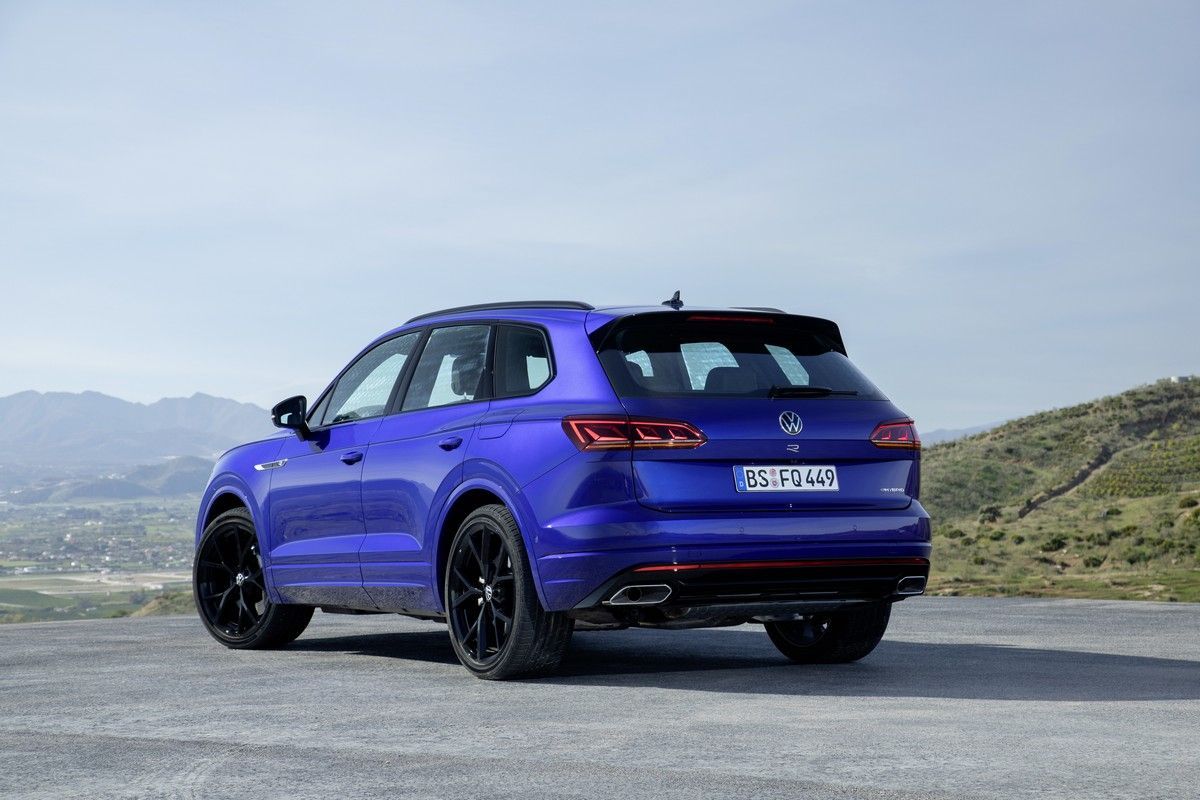
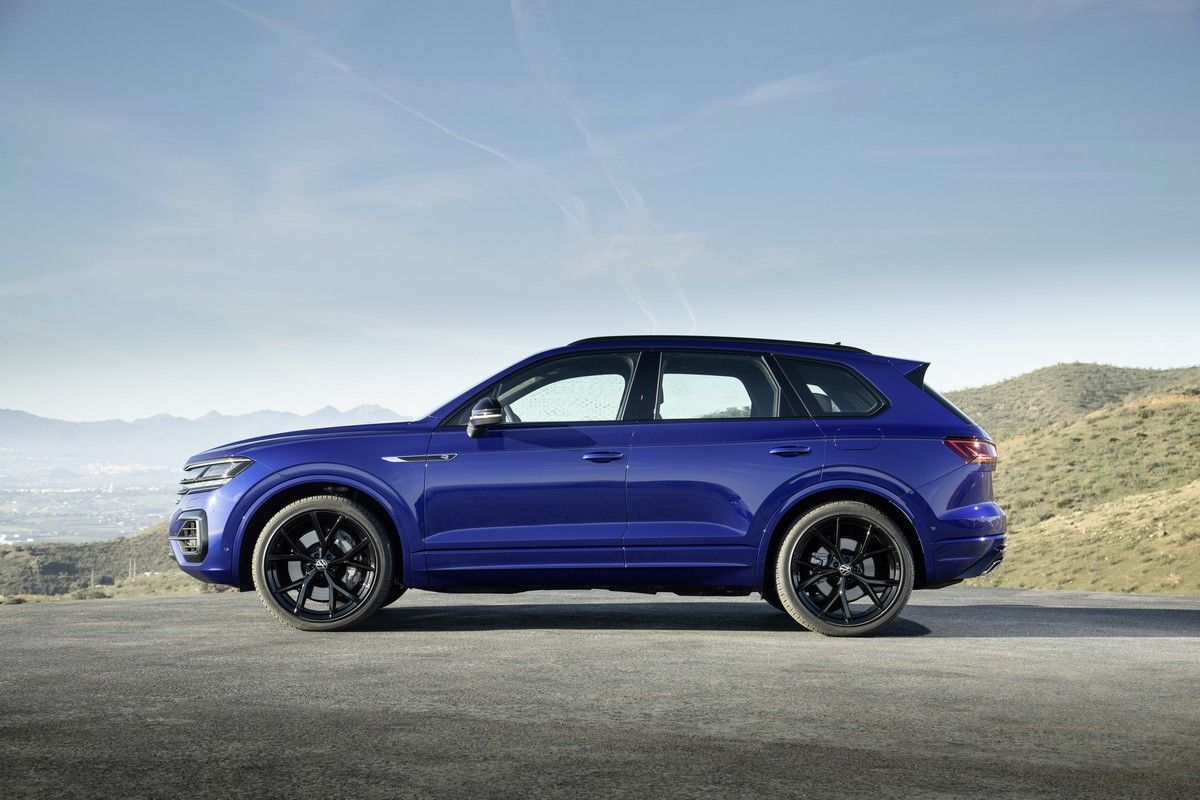
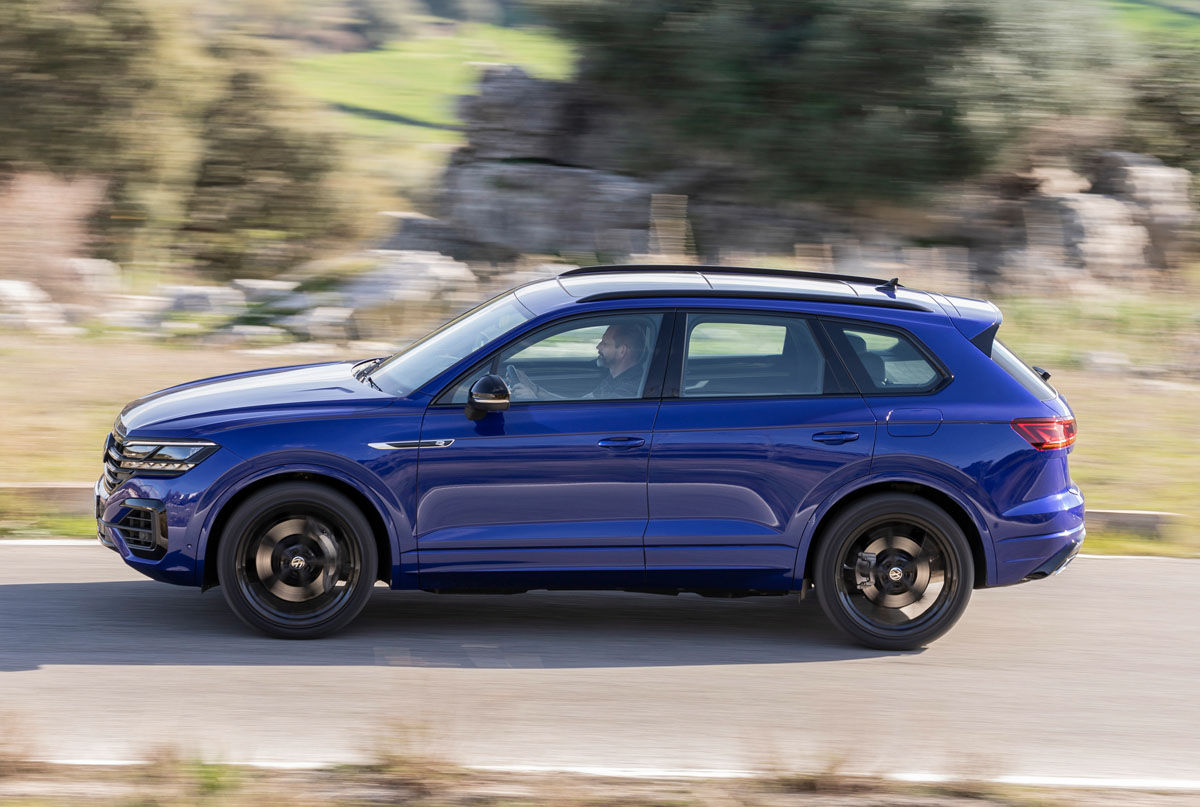
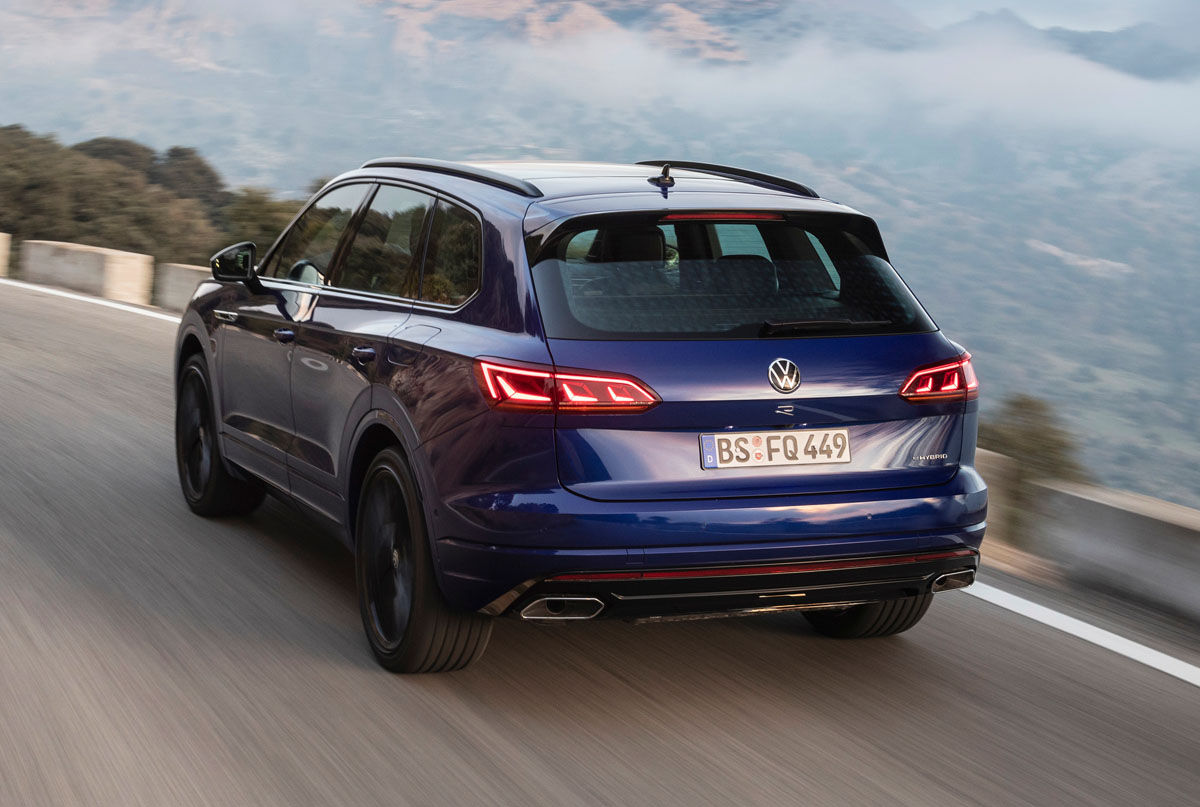
Volkswagen has unveiled its 1st plug-in-hybrid R model. Not only is the Toureg R the new flagship of the brand’s Premium SUV range – it’s the most powerful offering in Volkswagen’s passenger-vehicle line-up.

With peak outputs of 340 kW and 700 Nm, the Toureg R is not quite in the league of headlining performance SUVs such as the Audi RS Q8 (441 kW/800 Nm), BMW X5M Competition (460 kW/750 Nm), Porsche Cayenne Turbo S E-Hybrid (500 kW/900 Nm) and its fellow Geneva Show debutant, the Mercedes-AMG GLE 63 S Coupe (450 kW/850 Nm). However, outright on-road performance has never been an objective of the Touareg range… What makes the Touareg R’s arrival notable is that it indicates the direction Volkswagen’s R brand is heading, plus it debuts a host of new technologies.


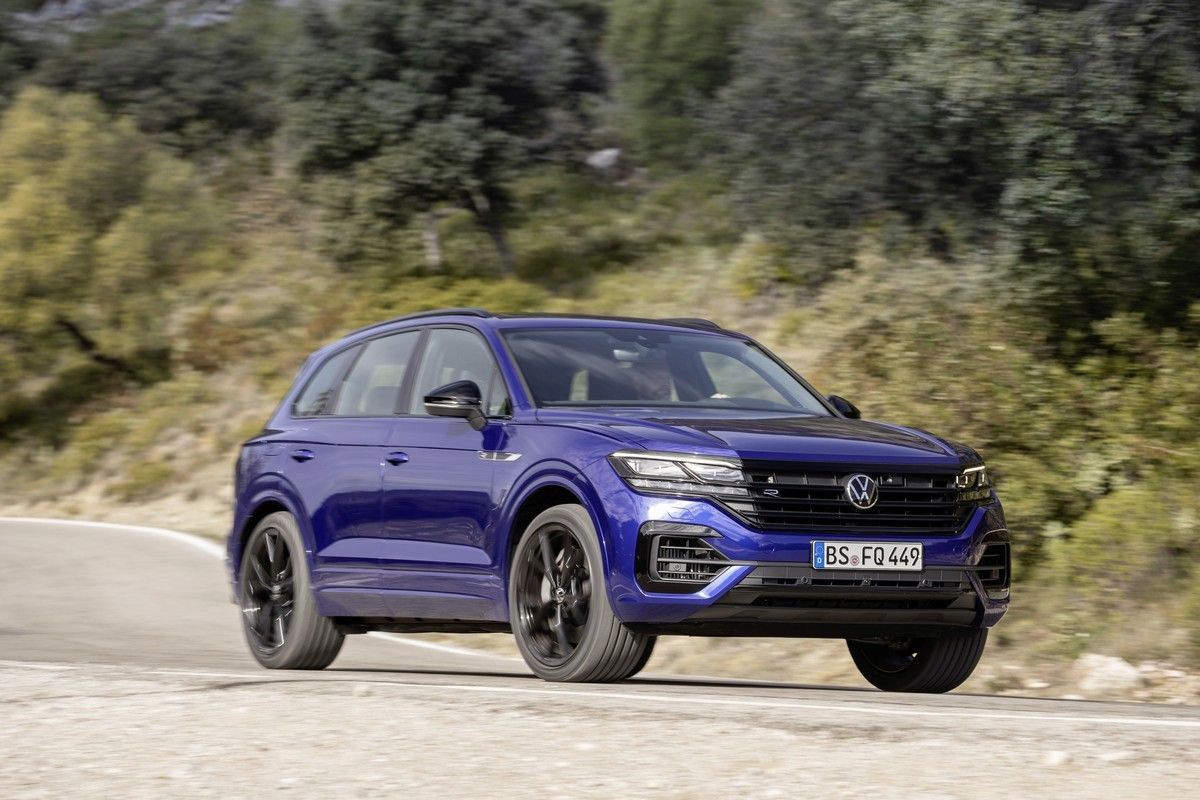
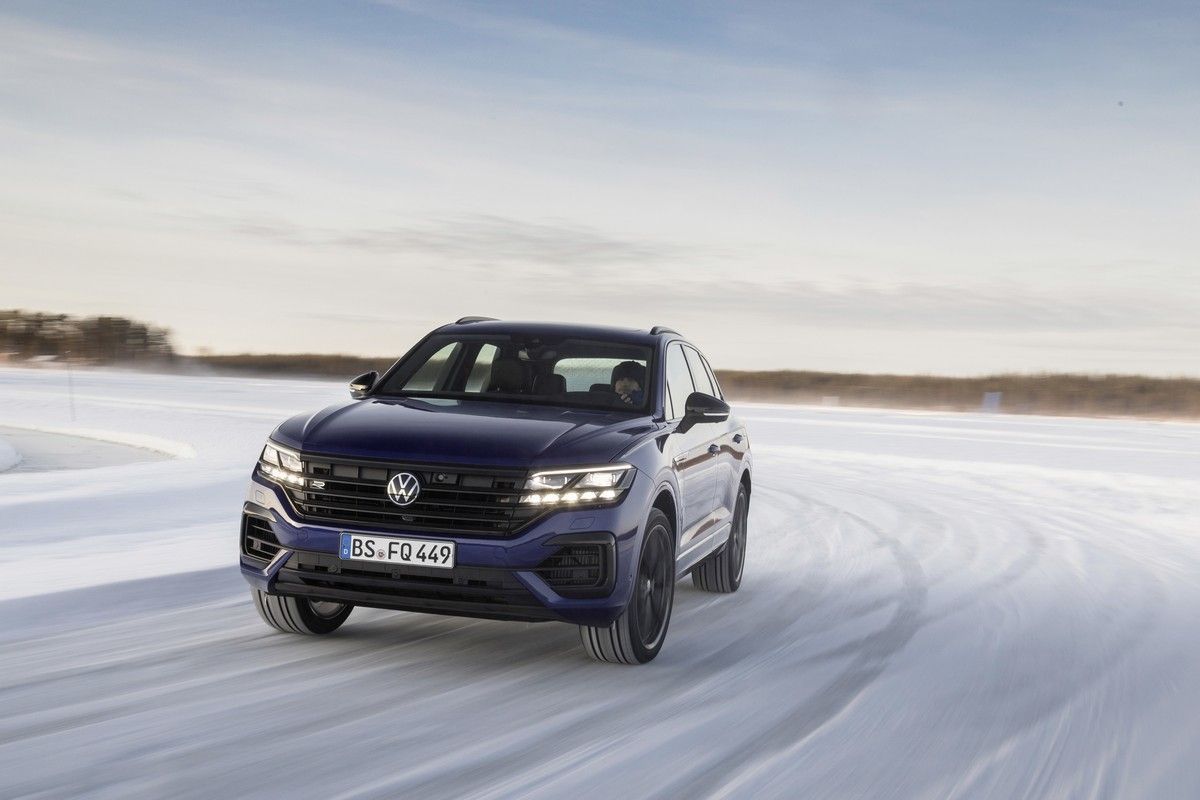
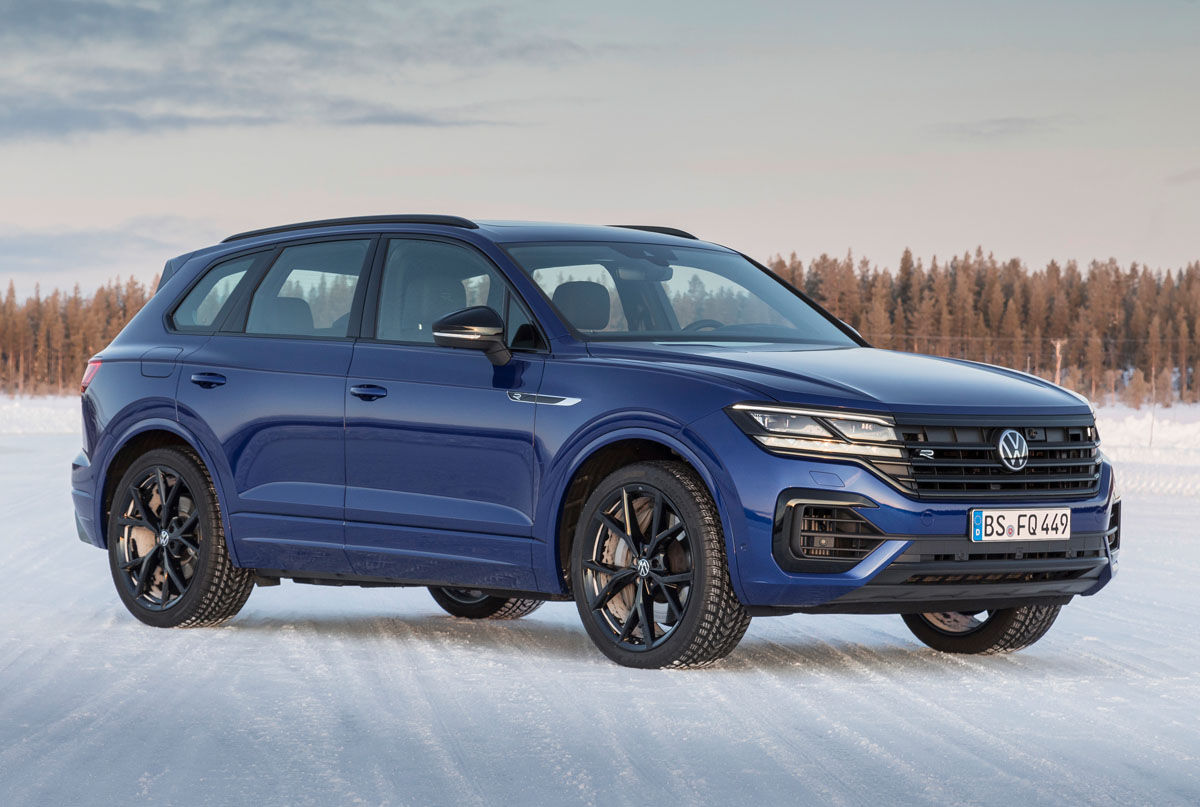
The Touareg R is the only derivative in the range that can be ordered in Lapiz Blue Metallic.

Apart from being the 1st Volkswagen R- (and all-wheel-drive) model to feature a plug-in hybrid drive, it marks the 1st time a hybrid product has been the most highly-powered car in Volkswagen’s range.

Jost Capito, the managing director of the R brand, is quoted as saying: “We are currently vigorously expanding the Volkswagen R range. Following the compact CUV models – T-Roc R and T-Roc Cabriolet R-Line – we are introducing another sport utility vehicle within a very short space of time.”

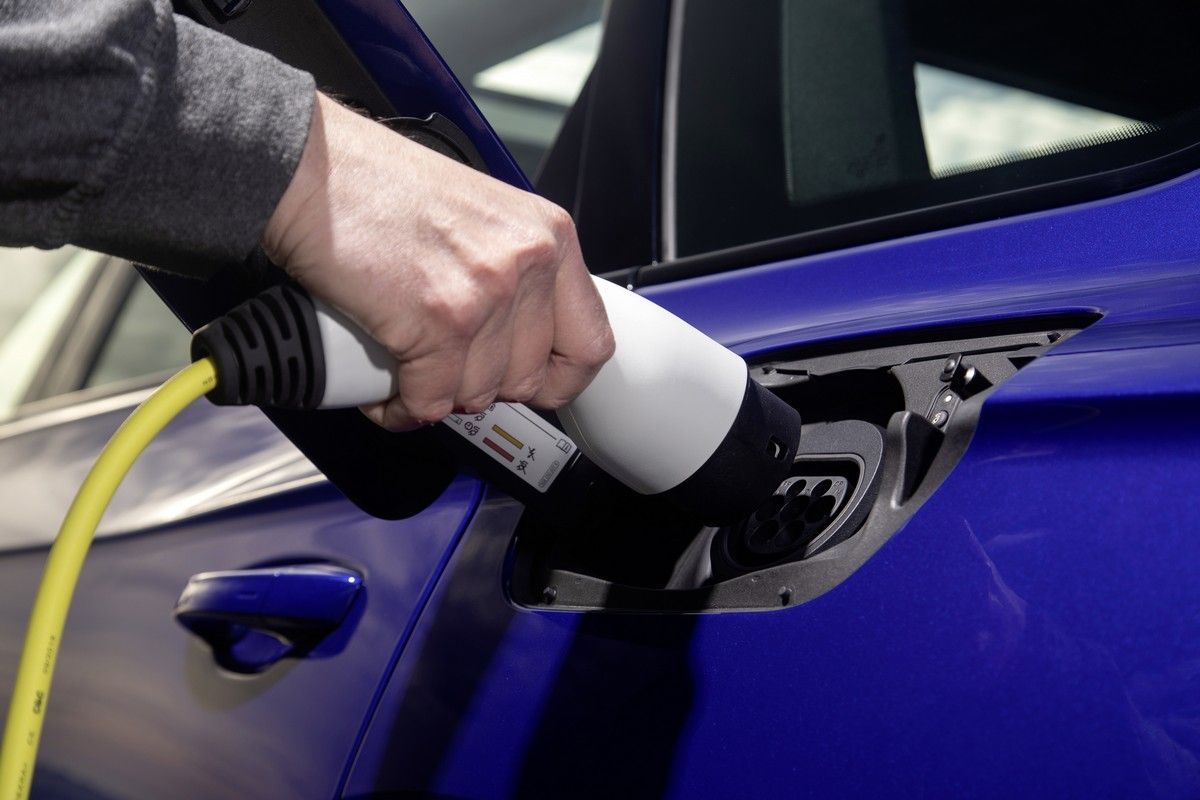
The Touareg R’s powertrain consists of a 250 kW 3.0-litre V6 turbopetrol combined with a 100 kW electric motor and a 14.1 kWh lithium-ion battery. The newcomer’s 8-speed automatic transmission (with Tiptronic) sends power to all 4 wheels via a centre differential lock with asymmetric dynamic torque distribution (Torsen traction) and the 4Motion permanent all-wheel drive can dynamically apportion a maximum of 70% of the propulsion to the front axle and up to 80% to the rear.


The Touareg R is not dedicated to on-road performance, it has off-road driving modes and is available with an off-road package.

All-electric drive up to 140 kph

When the battery is sufficiently charged, the newcomer always starts in the all-electric E-Mode and, according to a report, the Touareg R can travel up to 48 km on battery power alone. On the other side of the coin, the newcomer can travel up to speeds of 140 kph in E-Mode, but only in short bursts… we assume.

Can tow braked trailers of up to 3.5 tonnes

The Touareg R has been homologated to tow a 3.5-tonne trailer and is claimed to be capable of coping with this maximum weight even in E-Mode. The new model is also said to be the 1st plug-in hybrid SUV in the world to be offered with the (optional) Trailer Assist manoeuvring system, which works in conjunction with Park Assist to help a driver to easily reverse a trailer into a parking space.


The newcomer retains the adaptive air-sprung suspension of its standard stablemates.

Assisted driving at up to 250 kph

Although this is only applicable to Autobahn users, it’s still well worth a mention… Driving assistance systems that help drivers to keep their premium cars to track neatly in their freeway lanes at cruising speeds are now ubiquitous, but they don’t all work up to 250 kph! Indeed, by combining adaptive cruise control and lane-keeping system, the optional Travel Assist will allow the driver of a so-equipped Touareg R to cruise at it the flagship's electronically-limited top speed with driving assistance; they only need to keep at least a hand on the ‘wheel.   

R model accoutrements

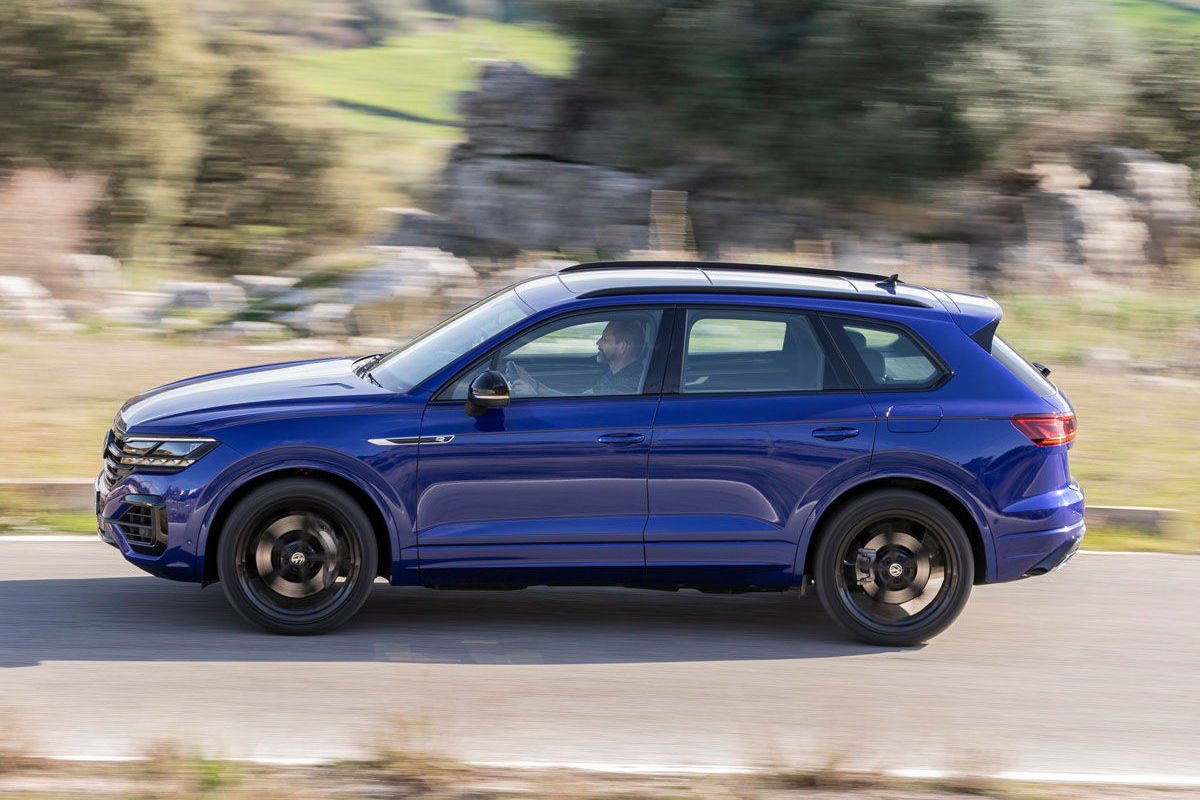
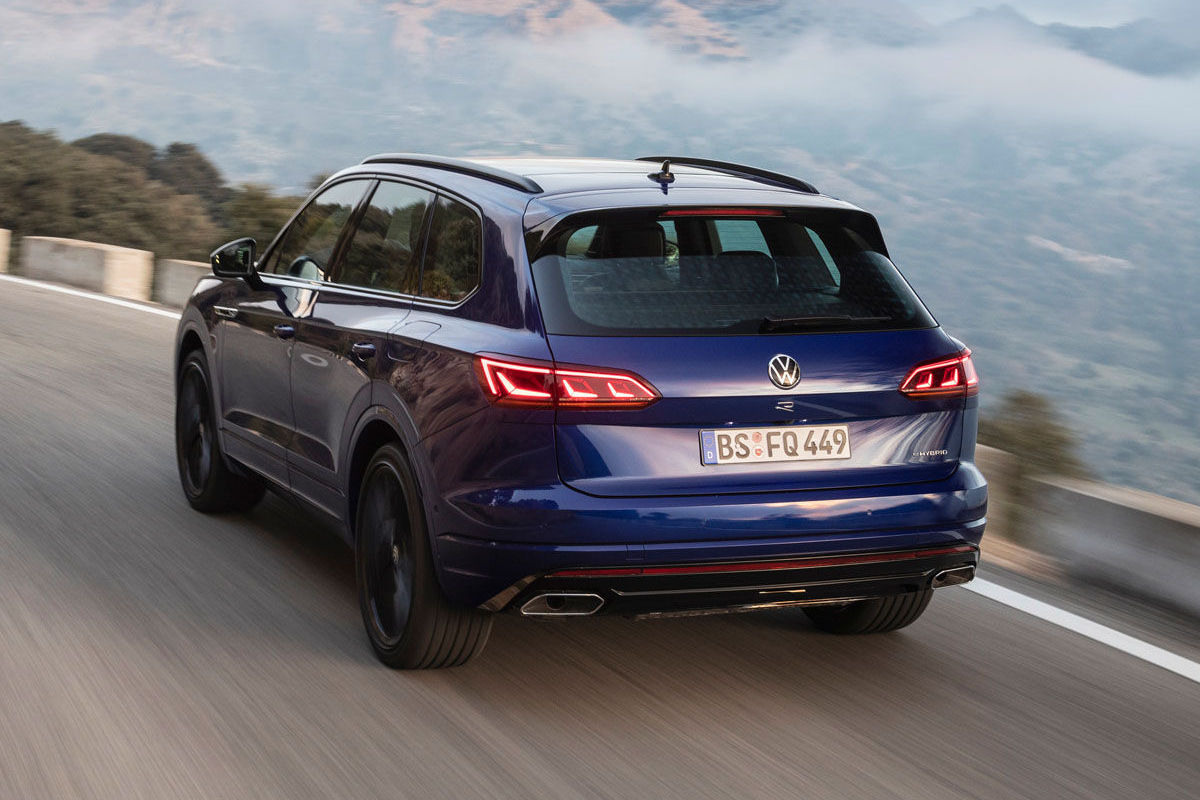
The Toureg R’s exterior detailing is purposeful, but not showy. The package includes R-style bumpers and body-coloured lower-door sections and wheel-arch garnishes, plus a black grille, -air intakes, -window trims and -mirror housings. R logos appear on the grille, side strakes and tailgate, the LED tail-light clusters are darkened, the exhaust tips are trapezoidal and 20-inch Braga alloys standard.
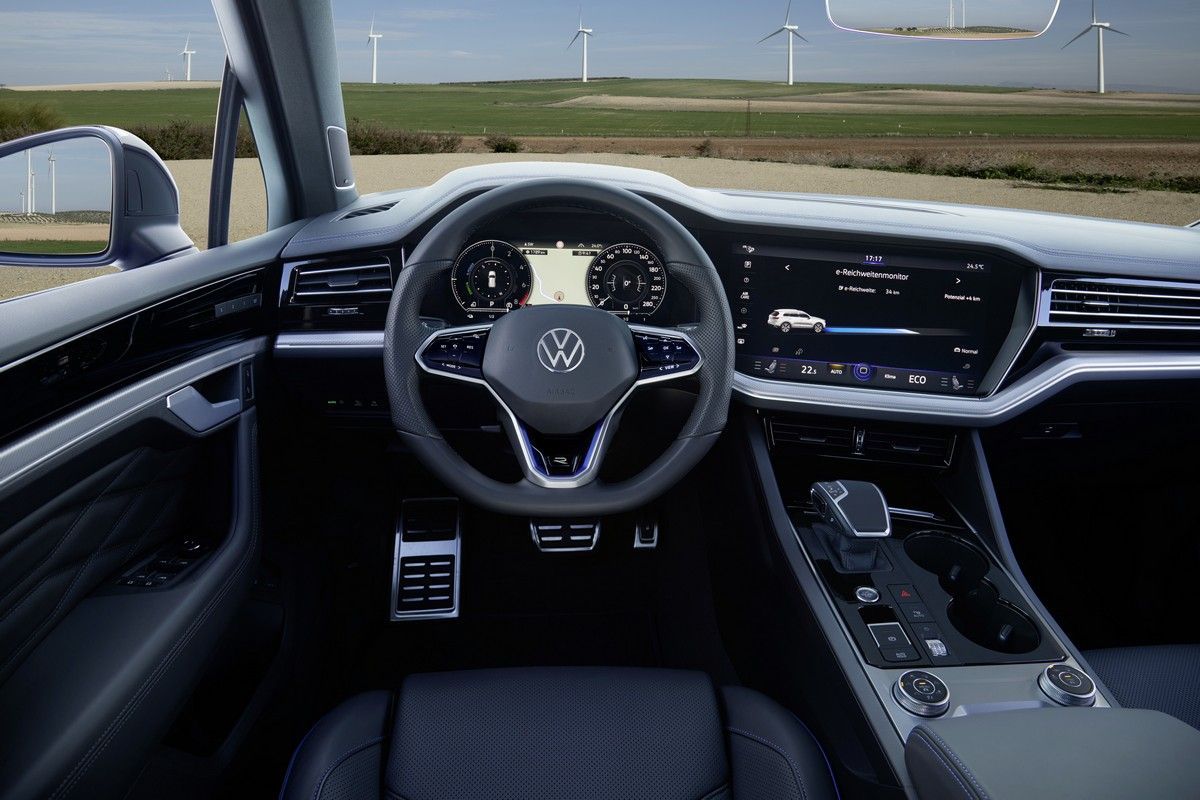
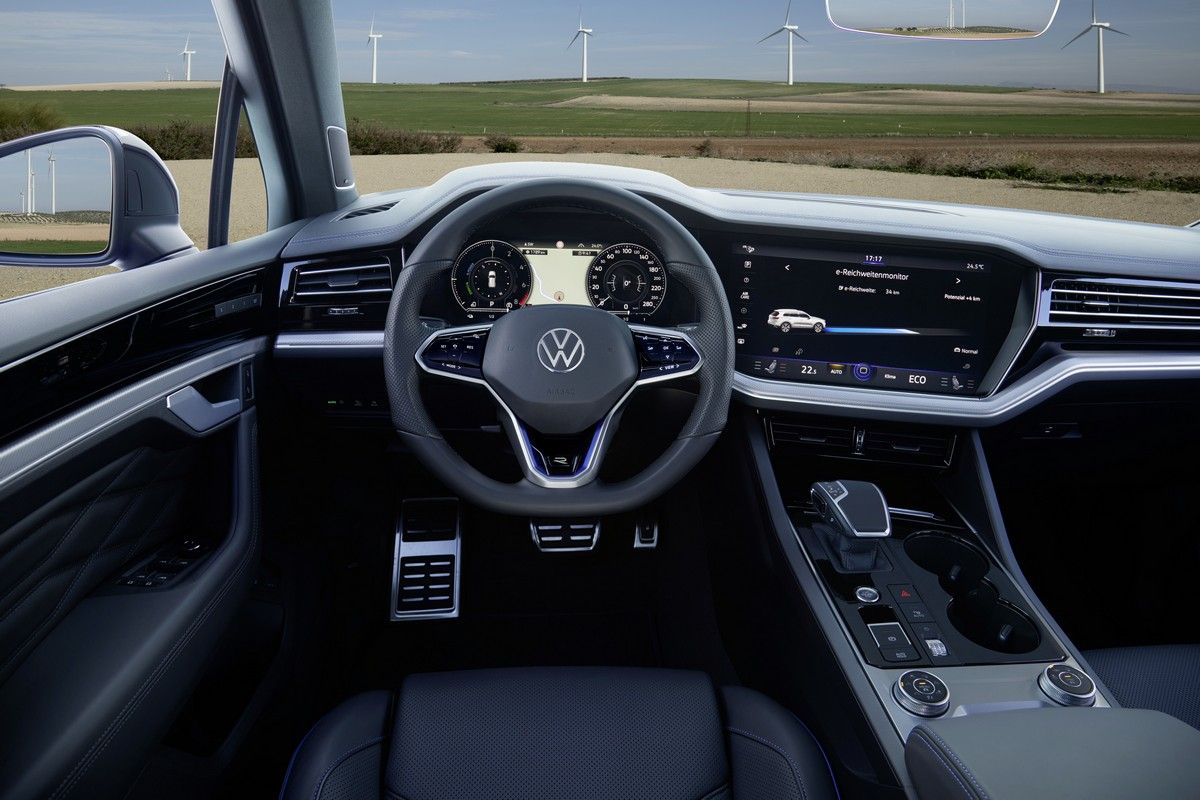
Interior features include the Innovision Cockpit (with the 12-inch Digital Cockpit instrument cluster and the 15-inch touchscreen Discover Premium Infotainment system, automatic activation and operation of the IQ.Light LED matrix headlights (interactive camera control of dipped and main beam headlights), a tilting and sliding panoramic sunroof and as well as 4-zone climate control.


The Touareg R has all the luxuries expected of the premium SUV's flagship derivative, including the expansive Digital Cockpit.  

According to Volkswagen, the driver can access specific information about the Touareg R’s hybrid functions by observing the energy flow displays in the Infotainment system (showing the battery’s energy reserve, energy supply to the drive system, and battery-charging status) and the electric-range monitor (it shows the electric range, driving profile and the potential to increase the range by non-critical deactivating systems, which saves energy). The combined power meter and rev counter on the Digital Cockpit display shows the status of the hybrid system and displays the consumption (under acceleration) or feed-in (under deceleration) of electrical energy, along with the hybrid mode. The remaining electric range and the fuel range are also shown.

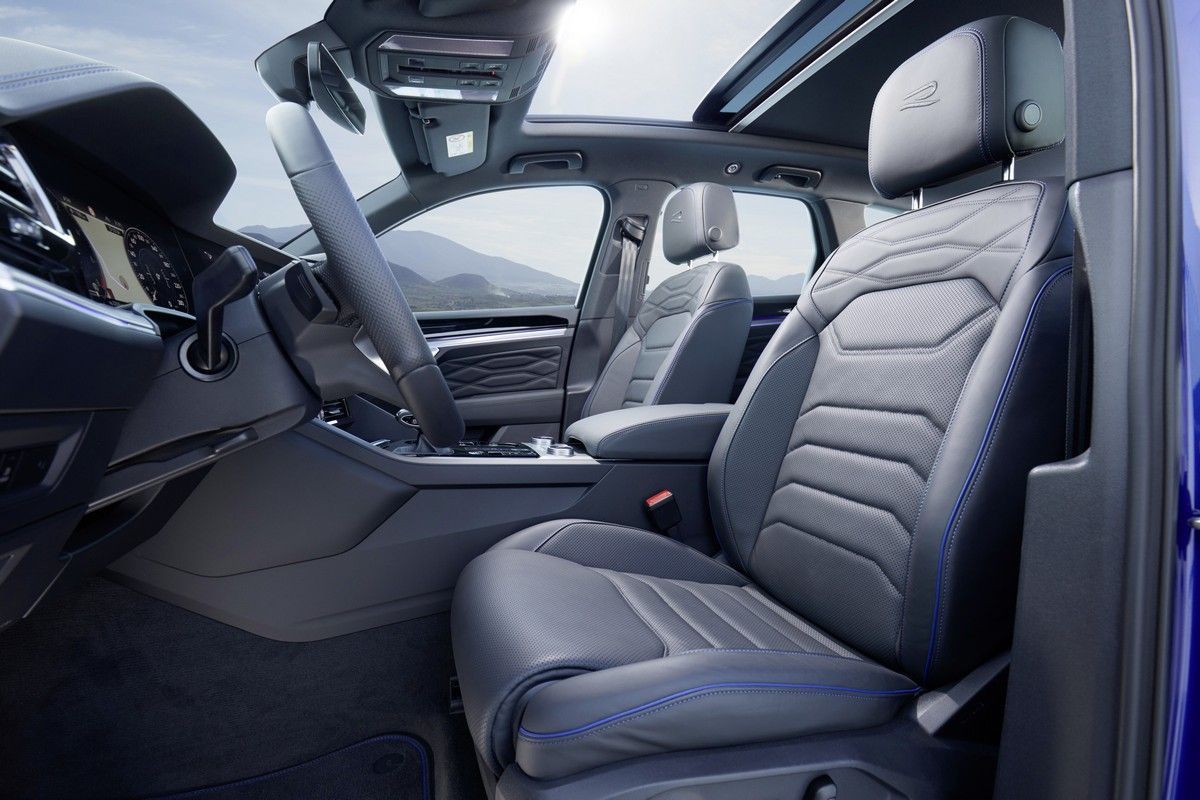
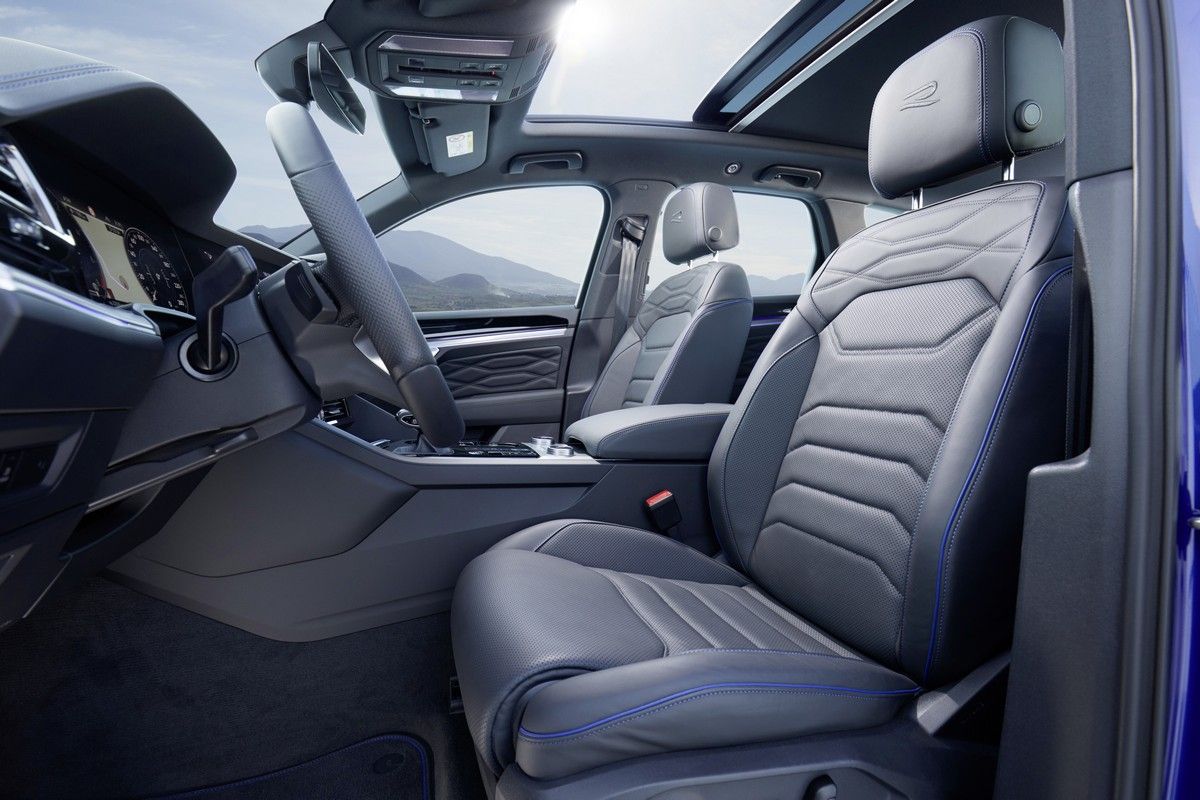
R model-specific interior details include Silver Wave aluminium trim on the dash panel and door, High Gloss Black and Silver Look centre console trim, Vienna leather trim, front comfort seats with an R logos embroidered in each of their head restraints, stainless steel load-sill protection, a new-generation multifunction steering wheel (heated, with shift paddles, R logo, and a button to activate the optional Travel Assist system), illuminated stainless-steel sill panel trim with R logo, brushed stainless steel pedals and white background lighting. The stitching on the leather seats is finished in Crystal Grey, as are the edging strips on the textile floor mats and the decorative seams on the armrests, selector lever and door trim.


This example of the Touareg R is specified with the optional black Puglia leather trim.

Apart from the aforementioned extra-cost Trailer- and Travel Assist systems, the Touareg R is optionally available with 21- or 22- inch alloys, black Puglia leather trim (with diamond stitching and Sepang Blue piping), a 780-watt Dynaudio sound system, Night Vision and Front Cross-Traffic Assist.

The current Touareg line-up in SA consists of three 3.0-litre turbodiesel derivatives. Could Volkswagen South Africa add the Touareg R to its local line-up in the near future? We'll have to wait and see.

Related content:

VW's Touareg V8 returns

New Volkswagen Touareg Review – Premium SUV Bargain?

Volkswagen Touareg V6 TDI Luxury (2018) Review

BMW X5 xDrive30d vs Mercedes-Benz GLE 400d (2019) Comparative Review [w/Video]

Volvo XC90 (2019) Launch Review

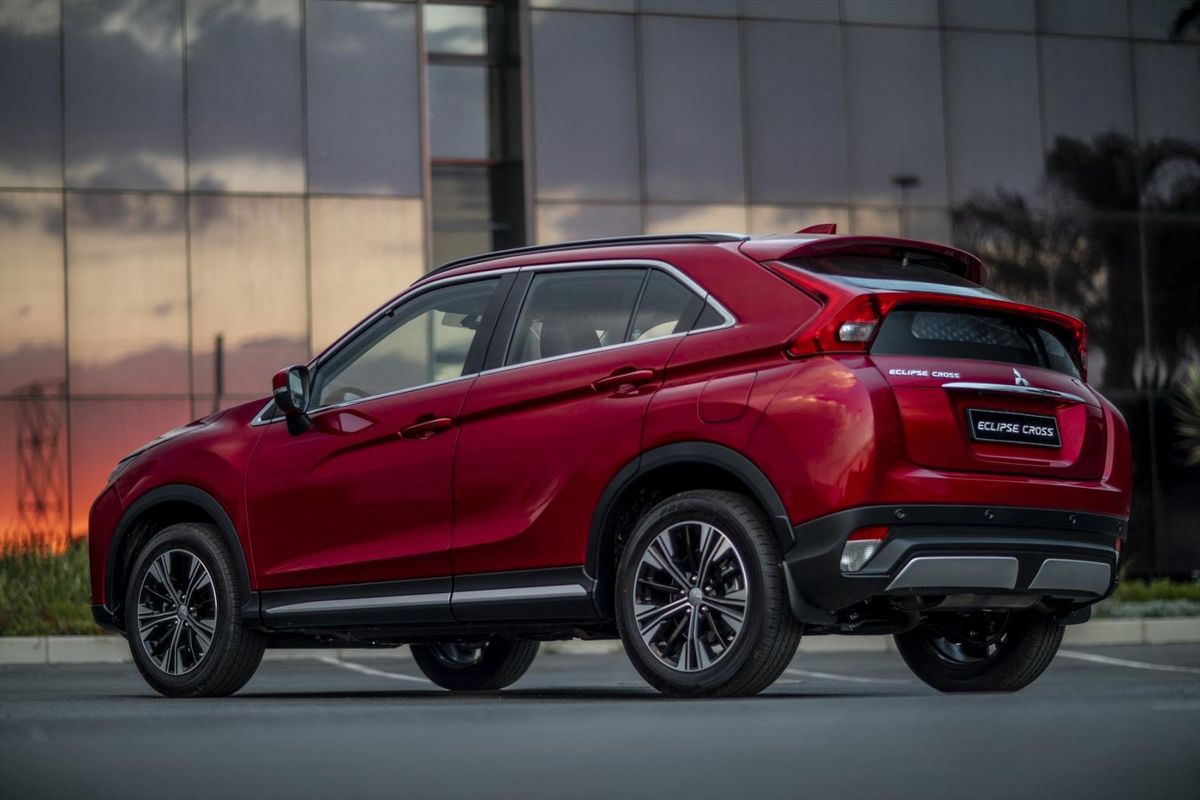
Mitsubishi Eclipse Cross 1.5 Turbo (2020) Spec & Price
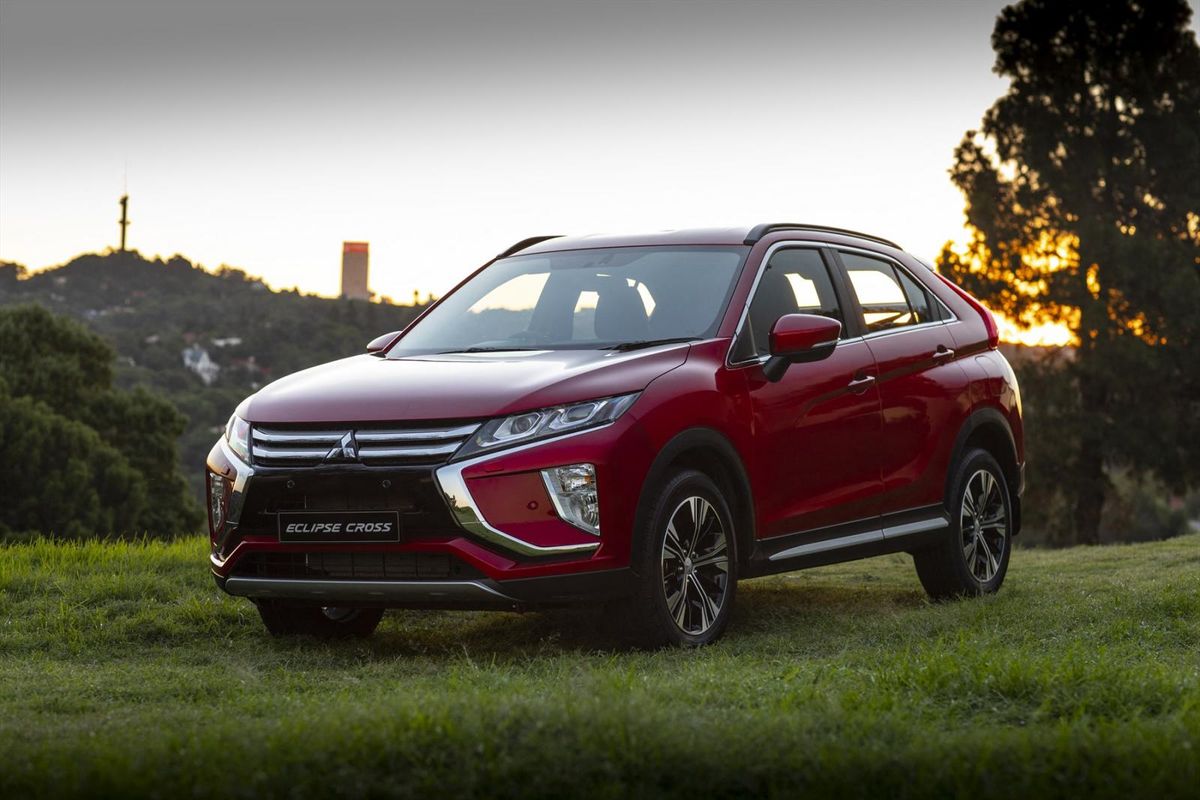
Mitsubishi has launched its eagerly-anticipated turbocharged derivative of the Eclipse Cross. Here's how much the new Mitsubishi Eclipse Cross 1.5 Turbo costs as well as some detailed specifications.

When Mitsubishi launched its Eclipse Cross back in February 2019, it was quick to point out that we'd have to wait for the most potent engine. The new 1.5-litre turbocharged 4-cylinder packs 110 kW and 250 Nm, mated to a CVT. 

The Japanese brand claims a 0-100 kph time of under 9 seconds in Sport mode and thanks to some built-in CVT steps, the driver is given that DCT feeling through the steering wheel paddles. It's also said to be pretty efficient, with a claim of 7.7 L/100 km.

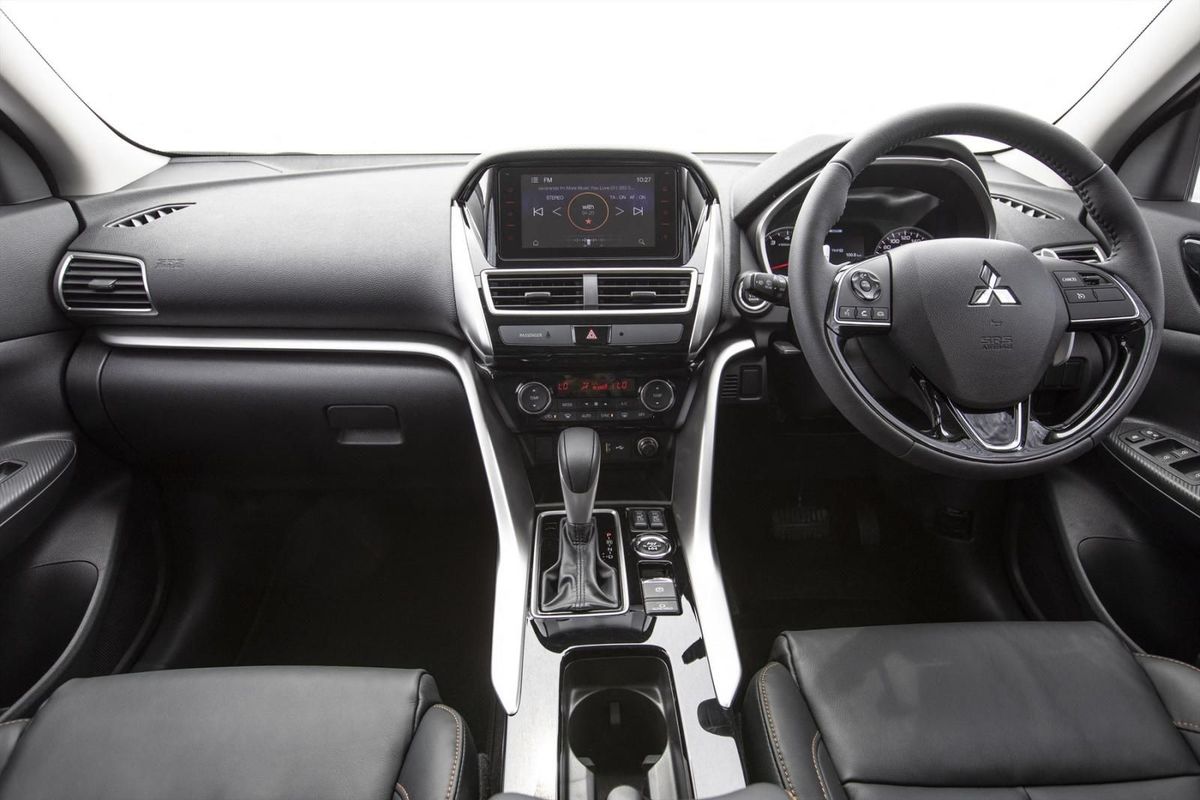
Standard features

Tilt and Telescopic Steering Wheel

Multi-function Leather Steering Wheel with Audio and Cruise Control

Bluetooth with Hands-free Voice Control

Paddle Shifts

Electric Windows (front and rear, with Auto up/down function)

Automatic Air-conditioning with Rear Passenger Vent Duct

Leather Seats, including Heated Front Leather Seats

Slide and tilt-adjustable rear seats with 60/40 split

Electric Adjustable Driver Seat and Heated Front Seats

Accessory Sockets and USB Ports

Electric Adjustable Fold-away Mirrors with Indicator Light

LED Headlamps with built-in LED DRL (Daytime Running Lights) linked to the Automatic Dusk Sensing function

LED Fog Lamps

Rain Sensing Windscreen Wipers

Front and Rear Park Distance Control

Rear View Camera

18-inch Alloy Wheels

Full-size spare wheel

7 Airbags

ASTC (Active Stability and Traction Control)

Mitsubishi Eclipse Price in South Africa (February 2020)
The new Mitsubishi Eclipse Cross 1.5T comes with a warranty of 3 years or 100 000 km, a 5-year / 90 000 km service plan and 5-year / unlimited mileage roadside assistance.
Eclipse Cross 2.0L CVT (two-wheel drive)      R409 995

Eclipse Cross 2.0L CVT (AWD)                       R449 995

Eclipse Cross 1.5 T CVT (two-wheel drive)     R459 995

Further Reading

Mitsubishi Eclipse Cross 2.0 (2019) Review

Mitsubishi Eclipse Cross (2019) Launch Review

Mitsubishi Eclipse Cross (2018) International Launch Review