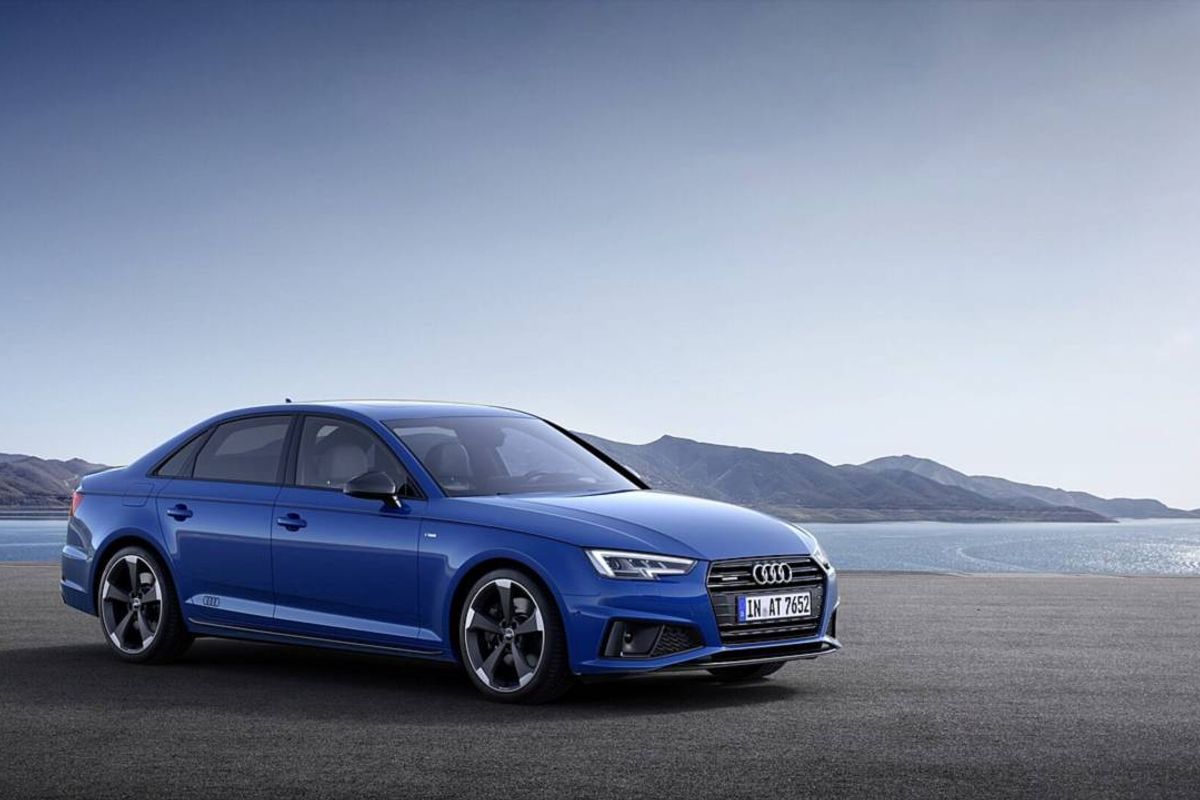
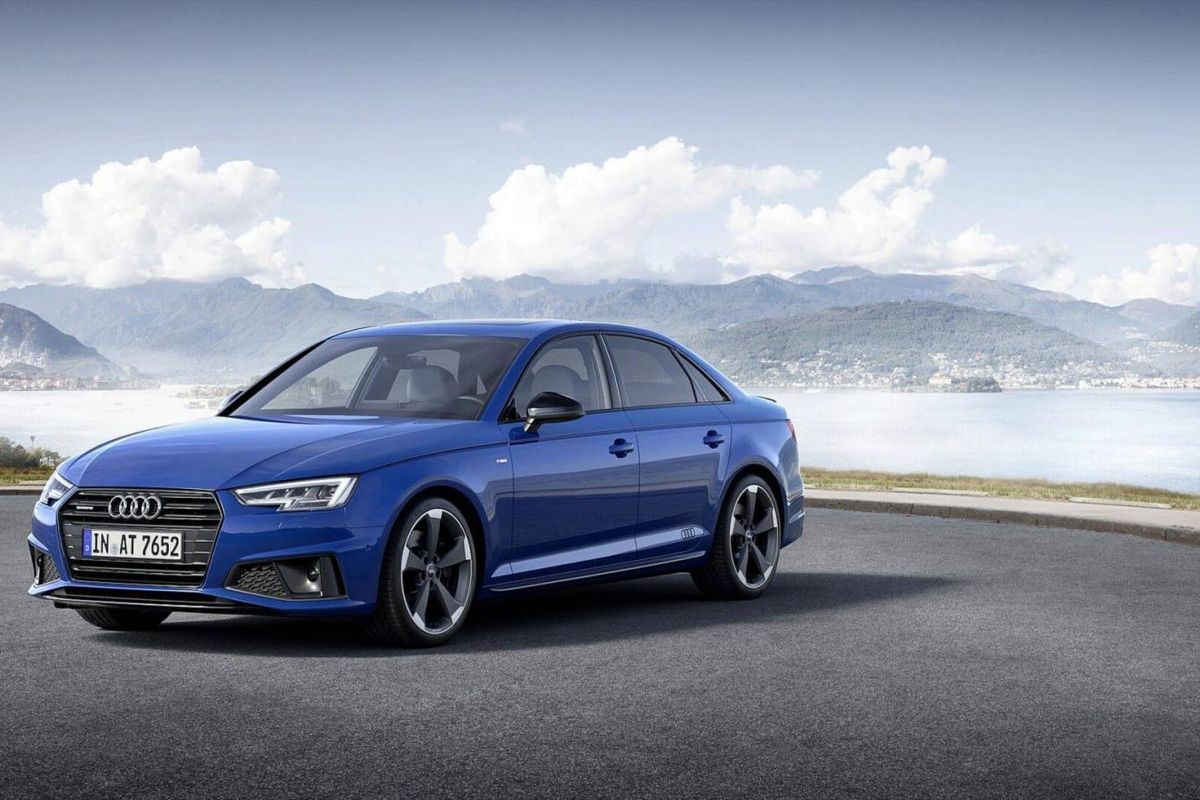
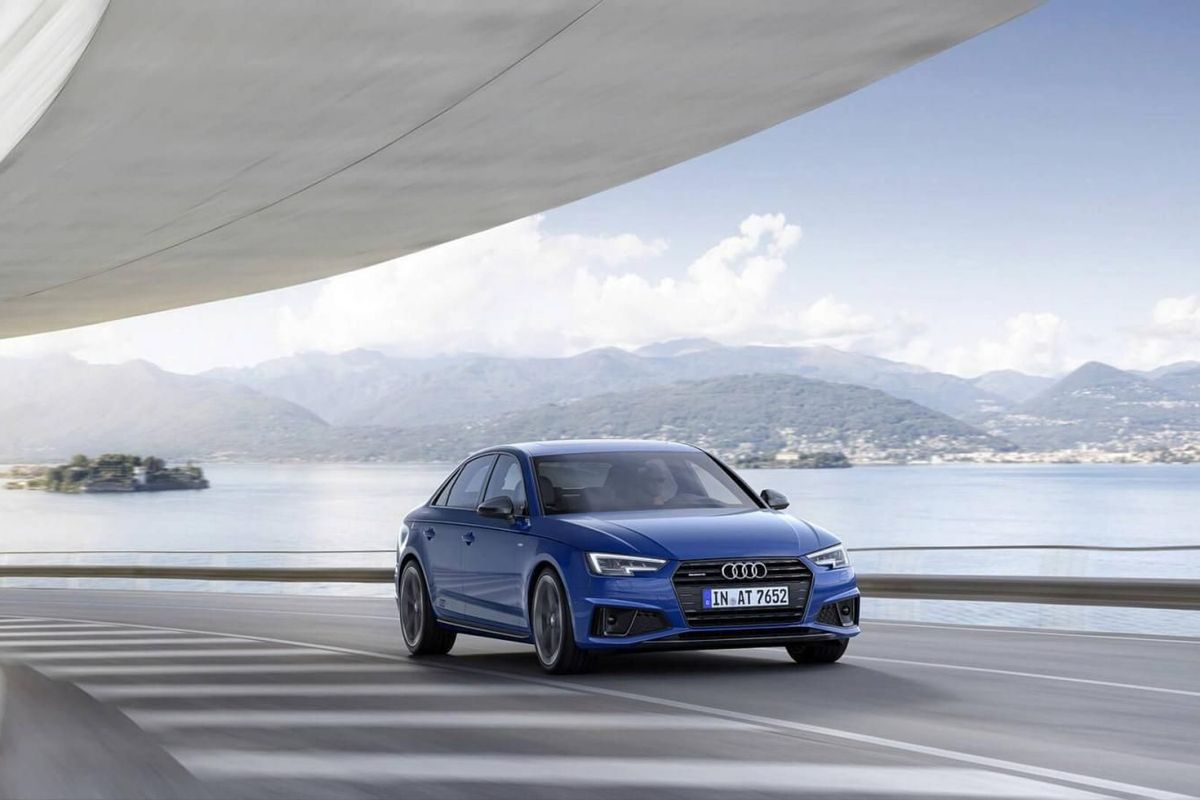
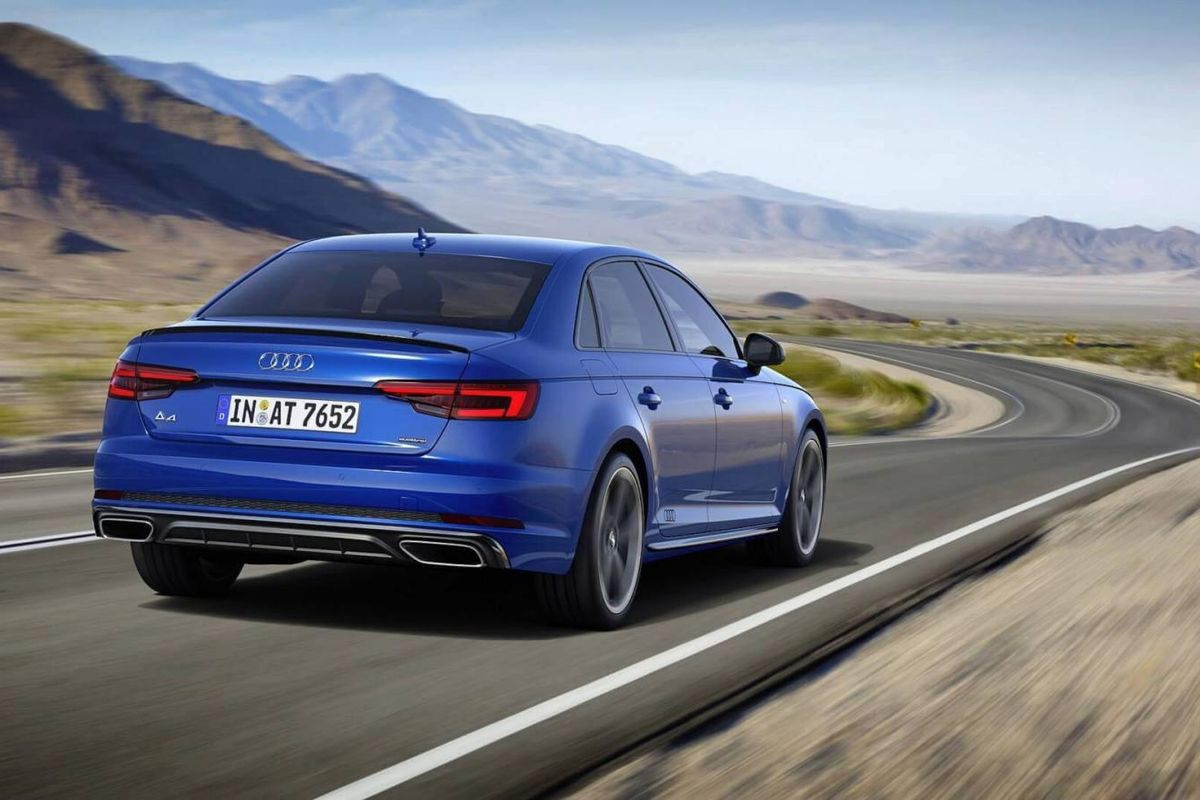
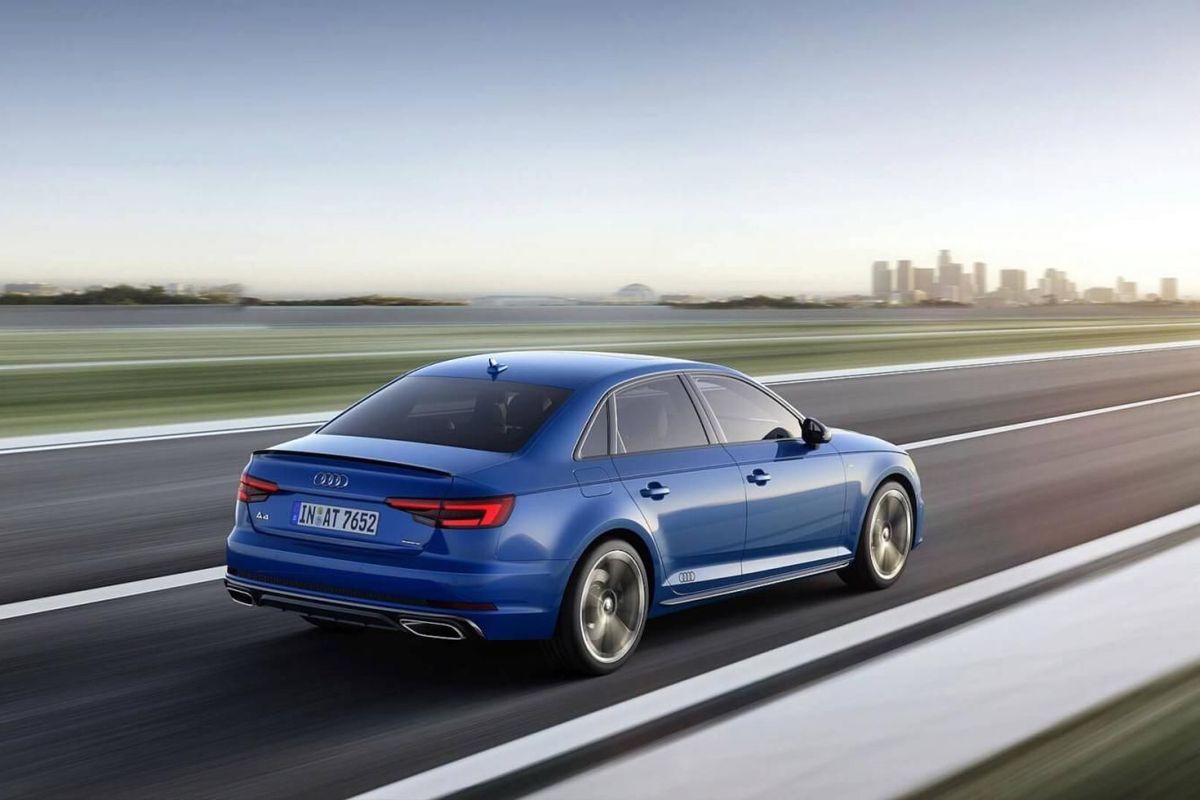
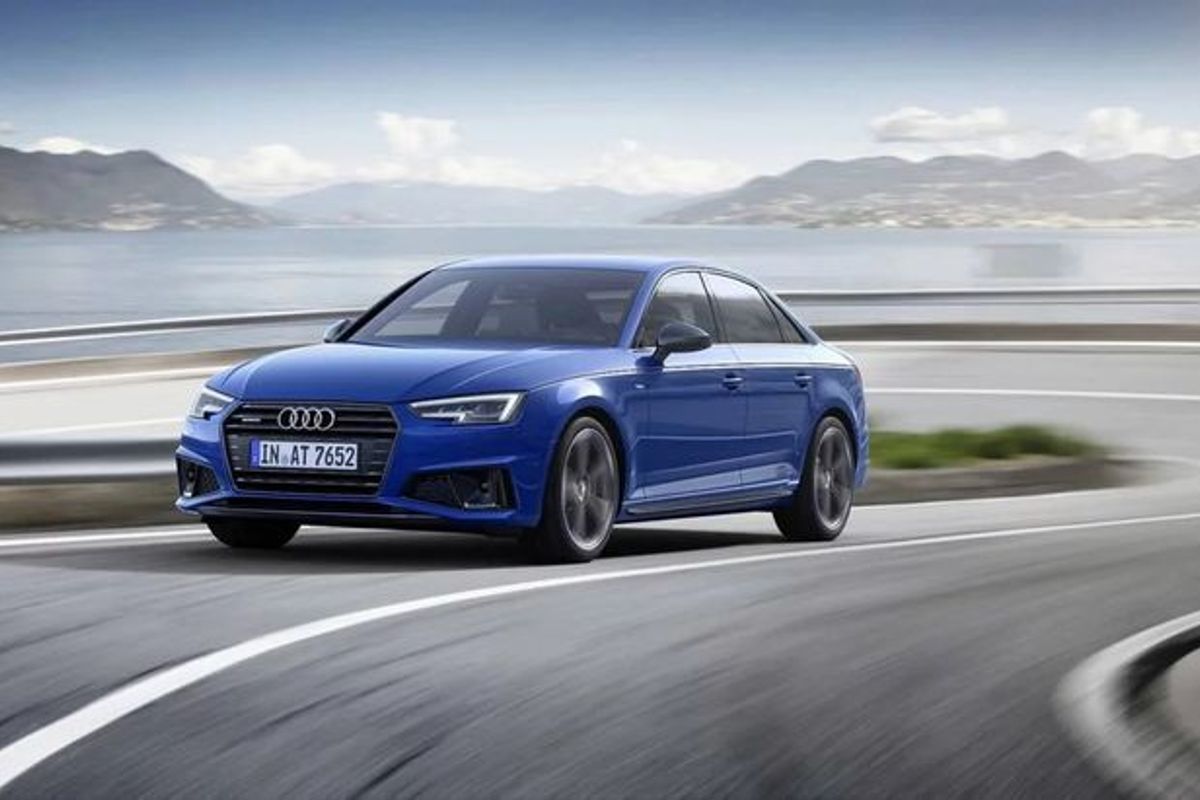
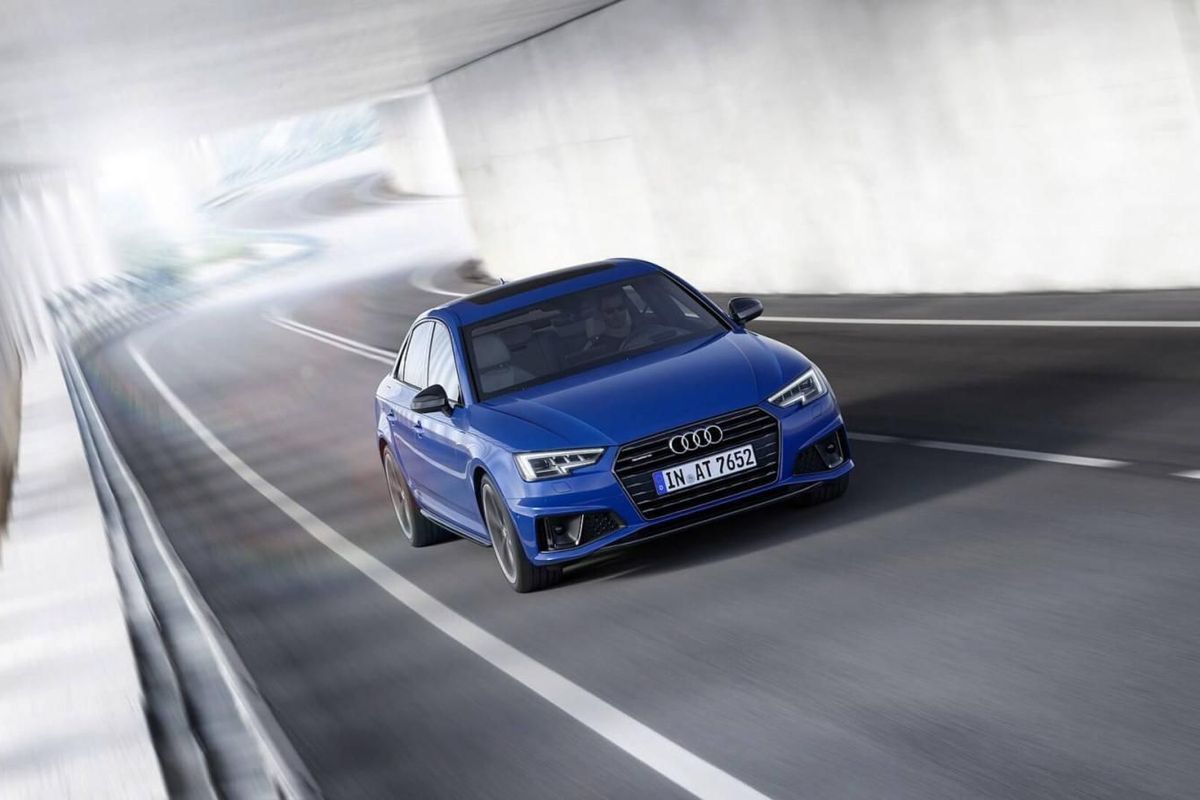
Audi has revealed a visual refresh of its A4 midsize sedan which now features a more striking exterior design which will be offered in South Africa in October 2018.
The Audi A4’s biggest rivals are the BMW 3 Series and Mercedes-Benz C-Class and while the current A4 is an impressive product, the Ingolstadt-based brand has implemented subtle changes to keep the A4 fighting fit. What you see here is merely a product refresh with the facelifted A4 only expected in 2020.
What’s changed?
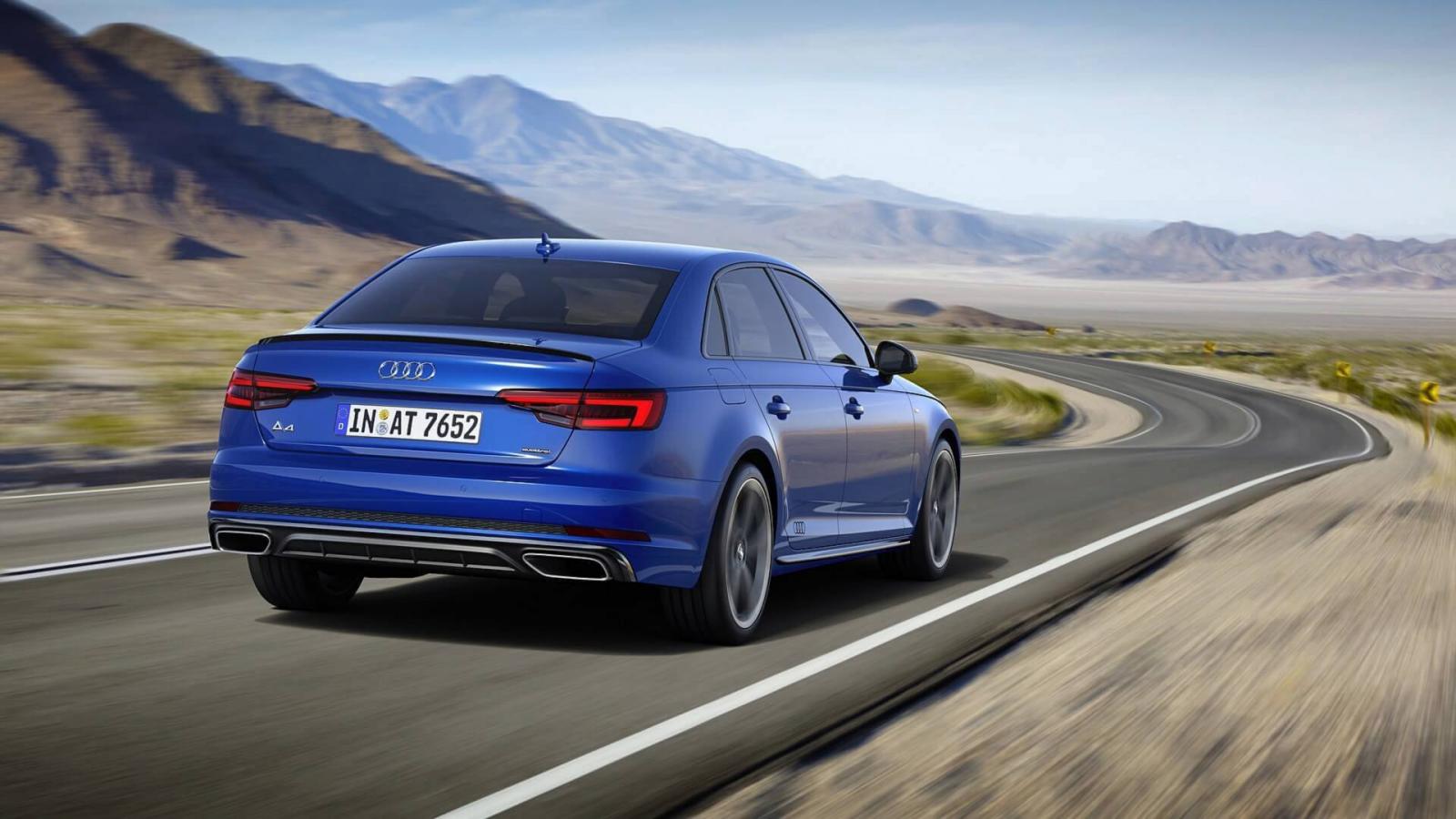
A new S Line Competition trim gives the A4 a more assertive look.
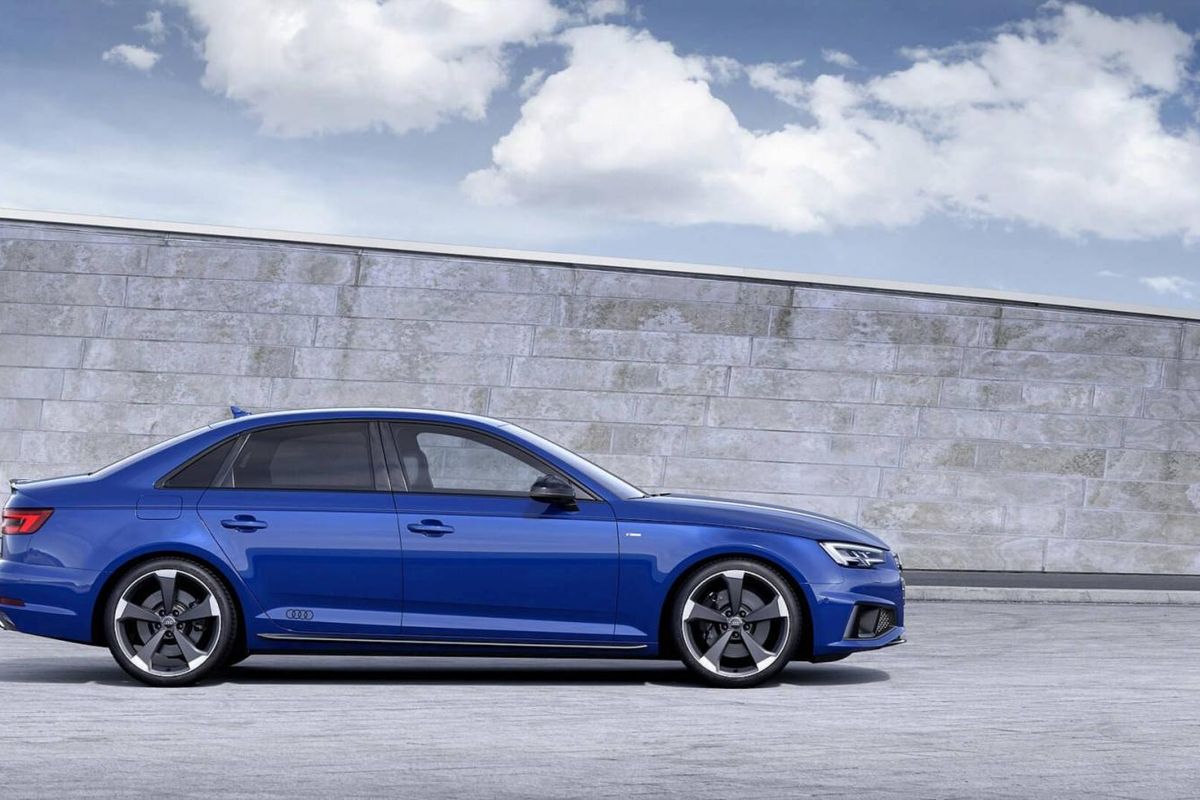
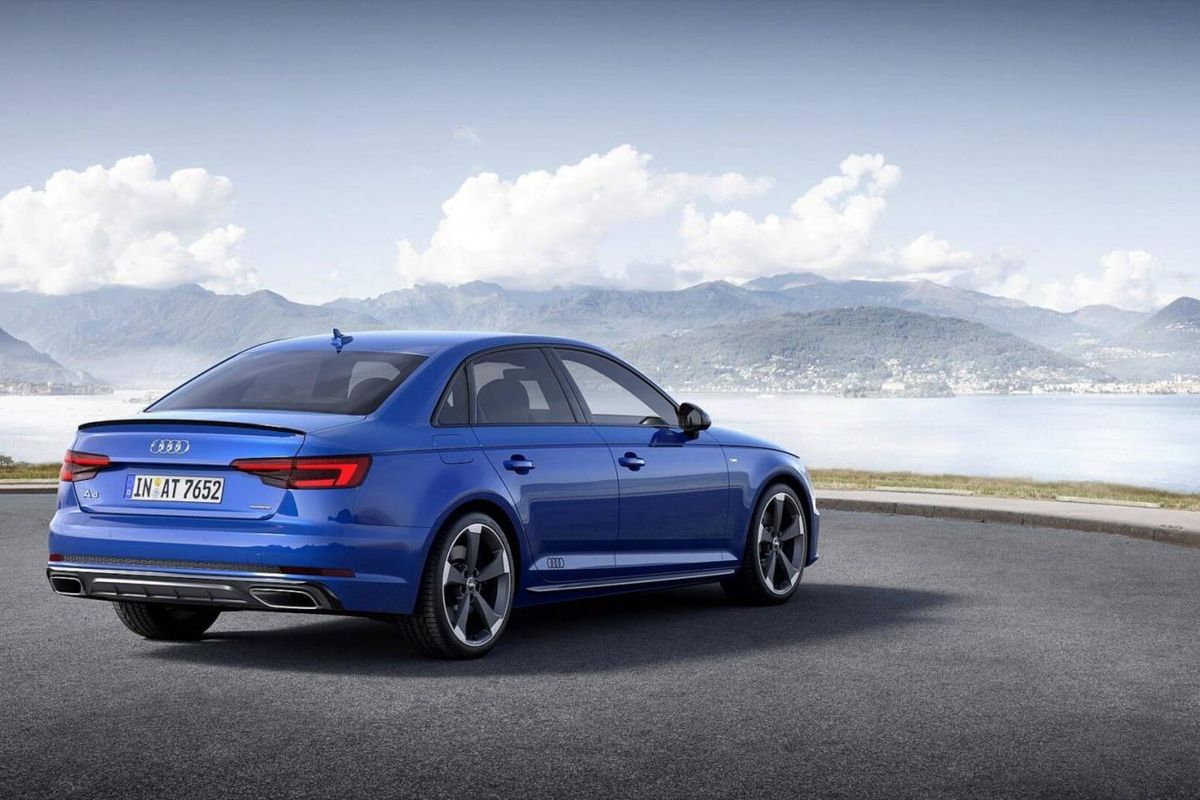
The exterior changes are subtle but nonetheless receives revised front and rear bumpers and new alloy wheel designs ranging from 16- to 19-inches. Also, Audi will offer the A4 with a new S Line Competition equipment line in addition to the Design and Sport offerings, each with their own grille design and pentagonal contours now surrounds the air inlets.
In S Line Competition guise, the A4 can be had in Turbo Blue paint finish and the grille features slats with a 3D look and the front and rear bumpers are sportier than the other trim lines. This bespoke model also features a blade on the lower front bumper as well as a stone-chip guard strip in selenite silver. Audi’s 4-ring logo, in either black or silver, appears on the lower section of the rear doors and it rides on Audi Sport 19-inch wheels with red brake calipers, sport suspension and comes equipped with full LED headlights.
The tailpipes are wider and trapezoidal in shape which replaces the previous round tailpipes and the diffuser area is now narrower than before.
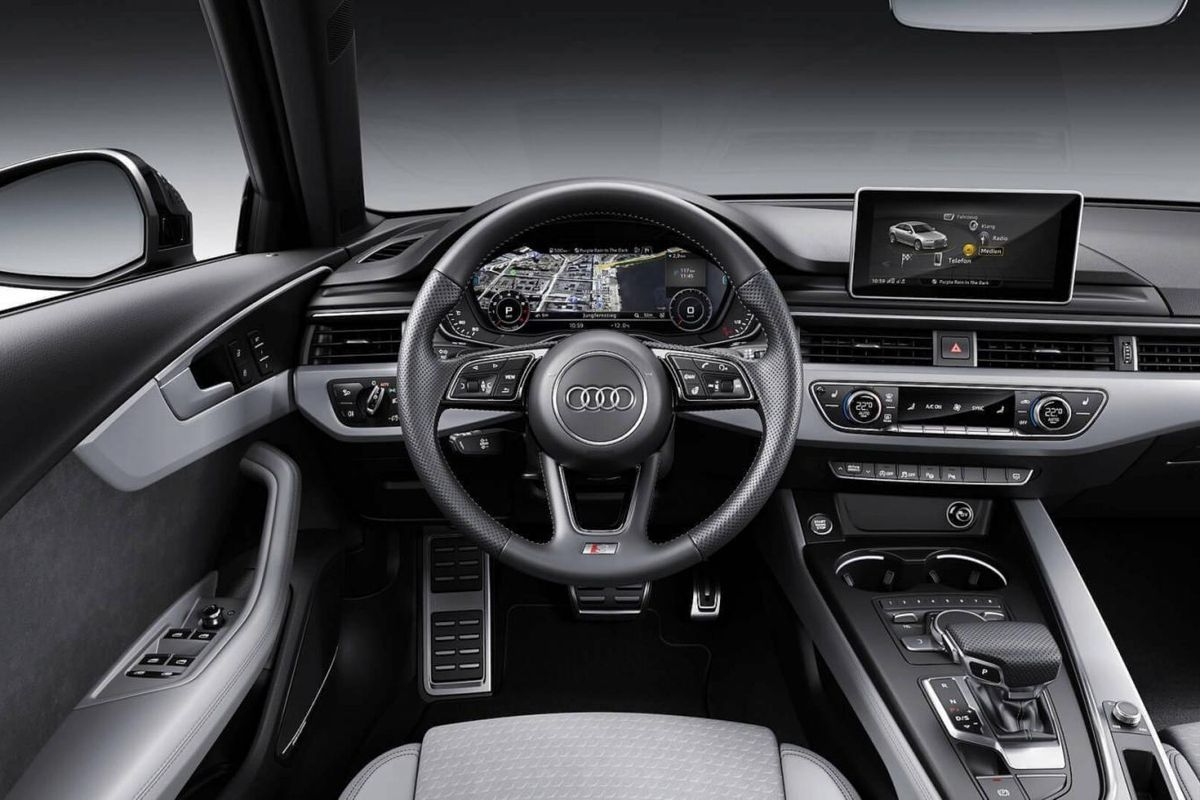
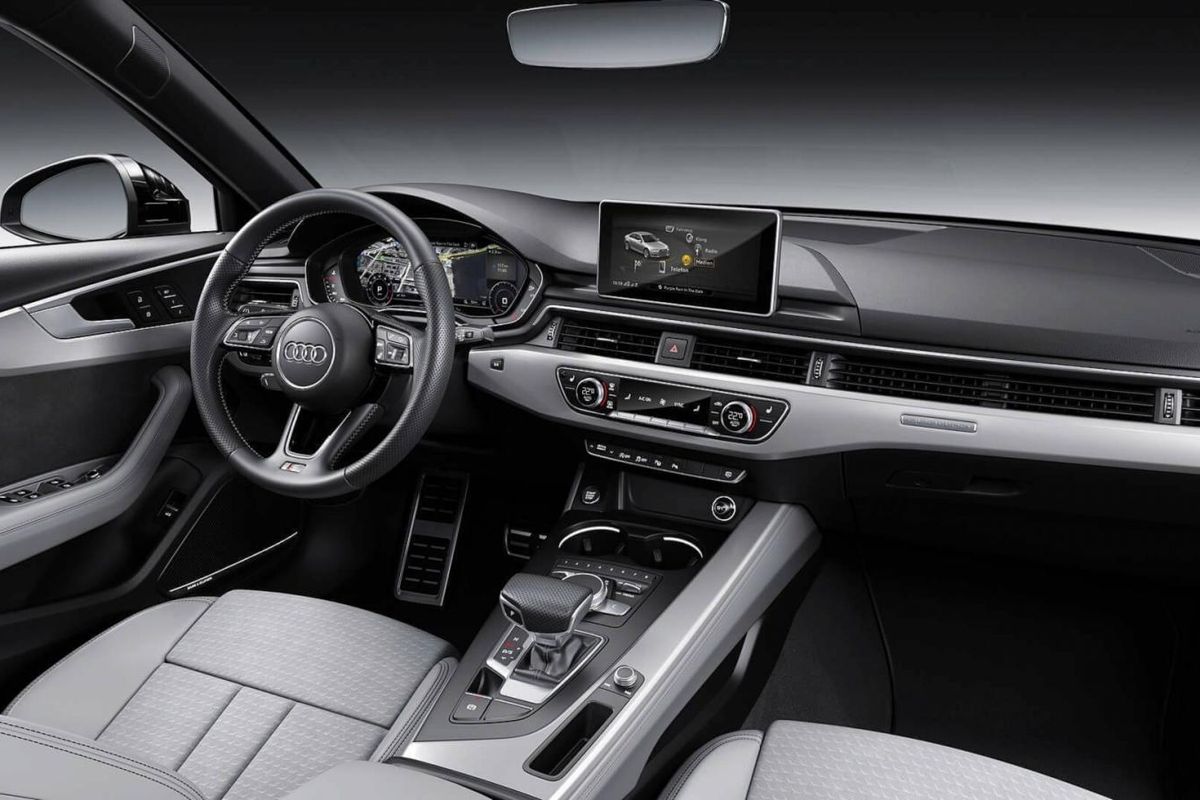
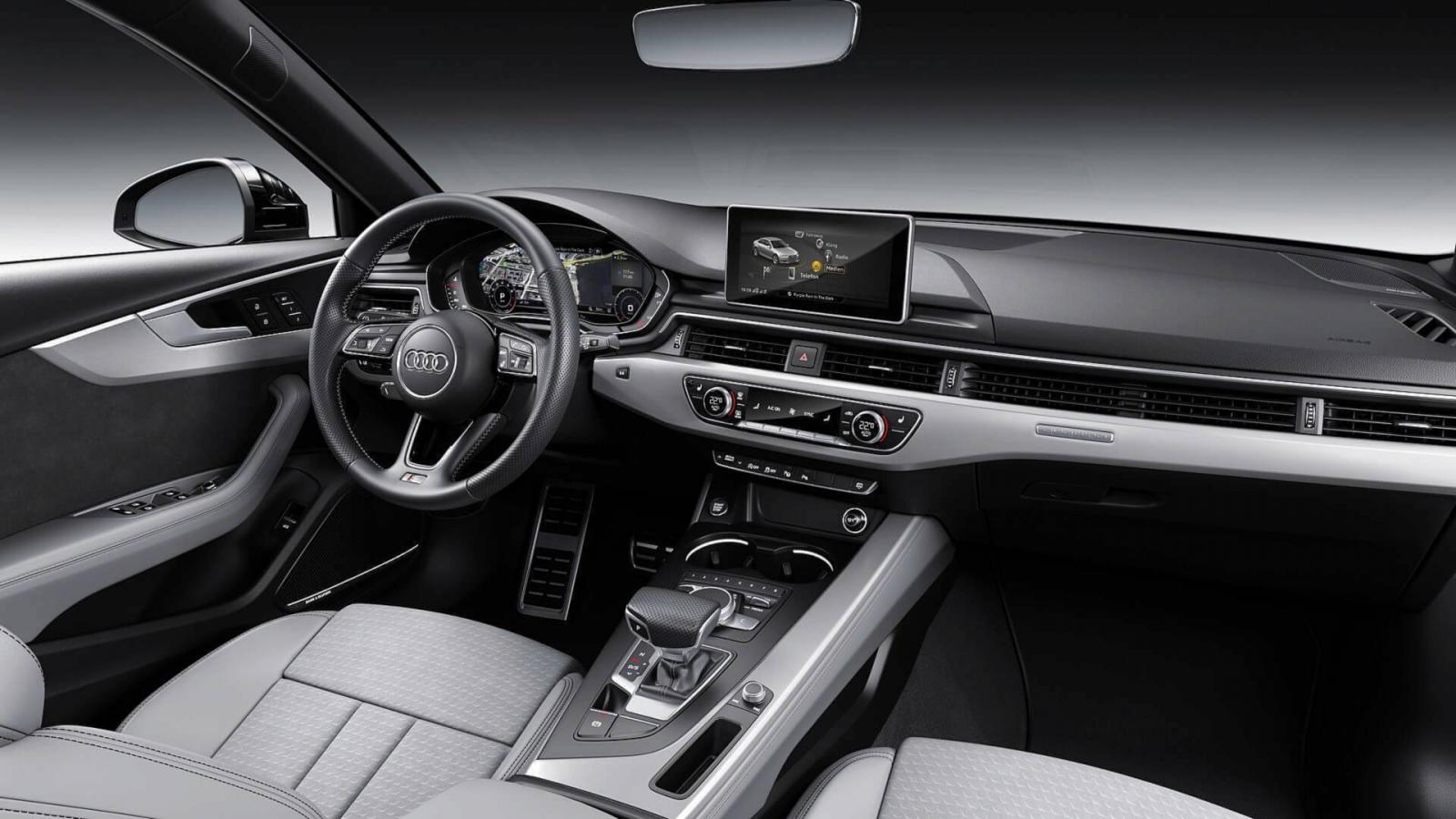
Sleek and modern, the A4's interior is arguably the best in its class and the Virtual Cockpit remains a highlight.
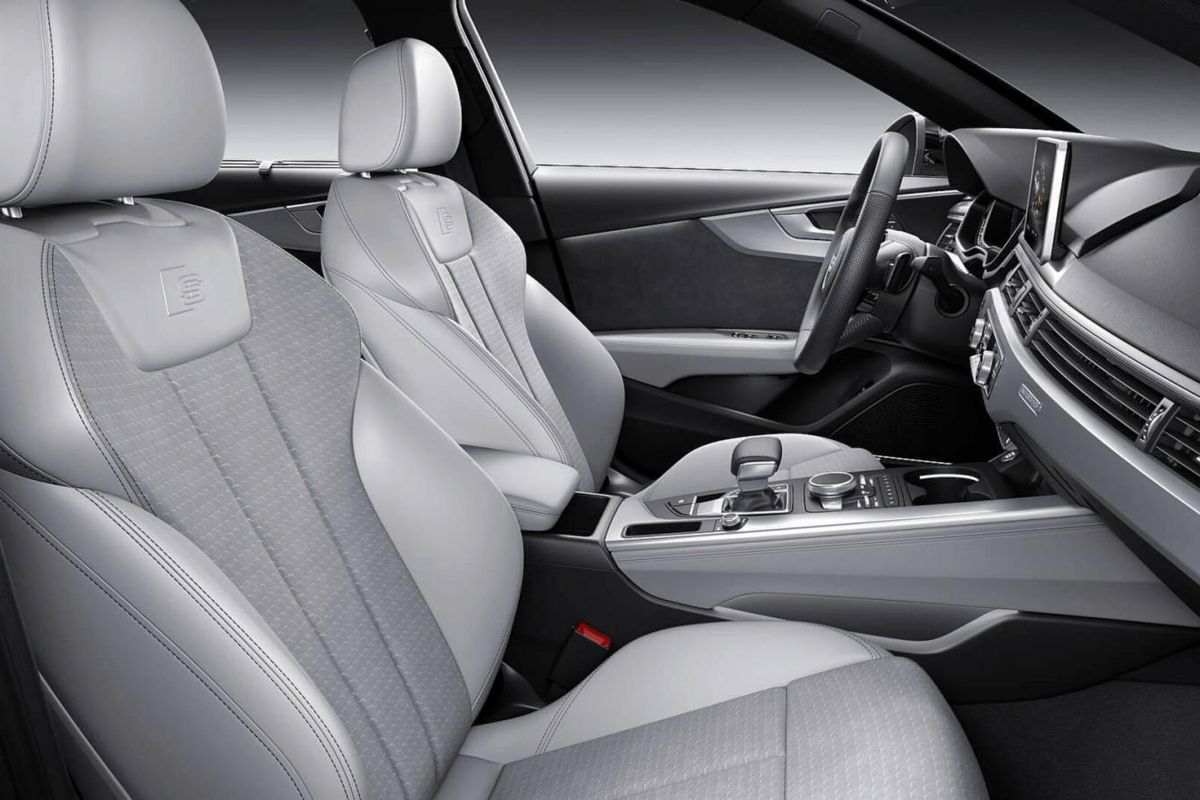
As for the interior, it’s much the same with Audi’s MMI system and Virtual Cockpit taking centre stage. However, the A4 S Line Competition adds carbon fibre inlays, a 3-spoke multifunction steering wheel and black partial leather sports seats. S sports are offered as an option and will be available in a range of colours.
In terms of engines, the current range of turbocharged petrol and diesel engines will remain unchanged. Currently, a 1.4-litre turbopetrol engine with 110 kW/250 Nm and a more powerful 2.0-litre turbopetrol with 140 kW/320 Nm does service in the A4.
There’s also a 2.0-litre turbodiesel engine on offer with 140 kW and 400 Nm of torque. All engines are mated with a 7-speed automatic dual-clutch transmission.
We will keep you updated as local specification and pricing details become available.
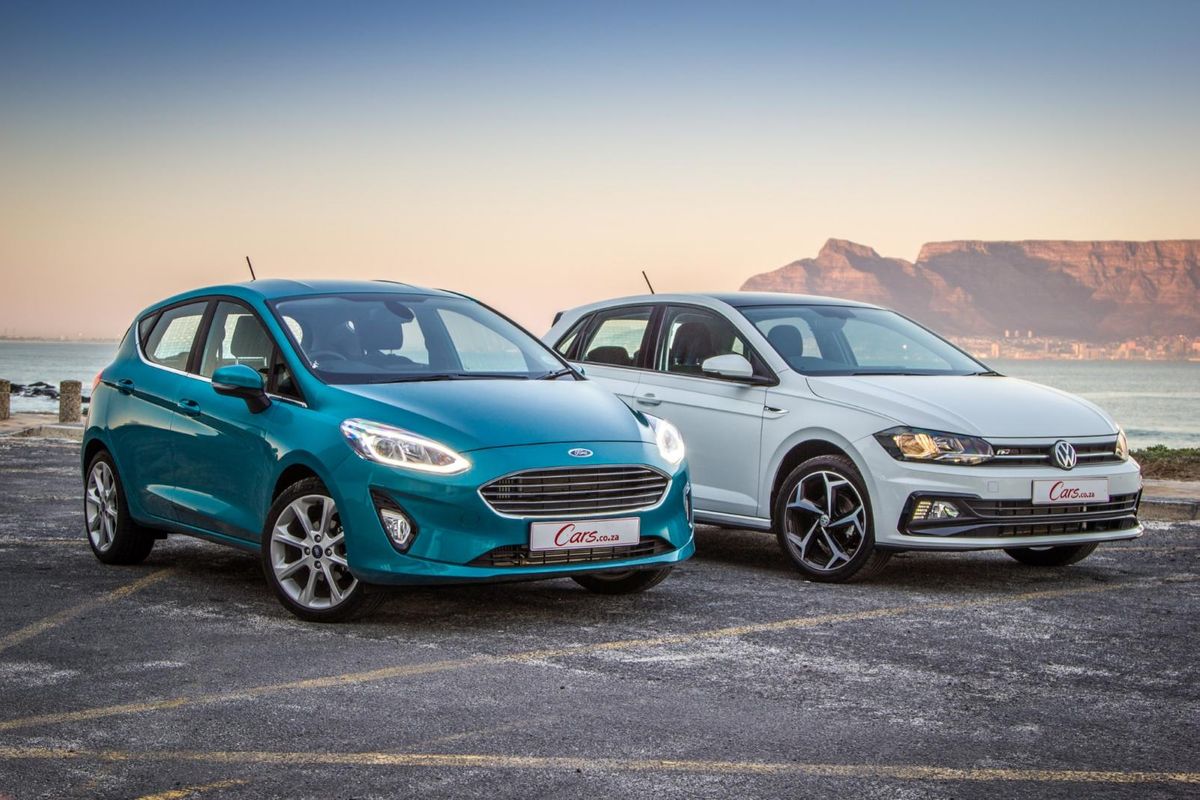
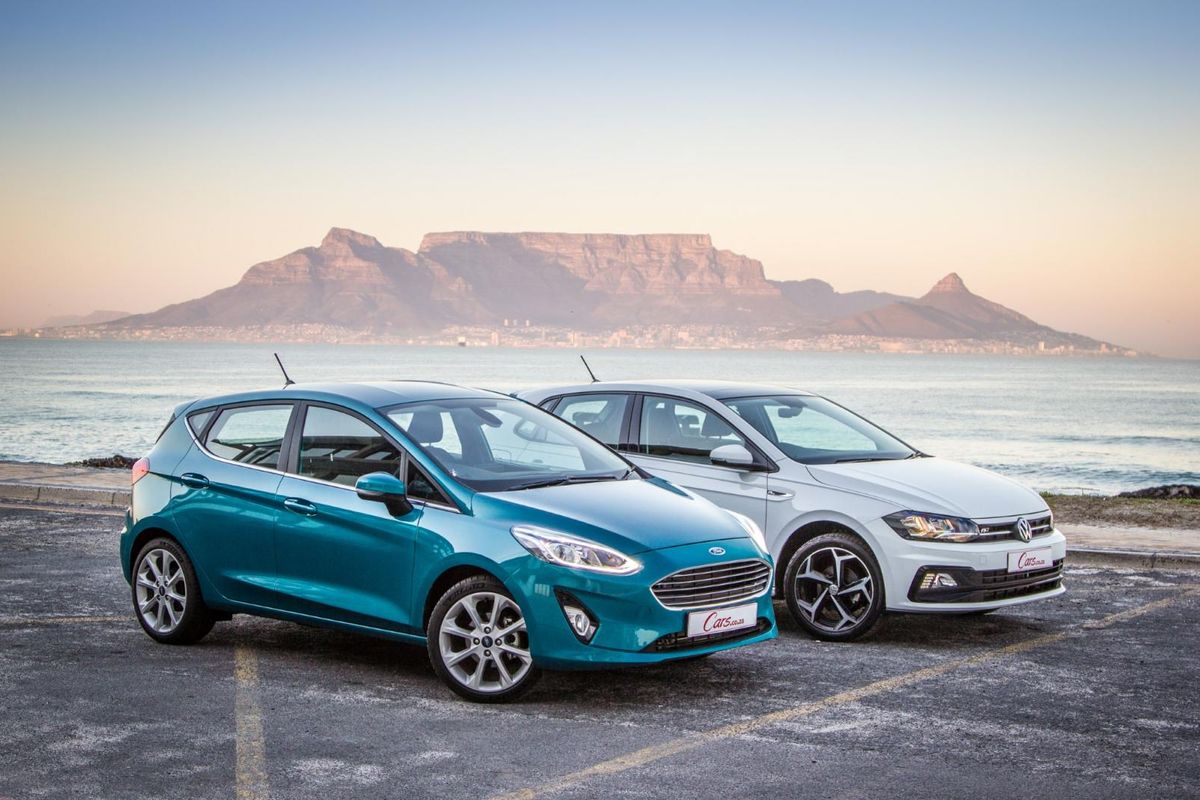
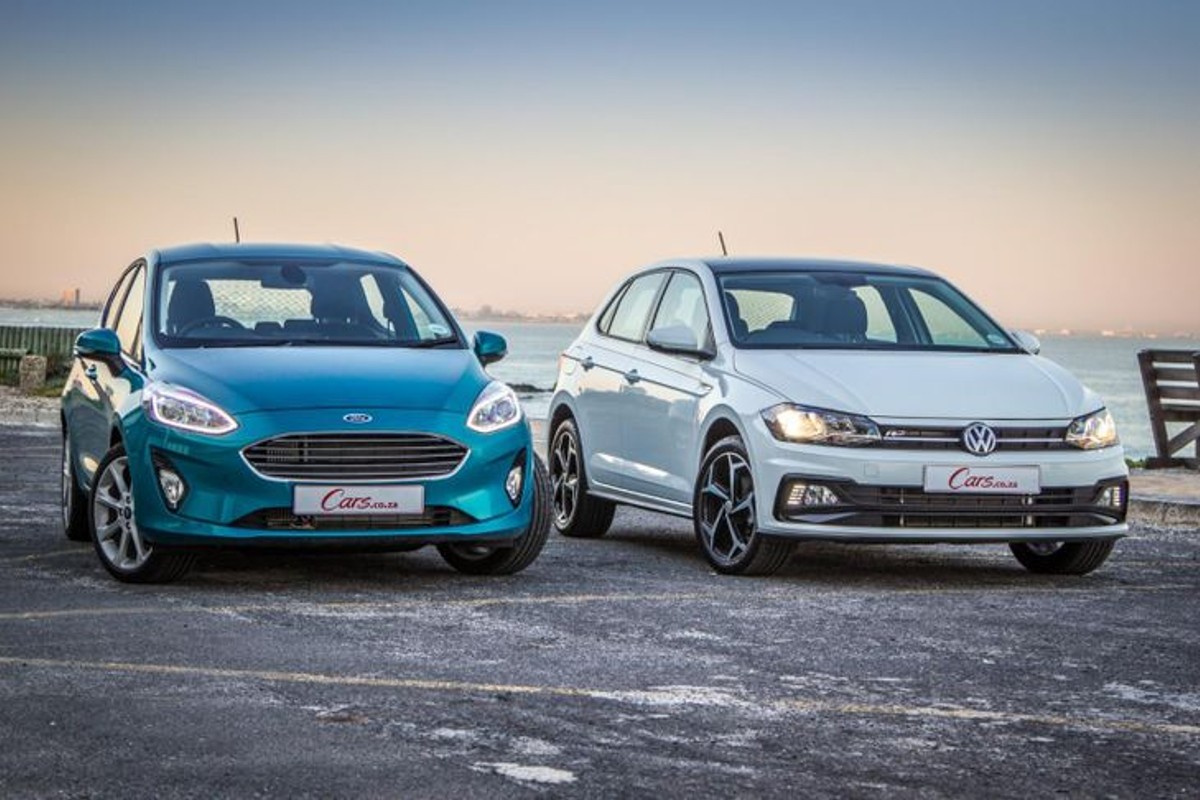
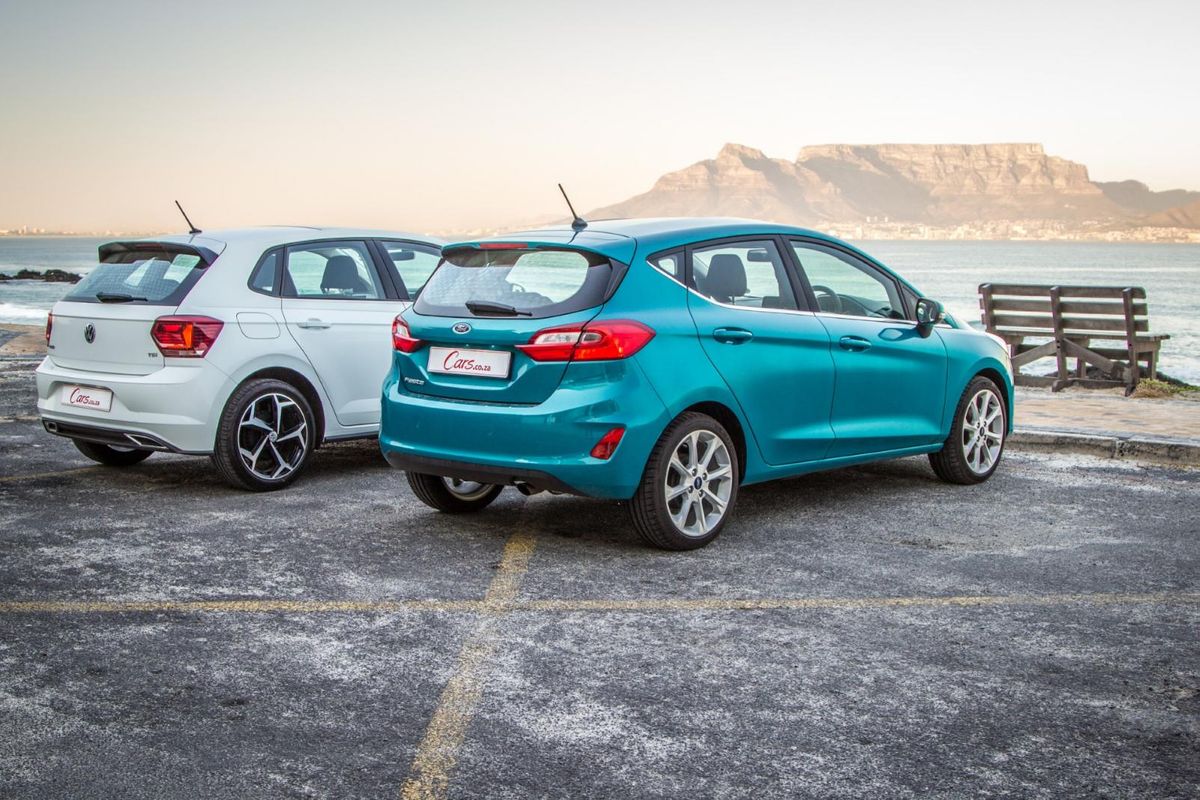
The hottest of modern-day hatchback rivalries resumes as the new Fiesta takes on the only slightly less new Volkswagen Polo.
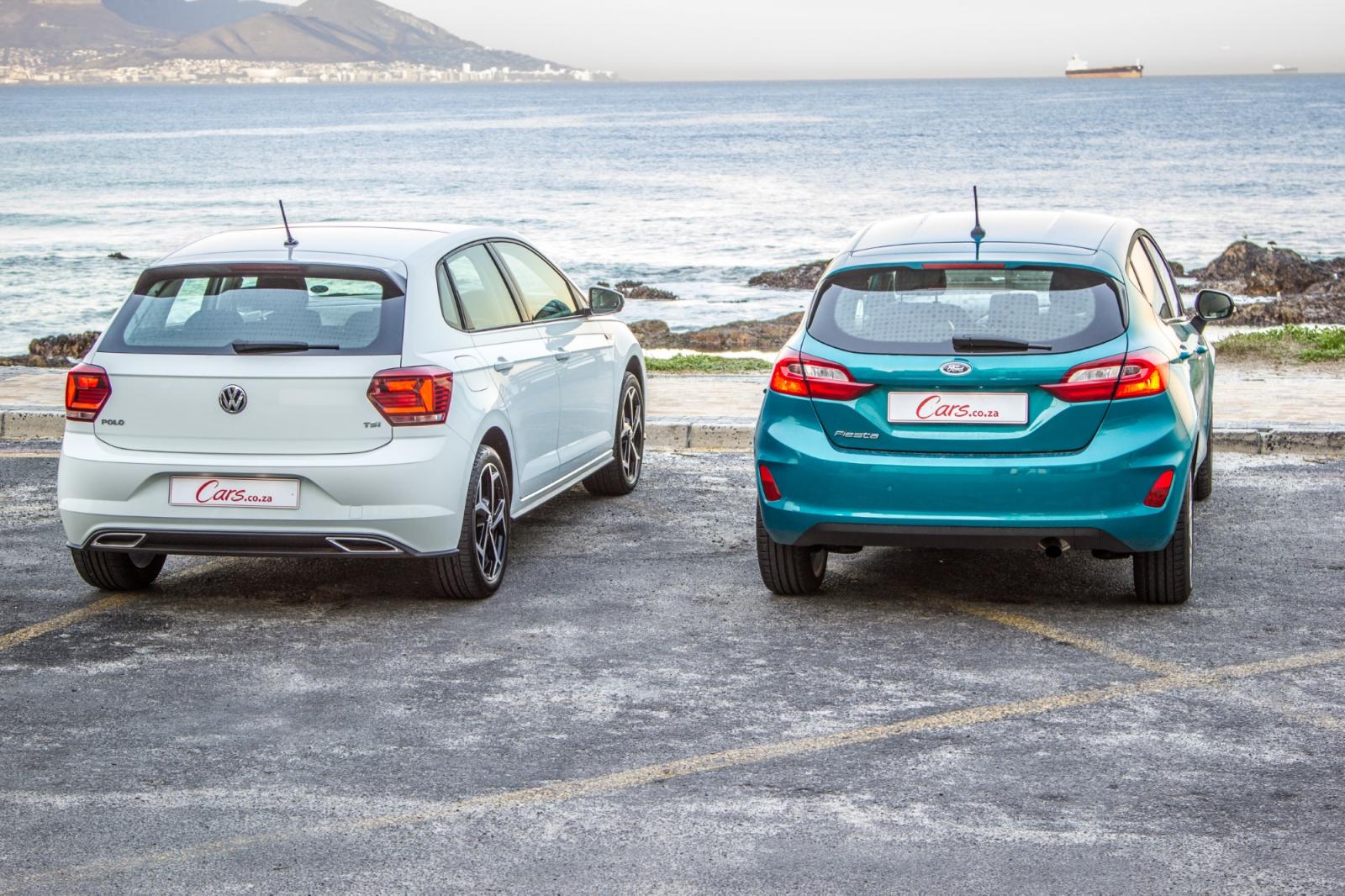
Both the Ford Fiesta and the Volkswagen Polo are new for 2018. It's a rivalry that has gone on for over a decade in South Africa with the Polo winning out on sales but the Fiesta winning in value for money and driving satisfaction.
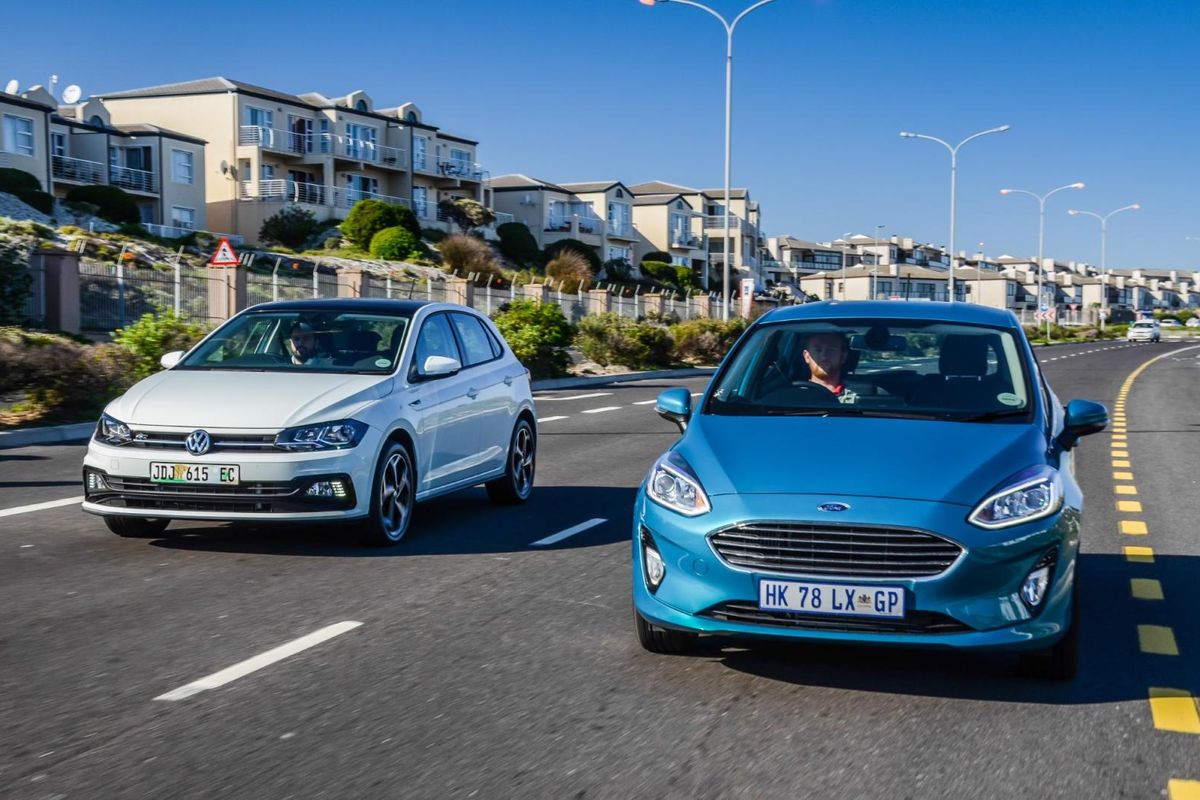
We pit the 2 remakes against each other with the top-of-the-range Fiesta 1.0 Titanium Auto against the Polo Comfortline R-Line Auto.
No sitting on the fence in this review, take a look at which one comes out on top.
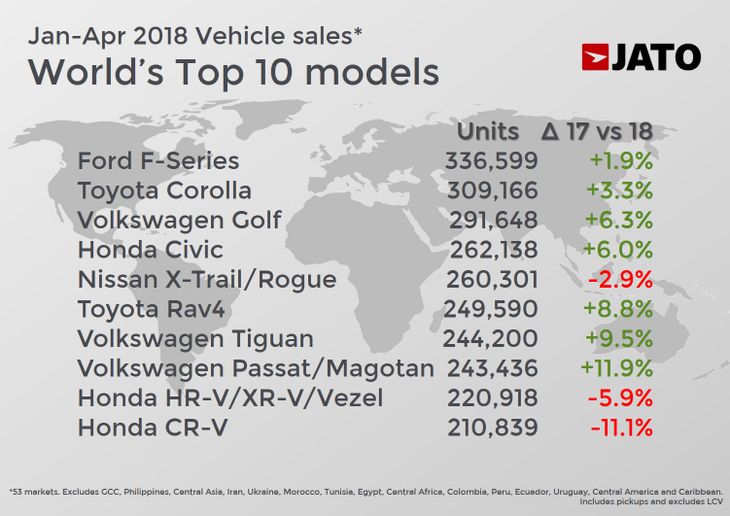
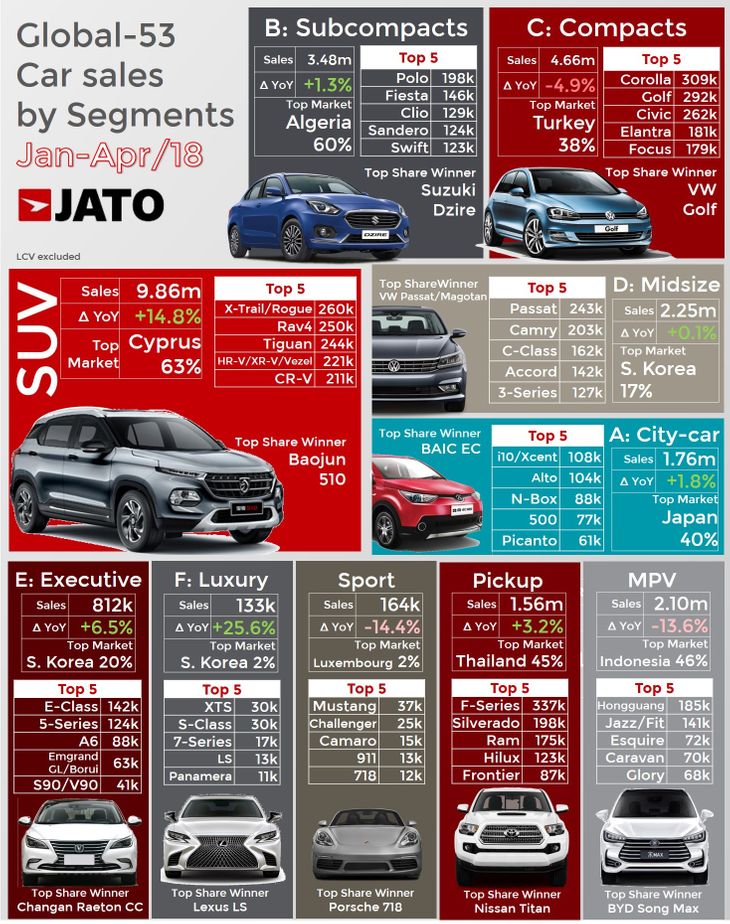
Which brands and cars sell the best around the world? We take a look at how current buying trends are developing and which vehicles are milking sales globally.
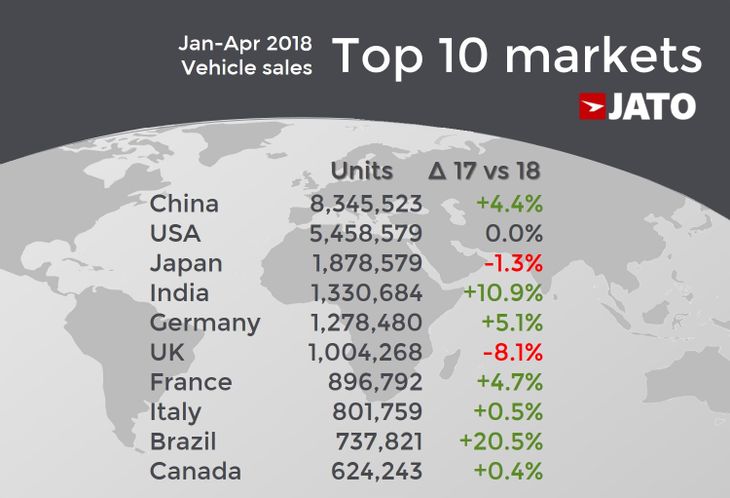
China is now the biggest car market in the world, and by some margin. For the first 4 months of 2018, it racked up 8.3 million vehicle sales. The USA is the second biggest, recording 5.5 million vehicle sales in the same period. Overall, January to April sales for 2018 are up 3.4% over the previous year, which is mostly down to continued global growth. Total sales for the first 4 months of the year reached 28.81 million units.
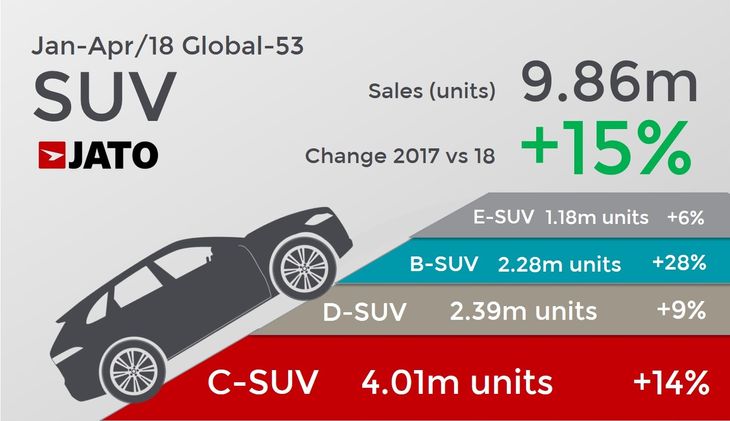
The rise of the SUV continues unabated as the segment notched up 34% of the global market share. That makes it the segment with the most combined sales. The Nissan X-Trail tops SUV sales but it’s followed closely by the Toyota Rav4 and Volkswagen Tiguan. The segment seems to be seeing intense growth in the compact SUV segment where vehicles like the Renault Captur, Volkswagen T-Roc, Nissan Kicks and Honda HR-V are big sellers. The rise in SUV sales has seen MPVs take the biggest hit losing 13.6% market share in the first 4 months of 2018.
The world’s top-selling vehicle continues to be the Ford F-Series pickup, which dominates the American market, where it sells 85% of its volume. The big pickup has sold 337 000 vehicles so far this year. The top 10 is littered with Japanese cars and notably 3 different variations of Honda. This certainly brings to light the demise of Honda locally that has seen sales slowly dwindle away over the last few years. At number 8 is the Volkswagen Passat, which sells in large numbers as the Magotan in China, a market that seems to single-handedly keep the sedan market alive.
As for the big global rivalries, Mercedes-Benz appears to have the upper hand over BMW, outselling it in C-Class, E-Class and S-Class segments. Toyota and Volkswagen trade top spots in the compact and midsize segments, Corolla outselling Golf but Passat beating out Camry.
The Korean brands do a good job of locking down the small city cars with vehicles like the Hyundai i10 and Kia Picanto in the top 5 in the segment. Somehow the decade-old Fiat 500 continues to turnover useful numbers in the same segment.
Americans dominate the sportscar segment, showing the country’s purchasing power for more expensive vehicles. The Ford Mustang tops the leaderboard followed by the Dodge Challenger and then the Chevrolet Camaro. Porsche’s 911 and 718 follow closely behind.
Mercedes-Benz Sprinter (2018) International Launch Review
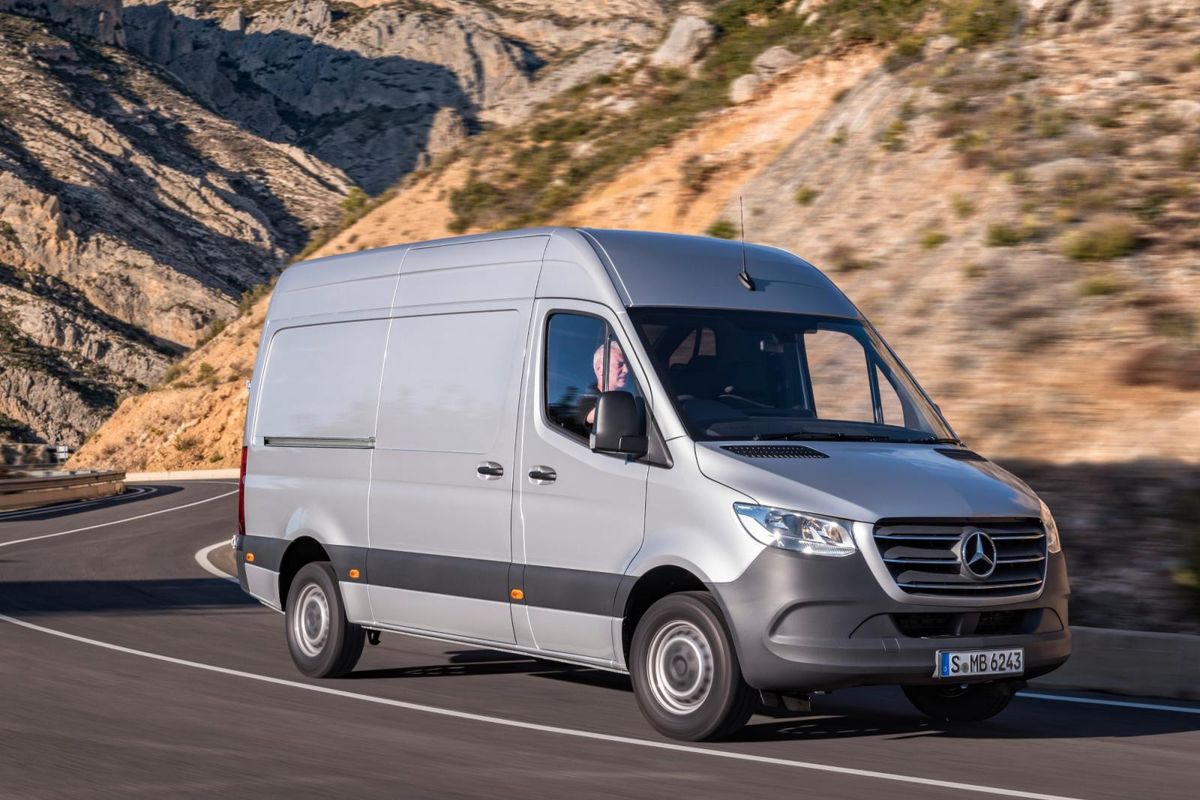
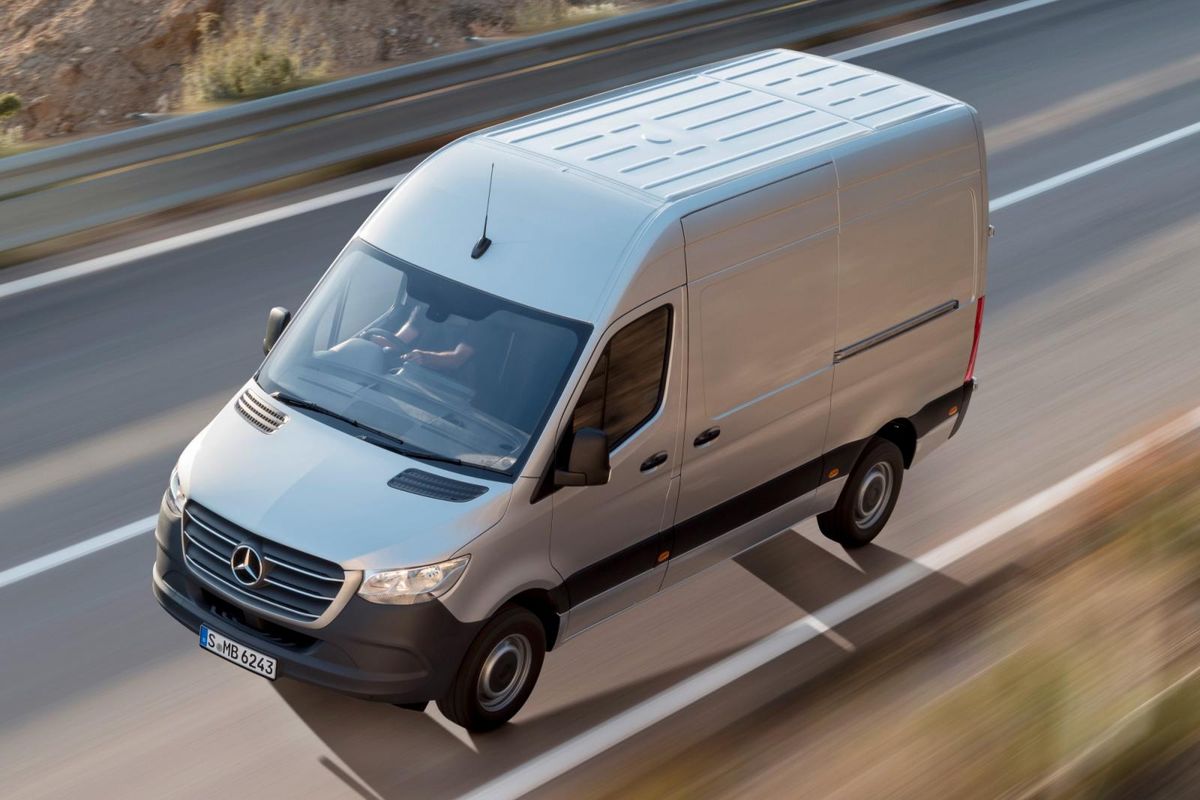
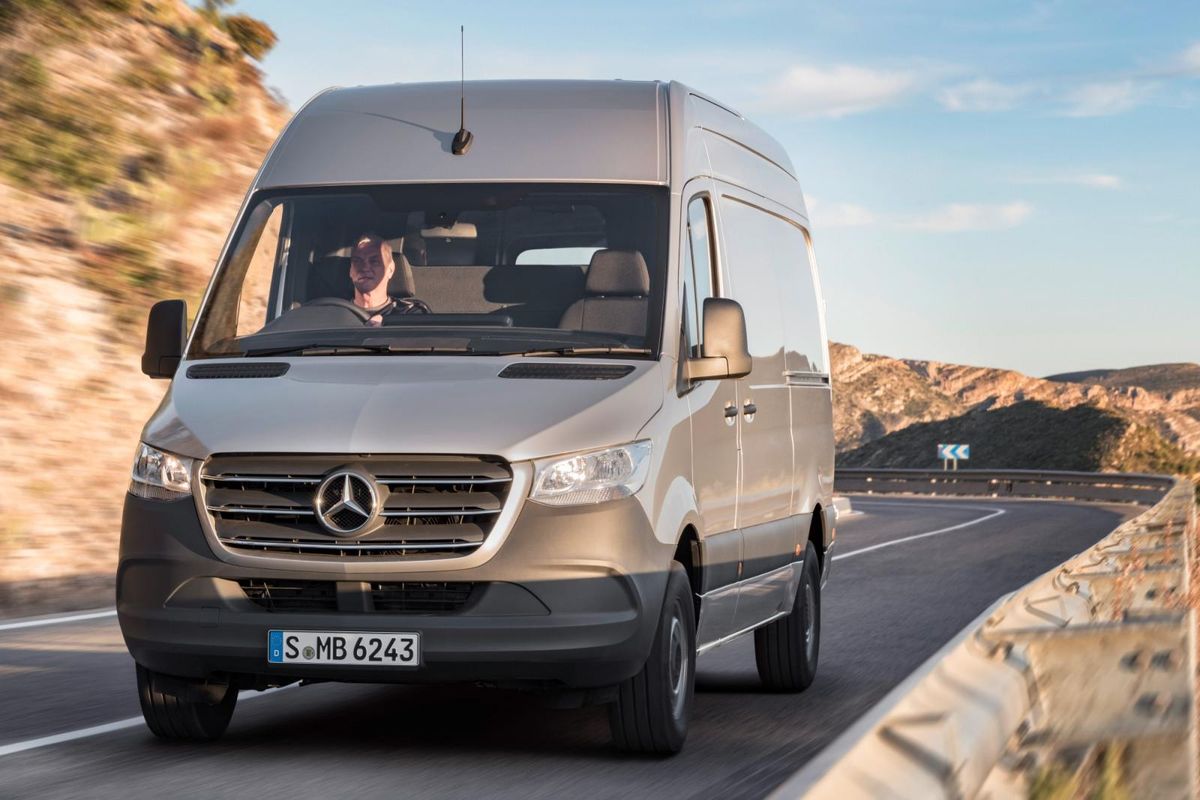
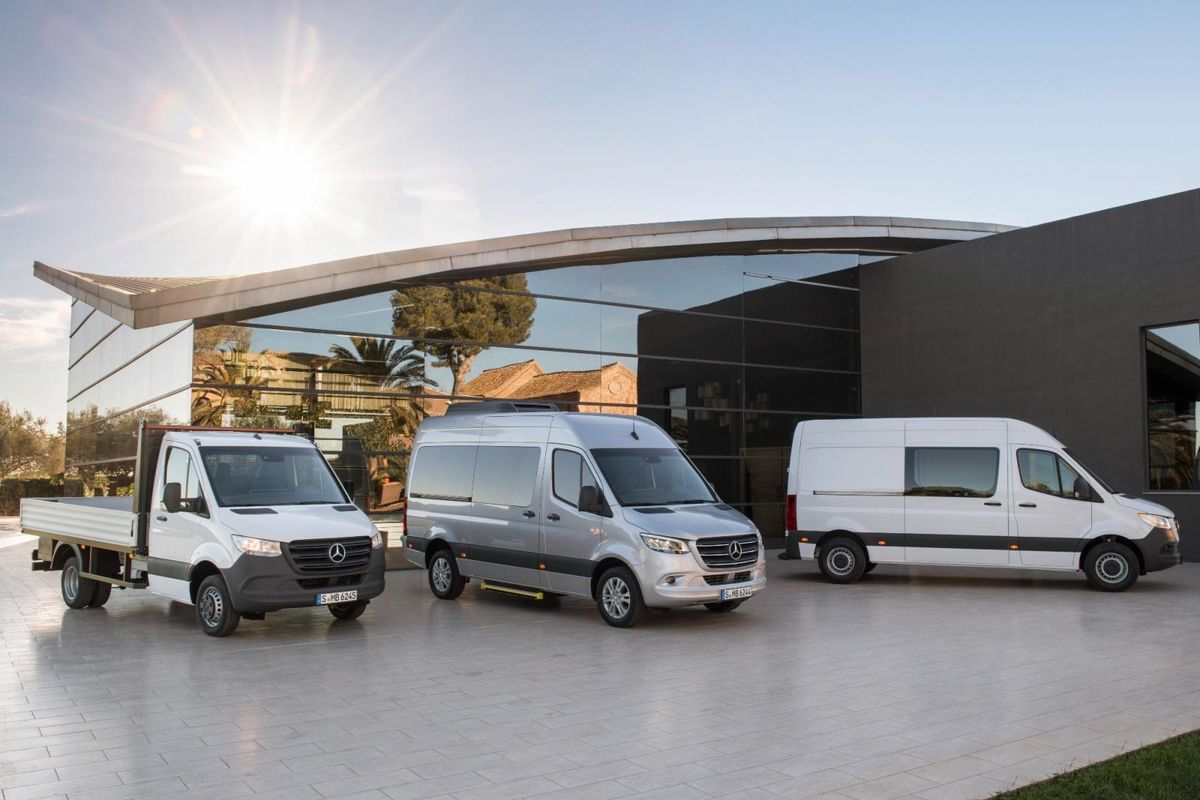
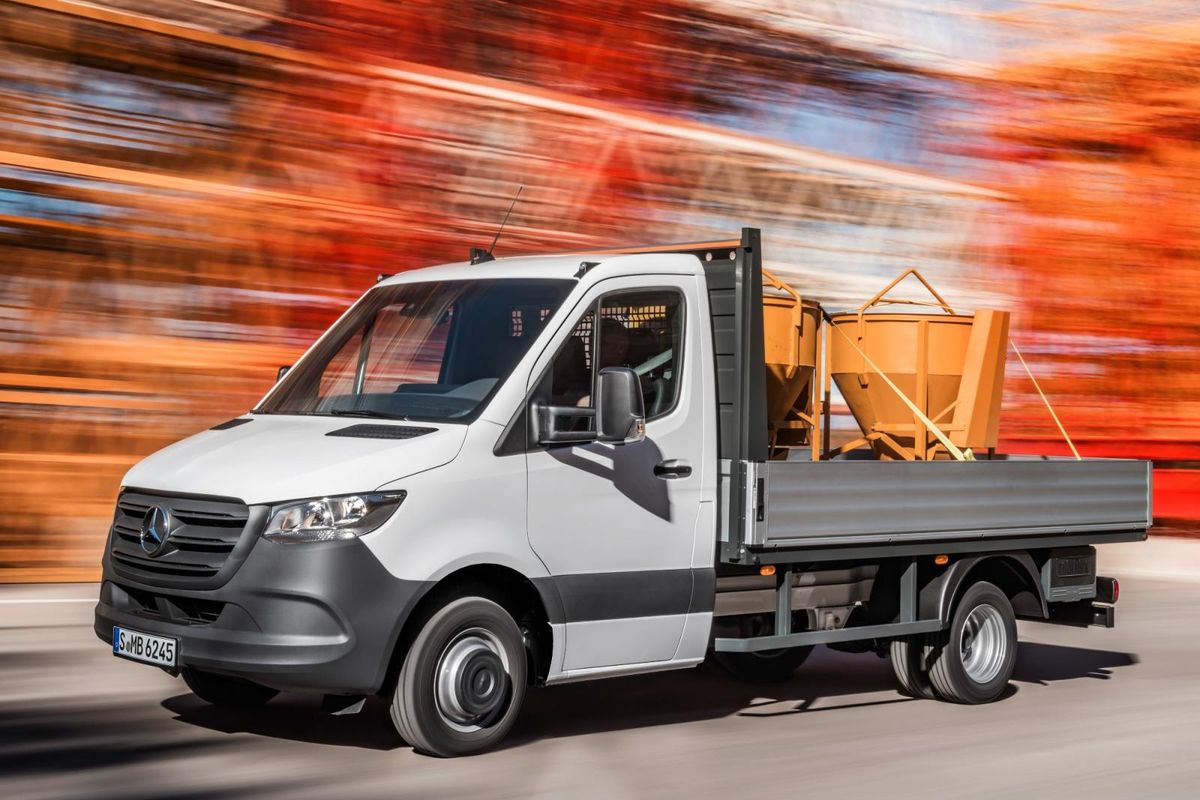
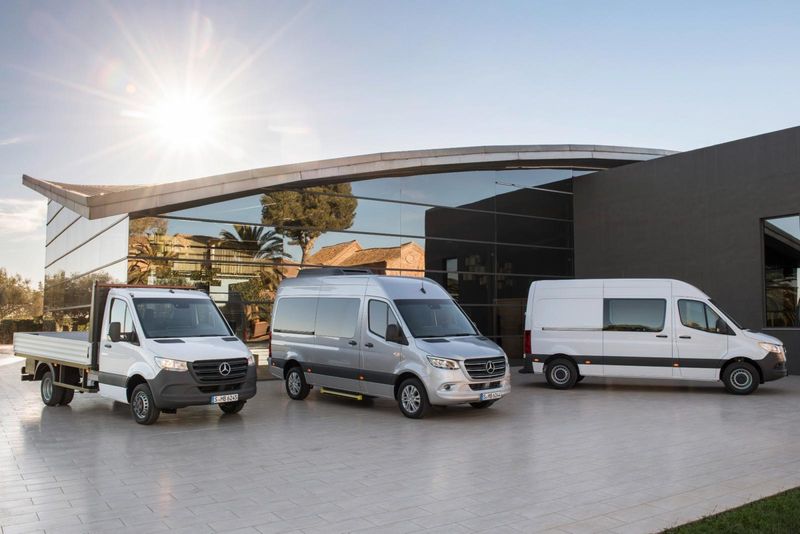
Available in a staggering 1 700 configurations and packed with the latest comfort and safety technologies from Mercedes-Benz, the new Sprinter family of vehicles attempts to redefine the commercial van category. It arrives in South Africa early next year and we had a preview drive in Slovenia.
With more than 3.4 million units of the first two generations of Sprinters delivered in 130 countries worldwide to date, this "van" is a massively important product in the Three-Pointed Star's portfolio. But according to Mercedes-Benz's Volker Mornhinweg (head of Vans), the logistics game is changing, and for that reason the "variability and availability of customer-specific solutions are the essential success factor", he explains.
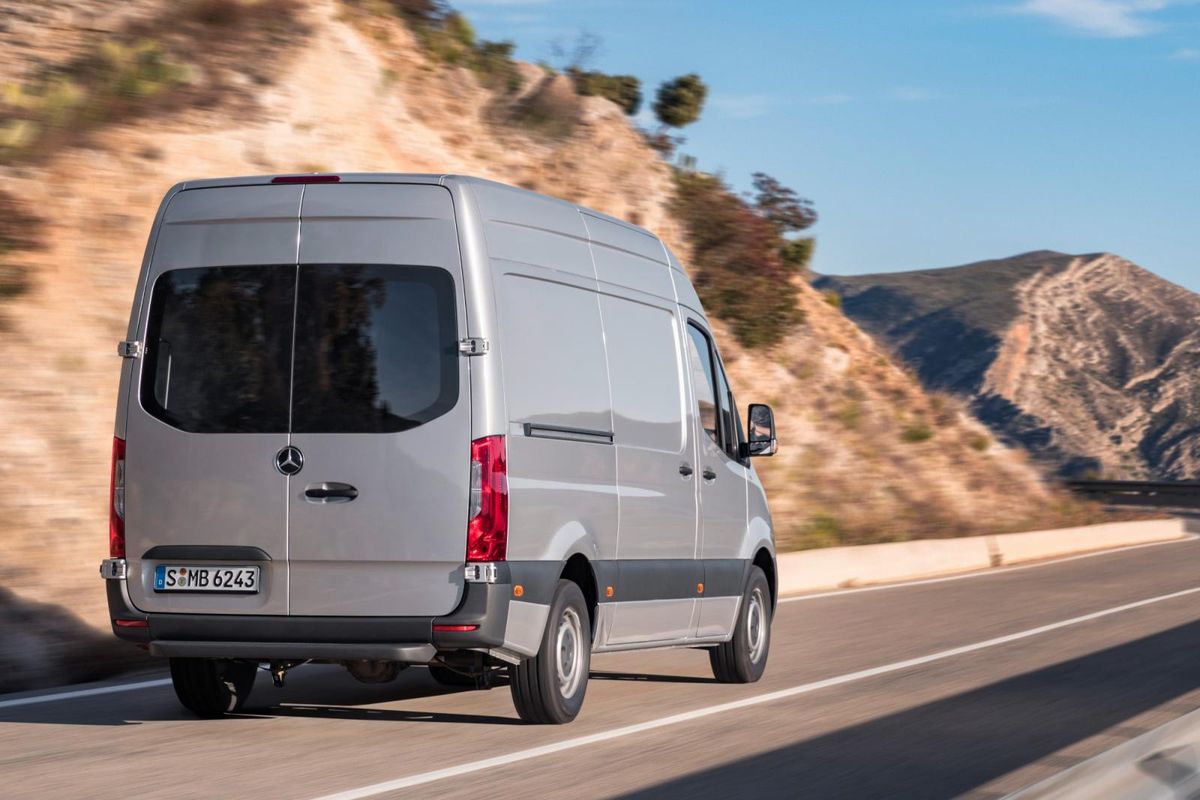
Choices, choices… the new Sprinter is available in a vast variety of configurations.
So… consequently you can have your Sprinter pretty much any which way you want it – choose from front-, rear- or all-wheel drive, various engines/transmissions (even electric), different body types, cab designs, load compartment heights etc. There appears to be a Sprinter for every purpose.
Of course, we could not drive all the different variants, and instead jumped into a high-roof 316 TDI, which looked like your typical hard-working panel van.
The S-Class of vans?
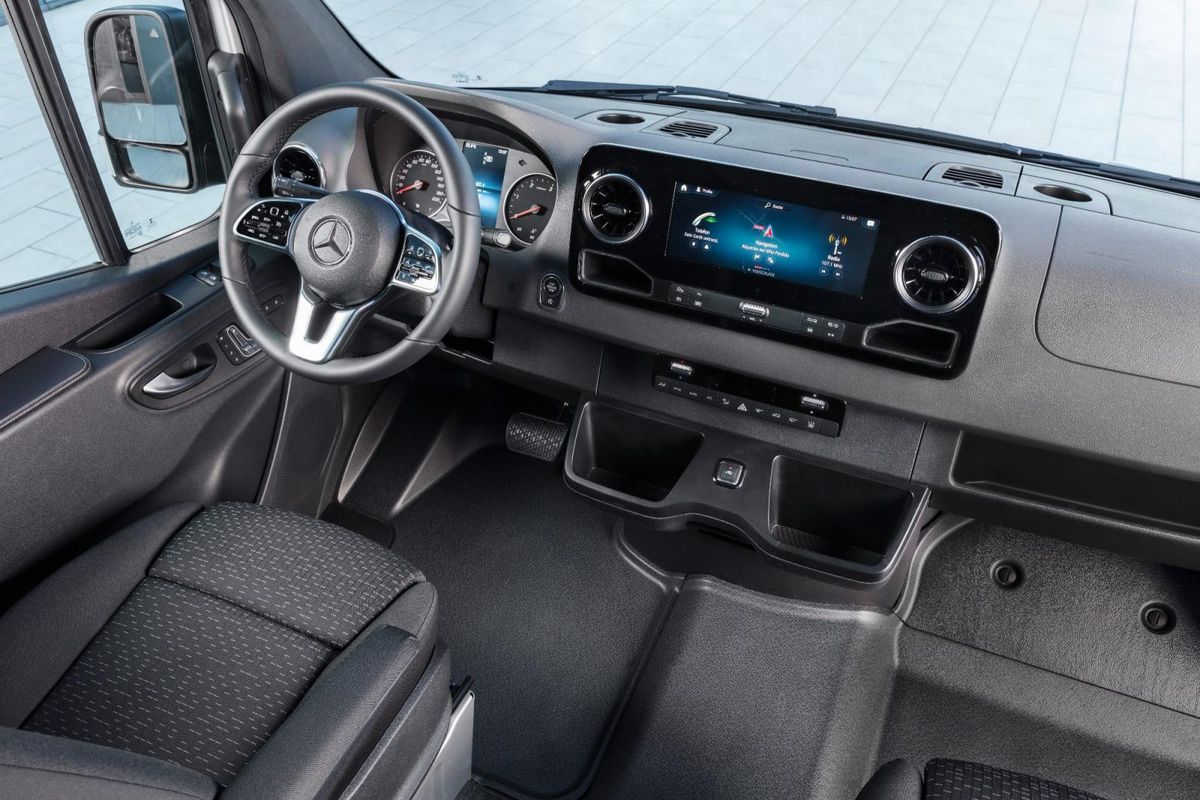
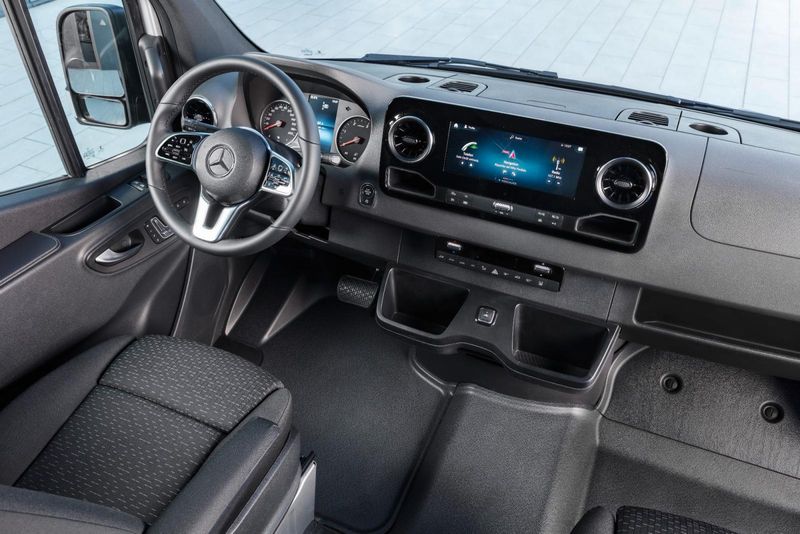
Hop up and into the commanding driver's seat and you're likely to be taken by suprise by the modernity and "luxury" in this supposed workhorse. It's only the second Mercedes-Benz to be available with the marque's new 10.25-inch MBUX infotainment system (after the A-Class) and it's by no means the only nod to modern tech and convenience.
Not a bad mobile office! The Sprinter is only the second Mercedes-Benz to get the new MBUX infotainment system.
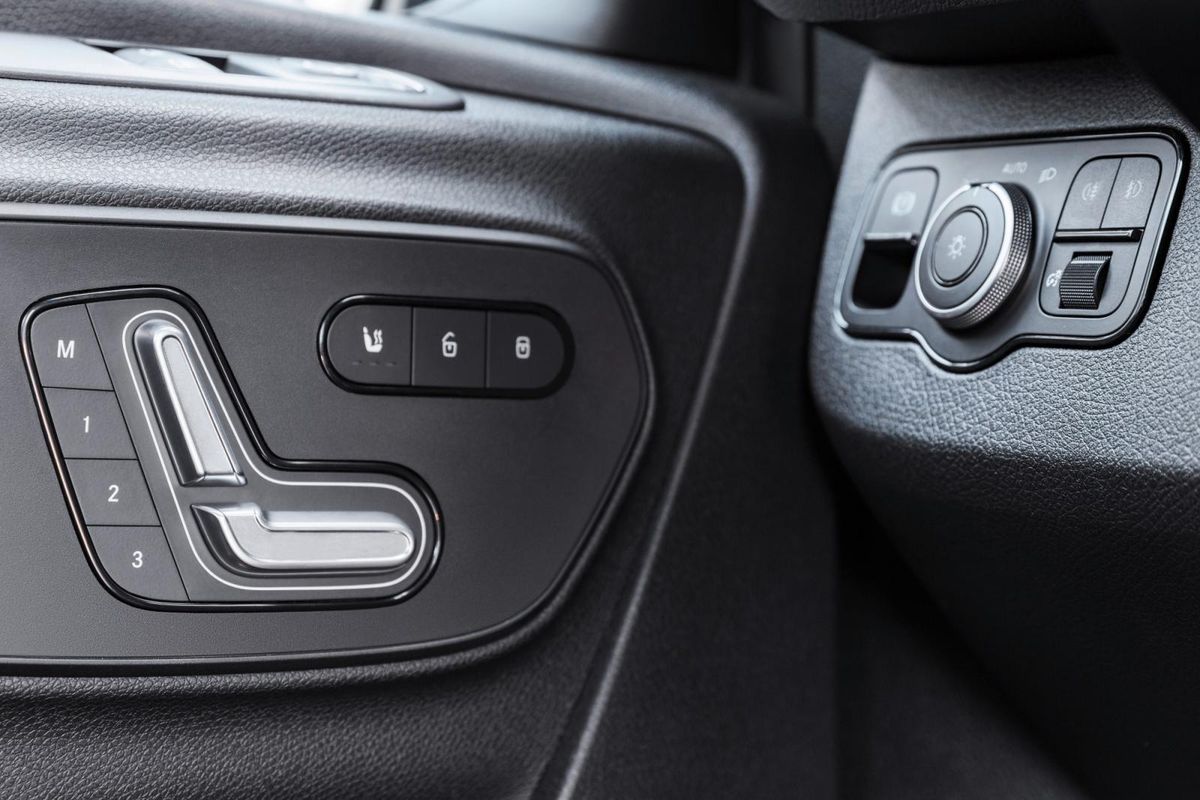
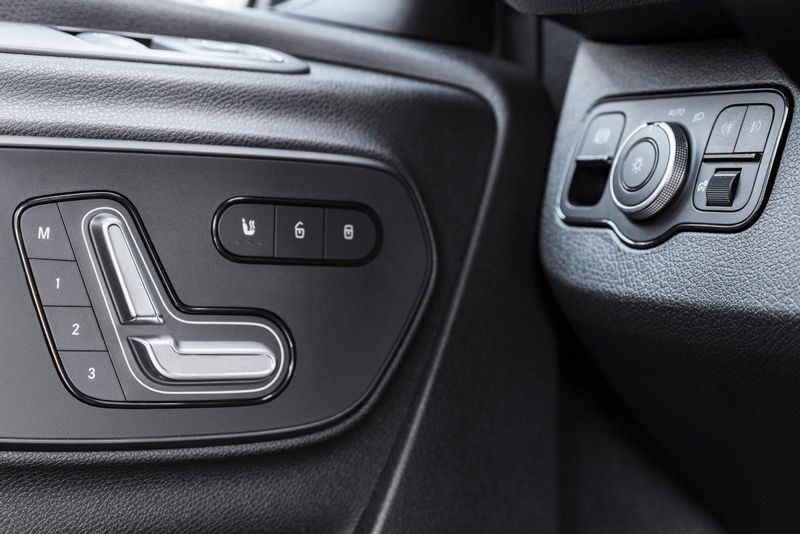
Our test unit's steering wheel was a neat leather-bound item that wouldn't have looked out of place in a sporty Mercedes sedan, and even included buttons for the active cruise control, for example. You can also have a Park Assist package with 360-degree camera view if you want, or even lane assist. The steering wheel is height/reach adjustable and the seat can be electrically adjusted using the same kind of buttons you'll find in any other Mercedes-Benz. The instrumentation is modern and comprehensive, too, and includes a large high-resolution digital display that provides the necessary driving information.
The fancy MBUX infotainment system is not only there to make it more comfortable and pleasant in the cabin for the driver. The new Sprinter features state-of-the-art connectivity hardware and the Mercedes PRO connect services, which have been developed to make fleet controlling easier and more efficient. At the time of its European launch Mercedes-Benz will offer 8 different connectivity services, including Vehicle Supervision, Vehicle Operations, Fleet Communication, Maintenance and Repair Management and a digital Driver's Logbook. The driver can access all these on-line services using the MBUX system (or even voice control). We'll have to wait to find out just how many of the Mercedes PRO services will be offered in South Africa.
On the road
Switchgear and features are shared with Mercedes-Benz's passenger vehicles. Even seat warmers are offered.
Our test unit was powered by a 120 kW 2.1L turbodiesel engine, but a variety of outputs are offered and there is also a more powerful 140kW/440Nm 3.0L 6-cylinder unit. Nevertheless, "our" van never feeled sluggish, with great torque from low down and smooth delivery. There are 3 transmissions on offer in the new Sprinter line-up, though they're not all available for all the different model types. The new base front-wheel drive model can be had a with a 6-speed manual or 9-speed automatic, while the version we drove featured the marque's well-known 7-speed auto. Fuel consumption ranges from 6.9 to 9.7L/100 km depending on the variant.
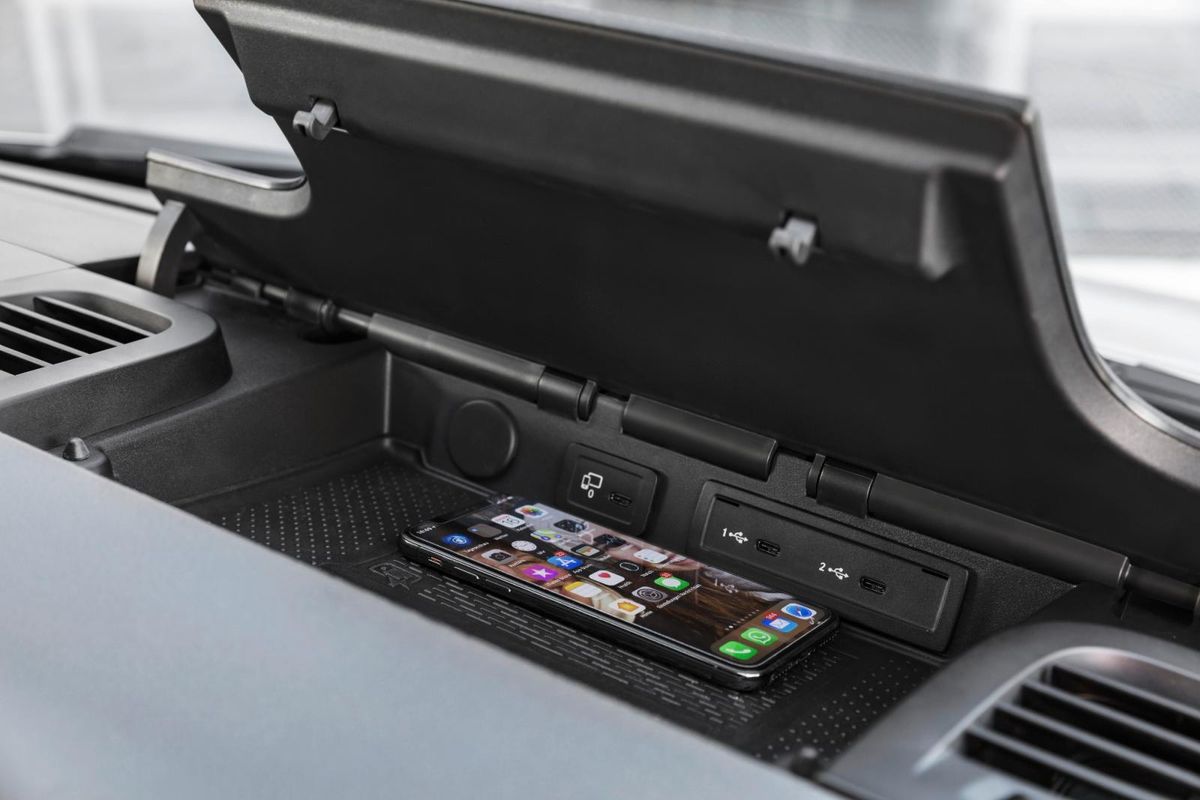
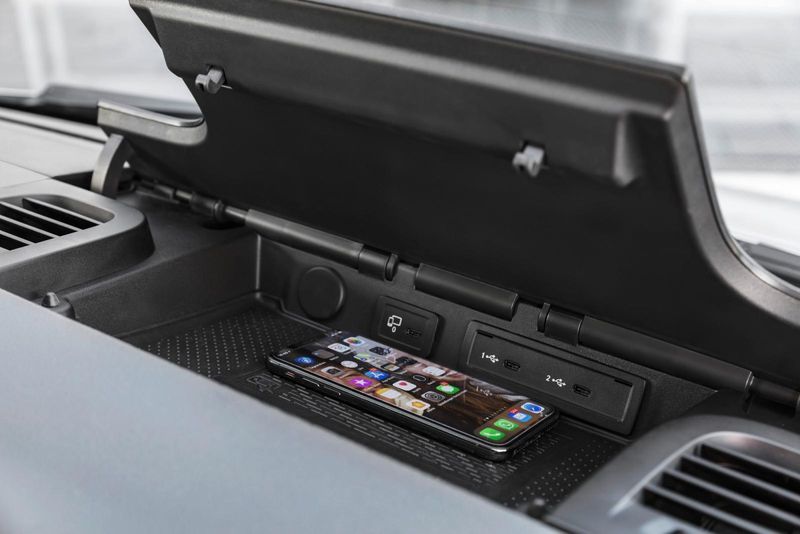
I'm not hugely experienced with driving such big vehicles (especially on such narrow and unknown roads), but the Sprinter's various assistance systems, including the rear-view camera, speed limit recognition, easy-to-use navigation and large side mirrors made piloting the newcomer easy and comfortable. It's a very refined drive – spending a lot of time in the new Sprinter will be no hardship. Mercedes-Benz also offers a wide variety of recharging options (including Qi wireless smartphone pad) for the driver and passengers' various devices, and numerous cabin storage solutions.
The flexibility and comfort of the passenger-carrying Tourer versions have been improved by the development of what Mercedes-Benz calls an "Easy Mounting" system. This simply allows for easier installing or removing of entire seat rows. And in the luxury variant, there are USB charging sockets and stowage space for smartphones in every seat row.
A variety of charging solutions are offered for mobile devices, and not only for the driver either.
I was also impressed with the ride quality and, in fact, the build integrity overall. Mercedes-Benz certainly didn't cut any corners on its usual build quality standards for this working vehicle. As is to be expected, a variety of suspension options are offered. There is an optional air-suspension system (for rear- and all-wheel drive models) that makes it possible to lower the rear-end for easier loading, for example. An interesting option fitted to our test unit were GRP (glassfibre reinforced plastic) rear leaf springs, instead of steel springs. These reduce vehicle weight and are also corrosion free.
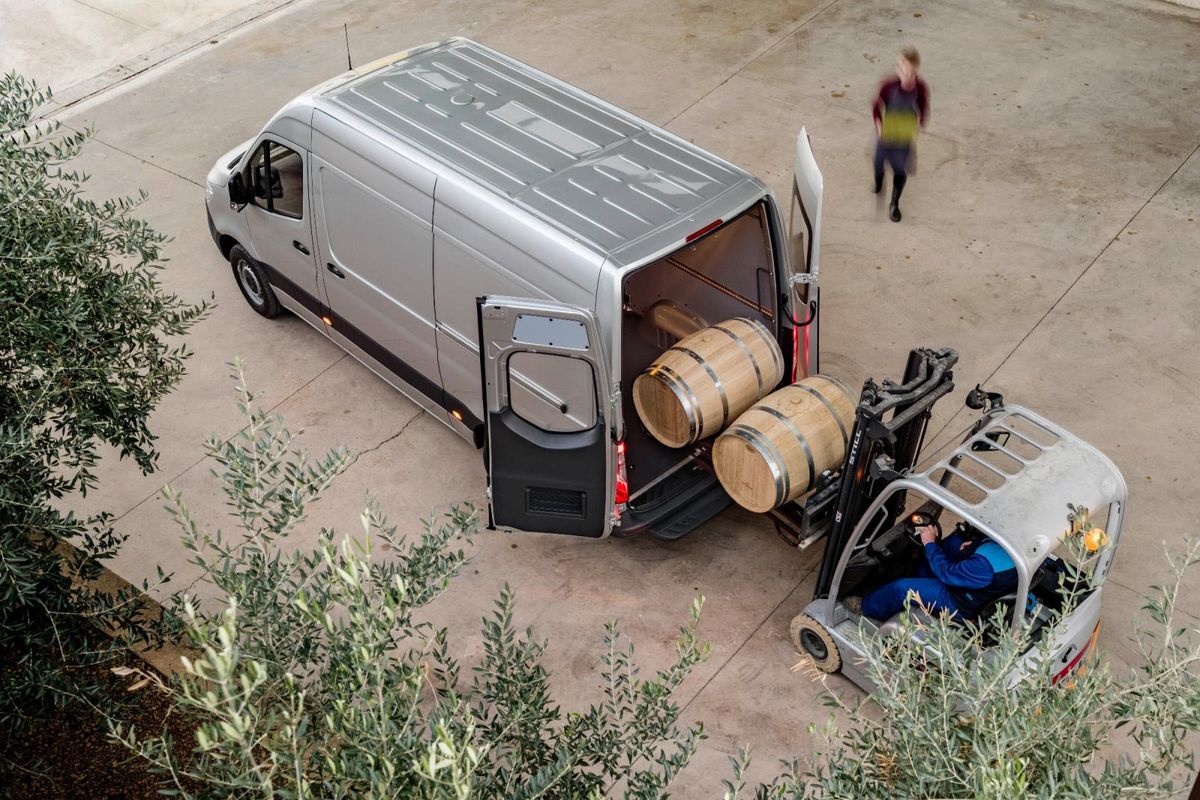
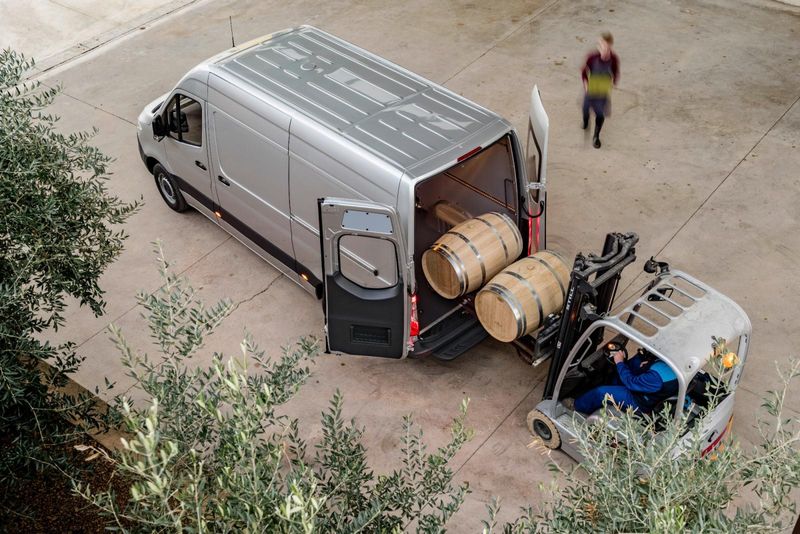
Moving into the cargo bay – well, there are so many variables at play, but I must say a stand-out feature for me is the internal roof carrier system that's now offered. It really does maximuse the space available. And then there are new flat-top wheelarches, which makes the space on, and surrounding the arches far more usable. The new plastic surface for the cargo bay floor also looks particularly durable.
Verdict
Rear air suspension is offered on some models, allowing for the rear-end to be lowered for easier loading/unloading.
It's obviously not possible to evaluate the load-carrying ability and the various configurations offered by the Sprinter in a single test drive. However, within the parameters provided by Mercedes-Benz, you're very likely to find a suitable solution to your transport needs. Sprinters are available in wheelbases ranging from 3 250 to 4 325 mm, seating for 1 or up to 20 people, and with a maximum permissable gross vehicle weight of up to 5.5 tonnes (max payload over 3 000kg).
At this time the South African base line-up and pricing is not yet known, but we'll get most of what is offered in other parts of the world, but not the electric van. As ever, the Sprinter should be seen as a premium product in its segment, and as such is likely to demand a higher price. Based on factors such as a claimed 9 million test kilometres across the world, cutting-edge connectivity solutions, superior driver comfort and the great attention to detail shown in the configuration of the load compartments, I don't believe any business that opts for a Sprinter will feel short-changed.
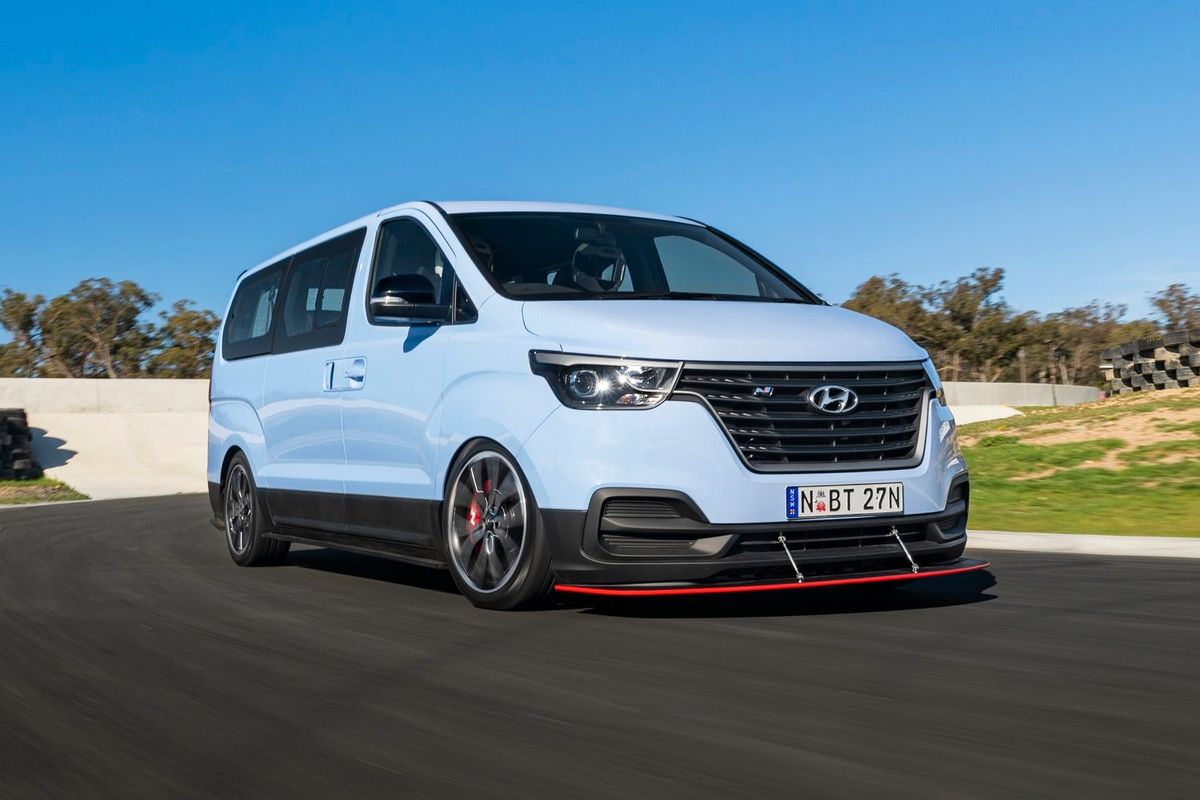
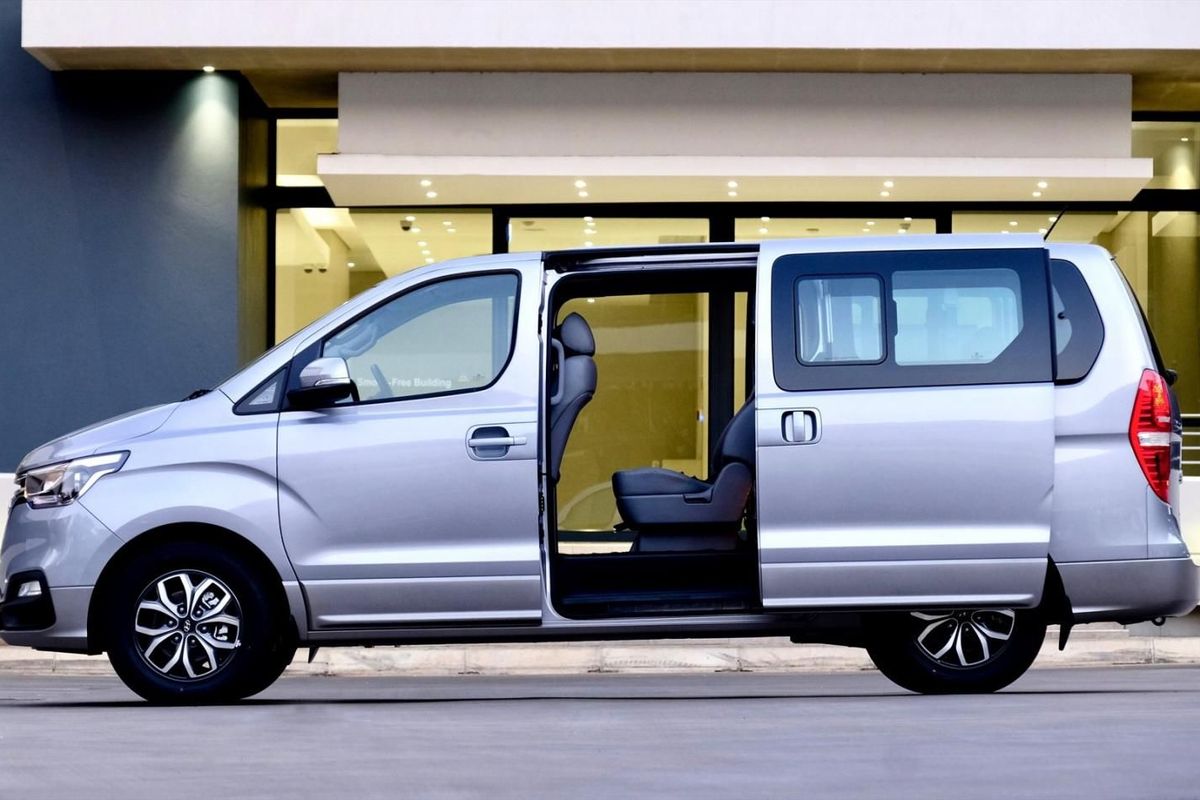
The Hyundai H1 has been refreshed for 2018 and is now available for sale in South Africa. Here are specification and pricing details for the 2018 Hyundai H1.
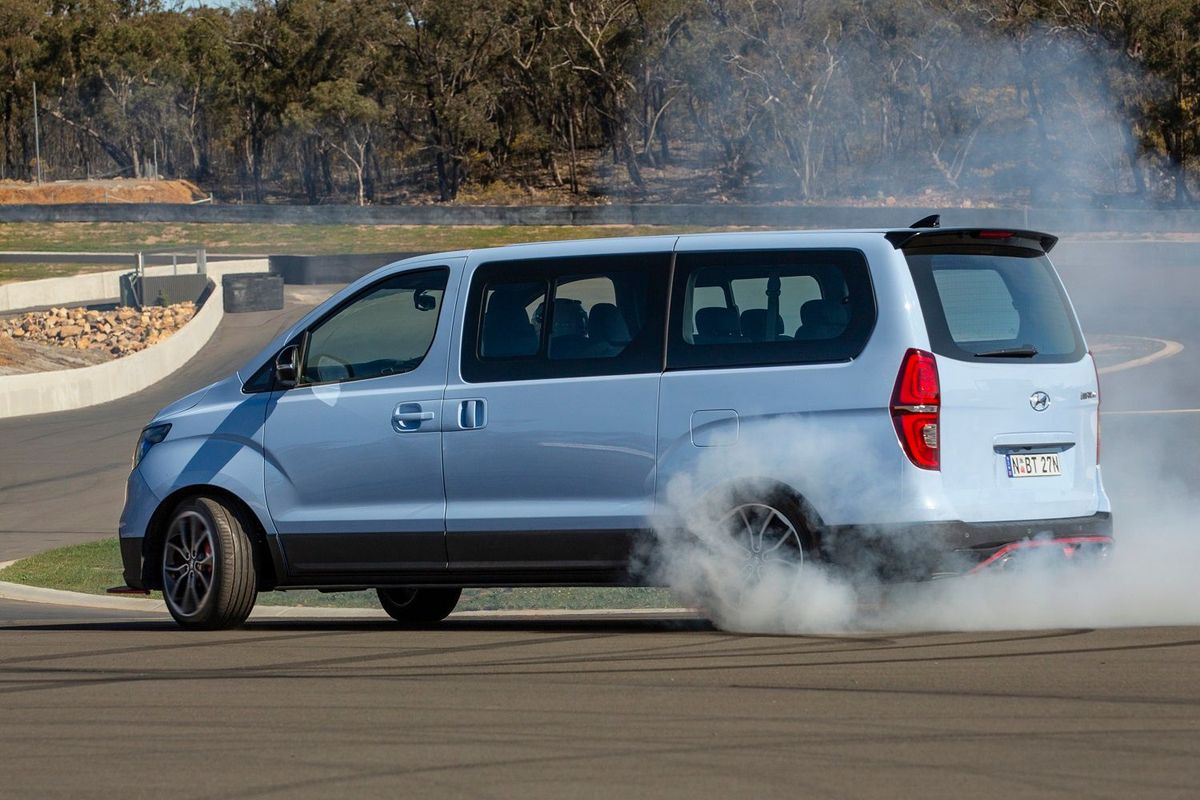
Since its launch back in 2009, the Hyundai H1 bus has sold 14 424 units which is an impressive achievement for the Korean automaker. The range was expanded with a panel van and a multicab, with 2 272 and 937 units sold respectively. The H1 is comfortably the best-selling minibus in the country, far outselling the more traditional rivals like the Volkswagen Kombi and Toyota Quantum.
For 2018, Hyundai has rolled out a significant facelift for its H1 bus, comprising both exterior and interior upgrades. The 3-model range currently comprises H1 2.4 Petrol Bus MT, H1 2.5 Diesel Bus AT and H1 2.5 Diesel Panelvan AT. For 2018, the range has been changed to H1 2.4 Executive Petrol Bus MT, H1 2.5 Elite Diesel Bus AT and H1 2.5 Diesel Panelvan AT.
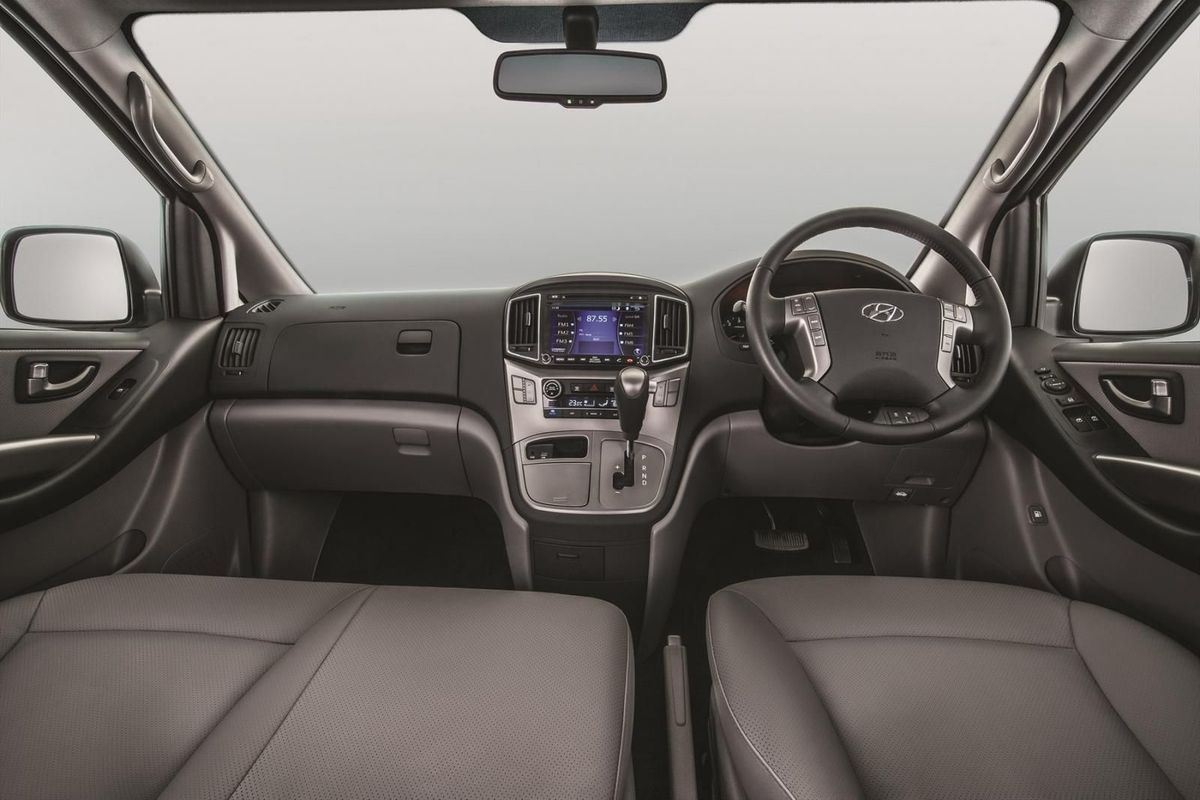
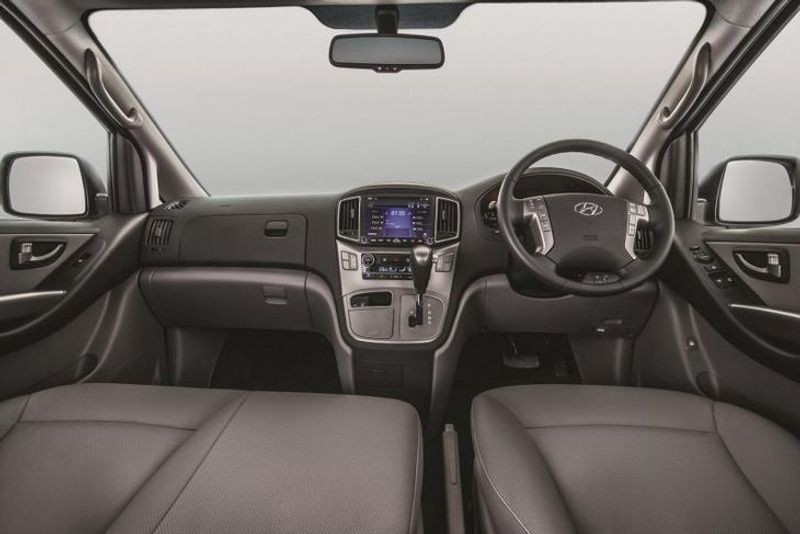
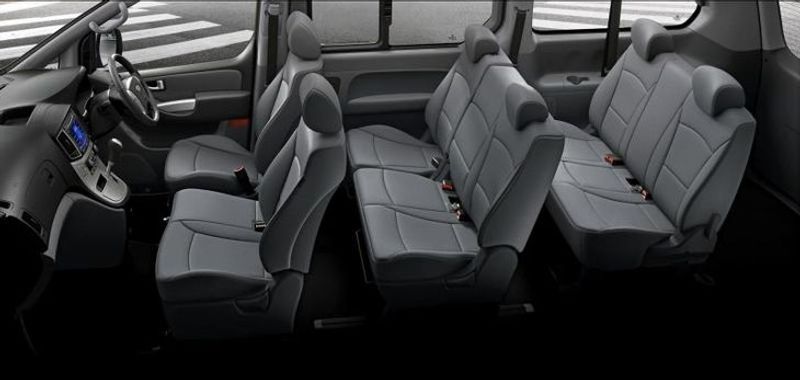
The Hyundai H1 cabin. For 2018, there has been a slight redesign and more specification added. Navigation is now available as an option.
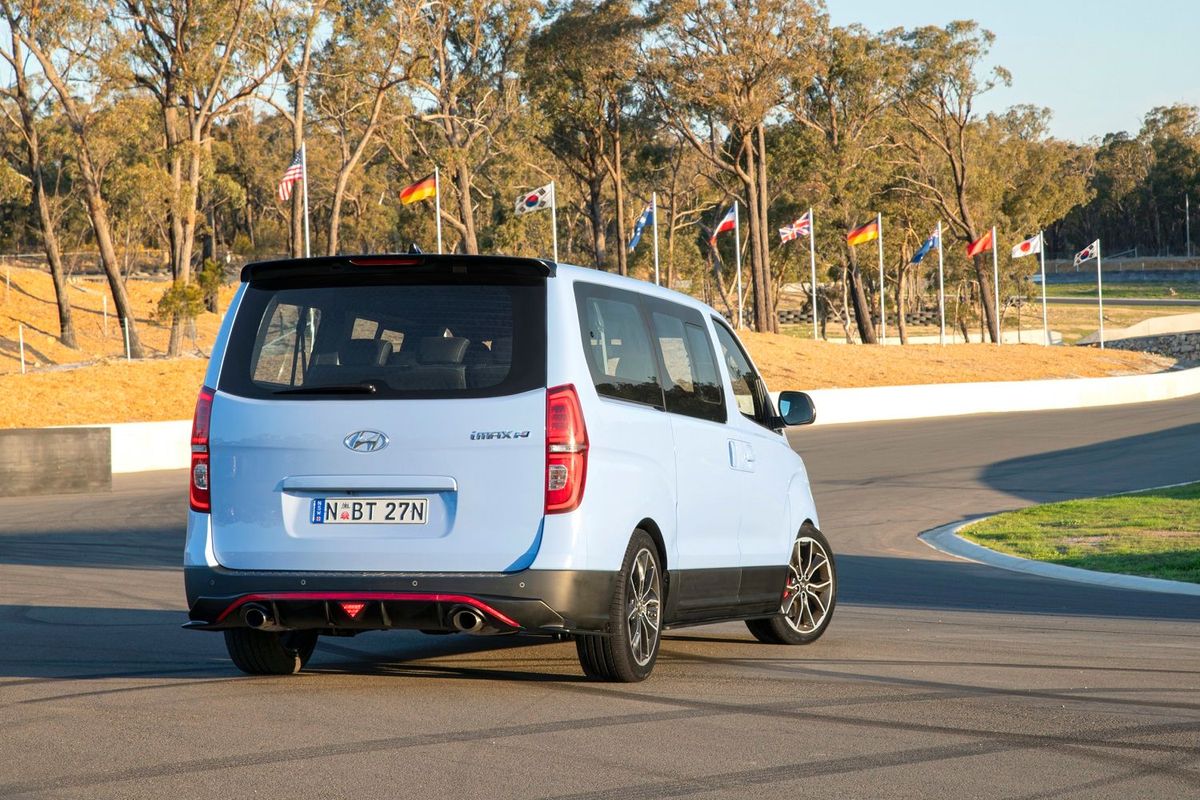
At first glance, you can see the all-new front grille as well as projection headlights. In comparison to the outgoing model, the new-spec models add new features. The base 2.4 Executive Petrol bus gains auto lights and projection lights, while the 2.5 Elite diesel has gained the same new lights, as well as a reverse camera, new 17-inch alloy wheels, electric folding side mirrors and a chrome grille.
The specification has always been decent in the Hyundai H1 and you get auto lights, tilt & telescopic steering wheel, multifunction steering wheel, keyless entry, glovebox cooling, electric folding side mirrors, rear wiper, illuminated vanity mirrors and plenty of storage features. Navigation is available as an option on the H1 and it costs R2 522 inclusive of VAT. The infotainment system has also received an update in the 2018 model.
In terms of engines, the 2.4 Executive is powered by a 2.4-litre petrol motor with 126 kW and 224 Nm. Power goes to the front wheels via a 5-speed manual gearbox and Hyundai claims it'll consume 10.2 L/100 km. The one we've always favoured is the 2.5 VGTi diesel motor which has 125 kW and a mighty 441 Nm, making it ideal for towing. It'll be more frugal than its petrol-powered sibling, with a claimed 9.8 L/100 km.
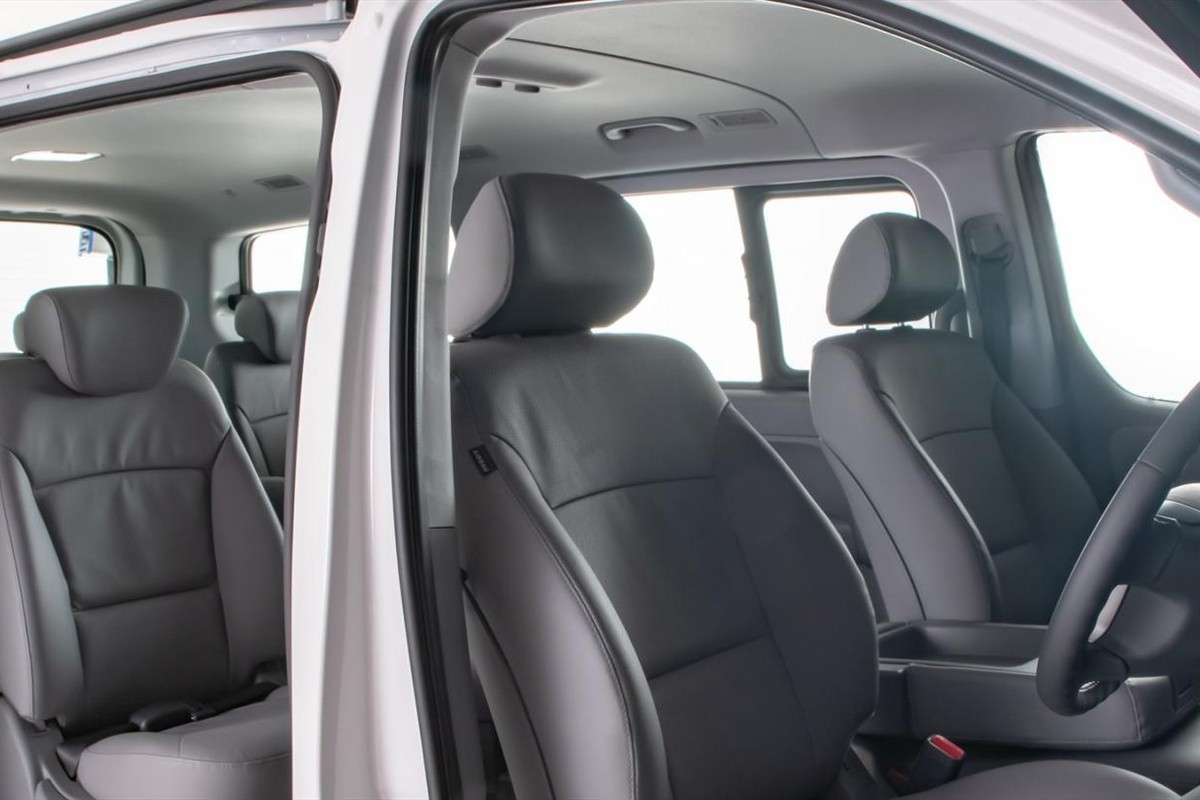
The Hyundai H1 cabin is practical and can carry up to 9 passengers
2018 Hyundai H1 Price in South Africa
The new Hyundai H1 comes with a 5-year/150 000 km manufacturer's warranty and an additional 2-year/50 000 km manufacturer powertrain warranty. You also get 5-year/150 000 km of roadside assistance and a 5-year / 90 000 km service plan. In comparison to the outgoing model, pricing has remained identical.
Navigation is available at R2 522 (including VAT).
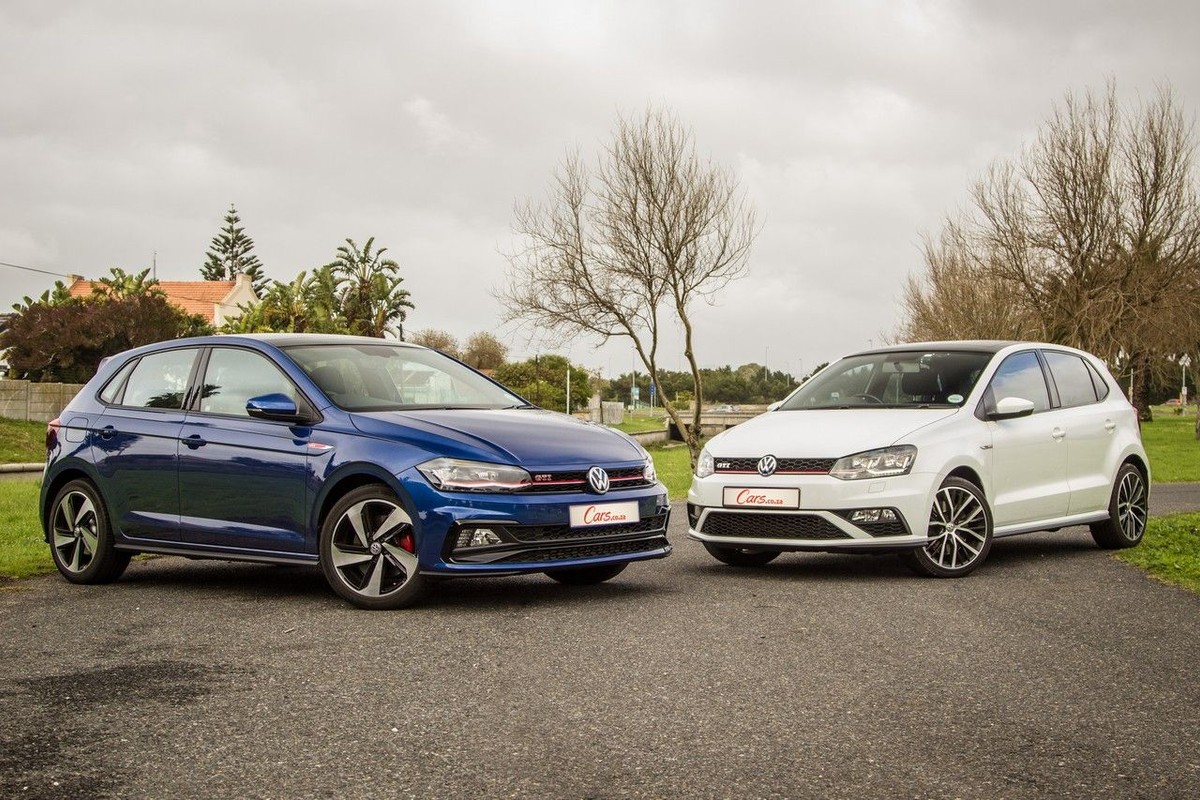
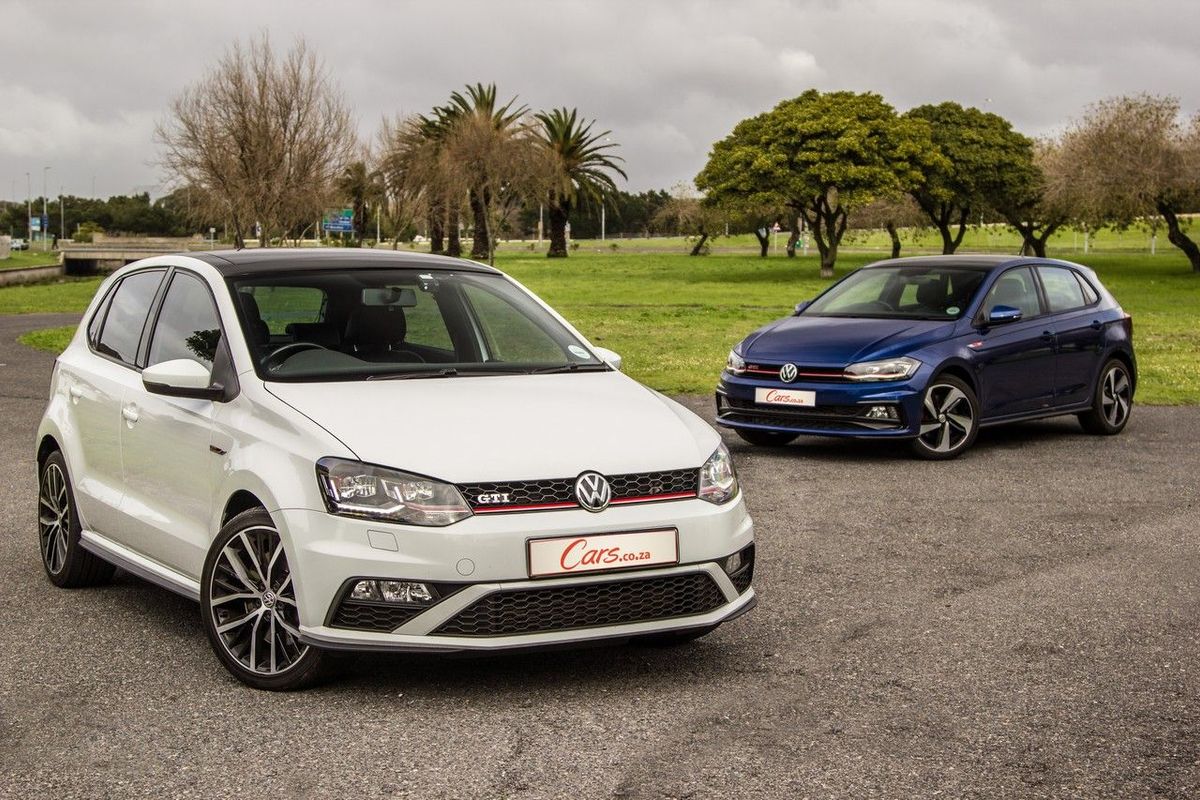
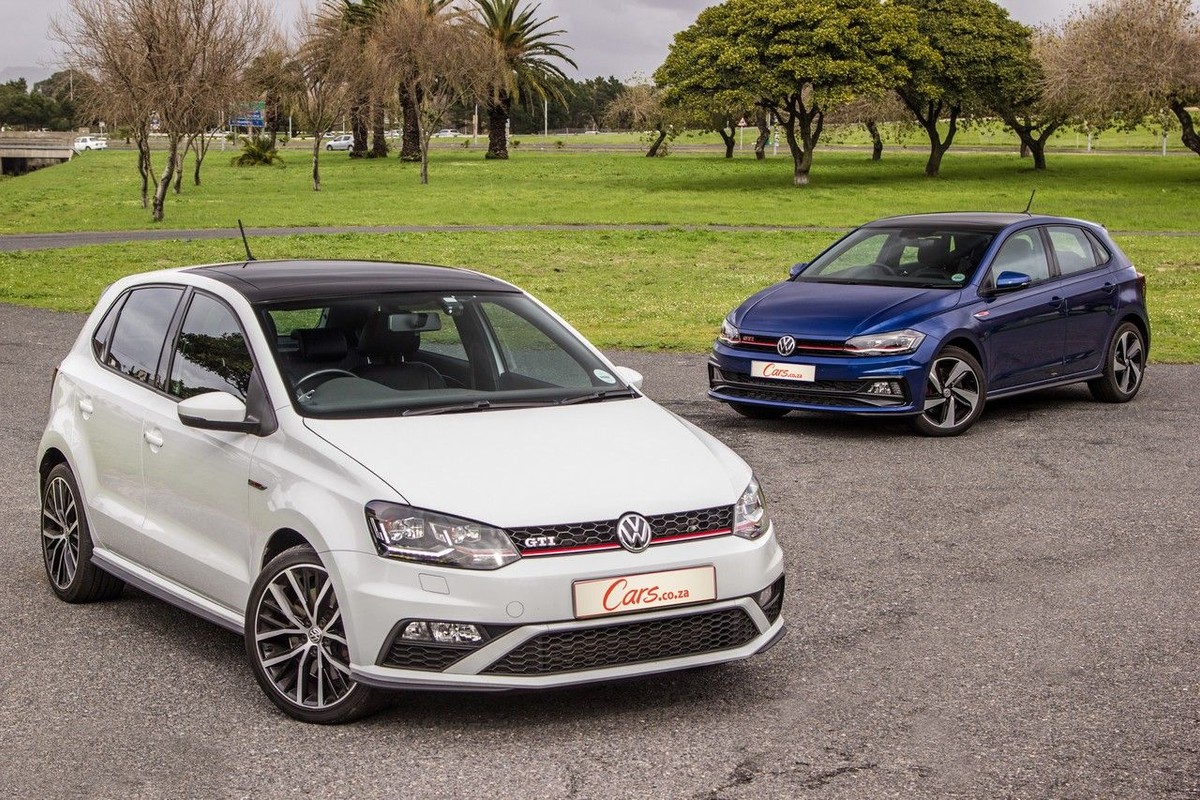
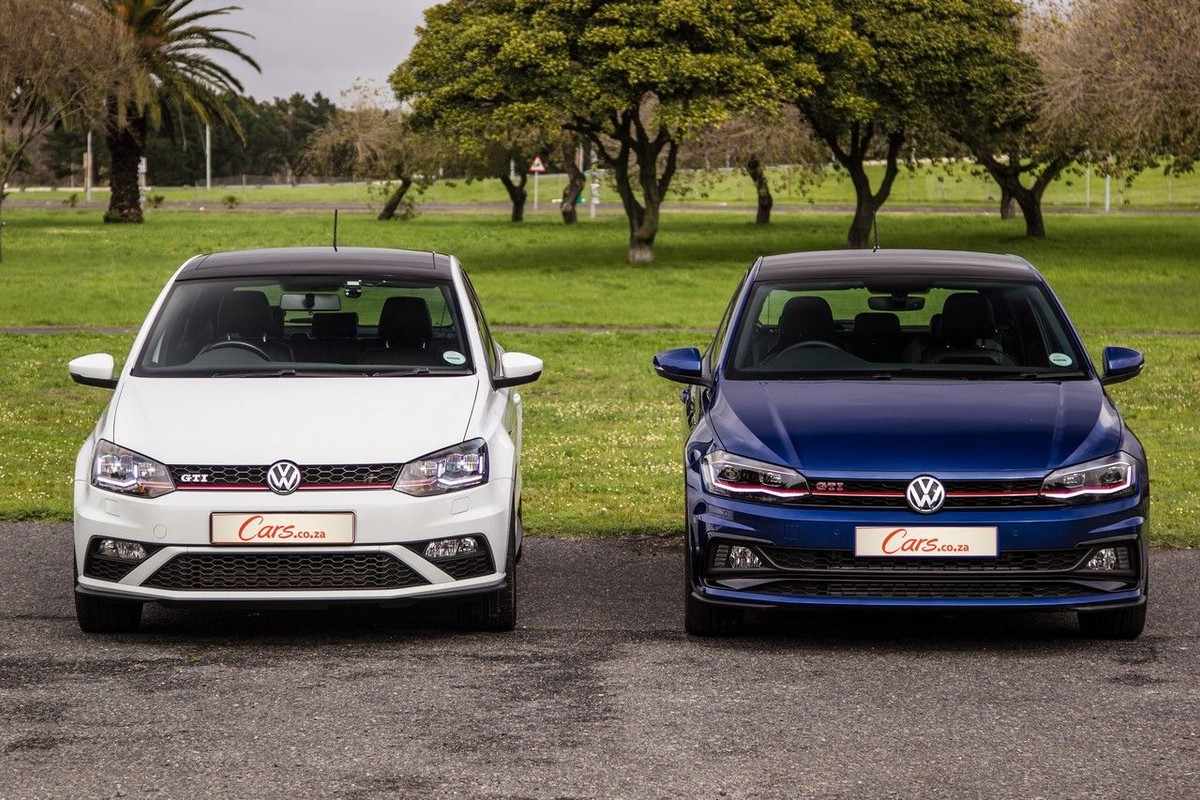
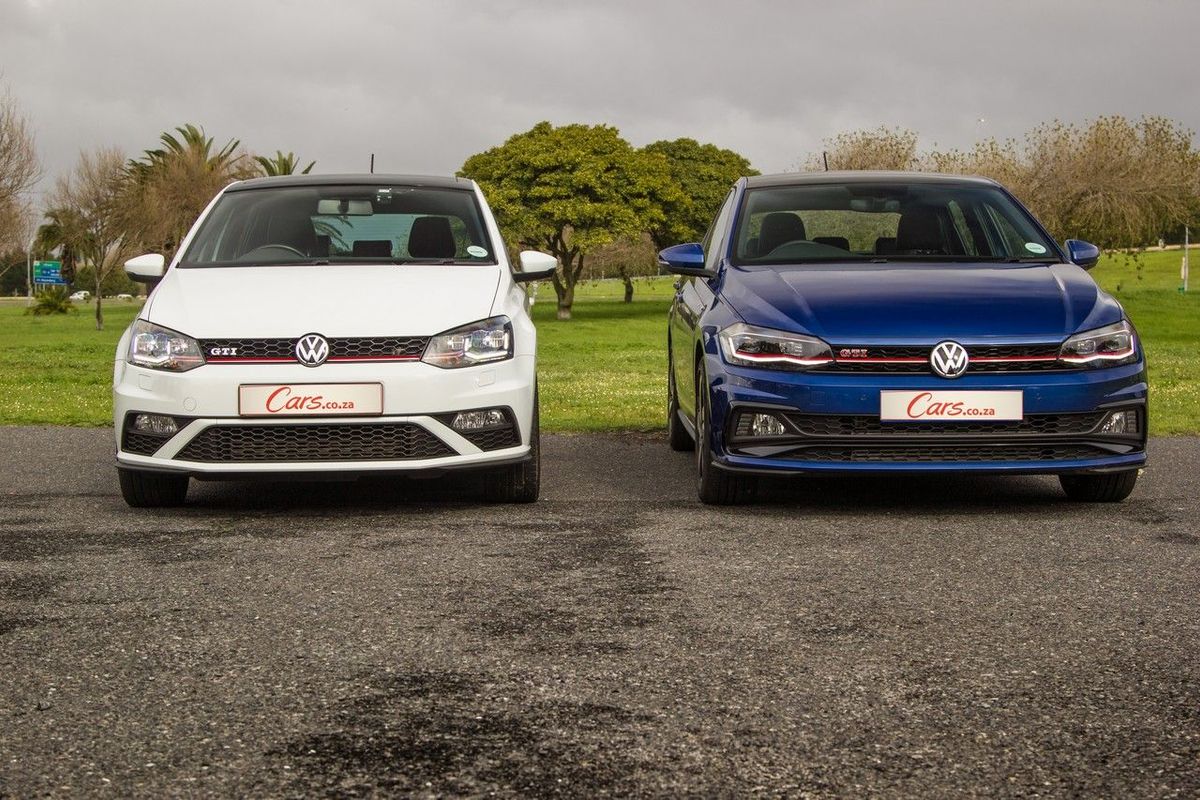
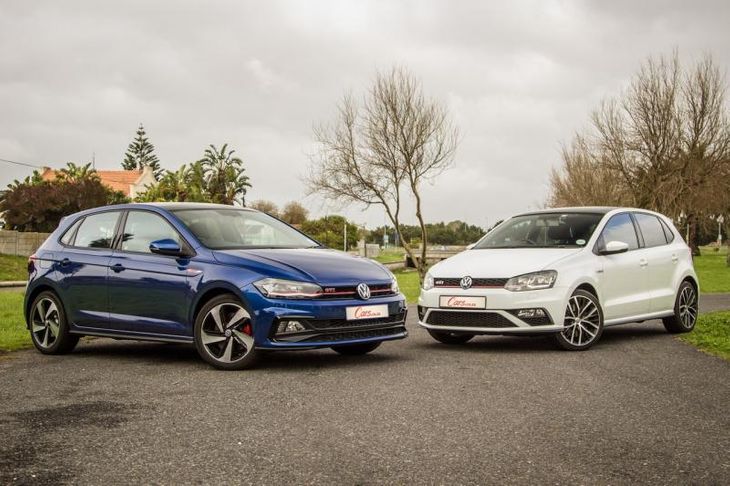
The all-new Volkswagen Polo GTI recently joined the Cars.co.za test fleet and, to demonstrate the differences between the newcomer and its predecessor, we sourced a previous-generation model and compared them head-to-head. Here are some key changes between the 2015 Volkswagen Polo GTI and the new 2018 Volkswagen Polo GTI.
The Volkswagen Polo GTI offers consumers a taste of hallmark GTI performance at a cheaper-than-Golf price (and, of course, lower associated ownership costs) and the diminutive hot hatch has duly attracted a sizeable fan base. The SA market never received the 1st-generation model, but the 2nd-generation car, which had a 110 kW/220 Nm 1.8-litre 20-valve 4-cylinder motor and could sprint to 100 kph in 8.2 seconds, arrived in 2007.
Upon its arrival in 2011, the 3rd-generation Polo GTI represented a huge leap forward with its turbo-and-supercharged 1.4-litre engine with 132 kW and 250 Nm. Paired with a quick-shifting dual-clutch gearbox, that Polo GTI was claimed to sprint from 0 to 100 kph in a quite-brisk 6.9 seconds.
For 2015, the 4th-generation Polo GTI adopted a 1.8-litre turbocharged 4-cylinder engine. The car was offered in both manual and (dual-clutch) automatic guises, each of which had specific torque outputs. Both developed 141 kW, but the DSG version had peak torque of 250 Nm, whereas the 3-pedal version had 320 Nm. Interestingly, the cars' claimed performance figures were identical (a 0 to 100 kph sprint time of 6.7 seconds).
Now (in 2018), the 5th-generation Polo GTI marks a big leap forward for the model. What are the key changes between it and the outgoing model?
Dimensions
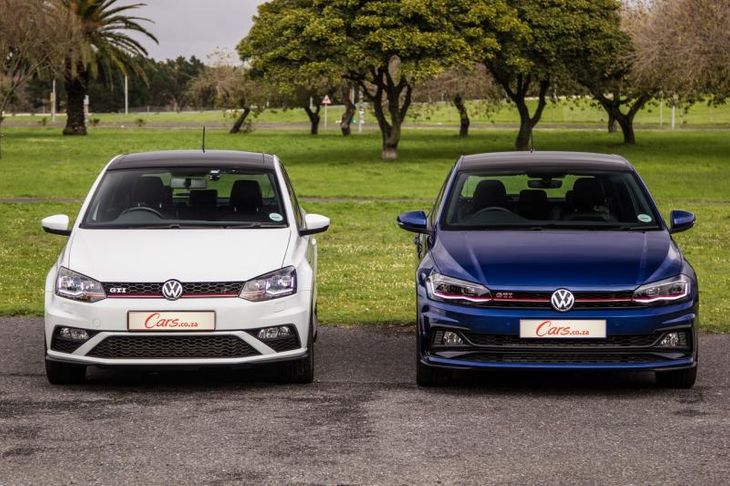
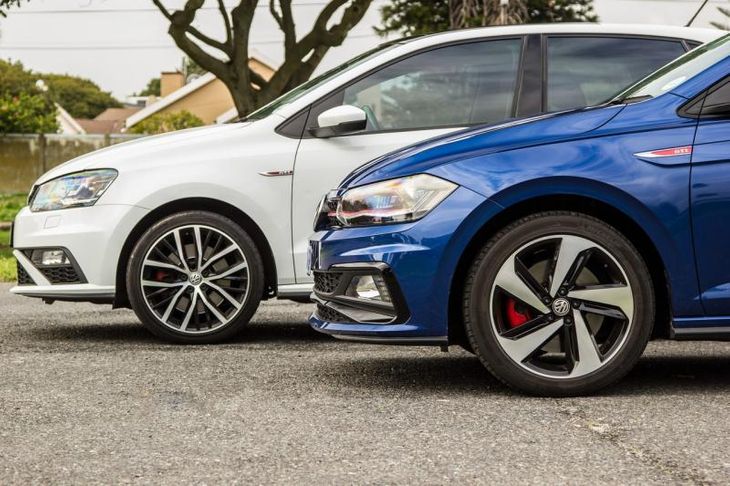
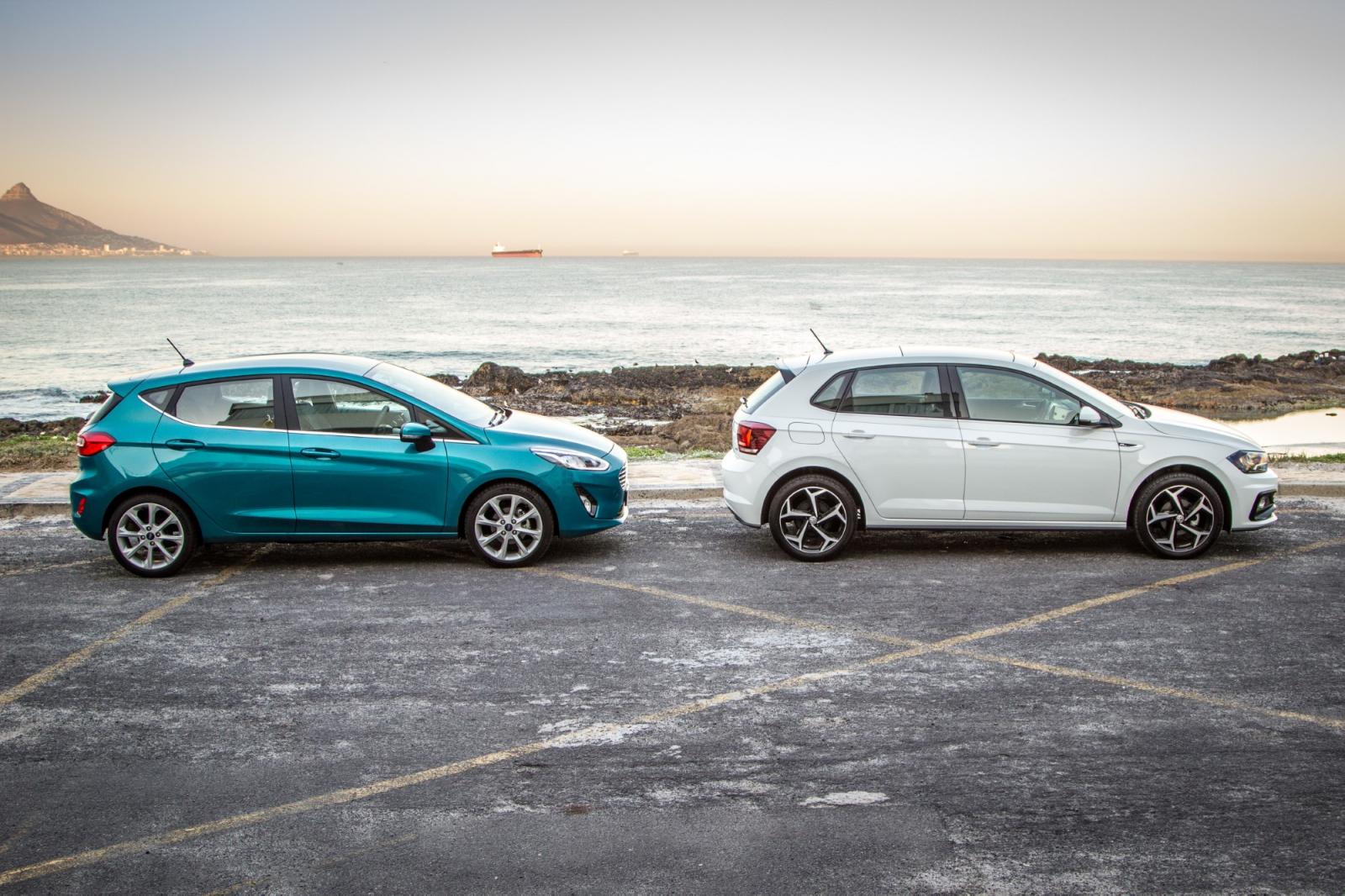
From this image, you can see the new Volkswagen Polo GTI (right) is wider than the outgoing model.
The all-new Volkswagen Polo has changed dramatically, mainly thanks to the adoption of a new platform. The newcomer is built on the MQB architecture, that versatile piece of modular engineering that forms the basis of the Polo's siblings: the Golf, Tiguan, Passat as well as its cousin, the Audi A3, for example. MQB has a reputation for comfort and refinement, and even in sporty GTI application, the new Polo's ride comfort is fair.
The bigger platform means that the new Polo GTI has grown up and expanded in all dimensions. The (once-pint-sized) hot hatchback's overall length has grown by 81 mm, it's now 69 mm wider and, despite its overall height reduction (by 8 mm), headroom has increased. The associated enlargement of the cabin is most apparent at the back, where legroom is now tolerable for adults. The luggage bay's capacity has increased too.
Engines
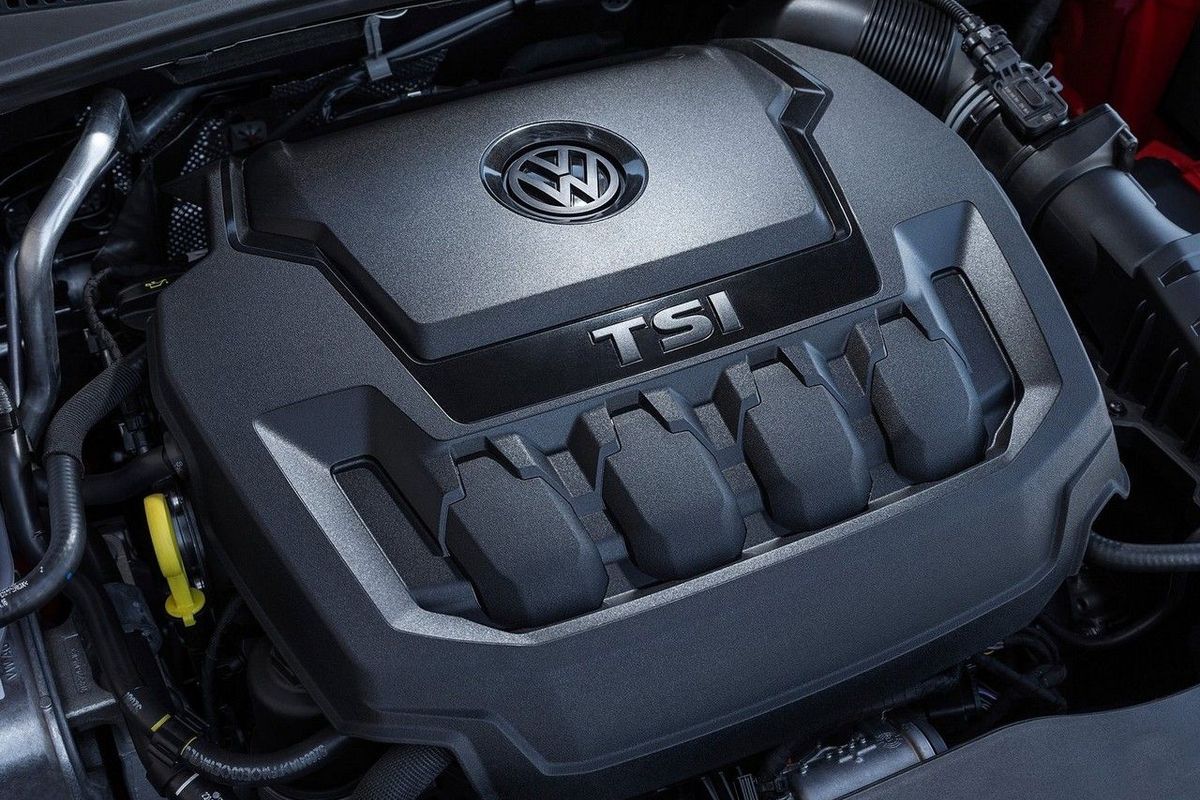
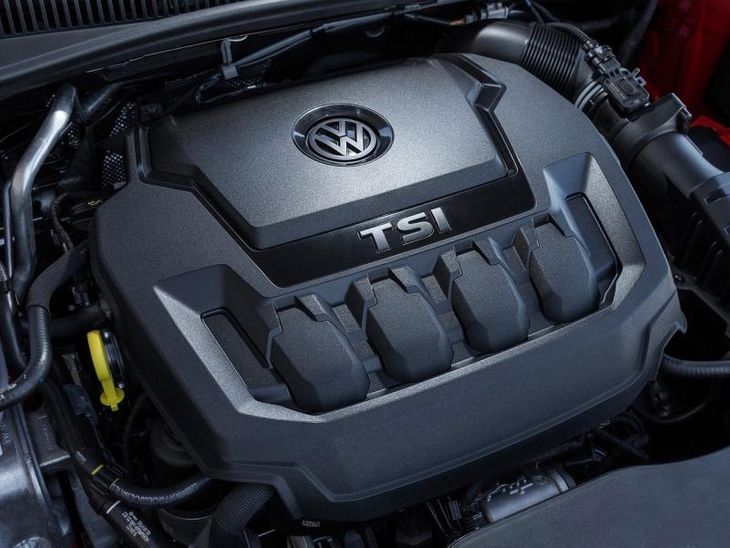
The EA888 1.8-litre turbo has been replaced by the EA888 2.0-litre turbo and power has been increased to 147 kW
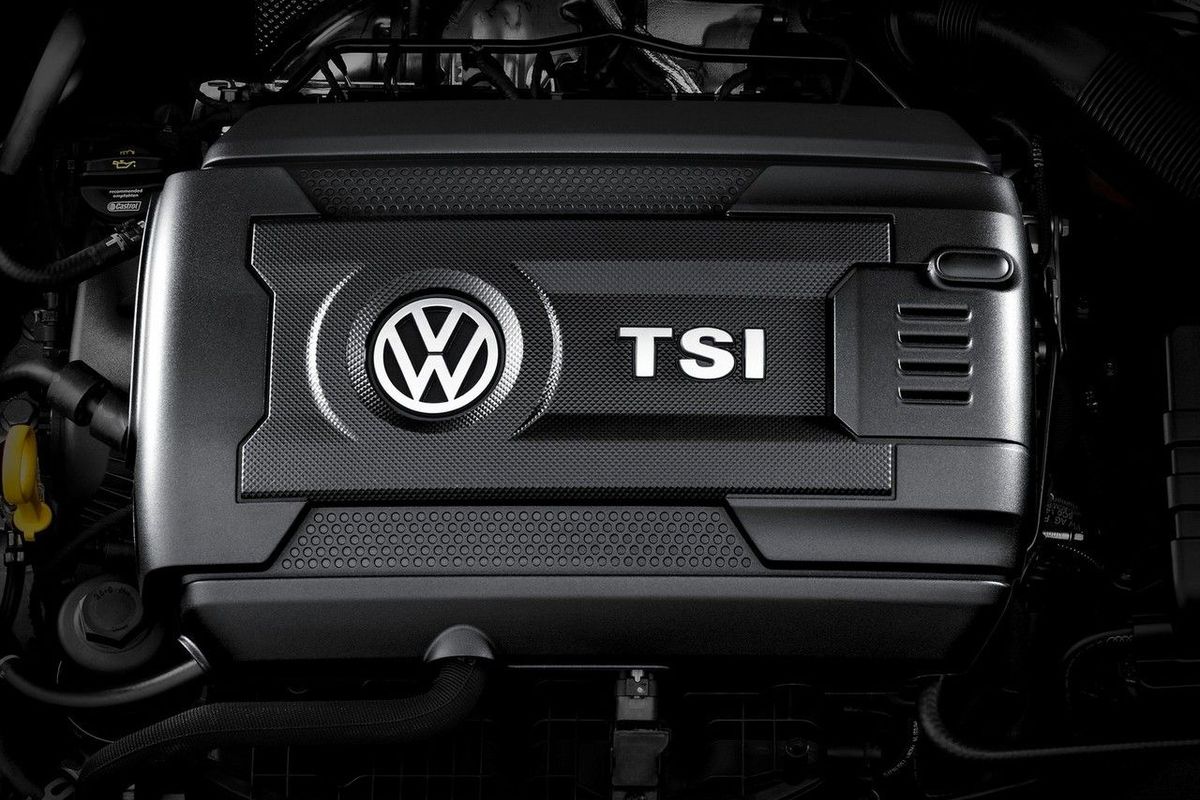
The previous model also used the EA888 turbocharged 4-cylinder motor, but it was resized to 1.8-litres in capacity. This time around, Volkswagen has not held back and given the new Polo GTI the full-blown 2.0-litre EA888 from none other than the Golf GTI. Outputs are up to 147 kW and 320 Nm (from 141 kW and 250 Nm/320 Nm), but while these differences may seem small, the switch from a 7-speed dual-clutch 'box to 6-speed dual-clutch unit has seen a reduction in sprint times, with fuel efficiency being increased, albeit fractionally (from 6.0 L/100 km to 5.9 L/100 km).
Performance
With a bigger 2.0-litre engine, the new Polo GTI is fractionally faster than its predecessor.
Volkswagen claims the switch from the 1.8-litre to 2.0-litre unit has resulted in a broader spread of accessible performance. It sounds sweeter as well… there's a sharp induction rasp and, if you come off the throttle in Sport mode, the exhaust emits a barrage of staccato pops, which is reminiscent of the Mini Cooper S – not a bad thing at all. The 2018 Polo GTI will dash from 0 to 100 kph in a claimed 6.6 seconds, which is very close to its Golf GTI bigger brother. Also new for the 2018 Volkswagen Polo GTi is the debut of the XDS differential, which sharpens up the handling.
Cabin
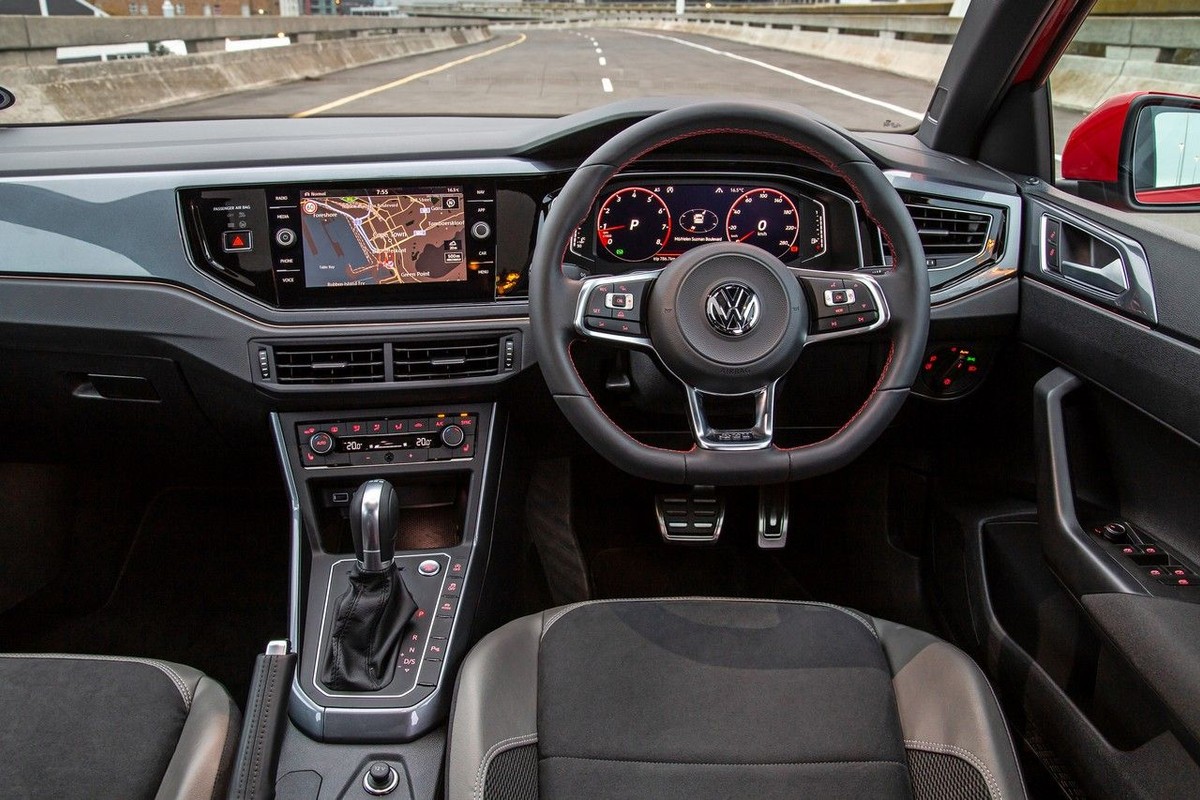
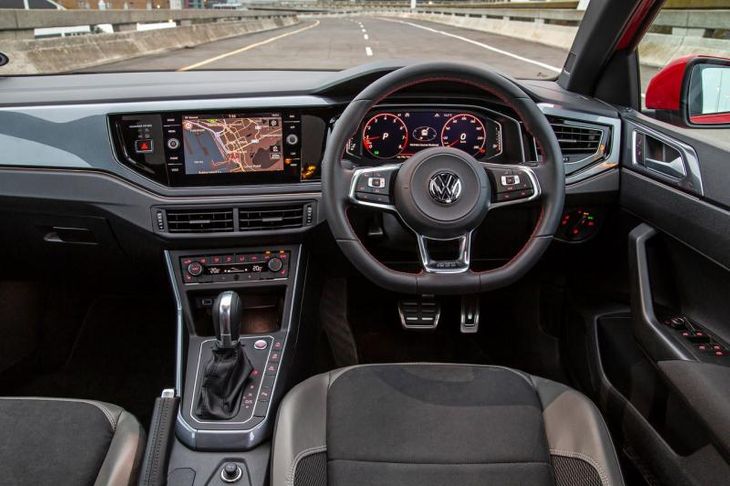
The cabin of the new GTI (and Polo as a whole) has been elevated to new heights. The Active Info Display is available as an optional extra.
The 2018 Polo GTI interior benefits from notable improvements in quality and prestige. Much like the standard Polo incorporates upgrades in terms of features and fittings, the new GTI sets the benchmark for supermini hot hatch cabin quality. It's a massive leap forward for the Polo GTI model and coincides with the introduction of nice-to-have features such as the digital Active Info Display dashboard (which is, regrettably, optional).
Furthermore, an all-new infotainment system, in the form of the Composition Media with its 8-inch touchscreen display, makes its debut and two USB ports are standard. The technology and safety features have also been improved. There are tyre pressure monitors, the car is able to park itself in a parallel situation automatically and blind spot detection with rear traffic alert is additionally available as an extra-cost item.
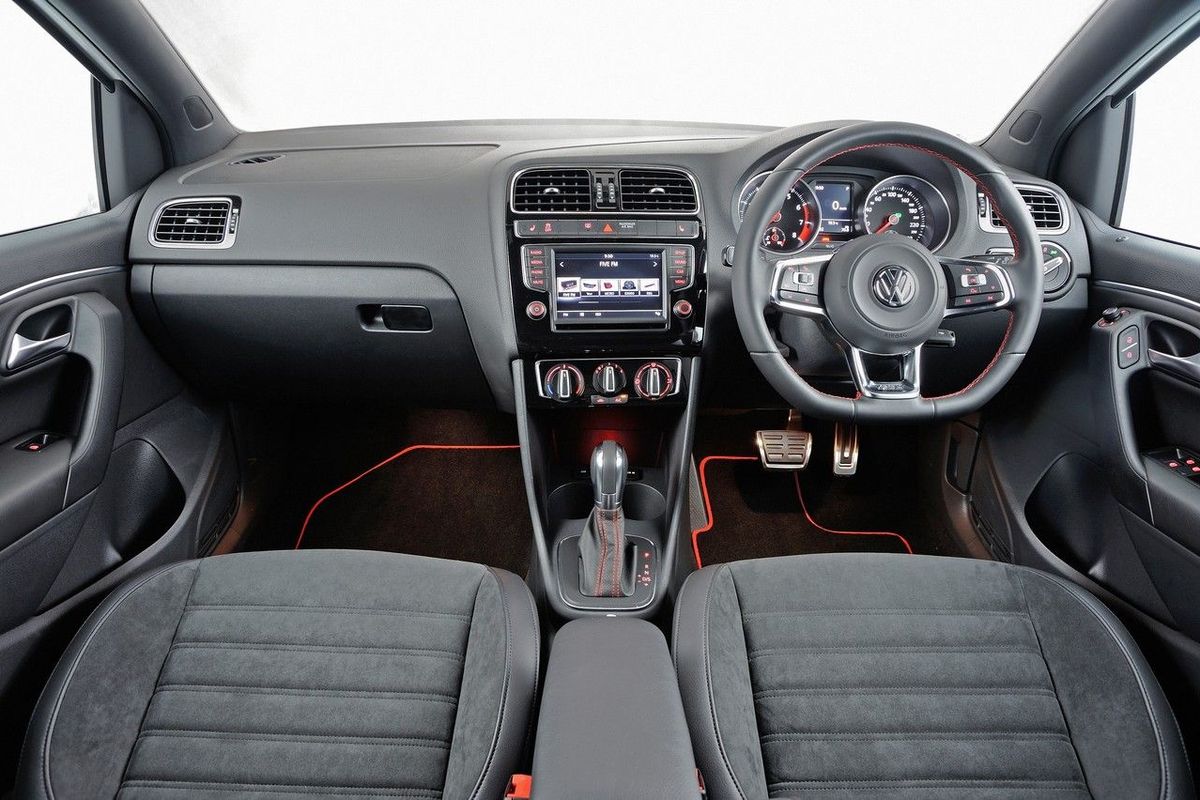
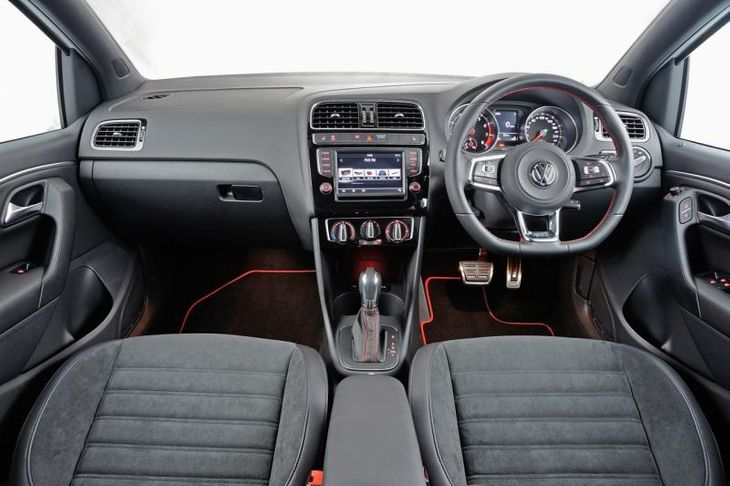
The 2015 Volkswagen Polo GTI cabin is still fresh and modern, but comprehensively outgunned by its replacement…
Final Thoughts
The 2018 Volkswagen Polo GTI makes a compelling argument for itself. Compared with the outgoing model, it's fractionally faster, but critically, more spacious and offers a broader array of talents. Also, thanks to the production of the small GTI being shifted to South Africa, the asking price has come down (R387 500 to R375 900), which is great news, but, as always, with VW Group products, be mindful of some of those costly options.
Comparative Review: Ford Fiesta vs Volkswagen Polo (2018) [w/video]
With all-new versions of the Ford Fiesta and Volkswagen Polo being launched in South Africa within months of one another, the battle for supremacy in the compact hatchback segment has reached a new intensity. In a changing marketplace, which one offers the best value, is most in step with the times, and ultimately, the better buy? We find out!
At a glance
Volkswagen Polo 1.0TSI Comfortline R-Line Automatic
Sophisticated styling, SYNC3 infotainment, lots of standard features, ride and handling, warranty and service plan, good overall value
We Don't Like
Pricey, too many optional features, Stop/Start system is intrusive
Disappointing transmission, rear passenger space and practicality could be better, interior quality falls short of Polo
What are we comparing?
Can the feature-rich Fiesta trump the popular Polo in this comparative review? Read on…
The locally-produced Volkswagen Polo needs little introduction: it remains the top-seller in its segment and is one of the most popular cars in the South African new vehicle market. The new Polo is underpinned by VW's lauded MQB platform; its updated interior, plus improved packaging and refinement virtually guarantee its continued success. On test here is the 1.0 TSI Comfortline R-Line automatic, which is priced from R297 849 (without options).
Much like the Polo, the Ford Fiesta has found favour with thousands of South Africans over the years and the Blue Oval aims to further entrench its compact hatchback’s success in the local market with a new, feature-rich and eminently stylish product that (especially younger) buyers will find hard to ignore. In this comparative review, the Polo goes head-to-head with the range-topping Fiesta 1.0T Titanium automatic, priced at R310 600.
Both cars offer similar engine outputs and powertrain combinations but differ greatly in terms of standard specification. Does the mid-spec (as standard) Volkswagen Polo have enough clout to reign supreme against the generously-specced Ford Fiesta? Let’s find out…
How do they fare in terms of…
Kerb appeal?
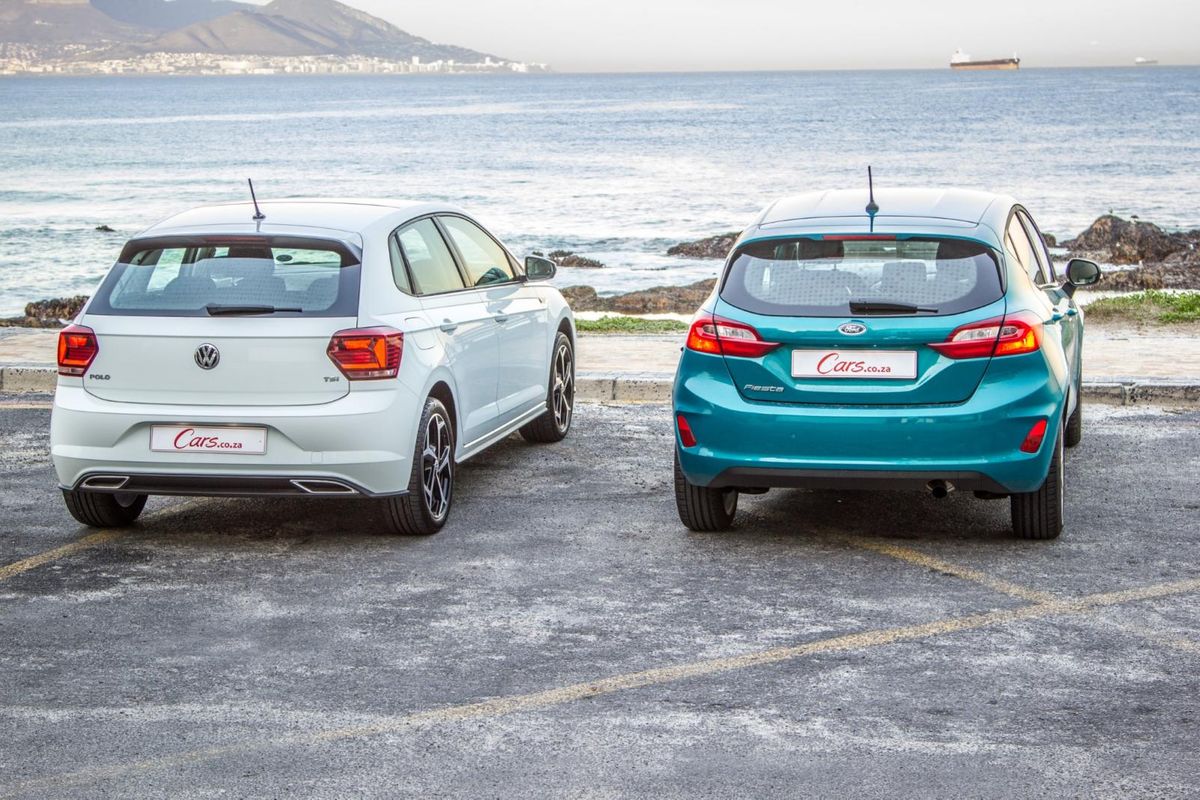
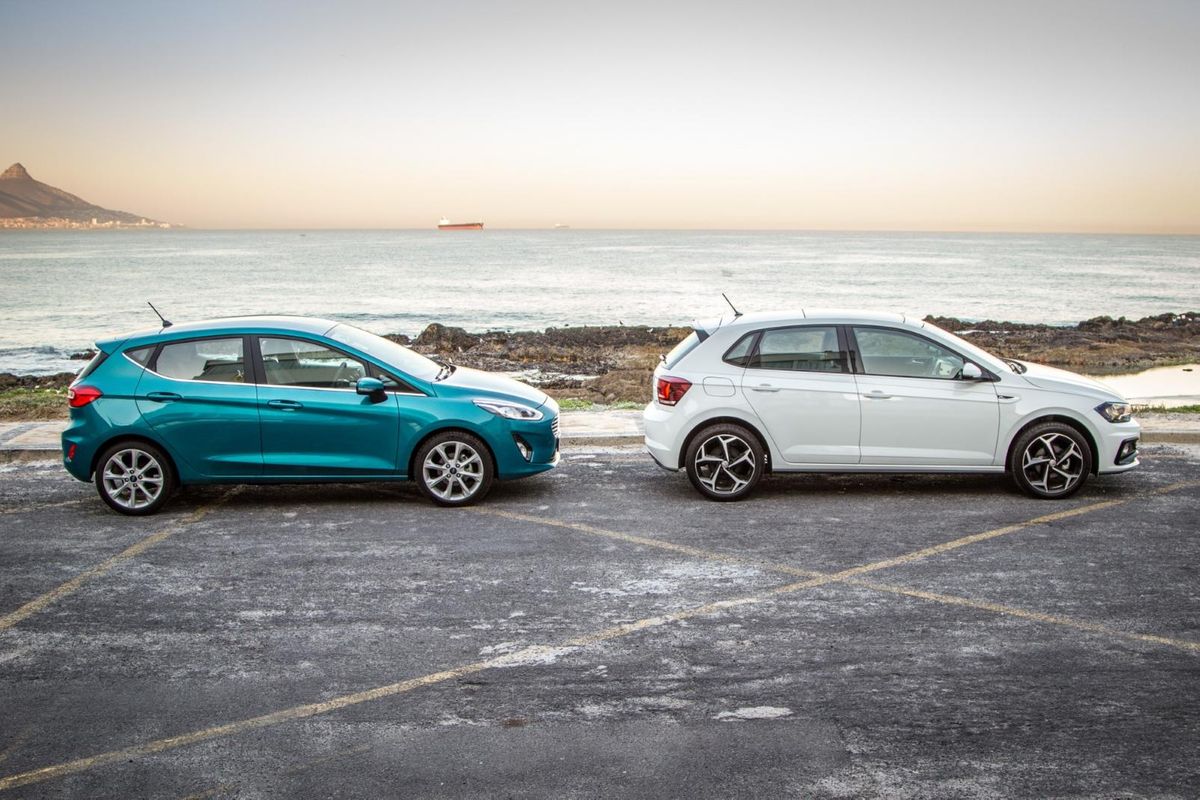
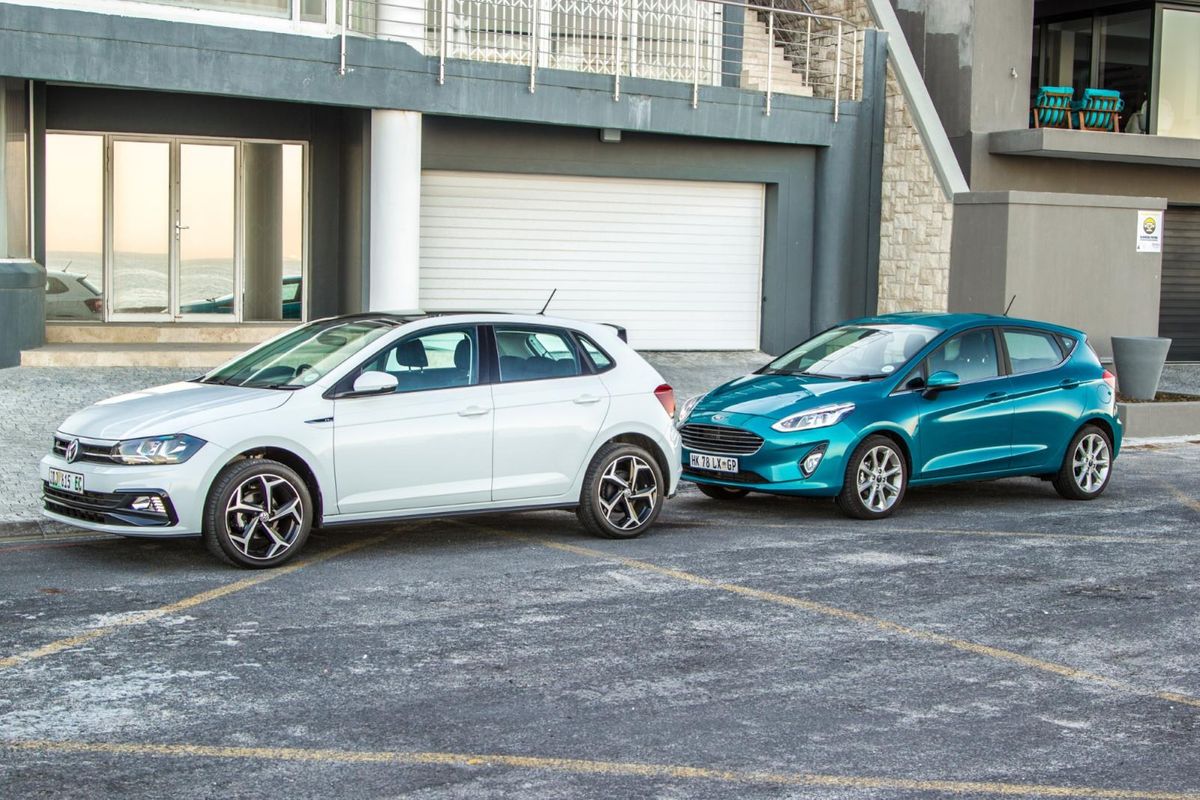
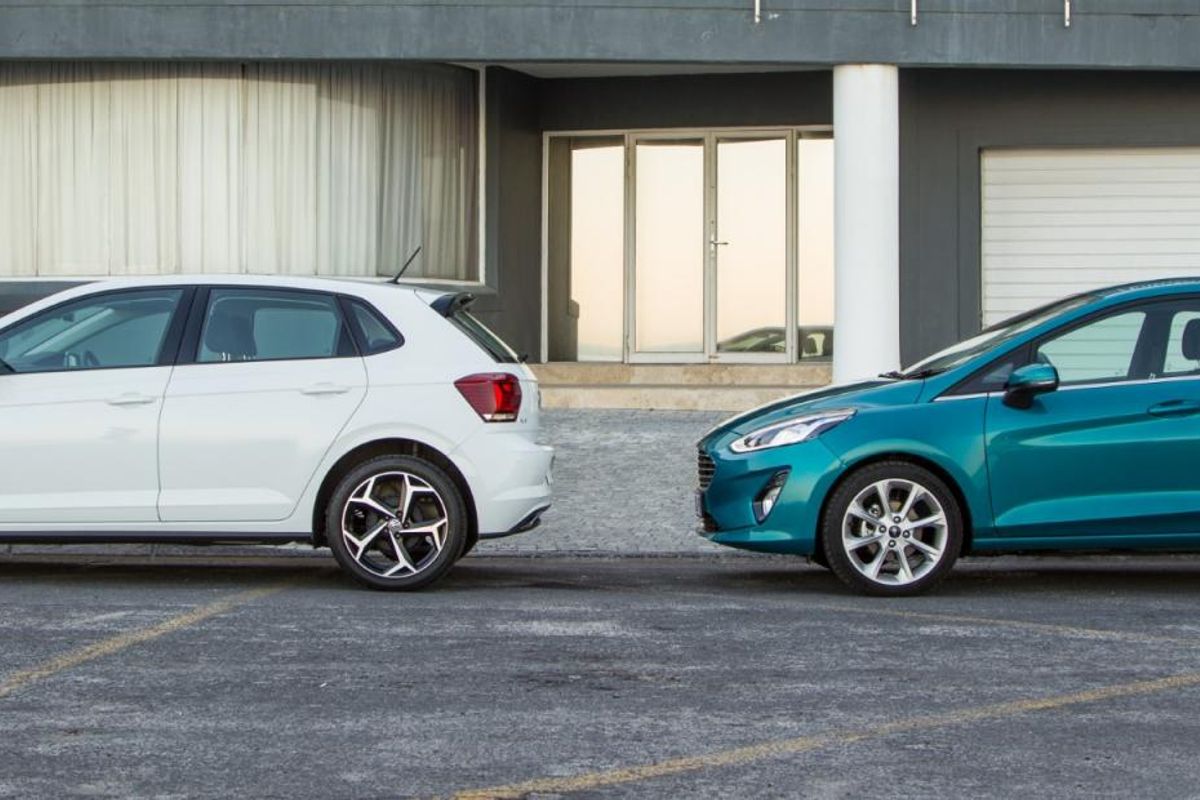
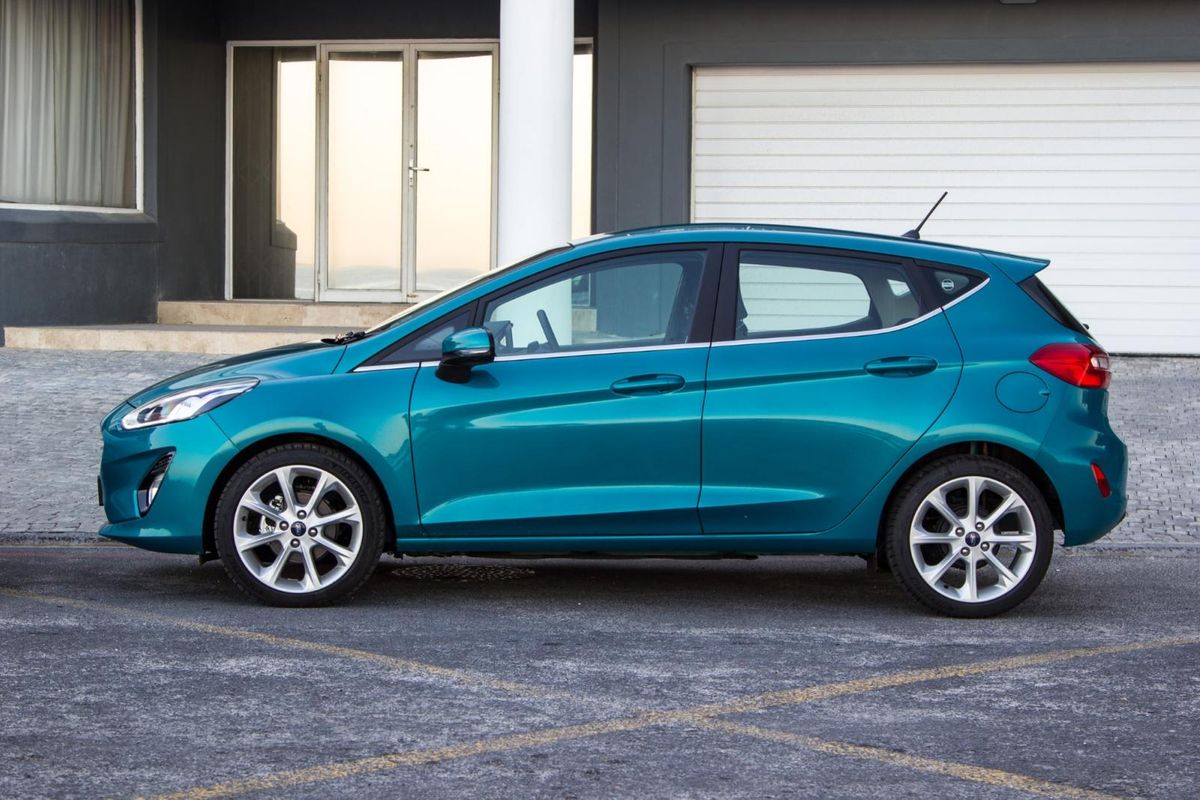
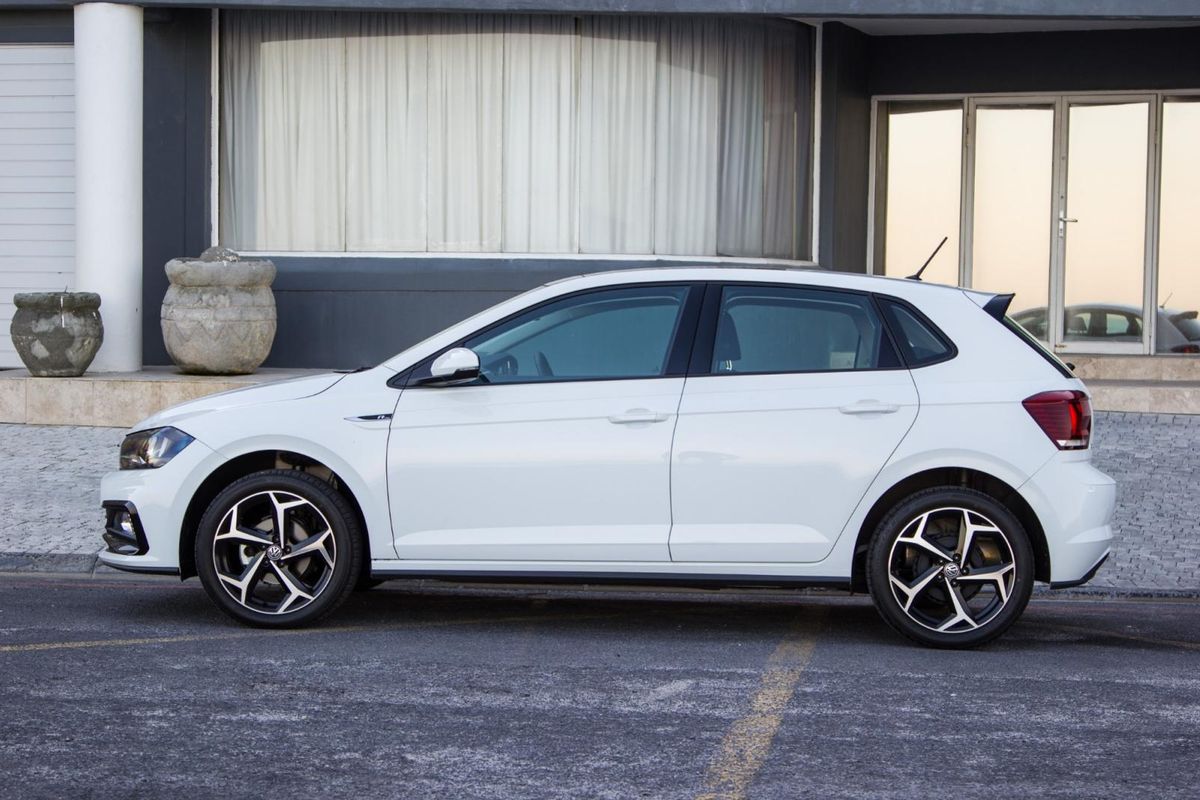
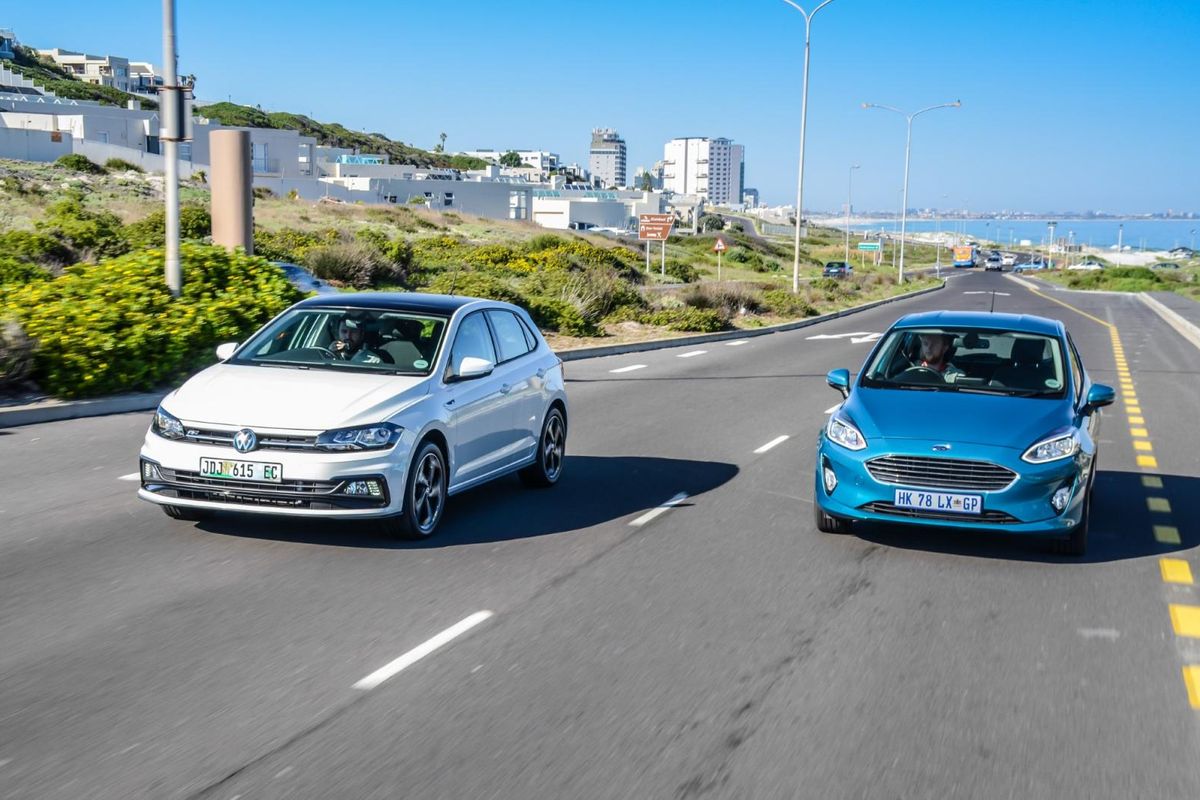
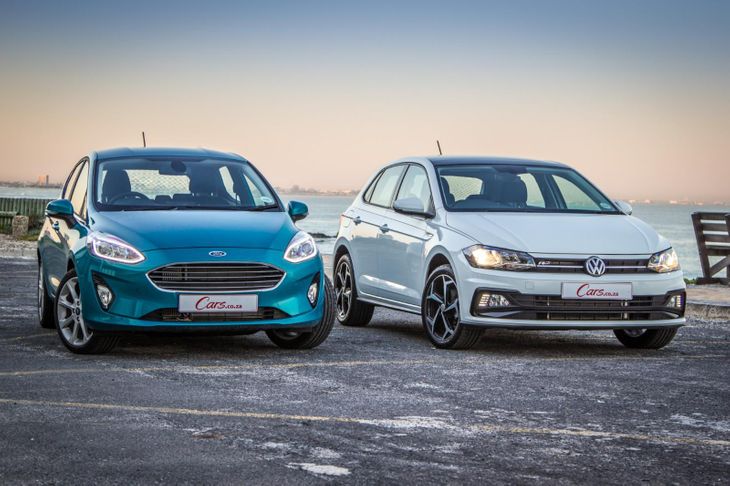
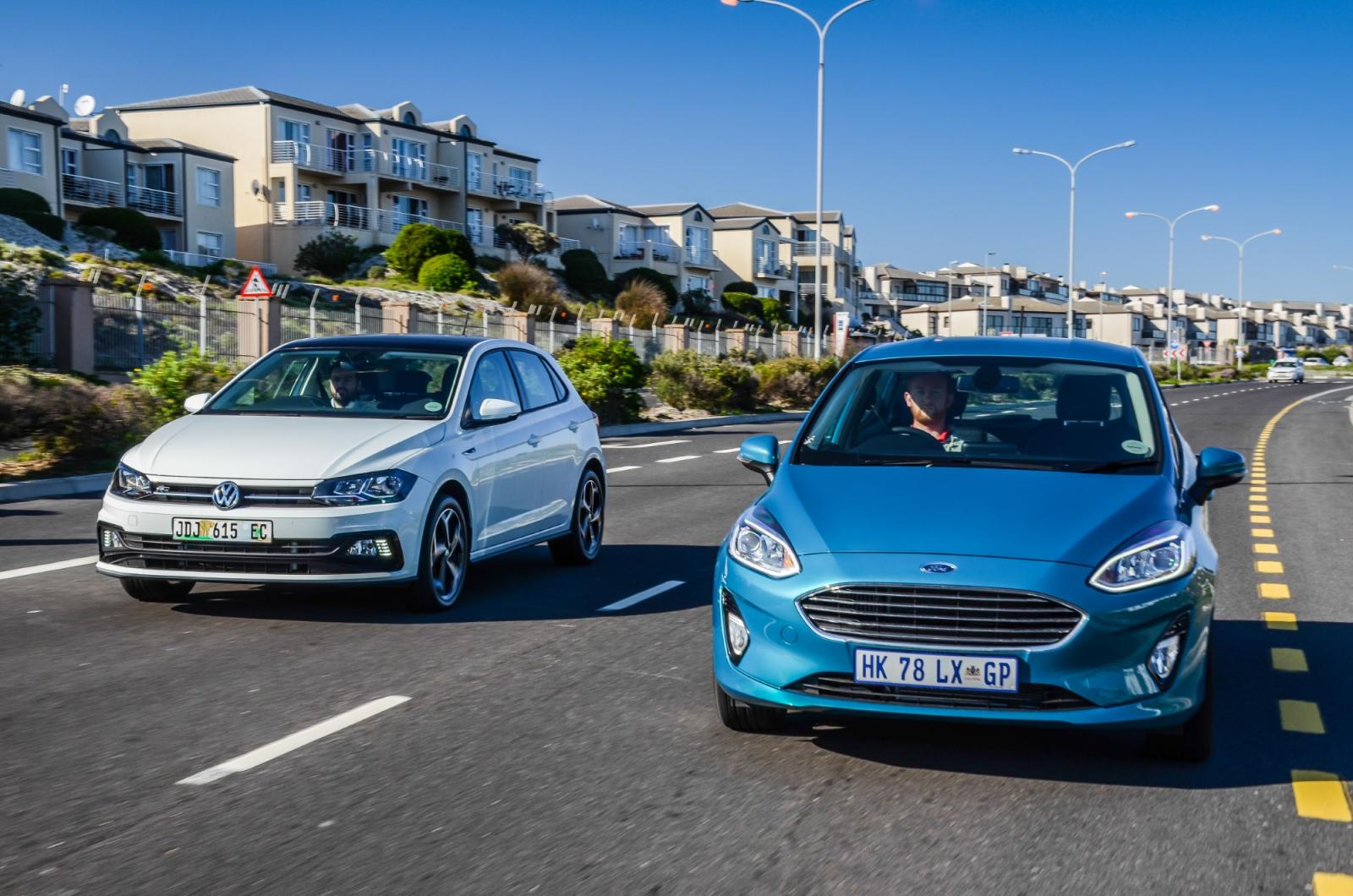
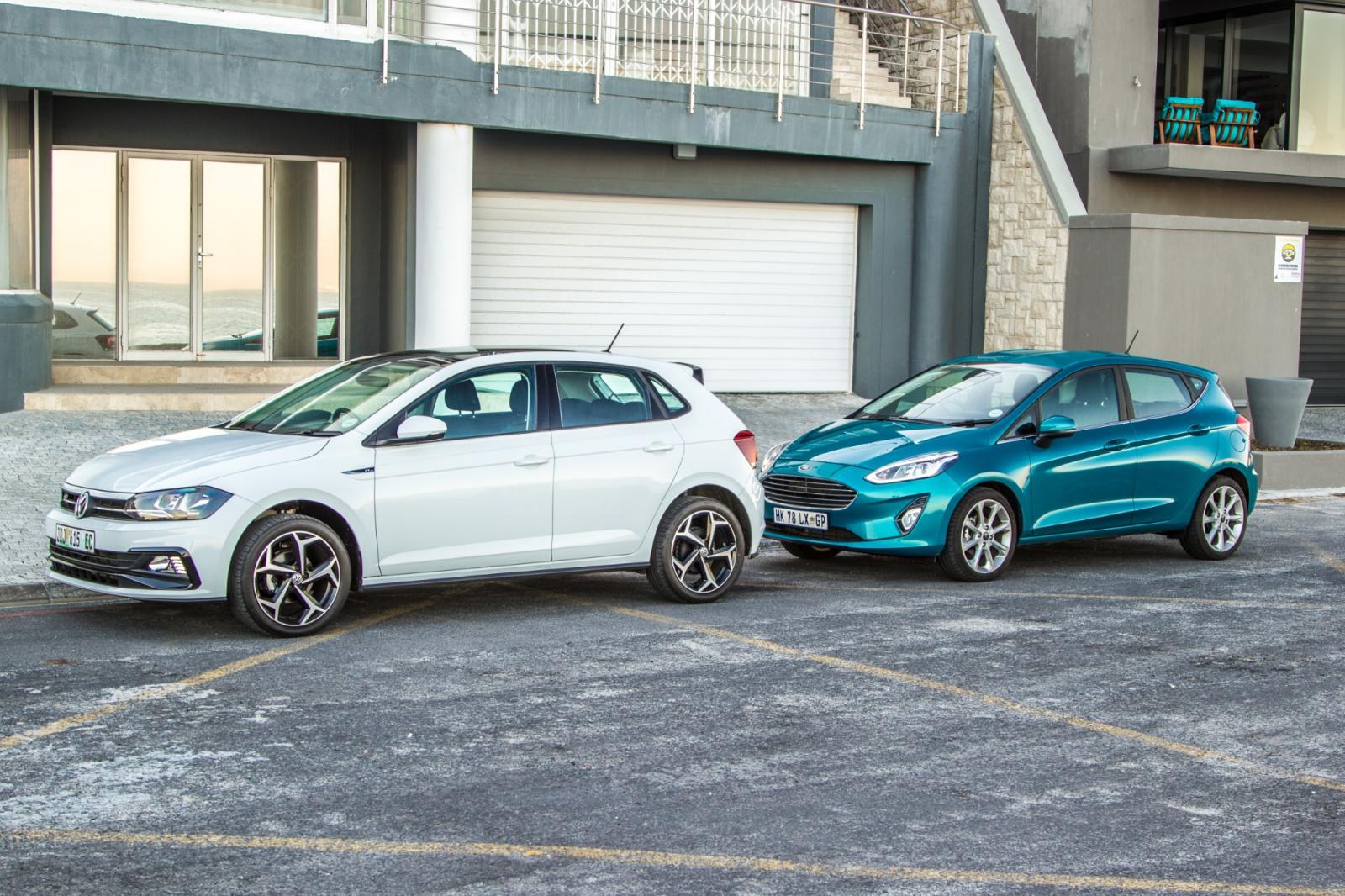
These two rivals are closely matched and both are thoroughly modern in design, but which one would you choose?
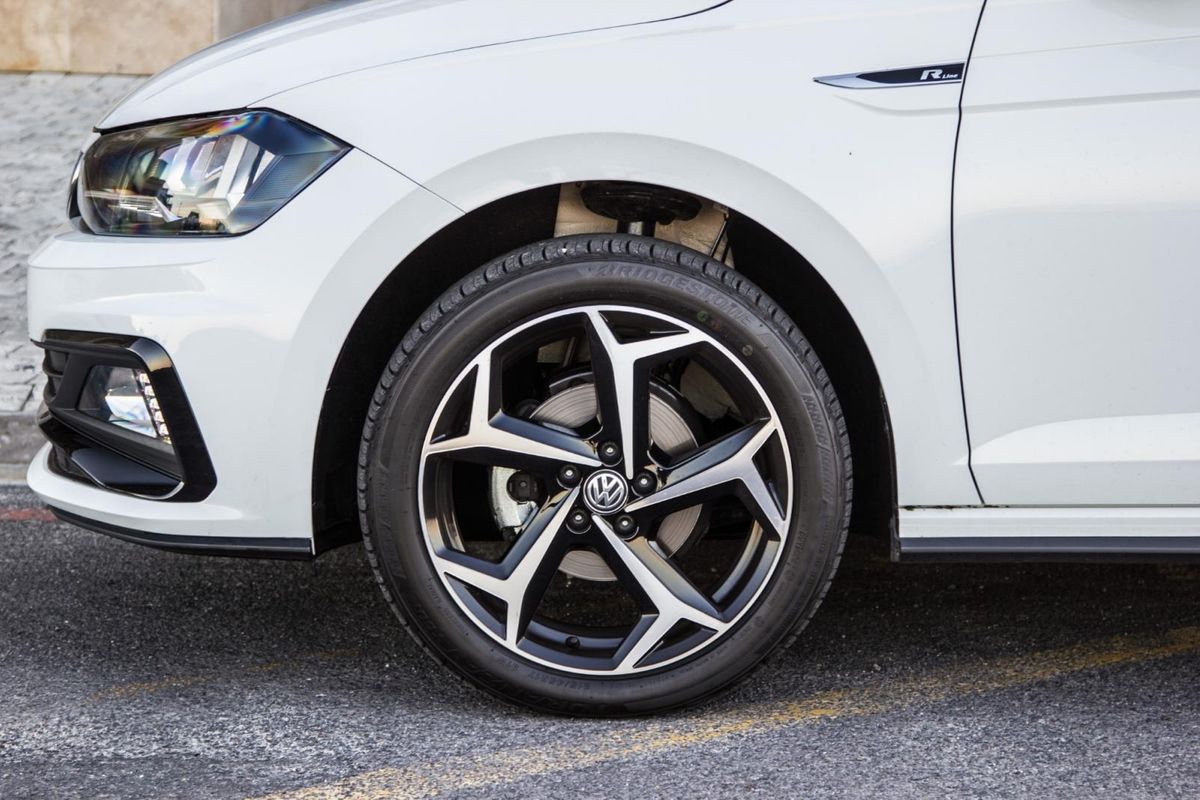
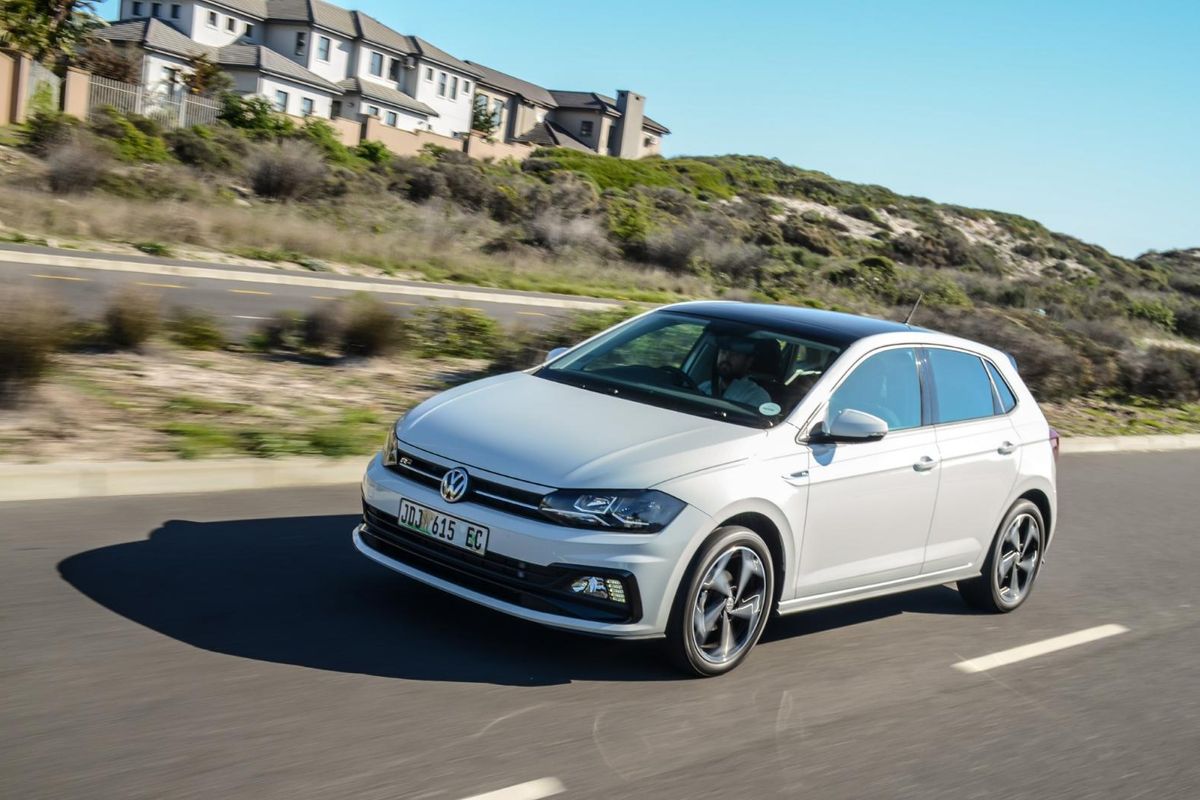
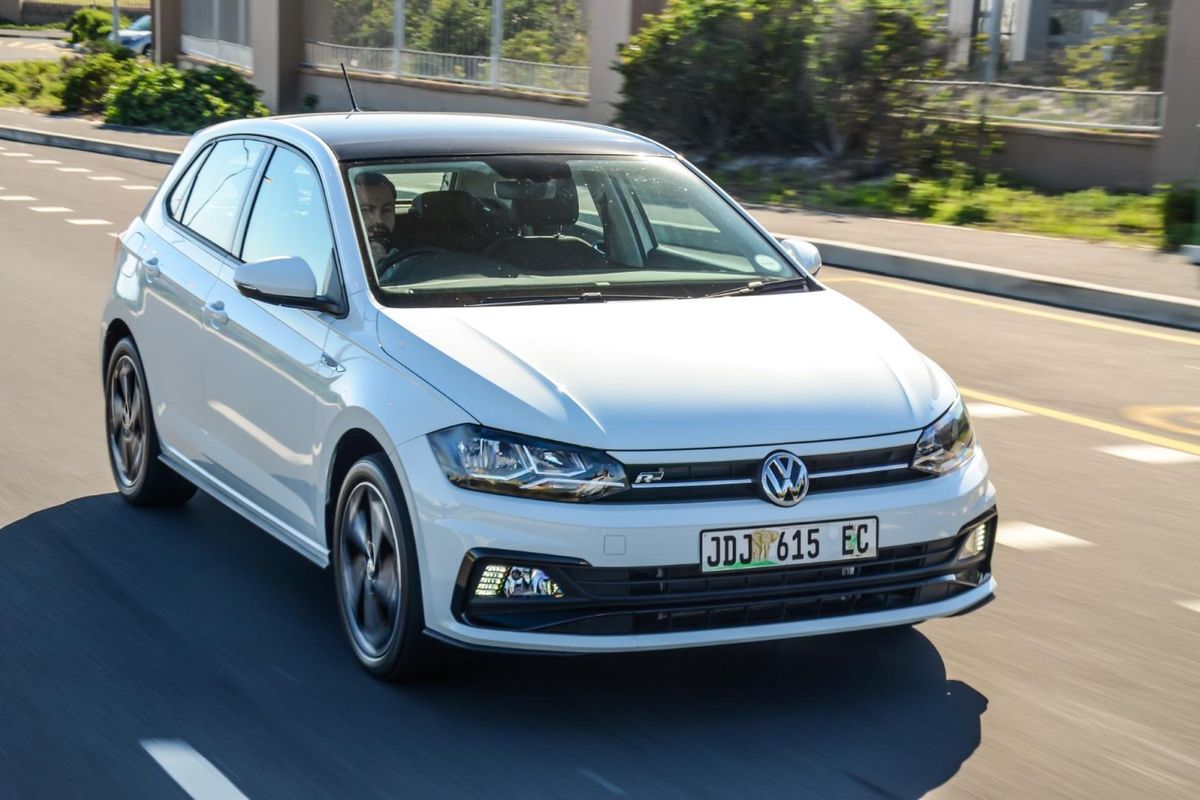
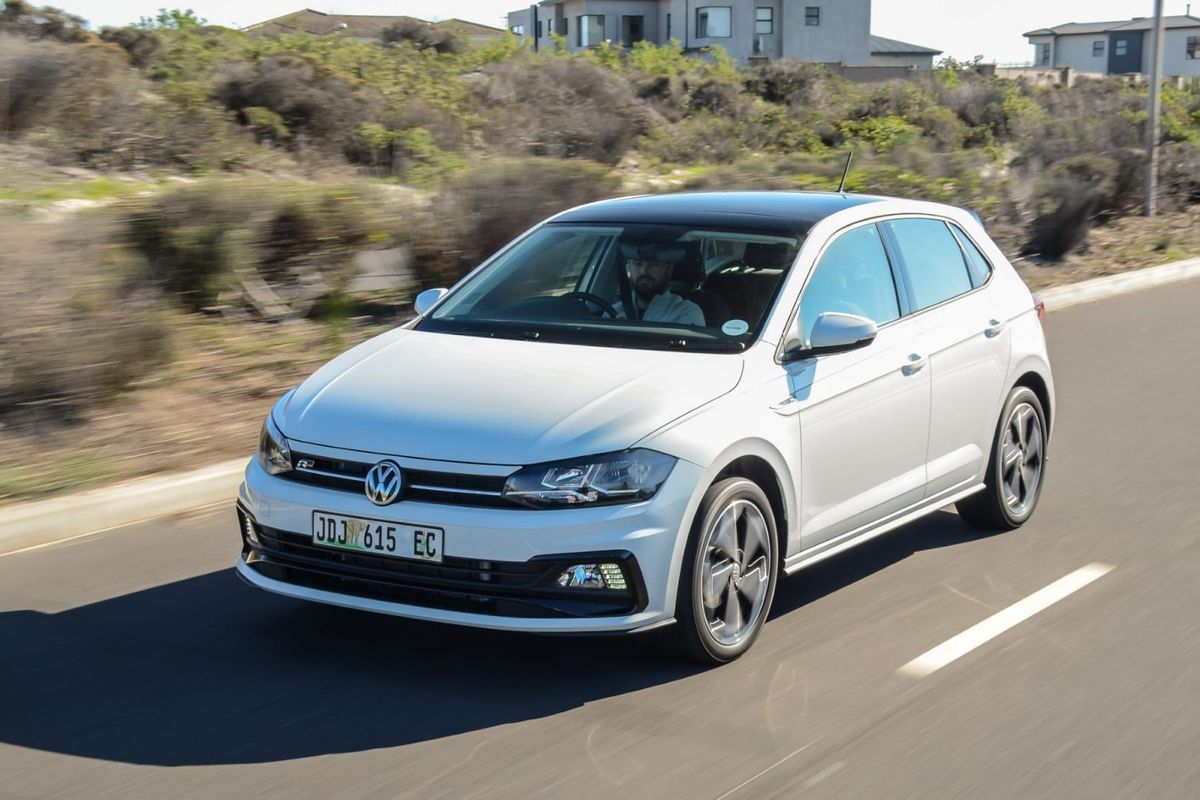
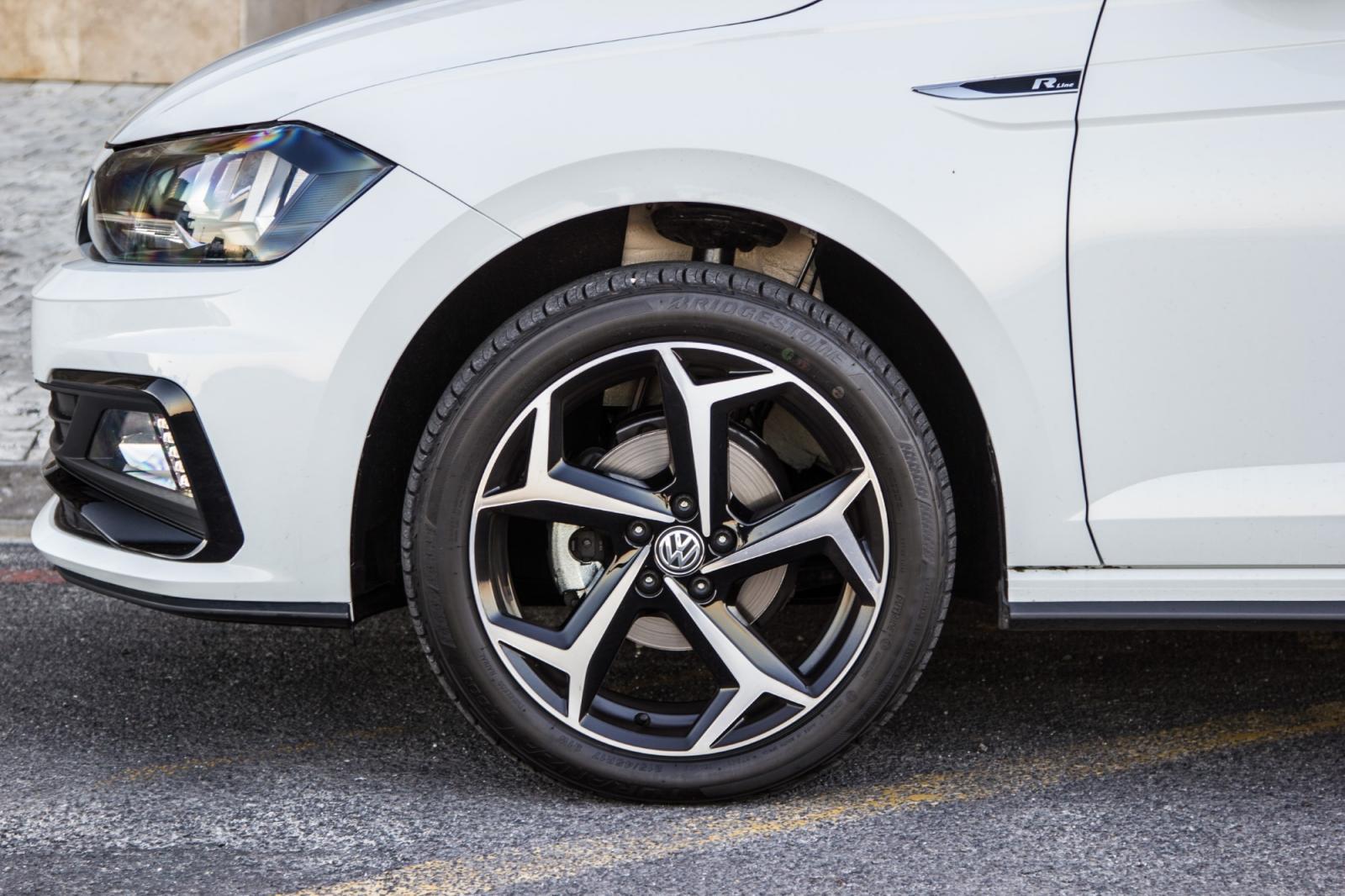
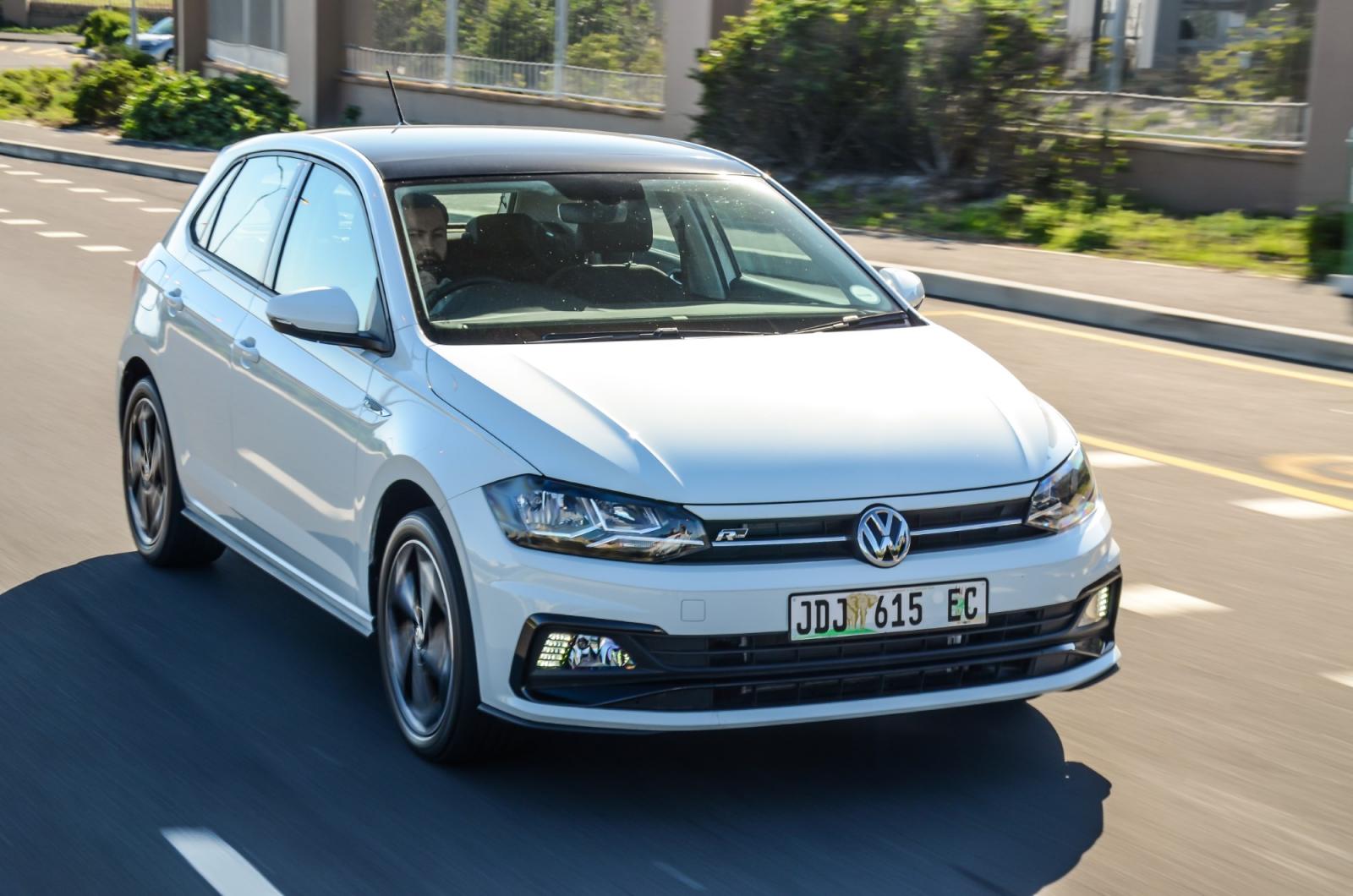
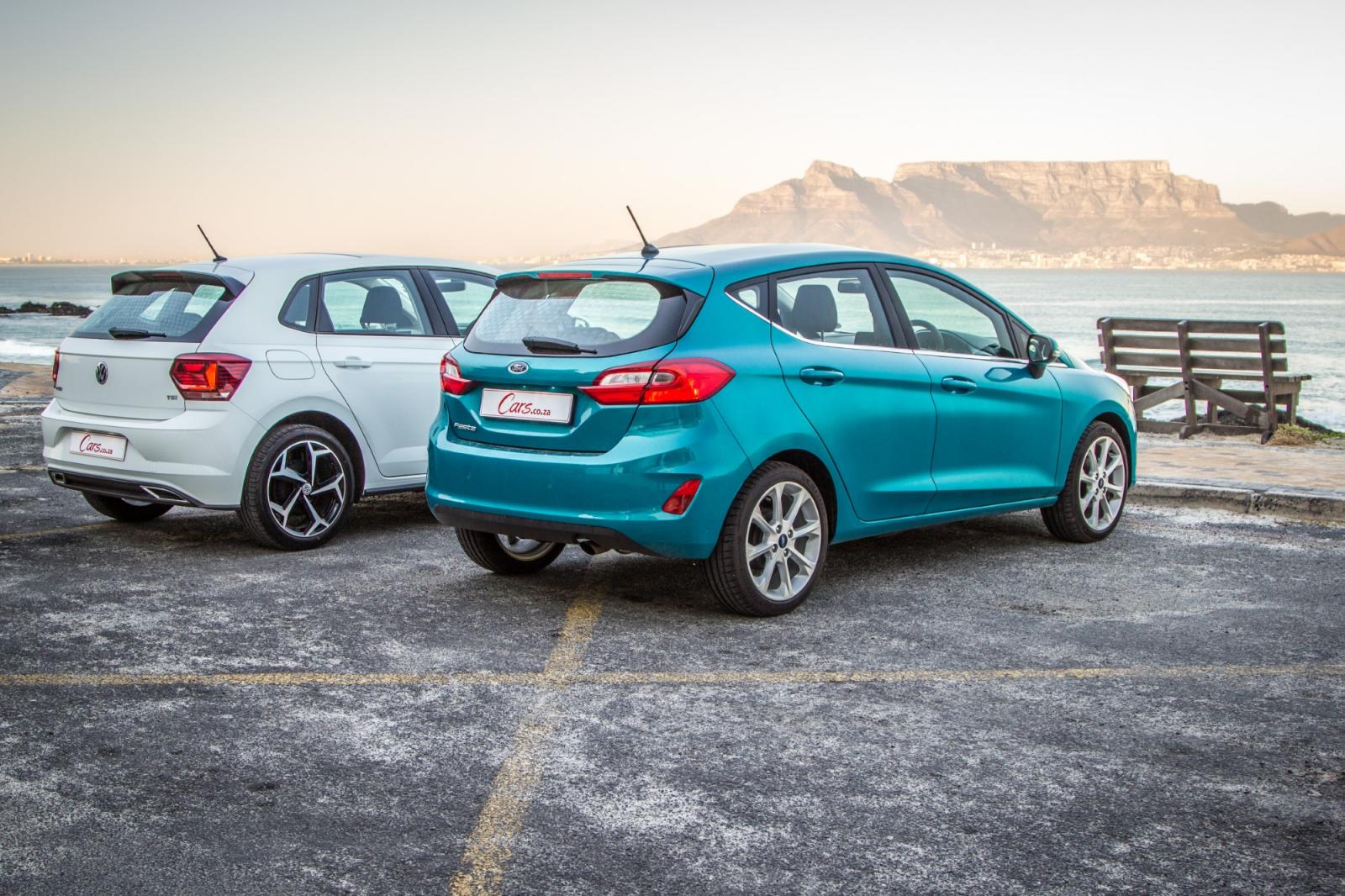
The sharp and edgy-looking Polo is more progressive than the model it replaces but errs on the side of conservativism. However, the R-Line kit specified to this derivative endows it with an aggressive look and is recommended for those who want to fool onlookers into thinking it’s a Polo GTI, even if it’s just for a fleeting moment… The Polo Comfortline R-Line ups ante with a sportier front bumper, side sill extensions, a gloss black boot spoiler and rear diffuser while riding on attractive 17-inch Bonneville alloy wheels. As ever, it certainly has broad, everyman appeal…
The Polo R-Line wears striking 17-inch Bonneville alloys…
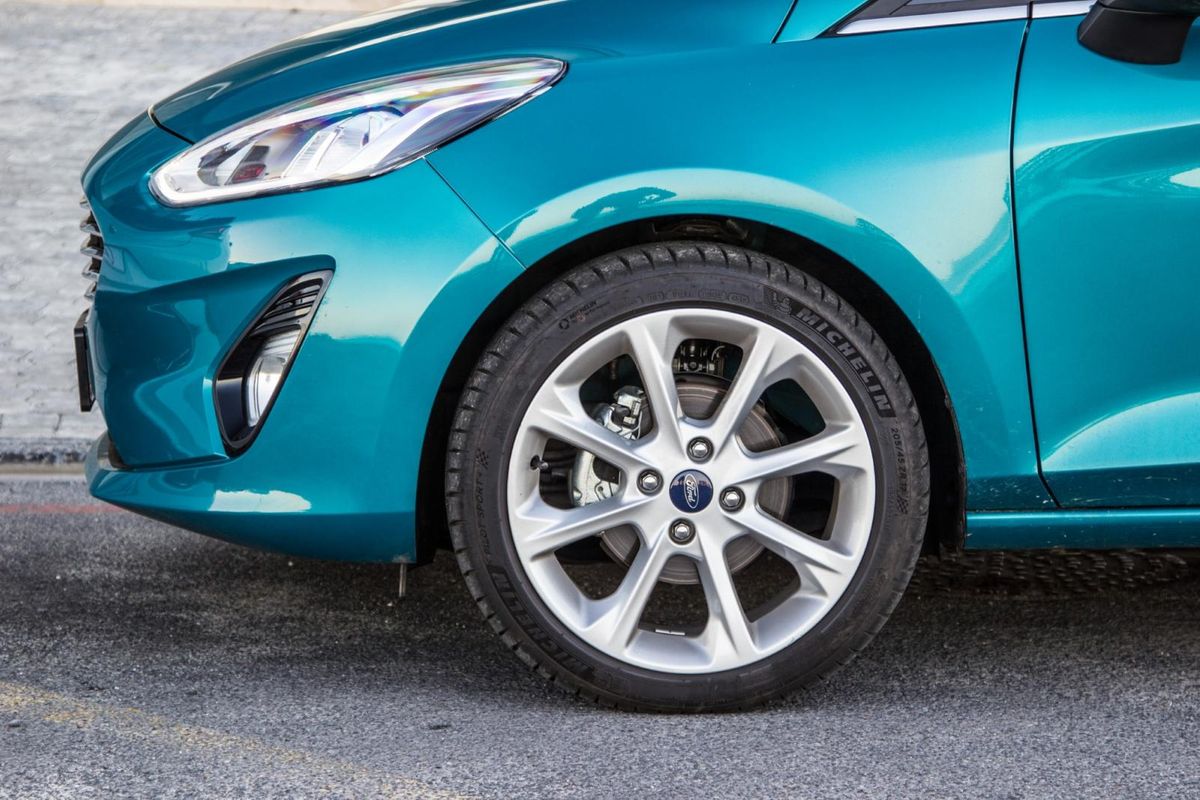
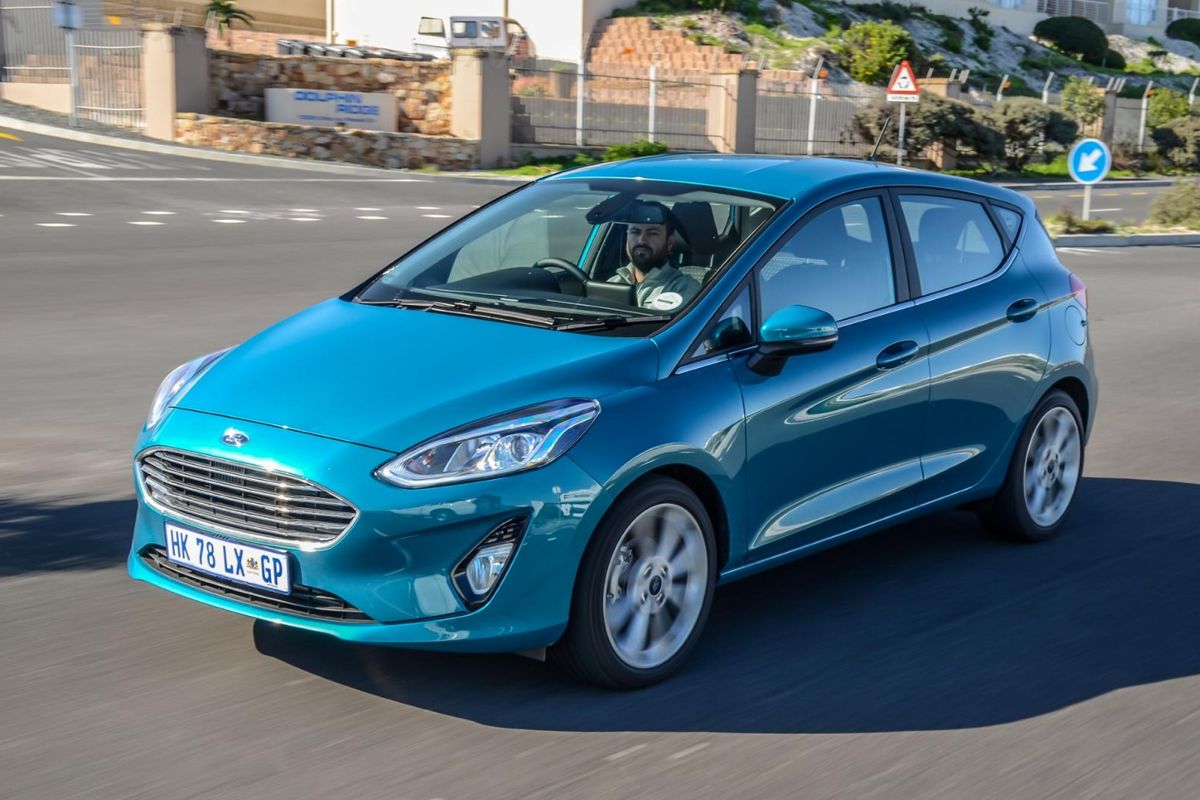
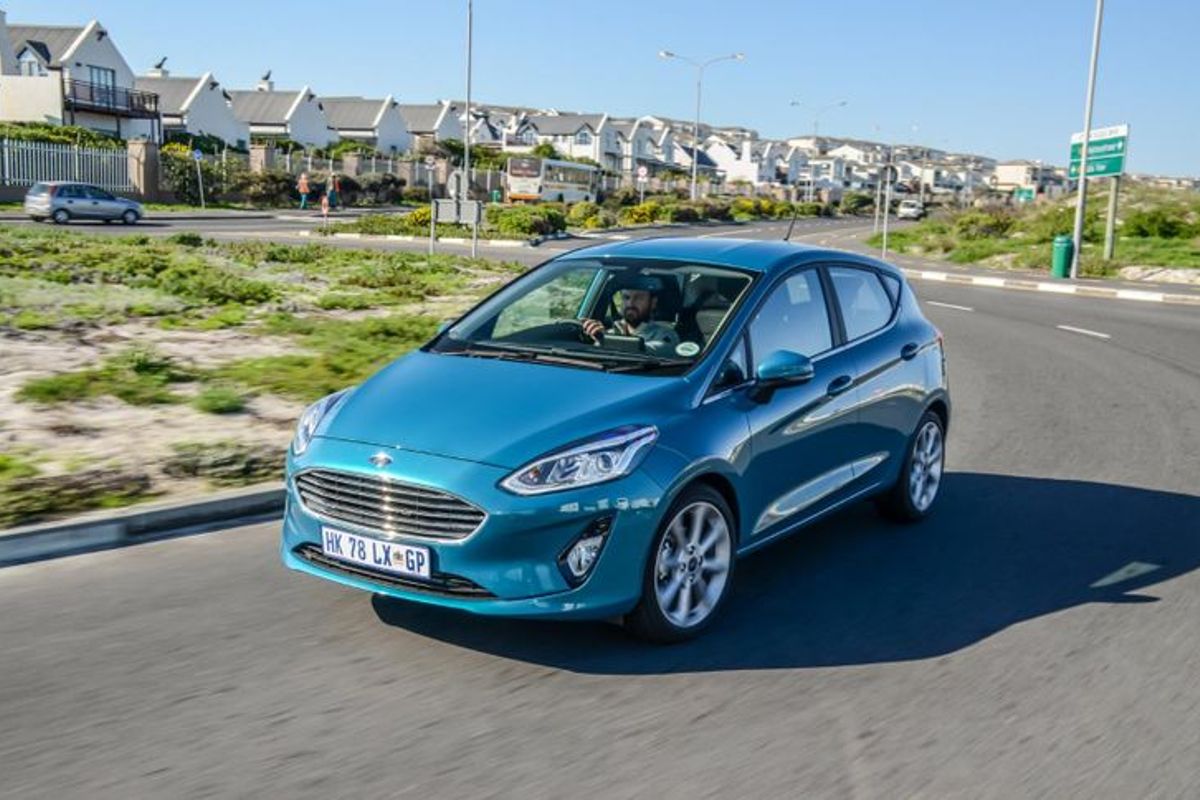
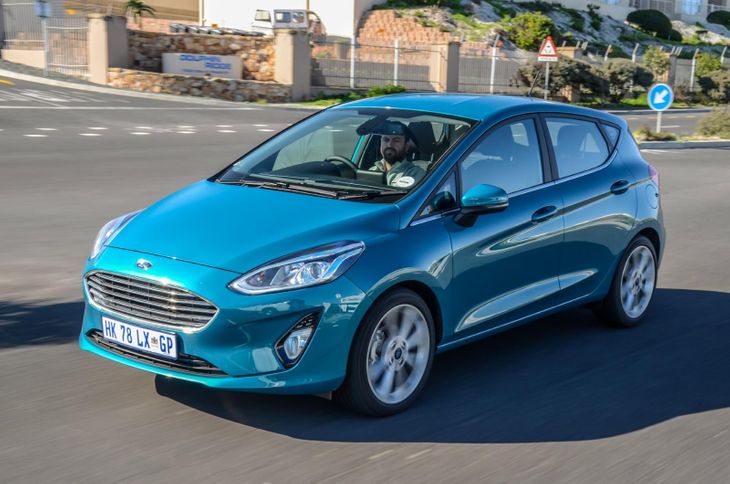
The new Ford Fiesta, by contrast, is comparatively shapelier and, arguably, softer on the eye, but retains an air of sportiness. It wears a wider grille with a chrome finish, complemented by elongated headlights and LED running lights that give the Fiesta a distinctive look. It too rides on 17-inch alloys, but the Fiesta’s rims came shod with quality Michelin Pilot Sport4 rubber as standard. This is, by far, the neatest-looking Fiesta ever made…
You can decide for yourself which one you like most, but we think the R-Line clad Polo retains the edge over the Fiesta in terms of kerb appeal.
Performance and refinement?
The Polo offers a refined drive and has a smoother drivetrain than the Fiesta.
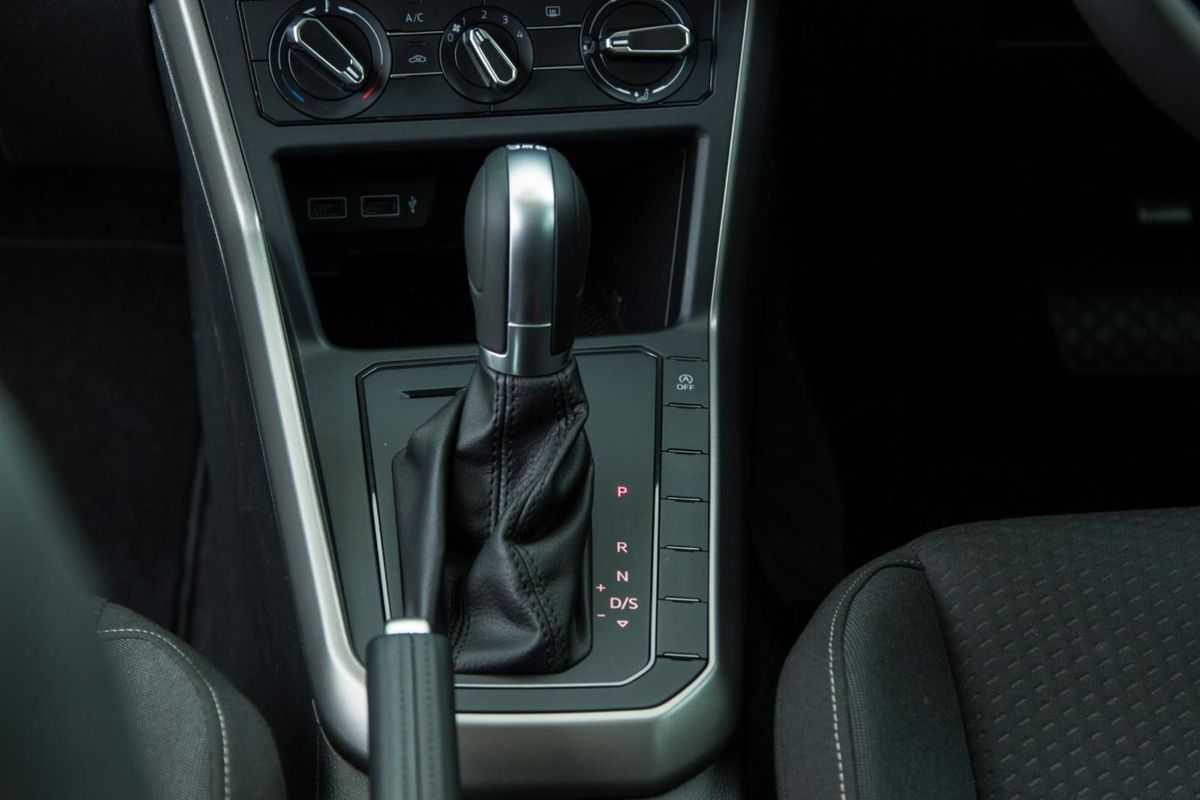
While you may be able to pull the wool over people’s eyes in making them think you are driving a Polo GTI, the Polo R-Line doesn’t quite have the go to match the show. Its 70 kW/175 Nm 1.0-litre 3-cylinder turbopetrol engine is mated with a 7-speed dual-clutch transmission driving the front wheels.
Nonetheless, it has sufficient shove for everyday driving and delivers its power in a smooth and refined manner. The DSG transmission is a peach and its shifts are seamless and barely noticeable. It’s also quite responsive to throttle inputs and it performs admirably under harder acceleration. In terms of fuel consumption, Volkswagen claims 4.7 L/100km and we achieved 7.6 L/100 km during our test.
We must, however, voice our frustration at the Stop/Start system in the Polo. It’s intrusive and the engine cuts out before the vehicle has come to a complete stop, which, in turn, cuts out the power steering, so you are now unable to steer. One of our testers reported that he almost had a fender bender as a result of this and the worst part is that you have to turn the system off every time you start the car.
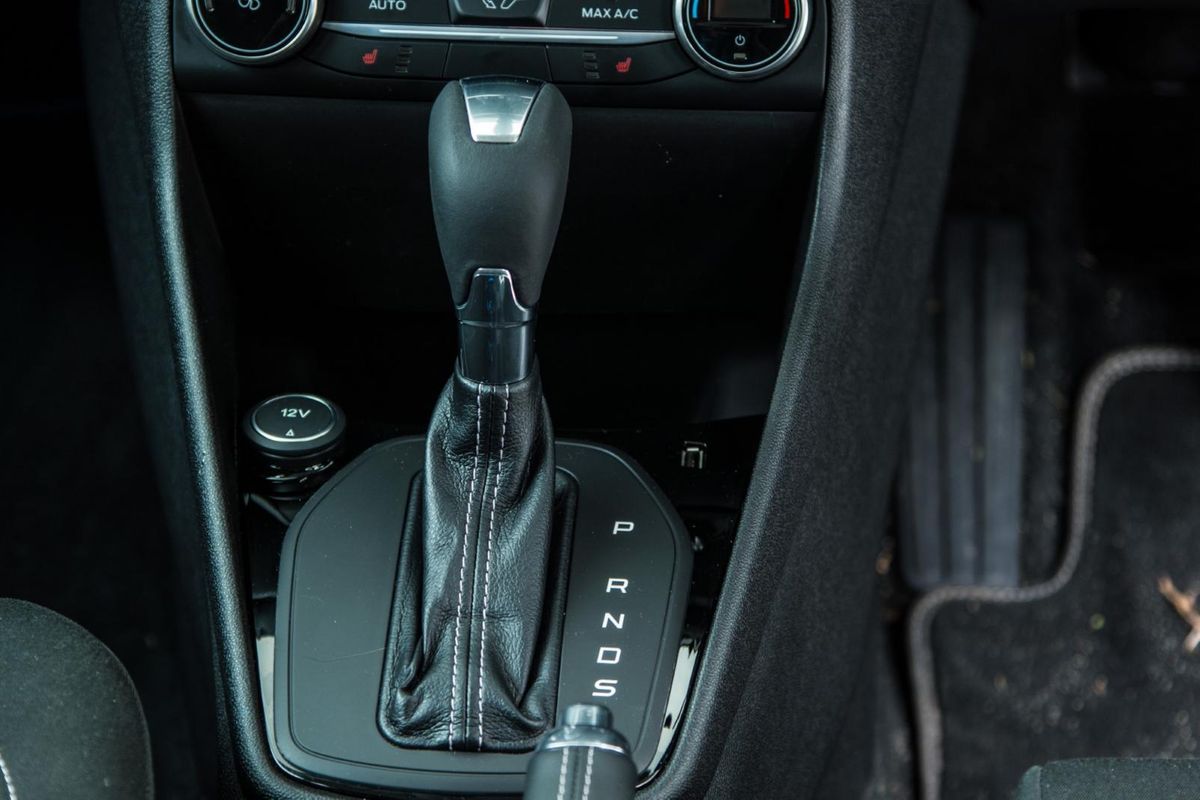
The Fiesta's automatic transmission is no match for the DSG found in the Polo.
Meanwhile, the Fiesta 1.0T brings slightly more power to the tar with 74 kW and 170 Nm of torque developed by its 1.0-litre 3-cylinder turbopetrol engine. It’s also front-wheel-driven but equipped with a 6-speed automatic transmission (a torque converter, opposed to a dual-clutch 'box).
Although refined, we found that the Fiesta is best driven with a measured approach as the engine becomes noticeably strained when driven hard. The transmission shifts are not as smooth and seamless as we would have hoped and when in sports mode, it didn’t feel entirely sure what gear it wanted to be in. There are also steering wheel paddles that you can use to manually shift gears, but we found that because the transmission was quite slow to respond to inputs, it was better to let the transmission change gears on its own. The Fiesta carries a claimed fuel consumption figure of 5.2 L/100 km, but it proved to be thirstier than the Polo with a real-world average of 9.2 L/100 km, which is a critical point.
Overall, we think the Polo delivers its performance in a more pleasing and refined manner. The DSG transmission is excellent and the automatic transmission found in the Fiesta, which is fine for the daily commute but less so in cut-and-thrust driving conditions, is perhaps its biggest letdown.
Ride quality and handling?
The Polo offers the most comfortable ride, but the Fiesta is more agile and has better handling ability.
While the Polo is arguably best-in-class when it comes to ride comfort, the Fiesta really impressed us in this regard and is almost just as good as the Polo. Both vehicles offer impeccable manners on the road and both do an excellent job of ironing out imperfections on a variety of surfaces.
Noise Vibration and Harshness (NVH) has improved significantly in the Fiesta and the cabin is noticeably quieter while driving, bringing it up to the level of the Polo. While we maintain that the Polo’s ride quality is slightly better/more comfortable than the Fiesta (it’s very close), we do think the Fiesta is more fun to drive and offers superior handling performance compared with the Polo.
The Fiesta has always been a fun car to drive spiritedly and this new model is no different. Don’t get us wrong here, the Polo is wieldy and balanced, but the Fiesta is perceptibly better in this regard. The Fiesta is agile and more fun to drive with more front-end grip. Its dimensions, sporty tyres and weightier, more responsive steering setup makes it more sure-footed and involving to drive.
Interior and features?
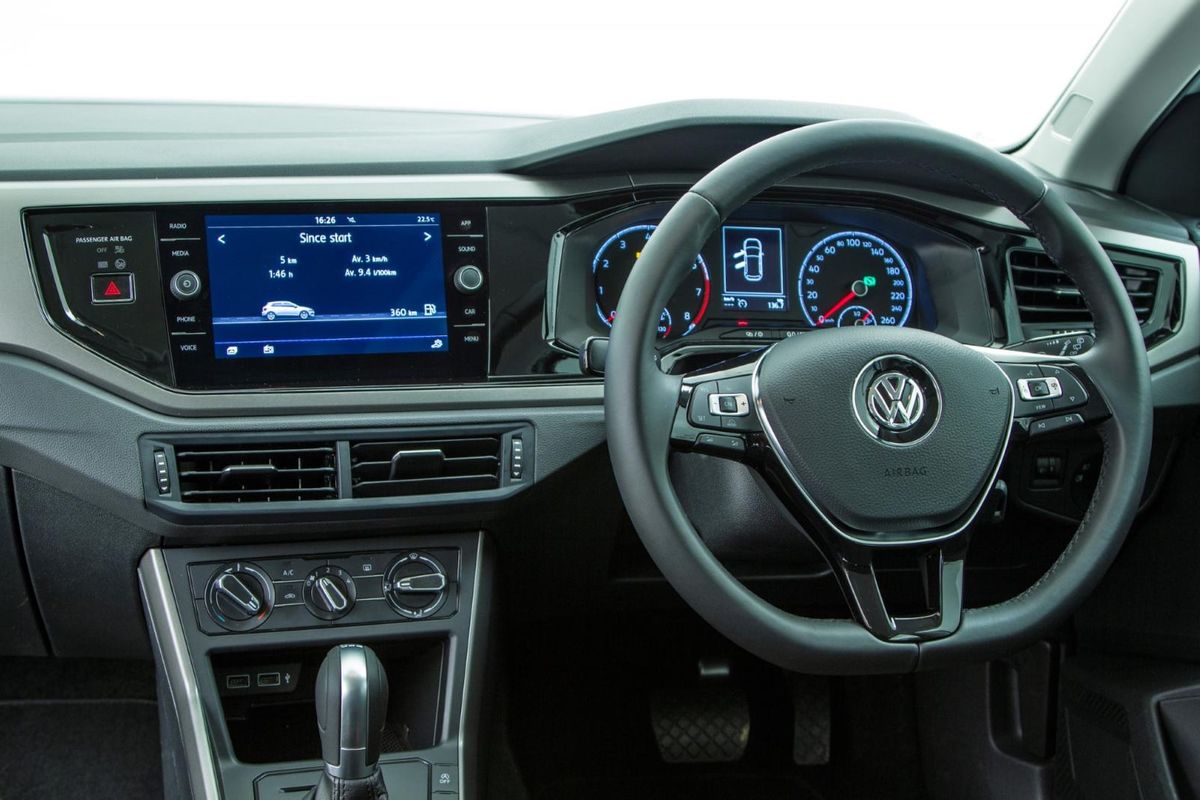
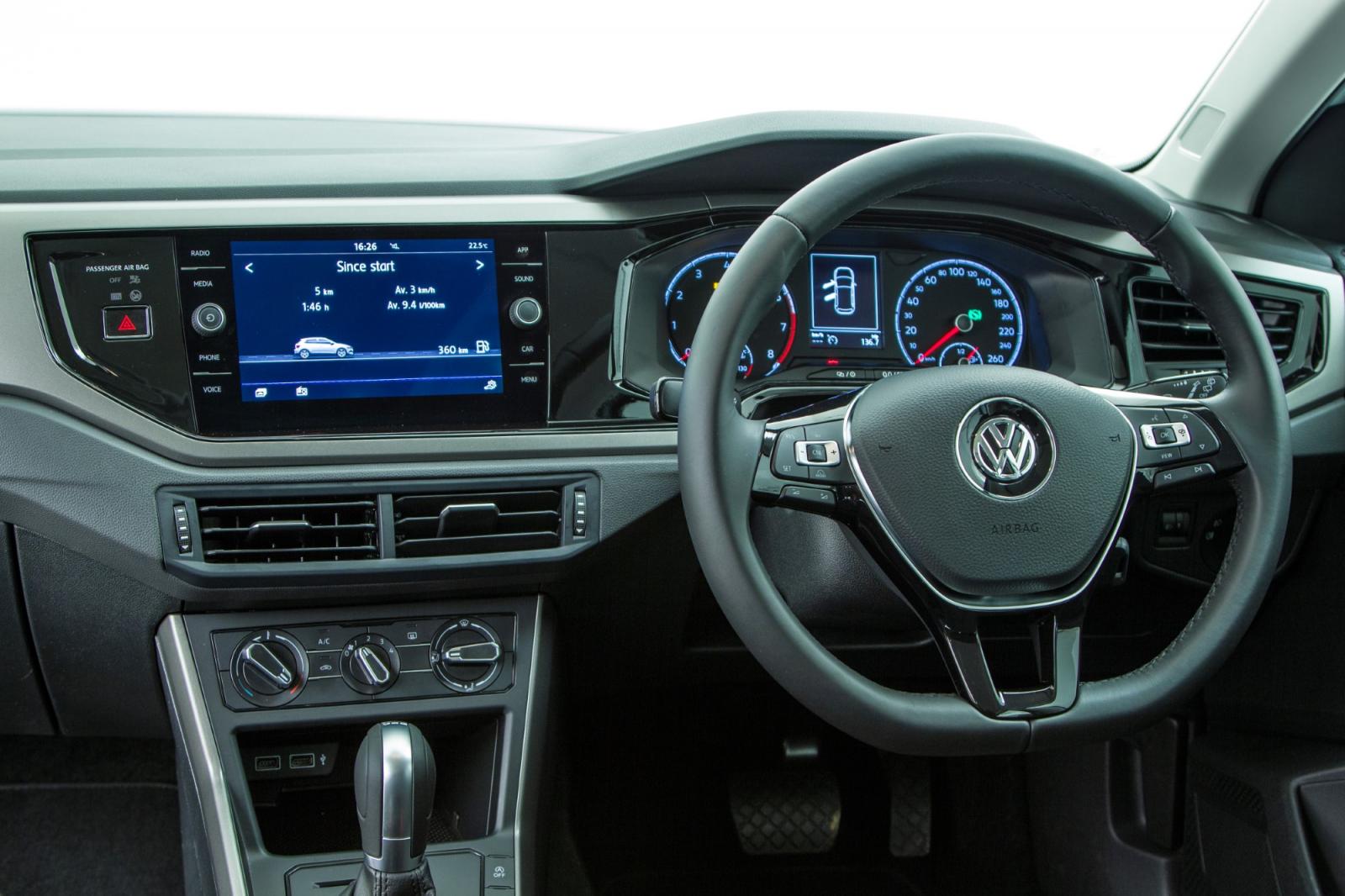
The sleek interior design of the Polo exhibits excellent build quality and execution and will likely age well.
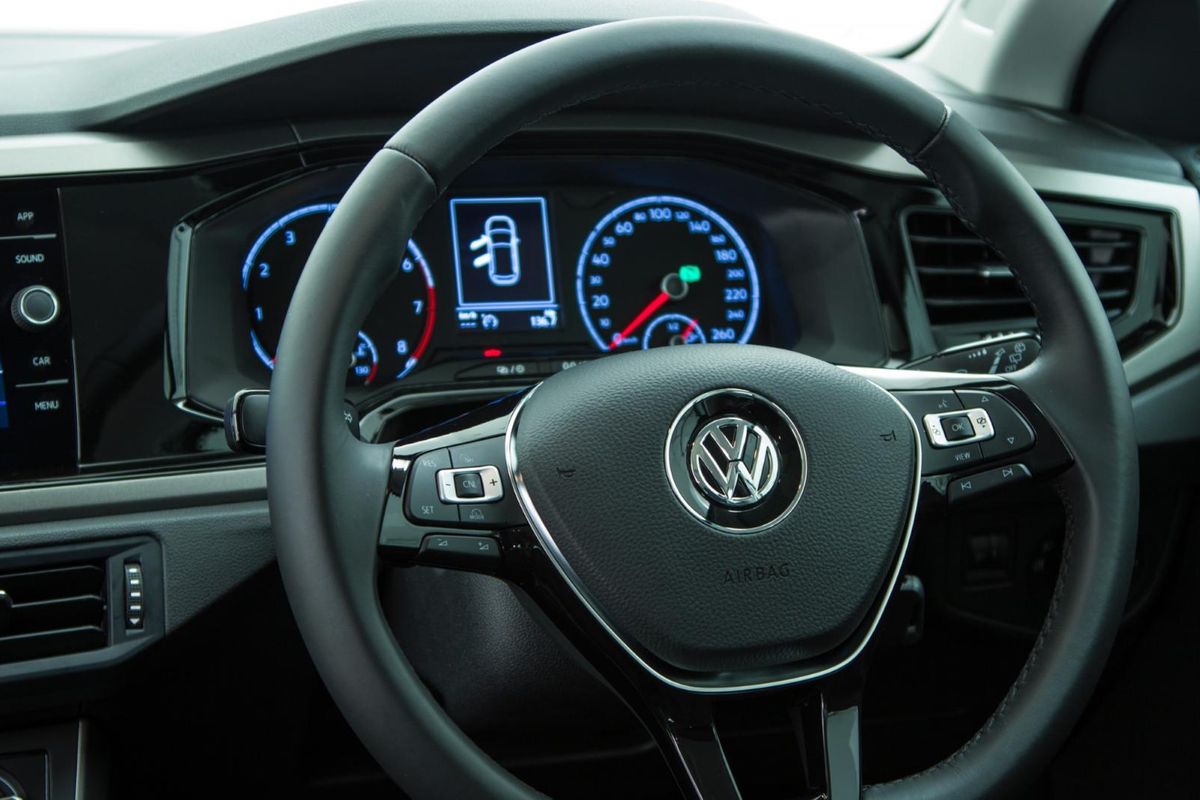
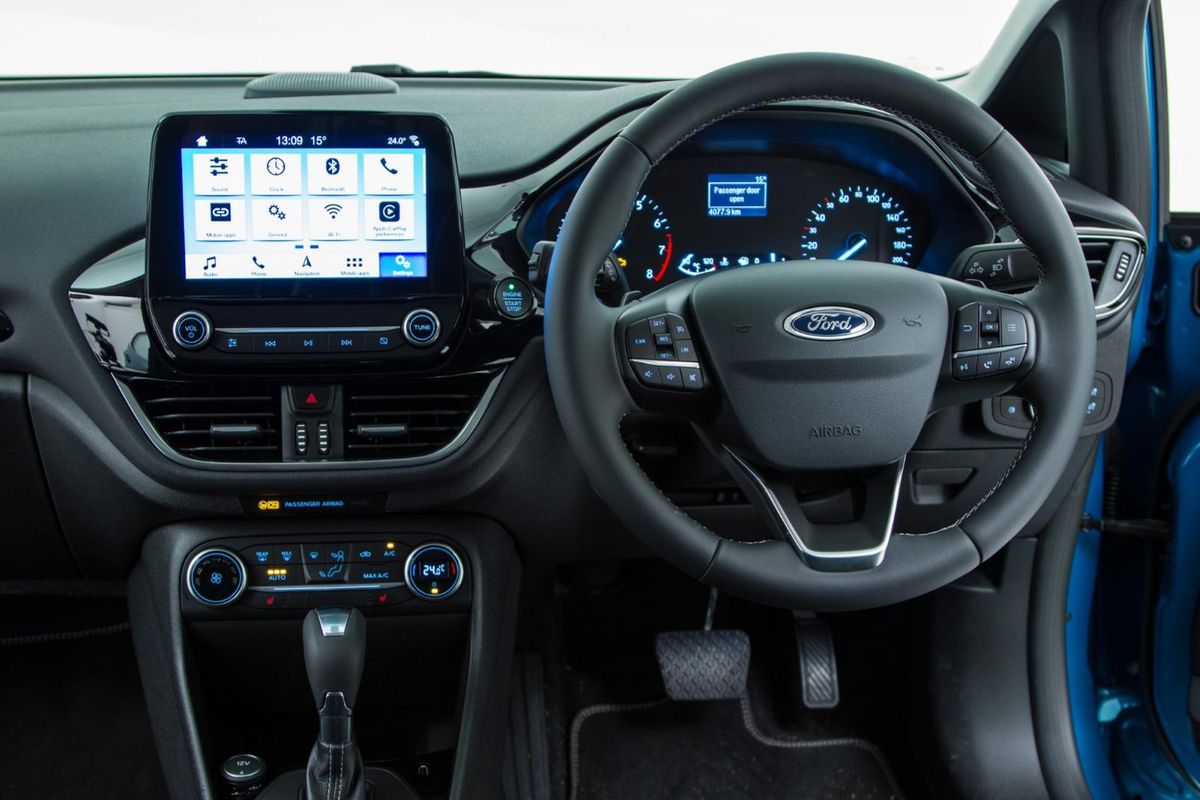
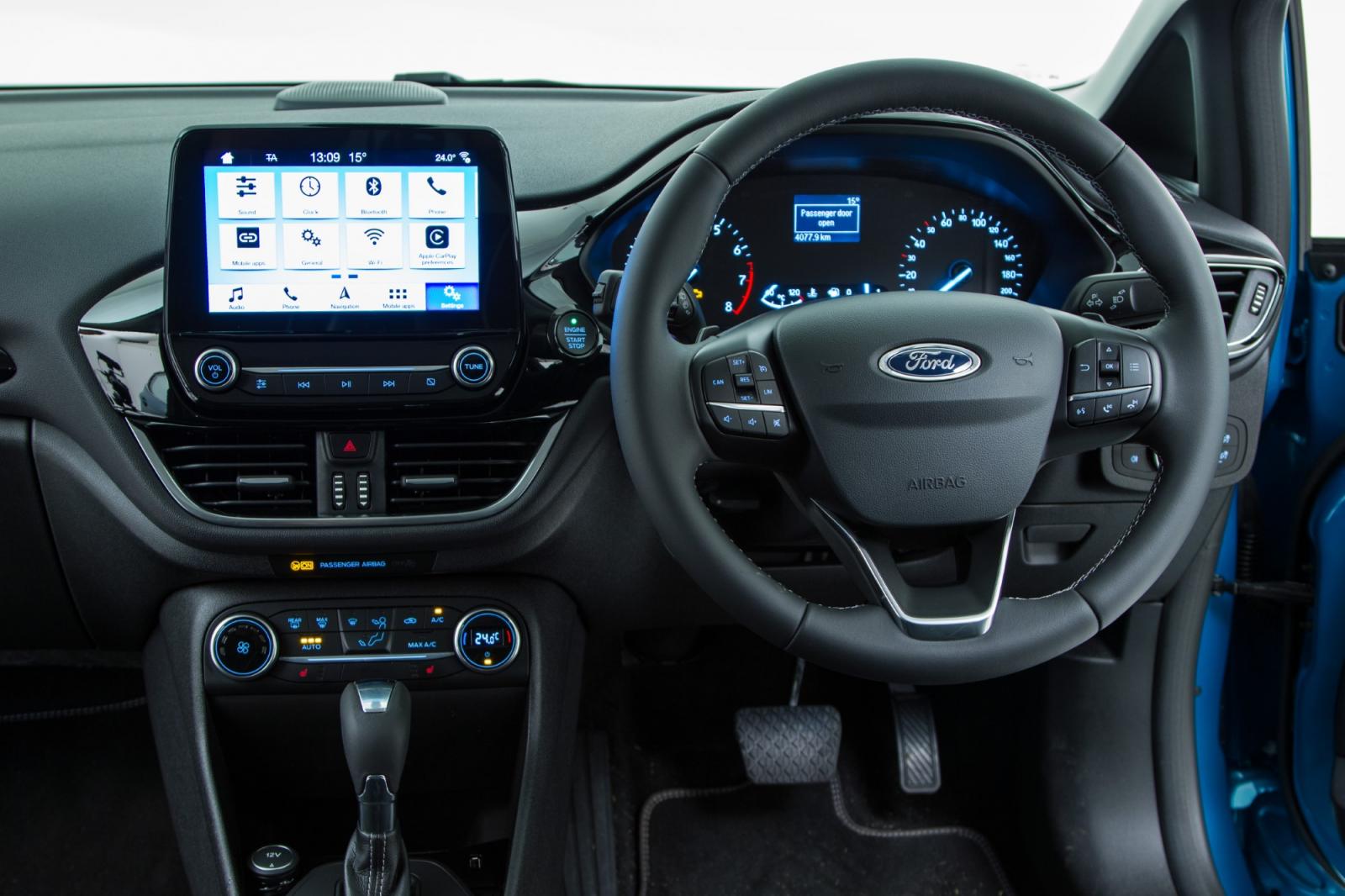
The Polo’s interior design is sophisticated in look and feel and its execution and overall build quality is excellent. In comparison, the Fiesta’s interior exudes more youthful appeal and represents a massive improvement over the previous generation. However, the Fiesta’s interior offers a mixed bag of materials of varying tactile quality and overall build quality doesn’t quite match that of the Polo. The HVAC (ventilation) switchgear in the Fiesta, however, is better but the instrument cluster is rather plain-looking compared to the instrument cluster in the Polo.
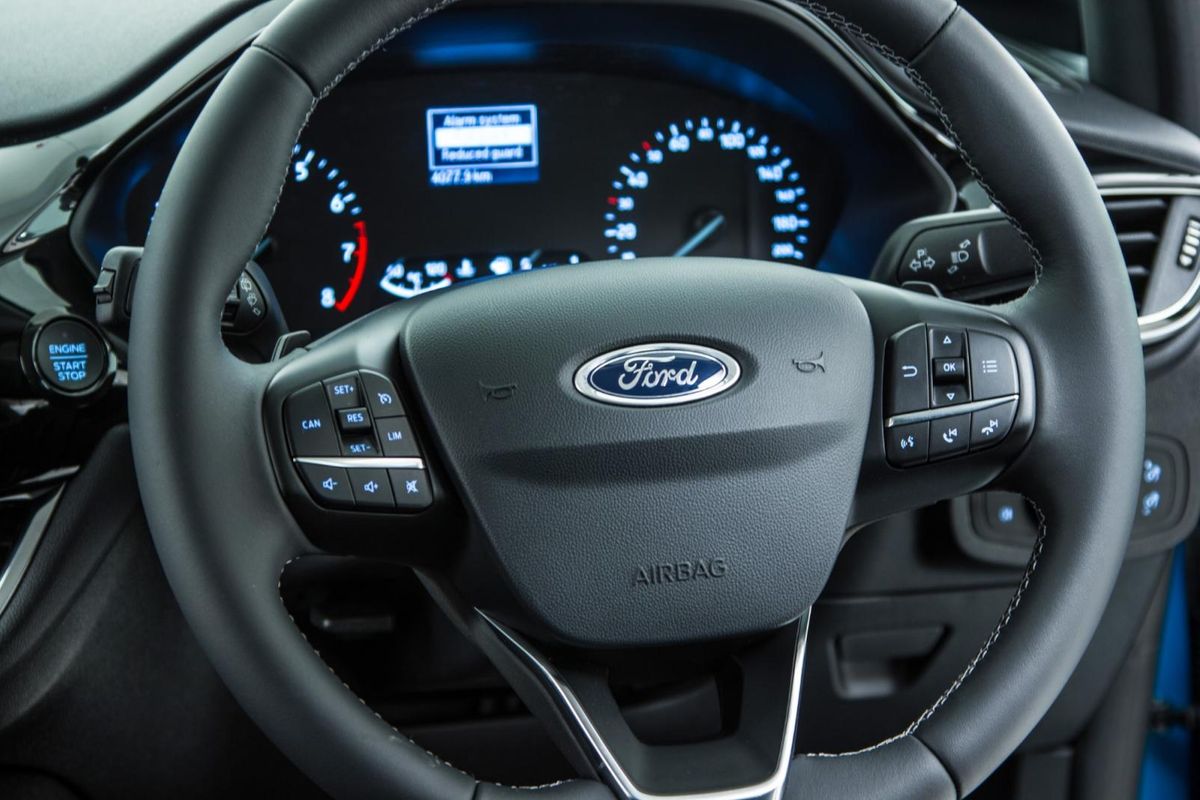
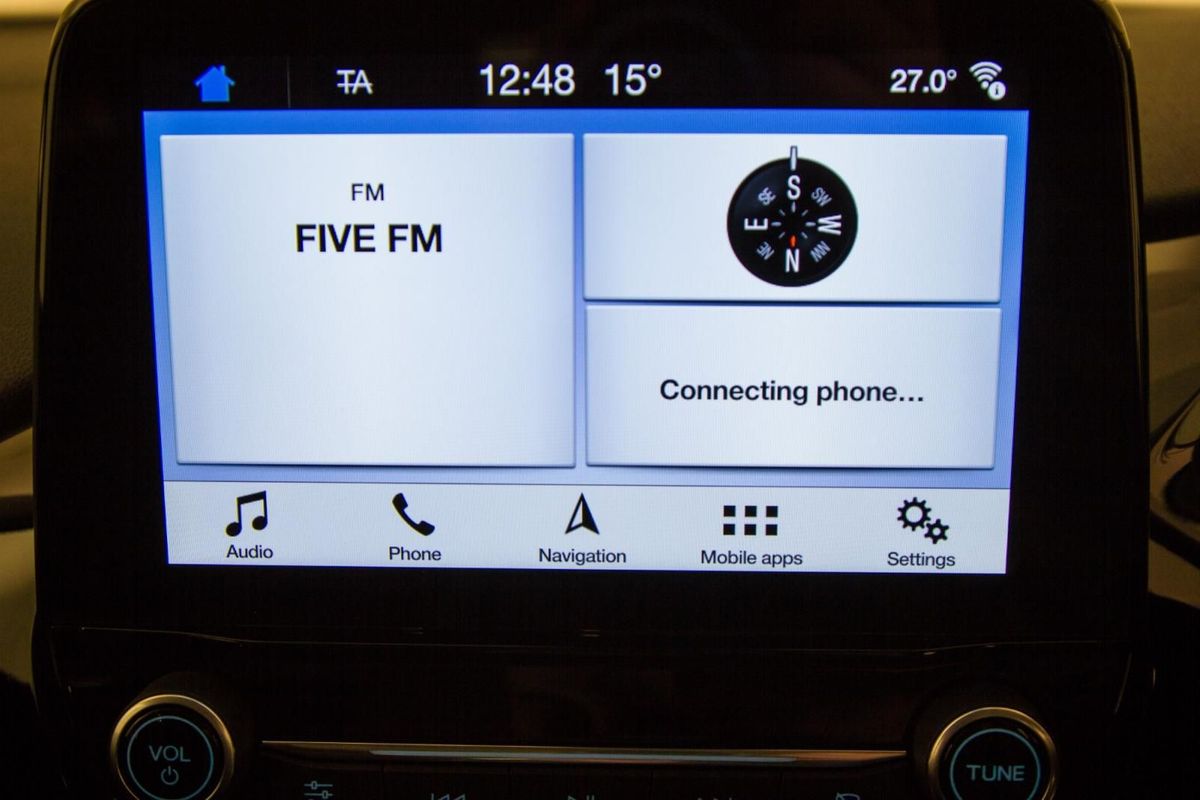
In terms of standard specification, however, Ford has equipped this Fiesta liberally – it’s literally unbeatable in this regard. It comes crammed with standard features such as an 8-inch touchscreen infotainment system with SYNC3, Bluetooth, voice control, navigation, App Connect, 2 USB ports, a multifunction steering wheel, cruise control, climate control (single-zone) air conditioning, rear park distance control… and our favourite winter feature — heated seats. It’s also worth noting that automatic headlights and rain-sensing windscreen wipers are standard on the Fiesta.
The 8-inch touchscreen infotainment system with SYNC3 is a major highlight in the Fiesta.
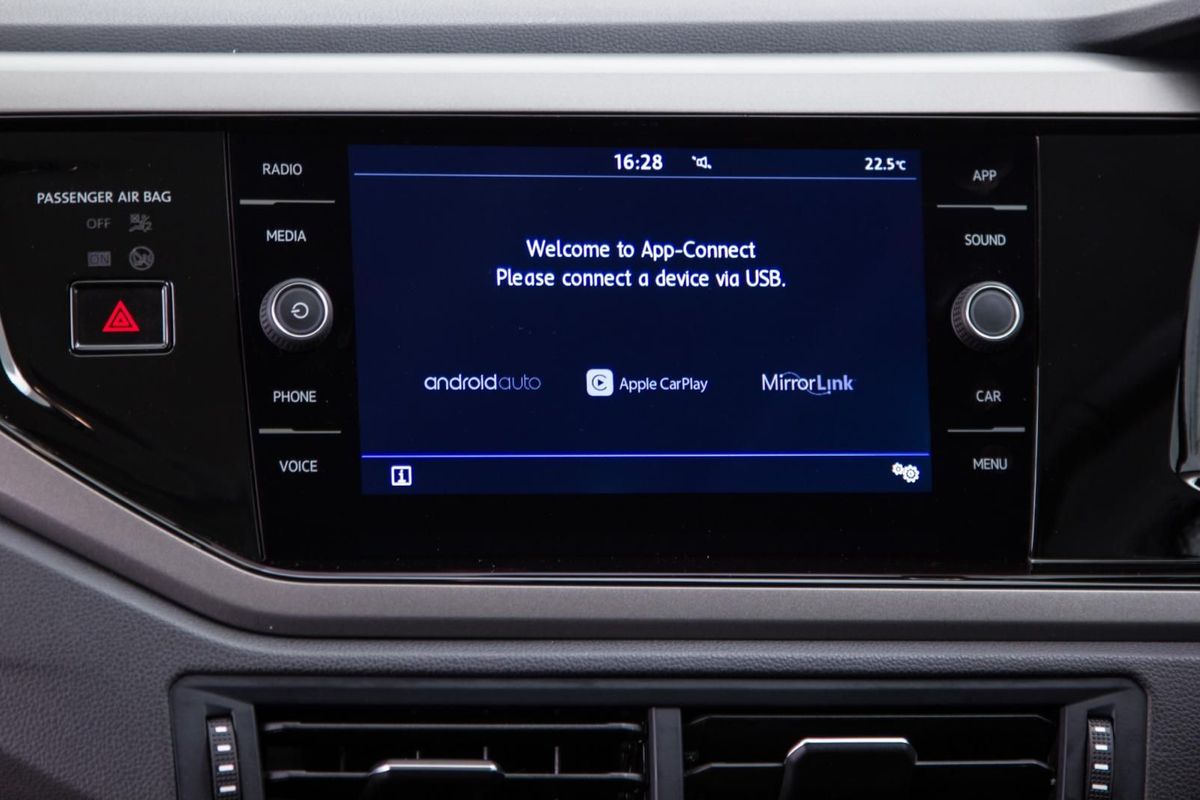
While the Fiesta has a comprehensive list of standard features, the Polo has a comprehensive list of optional features and you will have to spend a fair penny to bring the Polo up to the same level of specification. The 8-inch Composition Media system fitted to this Polo is optional (R5 297) and comes equipped with Bluetooth, voice control and App Connect, but you will still have to spend more if you want navigation.
In terms of safety, both cars offer 6 airbags, ABS with EBD, brake assist, electronic stability control, traction control and ISOFIX child seat mounts.
Overall, we think the Polo’s interior trumps the Fiesta’s in terms of styling and outright build quality, but the Fiesta’s long list of standard features makes it a very attractive proposition.
Practicality?
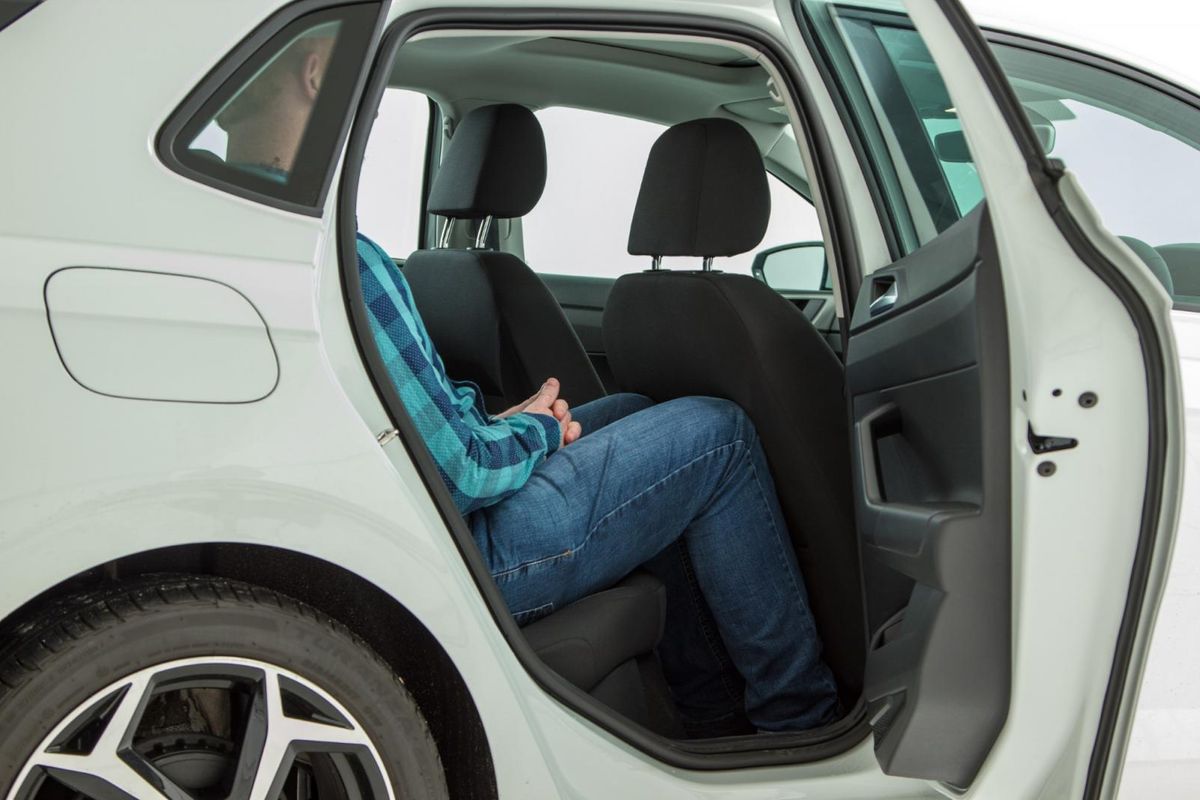
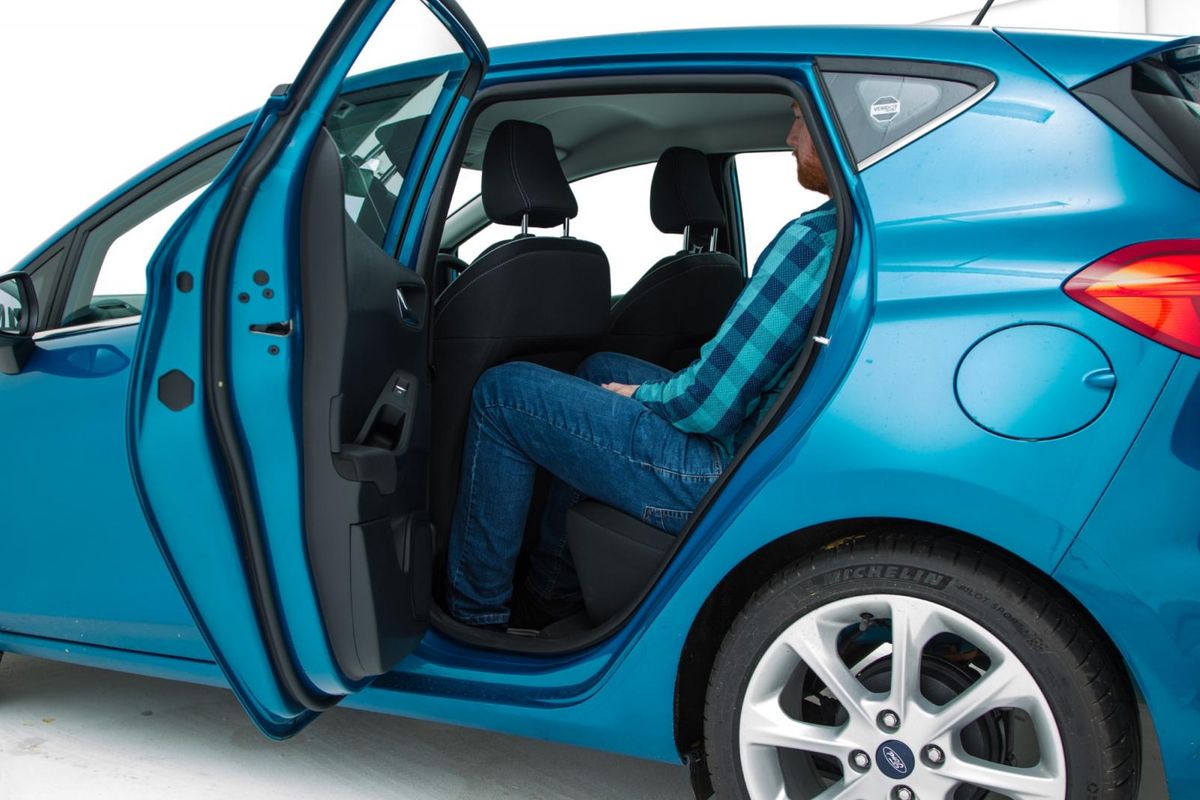
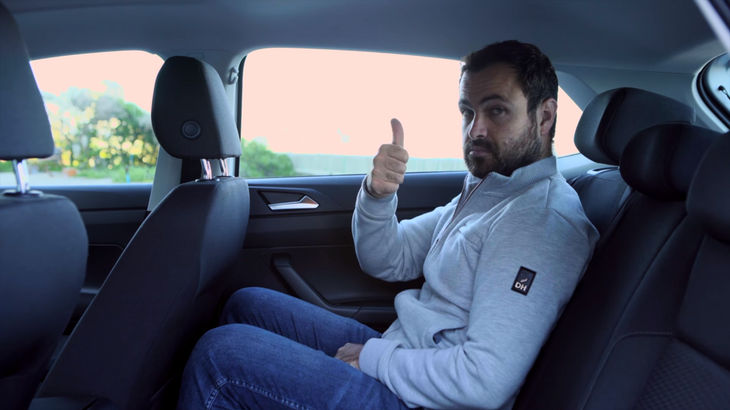
The Polo offers a bit more leg and knee room for rear passengers and it has a more practical load bay.
In terms of practicality, the Polo has the bigger boot at 350 litres and it is both deeper and wider than that of the Fiesta, which is claimed at 303 litres. Both vehicles offer 60:40 split-folding rear seats which greatly improves loading space when you need it. We found the rear leg- and knee room quite cramped in the Fiesta; the Polo was more forgiving in this regard. Our posteriors found the Polo's seats more comfortable overall.
Interestingly, we also noticed that the door pockets and bottle holders were larger in the Polo, affording more storage space. Both vehicles offer 2 front cup holders for the driver and passenger and there is ample storage space for extra oddments in their gloveboxes and central storage bins.
From a practicality perspective, the Polo stands out as a clear winner…
Pricing and value for money?
The Fiesta makes a strong case for itself with its standard feature specification and better warranty and service plan.
The Volkswagen Polo 1.0TSI Comfortline R-Line automatic is priced from R297 849 and comes with a 3-year/120 000 km warranty and a 3-year/45 000 km service plan. The Ford Fiesta 1.0T Titanium automatic, by contrast, is priced from R310 600 and is sold with a better 4-year/120 000 km warranty and an extended 4-year/60 000 km service plan.
Yes, the Fiesta Titanium automatic is over R12 000 more expensive than the standard Polo Comfortline R-Line automatic, but remember that the Fiesta offers a wide range of features as standard. In fact, you would have to spend more than R25 000 on optional features in the Polo to match the specification of the Fiesta, which actually makes the Polo some R13 000 more expensive. In that sense, and coupled with a better warranty and service plan, the Fiesta offers exceptional value-for-money, but that is only one part of the greater whole…
The Fiesta offers exceptional value but brand strength, customer service and potential resale value make the Polo a better buy.
Both the Polo and Fiesta are superb cars in their own right and if your budget can stretch to just beyond R300 000 for a new car, then you can’t really go wrong with either of them as they are relatively practical and easy to live with on a daily basis.
The Polo remains the consummate all-rounder: in terms of general quality and refinement, everyday performance/economy, overall comfort and practicality it does not put a foot wrong. Having said that, the grown-up Polo no longer stands out above the opposition in the way it once did, because the Ford is also well-made and sophisticatedly packaged but is more fun to drive, and in standard guise, has more youthful appeal.
What's more, the Fiesta offers an exceptional package: it has a longer warranty, service plan and an extensive standard features list. In terms of maximising showroom appeal, Ford has gone to great efforts to smarten up its offering in a market where cash-strapped consumers are desperate to extract every little ounce of value that they can. Is that enough to swing the verdict in the feature-packed and spirited Ford's favour?
Both the Polo and Fiesta are excellent products that are easy to live with. Which one do you prefer?
What's pivotal here is that the latest results (2016/2017) of the Cars.co.za Ownership Satisfaction Survey shows that South African owners rank Volkswagen among the best when it comes to after-sales service and overall satisfaction, whereas Ford owners are comparatively less impressed. What's more, the German brand's ironclad reputation should ensure that the Polo will hold its value for longer – even though it may appear to be more expensive from the outset, you are likely to recoup your spend down the line when you decide to sell it in the used car market.
To date, this is the fiercest challenge the Fiesta has mounted in opposition to the dominant Polo, but for the reasons outlined in the review above, we think the Volkswagen Polo Comfortline R-Line automatic is ultimately the better buy. Don’t agree with us? Share your opinion in the comment section below…
Opel has launched the all-new Grandland – stylish and modern SUV. However, it's entering one of the most competitive segments. Does it have enough going for it?
Opel really hasn’t had the easiest time since General Motors left the country last year, but with new global owners Peugeot, this brand is determined to win back the confidence of its customers here in South Africa.
Things are off to a good start: it’s only June and already the brand has grown in market share, launched the Crossland X, established a 35-strong dealership network and now, has brought to market its new flagship model – the Opel Grandland X. The new Grandland X enters a tough segment, absolutely teeming with strong competition, and will need to be more than just a good car to woo buyers.
In this review, we take a look at the engines available (hint: there's only one), the ride quality, boot space, infotainment system and of course, the price.
If you like going over mountains when on vacation, instead of around them, here are 5 budget-friendly low range off-roaders that work in harsh conditions.
With each new SUV reveal, the low-range transfer case moves closer to being engineered out of existence. At the turn of the millennium, an automotive product planner would not dare market anything in an SUV shape, with all-terrain tyres, that didn’t feature a low-range shifter or push-button selector.
By 2025 all this has changed. Radically. In today’s market, it has become nearly impossible to find vehicles with reduction gears, that enable crawl speeds in technical terrain, for under R250 000.
Opportunely, there remain a few bargain low-range enabled vehicles still being marketed locally and for those first-time adventurers on a very limited budget, some excellent pre-owned options too. Most contemporary compact SUVs have excellent ABS modulated traction aids, which can help when you are required to navigate a sandy track or some muddy gravel roads, but in steep terrain, where maximum power is required at the slowest possible speed, nothing is a substitute for low-range.
Budget-friendly low range off-roaders are a niche market. But because South Africa has a strong off-road exploration and adventure driving scene, there are more options available than you might think. This is why we’ve curated a list of 5 budget-friendly low range off-roaders for South Africans.
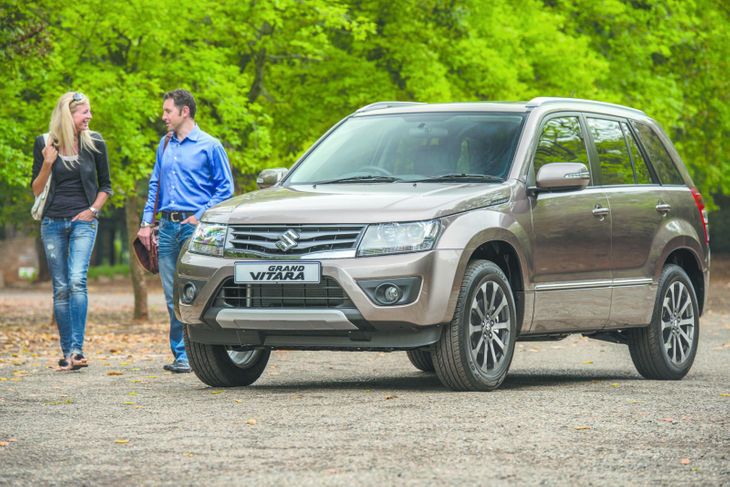
Suzuki Grand Vitara R150 000 to R180 000
Perhaps the most stealth low-range equipped SUV of the last 20 years. Whilst the Lilliputian Jimny generates massive image equity for the brand, few are aware how good the third-generation Grand Vitara is. It’s one of the few sub-Fortuner sized SUV with both a ladder frame chassis and low-range transfer case.
The naturally-aspirated 2.4-litre engine is a touch asthmatic at altitude, powering up to only 122 kW and 225 Nm, but much like its more celebrated Jimny sibling, a third-gen Grand Vitara’s best attributes are only revealed once low-range is engaged. Ground clearance isn’t class-leading, at 200 mm, but it is sufficient.
Grand Vitara’s unique selling point is the way it simply idles along in extreme terrain, unbothered, thanks to its 1.97 reduction gearing, where similarly priced soft-roader SUVs will have fried their clutch-packs trying to keep up.
This Suzuki’s ladder frame platform also provides a structural benefit in its ability to absorb all the strain when plodding through cross-axle obstacles, without transferring shock to the cabin. This is unlike a monocoque soft-roader, which can develop cabin squeaks and creaks in rough terrain, due to the nature of its suspension mounting points not being isolated from the cabin structure in a unibody design.
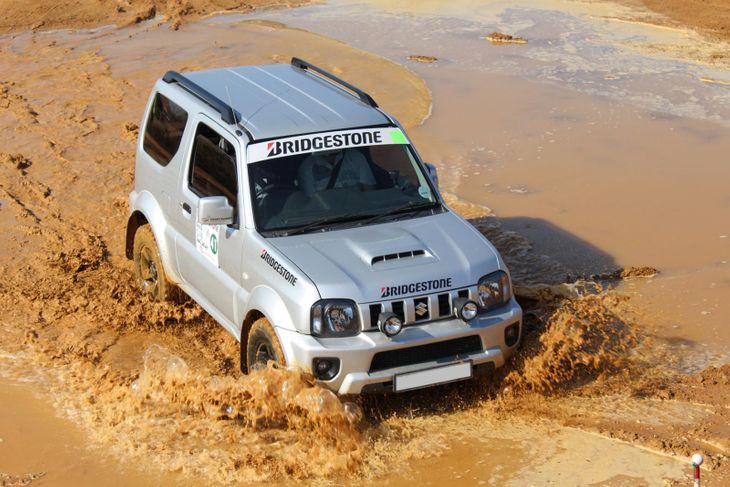
One of the world’s most iconic vehicles. The third-generation Jimny was a core part of Suzuki’s successful relaunch of the brand in South Africa during the late 2000s.
Very simple, and very effective little cars. But it’s always worth remembering that Jimny was created for a Japanese driving environment of slow highway speeds; without 100 km corrugated Karoo roads. It can struggle for context in the vastness of South Africa’s highway system, but it also has real talents in the African wilderness. If you know what you need – and what you are doing.
Although toy-like in appearance and abysmally slow when trying to keep up with any traffic on a national highway, the Jimny’s legendary status is indisputable and deserved.
Solid axles and a low-range transmission make the most of Jimny’s mere 63 kW and 110 Nm. In skilled hands, it can follow where most Defenders and Land Cruisers go, although the wheelbase-to-track ratio and high centre of gravity combine for a very unnerving experience when crawling around extremely off-camber, rock-strewn corners.
The absolute ground clearance of 190 mm might not sound like much, but Jimny’s compact dimensions mean tiny overhangs front and rear, hence it features very competitive approach and departure angles, enabling owners to explore dizzyingly challenging off-road routes. Jimny’s 46-degree departure angle is effectively unrivalled, which mean once you have rolled those front wheels into an obstacle, you’ll always manage to escape out of it.
There’s also more of a market for these now, albeit with advanced mileages, as owners have embraced the fourth-generation Jimny over the last few years, and upgraded. What to be careful of? Avoid ‘overlander-spec’ examples, which risk having been brutally overloaded. Other than that, there’s little to go wrong with these third-gen Jimny 4x4s.
Suzuki’s third-gen Jimny remains one of the defining budget-friendly low range off-roaders.
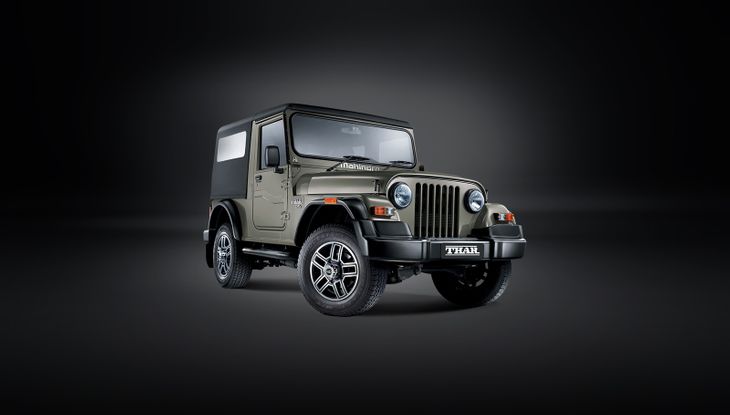
The Indian imitation Jeep Wrangler makes a third-gen Jimny appear luxurious and refined. If you like seeing a lot of exposed metal in the cabin and like hearing gears meshing and diesel fuel being compressed into combustion energy, you’ll love the Thar.
It traces a history back to 1945, so the likeness to Jeep is not incidental. The off-road componentry is essentially a Borg Warner all-wheel-drive system, featuring a ridiculously powerful 2.48 crawler gear ratio in low-range. Ground clearance isn’t astounding at 200 mm, but like the Jimny, Thar’s compact size and short wheelbase don’t require it to have an abundance of underbody clearance to roll over obstacles. An example of this is the approach angle that calculates to 44-degrees and is 22% superior to a Land Cruiser 70.
Power is sourced from a 2.5-litre turbodiesel boosting 79 kW and 247 Nm, which suits slow terrain manoeuvring a lot more than motorway driving. At 1 805 kg, with a tank of fuel, Thar’s not a light Jeep-lookalike, and 79 kW is never going to move that kind of weight around swiftly.
Ponderous in town and nearly unbearable to pilot on tar, even in the far left lane of the N1, Thar’s charms are best reserved for those week long gravel and extreme off-road exploration adventures into Lesotho or Mozambique. It is truly one of the hardcore 5 budget-friendly low range off-roaders.
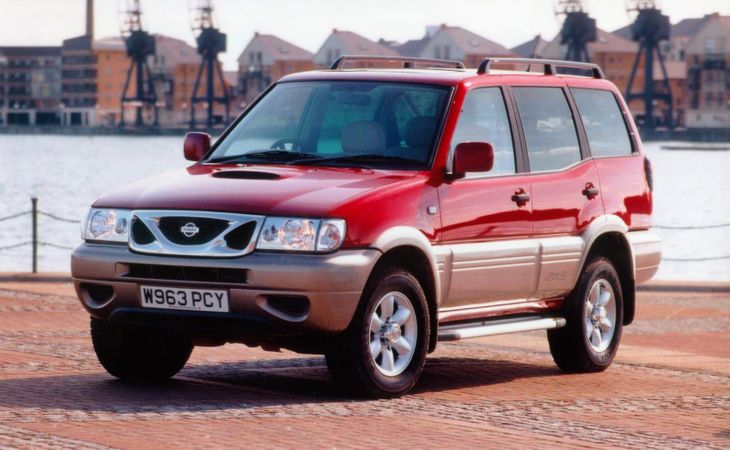
Although the available Terranos are getting on a bit in age, with South African models having been sold in a very narrow window between 2001 and 2002, it remains a curiously appealing SUV.
With a 2.7-litre turbodiesel engine good for 92 kW and 278 Nm of torque, and equipped with a low-range transmission, this was the unstoppable precursor to X-Trail. Cabin trim patterns were a touch wild and the two-tone exterior colour matching hasn’t aged well, but mechanically it remains an impressively capable machine. Ground clearance is 211 mm and with a limited-slip rear differential, there are very few places you won’t get to in one of these with low-range engaged.
Age does mean mileages are high, but a patient search can still be rewarded with a clean example, which perhaps saw kerb-crawling duty instead of grade 5 obstacle climbing, for around R65 000. Although the absence of electromechanical driver and off-road assistance systems limit the risk and cost of diagnosing and repairing an electric gremlin, Terrano’s age profile and the small number of units originally sold in South Africa, also mean that spares inventory is scarce and appropriately priced as such.
Terrano’s 2.7-litre Nissan diesel engine is impressive in its structural durability, even under extreme use in heat fatigue conditions, but the number one injector has a flow sensor which, when faulty, signals the electronic diesel pump to shut down, and will require attention.
Mitsubishi iO R80 000 to R120 000
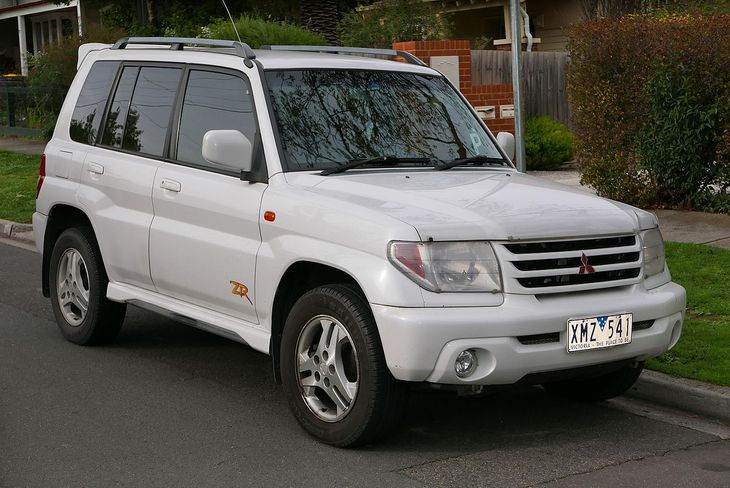
Few brands rival Mitsubishi for off-road heritage. A total of eight overall Dakar rally raid wins established Mitsubishi’s reputation and before the compact SUV market descended into a collection of clutch-pack enabled all-wheel drive soft-roaders, there was iO.
Don’t be fooled by its size or lack of outright off-roading styling trinkets. Beneath the vanilla exterior, iO featured Mitsubishi’s celebrated Super Select 4WD-I system, which means low-range gearing with true crawling capability. It is very worthy of being included in any list of 5 budget-friendly low range off-roaders.
Powered by a naturally-aspirated 1.8-litre engine, cruising performance wasn’t spectacular but with 86 kW and 165 Nm, there are very few dune fields that an unladen iO can’t cross in low-range. Ground clearance is competitive for a vehicle of its size, at 205 mm, and Mitsubishi’s proven mechanical reliability means that this turn of millennium mini SUV is still a great buy even with healthy mileage on the odometer.
With its reasonably low weight and high revving naturally aspirated engine, this compact Mitsubishi is very adept on sandy tracks. Or dune driving. Making it one of the better Budget-friendly low range off-roaders for a Kalahari red dune desert driving tour.
Mitsubishi never sold iO in significant volumes, hence they are quite rare – but if you find a tidy one, market prices are between R60 000 and R70 000. The mechanical risk profile for iO is negligible: a naturally-aspirated petrol engine and Mitsubishi’s proven Super-Select 4×4 system are amongst the most reliable automotive components ever produced. Steer clear of any iO featuring ride-height modifications, as the tightly packaged factory suspension components left virtually no margin for alteration.
Bonus inclusion – First Gen Kia Sportage R80 000 to R140 000
We know it says 5 budget-friendly low range off-roaders, but there’s always a worthy outlier worth including.
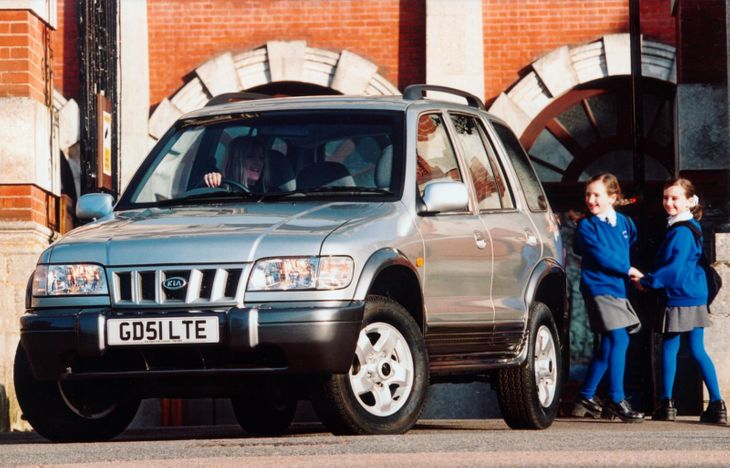
The first generation Kia Sportage landed in SA in 1998 featuring the chassis from a Mazda taxi (Mazda Bongo – google that) and several Mazda engines. We were adorned with a 2-litre 4-cylinder DOHC petrol engine with 94 kW and 175 Nm. Initial models lacked air-conditioning but it was later added and is certainly a must-have for off-roading, even if it’s likely to sap a fair chunk of the 94 kW.
Accessing the boot was a complex task as the spare wheel had to be swung away from the car in order to access the 400 litres of boot capacity. The Sportage was pretty decent on-road and held its own off-road too with a 1.981 to 1 transfer gear. An approach angle of 39 degrees and departure angle of 37 degrees is decent as is the claimed 216 mm of ground clearance.
These appear to be pretty sturdy vehicles with few problems other than the odd injector sensor going on the blink that leaves a dashboard light glowing in your face. It has a tendency to wear through brakes quite quickly and the rear hinge for the spare wheel wears out unless you pay attention to it.
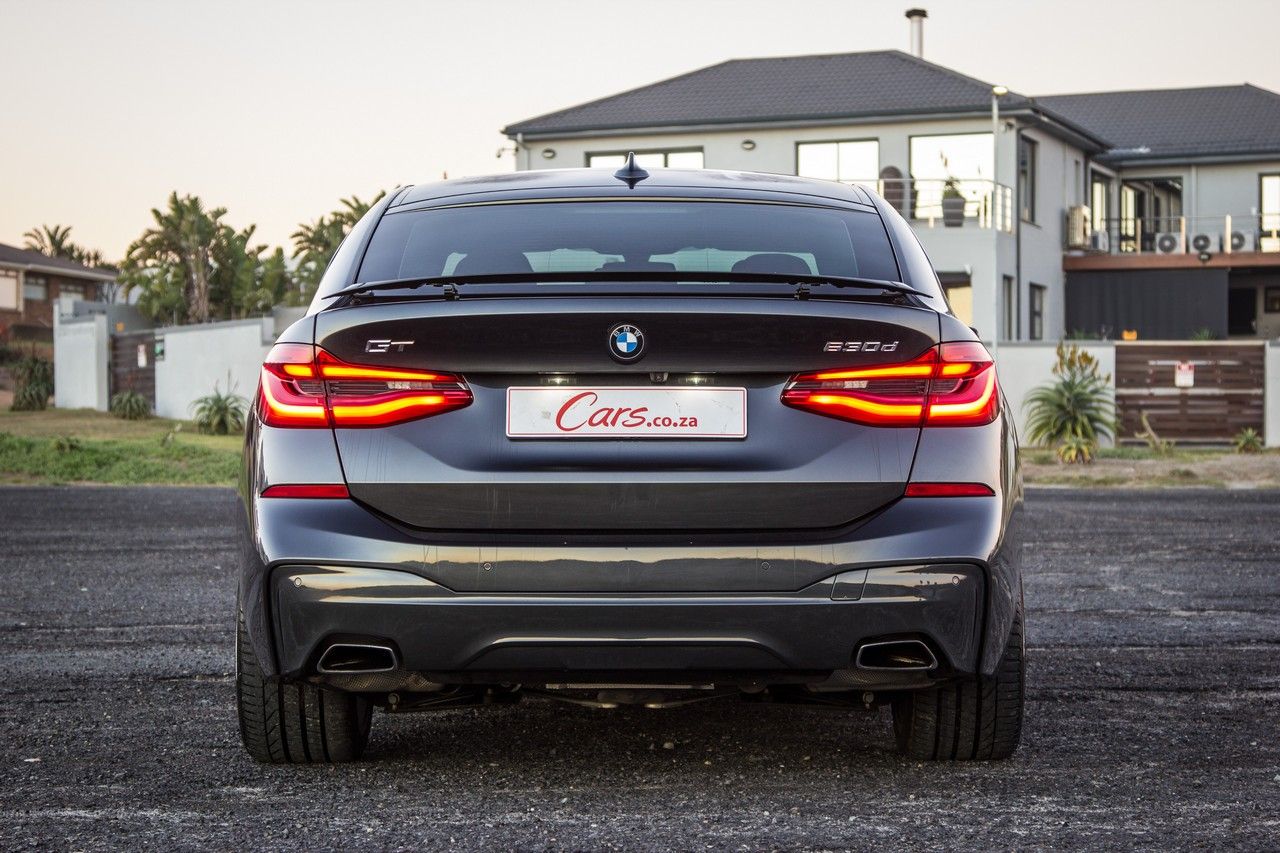
In a bid to replace the ugly duckling 5 Series GT, BMW has restyled its executive-class hatchback and renamed it the 6 Series GT. We spent some time with the torquey 3.0-litre turbodiesel derivative to see if the changes are more than skin deep.
We like: Silky smooth ride, punchy turbodiesel engine, looks better than the old 5 GT.
We don’t like: Likely to fall foul of the market's predeliction for SUVs.
Alternatives
A desirable SUV: The Range Rover Velar is an eminently stylish, very attractive executive SUV and, dynamically it’s pretty good too. With the D300 turbodiesel engine, it doesn’t lack in the performance stakes either.
A coupe SUV: The Mercedes-Benz GLE Coupe makes a stylish proposition at the cost of some practicality, due to the sloping roof. Still, SUVs appear to have more appeal and stylish designs to them than hatchbacks and station wagons nowadays.
A station wagon? Normally we would offer up a 5 Series Touring or an E-Class Estate, but South Africa does not import them anymore. Truth be told, they don’t sell well enough to warrant coming in, which is a shame.
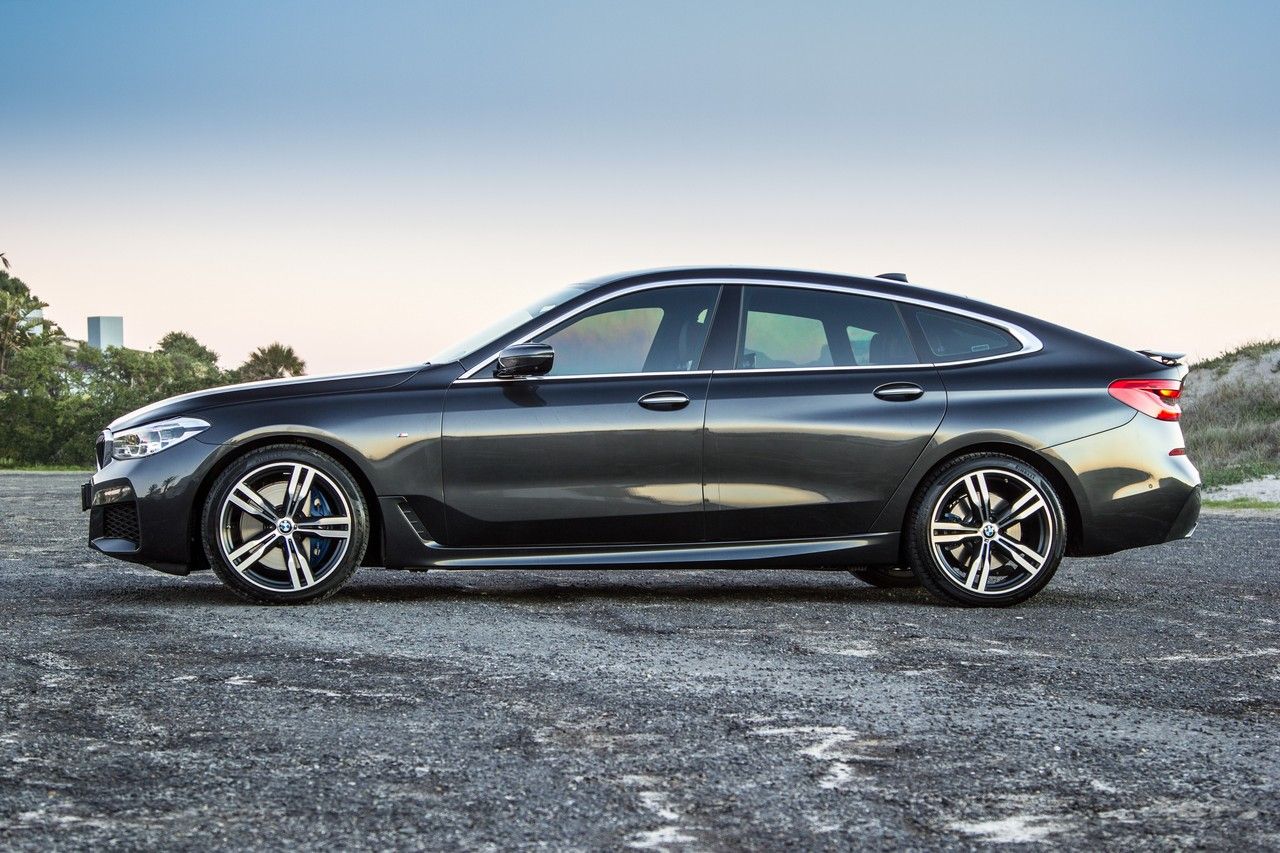
Part 7 Series, part 5 Series – the 6 Gran Turismo is purported to blend the best parts of both sedans.
It’s a new 5 Series GT. Remember that big Heffalump-looking thing of a few years ago (if you don't know, a Heffalump is a purple elephant-like character in Winnie the Pooh)? BMW’s attempt to combine a hatch with a station wagon and an SUV led to a Frankenstein mishmash that was extremely practical and refined, but distinctly lacked that head-turning kerb appeal that buyers want. It failed almost everywhere, except China.
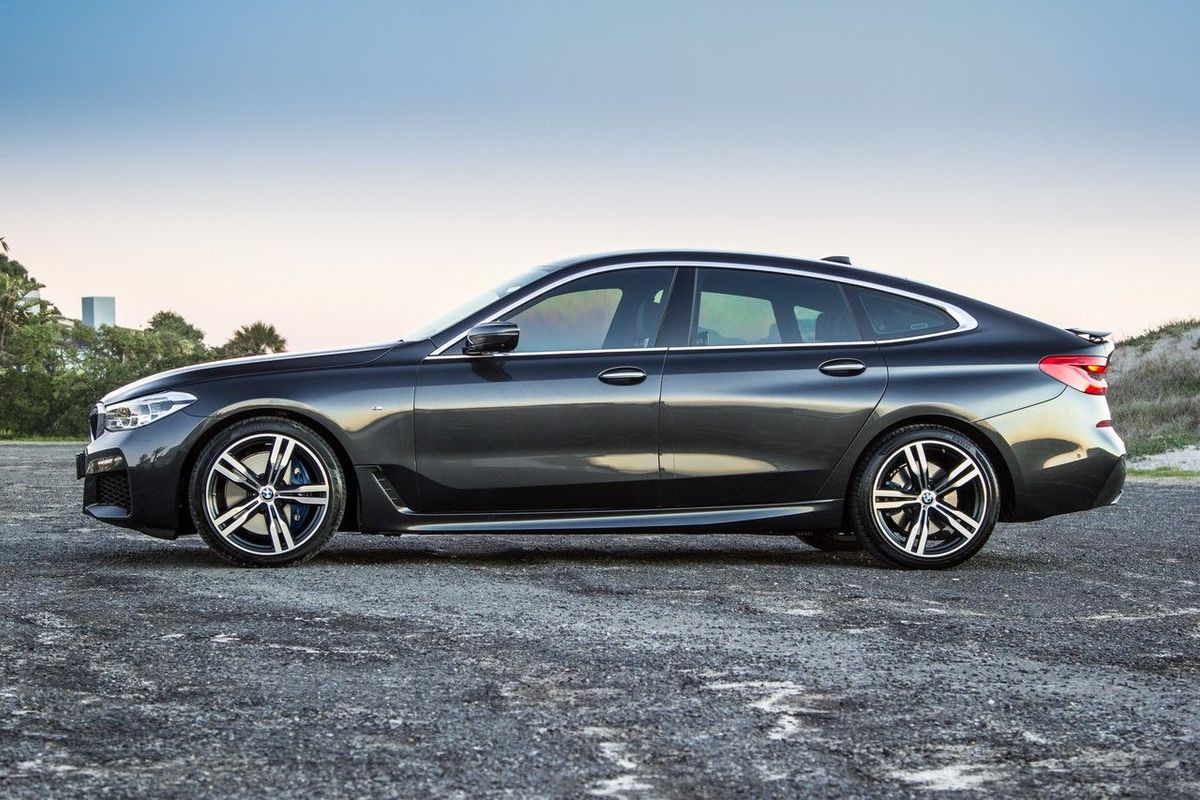
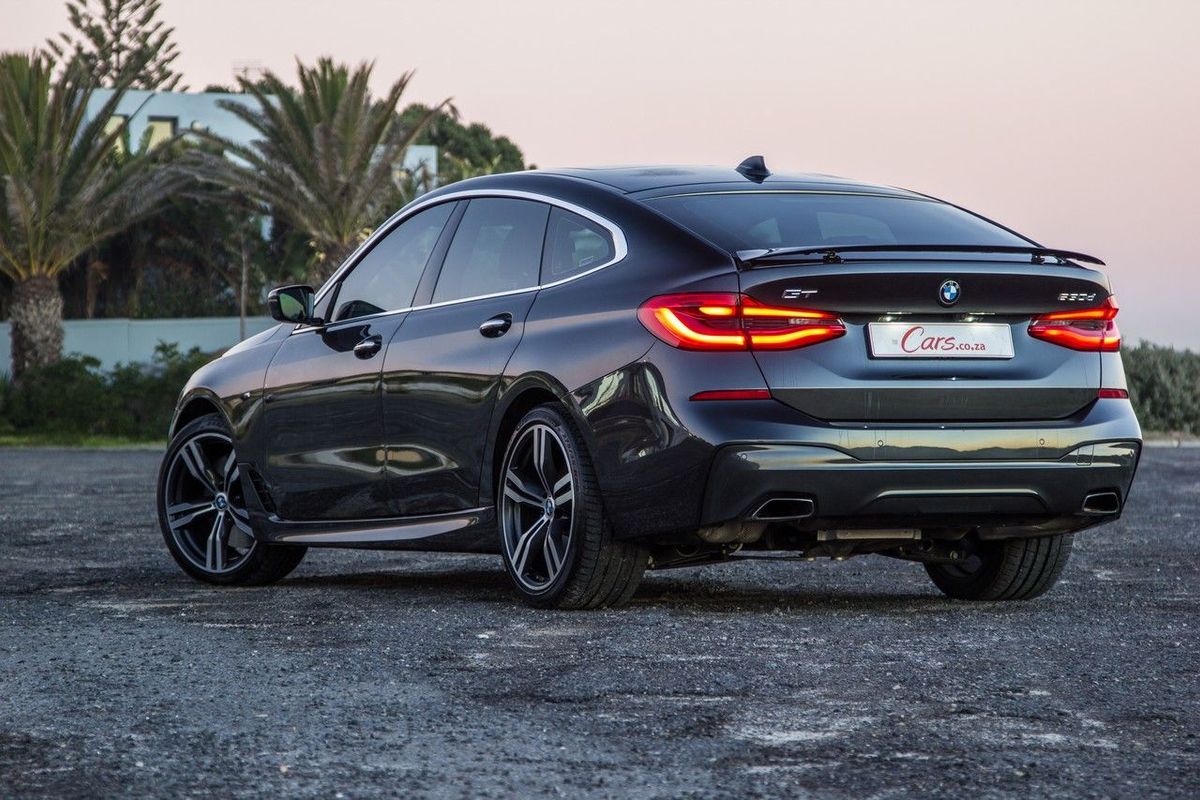
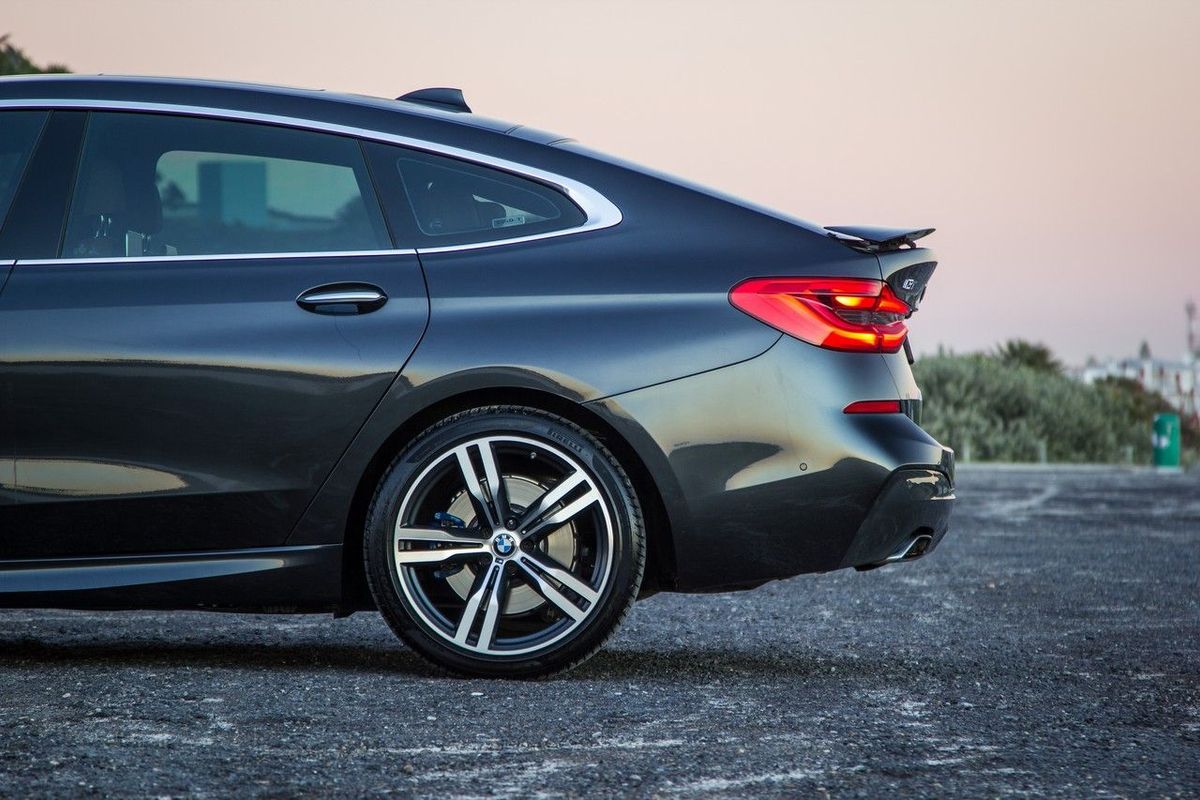
The newly renamed 6 Series Gran Turismo (6 GT) is lower by some 21 mm and no longer features that cinema-style rear seating arrangement in the rear. The sloping roofline actually means that the rear end is 64 mm lower than that of the old 5 GT.
Thanks to BMW’s adaptable platforms, the 6 GT is actually part 7 Series, part 5 Series and is strangely standard with air suspension at the rear, but not at the front (although you can opt for full air suspension). The 6 GT is 87 mm longer, but remains the same width as its predecessor. It also has the same wheelbase as a 7 Series, which means you get an extremely spacious car inside and out.
How does it fare in terms of…
Space and practicality?
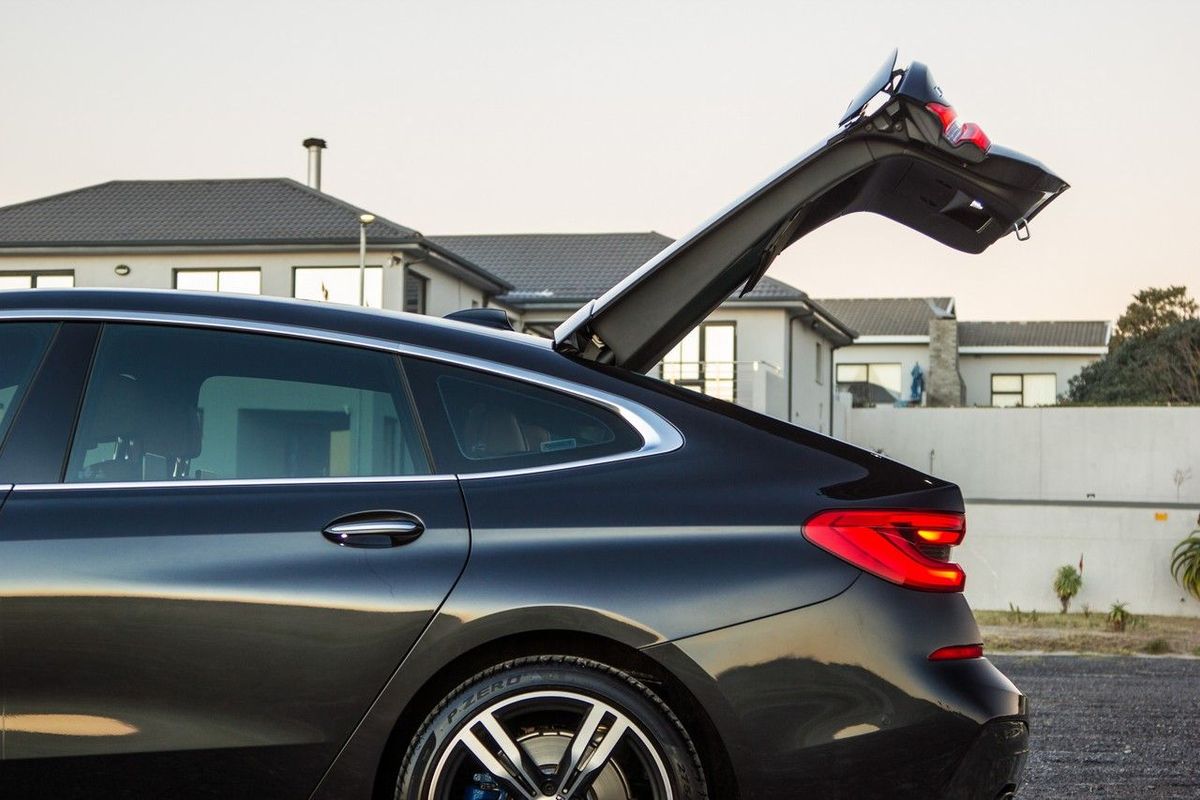
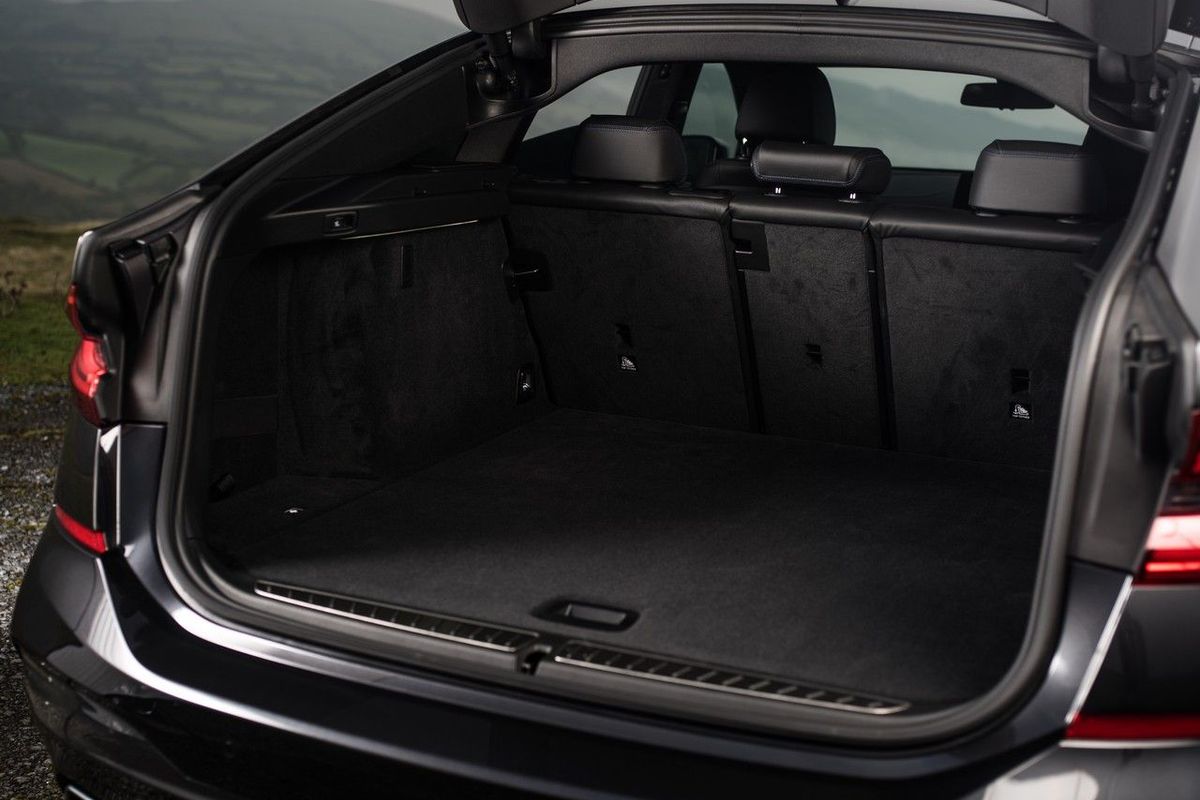
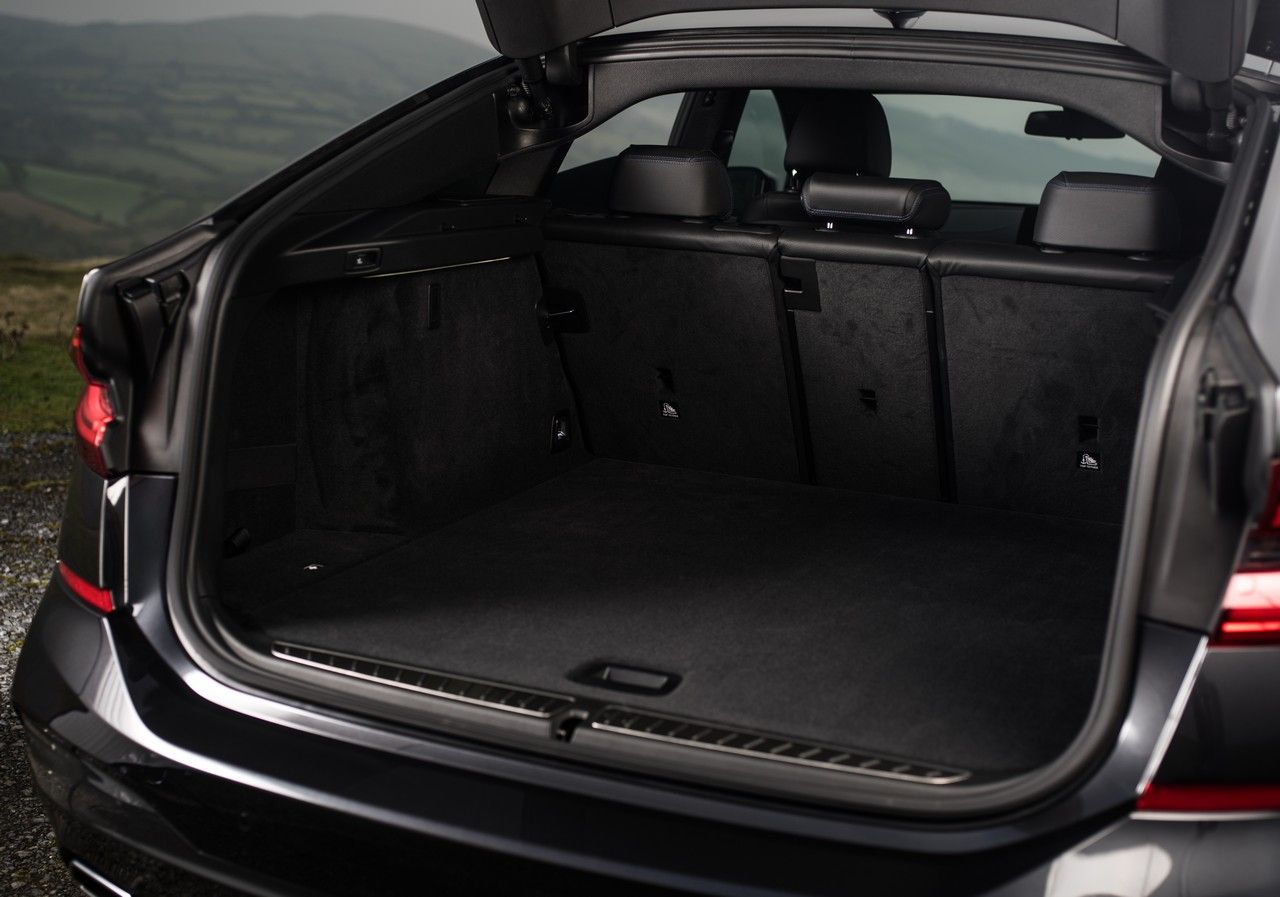
There's a 610-litre luggage bay in the 6 GT, but fold the seats down and it trumps comparative SUVs with its 1 800 litres of utility space.
It’s fair to say that most people who'd consider a 6 Series GT require the added versatility and occupant space that the hatchback-styled 6 GT offers over and above a regular 5 Series. In that sense, the 6 GT delivers: the hatcback opens to reveal 610 litres of loading space, which is just about on par with its SUV competitors. Once you fold down the rear seats, however, you get 1 800 litres of utility space, and that’s more than the previously mentioned Velar or GLE Coupe can offer. The space is also more accessible as its lower than an SUV and appears to have a particularly wide entry.
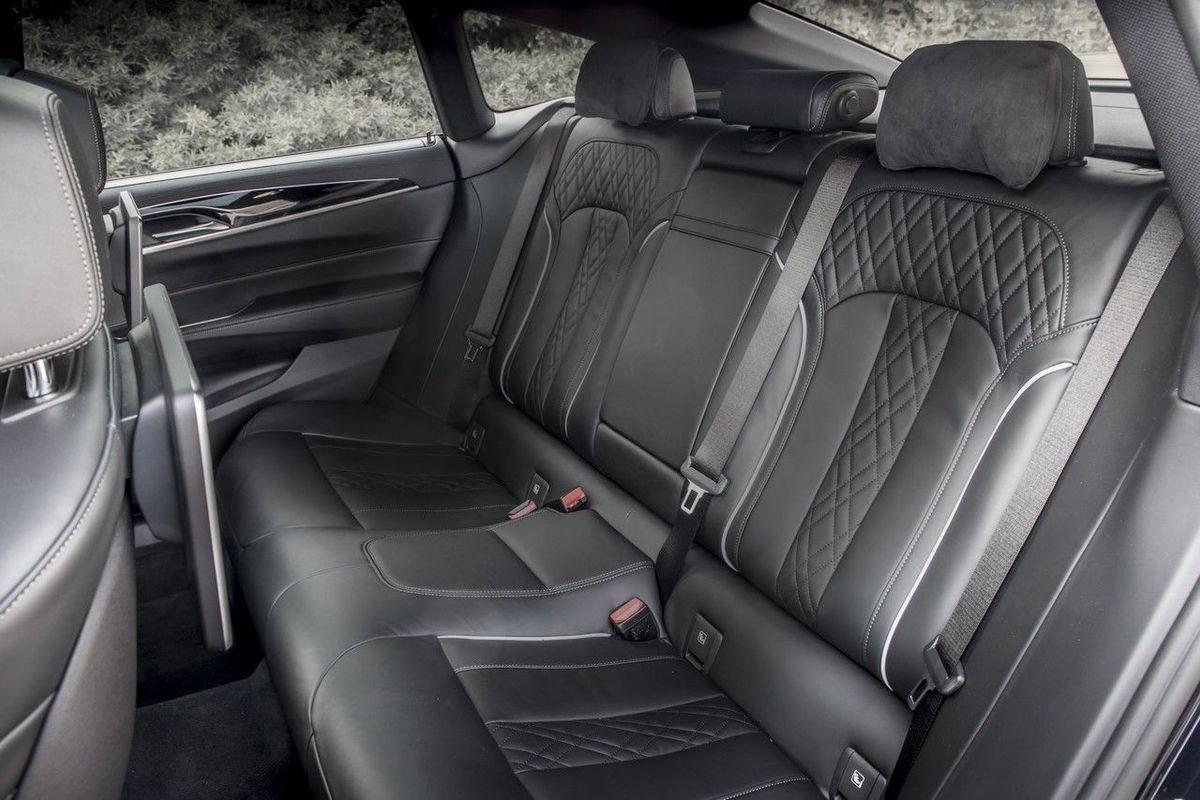
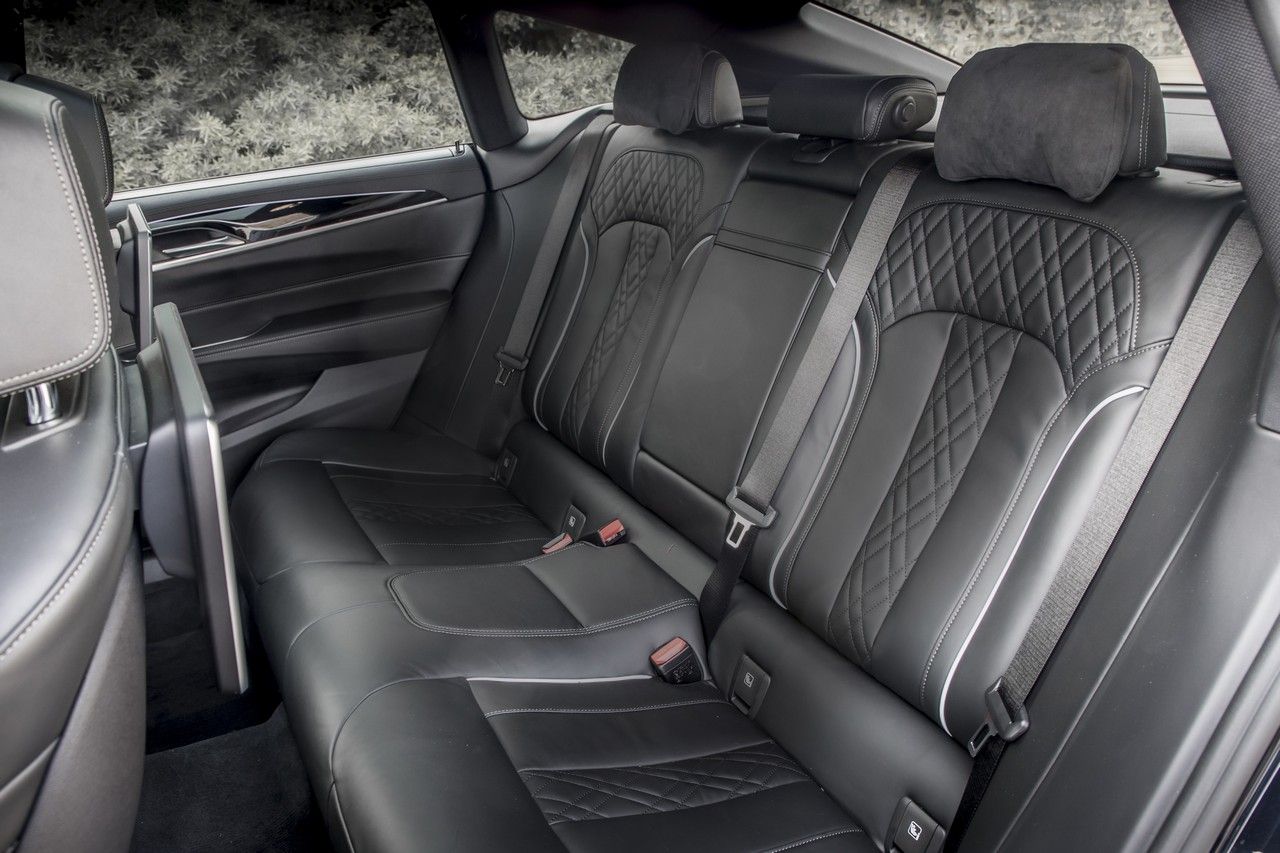
With the seatbacks restored in their upright position and passengers ensconced in the rear seats, there is an abundance of rear legroom available – it’s huge in the back, in fact. What's more, headroom is fine for adults in spite of the sloping roofline.
Super luxurious rear seats (enhanced with optional rear entertainment systems) offer more than enough legroom.
Rear seat entertainment can be added for R34 000. The upgrade entails a pair of 10.2-inch monitors in the rear with wireless headphones, this should keep rear passengers entertained with DVDs, music and if you have a sim card installed, internet access.
Kerb appeal?
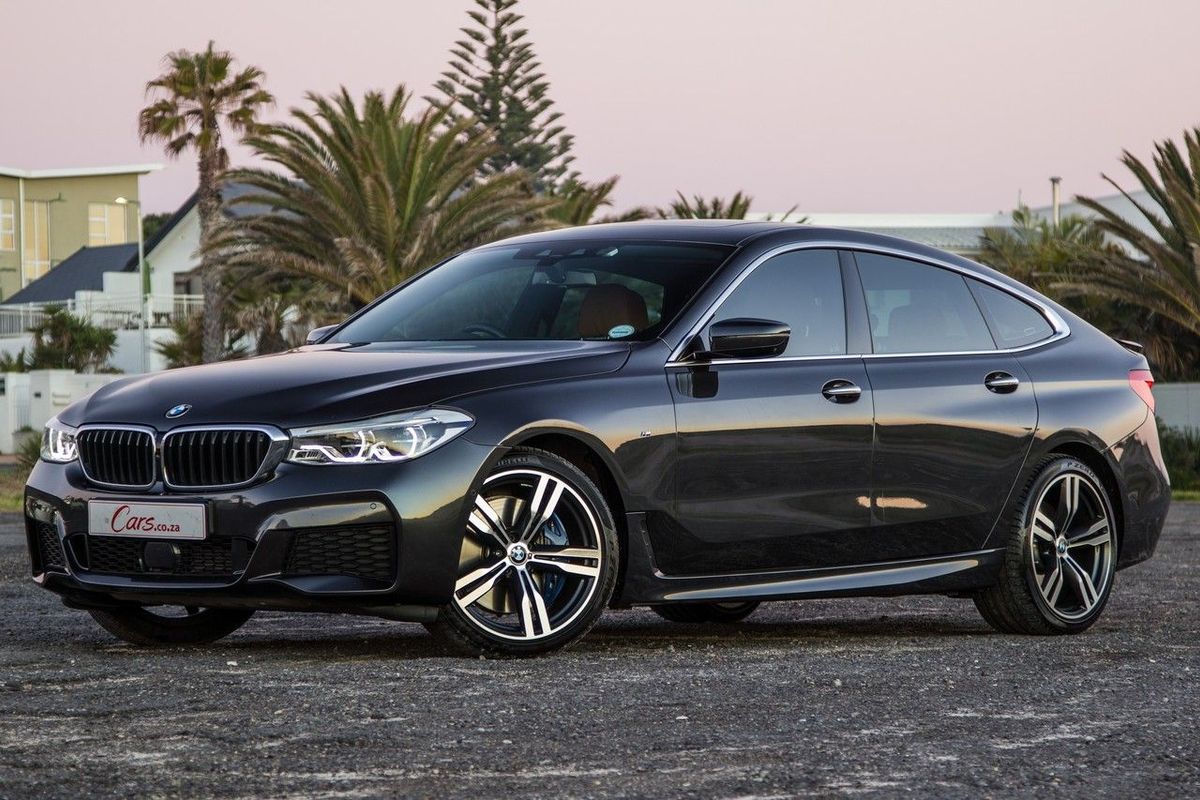
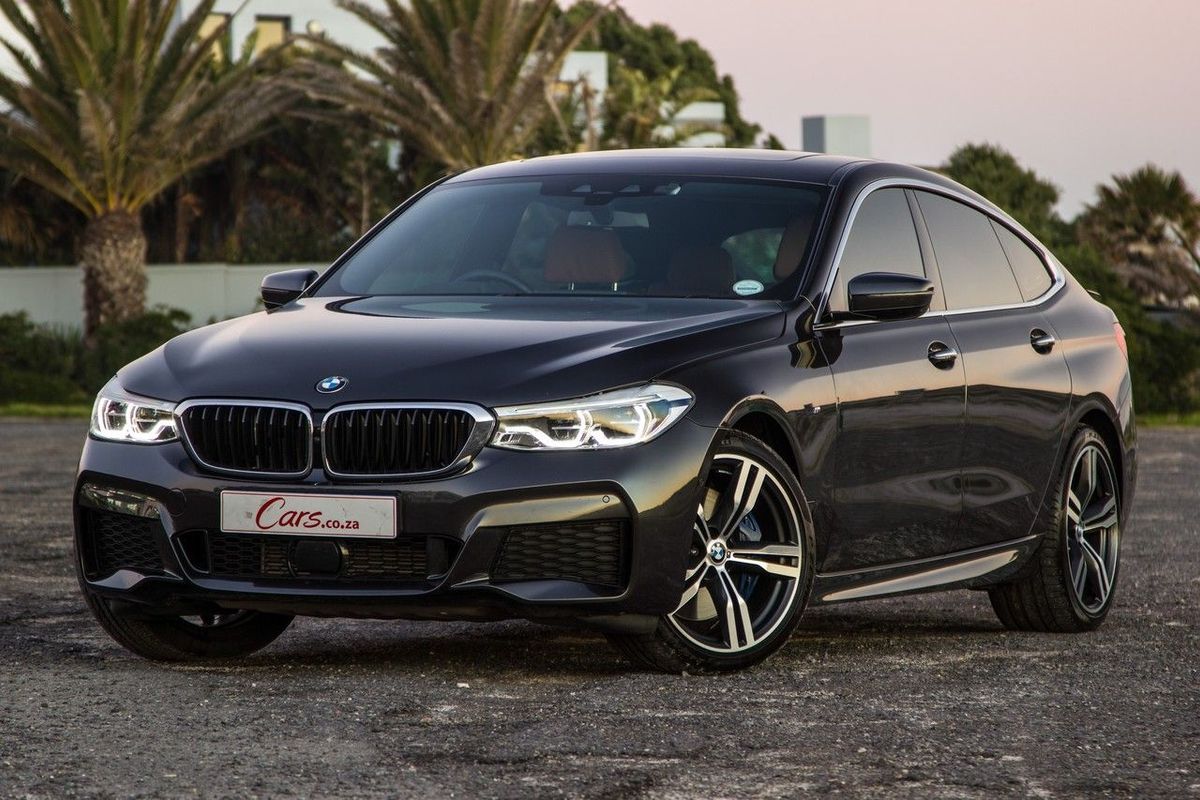
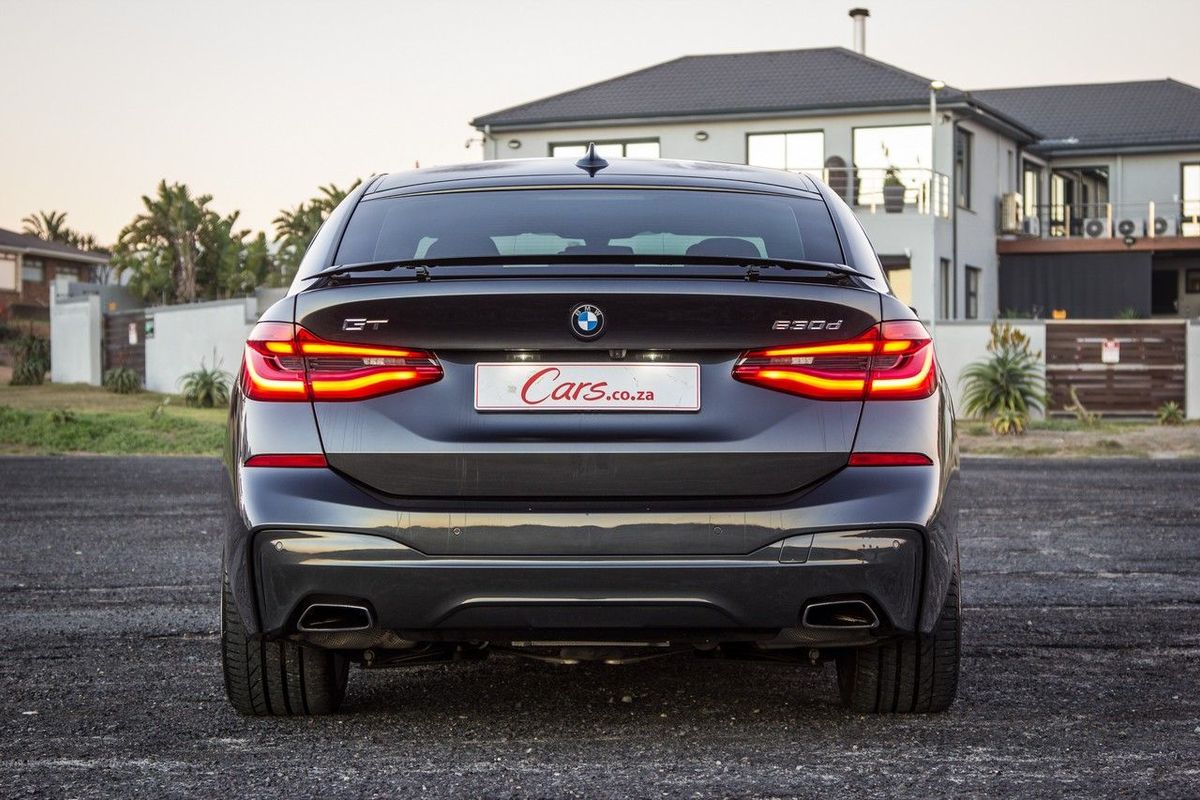
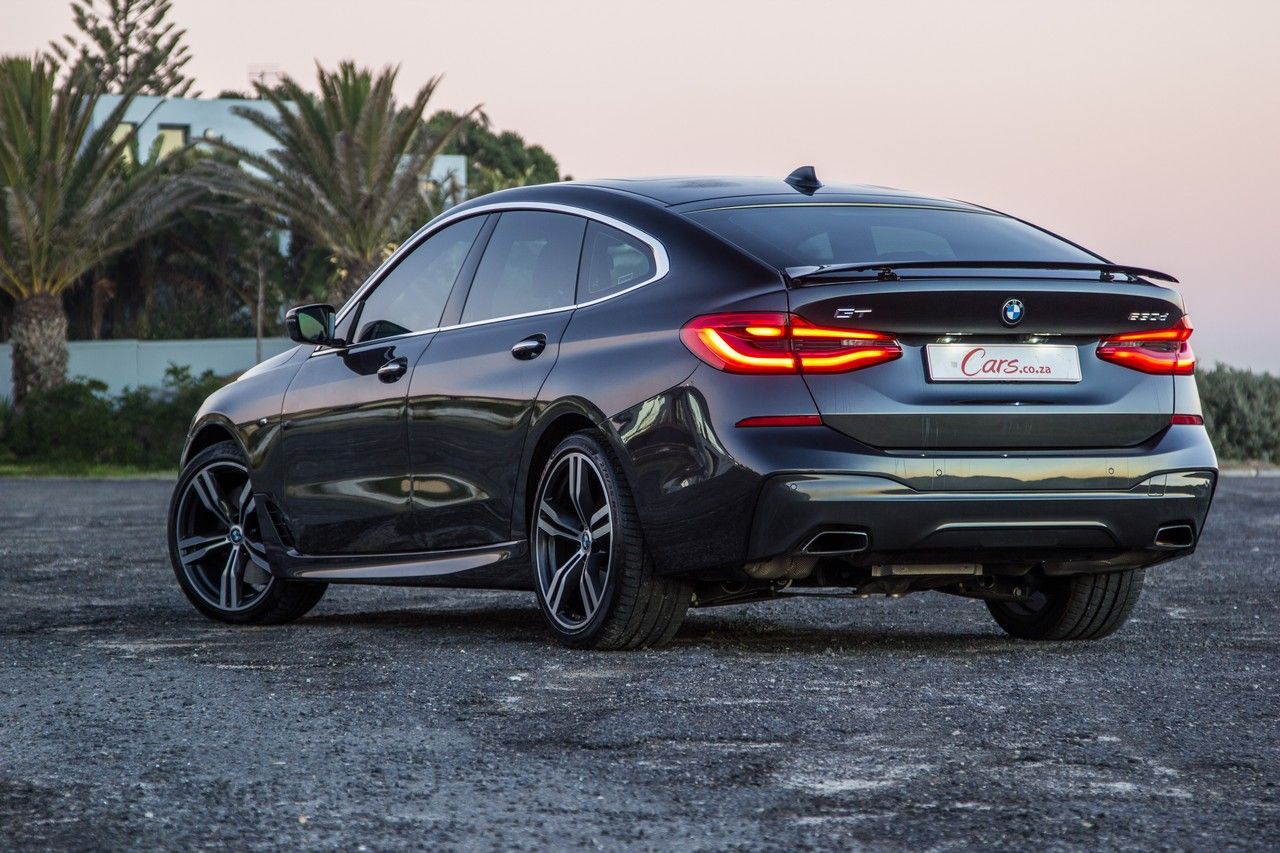
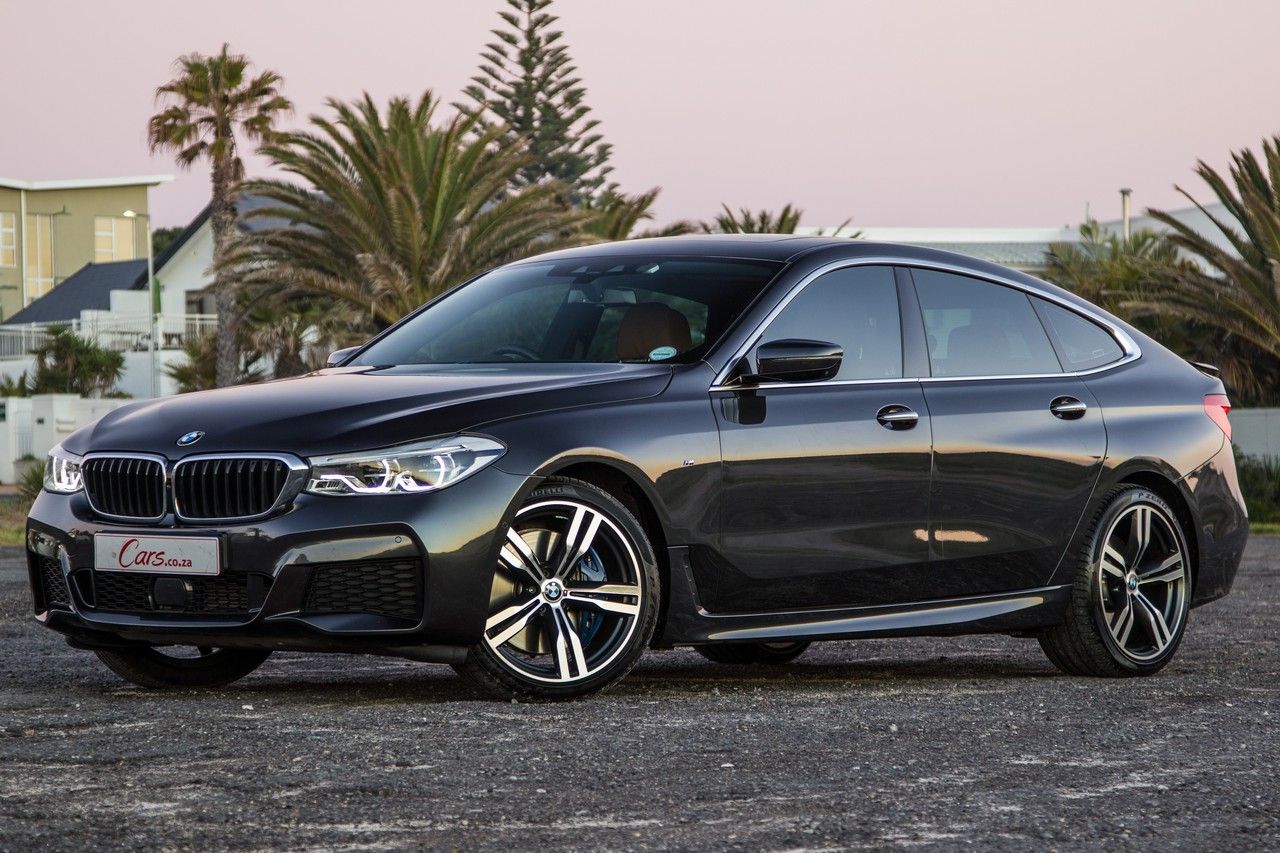
In terms of aesthetic appeal, the 6 GT represents a definite improvement over the dowdy 5 GT, although the harshest cynics may argue that that is not saying very much. The lower, sloping roofline looks more modern and gives the Bimmer a sleeker appearance overall. The retractable rear wing gives it added presence, but does seem a little out of place on a GT car meant for transorting people (and their detritus) in comfort.
The sleeker design of the 6 GT is pleasing and the retractable rear wing adds a bit of road presence.
The pillarless doors are a stylish upgrade and seem like a good idea at first but in the end, you're likely to spend more time chastising yourself for getting grubby fingerprints all over the windows.
Ultimately, however, the 6 GT just doesn’t have the same attractive shape or design that some modern SUVs have. There aren’t many good examples of sedans that work as stylish crossovers, but there are a number of SUVs that have enormous visual appeal in coupe shape and aren’t horrible in the dynamics department. Range Rover Velar, Mercedes-Benz GLE Coupe and the Alfa Romeo Stelvio spring to mind.
Performance?
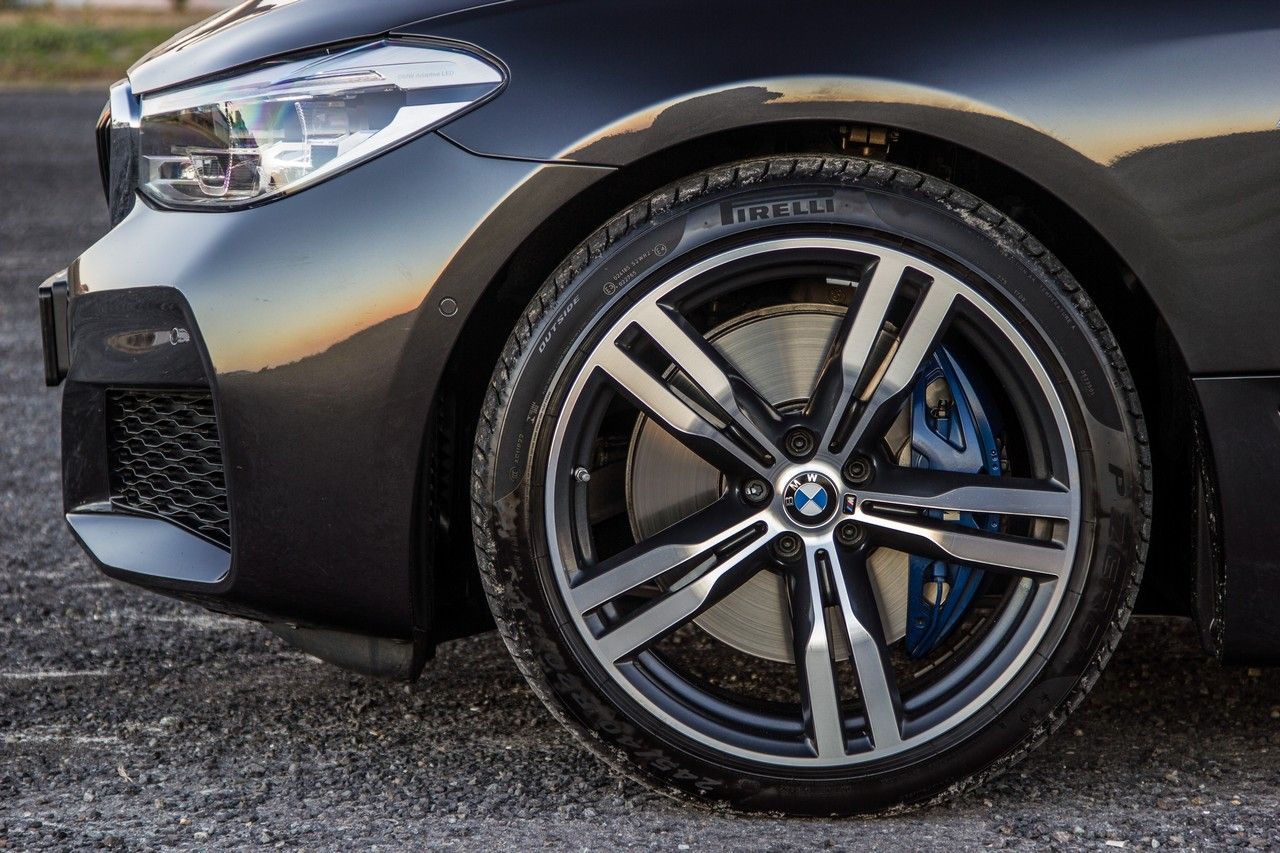
Even with low-profile run flats the 6 GT cushions out bumps.
The 3.0-litre turbodiesel unit in the front of the 6 GT showcases how good a turbodiesel can actually be. It manages to haul the 2.0-tonne car around with ease, feeling adequately brisk off the line and then cruising on the highway with 190kW/620 Nm available at the quickest dab of the throttle.
Its claimed 0 to 100 kph tune matches that of a modern hot hatchback (6.1 seconds), but the motor really shines in terms of its in-gear acceleration.
Ride and comfort?
BMW has tried to give the 6 GT 7-Series levels of comfort with 5-Series dynamics, but if you look at the adaptive ride settings, they've been altered to read Comfort Plus, Comfort and Sport. There's no Sport Plus… That should give you some idea of where BMW really wants to position this car.
It may just be the most comfortable BMW we've driven to date.
To put it simply: the 6 GT is just about the most comfortable BMW we have ever tested, the suspension even softens out the usual ride-firming effect of the (more-rigid-by-design) run-flat tyres. The additional air suspension at the rear has really helped to soften out the thuds without making it overly saggy. Comfort is the best setting, entering Comfort Plus overdoes the cushioning effect, but might suit a particularly bad road.
Granted, the newcomer does lack some of that intrinsic sportiness (for which BMWs are renowned) when you usher it onto a dynamically-challenging piece of road. It holds itself upright in the bends well and is responsive to steering inputs, but it feels too big and cumbersome to be a regarded a driver’s car. Put that to one side though, as this really is a comfortable car for just about any journey, especially long ones.
Interior features?
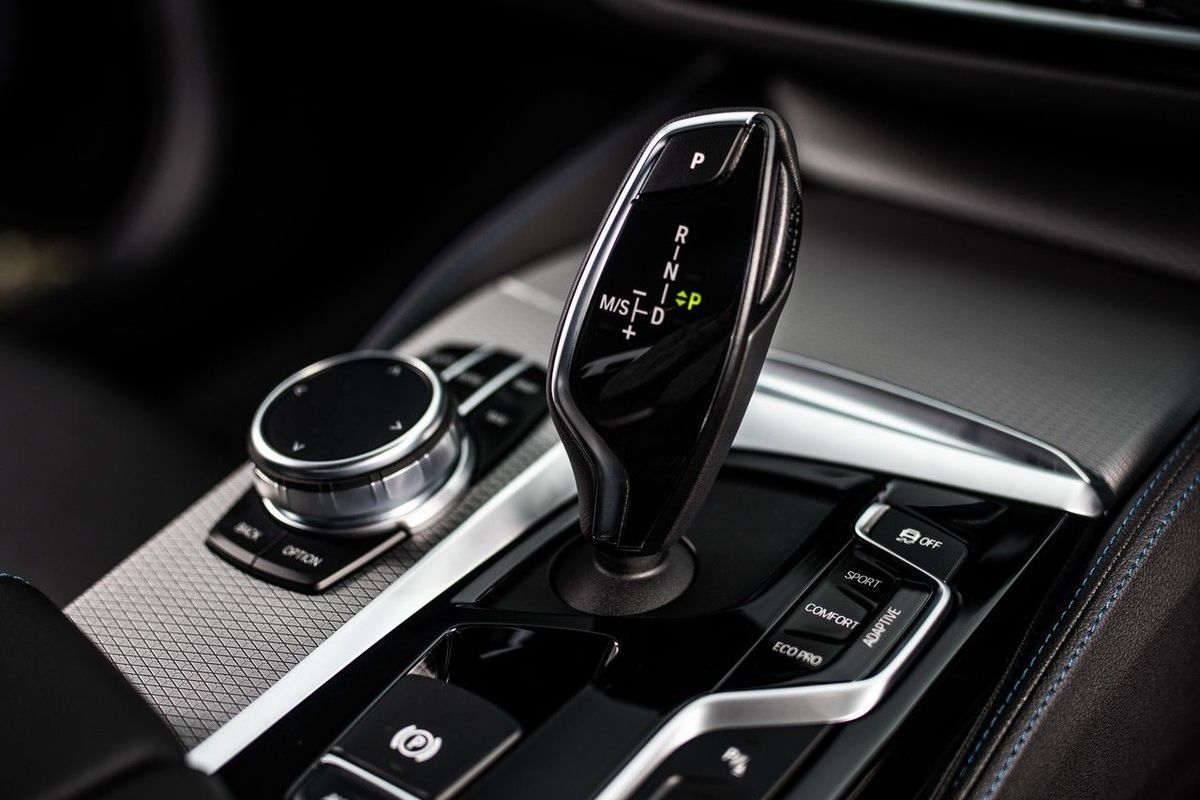
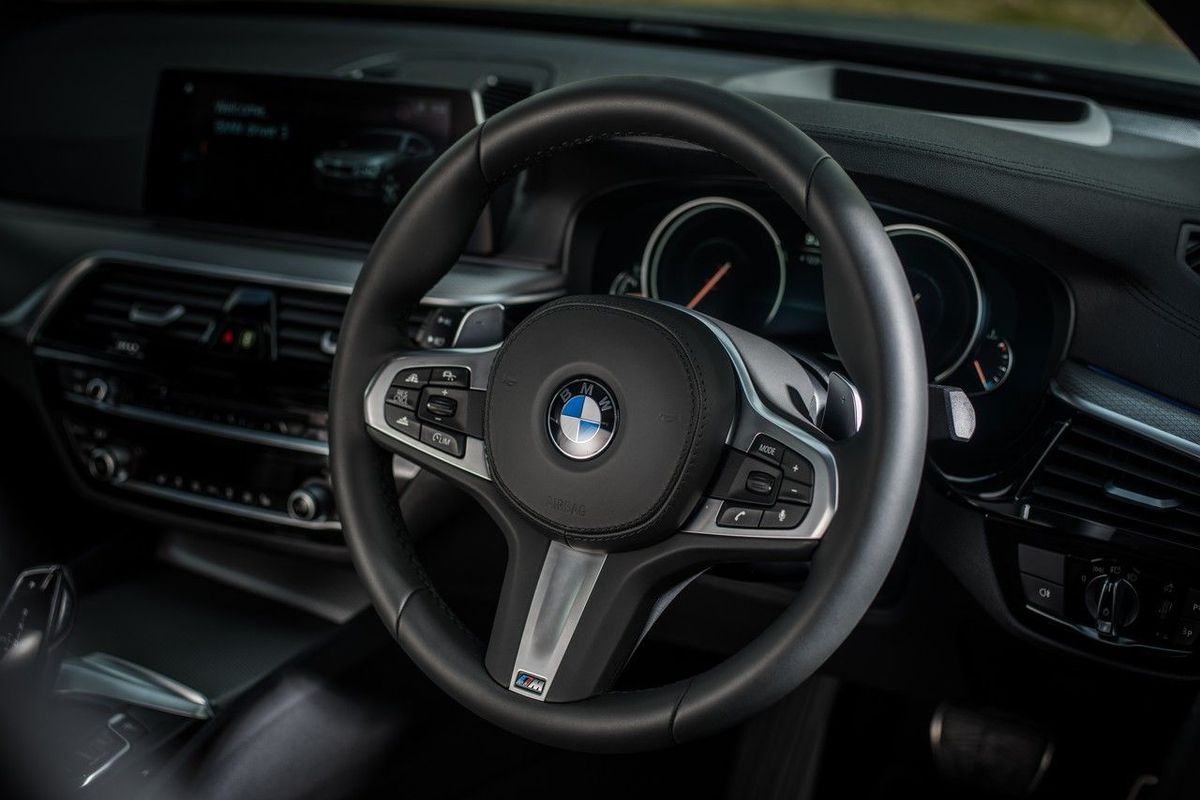
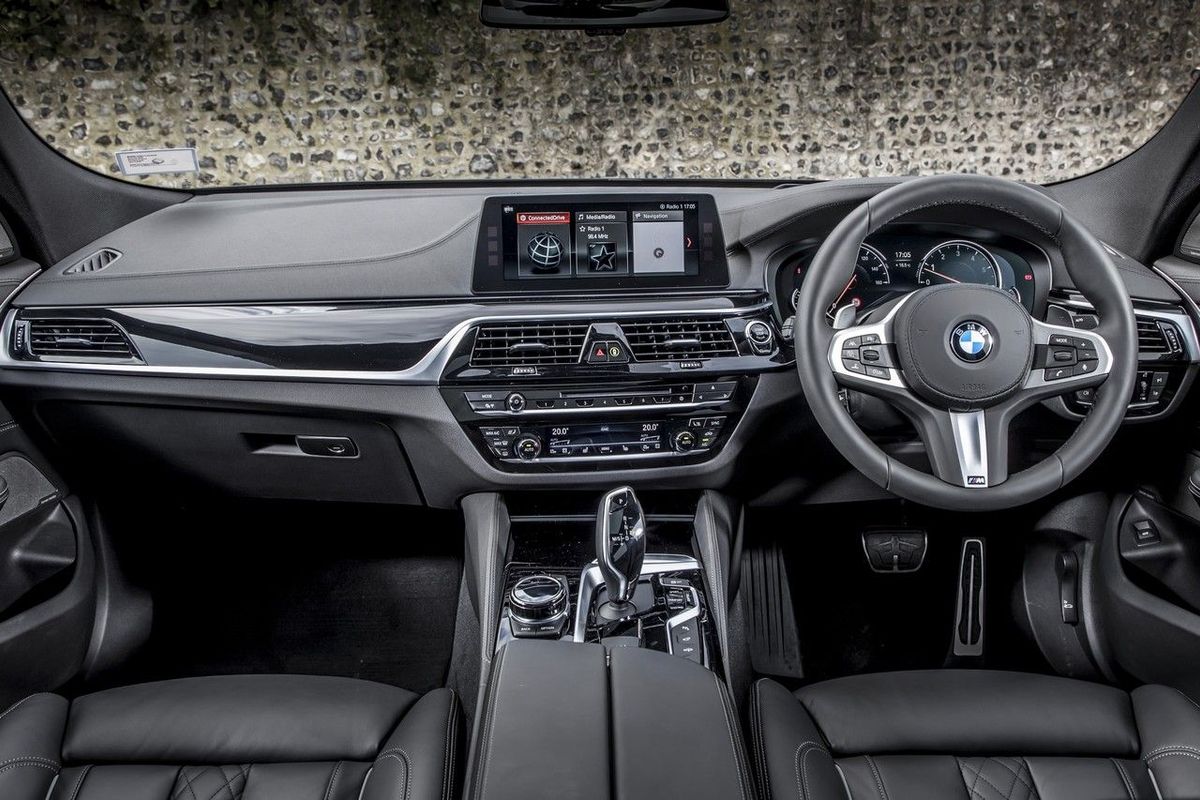
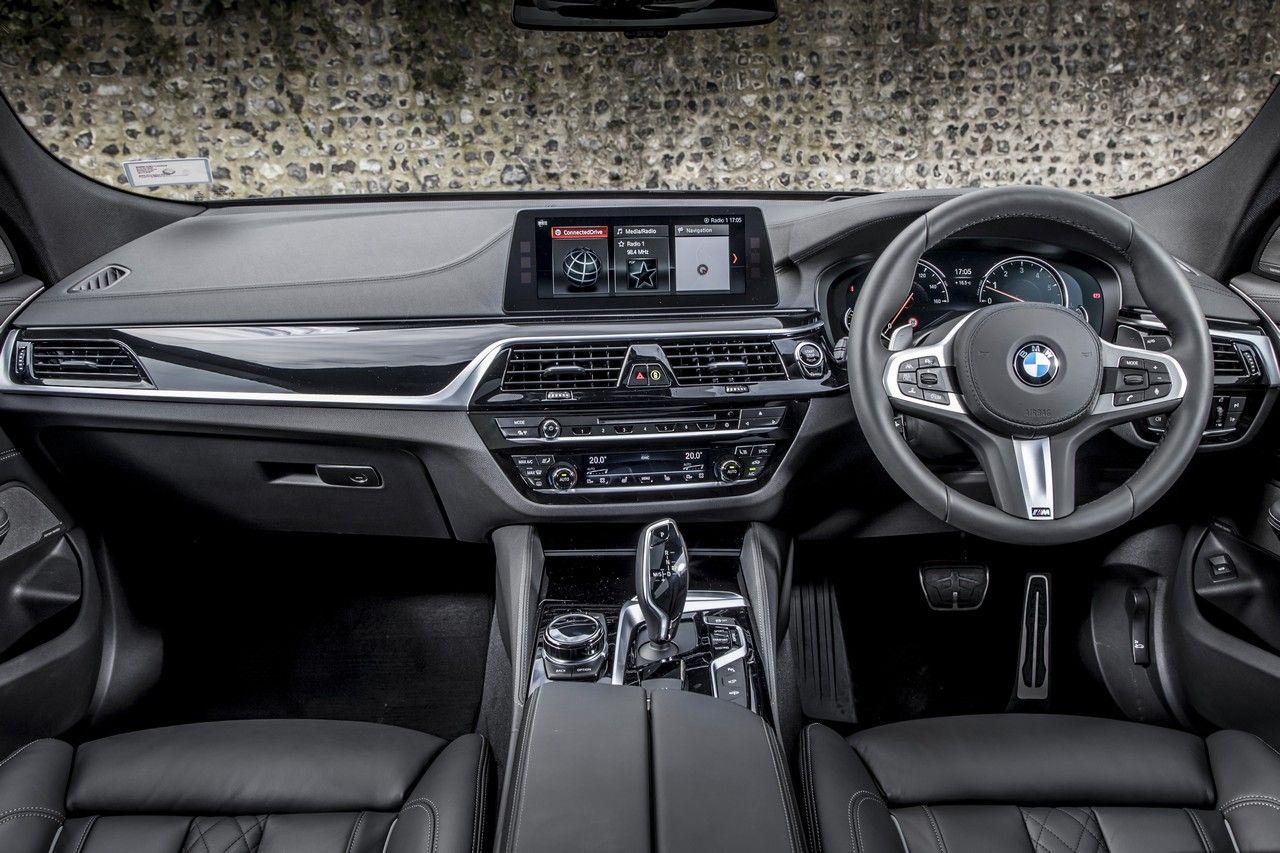
The 6 GT borrows its interior design and layout from its 5 Series sibling.
Although the generic look of contemporary BMW interiors may lead people to believe that the Munich-based firm sacked its interior designers in the 90s… and never bothered to replace them, the 6 GT is laced with onboard tech that boasts easy-to-use functionality. The large infotainment system (controlled by the iDrive wheel and touchpad) is one of the best systems on the market. Everything is easy to find and the menus make sense.
Gesture control is available, so you can turn up or down the volume with a circular swivel of your finger or, alternatively, answer or dismiss a call with a wave of your left hand. Adaptive cruise control is always a nice-to-have and works from standstill up to 210 kph. It’s great in traffic, where, in combined with semi-autonomous steering, all you have to do is touch the throttle every now and then to get the car away from a stop.
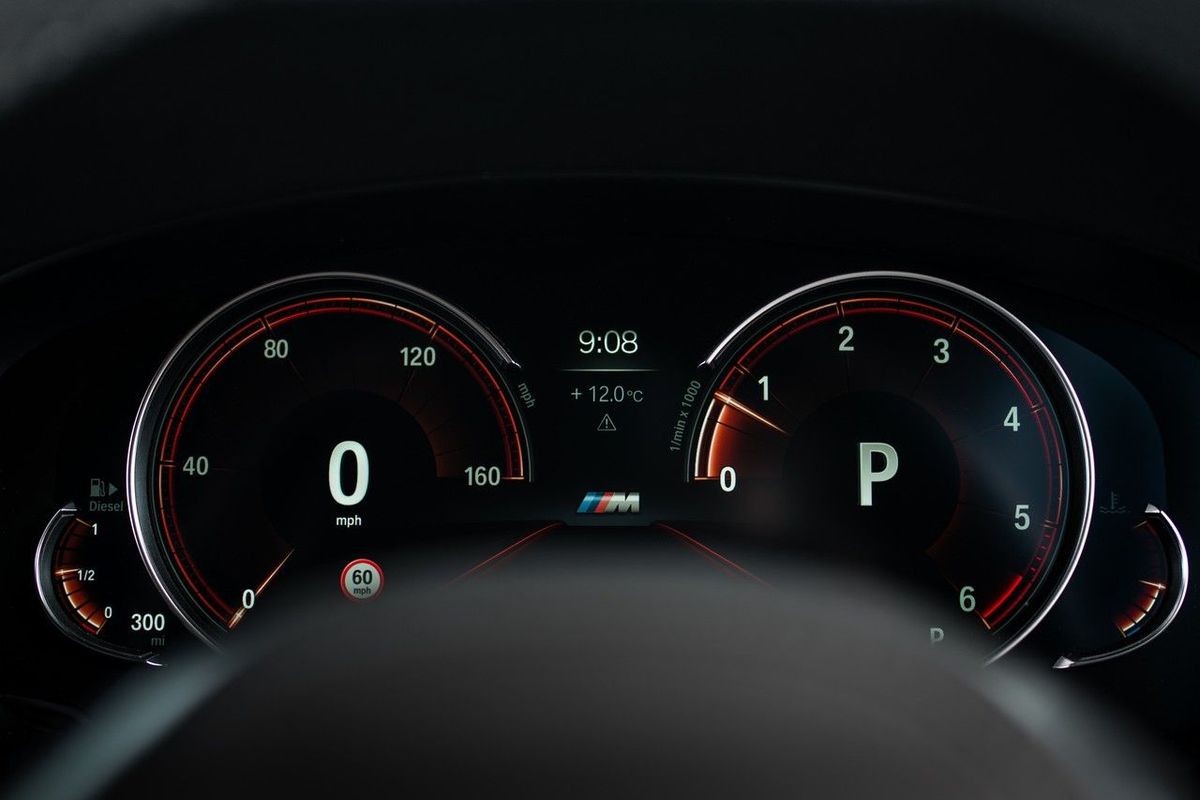
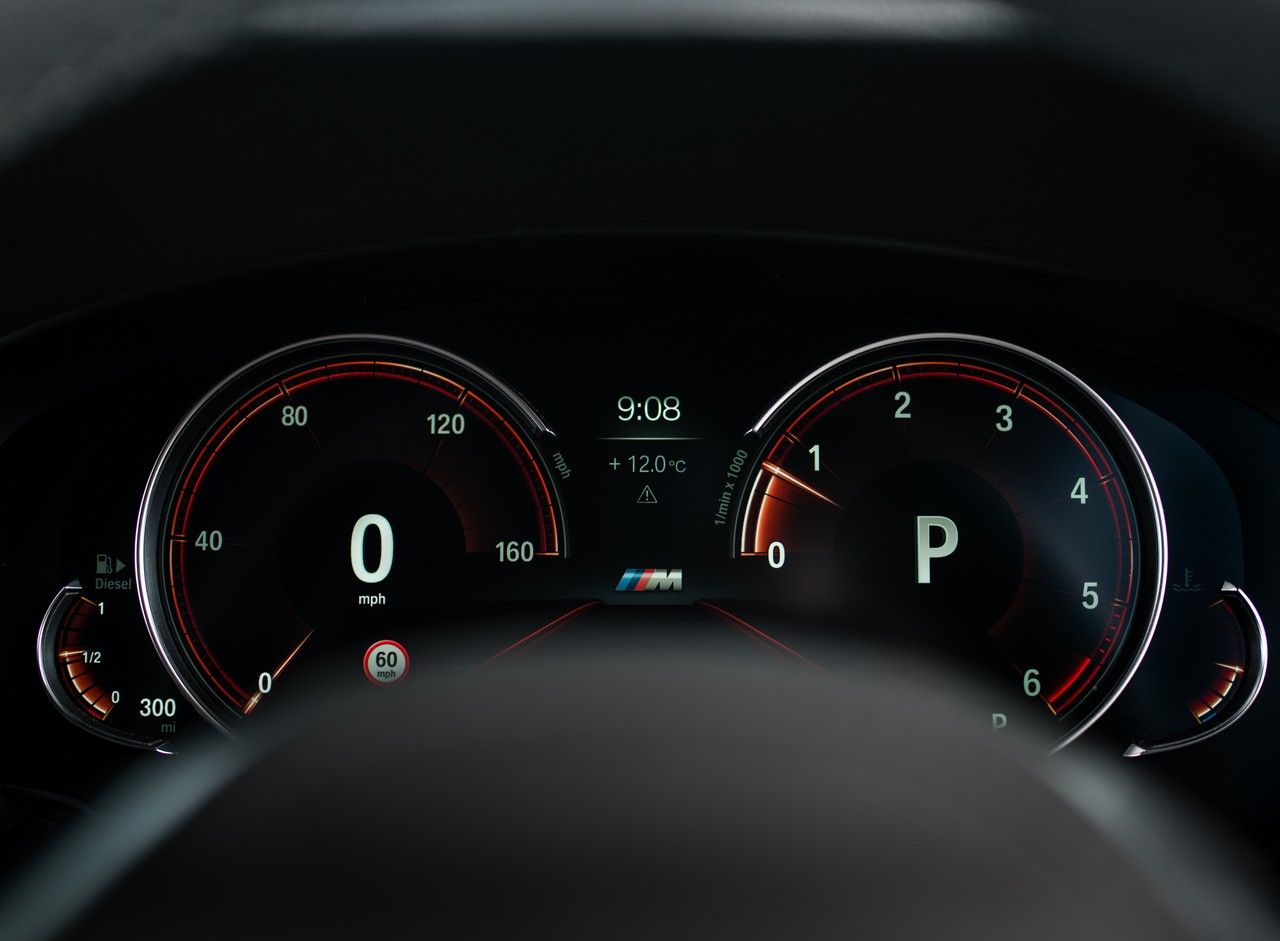
The instrument cluster features a digital display that changes colour depending on the driving mode selected.
There’s a fair amount of extra kit to choose from in the options department, with features such as real-time traffic proving very useful, or you can opt to utilise Android Auto or Apple Carplay and do it all through your 'phones apps.
There are also 3 sound systems to choose from: a loudspeaker hi-fi system, an R18 500 Harman Kardon 16-speaker system or a R67 600 16-speaker Bowers and Wilkins system replete with 2 subwoofers and synthetic diamond tweeters.
Pricing and Warranty
Specified with the M Sport trim package (as this particular test unit was), the 630d GT costs R1 190 016. Base price for the 630d GT starts at R1 127 316. Included is a 2-year/unlimited km warranty and a 5-year/100 000 km maintenance plan.
Verdict
Even with its excellent ride and powerful engine, there's a notable lack of desirability to the 6 Gran Turismo.
The 6 Series Gran Turismo is undoubtedly a vast improvement on the visually-challenged 5 GT. It's sleeker, lower and more on trend in terms of its design. Passengers certainly don’t lack for space or onboard technologies and there’s a capacious luggage bay as well.
The general ride quality is sublime; it ably demonstrates that BMW can successfully produce comfort-oriented cars. The downside is that, should you feel inclined to test the car's sporty abilities, it doesn’t quite have the traditional "BMW fizz", but it holds well up for a comfort-oriented 2-tonne car.
The difficulty comes when considering that, at around R1 million, there are some very appealing SUVs that offer largely more visual appeal and road presence. The 6 GT will fade into the background when parked next to a Range Rover Velar, for example, and while the 6 GT and Velar may not be direct competitors, if you’re planning to spend this much money on a new car, appeal and recognition will most likely rank high on your priority list.