Aston Martin Vantage (2025) Launch Review
Aston Martin has significantly re-engineered the Vantage to ensure that the model will no longer be admired only for its looks and soundtrack. The Gaydon-based brand says this Vantage is far more dynamic than its predecessor – we put that claim to the test.

It seems like not so long ago that Aston Martin wheeled out a “new” V8 Vantage in 2018, by all means a solid offering, boasting all the traits we’ve always admired the British sports- and supercar marque for – drop-dead looks, stonking performance and great exhaust sounds.

A lot has happened in the junior supercar market since then, with the usual suspects (most notably Porsche and Ferrari) launching improved or all-new models in the past 7 years. Aston Martin is also undergoing radical changes, with massive investment in its resources and brand building efforts (F1, in particular). So, it was time for the Vantage to get some attention… 

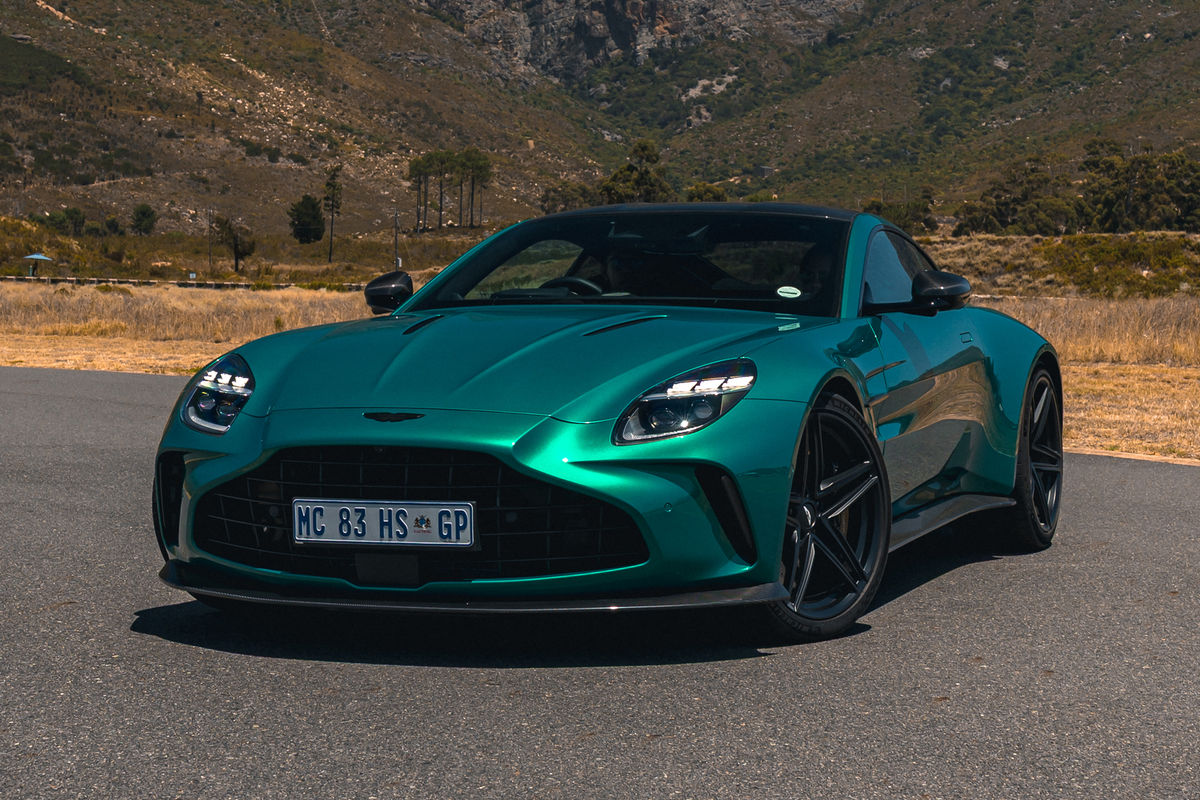
While designer Marek Reichman (who was on hand for the recent South African launch) has been careful to retain the low-slung profile and seductive contouring evident on all Aston Martin models, the 2025 Vantage looks significantly more aggressive, sporting a gaping maw inspired by the marque’s One-77 hypercar, as well as far greater attention to detail when it comes to aerodynamics in general.

The big grille is not only for show, it delivers a 29% increase in mass airflow for additional cooling. 

It has also become evident that Aston Martin is keen for the Vantage to establish its own “identity” within the Aston Martin line-up. Whereas the pricier Vanquish is an elegant high-performance GT, the Vantage has a far more overtly sporting, dynamic positioning, which is also broadcast through its styling.

Inside, too, far-reaching changes have been applied; the 2025 Vantage has a more driver-focused, minimalist layout that allows the driver to focus on the business of driving (fast). Fronting the driver is a neat, digital instrument cluster, but from there you have to cast your eyes downwards quite some way to find the new proprietary infotainment system with its neat 10.25-inch touchscreen.

There are still many controls and settings on the transmission tunnel, but the groupings and layouts make a lot more ergonomic sense, and fall easily to hand.

Furthermore, the 2025 Vantage has gained the look, feel and smell of a quality car. Previous iterations of the model did not always consistently offer those 3 things at the same time… The solidity of the cabin architecture, consistent attention to detail and top-notch materials speak to the progress the brand has made, and the standards Aston Martin is now setting for itself.

The Vantage can now be considered a fully rounded (accomplished) product, with state-of-the-art audio (a Bowers & Wilkins system is optional) and all the modern smartphone connectivity you may want.

You also sense that the car is more “together” as you pull away, even though on paper much of the mechanical recipe is the same as before. When you dig deeper, however, it is clear that just about every aspect of the Vantage’s package has come under serious review.

Firstly, the structure is stiffer than before (up to 29% more rigid between the rear suspension towers, for example), and there is a perfect 50:50 weight distribution. Using that solid base, Aston Martin then added a layer of tech to rival the likes of Porsche and Ferrari, including an advanced vehicle dynamics control system, electronically adjustable Bilstein DTX dampers, an adjustable traction control system (with no fewer than 8 settings) and an integrated e-diff for the 8-speed automatic transmission.

Watch Ash Oldfield drive the 2025 Aston Martin in Spain:

The latter also features a shorter final drive and shift speeds have been improved.

This focus on improving the “base” of the car, of how it puts its power down on the road (or track), is important because the new Vantage’s headline-grabbing improvement is to be found underneath that long bonnet, with the largest increase in power output (compared to a direct predecessor) in Aston Martin’s long history!

The hand-built, twin-turbo 4.0-litre V8 now pumps out a mammoth 489 kW (up by 114 kW) and 800 Nm of torque (an increase of 115 Nm). Aston Martin claims a 0-100 kph time of 3.5 seconds and a 325-kph top speed. As far as “junior” supercars go, those are pretty heady figures!

How have the increases been achieved? Aston Martin says the engineers developed modified cam profiles, optimised compression ratios, fitted larger turbos and increased cooling.
What is the 2025 Vantage like to drive?

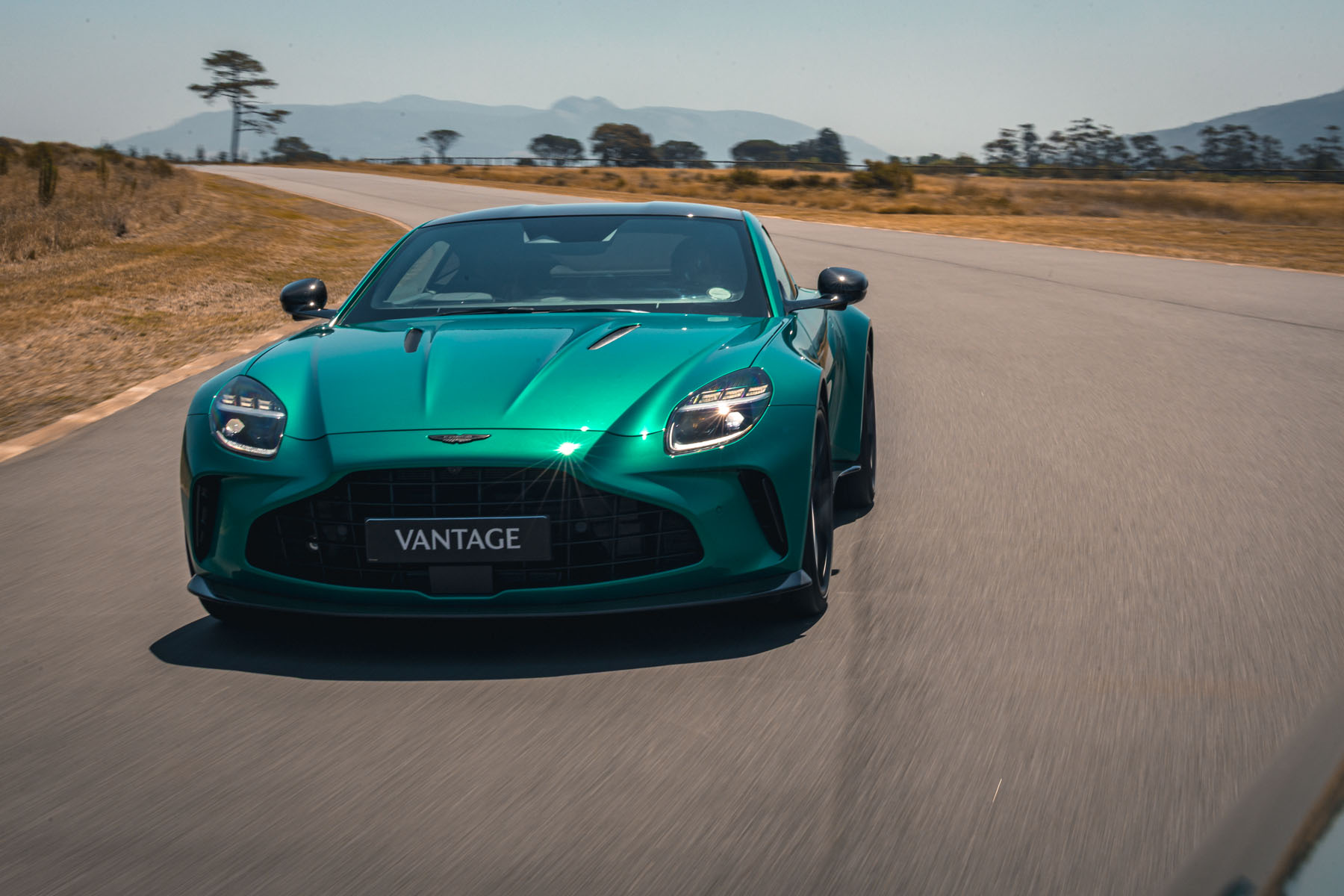
The proof, as they say, is in the pudding. Aston Martin gave us limited track time in the 2025 Vantage, but the experience was intense enough to leave a lasting impression. First of all, you do immediately sense that the Vantage wants to get on with the business of going fast, right from the outset.

The ride quality is firm, the steering direct (if a little light in feel) and, provided you are in one of the more sporty drive modes, the gearbox keeps the revs up (and the sound up, too). It is said Aston Martin has stripped away some NVH-suppressing components to improve the Vantage’s feedback and precision!

When ensconced in the optional carbon-fibre seat, holding the thick-rimmed, flat-bottomed ‘wheel and looking out over that magnificent bonnet, you’re in no doubt you are about to drive something special.

Squeeze the accelerator pedal and there is no delay, the Vantage leaps and the volume is turned up. Like most fast cars, it takes a while to build up to the limits of the car, because they are so exceptionally high.

At up to around 9 tenths, the Vantage feels beautifully precise and balanced, pivoting around its centre like no car of this weight (more than 1.6 tonnes) should be able to do. Nevertheless, there is a wild side to the Vantage, too. While the tyres (AML-specific 21-inch Michelin Pilot S 5s) provide huge reserves of grip, even those can’t stop traction from being broken when 489 kW is dumped on the rear wheels!

What that means is that for the real driving aficionado, there is fun to be had at the limit, where the 2025 Vantage displays a keenness to break traction at the rear, but in a controllable way. The new driver-assist systems also allow for far greater fine-tuning of the driving experience, so drivers who take the time to learn the newcomer’s ways will undoubtedly be rewarded with a greater “match” for their desires.

Summary

Priced at just over R5 million before options, the 2025 Aston Martin Vantage has some serious rivals, including the venerable Porsche 911 Turbo S (among a variety of 911 variants).

The Porsche remains the consummate all-rounder, able to put in lap times (on slippery surfaces, too) consistently that the Vantage will be unable to match. But for once, the Aston Martin Vantage can indeed counter with more than just ravishing looks and engine sound. It is genuinely entertaining to drive.

While its predecessor did deliver strong performance and good dynamics, these traits were “wrapped” in a little bit of “luxury padding”. With the new car, Aston Martin appears to have ripped most of that away. It’s not as hardcore as, for example, a GT3-type car, but for a base Vantage, it is seriously engaging. 

Find a new/used Aston Martin Vantage listed for sale on Cars.co.za

Related content:

Aston Martin DB12 Review: The R7 million Super Tourer

Aston Martin V12 Vantage: Classic Drive

Porsche 911 GT3 (2022) Launch Review

Ferrari Purosangue (2025) Review

BYD sub-brand Denza for SA? 7 trademark filings unearthed

Will BYD launch its Denza sub-brand in South Africa? A flurry of trademark applications suggests this Chinese marque may well be planned for local roads…

BYD Auto has filed trademark applications in South Africa not only for the “Denza” logo but also for as many as 7 separate model nameplates, suggesting the Chinese firm’s sub-brand may well be on the cards for a local introduction.

As a reminder, Denza traces its roots back to 2010, when it was founded as a joint venture between BYD Auto and Daimler AG (which we know today as the Mercedes-Benz Group). In September 2024, however, the German group transferred the last of its stake in the venture to BYD, with Denza thus becoming a wholly owned subsidiary of the Chinese giant.

The Denza B5 is expected to be a rebadged Boa 5.

With the Denza marque recently confirmed for fellow right-hand-drive market Australia, we set about digging for evidence that the brand may come to Mzansi, too. We soon found that BYD applied to trademark the “Denza” logo in SA in June 2024, less than a month after filing to protect the “Denza B5” and “Denza B8” nameplates.

The B5 is thought to be the export version of the Boa 5, a plug-in hybrid SUV sold in China under the Fang Cheng Boa brand. This 5-seater SUV – which measures 4 890 mm from nose to tail, making it 130 mm longer than a GWM Tank 300 – seemingly employs the same ladder-frame platform as the BYD Shark 6, though its hybrid powertrain (likewise based on a 1.5-litre turbopetrol unit) has been upgraded to generate a whopping 505 kW.

The Boa 8 (likely to be offered as the Denza B8) measures a whopping 5 195 mm long.

For the record, Fang Cheng Boa is another of BYD’s sub-brands. Incidentally, BYD Auto filed to protect the “Fang Cheng Boa” name in South Africa in August 2023, after doing the same with “Yangwang” – its 3rd sub-brand – approximately a month prior.

The B8, then, is likely to be a rebranded Boa 8, with the latter taking the form of a plug-in hybrid SUV available in China with up to 7 seats. This model – which at 5 195 mm is 117 mm longer than the GWM Tank 500 – features a body-on-frame configuration but employs a plug-in hybrid powertrain built around a turbocharged 2.0-litre petrol engine and churning out up to 550 kW.

The Denza Z9 GT in EV form generates as high an output as 710 kW.

Furthermore, in November 2024, BYD applied to trademark “Denza D9” (a people mover), “Denza N9” (a full-size unibody SUV) and “Denza Z9” (a 4-door sedan) in South Africa, with all 3 available in fully electric and plug-in hybrid forms overseas. Finally, in December 2024, trademark filings were made for “Denza D9L” (presumably a long-wheelbase version of the D9) and “Denza Z9 GT” (a low-slung, shooting-brake version of the Z9 sedan).

Of course, as we always point out in such instances, trademark applications are by no means guarantees the automaker will use the badges in question. But these filings are an indication that the Shenzhen-based automaker is at least considering expanding its local line-up beyond the BYD core brand. More info as we have it…

Related content

New BYD Seal 6 GT: electric hot hatch for SA?

When the new BYD Shark will go on sale in SA

New BYD Sealion 7 EV confirmed for SA

Cars.co.za Showroom: Experience SA’s Best New Cars at Mall of Africa

Visit the Cars.co.za Showroom, sponsored by Absa from 28 February to 2 March at Mall of Africa! See (and enjoy test rides in) 2025’s hottest cars, get expert advice, and perhaps BUY your dream car! Plus, you can win a getaway for 2 worth R10k!

The winners of the 2024/25 Cars.co.za Awards, sponsored by Absa will be announced at the Mall of Africa on Thursday 27 February, but the 8th instalment of SA’s most authoritative automotive industry awards programme, which is endorsed by naamsa | The Automotive Business Council (of South Africa), will continue with the Cars.co.za Showroom the following day (Friday) and weekend! Don’t miss it.

@carssouthafrica

From 28 Feb to 2 March, the Cars.co.za Showroom is bringing the 39 best new cars in SA to @themallofafrica! You can see them, test drive them, and even buy one on the spot! 💰 Win awesome prizes! 🎤 Live entertainment Sorted! 🎢 Family-friendly activities for the whole squad! 🔑 Test drive the best cars on the market 😎 Get expert advice from #CarsAwards judges 💰 Absa will be there to help you with vehiclw finance 🚗 Buy YOUR new car! — Cars Awards 2025 is here! 🥳 39 Cars across 13 categories have been judged and thoroughly tested by our 20 judges so you can make the best decision when buying your car. The winners will be announced at the Cars.co.za Awards Gala Event this February and you can be a part of the Cars Awards Experience at the Mall of Africa from 28 Feb – 2 March 2025. Stay tuned to our socials as we get ready to crown the best 13 new cars available in South Africa. #CarsAwards2025 #CarsAwards #carsawardsabsa #carssouthafrica #cartoks #carnews #absa #newcar #letsfindwhatmovesyou #whatmovesyou #Carssouthafrica #mallofafrica #Midrand #gauteng #johannesburg #joburg #southafricantiktok #showroom #carscoza #NewCarWhoDis

♬ original sound – Cars.co.za – Cars.co.za

Since the 2023/24 #CarsAwards, the programme has incorporated a consumer experience element and, during the 3 days after the Awards gala, the 13 category winners and other finalists of the 2024/25 #CarsAwards will be on display at the Mall of Africa, which hosted the 1st Awards Roadshow in late 2023.

Flashback to our most recent Cars.co.za Roadshow in 2024, at Sandton City.

At the Cars.co.za Showroom (located at Waterfall City Park), the motoring public can see and experience almost 40 finalist vehicles and get test rides in some of Mzansi’s best new cars.

@carssouthafrica

Can the Mahindra XUV 3X0 dethrone the Suzuki Swift? The Swift has had a legendary run at the CarsAwards, but the @mahindrasouthafrica XUV 3XO is here to challenge everything. Come see if #Mahindra have what it takes to win the title of “Best Budget Car” in South Africa at the @themallofafrica 28 Feb – 2nd March! — South Africa’s BIGGEST car event is about to take over The Mall of Africa and YOU don’t want to miss it! From 28 Feb to 2 March, we’re bringing the 39 best new cars in SA all to one place! You can see them, test drive them, and even buy them on the spot! 🙌 Win awesome prizes? We’ve got plenty up for grabs! 🎤 Live entertainment? Sorted! 🥳 Bring the whole squad! Fun activities for the whole family! And we’re not just inside the mall—we’re taking over Waterfall City Park too! The Cars.co.za Showroom is THE place to be for car lovers, families, and anyone looking for their next ride. — The Mahindra XUV 3X0 is a finalist at the 2025 Cars Awards up against the @hyundaisa Exter and the @suzuki_za Swift in the “Budget Car” category. This is one of the most important categories to ensure everyday South Africans get the most value for their purchase. 🥳 39 Cars across 13 categories have been judged and thoroughly tested by our 20 judges so you can make the best decision when buying your car. The winners will be announced at the Cars.co.za Awards Gala Event this February and you can be a part of the Cars Awards Experience at the Mall of Africa from 28 Feb – 2 March 2025. Stay tuned to our socials as we get ready to crown the best 13 new cars available in South Africa. #CarsAwards2025 #CarsAwards #carsawardsabsa #carssouthafrica #cartoks #carnews #absa #newcar #letsfindwhatmovesyou #whatmovesyou #Carssouthafrica #mallofafrica #Midrand #gauteng #johannesburg #southafricantiktok🇿🇦 #showroom #carscoza #NewCarWhoDis #mahindra #xuv #exter #hyundai #hyundaiexter #suzukiswift #swift #swiftie #japanese #japanesecar #budgetcar #hatchback #crossover

♬ original sound – Cars.co.za – Cars.co.za

They will also be able to engage with Cars.co.za advisers, some of the #CarsAwards judges (including our veteran YouTube presenter Ciro De Siena, shown below), as well as sales representatives from the Audi, Chery, Ford, Ineos, Isuzu, Mercedes-Benz, Kia, Mahindra, Volkswagen, Volvo and Toyota brands.

Ready to buy? Why wait?

And, if you’re in the market to buy a car soon, you can consult with Absa finance specialists at the Cars.co.za Showroom. Prospective car buyers can find out which CarsAwards finalist fits their budget (so prepare your payslips, plus any other relevant information and bring it with you). If all goes well, you could buy your new car, or at least initiate its purchase, right then and there at the event.

@carssouthafrica

Your dream car might be waiting for you! Pull up to the Cars.co.za Showroom at@themallofafrica 28 Feb – 2 March! See SA’s 39 best cars Touch them, test them and you can even buy one! Plenty of family activities, prizes and unique deals to make yours! #NewCarWhoDis | 🎤 @missnyashanu @ratimofokeng 🔴 Test drive the best cars on the market 🔴 Get expert advice from #CarsAwards judges 🔴 Absa will be there to help you finance your dream car 🔴 Buy YOUR new car! — Cars Awards 2025 is here and we are all about finding the best car for you! 🥳 39 Cars across 13 categories have been judged and thoroughly tested by our 20 judges to find out which car is the best for your money. The winners will be announced at the Gala Event this February and you can be a part of the Cars Awards Experience at the Mall of Africa from 28 Feb – 2 March 2025. Follow the journey on our social media and let’s find what movies you! #carsawardsabsa #carssouthafrica #CarsAwards2025 #cartoks #carnews #absa #newcar #newcar #absa #letsfindwhatmovesyou #whatmovesyou #Carssouthafrica #valentinesday #valentinesdaygift #valentine #bemyvalentine #vday #MallofAfrica #Mall #Gauteng #Waterfallcity

♬ original sound – Cars.co.za – Cars.co.za

The Cars Showroom (from 28 February to 2 March 2025) will offer activities for the entire family, with live entertainment, games and surprise giveaways, the Absa Car-aoke bar (yes!) and more.

Win one of 10 weekend getaways worth R10k

Visitors to the Cars.co.za Showroom can stand in line to win a weekend getaway for 2 people, including bed and breakfast for 2 nights (at a designation selected by Absa and their activation agency), a voucher to cover fuel and ad hoc expenses such as toll gates, PLUS the use of one of the 13 Cars.co.za Awards winning vehicles (Terms & Conditions apply).

To enter, scan the QR code at the Cars.co.za Showroom at Mall of Africa between 28 February and 2 March 2025 and register for the competition/a test drive. And, to double your chances of winning, enter the “Car-aoke” competition after registering (either in your own car, or at the Mall of Africa activation).

All you need to do is video yourself singing along to one of the provided songs and post your clip to social media while tagging Absa with the prescribed hashtags: #InvestedInMovingYourStory, #CarsAwards2025 and #AbsaCarsCompetition. Best of luck!

@carssouthafrica

The @volkswagensouthafrica Polo is a #CarsAwards2025 finalist and a South African icon! Meet it in person at the Cars.co.za Roadshow! From 28 Feb to 2 March @themallofafrica is turning into the ultimate showroom, and the Polo will be there—waiting for YOU to jump in, check out the interior, and even take it for a spin! 🔴 Test drive the best cars on the market 🔴 Get expert advice from #CarsAwards judges 🔴 Absa will be there to help you finance your dream car 🔴 Buy YOUR new car! — Cars Awards 2025 is here and we are all about finding the best car for you! 🥳 39 Cars across 13 categories have been judged and thoroughly tested by our 20 judges to find out which car is the best for your money. The winners will be announced at the Gala Event this February and you can be a part of the Cars Awards Experience at the Mall of Africa from 28 Feb – 2 March 2025. Follow the journey on our social media and let’s find what movies you! #CarsAwards #carsawardsabsa #carssouthafrica #CarsAwards2025 #cartoks #carnews #absa #newcar #letsfindwhatmovesyou #whatmovesyou #Carssouthafrica #mallofafrica #Midrand #gauteng #johannesburg #southafricantiktok🇿🇦 #showroom #carscoza #NewCarWhoDis #vw #vwpolo #polo

♬ original sound – Cars.co.za – Cars.co.za

The Cars.co.za Awards, sponsored by Absa utilises a unique scoring system that involves extensive testing by a panel of expert judges, real-world input from car owners (including owners’ ratings of their car brands’ dealer sales-, product quality and after-sales experience) and extra data provided by data specialists Lightstone Consumer, to recognise the best vehicles in 13 categories of the new-car market.

Follow the #CarsAwards on Cars.co.zaFacebookXInstagram and TikTok.

Related content:

2025 CarsAwards: The Finalists

Consumer Awards Roadshow Rocks Sandton City

Winners: 2023/24 Cars.co.za Consumer Awards, sponsored by Absa

Cars.co.za Consumer Awards — Tough Testing, The Consumer Wins! 

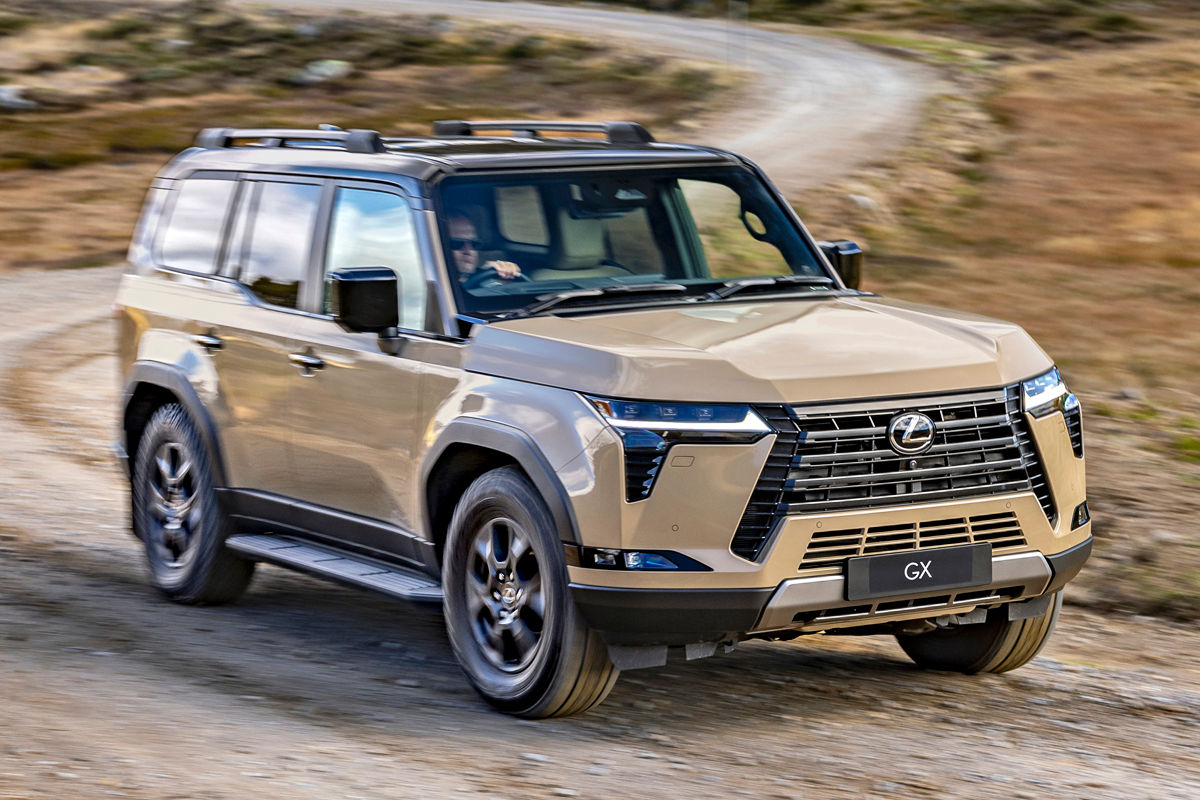
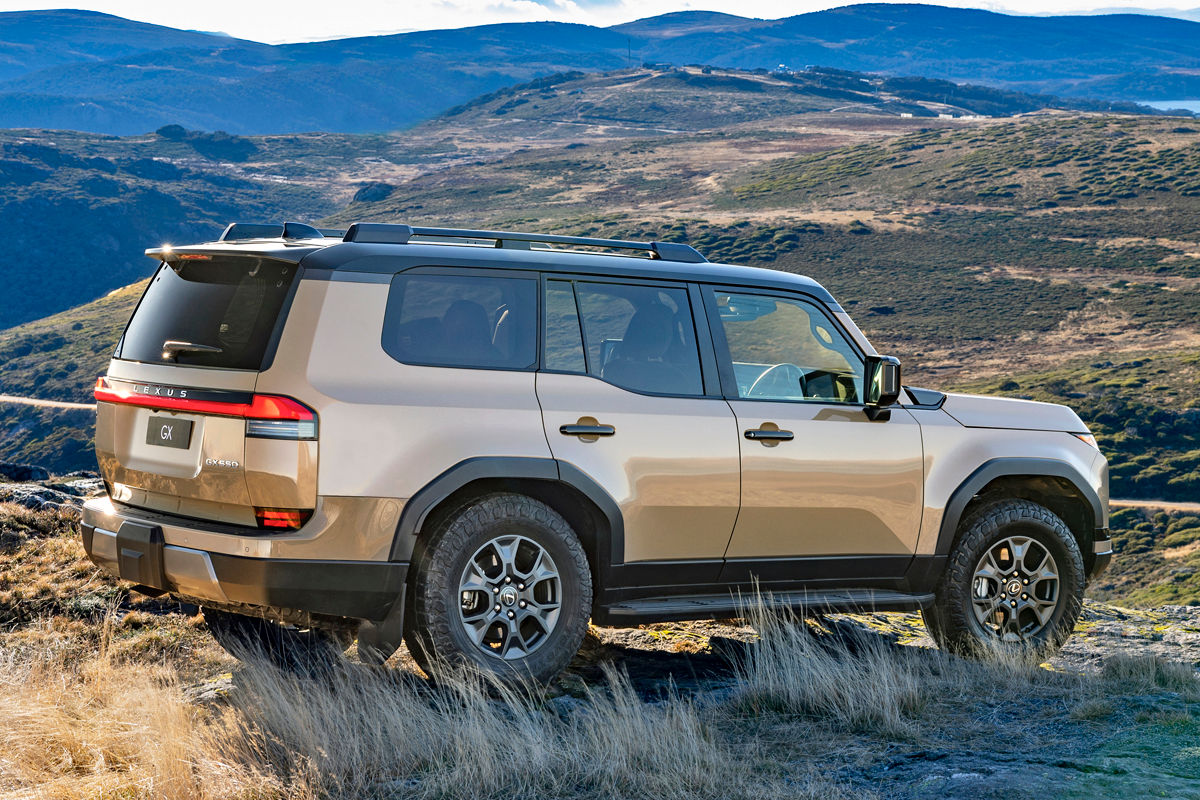
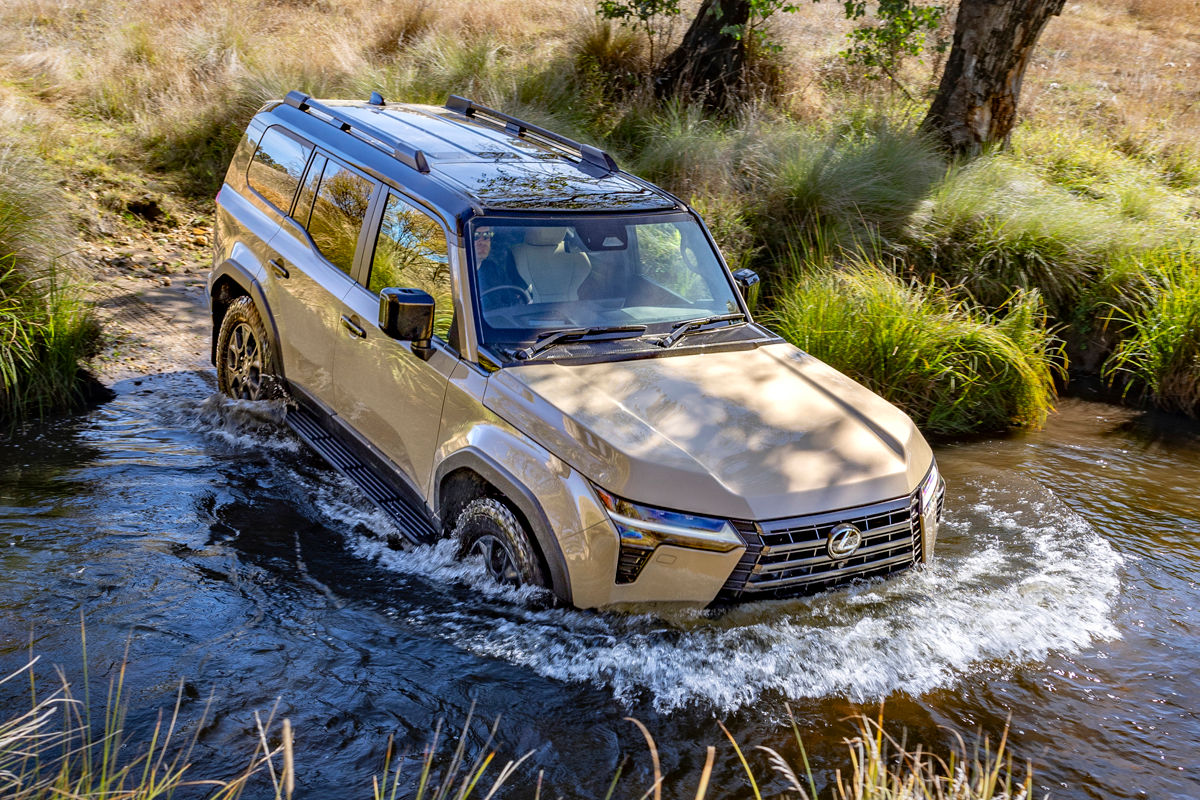
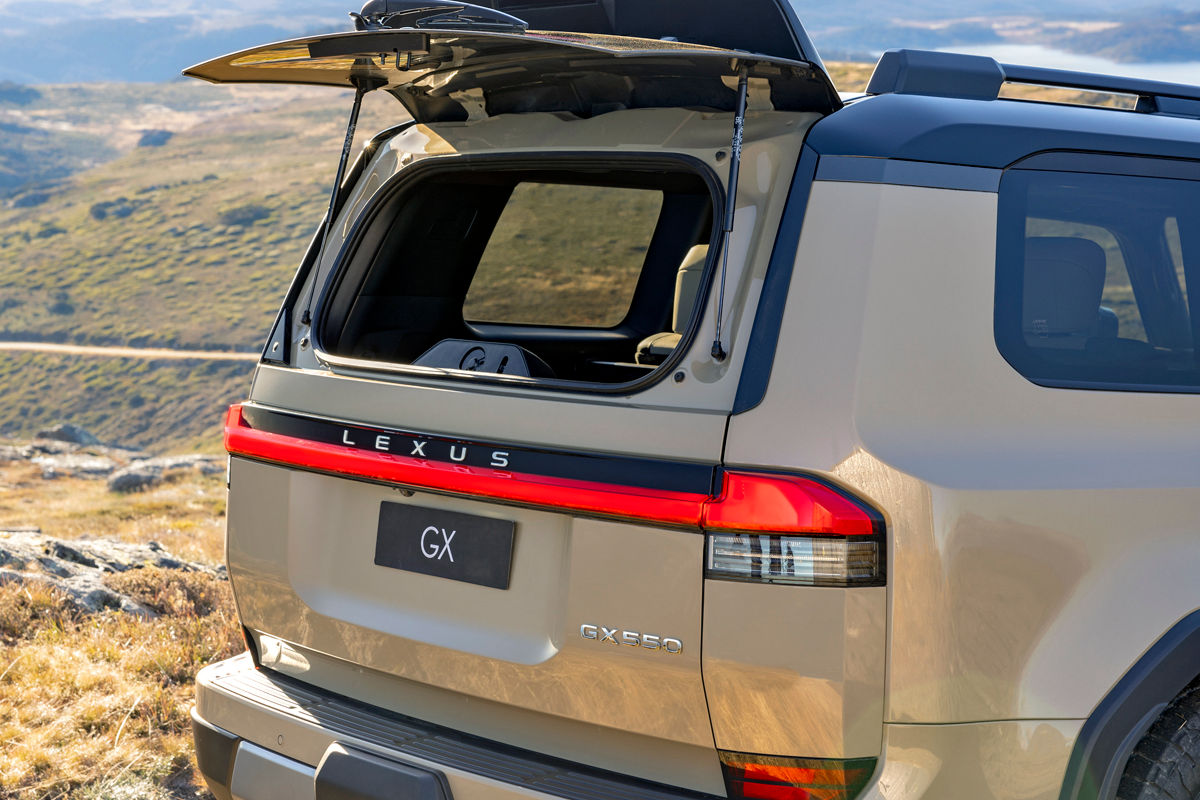
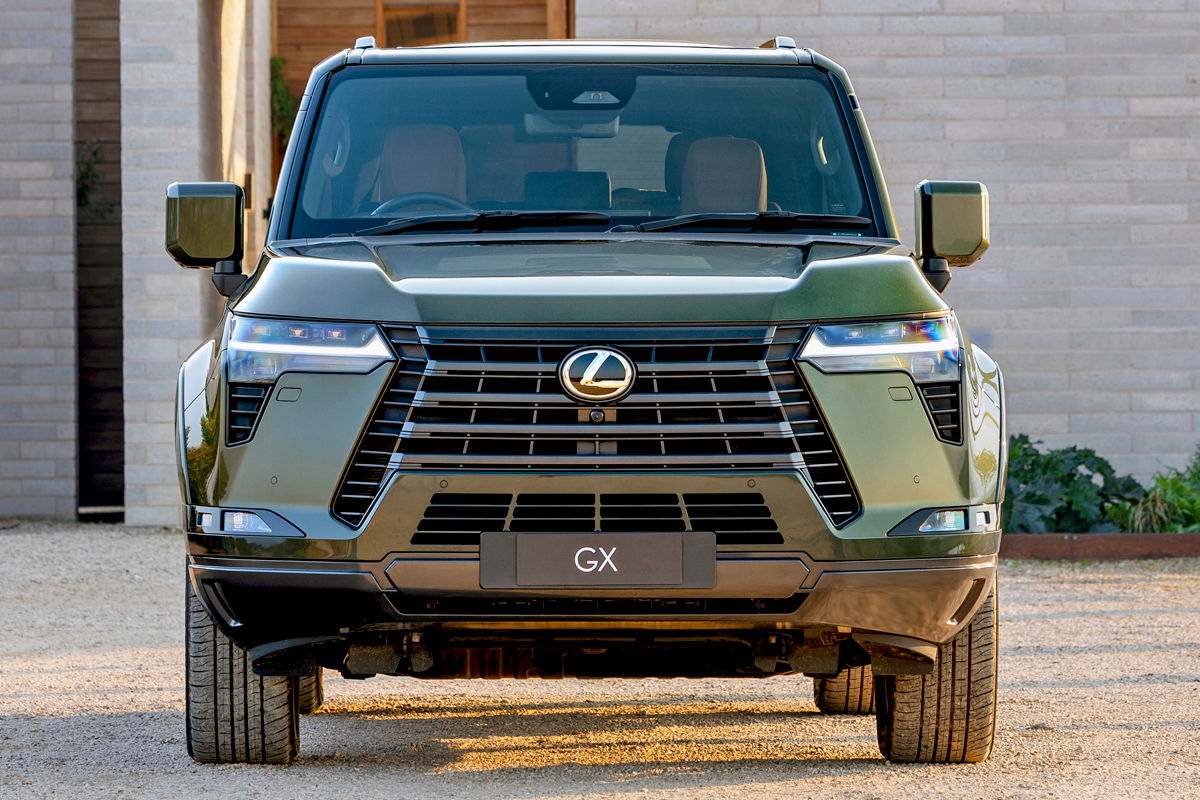
Lexus GX (2025) Price & Specs

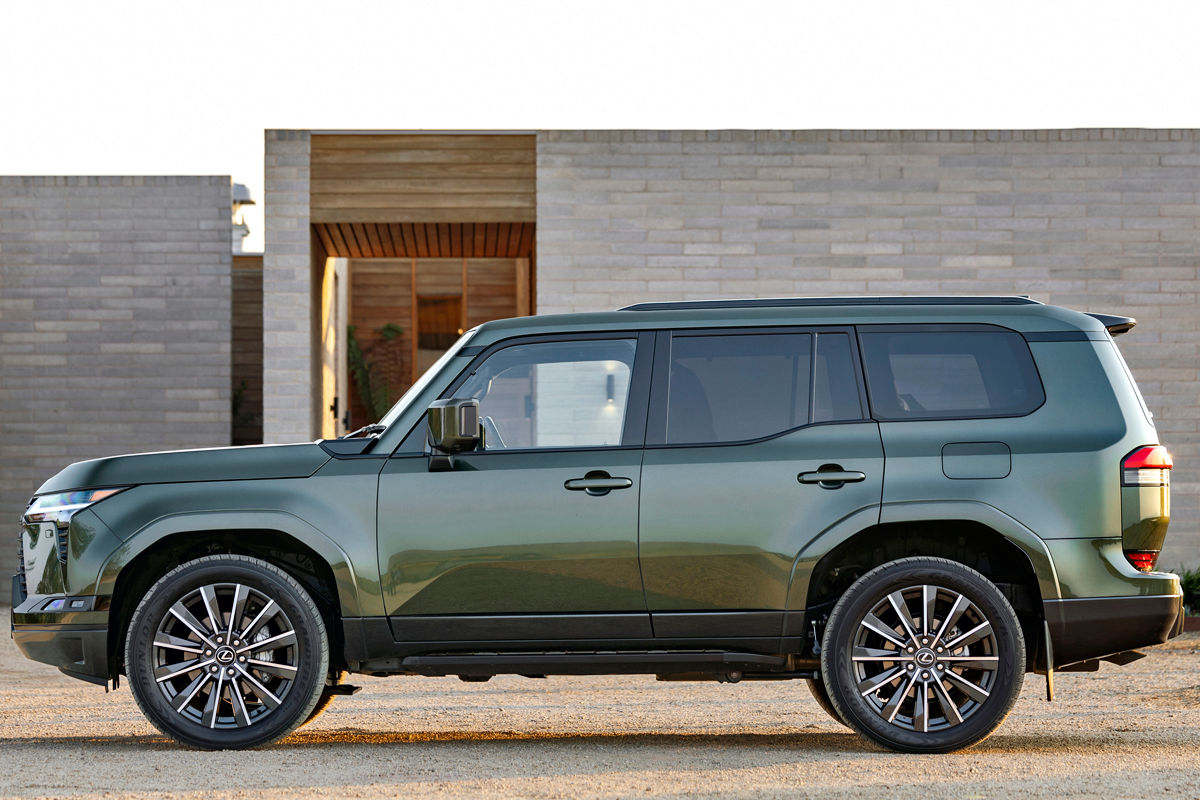
Pricing scoop! Here’s how much the new Lexus GX 550 – the Toyota Land Cruiser Prado’s luxury twin but with V6 turbopetrol power – will cost in South Africa…

In July 2024, Cars.co.za broke the news that the new Lexus GX 550 will be coming to South Africa. Then, in October last year, we uncovered fresh details about the local range. Now we can confirm pricing for this highly anticipated luxury twin to Toyota’s Land Cruiser Prado.

As a reminder, the new GX – a nameplate never before offered in Mzansi – is scheduled to launch in South Africa at some point in March 2025. From what we understand, this luxury ladder-frame SUV will effectively be available in 4 forms (though, interestingly, only 3 at launch).

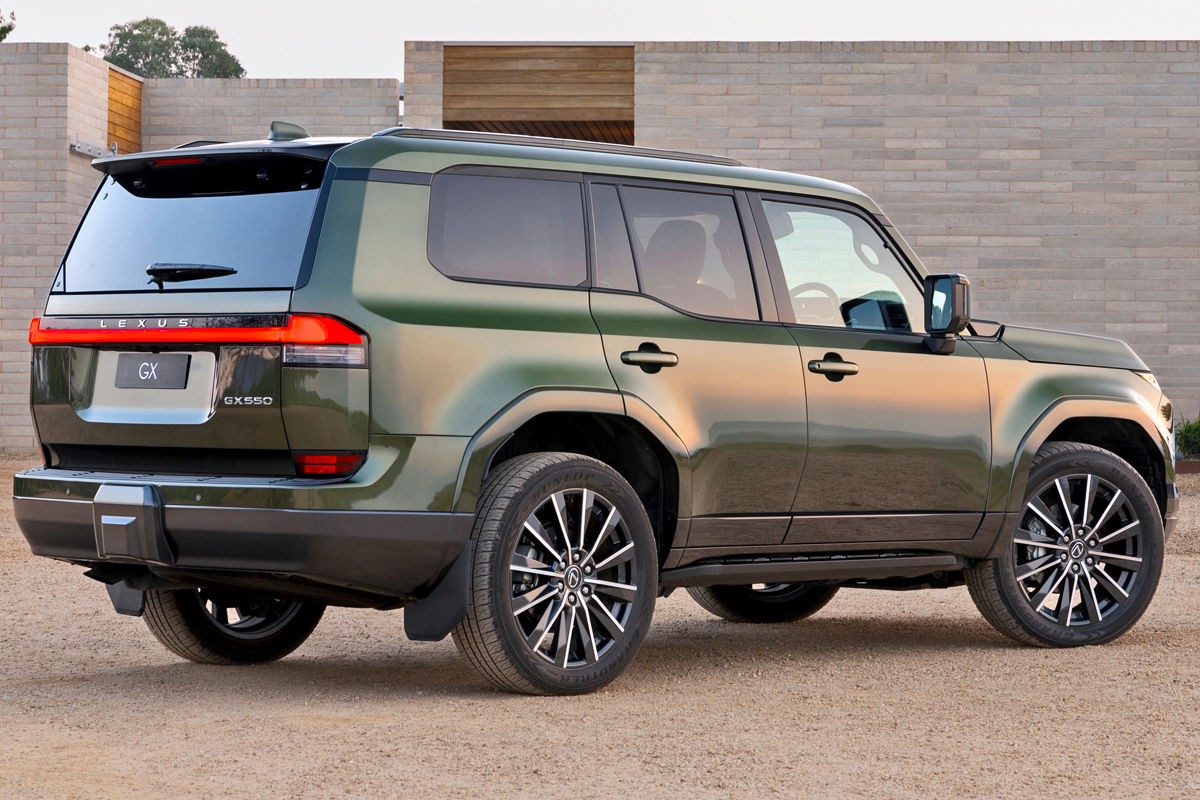
New Lexus GX rear
The GX 550 Overtrail in bi-tone form.

Yes, the local GX line-up looks set to eventually comprise a quartet of derivatives, each powered by the Japanese firm’s twin-turbocharged 3.4-litre V6 petrol engine – and each thus wearing the “GX 550” moniker. That means the hybrid powertrain (GX 550h) available in certain overseas markets seemingly isn’t on the cards for a local introduction (just yet, anyway).

Familiar from both the Land Cruiser 300 and the since-discontinued LX 600 (the latter having recently been replaced by the new LX 700h) but here detuned slightly to 260 kW and 650 Nm, the V35A-FTS engine is mated to all 4 wheels via a 10-speed automatic transmission. This petrol motor will serve to further differentiate the GX from the Prado, with the latter offered exclusively in 2.8-litre, 4-cylinder turbodiesel guise.

New Lexus GX engine
The GX 550 is powered by a 260 kW twin-turbo V6 petrol motor.

So, how much will the new GX cost you in South Africa? Well, the local portfolio will kick off with the GX 550 Overtrail, which our information suggests will be priced from R1 766 000. This derivative will furthermore be available as a 2nd variant in 2-tone form, known as the GX 550 Overtrail Bi-Tone and starting at R1 776 000 (for those averse to maths, that’s a premium of R10 000). Both will ship standard in 5-seater guise.

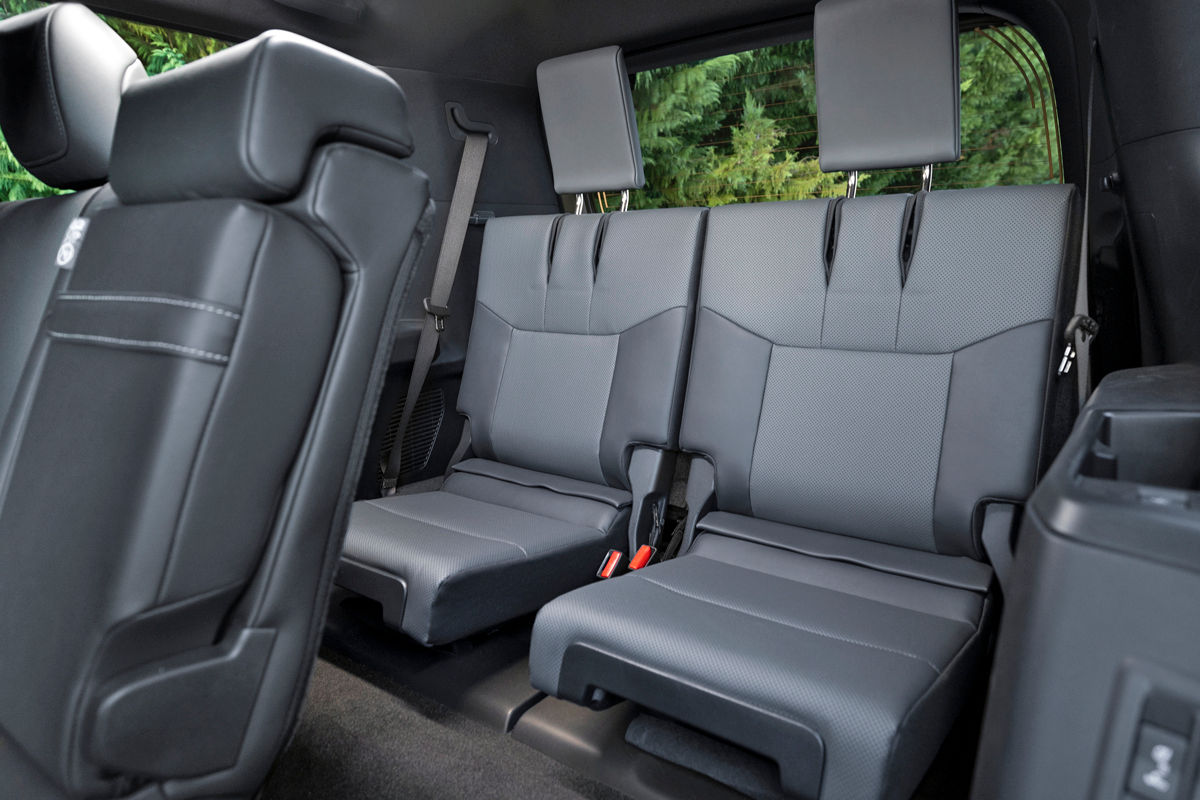
Meanwhile, the seemingly more road-biased GX 550 SE will be priced from R1 829 000 and offer 7 seats as standard. Finally, the 5-seater GX 550 Overtrail Off-Road will top the local line-up, distinguished by various 4×4-specific pieces of equipment (we’re thinking additional underbody protection, off-road side steps, a side-mounted gear carrier, a roof rack, all-weather floormats and a luggage-compartment liner) and coming in at R1 867 000. However, take note the Off-Road derivative won’t be available from launch and will instead join the range at a later stage.

We believe the SE derivative will look something like this (international model shown).

Effectively positioned between the Lexus RX (currently running from R1 457 300 to R1 799 800) and flagship LX (with current pricing bookends of R2 557 500 and R3 092 100), the GX shares various elements – though not its powertrain – with the latest Land Cruiser Prado, right down to its “J250” model code. The 2 derivatives in the Prado range, for the record, are currently priced at R1 315 700 and R1 470 600, respectively.

So, what sort of standard features will be offered in the new Lexus GX? Well, the Overtrail derivatives will ship with LED headlamps (including auto high beams), a tilt-and-slide moonroof, a powered tailgate, an electro-chromatic rear-view mirror, a 12.3-inch digital instrument cluster, a 14.0-inch touchscreen, a multi-terrain monitor, a head-up display, a 10-speaker sound system, wireless smartphone charging, a refrigerated cooler box, faux-leather upholstery and electrically adjustable (plus heated-and-ventilated) front seats.

The GX 550 Overtrail’s interior (international model pictured).

Furthermore, all Overtrail variants will boast a rear differential lock, along with Toyota’s familiar multi-terrain select system, downhill assist control, crawl control and the brand’s trick e-KDSS suspension system. From what we understand, the 7-seater SE will do without the aforementioned off-road enhancements, though will likewise feature a locking centre differential, full-time 4×4 and low-range gearing.

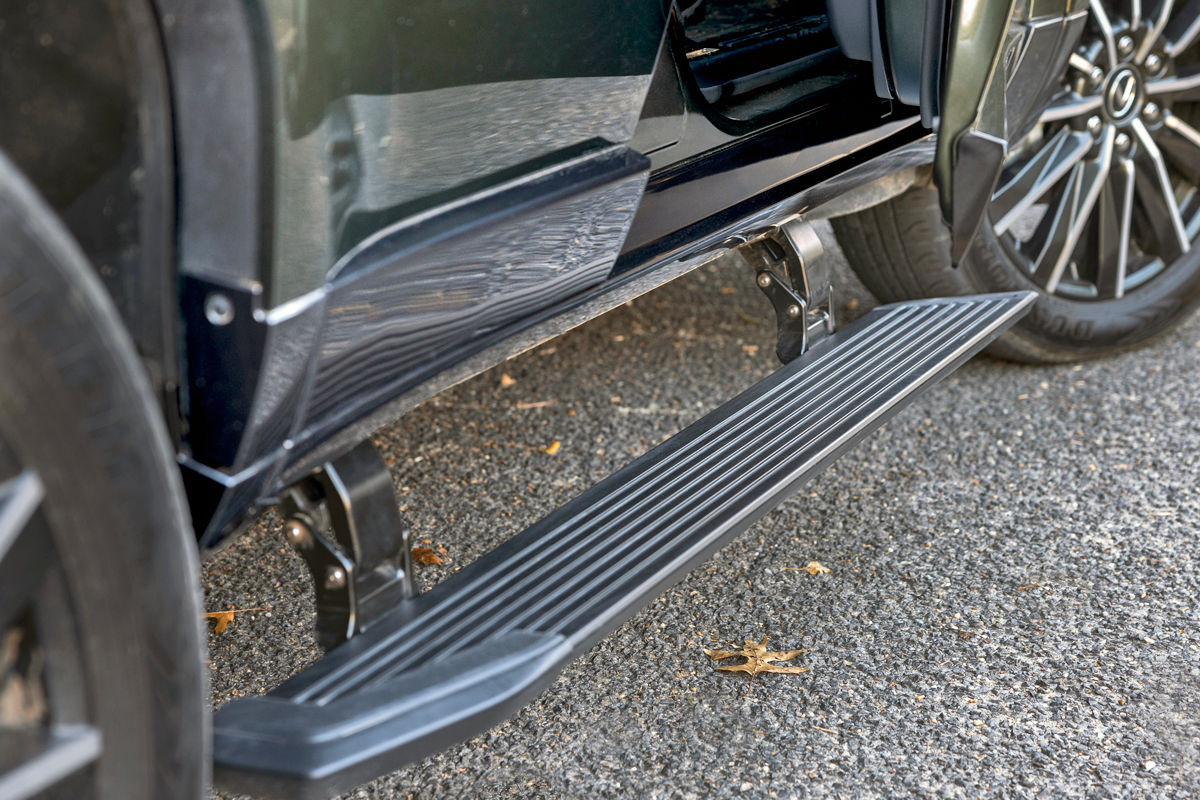
The 3-row SE derivative will furthermore score high-end features like a 21-speaker Mark Levinson sound system, semi-aniline leather upholstery, a front-seat massaging function, 2nd-row seat heating, a fixed panoramic glass roof, adaptive high beams, a panoramic-view monitor, a digital rear-view mirror and even automatically deploying side steps.

New Lexus GX SE
The SE flagship will come with automatically deploying side steps.

According to our information, the GX will be available in the following 5 monotone exterior colours: White Quartz, Sonic Titanium, Titanium Carbide Grey, Graphite Black and Mercury Grey (with the latter hue exclusive to the SE grade). The bi-tone version of the Overtrail, meanwhile, will be offered in Sonic Titanium, Titanium Carbide Grey and Desert Moonlight, each paired with a black finish for the roof and side-mirror caps.

To refresh your memory, the Lexus GX is a body-on-frame SUV that traces its roots all the way back to 2002. While the opening 2 generations were produced exclusively in left-hand-drive guise (catering primarily to North America), this 3rd iteration is also manufactured in right-hand drive, opening the door to introductions in its domestic market of Japan as well as in Australia and indeed now SA.

Toyota filed to trademark “GX 550” in SA back in mid-2023.

For the record, Toyota Motor Corporation applied to trademark the “GX 550” badge in South Africa back in June 2023, about 2 weeks after the 3rd-generation GX was revealed on the global stage.

How much will the new Lexus GX cost in South Africa?

Lexus GX 550 Overtrail (5-seater) – R1 766 000

Lexus GX 550 Overtrail Bi-Tone (5-seater) – R1 776 000

Lexus GX 550 SE (7-seater) – R1 829 000

Lexus GX 550 Overtrail Off-Road (5-seater) – R1 867 000

We expect the new GX to ship standard with a 7-year/100 000 km warranty and maintenance plan with the same parameters.

Related content

Lexus LX (2025) Price & Specs

Lexus RZ (2025) Price & Specs

Land Cruiser 300: spec updates for 2025

Most Fuel Efficient Budget Cars in SA

We list the most fuel-efficient budget-friendly cars currently available in South Africa!

Fuel prices in South Africa continue to negatively impact household budgets and new car buyers would be wise to consider fuel efficiency when considering purchasing a car. 

By considering the most fuel-efficient budget cars, you can literally save thousands of Rands every year! 

In an effort to assist you in your decision-making process, we have created a fuel efficiency list that’s not only more relevant but also more diverse. Considering that most people can’t afford expensive cars, we decided to list the most fuel-efficient cars with an asking price of under R300 000.

Note that claimed manufacturer fuel consumption figures are used here and that real-world consumption figures will differ depending on a number of factors such as driving style, road conditions and so forth. 

Pricing is accurate as of February 2025. 

Most Fuel Efficient Budget Cars in South Africa

4.2 L/100 km – Suzuki Celerio 1.0 GL Automatic

Suzuki Celerio

The new Suzuki Celerio is a popular choice in the budget car segment and the good news is that it’s more frugal than its predecessor. The Celerio 1.0 GL automatic claims 4.2 L/100km while the manual Celerio GA and Celerio GL claim a respectable 4.4 L/100km.  

The Celerio makes use of a  3.-cylinder 1.0-litre petrol engine with 49 kW and 89 Nm and is paired with either 5-speed manual transmission or 5-speed automated manual transmission. Pricing for the Celerio automatic is R225 900 while the base Celerio GA starts from R188 900 and the Celerio GL is priced from R210 900.

Search for a new/used Suzuki Celerio on Cars.co.za

Get a quote / Book a test drive

4.2 L/100km – Toyota Vitz XR Automatic

Toyota Vitz

The Toyota Vitz arrived in South Africa to replace the outgoing Agya as the firm’s budget car offering. The Vitz is based on the Suzuki Celerio as part of the Toyota-Suzuki product partnership and the Vitz is therefore powered by the same 3.-cylinder 1.0-litre petrol engine with 49 kW and 89 Nm and is paired with either 5-speed manual transmission or 5-speed automated manual transmission. The manual derivatives claim 4.4 L/100km.

Pricing for the Vitz starts from R189 900 while the Vitz Xr manual is priced from R219 900. The Vitz automatic is priced from R239 900.

Buy a Toyota Vitz on Cars.co.za

Get a quote / Book a test drive

4.4 L/100km – Suzuki Swift Manual and Suzuki S-Presso Automatic

New Suzuki Swift

The new Suzuki Swift has arrived in South Africa and it’s a current finalist in the Budget Car category of the 2024/25 #CarsAwards.

The new Swift is more fuel-efficient than its predecessor thanks to its engine having one less cylinder. The Swift is now powered by a 3-cylinder, 1.2-litre petrol engine that develops 60 kW and 112Nm of torque and is paired to either a 5-speed manual or CVT. Note that an Automated Manual Transmission (AMT) is offered on the base Swift GA derivative. The manual Swift claims 4.4 L/100km while the Swift CVT claims 4.6 L/100km. Pricing for the new Suzuki Swift starts from R219 900 (Swift 1.2 GL) and tops out at R284 900 for the Swift 1.2 GLX automatic.

Buy a new Suzuki Swift on Cars.co.za

Buy a used Suzuki Swift on Cars.co.za

Suzuki-sPresso-fuel-efficient-budget-car

The Suzuki S-Presso is a familiar and popular budget car in South Africa and with its 4-speed automatic derivatives claiming 4.4 L/100km, it’s a frugal city car. Note that the S-Presso 5-speed manual derivatives claim 4.6 L/100km which is excellent!

The Suzuki S-Presso employs a 3-cylinder, 1.0-litre petrol engine with 49 kW and 89 Nm. Pricing for the Suzuki S-Presso starts from R178 900 for the S-Presso 1.0 GL manual and goes up to R219 900 for the S-Presso S-Edition automatic.

Buy a new Suzuki S-Presso on Cars.co.za

Buy a used Suzuki S-Presso on Cars.co.za

4.9 L/100km – Suzuki DZire and Suzuki Ignis

Suzuki-Ignis

As this list highlights, Suzuki products are well known for delivering low real-world fuel consumption and the Dzire sedan (from R217 900) and Ignis (from R237 900) are no exception. 

The Suzuki Dzire and Ignis share the same 1.2-litre petrol engine with 61 kW and 113 Nm on offer and all are offered with either a 5-speed manual or 5-speed automated manual transmission.

Suzuki claims 4.9 L/100km for both models.

Buy new Suzuki DZire on Cars.co.za

Buy a used Suzuki DZire on Cars.co.za

Buy a new Suzuki Ignis on Cars.co.za

Buy a used Suzuki Ignis on Cars.co.za

4.9 L/100 km – Renault Kwid 

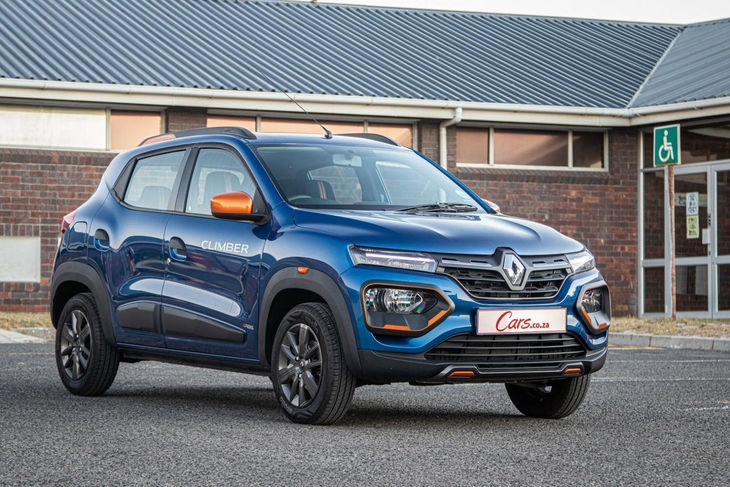
The Renault Kwid is a popular budget car in South Africa and fuel efficiency for both manual and automatic derivatives are claimed at 4.9L/100km. It’s powered by a 1.0-litre, 3-cylinder petrol engine with 50 kW and 91 Nm of torque. A 5-speed manual or automated manual (AMT) transmission drives the front wheels. There are 3 automatic Kwid derivatives on offer across 3 trim levels including Life, Zen and Climber. Pricing for the Kwid starts from R196 999

Search for a new/used Renault Kwid on Cars.co.za

Get a quote / Book a test drive

5.0 L/100km – Kia Picanto EX+ Manual

Kia-Picanto-Facelift

A facelifted Kia Picanto recently arrived in South Africa with a revised look and updated feature specification. The Picanto range offers 2 engines for buyers to choose from including a 49 kW / 95 Nm 1.0-litre engine and a 1.25-litre engine with 62 kW and 122 Nm. Both engines can be had with a 5-speed manual transmission or a 4-speed automatic, but the manual derivatives are the most fuel-efficient with Kia claiming 5.0 – 5.1 L/100km. 

Pricing for the Kia Picanto starts from R260 995 for the Picanto 1.0 LX manual while the Picanto 1.2 EX+ automatic is priced from R325 995. 

Buy a new / used Kia Picanto on Cars.co.za 

Get a quote / Request a test drive

5.3 L/100km Mahindra 3XO 1.2T Manual

Mahindra XUV 3XO

The new Mahindra 3XO is an excellent budget car that’s also been recognised as a finalist in the Budget Car category of the 2024/25 #CarsAwards.

It also happens to be quite fuel efficient with its 82kW / 200 Nm turbocharged 1.2-litre petrol engine claiming 5.3 L/100km when paired with a 6-speed manual transmission. If you’d prefer the 6-speed automatic transmission, fuel consumption increases slightly to a claimed 5.5L/100km.

Pricing for the new Mahindra 3XO starts from R254 999.

Buy a new Mahindra 3XO on Cars.co.za

Buy a used Mahindra 3XO on Cars.co.za

Petrol Price Up, Diesel Down for March 2025

Unaudited fuel price data released by the Central Energy Fund (CEF) is pointing towards a potential increase for the petrol price while the price of diesel in South Africa is projected to decrease in March 2025. 

With the final week of February 2025 ahead, the current fuel price projections are becoming increasingly more likely. The fuel price data is indicating that March 2025 will see a petrol price increase while diesel could see marginal price cuts. 

According to the CEF, the price of Petrol 95 could see a slight increase of around 3 cents per litre while the price of Petrol 93 could see an increase of 16 cents per litre. 

As for Diesel 0.05%, a price cut of around 6 cents per litre is on the cards while the price of Diesel 0.005% could see a cut of around 12 cents per litre. 

Earlier in February 2025, the data indicated higher increases for March 2025 but a relatively stable international oil price and a stronger Rand-Dollar exchange rate has contributed towards a more palatable fuel price outlook.

Official fuel price adjustments are expected to be announced in early March 2025. 

Fuel Price Forecast: March 2025 

Fuel Type Feb 25 Inland Feb 25 Coast Mar 25 Inland*Mar 25 Coast*
Petrol Unleaded 93R22.16R21.37R22.32R21.53
Petrol Unleaded 95R22.41 R21.62R22.44R21.65
Diesel 0.05%R20.34R19.55R20.28R19.49
Diesel 0.005%R20.45R19.69R20.33R19.57

* February 2025 figures are forecast figures and not official. 

Buy a fuel-efficient car on Cars.co.za

Related Content 

Most Fuel-Efficient Budget Cars in SA

10 Fuel Efficient Used Compact SUVs under R300k

10 Fuel-Efficient Used Cars Under R200k in SA

10 Fuel-Efficient Used Family SUVs Under R400k 

5 Fuel Efficient Used Double Cab Bakkies Under R500k

Is it time for South Africa to Switch to EVs? 

5 Ways to Beat the Fuel Price Hike

SA’s top-selling double-cab bakkies in January 2025

Was the Ford Ranger again SA’s top-selling double-cab bakkie in January 2025 or did the Toyota Hilux hit back in the opening month of the year? The latest sales figures by body style…

In 2024, the Ford Ranger took the title of South Africa’s top-selling double-cab bakkie, despite the Toyota Hilux remaining the most popular bakkie overall (that is, including all 3 body styles). So, what happened in January 2025?

First, a reminder: Naamsa’s monthly sales report unfortunately doesn’t include a breakdown of the 3 bakkie body styles (though be sure to check out the overall list of SA’s most popular bakkies for January 2025 anyway). Thankfully, however, the studious folks over at Lightstone Auto have again assisted us by providing these fascinating registration figures.

Isuzu D-Max X-Rider
Isuzu’s D-Max again occupied the final step on the double-cab podium.

According to Lightstone Auto, the Ford Ranger picked up right where it left off, leading the double-cab sales race in January 2025 with 1 572 units sold. By our maths, that works out to a considerable 84.6% of the Silverton-built bakkie’s overall tally (1 858 units) for the year’s opening month.

That meant the Toyota Hilux again had to settle for 2nd place on the dual-cab standings, with 1 097 units – or 42.9% of the Prospecton-made stalwart’s 2 557-unit total for the month, including the other body styles – registered in January 2025.

The final place on the double-cab podium went to – yes, you guessed it – the Isuzu D-Max, which finished the year’s opening month with sales of 497 units for this body style. Our calculations suggest this translates to just 35.2% of the Struandale-manufactured model’s overall total of 1 413 units for January.

For the record, Lightstone Auto’s figures show that all other 1-tonne double-cab bakkie derivatives (over and above the Ranger, Hilux and D-Max) collectively managed 1 212 registrations last month.

SA’s top-selling single- and extended-cabs in January

The Hilux leads the single-cab race after the opening month of 2025.

What happened in the single-cab space in January 2025? Well, as it did across the whole of 2024, the Toyota Hilux again led the charge in the 1-tonne single-cab segment last month, with 1 090 units (or 42.6% of its overall tally) registered.

The Isuzu D-Max single cab was 2nd on 772 units (54.6% of the D-Max total), while the 2-door version of the KwaZulu-Natal-assembled Mahindra Pik Up wasn’t far behind in 3rd, with 661 units sold (82.5% of this nameplate’s total) in January.

Some 82.5% of all Mahindra Pik Up sales in January 2025 were single cabs.

The Ranger single cab, meanwhile, could muster only 62 units. Furthermore, Lightstone Auto’s dataset suggests that all other 1-tonne single-cab bakkie derivatives (other than the Hilux, D-Max, Pik Up and Ranger) collectively managed 825 units in January.

The Toyota Hilux also topped the charts in the extended-cab segment in January 2025, finishing the month on 367 units. Next came the Ford Ranger (224 units), followed by the Isuzu D-Max (144 units). These are, of course, the only 3 bakkies offered locally in this so-called “cab-and-a-half” body style.

Related content

GWM P300 2.4TD (2025) Price & Specs

When the BYD Shark will go on sale in SA

New 300 kW GWM P500 PHEV loading?

Toyota C-HR (2017-2024) Buyer’s Guide

The original Toyota C-HR was in South Africa’s new-car market for over 7 years. Now that it’s discontinued (and its successor is unlikely to be launched in Mzansi), should you consider a used version of the distinctly styled small crossover? Here’s our take…

Concept-car styling? Check. Downsized turbopetrol engine? Affirmative. Toyota badge? Wait, what? Yes, in 2016, the original Toyota C-HR, which favoured radical looks and forced induction over practicality and tried-and-tested atmospheric power, was quite a departure for the otherwise strait-laced Japanese firm.

Part SUV, part hatchback, with more than a dash of coupe-like styling courtesy of cleverly disguised rear door handles and a notably sloped roofline, the AX10-series C-HR was anything but typical Toyota fare.

The C-HR’s distinctive silhouette.

Still, there was plenty of substance beneath that dramatically surfaced sheet metal, thanks, in part, to the model’s TNGA-C underpinnings, which facilitated not only a lower-than-usual centre of gravity (for a crossover, anyway) but also a relatively sophisticated rear-suspension set-up.

As an aside, it’s interesting to note the Toyota C-HR was the first model locally to employ the Aichi-based automaker’s then-new 1.2-litre, 4-cylinder turbopetrol engine (while the model was never offered with a hybrid powertrain in our market). After all, Toyota SA Motors was deliberately late to the downsized turbo party, persisting with time-tested naturally aspirated motors longer than most of its rivals.

A look at the pre-facelift Luxury derivative’s interior.

While the 1st-gen C-HR was produced in Japan, China, Thailand and Turkey, it’s our understanding that all SA-spec units were sourced from the Sakarya plant in the latter country. Incidentally, the 2nd-gen model is now built exclusively at this factory.

So, why isn’t the 2nd-gen C-HR offered in Mzansi? Well, Toyota SA Motors told us the AX20-series model is available only in hybrid form, putting it at a “higher price point” than its predecessor. Bear in mind that if the latest C-HR were to be imported into South Africa, it would compete with petrol-electric versions of the larger, locally built Corolla Cross. There is a healthy demand for those variants already…

Toyota C-HR model line-up in South Africa

The 2nd concept was released in 2015.

Previewed by both the C-HR Concept of 2014 and a further-refined show car unveiled about a year thereafter, the production version of the coupe-style crossover was revealed in March 2016.

By February 2017, it had arrived in South Africa, powered by a 1.2-litre 4-cylinder turbopetrol mill and available with either a 6-speed manual gearbox (complete with iMT controls that automatically adjusted engine rotations when shifting) or a continuously variable transmission (CVT). At launch, just a base trim level and a Plus specification were on offer, resulting in a 3-derivative line-up:

  • C-HR 1.2T 6MT (85 kW/185 Nm)
  • C-HR 1.2T Plus 6MT (85 kW/185 Nm)
  • C-HR 1.2T Plus CVT (85 kW/185 Nm)
The Luxury flagship arrived in August 2018.

In August 2018, the long-awaited range-topping “Luxury” variant – not available locally right from launch ostensibly due to high global demand – touched down in South Africa, boasting a bi-tone exterior finish (effectively adding black finishes for the roof and side-mirror caps), LED head- and taillamps, leather upholstery, heated front seats, parking sensors, a parking-assist system and a raft of extra airbags.

  • C-HR 1.2T Luxury CVT (85 kW/185 Nm)

The C-HR received a facelift in February 2020, though stuck with the 1.2-litre engine and a 4-variant line-up. Styling revisions were implemented fore and aft, with the base derivative and the mid-tier Plus grade upgrading to LED headlights. Toyota said it tweaked the power steering to “improve feel” (feedback through the multifunction ‘wheel) and claimed to have raised refinement levels as well.

The facelifted version hit the local market in early 2020.

Inside, the old 6.1-inch infotainment system was ditched in favour of an 8-inch arrangement (replete with “full smartphone integration”), while the Plus variants’ instrument-cluster diameter grew to 4.2 inches.

However, perhaps the most significant mid-cycle upgrades came in the safety department, with the standard and Plus variants gaining extra airbags (and, in the case of the former, rear-seatbelt force limiters and pre-tensioners, too) and the Luxury derivative scoring blind-spot monitoring, lane-change assist, lane-keeping assist, rear cross-traffic alert and adaptive cruise control.

The Luxury range-topper was updated again in mid-2021.

In June 2021, the Luxury flagship derivative received further attention, adopting sequential indicators and unique light-cluster arrangements, front and rear. Meanwhile, the adaptive cruise-control system gained all-speed functionality and the lane-departure alert system now incorporated lane-trace assist.

The final tweaks to the local C-HR portfolio came in August 2022, when the Plus and Luxury variants switched to a new alloy-wheel design, while fresh exterior colours were rolled out. Production ended late in 2023, though Toyota SA Motors removed the C-HR from its price lists only in September 2024.

What are the Toyota C-HR’s strengths?

The punchy 1.2-litre 4-banger.

Punchy powertrain: Toyota’s 85 kW turbocharged 1.2-litre 4-pot (8NR-FTS) delivered its oomph in a pleasingly linear manner, with peak twisting force of 185 Nm on tap from 1 500- to 4 000 rpm. Though the C-HR’s kerb weight was about 1 400 kg, the refined little engine felt more than punchy enough.

Unusually, the 6-speed manual derivatives were slightly more efficient than their CVT-equipped siblings, with Toyota claiming combined figures of 6.3- and 6.4 L/100 km, respectively. As an aside, though some early units in North America were said to suffer from CVT issues, we could find no evidence of such maladies here in South Africa.

This crossover boasted a sophisticated rear-suspension set-up.

Well-sorted ride and handling: Endowed with a well-engineered chassis, the AX10-series Toyota C-HR was both dynamically adept (delivering impressive body control) and rode with a pleasing degree of pliancy. Much of this could be attributed to the crossover’s sophisticated double-wishbone rear suspension, which Toyota opted for over a more rudimentary torsion-beam arrangement.

In short, from behind the steering wheel, the composed Toyota C-HR felt more like a slightly raised hatchback than a high-riding crossover (in fact, at the time of this model’s reveal, chief engineer Hiroyuki Koba said he had “wanted to achieve performance on a par with a good C-segment hatchback”).  

The rear door handles were incorporated into the C-pillars.

Concept-car styling: Every now and then, it seems Toyota’s designers are given free rein, resulting in – rather uncommonly for the brand – a vehicle that favours bold character over outright practicality. The FJ Cruiser is one such example and the C-HR is another.

At the C-HR’s unveiling in 2016, the Japanese automaker said its newest model represented then-president Akio Toyoda’s “determination to allow greater stylistic freedom”. Featuring flared arches, a coupe-like roofline and what the brand described as an array of “gemstone-like shapes”, the C-HR stayed largely true to the concept that preceded it.

What are the Toyota C-HR’s weaknesses?

Note the high load floor in this example.

Below-average luggage space: Curiously, Toyota SA Motors claimed several separate luggage-capacity figures for the C-HR over the model’s local lifecycle. For instance, the 2017 spec sheet listed a figure of 377 litres, before this claim fell to 297 litres the following year and then further to 234 litres in 2021.

Regardless of the exact number, there was no escaping the fact the C-HR’s load bay was cramped compared with those of rivals. This was particularly evident at launch, when all derivatives shipped standard with a full-size spare wheel (wrapped in 215/60 R17 tyres) under the load floor, taking a substantial bite out of the compartment’s depth.

The rear quarters were a little claustrophobic, too.

Toyota did eventually switch to a space-saver spare wheel, though it’s not clear exactly when that happened. So, if you’re inspecting a potential buy before test driving, we’d suggest having a peek in the luggage compartment and, indeed, under the load floor.

Compromised outward visibility: As we noted in our Toyota FJ Cruiser Buyer’s Guide, compromised outward visibility is often one of the downsides of an unconventional exterior design. That was certainly the case with the C-HR, too, with its high beltline, chunky C-pillars and titchy (not to mention steeply raked) rear screen conspiring to create significant over-the-shoulder blind spots.

Outward visibility was somewhat compromised by the daring styling.

While early versions did without a reverse-view camera, this feature was thankfully rolled out across the range from August 2018. However, keep in mind that only the top-spec Luxury grade came with parking sensors. Also, note that the C-HR’s coupe-like design had a marked impact on rear passenger space (particularly headroom) and rendered the rear quarters more than a little claustrophobic.

Only 2 airbags for most pre-facelift variants: Though the C-HR wasn’t billed as a full-size family vehicle, it was nevertheless surprising – considering its positioning in the local market – that early versions shipped standard with just 2 (front) airbags. Of course, that changed when the Luxury derivative arrived in the 3rd quarter of 2018, which sported a full complement of 7 airbags, a treatment that was fortunately extended to all variants from the early 2020 facelift.

How much is a used Toyota C-HR in South Africa?

Perceived build quality was lofty.

At launch in 2017, the AX10-series C-HR came with a 3-year/100 000 km warranty and a 5-year/90 000 km service plan, with the latter featuring intervals of 15 000 km. However, in 2018, Toyota SA Motors revised the terms of its standard service plans, switching from the “number of years” parameter to “number of services” instead. At that point, the C-HR moved to a 6-service/90 000 km arrangement.

More than 70% of the Toyota C-HR units listed on Cars.co.za at the time of writing were specified with a CVT, while around 55% came in the form of mid-tier Plus derivatives. Interestingly, the flagship Luxury variant (34%) was more prevalent than the base derivative (11%).

Interestingly, the Luxury grade was more common than the base derivative.

Indicated mileages ranged from just 101 km on a virtually new model to 168 000 km on a 2020 C-HR 1.2 Plus 6MT. Only 10% of listed examples showed an odometer reading higher than 100 000 km.

  • Below R250 000: Slim pickings below this mark, where we found only 2018 and 2019 model years (though fascinatingly no examples from 2017). The split between manual and CVT was even here, though all but a single unit had covered more than 100 000 km.
  • R250 000 to R350 000: Approximately 35% of listings fell between these pricing bookends at the time of writing. All model years bar 2024 were represented, with the overwhelming majority featuring the Plus specification.
  • R350 000 to R450 000: Housing around 42% of all C-HR stock, this was the most popular pricing bracket. Facelifted examples dominated this space, with most having covered well under 50 000 km. Manual derivatives were few and far between here.
  • R450 000 and up: Every unit listed above R450 000 came from the final 2 model years, with most featuring the top-spec Luxury trim level. The most expensive example we discovered was a 2024 C-HR 1.2T Luxury CVT (a model that would have cost R612 000 new) with 9 800 km on the clock and priced at R589 990.

Which Toyota C-HR derivative should I buy?

We’d opt for a facelifted example, should your budget allow.

Since the C-HR was available in Mzansi exclusively with the 1.2-litre 4-cylinder turbopetrol engine, when it comes to the powertrain, used-car shoppers need only decide on their preferred transmission. Unless you regularly find yourself enduring bumper-to-bumper traffic, we’d suggest opting for the delightfully slick 6-speed manual gearbox over the CVT.

That, of course, would rule out the Luxury grade, which was offered only with the CVT. Still, we’d argue the Plus trim level covers all the basic specification requirements and more, particularly in the facelifted guise. The latter update, of course, included the full complement of airbags.

Is the Toyota C-HR a smart used purchase?

The C-HR spent more than 7 years in the local market.

Since the original Toyota C-HR stuck around for more than 7 years, it faced several so-called “boutique-crossover” rivals. For instance, buyers in this space might also have considered the likes of the original Hyundai Kona, the Mazda CX-30, the Volkswagen T-Roc and, latterly, even the more compact Ford Puma and likewise smaller 2nd-gen Opel Mokka.

More conventional – and thus somewhat more practical – competitors included the Nissan Qashqai (the J11 generation and briefly the J12, too, before the latter’s local axing), the Honda HR-V (both the RU- and RV-series models) and even the Mitsubishi Eclipse Cross.

Anything but conservatively styled.

That said, if it was relative spaciousness and versatility the buyer wanted, Toyota would have directed them swiftly towards the Prospecton-built Corolla Cross (though this model launched locally only late in 2021). In short, the original C-HR was obviously not designed for growing families; indeed, back in 2017, Toyota SA Motors described its targeted customer base as “image-conscious urbanites”.

While the Toyota C-HR’s uncharacteristically bold exterior styling won’t appeal to everyone, there are certainly many who appreciate it (we think it has aged quite well). Add a high-quality cabin, a surprisingly sprightly driving experience and the Japanese brand’s enduring reputation for reliability, and you have a compelling option for buyers who want a Toyota – though not a conservatively styled one.

Looking for a used Toyota C-HR to buy?

Find a used Toyota CH-R listed for sale on Cars.co.za!

Looking to sell your car? You can sell it to our dealer network here

Volkswagen T7 Transporter (2025) International Launch Review

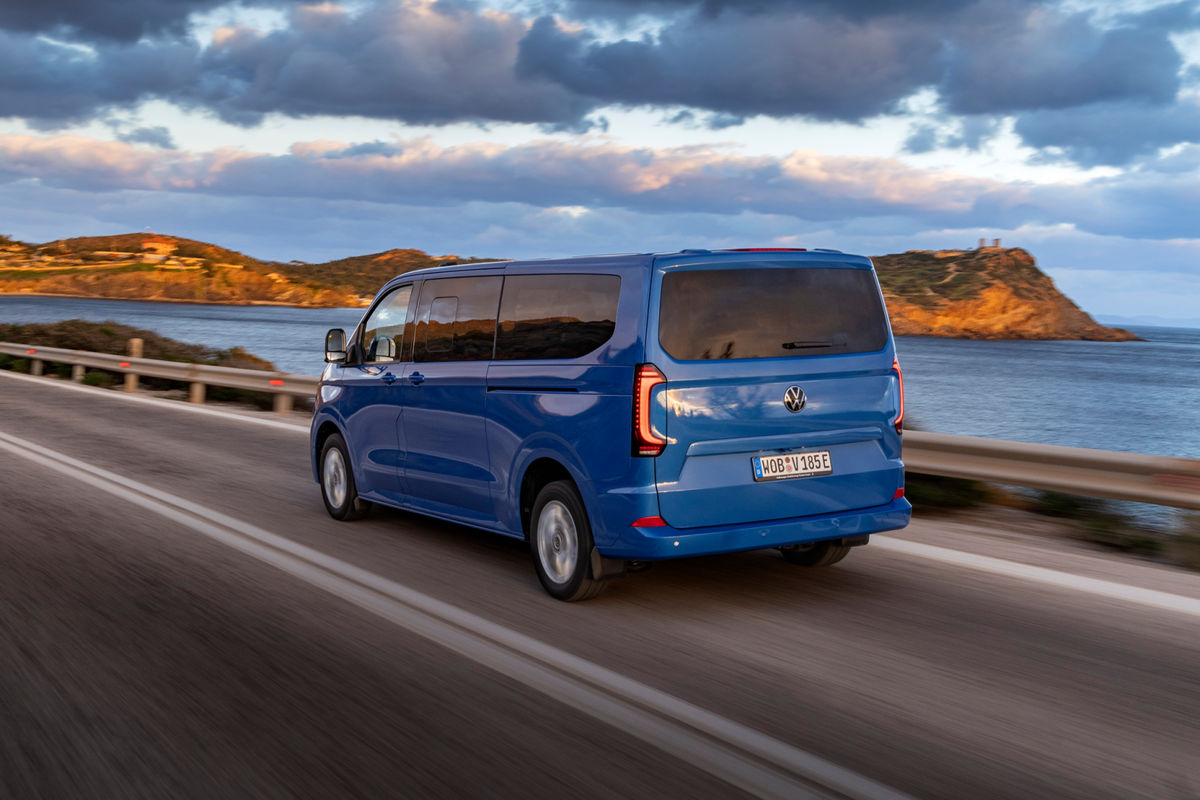
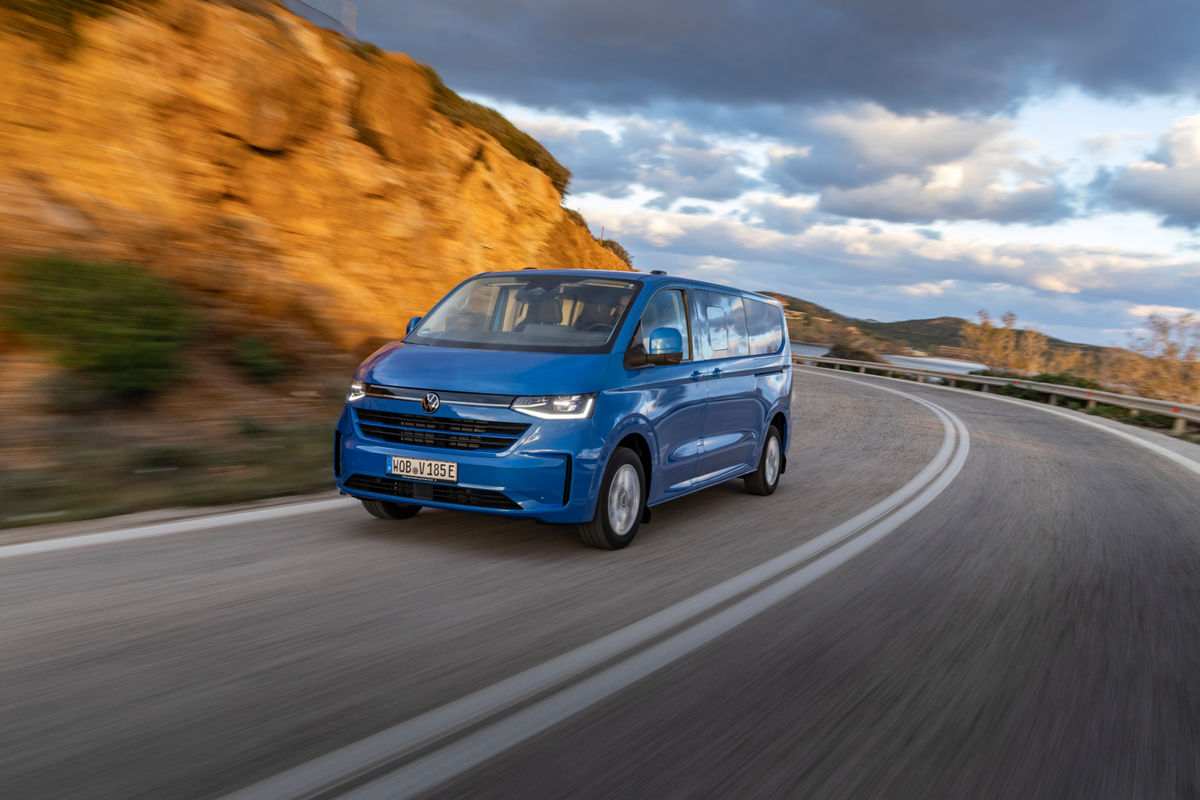
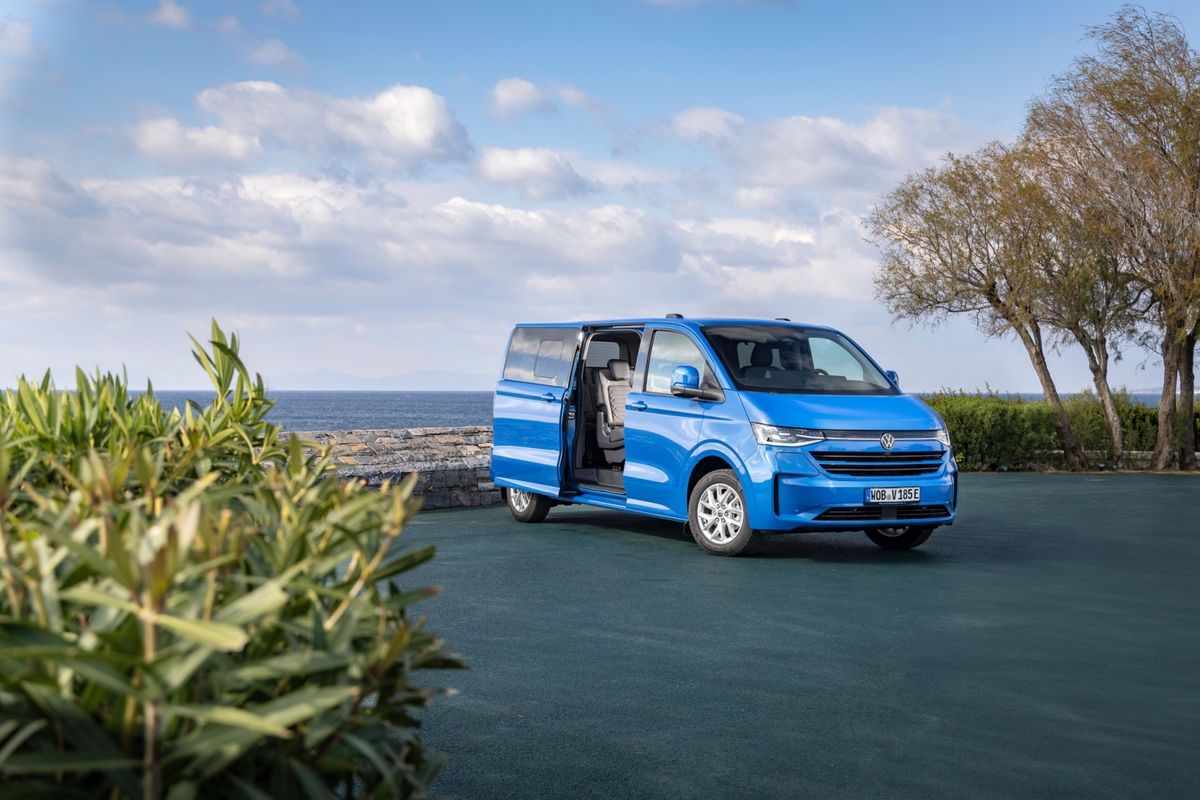
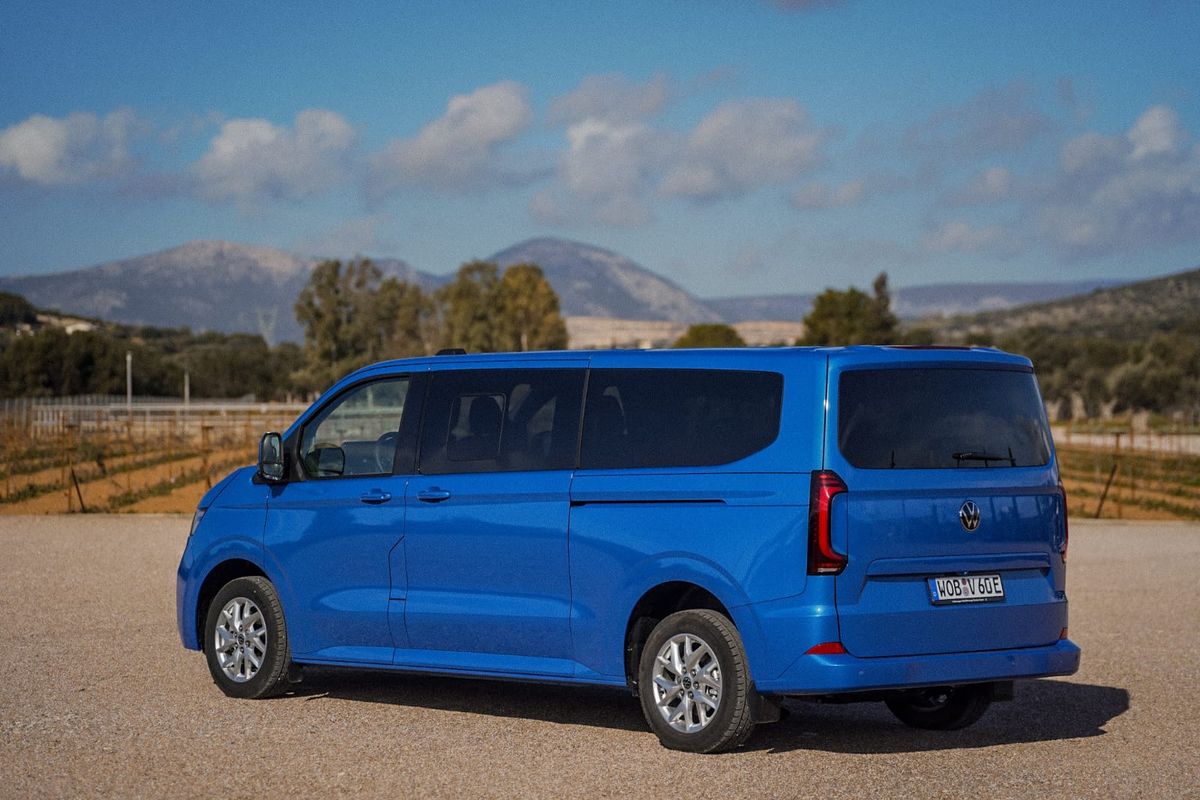
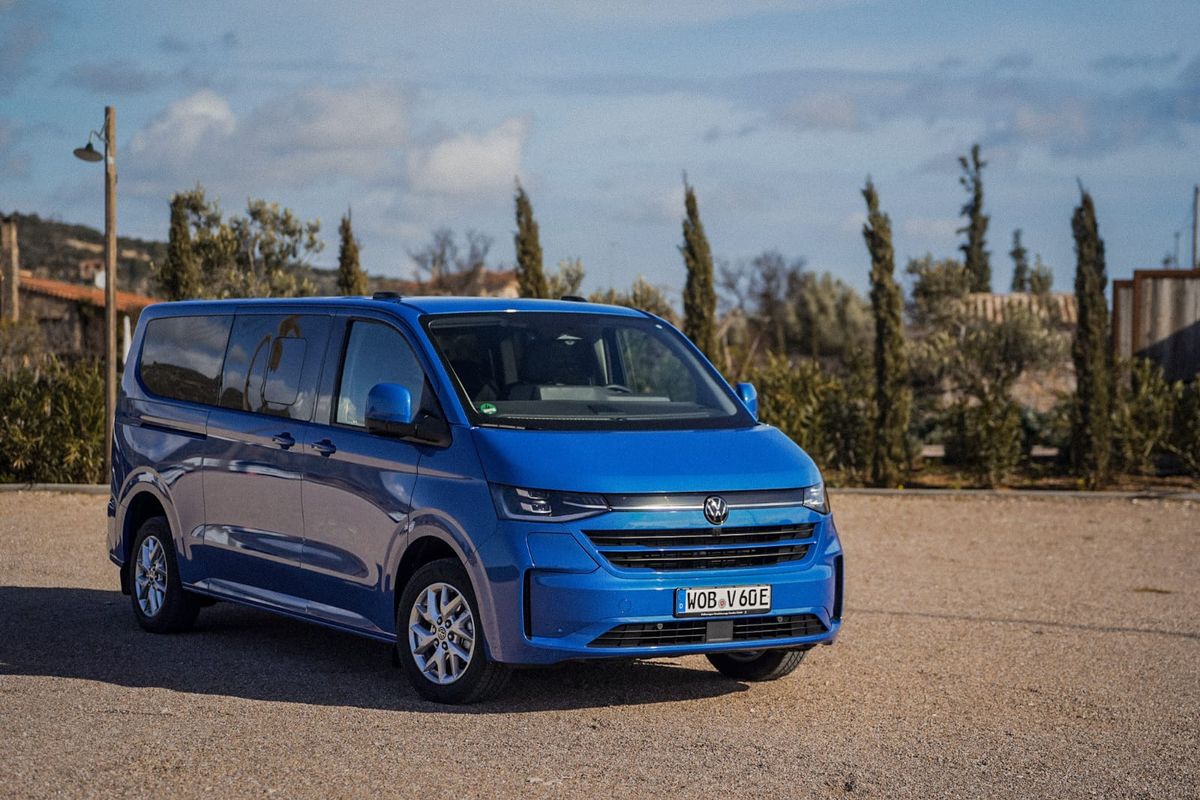
The Volkswagen T7 Transporter is set to arrive in South Africa in the 2nd half of 2025. We recently got behind the ‘wheel of the latest iteration of VW’s iconic people-mover at its global media event in Athens, Greece and here’s what we think of it.

We’ve arrived in sunny Athens, Greece – the home of oranges and olive trees – to drive the latest Volkswagen Transporter, which is not a very romantic name for what is, in fact, an automotive icon; a brick of nostalgia; the latest iteration of the original People’s Bus. The “T” for Transporter has been the prefix since the original T1 Kombi, then the T2, T3 and so on culminating with this T7 version.

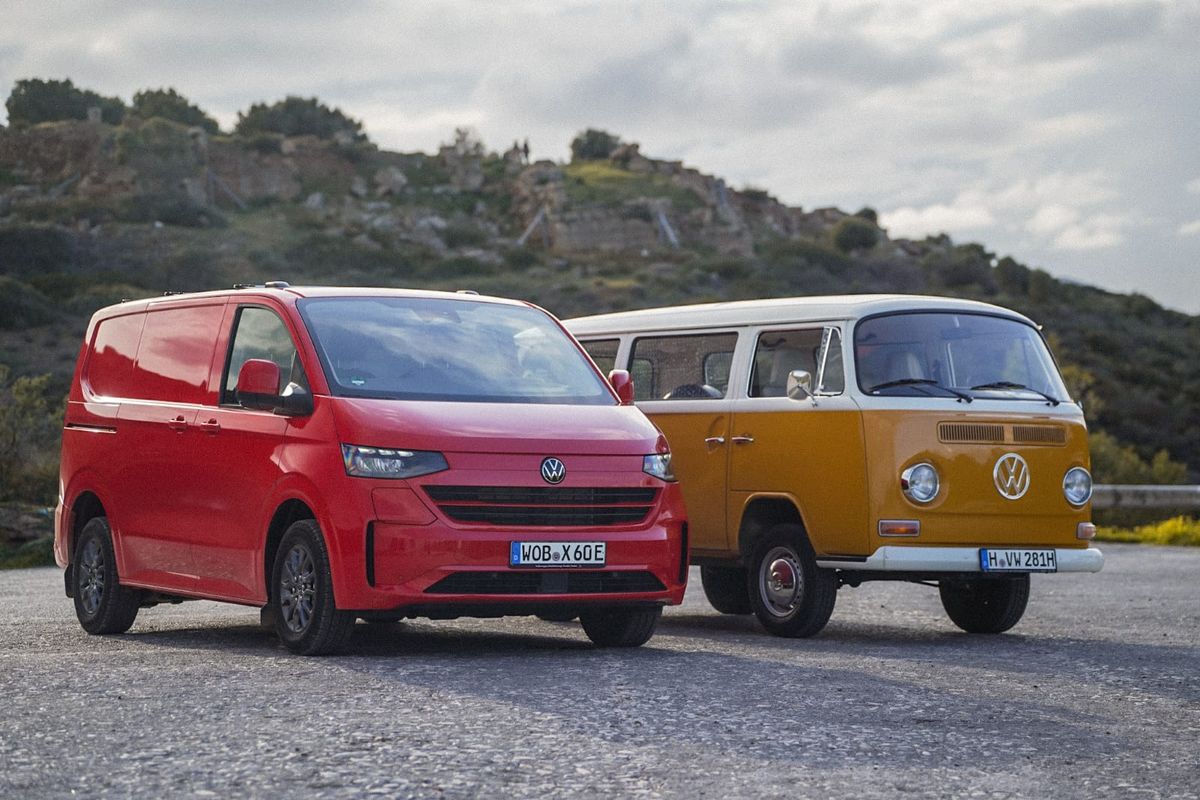
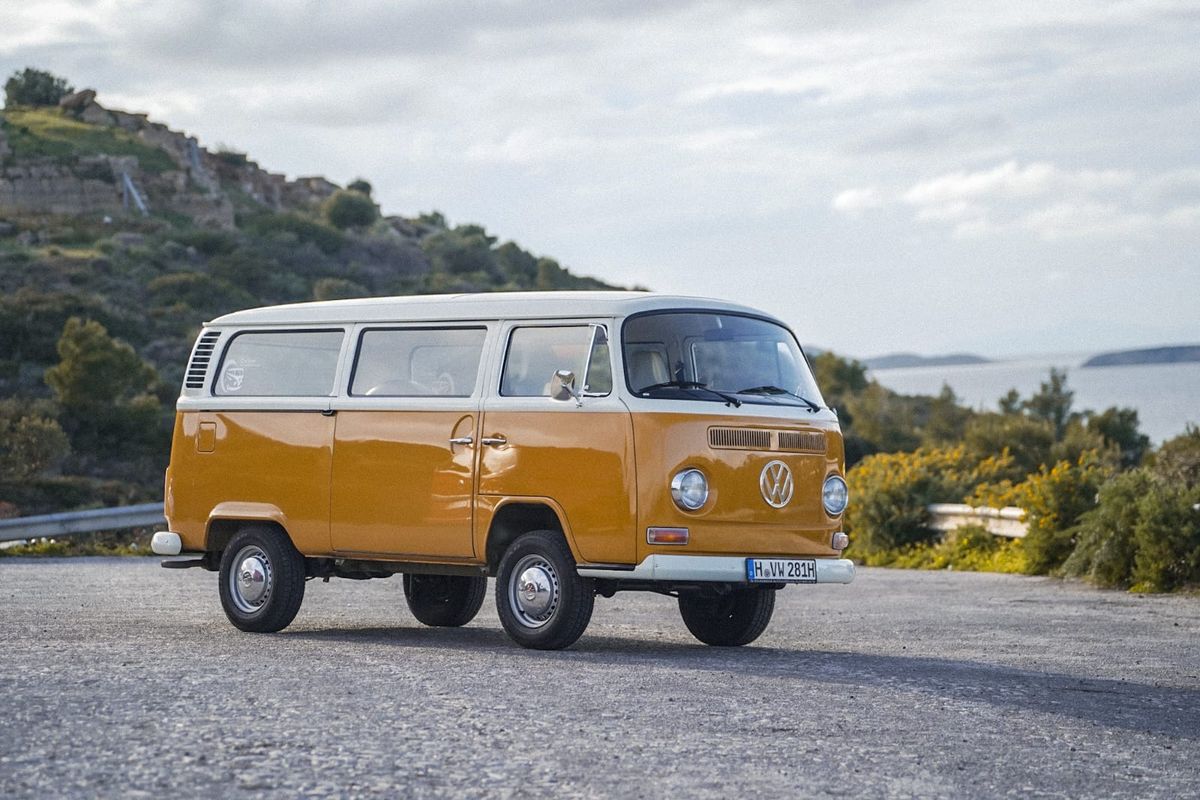
But, before I elaborate on the newcomer, I’d like to channel Maya Angelou for a moment. The famous poet once said, “you can’t really know where you’re going until you know where you have been.” So, when the opportunity to drive a classic T2 model from the ’60s presented itself during the launch, I snatched the keys and gave chase to a colleague who had commandeered a brand new T7 Caravelle.

What followed was a refreshing palate cleanser – an opportunity to shift through an old-school manual gate (albeit with my wrong hand), take in the views of the Saronic Gulf, twirl the ol’ Kombi’s great helm like the tiller of a yacht and dance on very loosely sprung metal pedals while copious amounts of sunlight (a feature that carries over into the new model) flooded into the air-cooled flat-4-engined bus’ cabin.

The Transporter’s design

When discussing the T7 Transporter, its designer Albert Kirzinger likes to compare the Wolfsburg-based brand’s latest MPV to a smartphone. Its basic shape is already perfect for the task at hand, so there’s no need to reinvent it with every iteration. That’s why the Volksiebus has one of the most navigable design histories; I’d argue that it is a perfect example of how a utilitarian, indistinct shape can become iconic.

Instead, it’s the space inside that has improved over time. If we refer back to the comparison, whereas smartphones can be filled with better tech, features and apps, Volkswagen has endowed and equipped its bus with more seats, sliding doors and dynamic accessories, such as tables and roofs, kitchens and partitions. It’s the furthest thing from a basic people-mover – but designed with this ideal still in mind.

Indeed, the first accolade that the Volkswagen Transporter garnered was “Classic car of the future”, which speaks to the timelessness of its styling. When originally penned, it was clever – made to be the best at its time, and to “enable people on a mission”. Like today, the MPV’s customers had a multitude of uses to put it to and the Transporter was made to fulfil their every need, whether for work or play.

The latest model may be designed from scratch, but it follows the same ideals, so let’s be brutally honest here and admit it: the Volkswagen T7 Transporter is familiar to the eye. It boasts a friendly face and a capacious living space floodlit with natural lighting – just another reason to make you smile.

What will South Africa get?

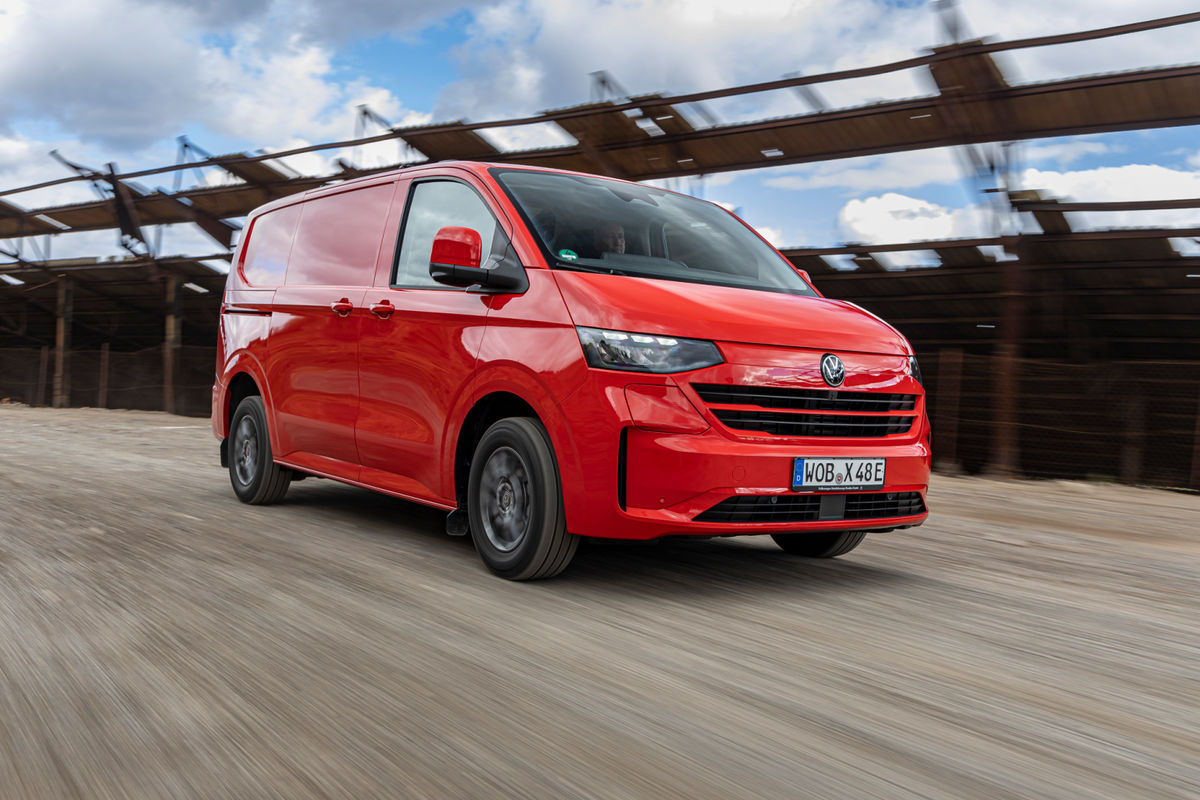
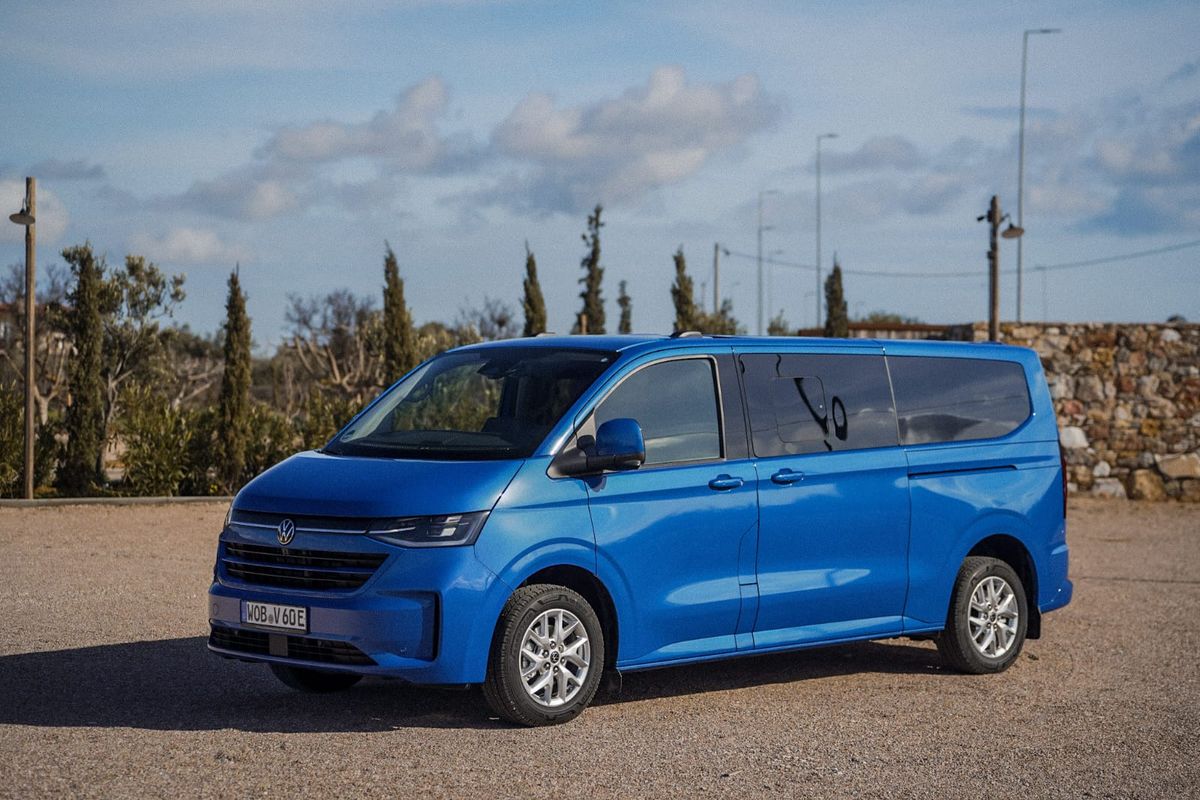
I spent some time behind the ‘wheel of a new (electric) Caravelle, as well as the panel van variant. The prior proved a great indication of what we’ll receive in South Africa in the form of a flagship Kombi Styl, but the latter (van) featured the 2.0-litre 4-cylinder turbodiesel (TDI) engine that’s destined for Mzansi.

To fill the ranks, Volkswagen South Africa will also sell a regular Kombi, Crew Bus and a Pick Up with various outputs ranging from 81 kW to 125 kW, depending on the derivative, of course. Drivetrains vary between manual and auto, 2-wheel drive and 4Motion, but we’ll elaborate on that in a moment.

First, there are numbers to discuss. Such as how this (largest yet) Transporter still manages to remain under 2 metres tall. It’s fundamentally a commercial vehicle, so has to fit comfortably into car parks and industrial locales to do its masters’ bidding.

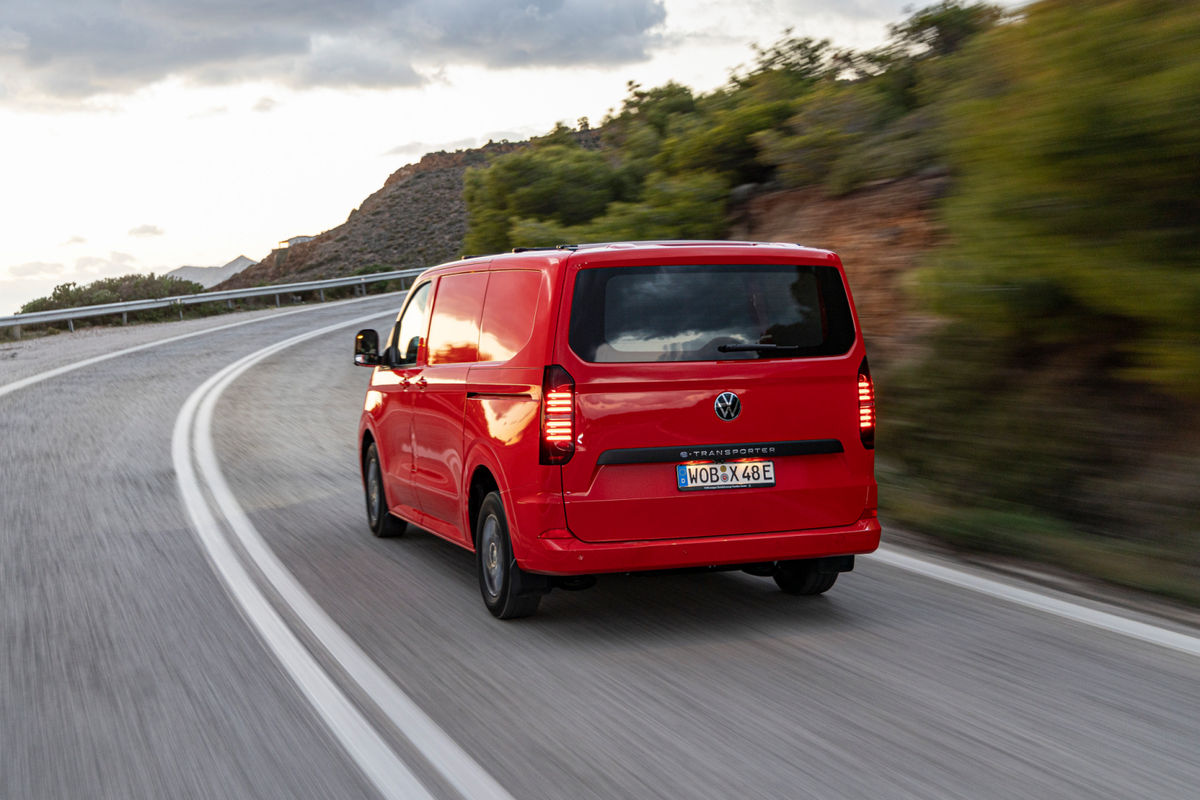
The T7 Transporter is 2.032 metres wide and now features a 14.8-cm wider loading space. So, it’s roomier than before with the panel van capable of accommodating a Europallet. An overall vehicle length of 5.45 m helps endow it with a 2.6-metre loading length, yet it retains a handy 11.9-metre turning circle.

For context, its substantially smaller Golf 8.5 sibling’s turning circle is not much smaller (10.9 metres), so the easy manoeuvrability is useful in the commercial sector, and just as beneficial to the South African Kombi owners who choose one as their lifestyle partner. Plus, the Transporter has a 1 140-kg maximum payload, can tow up to 2.8 tonnes and has a roof load limit of 170 kg (roof-top campers, take note).

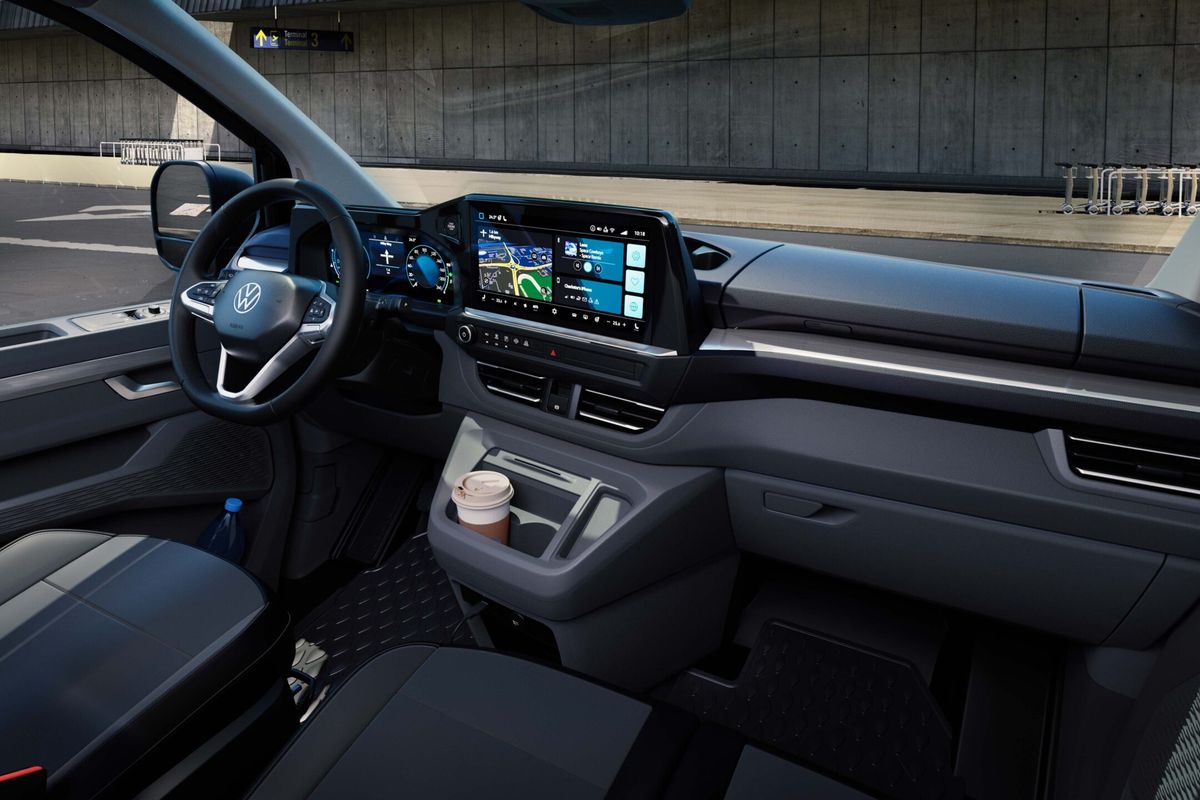
Life aboard the T7 is an ergonomic pleasure, with comfy living quarters, a floating dashboard and a wealth of connectivity and media options. The ride quality is smooth and the shunt from the range-topping 125 kW turbodiesel swells effortlessly. In the Kombi Style, the motor drives all 4 wheels (4Motion) whereas the regular Kombi is 2-wheel-driven. Both versions feature an 8-speed auto ‘box.

It’s only when you venture into the Commercial portfolio that you’ll encounter LWB (and wider-turning) variants in the Crew Bus, Panel Van and Pickup, as well as the less powerful 81 kW and 110 kW engines mated with 6-speed manual ‘boxes. The Crew Bus and Pickup are available with 4Motion drivetrains.

What is the new T7 Transporter like to drive?

On my trip into the heart of Athens, I had no problem navigating the teeming city’s tight, narrow roads, despite being in the longer Panel Van – and at speeds where an extra driven axle wouldn’t have helped.

This was also conducted from the wrong side of the car, on the wrong side of the road thanks to Greece being a left-hand-drive country. Still, and thanks in part to the slick-shifting auto ‘box, the mission was simple – and the coastal return road provided all the soothing I needed before I handed back the keys.

I tried explaining to my international colleagues that as much as we enjoy a great van in South Africa, we’re “a nation of bakkie lovers” and that we similarly use them for work and play. “But what do you do when it rains?” they asked, and “where do you put your groceries?”.

Summary

They had a point, of course, and I didn’t want to concede. But after 2 days of being “a man in a van”, I had to wonder: “Aren’t we missing a trick by preferring a double cab to a Kombi?” It’s incredibly versatile, easy to drive and can readily enhance your work-life balance, as well as be your road trip partner, bike carrier, camper and more. Plus, there’s space for your shopping. An entire month’s shopping, in fact.

Further Reading

Want to purchase a new or used Volkswagen? Browse stock for sale

All the latest Volkswagen news and reviews

Buying a Second Hand Car – What To Do

If you are buying a second hand car, you’d be wise to use the checklist below to help you assess the car in the best way possible to ultimately make the best buying decision!

Buying a second hand car instead of a new car is a decision that can save you money.  However, there is also a higher risk and if that risk isn’t managed properly, you can buy a lemon and lose money and that’s what you want to avoid at all costs!

This article aims to help you make the best buying decision possible when buying a second hand car. 

Let’s assume that you’ve used the Cars.co.za Used Car Search Tool and managed to find a car that you might be interested in buying. What should you do next?

Buying a second hand car – What should you do? 

1. Do Research

buying a second hand car
The Cars.co.za Used Car Search Tool will help you find what moves you!


Using the Cars.co.za Used Car Search Tool, take extra time to examine other car listings of the same model you are interested in with similar model year, mileage and condition. This exercise will help you determine if the listed price is in line with similar stock for sale. 

If the price of the car is significantly lower than similar examples for sale then it’s likely that there’s either a mechanical or cosmetic reason for the variance, even if it’s not directly stated on the listing and it would be advisable to get clarity from the seller/dealer as to why that’s the case.

Similarly, if the price is significantly higher than other similar listings, further investigation is also necessary. The reasons for an inflated price can vary greatly from vehicle condition, added features or simply that the seller or dealer is overly ambitious with his or her pricing expectations. This scenario can be used to negotiate a better price that is more in line with the current market.  

2. Arrange to view the car

buying a second hand car

Once you have shortlisted a second car to buy, you can contact the dealer or seller directly to set up a viewing appointment from the listing by either calling the dealer directly, connecting with the dealer via WhatsApp or filling out the Contact Form and sending it to the dealer. 

If the vehicle is being sold privately, make sure that you meet the seller in a safe location to view the car and consider taking a friend or family member with you.  

3. Do an exterior and interior inspection

Do a thorough exterior walk around of the car and take note of any major body damage, dents, scratches, paint defects and rust. Check the tyres for wear and also try look at the undercarriage by putting the car on a lift (if possible) which will give you the opportunity to check for underbody damage or rust. 

Similarly, inspect the interior and look for areas of wear and tear on the seats, door cards, upper and lower dashboard, switchgear, steering wheel and headliner. Check that all the controls work including lights, indicators, electric windows, air conditioning controls and radio functionality. Also, remember to check the boot as well as the spare wheel and tools (including car jack and wheel spanner).

4. Do an engine / mechanical inspection

Open the bonnet lid and carefully examine the engine bay. Look for general cleanliness but importantly look for any signs of leaks or seepage. Take note of any rusted components and also look carefully at the condition of pipes and hoses to make sure they’re not brittle or cracked.

Start the engine and observe the engine and components for leaks and listen for any unusual sounds that might point to further mechanical defects.

If at all possible, before you make any decision to buy any car, arrange to have a professional mechanic examine the car to make sure that you are in fact buying a car that’s in good working order. You might need to set up a seperate appointment for this purpose, but the effort will be worth it. 

5. Take the car for a test drive

The test drive is one of the most important aspects of buying a car because the experience will ultimately determine whether you buy the car or not.

Things to check for include:

  • Engine noise. Is the engine running smoothly? 
  • Ride quality. How comfortable is the ride? Is the ride to firm or too soft? 
  • Transmission. Do all the gears change easily or is there resistance? 
  • Acceleration. Does the car have enough acceleration for your needs? Remember, acceleration will be slower if you plan on carrying more people and goods. 
  • Braking. Do the brakes offer good stopping power? Do you hear any noises while braking? 
  • Steering. How responsive is the steering wheel to inputs? Is it light or difficult to turn? 
  • Handling. How stable is the car during cornering? 
  • Noise Vibration Harshness (NVH). Listen for wind noise, road noise and any harsh vibrations from the cabin.

See this: How to Test Drive a Car

6. Check Paperwork

Buying a car with all its paperwork in order will save you time and money. 

  • Check the car’s service history booklet and make sure that, as far as possible, the car has been regularly serviced. Buying a car with a comprehensive service history is ideal, but if there are gaps in the service history then you should proceed with caution and it would be advisable to have the car inspected by a mechanic before making any purchasing decision. 
  • Check that the car has a valid roadworthy certificate and make sure that the seller has the original Vehicle Registration Certificate. If the car has not been through a roadworthy, a Roadworthy Certificate can be obtained from any public or private Roadworthy testing stations around the country, at a fee.

    The seller must complete and submit form NCO (Notification of Change of Ownership) and the buyer must complete form RLV (Application for Registration and Licensing of Motor Vehicle).

Note that if you decide to purchase the car, you will need Proof of Purchase and your Identity Document to register the car in your name. 

See this: How to Register and License your Car

7. Negotiate with the dealer/seller 

Based on the information gathered from the experience above, you might be in a position to negotiate a better price with the dealer/seller. Be aware that dealerships will offer you added extras with the car such as extended warranty and service plans, paint protection, anti-theft protection, tyre insurance, privacy glass and so forth but choose wisely as these extras will inflate the overall cost of the purchase.

8. Decide how you’re going to pay for the car

Deciding how to pay for a car is an important step that deserves careful consideration.

Buying a car in cash is the best way to buy a car as you will avoid the cost of financing a car but most people simply don’t have large sums of cash for this purpose and so car finance makes buying a car far more accessible to many people, but only if you qualify! 

See this: Top Tips for Financing a Car: A Comprehensive Guide for South Africans

If you qualify for car finance, consider putting down a deposit. A deposit is simply whatever amount you are able to afford but it’s important because it will reduce your overall cost and you will be able to reduce your monthly instalments.

You can use our Car Finance Calculator to work out estimated monthly instalments.

Not sure what you are able to afford? Use our Car Affordability Calculator to help determine how much you can afford to spend on a car!

The dealer will help you apply for finance and assist with curating a finance deal that is suitable for your particular budget and needs. Note that factors such as the interest rate you secure (Prime or Fixed),  length of the contract term and a balloon payment will have a major impact on the overall cost of the car purchase.

Remember: Generally, the shorter the contract term, the higher your monthly instalment will be but you pay less interest over time. The longer the contract term, the less your instalment will be but you pay more interest over time. 

Car finance is all about finding a manageable financial balance of what you’re able to afford but we would advise that you try and pay off your car loan as soon as possible to reduce the cost of interest over time.

If you’re blacklisted, you’re unlikely to qualify for car finance but buying a second hand car is still possible. You will therefore have to consider other options such as buying a cheaper used car in cash or opt for a rent-to-own option, but the latter option is expensive and not recommended if you’re already experiencing financial difficulties. 

It’s important to remember that buying a car comes with additional financial responsibility and you also have to budget for car insurance, ongoing maintenance (regular servicing, tyres etc) and fuel. 

Cars.co.za has a lot of useful resources to help you navigate the complexities of buying a car and we encourage you to read as much as possible so that you can make the best car buying decision possible. 

Please take the time to visit our Car Finance page for more information

Enjoy your ride!

Buy a car on Cars.co.za today!