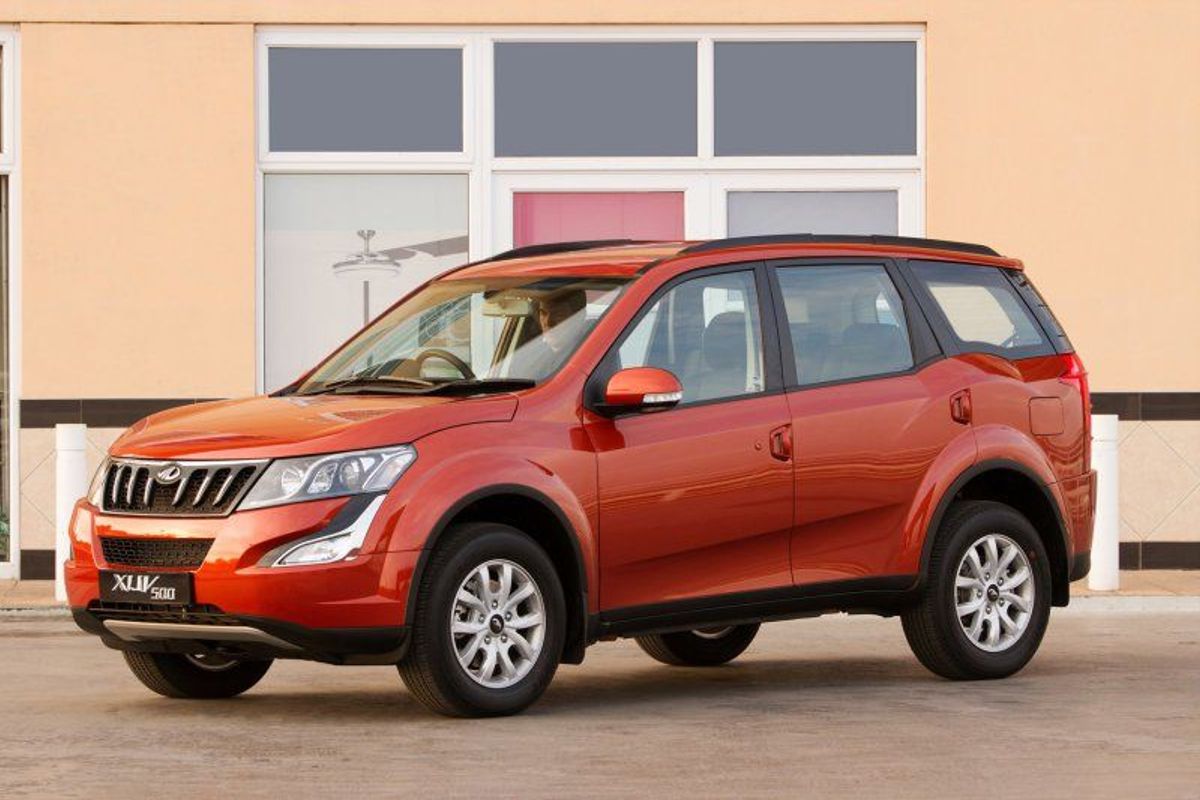
Mahindra has introduced the updated XUV500 in South Africa.
Mahindra has given its XUV500 SUV a makeover and it now comes with fresh styling changes as well as a revised interior.
The XUV500 is a significant vehicle for Mahindra, because it emphasises the brands intention to extend its product range beyond its tried and tested utility vehicles, says Sanjoy Gupta, chief executive officer of Mahindra South Africa.
Whats Changed?
For starters, Mahindra has paid particular attention to the grille, headlights, bonnet and fog lights, which have all been redesigned. The grille features a glossy black finish with chrome accents while the Mahindra badge is now more prominent. The lower air intake has also been reshaped for a more integrated look. Black mesh inserts can now be found on the main grille and lower air intake.
The grille is flanked by new headlights with a curved LED daytime running light signature. Bolder fog lamps are now mounted in restyled apertures which link to the lower edge of the headlights. The bonnet has been reworked and now appears wider contributing to the XUV500s cheetah-inspired styling.
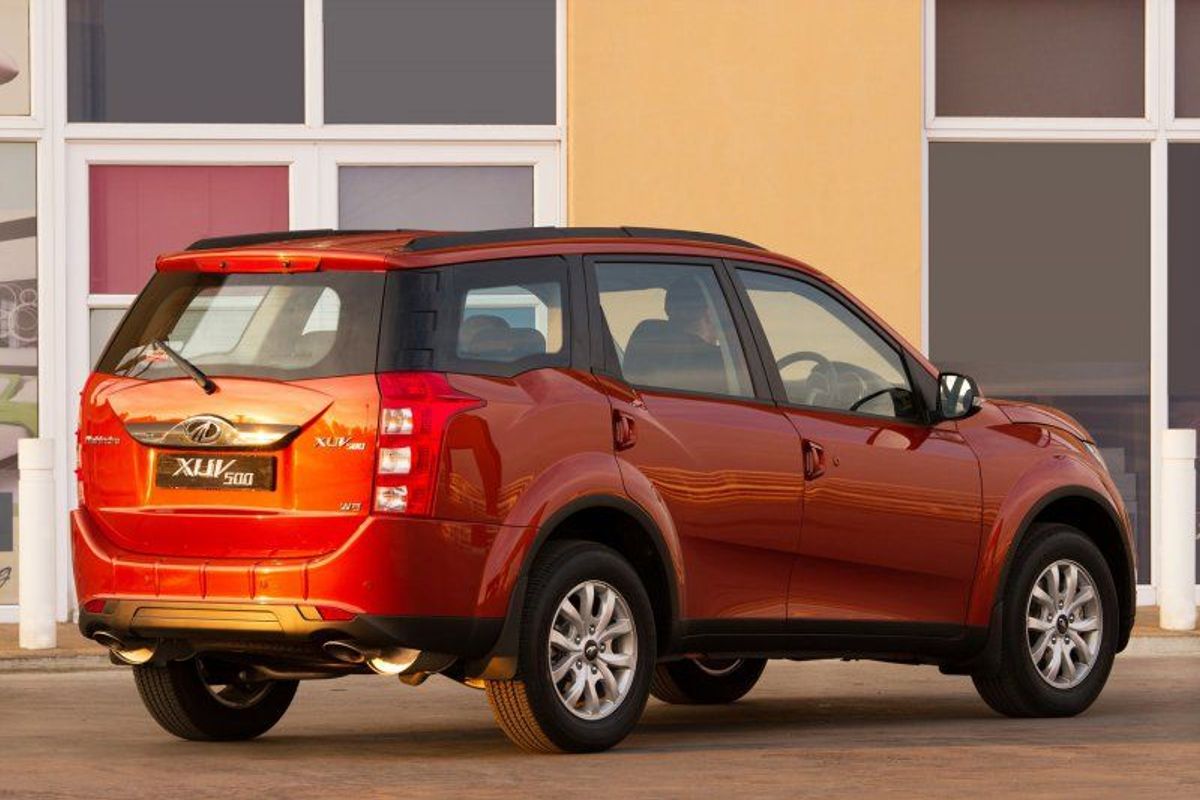
The door handles have been revised too and now feature a more user-friendly design. The rear-end benefits from a new internal tattoo design for the longitudinal tail lights while the tailgate gets a more prominent chrome Mahindra badge. The Mahindra XUV500 rides new 17-inch multi-spoke alloy wheels fitted with all-terrain tyres.
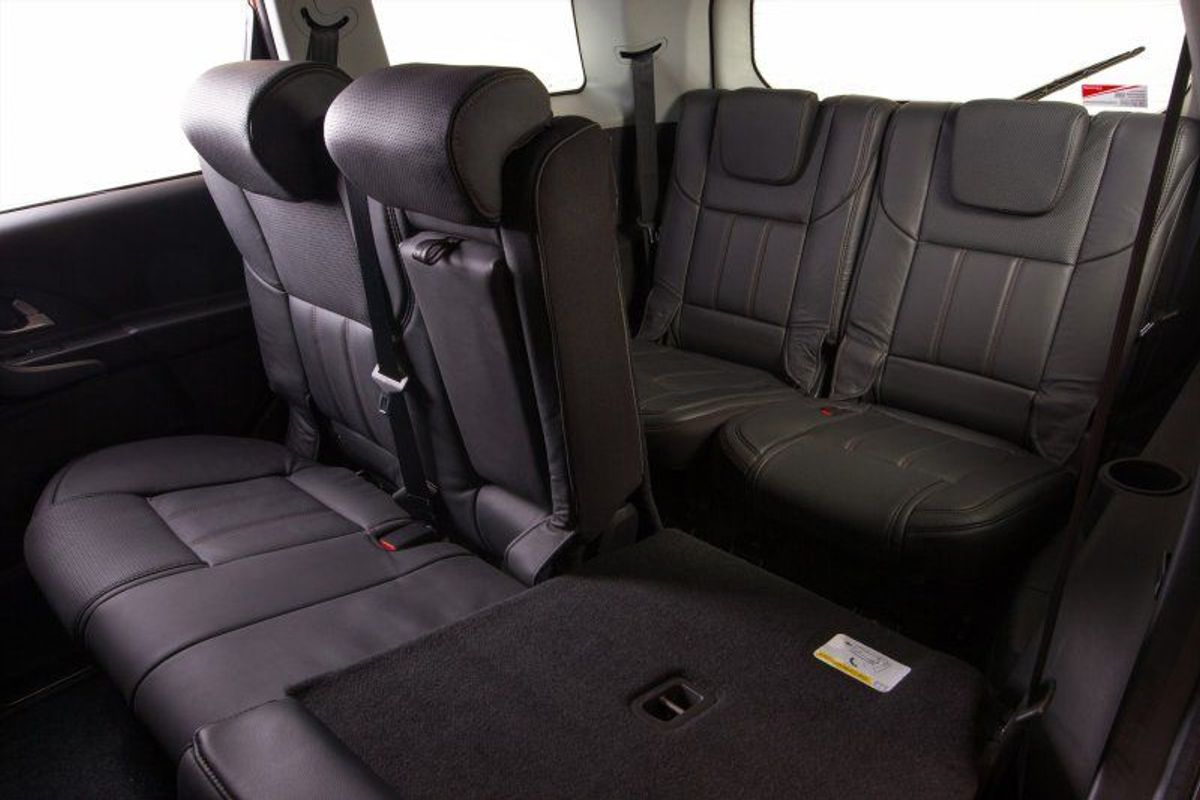
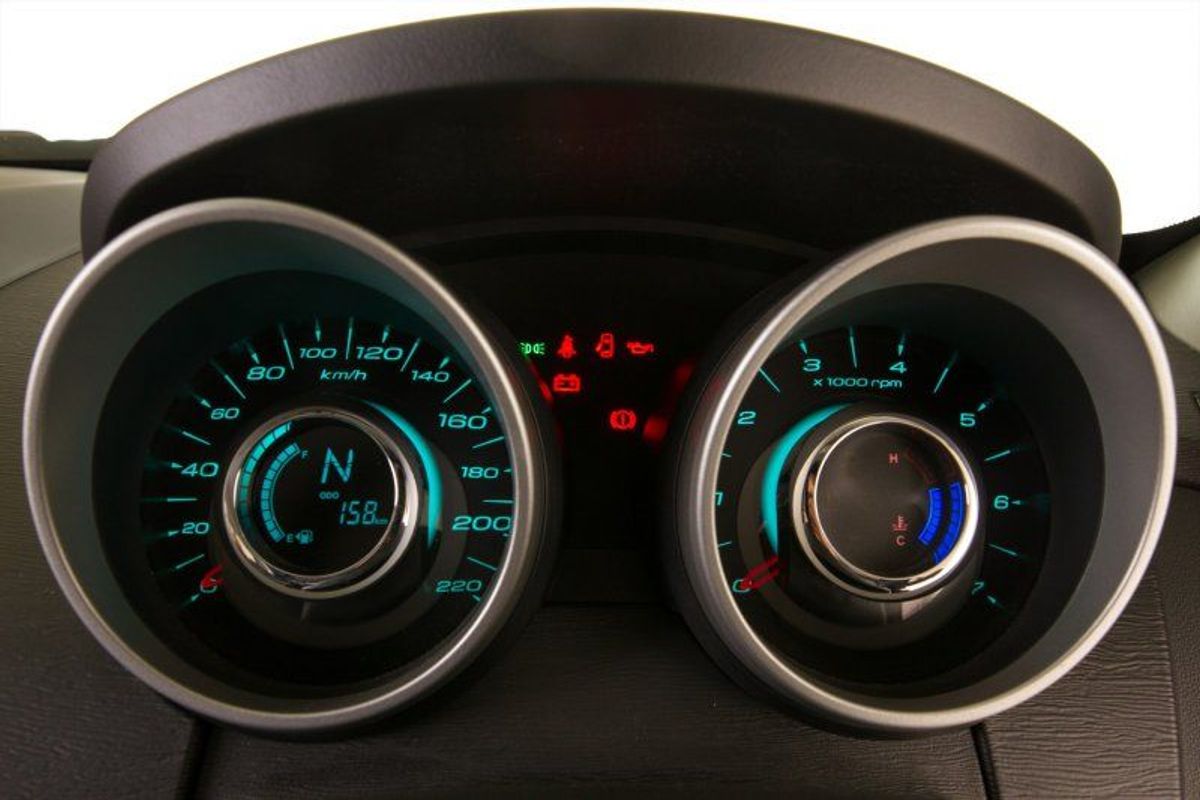
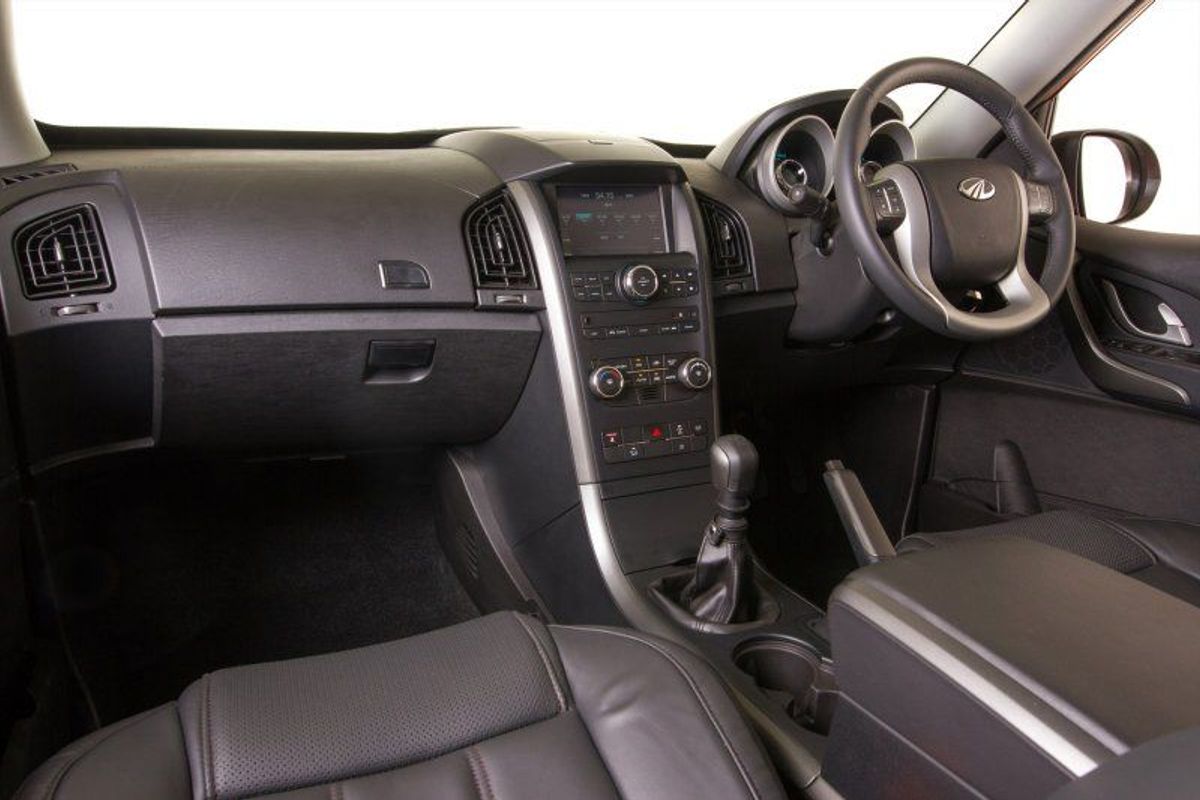
On the inside, the XUV500 gets all-black leather upholstery as well as a large 7-inch, full-colour infotainment touchscreen which is standard on the W8 flagship model. The system provides access to satellite navigation, audio functions, Bluetooth and the reverse camera. The system also has iPod-compatible USB sockets. The new black interior features silver accents and three rows of seats can accommodate up to seven passengers.
Standard Features
The XUV500 W8 flagship model comes fitted with auto-sensing headlights and windscreen wipers as well as automatic climate control air conditioning, remote central locking, multi-function steering wheel and cruise control. Electric windows and exterior mirrors are included too as well as a refrigerated centre console and charging points for all three rows of seating.
In terms of safety, the XUV500 is fitted with dual front airbags and side and curtain airbags. ABS with EBD and electronic stability program (ESP) with roll-over mitigation is also included. The XUV500 W6 and W8 versions also feature Hill Hold and Hill Descent Control for added safety.
Engine Power
The facelifted Mahindra XUV is powered by a 2.2-litre turbodiesel engine that produces 130 kW and 330 Nm of torque through a 6-speed manual transmission powering the rear wheels. The W8 model is available with all-wheel drive too. Fuel consumption is rated 6.5L/100km and with its 70-litre fuel tank, the XUV500 is claimed to achieve over 1 000km on a single tank of fuel.
Mahindra XUV500 Price in South Africa
Mahindra XUV500 W4 – R262 995
Mahindra XUV500 W6 – R304 995
Mahindra XUV500 W8 – R339 995
Mahindra XUV500 W8 AWD – R359 995
Pricing includes a 5-year/150 000 km warranty and a 5-year/100 000 km service plan. Services are at 20 000 km intervals or every 12 months.
New Ford Everest – First Look (Video)
SCROLL DOWN FOR VIDEO
A new generation of bakkie-based SUV’s is due imminently in South Africa and fans of the segment will be properly spoilt for choice as the latest Toyota Fortuner arrives early next year, as well as a new Mitsubish Pajero Sport.
But first to arrive is this, the completely new Ford Everest. It launched only last week in South Africa and driven almost immediately to our studios so that we could give you an exclusive first look at this brand new SUV.
Ford has certainly taken the Everest upmarket; it is unrecognisable from the fairly demure yet popular model that it replaces.
We drove the car on the launch and you can read our first driving impressions here, and the video below is almost as good as actually walking around the car, and having a poke around inside.
We’ll be shooting a full feature review of the car this week, taking the car off-road to see what it’s really capable of. In the meantime, we’d love to hear your thoughts on the car in our comments section here or on Youtube.
Ford Everest First Look Video
Mercedes-Benz GLE350d Coupe (2016) Review
With the muscular new GLE Coupe Mercedes-Benz has set its sights on the always controversial BMW X6. Has the three-pointed star stepped out of its comfort zone in doing so, or has it hit the bulls-eye?
Highlights
Butch looks that doesnt compromise the packaging too much
Extremely quiet cabin and great refinement
Good performance, but the BMW X6 trounces it in power/economy balance
Though it is true that we can thank to some extent the existence of the BMW X6 for the new coupe version of the GLE SUV (previously named the ML-Class), the decision to develop this vehicle was based on far more solid foundations than niche-envy. During the first quarter of 2015, Mercedes-Benz sold 30% more crossovers and SUVs than during the same period in 2014. The massive growth was, of course, fuelled by new additions such as the GLA, but the overall growth curve for SUVs continues to point upwards. As a consequence, Mercedes-Benz will roll out even more SUVs and spin-off models in the coming years.
But back to the GLE Coupe, tested here in 350d guise. It will undeniably appeal to flamboyant Mercedes-Benz brand aficionados but the question is simple; does it offer a meaningfully different or better alternative to a vehicle that defines its type, the BMW X6?
Brutish looks
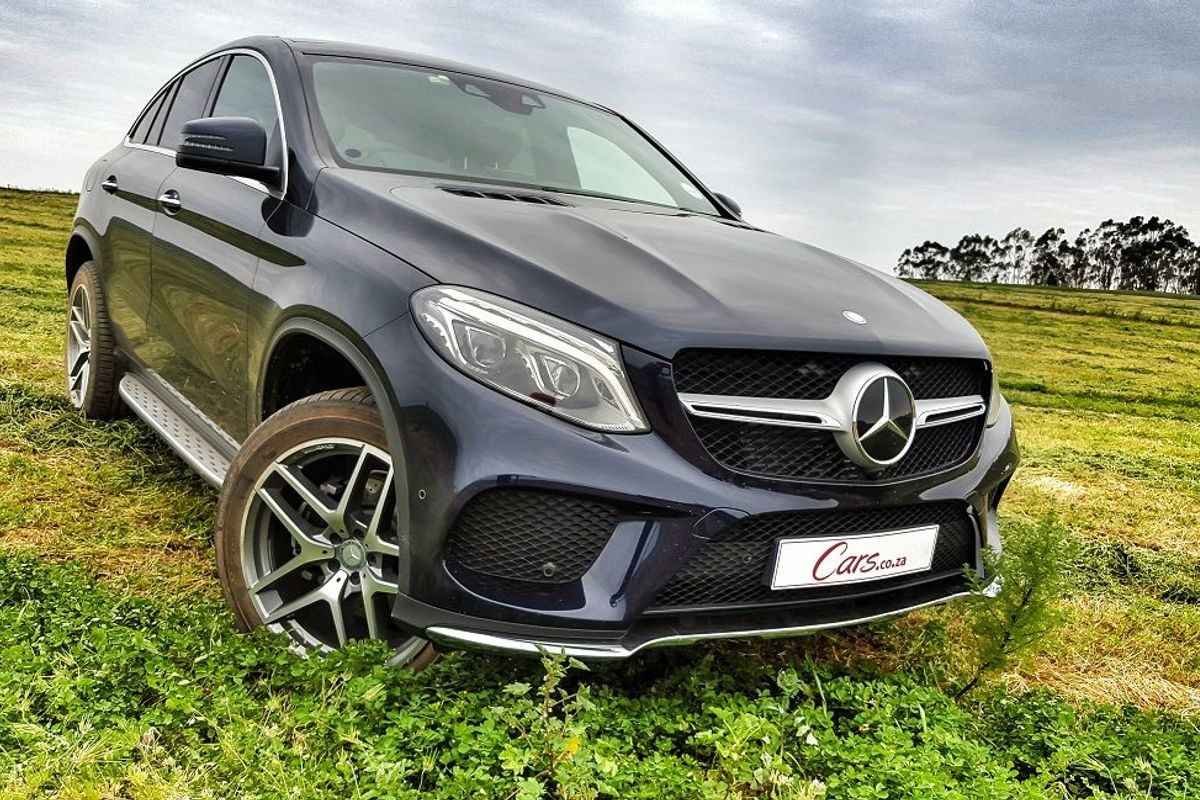
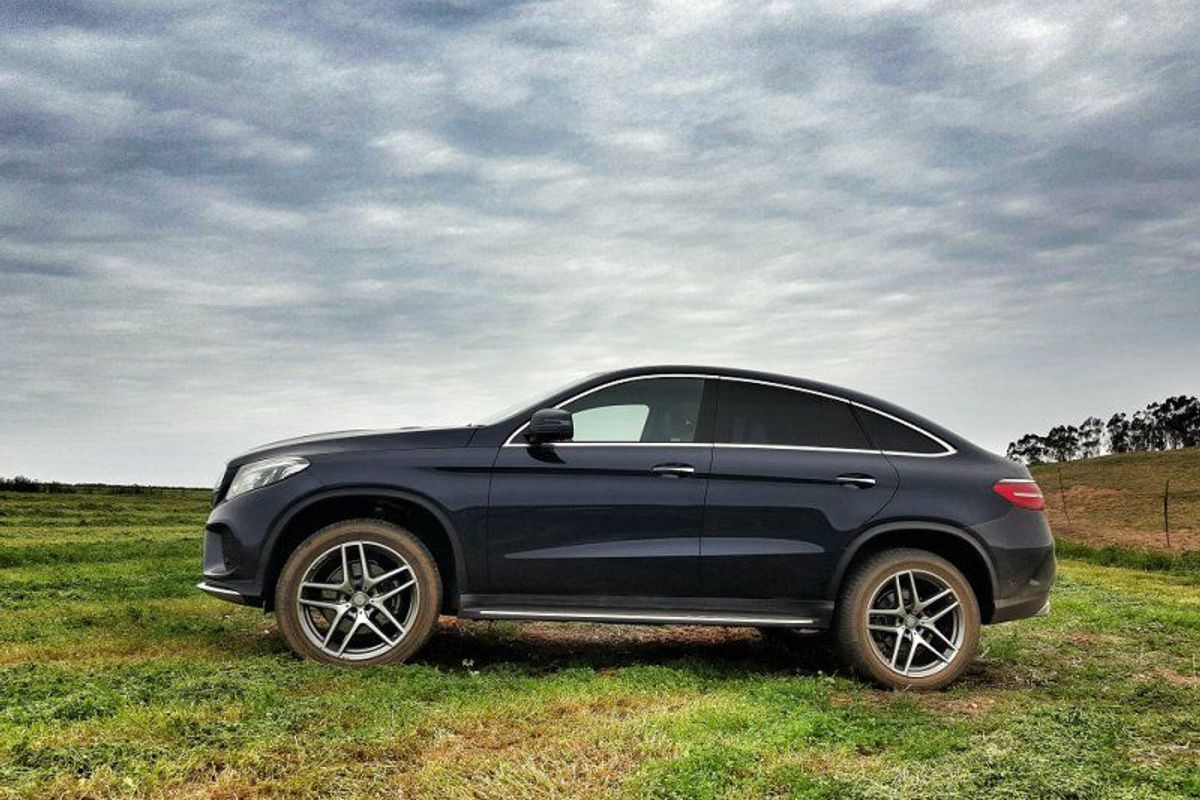
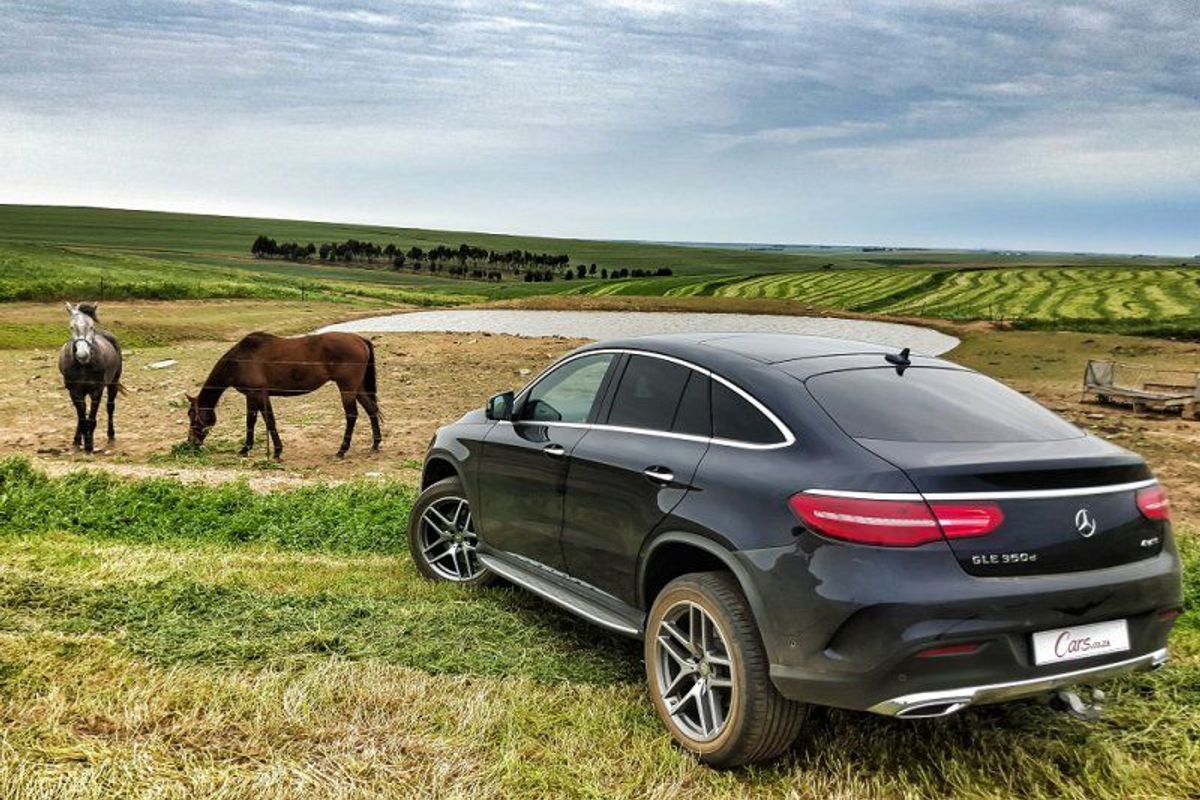
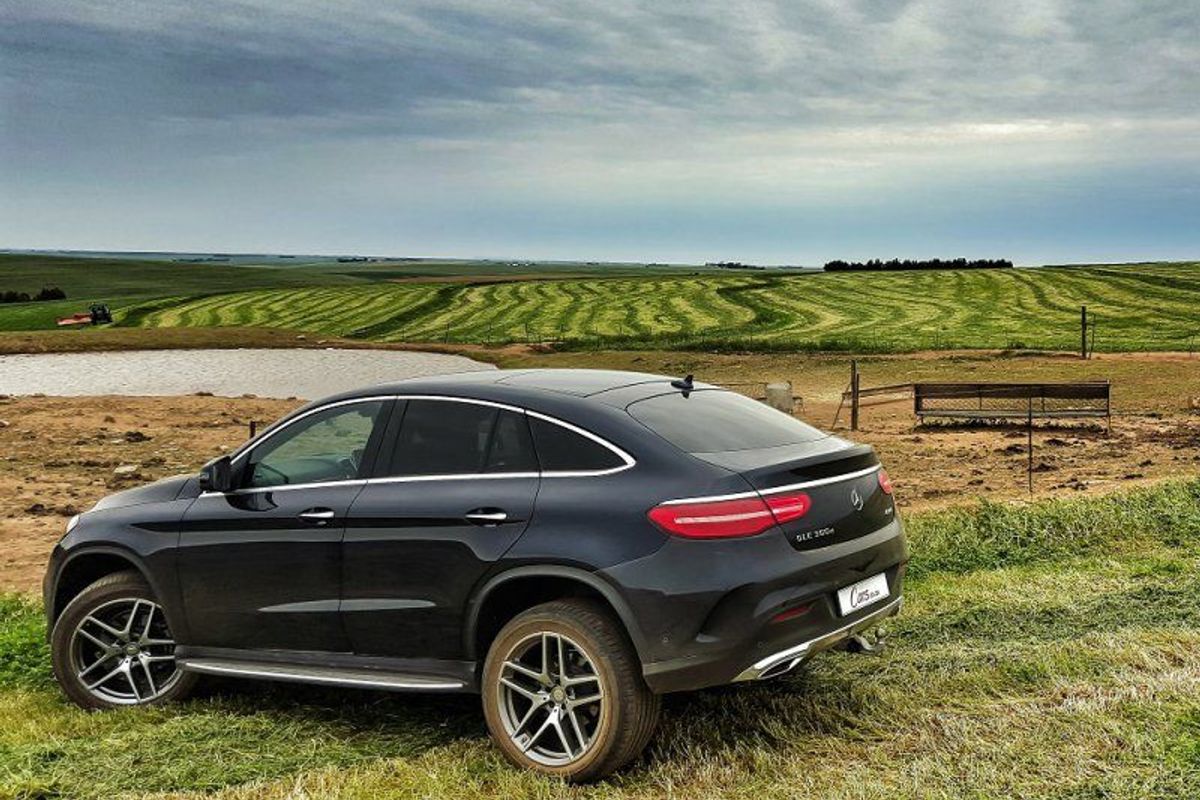
If you like making a statement with your car, then the GLE Coupe will certainly suffice rarely have we had a test car that attracted so many admiring glances. Its brutish presence is the consequence of expressive design and generous proportions. This is a big car that casts a very big shadow. Understandably it is the curvaceous rump that draws most attention. The narrow tail lamps were clearly inspired by those on the sleek AMG GT sports car. Striking 20-inch wheels are standard fitment, but our test unit had optional AMG 21-inch rims, which further boosted the look-at-me credentials.
That sloping roofline and steeply raked rear window lead many to question the GLE Coupes rear passenger carrying abilities. The reality is that it is actually rather spacious back there. Legroom is no issue, and even six-footers shouldnt have a problem with headroom. Our test unit featured lovely front seatback-mounted DVD screens, each with its own set of wireless headphones, to make long-distance travel a really pleasant affair. Of course, rear climate control is always a boon.
Given its focus on design, the GLE Coupe actually impressed with the levels of practicality on offer. The boot is very big. At a claimed 650L it is significantly larger than the X6s 580L. It is also very well-shaped, being over a metre in length. The rear seats fold down to boost load carrying capacity to 1 720L, again significantly more than the BMWs 1 525L. Oh, and if you want to tow, there is a very nifty electrically controlled towhook that magically swivels out from underneath the rear bumper. If we had to complain about something, wed say the loading sill was perhaps too high, so some heavier stuff will need a considerable amount muscle power to hoist into the boot. Also, visibility through the rear window is compromised by the severe slope, but the standard rear-view camera makes up for this to some extent.
Superb refinement and comfort
This is a million Rands worth of luxury SUV, so the presence of loads of comfort, entertainment and safety features is a given. Yet, there are loads of options to consider too. Ultimately, however, it is not these features that leave the lasting impression. Cruising in the GLE Coupe is an incredibly refined exercise the cabin is one of the quietest we have yet experienced and the immensely solid feel of all the fittings is proof that Mercedes-Benz is back to its legendary quality ways.
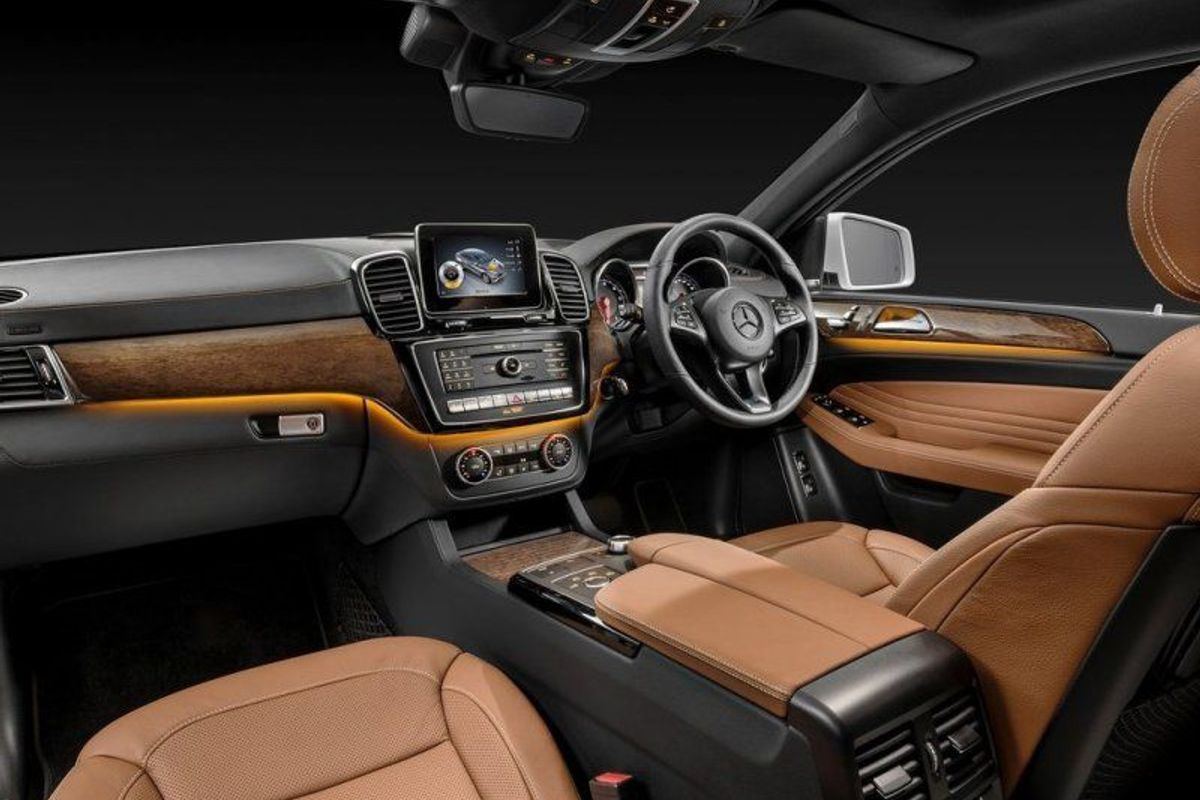
As is the case with the eye-catching bodywork, the interior is similarly pleasing to behold. Compared with the ML (soon to be facelifted and become the GLE), the control interfaces have been neatened and the detailing is superb. Plus, the GLE Coupe adds some surprise-and-delight features. We particularly liked the brown leather upholstery of this test unit, and the fact that the ambient interior light could be adjusted. Our test car also had quite a vast panoramic sunroof.
Great cruising capability
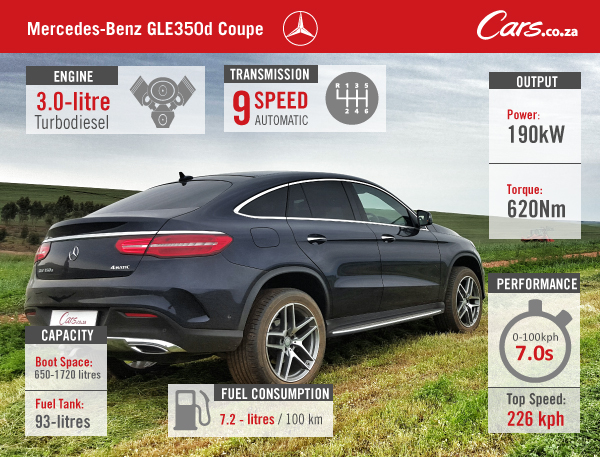
Powering the GLE350d Coupe is Mercedess 3,0-litre V6 turbodiesel engine. It develops 190 kW and 620 Nm of torque. Both those figures are impressive, but it needs to be pointed out that the BMW X6 xDrive40d offers considerably more power, but only 10 Nm more torque. The GLE Coupes maximum torque figure is already available at a low 1 600 rpm, so it gets going pretty swiftly off the line. The 0-100 km/h time of 7,0 seconds is certainly more than good enough for this type of vehicle but, again, that X6 is likely to show it a clean pair of heels in a straight sprint.
A bigger surprise is that the BMW is also considerably more frugal, consuming only a claimed 6,2 L/100 km compared with the Mercedess 7,2 L/100 km. During our extended test of the GLE we achieved an average figure of just under 9,0 L/100, not bad considering the performance on offer. The GLE has a massive 93L fuel tank, so a cruising range of more than 1 000 km is on offer.
Youll certainly enjoy such cruises. Besides the mentioned cabin refinement, the engine is also silky smooth and the new nine-speed automatic transmission is a considerable improvement over the previous seven-speed unit widely employed in Mercedes-Benz products. The GLE Coupe comes standard with the new Drive Select system and adaptive air suspension. There are three modes but everyday use Comfort is certainly best. In this mode the GLE wafts along quietly. Switch to Sport and things get considerably stiffer. Driven enthusiastically the GLE Coupe impresses with its grip but ultimately this is a heavy car and it feels it. The GLE Coupe cant quite match the sense of agility offered by a BMW X6.
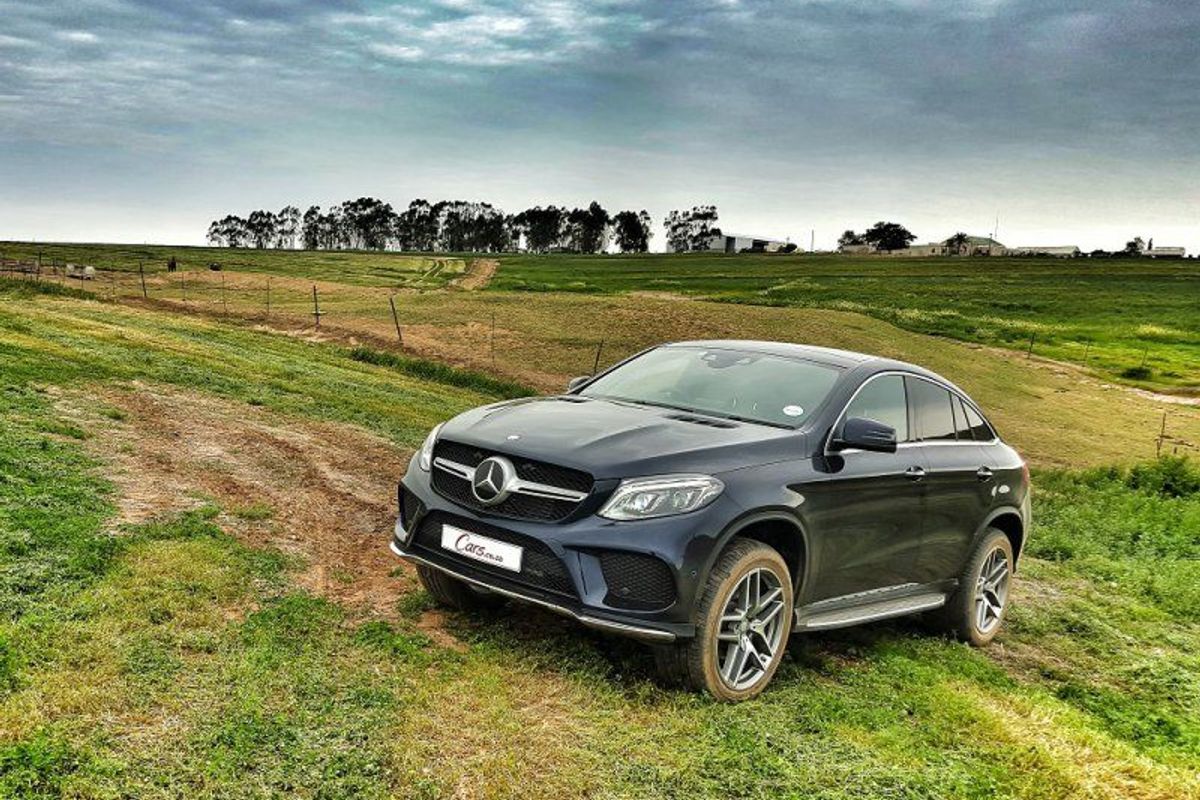
Although very few people are likely to take a GLE Coupe off the beaten track, we did. You can raise the suspension very easily by pressing a button on the transmission tunnel, and there is hill-descent control, too. It coped well during some light off-roading. Fitted with more suitable off-road rubber, it may even be rather talented at this.
Conclusion and Summary
When it comes to a vehicle with such a clearly defined target as the GLE Coupe, one tends to measure it up against only that vehicle, in this instance the BMW X6. But doing so would be missing the point. Brand loyalty being what it is, the typical BMW buyer is unlikely to be swayed by the GLE Coupe. What this product does is to offer the more flamboyant Mercedes fans out there the option of something with more style and flair. And it may very well lure some buyers away from other potential rivals, the Range Rover Sport and Porsche Cayenne, which the more conservative ML/GLE may not have done. Wherever the buyers will come from, theyll be driving away in a very good new product.
Mercedes-Benz GLE350d Coupe Price in South Africa
The Mercedes-Benz GLE350d Coupe costs R1 006 774 and comes with a two-year/unlimited km warranty and six-year/100 000 km Maintenance plan.
Team Opinion
“There’s no sincerer form of flattery than imitation, and the designers responsible for the BMW X6 must feel very flattered right now. However, Mercedes have deviated slightly from the X6 formula, adding in a good dose of off-road capability to the GLE Coupe; it feels like a car you might actually take off the tarmac. On the road it has all the manners and presence you would expect from a million-Rand Mercedes, and the interior is nothing shy of S-Class levels of luxury. All that said, I think I’d still opt for the normal GLE, I just can’t get used to that sloping backside.” – Ciro de Siena
“The GLE Coupe offers a interesting alternative for someone looking to make a statement. Its big, garish and not all that practical but, it has a great diesel engine and some solid road holding skills.” – Ashley Oldfield
We Like: Build quality, Refinement, Spacious cabin, Stand-out design
We dont Like: Not as powerful/economical as BMW rival
GWM South Africa is launching a Safety Version of the Steed 5 single and double cab that will come fitted with dual airbags and ABS with EBD.
The GWM Steed 5 2.2 MPI 4×2 single and double cab Safety Version will be available from GWM dealerships this month (October 2015.)
In addition to the safety features included, the Steed 5 offers power steering, air-conditioning, alloy wheels, fog lamps, adjustable seat belts, radio with USB support, immobiliser, central locking, lights-on warning, heated rear windows and front cup holders. The GWM Steed 5 2.2 MPI Double Cab Safety Version also comes fitted with electric windows and leather upholstery.
The models are powered by a 2.2-litre petrol engine that offers 78 kW and 190 Nm of torque. Combined fuel consumption is rated at 10.2L/100km for the double cab and 9.7L/100km for the single cab.
The GWM Steed 5 2.2 MPI single cab is sold with a 3-year/100 000km warranty while the double cab version benefits from a 5-year/100 000km warranty. 2-year AA Roadside Assistance is standard.
GWM Steed 5 2.2 MPI Price in South Africa
GWM Steed 5 2.2 MPI Single Cab Safety Version R177 900
Mercedes-Benz wants its luxury car crown back and will be rolling out a vast number of new models in the coming years. Let’s take a look…
Mercedes-Benz is in the midst of one of the most aggressive product roll-outs in its history as it battles for the premium segment crown with BMW and Audi. At the same time, it is also renaming some of its products, which may lead to some confusion. In doing so it is leaving no niche uncovered – expect more crossovers and SUVs as well a variety of alternative energy vehicles, including full electric.
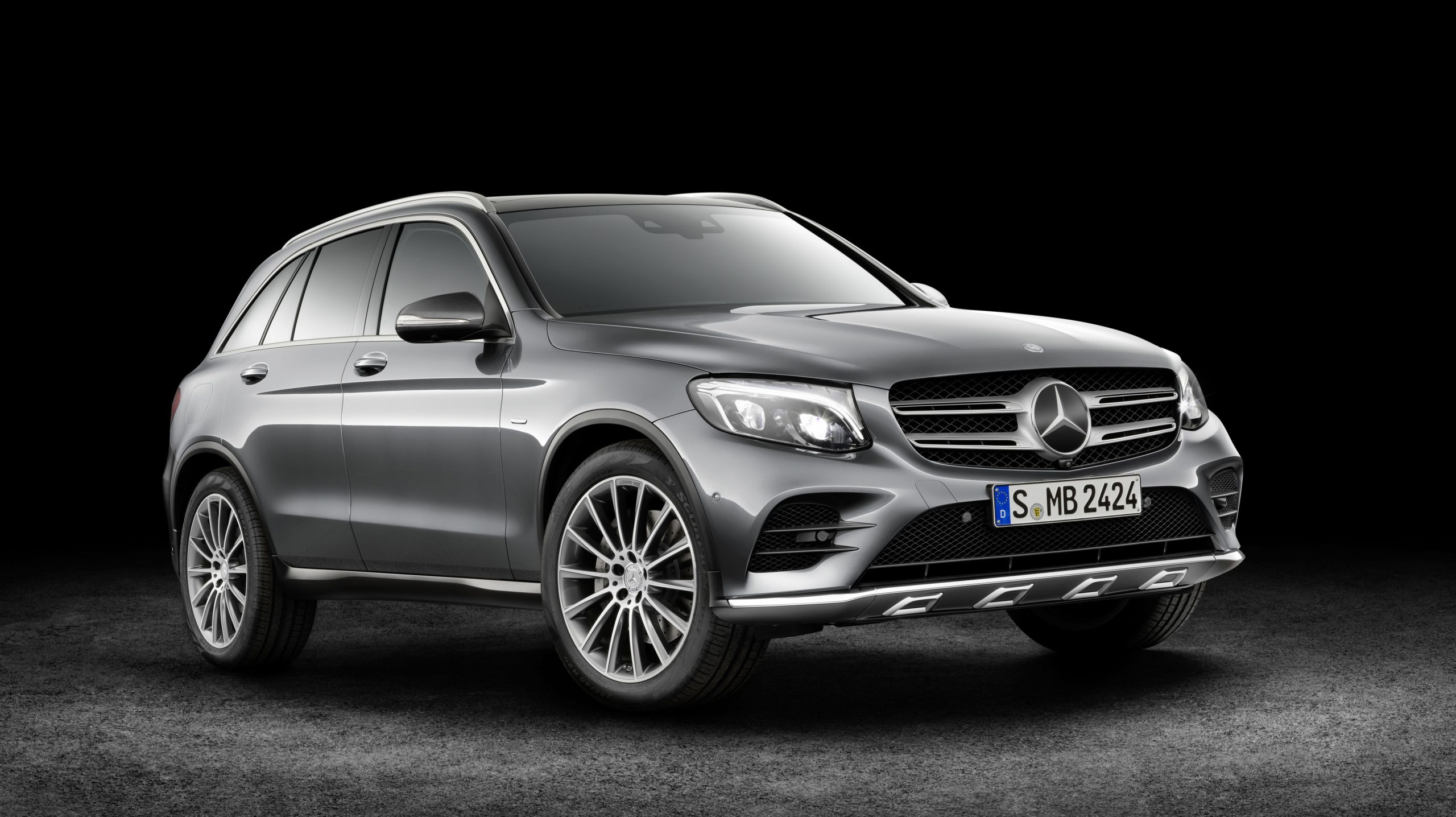
The three-pointed stars rival to the Audi Q5 and BMW X3 is due for imminent release in South Africa. In fact, the pricing for the local line-up has already been announced and can be viewed here.
The South African line-up will consist of petrol and diesel derivatives, with all models featuring the 9G-Tronic automatic transmission and 4Matic all-wheel drive. The petrol engine on offer is the familiar 2.0-litre turbo engine used in the C-Class and will power both the GLC 250 (155 kW/350 Nm) and GLC 300 (175 kW/370 Nm). For those with an affinity for diesel, a 2.1-litre turbo diesel will do service in the GLC 220d (125 kW/400 Nm) and GLC 250d (150 kW/500 Nm).
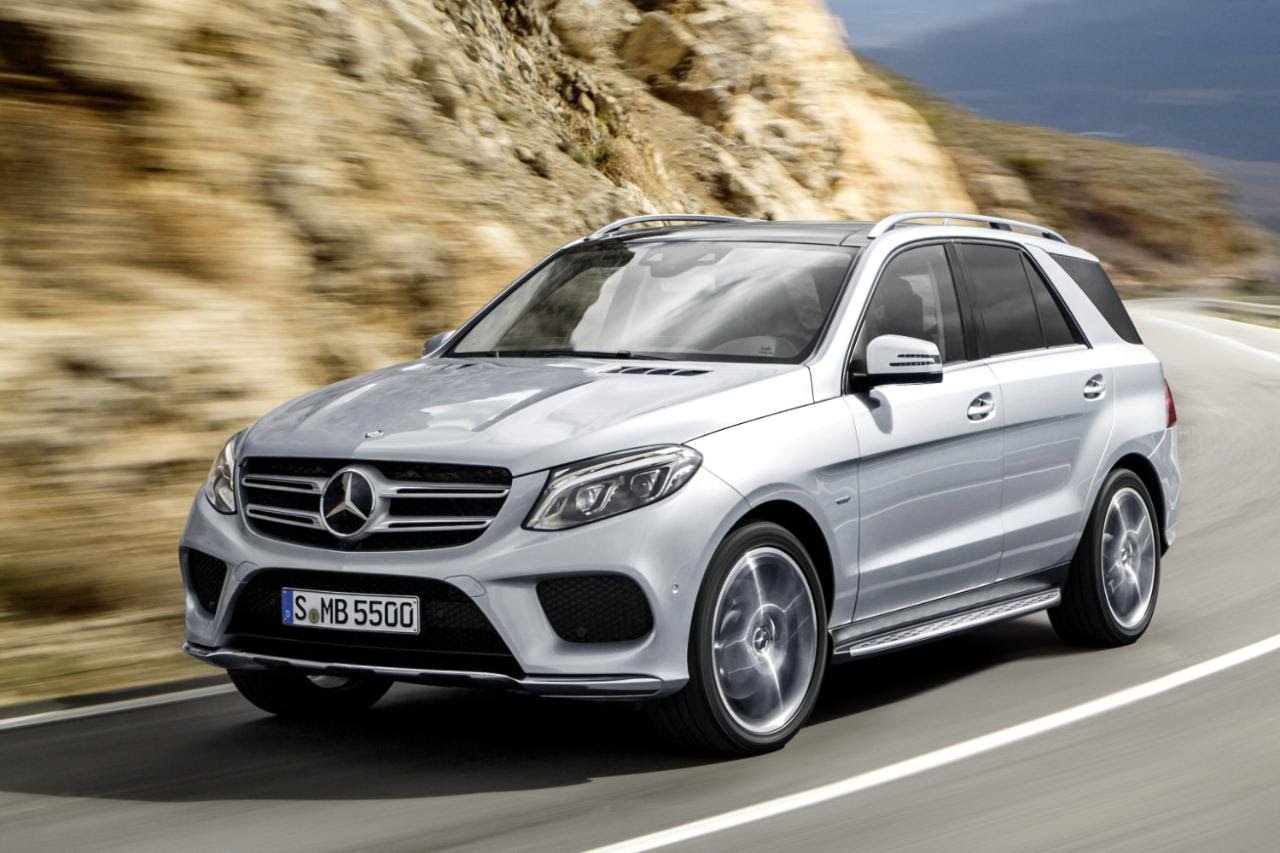
To fall into line with Mercedess new naming policy, the facelifted ML SUV becomes the GLE when it is updated very soon.
Although exterior changes appear limited, this is a fairly comprehensive update to a very popular vehicle that rivals the new Audi Q7and Cars Awards finalists Volvo XC90 and BMW X5. Mercedes-Benz claims a fuel consumption and CO2 emissions reduction of 17 per cent on average across the engine line-up. All diesel models feature the marques new 9G-Tronic automatic transmission. Also featuring is the Dynamic Select controller that allows the driver to tailor the GLEs steering, suspension and engine settings to suit prevailing driving conditions.
The South African line-up consists of the following models;
GLE250d (150 kW/500 Nm) – R863 000
GLE350d (190 kW/620 Nm) – R964 000
GLE400 (245 kW/480 Nm) – R959 000
GLE500 (320 kW/700 Nm) – R1 166 000
GLE63 AMG (410 kW/700 Nm) – R1 710 000
GLE63S AMG (430 kW/760 Nm) – R1 839 000
MERCEDES-BENZ G-CLASS – SA launch first-quarter 2016
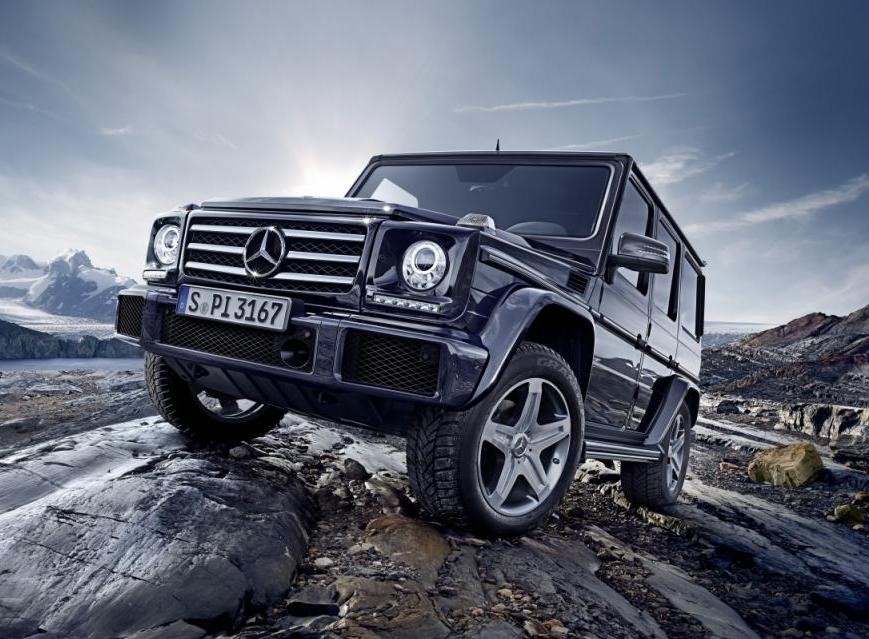
The updated version of the iconic G-Class was recently revealed in Europe and we were there to drive it. While the big news is arguably the arrival of the bi-turbo 4,0-litre V8 for the first time, the sad news is that this model (G500) is not destined for South Africa.
The local line-up will consist of the G350d (180 kW/600 Nm) and the G63 AMG (420 kW/760 Nm). For pricing and further details of the upgrade, go here.
MERCEDES-BENZ S500 PLUG-IN-HYBRID – SA launch late 2015
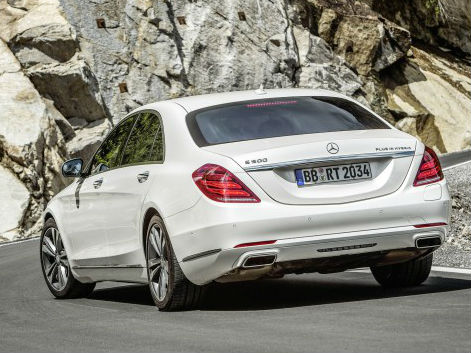
The first of the Mercedes-Benz plug-in hybrid models arrive in South Africa before year-end in the shape of the ultra-luxurious S500. According to Mercedes-Benz this model offers the performance of a V8 and the consumption of a compact model. It uses a bi-turbocharged 3.0-litre V6 engine married to a high-tech hybrid drive module to deliver not only stonking performance (0-100kph in 5.2 seconds), but also completely emission-free driving for up to 33 km. The combined system output is 325 kW and 650 Nm of torque. The certified claimed consumption is 2.8 L/100 km.
The batteries can be charged via external electricity mains using a 3.6 kW on-board charger which is permanently installed in the vehicle and charges single-phase up to 16 A. The S500 can be charged in two hours anywhere in the world, e.g. at a wall-box or a charging pole (400 V, 16 A). Alternatively, charging via house connection is also possible. Depending on the connection a charge time of two hours and 45 minutes can be achieved (with 230 V and 13 A). Look underneath the right tail lamp to see where the charging cable would be plugged into.
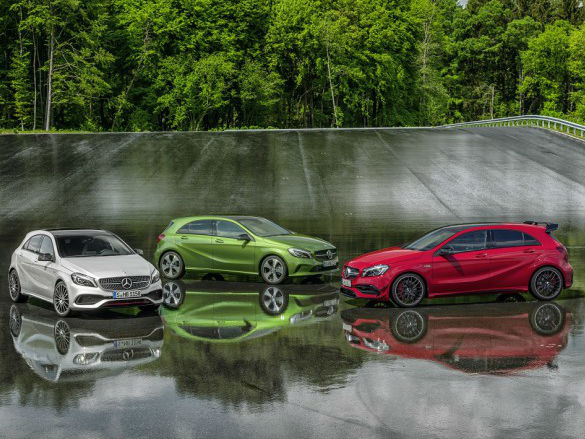
MERCEDES-BENZ A-CLASS FACELIFT – SA launch January 2016
We recently traveled to Germany to drive the facelifted A-Class prior to its local introduction early in 2016. Besides a small cosmetic update on the outside, the more major changes happen under the skin. The interior benefits from an upgrade to the infotainment systems, instrumentation and improved fit and finish. With the addition of the Dynamic Select system and adaptive damping, the ride has also been considerably improved.
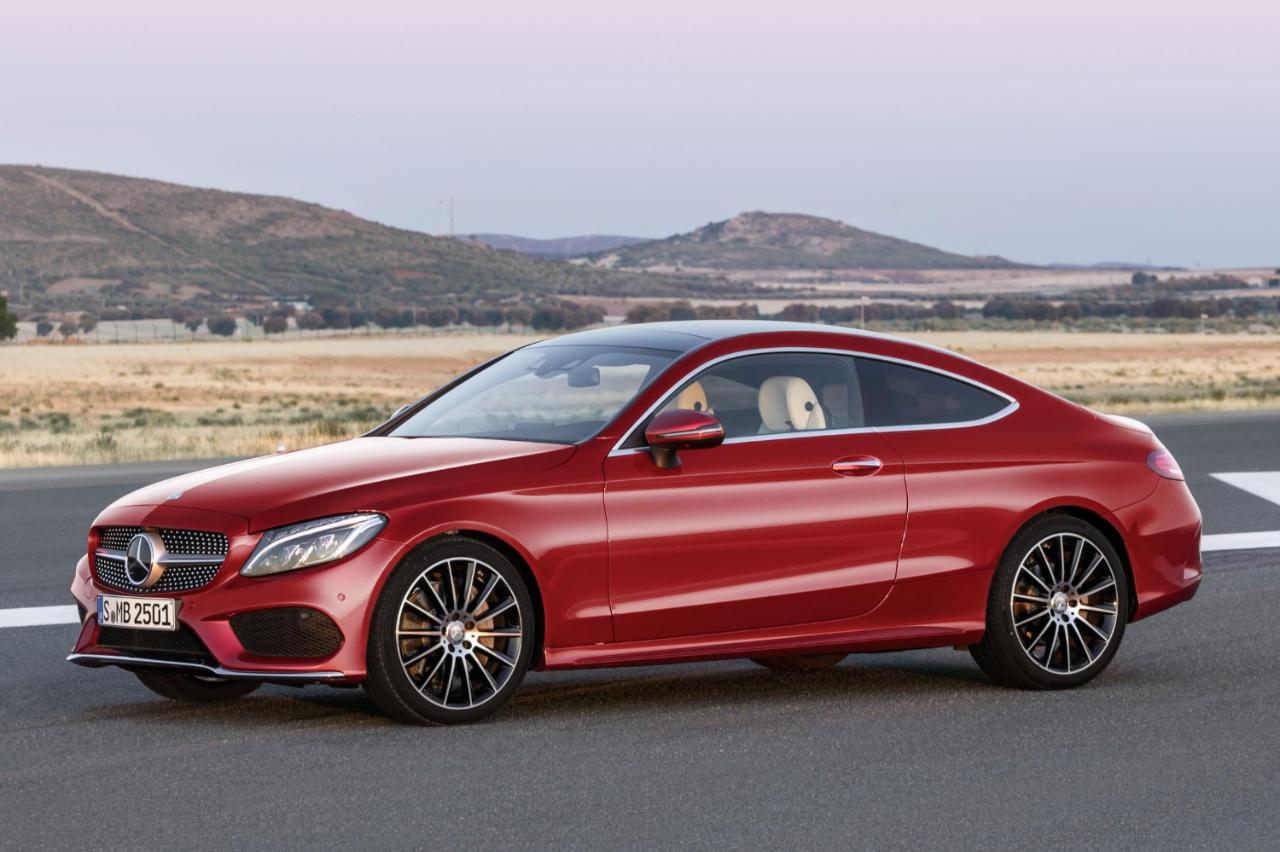
MERCEDES-BENZ C-CLASS COUPE – SA launch early 2016
This svelte newcomer made its debut at the recent Frankfurt Motor Show and is due to make its South African appearance early in the new year.
The local line-up will consist of; C200 Coupe (135 kW 2,0-litre turbopetrol), C300 (180 kW 2.0-litre turbopetrol) and the C220d, delivering either 125 kW or 150 kW.
The flagship C63 models are powered by the fearsome twin-turbo 4,0-litre V8 that delivers 349 kW and 650 Nm of torque in the standard model, and 375 kW and 700 Nm in the S. The latter model will join the local line-up. Read more about the AMG models here.
MERCEDES-BENZ SLC – World launch during 2016
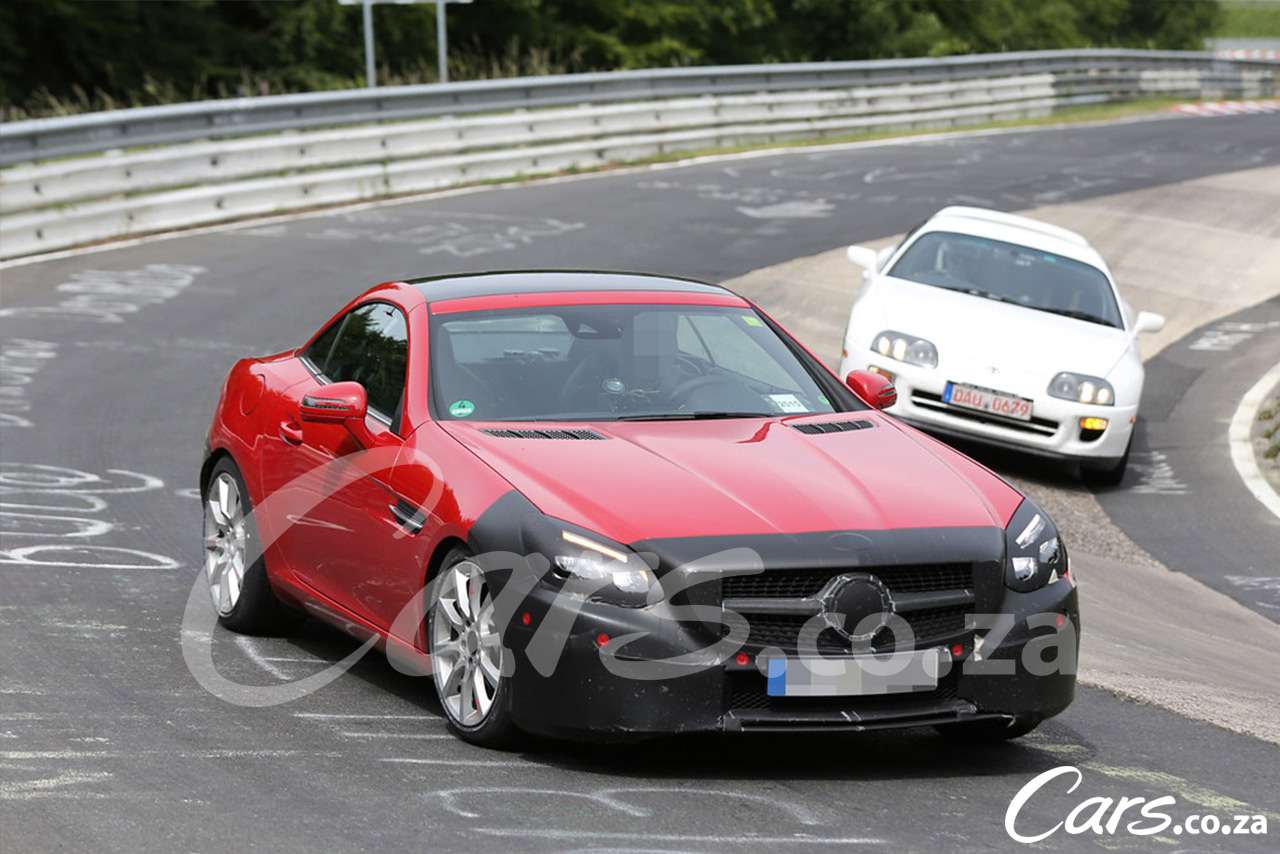
The facelifted SLK will also get a new name this time Mercedes-Benz is reviving the old SLC moniker, last seen in the SL line-up of the 70s. As our spy photo shows, the changes do not appear far reaching, but insiders say that Mercedes is working hard to ensure that the SLC will offer a more compelling alternative to the likes of the Audi TT and BMW Z4. Judging by the spy photos we have seen, Mercedes appears to be trying hard to hide the new infotainment system from prying eyes but the rest of the instrumentation and switchgear look similar to what has featured before.
The SLK engine line-up was not updated too long ago, so we dont expect any major surprises on that front. Read more about those here. The SLC could reach South Africa as soon as March/April 2016. Confirmed models are the SLC200, SLC300 and the SLC450 AMG Sport.
MERCEDES-BENZ SL – World launch during 2016
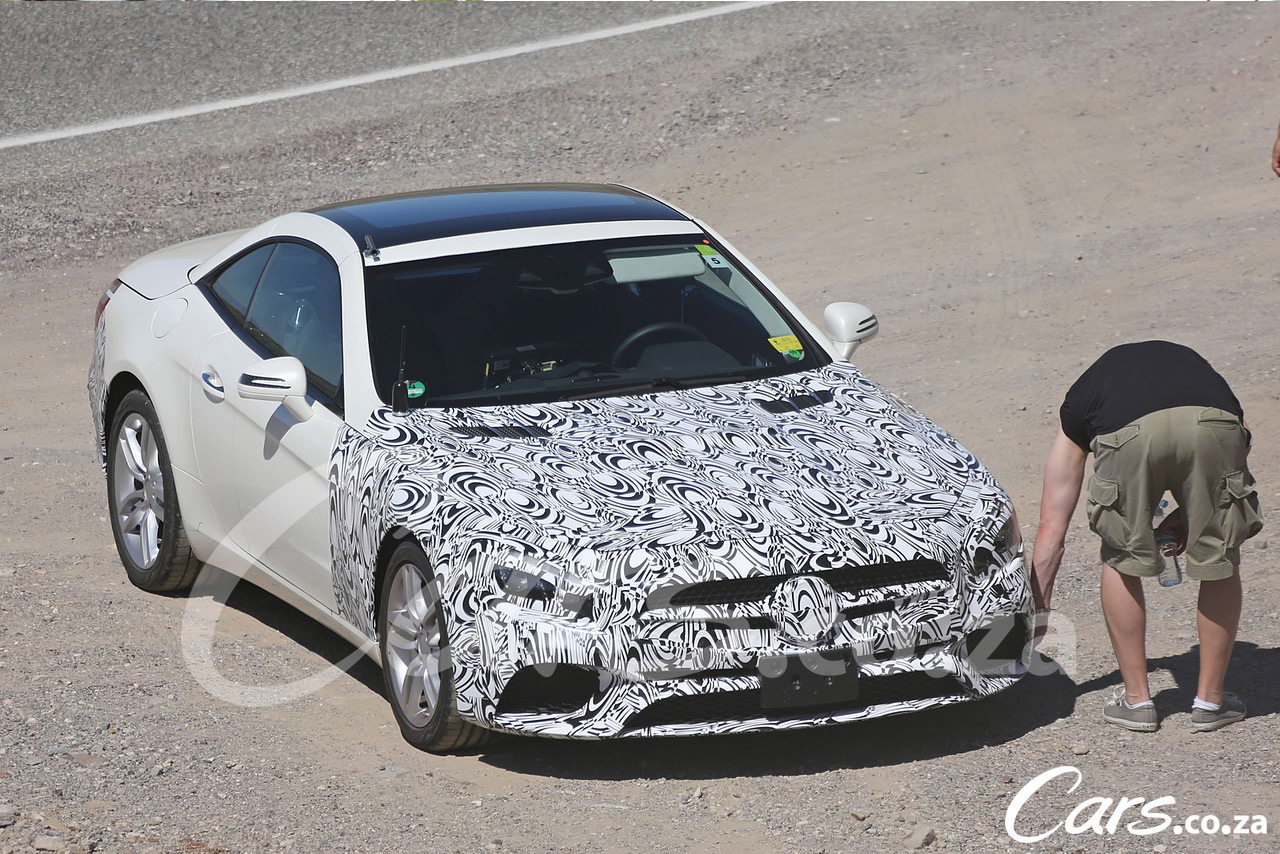
The SL luxury roadster is next in line for a mild mid-life refresh, with the biggest news being design changes to the front. Expect it to largely copy the look of the AMG GTs grille and headlamps. The nine-speed automatic transmission will replace the 7G-tronic but most of the engines will remain untouched, save for the usual round of efficiency improvements.
Inside, the cabin will be updated to include the latest instrumentation and infotainment systems. Also expect to see some of Mercedess new safety and comfort technologies to migrate to this model.
The refreshed SL should arrive in South Africa around March/April 2016.
MERCEDES-BENZ S-CLASS CABRIOLET – SA launch second-quarter of 2016
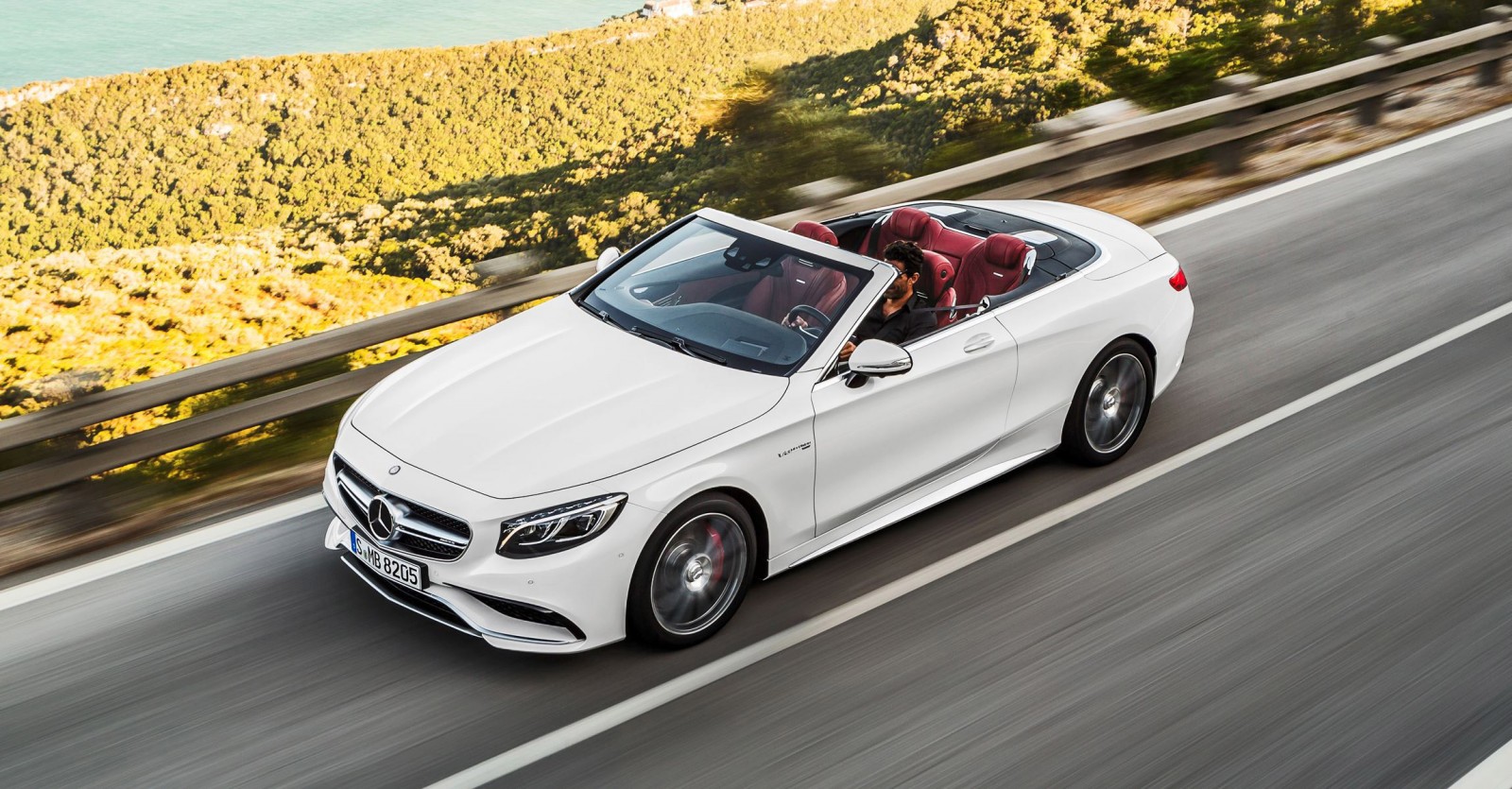
Also unveiled at the recent Frankfurt Motor Show, the beautiful S-Class Cabriolet will reach South Africa during the first half of 2016.
The cabin offers a number of features to make sure open-top driving remains comfortable. Besides the AirScarf neck-level heating system, and heated seats and armrests, the S-Class Cabriolet also debuts a new technology called AirCap that is described as an advanced, automatic wind protection system.
Both the S500 (335 kW/700 Nm) and S63 Cabriolet (430 kW/900 Nm) models are likely to be offered to wealthy South Africans.
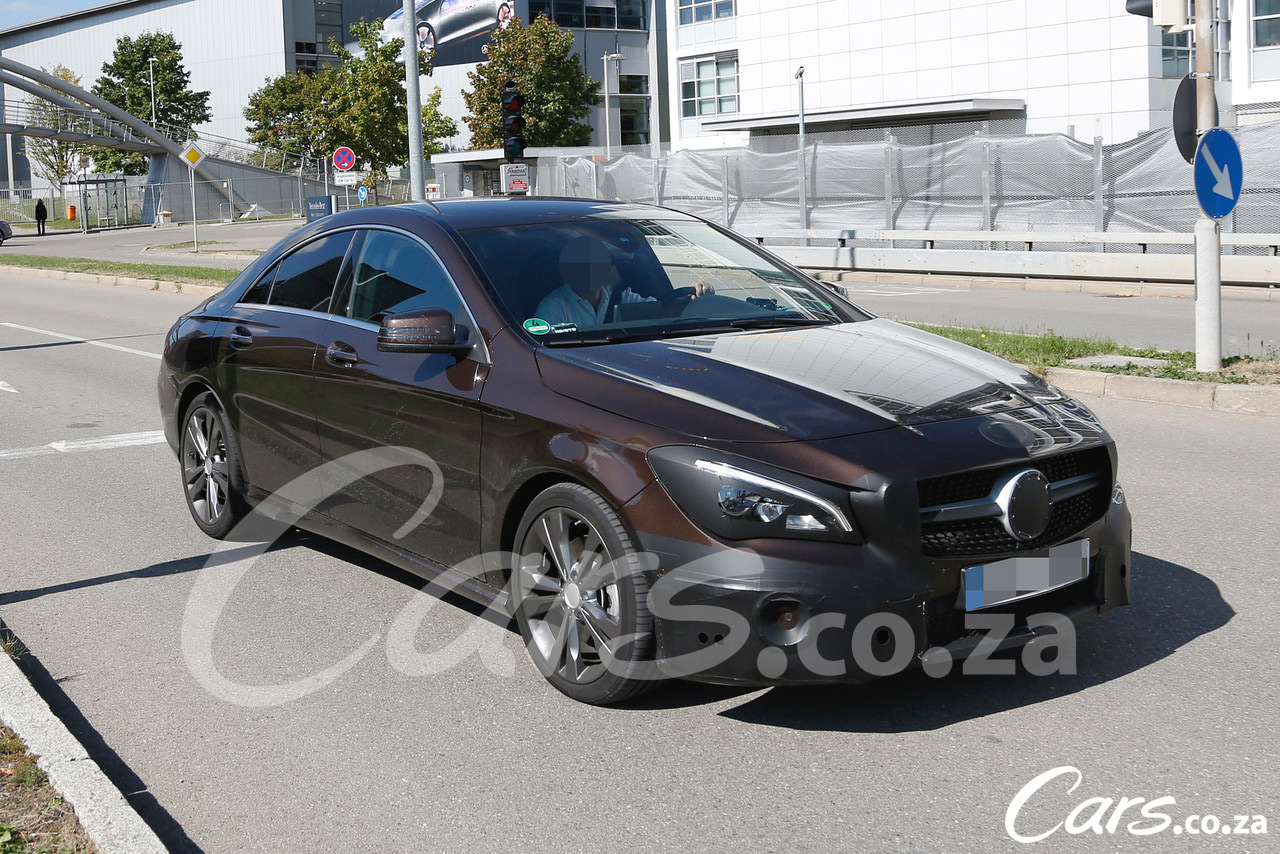
MERCEDES-BENZ CLA FACELIFT – SA launch mid-2016
Following the update to the A-Class, the sedan spin-off CLA should get a similar round of updates around July/August 2016. That means improved interior fit and finish, new instrumentation and infotainment updates, as well as an improved ride.
Our spy photos show that, like the A-Class on which it is based, exterior design changes will be limited.
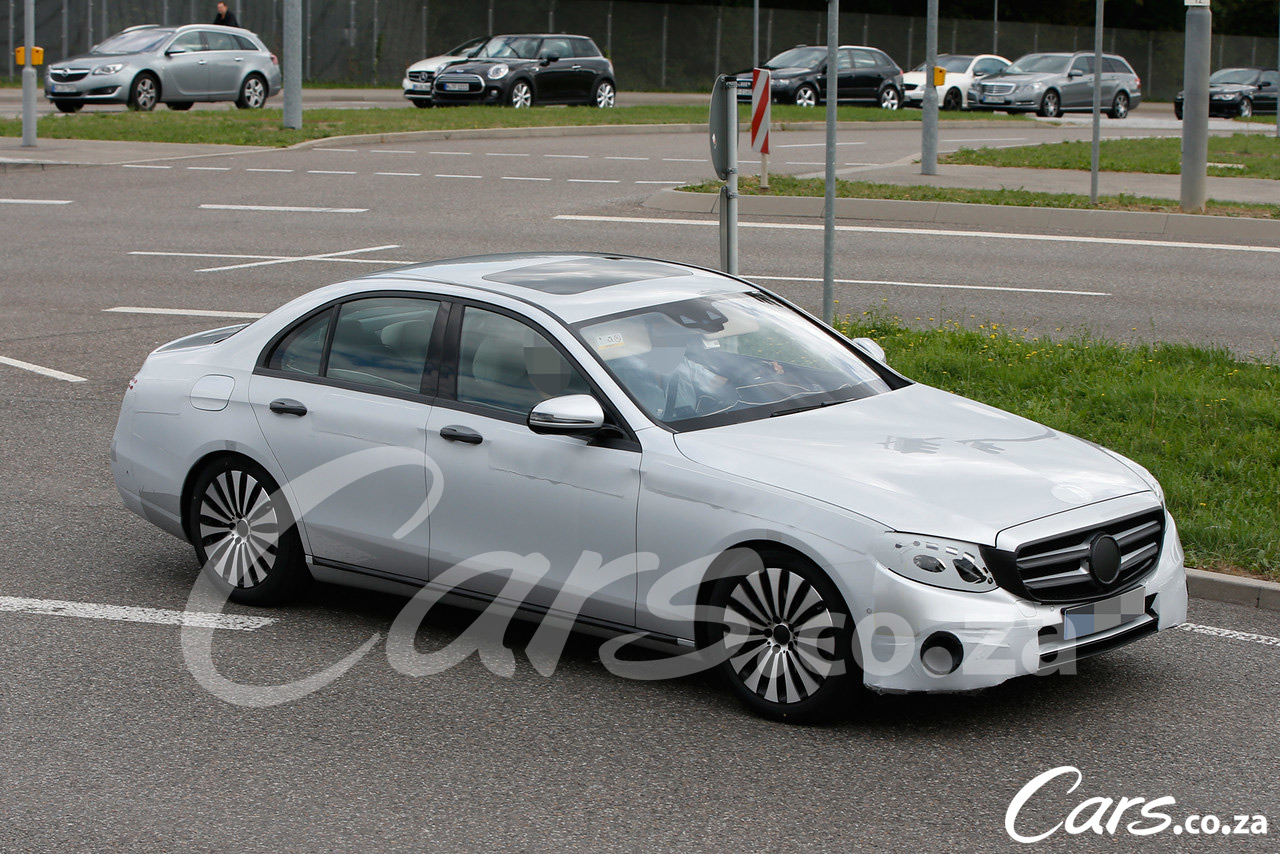
MERCEDES-BENZ E-CLASS – SA launch mid-2016
The most important product that Mercedes-Benz will launch during 2016 is its all-new E-Class, still one of the brands top sellers around the globe. It should debut in South Africa around June/July, initially in sedan form only.
As our spy photo shows, the new E-Class (codenamed W213) looks very much like a slightly shrunken S-Class. Our spy photos also show an interior that closely follows the style set by its bigger sibling, including what appears to be a mix of analogue and digital instrumentation. The layout of the controls is very similar to the S-Class as well, with the COMAND controller and touchpad on the centre console, and a large free-standing infotainment screen near the top of the facia.
The new E-Class will use a version of the brands MRA platform (debuted on the C-Class), which uses more lightweight materials and is designed to accommodate a variety of alternative energy powertrains. The weight-saving could be as high as 150 kg on some models. It is also primed for the era of autonomous driving, and it is said that the E-Class will indeed be one of the most advanced cars in the world when it is launched. Likely features include remote parking, autopilot cruise-control (under certain conditions) and gesture control.
With regards to engines, there is a strong rumour that in-line six-cylinder engines will make a return to the E-Class as part of a roll-out of a new engine family comprising of down-sized four- and six-cylinder powerplants. The companys new nine-speed automatic transmission will be fitted to most models. The range-topping E63 AMG will use the 4.0-litre bi-turbo V8, but tuned to deliver near 450 kW. Regarding the initial South African line-up, we can confirm that only sedans will arrive during 2016, including a E450 AMG Sport model that comes late in 2016.
Station wagon and Coupe/Convertible models are also already nearing completion. These derivatives will reach South Arica during 2017.
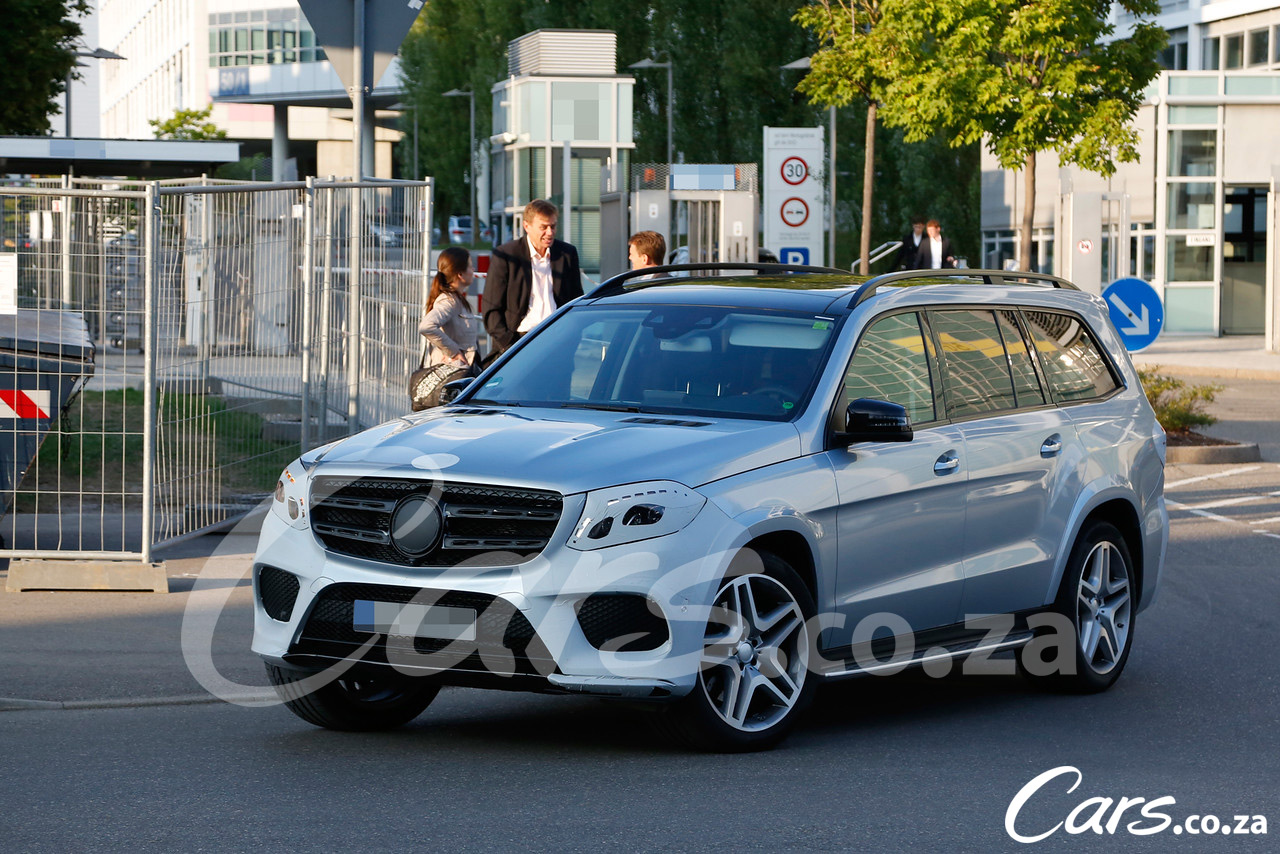
MERCEDES-BENZ GLS FACELIFT – World launch during 2016
Mercedes-Benz will give its biggest SUV, the GL-Class another round of updates before an all-new model arrives in about two years time. The facelift will coincide with a revised name GLS to bring the luxurious SUV into line with the brands new naming structure.
Besides some obvious exterior changes, the GLS also gets a significant interior upgrade, with the latest infotainment systems and potentially a revised instrumentation cluster a move to digital is mooted. We do not anticipate major changes to the powertrain line-up.
MERCEDES-BENZ GLC Coupe – World launch during 2016
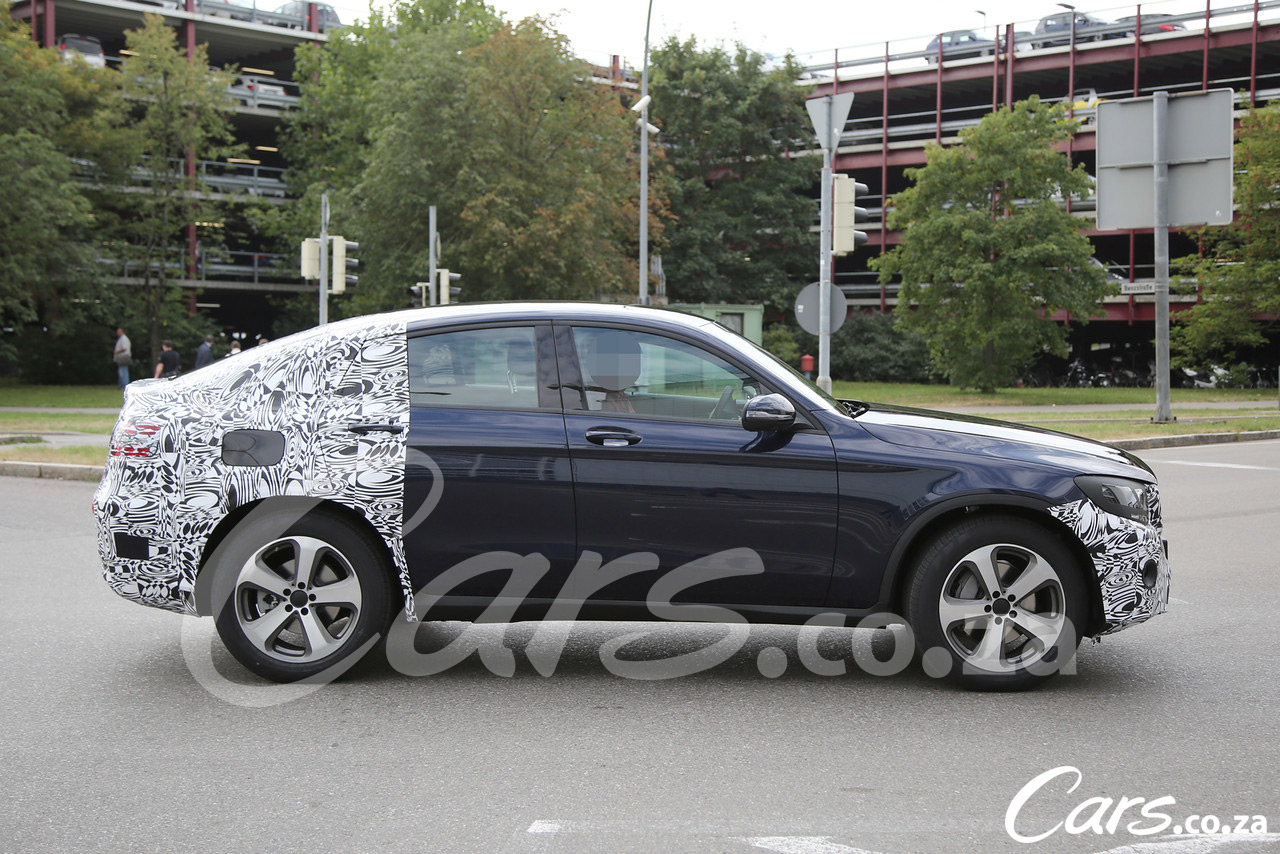
This very important new model has already been shown in concept form and spy photography confirms that test mules look surprisingly close to being production ready. The GLC is essentially the four-door coupe version of the upcoming GLC SUV, and will battle the BMW X4.
The drivetrain line-up will mirror what is on offer in the GLC. Expect to see this model in South Africa just before end-2016, at the earliest. We would not be surprised to see an AMG version of this model making its appearance at some time.
MERCEDES-BENZ C-CLASS FACELIFT – World launch likely during 2017
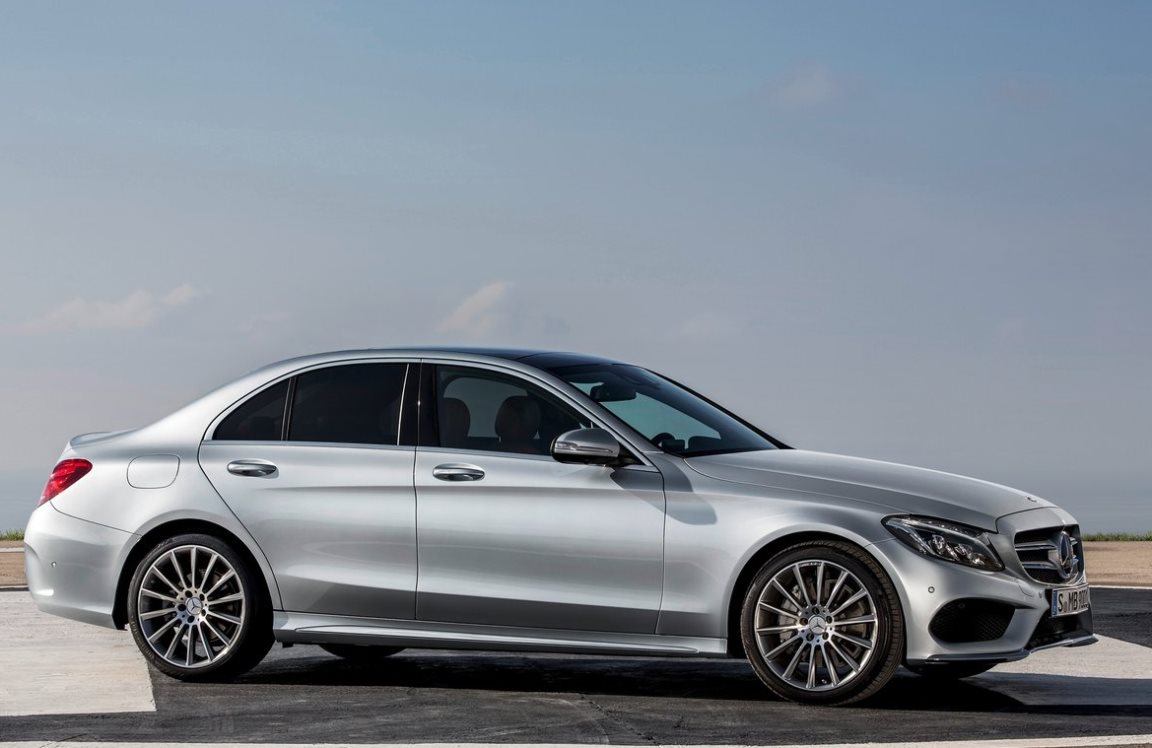
While the current, World Car of the Year-winning C-Class still seems very fresh, Mercedes-Benz is apparently already preparing a round of updates. A facelift is likely during the course of 2017, and one of the major changes could include a shift to fully digital instrumentation. Most models will then also start using the new 9G-tronic transmission and potentially some new four- and six-cylinder engines.
MERCEDES-BENZ S-CLASS FACELIFT – World launch likely in 2017
Yes, indeed the current S-Class is by no means old, but as the flagship Mercedes-Benz, it needs to stay ahead of the curve. The next E-Class will debut some technologies which are not yet offered on the S-Class, something a mid-life refresh will rectify. In fact, expect some further autonomous driving features to become available at the time of the 2017 update.
MERCEDES-BENZ GLA FACELIFT – World launch 2017
The most compact Mercedes-Benz crossover (for now) gets a similar update to the A-Class and CLA when it is refreshed in 2017. That means slicker instrumentation, better info-tainment systems with improved smartphone integration and a refined ride set-up.
MERCEDES-BENZ GLS – World launch 2017/18
The flagship Mercedes-Benz SUV will be replaced late 2017/early 2018 and it is said that two versions could be under development. Firstly, a direct replacement for the current GL (to be renamed GLS next year), will continue to occupy the market positioning it does at present. Then, the new Maybach division, which recently launched the Mercedes-Maybach S600, could launch an ultra-luxurious version off the same platform to rival the likes of the new Bentley Bentayga and the upcoming Rolls-Royce SUV.
MERCEDES-AMG GT/S ROADSTER – World launch 2017/18
Although Mercedes-AMG ruled out a topless version of the AMG GT coupe when it was launched, there appears to have been a change of heart. A soft-top roadster version is hotly tipped to join the line-up with the same engine line-up.
MERCEDES-BENZ A-CLASS – World launch 2018
The next-generation A-Class arrives in 2018 and will ride on the companys new MFA2 platform, developed in conjunction with Nissan/Infiniti. This platform will allow for greater powertrain compatibility and indeed a plug-in hybrid model is likely to be part of the launch line-up. It has also emerged that the three-door body could be replaced by a sporty coupe think mini-AMG GT. This model could be used to counter the BMW 2 Series and Audi TT.
MERCEDES-BENZ CLS – World launch 2018
The next version of the swoopy CLS coupe-sedan will apparently arrive in 2018, again based on the underpinnings of the E-Class. That means there will be a line-up of new straight-six engines as well as high-tech features that include some autonomous driving technology.
Some sad news is that the beautiful Shooting Brake station wagon will be dropped due to poor sales.
MERCEDES-BENZ “TESLA-FIGHTER” – Due during 2018
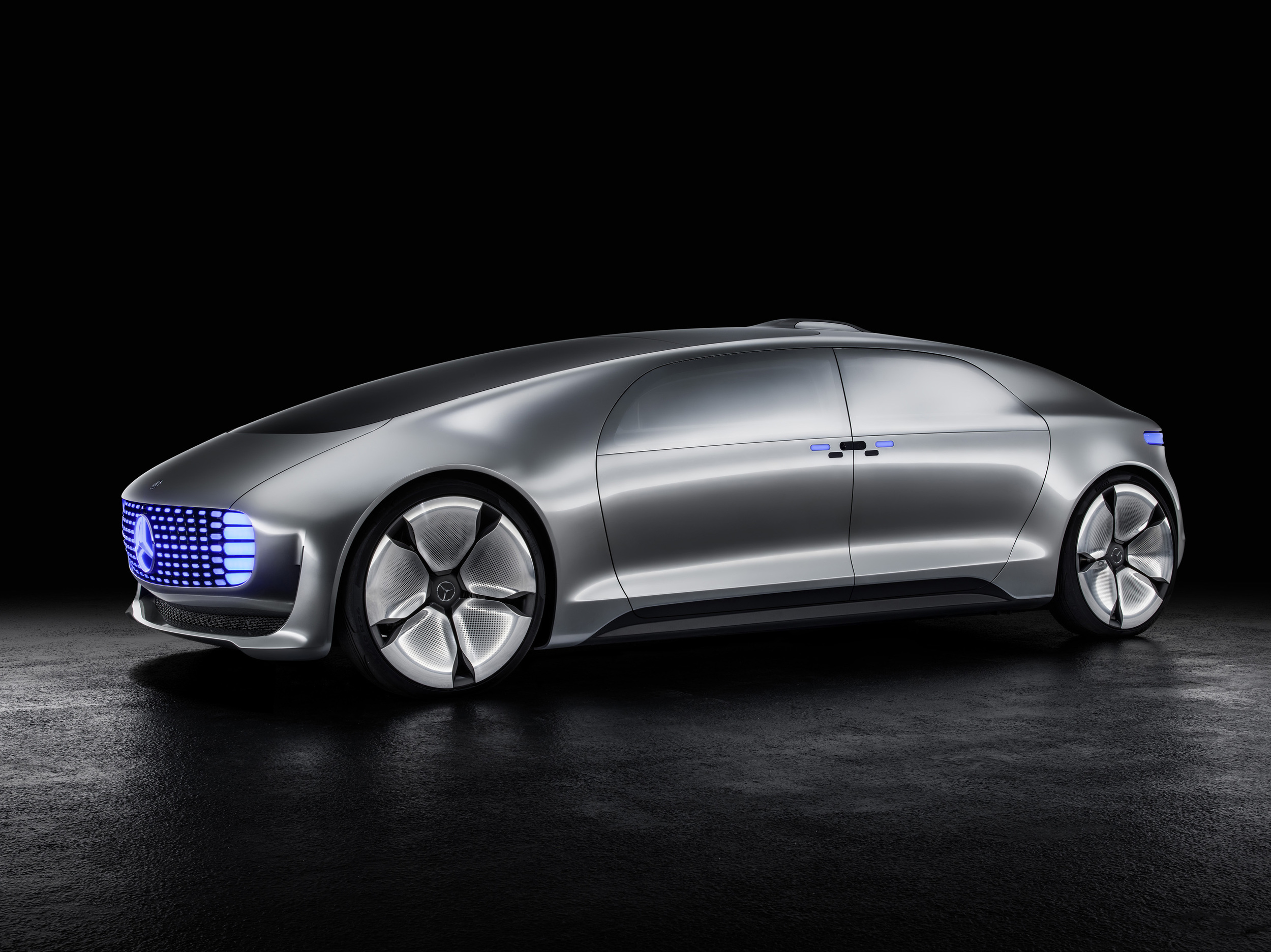
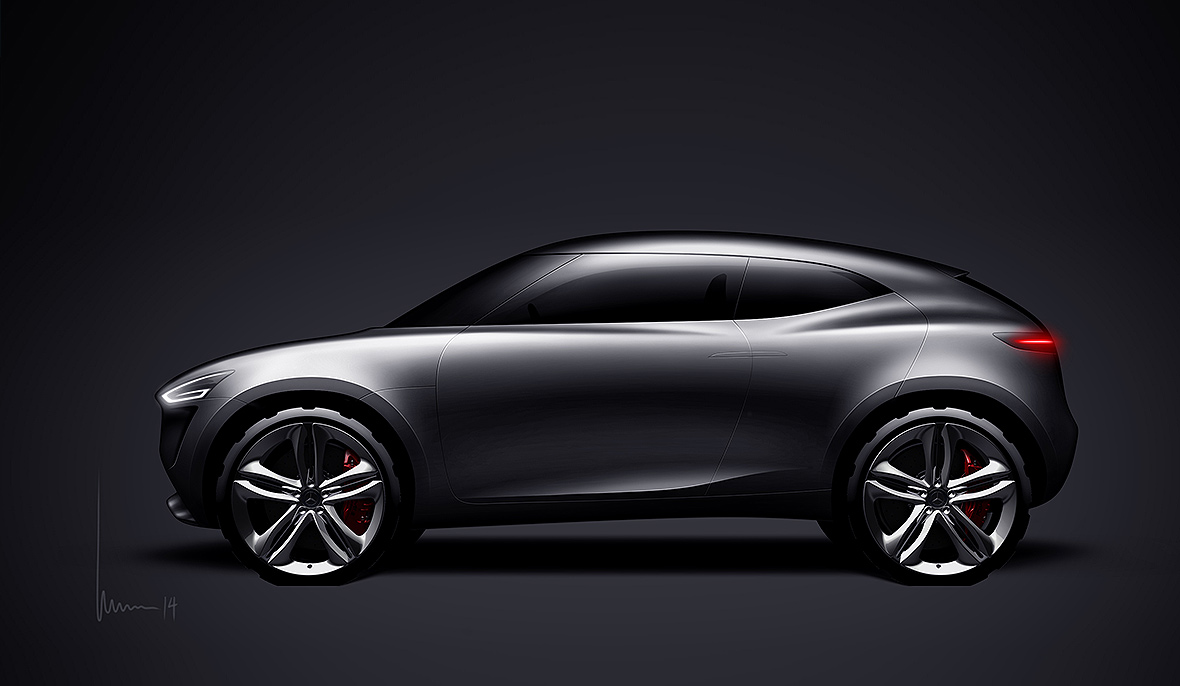
Mercedes-Benz, like Audi and BMW, is keeping a close eye on American upstart Tesla, which recently started manufacturing its highly acclaimed electric luxury Model S in Europe for the first time. A Mercedes insider recently stated that the three-pointed stars foil to the Model S could be on the market as soon as 2018, and that it would have a battery range of between 400 and 500 kilometres. This may not be quite enough… Tesla’s Elon Musk says it should be able to boost the range of its own electric cars to about a 1 000 km on a charge very soon… It is also likely that Mercedes will adopt a fairly radical exterior design for this model. The F015 Luxury in Motion concept car is shown.
MERCEDES-BENZ GLT BAKKIE – World launch 2018
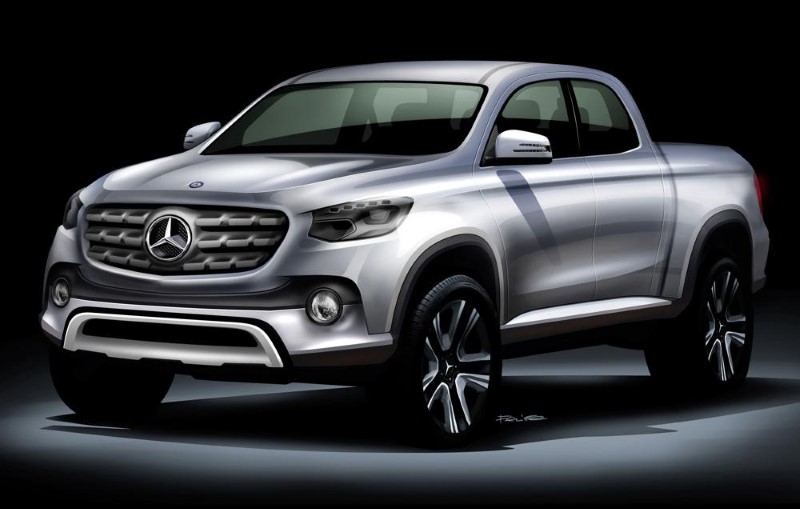
A vehicle that has already generated much publicity and interest in South Africa is the confirmed new Mercedes-Benz pick-up, possibly to be called GLT.
To be jointly developed with Nissan, the new Mercedes-Benz bakkie will likely share its ladder-frame chassis, body structure and axles with the Nissan Navara. Interestingly, Renault has also jumped onto the bakkie bandwagon recently with its Alaskan concept, itself based on the new Nissan Navara.
Although some of the hard bits will be shared with Nissan (and, seemingly, Renault), the Mercedes-Benz pick-up will have its own line-up of petrol and diesel engines as well unique interior.
MERCEDES-BENZ B-CLASS – World launch of new model possible in 2017
The current B-Class went into production in 2011 so an all-new model should debut no later than 2017. However, insiders now believe that a replacement could be delayed until 2019. First things first the B-Class is likely to undergo a name change when the next-generation model arrives. Insiders say it doesnt fit into the new structure that is currently being rolled out, so it is very likely to fall back into the A-Class line-up. Essentially, it could become to the A-Class what the Golf SV is to the Golf 7. Very little is known about the next-generation model, but the latest engines and transmissions will obviously be transferred to the compact people mover. It is also likely that the next B-Class could become something of an alternative fuel pioneer, and be offered with a fuel-cell drivetrain.
MERCEDES-BENZ GLB – Possible during 2019
A compact crossover to rival the upcoming Audi Q1/2 and next-generation Mini Countryman is reportedly also under development and will be based on the MFA2 platform that also underpins the next A-Class and CLA. Given the existence of the current GLA crossover, it is not entirely clear whether positioning this vehicle will require renaming to fit into the new Mercedes-Benz naming structure.
MERCEDES-BENZ GLE – World launch 2019
The next-generation GLE (current ML) is due before the end of the decade and will again feature a Coupe derivative. Mercedes-Benz says the SUV/crossover is far from over and that every possible niche related to this trend will be explored.
MERCEDES-BENZ CLA – World launch 2020
An all-new version of the compact Mercedes-Benz sedan is likely to debut as late as 2020. The only insight into this model we can reveal thus far is that it will be built at a Nissan factory in Mexico. Whether this means its platform will be shared with Nissan/Infiniti, remains to be seen. The Shooting Brake (station wagon) version is also likely to be built there. It will use the MFA2 platform that also underpins the new A-Class.
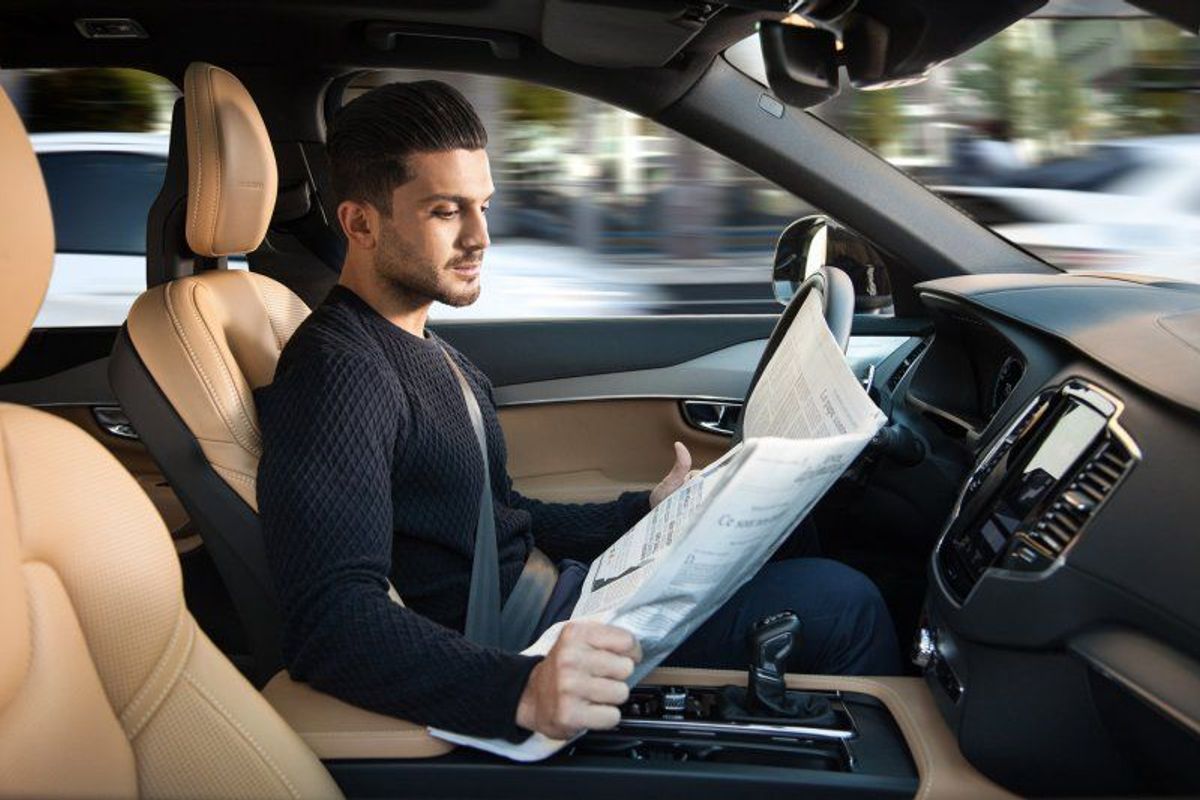
Volvo Reveals Autonomous Driving Technology
Volvo Cars, along with leading automotive safety technology company, Autoliv, are collaborating on the worlds first large-scale autonomous driving initiative called Drive Me.
In 2017, the Drive Me project will make one hundred Volvo XC90 vehicles, fitted with the brand’s new IntelliSafe Auto Pilot, available to families and commuters in Gothenburg, Sweden. This will be the first time that Autonomous Driving (AD) cars will be made available for use by the public and the cars will be driven autonomously on approximately 50 km of selected roads and once the project is completed, the system will then be introduced to the general public.
Håkan Samuelsson, president and chief executive of Volvo Cars, said: We are delighted to welcome Autoliv to the Drive Me family. Autonomous driving will make our roads better and safer. The sooner we can develop the necessary technologies and start offering them in our cars the better.
How Does The Volvo IntelliSafe AutoPilot Work?
According to Volvo, the IntelliSafe Auto Pilot is one of the industrys most advanced and easy-to-use interfaces to oversee how drivers will transfer control to a cars autonomous driving (AD) mode in its forthcoming cars.
Volvo says it has designed the system to be as simple and intuitive as possible with autonomous mode being activated with specially designed paddles on the steering wheel.
When the driver enters a route where autonomous driving is possible, the car will alert the driver to indicate that Auto Pilot is ready and lights on the steering wheel paddles will flash. To activate Auto Pilot, the driver is required to pull both paddles at the same time. The lights on the paddles will then change to constant green, which confirms that Auto Pilot is engaged and that supervision has been delegated to the vehicle.
When autonomous driving is no longer available, the vehicle will initiate a 60 second countdown in which time the driver will have to take over control of the vehicle using the paddles. If the driver fails to take over after 60 seconds, the car will bring itself to a safe stop.
Thomas Ingenlath, SVP Design at Volvo Cars, said: We have designed a user interface that is safe and seamless to use so that drivers can confidently transfer and regain control of the car.
Volvo reports that over 90% of all fatal accidents are believed to be caused by human error and autonomous driving therefore has the potential to contribute to fewer accidents, injuries and fatalities.
As automated driving cars evolve, human error will be significantly reduced and ultimately these cars will provide a new level of automotive safety, said Jan Carlson, chairman, president and chief executive of Autoliv.
Kia Sorento 2.4 LS (2015) Review
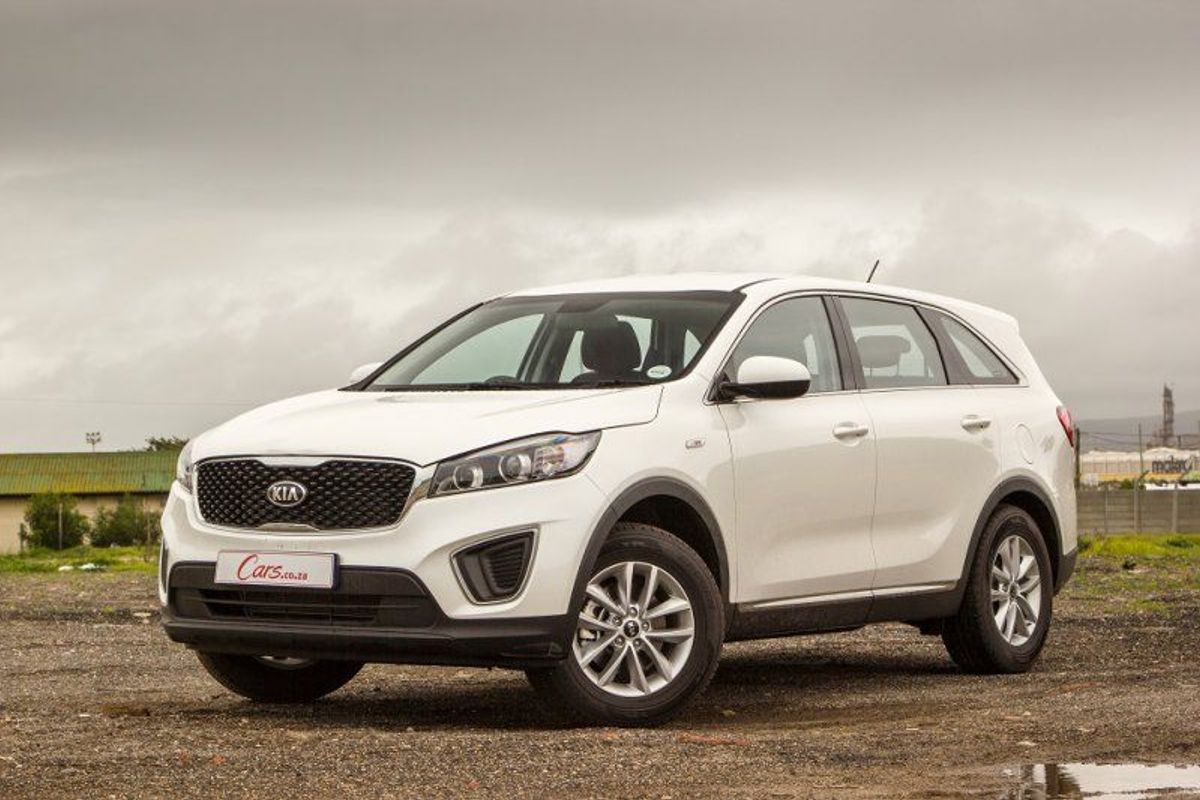
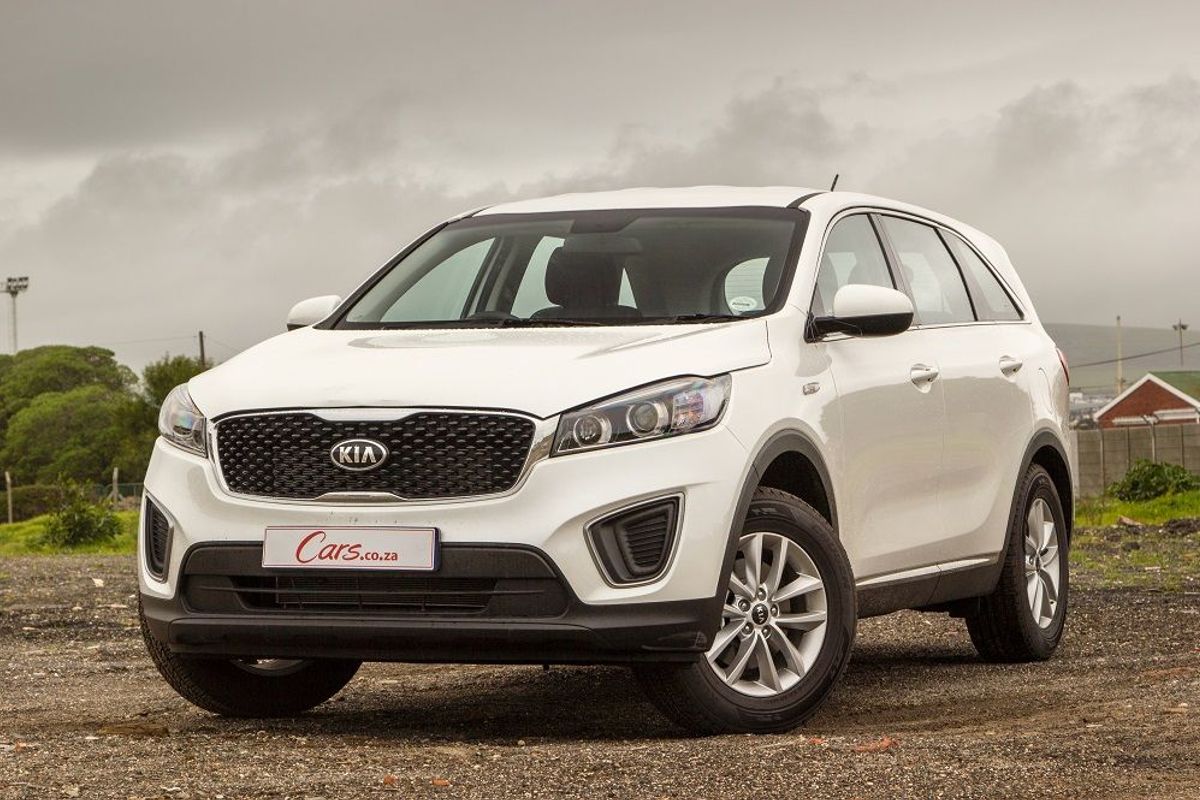
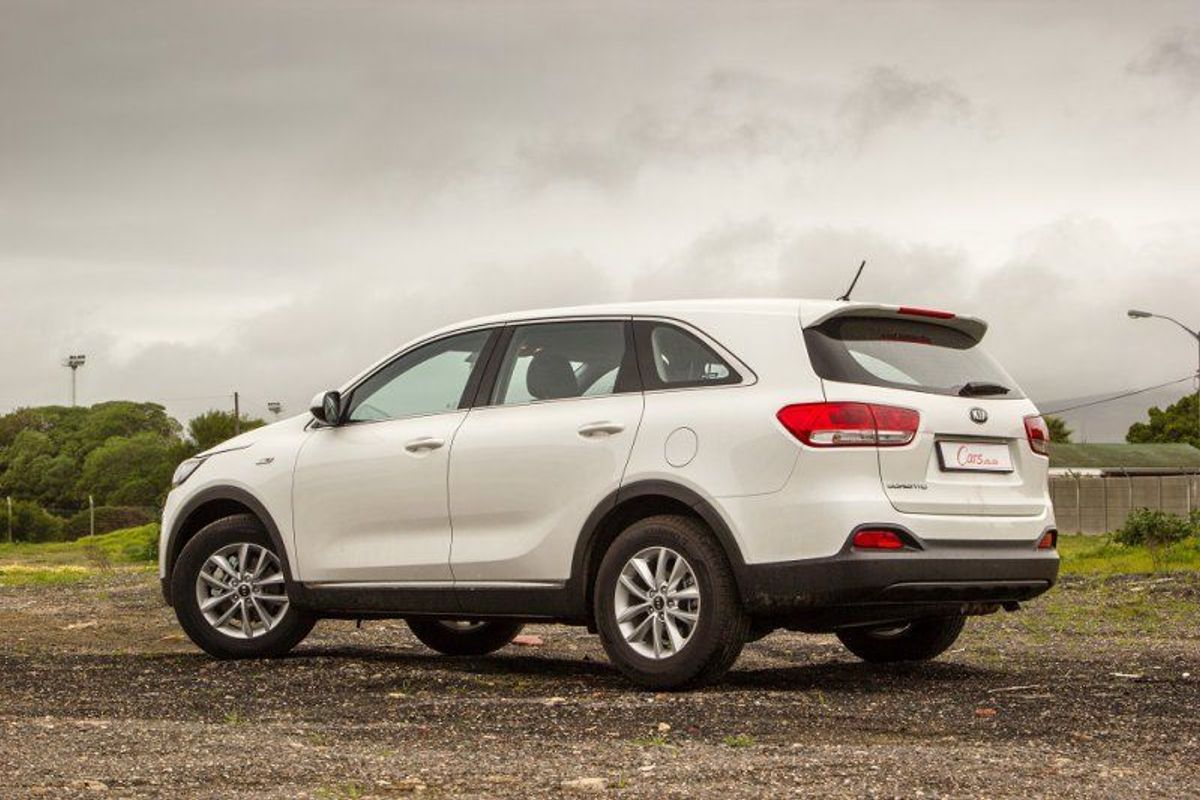
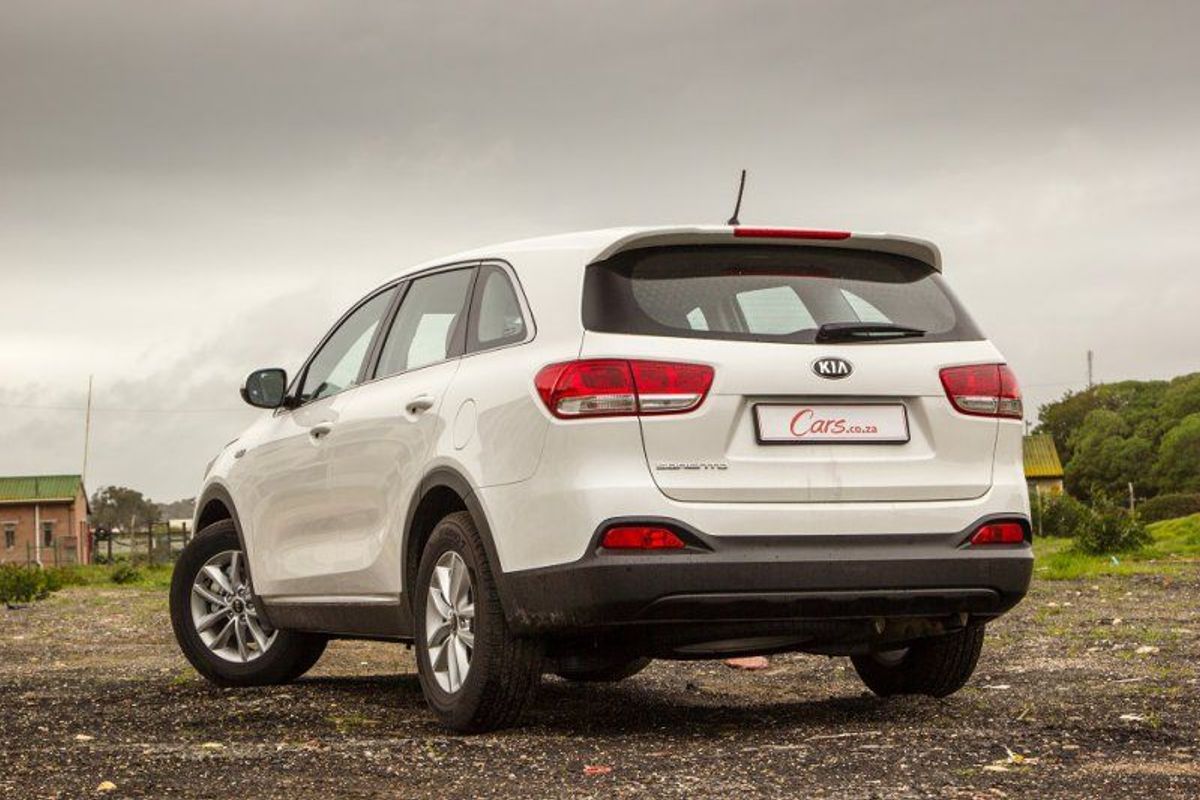
The Kia Sorento has always been a good value for money people shuffler. It has progressed quite nicely from its humble beginnings as a body-on-frame SUV to its modern car-like chassis. The latest model pits itself as a more upmarket SUV with modern technologies and stylish looks. There is a lot of competition in this expanding segment so we got to grips with the entry level 2.4-Litre, five seater variant.
Whats new?
The Sorento has a new exterior design that helps it to look more substantial and gives it better road presence. Recently we have come to expect more wow factor from Kia in its design where this feels more like an evolutionary design. Its still well-proportioned and with the tiger-nose grille up front, its still easily recognisable. Our 2.4 LS here doesnt do the overall style justice as the fog lamps arent included and it rolls on 17-inch wheels rather than 19-inch wheels fitted on the higher spec model. It does feel very well built with tight shut gaps and soft sounding thuds when opening and closing doors.
Inside story
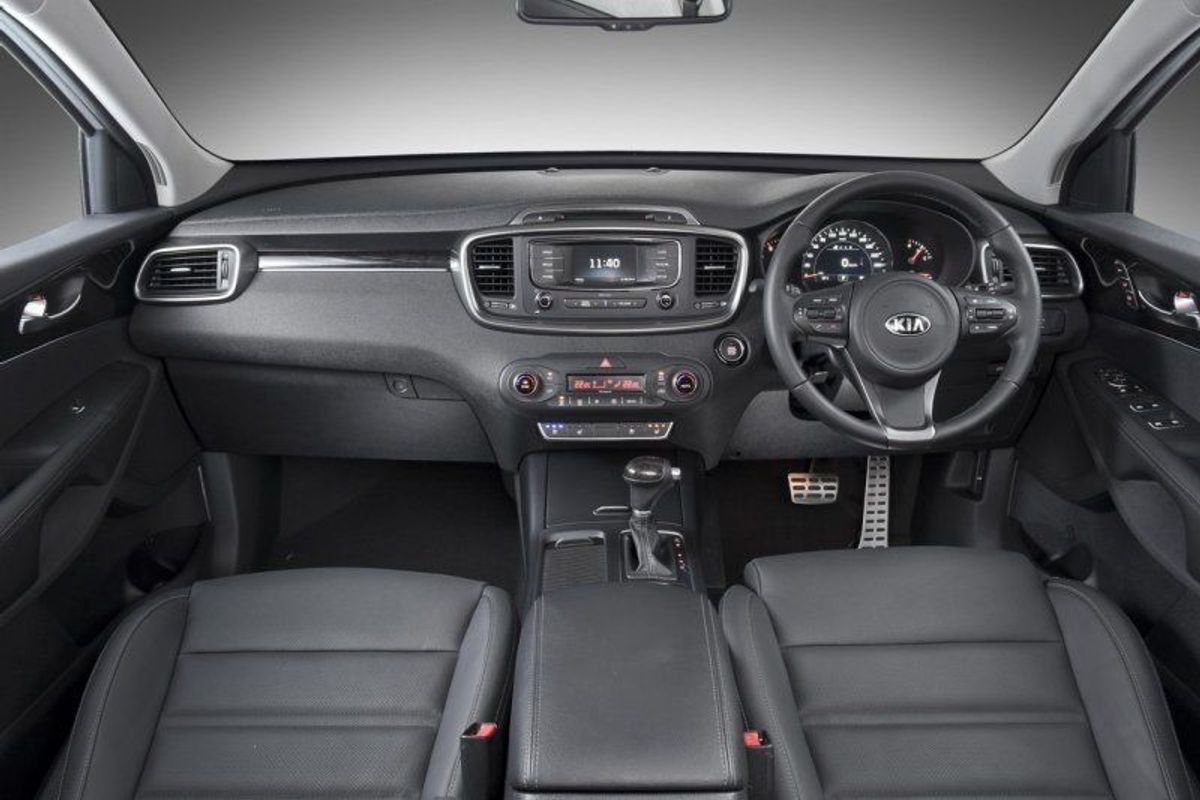
The cabin has undergone a restructure in design and the features are mostly up to date. We werent so convinced by the interior, especially when met with the tiny infotainment screen. It looks awkward and out of place in this upmarket segment. Kia has said a larger screen will soon be available complete with navigation quite soon. This will be a major improvement when it comes and makes the Sorento interior more user-friendly. The cloth seats are comfortable in this model and as usual theres USB and Bluetooth connectivity as standard. There are also more soft-touch materials dotted around the cabin but it all seems to be a vast expanse of black. It could do with a bit more character inside.
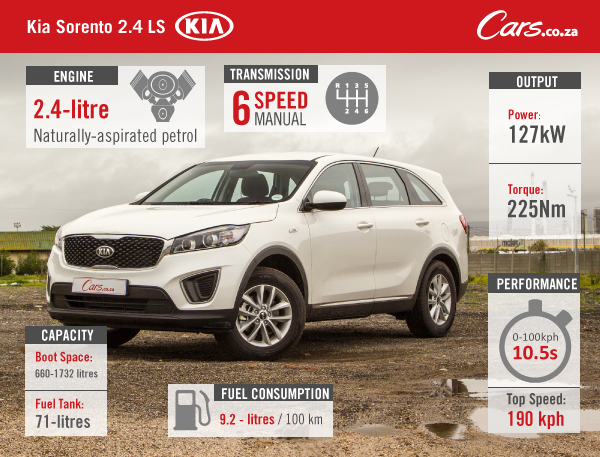
The Sorento makes up a lot of ground with its impressive space and flexibility. The rear seats offer ample leg room and can slide back and forth to provide more leg room or increase loading space in the boot. The rear load space maxes out 660-Litres which is impressive compared to it rivals. The rear seats also fold flat adding to the load bay size.
Engine age
The 2.4 LS model here carries over the engine from the previous generation Sedona. Connected to a six-speed manual transmission the engine is capable of 127 kW and 225 Nm of torque. This model is also only available in front-wheel drive and despite not having the extra weight of powering the rear wheels as well, it felt quite sluggish. Pottering around town seemed to be okay but once loaded up with a few occupants and surfing paraphernalia it seemed lethargic on the open road. If youre planning to do more than just the school run with the Sorento then its advisable to go for the 2.2-Litre turbodiesel. The six-speed manual gearbox works well enough although youll be working it quite hard in this petrol version.
Ride and drive
Kia has gradually improved in this department. Older models used to be quite choppy and crashy over sharp bumps. This Sorento rides comfortably and remains poised on all sorts of tar roads. The steering is still light and lacks feedback but Kia has introduced driving modes that adjust the weight of the steering slightly. Sport mode adds extra weight to the steering but it still lacks feedback that makes it quite difficult to judge whats going on underneath you. Dirt roads arent the Sorentos strong point, especially if the dirt road is quite rippled. On a smooth dirt road the ride is acceptable but bumps tend to ripple their way through to the cabin and shake things around. Thankfully the build quality seems to be very good as nothing was jolted loose or dropped off.
Verdict
The Kia Sorento proves to be a useful bit of kit for city slickers that want a bit of kerb hopping ability. It loads lots of things into the back with its large boot and passengers in every seat get a comfortable and spacious ride. The naturally aspirated engine lacks energy when loaded up and requires a lot of revving to keep it in the sweet spot. The diesel is certainly a better choice of engine. If youre going to spend 99% of your driving life on road then the Sorentos road manners are suitable and it errs on the side of comfort rather than sporty.
Test Team Opinion
“Kia has made significant advances with its cars and the Sorento offers decent drive and build quality. The petrol engine is a little lacklustre, so rather opt for the diesel.” – David Taylor
Kia Sorento Price in SA
Kia still offers excellent value for money in its vehicles but its competitors are closing the gap. The 2.4 LS costs R379 995. Also in the range is a 2.2 diesel in three specifications: LX – R4999 995, EX AWD R599 995 and SX AWD R634 995.
We Like: Spacious interior, build quality, practicality
We dont Like: Lethargic engine, ride on dirt roads
Also consider: Nissan X-Trail, Chev Captiva, Mitsubishi Outlander
The Department of Energy on Friday announced adjustments to fuel prices in South Africa, with effect from Wednesday, 7 October 2015.
The main contributing factors for the adjustment in the fuel price was the result of the weakening of the Rand against the US Dollar which impacted negatively on the fuel prices while the price of crude oil increased marginally during the period. The Department of Energy also stated that if the Rand maintained the same level as August, petrol prices would have decreased by between 25 and 30 cents per litre and diesel would have only increased by 20 cents per litre. Sadly, this is not the case.
Take a look at what you can expect to pay for fuel in October 2015
Volkswagen South Africa has issued an official statement regarding the implications of its world-wide diesel “cheat” scandal for local customers.
Highlights
– VWSA products comply with all South African standards
– No action required from VWSA product owners
The international media has been buzzing with the Volkswagen diesel scandal in recent weeks. If you have missed out, please see our two previous reports to get up to speed.
Now Volkswagen South Africa has issued the following statement:
“There has been extensive international media coverage relating to irregularities in Nitrogen oxide emission values measured during dynamometer regarding the emission standard Euro 5 of Volkswagen diesel vehicles fitted with the type EA189 Euro 5 engines.
“In South Africa the compliance standard is EU 2. All Volkswagen Group diesel vehicles of the type EA 189 retailed in South Africa, that is, Volkswagen passenger, Audi, Light and Medium Commercial Vehicles comply with this standard for Nitrogen oxide emissions.
“We want to further confirm that the bench mode in the software does not affect negatively the CO2 values. Our vehicles accordingly comply with the published CO2 values. Furthermore they are technically safe and roadworthy.
“We would like to apologise to our customers for any uncertainty that may have been created over this issue and want to assure our valued customers, that their vehicles meet all the legal requirements in terms of which the National Regulator approved the sale for use in South Africa.
“There is therefore no action required on either the part of the customer or our dealers.”
You should also know:
The EU2 emissions standard has no specific NOx-only requirement. The only NOx-related requirement is a combination figure with Hydrocarbon (HC). The Euro2 standard (passenger cars, diesel) for this is a figure of no higher than 0.7 g/km of HC+NOx. For Euro5 compliant vehicles this requirement changes to 0.23 g/km, in addition to a NOx-specific requirement of less than 0.18 g/km.
New Car Sales Summary for September 2015
The month of September 2015 made for interesting reading in terms of new car sales. Is our market growing, or are we slowing down?
According to the National Association of Automobile Manufacturers of South Africa (NAAMSA), September 2015 reflected further weakening in domestic sales while record exports were experienced during the period. Figures for the month indicate that the trend of declining domestic sales became further entrenched in a difficult economic environment and the trend is likely to continue for the medium term.
Toyota was the best performing car brand for the month while the Volkswagen Polo Vivo takes top spot as South Africas best-selling car for the month.
New Car Sales Summary September 2015
55 322 aggregate new vehicle sales down by 9.0% (5 460 units) compared to September 2014.
31 181 export sales up by 14.3% (4 391 units) compared to September 2014.
37 309 passenger car sales down by 13.2% (5 656 units) compared to September 2014.
15 121 light commercial vehicles up by 0.3% (45 units) compared to September 2014.
Top Selling Car Brands in South Africa September 2015
Brand
Total Sales
Market Penetration %
1. Toyota
11 701 (+1 762)
21.2%
3. Volkswagen
9 586 (+1 114)
17.3%
3. Ford Motor Company
6 351 (-271)
11.5%
4. GMSA
5 149 (-6)
9.3%
5. Nissan
3 945 (-93)
7.1%
Top Selling New Cars in South Africa September 2015
NAAMSA predicts that domestic sales would remain under pressure for the remainder of the year. Despite declines in new car sales, exports and local vehicle production remain positive. Vehicle exports are expected to experience further gains for the next two years thanks to the expected improvement in the global economic growth.