Toyota Corolla-Based Bakkie ‘Under Discussion’ – Report
A fresh report out of the US claims Toyota is mulling a Corolla-based bakkie. However, if the project gets the green light, the production version is still a few years away…
Over in the United States, Ford is struggling to keep up with demand for its sub-Ranger Maverick unibody bakkie. And, if a fresh report is to be believed, Toyota wants a piece of that pie as the Japanese firm is apparently mulling a Corolla-based bakkie.
According to Automotive News, a Corolla-based bakkie – which would battle the likes of the Maverick and Hyundai Santa Cruz, and thus likely have a half-tonne-plus payload – “remains a possibility” and is very much “under discussion” at Toyota. The publication’s source claims such a model would likely be built at the company’s Mississippi factory.
Will the Corolla badge been extended to a bakkie next?
Earlier rumours suggested Toyota would revive the Stout nameplate for this model. The latest report states the proposed bakkie’s “appearance is a work in progress”, while the production version – should the project get the green light, of course – is “not expected in market until at least 2027”.
Since the 13th-generation Corolla is expected to debut around 2025, that suggests the proposed bakkie would be not be based on the existing version but rather developed alongside the upcoming generation. There’s also the possibility such a model could use the closely related Corolla Cross – which rides on the same TNGA-C platform as the hatch and sedan but is likely due a refresh in 2026 – as a base.
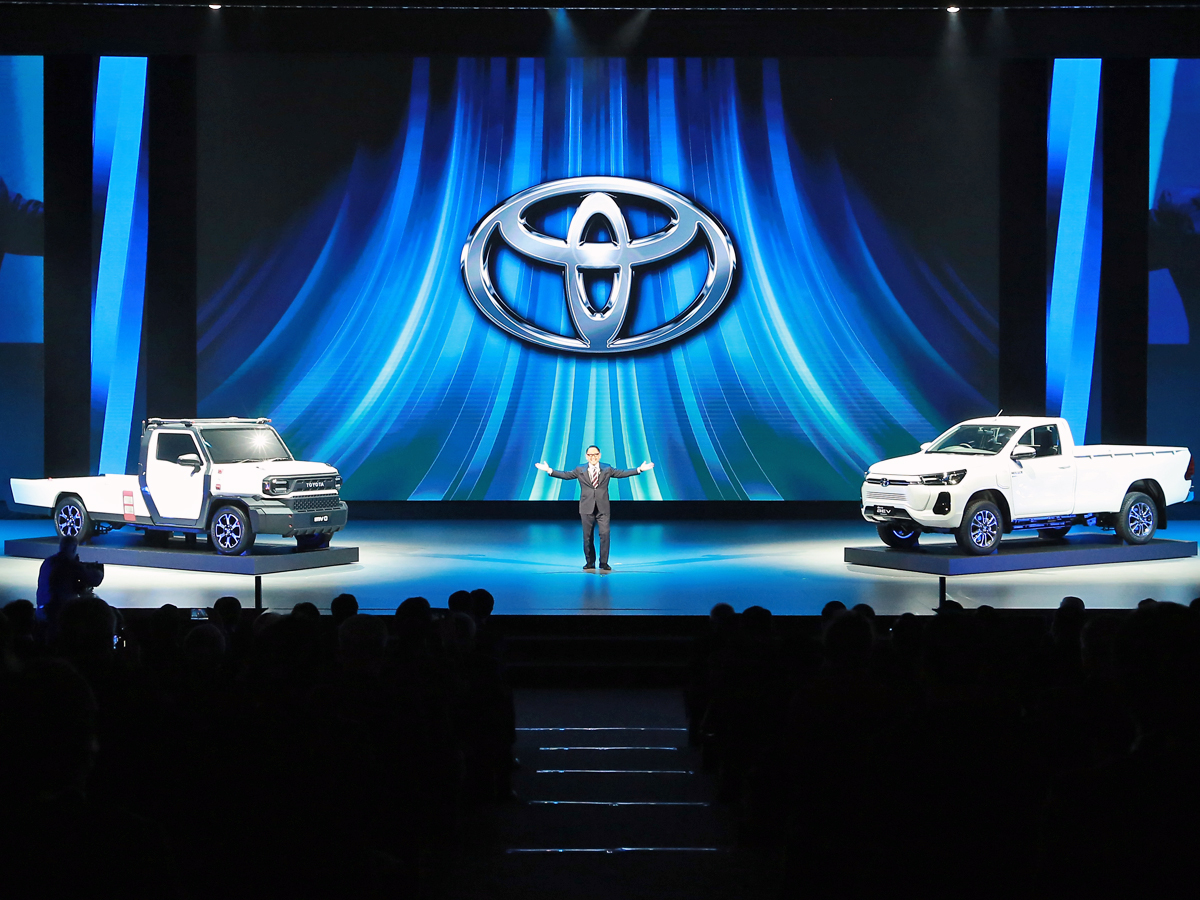
The IMV 0 concept (left) was unveiled in Thailand in December 2022.
Of course, these aren’t the first rumours of a new sub-Hilux bakkie. Earlier in 2023, as reported by IOL Motoring, Toyota SA Motors executives hinted at an upcoming model that could slot in below the popular Hilux and likely be built at the same factory in Prospecton, KwaZulu-Natal. As we’ve touched on before, however, this may well end up being a prolonged-lifecycle version of the Hilux (a “Hilux Quest”, if you will) rather than an all-new model (or indeed a unibody half-tonner).
Before that, Toyota took the wraps off a new “IMV 0 concept” single-cab bakkie in Thailand, suggesting the upcoming production version would be “designed to support economic growth and mobility for all”. From what we understand, such a model would also feature a ladder-frame rather than unibody construction.
Time will tell whether Toyota extends the 57-year-old Corolla nameplate – which is today used on a hatchback, sedan, wagon and crossover – to the bakkie body style…
How many units of your favourite hot hatch were sold in South Africa in July 2023? Let’s take a look at the local sales figures available for this segment…
While South Africa’s C-segment hot hatch class isn’t nearly as densely populated as in years gone by – with the likes of the Mazda3 MPS, Ford Focus ST and Opel Astra OPC having long since departed – there’s certainly still some sort of market for a family-friendly hatchback with a dash of extra oomph.
Of course, today’s high-performance hot hatches are by no means volume drivers for their respective manufacturers. In fact, in many cases, the local market receives only a limited number of units. In short, don’t expect the sales figures here to be lofty.
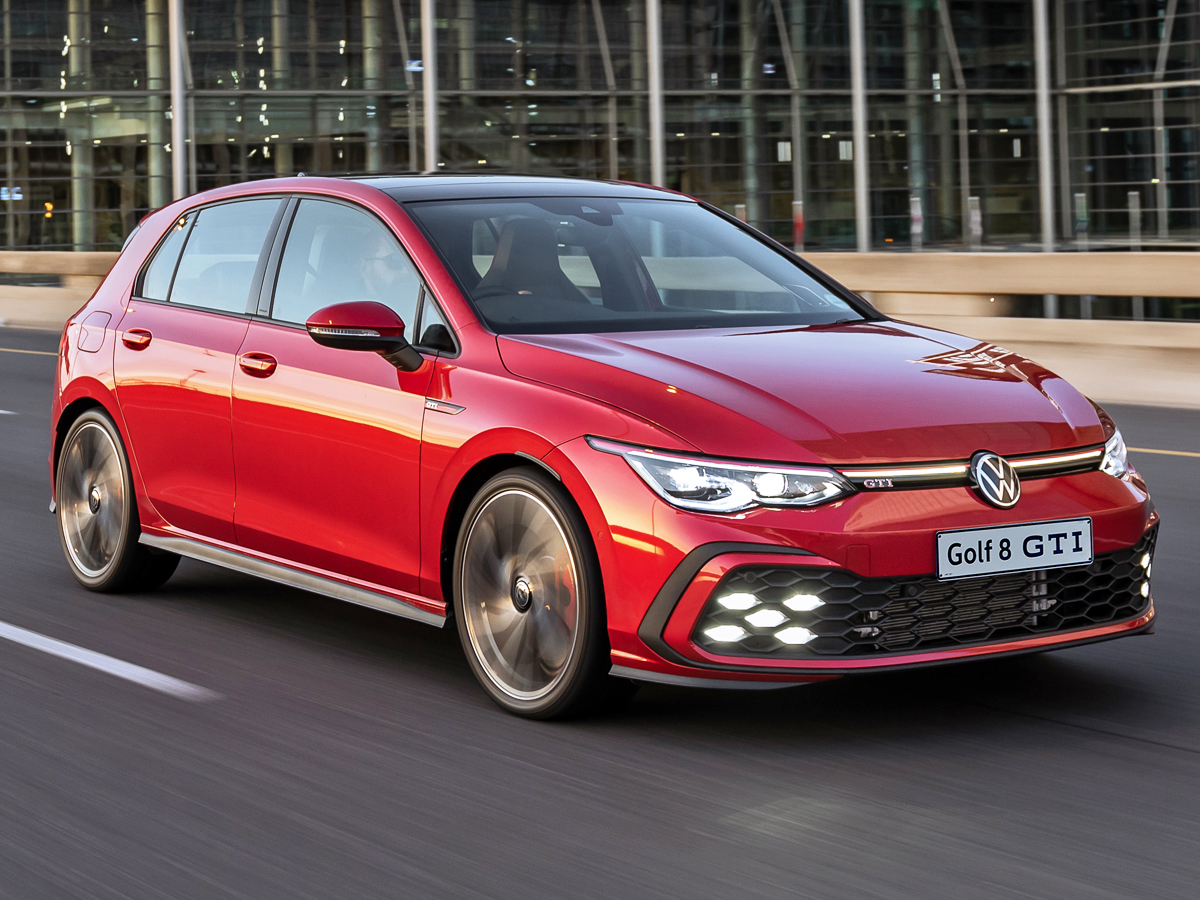
With that in mind, let’s take a look at sales of C-segment hot hatches in Mzansi for July 2023, according to Naamsa figures. The Volkswagen Golf 8 GTI and R – the German firm’s local division reports a combined number – managed 125 registrations last month, the nameplate’s best performance so far this year. Interestingly, 89 of those came via the dealer channel, while 27 represented sales to government.
July was the VW Golf GTI’s (combined with the R) best month of the year thus far.
And the new Toyota GR Corolla? Well, 7 examples were registered in July 2023. As a reminder, the Japanese firm opened the local order books back in mid-May, saying this 221 kW all-paw hot hatch (which is offered exclusively with a manual gearbox) would be available “in limited numbers”. The official market launch took place late in July, with around 5 units expected to be imported every month from now.
Meanwhile, the 206 kW Hyundai i30 N ended July on 4 units, largely in line with its sales performance in previous months this year (it has yet to break into 2 figures in 2023, though local supply is – again – likely limited). As a reminder, a refreshed version of the i30 N arrived in SA early in April 2022, ditching the pre-facelift version’s 6-speed manual gearbox in favour of an 8-speed dual-clutch transmission.
Only a handful of examples of the Toyota GR Corolla will be imported every month.
Finally, just a single example of the 221 kW Renault Mégane RS 300 Trophy was registered locally last month. At the start of 2023, the French firm’s distributor unexpectedly announced the RS 300 Trophy had made a return to South Africa, though that just 55 units were up for grabs. According to figures reported to Naamsa over the past 7 months, 11 have been registered so far this year.
Of course, we should point out sales figures are not available for a few other C-segment hot hatches. Since the BMW Group and Mercedes-Benz unfortunately don’t report details sales statistics to Naamsa, we don’t know how many 128ti, M135i xDrive, Mini JCW Hatch, Mercedes-AMG A35 4Matic and Mercedes-AMG A45 S 4Matic+ units were sold, for instance.
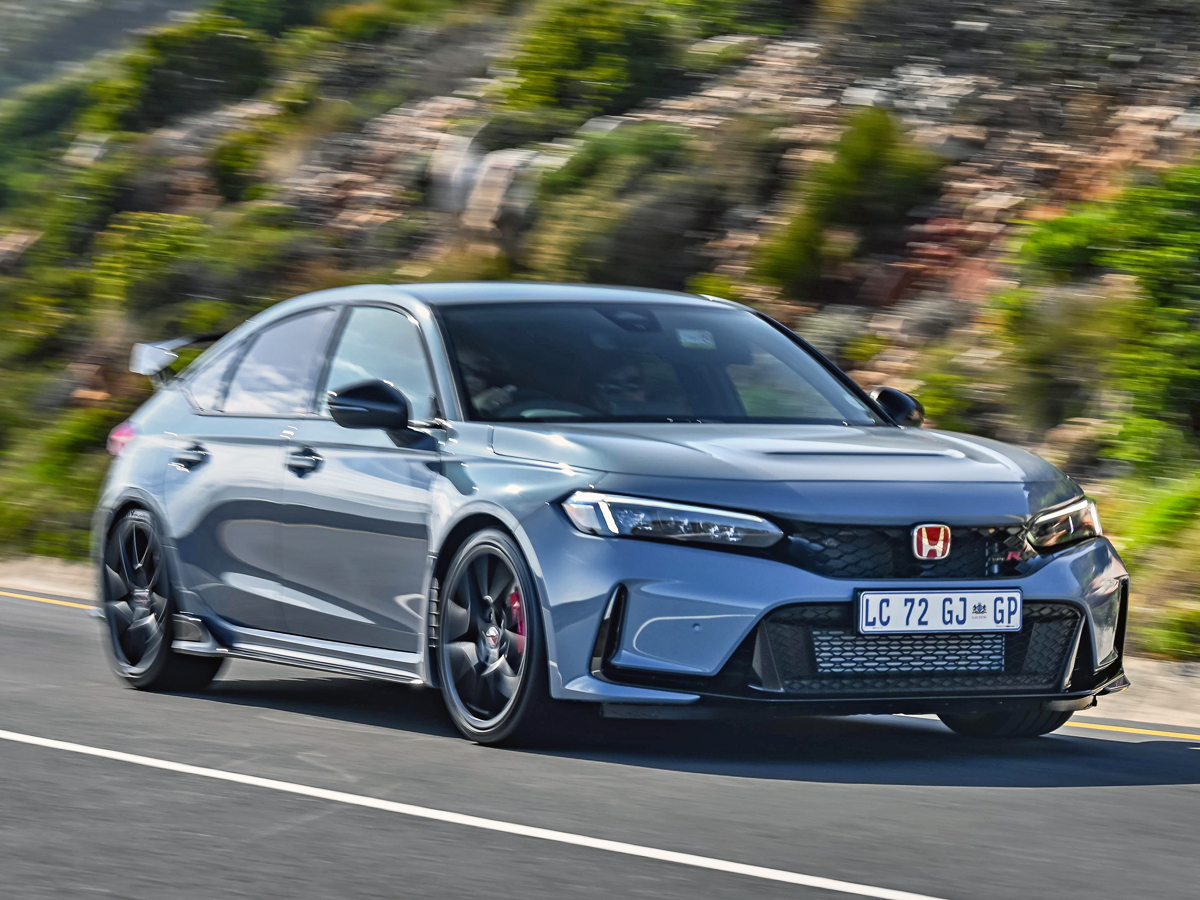
Honda Motor SA reports a combined figure for Civic sales rather than listing a separate Type R tally.
Furthermore, Audi reports only a total figure for its A3 Sportback range, so the sales performance of the S3 and RS3 hot hatches are unknown. Similarly, Honda lists only a single figure for its Civic range (just 6 units in July), which includes the new Civic Type R. The latter launched locally in April 2023, with just 60 units said to be earmarked for our market.
What about the B-segment below? Well, we know 3 examples of the Toyota GR Yaris were sold in SA in July 2023, along with a single unit of the warm-ish hatch Abarth 695. As with some of the models above, an individual figure for the Volkswagen Polo GTI – which is lumped in with total Polo hatchback sales – is not available (it’s the same case with the Suzuki Swift Sport as the brand reports only a total Swift figure, though you might argue that model is warm rather than hot)…
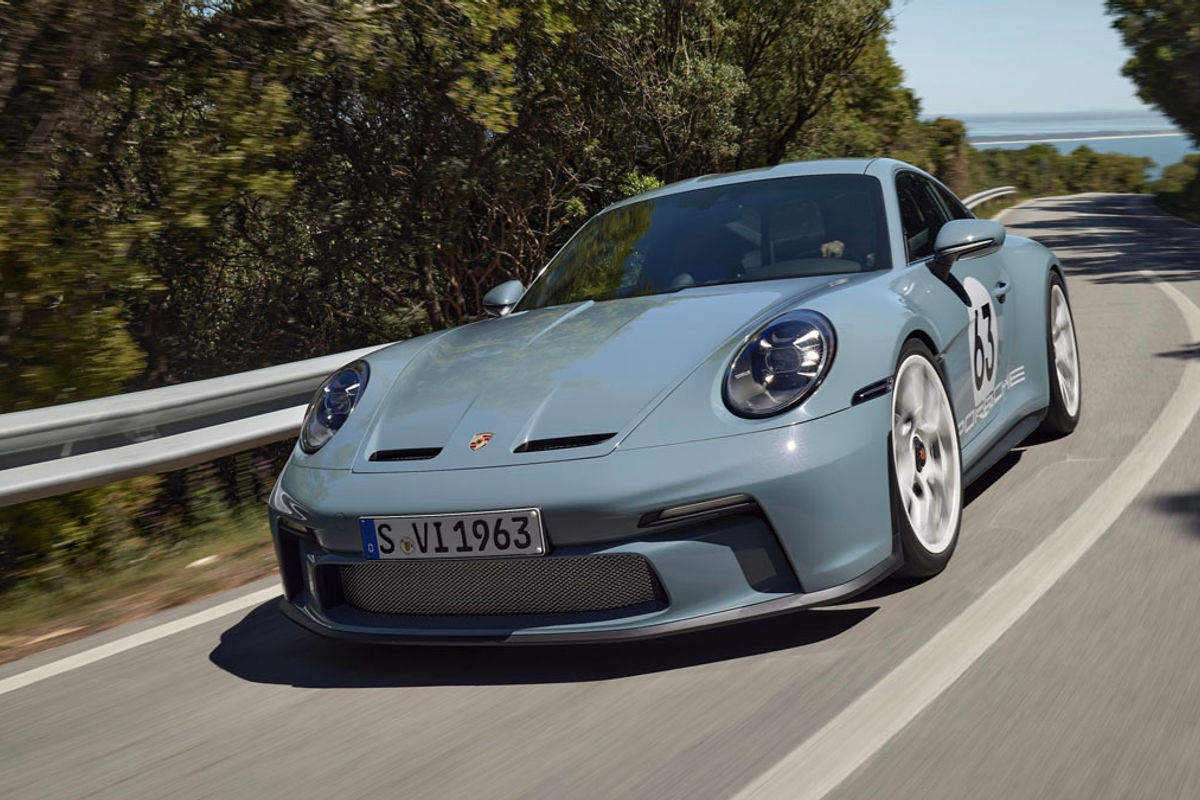
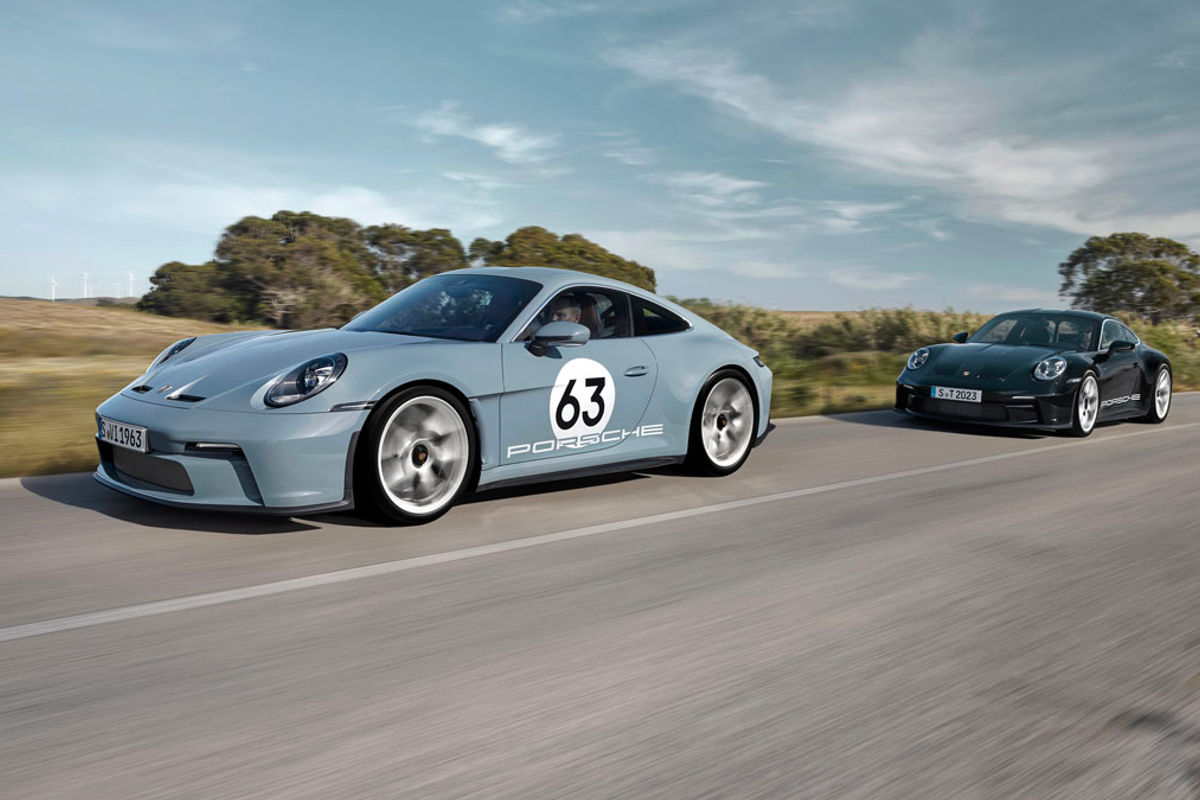
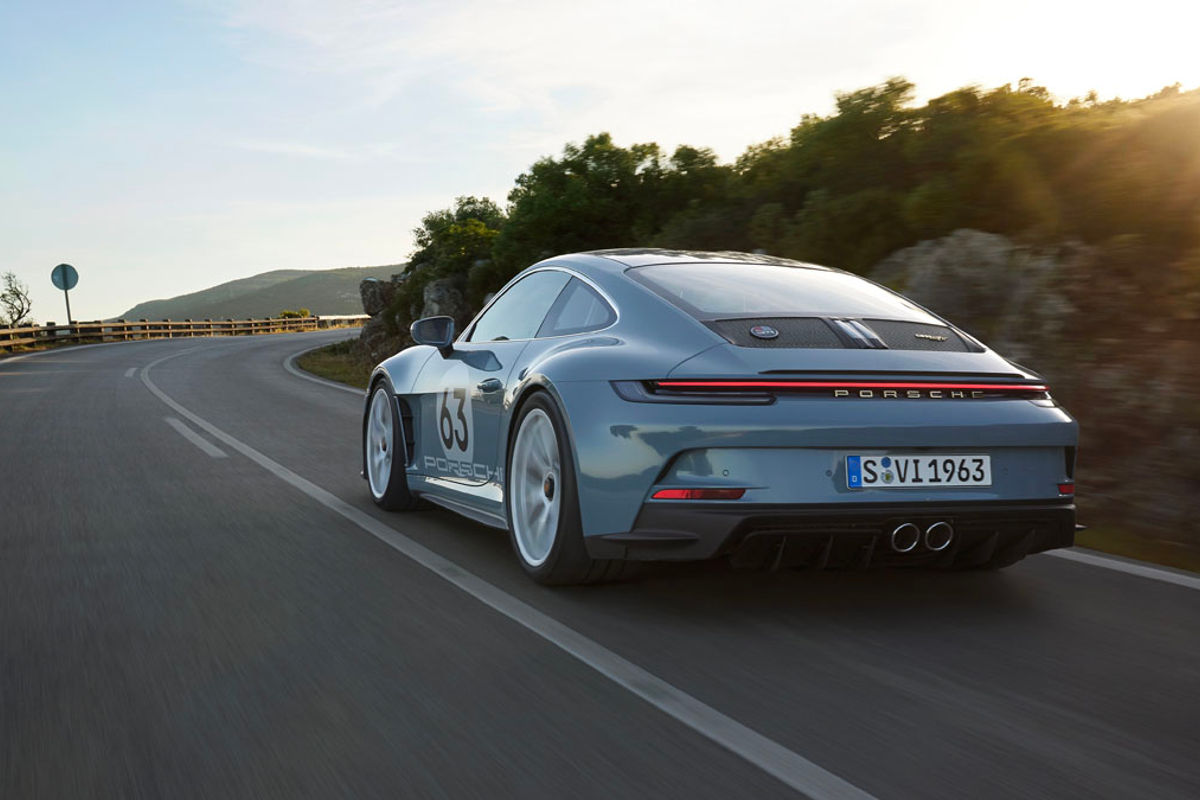
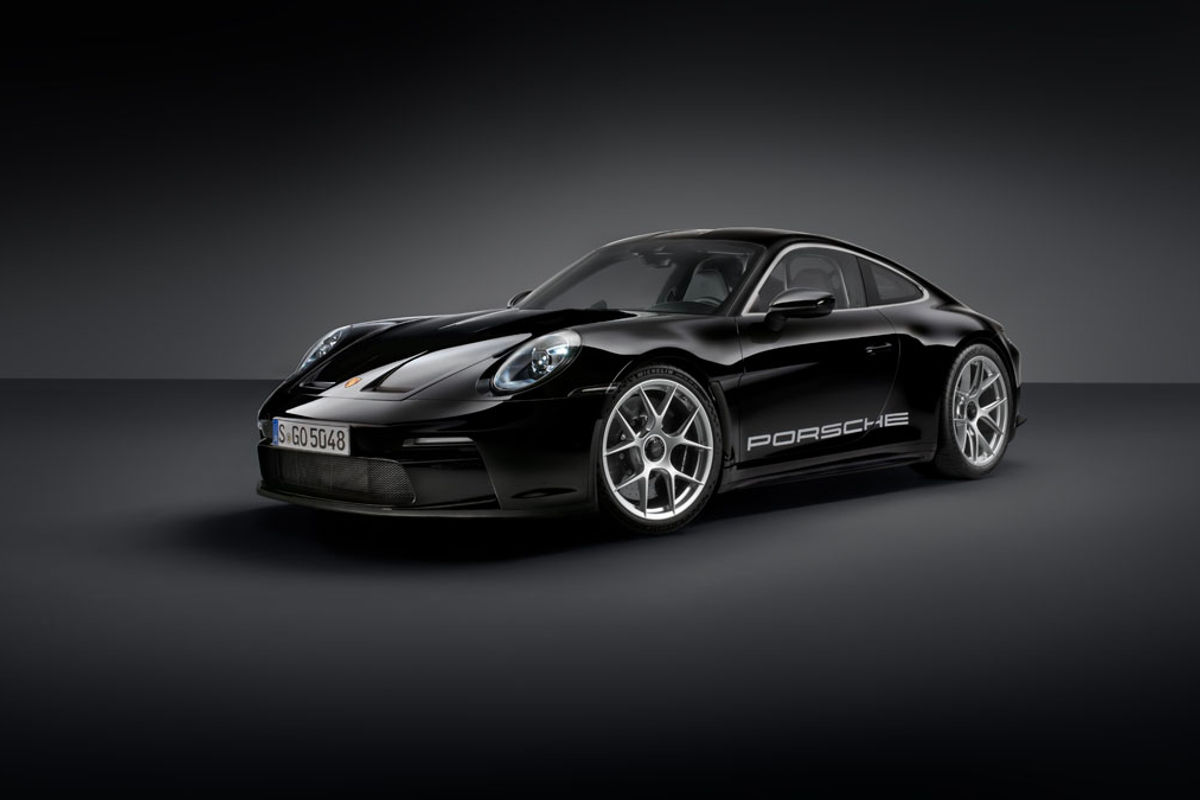
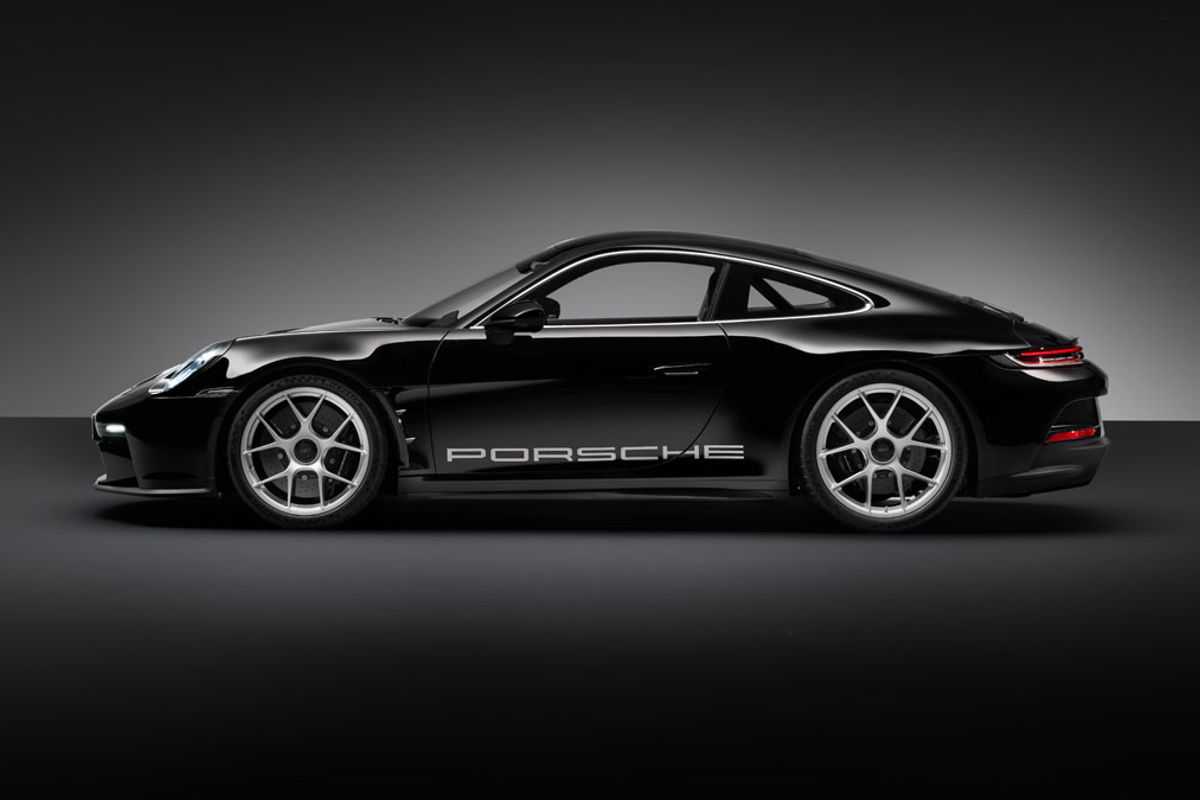
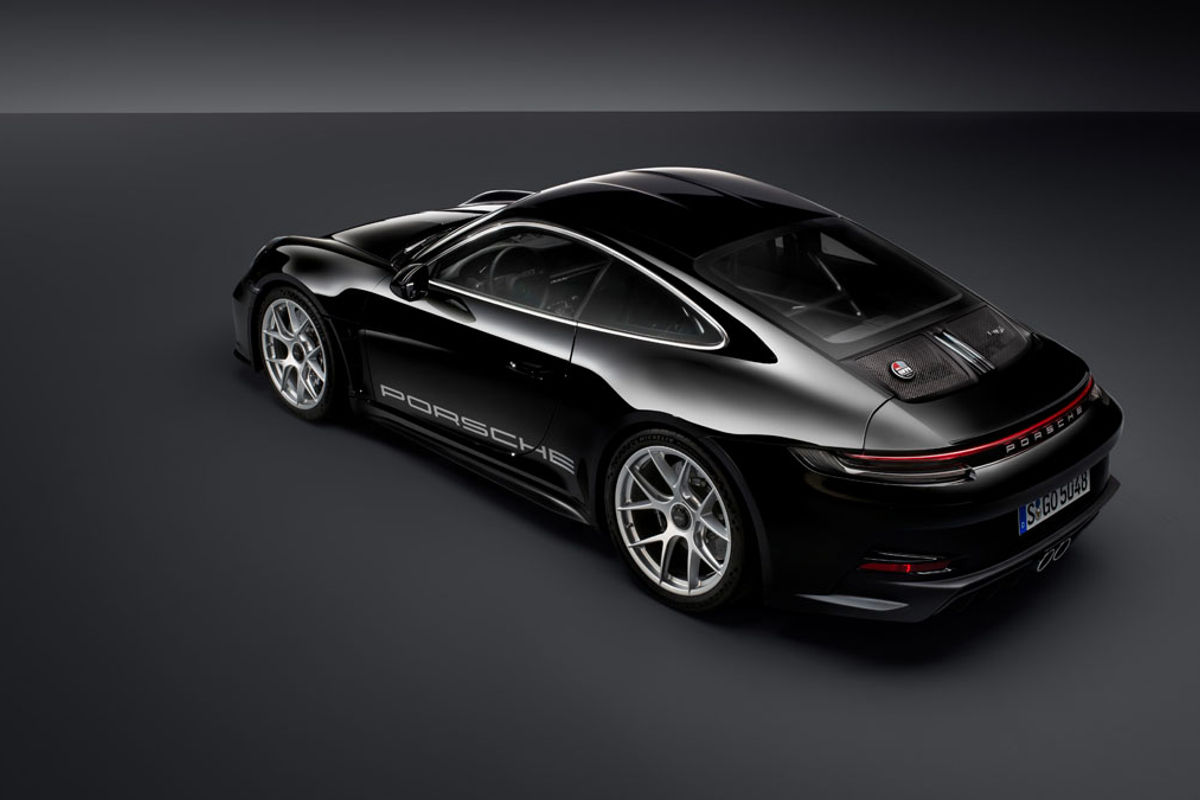
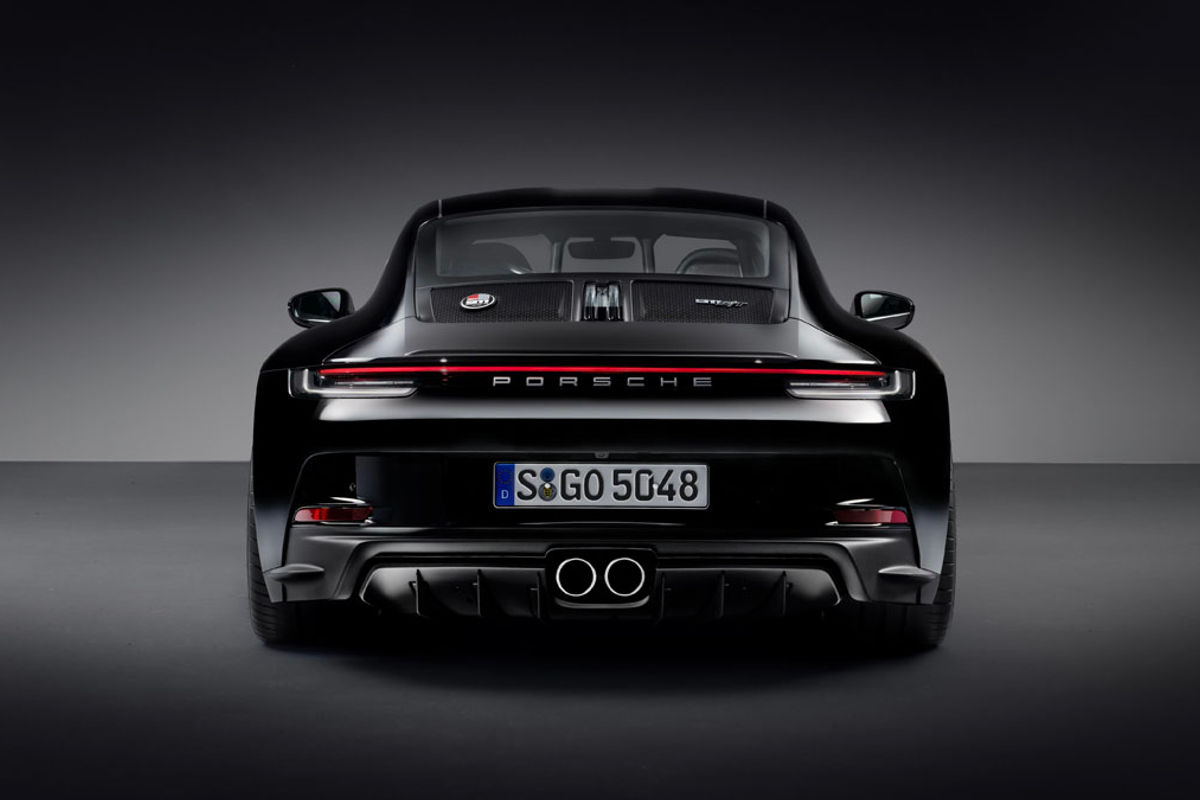
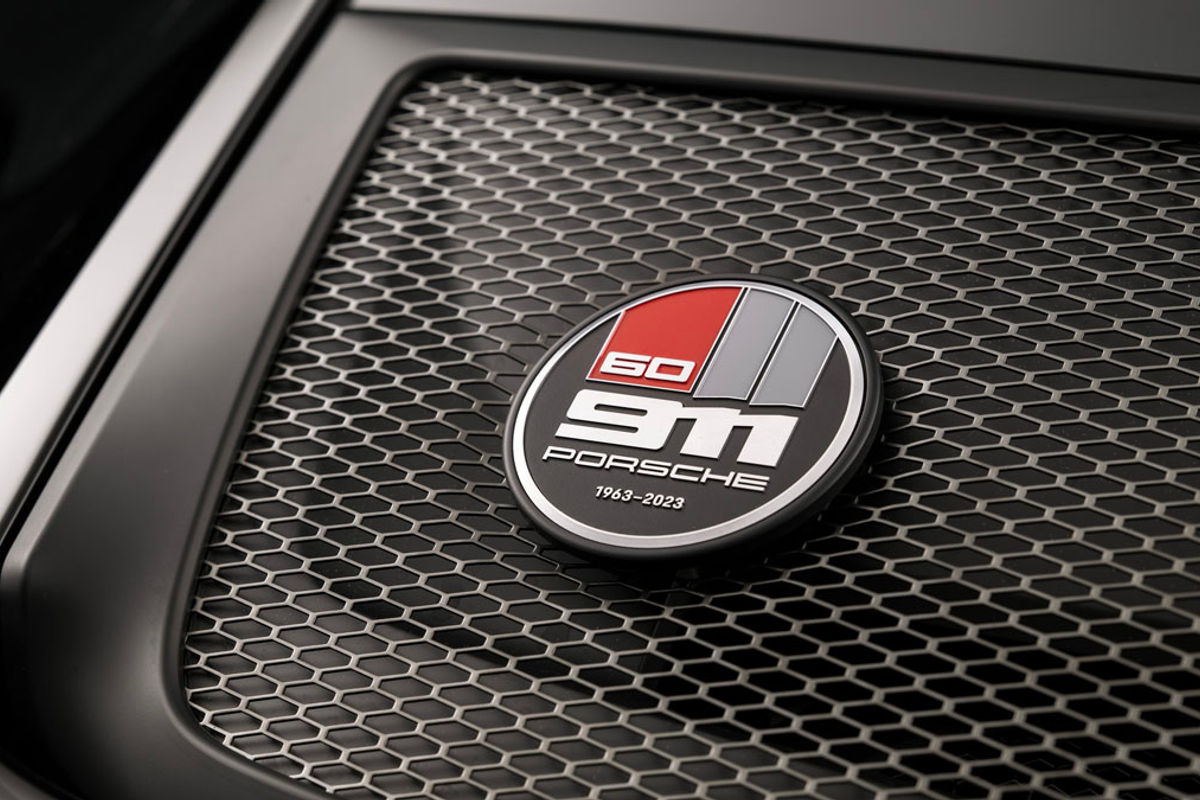
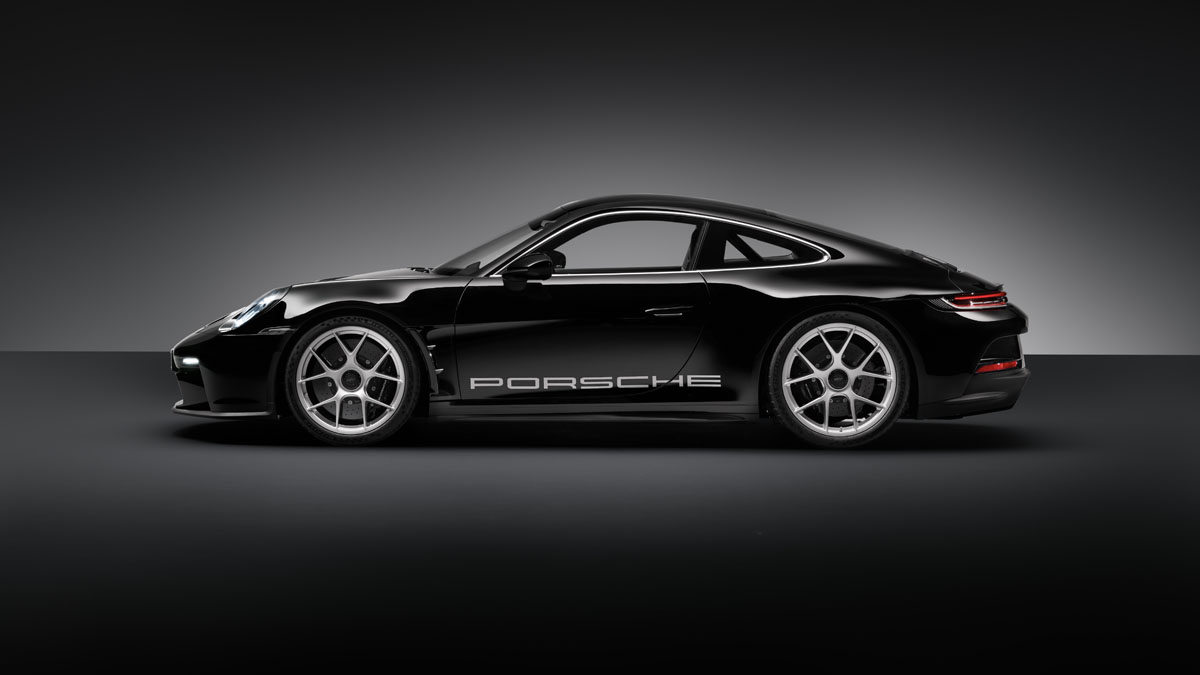
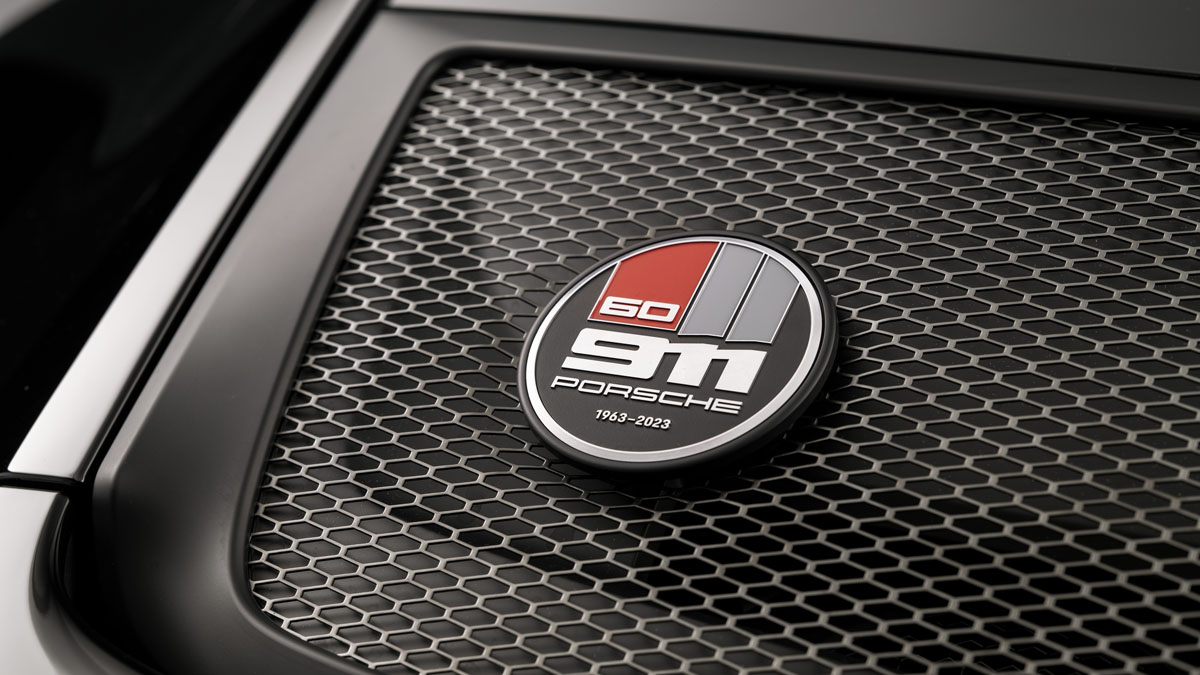
To mark the 60th anniversary of the 911, Porsche has produced the lightest model of the 992 generation yet… The 911 S/T – with the high-revving engine from the 911 GT3 RS, a manual ‘box and a lightweight clutch – is the quintessential driver’s car.
Anoraks will recognise that the 911 S/T’s nomenclature harks back to 1969, when Porsche produced a special race version of the original 911 S (internally, this vehicle was called the 911 ST). Modifications to the chassis, wheels, engine and body improved the S’ acceleration, braking, traction and cornering grip.
The 911 S/T takes up the spirit of the original 911 S (ST) and transfers it to the 992-generation Porsche 911 model. The Zuffenhausen-based firm describes its special model (of which only 1 963 units will be produced) as a “highly purist sports car dedicated to sheer driving enjoyment”, but those might be one of those few occasions that a car brand’s NOT exaggerating when describing its latest model release.
That’s because this special model combines the 911 GT3 RS’ naturally aspirated 4.0-litre flat-6 engine, which produces 386 kW at 8 500 rpm and 465 Nm of torque at 6 300 rpm, with the body of the 911 GT3 with Touring Package and incorporates lightweight components specially developed for the 911 S/T.
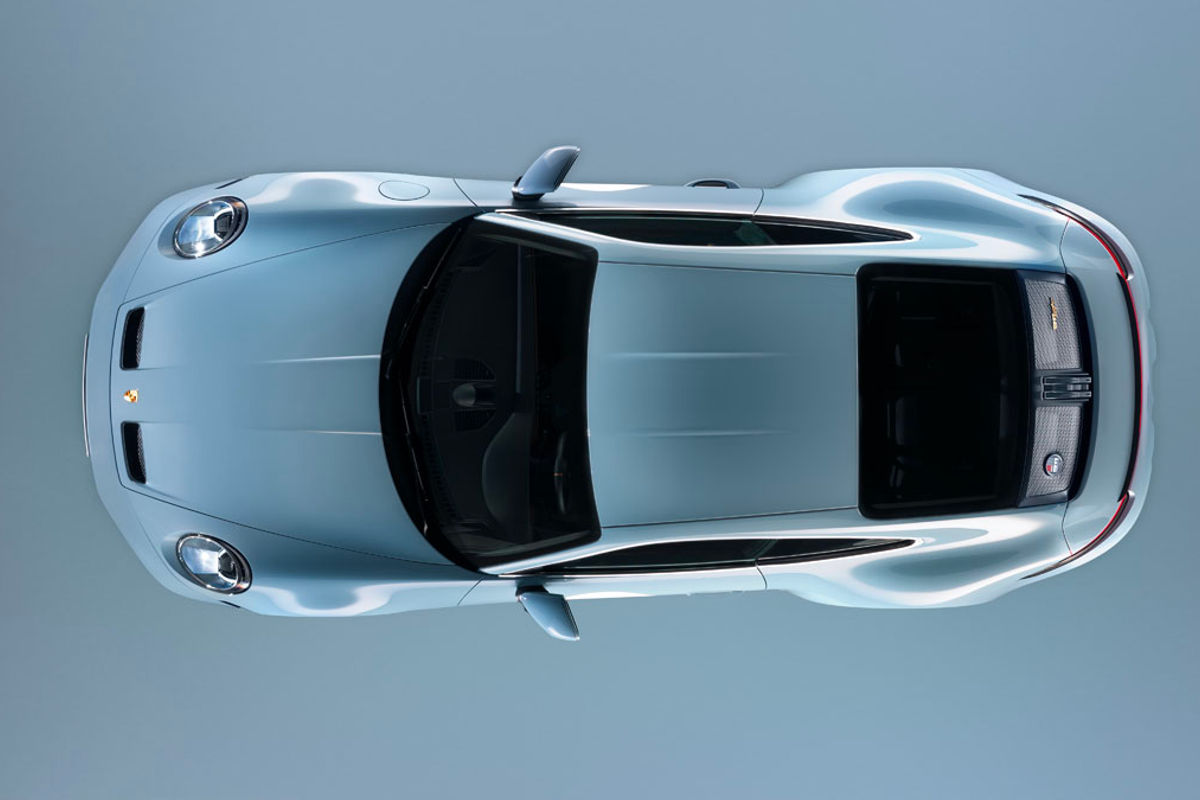
The bonnet, roof, front wings and doors are made of lightweight carbon-fibre-reinforced plastic (CFRP). The same applies to the roll cage, rear axle anti-roll bar and shear panel (stiffening element on the rear axle). Furthermore, the Porsche 911 S/T is fitted with 20-inch (front) and 21-inch (rear) centre-locking magnesium wheels, the PCCB system, a lithium-ion starter battery and lightweight glass as standard.
With reduced insulation, the omission of rear-axle steering and weight savings in the powertrain, the 911 S/T achieves an astonishingly skinny DIN kerb weight of 1 380 kg (that’s including all fluids). This makes the 60th-anniversary 911 even 40 kg lighter than a manual 911 GT3 Touring.
Also, a new lightweight clutch was developed exclusively for the 911 S/T. In conjunction with a single-mass flywheel, it reduces the weight of the rotating mass by 10.5 kg. “This noticeably improves the engine’s responsiveness,” Porsche claims, “which builds revs with (extraordinary) speed and directness.”
Equipped with a 6-speed manual gearbox with a shorter gear ratio than on the 911 GT3, the Porsche 911 S/T is said to rocket from 0 to 100 kph in just 3.7 seconds and achieves a top speed of 300 kph…
However, the low kerb weight is truly the highlight of the special model because the reduction of rotating mass in the engine, wheels and brakes facilitates heightened dynamic responsiveness. The 911 S/T is said to respond to driver inputs “instantaneously” and deliver particularly agile, direct handling.
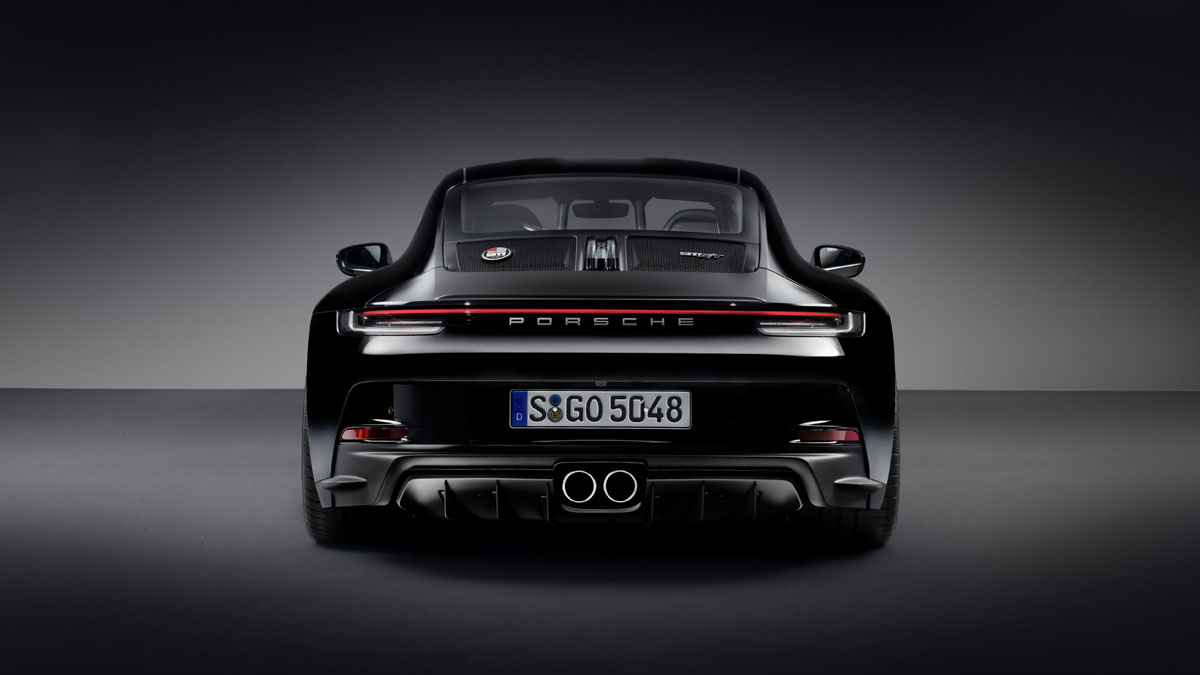
The 911 S/T is the only 992-generation 911 to combine a double-wishbone front-axle design with a multi-link rear axle without rear-axle steering. The dampers and control systems were tuned accordingly, a lightweight sports exhaust system is standard and a Gurney flap is fitted to the extending rear spoiler.
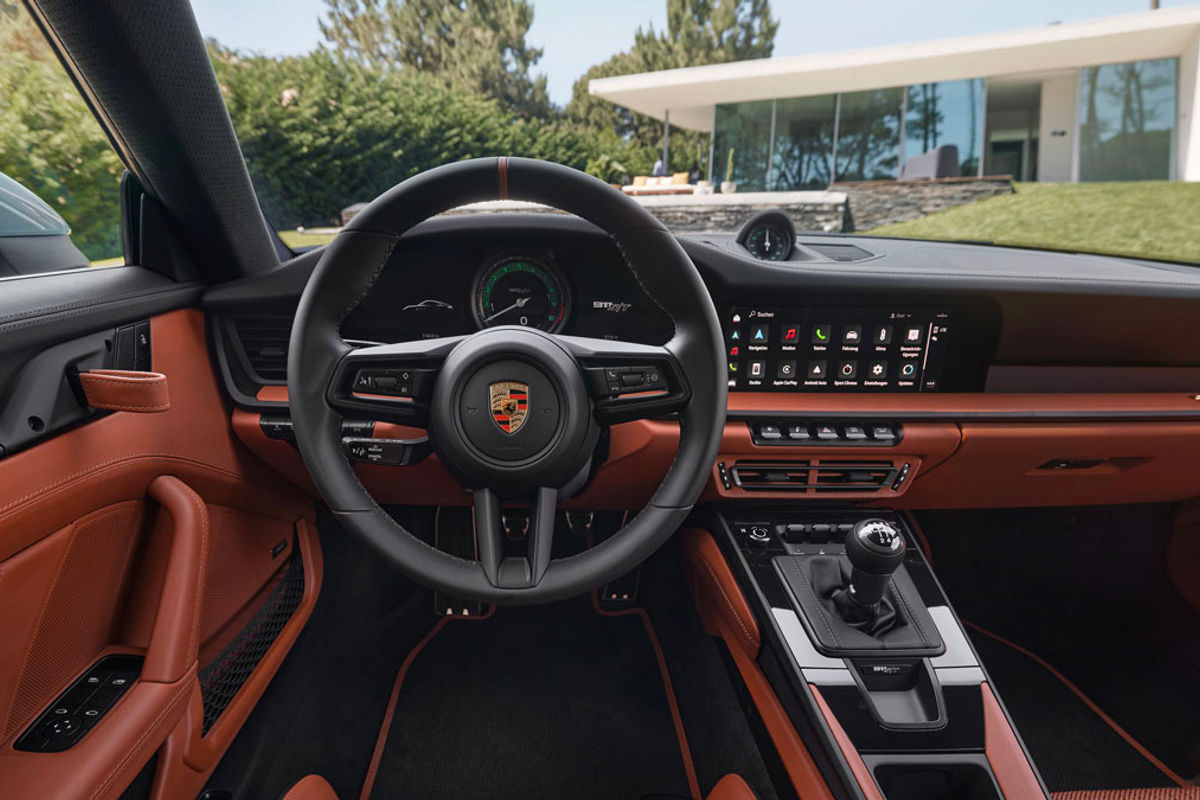
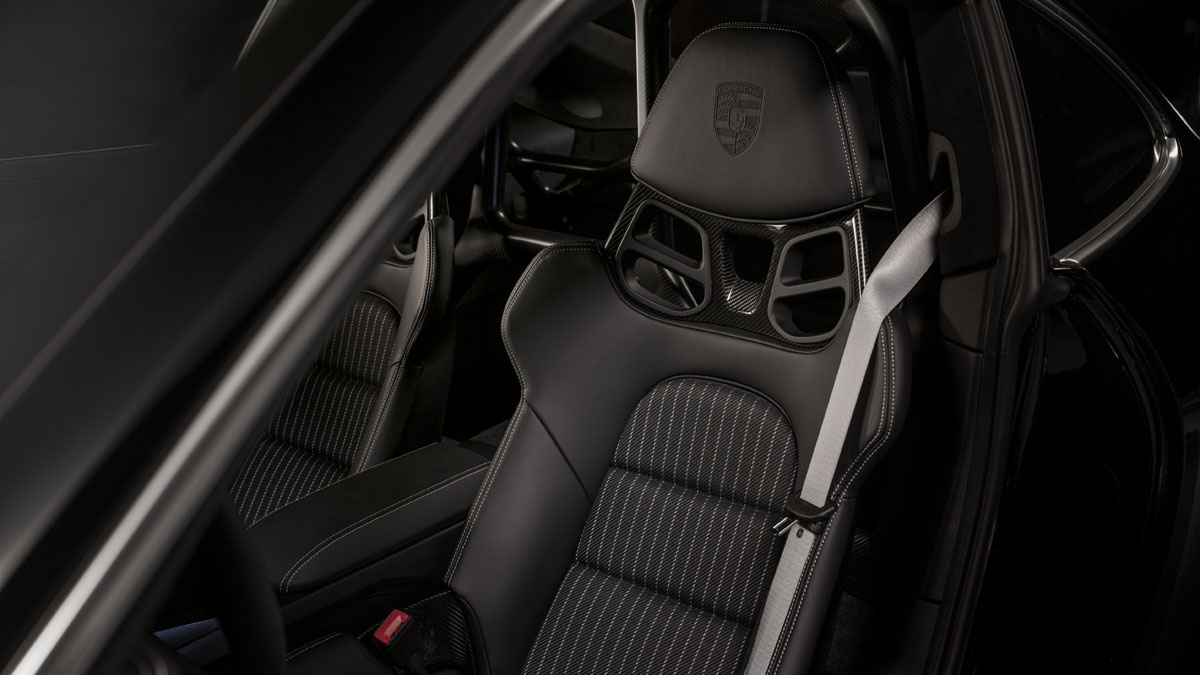
Standard equipment also includes 255/35 ZR 20 (front) and 315/30 ZR 21 (rear) tyres, CFRP full bucket seats (4-way-adjustable Sports Seat Plus is available at no extra charge). The instrument cluster and the clock of the Sport Chrono package are finished in a classic green Porsche colour scheme.
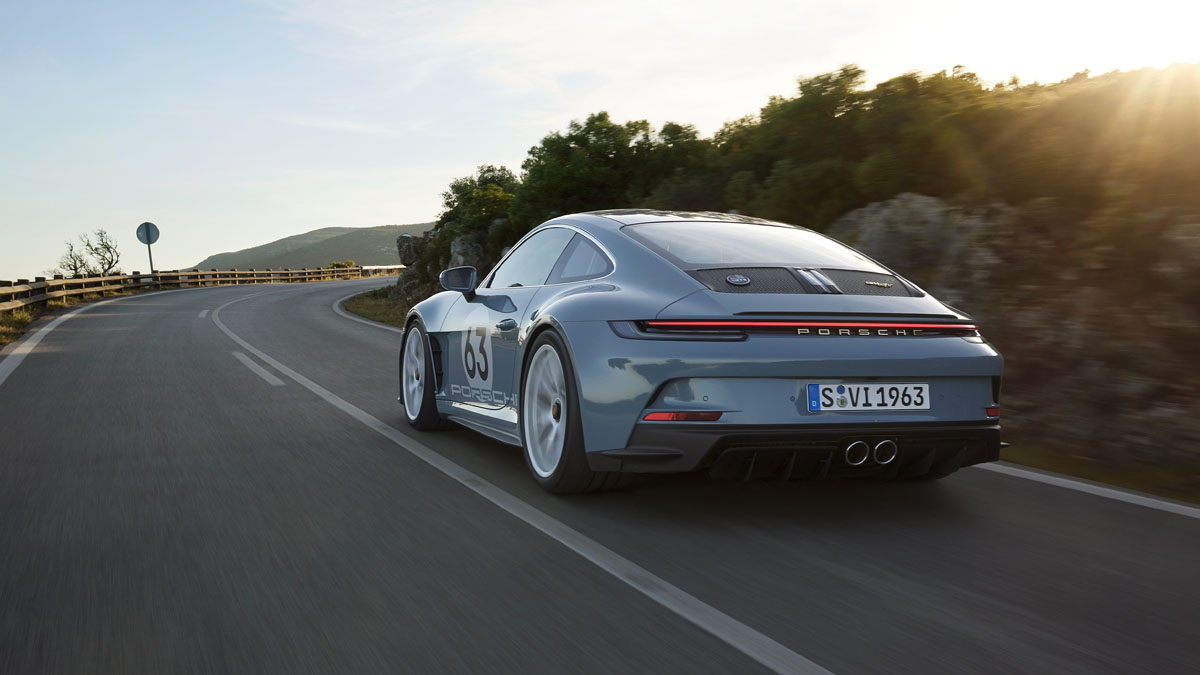
The 911 S/T is offered with an optional exclusive Heritage Design Package, which includes the Shoreblue Metallic exterior- and Ceramica wheel rim colours, which are exclusively available for this special model. On the doors, a starting number from 0 to 99, as well as a decorative foil can be applied on request. What’s more, the classic-design Porsche crest from the original 911 that adorns the front, the hub caps, the steering wheel, the headrests and the car key underscores the historic roots of the 911 S/T.
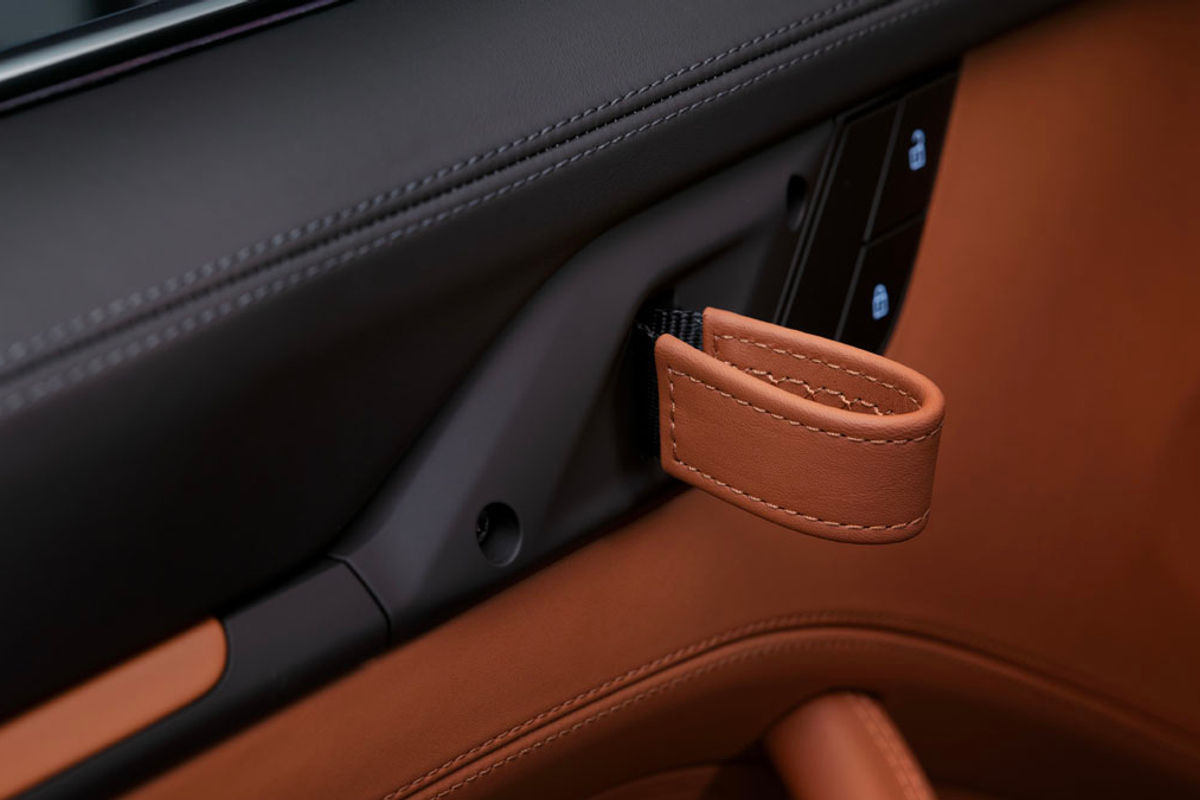
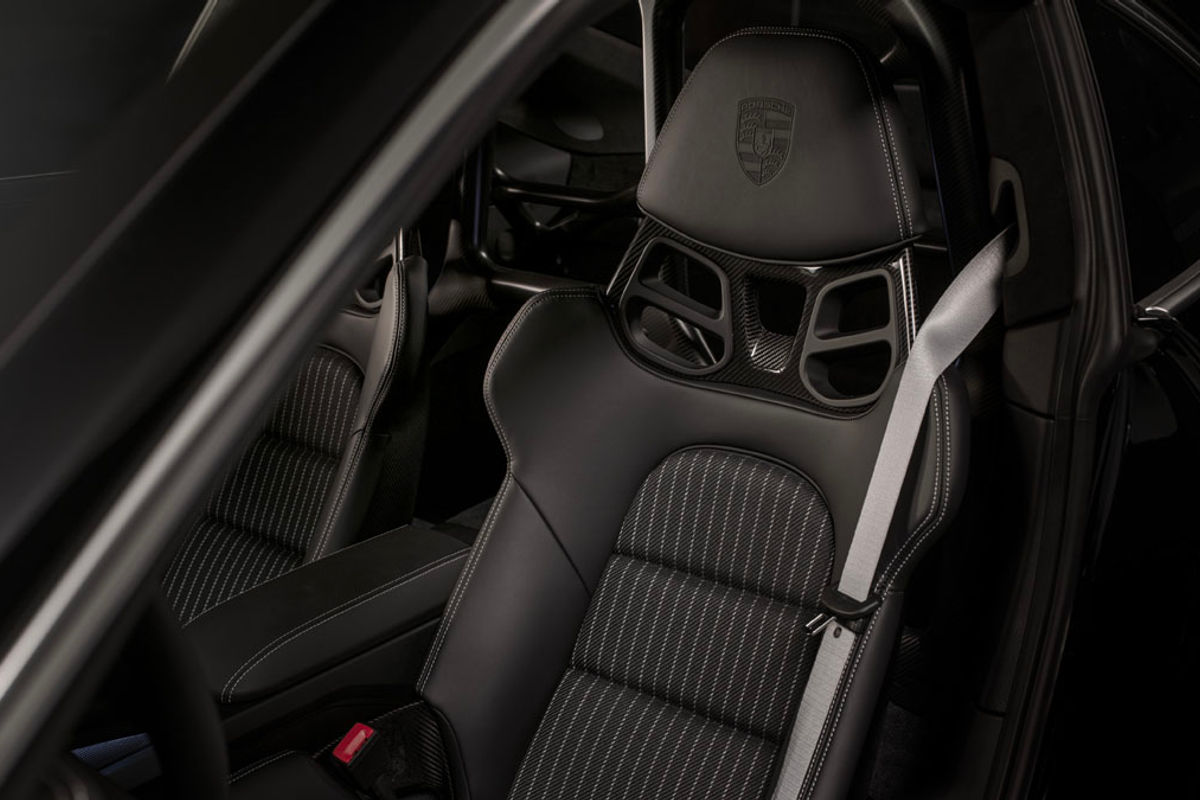
The interior also features cloth seat centres in Classic Cognac with black pinstripes, which are another homage to heritage. Two-tone semi-aniline leather trim in Black/Classic Cognac leather with extensive leather surrounds, a roof lining in perforated Dinamica, and other elements from Porsche Exclusive Manufaktur round out the package. The Porsche logo and the 911 S/T model designation are in Gold.
Porsche 911 S/T price in South Africa
The new model retails for R6 326 000, which includes a 5-year maintenance plan
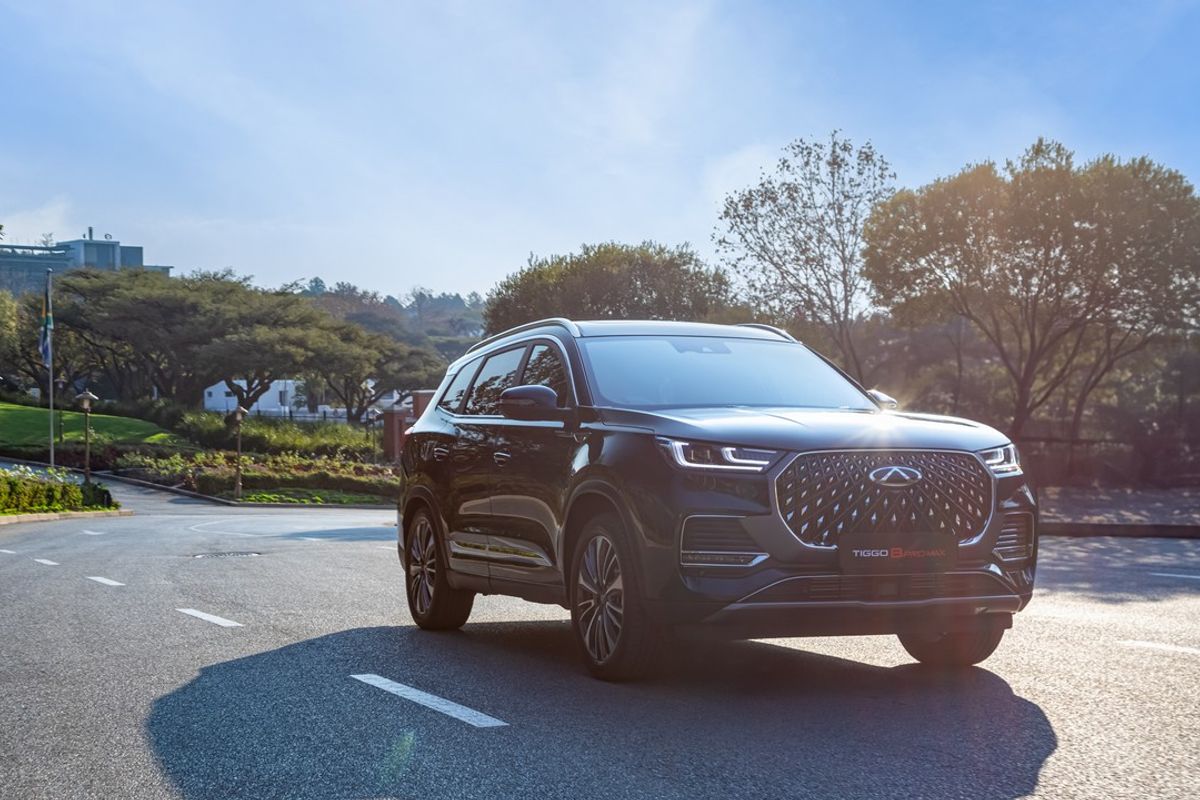
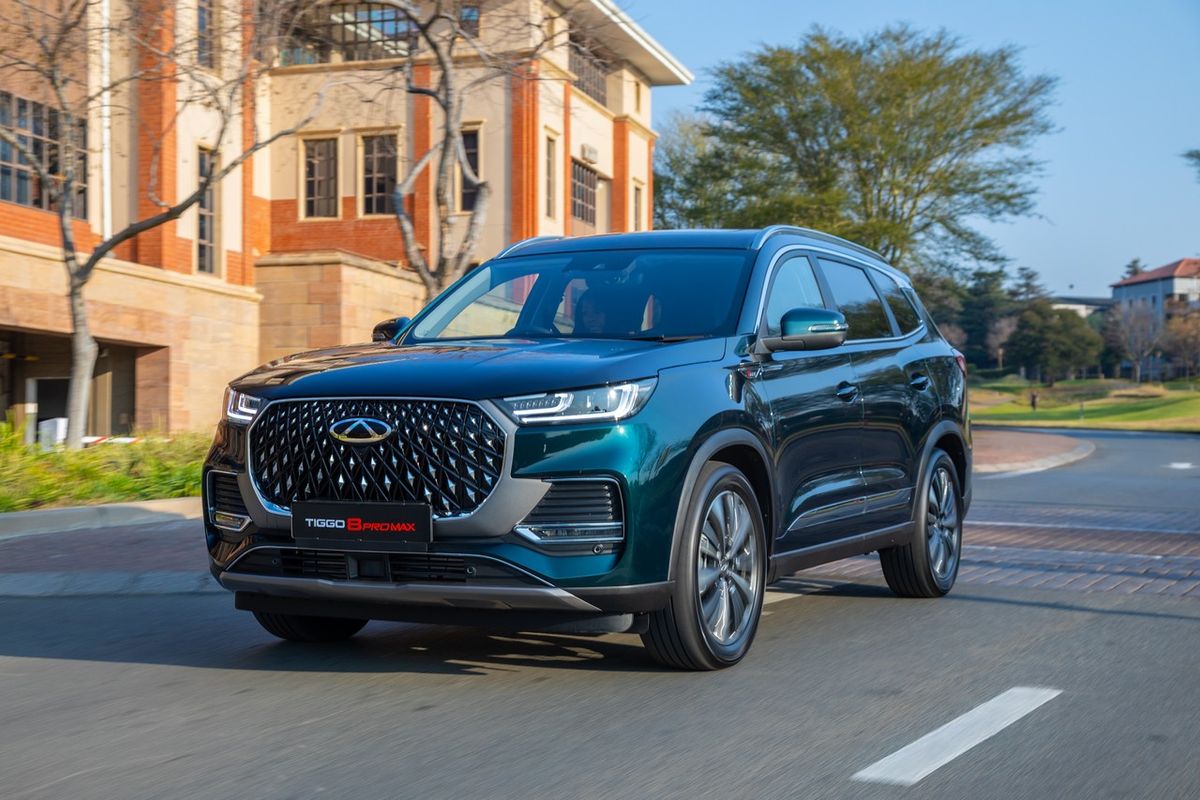
In the space of a year, Chery has become a dominant force in the market AND it has a slew of models to come, but first, an updated Tiggo 8 Pro Max has hit the streets. We drove the updated model at its launch in KZN to see if it will continue to drive sales.
What’s new on the Tiggo 8 Pro Max
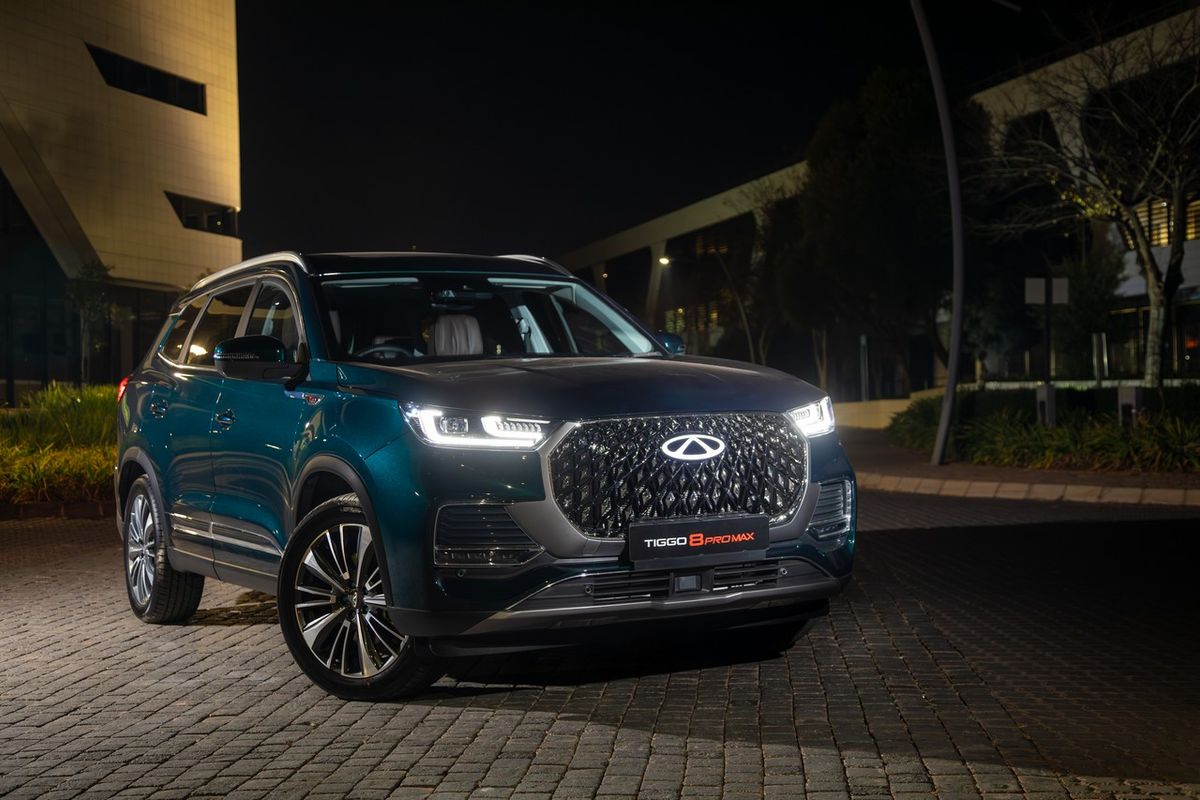
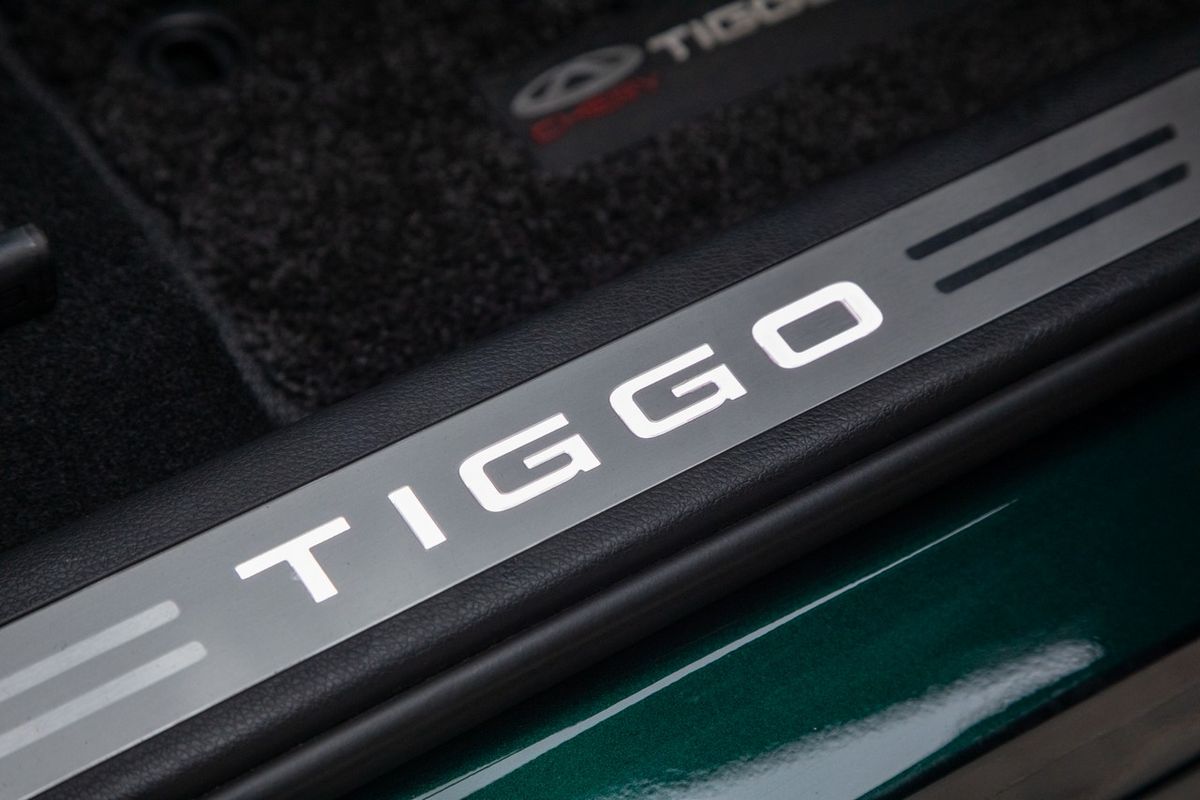
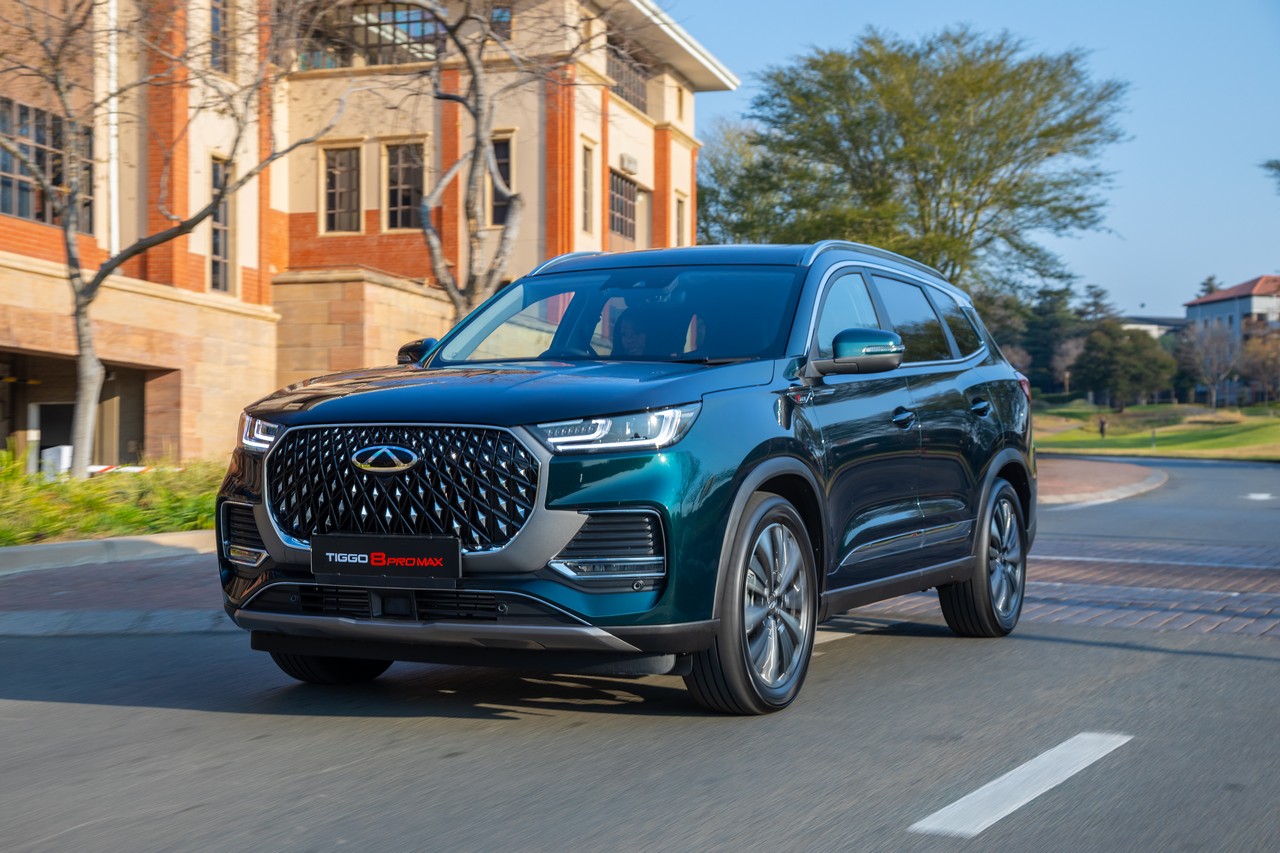
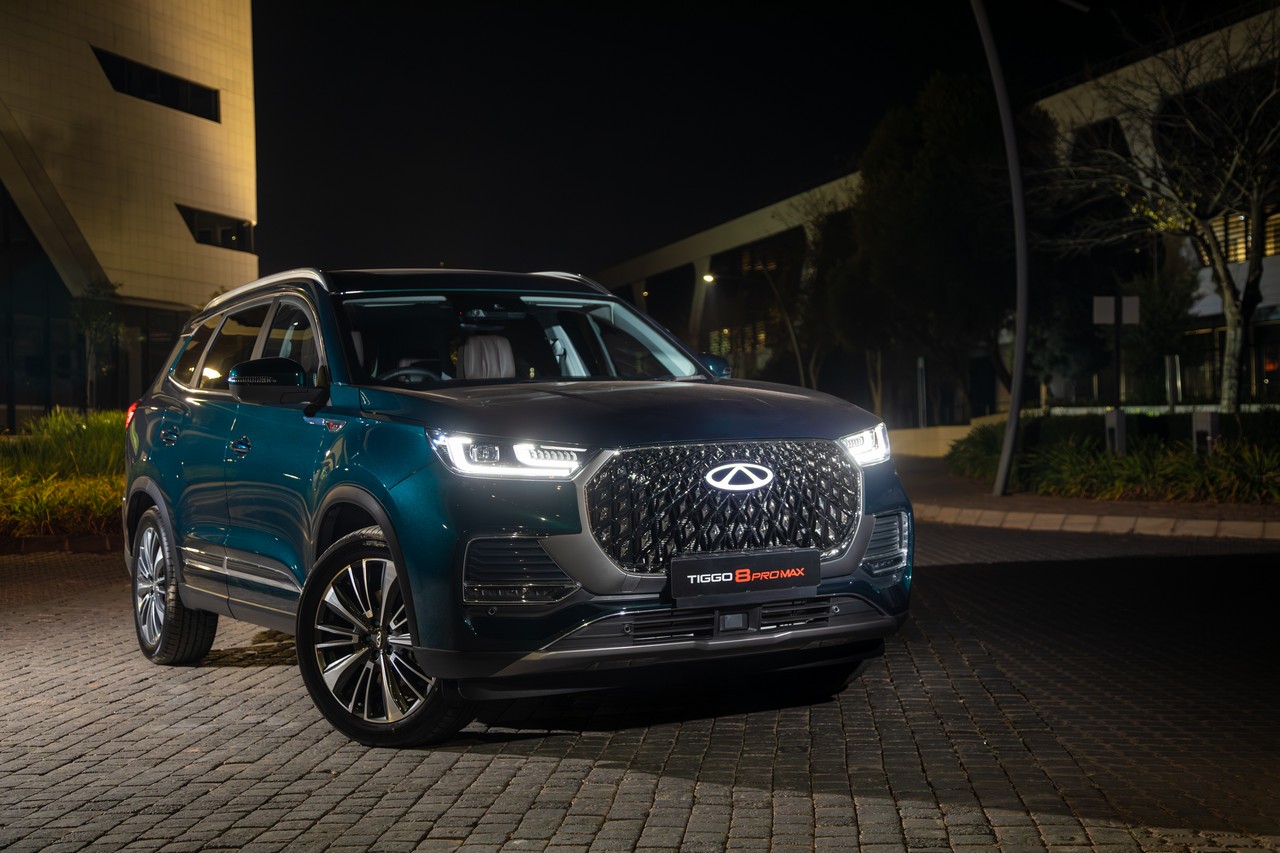
The facial area contains a badge that has the ability to light up.
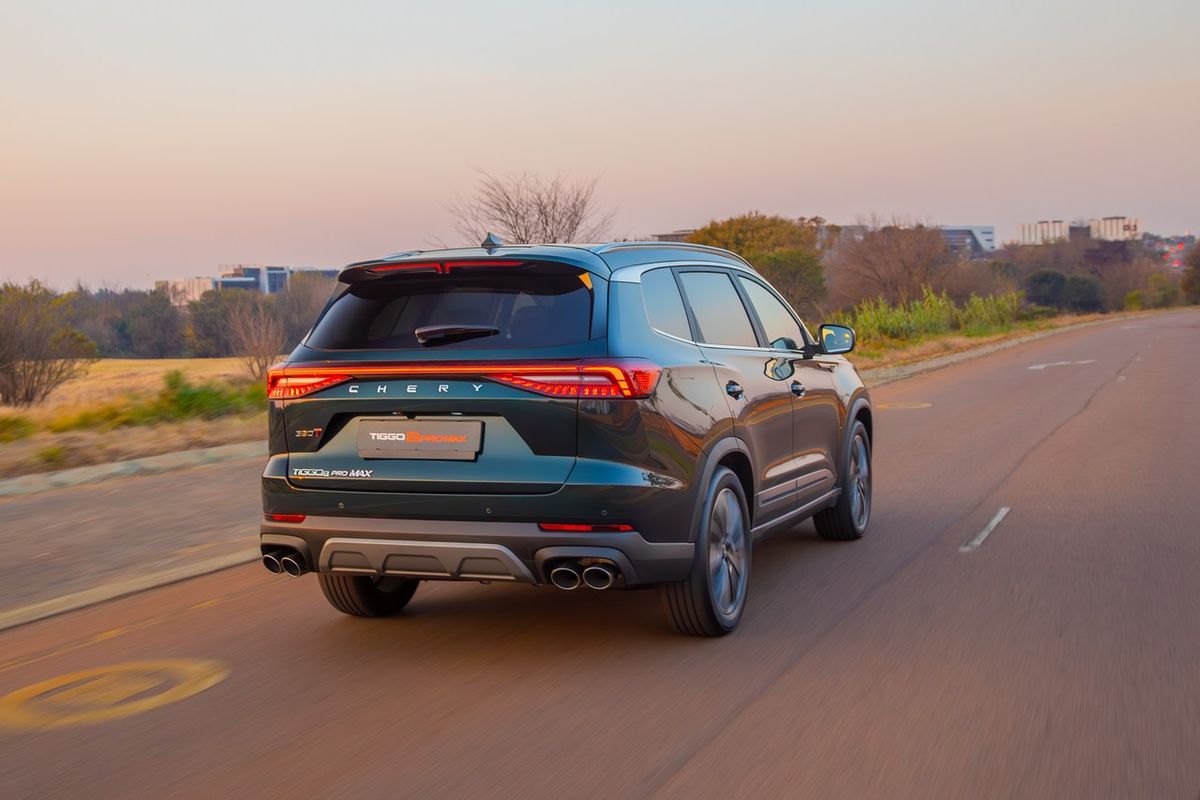
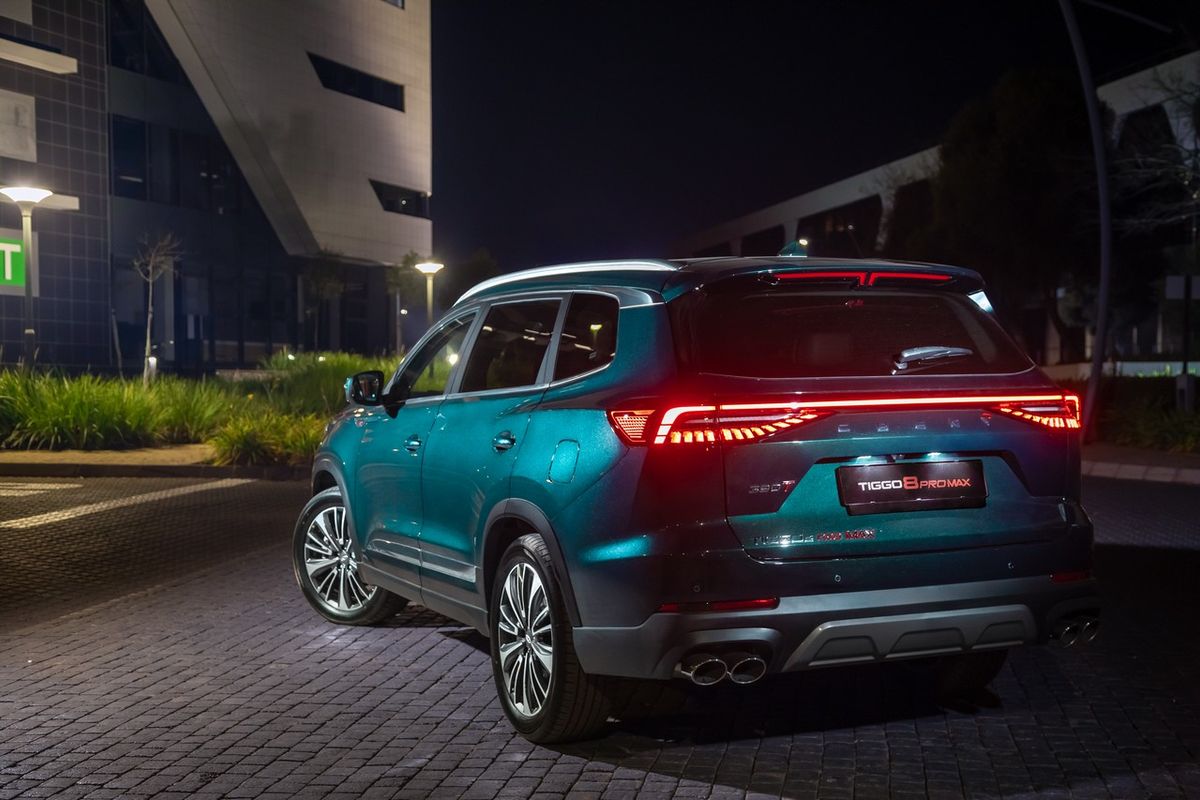
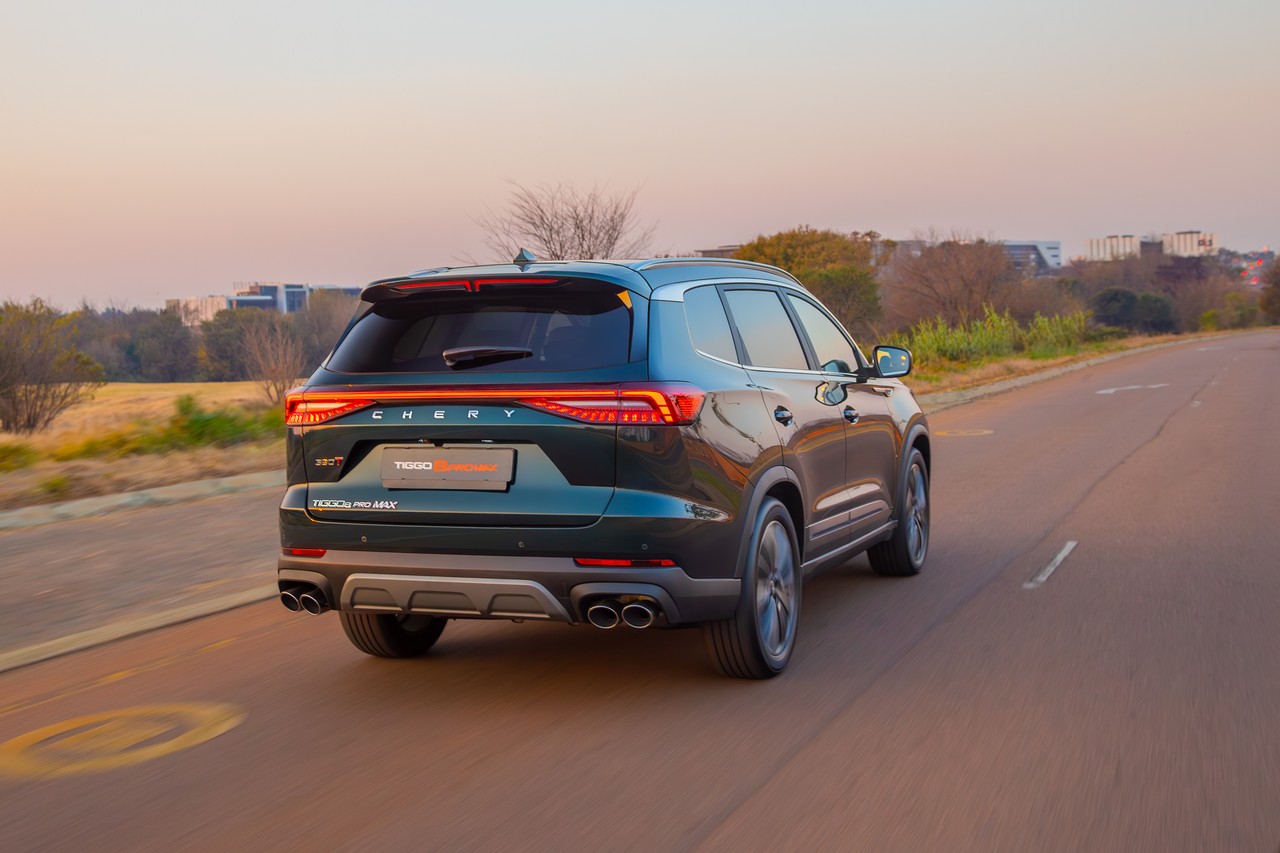
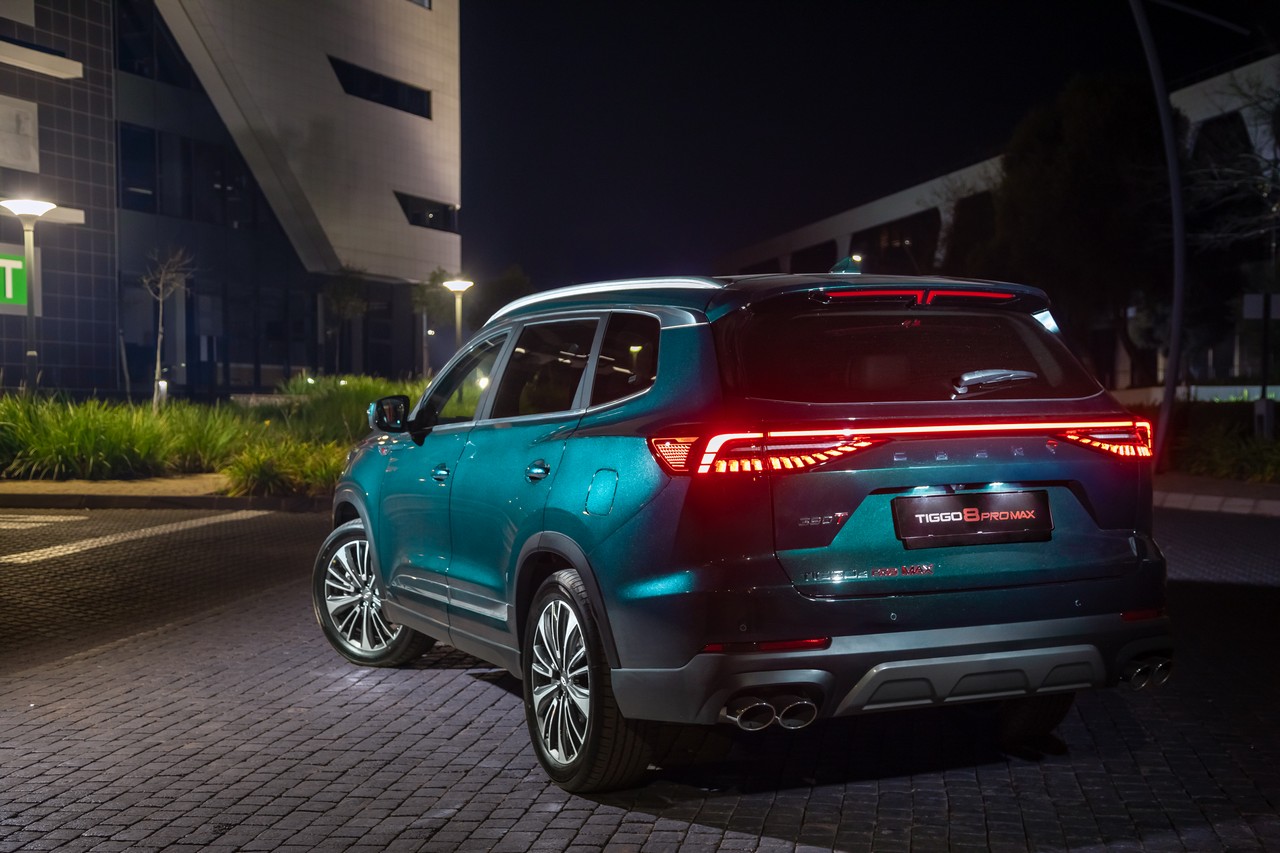
The Tiggo 8 Pro Max is the flagship of the Tiggo 8 Pro – a 7-seater SUV that’s about the same size as the recently launched Mitsubishi Outlander and Volkswagen Tiguan Allspace. The updated model ships with a slightly updated appearance, most notable by dark grey trim around the front grille and foglamps and, at the rear, Crystal Matrix LED tail lamps and a lightbar that stretches the width of the tailgate.
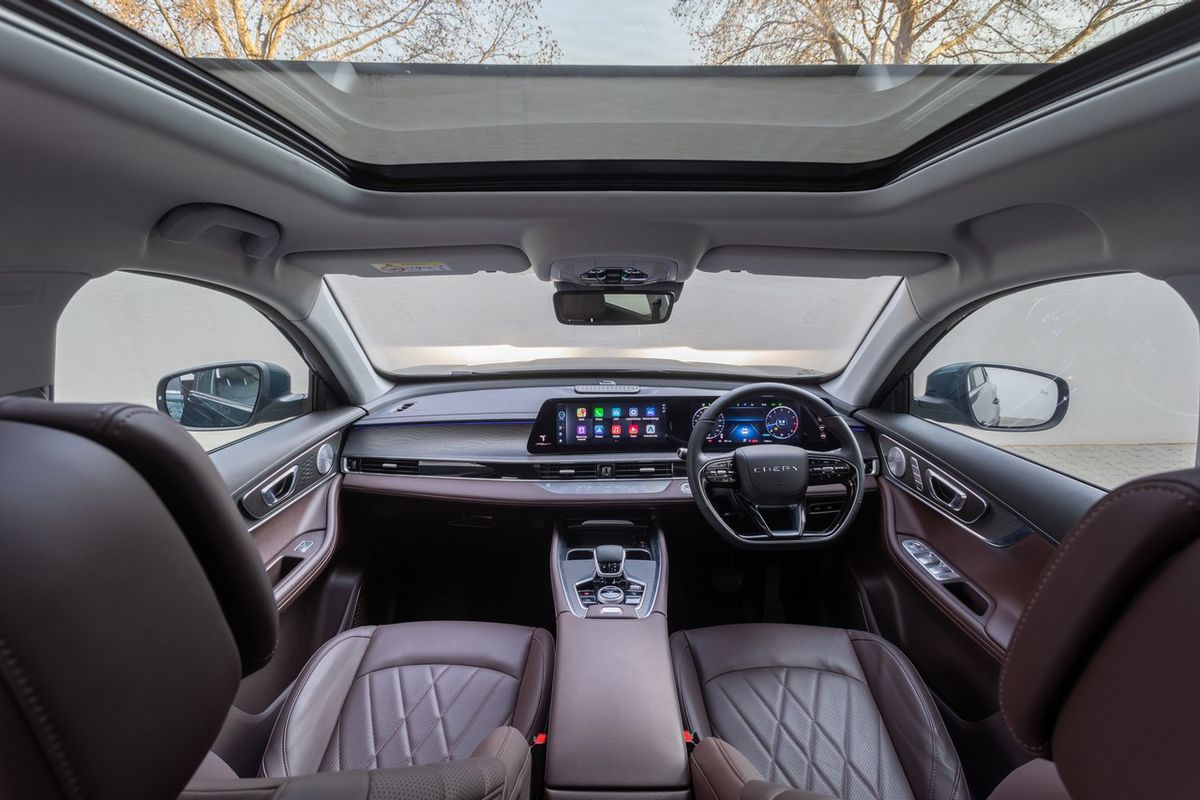
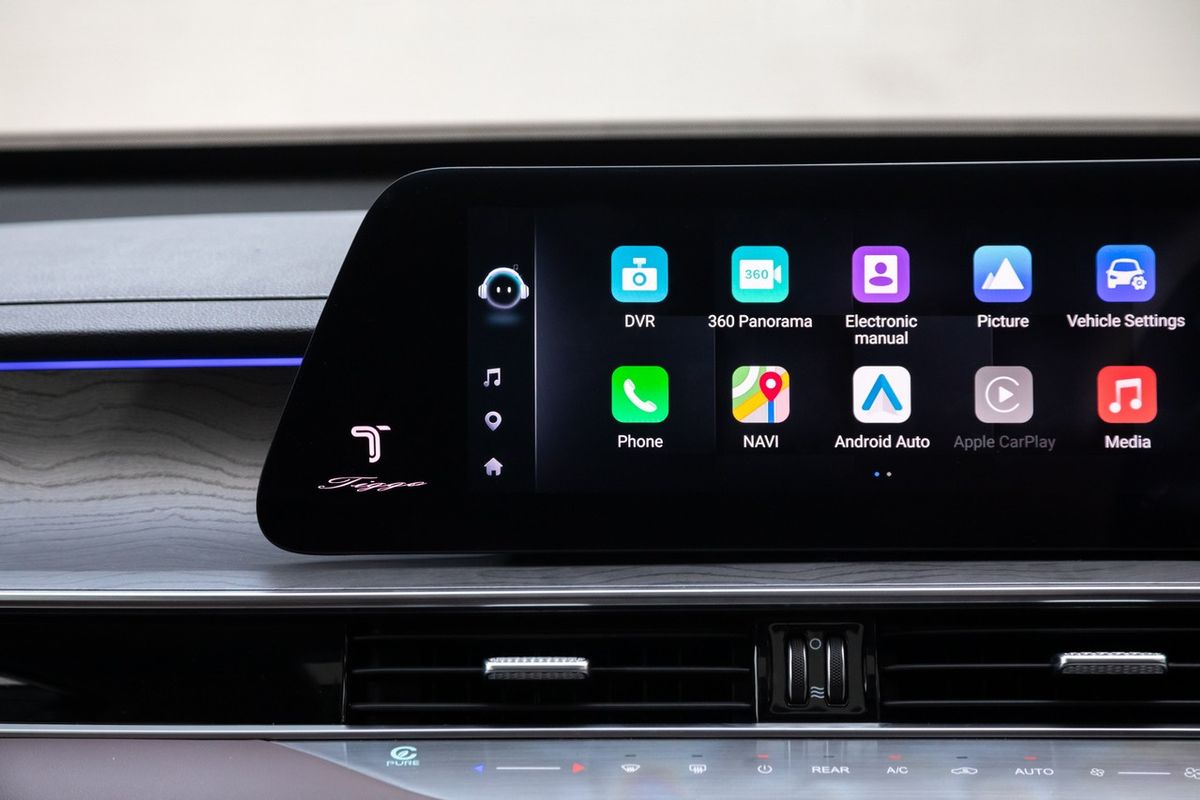
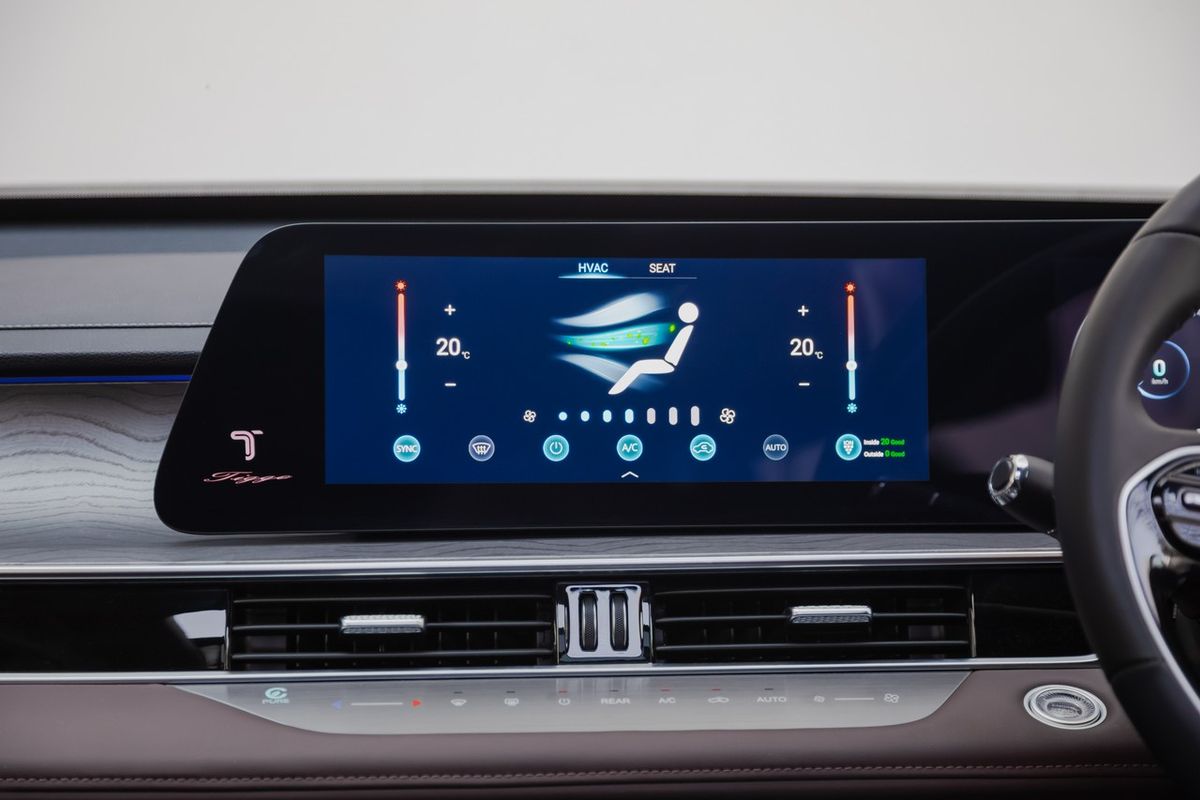
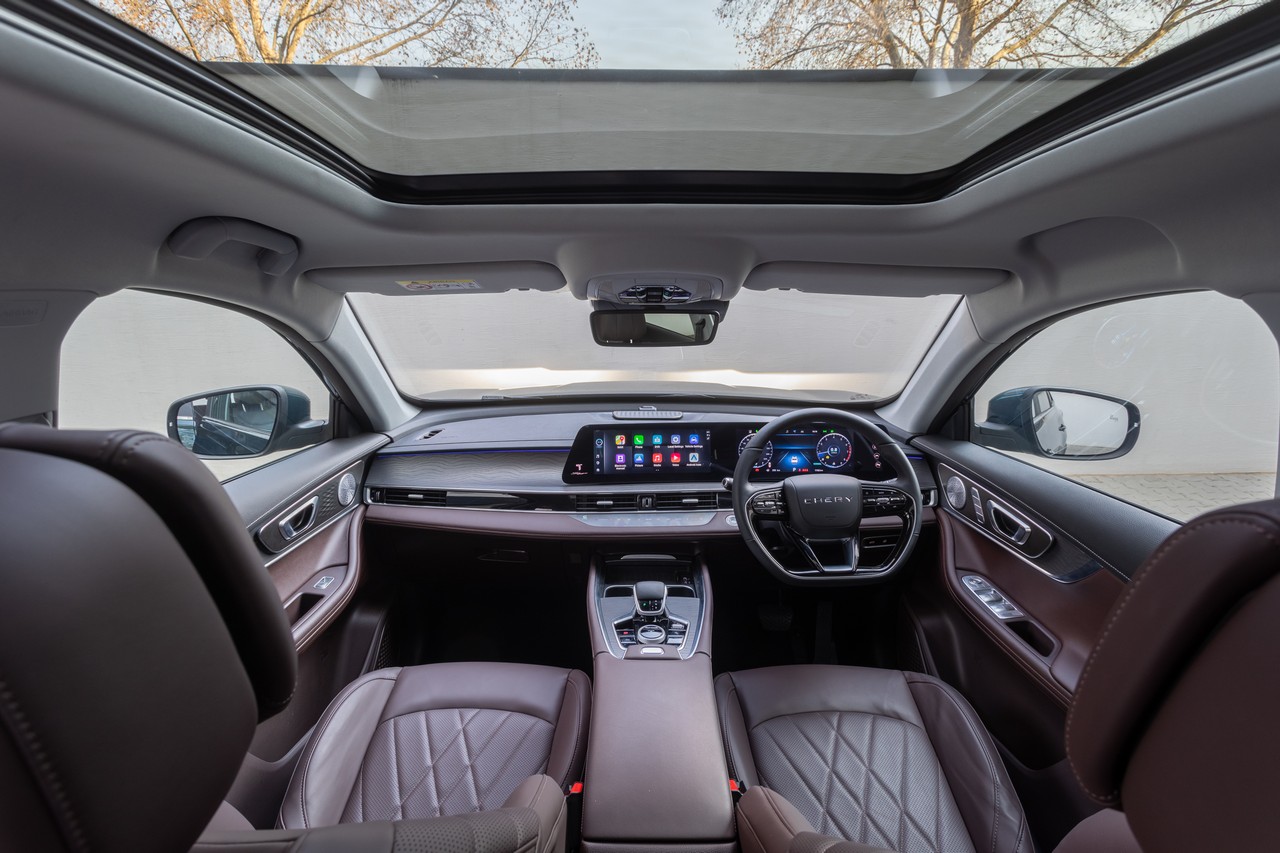
As with all modern facelifts, the interior features a technology update and, in this case, it takes the form of bigger screens and updated software. Some of the cabin architecture has also been neatened up to enhance ergonomics and boost upmarket appeal.
The Tiggo 8 Pro Max, a pre-facelift version of which was launched late last year, features a new 2.0-litre turbopetrol engine, while the Tiggo 8 Pro model continues with the 1.6-litre turbopetrol engine.
The most visible update on the rear is the lightbar that stretches across its entire width.
We had the opportunity to spend a good 300 km behind the ‘wheel of the revised 2.0-litre turbopetrol unit. Getting the figures out the way, the motor delivers 187 kW and 390 Nm of torque (hence the 390T badge on the rear). That sends a message to all the naturally aspirated competitors that Chery is not here to compete on a level playing field – it wants to offer the best in every department. There might be some raised eyebrows from the premium segment when they have a look at this particular offering.
Aside from its eye-popping peak outputs, the 4-cylinder powerplant is mated with a 7-speed dual-clutch automatic transmission. The ‘box’s mapping is a little clumsy in the low gears; the Chery seemed prone to aggressively accelerate off the line and only a gentle touch of the throttle pedal elicited a chirp from the front tyres. Once on the move, the ‘box gets on with the job like any modern auto; it shifts through the gears quietly and without fuss. Kickdown shifts are timely and nicely in sync with the throttle position.
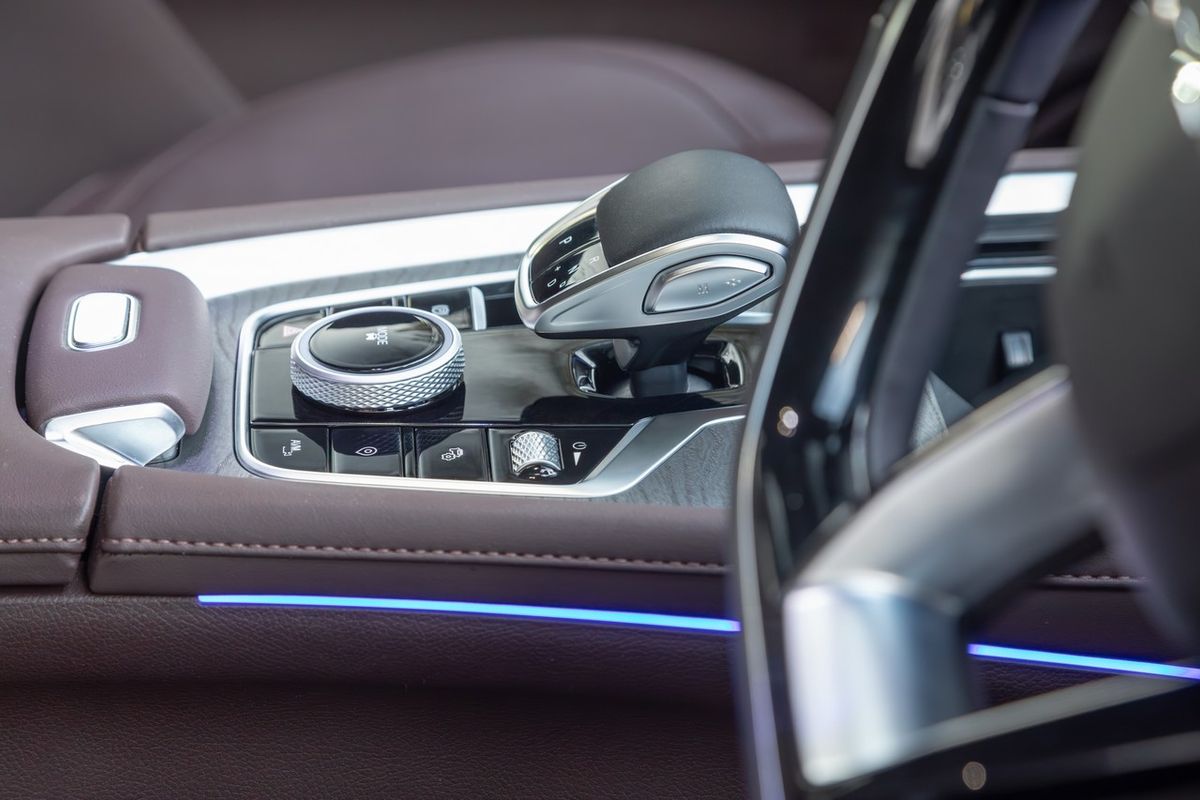
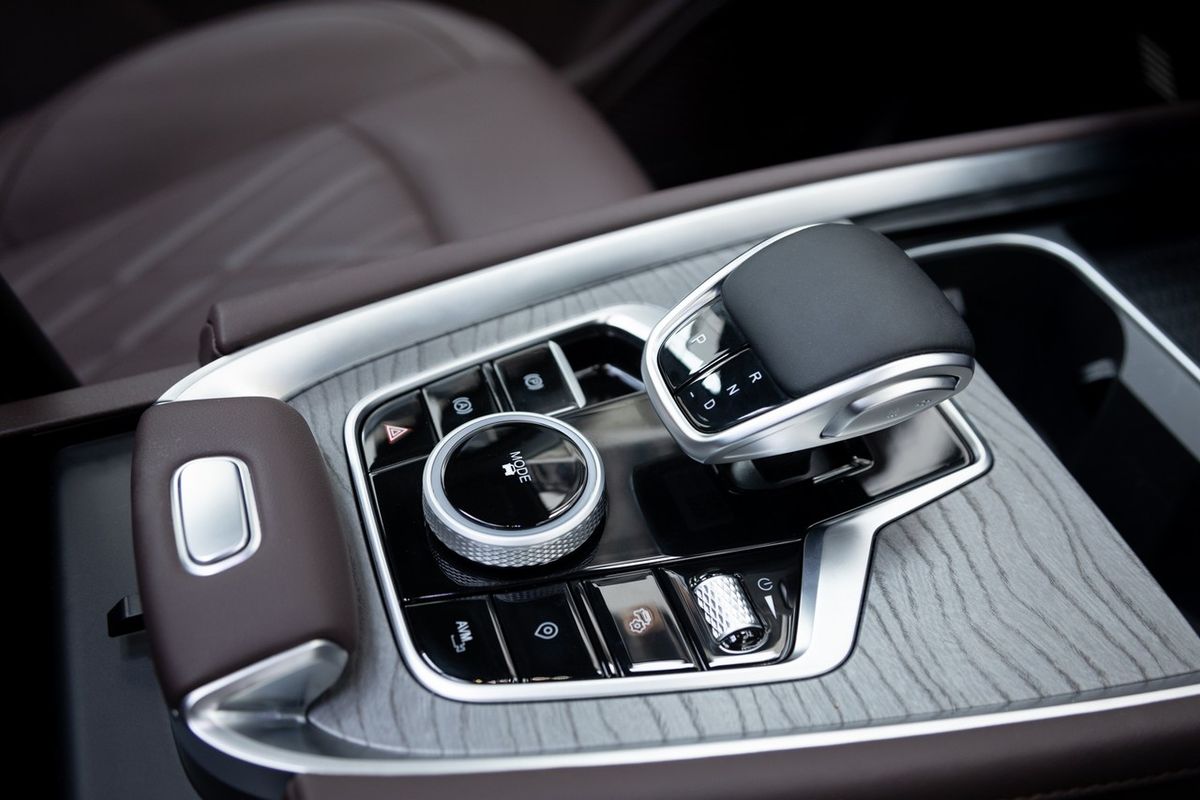
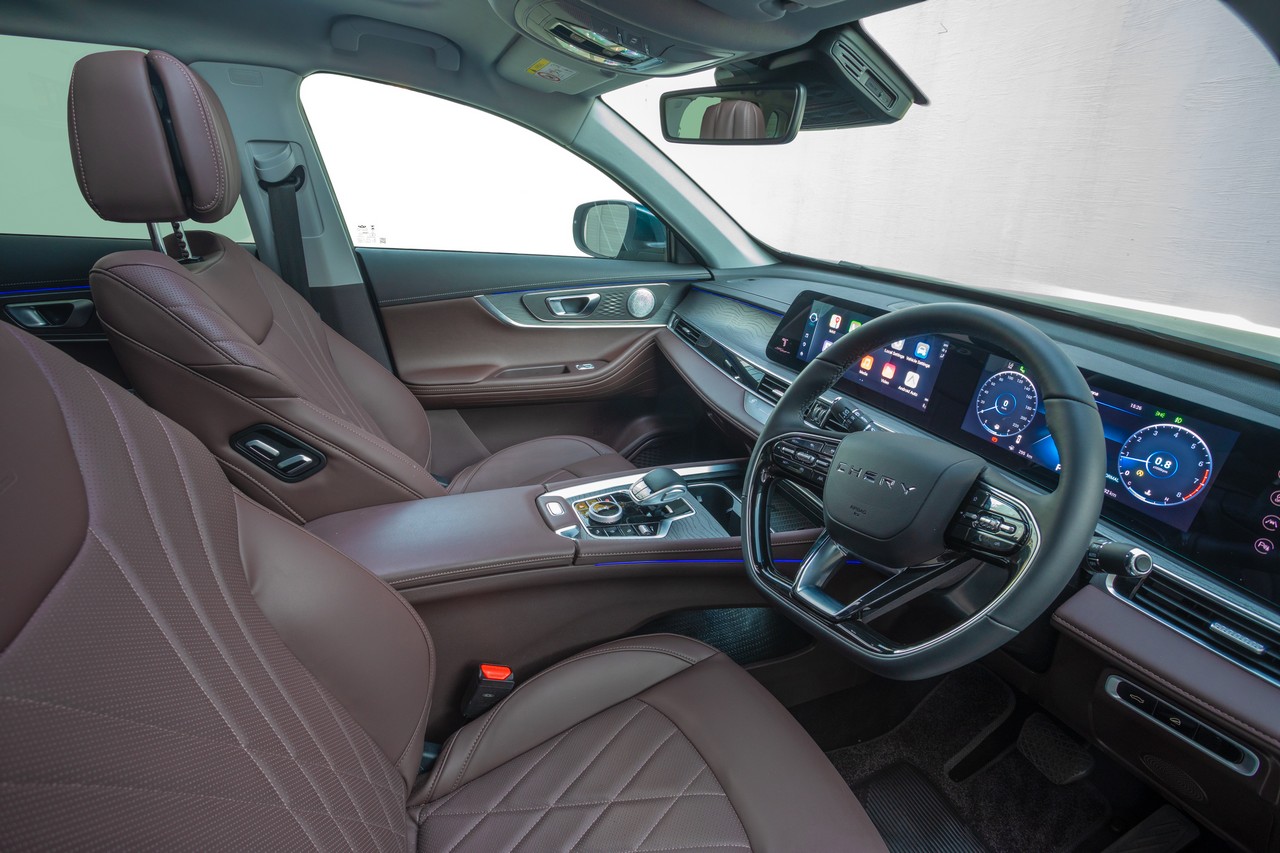
The centre console has been redesigned with a new transmission lever.
The Tiggo 8 Pro Max offers good punch – its in-gear acceleration is more than adequate – but don’t expect to be blown away by its performance (in a way, the flagship’s peak outputs seem exaggerated). Nevertheless, for a 7-seater family SUV that only costs R669 900, it performs very impressively.
Fuel economy has been somewhat of a bugbear for Chinese brands, especially on models such as the Chery Tiggo 4 Pro and even the Haval H6. I was impressed with the returns over the 300 km of driving we did over rolling terrain – albeit most of the route encompassed freeway driving. On the uphill run, I achieved 9.2 L/100 km and on the down run back to the coast, 8.6 L/100 km. That’s certainly more acceptable and more in line with what you might get out of a German marque’s 2.0-litre turbopetrol.
Tiggo 8 Interior updated for 2023
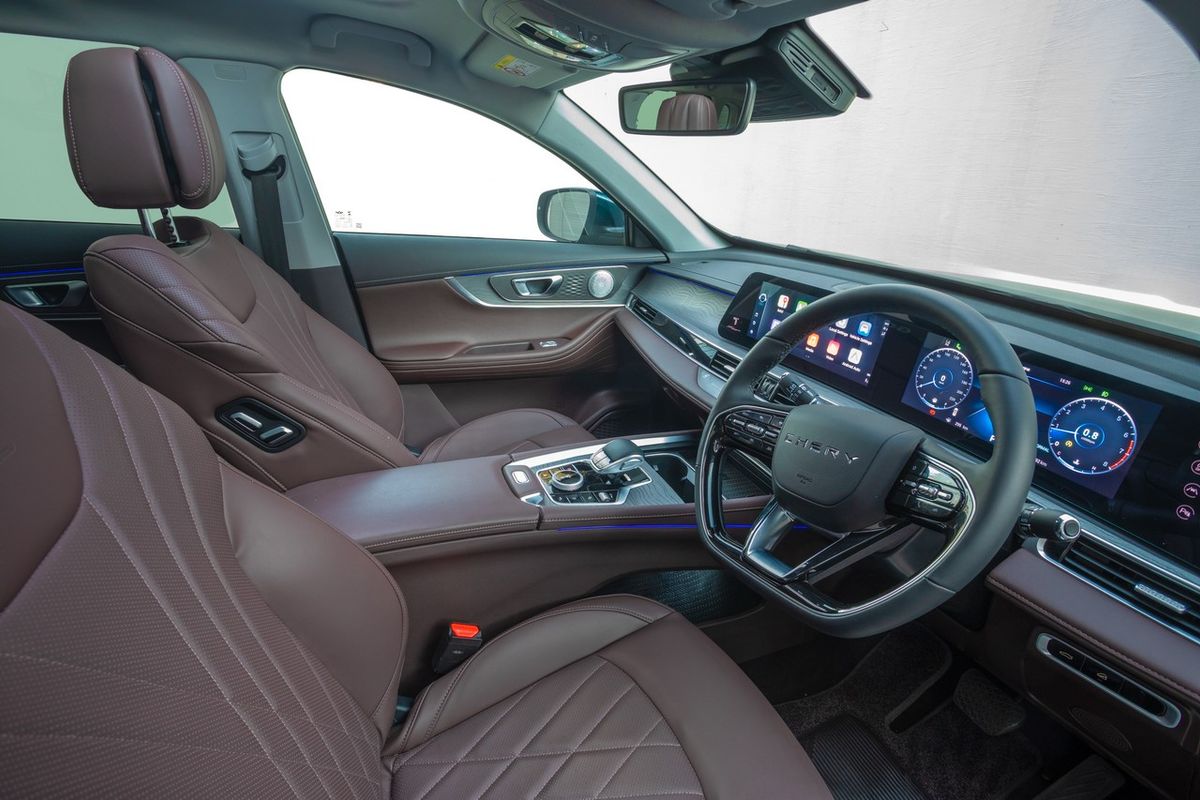
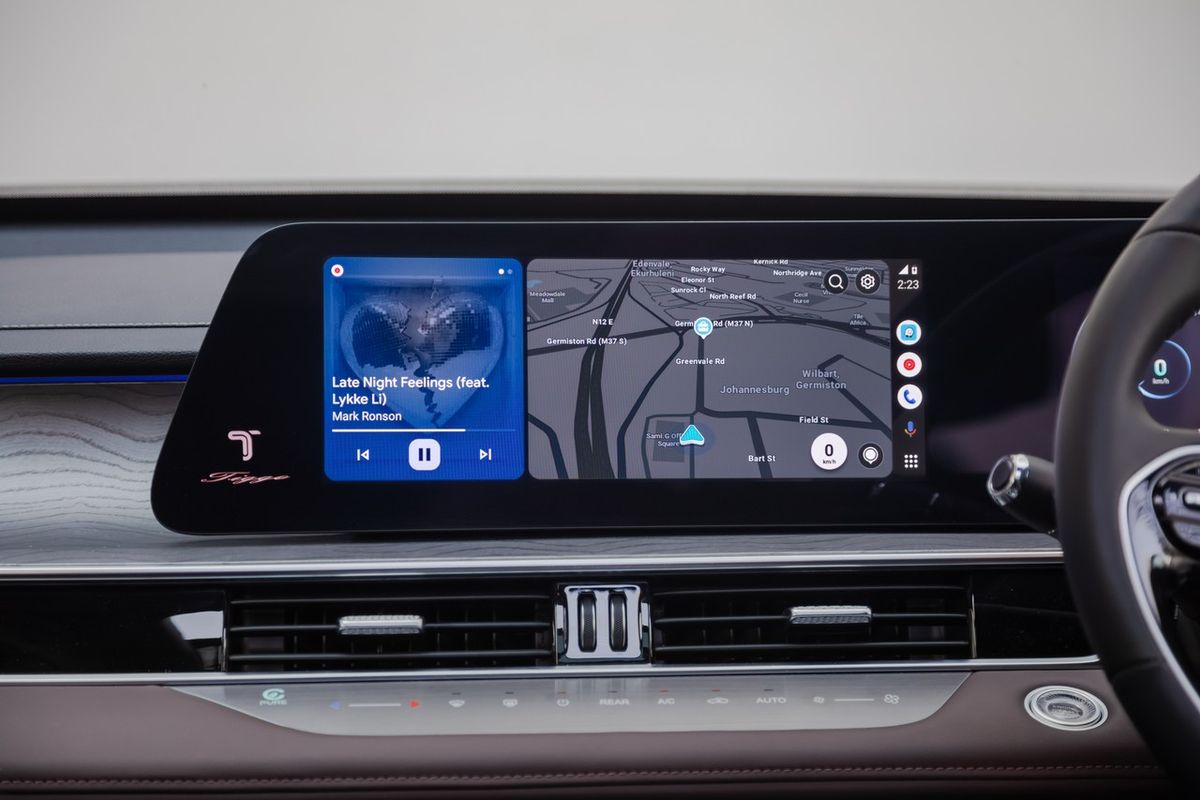
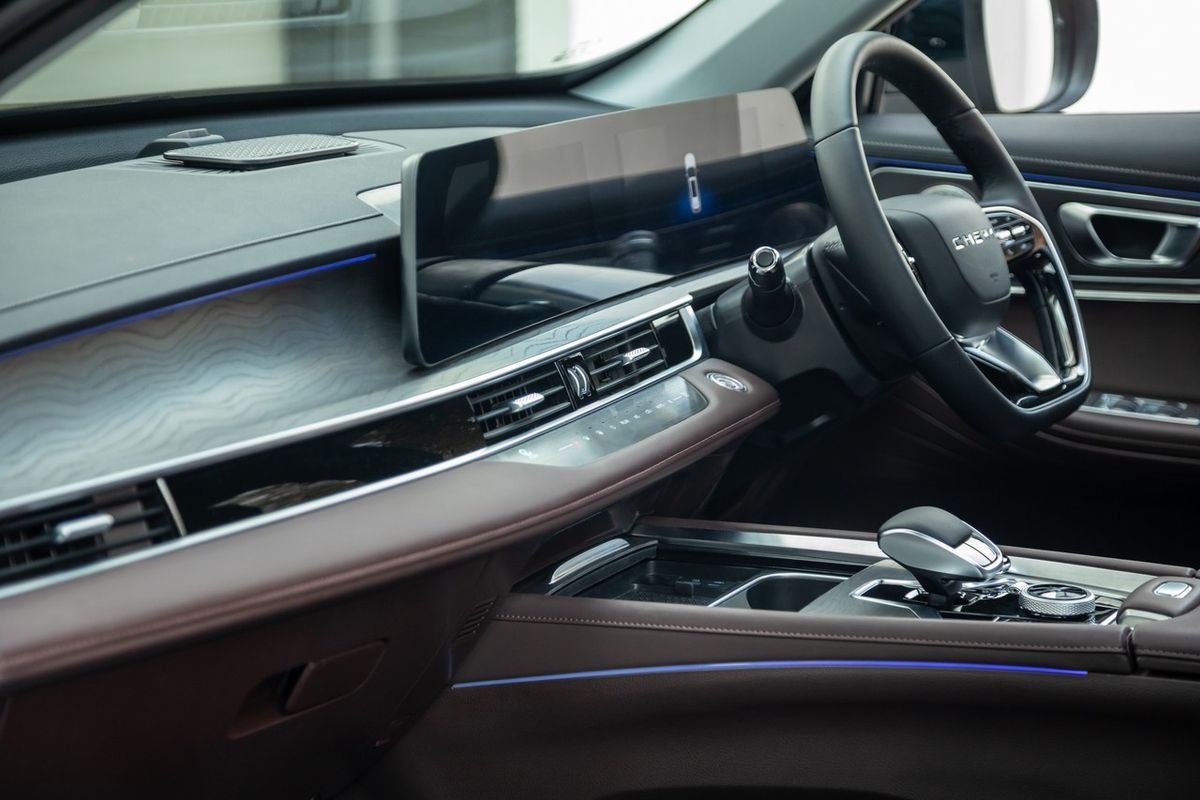
The interior of the vehicle is characterised by a pair of large 12.3-inch screens.
Chery has impressed with the level of interior tech it has introduced at the respective price points where its models are offered. Moreover, the technology’s slick, efficient and has an intuitive interface. Functions such as Bluetooth, Andriod Auto and Apple Carplay are simple to set up. For the Tiggo 8 Pro Max update, wireless Apple Carplay and Android Auto functionality has been added, while the wireless charging bay has been upgraded to deliver 50 milliamps of charge, which makes it a very fast charging bay.
The digital instrument cluster and infotainment screens measure 12.3 inches apiece, are integrated into a single curved surface and are notable for their impressive clarity and resolution. A firm prod is sometimes required to confirm a setting change on the screen, but the speed with which the system changes menus and adjusts settings appears to be very good. Obviously, the infotainment setup is brand new, so the hope is that the system will remain fast after years of use… and numerous software updates.
Speaking of updates, Chery has rolled out an update that improves the usability of safety features such as the lane-keep assist, lane recognition as well as the auto-pilot (hands-free operation). I still think the driving assistance is too sensitive to suit our road conditions and is still too firm and deliberate with its automated steering adjustments – they feel less like “suggestions” and more like “startled reactions”.
The build quality and material choices appear to be excellent on the Tiggo 8 Pro Max.
The good news is that the system can easily be deactivated with a button on the right side of the digital instrument cluster. During the launch event, I chatted with Chery’s engineers about the system’s, well, invasiveness and they assured me that more updates will be implemented – and quite soon. This should mean a quick trip to the dealer for an update and off you roll (over-the-air updates are not supported).
As for the quality of the materials used in the Tiggo 8 Pro Max, they are genuinely excellent, and even more so when you consider the SUV’s price point. The leather feels soft and tightly wrapped, and the shut-lines are tight and line up well.
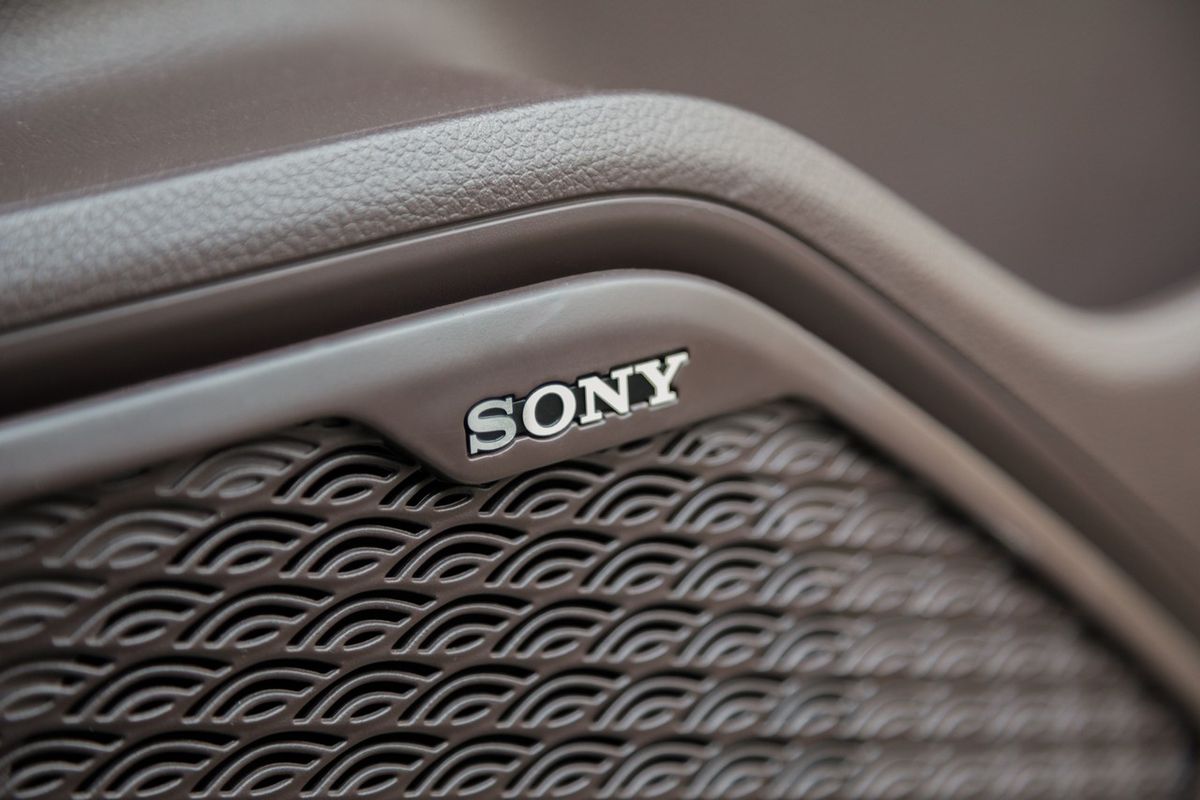
Some of the design elements such as the window buttons will look familiar to anyone who has been in a Mercedes-Benz, as will the Sony speaker covers at the front. The Sony setup is quite good though; my Chinese driving partner made sure I tested the audio at full blast in the heart of Umhlanga’s high street.
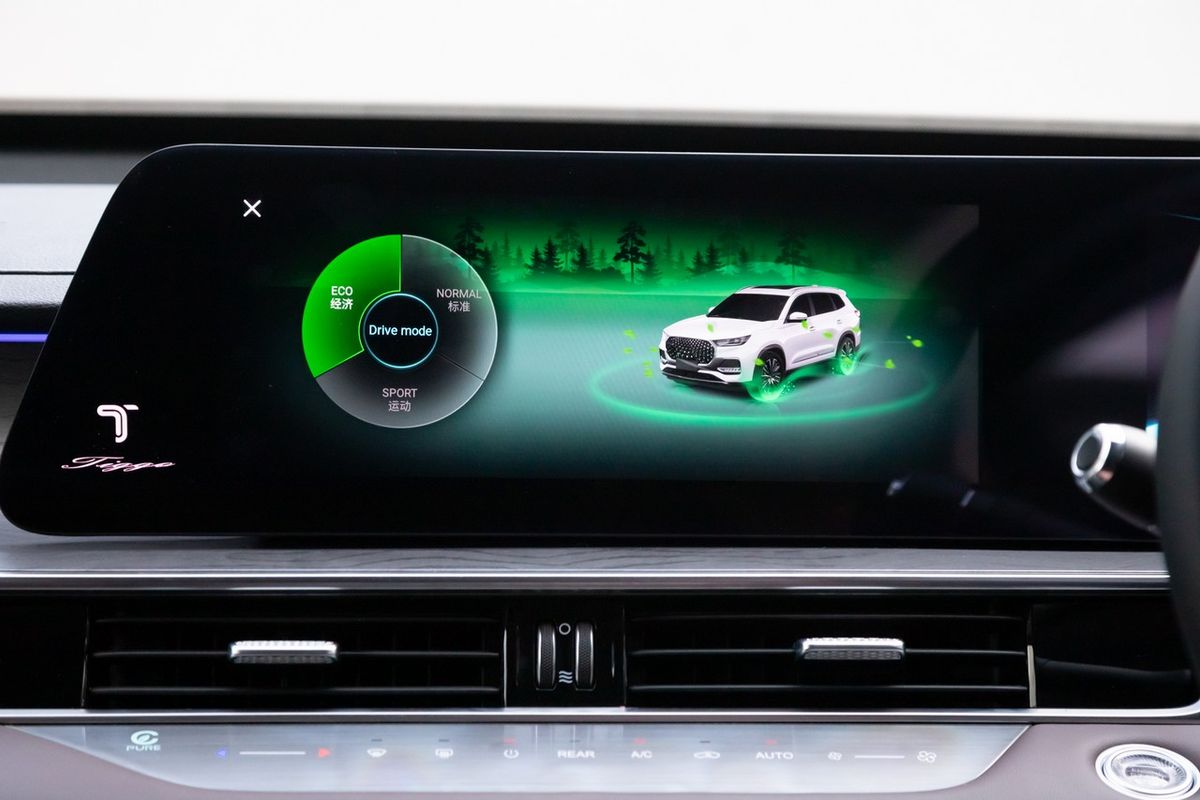
Meanwhile, the transmission lever’s design has been changed and it now feels neatly positioned in the centre of the centre console; it’s flanked by the other button adjustments and the drive-mode selector, which annoyingly shouts at you as to which mode you have engaged when you scroll through them.
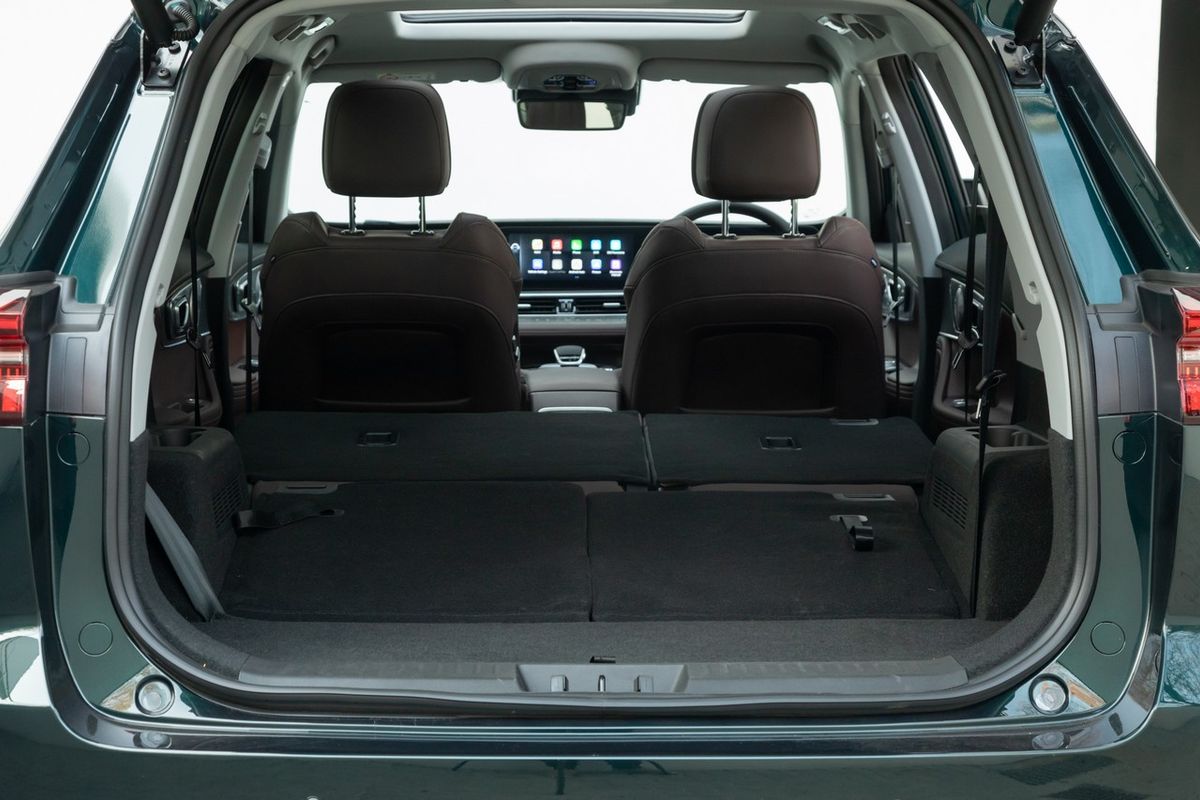
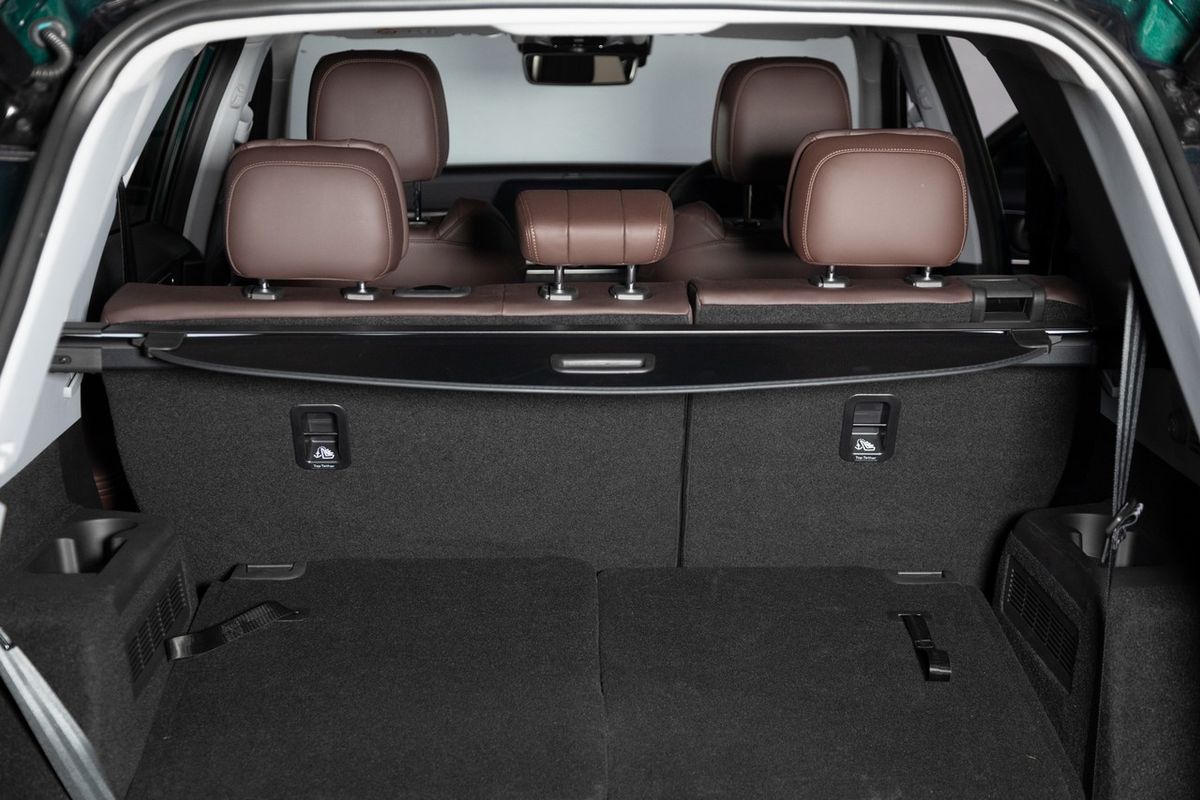
Rear occupant space appears to be pretty good with the second row able to recline, as well as slide forwards and backwards on rails. The 3rd row of seats is very tight, but when we get the vehicle on test in a few weeks’ time, we shall do a full review of the SUV’s people- and luggage-carrying capability.
How does the Tiggo 8 Pro Max drive?
For now, all derivatives are front-wheel-driven, but an AWD version is said to be coming in 2024.
The Tiggo 8 Pro Max is currently only available in front-wheel-drive guise, but apparently, an all-wheel-drive version is set to be introduced to the South African new-vehicle market early next year (2024).
The solidity of the cabin and the hushed interior are highlights of the driving experience. That certainly points towards decent build quality and good sound deadening. The road roar of the tyres on mixed tarmac surfaces can be a little loud, but this may be down to the Cooper tyres fitted to the test vehicle.
Ride quality on-road is firm, but not uncomfortable in most circumstances. You may notice a bit more firmness or harsher feedback from the suspension on rougher or uneven surfaces. When we crossed a rocky gravel road, I had to drive a bit more carefully to allow some of the unwanted feedback to settle.
Overall, I don’t think most owners will fret too much about the Tiggo 8 Pro Max’s “firmish” ride quality, as in day-to-day use, it’s unlikely to prove more than a few seconds worth of discomfort.
Chery Tiggo 8 Pro Max price and after-sales
This is quite a sweetener! Chery’s local distributors offer an astounding 5-year/150 000 km warranty and 7-year/90 000 km service plan with the Tiggo 8 Pro Max. The service plan means if you do less than 12 000 km a year (1 000 km a month) your car will be covered by the service plan for 7 years.
Chery Tiggo 8 Pro 1.6T Executive
R609 900
Chery Tiggo 8 Pro Max 2.0T Executive
R669 900
Summary
The Tiggo 8 Pro Max seems to offer great value for the price.
The MY23 Chery Tiggo 8 Pro Max certainly offers excellent value for money. It’s easy to see how this manufacturer has quickly entered the top 10 of SA’s new-vehicle sales charts, and with the continued strength of its products, other manufacturers should have alarm bells going off in their buildings.
The Tiggo 8 Pro Max 2.0T Executive offers an impressive drivetrain that is both powerful and appears to have addressed the fuel consumption issues that have plagued its 1.6-litre turbopetrol-powered siblings. At the price, there are few competitors that can match Chery’s offering in this department.
It’s not a perfect SUV, with a few issues around some of the safety software and general ride quality, but most of these issues could be overlooked for the sheer amount of car that’s available for your money.
10 years on: how SA’s new-car sales have changed since 2013
Just how different is South Africa’s automotive market today compared with that of 2013? Here’s some fascinating insight into how local new-vehicle sales have changed over the past 10 years…
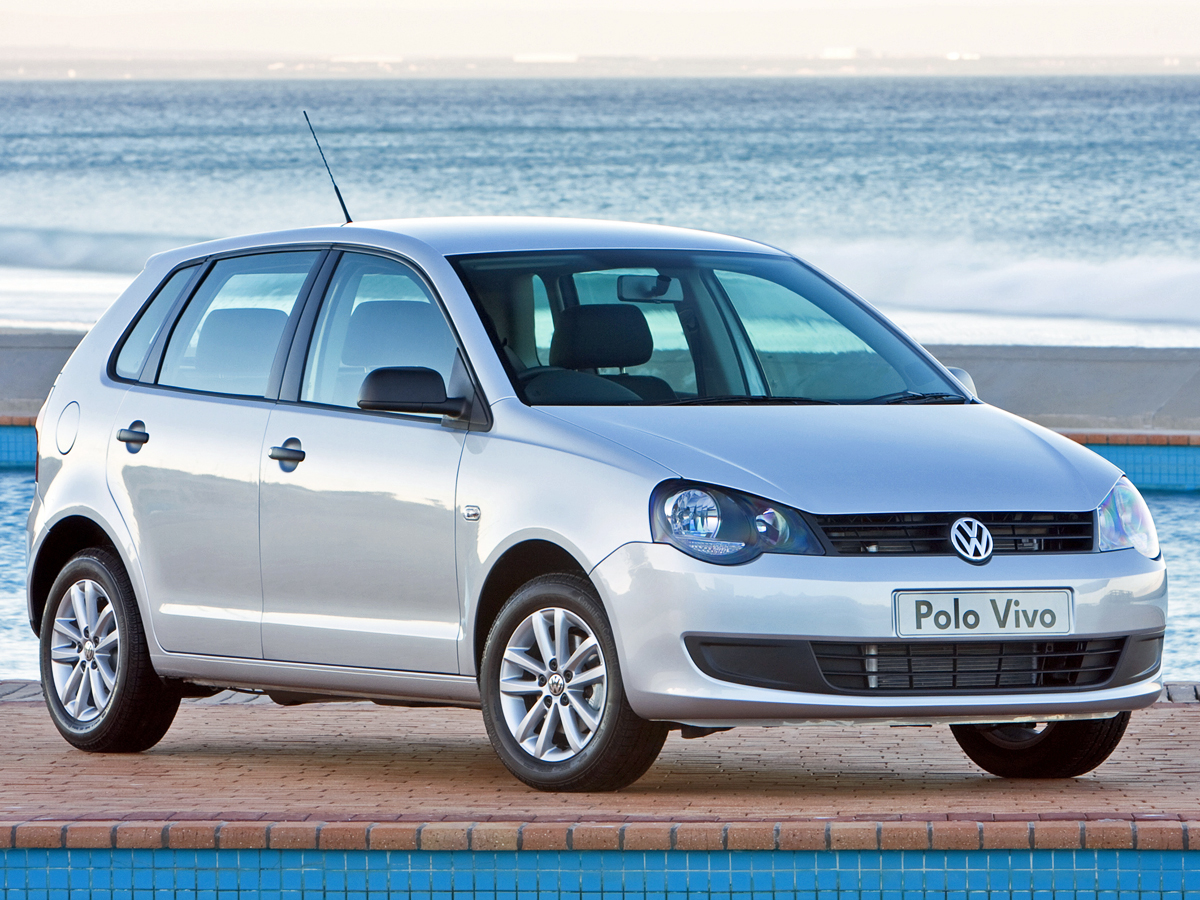
Picture it: the calendar reads July 2013 and Toyota is the strongest-selling automotive brand in South Africa. The Hilux is the country’s best-selling bakkie and Volkswagen’s Polo Vivo is the most popular passenger car. Sounds like nothing’s changed over the past 10 years, right?
Well, drill down a little deeper and you’ll find that’s not quite the case. In many ways, the local automotive space is markedly different today (though it’s very much the same in some others). To illustrate, we dug up South Africa’s new-vehicle sales figures for July 2013, dusted them off and set them alongside July 2023’s recently released numbers. A month-long snapshot of each era, if you will.
So, what’s immediately apparent? Well, for starters, the market was clearly more robust a decade ago, with July 2013’s industry tally coming in at a heady 58 140 units (for the record, that’s a considerable 14 751 more than last month’s effort of 43 389 units), according to Naamsa.
The passenger-vehicle market accounted for 40 274 of those registrations, a figure that stood at just 27 839 units in July 2023. The light commercial-vehicle segment, too, was a little stronger 10 years ago, coming in at 15 047 units, compared to 12 666 units last month. However, in July 2023, the export market was streets ahead at 37 064 units, compared with 26 608 units 10 years ago. Right, with that broad overview out of the way, let’s break things down a little further…
The VW Group was challenging Toyota 10 years ago
In July 2013, Volkswagen was breathing down Toyota’s neck…
In July 2013, Toyota (11 935 units) was the top manufacturer by sales, but the Volkswagen Group was right on its tail with 10 613 registrations. In fact, in the preceding month (June 2013), the German automaker even put its nose ahead of the Japanese giant, a feat that seems exceedingly unlikely in today’s market. In July 2023, for instance, the 2nd-placed VW Group (5 797 units) found itself a whopping 5 015 sales adrift of Toyota (10 812 units).
Besides VW falling off the pace, it’s also worth noting Hyundai and Kia didn’t report detailed sales figures back then, while today these Korean firms placed 4th (with 2 878 units) and 11th (with 1 372 units), respectively. Having ranked 3rd in the month in question in 2013, Ford has fallen down the pecking order to 5th a decade later, thanks largely to its shift away from the passenger-vehicle market (and the fact it no longer counts Mazda sales as its own, of course).
SA’s best-selling brands in July 2013
SA’s best-selling brands in July 2023
1. Toyota – 11 935 units
1. Toyota – 10 812 units
2. VW Group – 10 613 units
2. VW Group – 5 797 units
3. Ford – 5 738 units
3. Suzuki – 4 361 units
4. General Motors – 5 487 units
4. Hyundai – 2 878 units
5. Nissan – 4 662 units
5. Ford – 2 500 units
6. Mercedes-Benz – 2 748 units
6. Nissan – 2 308 units
7. BMW Group – 2 412 units
7. Haval – 2 030 units
8. Honda – 1 014 units
8. Isuzu – 1 903 units
9. Renault – 1 009 units
9. Renault – 1 707 units
10. Tata – 847 units
10. Chery – 1 375 units
Meanwhile, Suzuki has increased its sales more than tenfold over the past 10 years, seeing it clamber up the charts from a lowly 16th (when it sold a mere 313 units) in July 2013 to an assured 3rd (with 4 361 registrations) in the corresponding month in 2023. India’s Mahindra, too, has grown over the past decade, with July sales of 330 in 2013 (including Ssangyong) and 929 in 2023.
Moreover, Chinese brands Haval (2 030 units) and Chery (1 375 units) are today making their presence felt in the top 10, while General Motors – which accounted for 5 487 units in July 2013 (including Isuzu and Opel) – has long since left the local market, along with the likes of Chrysler and Infiniti (Tata, too, no longer plays in the passenger space). Honda, meanwhile, regularly crossed the 1 000-unit barrier 10 years ago but had to settle for just 327 units in July 2023, while premium automakers BMW and Mercedes-Benz have slipped, too.
No SUVs or crossovers cracked the top 10 in 2013
Fortuner sales have been largely consistent over the past decade.
In a stark illustration of the rise of the crossover, we noted not a single such vehicle managed to rank in the top 10 best-selling models for July 2013. In fact, the highest-placed SUV back then was the original Toyota Fortuner (943 units), followed at some distance by a since-discontinued crossover in the form of the Ford Kuga (436 units … yes, before the fire scandal). In comparison, the top 10 a decade later featured the Toyota Corolla Cross (1 801 units) in 5th, with the Haval Jolion (833 units), Nissan Magnite (798 units), Toyota Fortuner (730 units) and Chery Tiggo 4 Pro (693 units) also cracking the top 15.
In July 2013, Mzansi’s best-selling vehicle overall was the locally produced Volkswagen Polo Vivo with 3 574 units. A decade on and the current version of the German automaker’s prolonged-lifecycle hatchback ended in 2nd with 2 177 registrations, while the Toyota Hilux – which was runner-up overall in 2013 – sat atop the podium with 2 982 sales (not too far off its 3 159 units a decade ago).
SA’s best-selling vehicles in July 2013
SA’s best-selling vehicles in July 2023
1. Volkswagen Polo Vivo – 3 574 units
1. Toyota Hilux – 2 982 units
2. Toyota Hilux – 3 159 units
2. Volkswagen Polo Vivo – 2 177 units
3. Volkswagen Polo (hatch) – 2 618 units
3. Ford Ranger – 2 089 units
4. Toyota Etios – 2 122 units
4. Suzuki Swift – 1 809 units
5. Toyota Corolla/Auris – 2 014 units
5. Toyota Corolla Cross – 1 801 units
6. Ford Ranger – 1 876 units
6. Isuzu D-Max – 1 542 units
7. Nissan NP200 – 1 663 units
7. Toyota Hi-Ace – 1 395 units
8. Chevrolet Utility – 1 587 units
8. Toyota Starlet – 1 187 units
9. Isuzu KB – 1 379 units
9. Nissan NP200 – 1 041 units
10. Toyota Quantum – 1 351 units
10. Volkswagen Polo (hatch) – 924 units
The Volkswagen Polo (2 618 units) completed the top 3 back then but has since tumbled down the table to 10th (924 units), while a couple of top-10 contenders from 10 years ago – the Toyota Etios and Chevrolet Utility half-tonner – are no longer with us. The Ford Figo (1 313 units and 11th place in July 2013) has likewise since departed, as has the Renault Sandero (457 units), though they’ve effectively been replaced by models such as the strong-selling Toyota Starlet (1 187 units) and Suzuki Swift (a mere 121 units in July 2013 and 1 809 sales a decade later).
Furthermore, the Toyota Corolla Sedan and Auris (the latter since supplanted by the Corolla Hatchback) sold a combined 2 014 units in July 2013 to place 5th, while their modern-day equivalents managed just 74 units between them last month. SA-built favourites such as the Ford Ranger, Nissan NP200, Isuzu KB (now named D-Max) and Toyota Quantum (today in the form of the Hi-Ace), though, maintained their top-10 finishes a decade on.
Family hatches and executive sedans have slipped
You can no longer buy a new non-performance VW Golf in South Africa.
What else stood out? Well, the increase in popularity of the crossover has obviously come at the expense of other body styles. The decline of the C-segment family hatchback is particularly apparent, with models such as the Volkswagen Golf (908 units) and Ford Focus (391 units) having moved reasonable volumes back in 2013. Today, only the GTI- and R-badged versions of the Golf are marketed locally (together hitting 125 units in July 2023), while the Focus has long since exited South Africa.
It’s a similar – though perhaps less obvious – case with the traditional B-segment hatchback. In July 2013, for instance, healthy sellers in this category included the now-defunct Ford Fiesta (885 units), Toyota Yaris (436 units) and Nissan Micra (312 units). While the likes of the Renault Clio and Honda Jazz (since rebadged Fit) remain, their figures aren’t what they once were (184 and 63 units, respectively), while even the Polo has slipped.
Compact executive sedans have likewise taken a sizeable hit. In July 2013, the then-Rosslyn-produced BMW 3 Series (1 137 units) and the Mercedes-Benz C-Class (1 017 units) came mighty close to cracking the top 10, while the Audi A4 managed a credible 653 registrations. Though BMW and Mercedes-Benz unfortunately no longer regularly report detailed sales figures to Naamsa, it’s clear their respective monthly tallies have fallen markedly. The A4, meanwhile, mustered just 75 sales last month. Furthermore, saloons such as the Volkswagen Jetta, Passat and Volvo S60 are simply no more.
In addition, back in July 2013, the top-10 list effectively contained just a single imported model (the Etios; we’ll remove the Auris from the equation since the Prospecton-produced Corolla Sedan did much of the heavy lifting in that partnership). While SA-built vehicles still dominate 10 years later, it’s intriguing to note the top-15 table of best-sellers in July 2023 featured 5 imported models.
So, in certain aspects, South Africa’s new-vehicle market is very much like it was a decade ago; bakkies and budget hatchbacks are still big business, for instance, and Toyota leads the pack. But in others – most notably the decline of family hatchbacks (and executive saloons), Suzuki’s spectacular climb up the ranks, the rise of Chinese brands and indeed a dip in overall market volume – it’s completely different.
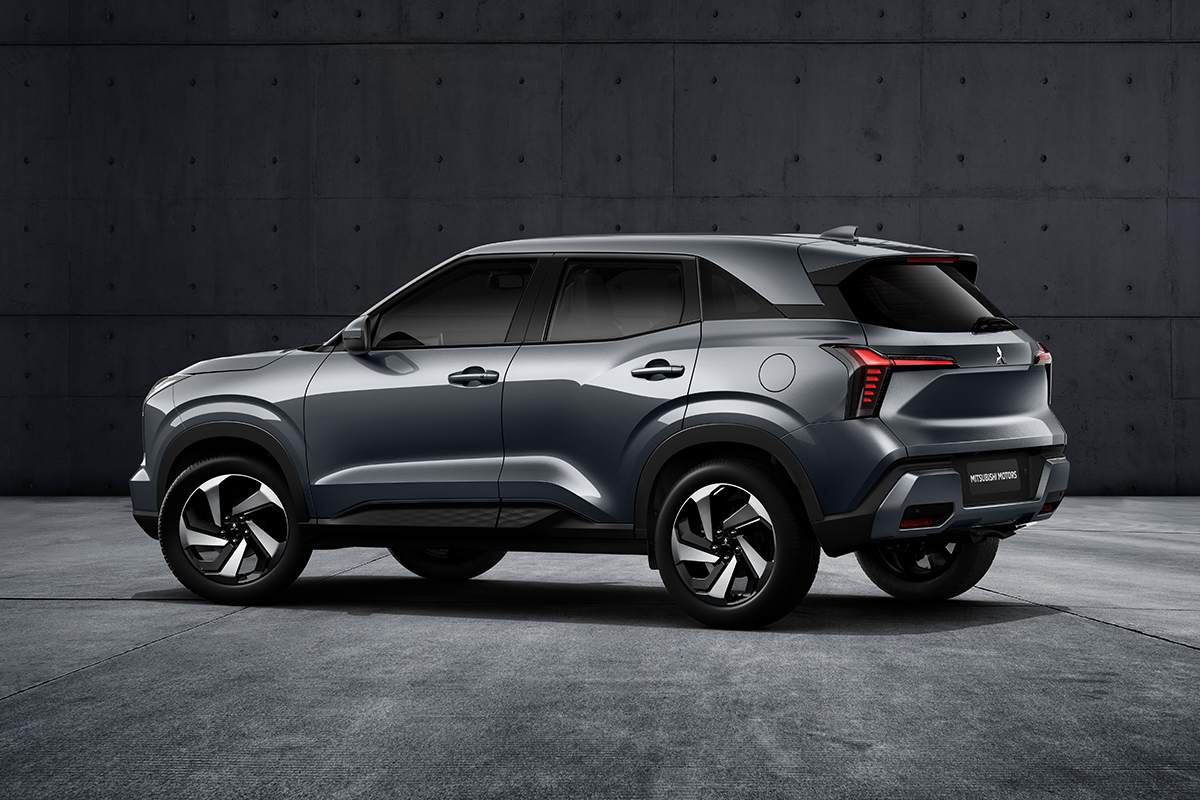
Mitsubishi will unveil a new budget crossover at the Indonesian Motor Show that’s tailor-made for Mzansi. The newcomer has eye-catching styling and plenty of ground clearance, plus its dimensions are comparable with those of the Toyota Urban Cruiser!
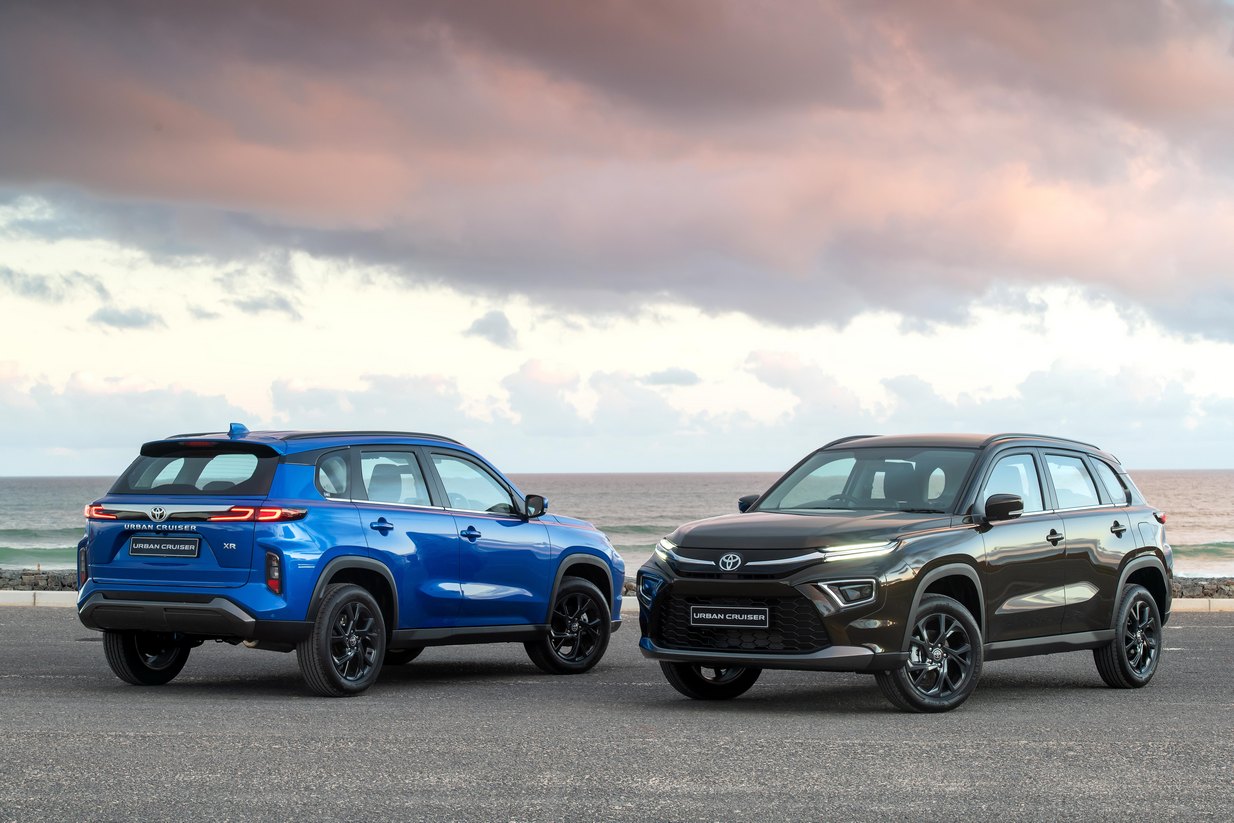
Mitsubishi’s as-yet-unnamednewcomer, which will be produced at the Japanese manufacturer’s Krama Yudha plant in Indonesia, is earmarked for ASEAN markets, but its packaging, drivetrain and footprint are not unlike those of the recently introduced Urban Cruiser and its cousin, the Suzuki Grand Vitara. All things considered, that would position the production version of the model perfectly for our market.
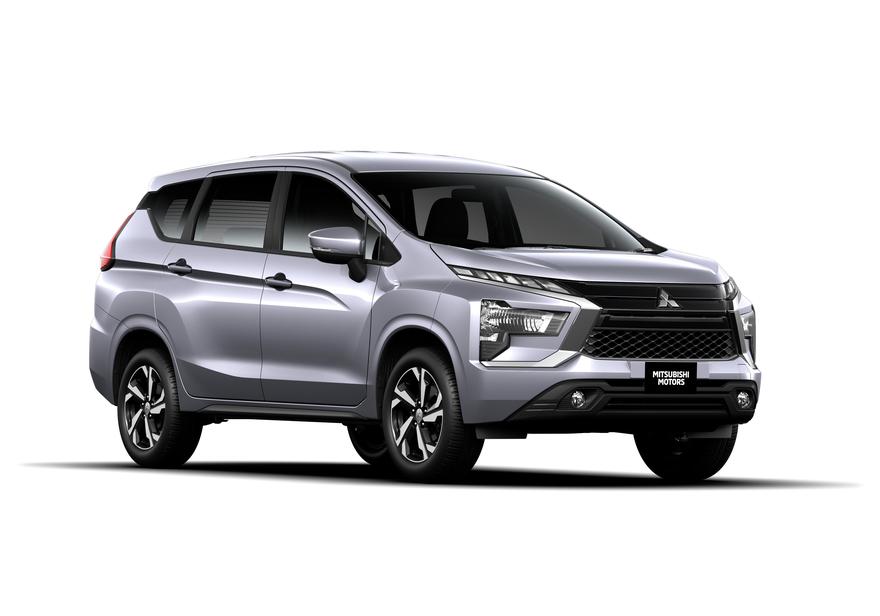
Considering how sales of budget-market-oriented small crossovers have ballooned in South Africa, Mitsubishi’s upcoming model will be the ideal complement to the Xpander small 7-seater MPV (people-mover) in our market, where it will slot below (or perhaps replace) the long-serving ASX compact SUV.
“We are sure that current and new Mitsubishi customers are waiting with huge excitement on our all-new compact SUV, which will further build on Mitsubishi Motors South Africa’s (MMSA) lifestyle attraction – stay tuned for the world premiere”, said Jeffrey Allison, MMSA’s general manager of marketing.
“In this all-new model,” Seiji Watanabe, the general manager of Mitsubishi Motors’ design division said recently, “we have pursued a design that is more stylish, energetic, and distinctive than ever.”
While Mitsubishi has only released a couple of images of the concept model, it’s apparent that its design is quite adventurous by budget crossover standards (although the production model will be toned down).
From the front, the newcomer’s recessed trapezoidal grille is laced with 3-dimensional rectangular accents, while a pair of bumper garnishes protrude on either side of the numberplate holder. The LED daytime running lights combine an L-shape with slitted accents to emit light in an iconic T-shape.
Other design details include a “floating roof” (courtesy of blacked-out pillars – partially at the rear), distinctive swathe- and shoulder lines, elaborately flared wheel arches, generous black lower-body cladding and, “by adopting the same T-shaped design for the LED tail lights as the front, the (vehicle’s) rear attains a wide and stable look.”
What’s more, Mitsubishi says the model offers “222 mmof ground clearance” when fitted with 18-inch rims and high-profile tyres “(that) enhance handling on rough roads.”
According to the Tokyo-based manufacturer, the budget crossover is 4 390 mm long, 1 810 mm wide and stands 1 660 mm tall, which compares closely with the dimensions of the Urban Cruiser: 4 365 mm, 1 975 mm (including side mirrors) and 1635 mm, respectively.
Mitsubishi’s new budget crossover could rival the much-in-demand Urban Cruiser in our market.
For the record, the Toyota Urban Cruiser 1.5 XR auto, which is fitted with 17-inch alloys shod with 215/60 tyres, has a claimed ground clearance of 210 mm.
The models’ drivetrains share familiarities too. As with the Toyota, the Mitsubishi is front-wheel drive and propelled by a 1.5-litre petrol engine mated with a continuously variable automatic transmission. We’d assume that the naturally aspirated engine will be the same as the Xpander’s 77 kW/141 Nm powerplant.
The model will be officially unveiled on August 10. Look out for future updates to this story.
How well is Proton selling in SA? The latest sales figures
Proton has quietly started reporting model sales to Naamsa. Here’s how many vehicles the Malaysian automaker sold in South Africa in July 2023…
The Proton brand returned to the South African market in September 2022 after a decade-long hiatus. Now, the Malaysian automaker has quietly started reporting individual model sales figures to Naamsa, starting with July 2023.
So, just how well is this 40-year-old brand – which is distributed locally by the Combined Motor Holdings (CMH) Group – selling in South Africa right now?
The X70 is the largest vehicle in Proton’s local line-up.
Well, Proton didn’t quite manage to crack 3 figures, having registered 99 units locally in July 2023. That performance saw it place 29th, some way behind the likes of Volvo, Mitsubishi and even a raft of truck makers (such as Iveco, UD Trucks, Scania, MAN and FAW). When considering only the passenger-vehicle segment (and thus excluding light-commercial vehicles and larger trucks), Proton ranked 21st.
Interestingly, 83 of those registrations came via the dealer channel, while 16 represented sales to the rental industry. The Proton X50 was the brand’s top seller in July 2023, with 43 units registered. Next came the X70 (32 units), followed by the Saga sedan (24 units).
The Proton Saga is one of SA’s most affordable sedans.
As a reminder, the 3-strong Saga line-up is priced from R209 900 (making it SA’s 2nd-cheapest saloon behind the Suzuki DZire 1.2 GA), while the X50 range includes 4 derivatives and starts at R449 900. Finally, the X70 kicks off at R529 900, with 4 variants on offer.
The budget sedan draws its urge from a naturally aspirated 1.3-litre motor, while the crossovers – interestingly each built on a Geely platform (the Chinese giant holds a 49.9% stake in Proton) – both use a turbocharged 1.5-litre, 3-cylinder petrol mill, offered in a couple of states of tune.
According to Proton Car South Africa’s website, the brand currently has 26 dealerships dotted around the country.
Based on a 300CE-24 Cabriolet and built to special order by AMG, this rare ‘Benz boasts a 3.4-litre inline-6 developing 200 kW, plus Affalterbach’s period styling and suspension modifications. This is the only example of its kind believed to be in SA.
IMAGES: Kian Eriksen
Sometimes in life, you may encounter a rare car, and then you think you are unlikely to cross paths with it ever again. But recently I walked into motoring specialists Crossley & Webb’s showroom only to see the very rare A124 Mercedes-Benz 300CE-24 AMG 3.4 Cabriolet.
This is a car I briefly drove 8 years ago in the Free State. At the time, I thought I’d never see it again, but here it was parked and, needless to say, it soon found a new owner. Let’s rewind the clock to that warm Free State morning.
Specifications
Model: Mercedes-Benz 300CE-24 AMG 3.4 Cabriolet
Engine: 3.4-litre, inline-6-cylinder petrol
Power: 200 kW at 6 500 rpm
Torque: 315 Nm at 4 500 rpm
Transmission: 5-speed automatic, RWD
Weight: N/A
0-100 kph: 7.3 sec (claimed)
Top speed: 250 kph
History of the 300CE-24 AMG Cabriolet
Whether it’s because AMG has grown from strength to strength over the past decade, or that its earlier cars are deemed particularly – and positively – anti-establishment, buyers and specialist car sellers will tell you that the company’s oldest creations have become even more appealing in recent years, their character maturing like a fine wine, complete with an added kick.
Take this 300CE-24 AMG 3.4 Cabriolet, for example, displaying the sort of period tuner touches that can take many minutes to spot before they are fully appreciated. Between 1993 and 1996, just 68 E36 AMG Cabriolets left Affalterbach, and those well-documented cars based on the facelifted E320 model.
However, the drophead pictured is actually based on a pre-facelift 300CE-24 and equipped with a 3.4-litre M104 6-cylinder engine. As we understand it, AMG created 25 “300CE-24 3.4” coupes between 1988 to 1993, but the cabriolet version was a special order model built on an even smaller scale.
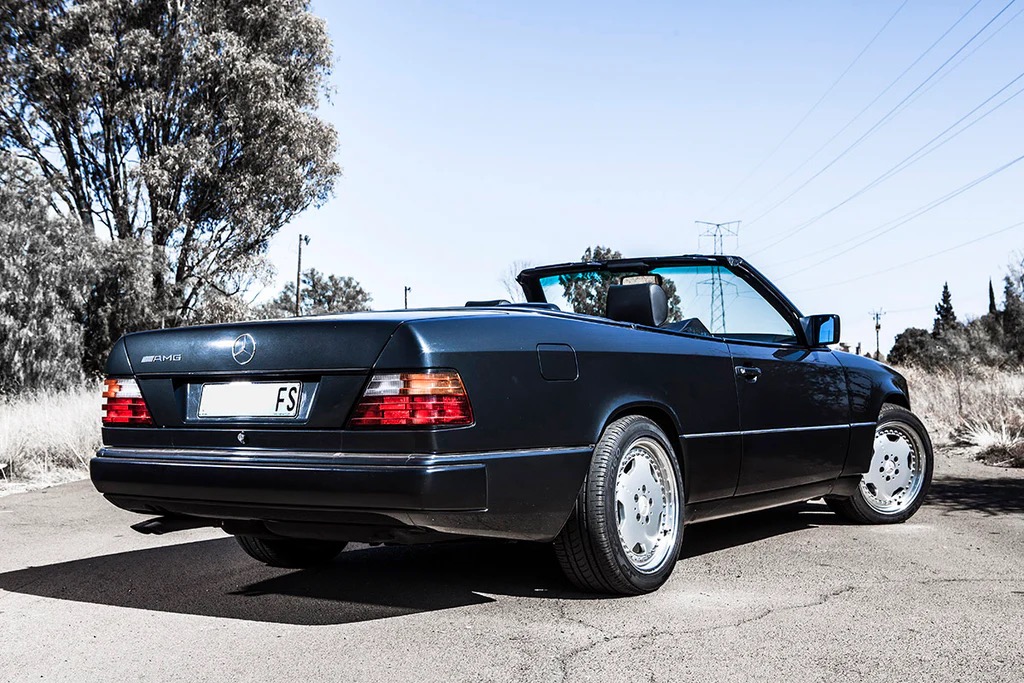
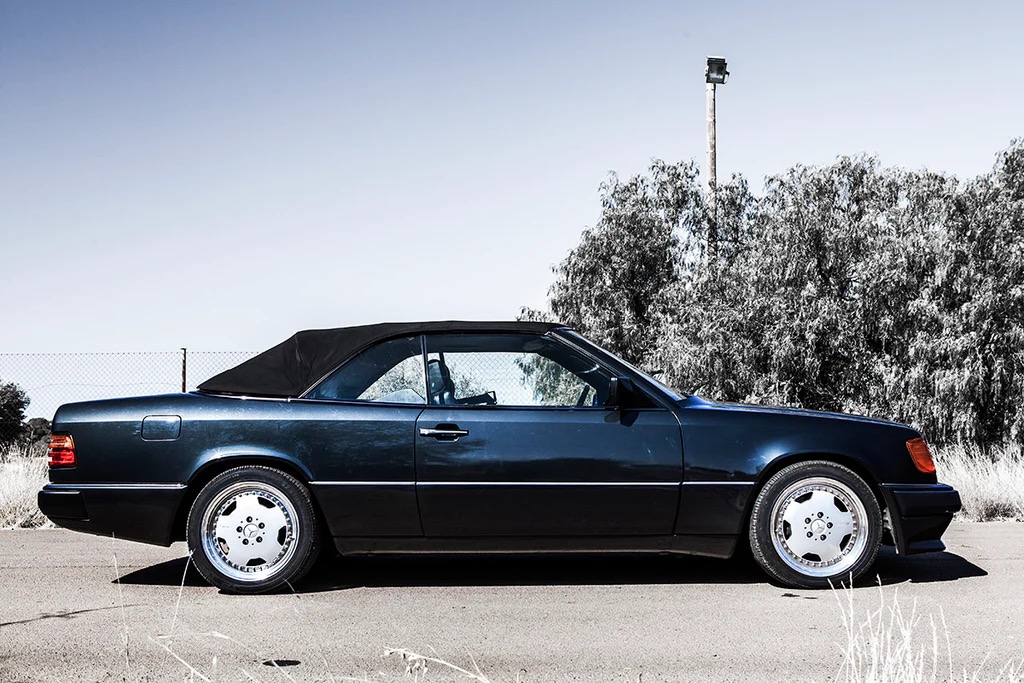
Pull the car into daylight, it reveals a very dark grey and blue tint to the metallic paintwork, this contrasting with the clear lens headlamps and fog lights, orange indicators and, at the time a Free State province numberplate decorated with the picture of a cheetah mid stride. From a distance, it’s easy to mistake this car for a coupé, such is the way the dark fabric hood blends with the bodywork, the profile shared between these two Mercedes being no accident.
AMG was notoriously poor at keeping records of its work in the early days, and there are plenty of would-be AMG 124s on the market today, further blurring the boundary between genuine and not-so-genuine cars, but this cabriolet is the real deal.
How do we know? Because Mercedes-Benz Classic in Germany confirmed it using the car’s VIN, Affalterbach perhaps not so bad at doing paperwork after all. It certainly makes our job far easier…
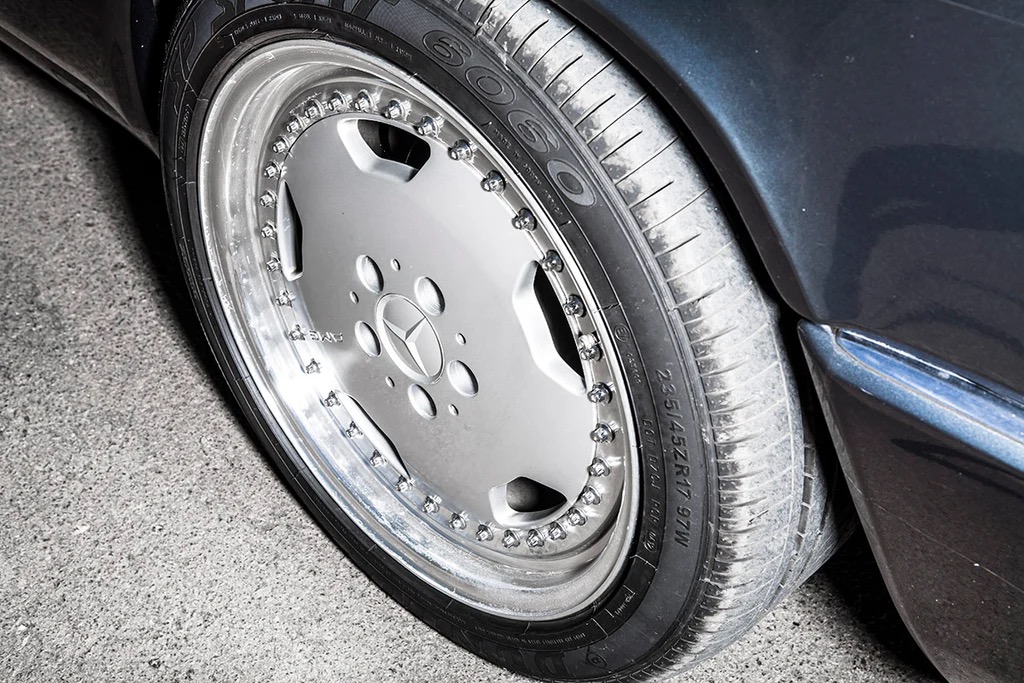
The list of upgrades reads as follows: an AMG Technik Paket (Technology Package), AMG sports suspension “without levelling”, and stunning AMG split rim alloy wheels in size 8.5Jx17 with 235/45ZR17 Michelin rubber. Other modifications include a dechromed grille and an AMG front bumper – the latter feature squaring the jaw of this otherwise pretty droptop and meaning you certainly won’t mistake this car for a standard 300CE-24 Cabriolet.
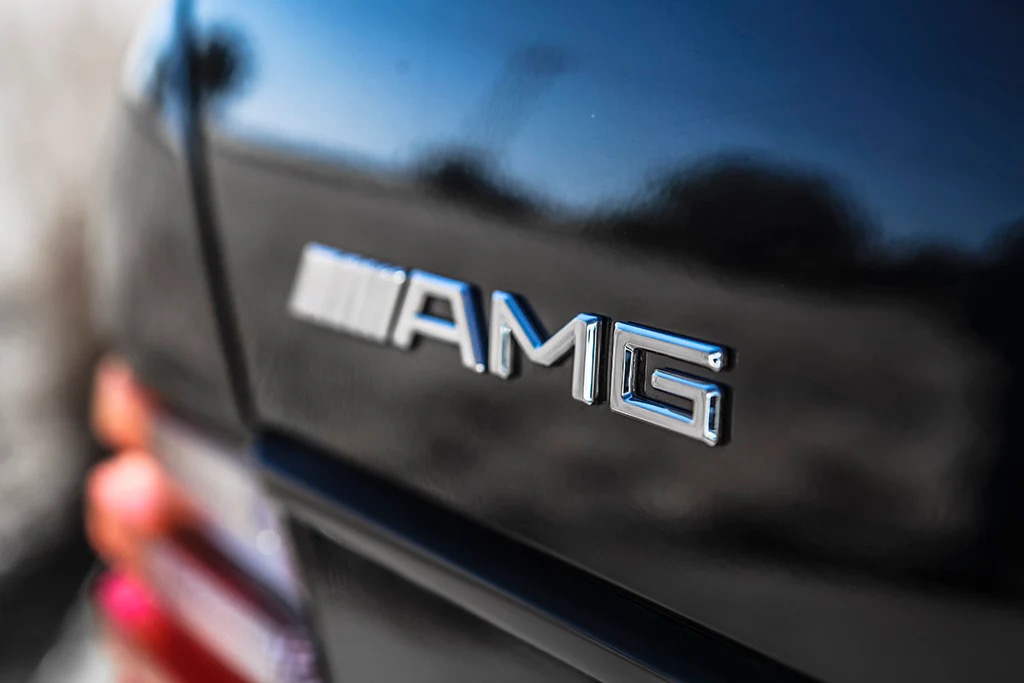
Although Mercedes’ records suggest AMG also gave this car a new ‘rear skin’ specific to the A124 (this the internal designation for the 124-series cabriolet), the tail end of this example appears standard, excepting an AMG badge on the bootlid.
Behind the wheel of the 300CE-24 AMG Cabriolet
Inspired by a walk around this car, images of AMG’s iconic Hammer V8 saloon pop into my head. But this is no 5-litre V8. Turning to the official list of upgrades once more, this 300CE-24 Cabriolet had its engine removed by AMG engineers and the three-litre M104 motor was subsequently enlarged to 3.4 litres, which increased power from 162 kW at 6 400 rpm to 200 kW at 6 500 rpm.
Torque also climbed from 264 Nm at 4 600 rpm to 315 Nm at 4 500 rpm. Without a 0-100 kph time and top speed to hand, we must use the 3.4 Coupe version’s figures as a guide; the benchmark sprint is over in 7.3 seconds, and the top speed is 250 kph.
Before we set off, I decide to lower the roof by releasing two metal levers located at the top of the windscreen, and then press a red button situated on top of the transmission tunnel. If you are not aware of the hazard lights switch below the central air vents, you can easily mistake this red button for that function. With fabric roof swiftly and automatically stowed in the boot, the bootlid closes again and resumes its flat and square profile, but the whole car looks slightly longer now.
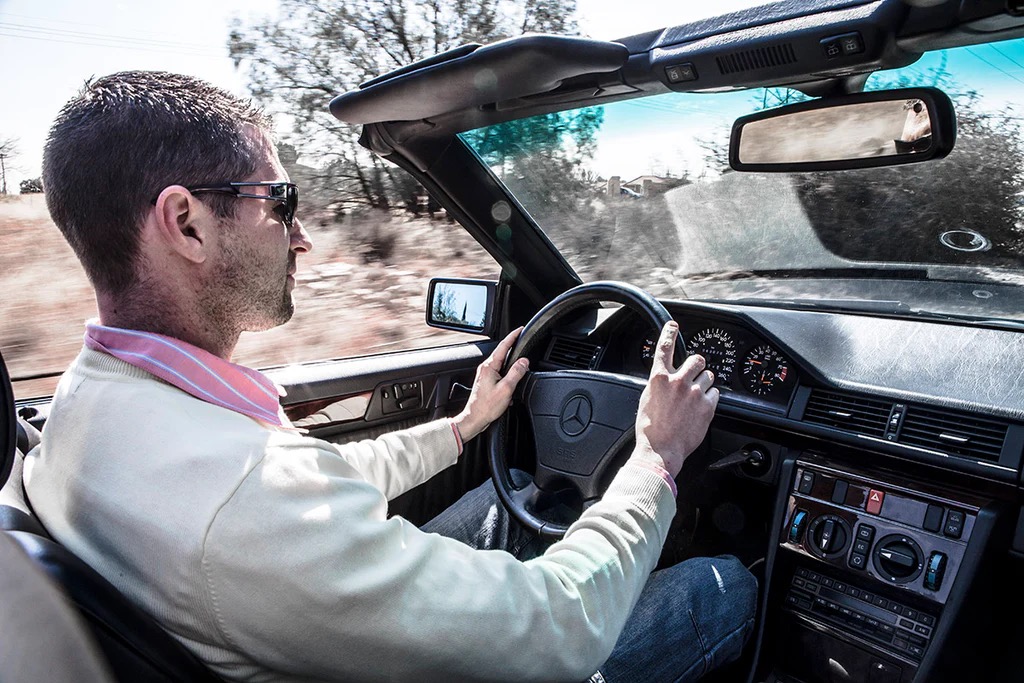
The roads are quiet enough to get into a rhythm with the 3.4. Despite the considerable work carried out by AMG, this 124 cabriolet is still a brilliant car for cruising at relaxed speeds. The engine is happy to potter around in the first third of its rev range, while the five-speed automatic gearbox carefully rows from one gear to the next. And the huge, four-spoke steering wheel makes manoeuvring easy, the high level of power assistance reducing the effort needed to turn it.
Compared to its fixed roof sibling, there is more scuttle shake, but that doesn’t affect the relaxing driving environment. But after a while, it becomes impossible to resist pressing the throttle to its stop. After all, this uprated 3.4-litre engine was built to be used. I move the gearlever to the manual setting to make sure the transmission doesn’t select a higher gear too soon, and put my foot down.
Low down engine response is somewhat languid, but by 3 000 rpm the motor is coming alive and the rev needle quickly swings round to 6 000 rpm, which is when the in-line-6 engine’s distinctive sound infiltrates the ‘Benz’s cabin. The big 7 000 rpm mark is finally reached and the gearbox calls time, automatically slotting home the next cog. Given the car’s age, it is a mighty performance.
I move the transmission lever back into ‘D’ and smile – the lever’s click-click sound between steps very similar to that of levers in Mercedes of the 2000s.
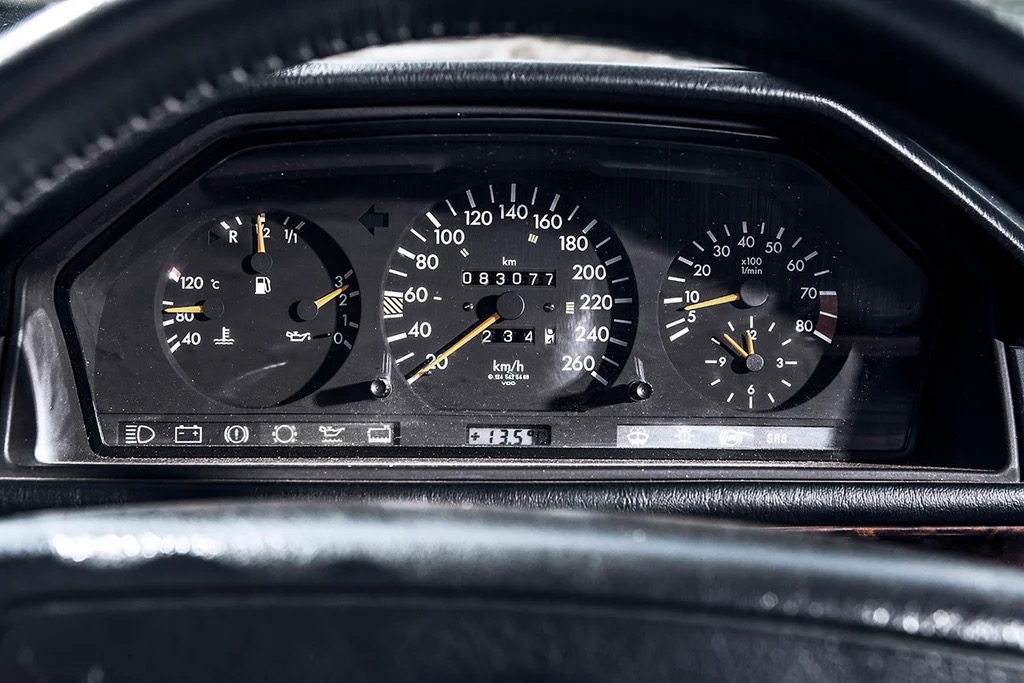
This car has been cared for throughout its life, and that’s obvious inside and out. The interior hides its three decade and 85 000 km of use remarkably well, with no cracks, splits or tears anywhere, and it is quite clear that the car hasn’t been parked in the sun with the roof down, every surface still richly coloured.
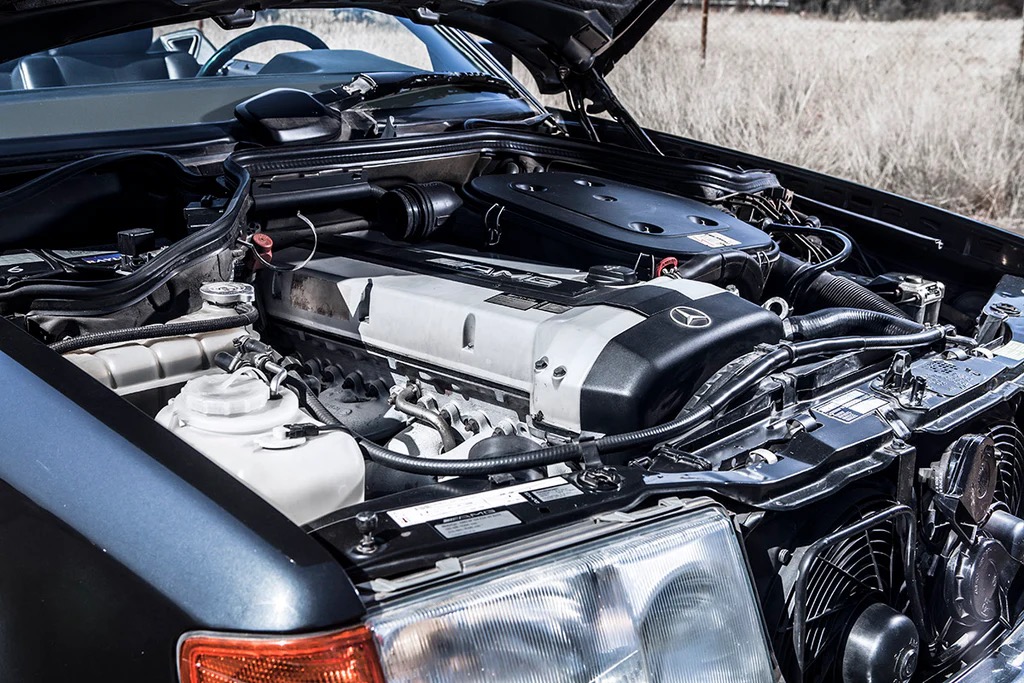
Unlike today’s engines, which are usually covered by moulded plastic, open the bonnet of this 1993 Mercedes and you’re greeted by a longitudinally positioned 6-cylinder engine exposed in all its glory. Look more closely and you’ll notice the rear part of the engine is hiding at the very back of the bay, this position aiding weight distribution and, subsequently, handling.
Summary
I must admit that I’ve never driven a standard 124-series cabriolet, and testing an AMG model first is probably not the best way to become acquainted with the range, but I can see why some buyers, enthusiasts and indeed collectors prefer these modified examples to the standard cars. For some Mercedes-Benz connoisseurs they might not be as classy, but these early AMGs deliver driving experiences with a mischievous edge, which standard 124s (bar the E36 and 500E/E500) lack.
After my drive, I went home and searched online for 124-series AMG models, but didn’t find a single one of these 3.4-litre cabriolets for sale. They were among the first AMG fettled cabriolets, and introduced the (then Mercedes-Benz-affiliated, but not -owned) Affalterbach firm to a lucrative area of the market.
Mercedes-Benz GLC: New segment leader, but at what cost?
The 2nd-generation of Mercedes-Benz’s top-selling GLC is easily the newest offering in the Executive SUV segment, but is the newcomer brilliant enough to justify its hefty price tag? Ashley Oldfield reviews the GLC300d 4Matic AMG Line.
The Mercedes-Benz GLC has become the best-selling product for Mercedes-Benz; it easily outsells the legendary C-Class. Now the 2nd generation of the executive SUV has been launched in South Africa and arrives with a very hefty price tag for what is essentially a raised C-Class with some off-road systems.
We dive into what engines you get in the range, how practical it is and the features that make it stand out as a premium-priced SUV. Is it worth the money that the Three-pointed Star is asking you to hand over?
10 best-selling bakkies in South Africa: July 2023
The numbers are in, bakkie fans! Here’s your monthly look at South Africa’s best- and worst-selling bakkies, this time for July 2023…
South Africa’s new-vehicle industry registered marginal year-on-year growth of 1.3% in July 2023, finishing the month on 43 389 units. As was the case in both May and June 2023, the light-commercial vehicle (LCV) segment was the key driver of this growth, with sales in this corner of the market increasing an appreciable 32.6% year on year to 12 666 units (though admittedly again off a fairly low base).
So, what happened on the list of South Africa’s best-selling bakkies? Well, very little, in fact. The Prospecton-built Toyota Hilux was again the top seller – not to mention Mzansi’s most popular vehicle overall, despite its sales dipping 21.4% month on month – with 2 982 units registered in July 2023. Earlier in the month, the Hilux line-up gained a pair of limited-edition Raider X derivatives.
The Silverton-produced Ford Ranger (which likewise recently went the “X” route with a new Wildtrak variant) retained the runner-up spot and ended the month just 10 units short of its June 2023 tally, with 2 089 new bakkies finding homes around the country. The Isuzu D-Max range – having just welcomed the flagship Arctic Trucks AT35 derivative, built alongside its standard siblings in Struandale – completed the podium with 1 542 registrations.
So, there were no changes in the top 3, but what about the rest of list? Well, there was zero movement month on month in the remainder of the top 10, too. That meant the Rosslyn-produced Nissan NP200 (1 041 units), KwaZulu-Natal-assembled Mahindra Pik Up (662 units) and imported GWM P-Series (642 units, 378 of which were sales to the rental industry) stayed in 4th, 5th and 6th place, respectively. Look out for the reveal of Mahindra’s new global bakkie concept right here in South Africa later in August.
Meanwhile, the Nissan Navara – which rolls off the production line alongside the long-in-the-tooth NP200 in Rosslyn – retained 7th position with 375 registrations, while the evergreen Toyota Land Cruiser 79 (312 units) held steady in 8th. A refreshed version of the latter has just been unwrapped overseas, complete with the Japanese firm’s familiar 2.8-litre, 4-cylinder turbodiesel engine and 6-speed automatic transmission.
The Ford-built Volkswagen Amarok again placed 9th by ending July 2023 on 250 sales (down 23 units, month on month), while the Chinese-made GWM Steed completed the top 10 with 143 registrations.
Best of the rest in July 2023: bakkies outside the top 10
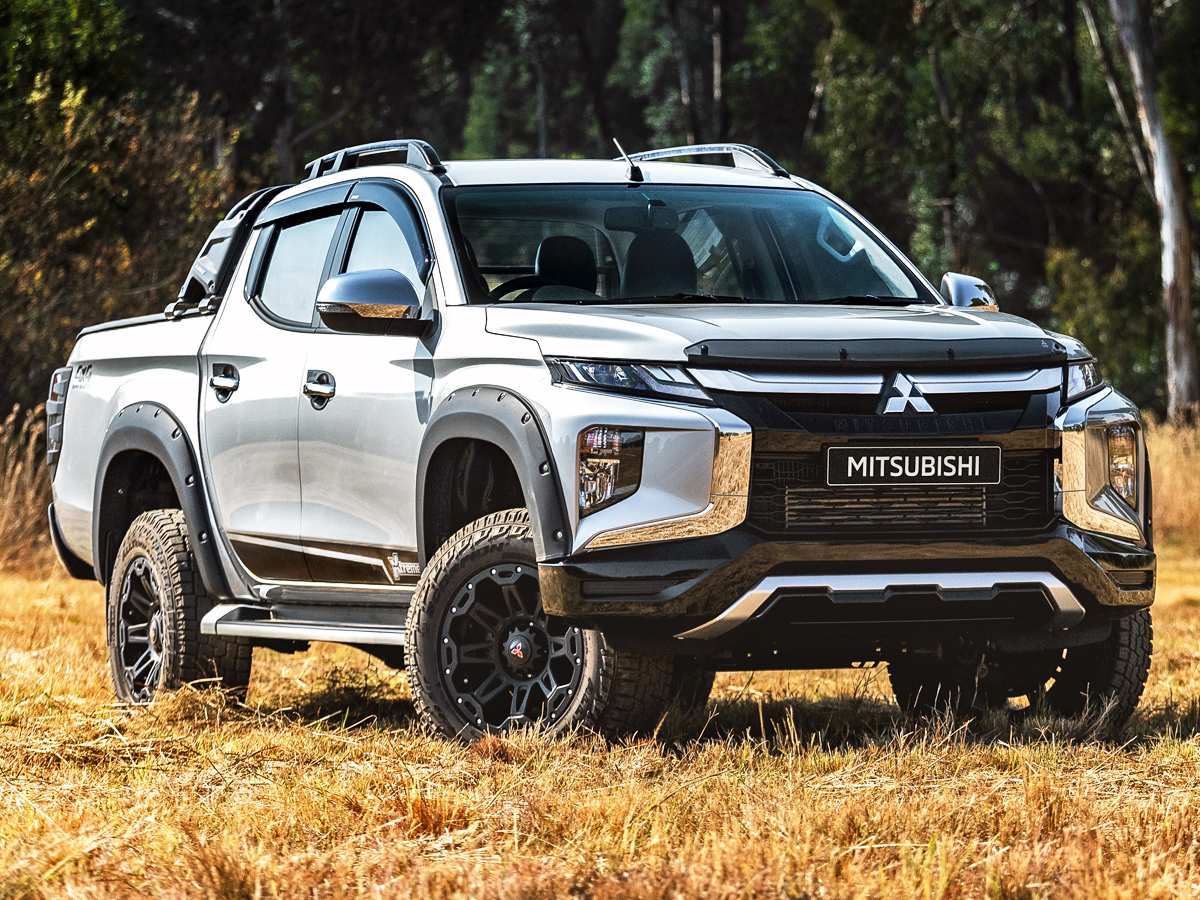
Mitsubishi’s outgoing Triton (seen here in Xtreme spec) missed out on a top-10 finish.
So, what about those bakkies that didn’t manage to break into the top 10 in July 2023? Well, the outgoing Mitsubishi Triton (74 units) – a new-generation version was recently unveiled in Thailand – was the best of the rest, followed by JAC’s T-badged bakkies (the Chinese automaker unfortunately reports only a combined figure for its T6 and T8 line-ups) with 42 units.
With the local Mahindra Bolero line-up having been quietly rationalised to just a single variant, the Indian-built bakkie had to settle for 38 registrations, though that still put it well ahead of the V6-powered Jeep Gladiator (10 units). With the Peugeot Landtrek managing only 6 sales in July 2023, the Mazda BT-50 (7 units) finally lifted itself from the very foot of the table, if only just.
Export winners in the bakkie segment in July 2023
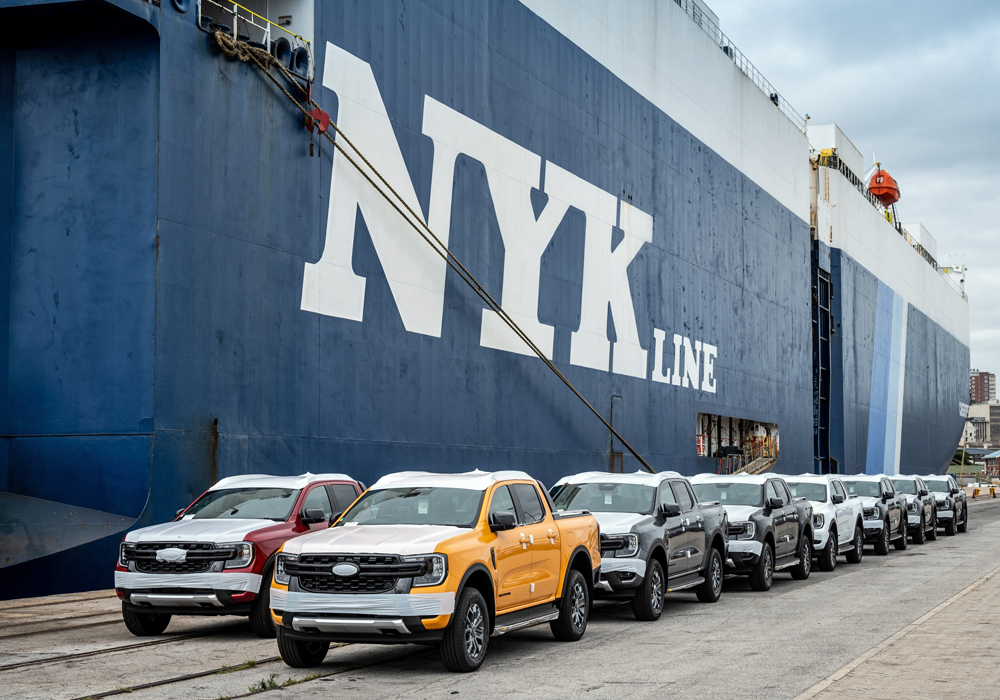
Ford’s Ranger led the bakkie-export charge last month.
What about the export market? Well, the Ford Ranger moved back into pole position here, with 7 686 bakkies (not including VW Amarok units, according to the Blue Oval brand) shipped overseas in July 2023. That meant the Toyota Hilux was pushed into a close 2nd place, with 7 273 units exported during the month.
The D-Max (641 units), Navara (404 units) and NP200 (71 units) again made up the numbers on the export charts, this time along with the Mahindra Pik Up (77 units). As has been the case for a few months, the official Naamsa report furthermore showed a couple of imported models being exported from local shores in July 2023, in the form of the Mitsubishi Triton (42 units) and GWM P-Series (10 units).
10 best-selling bakkies in South Africa for July 2023