2023/24 CarsAwards Finalists: Best Executive SUV in SA
Meet the 3 finalists in the Executive SUV category of the 2023/24 Cars.co.za Consumer Awards, sponsored by Absa. The winner of this #CarsAwards category will be announced on 29 February 2024.
The 2023/24 Cars.co.za Consumer Awards, sponsored by Absa is the 7th iteration of SA’s definitive consumer-driven automotive awards programme that aims to identify the best new vehicles on sale in Mzansi across 13 categories.
Judges first compiled a list of 65 semi-finalists – then trimmed it to 39 finalists. Following that, all #CarsAwards finalist vehicles were subjected to a rigorous 2-day test at Gerotek at the beginning of November 2023, after which they starred in the Cars.co.za Consumer Awards Roadshow at the Mall of Africa where, for the first time, the public could experience the cars – and meet the judges – in the flesh.
Most premium brands now offer road-biased SUVs that combine prestige and practicality in packages that are renowned for superior refinement. Drivetrain performance and refined road manners are a must, as is a comfortable cabin that features upmarket materials and the most up-to-date technology.
This category is guided by both eligibility factors and pillars of success.
Eligibility factors for this category include a list price between R1 000 000 and R1 300 000 at the time of semi-finalist voting (September 1, 2023) to ensure both exclusivity and status. Eligible vehicles in this category must be medium-sized (Audi Q5/Mercedes-Benz GLC size), including their “coupe” variants.
Pillars of success for this category include powertrain technology, luxury, brand strength, design and quality appeal, driving dynamics, as well as space and practicality.
Executive SUVs: CarsAwards Finalists
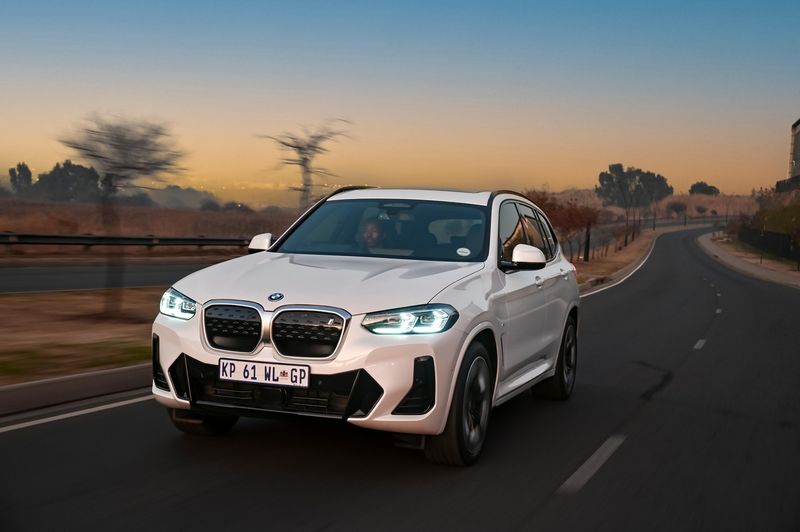
BMW X3 xDrive20d M Sport
With the current (recently facelifted) X3, it appears BMW can’t put a “wheel” wrong: it has well-resolved underpinnings, an acclaimed powertrain and a luxurious cabin laced with comfort features and tech. The turbodiesel engine offers a great blend of performance and economy, so it won’t surprise many to learn that the X3 is BMW SA’s best-selling model. Can the defending champ hold off the competition, though?
The new-gen Lexus NX represents a leap forward from its quirky predecessor. Sharp looks, impeccable build quality and a comprehensive list of standard features make the new NX a compelling prospect. The NX 350h F Sport’s hybrid powertrain is paired with a relaxed ride and drive, and its claimed fuel economy figure is one of the lowest in the segment. Backed by legendary reliability, this Lexus has a lot going for it.
Mercedes-Benz has gone to great lengths to ensure that the 2nd-gen GLC will regain its place at the top of the Executive SUV segment. Fresh looks give it standout kerb appeal, while its interior looks futuristic. There’s a great turbodiesel engine under the bonnet, giving the Benz ample performance that doesn’t come at the expense of fuel consumption. Overall, the GLC is a solid offering that deserves high praise.
The winners of the 2023/24 Cars.co.za Consumer Awards, sponsored by Absa (as well as the recipient of the prestigious Brand of the Year title) will be named on 29 February 2024.
2023/24 CarsAwards Finalists: Best Premium SUV in SA
Meet the 3 finalists in the Premium SUV category of the 2023/24 Cars.co.za Consumer Awards, sponsored by Absa. The winner of this #CarsAwards category will be announced on 29 February 2024.
The 2023/24 Cars.co.za Consumer Awards, sponsored by Absa is the 7th iteration of SA’s definitive consumer-driven automotive awards programme that aims to identify the best new vehicles on sale in Mzansi across 13 categories.
Judges first compiled a list of 65 semi-finalists – then trimmed it to 39 finalists. Following that, all #CarsAwards finalist vehicles were subjected to a rigorous 2-day test at Gerotek at the beginning of November 2023, after which they starred in the Cars.co.za Consumer Awards Roadshow at the Mall of Africa where, for the first time, the public could experience the cars – and meet the judges – in the flesh.
Premium SUVs may primarily appeal for irrational and emotional reasons such as design and status, but at their core, they are some of the most sophisticated and capable vehicles on the market. A spacious vehicle with a high-tech off-road drivetrain, a powerful engine and a luxuriously trimmed cabin (let alone with a prestigious badge on the grille) was always going to be a hit with image-obsessed car buyers.
This category is guided by both eligibility factors and pillars of success.
Eligibility factors include a list price between R1 300 000 and R1 800 000 at the time of semi-finalist voting (September 1, 2023). It must be a large SUV of the BMW X5/Mercedes GLE category (coupe-inspired variants are also considered). It goes without saying that all-wheel-drive capability is a must.
Pillars of success for this category include powertrain technology, luxury, brand strength, design and quality appeal, driving dynamics, as well as space and practicality.
Premium SUVs: CarsAwards Finalists
BMW iX xDrive40
For the first time, an all-electric model has been selected as a finalist in a category that’s not focused on EVs. The new BMW iX has been quite the revelation, with its polarising design, impressive levels of tech and superb build quality. Because the iX is based on a dedicated electric-vehicle platform – not that of a conventionally engined model – it’s rather spacious, but can the BMW trump its more traditional rivals?
The recently revised BMW X5 makes yet another appearance in one of the most established categories of the CarsAwards, but it’s easy to understand why this vehicle is an almost permanent fixture… With a potent 3.0-litre inline-6 turbodiesel powerplant that balances impressive on-road performance with good fuel economy, the xDrive30d M Sport also offers generous passenger room and cargo-carrying capacity.
Although it’s a far cry from its utilitarian progenitor, the new Defender is a kingpin in Jaguar Land Rover’s stable. In terms of sheer versatility, it blows the opposition away – that’s why there’s a waiting list for the Landy. The Defender 110 blends luxury, practicality and off-road ability in an eye-catching package and the D250 SE County derivative is powered by a 3.0-litre inline-6 turbodiesel that makes 183 kW/570 Nm.
The winners of the 2023/24 Cars.co.za Consumer Awards, sponsored by Absa (as well as the recipient of the prestigious Brand of the Year title) will be named on 29 February 2024.
2023/24 CarsAwards Finalists: Best Performance Car in SA
Meet the 3 finalists in the Performance Car category of the 2023/24 Cars.co.za Consumer Awards, sponsored by Absa. The winner of this #CarsAwards category will be announced on 29 February 2024.
The 2023/24 Cars.co.za Consumer Awards, sponsored by Absa is the 7th iteration of SA’s definitive consumer-driven automotive awards programme that aims to identify the best new vehicles on sale in Mzansi across 13 categories.
Judges first compiled a list of 65 semi-finalists – then trimmed it to 39 finalists. Following that, all #CarsAwards finalist vehicles were subjected to a rigorous 2-day test at Gerotek at the beginning of November 2023, after which they starred in the Cars.co.za Consumer Awards Roadshow at the Mall of Africa where, for the first time, the public could experience the cars – and meet the judges – in the flesh.
While owning supercars and other “exotics” is bound to remain a pipedream for most car buyers, there are new cars that are priced under the R1-million mark that offer near-supercar thrills and performance.
In this category, we are not only looking for sizzling performance but also driver engagement, whether driven on the track or on the road.
This category is guided by both eligibility factors and pillars of success.
Eligibility factors include a list price below R1 000 000 at the time of semi-finalist voting (September 1, 2023) to ensure that this doesn’t become a category dominated by extravagant and unattainable exotics.
Pillars of success for this category include drivetrain engagement, handling, sensory appeal and standard features.
Performance Car: CarsAwards Finalists
Honda Civic Type R
The Honda Civic Type R is a revered hot hatch. Every iteration of the Type R has delivered driving thrills and performance in abundance, and this new-gen model is no different. It may lack the outrageous styling of the predecessor, but it makes up for it with an even more focused driving experience.
The Japanese hatchback’s grip levels are staggering; its 2.0-litre 4-cylinder turbopetrol develops a stonking 235 kW/420 Nm and the sheer level of driver engagement it offers serves as a reminder that rip-snorting front-wheel-drive hot hatches such as these won’t be around for all that much longer.
Toyota’s GR division took its learnings from the world rally championship-inspired GR Yaris, applied them to the Corolla and turned up the wick. The 1.6-litre 3-cylinder turbopetrol motor now delivers 221 kW and 370 Nm, combined with all-wheel-drive grip that feels out of this world. With a notable feel-good factor and head-turning looks, there’s nothing quite like the GR Corolla. Will it beat its smaller sibling, though?
The GR Yaris is the result of Toyota’s Gazoo Racing arm developing a car for motorsport homologation and, if you were to enter a racing series, you wouldn’t have to do much to convert this mighty mite into a championship-winning race car. All the elements are there: a revvy turbocharged 3-pot motor, all-wheel drive and a sweet-shifting 6-speed manual ‘box. If ever a car epitomises this category, it is this one.
The winners of the 2023/24 Cars.co.za Consumer Awards, sponsored by Absa (as well as the recipient of the prestigious Brand of the Year title) will be named on 29 February 2024.
2023/24 CarsAwards Finalists: Best Leisure Double Cab Bakkie in SA
Meet the 3 finalists in the Leisure Double Cab Bakkie category of the 2023/24 Cars.co.za Consumer Awards, sponsored by Absa. The winner of this #CarsAwards category will be announced on 29 February 2024.
The 2023/24 Cars.co.za Consumer Awards, sponsored by Absa is the 7th iteration of SA’s definitive consumer-driven automotive awards programme that aims to identify the best new vehicles on sale in Mzansi across 13 categories.
Judges first compiled a list of 65 semi-finalists – then trimmed it to 39 finalists. Following that, all #CarsAwards finalist vehicles were subjected to a rigorous 2-day test at Gerotek at the beginning of November 2023, after which they starred in the Cars.co.za Consumer Awards Roadshow at the Mall of Africa where, for the first time, the public could experience the cars – and meet the judges – in the flesh.
In this immensely popular and fiercely contested vehicle category, the search is on for the ultimate all-rounder. From luxurious touring vehicle, to hardcore off-roader, capable carry-all, family do-all and lifestyle activity machine, leisure double-cab bakkies can no longer be too utilitarian and rough around the edges, but should be highly sophisticated offerings.
This category is guided by both eligibility factors and pillars of success.
Eligibility factors for this category include a list price above R800 000 at the time of semi-finalist voting (September 1, 2023). The vehicle must be a double-cab (four-door) pick-up/bakkie with four-wheel-drive, an automatic transmission and a minimum ground clearance of 200 mm.
Pillars of success for this category include performance, space & practicality, in-car entertainment, comfort, all-surface ability and safety.
Leisure Double Cab Bakkies: CarsAwards Finalists
Ford Ranger 3.0 V6 EcoBoost Raptor 4WD
If you’re looking for the most performance-oriented double-cab bakkie in the new-vehicle market, then look no further than the Ford Ranger Raptor. With a bespoke off-road racing suspension, muscular looks and a howling twin-turbo petrol V6, the 2nd-gen Ranger Raptor makes an unequivocal statement. Inside, the Raptor boasts comprehensive safety tech and connectivity, and an appropriately themed cabin.
If you want the most luxurious locally-assembled double-cab bakkie – one that is as accomplished at transporting your family in comfort as conquering an off-road trail, the new Ford Ranger Wildtrak ticks all the boxes. Not only does it look the part and wear a desirable badge, it also sports an extensive features list. A brand-new 3.0-litre turbodiesel V6 gives it impressive performance and towing capability too.
The 2nd-generation Volkswagen Amarok is also built right here in South Africa, alongside the Ranger in Ford’s Silverton plant. While it does share quite a few mechanical and trim components with its American cousin, the Amarok has a distinct identity and initial sales figures for the model look promising. It features the Ford-sourced 3.0 V6 TDI, giving it commendable performance, both in terms of driving and towing.
The winners of the 2023/24 Cars.co.za Consumer Awards, sponsored by Absa (as well as the recipient of the prestigious Brand of the Year title) will be named on 29 February 2024.
2023/24 CarsAwards Finalists: Best Electric Vehicle in SA
Meet the 3 finalists in the Electric Vehicle category of the 2023/24 Cars.co.za Consumer Awards, sponsored by Absa. The winner of this #CarsAwards category will be announced on 29 February 2024.
The 2023/24 Cars.co.za Consumer Awards, sponsored by Absa is the 7th iteration of SA’s definitive consumer-driven automotive awards programme that aims to identify the best new vehicles on sale in Mzansi across 13 categories.
Judges first compiled a list of 65 semi-finalists – then trimmed it to 39 finalists. Following that, all #CarsAwards finalist vehicles were subjected to a rigorous 2-day test at Gerotek at the beginning of November 2023, after which they starred in the Cars.co.za Consumer Awards Roadshow at the Mall of Africa where, for the first time, the public could experience the cars – and meet the judges – in the flesh.
Electric vehicles (EVs) are considered as future mobility solutions in an evolving motoring landscape. While they are expensive in our market, due to high material costs and additional taxes levied by the Government, demand for these types of vehicles is increasing gradually. Plus, as brands increase the number of EVs in their line-ups, consumers have an ever-growing number of models to choose from.
We are looking for the best value EVs in this segment, with enough range to confidently complete the average daily commute, while providing a blend of modern design, interior practicality, adequate performance and up-to-date tech and connectivity features.
This category is guided by both eligibility factors and pillars of success.
Eligibility factors for this category include a list price below R1 300 000 at the time of semi-finalist voting (September 1, 2023). Eligible vehicles must be all-electric (which is to say battery-electric vehicles) and offer a minimum range of 300 km when fully charged. This category excludes hybrids and plug-in EVs.
Pillars of success for this category include power and range, luxury and technology, value for money, design and quality appeal.
Best Electric Cars: CarsAwards Finalists
BMW iX1 xDrive30 M Sport
Like most legacy premium brands, BMW offers a blend of internal-combustion engine-based models, which are adapted to utilise all-electric drivetrains, and all-electric cars built on dedicated EV platforms.
The Munich-based brand has family-friendly SUVs and performance sedans in its electric vehicle line-up, but the iX1 appears to be the “Goldilocks model” for an all-electric raised-body city slicker. It’s competitively priced, boasts impressive levels of tech and its range is adequate for the daily commute. BMW SA has an extensive dealership footprint as well as a reputation for strong after-sales support.
Chinese brand Ora (which, like Haval, is a sub-brand of Great Wall Motor) has the title of SA’s most affordable electric car with its cute-looking 300 (which is named the Cat in other markets). Photos don’t do it justice – it’s actually a larger vehicle than it looks, and can easily accommodate four adults.
The claimed range and performance figures are good, plus the standard specification and build quality are impressive for a vehicle at this price point. Who said electric cars all have to cost over R1 million?
Volvo is forging ahead with its electric-car strategy (it plans to offer only EVs by 2030) and its line-up of battery-electric compact SUVs – including the C40- and XC40 Recharge derivatives are very impressive.
With the Twin Motor setup, the XC40 Recharge is one of the quickest offerings in Volvo’s line-up and its claimed range (500 km) is admirable, considering its punchy performance. Inside, you get that typically classy cabin that looks and feels premium, and let’s not forget Volvo’s stellar safety credentials either.
The winners of the 2023/24 Cars.co.za Consumer Awards, sponsored by Absa (as well as the recipient of the prestigious Brand of the Year title) will be named on 29 February 2024.
The Story of the Joule: How South Africa Nearly Beat Tesla
Optimal Energy was founded by visionary engineer Kobus Meiring, who, long before Tesla, began building a commercially viable electric passenger car.
In this podcast, veteran and respected motoring engineer and motoring journalist Nicol Louw joins Ciro De Siena to chat about his long-term involvement in the Joule electric vehicle project, in the role of Systems integration engineer.
In this truly fascinating and often emotional chat, Nicol takes us through how the project started, how it developed, and just how close they were to hitting the market, before the Tesla Model S or Nissan Leaf were launched.
It’s a story about the incredible prowess of South African engineering and the resilient spirit of South Africans who took on the world and came achingly close to starting the EV revolution.
There’s great news for motorists as the current data suggests we’ll start the new year with reductions in the price of petrol and diesel.
The good news comes from the Automobile Association (AA) which has shared some analysis and insights of the Central Energy Fund data. The AA says that the prices of diesel, petrol and illuminating paraffin will be coming down in early January 2024.
“According to the data, ULP93 will decrease by around 68 cents/litre, and ULP95 will decrease by 82c/l. Diesel is set to decrease considerably by around R1.50/l with illuminating paraffin also decreasing by around R1.42/l. The forecast reductions in the wholesale price of diesel will bring this fuel cost down to around R20,32/l inland, coming in at a price lower than the same time last year,” says the AA.
It appears the forecasted reductions are due to the international cost of oil products which have been on the decline. Unfortunately, the South African Rand Dollar exchange rate has not been favourable, otherwise, we’d be in line for an even larger reduction! Of course, these price reductions are not 100% confirmed and with 2 weeks of December 2023 left, anything can happen. We’ll have confirmed pricing in the first week of January 2024.
“These decreases will go a long way to alleviating the fuel price burden – and its associated impact on other prices – felt by millions of South Africans. For many travellers who will be going on vacation this is also good news as it will undoubtedly reduce expenses on the return leg of their journeys,” concludes the Association.
Fuel Type
Dec ’23 Inland
Dec ’23 Coast
Jan 24 Inland*
Jan’ 24 Coast*
Petrol Unleaded 93
R22.79
R22.07
R22.11
R21.39
Petrol Unleaded 95
R23.25
R22.53
R22.43
R21.71
Diesel 0.05%
R21.81
R21.09
R20.31
R19.59
Diesel 0.005%
R21.99
R21.28
R20.49
R19.78
*January 2024 figures are forecast figures and not official.
Do you have your eye on a used Hyundai Grand i10? Let’s take a closer look at the strengths and weaknesses of the first iteration of the Korean budget hatchback, and find out how much you can expect to pay for a tidy example…
When the Hyundai Grand i10 touched down in Mzansi around the middle of 2014, it slotted into the small gap between the i10 city car (which soldiered on for a few more years) and the i20 compact hatchback.
The Korean firm’s local division had high hopes for its fresh-faced budget hatchback – it even suggested that the Grand i10 nameplate had the potential to emulate the runaway sales success of the Getz.
In some ways, the Grand i10 picked up where the Getz left off.
As it turned out, such predictions proved accurate; this front-wheel-drive model – which deftly straddled the A- and B-segments – found favour with local buyers and soon graduated to the role of Hyundai Automotive South Africa’s bestseller. After 6 years on the market, as many as 49 252 units of the original Grand i10 had been registered around Mzansi (at least that’s according to Hyundai’s local importer).
Known internally as the BA generation – as opposed to the European-spec IA series, which had a shorter wheelbase and effectively served as a 2nd-generation i10 – the Grand i10-badged model was built in Chennai, India. Locally, it was available only as a 5-door hatchback, though some markets also received a sedan version (while Indonesia furthermore marketed the crossover-inspired i10X).
Despite being discontinued in most other parts of the world, the original PA-generation i10 was sold alongside its larger sibling in South Africa until February 2018, when the facelifted Grand i10 range was expanded (and, from that point, tasked with playing the part of the entry-level model, too).
Hyundai Grand i10 model line-up in South Africa
The Grand i10 made its local debut towards the middle of 2014.
The 1st official images of the Indian-market Grand i10 were released in August 2013, while photographs of the slightly more compact Euro-spec i10 were distributed on the Old Continent around the same time. By June 2014, the former had hit the market in South Africa, available exclusively with a naturally aspirated 1.2-litre, 4-cylinder petrol engine. At launch, the local line-up comprised 3 derivatives:
1.2 Motion 5MT (64 kW/120 Nm)
1.2 Fluid 5MT (64 kW/120 Nm)
1.2 Fluid 4AT (64 kW/120 Nm)
The Grand i10 carried on unchanged until April 2017, when Hyundai Automotive SA implemented a few styling tweaks. For instance, the hatchback gained revised bumpers (fore and aft), a honeycomb-mesh grille and new front-foglamp bezels, while the flagship Fluid derivative was handed a fresh alloy wheel design. Interestingly, the Korean marque’s local division also rejigged the (still 3-strong) range at this point, opting to offer the base Motion grade with either the manual ‘box or automatic transmission.
The Grand i10 was handed small styling updates in April 2017.
In December 2017, Hyundai quietly expanded the Grand i10 range by launching a new entry-level Motion derivative, powered by a naturally aspirated 1.0-litre, 3-cylinder petrol engine that produced peak outputs of 48 kW and 94 Nm of torque (via a 5-speed manual gearbox).
By February 2018 – with the original i10 now discontinued in SA – the facelifted Grand i10 made local landfall, stepping into the role of entry-level model, too. As such, Hyundai increased the number of variants to 6, with 3 of these powered by the aforementioned 1.0-litre, 3-cylinder petrol mill.
The facelifted Grand i10 launched in Mzansi in the opening quarter of 2018.
Meanwhile, the 1.2-litre motor was available in the Fluid trim level – with either of the transmissions – and in a new range-topping Glide specification (only in manual guise). The Glide was set apart by items such as LED daytime running lights, 2-tone alloys and combination upholstery (black leather and red cloth), along with a smattering of red accents on the instrument panel, centre console and interior door panels.
In addition, the Fluid and Glide grades scored not only a 2-year/30 000 km service plan, but also a new touchscreen-based infotainment system. Customers had the option of purchasing an SD memory card (for R2 500, at the time) to activate the system’s navigation function.
At the mid-cycle update, Fluid and Glide derivatives gained a short service plan as standard.
Around July 2019, the Grand i10 Cargo panel van was launched in South Africa. The 2-seater model featured what Hyundai termed “security barriers” on the rear windows and -screen, while the 1 202-litre load area came with a cargo barrier and luggage net. The light commercial vehicle (LCV) version of the Grand i10 was offered in 1.0 Motion guise, as well as 1.2 Fluid form – both with a manual cog-swapper.
The BA-generation Grand i10 was finally replaced by the AI3-series model – which furthermore featured the “Nios” suffix in India – in October 2020.
What are the advantages of a Hyundai Grand i10?
The extra length compared with the i10 resulted in more interior space.
Extra cabin room: Measuring 3 765 mm from snout to rump, the Hyundai Grand i10 was 180 mm longer than the standard i10, while also gaining 65 mm of width and 45 mm in its wheelbase. As a result, it offered more cabin room than the i10, putting it near the top of its class in that department. In addition, the luggage compartment grew to 256 litres (expandable to 1 202 litres with the rear seats folded down).
Generally solid built quality: Though not quite as upmarket inside as the likes of the closely related TA-generation Kia Picanto or indeed the Volkswagen Up that debuted locally in 2015, the original Grand i10 nonetheless offered sturdy cabin build quality. Hyundai furthermore added some visual pizzazz to the interior by initially giving the buyer a choice of colour schemes, including grey cloth with orange inserts; grey leather with red inserts; and grey cloth with grey inserts.
This is the Grand i10 cabin in facelifted form.
Well-proven engines: The 1.2-litre engine (G4LA) used across the Grand i10’s local lifecycle was also employed by the original i10, as well as the entry-level version of the PB-series Hyundai i20 hatch. Thanks to the Grand i10’s kerb weight of a little over a tonne, the performance of the manual-equipped powertrain was entirely adequate, while the claimed combined fuel economy was acceptable at 5.9 L/100 km (with the 4-speed automatic transmission proving a bit thirstier at a claimed 6.9 L/100 km).
But this chain-driven Kappa engine’s biggest strength was perhaps its track record for reliability. It was a similar case with the 1.0-litre 3-pot (G3LA) that joined the line-up in 2018, since this likewise straightforward mill had done duty in other Hyundai and Kia products in previous years. For the record, Mzansi didn’t receive the fuel-frugal 1.1-litre CRDi U2 diesel engine that was available in India.
What are the disadvantages of a Hyundai Grand i10?
Crash tested by Latin NCAP in 2015, the Grand i10’s shell was rated as unstable.
Missing safety spec: From launch, the SA-spec Grand i10 was offered with dual front airbags and ABS. But throughout its time on the local market, the BA series did without items such as electronic stability control and ISOfix child-seat anchors, while the middle rear passenger had to make do with a lap belt. These omissions were unfortunate, considering the Grand i10 was marketed as a small family car.
Tellingly, the Indian-manufactured Grand i10 failed to score a single star for adult-occupant protection in its 2015 Latin NCAP crash test, when its body shell was rated as “not capable of withstand further loading” (note, however, the evaluated model was not fitted with ABS and airbags).
In a stark illustration of the safety-standard disparity between markets, the Turkish-built i10 – which shipped with far more safety kit – was awarded 4 stars by Euro NCAP in the previous year.
Some drivers have reported issues with engaging reverse gear.
Reverse-gear problem: In some manual-equipped examples of the Grand i10, the reverse gear didn’t always slot cleanly into place. We’ve heard of numerous complaints – both in India and South Africa – of this annoying problem, which generally presents within the first few hundred km of the vehicle’s life.
Unfortunately, there wasn’t a straightforward fix for this issue (some suggest the lack of synchromesh on reverse was at the root of the problem). Hyundai advised customers to return the gear lever to neutral, release the clutch, depress the pedal once more and try again. So, when test-driving a used Grand i10 that you’re considering buying, ensure the ‘box slots easily into “R” (preferably with the engine running).
Vague electric power steering: As was the case with many Hyundai and Kia budget vehicles of the era, the Grand i10’s electric power steering was largely devoid of feel/feedback. Although the (overly) light steering was sometimes useful at parking speeds, it lacked precision at highway velocities, where constant small corrections – around centre – were required to keep the hatchback straight in its lane.
How much is a used Hyundai Grand i10 in South Africa?
The split between 1.0- and 1.2-litre engines was almost even at the time of writing.
When the Grand i10 arrived in South Africa, a 5-year/150 000 km manufacturer warranty was included in the purchase price. However, from 1 February 2016, Hyundai’s local distributor extended this to 7 years or 200 000 km by incorporating an additional 2-year/50 000 km powertrain warranty. In addition, take note a service plan was not offered as standard until February 2018, when Fluid and Glide derivatives gained a 2-year/30 000 km arrangement (Motion variants, though, still did without).
Of the used BA-gen Hyundai Grand i10 models that were listed on Cars.co.za at the time of writing, just 19% featured the 4-speed automatic transmission. Fascinatingly, despite the 1.0-litre engine joining the range only at the end of 2017, it accounted for a healthy 47% of all examples on our site. This starts to make sense when you consider almost half of all listings were clustered in the final 3 model years.
Facelifted models (in the Fluid and Glide trim) gained a touchscreen system.
The entry-level Motion was the most common grade, accounting for 53% of BA-series Grand i10 units on Cars.co.za, although the Fluid trim wasn’t far behind on 46%. The flagship Glide specification was thus extremely hard to come by – it made up a mere 1% of the listed stock. Meanwhile, mileages varied from 10 000 km to 223 000 km, with the latter figure achieved by a manual-equipped 2015 1.2 Motion.
Below R125 000: Predictably, most listings at this end of the market were pre-facelift models with plenty of mileage. Considering the early model years dominated this space, the 1.2-litre motor was the most common, too. The cheapest example we discovered was a 2014 1.2 Fluid going for R65k.
From R125 000 to R150 000: Despite being quite a narrow bracket, more than 40% of listings were grouped between these pricing bookends. Every single model year was represented, though 2018 and 2019 were the most common. The majority of shoppers would likely be looking in this space.
From R150 000 to R200 000: There were very few pre-facelift examples listed for above R150 000, with the final model year being the most prevalent here. That said, the 1.0-litre engine was the most popular, while the split between Motion and Fluid trim levels was virtually even.
R200 000 and up: Spending upwards of R200 000 would get you into a current-gen Hyundai Grand i10, although we still found a handful of 2020 BA-series examples in the space, most of which featured low mileage and an automatic transmission. The priciest unit we unearthed was a 2019 1.0 Motion 4AT with 24 000 km on the odometer, listed for R210 000.
Which Hyundai Grand i10 derivative should I buy?
We’d recommend narrowing your search to a facelifted model, if your budget allows.
So, which derivative should be on your shortlist? Firstly, we’d lean towards examples of the facelifted models, which benefit not only from sharper exterior styling but also improved refinement levels, minor suspension enhancements and a far more comprehensive infotainment system (in the case of the Fluid and Glide variants). We’d furthermore recommend the larger, 1.2-litre 4-cylinder engine for most purposes, particularly if the vehicle will be required to perform in the thinner air up at the Reef.
Which trim level is best? Well, while the Glide specification is evidently the most generous in terms of standard equipment, such-grade derivatives are also in seriously short supply on the used market (and likely to attract a significant premium, too). So, we’d argue the Fluid grade – in conjunction with the aforementioned 1.2-litre engine – offers the best balance; it shipped standard (in facelifted form) with features such as alloy wheels, keyless entry, manual aircon, electric windows (all round), electrically adjustable (and heated) side mirrors and the aforementioned touchscreen infotainment system.
Is the Hyundai Grand i10 a smart used buy?
The Grand i10 faced rivals in both the A- and B-segment spaces.
But the BA-generation Hyundai Grand i10 proved to be more than up to the task of battling contenders from both categories, rewarding buyers with “plenty of car for the money” – as it continues to do on the used market today. Though the missing safety kit remains a blot on its ledger, this budget hatchback is well-made, powered by proven engines and offers commendable cabin space for the segment.
The vehicles SA’s automakers kept for themselves last month
Every month, Naamsa’s sales figures include a list of so-called “single” registrations – units that automakers have kept and licensed for their own use. These were the most popular in November 2023…
Many of the various automotive brands plying their trade in South Africa report so-called “single” registrations every month.
Lightstone Auto, which provides the primary platform for the delivery of Naamsa’s new-vehicle sales statistics, defines single registrations as “units that manufacturers/importers keep for their own use”, giving examples such as staff vehicles, media vehicles and promotional vehicles. Interestingly, Lightstone says corporate fleet sales are not included in this.
So, which were biggest volume drivers through the single-registration channel in November 2023? Well, Nissan South Africa kept as many as 140 examples of its Indian-built Magnite last month, helping to inflate the budget crossover’s total to 997 units – its best showing of the year thus far.
Meanwhile, 116 units of the Kariega-made Volkswagen Polo hatchback (out of a 930-unit total) were registered to the German brand’s local division in November, with Toyota keeping hold of 89 examples of the Prospecton-produced Hilux (which was again SA’s best-selling vehicle overall last month, with a whopping 3 073 registrations).
Isuzu registered 62 units of the Struandale-manufactured D-Max (out of a 1 662-unit total) via the single-sale channel, while 56 examples of the likewise SA-built Toyota Corolla Cross (out of 1 766 units) came in this space. The Silverton-produced Ford Ranger also featured here with 44 units (out of 2 234 units), while the Everest was the highest-placed imported model, with 43 units out of its 346-unit tally.
Finally, the Toyota Urban Cruiser (41 units out of 559), Toyota Starlet (35 units out of 1 176) and Volkswagen Amarok (35 units out of 367) completed the top 10. In total, as many as 1 160 units – or nearly 2.6% of the industry total of 45 075 sales – were reported in the single-registration channel.
SA’s top 10 ‘single’ registrations in November 2023
Mustang California Special Video Review – How special is this run-out model as the new Mustang arrives?
We spent some quality time with the Ford Mustang California, but it has split the office.
It’s safe the say that this Mustang California has divided the Cars.co.za team. A lot. Ciro loves it to death. Ashley can’t stand it. Hannes came to love it eventually.
Everyone in the office seems to have a different opinion on the ‘Stang, and this goes some way to explaining why the Mustang is so refreshing. In an age of electric vehicles and hard-edged, clinical German sports cars and sports sedans, the Mustang stands out, like some sort of wonderful dinosaur.
The incredible level of attention it attracts would have you believe it debuted yesterday…but this is now a 10-year-old design!
We’ve just spent three months in the Mustang California Special and we are proud and happy to present our long-term wrap-up review.
Do you agree with Ciro on this one? Or is Ashley’s sentiment more in line with how you feel about the Mustang? Let us know in the comments below, we’ll see you there.