Mercedes-Benz EQE Sedan (2023) Price & Specs

We have pricing for the new fully electric Mercedes-Benz EQE Sedan, including the Mercedes-AMG EQE 43 4Matic! Here’s how much you’ll pay in South Africa…

Wondering how much the new Mercedes-Benz EQE Sedan will cost in South Africa? Well, pricing for this fully electric executive saloon (not to be confused with the SUV version wearing the same EQE badge) has finally be added to the local Mercedes-Benz configurator as the German company continues its EV offensive.

As expected, the local V295-generation line-up comprises a pair of derivatives at launch, slotting in below the EQS Sedan. The first is the EQE 350+ Sedan, which starts at R1 724 650 (a figure that comes in a little lower than the indicative pricing released at the start of 2023). As a reminder, this variant employs a permanently excited synchronous motor at the rear, drawing power from a 10-module 90 kWh (useable) lithium-ion battery pack.

The EQE 350+ Sedan’s peak system outputs stand at 215 kW and 565 Nm, while the WLTP single-charge range tops out at 654 km. According to the Stuttgart-based firm, the 0-100 kph sprint is seen off in 6.4 seconds, with top speed limited to 210 kph. With a maximum DC charging capacity of 170 kW, Mercedes-Benz says moving the battery’s state of charge from 10 to 80% at a fast charger would take approximately 32 minutes.

In the case of the EQE 350+ Sedan, the Electric Art exterior pack ships standard, while upgrading to the AMG Line exterior package adds R102 200 to the price. The Night Package costs R22 000, while Mercedes also offers a trio of equipment packs: Advanced (included), Advanced Plus (R81 300) and Premium (R145 600).

The Mercedes-Benz EQE 350+ Sedan fitted with the AMG Line exterior package.

Individual options include larger alloy wheels (up to R49 000 for 21-inch AMG items), a panoramic sliding sunroof (R34 000), climatised front seats (R18 000), a head-up display (R22 000), a Burmester surround-sound system (R26 000) and an increase in the AC charging capacity from the standard 11 kW to 22 kW (R20 500).

What about the Mercedes-AMG EQE 43 Sedan? Well, the lower-powered version of Affalterbach’s take on the saloon (no sign of the 505 kW EQE 53 4Matic+ yet) kicks off at R2 112 950. The 43-badged model features an “AMG-specific” electric motor on each axle and is thus all-wheel drive.

Maximum system outputs stand at 350 kW and 858 Nm, while the sprint to 3 figures takes a claimed 4.2 seconds (with top speed pegged at 220 kph). Like the EQE 350+, the EQE 43 employs a 90 kWh lithium-ion battery, though here it yields a WLTP range up to 534 km.

A pair of optional equipment packages is also on offer for the Mercedes-AMG EQE 43 Sedan, though here they cost less: R37 800 in the case of the Advanced Plus and R61 100 for the Premium package. In addition, Mercedes-Benz SA offers a few AMG-specific options, such as a high-performance ceramic composite braking system (R90 000) and red-painted brake callipers (R14 500). There’s also the MBUX Hyperscreen for the price of R155 000.

How much does the Mercedes-Benz EQE Sedan cost in SA?

Mercedes-Benz EQE 350+ Sedan – R1 724 650

Mercedes-AMG EQE 43 Sedan – R2 112 950

The above pricing includes a 5-year/100 000 km maintenance plan as well as a 2-year/unlimited kilometre warranty, plus a separate 10-year/unlimited km warranty on the battery.

Buy a used Mercedes-Benz on Cars.co.za!

Related content

2024 Mercedes-Benz E-Class Fully Revealed

Mercedes-Benz GLA (2023) Price & Specs

Mercedes-Benz V300d Special Edition (2023) Review

New Mitsubishi Triton Shows its Face in Fresh Teasers

The new Mitsubishi Triton has shown its face in a fresh set of teaser images and a video, with the Japanese brand also confirming an official reveal date…

Ready for the all-new Mitsubishi Triton? Well, the wraps will officially come off the 6th generation bakkie on 26 July 2023, though the Japanese automaker has dropped a handful of teaser images (and some video content) in the meantime, giving us an early look at its upcoming rival to the likes of the Toyota Hilux, Ford Ranger and Isuzu D-Max.

Billed as an all-new “global strategic model” (and known as the L200 in some markets), the next-gen Triton is set to feature what Mitsubishi describes as a “beefed-up body” and “powerful, horizontally themed styling”. Of course, we’ve already have a bit of a preview in the form of the XRT Concept.

A look at the new Mitsubishi Triton’s profile.

As you can tell from these latest teaser images (showing the double-cab body style), the bakkie’s front end is defined by a combination of daytime running lights (apparently resembling the “sharp gaze of a hawk”) and new “3-dimensional headlights”. The video below also gives us an early (but shadowy) look at the new Triton’s cabin, complete with a tablet-like infotainment screen standing proud of the dashboard. For now, Mitsubishi remains mum on the new Triton’s powertrain options.

“The all-new Triton has been completely re-imagined under the design concept ‘Beast Mode’, or audacious and daring,” said Seiji Watanabe, division general manager of design at Mitsubishi Motors.

“While expressing the toughness and powerfulness expected of a pick-up truck, the all-new Triton combines agility with the brand’s robust design to create an imposing look. Tough and reliable, the all-new Triton will make customers want to go on any adventure,” promised Watanabe.

The new Triton – which we expect to be closely related to the next-gen Nissan Navara, considering the 2 brands are part of the Renault-Nissan-Mitsubishi Alliance – will be fully revealed at a special event in Thailand in July (and will surely spawn a new Pajero Sport, too). Check back for more details then…

Buy a used Mitsubishi Triton on Cars.co.za!

Related content

Mitsubishi Triton Halo AT35 Prototype Unveiled for SA

Mitsubishi’s Triton XRT Concept Shown

Mitsubishi Triton Heritage Edition (2022) Specs & Price

Volkswagen Amarok (2023) Review

Is the 2023 Volkswagen Amarok simply a clone of the Ford Ranger, or is there more to the Wolfsburg-based brand’s 2nd-gen double-cab? We review the PanAmericana 4Motion-grade 3.0TDI V6 derivative, which, like its siblings, is built in South Africa.

  • We like: Plush cabin, great infotainment system, most off-road capable Amarok ever.
  • We don’t like: Some ergonomic quirks, price premium over its Ranger Wildtrak cousin.

FAST FACTS

Serious about buying/selling?

Some dealerships regularly offer great deals. See our New Car Specials!

Looking to sell your car? Sell it on Cars.co.za for free

Where does the Volkswagen Amarok PanAmericana fit in?

2023 Volkswagen Amarok Panamericana side profile.
The new Amarok is happiest on a dirt road

The 2023 Volkswagen Amarok joins the hotly-contested double-cab bakkie market at one of the busiest times for the highly popular segment. If you’ve had your eye on purchasing a double-cab bakkie, now is a good time to take the plunge – new and updated models are arriving at local showrooms in their droves.

The all-new Amarok recently made its debut and the 2nd-generation model brings significant upgrades in terms of powertrain, connectivity, and capability. If you weren’t already aware of it, the new iteration of Volkswagen’s double-cab is built here in South Africa – at Ford’s Silverton factory, located near Pretoria.

The 2023 Volkswagen Amarok Panamericana is equipped with 4Motion four-wheel drive.
4Motion implies that Amarok is 4×4 capable; in fact, it has an automatic 4-wheel-drive system.

Ford produces the 2023 Volkswagen Amarok on behalf of the Wolfsburg-based brand (with which it has a strategic partnership) and the model shares quite a few components with the new-generation Ranger. Still, if there was one platform you’d want your new product to be based on, you’d struggle to find a more modern and complete package than the P703-series (or “T6.2”) Ranger. A good starting point, then!

By undertaking collaborative projects, Ford and Volkswagen have benefited from sharing research and development costs, as well as utilising proven technology. The winner is, of course, you the consumer, who benefits the most from the 2019 Ford-VW global alliance cooperation agreement. Such a venture isn’t always a success… Just ask Mercedes-Benz, whose X-Class version of the Nissan Navara faltered.

2023 Volkswagen Amarok front three-quarter view.
What a great-looking truck! The V6 badge on the grille is very subtle.

Will Volkswagen fare better? Perhaps it will – the brand makes full use of Ford’s manufacturing capability and the new Amarok is available in single and double-cab body styles, with an array of 4-cylinder and 6-cylinder turbodiesel engines that should a variety of lifestyle buyer- and commercial customer needs.

Is it a simple case of changing a few things from the Ford Ranger to produce the 2023 Volkswagen Amarok? Absolutely not. As you can see, the new Amarok has quite a unique look. At first glance, you may notice the bakkies have identical wing mirrors, door handles and a roofline, but that’s about it. The bumpers are different, as are the wheel arches and headlights, plus the VW’s grille is big and imposing.

Panamericana off-road pack adds offroad tyres and underbody protection to the 2nd-gen Amarok.
The PanAmericana off-road pack adds offroad tyres, underbody protection and subtle decals.

Right now, the class of 2023 double-cab bakkies is more competitive than ever and, if you’re shopping for top-spec derivatives, there are a number of quality offerings that rival the Amarok PanAmericana.

Compare the Amarok PanAmericana with the Ford Ranger Wildtrak and Toyota Hilux Legend

How the 2023 Volkswagen Amarok fares in terms of…

Engine and performance

2023 Volkswagen Amarok rear three-quarter view.
It may be based on the Ranger, but there are quite a few unique design elements

The 3.0TDI V6 double cab PanAmericana 4Motion is powered by a Ford-sourced 3.0-litre V6 turbodiesel. Its peak outputs of 184 kW and 600 Nm isn’t far off the outgoing model’s 190 kW and 580 Nm. The first-gen Amarok V6 was easily one of the quickest double-cab bakkies, but it had an Audi-derived engine. The new model’s motor offers slightly less performance, but improved fuel economy/lower emissions.

Indeed, the derivative is anything but sluggish. According to our test equipment, the Amarok accelerated from 0 to 100 kph in a decidedly brisk 8.74 seconds (VW claims the bakkie has a top speed of 180 kph). If full-bore sprinting doesn’t impress you, the bakkie’s lively throttle responses and abundance of in-gear shove certainly will. The software that governs the 10-speed automatic transmission does a good job of optimising the engine’s performance characteristics (it does not “hunt”). Plus, we’re delighted to report that the motor doesn’t clatter excessively; you hardly ever discern mechanical vibrations in the cabin.

The Amarok Panamericana offers a multitude of off-road drive modes.
Pick one of the many offroad modes when the going gets tough

That 10-speed automatic transmission is a marvel. You’d think the transmission has at least 2 too many ratios, and it sometimes hesitates on downshifts if you suddenly summon the engine’s full performance, but in general, the ‘box just quietly gets on with its job. There are no shift paddles on the steering wheel, but you can actuate cog-changes manually by using a button on the side of the transmission lever.

As far as fuel efficiency is concerned, the 3.0-litre V6 turbodiesel-powered Amarok returned an average consumption figure of 11.4 L/100 km (VW claims 8.4 L/100 km), which may seem a trifle high, but is more or less in line with other big-engined diesel bakkies. The theoretical range of the 80-litre tank is 952 km.

Interior tech and refinement

The 2nd-gen Volkswagen Amarok shares the Ford Ranger's cabin architecture.
The cabin shares many elements with the Ranger, but it’s arguably the most modern and stylish cockpit in the segment.

Volkswagen SA has priced this Amarok a bit higher than its Blue Oval cousin – the Ford Ranger Wildtrak – and, considering the premium for the German bakkie, buyers expect a lofy standard specification, as well as a more premium feel and -cabin ambience. Fortunately, VWSA has ticked those boxes. While the Aventura grade is geared for luxury-car buyers, the PanAmericana spec is aimed at off-road enthusiasts.

When you climb inside the Volkswagen’s cabin, you’re greeted with a visual feast. One would expect this car-like layout and such upmarket finishes in a plush SUV – not a double-cab bakkie. Highlights include the digital instrument cluster and vertical infotainment touchscreen. It looks like a clone of Ford’s system, but on closer inspection, the ergonomics are a bit different (the Ranger’s fascia has more buttons).

Unlike the Ford Ranger, however, the 2023 Volkswagen Amarok's fascia is equipped with a row of hot keys.
This row of switches is a key differentiator between the Amarok and the Ranger.

While the portrait-orientated screen and layout does take a bit of time to get used to, it’s impressively advanced. Admittedly its derived from Ford’s SYNC4 system, but Volkswagen has given it its own “skin” and theme. That awkward moment when Ford builds a better infotainment system for a VW than VW…

Buyers expect a R1 million-plus bakkie to be nothing short of fully-equipped – and the PanAmericana doesn’t disappoint in that regard. Luxury items include Harman Kardon audio, IQ Matrix headlights, a wireless charging pad, USB-A/USB-C ports, wireless Android Auto/Apple CarPlay and heated leather seats (with 10-way adjustable driver’s seat). There’s even a 230V power outlet for rear passengers.

Harman Kardon audio is a luxury touch.

Criticisms? Well, we have some, but they’re only related to the Amarok’s in-cabin user experience. There are no physical climate-control buttons – instead, you have to touch the infotainment screen to bring up the climate menu, then slide your finger along the temperature range to achieve your desired setting.

The 2023 Volkswagen Amarok has a 240V power outlet at the back.
Rear passengers will appreciate the 240V power outlet, which is ideal for charging digital devices.

That kind of configuration may distract drivers while they’re at the ‘wheel; perhaps Volkswagen expected users would get into the habit of activating the Amarok’s voice control to request changes to the cabin’s temperature. By contrast, most contemporary VW models feature fiddly capacitive touchpads on their steering wheels, but thankfully the Amarok has old-school buttons. Also, we’ve grown fond of the Ford Pass mobile phone app (remote start, digital key etc), but frustratingly, there’s no Volkswagen equivalent.

The multifunction 'wheel is equipped with simple push-button controls.
Thankfully, the Amarok’s multifunction steering wheel is devoid of capacitive touchpads – it features conventional buttons.

Ride, handling and safety

The driving experience of the 2023 Volkswagen Amarok is refined, despite the body-on-frame chassis and leaf springs over the rear axle. While the hardware is “off Ford’s shelf”, Volkswagen has tuned the suspension for optimal ride comfort. Granted, the VW’s double-cab bakkie configuration comes to the fore on poorly surfaced roads, but we’d argue the refinement and comfort levels put it above its peers.

Here’s another awkward moment, this time for the Blue Oval – Ford has built a nicer-to-drive Ranger than the Ranger it sells – but, to put it in context, you’re paying a bit extra for the Amarok’s superb comfort.

The 2023 Volkswagen Amarok's suite of safety features is extensive.
The Amarok PanAmericana offers plenty in the way of safety tech.

That extra money has clearly been spent on improving refinement, because precious little road- and wind noise intrude into the cabin. Granted, the off-road-oriented tyres tend to rumble, but it’s no dealbreaker.

The pliant ride quality and hushed cabin is complemented by a surprisingly light steering setup that makes the sizeable Amarok fairly easy to manoeuvre in tight parking lots or narrow suburban streets. Some testers did note that they would appreciate a bit more heft the bakkie’s steering feel, however.

2023 Volkswagen Amarok's 360-degree camera system.
The 360-degree camera view is excellent.

Suffice it to say, the Amarok 3.0TDI V6 double cab PanAmericana 4Motion is equipped with a multitude of safety features. The display of the 360-degree parking camera setup is remarkably clear and the vehicle benefits from tech such as front/rear parking sensors, autonomous emergency braking, adaptive cruise control, blind-spot monitoring, automatic high-beam, tyre-pressure monitoring and rear-cross traffic alert. Apart from ABS with EBD and brake assist, the Volkswagen comes equipped with 7 airbags.

Off-road capabilities

No review of a 4×4 double-cab would be comprehensive without an assessment of the vehicle’s off-road abilities! The PanAmericana-grade Volkswagen Amarok ships standard with an advanced 4-wheel-drive system that offers its driver a variety of drive modes to choose from to suit all kinds of roads and terrain.

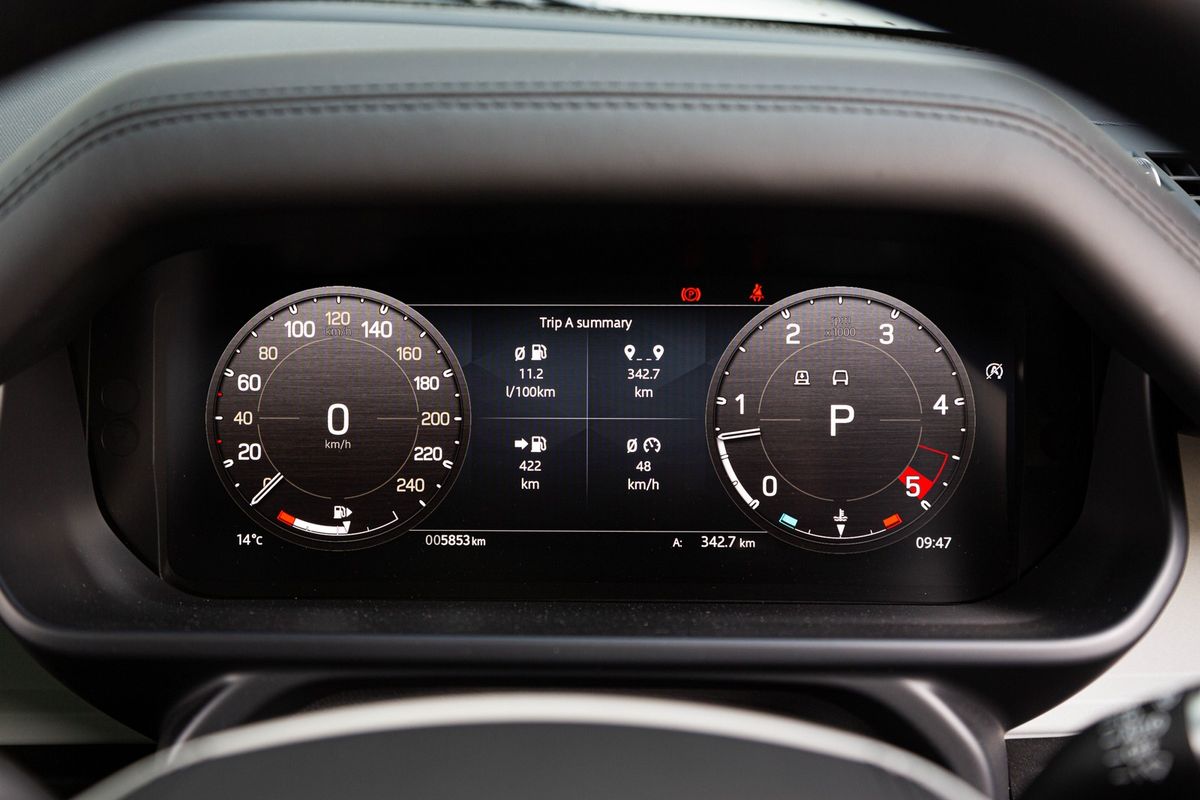
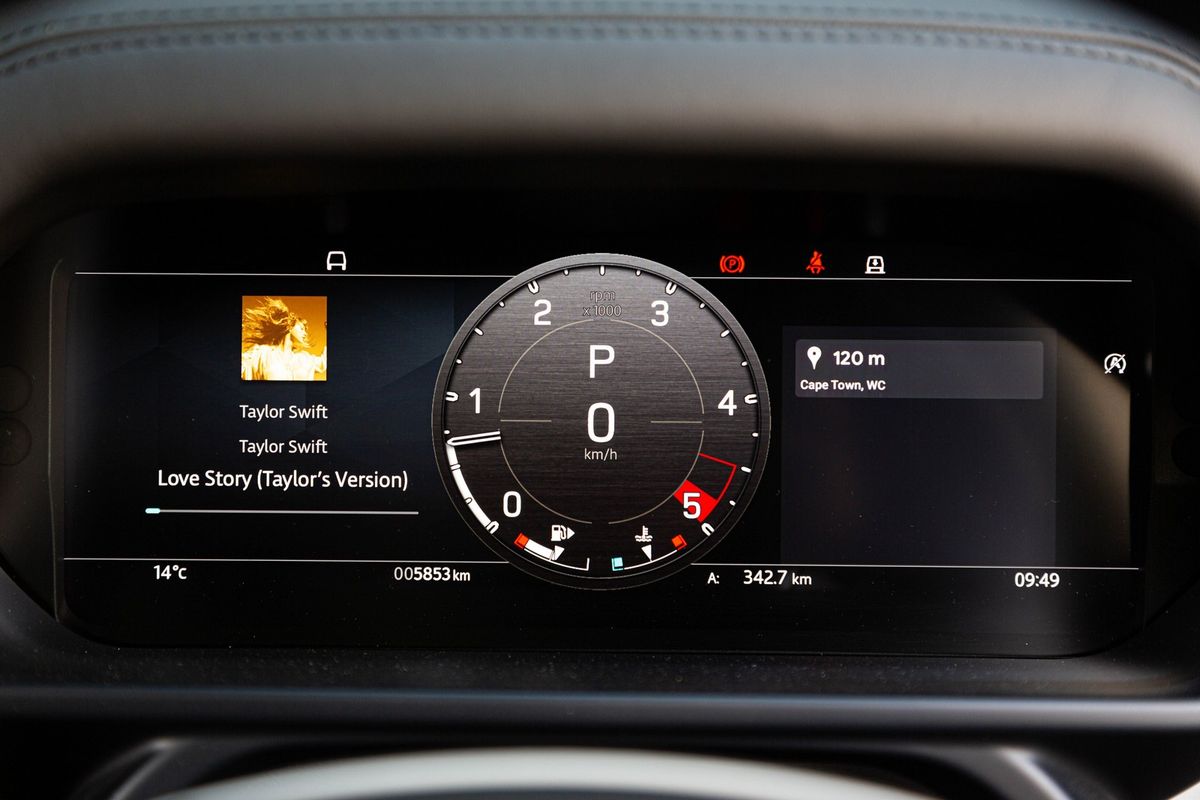
Every off-road drive mode of the 2023 Volkswagen Amarok gets its own graphic on the digital instrument cluster.
Every mode has an appropriate graphic

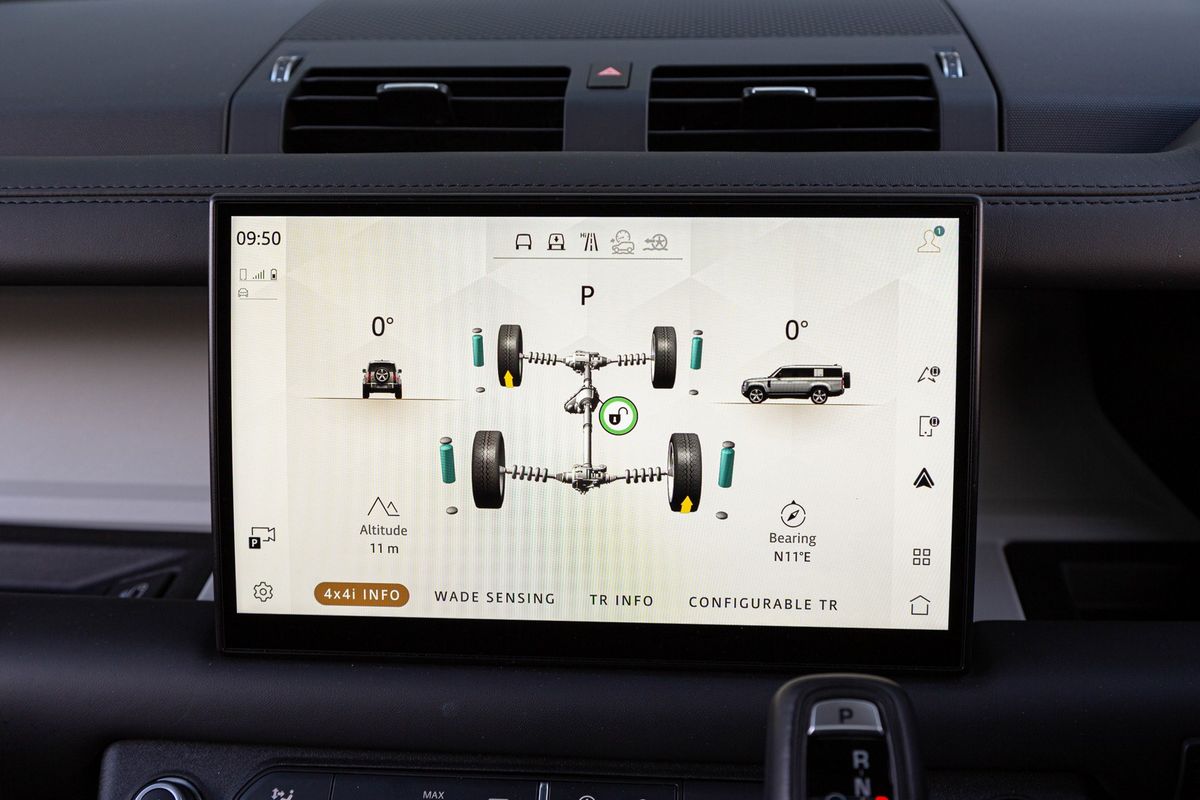
Whereas most drivers are likely to use the 3.0TDI V6 double cab PanAmericana 4Motion’s 2-wheel-drive (2H) by default – certainly when roads are completely dry – the Volkswagen also offers 4-wheel-drive autmomatic (4A), which is ideal when you’re traversing roads that offer varying levels of grip – 4A brings the front axle into action when the vehicle’s sensors detect that one or more wheels are slipping.

Given that heavy rain was lashing the Cape when we tested the VW (making roads water-logged and muddy), 4A was often called into play. Four-wheel drive – in high- and low range – are also available.

The 4A setting of the Volkswagen Amarok is useful in variable on- and off-road conditions.
4A is very useful in adverse weather

Unsurprisingly, the 2023 Volkswagen Amarok’s off-road-related stats are on par with the best models in the segment; it has a ground clearance of 235 mm, approach/departure angles of 30 and 26 degrees, as well as a wading depth of 800 mm. Apart from an electronically activated rear diff lock, the bakkie offers hill-descent control and an assortment of drive modes, each with their own unique graphics and settings.

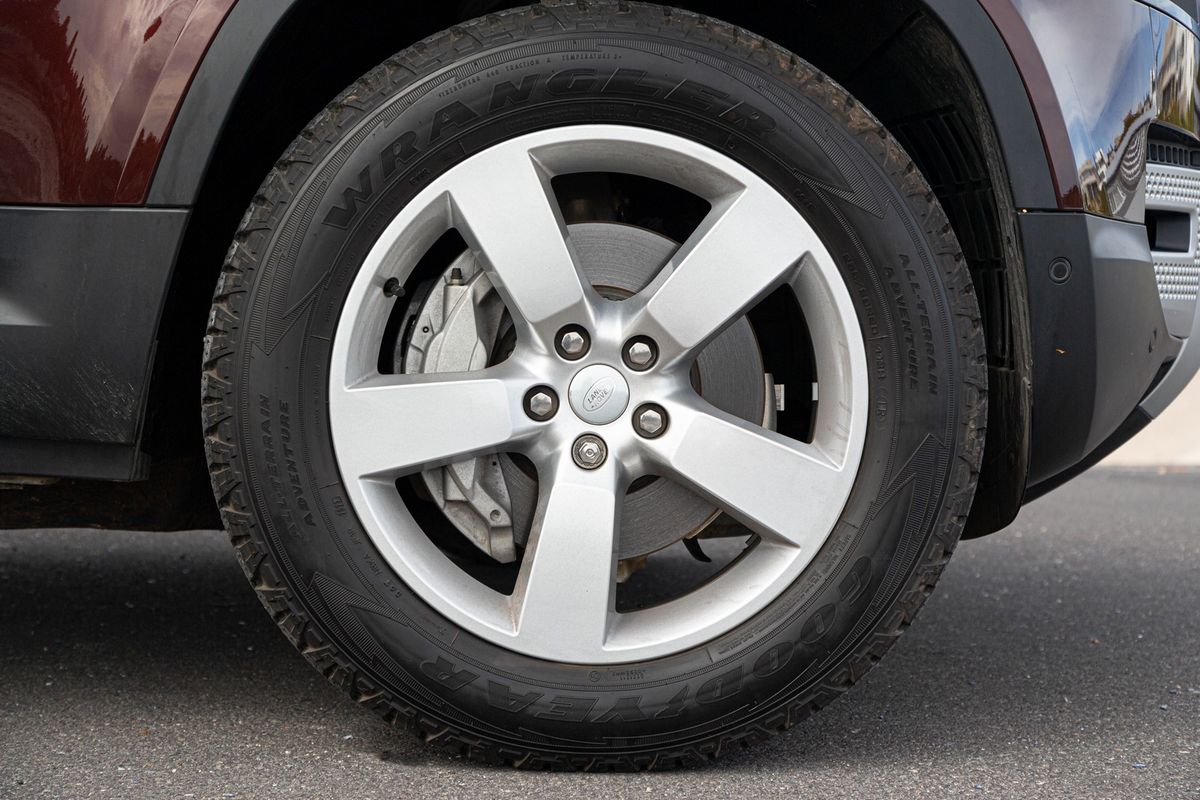
On top of Normal, Eco and Towing drive modes, the latter of which optimises the vehicle’s stability when a user has attached a trailer to the vehicle’s tow bar, Slippery, Snow/Sand and Mud modes are available for trickier off-road conditions. To reiterate, the PanAmericana is the most offroad-focused Amarok derivative and it comes fitted with chunkier Goodyear Wrangler 255/65 R18 tyres as standard.

2023 Volkswagen Amarok Panamericana is fitted with chunky off-road tyres.
Off-road tyres make the Amarok more sure-footed in the trickiest off-road conditions.

We have some experience of driving the new Amarok “away from the beaten track”, as they say, (we did some intensive off-roading during the model’s international launch in South Africa), but how would the bakkie fare on wet farm tracks when you don’t utilise fancy drive modes or low-range? We found out!

The 2nd-gen Volkswagen Amarok is very off-road capable, as shown here.
Amarok on a serious off-road course in December 2022.

When we traversed the muddy, rutted dirt roads with the PanAmericana (with no more than 4A activated), the bakkie impressed with its unflappable composure and high levels of grip (aided by the test unit’s knobbly Wrangler boots). The newcomer made light work of basic off-tar driving, so in the right hands – and with the appropriate mode selected – the Amarok should be very capable off-road.

Volkswagen Amarok Panamericana front
Elegant and capable, but so is the Ranger Wildtrak

Price and after-sales support

The Amarok 3.0TDI V6 double cab PanAmericana 4Motion costs R1 084 600 (there are no optional extras), which includes a 4-year/120 000 km warranty, 5-year/100 000 km maintenance plan with 15 000 km service intervals. The range starts from R599 000 and goes up to R1 138 200 for the Aventura.

Verdict

The 2nd-gen Volkswagen Amarok represents a big step forward for the German brand's bakkie.
The 2nd-generation Amarok is a big leap forward for the marque and customers are unlikely to be disappointed.

While some purists will be upset that the 2023 Volkswagen Amarok is based on a Ford product, the development of a new bakkie would have cost VW billions in R&D; bear in mind, a double cab is not a core product in the brand’s line-up. On top of that, most European carmakers are phasing out models powered by internal combustion engines, so Volkswagen was unlikely to green-light an all-new vehlicle that it would not be permitted to sell in many countries after 2030 (due to EU emissions regulations).

By utilising the admittedly good bits of Ford’s top-selling bakkie, Volkswagen Commercial has fashioned an upmarket and competent 2nd-gen Amarok. Cleverly, VW and Ford’s product-planning departments have carefully chosen different grades and trims, to avoid stepping on each other’s toes (too much).

MORE: Amarok VS Ranger – What is the difference?

Volkswagen has taken some of the best elements from the already-excellent Ford Ranger Wildtrak and incorporated them in a slightly posher Amarok 3.0TDI V6 double cab PanAmericana 4Motion package. The plush look-and-feel of the newcomer’s cabin and aspects such as comfort, smoothness and a quieter, more refined driving experience will win over many fans. But such things come at a premium.

We think the PanAmericana (R1 084 600) and Wildtrak (R996 500, excluding a service/maintenance plan – both prices correct in June 2023) will appeal to slightly different markets; the Volkswagen seems more overtly off-road oriented, but we think it will resonate more with buyers of luxury family cars than its Ford cousin, which may see more action as an outdoor adventurer/workhorse. Make no mistake though, the 2023 Volkswagen Amarok will be more than up to the task – and just as capable as its “rugged” brother.

Is the SA-built Amarok classed as a VW or Ford export?

The new Volkswagen Amarok is built by Ford in South Africa. But does it count as a VW export or a Ford export? The answer isn’t quite as simple as you might think…

When combing through South Africa’s new-vehicle sales figures for May 2023, we noticed no number was listed in the “exports” column for the new Volkswagen Amarok. Of course, as part of a wide-ranging global alliance, Ford builds the 2nd-generation Amarok (alongside the Ranger) on behalf of VW at the Silverton factory here in South Africa.

In fact, Silverton is the only facility in the world currently producing the new Amarok, which has already launched in overseas markets such as Australia, where 645 examples were sold last month. So, where do these export units fall if not under VW’s tally (after all, the Wolfsburg-based firm ships Kariega-built Polo hatchbacks to nearly 40 different countries around the globe)?

Well, we asked VW Group South Africa for comment, but the German firm’s local division told us Ford is “responsible for the exports”, adding the Blue Oval brand is “best placed to comment on the export arrangement of the new Amarok to international markets”.

Ford exports Silverton-built Ranger units to more than 100 global markets.

Logic might suggest Amarok exports would thus be included with those of the closely related Ranger, which is shipped off to more than 100 markets around the world, but it’s seemingly not quite that simple. So, we approached Ford to clarify. Though the Dearborn-based firm’s local division was at first reluctant to comment on what it termed a “VW-related” matter, it eventually told us its May 2023 Ranger export figure of 6 274 units as reported to Naamsa was “Ford only” and thus didn’t include any Amarok units (and even double-checked with its logistics department when we asked again).

So, where are these Amarok units located in the figures? In a bid to find out, we next got in touch with Lightstone Auto, the company that runs the platform for the delivery of Naamsa’s new-vehicle sales statistics, including exports of new vehicles from South Africa. Lightstone told us though VWSA obviously receives its local Amarok stock from the Silverton plant, the German company’s local division is “not affiliated to the export programme of Ford Motor Company SA”. Contrary to Ford’s stance, Lightstone suggested it was safe to assume Amarok exports were thus “reflected in the new-generation Ranger export units”.

This prompted us to go back to VWSA, which informed us the partnership with Ford is “managed by our Commercial Vehicles colleagues in Hanover [Germany]”, adding Volkswagen SA is “not privy to the partnership agreement between the two companies” and “therefore cannot comment on the export arrangements out of Silverton”. That said, VWSA proposed sending a few of our questions to VW Commercial Vehicles’ communications department in Hanover, an offer we gladly accepted.

VW Commercial Vehicles confirmed to us production of the new Amarok had commenced on 19 September 2022, with “several thousand” units (it opted not to provide an exact number) having already reached a number of countries. It added the new Amarok will eventually be sold in “over 70 markets globally”, with the biggest export markets expected to be Australia and “all EU countries” (such as Germany, the UK, Sweden, Austria, Belgium, France, Italy, Spain and Portugal).

The new VW Amarok has launched in Australia, which is expected to again be a top market for the nameplate.

Asked whether Ford is responsible for the entire export process, from start to finish, VW Commercial Vehicles’ communication team in Germany explained the agreement as follows: “Depending on [the] export market, there are specific regulations of utilising logistic synergies and legal requirements. In short, different export markets, different agreements”.

Though the brand says it “cannot comment” on whether export credits – also known as duty credits, with which local manufacturers can more cost-effectively import other models not built in the South Africa – go to Volkswagen or Ford in the case of the locally built Amarok, it did finally confirm “exported Amaroks are technically classified as Ford exports”. Again, though, this seems to be at odds with Ford’s insistence its Ranger export figure contains no Amarok units.

Ultimately, however, neither VW nor Ford was able to provide an Amarok export figure for May 2023, which we find utterly bizarre considering such numbers are freely available for virtually every vehicle (bar the BMW X3 and Mercedes-Benz C-Class, for which Naamsa provides estimates) manufactured in South Africa. And, of course, this brings us neatly back to our original, still-answered question: where are Amarok export figures listed in the official Naamsa document?

Buy a used Volkswagen Amarok on Cars.co.za!

Related content

Amarok vs Ranger: What’s the difference?

VW Amarok Single Cab (2023) price & specs

SA-built half-tonne bakkie: VW says ‘there is hope’

New Renault Rafale Unveiled as Coupé-SUV Flagship

Meet the Renault Rafale, a new coupé-SUV billed as the French firm’s fresh flagship. A high-performance, all-paw version is in the pipeline, too…

The new Renault Rafale coupé-SUV has been revealed, positioned at the very summit of the French automaker’s passenger-vehicle range, endowed with a hybrid powertrain and ushering in a new design direction.

Measuring 4 710 mm long and 1 860 mm wide (and standing 1 610 mm tall), the new Rafale – the name is both a French word meaning “gust” and an aeronautical reference – looks set to compete in the D-segment. It rides on the Renault-Nissan-Mitsubishi Alliance’s latest-generation CMF-CD platform, sports a wheelbase of 2 740 mm, weighs from 1 653 kg and boasts a luggage compartment able to swallow a claimed 647 litres.

Renault describes the newcomer as featuring a “slightly raised fastback-style body” and claims the coupé-style roofline is cleverly curved to provide “plenty of headroom in the back seats” without impinging on the size of the rear screen. The Rafale boasts a multi-link rear suspension arrangement as well as rear-wheel steering, and will be produced at the Palencia plant in Spain.

Designed from a blank sheet of paper, the Renault Rafale is the first production vehicle entirely conceived according to the new visual language that Gilles Vidal has brought in as head of design. That said, like the recently refreshed hybrid version of the Clio hatchback (tweaked under Vidal’s guidance), the new Rafale features the Boulogne-Billancourt-based automaker’s latest lighting signature up front.

The Rafale ushers in a new design language for Renault.

Renault claims the Rafale’s 147 kW full-hybrid petrol powertrain, which includes a “clutchless multimode” automatic transmission, puts its range “among the longest and its CO2 emissions among the lowest in its segment”. The powertrain combines a turbocharged 1.2-litre, 3-cylinder petrol mill (96 kW/205 Nm) with a pair of electric motors.

The main electric motor makes 50 kW and 205 Nm, and is powered by a 2 kWh lithium-ion battery that allows full-electric driving. The secondary motor is a 25 kW/50 Nm high-voltage starter generator that starts the engine and powers gear changes in the clutchless dog box. There are 4 levels of braking regeneration on offer.

The multimode transmission combines the main electric motor’s 2 ratios and the internal combustion engine’s 4 ratios. It automatically selects the powertrain’s mode, which can be all-electric, all-combustion, dynamic hybrid (the engine and motors power the wheels together), e-drive (the motor power the wheels and the engine charges the battery) or regeneration (the motor taps into kinetic energy).

In addition, the company says a “high-performance variant” with 221 kW and all-wheel drive is on the cards, promising it will offer “driving pleasure and performance levels never seen before in Renault’s line-up”. Most of the power boost will come from 2 technical adjustments: an additional electric motor on the rear axle (that will power the wheels directly) and the shift to a plug-in hybrid set-up.

The cabin is defined by a “darkening” panoramic glass roof measuring 1 470 mm by 1 117 mm. The fully active system is able to darken each of its segments on demand, either voice-controlled via Google Assistant or using a physical switch. The interior also features plenty of recycled materials as well as a digital cockpit comprising a 12.3-inch driver’s display and a 12-inch portrait-style touchscreen, complemented by a 9.3-inch head-up display.

So, will we see the Renault Rafale in South Africa? Well, the French firm’s local distributor told Cars.co.za there are “no plans for [a] local launch yet” (though the inclusion of that final word suggests it may well arrive at some point further down the line).

Buy a used Renault on Cars.co.za!

Related content

2024 Renault Clio Facelift Fully Revealed

Mitsubishi Colt Returns as (Poorly) Disguised Clio

Renault Captur (2023) Launch Review

BMW M2 Will Be the Last Manual

It’s a double-blow for enthusiasts as BMW M also confirms the end of the road for the dual-clutch transmission as well as the manual gearbox.

It was always going to happen, wasn’t it? In an interview with TopGear, Head of Development at BMW M, Dirk Hacker confirmed that the last manually-equipped BMW M product will be the current-generation M2. Yes, they are engaging and offer that pure driving experience, but in the era of really great automatics? That’s a tough sell, especially for those who daily high-performance machinery and crave the convenience and ease of use.

So, how long have we technically got to enjoy a three-pedal modern BMW M car? The current-generation M2 has just gone on sale and there’s likely to be a Competition derivative in the next few years, an LCI/facelift and then a hardcore, limited-run CS version by 2030.

Your last chance to own a manual BMW M car is right here

For fans of the dual-clutch transmission in BMW M cars, there’s no plans for that either. TopGear asked BMW about the switch from the quick-shifting DCT units to an 8-speed conventional automatic. Hacker replied, “Around the M5 there was a big discussion, not only for the automatic transmission, but also for other things. And the decision was not only because of cost, but also because of comfort [to go with automatic], because we got a lot of reactions about manoeuvring, parking, no rolling if you leave the pedal and so on,” he said.

Essentially, this means the automatic transmission is better than the DCT in daily-driven scenarios, which is likely where the overwhelming majority of these cars will be used.

Buyer’s Guide – 2023 Hot Hatches

2023 hot hatches are still hot property and there’s something for everyone. In this Buyer’s Guide we take a look at the current offerings and what you’re getting for the money. Which one do you have your eye on?

Despite the rise of the SUV and the push into electrification, there’s still considerable interest in the good old hot hatchback. Don’t believe us? Just look at the conversations on social media around the Volkswagen Golf 8 R…

Many brands are still vying for your attention and we’ve listed them below. There’s a great blend of mainstream brands offering special and unique offerings, as well as premium brands bringing luxury performance to the table. If you’re old school and crave a manual transmission, well you’re in luck!

Toyota GR Corolla (R816 500)

After the mega GR Yaris comes its bigger brother. This is the GR Corolla, featuring a 1.6-litre turbocharged 3-cylinder engine with 221 kW and 370 Nm. Power goes to all four wheels via a 6-speed manual gearbox and we reckon it’ll hit 100 kph in the low 5s. Toyota SA is offering the GR Corolla in two trim levels; Core and Circuit. We’ve yet to drive it, but if its anything like its GR Yaris younger brother, you’re in for a treat…

Toyota GR Corolla specs and price

BMW M135i xDrive (R930 537)

BMW fanatics are still lamenting the switch from a rear-wheel-drive platform and 6-cylinder powertrain in favour of this 4-pot and 4-wheel drive setup. While it lacks that drama both in terms of sound and sideways action, there’s no denying the car has more grip and is more accessible. Power is at 225 kW and 450 Nm, with an 8-speed automatic on duty. Also consider the front-wheel driven 128ti with 180 kW and 380 Nm, costing R764 260.

BMW 1 Series specs and price
BMW M135i xDrive review

Audi S3 Sportback (R837 000)

With 213 kW and 400 Nm as well as a 7-speed S tronic gearbox driving a quattro setup, the Audi S3 was always going to offer quick pace. Audi claims 4.9 seconds to 100 kph. There are some luxury appointments in the cabin too, giving it true day-to-day drivability. It’s less involving than some of the others here, but make no mistake, its still a quick straight-line performer. If you’re after ultimate performance, check out the 294 kW Audi RS3 for R1 246 600.

Audi S3 specs and price
Audi S3 Sportback Review

Volkswagen Golf 8 R (R912 800)

VW Golf 8 R

The Volkswagen Golf R is one of the Wolfsburg-based brand’s most successful performance offerings in SA. What’s not to like? There’s a punchy 2.0-litre turbocharged engine, the convenience of a fast-shifting DSG and practicality galore. There are also some nice luxury touches too. Sadly the latest Golf 8 R has been delayed, but the first units have started arriving at dealers. Engine outputs of 235 kW and 420 Nm should make it one of the quickest in the segment.

Volkswagen Golf Specs and Price
Volkswagen Golf 8 R Review

Mercedes-AMG A35 4Matic (R1 243 353)

To plug the gap between the 165 kW Mercedes-Benz A250 and the hyper-hatch that is the 310 kW A45 S, Mercedes-AMG has created the A35. Outputs of 225 kW and 400 Nm from a 2.0-litre turbo give the A35 commendable performance, but we suspect customers are buying it more for the glitzy cabin, which is one of the most striking in the segment. It is one of the most expensive vehicles in this current class, and you may as well go for the 310 kW A45 S at R1.4 million.

Mercedes-AMG A-Class Specs and Price
Read a review of the Mercedes-AMG A35 here

Mini John Cooper Works Hatch (R719 464)

For a really fun experience behind the wheel, you’ll struggle to find something that is more energetic and smile-inducing than the Mini JCW. With a 2.0 turbo packing 170 kW and 320 Nm, and driving the front wheels via an 8-speed automatic, the Mini JCW has proven to be hilariously good fun when it comes to both straight-line sprints and cornering.

Mini Cooper John Cooper Works specs and price

Renault Megane RS300 Trophy (R949 999)

The French are still in the mix with its sporty RS products. Sadly there’s no longer a hot Clio RS, but you could say this iteration of Megane is the best for last. The RS300 Trophy features a 1.8-litre turbo with 221 kW and 420 Nm as well as a 6-speed dual-clutch ‘box. It’s a cornering specialist, with a trick rear-wheel steer, performance tuned chassis and trick differential. Pity about the price, but that’s down to a poor exchange rate.

Renault Megane RS300 Trophy specs and price

Hyundai I30 N DCT (R811 900)

Arguably the one of the best bang-for-back performers in recent years, the Hyundai I30N is one of the finest hot hatches to ever grace the roads. A snarling 2.0-litre turbo punches out 206 kW and 392 Nm, and there’s a quick-shifting dual-clutch transmission underfoot.

Hyundai I30N specs and prices

Hyundai I30N DCT Review

Honda Civic Type R (R979 000)

Honda Civic Type R

The latest iteration of Honda’s Civic Type R has charged its way into SA with a 235 kW and 420 Nm 2.0 engine. Again, power goes to the front wheels and yes, there’s a 6-speed manual gearbox on offer. Visually, this new model has lost of some the winged wizardry design and looks a bit more rounded. Is it slower? Absolutely not as you’re looking at the current Nürburgring front-wheel drive record holder.

Honda Civic Type R specs and price

RIP Volkswagen Arteon

The sleek and stylish Volkswagen Arteon is one of the many models that’s getting axed as the German brand rationalises its lineup.

It’s not just the Volkswagen Tiguan Allspace getting the axe as part of VW’s new strategy, but the striking Arteon too. Admittedly, the smart-looking sedan was discontinued in SA sometime ago on the back of poor sales and didn’t get the current facelifted version, which included a hot R model.

Still, losing some fringe models is a small price to pay in the overall greater scheme things. Volkswagen announced a new strategy in the middle of July 2023 where it would be focusing on revenue growth and investing in the future, but this means a streamlined product portfolio, reducing complexity of options and trim and so on. The focus will be on VW’s bread-and-butter models as well as its new electric ID range of vehicles.

The updated Arteon range never made it to SA

“The program is the number one priority for the entire Board of Management,” said CEO Thomas Schäfer. “Achieving this in 2026 is very ambitious, but feasible if we pool our efforts. This will enable us to safeguard jobs, finance our future from our own resources and continue to invest in new vehicles and technologies, in the modernization of our plants and in staff training.”

When it came to SA in 2018, the Volkswagen Arteon impressed us. Not only did it look unique with its liftback 4-door coupe design, but the choice of engines were a great blend of performance and economy. You could opt for a 2.0 turbo diesel or a 2.0 turbo petrol, the latter paired with 4Motion all-wheel drive.

Volkswagen Arteon

So, what does this mean for you, the consumer? Well, don’t despair as the Arteon represents good value on the pre-owned market and we have a few listed for sale. The diesel-powered option is arguably the more sensible of the two, as the petrol model is basically a Golf R powertrain in a smarter sedan body.

Liberty Walk Lamborghini Aventador in SA

The Lamborghini Aventador gets the Liberty Walk treatment right here in South Africa!

The Lamborghini Aventador is already one of the most special supercars to ever grace the roads. What if you could make it even more exotic and extreme? Marco from Race! takes us through a Liberty Walk Aventador build that takes an already unique vehicle and turns it into something that defies belief. 

In this video, we get a behind-the-scenes look at how the body kit was installed, the custom exhaust and the air suspension. We also get to hear that fabulous V12 sing at full throttle!  

Nissan X-Trail (2014-2023) Buyer’s Guide

Does the 3rd-generation Nissan X-Trail make a compelling used buy? Let’s take a closer look at the variants available in South Africa, as well as this medium SUV’s strengths, weaknesses and more…

While the original Nissan X-Trail and its successor, the 2nd-generation model, were charmingly utilitarian family cars, the T32 series represented a significant step change for the nameplate. Indeed, the 3rd-gen X-Trail – launched in Mzansi in 2014 – traded the tough, boxy proportions of the first 2 models for a sleeker exterior design that shared cues with the slightly smaller J11-generation Qashqai. It also had a somewhat more upmarket cabin than the comparatively matter-of-fact interiors of its forebears.

Indeed, you could argue the T32 series X-Trail was little more than an upsized Qashqai, with the 7-seater derivatives of the former also effectively serving to replace the discontinued Qashqai+2. After all, these crossover siblings shared the CMF-CD platform and even looked remarkably similar from afar.

The T32-gen X-Trail’s styling was similar to that of the smaller J11-gen Qashqai.

But the 3rd-generation X-Trail – known as the Rogue in North America – was an eminently successful model in its own right; it even bagged the title of the world’s best-selling SUV in 2016 and 2017. The Yokohama-based firm certainly took a risk by so drastically altering what was already a successful recipe (some enthusiasts even suggested the X-Trail had “gone soft”), but, ultimately, it paid off royally.

For the record, despite Nissan’s appreciable off-road heritage, its claims in the press material and indeed this model’s name, the T32 series X-Trail was anything but a bundu-basher. Instead, it was decidedly road-biased – yes, even derivatives fitted with the All-Mode 4x4i system – just as the market demanded.

Nissan X-Trail model line-up in South Africa

At launch, the X-Trail range comprised 8 derivatives.

The 3rd-generation X-Trail was unveiled at the Frankfurt International Motor Show in September 2013. A little over a year later, in October 2014, the T32 series officially hit the market in South Africa, with local units sourced from Nissan’s Kyushu plant in Japan.

At launch, the range comprised 8 derivatives. There were 3 engine options (a pair of petrol motors and a turbodiesel), a choice of 2 transmissions, front- and all-wheel-drive configurations, a trio of trim levels, and 5- and 7-seater variants:

  • 2.0 (106 kW/200 Nm) XE 6-speed manual
  • 2.0 (106 kW/200 Nm) XE 6-speed manual (7 seats)
  • 2.5 (126 kW/233 Nm) SE 4×4 CVT
  • 2.5 (126 kW/233 Nm) SE 4×4 CVT (7 seats)
  • 1.6 dCi (96 kW/320 Nm) XE 6-speed manual
  • 1.6 dCi (96 kW/320 Nm) XE 6-speed manual (7 seats)
  • 1.6 dCi (96 kW/320 Nm) SE 4×4 6-speed manual
  • 1.6 dCi (96 kW/320 Nm) LE 4×4 6-speed manual

The facelifted X-Trail, meanwhile, made local landfall in October 2017, bringing revisions to the steering wheel, interior door finishes, console wrap and seat fabric (high-spec derivatives featured black leather with white stitching), along with additional driver-assistance features for the flagship versions.

Exterior changes included a fresh version of the “V-Motion” grille, restyled headlights (with daytime running lights), integrated foglamps, LED taillights, new alloy wheel designs and updated bumpers.

By this point, the X-Trail’s trim levels had also been renamed, now comprising the base Visia, the mid-spec Acenta (including Acenta Plus) and the range-topping Tekna. An Acenta Tech derivative also made a fairly brief appearance.

The refreshed X-Trail made local landfall in the final quarter of 2017.

Finally, in March 2021, the X-Trail benefited from another update, this time gaining a new version of the Nissan Connect infotainment system that underpinned the 7-inch touchscreen interface, now equipped with Apple CarPlay and Android Auto. The mid-tier Acenta and top-spec Tekna grades further scored LED headlights, a reverse-view camera, push-button start and keyless entry with a sensor-controlled powered tailgate. At the same time, the local range was rejigged and rationalised from 8 to 5 derivatives.

Throughout the X-Trail’s lifecycle, Nissan South Africa offered a wide range of factory-backed accessories, from weather shields, bonnet protectors and towbars to Thule roof-rack systems, branded rubber floor mats and seat covers. There was even a special “Dog Pack”, which included items such as a fold-up canine walkway and a branded sleeping basket…

What are the advantages of a Nissan X-Trail?

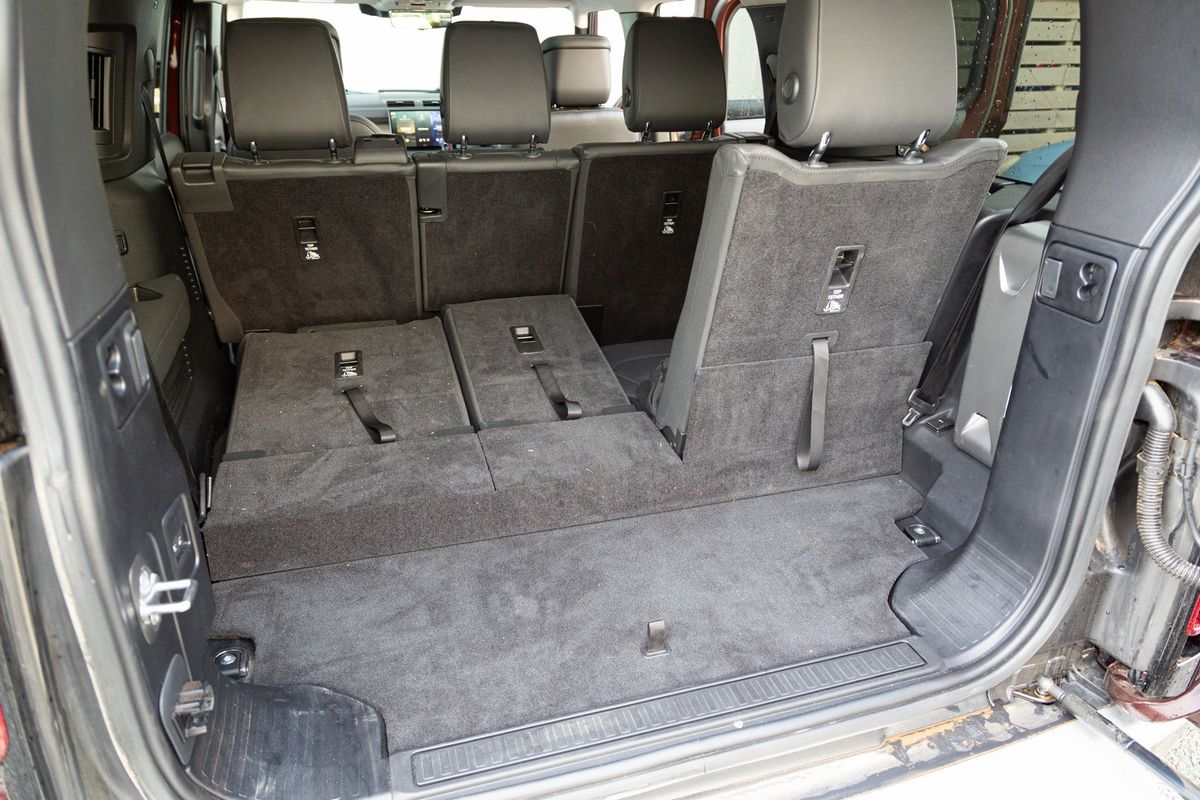
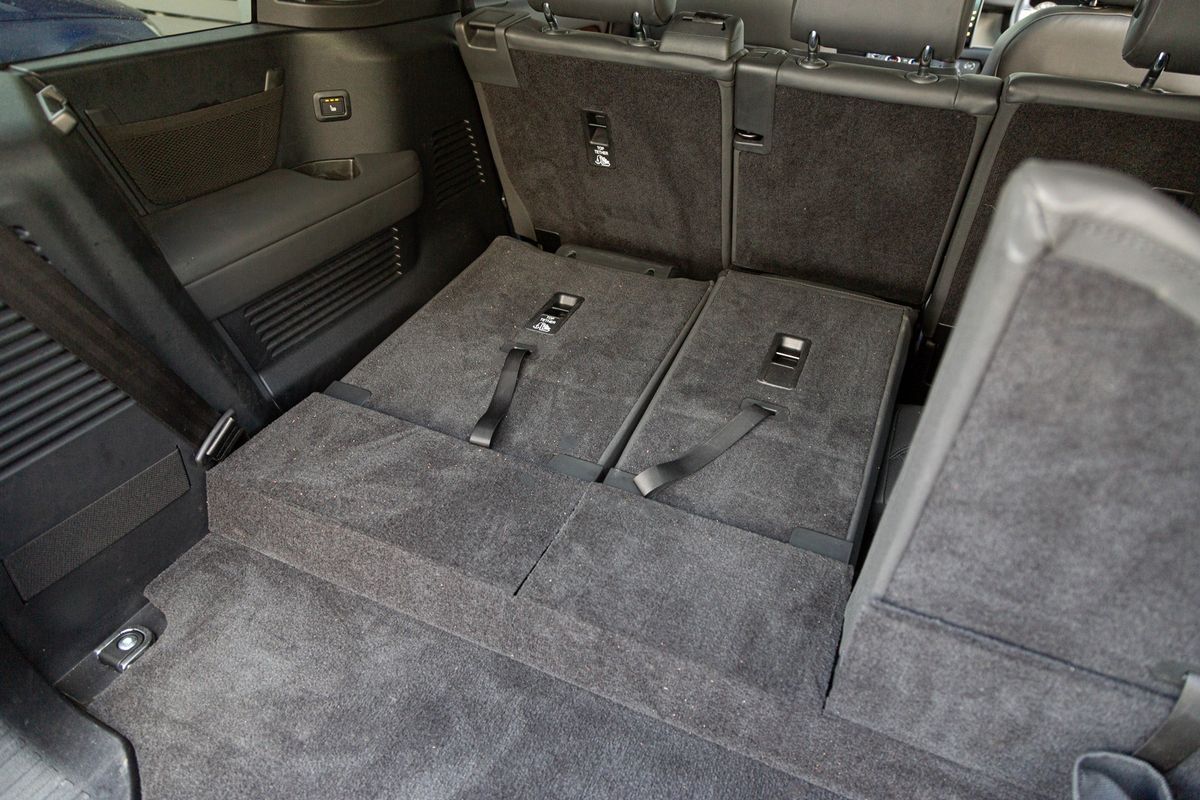
A look at the 7-seater model’s luggage bay with the rearmost seats folded down.

Practicality: There’s no doubt that the X-Trail was made with families in mind – the model was lauded for its practicality. For instance, the rear doors opened to a generous 80 degrees (easing ingress and egress for passengers, and making life easier for parents who have to shift bulky child seats), while the 5-seater’s split rear bench – which furthermore boasted reclining backrests – was able to slide fore and aft.

While 5-seat variants offered between 550 and 1 405 litres of luggage space (and generous rear legroom), 7-seater examples made do with capacity bookends of 135 and 1 310 litres. Note, however, that the 3rd row of 2 perches (which folded neatly into the floor when not in use) wasn’t particularly spacious. In addition, the panoramic sunroof (fitted to some X-Trail derivatives) limited rear headroom.

Top-spec versions of the facelifted X-Trail boasted oodles of advanced safety features.

Available safety kit: The 3rd-generation X-Trail was awarded a full 5-star safety rating by Euro NCAP back in 2014, with its child-occupant protection score coming in at an impressive 83%. At launch, all South African-spec derivatives shipped standard with 6 airbags, ABS (with EBD and BAS), vehicle dynamic control, hill-start assist and ISOfix child-seat anchors. Meanwhile, the Nissan Safety Shield formed part of the optional Techno Pack for SE and LE derivatives, adding features such as a 360-degree camera system, lane-departure warning, blind-spot warning and moving object detection.

From the 2017 facelift, many of these advanced safety features were made standard for the Tekna trim level, which furthermore gained items such as intelligent lane intervention, intelligent blind-spot intervention, forward collision warning, autonomous emergency braking and cross traffic alert.

Ride quality: Employing MacPherson struts up front and an independent multi-link arrangement at the rear, the T32-series X-Trail’s suspension was tuned with ride comfort chief in mind. It was thus adept at soaking up imperfections on poorly surfaced roads, while also offering commendable comfort levels on gravel. Even the top-spec derivatives – the pre-facelift LE and later the Tekna – rode with a reasonable degree of pliancy (the 18-inch alloys of the former boasted suitably squishy 60-profile rubber, while the latter’s 19-inch items featured a slightly less-forgiving profile of 55).

What are the disadvantages of a Nissan X-Trail?

The only auto in the range was a CVT and it caused a few headaches.

Potential CVT problems: All derivatives in the local T32-gen X-Trail range featured manual gearboxes, bar the naturally aspirated 2.5-litre variants, which shipped with Nissan’s “Xtronic” continuously variable transmission (CVT). Unfortunately, this CVT unit was known to malfunction and was even the subject of several technical service bulletins (mostly in North America, where class-action lawsuits were launched). So, look out for jerking or shuddering – which could be caused by either a faulty valve body or a worn (and thus slipping) metal transmission belt – when test-driving a derivative fitted with the QR25 engine.

No auto option for the diesel: While the 1.6 dCi (R9M) turbodiesel engine – a product of Nissan’s alliance with Renault – punched well above its weight and offered the potential for impressive fuel economy, it was available only with a 6-speed manual gearbox. Working with a narrow peak torque band typical of oil-burning engines, it tended to require frequent cog-swapping. It’s thus a pity there wasn’t a conventional torque-converter automatic transmission available for this powerplant in our market.

Miscellaneous electrical gremlins: A number of owners have reported electrical issues (covering a wide range of functions). For instance, we’ve heard of intermittent problems with the parking sensors, erratic stop-start systems (on the 1.6 dCi), infotainment gremlins (sometimes solved with a software update) and various issues with the electrically powered tailgate. So, it’s well worth testing those functions during a test drive to rule out as many electrical maladies as possible when viewing a potential buy. Also, note the infotainment system may feel a touch outdated compared with more modern equivalents.

How much is a used Nissan X-Trail in South Africa?

Earlier models had a longer service plan as standard.

At launch, all X-Trail derivatives shipped with a 6-year/150 000 km warranty and a 5-year/90 000 km service plan. Take note, however, by the time the facelifted version was introduced in 2017, the service plan had been quietly cut to 3 years or 90 000 km. As always, favour vehicles with a full service history.

Of the used 3rd-gen Nissan X-Trails listed on Cars.co.za at the time of writing, nearly 80% employed a petrol powerplant. The 2.5-litre engine – the only model with a CVT – was the most popular, accounting for 60% of listings, followed by the 1.6 dCi (20%) and the naturally aspirated 2.0-litre petrol unit (20%).

The majority of listings we found featured all-wheel drive.

Fascinatingly, more than 70% featured all-wheel-drive (check for underbody damage when shopping for an all-paw derivative), while 7-seater examples made up a shade over 20% of all listings. Mileage varied from virtually new examples through to a 2016 2.5 SE 4×4 CVT with a whopping 410 000 km on the clock (plus a further 7 derivatives with more than 200 000 km on their respective odometers).

  • Below R200 000: The vast majority of listings below the R200 000-mark were early model-year units, most with mileage on the wrong side of 150 000 km. All 3 engines were present here. Tread particularly carefully if you plan on shopping in this space.
  • From R200 000 to R350 000: There was plenty more stock to choose from (in fact, this was the most densely populated pricing bracket of all), including nearly new entry-level Visias at the upper end. Interestingly, every model year was represented here, though 2019 was the most common.
  • From R350 000 to R500 000: We found only facelifted X-Trails here, with the earliest model year being 2018. All units listed between these pricing bookends had less than 80 000 km on their respective odometers, though there were very few turbodiesels on offer.
  • R500 000 and up: Considering the outgoing X-Trail range started at R520 900 new at the time of writing, it’s little surprise most vehicles listed on the far side of half a million were 2023 models. That said, there were also a number of 2021 2.5 Tekna 4×4 CVT 7-seaters in this space.

Pick of the range?

We’d suggest limiting your search to a facelifted example, if possible.

Which derivative should be near the top of your shopping list? Well, first we’d recommend narrowing your search to a facelifted model, since the mid-cycle update brought material improvements to the cabin, a smattering of extra kit and exterior styling that was a little more distinct from that of the smaller Qashqai.

While there’s an argument to be made that the naturally aspirated 2.0-litre petrol engine and its 6-speed manual gearbox would offer the best long-term ownership proposition from a reliability standpoint, this powertrain lacked grunt and refinement, plus was available (in facelifted form) only in entry-level Visia grade. What about the 2.5-litre variants? Well, they’re certainly the easiest to source on the used market, although they tend to be quite thirsty (and there have been issues with the CVT, as mentioned above).

The updated infotainment system that was rolled out in 2021, complete with Apple CarPlay.

That leaves us with the 1.6 dCi, which was available from 2017 in front-wheel-drive 7-seater Visia guise and all-paw 5-seater Tekna form (both with a 6-speed manual cog-swapper). We’d lean towards the latter, which came very generously equipped and was almost as frugal (at a claimed 5.3 litres per 100 km) as the front-wheel-drive version.

A caveat about this turbodiesel powerplant, however: we’ve seen a fair few local complaints of the diesel particulate filter (DPF) becoming clogged, a problem that sees the X-Trail default to limp mode. If you mostly drive around town (and seldom hit the open road), you may want to avoid the 1.6 dCi as short trips can quickly lead to DFP blockages, which – if left unchecked – can result in costly turbo damage.

Is the Nissan X-Trail a good second-hand buy?

The T32-gen X-Trail effectively straddled a couple of segments.

Like its more compact Qashqai sibling, the 3rd-generation X-Trail straddled 2 segments in many senses, meaning it competed with somewhat smaller alternatives – as well as bigger rivals. That saw it battle the likes of the XA40-gen Toyota RAV4, the 2nd-gen Volkswagen Tiguan, the KF-gen Mazda CX-5 and the 5th-gen Honda CR-V, not to mention the TL-gen Hyundai ix35 and the QL-gen Kia Sportage (plus the ill-fated and much maligned C520-gen Ford Kuga). The HC-gen Renault Koleos, which rode on the same platform (and was offered with the same 2.5 CVT powertrain), represented a left-field alternative.

On the 7-seater front, the X-Trail had to contend with the Chevrolet Captiva and perhaps even the 3rd-gen Mitsubishi Outlander, while the substantially larger 3rd-gen Hyundai Santa Fe and UM-gen Kia Sorento were certainly worth a shout for families that required even more space. Those seeking proper off-road ability were better served by the likes of the Toyota Fortuner and Ford Everest.

It’s also pertinent to reiterate here the X-Trail’s 3rd row of seats was quite cramped, so it was more of a “5+2-seater” than a fully-fledged 7-seater family car.

Though the T32 series X-Trail likely didn’t hold much appeal to faithful owners of the first 2 iterations of the Japanese model, it certainly opened the nameplate to a wider range of buyers. In well-looked-after used form today, the turbodiesel models in particular have plenty to offer, including a pleasing blend of punch and frugality, in conjunction with lofty comfort levels and oodles of family-friendly practicality.

Looking for a Nissan X-Trail to buy?

Find one on Cars.co.za here.

Looking to sell your car? You can sell it for free to our dealer network here.