10 best-selling bakkies in South Africa: February 2023
We’ve rummaged through February 2023’s sales figures to identify South Africa’s best- and worst-selling bakkies. Here’s what you need to know…
South Africa’s new-vehicle market registered 2.6% of year-on-year growth in February 2023 to end the month on 45 352 units. Gains in the light-commercial vehicle segment, meanwhile, were slightly higher at 5.5%, resulting in total sales of 12 972 units, mostly in the form of bakkies (along with a few minibus and panel-van units).
So, what happened on the list of SA’s best-selling bakkies? Well, the Prospecton-produced Toyota Hilux was again head and shoulders above the rest of the field, finishing February 2023 on a healthy 3 335 units. For the record, that’s an improvement of 566 units compared with its performance in January 2023. As an aside, Toyota SA Motors has just announced a specification update for the Hilux, with a focus on the Xtra Cab Legend models.
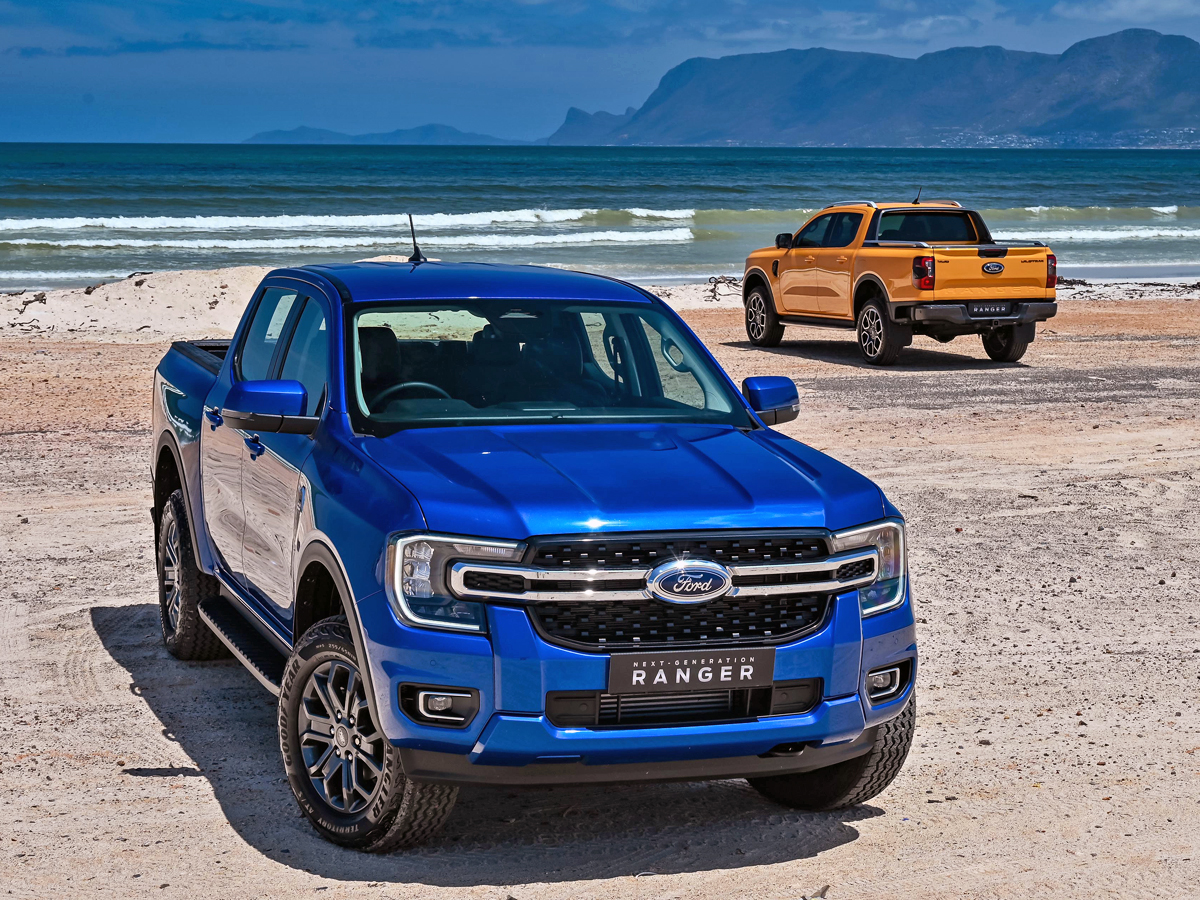
With the new generation of the Ford Ranger now very much online (though the single- and extended-cab models will technically hit the local market only at some point in March), the Silverton-built bakkie (as well as the imported Raptor) regained 2nd place, with 1 806 units registered during the month. That saw the Struandale-manufactured Isuzu D-Max (1 747 units) drop a spot to 3rd, despite improving by 474 sales, month on month.
Though the Nissan NP200 (1 292 units) broke back into 4 figures, it again placed 4th (its manufacturer is currently “evaluating” a replacement), while the Mahindra Pik Up (844 units) likewise held steady in 5th. The Nissan Navara ended February 2023 with 581 registrations, which was enough to see the Rosslyn-built bakkie jump a place to 6th.
That meant the evergreen Toyota Land Cruiser 79 (393 units) fell a position to 7th, with the GWM P-Series (245 units), GWM Steed (115 units) and Mitsubishi Triton (60 units) again closing out the table.
Best of the rest in February 2023
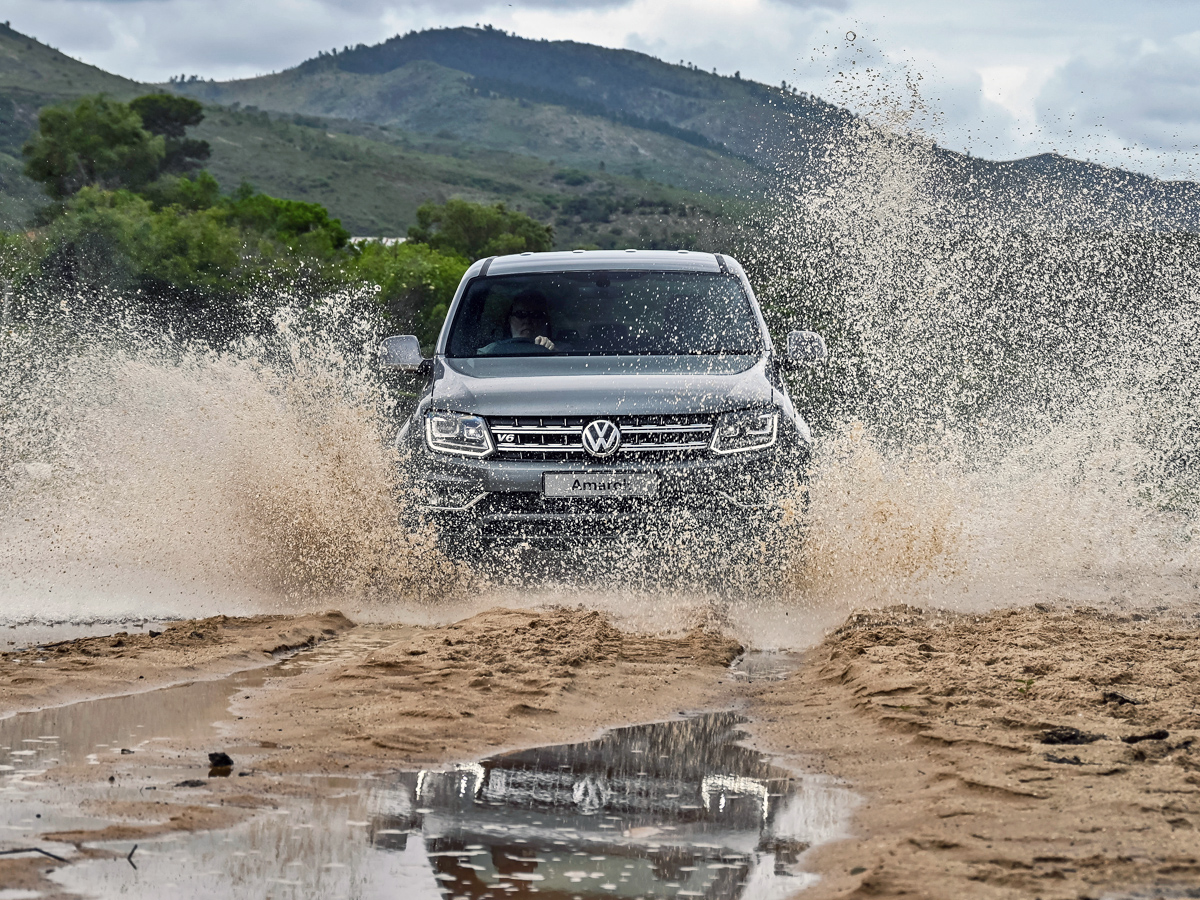
The first-gen VW Amarok is on run-out, with the new model set to launch in the 3rd week of March.
What about the models that failed to make the table in February 2023? Well, 58 examples of the outgoing Volkswagen Amarok were registered, putting the German bakkie just outside the top 10. As a reminder, the new (locally built and Ranger-based) Amarok is due to hit the local market on 18 March, so we should see a marked improvement in this nameplate’s sales performance over the next couple of months.
Next came the Mahindra Bolero (42 units), then the Peugeot Landtrek (29 units) and Jeep Gladiator (19 units). Yet again, the Mazda BT-50 brought up the rear, with 7 examples registered during the month. Meanwhile, JAC’s T-badged bakkies (the Chinese automaker reports a combined figure for its T6 and T8 line-ups) ended February 2023 on 43 units.
Export winners in February 2023
What about the bakkie export market? Well, the Toyota Hilux was again at the forefront, with 5 297 units sent overseas in February 2023. With shipments of the new model to international markets now underway, the Ford Ranger improved to 3 923 units, though remained in 2nd place.
The D-Max (571 units), Navara (402 units) and NP200 (2 units) again made up the numbers on the export charts. The official Naamsa report interestingly also showed a handful of imported models being exported from local shores in February 2023, in the form of the P-Series (30 units), Triton (18 units) and Steed (1 unit).
10 best-selling bakkies in South Africa for February 2023
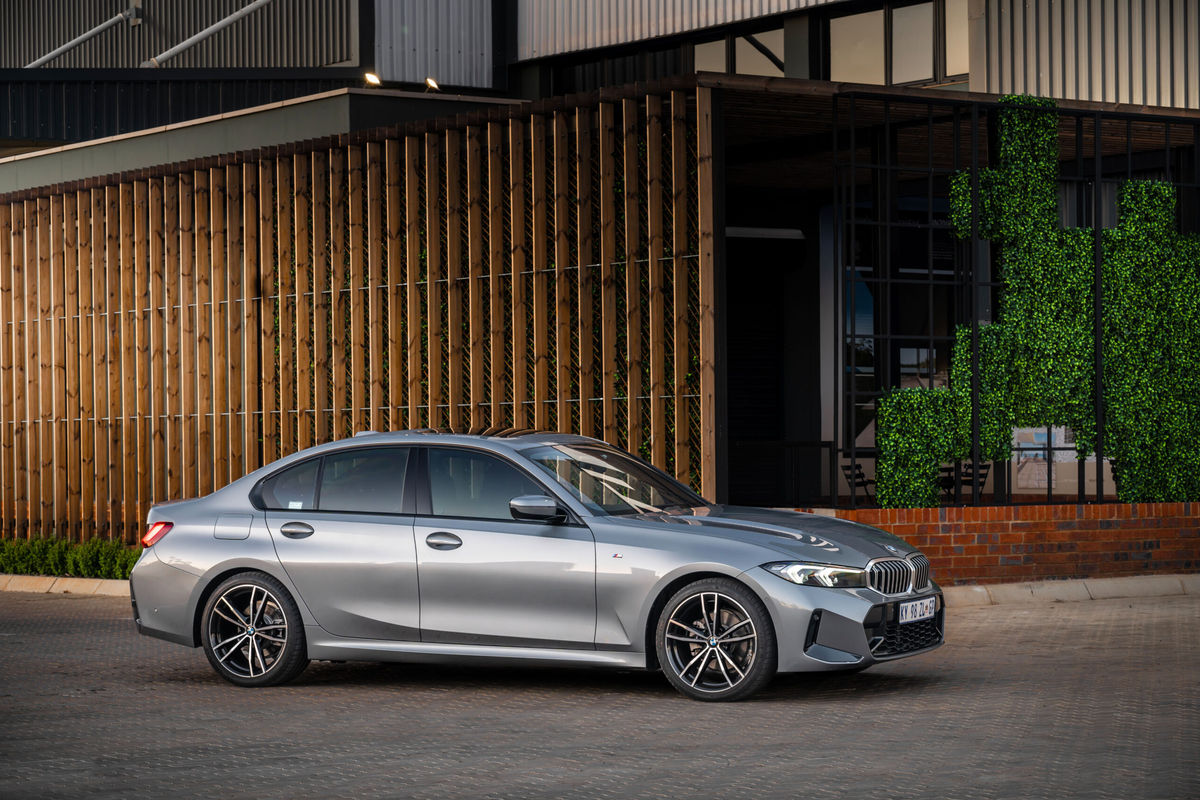
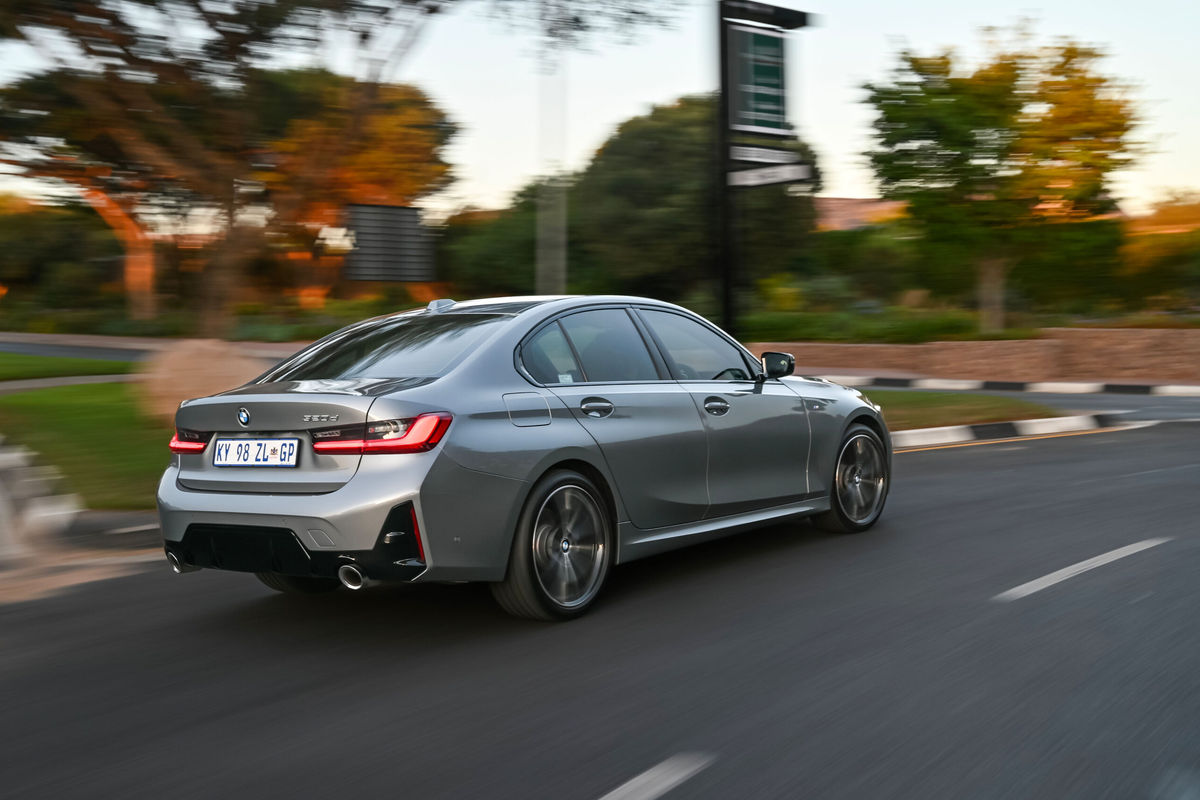
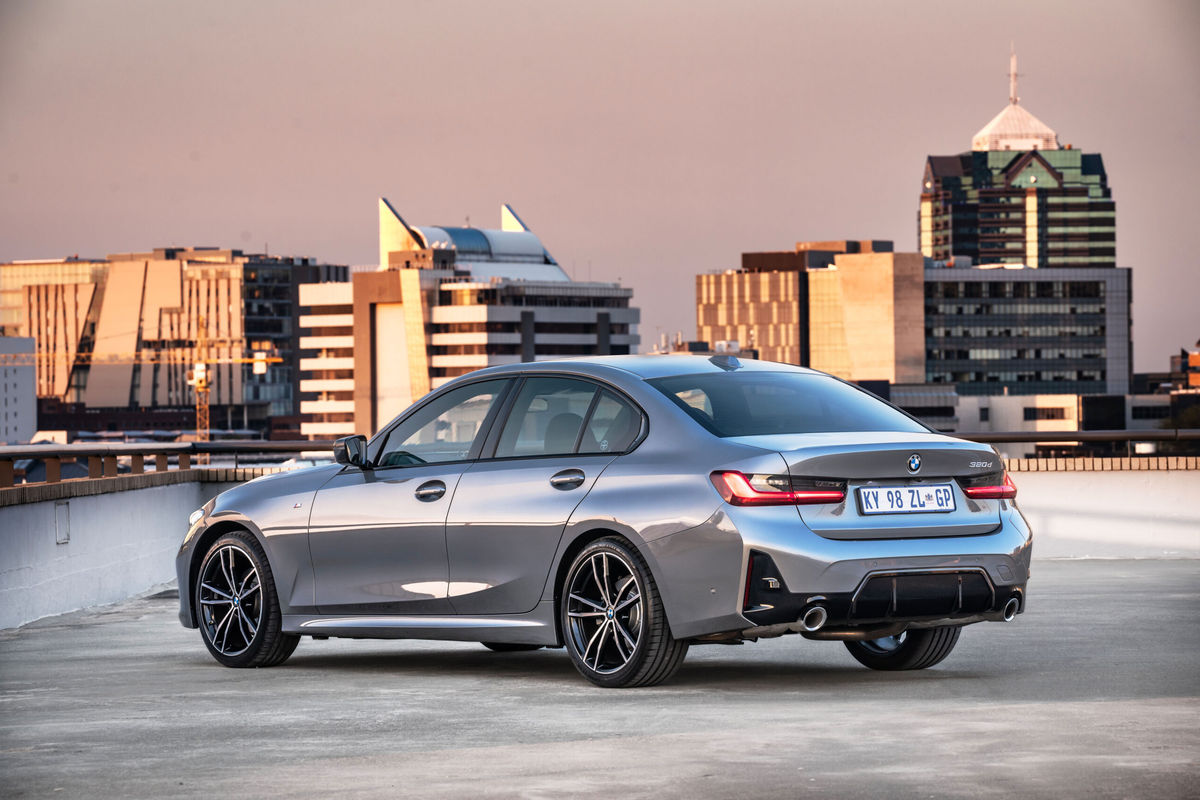
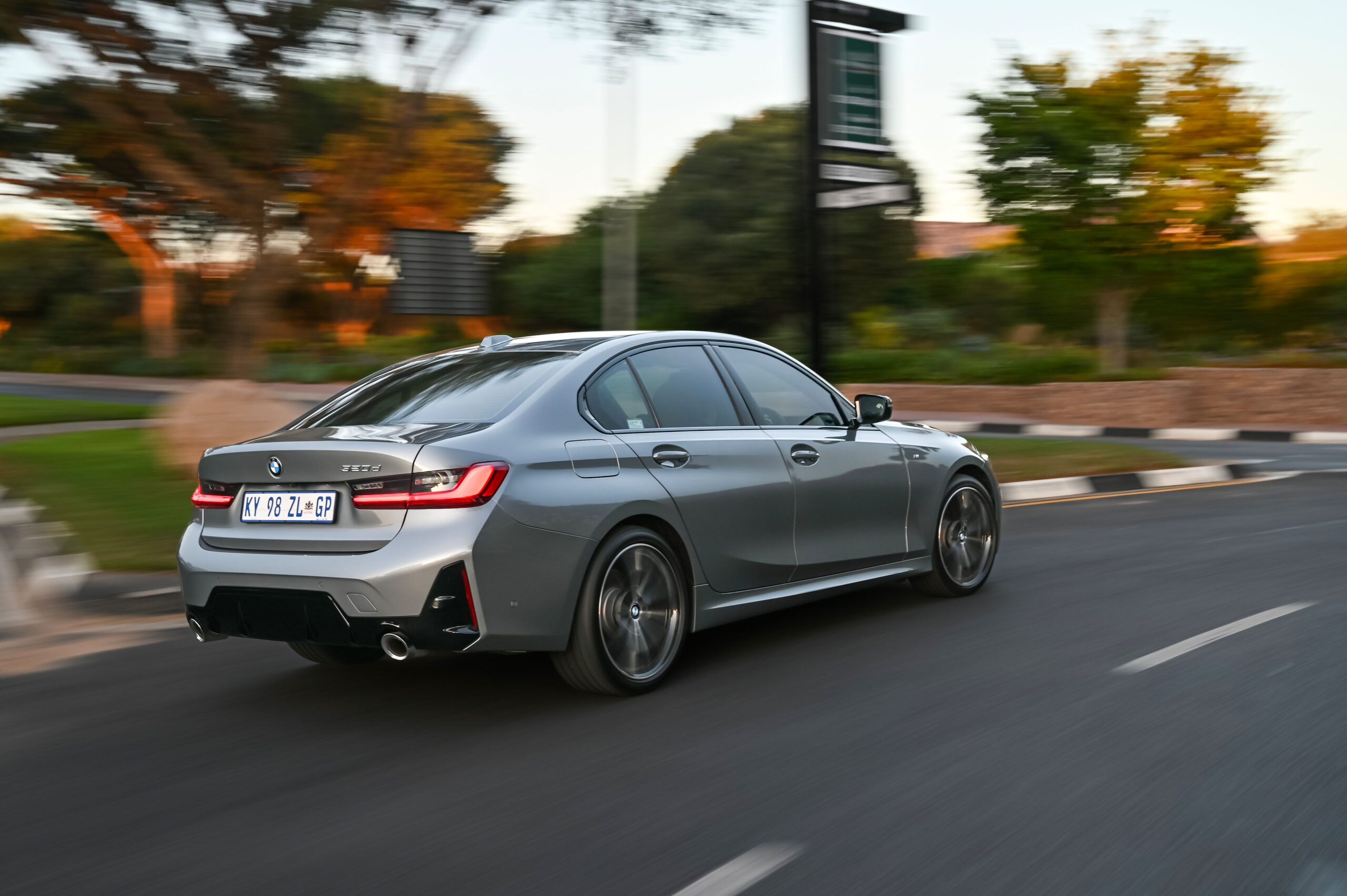
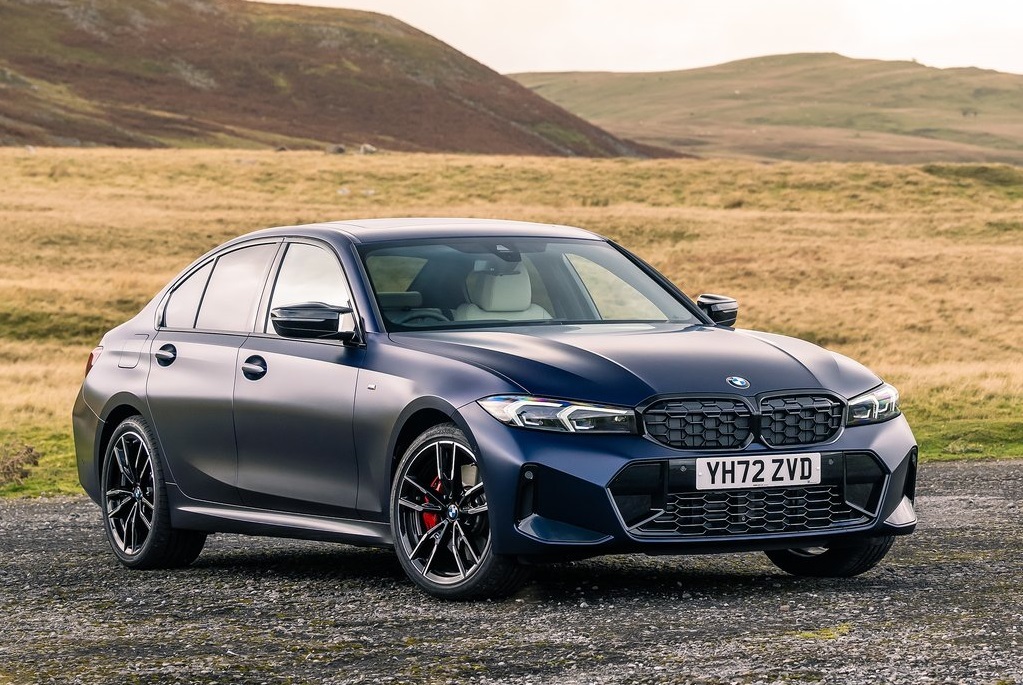
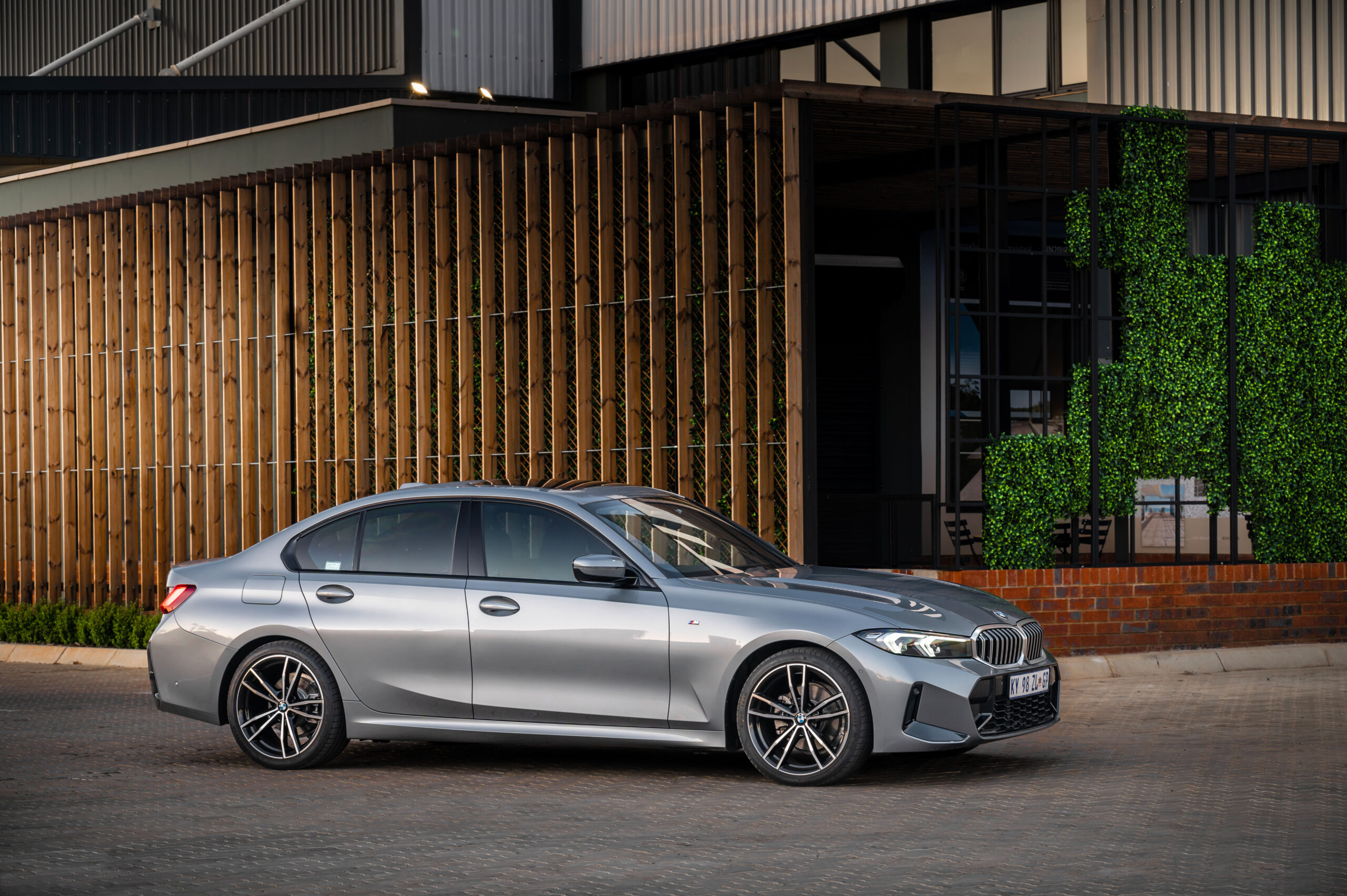
The BMW 3 Series has undergone its Life Cycle Impulse (LCI) update. We attended the local launch of the 2023 business-class sedan to experience the changes in the metal.
The 3 Series needs little introduction: for many motoring enthusiasts, it’s the quintessential BMW model. Since the arrival of the first generation 3 Series back in 1975, more than 16 million units have been built and the latest iteration of the German sedan – the G20 generation – has attracted over 1.1 million sales!
South Africa has been a key market for the 3 Series; BMW SA now builds the X3 in Rosslyn, but before that it produced no fewer than 5 iterations of the 3er (up to the F30, of which production ended in 2018).
In fact, the 3 Series used to be one of Mzansi’s top sellers, but as the model has grown larger, moved further upmarket and become pricier, its segment has declined. Now, the 3 Series needs to stand out more than ever, especially with an all-new locally assembled Mercedes-Benz C-Class to contend with.
Does the BMW 3 Series LCI make a stronger case for itself in an SUV-dominated market? Let’s find out.
What’s Changed?
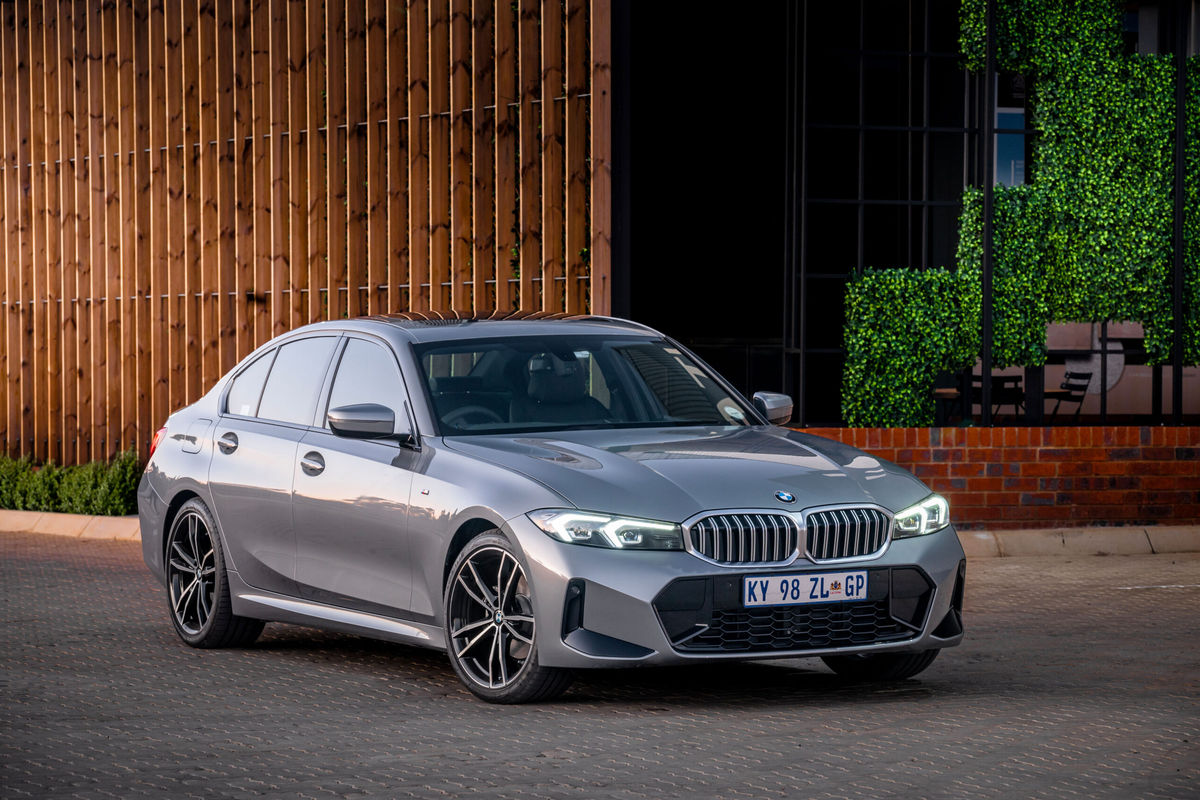
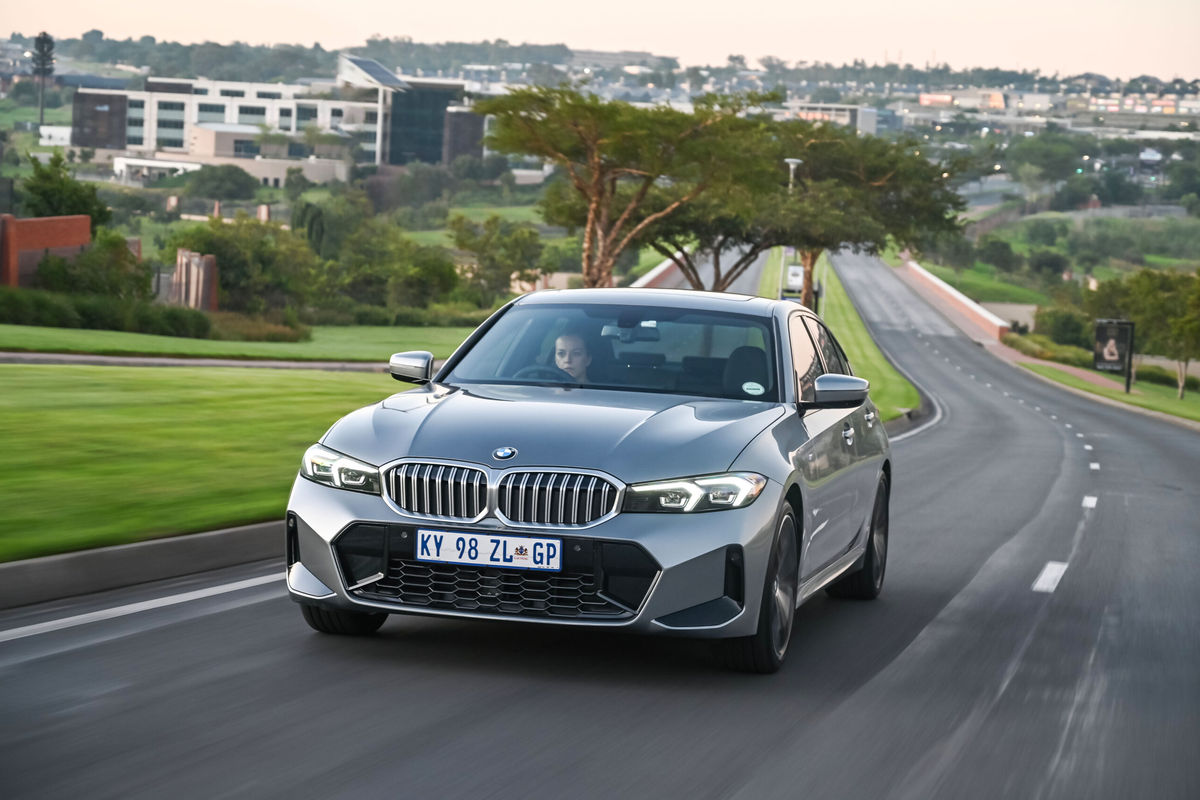
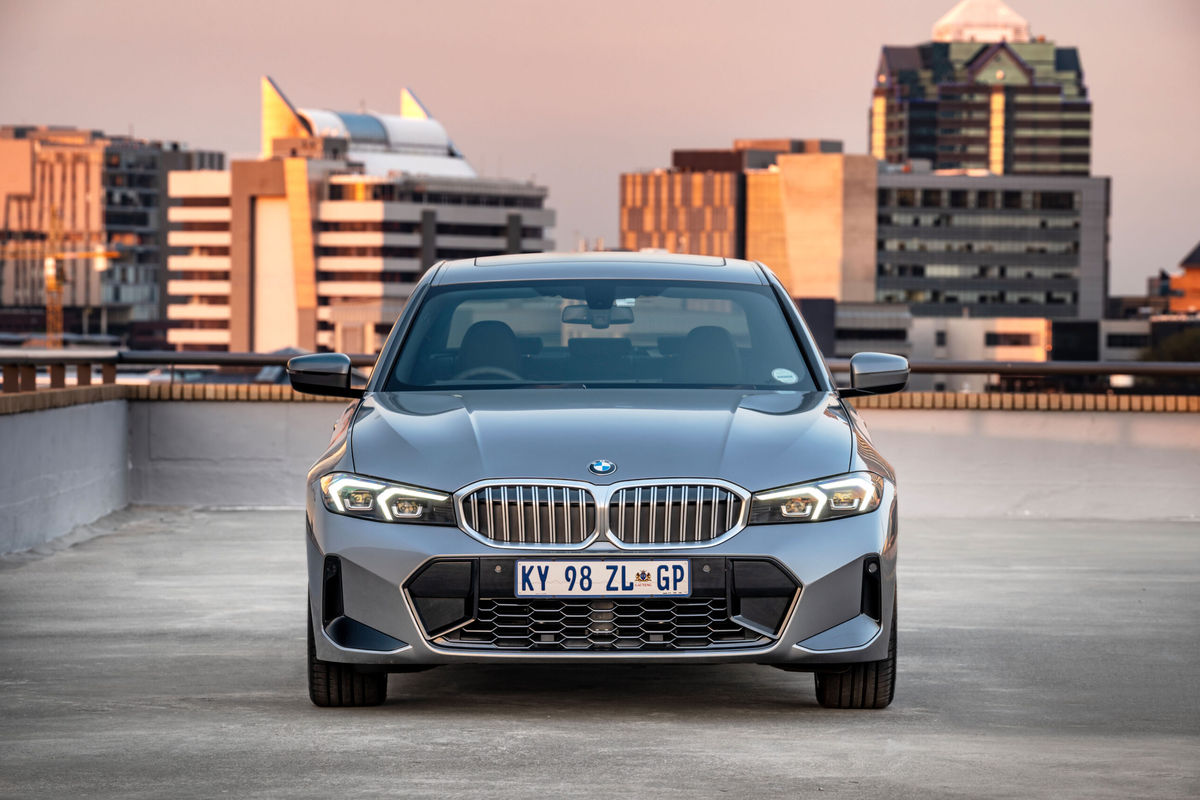
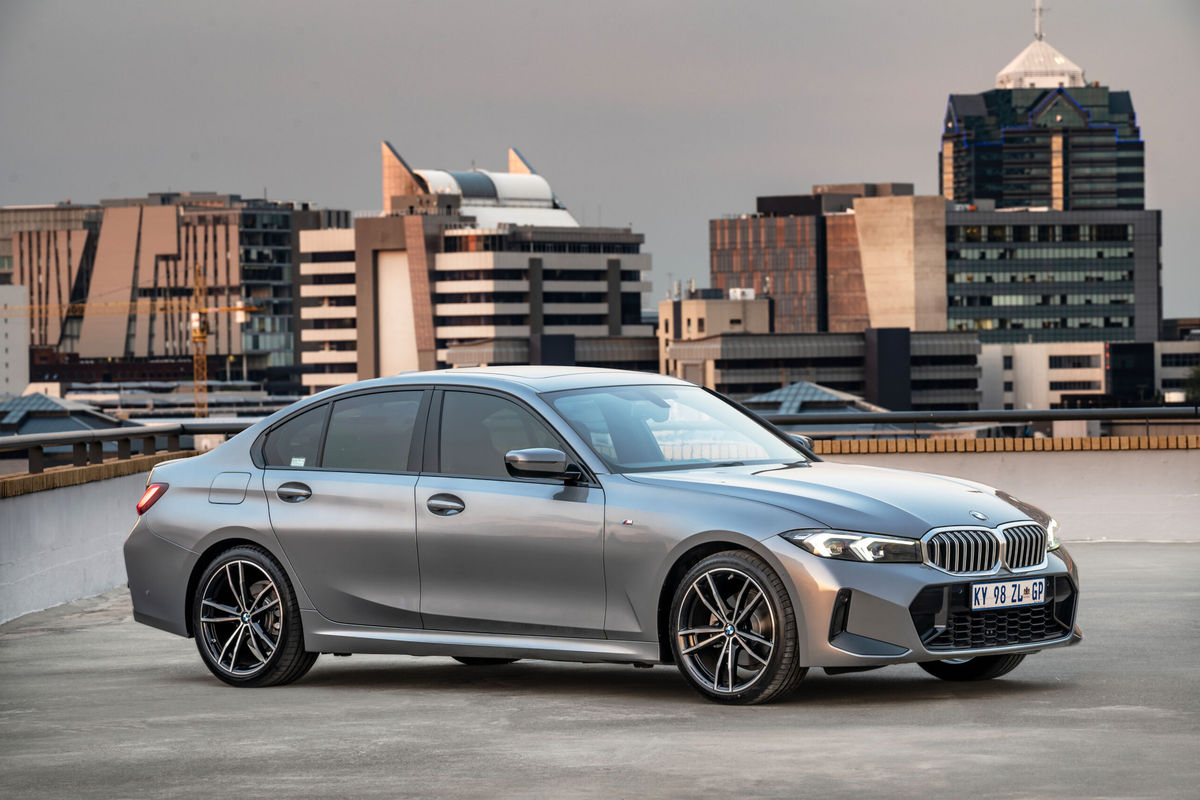
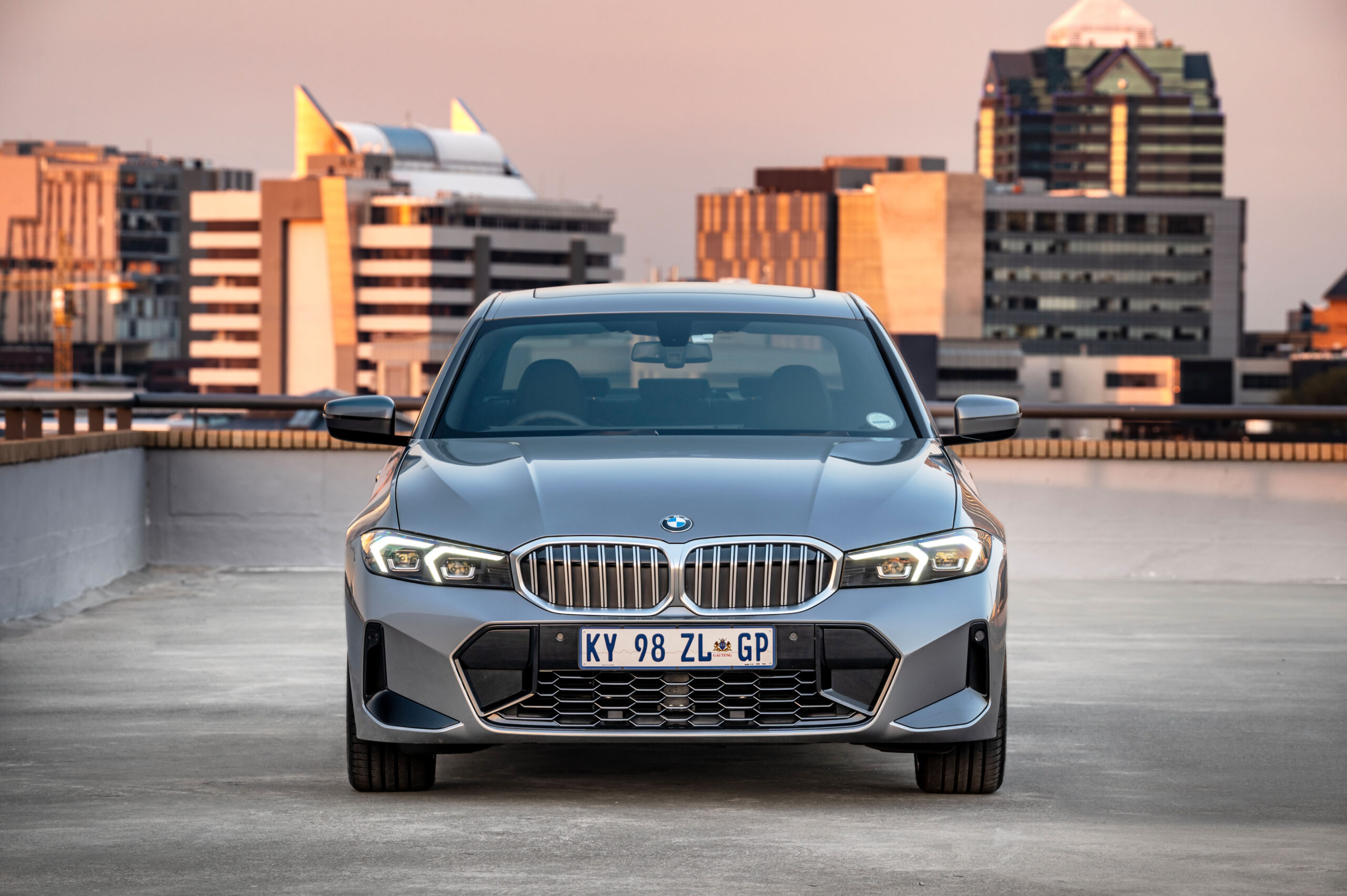
The BMW 3 Series LCI gains a sportier look with a revised lower bumper section and slimmer LED headlights.
In order to keep the appearance of the BMW 3 Series (2023) looking fresh, the Munich-based brand has revised its business-class sedan’s front end by fitting a redesigned bumper with a larger honeycomb-mesh air intake. Those with a keen eye will also notice the slimmer “inverted L” LED headlights.
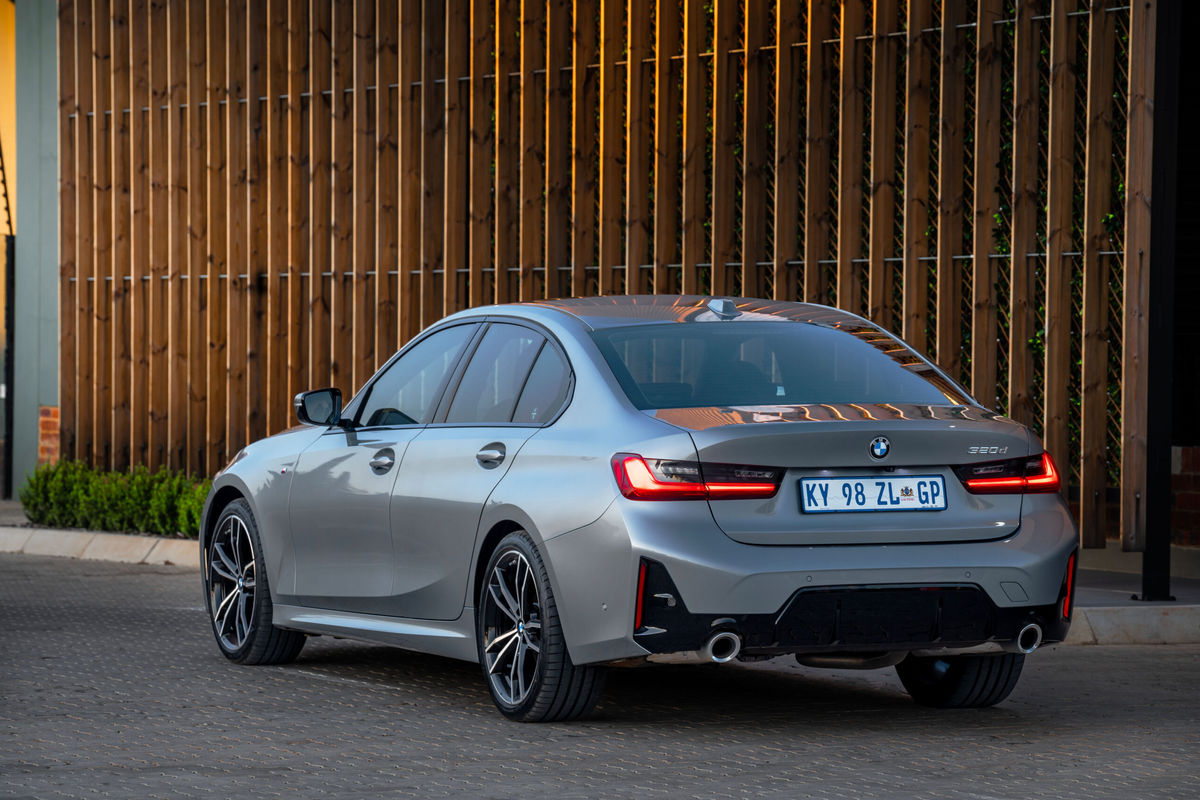
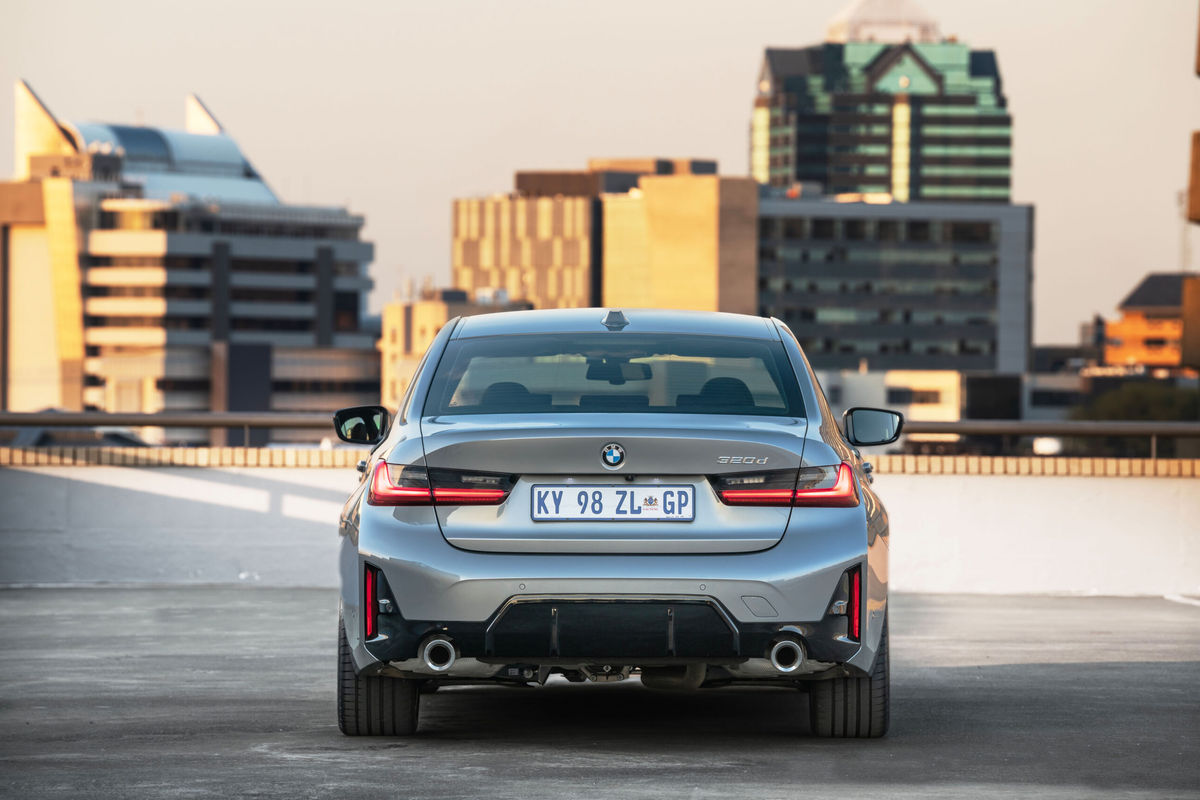
At the rear, a new-look lower bumper gains a sportier diffuser, while dual 100 mm exhaust ends hint at the 3 Series’ performance intentions. It may have put on a tailored suit, but the 3er is still a sporty sedan!
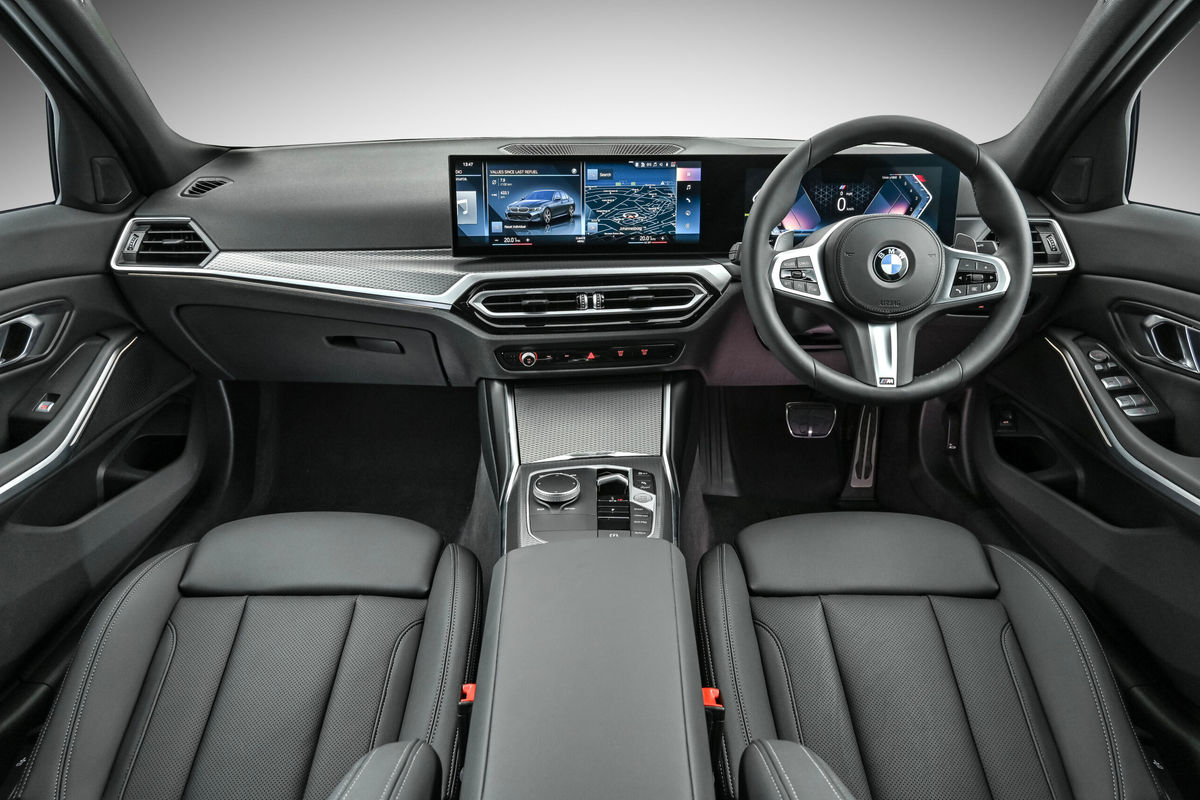
BMW’s Curved Display makes its way into the 3 Series. Fancy!
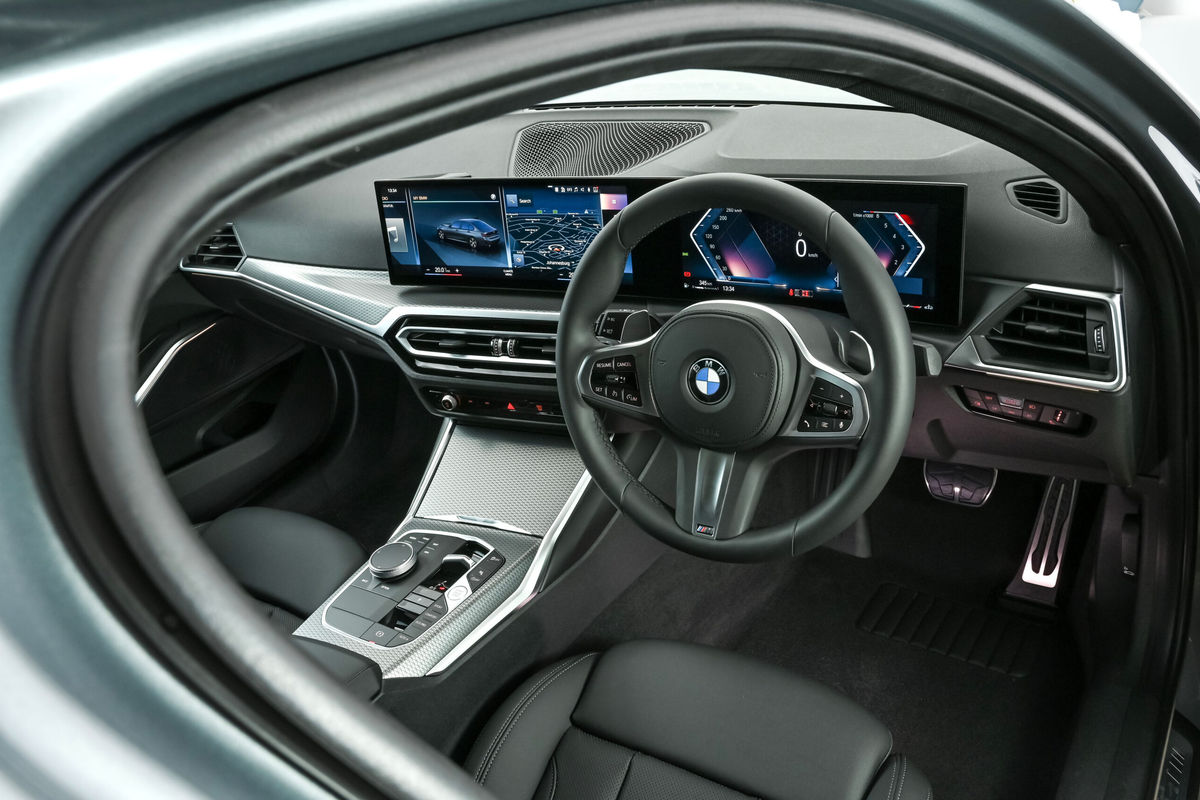
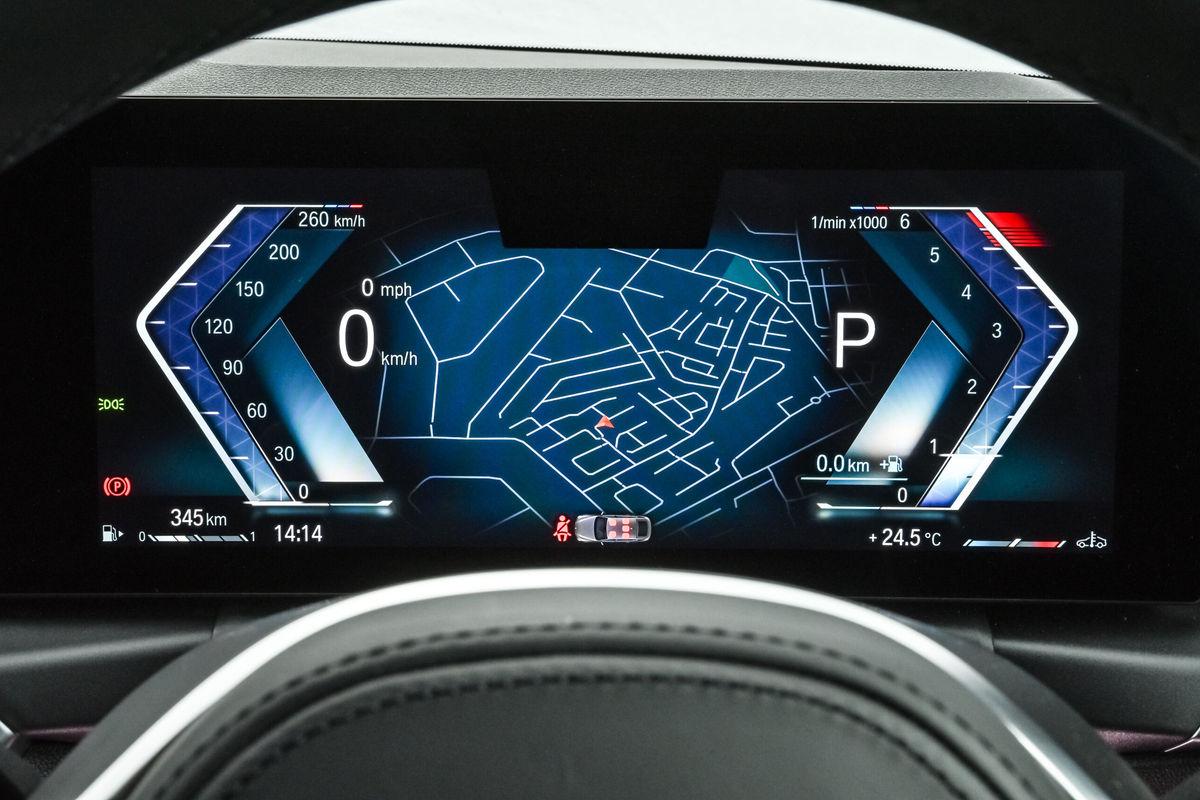
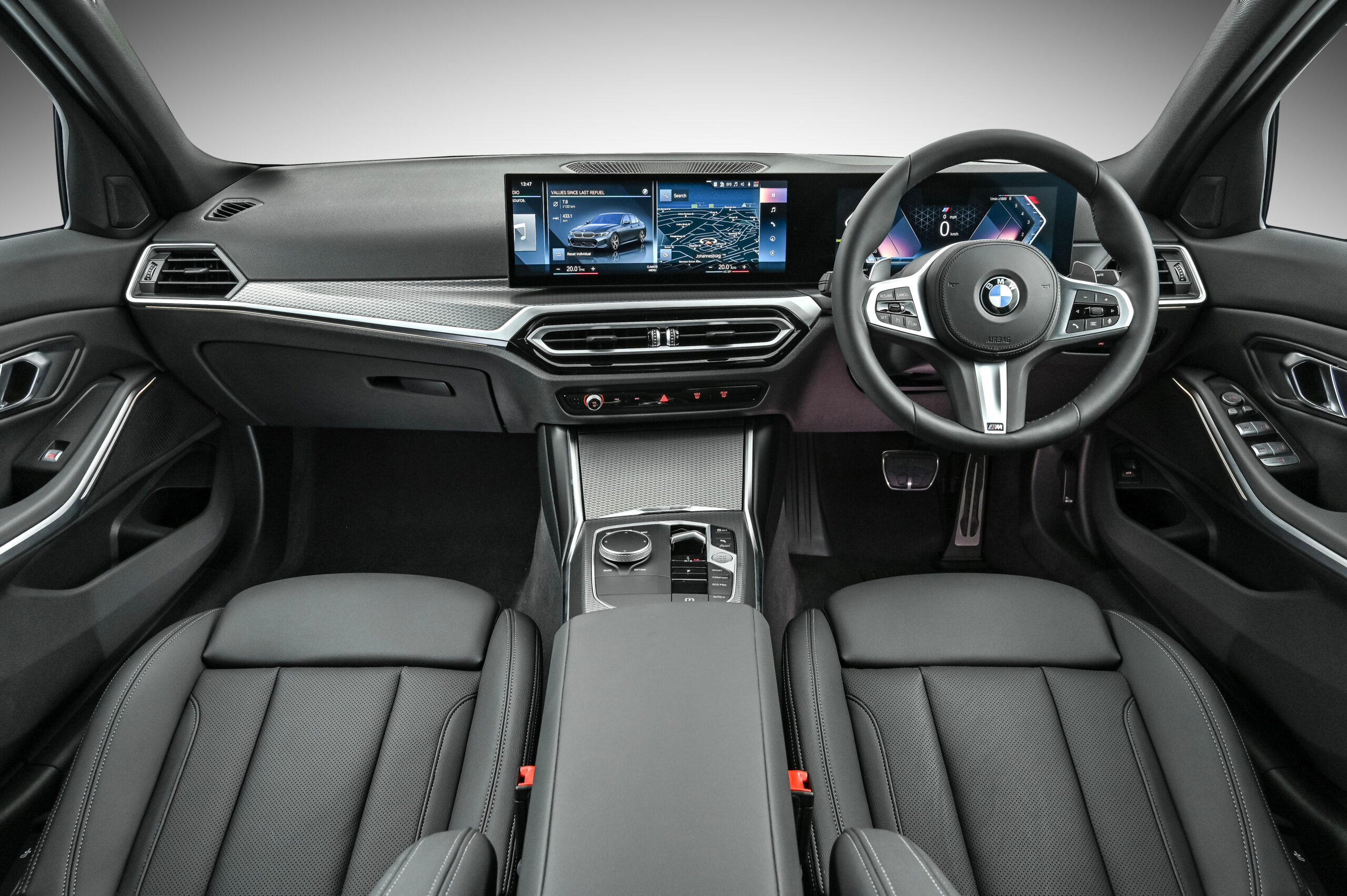
Inside, the most prominent change is the fitment of BMW’s Curved Display, which is standard on all 3 Series derivatives. Not only does it incorporate an all-digital 12.3-inch instrument cluster and an enlarged (14.9-inch) infotainment touchscreen, it’s powered by BMW’s latest software (Operating System 8).
The Curved Display has undoubtedly made the cabin look and feel more sophisticated. We found the system fairly easy to navigate and use, plus the intuitive voice control (with BMW Intelligent Personal Assistant) makes it palpably easy to access basic functions without lifting your hands from the ‘wheel.
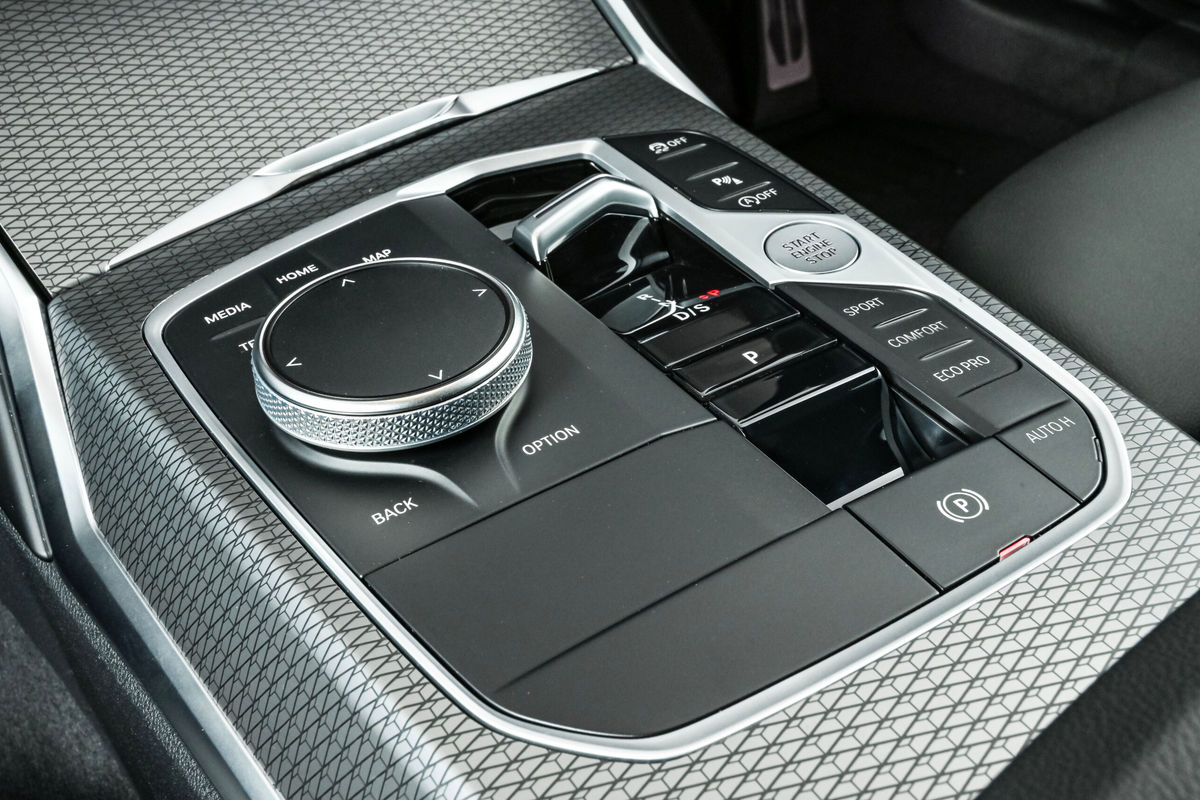
Another benefit of the Curved Display installation is the reduction of buttons on the centre stack, plus you’ll notice that the redesigned centre console now features a discreet transmission-mode selector.
Overall, the interior looks thoroughly modern and technologically advanced, which is precisely what you would expect from a business-class sedan. BMW was clearly determined not to let Mercedes-Benz get too far ahead with the portrait-oriented, tablet-style infotainment touchscreen in the latest C-Class!
What’s the BMW 3 Series LCI like to drive?
The 320d is the sensible choice but the M340i is for the performance enthusiasts.
The powertrain line-up is unchanged. The 3 Series range begins with the 115 kW/250 Nm 2.0-litre 4-cylinder turbopetrol engine in the 318i, which is followed by a more powerful version of the motor in the 320i (135 kW/300 Nm). As before, an 8-speed automatic transmission is standard on all derivatives.
There’s also a 320d, which is powered by a 140 kW/400 Nm 2.0-litre 4-cylinder turbodiesel engine and we had a chance to sample this derivative at the launch. These days, several manufacturers are phasing out turbodiesel engines from their passenger-car line-ups (apart from their bigger SUVs), but the 320d is arguably the most sensible offering in the range: it strikes a good balance between performance and efficiency. It has sufficient grunt to satisfy most consumers and that extra wallop torque helps to propel the business-class sedan forward with genuine gusto, which is useful when overtaking, for example.
The 320d’s handling is praiseworthy too. Compared with its predecessors, the BMW 3 Series feels quite conservative (buttoned-up, if you will), but the G20 generation’s steering setup feels sufficiently sharp and responsive, allied with superb sure-footedness and admirable body control under cornering load.
BMW claims an average fuel consumption figure of 5.0 L/100 km for the 320d, which sounds a trifle ambitious, but it makes this derivative an attractive proposition in the current fuel price environment.
The M340i delivers impeccable performance.
For those seeking heightened driver engagement (a more visceral driving experience, in other words), the all-wheel-drive M340i xDrive is arguably the go-to derivative if you can’t stretch your budget to acquire the full-blown M3 (the LCI M3 is coming in 2024) – and what a fine performance machine it is!
Powered by BMW’s evocative 3.0-litre, 6-cylinder twin-turbocharged petrol engine that dishes out a meaty 285 kW and 500 Nm (in conjunction with a quick-shifting 8-speed Sport transmission), the M340i xDrive is a rather potent, but also wonderfully balanced, performance-oriented business-class sedan.
As you’d expect, the ride quality is on the firm side (by virtue of the sporty M suspension), but thankfully the latter doesn’t sacrifice comfort entirely; it proved to be quite forgiving on Gauteng’s potholed roads.
Acceleration is blisteringly fast. If you flatten the accelerator pedal, the M340i xDrive will bolt from a standstill to 100 kph in just 4.3 seconds. Of course, its all-wheel-drive system (appended with an M differential) helps to ensure optimal traction, but it’s notably rear-biased… and that gives the 6-cylinder derivative a touch of playfulness) if you’re brave enough to explore the full breadth of its performance).
The M340i xDrive is purposely restrained (so as not to upstage the M3), but it emits a glorious noise at full tilt. Occasional pops and bangs from the Bimmer’s exhaust will put a smile on your face every time.
The 2023 BMW 3 Series builds on an already impressive product; the styling tweaks incorporated in the LCI update should find favour with local buyers. Besides, we think that the G20-generation 3er remains the most expressive business-class sedan in our market – yes, even ahead of its arch-rival, the C-Class.
Moreover, the interior tech updates are timely and the cabin’s general fit-and-finish remains impressive. Perhaps most impressive of all, however, is the 3 Series’ driving experience and effortless performance. Whether you opt for the 320d or the M340i xDrive, it matters not – you’re unlikely to be disappointed.
BMW 3 Series Price in South Africa
BMW 318i
R767 894
BMW 318i M Sport
R817 894
BMW 320i
R832 894
BMW 320i M Sport
R882 894
BMW 320d
R880 768
BMW 320d M Sport
R930 768
BMW 330i M Sport
R953 197
BMW M340i xDrive
R1 338 207
All BMW 3 Series derivatives come standard with a 2-year/unlimited km warranty and a 5-year/100 000 km maintenance plan.
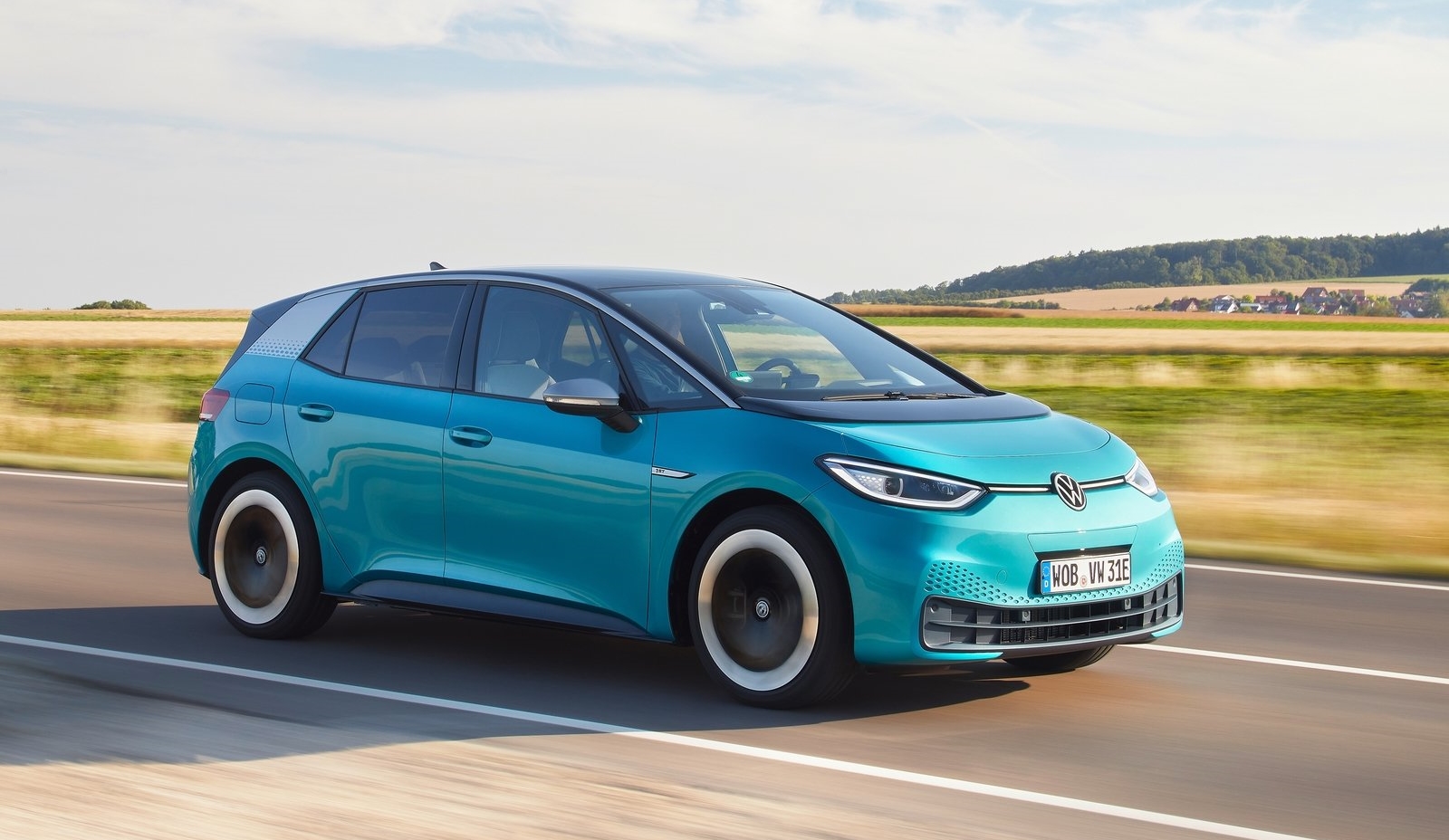
Volkswagen is a major producer of battery-electric vehicles, but it offers none of them in the South African market. To find out about Volkswagen SA’s Electric Car Plan for 2023/2024, we chatted with VWSA’s head of passenger cars, Steffen Knapp.
We last chatted with Volkswagen SA about its electrification strategy back in October 2019, on the eve of the Frankfurt Motor Show, where Volkswagen unveiled its brand-new ID.3 to the world. Of course, a lot has happened throughout the past 3 years, with the pandemic, lockdowns, supply-chain maladies, logistical challenges, the war in Ukraine and so on. Since early 2020, the world has changed radically.
Right now, at the beginning of March 2023, there are many brands that offer battery-electric vehicles (BEVs) for sale. Granted, the overwhelming majority of those are premium car makers, with BMW Group, Audi, Porsche, Mercedes-Benz, Jaguar and Volvo offering models that produce zero carbon emissions.
This year will see a few more players join the market, with Haval’s ORA earmarked for introduction, while strong rumours persist that South Korean brands Kia and Hyundai’s local subsidiaries will bring in some of their flagship electric cars for testing/marketing purposes at some point in 2023. There’s also talk that the Chinese brand Build Your Dreams (BYD) will launch some of its offerings in Mzansi later this year.
Why the delay?
Steffen Knapp: Volkswagen South Africa’s Head of Passenger Cars.
We’ve seen many comments on our social media platforms about why there aren’t any Volkswagen electric cars on sale in the Republic (at least, not yet) and Steffen Knapp, Head of Passenger Cars at Volkswagen South Africa (VWSA), was quick to point out that current sales of BEVs are nominal.
“First of all, when we (launch a BEV) it needs to achieve relevant sales volumes. If it’s going to achieve fewer than 500 unit sales (a year), in my point of view, it’s very difficult to justify (bringing it to market).
“We are a volume brand and perceive ourselves as the most aspirational volume brand in South Africa and to sell 3, 5 or 10 cars a month (of a BEV model), that’s not the scale.”
Evidently, Volkswagen SA is playing the long game here and has been testing the waters already.
“We ran multiple test fleets to gain an understanding of customers’ apprehensions (and) consider how we should launch a BEV in the South African market. We also learnt lessons from the launches of our competitors, which showed us that we need to be selling the vehicles in a different way,” he added.
You can bet that VWSA has been closely studying the marketing and sales performance of every electric car on sale in the local new-vehicle market! One of its test fleets comprised VW e-Golfs, which were driven by journalists, potential customers, dealers and VW staff. Last year, VWSA ran an ID.4 test fleet.
And what about vehicle availability?
“The ID.4 will be the first car we’ll launch (in South Africa),” Knapp told Cars.co.za.
That’s exciting news, but the ID.4 has been around for a couple of years (it was named the 2021 World Car of the Year). So, why the delay? Knapp points out that, initially, only one plant was building the ID.4.
“When the ID.4 was available, it was only available from one plant in Zwickau (Germany) and it was not possible to get the capacity, which delayed us to a certain extent. Now, the ID.4 is being built in the US, in China and in Zwickau, so the availability situation is much improved.”
What is Volkswagen SA’s electric car business strategy?
Most new-car sales in South Africa result from cash transactions and vehicle-finance agreements, but Volkswagen SA will be going the leasing route with its electric cars. VWSA operates a leasing programme called EasyFinance for its ICE vehicles and you’ll notice marketing efforts around that begin to ramp up.
“(A BEV) needs to be sold in a different way,” said Knapp. “We anticipate that consumers will grow to embrace leasing, but vehicle ownership is deeply ingrained in the mentality of South African motorists.”
But, as he pointed out (with a laugh), most new-car deals are financed, which means that unless you’ve paid off the car, you still won’t own it. “As a matter of fact, customers never own the vehicle, because 72% of them are financing. So we have to go to the using – not owning – philosophy,” he quipped.
Essentially, the leasing programme for BEVs is a guaranteed future-value product (GFV), Knapp explains.
“When the ownership is not with the customer anymore, the customer has three options: 1. Bring the car back and get the residual value paid, which is guaranteed, 2. Bring the car back to the dealer who sells them a new car, or 3. They decide to keep the car and refinance it for another two or three years.
“This concept is already a major shift in the mindset of South African customers,” Knapp added.
The Volkswagen ID.3 did not have a trouble-free debut overseas – it’s unlikely to be offered in Mzansi.
Leasing takes some sting out of depreciation
“I’m s**t scared to see the residual values of other brands’ BEVs in our market. That can destroy a brand, so if you go the leasing/guaranteed future value route, you define the value, and you can get the car back, meaning you can also control how the car is disposed of,” he added.
Pricing is a sticking point. Electric cars tend to be pricier than their petrol/diesel counterparts – not only because they cost more to produce, but Government imposes a higher tax on BEVs. However, VWSA is keen to point out that the numbers are favourable when you look at it from a running cost point of view.
“There’ll be a sales guy that will explain the costs of maintenance, fuel consumption, residual value, and insurance, so you (the customer) can get a Rands per kilometre price (for reference), and by doing this (even without any government subsidies), our business case shows that after 5 years, the electric vehicle is positive and more affordable basically than an internal combustion engine,” said Knapp.
If you already have a solar setup at home, there’s a strong potential to reduce your costs even more.
Despite the country’s unreliable electricity supply and public fear of blackouts, Knapp is not bothered. “At the end of the day, you have to see how many kilometres a South African is driving per day. If I take myself as an example, I am commuting from Fourways to Sandton every day and that’s around 40 km back and forth. So, if I have a range of 500 km, I just need to plug it in at night and it’s charged again.”
It’s important to note that even when plugged into a household outlet (3.5 kWh) overnight, an average BEV should gain about 150 km in 10 hours, even with a 2 hour power cut factored in. If you opt for the OEM 7 kWh wall box, your charging speed doubles (but it does not need to be plugged in that long).
“If you are working for a company, like in our case, we have charging stations in our garage, with generator backup. In terms of energy supply, I don’t see it (load shedding) as a hindrance (or obstacle) to the local-market introduction of electric vehicles. It’s more about mindset,” Knapp adds.
Will Volkswagen SA invest in charging infrastructure?
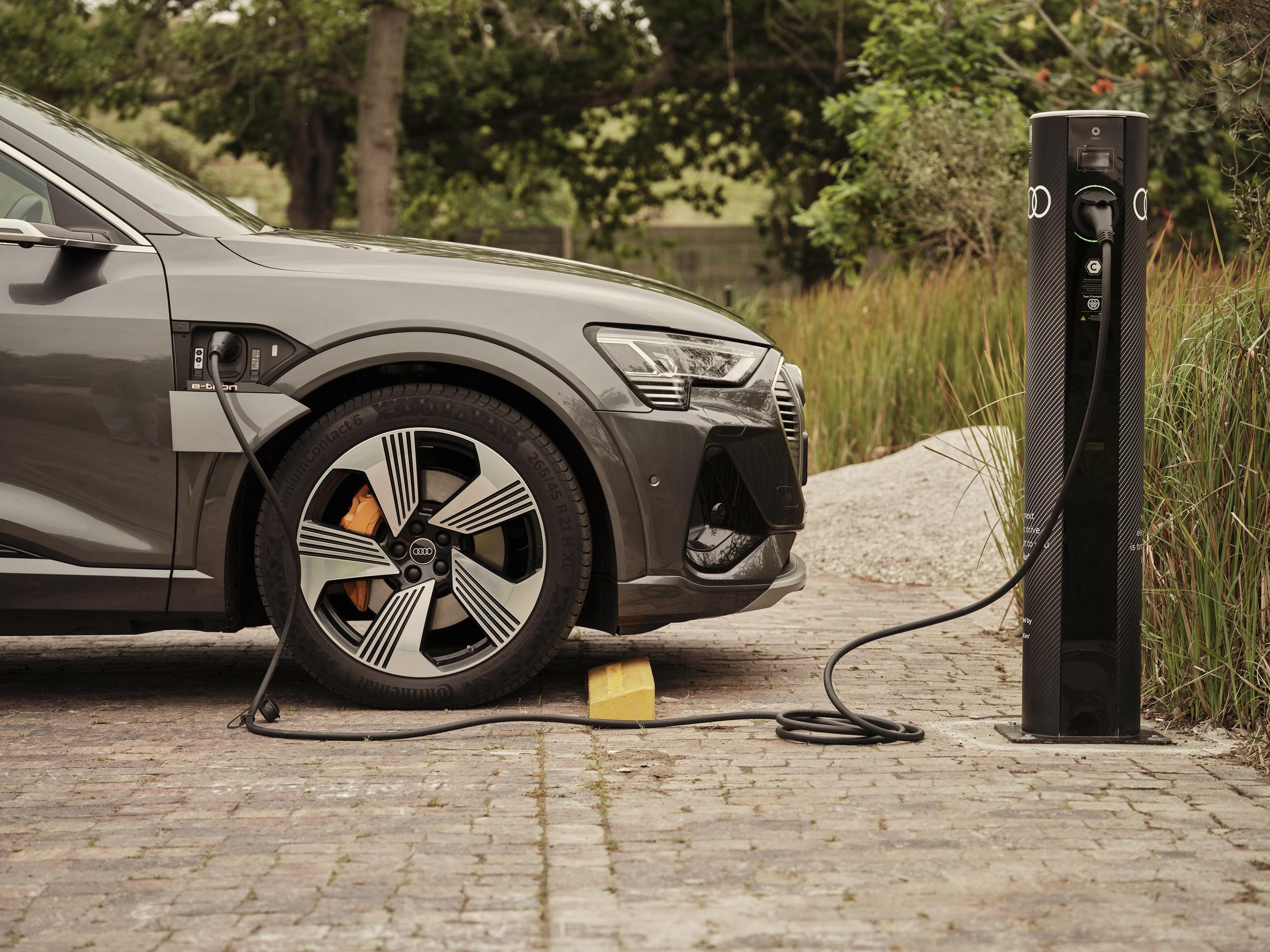
VW’s sibling brand, Audi has invested significantly in charging infrastructure.
These days, there are far more electric-car chargers in South Africa than you may realise, especially in major metropolitan areas. “The penetration of electric car chargers in South Africa is one of the highest in the world. The next challenge is speed related, these chargers are not fast DC chargers. At the moment, I think people can handle it, but going forward, (we’ll) obviously have to work on this.”
“So, going forward, our group (the Volkswagen Group of South Africa) will continue to invest in charging infrastructure,” said Knapp. “The EV-charging infrastructure has improved substantially, with Audi SA contributing significantly in that regard. The next wave, at least in theory, will be to equip each of about 4 500 service stations with an electric station that’s not 100% dependent on the grid. It’s all possible.”
Which electric cars are Volkswagen SA likely to offer?
An all-electric Tiguan-sized family SUV with 500 km of range? We’re keen.
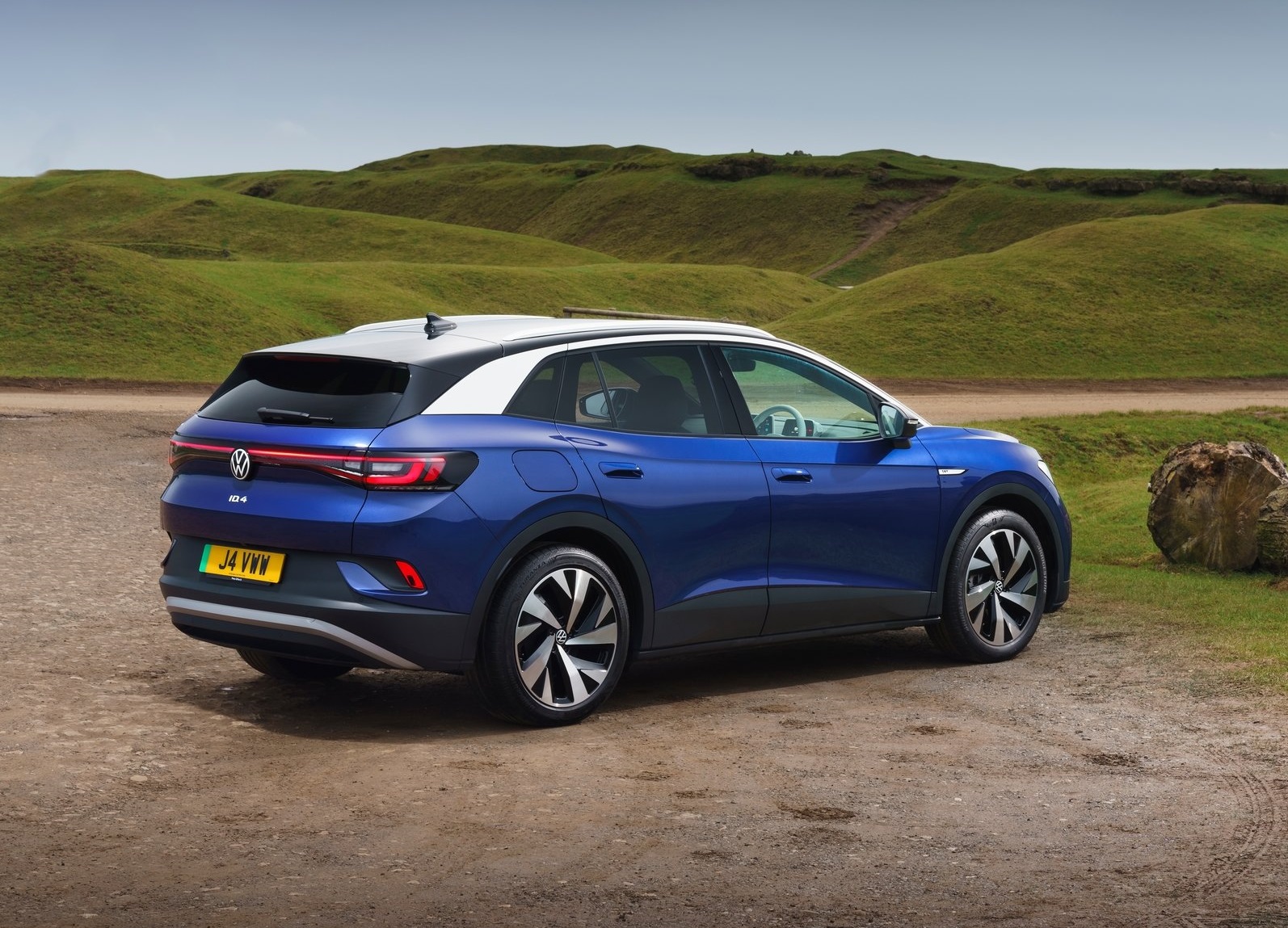
With the market showing a strong predilection for SUVs, it makes sense for VWSA to introduce only the crossover ID model. Meet the Volkswagen ID.4, an electric family-sized crossover. It’s fractionally larger than the Volkswagen Tiguan medium SUV, which should give you some sense of the ID.4’s dimensions.
The uptake of electric cars has been stymied by, yes, lofty purchase prices, but “range anxiety” as well. However, thanks to its 77 kWh battery, the ID.4 is claimed to travel up to 520 km on a full charge. It’s not going to be slow either, with 150 kW and 310 Nm on tap as well as an 8.5-second 0 to 100 kph time.
As we’ve mentioned, the ID.4 debuted overseas in 2021, but thanks to over-the-air updates VW is able to keep the model relevant and introduce UX improvements without the car needing to go to a dealer.
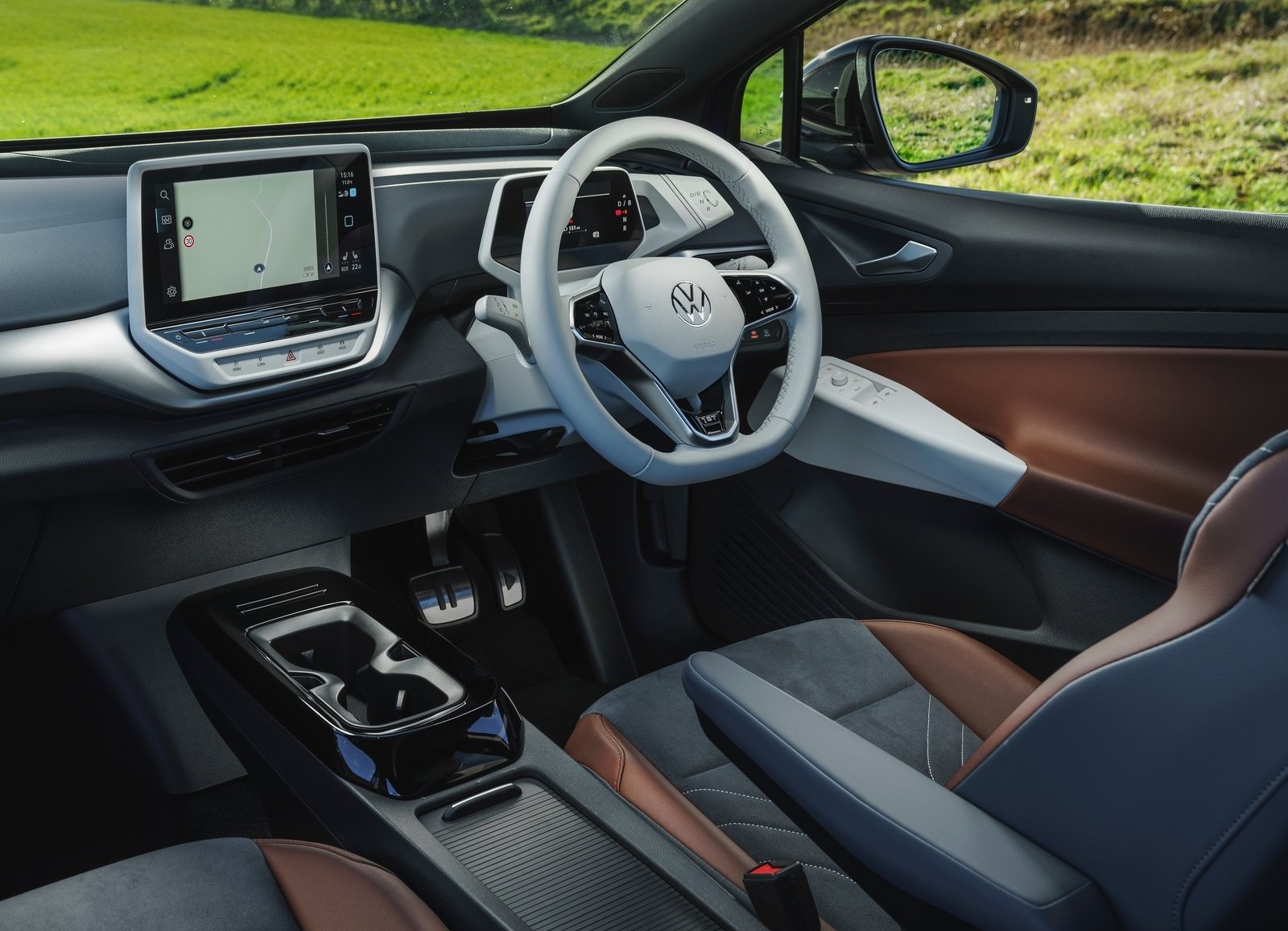
The minimalist, but stylish, Volkswagen ID.4 interior.
ID.4 is a great starting point for Volkswagen SA’s “new energy vehicle” line-up. Comparisons between the ID.4 and Tiguan will be inevitable, in terms of ownership and running costs. Of course, if it were up to us, we’d have the Volkswagen ID Buzz in a heartbeat – South Africans have a love affair with the Kombi!
At this stage, there’s no confirmation that the ID Buzz will be coming to Mzansi, but Knapp did say that it could come as a commercial vehicle in the future, so watch this space.
Could the VW ID Buzz reach our shores? Watch this space.
How soon will we see an electric VW on South African roads?
A lot sooner than you’d think, in actual fact. Some of you may even have seen the Volkswagen e-Golf research cars on SA roads and you’re likely to see the ID.4 test units in 2023. As for customer cars?
“I hope relatively soon – it could be before the end of this year (2023). It will depend on our supply chain situation (which has limited stock levels of some models severely), we are working to have (the ID.4) here by at least next year. An SUV is still, I believe, the best solution for mobility in South Africa and, based on sales data, the SUV market (continues to grow at a rapid rate),” Knapp concluded.
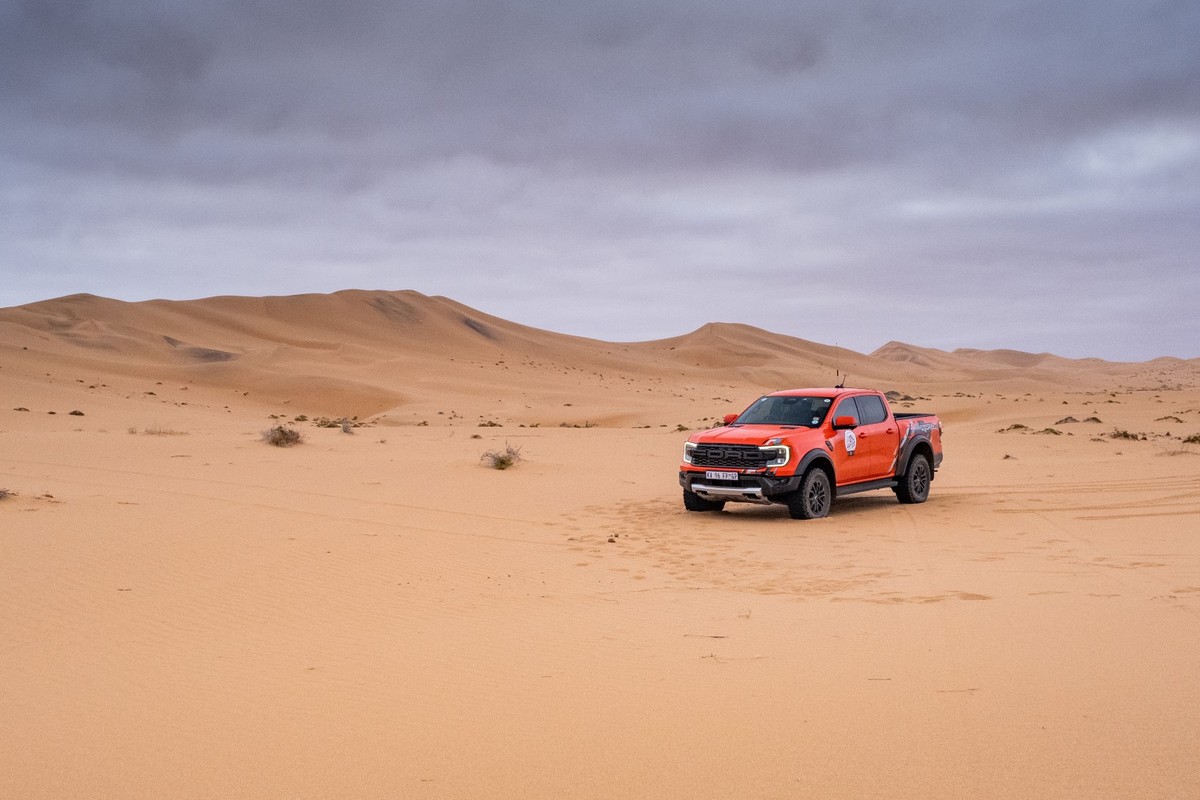
Our intrepid adventure journalist, Gero Lilleike, travelled to the Namib Desert to drive the new Ford Ranger Raptor! Is this the most capable new 4×4 vehicle money can buy?
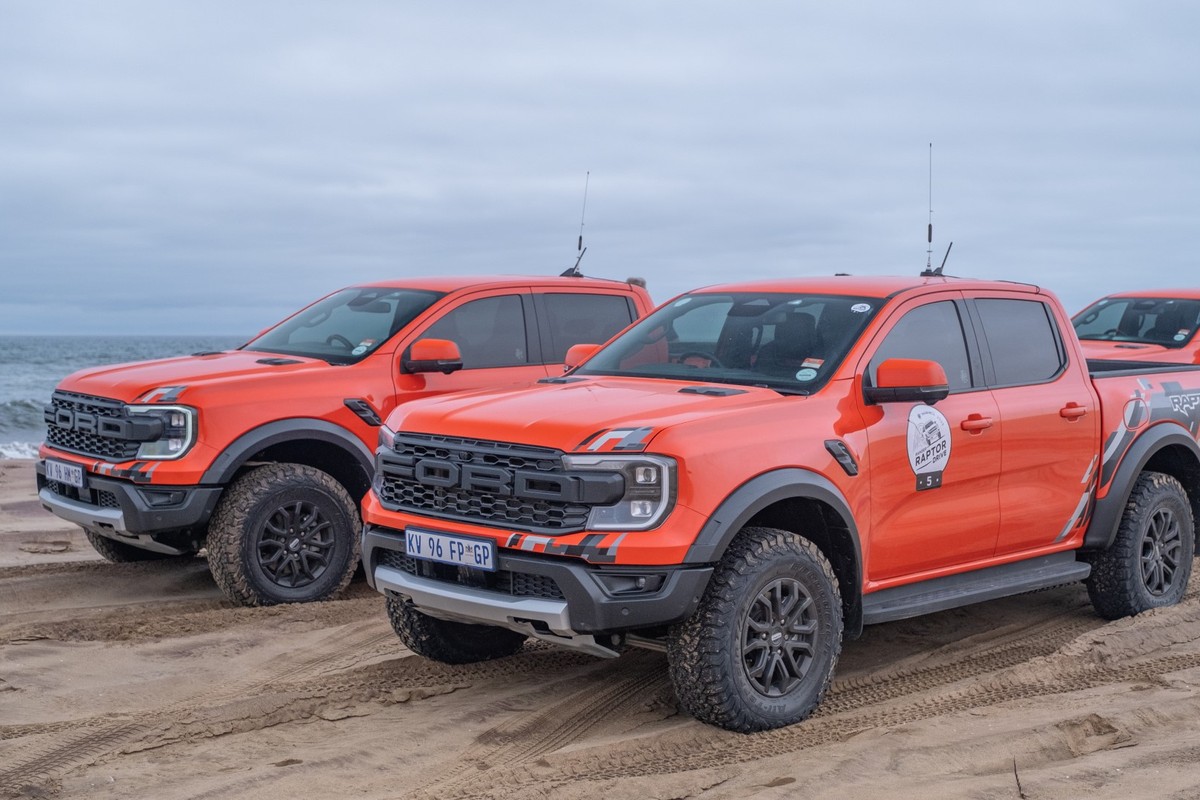
The new Ford Ranger Raptor is one of the most highly anticipated new vehicle introductions of 2023. Not only does the potent 3.0-litre, twin-turbo petrol V6-powered Raptor top Ford’s new Ranger line-up – it’s also the most powerful double-cab bakkie you can buy in the South African new-vehicle market.
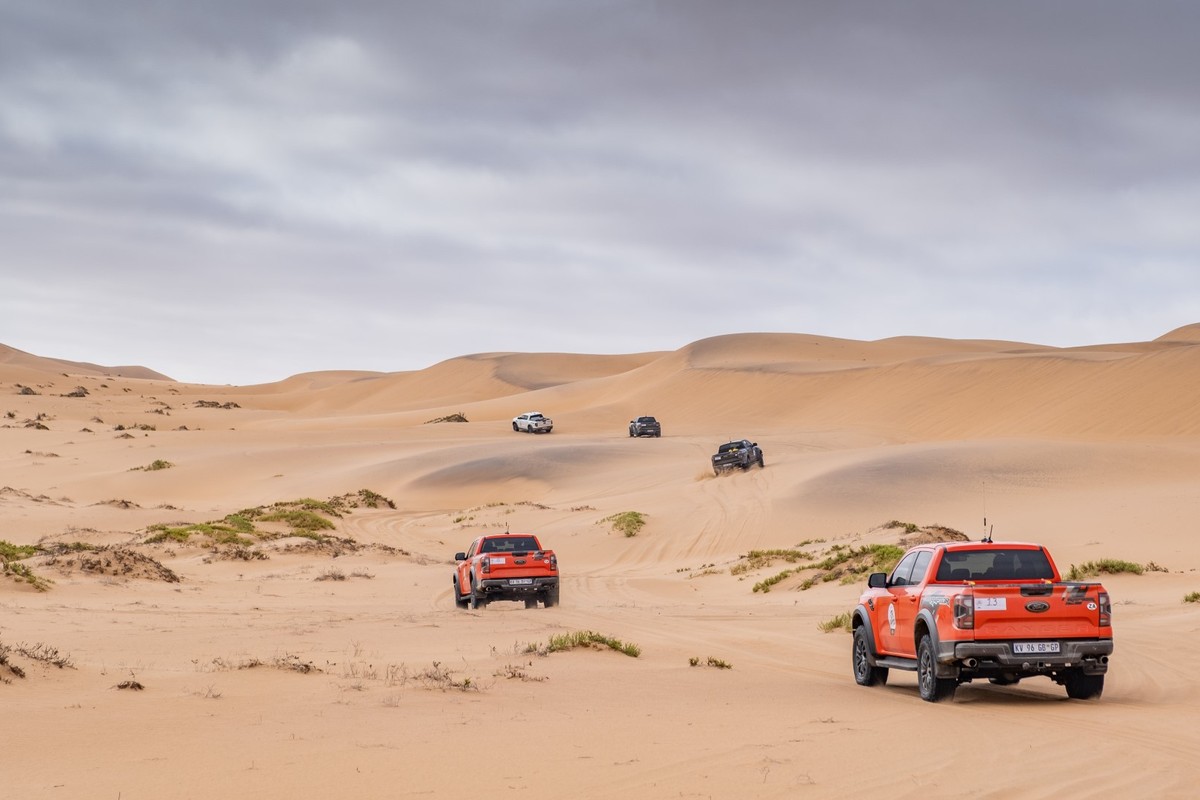
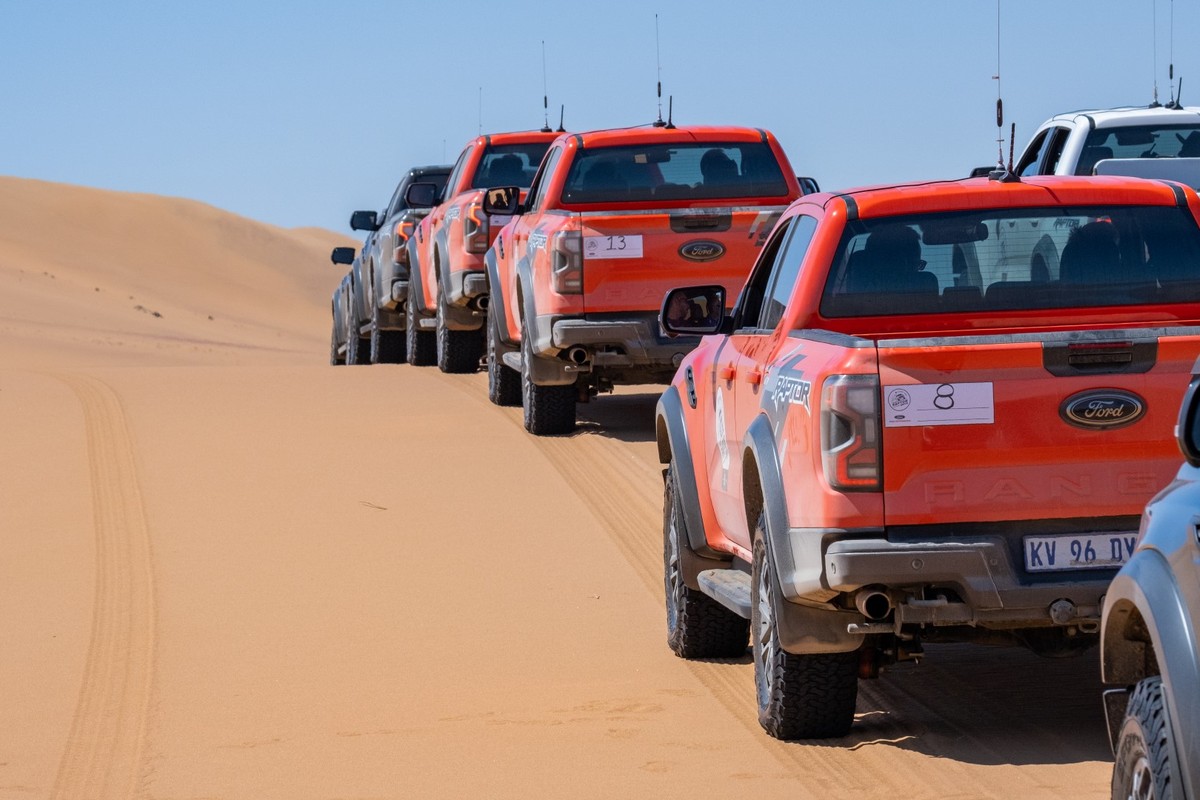
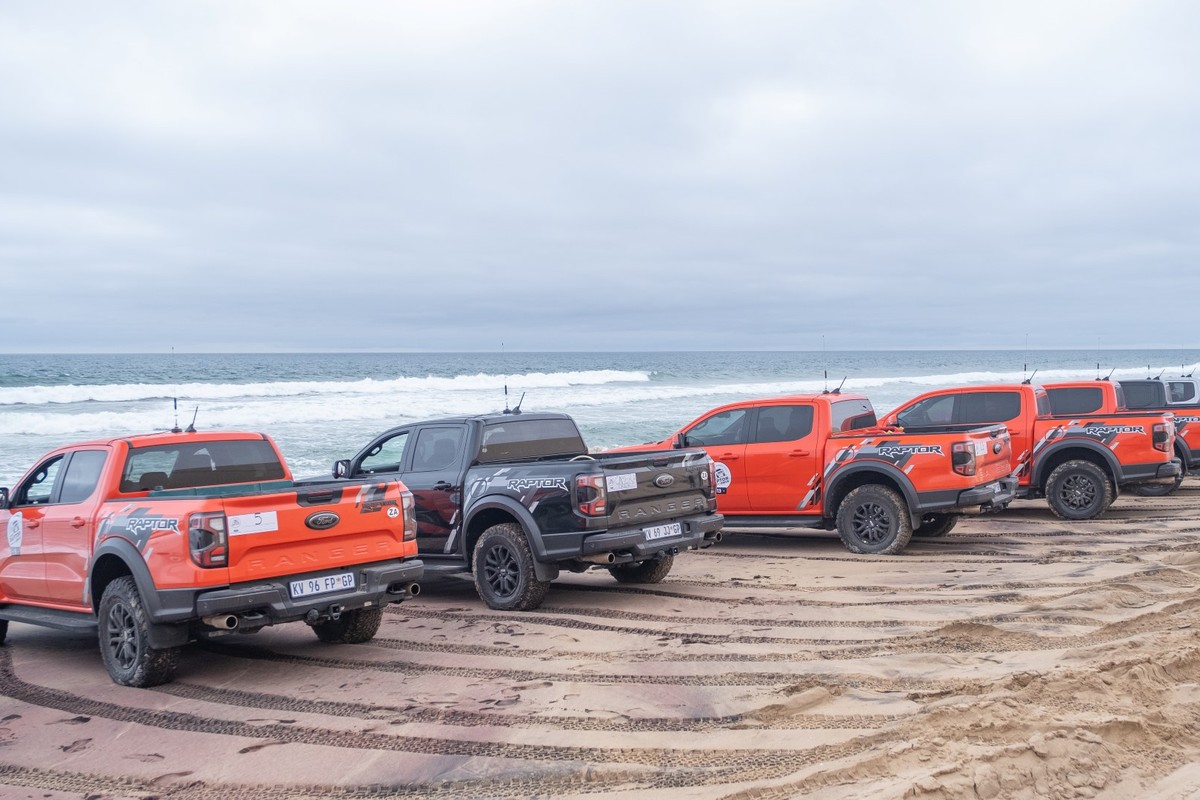
Ford Motor Company of Southern Africa (FMCSA) wanted to showcase the new Ranger Raptor’s talents on a grand scale and chose the Namib Desert in Namibia as a fitting location to host international and local media for a 4×4 off-road experience like no other.
Is the new Ranger Raptor just another “Ford sticker job” or is there serious performance on offer here?
What makes the Ford Ranger Raptor special?
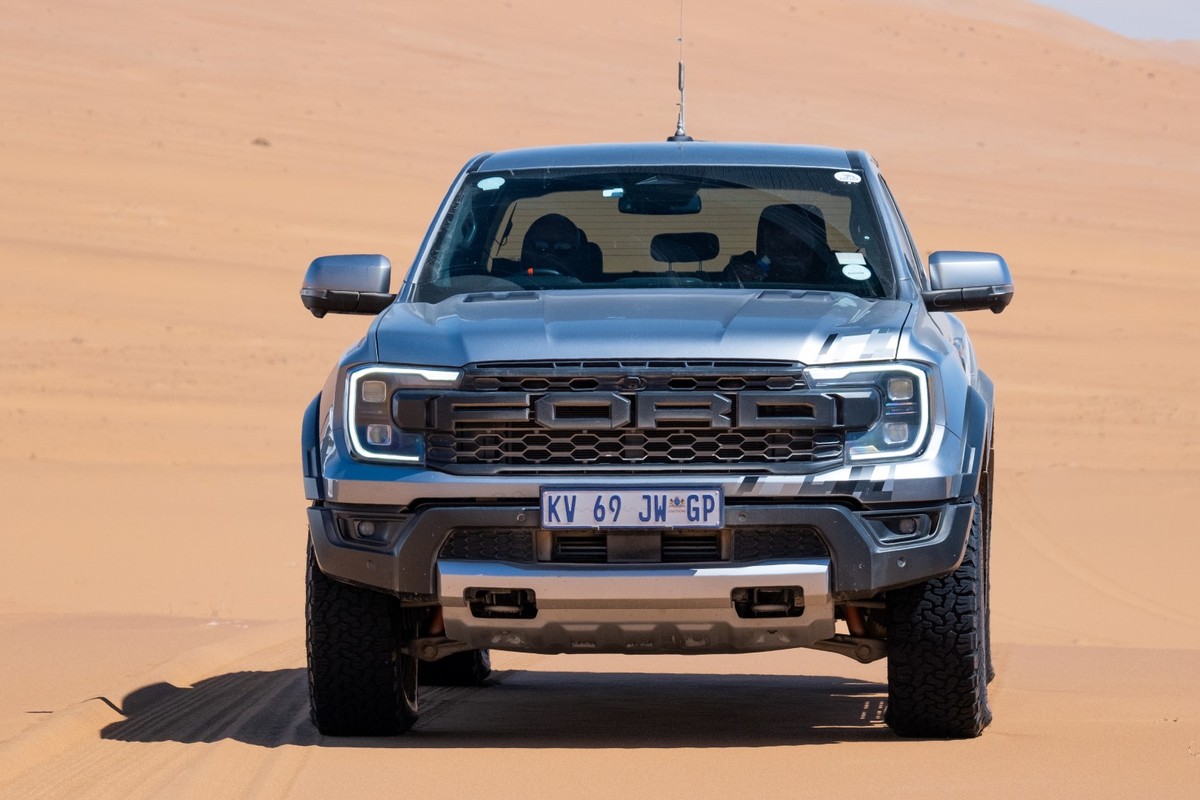
The Raptor’s strong front-end design is bound to be an intimidating sight in other motorists’ rear-view mirrors.
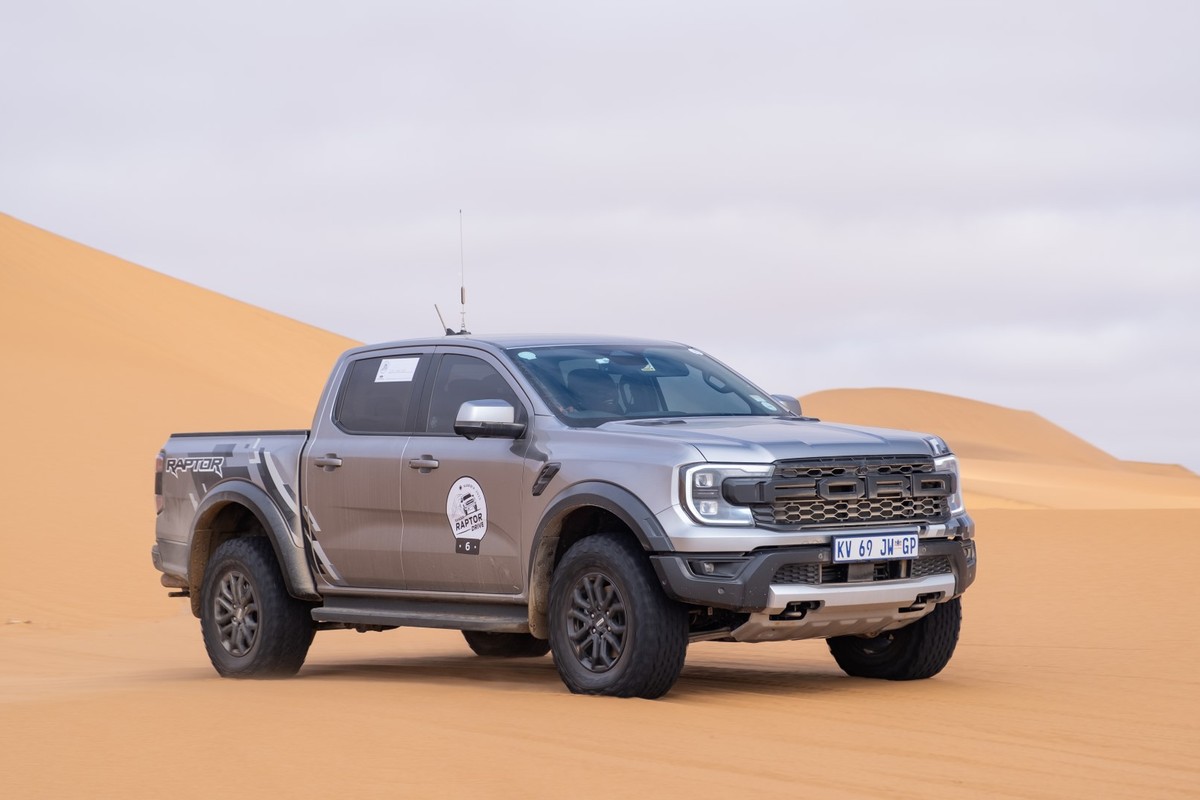
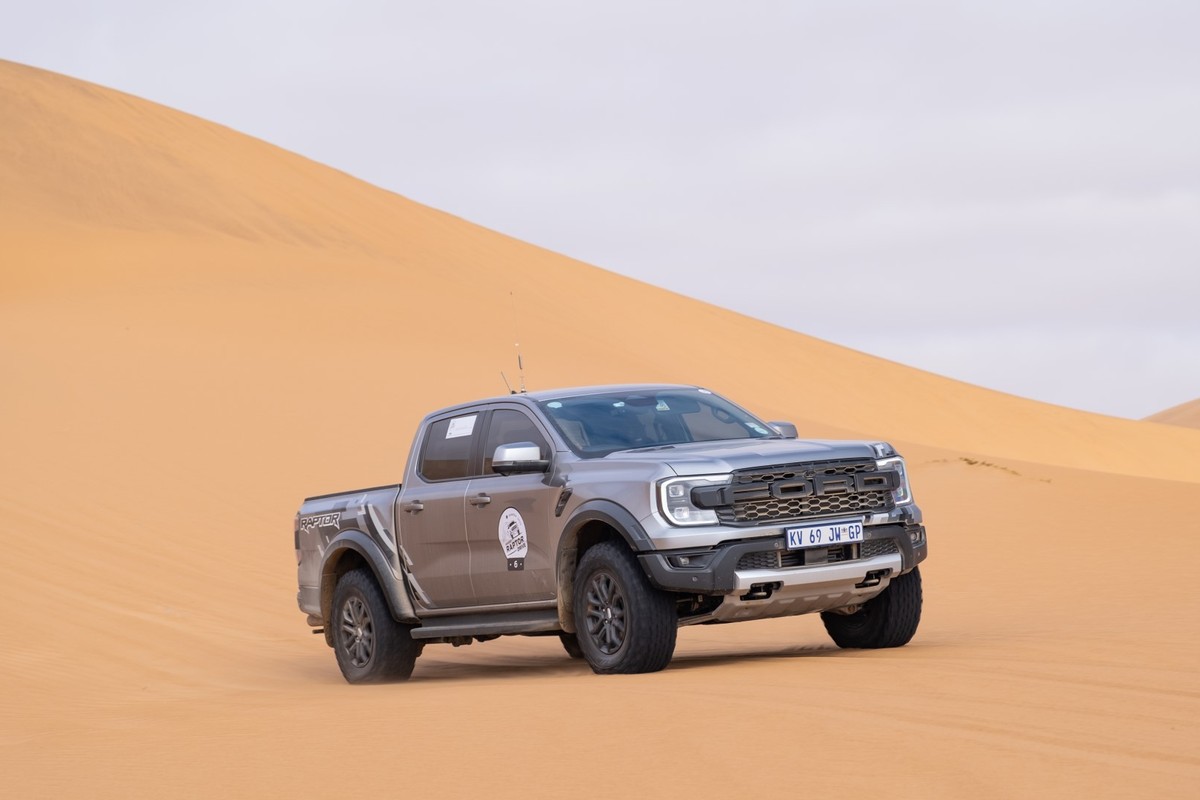
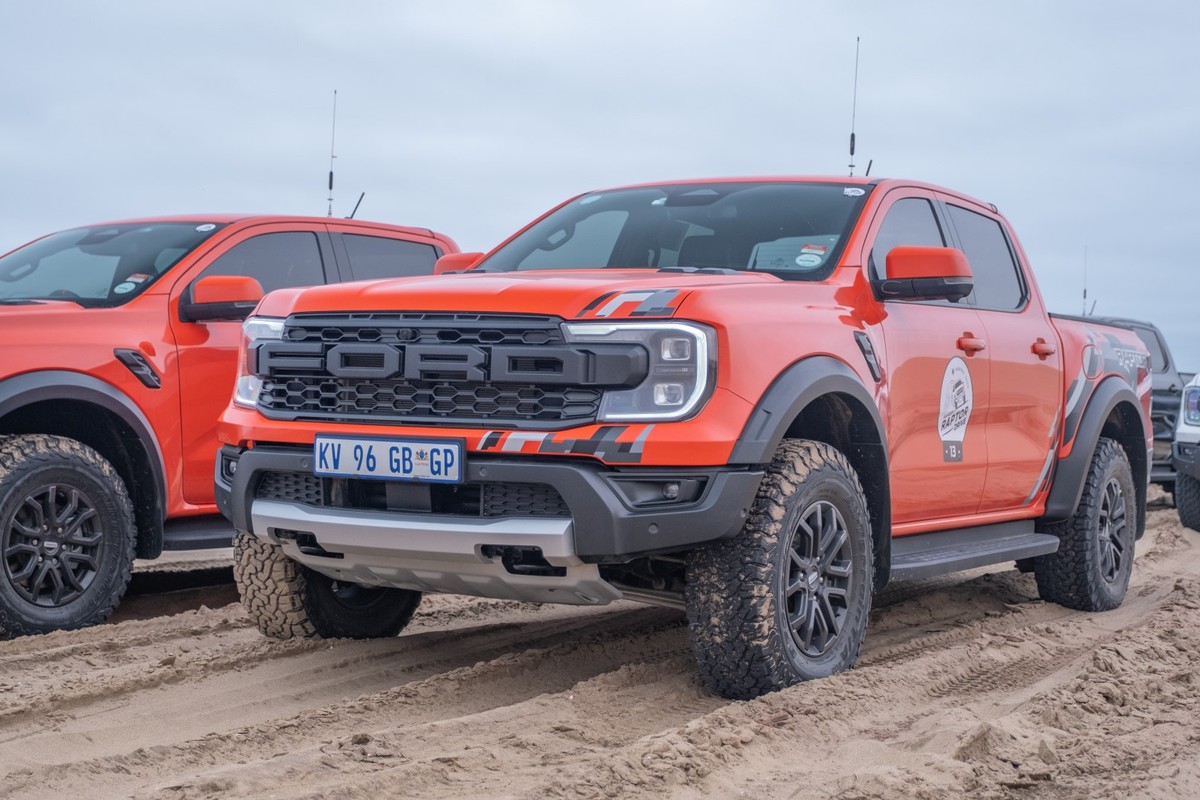
Just look at it! Doesn’t the new Ford Ranger Raptor look like an absolute beast? In terms of the newcomer’s styling, we think the Blue Oval has nailed it! The bakkie looks – and sounds – fantastic!
The new Ranger Raptor lacks nothing for parking bay-filling presence. Its wide, squared-off front end and dramatically sculpted bonnet impart a sense of strength, while the large F-O-R-D lettering across the grille is flanked by Matrix LED lights with distinctive C-Clamp daytime running lights.
Ford has also fitted an extra thick (2.3 mm) steel bash plate, which is meant to protect the bakkie’s vital components while you’re off-roading – probably with considerable zeal! – and the flared wheel arches further contribute to the hardcore look; they cup 17-inch BF Goodrich KO2 all-terrain tyres.
The Ranger Raptor’s dual active exhaust tips hint at the flagship derivative’s performance intent and the level of noise produced by those pipes can be adjusted using the ‘wheel-mounted controls – they can also alter a host of other settings, including steering and suspension settings (but more on this below).
The Raptor’s Fox suspension makes its high-speed offroad capability possible.
The Raptor is positioned as a high-performance off-road vehicle and, as such, its powertrain and suspension are required to perform at the highest level. The 3.0-litre, twin-turbo petrol V6 engine develops a whopping 292 kW and 583 Nm of torque, all of which is directed to the permanent 4-wheel-drive system via a specifically calibrated 10-speed automatic transmission. It produces 135 kW/83 Nm more than the outgoing (admittedly 2.0-litre bi-turbodiesel) Raptor – what a phenomenal power hike.
But that’s not all! The Raptor’s astonishing off-road ability is made possible by its newly designed suspension system, which includes rear Watts Link coil springs for increased stability on- and off-road, as well as a new Fox 2.5-inch Live Valve Internal Bypass shock absorbers with electronic damping. The Raptor’s damping is adjusted continuously (up to 500 times per second, depending on which drive mode has been selected) to optimise the bakkie’s composure during high-speed, hardcore off-roading.
What’s the Ranger Raptor’s interior like?
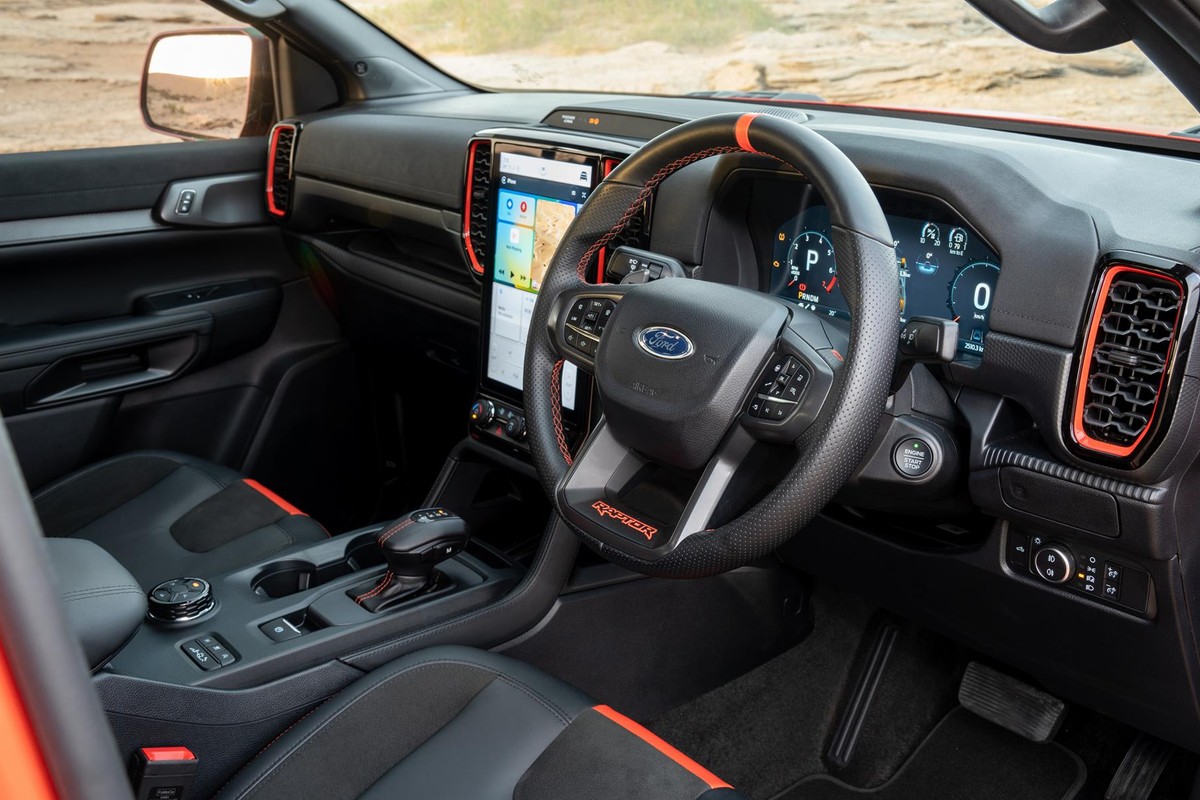
The Ranger Raptor features a high-quality, tech-infused cabin.
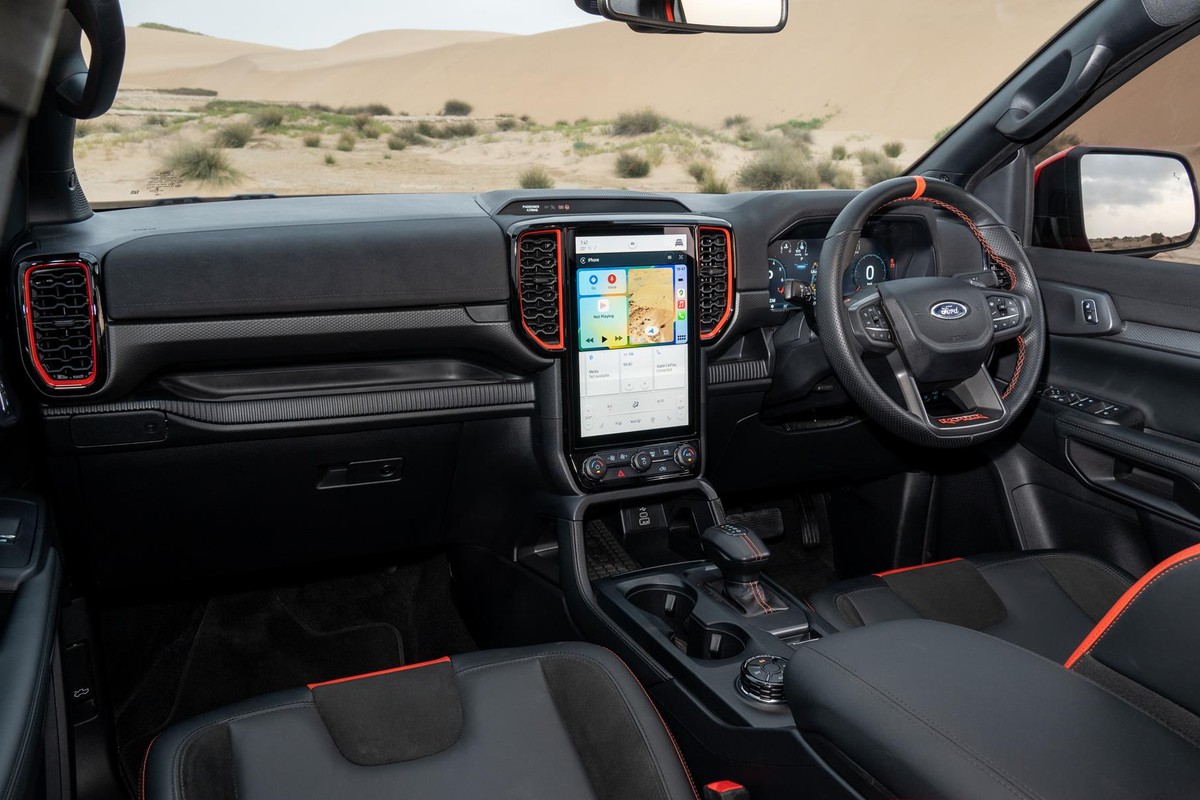
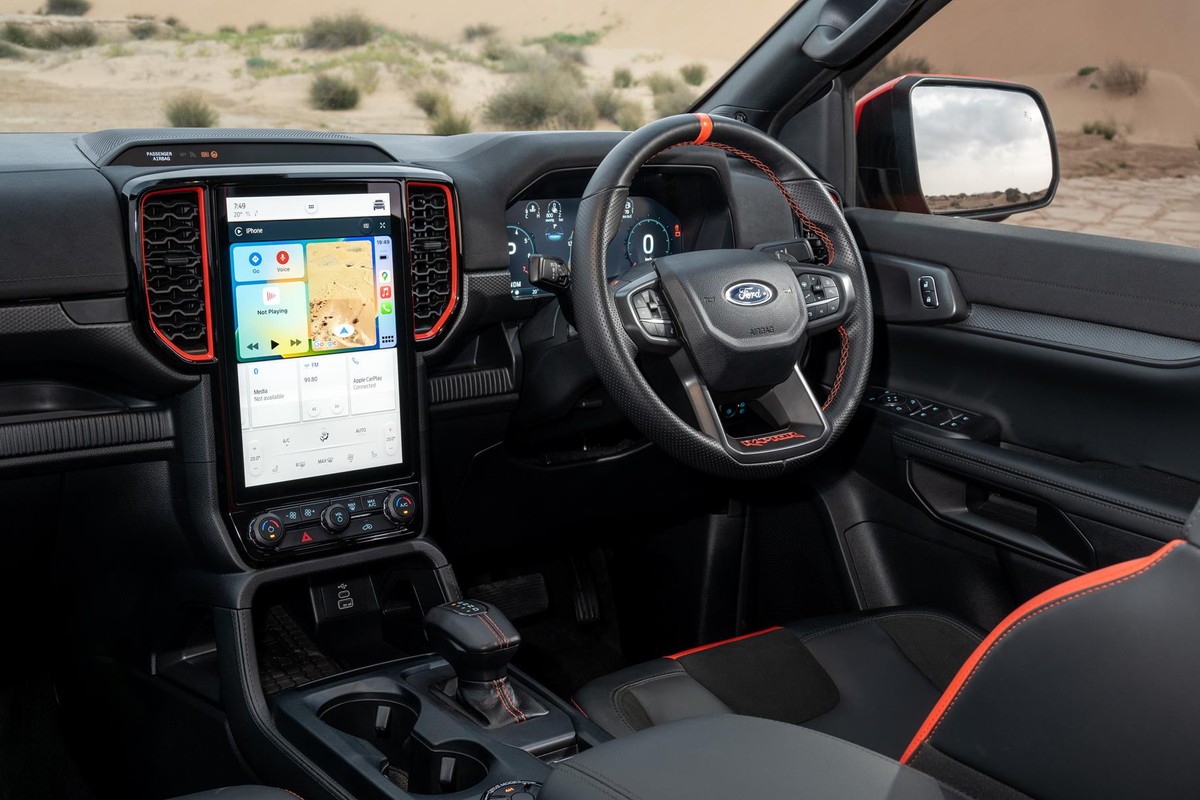
The Ranger Raptor’s cabin exudes a sense of occasion. The first feature I really like is the fighter-jet-inspired leather-trimmed seats, which are comfortable but also heavily bolstered to provide maximum support when you are bombing through the desert… or trundling through leafy suburbs in Gauteng.
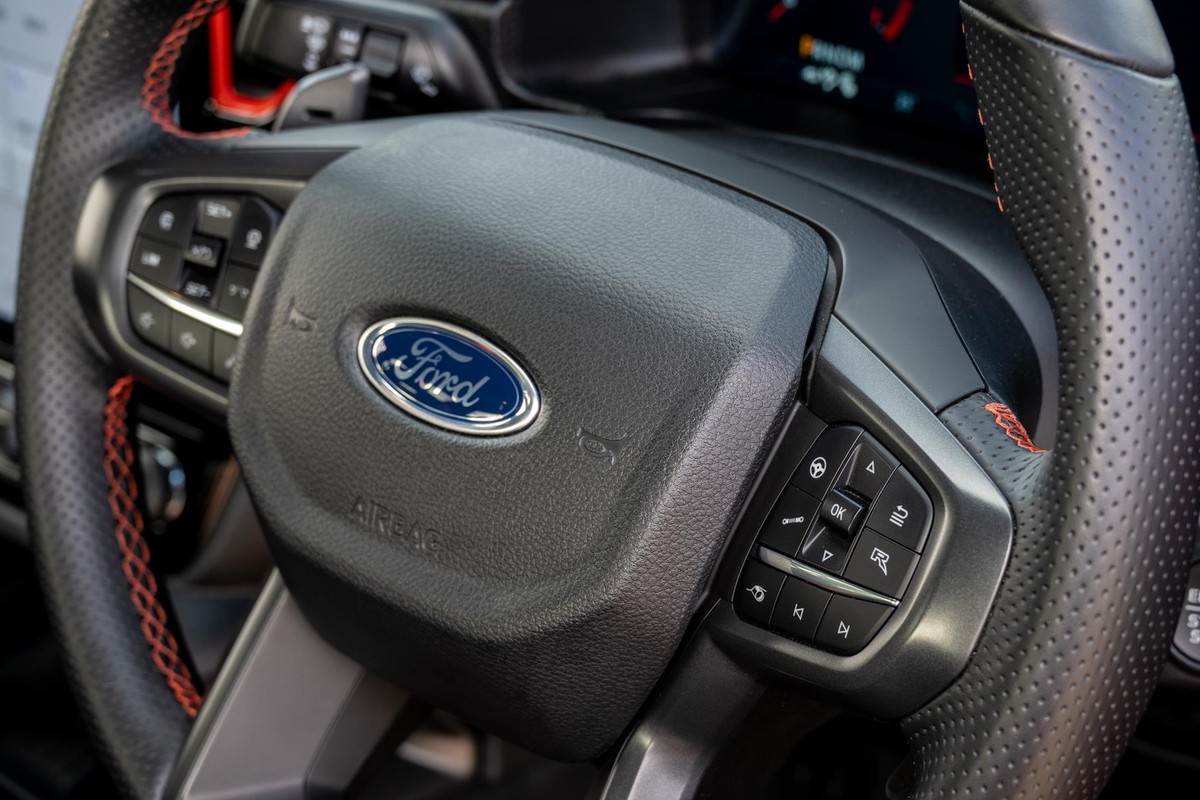
The driver is seated behind a finely-stiched multifunction ‘wheel adorned with a red centre marking, magnesium shift paddles and a Raptor logo to remind you that this is no ordinary Ranger derivative.
By using the ‘wheel-mounted controls, the driver can sift through the menus of the impressive 12.4-inch digital instrument cluster, which displays driving and off-road data, driver assistance settings, media and telephony, plus more. This digital instrument cluster is also found on the new Ford Everest Platinum.
Meanwhile, the Ranger Raptor’s impressive-looking, portrait-oriented and tablet-style 12-inch touchscreen infotainment system is powered by Ford’s latest SYNC4 operating system – it supports wireless Apple CarPlay and Android Auto. Wireless smartphone charging is also standard in the Raptor.
The configurable 12.4-inch digital instrument cluster is a major highlight.
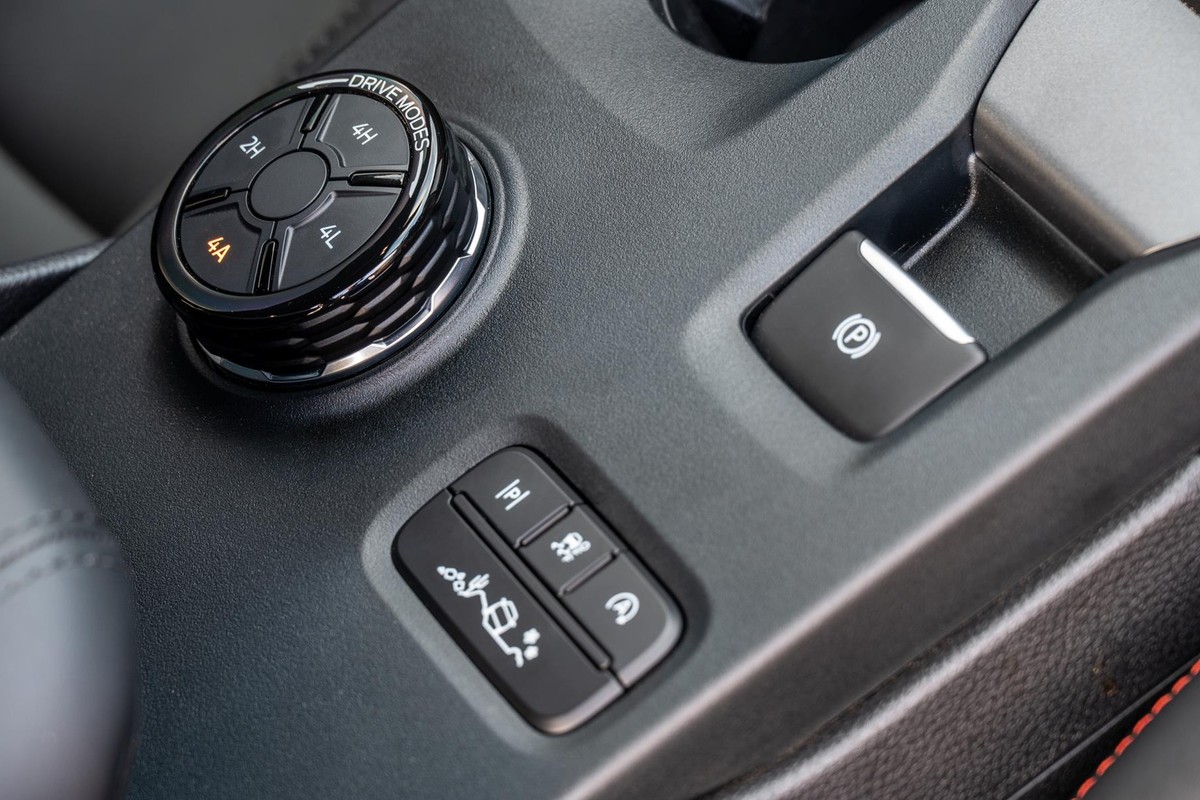
The centre console houses what Ford calls the “drive mode” dial – with it, you can toggle between 4A (automatic 4×4), 2H (rear-wheel-drive), 4 High and 4 Low. Note that the Raptor is also fitted with front- and rear differential locks, which can be engaged using the off-road menu in the infotainment system.
Perceived interior build quality is very good with nice soft-touch surfaces. As I expected, the cabin feels well-made and robust, which is needed in a vehicle that’s designed to withstand the rigours of the wild.
Average-sized adult occupants will find leg-, head- and shoulder room adequate at the back, but taller passengers may find legroom a little tight. They also have access to 2 USB ports, a 240V power outlet, cupholders, plus bottle holders in the door pockets. If you need to store some valuables out of sight, you will discover there’s additional storage space when you lift up the rear bench’s squab. Very nifty, Ford…
What’s the new Ford Ranger Raptor like to drive?
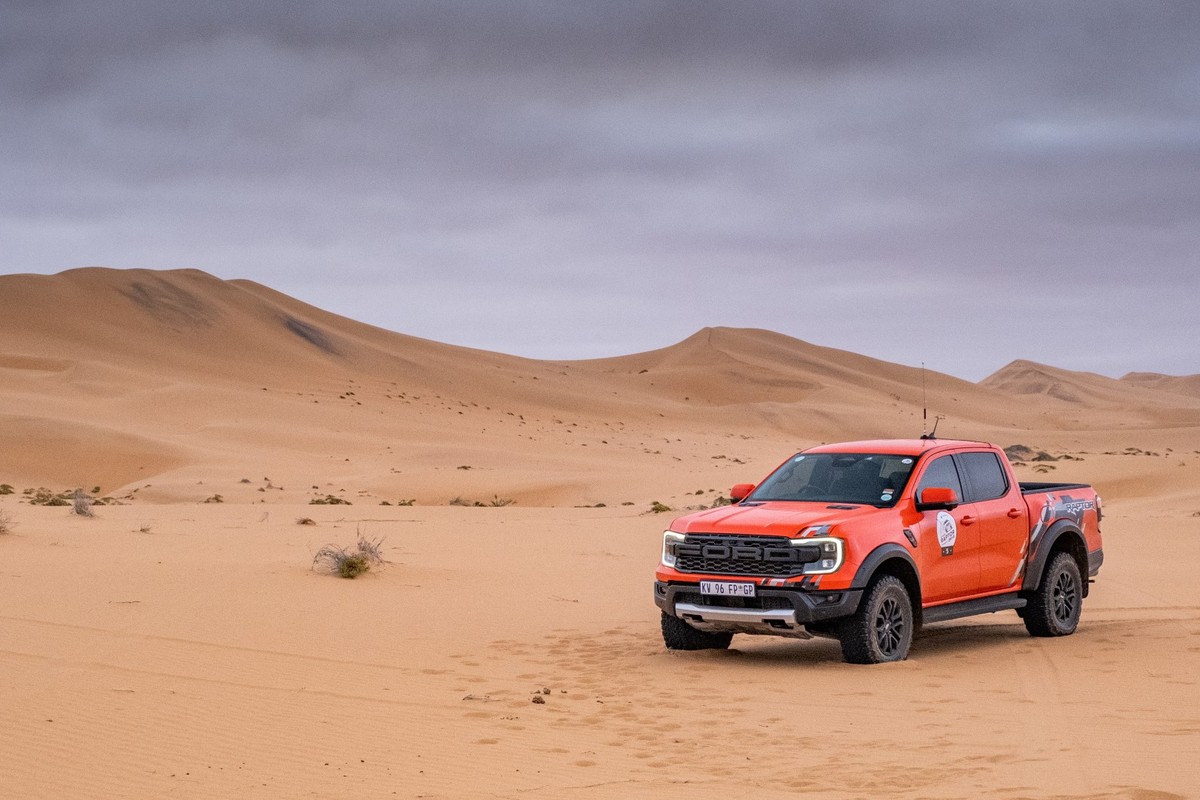
The Namib Desert is unforgiving, but the Raptor tamed the sand with aplomb!
We landed in Walvis Bay, where the FMCSA team and a throng of Raptors were waiting to transport us to a remote desert camp in the Namib Desert… Would Ford’s flagship double cab tame the shifting sands?
Ha, it didn’t take us long to realise just how formidable the new Ranger Raptor is. The first performance indicator is the fantastic engine sound that emanates from the Ford’s exhaust system. The motor’s raspy, racy soundtrack is utterly addictive and the driver can choose between 4 exhaust note settings: Quiet, Normal, Sport and the loudest, Baja (which can only be accessed when Baja drive mode is selected).
Speaking of which, Baja is one of no fewer than 7 drive modes that are available in the Ranger Raptor – and it’s by far the muscular Ford’s most intense setting; it can be used to extract peak performance, because it primes all the bakkie’s systems, including throttle and transmission response, suspension and braking for high-performance driving. The other drive modes include on-road modes such as Normal, Sport and Slippery and then a host of off-road modes, including Rock Crawl, Sand and Mud/Ruts.
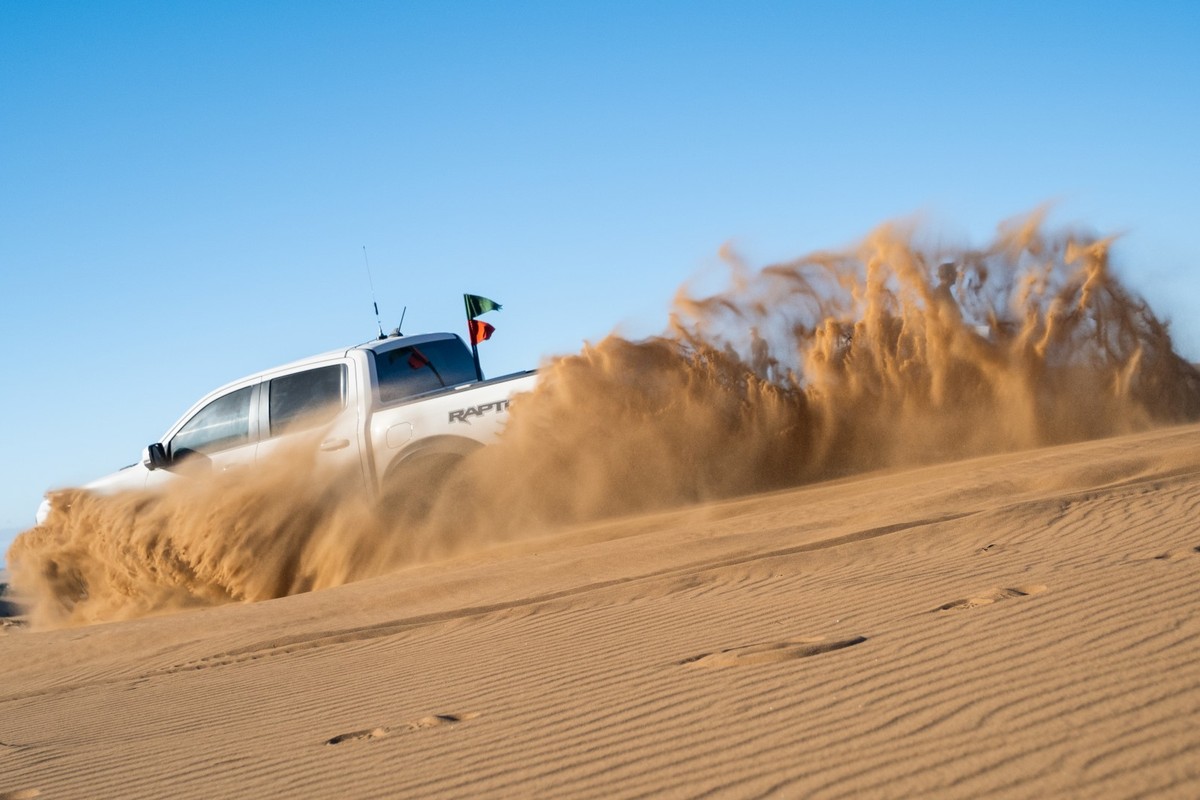
When we traversed the Namib Desert – quite often at heady speeds – we used the Sand and Baja modes most of the time. The 3.0-litre, twin-turbo V6 loves to rev and it produces full-bore acceleration that is nothing short of exhilarating. The Ranger Raptor has so much power to draw on that it never felt out of puff – its overall performance in the sand was mightily impressive, particularly when driven at speed.
Baja mode is the Raptor’s most aggressive mode and it facilitates loads of fun in the dunes.
Talking about speed, the new Ranger Raptor is unofficially the fastest double-cab bakkie in South Africa. I say unofficially because Ford hasn’t quoted a 0-to-100 kph time for the Raptor, but testing in Australia confirmed a time of around 6 seconds, which is blistering for a bakkie with a kerb weight of 2 460 kg.
The new Ranger Raptor is therefore substantially faster than the outgoing Volkswagen Amarok 3.0-litre V6 TDI, which was said to sprint from a standstill to 100 kph in a handy 7.6 seconds. We can’t wait to conduct an acceleration test of the Ranger Raptor, on tar, when we receive a test unit to review.
In demanding terrain, such as the Namib Desert, any and all vehicles can run into trouble in softer sand – and they often do… Even the mighty Raptor succumbed to the pull of the sand on a few occasions, but for the most part, it cut and sliced through the desert with aplomb, unlike any other bakkie I have driven.
The Ranger Raptor’s performance truly is on another level and it’s precisely why it doesn’t have any direct rivals at this point in time. How many buyers will test it to its ultimate ability though? We wonder.
The Raptor’s “drive modes” are easily accessible via the dial in the centre console.
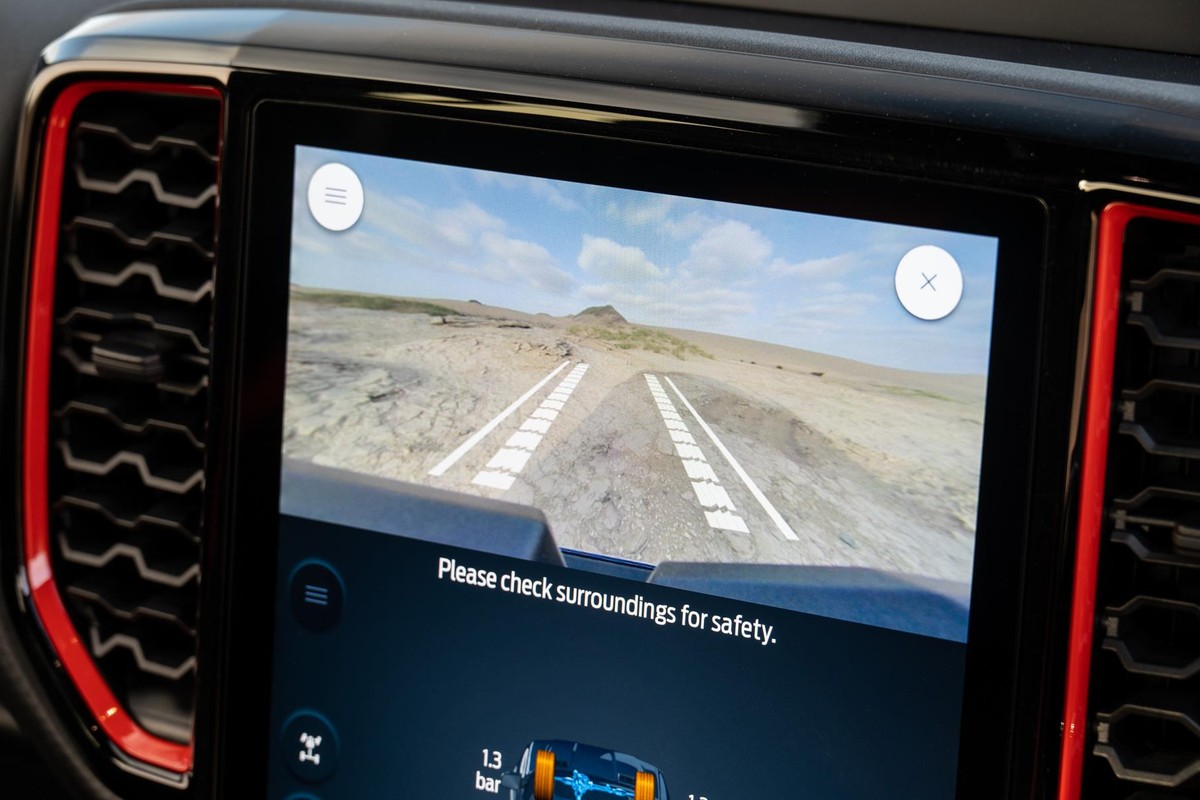
We also had the chance to test the Raptor’s new off-road feature: Trail Control. Ford describes Trail Control as “cruise control for off-roading” and we were eager to see how it works. The feature can be accessed via the dedicated off-road screen and it allows the driver to set a vehicle speed up to 32 kph so that they can focus purely on their steering inputs (while driving over, or through, off-road obstacles).
We tested this feature while the Ranger Raptor ascended a treacherous Damara Granite mountain in the desert and it proved to be hugely beneficial (in conjunction with the 360-degree camera). The Raptor’s new front differential lock proved its worth when scaling challenging inclines riddled with loose shale.
The Raptor clung to the rocky surface (with all 4 of its talons?) and proceeded to conquer the otherwise intimidating mountain with little to no wheel slip to speak of. And it did it all without breaking a sweat!
Note that the Ford has a substantial ground clearance of 272 mm and a wading depth of 850 mm. The Raptor’s quoted departure angle is 24–27 degrees, the breakover angle is 24 degrees and the approach angle is 32 degrees. The braked towing capacity is rated at 2 500 kg and the load capacity is 667 kg.
As for fuel consumption? It’s better not to ask. Buyers who want the mega off-road ability and powerful performance of this bakkie will have to live with its high fuel consumption. Ford claims 11.5 L/100 km and we saw figures around 20 L/100 km while off-roading in the dunes. That number will drop significantly under normal driving conditions, but we have yet to see how the Raptor performs in an urban setting.
Final thoughts
The Raptor’s performance is awe-inspiring. There’s simply nothing like it on sale in South Africa.
There’s no doubt about it – the Ford Ranger Raptor is a phenomenal high-speed off-road machine with a breadth of 4×4 ability that no other bakkie (available in SA’s new-vehicle market) can match. Early on in our test drive, we named the Raptor we were driving the “Dune Destroyer”; it was – and remains – apt.
Considering the staggering performance that this vehicle offers, the starting price of R1 094 900 is relatively (again, relatively) reasonable. Bear in mind, however, that a service- or maintenance plan is an extra cost option… According to a local Ford dealer, a 4-year/60 000 km service plan costs R9 283.95, while the 6-year/90 000 km and 8-year/135 000 km ones cost R18 740.40 and R34 060.70 respectively.
We guess you could kind of compare the new (now Thai-made) Ranger Raptor with the Jeep Gladiator 3.6 Rubicon double cab (R1.3 million), but with all respect to the, um, cumbersome American offering, this particular Ford product will only truly have competition when Toyota, Isuzu or GWM decides to build a rival out of their Hilux, D-Max or P-Series. As things stand, however, the Ranger Raptor is peerless.
How much does the new Ford Ranger Raptor Cost in South Africa?
Ford Ranger Raptor
R1 094 900
The new Ford Ranger Raptor is sold with a 4-year/120 000 km warranty.
A Chery knocks VW Polo from top 10: SA’s best-selling cars in Feb 2023
South Africa’s new-vehicle market registered yet another month of year-on-year growth in February 2023. Here’s a look at the best-selling vehicles, most popular brands and more…
In February 2023, South Africa’s new-vehicle market registered a marginal gain of 2.6% to 45 352 units, representing the 14th consecutive month of year-on-year growth (with some interesting movement on the list of best-selling vehicles, as you can see below). For the record, that figure is also 4.2% higher than January 2023’s industry-wide effort of 43 509 registrations.
Naamsa described February as a “firm and momentum-building” month for the local new-vehicle market. According to the organisation, 83.6% of total sales came via the dealer channel, with the rental industry accounting for 9.0%, the government 5.1% and corporate fleet buyers a further 2.3%.
The new passenger-vehicle market enjoyed a slight (1.1%) year-on-year improvement to 29 976 units, again bolstered by the efforts of the rental industry, which accounted for a significant 12.2% of these sales. Meanwhile, registrations of new light-commercial vehicles (including bakkies and minibuses) grew 5.5% compared with the same year in 2022, finishing the month on 12 972 units.
Finally, Naamsa noted year-on-year vehicle exports from South Africa declined a considerable 11.5% to 30 409 units in February 2023.
Lebogang Gaoaketse, Head of Marketing and Communications at WesBank, said February 2023’s figures pointed to the continuation of the market’s recovery “rather than outright growth”.
“It is interesting to note that annual sales of 363 696 units in 2022 were just 2.3% up on 2019’s performance of 355 379 units. Not that this is a negative; it remains positive for the market to have recovered volumes to this [2019] level, especially given the external constraints over the past few years. Demand remains good as measured by WesBank’s rate of applications, providing a solid foundation off which the market can continue its recovery,” said Gaoaketse.
Mark Dommisse, Chairperson of the National Automobile Dealers’ Association (NADA), said despite the odds seemingly being “skewed against the South African consumer”, the fact year-to-date sales were up 4.3% was “encouraging”.
“This is reassuring news in an environment that seemed set to put vehicle sales into reverse gear. Firstly, it was Budget Month, which could have meant increased taxation and less take home pay. And, secondly, there has been a significant amount of political upheaval during February. In addition to these headwinds, the South African Reserve Bank increased the interest rate for the 8th consecutive month. Fortunately these burdens did not seem to slow down recent sales momentum,” Dommisse said.
New vehicle sales summary for February 2023
Aggregate new-vehicle sales of 45 352 units increased by 2.6% (1 128 units) compared to February 2022.
New passenger-vehicle sales of 29 657 units increased by 1.1% (319 units) compared to February 2022.
New light-commercial vehicle sales of 12 972 units increased by 5.5% (683 units) compared to February 2022.
Export sales of 30 409 units decreased by 11.5% (3 943 units) compared to February 2022.
10 best-selling car brands in South Africa for February 2023
Though Toyota shed nearly a thousand units compared with its January 2023 effort, the Japanese firm’s final tally of 11 560 units in February 2023 was more than double that of the again 2nd-placed Volkswagen Group (5 288 units). Suzuki, meanwhile, held steady in 3rd position with a healthy 4 309 registrations, while Nissan (3 172 units) likewise retained 4th, breaching the 3 000-unit barrier in the process.
Hyundai (2 715 units) rounded out the top 5, while Ford (2 499 units) climbed 2 places to grab 6th, forcing Renault (2 122 units) down a spot to 7th. With 2 057 units registered in February, Isuzu jumped 2 positions to 8th, while Kia (1 843 units) slipped a couple to 9th and Haval (1 538 units) a single spot to 10th.
What about Chery? Well, the Chinese automaker again found itself just outside the top 10, with 1 381 units sold during the month. Indian company Mahindra, meanwhile, wasn’t far off the pace either, reporting 1 201 registrations during February.
1. Toyota – 11 560 units
2. Volkswagen Group – 5 288 units
3. Suzuki – 4 309 units
4. Nissan – 3 172 units
5. Hyundai – 2 715 units
6. Ford – 2 499 units
7. Renault – 2 122 units
8. Isuzu – 2 057 units
9. Kia – 1 843 units
10. Haval – 1 538 units
10 best-selling vehicles in South Africa for February 2023
Ford’s new Ranger jumped 5 places to claim 2nd overall in February 2023.
The opening month of 2023 saw an all-Toyota podium, but February was a little different. While the Toyota Hilux remained the sales king with a whopping 3 335 units registered, the next 2 places were filled by likewise locally produced bakkies. The new Ford Ranger (1 806 units) climbed 5 spots to 2nd, just ahead of the Isuzu D-Max (1 747 units), which was up 3 places to 3rd.
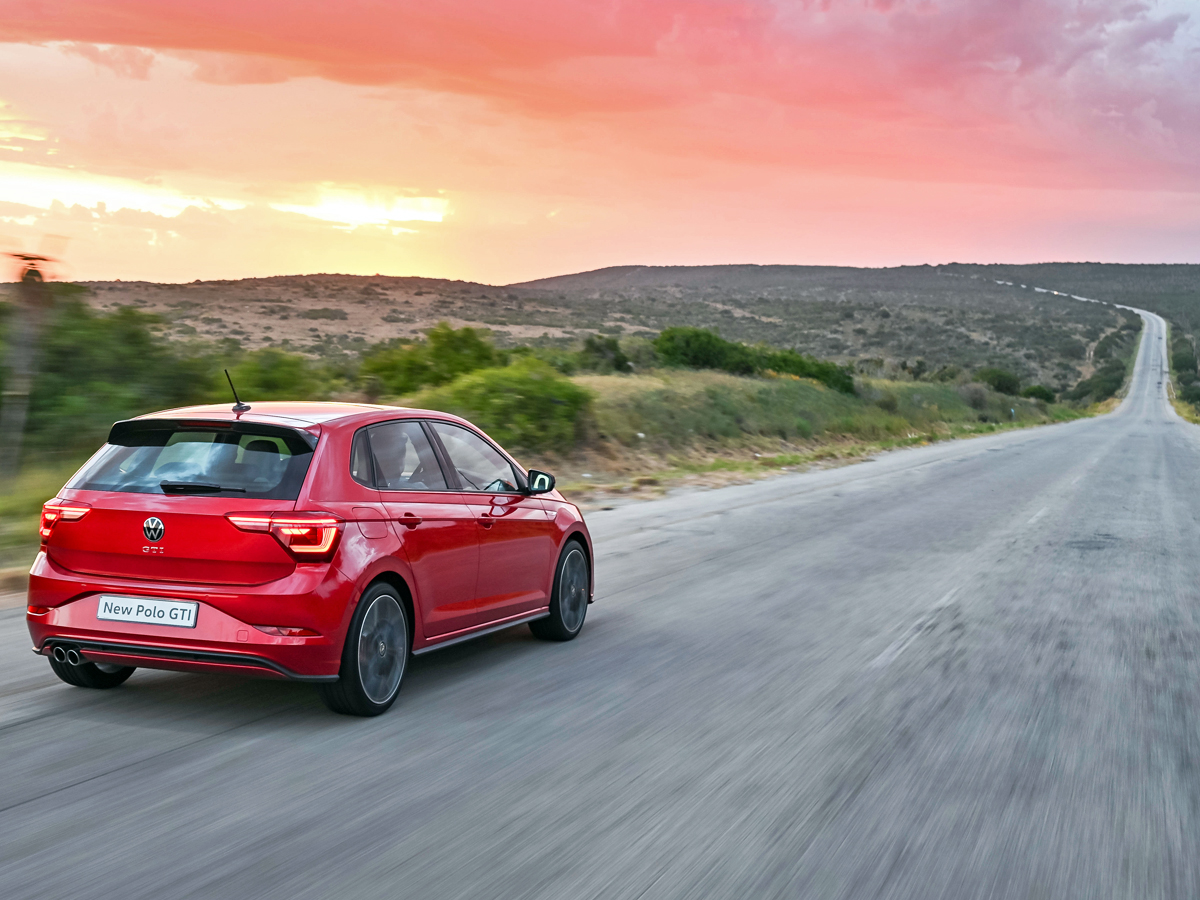
That saw the Prospecton-built Toyota Corolla Cross (1 683 units) slip a couple of positions to 4th, while the Kariega-manufactured Volkswagen Polo Vivo (1 513 units) clambered up 4 places to secure 5th. The Suzuki Swift (1 367 units) dropped 2 spots to 6th, while the Toyota Hi-Ace was hot on its heels in 7th, with 1 342 sales.
The Toyota Starlet (1 311 units) fell as many as 5 places to 8th, while the Rosslyn-manufactured Nissan NP200 (the company is currently “evaluating” a potential successor) improved a position to 9th, with 1 292 sales. As was the case in December 2022, the final spot on the table went to the returning Chery Tiggo 4 Pro (962 units), though this time the Volkswagen Polo hatch (815 units) tumbled from the top 10.
Though it didn’t quite crack the list, the Volkswagen T-Cross (889 units) also outsold the Polo hatchback, while other contenders bubbling under included the Mahindra Pik Up (844 units), Renault Triber (815 units), Hyundai Grand i10 (810 units, including 50 Cargo panel vans), Toyota Corolla Quest (798 units), Haval Jolion (737 units) and Renault Kiger (714 units).
Top 9 vehicles exported from South Africa in February 2023
The figures suggest VW is prioritising the export market with its locally built Polo.
Despite its woes on the local market, the Volkswagen Polo reclaimed the top position on the export charts in February 2023, with a heady 7 778 units shipped from the Kariega facility in the Eastern Cape. The Prospecton-built Toyota Hilux (5 297 units) thus had to settle for 2nd, with the Silverton-produced Ford Ranger (3 923 units) again in 3rd.
As is traditionally the case, the Isuzu D-Max, Nissan Navara, Toyota Fortuner, Toyota Corolla Cross, Nissan NP200 and Toyota Corolla Quest made up the export numbers. We should, of course, point out BMW and Mercedes-Benz did not submit detailed figures, so it’s not clear how many new X3 and C-Class sedan units were exported from SA in the 2nd month of the year. For the record, though, Naamsa’s estimates for February stand at 5 300 and 6 892 units, respectively.
1. Volkswagen Polo (hatch) – 7 778 units
2. Toyota Hilux – 5 297 units
3. Ford Ranger – 3 923 units
4. Isuzu D-Max – 571 units
5. Nissan Navara – 402 units
6. Toyota Fortuner – 29 units
7. Toyota Corolla Cross – 18 units
8. Nissan NP200 – 2 units
9. Toyota Corolla Quest – 1 unit
Sales outlook
So, where to from here for South Africa’s new-vehicle market? Well, Naamsa says it’s “fitting to briefly consider how monetary policy amendment and the Budget Speech influenced the automotive industry”.
“The South African Reserve Bank’s decision to increase interest rates for the 8th time in a row is a reminder that South Africa, like much of the world, is still in the midst of an increased cost-of-living predicament caused by global geo-political events such as the Russia/Ukraine conflict, lingering effects of the COVID-19 pandemic and a global inflationary environment,” the organisation explains.
“In addition, consumer spending and household discretionary income continues to shrink with increases in fuel costs, electricity costs and many other basic costs that impacts directly on vehicle sales decisions of our motorists,” Naamsa adds, before branding National Treasury’s decision not to announce any support programme for the manufacturing of new-energy vehicles components in the country as “disappointing”.
Still, acknowledging the local industry’s “historic resilience”, Naamsa forecasts growth for both domestic sales (6.3%) and exports (by 8.3%) in 2023. However, it notes the year will be “riddled with a combination of challenges from logistic infrastructure to power security and pressures on business and household spending”.
While WesBank’s Gaoaketse also mentions these “detractors for market growth”, he further points to “positive contributors that continue to drive the market’s recovery and growth in real terms”. “Not least of these is a massively improved supply chain that will organically meet levels of demand better with consequent increases in volumes.”
“The country’s energy crisis will invariably impact new vehicle sales off the back of declining consumer and business sentiment. However, the market’s resilience shown over the past 3 years proves how robust the industry remains – and that there continues to be opportunity for growth,” says Gaoaketse.
NADA’s Dommisse echoed these sentiments, adopting a similarly optimistic stance.
“It is quite difficult to predict how the 2023 new-vehicle market will play out, as there are so many factors influencing spending patterns of consumers and businesses. The energy crisis and ongoing load-shedding will drastically impact consumer confidence as the year goes on, but the market has proven its resilience for the past 3 years and NADA believes there is still growth potential,” Dommisse concludes.
The Lexus UX premium small crossover has been updated for 2023 and we’ve had a taste of what it brings to its segment. Is it worthy of your consideration? Read on.
We like: Efficiency, updated infotainment system, on-road refinement, excellent fit-and-finish.
We don’t like: Not the most engaging driving experience, pricey, comparatively small load bay.
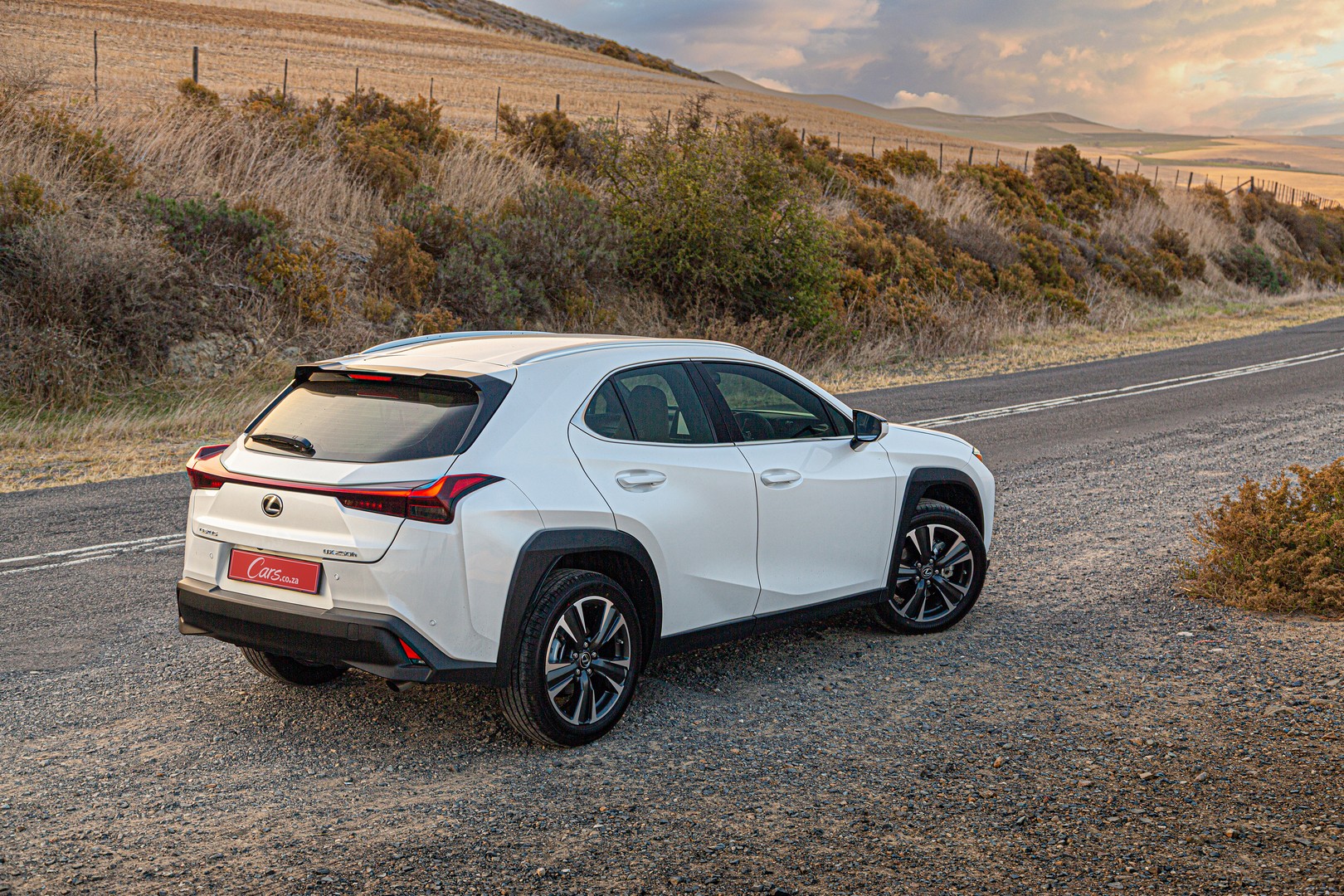
The UX has been a success story for Lexus South Africa, but it faces fresh competition in the shape of the new BMW X1.
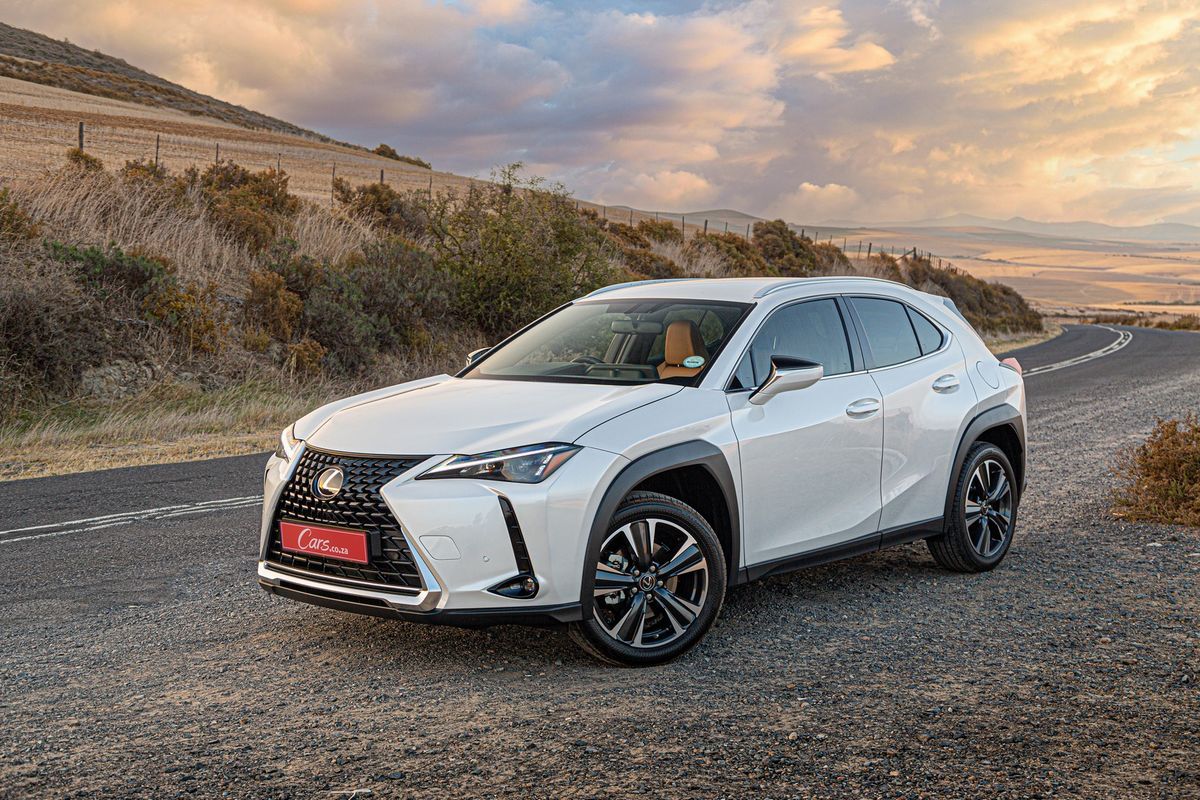
The UX is the entry point to the Lexus crossover/SUV family. It’s not the most affordable model in the premium brand’s line-up – that honour belongs to the ES, which is essentially a Toyota Camry that attended private school. That’s not meant to be an insult: the ES is a very underrated executive sedan.
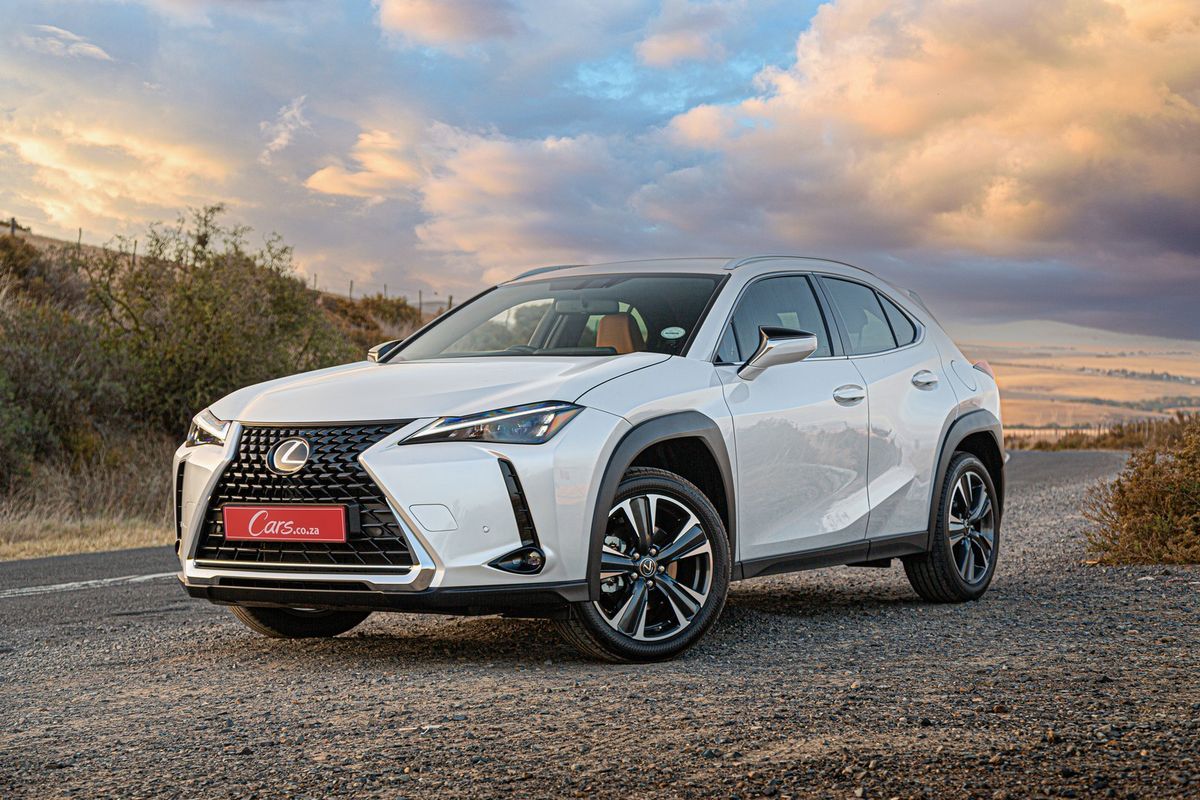
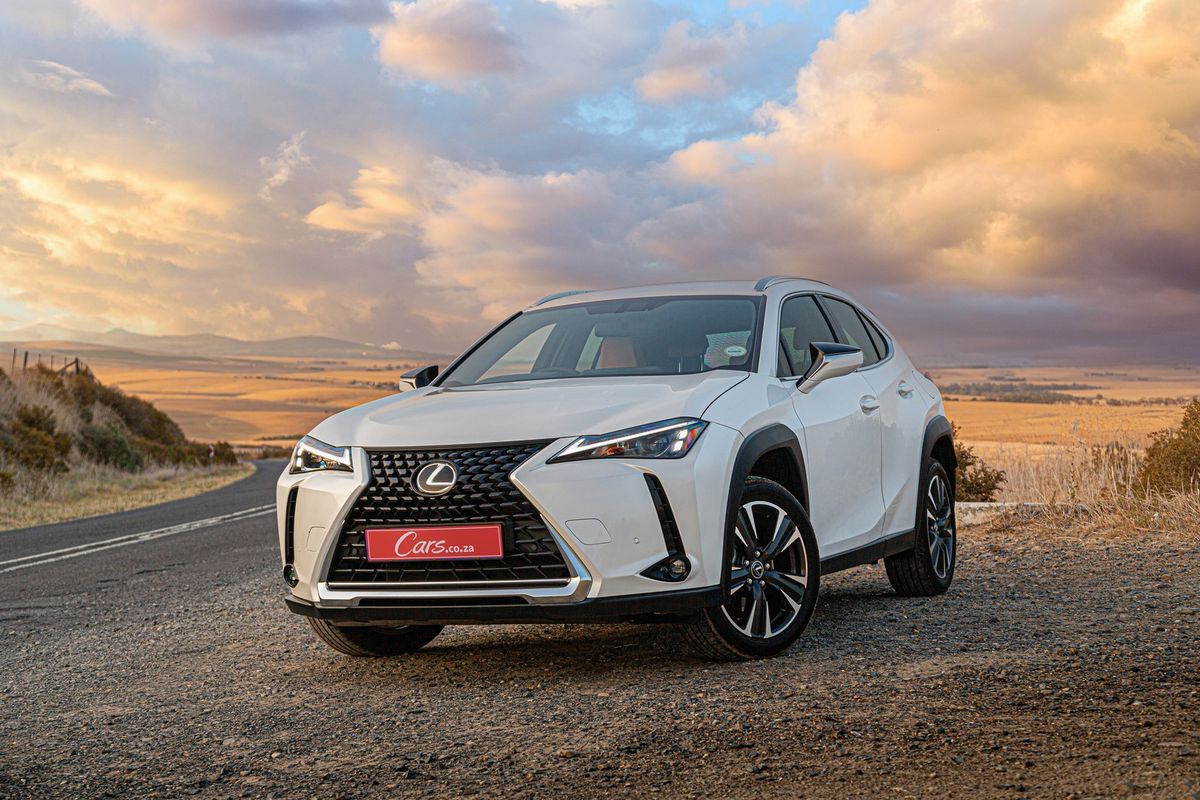
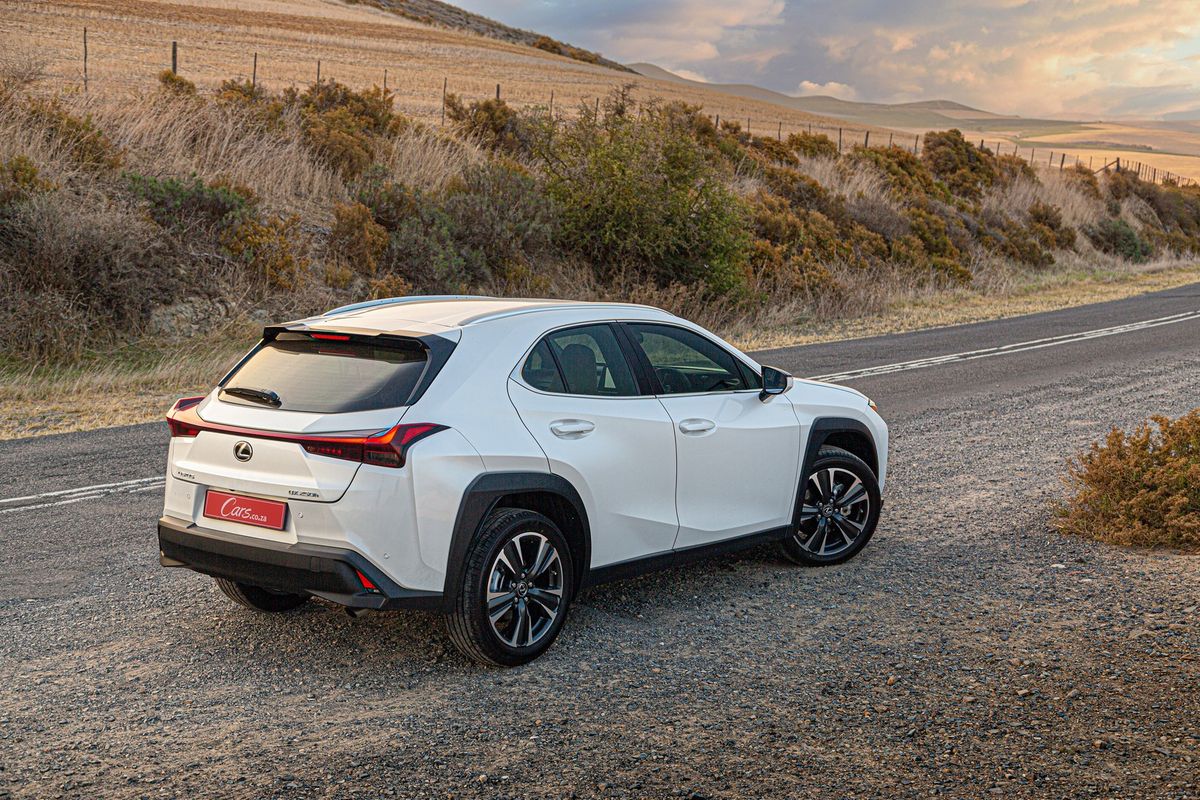
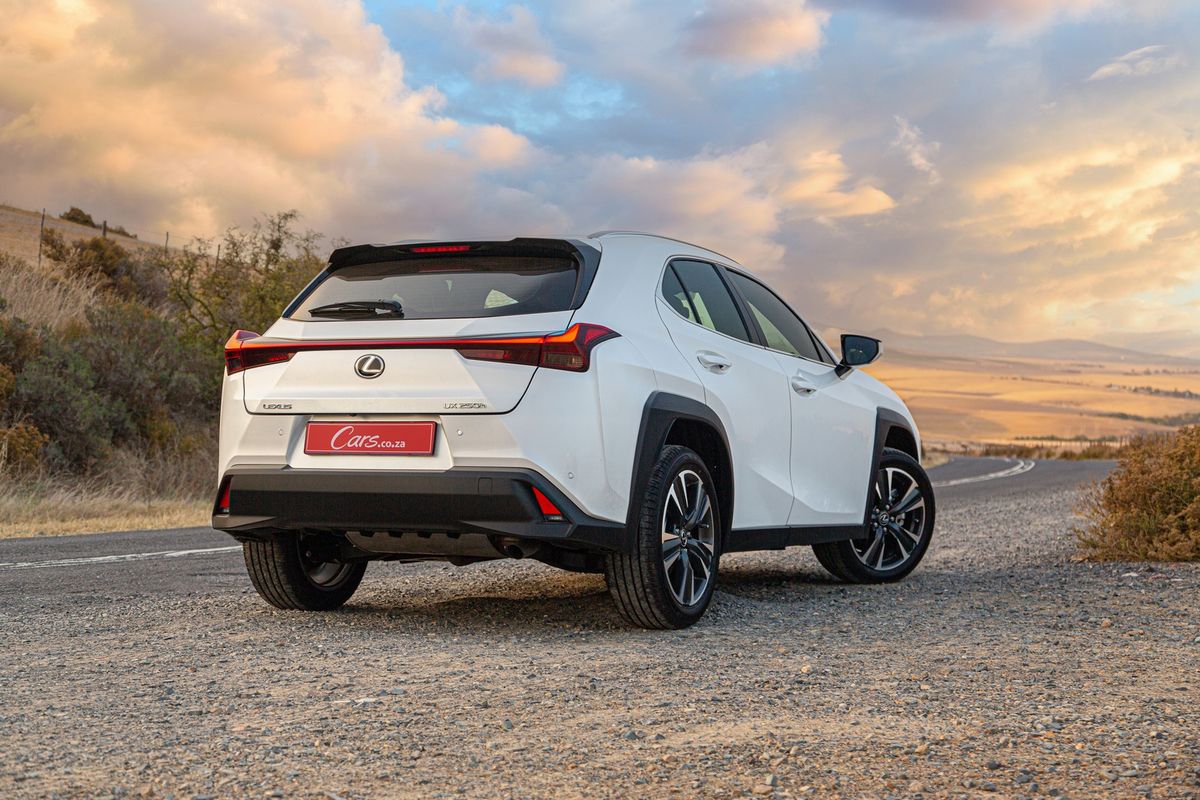
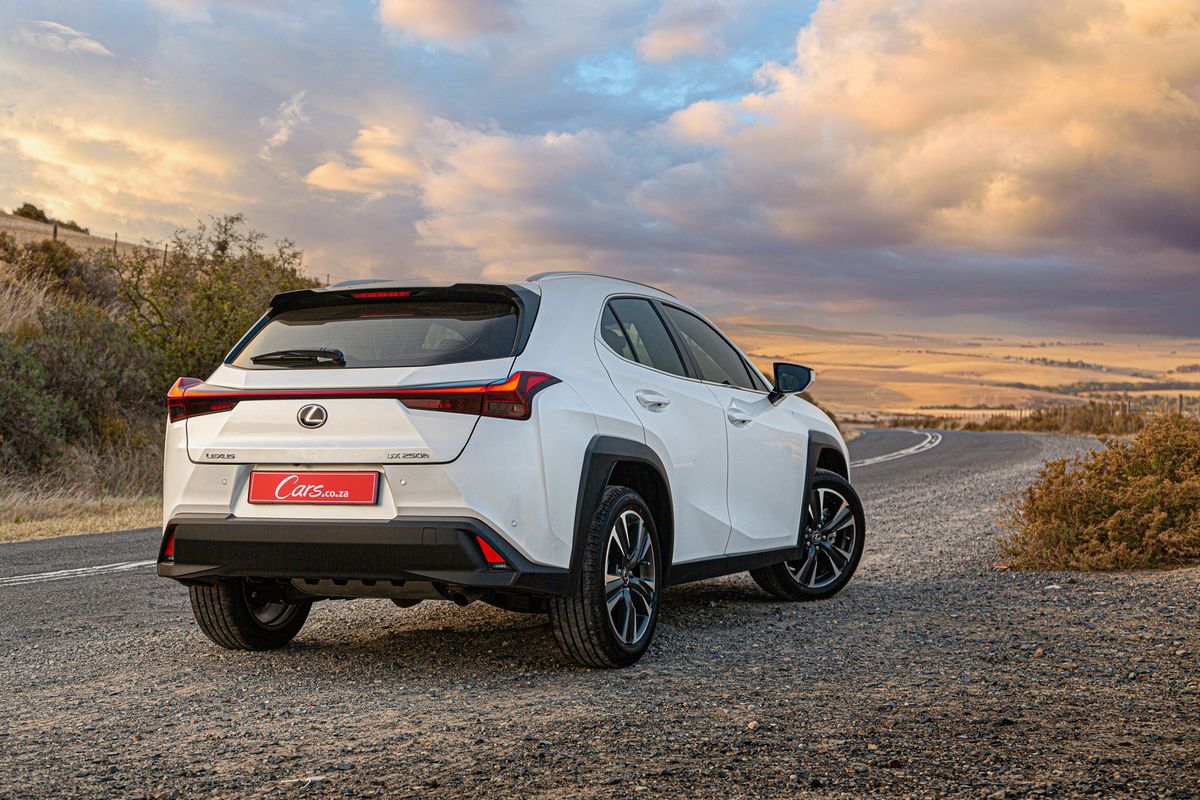
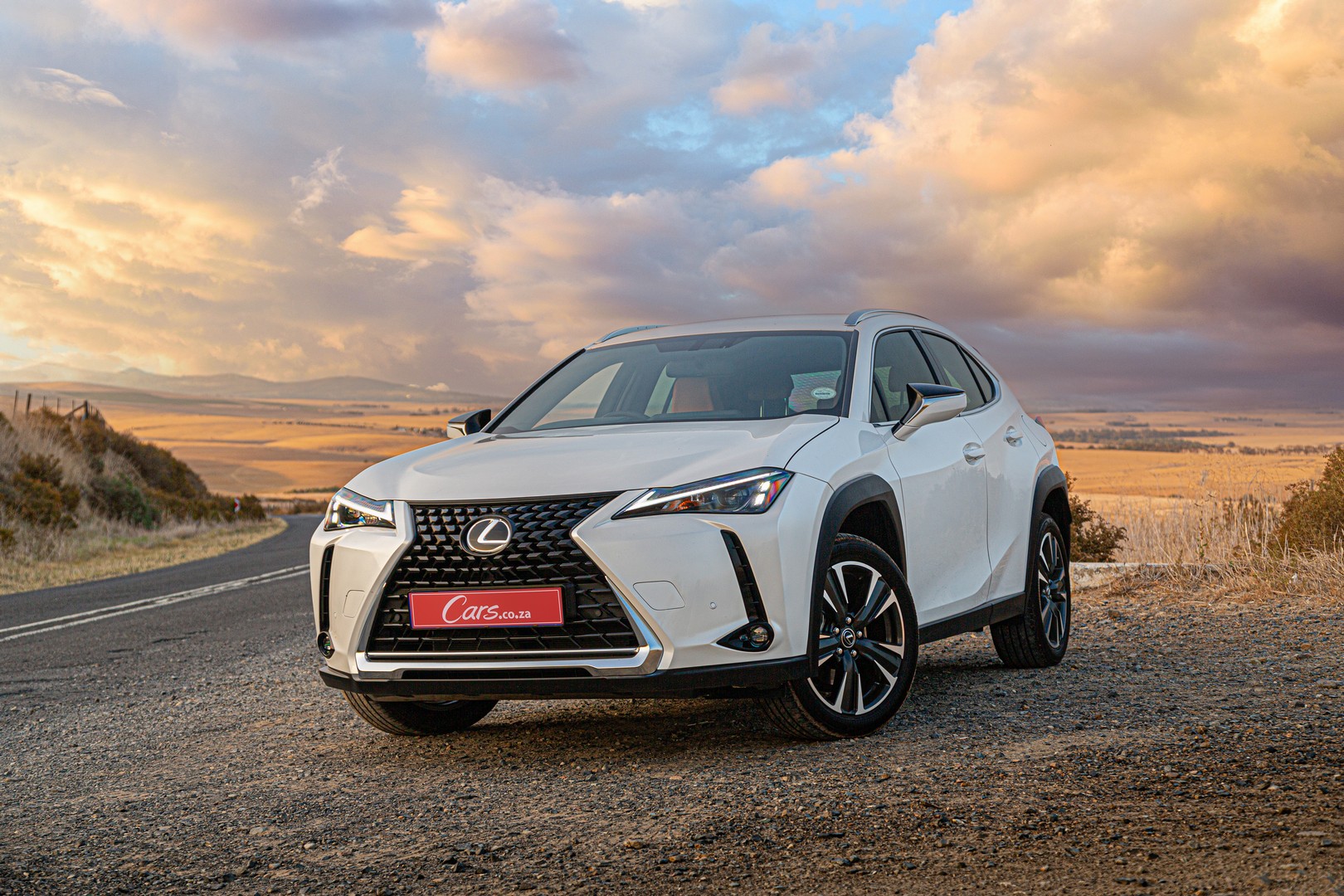
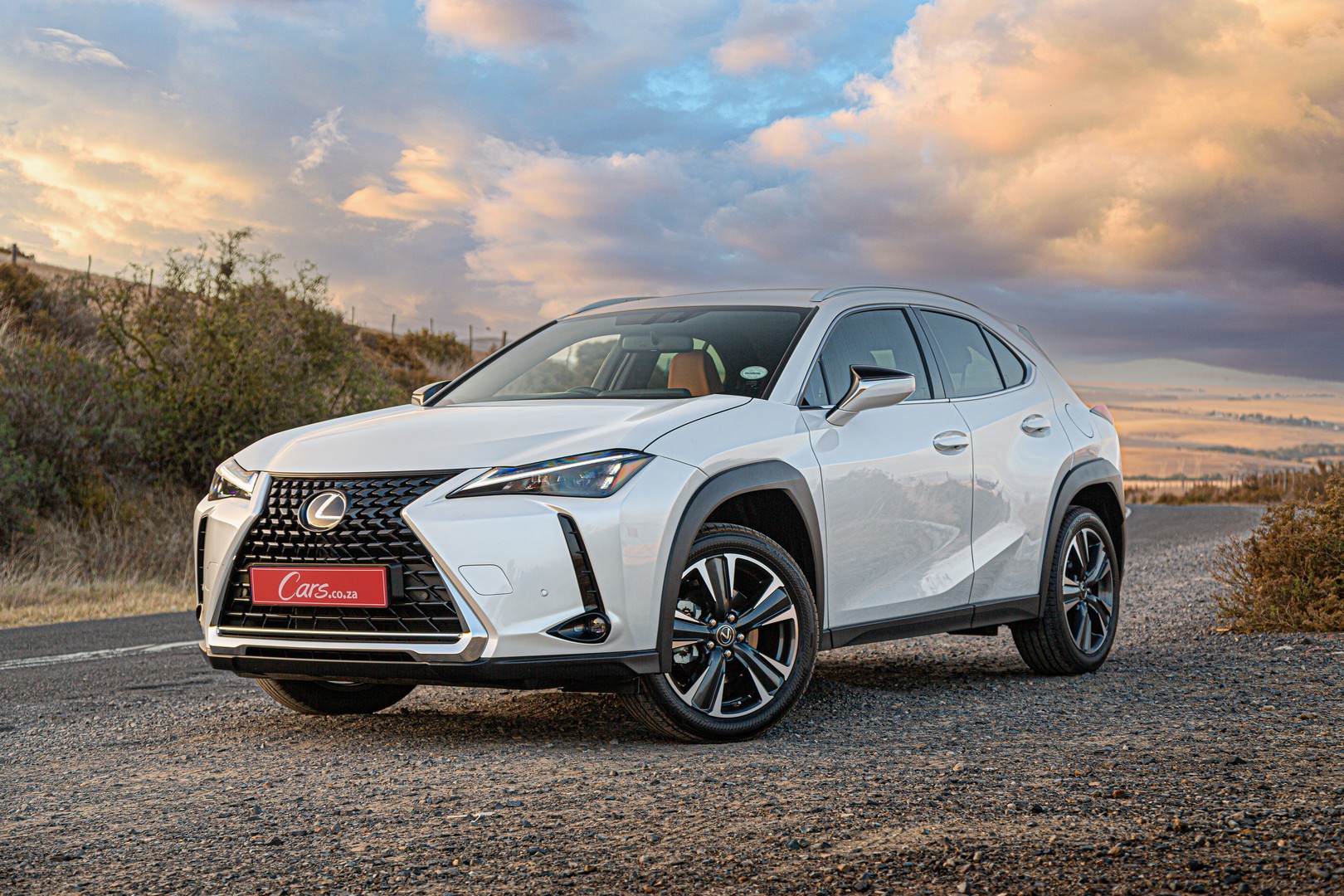
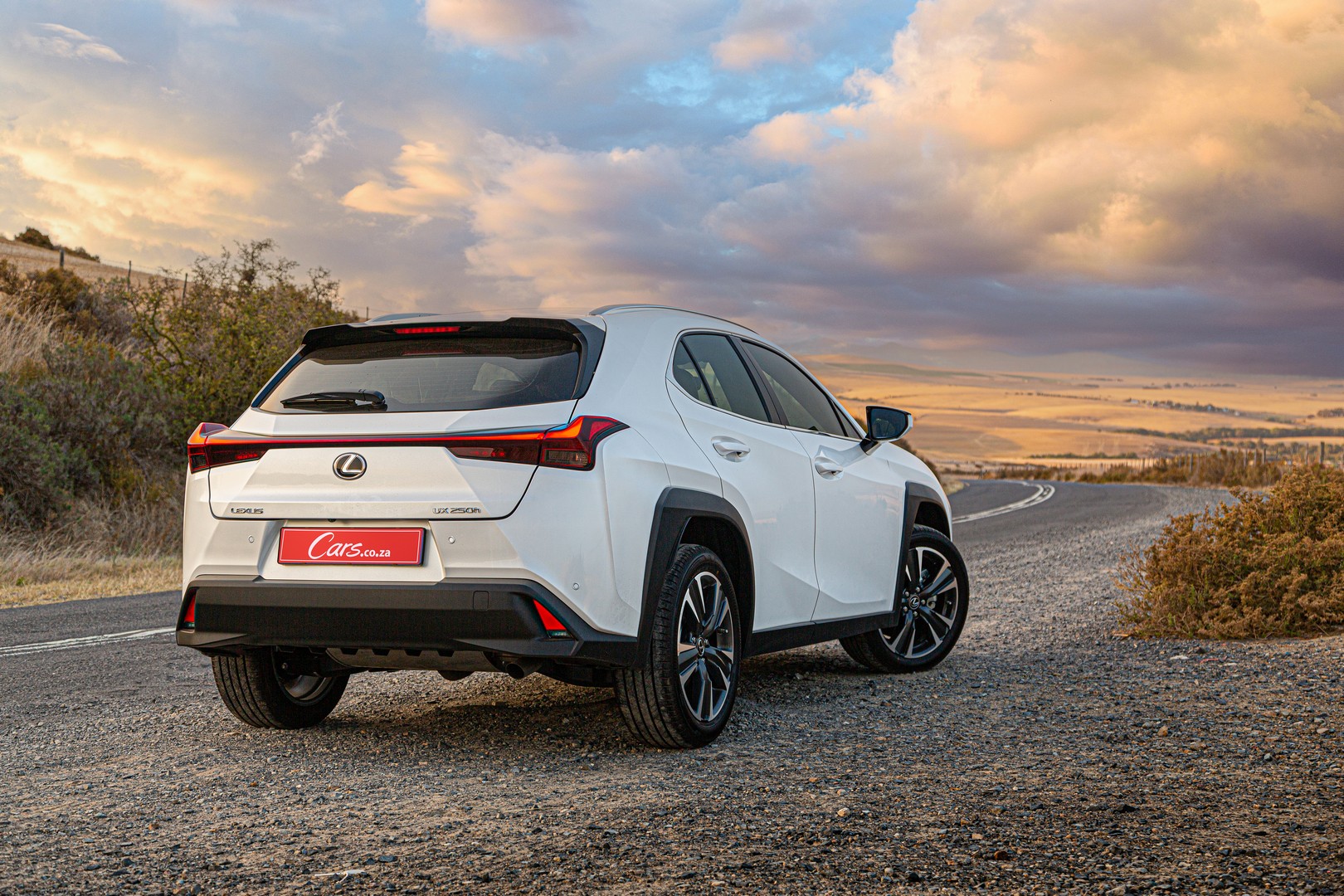
But back to the 2023-spec UX 250h. It’s tricky to distinguish the revised model from its predecessor, but eagle-eyed consumers will notice some slight tweaks to the car’s headlamps and daytime running lights. The most notable changes feature in the cabin, with the introduction of an all-new infotainment system.
Previous-spec UX derivatives had a laptop touchpad-style controller that was fussy and clumsy to use. Heaven knows why Lexus persisted with a setup that required so much familiarisation – we’re relieved it has finally been retired. In its place is a brand-new 12.3-inch touchscreen, but more on that a bit later.
With new-car prices shooting upward, the luxury “baby SUV” segment is a good one to play in.
There are also some enhancements to the semi-autonomous safety tech, but they only feature on the higher trim levels – not the entry-level derivative tested here. See also: Lexus UX (2023) Launch Review
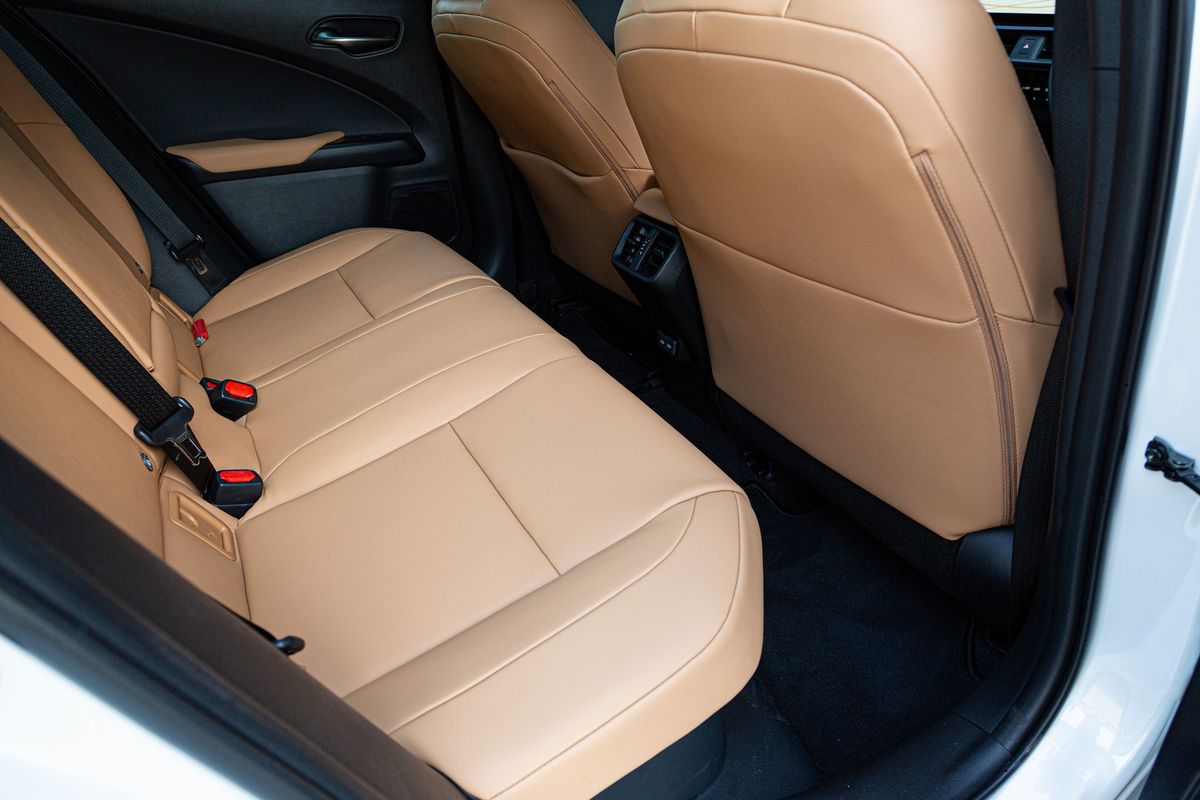
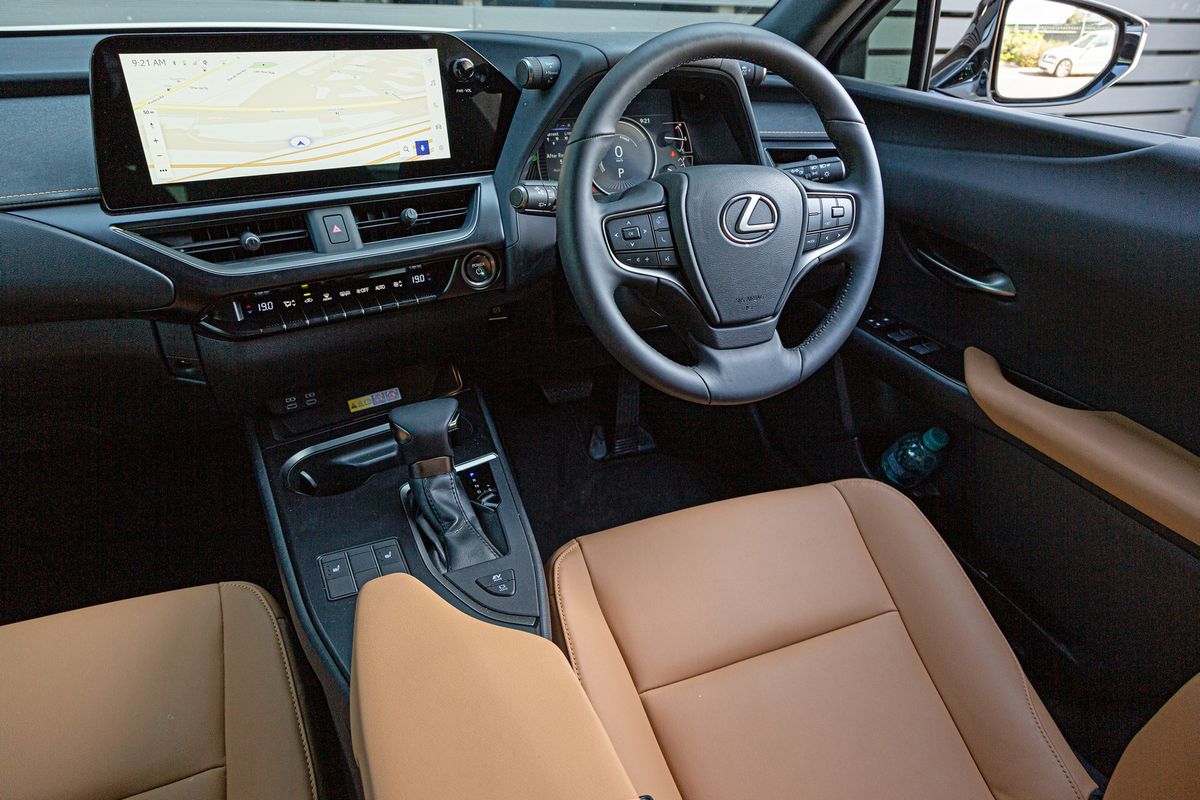
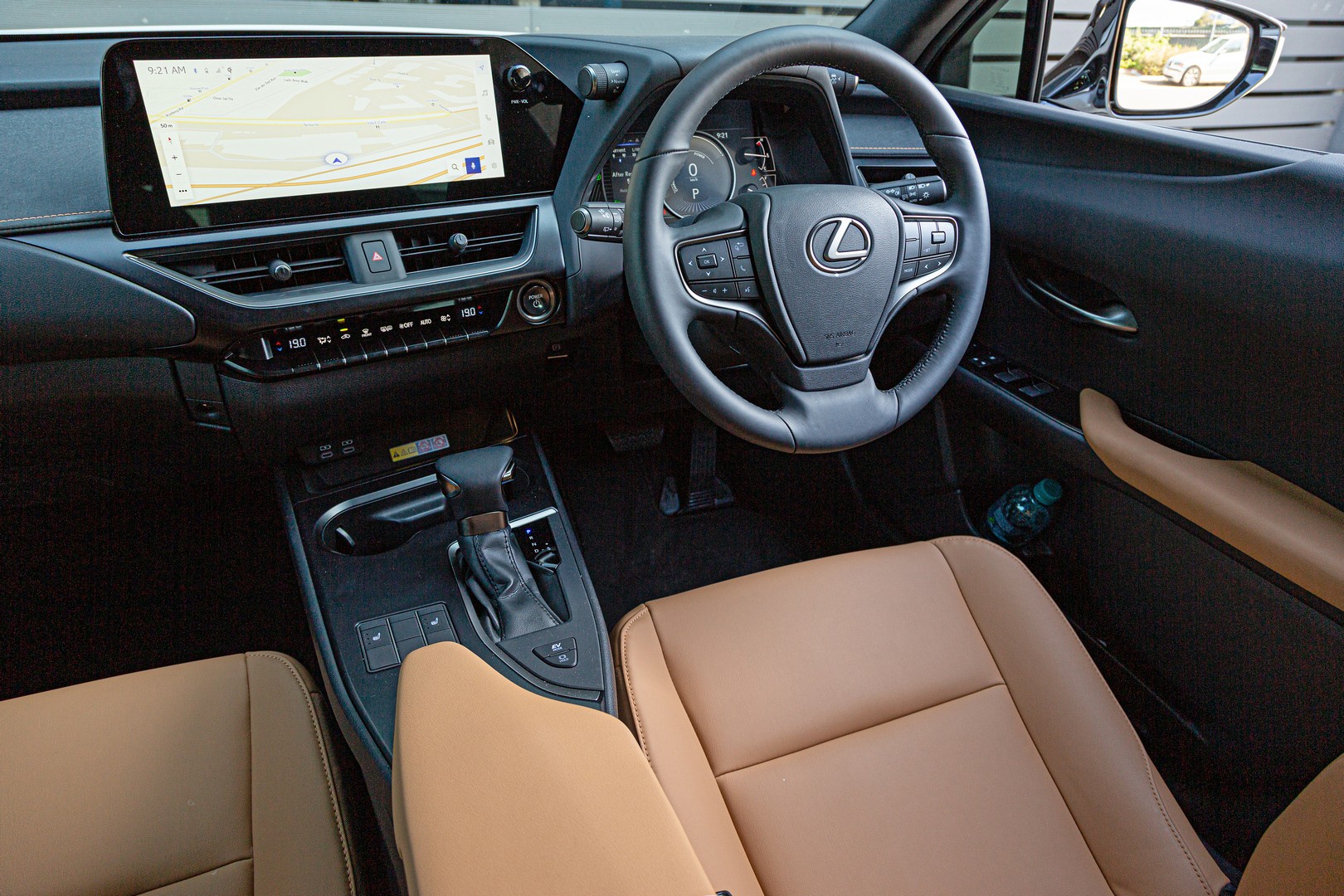
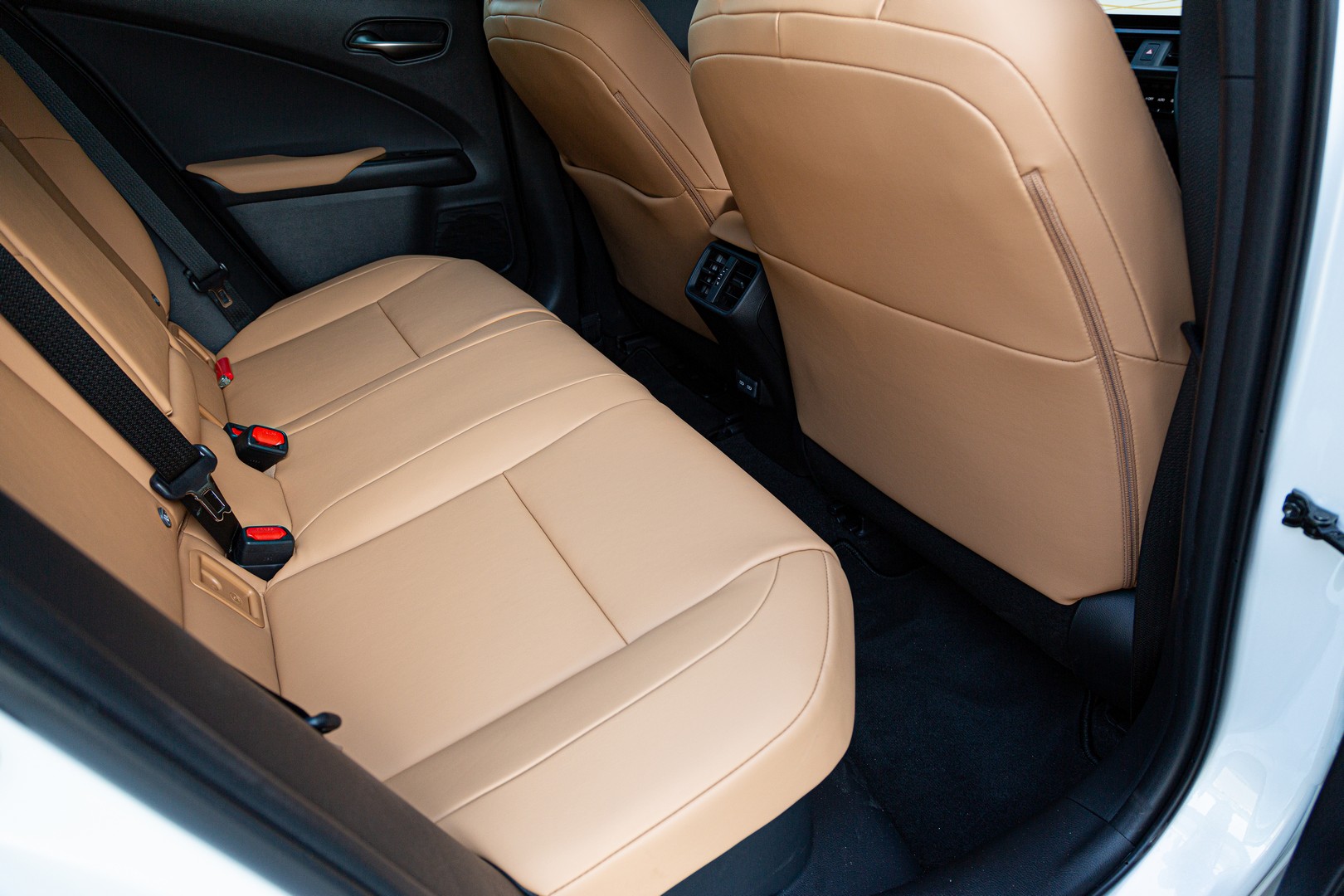
The Lexus UX 250h EX’s leather-trimmed cabin is beautifully finished and offers improved ergonomics.
Step inside, and it’s business as usual for Lexus. You’re greeted by a superbly finished interior that exudes class and craftsmanship. There are high-quality materials in abundance in the upmarket cabin.
The rear legroom isn’t quite spacious enough for adults.
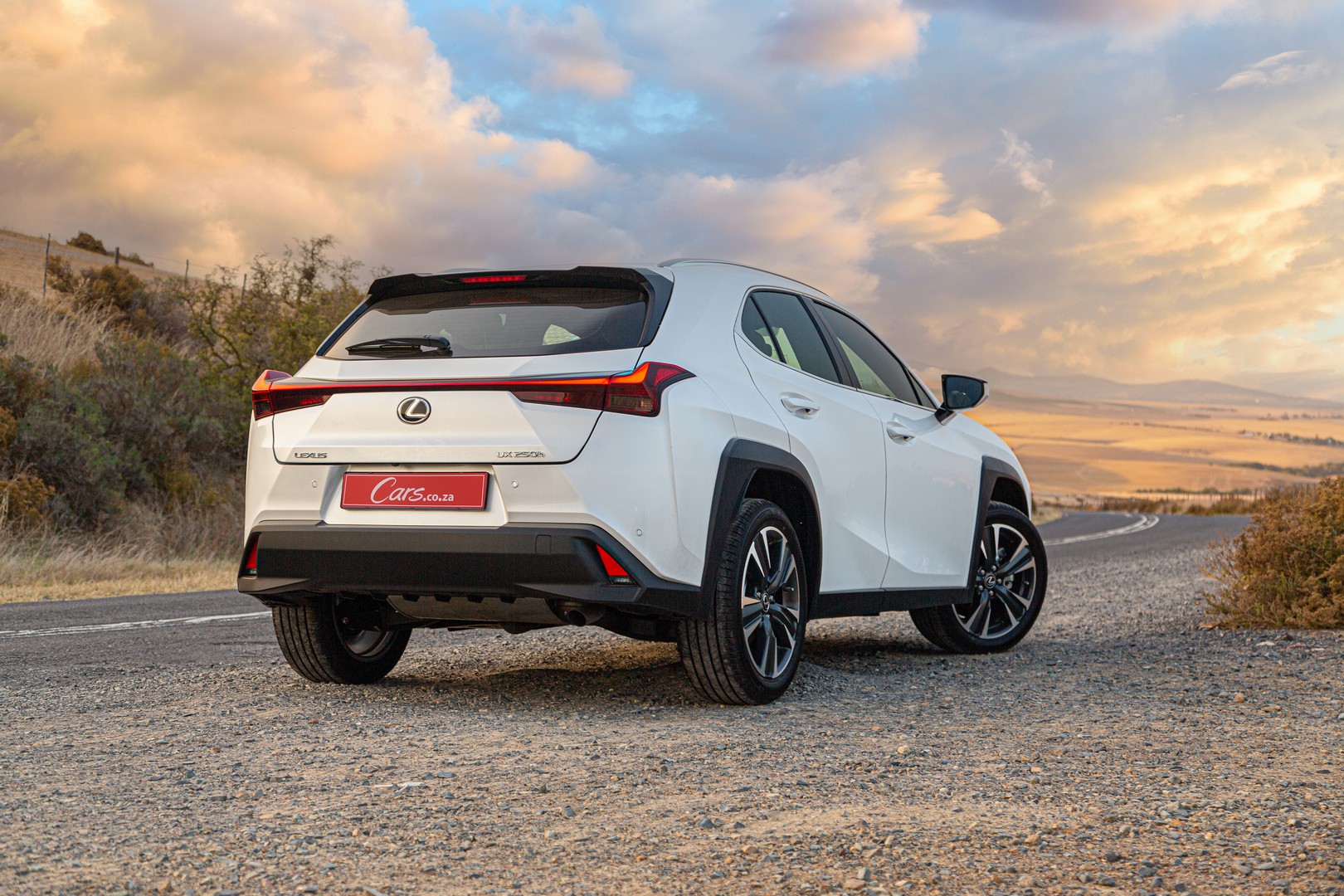
Downsides? Well, the UX is literally a small crossover; despite its SUV-inspired proportions, it is neither a large nor spacious vehicle. Instead, it is a “compact hatchback on stilts” – one that cannot accommodate average-sized adults on the rear bench in comfort, because there’s barely sufficient leg- and headroom.
What’s more, the Lexus’ luggage capacity is on the low side for the class (268 litres), which is almost half that of its rivals, such as the new BMW X1. Not to be too unkind, but if you’re an “outdoor type” with a mountain bike or golf clubs to cart around at the weekend, this car is not for you. It has other strengths.
Ride and Handling
You can spot the new-look daytime running lights at the front.
Considering the UX’s underpinnings – the TNGA-C (GA-C) platform, on which the Toyota C-HR and Corolla/Corolla Cross are also based – it won’t surprise many to learn that the Lexus’ driving experience is more akin to that of a hatchback than an SUV… The most impressive aspect of the package (in terms of refinement) is the quiet cabin, which seems admirably insulated from road- and wind noise. Virtually every Lexus is engineered to be smooth and comfortable to drive – and the UX is no exception.
Most of the Japanese premium brand’s models (with the notable exceptions of the IS business-class sedan, as well as the sporty RC and LC coupes) have even-tempered/neutral handling characteristics, but we were pleasantly surprised by the UX’s lively steering setup. Despite being a hybrid vehicle, the UX is not “allergic to having fun”… the 250h EX can provide hints of driver engagement when you make it corner at brisk speeds. With its 160 mm of ground clearance, it should be at ease on gravel roads too.
Performance and Efficiency
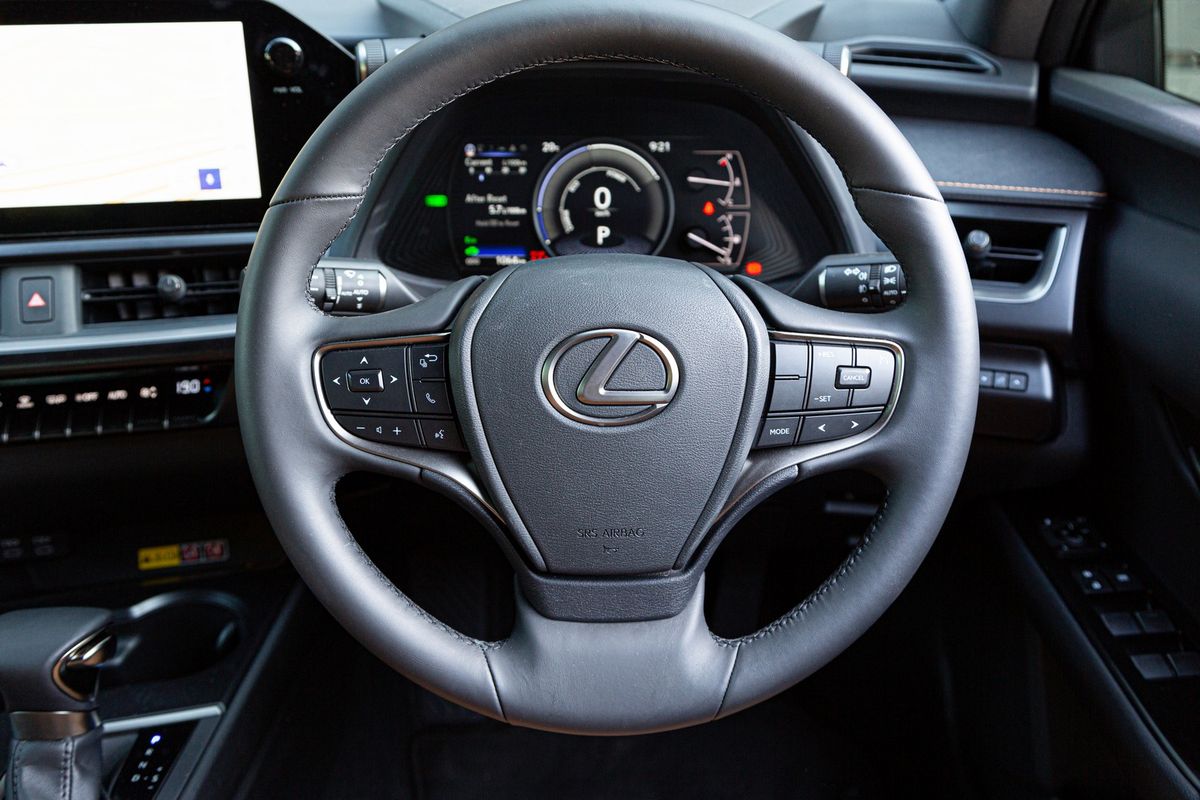
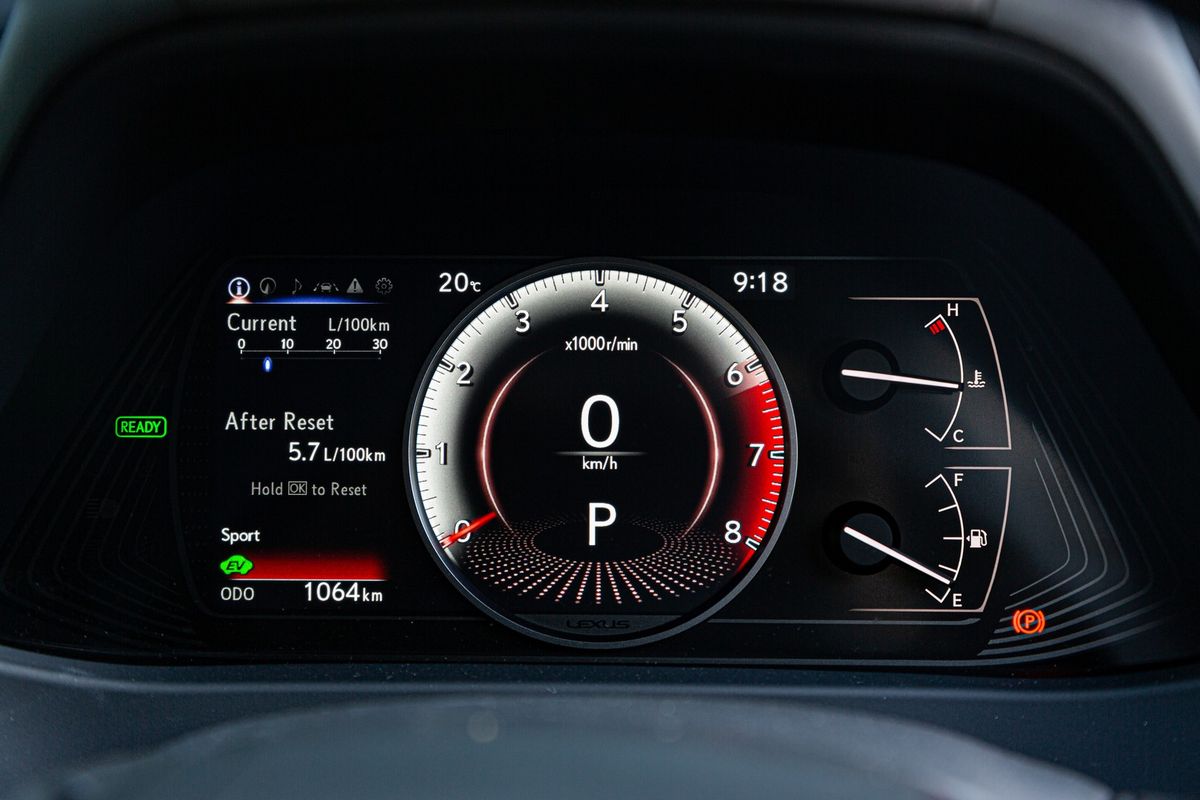
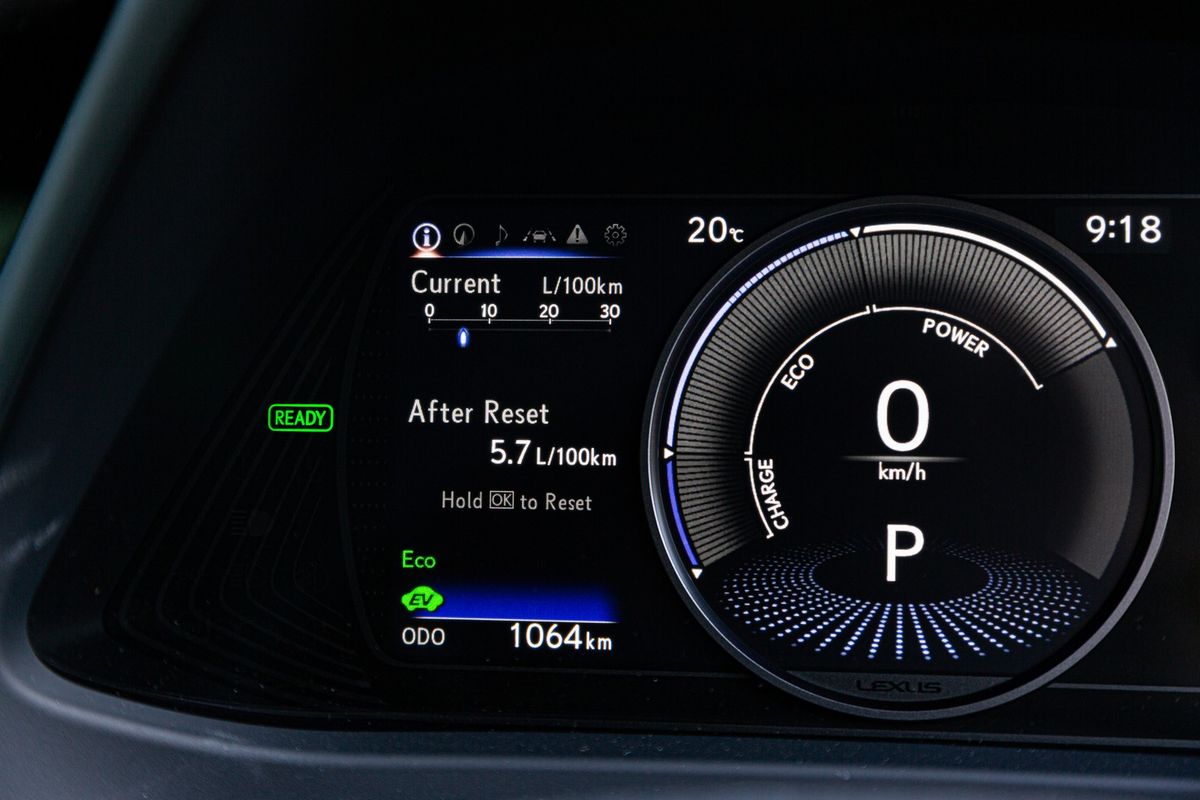
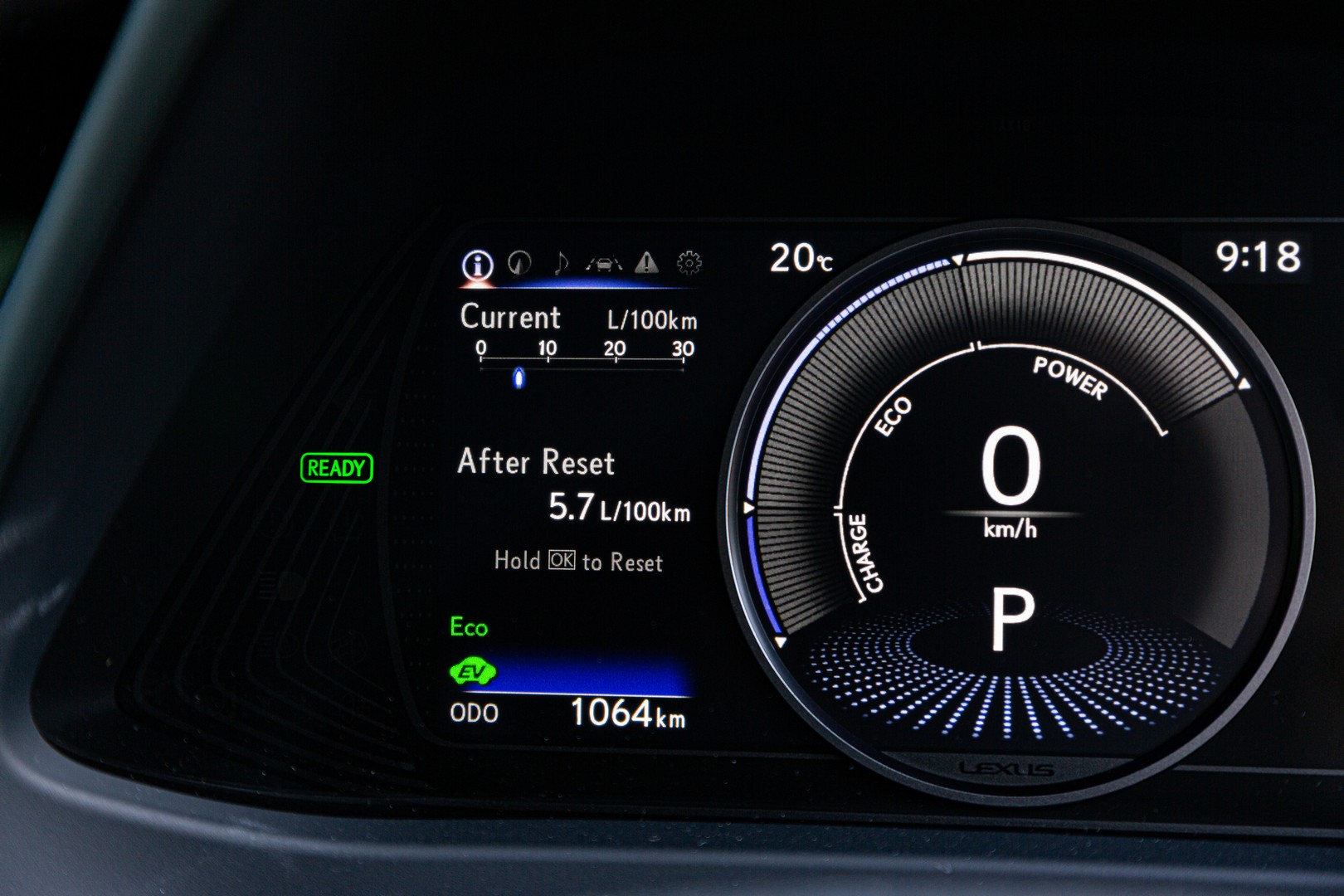
Our test unit returned a satisfactory consumption figure of 5.7 L/100 km during its tenure in our fleet.
Under the bonnet of the Lexus UX 250h EX sits a naturally-aspirated 2.0-litre 4-cylinder petrol engine, which is augmented with a hybrid battery and an electric motor. Outputs of 135 kW and 188 Nm are on tap, with drive directed to the vehicle’s front wheels via a continuously variable transmission (CVT).
While petrolheads abhor CVTs, such transmissions are very effective at optimising efficiency, even if that comes at the expense of dynamism and engaging performance. Lexus has championed hybrid tech (and still does) and the hybrid-only (in our market) UX is said to consume just 4.5 L/100 km. After our test period, we came away with 5.7 L/100 km, which satisfied us. You may be able to better that figure, but it will require less open-road driving, because the hybrid system is most effective in congested city traffic.
The UX 250h EX is more of a hatchback with a raised ride height than a “baby SUV”.
Does it perform well? Despite its efficiency-oriented powertrain, the Lexus UX can get a move on if you need it to. Our test gear confirmed a 9.17-second 0-to-100 kph time, which is quicker than we expected, but, based on its strained engine note, the 250h EX wasn’t “happy” about having to accelerate that hard.
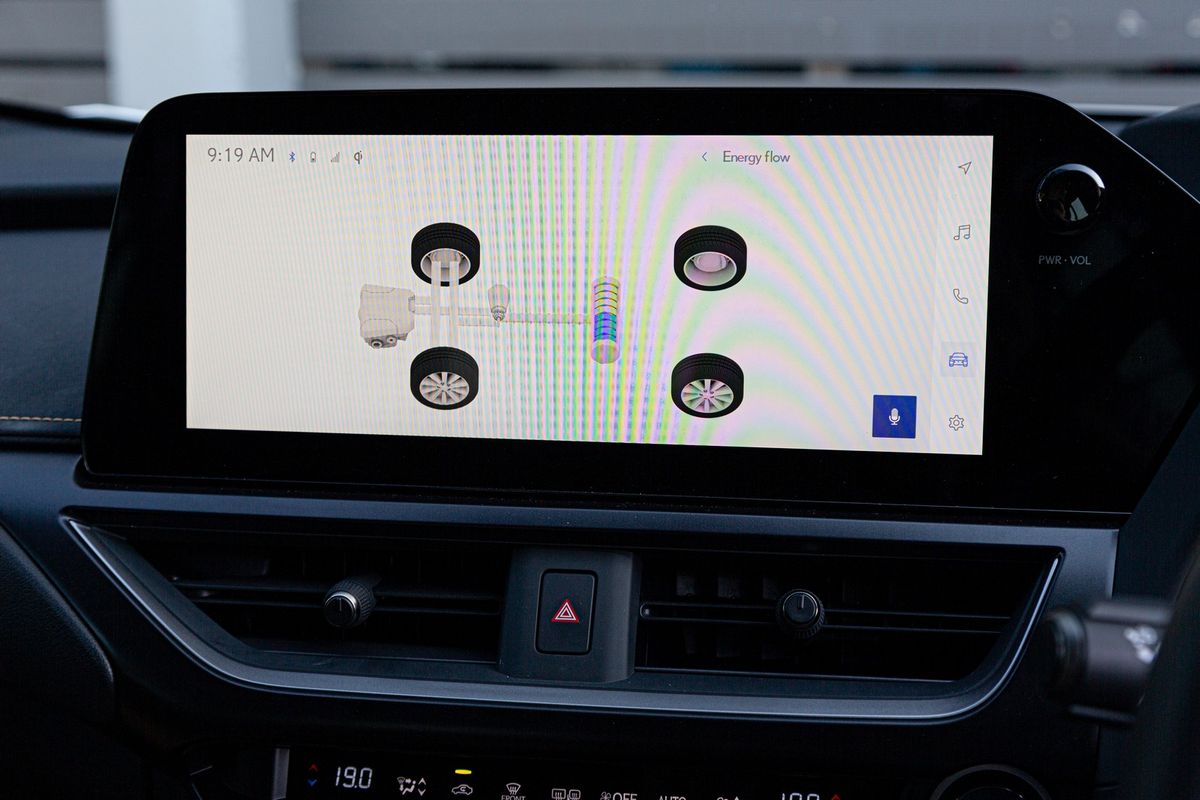
Lexus’ hybrid system is in its 4th generation and, for those who don’t know how it works, it can propel the UX round town at low speeds on battery power alone (depending on the latter’s state of charge). The e-motor can also assist the petrol engine by delivering extra power when required, like when overtaking. To charge, the car will simply utilise brake regeneration and engine power – there’s no need to plug it in.
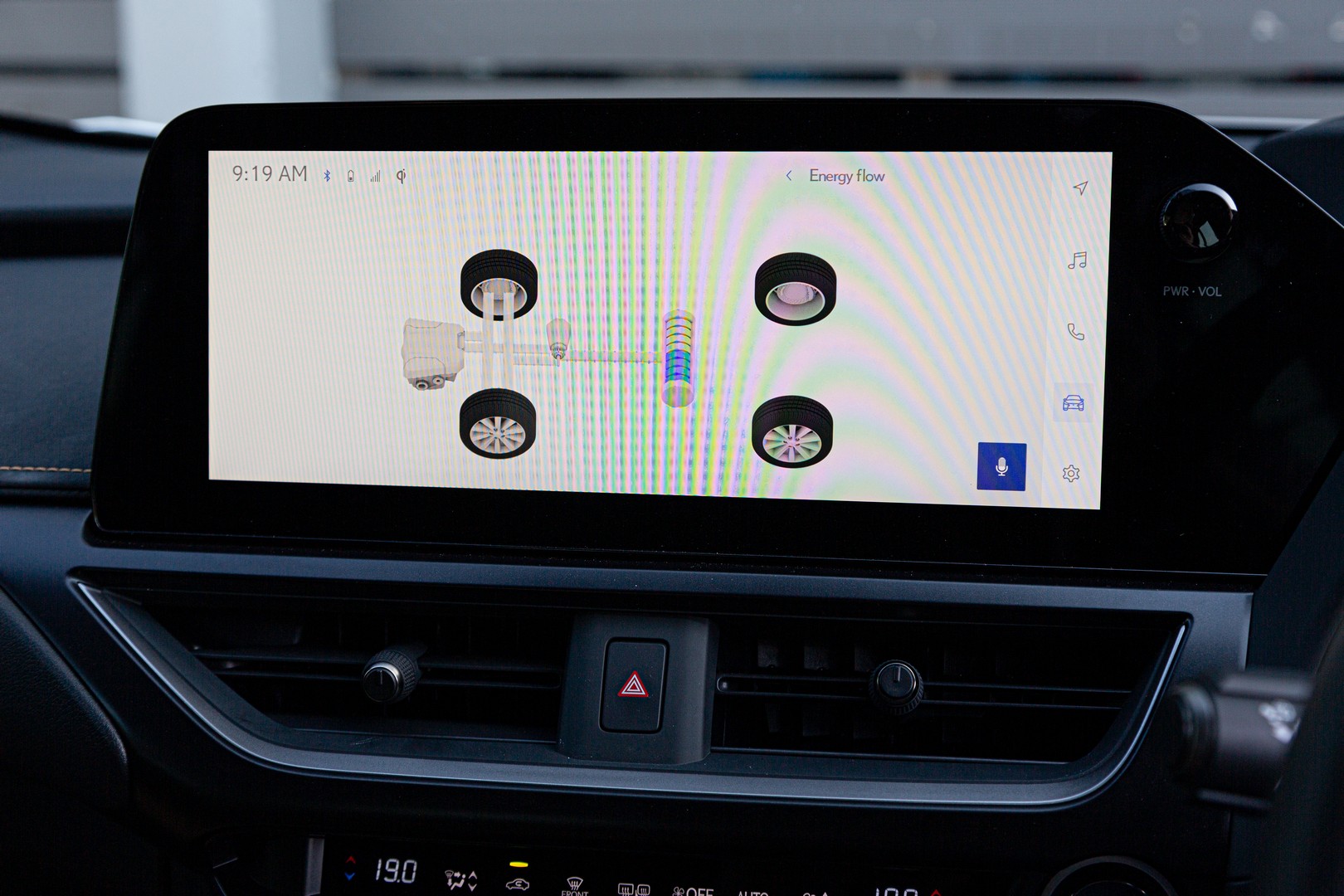
The Lexus UX’s infotainment screen displays a readout of what the powertrain is doing.
In our experience, the UX is more of a vehicle for commuting (and cruising) than anything else. If you drive the 250h EX in the manner Lexus anticipated most owners would use it (calmly driving to work – and back – in big cities), you’re rewarded with an ultra-smooth, comfortable and relaxed experience, with the bonus of low fuel consumption. In the modern era of hustle and bustle, there’s something to be said for sitting back and just going along with the traffic while listening to your favourite tunes or podcast.
Tech and Safety features
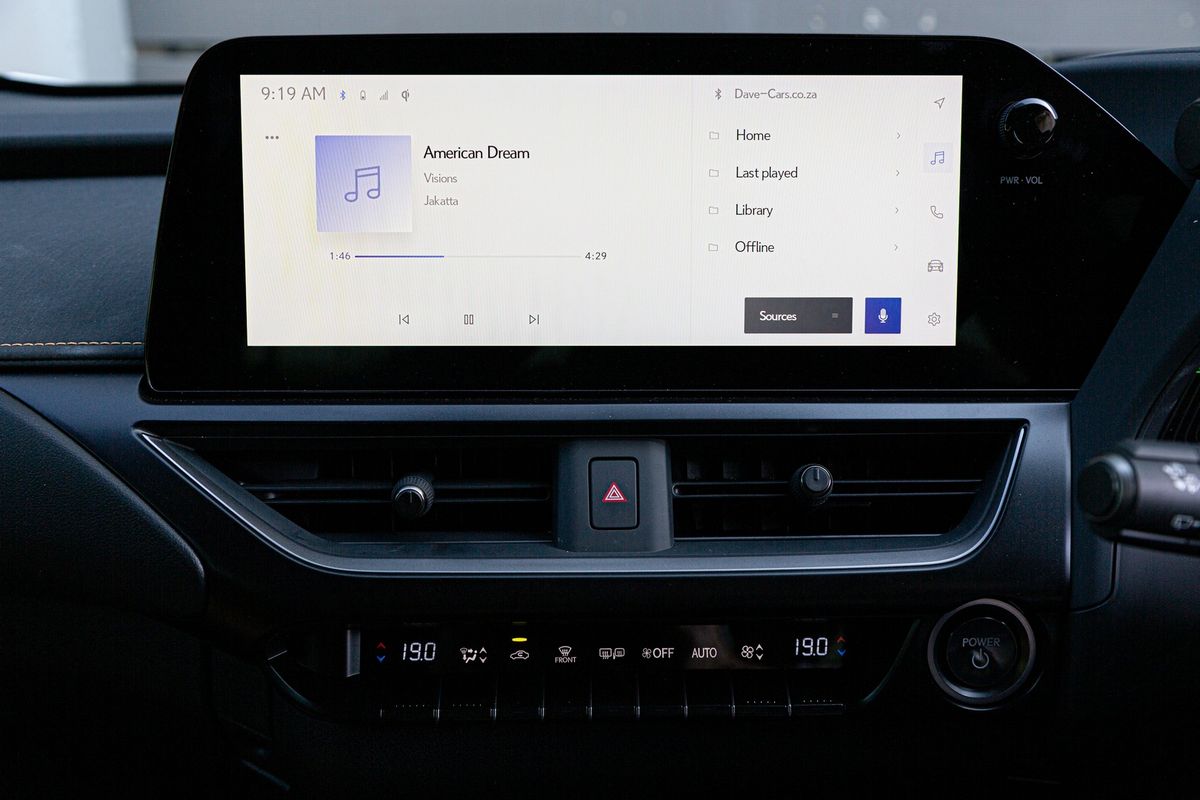
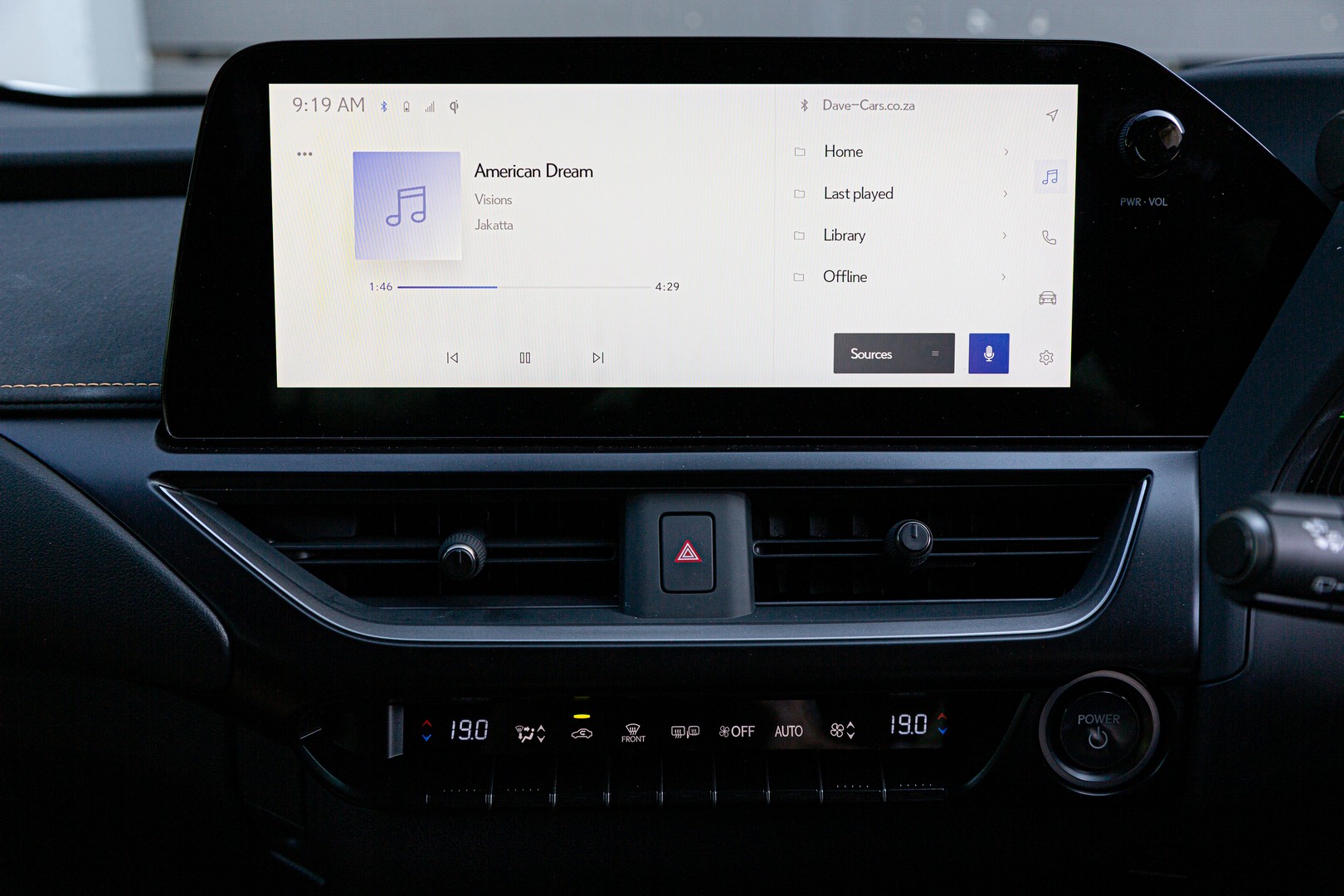
There’s no doubt about it: the Lexus UX’s new infotainment system is the star of the show. Not only is it plainly better in terms of appearance/presentation and user experience than before, but it’s positioned a bit closer to the driver, so they don’t need to stretch so much to access the system’s various functions.
The Lexus UX’s new infotainment touchscreen is a joy to use.
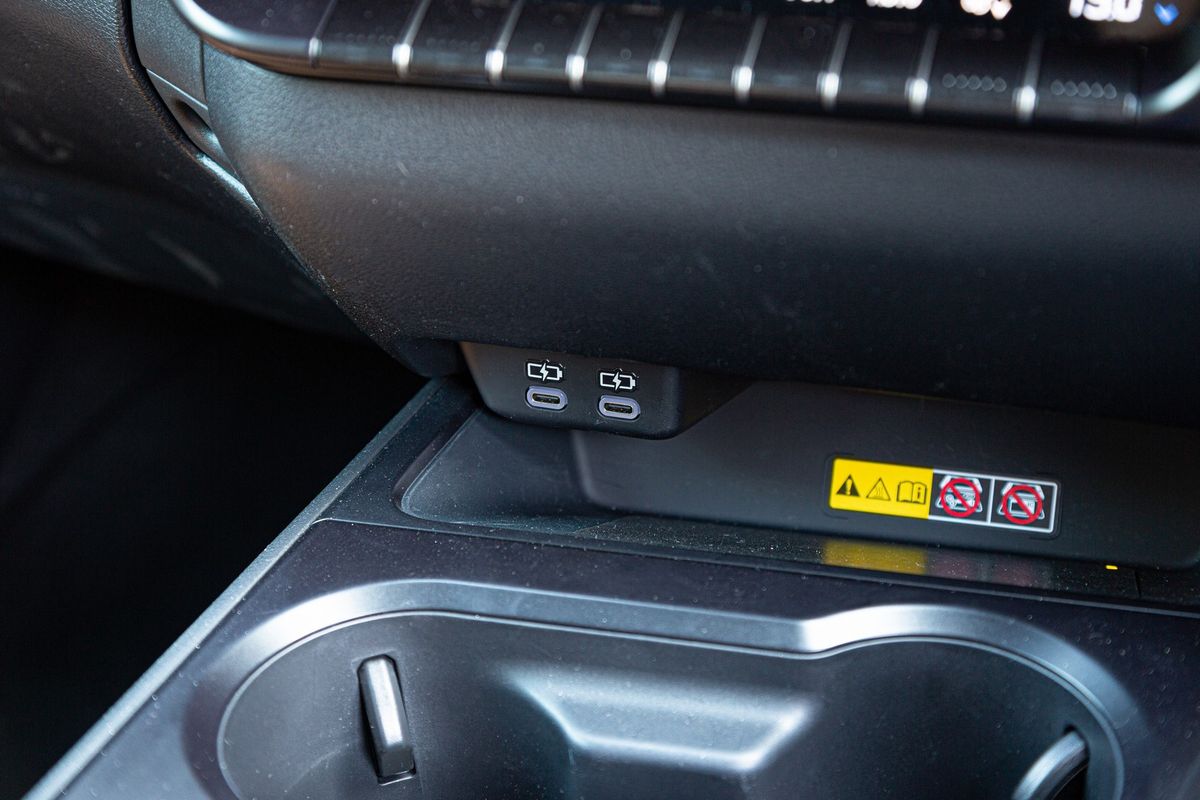
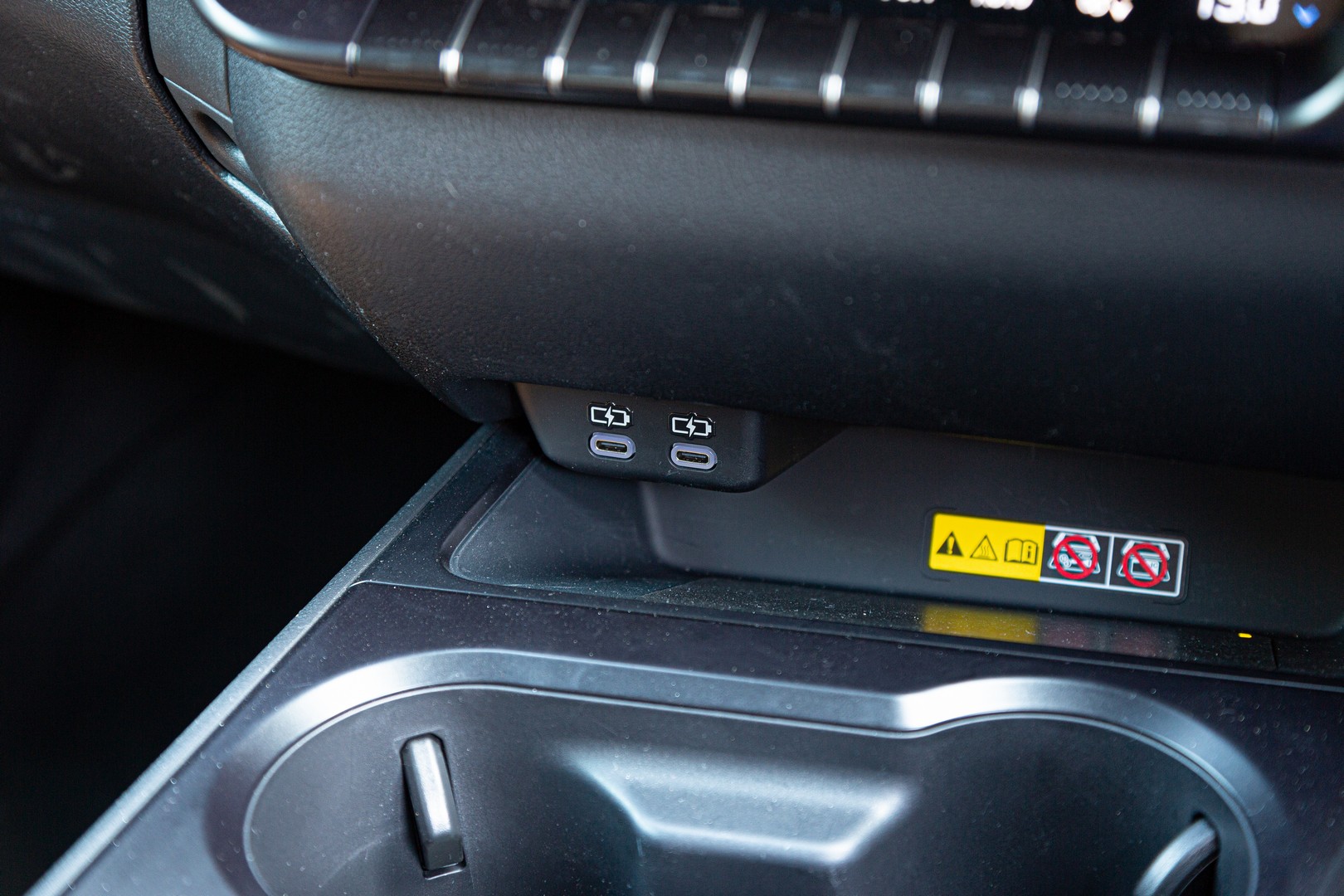
A wireless charging pad, numerous USB ports (type C at the front) and Apple CarPlay/Android Auto make for a compelling combination for the always-connected generation. This writer has an Android device, and the latest version of Android Auto works a treat on the UX’s large infotainment touchscreen.
Front occupants can make use of USB-C ports and a wireless charging pad.
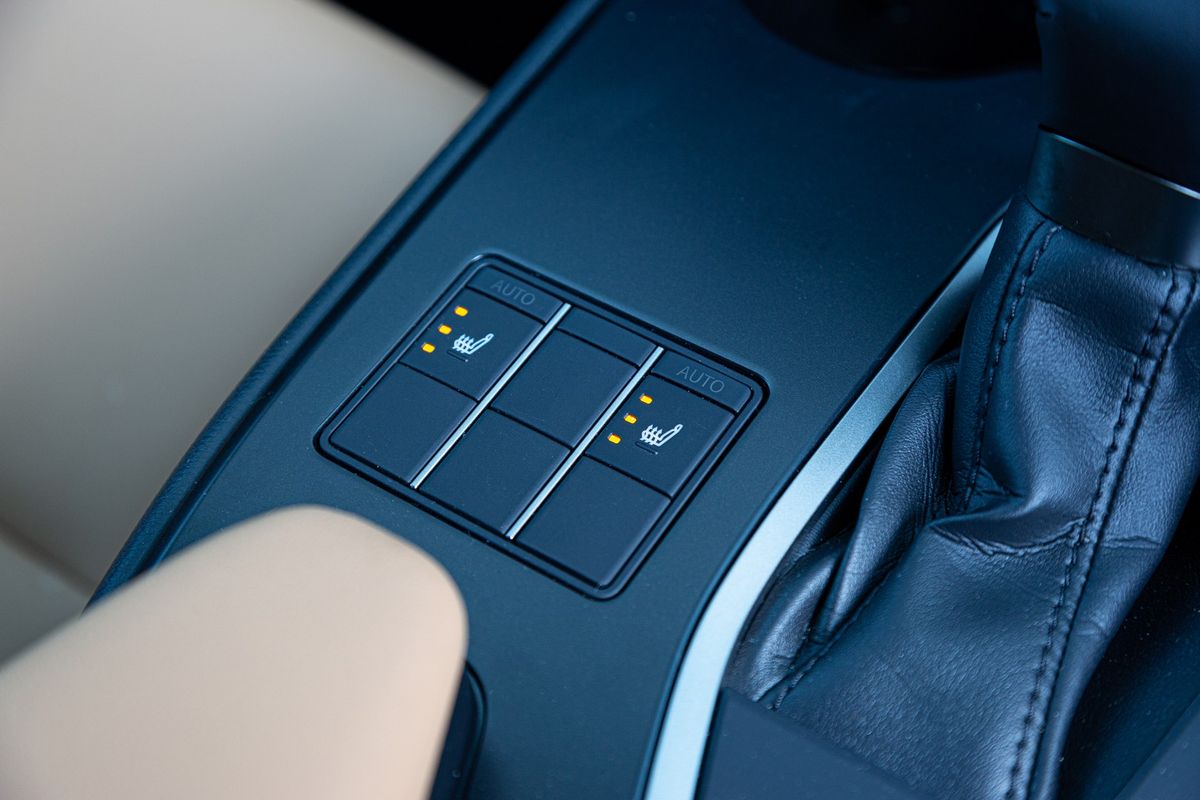
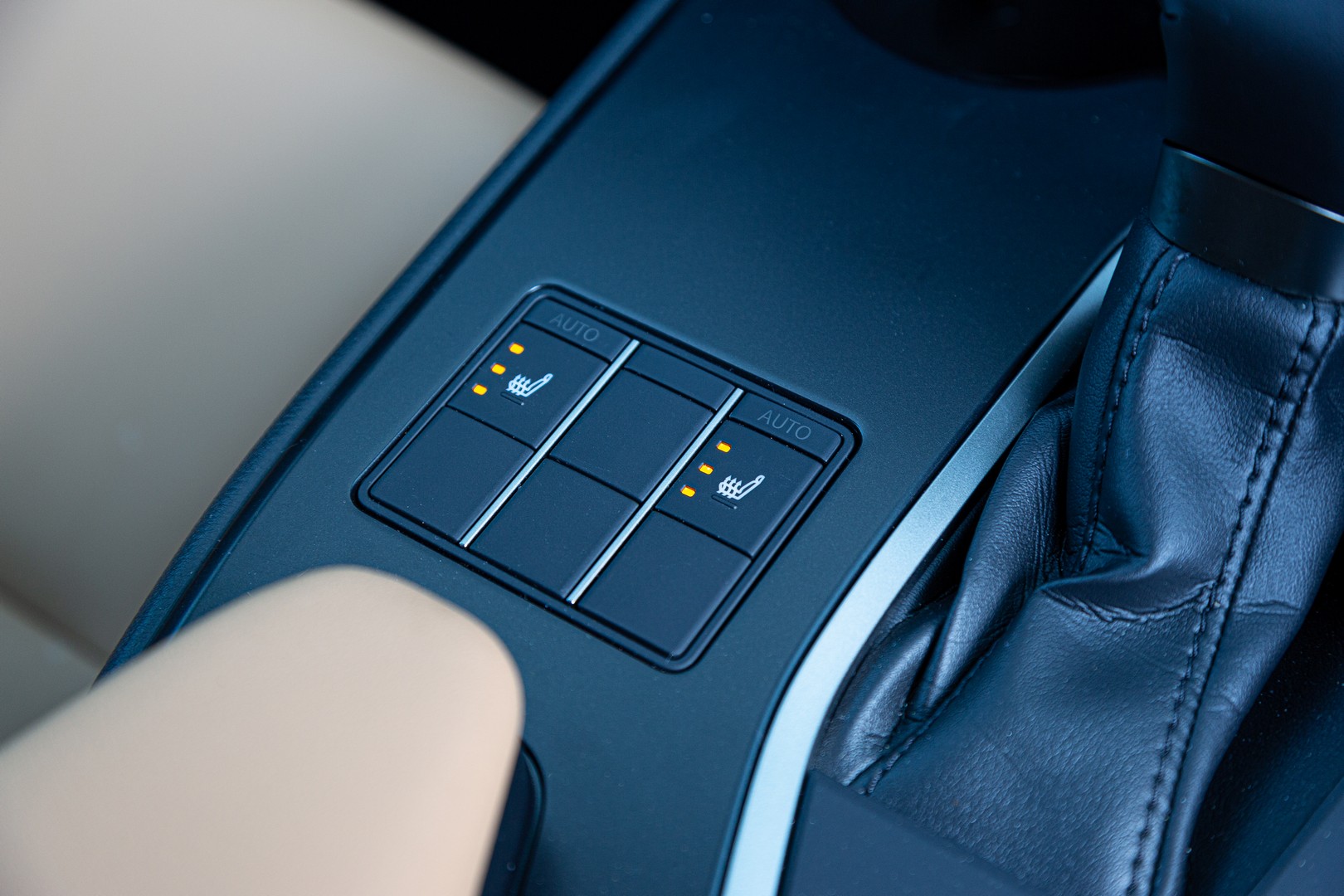
Standard features are comprehensive at this price point. Even though the 250h EX is the “entry-level” UX, it comes with 10-speaker audio (other trim levels get the fabled Mark Levinson setup), a reverse-view camera, parking sensors, cruise control, heated seats, leather trim and dual-zone climate control.
As far as safety equipment is concerned, the derivative has 8 airbags, ABS and traction/stability control.
Heated seats are very nice to have during the colder months of the year (especially upcountry)!
Price & After-sales Support
The updated Lexus UX range is priced from R808 600 (March 2023) and prices go all the way up to R947 500 for the flagship F-Sport derivative. The vehicle is sold with a class-leading 7-year/105 000 km warranty and full maintenance plan, as well as an additional 8-year/195 000 km hybrid battery warranty.
Verdict
The Lexus UX 250h EX is an efficient cruiser, but it comes at a price.
It has excellent cabin quality, an efficient hybrid engine, a brand-new infotainment system and superb overall refinement, but those aren’t enough for the 2023 Lexus UX to get a double thumbs-up from us. Sadly, its packaging is too compromised (it’s not roomy enough, but remember, the UX succeeded the CT 200h hatchback) and, despite an excellent after-sales plan, the 250h EX is priced well beyond what a customer with a small family may be able to afford if they’re looking to venture into the luxury echelon.
Of course, that’s not the end of the world for the Lexus UX – far from it. Why? Because it fits another, (albeit more niche) customer profile. If you’re half of Dink (Double Income, No Kids) household and you want an efficient luxurious car for trundling to and from the office and the shops, you may want to give this revised model a try. We reckon that a “demo model” might be a lot more attainable than you think.
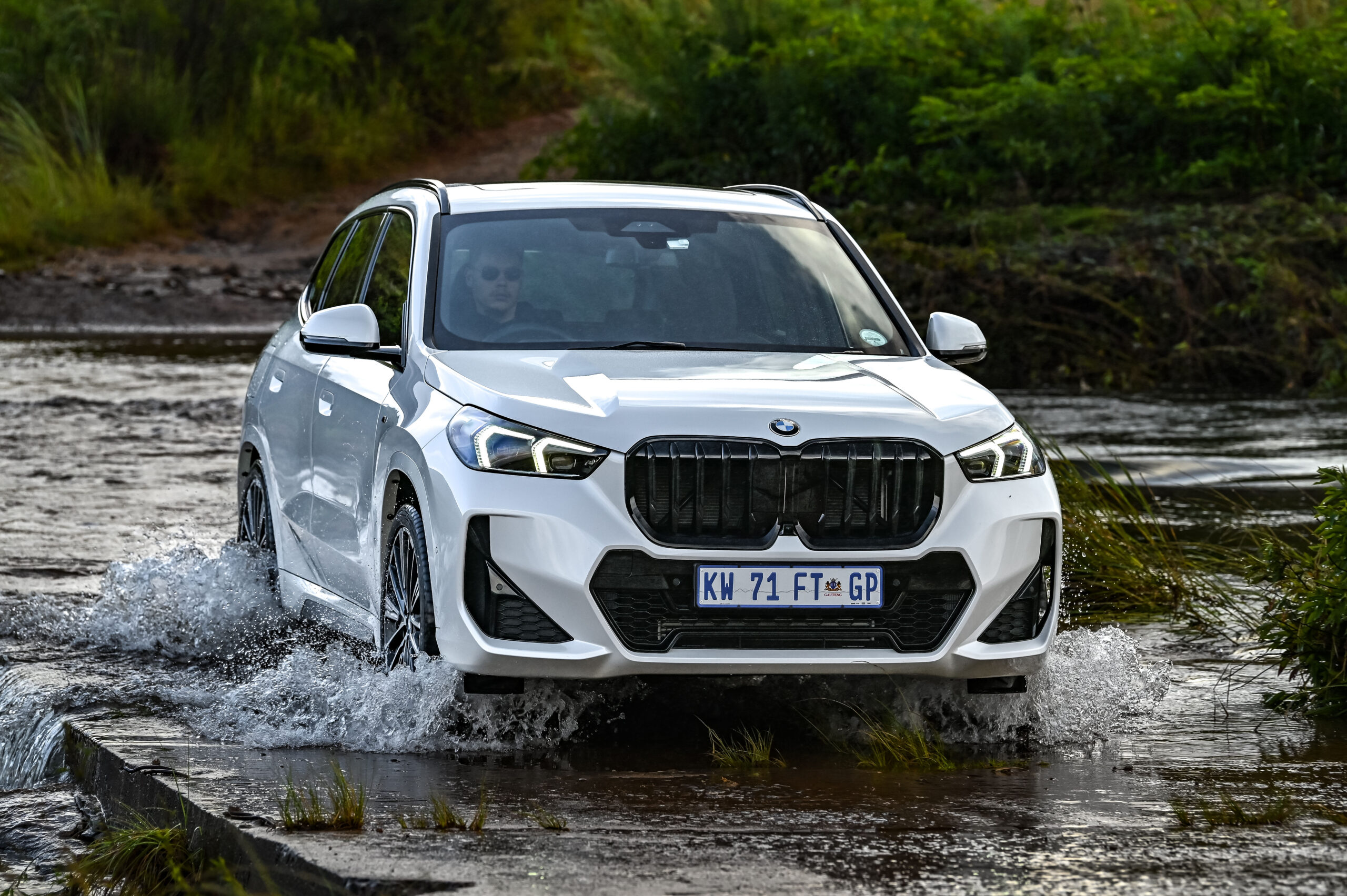
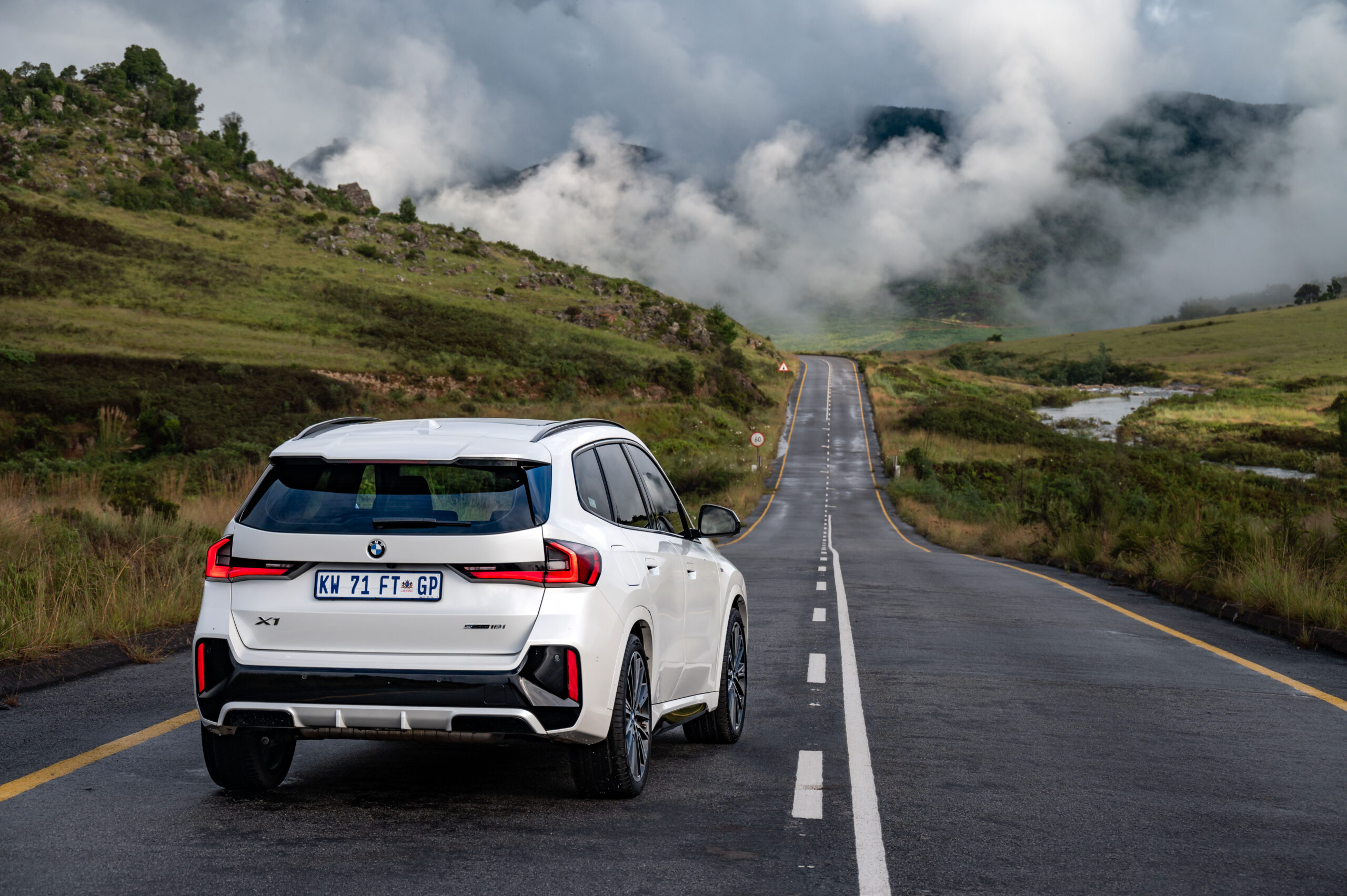
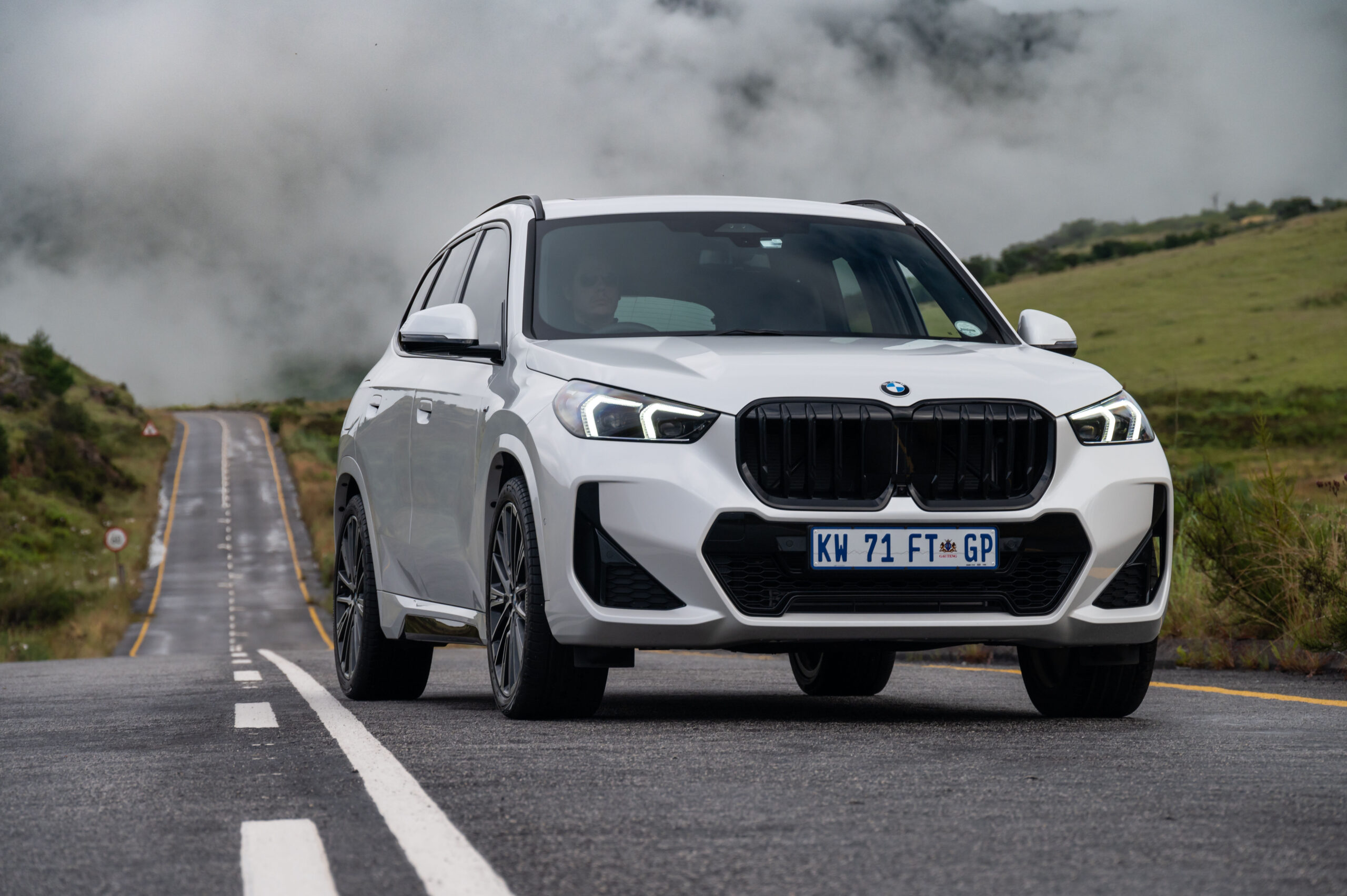
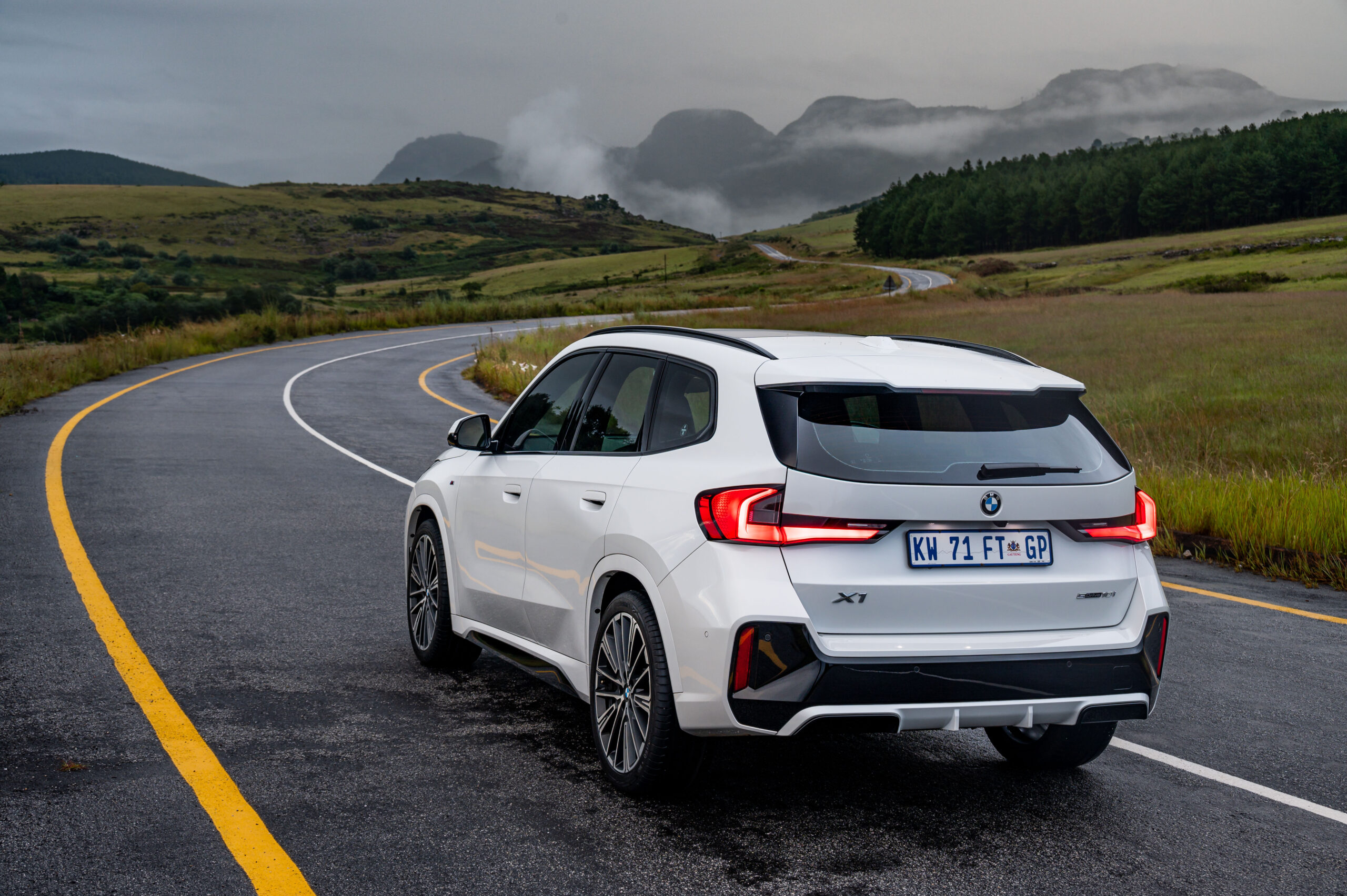
A new-generation BMW X1 has arrived in South Africa to invigorate the premium small crossover segment. Does the new BMW X1 represent a significant improvement over its predecessor? We attended the model’s local launch in Johannesburg to find out.
Since the introduction of the 1st-gen X1 in 2009, BMW has sold more than 2.7 million units of its “baby SUV” worldwide. The previous (2nd-gen) model had a few drawbacks, however: in terms of passenger/ luggage space, it was a bit cramped and its driving experience was unremarkable. The outgoing “cousin of the Mini Countryman” left room for improvement, so what has BMW come up with for the new model?
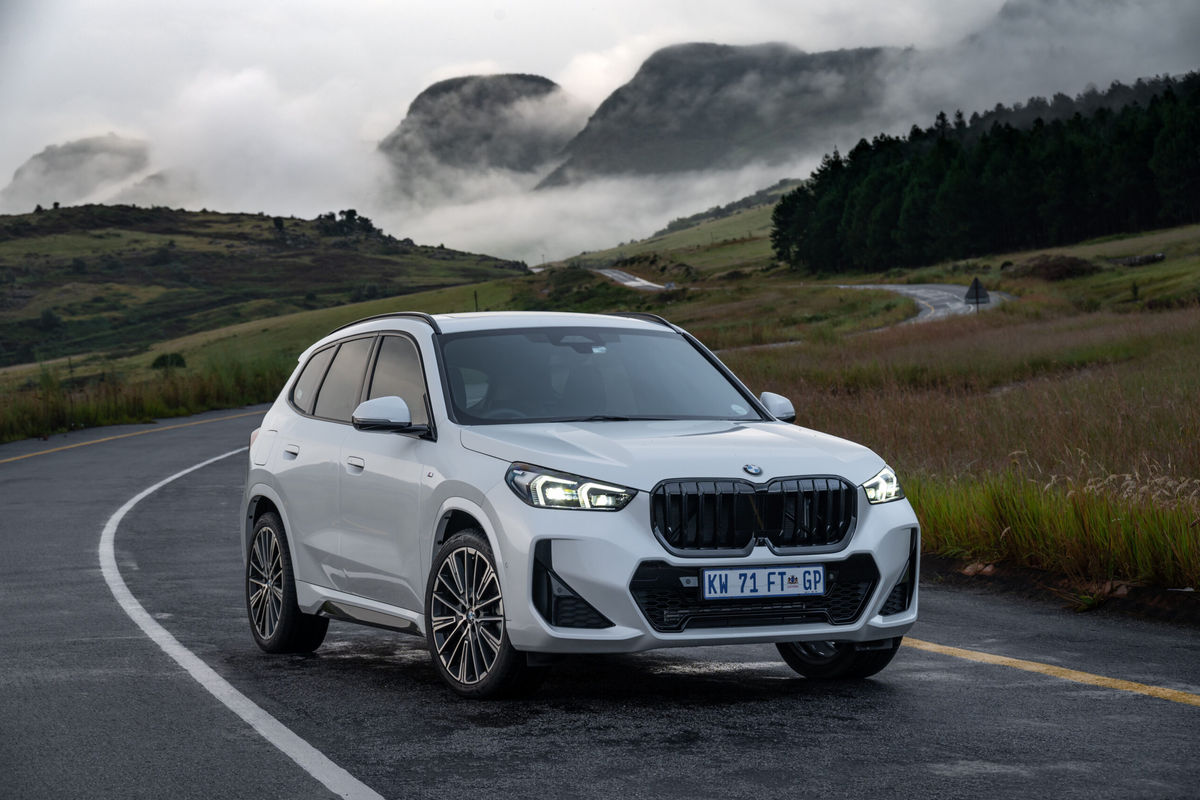
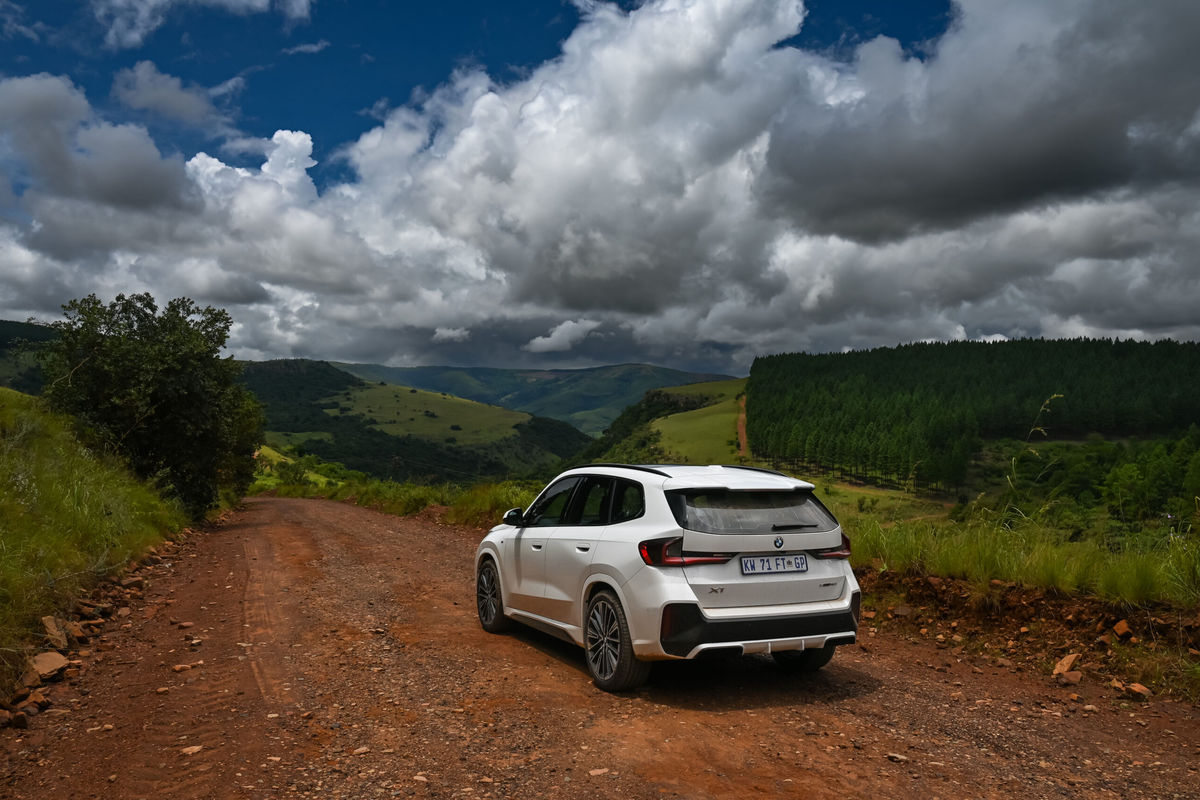
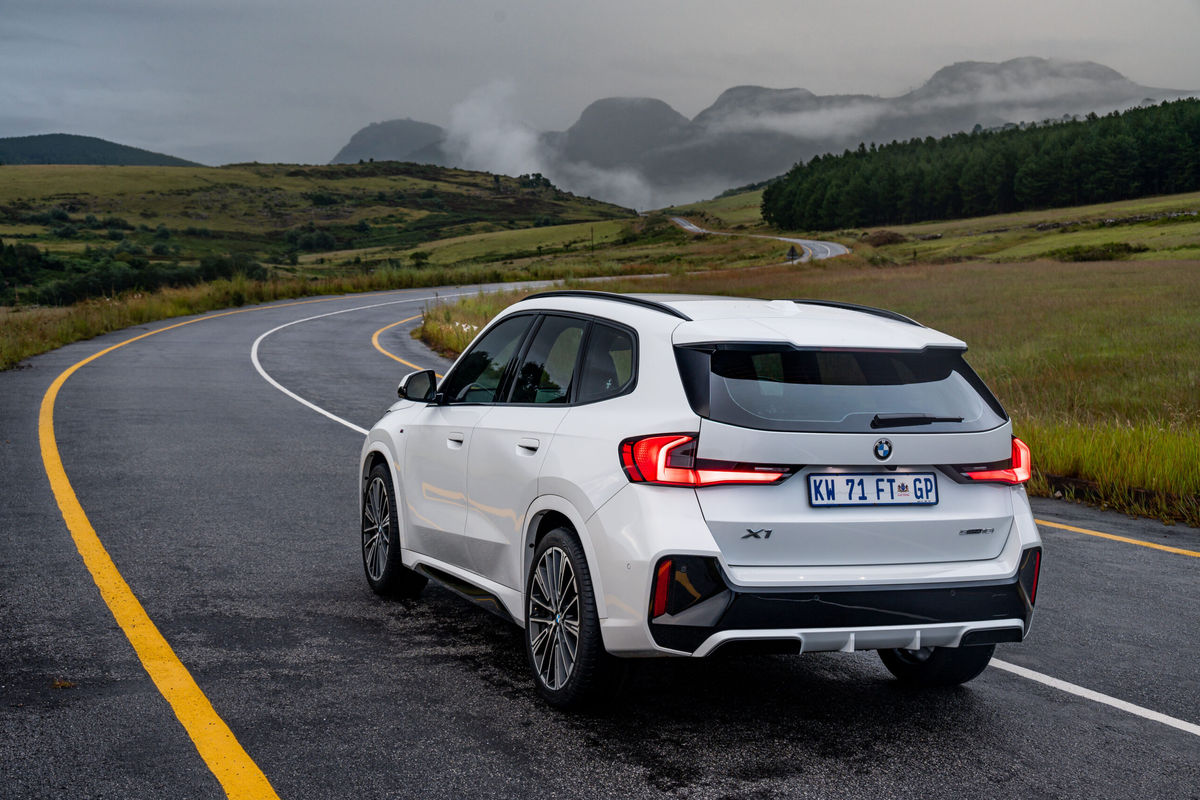
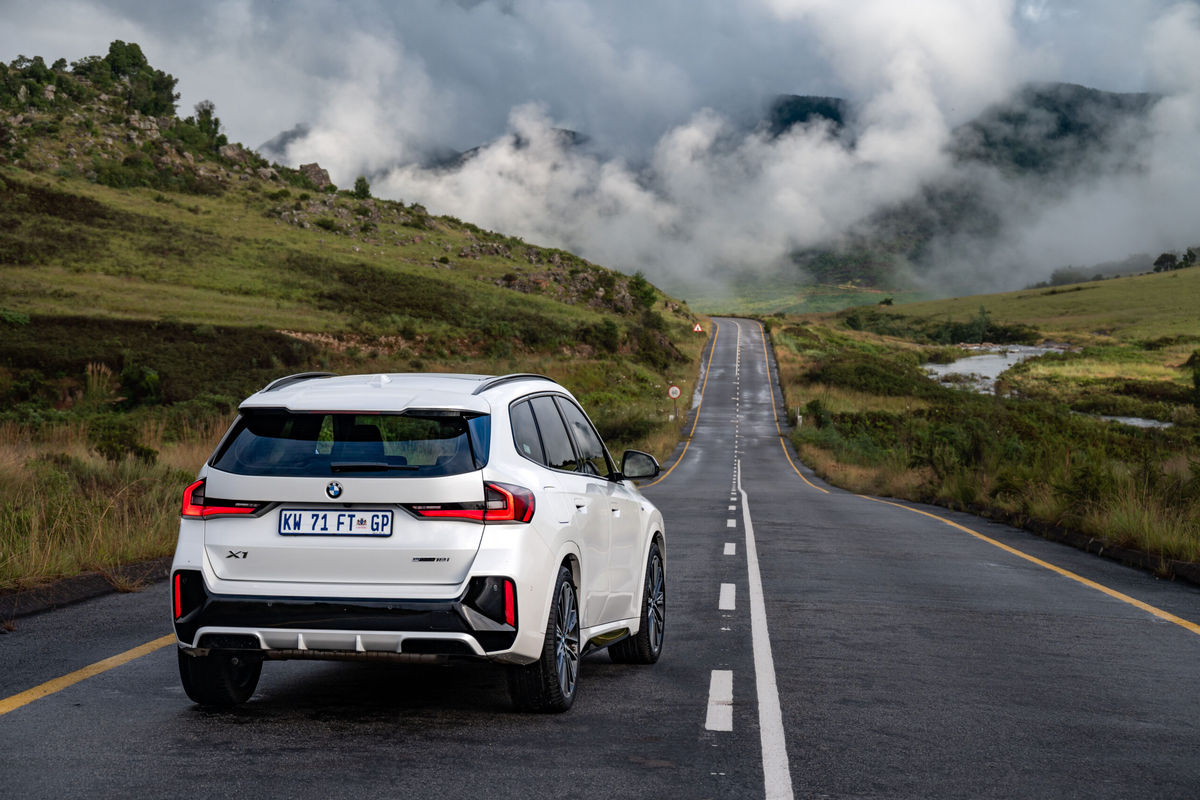
First of all, with the new 3rd-generation BMW X1 (codenamed U11), the Munich-based firm has increased the premium small crossover’s footprint – in an effort to improve the model’s cabin space/practicality – while also emboldening the X1’s road presence with enhanced styling.
As such, the new X1 is 53 mm longer (4 500 mm), 44 mm taller (1 642 mm) and 24 mm wider (1 845 mm) than before, but importantly, its wheelbase has been stretched by 22 mm (2 692 mm) while both front- and rear track widths have been extended (by 33 mm) to sweeten the X1’s handling balance.
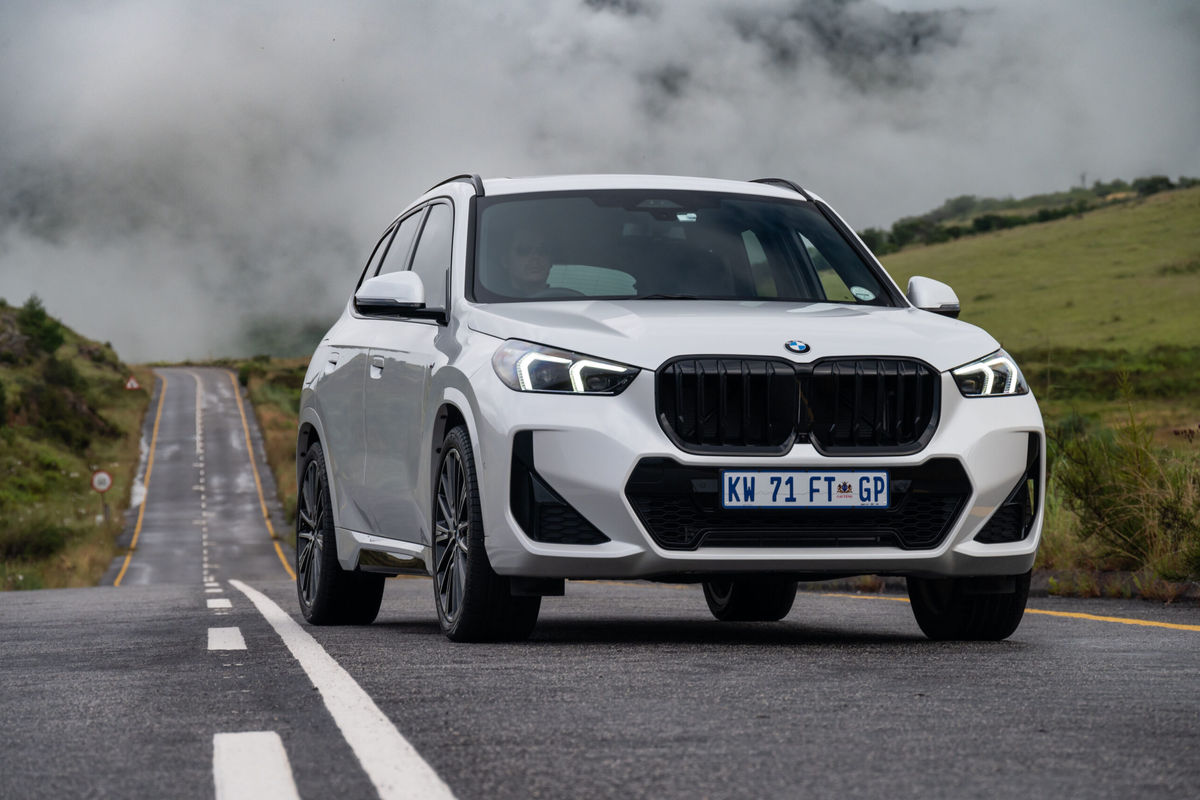
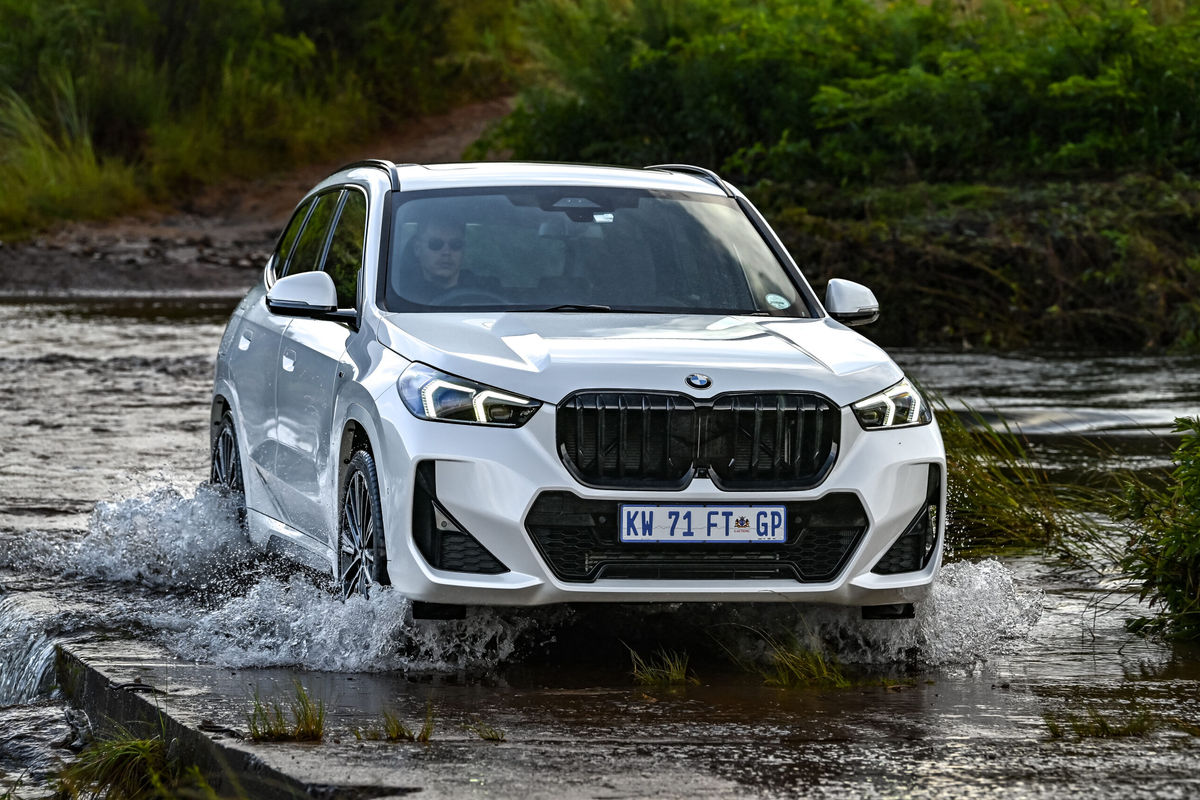
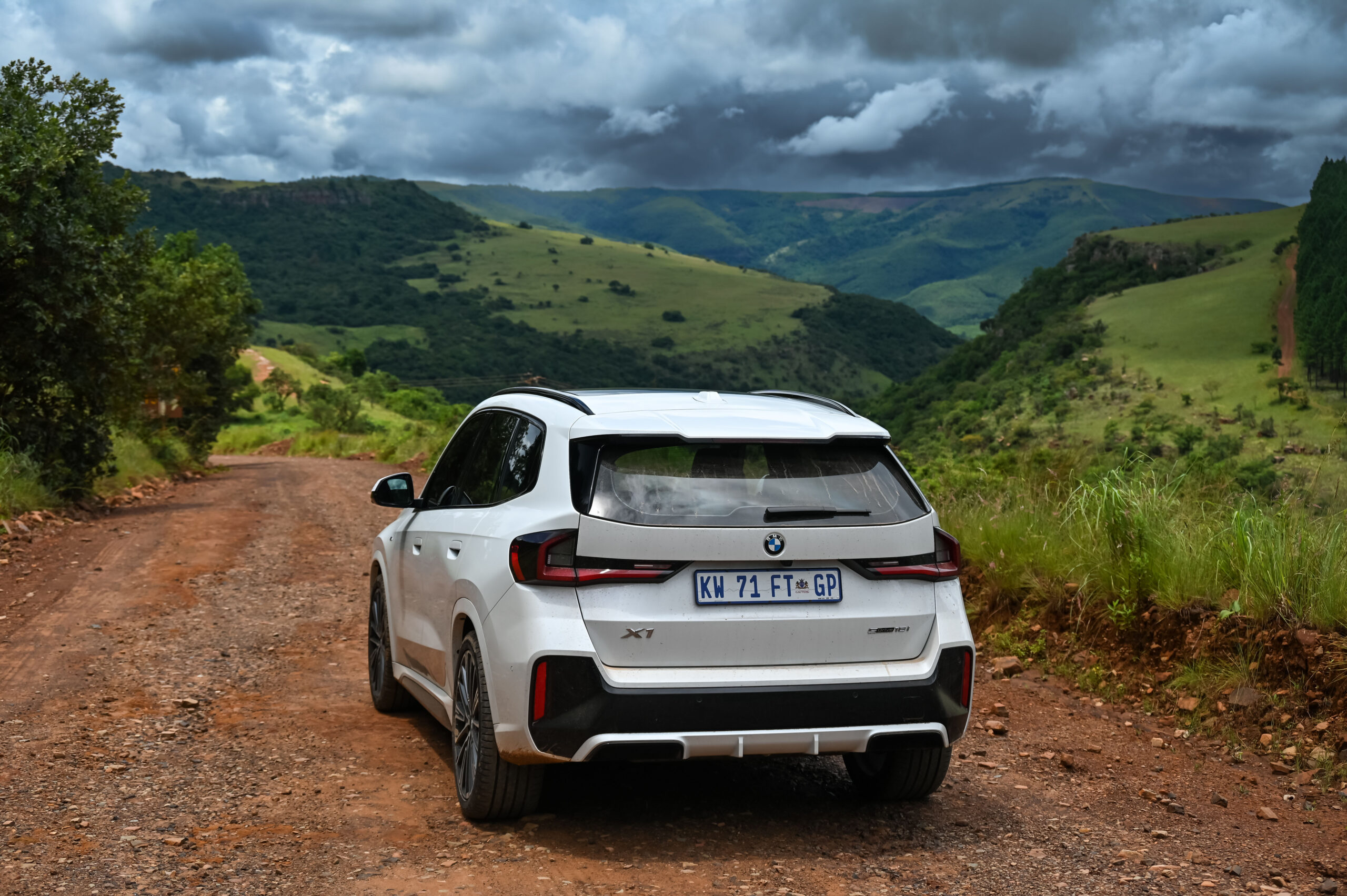
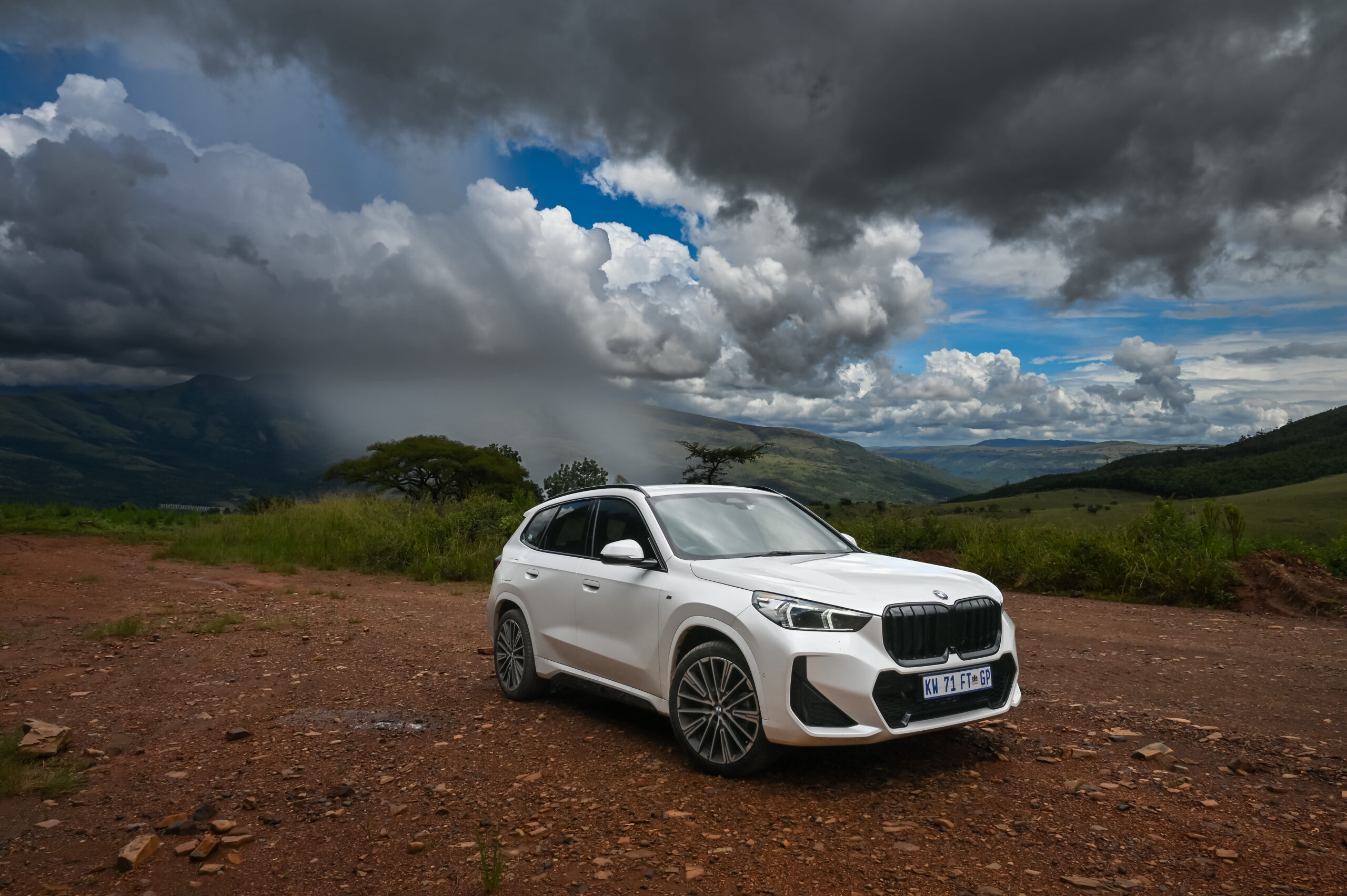
Thankfully, the new BMW X1’s grille is not as radical-looking as those of other new BMW products.
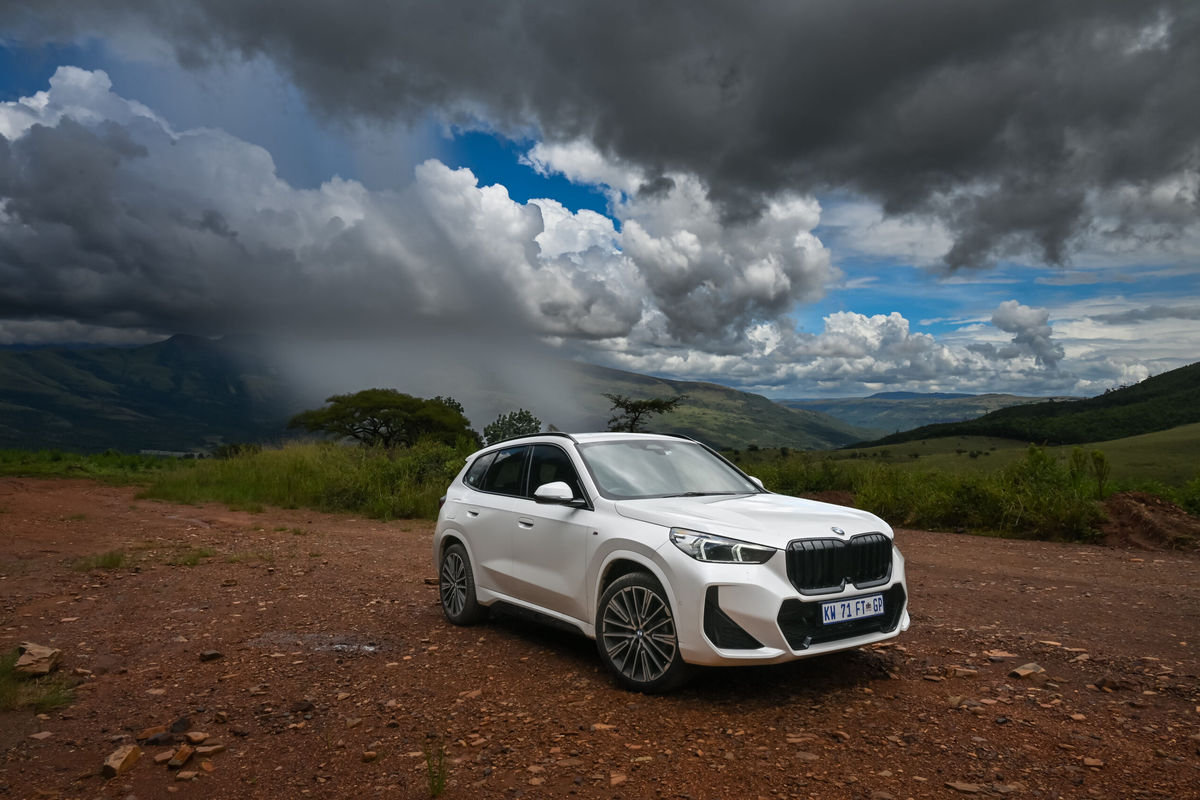
In the metal, the new X1 looks impressive; its large upright kidney grille, heavily sculpted bonnet and slim LED headlights combine to create a strong visual presence. Has BMW nailed the X1 styling this time?!
The new BMW X1 has some stiff competition, such as the Volvo XC40, Audi Q3, Mercedes-Benz GLA, Lexus UX and Jaguar E-Pace (to name a few rivals). Suffice it to say, BMW hopes the U11 model will claim a larger share of its segment, which is becoming increasingly important overall – not only due to “the SUV craze”, but because rapidly increasing new-car prices are forcing consumers to “buy down”.
What’s the new BMW X1 interior like?
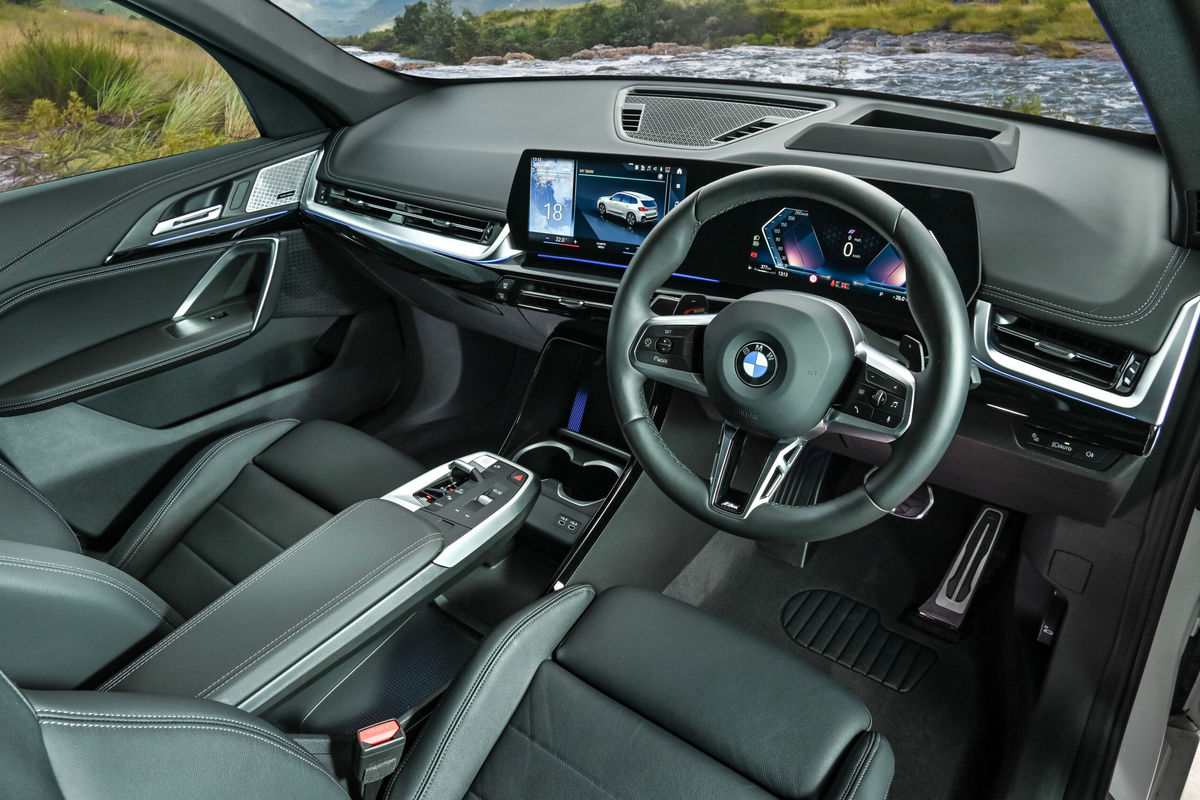
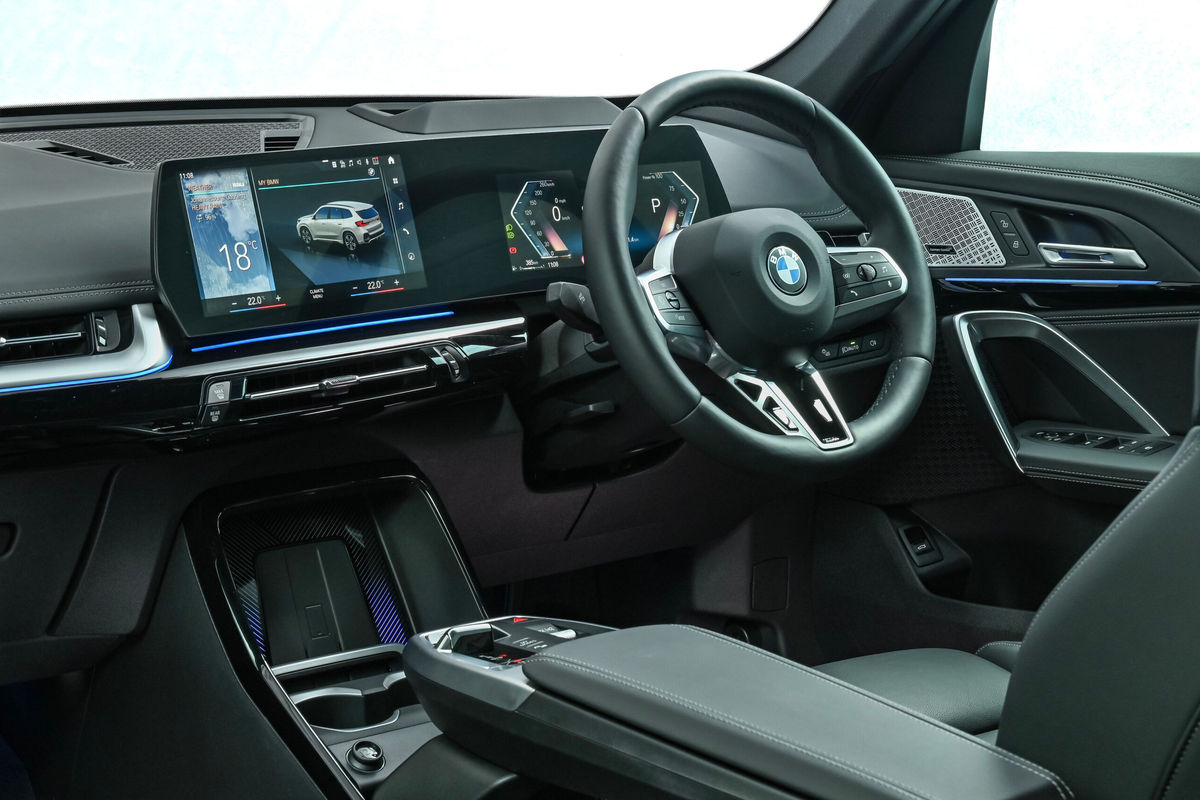
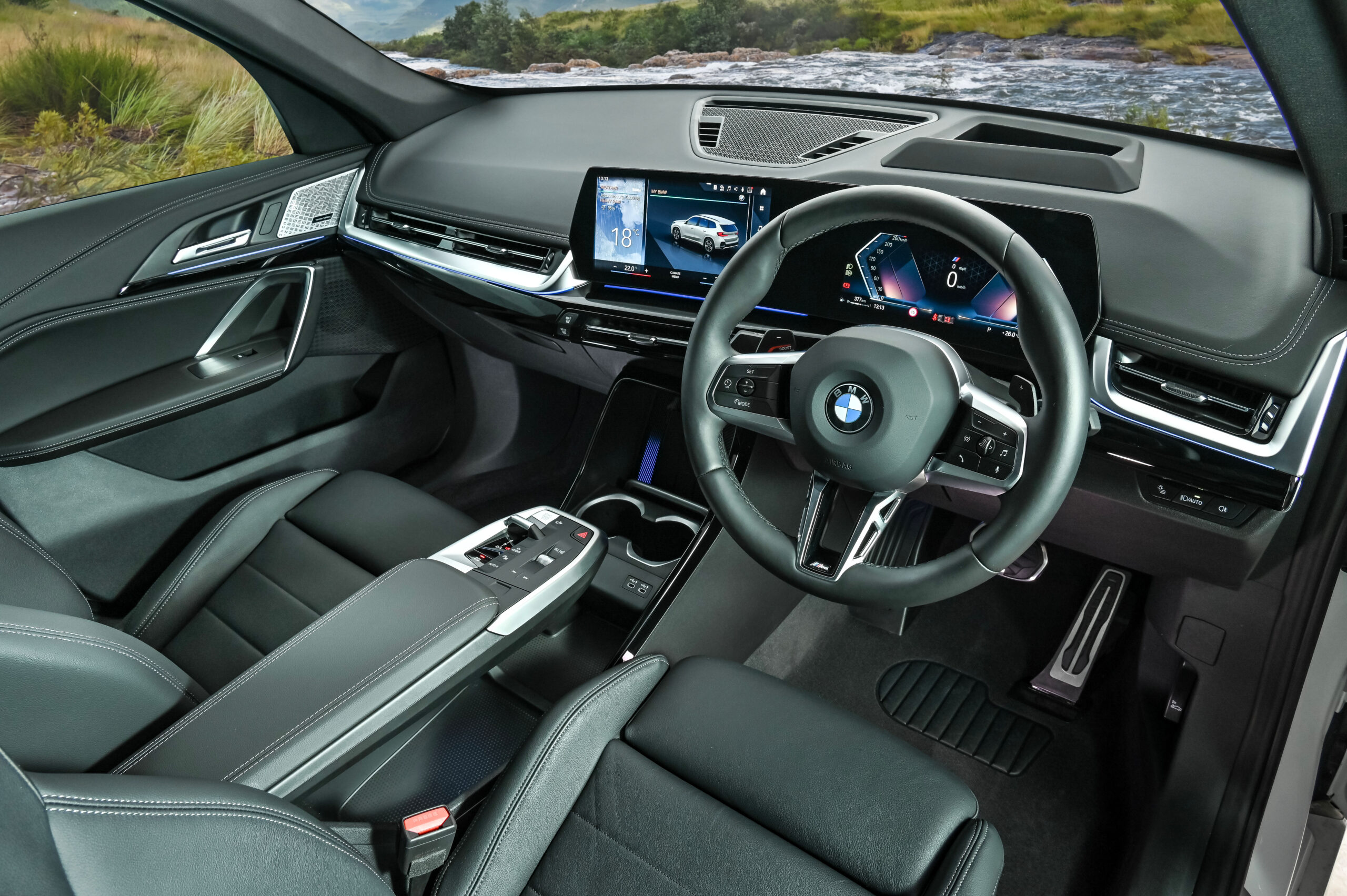
The new BMW X1’s interior has been beefed up – in terms of features and tech, as well as build quality.
The new BMW X1’s redesigned interior is not only aesthetically pleasing but, importantly, it feels more upmarket and substantial in terms of onboard technology and perceived build quality. A major highlight is the standard BMW Curved Display, which comprises a smart 10.25-inch digital instrument cluster, as well as a 10.7-inch infotainment touchscreen, which is powered by BMW’s latest Operating System 8.
The infotainment system can be operated via voice control, incorporates Apple CarPlay and Android Auto connectivity, and has nice-to-have features such as Augmented View (which can be added as an option to the integrated navigation system), as well as convenient wireless smartphone charging.
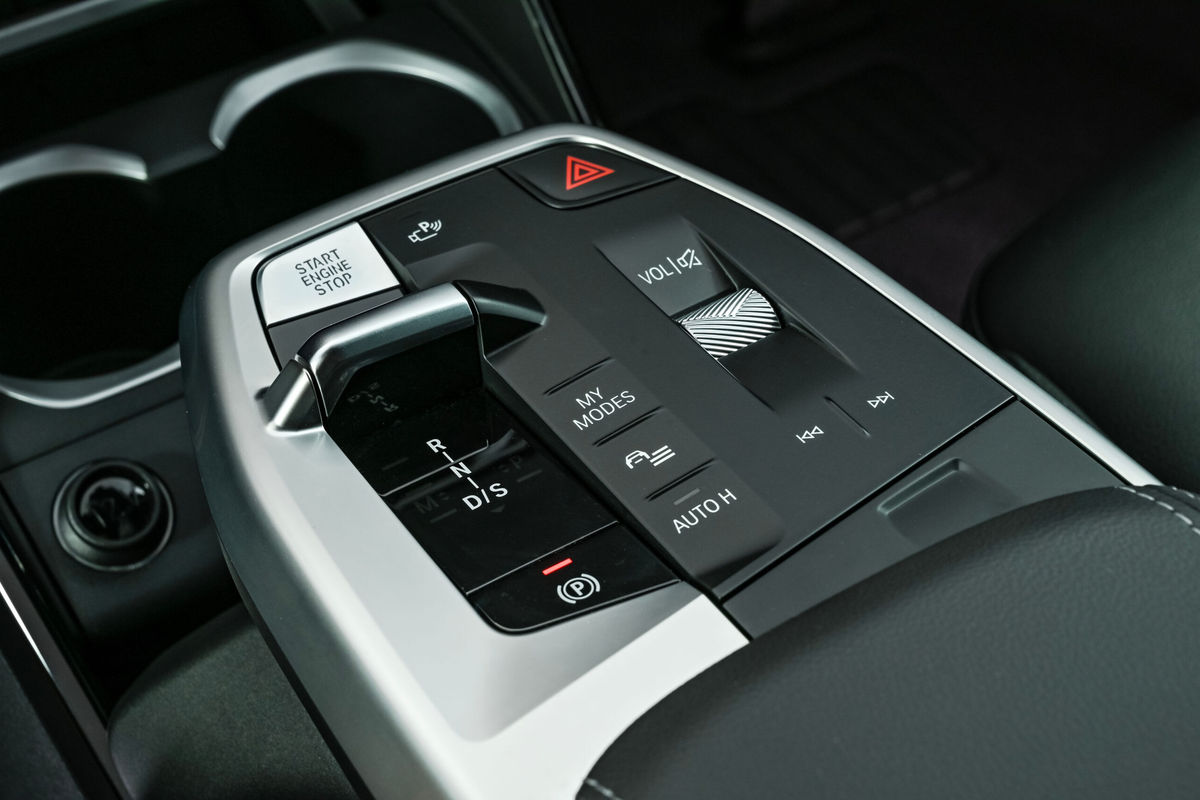
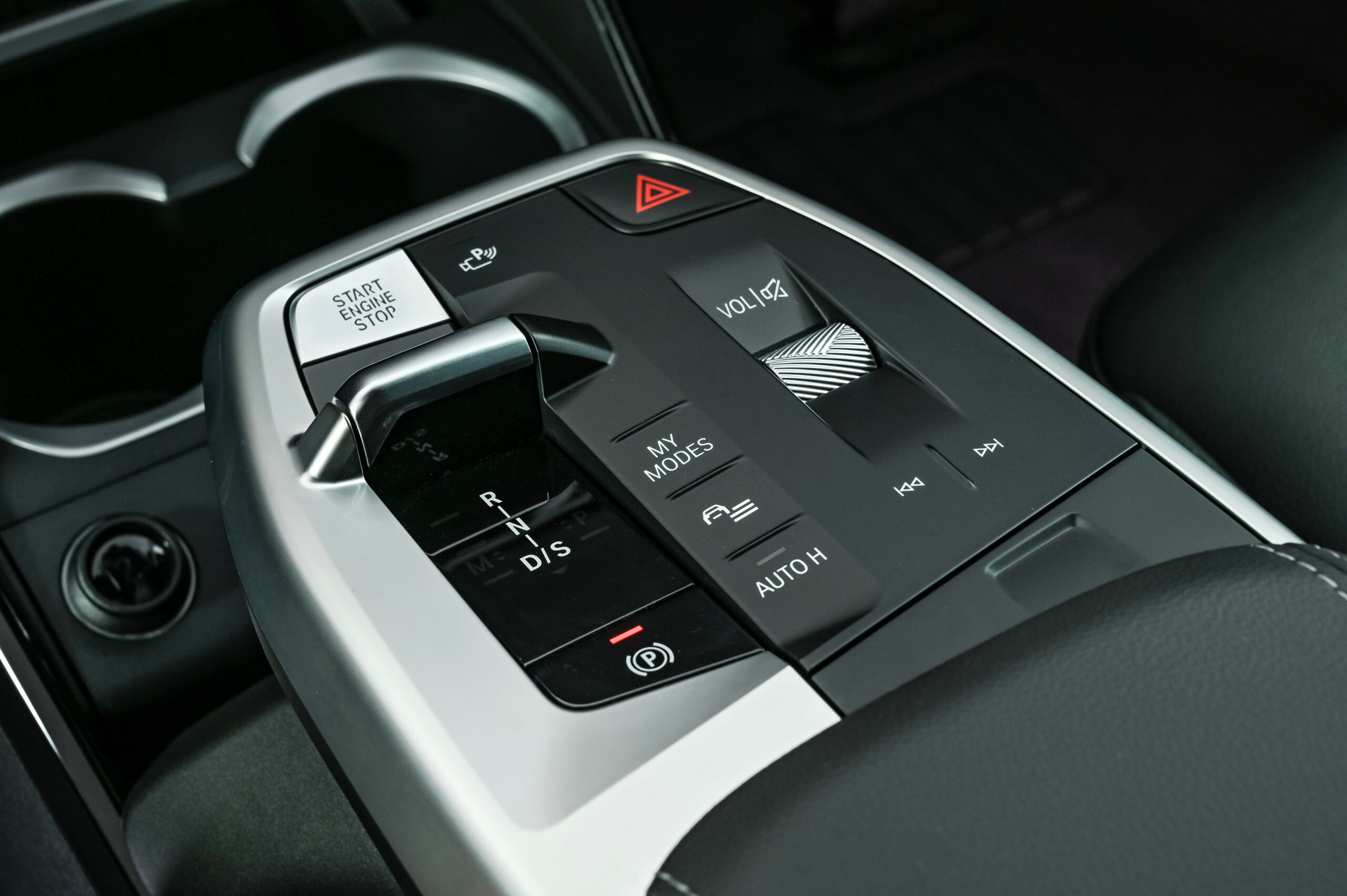
The transmission has been replaced by a stubby, minimalist gear selector.
The new X1 also features a nifty floating centre console, which offers a central storage area, as well as easy-to-reach controls (ahead of the armrest). We like the stubby, minimalist gear selector, which frees up space on the console, the knurled metallic volume-control barrel and the subtle “skip track” buttons.
The redesigned seats offer high levels of comfort with sufficient bolstering (a big improvement on the last model). All of the elements create a cabin environment that facilitates a pleasing driving experience.
Prospective buyers should note that the new BMW X1 offers better rear legroom than before; while the space is not quite as generous as in the X3 and X5, the roomier accommodation represents a welcome improvement over the preceding X1. Moreover, the load capacity has increased by 50 litres to a claimed 540 litres and, when you fold the split 40:20:40 split rear seats, utility space increases to 1 600 litres!
What’s the new BMW X1 like to drive?
Diesel engines are disappearing from passenger cars, but BMW still offers a 2.0-litre 4-cylinder turbodiesel in the X1.
BMW South Africa offers the new X1 with 2 trim lines (x Line and M Sport) and a choice of a turbopetrol or -diesel engine. An all-electric iX1 is expected to join the lineup in the second quarter of 2023.
Our first taste of the new X1 came courtesy of the sDrive18i, which has a 1.5-litre 3-cylinder turbopetrol engine (115 kW/230 Nm of torque) that drives the front wheels via an 8-speed automatic transmission.
As we departed from BMW SA’s headquarters in Midrand, the X1’s improved occupant comfort became apparent. The BMW’s on-road refinement is impressive: very little engine- and road noise entered the cabin and the ride quality was pliant and forgiving on Gauteng’s (ubiquitously pothole-riddled) roads.
As more buyers switch from sedans and hatchbacks to crossovers, the X1 becomes even more important for BMW.
The turbopetrol engine’s performance is best described as workmanlike – it doesn’t deliver particularly urgent acceleration when you stomp on the accelerator pedal. You can switch to Sport mode to extract a bit more overtaking punch (it makes the X1 hold onto gears a while longer), but overall, the sDrive 18i’s overall performance is quite acceptable, considering its core target market isn’t driving enthusiasts…
BMW claims an average fuel consumption of 6.5 L/100 km for the X1 sDrive18i and, during our brief test drive, the car indicated 8.1 L/100 km. Don’t read too much into that figure though; you’re likely to achieve better fuel efficiency if you adopt a more considered (as in non-motoring-journalist) driving approach.
The turbodiesel sDrive18d is the punchier – and more frugal – of the two X1 derivatives.
After lunch, we switched to the X1 sDrive18d – its 2.0-litre 4-cylinder turbodiesel engine delivers 110 kW and 360 Nm. With more torque on tap, this X1 derivative is much punchier than its petrol-powered sibling.
That extra wad of torque is a boon on the highway, where you can execute quick overtaking manoeuvres with ease. Fuel efficiency is a major advantage if you opt for the diesel X1 and, while BMW claims 5 L/100 km, we got pretty darn close to that on our test drive. The car indicated a figure of 5.1 L/100 km, which was admirable! Better still, this isn’t a clattery diesel motor either; engine noise was surprisingly muted.
It’s also worth mentioning that the new BMW X1 offers much improved handling characteristics than its predecessor. The steering is nicely weighted and responsive; it has a direct, semi-communicative feel.
This improvement can be attributed (in part) to the X1’s larger footprint and wider tracks, which means that the X1 feels more planted on the road (even if not sporty), which benefits stability and dynamism.
Summary
We’re impressed with the new BMW X1. It’s not more exciting, but feels markedly more substantial.
Our brief driving stint in the new BMW X1 was a very positive one. We are happy to report that the new U11-generation model seems to be a more rounded offering that feels like, well, “a lot more car”.
Not only does the newcomer score highly in terms of kerb appeal, but its interior execution does not shout: “You’re in BMW’s cheapest SUV”. Buyers will appreciate the space and comfort improvements, while the technology-infused cockpit brings the X1 in line with – and perhaps even ahead of – its rivals.
While the petrol-powered X1 will be sufficient for most needs, we think that the X1 sDrive18d is the pick of the range. Not only does it offer stronger performance, but its real-world efficiency is commendable.
We will have the new BMW X1 on test soon so look out for a thorough evaluation on Cars.co.za.
Toyota Hilux Xtra Cab Legend Models Score Spec Update
Toyota South Africa Motors has rolled out a few specification updates to its ever-popular Hilux range, with a focus on the Xtra Cab Legend models. Here’s what has changed…
With the new Ford Ranger officially on the market in South Africa, Toyota has seen fit to roll out a specification update for its Hilux, with the Xtra Cab Legend derivatives gaining the most significant changes.
As a reminder, the Hilux was South Africa’s best-selling vehicle overall in 2022, with 32 203 units registered around the country. The Japanese firm’s local division says one of the keys to this sales success is the company’s ability to be “responsive to customer needs”. Indeed, it says these latest changes to the 39-strong Hilux line-up are intended to “cater to ever-evolving” buyer demands.
So, what’s new? Well, Xtra Cab versions of the Legend grade gain the full Toyota Safety Sense 2.0 package, which includes a pre-collision system, high-speed-range adaptive cruise control and lane-departure alert. The system’s operation can be adjusted via the dedicated steering switches or through the multi-information display (MID). In addition, Xtra Cab Legend models score a welcome light feature – as already employed by the double-cab Legend models – incorporated into their side mirrors.
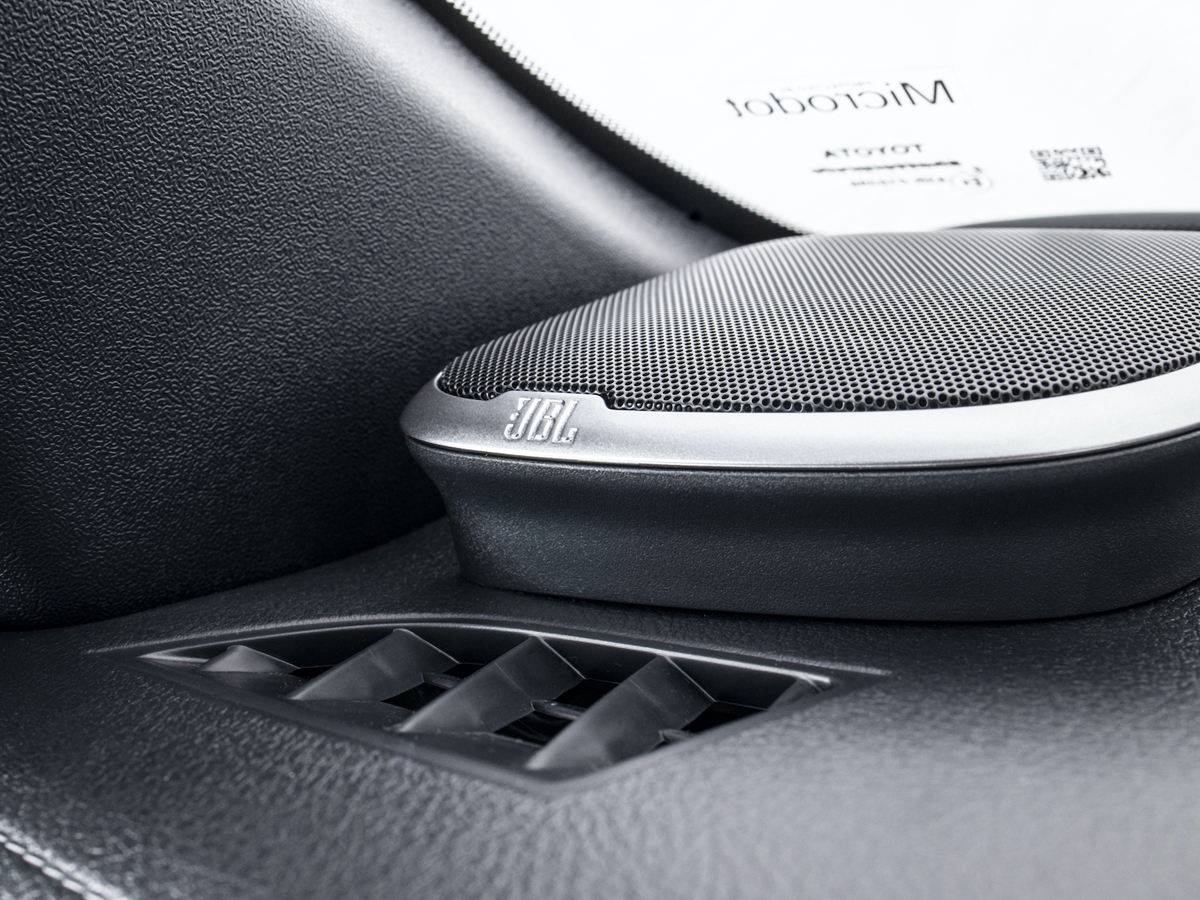
All double-cab Legend models now come with the JBL audio system.
Meanwhile, all double-cab Legend derivatives now feature the same specification level (including the 4×2 variants, which previously did without the JBL audio system). The Legend trim level thus now includes items such as a power-adjustable driver’s seat, a leather interior, the aforementioned Toyota Safety Sense system, a 9-speaker JBL premium audio system, dual-zone climate control and a smart entry system.
Any other changes worth mentioning? Well, all Raised Body models (that is, 4×2 versions of the Raider and Legend grades) with self-shifting gearboxes are now equipped with an automatic transmission temperature warning system, which reports the cog-swapper’s operation when conveying heavy loads or driving up steep terrain.
While the Hilux’s colour palette is unchanged, Toyota SA Motors says the Sand Beige hue is now available in “limited” numbers across all three body styles, with prospective buyers urged to chat to their nearest Toyota dealer for information on availability.
Check out full pricing for the range below…
How much does the Toyota Hilux cost in SA?
Petrol single cab
Hilux 2.7 VVTi RB S 5MT – R433 100
Hilux 2.0 VVTi S 5MT – R336 100
Hilux 2.0 VVTi S A/C 5MT – R346 000
Diesel single cab
Hilux 2.4 GD S 5MT – R378 900
Hilux 2.4 GD S A/C 5MT – R389 100
Hilux 2.4 GD-6 RB Raider 6MT – R506 900
Hilux 2.4 GD-6 RB Raider 6AT – R527 600
Hilux 2.4 GD-6 4×4 Raider 6MT – R583 200
Hilux 2.4 GD-6 4×4 Raider 6AT – R605 700
Hilux 2.4 GD-6 RB SR 6MT – R469 200
Hilux 2.4 GD-6 4×4 SR 6MT – R540 000
Hilux 2.8 GD-6 RB Raider 6AT – R602 400
Hilux 2.8 GD-6 4×4 Raider 6AT – R675 000
Chassis cab
Hilux 2.4 GD 5MT A/C – R364 800
Hilux 2.4 GD-6 4×4 6MT – R521 200
Xtra cab
Hilux 2.4 GD-6 RB Raider 6MT – R521 500
Hilux 2.4 GD-6 RB Raider 6AT – R542 100
Hilux 2.8 GD-6 RB Legend 6MT – R626 100
Hilux 2.8 GD-6 RB Legend 6AT – R654 000
Hilux 2.8 GD-6 4×4 Legend 6MT – R706 200
Hilux 2.8 GD-6 4×4 Legend 6AT – R734 500
Petrol double cab
Hilux 2.7 VVTi RB S 5MT – R493 600
Hilux 4.0 V6 4×4 Legend 6AT – R849 200
Diesel double cab
Hilux 2.4 GD-6 RB Raider 6MT – R567 600
Hilux 2.4 GD-6 RB Raider 6AT – R585 500
Hilux 2.4 GD-6 4×4 Raider 6MT – R655 100
Hilux 2.4 GD-6 4×4 Raider 6AT – R683 800
Hilux 2.4 GD-6 RB SR 6MT – R534 400
Hilux 2.4 GD-6 4×4 SR 6MT – R615 300
Hilux 2.8 GD-6 RB Raider 6AT – R709 000
Hilux 2.8 GD-6 4×4 Raider 6AT – R792 600
Hilux 2.8 GD-6 RB Legend 6MT – R757 300
Hilux 2.8 GD-6 RB Legend 6AT – R802 300
Hilux 2.8 GD-6 RB Legend RS 6AT – R895 000
Hilux 2.8 GD-6 4×4 GR-S 6AT – R891 400
Hilux 2.8 GD-6 4×4 Legend RS 6MT– R909 700
Hilux 2.8 GD-6 4×4 Legend RS 6AT – R945 400
Hilux 2.8 GD-6 4×4 Legend 6MT – R813 900
Hilux 2.8 GD-6 4×4 Legend 6AT – R849 600
A 3-year/100 000 km warranty and a 9-service/90 000 km service plan (with intervals of 12 months or 10 000 km) are included in the purchase price of all Hilux derivatives.
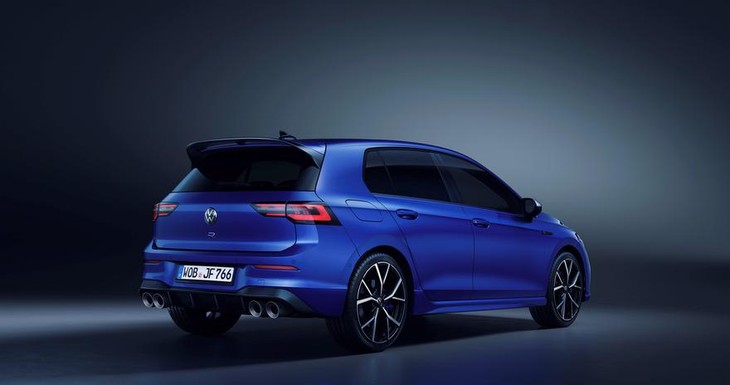
Volkswagen South Africa has confirmed price and specification details for the Golf 8 R. Here’s how much you can expect to pay for it, plus we examine the options on offer..
Covid-19-related delays, the semi-conductor shortage and the impact of Russia’s invasion of Ukraine are but some of the contributing factors that have resulted in the long wait for the Golf 8 R to reach South Africa.
The Golf 8 R was due to go on sale locally in Q3 2022, which is now, but Volkswagen South Africa has confirmed that the local launch has been further pushed out to 2023 which will undoubtedly further frustrate local Golf R fans who have been eagerly waiting to finally get their hands on Volkswagen’s latest hot hatch.
What engine will power the VW Golf 8 R?
The new VW Golf 8 R will land in SA in April 2023.
A turbocharged 2.0-litre EA 888 petrol engine will offer no less than 235 kW and 400 Nm of torque and will be paired with an updated, quick-shifting 7-speed dual-clutch transmission. The Golf 8 R is also equipped with a new 4Motion all-wheel-drive system with R-Performance Torque Vectoring which is linked to the Vehicle Dynamics Manager (VDM), electronic centre and rear differential and Adaptive Chassis Control to deliver precise and agile dynamic handling ability.
As far as performance is concerned, the Golf 8 R will take just 4.8 seconds to reach 100 kph from standstill and will go on to reach a top speed of 250 kph. Claimed fuel consumption is said to be 7.8 l/100km.
What features will be fitted as standard on the VW Golf 8 R?
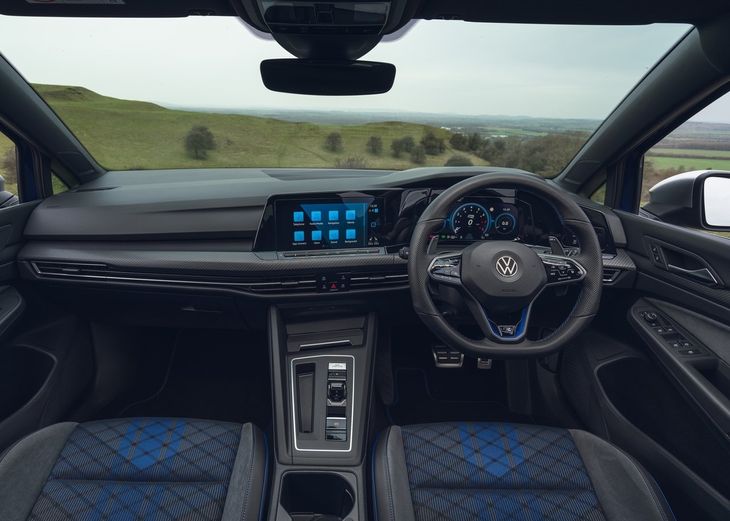
The Golf 8 R will feature the firm’s latest digital and infotainment technology.
The VW Golf 8 R will be fitted with standard features including mobile inductive charging, a panoramic sunroof, Keyless Entry with safelock, an electric tailgate and luggage compartment as well as Volkswagen’s Discover Pro infotainment system with satellite navigation, Wireless App-Connect and Voice Control. Nappa leather upholstery will also be standard along with a Light and Vision Package including high-beam control light assist.
The Golf 8 R will ride on 19-inch Estoril alloy wheels as standard and will be offered with a choice of 3 exterior colours including Pure White, Lapiz Blue Metallic and Deep Black Pearl.
Buyers will also be able to choose from a selection of optional features including IQ.Light LED Matrix Headlights (R11 000), Akrapovič Exhaust (R73 000), Head-Up Display, Harman Kardon sound system (R12 600), Parallel Park Assist, Rear Assist with a rearview camera (R5000), Blind spot monitor with Rear Traffic Alert and Lane Assist with electronically folding side mirrors (R13 700), Travel Assist with Lane Assist and Adaptive Cruise Control (R12 500), IQ.Drive Adaptive Cruise Control with Front Assist, Autonomous Emergency Braking System (R12 000) as well as the Black Performance Package with drift mode, an increased top speed of 270 km/h and black 19-inch Estoril alloy wheels (R27 400).
How much will the VW Golf 8 R cost in South Africa?
Volkswagen Golf 8 R 2.0 TSI 235 kW DSG R912 800
The new Golf 8 R will be sold with a 3 year/120 000 km warranty, 5 year/ 100 000 km EasyDrive Maintenance Plan with service intervals every 15 000 km.
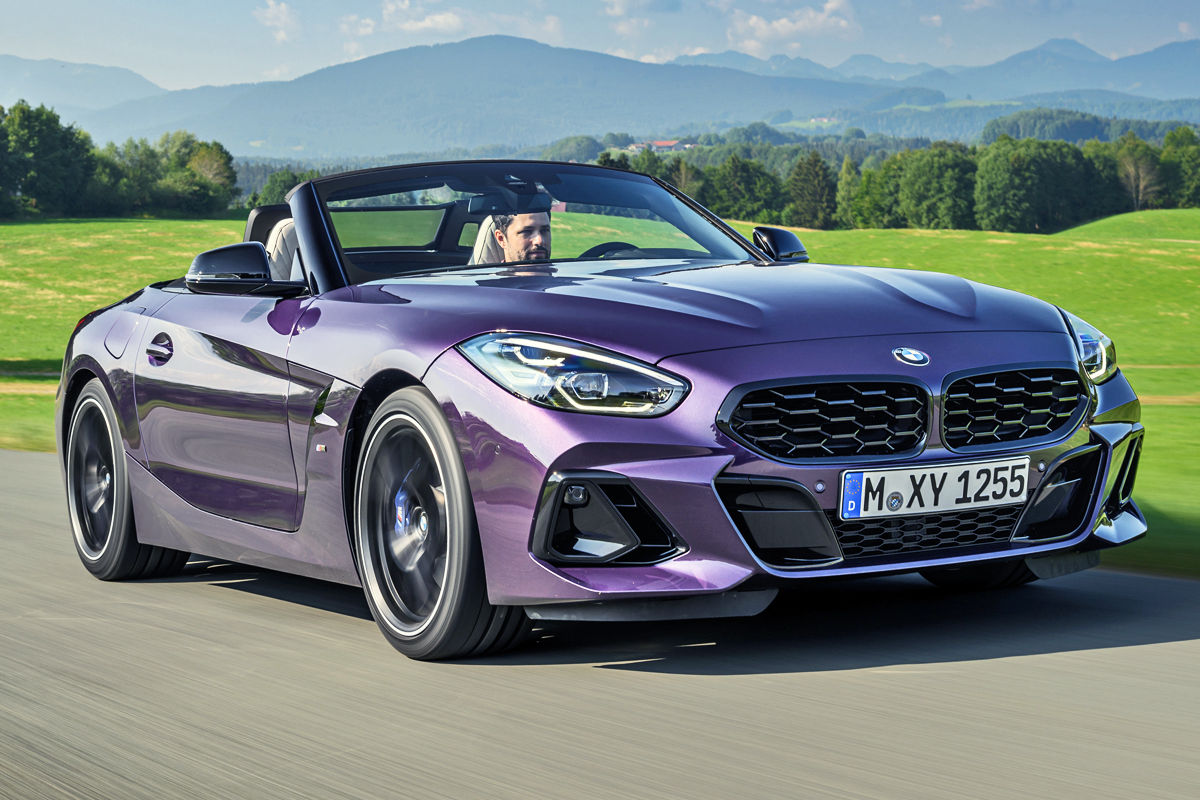
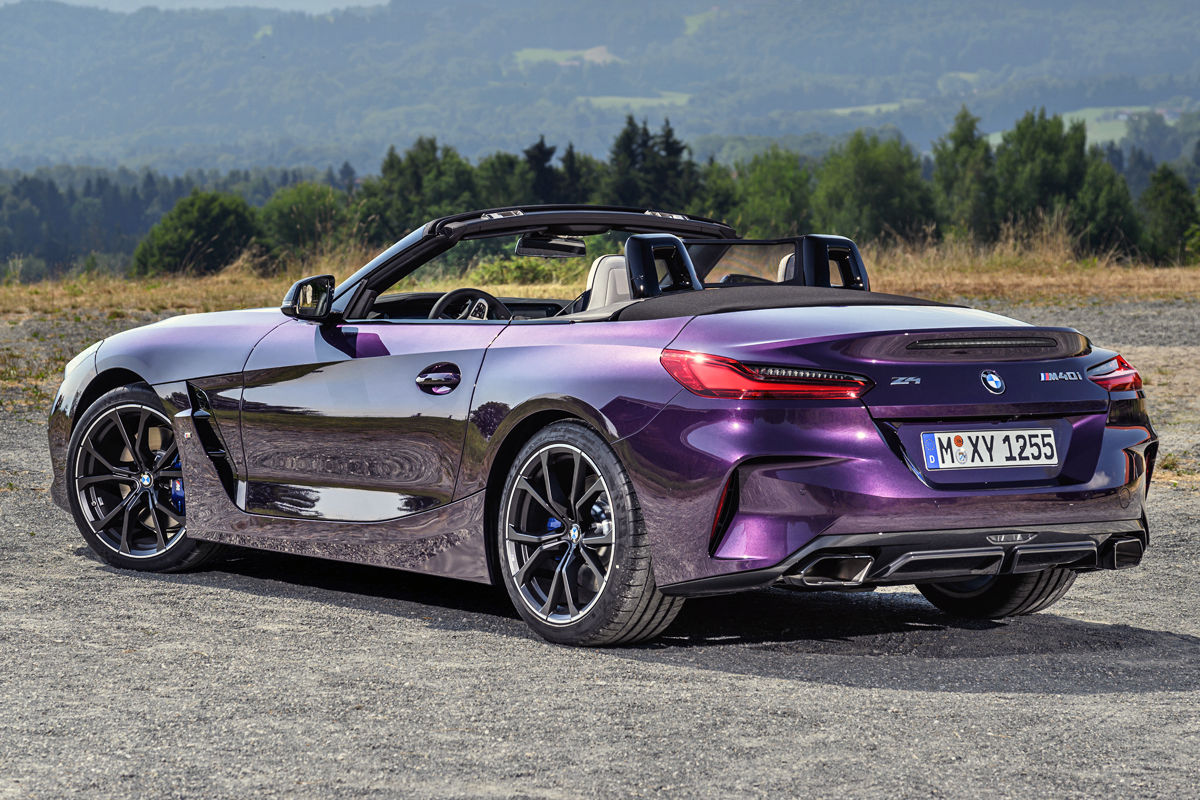
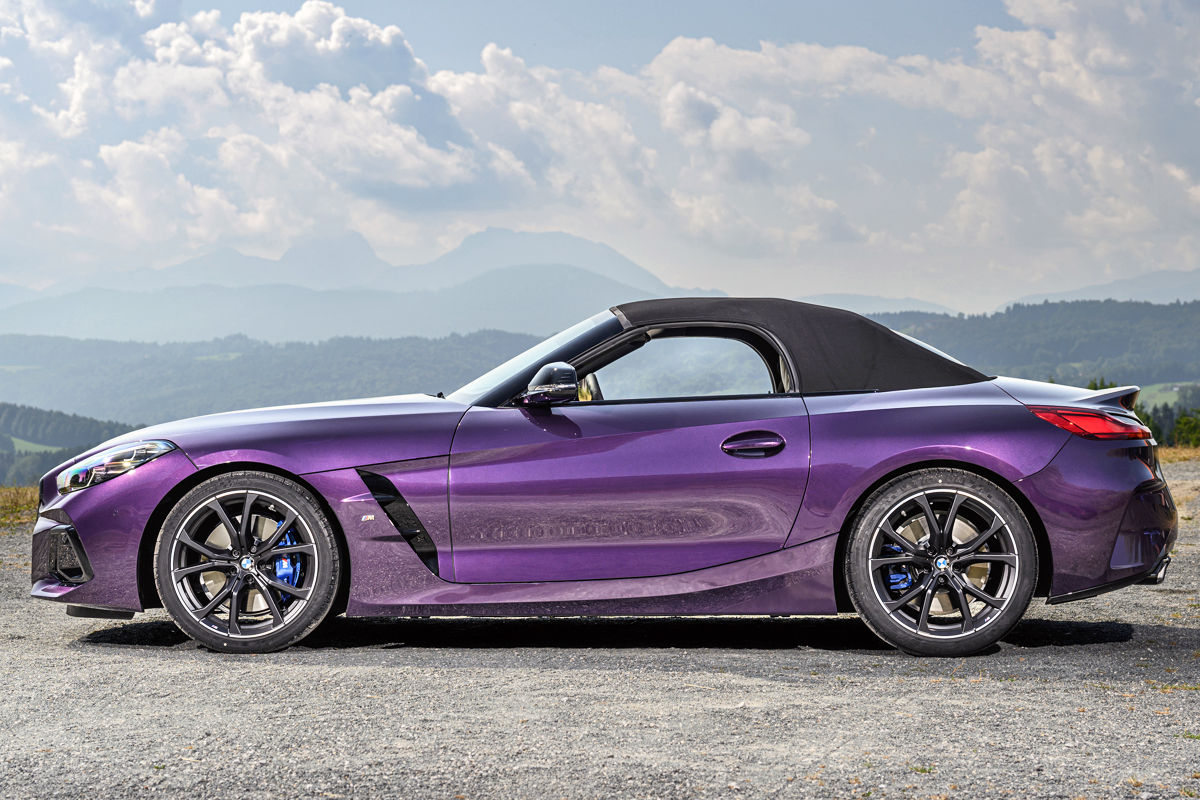
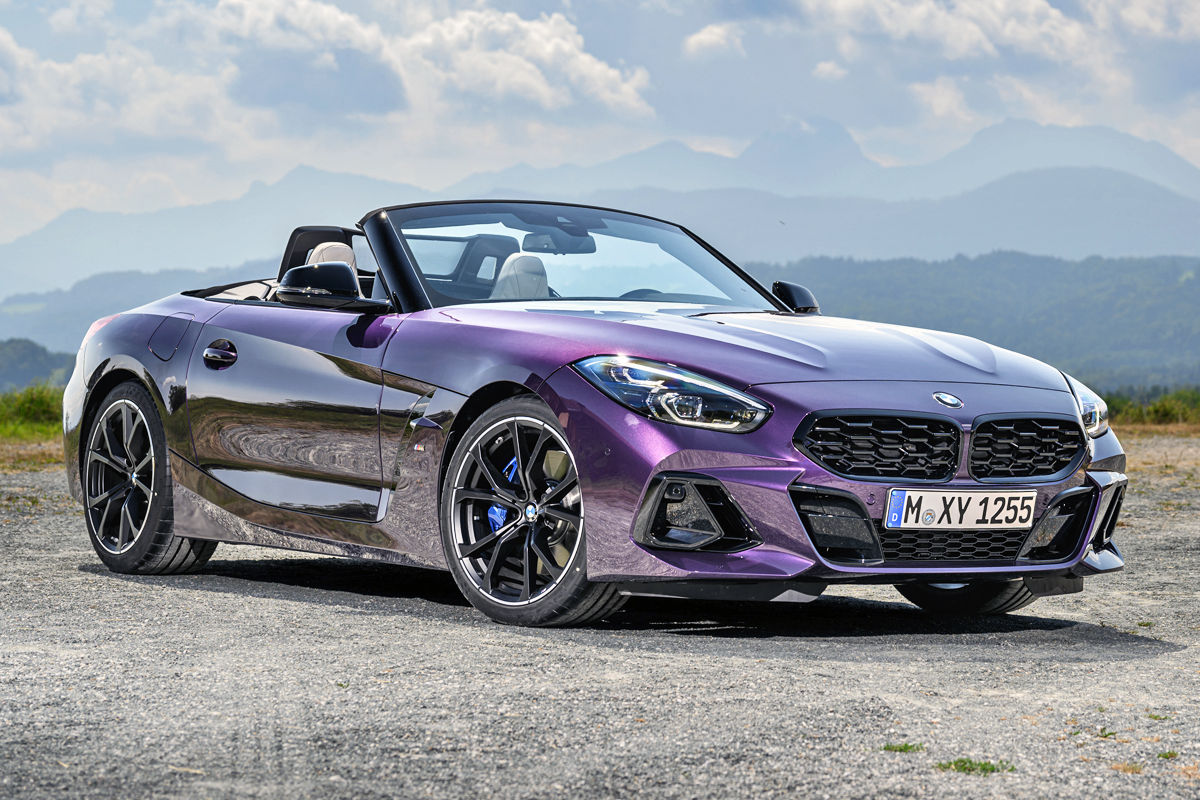
The facelifted BMW Z4 has been quietly added to the German firm’s local configurator. Here’s how much the refreshed roadster will cost you in South Africa…
Despite a great deal of uncertainty about its future, a facelifted version of the BMW Z4 is due to hit the market in South Africa shortly. How much will the refreshed roadster cost you? Well, we now know as pricing has been quietly added to the German automaker’s local configurator.
As before, the G29-generation line-up in South Africa comprises a pair of derivatives, starting with the Z4 sDrive20i. This base model employs an unchanged turbocharged 2.0-litre, 4-cylinder petrol unit, which still sends 145 kW and 320 Nm to the rear rubber via an 8-speed automatic transmission. That’s enough for a claimed 0-100 kph sprint in 6.6 seconds and a maximum speed of 240 kph.
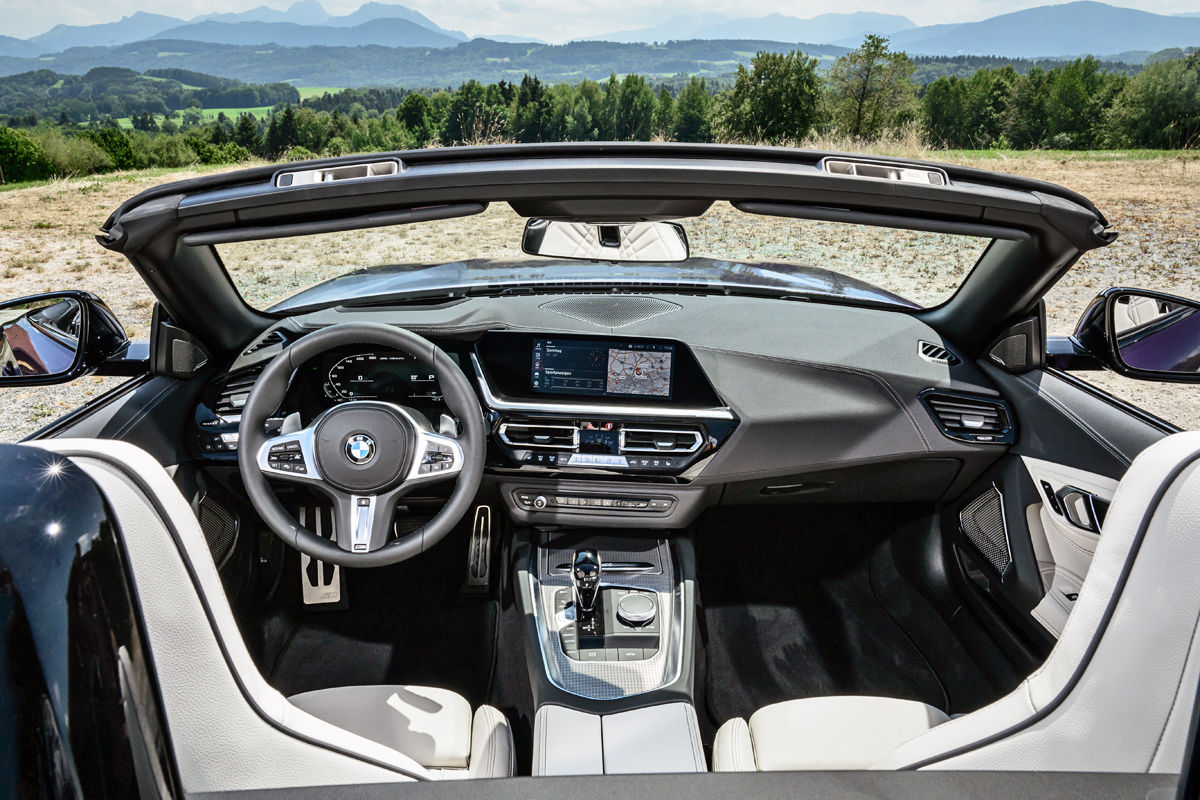
The Z4 sDrive20i starts at R963 645 and now ships standard with the M Sport package (the Sport Line option is no more), which includes items such as Vernasca leather upholstery, M sport seats, a leather-trimmed M steering wheel, M sports suspension and the BMW Individual high-gloss Shadow Line package.
Then there’s the flagship Z4 M40i, which now kicks off at R1 286 537. Thankfully, the twin-turbo 3.0-litre, straight-6 petrol engine (which likewise drives the rear axle through an 8-speed automatic) has retained its peak outputs of 285 kW and 500 Nm, despite European-spec versions being detuned to 250 kW. The M Performance model will thus hit 100 kph from standstill in an unchanged 4.1 seconds, according to BMW, before topping out at 250 kph.
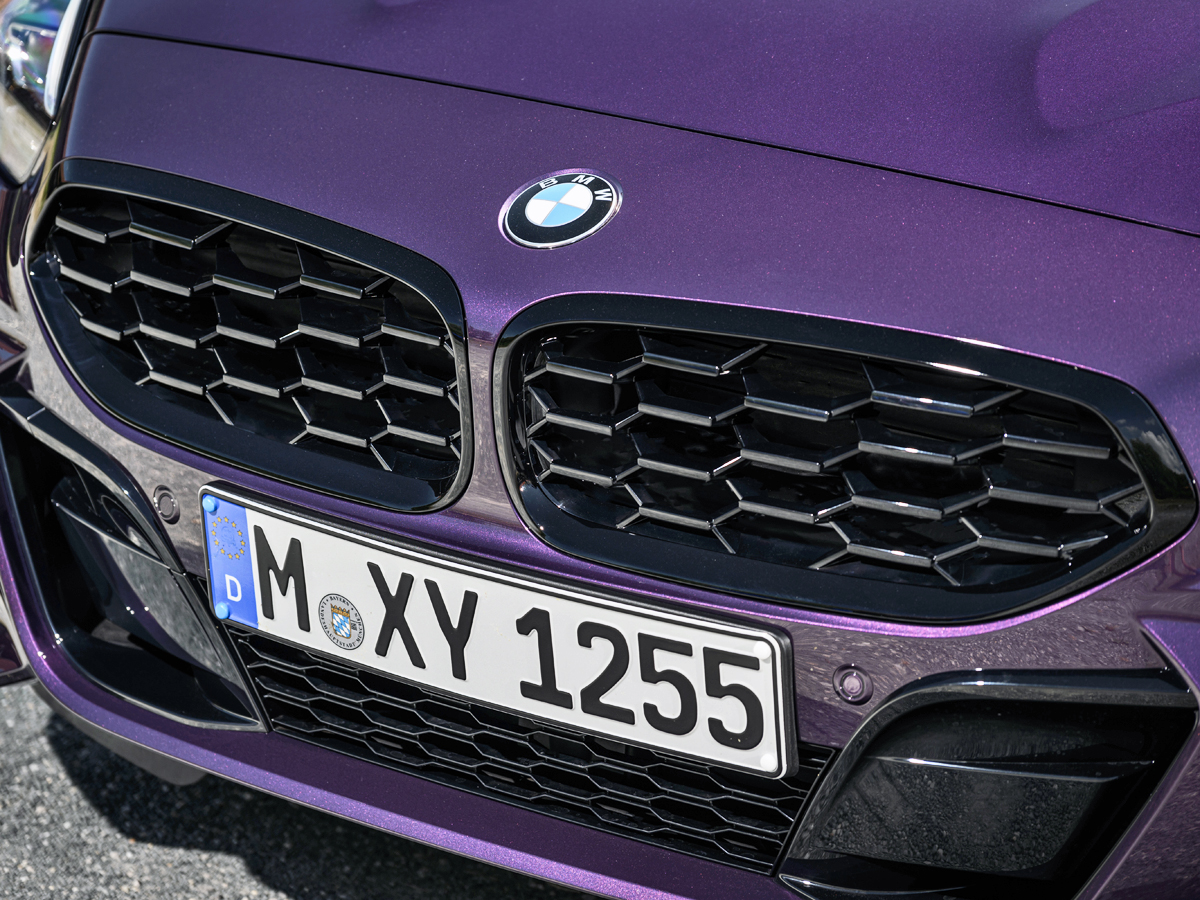
The Z4 roadster’s redesigned kidney grilles gain a horizontal inner structure.
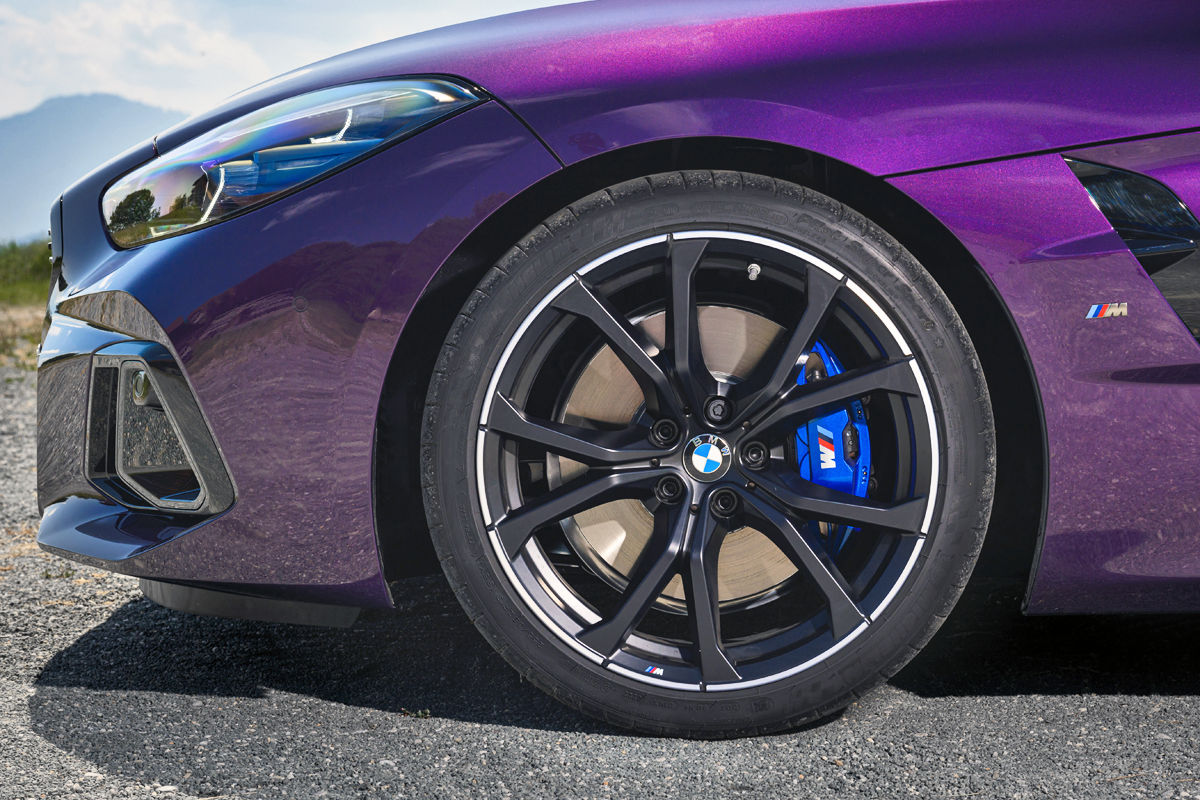
Buyers can upgrade from the sDrive20i’s now-standard and redesigned 18-inch alloy wheels to 19-inch versions (paying up to R20 300, a figure that drops to R5 000 in the case of the M40i). Other paid extras include an Anthracite Silver effect for the soft-top (R4 100), Adaptive LED headlamps (R20 000), a head-up display (R18 700), tyre-pressure monitoring (R5 000) and Frozen Grey II Metallic paint (R54 500).
The sDrive20i can additionally be fitted with items such as M Sport brakes (R10 500) and adaptive M suspension (R9 900), which ship standard on the M40i.
Styling changes are led by a redesigned grille (the kidneys now adopt a horizontal inner structure) and revised side air intakes. New exterior paint colours (Thundernight metallic, Portimao Blue metallic and Skyscraper Grey metallic) have also been added.
As a reminder, the 3rd-generation Z4 has been on the global market since 2018 and is built by Magna Steyr in Graz, Austria. The German roadster shares its underpinnings with the A90-gen Toyota GR Supra.
How much does the facelifted BMW Z4 cost in SA?
BMW Z4 sDrive20i – R963 645
BMW Z4 M40i – R1 286 537
The above prices each include a 2-year/unlimited kilometre warranty and 5-year/100 000 km Motorplan, though BMW Group SA says the buyer “may elect to opt out” of the latter at the point of purchase of the new vehicle.