New Lamborghini Urus S Unveiled with Performante Power
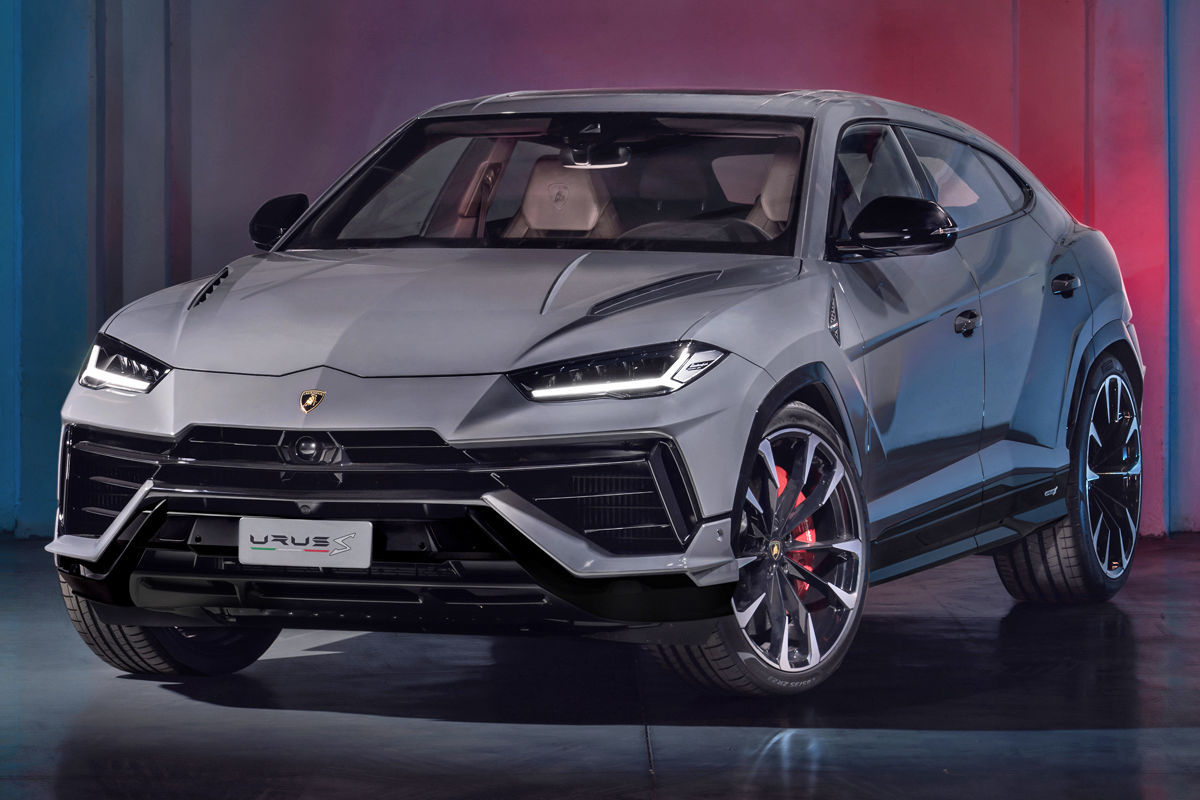
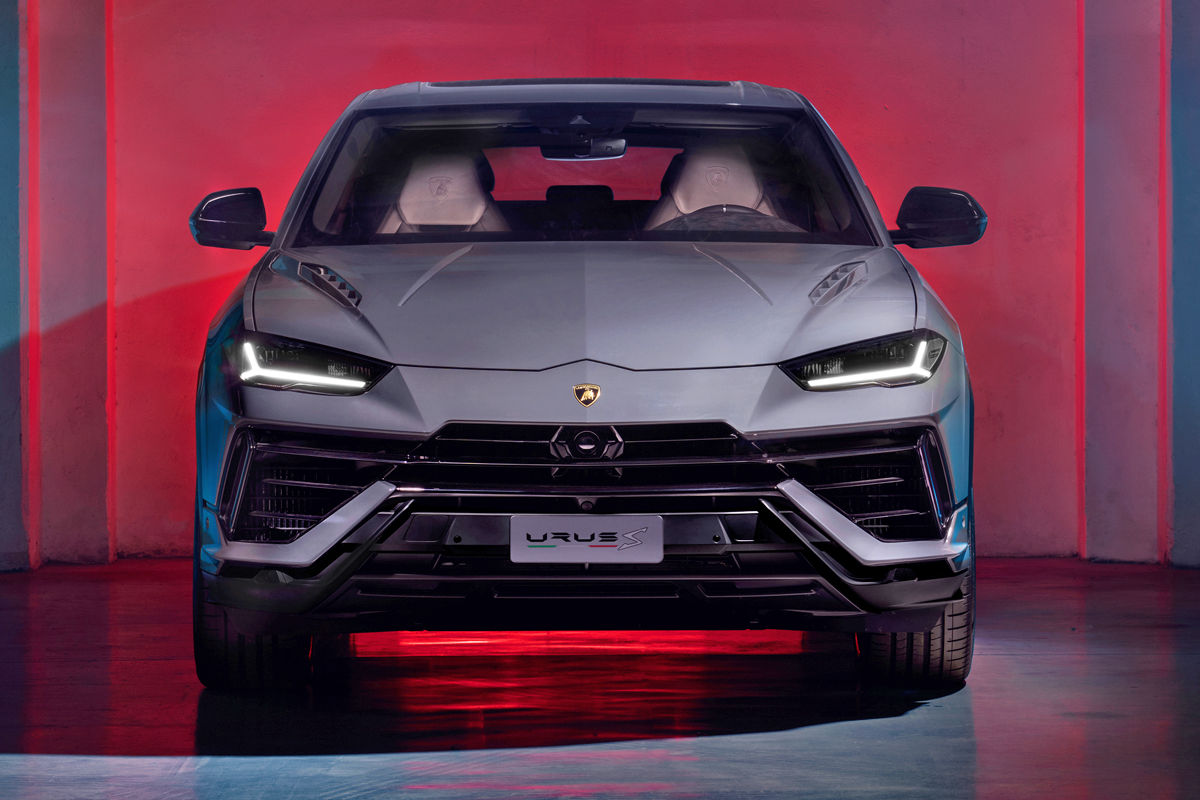
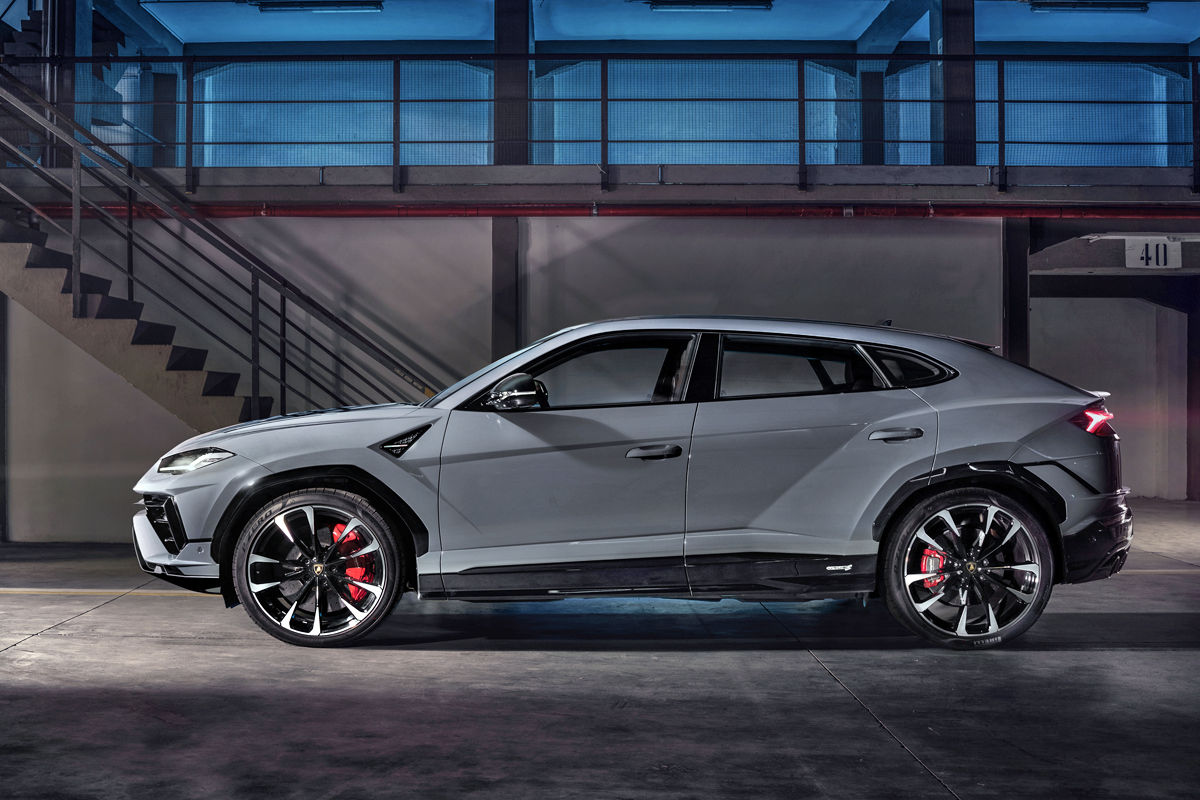
Lamborghini has unleashed the new Urus S, which matches its Performante sibling on power (but weighs a little more) and sports slightly less extreme exterior styling…
When Lamborghini unwrapped the refreshed Urus in August 2022, it detailed only the Performante derivative. Now, a new Urus S variant has been unleashed, with the same peak power and torque figures as the Performante.
That means the twin-turbo 4.0-litre V8 petrol engine in the Urus S generates 490 kW and 850 Nm, outputs that are delivered to all four corners through an 8-speed automatic transmission. However, since the latest version doesn’t benefit from various of the Performante’s weight-saving measures (the Urus S has a listed kerb weight of 2 197 kg, which is 47 kg more), it’s a touch tardier to three figures.
Still, the claimed 0-100 kph time of 3.5 seconds (two-tenths down on the Performante) is hardly pedestrian. The 200 kph mark is reached in a claimed 12.5 seconds, while top speed is listed as a heady 305 kph (a mere unit behind the lighter version). Lamborghini says the exhaust system, meanwhile, has gained a “more distinct sound at start-up and a sharper note in each drive mode”.
Since it employs the same powertrain calibration as the Performante, the Urus S delivers what the Italian firm describes as “optimum responsiveness and performance when required, alongside luxurious everyday driving pleasure”.
How else does the Urus S differ from its Performante sibling?
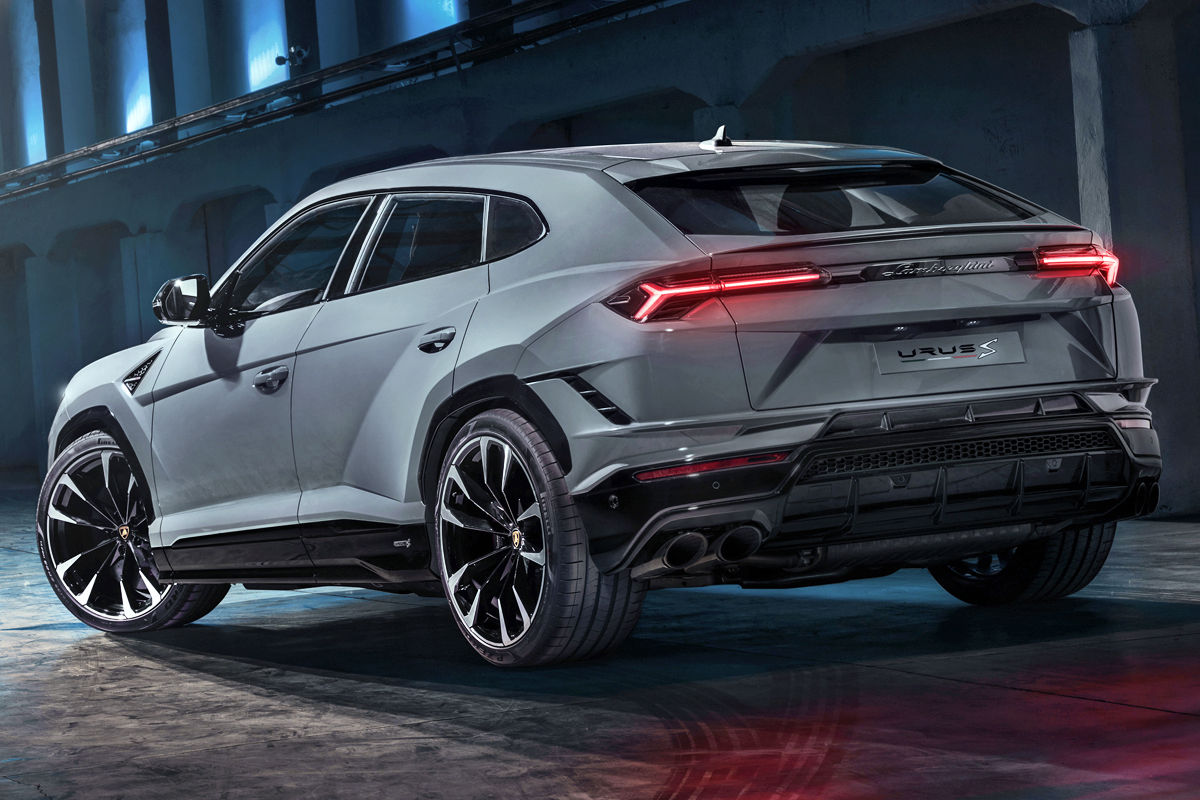
Where the Urus S does differ is in its exterior styling, which is a little less extreme. For instance, the newcomer gains a fresh front-bumper design (incorporating a matte-black stainless steel skidplate as standard). The new carbon-fibre painted bonnet, meanwhile, comes with matte-black air vents, with optional finishes to the vents in gloss black, body colour or carbon fibre. There’s also an optional exposed carbon-fibre roof available.
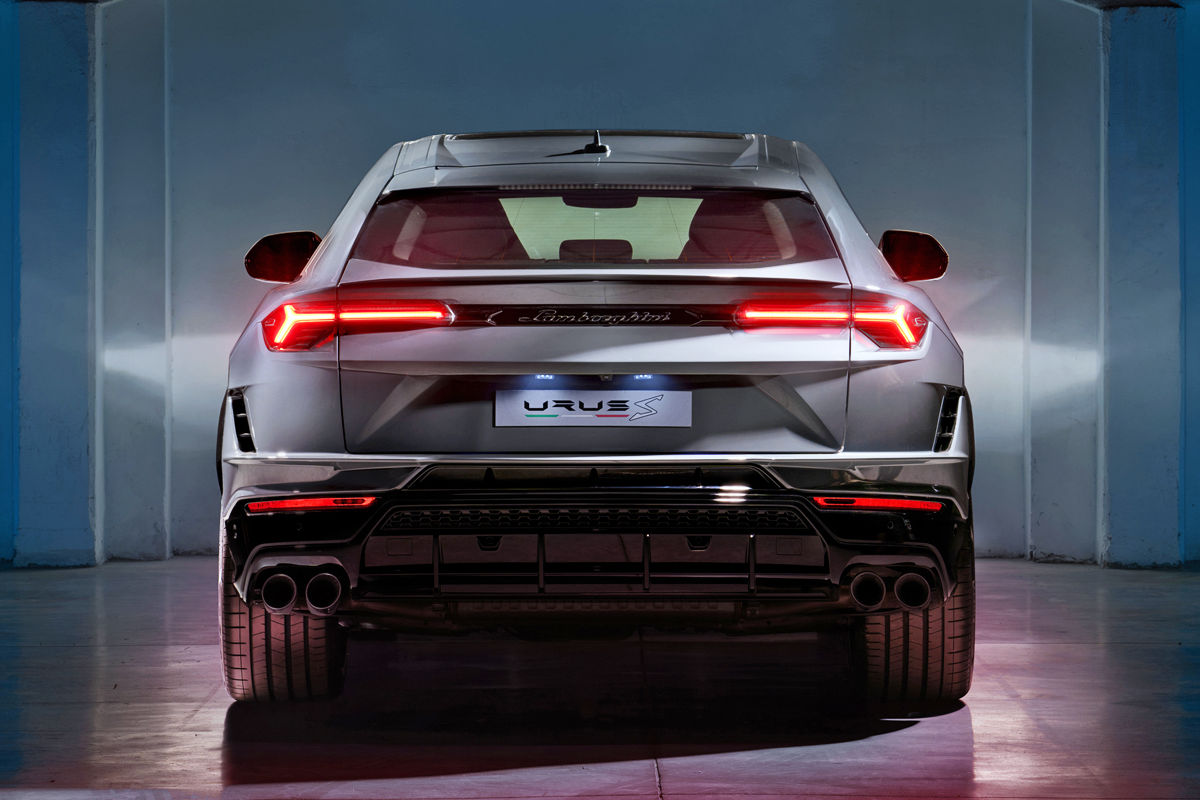
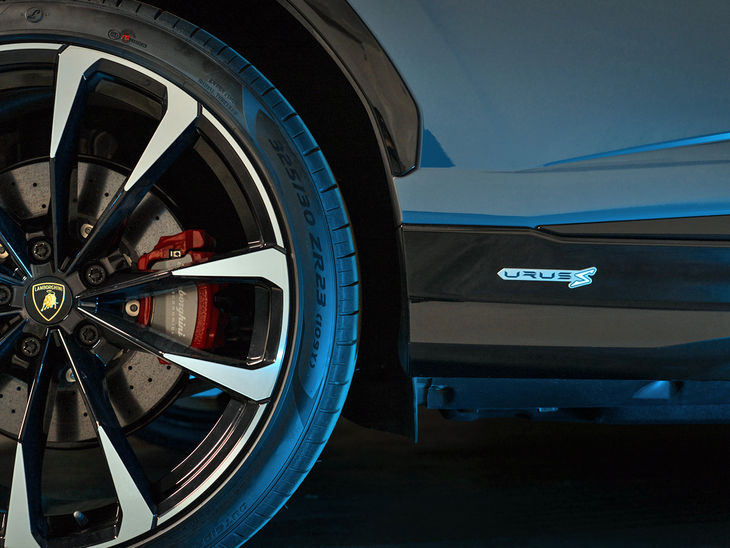
Revised rear-bumper styling includes a matte-black-painted lower section with a fresh twin-pipe exhaust design in brushed steel as standard (or various other optional finishes). New alloy wheel options are also offered alongside the standard 21-inch items, including 22-inch Nath rims (titanium matte with a diamond polish finish) and 23-inch Taigete wheels (bronze with a diamond polish finish).
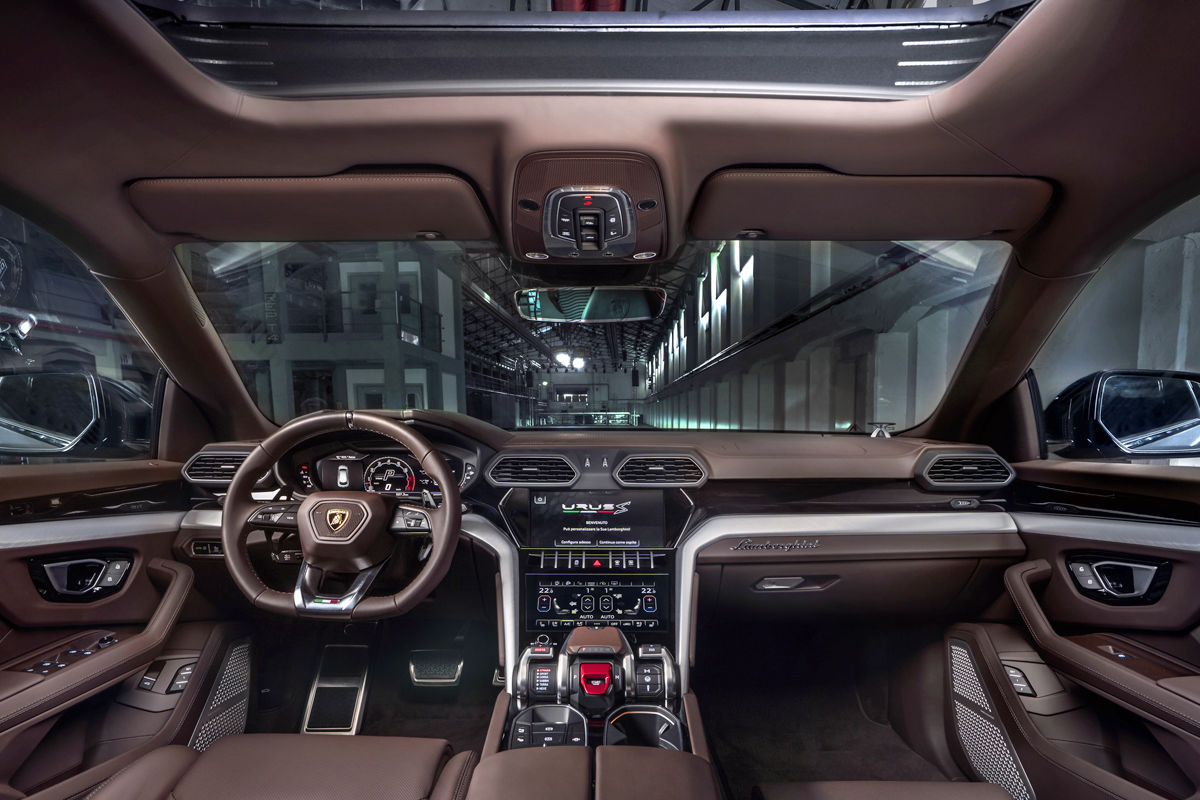
The Sant’Agata Bolognese-based automaker furthermore offers five style configuration options, each featuring unique combinations of body paint colour, black trim and carbon-fibre components (in shiny or matte finishes). Inside, the Urus S gains a “fully revised” colour and trim offering.
“The Urus has proven its appeal for those seeking the decisive combination of the sportiest SUV and a Lamborghini to drive every day: the Urus S sits perfectly alongside the new Urus Performante, for those choosing the purest sublimation of performance, luxury and versatility,” says Stephan Winkelmann, Chairman and CEO of Automobili Lamborghini.
“The Urus’ commercial success, with more than 20 000 vehicles produced, is testament to its credentials as the first and enduring Super SUV: the Urus S elevates that reputation.”
Hyundai Staria Multicab (2022) Review
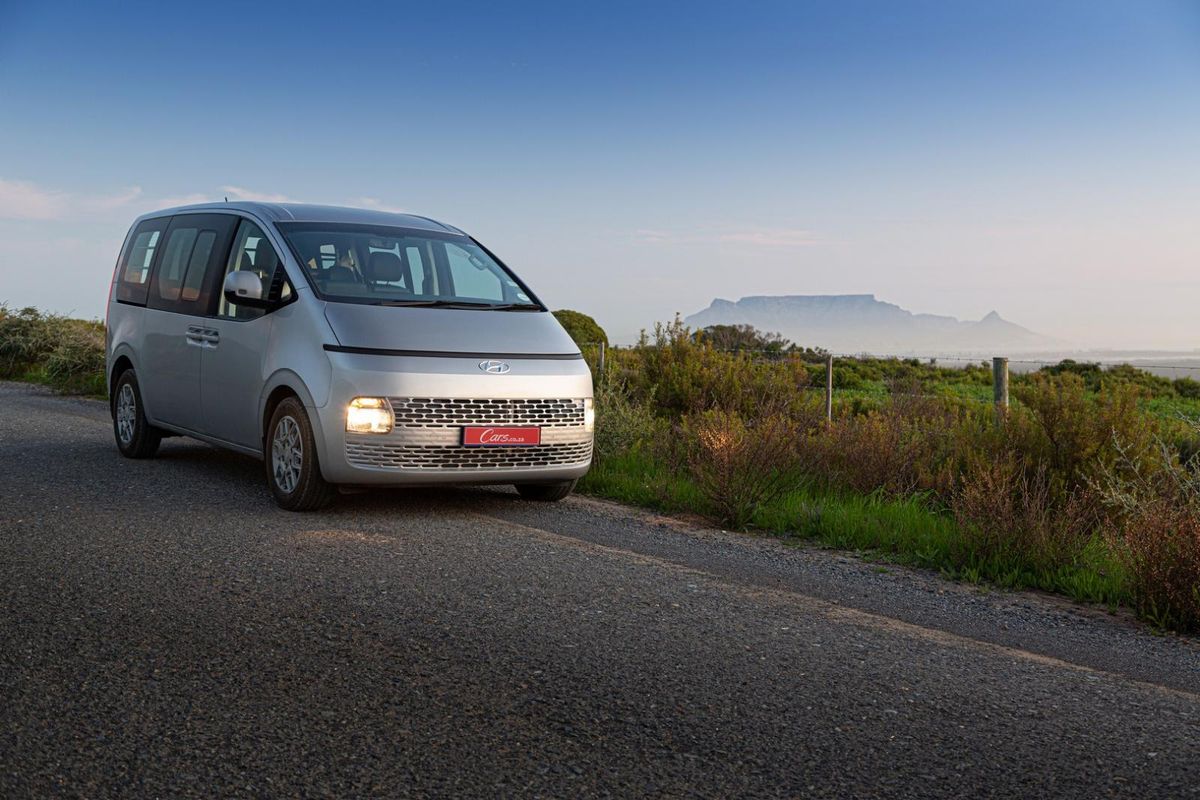
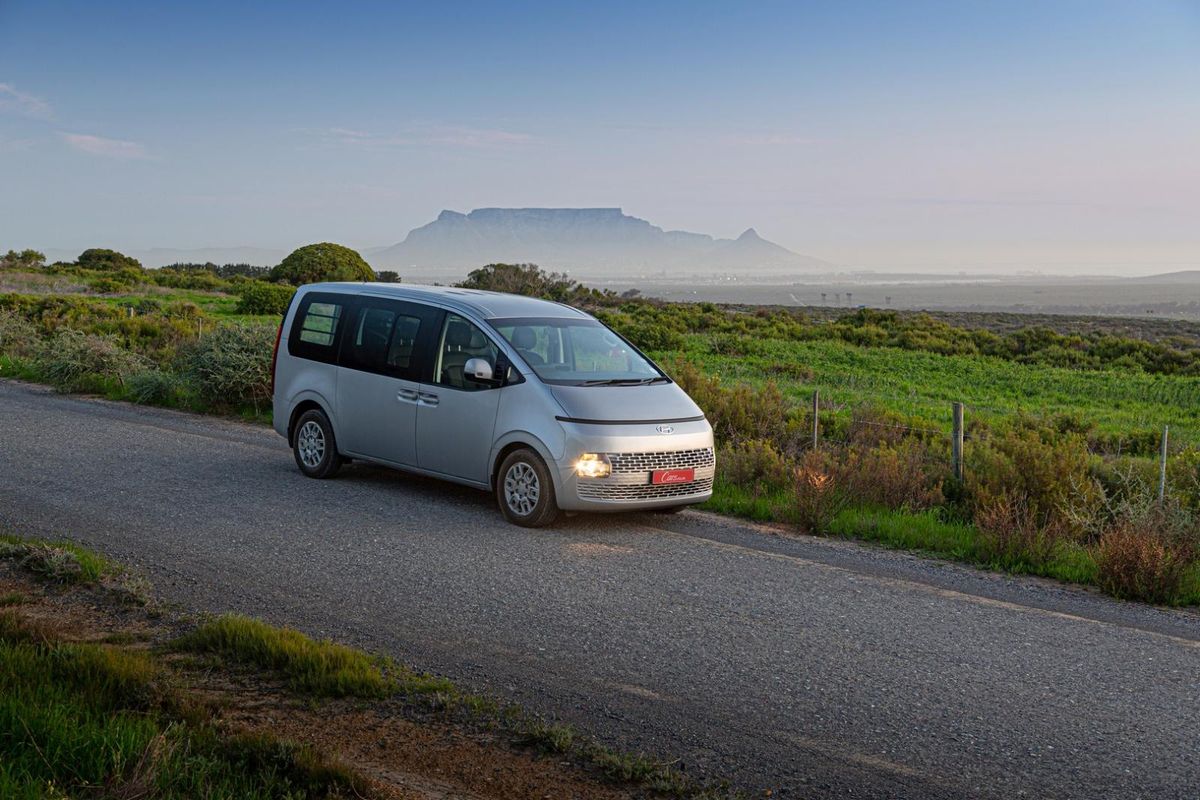
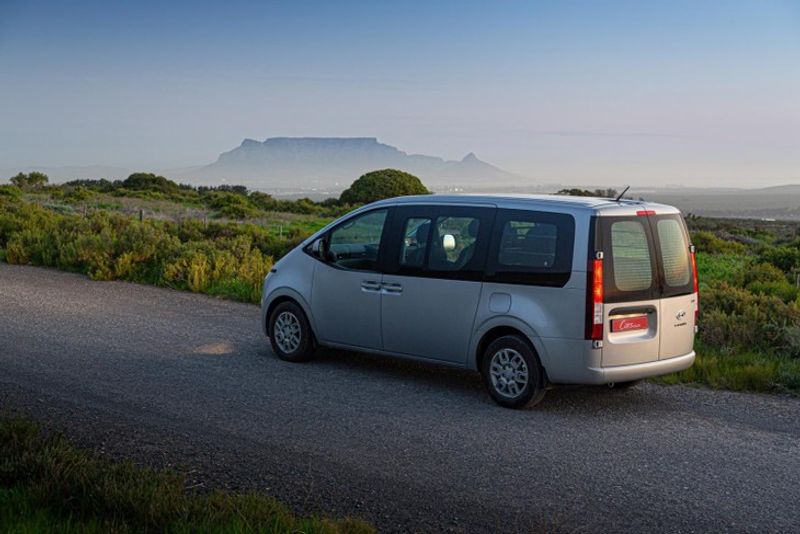
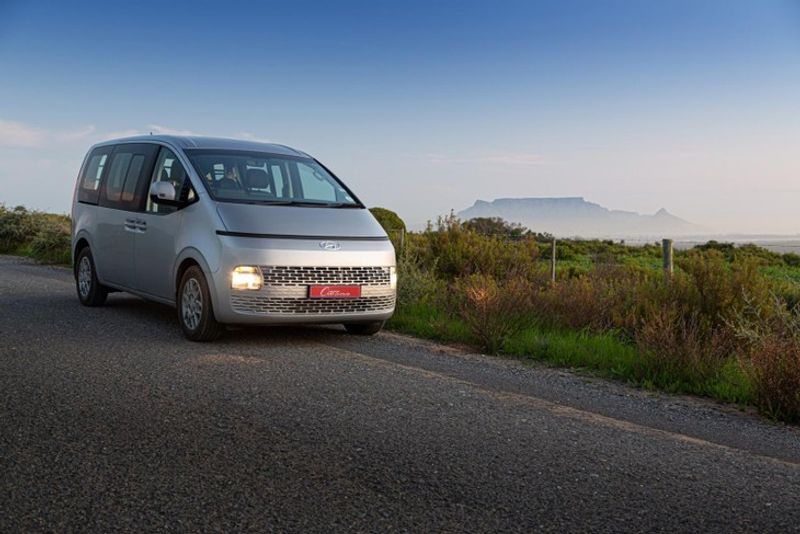
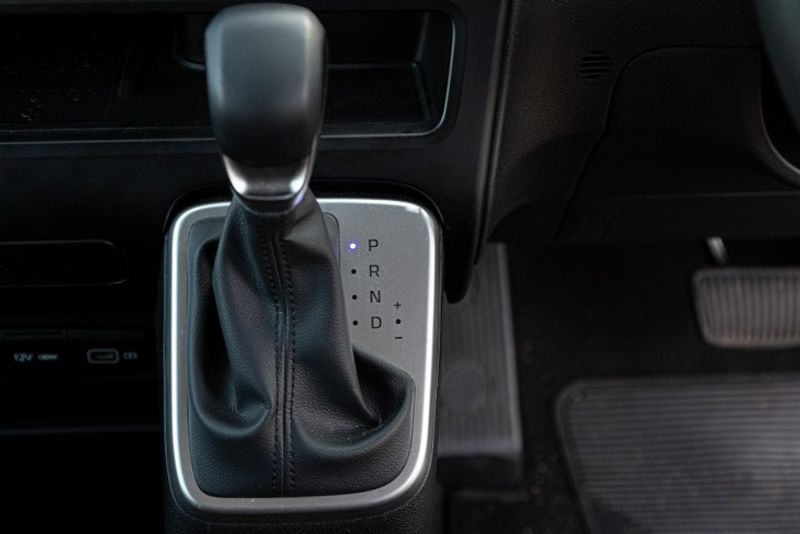
It may look like a vehicle that was procured from the set of a science-fiction movie, but Hyundai’s futuristically styled MPV – the Staria – has proved a revelation. As the model finds success in the local market, new derivatives are being introduced to the line-up – and the Multicab might just be one of the most practical family cars on the market.
We like: Practicality of a 5-seater family car and a panel van. Modern infotainment and tech.
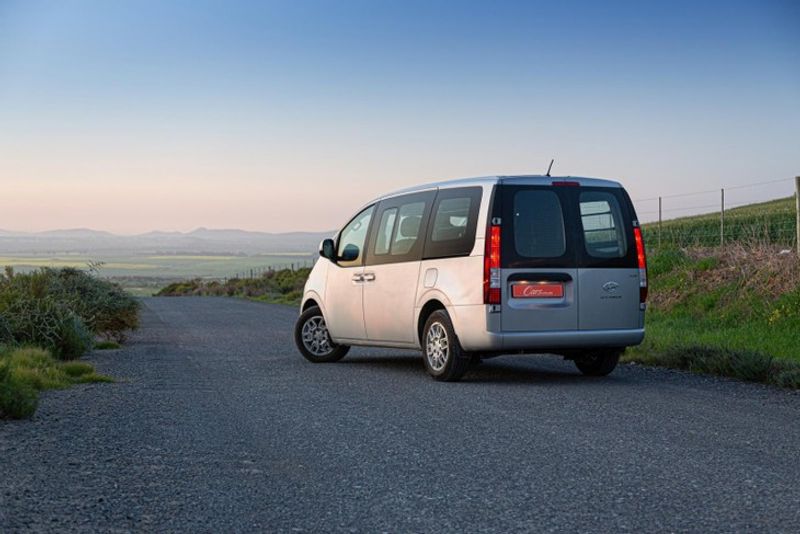
The Staria Multicab combines a family car and panel van into one.
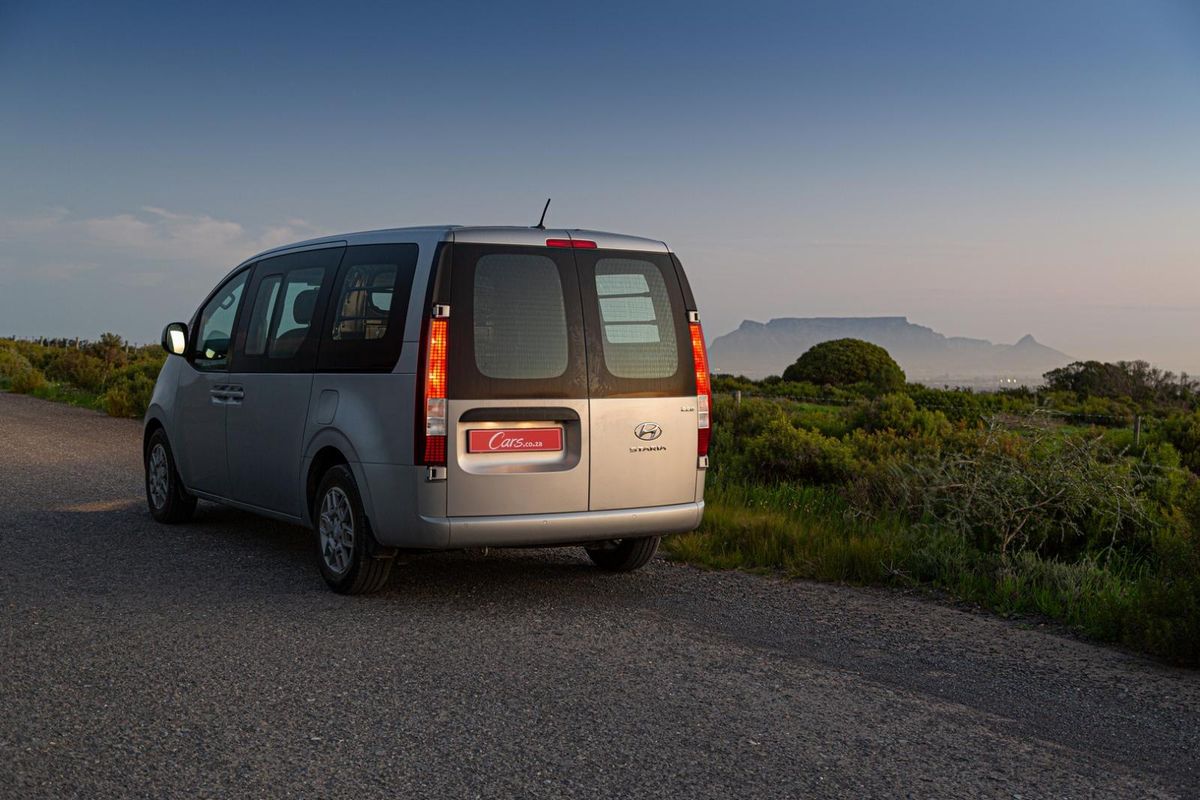
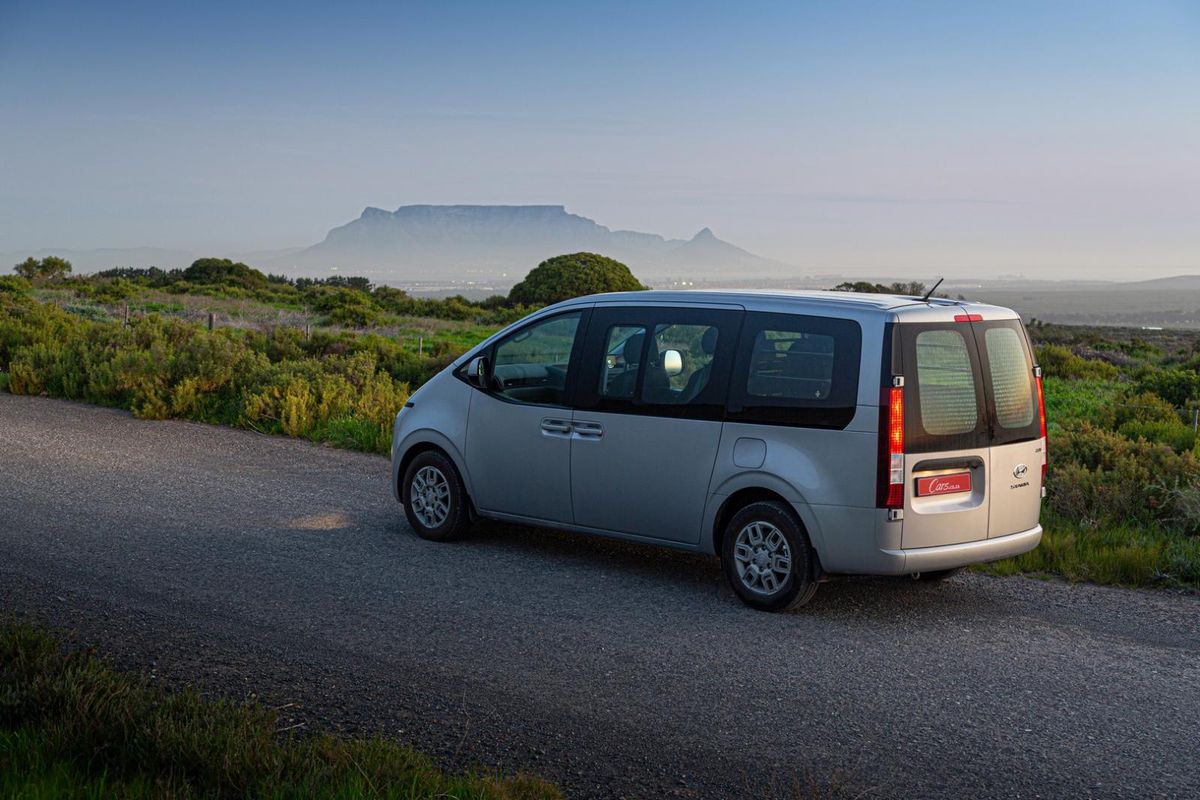
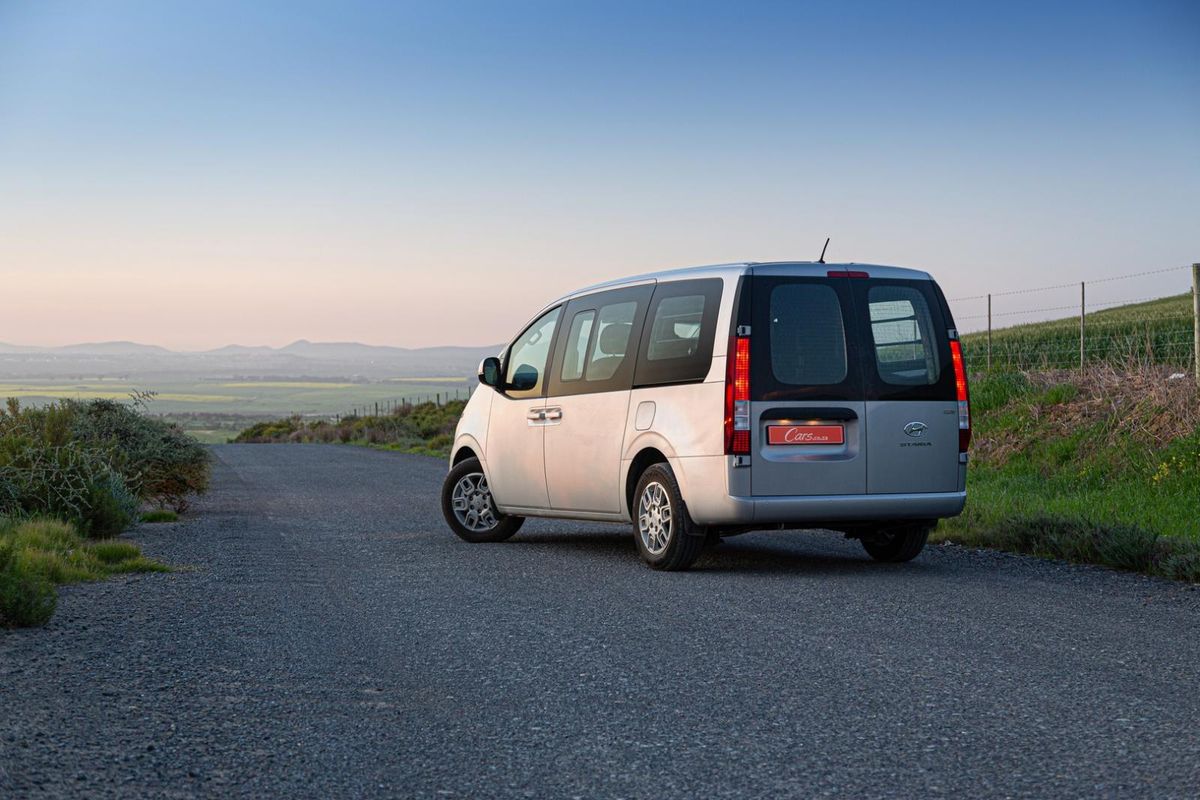
Upon its South African introduction in late 2021, the Hyundai Staria replaced the long-serving H1 model. With all due respect to the H1, it was an all-too-conventional shuttle for people (or goods) that lacked the design flair or mod cons to genuinely attract buyers of large family cars. The Staria looks interesting in a way that it combines elements of a Dalek (a robot-like creature from the Dr Who series), the lighting from a fibre router and, at the rear, one of those fancy gas-fire contraptions that outdoor restaurants use in winter. I doubt those influences featured on the Staria design team’s mood board, but they do stimulate discussion… van drivers aren’t accustomed to commenting on the shapes of their vehicles.
The Hyundai Staria 2.2D Multicab combines 5 seats (2 up front and 3 in the rear) with an enclosed panel-van load bay behind the rear passengers. If you think about it, it’s an ideal combination – you get the comfort of a family car up front and then nearly 3 000 litres of load space at that back (in the panel-van section). In terms of value, it’s a veritable bargain at R770k, at least when compared to your traditional SUV options. Surely there must be a catch? Well, let’s find out…
How the Staria Multicab fares in terms of…
Practicality
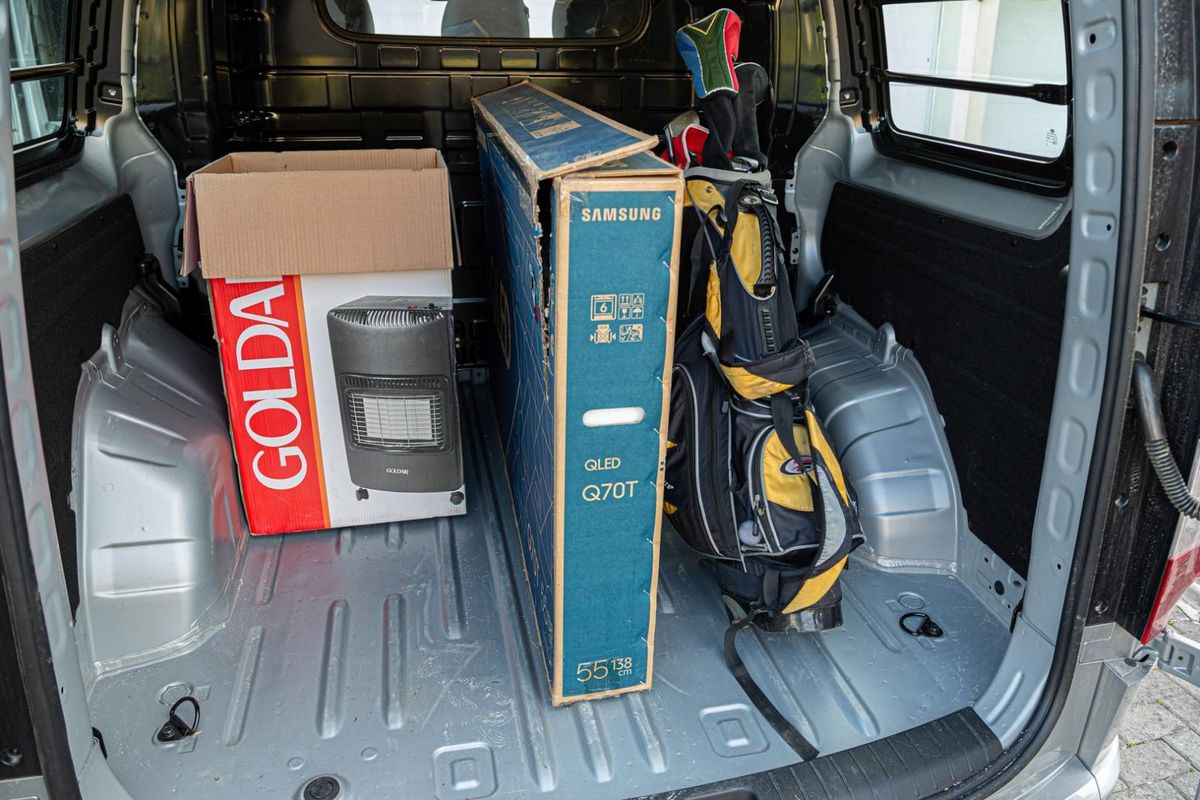
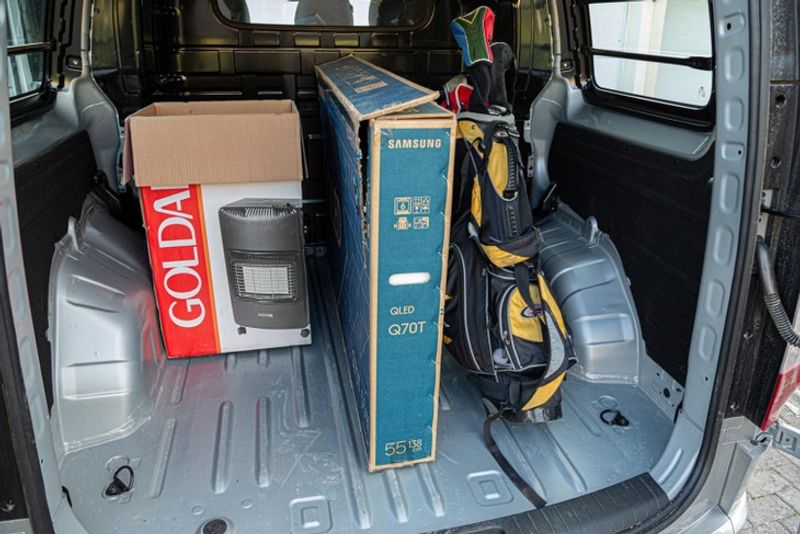
You can stack the load bay until to your heart’s content. The Staria has a humungous load bay.
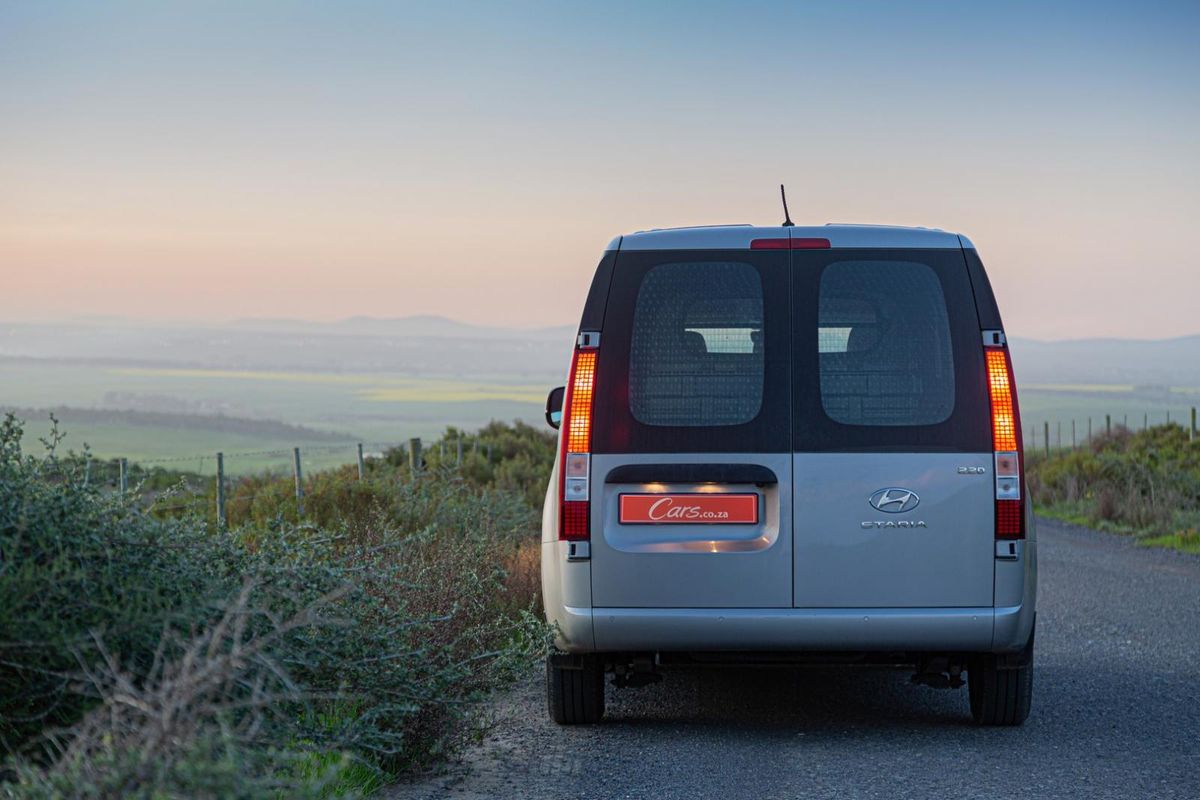
It’s difficult to accurately describe just how practical it is to have a panel-van section at the back of your family car. There’s a lot of peace of mind in having a completely enclosed loading area that can be locked and isn’t exposed to prying eyes. The sill is nice and low, which makes it easy to load heavy items into the bay; it also enables you to stack things up until you reach the height of the roof. In fact, there’s so much room in the load bay you may pack things you don’t really need.
We used the Staria 2.2D Multicab to take a week-long trip to the Overberg. Usually, a mountain bike comes along for the ride (ahem!), as well as your usual holiday gear and assorted detritus, but this time the road bike was loaded up too, well, because it also fits in the back, as well as an indoor cycling trainer, a fan, some golf clubs and all the usual luggage, for 4 people. The separate load bay also means you can throw dirty items in the back without having to worry about the leather upholstery getting covered in dust or grime. To give you more examples, the load-bay keeps sand, from surfboards and wetsuits, or mud, from mountain bikes, out of the passenger space – and the space can easily be cleaned later.
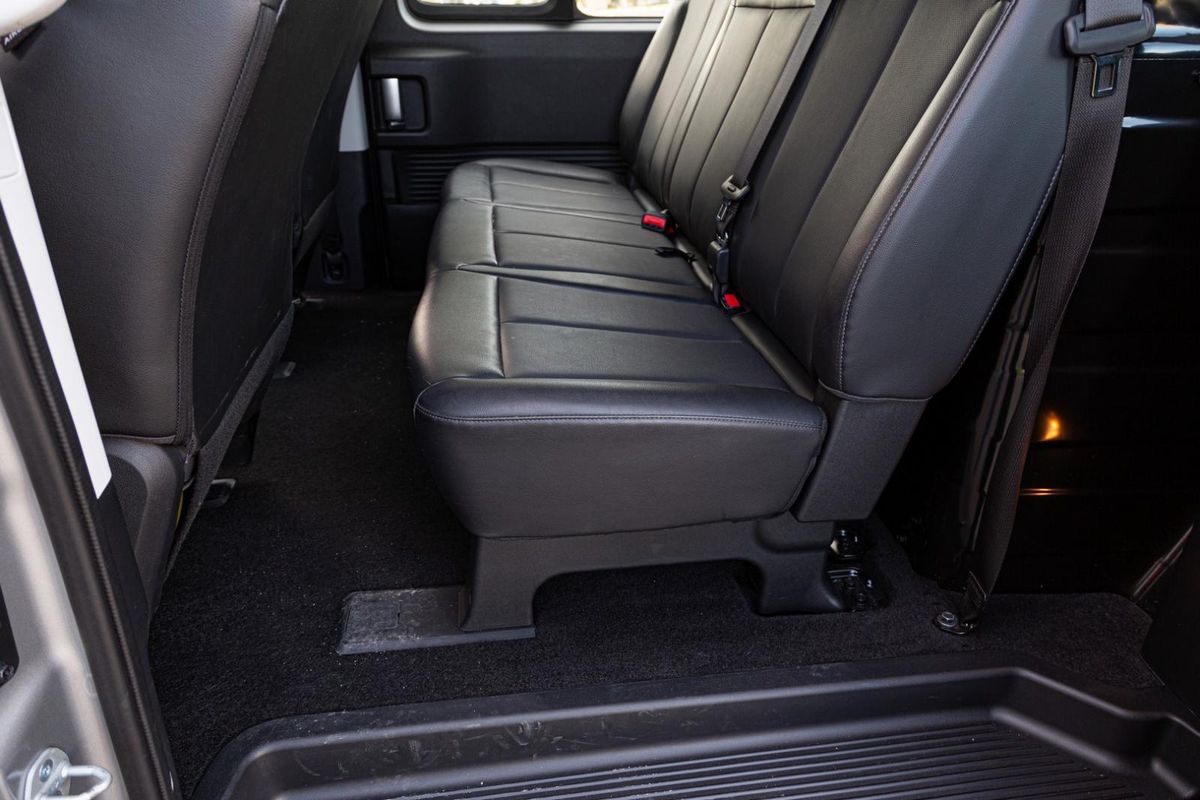
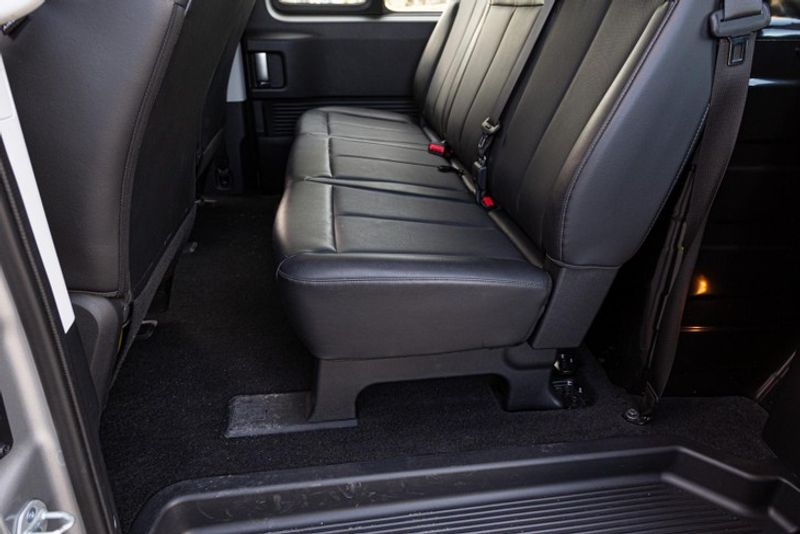
Rear passengers have plenty of space, even with the front seats in their rear-most settings.
Besides the obvious benefits of the panel-van section, passengers have plenty of room in the rear and the sliding doors open on both sides of the Staria Multicab. The doors are easy 1-touch open and close, which eliminates the hassle of having to heave them closed when the MPV is parked on an incline. They aren’t electrically-operated doors per se, but there is an assist function that makes sliding them closed much easier.
The rear passengers are closed off from the load-bay area creating a passenger “bubble” that does a good job of muffling the noise you get from the floor of the panel van (amplified road noise and the literal echo-chamber effect you usually encounter in a panel van). This seating configuration does mean that the rear seats don’t recline – their backs are quite upright – but there weren’t many complaints from aft passengers, even after they’d spent 2 hours sitting on the bench.
The Staria isn’t an SUV, but it drives better than most other vans.
Considering that the Staria is a light commercial vehicle at its core, it’s quite good to drive. It doesn’t exhibit as much body roll as others models in the segment and it rides out bumps – and other road imperfections – relatively well. There is a little bit of crashiness to the suspension when the Multicab traverses bigger bumps, but you don’t get that floaty/boaty feeling that seems so characteristic of very long wheelbase vehicles.
The steering is on the lighter side, but provides enough feedback that you can easily place the Staria and keep it centred in its lane. With vans, you can often feel like you’re driving in a ‘90s sitcom, which is to say constantly sawing at the ‘wheel to correct the van as it gets buffeted/crabs across the road. The Staria feels more planted and straight-tracked in that regard. It’s far more car-like to drive than almost any other van (this side of a pricey Mercedes-Benz V-Class).
The seating position is still cab-forward like in a van, so there’s no hiding the fact that you’re driving an MPV – not an SUV. It’s also particularly difficult to park in a regular parking space so you tend to have to look at the outer limits of a parking lot to find an easier spot to, um, dock. That said, the reverse camera is high-res and helpful enough to manoeuvre the Staria with some ease. It’s a must-have feature, considering you don’t get a view out of the rear of the Staria Multicab.
Performance and economy
The Staria makes use of the same engine and transmission as the Hyundai Santa Fe, but with different outputs.
We’ve gained a lot of experience with the 2.2-litre turbodiesel Hyundai/Kia motor throughout the past few years. The engine is used in many of Hyundai’s SUVs and is usually up to the task, well, to a lesser extent in the gargantuan Palisade.
In this format, the 2.2 litre produces 130 kW and 430 Nm of torque and we found the Multicab’s performance more than adequate on the freeway. Even when fully loaded, the MPV can maintain the national speed limit with little difficulty, with surfeit torque available if you need to execute overtaking manoeuvres. Around town, it’s got enough “get up and go” to keep up with traffic, while the well-calibrated auto ‘box facilitates a smooth and comfortable driving experience.
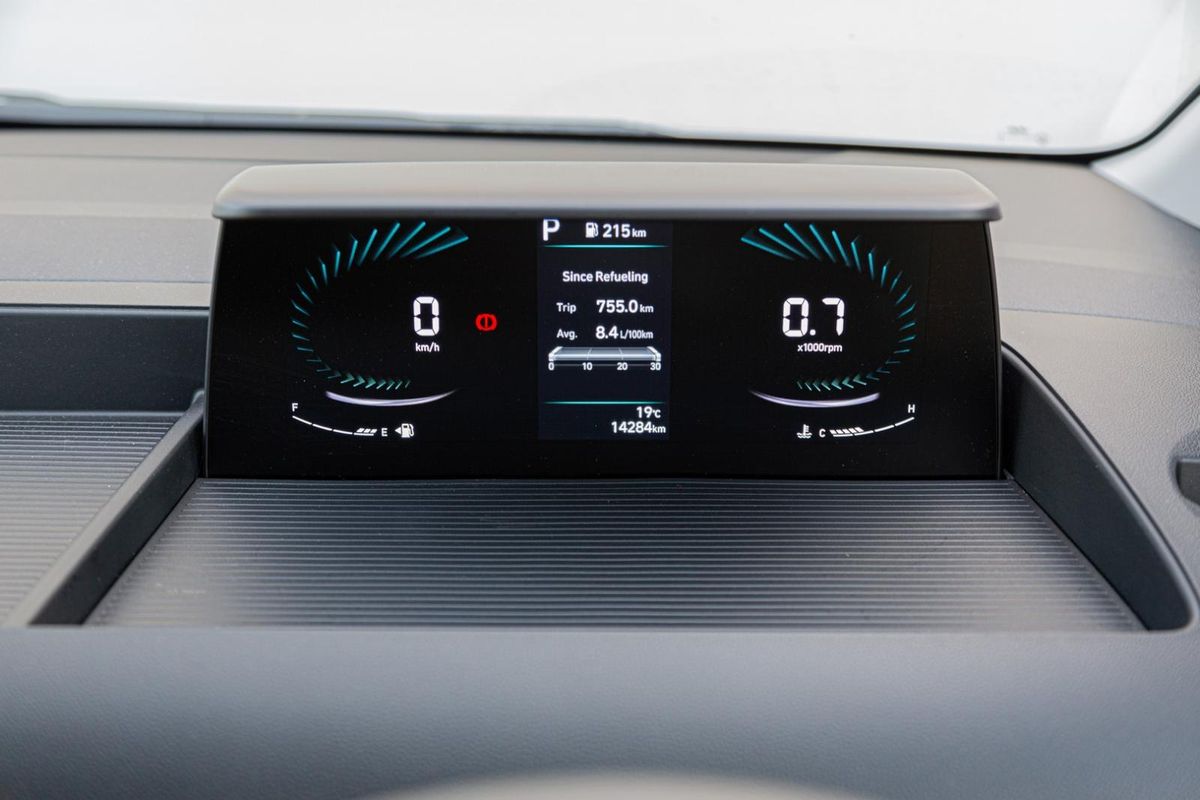
The test unit’s fuel economy was good during its tenure in our fleet – after clocking up 1 000 km over 2 weeks, the indicated consumption figure was 8.9 L/100 km. In town, the Staria’s going to be thirsty because it’s a hefty vehicle, but it’s quite efficient once you’re out on the freeway or open roads. An SUV with similar power/torque will almost certainly be more fuel efficient than the Multicab, and that’s an area where you may have to accept that it won’t be as effective as an SUV.
The Staria Multicab is only available in front-wheel-drive guise and that might be its only major drawback as a family vehicle. South Africans love to travel to difficult-to-reach locations and an all-wheel-drive version of the Multicab would further entice contemporary family-car buyers. Nevertheless, it will still get you to the same places that a regular two-wheel-drive SUV would, because its ground clearance (186 mm) is similar to that of a medium SUV, such as the Hyundai Tucson.
In-car technology and safety
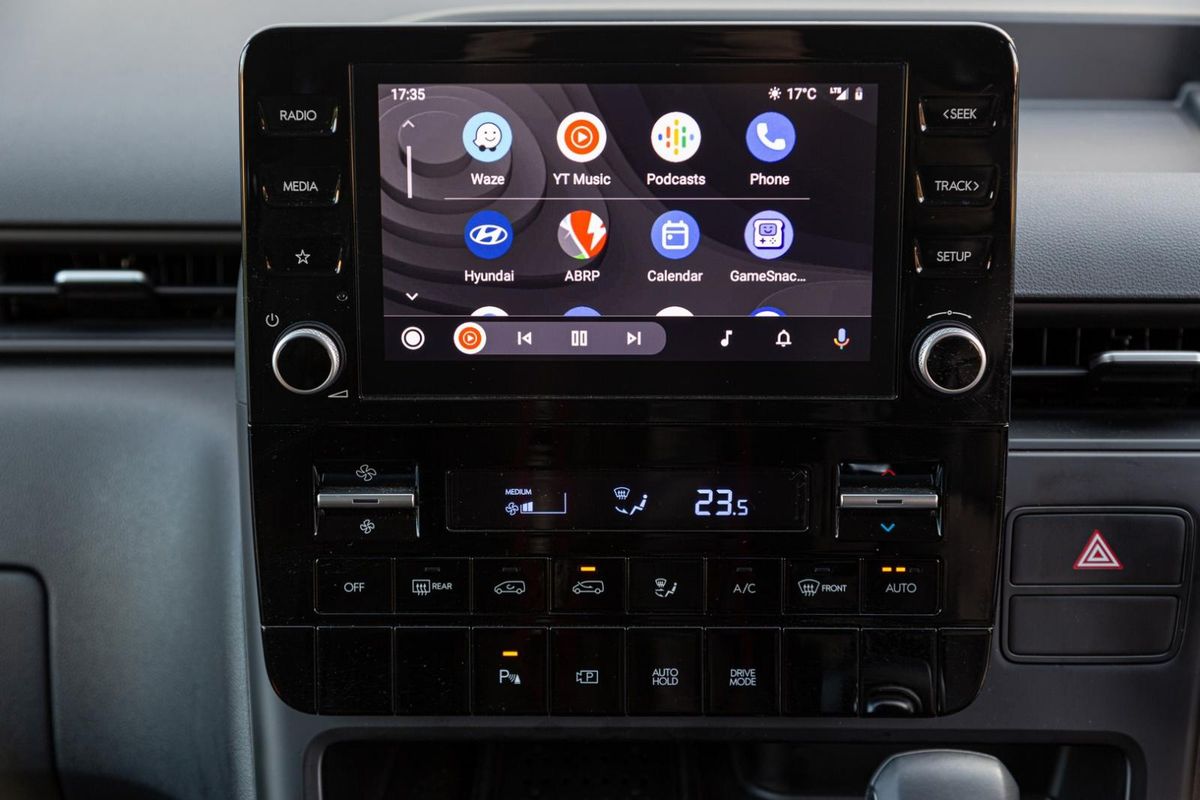
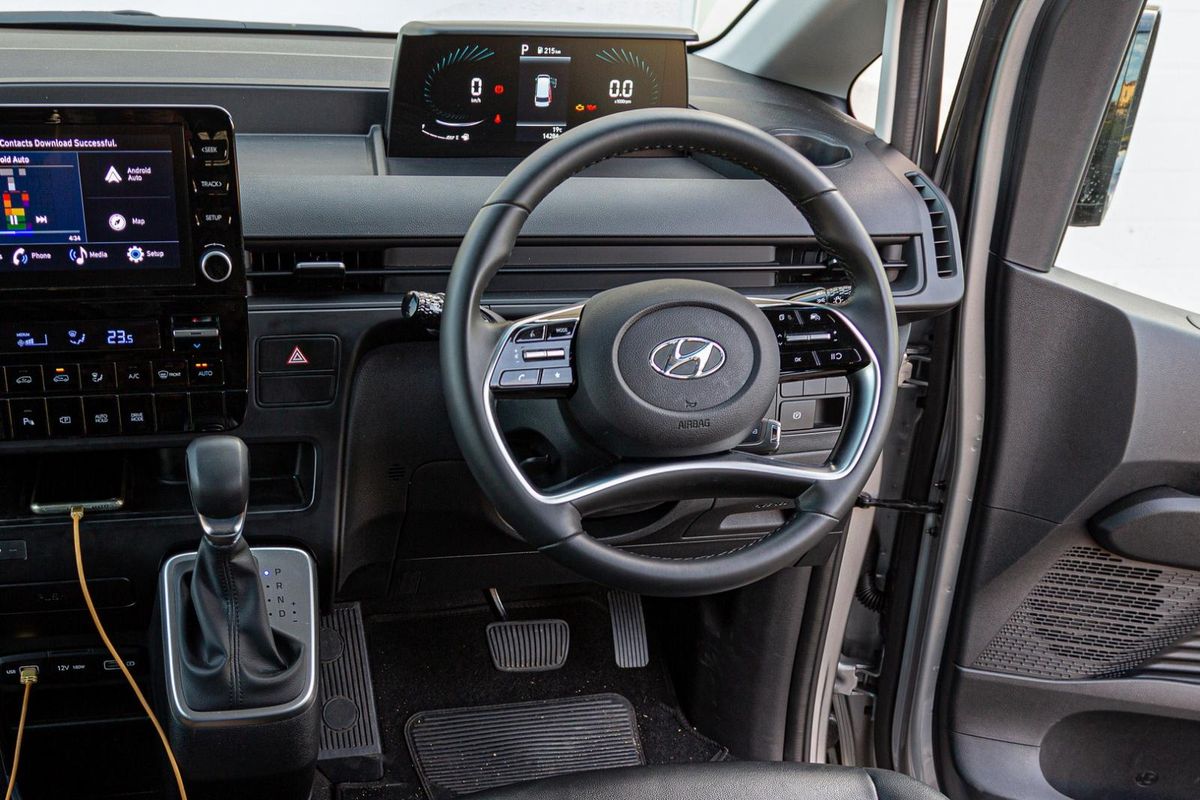
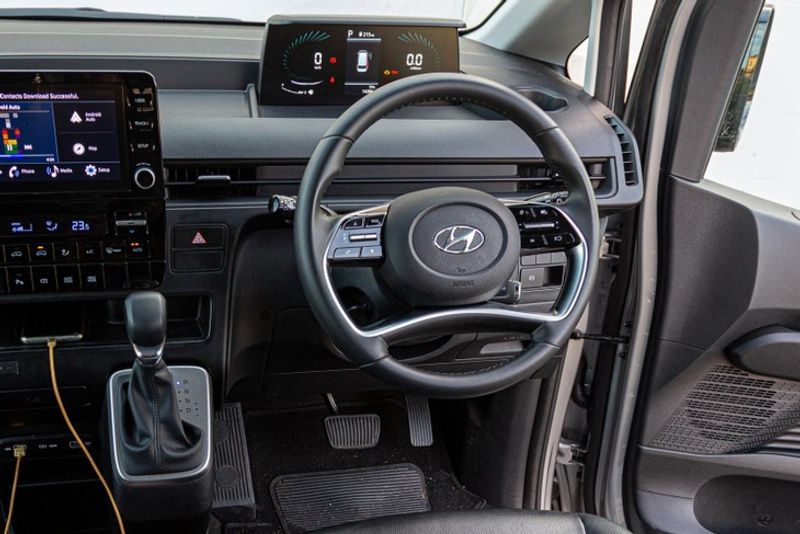
The cabin is very modern with all the features of a new SUV.
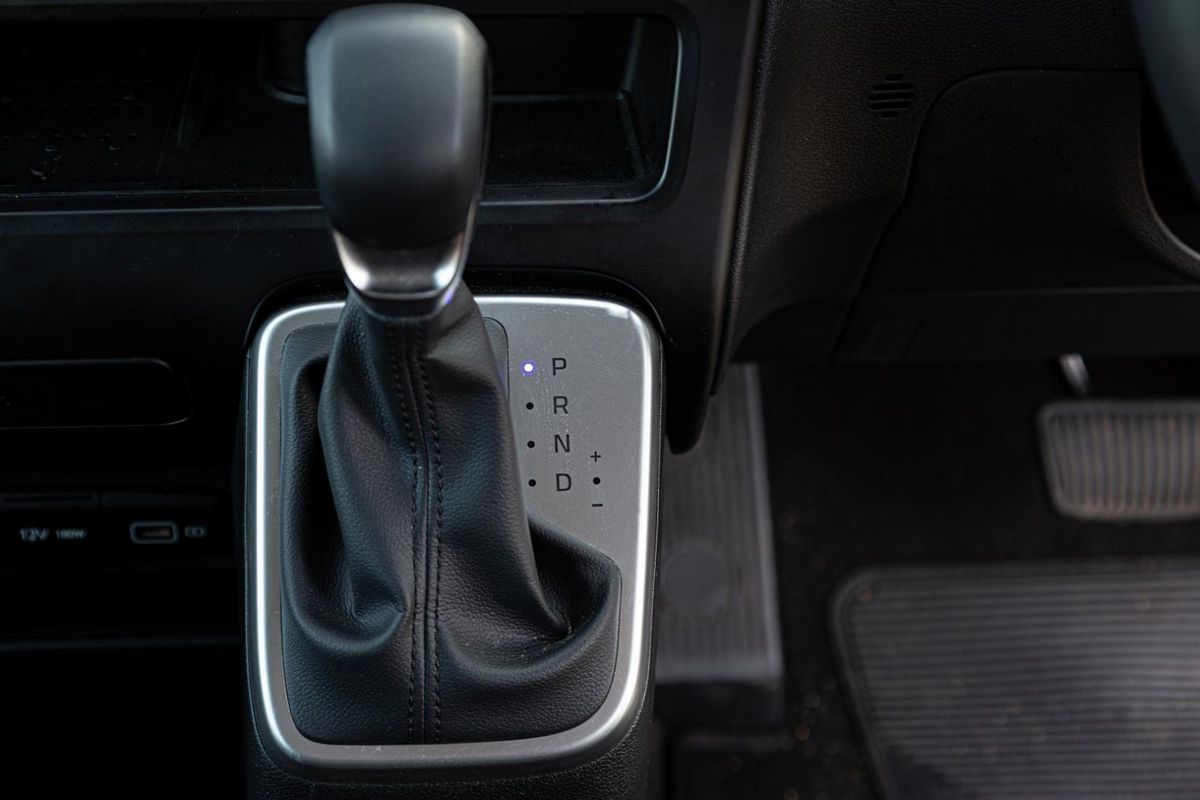
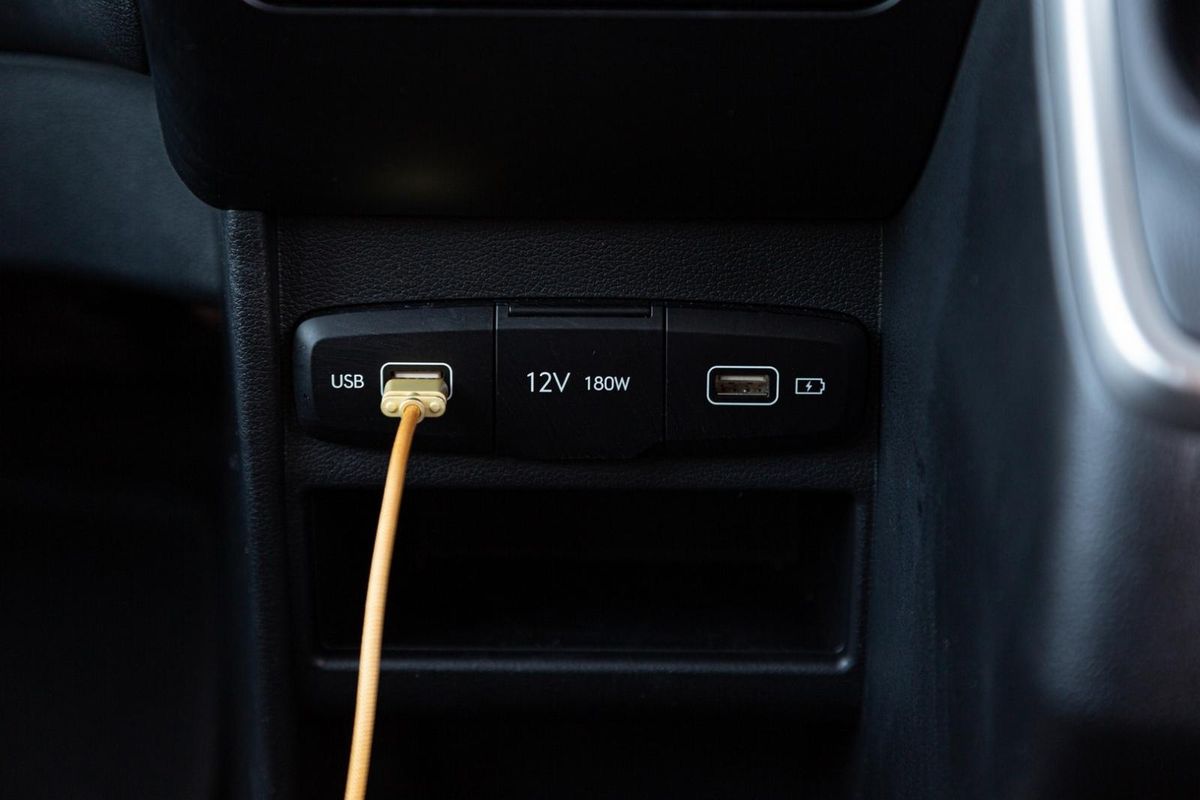
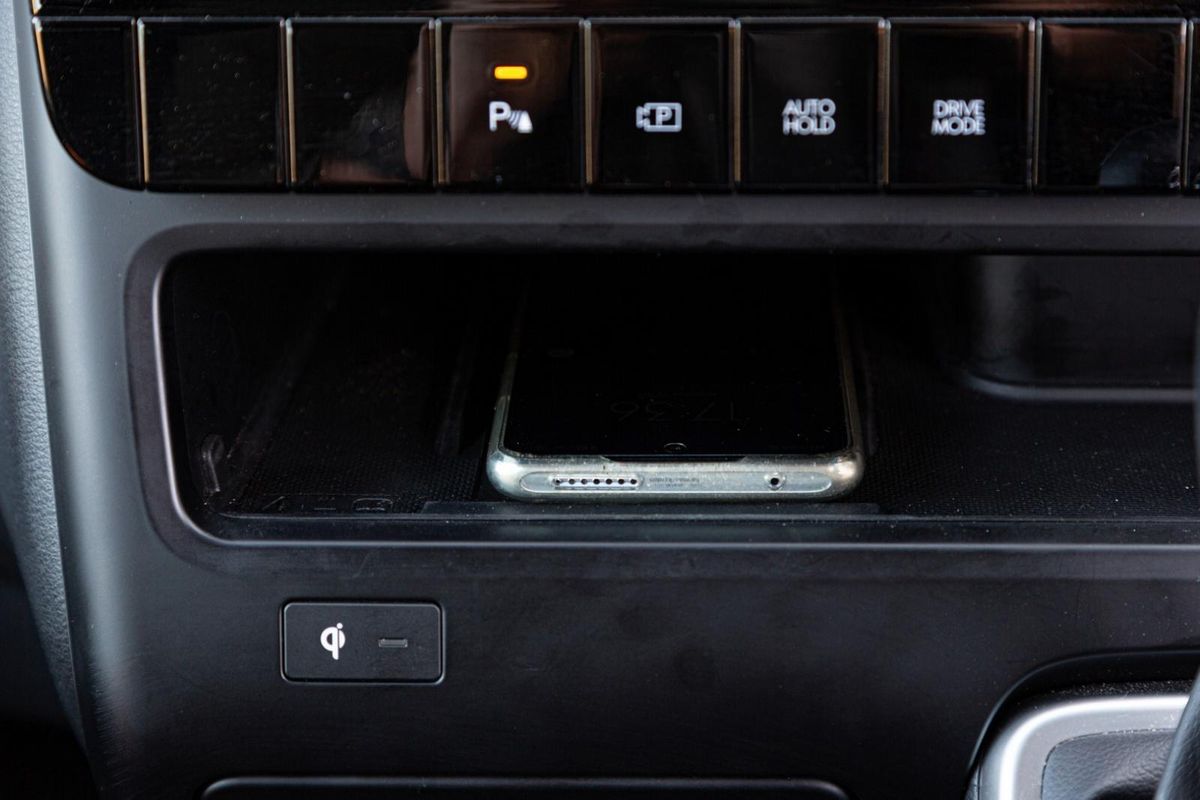
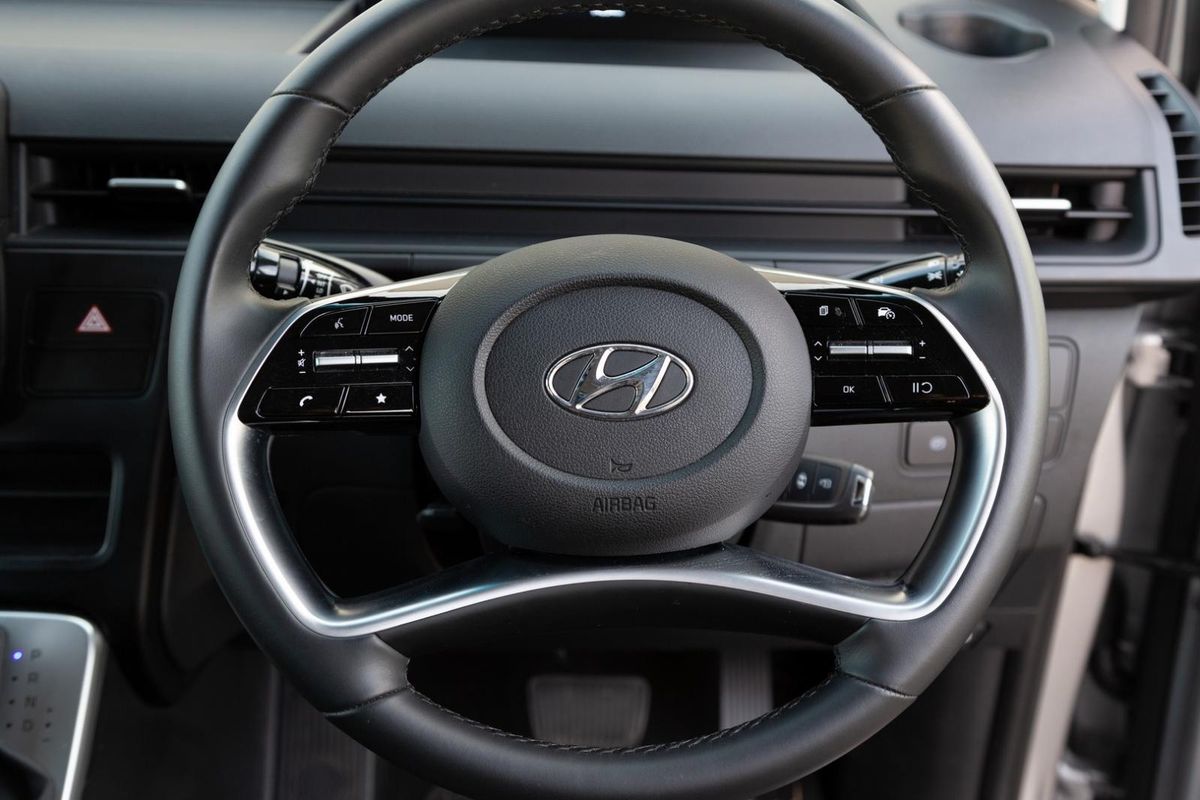
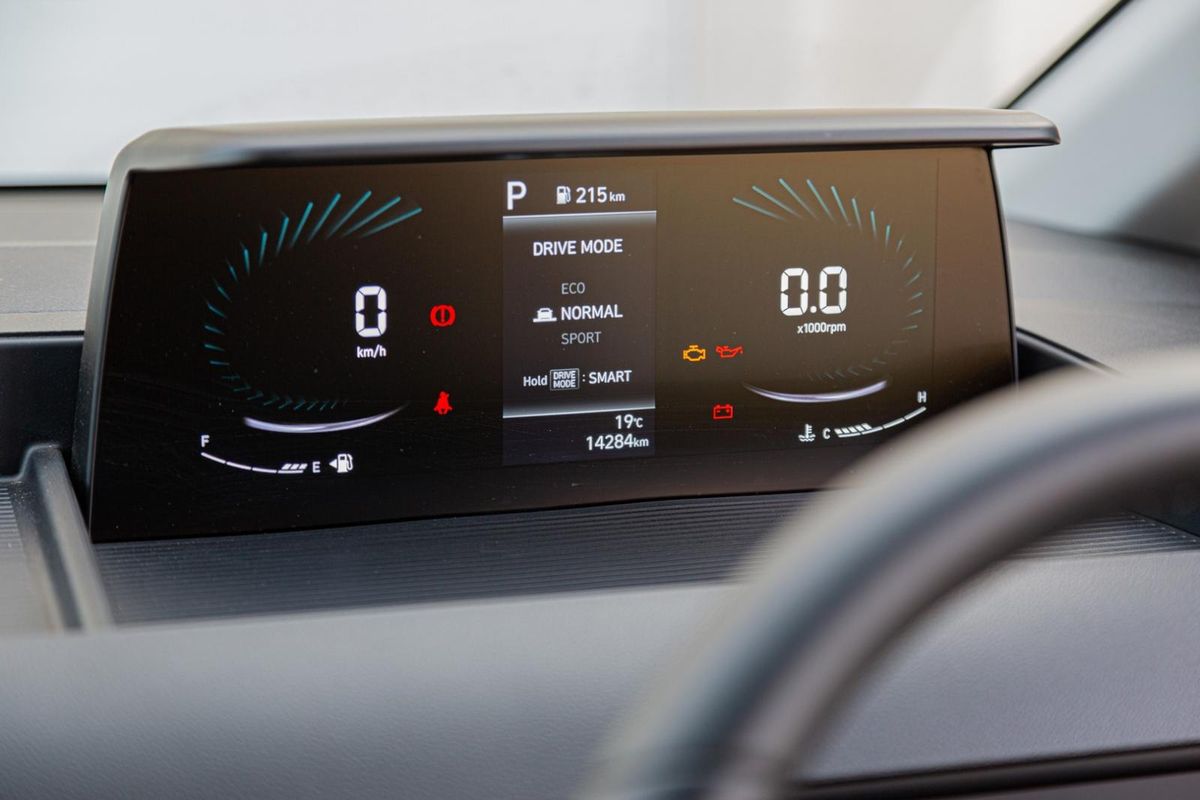
The majority of “vans” draw the short straw on the technology front, but the Staria feels like a modern car in that regard. It gets a full digital infotainment system (with Bluetooth, plus Android Auto and Apple Carplay compatibility), which is the same as you get in Hyundai’s SUV lineup. There are 2 USB ports up front, 2 in the rear and a wireless charging bay for front occupants. Strangely, when it comes to climate control (auto aircon), the Multicab is single-zone only.
In terms of safety, the Hyundai is fitted with 6 airbags in the passenger cell and comes equipped with the full suite of ABS, EBD, traction control and electronic stability control. Nice-to-have features include daytime running lights, folding side mirrors, cruise control and park distance control (front and rear) in conjunction with a reverse-view camera, as we mentioned above.
The Hyundai Staria 2.2D Multicab costs R764 900 (September 20222) and comes with a 5-year/150 000 km warranty with a 7-year/200 000 km drivetrain warranty. The service plan is valid for 6 years/90 000 km.
The Staria Multicab could be in with a shout as the most practical family car on the market.
The Hyundai Staria 2.2D Multicab represents a bit of a bargain when compared with family SUVs in its price range. There isn’t another van offering we can think of that is a family car at one end and a (separate) panel van at the other.
South Africans tend to choose bakkies at the R750k price point, but the Multicab makes an extremely good case for itself by virtue of offering more passenger space, more (fully enclosed) loading space, and better fuel efficiency than double cabs do. All of your stuff isn’t on display in the MPV either – it’s still more practical than utilising a canopy on your bakkie. The only area in which it may be deficient is the lack of all-wheel drive, but how often do you really need 4×4 capability?
Overall, the Staria Multicab offers a lot of vehicle for the price. It’s got a capable drivetrain, a car-like infotainment and onboard tech setup, as well as a full house of safety features. With your thinking cap on, it could easily be the most practical family car on the new-vehicle market. Considering the Staria comes with a 7-year/200 000 km drivetrain warranty and a 6-year/90 000 km service plan, this genuine multipurpose vehicle is a good proposition for long-term ownership.
Refreshed BMW Z4 Revealed, Coming to SA in 2023
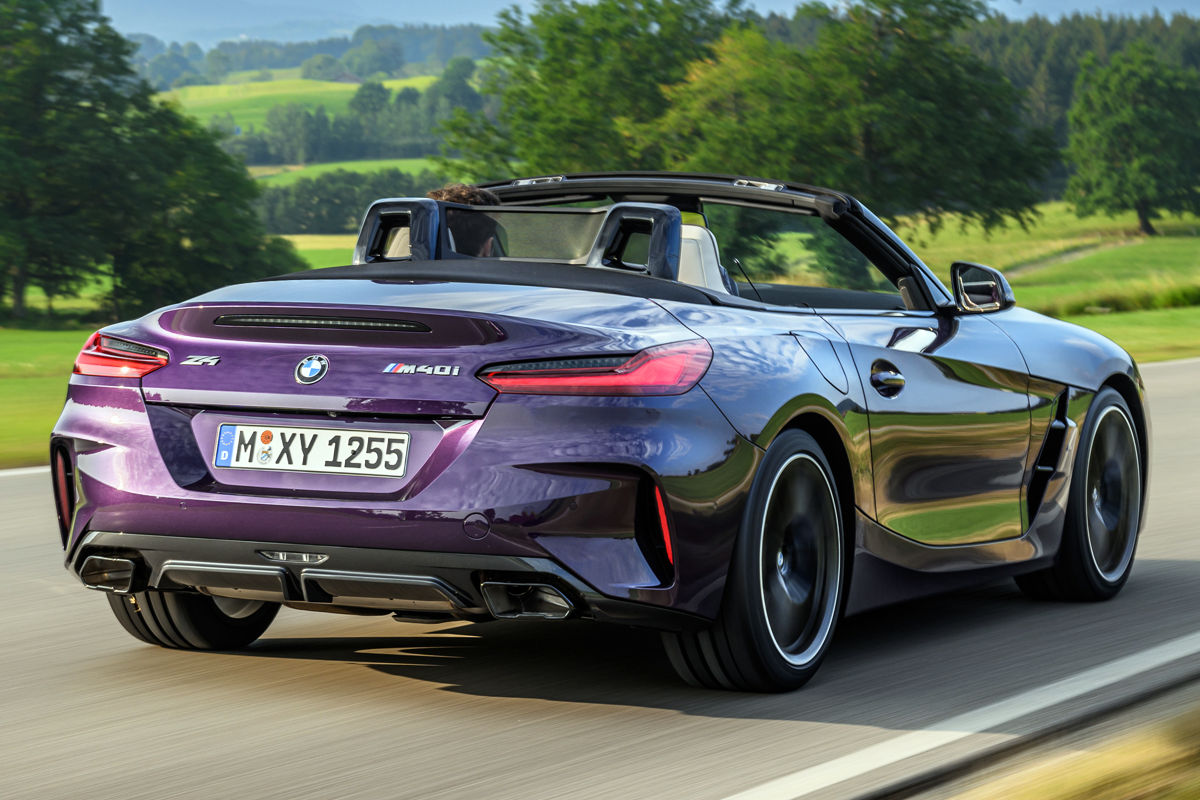
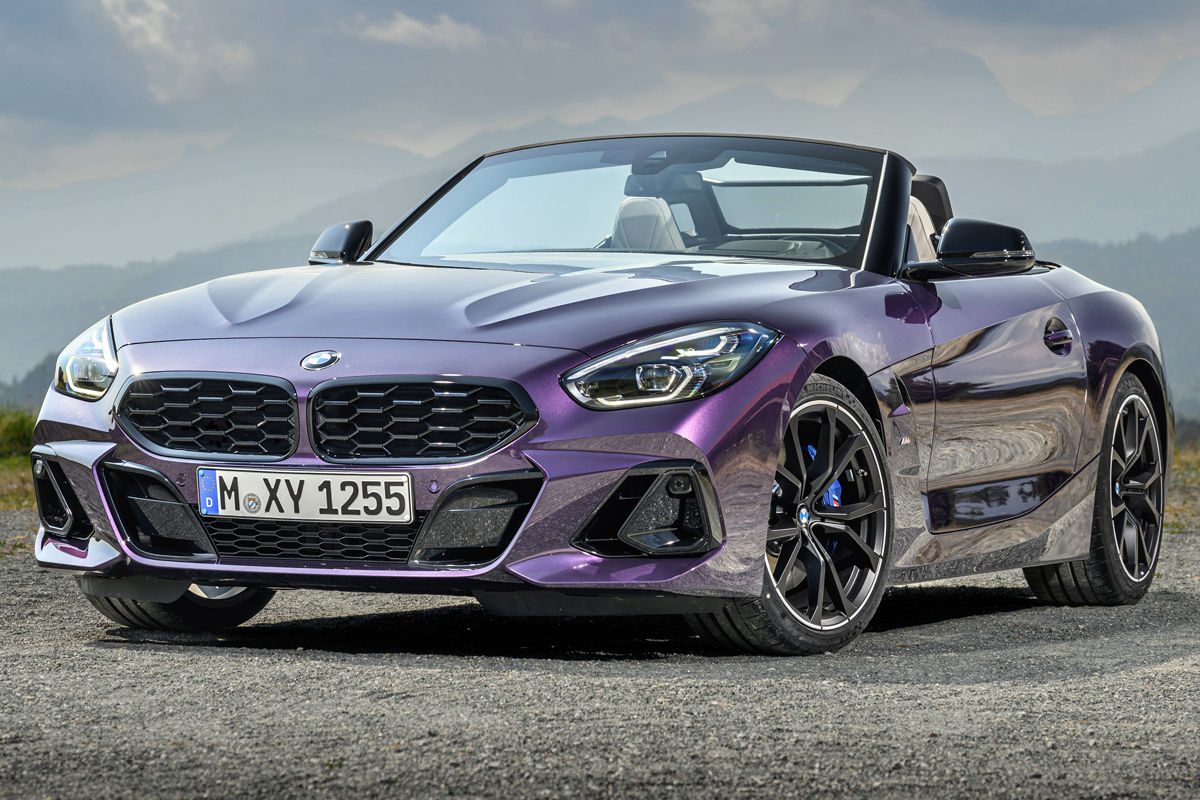
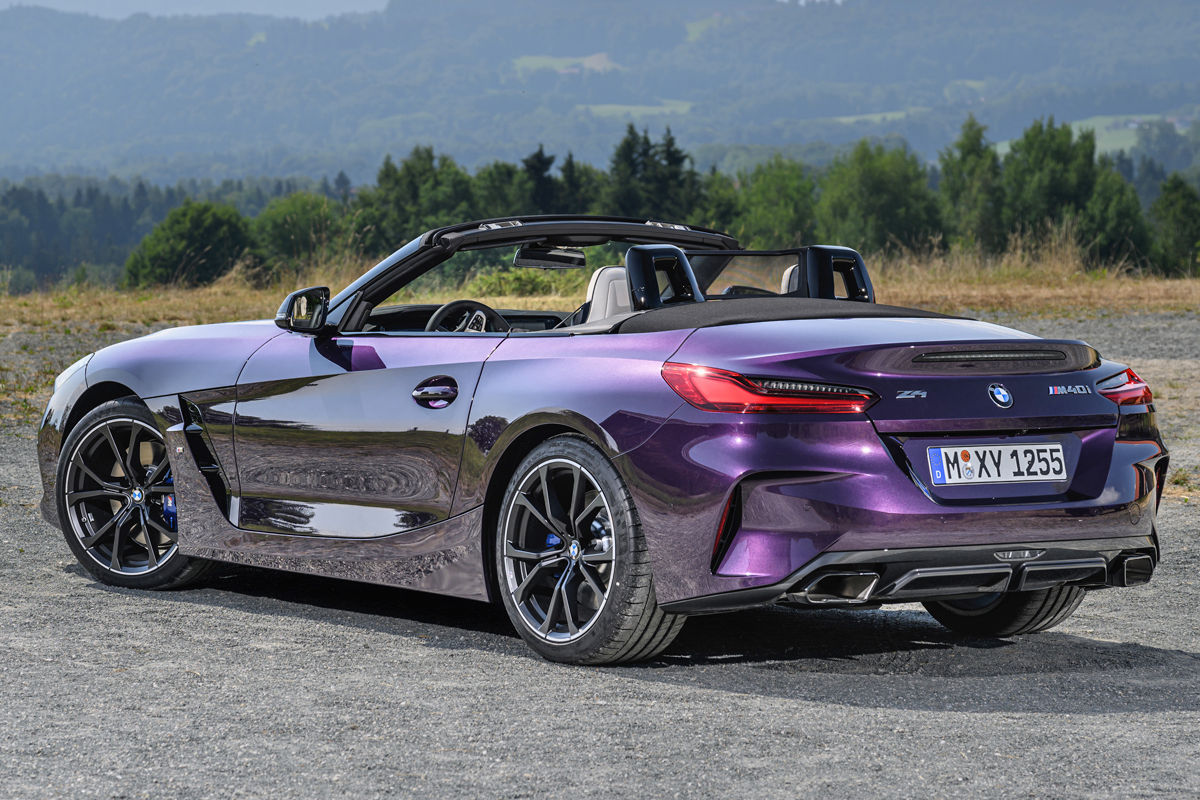
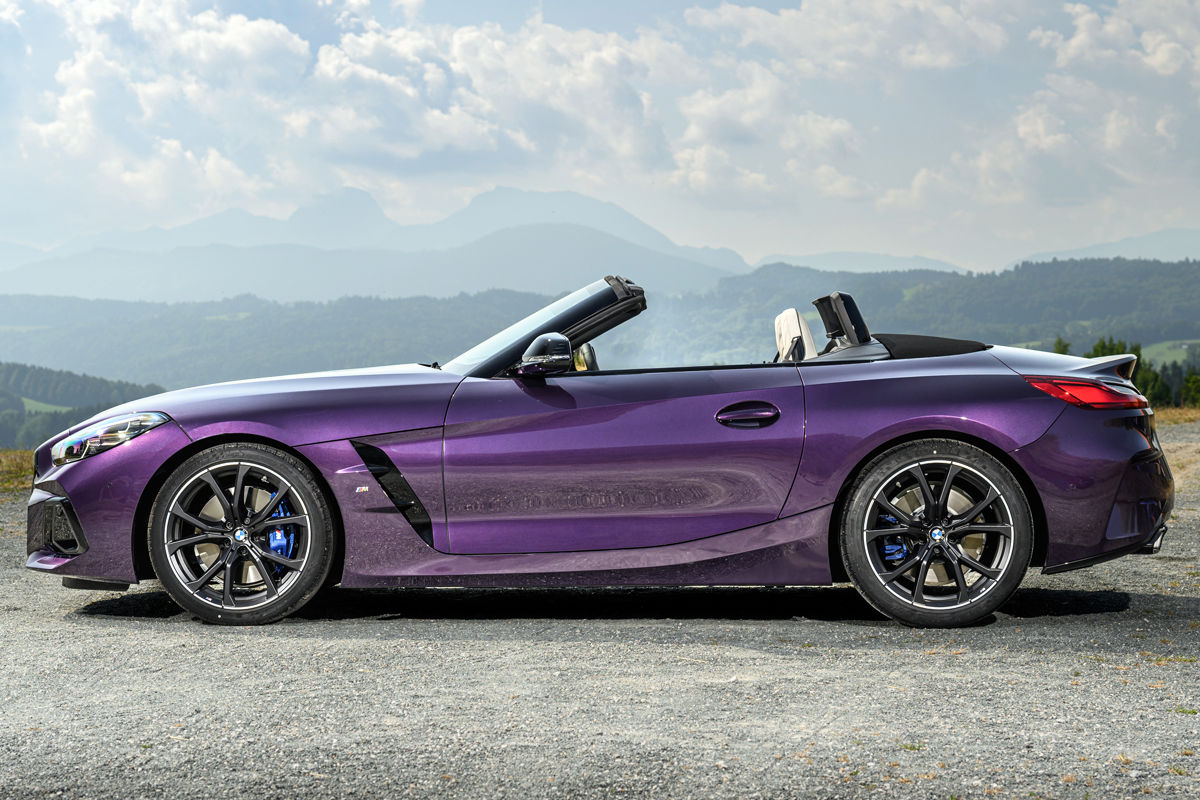
BMW has whipped the covers off its facelifted Z4, with the subtly updated roadster scheduled to arrive in South Africa in 2023. Here’s what we know so far…
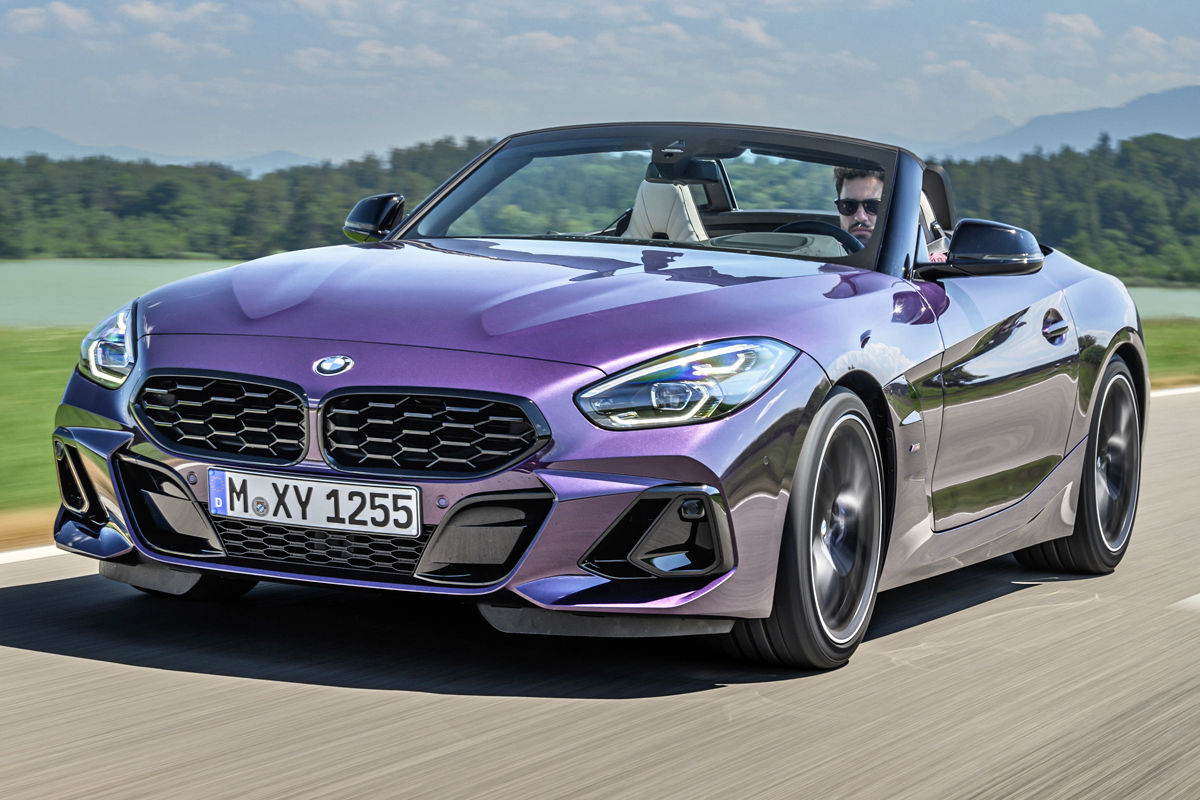
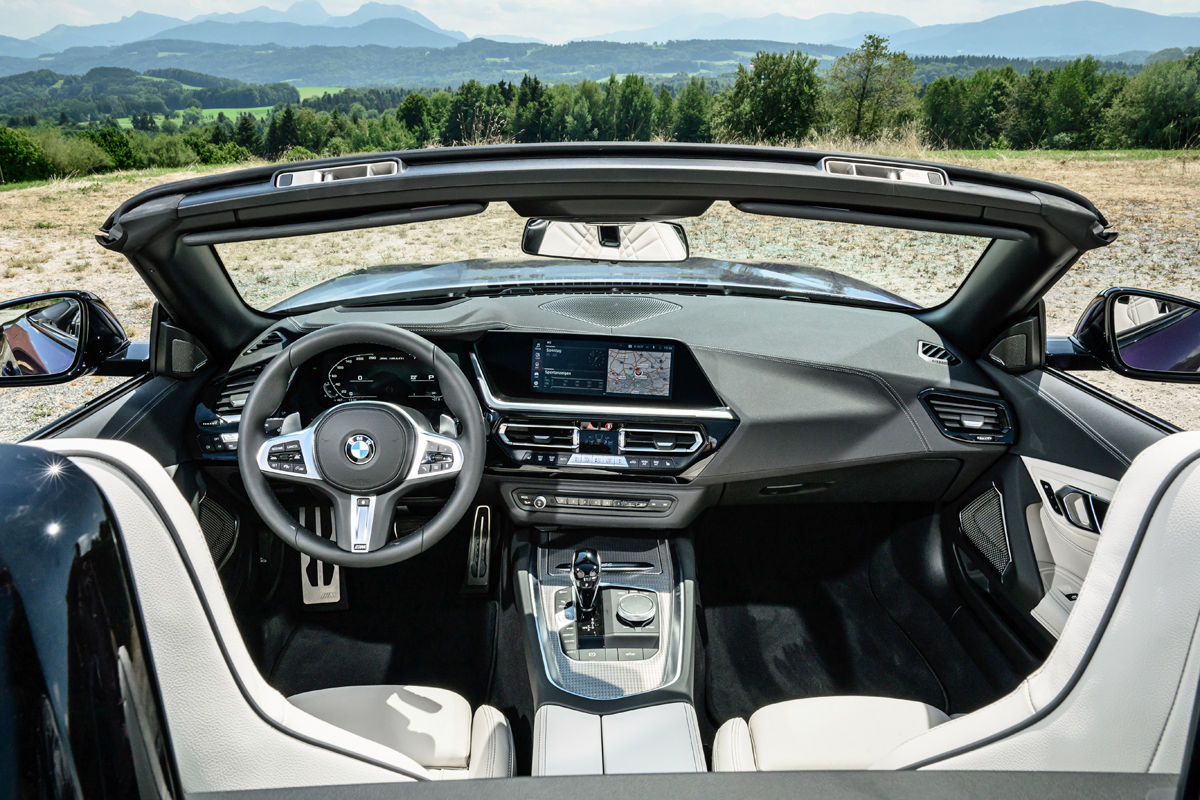
The third-generation BMW Z4 has been handed a mild facelift, including exterior design tweaks, added standard equipment and a few fresh options. Though BMW Group South Africa says it has yet to nail down final specifications, it has confirmed the updated Z4 will be available locally in the second quarter of 2023.
First up, we should point out the powertrain range in Europe carries over unchanged. That means the flagship derivative is again the Z4 M40i, which draws its urge from the Munich-based firm’s twin-turbo 3.0-litre, straight-6 petrol engine, driving the rear axle through an 8-speed automatic transmission.
However, it’s interesting to note the European press material lists this engine’s peak power output as 250 kW (along with maximum torque of 500 Nm), while the current Z4 M40i offered in South Africa boasts a figure of 285 kW (the power update for our market took place in 2020, just over a year after the Z4 arrived). Whether the facelifted version of the SA-spec Z4 M40i retains this loftier output or reverts to the Euro-spec figure remains to be seen.
BMW also made no mention of the rumoured option of a 6-speed manual gearbox for the Z4 M40i. Considering Toyota now offers this cog-swapper in the closely related GR Supra, it’s theoretically possible, at the very least. That said, even if it materialised, we wouldn’t expect such a gearbox to be available in South Africa considering BMW Group SA’s range features only automatic transmissions.
What about other engine options? Well, the current G29-generation line-up in South Africa also includes the sDrive20i powertrain, which comprises a turbocharged 2.0-litre, 4-cylinder petrol unit sending 145 kW and 320 Nm to the rear rubber. This engine option also carries over without alterations, as does the sDrive30i (190 kW/400 Nm) available in Europe.
A few minor updates for the G29-generation BMW Z4
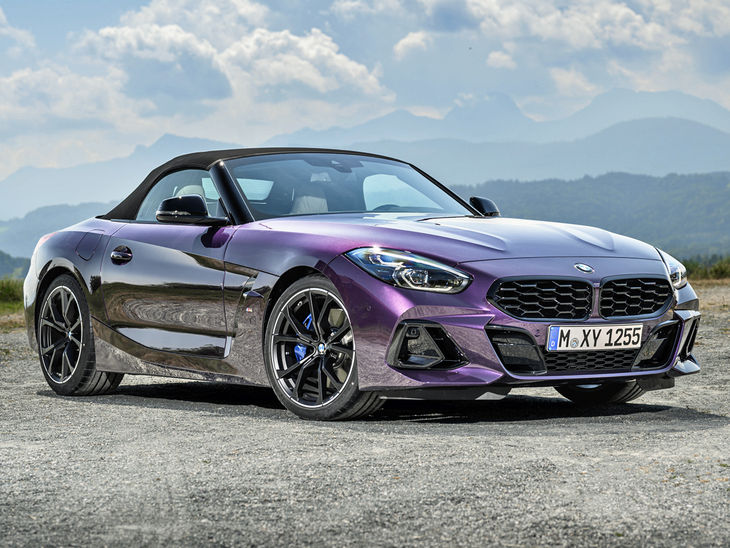
So, what has changed? Well, 4-cylinder versions of BMW’s open-top 2-seater now receive the M Sport package as standard (suggesting the Sport Line trim level has been nixed), while three new exterior paint colours (Thundernight metallic, Portimao Blue metallic and Skyscraper Grey metallic) are offered.
A set of 18-inch M light-alloy wheels in a double-spoke design is now standard and fitted with mixed-size tyres (225/45 R18 fore and 255/40 R18 aft). Additional M light-alloy wheels – bearing a new V-spoke design, a Jet Black matte finish and diamond polished rim edges – measuring 19 inches in diameter also enter the list of options.
Other updates include a redesigned version of the grille (the kidneys now take on a horizontal inner structure) and revised side air intakes. The M lights Shadow Line option is also now available and can be ordered in conjunction with the likewise optional adaptive LED headlights.
The current BMW Z4 has been on the global market since 2018 and is built by Magna Steyr in Graz, Austria. BMW says more than 55 000 examples have been sold worldwide since launch, with the M40i accounting for in excess of 30% of sales “in recent times”.
“In a generally diminishing vehicle segment, the BMW Z4 has maintained extraordinarily consistent sales volumes since it went on sale. From day one, it has been by far the highest-selling model in a hotly contested class populated exclusively by German premium brands. And it has consistently increased its market share ever since,” says BMW.
A report from earlier this year, however, suggests Z4 production will end in 2025, with no successor in sight.
Expect pricing and final specifications to be released closer to the upgraded Z4’s arrival in South Africa in the second quarter of next year.
More Than Just Insurance – The Importance of Added Insurance Products
Buying a vehicle is a long-term decision and we want to help you make an informed one with our Street Smart series, brought to you by Absa Vehicle and Asset Finance. In this episode, we chat with Absa’s Pascal Siphugu about the importance of value-added insurance products.
PARTNERED CONTENT
While taking out vehicle insurance is vitally important, consumers don’t always understand the importance of value-added insurance products when taking out a vehicle finance loan. These include solutions such as mechanical breakdown warranty and tyre and rim cover. However, two solutions play a particularly significant role – extended cover and credit protection. Pascal Siphugu, General Manager: Bancassurance, Absa Insurance company, tells us more…
What is Extended Cover?
SIPHUGU: Extended Cover, which is also known as credit shortfall insurance, top-up- or gap insurance cover, is designed to cover the difference between your vehicle’s retail value or the amount for which the car is insured and the outstanding balance or amount that you owe on your loan. Extended Cover kicks in if your vehicle is stolen or written off as a result of an accident.
Why is Extended Cover so important?
SIPHUGU: Financing a car means paying monthly instalments to the bank. A vehicle’s value depreciates the older it gets – it will depreciate by between 15- and 20 percent in the first year and by approximately 50 percent after 5 years. Therefore, you’ll have a gap between what your comprehensive policy pays out and what you owe to the bank. If your car is stolen or written off, you’d still need to continue paying your car instalments.
And just because your car is worth less does not mean that there will be a drop in the amount that you owe on the loan. Your insurance payout may not be enough to cover what is owed on your finance agreement.
Extended Cover will assist in covering the shortfall, the last thing you want is to keep paying off a car that you don’t own anymore.
Another value-added product, the value of which may be underestimated, is Credit Protection. Can you tell us what that is?
SIPHUGU: Credit Protection is a type of insurance that can be used to pay debts or make monthly repayments on a customer’s behalf in the event of an unforeseen life event. It can be used to pay off a range of debts, including vehicle finance loans, home loans, personal loans, credit cards and so on.
Which life events can be covered by Credit Protection?
SIPHUGU: Depending on the option you choose, Credit Protection plans can cover your debt in the event of loss of income, critical illness, temporary disability, permanent disability, terminal illness or death.
It will either settle your outstanding vehicle loan or pay your monthly repayments for a limited period of time when your obligations become due after an insured event has occurred.
Can a credit provider insist on a customer taking out credit life insurance during the contract period of the loan?
SIPHUGU: Yes, they can, so that the loan can be paid off if anything happens to the customer that limits their ability to pay their debt.
For extra information on how you can become a better consumer, keep a lookout for more episodes from our Street Smart series and be sure to visit the Absa blog.
Absa’s Fulufhelo Mandane discusses what you need to consider before you start shopping for a vehicle, the costs of ownership and your various finance options. Absa First-time Buyer Guide to Vehicle Finance
Absa’s Gordon Wood details how the new Aftermarket Guidelines, which were introduced in the motor industry last year, affect you as a vehicle owner. Absa’s Guide to Responsible Vehicle Ownership
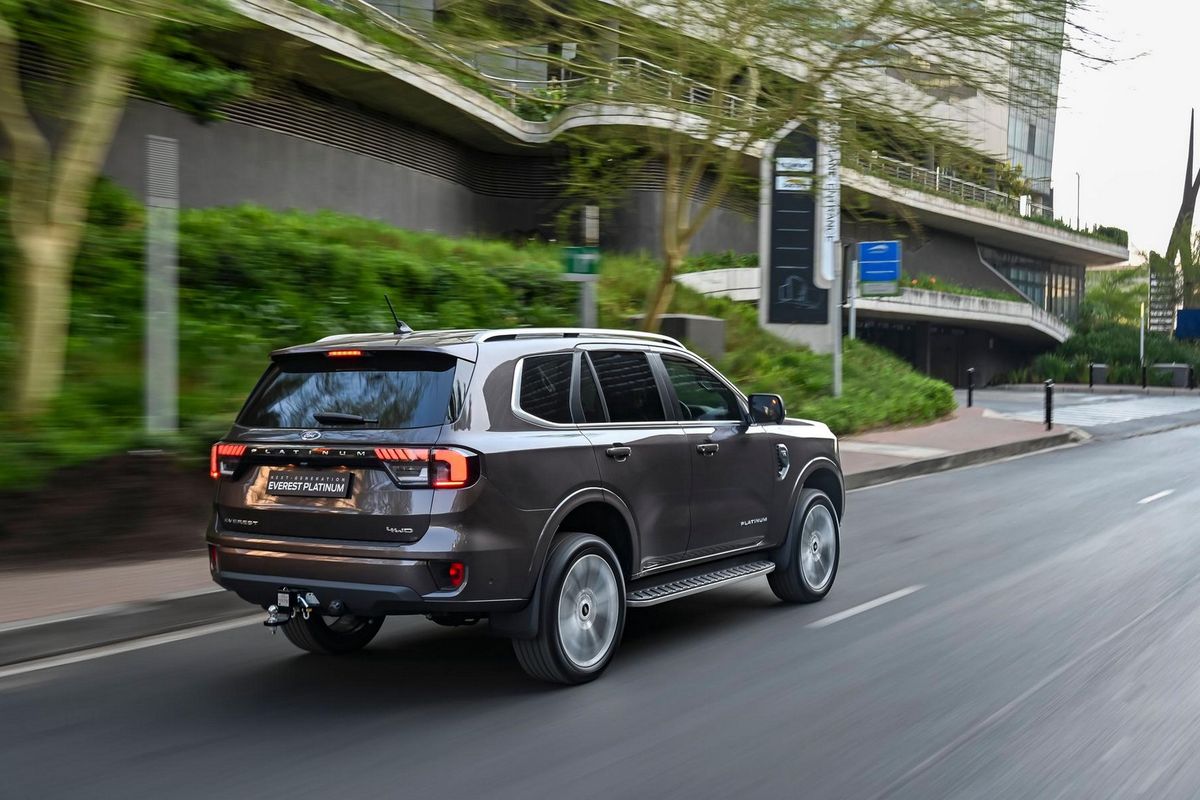
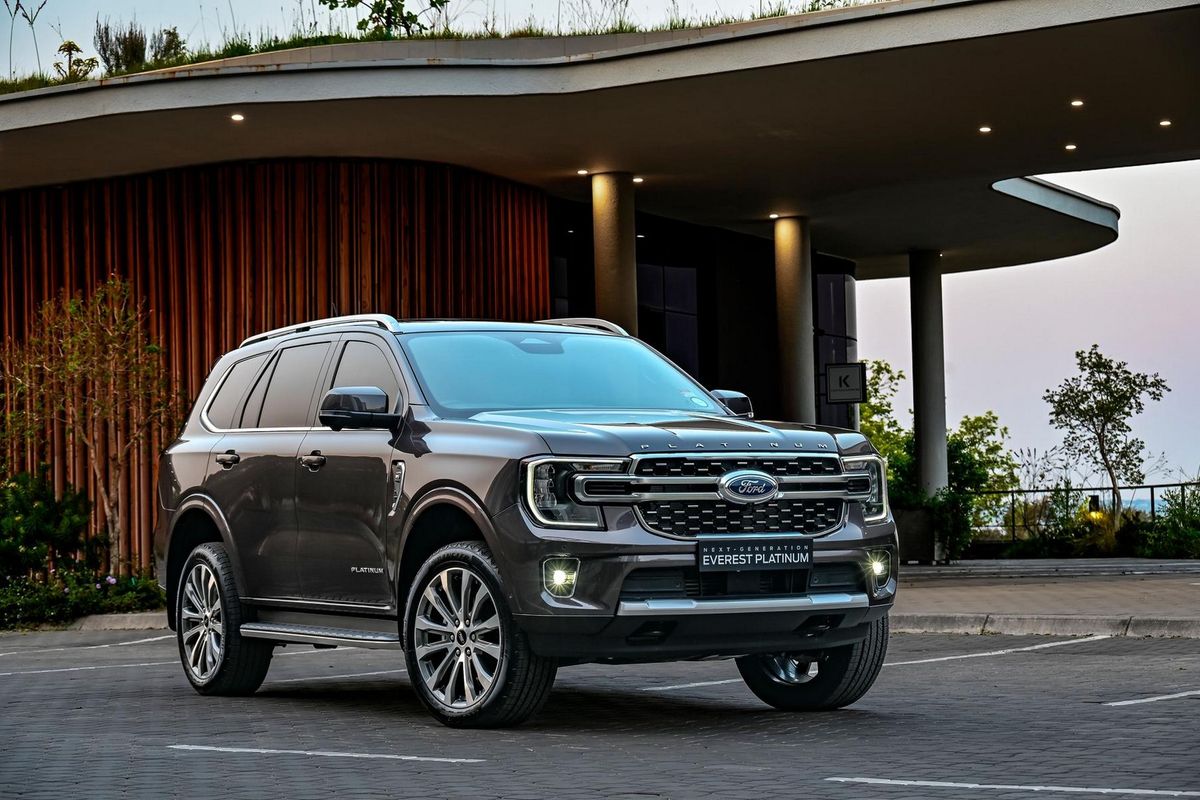
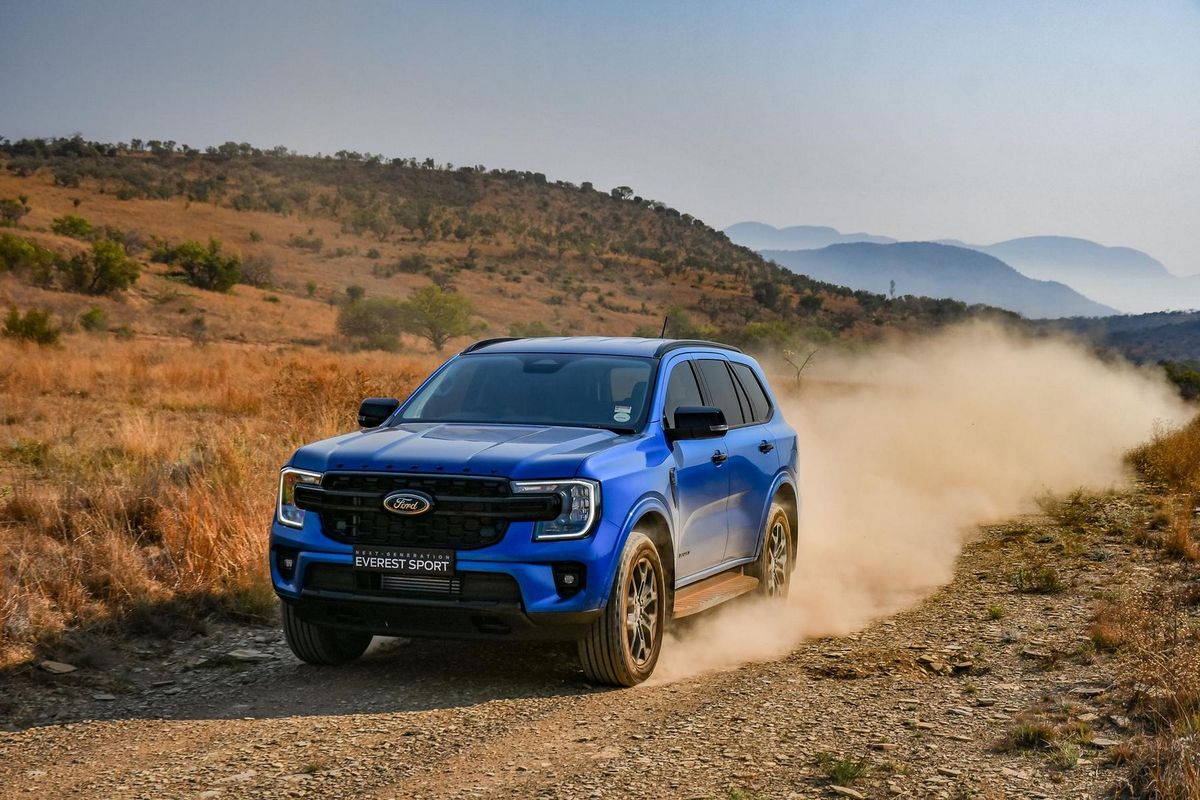
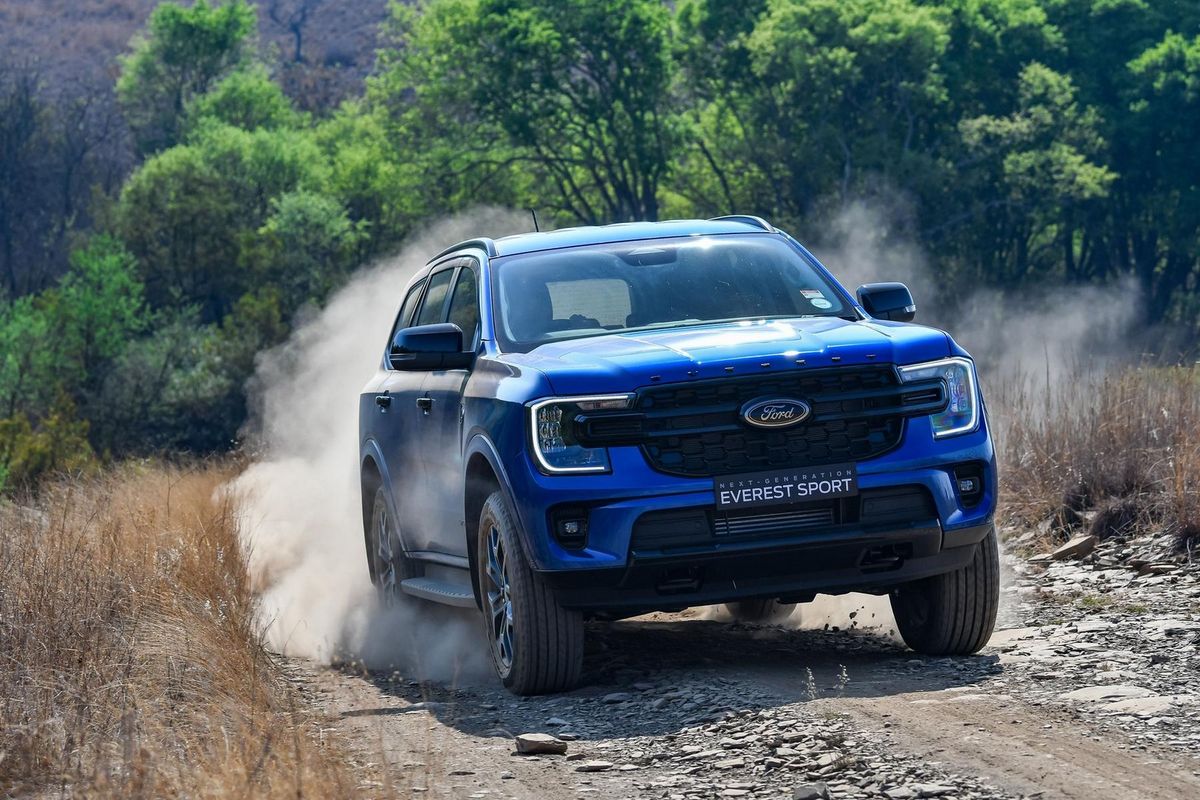
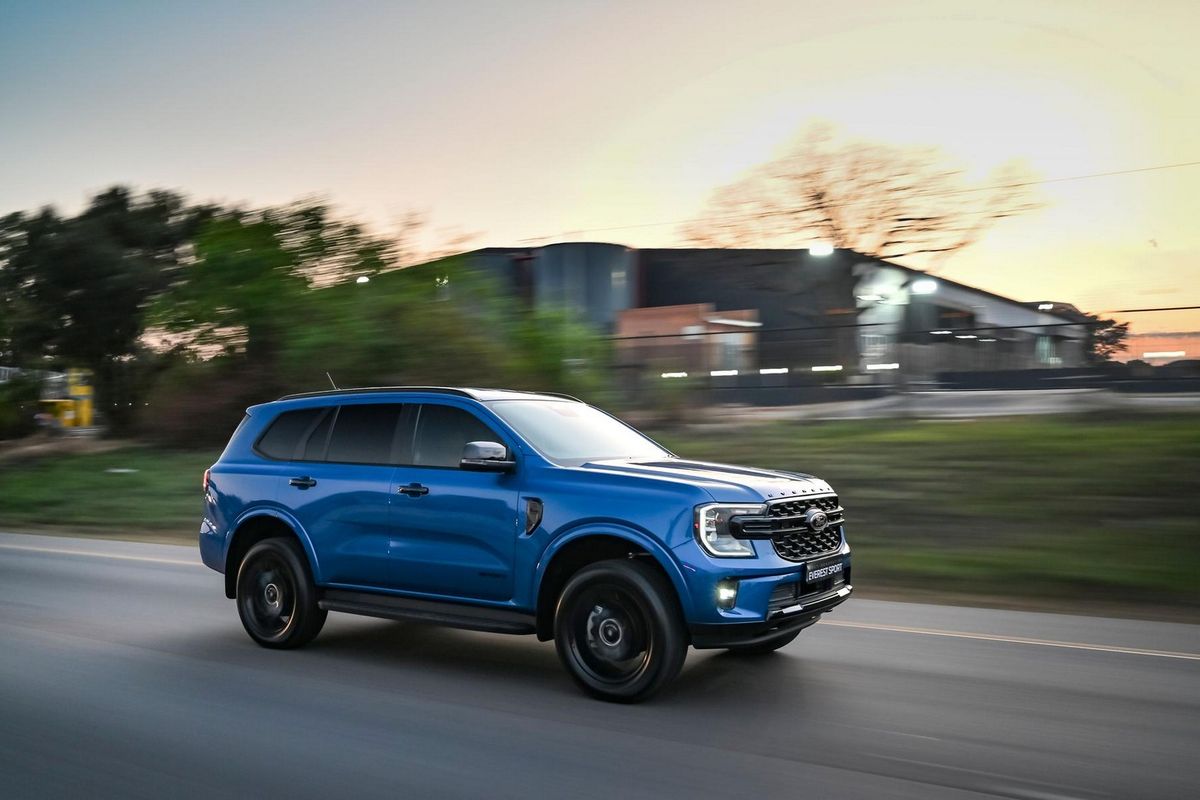
The all-new 3rd-generation Ford Everest has touched down in South Africa and we attended its local launch in Mpumalanga. With a big new 3.0-litre V6 turbodiesel engine – and an equally big price tag – the Blue Oval’s 7-seater adventure SUV has lofty ambitions.
The Everest has been a solid performer in the bakkie-based Adventure SUV segment; Ford Motor Company of Southern Africa (FMCASA) has sold more than 26 000 units of the model, of which the outgoing version was produced locally.
Now there’s an all-new model and it brings a significant number of updates and upgrades to the Everest family. It’s no longer assembled in the Republic, because FMCSA’s facility in Silverton is focused on producing the new Ranger (and next-generation VW Amarok). The South African market will get its 3rd-generation Everest units from Thailand and sadly, due to the semi-conductor shortage and the ongoing logistics/shipping challenges, stock shortages are expected.
Still, FMCSA is upbeat about its new offering and says the interest shown in, and orders taken for, the new Everest have been impressive. There’ll be a delay, however – one dealer we spoke to says it’ll only receive units in January 2023.
What’s on offer?
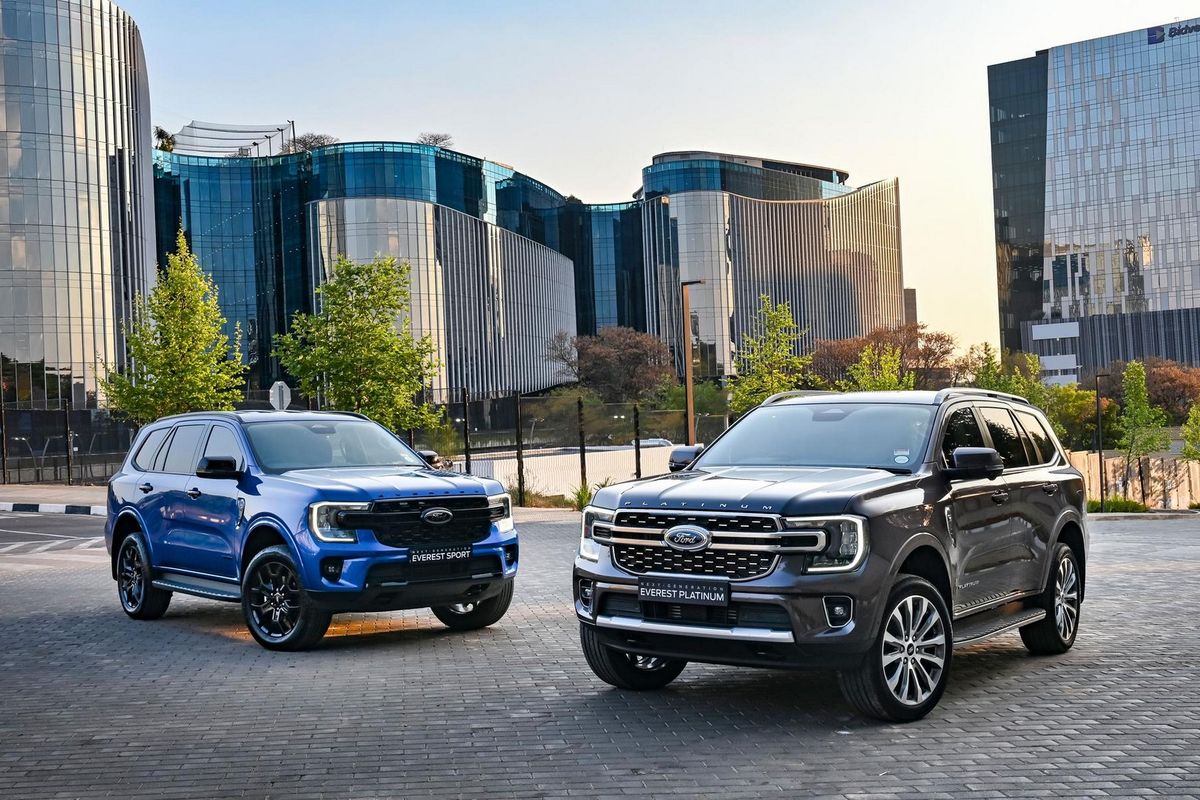
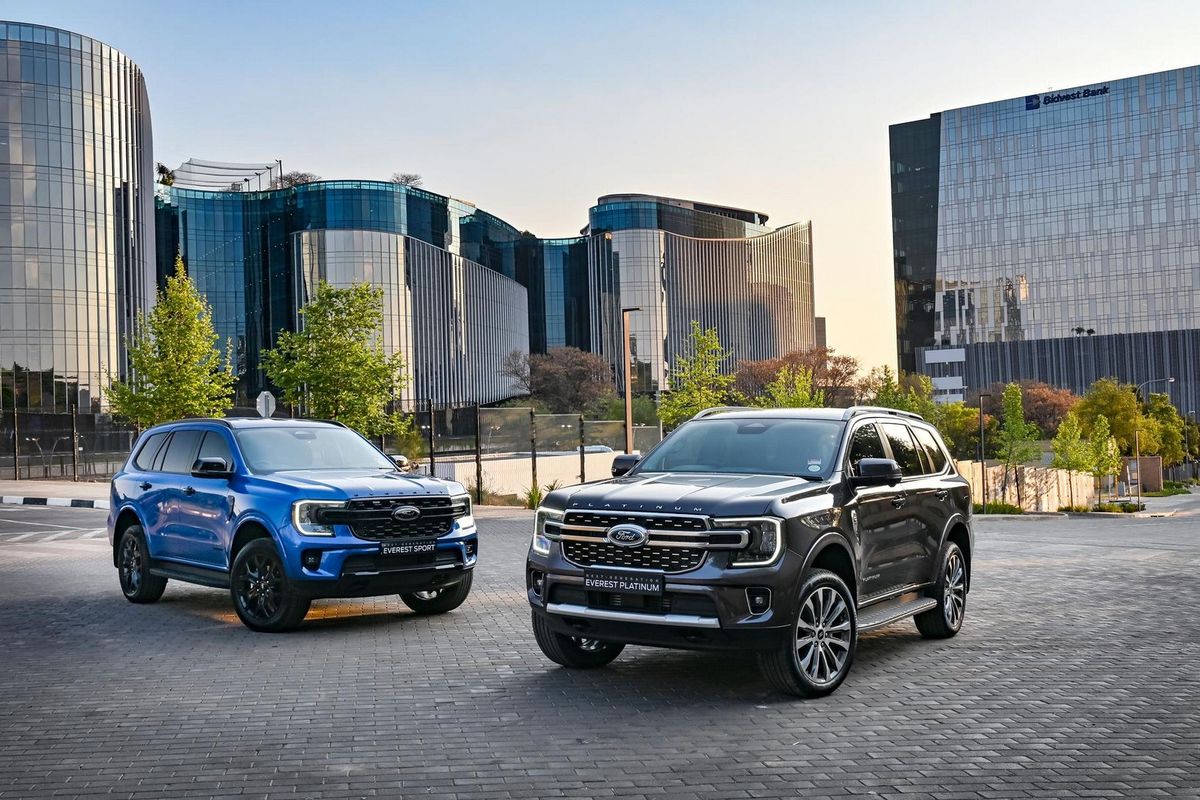
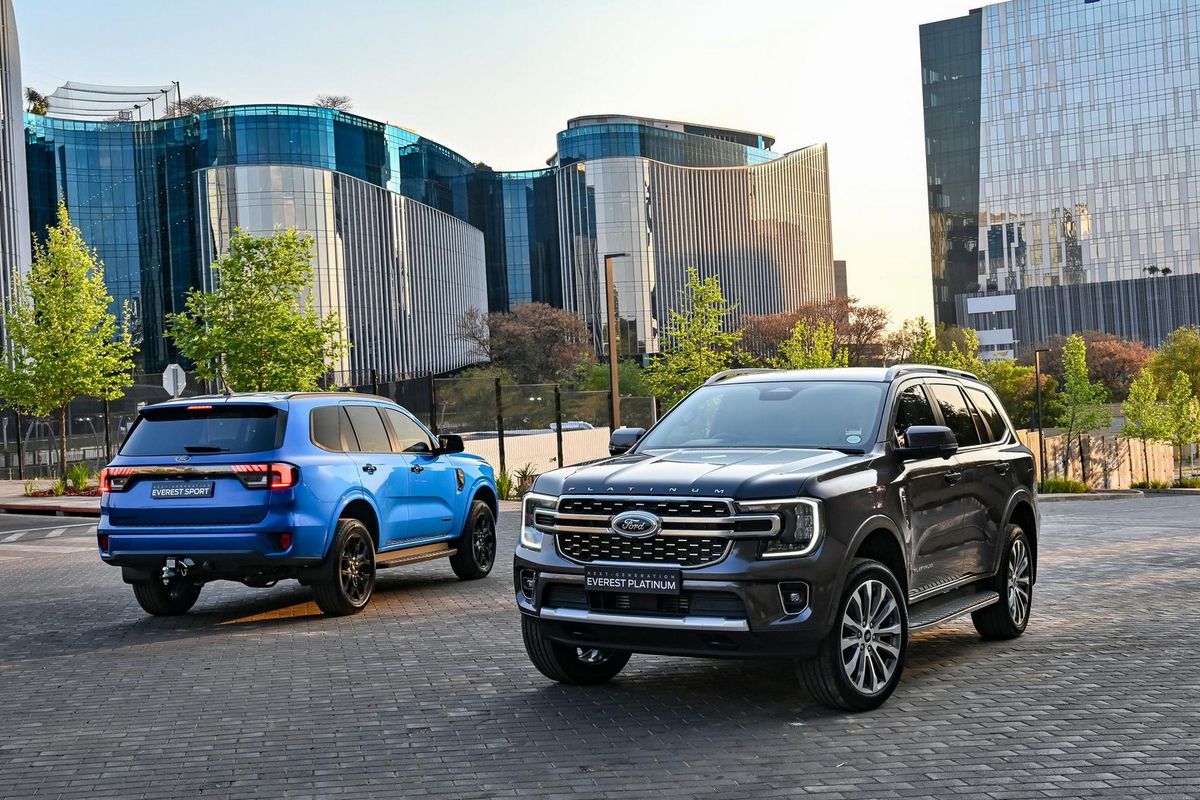
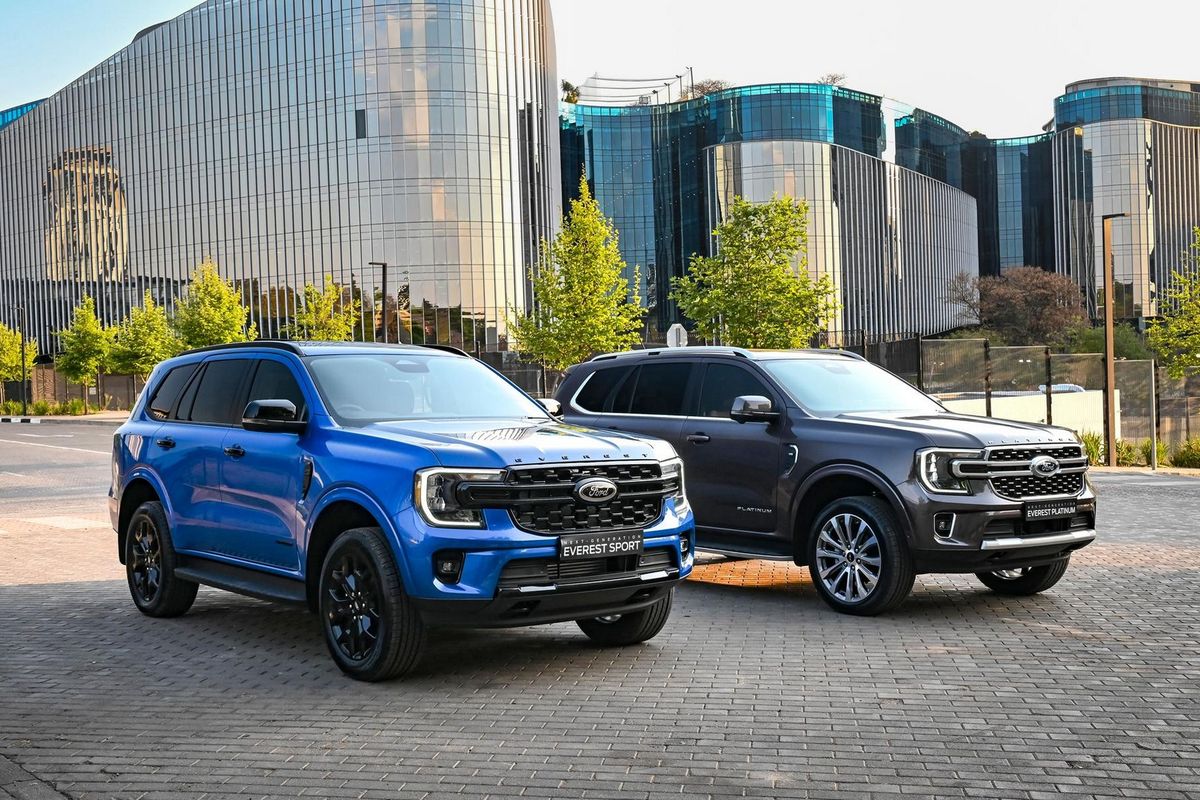
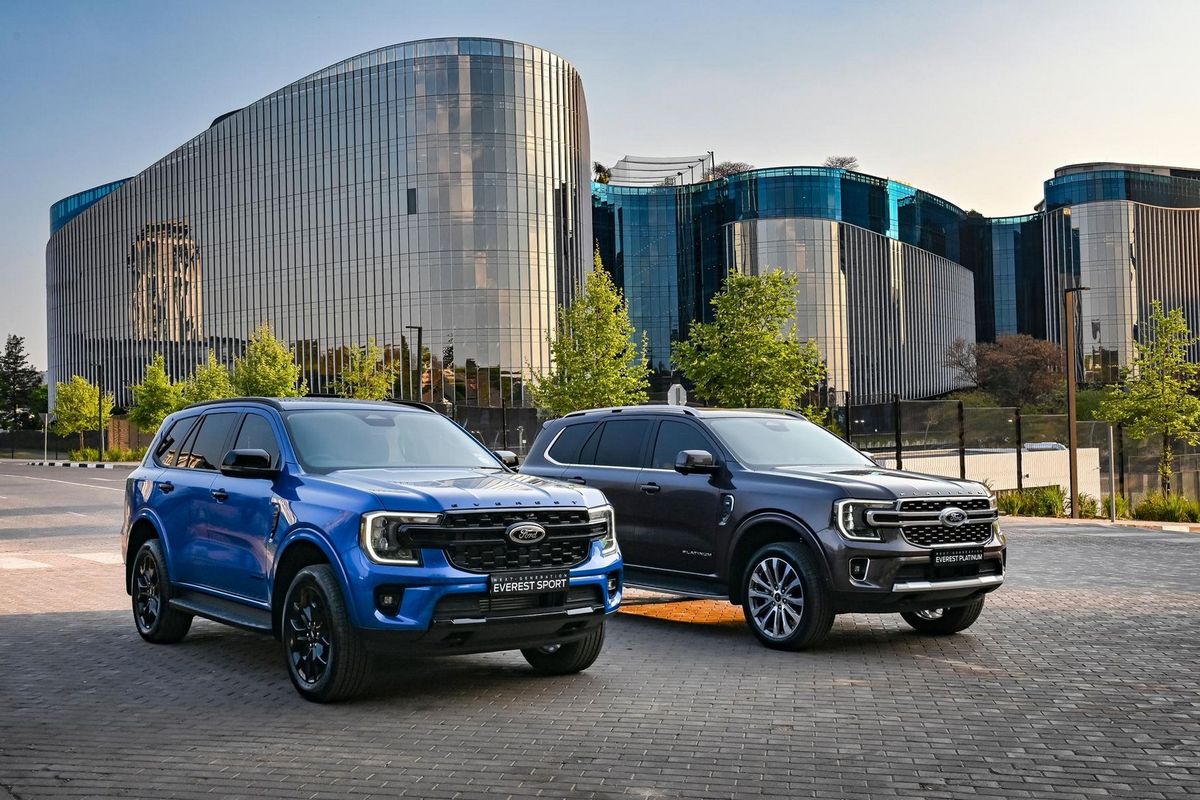
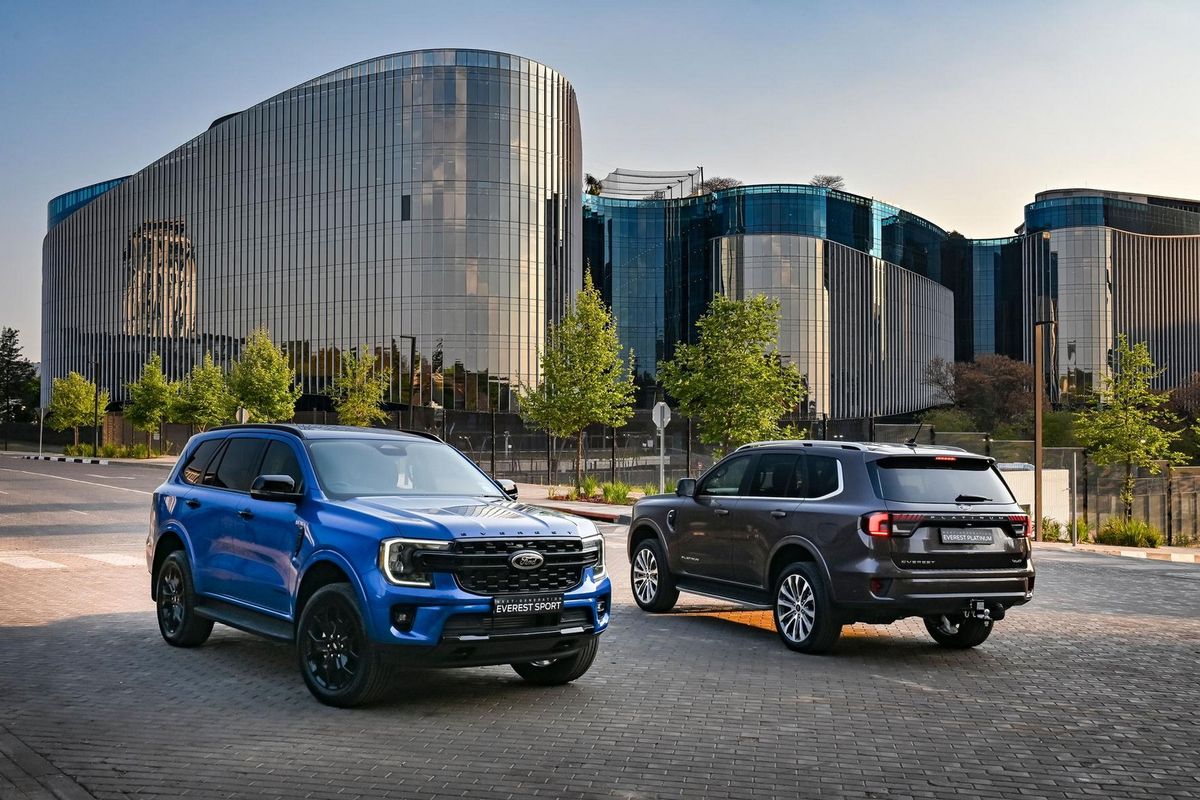
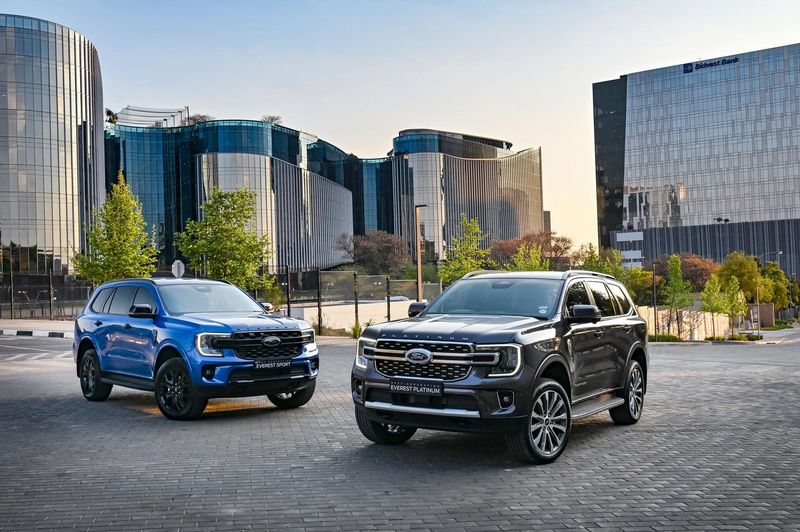
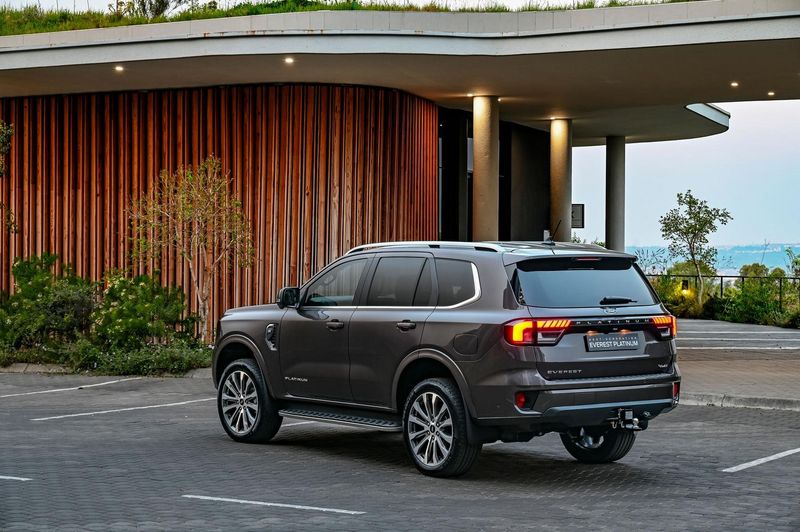
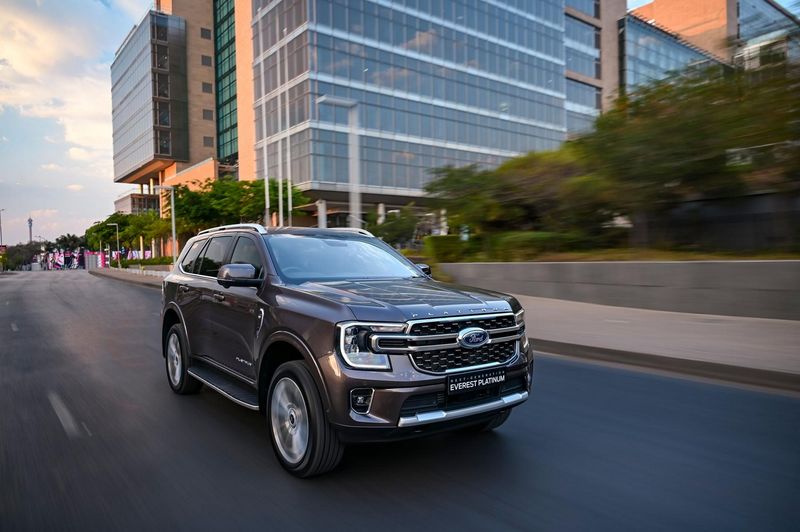
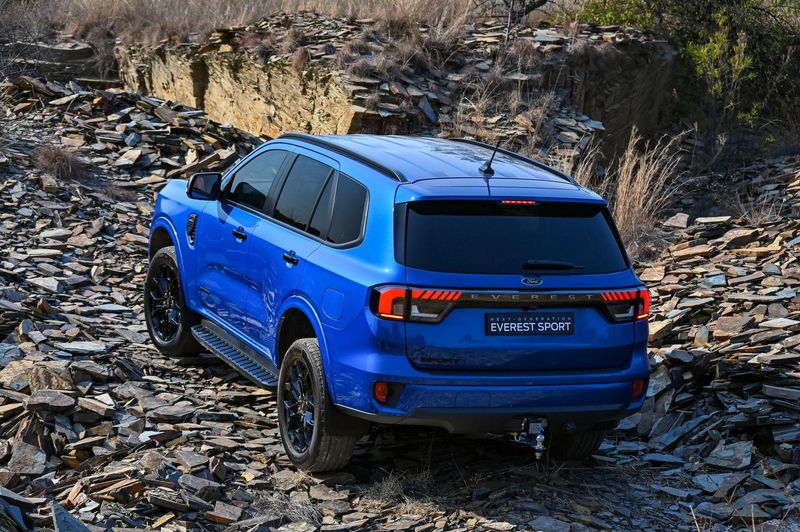
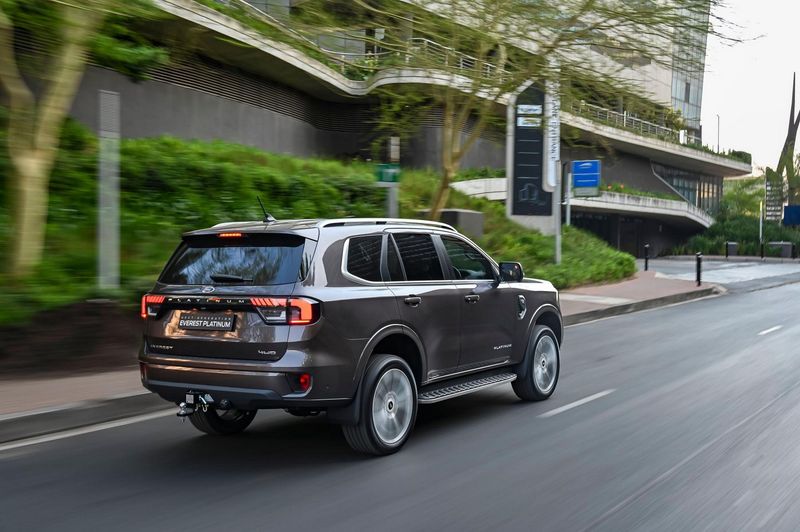
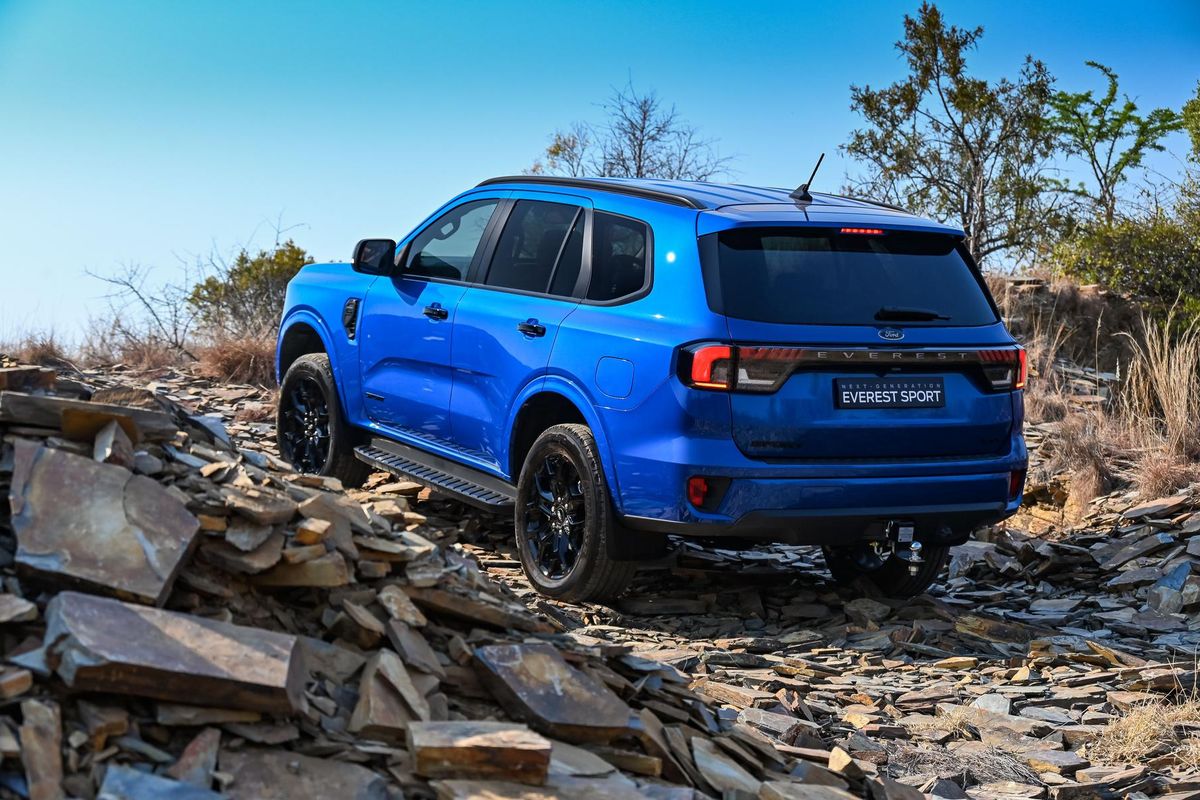
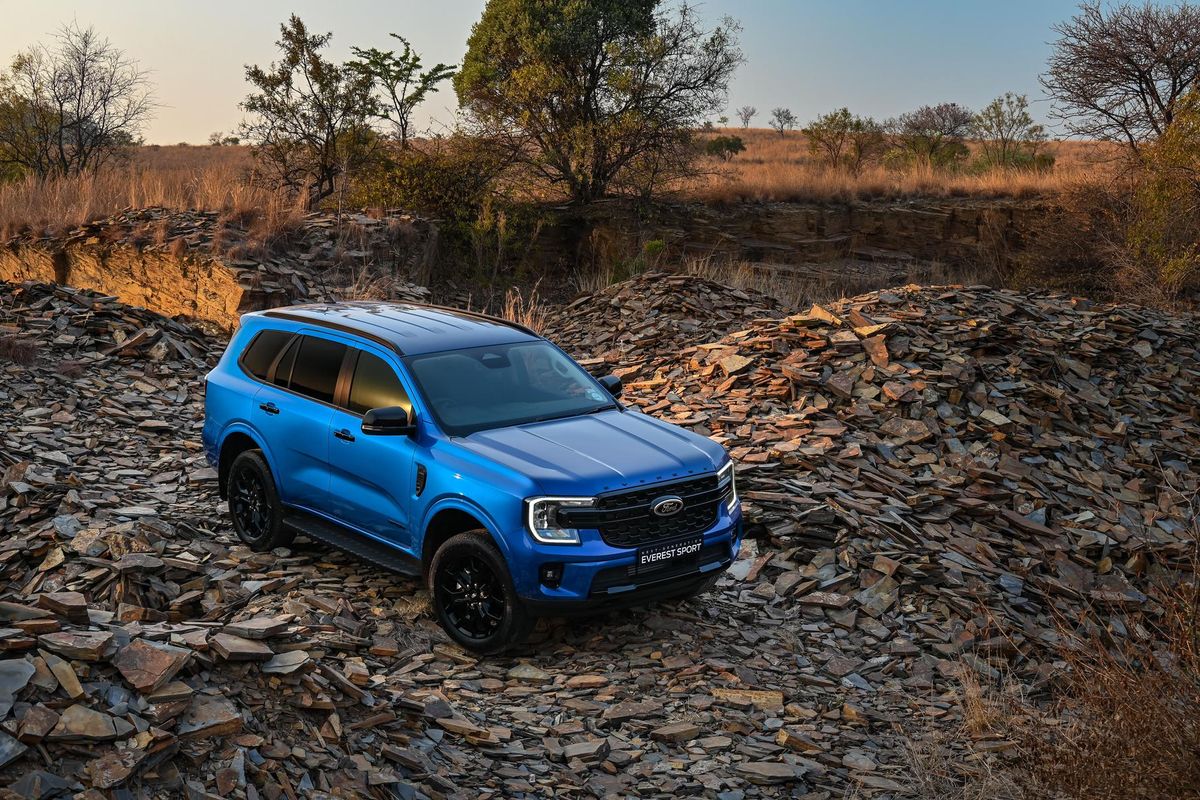
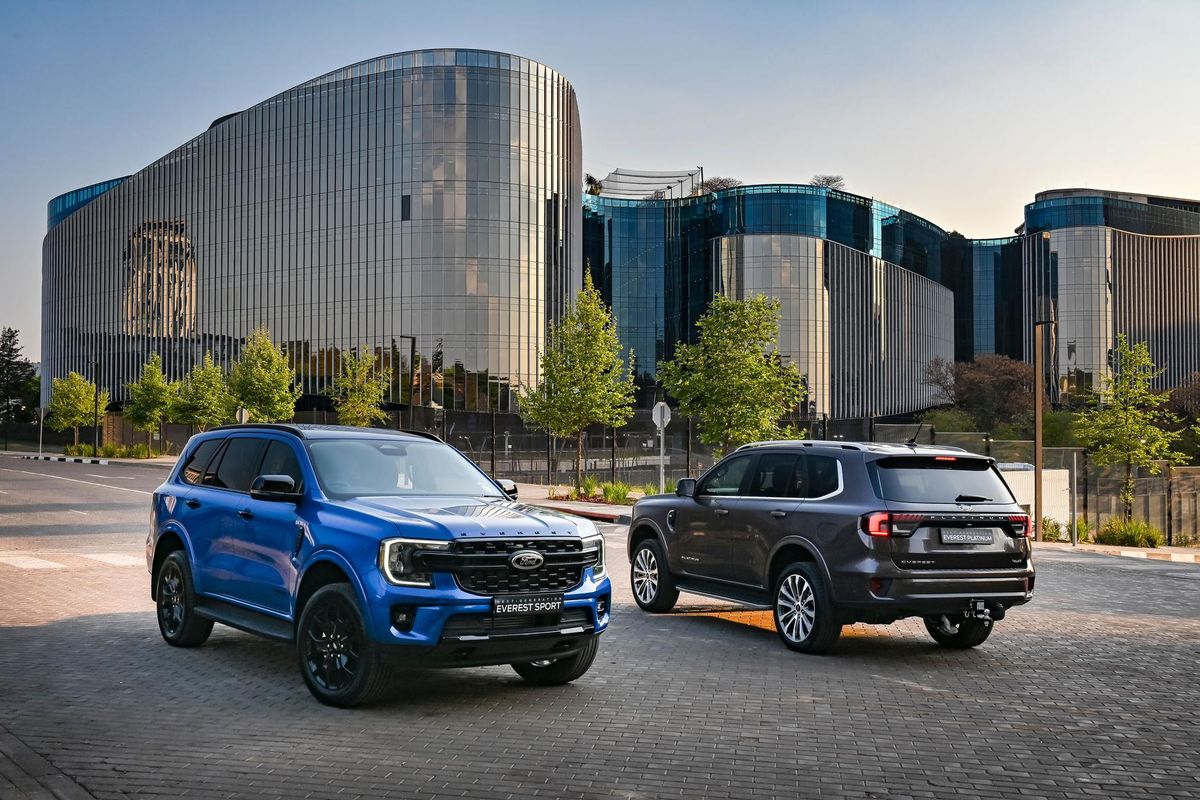
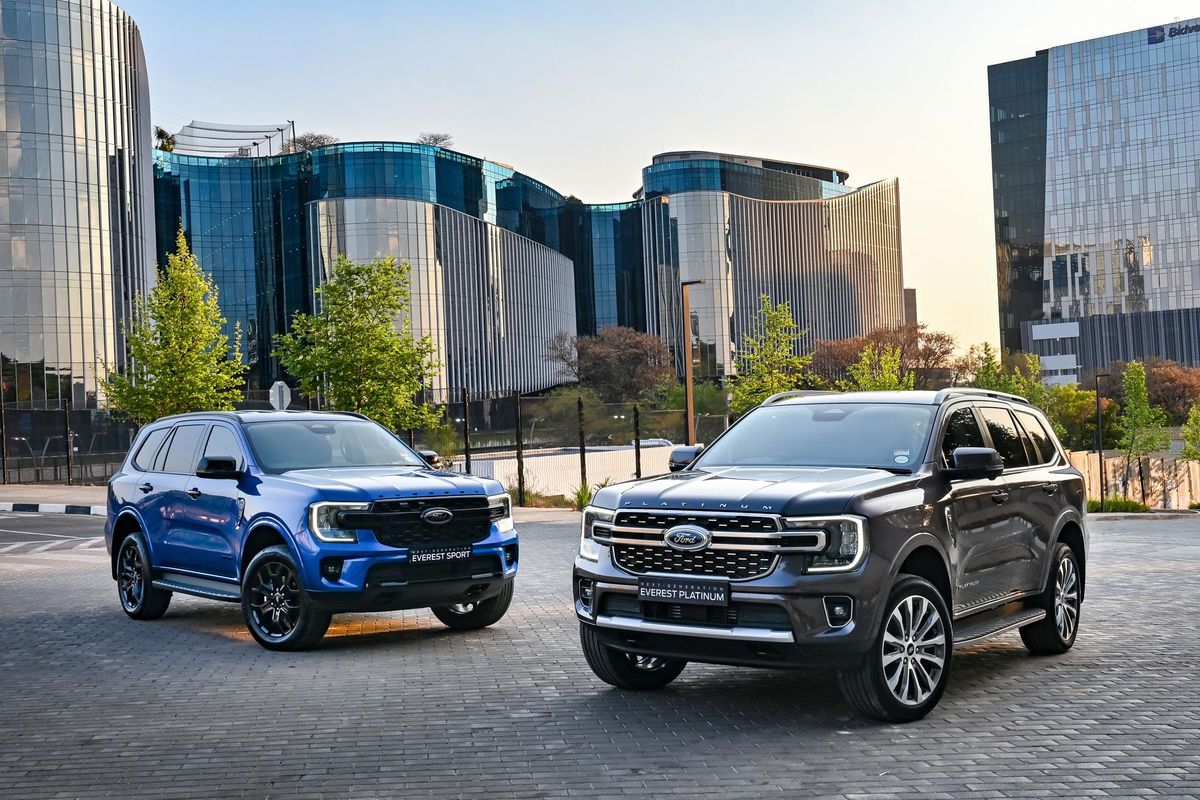
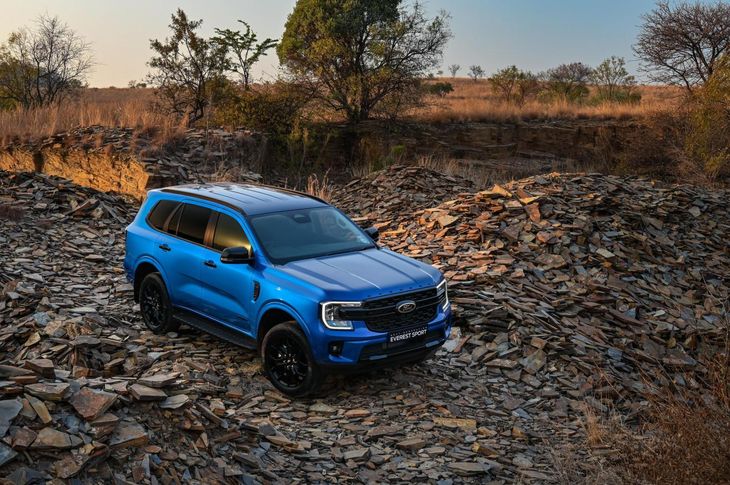
The new Everest in Sport (left) and Platinum (right) guises.
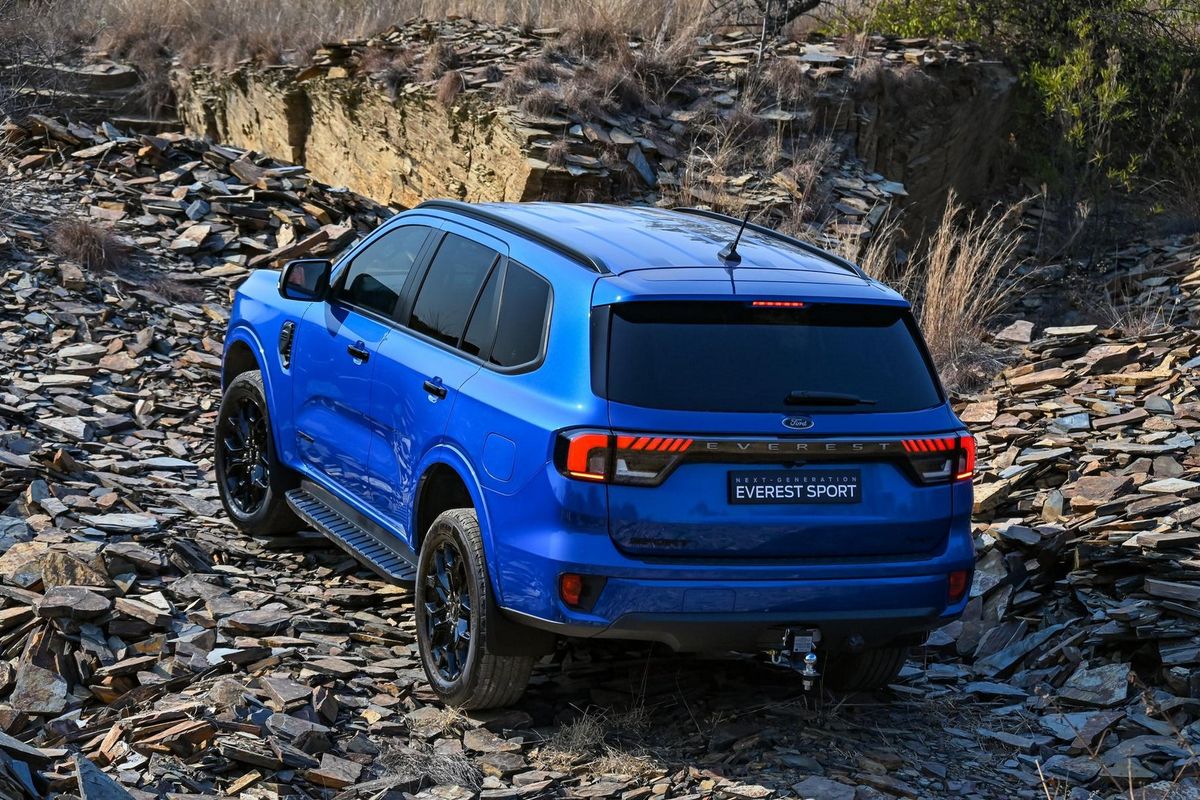
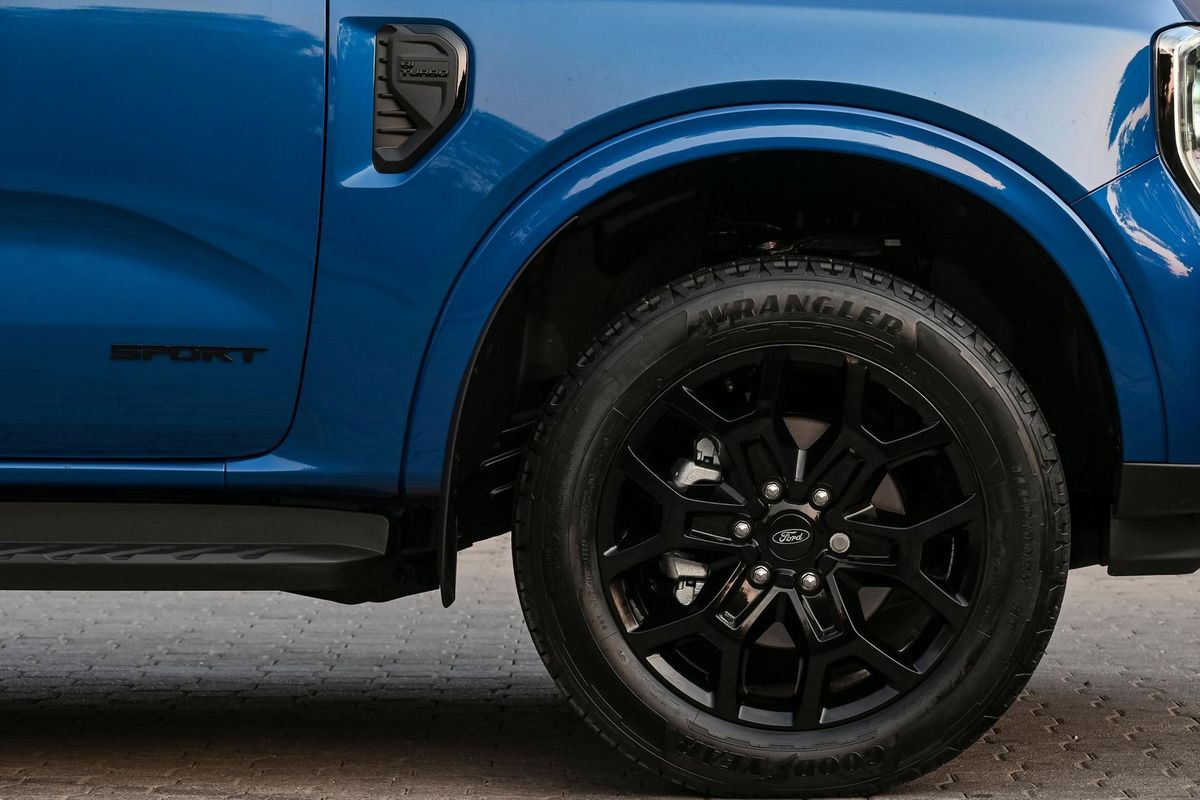
FMCSA will initially offer its new Everest in 2 flavours: Sport and Platinum. The two derivatives are separated mainly by engines and features, with the Sport powered by a 2.0-litre 4-cylinder biturbo diesel motor that offers up 154 kW/500 Nm.
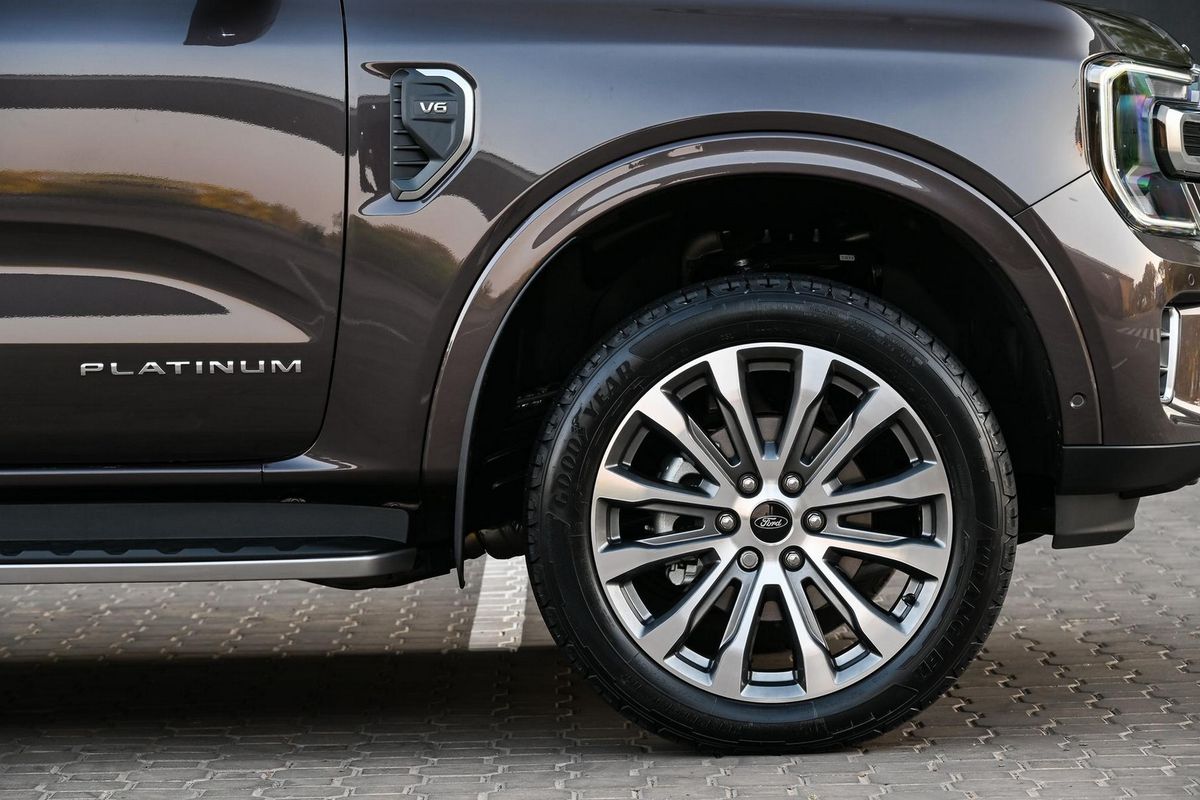
The Platinum, however, sees the debut of a new V6 turbodiesel (sourced from Ford’s F-Series range of pickups) with peak outputs of 184 kW and 600 Nm. Both powerplants are mated with a 10-speed automatic transmission.
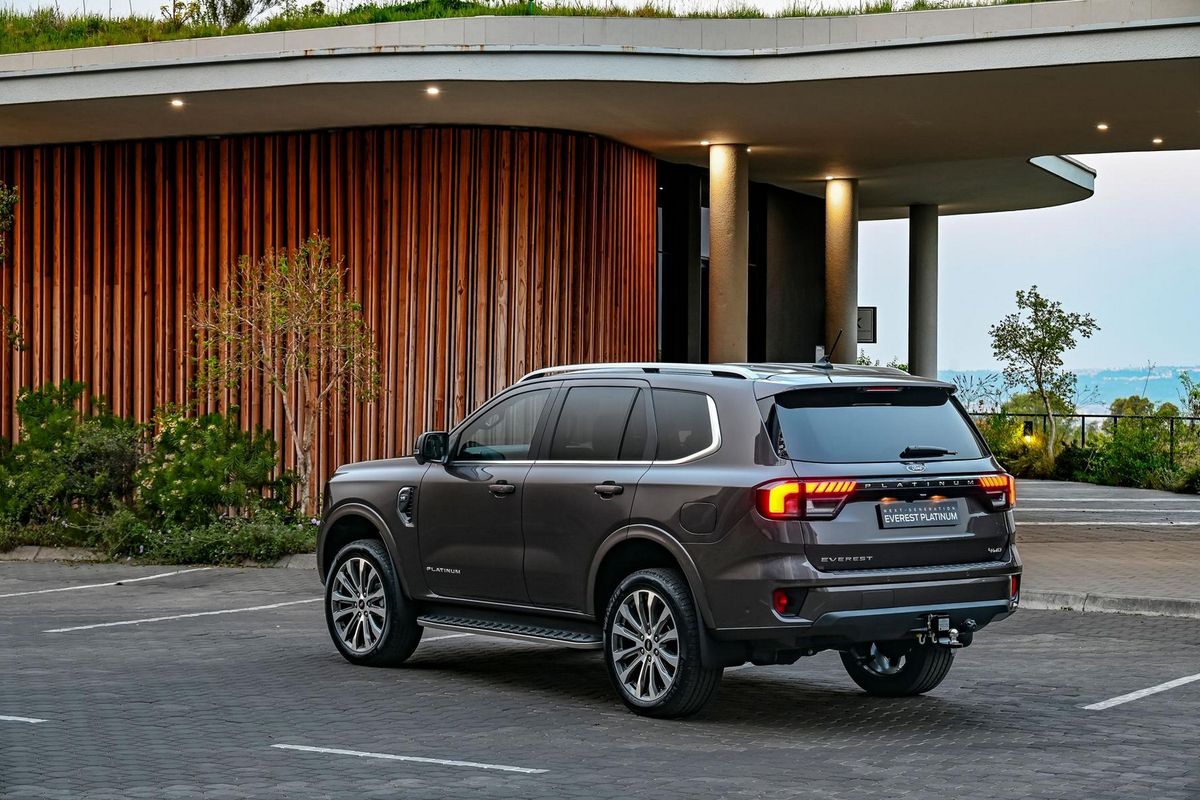
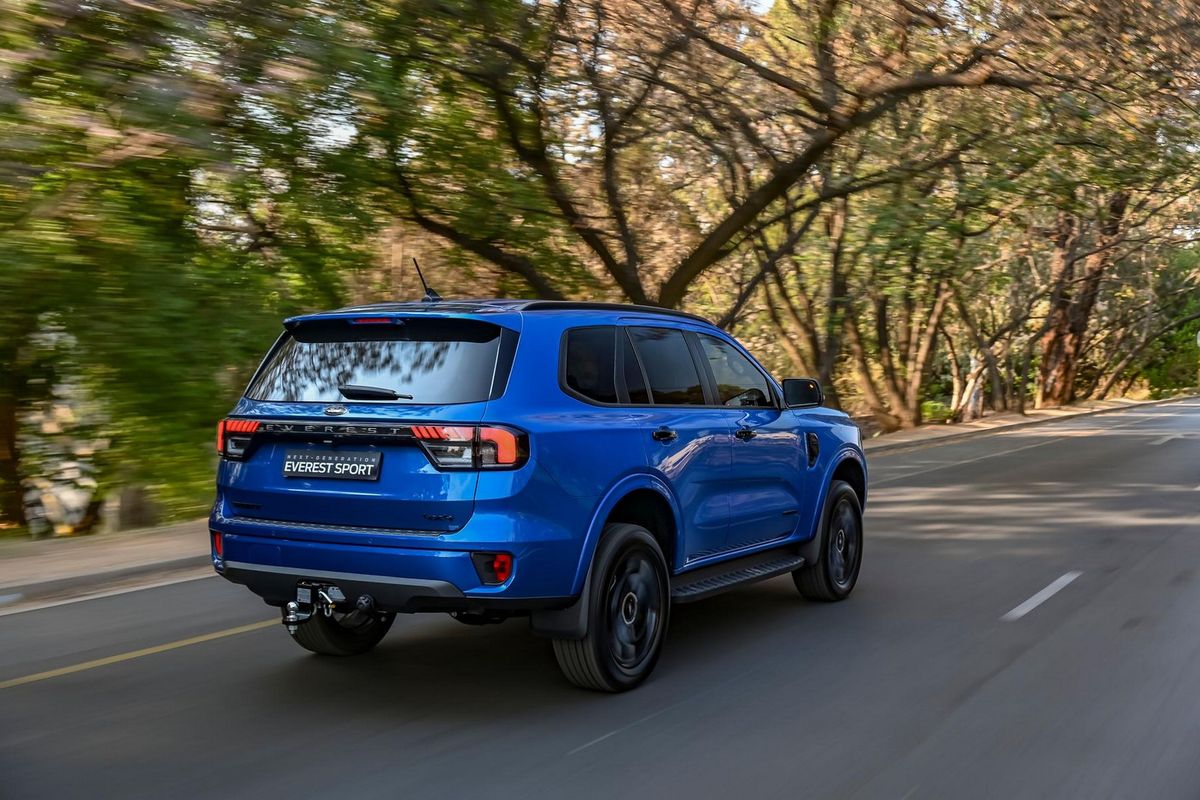
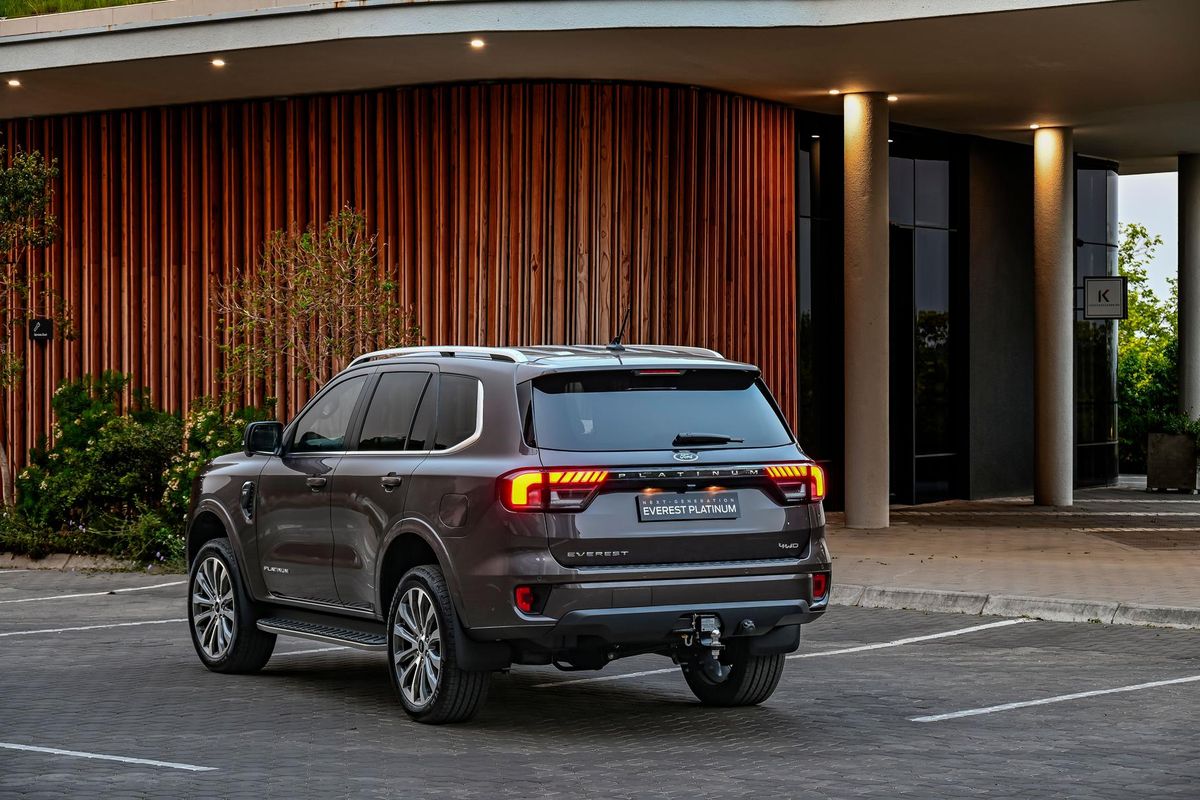
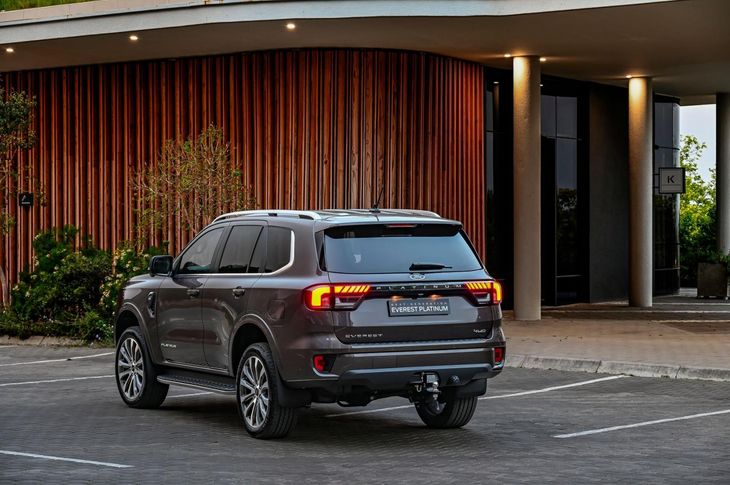
The newcomer’s tail-lamp treatment would not look out of place on a North American SUV.
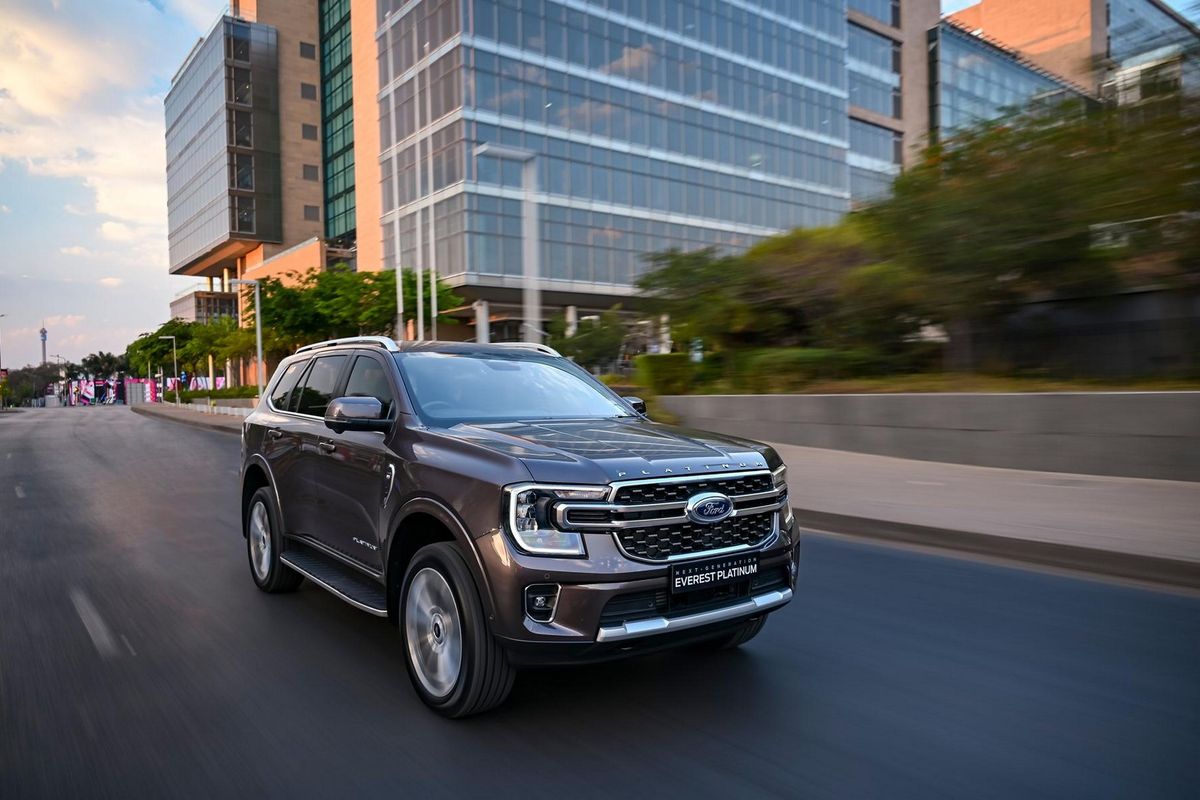
As far as generational changes go, the new Everest is bigger in all directions – length, width and height, and boasts a slightly longer wheelbase. For the benefit of 4×4 enthusiasts, the ground clearance of Ford’s 7-seater has gone up to 229 mm and the approach and departure angles have been increased slightly. Then you have those muscular looks; some would even suggest that the Everest’s been Americanised. We’re big fans of the C-shaped daytime running lights.
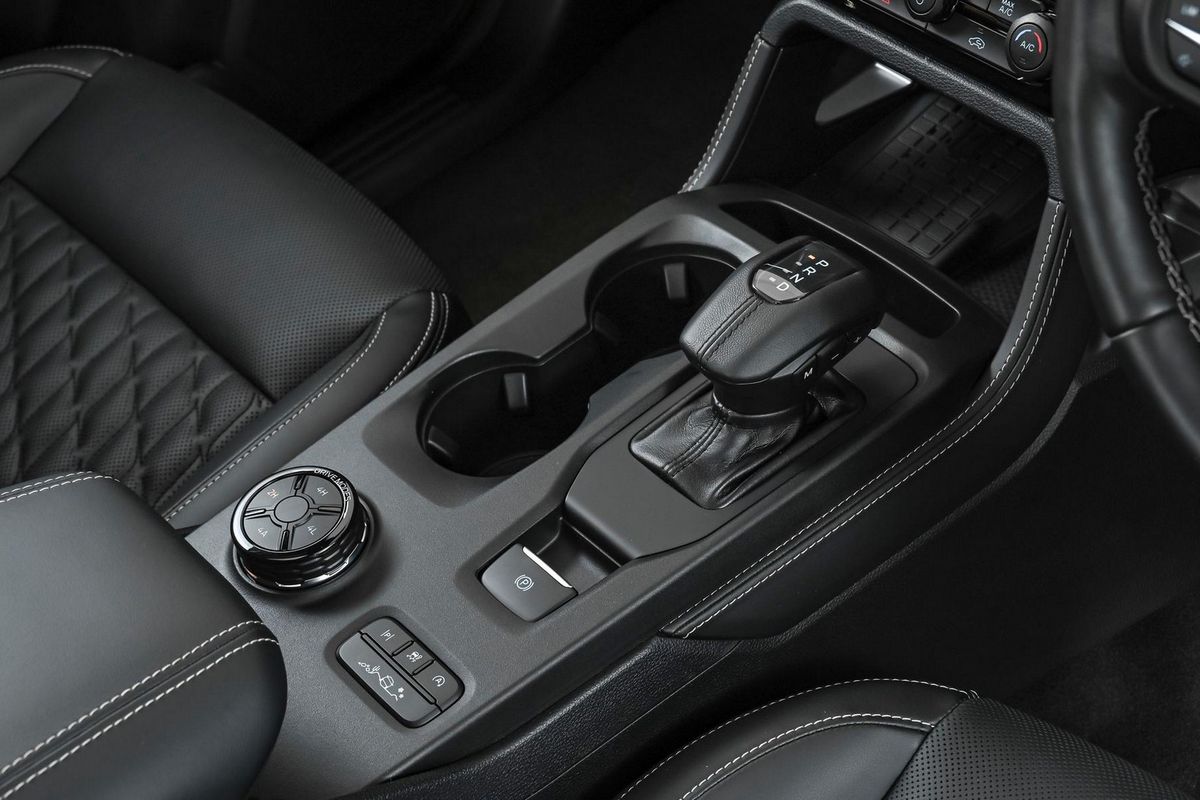
The Everest Sport makes do with a part-time 4×4 system that allows for shifting from 2H to 4H on the fly, while the Platinum has permanent all-wheel drive. Both derivatives offer an array of selectable off-road drive modes, hill descent control as well as an electronically-controlled rear differential lock.
What is it like to drive?
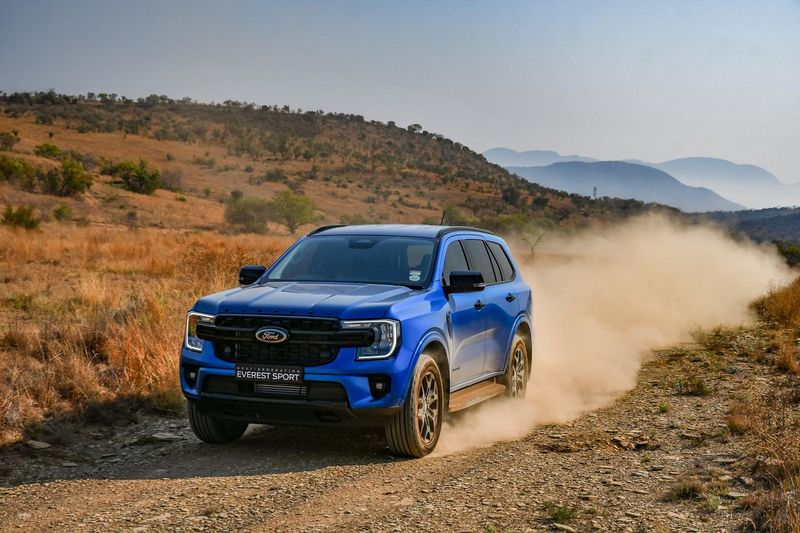
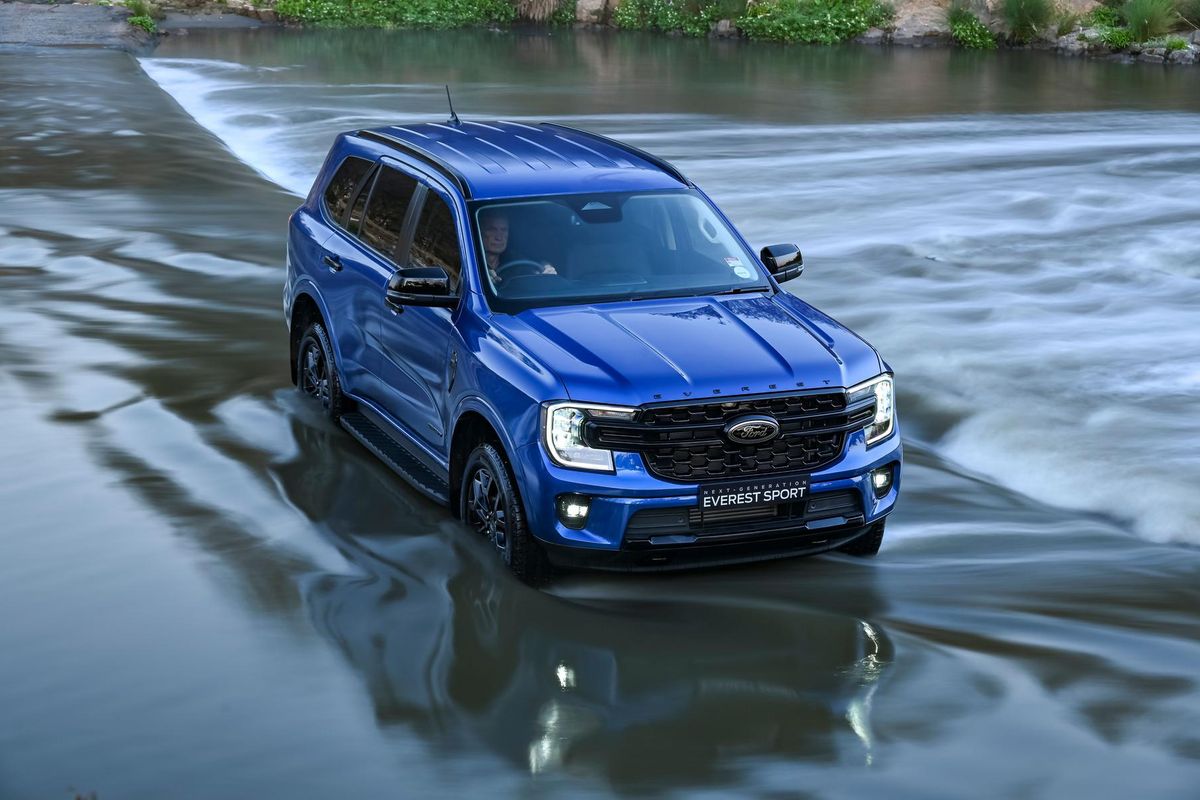
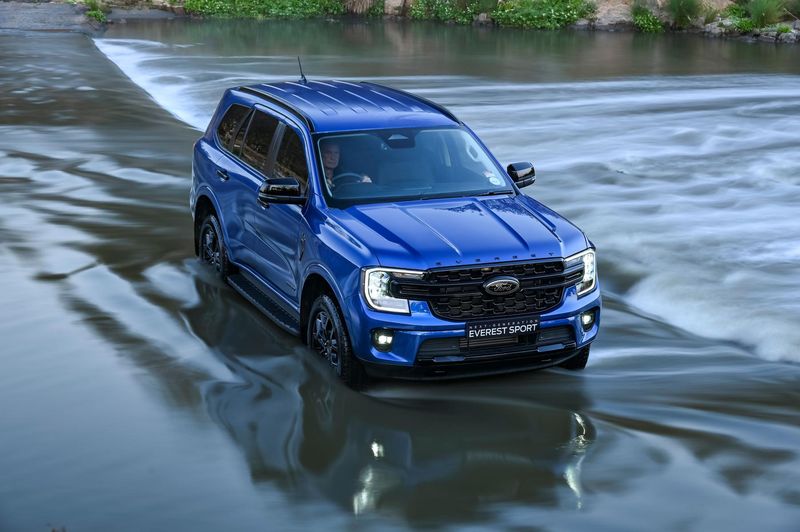
The Everest continues to offer impressive off-road capability.
We spent the vast majority of our evaluation drive behind the ‘wheel of the flagship Platinum derivative, but not before conducting a quick off-road test at a local fruit farm near Mbombela (formerly Nelspruit) behind the tiller of the Sport. Here the systems were put to the test on a tricky little track that combined steep climbs and descents with some nasty little dongas and axle twisters in between. As expected (given its predecessors’ track records), the Everest didn’t break a sweat.
With the off-road excursion done and um, dusted, we jumped into the Platinum – the flagship of the range. Right now this is the pinnacle of the Everest line-up, but we understand that more derivatives are under consideration for our market.
The new Everest offers a resolved ride quality, although the ride is still a tad jiggly on uneven road surfaces.
Two things stood out about the new model’s Platinum derivative… Firstly, that new V6 engine is exactly what the Everest needed. Not only is it a deliciously smooth-running motor, but its ability to produce urgent overtaking acceleration is deeply impressive – revisions to the outgoing model’s 10-speed automatic ‘box certainly help in that regard. This powertrain will be a treat when it comes to towing and, for the record, the braked tow rating has been upped to 3.5 tonnes.
The engine never sounds strained when the throttle is wide open and its outright grunt makes it stand head and shoulders above any other powerplant in this segment. Impressively, and despite some spirited driving on some glorious Mpumalanga backroads around White River, our test unit indicated an average fuel economy figure of 11 L/100 km (which is to be expected, FMCSA’s claimed consumption figure for this derivative – 8.5 L/100 km – is rather optimistic).
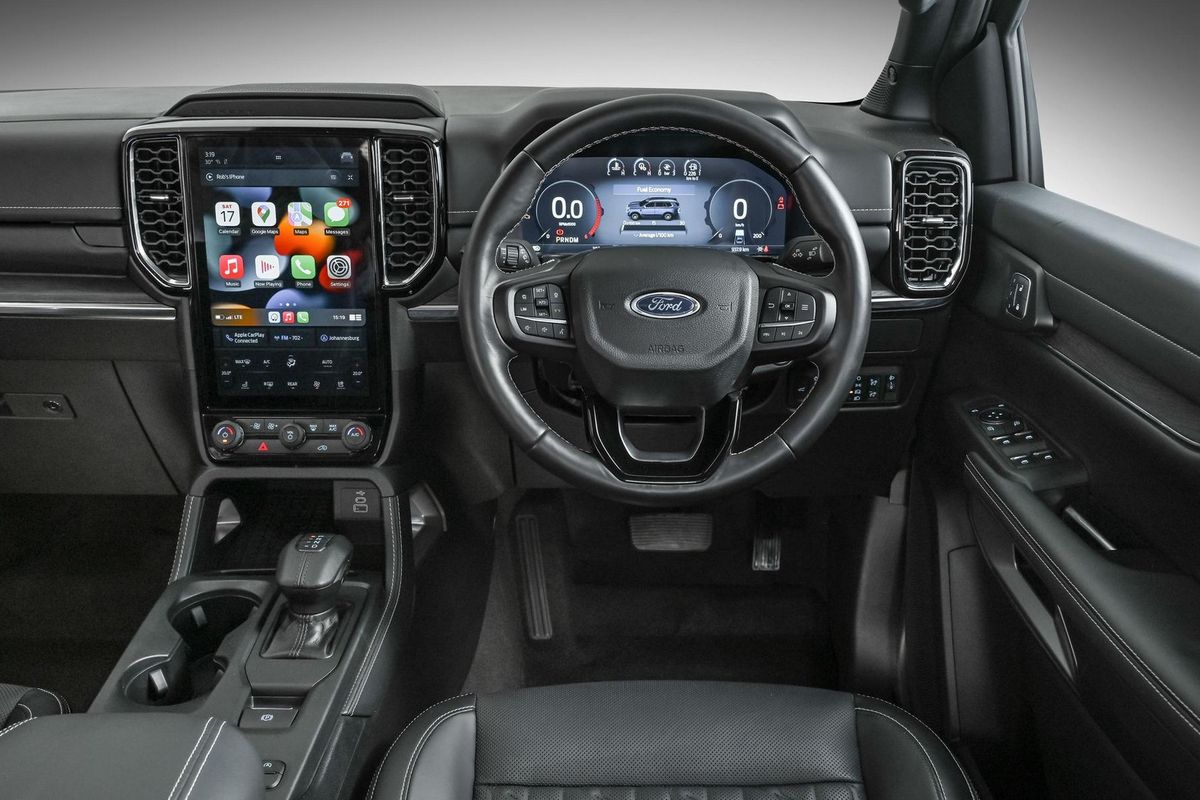
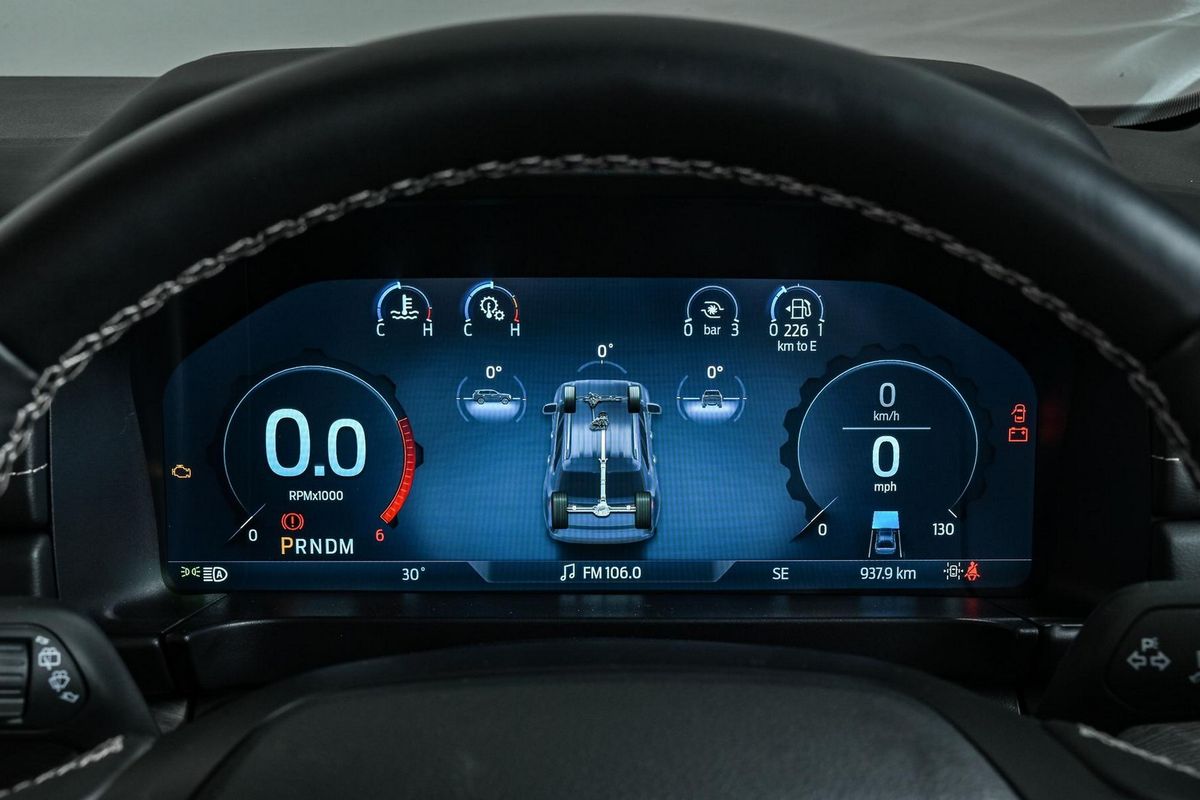
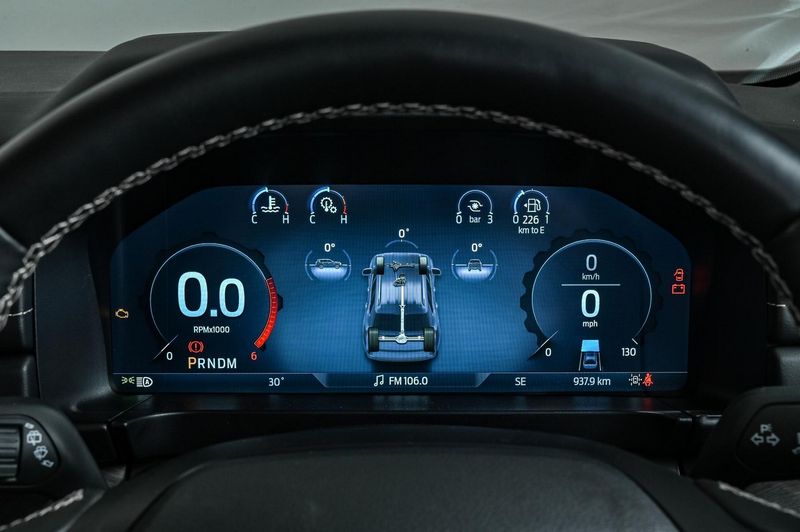
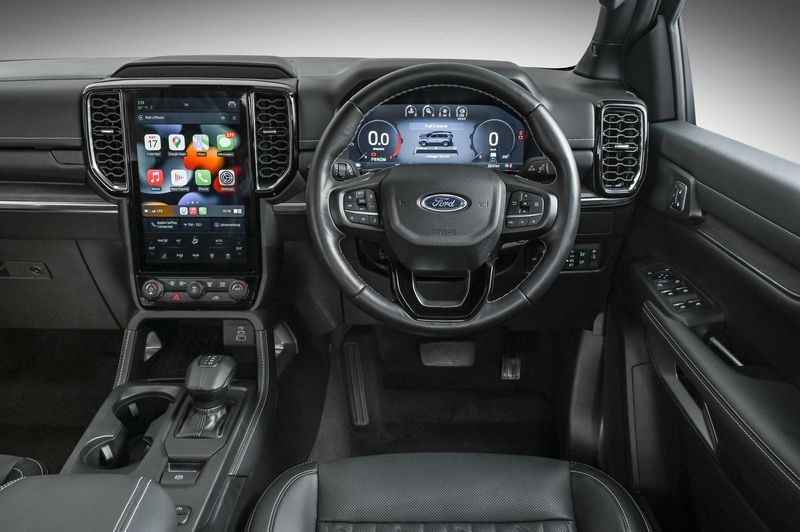
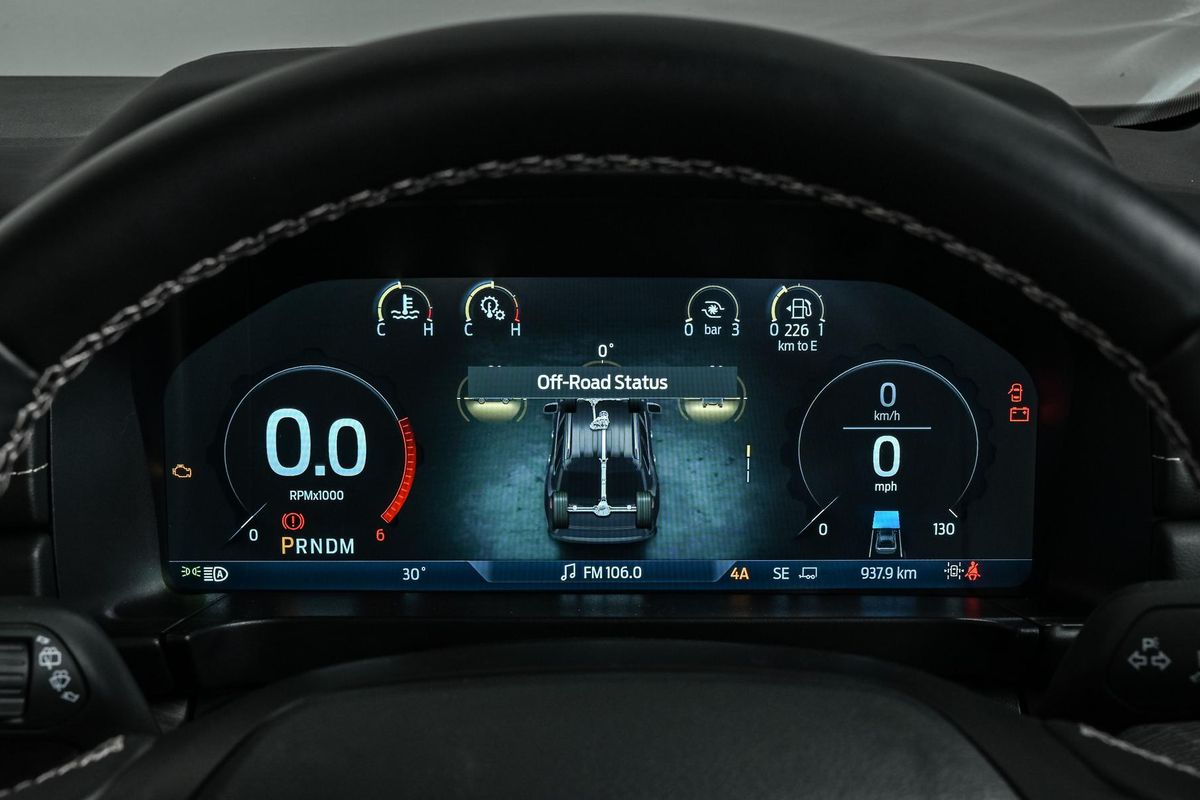
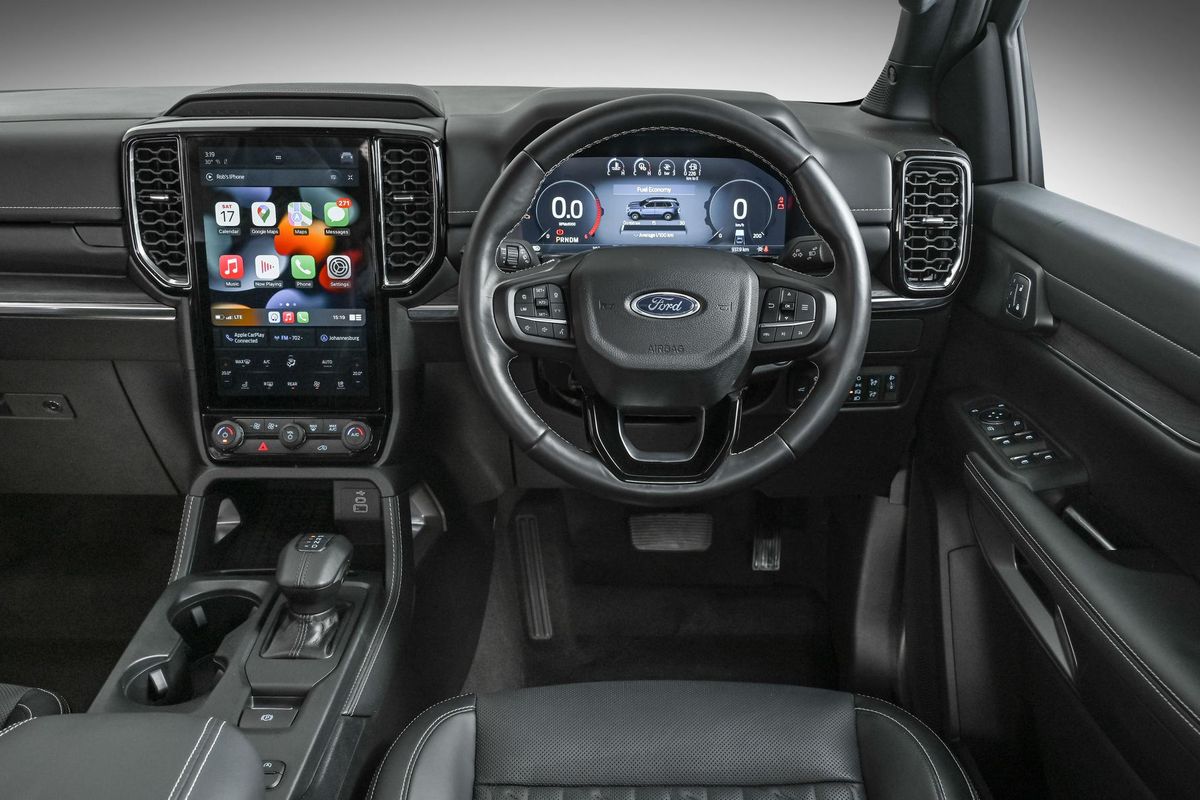
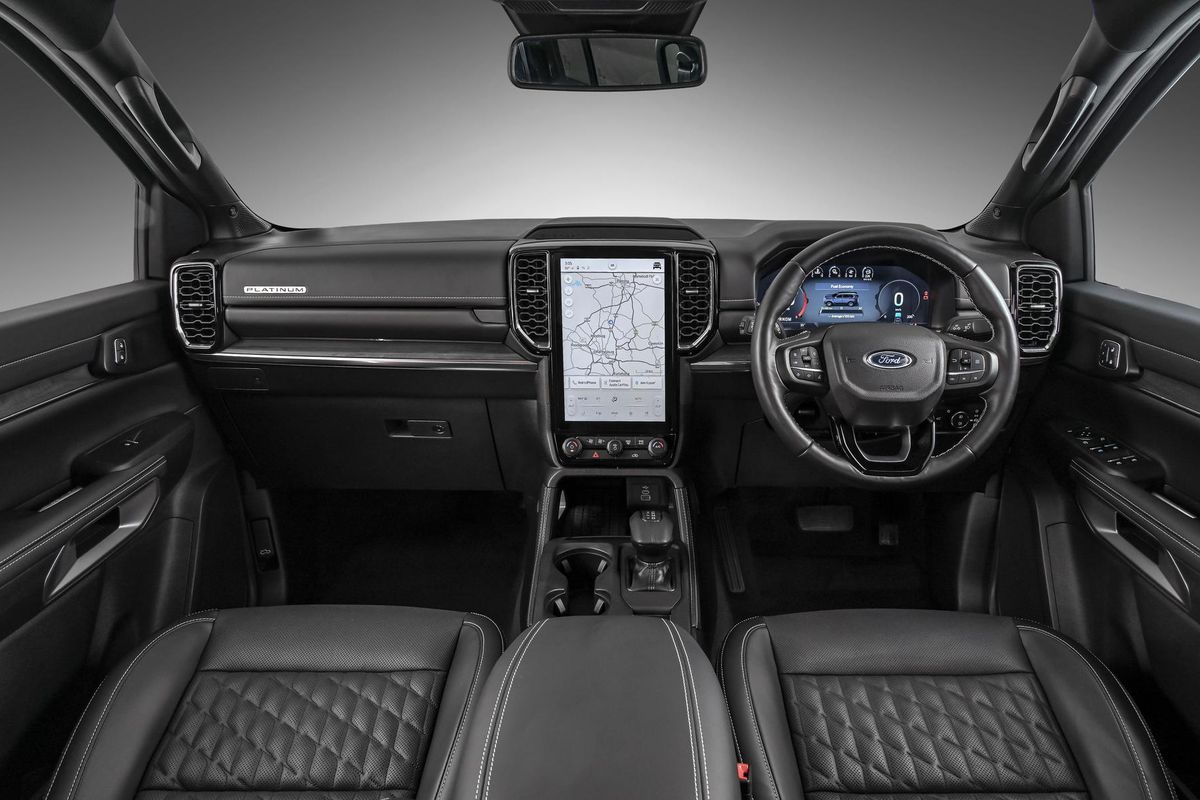
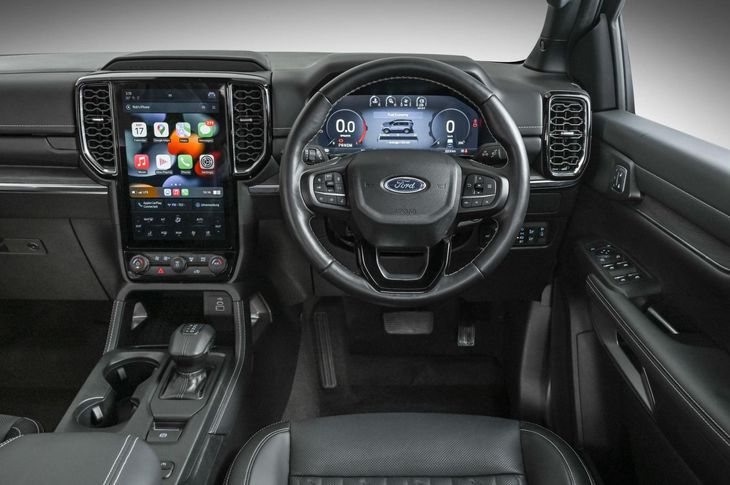
The digital dashboard’s display is crisp and modern.
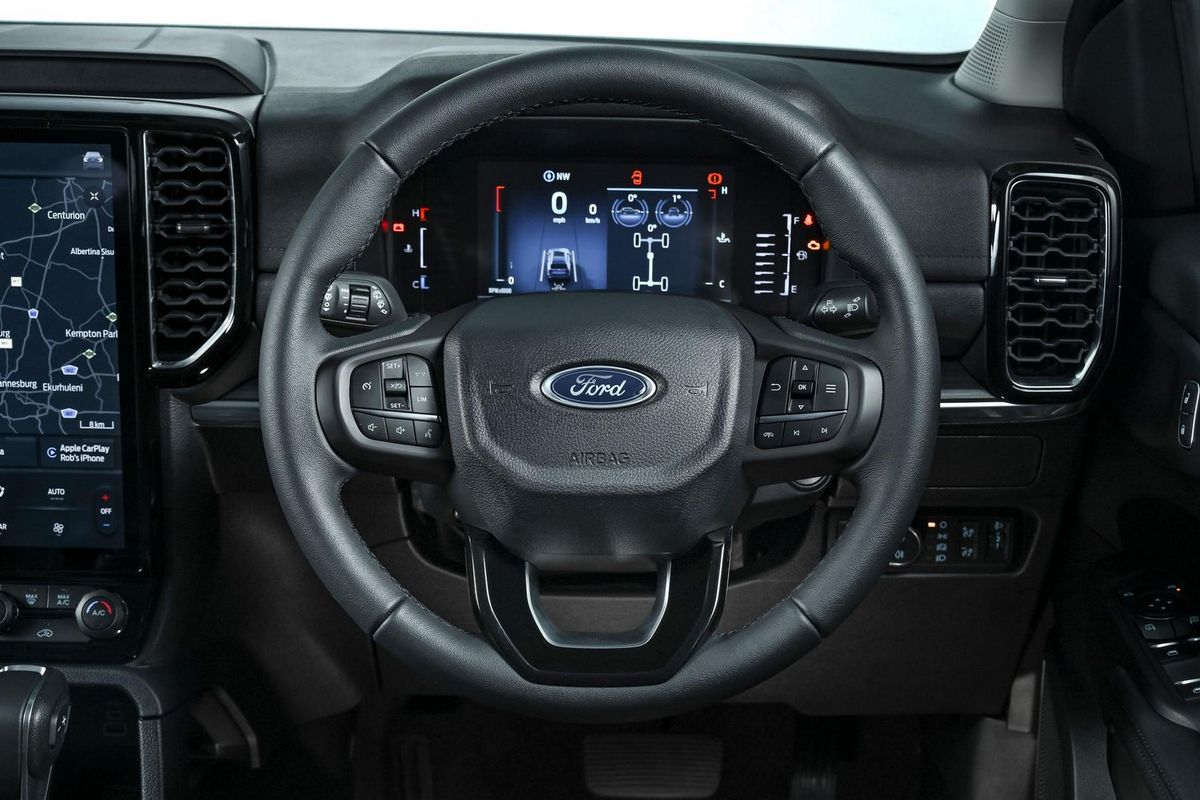
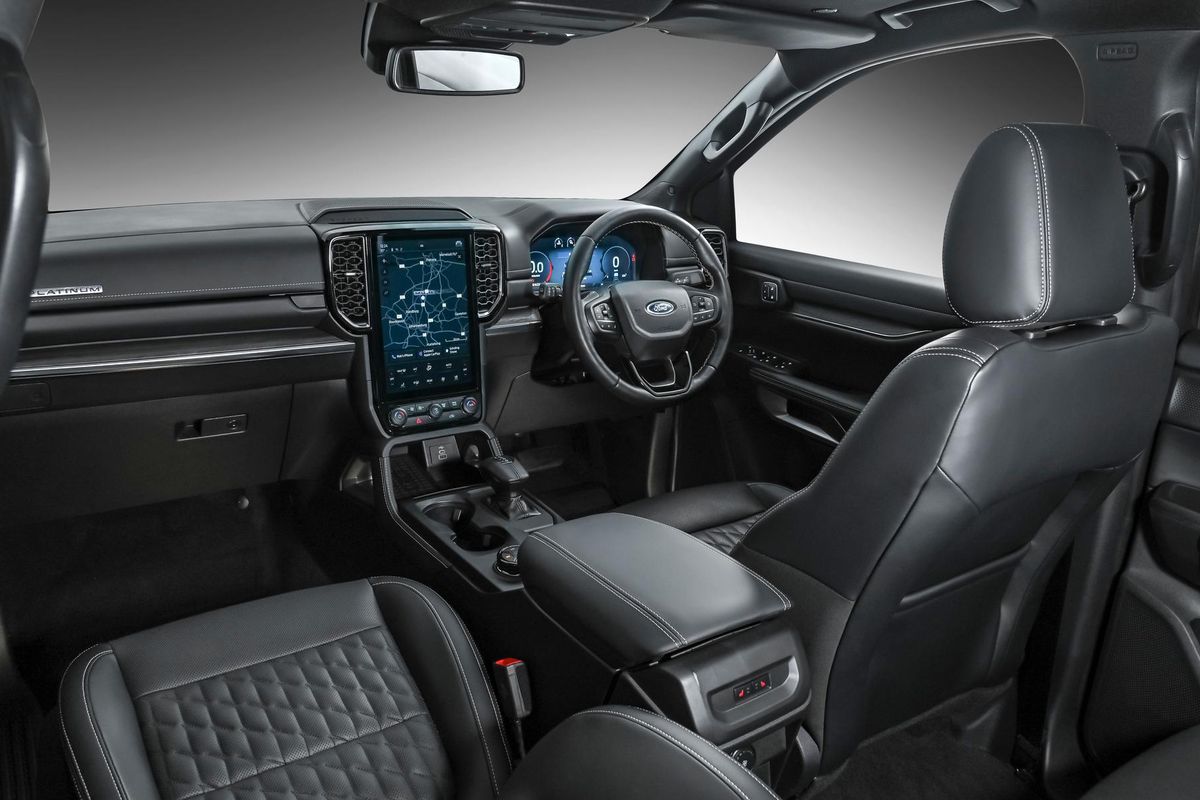
Secondly, the 3rd-generation Everest’s interior makes everything else in the segment look and feel remarkably old-school. There’s nothing analogue in the Ford cabin, which is equipped with a gorgeous digital instrument cluster and a large portrait-orientated infotainment screen. The latter is powered by the latest Ford SYNC4 user interface and while the system seemed a trifle confusing at the outset, we got the hang of it after a (relatively brief) period of familiarisation.
Ford says it has implemented improvements to the suspension, but as the Everest is a body-on-frame vehicle, its ride quality can still get a bit jiggly. It still shimmies on uneven tarred roads, but overall cushiness and comfort levels are high.
The portrait infotainment screen dominates the Everest’s fascia.
The newcomer’s noise, vibration and harshness (NVH) levels are impressively low, but we did discern some wind noise at the national speed limit, which we suspect was generated by the 7-seater SUV’s chunky side mirrors. We’ll have to wait for a new Everest test unit to arrive in Cape Town to confirm whether this is a major issue or not. It didn’t bother us; we drowned it out with the aural satisfaction provided by a premium audio system from B&O (it incorporates 12 speakers).
As far as standard features are concerned, the Everest Premium comes fully loaded with almost every conceivable gadget and gizmo, as well as a comprehensive semi-autonomous safety suite. There are numerous USB chargers dotted around the cabin, wireless charging, a panoramic sunroof, heated seats for the first two rows, as well as a 400W inverter, which allows rear passengers to charge a laptop, for example.
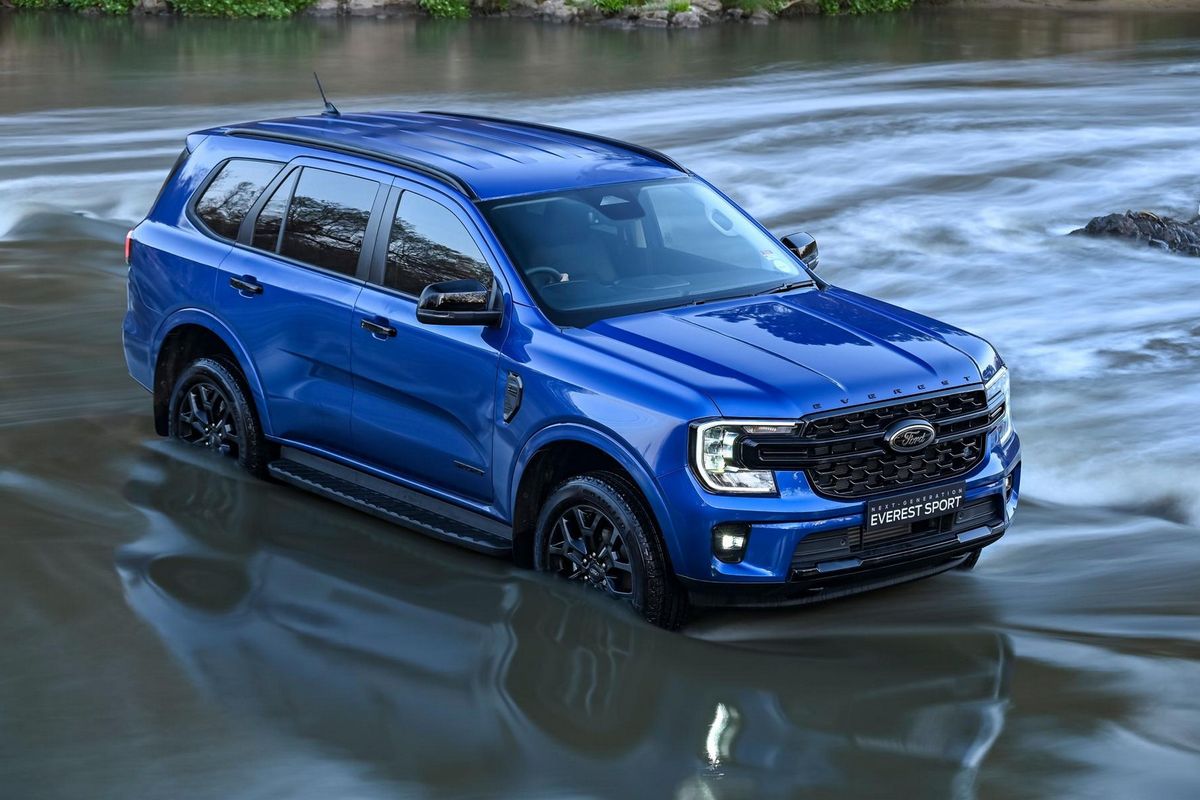
There are only two versions available: Sport (shown above) and Platinum.
Pricing & after-sales support (Sept 2022)
Everest Sport 2.0L BiT 4WD 10AT
R965 400
Everest Platinum 3.0L V6 AWD 10AT
R1 113 100
Included in the price is a 4-year/120 000 km warranty, 4-year/unlimited km roadside assistance and 5-year/unlimited distance corrosion warranty. The recommended service interval is 15 000 km or once a year, plus customers have the option of purchasing service or maintenance plans of up to 8 years or 135 000 km. The warranty can be extended up to 7 years or 200 000 km, while the roadside assistance can be extended for up to 2 years.
Ford has lofty ambitions for its 3rd-gen adventure SUV… In fact, the new Everest is said to have the Toyota Prado in its sights.
Summary
Given the array of technology offered in both the Sport and Platinum iterations of the new Everest, plus that range-topping muscular V6 diesel engine, Ford could be accused of being a bit cocky in suggesting that the new Everest is no longer a Toyota Fortuner rival, but a competitor to the Japanese giant’s 7-seater off-roader – the Prado.
The Toyota Prado is due for replacement and is priced on par with the Blue Oval’s new offering, but its cabin lacks the “loaded with tech” feel that the Everest offers in abundance. Perhaps there’s some validity in that claim after all…
Still, when it comes down to numbers, consumers won’t be too happy to hear that whereas the outgoing flagship Everest Limited came in at R877 300, the newcomer starts just under R1 million (for the Sport BiT 4WD version). That’s quite a hike, especially when you consider that South Africa’s perennial top seller in the Adventure SUV category – the admittedly long-serving and less tech-oriented Fortuner – tops out at R870 900 (September 2022).
On reflection, is the smarter-but-pricier 3rd-gen Ford Everest worth it? After our introductory drive, we’re certainly interested in the newcomer, but we’ve only had a small taste of what’s undoubtedly a highly-advanced SUV (that packs a wallop in flagship Platinum 3.0L V6 guise). It’s going to take us some time to master the new SYNC4 system, but the initial signs are very promising. We think Ford has succeeded in moving the goalposts of the Adventure SUV segment.
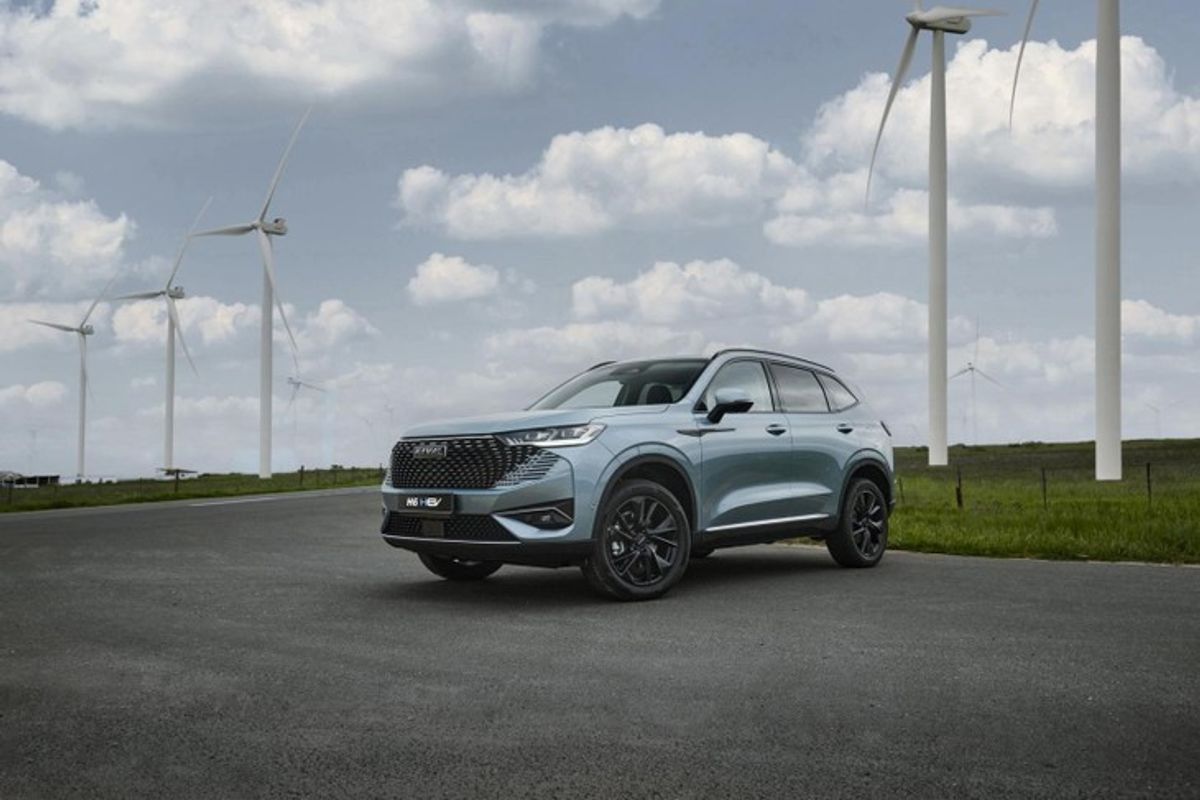
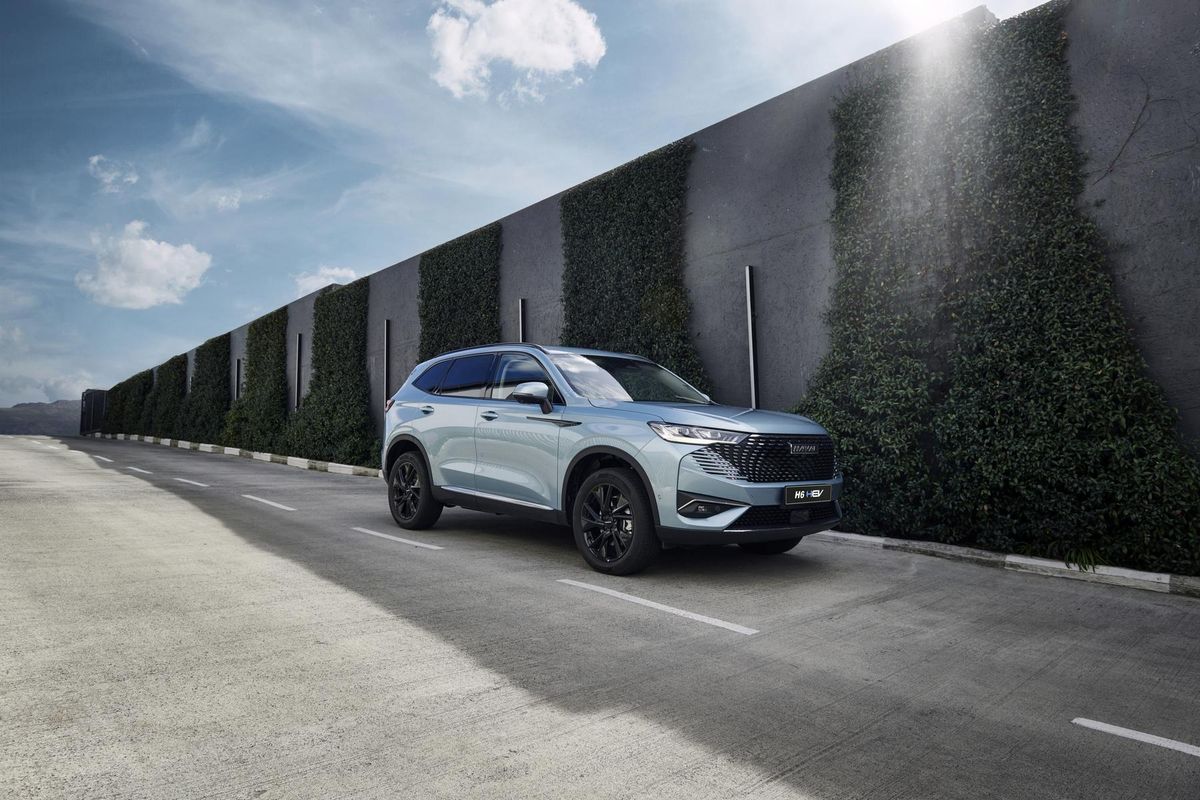
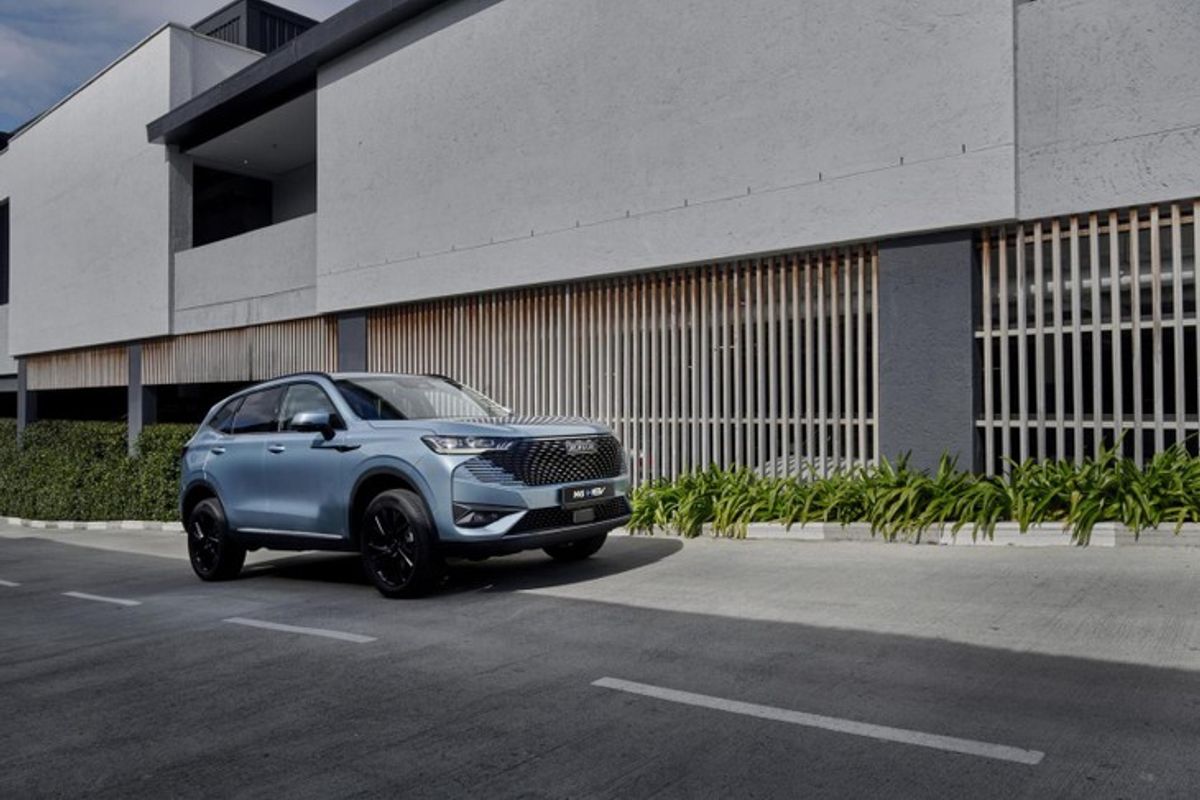
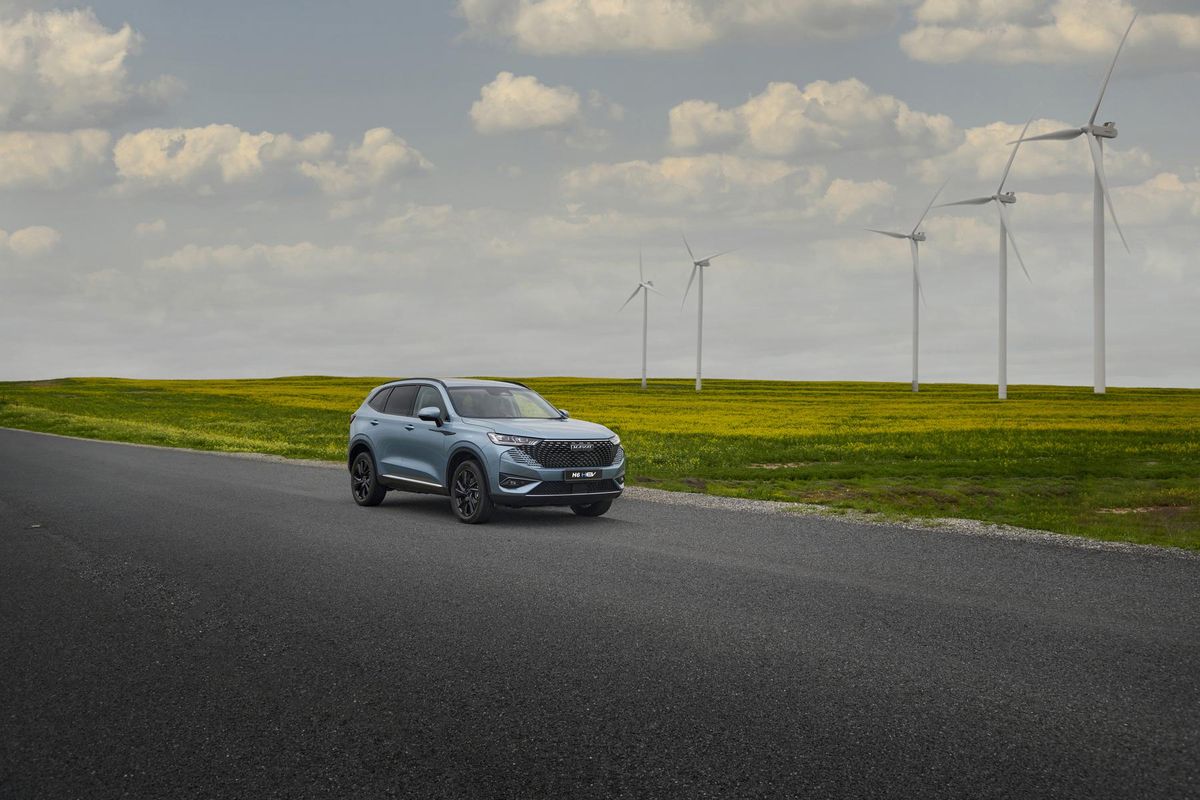
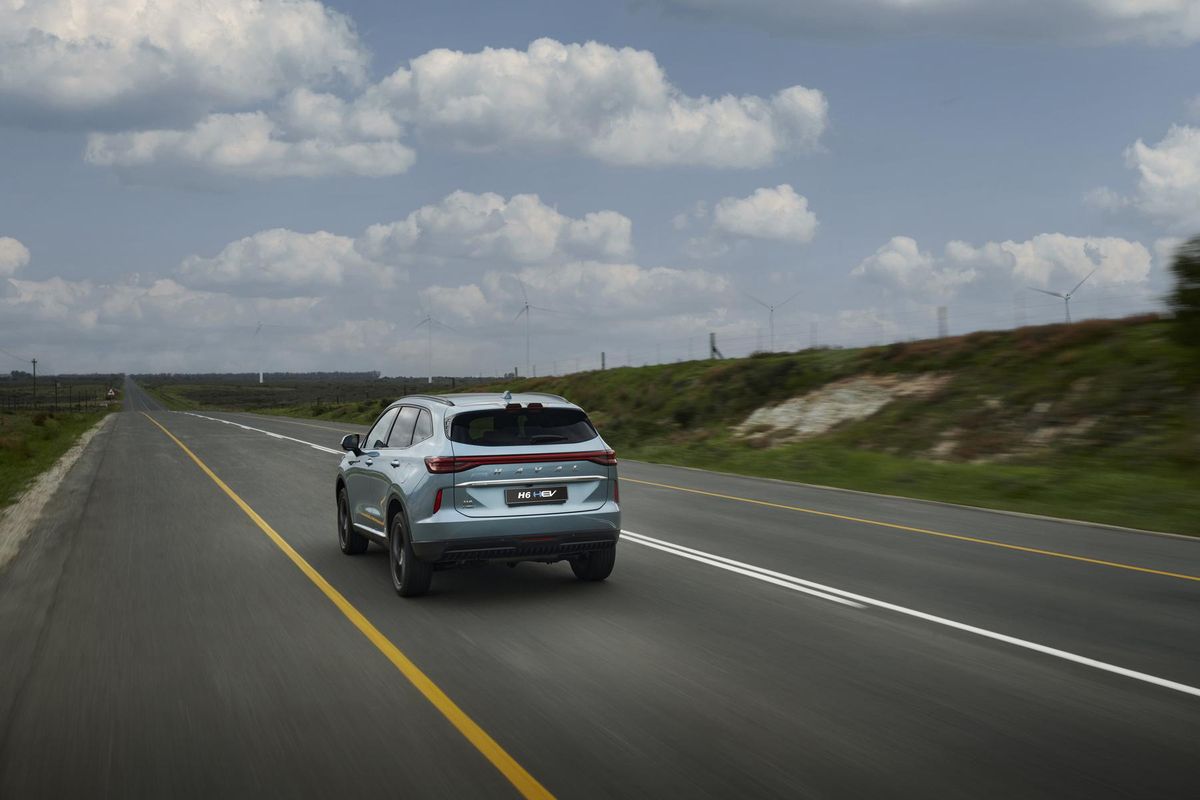
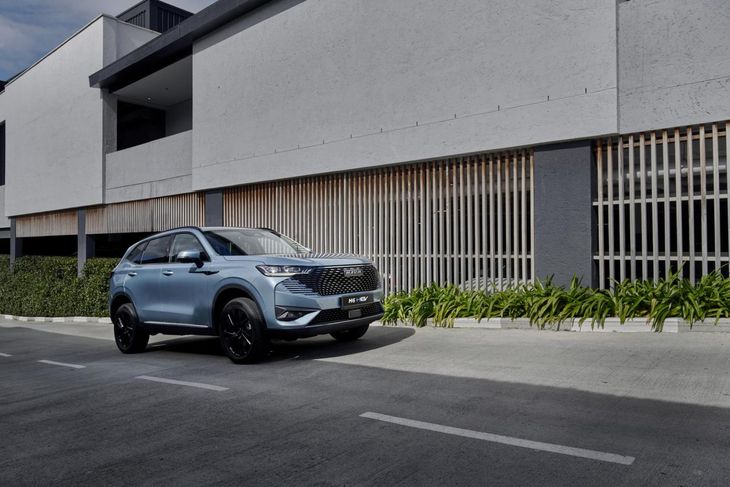
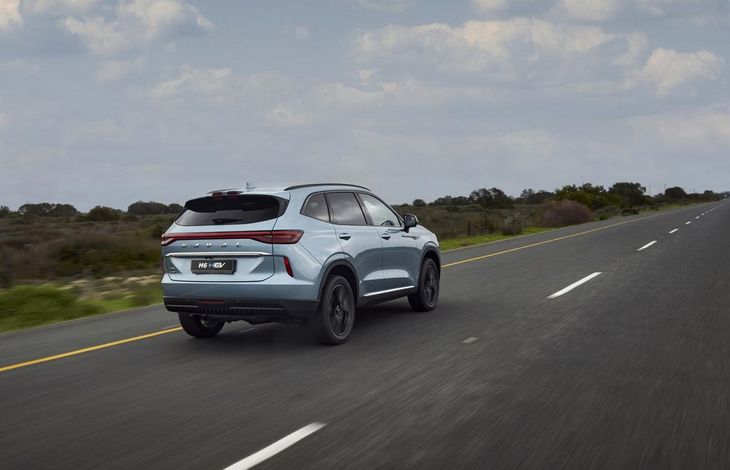
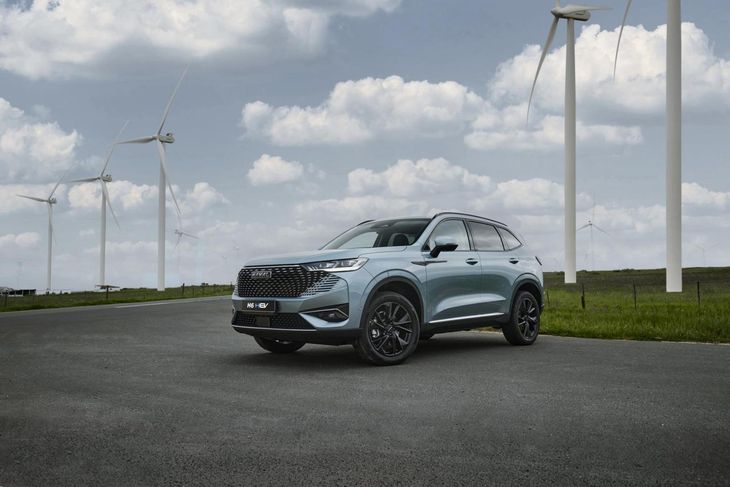
Haval’s onslaught on the SUV market has taken another step with the introduction of the brand’s first hybrid offering in South Africa – the H6 Hybrid. Might the H6 Hybrid be one of SA’s best-value vehicles on sale right now? We attended its local launch to find out.
Where does the Haval H6 Hybrid fit in?
The H6 Hybrid addresses the major problem with the Haval range – iffy fuel economy.
The Haval H6 has been a runaway success for Great Wall Motor’s SUV brand. The Chinese brand’s family car/medium SUV seems to offer a lot of what buyers want in this segment: a fresh design, practicality, modern tech and, above all, a decent asking price when all things are added up.
The H6 Hybrid addresses one of the major issues the model lineup has had since its introduction – less-than-excellent fuel economy. Drivetrain efficiency has been the issue that’s most often raised by H6 owners and those who have test driven the H6 (and Jolion). The new range-topping derivative is purported to use about half the fuel of a regular H6 derivative, while not costing all that much more than the top-end non-hybrid version.
The H6 Hybrid also introduces a new Ultra Luxury specification that sits atop the lineup – above the previous best Super Luxury.
What’s the H6 Hybrid like to drive?
The best of both worlds – performance AND efficiency.
Toyota has been the go-to brand when it comes to hybrids in the South African new-vehicle market and we’ve become accustomed to hearing that the Aichi-based brand’s hybrid engines have been tuned for efficiency and that’s why they don’t produce more power than their pure ICE (internal combustion engine) siblings… despite having a battery pack and an electric motor on board. The H6 Hybrid, by contrast, combines a 1.5-litre 4-cylinder turbopetrol engine with an electric motor to produce a combined power output of 179 kW and 530 Nm of torque (at least that’s what Haval claims). That’s crazy considering this is an “average” family SUV.
After spending an afternoon driving the H6 Hybrid I can tell you the newcomer produces excellent overtaking acceleration and that there’s plenty of “get up and go” when you summon it with a firm prod of the accelerator pedal, but it’s difficult to say it felt like 500 Nm of shove, even in Sport mode. That said, it still felt plentiful and considering the derivative’s price point and rival in the segment – the RAV4 Hybrid E-Four, it certainly has the strongest powertrain.
The newcomer’s transmission is quite clever too. The H6 Hybrid uses a 2-speed direct-drive gearbox that I couldn’t find fault with. It’s quiet, and smooth and seems to avoid that annoying elastic feeling that rivals’ CVTs exhibit.
And what about that all-important fuel economy figure? Haval claims its H6 Hybrid uses just 5.2 L/100 km and during our 250-km trip (comprising rural roads and a bit of JHB N1 highway driving), we averaged 6.7 L/100 km. That represents a vast improvement on the 10 L/100 km-plus that users have been achieving in petrol-only versions of the H6.
What is Ultra Luxury spec?
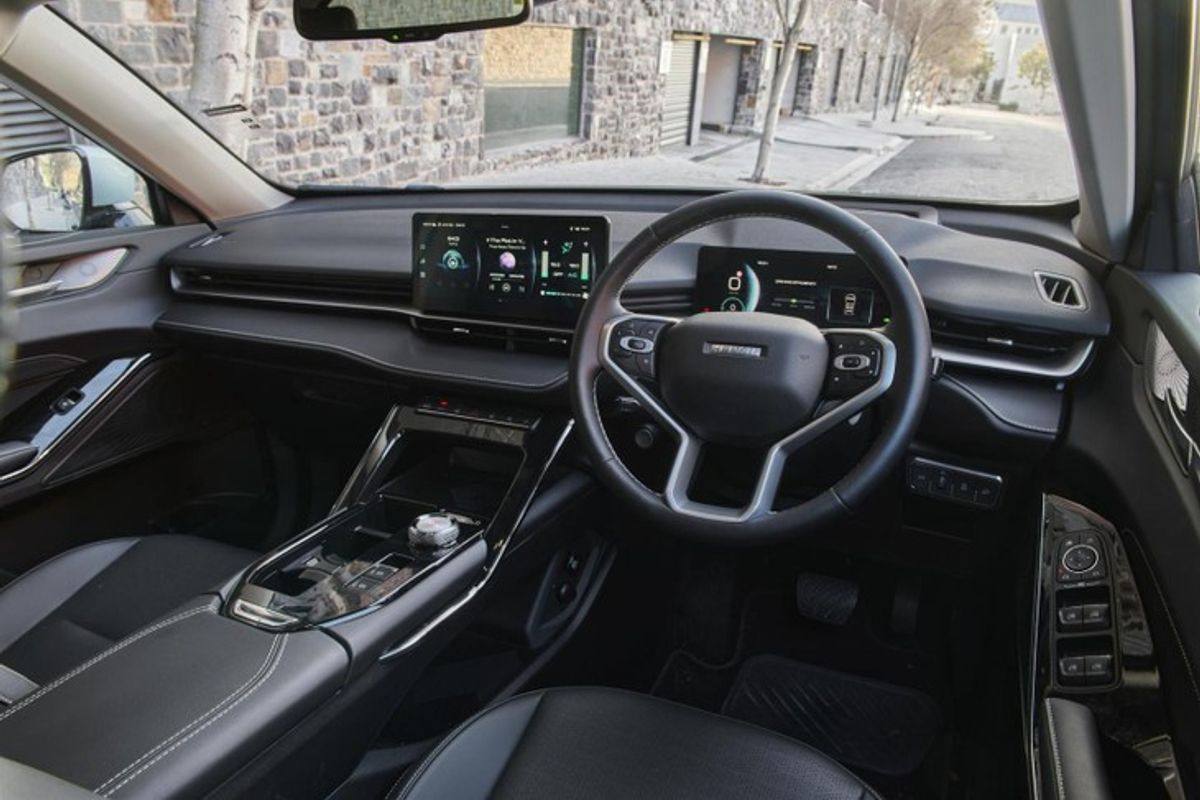
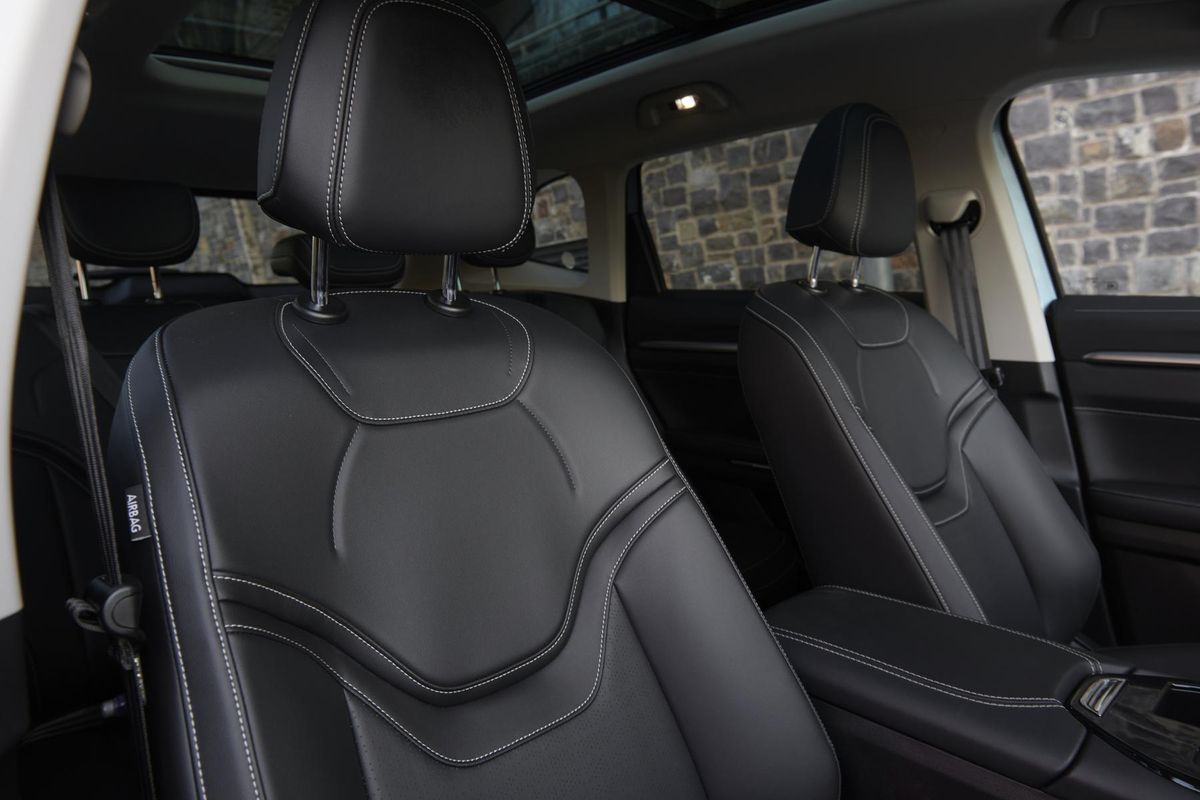
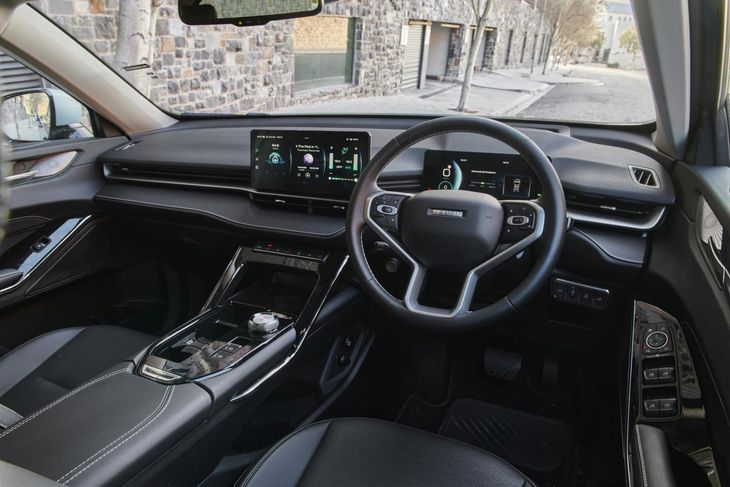
Fit-and-finish is excellent and the specification on the Super Luxury has everything you’ll ever need.
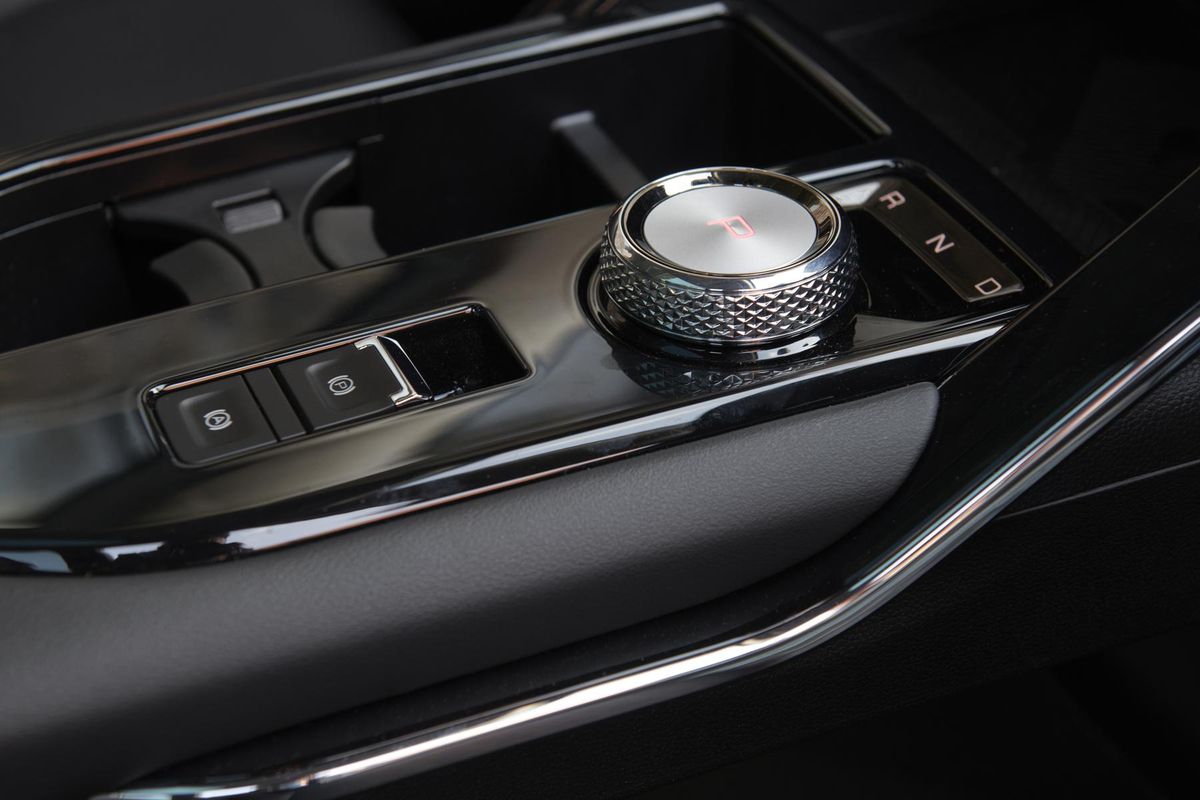
Ultra Luxury may sound like it incorporates many more features than the Super Luxury grade, but the only notable addition is a self-parking feature. It still features an incredibly well-equipped specification that includes every conceivable safety feature and autonomous-driving function that you’d struggle to find in cars in the R1-million bracket.
The only feature I could detect that was missing was wireless Apple Carplay and Android Auto. The feature is still available on the H6 Hybrid, you just have to have your phone plugged in via a cable.
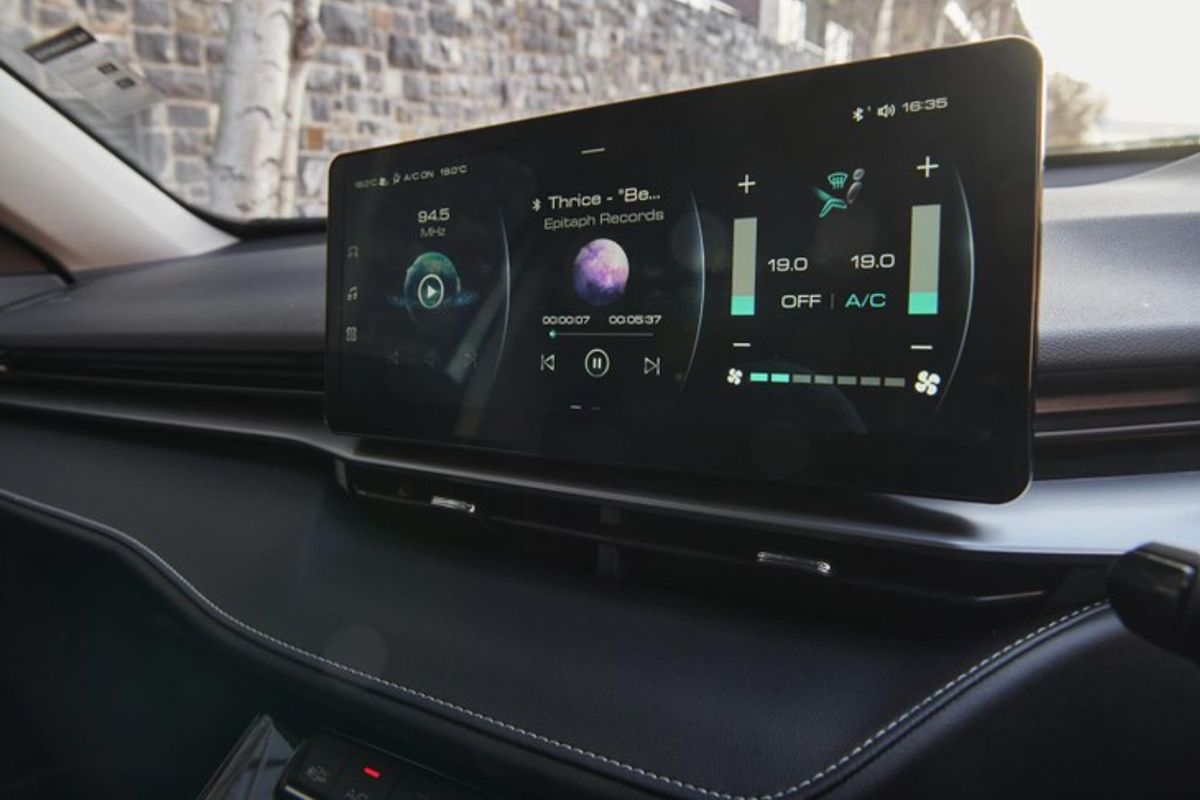
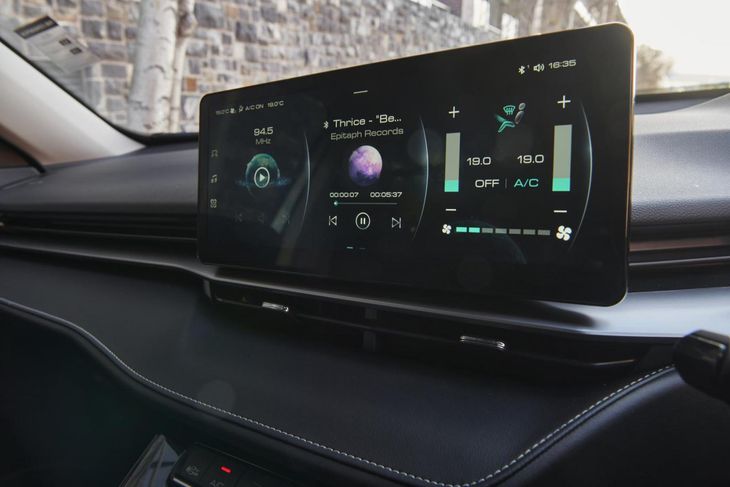
The infotainment screen houses all of the onboard functions, but it takes a lot of getting used to.
It’s hard not to recommend the H6 Hybrid considering the sheer value it offers at a competitive price point. I do think that its ride quality isn’t quite up there with those of rival models from Toyota, Volkswagen and the Korean brands (Hyundai and Kia) – at least not yet. The H6 flagship’s ride can be a bit firm over harsh bumps and isn’t as composed as those aforementioned competitors when it comes to traversing dirt roads. However, most modern buyers aren’t likely to find that a deal breaker, unless they take the time to extensively test drive all of Haval’s competitors. Besides, the attractive price and specification of the H6 (hybrid and ICE versions) remain rather compelling value propositions.
I also find the infotainment system to be less user-friendly than most touchscreen setups. It requires a lot of button presses to access often-used settings and the menu descriptions don’t always make it immediately clear what each of the settings is supposed to do. The hardware also dings and beeps a lot until you’ve got all the settings to a state where most of the alerts are converted into haptic vibrations or simple alerts on the instrument cluster.
At an all-inclusive price of R669 950 (October 2022), the H6 Hybrid offers near-unbeatable value for money. A 5-year/100 000 km warranty, 5-year/60 000 km service plan and 8-year/150 000 km battery warranty are included.
Summary
The H6 Hybrid offers a lot of car for the money; expect it to sell very well locally.
The Haval H6 Hybrid solves the fuel economy issue that has been bothering H6 owners and will appeal to those looking to reduce consumption and running costs (provided they can afford a R670k vehicle). The H6 Hybrid Super Luxury comes stacked with all the tech and features you may ever need at a very competitive price. The engine and transmission combine excellently and provide a smooth, powerful and fuel-efficient experience that will undoubtedly trouble the competition.
It’s not perfect though – there are a few gimmicks within the H6 Hybrid’s onboard systems that require some familiarisation and the ride quality could also be improved in order to really put the sword to the competition. However, even with those faults, it’s still an excellent buy at the moment for those looking to get the most value out of their hard-earned Rands.
DBN GOGO on why she bought her car, her favourite car for gigs, and SA Car Culture
DBN GOGO is arguably South Africa’s hottest DJ right now, selling out gigs across Mzansi with her unique take on the cultural phenomenon that is Amapiano.
This proudly South African genre of dance music has become the soundtrack of young South Africa, and DBN GOGO is at the forefront of the movement.
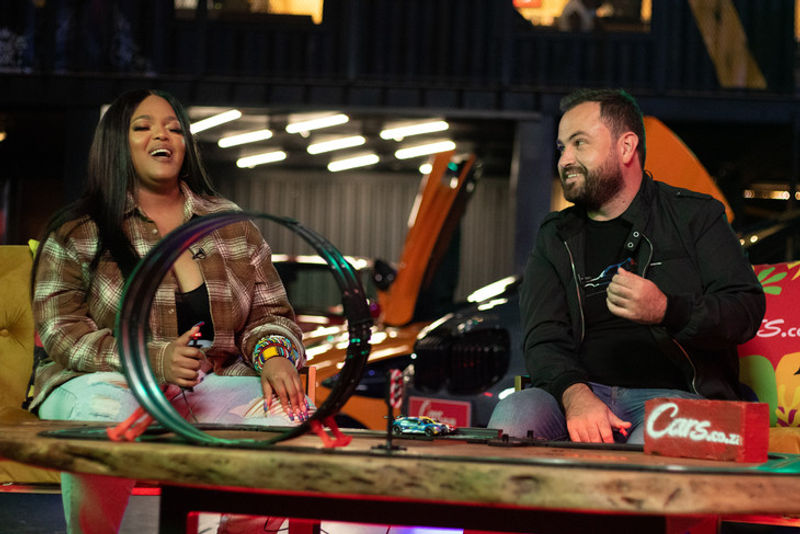
We were honoured to have her join us in the Cars.co.za Car Culture studio for Episode 3 of the first season of this series.
In this video, DBN GOGO shares her views of car culture in South Africa and discusses the various vehicles (including taxis and cabriolets) that feature prominently in South African music videos.
She also chats about when and why she started liking cars, what cars her parents drove and why she drives a BMW 1 Series – and chose a BMW 128ti over an M135i xDrive!
Why does she prefer a Hyundai H1 when she needs to get to gigs with her crew (not a Mercedes-Benz V-Class) and what’s her explanation for liking Range Rovers?
Porsche Cayenne Platinum Edition (2022) Price Announced
The German brand has announced a package for its SUV range. Meet the Porsche Cayenne Platinum Edition and we’ll be driving it this week!
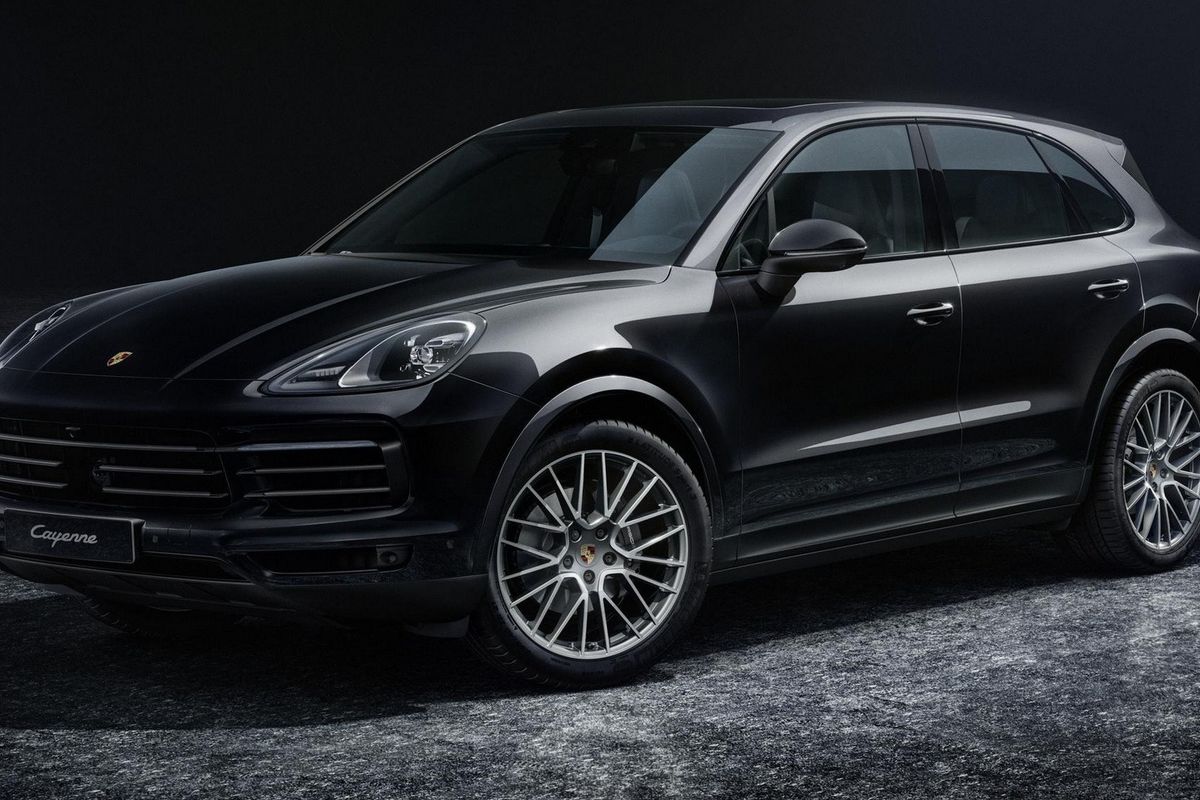
The Porsche Cayenne Platinum Edition has been confirmed for South Africa and will be touching down in the third quarter of 2022.
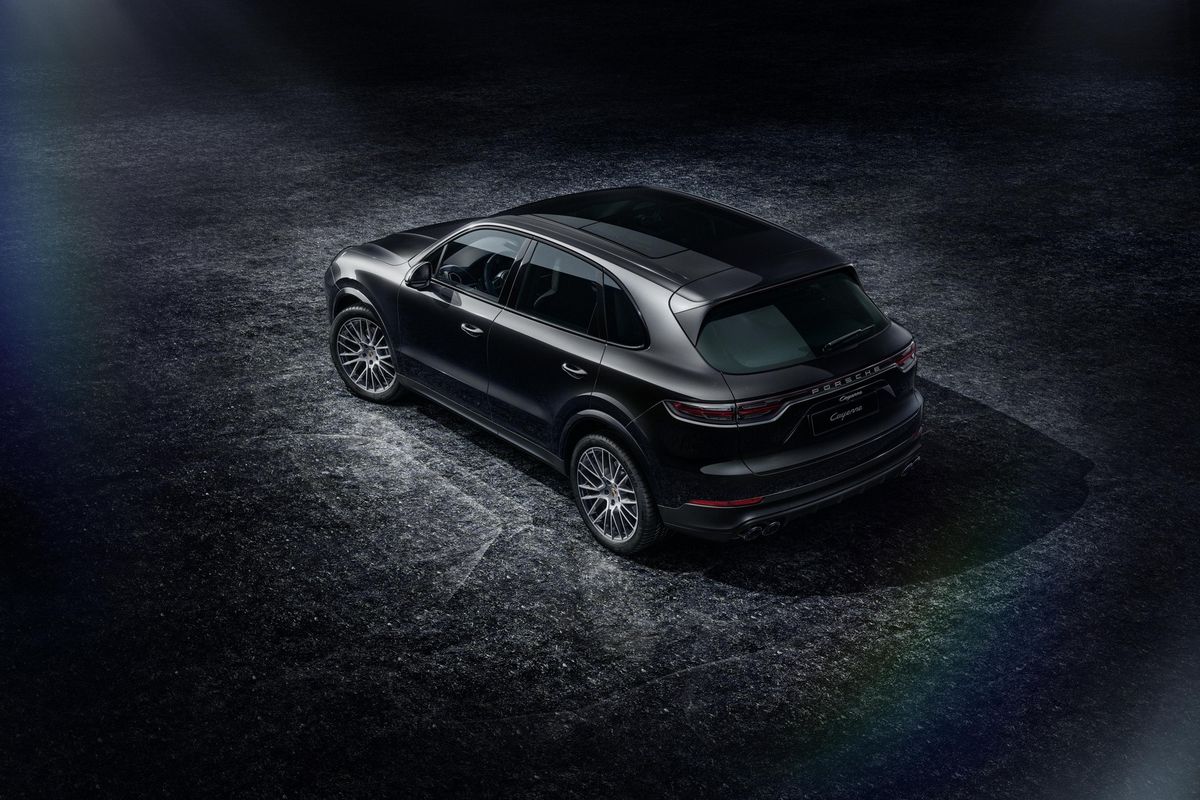
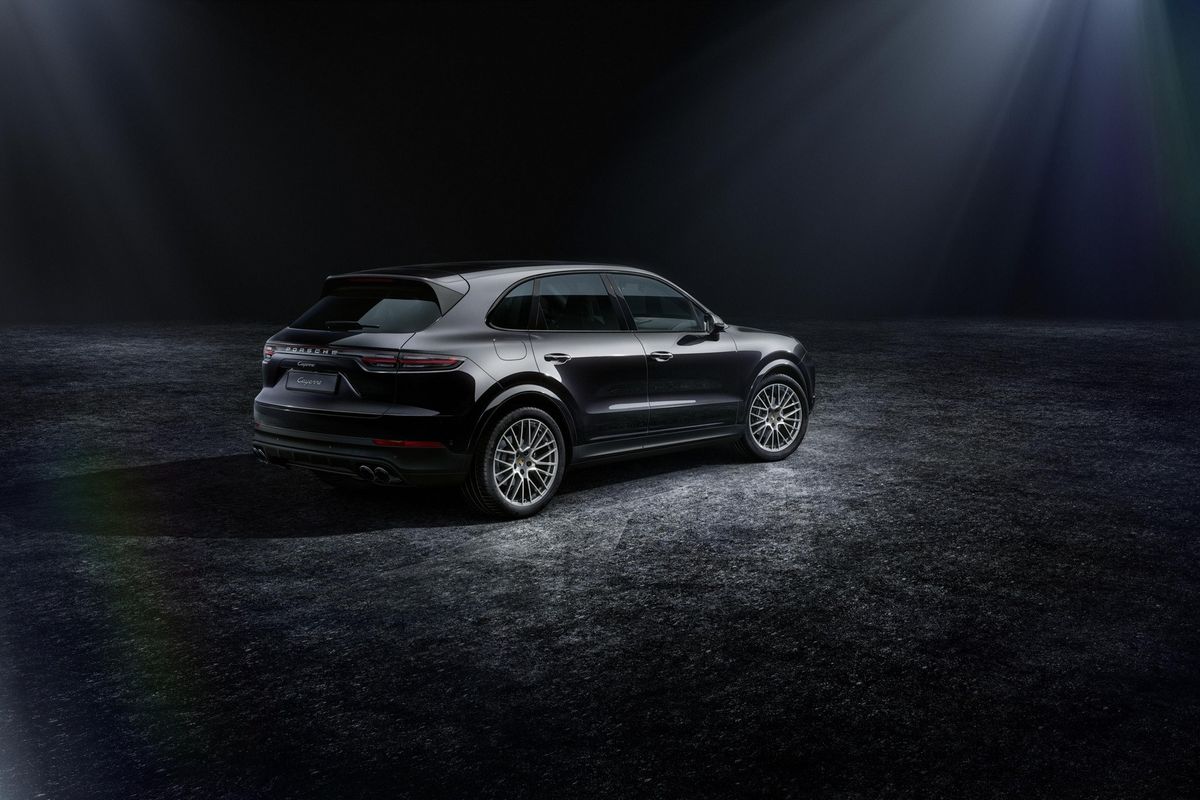
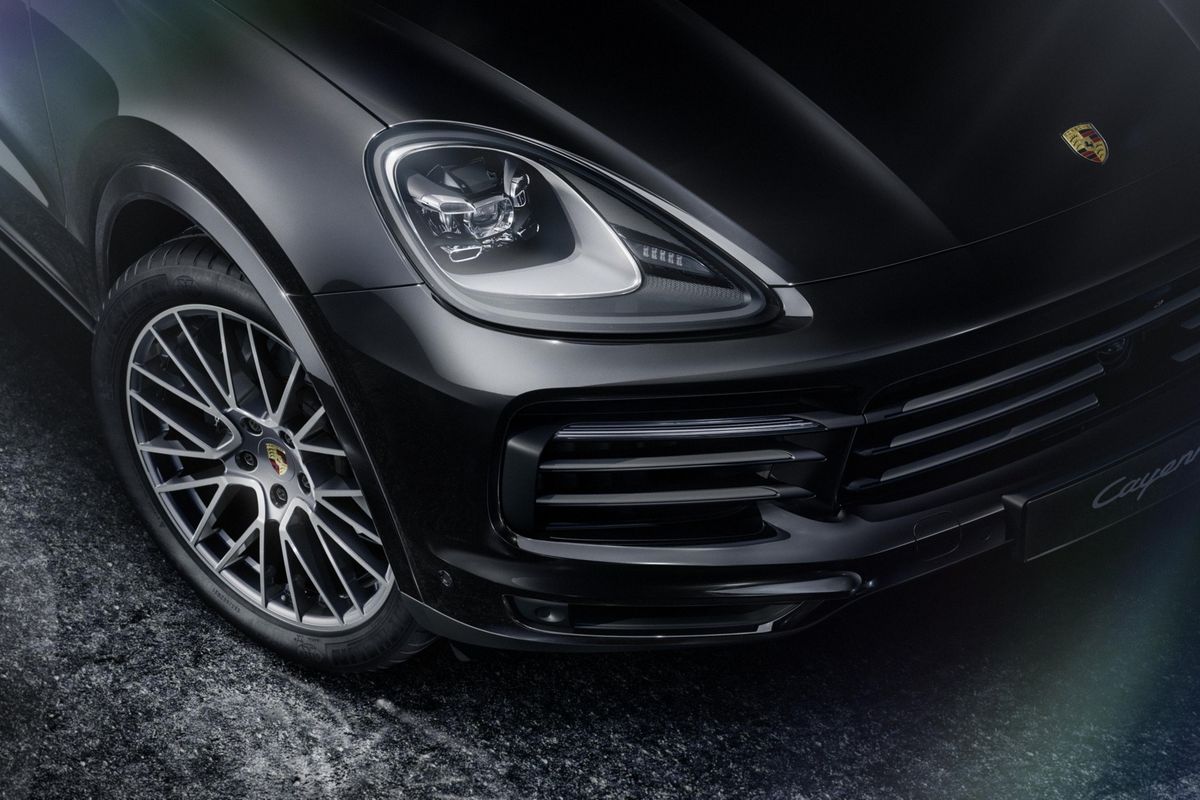
The Platinum Edition adds a number of upgrades to the Cayenne range. Visually, the intakes, badges and 21-inch alloy wheels are finished in Satin Platinum. It gets specific badges, black sport tailpipes, high-gloss black window trim and the special RS Spyder Design wheels.
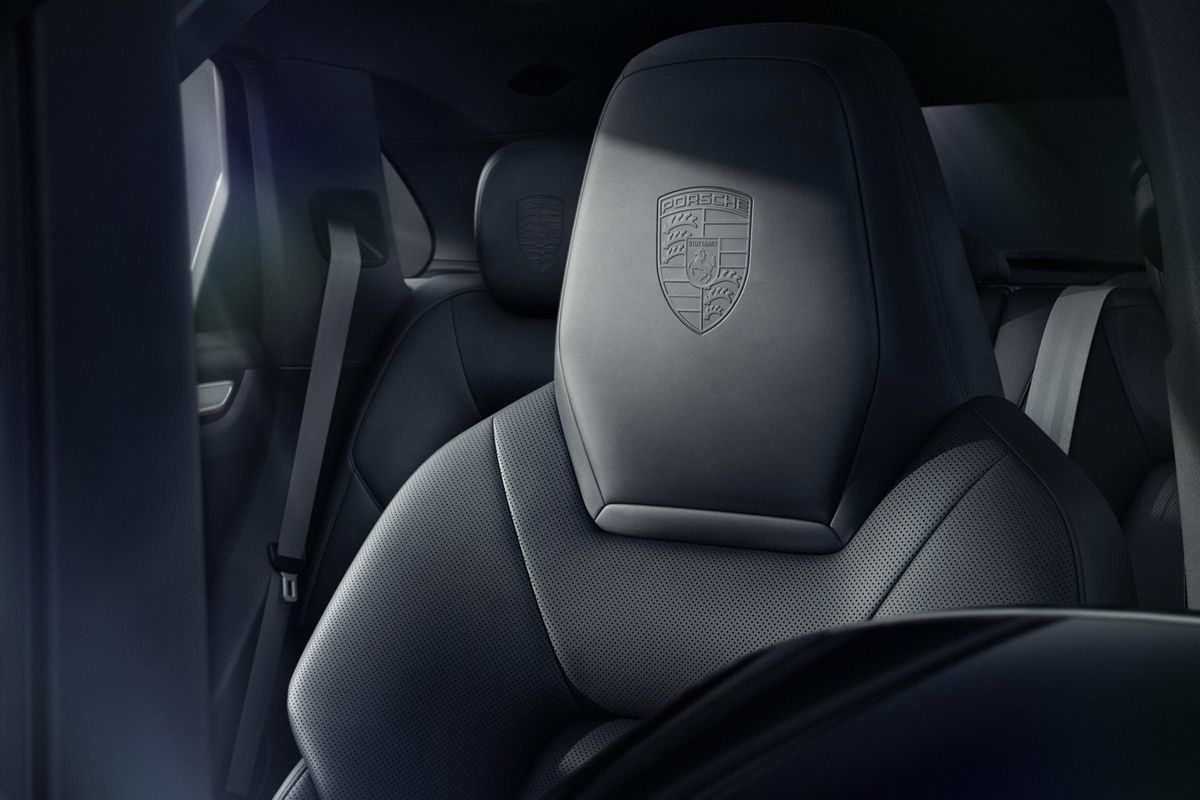
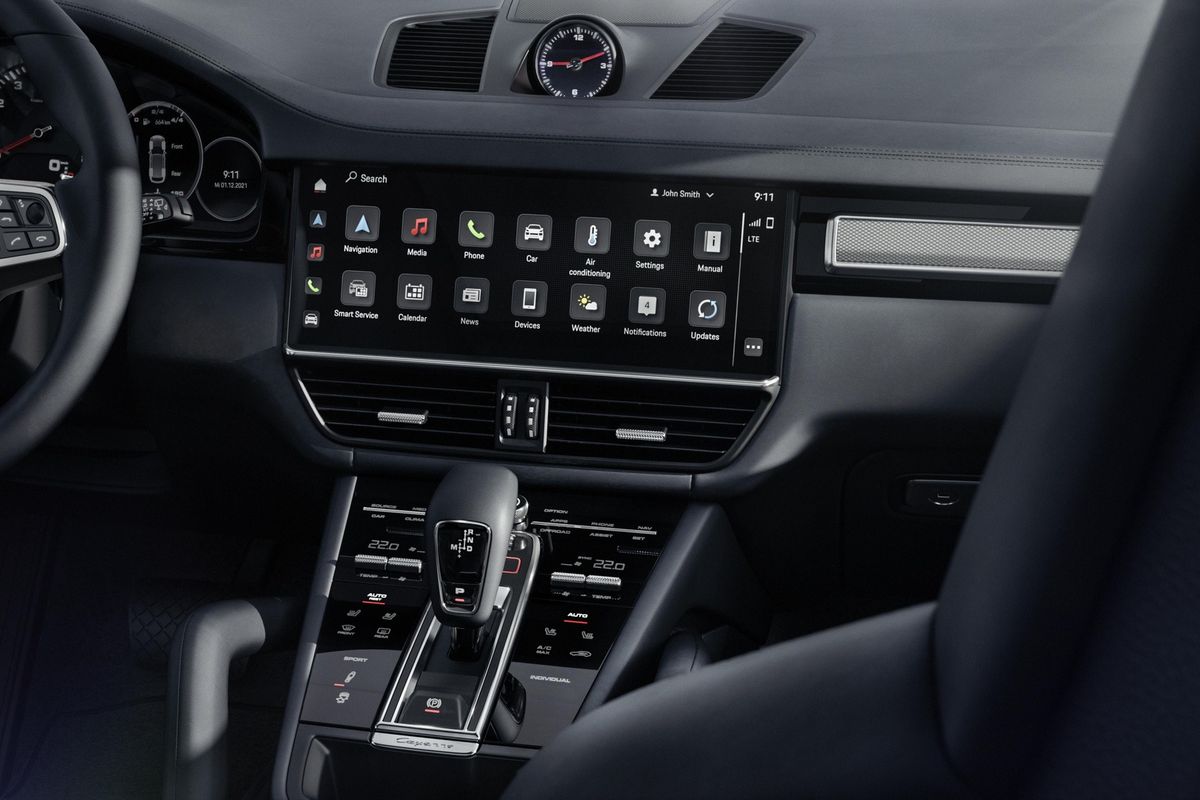
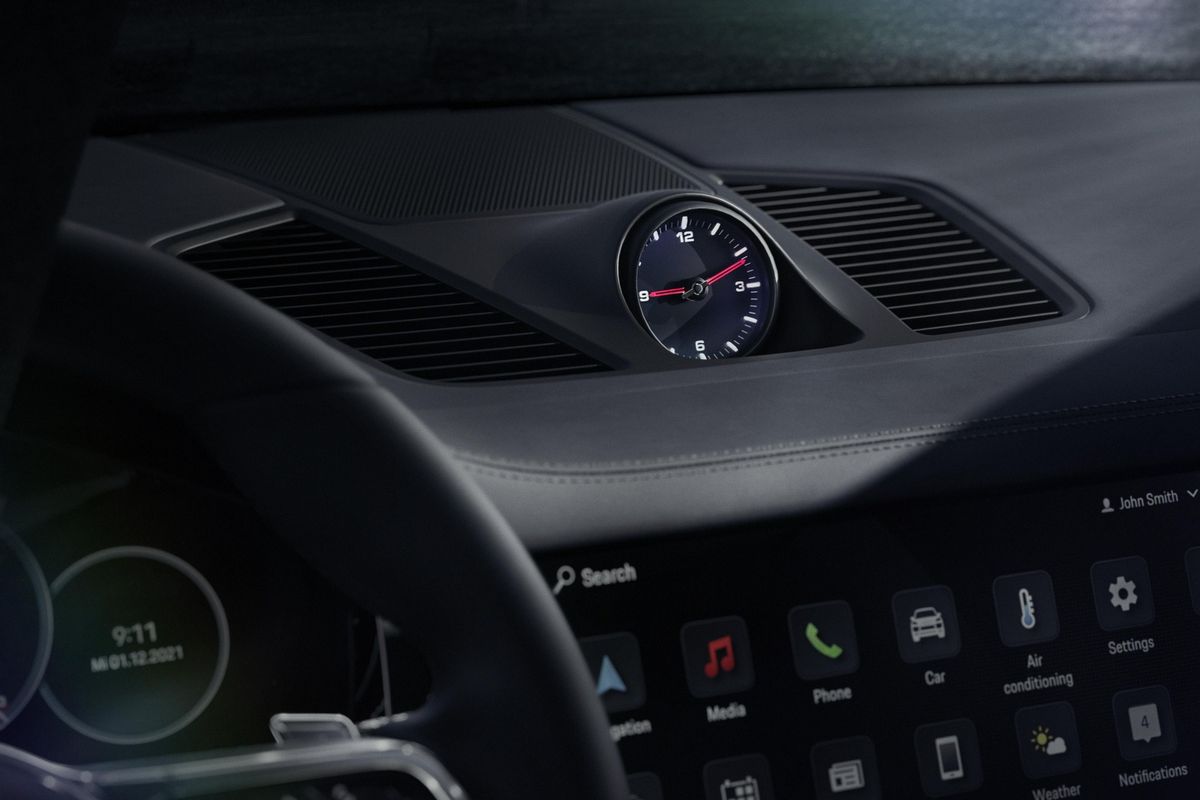
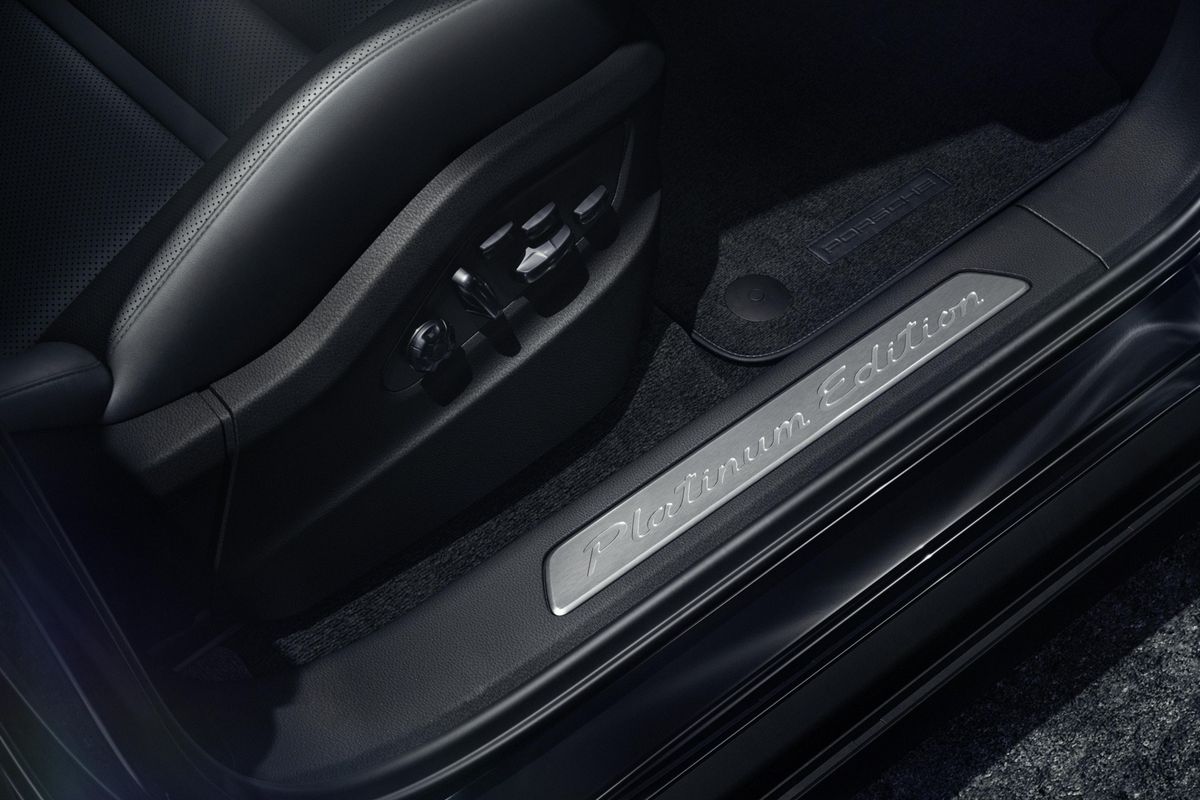
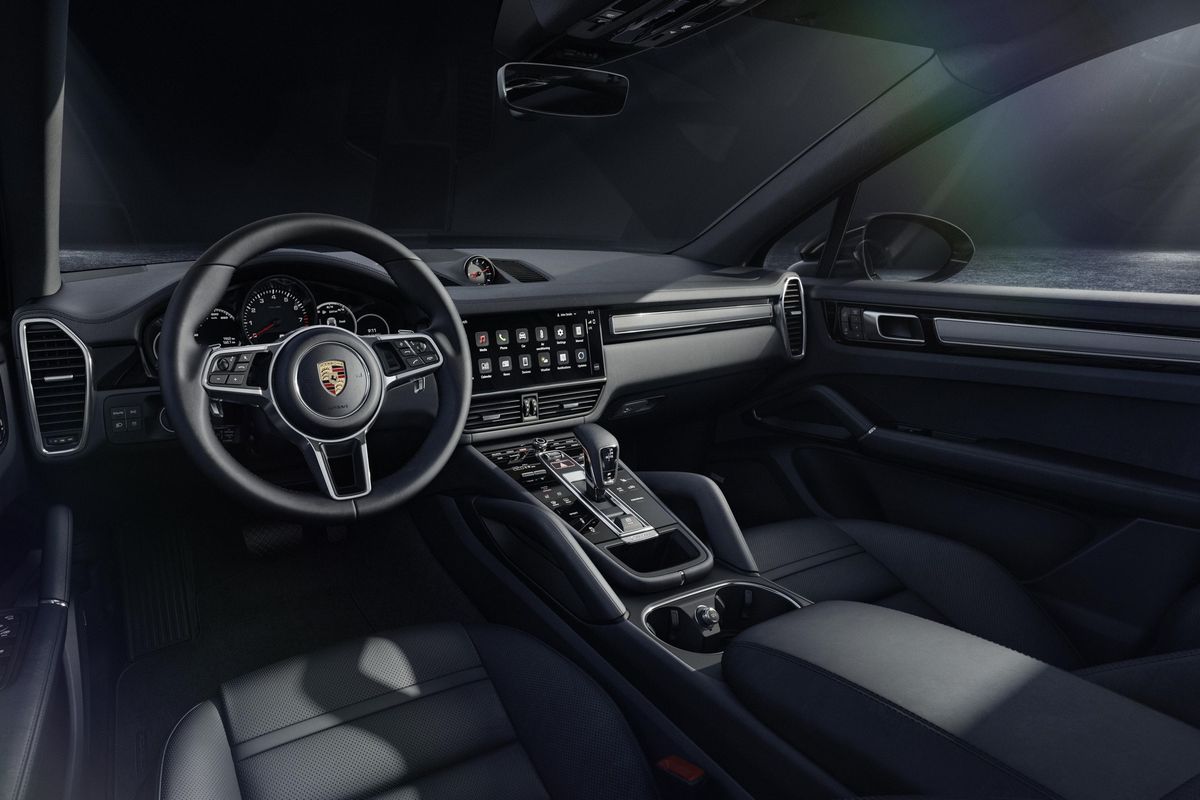
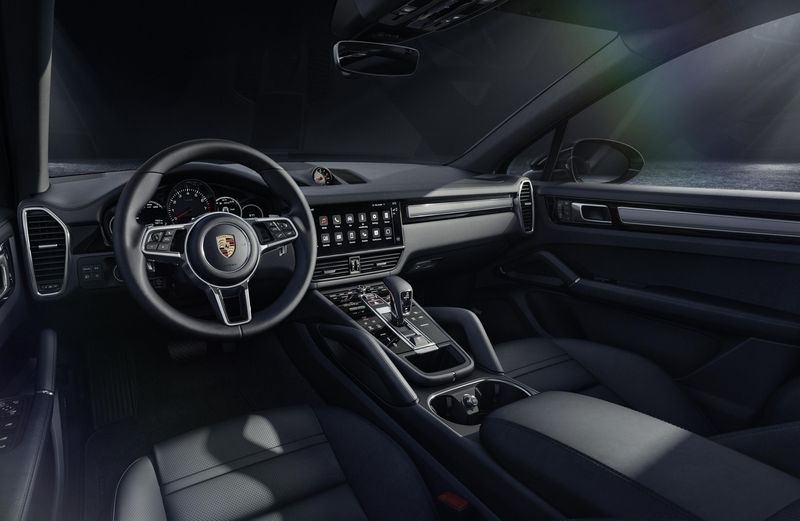
The cabin of the Porsche Cayenne Platinum Edition gets chalk-coloured seatbelts, special aluminium trim, and Platinum Edition door sill guards.
Porsche has also added in a Bose Surround Sound system, 8-way adjustable seats, panoramic roof, and LED headlights.
The announcement of the Platinum Edition is usually an indication that the current generation is on its way out and a refreshed/facelifted model is due for a reveal.
How much does the Porsche Cayenne Platinum Edition cost in South Africa?
The Platinum Edition has been made available for both the Cayenne and the Cayenne Coupe. The below prices include a 3-year Driveplan. A 5-year Driveplan is also available.
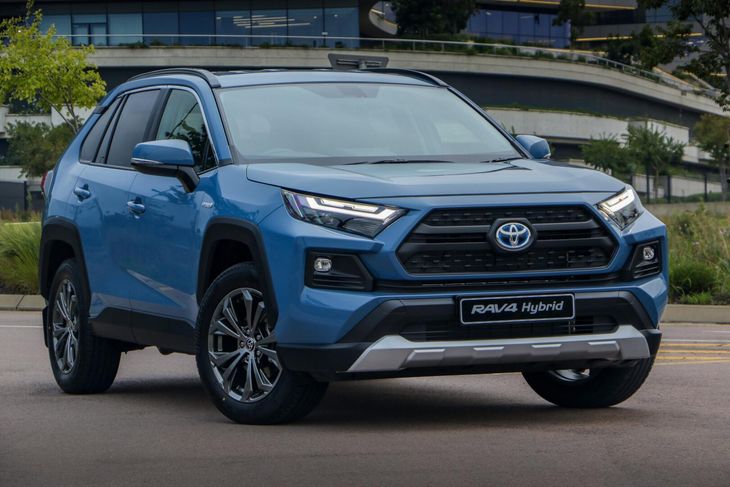
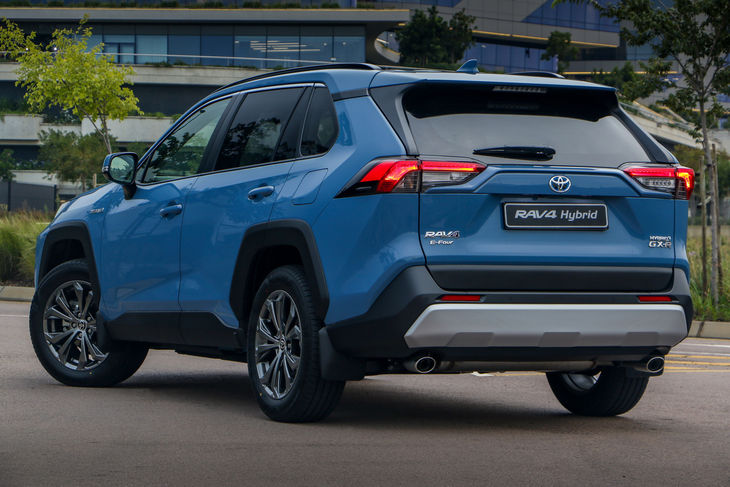
Toyota RAV4 vs Haval H6: Which is the better hybrid?
The Toyota RAV4 Hybrid is one of South Africa’s best buys, but it now has fresh competition in the shape of the Haval H6 Hybrid. How do these petrol-electric rivals match up?
Product planners at Toyota clearly know what most global buyers want: a mid-sized (family) SUV with some adventure travel ability and mild powertrain hybridisation.
Hot hatch overtaking performance and compact car petrol consumption. The win/win of a hybrid drivetrain.
In the local context, there is a solid argument to be made that Toyota’s RAV4 hybrid is probably South Africa’s best family vehicle. Its dimensions are more manageable for city driving than most rugged SUVs, like the Fortuner, which is a 7-seater, bakkie-based Adventure SUV. The refinement of its shared Corolla platform makes the RAV4 a lot less fatiguing to drive than any ladder-frame type SUV.
Best of all is that hybrid powertrain. Toyota’s been building mild hybrid vehicles for a long time. Prius was available in the local market way before the concept of “new energy” vehicles escaped a creative agency meeting room, and entered the voice of marketing jargon.
Unofficially, this is probably the best family vehicle you can own in South Africa.
Many South Africans still class hybrids in the stereotype of Prius: slow, weird-looking, light on fuel and easily ruined with prolonged use on dirt roads. But RAV4 Hybrid is only one of those things: it’s frugal, not slow (at all) and doesn’t look strange (but for some blue graphics). And like any RAV4, it’s entirely capable of journeying thousands of kilometres on South Africa’s rural dirt roads.
The RAV4 Hybrid offers a fantastic driving experience, completely unrelated to its statistics. The power system output numbers aren’t shy, with Toyota’s petrol-electric family SUV making the kind of power you’d expect from a hot hatch. But the driving appeal is how the RAV4’s hybrid’s power becomes available exactly when needed – at peak throttle.
The electric energy that flows into acceleration with a hybrid system is there when you need it for executing overtaking manoeuvres. But it doesn’t create a fuel consumption burden when cruising. That’s the issue with any pure petrol or diesel engine – it’s great having the overtaking performance of a potent 2.0-litre turbopetrol or -diesel, but you pay for its unused latency with marginally higher fuel consumption.
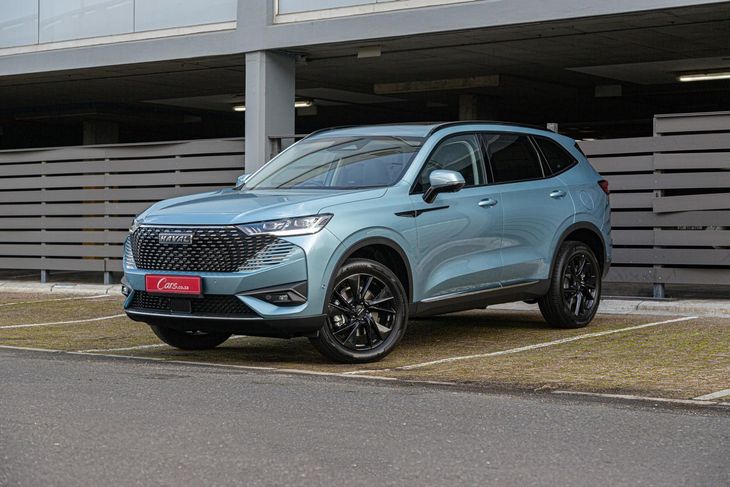
Meet the Chinese ‘RAV4 Hybrid’
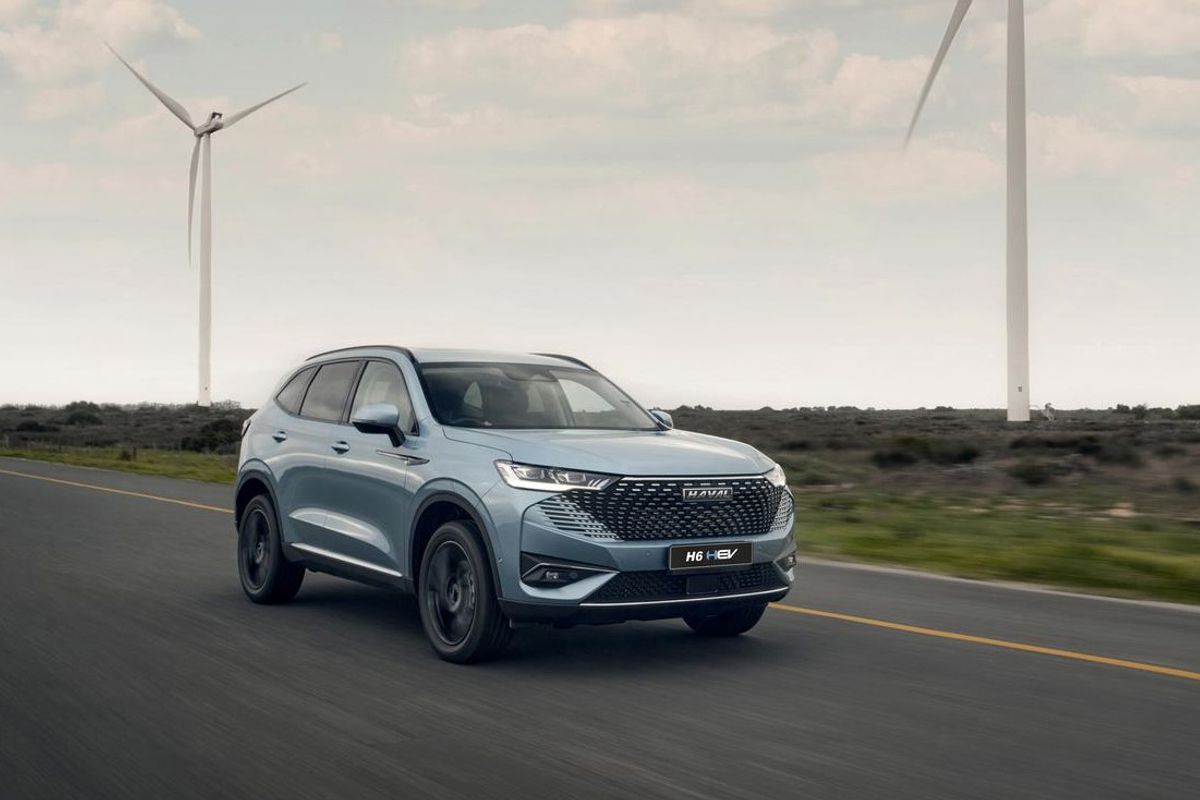
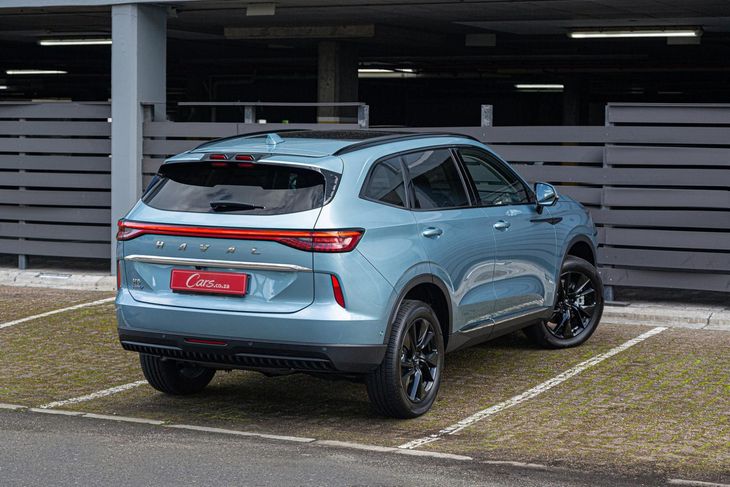
The H6 Hybrid looks good and rides on a truly global-standard vehicle architecture – from GWM.
But what if you could have most of what makes the RAV4 Hybrid great, but with a marginally higher power output – and that’s just for starters? Well, that’s exactly what the new, range-topping Haval H6 HEV (hybrid electric vehicle) offers. Keen to harvest the moment and resurgent brand adoption that South Africans have shown towards Haval’s latest products, the H6 Hybrid has a terrifically convincing specification. In theory.
Its platform is proven. The H6 Hybrid is built on the ironically named, but very advanced, GWM L.E.M.O.N. architecture. That means no crashing ride-quality or awkward body roll that older-generation Chinese vehicles were infamous for. As a given for any current-generation Haval model, the cabin architecture is tidy and materials anything but cheap and nasty.
The Haval H6 Hybrid’s engine produces 113 kW/223 Nm, while its electric motor makes 139 kW/300 Nm.
But, for the (battery-assisted) thrust of this article, let’s compare the balance of performance and fuel consumption that Toyota and Haval’s petrol-electric medium (family) SUVs offer.
Hybridised powertrains are complex, and Toyota has a particular methodology of stating total system outputs, which are often lower than cumulative petrol and electric motor power ratings. The RAV4 Hybrid’s petrol engine is good for 131 kW, with its electric motor spinning 88 kW of power. But combined, it only has a total power output of 163 kW (no combined torque figure is stated). Haval’s H6 Hybrid? It’s claimed to produce a total system output of 179 kW and 530 Nm.
The H6 Hybrid is more powerful than Toyota’s new-energy drivetrain RAV4, but analyse the technical specifications with more scrutiny, and an interesting detail emerges. One that could influence fuel efficiency and long-term ownership cost.
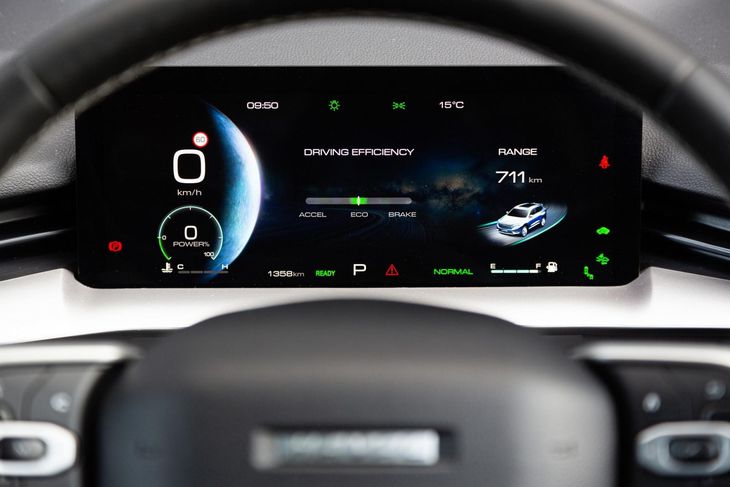
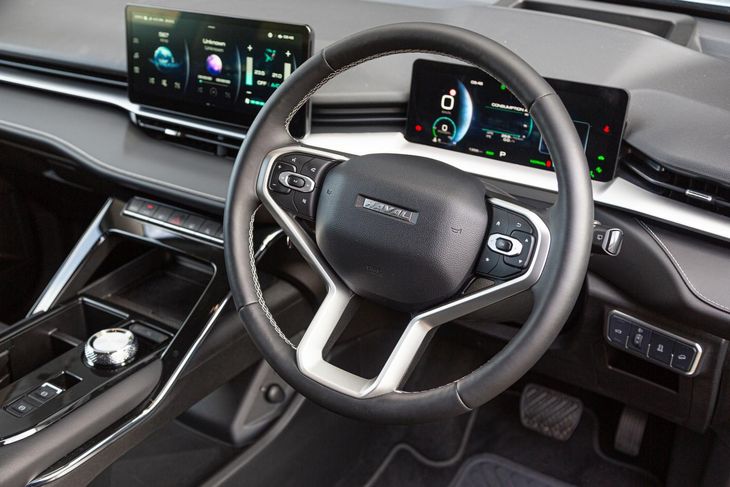
Befitting a top-of-the-range derivative, the H6 Hybrid comes fitted with a digital instrument cluster.
The Haval H6 Hybrid utilises a 1.5-litre 4-cylinder turbopetrol engine, which is much smaller than the RAV4 Hybrid’s naturally-aspirated 2.5-litre 4-cylinder powerplant. Why does that matter if both vehicles have battery packs and electric motors, the latter of which provide the smoothing element of electric power?
Well, hybrid drivetrains are complicated. Marrying internal combustion power and electric energy requires precise software and powertrain calibration. And it is much easier to achieve that balance and provide a smooth hybrid drivetrain experience when the petrol engine component is naturally-aspirated, instead of turbocharged.
Despite dramatic improvements in all aspects of Chinese vehicle technology, design and build quality, engines remain an issue. They aren’t as powerful or efficient, for a given capacity and configuration, compared to the leading engines produced by American, European, Korean and Japanese car manufacturers.
Fuel costs versus battery life
RAV4 offers great range and cruising performance, without the long-term maintenance fragility of turbocharging.
Although it has a smaller petrol engine element as part of its hybrid system, Haval’s new-energy H6 may potentially be heavier on fuel than its RAV4 equivalent – and that’s despite the fact that the capacity of Toyota’s petrol engine is 66% larger. Why? Haval’s H6 Hybrid will be on-boost most of the time and its claimed consumption is 5.2 L/100 km, which is a bit higher than RAV4 Hybrid’s 4.8 L/100 km.
The fuel costs should be to Toyota’s advantage. But what about long-term ownership risk, concerning batteries? An issue which has traditionally created resistance to broader hybrid vehicle adoption domestically.
South Africans need to start cultivating an awareness of battery quality as a powertrain feature of excellence. And although a deep dive into the respective hybrid batteries of the RAV4 and H6 derivatives isn’t possible, China is a global leader in battery production. As such, the turbopetrol part of an H6 Hybrid’s drivetrain might be average, but its battery quality is likely to be class-leading.
Value is a given with the H6 Hybrid
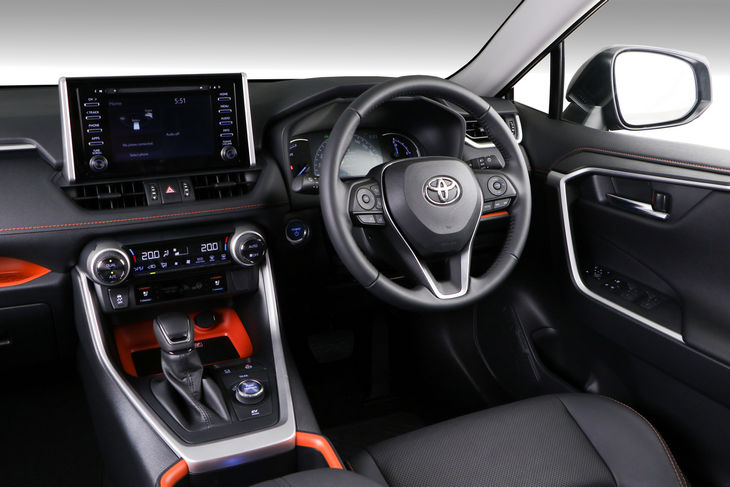
The Toyota RAV4’s interior exemplifies fine build quality, even though it’s not quite as stylish as that of the H6 Hybrid.
And what about the value equation? Assertive market positioning has been a feature of Haval’s South African product strategy and the H6 Hybrid is no exception. With a list price of R669 950, the Haval H6 Hybrid offers many more standard features than the slightly more affordable RAV4 2.5 Hybrid GX-R E-Four (R663 400, September 2022), but holds a significant price advantage over the Japanese brand’s range-topping 2.5 Hybrid VX E-Four derivative (R744 900).
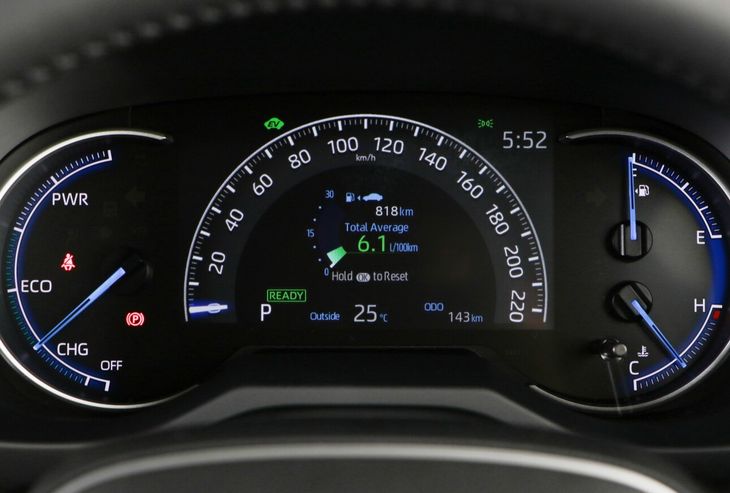
For context, the flagship Toyota RAV4 2.5 Hybrid VX E-Four comes equipped with automatically activated LED headlamps with auto high beam, 18-inch alloy wheels, heated and folding side mirrors, rain-sensing wipers, digital rear-view mirror, semi-digital instrument cluster, blind-spot monitor and rear cross-traffic alert, a lane-keeping system with departure warning and lane-trace assist, adaptive cruise control, a 360-degree surround-view camera system, dual-zone climate control, wireless charging pad, electric adjustable front seats (with heating function), partial leather upholstery, front and rear PDC, plus an electric tailgate. Those are by no means all of the derivative’s features, but the most prominent ones.
The H6 Hybrid comes fully loaded, plus it offers 20 litres more luggage space than the RAV4, Haval claims.
The H6 Hybrid, which costs about R75k less than the top-spec RAV4 Hybrid (September 2022), may have synthetic leather trim and an electrochromatic rear-view mirror, but it offers the rest of the features mentioned above. What’s more, it comes with 19-inch alloys, a fully-digital instrument cluster, a head-up display, heated and ventilated front seats, a panoramic sunroof, as well as automatic parking with reverse memory assistance, to name just a few additions.
Toyota’s service plan for the RAV4 Hybrid (6 services/90 000 km) bests Haval’s 5-year/60 000 km offering for the H6 Hybrid, but the Chinese brand’s general warranty is valid for longer (5 years/100 000 km versus 3 years/100 000 km). Both manufacturers offer good hybrid-battery warranties (8 years/195 000 km for the Toyota and 8 years/150 000 km for the Haval).
The arrival of another petrol-electric medium (family) SUV offering – if at the upper end of the segment – could see many more South Africans embracing “new-energy” vehicle ownership. For Haval, the hybrid-drivetrain H6 narrows an advantage in one area where legacy brands, like Toyota, have traditionally held the ascendancy over GWM – advanced internal combustion engine technology. A hybrid derivative of the Jolion small crossover is also in the pipeline.
We will publish a full spec-versus-spec comparison between the range-topping petrol-electric RAV4 and H6 derivatives, as well as a full review of the latter, soon.
The all-new Ford Everest has touched down in South Africa. Here’s what you can expect to pay, plus the specifications and engine details.
The bakkie-based 7-seater segment gets a new challenger, in the form of the brand-new Ford Everest which brings a new flagship V6 engine, more comfort and more features than ever before. The Ford Everest will be taking on players like the Toyota Fortuner, Isuzu MU-X, Mitsubishi Pajero Sport and Haval H9. Read or watch our full review of the 2023 Everest here
“The Next-Gen Everest has been designed with one thing in mind, and that’s our customers,” says Doreen Mashinini, General Manager for Marketing at Ford South Africa. “Everest owners are people who like adventure, recreation and being able to go out with family and friends. Whether they’re conquering sand, rocky paths or city life, these customers appreciate the utility, capability and spaciousness of an SUV, and this is where the Next-Gen Everest excels by being tough on the outside, while providing a sanctuary on the inside matched to amazing capability underneath.”
However, Ford SA has said that supply of the new Everest will be limited due to current global issues. “We are already seeing a high demand around the world for Next-Gen Everest, and we are confident that this new model will live up to expectations for all those who have reserved a vehicle.
However, global supply chain challenges, including shipping logistics, are causing extended wait times across the industry,” says Neale Hill, President, Ford Motor Company Africa Region. “Our local and global teams are working around the clock to get vehicles to dealers and customers as soon as possible,” concludes Hill.
What’s on offer?
There will be two levels of trim from launch: Everest Sport and Everest Platinum. Customers will be able to choose from either a 2.0-litre BiTurbo diesel engine or a brand-new 3.0-litre V6 turbo diesel. Both vehicles feature a 10-speed automatic transmission.
In the Sport, the vehicle features an electronic shift-on-the-fly part-time four wheel drive system, while the Platinum has permanent all-wheel drive. The 2.0 has outputs of 154 kW and 500 Nm, while the 3.0 packs 184 kW and 600 Nm.
Both the Sport and Platinum models are equipped with Ford’s Lane Keeping System, which includes Lane Keeping Alert and Lane Keeping Aid, along with Road Edge Detection and Driver Warning. Pre-Collision Assist with Dynamic Brake Support, Forward Collision Warning, Automated Emergency Braking and Reverse Brake Assist further up the arsenal of innovative safety features. Additionally, the Platinum gains Distance Alert and Indication, Evasive Steer Assist and Intersection functionality.
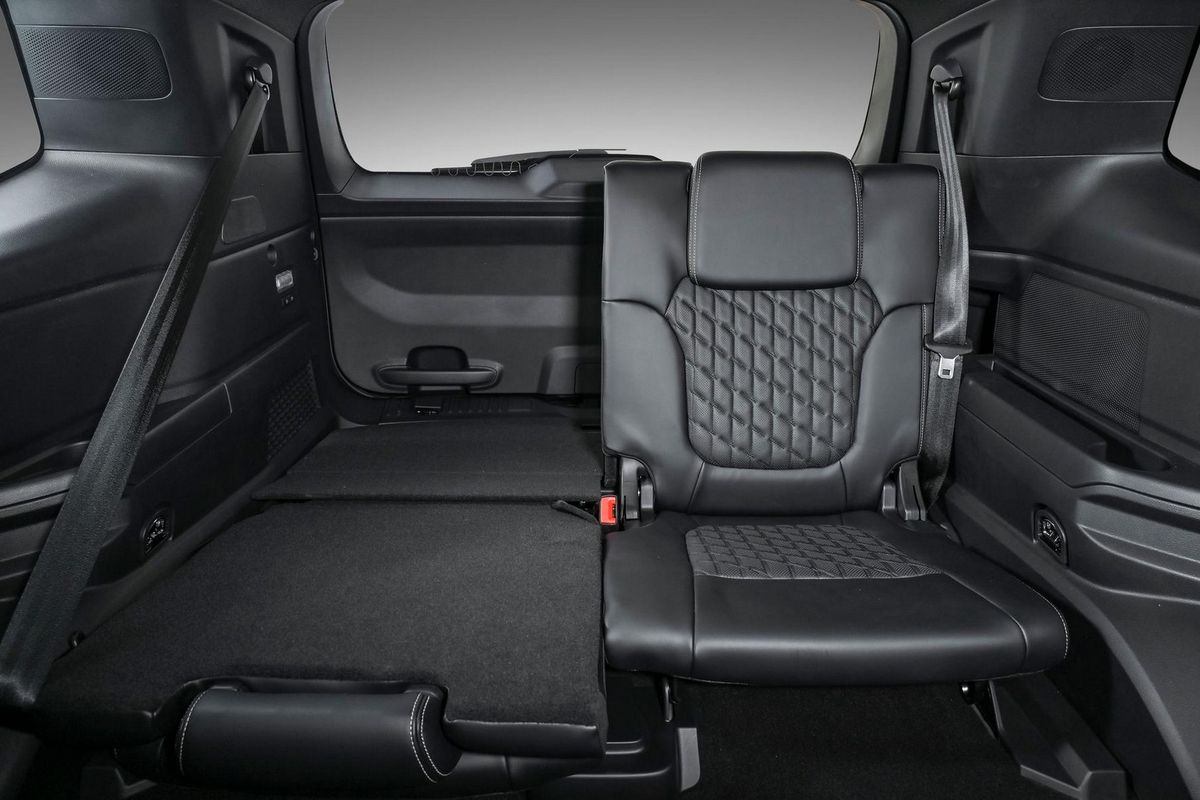
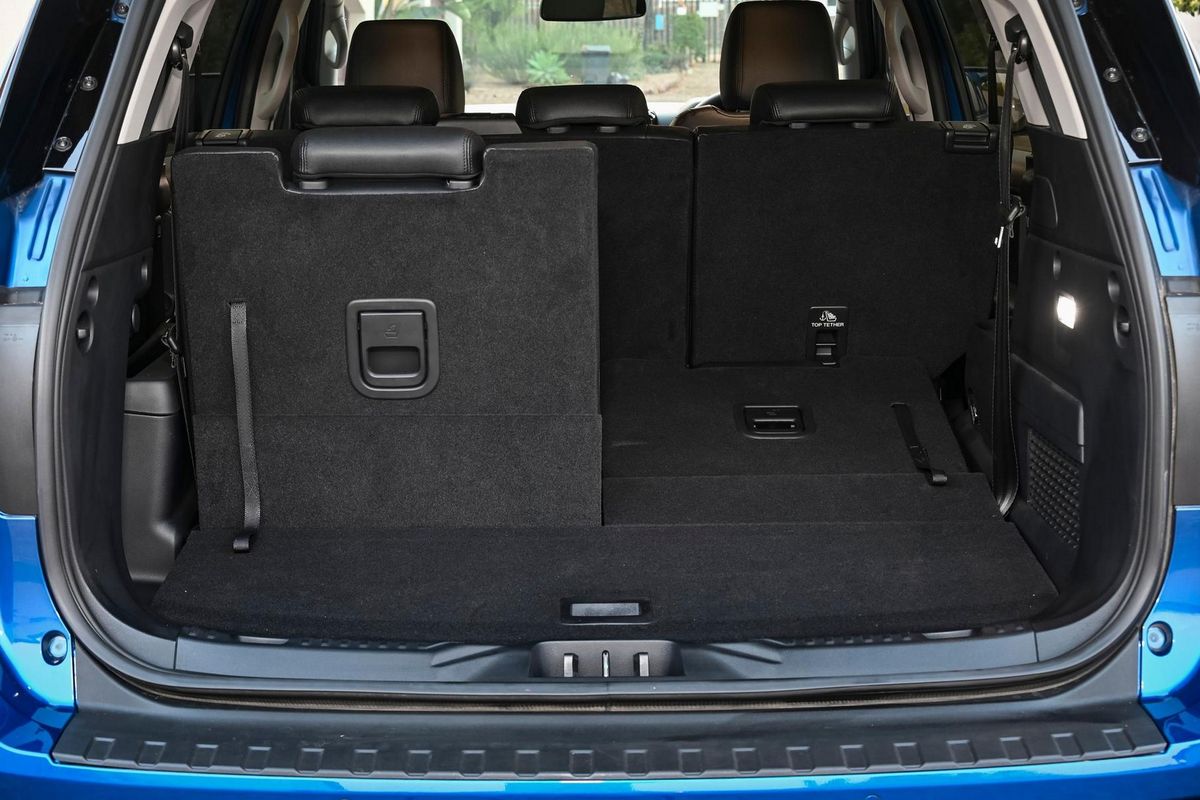
Ford has prioritised flexible seating in the Next-Gen Everest; the second-row slides with a 60:40 split seatback, and the 50:50 split third row in the seven-seater configuration can be folded at the touch of a button on the Platinum series.
Everest Sport
8-inch digital instrument cluster
12-inch portrait infotainment screen
Ford SYNC4A
Apple CarPlay / Android Auto
Factory-fitted modem
FordPass connectivity
Everest Platinum
Integrated wireless charging
12.4-inch digital instrument cluster
12-inch portrait infotainment screen
Ford SYNC4A
Apple CarPlay / Android Auto
Factory-fitted modem
FordPass connectivity
Electric parking brakes
Leather-trimmed gear shifter
Heated/ventilated 10-way adjustable front seats with memory function
Second row seat heating
Power outlets for all three rows
Windscreen mounted USB charging port
Type A, Type C USB ports in front and centre consoles
12-Volt sockets
400-Watt inverter
360-degree camera
Offroad Ability?
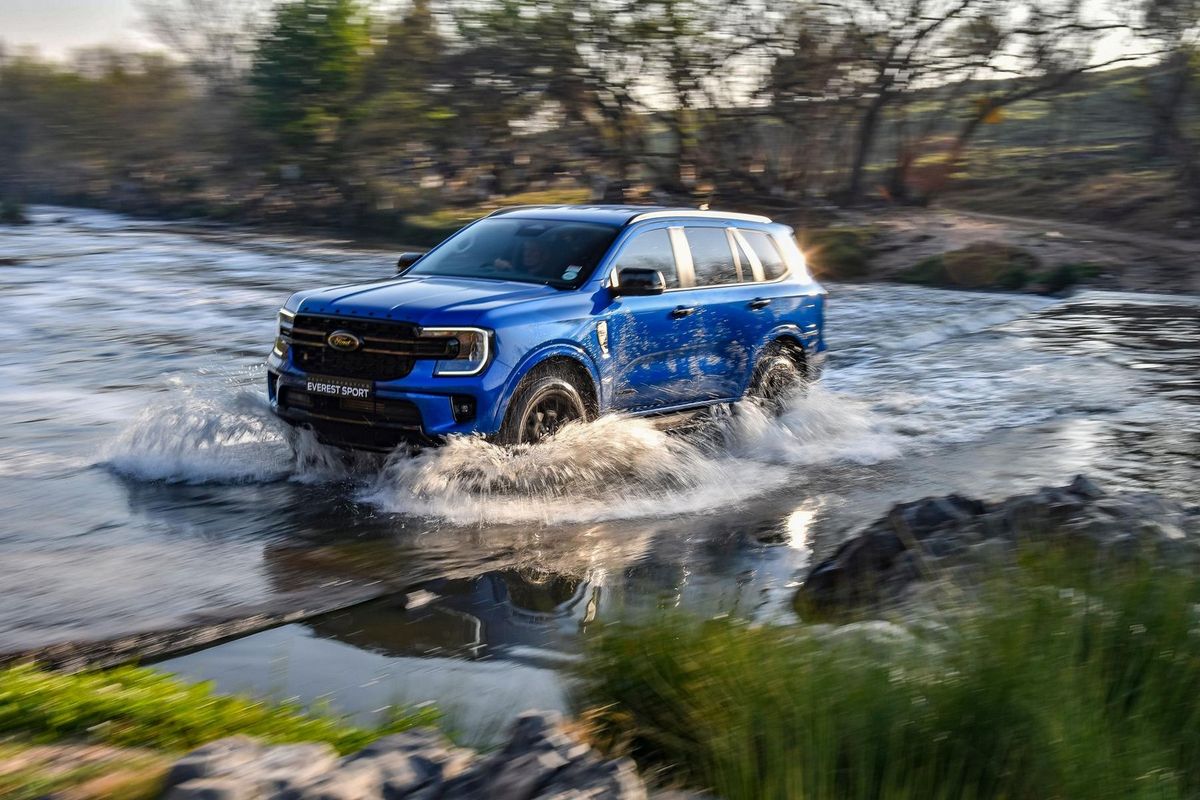
The new Ford Everest comes armed with advanced offroad tech. The Sport derivative features its electronic shift-on-the-fly four-wheel drive system with 2High, 4High and 4Low. The Platinum makes use of a permanent 4-wheel drive system. Both models can wade in up to 800 mm of water and tow up to 3 500 kg (which is 400 kg more than the predecessor). Ford says there’s enough space in the Everest Sport’s bay to accomodate a 2nd battery for aftermarket accessories.
There are 6 offroad drive modes on offer; Normal, Eco, Tow/Haul, Slippery, Mud & Ruts, and Sand. Ford is also offering an electronic rear differential lock, and hill-descent control.
The selectable drive modes dovetail into the raft of other technologies designed to enhance capability, such as the electronic rear differential lock which can be activated via the dedicated SYNC off-road screen, Hill Descent Control, and the front camera view with steering overlays which displays on the large-format infotainment screen.
How much does the new Ford Everest cost in South Africa?
Everest Sport 2.0L BiT 4WD 10AT R965 400
Everest Platinum 3.0L V6 AWD 10AT R1 113 100
Included in the price is a 4-year/120 000km warranty, 4-year/unlimited distance roadside assistance and 5-year/unlimited distance corrosion warranty. The recommended service interval is 15 000km or annually, plus customers have the option of purchasing service or maintenance plans up to eight years or 135 000km. The warranty can be extended up to seven years or 200 000km, while the roadside assistance can be extended for an additional one or two years.