The brand-new Subaru WRX faces the latest hot hatch to make landfall in SA, the Hyundai i30 N DCT. Which one is quicker? Watch now!
When the latest 2022 Subaru WRX arrived in the Cars.co.za garage at the same time as the latest 2022 Hyundai i30 N DCT, we felt we had the ingredients for a pretty tight drag race.
And so we headed out to the Saldanha airstrip outside Cape Town and lined them up…and here is the result!
We now offer a painless way to sell your car on Cars.co.za!
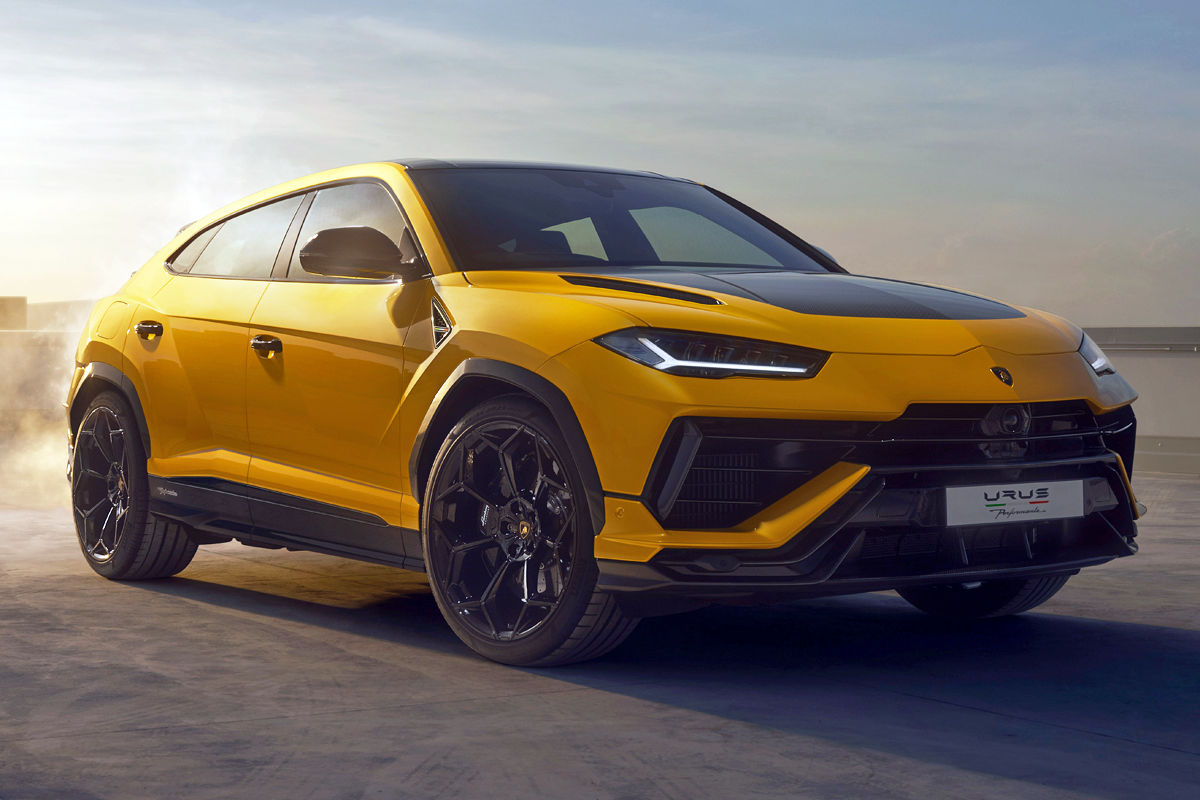
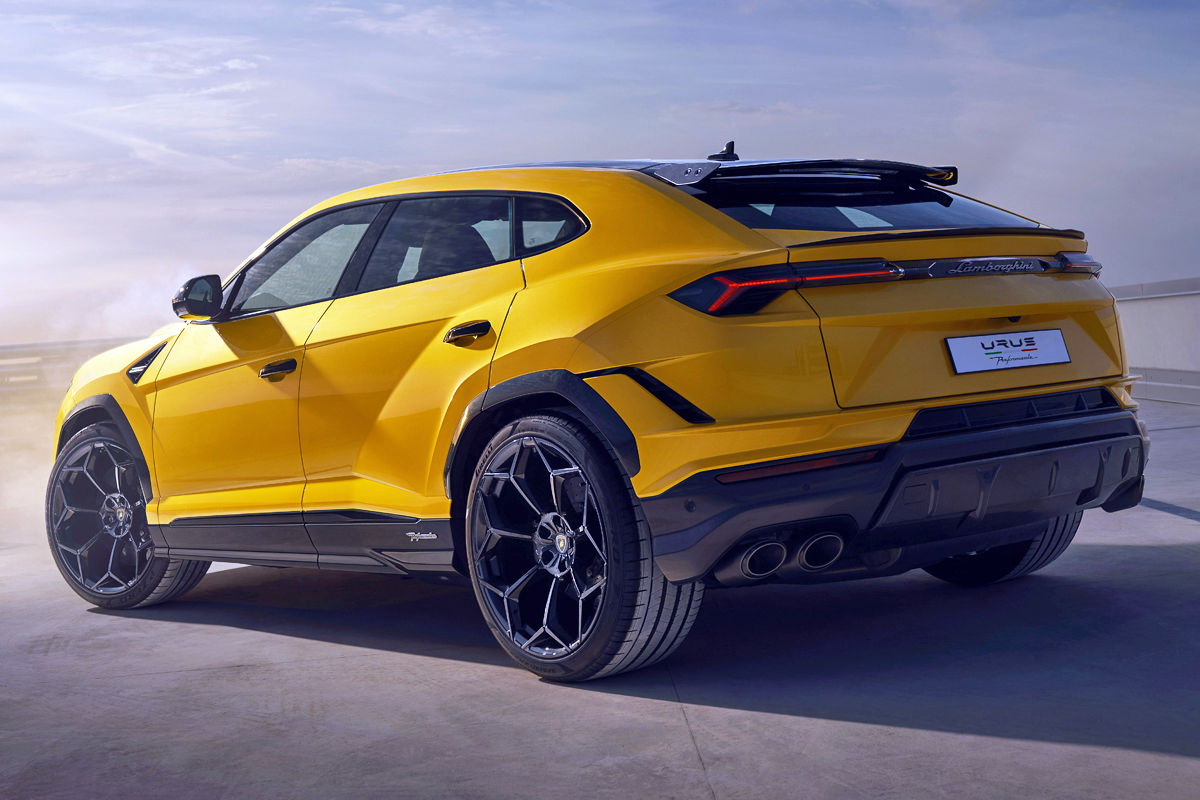
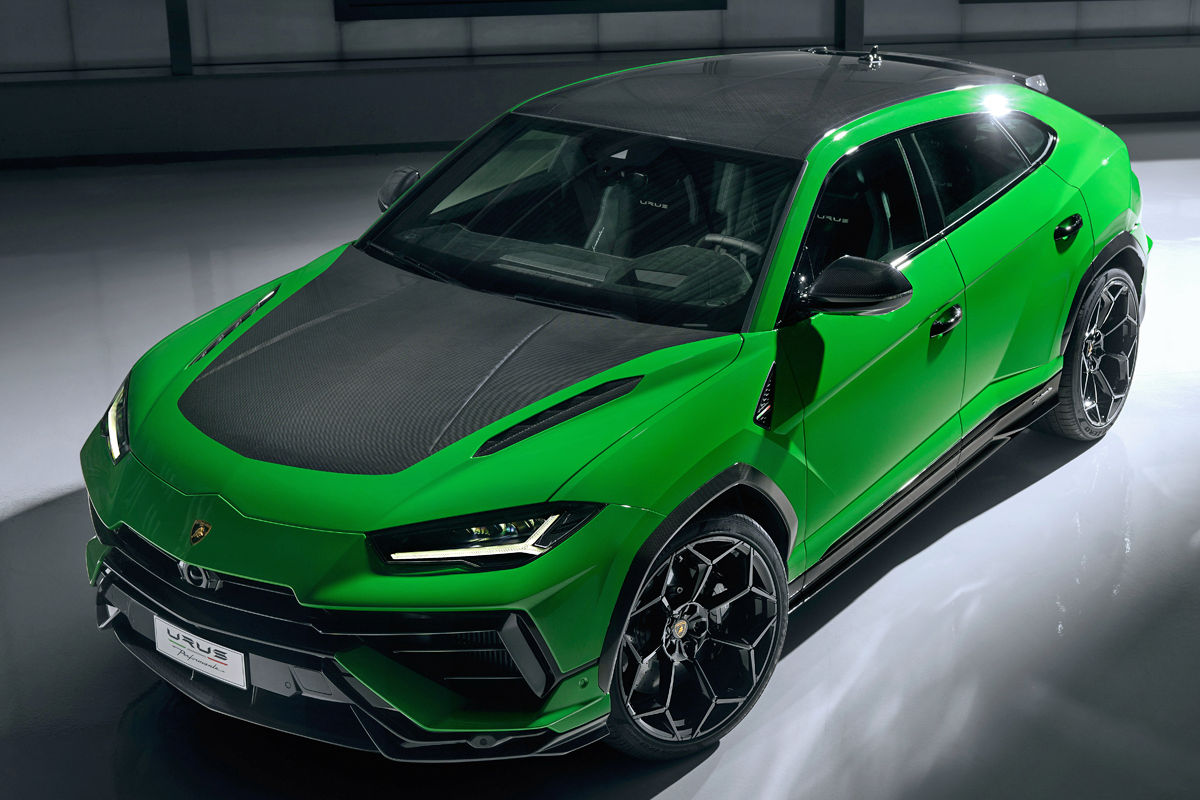
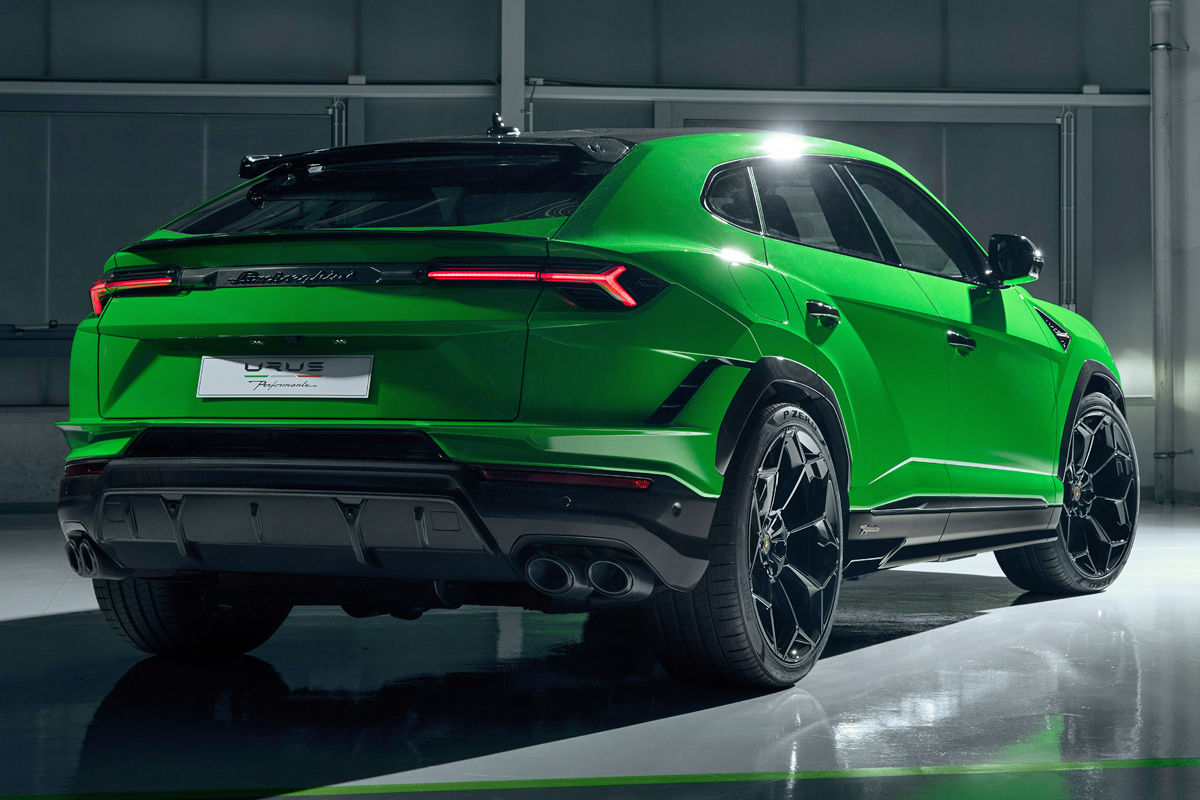
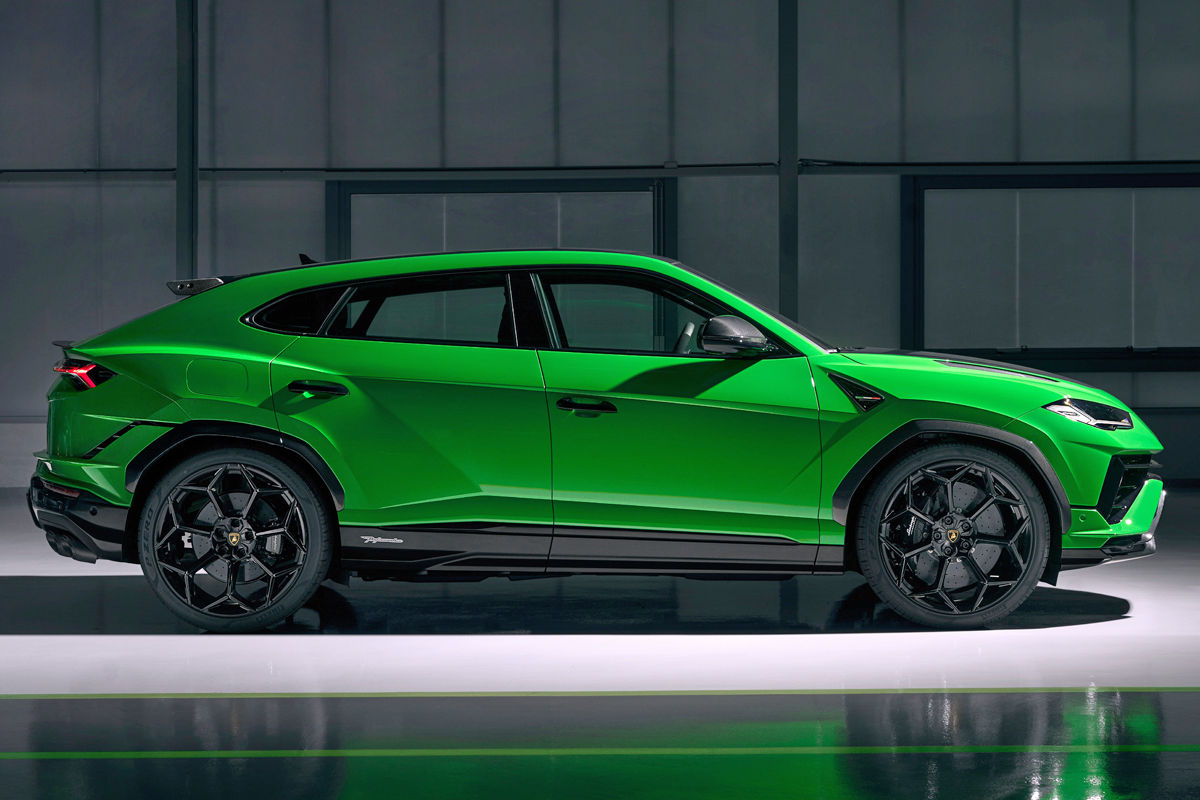
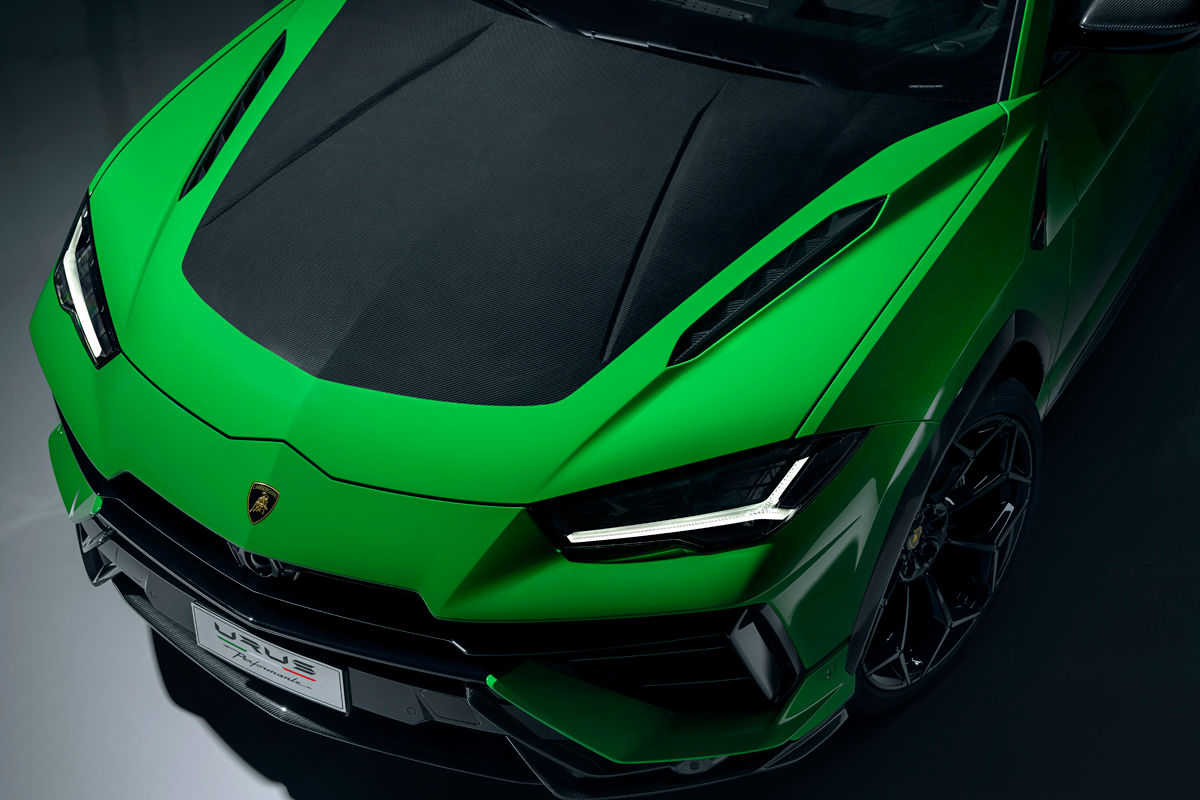
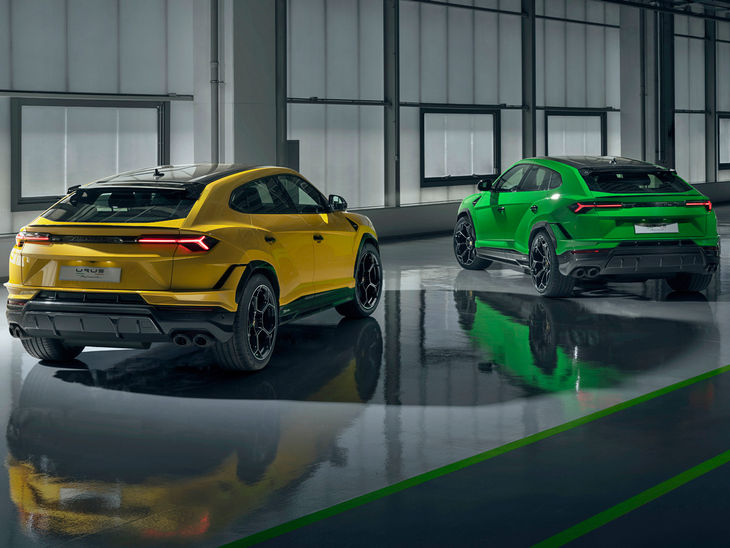
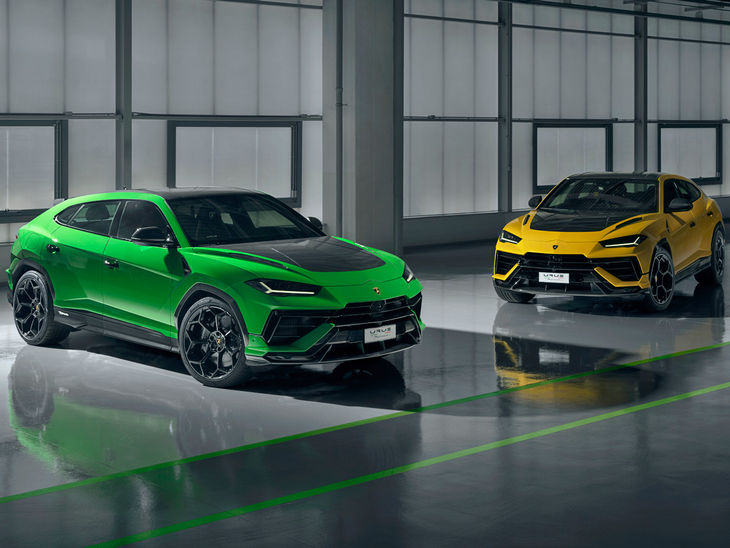
Lamborghini has unwrapped the refreshed Urus, giving its strongest-selling model the Performante badge, reducing its weight and uprating the V8’s peak power…
Italian firm Lamborghini has finally whipped the covers off its Urus Performante, with first customer deliveries of the facelifted “Super SUV” scheduled to take place before the end of 2022.
So, what’s new with Lamborghini’s best-selling model? Well, the big news is yet more power from the twin-turbo 4.0-litre V8 petrol engine, which now generates a heady 490 kW (up 12 units) and an unchanged 850 Nm. The Urus Performante has furthermore lost 47 kg, resulting in what the Italian company bills as a “best-in-class” power-to-weight ratio.
The claimed 0-100 kph time falls three tenths to 3.3 seconds, matching the sprint time of the 500 kW Aston Martin DBX 707, while its top speed climbs one unit to 306 kph (interestingly, four units behind the AMG-powered British high-performance SUV). Lamborghini furthermore says the SUV’s aerodynamic efficiency has been improved, with overall downforce increasing by 8%.
Meanwhile, torque distribution has been “optimised” thanks to the fitment of a new differential, delivering a ratio increase from 3.16 to 3.4 in drive conditions and from 3.02 to 3.33 when coasting. Specially developed semi-slick Pirelli P Zero tyres (285/40 R22 up front and 325/35 R22 at the rear) have also been adopted for “increased versatility”.
The front-wheel steering has been recalibrated to “enhance the connection with the road”, while the rear-wheel steering gains increased turn-in agility, which is complemented by torque vectoring of the rear differential. The Sant’Agata Bolognese-based automaker has also re-engineered the drive modes (Strada, Sport and Corsa) as well as added a new Rally selection. Designed for high-speed gravel driving, the latter “amplifies” the Urus Performante’s oversteer character thanks to optimised anti-roll and damping systems.
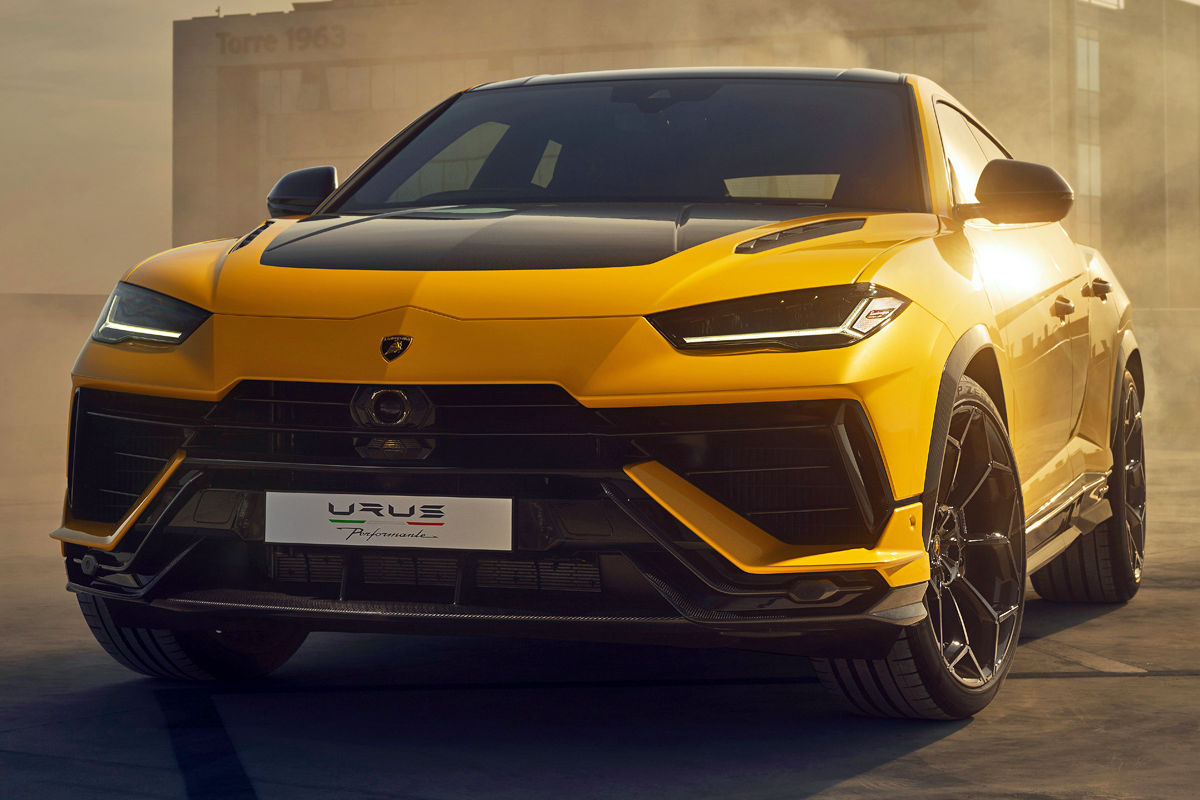
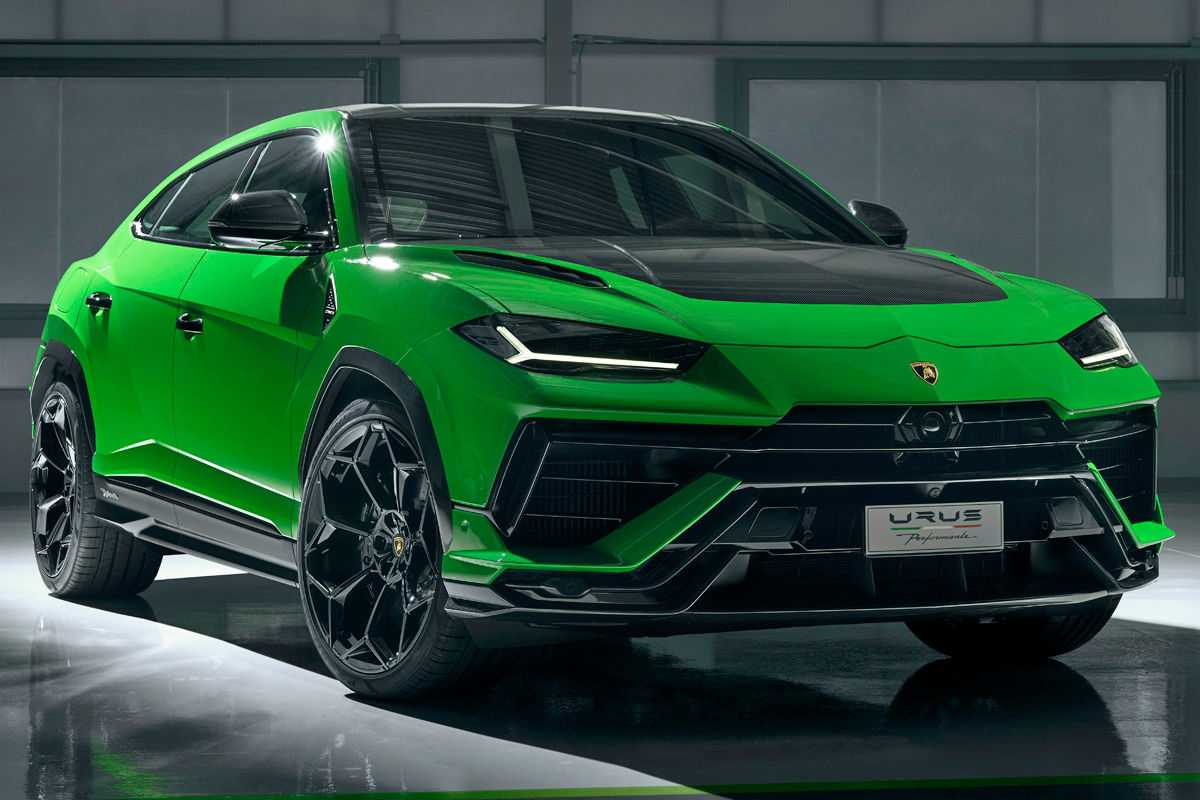
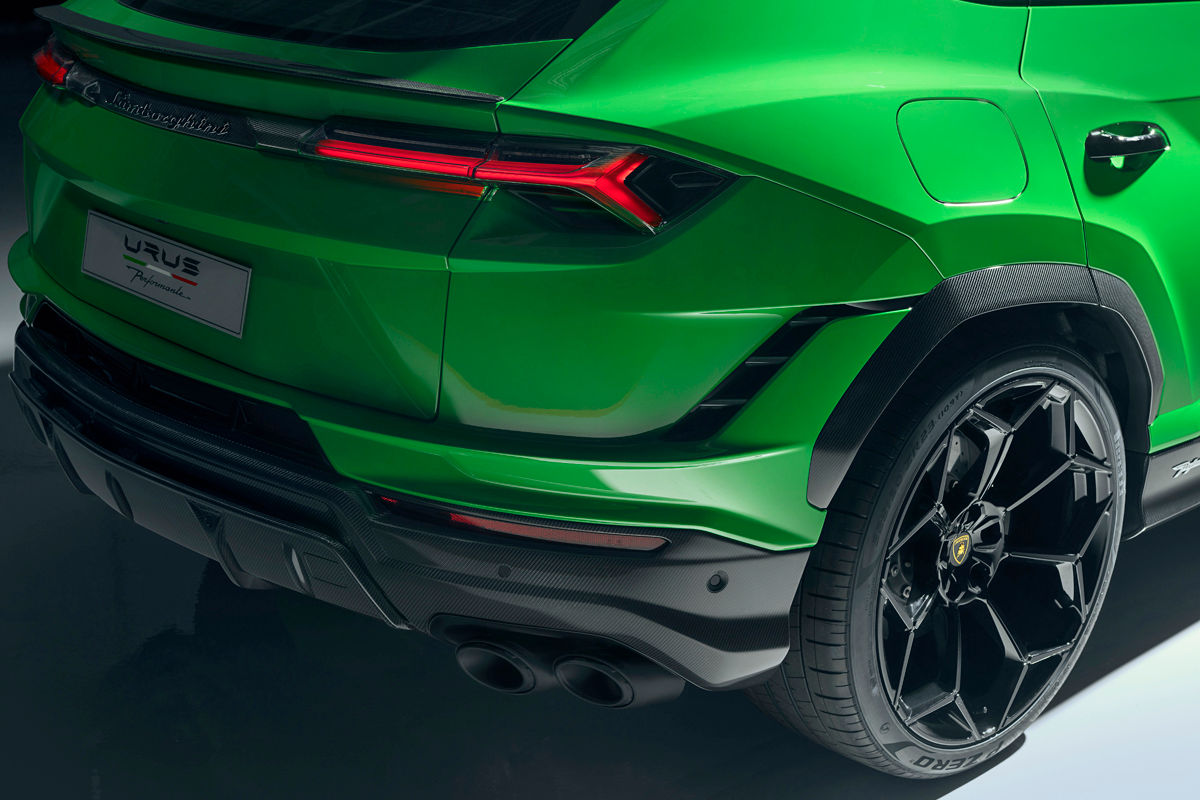
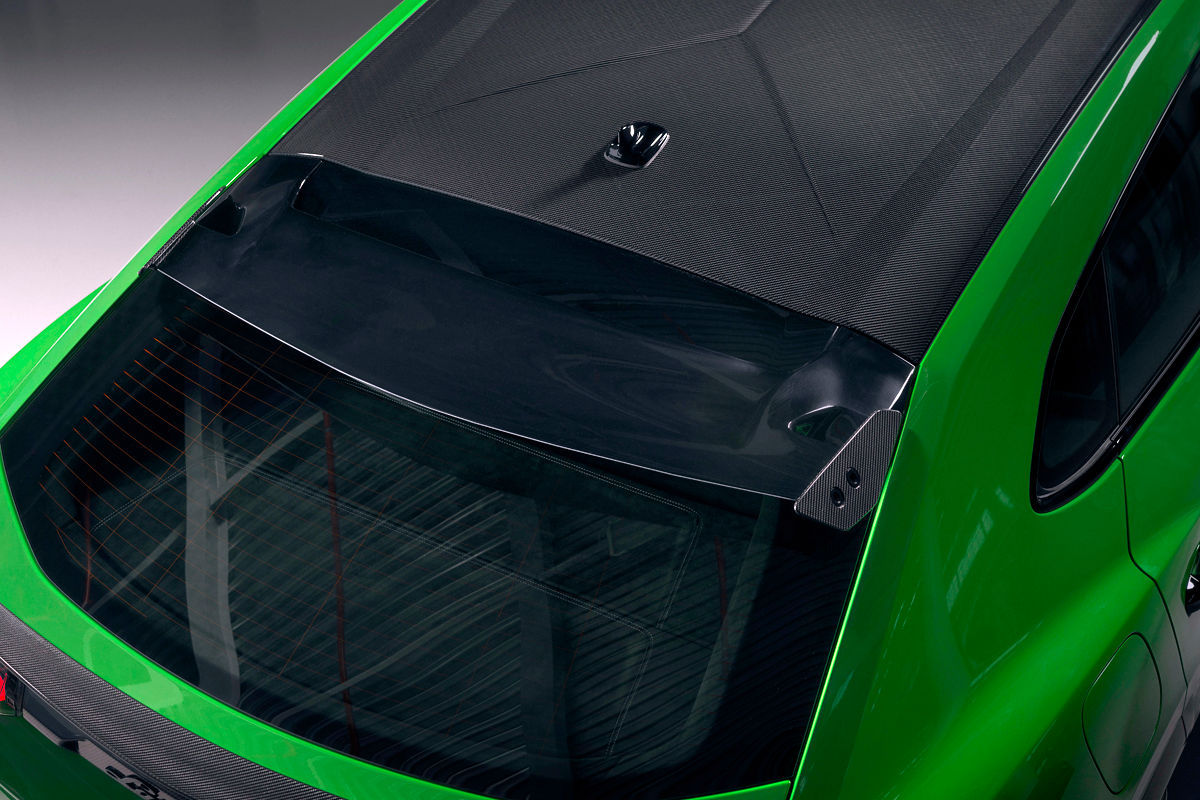
Styling changes for the 25 mm-longer Performante (now measuring 5 137 mm from nose to tail), meanwhile, include a more prominent bonnet and front-bumper design. The bonnet (including the air outlet) is forged from lightweight carbon fibre and offered as standard in body colour or as an option in partially visible carbon. The roof is also optionally available in carbon fibre. Lamborghini claims the “extensive use” of composite materials makes the Urus Performante the vehicle with the “highest number of carbon-fibre parts in its segment”.
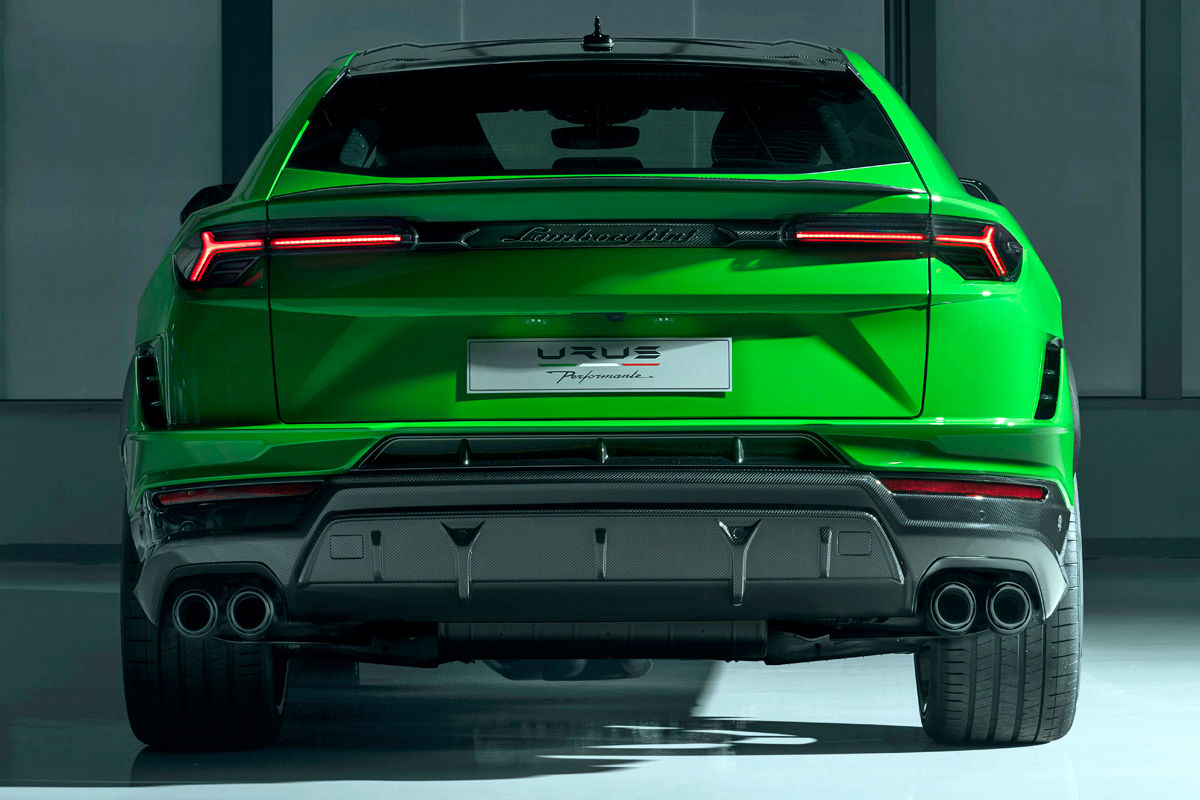
New front air-intakes deliver increased engine cooling while a redesigned air curtain draws more flow over the front wheels. Round back, the updated rear spoiler increases rear downforce by a claimed 38%. The chassis has been lowered by 20 mm, with a wheel track that is broader by 16 mm, over which wider carbon-fibre wheel arches frame new 22- or 23-inch lightweight wheels (with titanium bolts). The lower rear bumper and diffuser also ship standard in carbon fibre, with a lightweight titanium Akrapovič sports exhaust likewise included in the purchase price.
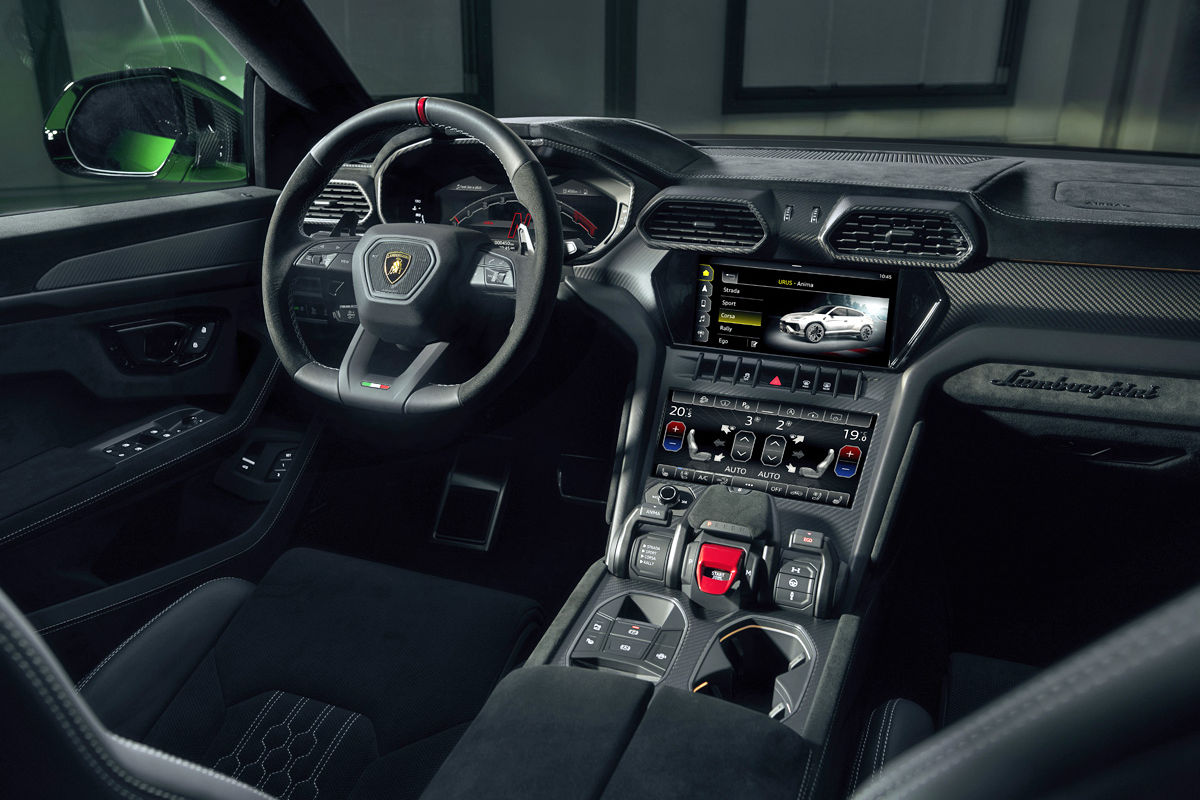
Inside, you’ll find Nero Cosmus black Alcantara as standard with a new hexagonal seat stitching design. In addition to a range of new cabin finishing options, Lamborghini has added a fresh HMI graphic, complete with a dedicated design for the Urus Performante.
“The Urus Performante takes the supreme performance and distinctive looks of Lamborghini’s ground-breaking Super SUV to the next level, retaining its luxurious versatility and delivering the most engaging driving experience: not only on road but in every environment, distinguished through an alluring design that denotes new benchmarks for driving dynamism in what is already a remarkable car,” said Stephan Winkelmann, Lamborghini Chairman and CEO.
“The Urus set a new standard at its launch, taking Lamborghini’s design DNA and technological talent and delivering the world’s first Super SUV for a new era: the Urus Performante sets the bar even higher for the SUV segment.”
Jeep Grand Cherokee L (2022) Launch Review
It has been quite a while since a brand-new Jeep Grand Cherokee made its way to our shores, but the new, 5th-generation model has finally touched down in South Africa. We got a taste of the new three-row model in Mpumalanga.
In the Republic, the Grand Cherokee has been quite the success story for the Jeep brand. The model, which first appeared back in 1993, combines elements of luxury, comfort, practicality and, of course, notable off-road capability – the latter is, after all, a Jeep calling card! The outgoing 4th-generation model offered considerable appeal, which is why there are many of them on our roads, so what can the longer 5th-gen model offer to enhance the talents of the American premium SUV?
What’s on offer?
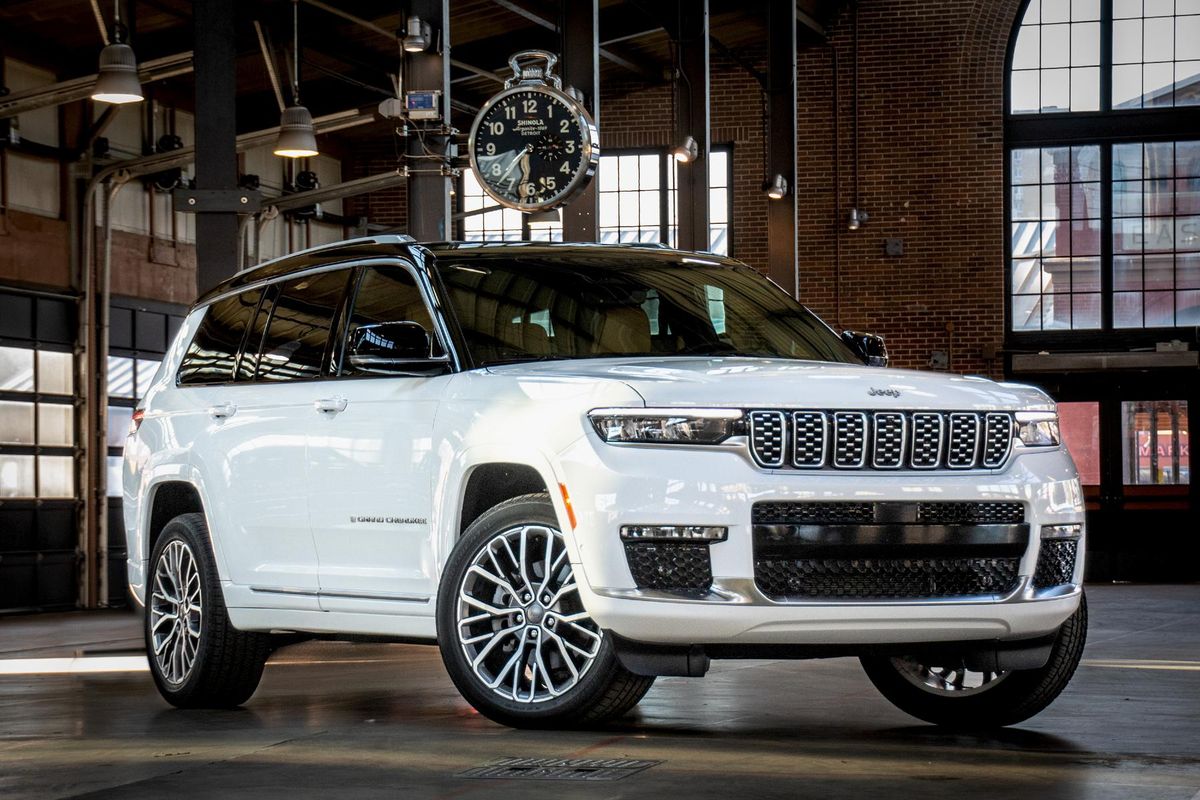
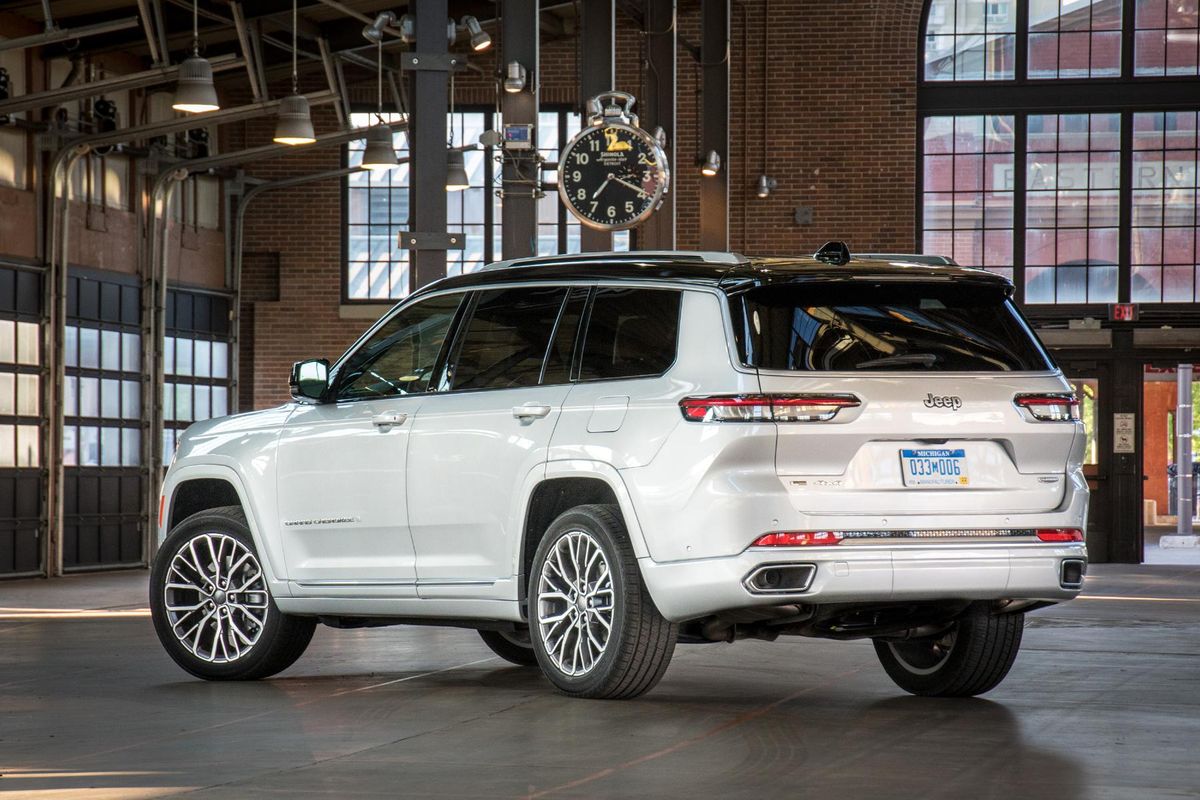
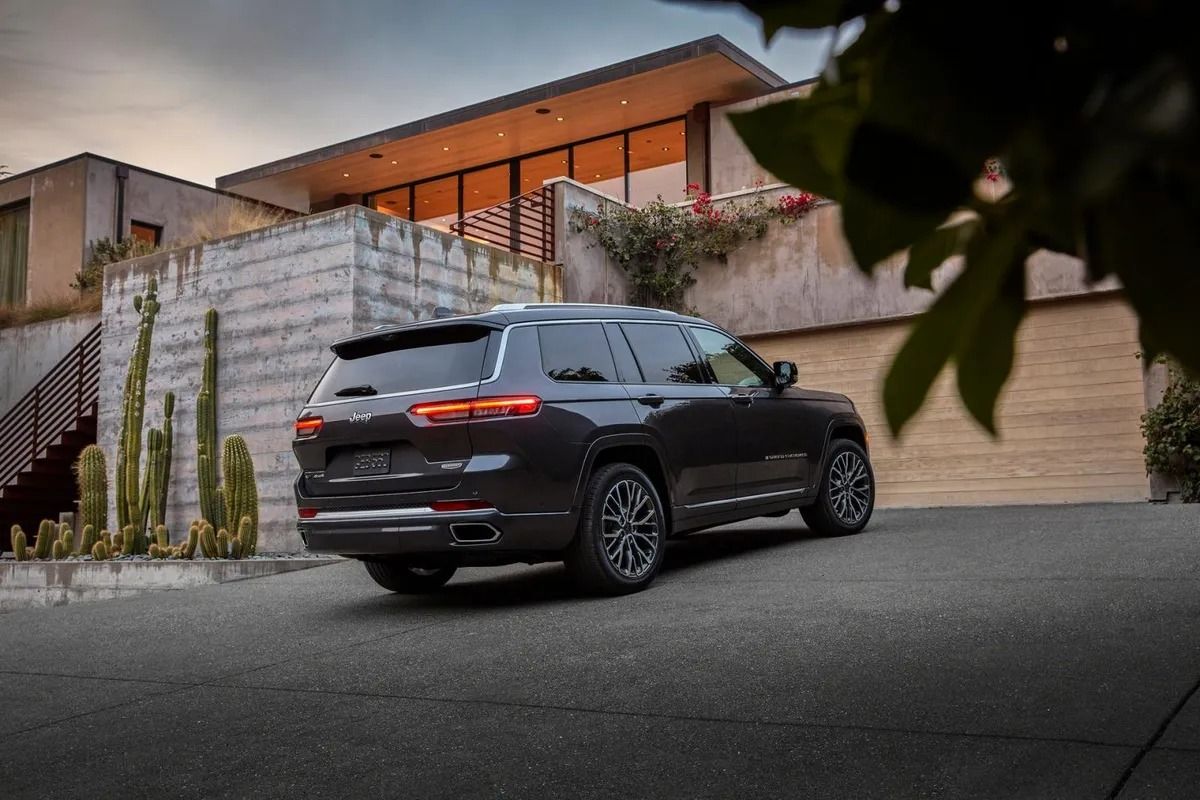
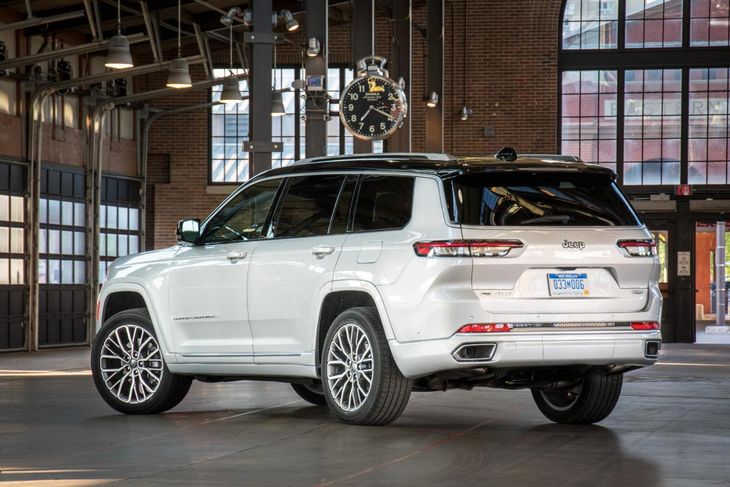
At over 5 metres long, this Jeep may not fit into all garages.
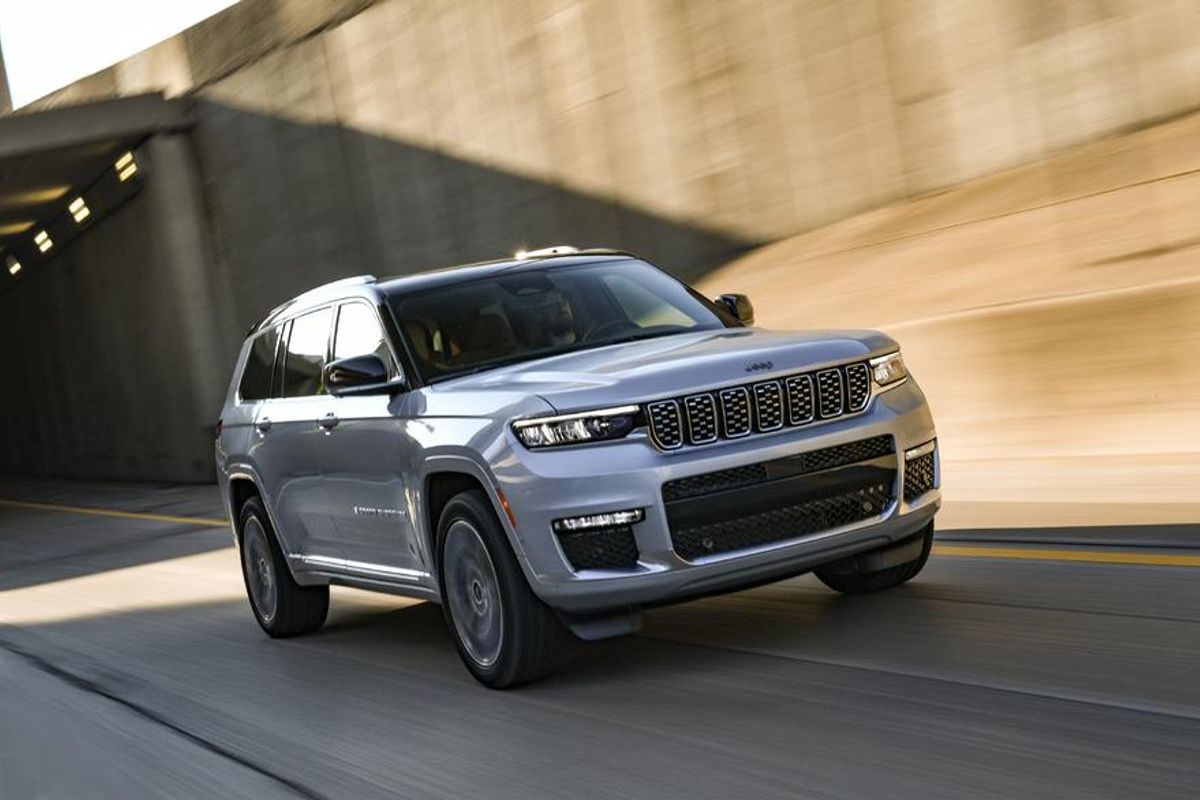
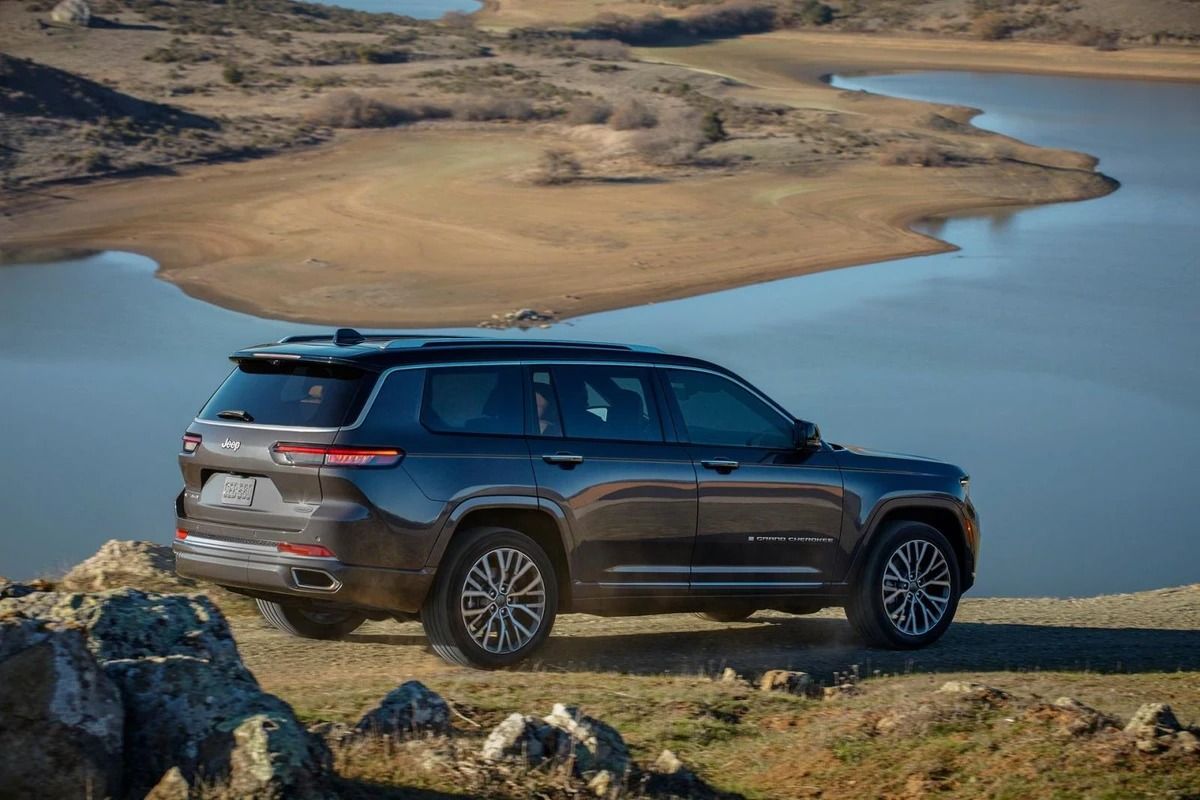
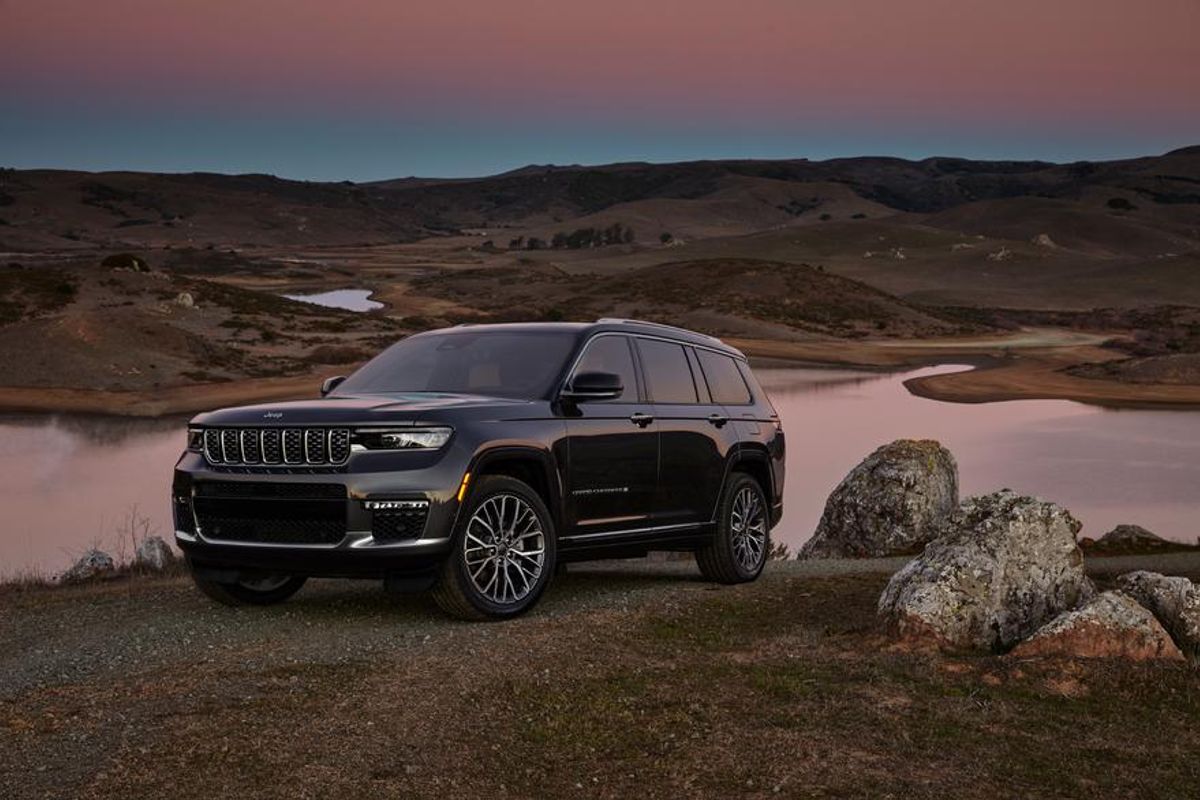
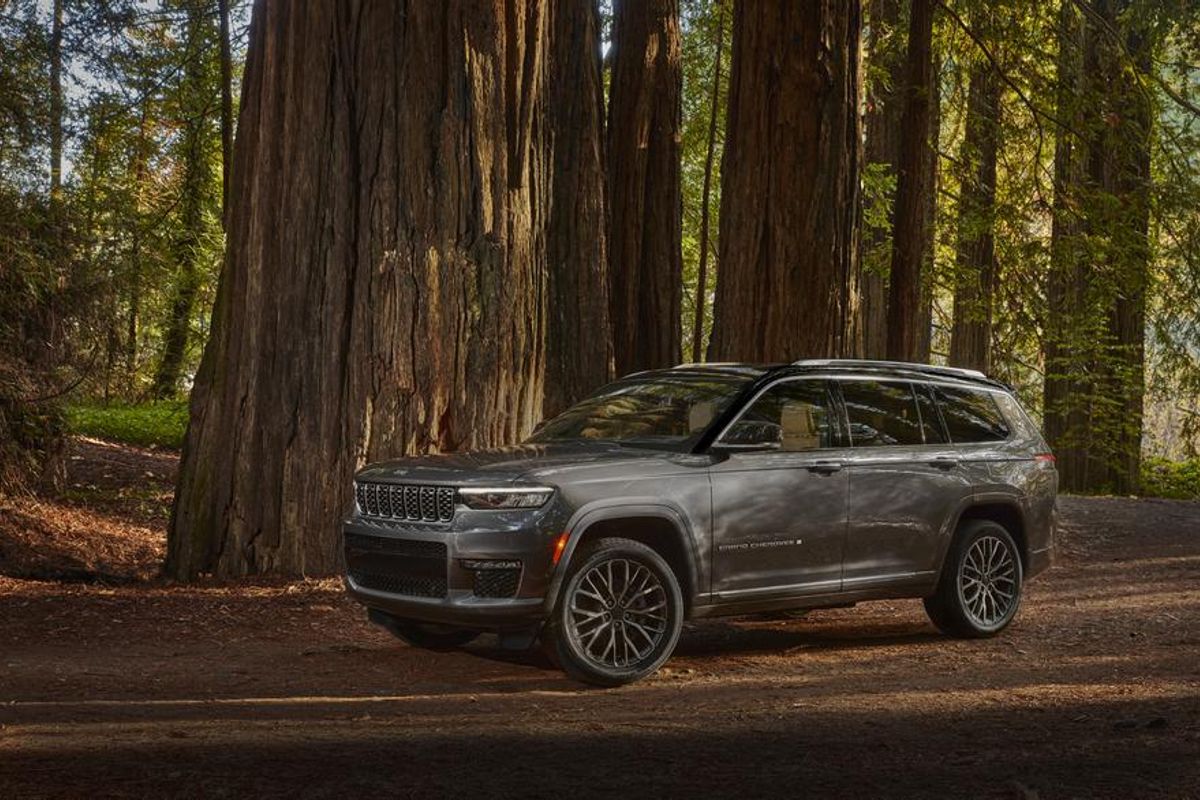
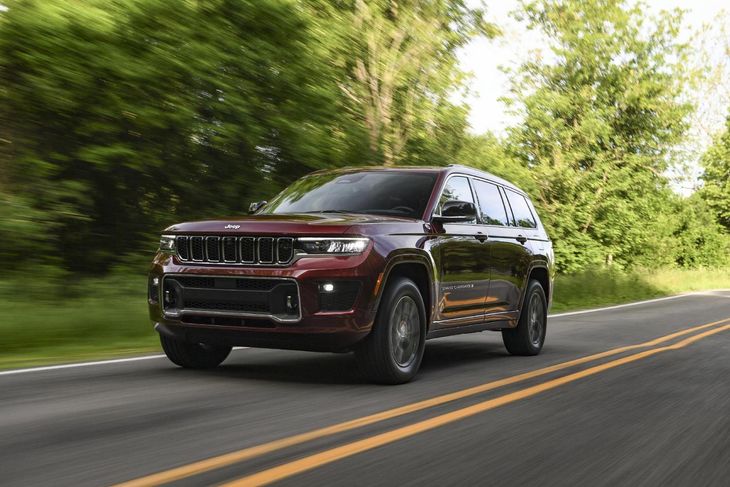
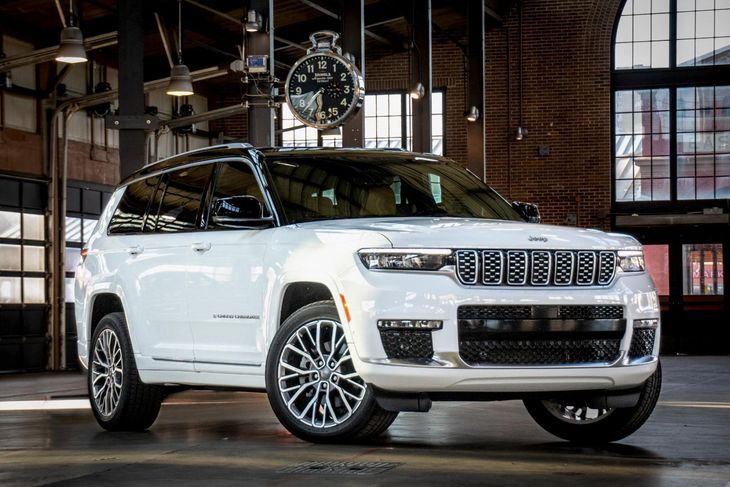
What you see here is the Jeep Grand Cherokee L and the one-letter suffix implies that it has a longer-than-usual wheelbase. No one will be surprised to learn that the Jeep Grand Cherokee L is a large and imposing vehicle, but its length (all of 5.2 metres) makes some garages unsuitable to accommodate it. Thanks to that large, bold grille, there’s no denying the Jeep’s immense front-end presence; it will probably fill the rear-view mirrors of other road users’ vehicles from quite a distance!
This new product is the first three-row Grand Cherokee, which is to say it comes with seating or 6 or 7 occupants, depending on the derivative. Speaking of derivatives, there are 3 to choose from (Limited, Overland and Summit Reserve). Jeep SA has said the 2-row 5-seater variant is under consideration for our market, but did not provide an ETA.
Standard specification is comprehensive, even in the lower-tier versions. There are nice-to-haves such as a digital instrument cluster, wireless Apple CarPlay/Android Auto, up to 12 USB ports (Type A and Type C), heated and ventilated seats, a heated steering wheel and much, much more.
There is only one powertrain available – a petrol-fed 3.6-litre Pentastar V6 that produces 210 kW/344 Nm and is paired with an 8-speed auto ‘box. Jeep claims its new offering will consume an average of 10.6 L/100 km (it has an 87-litre tank).
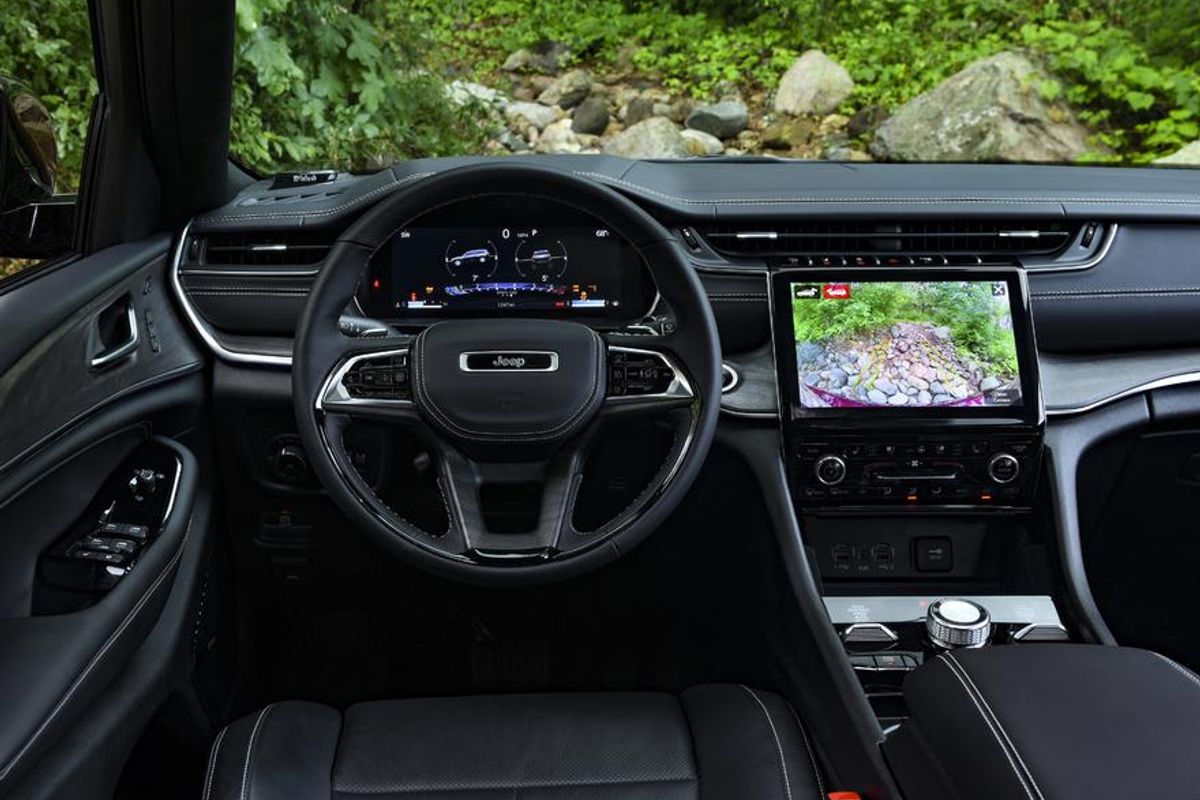
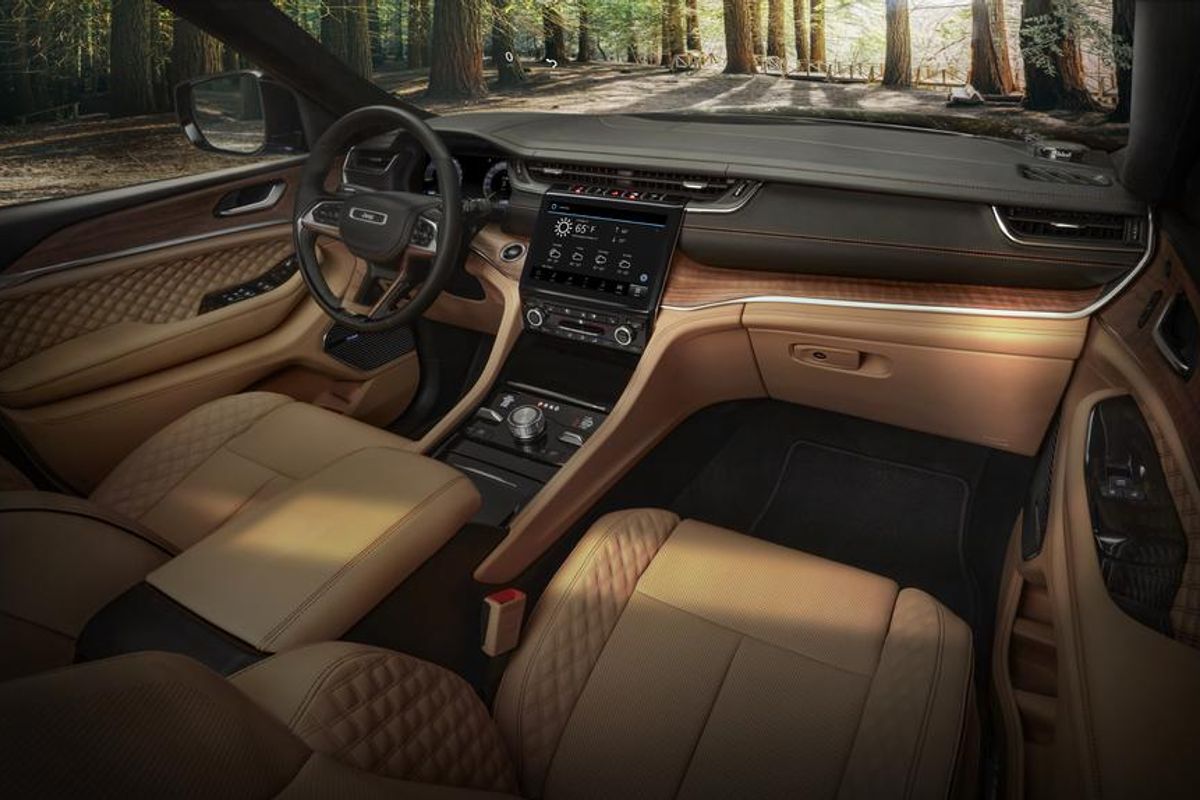
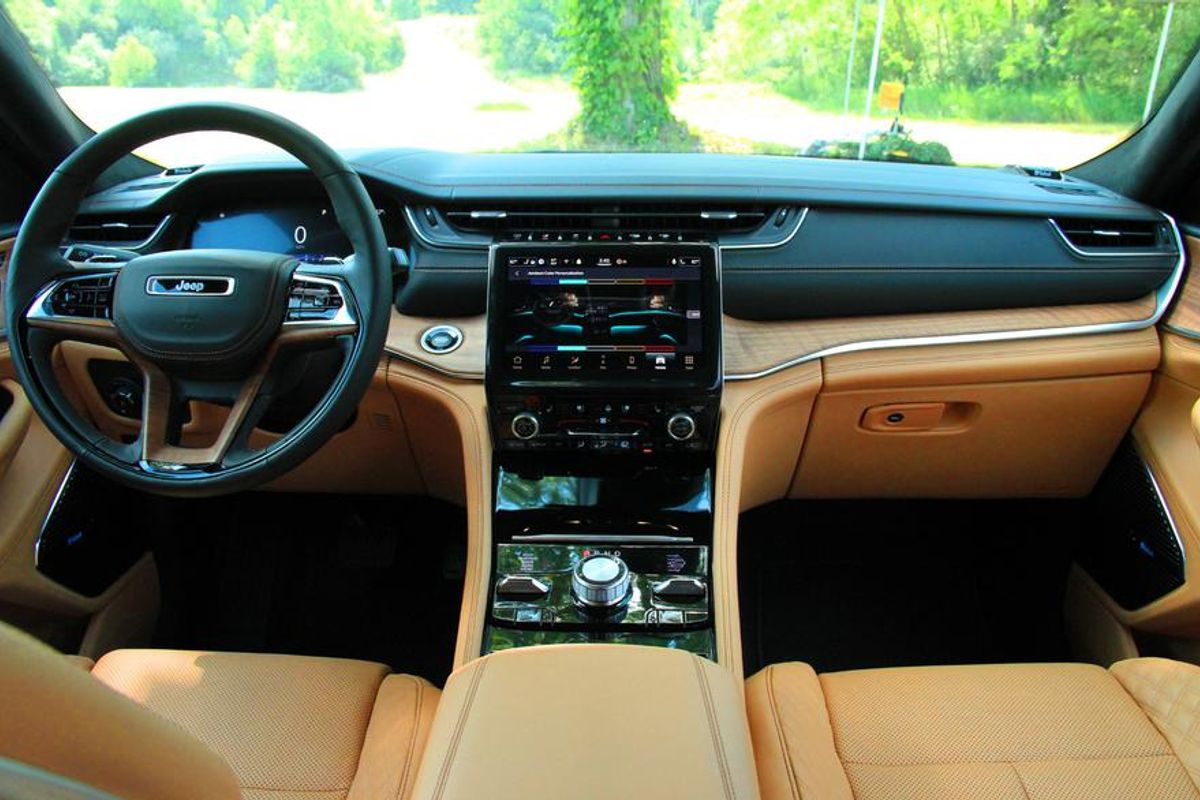
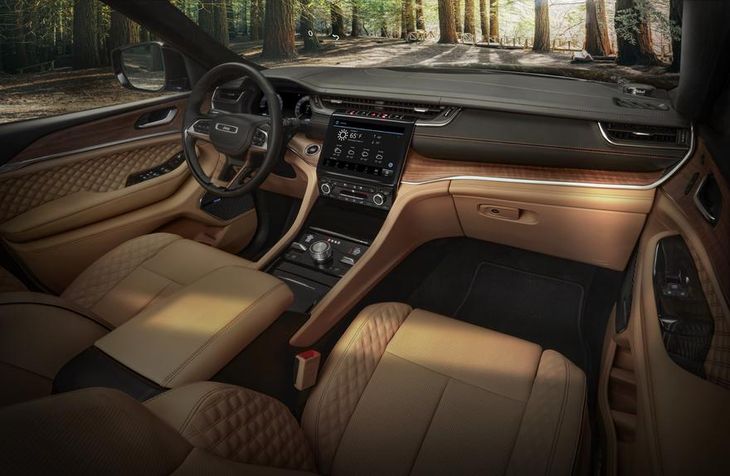
The cabin is modern, luxurious and dripping with features.
What is the Jeep Grand Cherokee L like to drive?
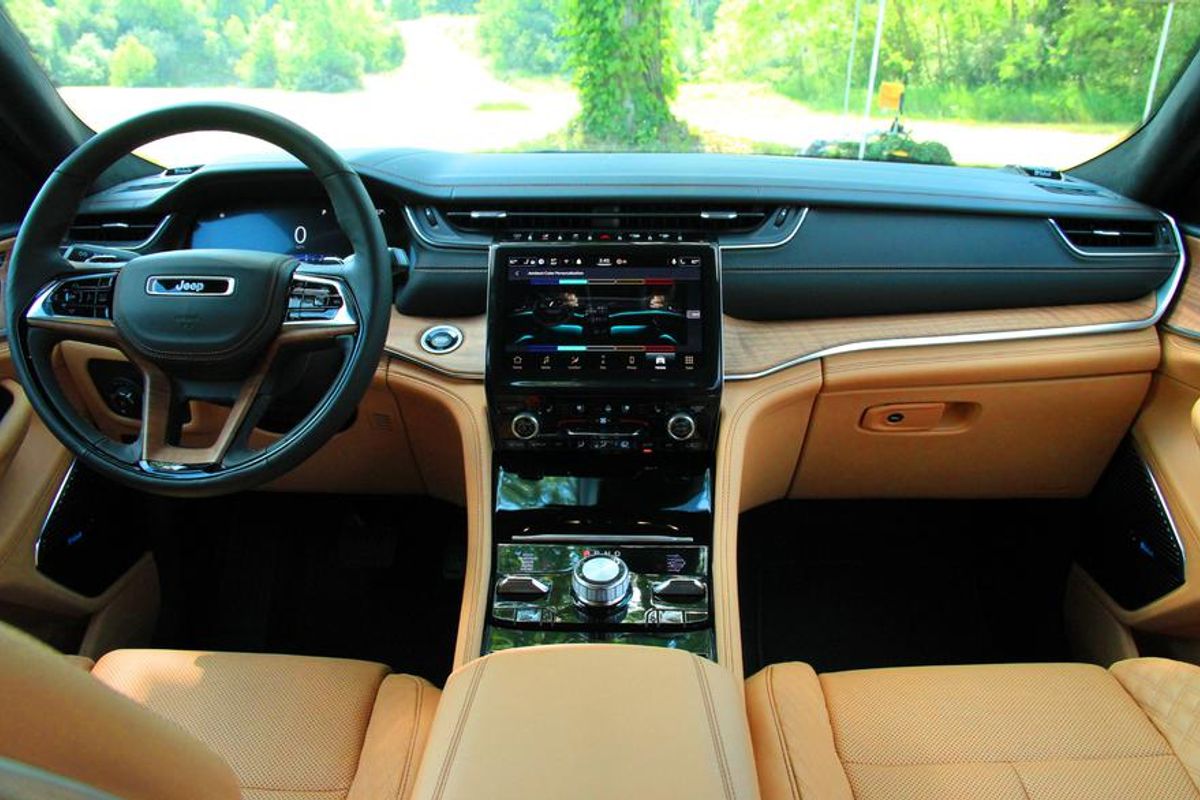
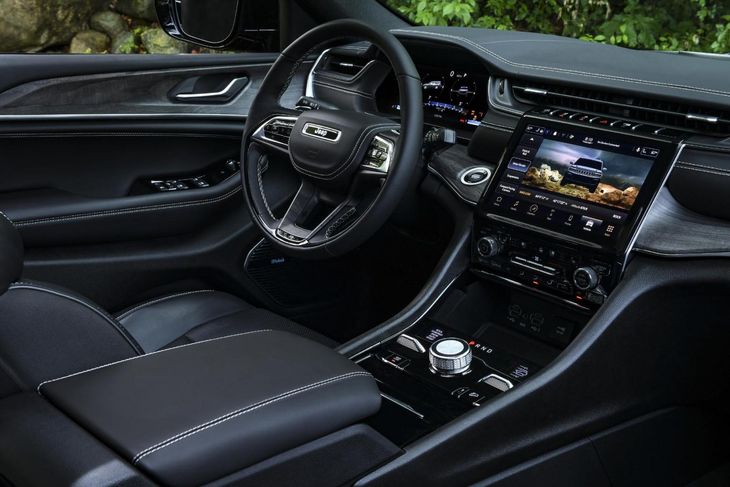
When you step inside the Grand Cherokee L’s cabin, you’re greeted by one of the most luxurious and well-appointed cabins we’ve ever seen in any Jeep product. It looks upmarket with extensive use of leather and wood trim. There are buttons galore, which might intimidate some users, but once you familiarise yourself with the layout, you should find that it’s ergonomically sound.
The V6 petrol engine produces a pleasant noise (if you apply the accelerator pedal liberally), but it’s not the punchiest motor around. While the engine gets you up to the national speed limit without too much hesitation, executing overtaking manoeuvres (80-120 kph) requires forethought and careful timing.
See, with just 344 Nm on tap, which needs to propel an almost 2.2-tonne premium SUV, performance and responsiveness are not the Grand Cherokee L’s strengths. We were also at altitude, where naturally-aspirated engines suffer a 17% power deficit, so, in fact, we had around 170 kW available. We suspect that most customers will, like us, rather savour the Jeep’s relaxed and refined cruising ability.
The cabin is remarkably quiet and refined; we got the impression that the Grand Cherokee L’s occupants could travel a few hundred kilometres in the Jeep at a time and emerge at the end of their journey still feeling fresh. The 8-speed transmission is augmented with shift paddles on the steering wheel, but we felt it best to leave the auto ‘box to its own devices – it invariably delivered smooth, fuss-free ‘shifts.
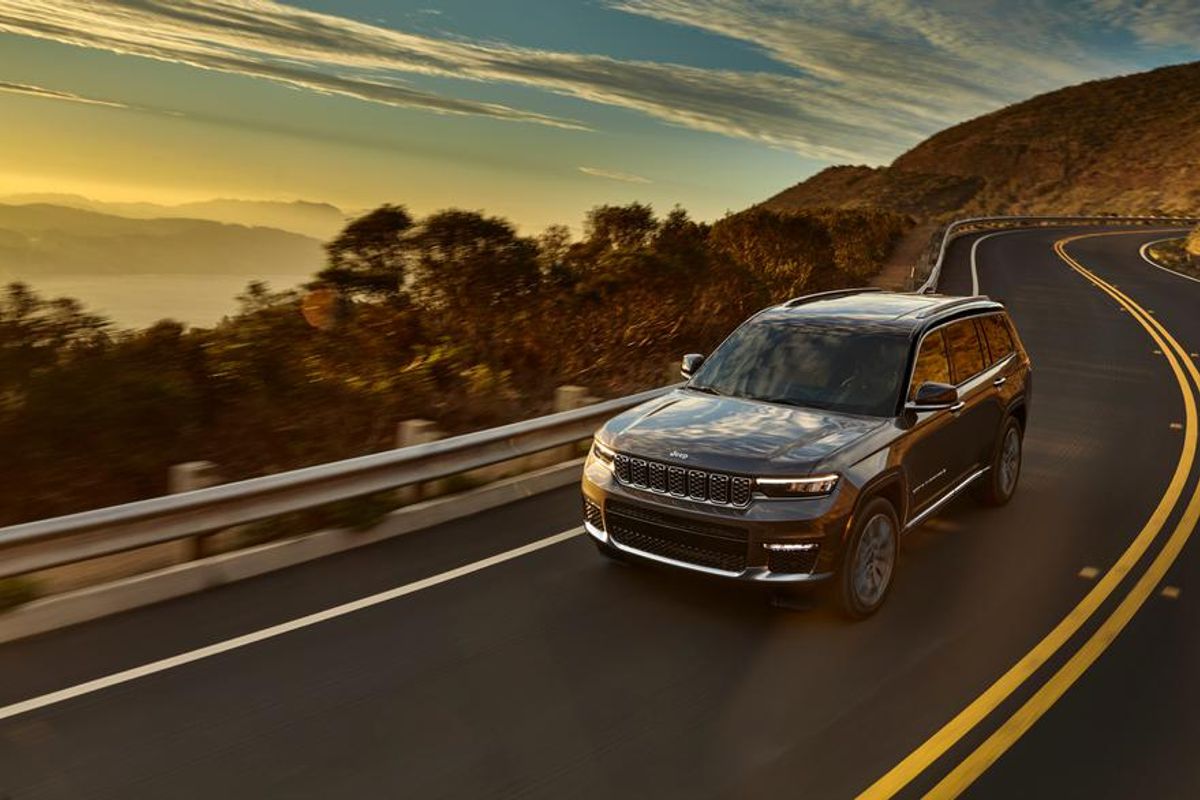
The Grand Cherokee L offers a buttery smooth ride quality – it excels at open-road cruising.
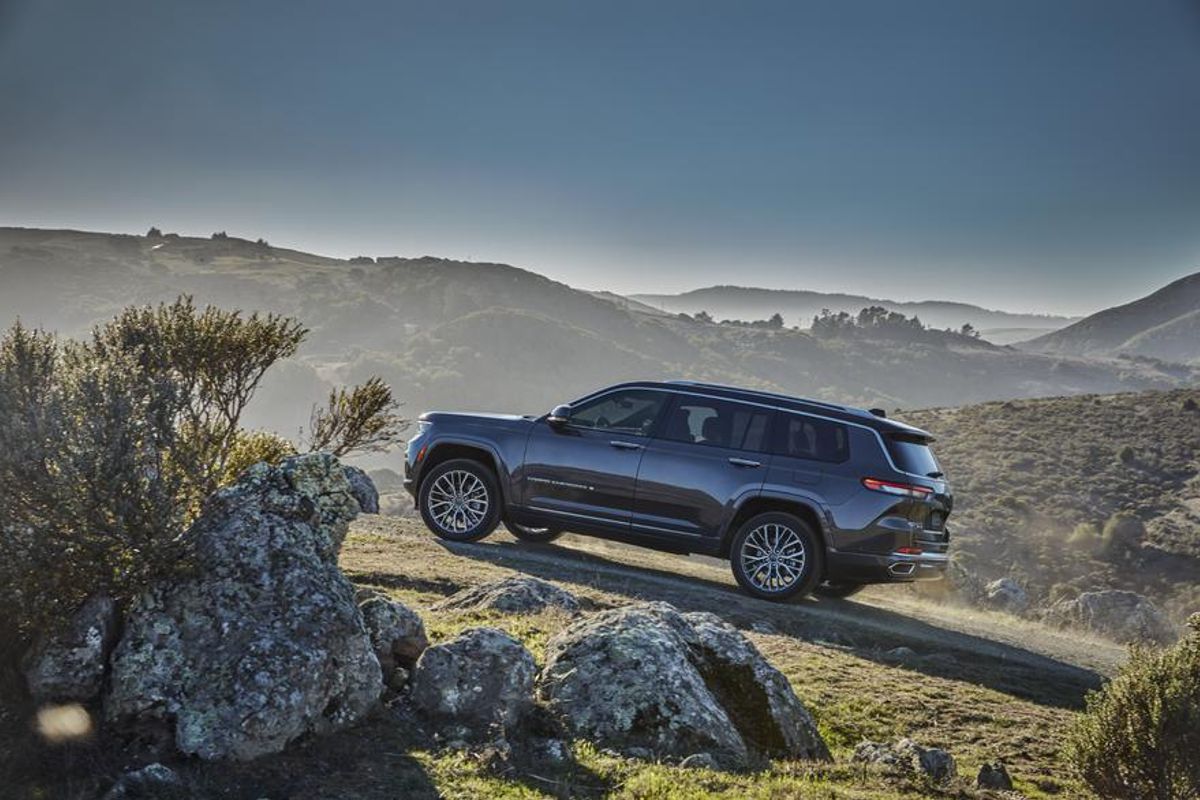
Our launch route took us from Pretoria to the eNtokozweni (formerly Machadodorp) area. We had an opportunity to make an offroad detour, during which we sampled the Grand Cherokee L’s “gravel-travel” (dirt road) prowess. Given the prestige, luxurious adornments and heft price tag of Jeep’s newcomer, it didn’t feel quite appropriate to take such a vehicle onto the rough stuff – Range Rover owners could probably relate to that. It is nice to know that the vehicle has sufficient tech and capability to venture off the beaten track, however. Its off-road capabilities are impressive, with selectable 4×4 terrain modes, adjustable air suspension, low range and more. The clearance of 277 mm is particularly useful.
Given the outrageous number of mobile speed traps that were positioned on the N4 at the time that we drove along the route, we engaged cruise control at a, well, stately 120 kph. The Grand Cherokee L hides its speed well – there were times we had to double check that we were actually travelling at 120 kph. The level of the premium SUV’s NVH (noise, vibration and harshness) suppression is so lofty that it felt like we were driving much slower than 120 kph. We also had the opportunity to sample a few of the gadgets in the car, ranging from the front passenger-only entertainment screen (it’s not visible to the driver), to the premium McIntosh audio system, replete with 19 speakers, including a 10-inch subwoofer.
Gripes? Well, we think the lack of a diesel powertrain in the range may deter a few customers… besides the premium price of 95 unleaded, those who wish to tow larger trailers would appreciate the benefit of the extra torque a diesel motor would deliver. We understand that the limited availability of 10 ppm diesel in Mzansi is the reason behind this “omission” from the range. Oh, and there is also that very American way of sounding an alert for just about everything. Door open? Ding. Seat belt undone? Ding. Drifting out your lane? Ding. GPS alerts of known speed camera spots? Ding. We tried in vain to mute them all, but without success. That particular audible alert will forever be etched onto my brain.
The passenger TV screen is an interesting and useful feature.
How much does the Jeep Grand Cherokee L cost?
The new Grand Cherokee L is sold with a 5-year/120 000 km warranty and roadside assistance. A 5-year/100 000 km maintenance plan is also included, with intervals every 12 months or 12 000 km.
Jeep Grand Cherokee L Limited
R1 299 900
Jeep Grand Cherokee L Overland
R1 479 900
Jeep Grand Cherokee L Summit Reserve
R1 679 900
Summary
Could this be the best version of Grand Cherokee yet? We certainly think so.
Detractors may be quick to bemoan the Grand Cherokee L’s decidedly premium pricing, but the reality is when you consider other luxuriously appointed 3-row offerings from the likes of Mercedes-Benz (GLS), BMW (X7), Land Rover (Discovery) and Toyota (Land Cruiser 300), the Jeep’s new premium SUV starts to look like a relatively good value-for-money proposition. You don’t even need to fork out for the flagship Summit Reserve, because the Overland derivative is likely to be all the big family SUV you’ll ever need.
Our first taste of the American brand’s newcomer may have been short, but it was certainly sweet, plus we’re keen to get to know it much better in the coming weeks when a test unit arrives here at sea level (for context, Cars.co.za’s content team is based in Cape Town). First impressions suggest that Jeep has absolutely nailed the brief of providing a luxury 3-row offroad-capable large family SUV.
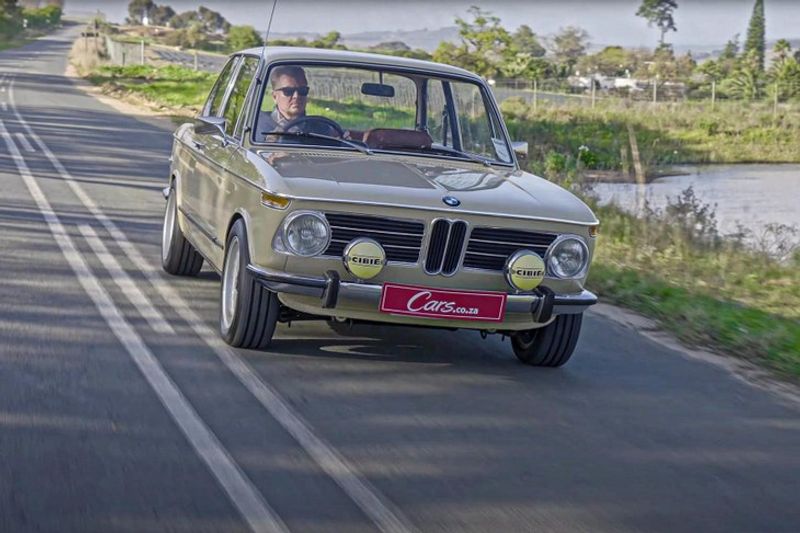
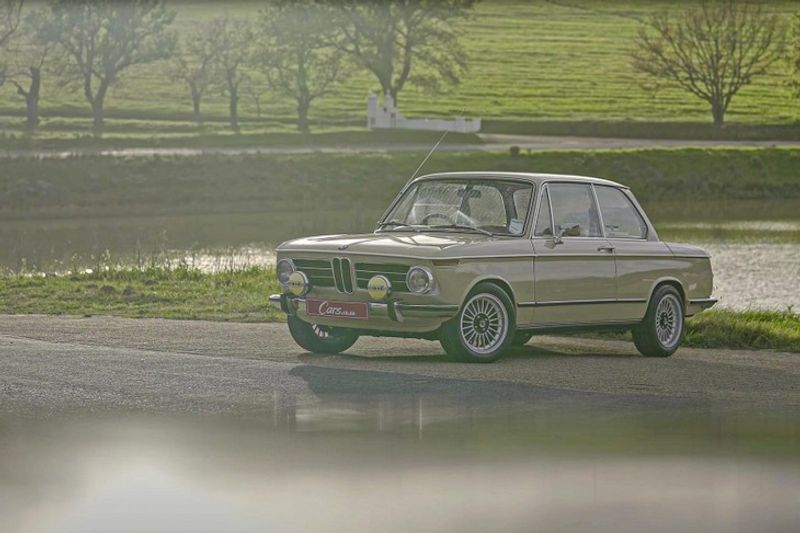
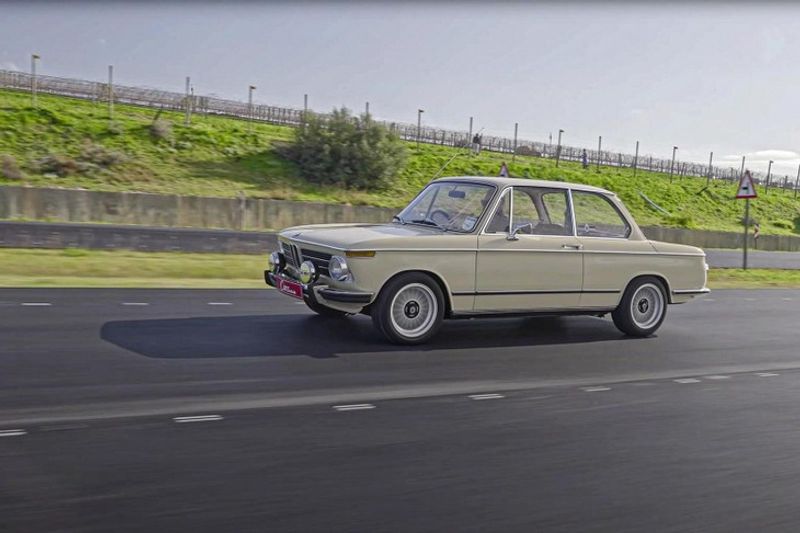
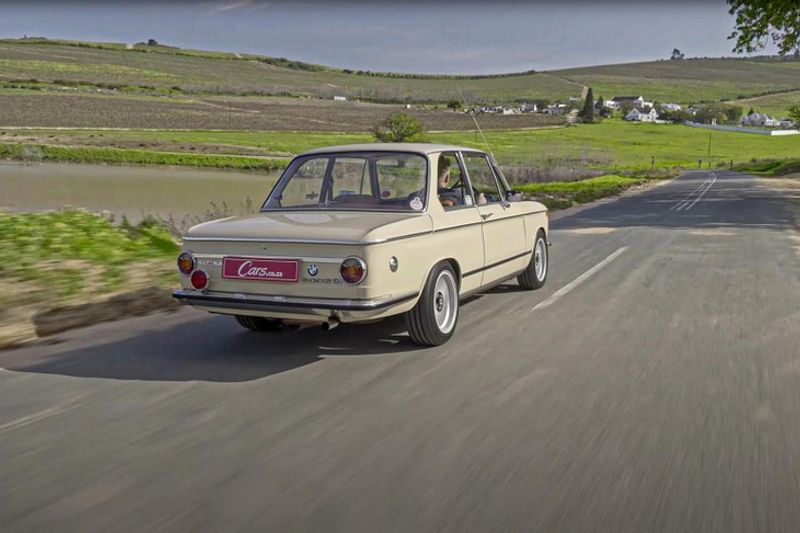
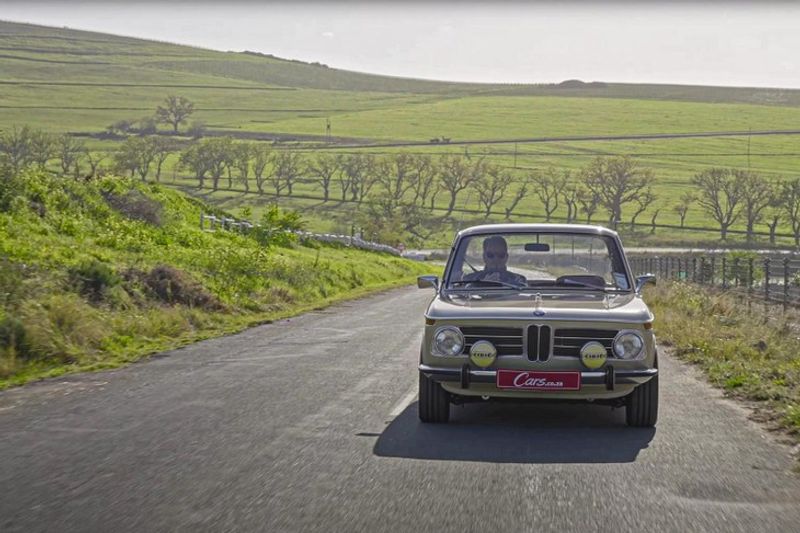
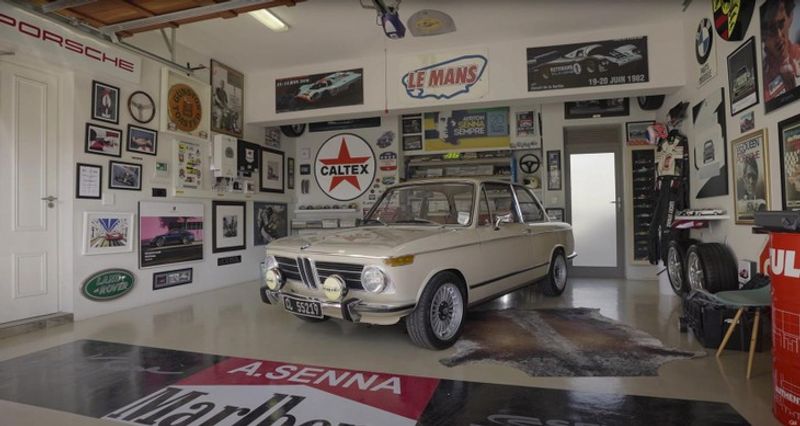
In the first of a new four-part video series, we are celebrating Continental’s 75th birthday in South Africa. We will be featuring cars that were originally fitted with Continental tyres and we kick off with this mint 1973 BMW 2002tii.
Words: Wilhelm Lutjeharms, Photos: Justin Pinto
There is not a lot that Jaques Wessels doesn’t know about BMW 2002, and that includes the iconic Bavarian model’s general history and its racing pedigree. It’s the result of a true passion for this particular car and, consequently, Jaques has devoured every bit of reading material on the 2002 and, of course, also benefits from the intimate knowledge that comes from owning one.
His love of cars
“I got my love of cars from my dad. I was born in 1971, and from 1971 to 1985 we spent every year at Kyalami circuit. Back then you could spend a week there while the teams came down with their Formula One cars. That was kind of my first introduction to engines and petrol and has stayed with me my entire life.
“My dad was a BMW fan. However, I actually come from a family of dyed-in-the-wool Mercedes-Benz enthusiasts, and he was kind of the rebel and decided to go with BMW. We had an E12 518 in a horrendous orange colour. And I remember being very embarrassed when he dropped me off at school because it had this very psychedelic hue. But then I grew to love the vehicle. We then moved on to E30 3 Series BMWs. In actual fact, my dad’s dream car was a 2002.
“One day in the mid-80, I remember this very well, there was a BMW dealership in the Free State town I grew up in, and a truck came through the town and on the back was a 2002 and my dad pointed the car out to me – and it was love at first sight. I said to him, I never ever wanted a new car, or a different car, when I get to the age that I can drive. We made a pact back then that my first car would be a 2002 – which it was.
“So, I had my first 2002 from the late-80s until 1994. We had two, I had a 2002ti and my dad had the bog-standard 2002. My dad passed away in 1994, unfortunately. At that time, I finished my studies and started working while the cars were just standing at my mother’s house. During the course of the ’90s we decided to sell both. But, I made myself a promise that I would find another one. My dream was always to get a tii because it had a mechanical fuel-injection system.
Acquiring the 2002tii
“In 1999 my company sent me to the UK for work. There is a large following in the UK for the 2002 as well as a specialist company, Jaymic, that maintains and restores these cars for the rest of the world. I thought to myself, this is your prime opportunity to buy a good one. I was lucky that after a four year search I came across this one – and I’m only the second owner. It used to… really… belong to an old lady.
“It was Easter weekend of 2003 when I saw this car advertised. I phoned the gentleman and he didn’t answer his phone. I literally left around ten messages. After the Easter weekend he returned my call and said he had about 15 enquiries, but I was the first person to leave a message, so I could come and have a look at the car first. I went to have a look and bought it. And it has been in my ownership ever since.
“I absolutely love the styling to start off with. I like German Bauhaus styling. Everything on this car serves a purpose – there are no fripperies. The other thing that I enjoy is that it has enough power, because it weighs under a tonne, and then the analogue feel of the steering. It is a heavy steering feel, but once you get going it has a very precise feel to it. The gearbox is also a delight, even though it is a four-speed ‘box.
“It offers fantastic visibility, is very practical and you can use it every day, and I use it as often as I can. It is not a trailer queen, I don’t believe in just storing cars. When they stand you doing them a complete disservice. In the summer time, I commute with it to Cape Town which is a 100 km round trip once or twice a week. The mechanical fuel injection especially needs a workout as they can become quite complex if you just leave them.
Maintenance
“This car is fitted with the M10 engine, it is a 2.0-litre, four-cylinder unit. They are generally bulletproof, but it is a 50-year-old car. A couple of years ago I had a technician go through the car back to front. I would say the most problematic thing on these is the mechanical fuel injection system – they are complex and to work on them is time-consuming and there is not a lot of expertise in South Africa to work on them.
“I’ve done the brakes, I’ve replaced the pistons and rings and overhauled the entire suspension system. This was more preventative maintenance than anything else. The car has never left me stranded next to the road and is as reliable as any other car. Because I want to keep it, and keep it on the road, I believe in doing preventative maintenance.
“The wheels are period-correct 15-inch Alpinas. When these cars came out they had 13-inch wheels. I searched for these Alpinas for about three to four years and eventually came across a lady in Berlin who advertised them. I put in a bid on the auction and thankfully won it. The interior features period-correct Recaro seats. It is an upgrade a lot of enthusiasts did as the standard seats in a 2002 are quite flat. I’ve also fitted the fog light at the back and the two Cibie Oscar lights at the front.
“The best trip I’ve done in this car was actually in the UK when I bought it. In 2003, there was an Ayrton Senna festival at Donington Park and I drove the car there from London. That was very special because of my connection and love for Ayrton Senna.
To find out more about why so many car manufacturers fit Continental tyres to their cars, go here.
Electric M Incoming: BMW Reveals Quad-Motor Prototype
BMW’s high-performance M division has revealed details of a new fully electric prototype vehicle, which debuts a quad-motor powertrain. Does this preview a battery-powered M3 and M4?
We already know the soon-to-be-revealed new BMW M2 coupé will be the final full-fat M car powered by a pure combustion engine. So, what’s next? Well, the upcoming BMW XM will be the M division’s first hybrid, before things go fully electric.
In fact, BMW M has now – in its 50th year of existence – revealed a few details of a fresh prototype vehicle, based on the i4 M50 but upgrading to four electric motors. The Munich-based firm’s high-performance division says this concept opens the “next chapter in its transformation towards electric mobility”. Are we looking at a test bed for a battery-powered M3 and M4?
Well, the clues are certainly there. The prototype’s all-wheel-drive system comprises four electric motors and an integrated driving dynamics control system, which together provide what BMW M terms “an unprecedented level of performance and experience”.
BMW M says it is in the “midst of a transformation process towards electric mobility” which not only “preserves the unmistakable performance characteristics of its models, but at the same time enriches them with new facets”.
“On our anniversary, we are not only looking back, but above all also looking forward. Before the end of the year, production of the BMW XM, our first high-performance car featuring a V8 M hybrid drive, will commence,” said Franciscus van Meel, Chairman of the Board of Management of BMW M GmbH.
A closer look at the quad-motor electric prototype
The prototype’s i4 M50 body has been modified “in typical BMW M style”, gaining wider wheel arches over specifically manufactured high-performance front and rear axles. The vehicle’s front end features an adapted M4 body strut concept for “particularly high torsional rigidity in extremely dynamic driving situations”.
But the core of the high-performance drive system is the electric M xDrive all-wheel-drive system, with the four electric motors connected to a central control unit. BMW M claims the fact each wheel is independently driven by an electric motor “opens up completely new possibilities for infinitely variable, extremely precise and at the same time very fast distribution of drive torque”. The result, says the company, is a level of dynamics “unattainable using conventional drive systems”, complete with “significantly higher cornering speeds”.
“Electrification opens up completely new degrees of freedom for us to create M-typical dynamics. And we can already see that we can exploit this potential to the maximum, so that our high-performance sports cars will continue to offer the M-typical and incomparable combination of dynamics, agility and precision in the locally emission-free future,” promised Dirk Häcker, Head of Development at BMW M GmbH.
New Porsche 911 GT3 RS Track Weapon Revealed
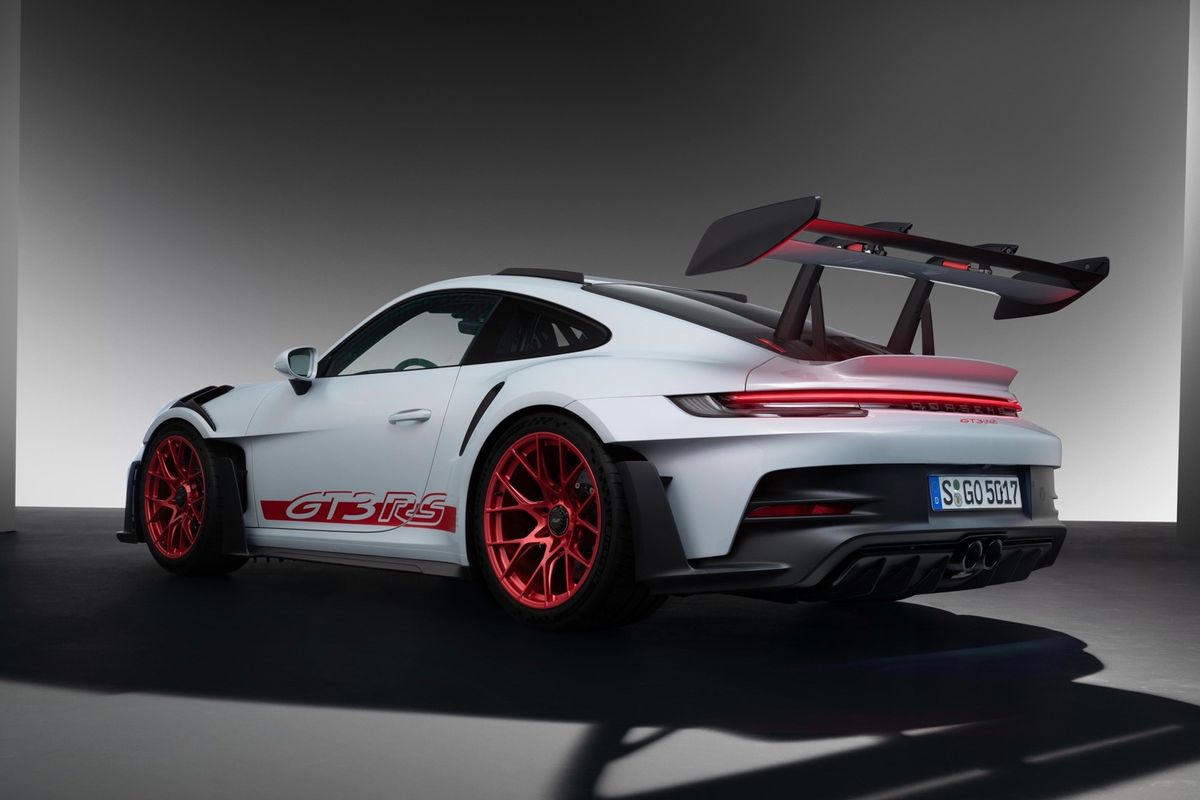
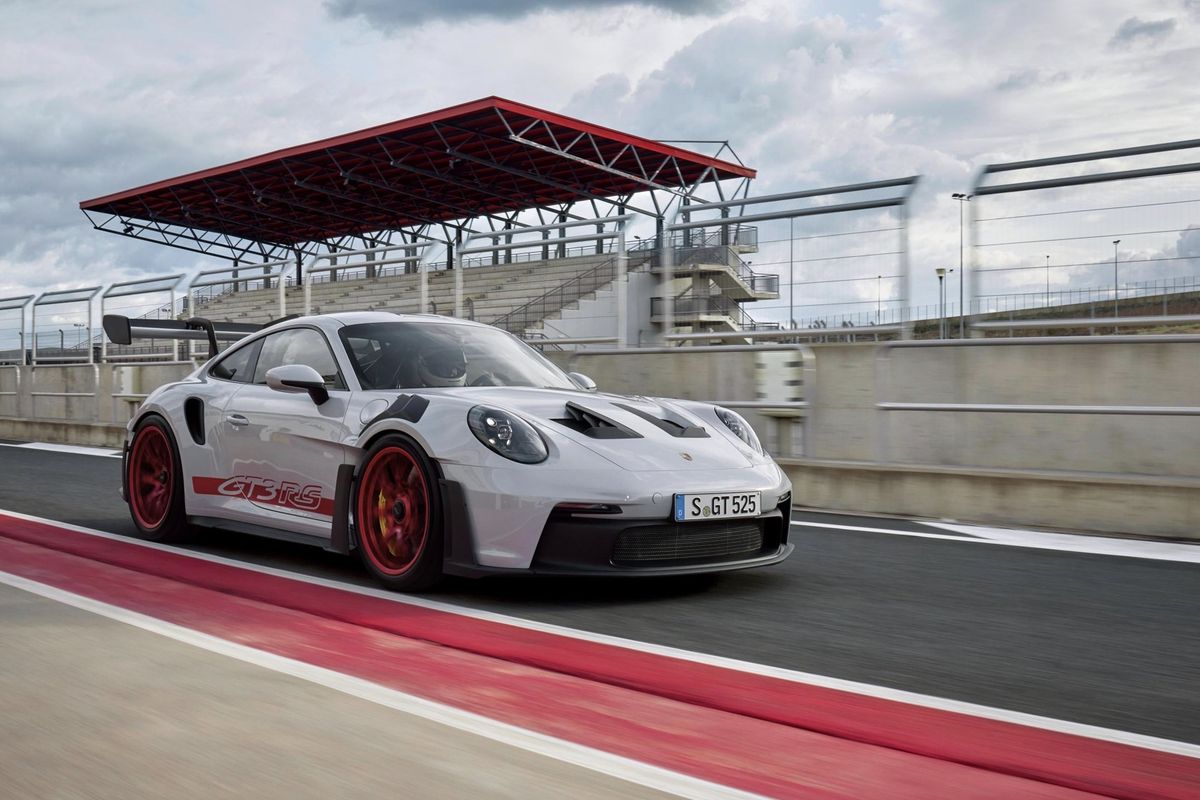
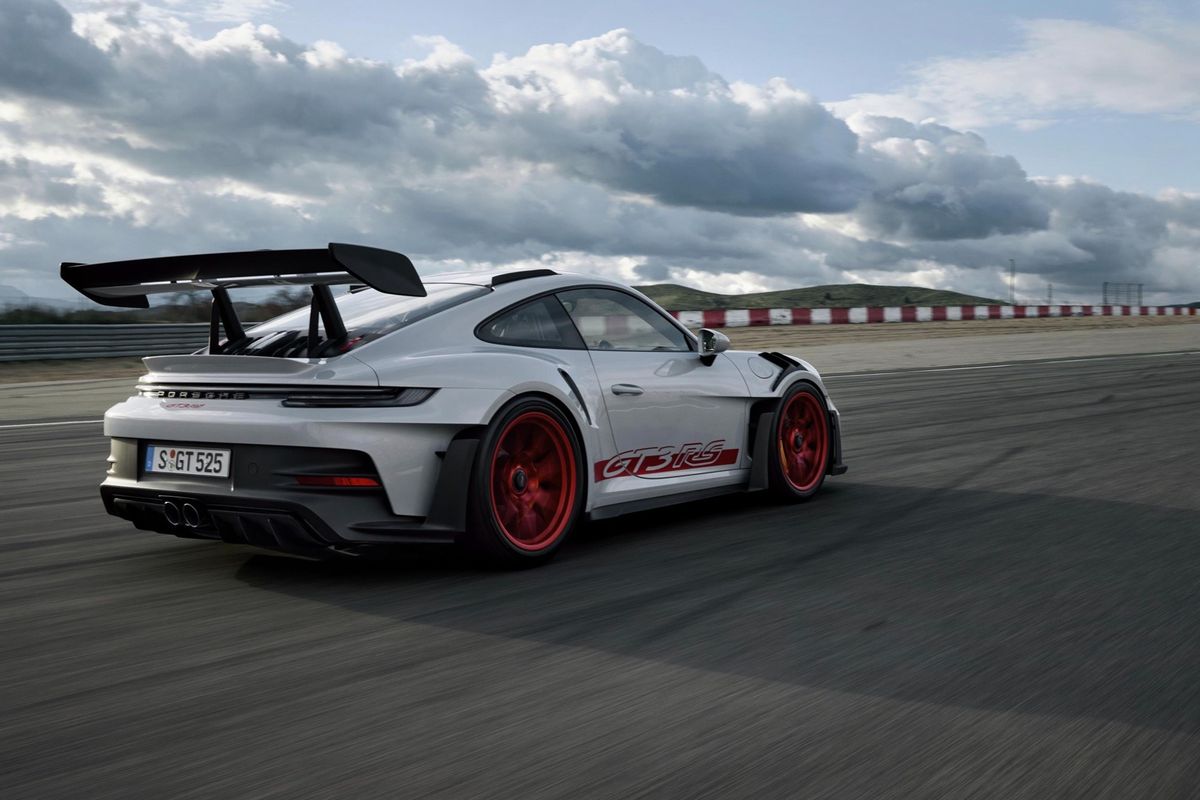
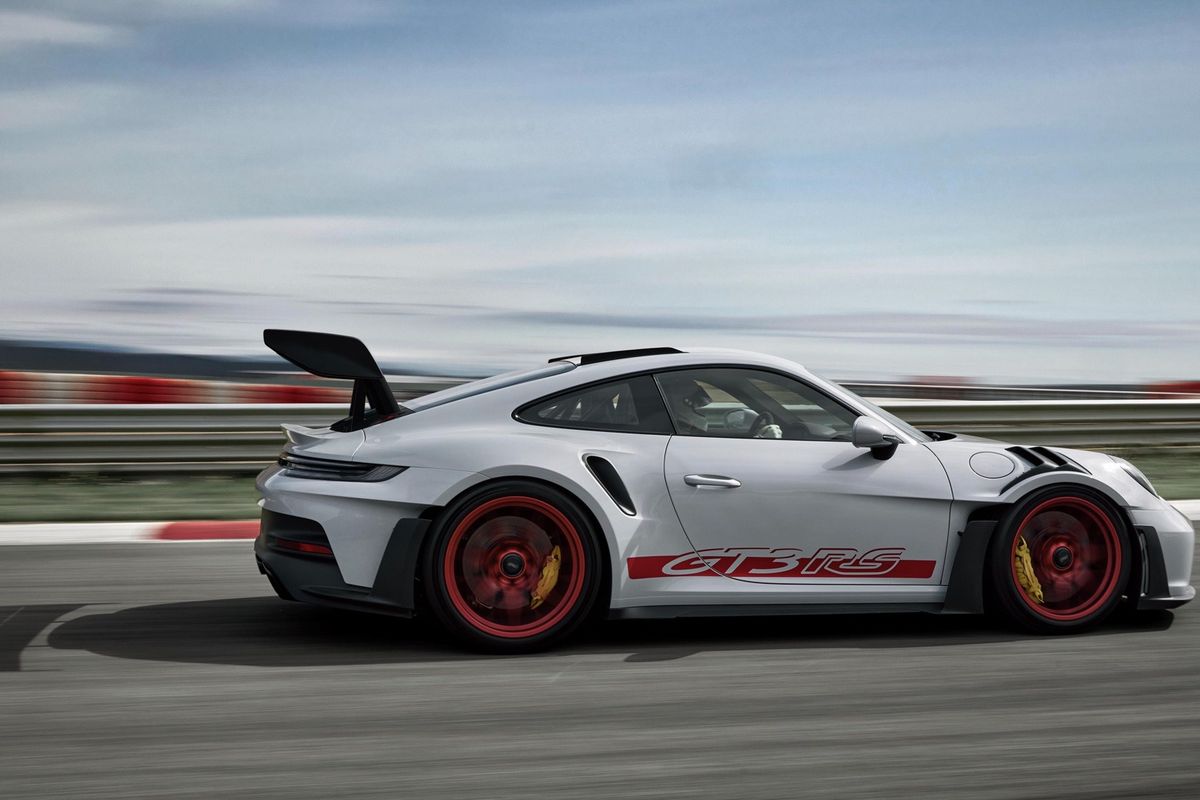
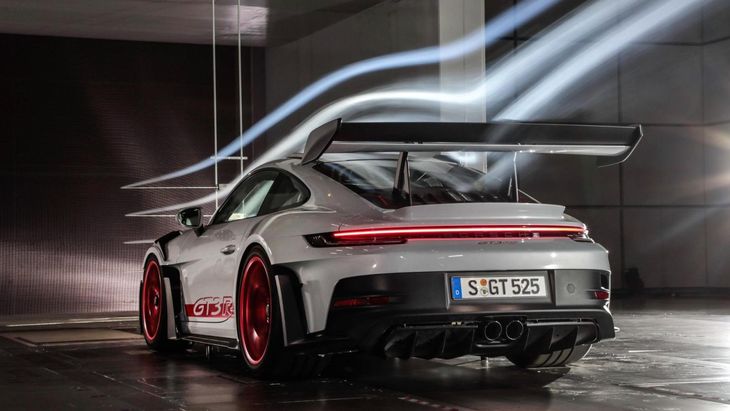
Porsche has finally revealed its new hardcore, track-focused 911 GT3 RS which is the ultimate 911 track weapon to come from the Zuffenhausen-based firm. See the details below!
Earlier this year we sampled the new 992-generation Porsche 911 GT3 and as far as pure driving thrills are concerned, it’s an absolute cracker!. Now though, Porsche has dialled up the intensity with the arrival of its ultimate track weapon, the 911 GT3 RS.
“The new 911 GT3 RS is even more optimised for track use than its predecessors. The spontaneously responsive, high-revving four-litre, six-cylinder boxer engine with approximately 500 PS [now confirmed with 386 kW] has proven ideal for use at track days and club sport events. That’s why we focused primarily on aerodynamics and chassis questions in the development of the new 911 GT3 RS” says Andreas Preuninger, Director GT Model Line.
Aero trickery for new Porsche 911 GT3 RS
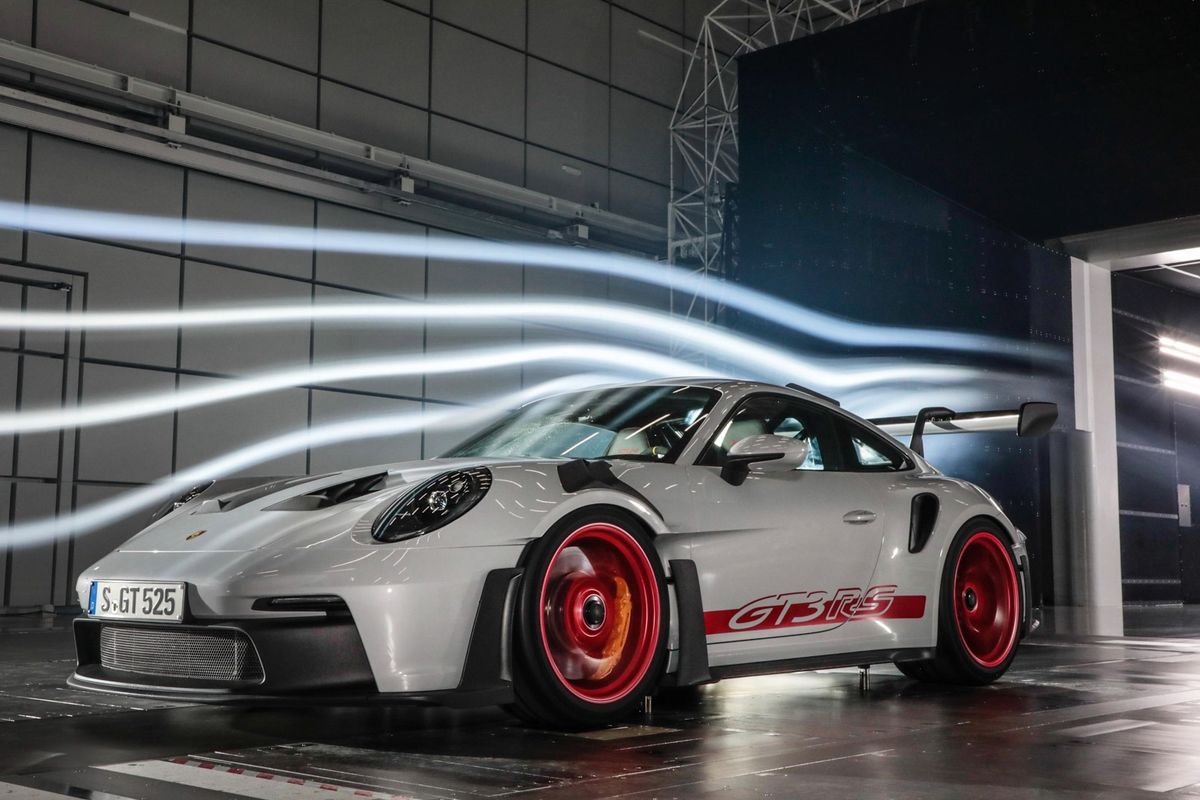
The new Porsche 911 GT3 RS is an aerodynamic marvel.
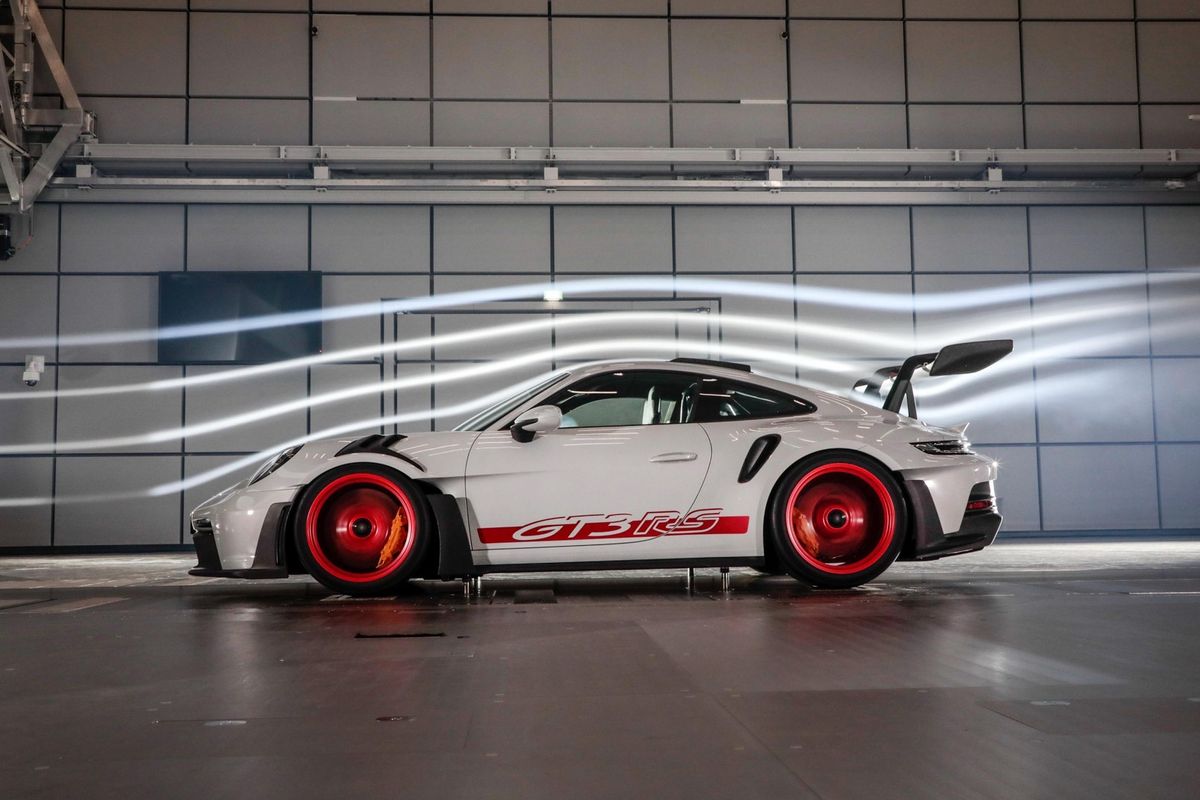
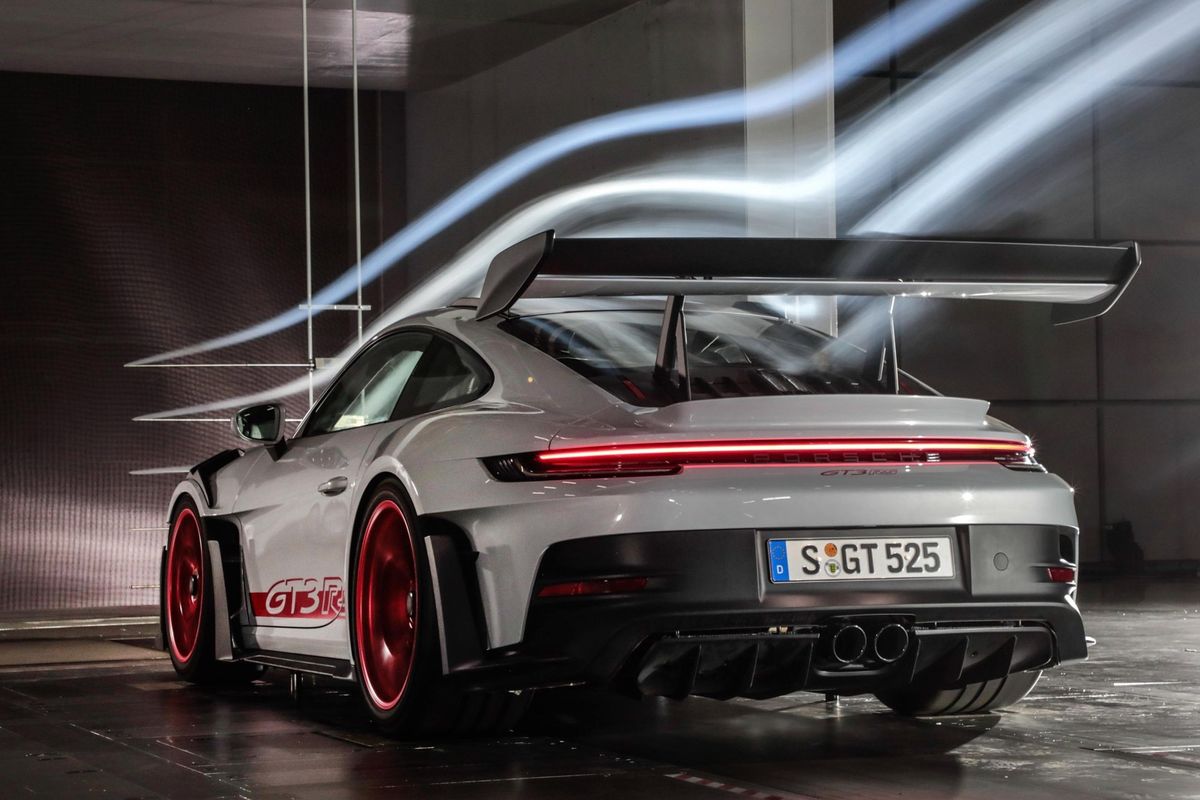
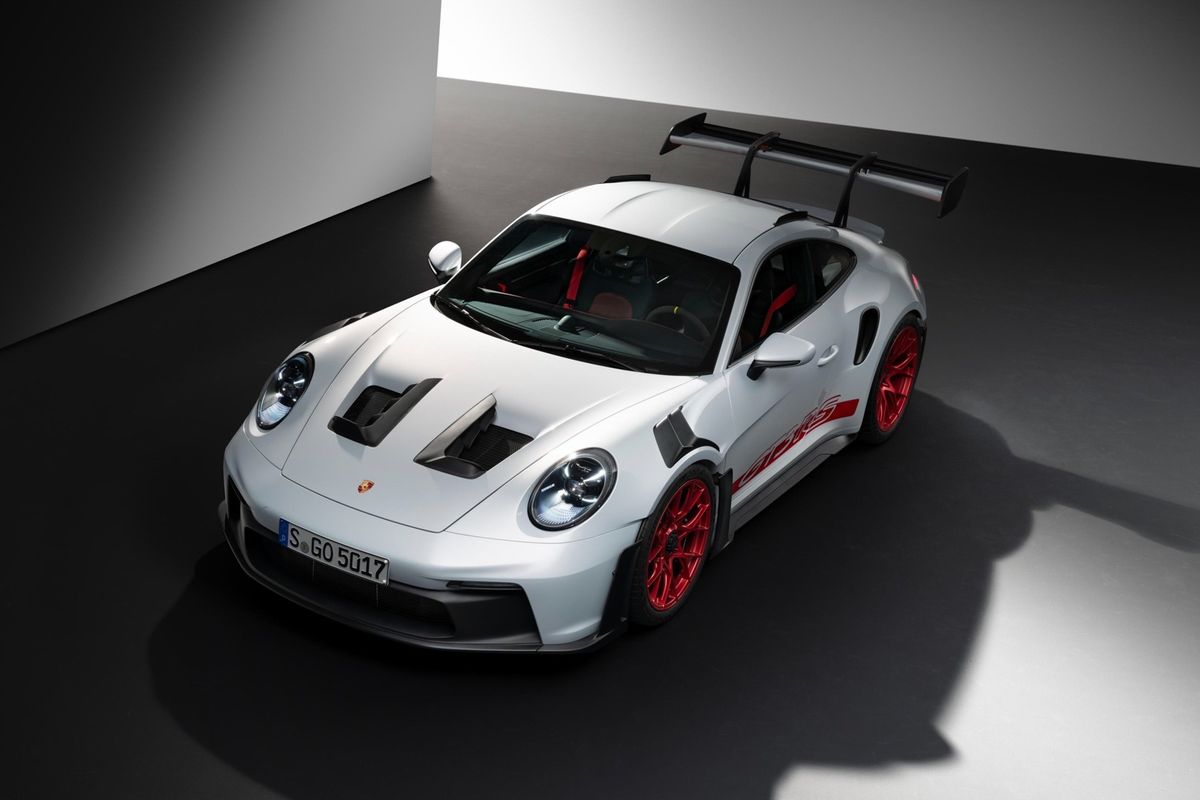
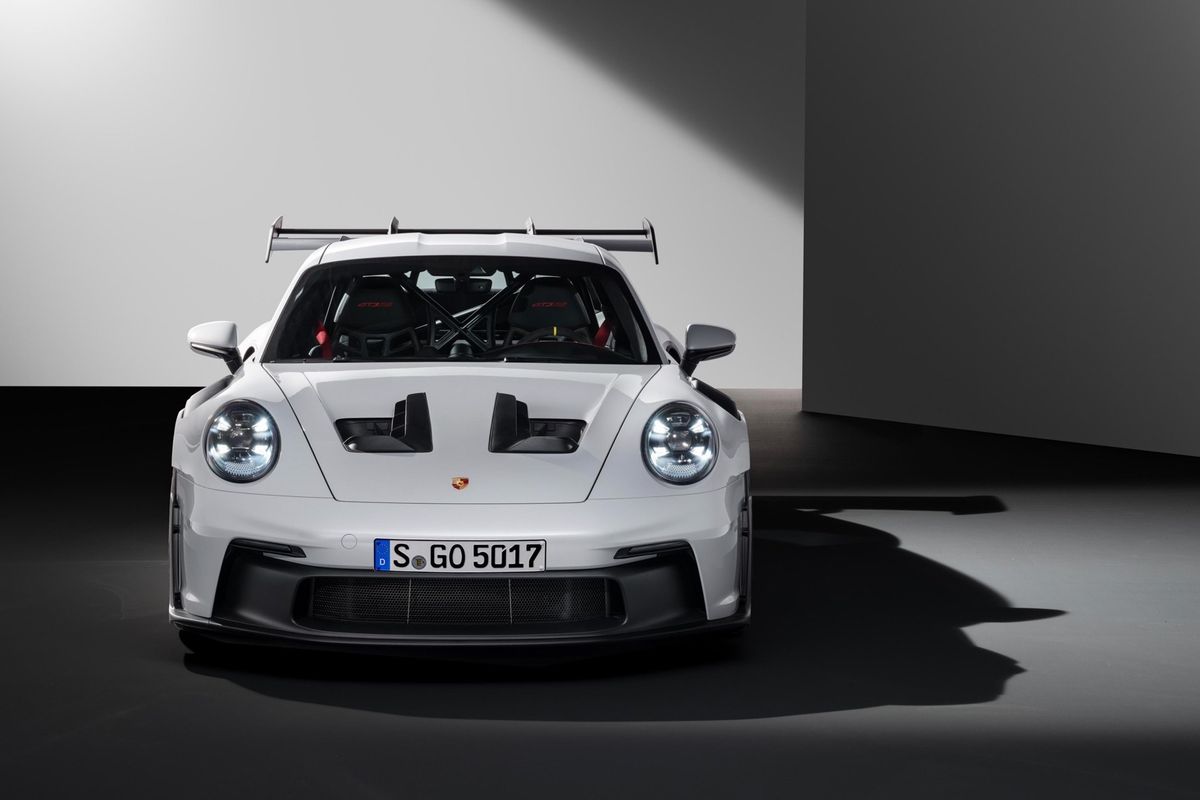
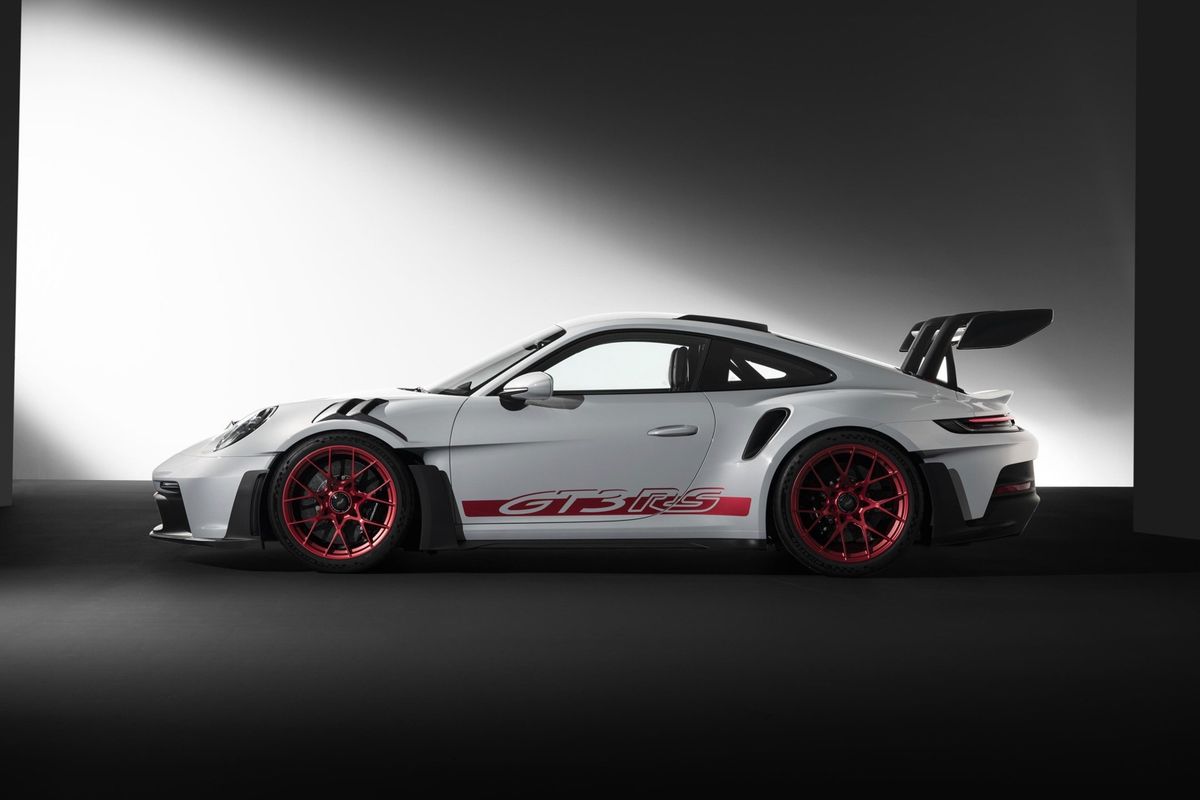
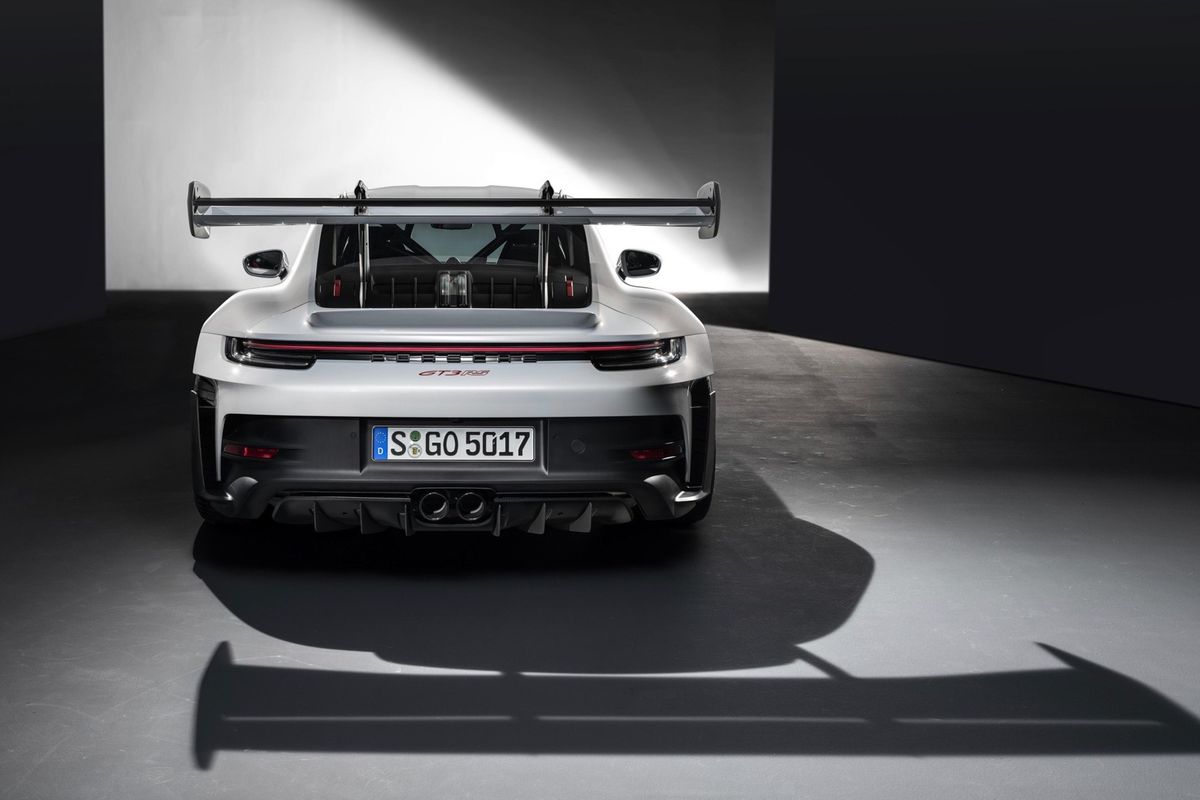
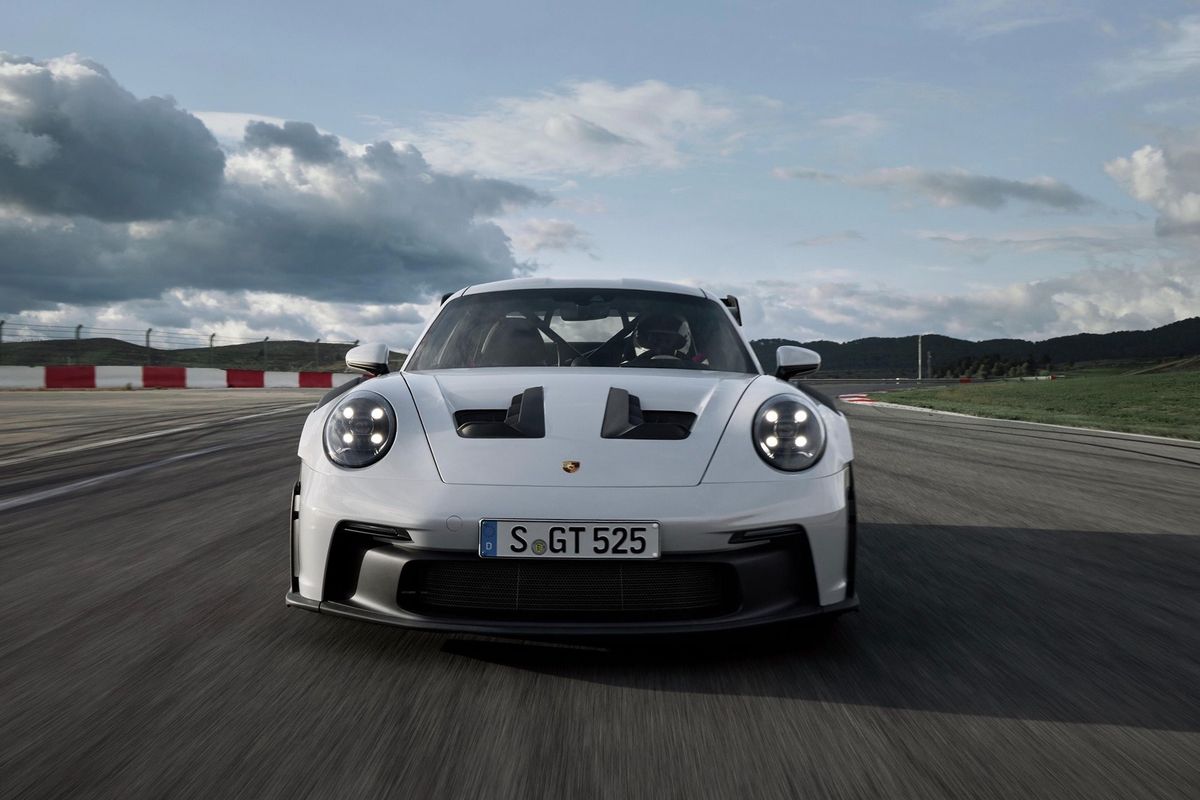
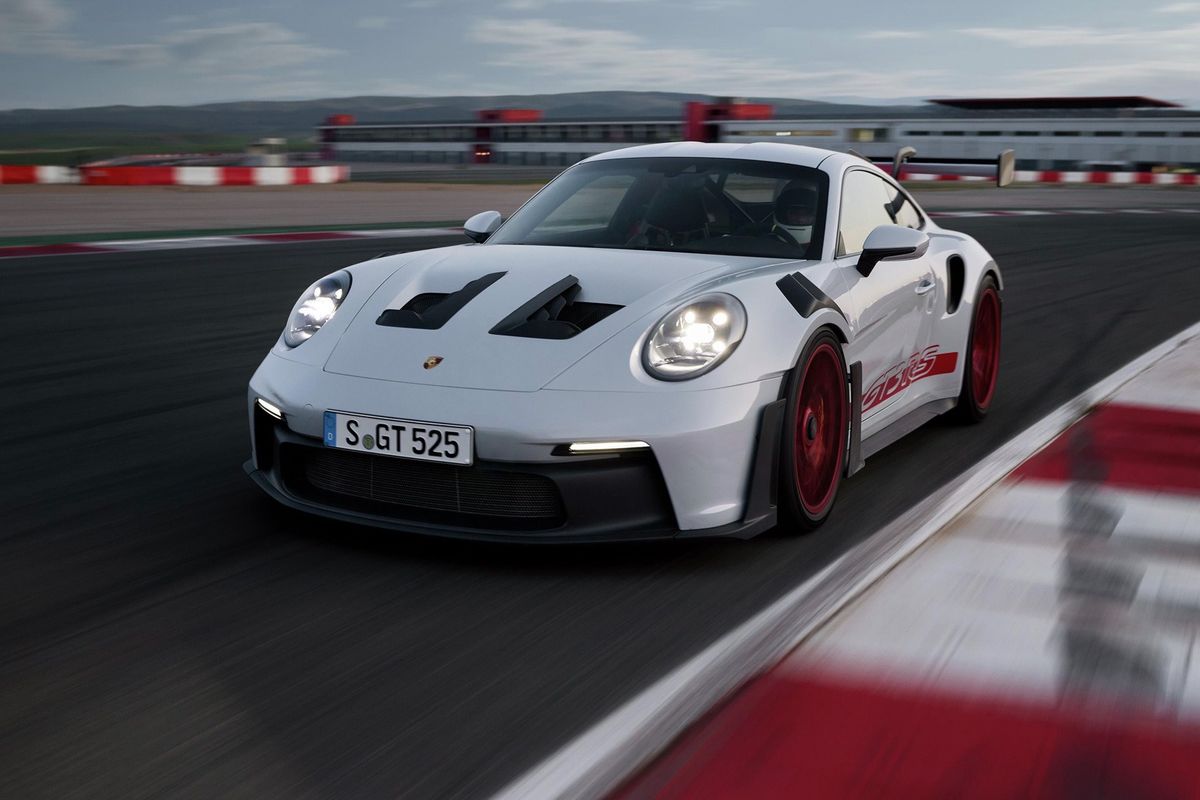
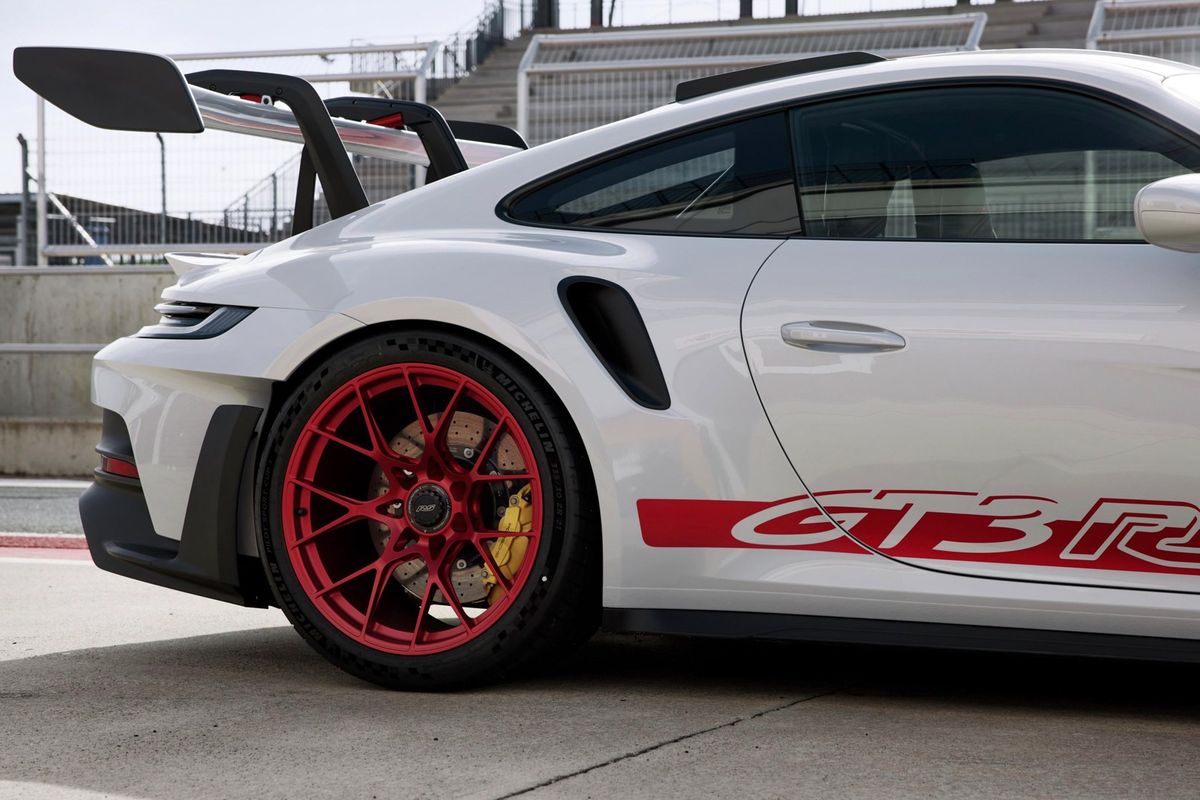
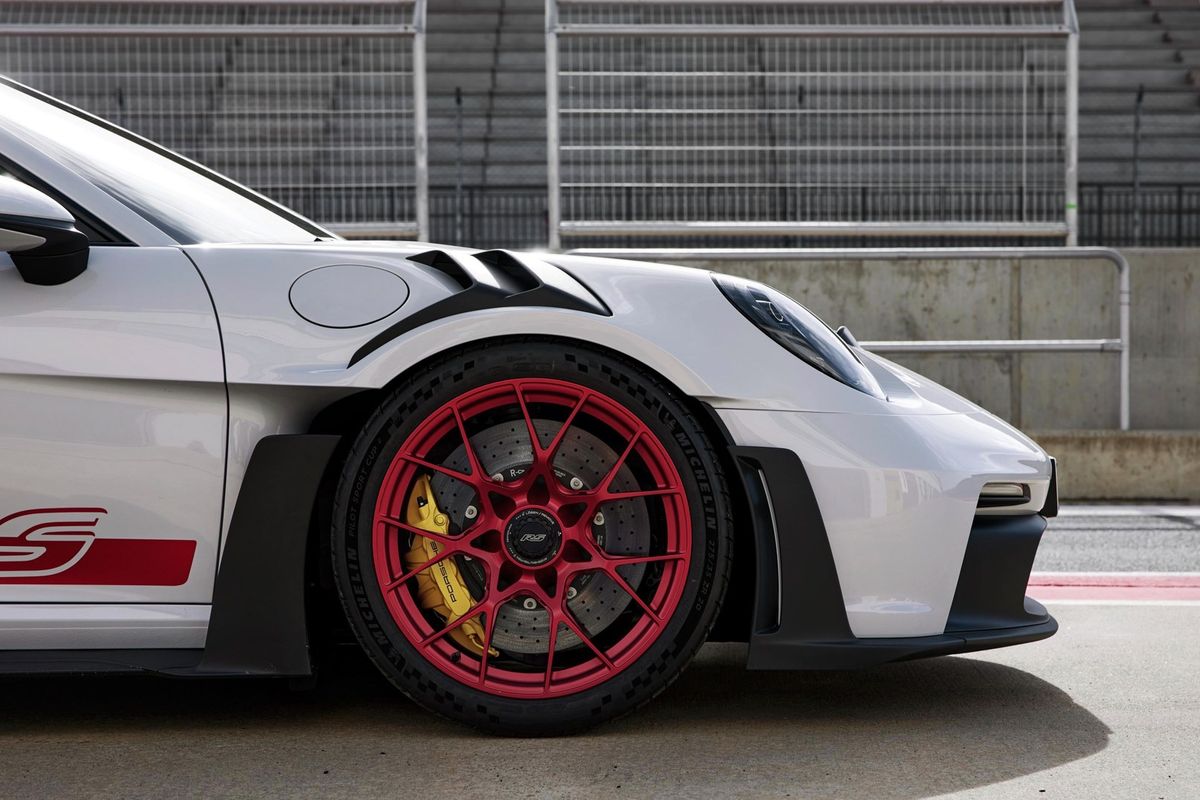
Borrowing technology from motorsport, specifically from the 911 GT3 R, the new 911 GT3 RS is an aero phenomenon. As such, the Porsche 911 GT3 RS is fitted with uprated cooling systems (the GT3 RS now features a central radiator positioned in the car’s nose as opposed to the previous 3 radiator layout) and numerous aerodynamic addenda or wings / blades seen on the bonnet (as a result of the central radiator), roof, on and around the wheel arches and it even has active aero underneath the front of the car, guiding air in the most efficient manner possible. The new GT3 RS now features a front splitter instead of a spoiler which divides the air flowing beneath and over the car.
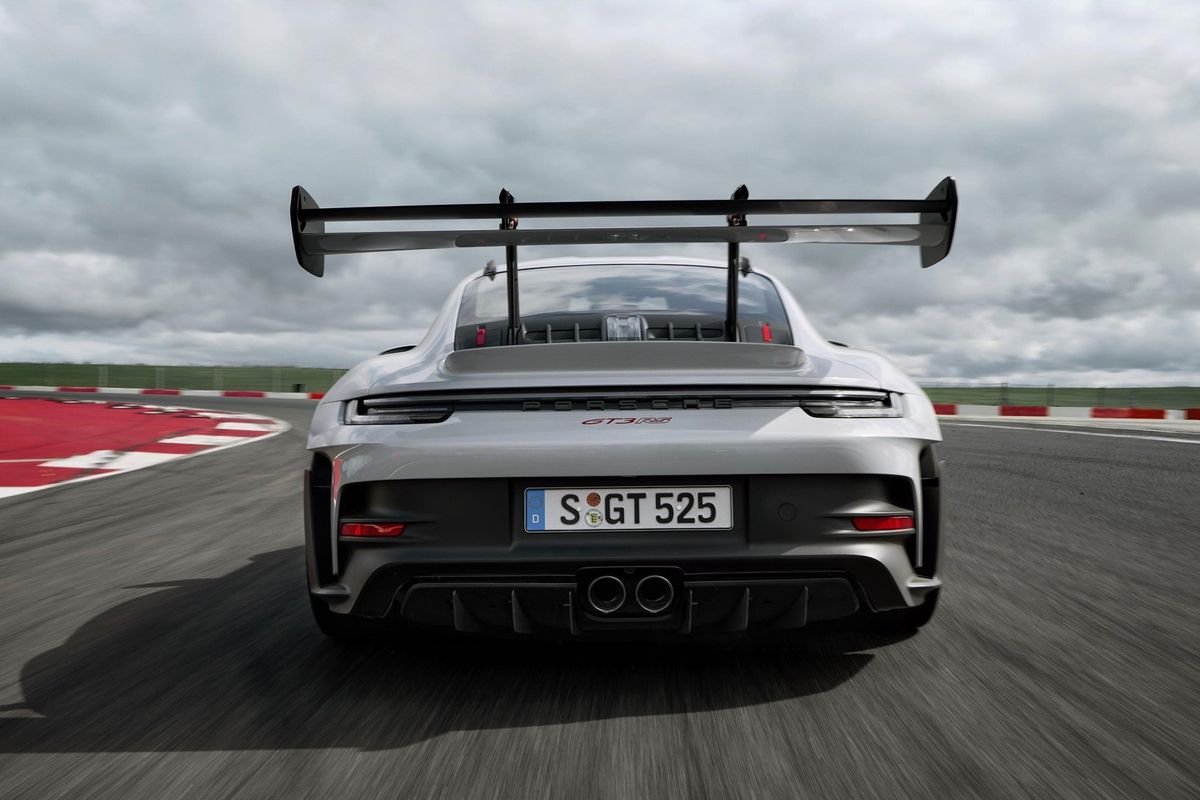
Also, that huge adjustable two-part rear wing speaks volumes for the GT3 RS’ performance intent, providing the necessary downforce and stability required to perform at high speed. In fact, at 200 kph, 409 kg of downforce is achieved and at 285 kph downforce more than doubles to 860 kg! That’s double the downforce produced by its predecessor and 3 times the downforce produced by the current 911 GT3.
To further enhance its performance, the 911 GT3 RS features a high-performance braking system (ceramic brakes are optional) and adaptive track suspension to ensure pin-sharp handling ability. A Drag Reduction System (RDS) is fitted in a production Porsche for the first time and incorporates aero wings that can be flattened out at the push of a button but an airbrake function can also be activated for aero deceleration at high speed, assisting the brakes to achieve the necessary deceleration during emergency braking. The GT3 RS rides on centre-lock 20-inch (front) and 21-inch (rear) forged light alloy wheels.
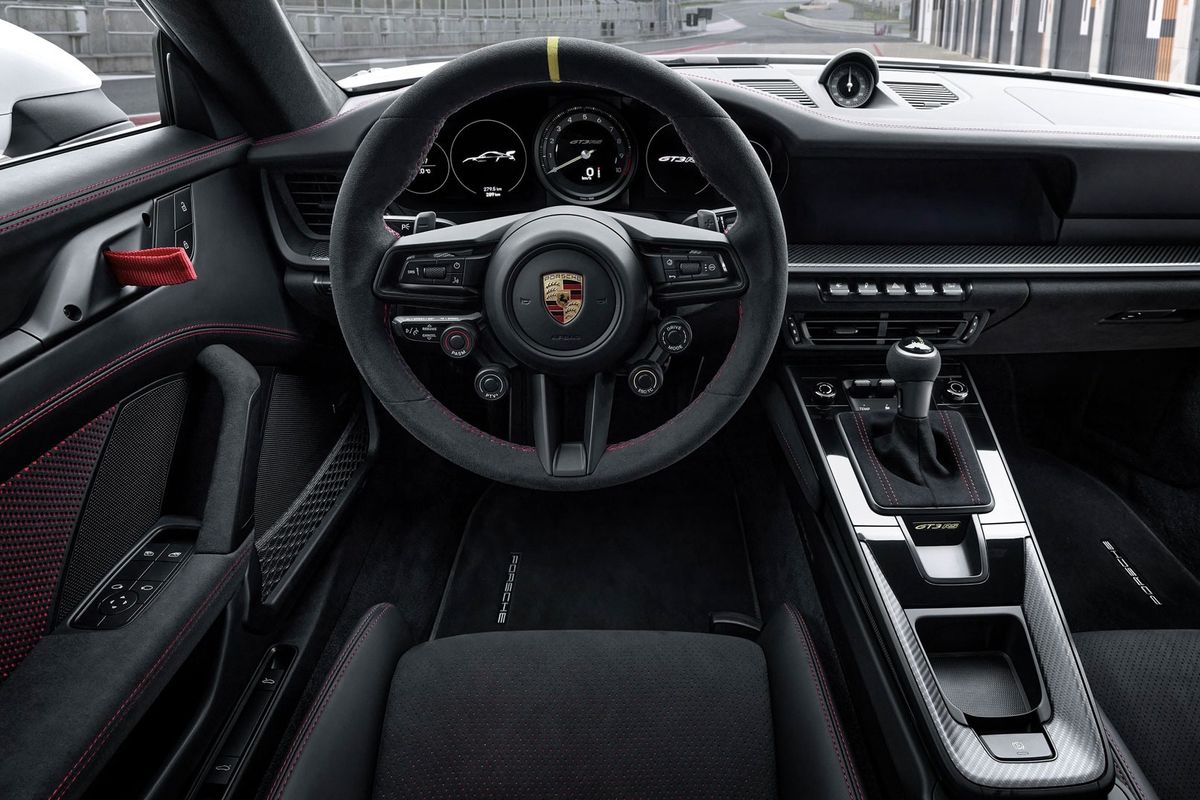
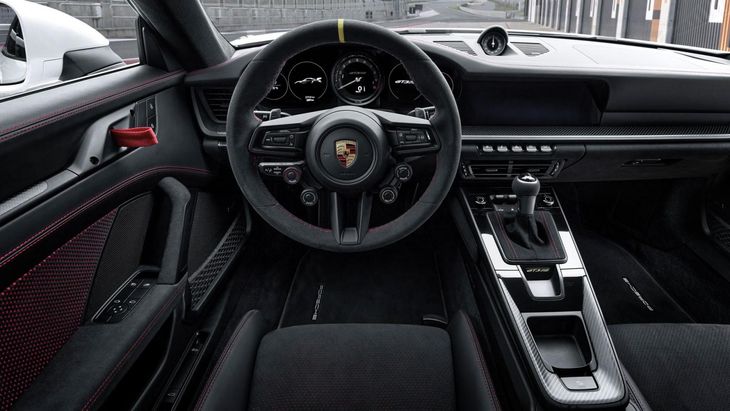
More so, the driver is able to adjust and dial-in the rear differential to precisely account for changing conditions on track as well as adjust the traction control as needed, all via controls on the steering wheel and these adjustments are displayed directly in the digital instrument cluster directly ahead of the driver.
The cockpit of the 911 GT3 RS is decisively focused on the driver with all critical functions at the driver’s fingertips.
How much power does the new Porsche 911 GT3 RS offer?
Porsche’s 4.0-litre, flat-6 boxer engine does duty in the GT3 RS and it produces 386 kW and 465 Nm of torque and is paired with a quick-shifting 7-speed PDK transmission with shorter gear ratios than its GT3 sibling. The engine itself has been optimised with new camshafts and modified cam profiles. The single-throttle intake system is derived from motorsport, as is the rigid valve drive. The sprint to 100kph takes just 3.2 seconds before hammering on towards a top speed of 296 kph.
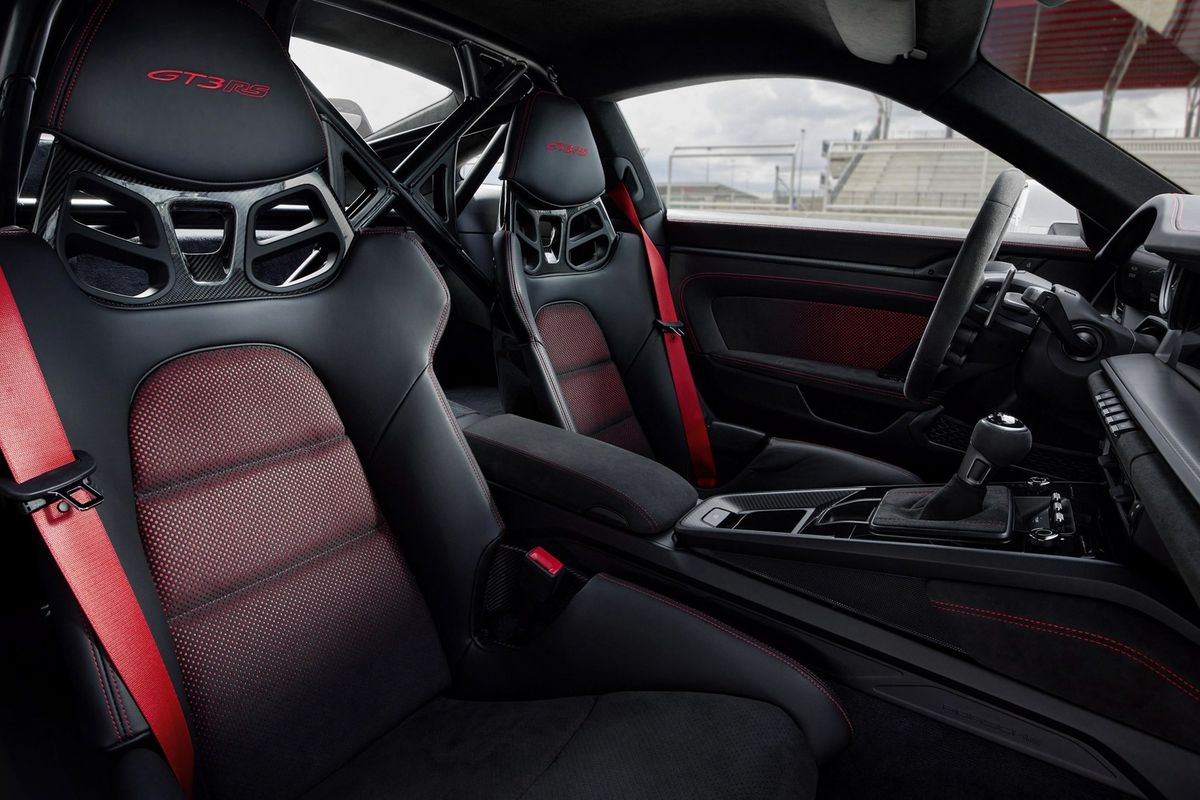
Much of the GT3 RS’ high-performance credentials are, in part, achieved thanks to its lightweight construction and extensive use of CFRP and it has a kerb weight of only 1 450 kg! Customers can upgrade to the Clubsport Package at no extra cost and this includes a rollover bar, 6-point seatbelt and a fire extinguisher. Weight can be further reduced by opting for the Weissach Package.
How much will the new Porsche 911 GT3 RS cost in South Africa?
Local pricing for the new Porsche 911 GT3 RS has been confirmed at R4 153 000. Pricing includes a 3-year/ 100 000 km Driveplan.
First customer deliveries are expected in early 2023.
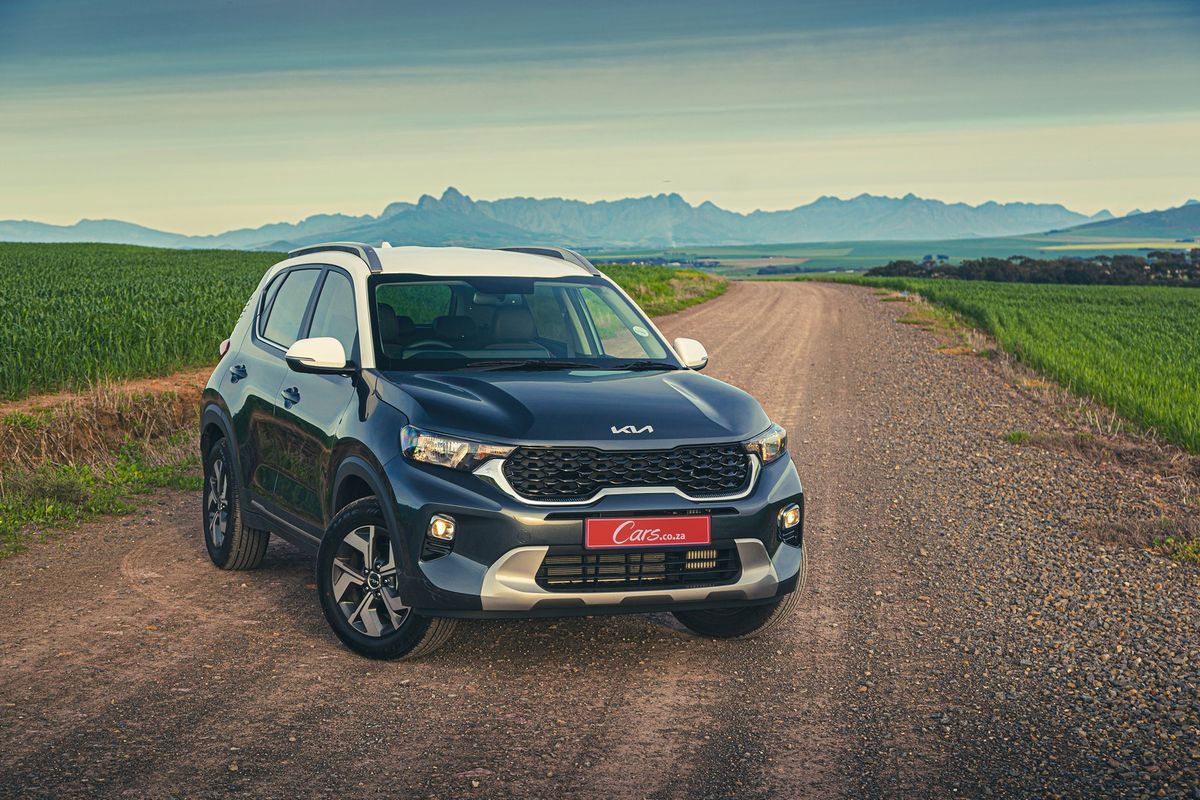
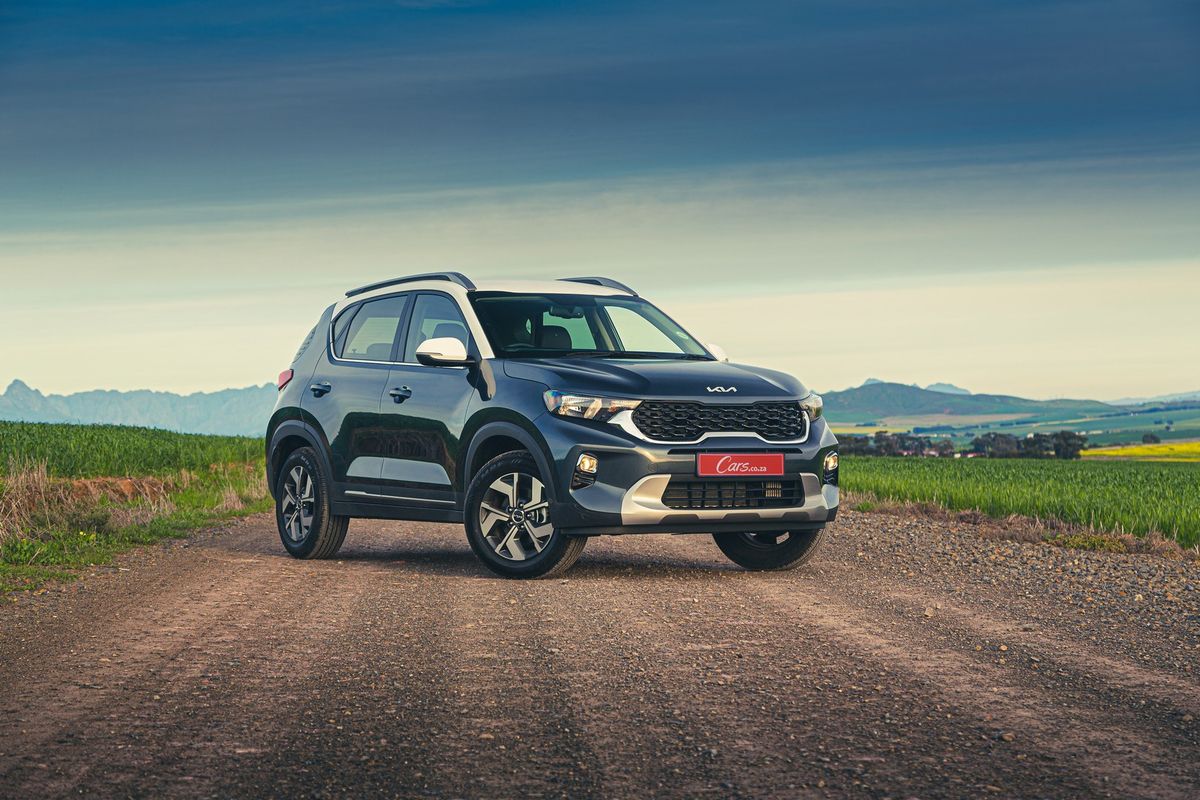
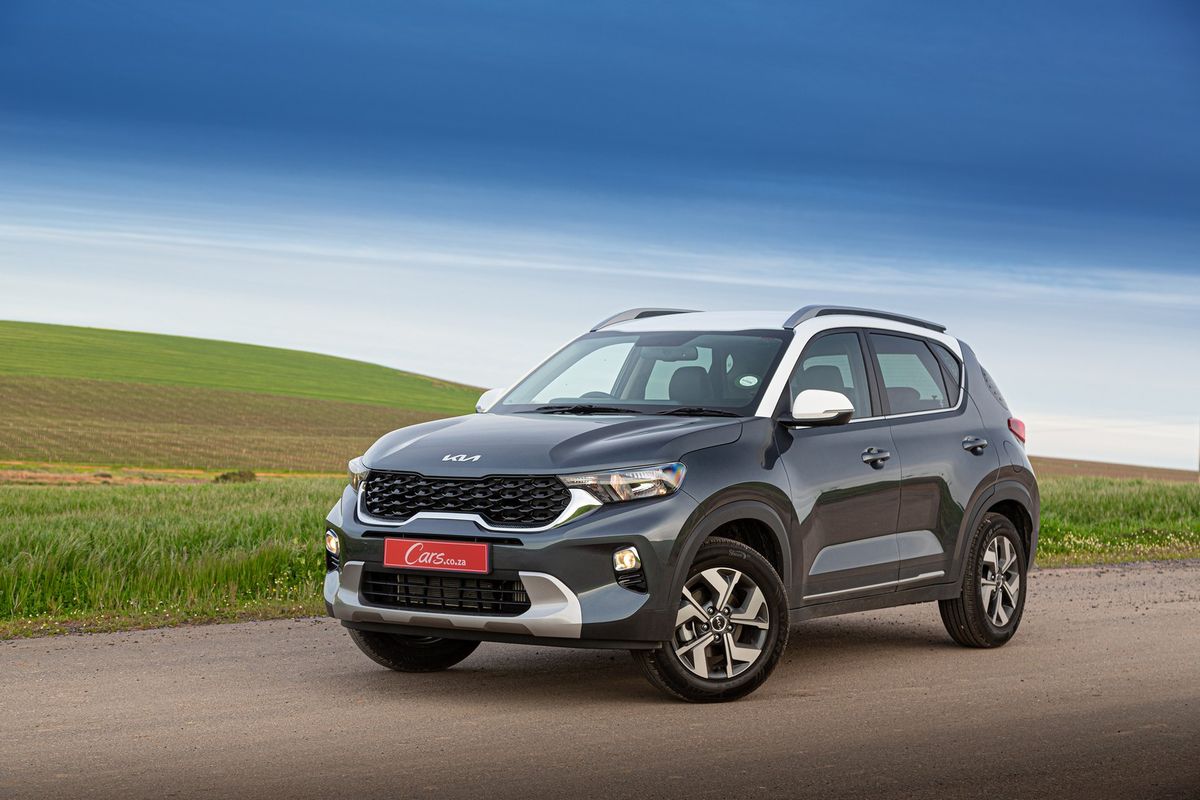
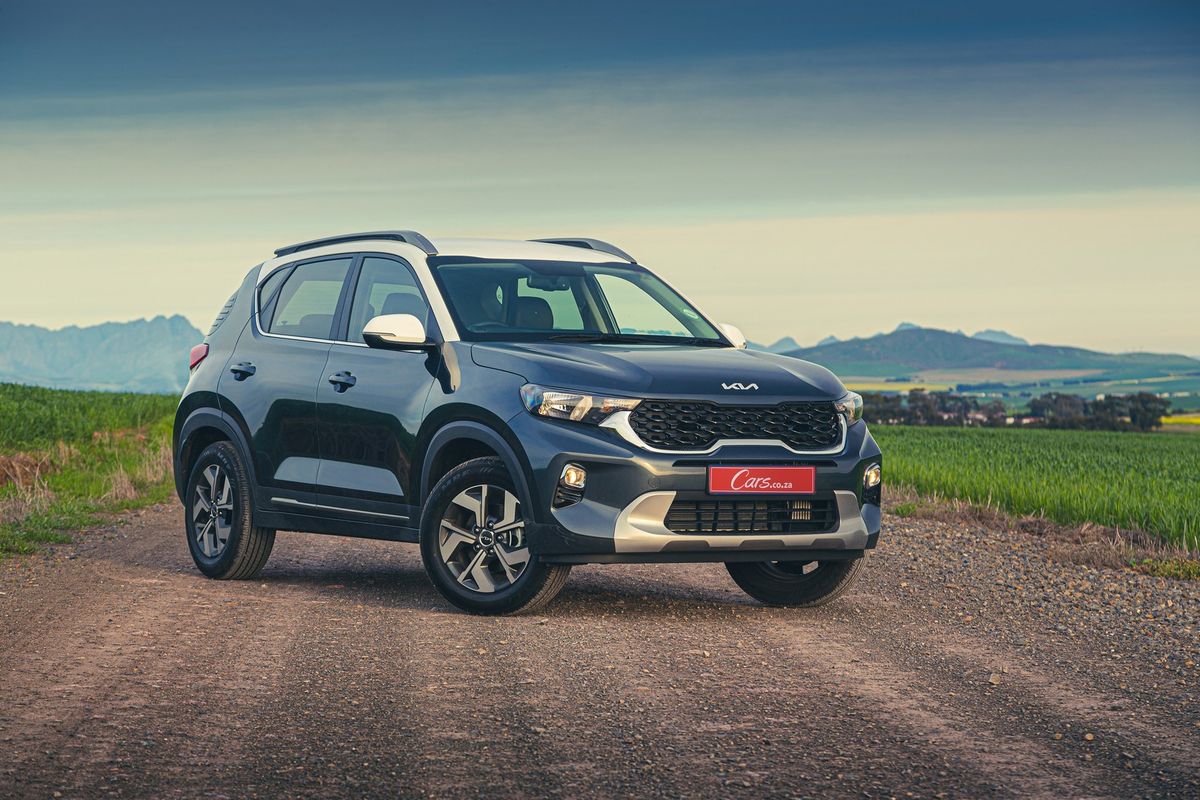
The Kia Sonet has a new flagship derivative – the 1.0T EX+, which is powered by a turbopetrol engine, has a dual-clutch automatic transmission and comes loaded with features. Is this the pick of the high-spec small crossovers?
Interested in the Kia Sonet Turbo? This review will help you make an informed buying decision!
We like: Auto ‘box well calibrated to gutsy turbopetrol motor, comprehensive features list, cute looks, improved safety tech, substantial after-sales support.
We don’t like: Engine can get noisy at higher revs, no one-touch up/down function for the driver’s window, no split-folding rear bench.
The Sonet is Kia’s entry-level crossover/SUV and it has proven quite popular thus far.
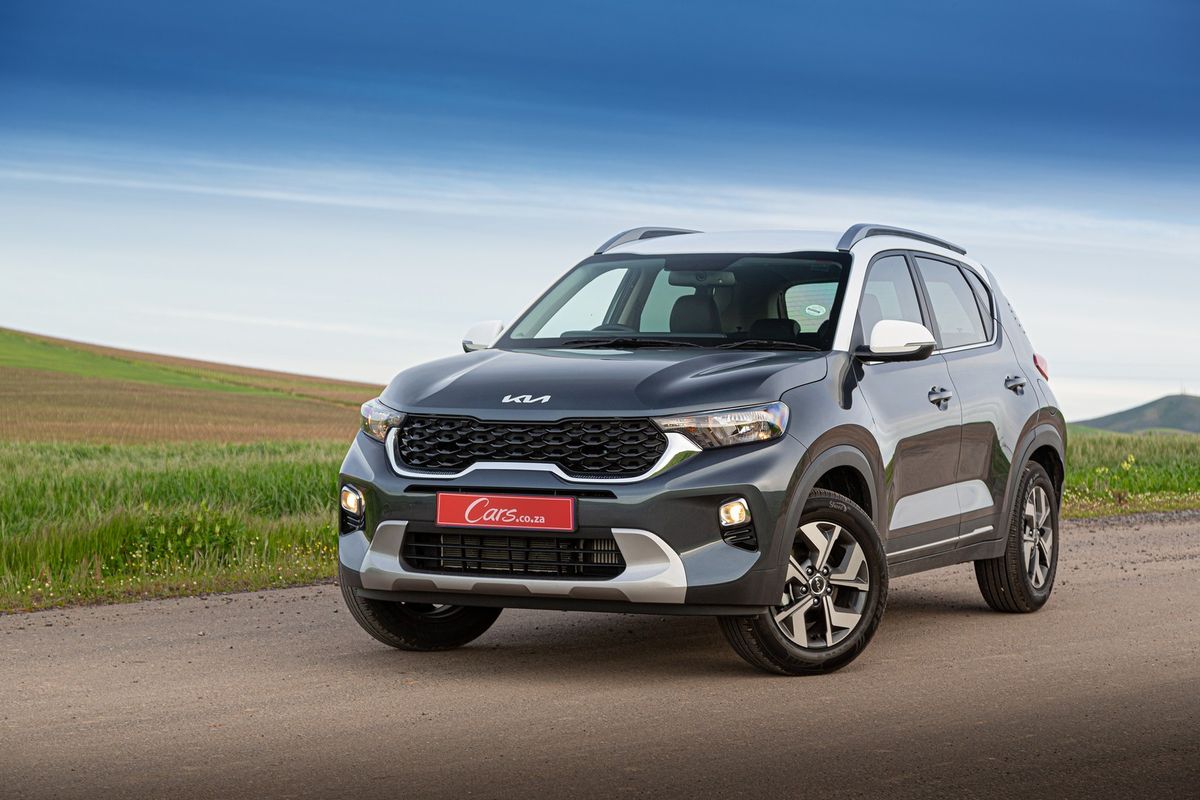
The Kia Sonet has been a popular offering for the local subsidiary of the Korean carmaker. Not only does exude cute-as-a-button kerb appeal; it offers great value for money. We’ve been impressed with the Sonet since it landed in Mzansi just over a year ago (May 2021).
As the entry point to the Korean brand’s crossover/SUV line-up, the Sonet presents as a more substantial and refined offering than some models in the “budget crossover” segment. What’s more, the 1.5-litre 4-cylinder naturally aspirated engine delivers commendable performance –customers could can between a 6-speed manual or a (surprisingly pleasant) CVT automatic.
Our assessment in June 2021 concluded with “there’s a lot to like about the Sonet – we won’t be surprised to see it steal quite a few sales from its established rivals”. Indeed, Kia South Africa has battled to satisfy demand for the pint-sized crossover during the past 12 months (although the firm says the shortage of units should ease in coming months). The range has also been bolstered with two 1.0-litre turbopetrol derivatives, including this, the 1.0T EX+.
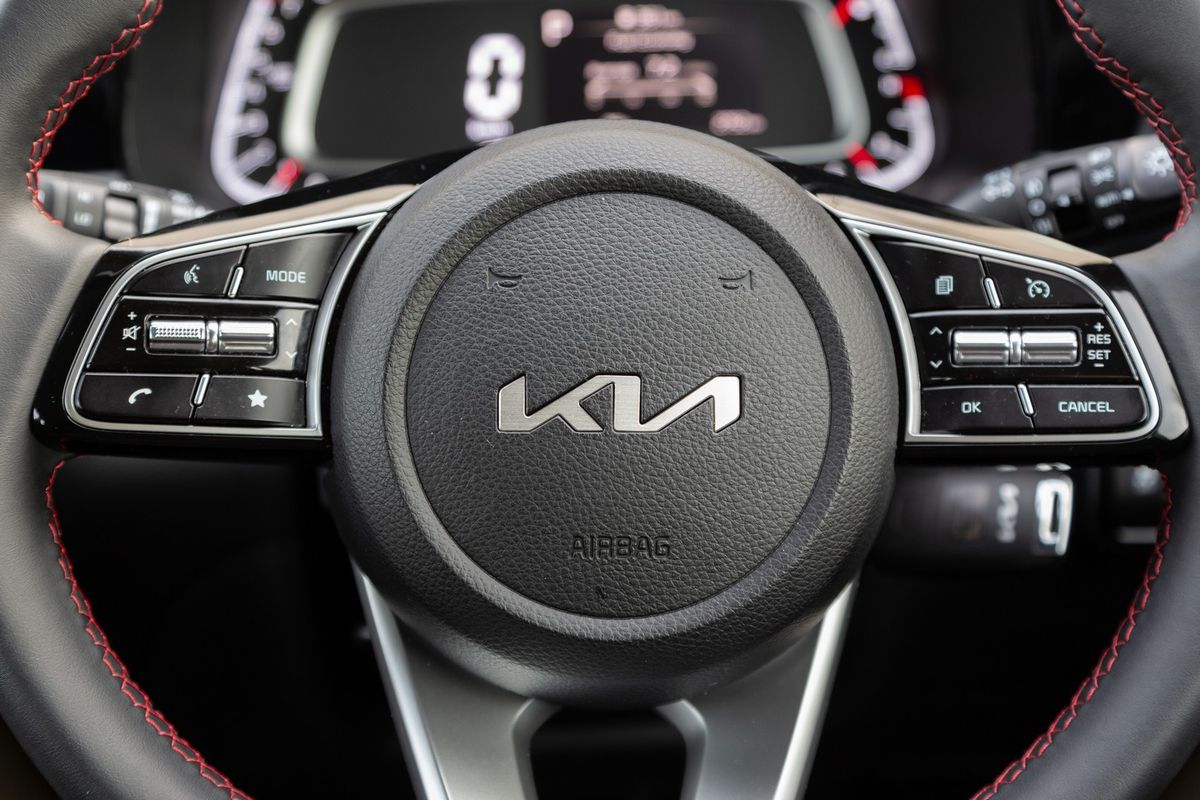
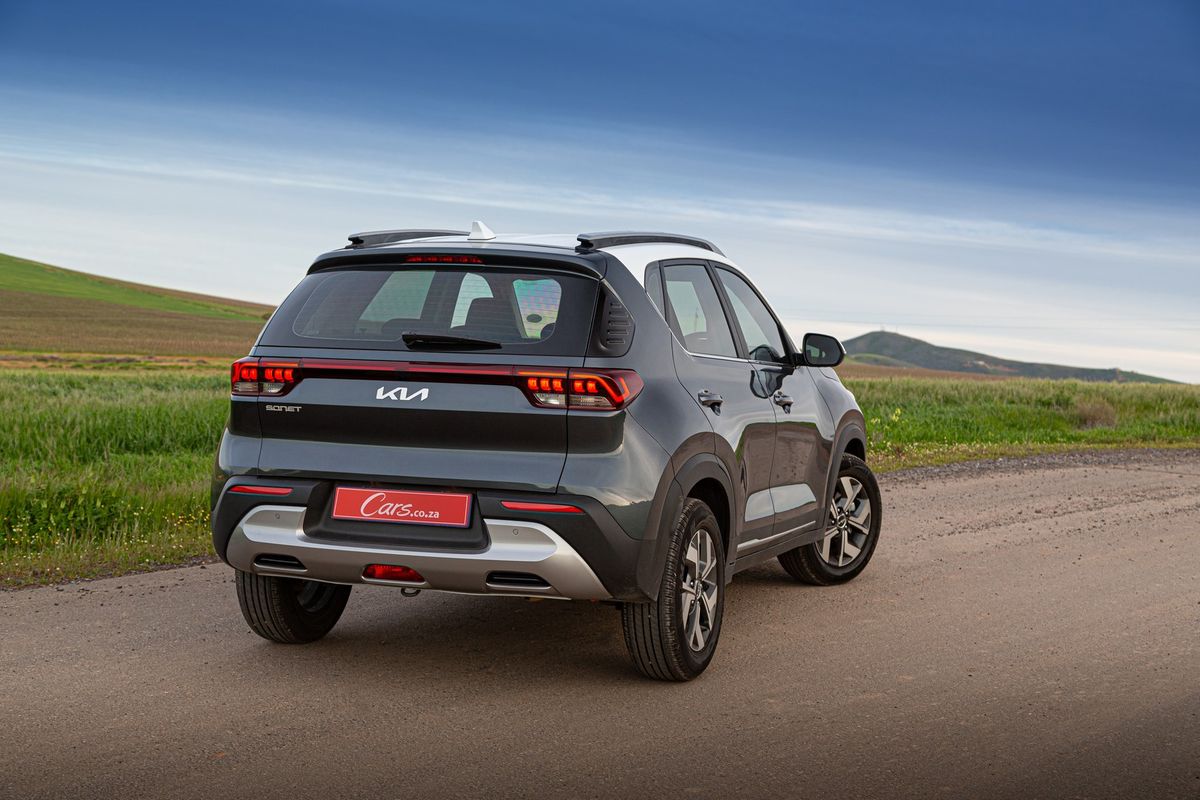
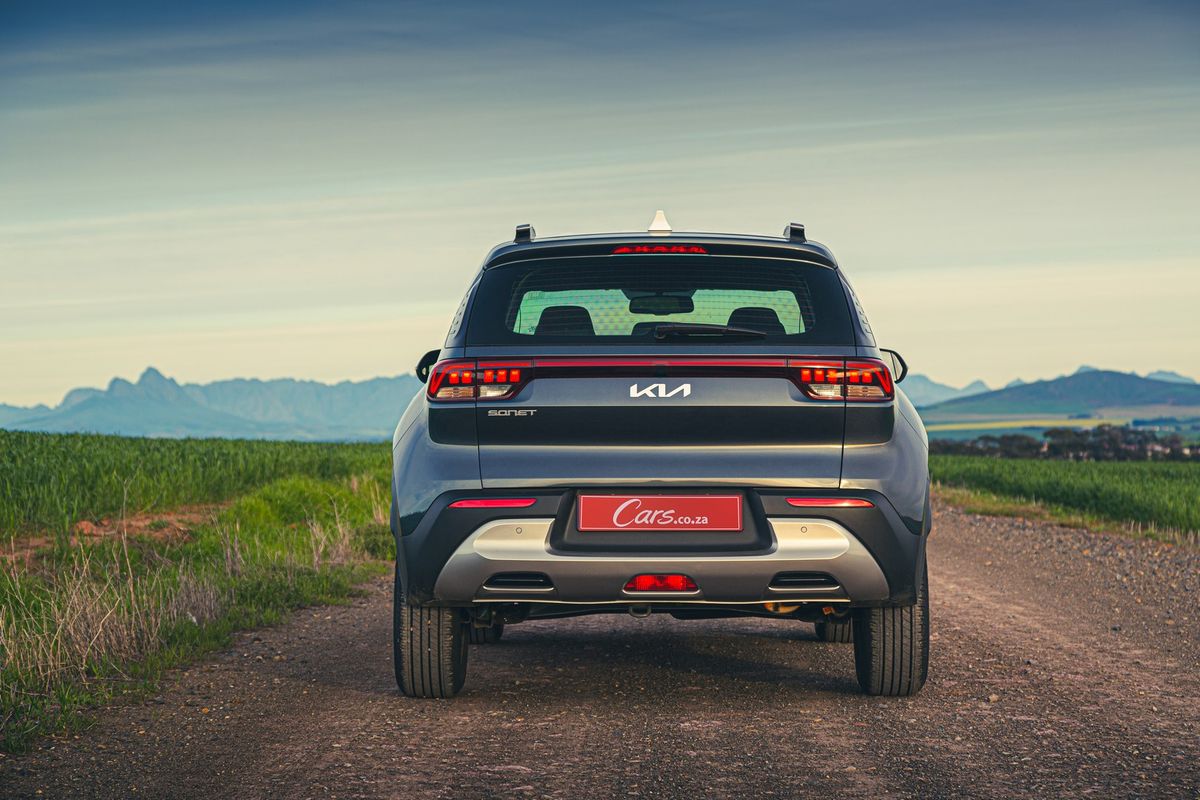
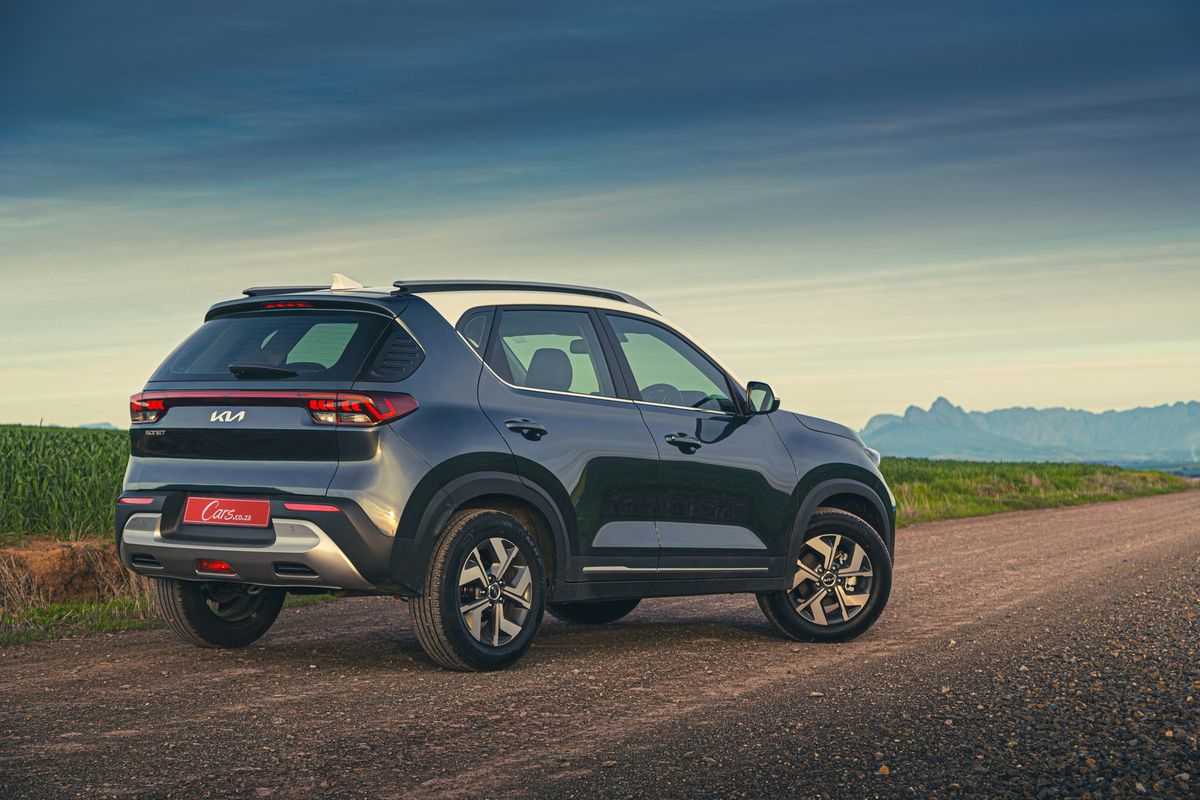
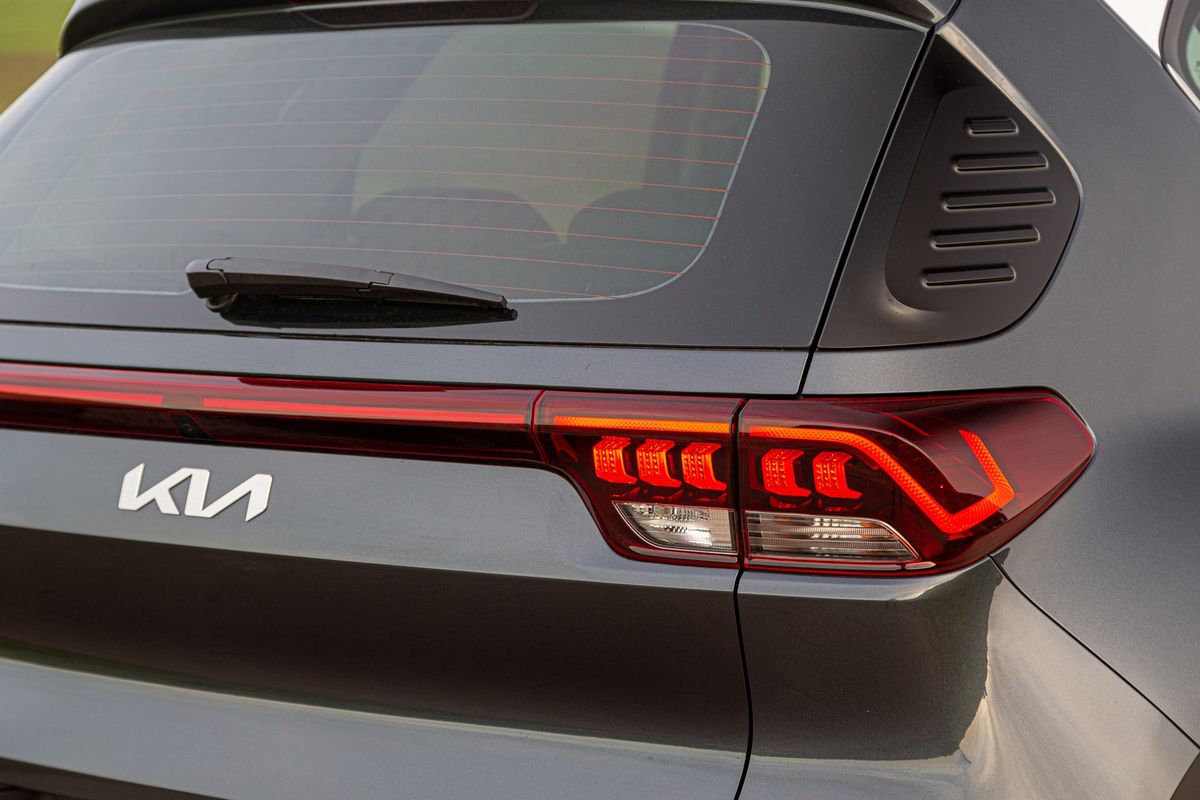
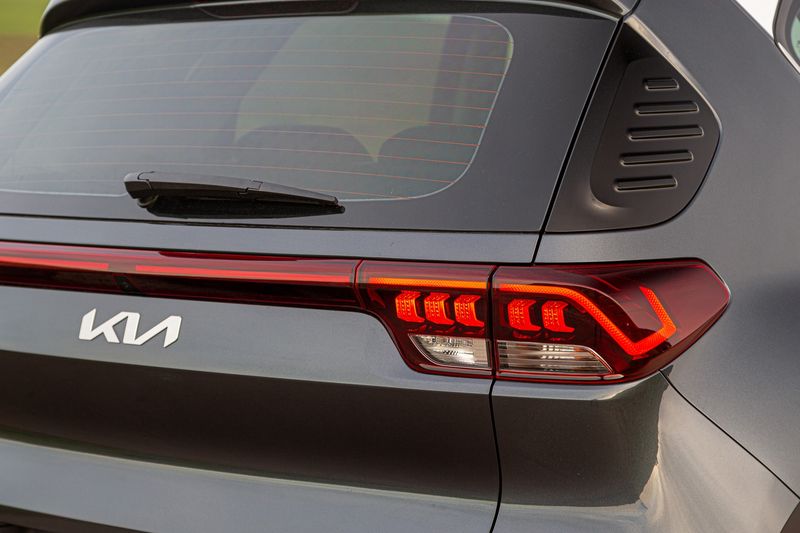
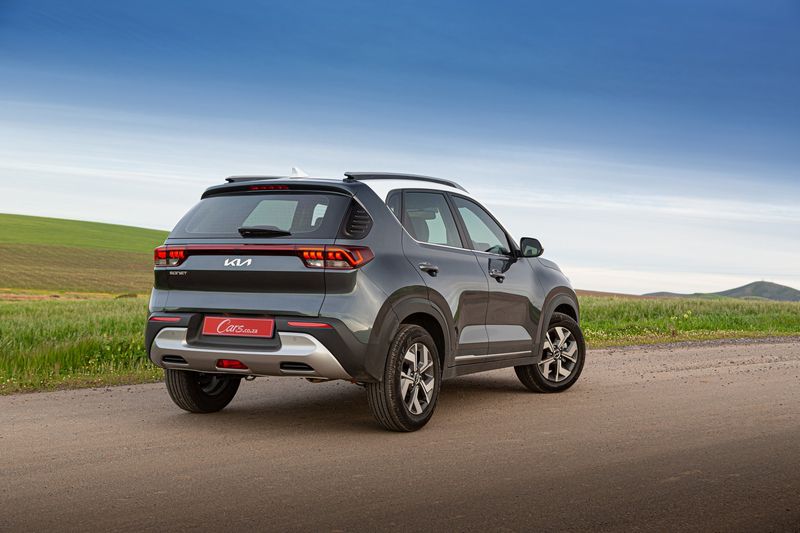
The EX+ features LED tail lamps. Note the new Kia logo!
The Sonet has 6 derivatives in its line-up (prices start at R296 995 and go up to R389 995) and it faces stiff competition, because virtually every mainstream brand has launched a hatchback-based model that offers an elevated driving position and a bit of extra ride height. If you’re looking for a new compact family car under R400 000, you’re spoilt for choice…
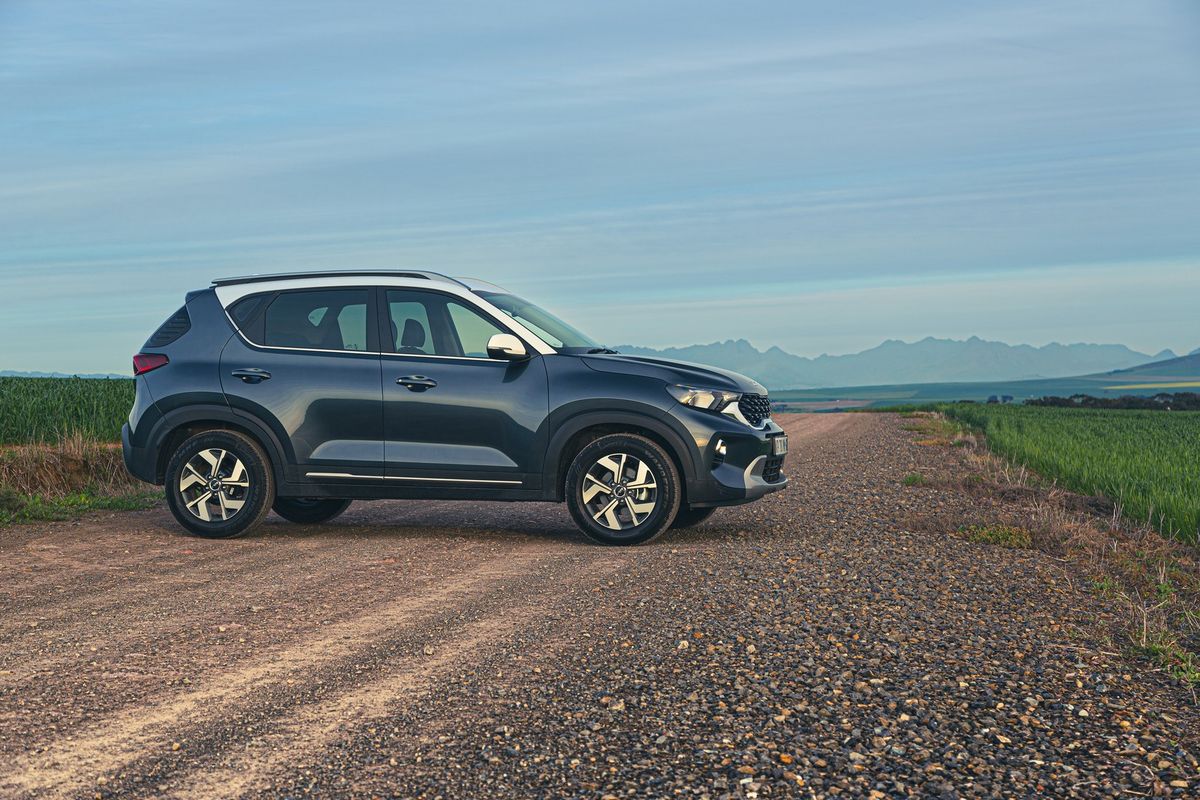
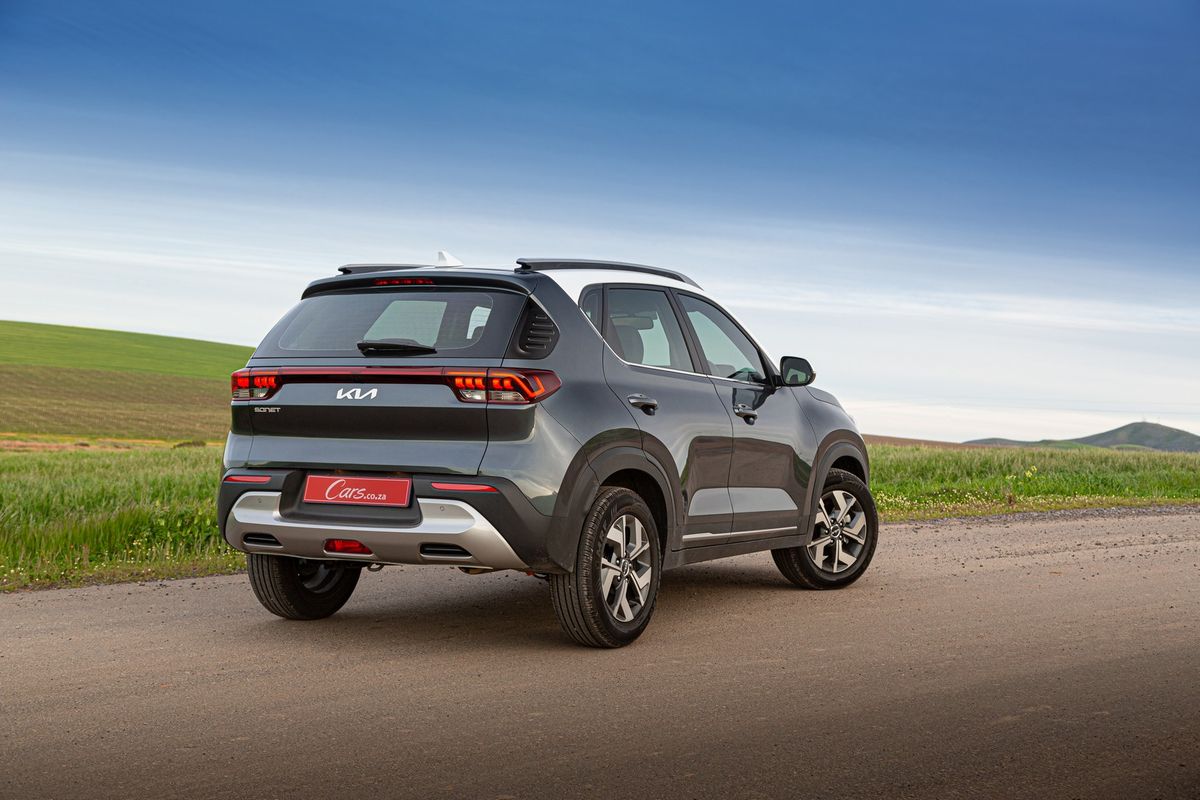
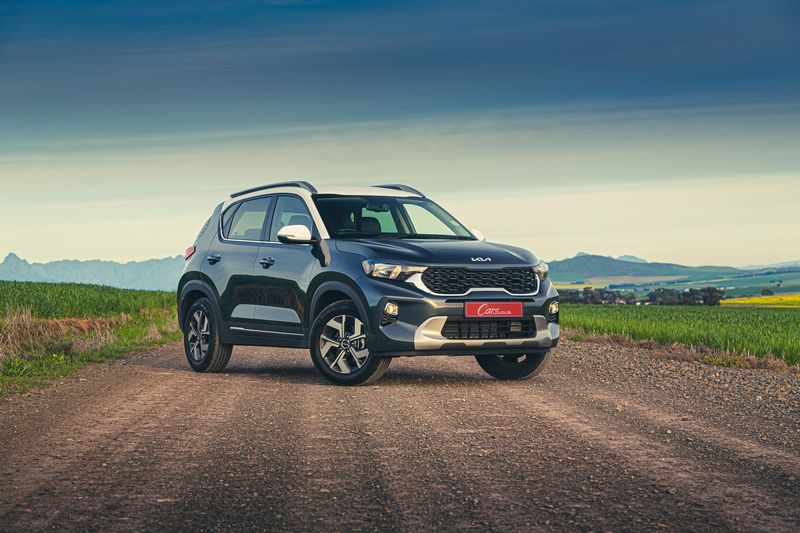
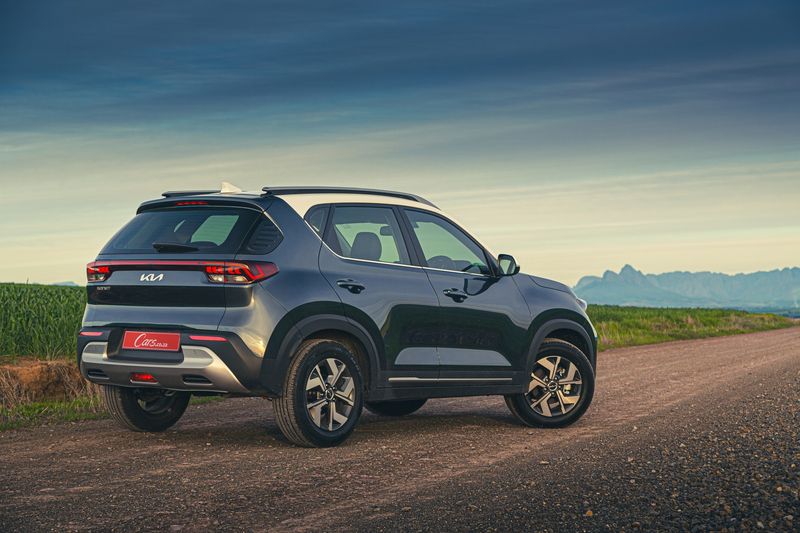
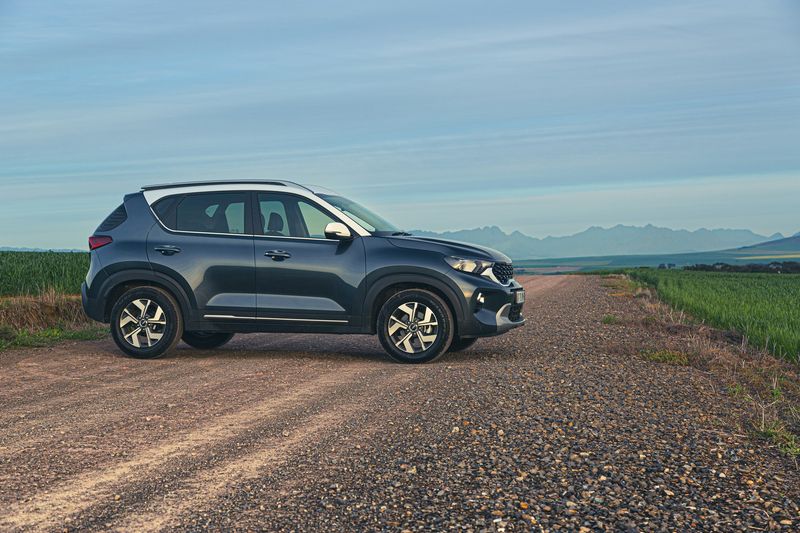
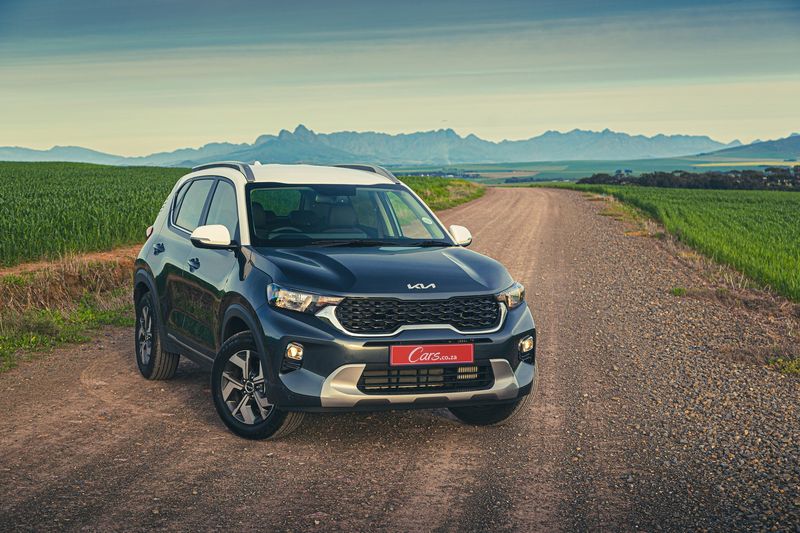
Some say, “it’s tough to tell all these small crossovers apart from each other”, but the Kia, which incorporates the brand’s current (and still fresh) design language, looks distinctive and its roof rails contribute to the “SUV look”. Compared with other Sonet derivatives, the 1.0T EX+ has LED tail lamps, but other than those adornments, there’s not much to distinguish this as the top-of-the-range version. There are a handful of colours on offer and some hues (such as Intense Red, shown here) are available in combination with a contrasting roof finish.
It may look compact, but clever packaging and a substantial wheelbase make the Sonet more practical than you’d expect.
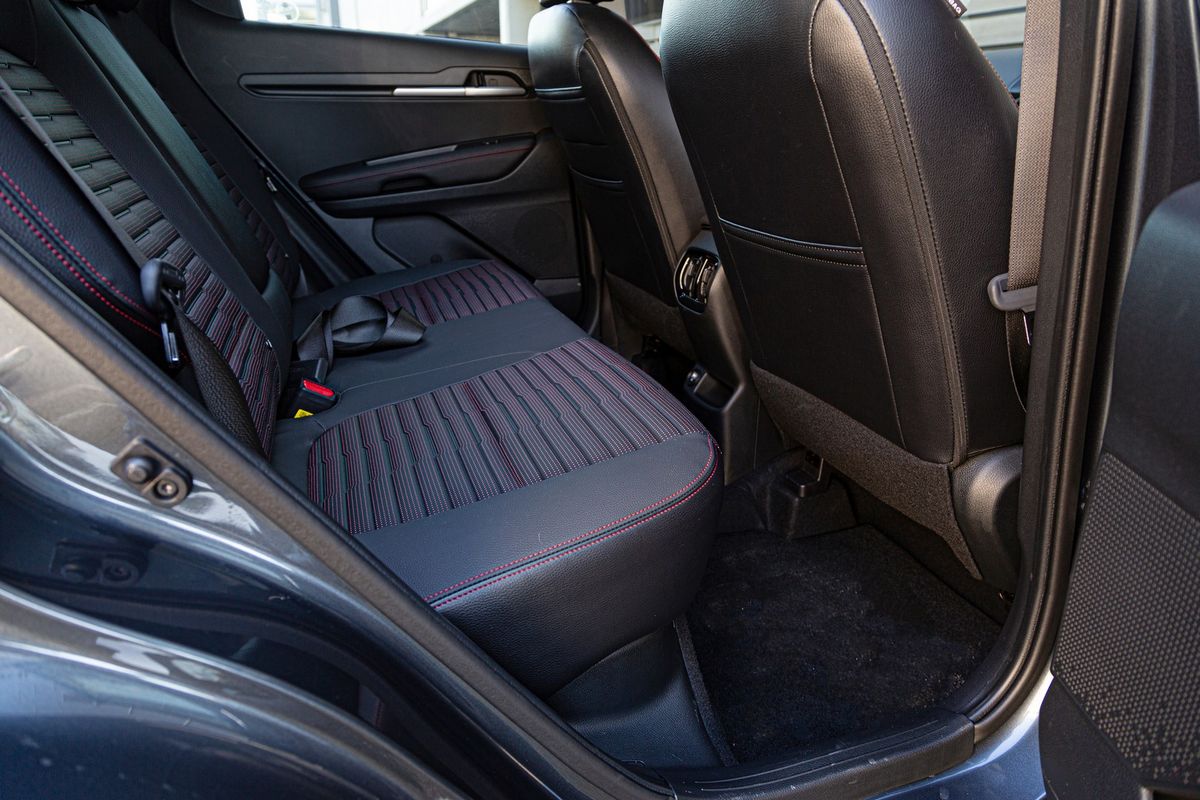
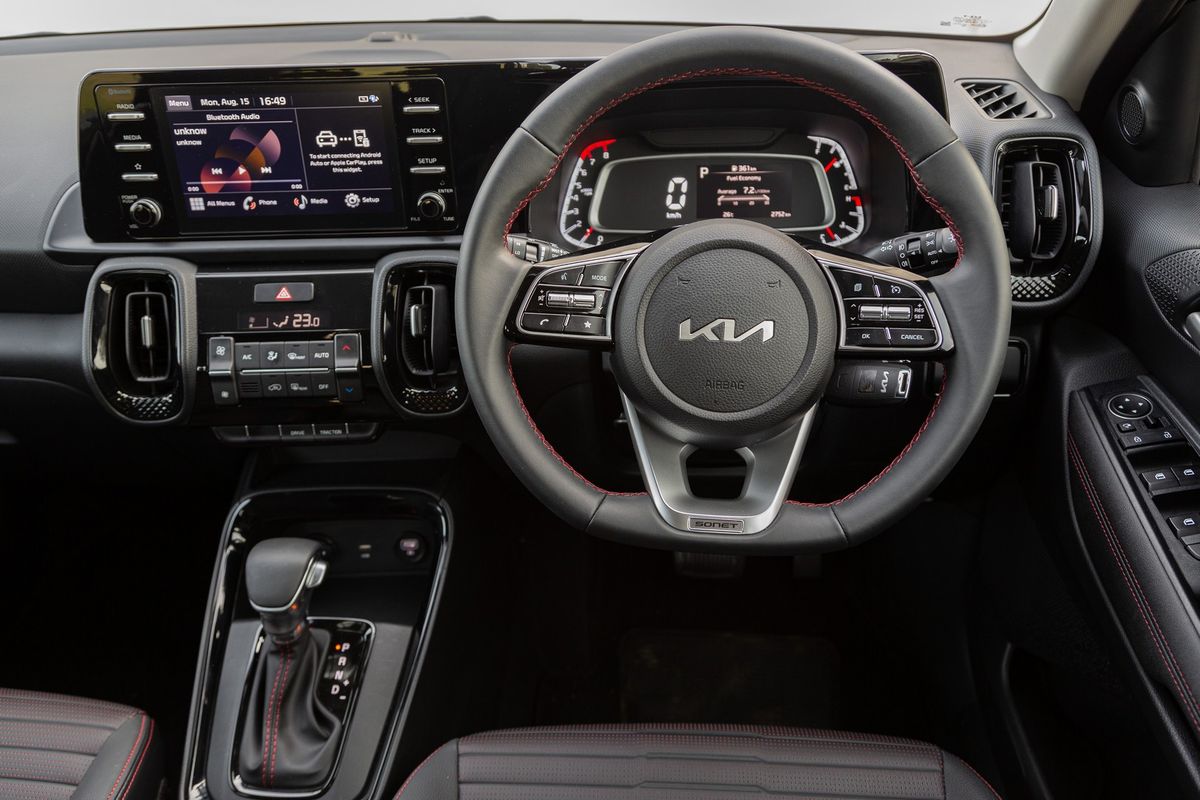
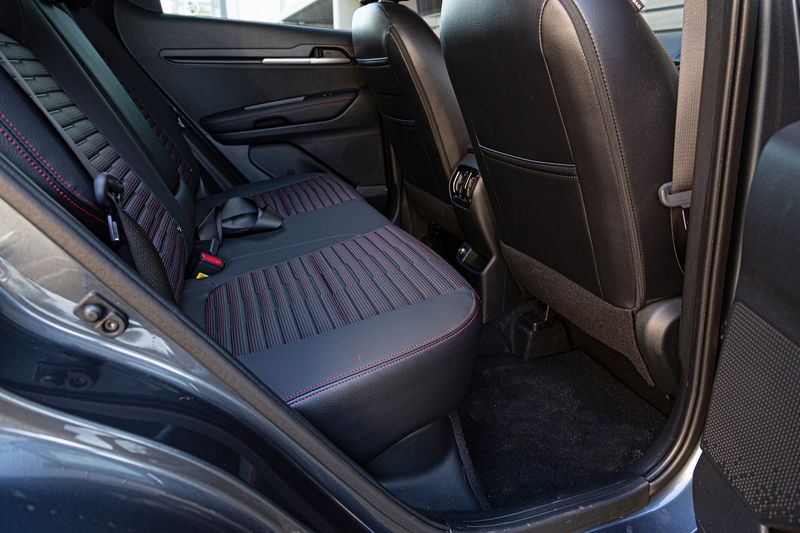
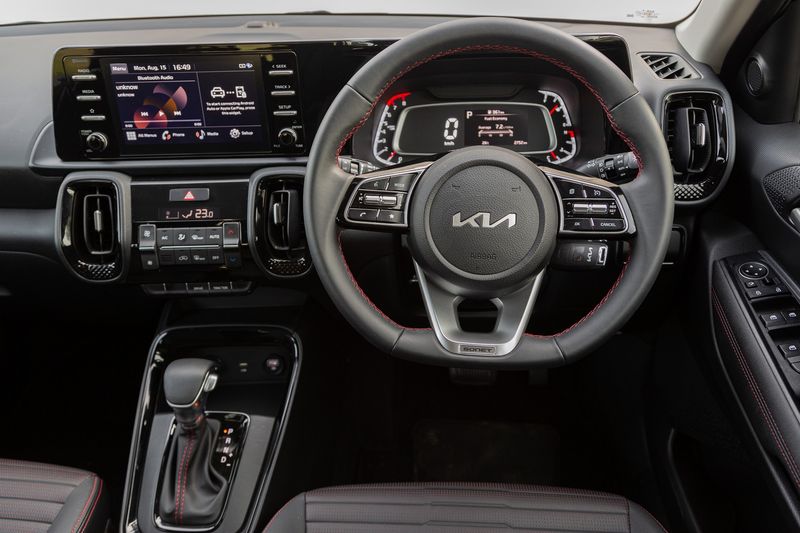
The cabin looks upmarket, but, better still, it feels reassuringly well-made, which, at the Sonet’s price point, is a bonus. The fascia is neat and uncluttered – a refreshing departure from some of the fussier layouts we’ve seen – and, while the Sonet looks dinky, its 2500-mm wheelbase facilitates a relatively roomy interior; even adults can sit comfortably at the back.
There’s sufficient rear leg- and headroom for adult occupants.
The load-bay is near the top of the segment in terms of outright capacity (392 litres), but frustratingly, the rear seatback doesn’t have a split-folding function (it’s a single-piece item). This would have been acceptable in lower-spec versions, but not the flagship. Interestingly, the top-tier derivatives of the Sonet’s cousin, the Hyundai Venue, has 60/40-split rear seats.
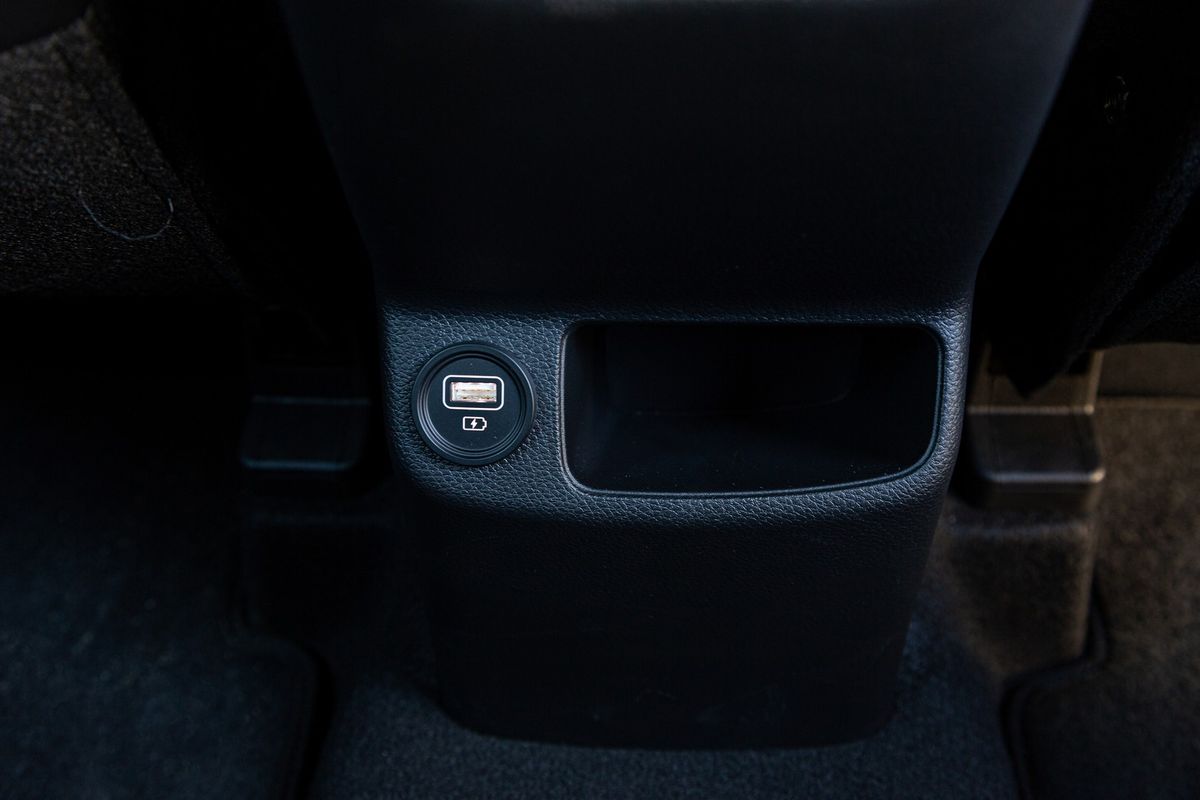
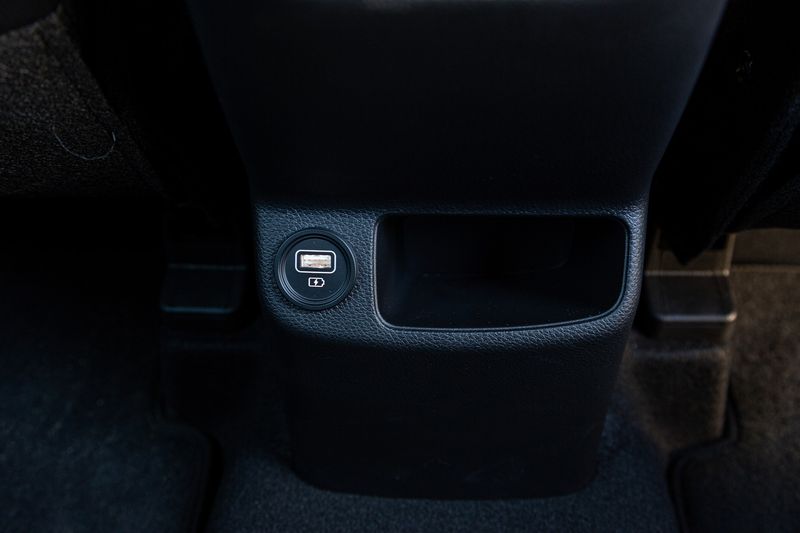
Rear passengers are afforded their own USB port to charge devices, plus a handy cradle.
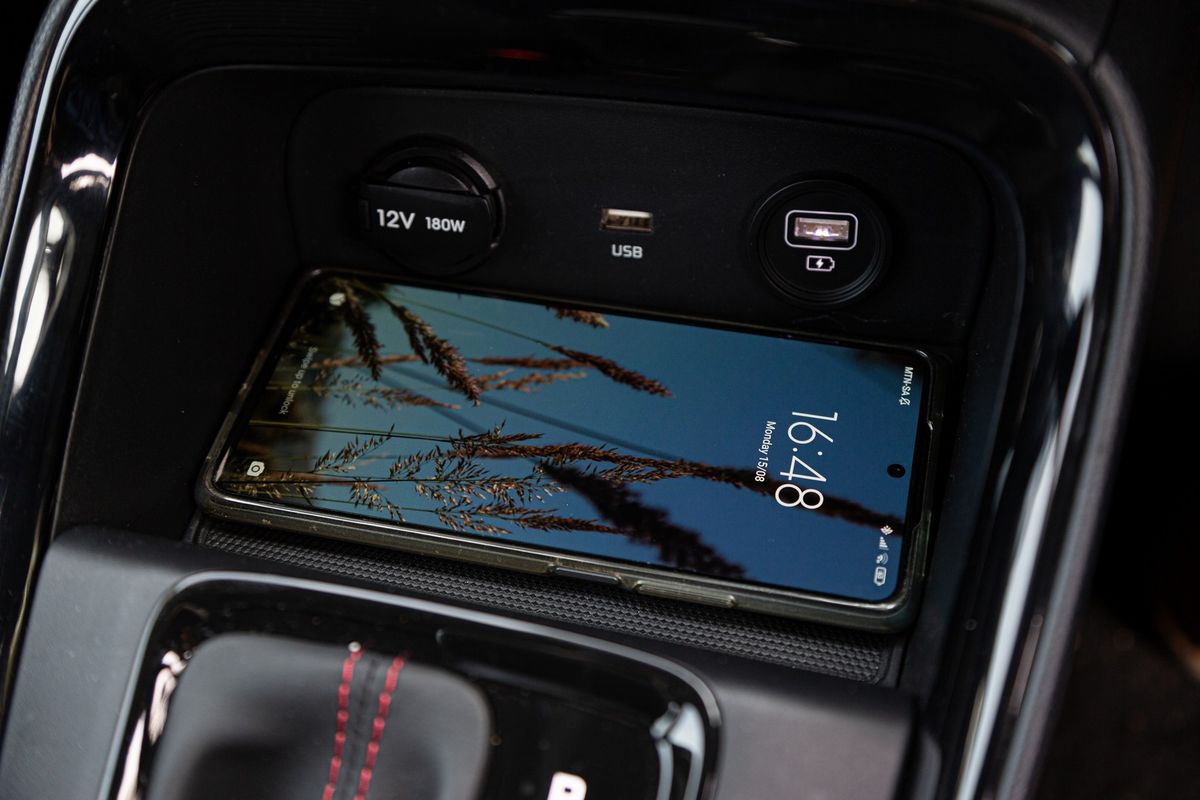
There’s little to fault with the rest of the cabin, however – it’s cleverly designed, replete with plenty of storage spaces for phones, keys, wallets and so on, while the door pockets are large enough to accommodate water bottles. We liked the slot for storing an electronic device (it’s located right next to a USB port), but a wireless charging pad would have been even better.
Standard features
Considering that the 1.0T EX+ is a top-of-the-range derivative – one that costs just under R400k (before on-the-road costs), no less – one would expect a comprehensive standard spec. However, considering that even in base (LX) guise, the Sonet comes well equipped, does the flagship offer enough in the way of luxury trim, extra convenience features and gadgets?
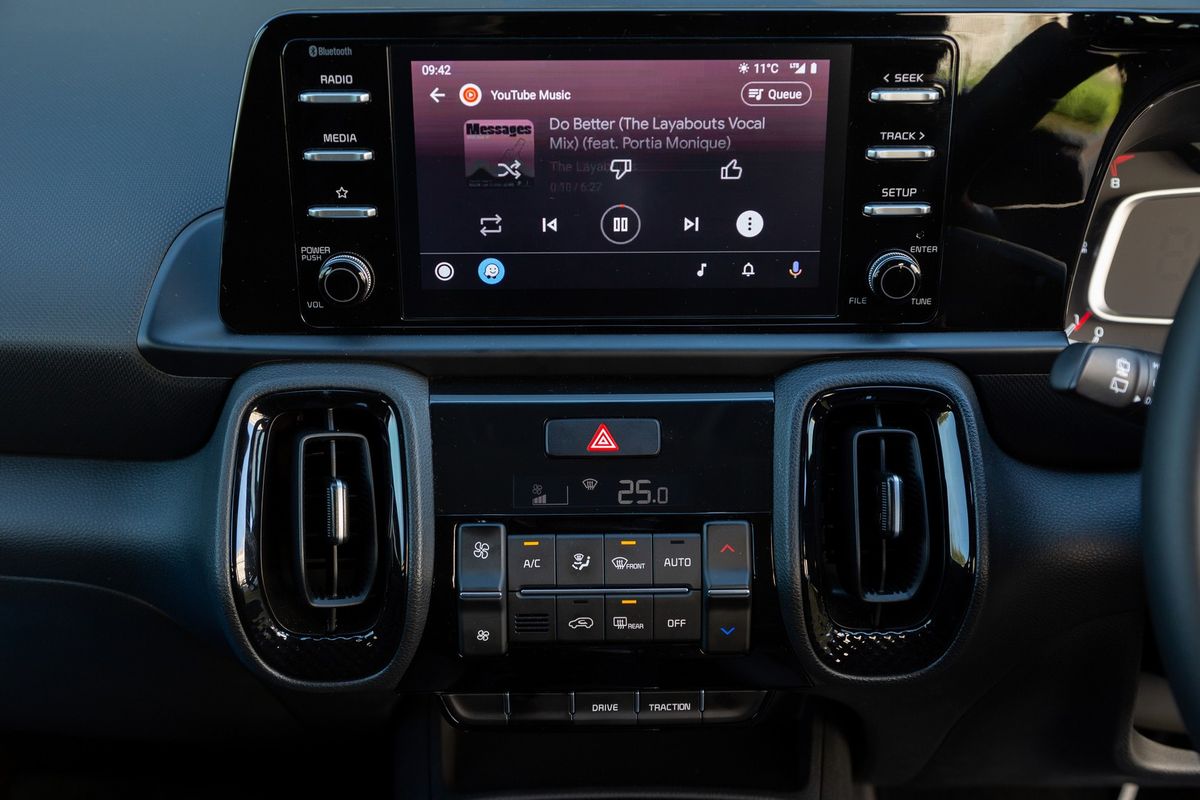
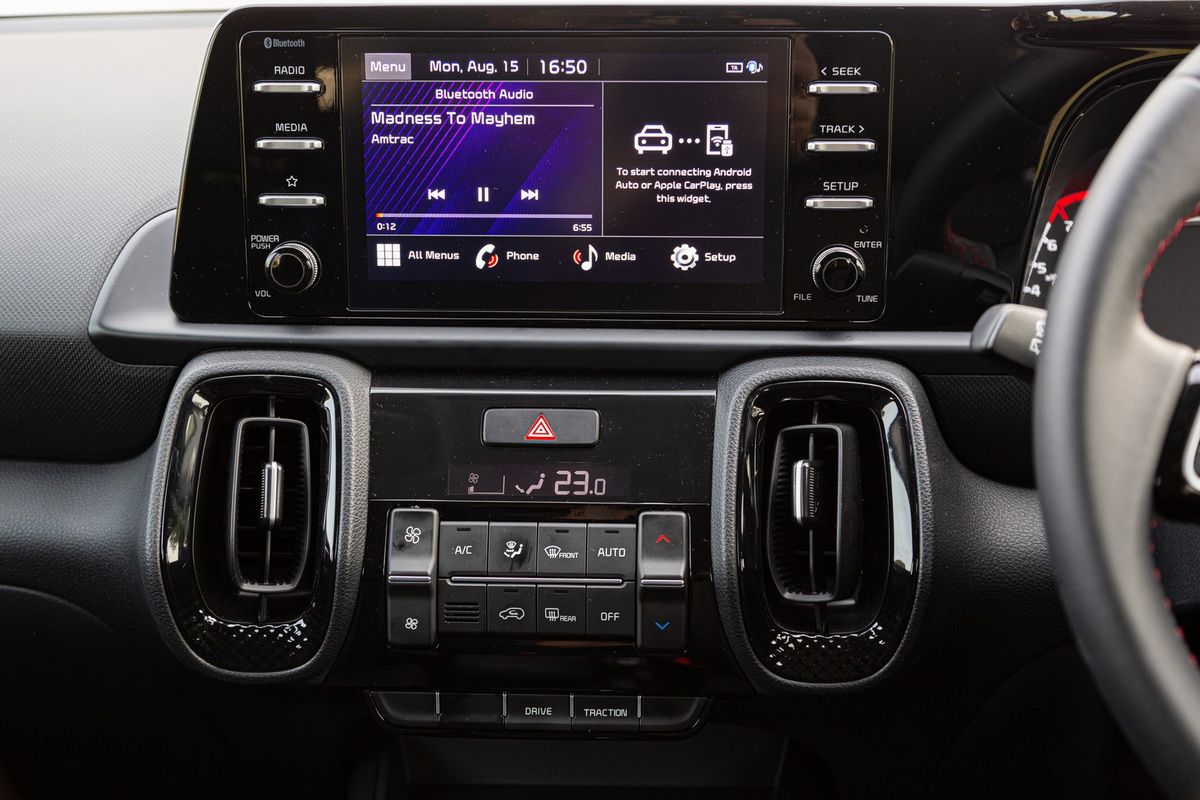
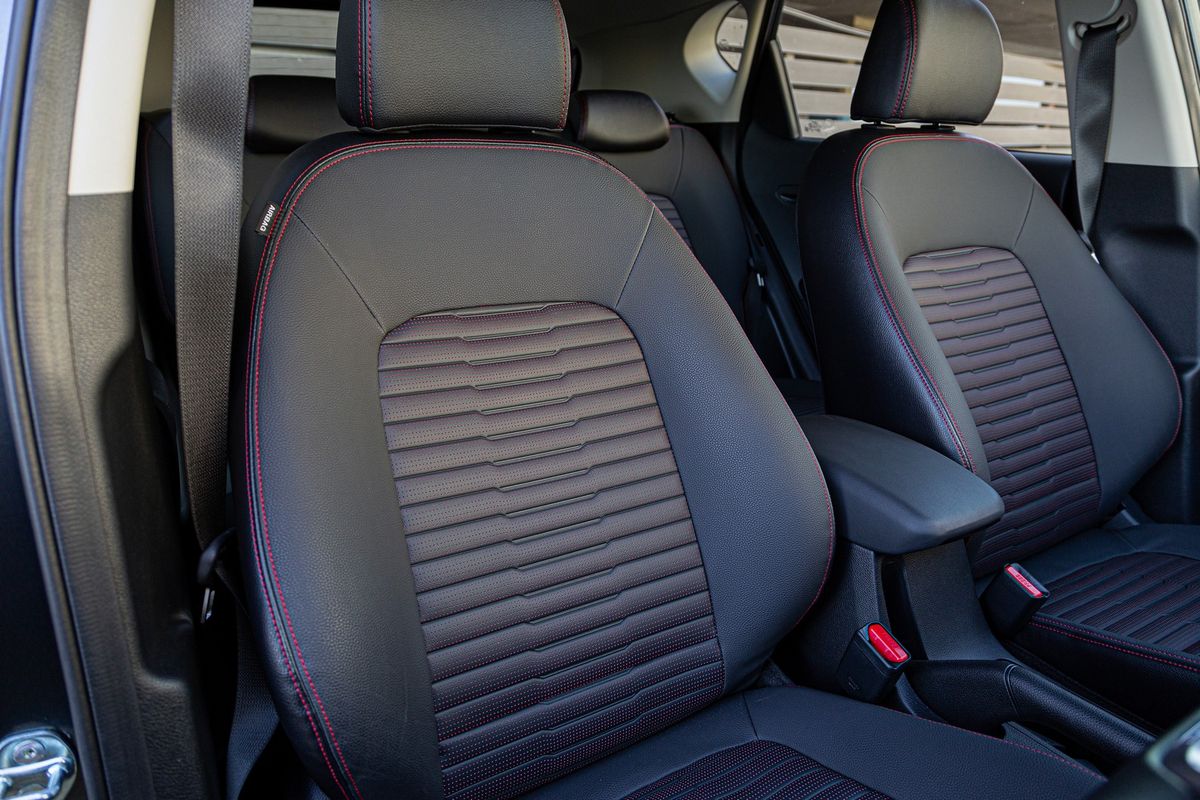
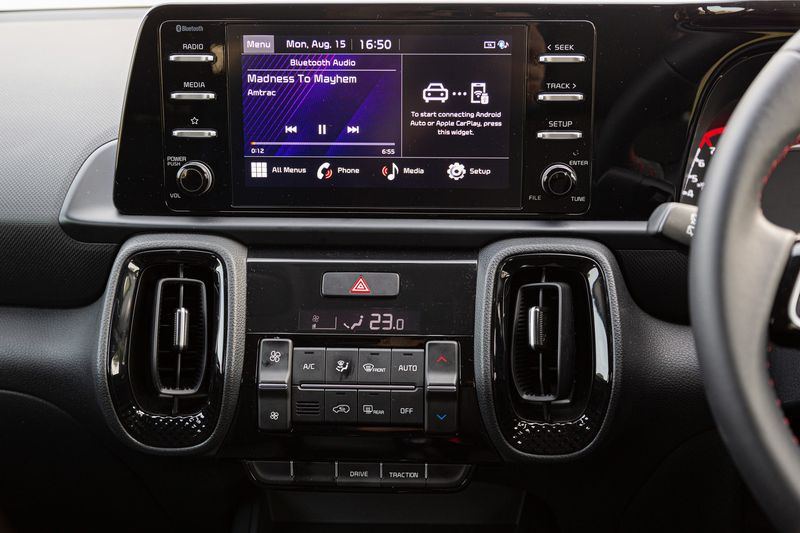
Yes, indeed. EX+ trim adds artificial leather seats with red stitching, electrically adjustable (and folding) wing mirrors, electrochromatic rear-view mirror, cruise control, automatic climate control and the drive modes. That’s on top of an 8-inch infotainment system with wireless Apple CarPlay/Android Auto, Bluetooth, USB ports (front and rear), reverse-view camera, rear parking sensors, height adjustable driver’s seat, auto headlights and fog lights.
A neat and uncluttered fascia layout of the Kia Sonet.
In terms of safety features, this Sonet comes with 6 airbags (including side- and curtain airbags, over and above the usual dual front ‘bags), electronic stability control, anti-lock brakes with electronic brakeforce distribution, hill-start assist and ISOfix child-seat anchors.
However, there are some features that are missing, which we found curious. To reiterate, because the rear seatback is one piece, the Sonet becomes a strict two-seater when you need to transport items that won’t fit in the conventional load bay or on the rear bench’s cushion.
EX+ trim incorporates climate control, as well as selectable drive- and traction modes.
A one-touch up/down driver window would have been nice and one of our testers pointed out the car’s front-end look would have been bolder if Kia fitted LED daytime-running lights.
Kia Sonet: Performance and Efficiency
Unlike most Sonet derivatives, which are powered by a naturally aspirated 1.5-litre 4-cylinder petrol engine, the 1.0T EX+ features a 1.0-litre turbocharged 3-cylinder petrol engine. Its peak power output (88 kW) is remarkably close to that of the larger-capacity (non-turbo) motor’s 85 kW, but the torque difference is telling. See, with 172 Nm of torque (vs 144 Nm), the turbocharged Sonet is punchier (it produces stronger in-gear acceleration by comparison).
The 1.0T EX+’s turbocharged powertrain is one of the best in the business.
Does it feel quicker, though? Yes, you can feel the difference when the Kia accelerates to merge onto freeways or overtake slower traffic. The best part? You don’t even need to press the accelerator pedal more than 2/3rds down – there’s sufficient punch right from the get-go.
The main benefit of this powertrain is while naturally aspirated engines (such as those in the 1.5-litre Sonet derivatives) will lose around 17% of their power because of the thinner air at altitude, the turbocharged motor hardly suffers any loss at all. Therefore, it will be the more eager and responsive of the two engines in the country’s biggest car market – Gauteng.
This dual-clutch automatic transmission shifts quickly and efficiently.
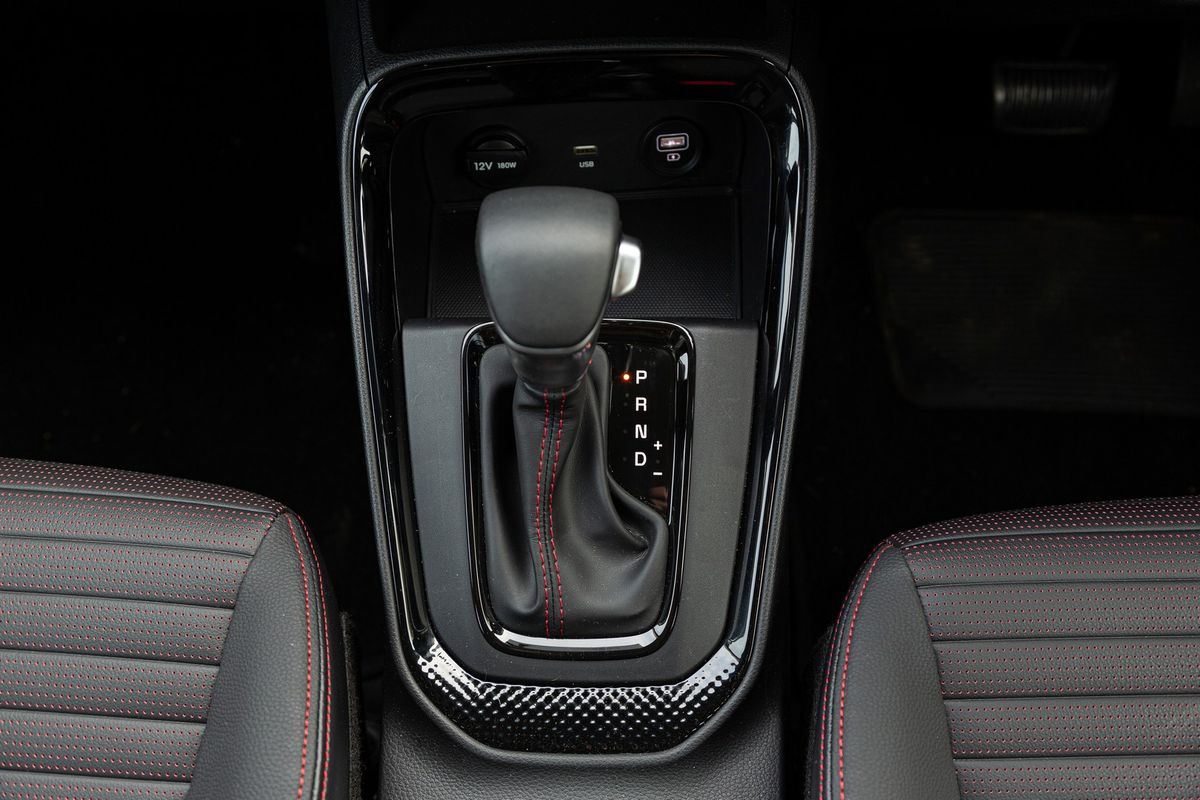
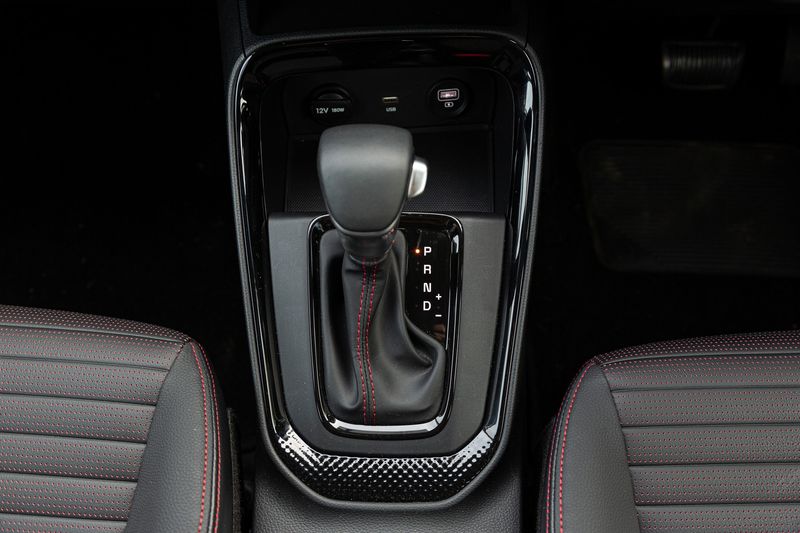
Don’t sell the 7-speed dual-clutch automatic transmission short, however. It shifts gear quickly and efficiently and seems particularly well-mapped to the engine’s performance characteristics. There’s a manual-override function available (if you want to “swap cogs” yourself), but we found the transmission behaved predictably when left to its own devices.
Now and again, when we pulled away abruptly, the powertrain jerked a little, but we learned to feather the accelerator pedal to negate that. Also, the engine sounds a bit buzzy beyond 5000 rpm, but it’s a minor gripe, because there’s hardly any need to rev the engine that hard.
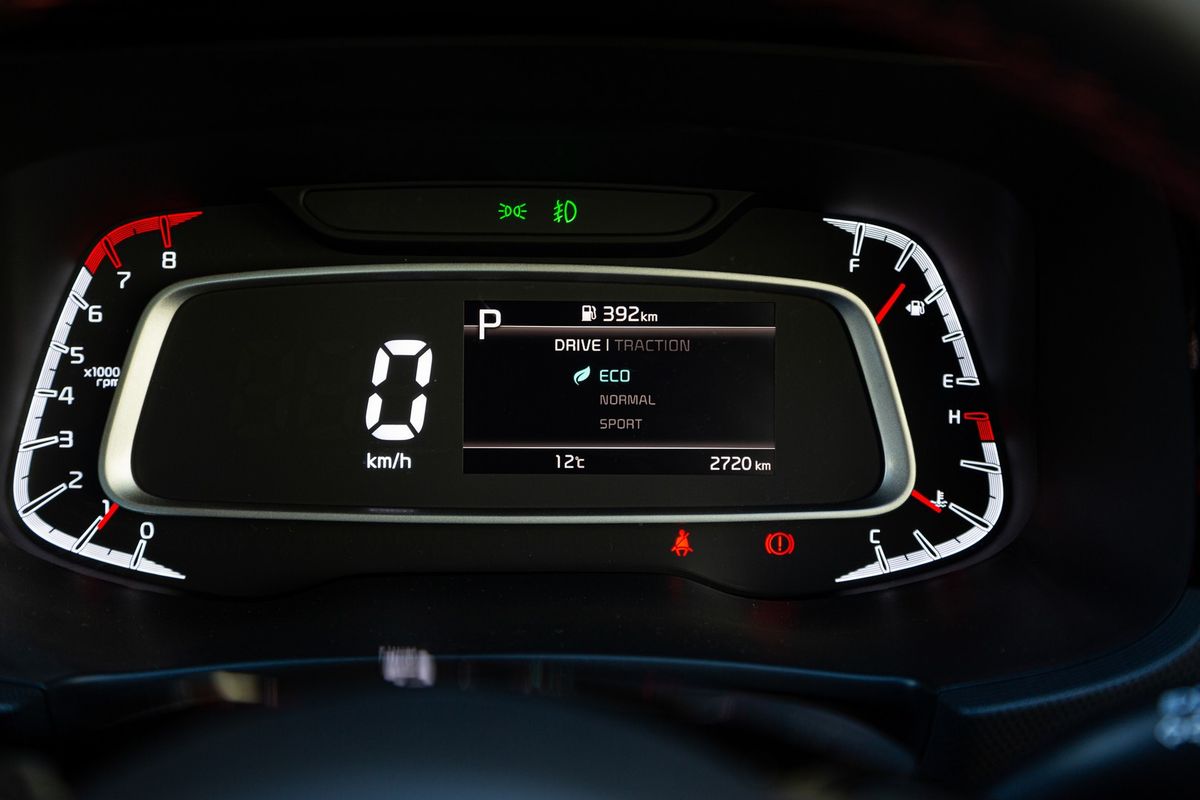
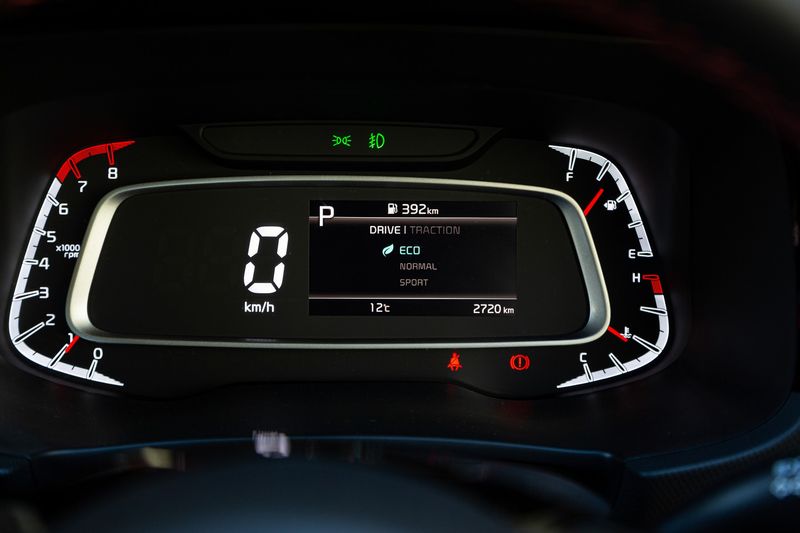
You can choose between three drive modes.
The 1.0T EX+ features 3 drive modes (Normal, Eco, Sport), along with traction modes for slippery roads; Normal is self-explanatory, Eco manages energy consumption to optimise fuel economy, and Sport sharpens the throttle and ‘shift responses for more spirited driving.
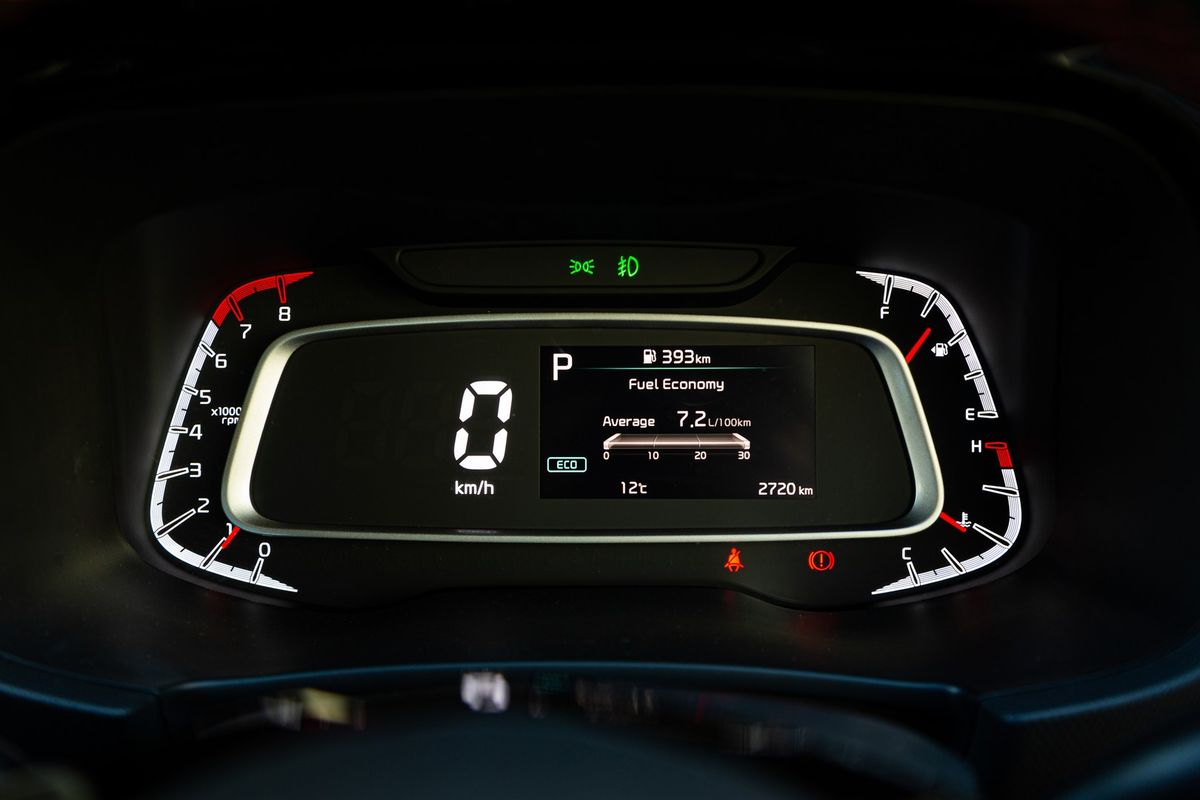
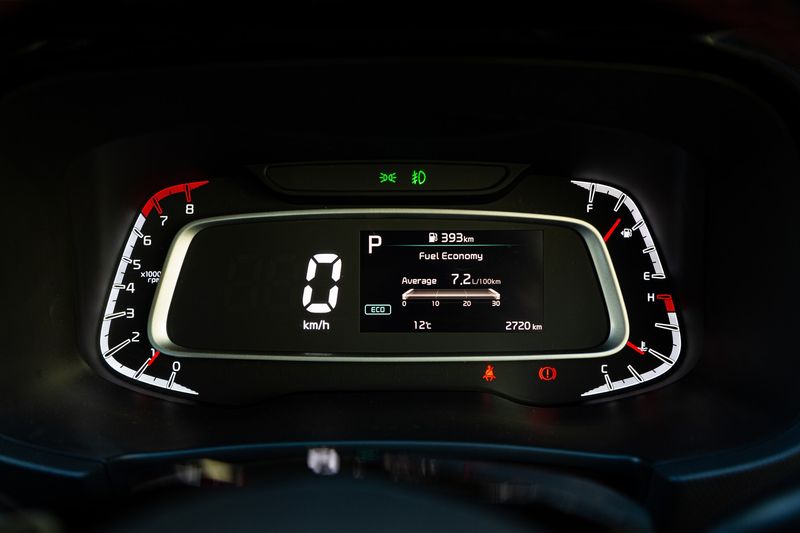
We have found that some compact turbopetrol engines aren’t nearly as fuel-efficient as their manufacturers claim, yet the Kia indicated a consumption figure of 7.2 L/100 km after we’d driven the 1.0T EX+ in a normal, everyday manner. We believe if you drive conservatively – and utilise Eco mode – returns of close to the claimed 6.0 L/100 km would be achievable.
7.2 L/100 km is a commendable fuel consumption figure, but we know more frugal returns are achievable.
Ride and Handling
The Sonet is a small crossover – essentially an alternative to a compact hatchback – but at this price point, buyers are likely to expect vehicles to offer better than average on-road refinement. Fortunately for Kia, its Indian made Sonet exhibits high levels of NVH (noise, vibration and harshness) suppression, which is laudable, because that engine can sound a bit coarse at high revs and we did notice a bit of wind noise at the national speed limit (120 kph).
We are wary of nit-picking, though… few small crossovers can match the Sonet’s driving experience. While most of them demonstrate acceptable on-road behaviour, some models instil the feeling of being simple, made-to-cost products – they don’t always feel entirely sure-footed or capable of cruising quietly at higher speeds. The Kia is a good all-rounder.
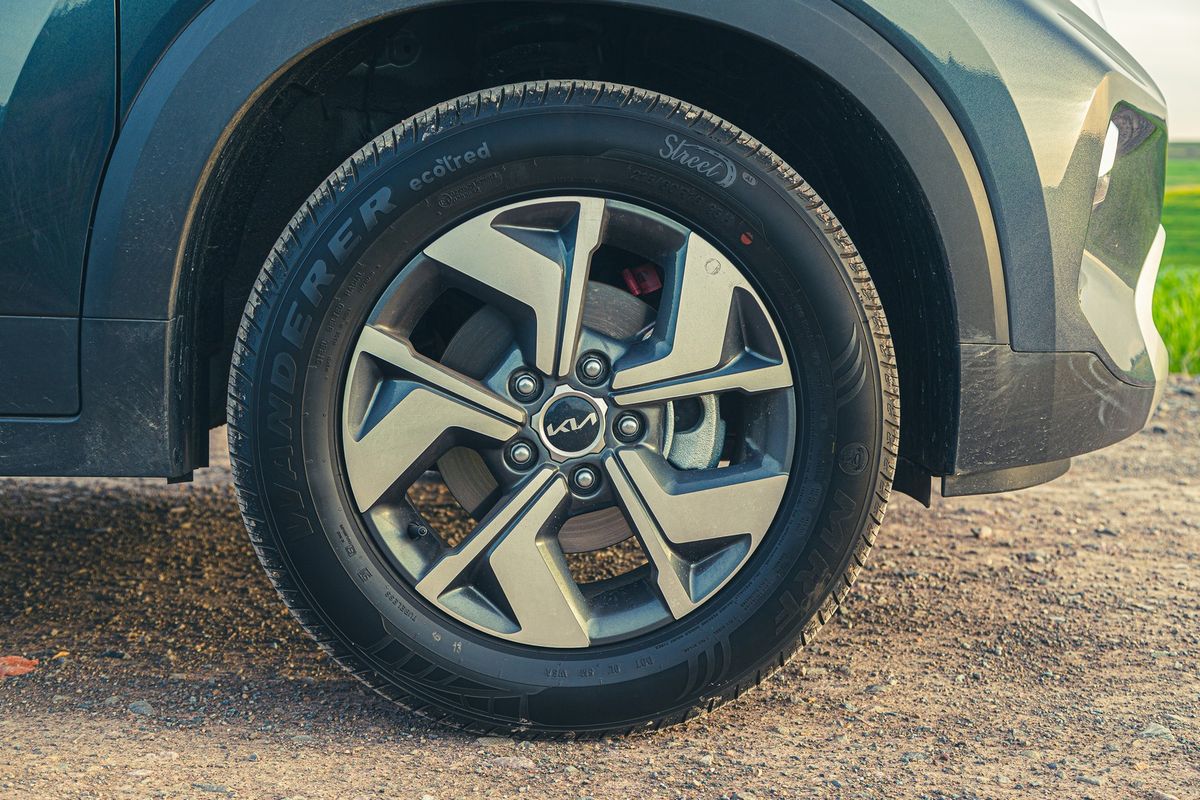
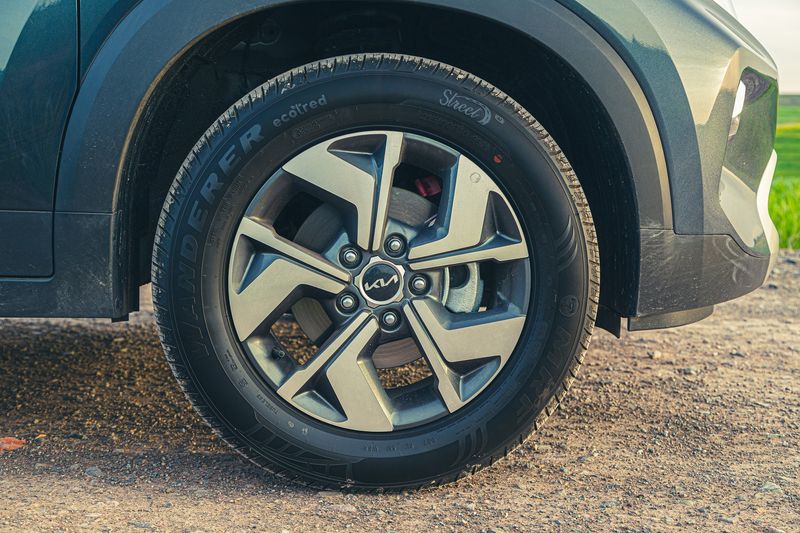
The high-profile 16-inch tyres offer a good ride quality, including on gravel roads.
The 1.0T EX+’s 16-inch alloy wheels are wrapped in plump 215/60 tyres; they help to soak up most road imperfections and provide some bolstering against rut and pothole impacts.
Considering the Sonet’s compact-car underpinnings, its general ride quality is quite forgiving and absorbent. The steering setup is well-assisted and not entirely devoid of feedback, but we did notice that the steering column is not reach-adjustable. You can compensate for this to a degree by tweaking the position of the driver’s seat, which is height adjustable as standard.
The chunky tyres and 190 mm of ground clearance make the Sonet adept at traversing gravel roads – it feels very stable on unsealed surfaces. It’s equipped with traction modes designed for (very mild) off-road excursions, but we’re wary of them; we once got a Peugeot 2008 stuck in the sand, despite the best intentions of its comparable stability control-based mode.
Tarmac or gravel, the Kia Sonet has proven to be adept at both
Price and After-sales support
The Kia Sonet 1.0T EX+ goes for R389 995 and is sold with an unlimited kilometre, 5-year warranty (with roadside assistance), as well as a prepaid 4-year / 60 000 km service plan.
With the introduction of a turbocharged engine and dual-clutch automatic transmission, the Sonet range is now complete.
With the introduction of a turbocharged “triple” petrol motor – mated with a slick dual-clutch automatic transmission – to the range, the Sonet line-up is now complete. The 1.0T EX+ is one of those derivatives that demonstrates it does not need to be an ignominy to “buy down” if you choose wisely (empty nesters may not need the extra space that Kia’s larger Seltos offers, for example), plus the Sonet flagship comes packed with many “big-car” features.
So, should you buy one? The addition of a punchy-yet-efficient powertrain has broadened the appeal of the two top-end Kia Sonet derivatives. However, if your budget can’t stretch to this flagship version, you won’t feel short-changed if you opt for one of the “lesser” derivatives.
If you live at sea level and don’t need to contend with the loss of power (approximately 17%) that the naturally aspirated 1.5-litre engine suffers at the Reef (it will be most noticeable when the Sonet is fully loaded with people and their things, less so otherwise), the 1.5 EX offers exceptional value for money, even if it doesn’t have the nice-to-haves fitted to the 1.0T EX+. It does not have a dual-clutch transmission, but to reiterate, the CVT is quite tolerable.
Considering Kia’s substantial after-sales support (the 5-year warranty and service plan are very competitive), the Sonet is one of the better buys in this hotly contested segment.
What is the fuel tank capacity and mileage of the Kia Sonet?
The Kia Sonet has a fuel tank capacity of 45 litres. Kia claims between 5.8- and 6.6 L/100km.
How many people can sit in the Kia Sonet?
The Kia Sonet is a 5-seater SUV, with seating for a driver and four passengers. It does not come in a 7-seater option.
What are the available engine and transmission options for the Kia Sonet?
In South Africa, the Kia Sonet is available with both petrol two petrol engine options including a naturally-aspirated 1.2 litre and 1.0-litre turbo engine. The transmission options include manual, CVT and DCT automatic.
What are some of the key features of the Kia Sonet?
The Kia Sonet is known for its feature-rich cabin. Depending on the variant, key features can include an electric sunroof, a 10.25-inch HD touchscreen infotainment system, a digital instrument cluster, a Bose premium 7-speaker sound system, ventilated front seats, and advanced driver-assistance systems (ADAS).
What is the ground clearance of the Kia Sonet?
The Kia Sonet has a ground clearance of 205 mm, which is suitable for navigating various road conditions and terrains.
What are some common complaints or drawbacks of the Kia Sonet?
Commonly reported drawbacks include a lack of rear-seat knee room, which can be a concern for taller passengers, and noticeable tyre noise in the cabin at higher speeds. Some users also note that for its premium price, it could include features like auto wipers or a 360-degree camera on more variants.
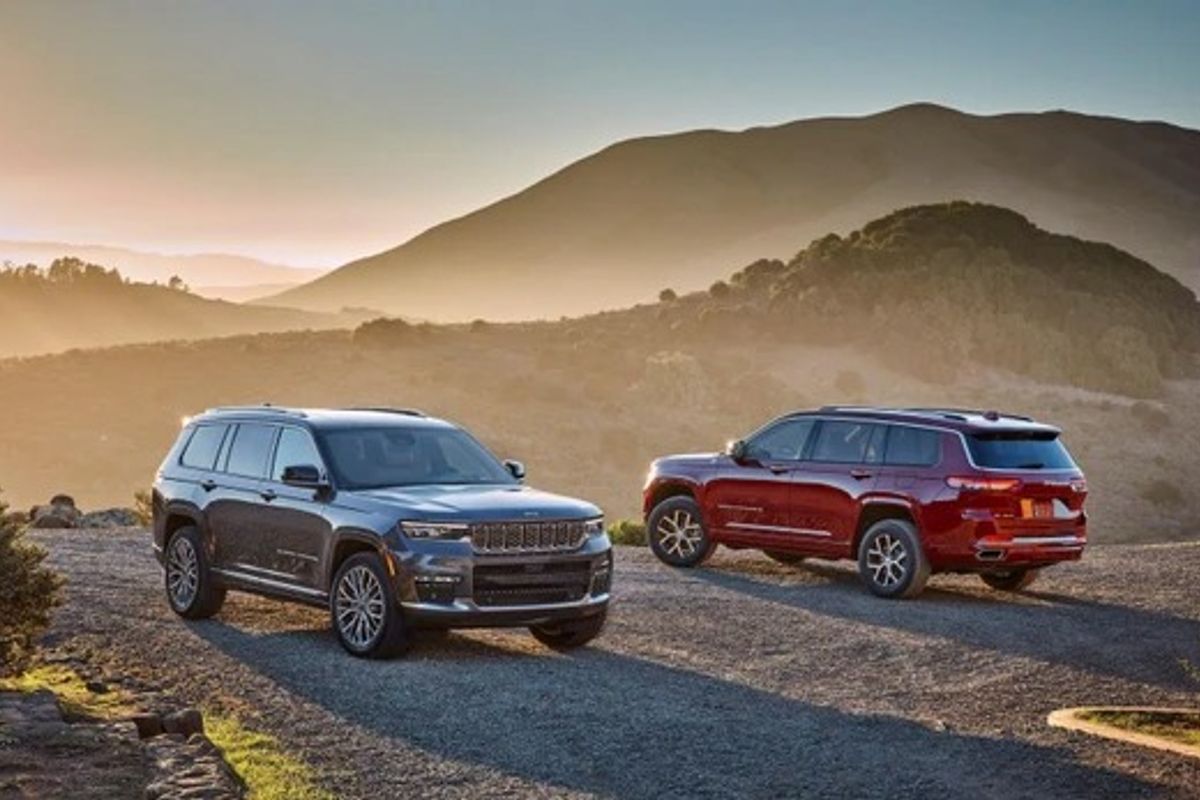
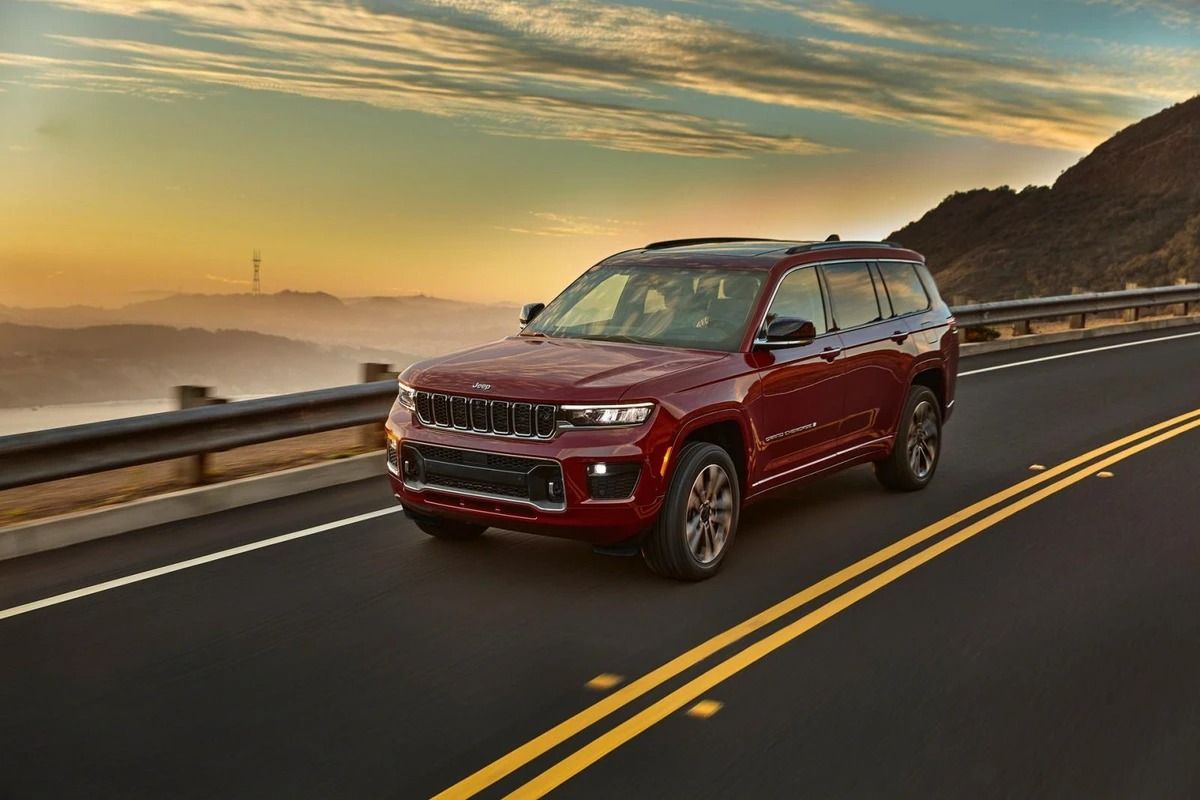
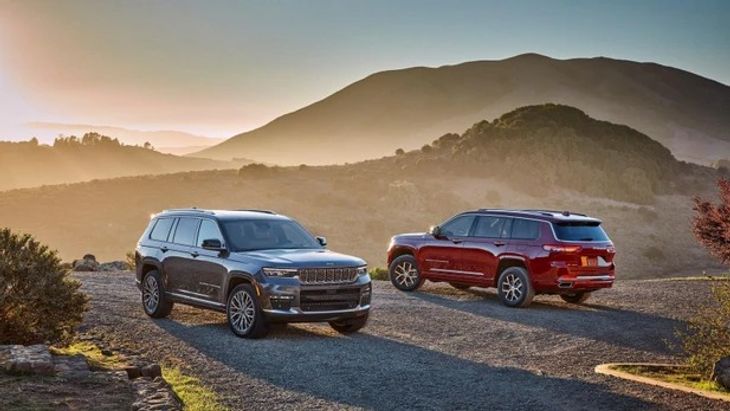
Three-row seating is a first for the Jeep Grand Cherokee and 3 derivatives are available to local buyers.
There are 3 grades available for the new Grand Cherokee L, namely the base Limited, mid-spec Overland and the range-topping Summit Reserve derivative.
All variants are powered by Jeep’s 3.6-litre V6 Pentastar petrol engine that develops 210 kW and 344 Nm of torque. This powerplant is mated with an 8-speed automatic transmission and Jeep claims an average fuel consumption figure of 10.6 L/100km.
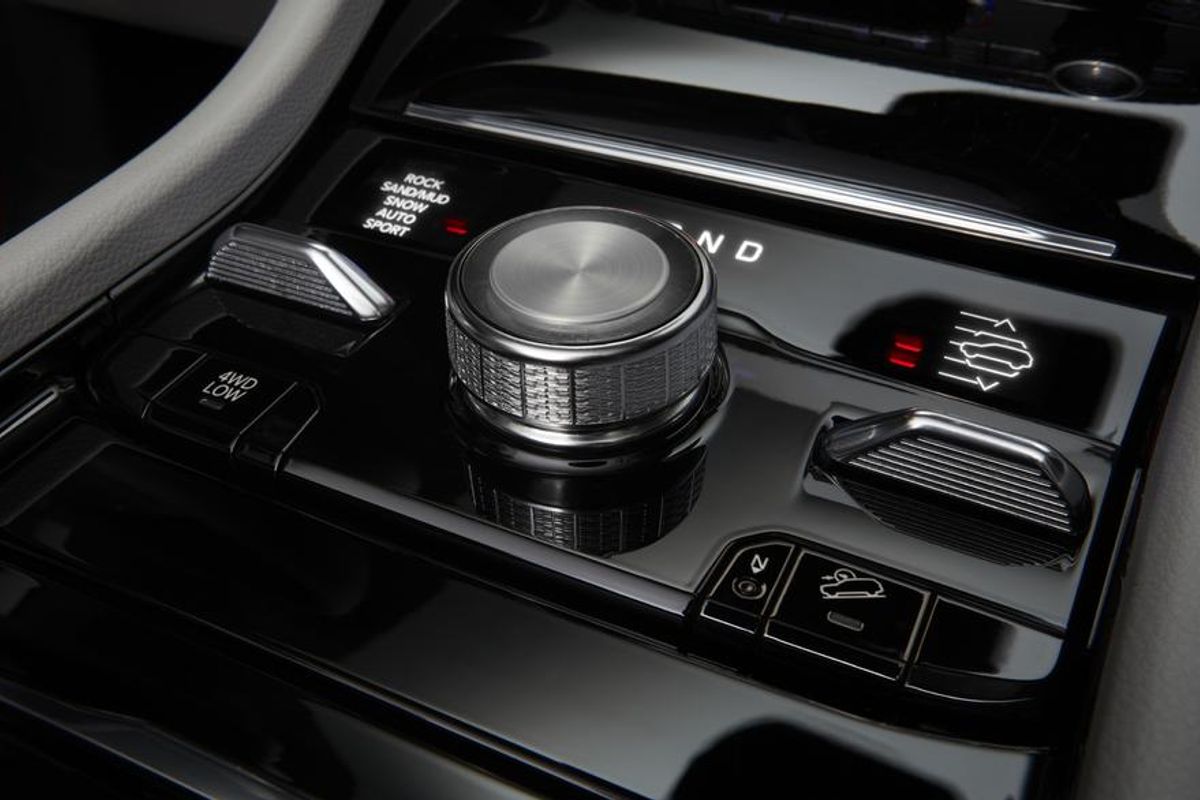
The Grand Cherokee L is also capable of traversing offroad terrain and is equipped with three 4×4 systems including Quadra-Trac I, Quadra-Trac II and Quadra-Drive II with rear electronic limited slip-differential (eLSD). All three systems make use of an active transfer case. Jeep’s Selec-terrain traction management system allows the driver to select various terrain modes to suit the driving condition including Auto, Sport, Rock, Snow, Mud/Sand.
Ground clearance is quoted at 276 mm with a wading depth of 610 mm. In addition, Quadra-Lift air suspension with electronic adaptive damping is also offered and adjusts automatically depending on speed and road conditions.
What about practicality?
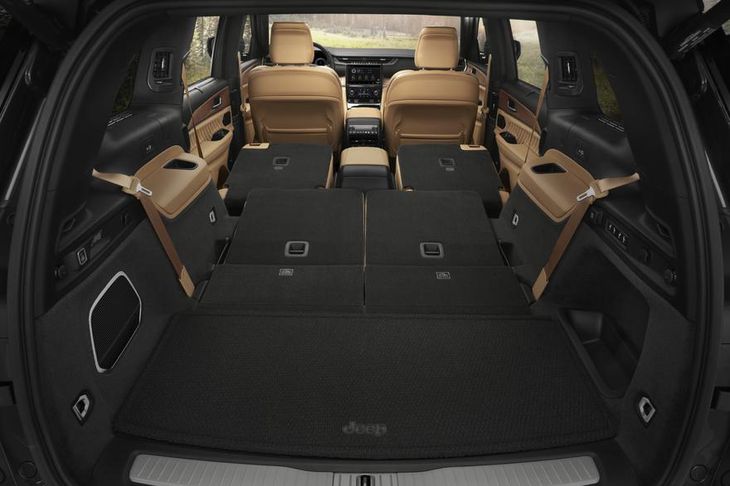
If you need space, the Grand Cherokee L has plenty.
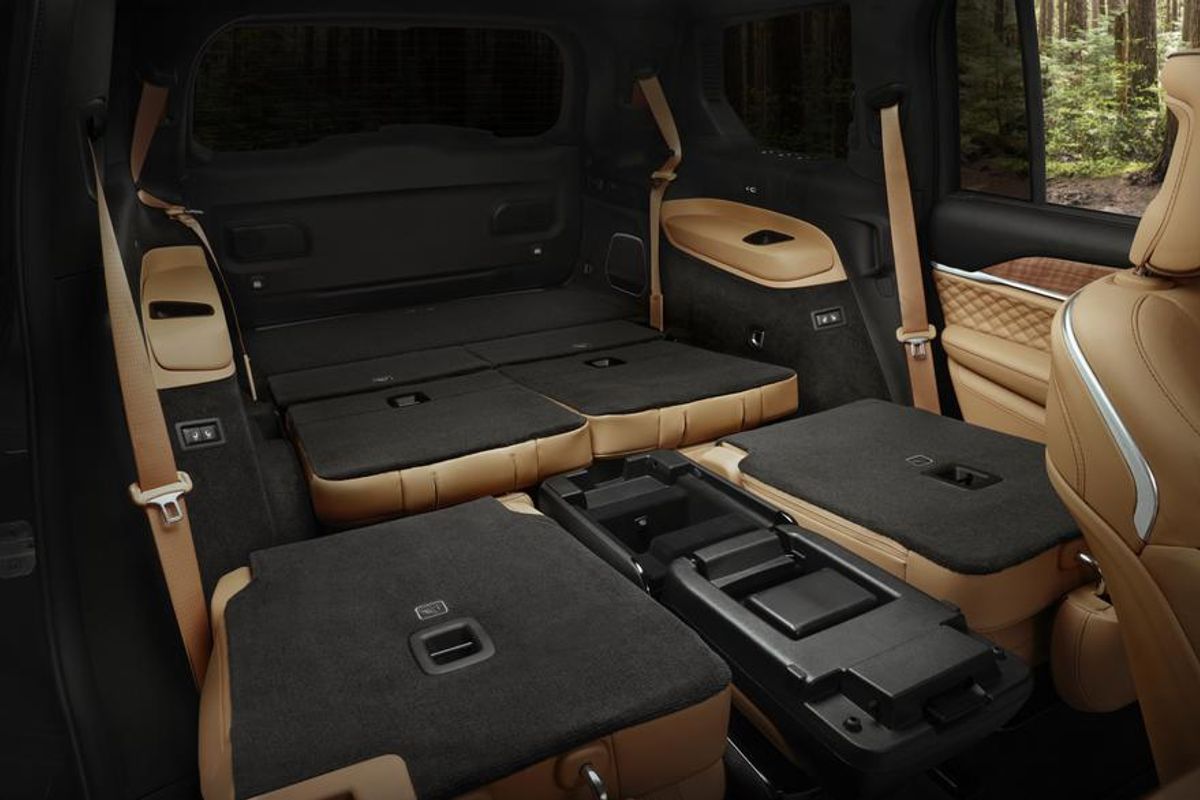
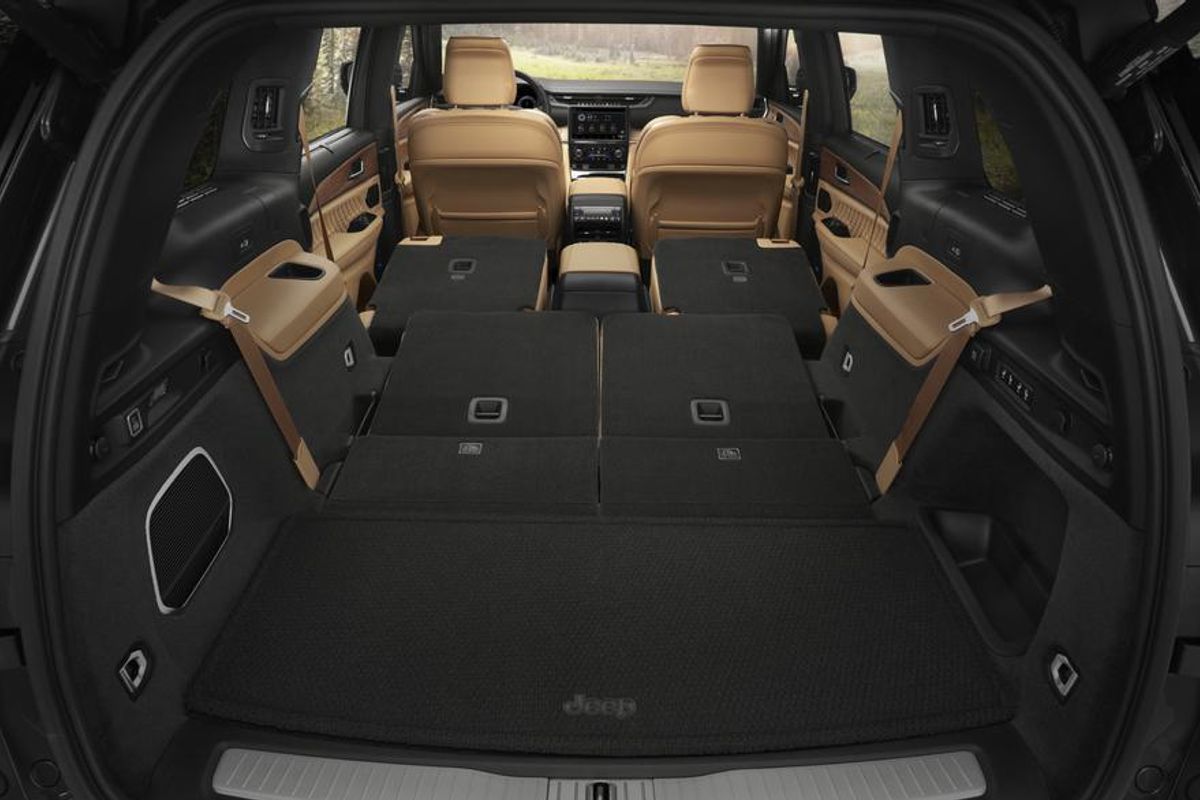
The 3-row Grand Cherokee L can be configured to seat either 6 or 7 passengers, depending on your requirements. The third row is accessed by tipping and sliding the middle row seat forward and the seats also have a reclining function. The 3-row seats are split in a 50:50 configuration and electronic folding functionality is optional.
Cargo space is plentiful and with the third row in the upright position, up to 436 litres of load space is available. Fold the third row down and space increases to 1 328 litres and with the second row folded down you have access to the full 2 396 litre cabin which is impressive.
What does the interior offer?
Plush finishes and a tech-laden cabin welcomes the driver. A front passenger screen is also available.
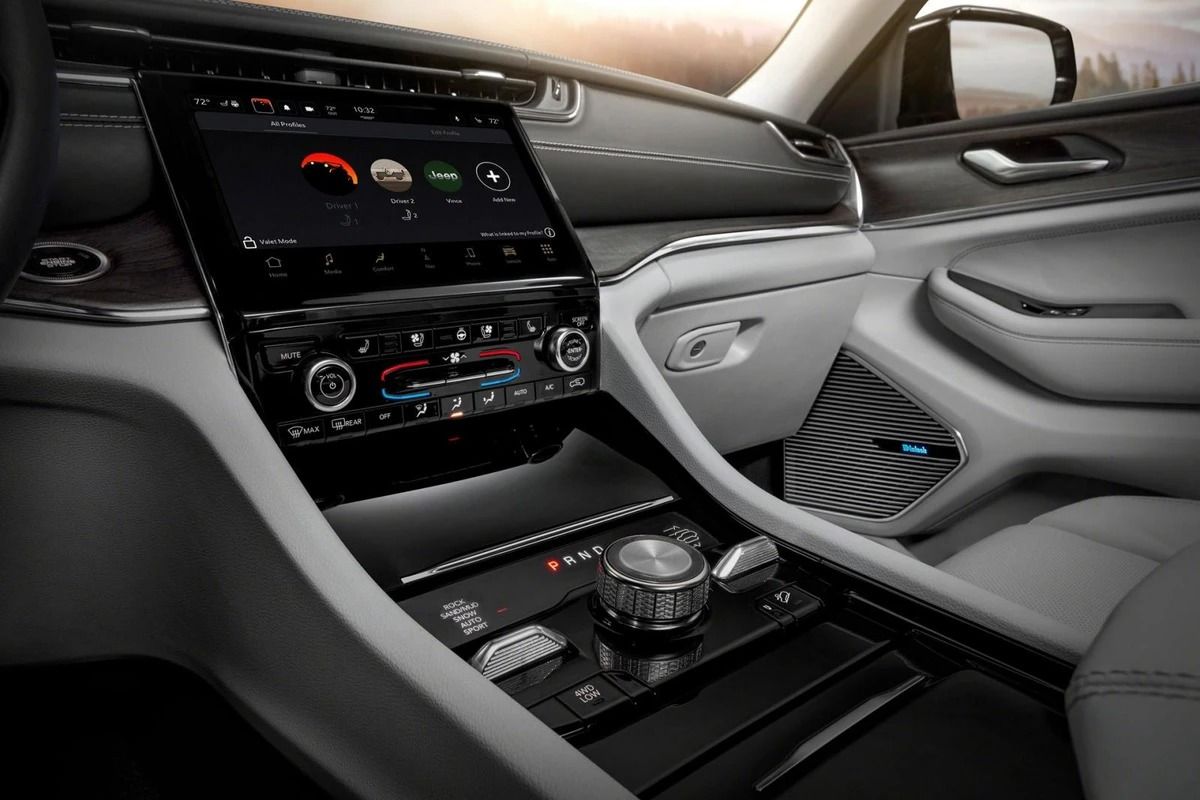
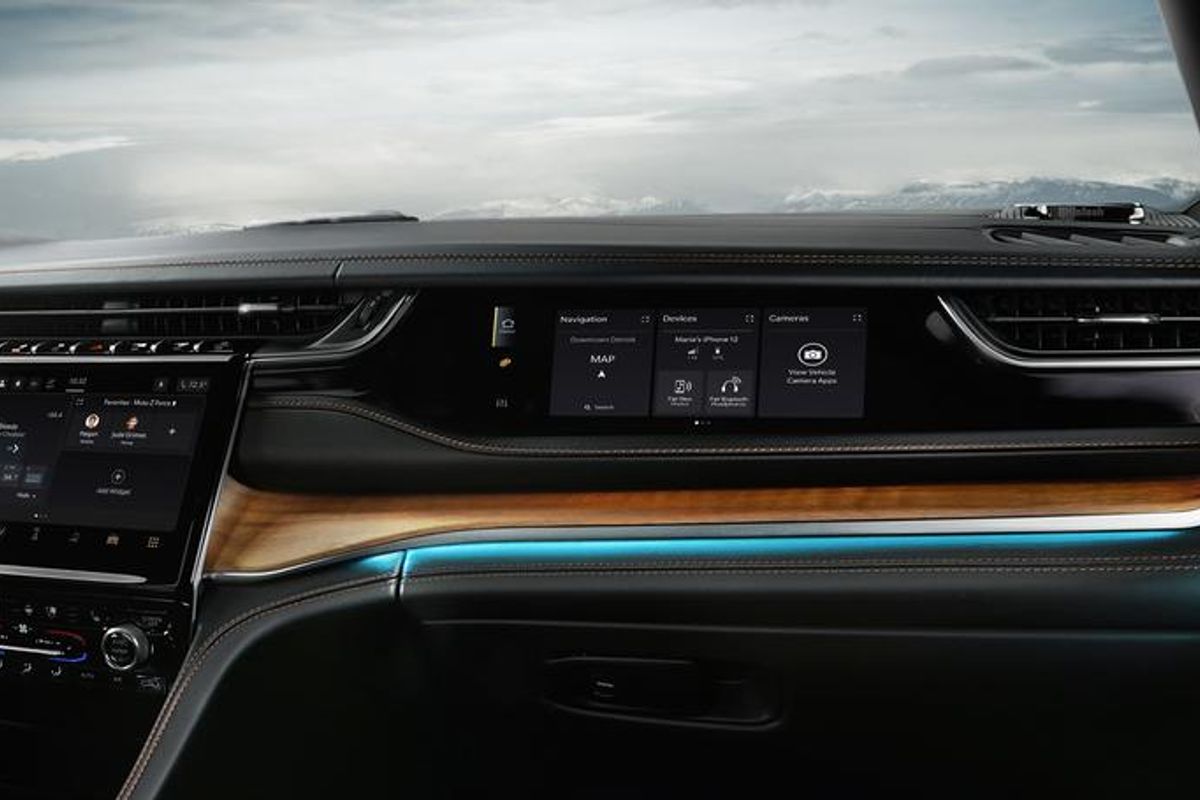
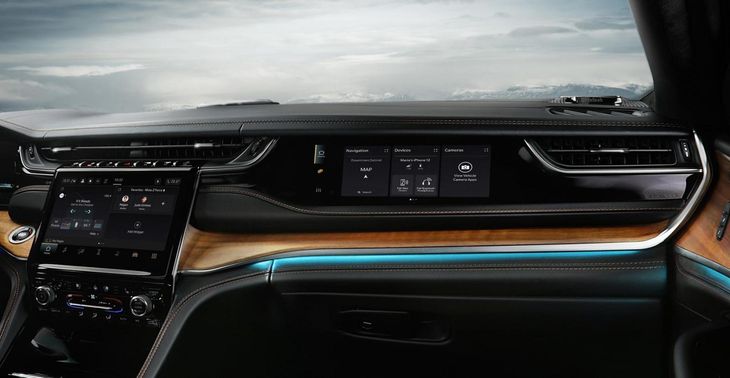
Inside the Grand Cherokee L, you are met with a modern, upmarket, tech-focused cabin. A 10.1-inch (4-inch in Limited guise) UConnect 5 infotainment system is fitted as well as a configurable 10.25-inch frameless digital instrument cluster which can be easily accessed using the all-new multi-function steering wheel which is also equipped with paddle shifters.
The infotainment system offers wireless Apple CarPlay and Android Auto, Bluetooth, 5 user profiles with valet mode and connectivity via the Uconnect mobile app.
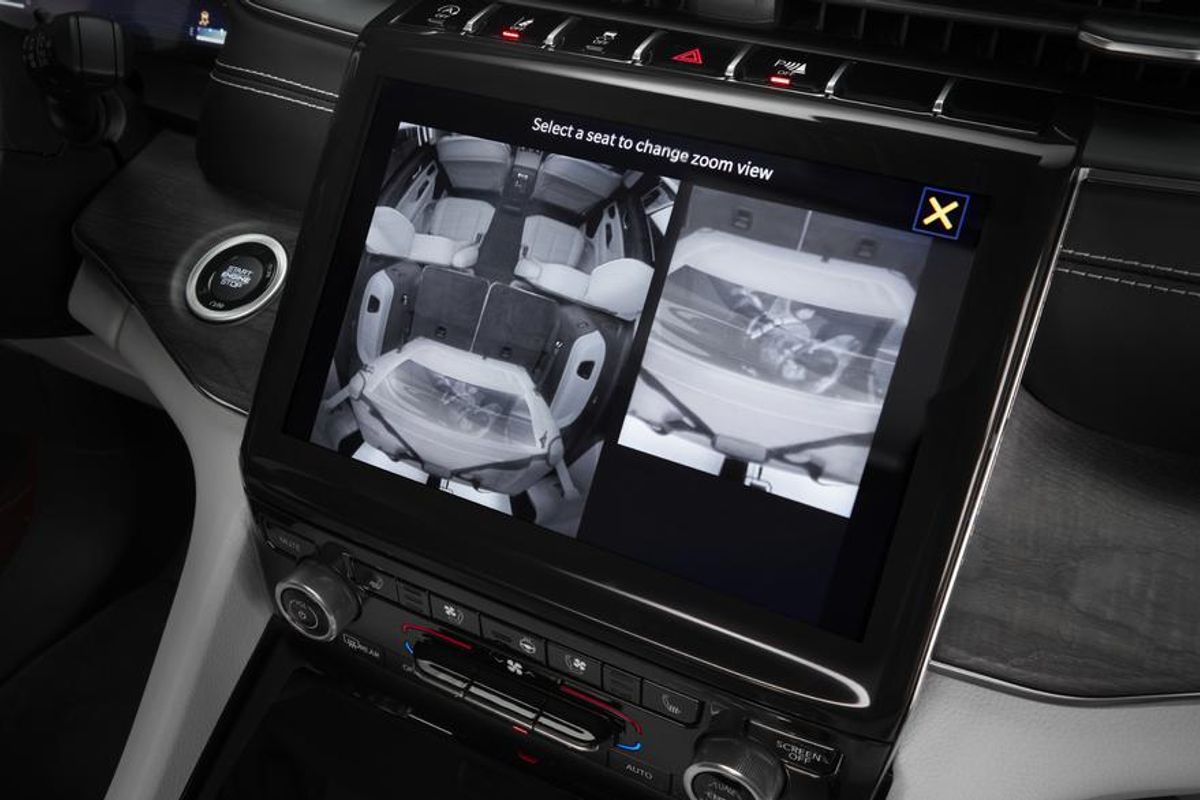
But that’s not all, the Grand Cherokee can also be had with a 10.25-inch front passenger screen that provides access to functions such as entertainment, navigation and camera viewing. The front passenger is also able to control rear screen content. Overland and Summit Reserve derivatives are also equipped with a McIntosh audio sound system with 19 speakers, 950W 17-channel amplifier and a 10-inch subwoofer.
Other nice-to-have features include a wireless charging pad, up to 12 USB ports (Type A and Type C), a digital rearview mirror and a full-colour Head-up Display (HUD)
In terms of driver assistance features, the Grand Cherokee L is well equipped. Features include:
Full-Speed Collision Warning with Active Braking and Pedestrian/Cyclist Detection
Parallel and Perpendicular Park Assist with 360-degree surround view camera system with built-in washers on both front and rear camera lenses.
Night Vision Camera with pedestrian and animal detection (*Summit Reserve)
Rear Cross Path detection
Adaptive Cruise Control with Stop and Go
Active Lane Management
LaneSense Lane Departure Warning with Lane Keep Assist
Advanced Brake Assist
Blind-spot Monitoring
ParkView rear back-up camera
ParkSense rear park assist sensors with stop
Switch-activated electric park brake
Tyre-pressure monitoring
Drowsy Driver Detection system
How much does the Jeep Grand Cherokee L cost in South Africa?
Jeep Grand Cherokee L Limited – R1 299 900
Jeep Grand Cherokee L Overland – R1 479 900
Jeep Grand Cherokee L Summit Reserve – R1 679 900
The Jeep Grand Cherokee L is sold with a 5-year/120 000km warranty, 5-year/100 000km maintenance plan and roadside assistance.
Mitsubishi is rolling out a freshly facelifted Triton bakkie for local buyers starting with a single-cab Triton GL aimed squarely at business users. Take a look at the specifications and pricing details for the Triton range below…
The Mitsubishi Triton has a loyal following in South Africa and its owners heap a ton of praise on this often overlooked offering.
In an effort to keep the Triton fresh and relevant in a fast-changing bakkie segment, Mitsubishi Motors is in the process of introducing an updated Triton and the single-cab Triton GL not only marks the start of the rollout but it also serves to broaden the market appeal by targeting business users who might need a capable workhorse for daily operation.
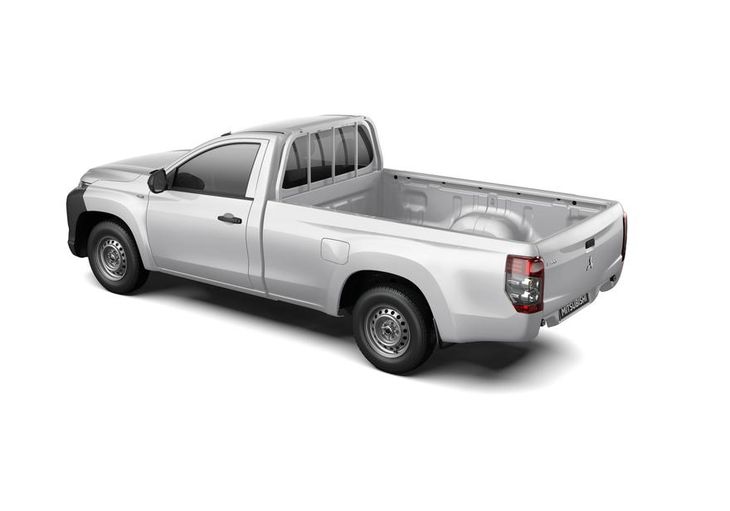
As far as styling goes, the Triton GL wears a black grille and has black door handles, mirrors, black bumper and black side steps. The Triton GL has a payload capacity of 1 ton and there are 4 cargo hooks in the load bin to secure goods. 16-inch steel wheels are fitted as standard.
Durable vinyl upholstery is fitted and air conditioning, automatic headlights and wipers are also standard as are electric windows and central locking. A total of 2 airbags are also standard as well as ABS with EBD.
“The launch of the Single Cab is firmly directed at the fleet and small business market and aimed to provide a cost-effective solution in the face of the steadily rising price of fuel and the recent repo rates hike,” explains Jeffrey Allison, General Manager: Marketing at MMSA.
What engine powers the Mitsubishi Triton GL?
The Triton GL is a new cost-effective workhorse offering to serve business needs.
The Triton GL 4×2 single-cab bakkie is fitted with a 2.4-litre turbodiesel engine that produces 100 kW and 324 Nm of torque and is paired with a 6-speed manual transmission. Mitsubishi claims an average fuel consumption figure of 8.0 L/100km. A limited-slip differential is also fitted to provide better traction.
Mitsubishi will be further expanding the Triton range in 2022 as well as bolstering its other product offerings such as the Pajero Sport and ASX.
“Looking ahead for Triton range we should end the year off with more than 10 derivates so there’s still a lot to be excited about with a few more additions to the Triton range on the horizon,” says Allison.
“This forms part of our 2023 product offensive, adding to Triton Xtreme 4×2 introduction, GL Double cab and a wider range of ASX Aspire, ASX ES and Pajero Sport Aspire.”
How much does the Mitsubishi Triton cost in South Africa?
Triton 2.4L DI-SC M/T GL 4×2 – R409 995
Triton 2.4L DI-DC M/T GL 4×2 – R484 990
Triton 2.4L DI-DC M/T 4×2 – R599 990
Triton 2.4L DI-DC A/T 4×2 – R619 990
Triton 2.4L DI-DC M/T 4×4 – R659 990
Triton 2.4L DI-DC A/T 4×4 – R679 990
Triton 2.4L DI-DC A/T 4×4 Xtreme – R748 990
The Mitsubishi Triton is sold with a 3-year/100 000km warranty and a 5-year/90 000km service plan. 5-year/unlimited roadside assistance is also included.
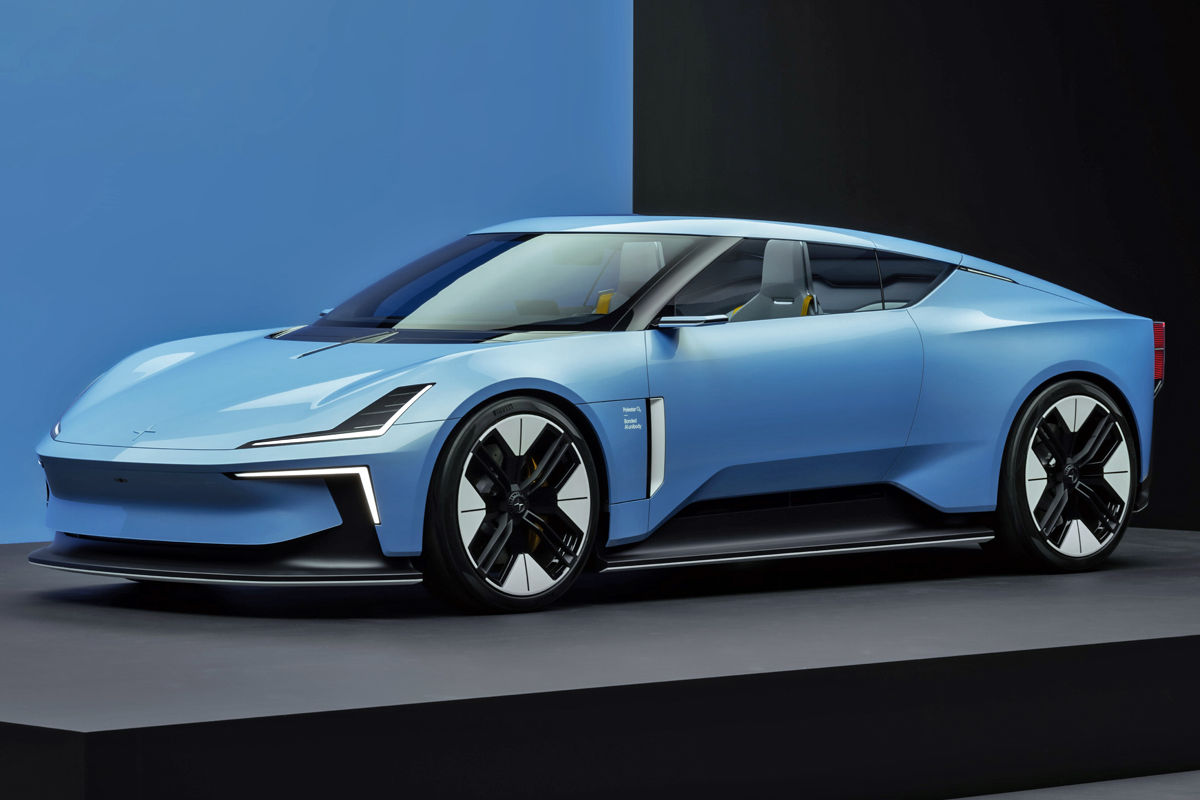
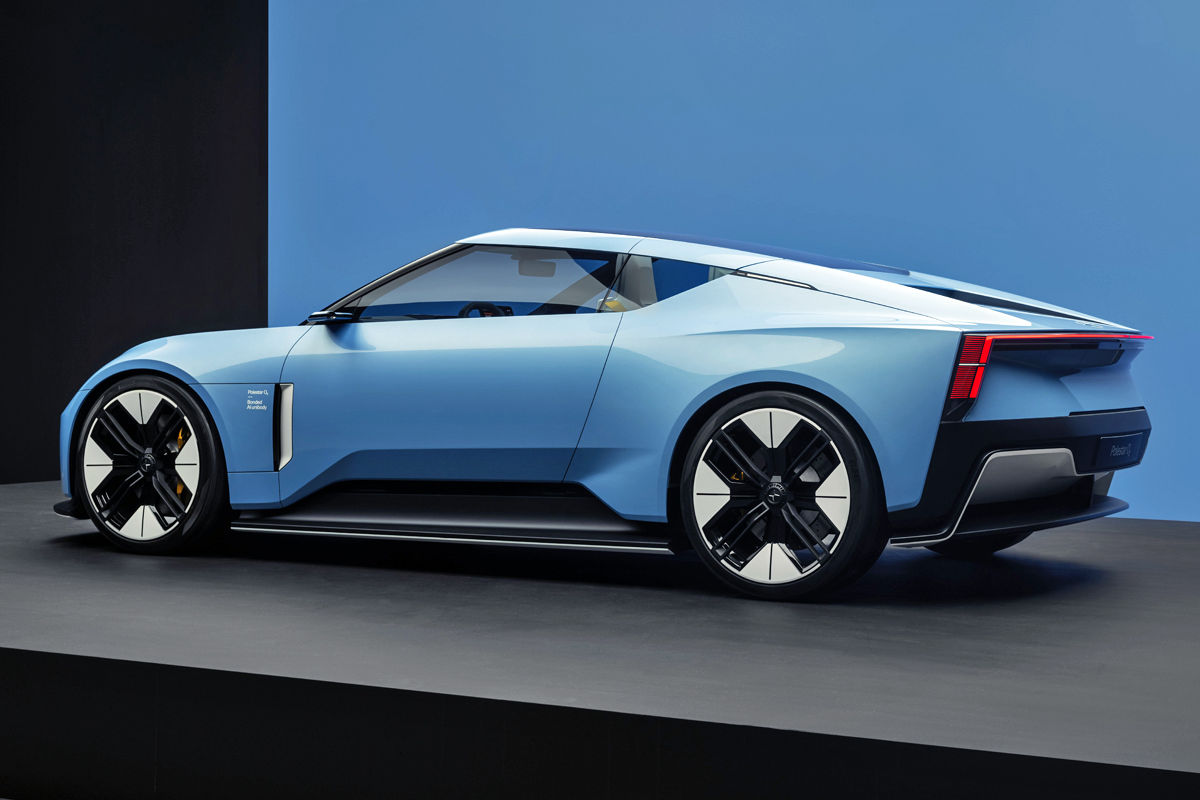
It’s Official! Polestar 6 Roadster to go into Production
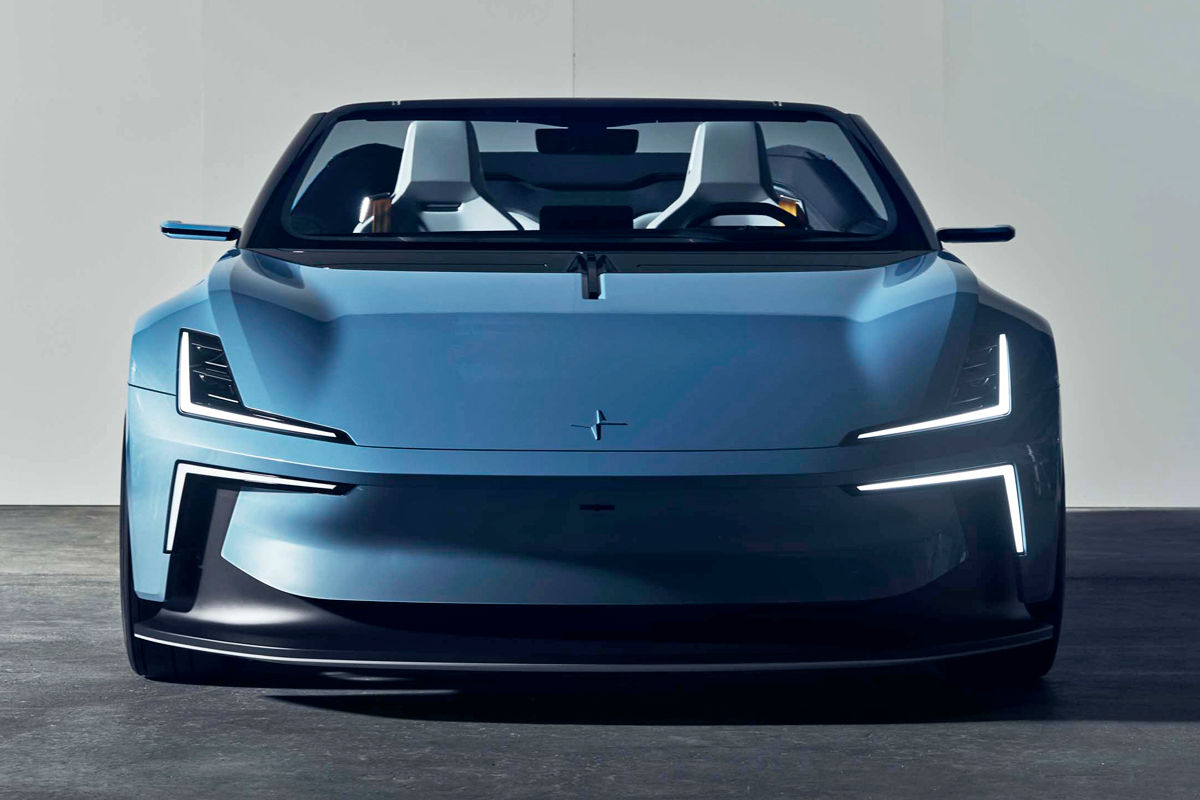
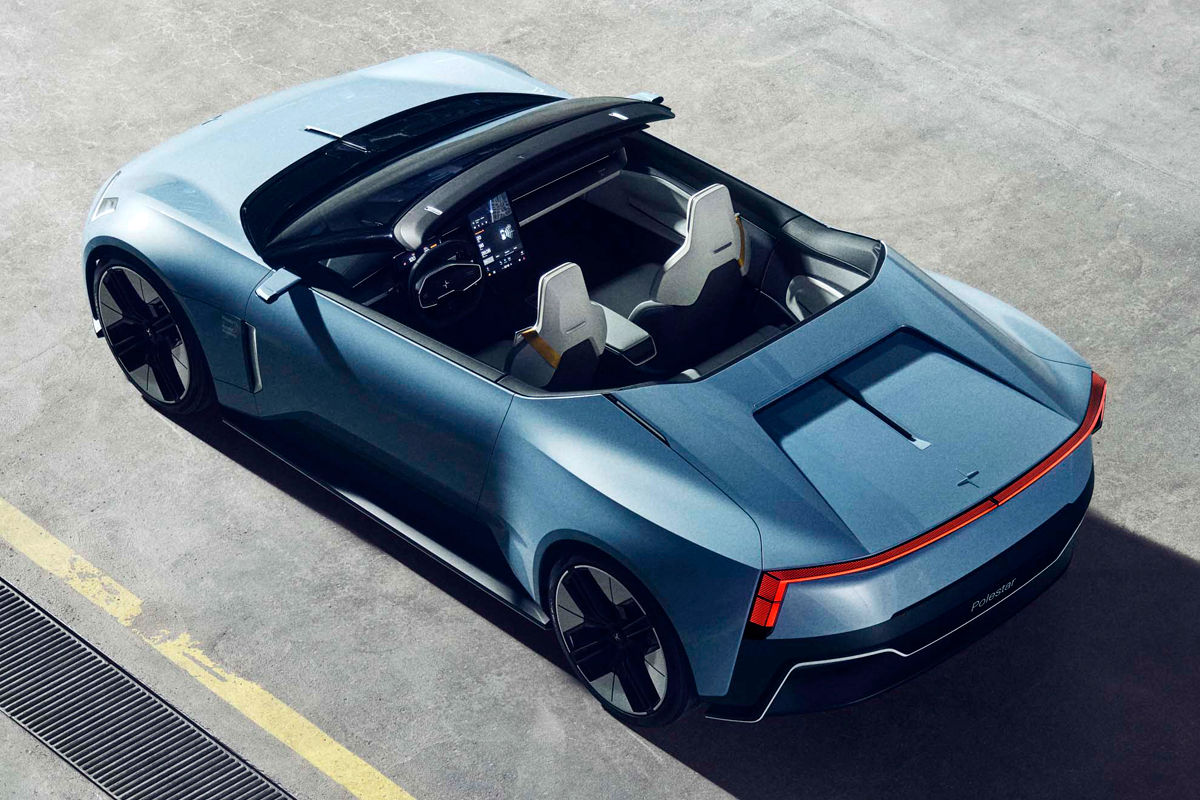
Polestar’s second concept vehicle, a jaw-dropping show car the firm bills as its “vision of open-top performance”, will go into production as the Polestar 6. Let’s take a closer look…
UPDATE: Polestar has confirmed plans to put its O2 electric roadster concept into production, badged as the Polestar 6 and scheduled for launch in 2026. The Swedish firm says interested customers in “all active Polestar markets” are already able to reserve a build slot online.
“With the overwhelming consumer and press response, we took the decision to put this stunning roadster into production and I am so excited to make it a reality. Polestar 6 is a perfect combination of powerful electric performance and the thrill of fresh air with the top down,” said Thomas Ingenlath, Polestar CEO.
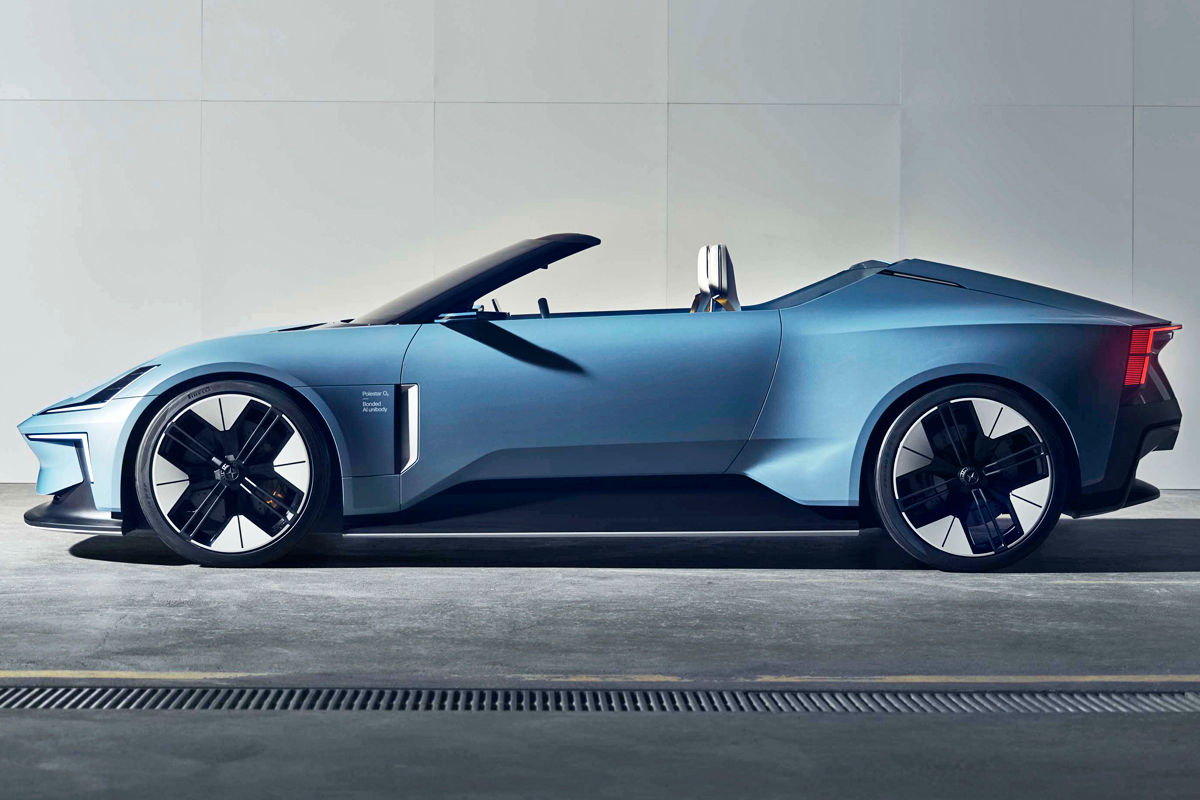
The production version of the hard-top convertible will be built on Polestar’s bespoke bonded aluminium platform and will feature the 800-volt electric architecture already confirmed for Polestar 5. This includes outputs of “up to 650 kW and 900 Nm” from a dual-motor powertrain, with a “targeted” 0-100 kph time of 3.2 seconds and a top speed of 250 km/h.
The reveal of the Polestar O2 concept
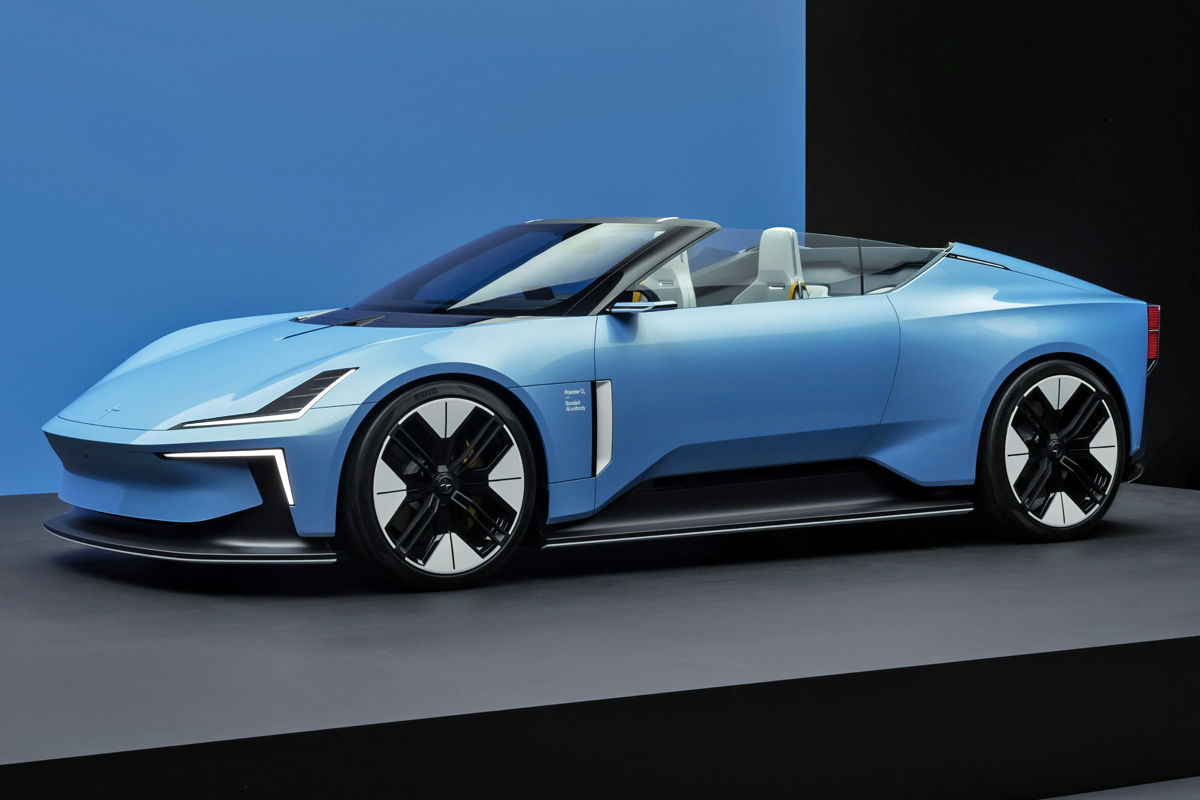
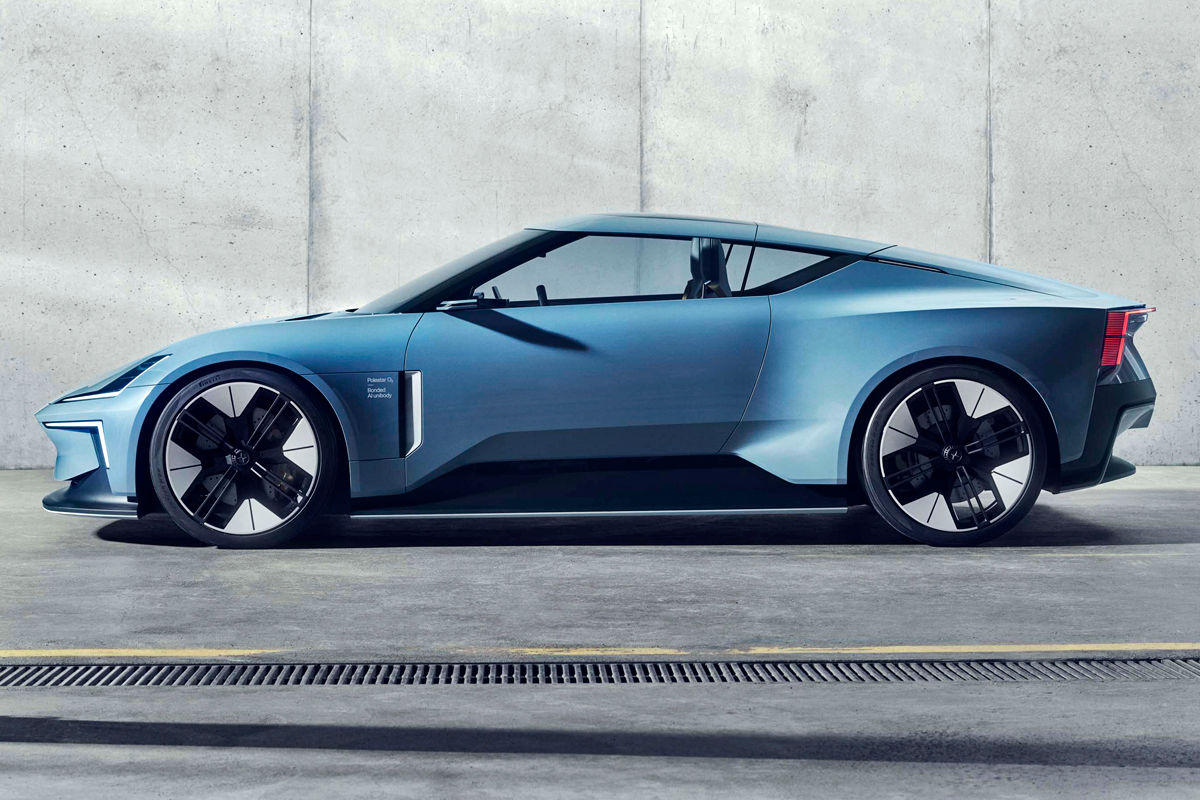
Think the world needs a beautiful battery-powered roadster? Well, you’re in luck. Meet the new Polestar O2 concept, an all-electric, hard-top convertible the company claims will “redefine sports roadsters for the electric age”.
It’s the second concept car from Polestar – a brand founded by Volvo Cars and Geely Holding in 2017 as a standalone Swedish premium electric vehicle automaker – with the first having been unwrapped in 2020.
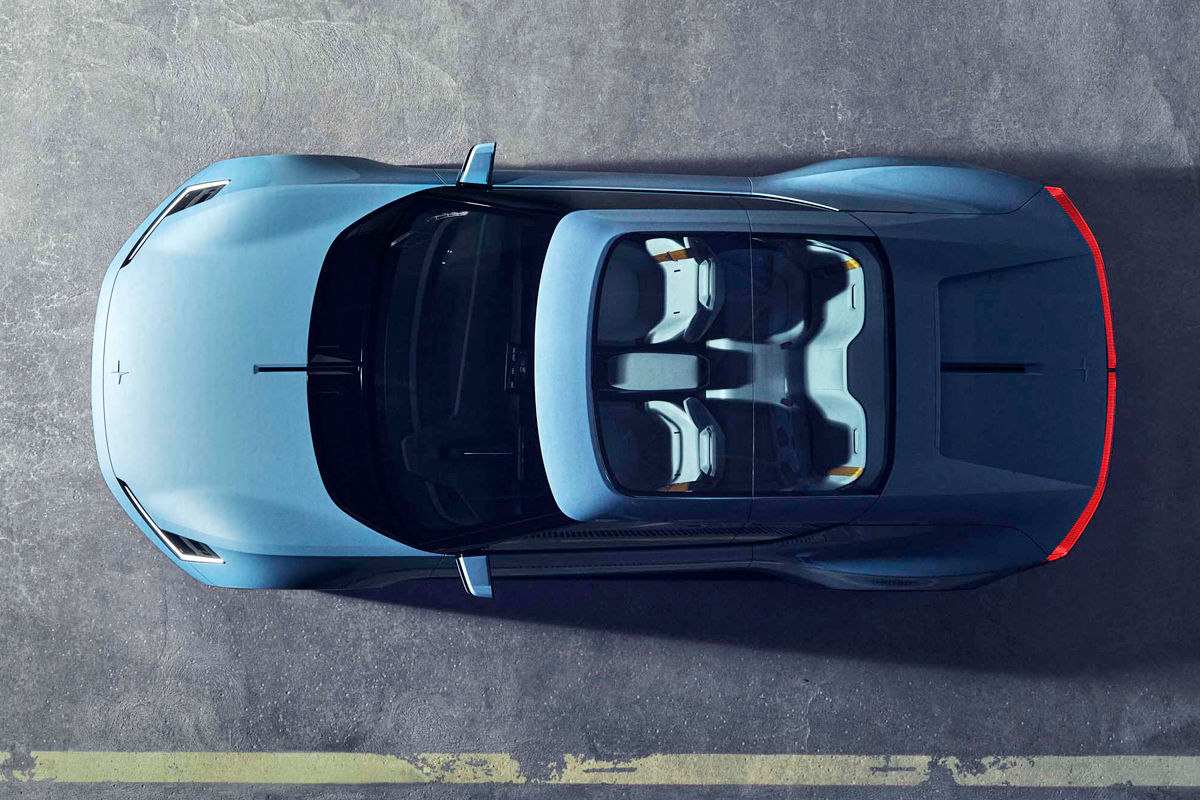
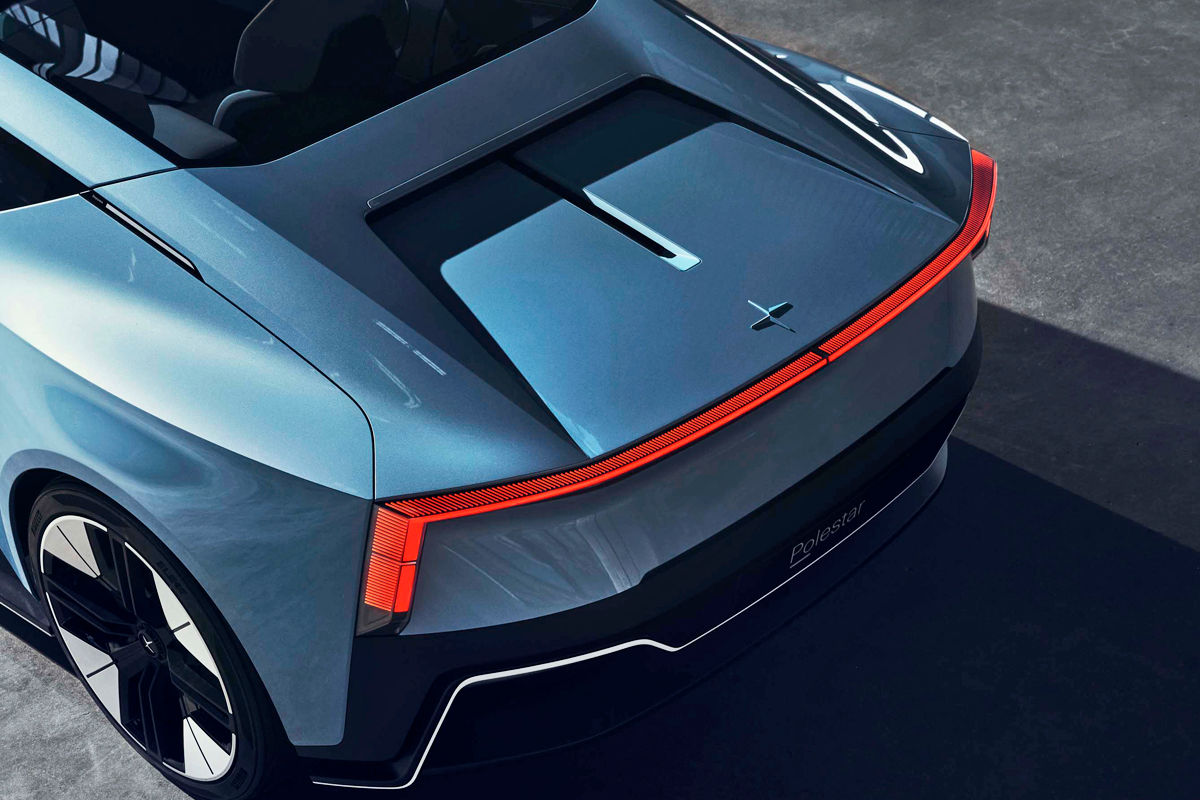
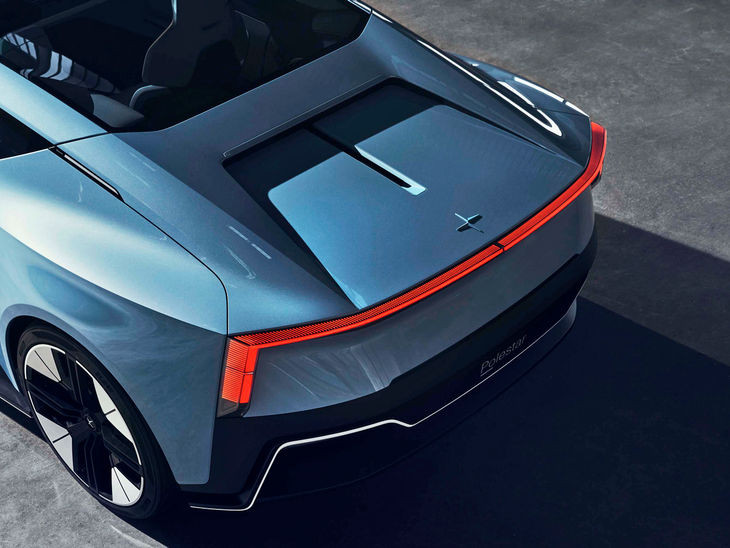
The Polestar O2 is clearly closely related to its Precept forebear, though certainly bears its own distinct visual character. Housing a compact 2+2 cabin, the body is low and wide with minimal overhangs and a lengthy wheelbase, lending it classic sports car proportions.
The Swedish automaker says it manipulated the concept’s aerodynamics in a bid to maximise range, employing design features such integrated ducts to improve air flow over the wheels, and rear lights that function as air blades to reduce turbulence at the rear of the vehicle.
While Polestar has opted not to release details about the concept’s all-electric powertrain, it does say the O2 concept rides on a bespoke bonded aluminium platform that was adapted from the upcoming Polestar 5. The result, according to the company, is a “lively” driving experience that mixes “playfulness” and “tight body control”.
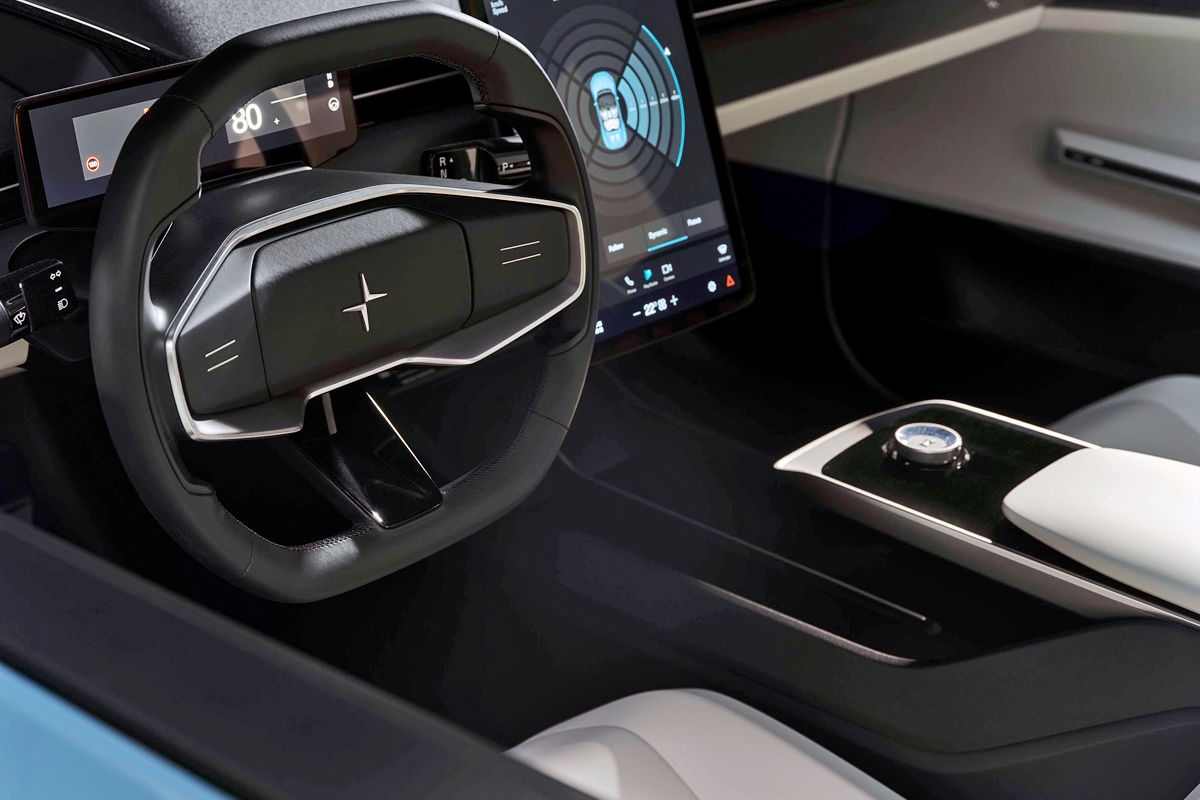
Inside, you’ll find a new thermoplastic mono-material and plenty of recycled polyester, all in the name of sustainability. Furthermore, the concept features an autonomous cinematic drone integrated behind the rear seats. The idea, according to Polestar, is to deploy said drone while the vehicle is moving (it’ll automatically follow the car at speeds up to 90 kph), allowing the user to record the “perfect driving sequence”.
“Polestar O2 is the hero car for our brand. It opens the door to our secret chamber of future potential. This is a taste of what we can design and engineer with the talent and technology we have in-house. It looks incredible, and being able to lower the roof and not hear an engine promises a superb sensation,” said Thomas Ingenlath, Polestar CEO.
The Gothenburg-based automaker has thus far produced two electric performance cars, though neither has made it to South African shores. The Polestar 1 hybrid was built between 2019 and 2021 as a low-volume GT with a carbon-fibre body, before the Polestar 2 all-electric fastback went into production.
Polestar says it plans to launch one new electric vehicle every year for the next three years, starting with the Polestar 3 all-electric SUV in 2022. The Polestar 4 is expected to follow in 2023, billed as a smaller electric performance SUV coupé. In 2024, we can expect to see the Polestar 5 electric performance 4-door GT, which will effectively be the production version of the Polestar Precept concept.