Solid-state batteries and OTA maintenance are the promises for the Renault/Nissan/Mitsubishi Alliance.
The Nissan-Renault-Mitsubishi Alliance has announced terrifically ambitious plans for its future electric vehicle portfolio.
Despite Nissan being in terrible shape financially, the Alliance believes it possesses the scale and diversity of engineering resources to confidently launch no fewer than 35 new EVs by 2035. As a caveat, this number includes a lot of duplication between the three Alliance partners, thanks to platform sharing.
And platforms are a central theme of the latest Alliance announcement. Recognising that ICE platform electrification is costly and compromised, the Alliance will create five new dedicated EV platforms to support 90% of all future Nissan-Renault-Mitsubishi electric vehicle models. And the other 10%? Well, those could be the future EV bakkies from Nissan and Mitsubishi, which will require a different engineering approach and unique platform.
For Renault, the presence of five electric vehicle architectures is sensible. It has a negligible commercial vehicle and large SUV presence. But for Nissan and Mitsubishi, where business is very much bakkies and large SUVs, the dividend on any Alliance EV development might be less beneficial.
The investments required are significant, with the Alliance pledging R390bn in the next five years to establish its vision for the 2030 project deadline of 35 new EVs.
Among the technical details of the Alliance’s 2030 plan is a solid-state battery of its own, by 2028. Solid-state batteries have been the impossible goal for manufacturers who wish to transition their ICE models power, range and fast turnaround time, to EVs. Many promises but very few deliverables. Despite this, the Alliance is confident of creating and producing its own – at a large scale.
The fundamental benefits of a solid-state battery, compared to current lithium-ion, will be a doubling of energy density, with charging times reduced by two-thirds.
An interesting detail of the Alliance announcement concerns data, with a Google ecosystem scheduled to become standardised throughout Renault, Nissan and Mitsubishi products in future. The Alliance is also working in its own electrical and electronic architecture IP, which should make it less reliant on suppliers and less exposed to technology leaps. Lifecycle over-the-air serviceable vehicles are due to become part of the Alliance product offering by 2025.
For South African followers of Nissan and Mitsubishi, the question will be how all these Alliance technology roadmaps, route around Navara and Triton.
There might not be that many models in the bakkie-based SUV segment, but it shifts significant volume, largely due to the ongoing – and staggering – success of the Toyota Fortuner. Armed with its handsome 2nd-generation MU-X, Isuzu wants a much bigger slice of that pie…
We like: Spaciousness and practicality, build quality, much-improved on-road behaviour, safety features, off-road ability
We don’t like: Pricey at flagship level, given that it lacks some luxury features. The engine could do with a bit more grunt.
Fast Facts
Model: Isuzu MU-X 3.0TD Onyx 4×4
Price: R860 500 (January 2022)
Engine: 3.0-litre 4-cylinder turbodiesel
Power/Torque: 140 kW/450 Nm
Transmission: 6-speed automatic
Fuel consumption: 7.6 L/100 km (claimed)
Load capacity: n/a (not stated by the manufacturer)
The new Isuzu platform has been much anticipated as the brand only seems to release a new one every decade or so.
Even though Isuzu’s outgoing MU-X was relatively long in the tooth compared with most of its rivals by the time its replacement arrived last year, the 1st-gen model still sold remarkably well up to the point that it was replaced. This was a testament to the fact that the Isuzu brand is very highly regarded (and trusted) in the South African market. Of course, Isuzu has been very consistent with its bakkie offering in this market, but less so when it comes to SUVs… Though it arguably created the modern-day bakkie-based segment back in the ‘90s with the KB-based Frontier, there was no follow-up, which allowed Toyota to steal the march and introduce the Fortuner in 2006, which has gone on to not only dominate the Leisure SUV segment, but become one of the most popular vehicles in South Africa, full stop.
In Australia, Isuzu is the market leader in terms of bakkie-based (D-segment) SUVs and, with the new MU-X, Isuzu South Africa will be hoping for far better sales than what it achieved with its late-to-the-local-market predecessor. Bigger, bolder, more tech-laden and equipped with advanced safety features, could the MU-X trounce the Ford Everest, Mitsubishi Pajero Sport and even the Fortuner?
How does the Isuzu MU-X fare in terms of…
Design & Packaging
The interior feels more luxurious and the infotainment system represents a more modern tech upgrade.
We had the pleasure of spending the Festive Season with the new Isuzu MU-X on the Cape Garden Route and in the surrounding areas – an area where Isuzu bakkies are apparently very popular, at least based on the sheer number of them we saw on the roads at the time. Consequently, Isuzu diehards frequently plucked up the courage to approach us and ask questions about the MU-X. Interest in Isuzu’s new 7-seat SUV from the brand’s current customer base certainly appears to be at a high. And, without fail, they were bowled over by the newcomer’s looks and its cabin execution, in particular.
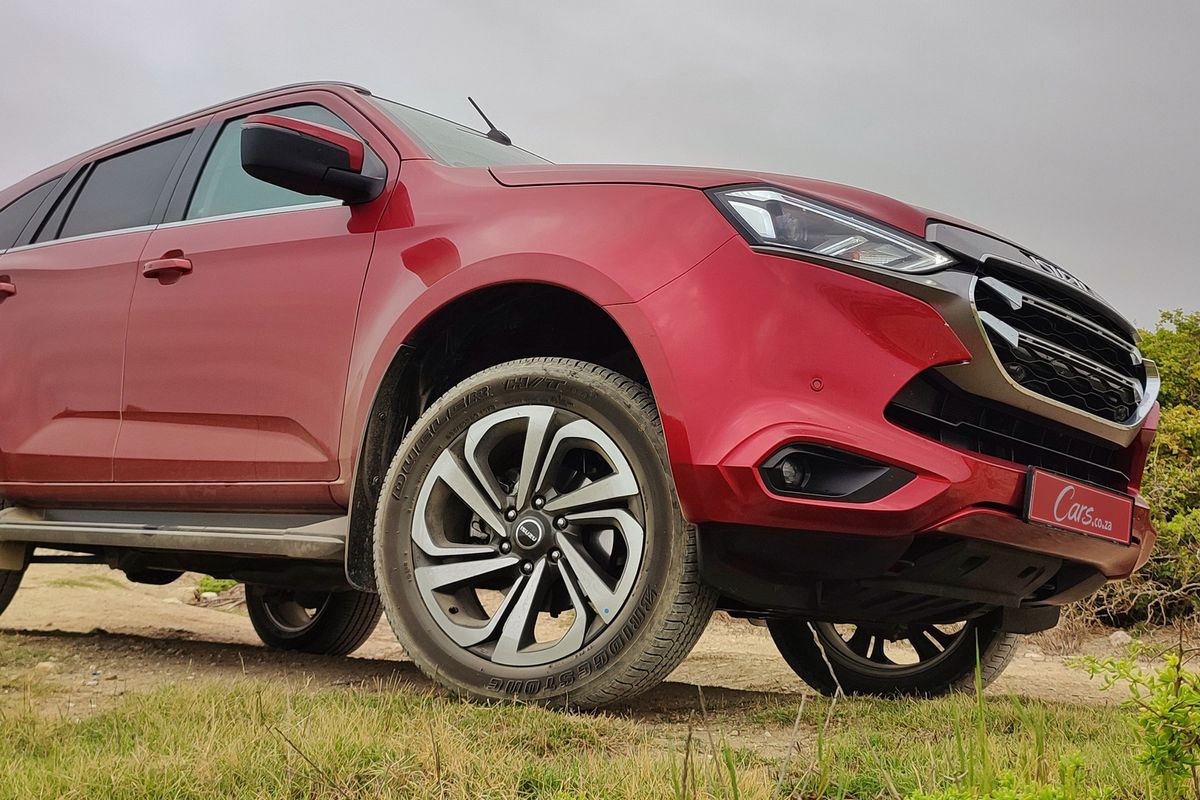
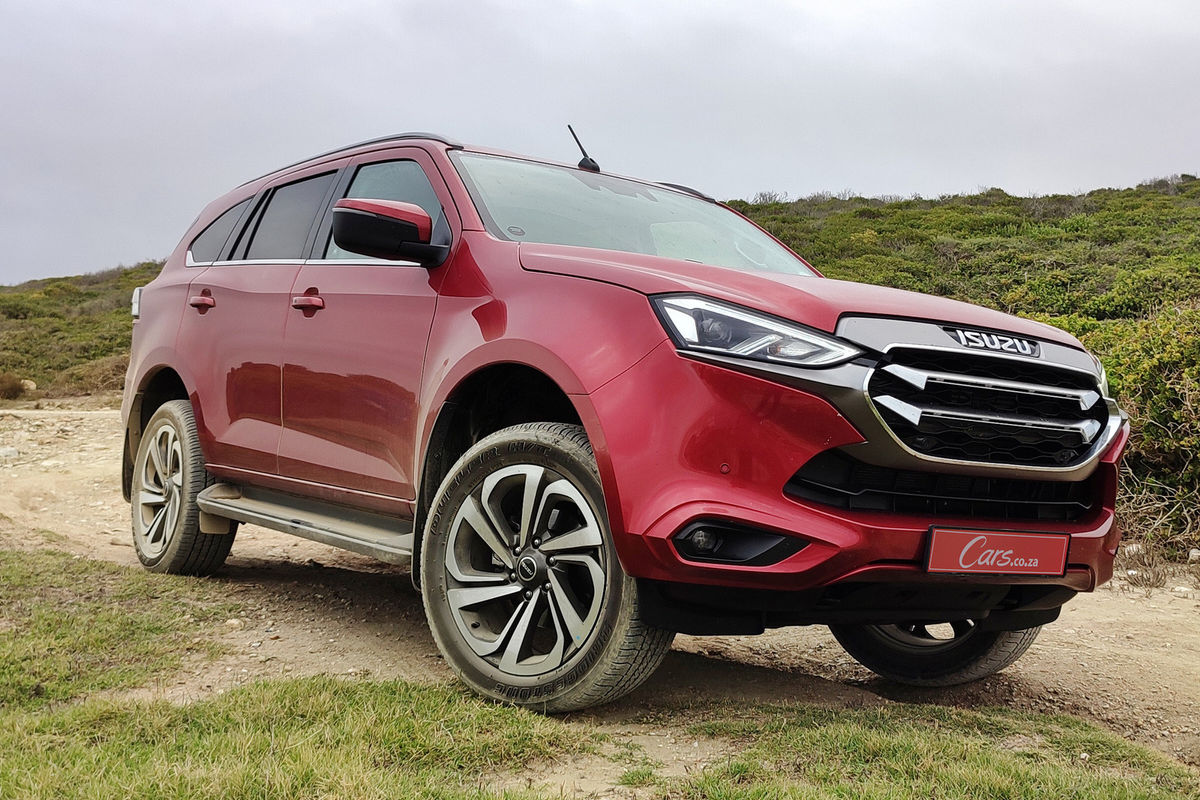
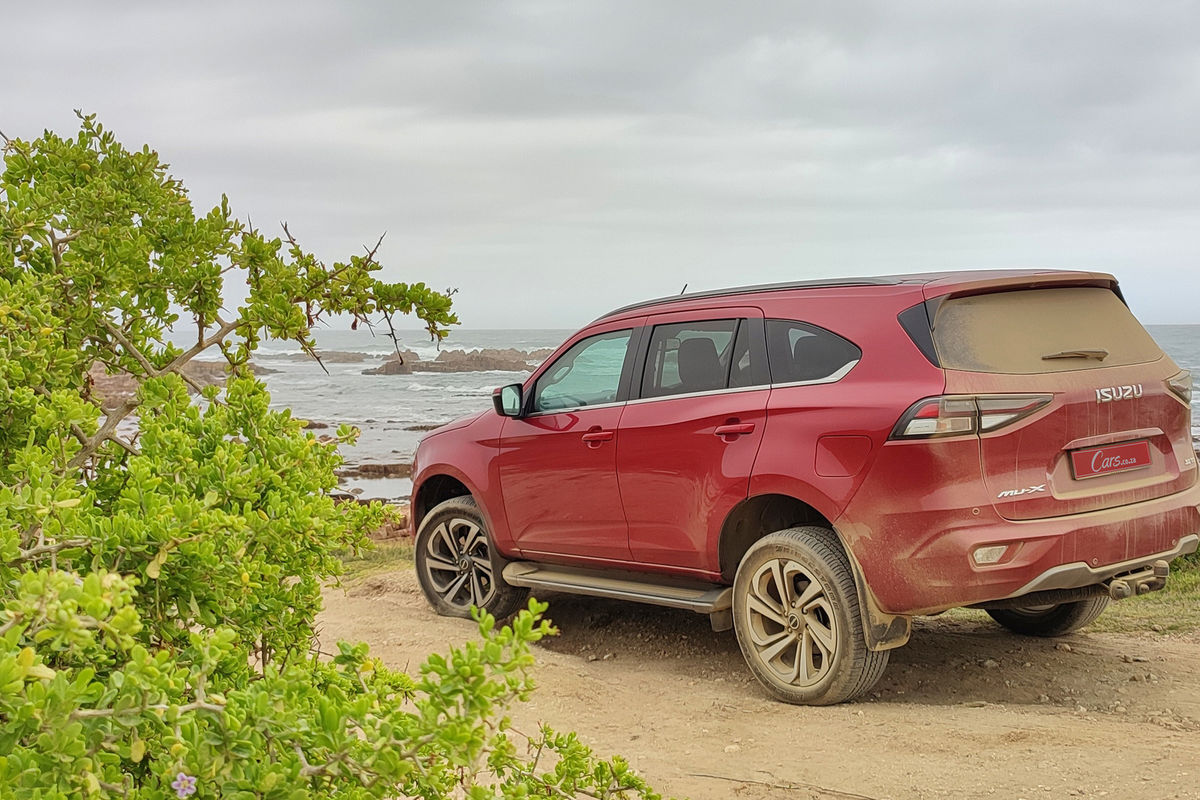
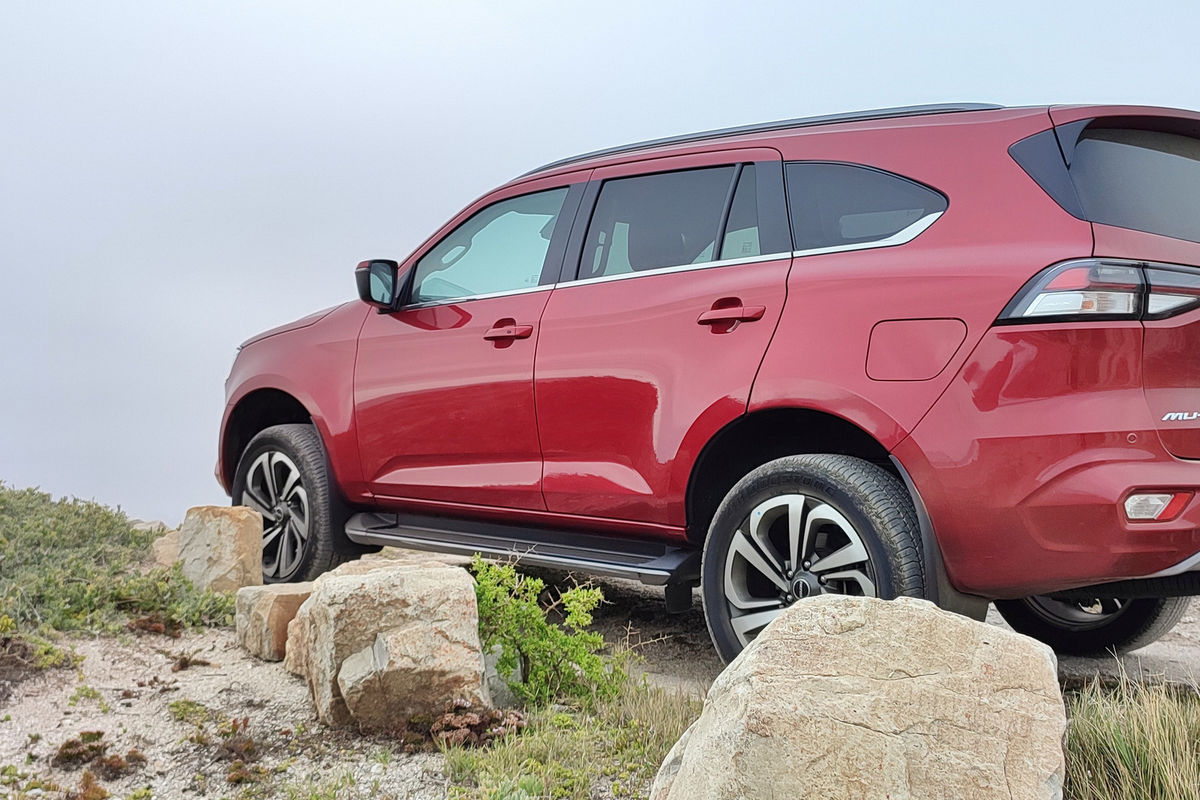
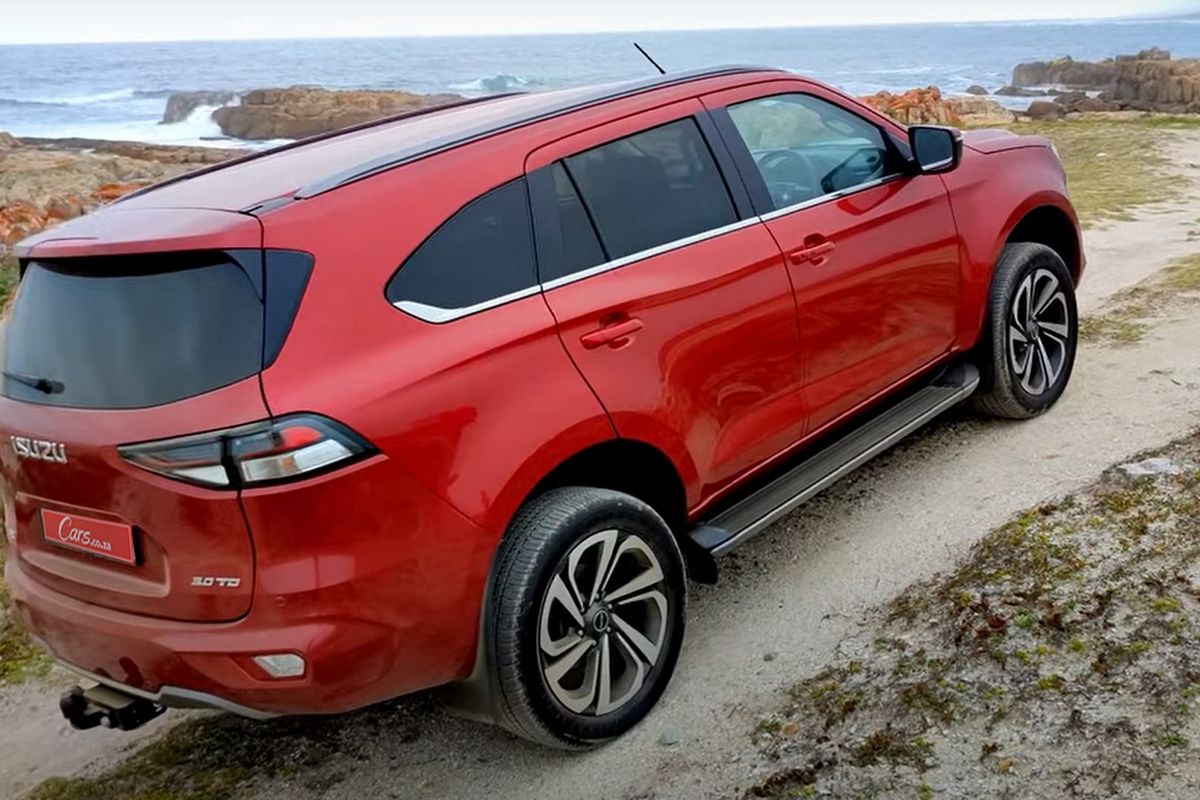
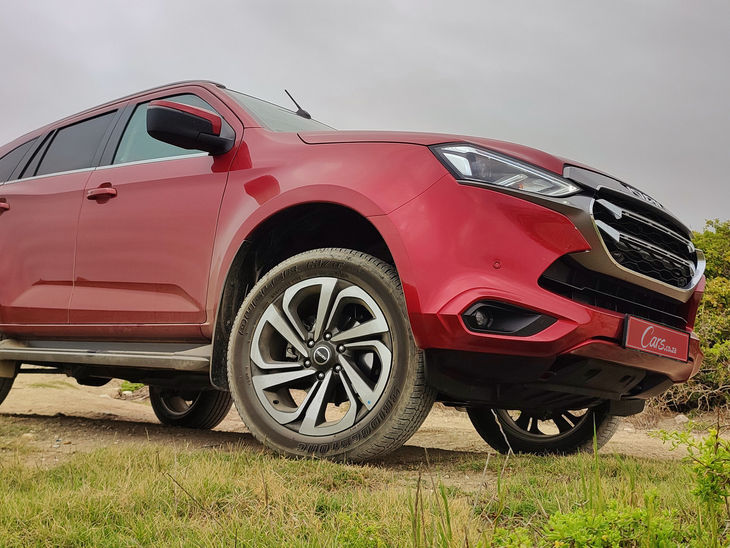
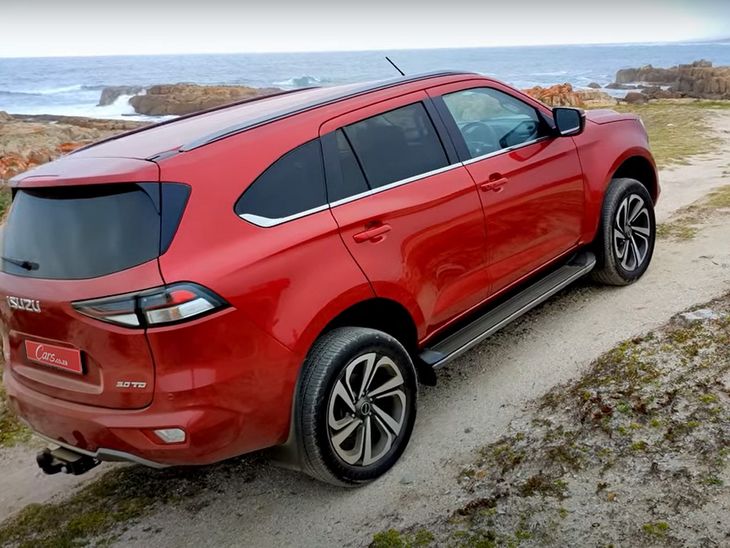
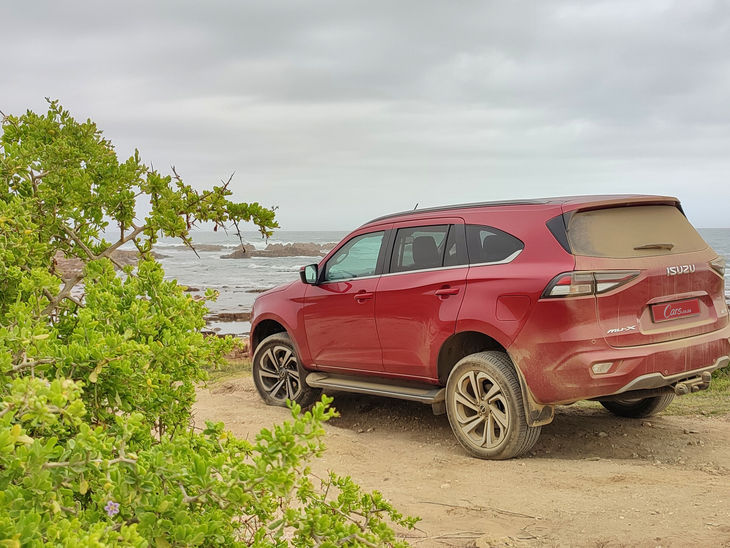
This test unit that was made available to us was the flagship Onyx derivative and, therefore, it looked extra smart with its large dual-tone 20-inch alloy wheels, but, to be fair, all of the new MU-X derivatives are attractive. The grille is bold and the headlamps feature striking LED detailing. Along the side, there is a nice “kick” in the waistline around the rear door handle area and at the rear end, the narrower tail lamps (also with LED details) represent a big improvement from the somewhat generic posterior its predecessor had. The Red Spinel colour of our test unit also drew many favourable comments.
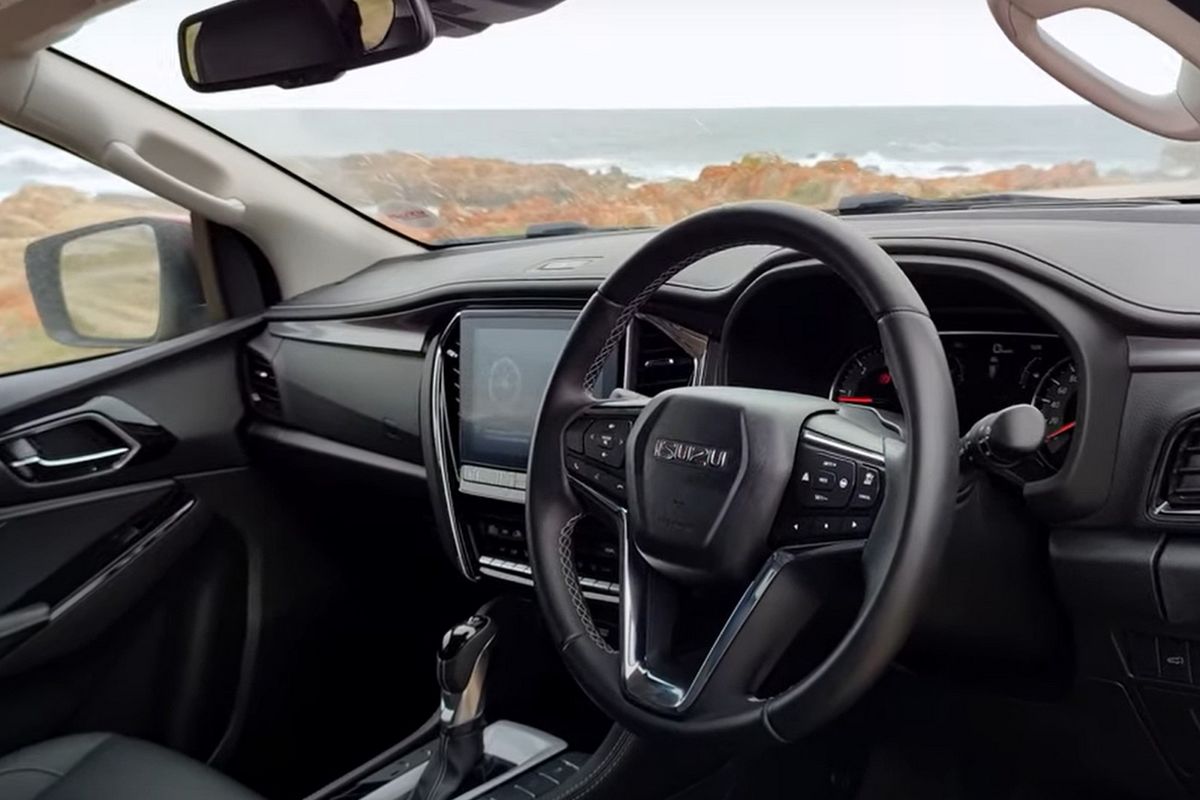
Though Isuzu upgraded the previous MU-X late in its model lifecycle, it could never quite shake its utilitarian roots and, when the Japanese marque eventually added a bigger infotainment screen, for example, it looked a bit like an afterthought. There are no such qualms with the new MU-X, however – its cabin has moved significantly upmarket in terms of design, features and material quality.
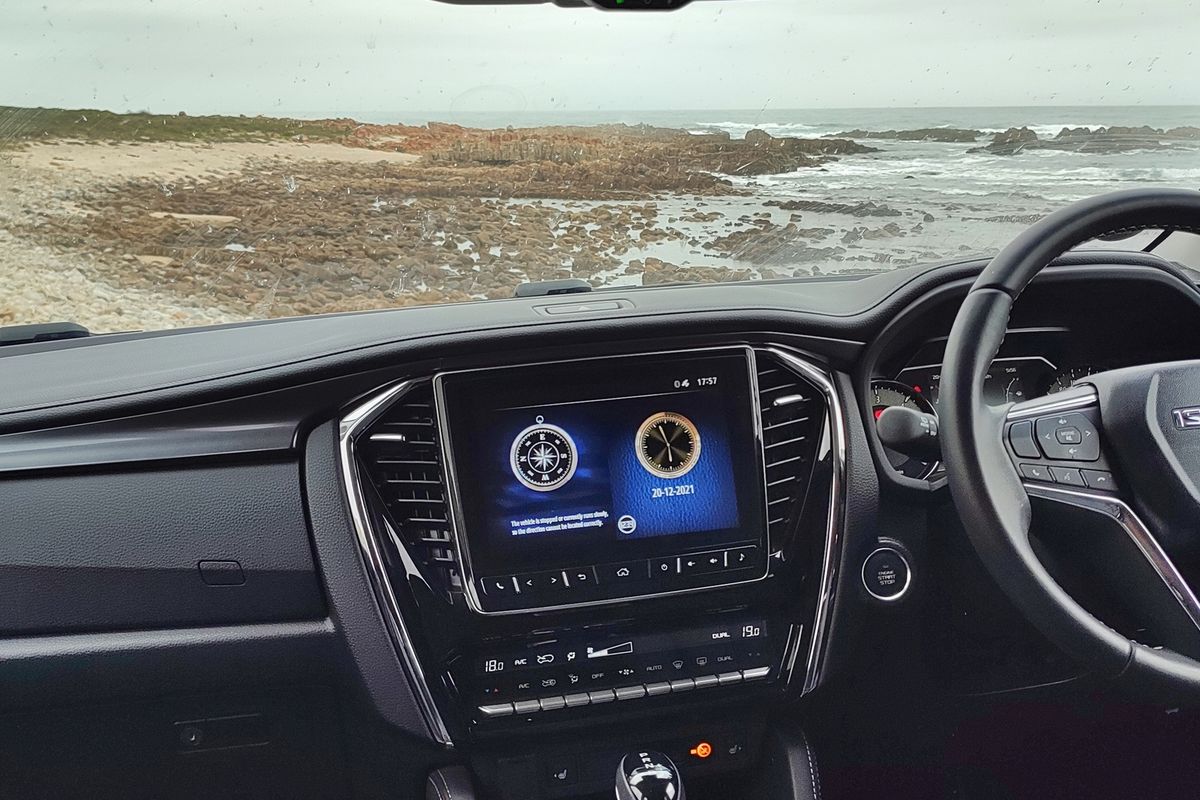
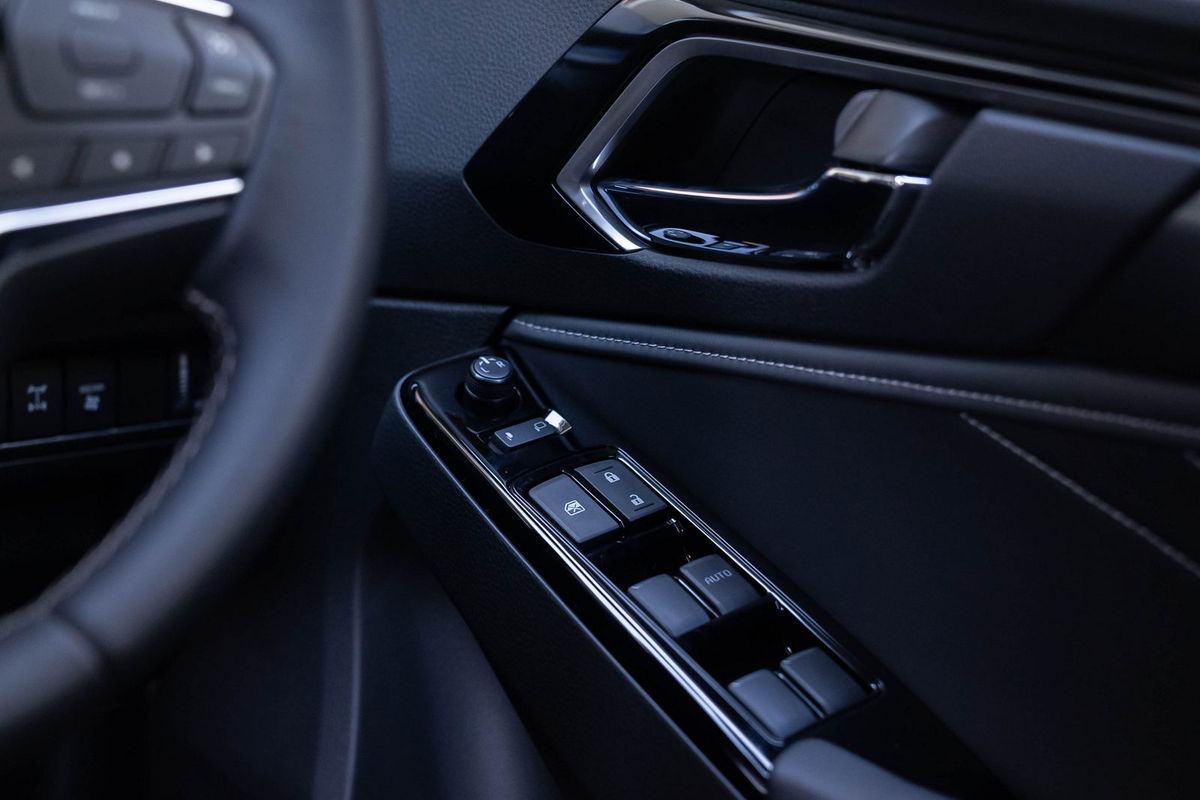
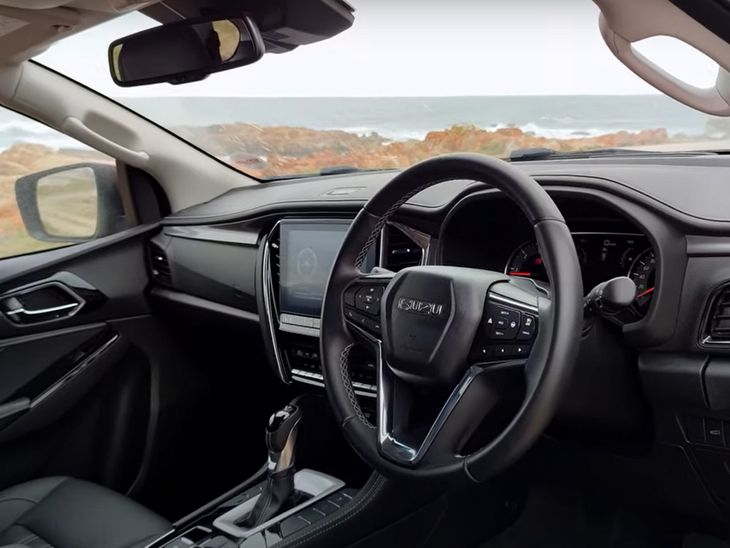
The design is far more coherent than before, with the large (9-inch) infotainment screen neatly integrated into the centre of the fascia. With a lovely stitched-leather dashboard upper covering, soft-touch materials just about everywhere, as well as piano-black surfaces and chrome detailing, the MU-X’s cabin looks and feels more like that of a luxury vehicle than an off-road-oriented “workhorse”. That’s not to say it’s become soft (see the off-roading comments below), but throughout the near 2 000-km we travelled with the vehicle (much of it on gravel), there wasn’t a single rattle or a squeak to be heard.
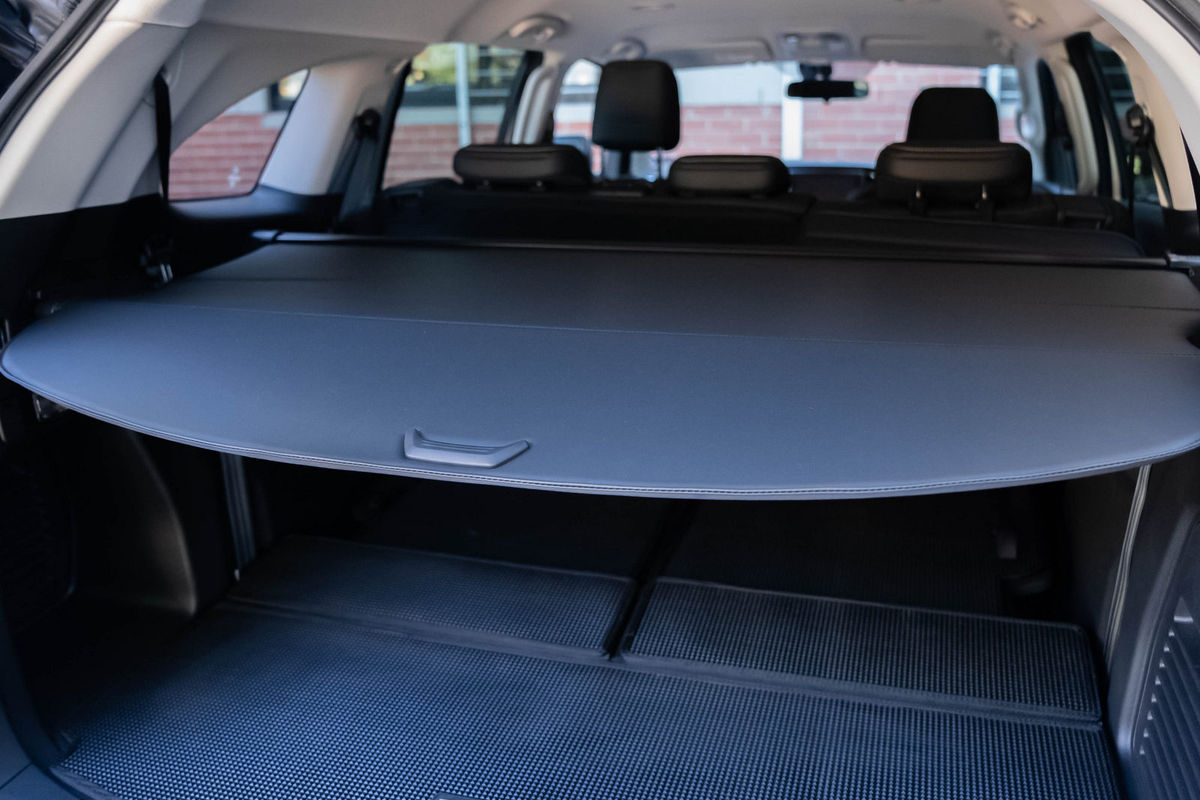
Isuzu claims the new MU-X has the largest cabin in its segment, but the firm hasn’t released volumetric figures. Based on our experience with this vehicle, its predecessor and several of their rivals, we would suggest that the newcomer is certainly “one of the biggest” in terms of interior space. The only figures Isuzu has released suggest there is 915 mm of legroom for 2nd-row occupants and that the 2nd-row seats are 30 mm wider than those of its predecessor. Perhaps more impressively, an adult of 1.8 metres in height can sit in the third row, which is quite a rare achievement in a 7-seater SUV – of any variety and price. Of course, the load-bay capacity is extremely limited when all seats are occupied, but there is a hidden compartment in the boot floor that can be used to store smaller items out of sight.
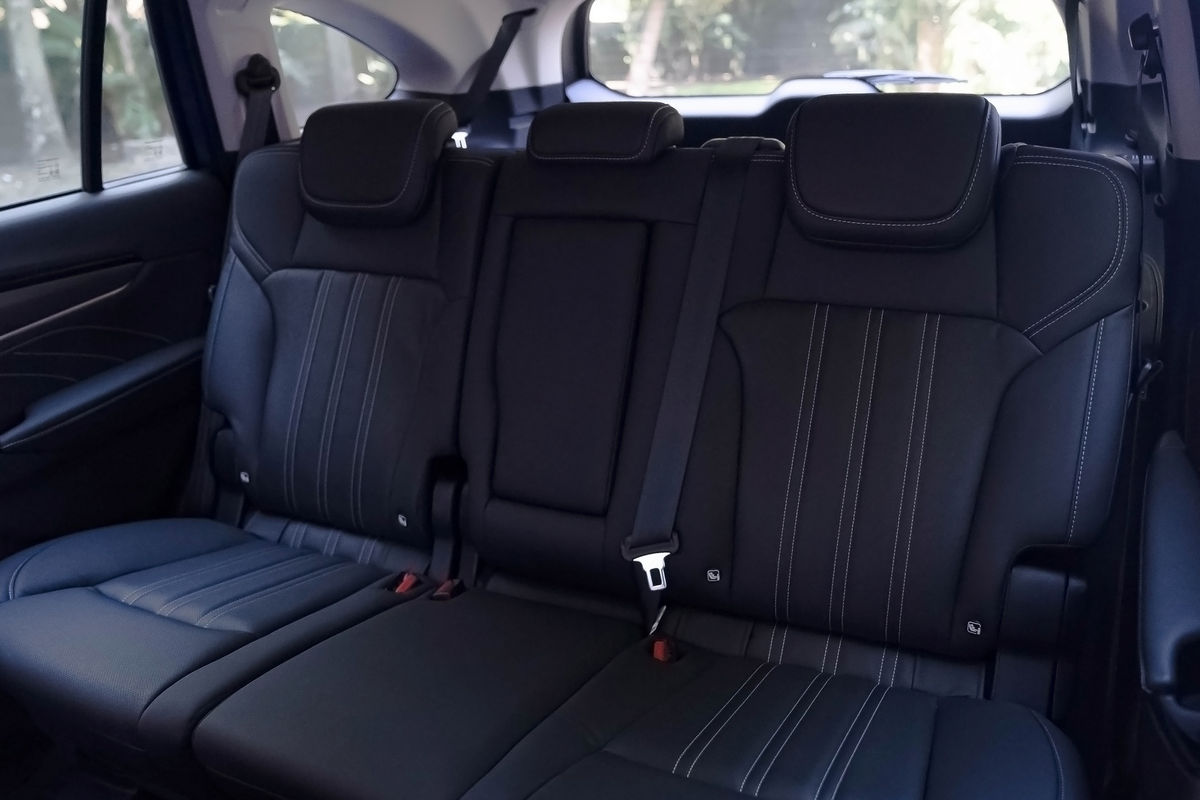
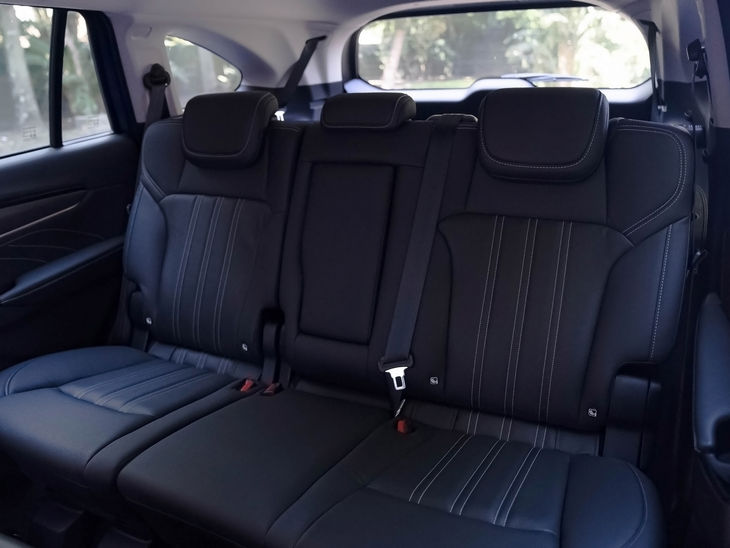
Access to the third row is easy – all you need to do is lift a lever to tumble the second row forward – and, if you want maximum load-carrying ability – the second and third rows fold completely flat, resulting in a long, uninterrupted space that’s ideal for carrying bulky/long items such as furniture.
Performance & Efficiency
Much has been made of the new Isuzu engine, it’s still quite rumbly but delivers better power/torque and fuel gains.
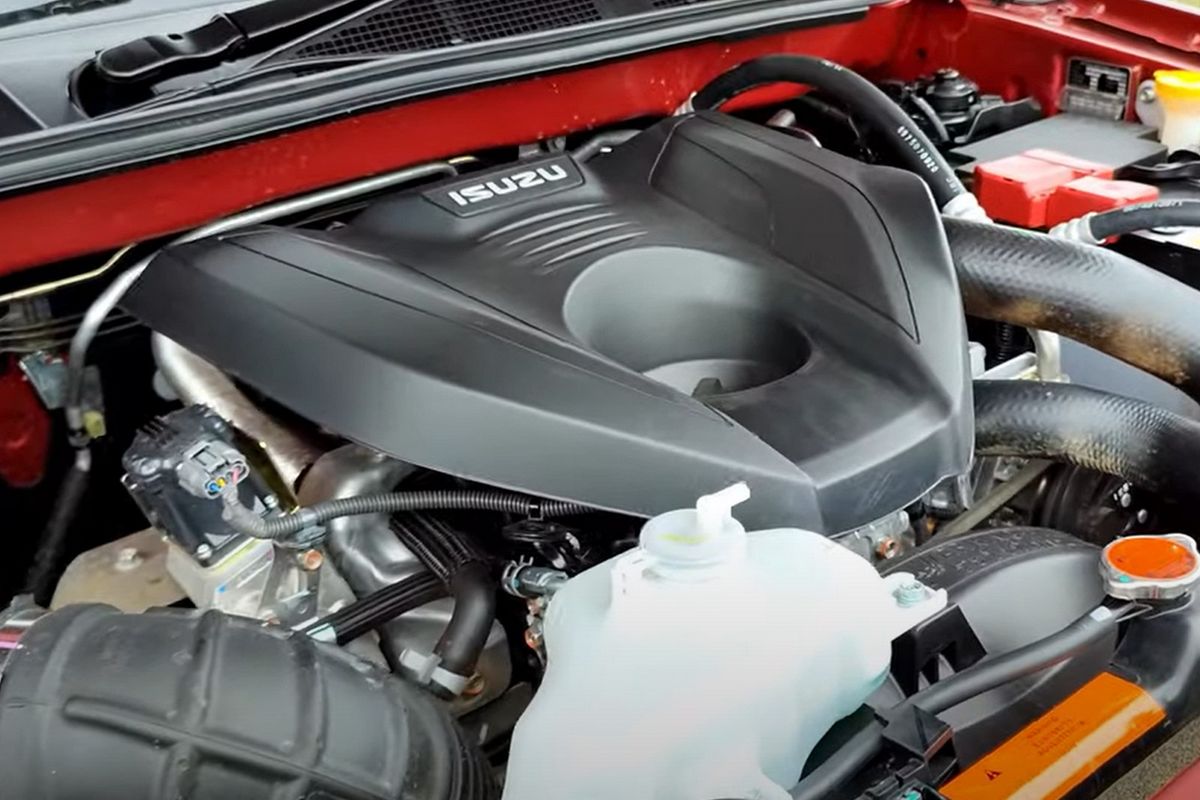
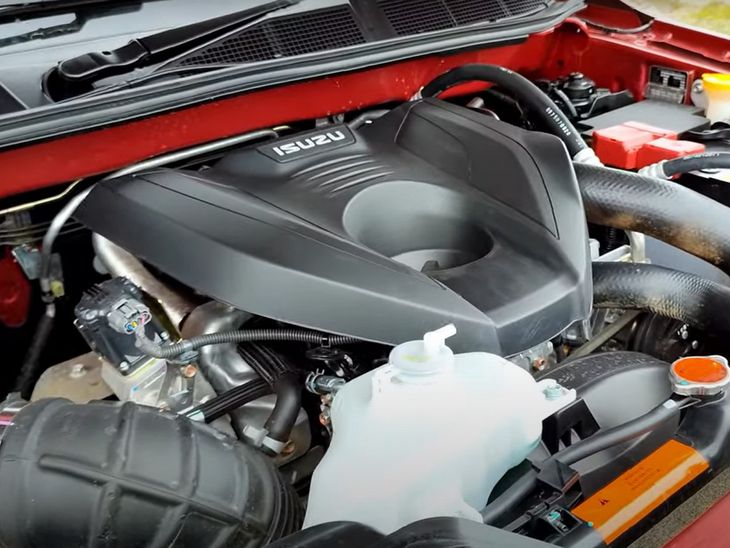
All MU-X derivatives are powered by Isuzu’s “new” 4JJ3 3.0-litre 4-cylinder turbodiesel engine. Just how new the engine is, however, is a matter of some debate, seeing as Isuzu South Africa refers to it as a “new version” rather than an all-new powerplant. From what we can figure out, however, everything is new, except for the conrods, well, supposedly. Power and torque figures have risen to 140 kW and 450 Nm respectively, which represent modest gains compared with the vehicle’s predecessor, which also had a 3.0-litre engine. With more than 4 million kilometres of durability testing completed, there is no reason why this, seemingly unstressed engine should not be able to continue the legacy of reliability that the Isuzu brand has built during the past few decades.
It is worth noting, however, that the Isuzu’s outputs are still lower than those of the 2.8-litre turbodiesel motor in the Fortuner as well as those delivered by the 2.0-litre bi-turbodiesel in the Ford Everest. Nevertheless, Isuzu claims a class-leading tow-rating for this vehicle (3 500kg braked). In general driving, we’d argue that the “new” engine feels very similar to the old one, particularly in that it has that “rumbly” sound that is so typically Isuzu and it does still feel relatively “lazy” compared with, for example, the Ford, when you suddenly flatten the accelerator pedal. Having said that, our experience with the same powerplant in the new Mazda BT-50, which shares its underpinnings with the new D-Max and MU-X, has shown that the 3.0-litre motor is livelier than it feels; the Mazda has proved surprisingly pacy.
The engine is mated with an Aisin 6-speed automatic transmission that even offers manual shifting via paddles located behind the steering wheel. The transmission is very nicely matched with the engine’s torque-delivery characteristics and, barring the aforementioned scenario (where you make sudden, severe throttle inputs), it generally responds briskly and slickly. We spent a lot of time out on the open road in this vehicle and it never lacked sufficient overtaking acceleration, even when fully laden. It feels more refined than before too, but is that a big enough step forward for the drivetrain, however?
In terms of fuel efficiency, Isuzu claims a class-competitive average fuel consumption figure of 7.6 L/100 km. Usually, one should add roughly 20% to claimed figures to get a more accurate real-world view, which, in this instance, is 9.12 L/100 km. At the end of our test term, we calculated an average of around 9.6 L/100 km, which is fair given the fact that the vehicle was often heavily laden, while surfboards that were strapped to the roof played havoc with the aerodynamics… and that’s in addition to the bicycles that were mounted on a rack at the rear!
Ride & Handling
The top-spec Onyx gets 20-inch wheels but still has excellent cabin insulation and proper off-road ability.
Bakkie-based SUVs are often criticised for their iffy ride and handling characteristics, but this is an area in which the new MU-X has been significantly improved, arguably to the point where it is now a comfortable class leader. Although many South Africans take these vehicles off the beaten track, the reality is that most bakkie-based SUVs will spend most of their lives on tar. The new MU-X is more stiffly sprung than before, but the ride remains really good on the road (despite those big wheels), and it resists body roll far better than its predecessor (and, in particular, the Fortuner). Of course, it’s no “sports” SUV – its centre of gravity remains high, for example – but the improved dynamics and quieter cabin endow the MU-X with a near-premium driving feel on the road… without compromising it off-road.
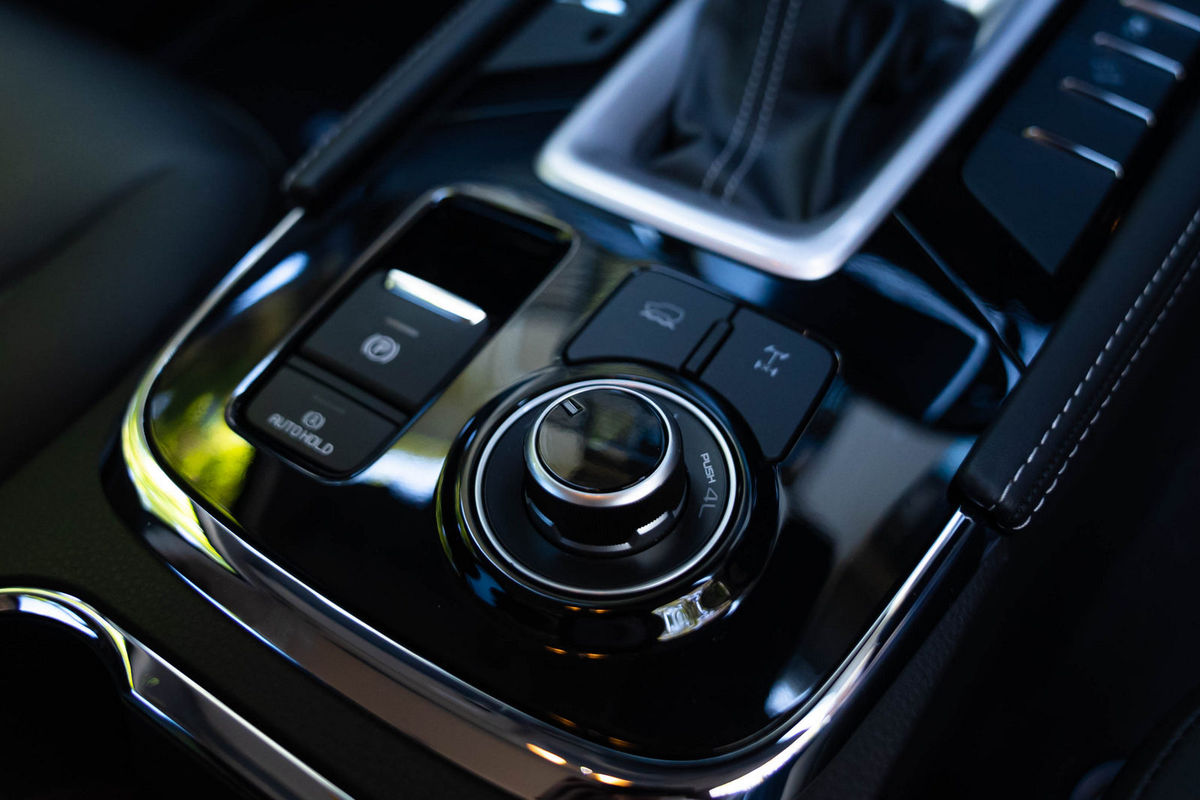
In response to customer demand, Isuzu added a rear diff-lock to the previous-generation MU-X late in its model life, but there’s no omission this time round. The MU-X features the usual rotary selector for high- and low-range 4-wheel drive, a rear diff-lock and a Rough Terrain mode which, when activated, adjusts the Isuzu’s traction control and electronic stability control settings to ensure enhanced traction and handling ability. In general, the newcomer is superb when travelling on gravel, although it does get a bit skittish on heavily corrugated surfaces (perhaps because of the stiffer suspension).
It has generous ground clearance (235 mm) and bests its 2 main rivals (the Fortuner and Everest) in terms of approach and departure angles, albeit only slightly. Owners who will be heading onto the really rough stuff will need to ponder the suitability of the side steps, of course, and should perhaps also exchange the road-biased tyres for chunkier examples, but the MU-X already has underbody protection guards for the sump, transfer case and oil pan as standard. Its wading-depth rating is a class-best-equalling 800 mm.
In our experience, the MU-X is now at least as good, if not better, than its rivals in most off-roading scenarios. The transmission and low-range settings combine to provide excellent control and traction in really tricky situations. It’s a pity that the MU-X doesn’t feature a more advanced camera system, because a 360-degree view (with the ability to zoom in on specific sides/areas) would make placing the big SUV far easier. Given that its asking price is nearing R900k, the top-of-the-range MU-X is an expensive vehicle and one wouldn’t want to needlessly scratch a rim – or that lovely red paint finish…
Comfort & Safety features
The rear seats can fold flat as well as tumble and turn if you require.
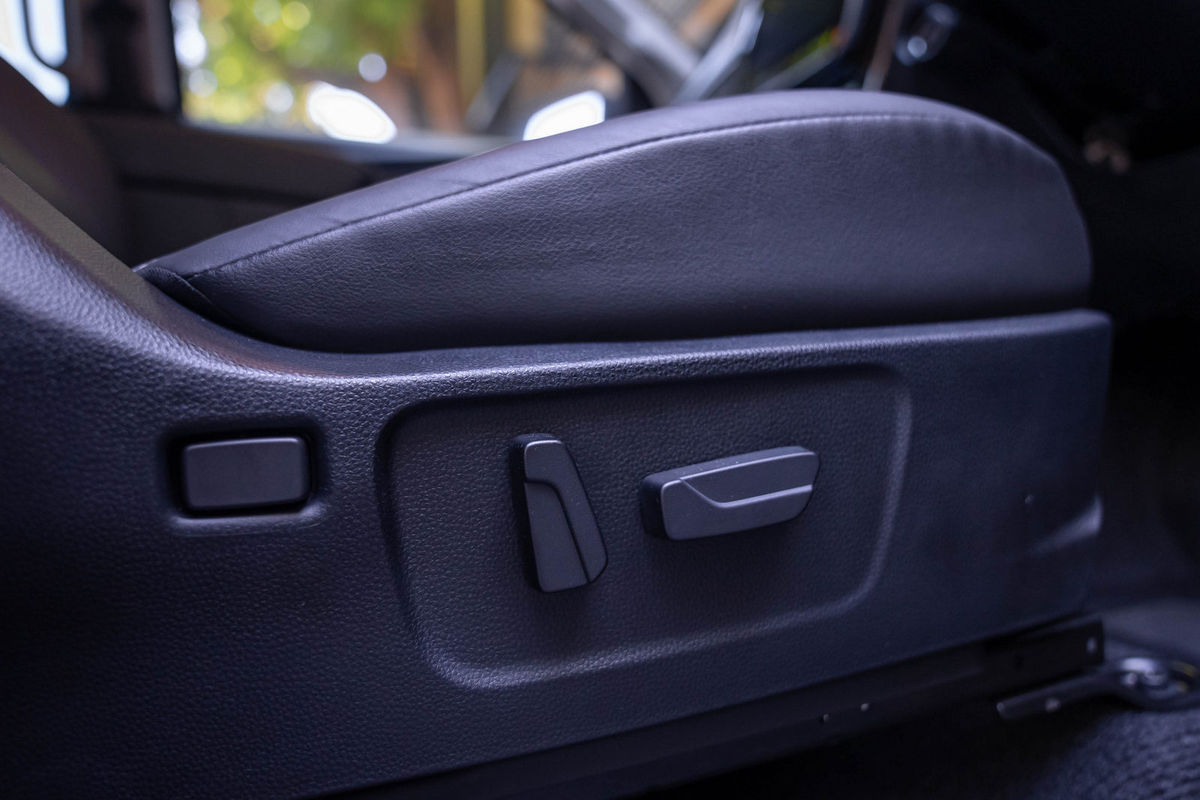
Given the fact that the Onyx is the flagship of the range, one may reasonably expect a full-house of standard features and, for the most part, Isuzu didn’t drop the ball in this regard. You get electric seat adjustment (and heating) for both front chairs (8-way for the driver, 4-way for the passenger), dual-zone climate control (with rear fan-speed control), a rake/reach-adjustable steering column, quality leather upholstery (it feels very smart), a powered tailgate and rear “privacy” windows (tinting).
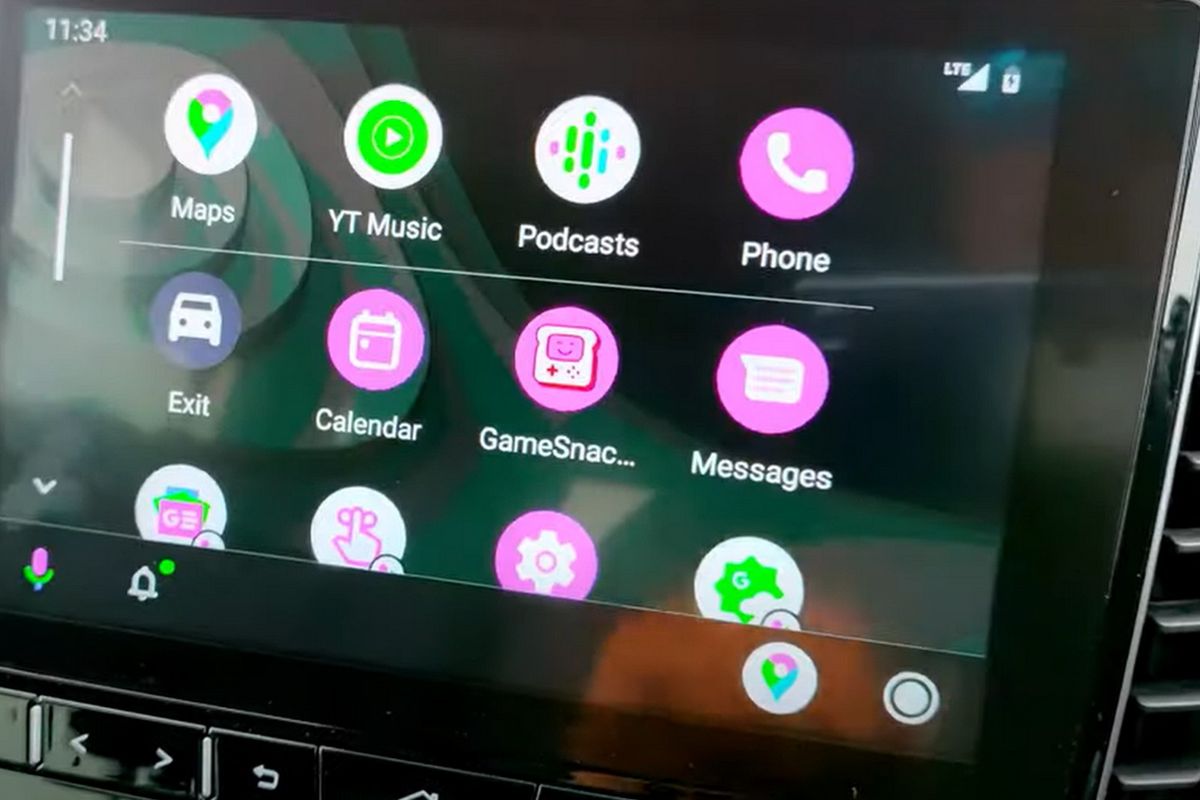
Moving on to infotainment, there is the aforementioned 9-inch screen in the centre of the fascia, which also doubles as the display for the rear-view camera. While the resolution of the screen is good, and it’s easy enough to find your way through its menu system, the reality is that there’s not a heck of a lot going on in there in the first place. Sure, because you have (wireless) Apple Carplay and Android Auto, perhaps you don’t need anything more, but given the vehicle’s flagship status, we think the provision of at least a surround-view camera system would have been a nice touch.
There’s no wireless charging pad, either, with a single USB outlet in the front of the cabin, and another two at the rear (in addition to a very useful 2-point 12V power socket). In front of the driver is a pretty generic mix of analogue and digital instrumentation, with the rev counter and speedometer flanking a smaller digital trip computer (including tyre pressure monitoring).
In terms of standard safety features, however, the MU-X is undoubtedly at the cutting-edge of passive and active safety features in this segment. First, let’s just list the expected features: it gets, inter alia, 7 airbags, ABS with EBD and BAS, stability control, hill-start assist, hill-descent control, ISOfix child-seat anchors, blind-spot monitoring and front and rear park distance control (with rear-view camera).
What’s more, the Onyx avails adaptive cruise control, autonomous emergency braking, forward-collision warning, rear cross-traffic alert, lane-keep assist and lane-departure prevention. Some of these features (particularly the lane-keep assist) can be a mite too intrusive at times, but with familiarisation, they do, admittedly, become less intrusive. Isuzu should be applauded for not holding back when it comes to safety features and, consequently, the MU-X has achieved a 5-star rating in the rigorous ANCAP (Australian) crash test/safety programme.
Price and After-Sales support
The Isuzu MU-X 3.0TD Onyx retails for R860 500 (January 2022) and the price includes a 5-year/120 000 km warranty, as well as a 5-year/90 000 km service plan. Service intervals are scheduled for once a year or every 15 000 km, whichever comes first.
Verdict
The price tag on the Onyx model might be a bit high, but it’s now a worthy contender in the segment.
This very handsome new MU-X represents a vast improvement over its predecessor and should significantly improve Isuzu’s chances of increasing sales in the bakkie-based SUV segment. Remember, Isuzu is essentially a 2-model brand and, therefore, can’t afford to get a product’s packaging or specification wrong. The new MU-X simply must improve its sales performance in the D-SUV segment and we can’t see why it couldn’t achieve exactly that. It may appear pricey at this Onyx specification level, so consider one of the lower trim levels if you don’t need the really advanced safety features. Overall, given the overall package’s competitiveness in terms of presentation, on-road prowess, off-road ability and general comfort, this is now a vehicle that should be on the radar of any shopper in this segment.
RIP BMW i3?
A fresh report out of the UK suggests that the end of the BMW i3 is near. Will you miss the quirky electric car?
The story from Autocar in the UK says production of the BMW i3 will come to an end in the middle of 2020. With around 250 000 units finding homes around the world since its global launch back in 2013, the BMW i3 had plenty of fans.
The quirky and futuristic looks, the suicide doors, the use of carbon fibre and recycled materials added to the appeal. It was cleverly packaged, with customers being able to opt for a pure electric version, or a range-extender that featured an onboard petrol-powered generator.
Despite it’s age, we’d say it still looks relatively fresh and modern. Sadly, it appears that it’s the end of the road with a BMW spokesperson confirming to Autocar that the last example will be coming off the line in July 2022. It appears the factory will be reconfigured to make other vehicles.
As far as a replacement model goes, it is thought an all-electric version of the BMW X1 is one of the likely replacements as well as a 2nd-gen version of the electric Mini. Interestingly, this new Mini is the result of a joint venture between Great Wall Motors and BMW Group. Spy shots of this all-new electric Mini have surfaced, giving us a preview of what’s to come.
We’ve had only pleasant memories with the BMW i3. Our last taste came in December 2019, when we got behind the wheel of the updated i3 and had this to say: “the i3 makes for a compelling (and let’s face it, conversation-starting) city car. Better yet, if you’re in a 2-car household then you can easily slot the i3 in as a charming urban runabout with the internal-combustion engined vehicle being used to transport the family on longer journeys.”
The question is, do you think they’ll be worthwhile on the 2nd-hand market? Well, a quick look at the BMW i3 listings suggests that they’re being snapped up, with only 2021 models being advertised.
As electric cars become more widely accepted, we fear that eccentric electric cars like the i3 will become a dying breed.
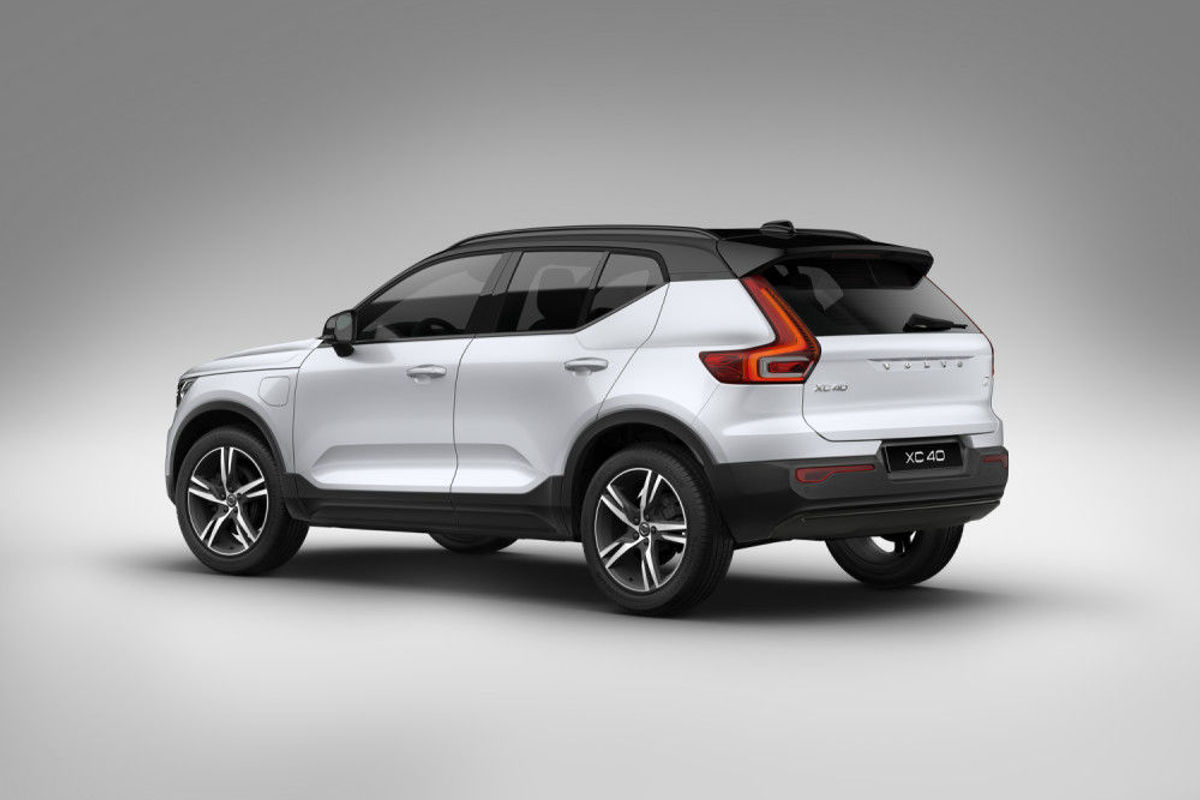
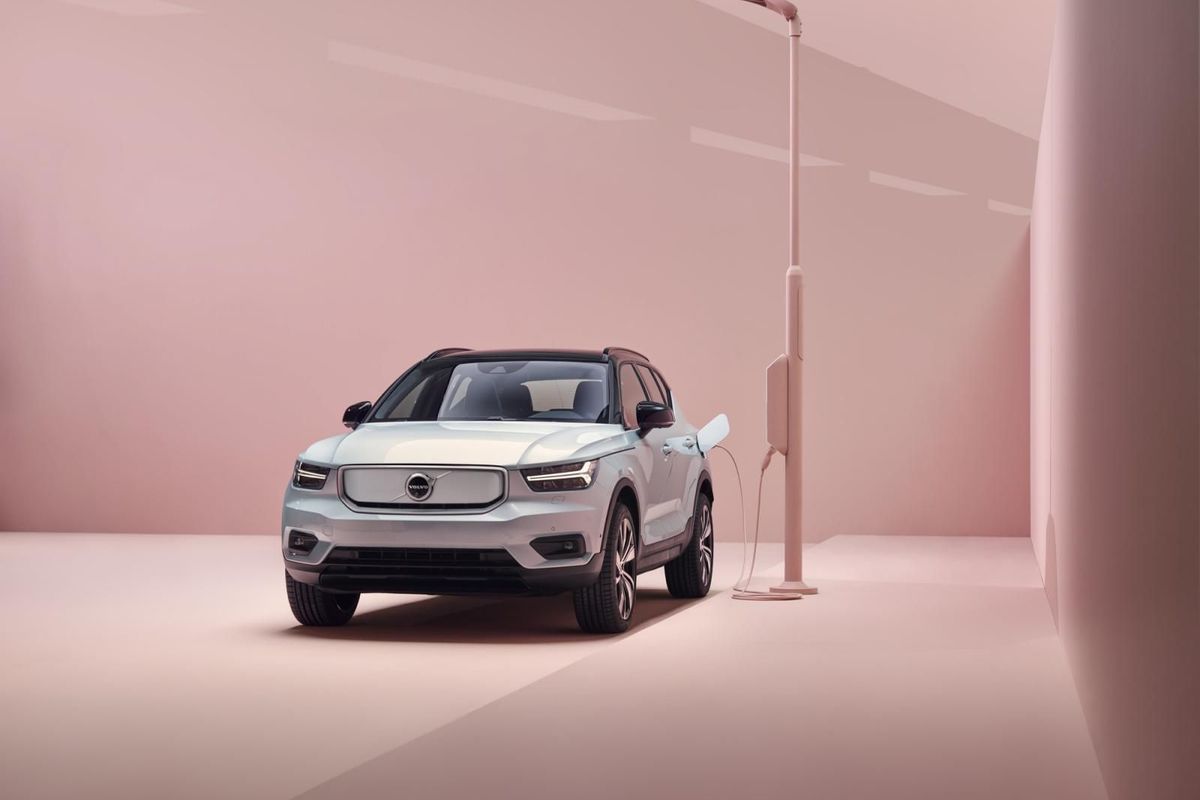
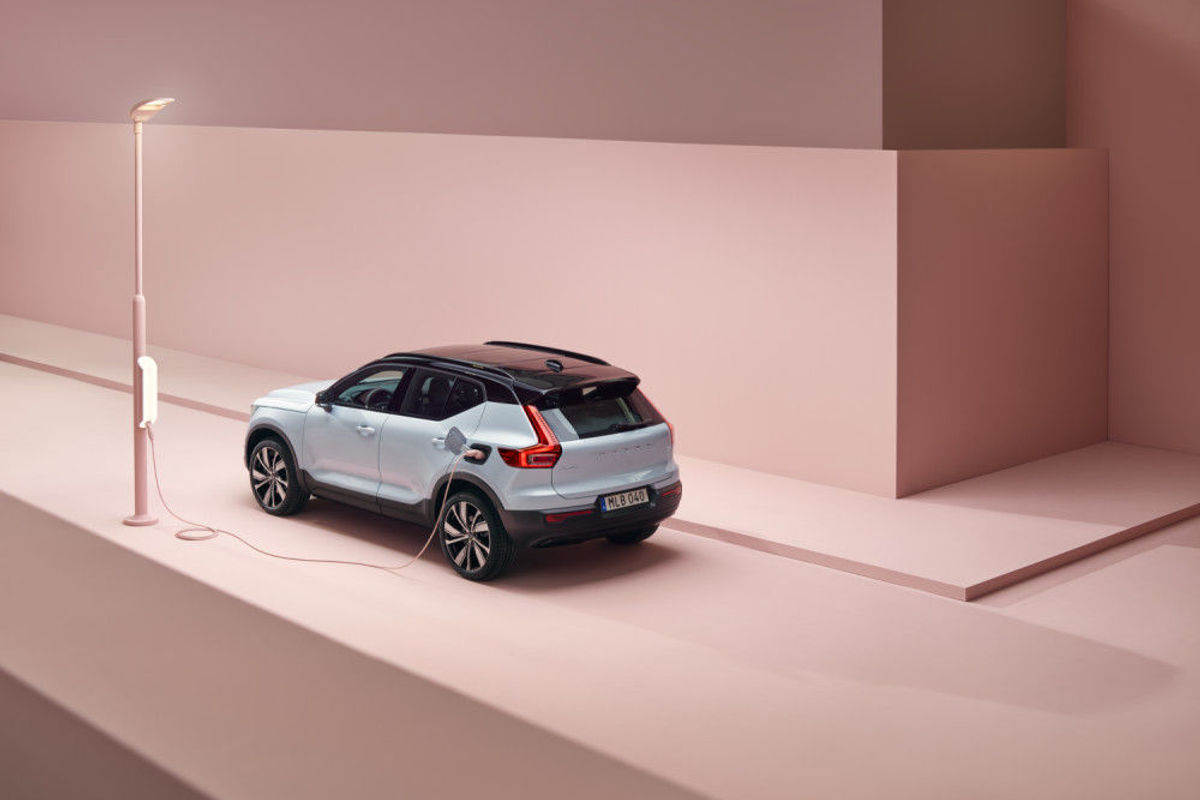
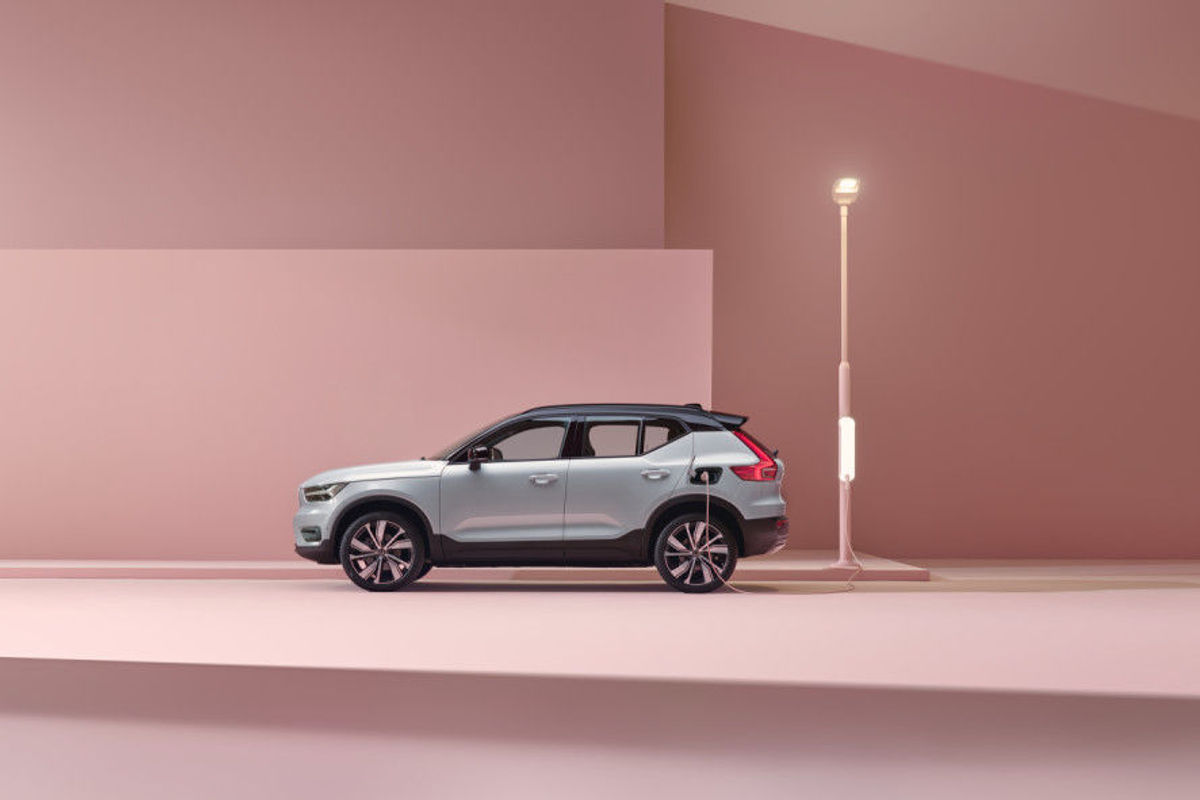
The XC40 P8 Recharge has just landed in SA with the first allocation sold out. The 2nd allocation is on its way and here’s what it will cost.
The first allotment of XC40 Recharge models sold out immediately on Volvo’s new My Volvo website, which makes purchasing a Volvo quick and simple without having to leave your home. Volvo SA has now ordered a 2nd allocation, which should arrive by mid-year and exclusively available via the website.
“All-electric vehicles sold in South Africa have traditionally come with hefty price tags – and this has undoubtedly been a deterrent. We know that there is an appetite in South Africa for electric cars and we were determined to give customers an attractive price,” says Managing Director at Volvo Car South Africa, Greg Maruszewski.
The XC40 Recharge is the Swedish brand’s first all-electric vehicle and the XC40 P8 Recharge is powered by 2 electric motors producing 304 kW and 660 Nm of torque. Acceleration from zero to 100 kph takes just 4.9 seconds with an electric range of 418 km.
The XC40 P8 Recharge also comes with a Volvo CARE package which includes a 5-year warranty and maintenance plan, 3-years comprehensive insurance, a home charger with charge cables and access to a petrol car for 2 weeks per year for 3 years. That means if you’re worried about range or charging infrastructure on your holiday, you can swap out your electric car for a petrol-powered SUV for 2 weeks and then return to your electric SUV at the end of the holiday.
On top of the standard warranty, with the battery pack is covered for eight years or 160 000 km.
“The Volvo XC40 P8 Recharge all-electric is clearly a sign of things to come; the company announced that it would only manufacture electric cars by 2030, with all sales to be online. So, our future is clear, and it will be fully electric, sustainable, and online,” concludes Maruszewski.
How much does the Volvo XC40 P8 Recharge Cost in South Africa?
We tested the brand new (and extremely expensive) BMW iX xDrive50 during the holiday season. What’s it like to live with an EV in a city and how does it compare with all the other EVs that have recently been launched in South Africa? Ciro De Siena details his experience with the R2-million battery-electric SUV.
I approached writing this review with some dread. I knew it was going to be lengthy. The iX is just such an interesting, feature-filled and goalpost-setting car, that I was concerned I wouldn’t be able to do it justice, or worse, that I would leave you, our readers, with unanswered questions.
Couple that with the general – but necessary – question marks about living with an electric vehicle in South Africa, and I knew I had my work cut out for me. Hopefully, this article, combined with the video we have produced (which we’ve internally been referring to as a documentary – it is the longest video review we’ve ever published) will cover everything you’d like to know about the BMW iX.
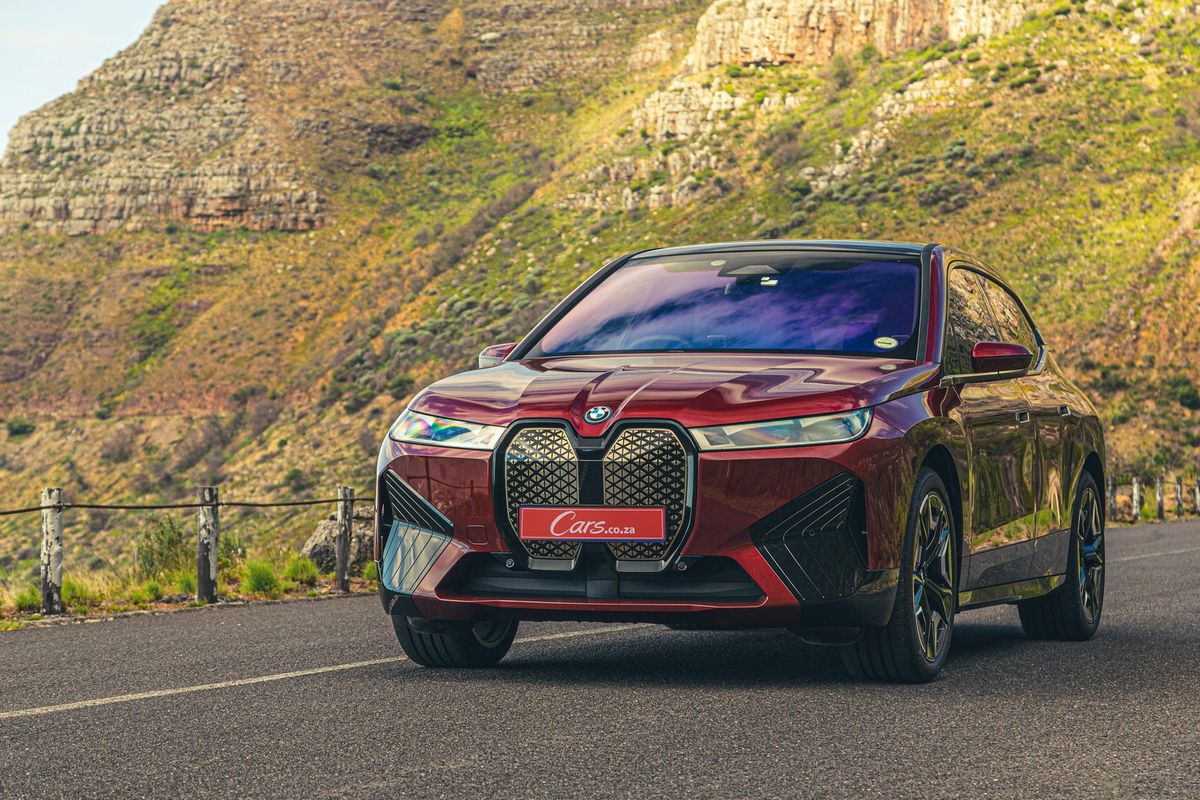
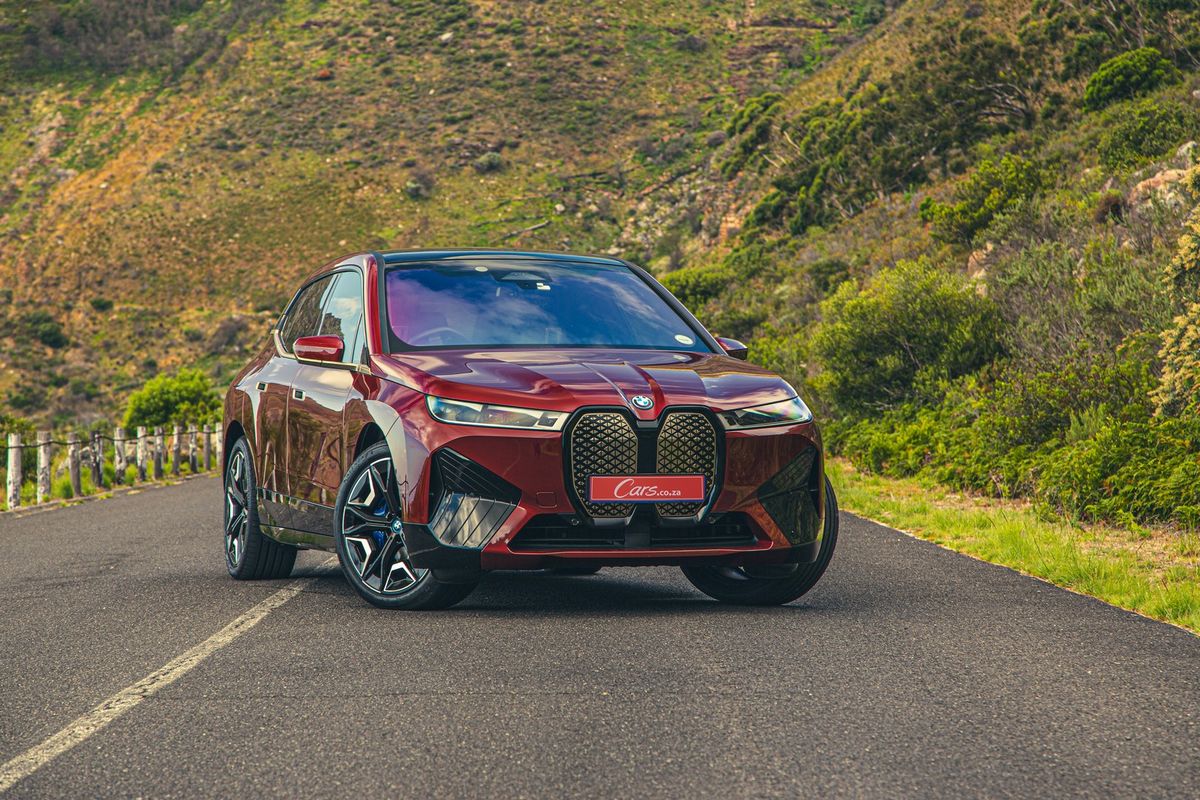
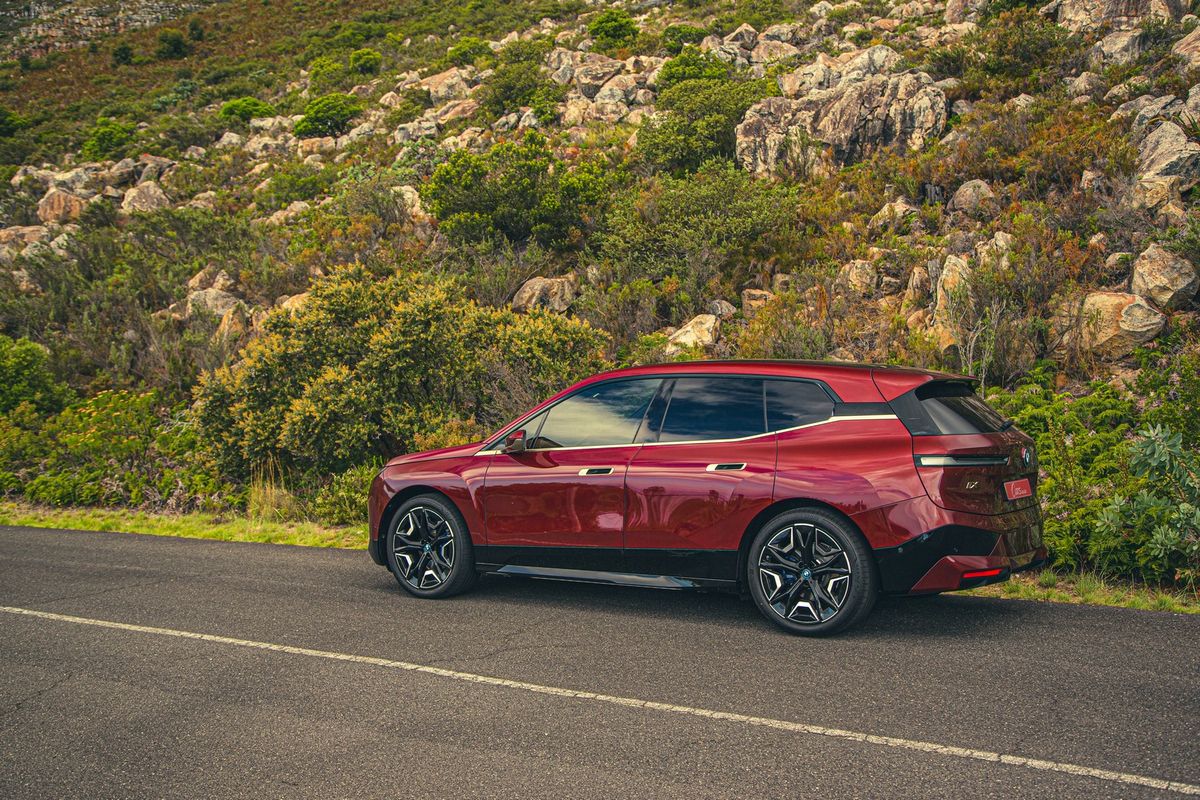
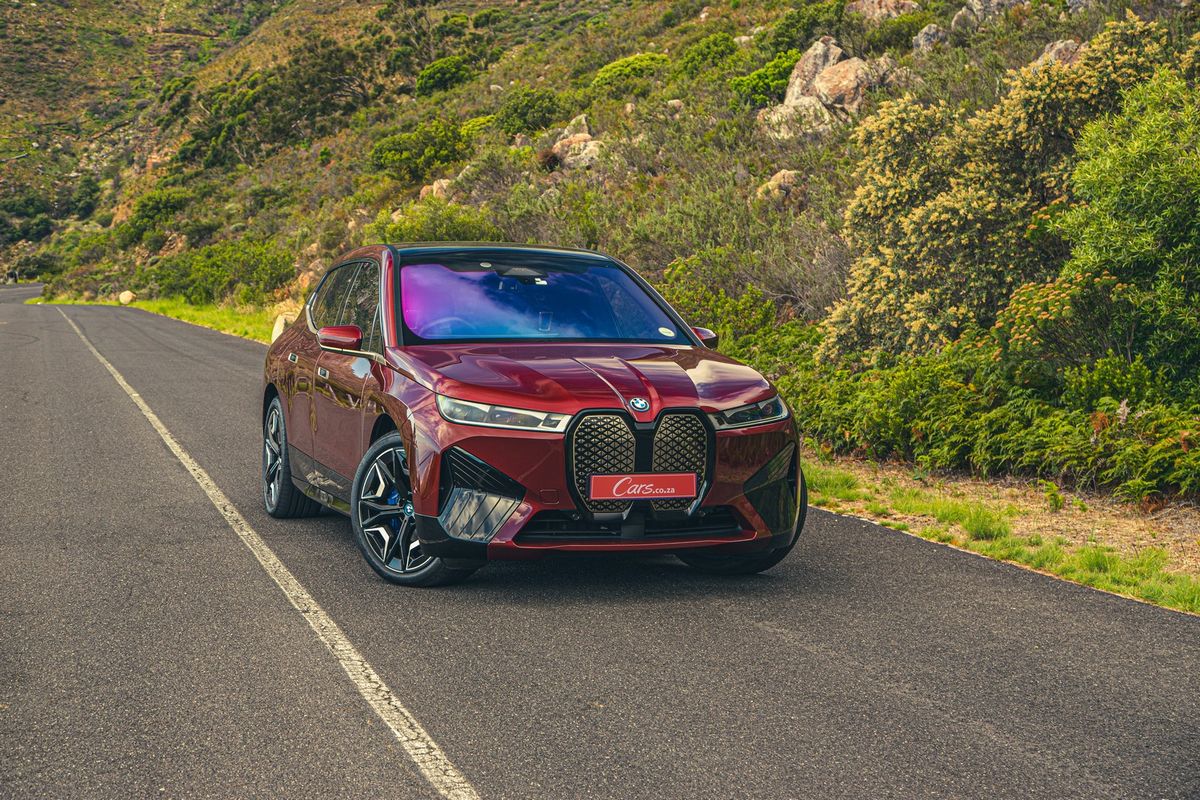
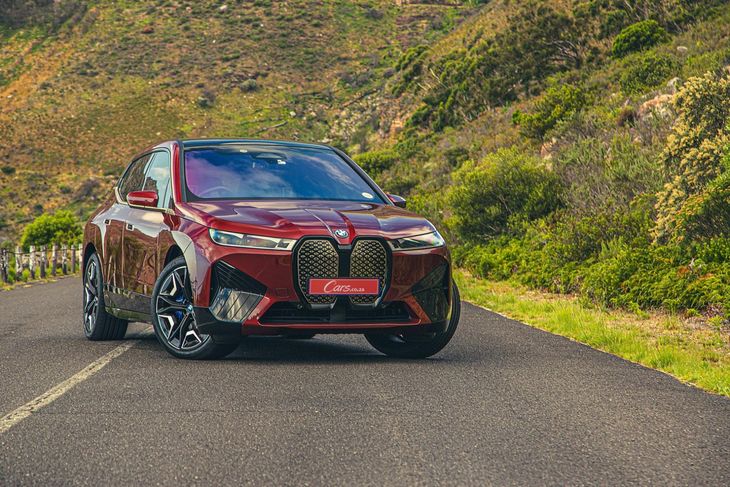
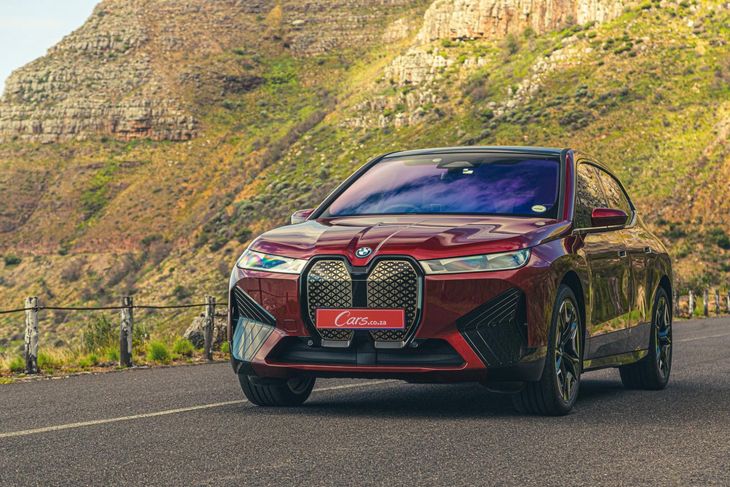
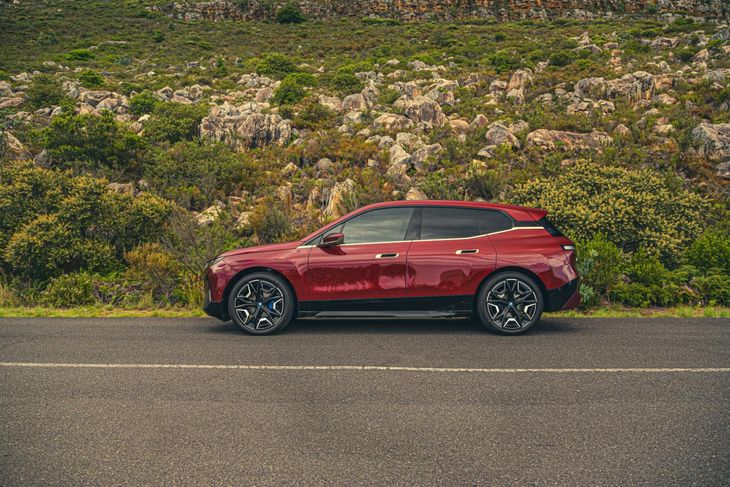
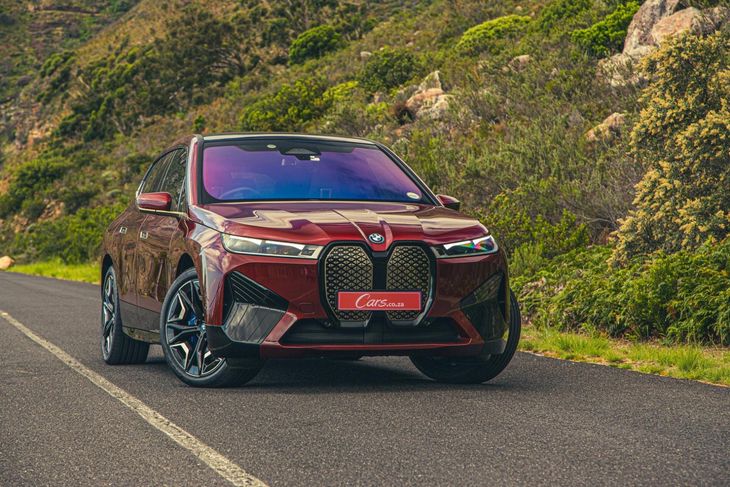
The BMW iX is styled to look as if it has arrived from the future – it’s the poster child for the brand’s electrification strategy.
What is it?
The BMW iX xDrive50 is one of two fully electric BMW SUVs now available in South Africa, the other being its more affordable xDrive40 sibling. The key differences between BMW’s pair of iX battery-electric vehicles (BEVs) lie in the capacity of the lithium-ion battery and the output of the electric motors – the 385-kW iX50 has a higher capacity (111 kWh) battery pack and a significantly higher claimed range.
There is, of course, a sizable price difference too; whereas the iX40 is priced at R1.65 million, the ix50 is priced at R2.17million.
BMW iX xDrive40
BMW iX xDrive50
Price
R1 650 000
R2 175 000
Range (max)
390 km
630 km
Battery
76 kWh
111 kWh
Power output
240 kW
385 kW
Torque
630 Nm
765 Nm
0-100 kph
6.1 seconds
4.6 seconds
The styling
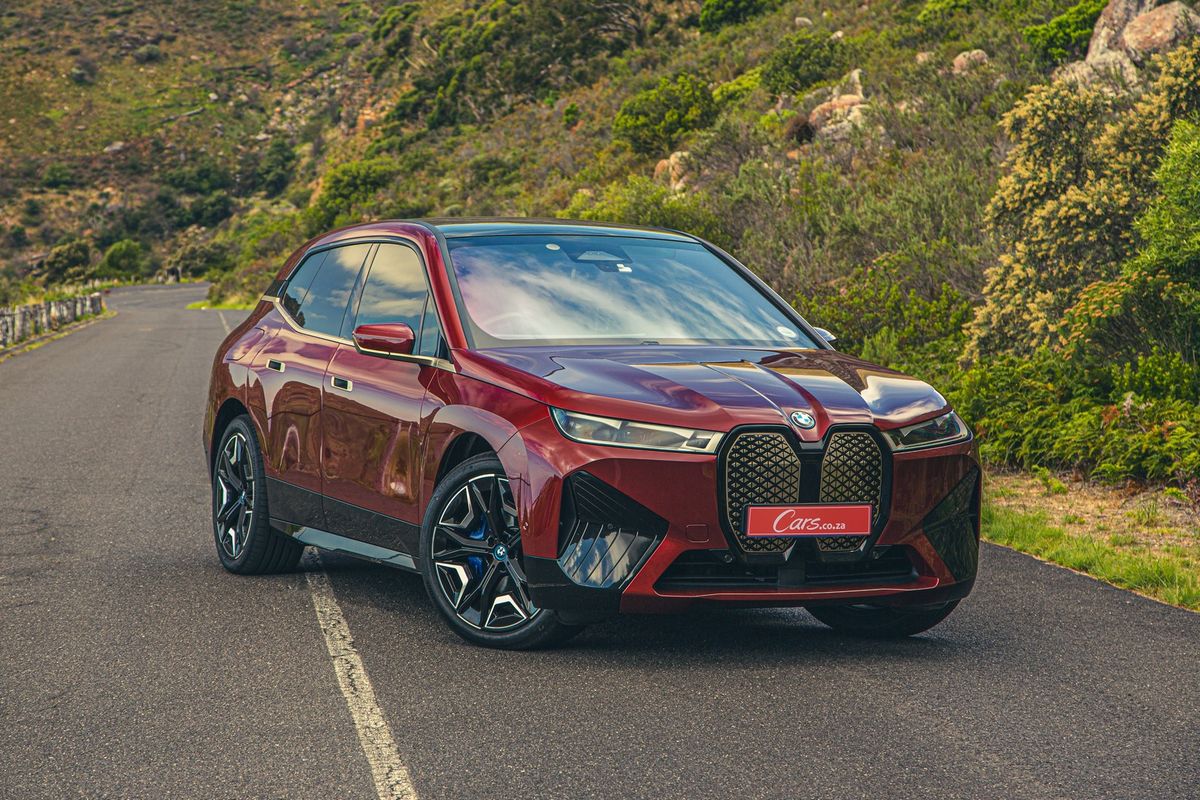
I frequently posted updates about my iX50 long-term test experience on my social media channels and the (many) responses I received ranged from, “Wow, that looks terrible” to “Wow, that looks particularly terrible”. To say the iX’s styling is polarising would be an understatement of note, but I think that also misses the point.
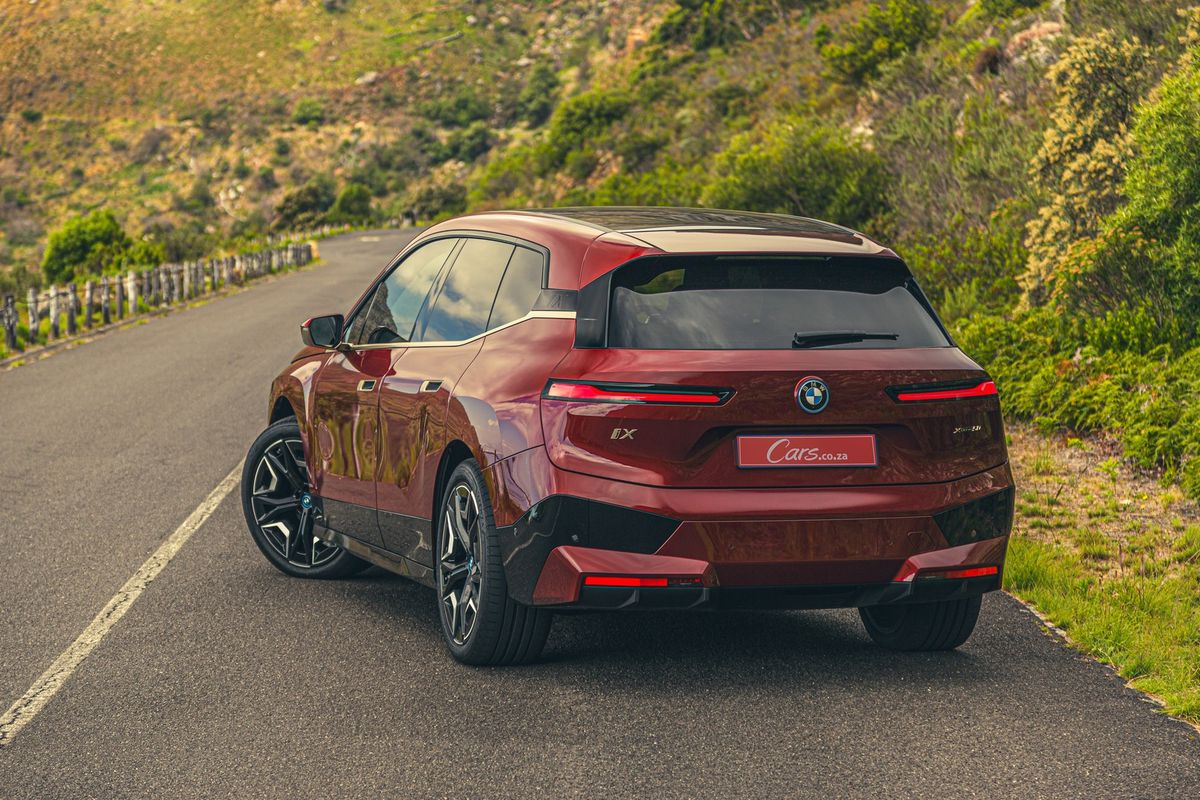
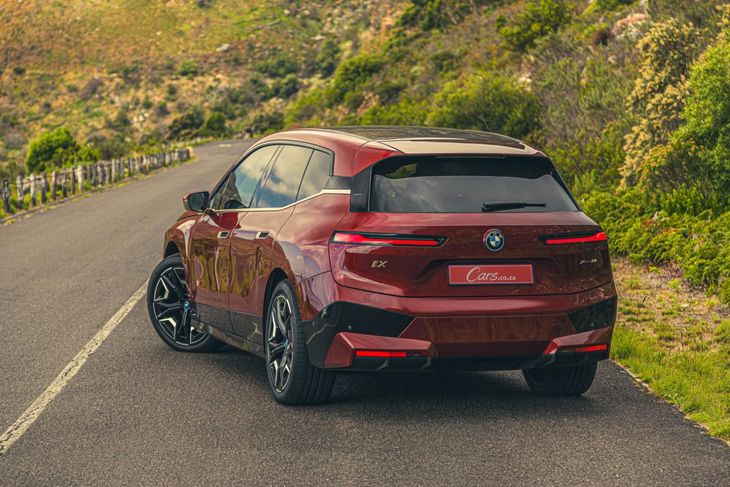
This is the most flattering angle from which to view the iX – there are so many design details to take in.
As one of our generation’s great prophets, Will Ferrell, once said, “I dunno, but it’s provocative. It gets the people going.” I think “provocative” is the perfect word to describe this car’s design. After all, the iX functions as a rolling billboard for BMW’s transition into the Electric Age. Spending 4 weeks with the car was a blur of people taking photos, pointing at the car, giving me the thumbs up, chatting with me in parking lots, asking to see the SUV’s interior, and generally expressing a tremendous amount of interest in something that most South Africans did not know existed until it appeared in front of them.
In my experience, Mzansi loves the new BMW iX – it certainly gets social media “going”.
I think the reason why its styling has to be so left-field is because of the all-electric drivetrain. The problem with BEVs is that they all feel and sound exactly the same, as opposed to the widely differing sounds and power delivery characteristics of ICE vehicles. For example, a supercharged V8 feels very different to a naturally aspirated straight-6, which feels very different to a turbocharged 4-cylinder.
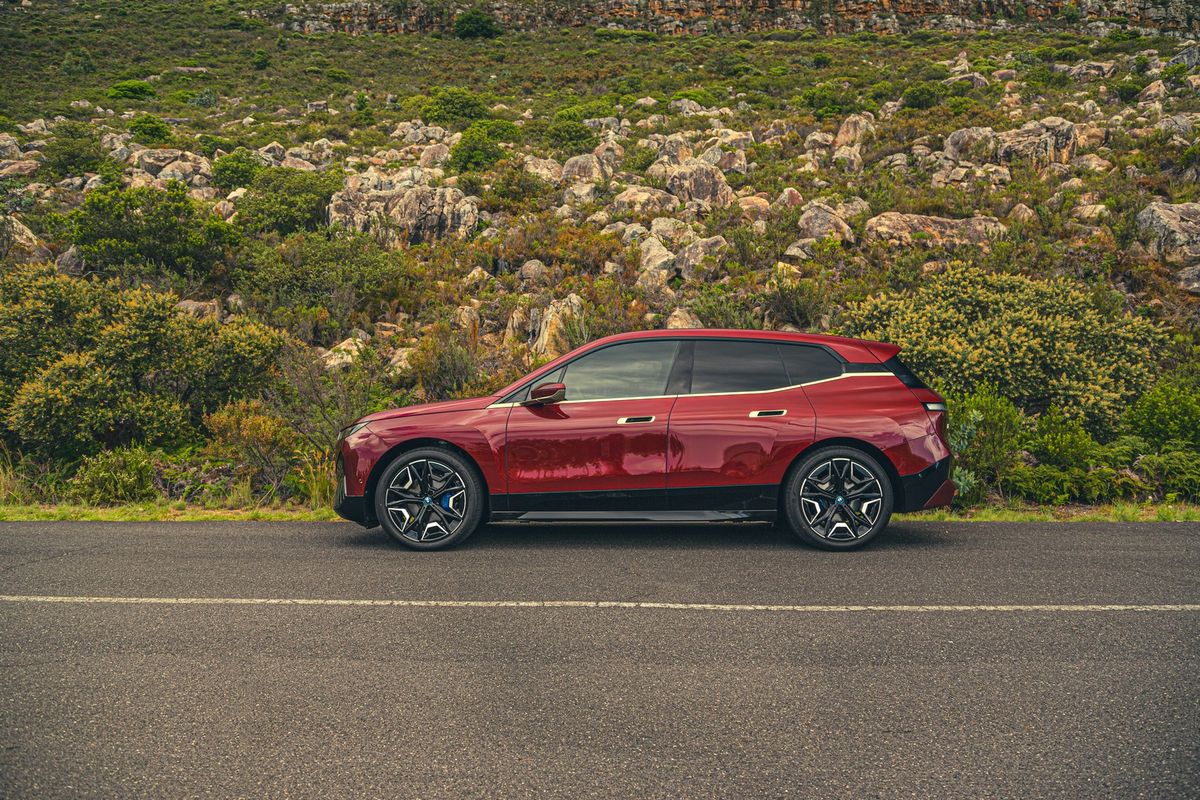
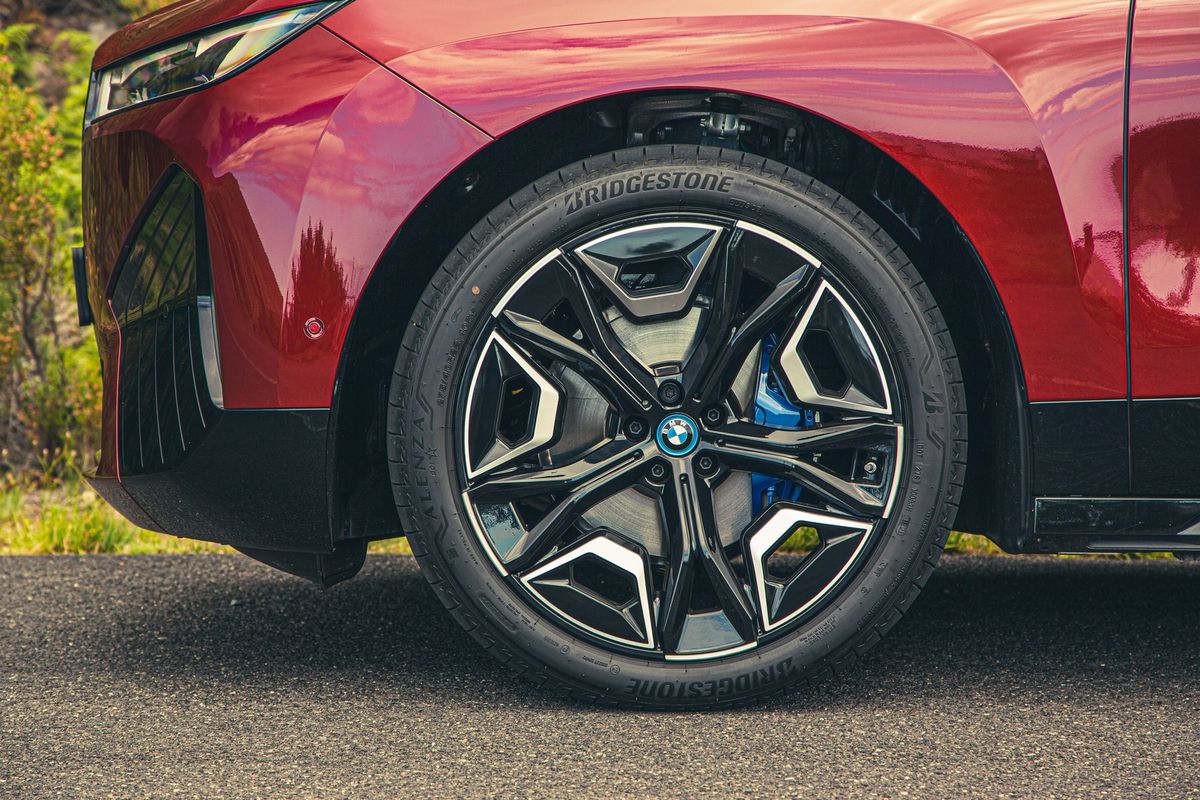
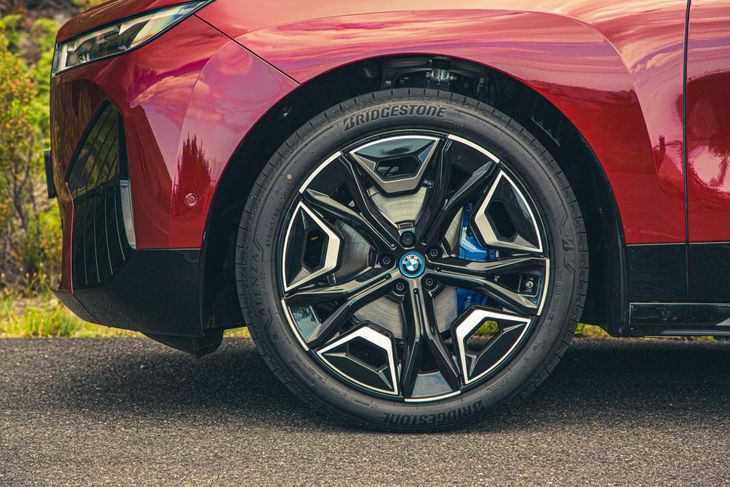
As opposed to most contemporary BMW, the iX is not fitted with run-flat tyres. Its air-spring-aided ride quality is sublime.
With the character that would usually be imbued in a car via its drivetrain taken out of the equation, a manufacturer has no way to differentiate its EV models using the oily bits, because there aren’t any. The only way to stand out is to do just that, stand out. The interior and exterior designs have to grab attention and generate interest, and we’ve seen this in other EVs, such as Hyundai’s superb-looking Ioniq 5.
Something else that plays a critical role in the EV space is aerodynamic efficiency. A low drag coefficient, or the factor of how slippery the car is as it cuts through the air, can make a massive difference in energy consumption, and designers have to keep this in mind when penning a BEV’s exterior design.
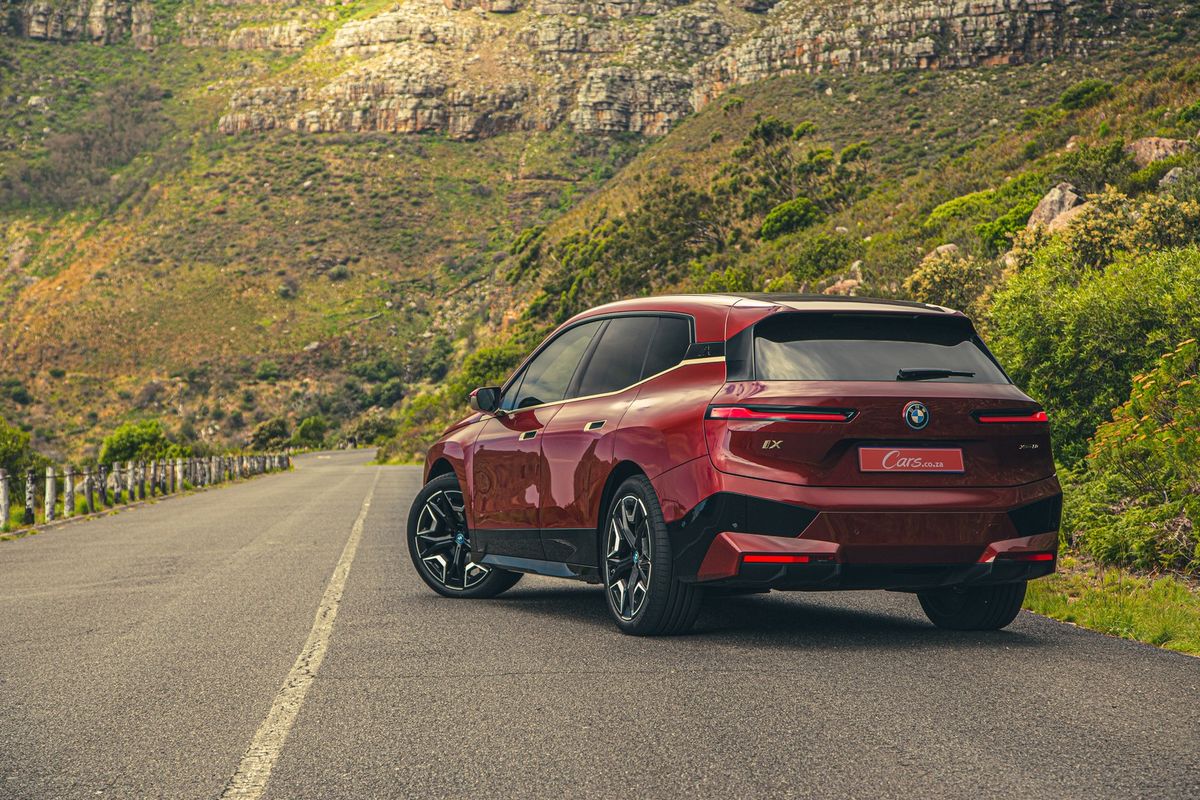
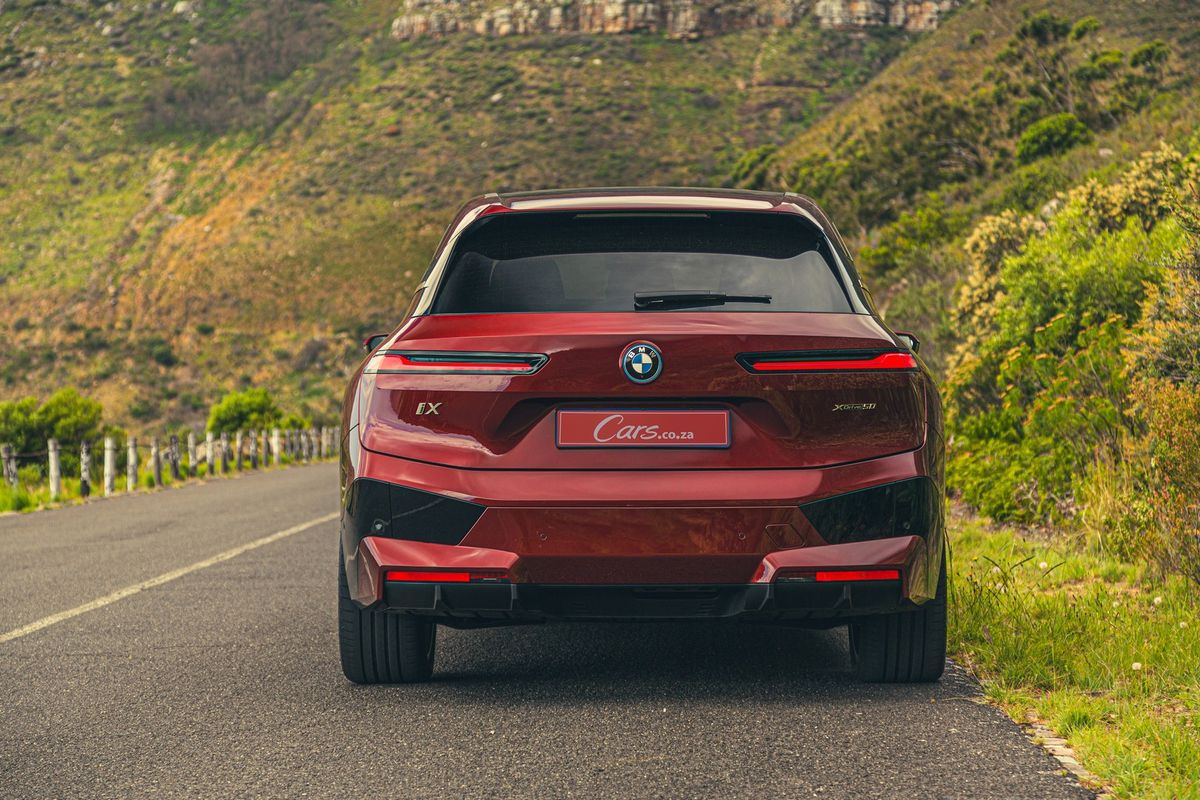
BMW has absolutely nailed it. The iX’s proportions are bang on and its rear 3-quarter view is especially striking. Sure, the double-kidney grille is perhaps comically oversized, but it grew on me. Suffice to say, the iX looks like nothing else on the road and will, I suspect, become an “it” car in the next few months… Other manufacturers may have to play catch up in terms of drawing attention to their BEVs.
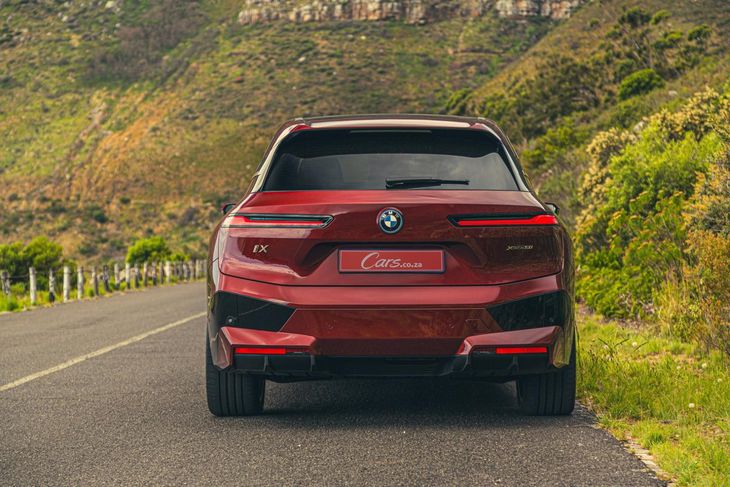
The tailgate may seem a little small compared with the rest of the bodywork, but it provides access to a usefully-sized load bay.
iX xDrive50 vs the X5
The iX50 has a peak power output and claimed performance figures that are comparable with those of high-end V8-powered premium SUVs. With 385 kW and 765 Nm of torque, and a claimed 0-100-kph time of 4.6 sec, the flagship iX compares favourably with its X5 stablemate, the twin-turbo 4.4-litre V8-powered M50i. The latter offers 390 kW and 750 Nm of torque, with a 0-100 time of 4.3 seconds.
Interestingly, the current list price of a BMW X5 M50i is R1 873 000, which is just over R300 000 less than the iX xDrive50. However, the iX is specced, as standard, to the brim with features for which you would have to fork out extra dough in the X5, including, interestingly, a tow bar.
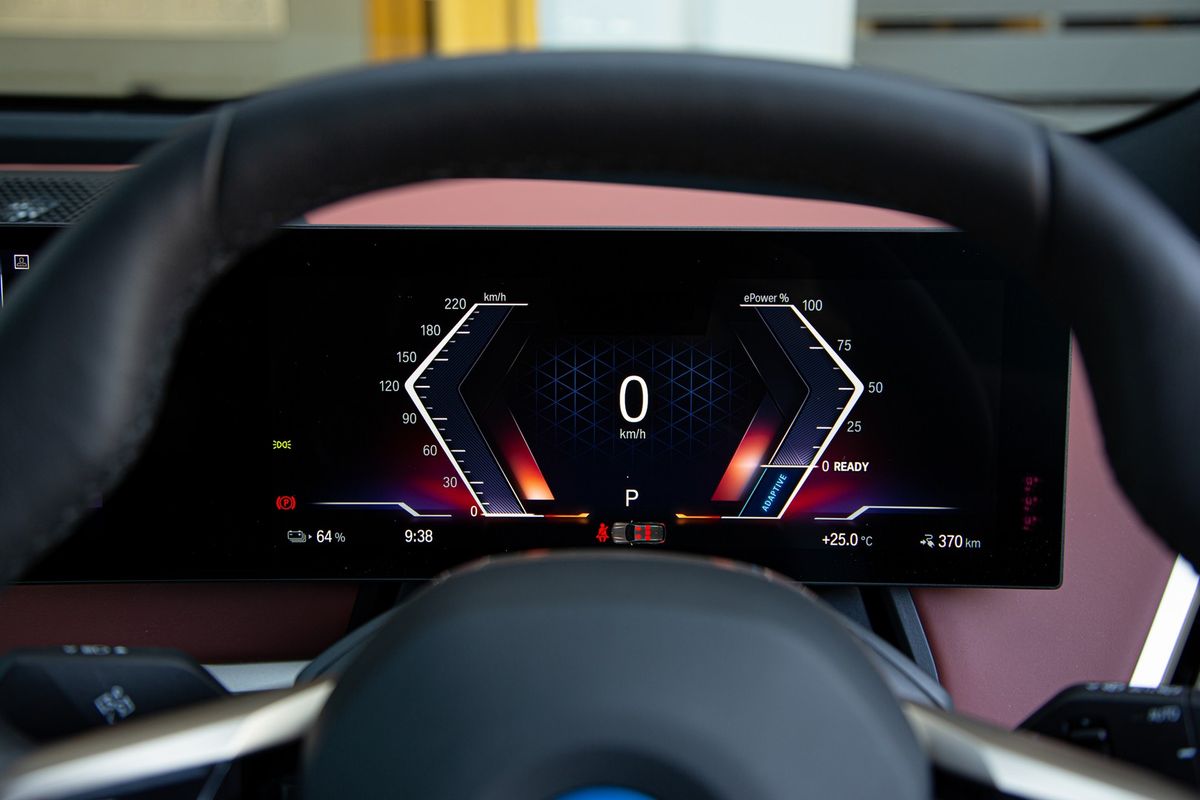
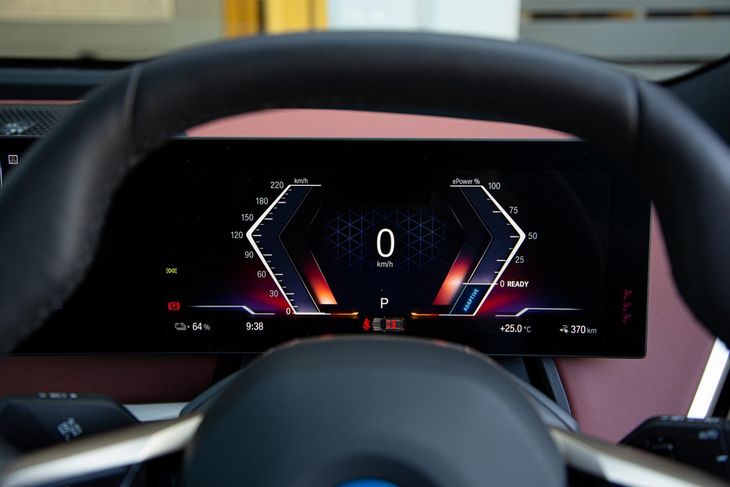
Like so many of the newest luxury cars, the iX does not have a cowled instrument cluster, but a rectangular digital panel.
But, by the time you add adaptive LED Laserlight headlights, a dimmable panoramic roof, reverse- and surround-view cameras, adaptive cruise control, air suspension, lane-keep assist, electric lumbar support and massage seats and memory seat adjustment, you may find your X5 M50i costs as much as the iX xDrive50.
This surely is the moment when BMW EVs and ICE cars start to overlap in terms of pricing, which is very interesting in and of itself.
What is the BMW iX like to drive?
In some ways, driving the iX is an entirely novel experience, and in some ways, it isn’t. Luxury car manufacturers have (for a long time now) been able to largely dial out the sounds and vibrations of an internal combustion engine. While the iX is eerily quiet while it transports you to your chosen destination, its driving experience is not too dissimilar to that of, say, a Bentley or a Rolls-Royce
However, it’s the combination of zero vibration from the drivetrain, almost no noise from the motors, instantaneous mountains of torque (accessible via the merest flex of your right foot), cloud-like ride quality (courtesy of the air suspension) and significant cabin insulation that makes driving the iX one of the most serene motoring experiences you are likely to ever have.
Despite offering punchy, instant acceleration, the iX’s general on-road demeanour is stately, unflustered and serene.
In fact, I found the iX to be unsettlingly quiet, and I think BMW’s focus groups did too, because the car offers IconicSounds – a synthetic soundtrack (BMW co-developed it with Oscar-winning film score composer Hans Zimmer) that plays through the audio system and rises and falls with throttle application and speed.
It sounds gimmicky, but I kept it switched on 95% of the time; I found it comforting, which is perhaps a psychological hangover from my 20 years of driving (mostly) ICE cars.
I found the BMW’s adaptive air-suspension system to be particularly clever and, combined with its very low centre of gravity, the iX feels just about dynamic enough to justify the blue-and-white roundel on its bluff front end. The air-sprung suspension dials out the effects of rough road surfaces with aplomb, but also reacts sufficiently quickly to minimise body roll under hard cornering – and does so seamlessly.
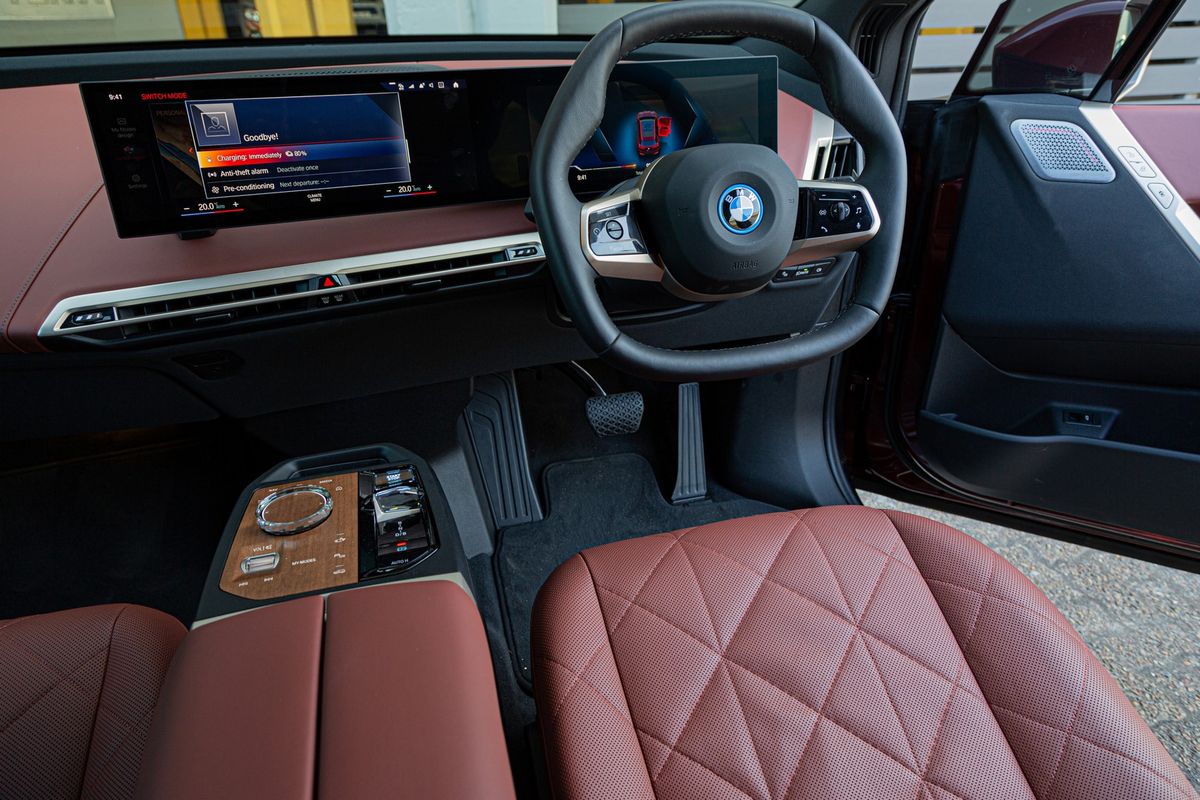
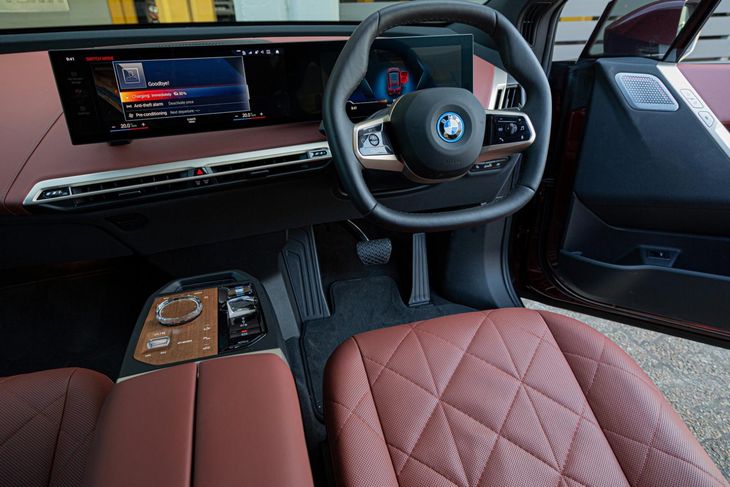
Minimalism is at the order of the day in the BMW’s spacious, plush and tech-laden cabin.
A few people asked me, does the iX handle like a BMW? To which my answer was: “Does it need to?” I doubt that if someone bought an iX, they would really expect it to deliver a driving experience akin to that of a BMW M4. After all, this is a large, luxurious, family-oriented SUV – and it behaves like one, albeit with stonking straight-line performance.
While you can steer the iX enthusiastically through a series of serpentine bends, you will soon start to feel the weight of the vehicle and the tyres begin to chirp in protest. Additionally, under heavy braking, you are again reminded of that 2.6-tonne kerb weight, although the braking system is very much up to the task of arresting progress.
It’s certainly not what I would describe as a “chuckable vehicle”, but as a package, it’s certainly not boring to drive.
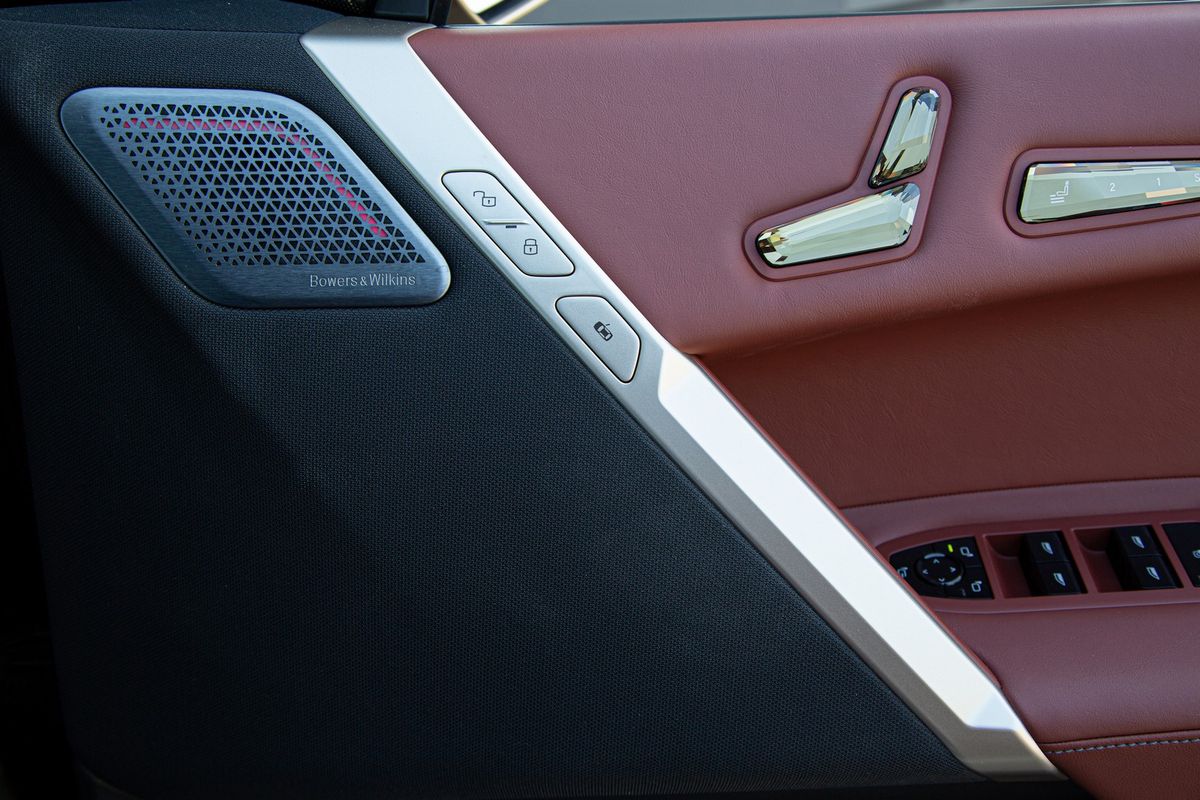
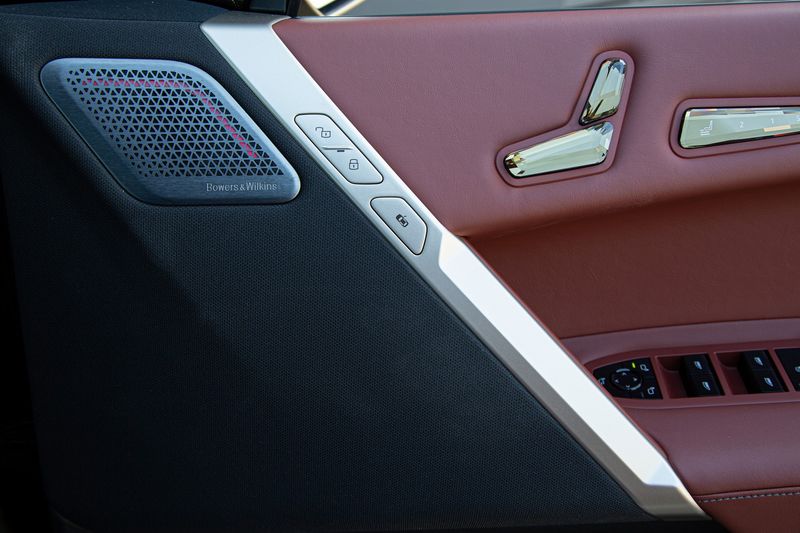
Bowers & Wilkens setup delivers beautiful audio quality. Note the jewel-like switchgear for the electric front-seat adjustment.
The interior
The interior design is one of the real highlights of the iX. Simply put, the iX’s interior is utterly unique in the motoring world right now. The cabin and particularly the dashboard and driver controls look like those of a concept car that escaped the show stand, and all of those elements successfully combine to make you feel like you are driving something special.
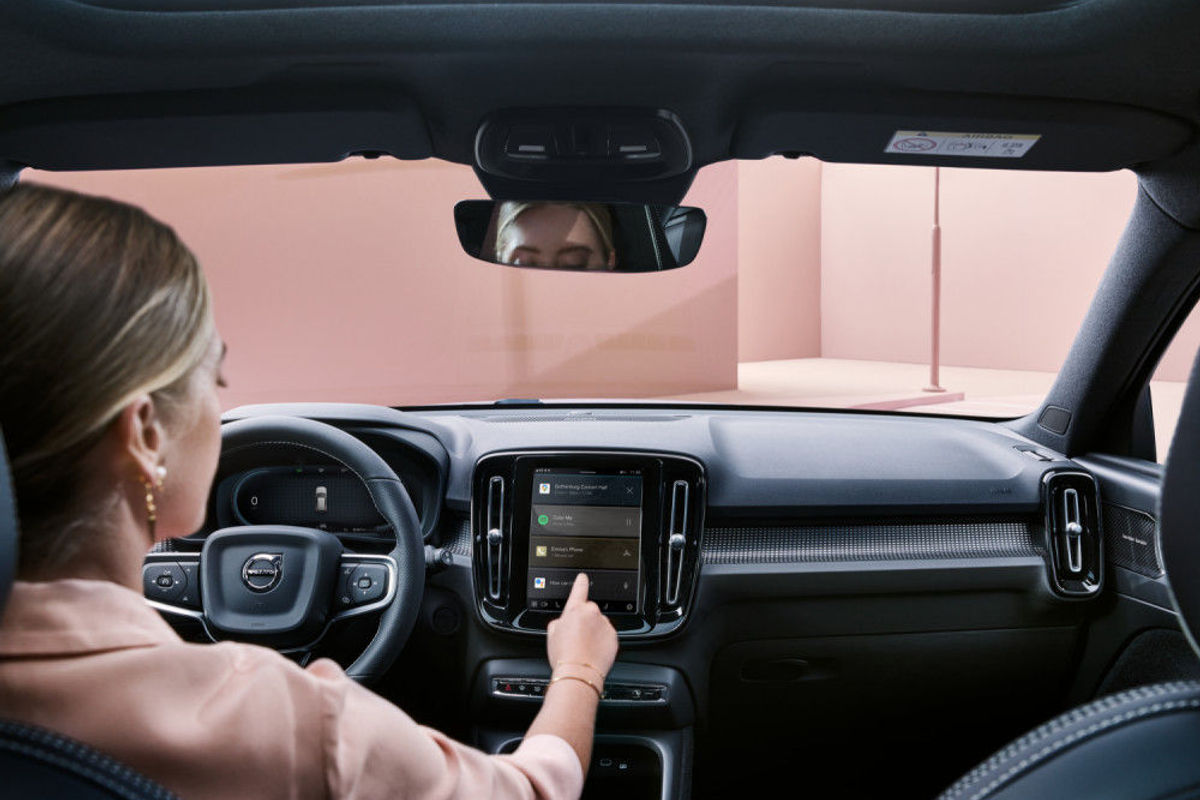
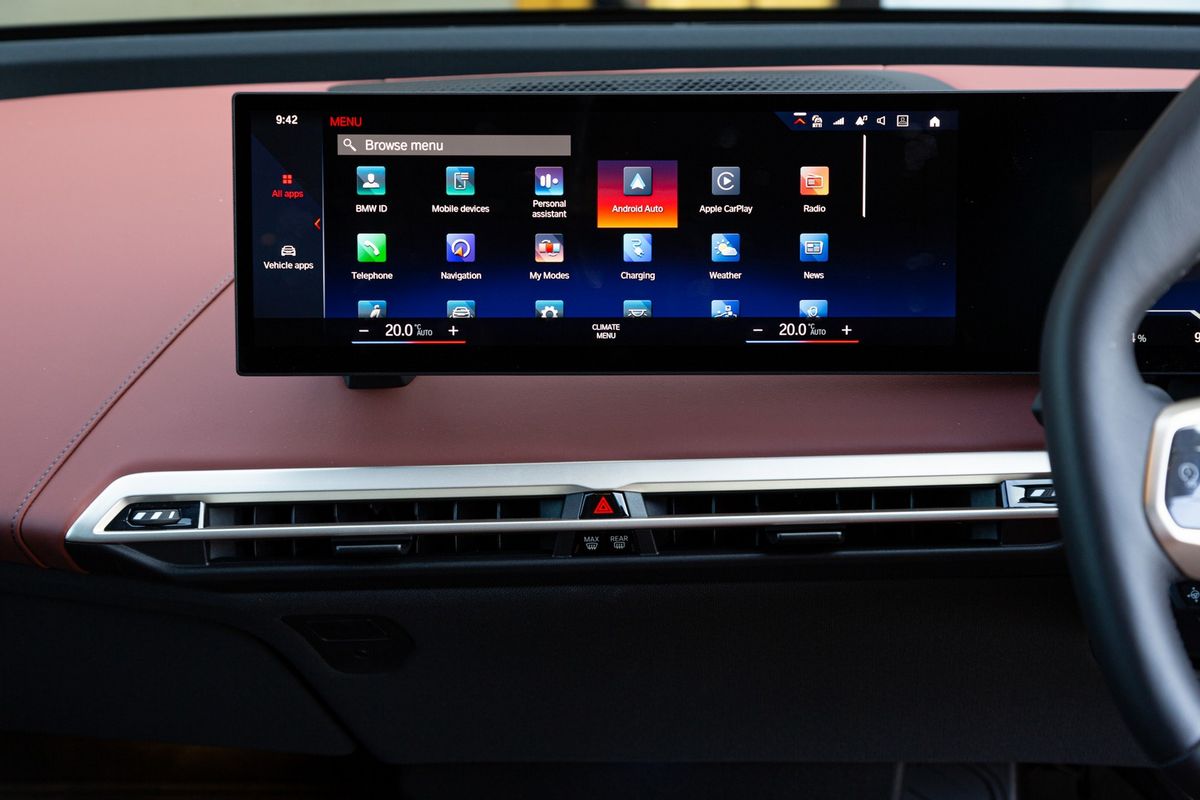
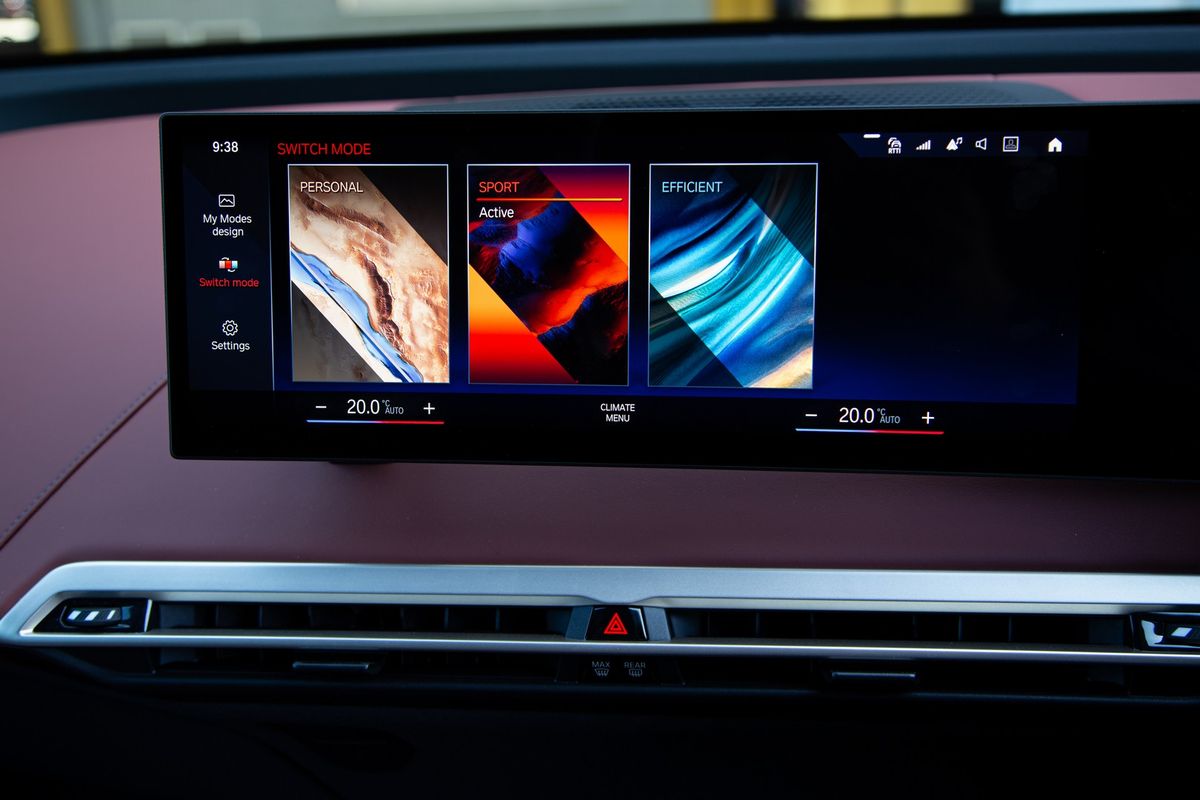
Floating over the minimalist, leather-covered dash is a giant, curved touchscreen that houses the digital instrument panel and the extensive infotainment system. It is one of the more arresting aspects of the interior, and yet BMW has also managed to make the digital interface feel intuitive. I found the touchscreen to be at a very comfortable distance – I rarely made use of the beautiful iDrive jog wheel.
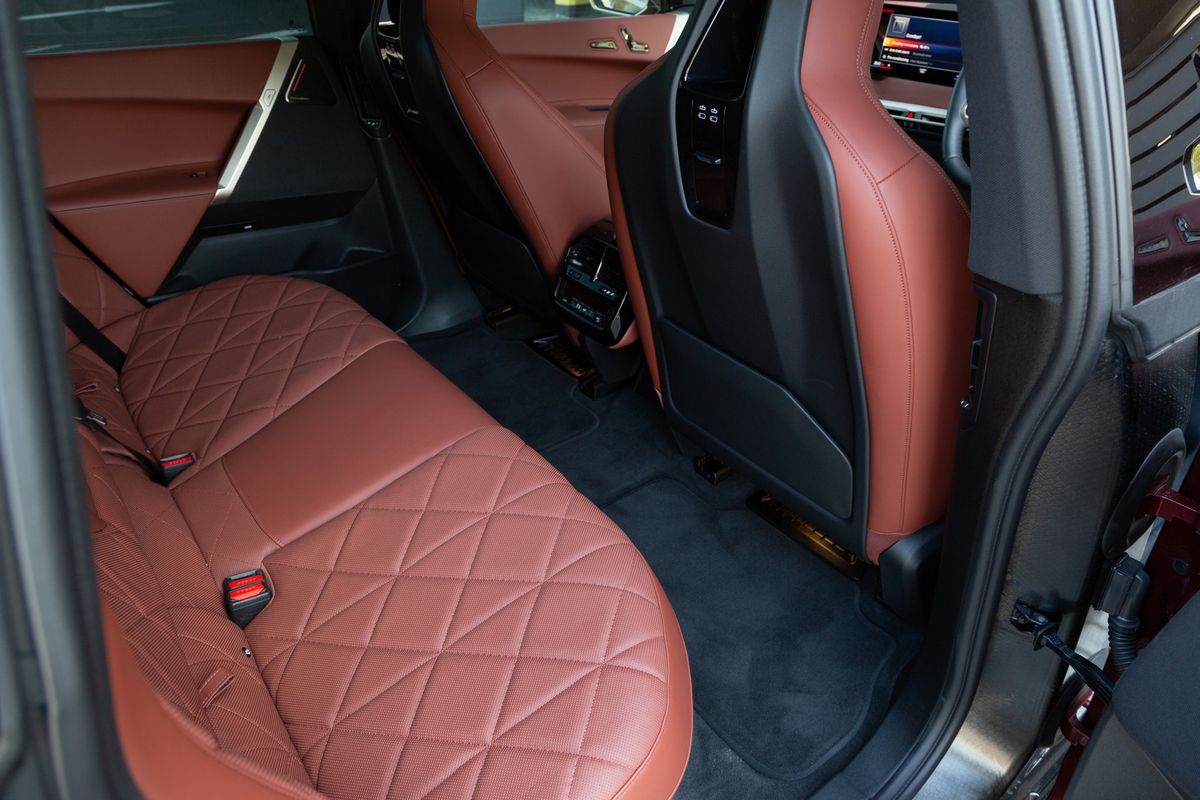
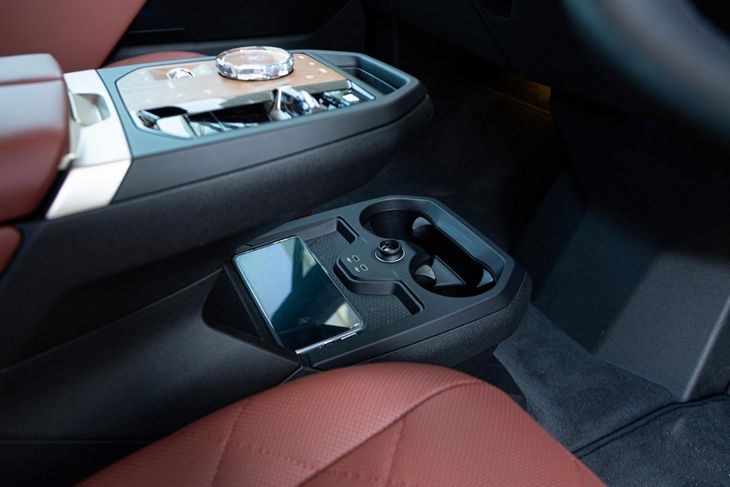
The absence of a transmission tunnel frees up plenty of space between the front seats of the iX.
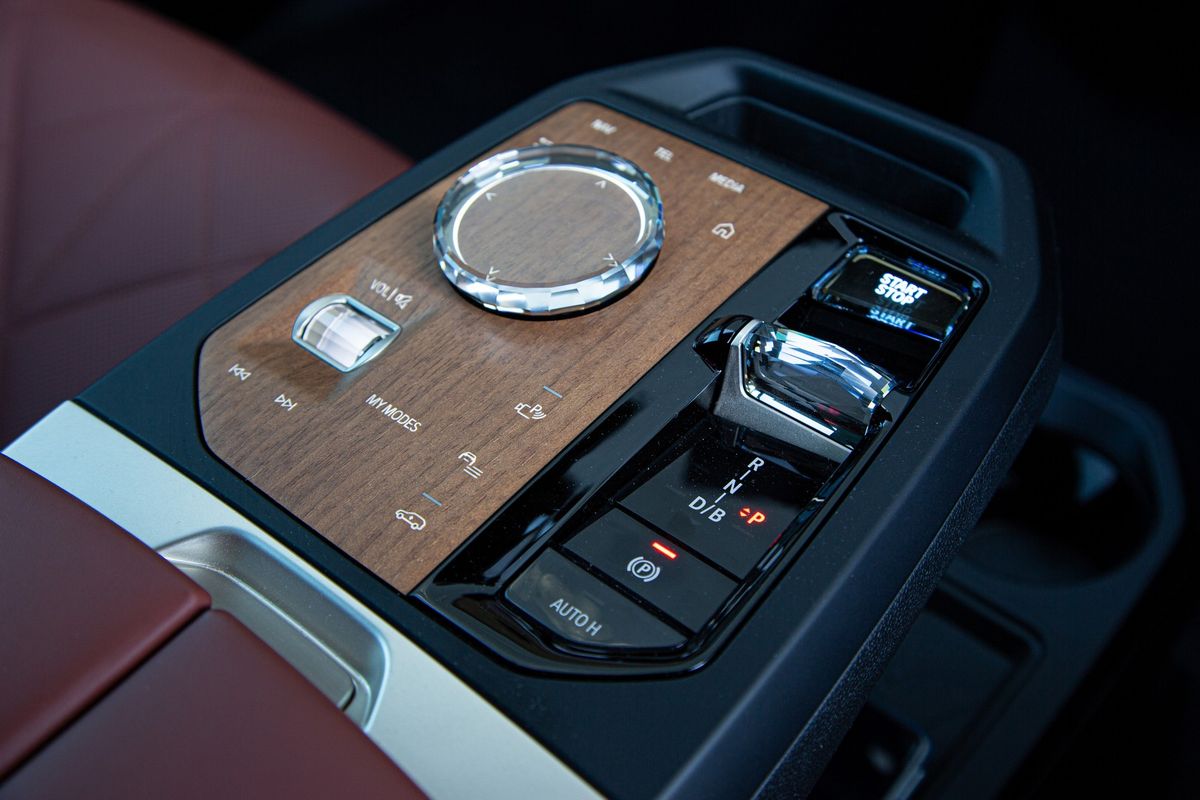
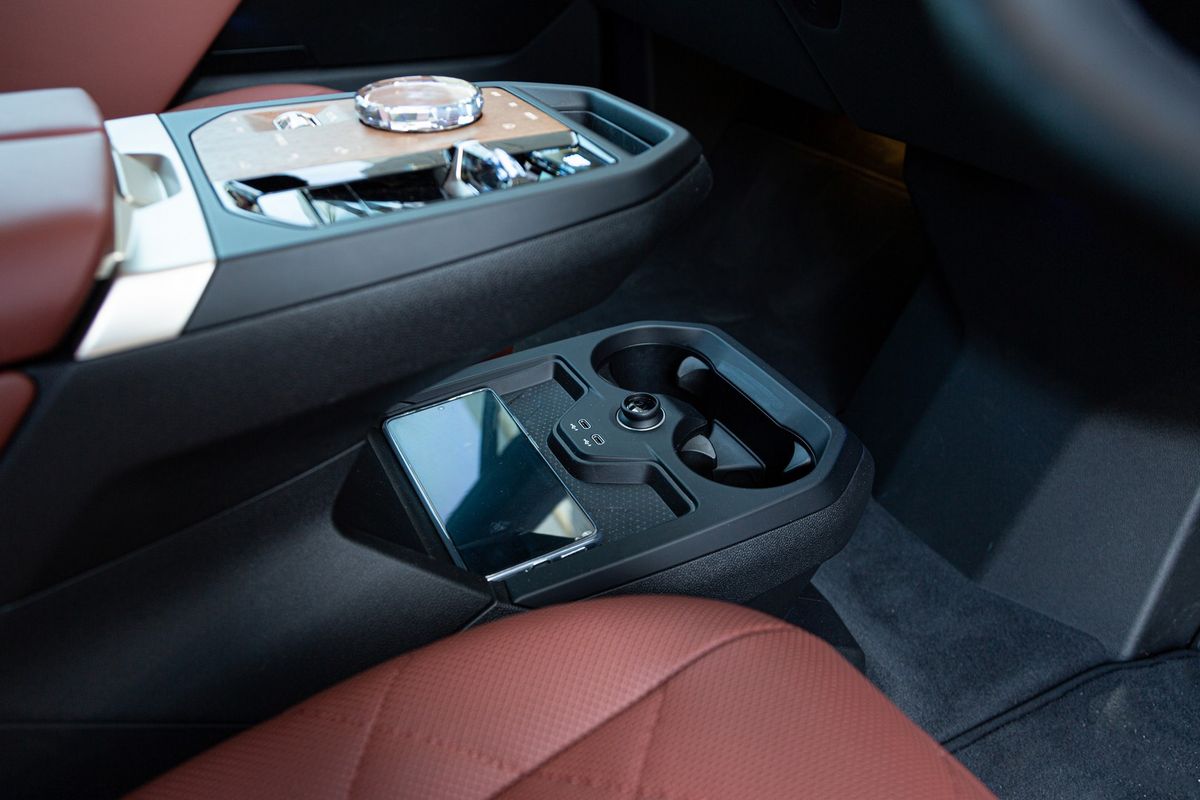
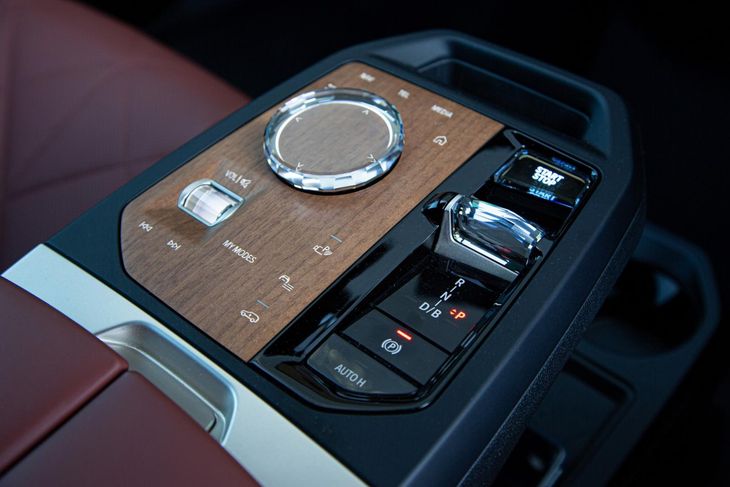
That crystal jog wheel is set on top of a panel of real open-pore wood, which has embedded buttons. The drive selector is another piece of jewellery alongside the jog wheel, which all floats over a wireless charging pad and two drinks holders. Thanks to the electric drivetrain, nothing separates the legs and feet of the driver and front passenger, which makes the front of the cabin feel particularly roomy.
The seats are a real highlight. There is almost no pretence of sportiness here; BMW has shot for sheer comfort and achieved it. Finished in ultra-plush, quilted leather, the seats are fantastically comfortable.
The entire roof is a one-piece panoramic piece of glass, which, at the touch of a button, turns from clear to opaque; a neat party trick that impresses kids… and big kids, such as yours truly.
The open-pore wood trim on the centre console is a thing of beauty, note the subtle buttons embedded in the panel.
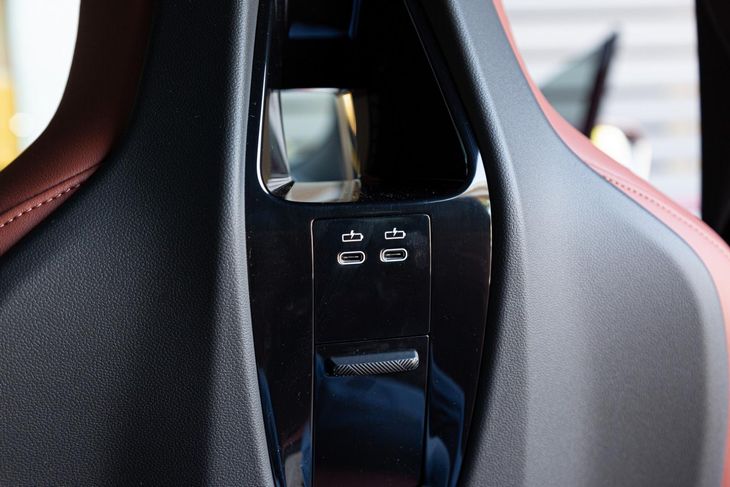
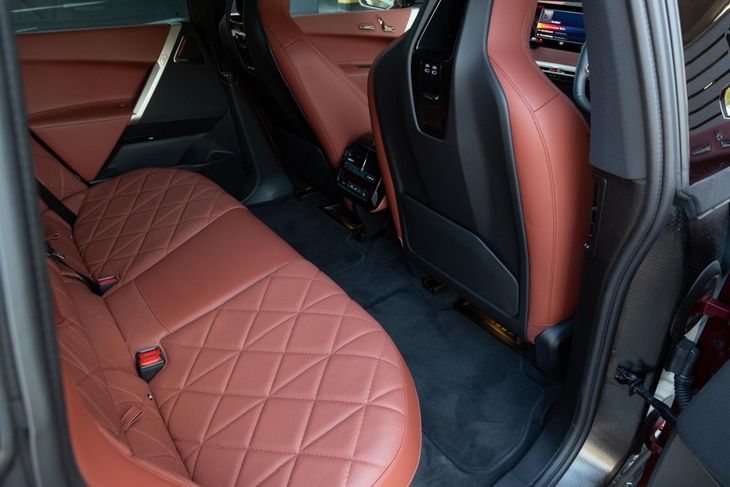
Rear passengers are well catered for with an independent climate control panel (air in funnelling through half of dozen air vents), two USB ports built into the back of the front seats and drinks holders in the centre armrest. Rear cabin space is excellent and again, thanks to that flat floor, feels particularly roomy. ISOfix child seat mounts are hidden under a fold of leather on either side of the bench.
The load bay is relatively capacious. BMW quotes a luggage capacity of 500 litres, which is 20% less than in the BMW X5, a touch less than in the Audi e-tron, but notably larger than in the Jaguar I-Pace.
Under the boot floor is a deep recess, which is perfect for storing the charging cable. The iX is not fitted with run-flats and does not have a spare wheel, but does have a puncture repair kit in the load bay.
A pair of USB-C charging points are integrated into the backrest of each of the front seats.
BMW iX vs Audi etron S Sportback
I have been fortunate to sample several electric cars of late, one of which was the Audi e-tron S Sportback. I was genuinely impressed by that car, but, having sampled the iX, the Audi, unfortunately, comes off second best, particularly in one key area: range.
The Audi’s list price is R2 425 000, a good R250 000 more than the iX xDrive50. But its range pales in comparison to that offered by the BMW. On the WLTP test cycle, the Audi offers a maximum range of 380 km, compared to the BMW’s maximum of 630 km.
By virtue of its dedicated battery-electric platform, the iX has a flat floor and affords rear occupants plenty of legroom.
The stroke of genius with the BMW is the CFRP (carbon fibre reinforced plastic) chassis. This has allowed the BMW engineers to fit a significantly larger battery pack without incurring a devastating weight penalty. At 96 kWh, the Audi has a smaller battery than the 111-kWh BMW, yet the Audi weighs more.
In terms of power outputs and performance, the Audi offers slightly less power – but significantly more torque – than the BMW, thanks to its 3 motor drivetrain. However, in terms of acceleration at least, the two are only separated by 0.1 of a second from 0-100 kph, with the Audi claiming a figure of 4.5 sec and the BMW 4.6 sec.
However, in EV land, it’s not just about the size of the battery, but how you use it, and the BMW is significantly more efficient than the Audi too.
The iX xDrive50 costs R250k less than its Audi e-tron rival, but offers a far superior range from a full state of charge.
BMW ix50 efficiency, energy consumption and running costs vs ICE cars
Indeed, the BMW xDrive50 offers stand-out energy efficiency. The company claims an average of 23 kWh/100 km, but I regularly saw readings of 21 kWh/100 km, especially in urban driving.
The best way to understand the running costs of an electric car versus a traditionally powered (ICE) vehicle is by calculating the relative costs of travelling 100 km.
In ICE vehicles, this is litres of fuel per 100 km. In the case of the X5 mentioned above, BMW claims an average of 11.5L/100 km, which I think we can safely assume is conservative, but let’s run with official figures for the sake of this comparison.
At 23 kWh/100 km, to arrive at the price per 100 km, one multiplies 23 by the price of one unit of electricity. At the moment, in Cape Town, home-use electricity per kWh is R2.30 and 23 times R2.30 is R52.90. To travel 100 km in the X5 M50i, one requires 11.5 litres of petrol, which, at the time of writing, was R19.61 per litre, totalling R225.50.
And so, in a comparatively sized and powered car that offers a similar level of performance, we can see that the EV is dramatically cheaper to run. This is one of the factors that contribute to EVs being superb (what I like to call) “Monday-to-Friday” cars.
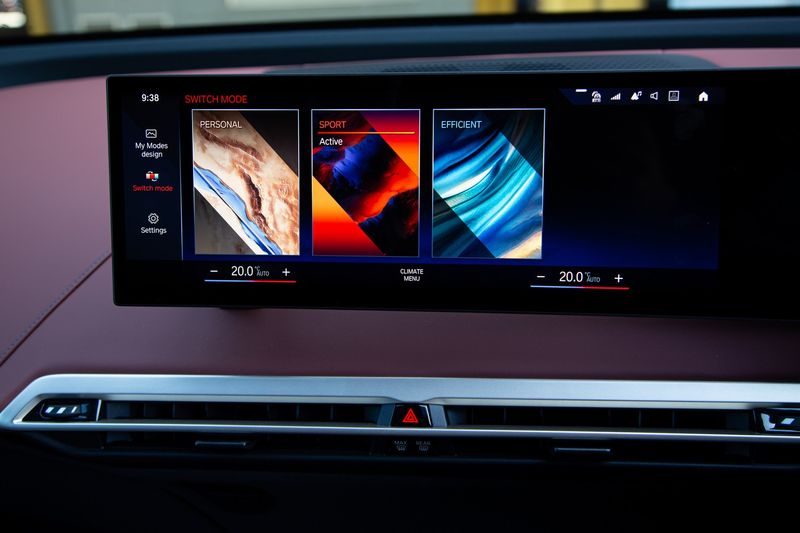
Each drive mode comes with its own IconicSounds soundtrack to enliven the otherwise silent driving experience.
What it’s like to drive an electric car in SA
I was very fortunate to live with the iX for just over 4 weeks. In those 4 weeks, I only charged it twice, which was a testament to the impressive range offered by the vehicle. But even so, my number one piece of advice about living with an electric car is this: you have to be able to charge it at home.
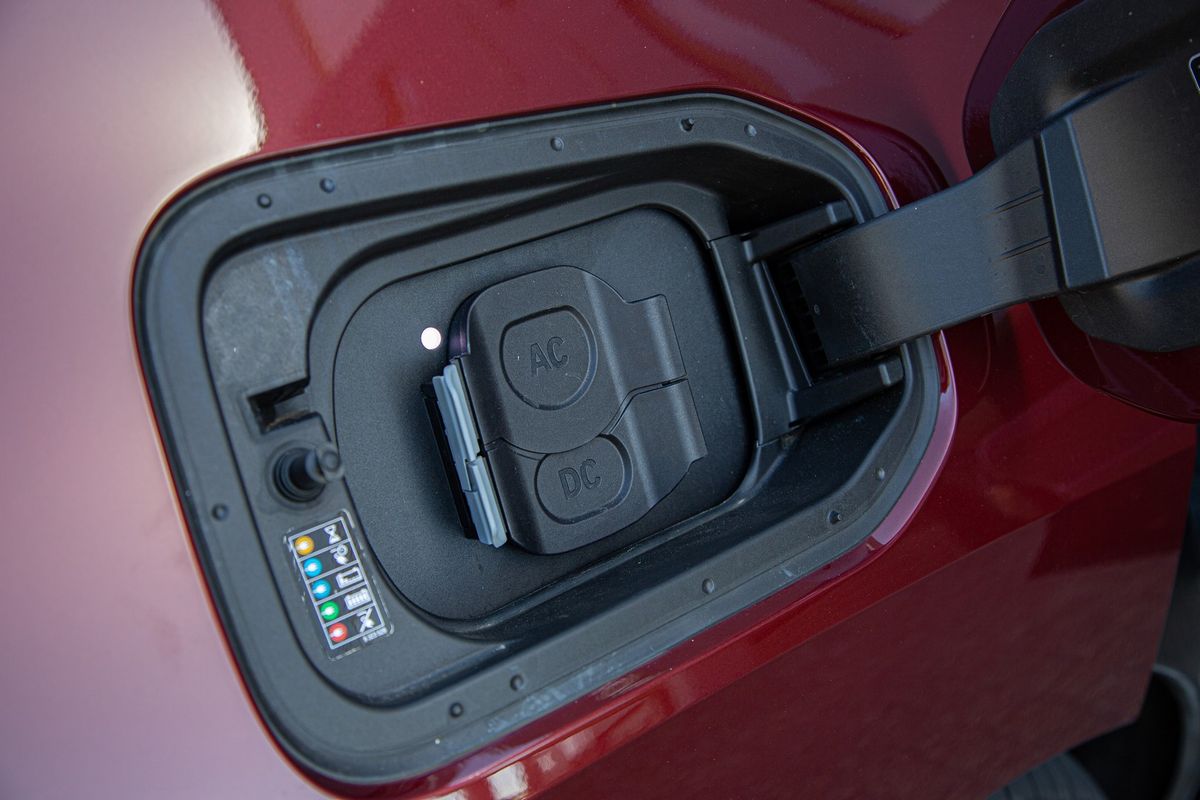
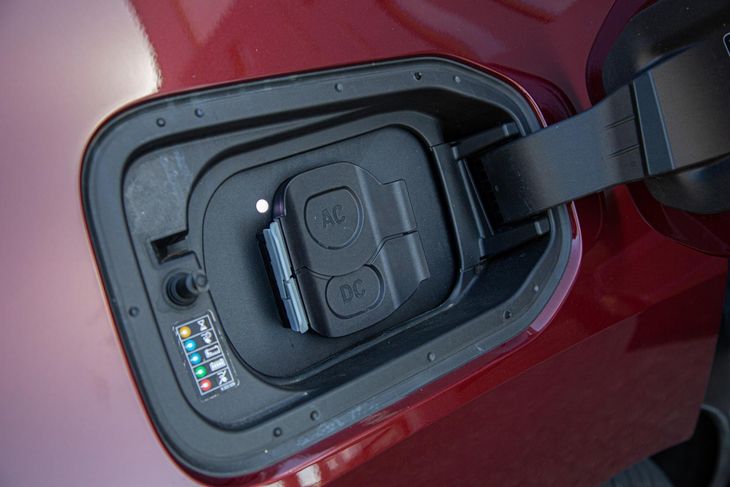
Running around looking for chargers can become quite tiresome and inconvenient. All you need at home, as a bare minimum, is a normal plug point within about 3 metres of where you usually park your car, as you cannot plug the charger into an extension cable (for risk of melting the cable) – it has to be plugged straight into the wall.
But I would highly advise having a BMW wall box or standard EV charger (available from Gridcars) installed in your home. Assuming you have single-phase power, you will then be able to charge your car at 11 kW per hour, compared with the 3 kW per hour offered by a standard wall plug. This will result in 100 km of range added to the battery in 1h41m, or a full charge from 0% to full in around 10 hours.
When plugged into a 50-kWh fast-charger, the iX’s battery can be charged up from 14% to 80% in an hour and a half.
Ideally, you want to treat your EV like a smartphone. Arrive home, plug it in, and wake up with a full battery.
I did, however, make use of the (free for BMW owners) 50-kWh fast charger at the SMG BMW dealership in Century City and found this to be quite convenient. I popped into Canal Walk for lunch and some shopping, and the fast charger charged the car from 14% to 80% in under 90 minutes. At 80% battery, the car offers around 430 km of range, which was sufficient for my needs. BMW recommends charging the battery to 80% as often as possible to prolong the life of the battery.
And, of course, Eskom’s ongoing woes and the bane of loadshedding remain concerns for many South Africans. However, I don’t see how it would be a problem for EV owners. As long as you can charge at home overnight, when there is plenty of spare capacity in the grid (and a lower risk of loadshedding), motorists can almost completely nullify the complications posed by bouts of power outages.
BMW iX launch offer, vehicle and battery warranty
The iX range is currently being offered with 1-year comprehensive insurance and a wall box free of charge.
The standard vehicle warranty is 5-year/100 000 km, which can be extended to 7 years or 200 000 km.
There is a separate 8-year/100 000 km warranty on the battery.
The iX is certainly not the first BEV to be produced by a mainstream car brand, but it is arguably the best in its segment.
Verdict
I’ve driven a variety of electric cars back-to-back recently – the Tesla Model X Performance, the Audi e-tron S Sportback and lastly, the BMW iX, and the experiences have been particularly illuminating.
Firstly, BMW has arrived very late to the party. The Tesla Model X went on sale in 2014 and we sampled the Audi e-tron (albeit in Dubai) as long ago as 2018. Even more curious is the fact that BMW launched the i3 and i8 in 2015, and then didn’t launch another EV until the iX, almost 7 years later.
However, I do get the feeling that BMW deliberately took its time with this one, and it shows. This is quite simply one of the best cars I have driven. Not just one of the best EVs – all cars, full stop. It just does everything brilliantly. I cannot fault it.
In the ways that matter most, it is a better car than the Tesla Model X. While the Tesla is an impressive tech-fest, in the “old-fashioned” ways in which we measure cars – ride comfort, refinement, road noise at speed, build quality, the iX is remarkably better. Overall, it is a better car than the Model X and critically, the BMW offers more range at a lower purchase price.
For me, the iX is a tipping point. Electric vehicles are now as good as ICE vehicles, if not better. And it seems South Africans are beginning to agree. BMW South Africa quickly sold its first shipment of iX units, and more are on the way.
It pains me that currently in South Africa, electric vehicles remain playthings of the wealthy. R2.2 million is simply a staggering amount of money for 99% of South Africans to spend on a motor vehicle. Where are the cheap Hondas, the cheap Renaults, the cheap MGs?
However, I am confident that EVs will go the way of the smartphone. They will become cheaper as manufacturers reach economies of scale and as battery technology improves.
If the iX is a rolling showcase of what the electric car is today, we are in for a very exciting future.
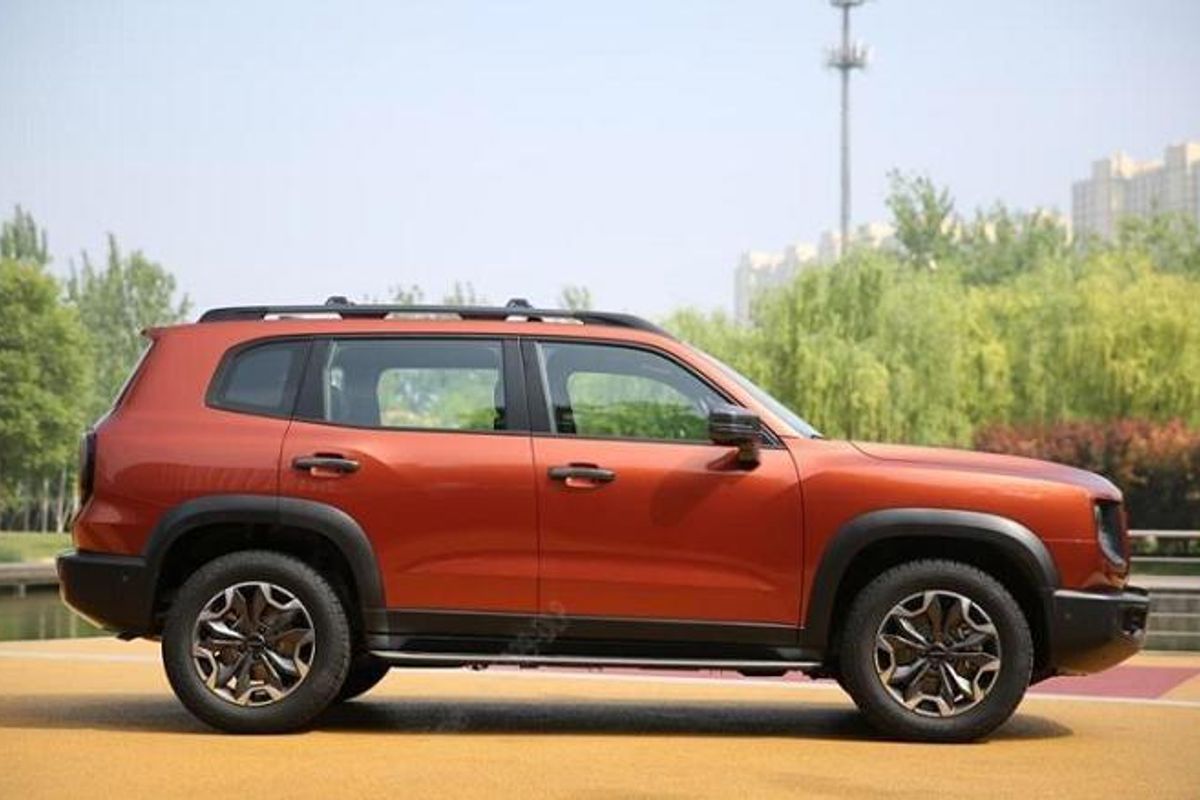
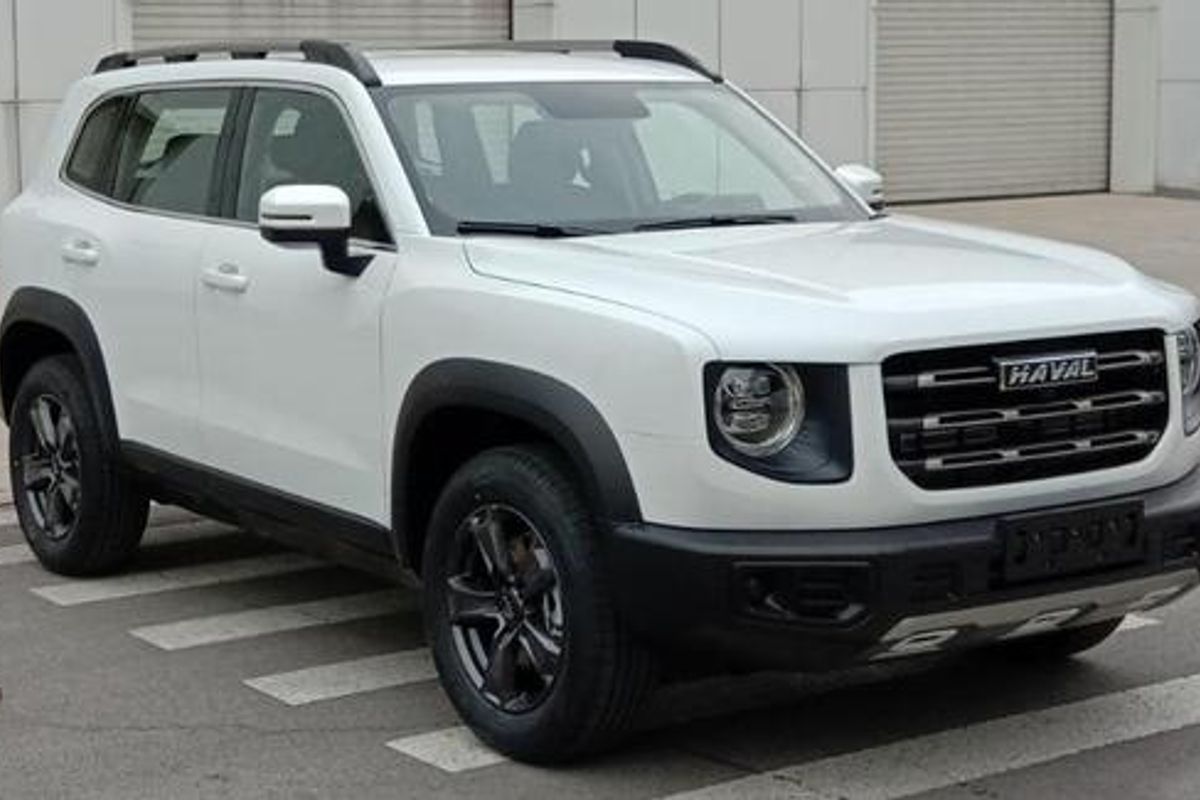
The Haval Dargo SUV, or Big Dog as it’s known in China, is reportedly earmarked for launch in Australia, which means the model is likely to be offered in South Africa.
First up, let’s clear up the name. Haval reportedly ran a public poll on WeChat to determine the name of this vehicle and the options included DaGou (Big Dog), Yuanxingzhe (Hiker), Zhanfu (Battle Axe), Lantu (Billow Journey) and Lang (Wolf). DaGou came out on top and is the official name in China, but we think Big Dog just sounds cool.
However, Australia’s CarsGuide, has reported that GWM has submitted a trademark application for the Haval Dargo (as it will be called Down Under and other markets) which represents a clear intention to introduce the Dargo in that market. Australia has thus far received a left-hand-drive Dargo for local journalists to assess the vehicle’s suitability for the Australian market. That is significant because, if the Dargo is indeed found to be suitable, the Dargo will be produced in right-hand-drive, making it eligible for introduction in South Africa too. Models introduced in Australia are often also destined for South Africa which means that we may very well see the Dargo, come to South Africa to take on offerings such as the Toyota Land Cruiser Prado.
A local Haval spokesperson has confirmed that a right-hand-drive Dargo is in the planning phase and that the Dargo may very well reach South Africa in 2023.
“Due to the export vehicle being in planning phase still, details are thin, but as I understand it’s not a 7 seater which would mean it’s smaller than H9. But everything available online is speculation at this time as the factory hasn’t made any export specification commitments yet so we have no reference points at this time”.
What does the Haval Dargo have to offer?
The Haval Big Dog or Dargo stands some 4 620 mm long, 1 890 mm wide, 1 780 mm high and has a wheelbase of 2 738 mm, making it roughly the same size as a Toyota Prado.
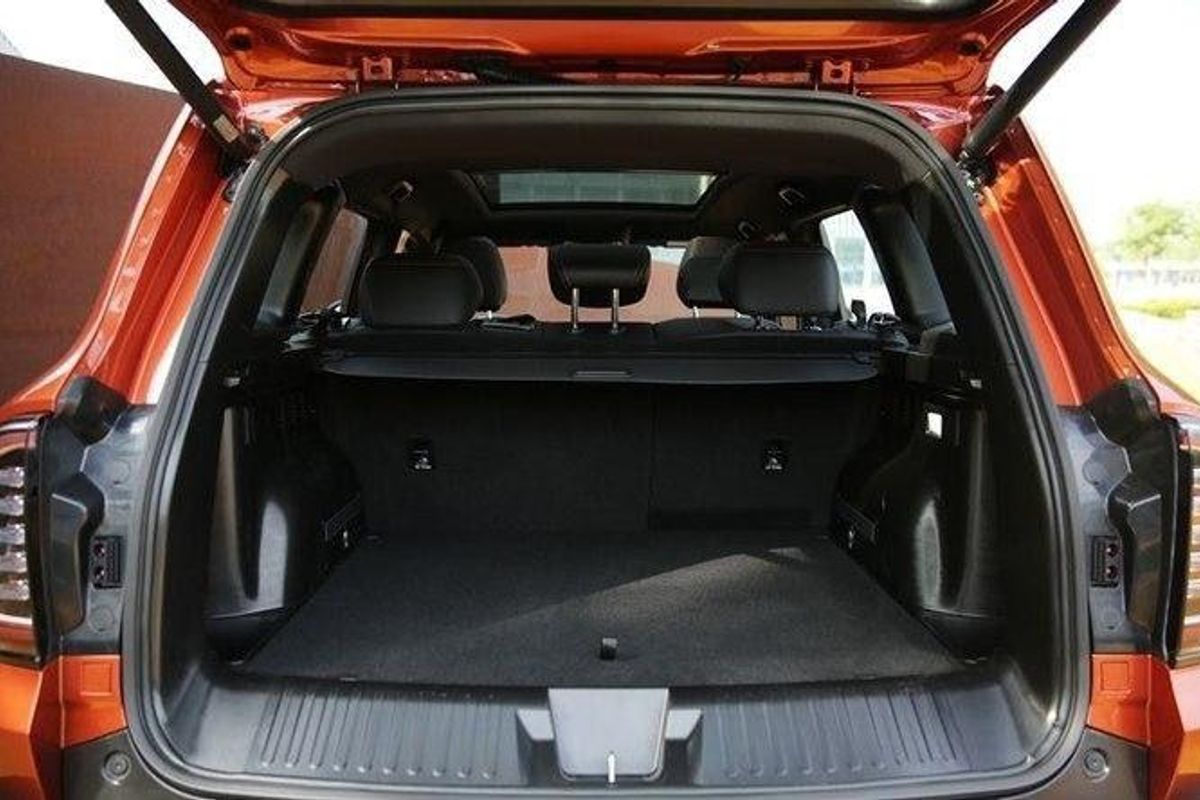
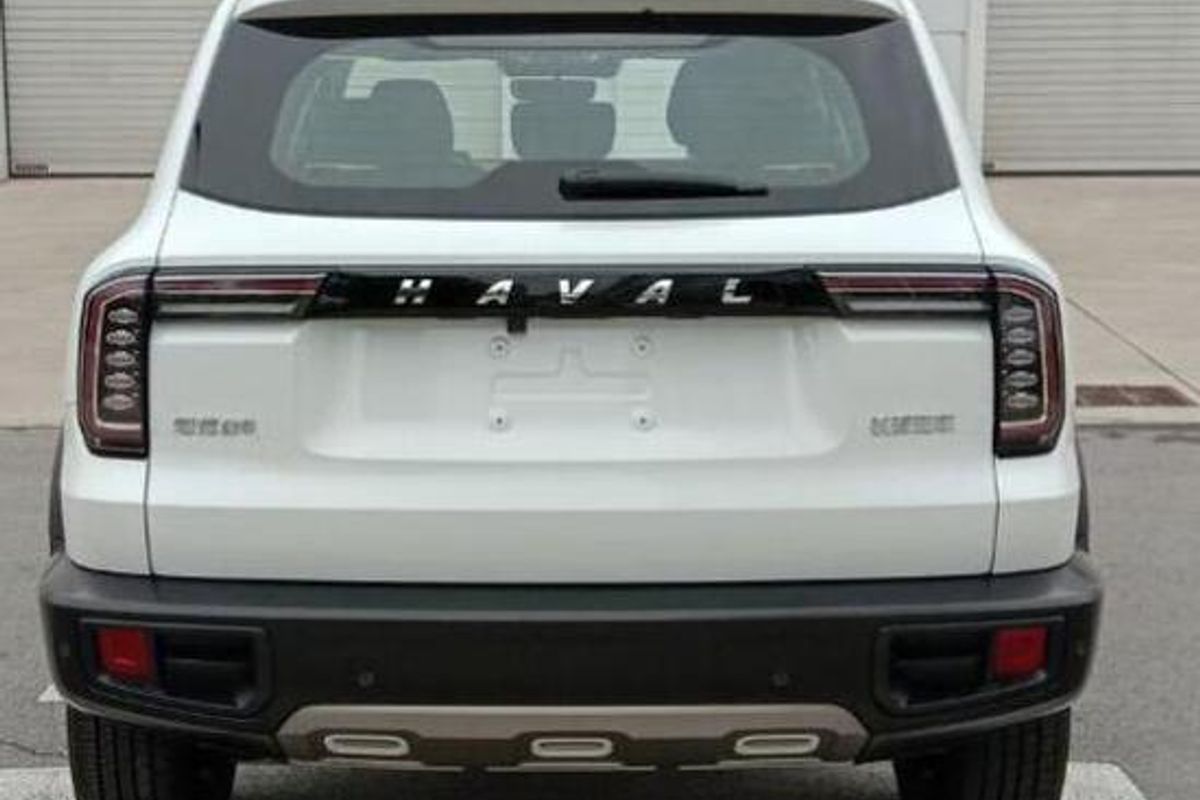
In terms of design, the Haval Big Dog adopts a boxy design with a bold, 3-tier grille flanked with round headlights set in dark trim housing. An under-body skid plate is also fitted along with rugged-looking black plastic wheel arches, hinting that the Big Dog can run offroad if need be which is further emphasised with its 200 mm ground clearance. Roof rails, running boars and all-terrain tyres further add to the ruggedness of the new model. The rear benefits from inverted L-shaped taillights along with a rear skid plate and a bold Haval badge.
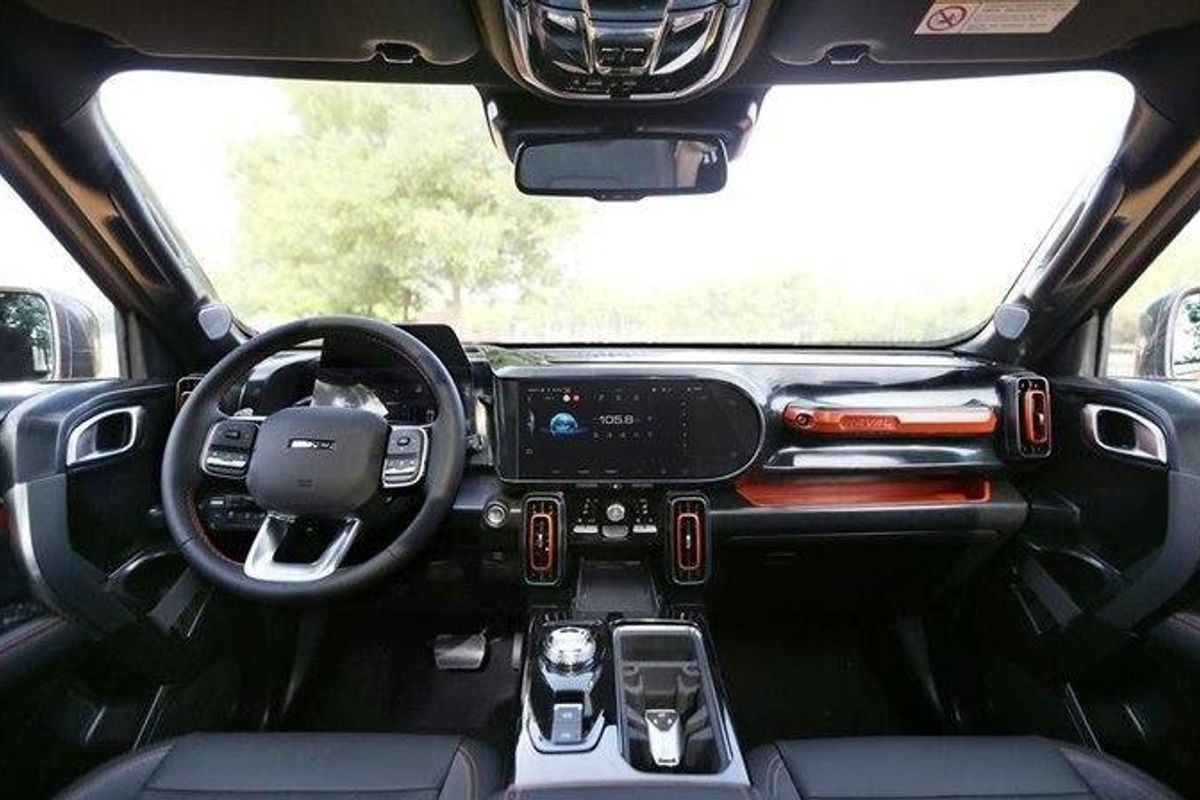
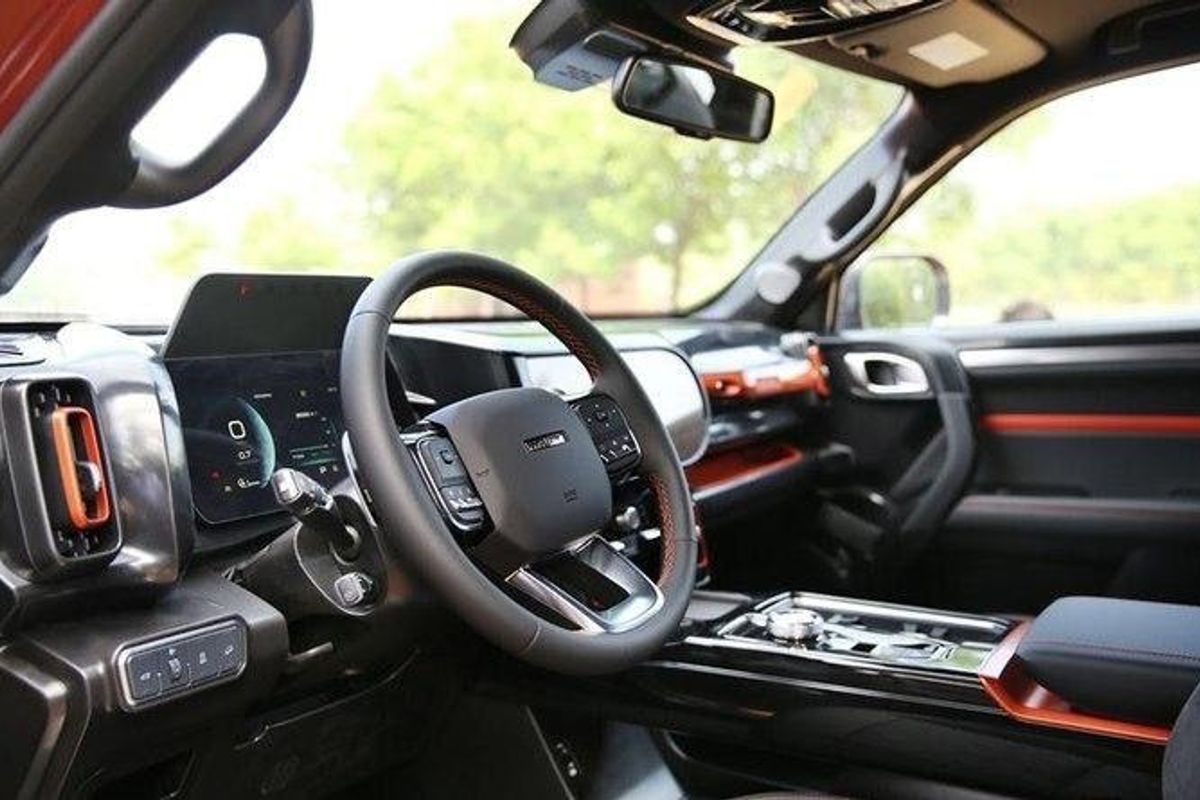
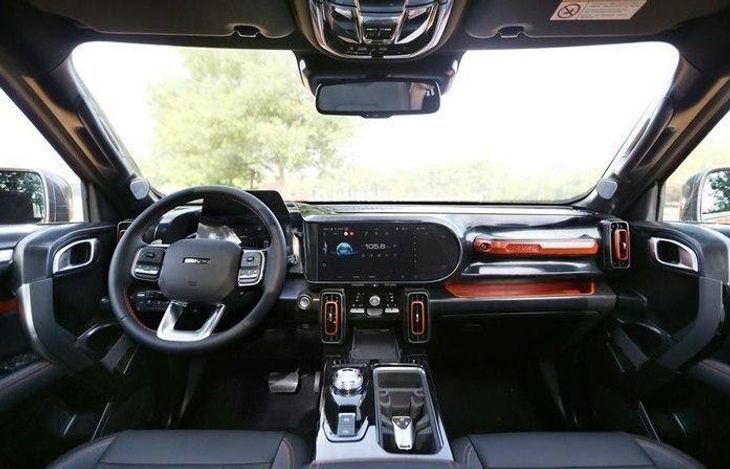
The Big Dog’s interior is vibrant and comes equipped with all the bells and whistles.
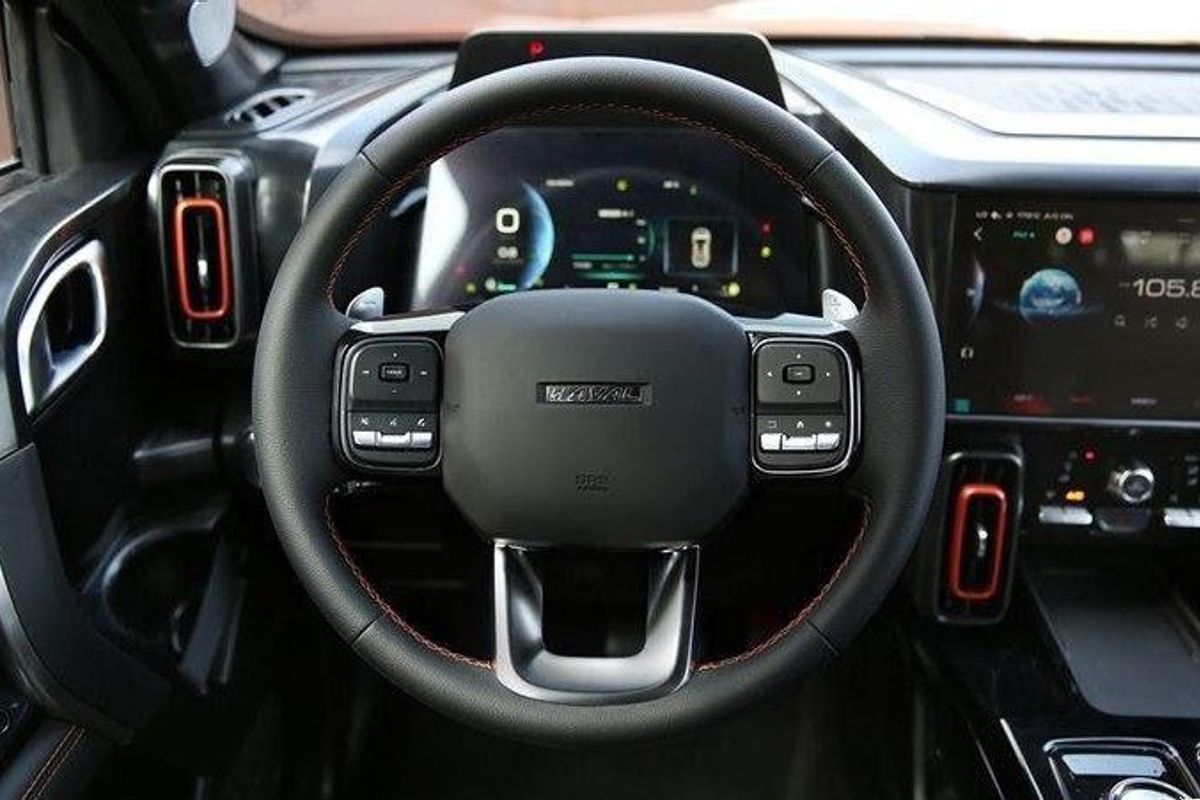
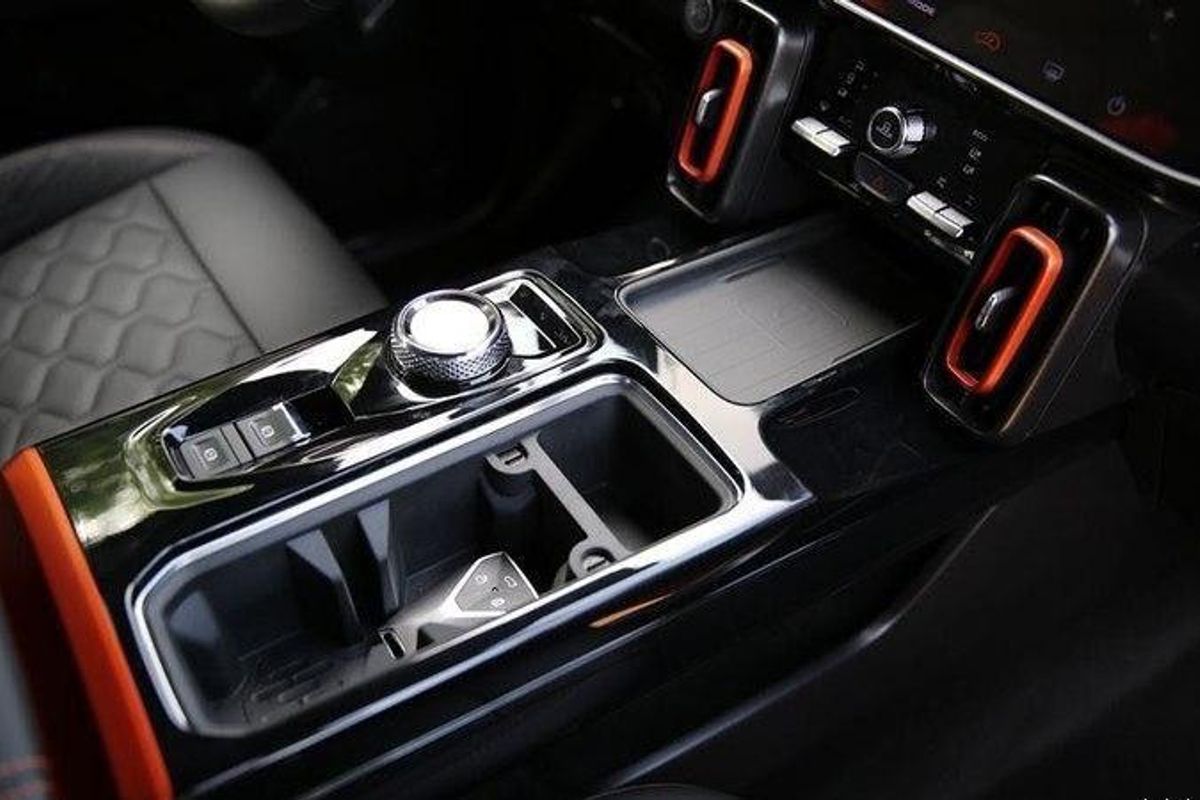
Moving inside, the Haval Dargo is equipped with a digital instrument cluster and large touchscreen infotainment system as well as a neat multi-function steering wheel. A wireless charging pad is also fitted. The dashboard is equipped with vertical air vents as well as a large grab handle for the front passenger as well as on the A-pillars.
In China, the Big Dog is powered by 2 turbocharged engine choices including a 125 kW/285 Nm 1.5-litre engine (front-wheel-drive) as well as a larger 2.0-litre engine offering 155 kW and 325 Nm (4-wheel-drive). A 7-speed dual-clutch transmission is fitted. A new diesel powertrain is reportedly being developed too and could offer in the region of 135 kW and 480 Nm which would be ideal for South Africa.
To ensure that the Big Dog is competitive offroad, Haval has equipped the Big Dog with a BorgWarner 4-wheel-drive system with 2 differential locks and 6 drive modes suited for various terrain. Offroad cameras are also fitted so that difficult terrain can be navigated safely.
Do you want to see the Haval Big Dog in South Africa?
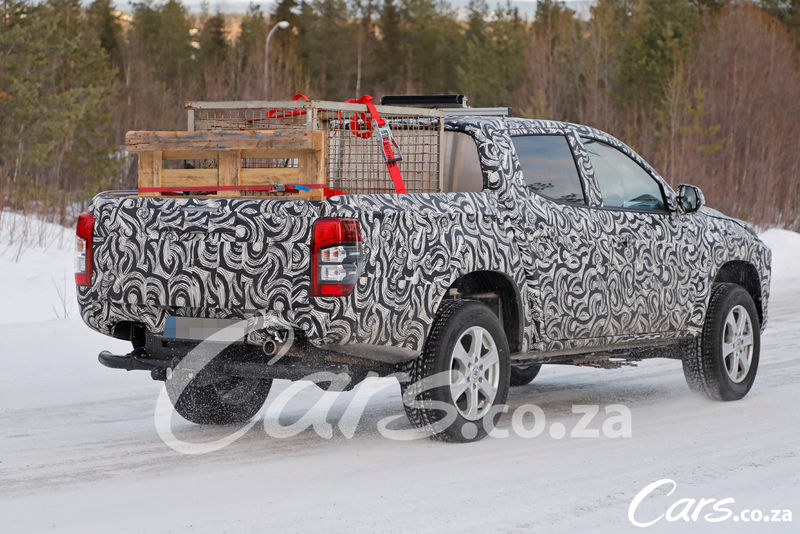
The first 2024 Mitsubishi Triton prototypes have been spotted undergoing testing. Here’s what we know about the Japanese bakkie.
Picture credit: S. Baldauf/SB-Medien. We have paid for these photos and at the photographer’s request, have watermarked them.
The double-cab bakkie market is constantly evolving. If one brand launches a new model, you can be sure that the rest will be taking notice and preparing updates of their own. With traditional bakkie markets like South Africa and Australia buying huge numbers of these vehicles, it’s vital for the brands to be constantly innovating and updating.
What you see here are the first images of the 2024 Mitsubishi Triton. In overseas markets, this product is known as the Mitsubishi L200. Our photographers tell us this is what’s known as a chassis-testing mule. So while it vaguely resembles the current shape car with its near-identical headlights, what’s under the bodywork and can’t be seen with the naked eye is where the real changes lie.
We’re not expecting too many radical upgrades as the current shape Mitsubishi Triton offers decent refinement and offroad capability, wrapped in one good-looking package. Browse for new and used Tritons here.
When will the 2024 Mitsubishi Triton be revealed?
We can expect this new 2024 Mitsubishi Triton to be revealed at some point in 2023.
The current Mitsubishi L200 Facelift was launched in 2019, so that we can expect the next generation by 2023/2024.
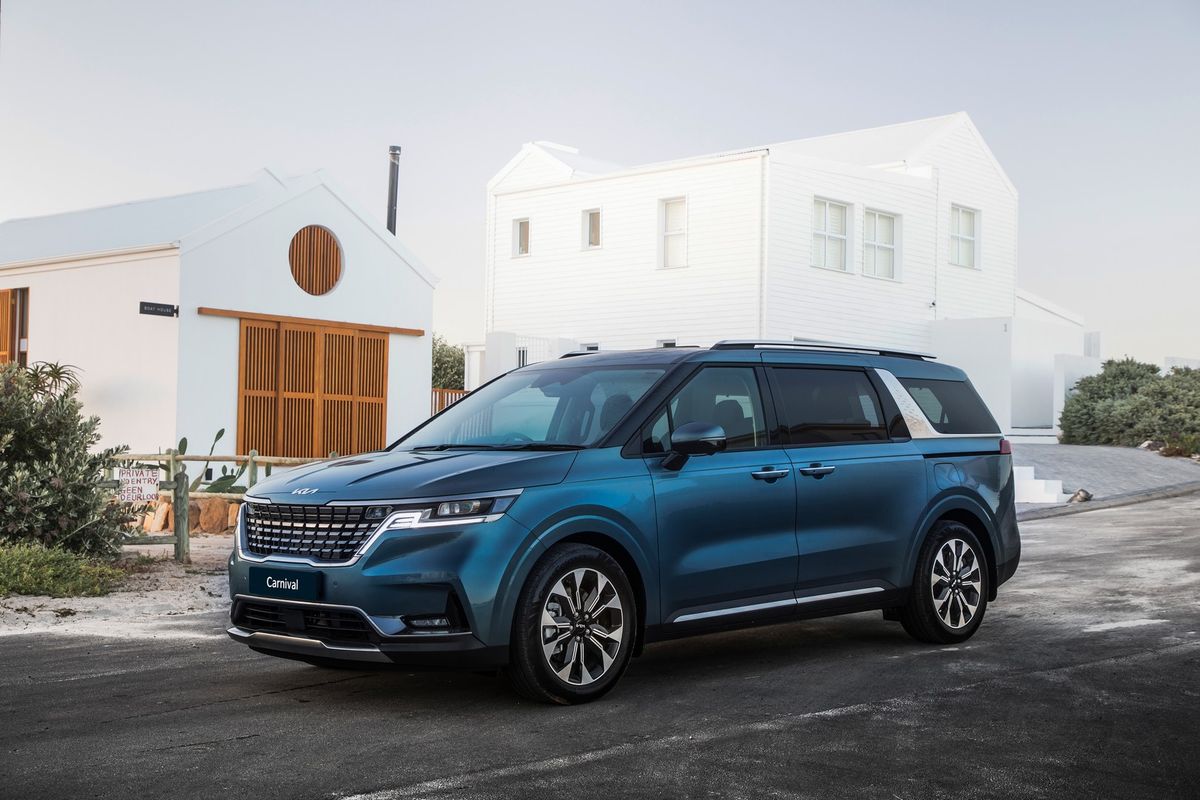
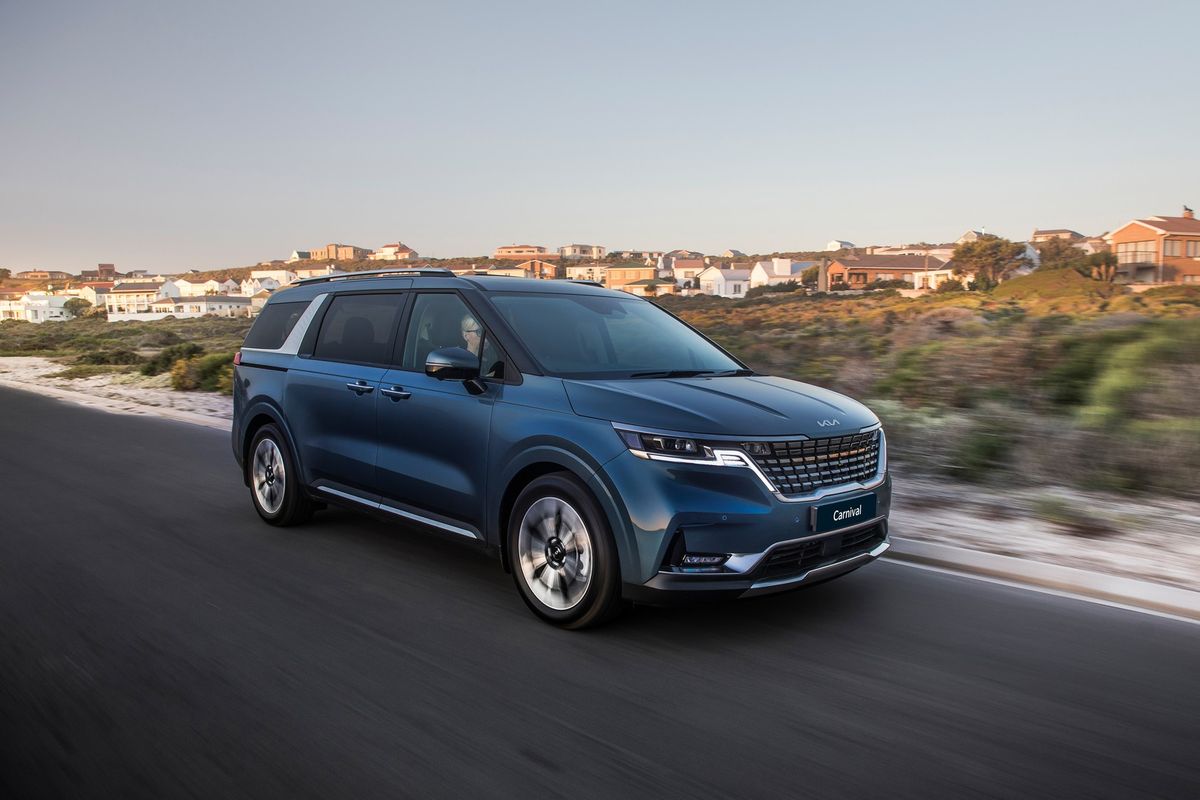
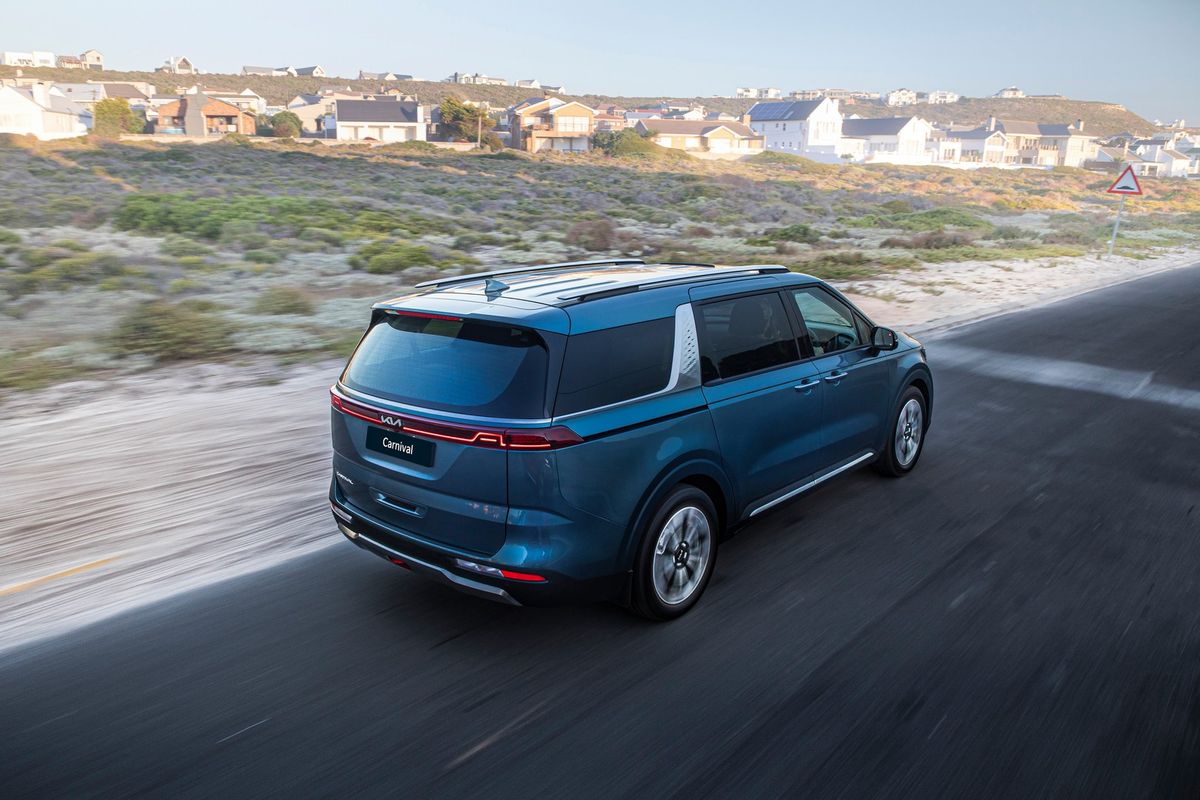
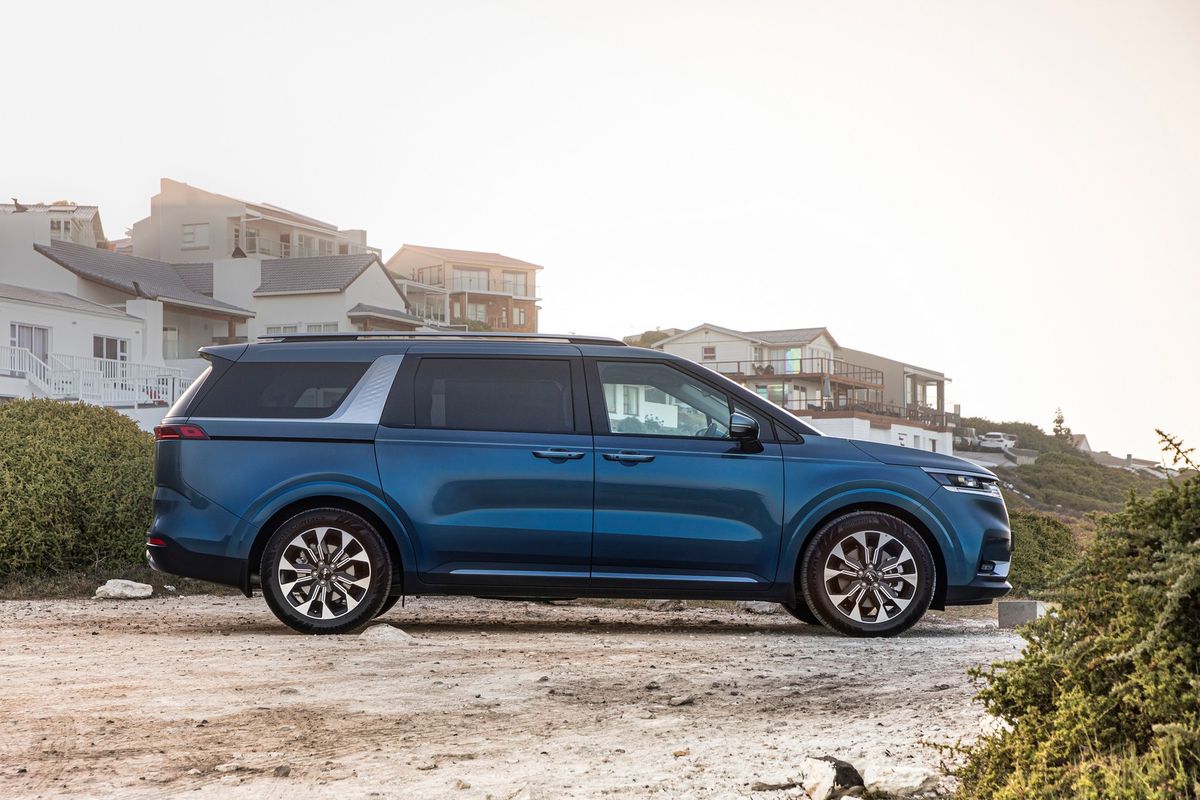
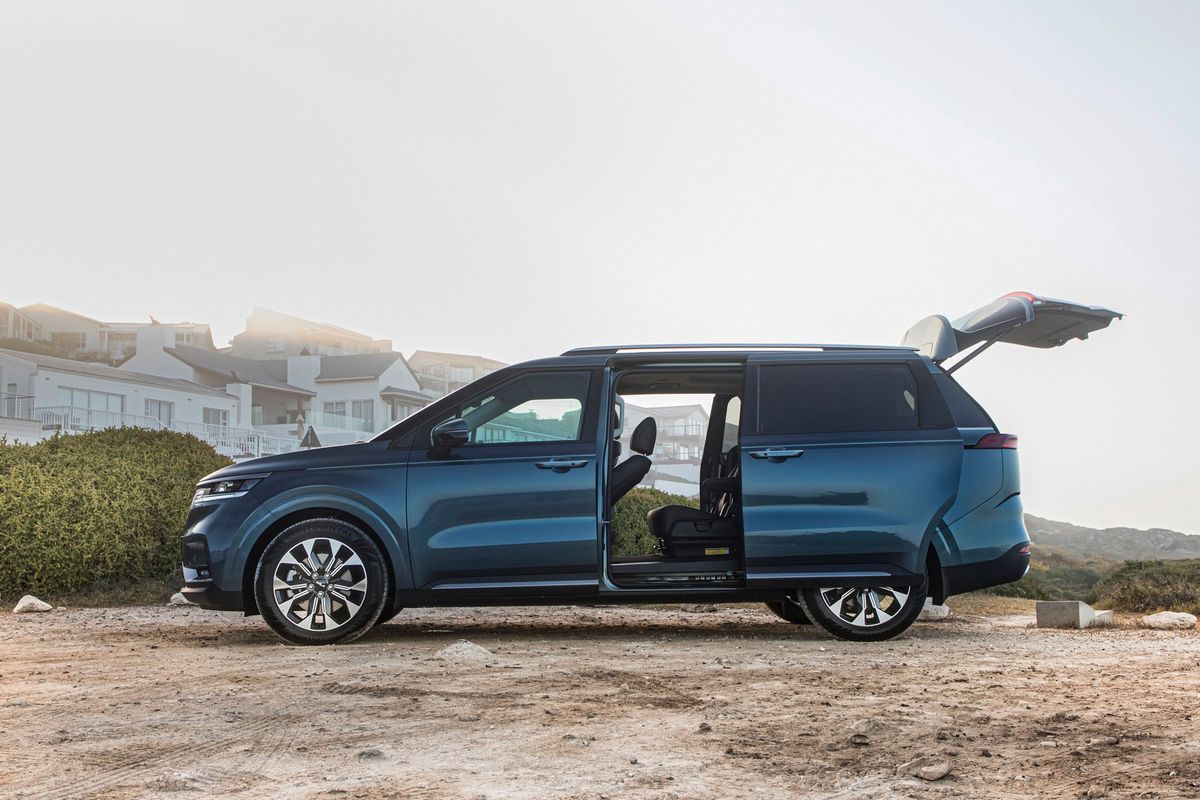
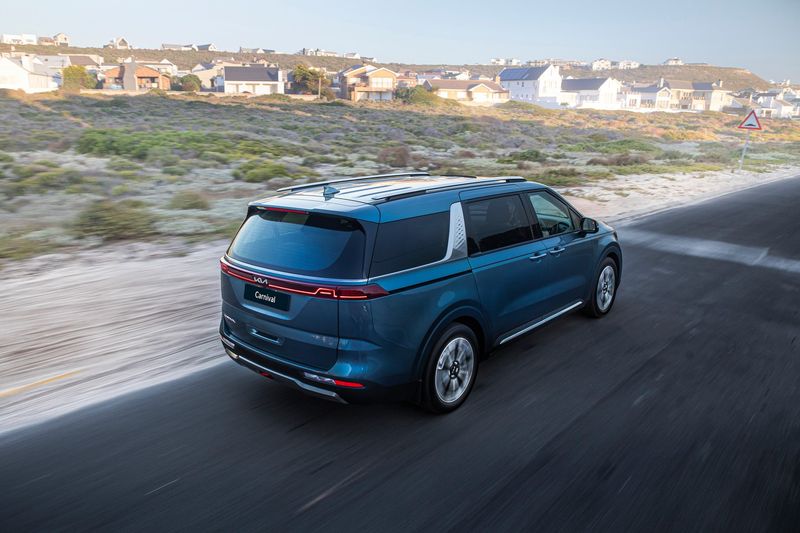
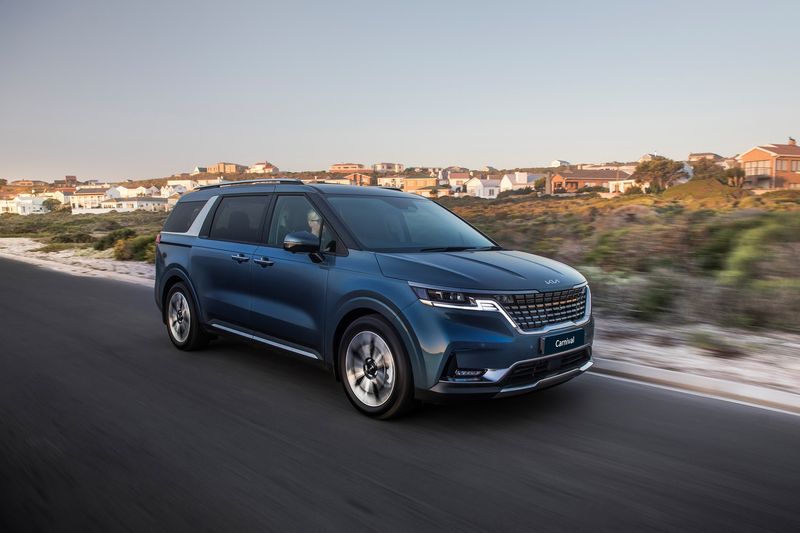
Kia Carnival (2022) Launch Review
An extended road trip is a great way to get to know a new vehicle better and Kia SA gave the motoring media a chance to sample its new Sorento executive SUV and Carnival people-mover over a weekend. In an SUV-obsessed world, is there still a place for a large family MPV?
We all thought the rampant popularity of the SUV would cause the extinction of the humble MPV, but the semi-luxurious bus is enjoying a bit of a resurgence – Kia claims the segment increased by 15% last year. Models such as the Volkswagen Kombi/Caravelle and Mercedes-Benz Vito/V-Class still sell in decent numbers, while the futuristic-looking Hyundai Staria is becoming a common sight on SA roads.
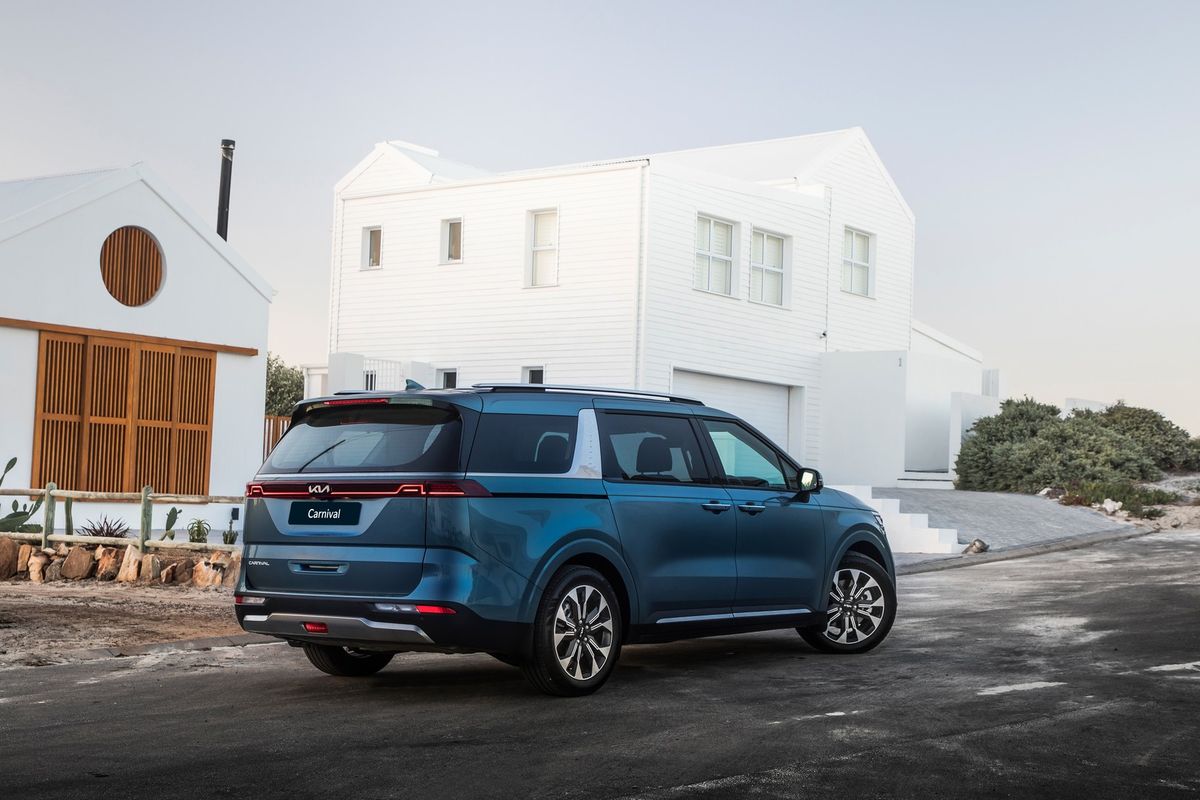
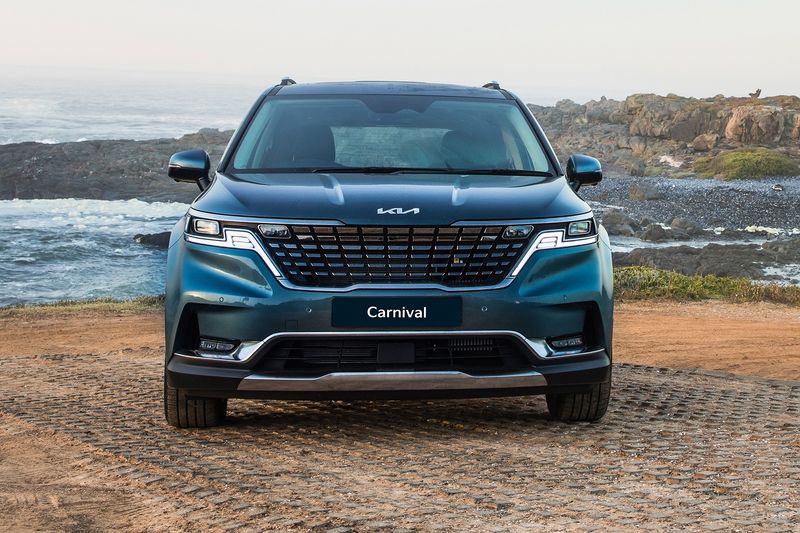
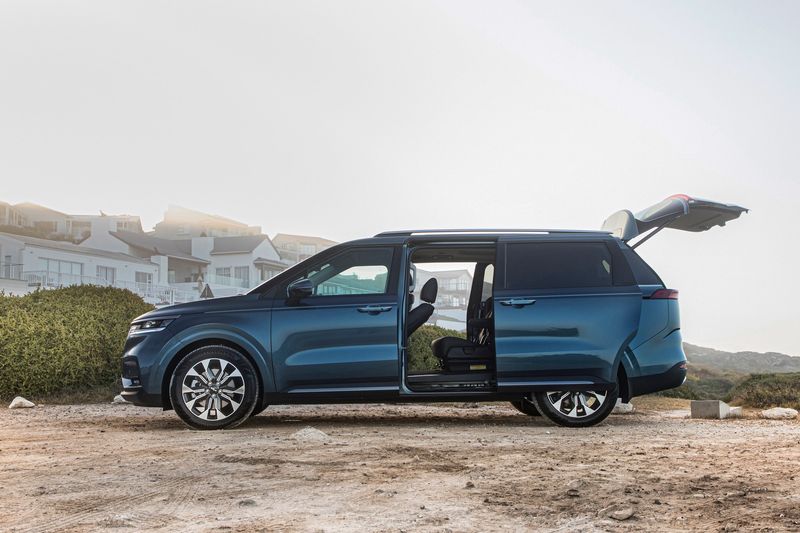
The vehicles on which most minibuses are based are engineered to transport passengers and cargo as cost-effectively as possible, so it’s safe to say that even their most luxuriously appointed variants aren’t exactly designed to draw attention. The Kia Carnival is a touch different – Kia’s designers did their utmost to give the Carnival a distinct visual identity. This is a vehicle that will make you look twice.
What’s New?
It may be a small detail, but it’s significant enough to warrant a mention – the newcomer’s name. Whereas Kia South Africa named this model’s predecessor the Grand Sedona, Carnival, which is the global product name, after all, has now been reinstated. Our review of the previous model stated: “Offering vast space, excellent versatility, sumptuous on-road comfort (for all 7 occupants) over long distances and equipped with more toys to play with than most similarly priced SUVs, the Kia Grand Sedona 2.2 CRDi SXL may very well be the ultimate family car.” No pressure on the new-generation Carnival, then!
The Carnival is based on a new platform (which it shares with the new Sorento) and powered by a fresh Smartstream turbodiesel engine. Kia claims improvements in its manufacturing processes have resulted in the people-mover offering better driving dynamics, as well as improved quietness and refinement. The new Carnival is bigger in all directions compared with its Grand Sedona predecessor…
What’s on offer?
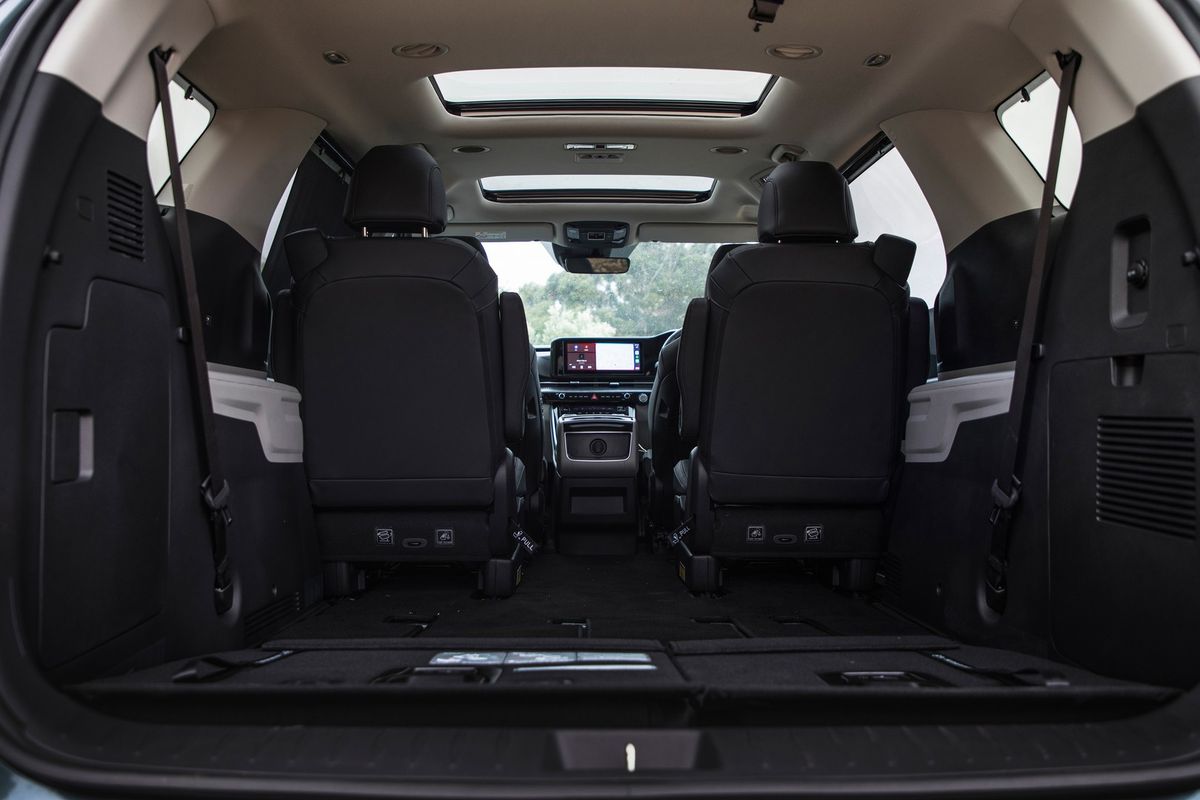
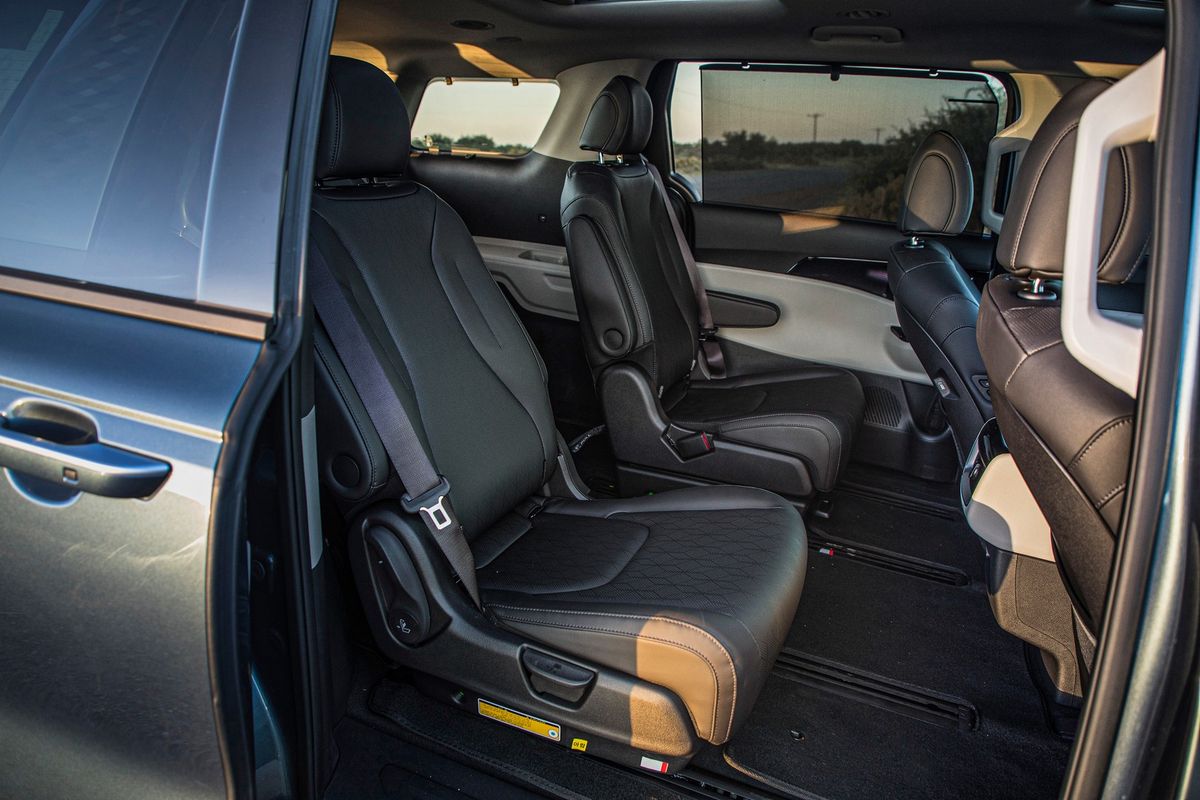
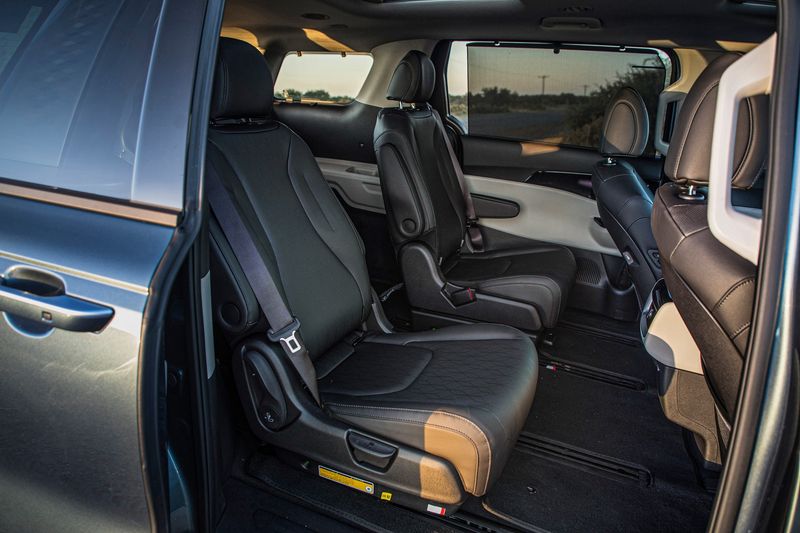
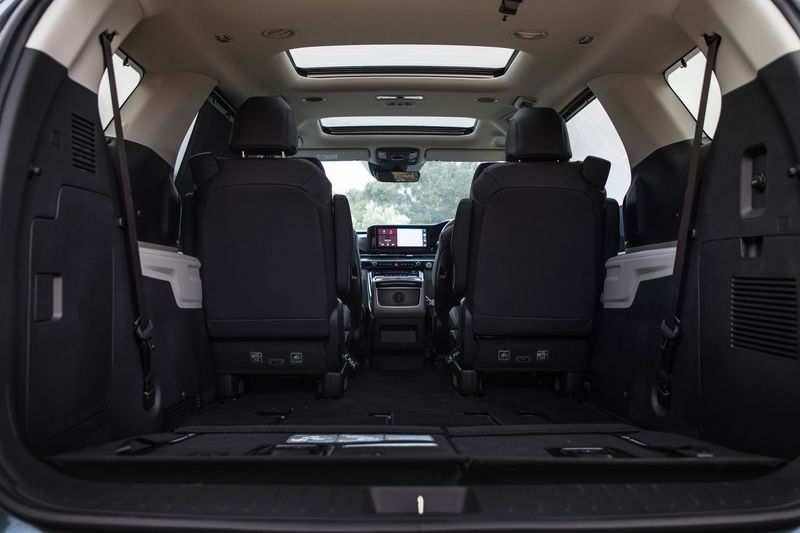
Kia South Africa offers the new Carnival in 4 derivatives, each of which is powered by a new 148 kW/440 Nm 2.2-litre 4-cylinder Smartstream turbodiesel engine that propels the large MPV’s front wheels via an 8-speed automatic transmission. Most are 7-seaters – their seat layout is 2-2-3 front to rear, with the second row featuring a pair of individual seats, the sheer novelty of which is unlikely to ever wear off.
There are 4 trim levels to choose from and the second most affordable derivative (the EX+) has an 8-seater configuration, which will appeal to buyers who require maximum people-carrying ability.
On long journeys, aspects such as a model’s cabin comfort, quietness and on-road refinement can be thoroughly assessed. A road trip should be a perfect platform for a vehicle of this kind to show off its talents, but given the Grand Sedona’s reputation for being excellent at hauling passengers in the lap of luxury, a standard had been set – can the new Carnival at least match, or ideally improve on that?
Yes, absolutely. The newcomer’s advanced platform facilitates excellent overall refinement – we discerned minimal road noise or wind intrusion for the duration of the trip. Comfort levels are at an all-time high and the SX Limited we drove offered an abundance of gadgets and gizmos to keep us entertained. Even in the base (EX) trim, there are plenty of safety and convenience features fitted as standard.
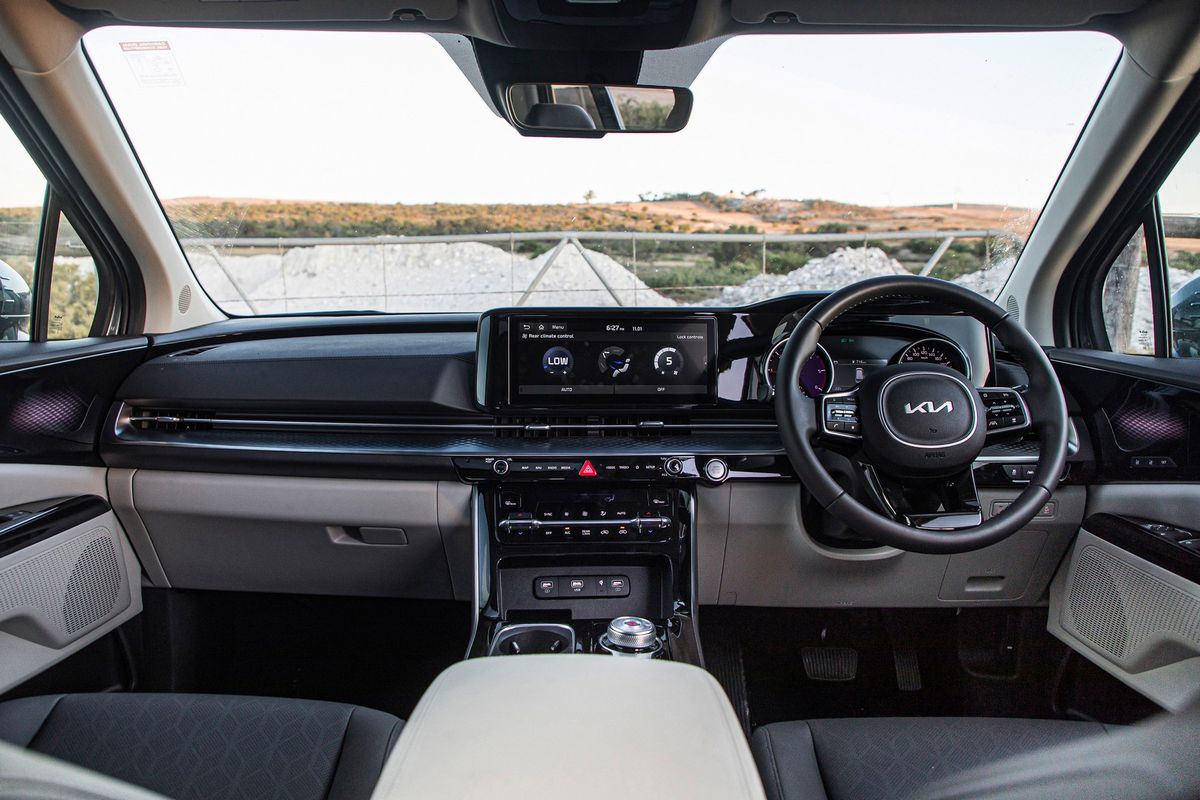
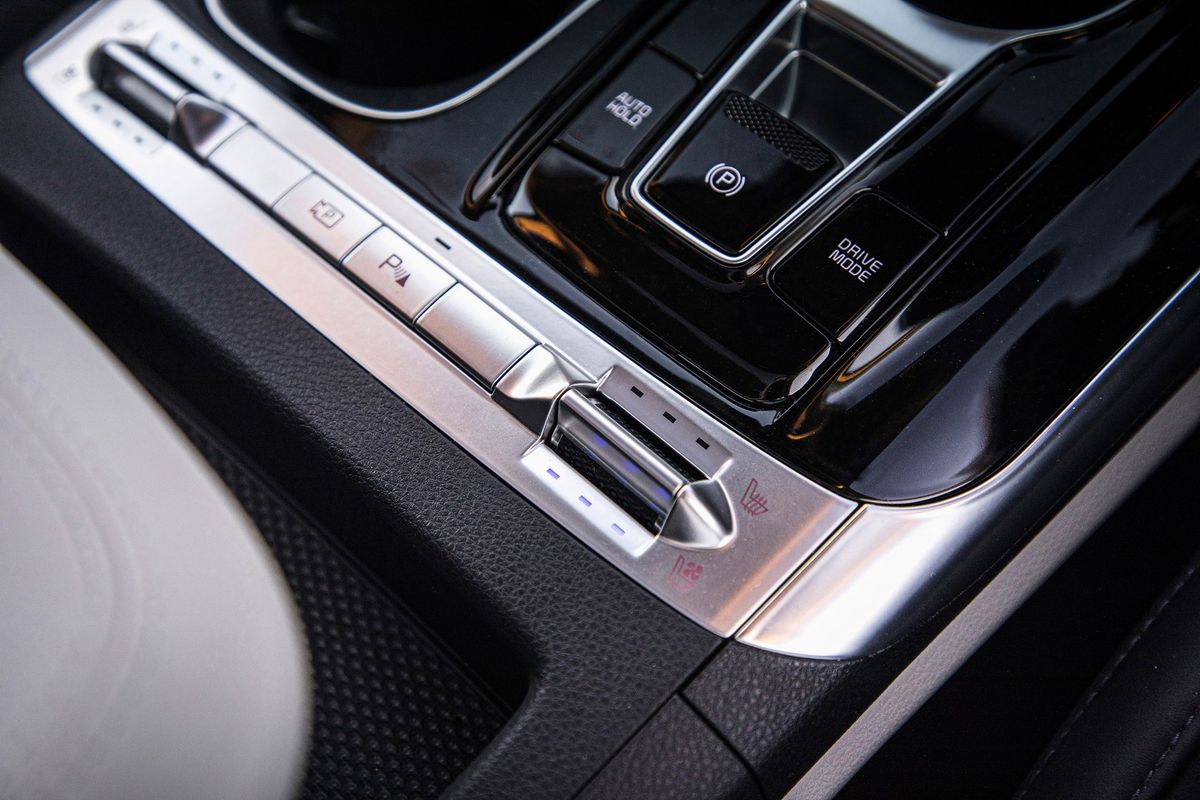
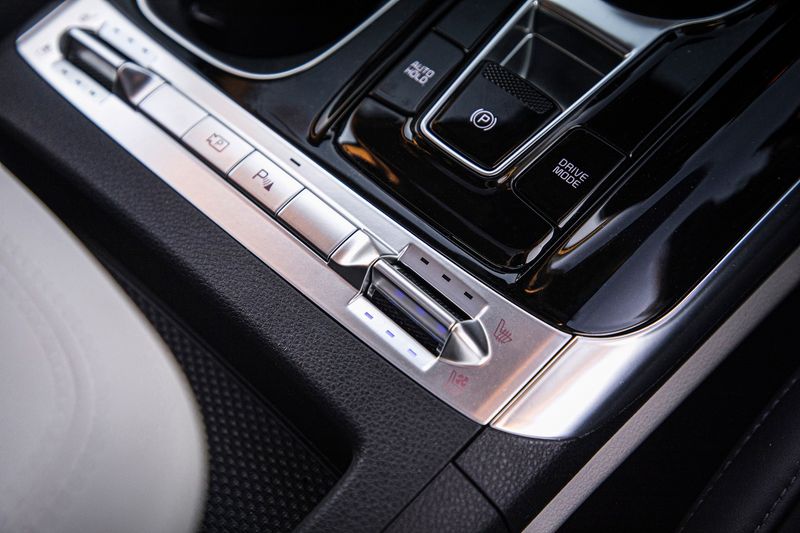
We made extensive use of the cooling functions of the front seats (which can be heated too, during colder months), the wireless charging pad, USB connectivity, as well as the Apple CarPlay/Android Auto compatibility. As far as safety systems are concerned, the new Carnival comes well specified across the range. In fact, the flagship SXL could be one of the most safety-oriented vehicles in the segment by virtue of its around-view monitor, rear cross-traffic alert, blindspot collision avoidance assist, blindspot monitor, lane following assist, lane-keeping assist, forward-collision avoidance assist and 7 airbags.
The powertrain is certainly worth a mention too. The Smartstream turbodiesel engine offers credible outputs and, when you’re driving on the open road, it never feels like there’s a shortage of grunt, despite the sizeable model’s heft. The 8-speed automatic generally does a good job, but it’s a bit too eager to kick down gears when the Carnival ascends hills or needs to urgently produce overtaking acceleration.
However, for what it is, the Carnival performs effortlessly – you can easily overtake slower-moving traffic on freeways. We experimented with the drive modes and found the Smart setting was best-suited to open-road cruising. It generally favours Eco, but will quickly sharpen its responses when you need rapid acceleration. We saw admirable indicated fuel consumption figures of between 7- and 8 L/100 km.
As far as driving dynamics are concerned, well, the Carnival handles exactly how you expect a large people-carrier would. The suspension setup is utterly comfort-oriented – and the newcomer’s forgiving ride quality certainly reflects that – but that’s not to say the vehicle’s ponderous… If you try to hustle it through some mountain sweeps, it’ll probably perform better than most would expect it to; in fact, the brakes feel more than up to the task of reining in momentum. The light steering does its best to mask the Kia’s bulk and makes the newcomer feel a touch smaller in the confines of an urban environment.
How much does the Kia Carnival cost in South Africa?
The new Carnival comes with a 5-year/unlimited-kilometre warranty (including roadside assistance), as well as a 6-year/90 000 km maintenance plan. The top-end 2.2 CRDi SXL will arrive in March 2022.
2.2 CRDi EX 8AT 7-Seater
R799 995
2.2 CRDi EX+ 8AT 8-Seater
R879 995
2.2 CRDi SX Limited 8AT 7-Seater
R999 995
2.2 CRDi SXL 8AT 7-Seater
R1 024 995
Summary
The Kia Carnival (like its cousin the Hyundai Staria) proves that people movers need not be boring to look at, drive or occupy. This is a well-thought-out and thoroughly resolved offering that carries on exactly where the Grand Sedona left off. The comfort levels and refinement are excellent, and the new turbodiesel engine delivers punchy performance and impressive fuel economy in equal measure.
Its pricing is competitive too. Kia SA pointed out that, when compared with pricier (mostly German) rival products, the newcomer offers superior standard spec and more comprehensive after-sales support.
With just two people on board the Carnival during one day of driving (which formed part of the model’s local media launch), we hardly put the newcomer through the “with the whole family and their detritus on board” stress test. We’re keen to experience the newcomer’s passenger-carrying capabilities over a longer period of time, but, if first impressions are anything to go by, Kia has Made (a) Van Great Again.
Rent to Own Financing & Blacklisting
Rent-to-Own has become quite a popular option for financing a vehicle. Although some people take this option because of the flexibility it offers, it is notably also the only car-financing option available to consumers who have been blacklisted. In this guide, we’ll delve into this type of financing and its pros and cons.
What Is Rent-to-Own Car Financing?
A rent-to-own (also known as “rent-to-buy”) vehicle finance plan is an agreement through which you can rent/lease a car by paying for it for the duration of a contract term. Most of these agreements require a deposit to get started, the length can vary from 12 to 60 months and you must pay an agreed premium from the beginning to end of the contract term.
The premiums usually include rental costs, comprehensive insurance, warranties and a tracking device. They cover a large portion of the purchase price of the vehicle in question. If you pay your instalments dutifully, the car will become yours at the end of the agreement term – in other words, ownership will be transferred to your name. In most cases, the transfer of ownership requires a pre-agreed “lump sum” to be paid. If the customer does not want to keep the car or does not have the lump sum, then the car can be returned and the customer can move onto another vehicle/contract.
Legally, this kind of agreement is designated as a ‘rental’ rather than vehicle finance, which is a critical difference because the former is not governed by the National Credit Act. This means that the credit and affordability checks that are mandated by the National Credit Act do not need to occur, which opens the door for these deals to be offered to blacklisted consumers.
The Advantages of Rent-to-Own Cars
Flexibility
A car subscription may sound similar to bank finance, but there are important differences. Bank finance agreements have much less flexibility, can lock in the customer for as long as 72 months and typically also have high “balloon” payments, which mean that exiting the agreement during the first few years can be very expensive and very difficult.
Car subscriptions are generally more flexible. For instance, Planet42 asks for a minimum commitment of 6 months, after which time the customer can return the car at any time for a nominal fee. This means that the customer is not liable to pay the shortfall in the car’s realisation value, which the bank would charge to the customer when the bank sells off a car that has been returned to them.
Available to Blacklisted Customers
To reiterate, a Rent-to-Own or “lease” agreement sits outside the National Credit Act. This means that the providers do not have to perform the same credit score and affordability checks that are mandated by the Act. This opens the door to blacklisted consumers and this is the main driver of the growth of this market segment.
In Nov 2021, the National Credit Regulator indicated that 40% of consumers are 3 or more months in arrears with one or more credit accounts, which effectively locks them out of the vehicle-finance market. Rent-to-Own gives these consumers a feasible path to accessing a vehicle to drive on a day-to-day basis with a path to eventual ownership.
Rent to own providers will ask for your ID, proof of residence and a payslip, as you’ll need to show you can afford the rental payments.
However, it is worth noting that because such agreements are not governed by the National Credit Act, the protections offered within the stipulations of the Act do not apply. More about this later.
Most Rent-to-Own contracts include comprehensive insurance, a tracking device, a warranty and roadside-assistance cover as part of the deal. It is important to note this when you compare the monthly payments of a Rent-to-Own deal with the instalments of a traditional vehicle-finance agreement, which only services the debt on the vehicle. Always ask if “maintenance” of the vehicle is included. In general, this will be included but you need to understand what is included and what will be paid out if the vehicle breaks down. You will almost always be using Rent-to-Own to buy a ‘used’ car so it is important you understand the rules.
The Disadvantages of Rent-to-Own Vehicle Finance
While “renting a car to own it” has its advantages, before you sign on the dotted line, it’s important that you are aware of the implications.
More Expensive than Credit Options
The “effective” interest rate charged by the rent-to-own company is very high, much higher than in the case of traditional car financing. Remember they are lending to customers who the credit bureaus regard as “very high risk” and thus the price reflects this risk. If you see the agreement through to its completion and “own” the car outright, you will probably have paid multiple times the purchase price.
Repossessing Rent-to-Own cars.
Rent-to-own contracts are not credit agreements and thus the consumer protection against repossession written into the National Credit Act does not apply. If you fail to pay just one premium, then it is likely that the car will be repossessed with immediate effect. Vehicle finance companies need a court order to take your car. The Rent-to-Own company will be at your door within days of non-payment.
Is Rent-to-Own Financing for Me?
Vehicle Finance is not an option for most South Africans. Rent-to-own provides a genuine alternative.
Cars.co.za recognises this and we have created a Finance Helpline which can connect you with some of the major companies and help you understand this a little better. It will make it a little easier so let us know if we can help you.
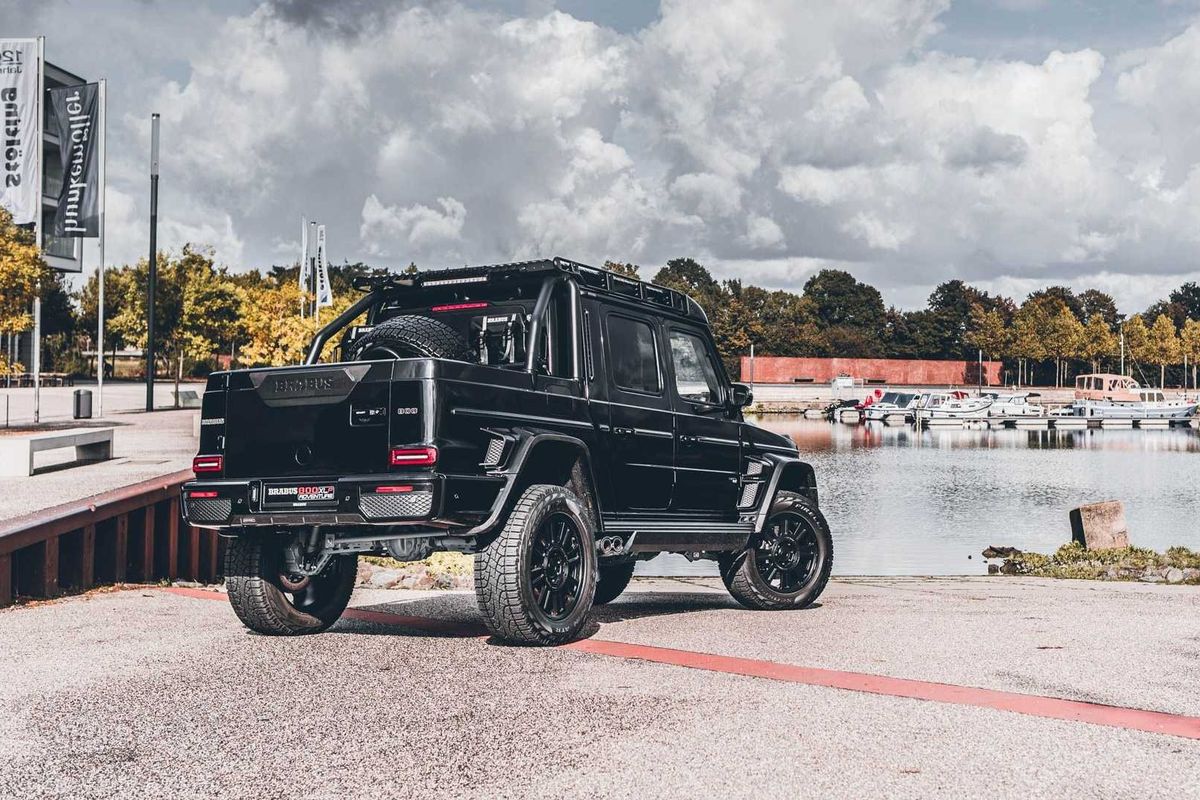
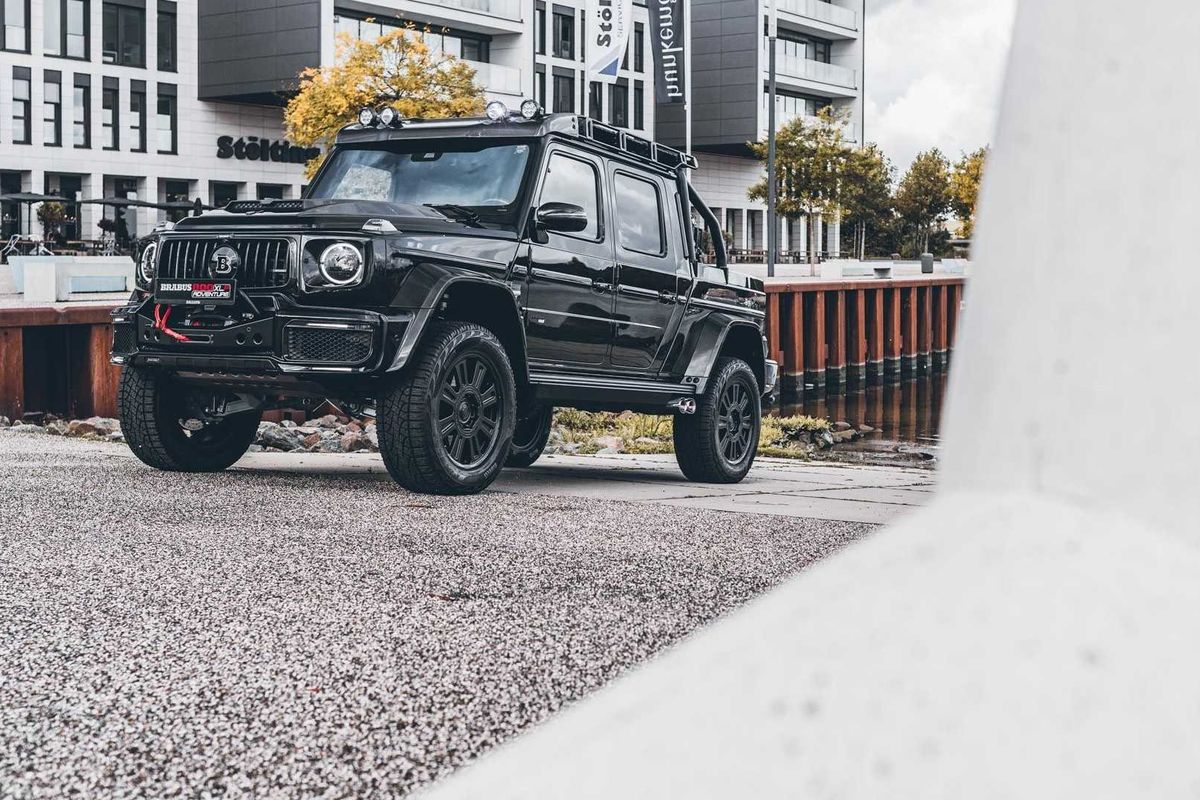
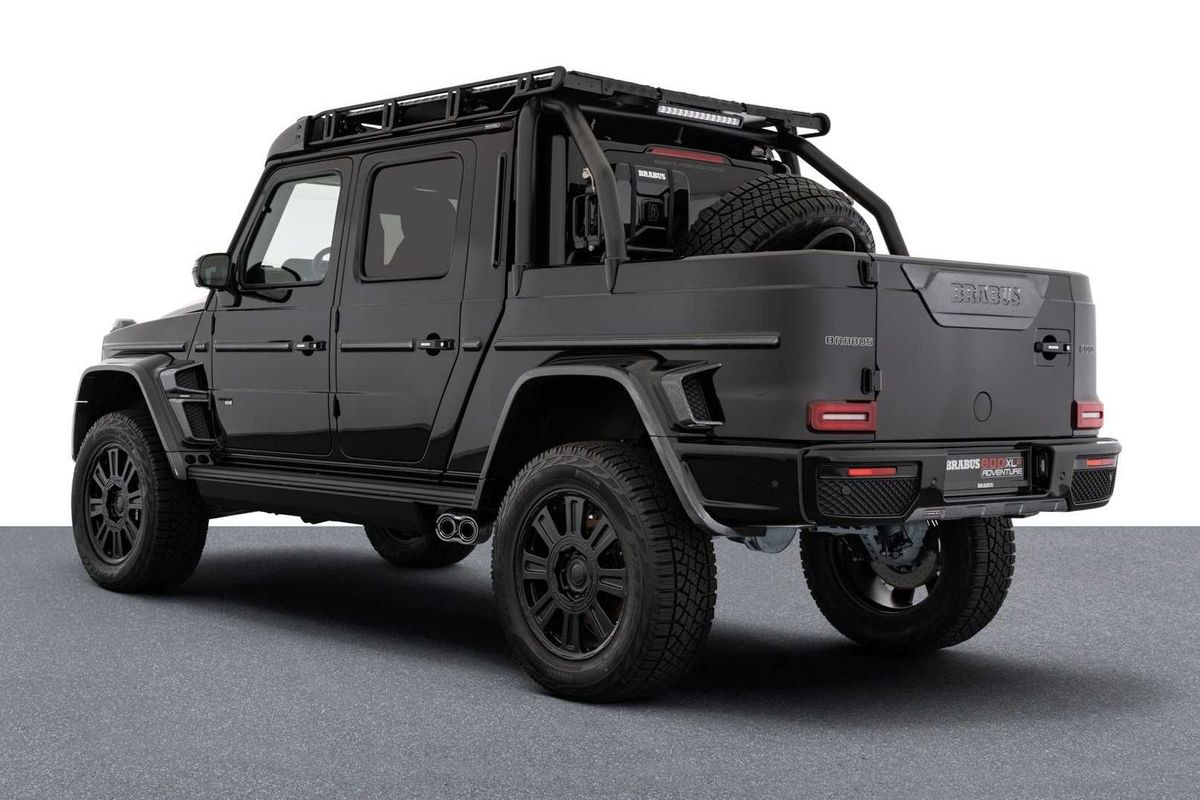
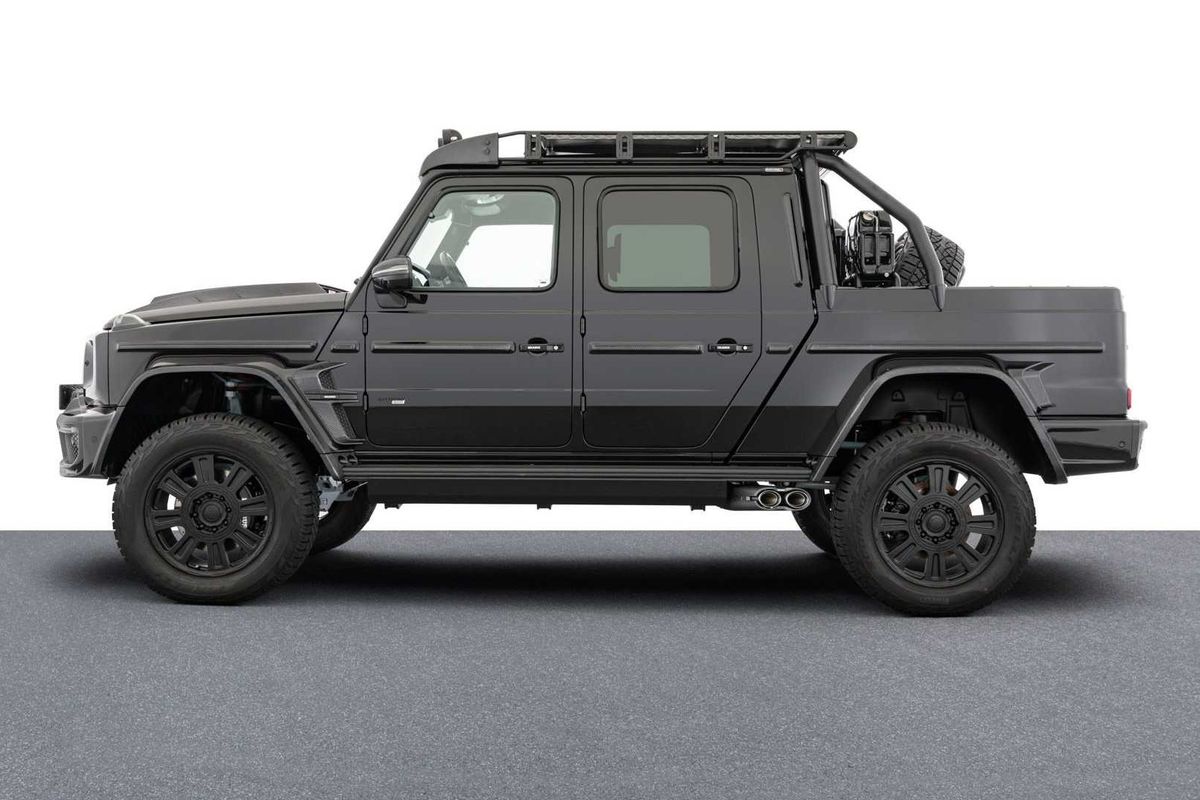
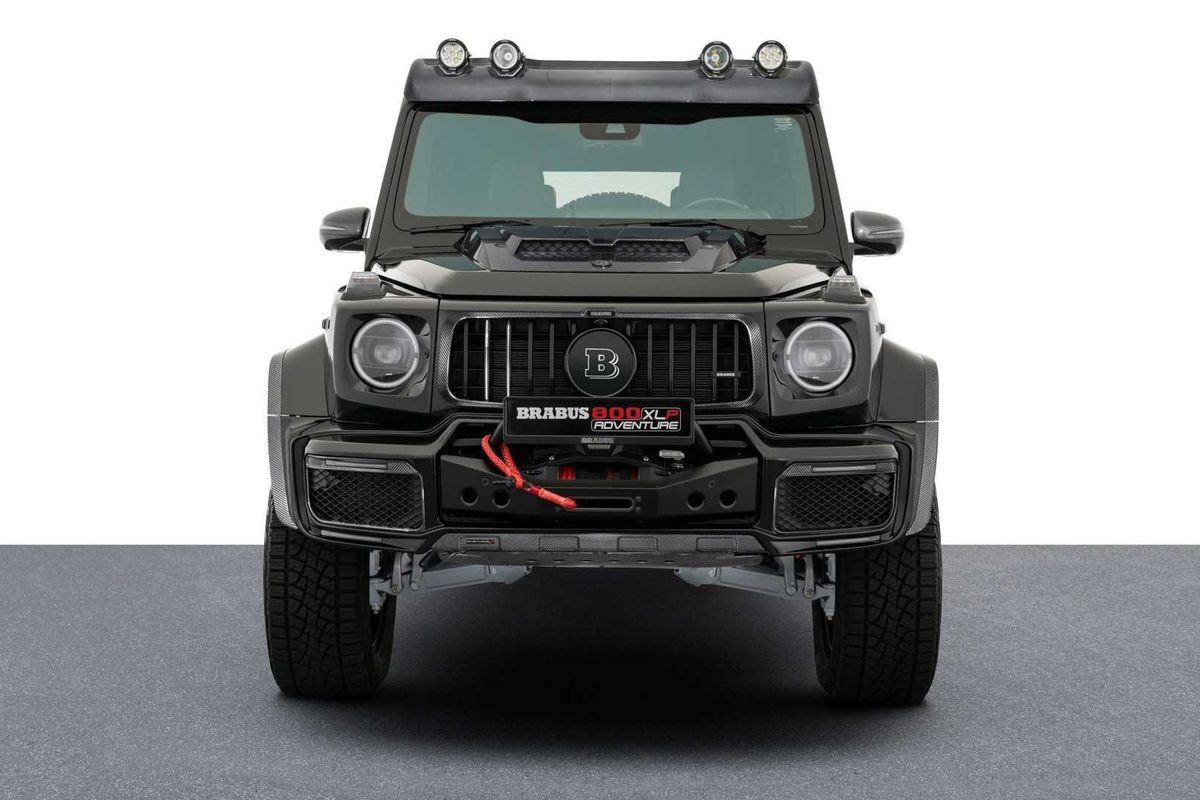
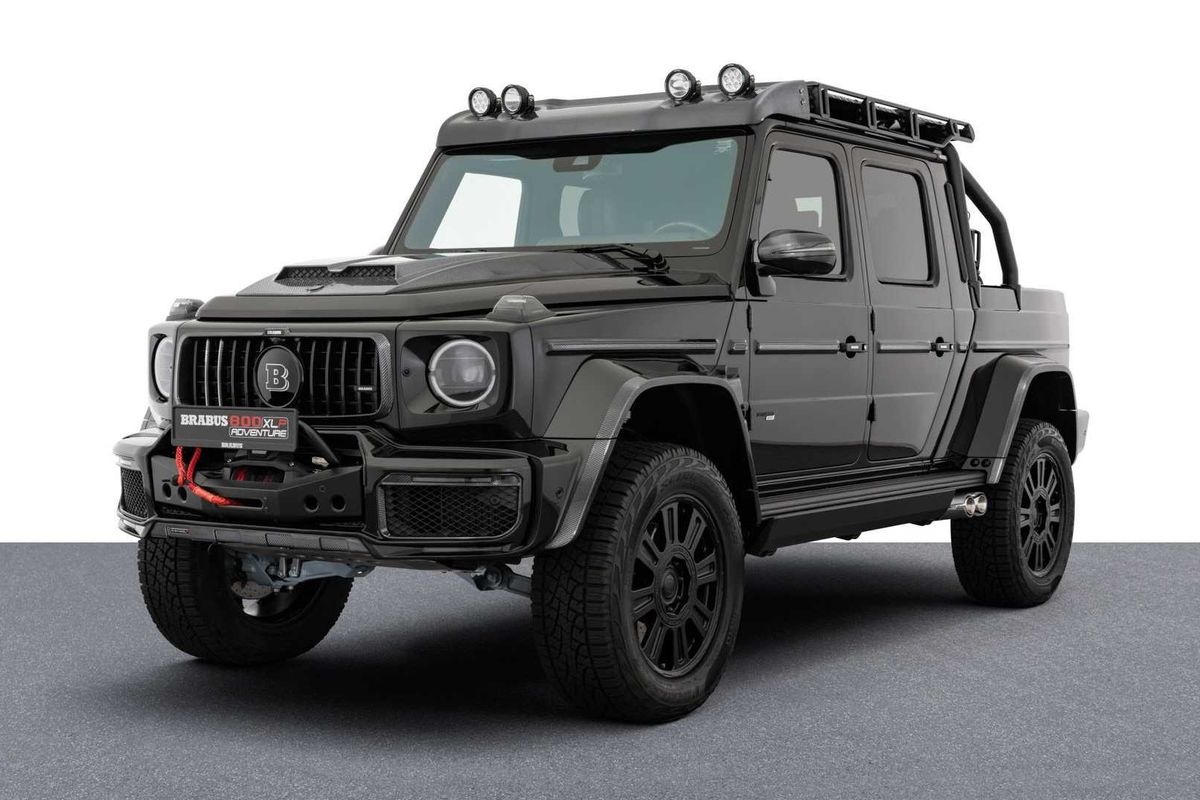
The Brabus 800 Adventure is proof that you can improve on the already-impressively capable Mercedes-Benz G-Class.
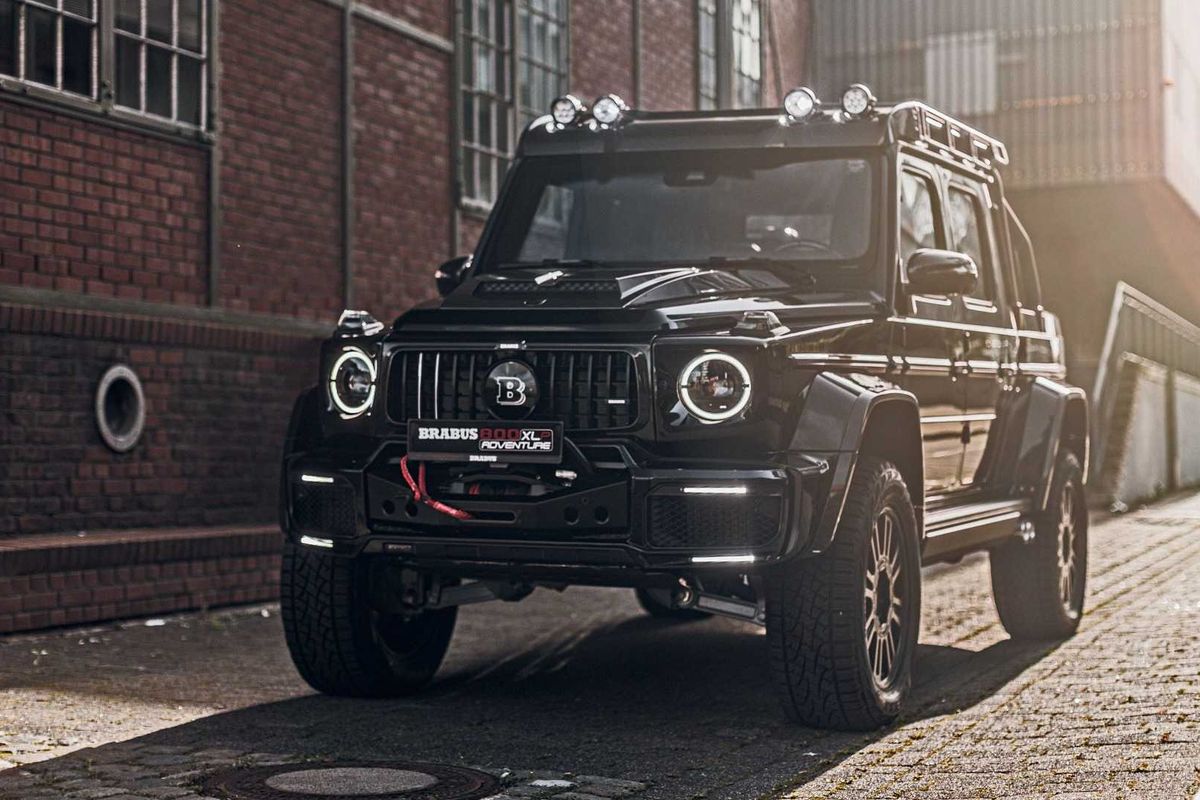
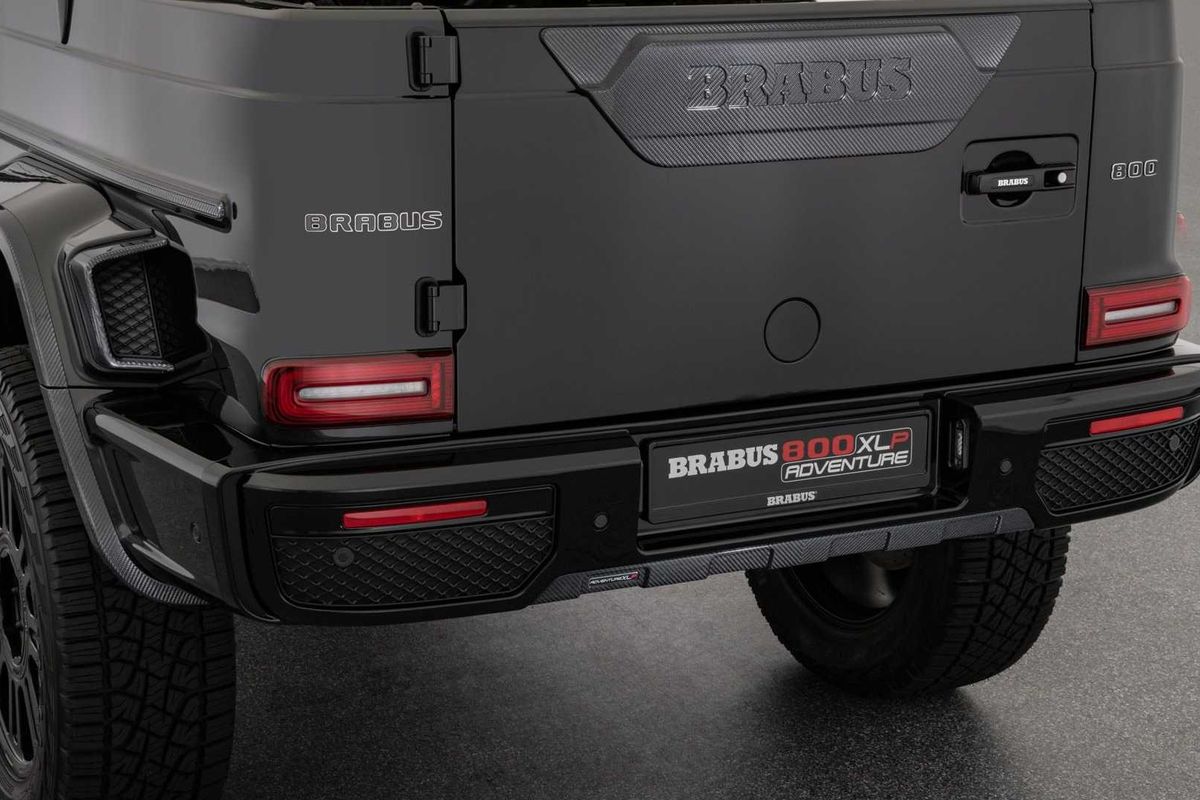
Mercedes-Benz tuner Brabus has done it again. Meet the Brabus 800 Adventure XLP Superblack, a tough and go-anywhere super bakkie. While we’re growing impatient with Mercedes-Benz and its all-new 4×4 squared, this will have to satisfy our appetite for badass adventure in the meantime.
What you see is an enhancement on what the Mercedes-Benz G-Class already offers. The vehicle has been stretched and raised, and is now almost 70 cm longer than the vehicle upon which it’s based.
The hardcore suspension setup features aluminium portal axles and these give the vehicle a ground clearance of 49 cm. Yes, you read that correctly. The Brabus 800 Adventure rides on 22-inch alloy wheels wrapped in all-terrain rubber.
While the 4.0-litre twin-turbocharged petrol V8 engine needs no introduction and produces a mighty 430 kW and 850 Nm, Brabus decided this wasn’t sufficient and managed to extract 588 kW and 1000 Nm. These are huge numbers, but due to its sheer size and mass, it’s not as fast as you’d expect. Still, 0-100 kph in 4.8 seconds is still very quick. There’s a top speed limit of 210 kph. Brabus claims its 800 Adventure weighs just under 3 tons.
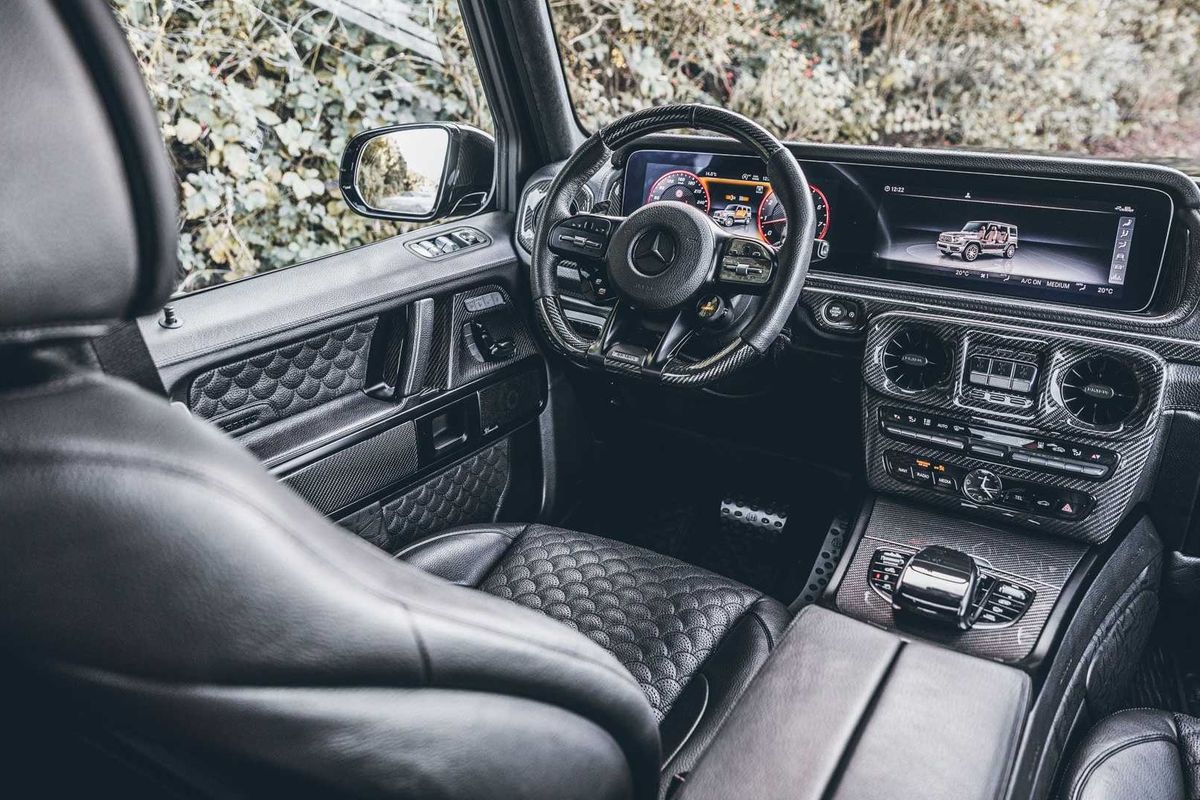
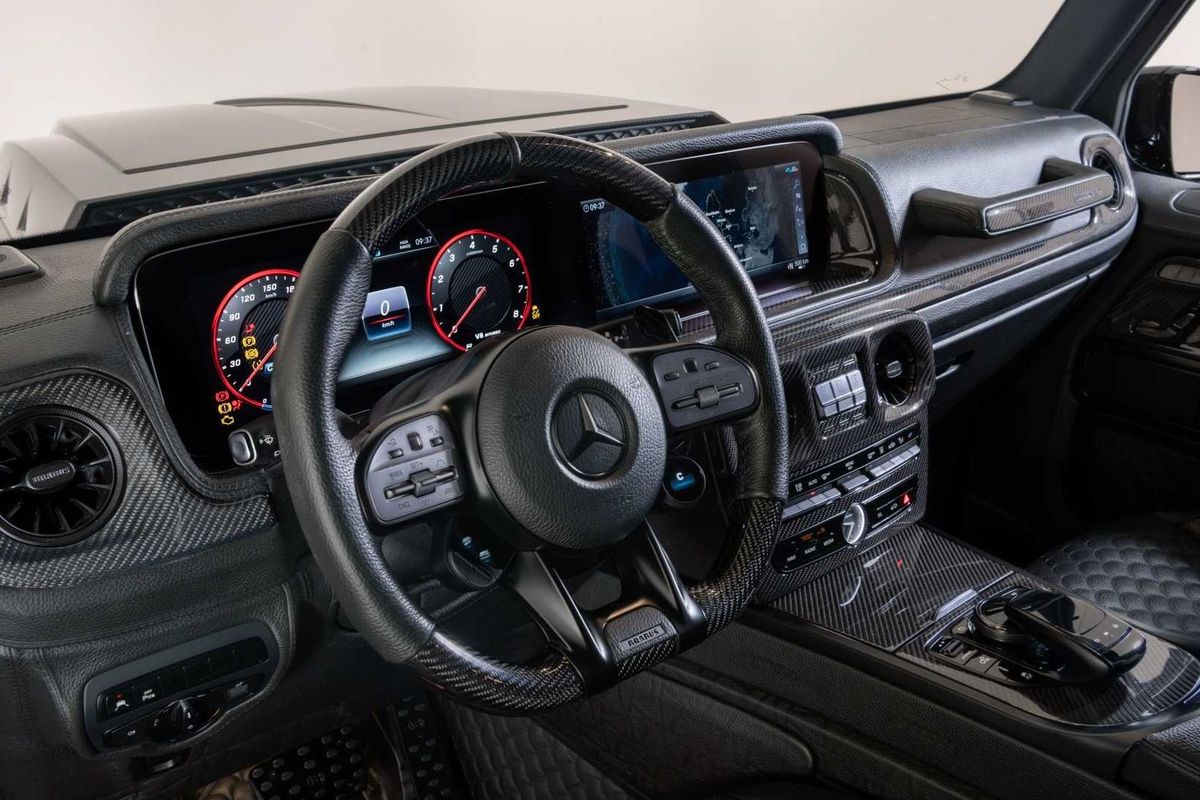
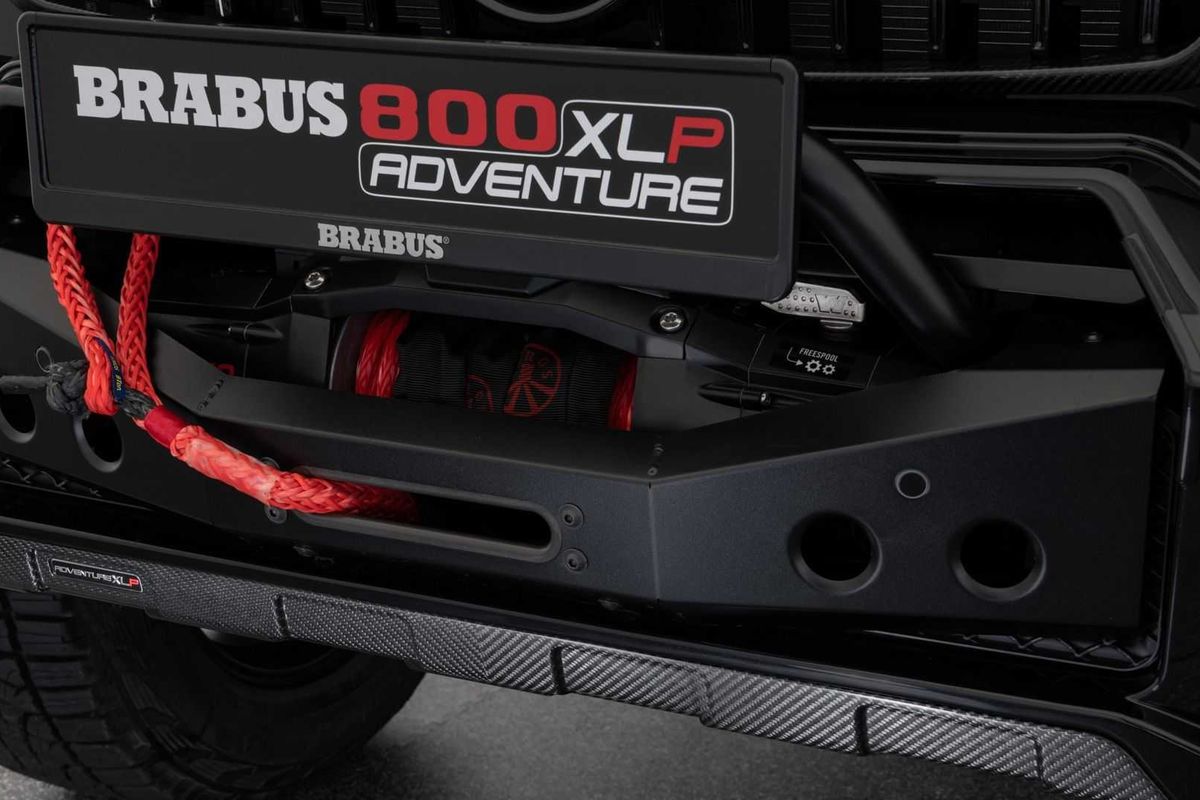
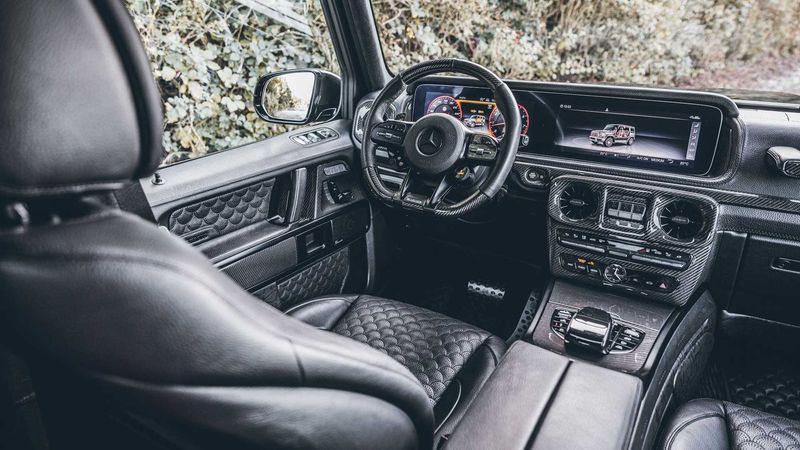
There are plenty of offroad touches, like the winch, armour-plated front skidplate, roof rack and additional lighting. The cabin adopts a more luxurious approach with leather and carbon fibre in abundance.
While we’re not likely to see this Brabus 800 Adventure in SA, there are plenty of standard G-Class units for sale. Check them out.