The head of Volkswagen in North America says the idea of an electric bakkie represents the “chance of a lifetime”, confirming the German automaker is “actively looking at” creating such a vehicle.
A high-ranking Volkswagen executive has confirmed the company is “actively” considering the option of building an all-electric bakkie, suggesting the segment is ripe for “some new ideas”.
Volkswagen Group of America CEO Scott Keogh told Business Insider a battery-powered pick-up is “something we’re actively looking at”, but added there was “nothing to actually report now”.
In the United States, Ford offers an all-electric F-150 dubbed the Lightning, while Chevrolet is poised to launch a battery-powered Silverado. Keogh’s comments suggest VW wants a piece of that growing pie.
“I think it’s the chance of a lifetime in this segment because electrification gives you a reset moment. It gives you a chance to bring some, let’s say, alternatives and some new ideas into this great segment,” he explained.
“I think a buyer would historically say, ‘I buy F-150, I buy Ram, I buy Silverado’. Now they might be saying, ‘I’m going to buy an electric one’. That reset moment gives a competitive chance to come in, whether it’s Rivian or whether it’s us.”
Of course, Ford owns a stake in Rivian (which builds the all-electric R1T bakkie), and Volkswagen has a strategic alliance with the Blue Oval brand. VW may well leverage its relationship with Ford to gain access to this platform, particularly should it wish to create a full-size pick-up to battle the likes of the aforementioned F-150 Lightning in the United States.
There is, however, also the option of creating a more compact electric bakkie based on the upcoming second-generation Amarok, which in turn shares its platform with the new Ranger. Ford is thought to be planning both hybrid and fully electric versions of its latest Ranger, so this represents another opportunity for VW.
Finally, Volkswagen may also go the route of building an electric bakkie on its own MEB platform, though that would mean such a vehicle would be unibody (rather than ladder frame) in construction. Time will tell…
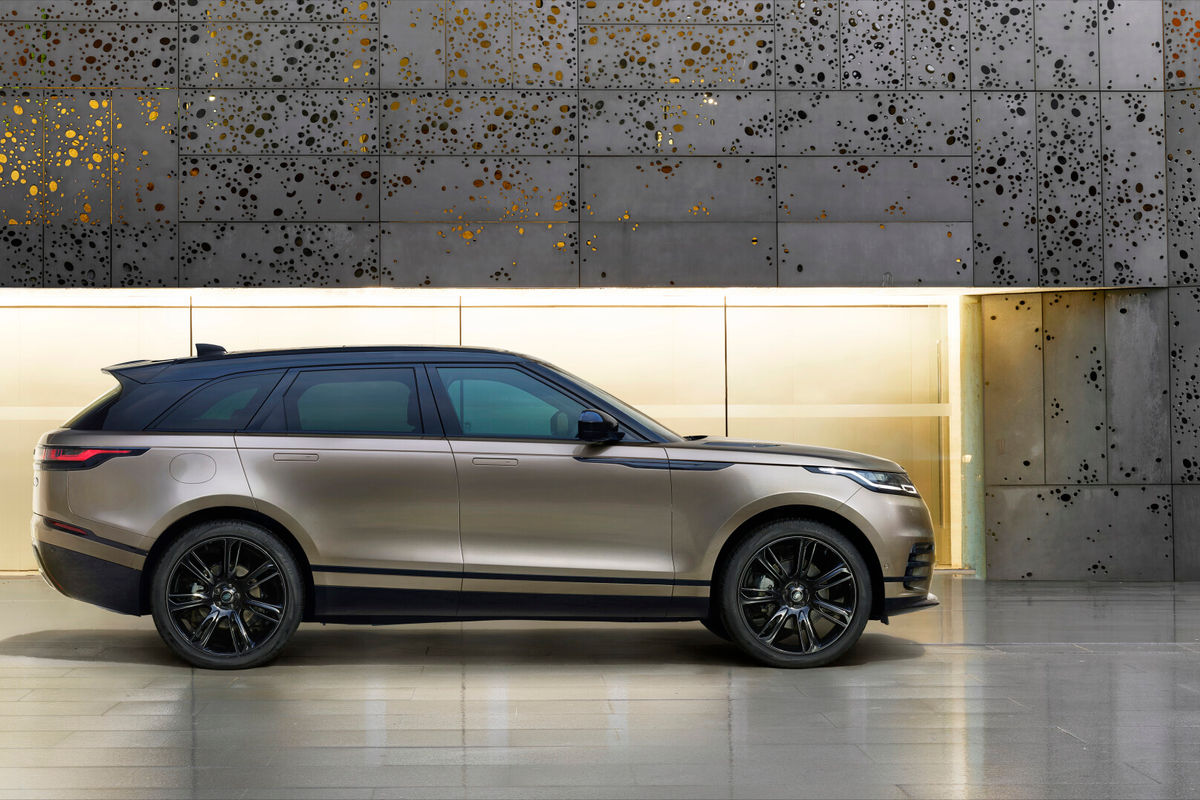
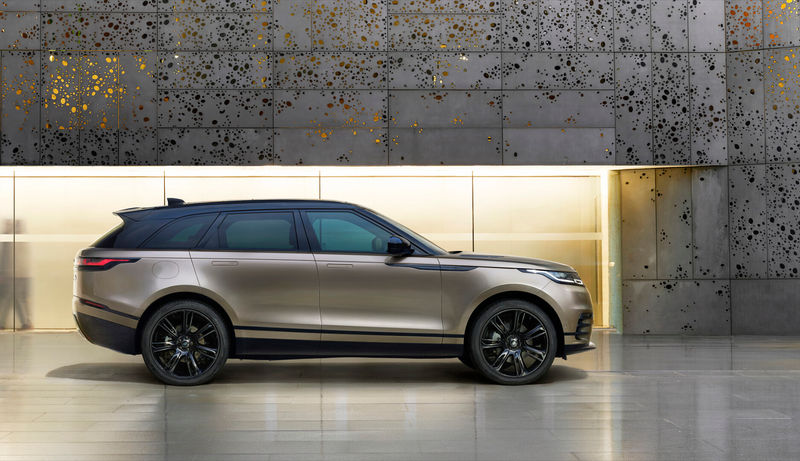
Range Rover Velar Lineup Revised for 2022
The Range Rover Velar line-up has been rejigged to include greener derivatives and customers can look forward to the re-launch of the popular Velar Edition.
The Range Rover Velar is positioned between the Evoque and Sport, and Jaguar Land Rover SAs says the revision will see 13 models hit showroom floors from the second half of 2022.
Of these 13 models that will go on sale, there will be plug-in and mild hybrid Velars, giving customers a greener and more efficient option.
Also of interest is Jaguar Land Rover confirming the reintroduction of the popular Velar Edition. This special edition includes the full Velar paint palette, a black contrasting roof, Black Pack, as well as 20-inch gloss black alloy wheels. There’s also a panoramic roof as well as privacy glass.
As far as engines go, the Range Rover Velar will be offered with an assortment of powertrains ranging from 4-cylinder to 6-cylinder. Both petrol and diesel engines will be offered. The P400e plug-in hybrid produces 297 kW and 640 Nm from a combination of petrol and electric power. Impressively, a 0-100 kph of just 5.4 seconds.
There’s a 17.1 kWh lithium-ion battery positioned under the floor which can be charged to 80% in just 30 minutes, depending on charger speed. There’s a pure electric range of 53 km, and fuel consumption claim of 2.2 L/100 km.
There’s also mild-hybrid tech for the 3.0-litre straight-6 engine, and this motor punches out 250 kW and 480 Nm. This will be one of the quicker models offered, boasting a 0-100 kph time of just 6.3 seconds.
For the diesel fans, there’ll be an array of oil burners on offer, including the new-generation 4-cylinder Ingenium with 147 kW and a 221 kW 6-cylinder.
The Range Rover Velar cabin features the new JLR Pivi Pro infotainment system, which we’ve experienced in many other products, such as the Jaguar F-Pace.
Range Rover has also fitted the Velar range with technologies like active road noise cancellation tech, as well as cabin air purification and advanced driving assistance tech.
There’ll be more details and pricing when the Range Rover Velar hits SA showrooms in the second half of 2022.
The Hyundai Ioniq 5 EV has been announced as the 2022 World Car of the Year!
The winners of the World Car of the Year competition has been announced at the 2022 New York International Motor Show.
Hyundai’s Ioniq 5 electric vehicle scooped not one but three awards including the World Car of the Year, World Electric Vehicle of the Year and the World Car Design category.
The Ioniq 5 bested the Kia EV6 and Ford Mustang Mach E to take the overall win. In the World Electric Vehicle of the Year, the Ioniq 5 pipped the Audi e-tron GT and the Mercedes-Benz EQS to take top honours. The Audi e-tron GT and Kia EV6 were no match for the Ioniq 5 in the Word Car Design category.
Other category winners include the Mercedes-EQS in the World Luxury Car category and the Toyota Yaris Cross claiming the World Urban Car category.
“We are truly honoured to receive these prestigious awards, which recognize the talent and hard work of all our people and business partners at Hyundai Motor Company,” said Jaehoon Chang, President and CEO of Hyundai Motor Company.
The competition’s format sees a jury of 102 automotive journalists from 33 countries select their finalists via a secret ballot. Our very own Hannes Oosthuizen is one such judge.
Refreshed Renault Oroch Bakkie Debuts with Turbo Power
An updated version of the Renault Oroch baby bakkie has been revealed in South America, complete with the option of a turbocharged petrol engine. Here’s what we know…
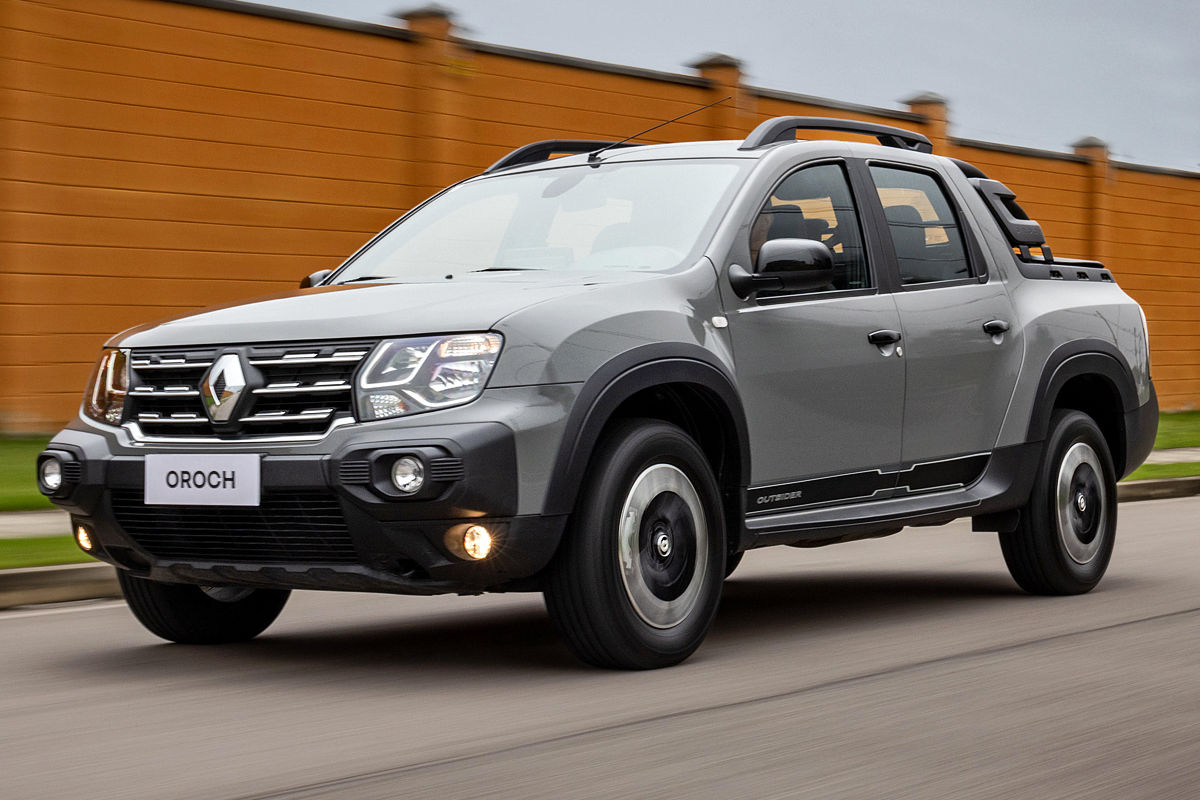
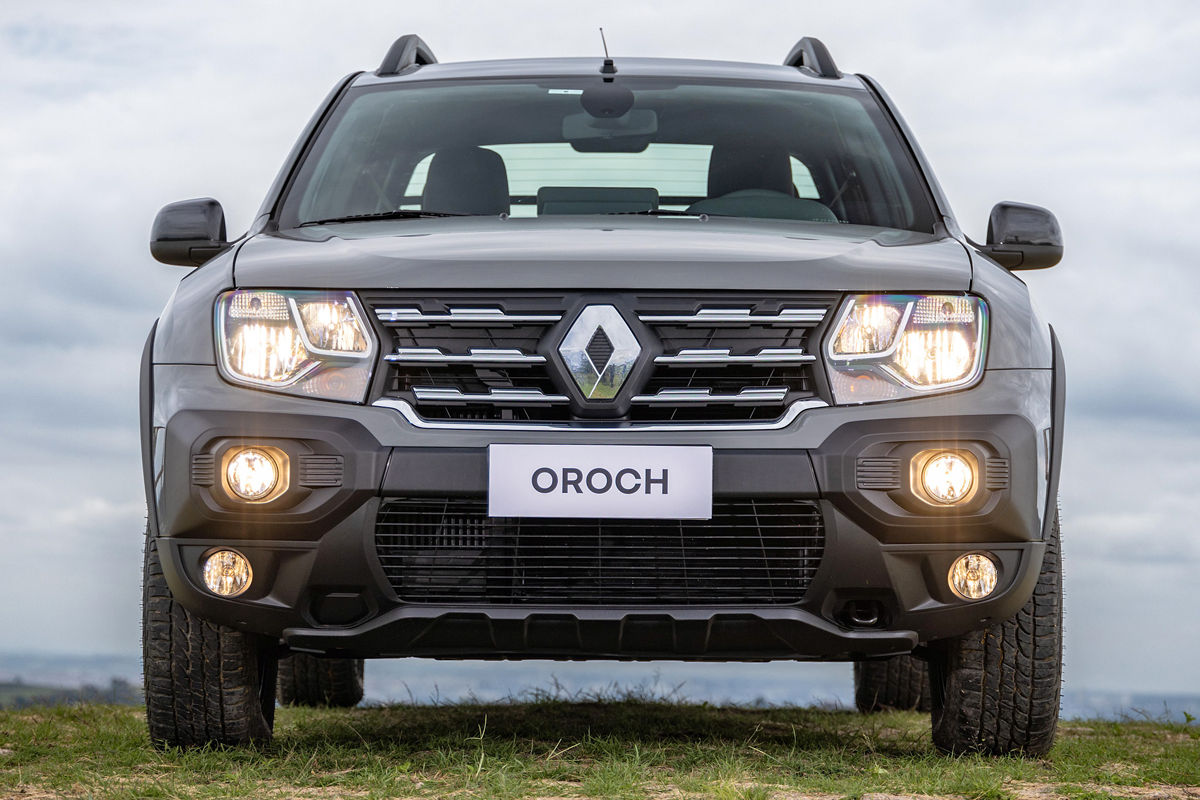
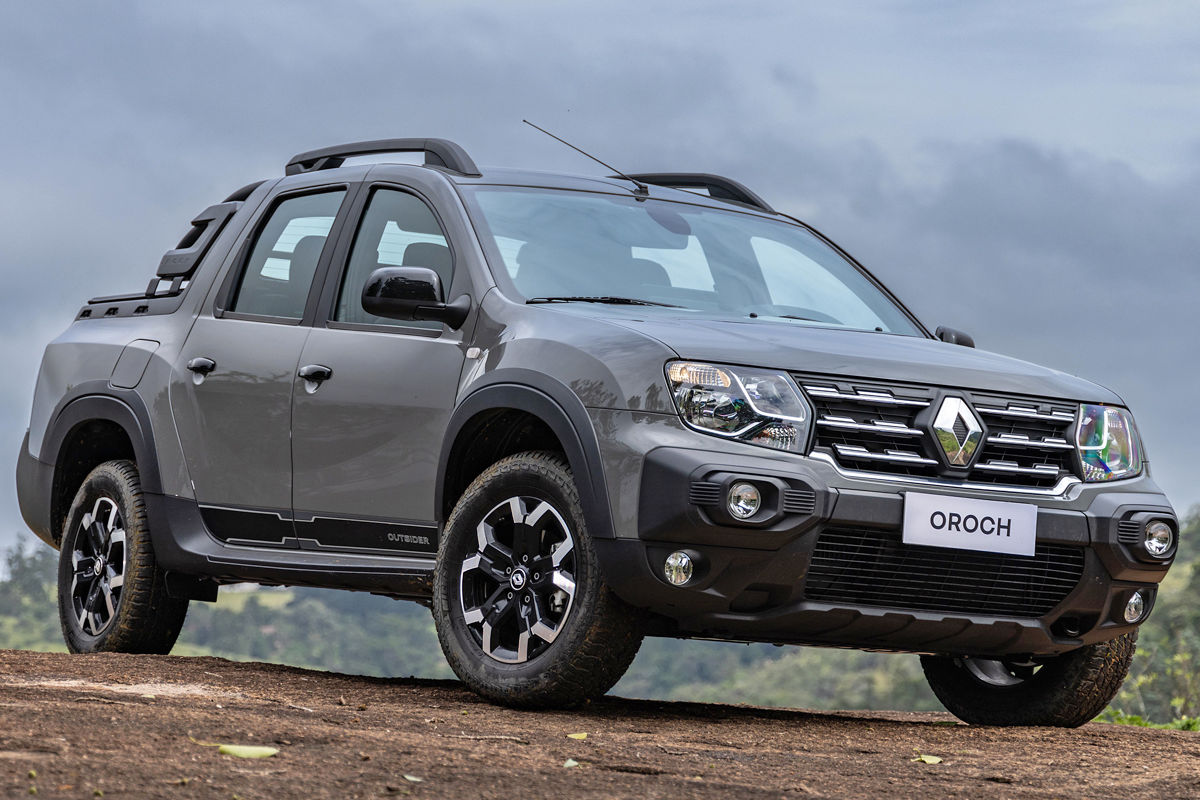
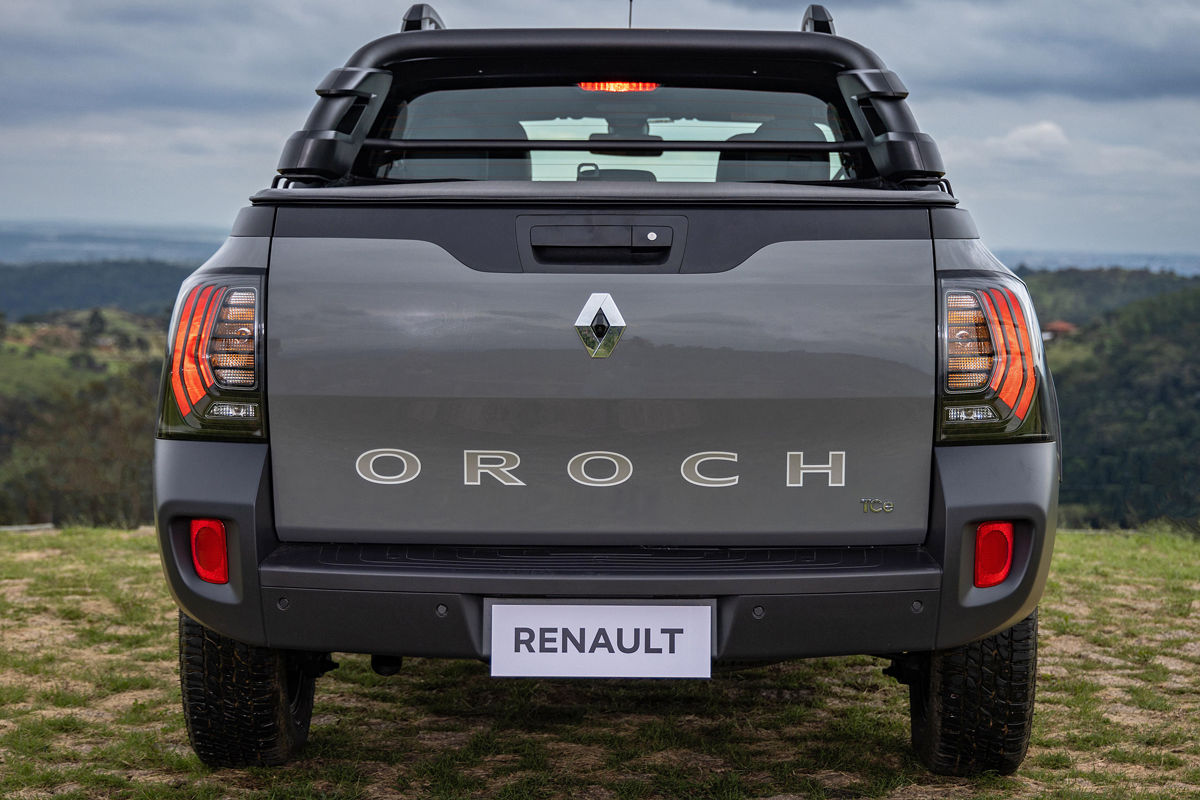
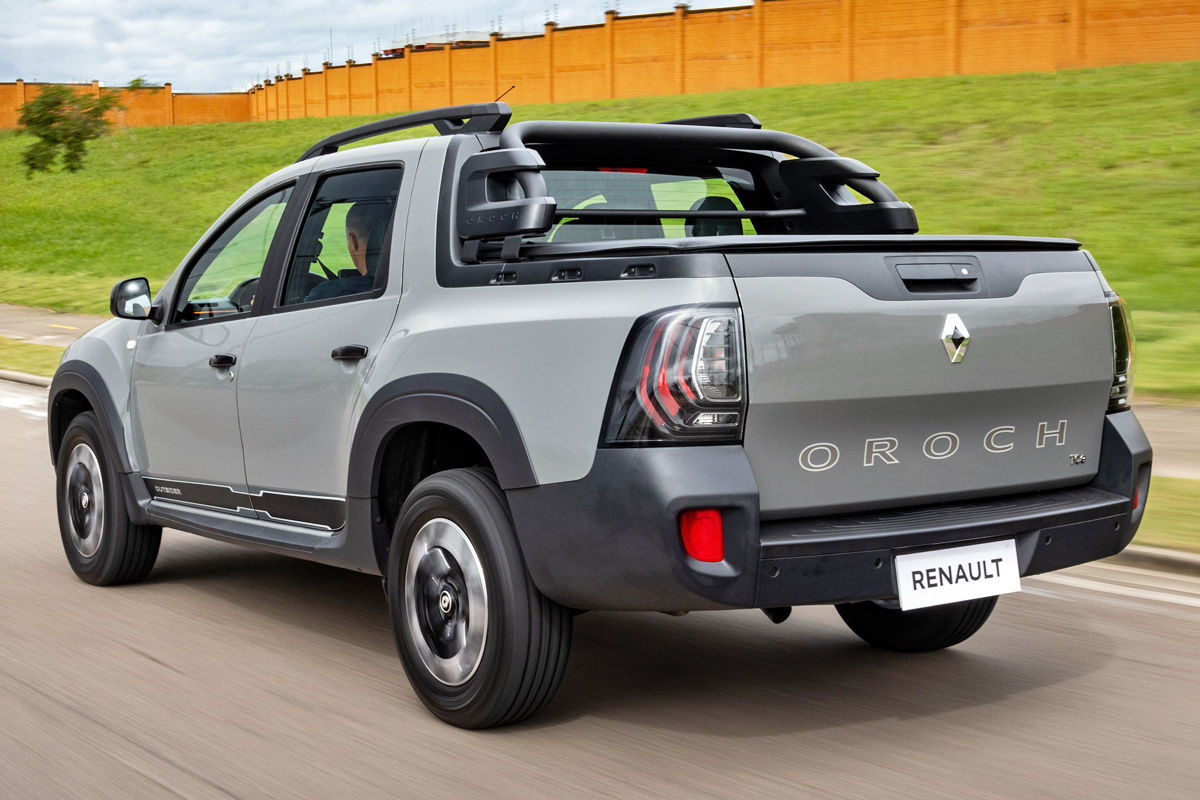
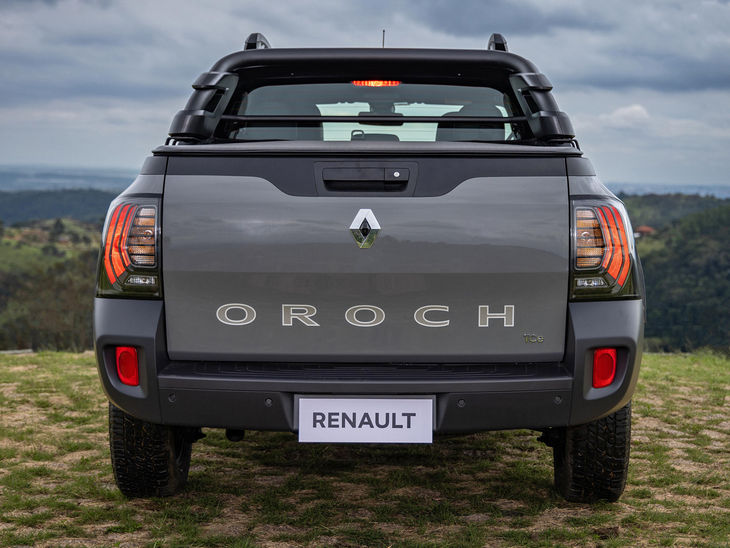
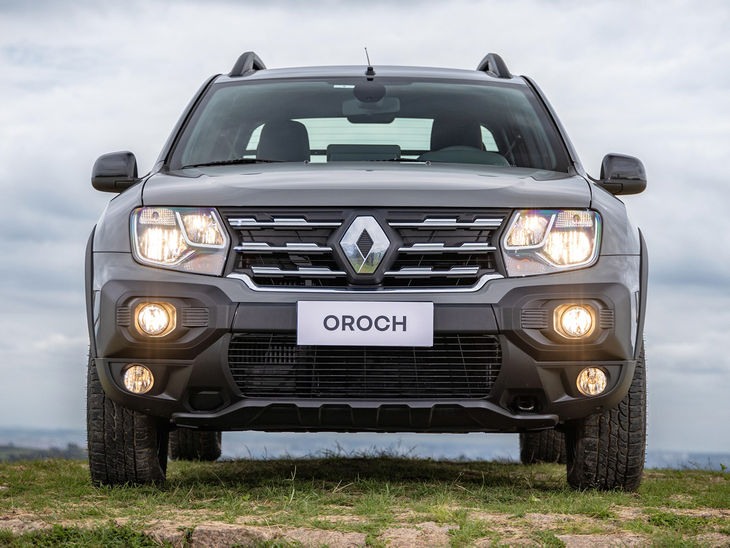
Renault has unwrapped a refreshed version of its Oroch in Brazil, handing its Duster-based bakkie – which has long been in the planning for a South African introduction – updated exterior styling, more interior technology and the option of a turbocharged engine.
As before, the baby double-cab bakkie is unibody in construction, featuring MacPherson struts up front and a multilink suspension arrangement at the rear. The wheelbase is unchanged at 2 829 mm, while the load bay measures 1 175 mm wide and 1 350 mm deep. The Oroch’s load capacity is 680 kg.
The 89 kW/159 Nm naturally aspirated 1.6-litre petrol is carried over to the base and mid-tier models, though gains a new six-speed manual transmission which Renault claims improves acceleration.
The refreshed Oroch drops the Duster moniker from its name.
The flagship derivative, meanwhile, upgrades to a turbocharged 1.3-litre petrol engine, here generating 125 kW and 270 Nm (the latter between 1 600 and 3 750 rpm). This Spanish-built powerplant is, of course, the unit developed by the Renault-Nissan-Mitsubishi Alliance in partnership with Daimler and here drives the front axle through a continuously variable transmission (CVT). Thanks to forced induction, the top-spec version of the updated Oroch is able to complete the 0-100 km/h sprint in a claimed 9.8 seconds before running out of puff at 189 km/h.
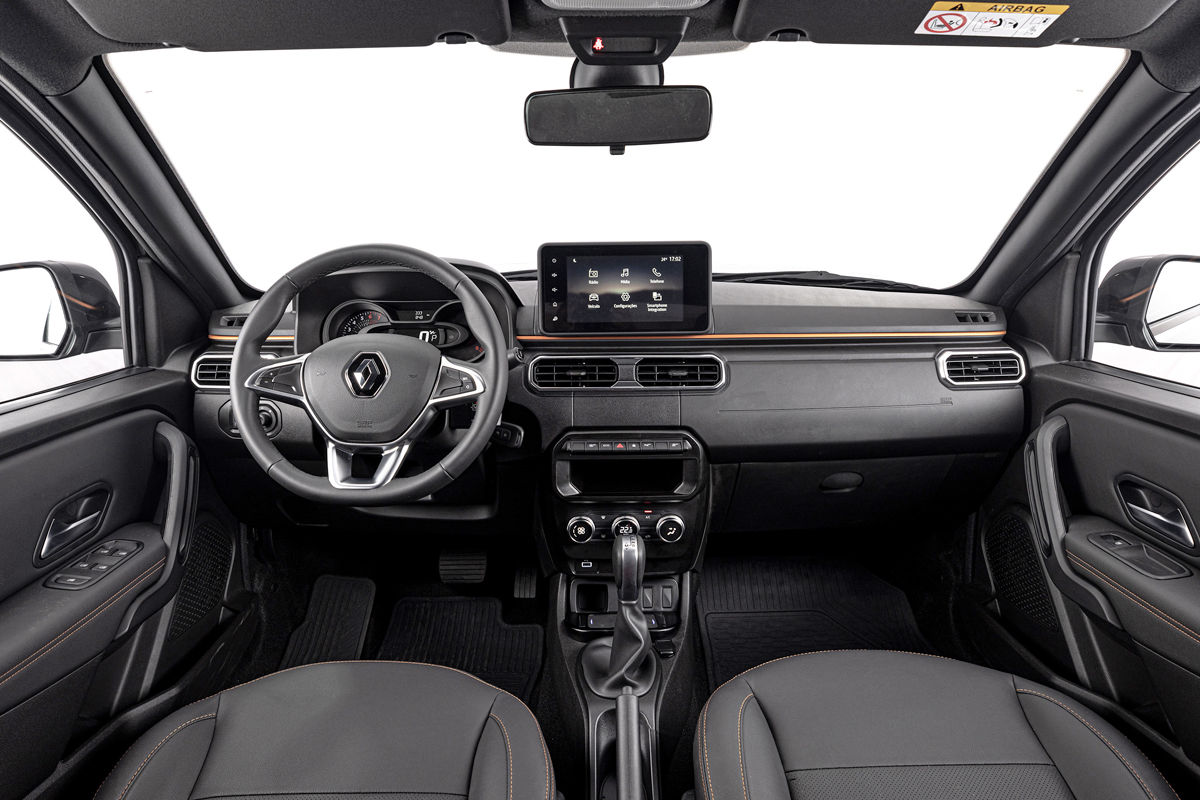
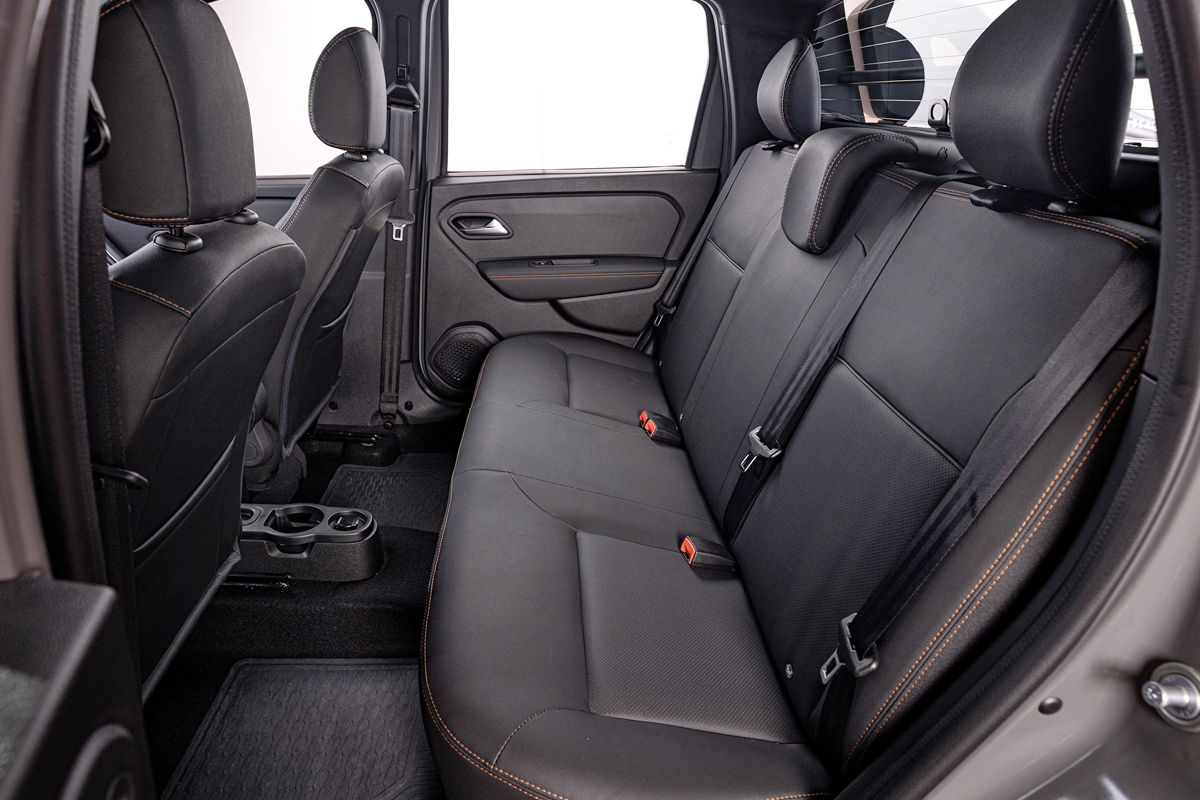
Renault describes the cabin as “completely new”, featuring a redesigned dashboard (boasting “greater perceived quality”) and upgraded seat finishes. The instrument panel gains a centrally sited digital speedometer, while the steering wheel is also new, with a brushed finish and backlit buttons.
Mid- and top-spec versions furthermore upgrade to an 8-inch touchscreen system with wireless connectivity to smartphones through Android Auto and Apple CarPlay. They also receive electrically adjustable side mirrors and rear parking sensors.
Will the Renault Oroch bakkie come to South Africa?
The double-cab Oroch is based on the original Duster rather than the latest generation of the SUV.
Renault South Africa has been endeavouring to bring the Duster Oroch bakkie to local shores since at least 2016. According to Renault SA, the latest information is that the Oroch is still “in the planning” for a local introduction in the first quarter of 2023.
While that’s by no means a confirmation – and it’s a line we’ve heard a number of times over the past few years – it at least suggests the company remains committed to the Oroch despite having earlier thrown in the towel on the larger (Navara-based) Alaskan.
When pushed for a little more detail, Renault SA told Cars.co.za it was aiming to bring in the double-cab version. The four-door Duster Oroch has been in production since 2015. In 2020, the single-cab Dacia Duster Pick-Up 4×4 was launched in Romania, based on the current-generation Duster.
By contrast, the double-cab Oroch offered in South American nations such as Brazil is based on the first-generation Duster. Of course, the main stumbling block to the Duster-based bakkie’s arrival on local shores is the distinct lack of global demand for a right-hand-drive version. Other than South Africa, the only Renault division to make any sort of public appeal for right-hand-drive development is the Boulogne-Billancourt-based automaker’s distributor in Australia.
Should the Oroch finally make its way onto South African roads (be it with four doors or two), it would provide a desperately needed alternative to the Nissan NP200, which has had the small-bakkie segment all to itself since the local demise of the likes of the Chevrolet Utility, Fiat Strada and Ford Bantam. We can only hope 2023 will be the year Renault SA finally gets its way…
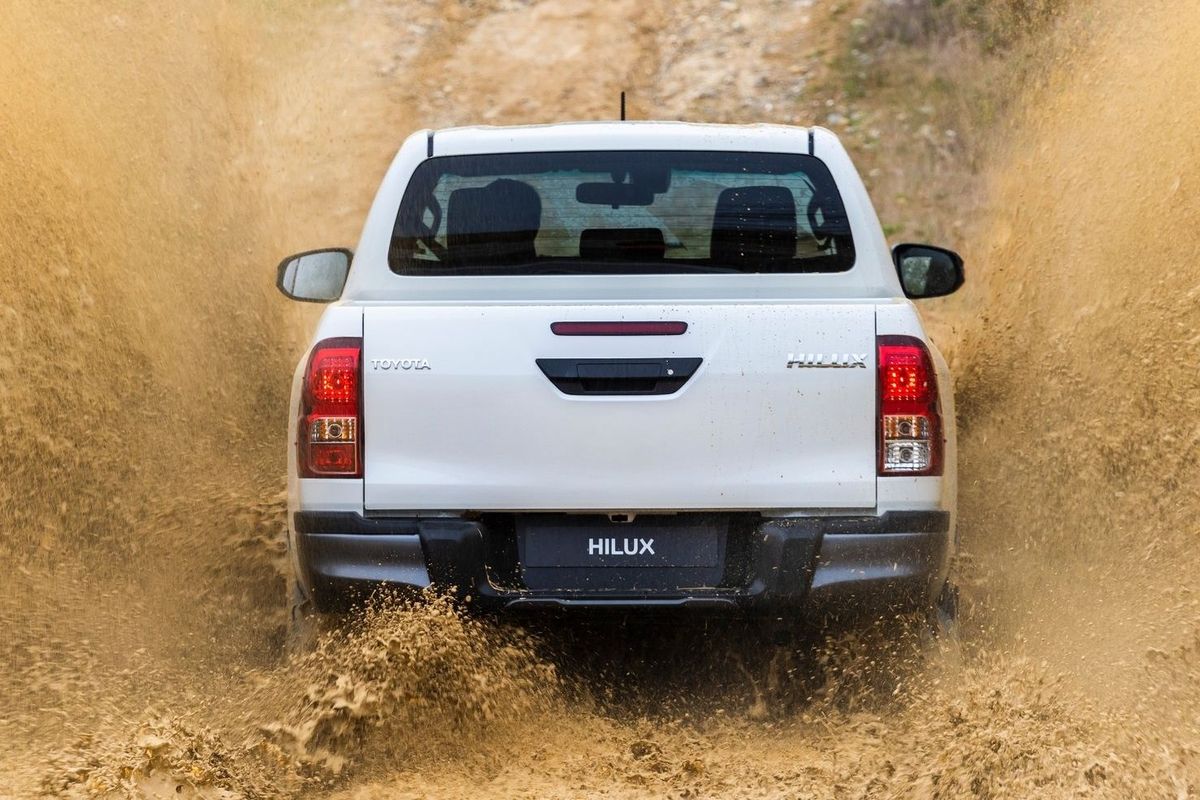
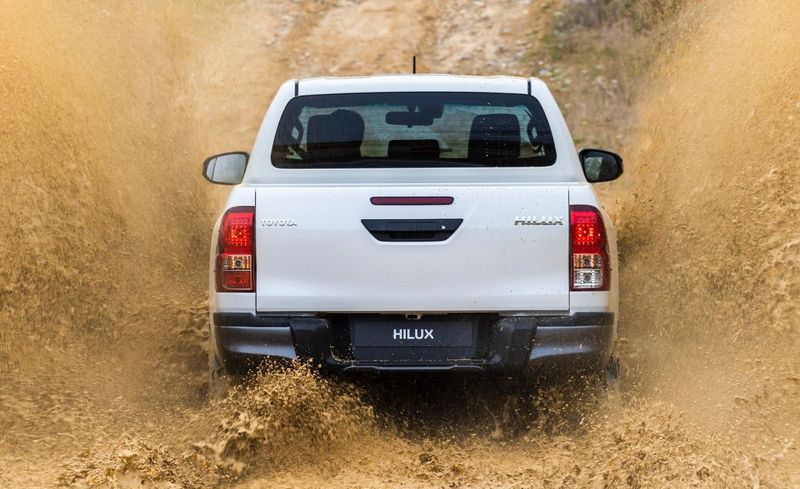
Could your Hilux park like a Yaris?
All double-cab bakkies have a flaw, but it’s one that could easily be remedied…
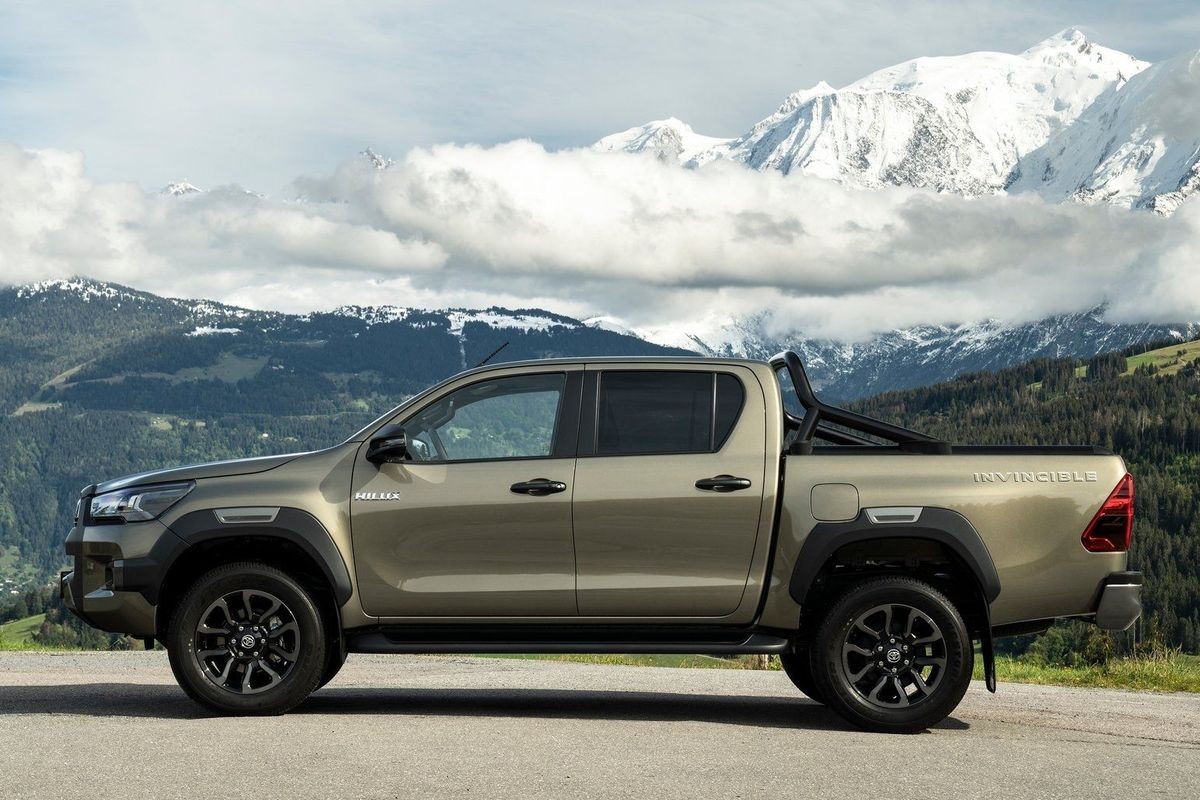
The “luxury” double-cab has become South Africa’s family vehicle of choice. Evidence supporting this statement is abundant – the Toyota Hilux continues to be the local market’s most popular vehicle.
With the disappearance of traditional sedans and hatchbacks, the double-cab bakkie is now a tremendously popular urban family vehicle. Which, to be honest, is not what it was ever designed to be.
Trace the origin story of the Hilux – those first solid-front-axle double cabs were all about getting work crews to inhospitable locations; they were most certainly NOT meant to serve in school lift clubs. Suffice to say family-use demands have shaped the specifications of South African bakkies, but several foundational issues remain.
The Volkswagen Amarok demonstrated that passenger-car switchgear and cabin design could create a more liveable interior. The Wolfsburg-based brand also championed more intelligent automatic transmissions for greater driving comfort in urban environments. Even the most creative and colourful descriptions fail to capture the awfulness of those 1st-generation 4-speed automatic double-cab bakkie transmissions.
This is what bakkies were engineered to do, but few of them seem to venture far from the tarmac these days.
The problem with a bakkie as a passenger vehicle
Select any of the latest double-cab bakkies in our market and you’ll find reasonable seat comfort, comprehensive safety systems and automatic transmissions that do their utmost to shift gears in such a way that it won’t test your neck strength. But there are two noteworthy problems that all bakkie engineering teams have failed to address: parking and understeer.
Bakkies are growing larger with each generation. The original Toyota double-cab was 370 mm shorter than the current four-door Hilux. Parking bays and urban infrastructure haven’t changed much since the 1980s. And all the parking sensors and field-of-view cameras in the world don’t help trim a gargantuan turning circle.
Double-cab bakkies have become longer and now do most of their mileage in cities, although they remain designed for work and operating off-road. This makes them genuinely awful vehicles to navigate around any parking infrastructure. But there is a solution… and it’s one that could make double-cab bakkies a lot easier to drive and park around town – and safer (at freeway speeds).
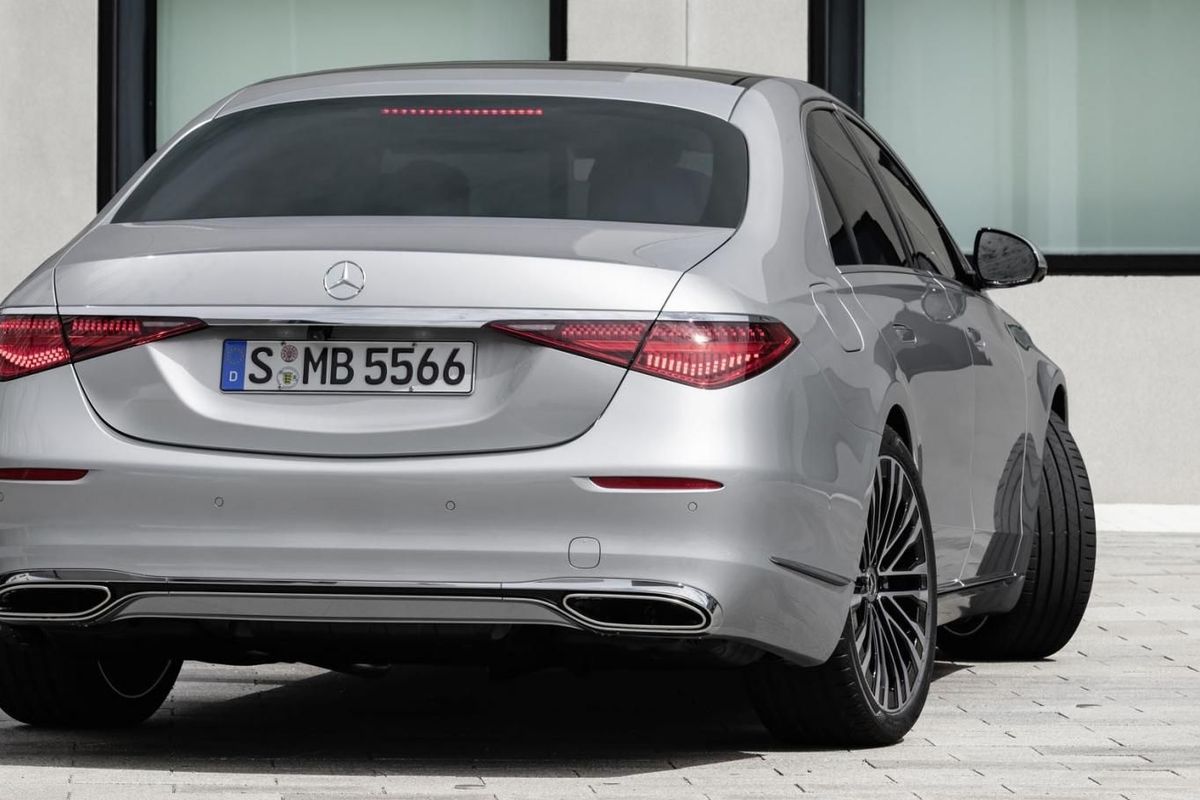
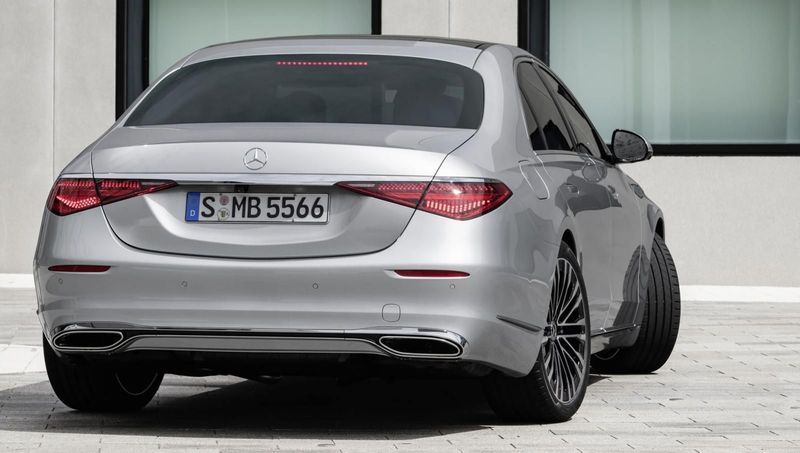
A rear-axle steering system doing its job to “virtually'”shorten the new S-Class’ wheelbase.
The technology is proven – and hardly new
Mercedes-Benz might have failed dramatically with its X-Class bakkie, but the S-Class grand saloon remains the benchmark luxury car, not least a technology showcase for the entire automotive industry. And, as with all other vehicles, the S-Class has grown larger with each generation – which has increased the likelihood of bumper scuffs and embarrassing multi-turn parking manoeuvres for wealthy customers who, as we know, are incredibly image-conscious.
Aware that its S-Class customers demand not to be embarrassed by low-speed driving issues, Mercedes-Benz engineers have equipped the Three-pointed Star’s halo model with 4-wheel steering. It is hardly a new technology. Japanese car companies offered it as long ago as the 1980s.
In sympathy with customers trying to survive the parkers’ hell that is Paris, Renault added 4-wheel steering to its Laguna back in 2008. That technology would come to South Africa with the very beautiful – and rare – Laguna Coupe, in 2010.
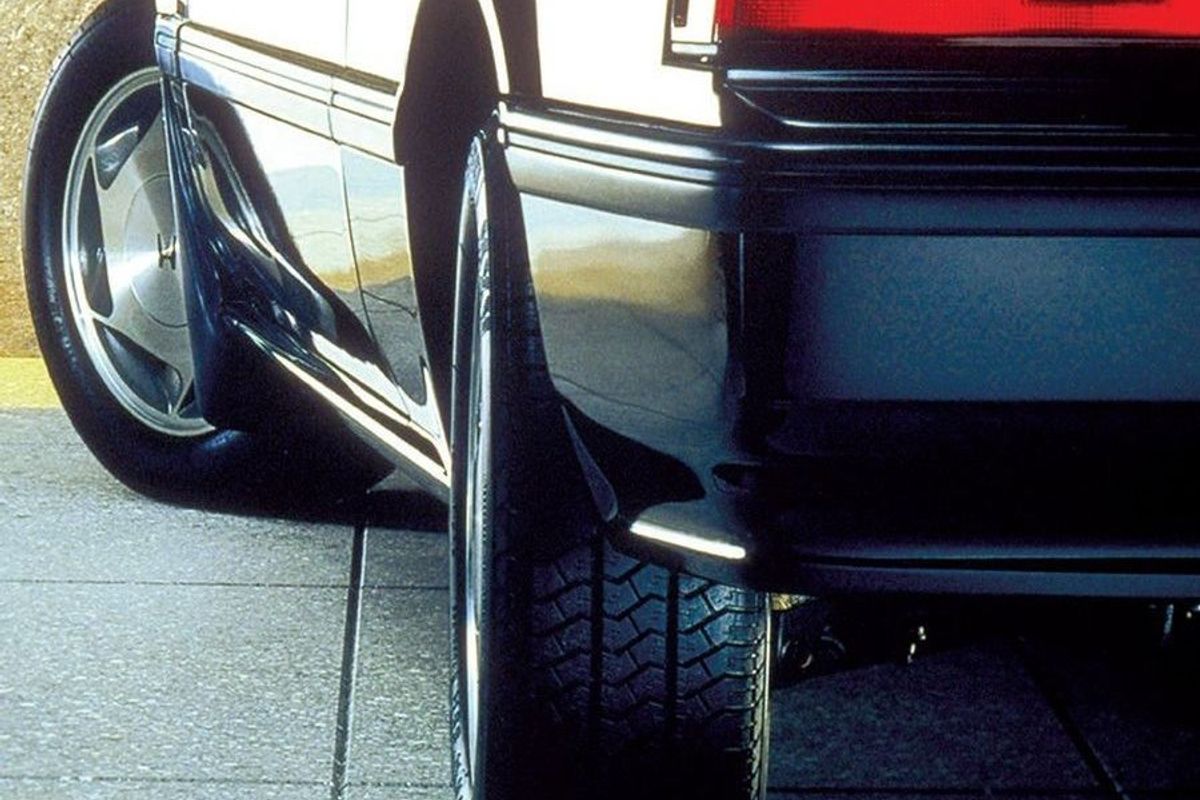
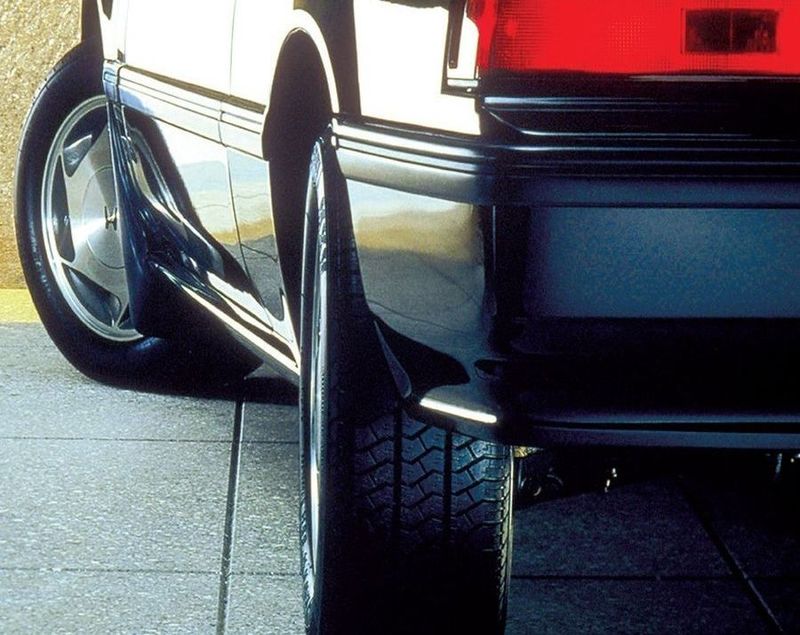
Honda had rear-wheel steering on its 1988-model-year Prelude.
It makes so much sense on a large vehicle
Broadly speaking, there was never much of a need for four-wheel-steering in a country with abundant parking. But nudging a Mercedes-Benz A-Class into a Sandton City or V&A Waterfront parking bay is unlikely to cause as much anxiety as doing the same with a double-cab bakkie.
As more urban families home a bakkie, they have little choice but to become reacquainted with the art of 3-point-turning. Four-wheel steering might be superfluous and cost-prohibitive for South African compact crossover and hatchback buyers, where some skill and anticipation will solve most parking issues. But even the most confident driver has been humbled into multiturn choreography by a double-cab.
Adding four-wheel steering would dramatically reduce a double cab’s turning circle – a frustration most owners have to tolerate daily. It would make these large family vehicles much less taxing to drive, considering their owners’ daily routines.
Some steering at the rear has a huge influence
To what extent could four-wheel steering reduce a bakkie’s turning circle? The benchmark figure is 22%. And that’s a lot if you consider the tiny margins for error when you need to park in minuscule parking bays and on congested streets.
Beyond the low-speed manoeuvring benefits, four-wheel steering can make vehicles more stable at higher speeds. This is especially true when executing an emergency lane change – a driving intervention that is often the undoing of any double-cab design.
Bakkies have inherently poor weight distribution, making them prone to severe understeer. Where a balanced performance car or hot hatchback has close to 50/50 weight distribution, most double cabs are very unbalanced, with between 60-70% of their weight on the front axle. And that means they’re prone to exhibit pretty severe understeer when you pile into corners in a hurry.
Four-wheel steering can angle the rear wheels in the same direction as the steering wheel is turning and, in doing so, reduce understeer.
If four-wheel steering offers significant driving benefits, why hasn’t it become an option on double-cab bakkies? That’s a good question, because the system isn’t that complicated.
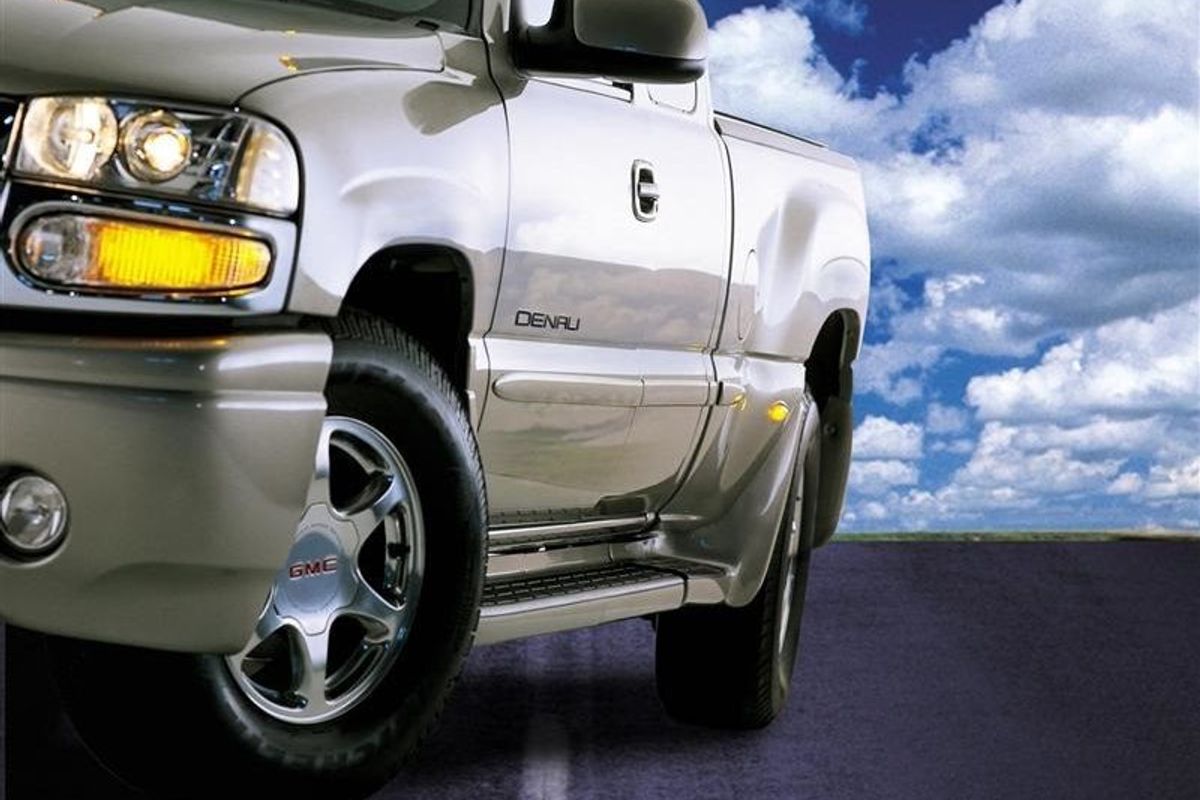
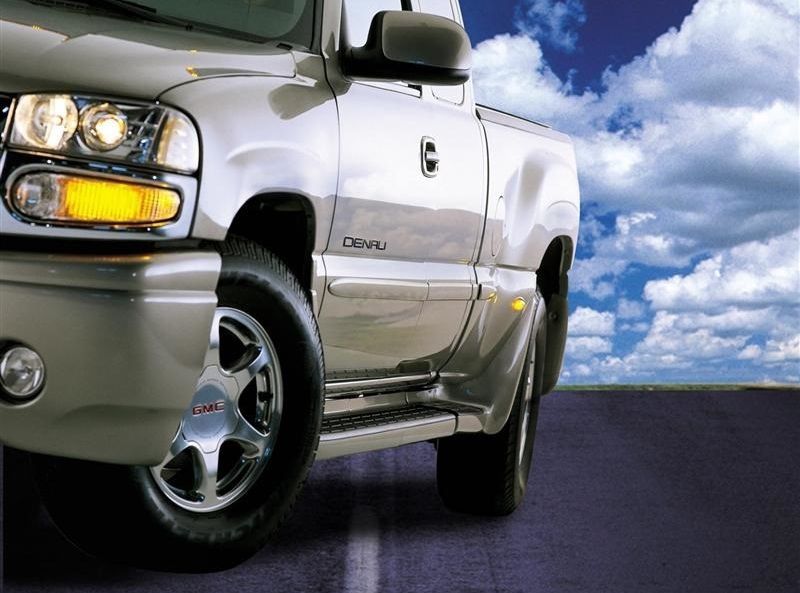
GMC’s huge American bakkies, showed what can be done with four-wheel steering.
What would you pay to have your Hilux turn like a Yaris?
In 2002, GM introduced Quadrasteer on its large bakkies. The system employed active tie-in rods to counter-angle the rear wheels by up to 15-degrees at low speeds, dramatically reducing the turning circle. By 2005, it was discontinued.
And why? The Quadrasteer option added 136 kg of weight, but, more importantly, it was enormously expensive. In South African equivalent pricing, Quadrasteer was a R56 000 option in 2002, which would be R160 000 in 2022 money.
GM eventually discounted Quadrasteer to R10 000 in its final production year (2005), which inflates to R28 000 in today’s money. And for the sake of argument, that price is an average option or trim upgrade on most double-cab bakkies.
Fail in 2002… but a win in 2022?
The weight penalty and prohibitive cost were tabled as issues that forced GM to kill its Quadrasteer option. But in truth, bakkie customers don’t have a problem with either weight or cost when it relates to optional extras.
If you scrutinise the specification sheet and options list of any new double-cab range, you will invariably find a variety of marginally pointless extras, all of which add cost and weight. And demand for double-cabs and all their associated accessories remain immense… with the average double-cab bakkie being a R700 000 vehicle, a theoretical R30 000 four-wheel-steering option would be very fairly priced.
Imagine a new Hilux with the turning circle and low-speed driving agility of a Yaris. Now that, rather than silly graphics, nudge bars, roller shutters etc (which can’t improve the double-cab driving experience), would be an extra worth having!
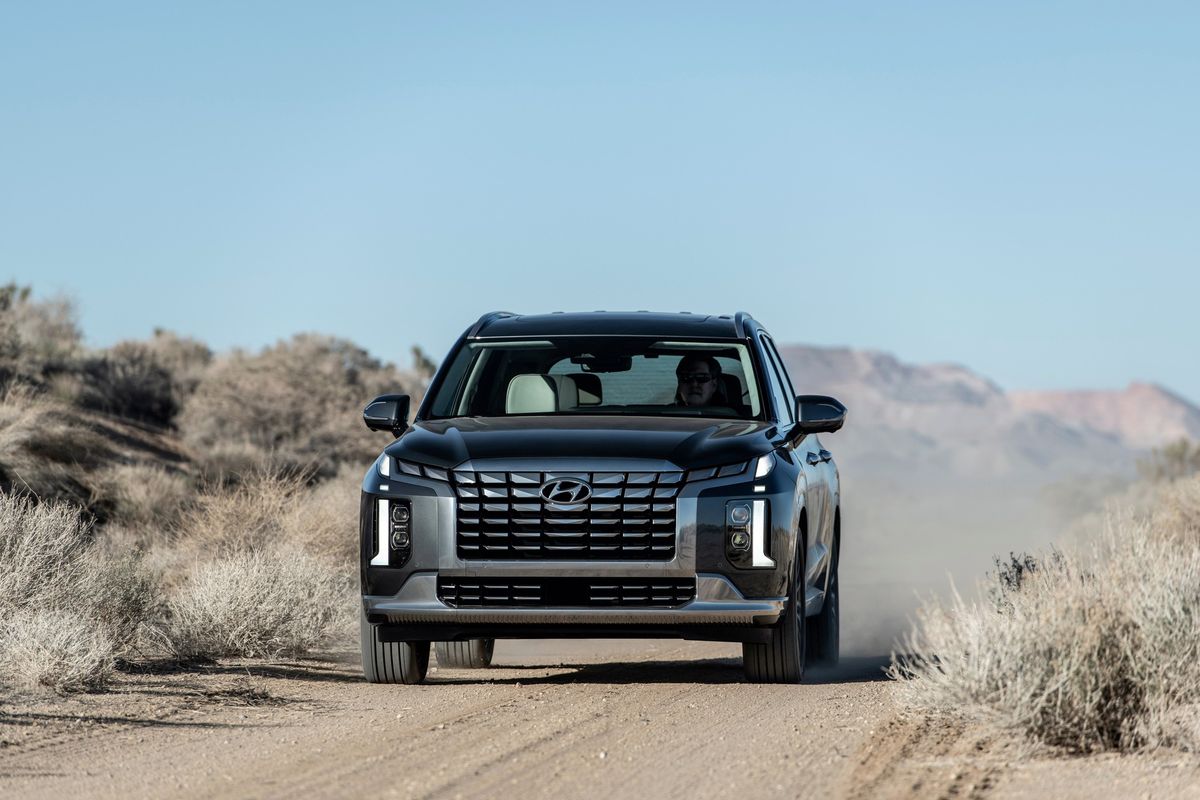
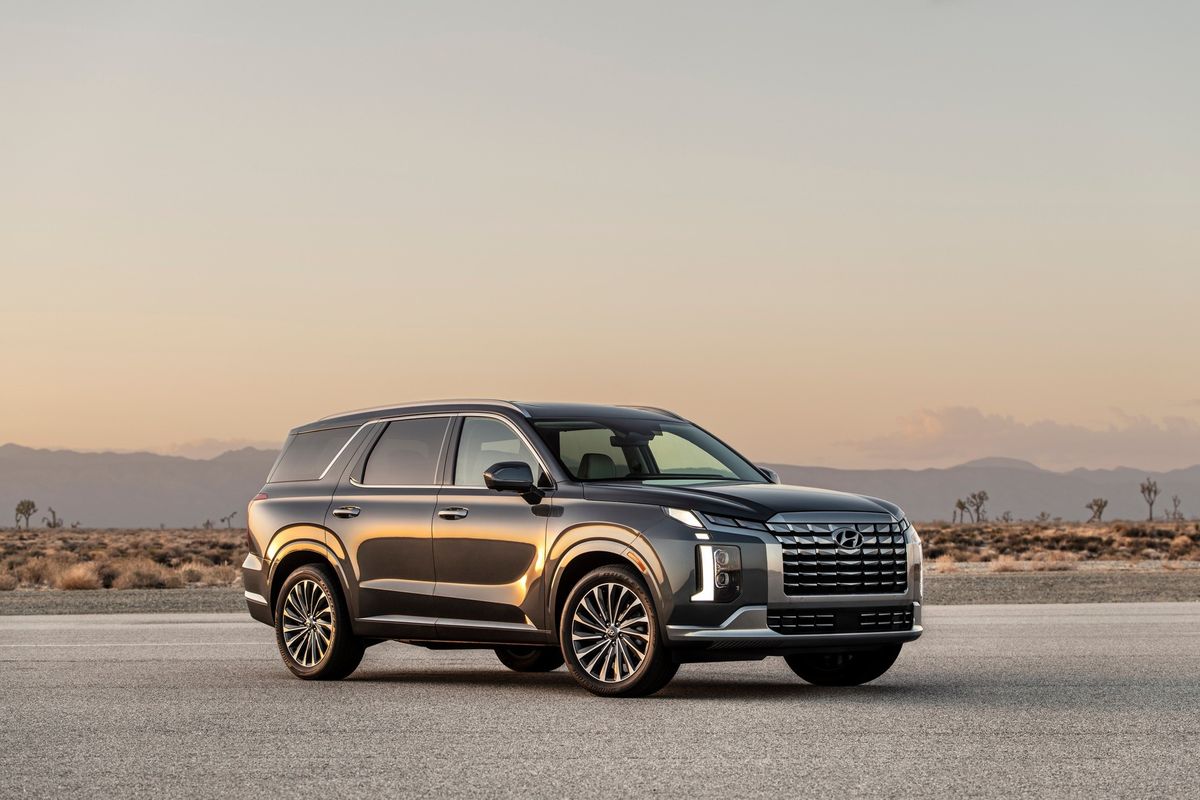
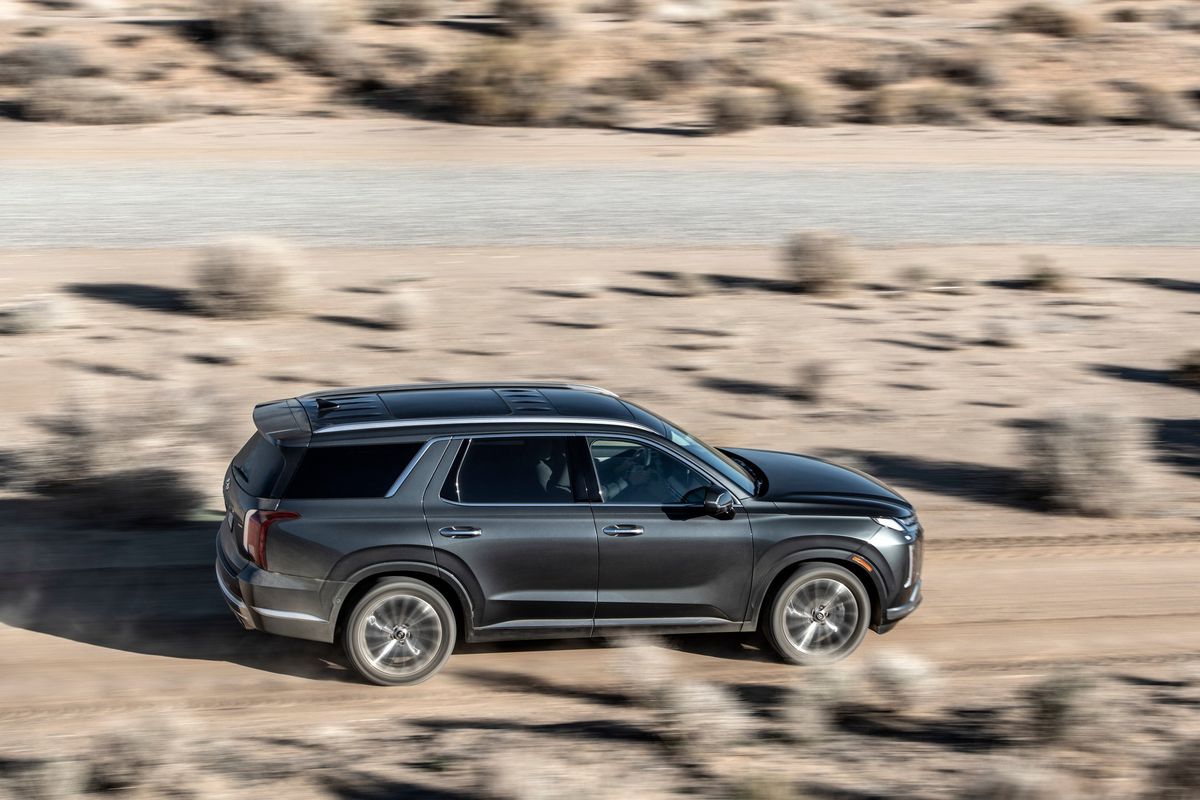
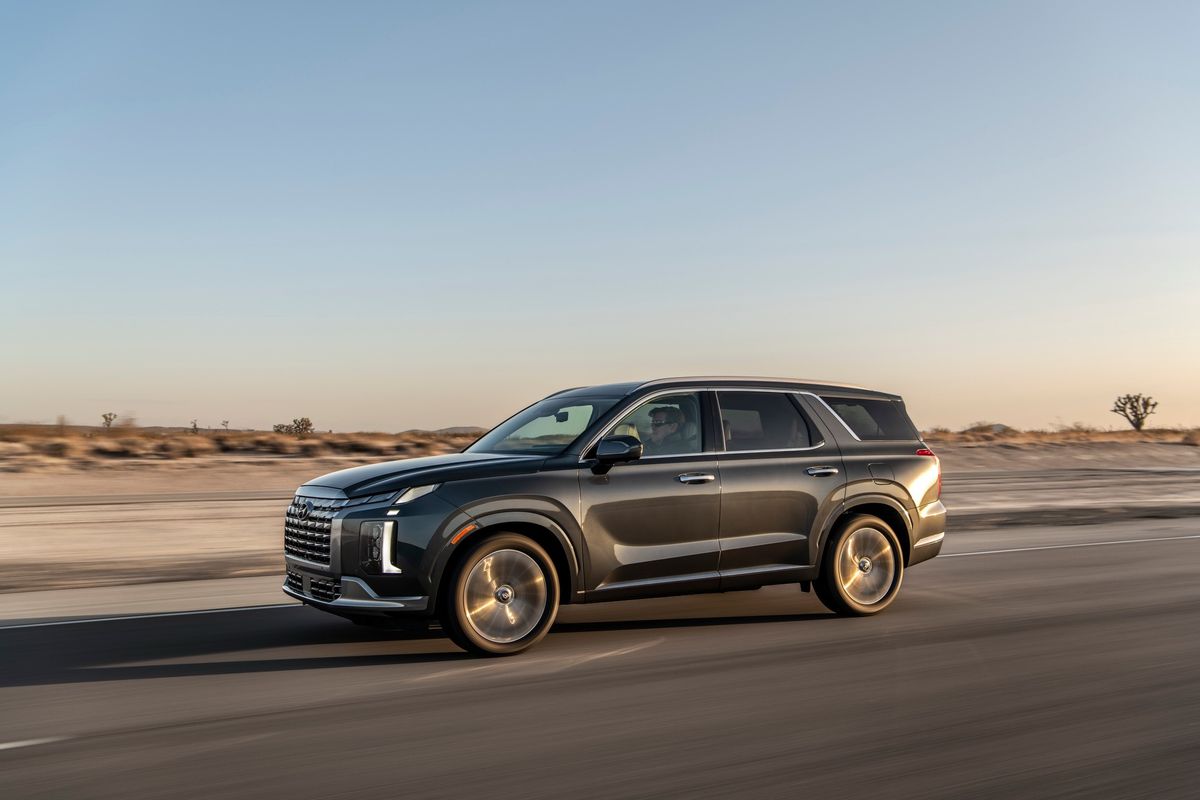
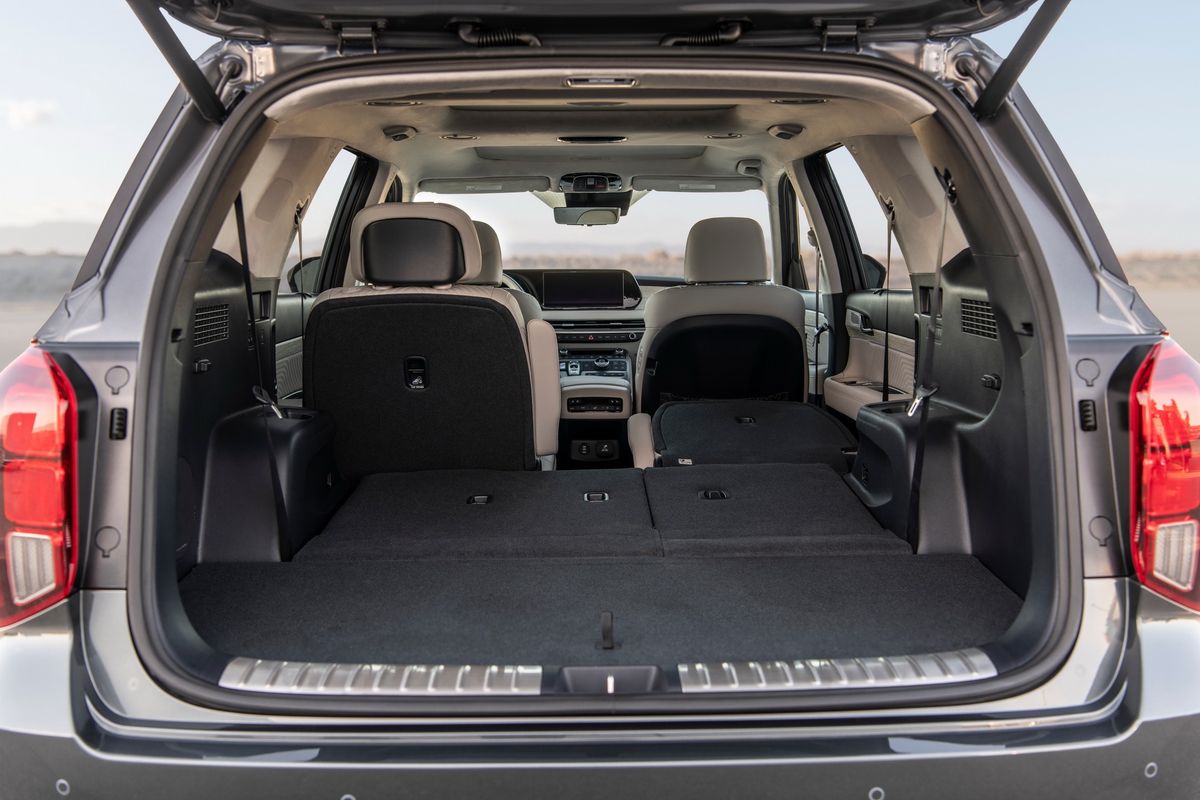
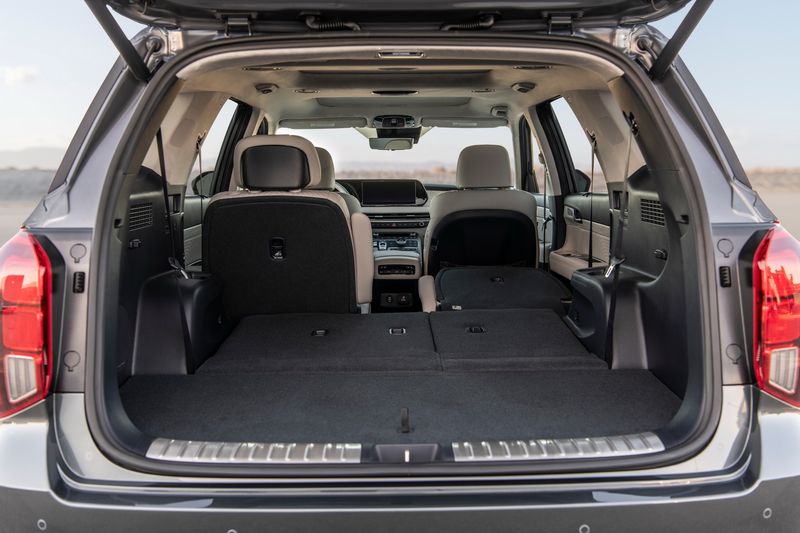
Refreshed 2023 Hyundai Palisade Announced
Meet the updated 2023 Hyundai Palisade, which was revealed at the 2022 New York International Auto Show.
What you see here is the facelifted 2023 Hyundai Palisade and you’re probably thinking the SA market has only just received this model (Sept 2021), so why a facelift so soon?
Well, the Palisade has actually been on sale in overseas markets since 2018, so by car standards, its due for an update. The changes are substantial, both inside and out.
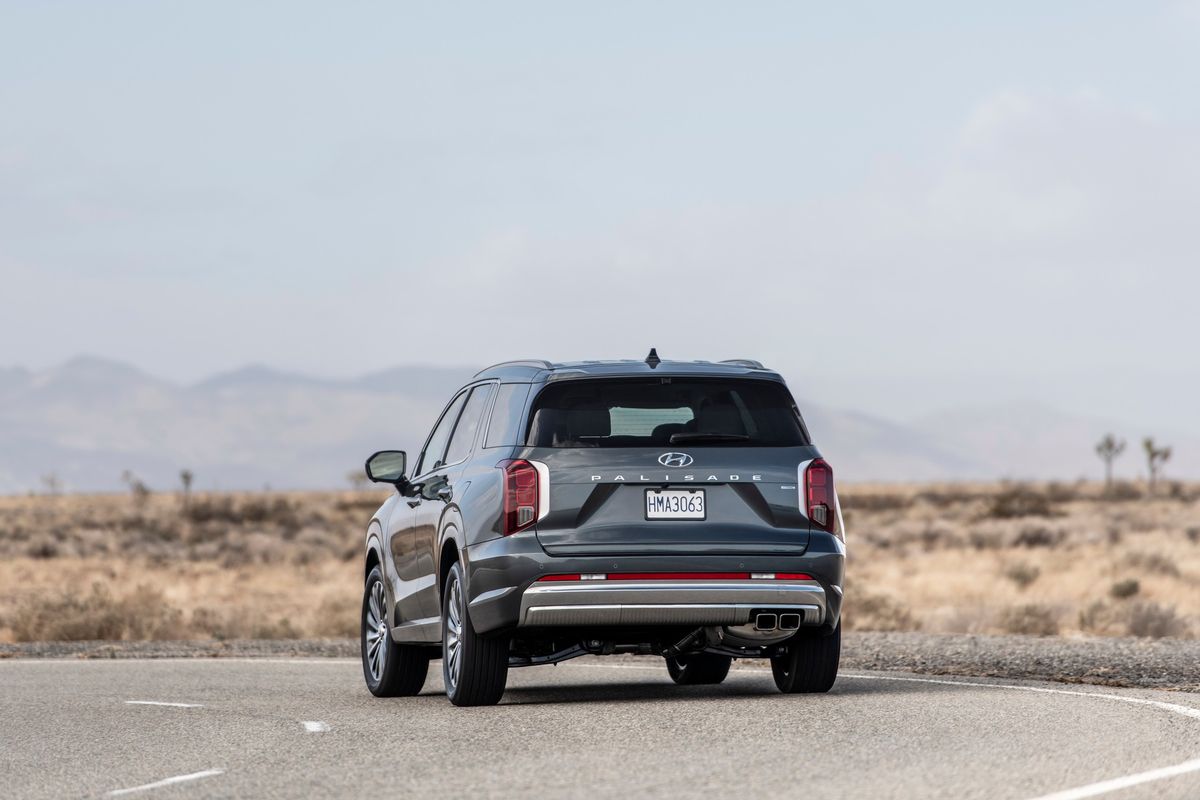
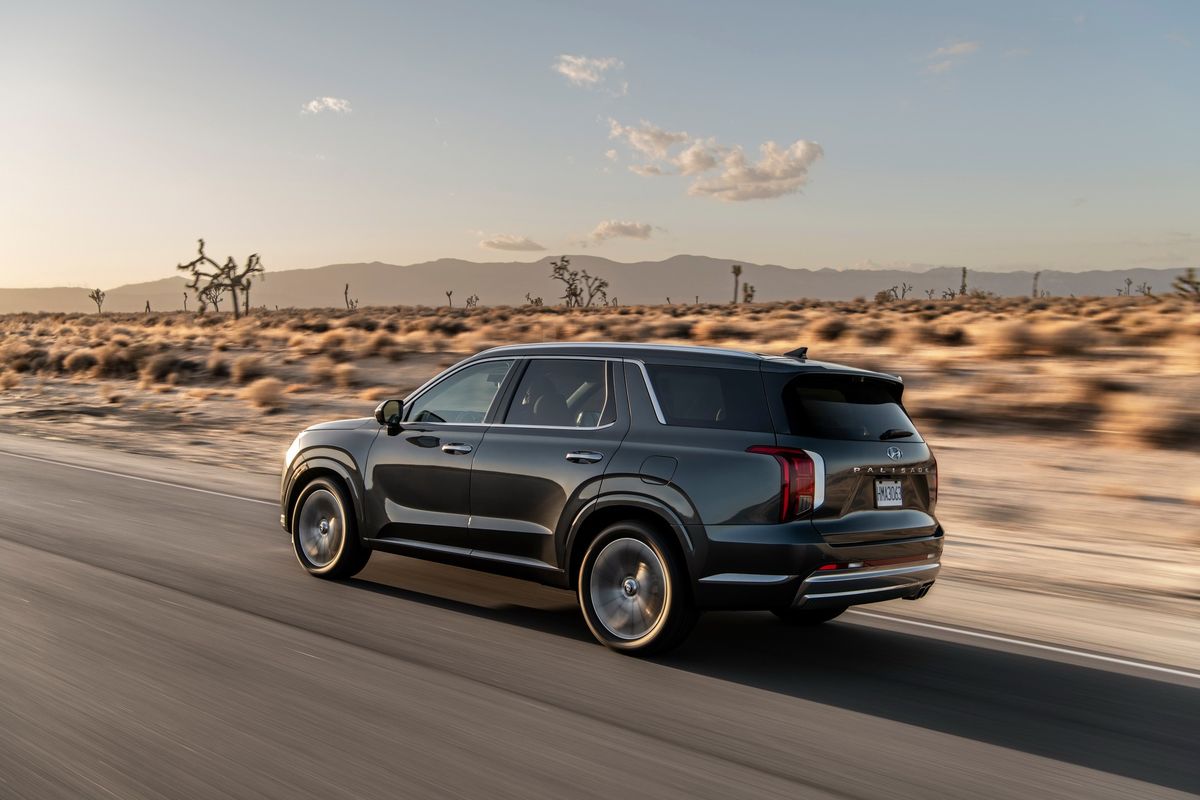
Starting off with the exterior, the updated Palisade gains a new visual look with design elements taken from the brand’s current style guide. This means a big and bold grille on the nose, with some revised headlamps and daytime running lights. There’s a new colour on offer, as well as new 20-inch alloy wheels.
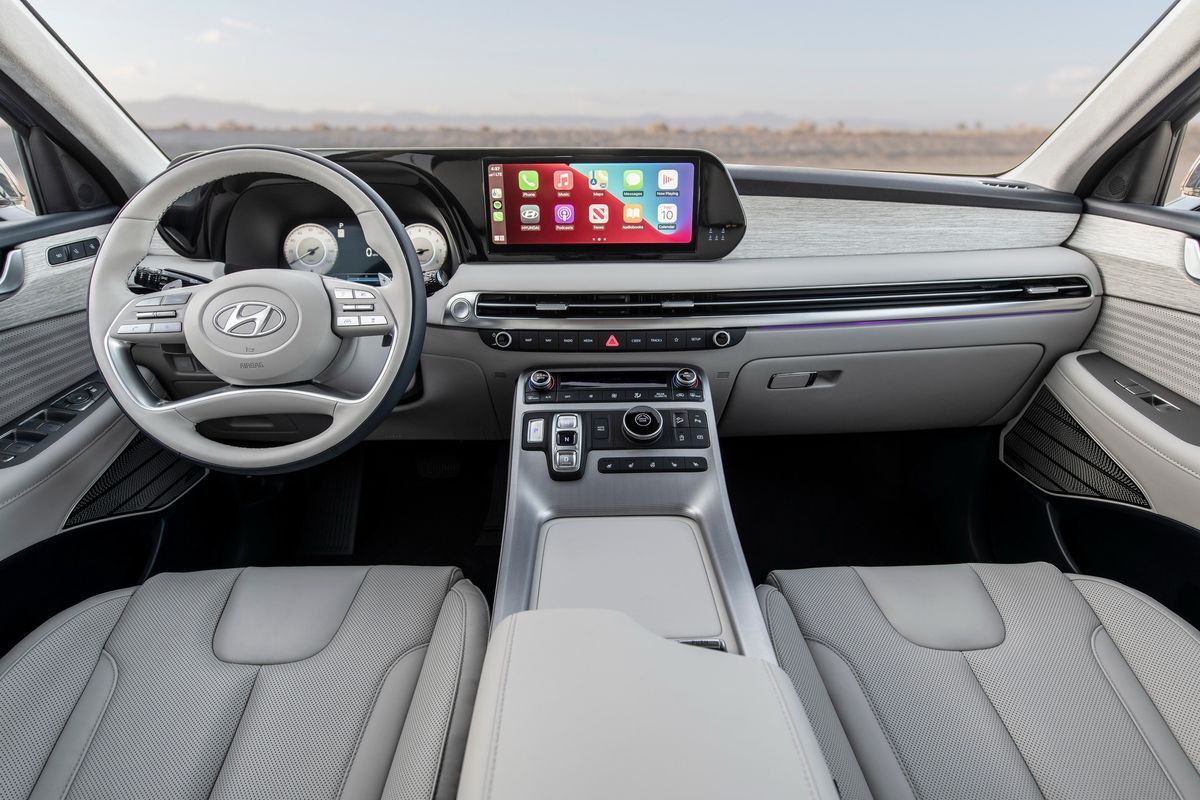
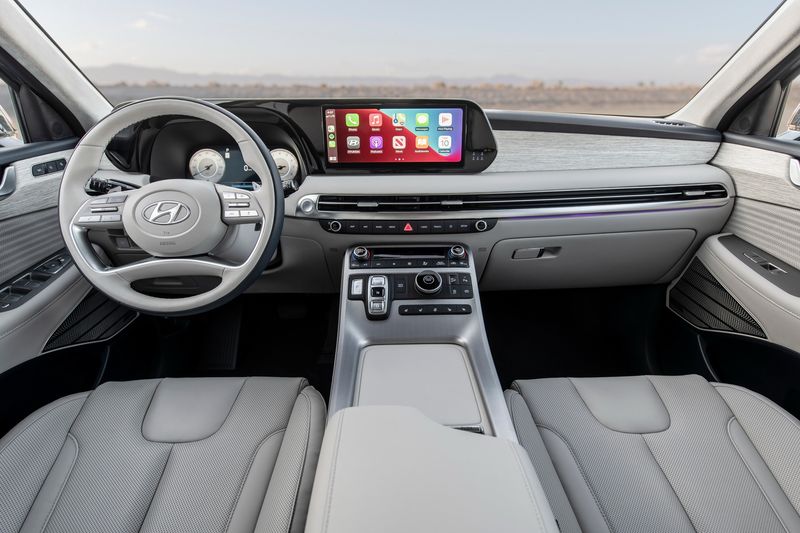
Inside, the cabin gets a nip and tuck, with updated technology, improved seating arrangements and enhancements to the assisted driving tech. The infotainment screen is now 12 inches in size, up from 10.25 inches and there are redesigned climate control vents. There’s a more modern 4-spoke steering wheel, new dashboard and new gauges. A digital rearview mirror with a feed from the rear passengers makes its debut.
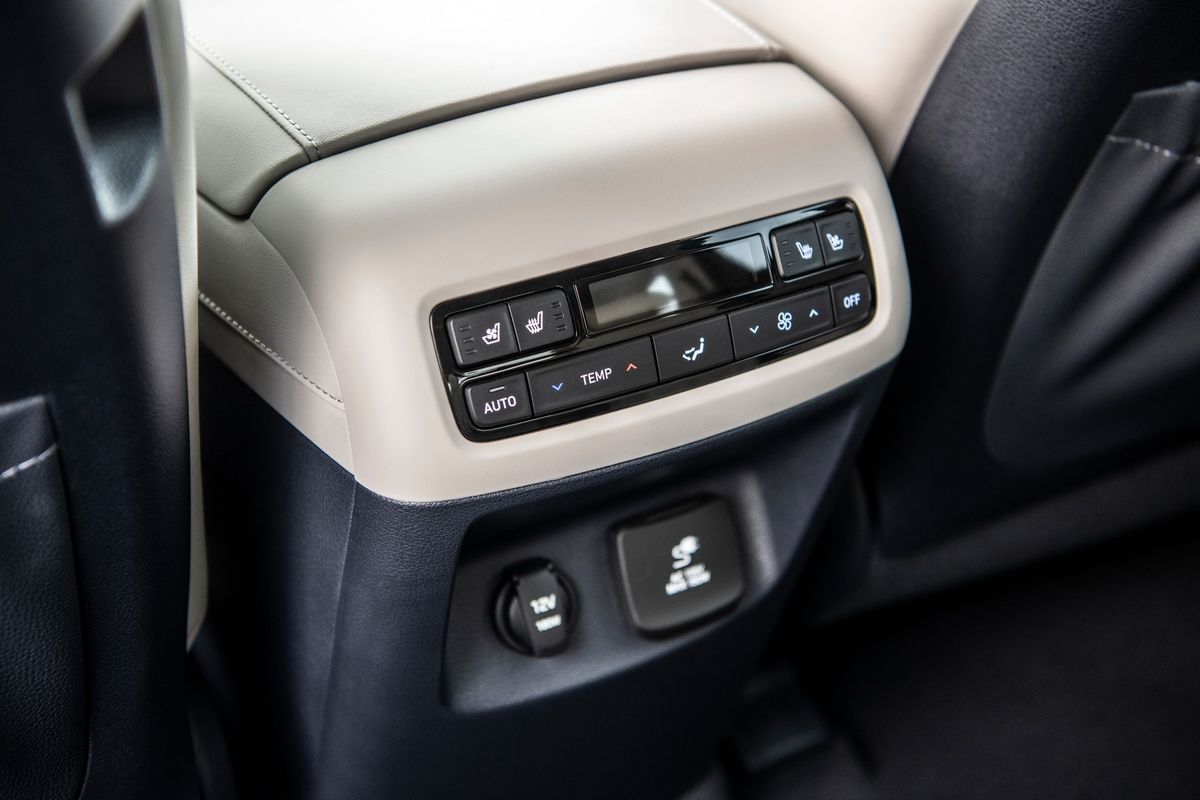
Hyundai says the driver’s seat now features expandable air chambers for additional comfort, while the third-row passengers get heated seats. The second row gets ventilated seats, improved headrests as well as new armrests.
The technology is worth a mention, and small things like more powerful USB ports and wireless charging as well as an in-car wifi hotspot will find favour among passengers.
There are now 9 airbags, enhanced forward collision avoidance and highway driving assistance, with remote smart parking assist making its debut.
As far as engines are concered, the US market retains its 3.8-litre V6 petrol which has outputs of 217 kW and 355 Nm, and this reaches the wheels via an 8-speed automatic gearbox. There’s no mention of the 2.2-litre turbocharged diesel powertrain that is currently on duty in the South African market.
New Polo GTI Facelift Review – New price, same power, still good enough?
From its humble beginnings, the Volkswagen Polo GTI has matured into a proper grown-up hatchback. Someone would even say its now occupying the same spot as the Golf 5 GTI did back in the day. Nevertheless, is it any good? Watch the video review!
The Polo GTI now leads a lonely life in a segment that was once buzzing with compact hot hatches. The Fiesta ST and Renault Clio RS are no longer sold in the South African market and so buyers who want GTI vibes but can’t stretch to the R700 000 needed for a Golf GTI are left with limited options.
Volkswagen recently facelifted the entire Polo range and the updates are quite significant. We sent our in-house race ace Ashley Oldfield to tear the new Polo apart (metaphorically speaking of course) and tell us if this latest incarnation of the Polo GTI is Vrrr Pha or Vrrr Meh.
Toyota Corolla Hybrid – What it’s like to live with
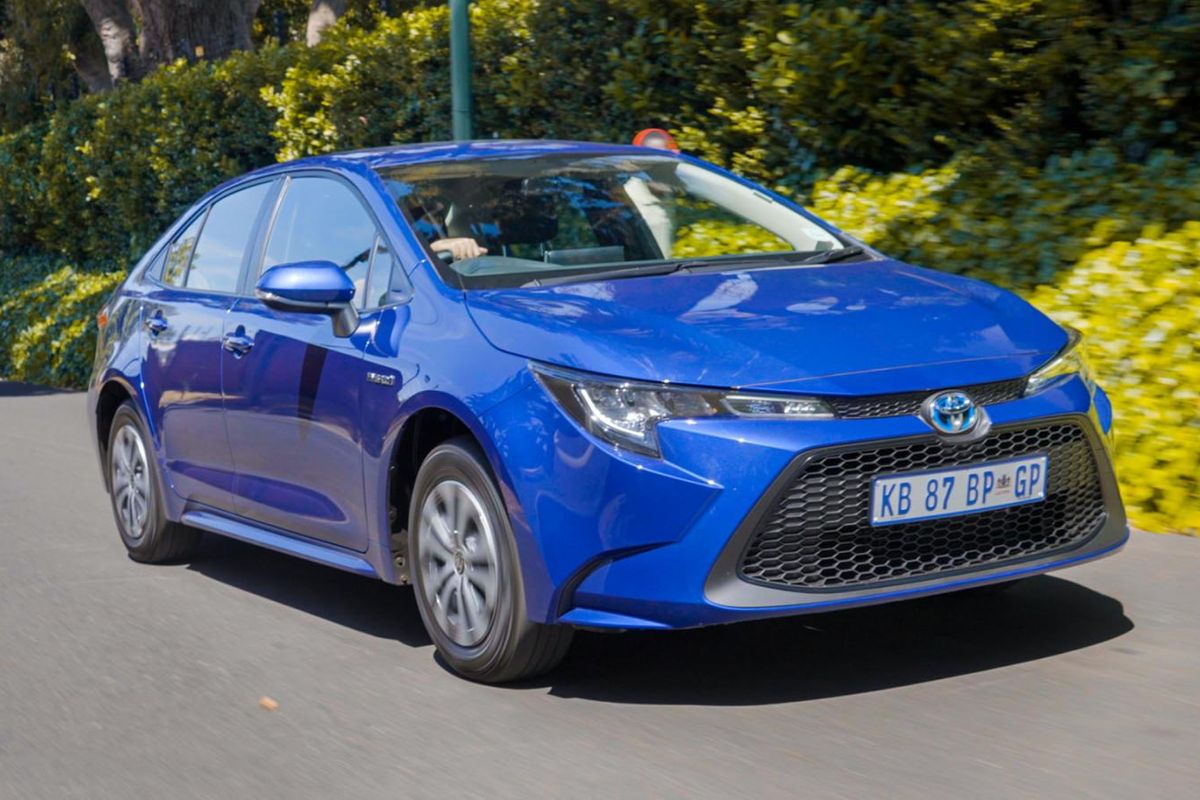
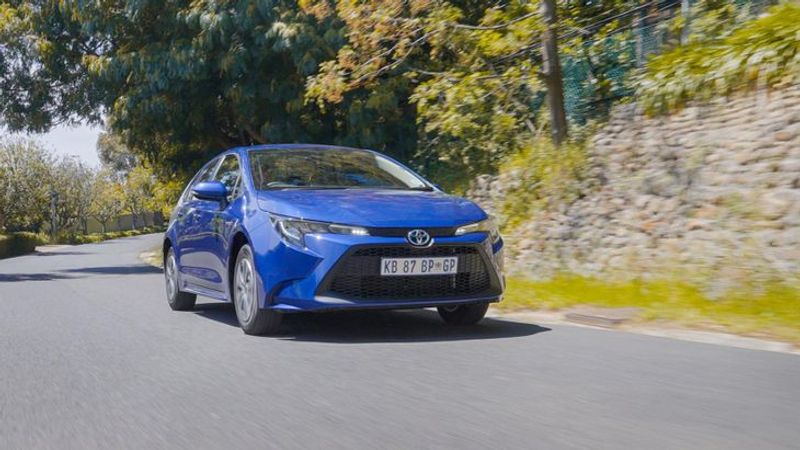
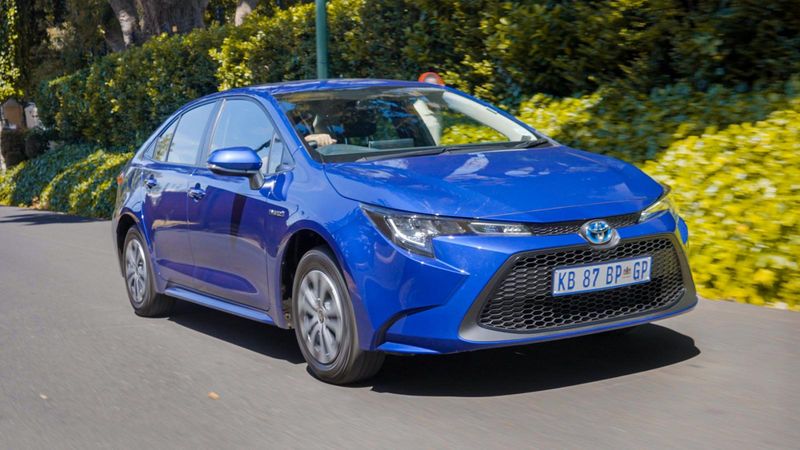
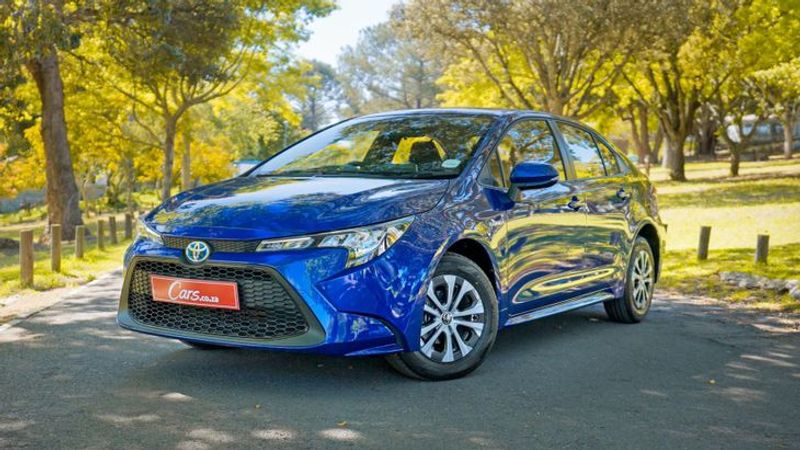
The Toyota Corolla 1.8 Hybrid SX offers lots of space for you and your family, has a huge boot and is extremely fuel-efficient. And the best of all? It’s not a diesel or a crossover/SUV. Ciro De Siena spent a few weeks in the company of the Japanese marque’s locally made petrol-electric sedan…
Nowadays, it seems as if everyone’s driving a compact crossover or a medium-sized SUV, but given my recent experience with the Corolla hybrid, I want to make a case for the sedan as a great family car and eminently practical “daily driver”.
Toyota South Africa Motors plans to roll out hybrid variants of most of its mainstream model ranges and, so far, it offers its petrol-electric drivetrain in the Corolla Cross compact family car, Corolla sedan (both of which are produced at TSAM’s Prospecton plant in KwaZulu-Natal), as well as the popular RAV4 medium SUV.
The Corolla 1.8 Hybrid incorporates 28 years of Toyota’s petrol-electric powertrain development.
Hybrid tech is really, really ingrained in Toyota’s brand philosophy. The first Prius hybrid was launched in 1994 and it’s obviously advanced a lot since then. The Corolla 1.8 Hybrid SX’s powertrain is derived from the Prius and it’s great, because you get all the benefits of 28 years’ development in a car that costs a lot less than the high-spec model on which it’s based, with styling that’s much less of an acquired taste.
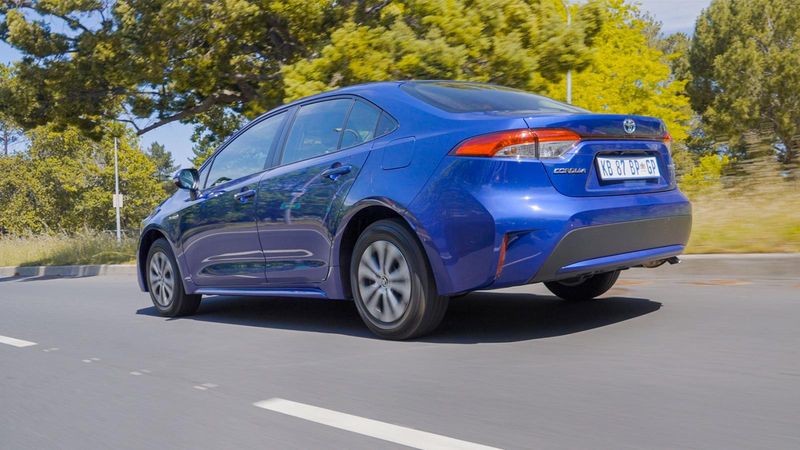
In fact, the Corolla hybrid looks quite good. The 11th-gen Corolla sedan is quite a looker in my opinion, and it comes standard with LED head- and taillamps, the former replete with daytime running lights.
Ride comfort & refinement
From the onset, the Corolla hybrid proved an extremely comfortable car. The suspension tuning is pliant; it’s soft – not sporty. If you just want a comfy car in which to get to work, the Toyota sedan fits the bill.
In terms of ride quality, the Corolla hybrid’s damping is Lexus-like and its cabin is whisper quiet.
We’re talking Lexus levels of ride quality here! It’s super impressive. Also, you may often hear motoring journalists talk about NVH (noise, vibration and harshness) suppression; luxury cars try to dial out those elements so that will you have a nice, relaxing experience and get to your destination feeling fresh.
Hybrids really have low NVH levels, and the Corolla Hybrid is no exception – especially when you’re in battery mode (when the internal combustion engine is deactivated), but even when both the petrol and electric motors are working in tandem there’s very little vibration and almost no noise from the drivetrain.
Factor in the nice high-sidewalled tyres and absorbent suspension setup, allied with the minimum of harshness, and suffice to say this Japanese compact sedan is a decidedly calming vehicle to drive.
The 11th-generation Corolla impresses with its hewn-from-solid build quality, even though SX is a mid-grade spec.
Mid-grade specification
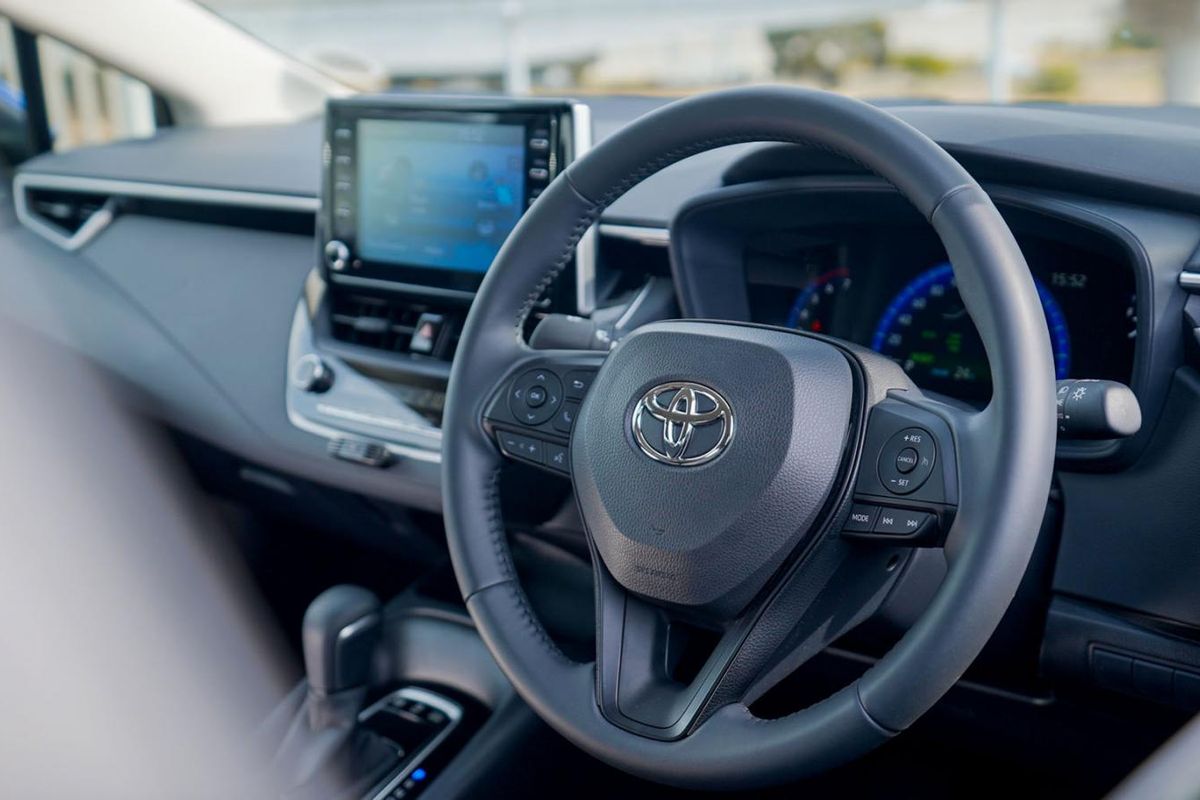
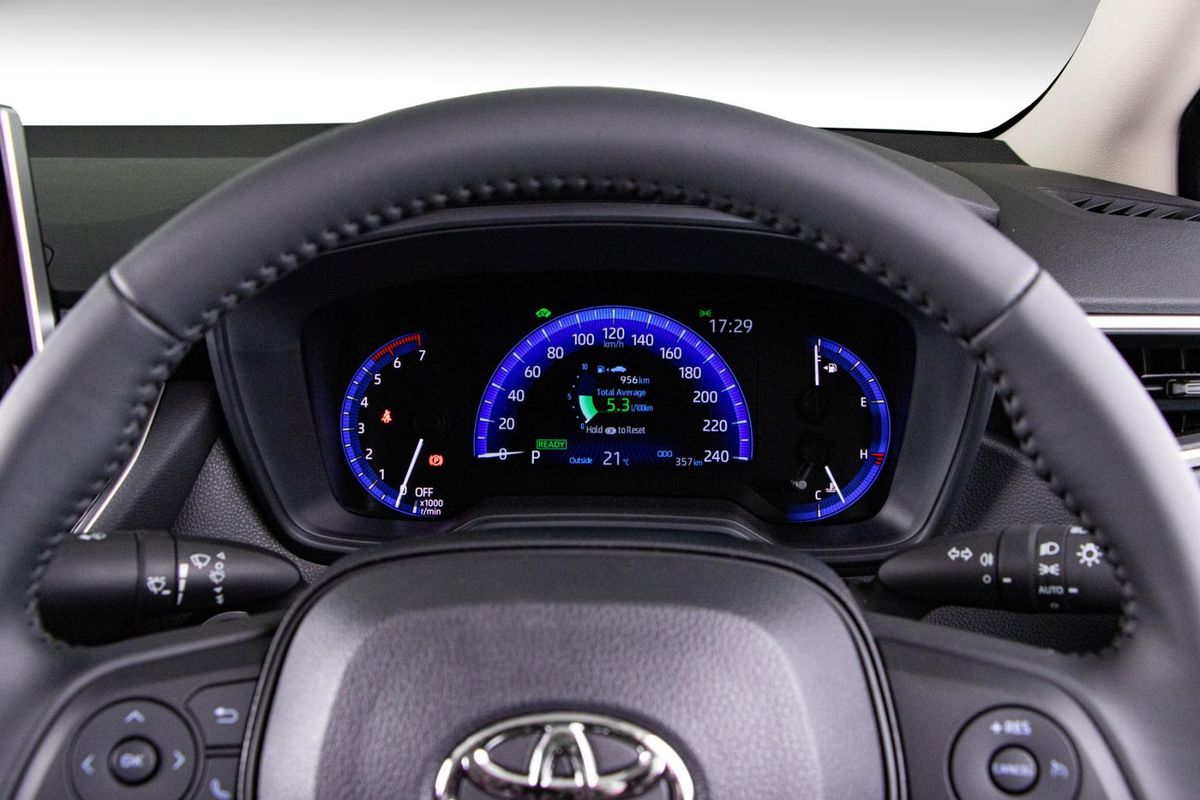
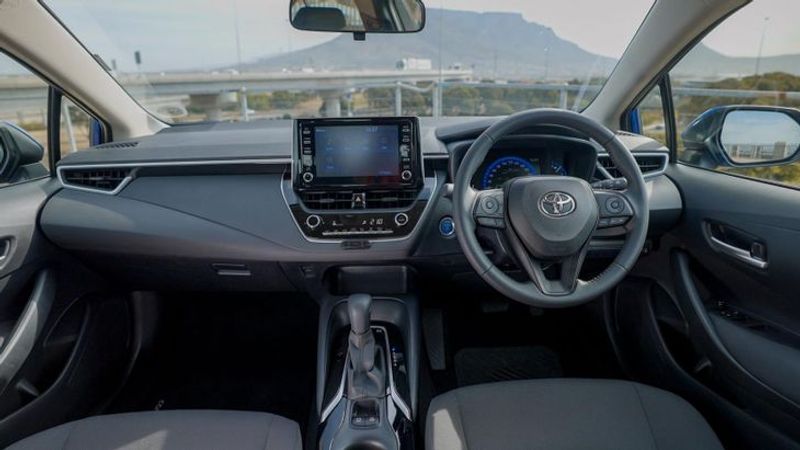
As for the interior, it’s fairly standard Toyota fare, but the materials are of a high quality, and everything has been put together really well. The instruments are a slick combination of digital and analogue with a large multi-Information display, which offers a glut of info about your vehicle. The seats are cloth, which doesn’t look as premium as leather, but I found them super comfortable, especially over long distances.
The Corolla 1.8 Hybrid SX comes equipped with automatically activated lights, keyless entry, power-adjustable and heated side mirrors, cruise- and climate control, a reverse-view camera, electric windows, a leather-trimmed 3-spoke multifunction steering wheel. The touchscreen infotainment system includes a 6-speaker audio setup, plus it supports Bluetooth, USB, Apple CarPlay and Android Auto functionality.
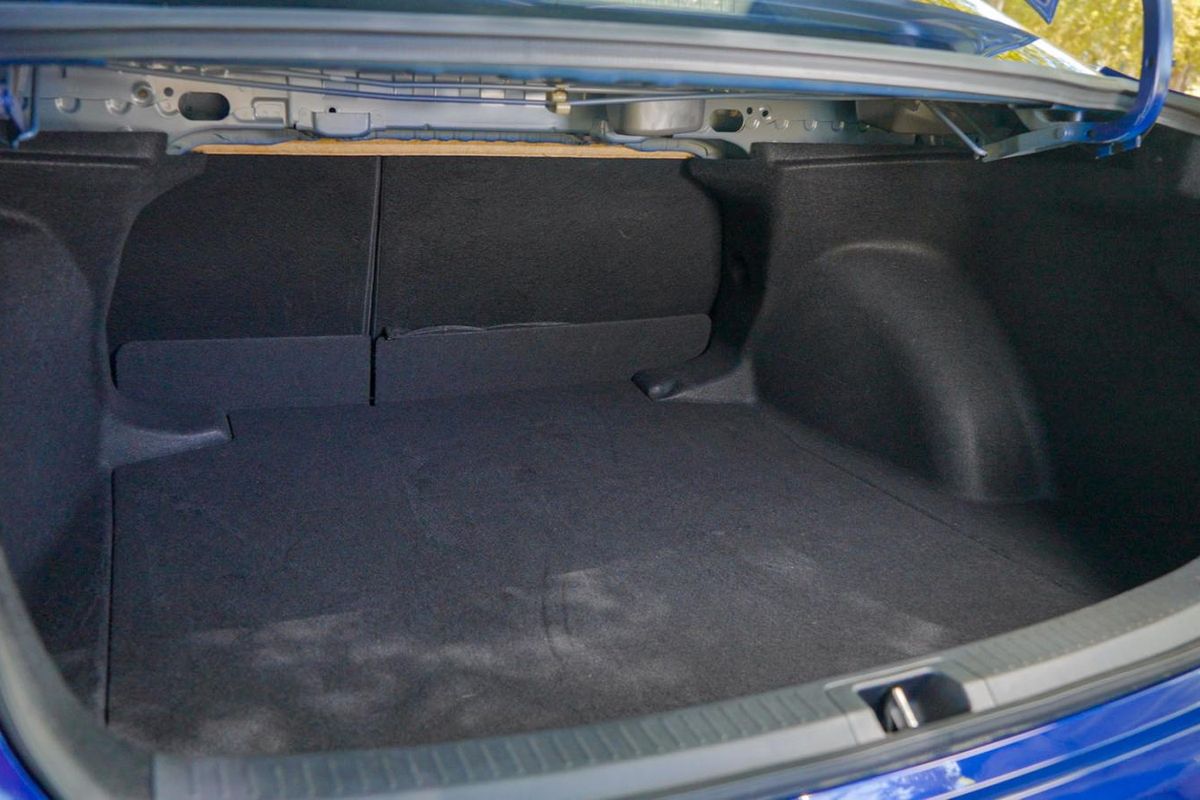
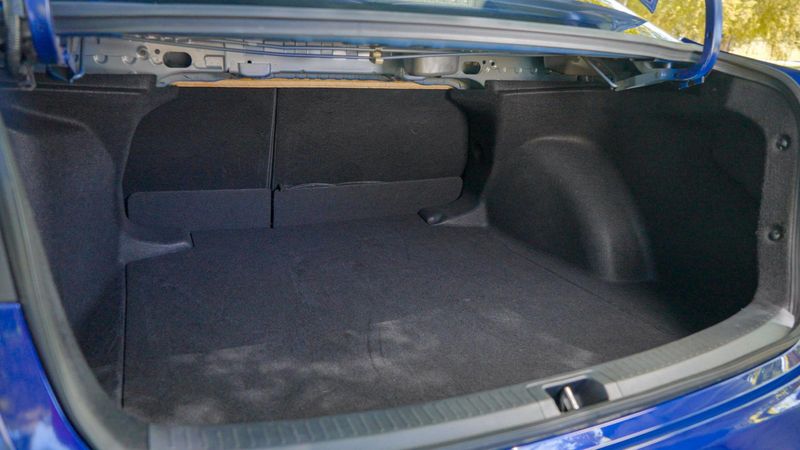
The Corolla’s boot is cavernous… we reckon that it could swallow 6 medium-sized cooler boxes.
Generous boot capacity
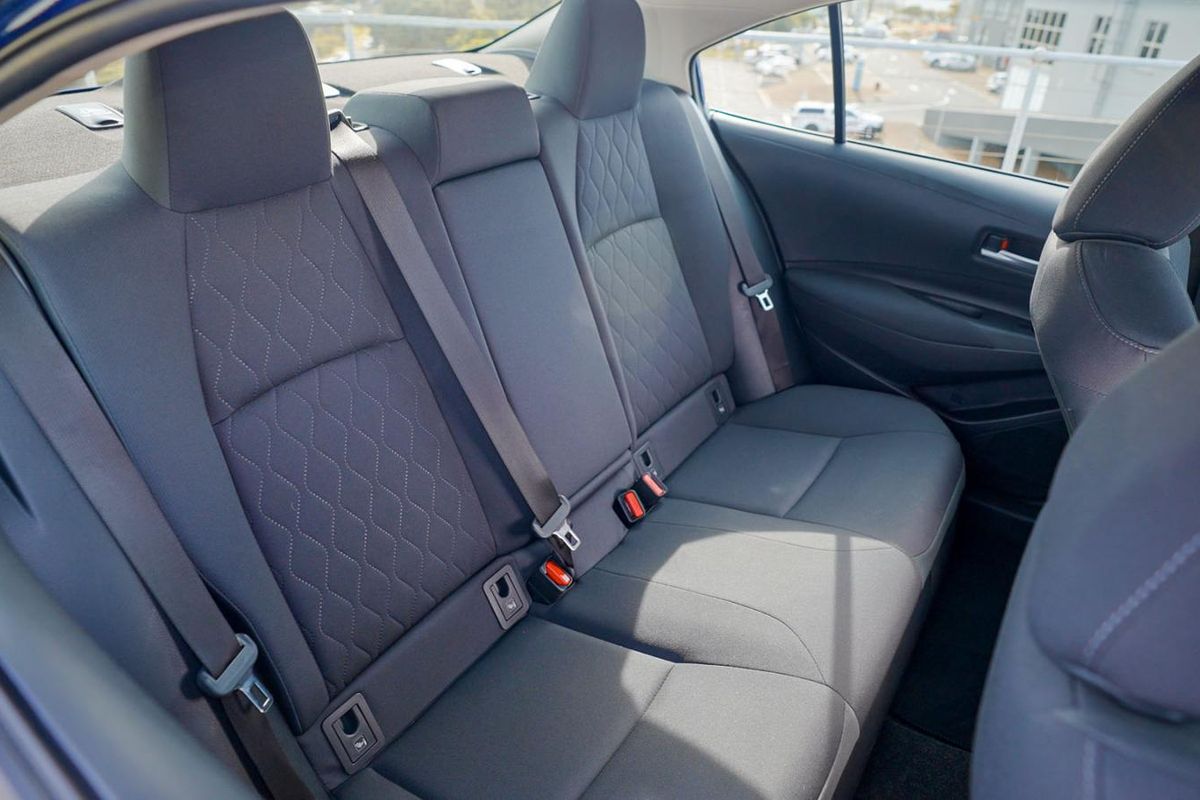
In terms of practicality, the rear seatback folds through to the boot, but annoyingly, there is only a release on the shoulder of the back seat and none in the boot itself, which would have been more convenient.
I promised you a big boot and, based on our cooler-box test, the Corolla’s boot can hold about eight reasonably sized cooler boxes… and there’s still quite a lot of height left (considering that there are tools and a spare’ underneath the floor). The rear seats fold 60/40, so you can slide a bicycle in, or a kayak, or whatever you want. I dare you to show me a similarly sized SUV that offers that much luggage space!
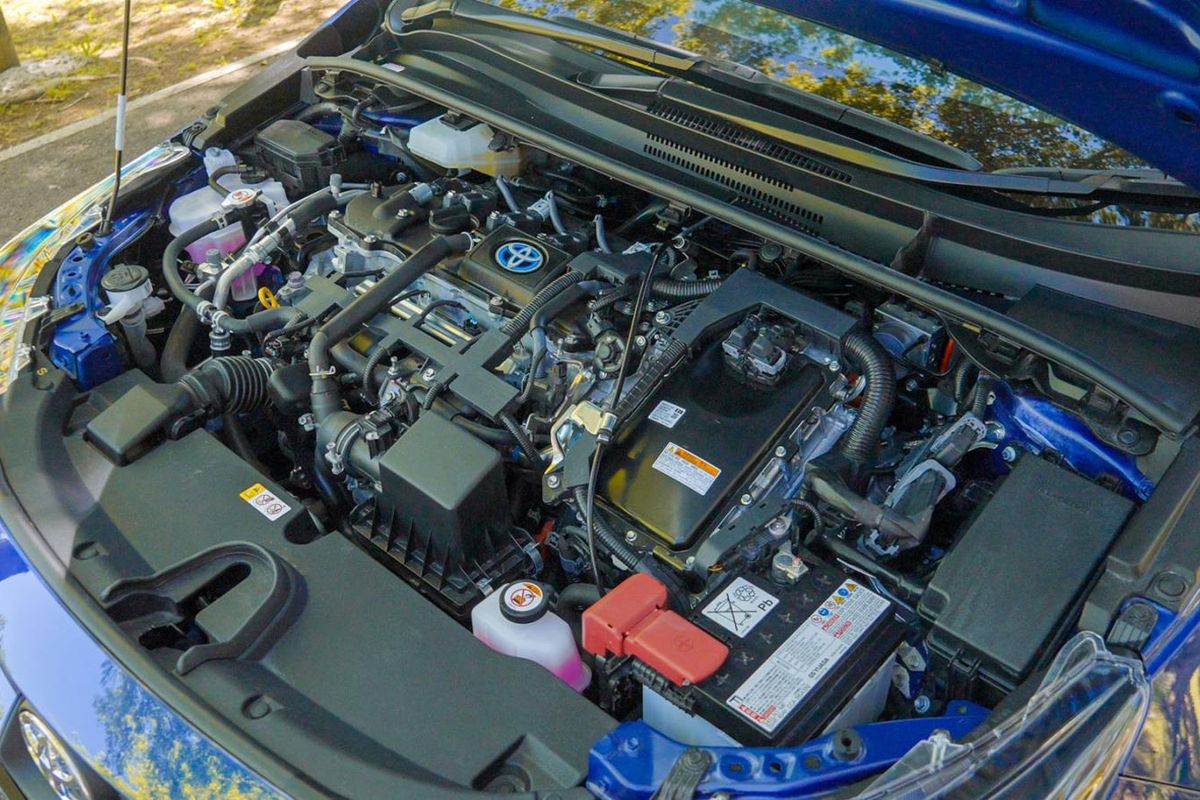
The combination of a 1.8-litre four-cylinder Atkinson-cycle petrol engine, electric motor and a CVT is a smooth one.
Hybrid powertrain
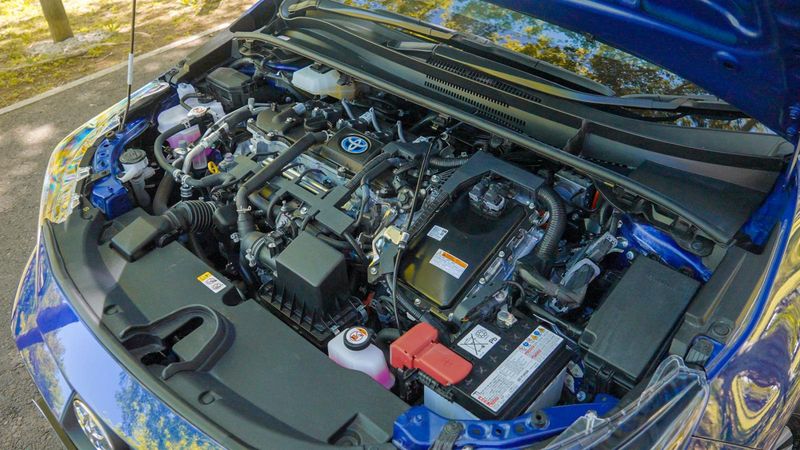
At the heart of the Corolla 1.8 Hybrid SX is the 72 kW/142 Nm 1.8-litre, 4-cylinder Atkinson-cycle 2ZR-FXE engine (shared with the Prius), which works in conjunction with an electric motor mated with a high-voltage hybrid battery, which has particularly high energy density to facilitate more rapid self-charging.
The electric motor provides 53 kW and 163 Nm (at full capacity) to boost overall system output to 90 kW (the combined figure is not an aggregate of the 2 power sources, due to transmission reduction losses).
The hybrid powertrain directs its torque to the front wheels via a continuously variable transmission (CVT). Now, a CVT means that the car always has the right gear ratio for the engine speed and the road speed and, frankly, it’s incredible how much power and torque you get out of that little electric motor.
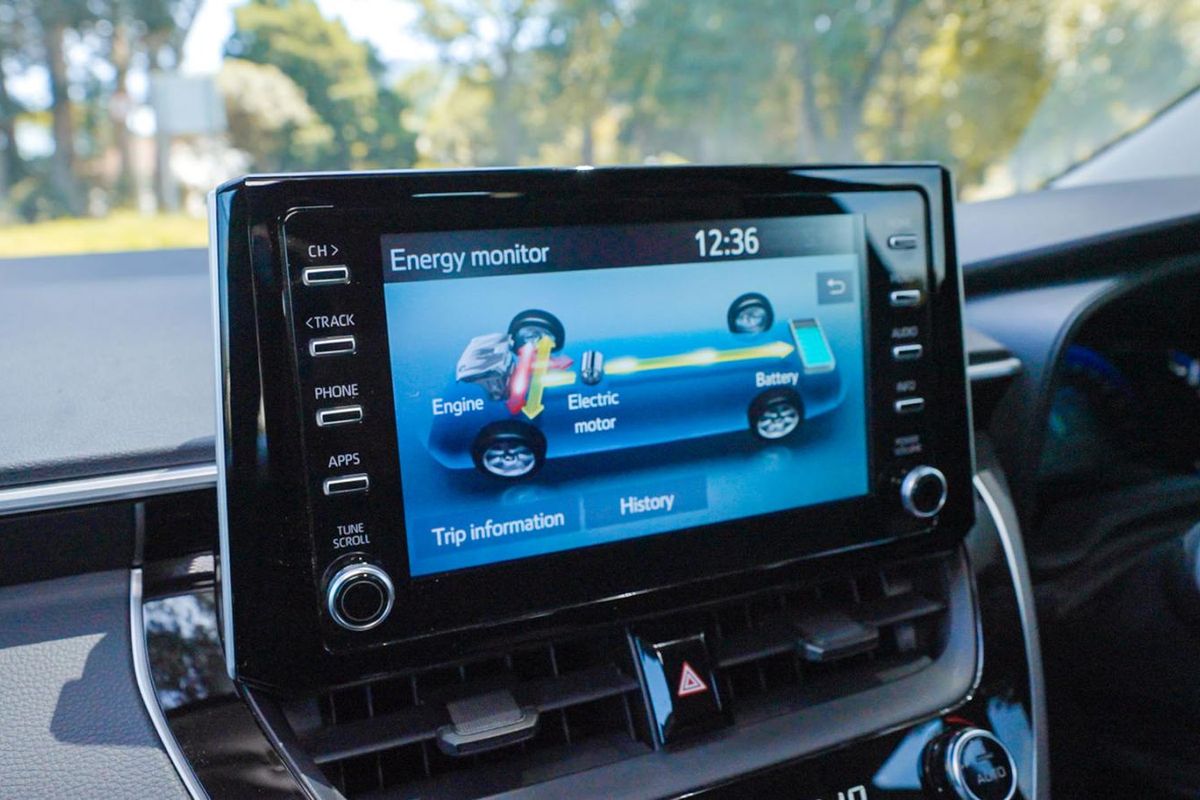
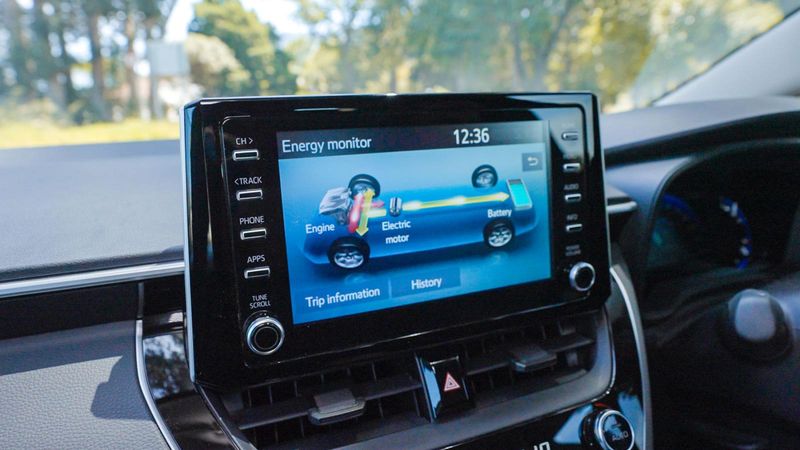
For those who don’t understand how the hybrid technology works, the infotainments system shows a dynamic graphic.
To help you understand what the car is doing at any point, the infotainment system can display a graphic (which gets enlarged when you tap on it) that shows you where the energy is moving around the car and which component of the hybrid powertrain is busy driving the wheels… It’s quite fun to watch, actually!
Wait, aren’t hybrids boring to drive and slow? Well, no, when you put your foot down to quickly cross an intersection the Corolla hybrid hauls, because you’ve got all that torque (from zero rpm) coming from the electric motor aided by the petrol motor’s shove. The 1.8 Hybrid SX is quite sprightly – it’s not slow at all.
Although Toyota’s claimed fuel consumption figure is optimistic, we had no difficulty achieving a return of 5.0L/100 km.
Efficiency in the low 5s
Toyota claims an average fuel consumption figure of 3.5 L/100 km for the Corolla hybrid, which, combined with its 43-litre fuel tank, should give the derivative a theoretical range of over 1200 km on a single fill-up.
After driving the test unit for about a month, no matter how I drove it or where I drove it, the indicated average was 5.2 L/100 km. I think that 3.5 L/100 km is too optimistic – if you are driving every day, you’re going to get around 5 L/100 km. Do the maths on that because it’s a number that’s easy to remember.
That means that for every litre of fuel you’re travelling about 20 km! That’s a major boon, given the price of petrol these days and it’s only going to get worse, so if you want a fuel-efficient car (the Corolla Hybrid is shod with energy-saving, low rolling resistance 195/65 R15 tyres), that’s what this car can do for you.
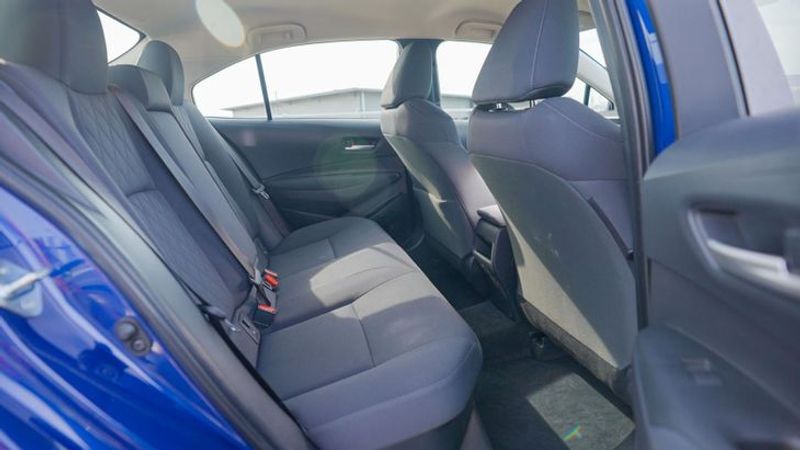
The Corolla hybrid might not have a fashionable configuration, but the sedan offers more than sufficient rear legroom.
One-pedal driving
As is the case in battery-electric vehicles, a hybrid utilises regenerative braking (RB). To put it as simply as possible, when the car is coasting it uses the vehicle’s forward momentum through the drivetrain to spin a generator that generates electricity, which, in turn, feeds into the high-voltage hybrid battery.
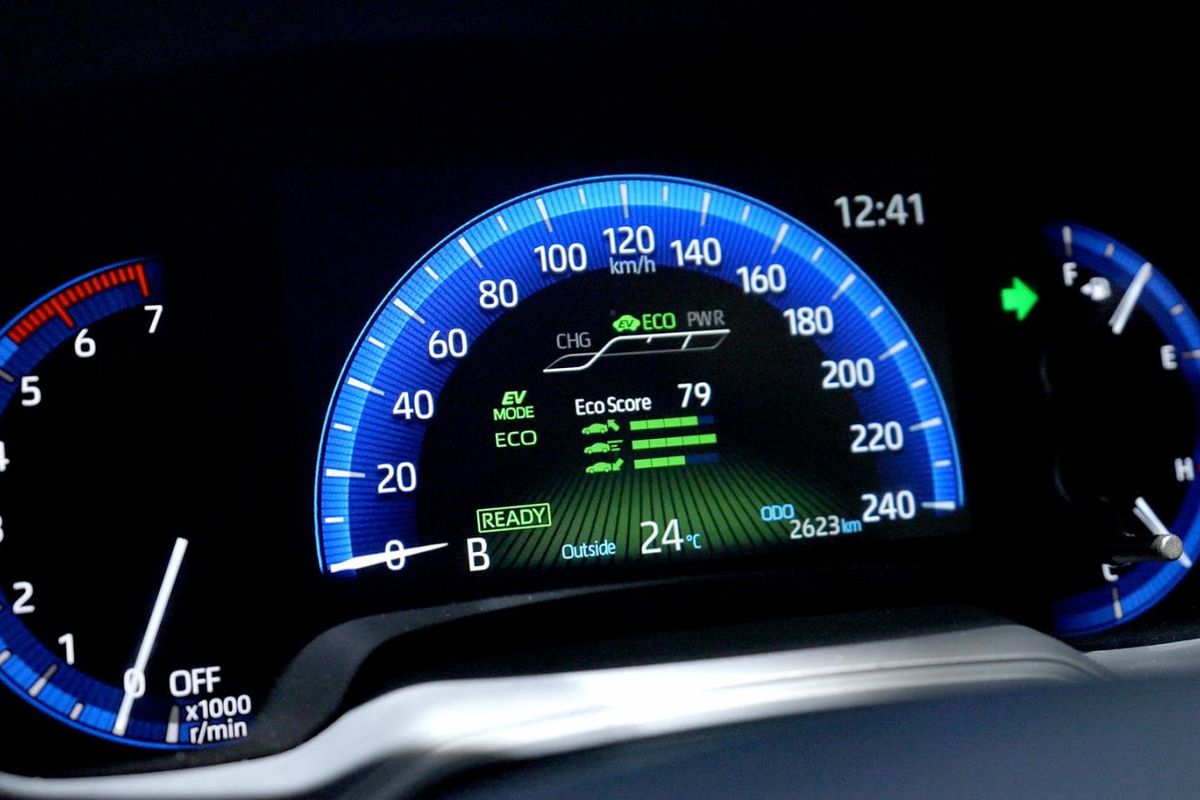
It’s like free petrol, or, more accurately, free energy. If you didn’t have a generator that kinetic energy would just have gone to waste. You can alter the intensity of the regeneration in most cars that make use of the technology, but you must sift through the infotainment system’s menus. Toyota, however, has made it easy: use the transmission lever to select B (it sits under D), which priorities brake regeneration.
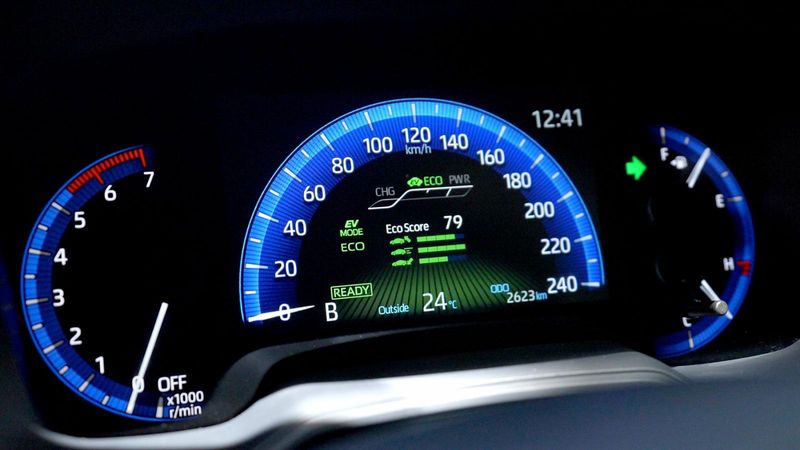
The instrument cluster provides you with constant feedback on the efficiency of your driving style.
To give you an example, when you’re coasting on the highway you don’t want too much regeneration – you want the car to coast quickly so that you can better modulate the speed, but when driving in built-up areas, you want maximum regeneration to take advantage of all those times when you’re slowing down. In what that does is makes your throttle pedal both your brake and your accelerator, because as soon as you get off the throttle the car is feels like it’s actively braking… in fact, it turns on the brake lights for you.
That relaxing type of motoring is part and parcel of the hybrid driving experience, because you inevitably become very aware of your car’s indicated fuel consumption figures and endeavour to get it down as low as possible by adopting an efficiency-minded driving style. It becomes like a challenge and it’s quite fun.
Price and after-sales support
The Corolla 1.8 Hybrid SX costs R439 000, which includes a 3-year/100 000 km warranty and 6-services/90 000 km service plan. The hybrid battery has a separate 8-year/195 000 km warranty.
The Corolla 1.8 Hybrid SX begs the question: What more could you want from a “daily driver”?
Verdict
Cars.co.za Consumer Experience Manager Hannes Oosthuizen and I drove the Corolla hybrid extensively and both of us came to like the Japanese compact sedan a lot. It’s a great daily driver; it’s smooth; it’s comfortable; it’s pretty fast (for what it is); very efficient and, not least, supremely practical.
R439 000 gets you one of these. Now when you consider that a top-spec Volkswagen Polo (apart from the GTI hot-hatch version) retails for R426 100, Toyota’s newcomer represents a lot of car for your money.
How much more you could want from a daily driver? There really is a lot to be said for a good sedan (bearing in mind that its boot capacity is probably larger than that of a similarly sized crossover – at least in default configuration)… and I think this is one of the better ones, especially at this keen price point.
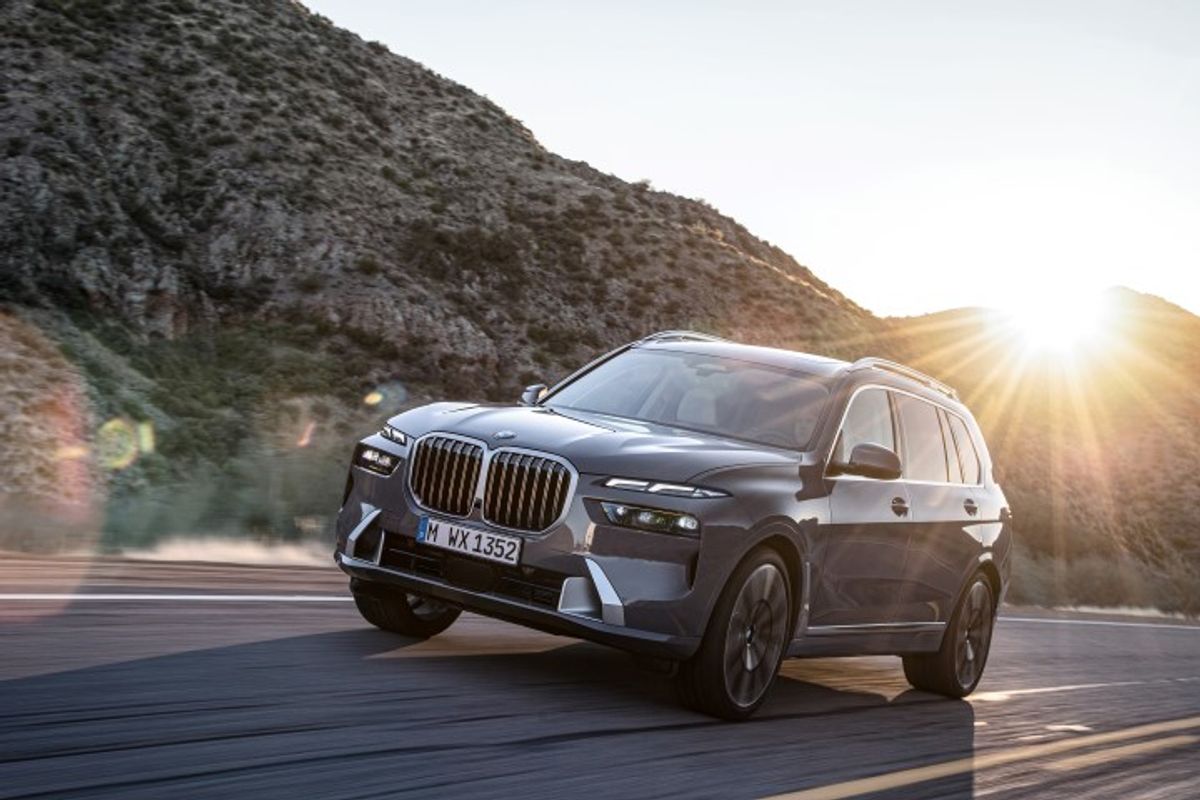
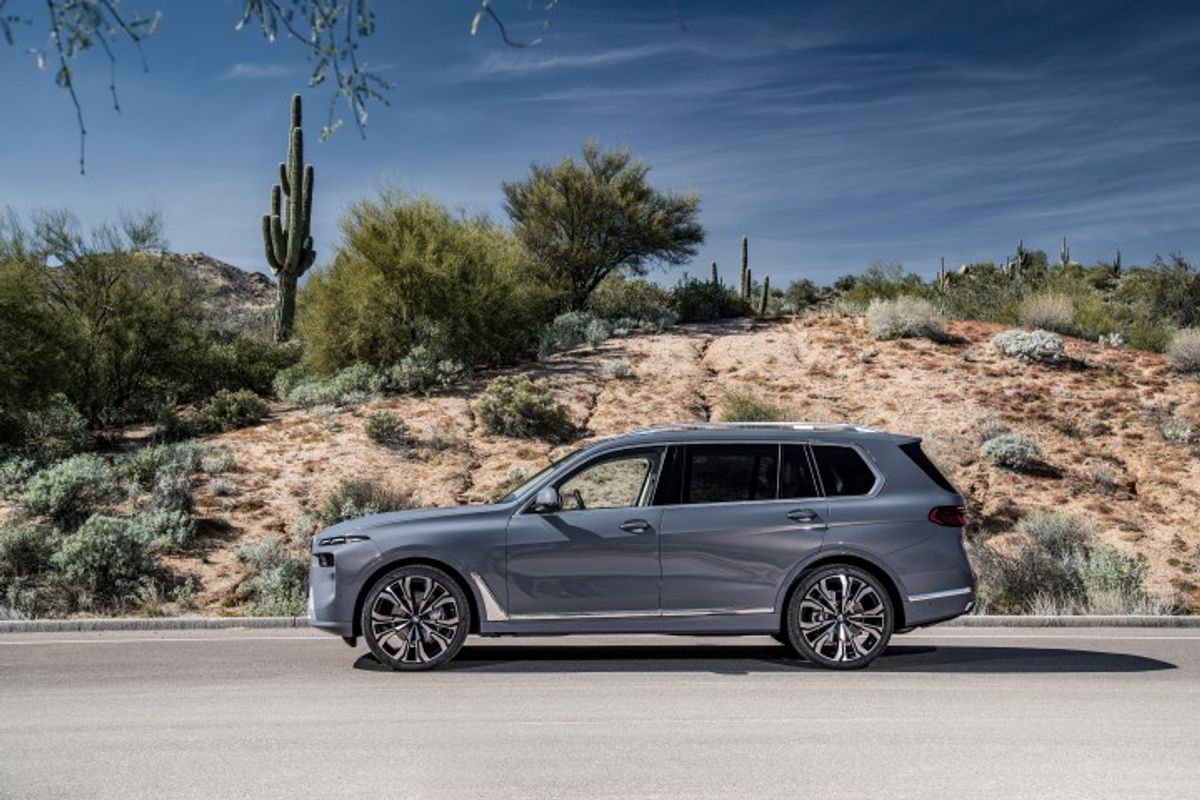
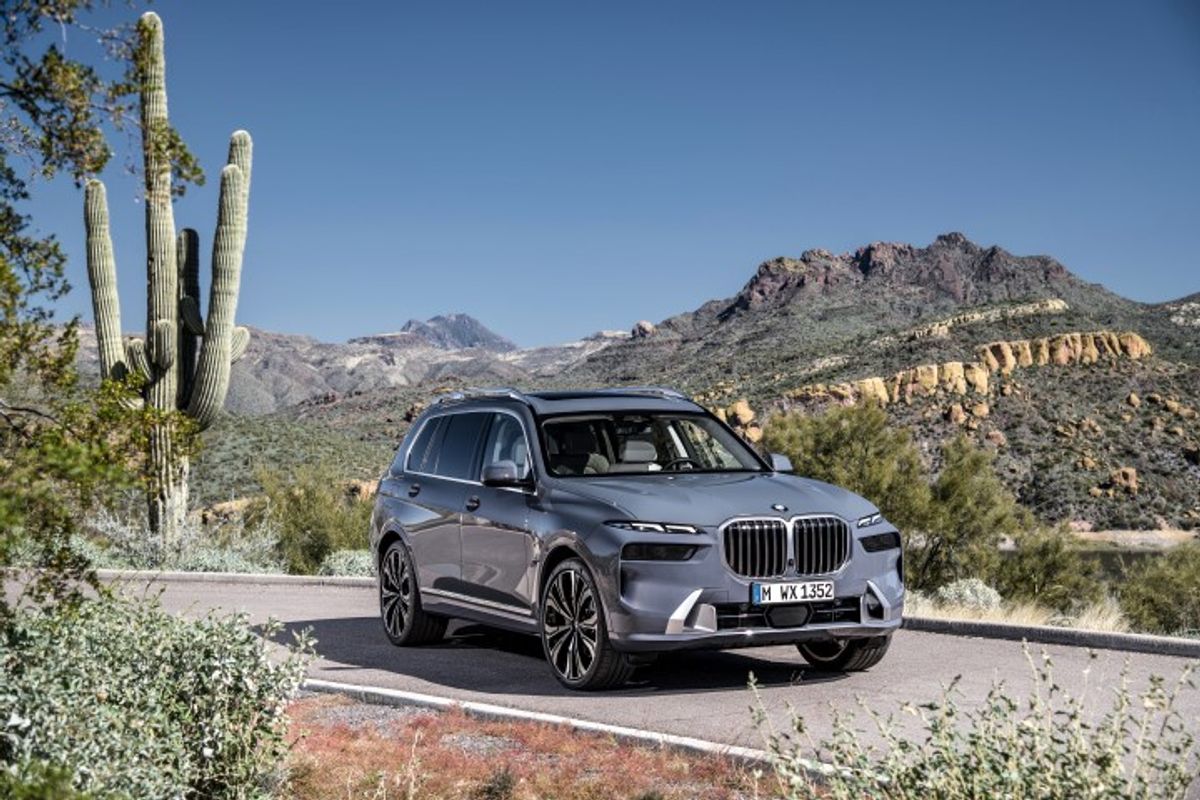
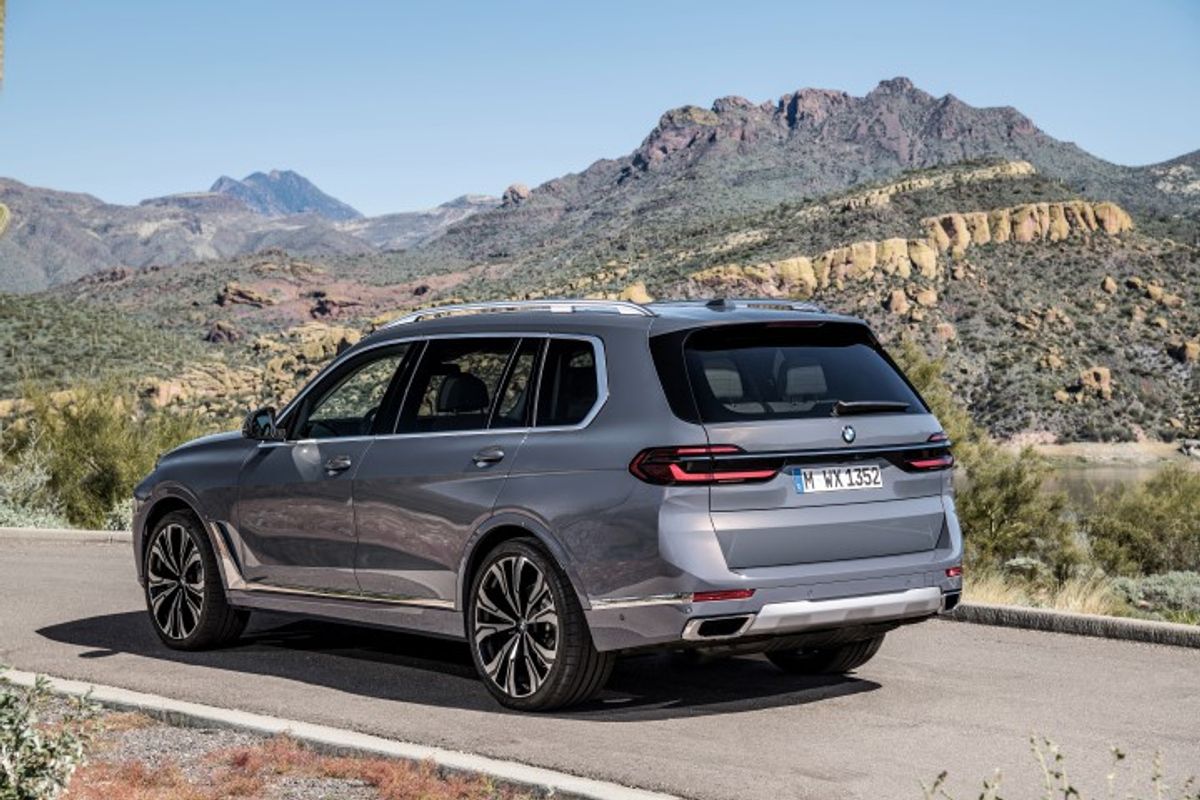
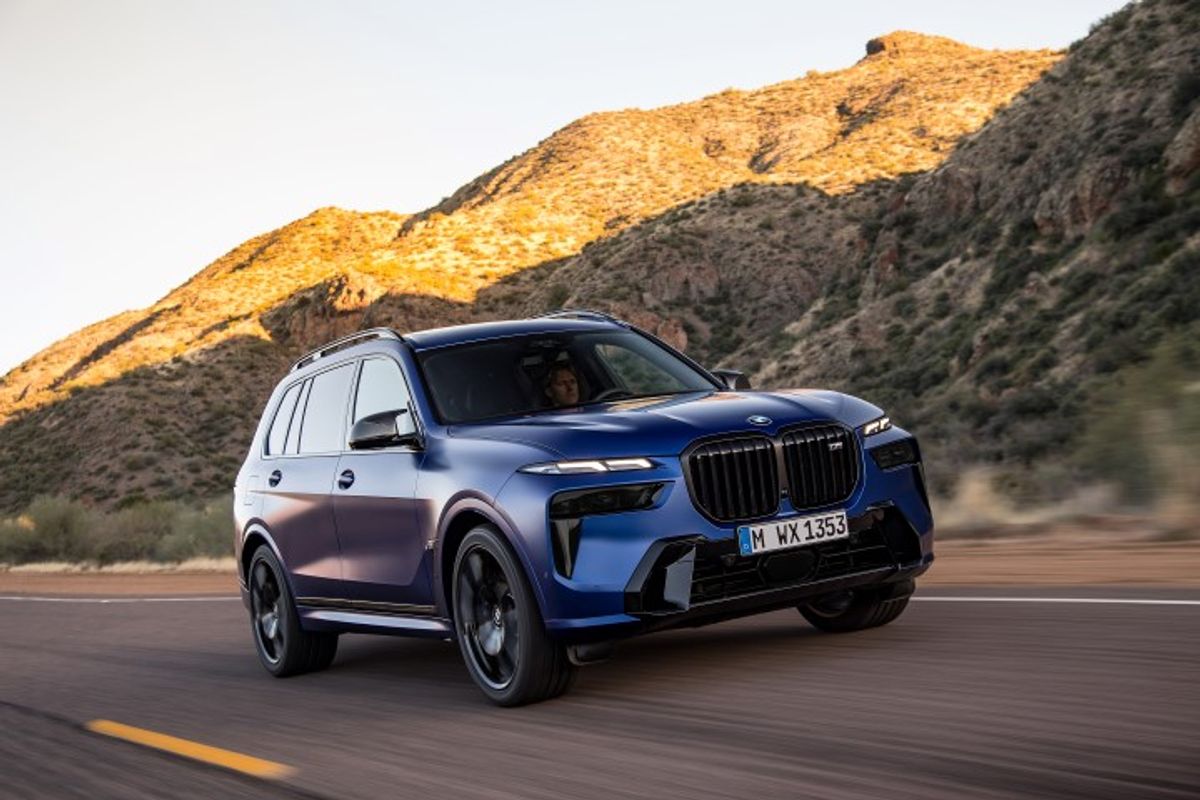
The BMW X7, the Munich-based firm’s largest SUV, has received an update and the new-look model has made its debut at the 2022 New York Motor Show.
The New York International Auto Show is taking place from 15-24 April 2022 and BMW has used the event to showcase its latest wares, including an enhanced BMW X7 SUV with a new look and technology and engine upgrades.
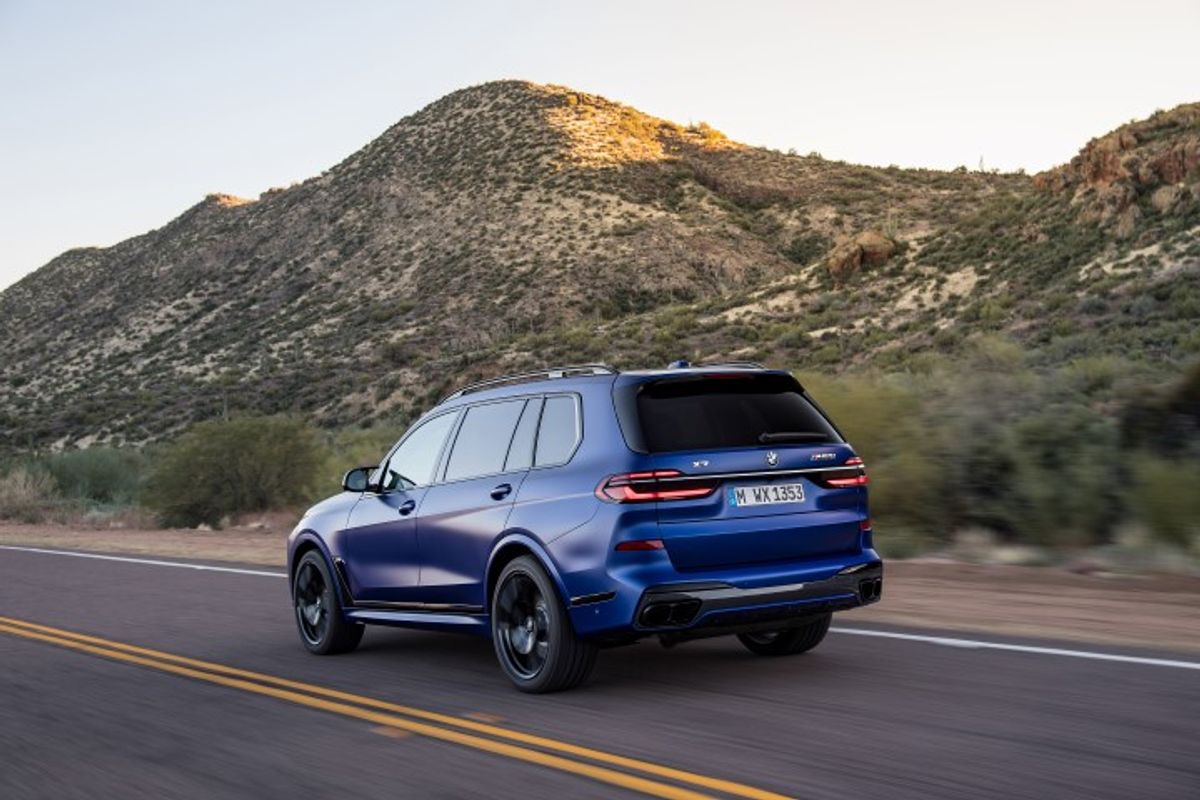
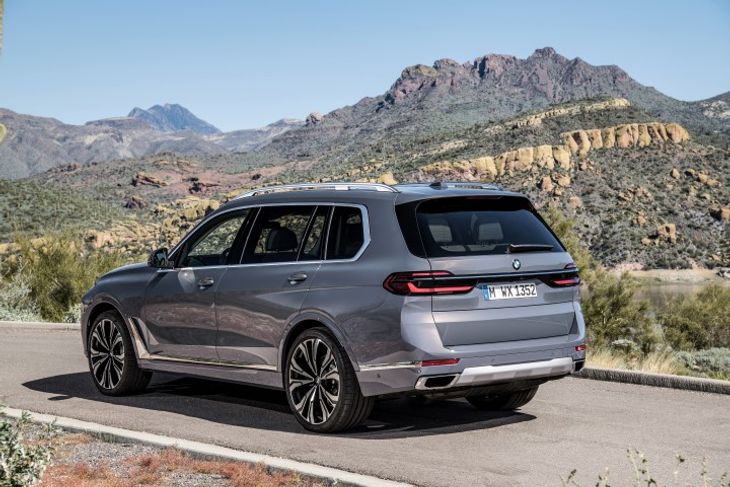
The talking point in terms of design is the new horizontally split LED headlights with the upper section featuring daytime running lights and matrix LED headlights seen in the lower section. The large kidney grille gains an optional Iconic Glow illuminated grille and for the first time the X7 can be equipped with 23-inch BMW Individual wheels. The rear end gains new LED light units with 3D graphics and BMW has also updated its M Sport packages and added a new Sparkling Copper Grey metallic body colour to the range.
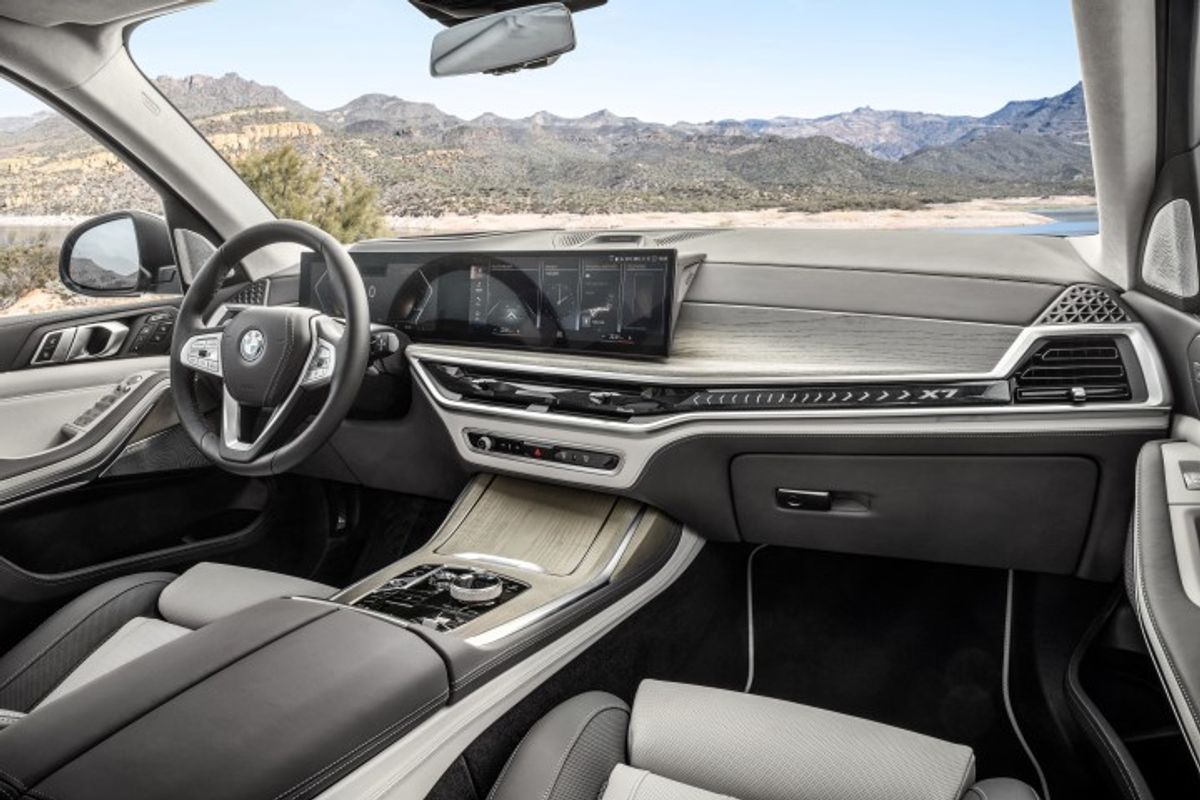
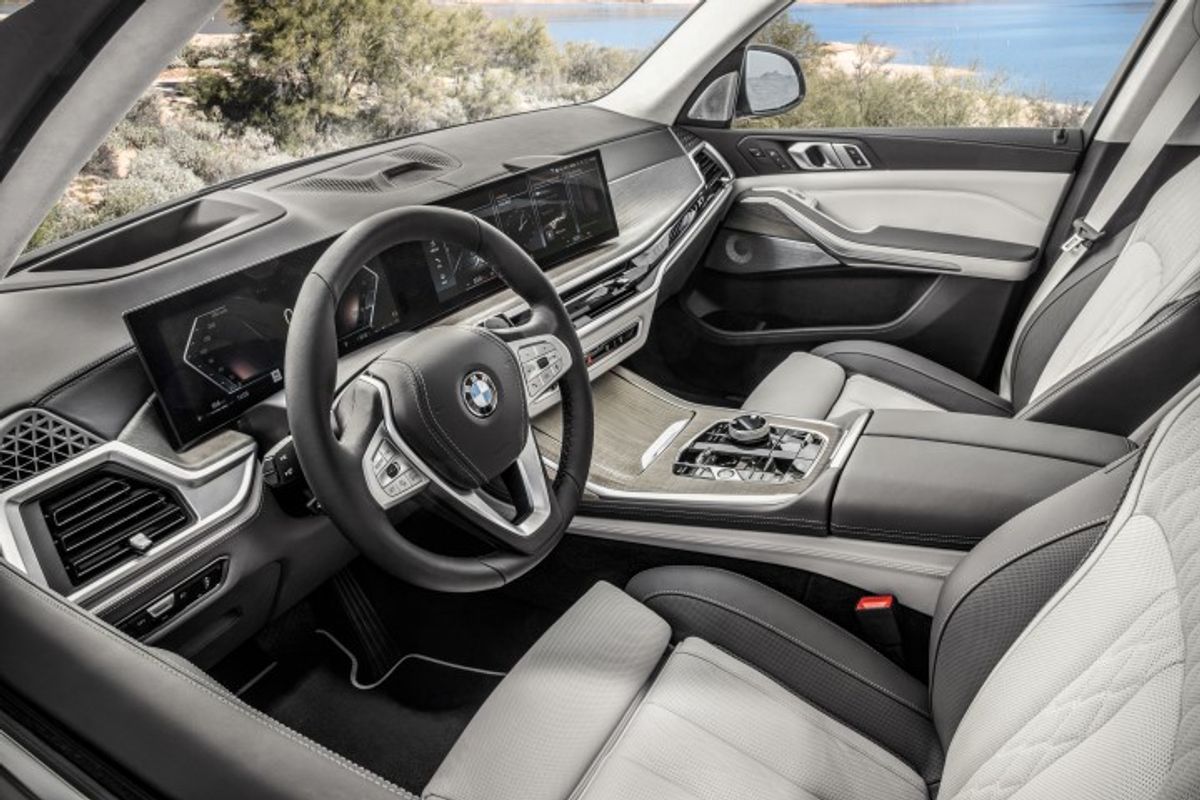
Key interior features include a large 12.3-inch instrument cluster and an even larger 14.9-inch infotainment system with the latest BMW Operating System 8. BMW has also added standard features such as Comfort Access, panoramic glass sunroof and heated front seats. If you look carefully, you’ll spot the gear knob has been removed, in favour of a much more discrete gear selector.
The X7 can seat 7 passengers as standard but it can be had as a 6-seater with 2 comfort seats in the second row as an option.
The BMW X7 gains some power increases with the addition of 48-volt technology.
In terms of engines, the 3.0-litre, 6-cylinder petrol engine and the 4.4-litre twin-turbocharged V8 engine now feature 48-volt mild-hybrid technology. The 40i features a 280 kW and 520 Nm punch, giving it a claimed 0-100 kph sprint time of just 5.8 seconds. Then there’s the mighty M60i with a new 4.4-litre V8 turbo which produces 390 kW and 750 Nm. This monster is good for a 0-100 kph in a claimed 4.7 seconds.
Sadly, the M50d engine has been discontinued, and for the diesel fans, they’ll have to make do with the updated 40d with 259 kW and 720 Nm. All engines are mated with an updated version of the 8-speed Steptronic Sport transmission.
An adaptive 2-axle air suspension with electronically-controlled dampers is standard while Integral Active Steering is optional on all derivatives, barring the X7 M60i xDrive. More so, additional driver assistance features have also been added to the package including Parking Assistant, Trailer Assistant, Reversing Assistant and Manoeuvre Assistant.
BMW South Africa has confirmed that its updated X7 will be hitting dealers in the last quarter of 2022.
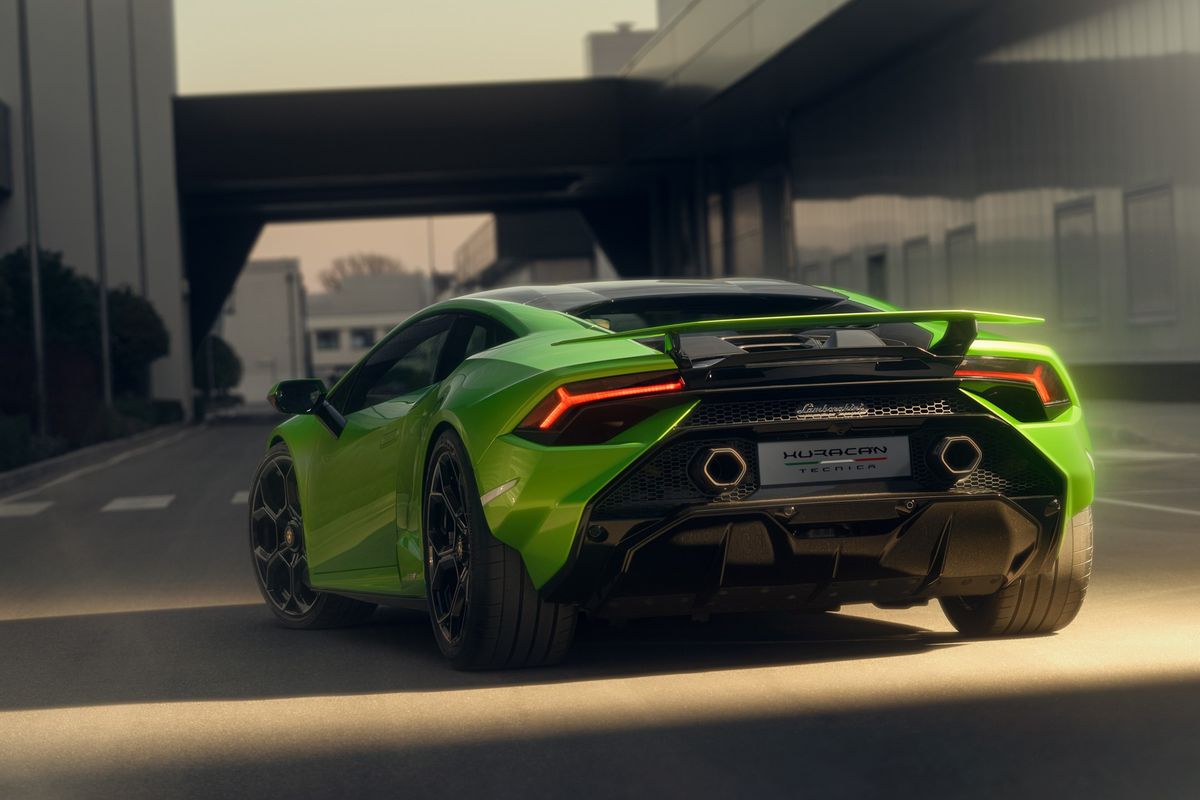
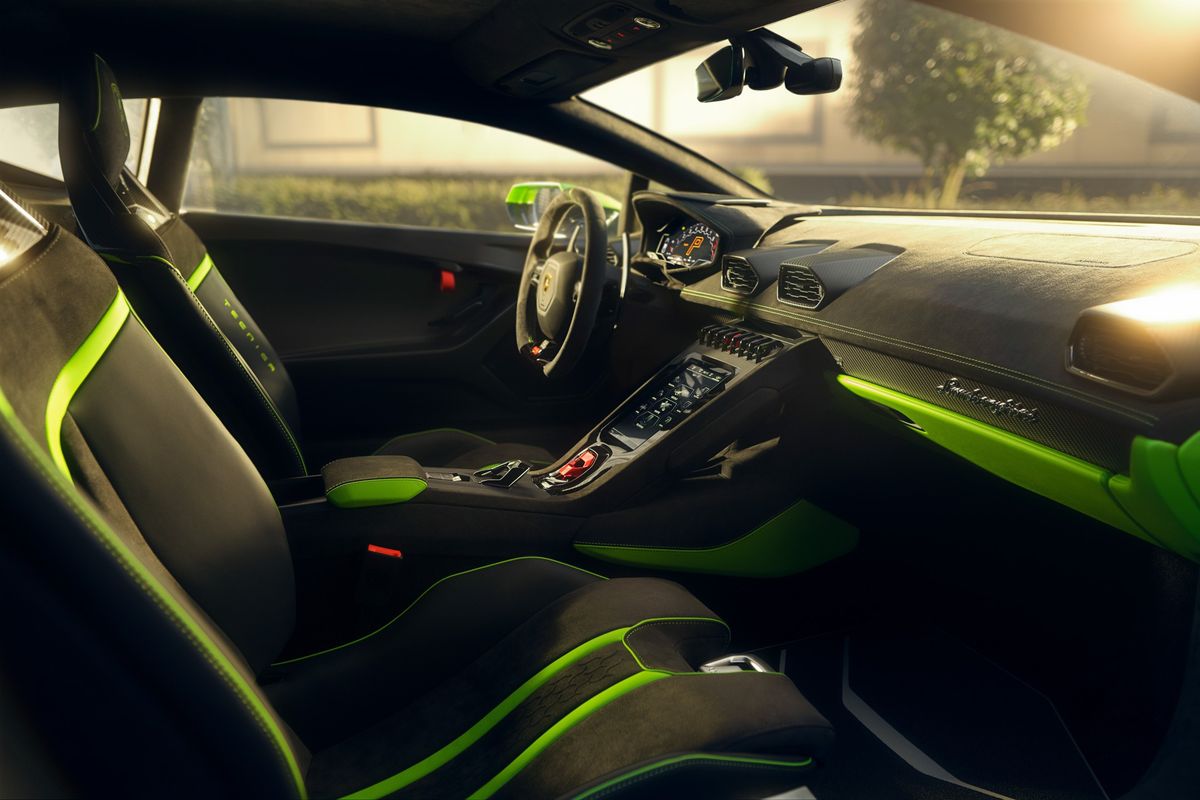
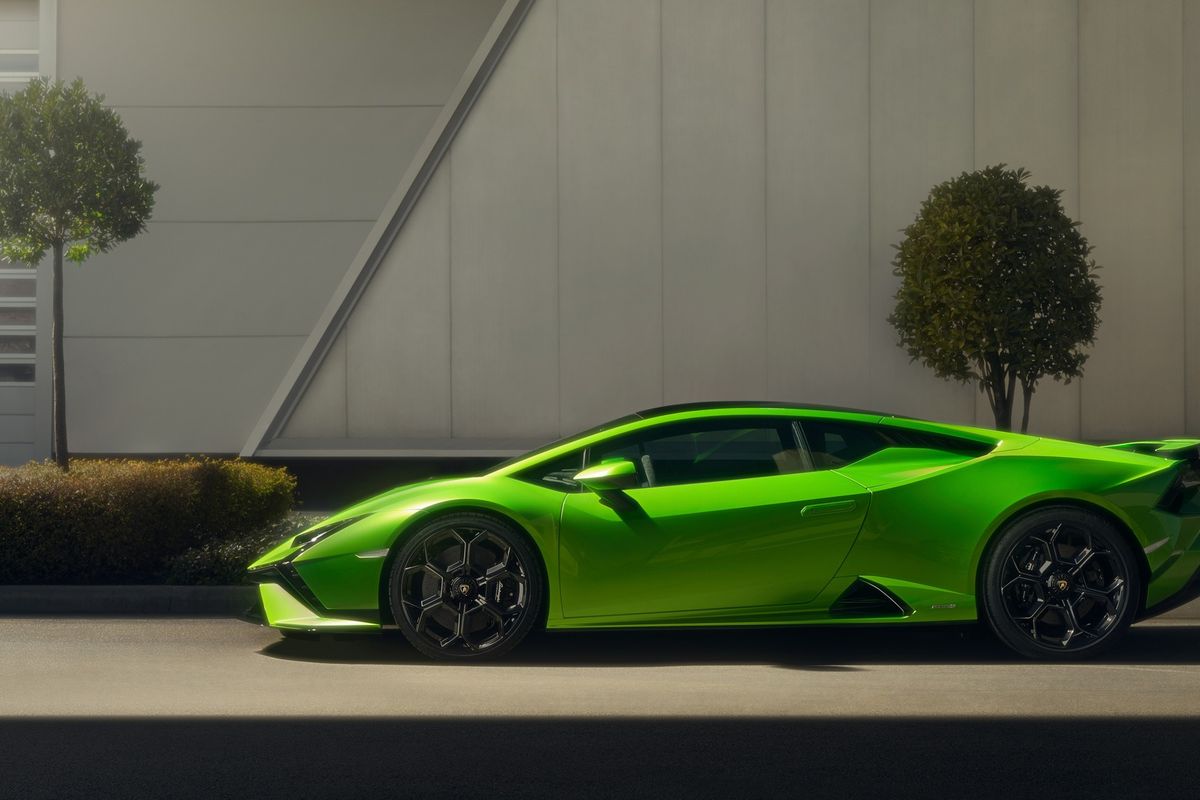
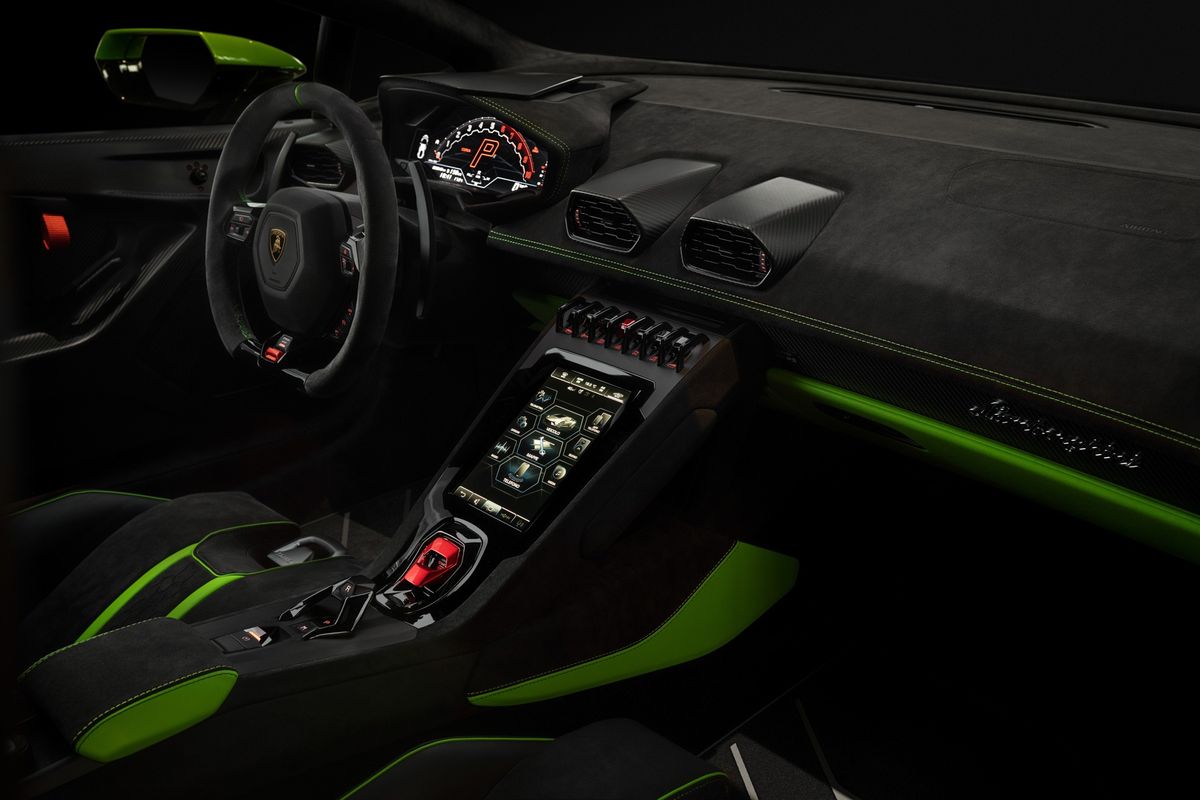
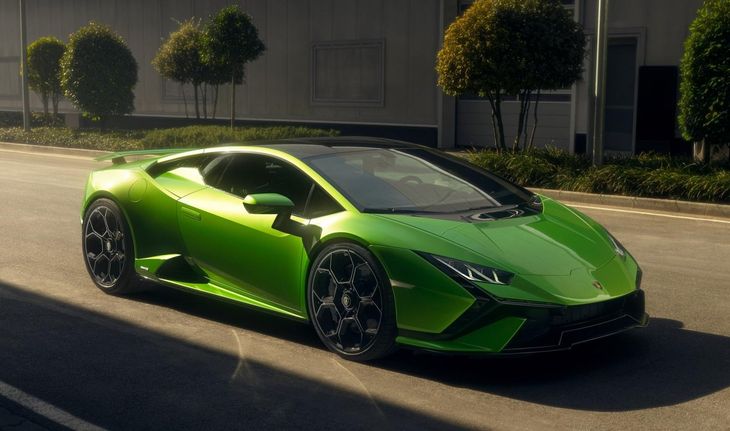
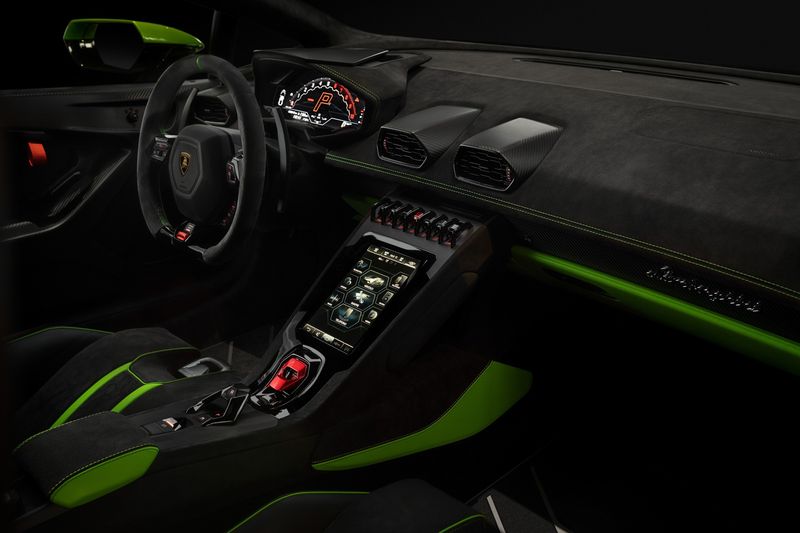
The covers of the brand-new 2022 Lamborghini Huracan Tecnica have been whipped off, revealing a track-ready weapon.
The new Lamborghini Huracan Tecnica is positioned between the entry-level rear-wheel drive Huracan Evo and the wild Huracan STO. Lamborghini says the Huracan Tecnica has been engineered to be fun on both track and road.
Lamborghini Chief Technical Officer, Rouven Mohr, speaking at the reveal in New York said, “The car is really the perfect bridge between the standard EVO and the STO. The STO is purely for the track and the EVO is the daily use car,”
Essentially, the Hurcan Tecnica is based on the entry-level Evo, but features the higher-specced engine from more potent Huracan derivatives. The screaming naturally-aspirated 5.2-litre V10 in the Tecnica punches out 470 kW and 565 Nm – the same as the hardcore STO. Lamborghini says this engine has been enhanced for a sharper sound at high revs.
A technical highlight is Lamborghini’s LDVI (Lamborghini Dinamica Veicolo Integrata) management system that controls the rear-wheel steering, torque vectoring and traction control to achieve its lofty dynamic performance.
All that shove is sent to the rear wheels via a 7-speed dual-clutch transmission and the Italian supercar brand claims its new product can run from 100 kph in just 3.2 seconds and will top out at a claimed speed of 325 kph.
Mohr added, “You can say [the Huracan Tecnica] has three different souls performance, fun to drive, and lifestyle.
A track weapon for the weekend, anyone? The Tecnica might be for you.
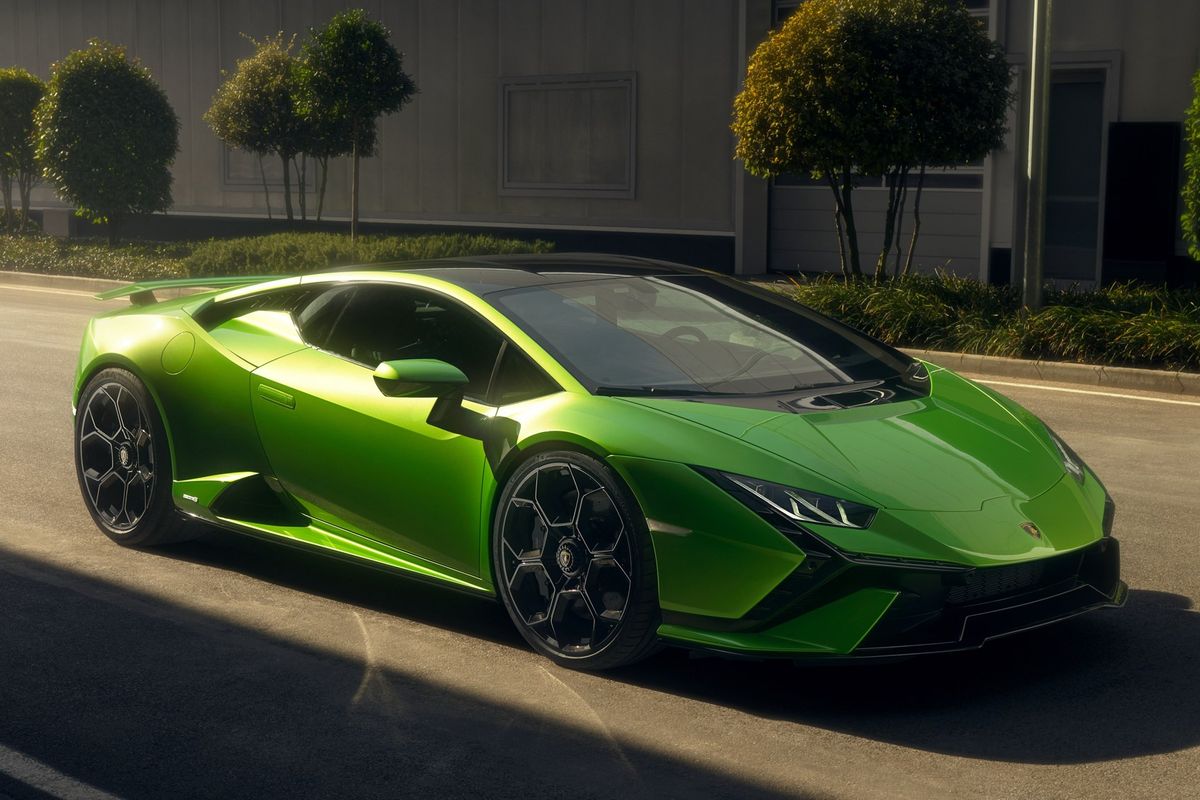
Visually, you can spot the newcomer with its fairly restrained body kit. There’s no craziness, unlike the Huracan STO, but there are some really cool design elements taken directly from some of the concepts and special limited-edition models. The headlight unit comes straight from the Sian, while the side window is similar to that of the Essenza SCV12, for example.
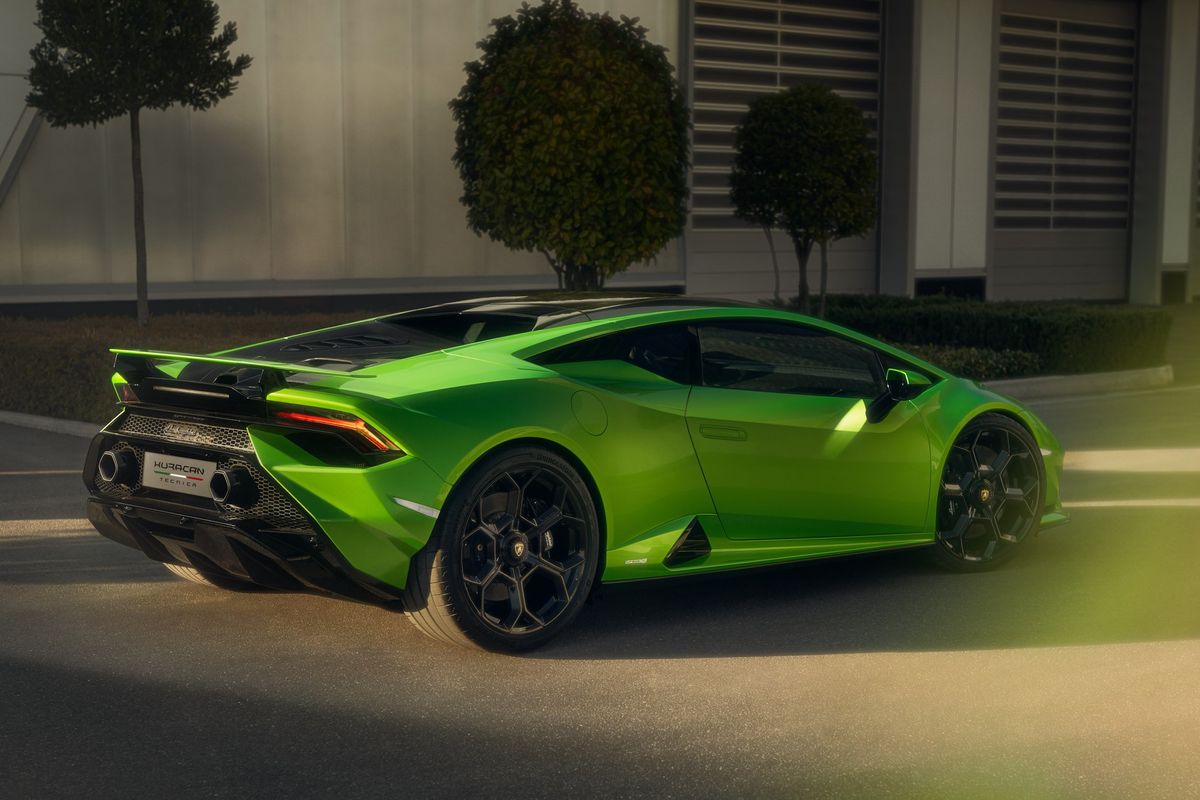
At the rear, there’s a lightweight carbon fibre cover for the engine, new-look exhausts and a rear diffuser. The rear spoiler is said to give a 35% enhancement in downforce in comparison to the Evo. Interestingly, drag is reduced by 20%, which means a higher top speed.
The Huracan Tecnica is not a limited-edition either, so best you start saving. As far as product life-cycles go, the Huracan is approaching its end of life, so we’re expecting a few interesting surprises in the next year or so.