Electric cars. Is there a hotter topic right now in the world of motoring? Ciro De Siena and Alex Parker dive into the subject in our latest podcast. Give it a listen!
The electric revolution is gathering serious pace in some markets, but in South Africa, there is great concern amongst the public as to just how electric cars are going to work in our country.
Whenever you mention driving an EV in South Africa, the first word on everyone’s lips is “Eskom”. Yes, load shedding is not exactly ideal. But as we discuss in this podcast, it’s not as big a problem as motorists perceive it to be.
Alex Parker is an award-winning author, car journalist and communications specialist who is currently working in the environmental communications space.
In this podcast, he joins Ciro De Siena to help answer the question, will electric cars work in South Africa? We also cover the most popular electric car in China, what happens to South African manufacturing of cars if all of our export markets go electric, and Alex introduces us to the complicated world of CBAM – cross border adjustment mechanisms, which is going make trading with the EU quite tricky indeed.
Despite the local bakkie market being more diverse and abundant in its offering than ever before, South Africans still look with jealousy upon America.
The world’s largest bakkie market has even more choice, but South African buyers could finally get their wish and have more ‘American’ bakkies available in the future, locally.
Does this mean that bakkies like Toyota’s Tacoma might finally be sold alongside Hilux, here? Not quite. The outcome of radical consolidation in the automotive world could mean more bakkie platform twins in future.
As the burden of hybridization and electrification costs rise, manufacturers are struggling to justify multiple platforms. For decades, VW proved what could be done in the passenger car market with shared platforms – and that logic is now starting to ring true for bakkies.
A bakkie’s ladder frame design makes platform convergence much simpler, but enormous demand and ease of supply have never triggered an issue or the need to share. Until now.
A combination of the chip crisis and huge R&D costs in other product lines are finally starting to impact bakkies. A new generation of American bakkie buyers (younger and more urban) is showing less resistance to smaller ‘global’ double-cab bakkies.
The result is that Toyota could be rethinking its Tacoma and Hilux platform integration. Unconfirmed reports from America indicate that the next-generation Tacoma and Hilux could share a common platform.
This would enable massive scaling of resources for Hilux, which is essentially the world’s most successful ‘global’ bakkie. The benefits for South African customers could be huge, with more diverse engines, longer wheelbase options and all manner of comfort and convenience features.
American bakkie customers are very demanding. And there are so many of them that product planners cannot ignore their preferences. A common Tacoma/Hilux platform could possibly deliver more powerful engines, greater towing capacity and better infotainment for future generations of Hilux.
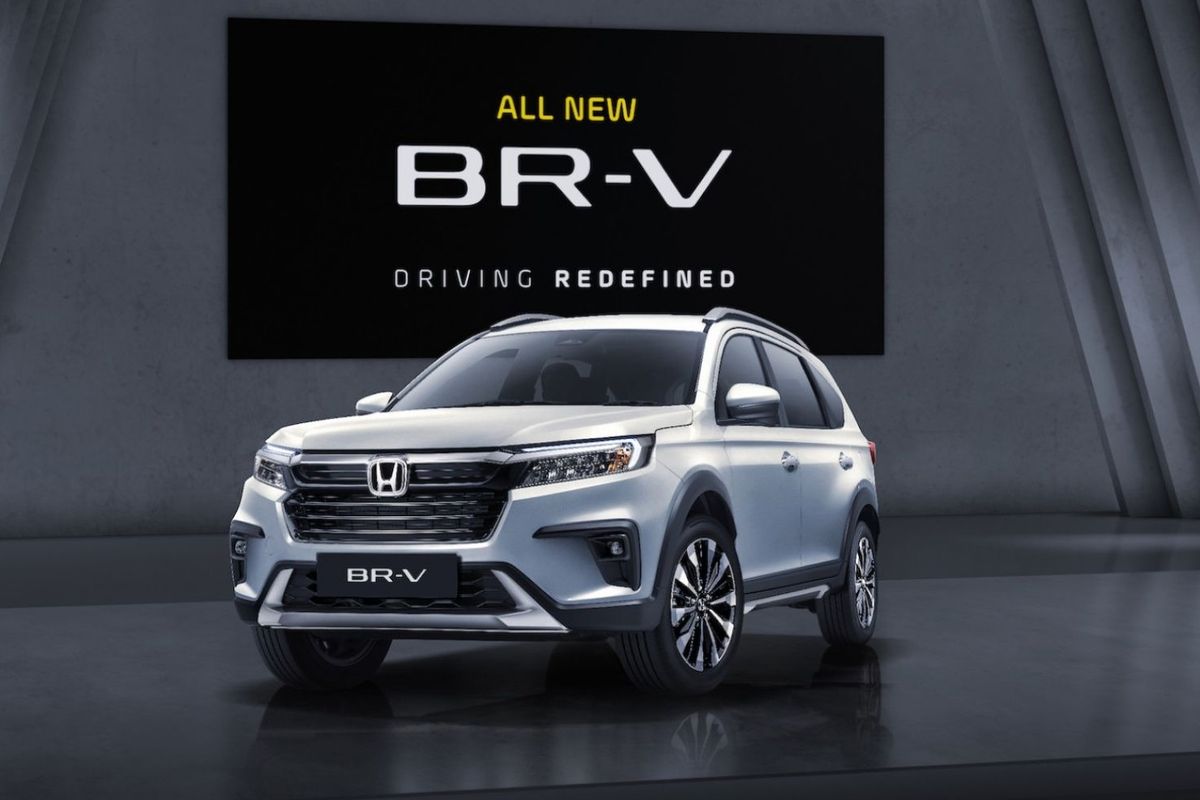
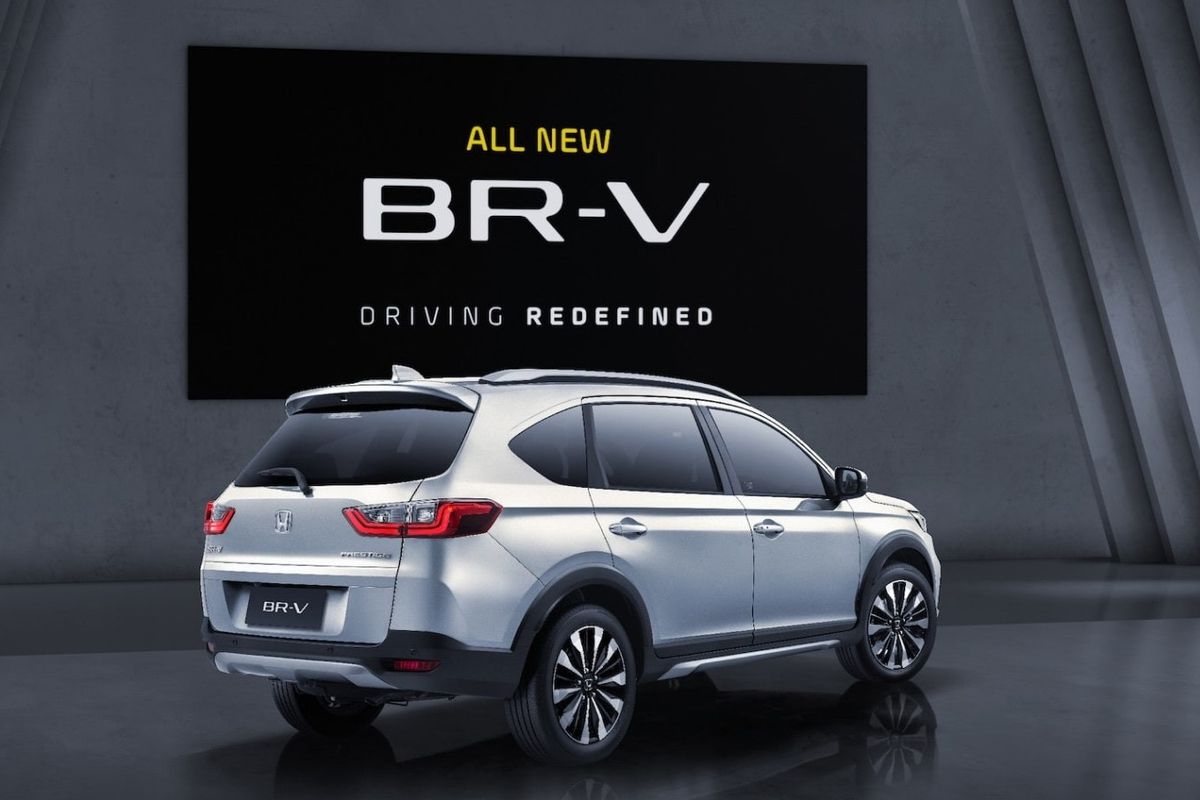
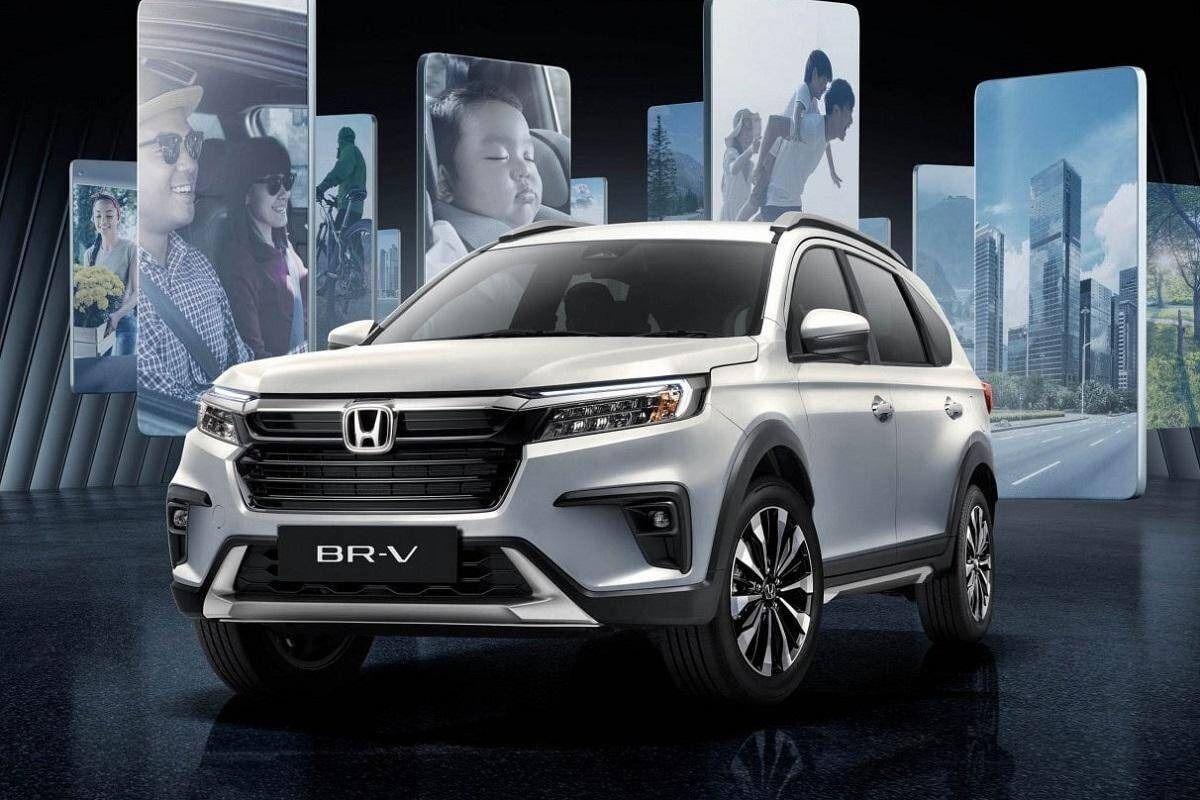
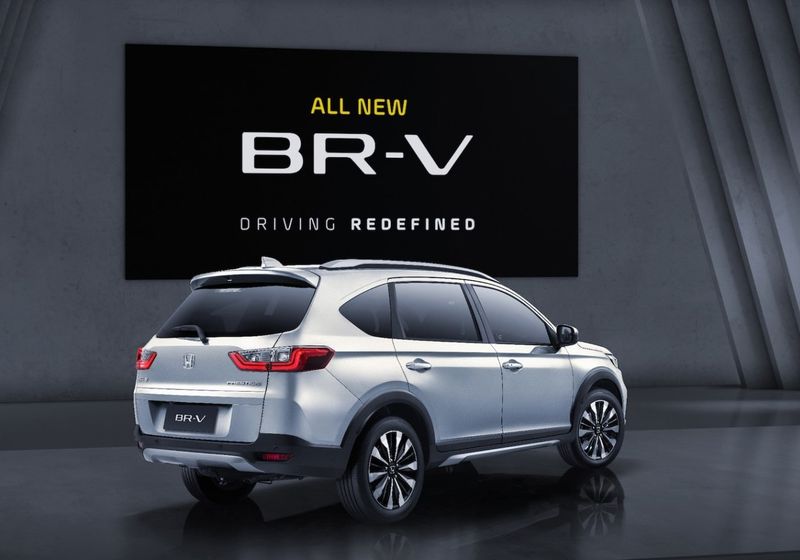
The all-new 2nd generation Honda BR-V has been revealed. See what’s new.
The BR-V from Honda is a 7-seater MPV and since its global launch in 2015, more than 255 000 units have found homes around the world.
The 2nd generation Honda BR-V has been revealed in Indonesia and the car has been given a big visual update using Honda’s latest styling language. At first glance, the vehicle looks like it’s a bit more premium. The three-row and seven-seat interior setup has been retained and Honda says more technology has been introduced.
A full photo gallery wasn’t available at the time of writing, but Honda is keen to point out some of the new cabin features like the 4.2-inch TFT on the dashboard and the standard 7-inch infotainment screen. There’s a big focus on practicality too with many storage solutions, compartments and the deep pockets behind the front row of seats.
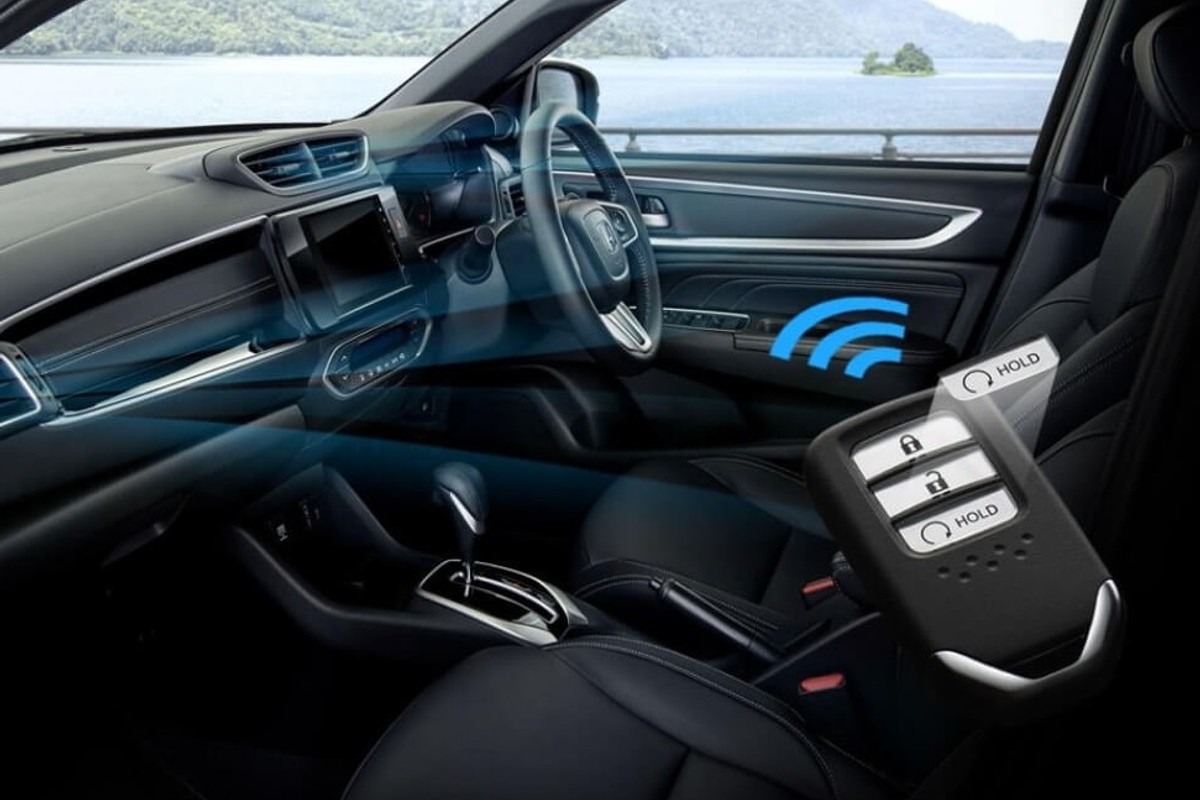
The BR-V is claimed to have 12V power outlets, 8 water bottle holders and sunvisors. Impressively, the BR-V safety game has leveled up with Honda Sensing semi-auto safety tech, remote engine start and walk-away auto locking.
As before, the 1.5-litre 4-cylinder engine has been carried over, but for the 2022 BR-V, it has been updated to deliver 89 kW and 145 Nm. Power goes to the front wheels via an updated CVT that’s said to be more fuel efficient.
This is where things get interesting. See, Honda South Africa makes a tidy profit selling the BR-V as its found to be a cost-effective 7-seater vehicle and meets local ride-sharing company criteria to operate. These SA-spec vehicles are sourced from Honda India, which announced in 2020 that it was closing.
Honda SA when asked about the SA future of the BR-V, responded with, “Honda Motor Southern Africa has no plans to discontinue the BR-V and is currently securing sufficient stock of the BR-V from India while the alternate factory is being set up for production,” says Dinesh Govender, General Manager of Automobiles at Honda Motor Southern Africa. So, would it be fair to assume that this all-new BR-V will be coming to us from Indonesia? As it stands, the Indonesia market is identical to ours – we both drive on the left in right-hand drive vehicles.
Let’s watch this space and we’ll update this story if we hear more.
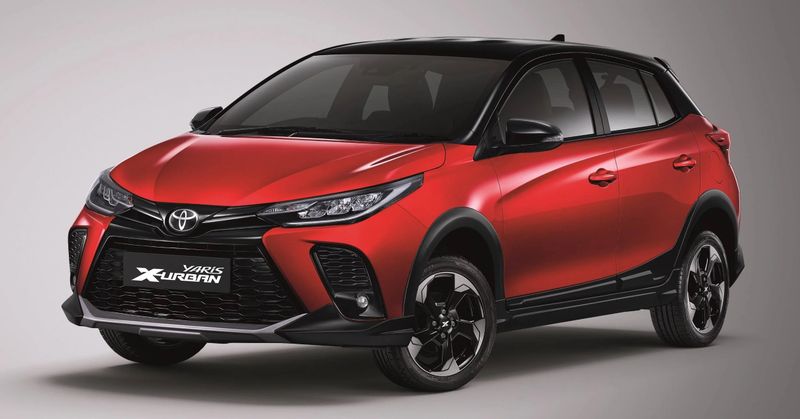
Toyota Thailand has announced updates to its Yaris. Why is this important? Toyota SA sources our Yaris units from Thailand so there’s a good chance these updates will eventually make their way to our market.
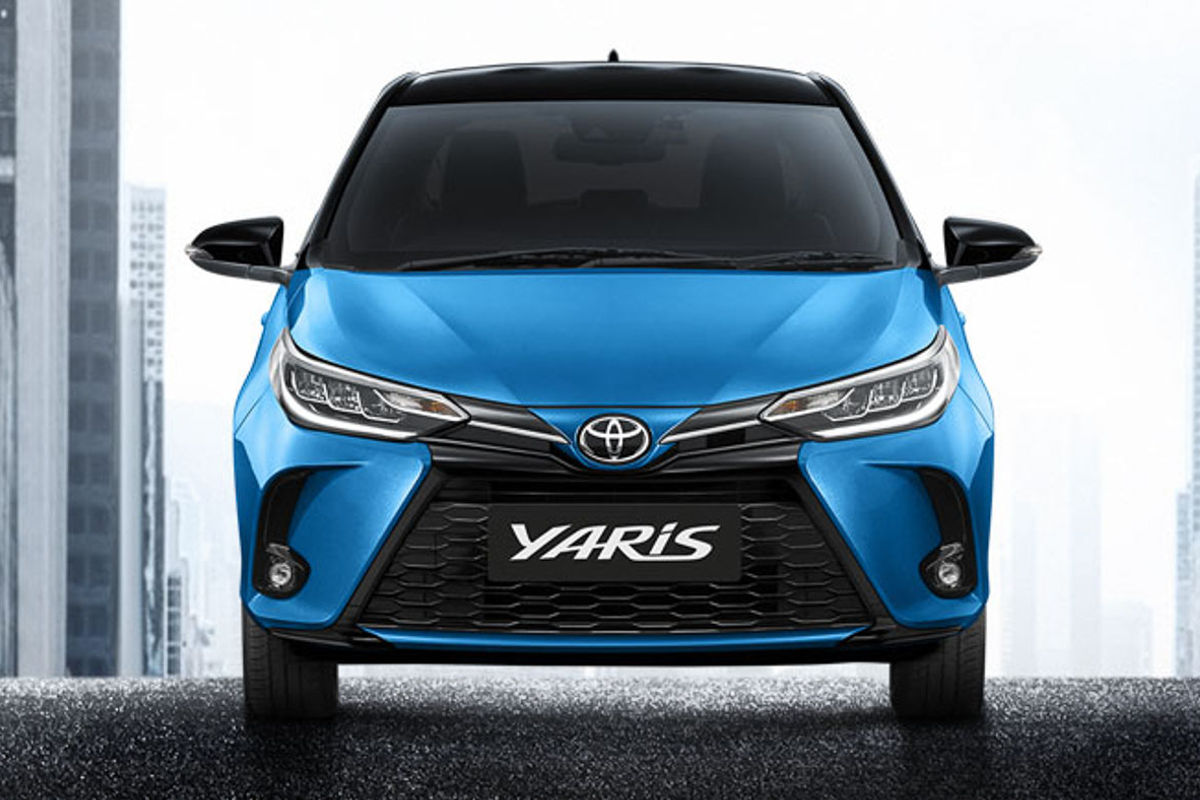
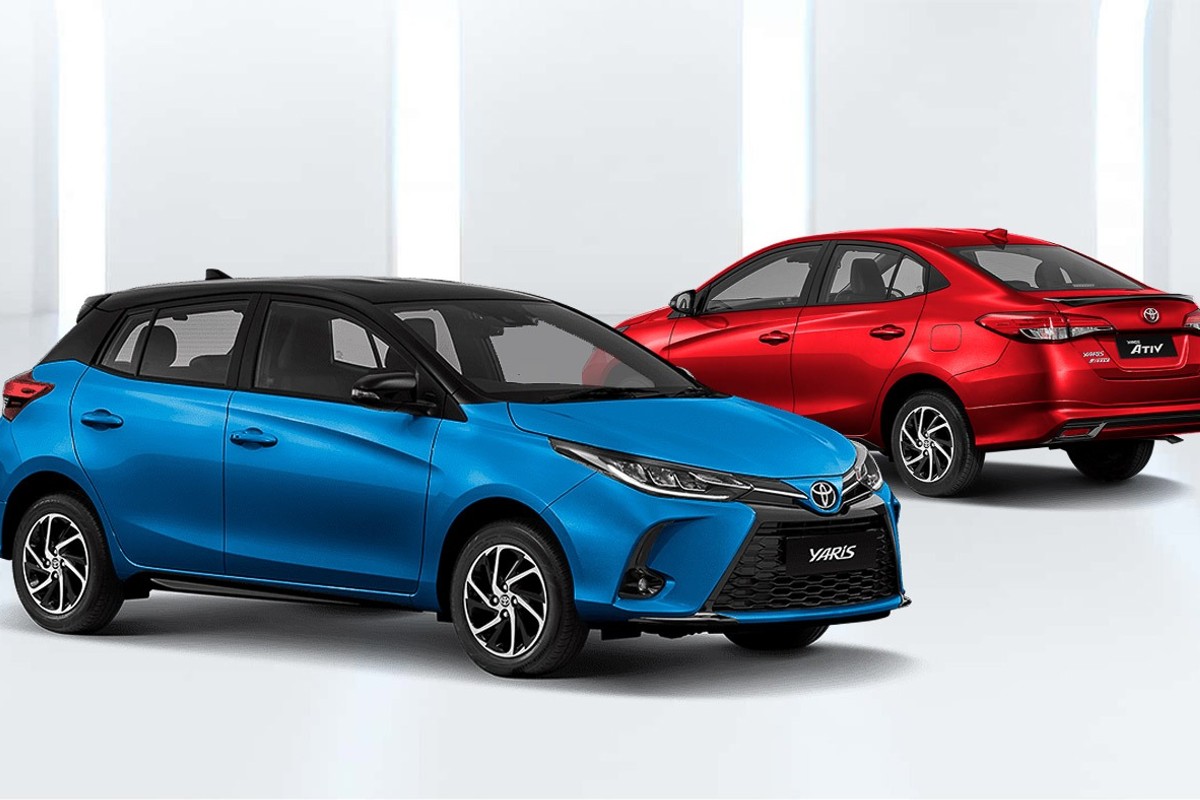
Toyota Thailand has shown off an updated Yaris B-segment sedan. It is important to note that Toyota SA uses this Thai model for the local portfolio.
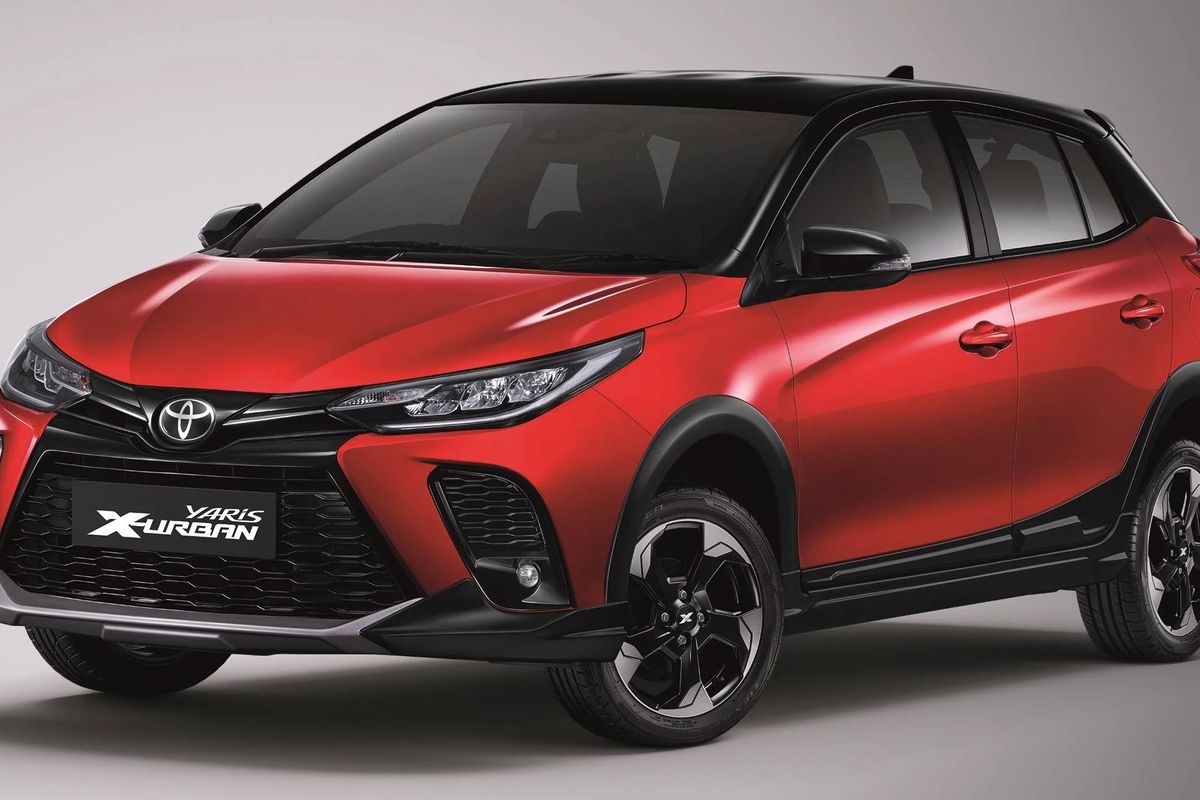
The changes are minor, with some visual updates in the form of a new grille with a mesh-like pattern. The headlights are slightly thinner with some derivatives receiving full-LED units as well as LED daytime running lights. There are new side skirts as well as a roof spoiler and rear bumper. The vehicle is rounded off with new 15-inch bi-tone alloy wheels.
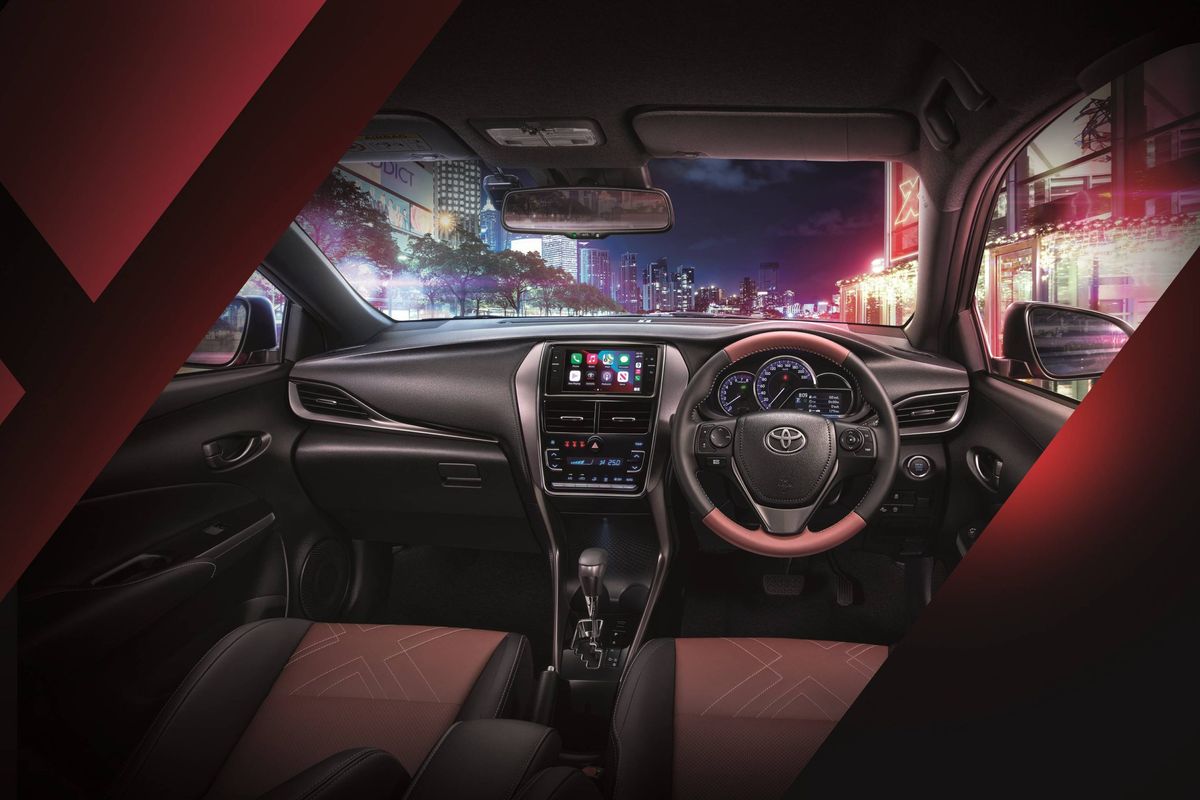
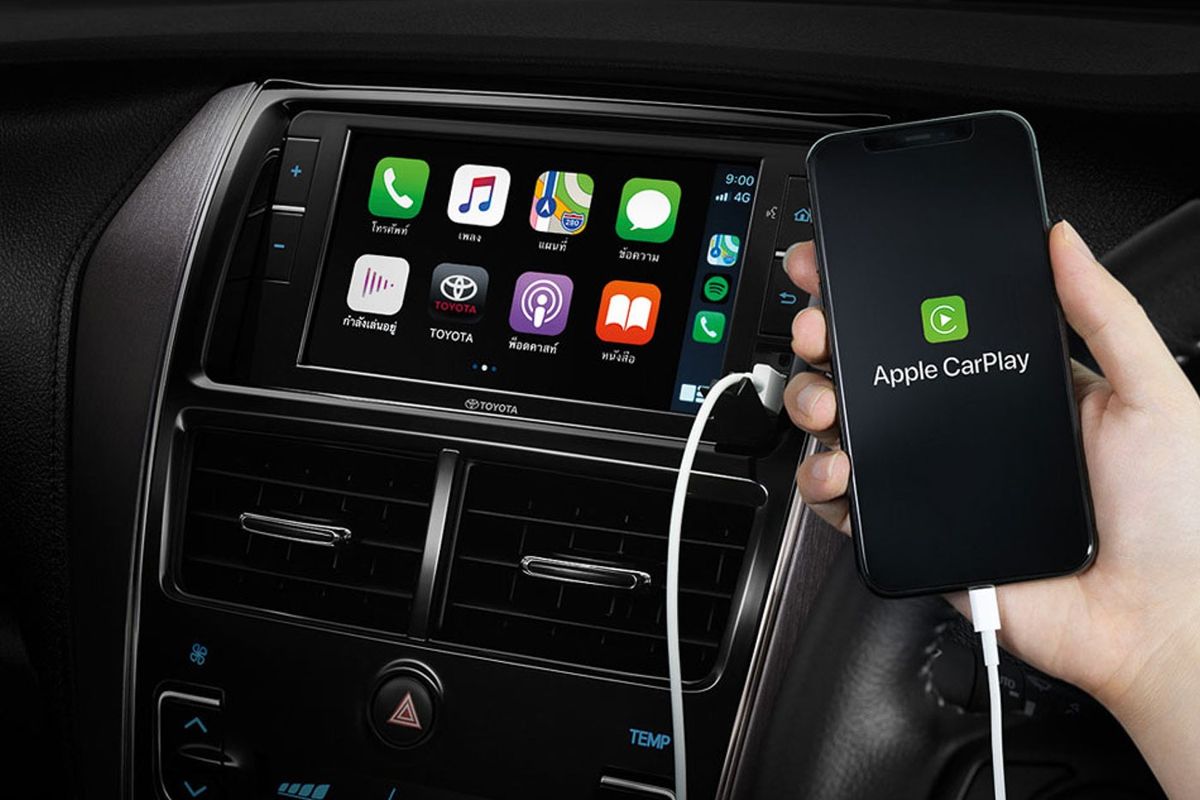
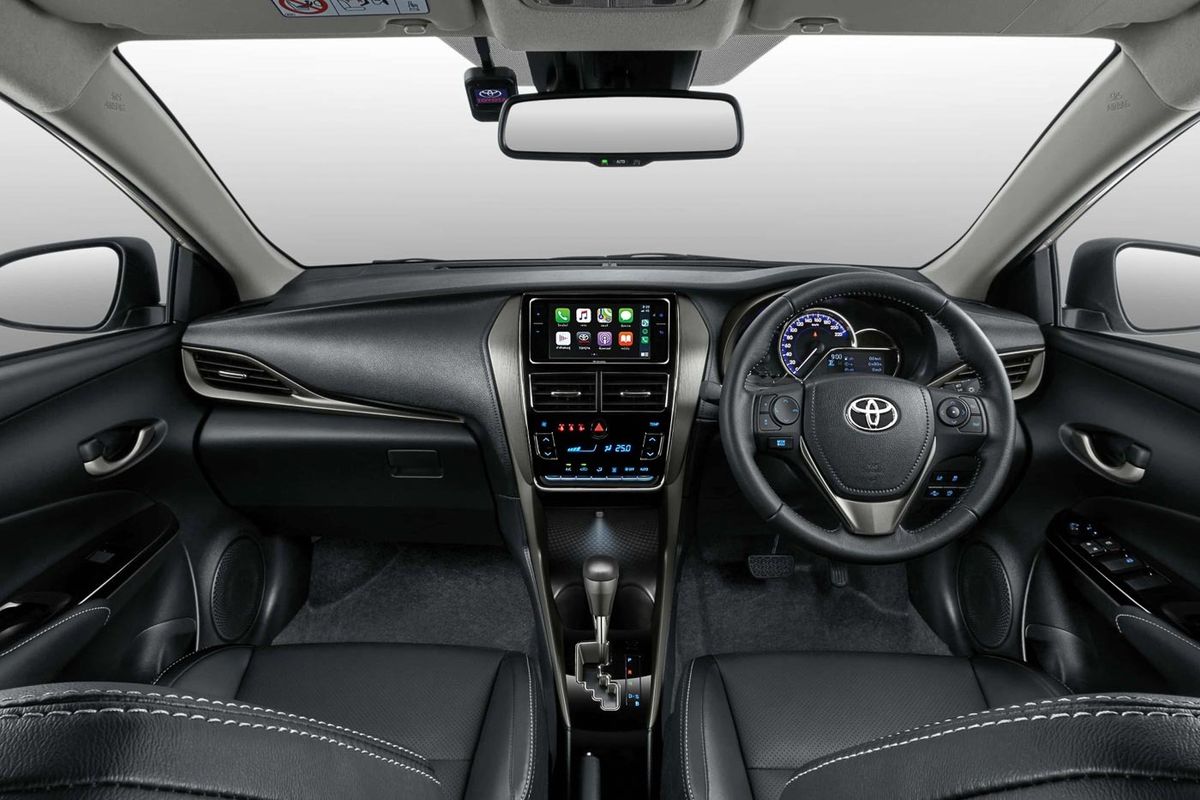
The cabin gets some trim updates with the brushed silver being replaced by a darker smoked look aluminium. The infotainment has been upgraded to a bigger unit which is now Apple CarPlay and Android Auto compatible.
Impressively, despite its humble designation as a pocket-friendly city hatchback, Toyota Thailand has given its Yaris the Toyota Safety Sense with auto emergency braking and lane departure alert.
As far as engines go, the 1.2-litre and 1.5-litre naturally-aspirated petrol engines are carried over. The SA-spec Toyota Yaris gets 79 kW and 140 Nm from the 1.5-litre motor.
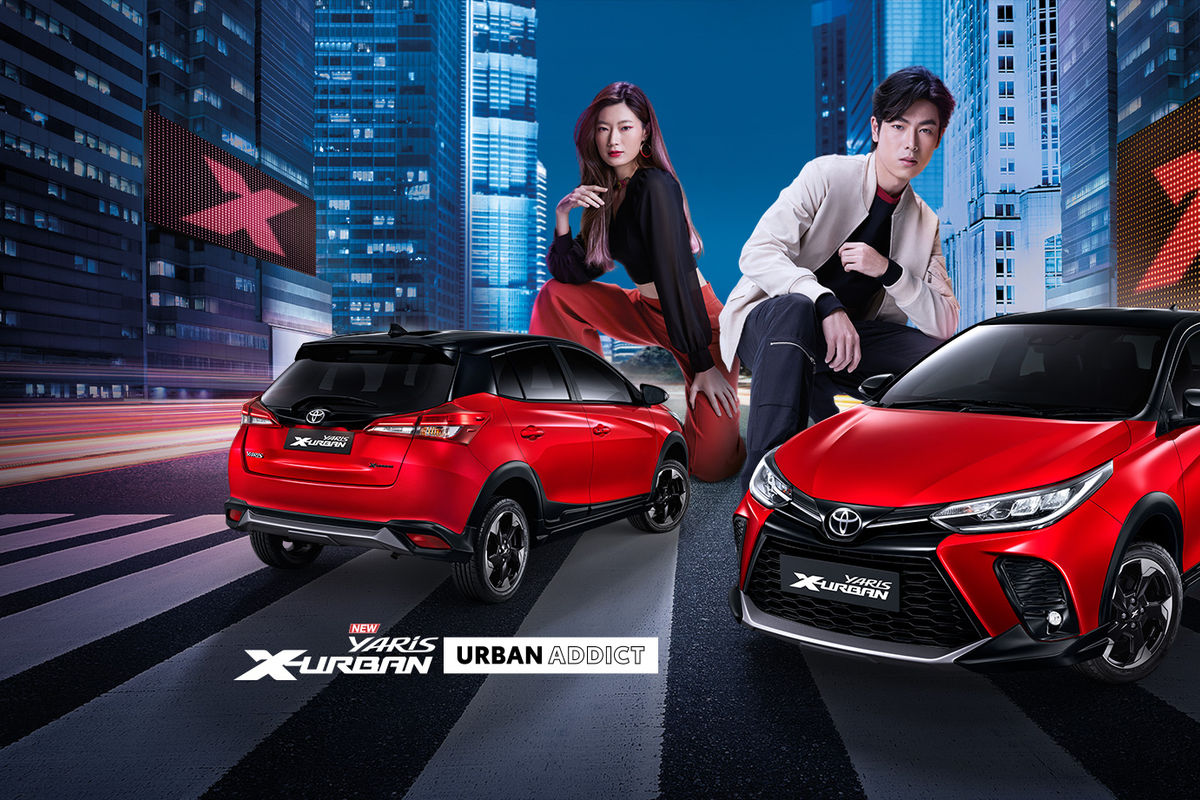
Interestingly there’s also a trim level called X-Urban for the Toyota Yaris and the vehicle gets some offroad-inspired bits like cladding and wheel arch extensions.
The European market gets a completely different Yaris, visually similar to the hardcore GR Yaris racer as well as the Yaris Cross – a baby B-segment SUV that is available with a hybrid powertrain.
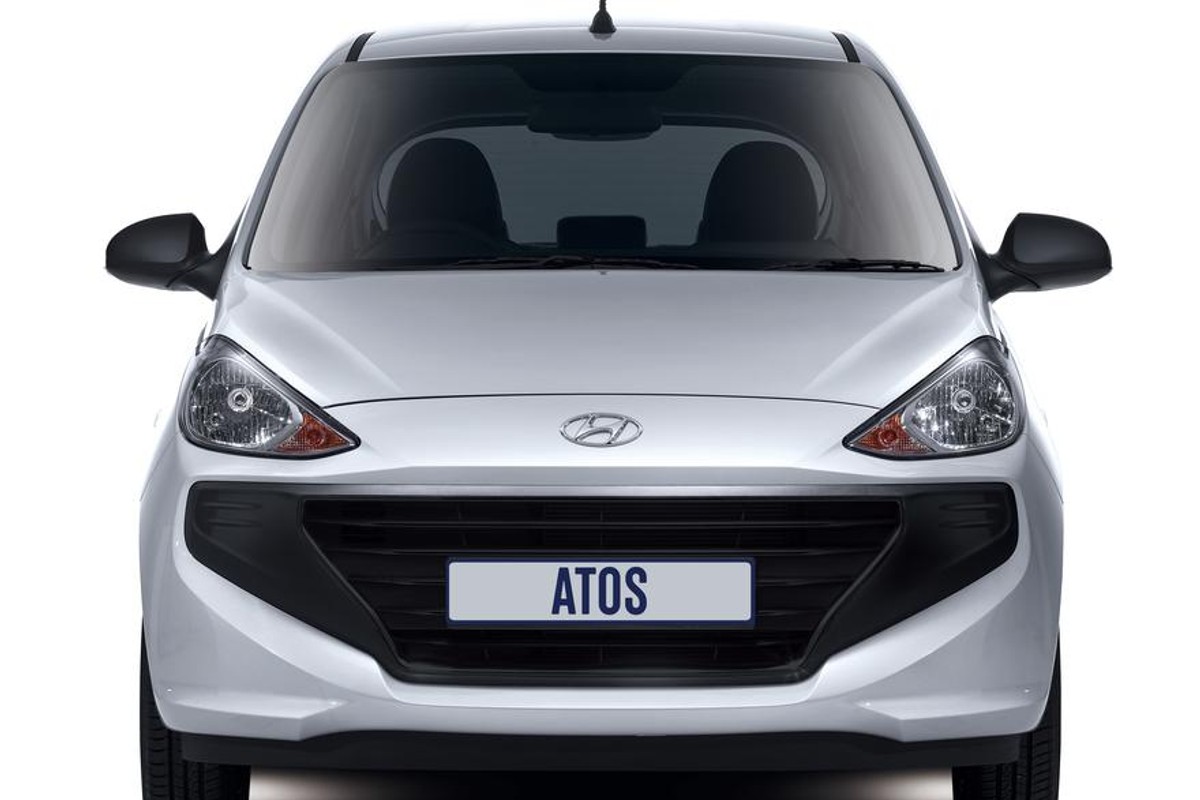
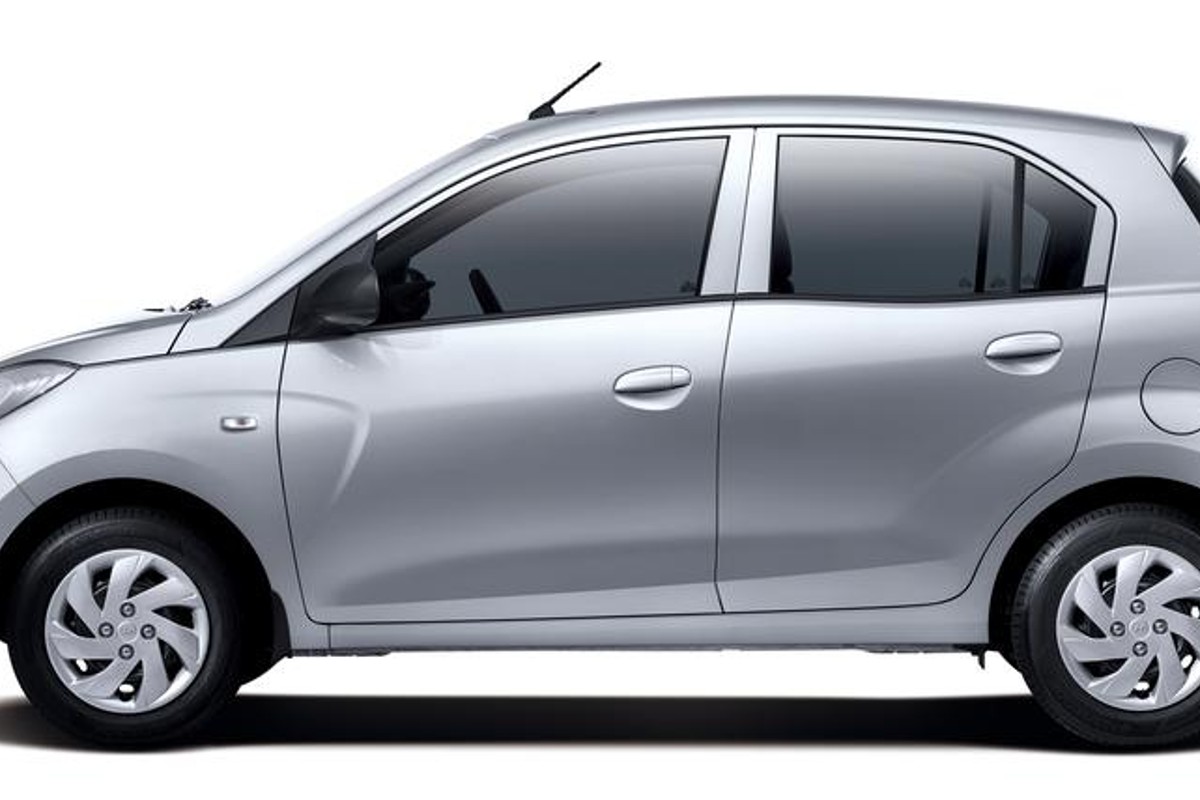
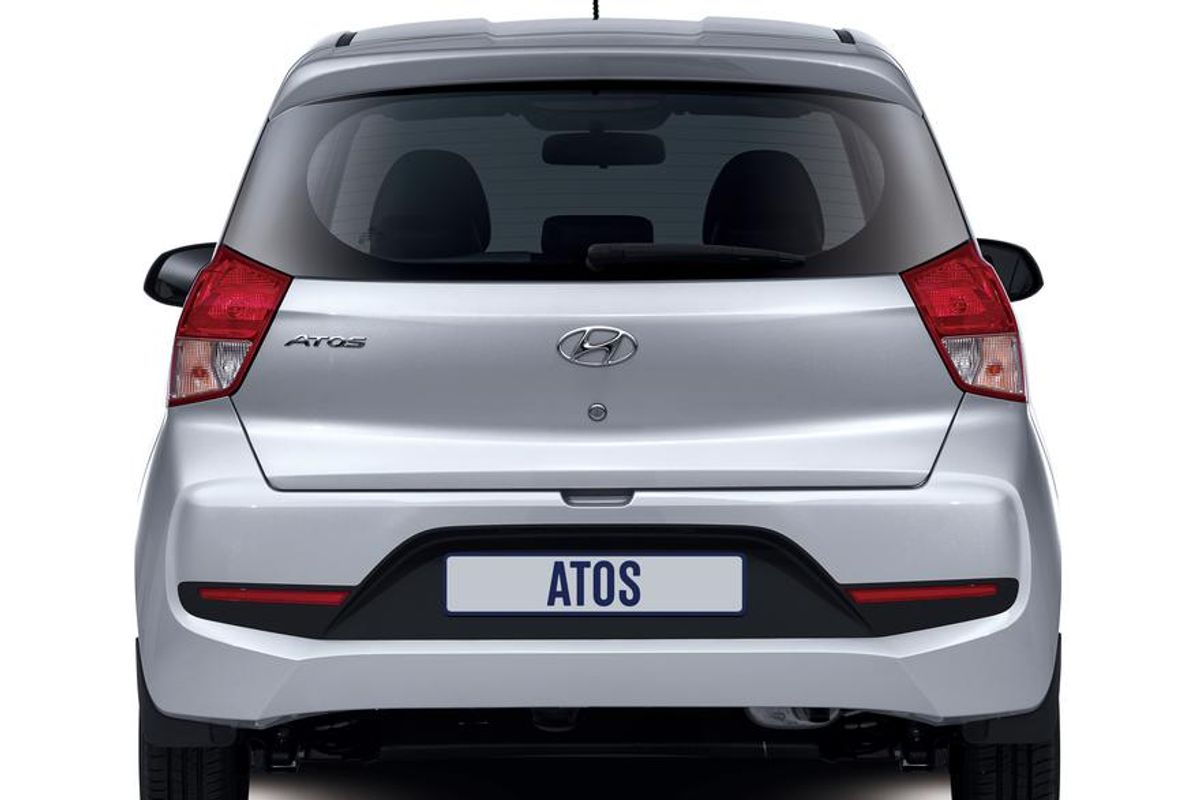
The engine under the bonnet is the familiar 1.1-litre, 4-cylinder unit mustering outputs of 50 kW and 99 Nm. The AMT-equipped Atos carries a claimed fuel consumption figure of 5.9 L/100km which will appeal to buyers who are looking to save money at the pumps.
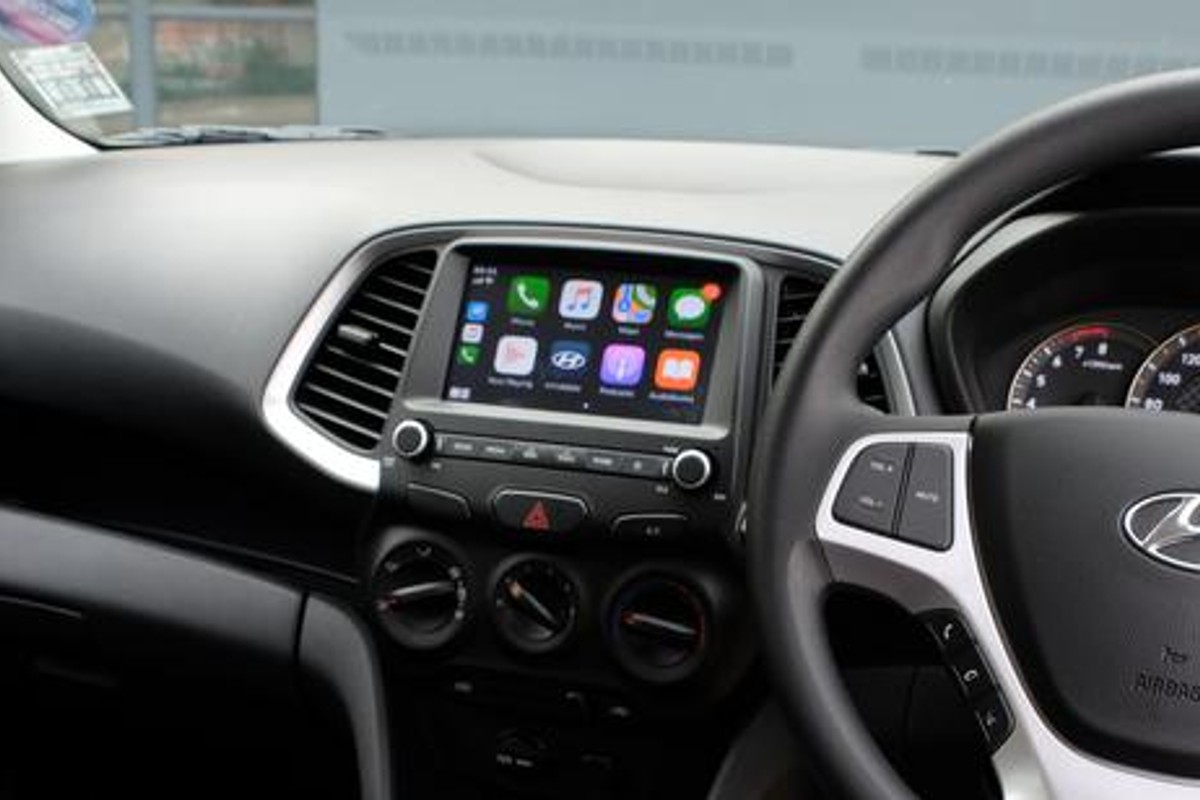
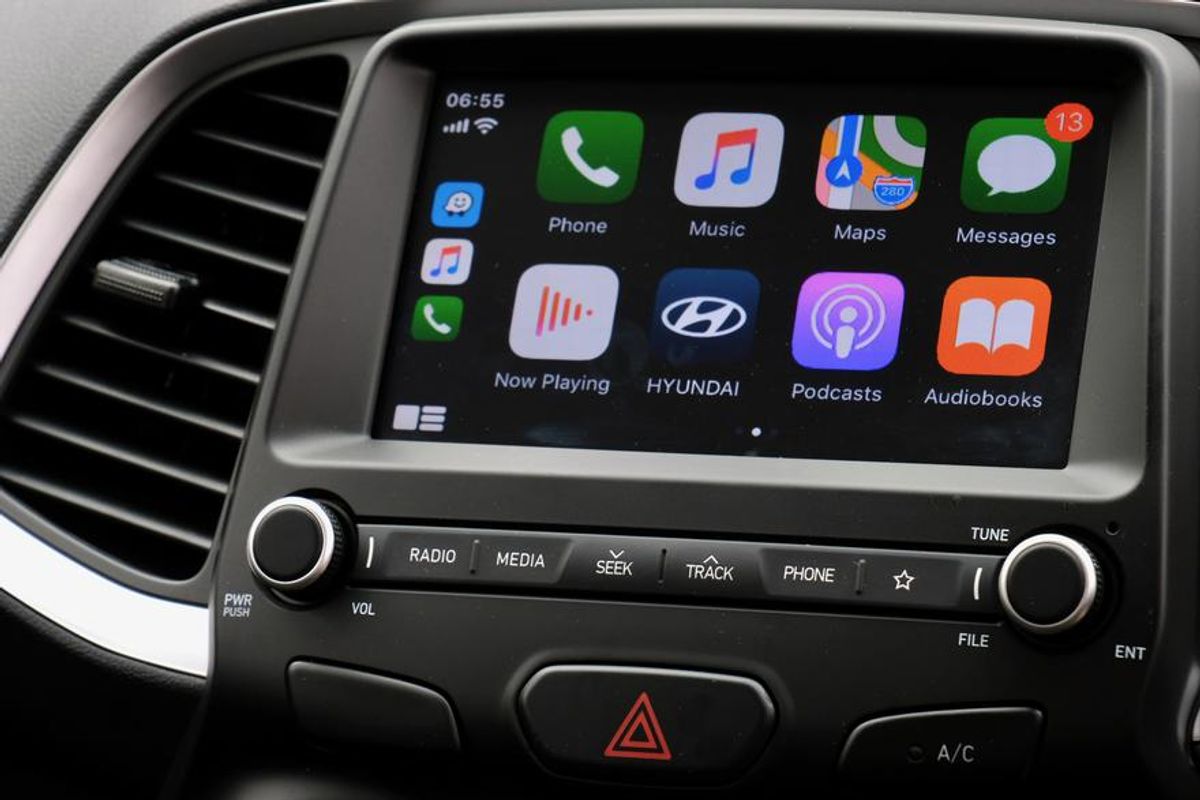
The Atos also has the basic features covered including a 7-inch touchscreen infotainment system with Bluetooth and Android Auto/Apple CarPlay functionality, USB port, multifunction steering wheel, electric front windows, air conditioning and cloth upholstery.
On the safety front, a total of 2 airbags are fitted as well as ABS with EBD and ISOFIX child seat mounts.
The best way to test any 4×4 is to pull up your sleeves and get it dirty – real dirty. Ford recently launched the limited-edition Ranger Stormtrak in South Africa and we took the newcomer on a 1 000-km off-road adventure in the Eastern Cape. Cars.co.za journalist Gero Lilleike reports back from somewhere in the Karoo…
Dust filled my nostrils as I looked out over the vast plains of the Little Karoo. At my feet lay a dead Kudu cow, its hooves entangled in a fence with her eyes gouged out by crows. It’s was a sombre scene.
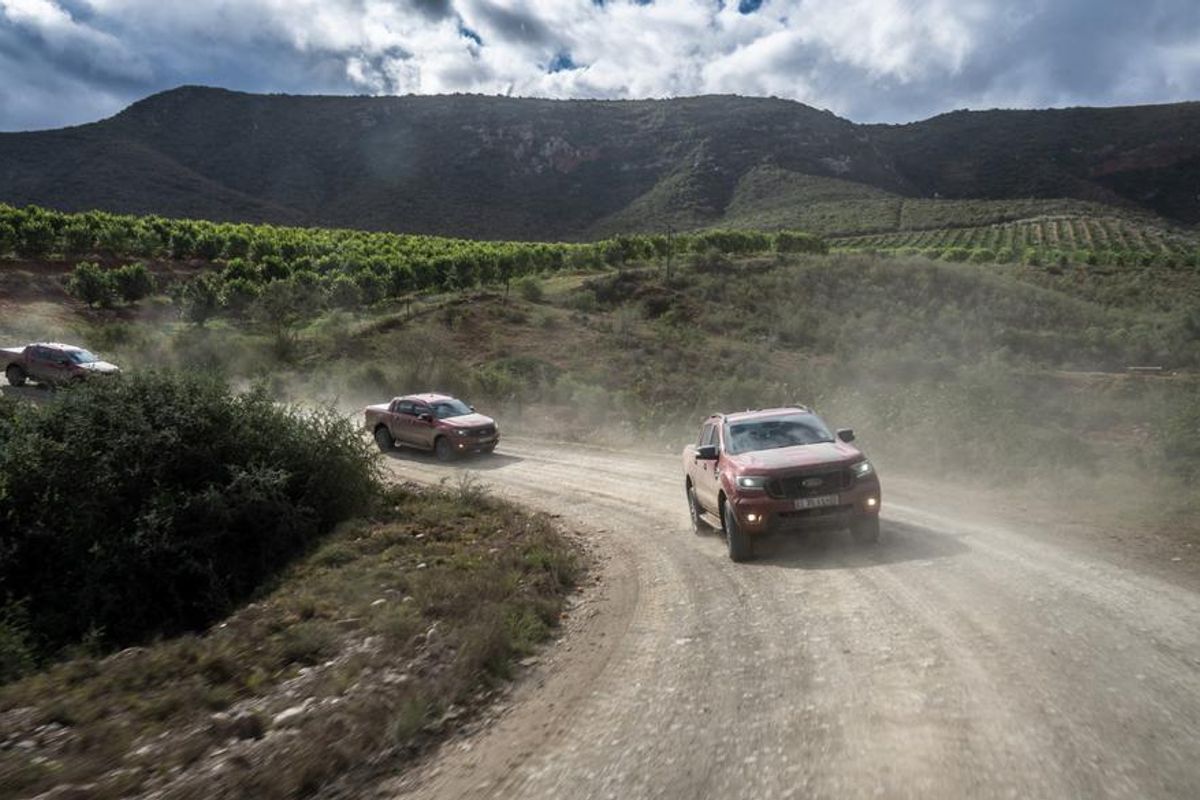
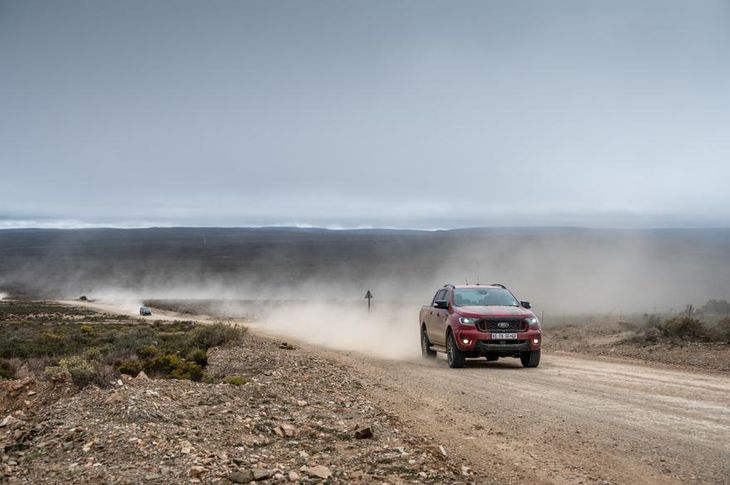
After a brief moment of silence and reflection, the large convoy of limited-edition Ford Ranger Stormtraks set off on yet another seemingly never-ending dirt road, barreling into the Karoo’s vast emptiness.
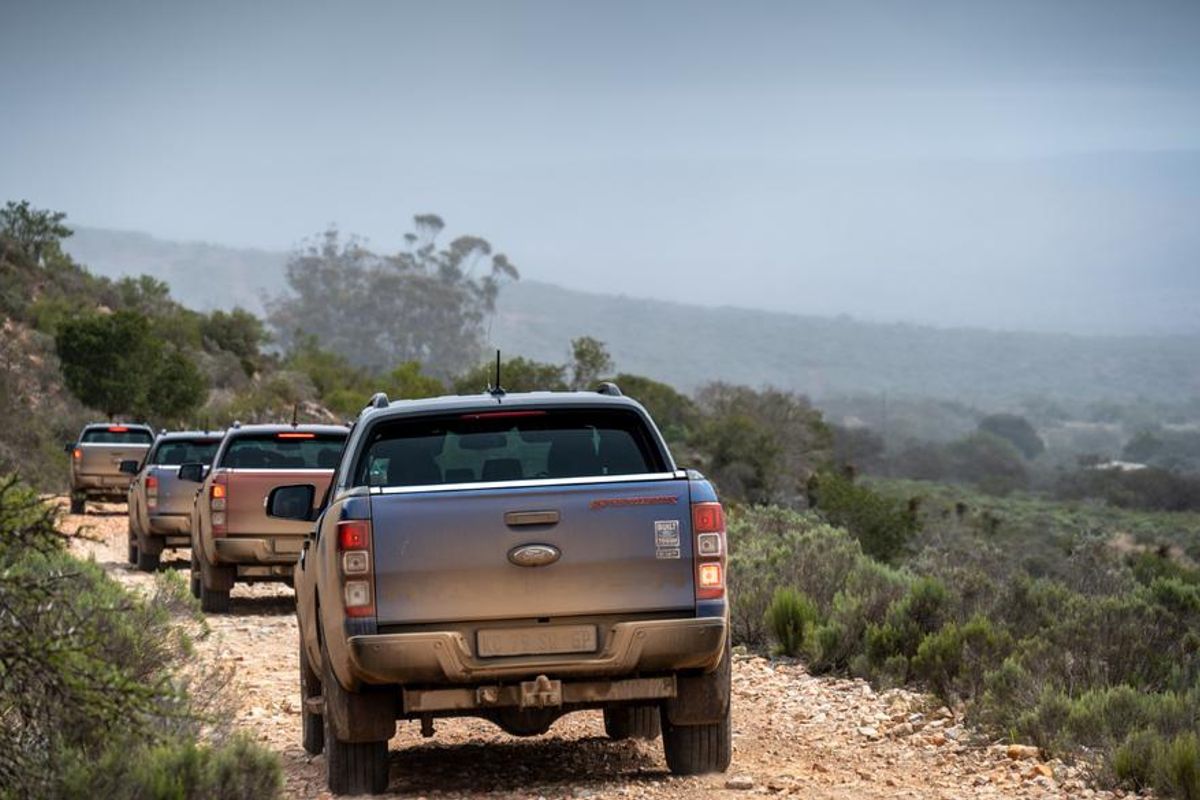
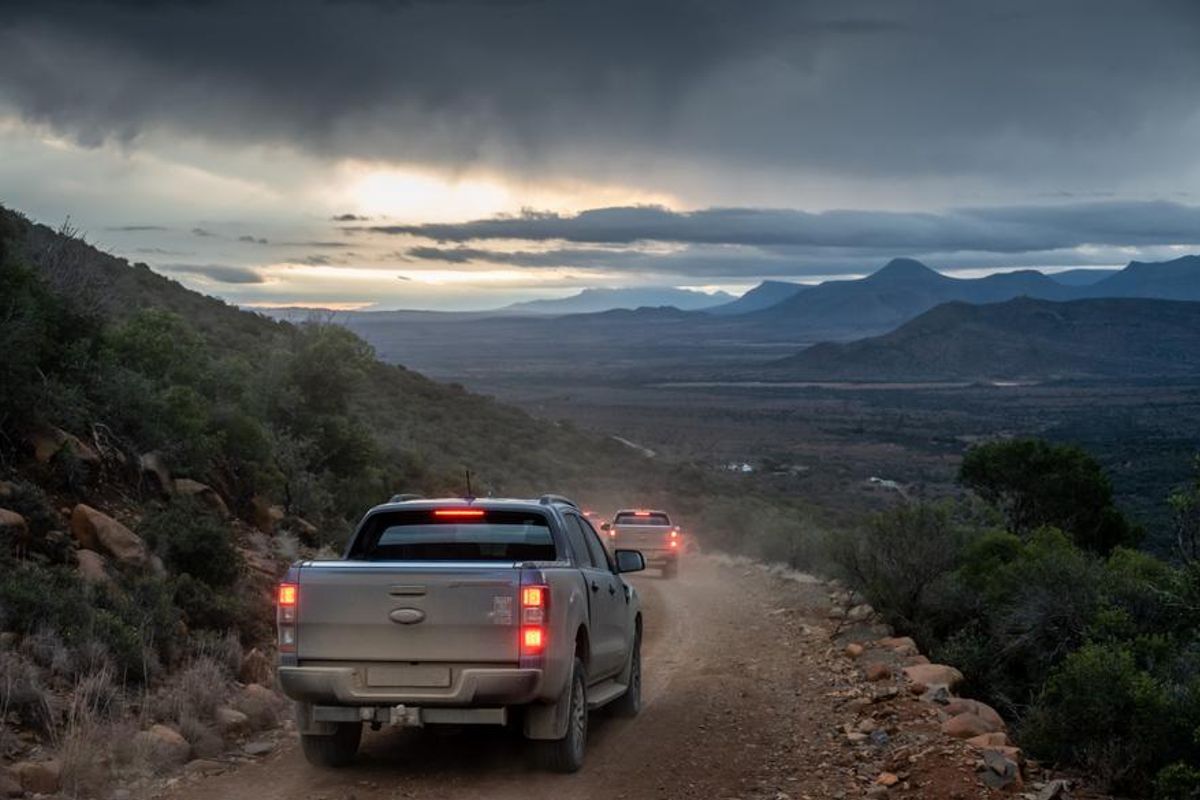
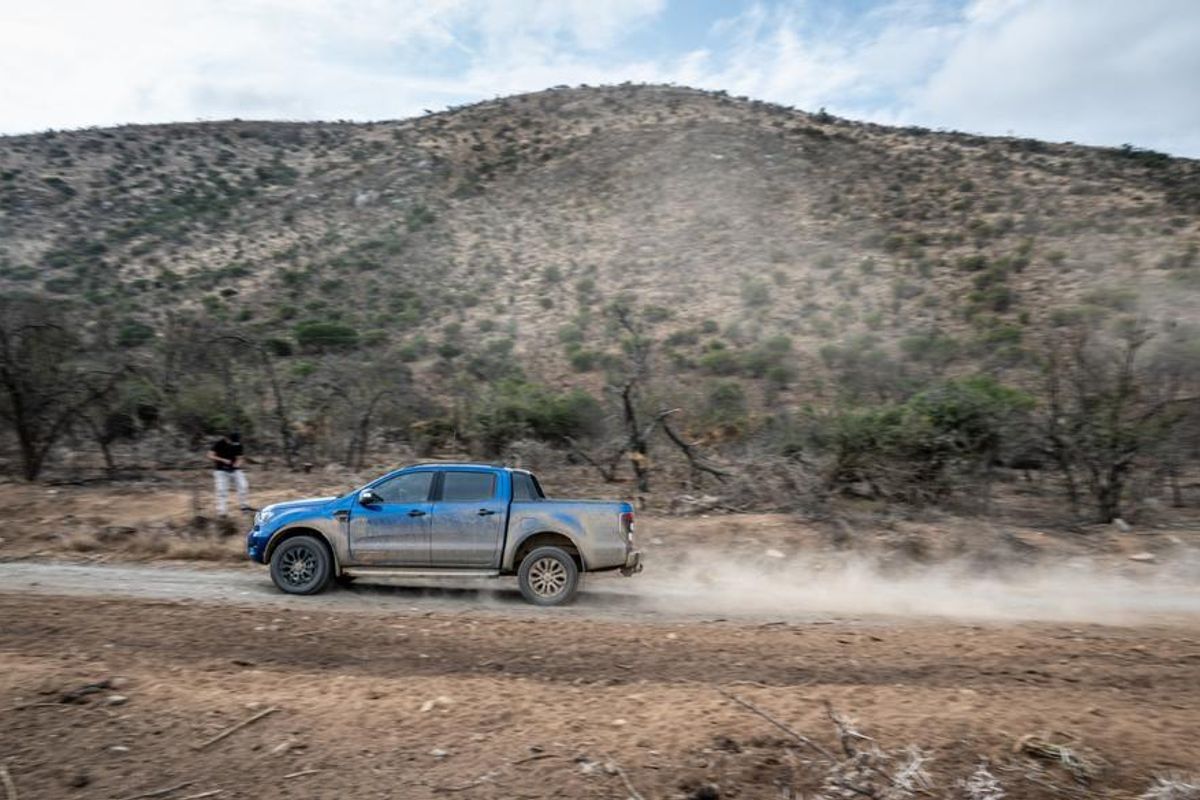
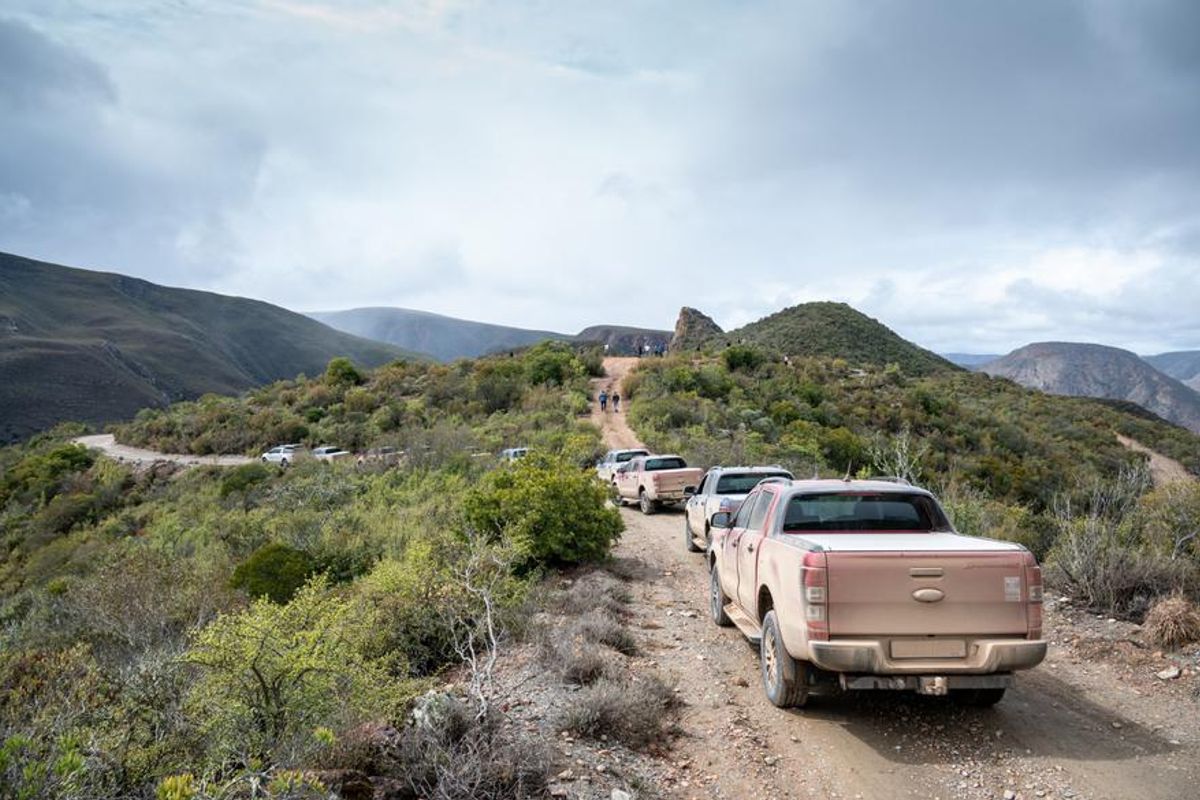
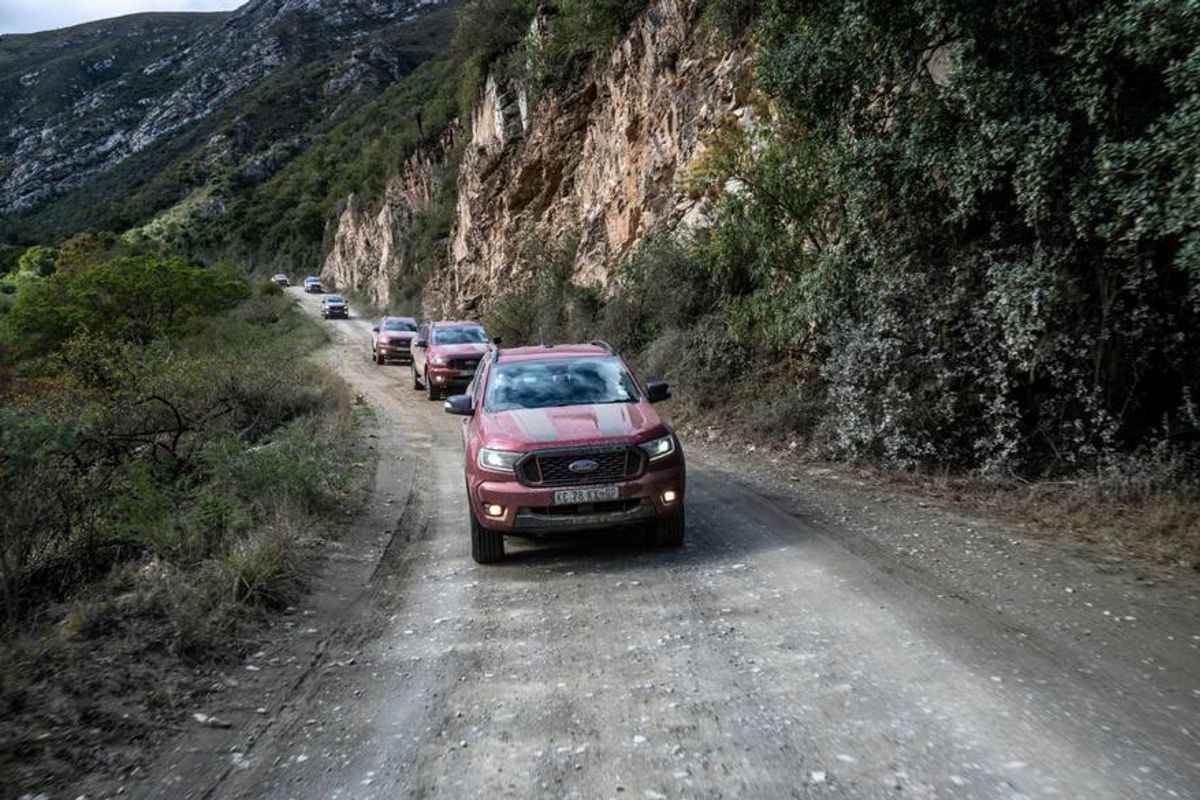
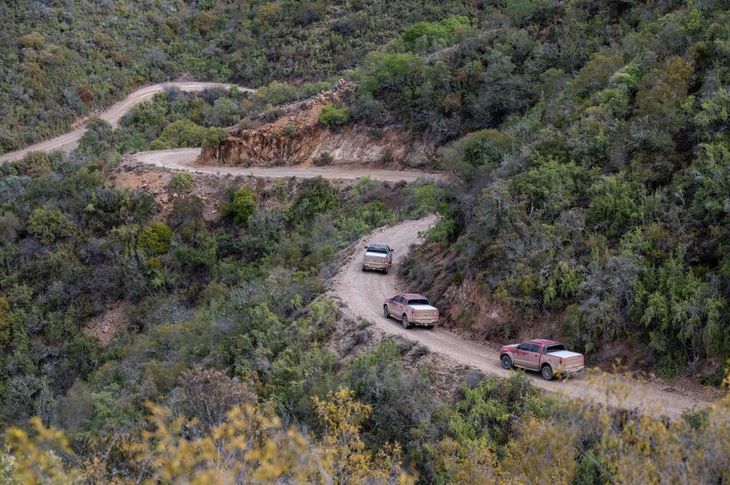
The launch of the limited-edition Ranger Stormtrak took place in the Eastern Cape, starting in Gqeberha. Ford was keen to highlight the Ranger Stormtrak’s off-road ability with a driving route that would take us through the renowned Baviaanskloof World Heritage Site, the Little Karoo and Addo Elephant National Park. It was a gruelling 1 000-km route, which consisted mainly of dirt roads.
We have tested the current-generation Ford Ranger many times during the past decade and, in that time, the model has undergone numerous updates and many “special” derivatives have come to market. The Ranger Stormtrak follows on from recent additions such as the Ranger XL Sport, Ranger FX4 and Ranger Thunder.
As the Ford Motor Company of Southern Africa’s expansion plans unfold at its Silverton Plant in Pretoria ahead of the local production of the all-new Ford Ranger and Volkswagen Amarok in 2022/23, we are fairly certain that the Stormtrak won’t be the last limited-edition Ranger to come to market; Ford will surely look to capitalise on its current-gen bakkie’s enduring popularity.
It’s anyone’s guess what the next special iteration will be called… the Ranger Windstorm, perhaps?
So, what makes the Ranger Stormtrak special?
The Ranger Stormtrak is the latest limited-edition iteration of the Ranger to be built and offered locally in South Africa.
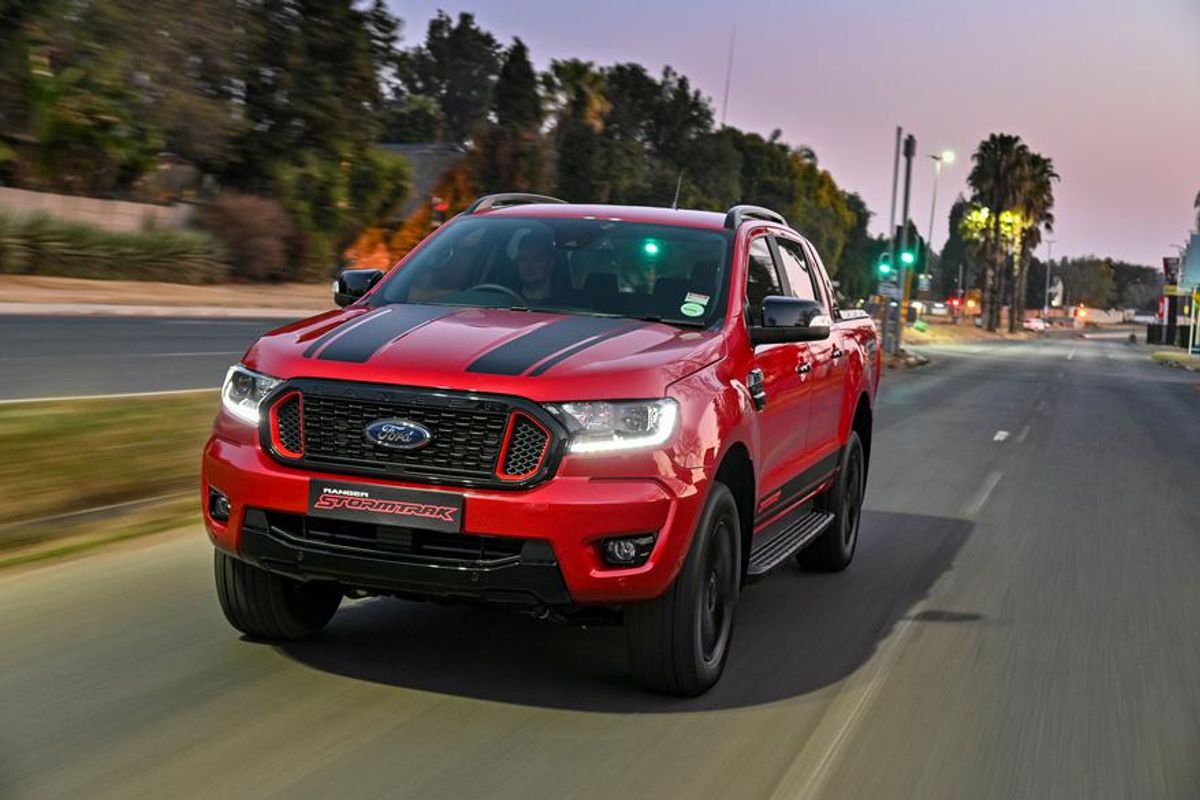
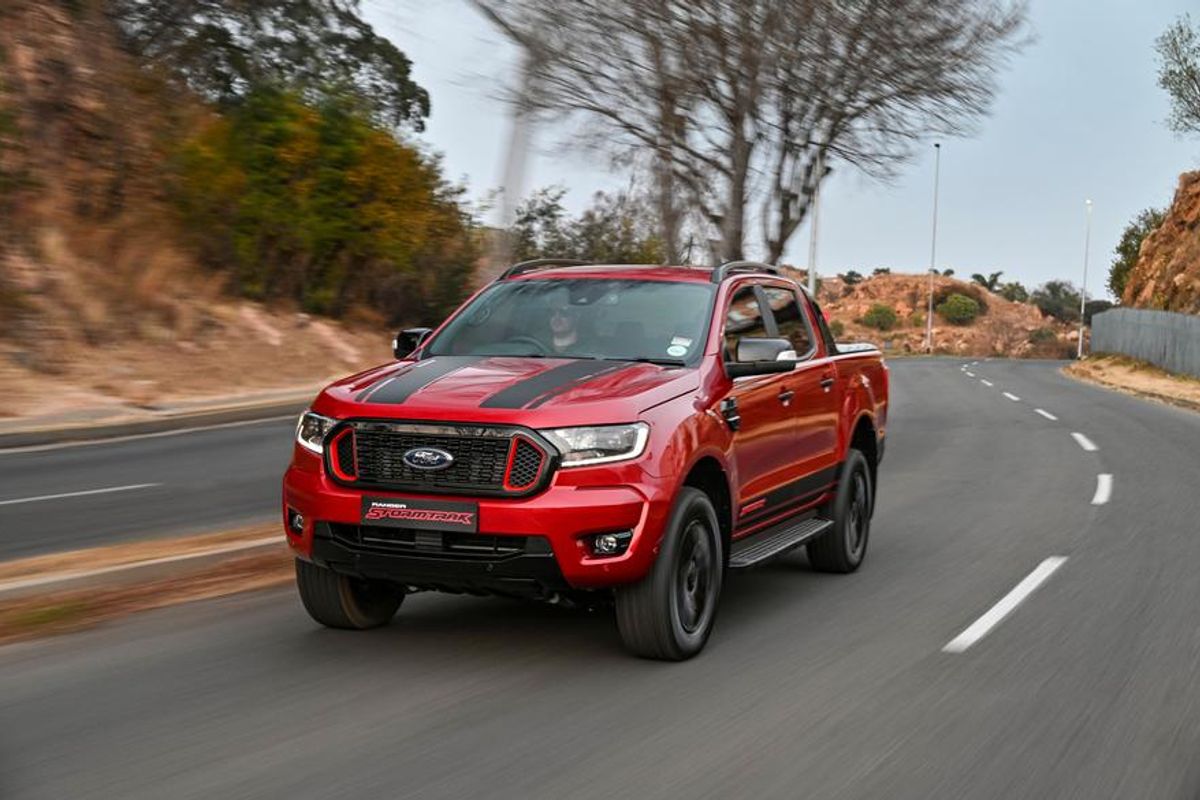
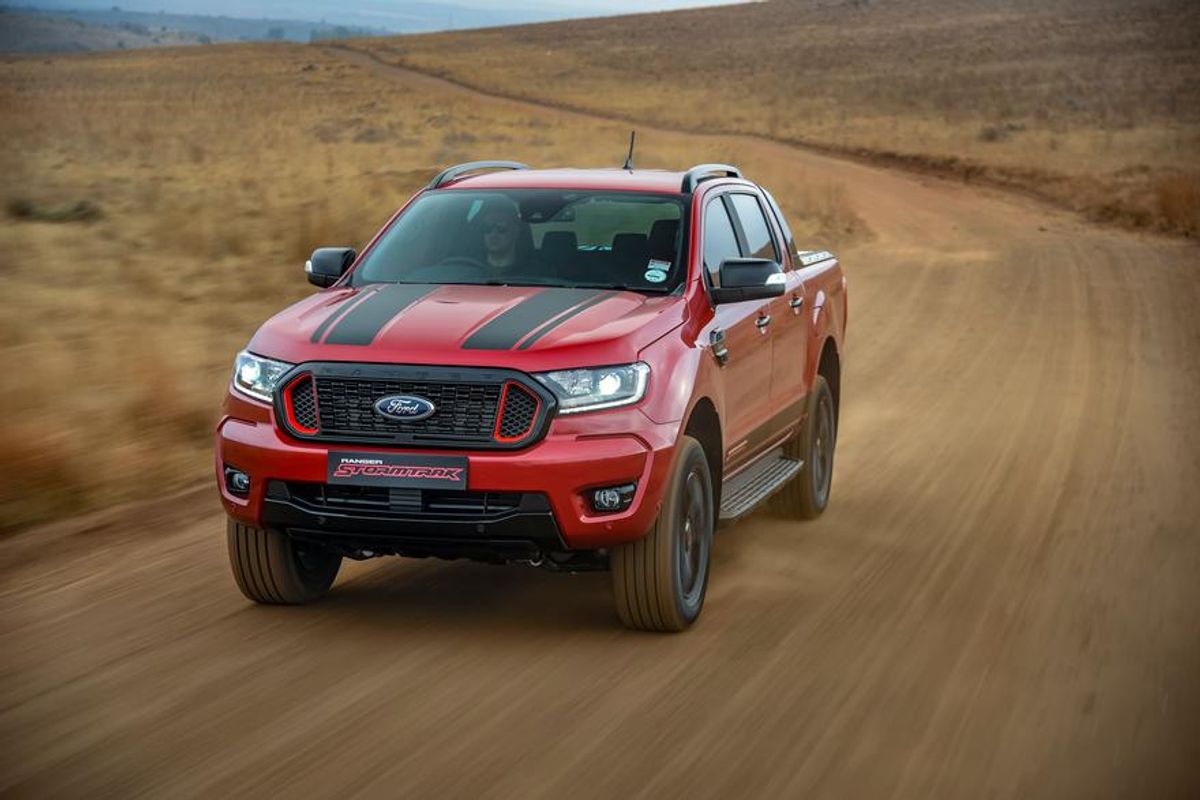
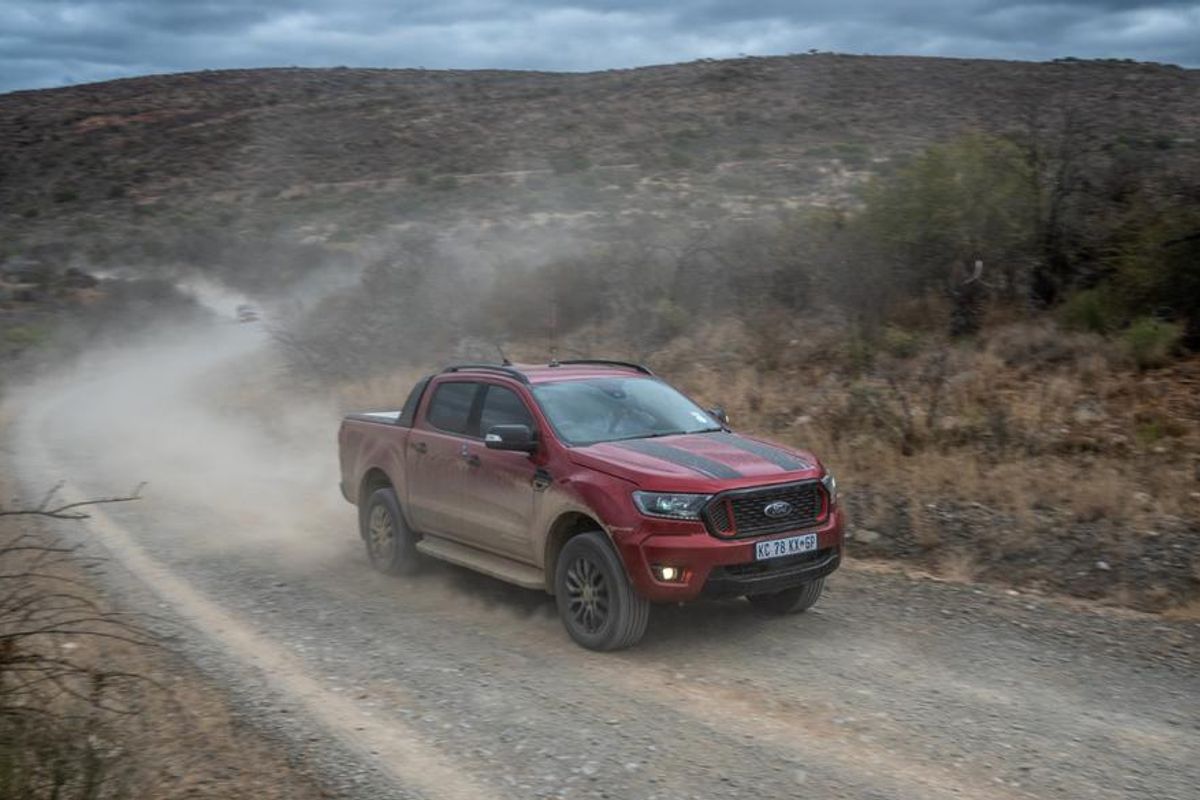
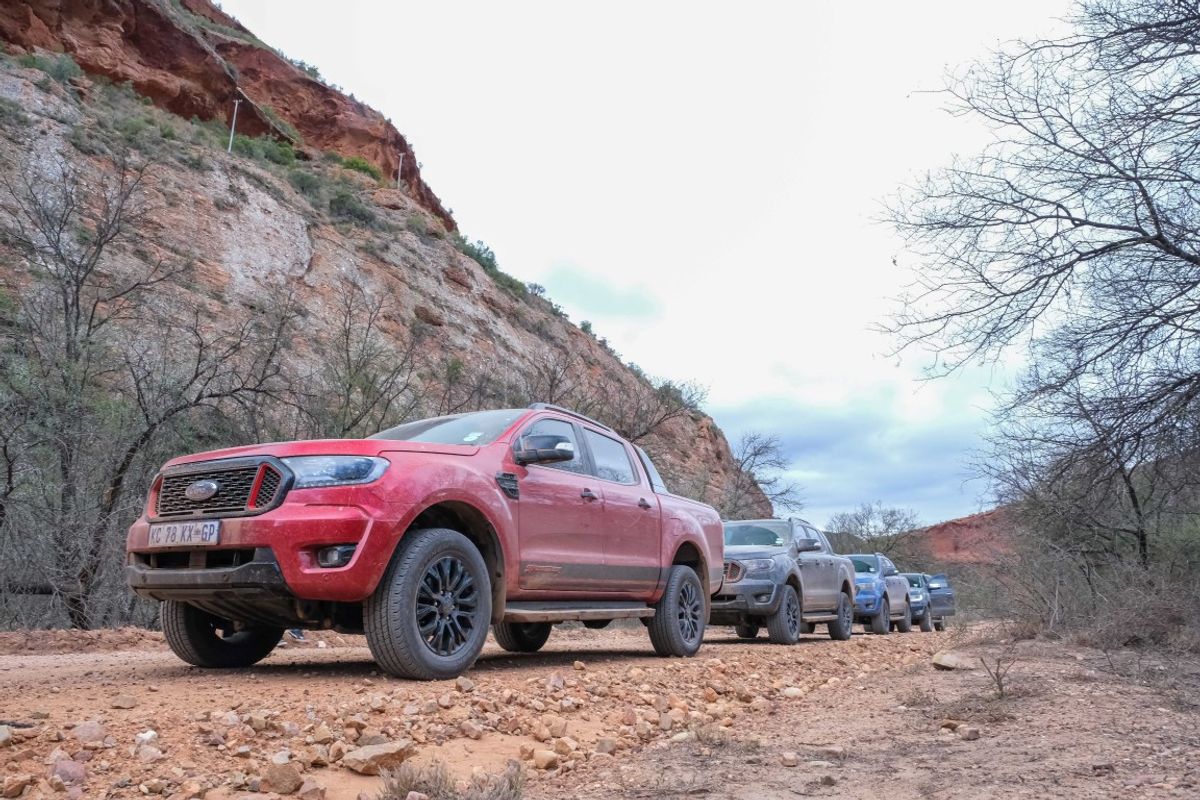
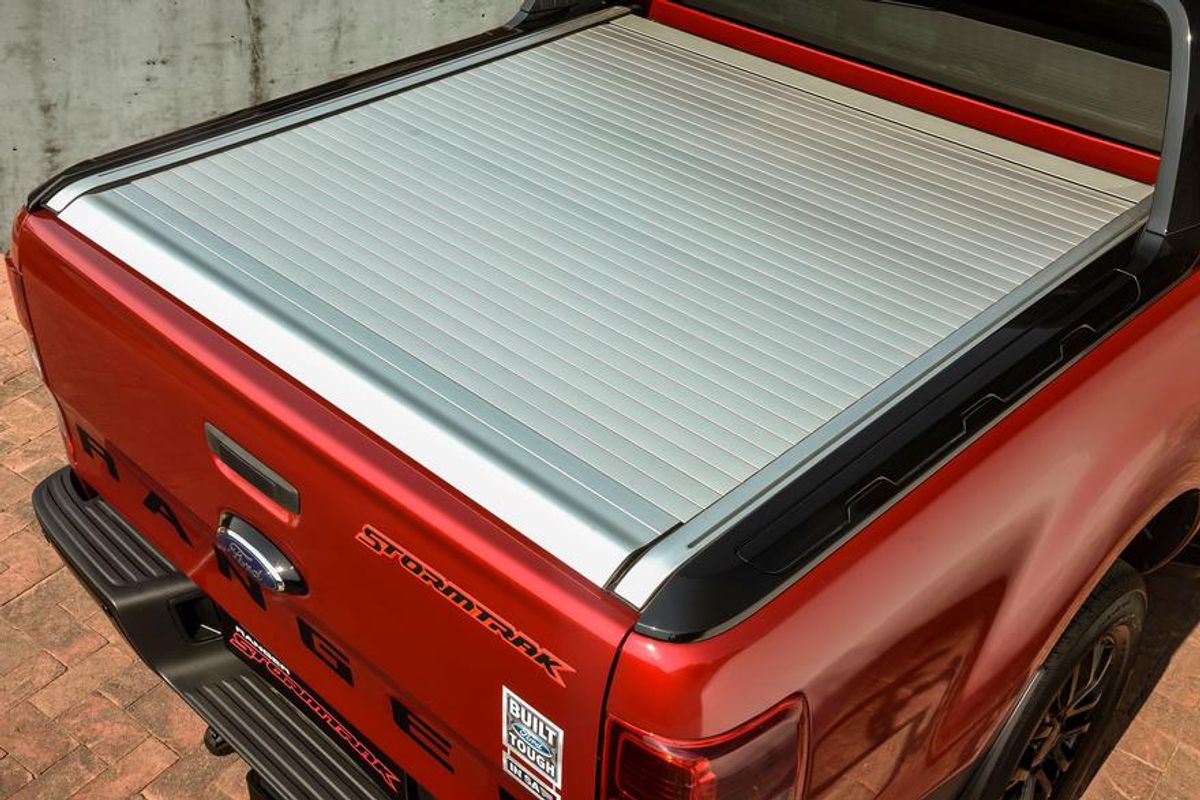
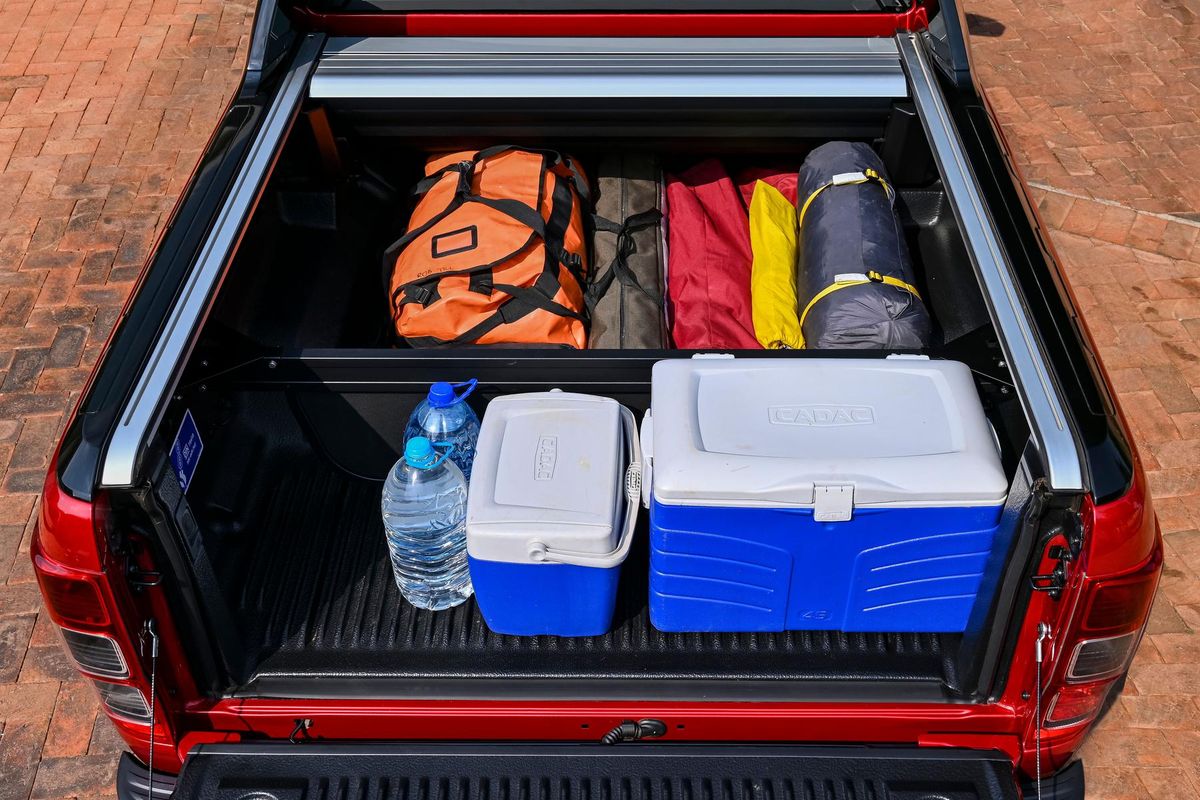
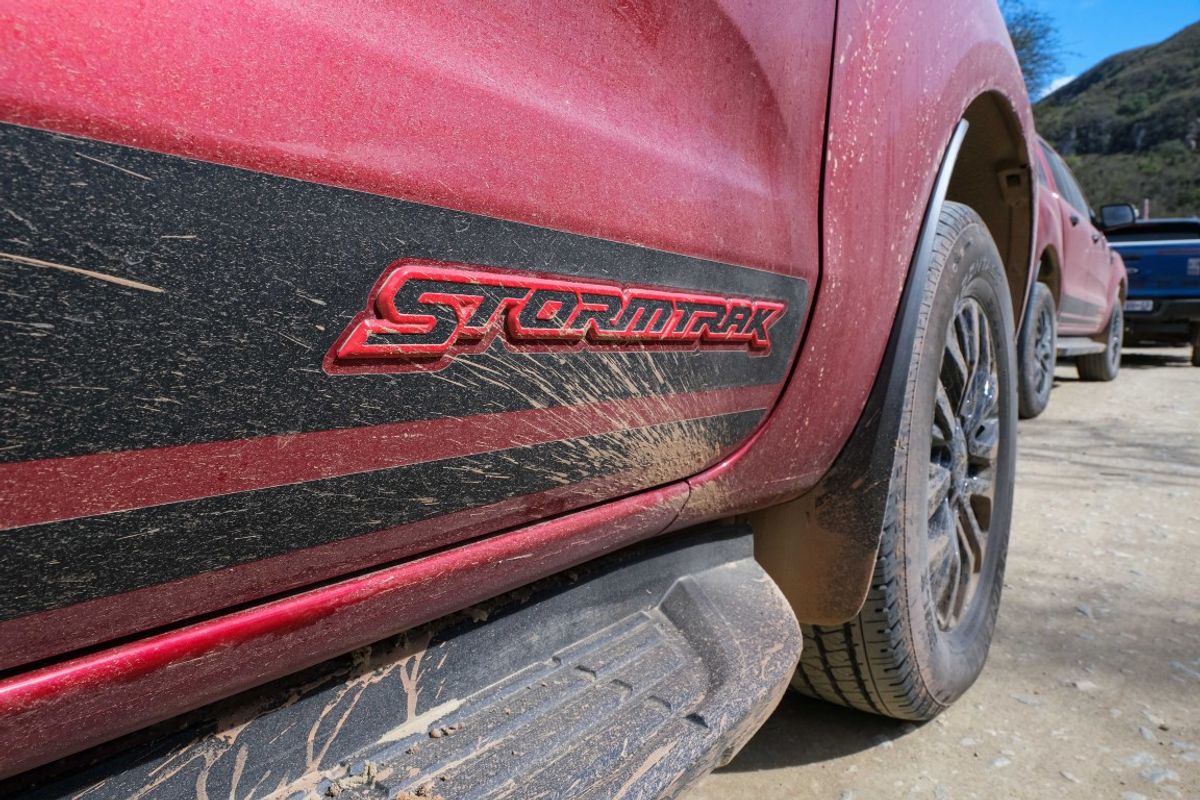
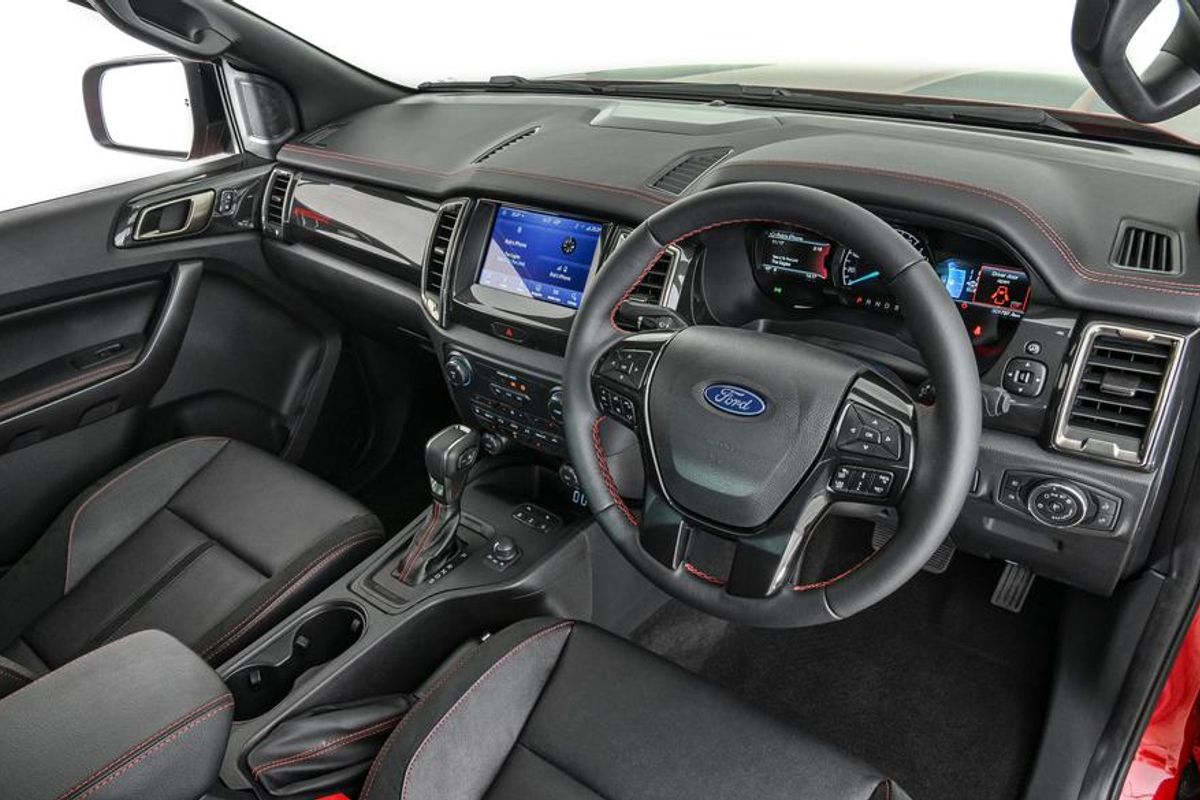
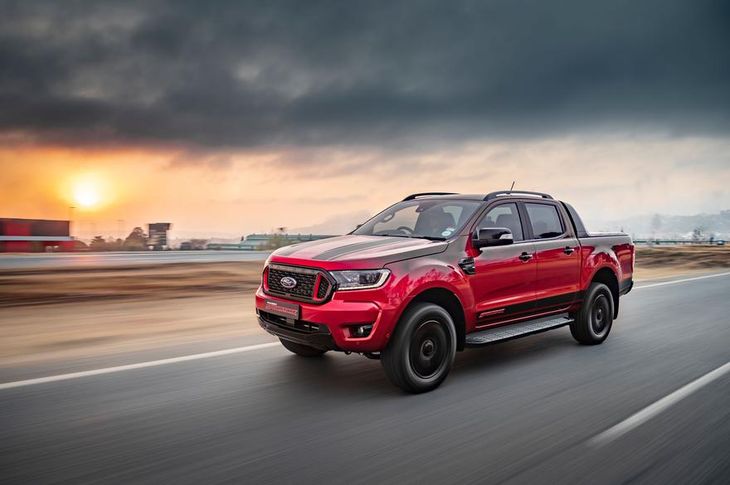
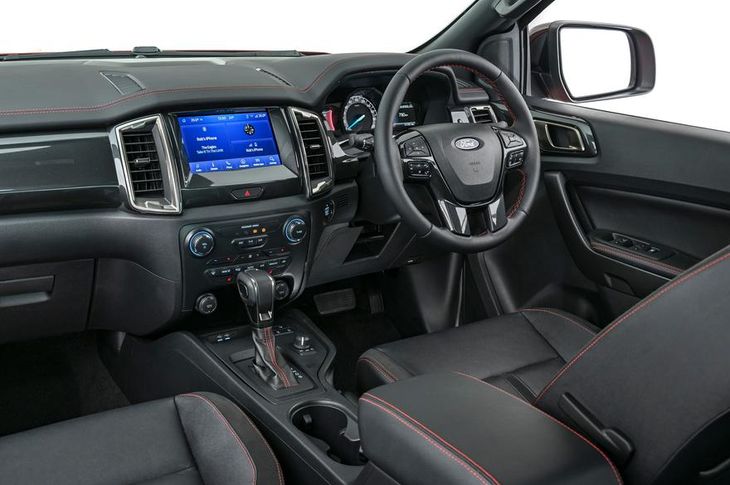
The Ranger Stormtrak is based on the Wildtrak derivative and slots in just above the Ranger Thunder. Apart from its name and a few styling details such as its black mesh grille, with matching decals and accents, 3D-effect Stormtrak badges and red contrast stitching on the leather upholstery (to name a few embellishments), the biggest difference is the inclusion of an electronically operated roller shutter, as well as a load bin divider that adds useful practicality to the overall package.
Moreover, the Lucid Red body colour is exclusively available for the Ranger Stormtrak (it looks fantastic in the metal) in addition to other colours such as Sea Grey, Frozen White and Blue Lightning. Conveniently, the power roller shutter can be operated using a button in the load bin, the bakkie’s key fob or the switch panel on the inside of the driver’s door.
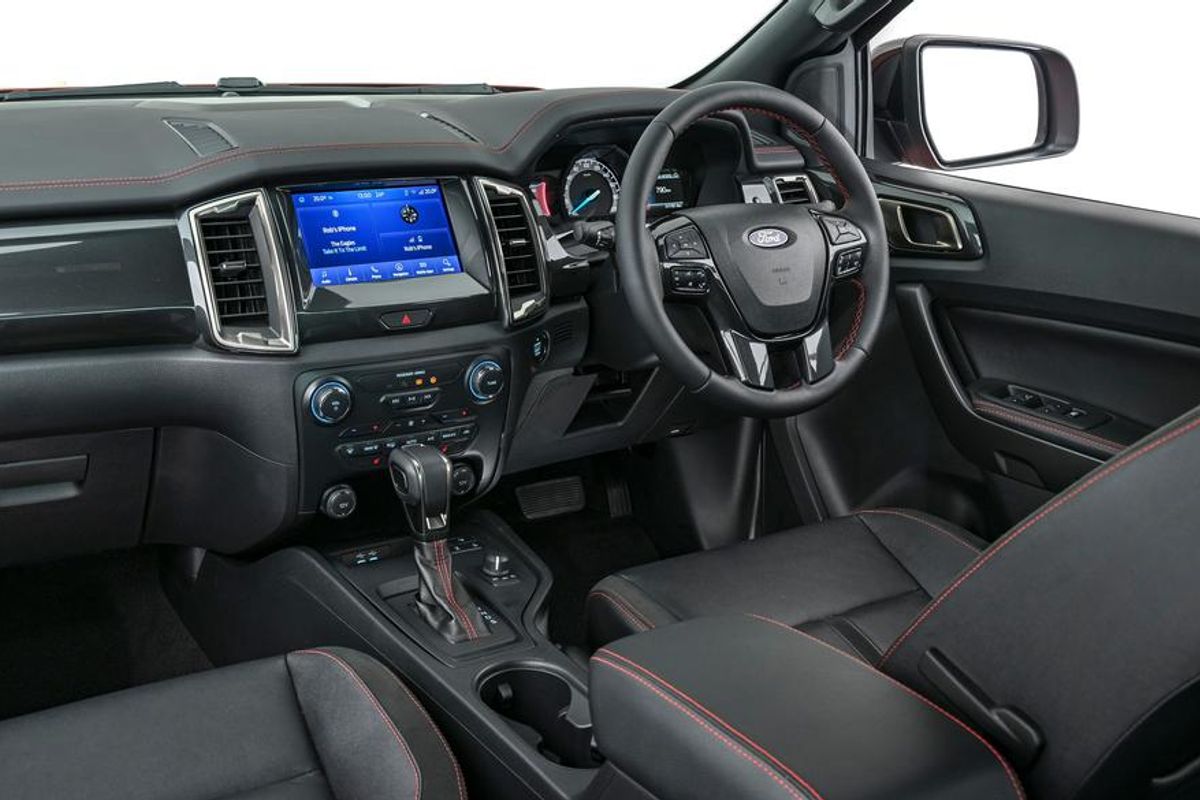
Apart from some Stormtrak badging and red stitching, the cabin is familiar and well specified with features.
Perched at the pinnacle of the Ranger lineup, the Ranger Stormtrak comes well-equipped with features, including Ford’s SYNC3 infotainment system with integrated navigation and Apple CarPlay and Android Auto compatibility, as well as nice-to-have features such as heated seats and adaptive cruise control with forward-collision alert.
Safety in the Ranger Stormtrak is another highlight with features such as lane-keeping alert, lane-keeping assist, a driver alert system, autonomous emergency braking and even semi-automatic parallel park assist, the latter of which takes the stress out of executing those tricky parallel parking manoeuvres with this sizeable bakkie.
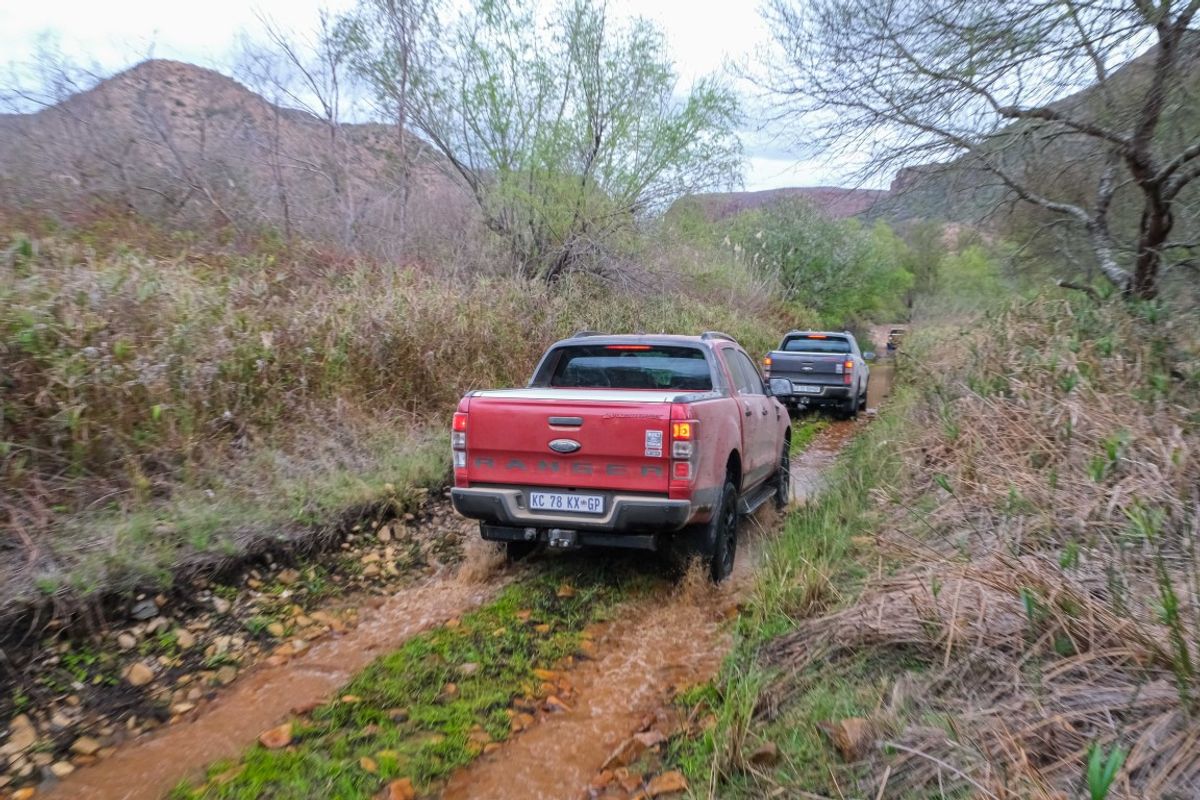
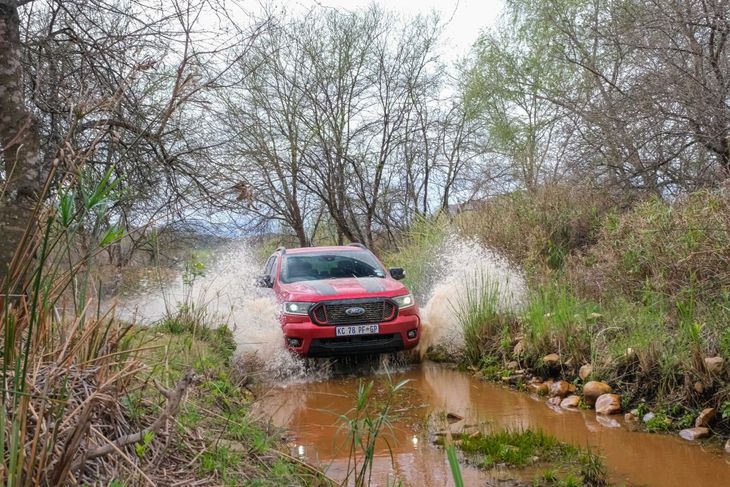
Driving through water in the Baviaanskloof was no hassle for the Ranger Stormtrak.
The tried-and-tested 2.0-litre bi-turbodiesel engine in the Ranger Stormtrak delivers ample performance, both on tar and in the dirt. It’s the same powerplant as found in the Ranger Raptor (its peak outputs are 157 kW and 500 Nm) and it’s mated with a smooth-shifting 10-speed automatic transmission; this engine is not only strong – it’s also refined.
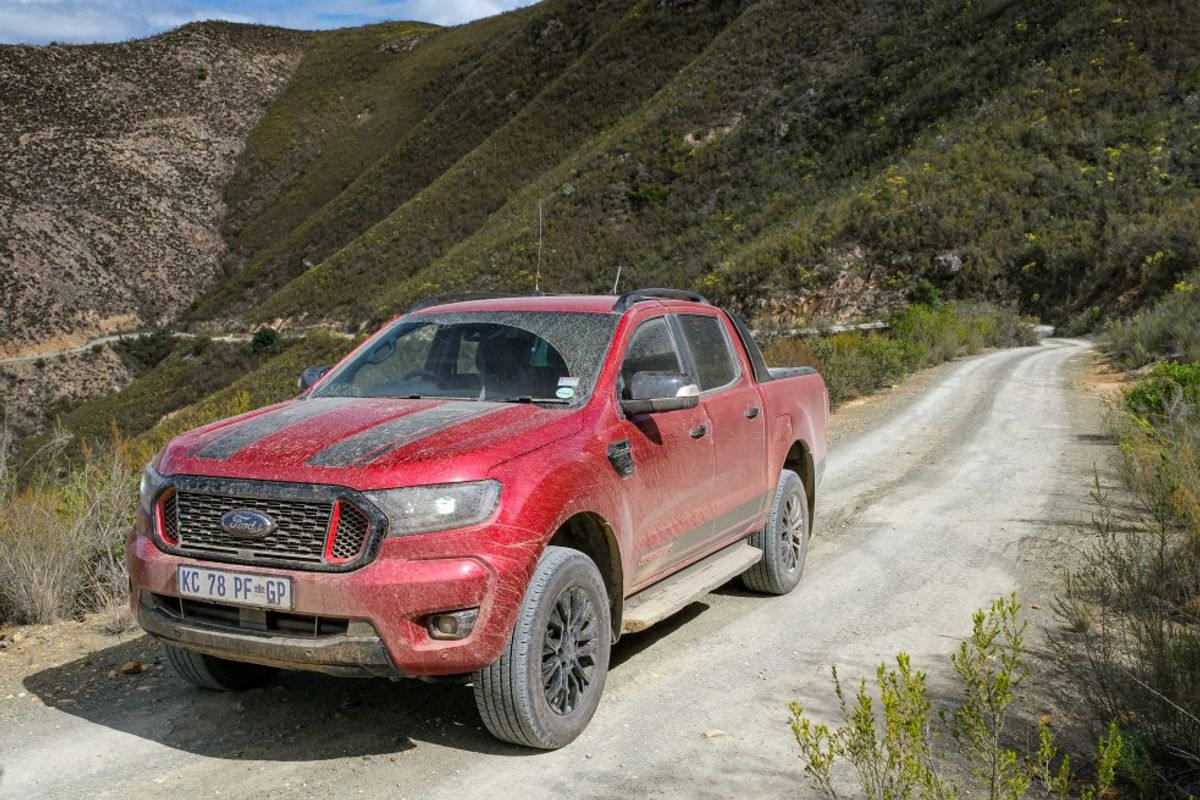
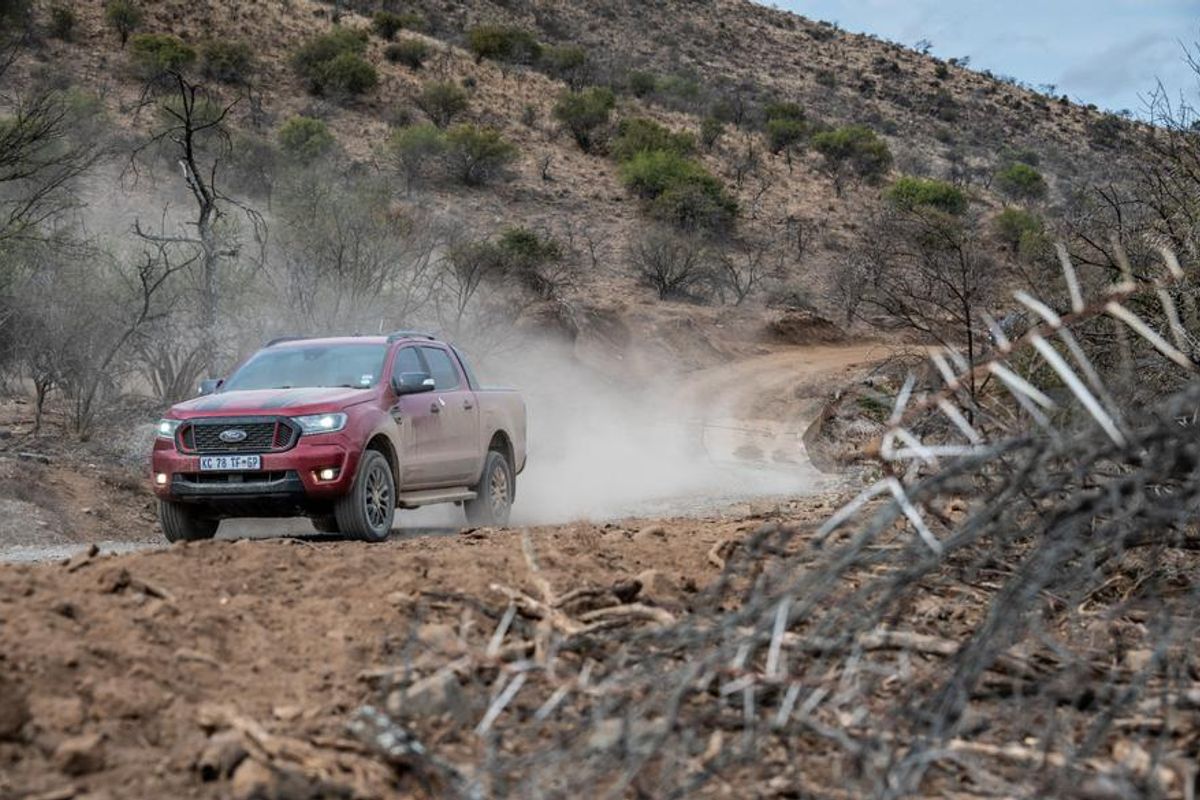
Weather permitting, traversing the Baviaanskloof requires a vehicle with good ground clearance; a 4×4 drivetrain is not a necessity, but it’s certainly an advantage. The Ranger Stormtrak 4×4 is, therefore, an ideal choice to tackle this wild and rugged terrain with its 237-mm ground clearance and convenient shift-on-the-fly 4×4 system that allows you to easily switch between 2H, 4H and 4L as needed. We spent most of our time with the Ford in 4H and didn’t encounter any obstacles that required low range or differential lock, but that could have changed instantly had it rained during the trip.
The Baviaanskloof is one of South Africa’s most picturesque offroad driving routes.
As an off-road route, the Baviaanskloof ranks highly and the views on offer are simply spectacular. The Ranger’s torque was particularly useful on the steeper uphill sections, while hill descent control added a level of surety on the narrow and equally steep declines that you typically encounter when venturing into the ‘kloof.
The convoy of Ranger Stormtraks spent much of the day driving through the 80-km main section of the Baviaanskloof, finally exiting into the Little Karoo near Willowmore, but the adventure was far from over and a few more hundred kilometres of dirt road lay ahead as we squiggled our way through the Karoo back to Gqeberha.
Apart from the Ranger’s strong engine performance, its exemplary ride quality and surefooted handling ability on dirt (and, of course, tarred) roads truly belie the bakkie’s advanced age.
The Ranger’s off-road ride quality is arguably best-in-class.
The Ranger arguably has the best-in-class ride quality in the dirt and this assertion was solidified on this drive. The Ranger rides so comfortably over ruts and undulations that there were times when you would be forgiven for thinking that you were driving on a smooth section of tar. It really is a superb vehicle to drive off-road. What’s more, the Ranger handles with reassuring precision and predictability on dirt roads, giving the driver much-needed confidence.
Overall, this off-road experience once again highlighted why the Ranger remains a popular choice in the leisure double-cab segment. With bold styling, a comprehensive set of standard comfort and safety features and undeniable off-road ability, the Ranger Stormtrak is easy to recommend if you are looking for a well-sorted range-topping leisure double-cab bakkie.
What does the Ford Ranger Stormtrak cost in SA? (Sept 2021)
Ford Ranger Stormtrak 2.0Bi-Turbo Hi-Rider – R790 300
Ford Ranger Stormtrak 2.0Bi-Turbo 4×4 – R846 500
The Ford Ranger Stormtrak is sold with a 4-year/120 000 km warranty and a 6-year/90 000 km service plan.
Start your journey to vehicle ownership with the help of our Street Smart video series, brought to you by Absa Vehicle Finance. In the second instalment, Gordon Wood from Absa discusses how the new Aftermarket Guidelines, which were recently introduced in the motor industry, affect you as a vehicle owner.
PARTNERED CONTENT
A car is one of the biggest purchases that a consumer will ever make in their lifetime. Depending on their lifestyle and vehicular requirements, they might well keep that vehicle for a lengthy period of time. The Aftermarket Guidelines, which came into effect on 1 July 2021, empower consumers by presenting them with more ways in which to service, repair and maintain their cars while those vehicles are still under manufacturer warranties (and their service/maintenance plans are still active).
We asked Gordon Wood – Absa’s Head of Dealer Relationships for KwaZulu-Natal & Mpumalanga – a few questions about this.
What do these Aftermarket Guidelines really mean for the customer?
Wood: The guidelines give customers more decision-making power when it comes to using independent service providers for car services, maintenance and vehicle repairs.
These guidelines have been welcomed in the industry by organisations such as the Automotive Business Council and the National Automobile Dealers Association (NADA).
What are the objectives of these guidelines?
Wood: They aim to make the vehicle aftersales market more inclusive and level the playing field for independent service providers. They introduce more transparency from Original Equipment Manufacturers (OEMs) in terms of information about value-added products that are now included in a new vehicle’s price.
Customers can get a view of what the products entail and whether these products suit their individual needs.
So what does this mean in practical terms?
Wood: The guidelines aim to, first of all, promote customer choice when it comes to independent service providers who service and repair (without the risk of voiding manufacturer warranties), it also promotes entry into the dealership market through revised manufacturer minimum requirements.
Thirdly, it promotes the use of independent service providers used by insurers for autobody repairs (also without the risk of voiding manufacturer warranties), lastly – but not least importantly – it promotes the inclusion and use of non-original parts in certain instances.
What are some of the ways in which a customer can be a truly responsible vehicle owner?
Wood: First of all, it’s important to have comprehensive insurance cover and ensure your car is sufficiently covered for the market value. It’s absolutely imperative that you understand that if “it sounds too good to be true, it is too good to be true”. There is just no way that one insurance company can cover an asset or vehicle like-for-like for a far lower premium than its competitor. My advice is to feel absolutely free to ask those questions when insuring your vehicle.
Secondly, service and maintain your vehicle regularly to avoid unnecessary damage. Perhaps consider purchasing a motor plan, because that is a good way to keep control of the additional costs of owning a vehicle. Thirdly, always use approved parts to avoid accidents, warranty claims and frequent repairs to your vehicle.
Then, with what we’ve just gone through as a country and the Covid-19 pandemic as it is, I strongly suggest that owners consider taking out credit life cover – this ensures that the outstanding balance on your loan will be paid off in cases such as loss of income, dreaded disease and death.
Lastly, I would strongly recommend that should your circumstances change, speak to your financier. The repossession of your vehicle may not solve your debt problem.
Are there additional factors that customers need to be aware of?
Wood: Yes, it’s important to note that certain decisions may affect the vehicle and potentially the vehicle finance. For example, using parts that don’t meet OEM specifications may cause the customer to lose the manufacturer’s warranty associated with the vehicle. The parts used in servicing or repairs should never compromise the vehicle’s integrity. It’s critically important to remember that.
Where can customers find out more about these guidelines?
Wood: Customers can also get more information on the guidelines by contacting the Competition Commission or their financiers – I am sure that either would be more than willing to help; that way the customer can stay well informed and make the right decisions.
UK supplier has a stronger brake for the big ‘Cruiser.
The long-awaited Land Cruiser 300 has already seen demand completely overwhelm supply, added to the issue that the semi-conductor shortage has reduced the supply of Cruisers to a trickle.
Toyota’s most expensive vehicle offers a unique blend of ruggedness and luxury, making it ideal as VIP transport in conflict zones and for business people who live in volatile areas.
Despite a thorough redesign and lighter engines, the Land Cruiser 300 remains a hefty vehicle, at 2.6-tonnes. That means that its brakes work hard for a living, especially if you are decelerating from the higher cruising speeds that Crusier 300 is now capable of, thanks to its more potent V6 engine options.
The Land Cruiser 300 is very popular in the armoured vehicle market. South Africa’s SVI has cleverly developed a discreet protection kit, but making the Land Cruiser 300 bulletproof, does add about 600kg of weight.
British brake specialist, Alcon, has now developed an upgrade kit for Crusier 300 owners considering an armoured conversion – or who might often be towing.
The Alcon brake upgrade kit is a bolt-on system, which requires minimal mechanical work. And it delivers real benefits, especially for a vehicle of the Land Cruiser 300’s weight, when armoured.
Drivers will require 10% less pedal effort and trigger 10% greater brake toque when using the Alcon upgrade, compared to a standard Land Cruiser 300 system.
Longevity should improve, too, with a 42% reduction in front and rear brake pad work rates. Perhaps the most critical issue is countering thermal-induced brake fade.
With the Alcon upgrade kit reducing temperature rise by 45%, even multiple high-speed brake interventions in a Cruiser 300, should deliver consistent pedal response – time after time.
Best of all, the Alcon brake upgrade does not require a bigger wheel. With the new Land Cruiser range having versions rolling 18- and 20-inch wheels, Alcon has confirmed that its upgrade kit works with the smaller option. This should please potential GR Sport owners, the apex variant in Toyota’s new Land Cruiser 300 range, that rolls 18-inch wheels.
The AA of SA is forecasting an increase in the price of petrol, diesel and paraffin as we head towards the end of September 2021. Here’s what you need to know.
The Automobile Association of South Africa posts a regular fuel price update twice a month, based on what the exchange rate and international oil price is doing. Usually, the estimated amounts of pretty accurate, giving consumers time to plan ahead.
However, the month of September 2021 has seen some extreme volatility. So much so, the AA is unable to post a more detailed outlook and prediction, which is worrying. Based on what the data has shown, we know that fuel prices are set to increase at the end of September 2021.
“We have noted oil prices spiking above $75 a barrel in recent days, and the upward trend has been evident throughout September. Brent Crude in particular has increased by $10 a barrel in less than a month, and the Mediterranean and Singapore prices used in South African fuel pricing are also on the advance. This trend could point towards substantial future fuel price increases,” it adds.
The exchange rate between the South African Rand and the US dollar was flat for most of this month, however some very recent weakening combined with higher international petroleum prices, could push fuel prices into negative territory. “Until government manages domestic policy more effectively, the Rand will continue to expose South Africans to the full brunt of bullish oil prices, meaning South Africans are not getting fuel as cheaply as they could be,” says the AA.
At this stage, it is fair to assume we’re in for a fuel price increase as we go into October 2021. We’ll have detailed amounts of this increase in just over a week’s time.
This week’s news you need to know (September 2021, Week 3)
In this week’s automotive news you need to know: Subaru made a concept everyone loved, only to turn it into a lacklustre sedan, Mahindra goes on the offensive with an affordable off-roader, Toyota adds some GR spice to its Corolla Cross and Ford SA isn’t so keen on letting you have a Fiesta, let alone an ST version.
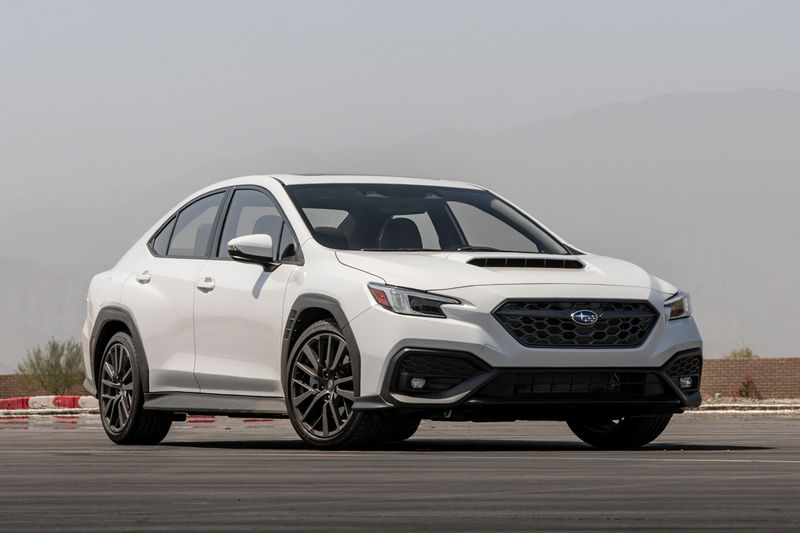
Subaru WRX is back – or is it?
Subaru is back and I’m reminded of that saying: “go big or go home”, which so often rings true. Although Subaru has successfully focused its business on SUVs in the past decade, the Japanese brand has also struggled to evolve its WRX and WRX STI models. One would think that in a time when Toyota is thrilling the automotive world with its Gazoo Racing-infused products, the latest iteration of a hallowed model such as the WRX could swoop in and snaffle a few of those enthusiasts who couldn’t get their hands on a GR Yaris. Subaru has, after all, had the master recipe for a wild AWD fun car for some time.
The new WRX flatters to deceive. So, instead of bringing half-baked ideas to fruition, why not just cull the model and consign it to the history books instead of riding on past successes (in hope that you will attract sentimental buyers)? The purists will see through this piecemeal attempt and look elsewhere. Sometimes it’s okay just to pack it up and move on. Perhaps that time has come for Subaru’s WRX.
Mahindra Scorpio Adventure – Adventure on a budget
Mahindra’s offerings have slowly, but surely, gained notable traction in Mzansi even though big-name small crossovers, family cars, bakkies and SUVs account for the lion’s share of the market. The Indian marque has overtly passenger-car-like offerings in the shapes of the KUV100 Nxt, XUV300 and XUV500, but no-frills workhorses are its bread and butter. To its credit, Mahindra keeps it all simple and functional. That level-headed approach of meeting buyers’ basic needs (at a keen price) will continue to serve them well. They may yet reap more rewards with a considered upmarket push at a later stage.
That very moment could be drawing near. The underrated Mahindra Scorpio is a tried-and-tested SUV that will appeal to those who can’t quite afford a Toyota Fortuner or Ford Everest; it offers them a chance to own a truly off-road-capable SUV at a reasonable price (okay, it’s more expensive than a Suzuki Jimny, but a lot more practical). In an economic climate in which the impact of the Covid-19 pandemic has thinned our wallets, this is a good thing. Who knows? Eventually, as the economy recovers and Mahindra grows, they’ll have brand loyalty on their side when they eventually go “luxury”.
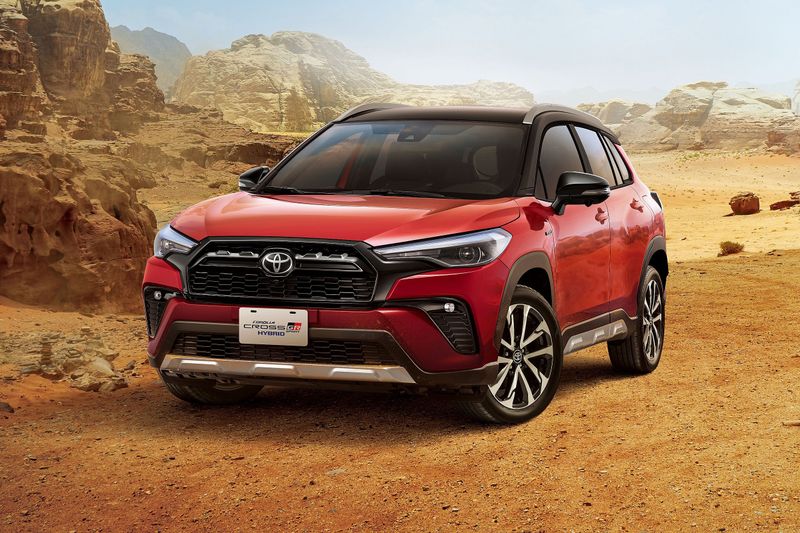
Hybrid Corolla GR Sport – Hybrid goes sport… sort of
Everyone remembers when the Toyota Prius was launched (it only arrived in South Africa in 2005, when the 2nd-generation model became the first hybrid vehicle to be offered in the local market). The Japanese brand’s petrol-electric hybrid became a fashion accessory for Hollywood actors, environmentalists and all types of “goody-goodies”, which we now refer to, more kindly, as early adopters. Because Prius ownership was seen as “snobbishly virtuous” in some circles, the rather awkwardly shaped Toyota became the butt of many jokes and, back then, most car enthusiasts regarded “greener motoring” as synonymous with “boring”. Toyota was not a particularly “hip” brand anyway, but many years down the line, GR badging has shaken everyone awake; it has proved that Toyota can do “cool” rather well.
The GR Sport version of the Corolla Cross Hybrid is admittedly just “a look” that’s been applied to the standard compact family car, which is now being produced by Toyota South Africa Motors’ Prospecton plant in KZN. There is no question that our market is hungry for as many small crossovers as manufacturers can throw it, so why not cook up a hotter-looking Corolla Cross? The Prius was never our bag, so we can move on, but don’t forget, much of the current Prius lives on in the eminently more fashionable Corolla Cross Hybrid. Fair play, Toyota, you have awoken – and the automotive world is richer for it.
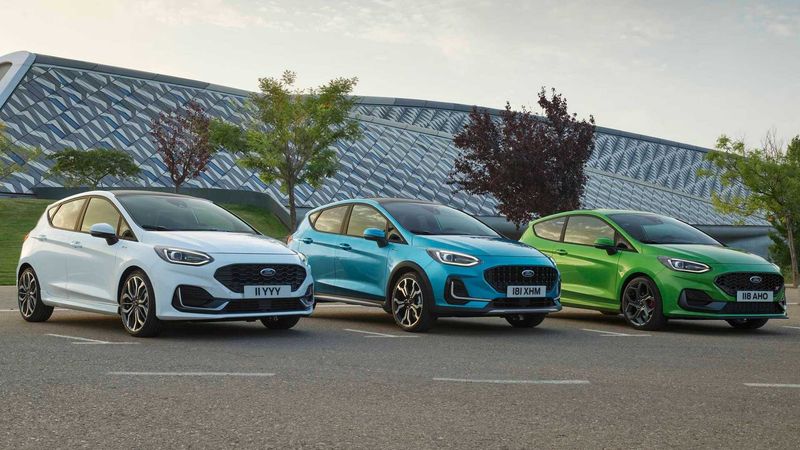
Facelifted Fiesta – Needs more of a party
The South African motor industry has a rich heritage of Ford performance cars that stretches back deep into the previous century; many of those special derivatives (some of which were unique to Mzansi) are respected even by those who drive other brands’ cars. Yes, the love runs that deep. It was a passionate affair that turned into marriage with Ford’s official return to the Republic… Then, one day, the Ford Motor Company of Southern Africa (FMCSA) filed for divorce by no longer offering ST or RS models; it left many in the car community wondering if it was them that caused the separation. It wasn’t.
There are a number of reasons for the demise of those firecracker Fords; some pertain to strategic decisions made by Ford’s top brass, others with our fuel quality, the weakness of the Rand, changes to our market… the list goes on and on. As a fan of performance Fords, the loss of ST-badged cars is especially galling. Even the Volkswagen faithful recognise that; I suspect they miss the competition.
Volkswagen makes a potent little hatchback in the form of the Polo GTI, so why can’t Ford dust off those ST badges that it’s hoarding in a warehouse somewhere and – even if it ultimately decides against launching the facelifted Fiesta range here in Mzansi – just bring in a performance version of its compact hatchback that could smoke its GTI-badged Volkswagen rival once and for all?