Drag race! Honda Civic Type R vs Renault Megane RS 300 Trophy
In the battle of front-wheel-drive hot hatches with manual gearboxes, you can't get any closer than the Renault Megane RS 300 Trophy and the Honda Civic Type R. Who wins?
Well here's a rare thing indeed, a drag race featuring too manual cars. So, which one of these stick-shift shifting speed demons can stick it to its rival on the quarter-mile? Only one way to find out.
We stuck our in-house race-ace Ashley Oldfield in the Megane and drift-champ Ernest Page in the Honda mostly because a) Ciro is rubbish at changing gears during a drag race and he was having a nap in the Golf and b) Ernest's mate gave his Honda for the day so we would rather Ernest broke it and not one of us.
Renault Megane RS 300 vs Honda Civic Type R specifications
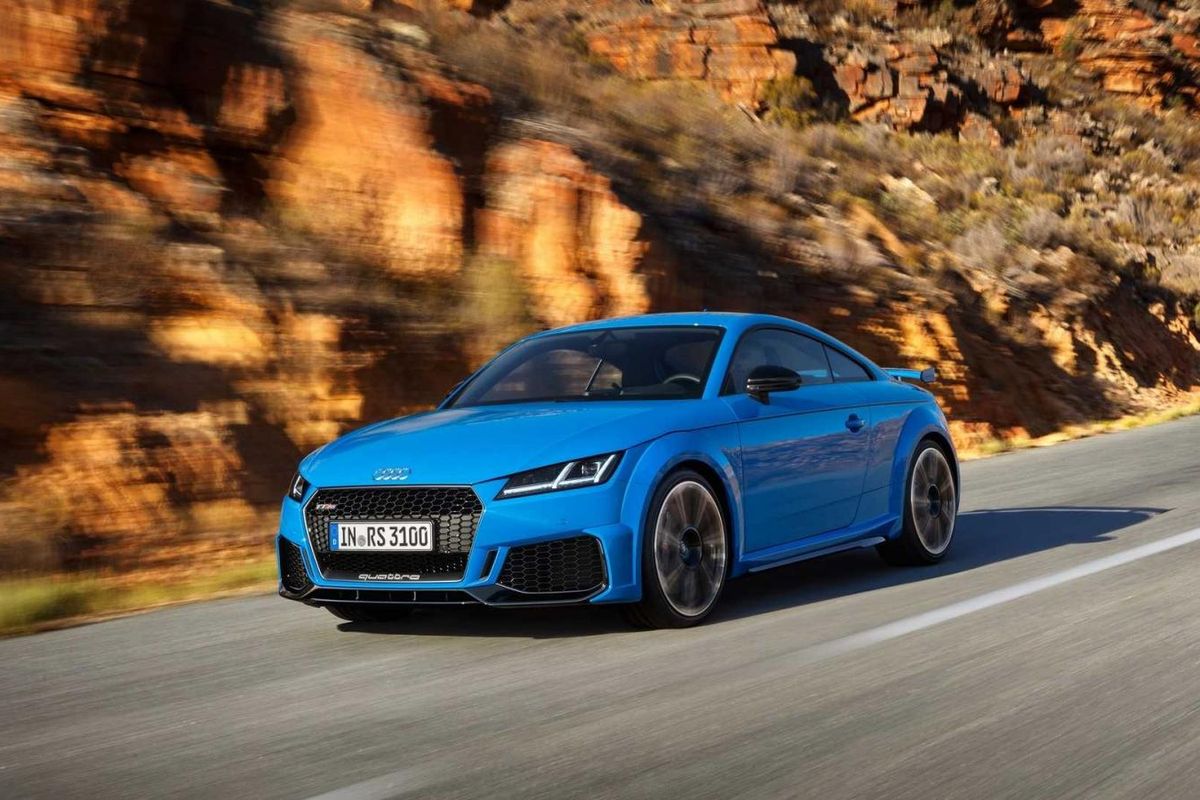
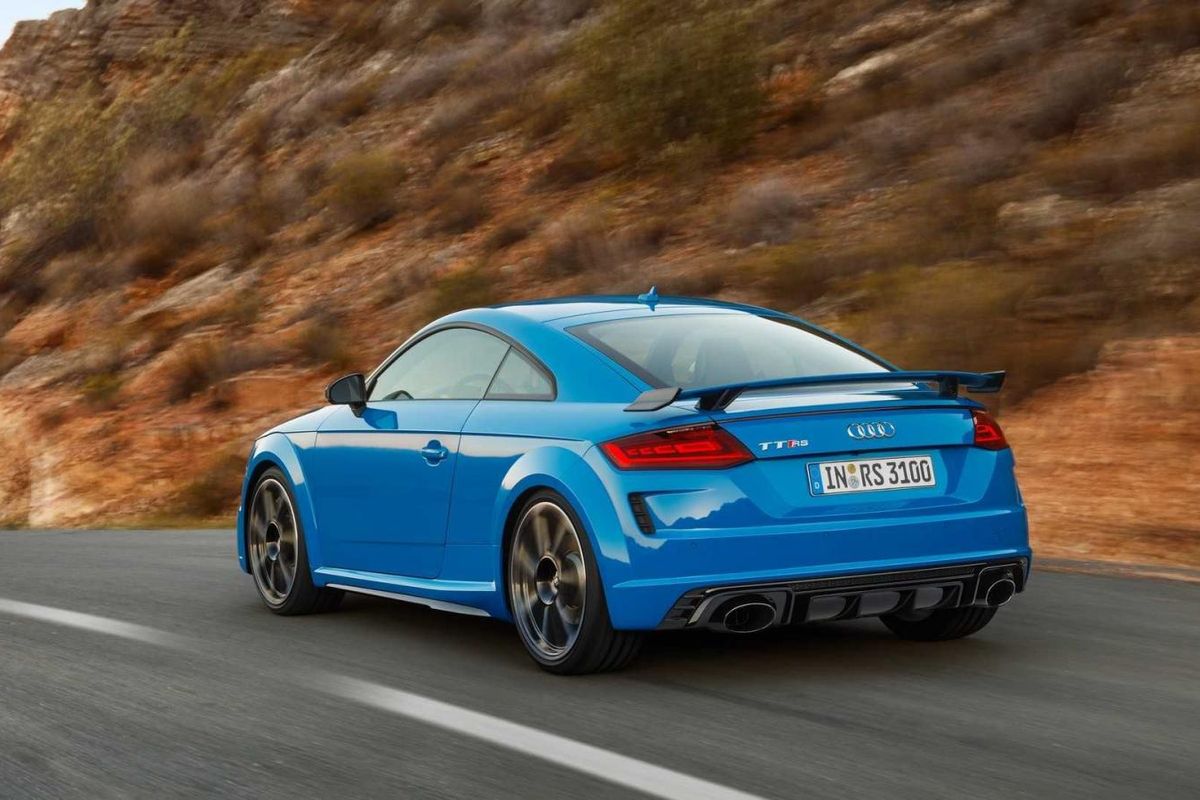
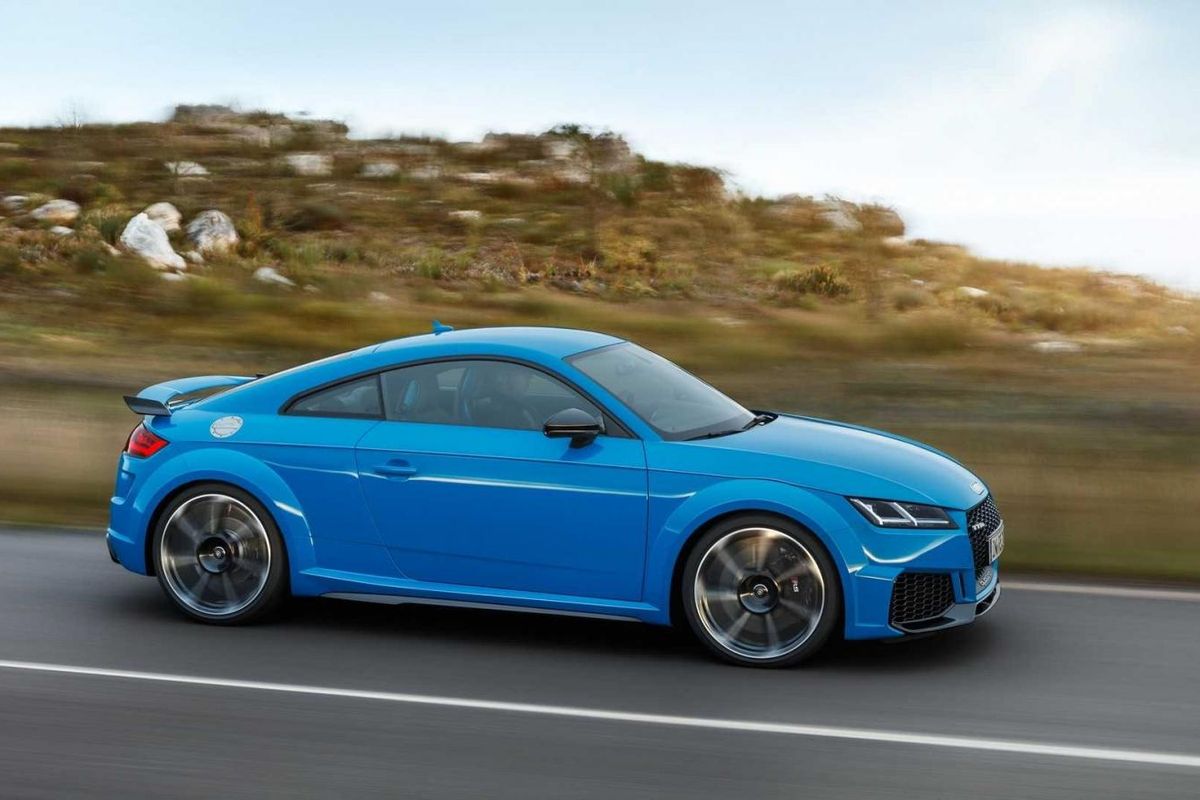
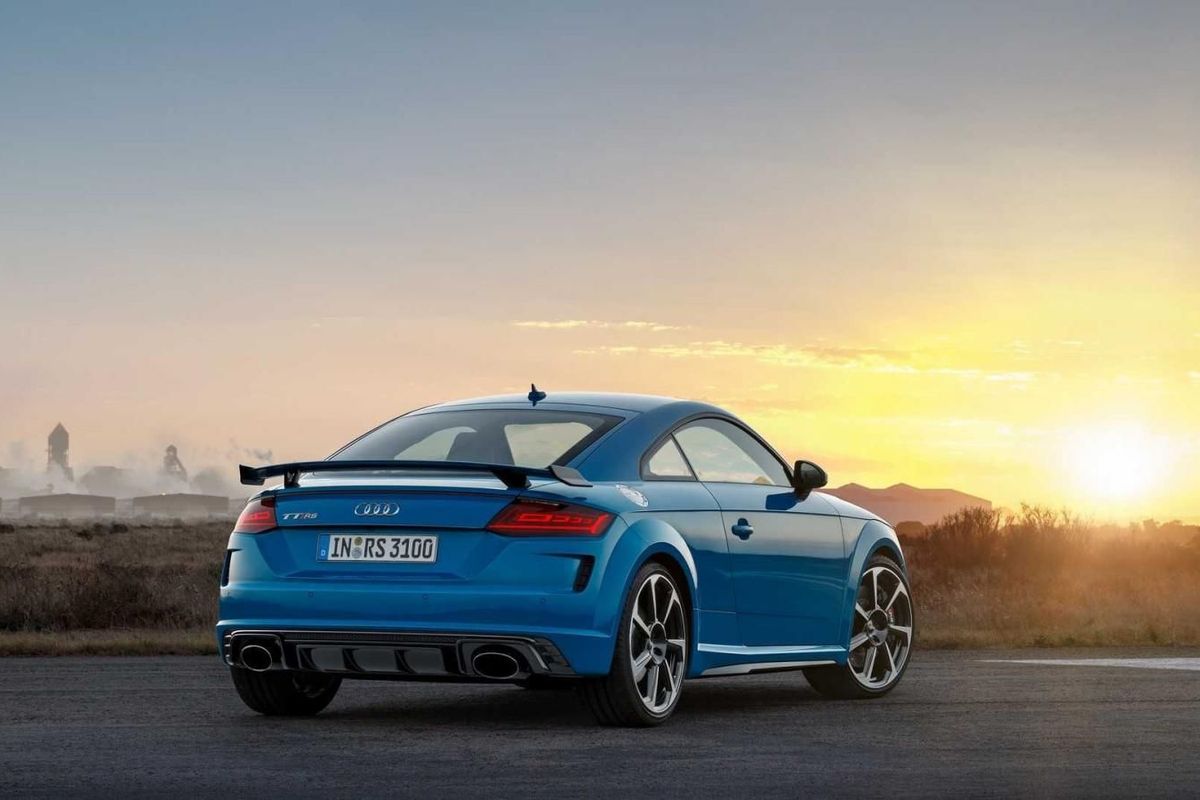
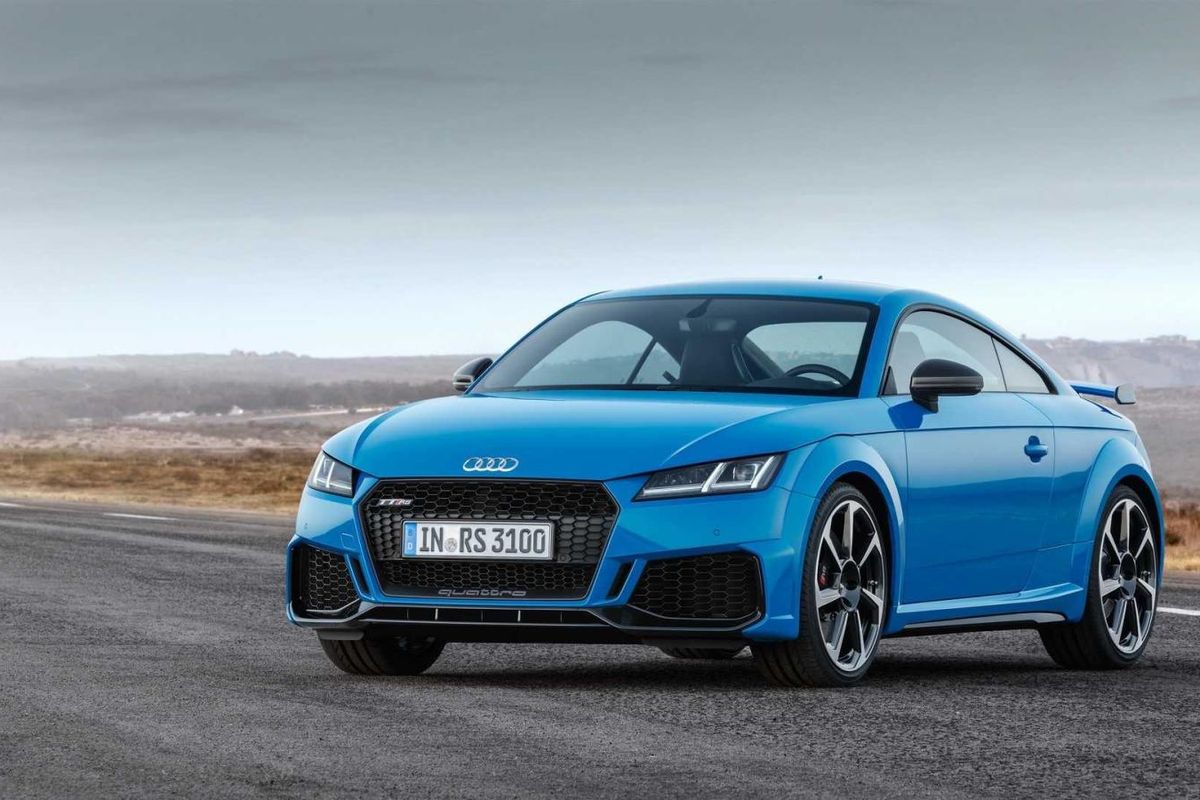
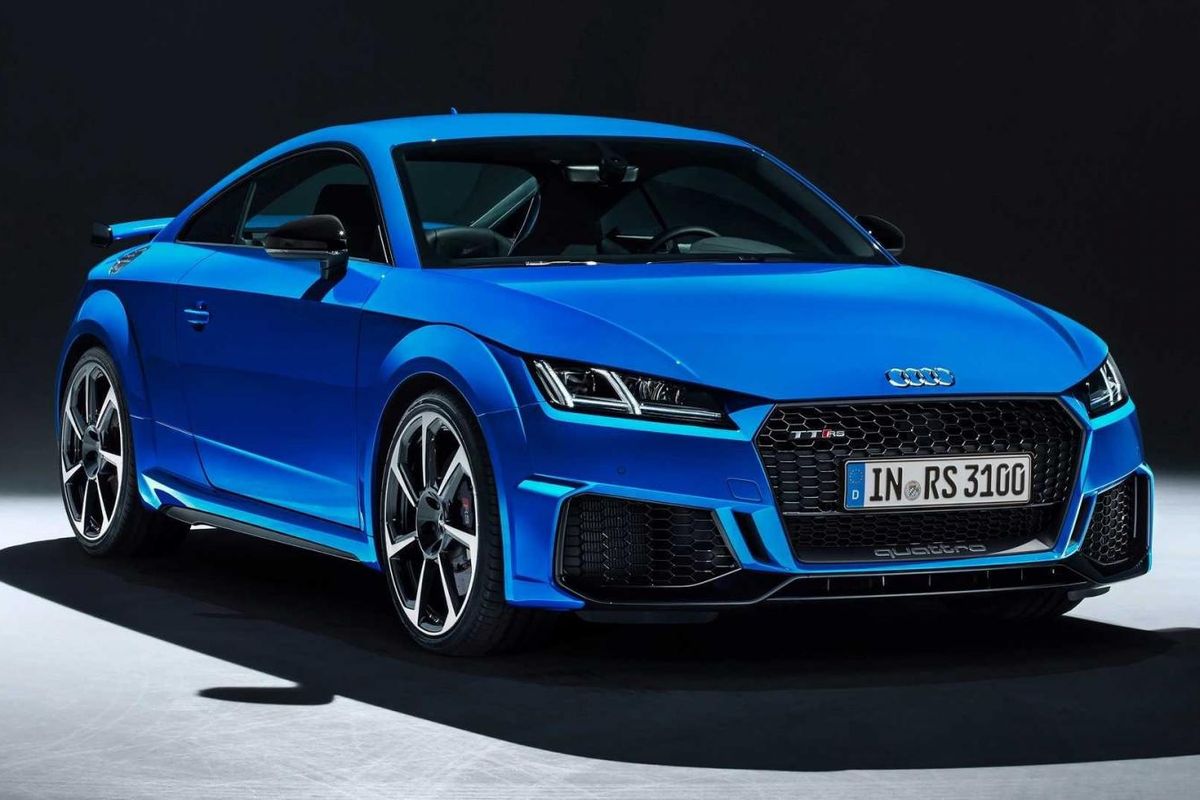
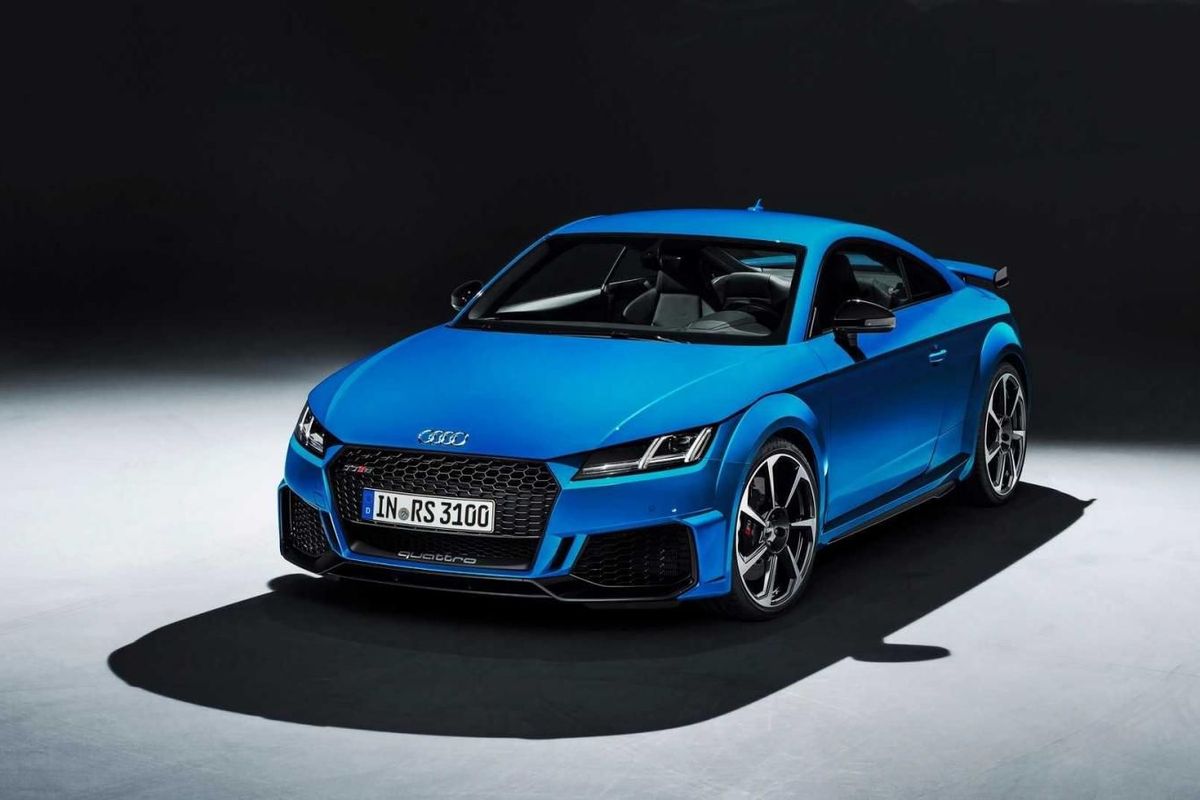
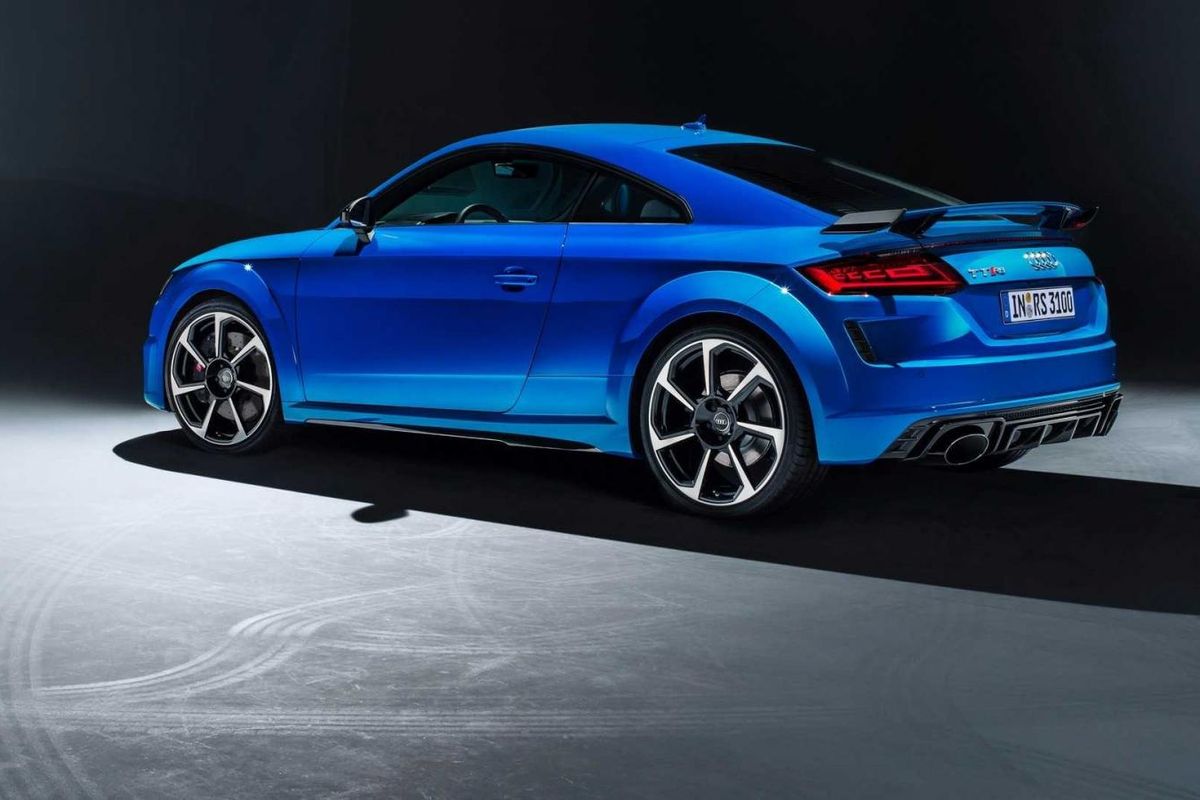
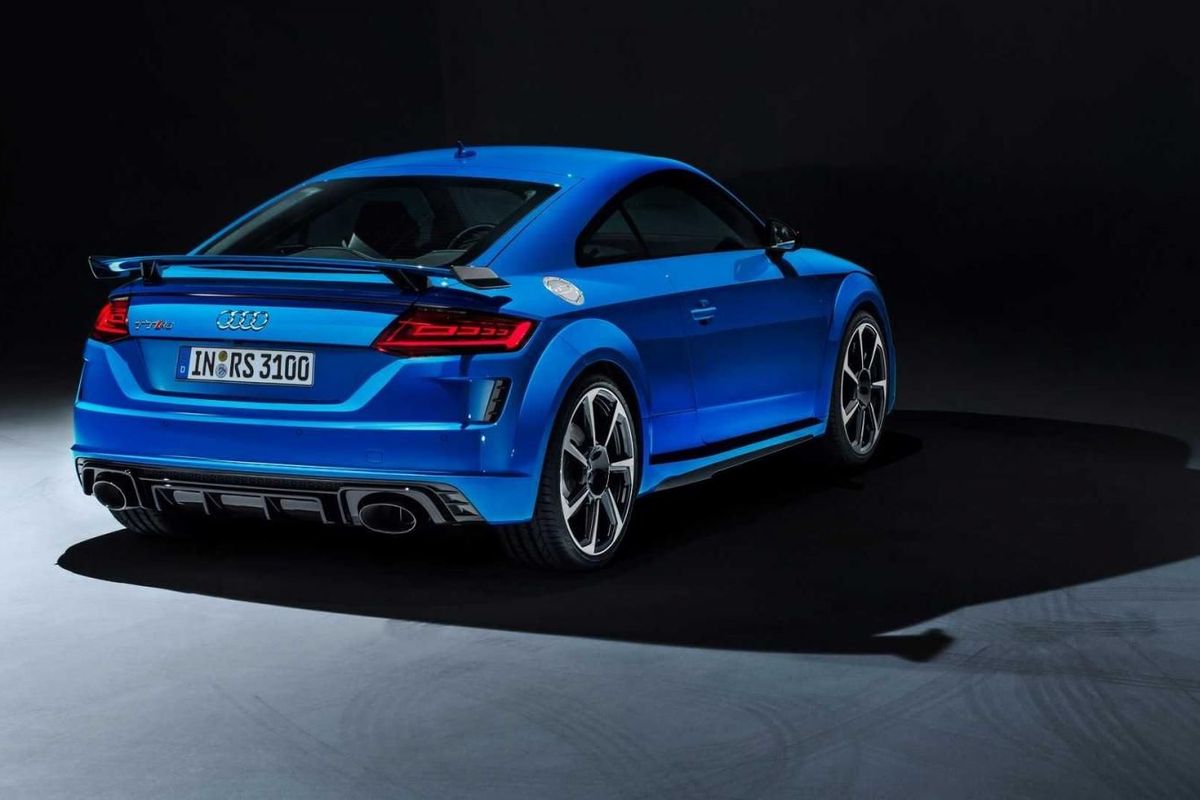
A hotter version of the potent Audi TT RS Coupe and Roadster, with a more dynamic appearance, has arrived in South Africa. Herewith the details…
The range-topping Audi TT RS Coupe (and its Roadster sibling) is a scintillating piece of machinery and the high-performance model has been revised, giving it a more commanding presence on the road.
Michael-Julius Renz, CEO of Audi Sport GmbH said, "The new TT RS is in absolute peak form, like a well-trained athlete, it showcases even more prominently how much power lies beneath its muscular outer skin."
Styling changes
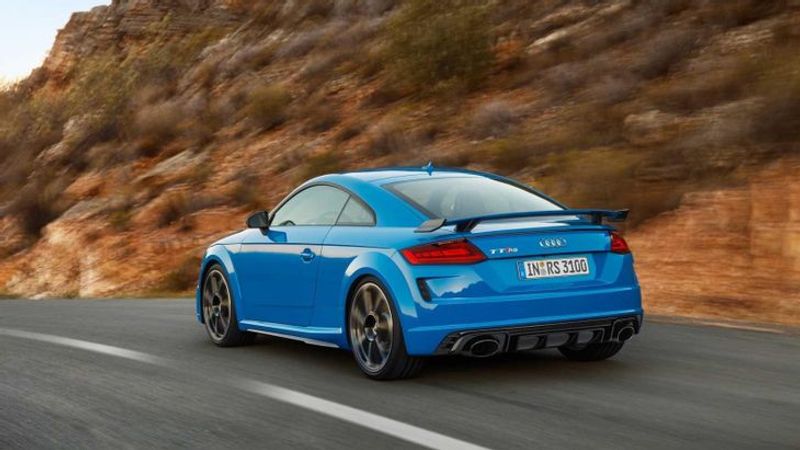
The updated TT RS features more aggressive-looking styling details while retaining its 294 kW turbocharged 2.5-litre engine.
The front-end has been revised and features the matt-titanium quattro emblem sitting on the lower section of the single-frame grille in matt black while the lateral air intakes are now larger, creating a wider appearance than before. Additional radiators behind the RS honeycomb grille serve to enhance cooling.
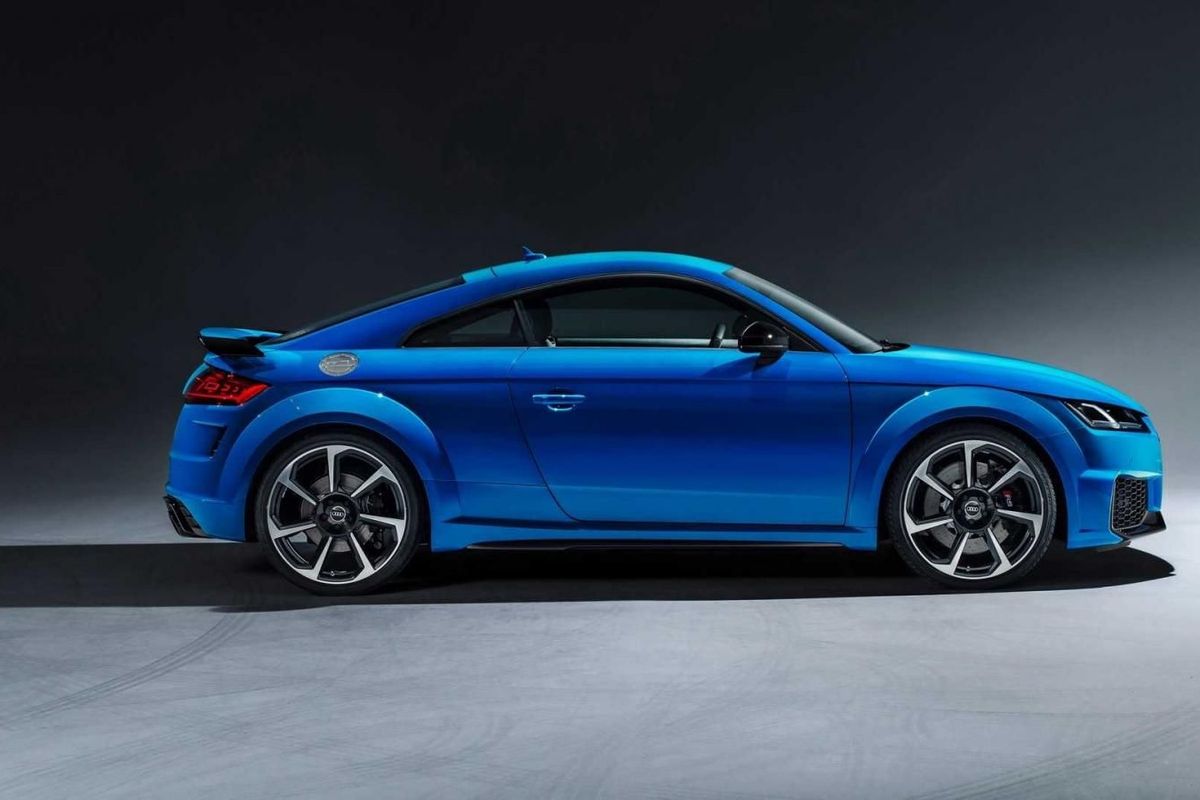
The edgy look is further accentuated with a continuous spoiler painted in body colour as standard but is also offered in a matt aluminum finish or in gloss black. A gloss black inlay is also now seen in the side sills and the mirror housing can be had in either body colour, matt aluminium look, gloss black or carbon.
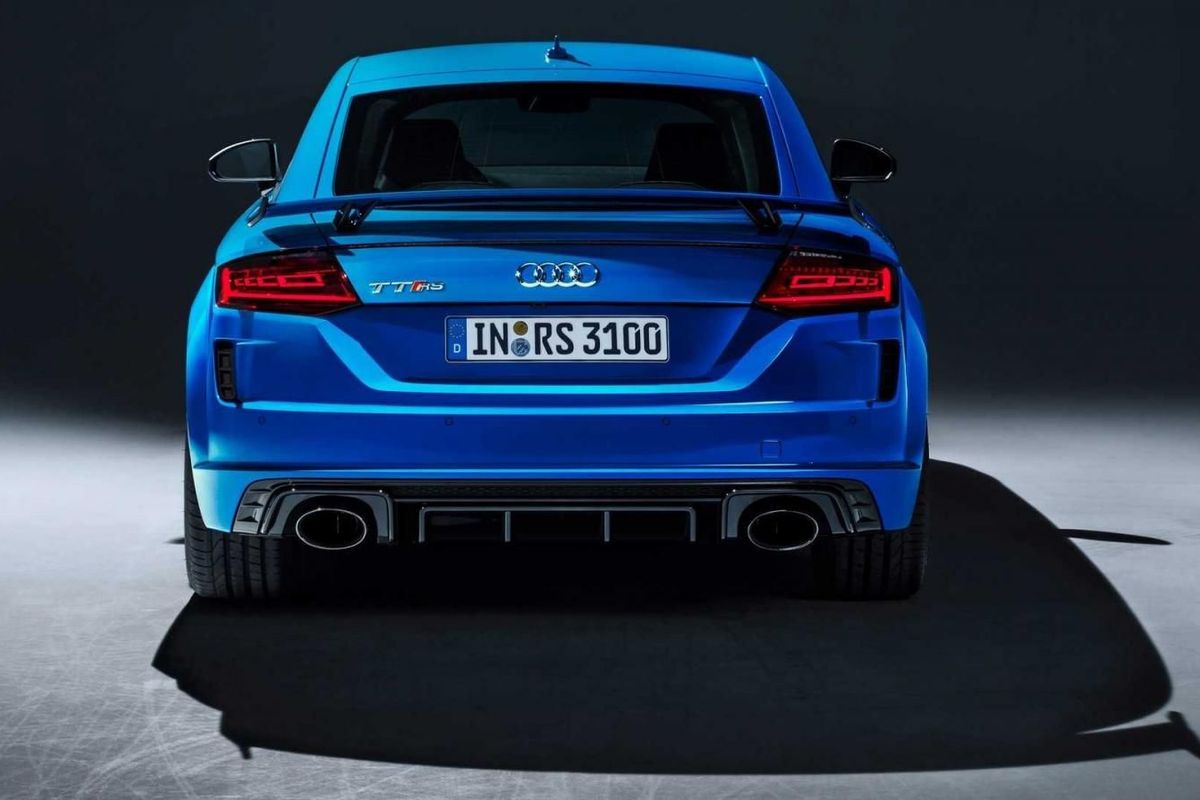
The rear-end sports a fixed wing with side winglets as well as an RS-specific diffuser with vertical elements and large oval exhaust tailpipes.
LED headlights will be offered as standard while Matrix LED headlights and Matrix OLED reversing lights will be offered as an option.
The TT RS rides on 20-inch gloss black alloy wheels as standard and will be offered in 9 colours including the new Kyalami Green, Pulse Orange and Turbo Blue. A number of individualisation options are also available to customers.
Interior details
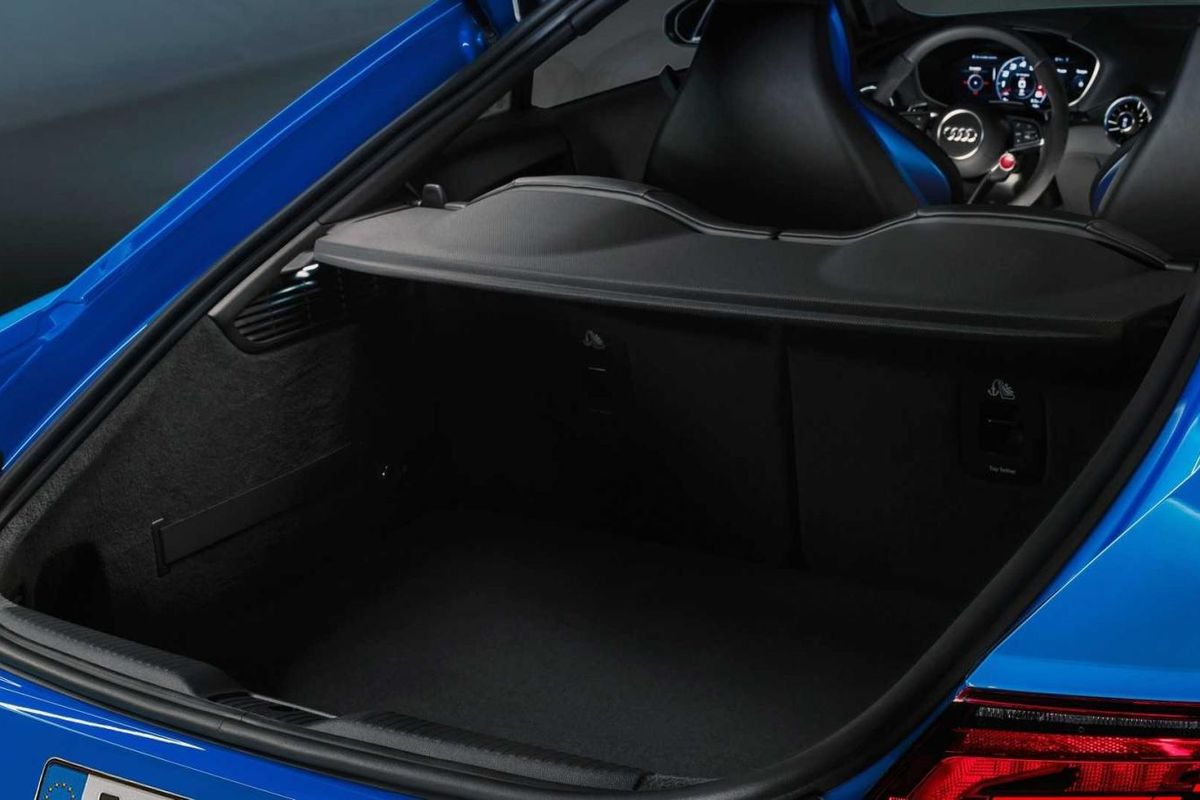
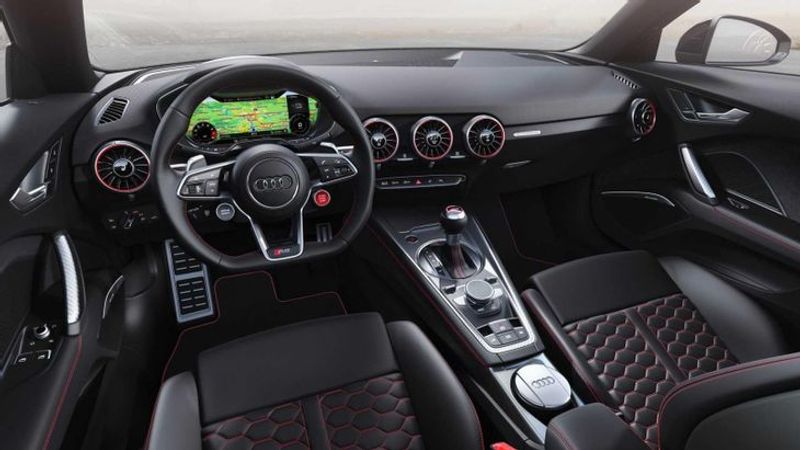
The driver-focused interior features fine RS sports seats as well as Audi's now familiar Virtual Cockpit.
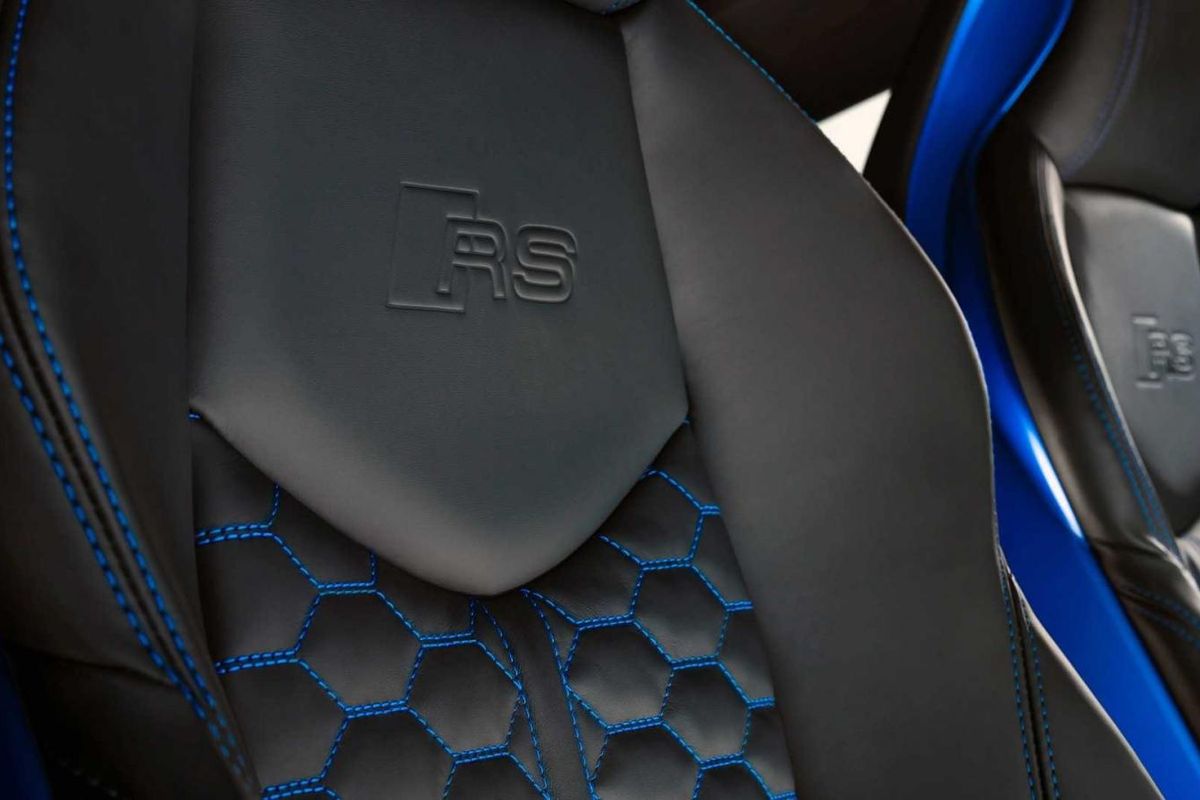
The driver is cosseted in Alcantara RS sports seats (Nappa leather optional) with the cabin focused on the driver. Audi’s 12.3-inch Virtual Cockpit takes pride of place while the multifunction steering wheel is equipped with shift paddles as well as engine start and Audi drive select buttons. In terms of infotainment, MMI navigation plus with MMI touch, voice control, free text search and WiFi capability will be on offer. The TT RS is also fitted with a 680 W Bang & Olufsen sound system.
Engine Power
The TT RS will retain its potent 2.5-litre, 5-cylinder turbocharged engine offering 294 kW and 480 Nm of torque. Equipped with quattro all-wheel drive and a 7-speed S tronic transmission, the TT RS will accelerate from zero to 100 kph in 3.7 seconds before reaching a top speed of 250 kph.
The TT RS can also be had with an optional RS sports suspension with adaptive dampers.
Kia’s all-new, 4th-generation Sorento will be arriving in South Africa next year. Our UK correspondent travelled to Amber Lakes near Windsor, England, to drive the new Kia 7-seater SUV and filed this driving impression for us.
Like so many new cars released in the 1st half of 2020, the new Sorento was officially revealed online due to the cancellation of the Geneva Show in March 2020. While now even bigger than before, it’s not the largest SUV in Kia’s global armoury – that accolade belongs to the US-only Telluride.
The Sorento has increased in size by virtue of being based on Hyundai/Kia’s all-new N3 platform.
However, look closely at this new Sorento and you’ll notice more than a hint of the Telluride in its new styling… and that’s no bad thing as the Telluride went on to win the 2020 World Car Of The Year award – the first Korean product ever to do so.
Kia doesn’t really adhere to the conventions of car manufacturing. The South Korean company wants to get places fast, so its product planning is accelerated, compressed into TheMatrix-style bullet time… cars are launched, refreshed and replaced in half the time of many manufacturers.
The Sorento first appeared in South Africa way back in 2005 with a crude ladder-framed chassis and rather bland bodywork. The 2nd-generation model, which debuted in 2010, was slicker to look at and based on the more car-like monocoque chassis that SUV buyers wanted at that time. Its 3rd-generation successor (2015) refined that recipe even further, but this 4th-iteration model really takes the Sorento forward.
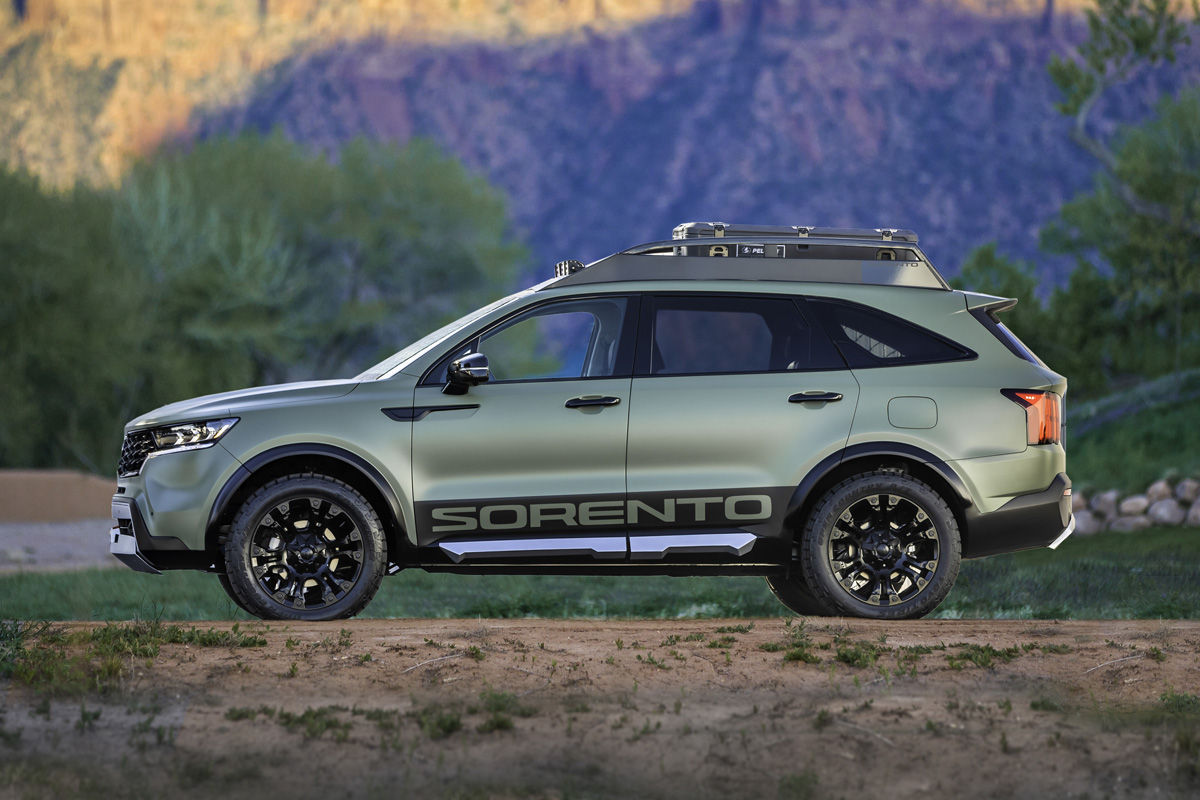
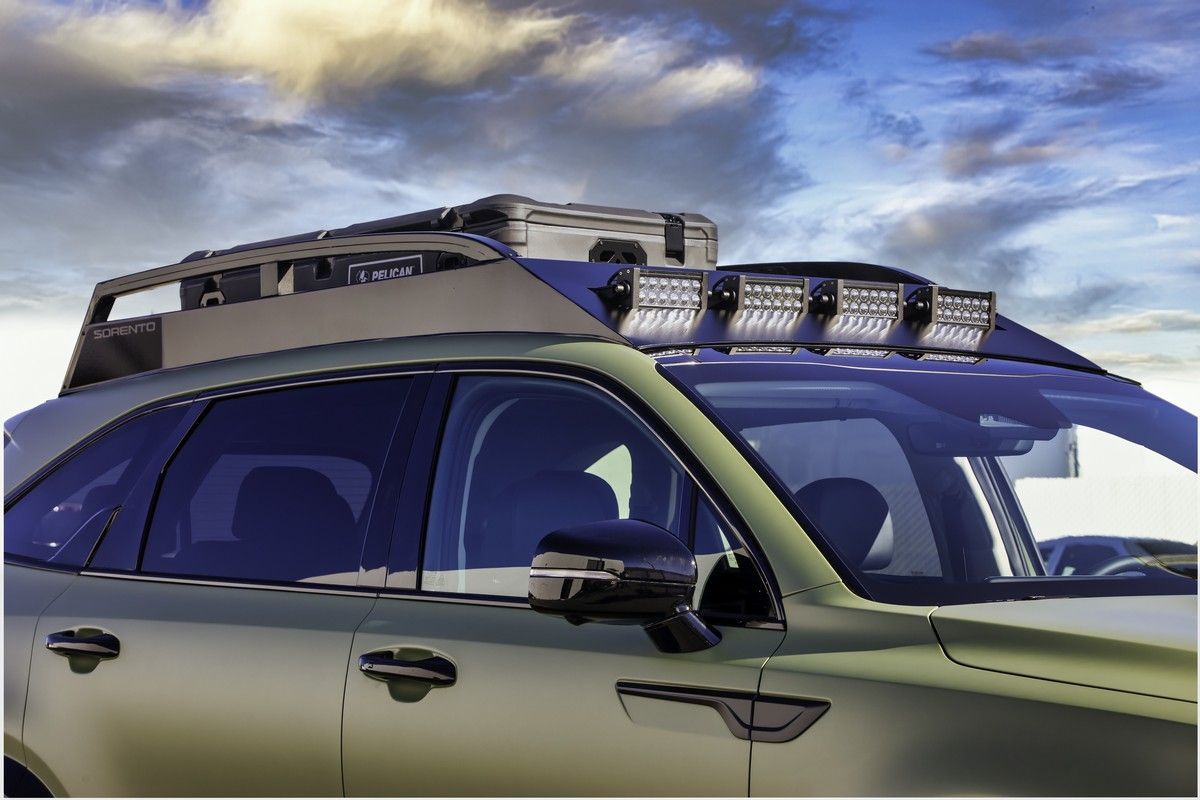
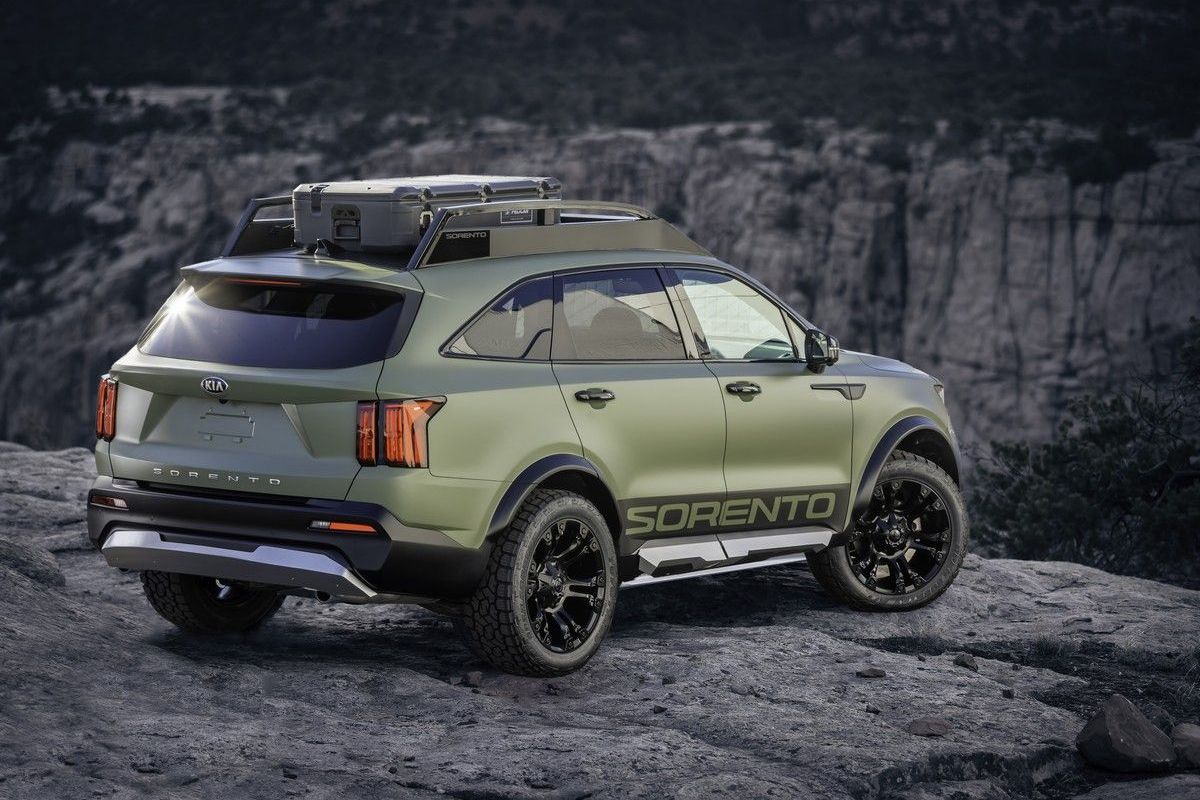
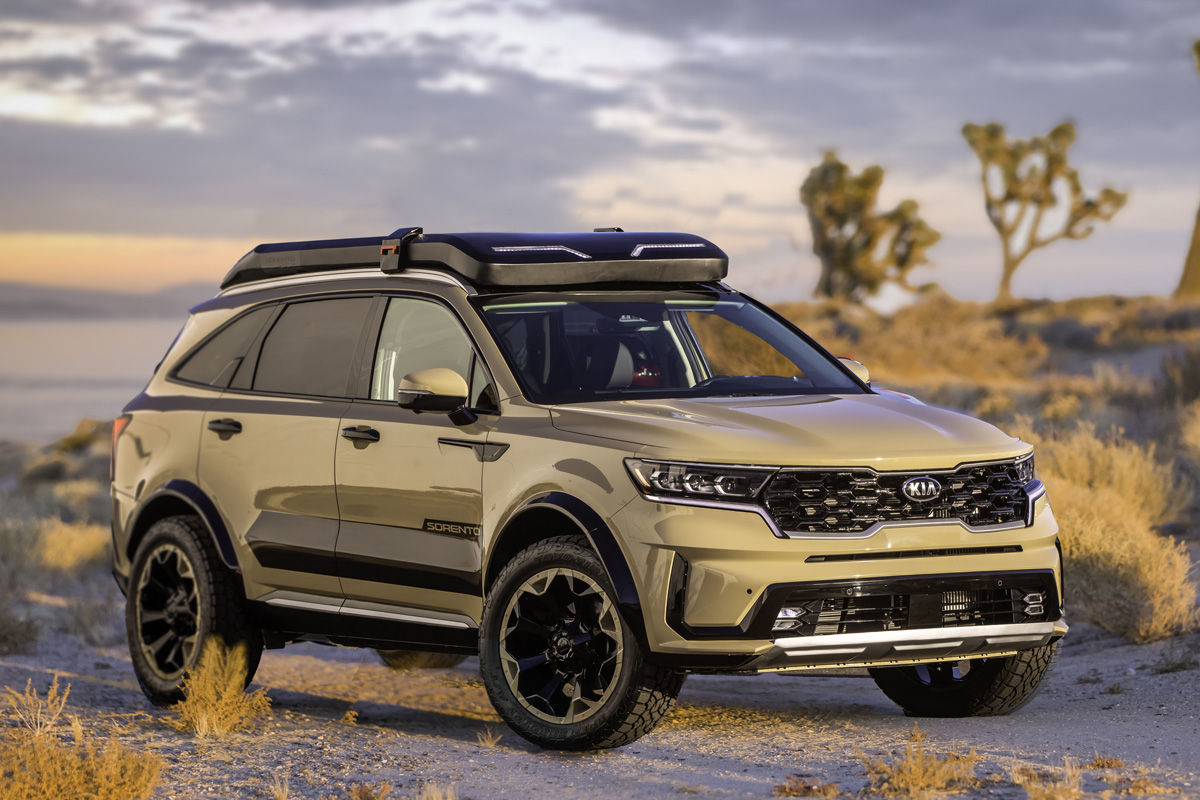
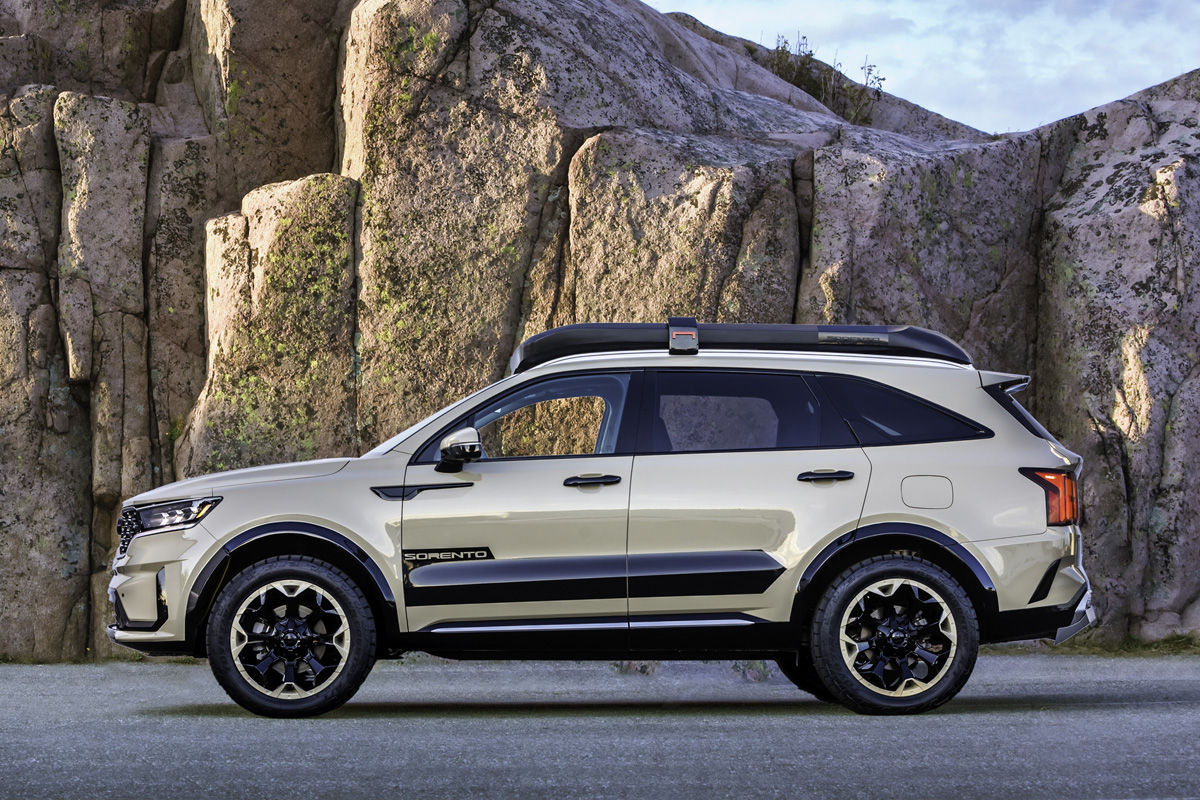
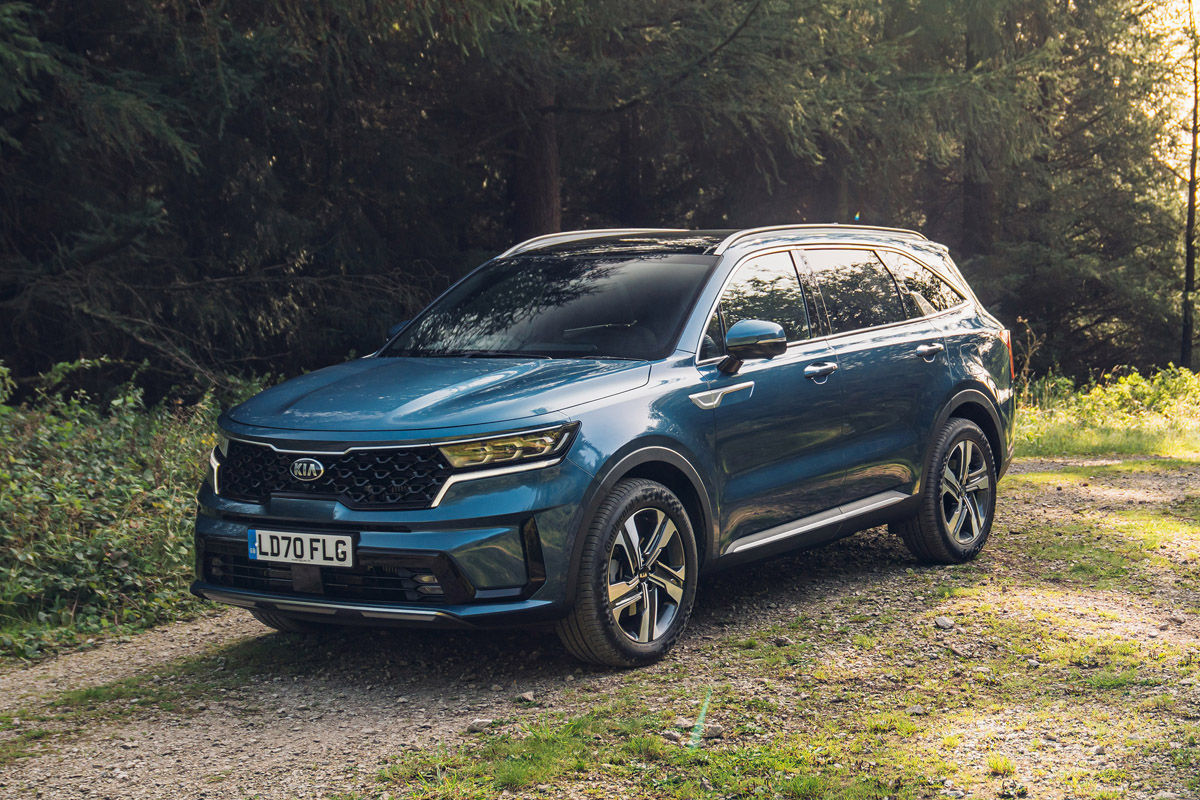
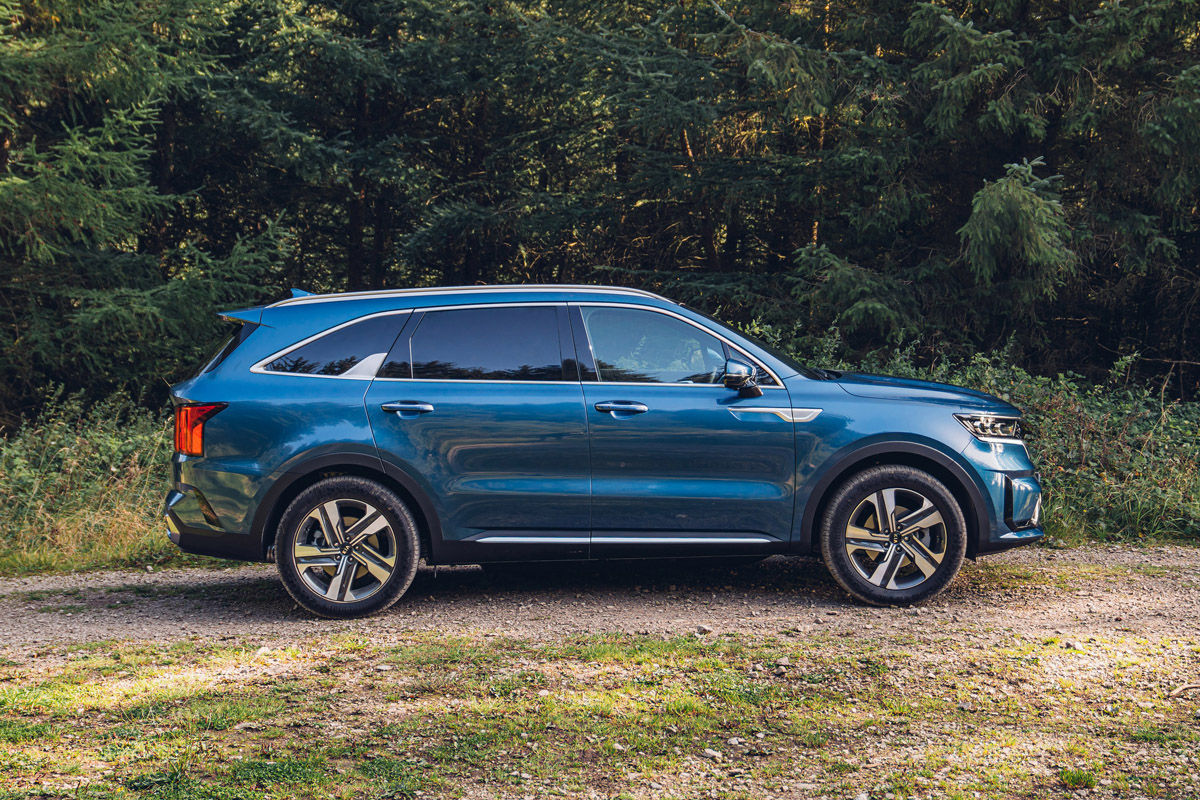
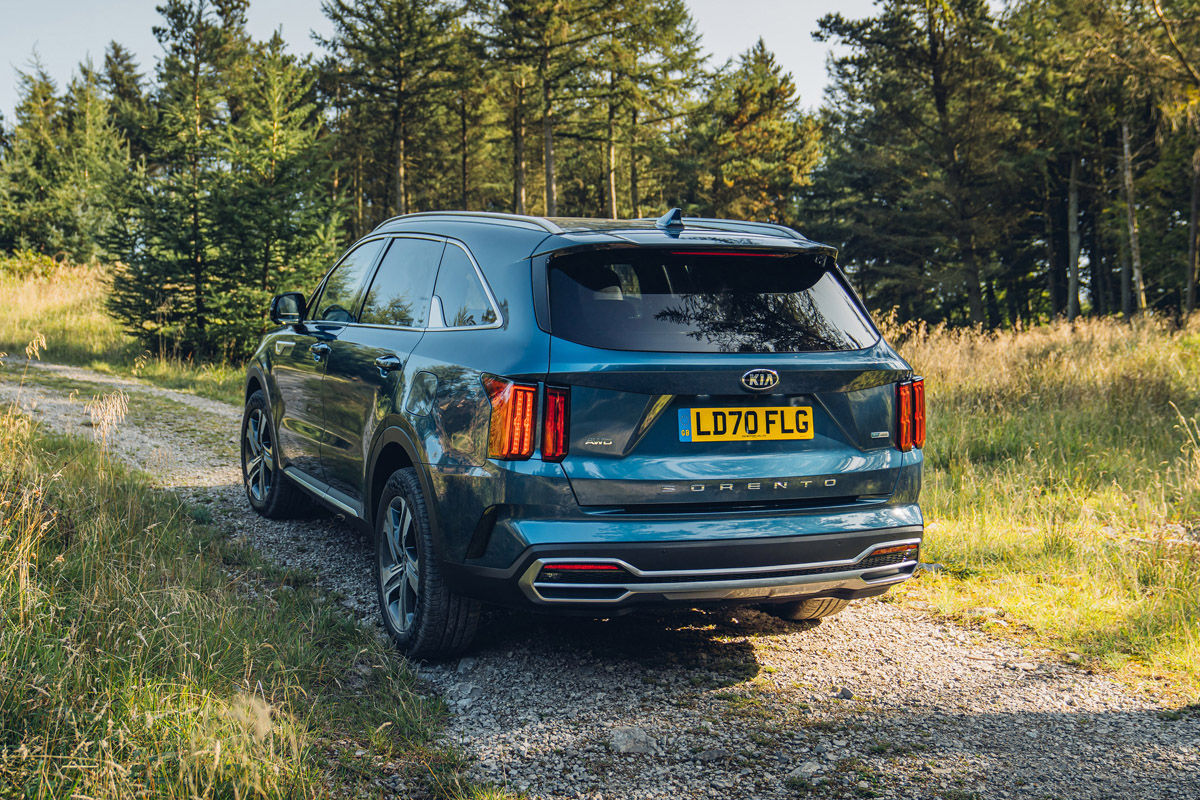
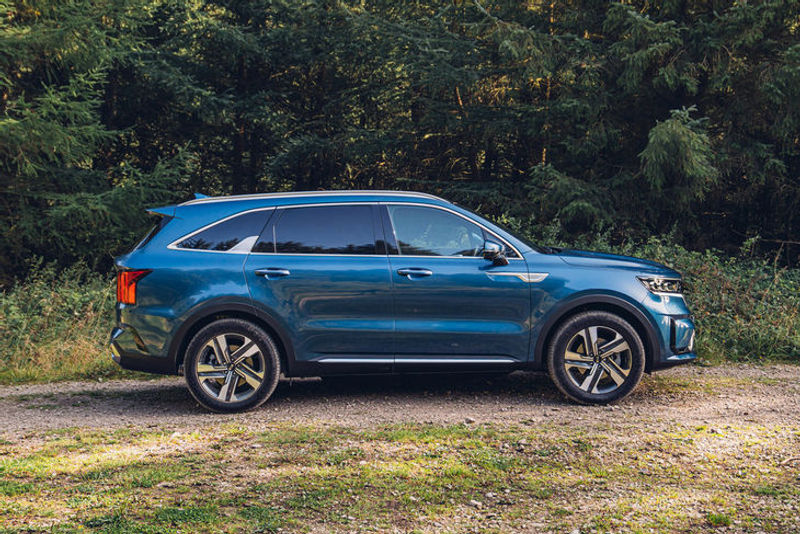
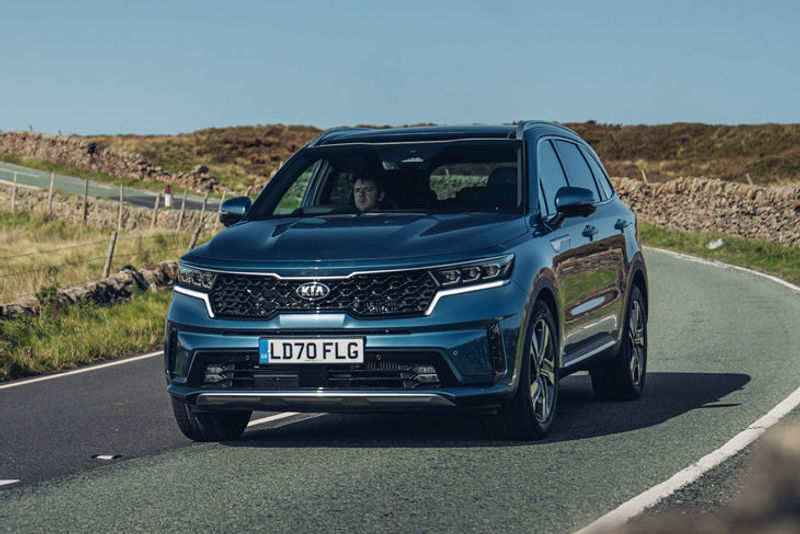
Kia purposely gave the Sorento a more distinctive profile, replete with Telluride-inspired design details.
Chiselled exterior
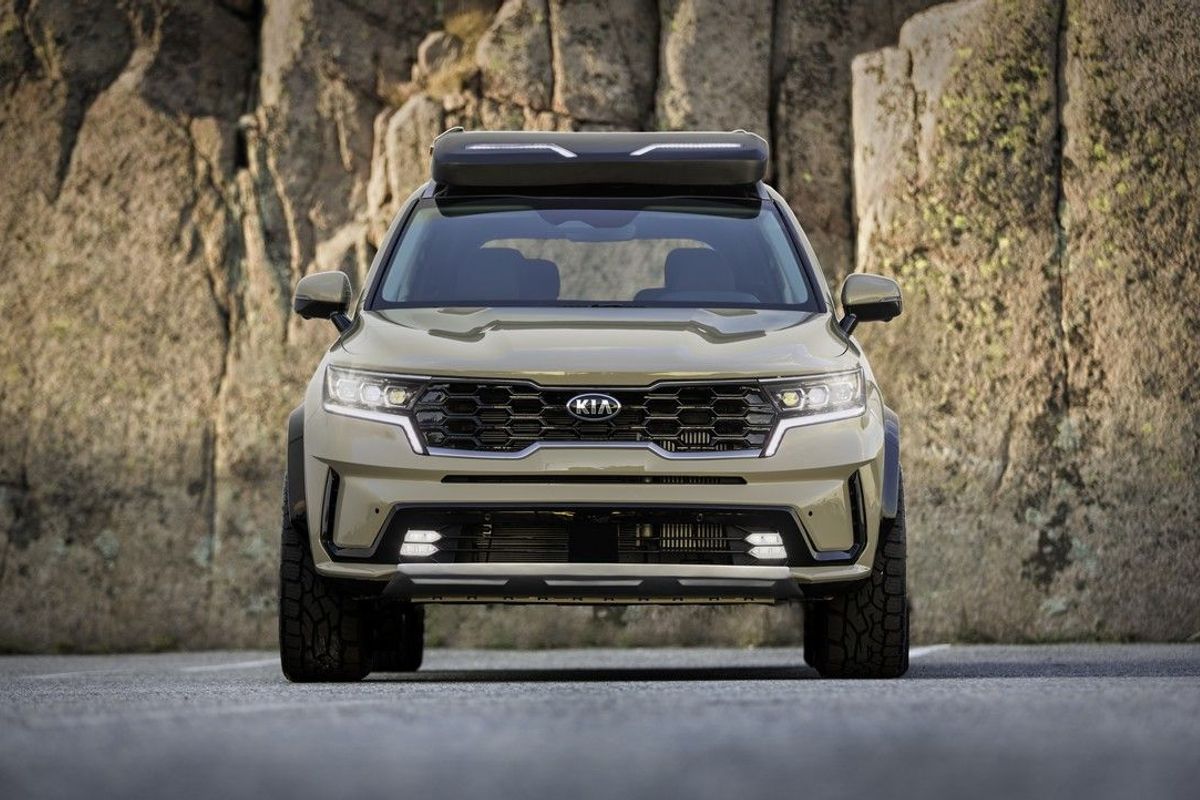
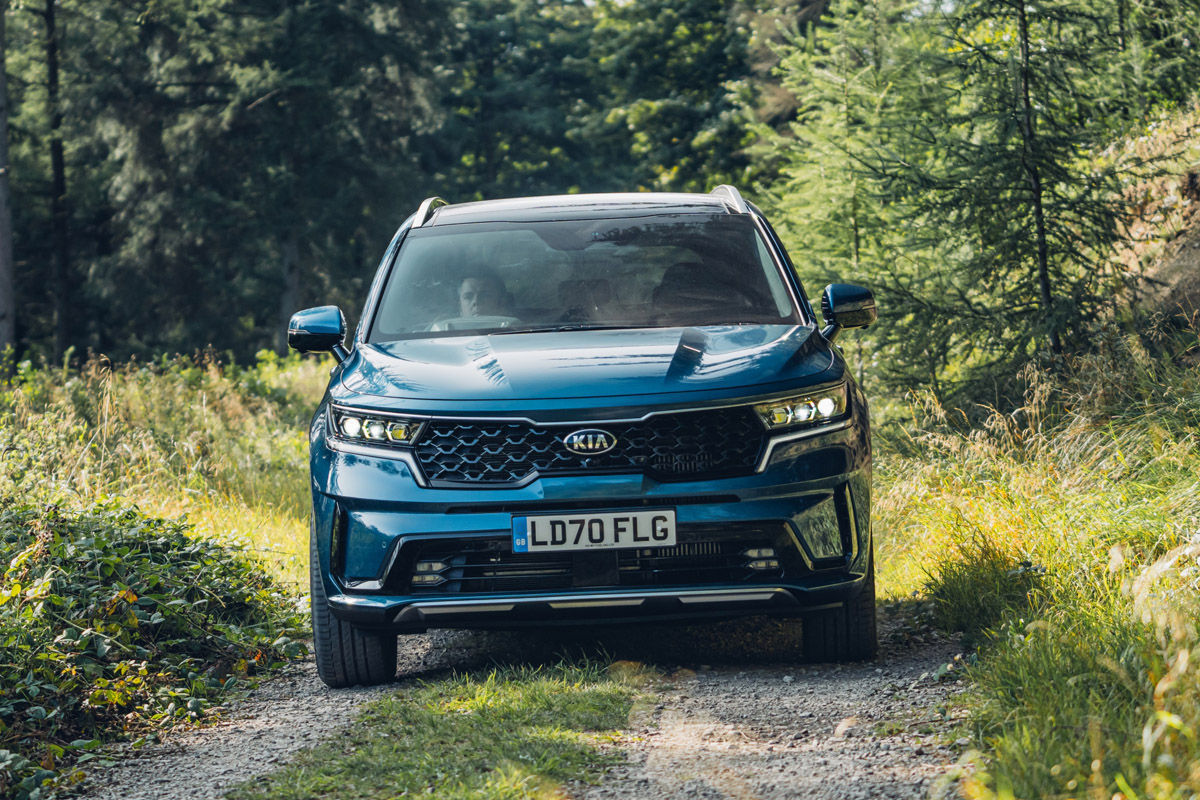
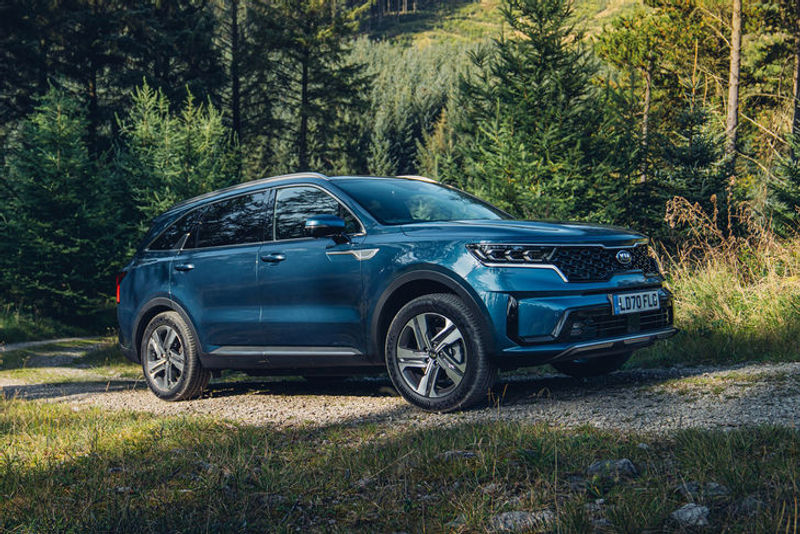
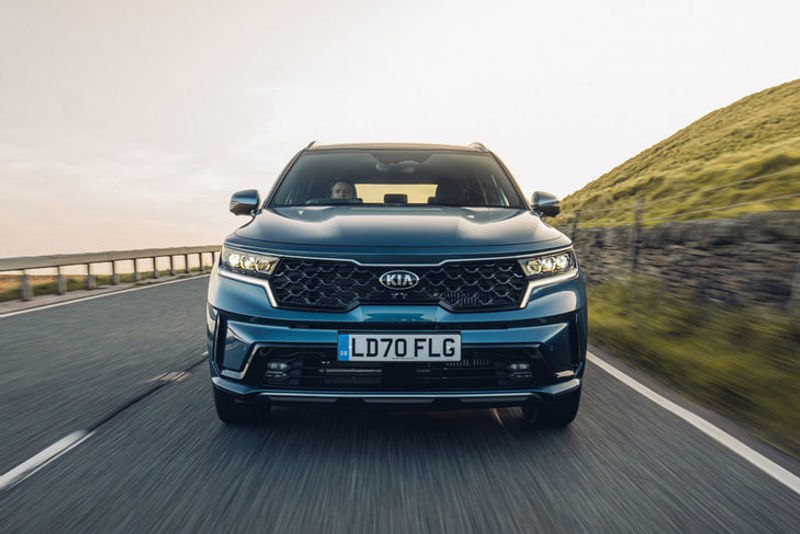
The chiselled, handsome contours of the new Sorento give the impression that it’s a larger car than before. The front of the Sorento evolves with a new interpretation of Kia’s hallmark “tiger-nose” grille, displaying a wider shape which wraps around the integrated headlamps on either side.
The headlamps feature a new “tiger eyeliner” LED daytime running lights, which afford an edgy, more assertive appearance, complemented by a wide, rectangular lower air-intake. A sharp bumper lip is also capped with a skid plate, which further enhances the newcomer’s robust aesthetic.
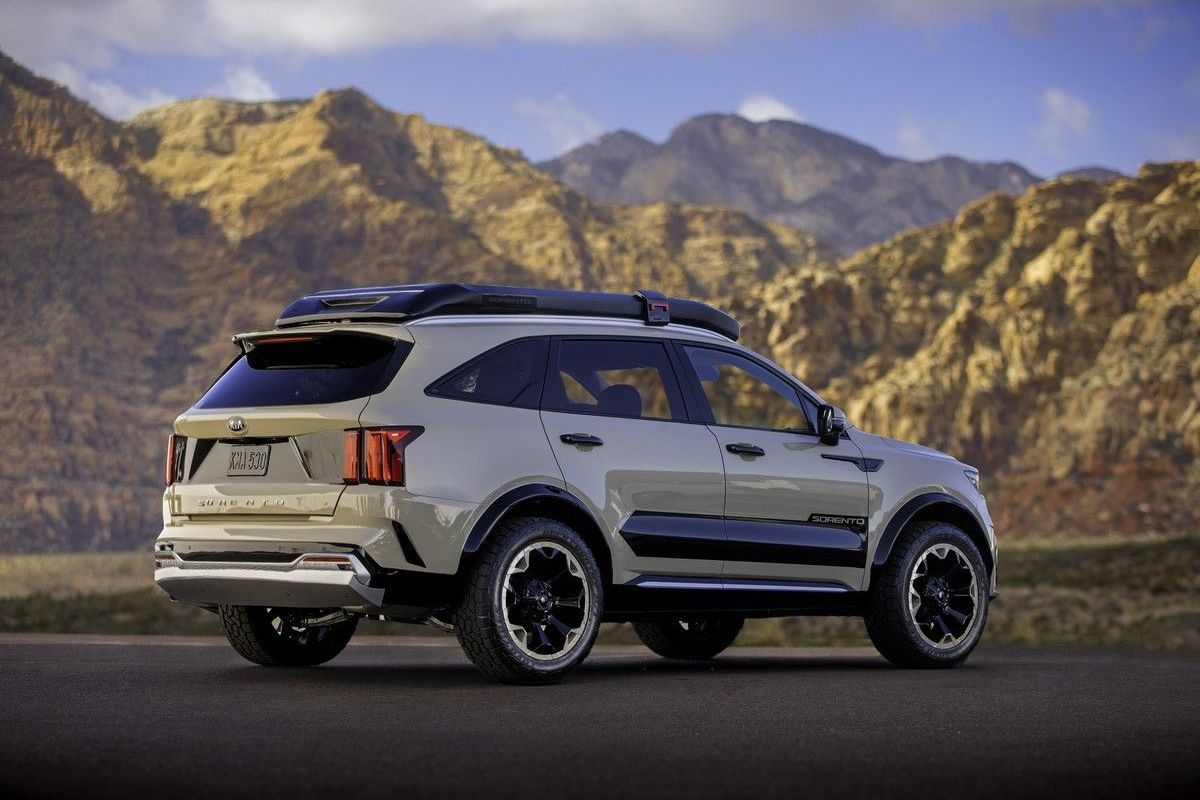
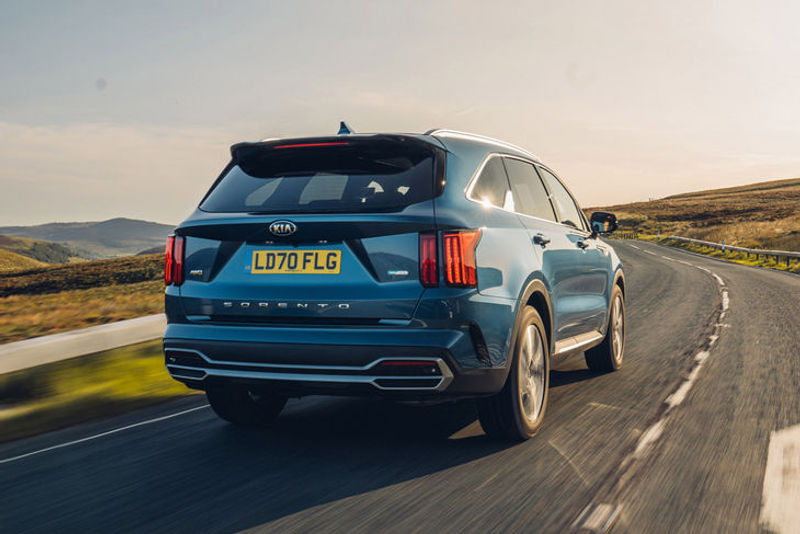
In an era of organically-shaped and elongated wraparound tail-light clusters, the new Sorento bucks the trend.
The new car rides on Hyundai/Kia’s all-new N3 platform and is 10 mm longer and 10 mm wider than its predecessor. Significantly – at least for off-road users – Kia has added a further 24 mm of ground clearance, but the biggest dimensional change is the 35 mm added to the wheelbase, to benefit passenger space in the front 2 rows.
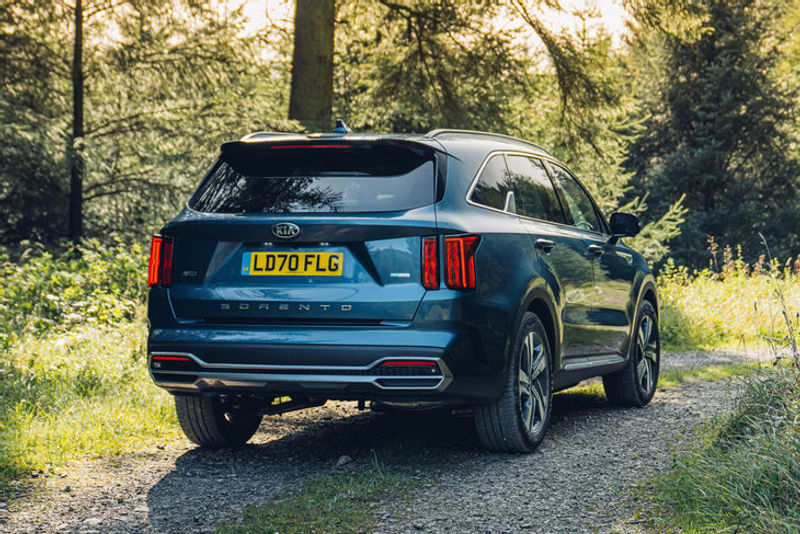
At the rear (and inspired by the Telluride), the Sorento adopts new vertical tail lamps which wrap around the side of the body. The newcomer follows other recent global Kia models with the model name lettered centrally across the tailgate. A subtle integrated spoiler also conceals the rear wiper, resulting in a less fussy design and enhancing the driver’s view out of the back.
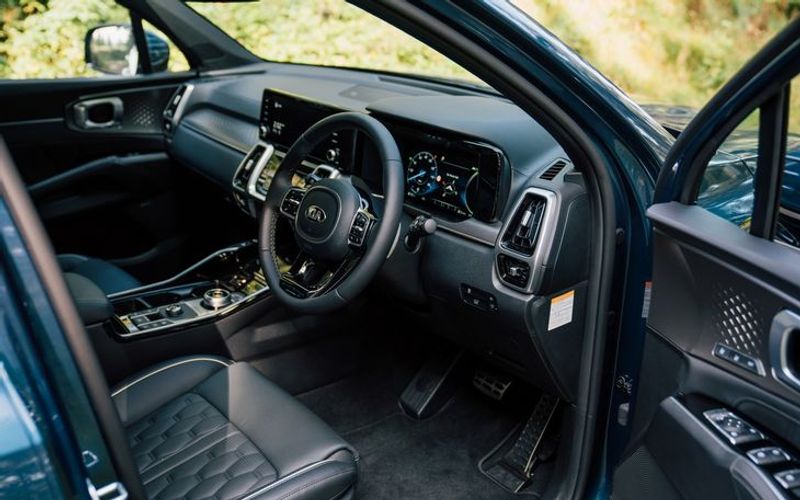
As expected, the new-generation Sorento’s interior is more upmarket than before, with a plethora of smart metallic-look finishes.
Premium interior
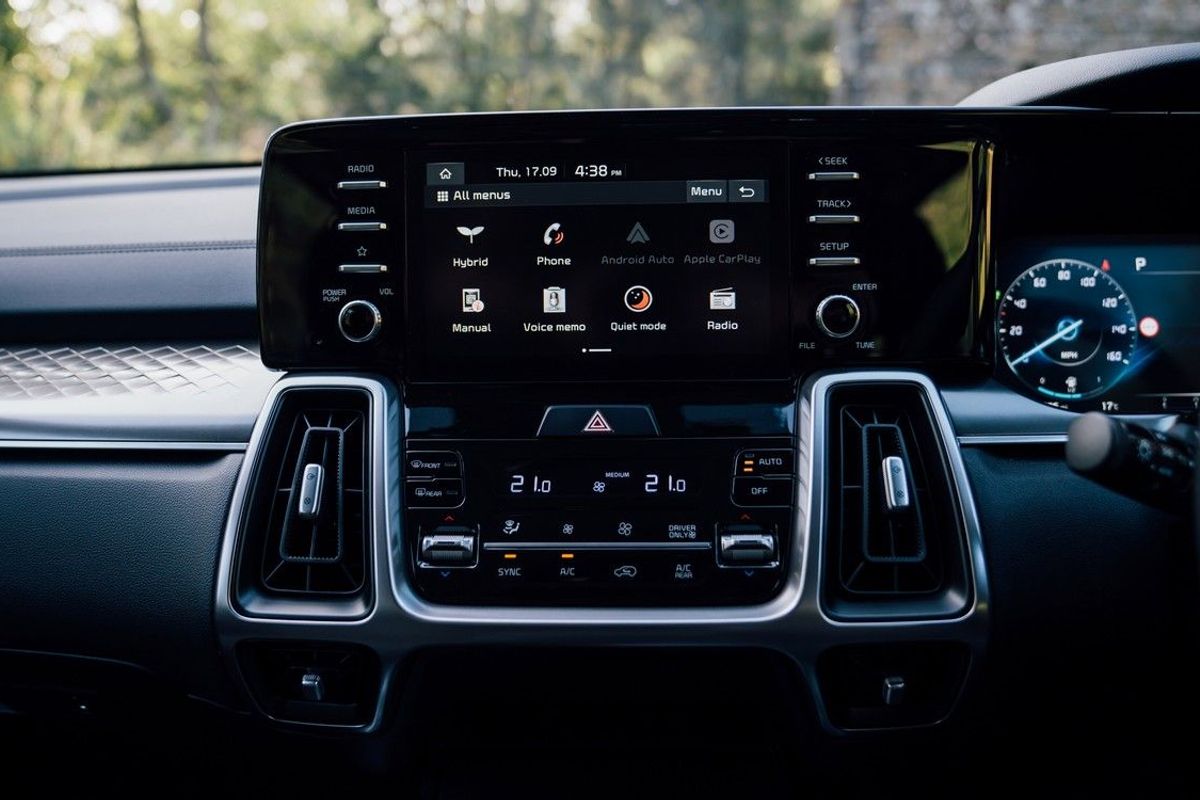
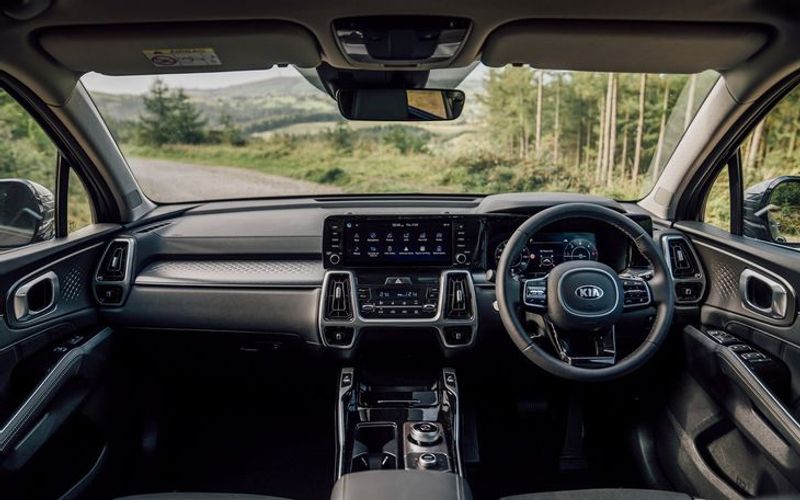
As soon as you climb into the new Sorento, you’ll notice the newcomer represents a huge leap over the last generation in terms of design, material choice and tech. It’s modern, with good use of brightly coloured and textured trim on the dash. The layout of the fascia is familiar from the Sorento’s smaller sibling, the Seltos.
The controls are well organised, there’s plenty of soft-touch plastics and build quality seemed to be good, too.
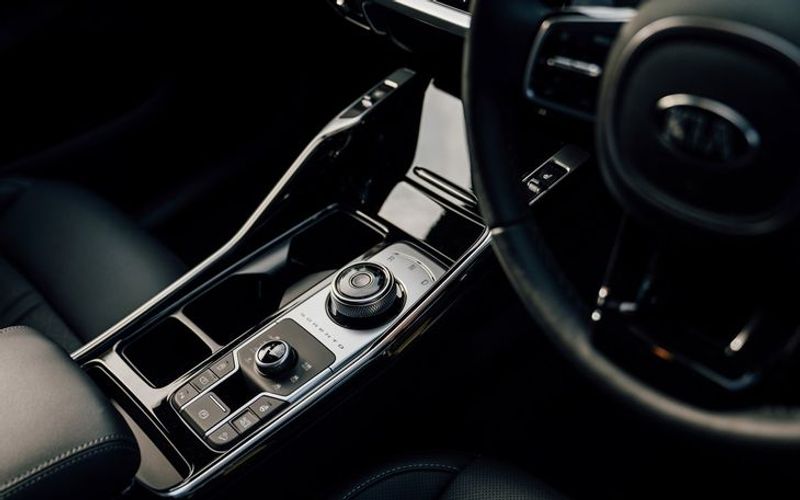
The lower centre console consists of two rotary controls: one for the automatic gearbox (all UK models are automatic, it should be the same in South Africa) and one for the drive mode selector, with buttons for the electronic handbrake, auto hold and other driving functions.
Like in so many premium models, the Kia’s digital instrument cluster and large infotainment touchscreen dominate the fascia.
It’s easy to get into a comfortable driving position with plenty of seat adjustment, plenty of space and large comfortable furniture. Entry-level derivatives have manual adjustment and do without lumbar support, so the next trim grade might be in order if you cover large distances.
Trim grades
No details were forthcoming from Kia South Africa regarding the trim grades for its new Sorento, but there would be little reason to depart from the simple EX and LX of the current line-up.
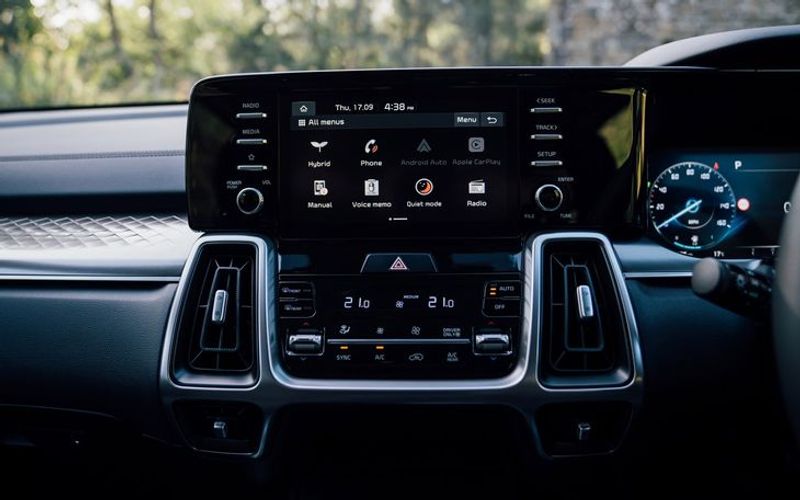
In the UK, entry-level derivatives come with an 8.0-inch infotainment touchscreen, but the larger 10.25-inch version on higher-grade versions come with integral satnav. Android Auto and Apple CarPlay compatibility is standard and the menus aren’t too complicated to navigate your way through them, but there’s nowhere to place your hand, so it can be a little tricky to use on the move.
The touchscreen infotainment system is still complemented by shortcut buttons and adjustment knobs, which is a good thing.
Touch-sensitive buttons on the side are easy to miss but at least you have rotary controls for the volume and for scrolling up and down the menus.
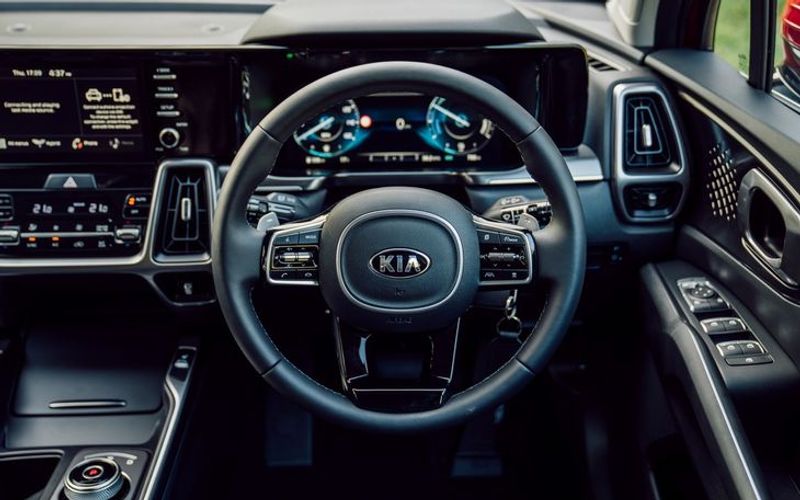
Anyone who’s been in a latter-day Kia will be familiar with the layout of the steering wheel buttons, which are easy to get used to. The climate control cluster isn’t too fussy either, even if the less-frequently used touch buttons are a bit fiddly.
The 12.3-inch digital cockpit screen is clear, sharp and has great contrast, but there’s not a great deal of customisation or a full map setting for the nav. Depending on trim grade, you might need to do a bit of digging to find the well-hidden sub-menus for the driver assistance systems, too.
Kia effectively opened up extra oddment space in the centre console by switching to a Jaguar-like rotary transmission selector.
There is plenty of info available on the trip computer, however, including energy flow, trip computer, a digital speedometer, driving style analysis, attention level, traffic sign recognition, tyre pressures monitor, selected drive mode.
Top-spec UK derivatives are offered with a head-up display and a large panoramic sunroof, the latter of which brightens up the spacious cabin. It also had an innovative Blind-Spot View Monitor, which displays a high-resolution video feed into the rondels of the driver’s instrument cluster when the driver uses the turn indicators. It is particularly handy at T-junctions to spot errant cyclists, for example.
The increase in the Sorento’s wheelbase as improved 2nd-row legroom in particular.
Improved practicality
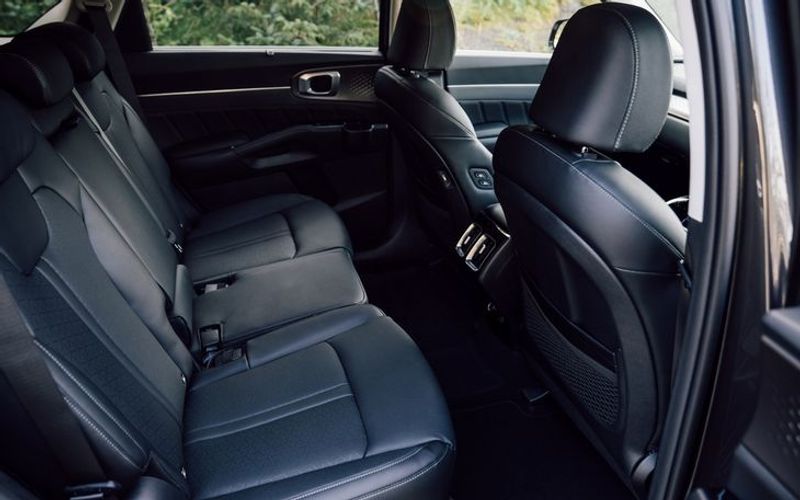
I have already mentioned the Sorento’s 35-mm increase in wheelbase, and this has improved practicality in what was already a large vehicle. In fact, the previous Sorento was at the top of its class for practicality with its flexible seating and load-lugging ability. There is generous space inside, 7 seats come as standard (including the SA-bound model) and you can even fit a couple of adults in the 3rd row for quick trips.
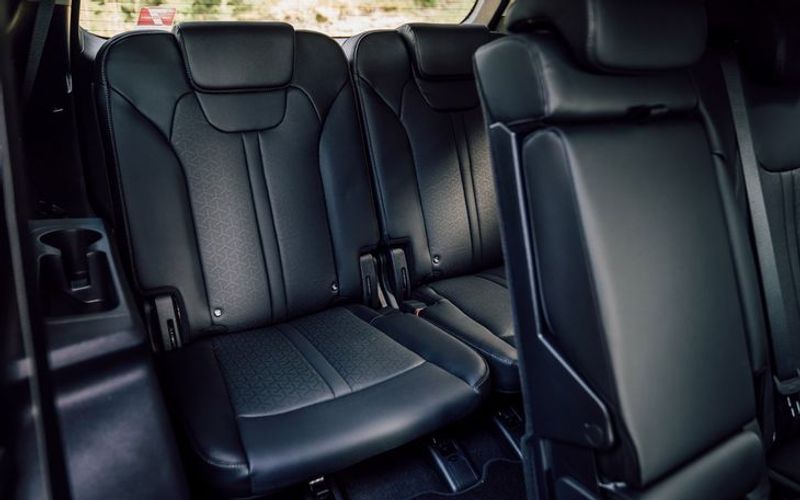
The first 2 rows in the Sorento offer plentiful headroom and legroom for adults, so there shouldn’t be any complaints, even on long trips. Headroom for passengers in the third row has been improved too, and sliding the 2nd row slightly forward even provides decent knee room, which is a rarity.
The 3rd-row seats aren’t just for seating young children, average-sized adults could squeeze in there for shorter trips.
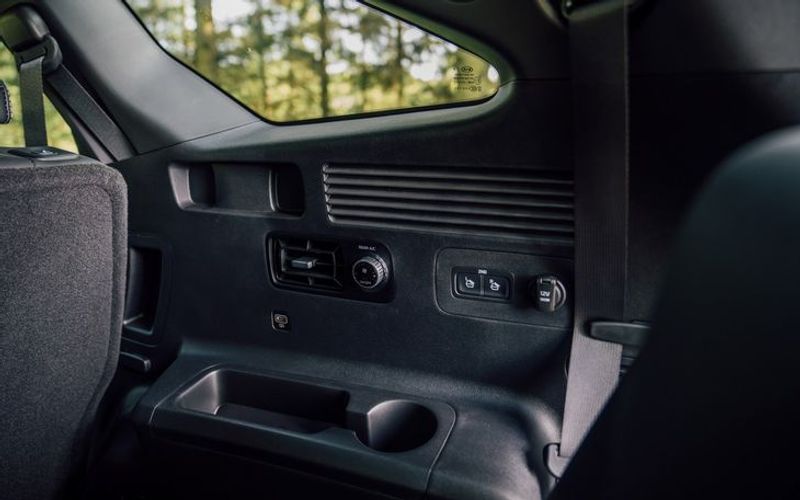
Every passenger also gets their own cup holder and USB charging port to keep them and their devices topped up. Even hybrid versions have their battery pack and electric motor placed beneath the floor, where they have minimal impact on passenger or luggage space. When the plug-in hybrid arrives, it will also be offered as a seven-seater.
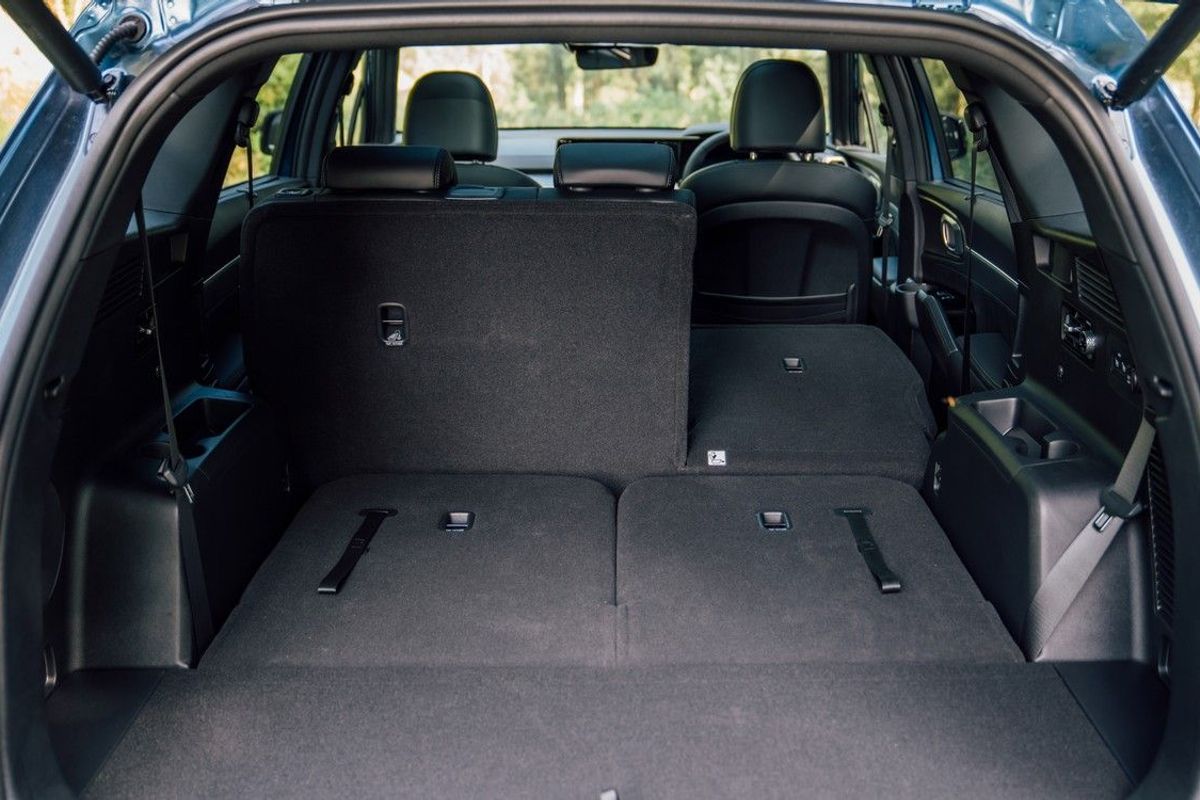
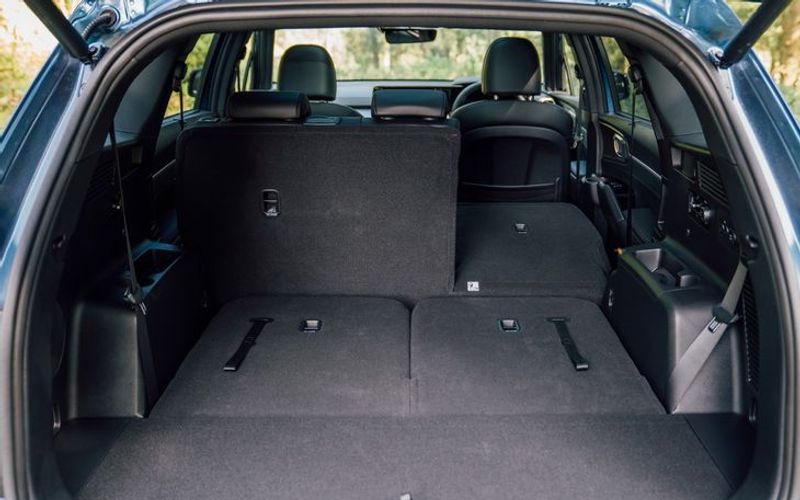
There are 616 litres of luggage space when the rearmost row of seats is stowed (606 litres for the self-charging hybrid), extending to 2 011 litres with rows 2 and 3 folded (1 996 for the hybrid). For comparison, the Land Rover Discovery Sport has a 754-litre boot, extending to 1 794 litres.
With more than 600 litres of luggage space available (with the 3rd-row seats folded flat), the Sorento is admirably practical.
Good for towing, too
Kia is justifiably proud of the Sorento’s towing abilities – it has a loyal following here amongst UK caravanning community – and even the hybrid version can pull a 1 650-kg braked trailer. The diesel is even more capable, towing up to 2 500 kg (an increase of 500 kg) and both can accept a tow ball weight of 100 kg. Granted, the braked trailer rating is not quite as much as that of a bakkie-based Adventure SUV.
Powerplants and drivetrains
2.2-litre diesel
Dismissing the 2.2-litre diesel as a carry-over from the old Sorento would be entirely understandable. However, the only similarity between the two is the displacement. The new Smartstream oil-burner has been thoroughly redeveloped, with an aluminium cylinder block and other new parts that reduce its weight and improve performance. It now has 151 kW and 440 Nm of pulling power, so despite the Sorento’s hefty kerb weight of 1 954 kg, it achieves a respectable 9.6 seconds for the 0-100 kph sprint.
This 2.2-litre turbodiesel derivative is reasonably economical; it is claimed to consume 6.7 L/100 km on a combined cycle.
As standard, the diesel is paired with four-wheel drive and a new 8-speed dual-clutch automatic gearbox that’s now a ‘wet’ clutch design for smoother shifts. It feels like a good match for the Sorento and there’s almost no diesel clatter when starting the engine or under acceleration.
1.6-litre self-charging hybrid
Big news for the new Sorento is the introduction of a self-charging hybrid powerplant. It comprises of a Smartstream 1.6-litre turbocharged petrol engine and a 45-kW electric motor, giving it a combined total of 171 kW. It’s mated to a 6-speed automatic gearbox driving both axles and 0-100 kph takes 8.9 seconds, making the hybrid slightly quicker than the diesel at full acceleration.
The 1.6-litre turbopetrol-electric hybrid version feels spritelier than one might expect.
From a standstill, the electric motor makes the Sorento feel quite eager, despite its 2 006-kg kerb weight. It certainly feels quick enough for a big SUV and should satisfy buyers looking for a diesel alternative. However, the 1.6-litre petrol engine can sound rather strained if you ask for lots of acceleration and it reaches the top of its rev range.
On standard 17-inch wheels, the hybrid, too, is almost as economical as the diesel, returning a consumption figure of 6.9 L/100 km on a combined cycle, emitting 158g/km of CO2 in the process.
A plug-in petrol hybrid is also expected to join the UK range early next year, and while full details aren’t yet known, it’s likely to have a more powerful electric motor and larger battery pack, giving it around 170 kW and an electric-only range of up around 60 km. It is not known at this time whether the PHEV will reach our shores here in South Africa.
On the road
At its UK media launch near Windsor, England, I drove both the turbodiesel and the petrol hybrid versions of the new Sorento. Regardless of powerplant chosen, the newcomer is super smooth and quiet to drive.
The hybrid particularly feels good to drive around town. The initial spurt of electric power is handy coming out of junctions. As intimated, it does sound a bit noisy when you rev hard, though. And while you can pull a small caravan with the hybrid, if you regularly pull something bigger or do many motorway kilometres, you’ll need to go with the diesel.
Road and wind noise is minimal and even with a panoramic roof, the cabin avoids sounding like an echo chamber.
Kia has clearly devoted much effort to improving the on-road refinement of its 4th-generation adventure SUV.
The turbodiesel engine is hushed and smooth, sending very little vibration into the cabin – with just a hint of turbo whistle when worked hard. It can sound gruff at higher revs, but it otherwise remains surprisingly – and pleasantly – hushed.
On a twisty road traversed with a dollop of enthusiasm, the Sorento handles itself with refined maturity, with much less body roll than you might expect given its bulk. You won’t be setting lap times in the Sorento, but then why would you want to in a 7-seater SUV?
Safety
The new Sorento has yet to be put through the rigorous crash-testing regime, but 2 previous Sorento models from 2009 and 2015 were awarded al 5-star rating by Euro NCAP. It would be reasonable to expect the latest version to manage the same when it comes under scrutiny, despite the tests becoming more stringent.
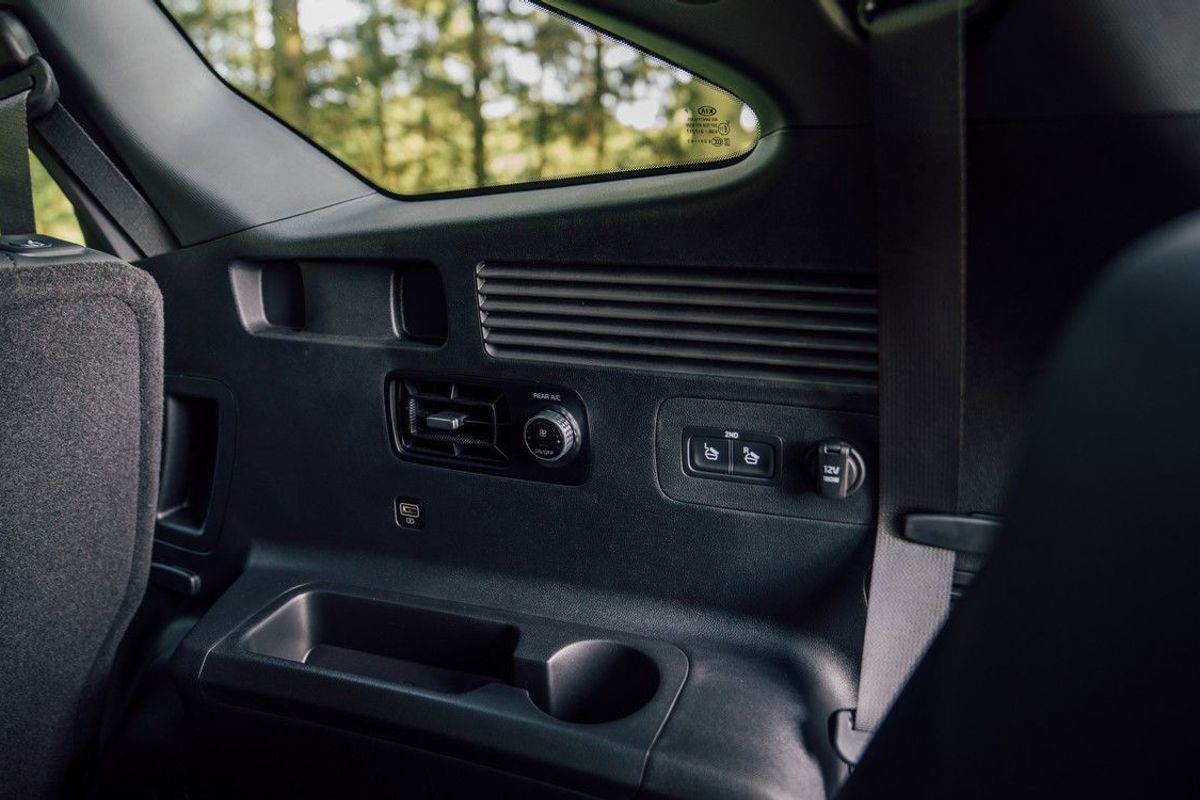
In top-spec derivatives, even 3rd-seat occupants are afforded individual ventilation controls and USB C charging ports.
The new Sorento is fitted with a raft of safety features, allowing it to detect and automatically brake if a potential collision with a pedestrian, cyclist or vehicle is anticipated. It can also scan for moving traffic as you go to pull out of a junction, and keep an eye on traffic as you cruise along the motorway, alerting the driver of vehicles in their blind-spot.
Summary
The 2020 Kia Sorento is an eminently practical Adventure SUV that is smart, competent, offers plenty of space, and comes with the latest tech and safety kit available, with the prospect of affordable running costs – whichever powertrain you choose.
As a practical family SUV, the 2020 Sorento certainly ticks a whole host of important boxes and should be fitting for those who simply need a practical vehicle with flexible space for cargo and passengers and with enough grunt to tow the family caravan or boat for those weekend away.
The most privileged of scholars or hotel guests are accustomed to being transported by the stateliest of vans: Mercedes-Benz’s V-Class.
These rear-wheel-drive vans have a reputation for luxury and spaciousness, that remains generally unrivalled. But for the world’s oldest car company, there is always room for improvement.
Although the V-Class was recently updated, with a slightly new appearance, better engines and Mercedes-Benz’s nine-speed automatic transmission, the best is yet to come.
To ensure that V-Class remains the premium van offering, Mercedes-Benz gave its engineers a directive to improve ride quality. The fundamental design of V-Class, with its huge wheelbase, delivers an excellent ride quality platform, but Mercedes-Benz has learned that conventional dampers and coil springs, can only do so much to smooth over the bumps.
In the brand’s luxury SUVs, limousines and coupes, the lesson has been clear: nothing delivers superior ride quality, quite like air-suspension. Mercedes-Benz has now added its Airmatic suspension feature to the V-Class, promising ride quality that VW will be unable to match, with its latest T6.1 range.
The Airmatic system is adaptive and active. It also reacts independently at each wheel corner, giving the V-Class outstanding balance and reduced body roll when cornering.
Beyond the obvious benefits to ride quality and stability, during emergency braking or high-speed cornering, there are also notable efficiency gains, with Airmatic. At speeds over 110 kph, the system lowers V-Class by 10 mm, to reduce its overall frontal area and coefficient of drag, saving a bit of fuel.
If you happen upon a particularly harsh road or need to edge up a kerb, or steeply banked driveway, the V-Class’s Airmatic can initiate a 30 mm lift. This effectively gives the huge Mercedes-Benz van a better straddle height and prevents scraping of the sills.
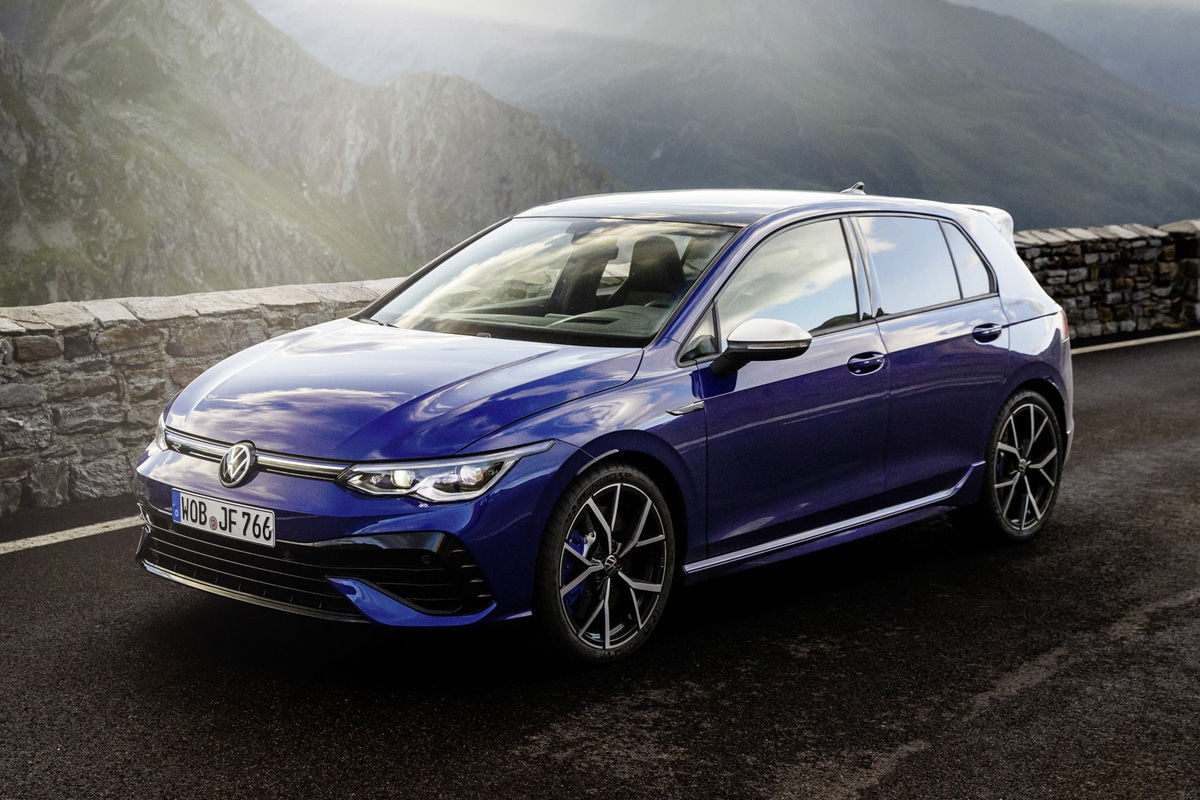
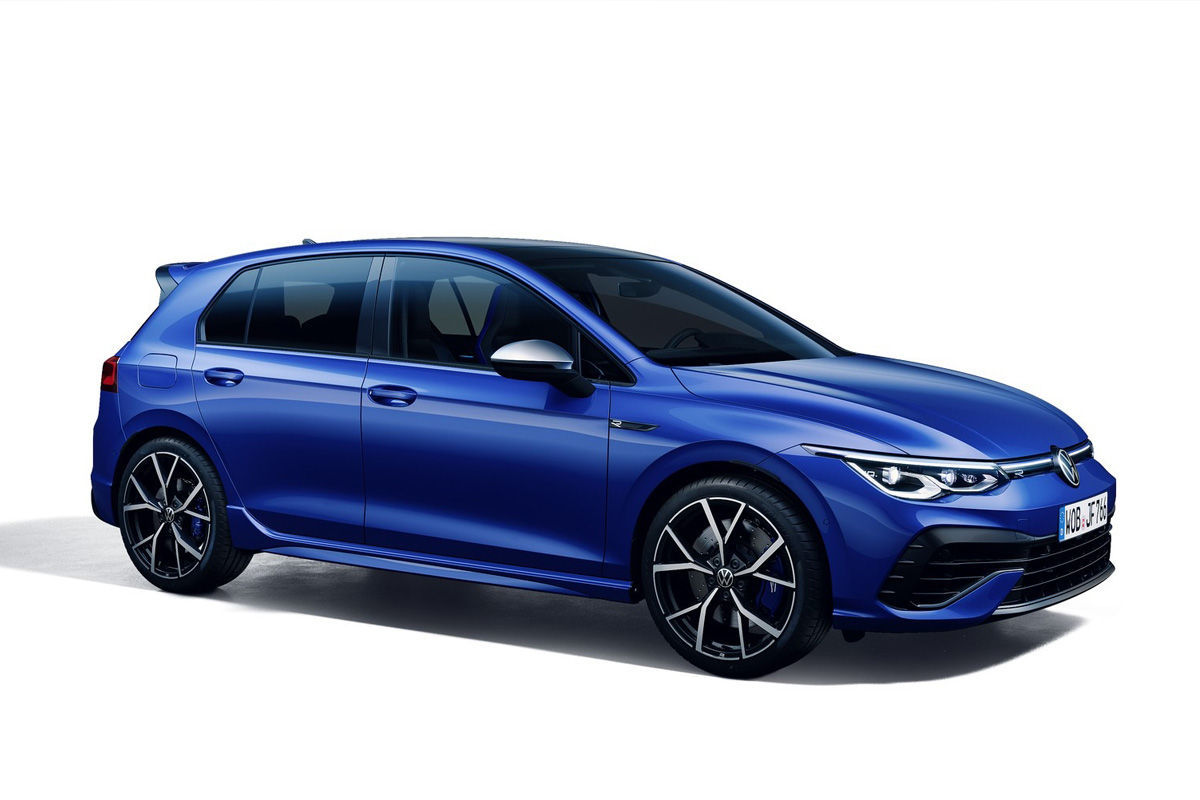
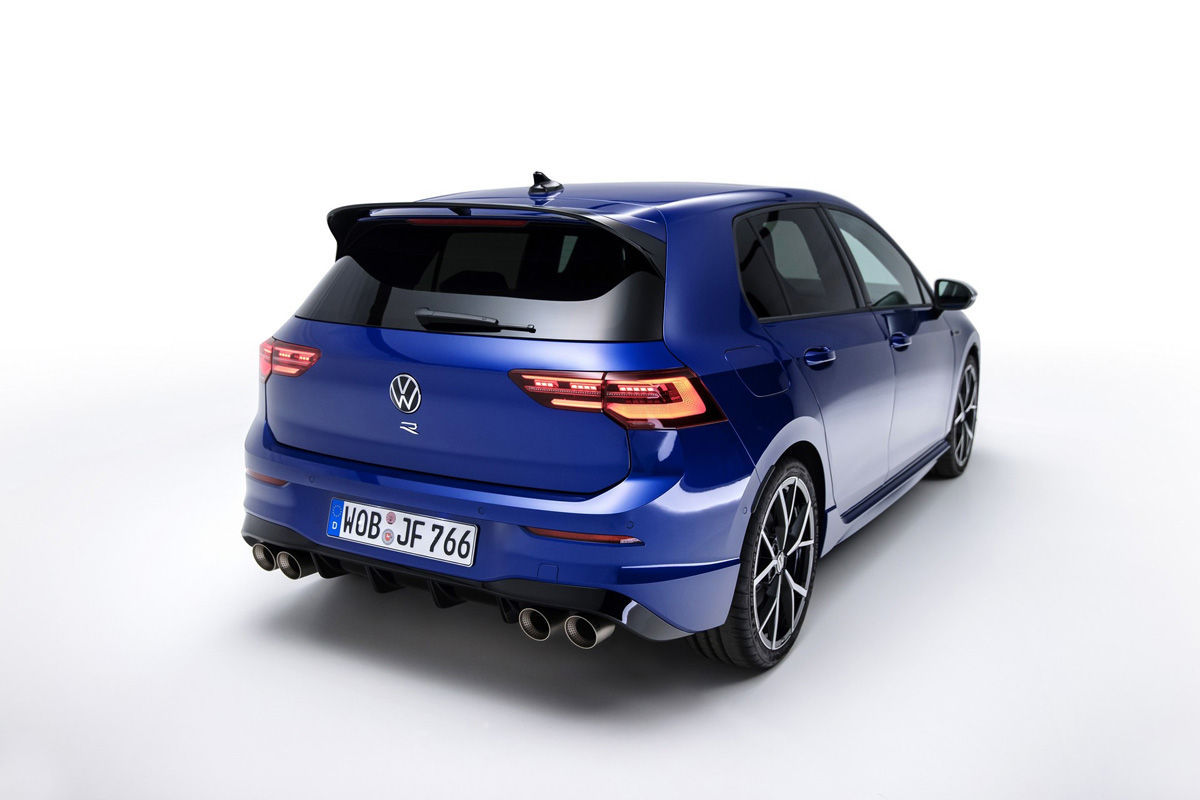
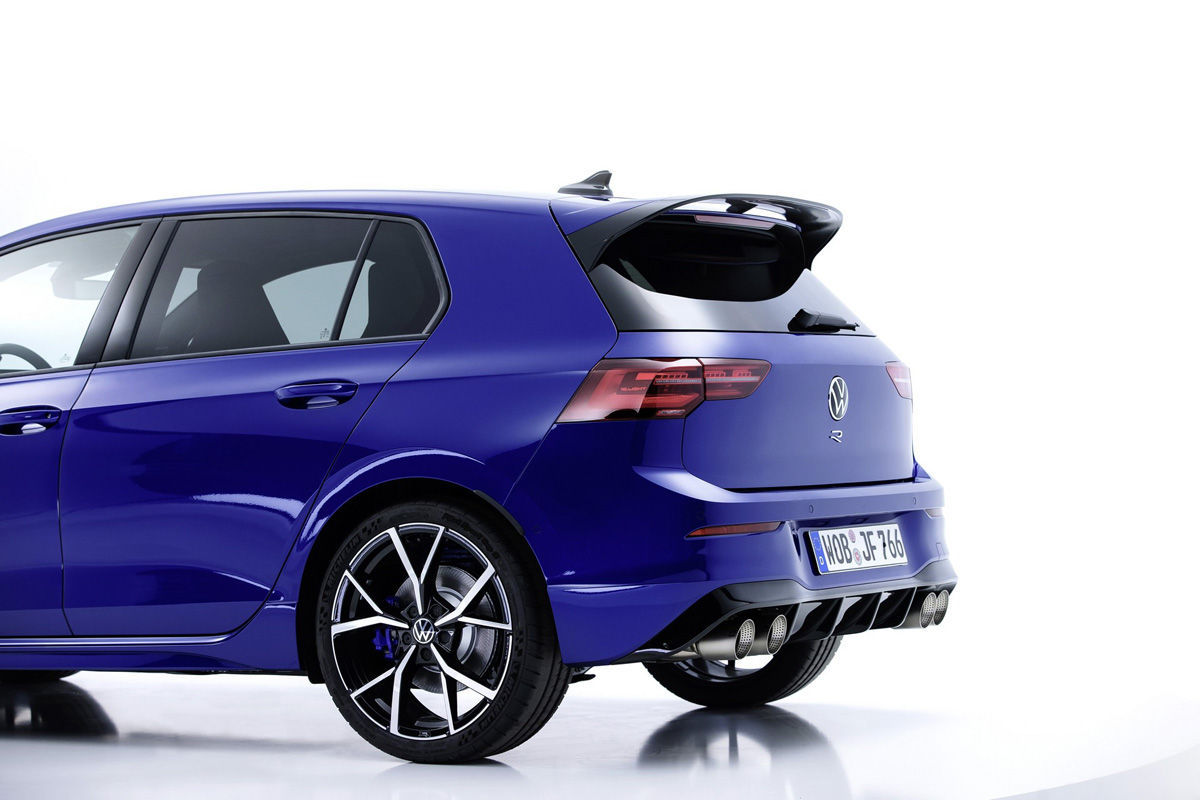
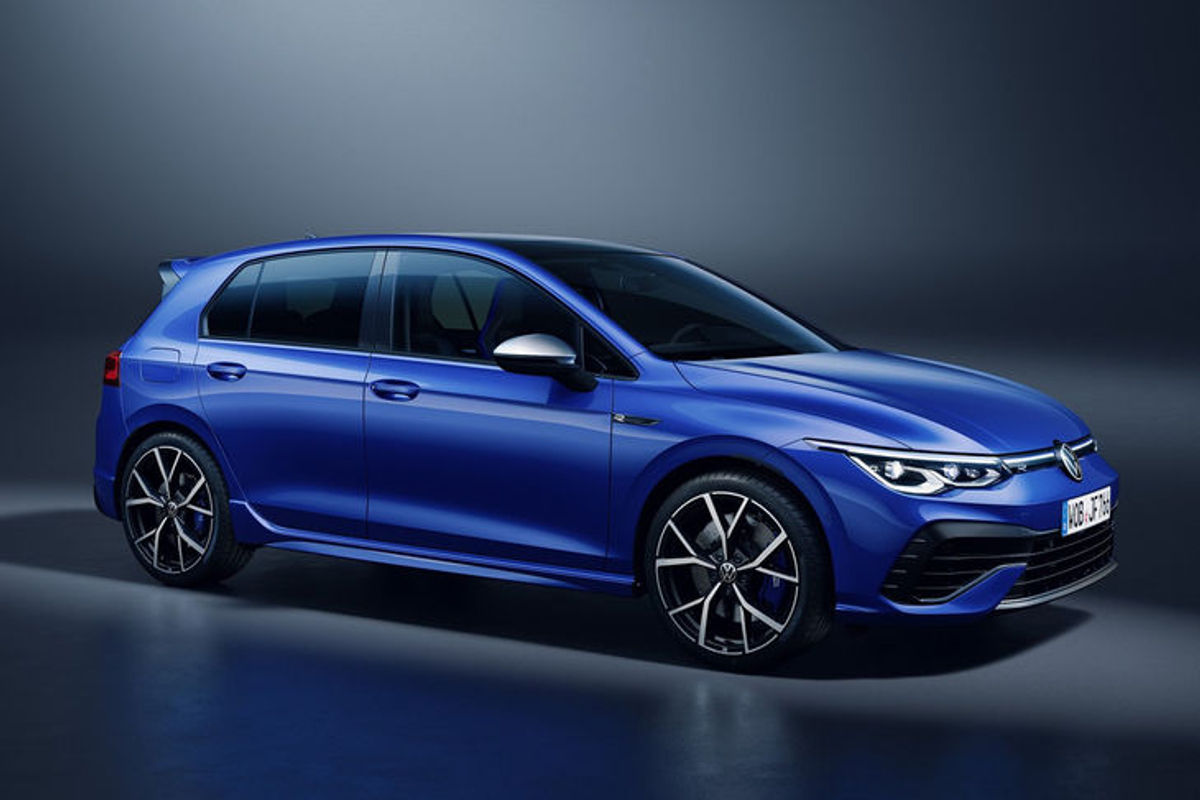
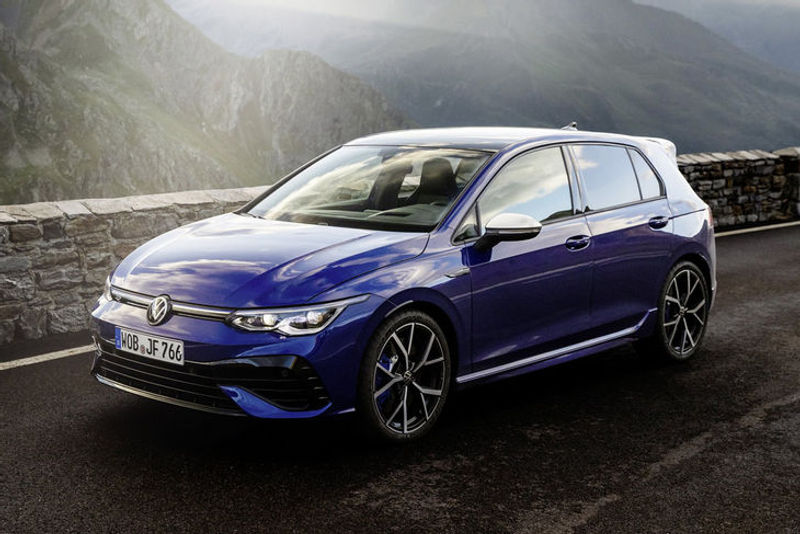
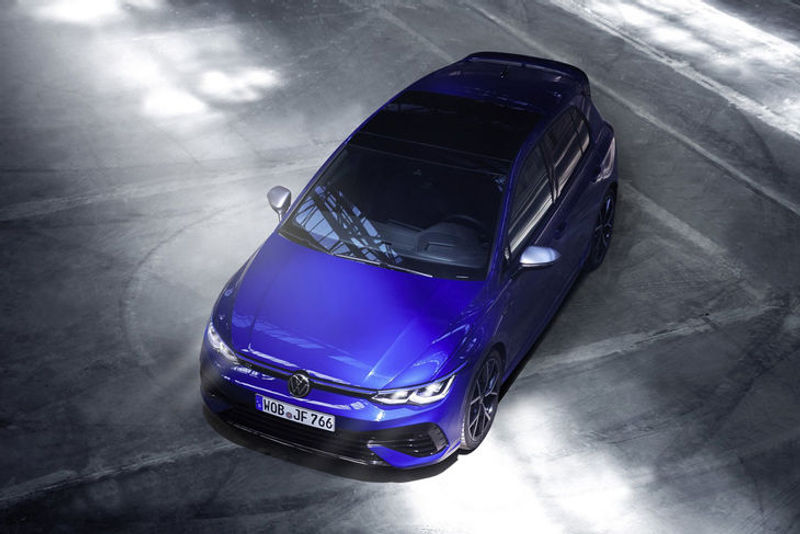
Volkswagen’s Golf 8 R has been revealed and while we are fairly confident the Wolfsburg-based firm will deliver in the performance department, we can’t help but wonder what the R model will cost when it arrives in Mzansi…
Money is always a sensitive topic, but especially so these days – while the Covid-19 pandemic continues to wreak havoc on the economy, prices are being pushed up due to inflation and, by virtue of a weakening currency, new-car buyers have to fork out extra to secure the vehicles they want.
Perhaps one of the most highly-anticipated arrivals for 2021 will be the launch of the VW Golf 8 GTI early in 2021, which will serve to whet Volkswagen enthusiasts' appetites for the brand’s range-topping Golf R, which will follow later. Local prices for both the Golf GTI and, of course, the yet-to-be-revealed Golf R remain a mystery at this point, but that doesn’t mean we can’t posture an opinion on the matter…
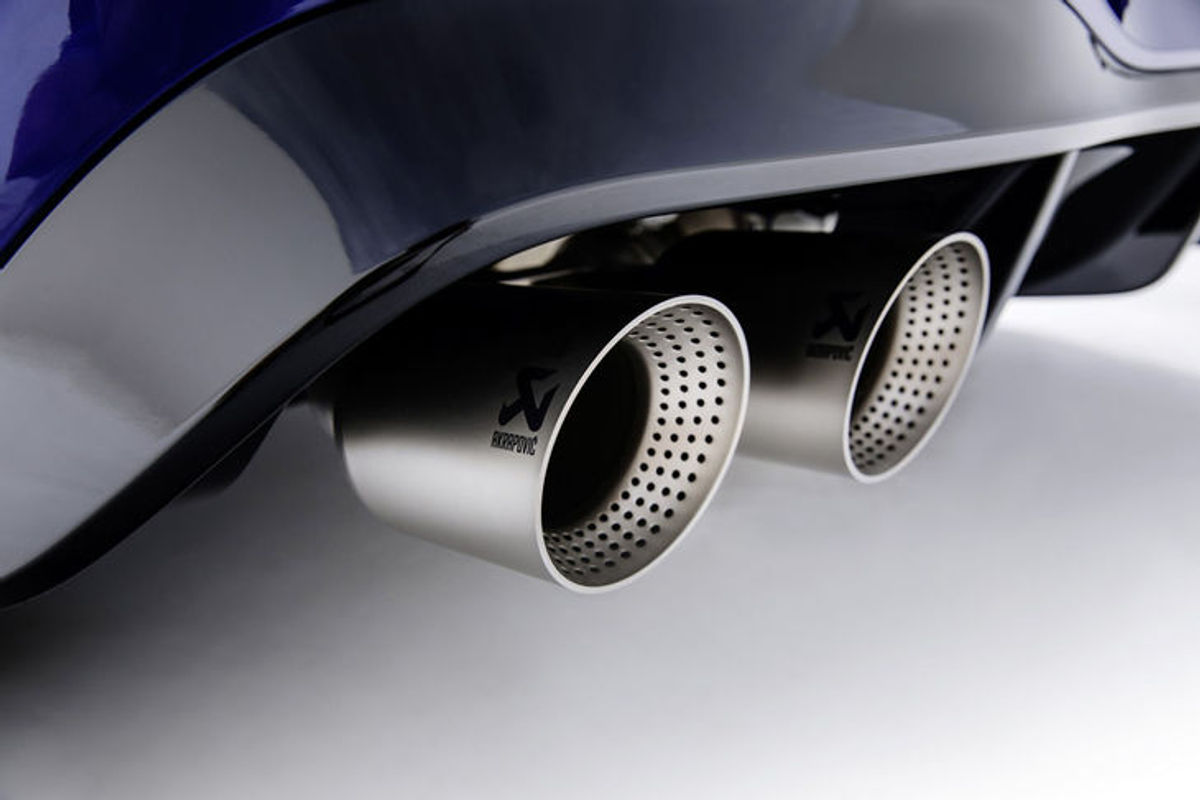
The new Golf 8 R is the most powerful series-production Golf ever made, boasting an “Evo 4” 2.0-litre 4-cylinder turbopetrol that delivers no less than 235 kW and 420 Nm with a claimed zero to 100 kph sprint time of 4.7 seconds paired with a 7-speed dual-clutch transmission or 6-speed manual transmission (depending on the market) and making use of a revised Haldex-type all-wheel-drive system. And for the enthusiasts, the new Golf R also has an optional Drift Mode, if you must…
Now that we know what the Golf 8 R is packing under its bonnet, we are eager to see how Volkswagen will price its new range-topper on local soil.
Volkswagen's Golf 8 GTI will arrive in South Africa first in Q1 of 2021 and the brand will undoubtedly look to maximise GTI sales for a few months before introducing the potent Golf R. That said, the Golf R can be expected in the latter half of 2021 or in early 2022.
It’s worth keeping in mind that the current, outgoing Golf R develops 228 kW/400 Nm and will dash from 0 to 100 kph in 4.6 seconds, which is disappointingly faster than the new Golf 8 R…
A quick look at the VW Golf R’s price trajectory
Pricing of the Golf R has increased significantly in the past 6 years. Could the new Golf 8 R breach the R1-million mark?
Before we look forward to what might be, let’s quickly take a few steps back to trace the pricing trajectory of the Golf R. When the Golf 7 R was launched in Mzansi back in February 2014, it came to market with a (now humble) price tag of R486 200 and packing 206 kW and 380 Nm.
Then, 3 years later, VW introduced a facelifted Golf 7.5 R (with power bumped up to 213 kW). That iteration of the Golf R was priced at R647 300.
In 2019, Volkswagen boosted the Golf R’s peak power output by 15 kW up to 228 kW and torque increased to 400 Nm, making it the most powerful Golf R to ever go on sale on the local market. This updated Golf R was priced at R676 000.
Then in late 2019, the Covid-19 pandemic gathered momentum; South Africa went into full-lockdown by the end of March 2020. In that month, the Volkswagen Golf R was priced at R684 400.
Right now, in November 2020, the Golf R costs R727 400! That’s almost a 50% increase over a period of 6 years!
A million Rand for a Golf?
In your opinion, what would be a fair price for the new Golf 8 R?
Now, let’s speculate on the asking price of the forthcoming Golf 8 R. The Golf 8 R is now available for pre-order in Germany with pricing starting at €48 339 which is roughly R901 000 at current exchange rates, which is merely an indication of what's to come considering that the SA-arrival of the Golf 8 R is still a year or more out and if 2020 is anything to go by, lots can happen in a year!
Volkswagen has invested heavily in the development of the 8th-generation Golf and the Wolfsburg-based brand will look to make a significant return on its investment and generate considerable profits from what's likely to be its last ICE-based premium compact model range. With that said, Volkswagen has never been shy to charge a premium for its products and the new Golf 8 R (and indeed the Golf 8 GTI) won’t be any different.
However, there is a myriad of factors that will feed into the eventual pricing of the new Golf 8 R in South Africa. The key determining factors include the Rand-Dollar exchange rate (to reiterate, this has been a major driver in recent/ongoing new-car price hikes) and the ongoing impact of the Covid-19 pandemic on the economy, inflationary pressures and importantly, import taxes. However, because Volkswagen South Africa produces the Polo hatchback at its Uitenhage plant for local and overseas markets, the export credits it earns will likely help to soften the pricing blow somewhat.
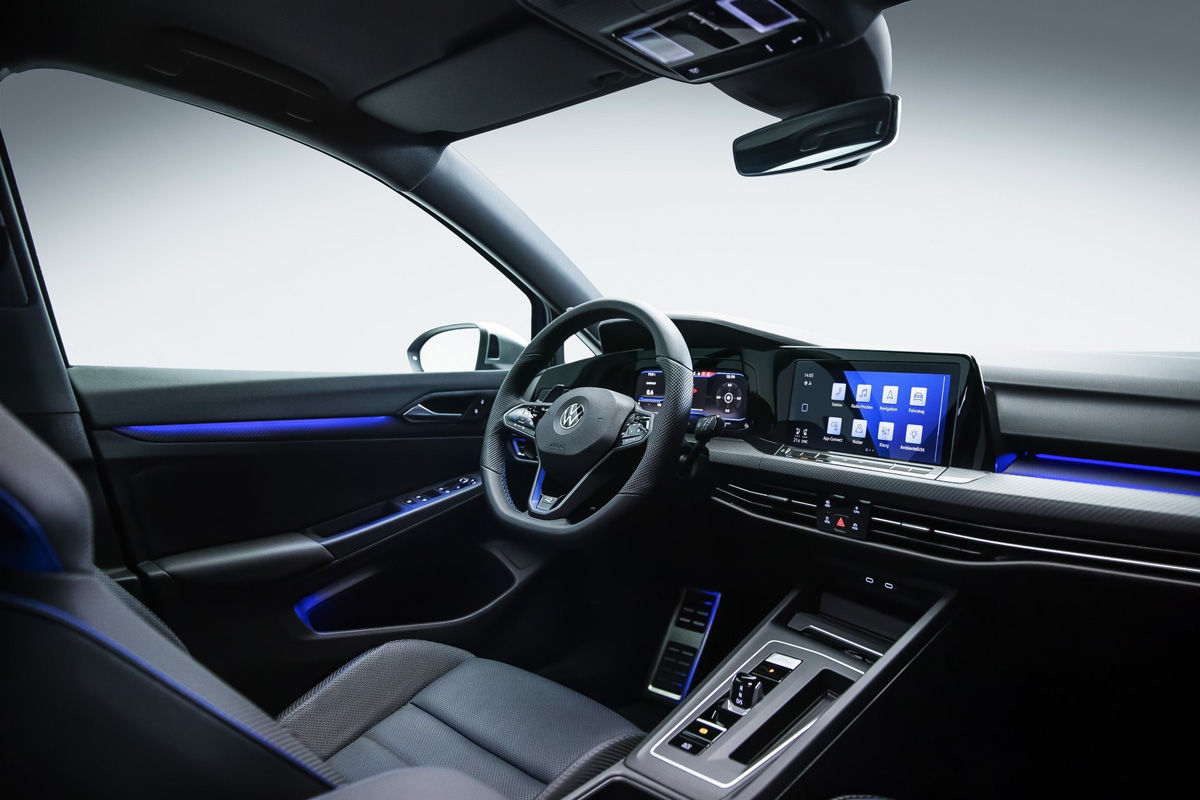
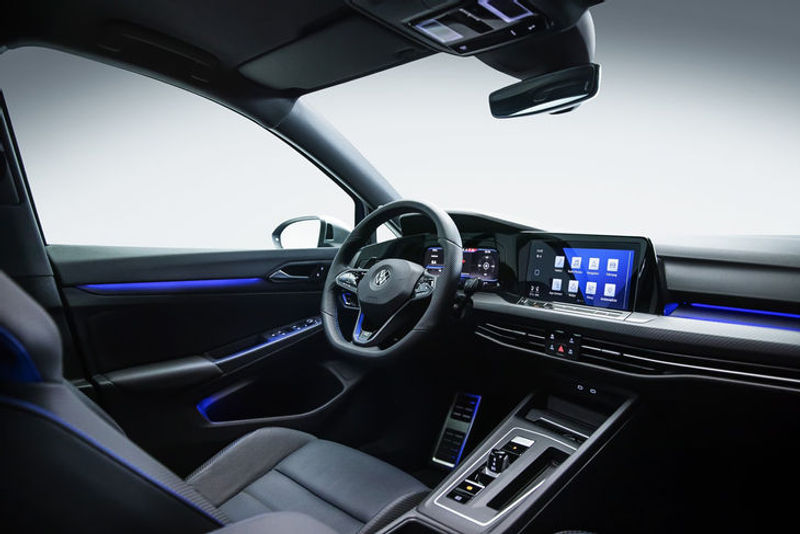
The interior of the Golf 8 R comes well-equipped with Volkswagen's latest tech.
It would also be naive to underestimate the impact that the lingering Covid-19 pandemic could have on the production of the new Golf 8 R. As the Golf R features a host of model-specific components such as wheels, bumpers and trim, any disruptions in the supply chain could have a significant negative impact on the cost of production, which will ultimately increase the price of the car on the dealer floor.
With all these factors in mind, it’s not difficult to imagine that the new Volkswagen Golf 8 R’s price tag could very well approach the R1-million mark when it eventually arrives in South Africa, especially when you consider that the outgoing Golf R is already three-quarters of the way to the mark.
Perhaps a more conservative estimate is that pricing for the Golf 8 R will come in between R850k-R900k, before options. Even so, we know that Volkswagen will offer a long list of optional equipment on the range-topping Golf 8. Suffice to say that when the Golf R is fully-equipped with all the nice-to-haves, there’s a good chance that you will be looking at an R1-million-or-more Golf R. What a time to be alive!
Will you buy it?
The answer is no, but the new Golf R will probably still sell very well when it eventually arrives in SA.
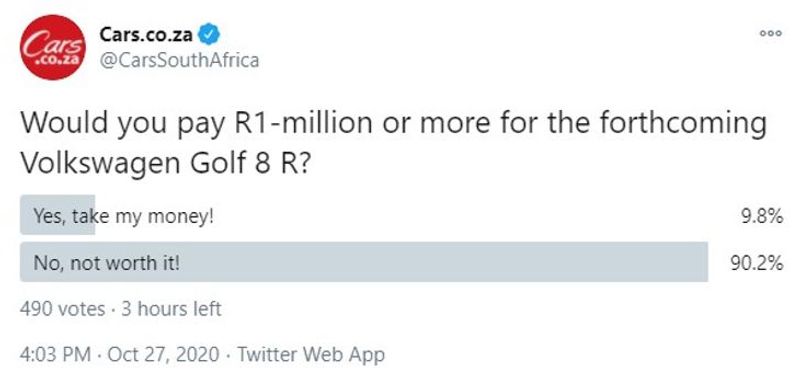
We put out a poll on the Cars.co.za Twitter page asking our audience the question ‘Would you pay R1-million or more for the forthcoming Volkswagen Golf 8 R?’
The response was an unsurprising and resounding, No!
Mercedes-Benz South Africa has updated its all-important local SUV offering with 6 new derivatives, including the all-new GLA and GLS. Cars.co.za contributor Ian McLaren may have uncovered the pick of the lot, however.
The significance of an extensive SUV range within a modern automotive manufacturer’s portfolio has never been more prevalent. Here's an example to illustrate my point: raised ride-height models make up about 30% of Mercedes-Benz's vast annual global sales aggregate. That figure increases to around 35% within the South African context – the popular (C-Class-based) GLC leads the way in terms of domestic Benz sales.
With 6.5 million sales recorded since the introduction of the ML-Class in 1997, the Stuttgart-based manufacturer now offers no fewer than 8 SUV-shaped body styles, including fashionable coupé variants of its GLC and GLE models. And then, of course, there exists what Mercedes-Benz likes to the refer to as the "S-Class of SUVs" – the GLS, as well as the modern-day incarnation of the Geländewagen, badged as the G-Class.
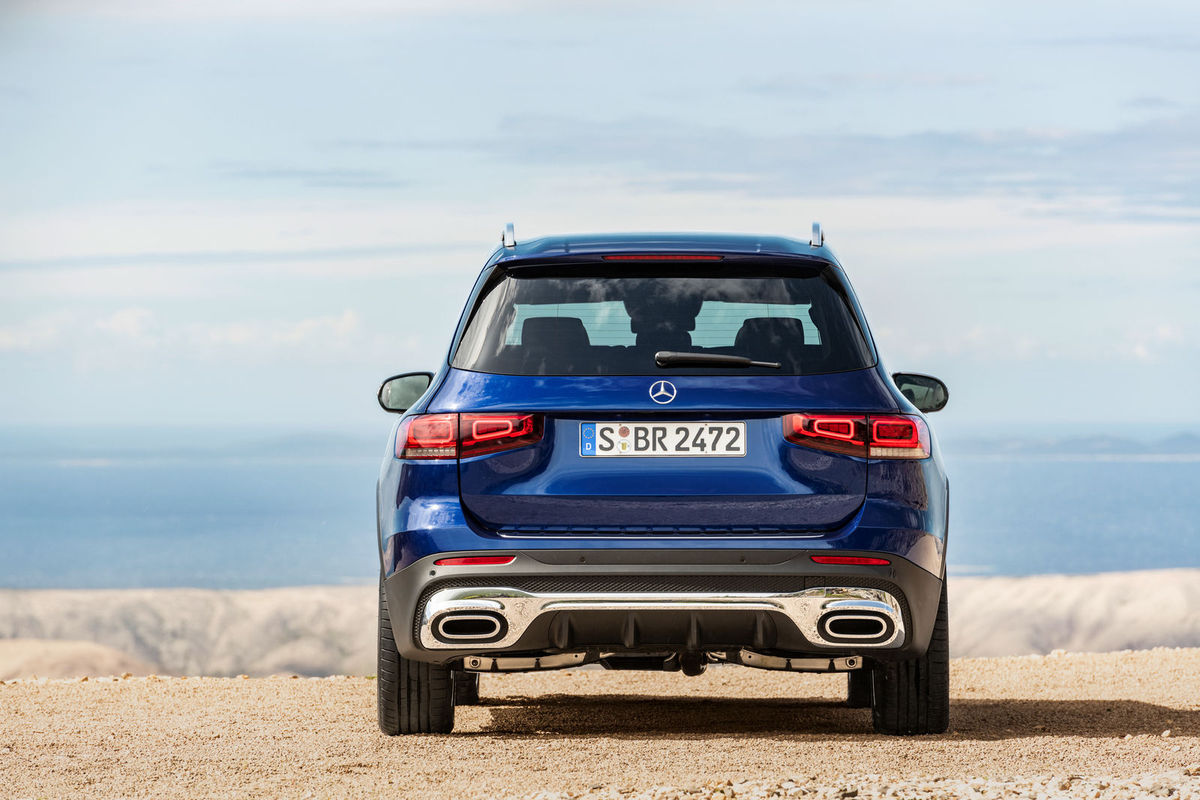
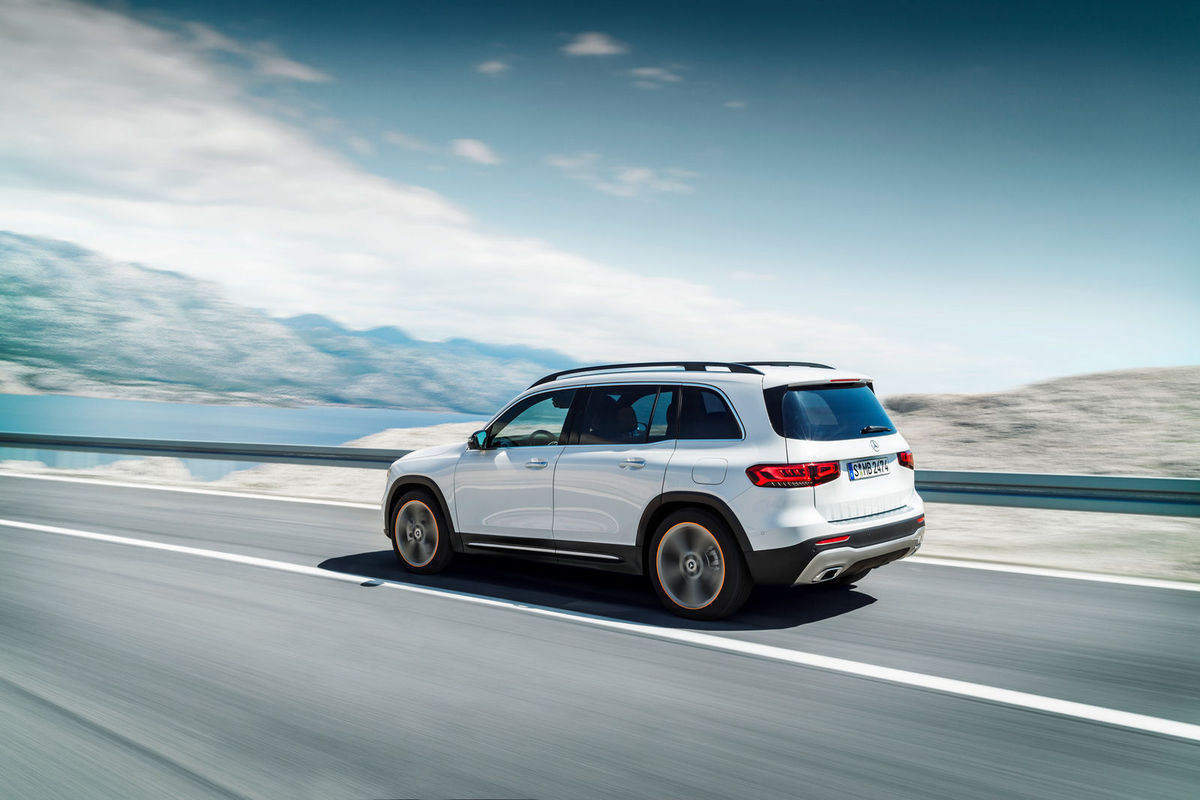
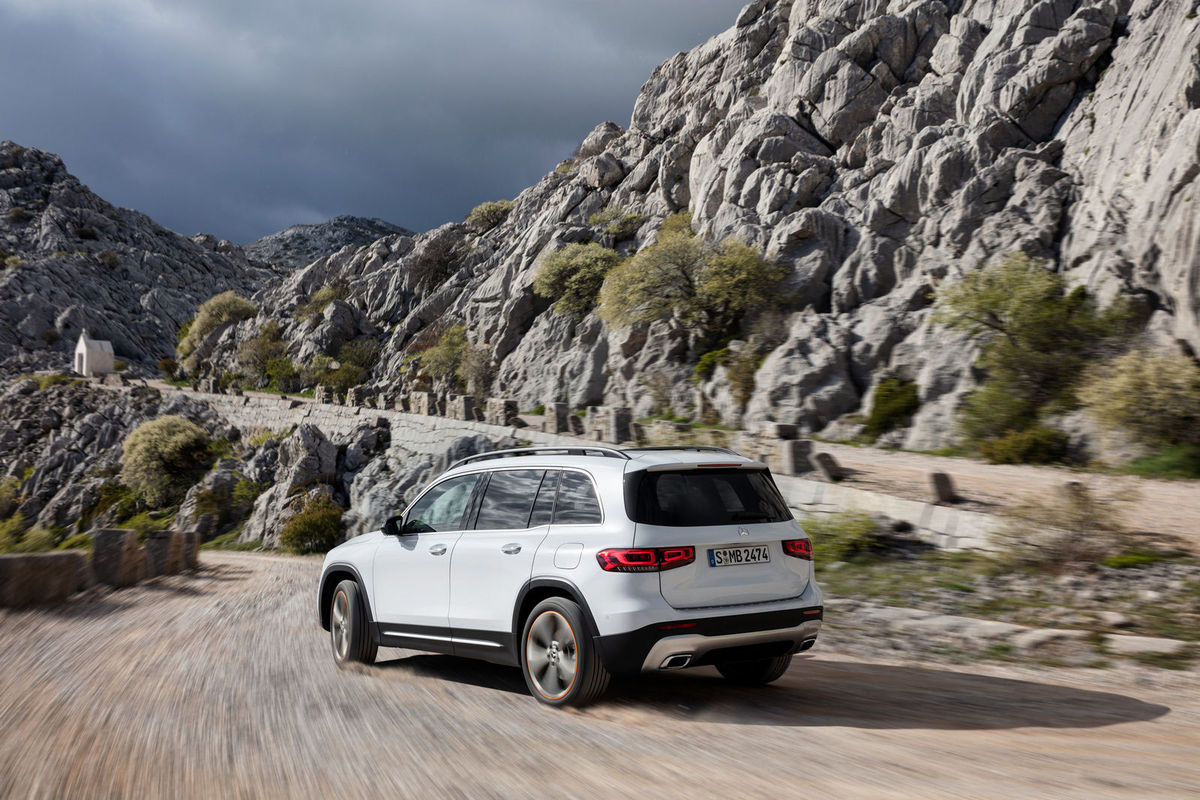
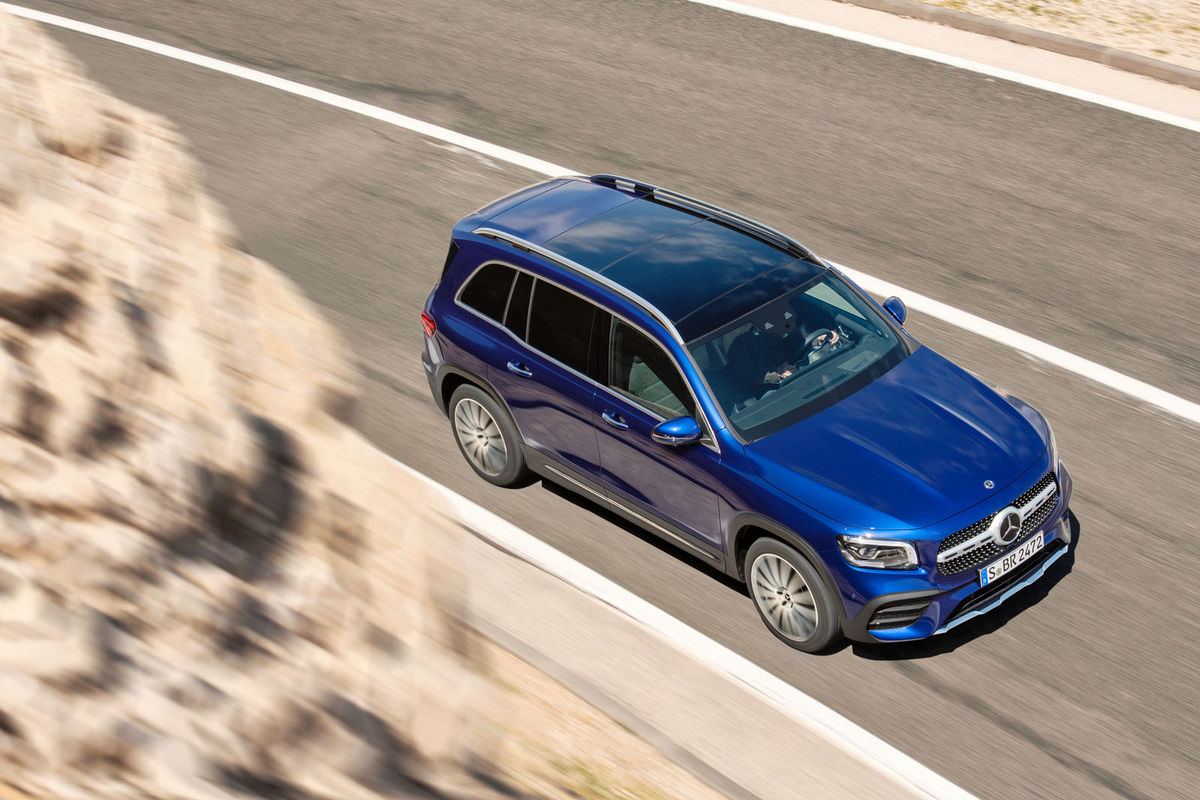
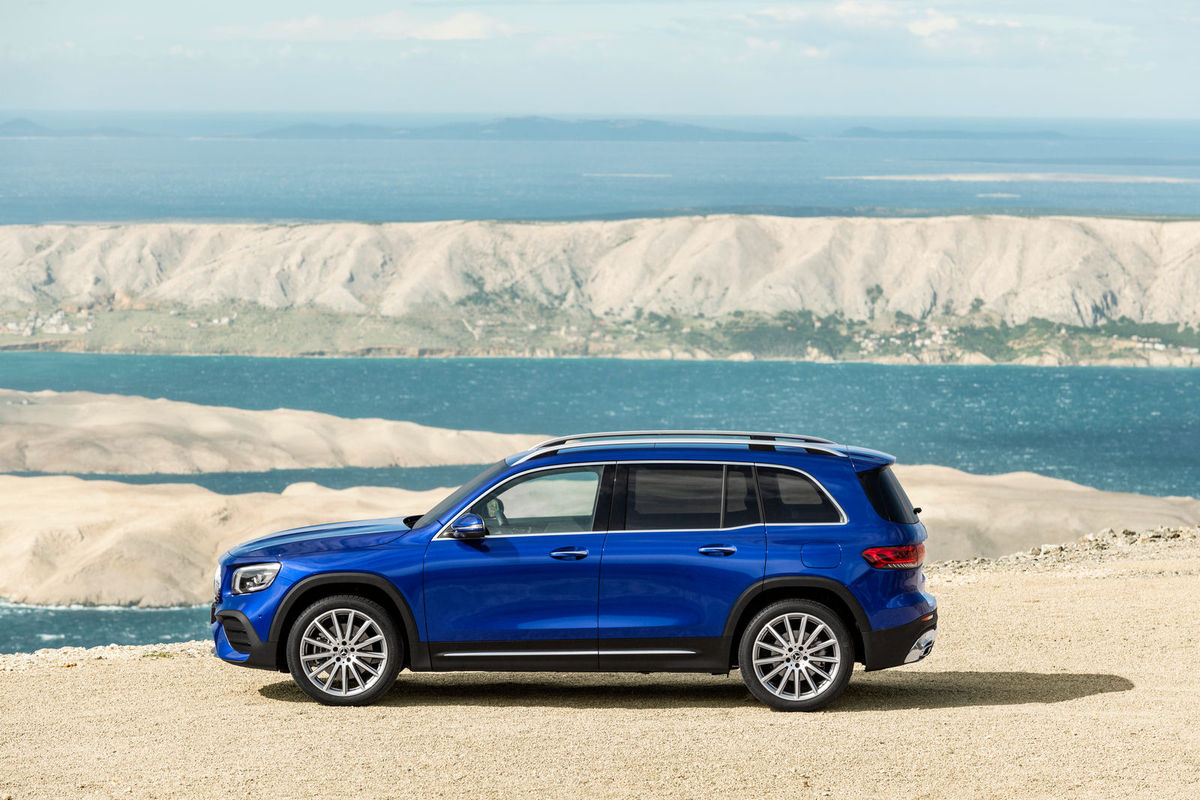
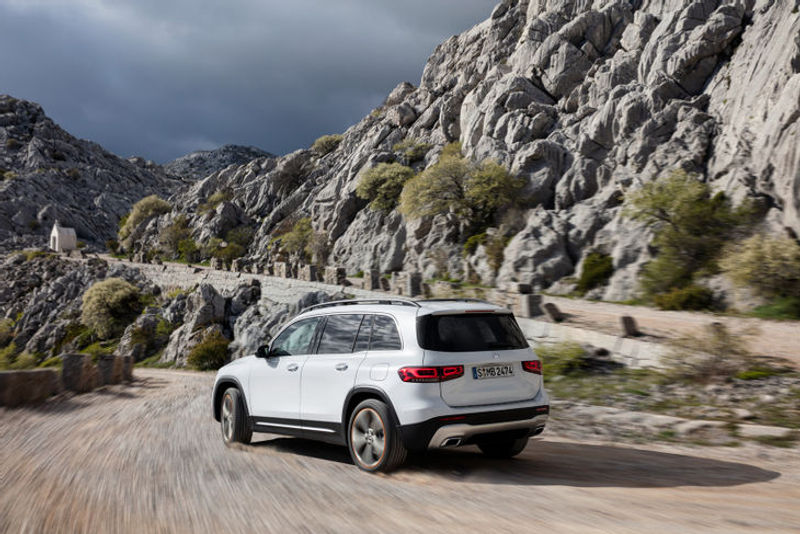
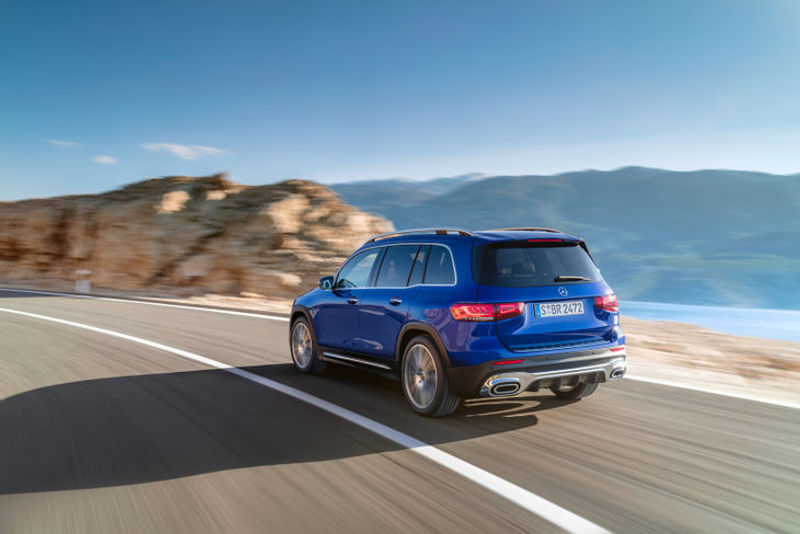
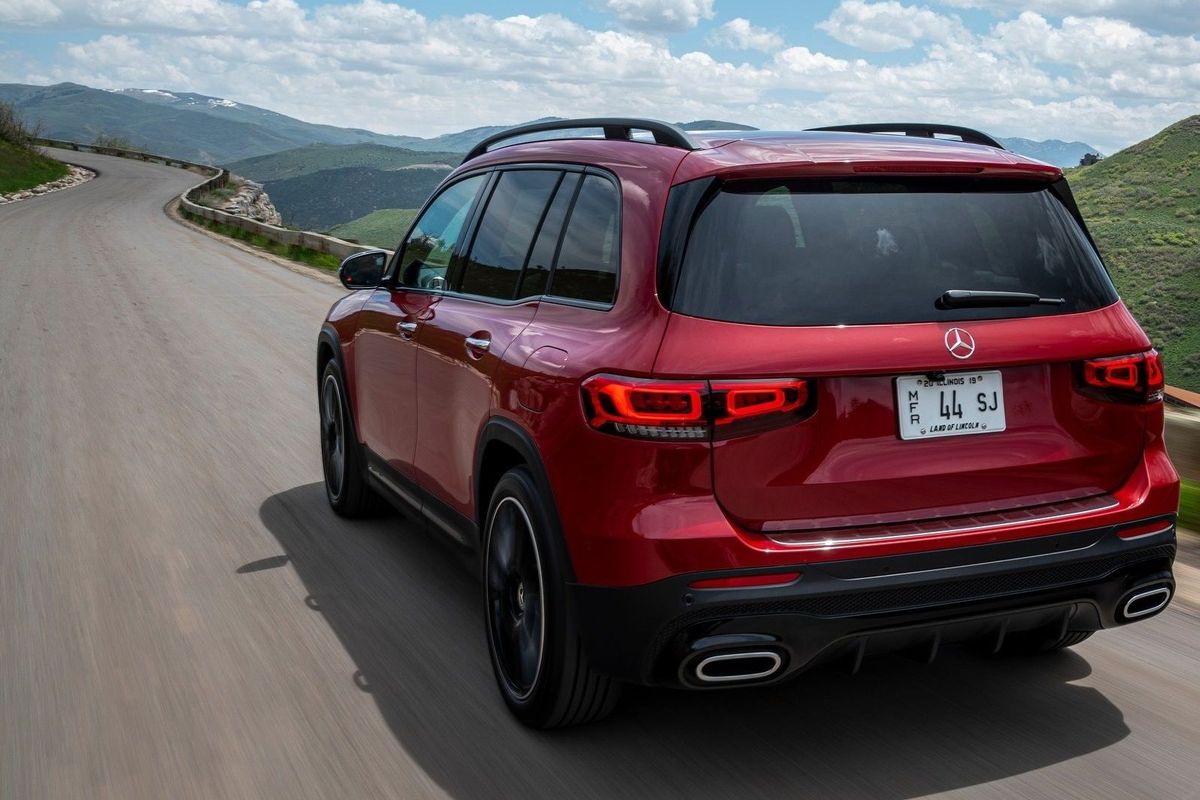
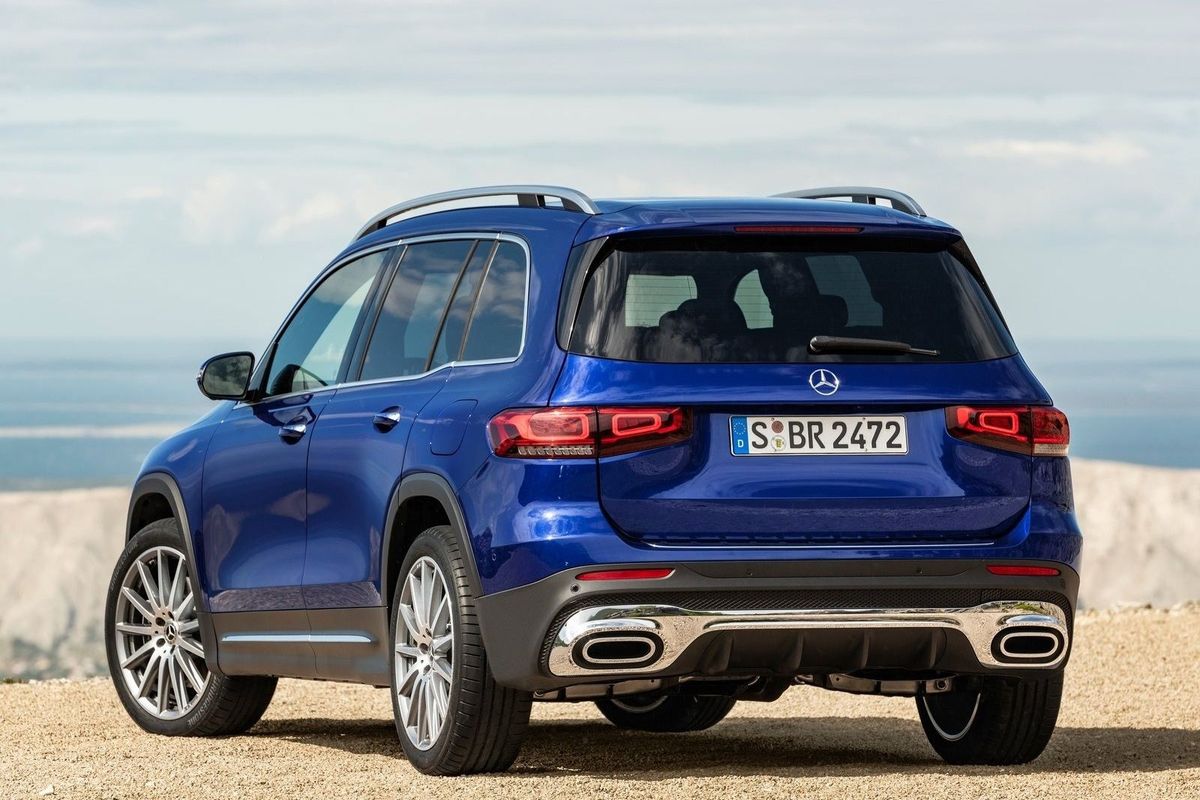
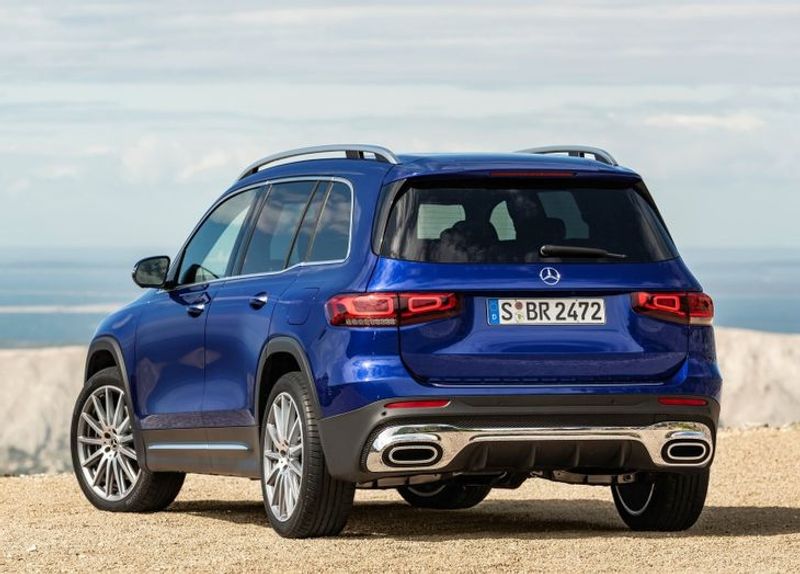
A newcomer to the line-up, the GLB, looks to embody the rugged character of the G-Class, but in an altogether more accessible package.
The ABCs
The GLB sort of resembles a baby G-Class, but it's underpinned by a stretched A-Class chassis.
As the naming suggests, the GLB slots between the GLA and GLC in the Mercedes-Benz line-up, though there’s a bit more to the story than this.
Benz produced a GLK (Geländewagen Luxus Kompaktklasse) from 2008 to 2015, but not in RHD guise. This plucky compact SUV found favour for its relative versatility, upright stance and squared-off look. Compared with its contemporaries, it was unapologetically boxy… and better for it.
A spiritual successor to the GLK, the GLB shares its MFA2 platform with the A- and B-Class models, as well as the 2nd-generation GLA. It is, however, both longer and (47 mm) taller than its GLA sibling and, compared with the B-Class, the newcomer's wheelbase is stretched by 10 mm, which endows it with a welcome level of interior space, including the option of a 3rd row of seats. A further advantage in terms of the GLB’s upright profile is an abundance of headroom, notably for occupants of the first 2 rows.
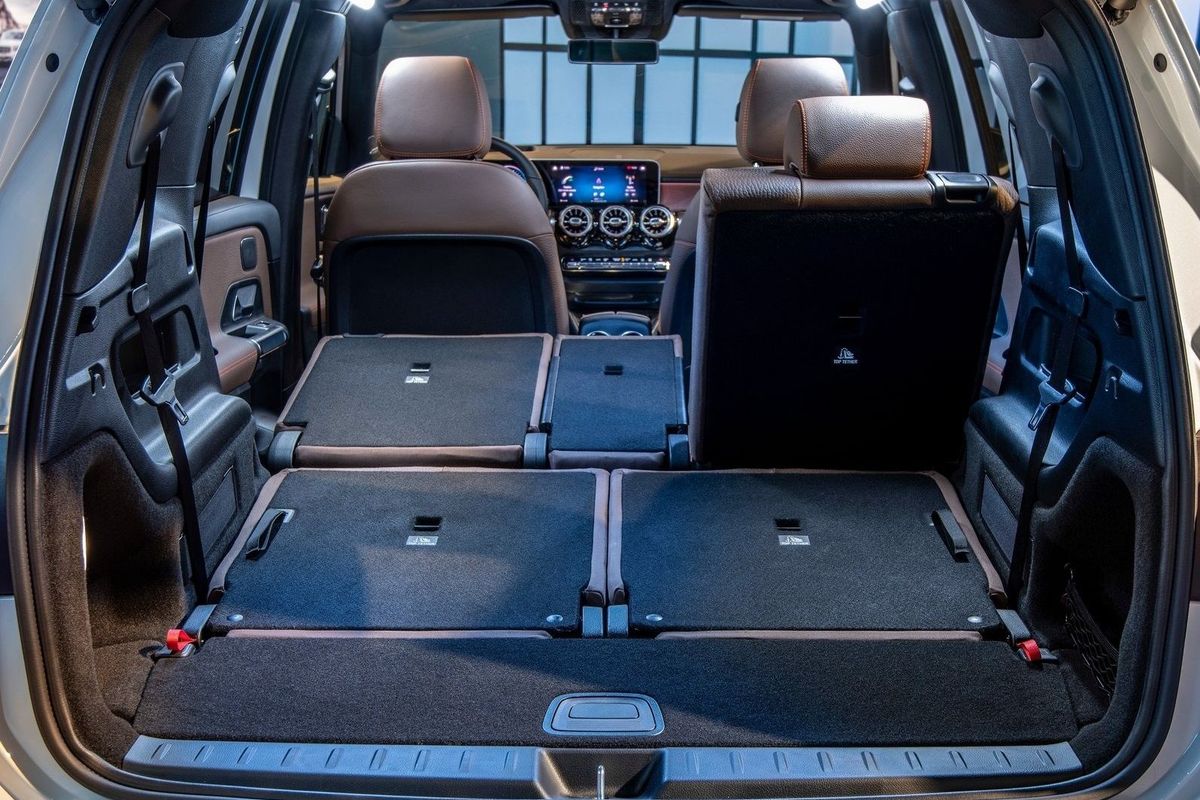
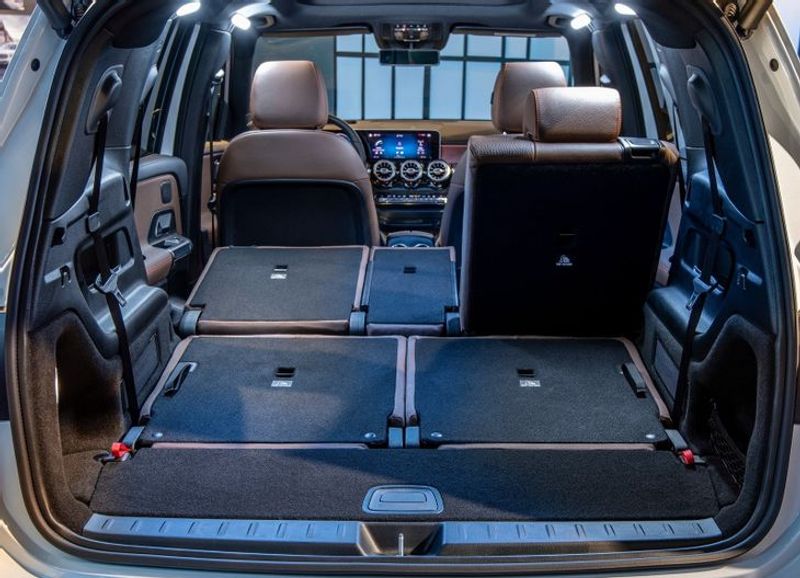
Relatively low-slung in its stance (more about that later), both entry to, and egress from, the cabin (via flat door sills) is effortless. The same convenience is afforded to access to the 570 litres of luggage space; this capacity can be enlarged by sliding the 2nd-row bench in a 60:40-split (the backrest of which splits in 40:20:40 configuration). When specced, the pair of 3rd-row seats fold neatly in a 50:50 split into the load bay floor.
A major plus is that the GLB can be had with 7 seats.
A selection of 18- to 20-inch alloy wheels is available via three optional design packages: Progressive, Style and AMG Line.
Mercedes-Benz SA offers this new model with a choice of either a 2.0-litre turbopetrol (GLB 250) or 2.0-litre turbodiesel (GLB 220d 4Matic) motor, both mated with an 8-speed automatic transmission. As in the A-Class, the former offers 165 kW with 350 Nm of torque from 1 800 to 4 000 rpm.
At launch, the 140 kW/400 Nm 220d 4Matic is fitted as standard with the brand’s all-wheel-drive system (with dynamic torque vectoring), which favours, in this application, the front wheels. Average fuel consumption on this heavier of the two derivatives is listed as 5.4 L/100 km.
What’s it like do drive?
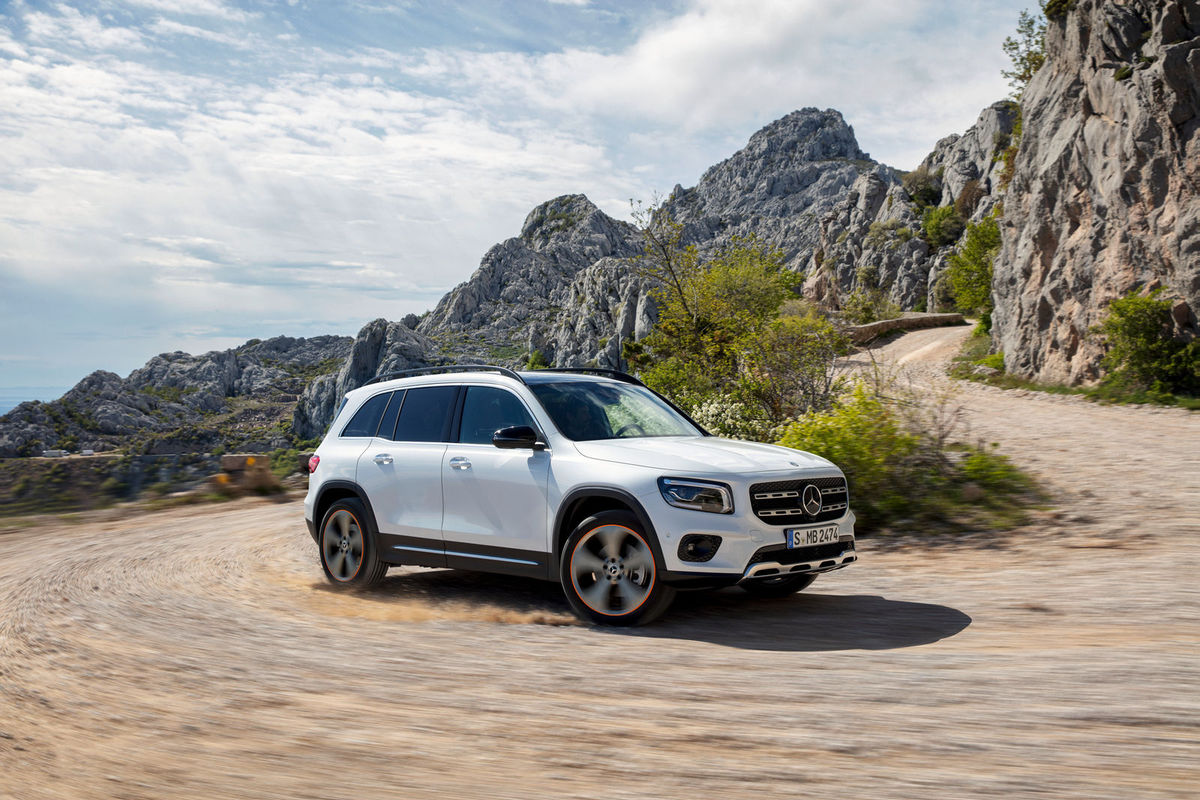
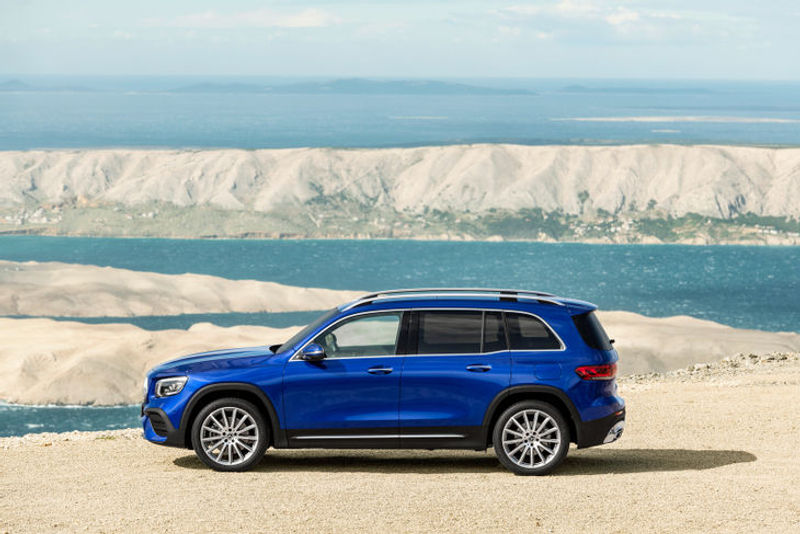
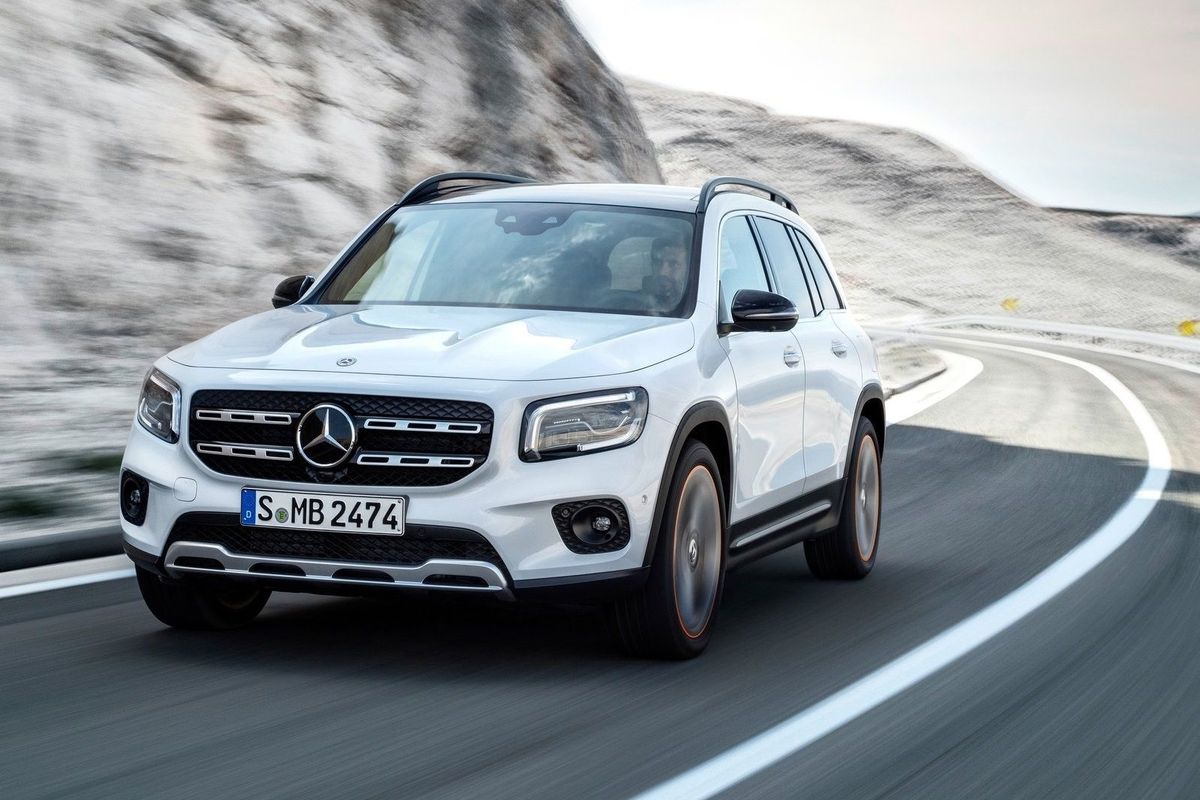
It looks more rugged than it actually is, but is still capable of tacking a dirt road thanks to 200 mm of ground clearance.
Seeing as the GLB was among 6 derivatives that Mercedes-Benz South Africa revealed on the day, the time we spent behind the wheel of the newcomer was limited, but the test drive was nevertheless insightful. Standing proud among the other notably sleeker SUVs in Benz's armoury, I was immediately drawn to the GLB’s feisty-looks and distinct character; it seemed to glance across the lot for approval from its G-wagon brother.
The caveat to the 220d 4Motion’s standard Off-Road Engineering Package (including a reconfigured ABS braking system and hill descent control) is the GLB’s relatively conservative 200 mm worth of ground clearance. That said, off-the-beaten-track excursions will likely be limited to brief excursions on gravel roads with the odd shallow rock crossing. Despite its low-profile rubber and large wheels, the 220d 4Matic made the most of its healthy helping of torque – available from just 1 600 rpm – to make steady progress over our launch route’s mildly challenging off-road course.
Despite the GLB's brawny looks, it’s more likely to perform the bulk of its duties on-road. Here, those same low-profile tyres add a level of poise and precision to the driving experience, while a well-weighted steering system and assured suspension setup makes the newcomer easy to manoeuvre around town. Bear in mind, though, that as with other non-AMG-tuned compact Benzes, the ride quality deteriorates notably as wheel sizes go up.
Rugged outside, spotless inside
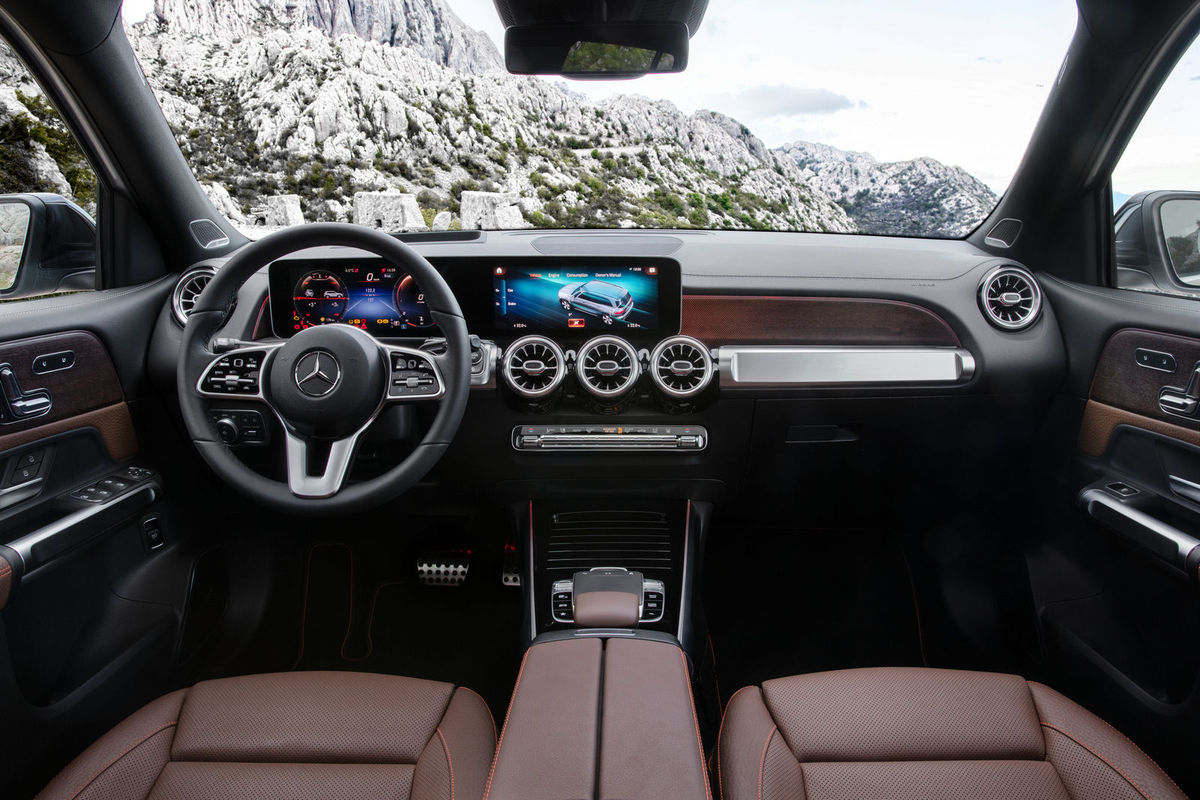
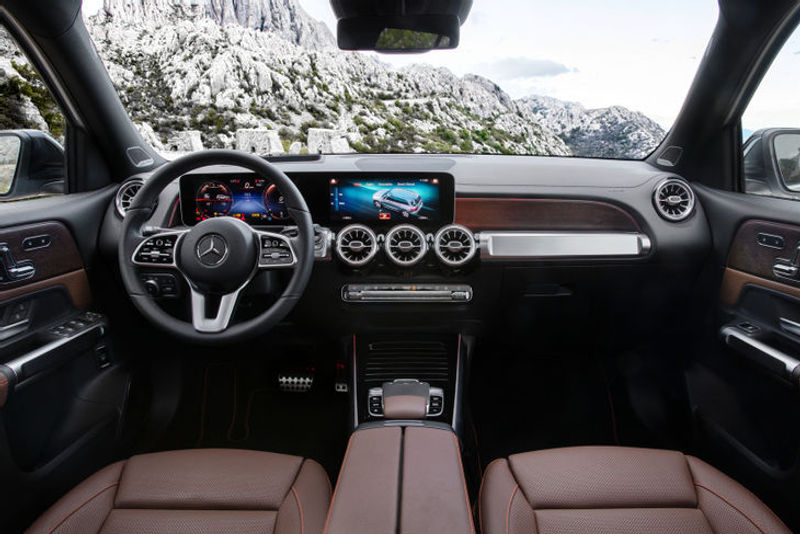
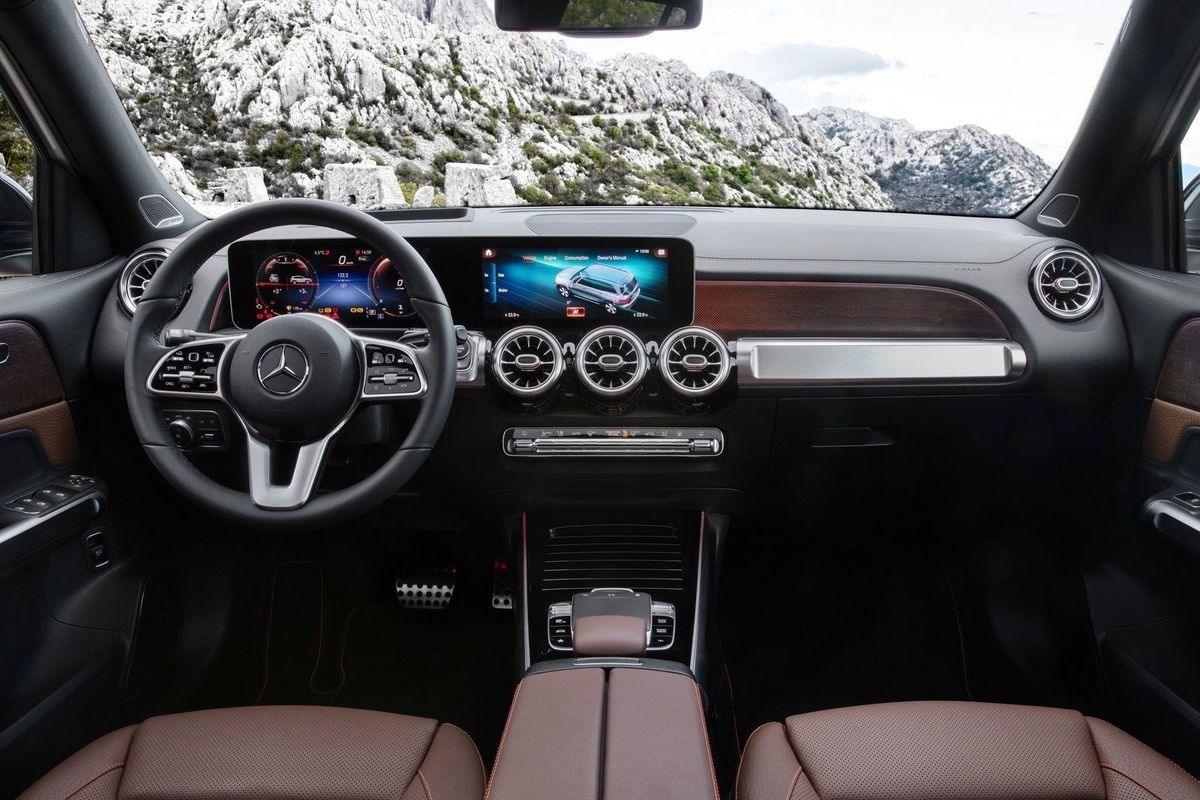
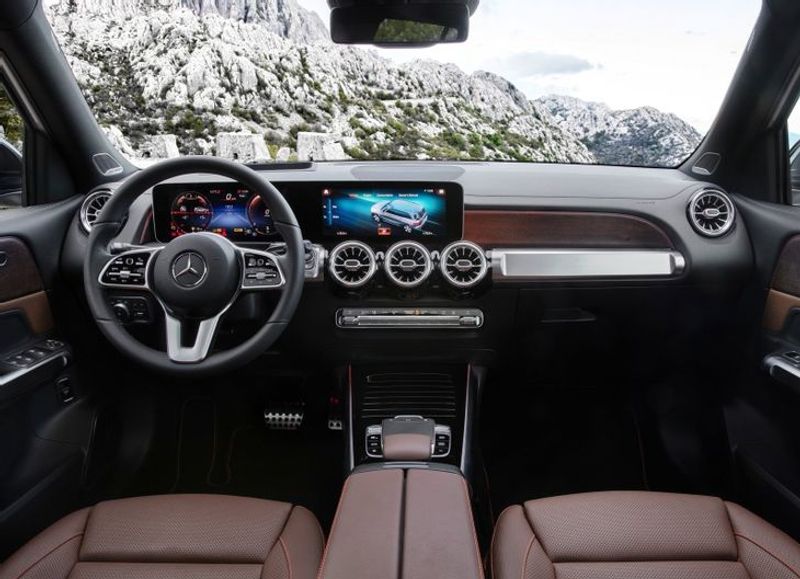
A familiar interior if you've seen any of the recent models that the GLB shares its platform with but still modern and techy.
Seated tall within the cabin of the new GLB, there’s a welcome, brand-familiar level of interior sophistication that belies the car’s adventure-seeking exterior. Largely carried over from the A-Class, the newest “B” features Mercedes-Benz’s latest MBUX infotainment technologies, incorporating voice activation and touchscreen technologies. Instrumentation is crisp and easily legible, while a considered use of materials and finishes throughout is at least of par with what the competition is currently offering. Stowage options are abundant throughout the otherwise airy cabin.
One bugbear is that the Off-Road driving mode is finicky to activate. You have to access a separate display-screen menu (below the Eco, Comfort and Sport settings), which means it isn’t easily (or logically) accessible once the going gets rough. Maybe it will be rectified with a firmware update.
Summary
If considered as an alternative to the GLC, the GLB seems to suit those looking for something a little different.
More than its impressive off-road adventure pedigree, the popularity of the modern G-Wagon stems largely from its unapologetically brash stance and sheer road presence. Never sold in South Africa, the similarly resolute lines of the GLK came closest within the broader Mercedes-Benz family to mimicking the attributes of the Geländewagen. Perhaps for its bold styling, which is distinctive in a segment awash with cookie-cutter designs, or its instantly likeable plucky character, the GLB has all the attributes to blaze a trail (although not necessarily an off-road one) of sales success.
While pricing for the pair of GLB derivatives might be viewed as bold, another advantage the newcomer should enjoy is that it should be viewed – in terms of size, practicality and equipment – as an alternative to the popular GLC, rather than an oversized member of the A-Class family.
Mercedes-Benz GLB Price in South Africa (November 2020)
All Mercedes-Benz derivatives are is sold with a 2-year/unlimited km warranty and a 5-year/100 000 km maintenance plan.
The distinctive GLB compact SUV, which is optionally available as a 7-seater, has finally been launched in South Africa. The line-up includes a turbopetrol front-wheel-drive and a turbodiesel all-wheel-drive derivative.
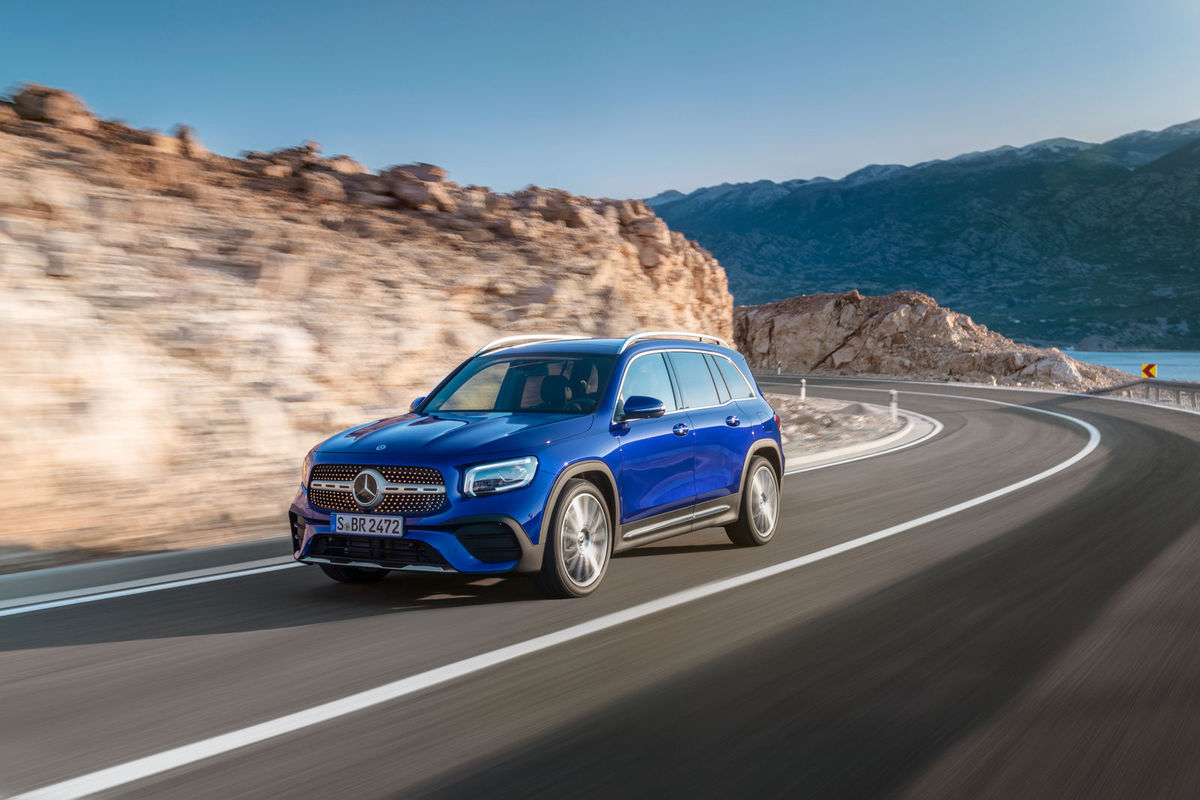
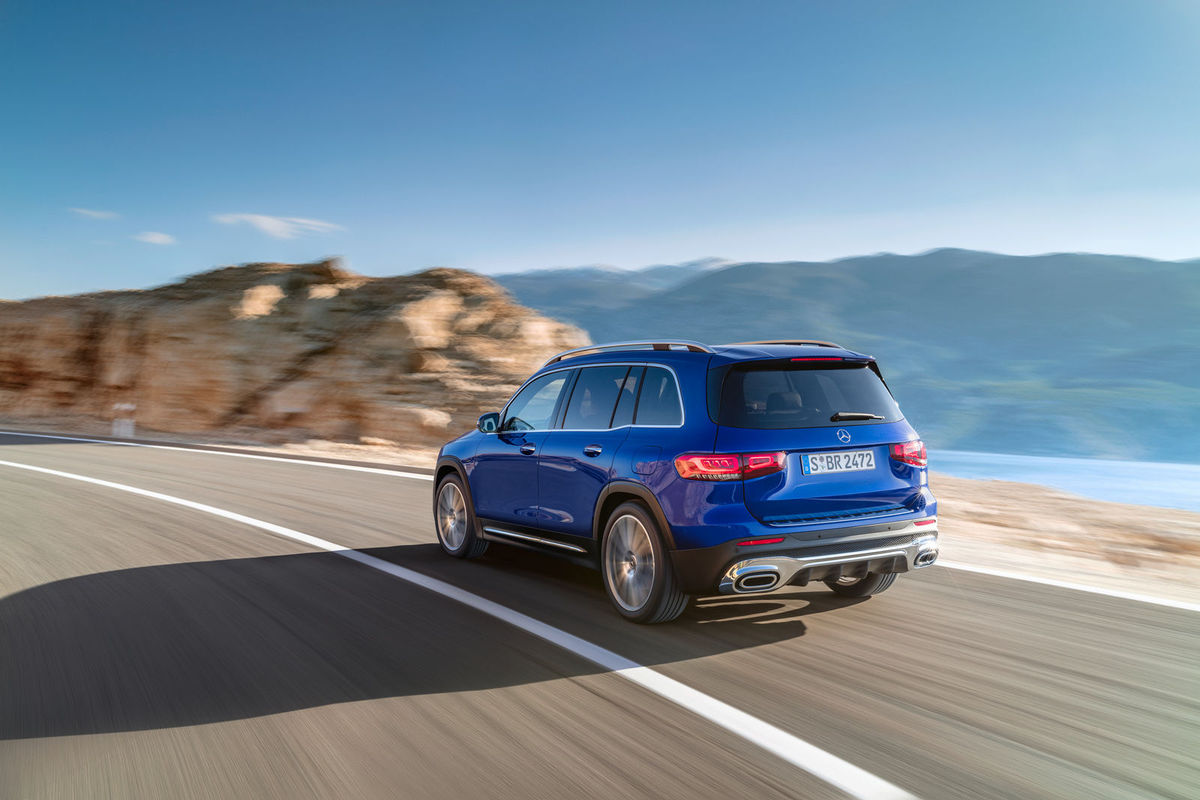
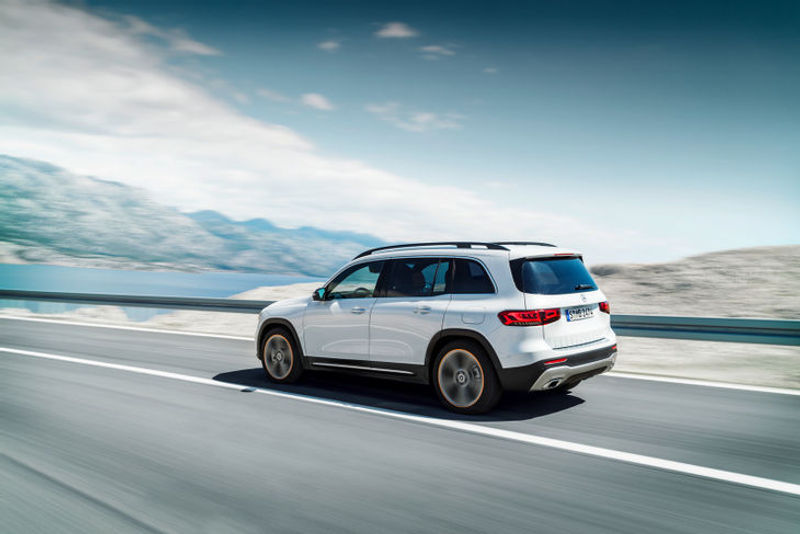
Whereas as the recently launched GLA is very much a crossover variant of the A-Class premium hatchback, its GLB sibling has a much more off-road-oriented design, replete with an upright front section, striking LED headlamps (which are standard), muscular shoulder lines and short overhangs front and rear. Along with stylised skid plates on the bumpers, the newcomer features roof rails and all-round protective cladding.
The GLB is 10 mm longer than the new B-Class; it measures 4 634 mm in length, 1 834 mm in width and stands 1 658 mm tall. Mercedes-Benz claims 1 069 mm of headroom for front-row occupants and 967 mm of rear legroom in the standard 5-seater configuration.
The 2nd row’s backrest splits in a 40:20:40 configuration and offers multi-stage backrest-angle adjustment. The row can be moved fore/aft by 140 mm and, should you order a 7-seater version, in a 40:60 split to either increase 3rd-row legroom or luggage capacity. The two individual 3rd-row seats, if specified, are claimed to seat people of up to 1.68m in height.
The 3rd row features a pair of drinks holders between the seats, as well as 2 stowage compartments with rubberised inserts in the load compartment trim, each housing a USB port. The seats can be lowered so that they are flush with the load compartment floor.
The load bay capacity ranges from 570 litres to 1805 litres with the 2nd and 3rd row folded.
The line-up
The GLB 250 is powered by a 2.0-litre turbocharged 4-cylinder engine with 165 kW and 350 Nm. Power goes to the front wheels via an 8-speed dual-clutch transmission and the claimed average fuel consumption ranges between 7.1 and 7.4 L/100 km.
The GLB 220d is exclusively available with 4Matic all-wheel drive, with fully variable torque distribution. Its 2.0-litre 4-cylinder turbodiesel (also mated an 8-speed dual-clutch transmission) produces 140 kW and 400 Nm. Its claimed consumption range of between 5.1 and 5.4 L/100 km.
Standard spec includes a leather-trimmed multifunction sports steering wheel, MBUX multimedia system with ext. functions (incl. Apple CarPlay and Android Auto compatibility), climate- and cruise control, a tyre-pressure monitoring system, rain-sensing wipers, as well a Light and Sight package. Click here to research the GLB’s wide range of optional features.
The 7-seats of the Mercedes-Benz GLB gives it an advantage in the practicality stakes.
Mercedes-Benz GLB Price in South Africa (November 2020)
All Mercedes-Benz derivatives are is sold with a 2-year/unlimited km warranty and a 5-year/100 000 km maintenance plan.
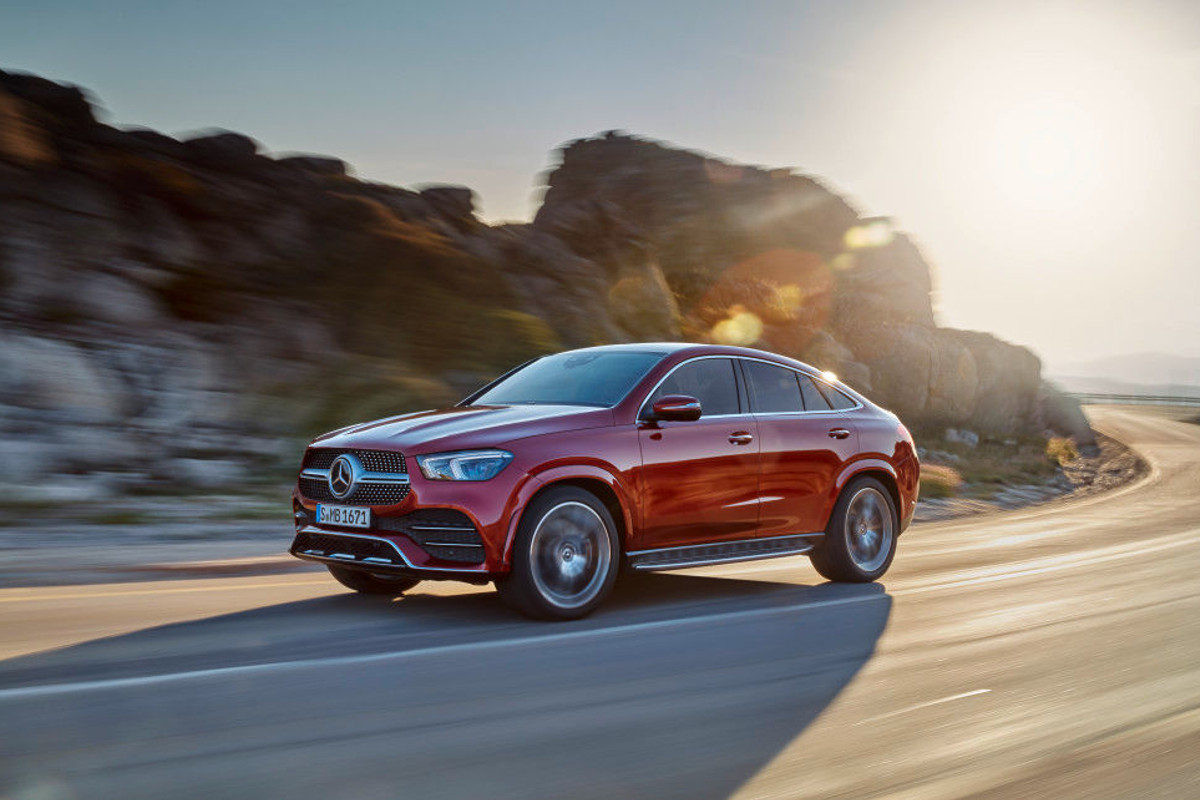
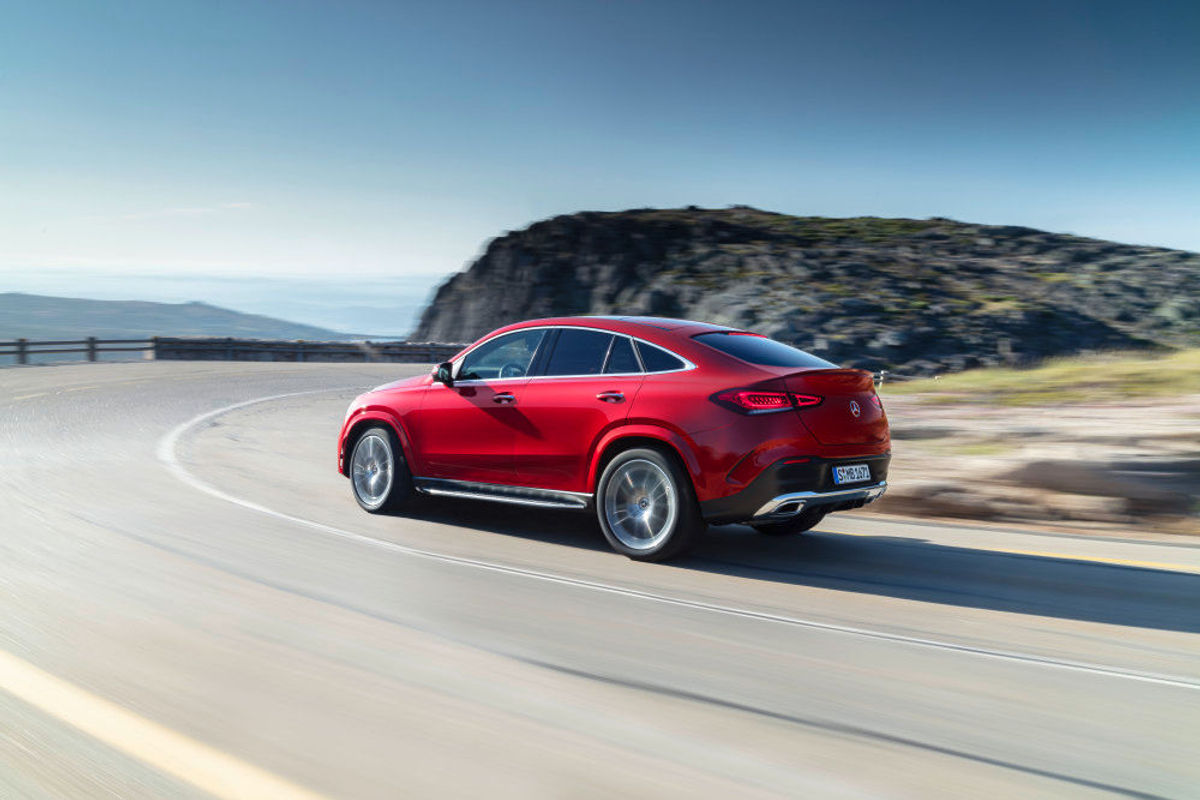
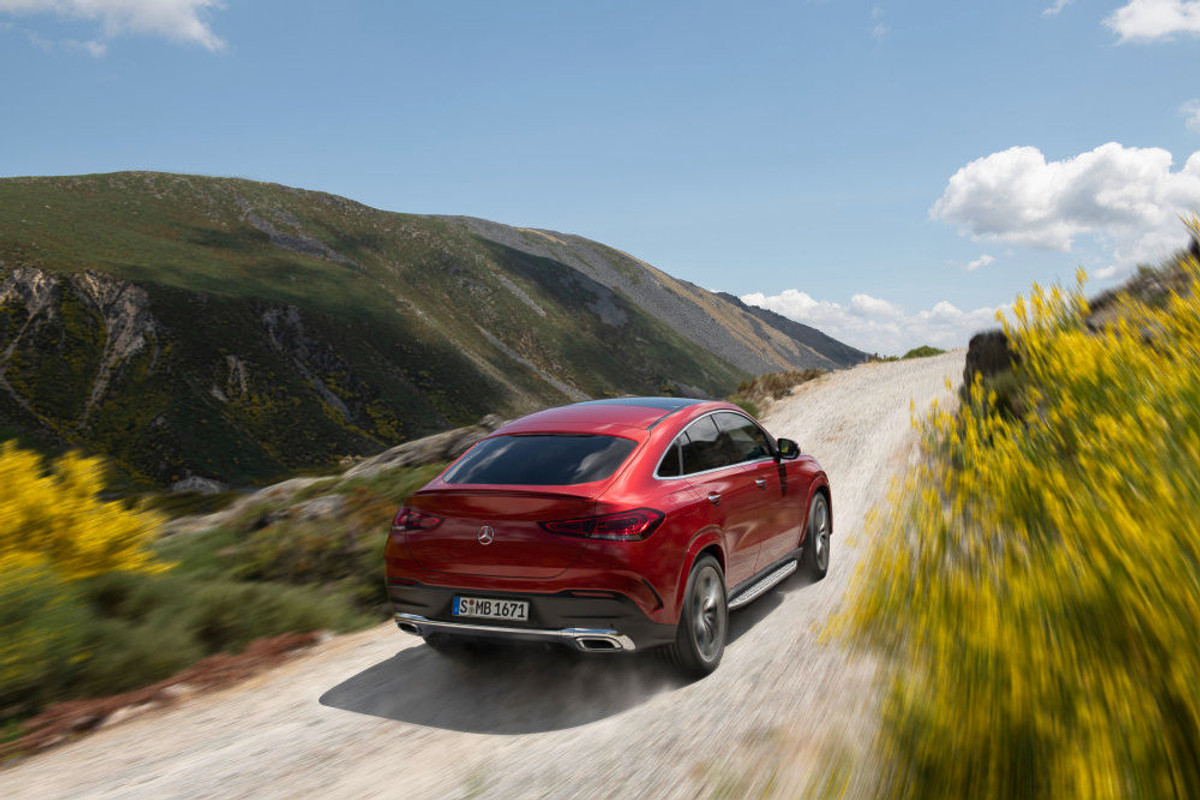
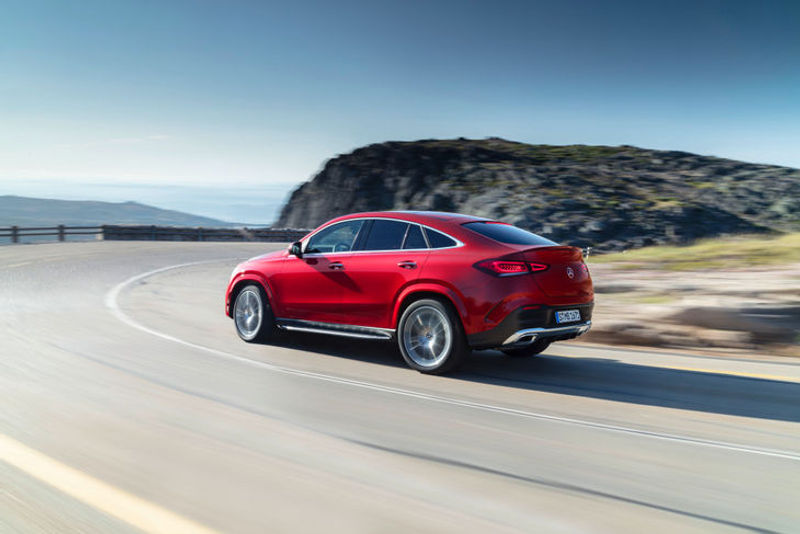
Mercedes-Benz has launched its GLE 400d Coupe in SA! Herewith specification and pricing details for the newcomer!
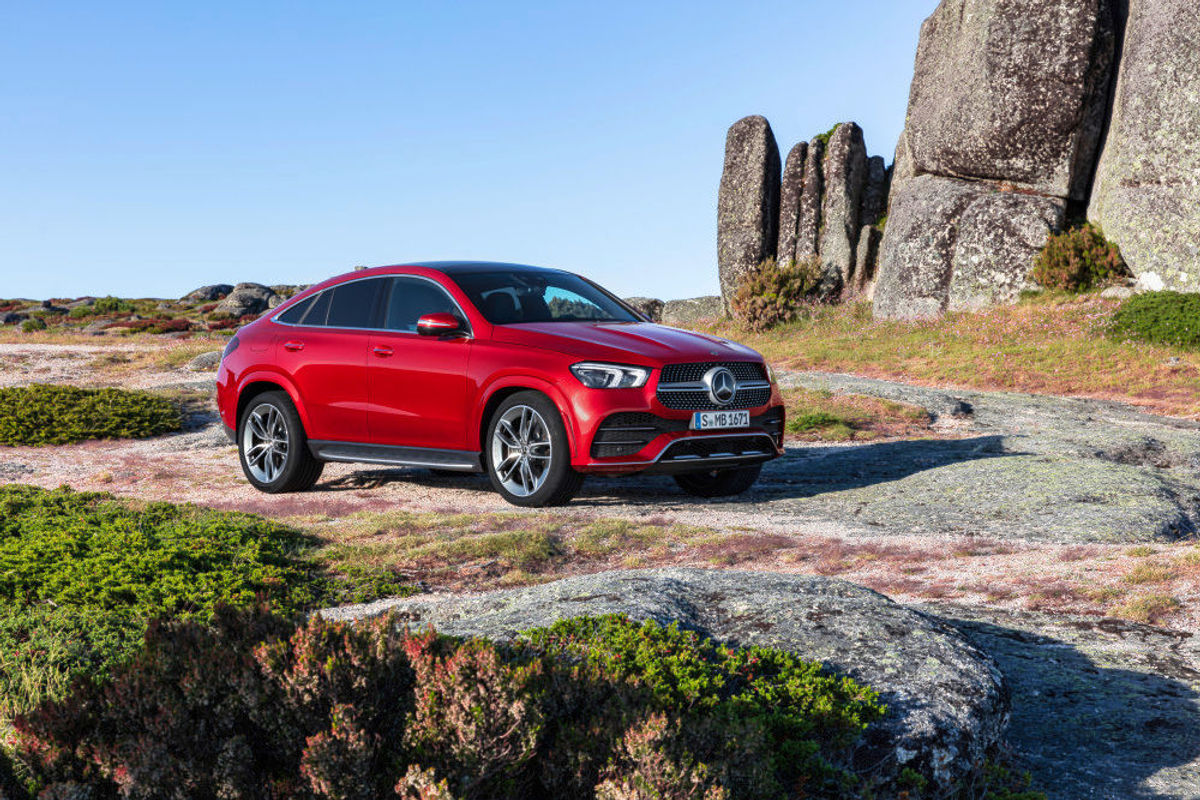
The new GLE Coupe has arrived in South Africa in 400d guise and the newcomer is powered by a 3.0-litre, 6-cylinder turbodiesel engine that offers a heady 243 kW and 700 Nm of torque. Mercedes-Benz claims a fuel consumption figure of between 6.9 and 7.4 L/100km while the dash from zero to 100 kph is claimed in 5.7 seconds.
Buyers can also look forward to the arrival of the potent Mercedes-AMG GLE 63 S soon, with its twin-turbocharged 4.0-litre V8 engine (in combination with the Mercedes-Benz’s EQ Boost 48V starter-generator mild-hybrid system) churning out 450 kW and 850 Nm of torque and a Speedshift 9-speed automatic transmission directing those numbers to the tar via Merc's 4Matic all-wheel drive system. Zero to 100 kph is claimed in just 3.8 seconds! See specs and pricing for the AMG GLE 63 S here!
Mercedes-Benz says that the GLE Coupe’s suspension is now firmer than before, delivering a sportier driving experience. Customers can also opt for the optional air suspension with adaptive damping.
The German luxury car brand also welcomed the new GLS in South Africa this week!
Key Features
The suave GLE 400d Coupe is now available in SA!
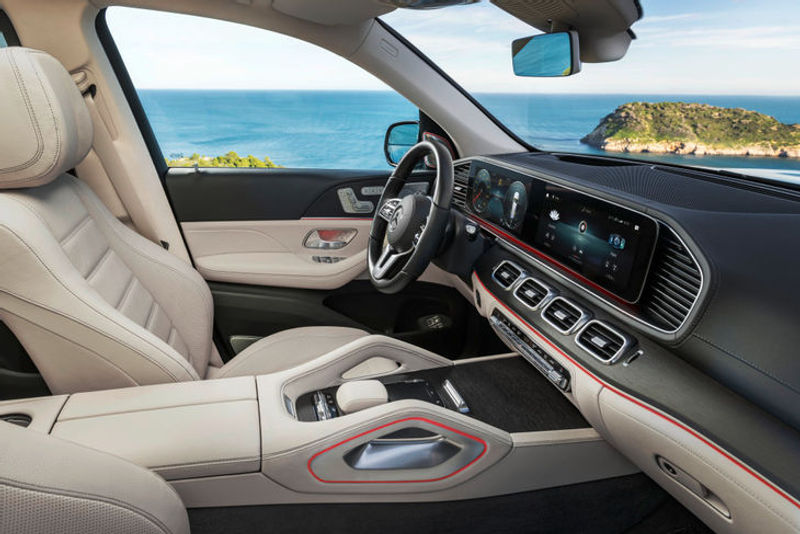
The interior of the GLE 400d Coupe is equipped with 2 large 12.3-inch screens which takes care of all infotainment with Merc’s latest MBUX system. Sport seats are fitted as standard as well as a new sports steering wheel finished in Nappa leather.
The new GLE Coupe’s wheelbase is some 60 mm shorter than the GLE SUV but is 20 mm longer than the outgoing GLE Coupe, which affords rear passengers with more legroom. The load bay offers 655 litres of space and with the 40:20:40 split rear seats folded down space increases to a useful 1 790 litres, which is 70-litres more than the outgoing version.
In terms of driver assistance, customers can choose to fit the optional Active Distance Assist Distronic which is able to detect traffic congestion up ahead and adjust the vehicle speed accordingly.
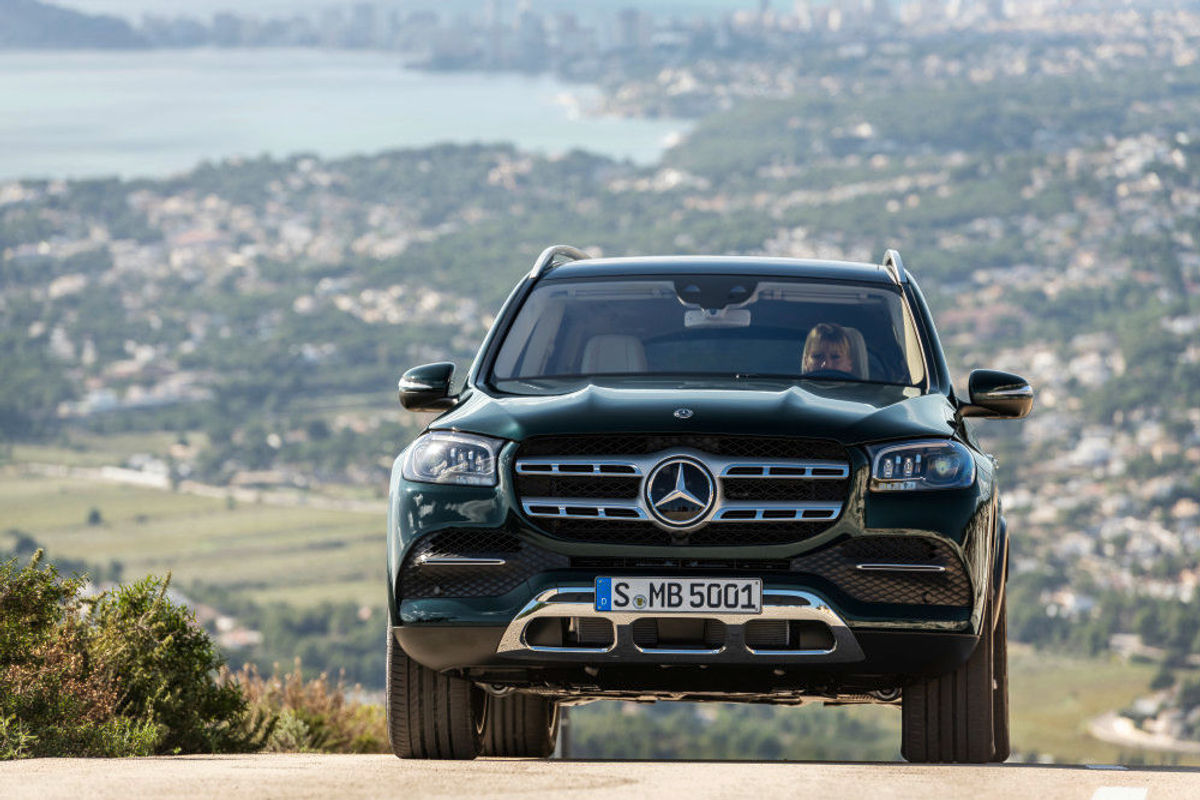
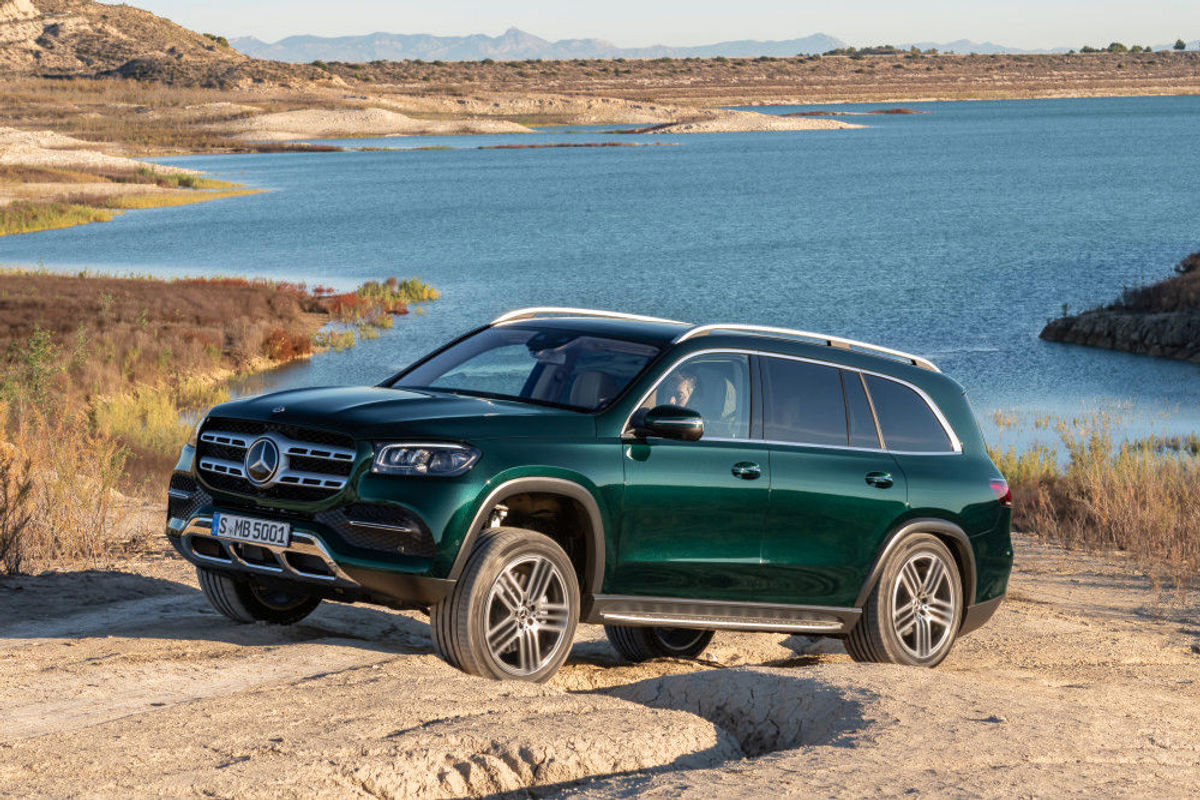
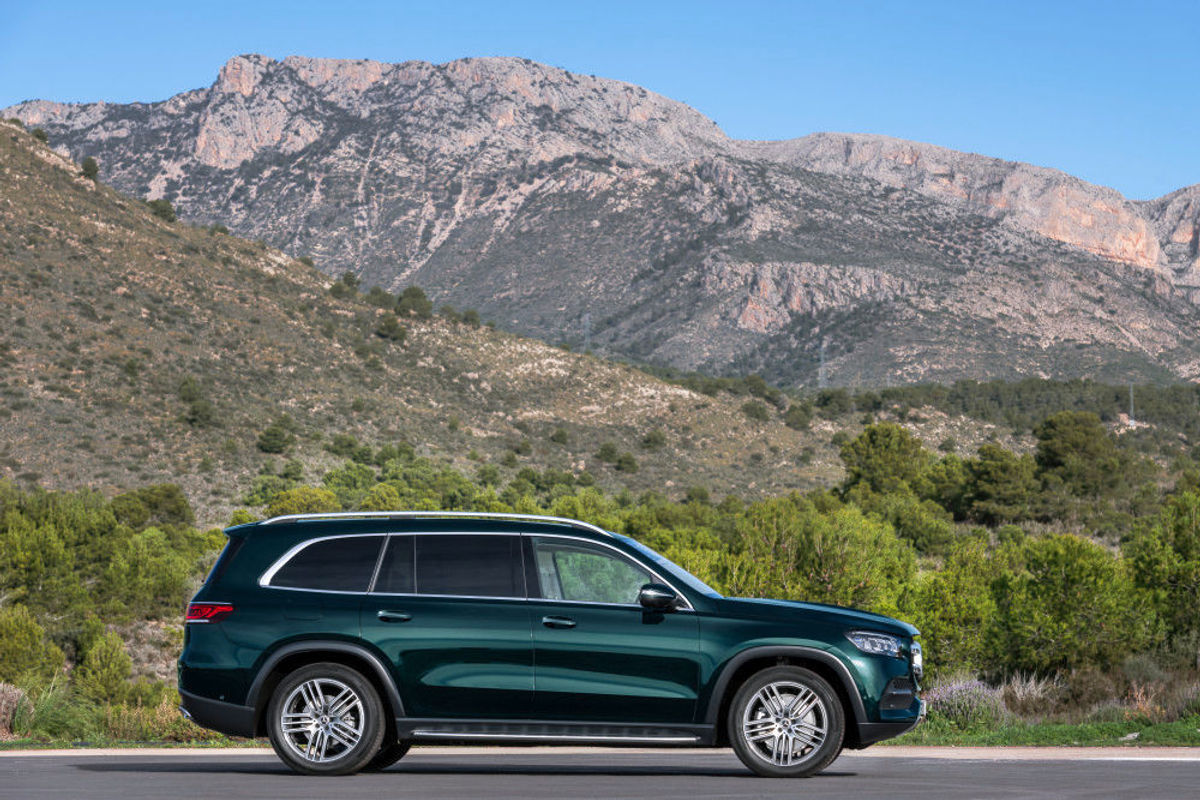
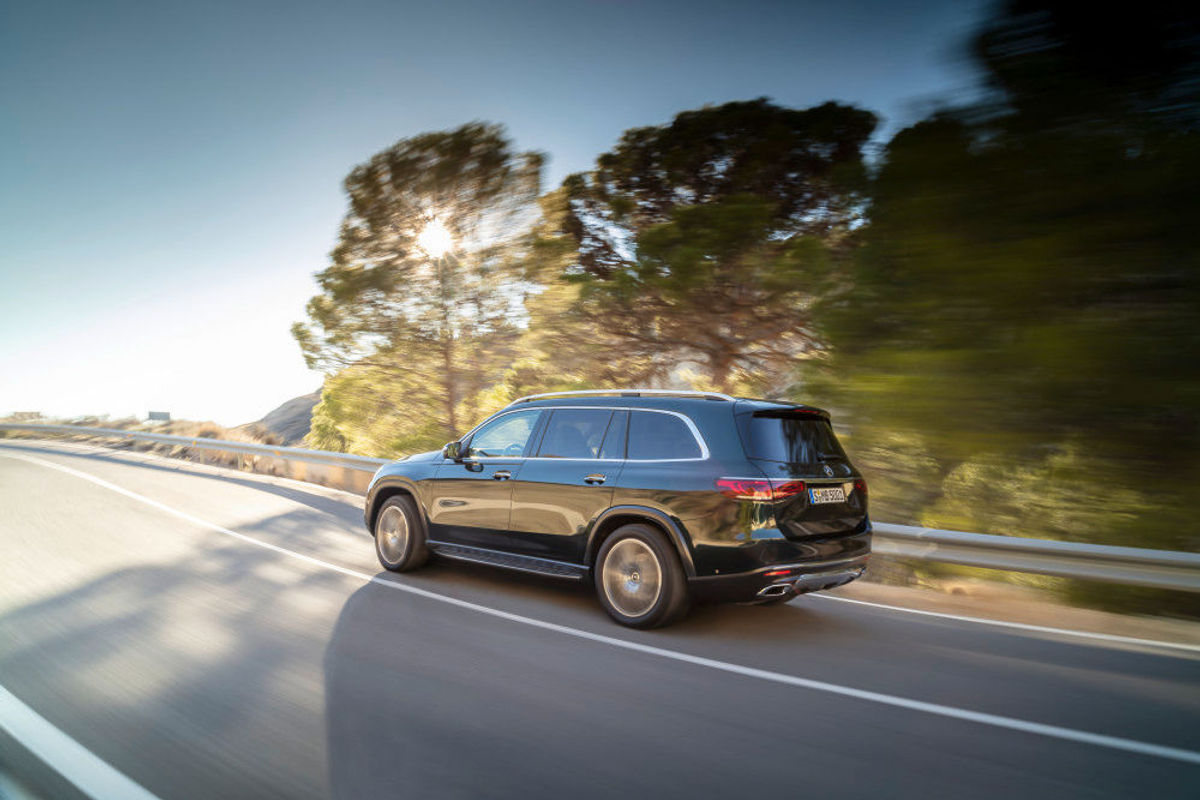
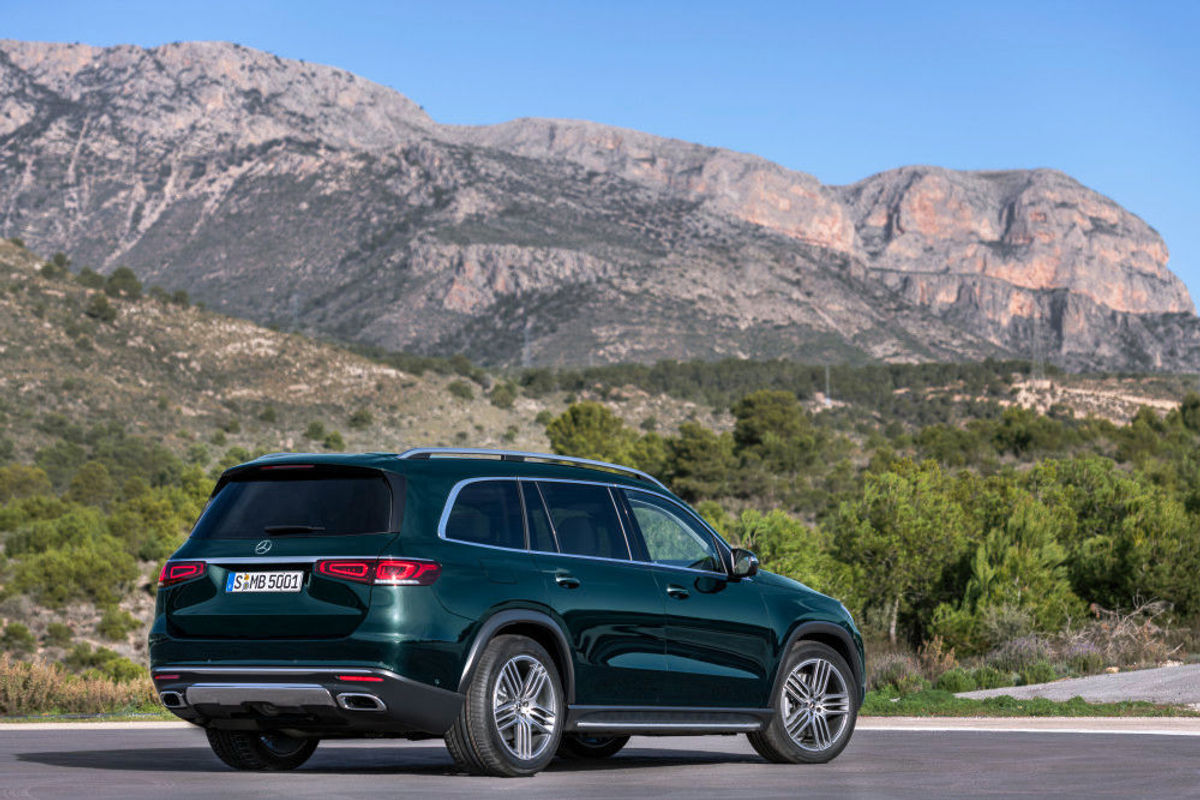
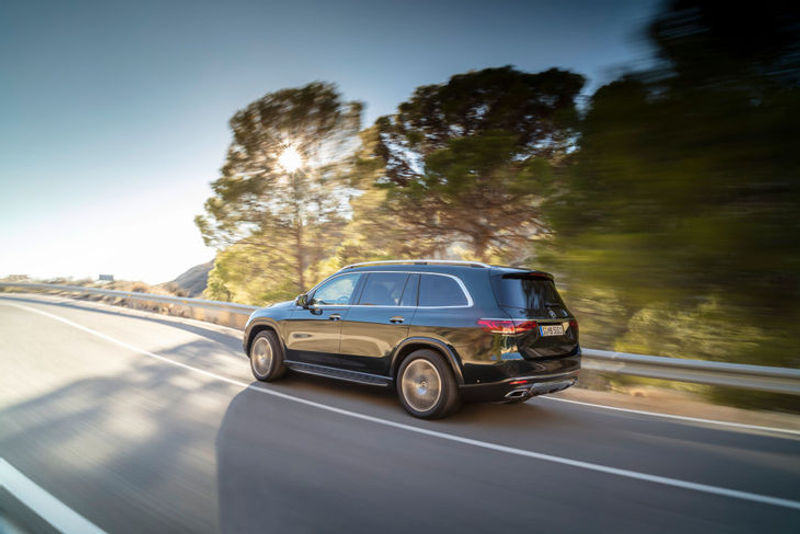
The Mercedes-Benz GLS has arrived in South Africa! See local specification and pricing details for the GLS below…
The Mercedes-Benz designates its GLS as an off-road capable "S-Class of SUVs". We'll hopefully be putting that claim to the test, very soon.
Engine Power
The new GLS arrives in SA with 2 engine choices on offer!
Local buyers have the choice of 2 GLS derivatives. The GLS 400d is powered by a 3.0-litre turbodiesel straight-6 motor, which produces 243 kW and 700 Nm. Power goes to all 4 wheels via the 9G-tronic automatic transmission. In GLS 580 guise, it gains a twin-turbo 4.0-litre V8 with EQ Boost hybrid technology, producing 360 kW (+16 kW from the EQ system) and 700 Nm. It too features all-wheel drive and a 9-speed automatic transmission.
For what it's worth, the GLS 400d claims a zero to 100 kph sprint time in 6.3 seconds while the GLS 580 is quicker with a claimed time of 4.7 seconds.
A range-topping Mercedes-AMG GLS 63 is expected to arrive later with 450 kW and 850 Nm on offer from its 4.0-litre turbocharged V8 engine with a claimed 4.2 seconds in the dash from zero to 100 kph.
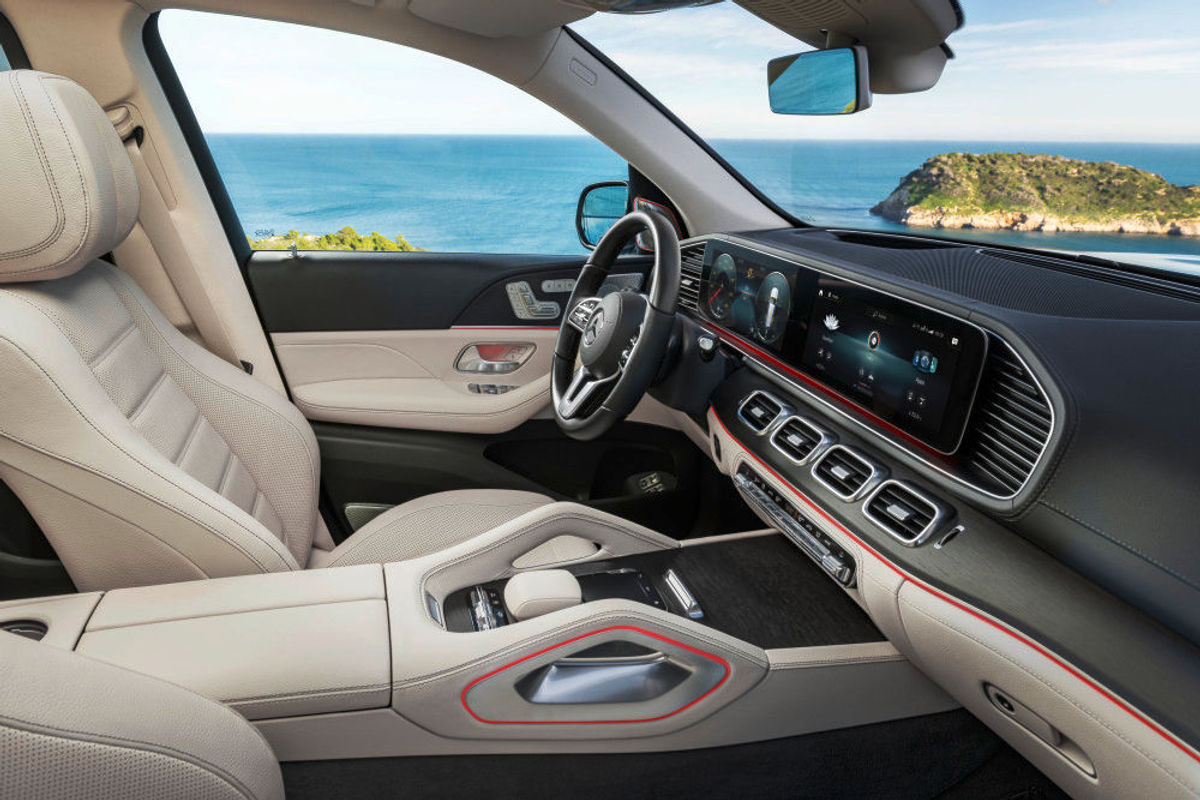
“The GLS combines modern luxury with the character of an off-roader,” says Selvin Govender, Marketing Director for Mercedes-Benz Cars South Africa. “It combines powerful highlights of off-road design & capability with an elegance reminiscent of a classic luxury sedan. The interior is a synthesis of modern, luxurious aesthetics, hallmark SUV practicality, and digital high-tech. It’s the best of all worlds.”
Key Features
The GLS offers the latest tech that Mercedes-Benz has to offer.
Standard wheels are 19-inch units, but you can go up to 21-inch alloys. For those wanting to beef up the look of the GLS you can opt for the AMG Line package (R62 000). For bolt-on MBUX enhancement, you're looking at R25 000 for the Innovation package, while semi-autonomous driving tech is available with 2 packages of R42 000 and R37 300. If you really want to try out the offroad capabilities, it's best to tick the OffRoad Engineering Package for R32 300. Enhanced air suspension with adaptive damping is fitted as standard.
The GLS can also be equipped with Active Distance Assist Distronic with route-based speed adaptation which recognises and responds to traffic tailbacks before the driver becomes aware of them and slows the vehicle to 100 kph as a precaution. Once the tailback is clear, the GLS will then accelerate back up to the preset speed. For buyers who will be towing trailers, the GLS can also be equipped with Trailer Manoeuvring Assist.
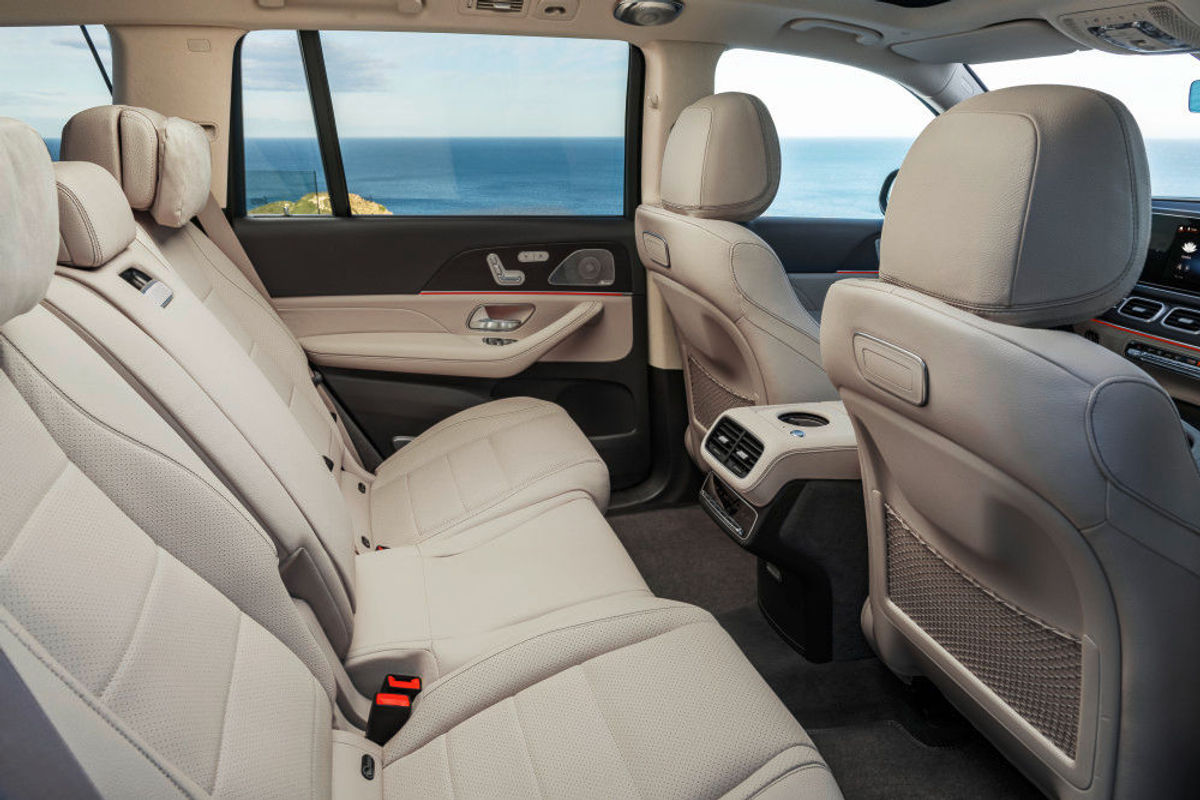
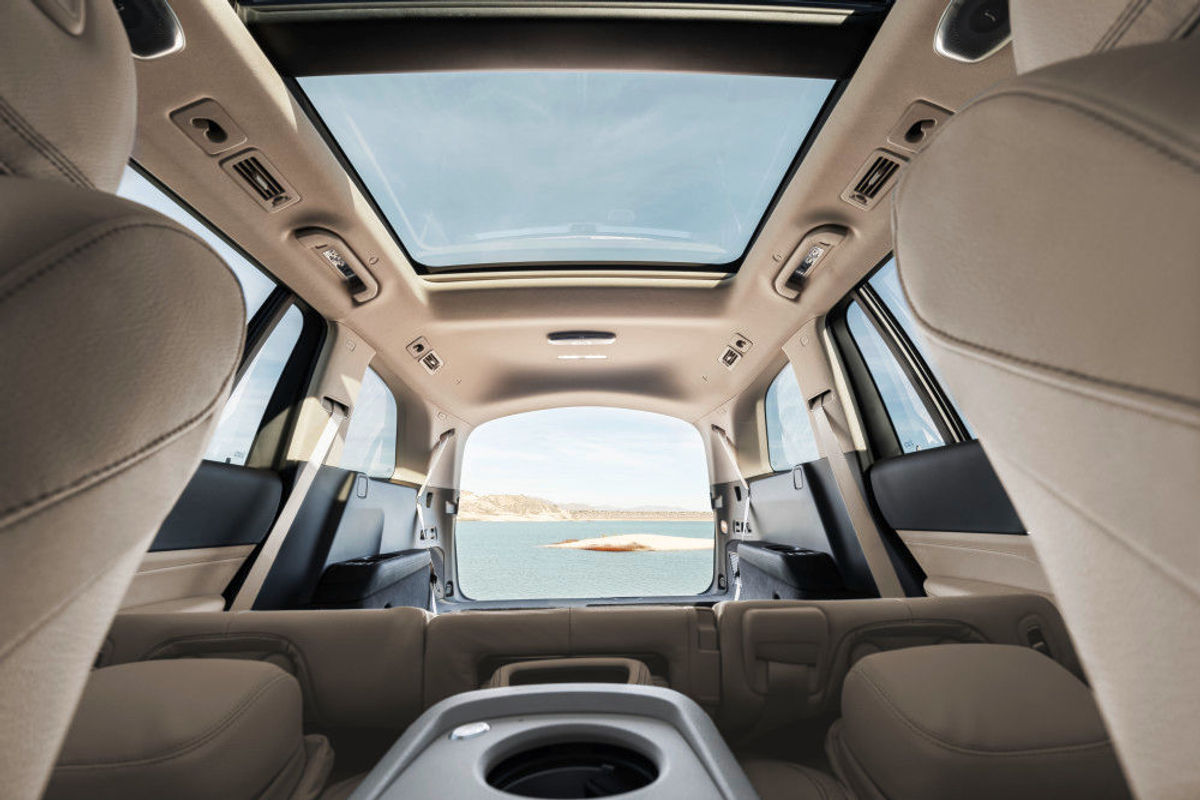
With a 60mm increase in wheelbase over its predecessor, the GLS offers generous space for rear occupants All 3 seat rows are electrically adjustable and the third row can be lowered into the floor to increase loading space up to 2 400 litres. The optional Rear Comfort Package adds luxury head restraints as well as a removable 7-inch Android tablet with its own docking station as well as a wireless charging station. The package also includes five-zone automatic climate control for the rear seats.
For even higher levels of luxury, buyers can also consider the Mercedes-Maybach GLS 600 which is also available in South Africa.
Mercedes-Benz GLS Price in South Africa (November 2020)
The movement of talented BMW staff to Korea shows no signs of abating… Talented BMW Designworks designer Won Kyu Kang has now assumed a key leadership role in Kia's design division.
Won Kyu Kang is the latest BMW senior employee recruited to Korea, where he has now become the head of design innovation for Kia.
BMW has seen some of its best talents resign and join Kia over the last few years. Former M-Division boss, Albert Biermann, was the first. The other significant BMW departure that strengthened Kia’s human capital, was that of Karim Habib.
It is telling that Kang has followed his former boss at BMW, Habib, to Kia. They share common design values and working aspirations, both of which are considered to now be more achievable at Kia, than BMW.
In his new role at Kia, which is based in Korea, where Kang enjoys native language proficiency, and his line of reporting will be to Habib.
Originally trained as an industrial designer, at Hongik private university in Seoul, Kang then pursued further study in American. He is a graduate in transport design, from the Art Center College of Design in Pasadena, California, and has 15 years of experience in the automotive industry.
Interestingly, Kang spent ten months working at Hyundai in 2001, between his degrees. His portfolio of work includes the original 4 Series and BMW’s 3.0 CSL Homage concept car.
Although Habib is in the more senior position at Kia, it is clear that Kang is being groomed to eventually become overall director of exterior design. This would be a tremendously proud moment for the Korean brand, to have one of its own responsible for the brand’s global product identity.