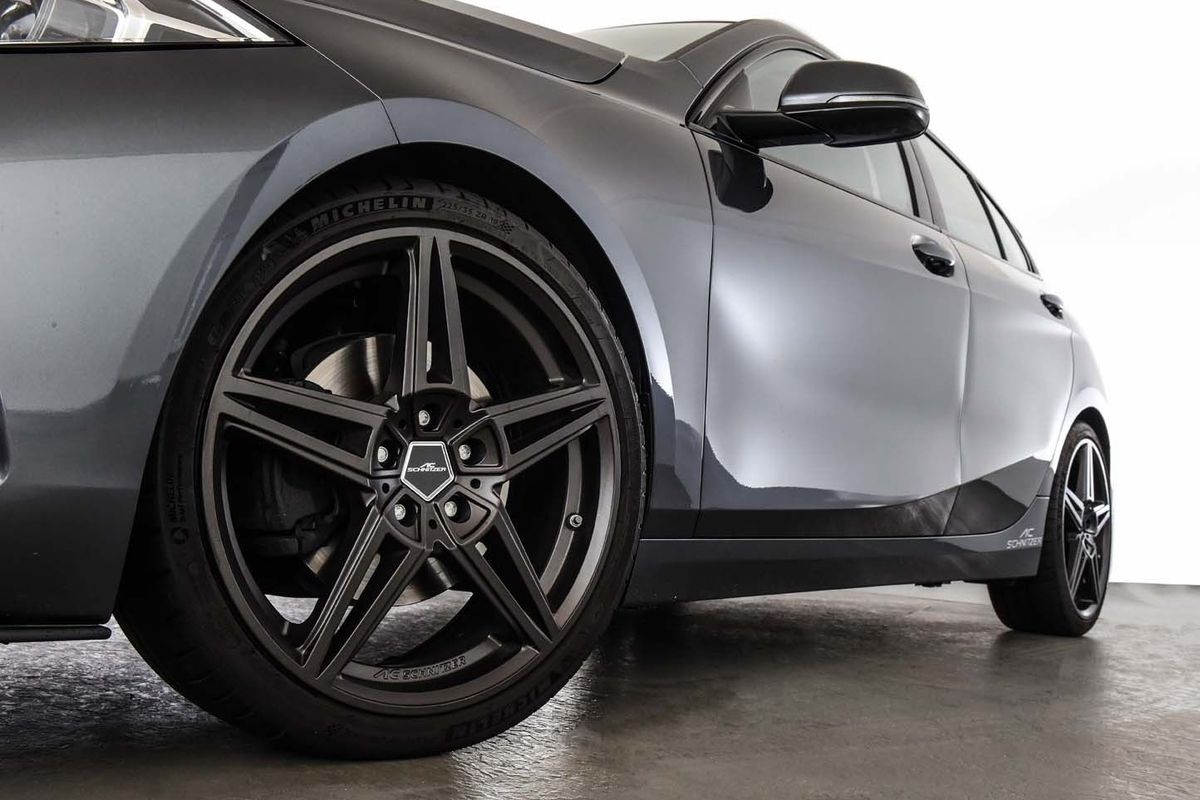
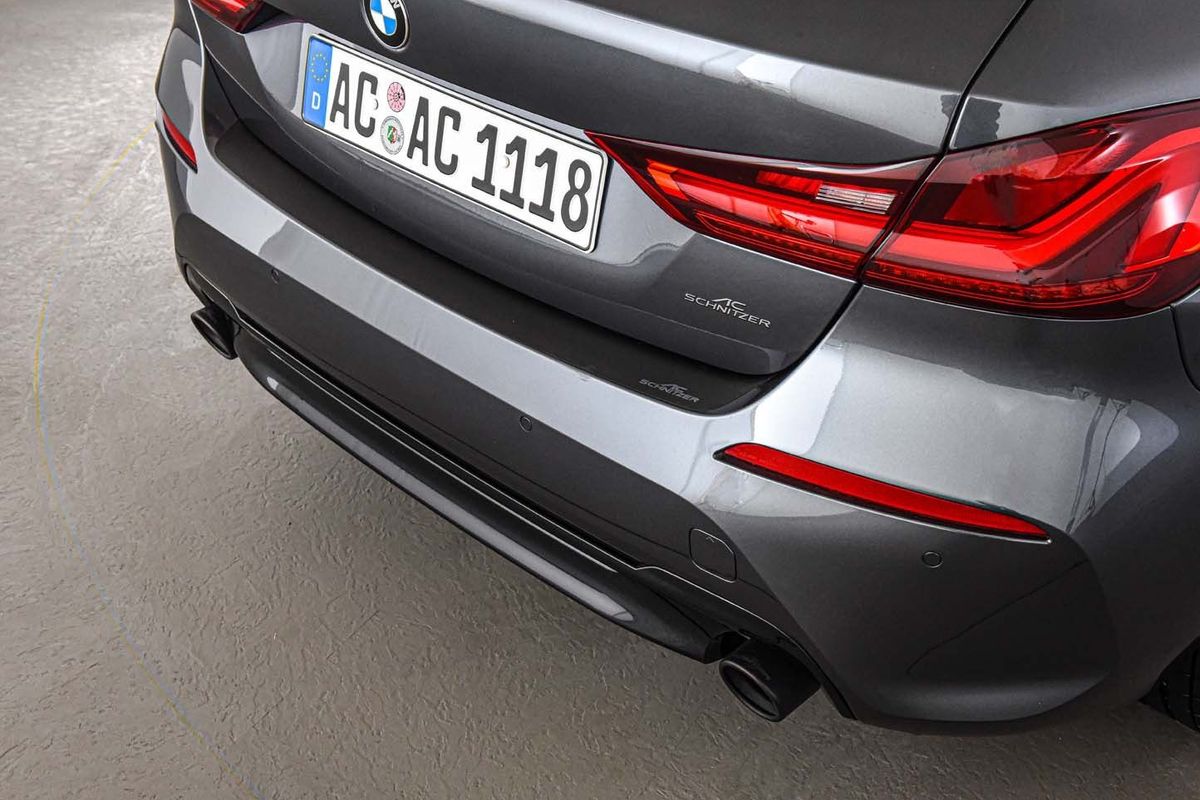
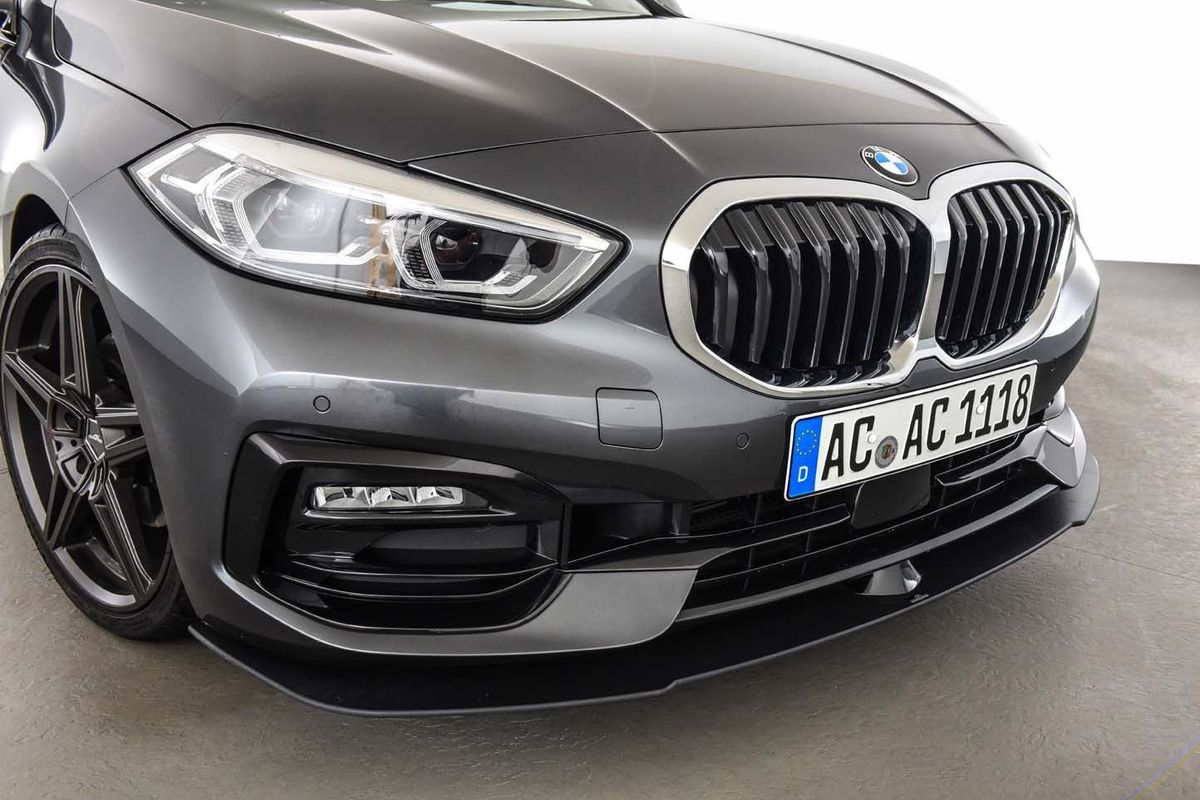
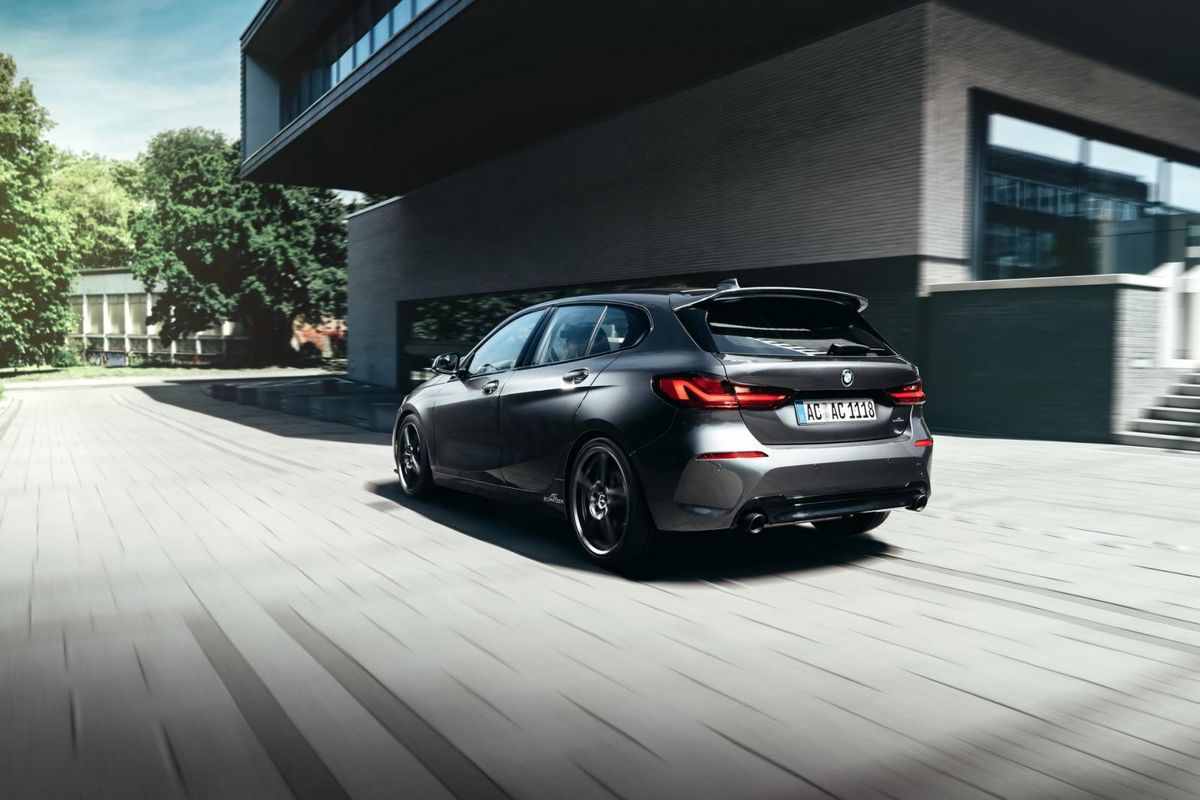
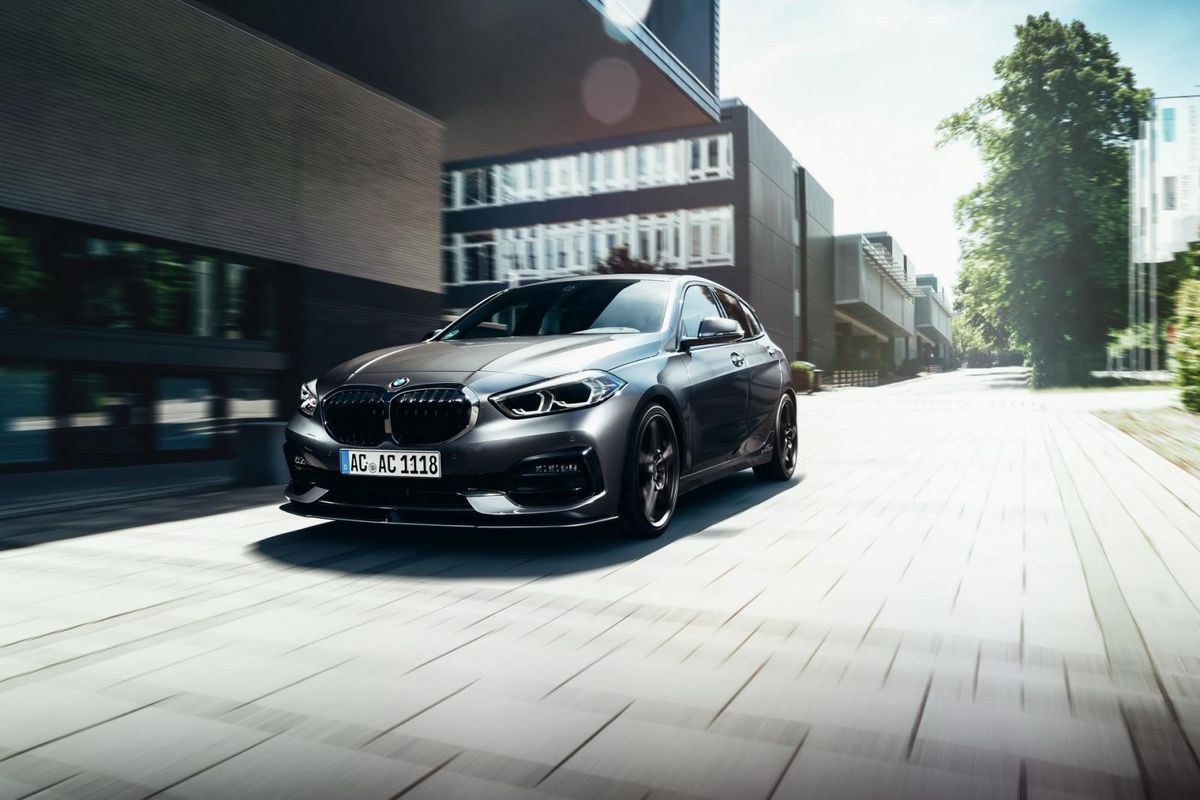
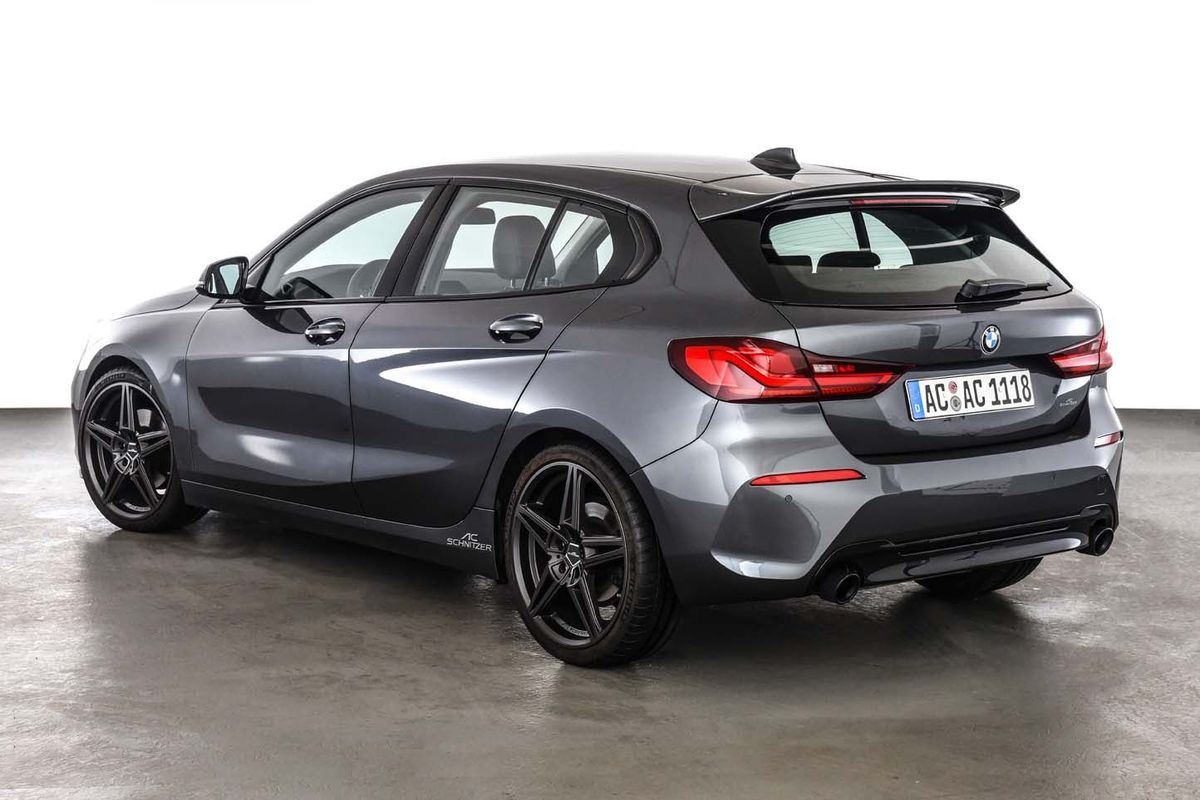
German tuner AC Schnitzer has revealed more parts for the BMW 1-Series including some performance parts for the BMW M135i.
Some of you may recall the first catalogue of AC Schnitzer parts for the BMW 1-Series which ranged from an aerodynamics package and lowering kit. Now the German tuner has showcased even more parts.
For those wanting more, you can get a sports exhaust with either carbon, chrome, or black tips, front splitter, rear wing, custom badges, as well as these tasty wheels. They're 19-inch units and are available in either BiColour or Anthracite tones.
The cabin can be specced with AC Schnitzer’s aluminium gear shift paddles, pedals, footrest and key holder.
“Even for the smallest Bavarian, the AC Schnitzer experts naturally have tailor-made components beyond the standard in their range. After extensive tuning, the 1 Series by AC Schnitzer comes out big – for those very special moments of driving pleasure,” claims the German tuner.
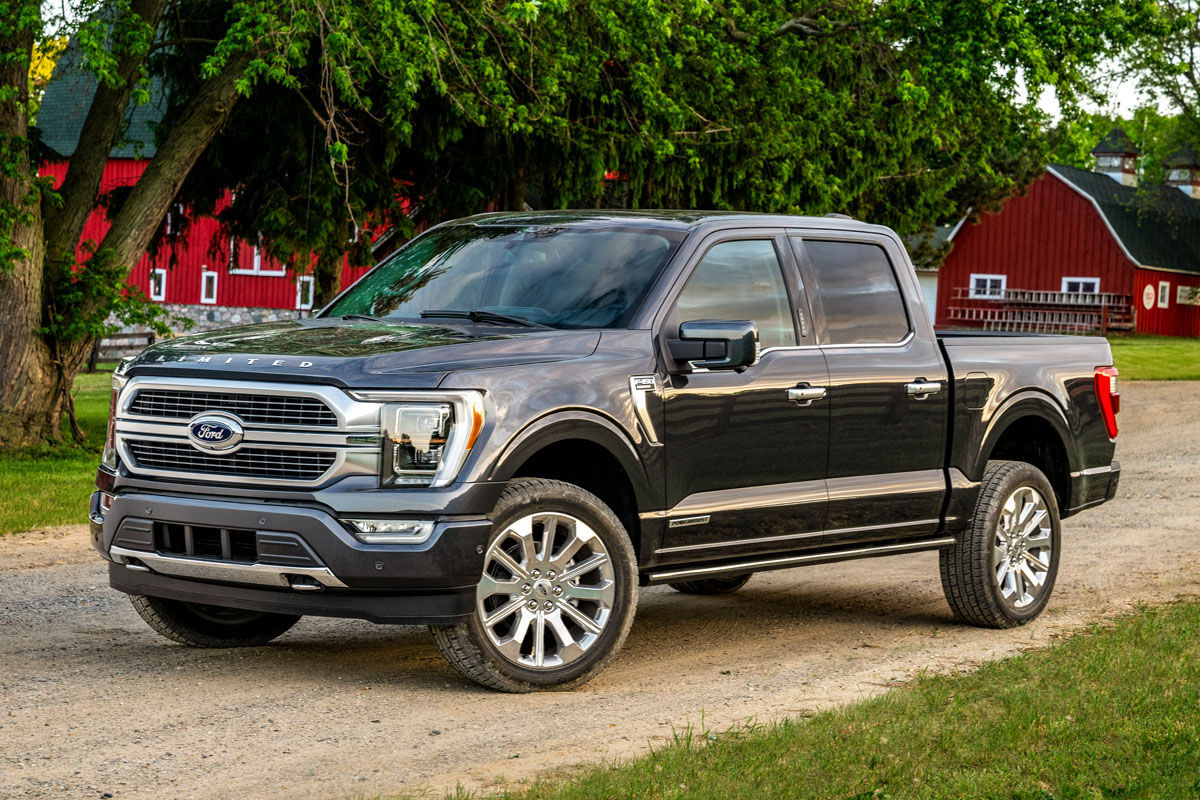
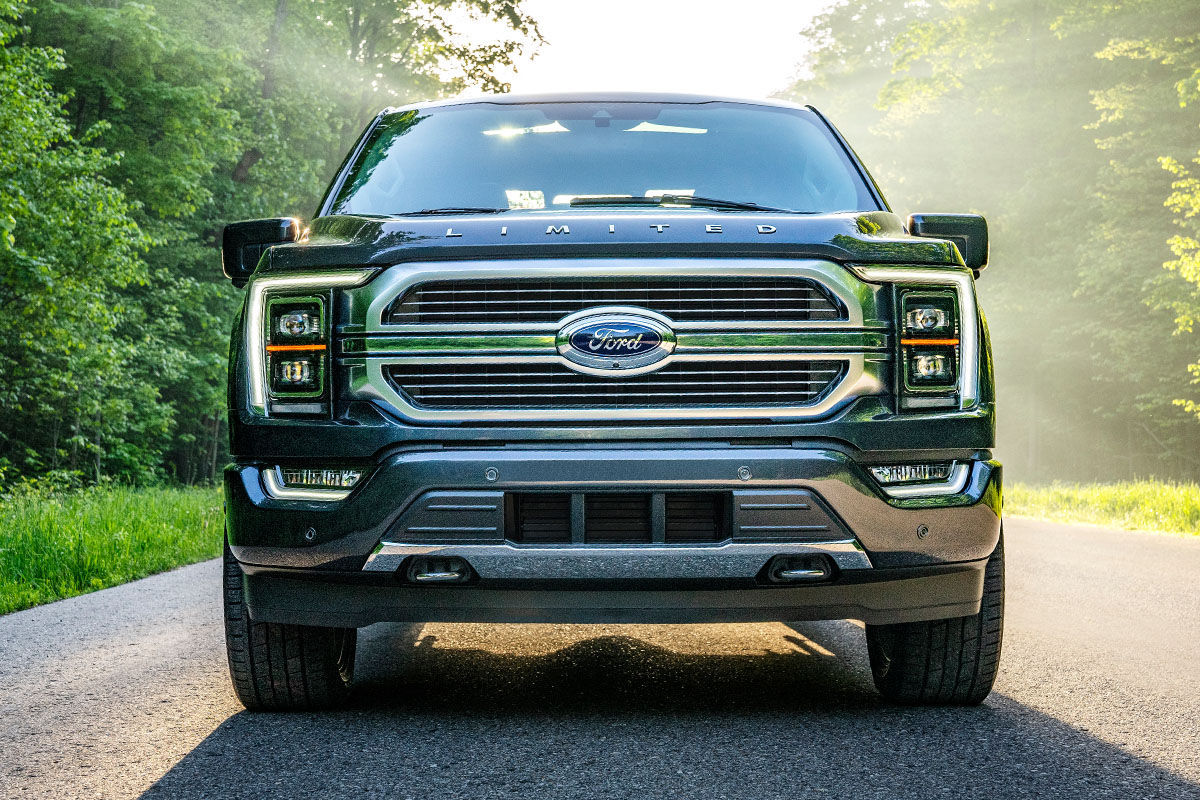
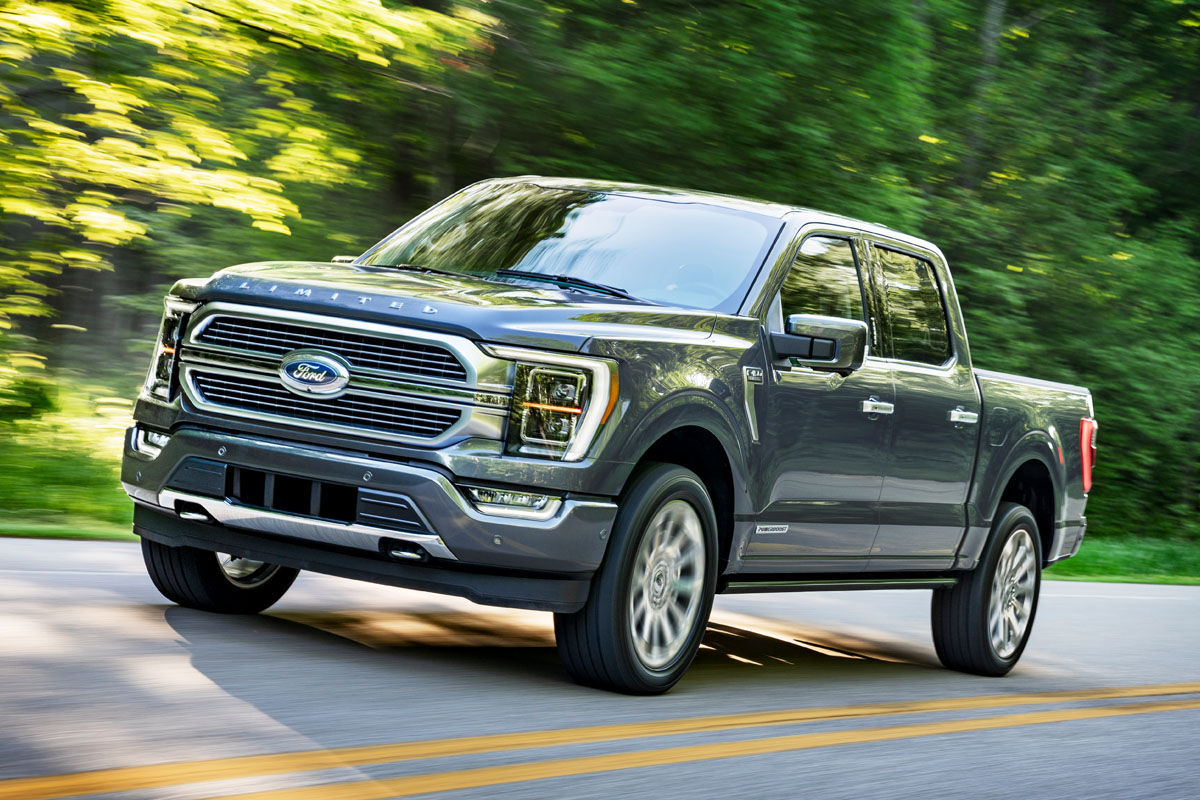
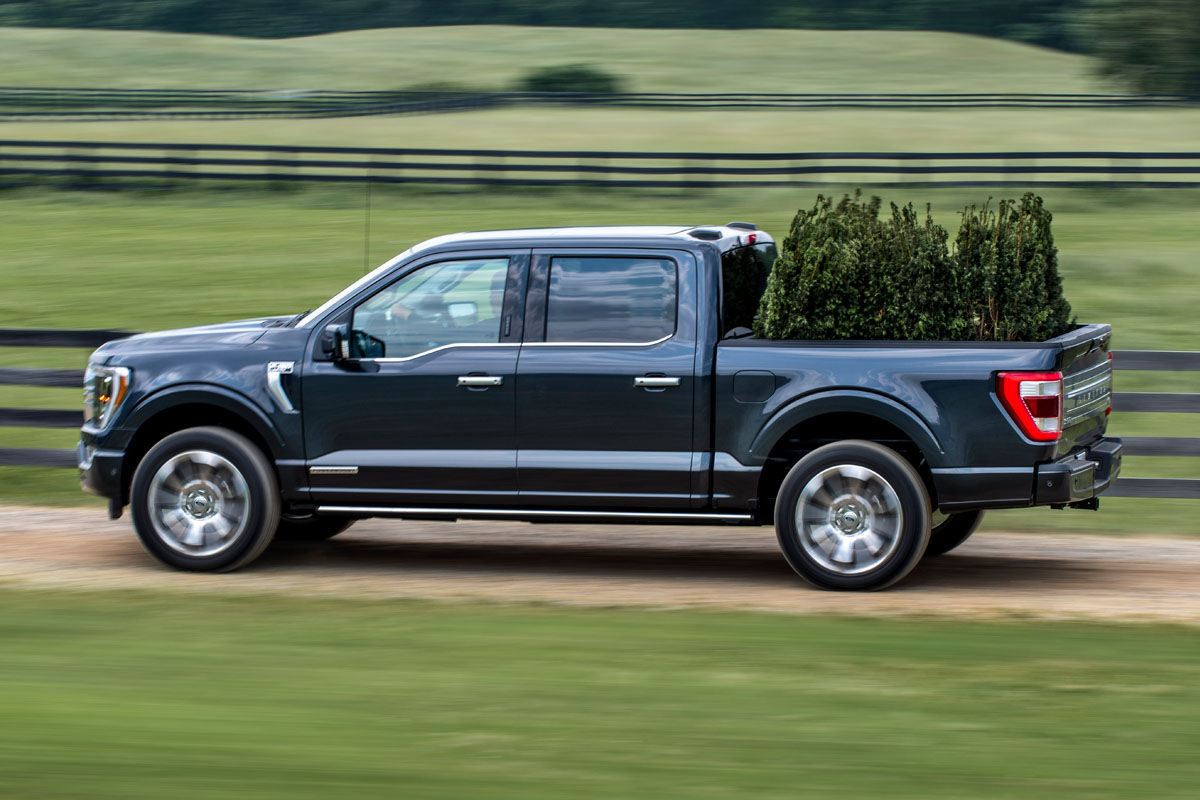
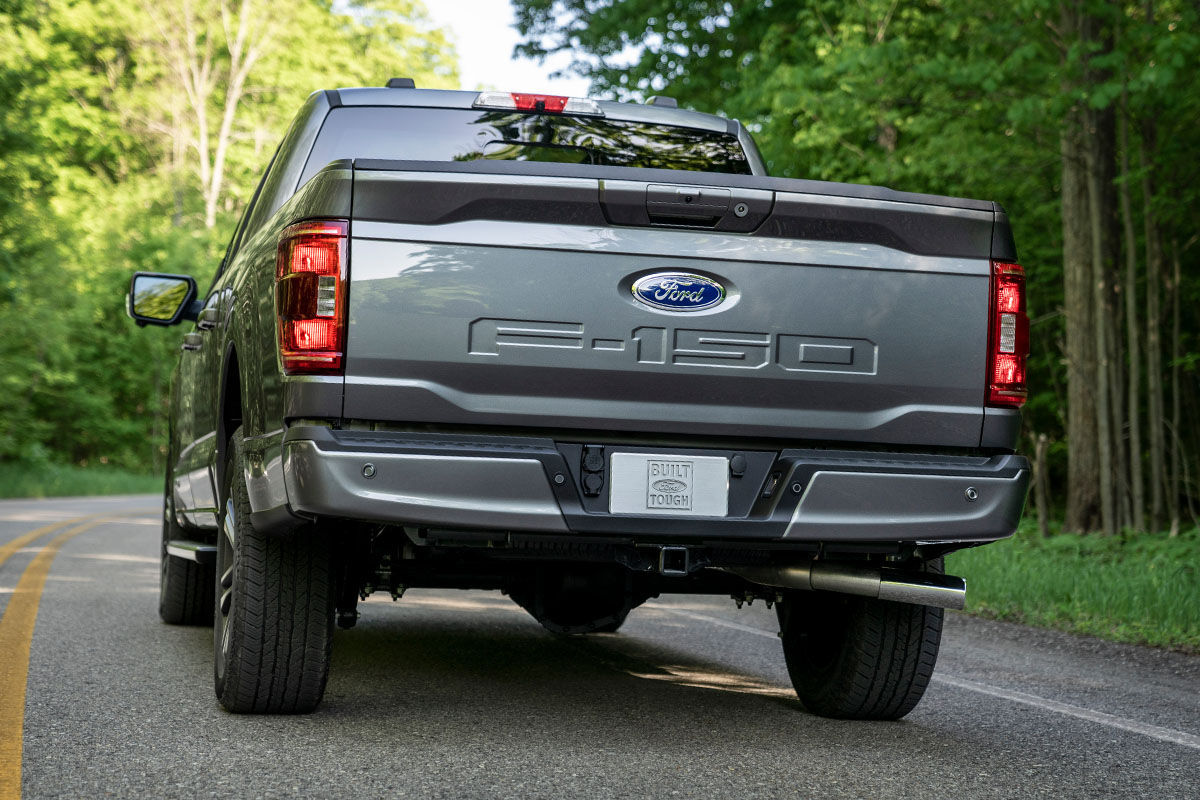
The new generation of North America’s top-selling new vehicle (let alone pick-up truck) has been revealed in the ‘States and it provides insights as to what the upcoming Ford Ranger, which will be revealed in 2021, may look like, be powered by and feature, technology-wise.
The all-new Ford F-150 pick-up truck is produced in left-hand-drive configuration only and won’t be offered in South Africa, but because the unveiling of its little brother, the next-generation Ranger, which will also be sold in North America, is about a year away, we can begin to form a picture of what the Blue Oval’s “one-tonner” double-cab may look like.
Ford says the F-150 has "a fully boxed high-strength steel frame with a high-strength, military-grade, aluminium-alloy body".
Some sites have produced renders of the upcoming Ranger based on what the current model looks like and incorporating cues from its F-150 brother in the States, because it stands to reason that Ford would be keen to establish design familiarity between the F-Series and its sibling double-cab bakkie from a marketing/recognition point of view.
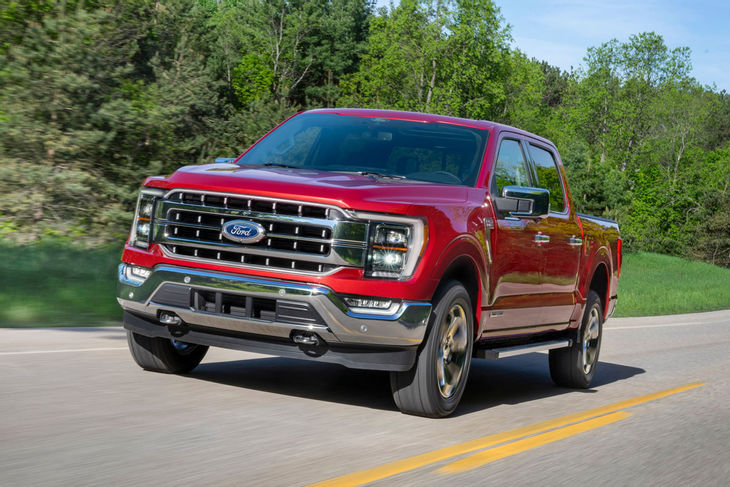
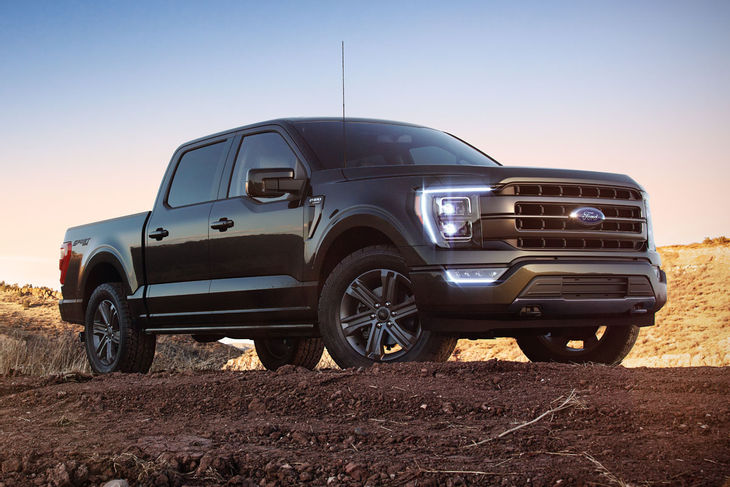
Every panel of the F-150 has been redesigned; the newcomer incorporates an updated headlamp design, a bulging bonnet and wrap-around bumpers. To aid aerodynamic efficiency, the Ford features active grille shutters, an automatically deploying active air dam, plus new cab- and tailgate geometry to reduce drag/improve fuel consumption.
We think the daytime running lamp lighting signature will feature on the next-generation Ranger.
Apart from featuring a larger, boldly styled chrome-look grille, the new Ranger is highly likely to have similar inverted-C-shaped daytime running lamps/lighting signature.
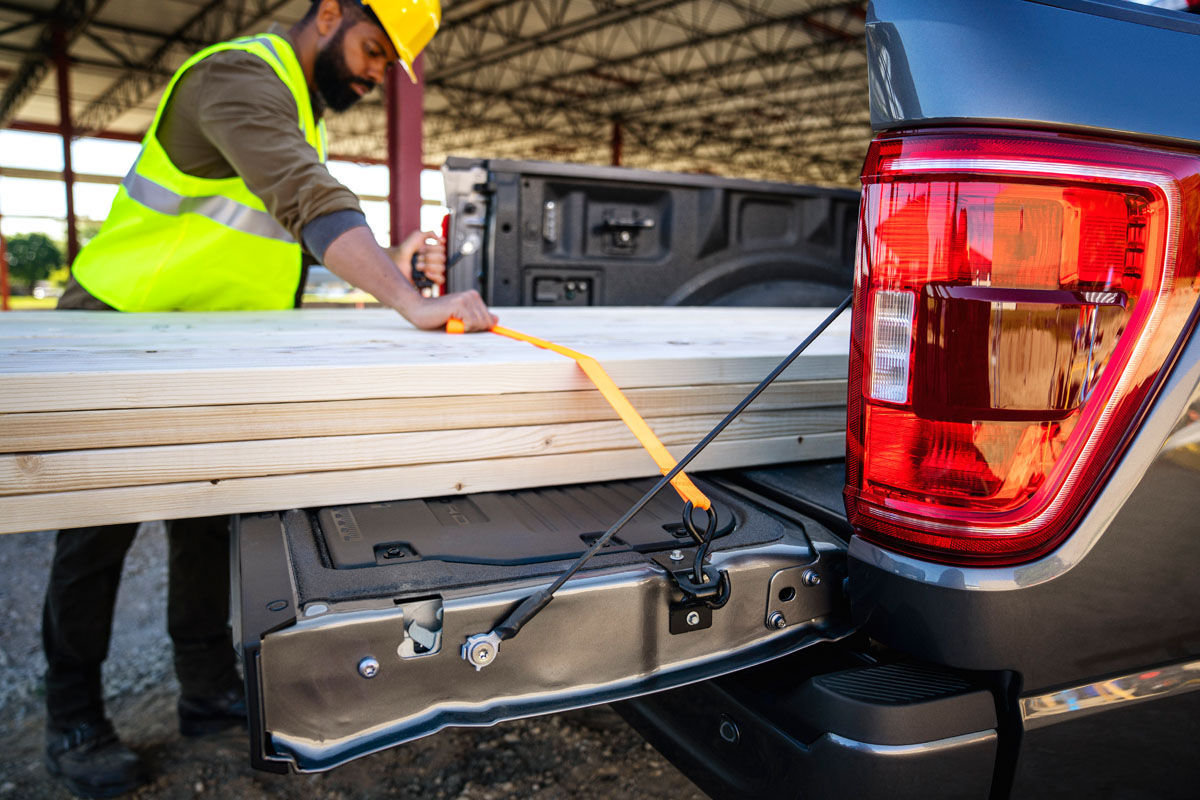
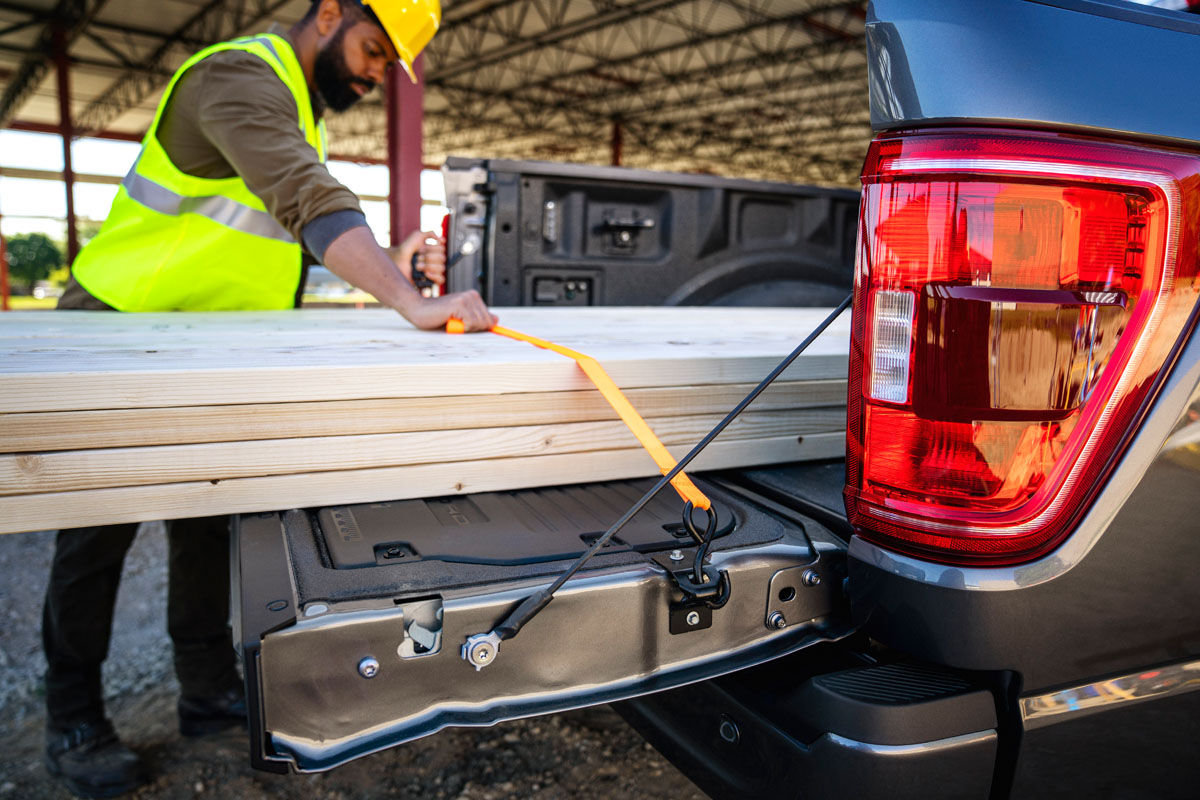
There are up to 11 grille options available, new LED head- and tail-lamp clusters, revised tailgate appliqués, plus optional full-length boards. The F-150’s tailgate comes standard with new cleats mounted to its sides that act as tie-down locations for extra-long items, as well clamp pockets, which Ford says allow customers (such as tradesmen) to secure materials to carry out "precision work". What’s more, an optional flat Tailgate Work Surface includes integrated rulers, a mobile device-, cup- and pencil holder.
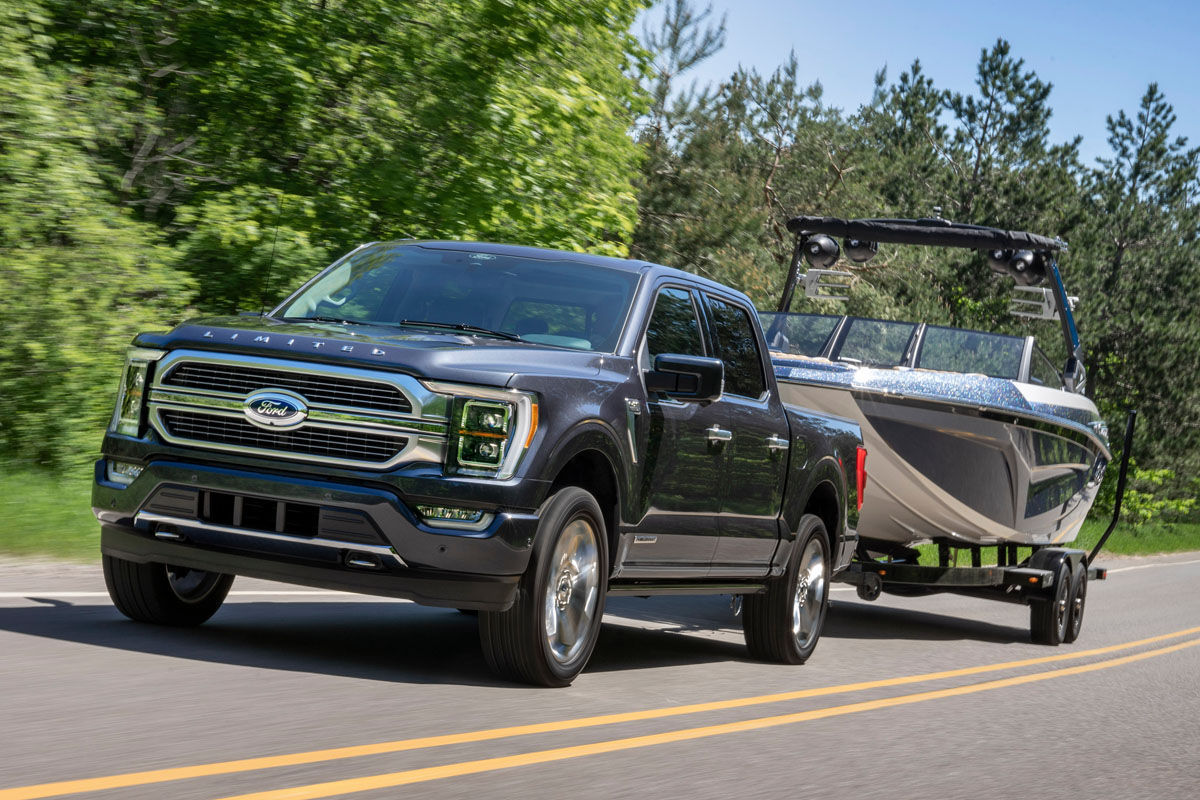
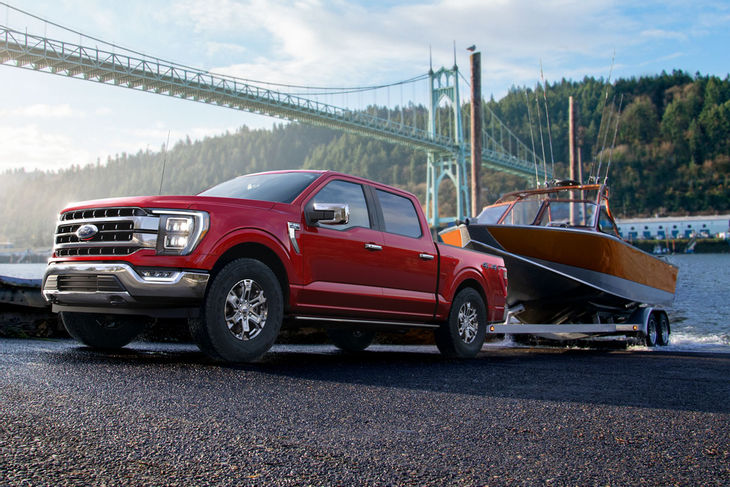
The hybrid-electric F-150 will have a braked towing capacity in excess of 5 tonnes.
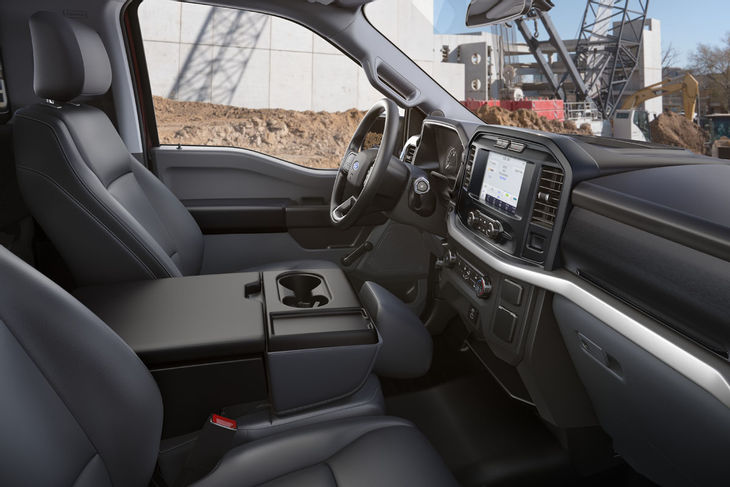
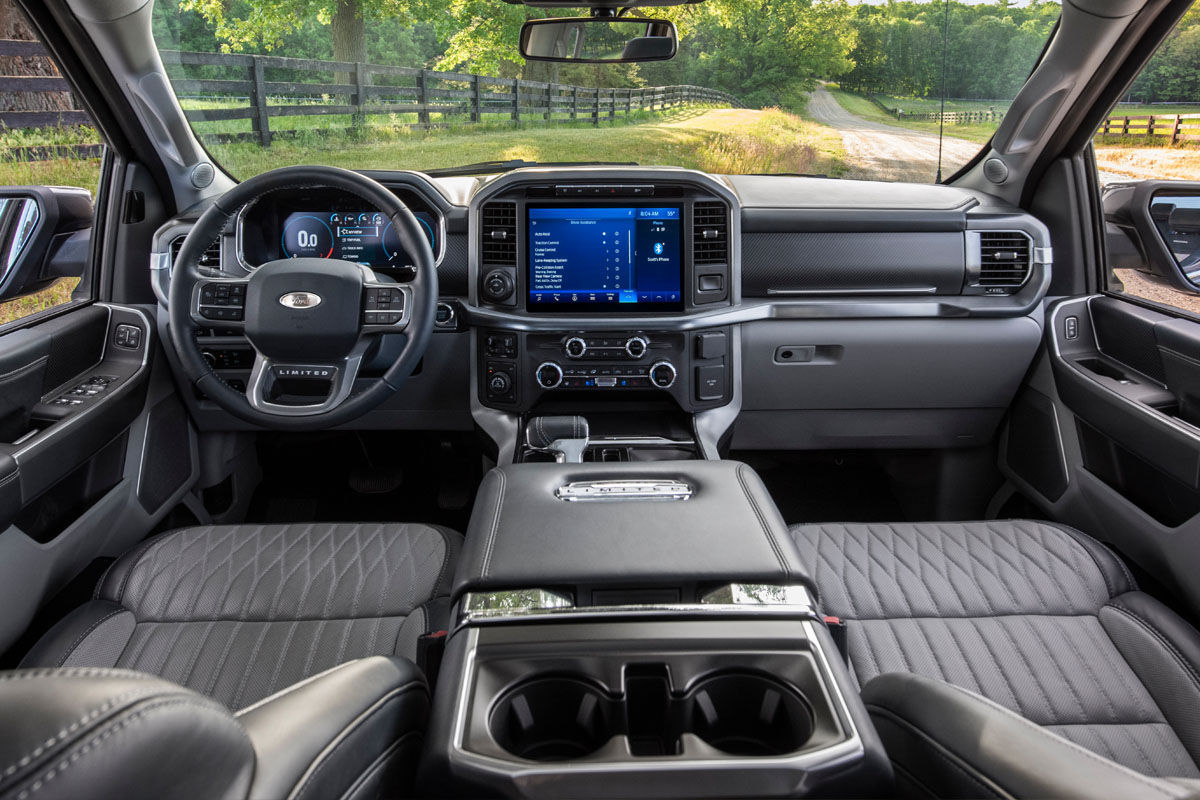
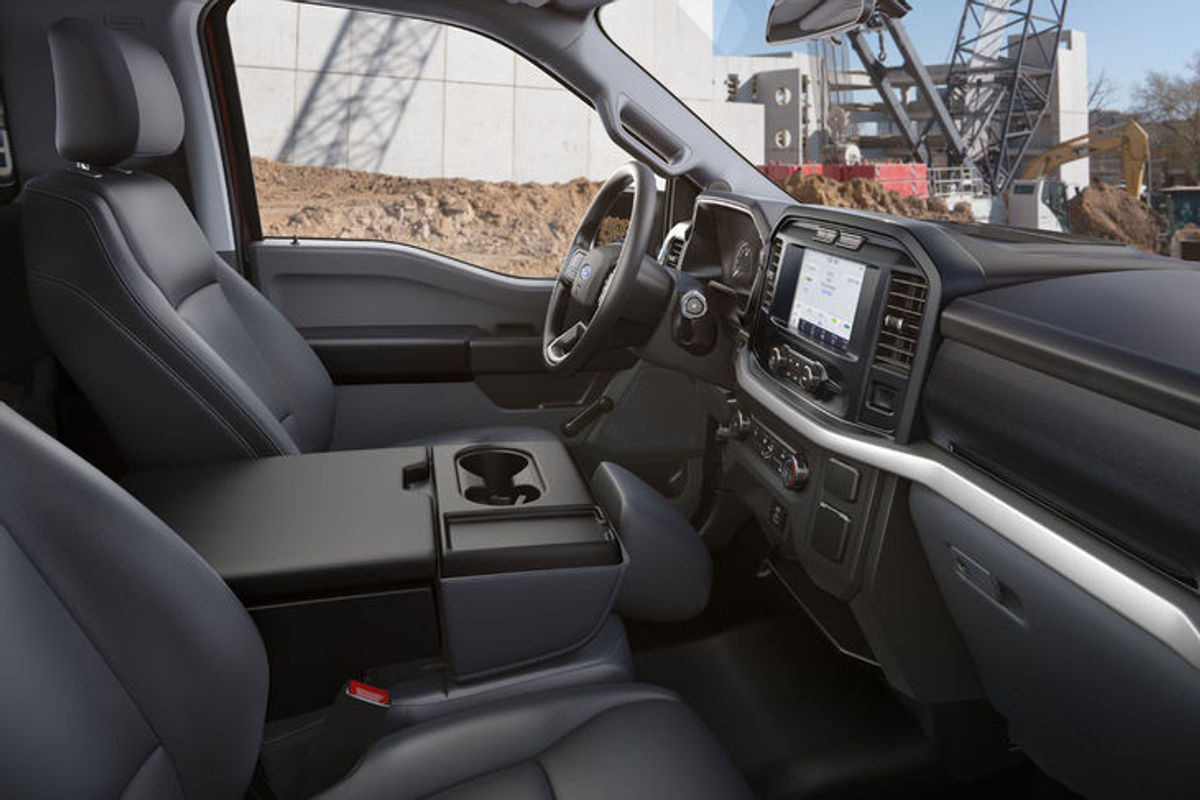
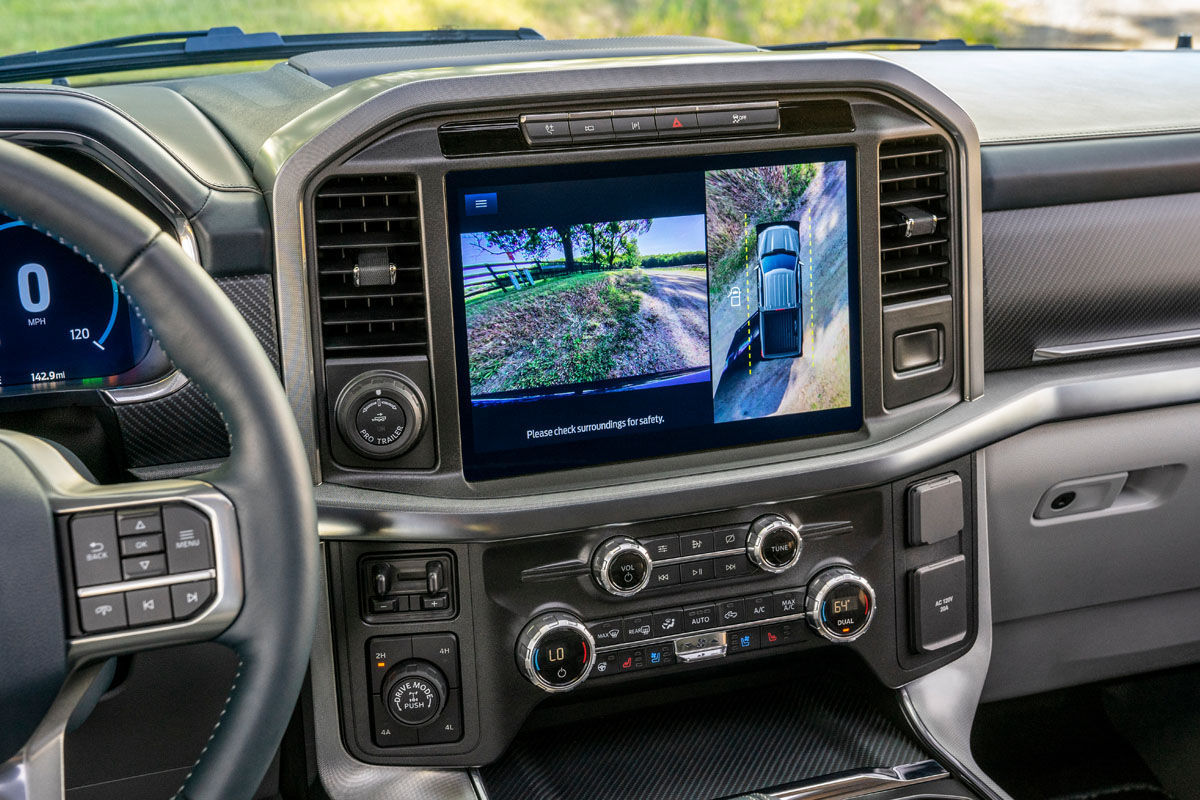
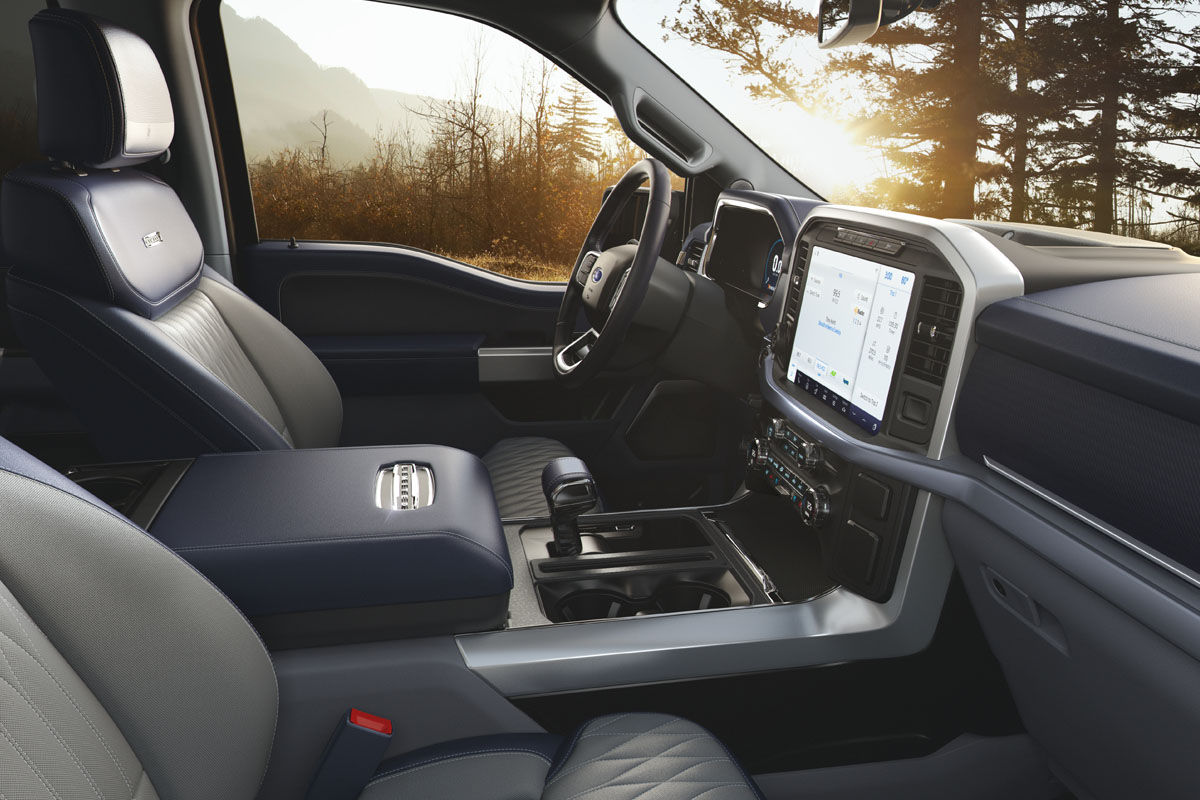
Apart from offering more in the way of storage spaces as well as a standard dual glovebox, the Ford’s redesigned cabin features, inter alia, a 12-inch touchscreen infotainment screen with SYNC 4 technology, an optional digital instrument cluster, plus the ability to download over-the-air updates and Ford Pass smartphone app functionality.
The new F-150 range will offer a total of 6 powerplants, including a 3.3-litre naturally aspirated V6 petrol, 2.7- and 3.5-litre V6 twin-turbo motors, a 5.0-litre naturally aspirated V8 petrol and 3.0-litre V6 turbodiesel. Earlier this week, we speculated that the next-generation Ranger will offer the 3.0-litre V6 turbodiesel, potentially a 3.0-litre V6 twin-turbo petrol from the Explorer ST… and now, come to think of it, possibly even a petrol-electric hybrid. Read more here: 2022 Ford Ranger: More details emerge
All F-150 tailgate's come with cleats, through which owners and operators can secure long objects for transport.
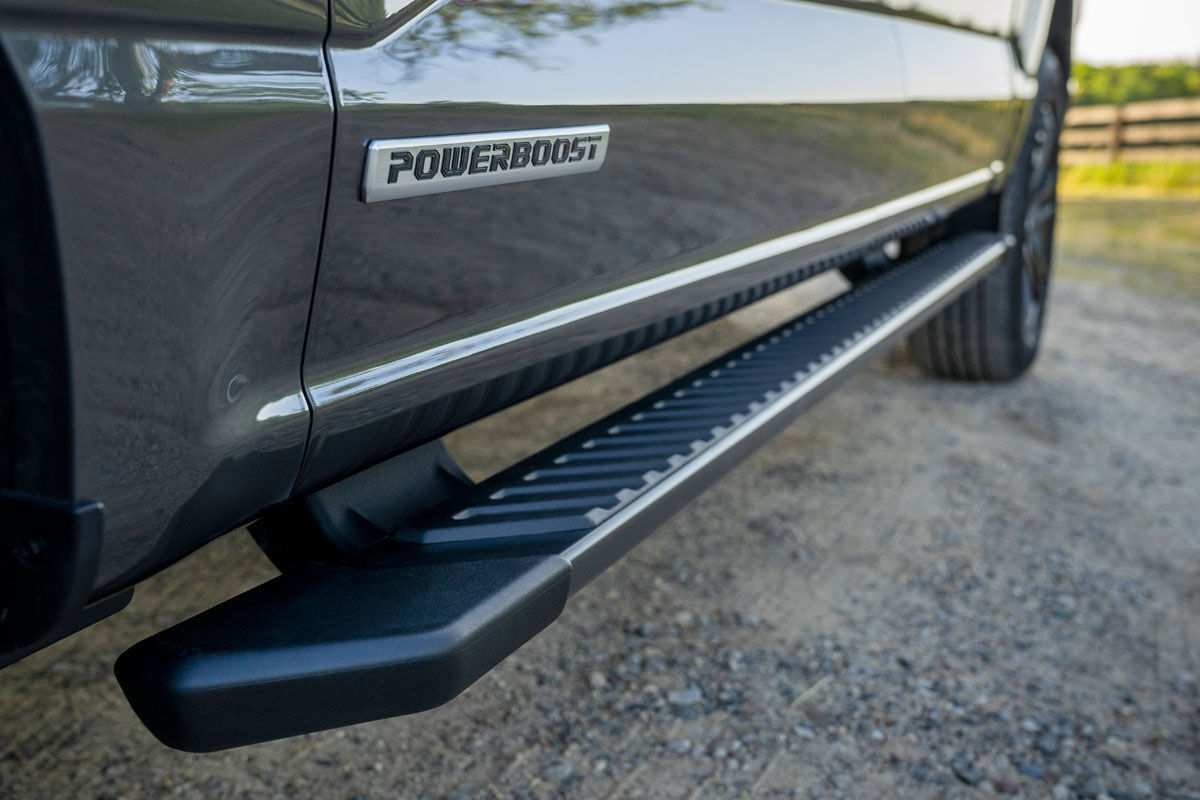
Hybrid? Yes, perhaps, because Ford chose to make the PowerBoost hybrid, which combines a 3.5-litre V6 twin-turbo petrol – mated with a 10-speed automatic ‘box – with a 35-kW electric motor integrated with the transmission, the star of the F-150’s launch. The motor, which is mounted underneath the pick-up's load bed to ensure that it does not encroach on cabin space, is powered by a liquid-cooled 1.5kWh lithium-ion battery that’s recharged via regenerative braking.
Although Ford did not release peak output figures for the derivative, its claimed fuel consumption on the combined-cycle test (EPA) is about 10.3 litres/100 km, and the hybrid pick-up is reported to feature a braked towing capacity of 5 tonnes and a 7.2-kW Pro Power Onboard generator. Learn more about Pro Power Onboard here.
Although top-spec F-150s will feature 12-inch touchscreen infotainment systems, lower to mid-spec ones will have 8-inch units.
Meanwhile, the new F-150 features a plethora of driver-assist features, including Pre-Collision Assist with automatic emergency braking and pedestrian detection, an updated reverse-view camera with dynamic hitch assist, auto high-beam headlamps and auto on/off headlamps.
Ford claims the F-150 is the only pick-up to offer Active Drive Assist, which allows for hands-free driving on more than 100 000 miles of pre-mapped, divided highways in the US and Canada. By contrast, most contemporary drive assist systems require you to at least touch the wheel… Here's how it works: Ford's advanced driver-facing camera tracks the driver's head position and driver-eye gaze and will allow him/her to take their hands off the tiller – as long as they continue to pay attention to the road ahead.
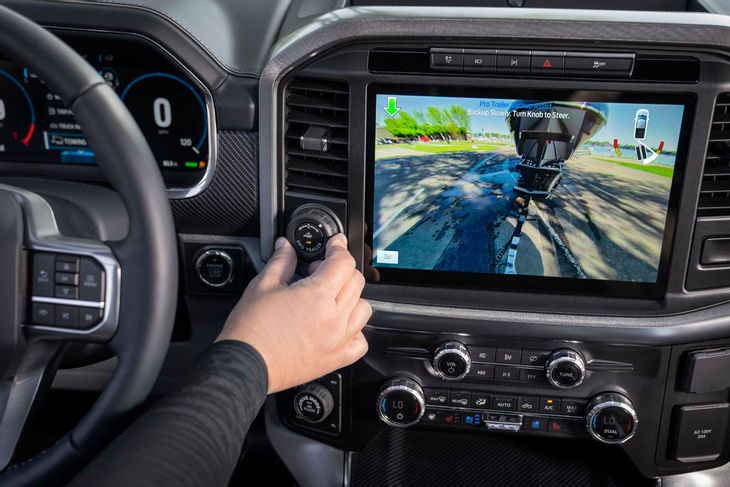
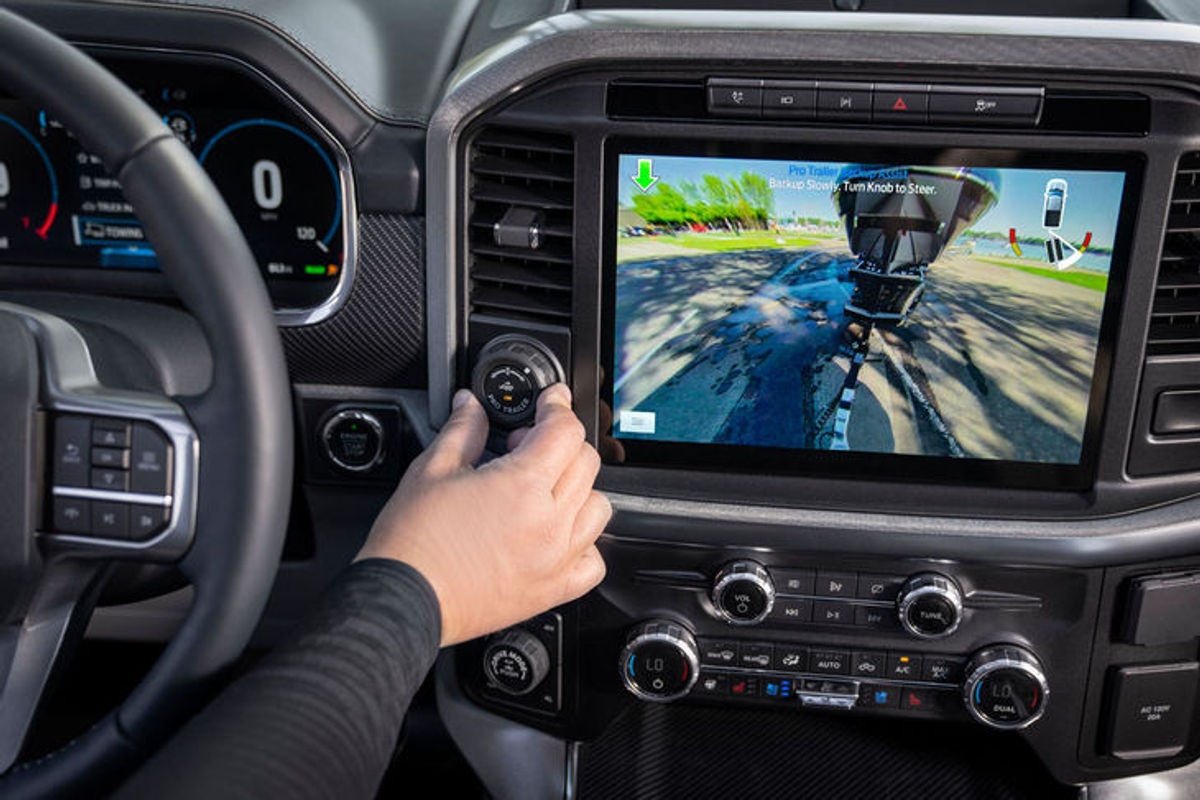
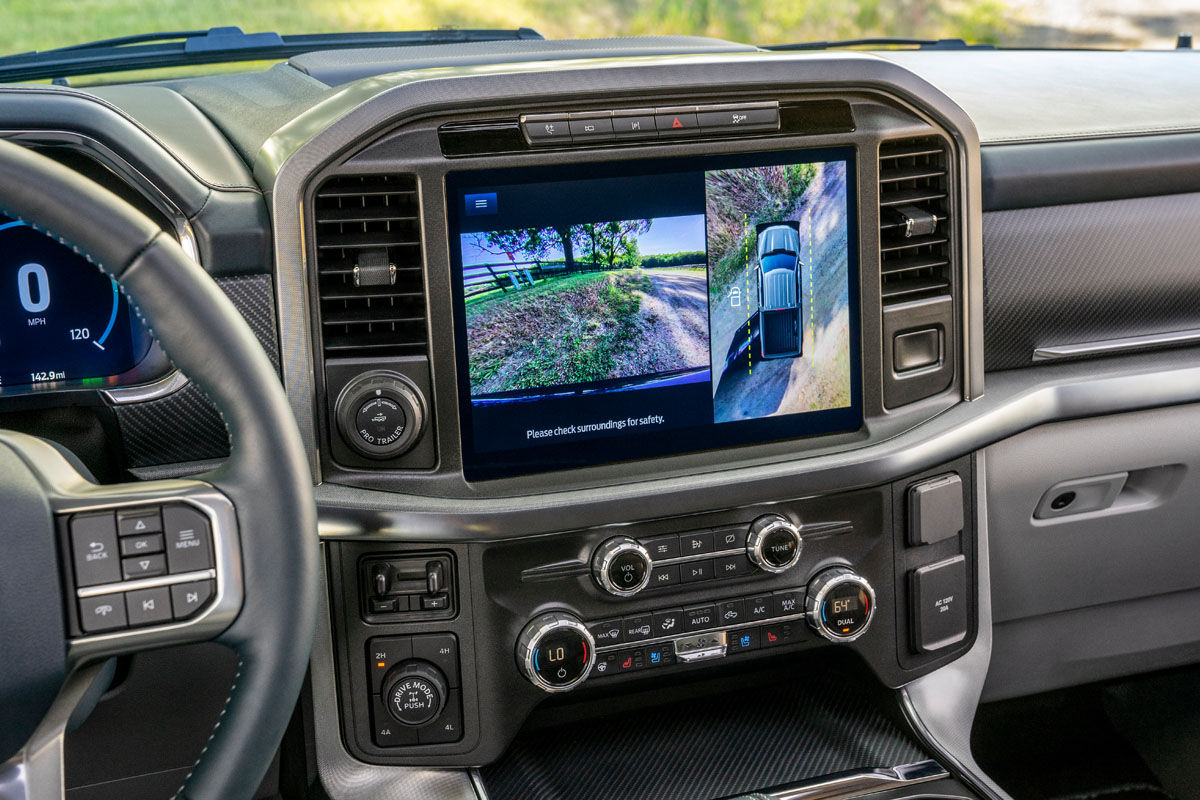
Apart from offering better resolution reverse views, the F-150 can be optioned with Pro Trailer Backup Assist.
And lastly, given the bulk of the popular full-sized truck, any help with executing reversing manoeuvres is a godsend. To that end, the F-150 offers Active Park Assist 2.0, which handles all steering, shifting, braking and accelerator controls during a parallel or alley docking manoeuvre.
In addition, Trailer Reverse Guidance uses the truck’s surround cameras to provide multiple views along with helpful graphics that tell drivers which way to turn the ‘wheel while reversing. With Pro Trailer Backup Assist, however, that particular exercise is as easy as turning a dial (see above).
Here are 10 cars we would love to see on South African roads!
The South African car market is extremely small in comparison to other markets such as the United States and China, for example, and local market conditions dictate that there are a wide range of vehicles that are sadly not on sale in South Africa for various reasons.
But that doesn’t mean we can’t dream and we, therefore, pose the question to you. If you could choose 10 cars that you would want to see in South Africa, what would they be?
Here are our suggestions… Share yours with us!
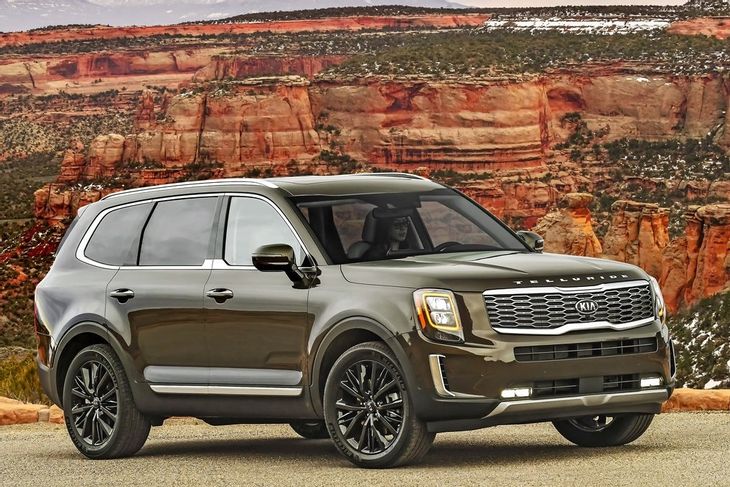
Kia Telluride
We kick this list off with the current 2020 World Car of the Year, Kia’s flagship SUV, the Telluride, which in itself is a pretty cool accolade to have under its belt. What a machine, just look at it! The Telluride isn’t produced for right-hand-drive markets like South Africa but we think it would be a great alternative to the German SUVs that are on sale locally.
The Telluride offers a plush ride and is powered by a 3.8-litre V6 engine that churns out a meaty 217 kW and 355 Nm of torque and comes paired with an 8-speed automatic transmission. The Telluride is offered in either front or all-wheel-drive formats with variable power distribution to cope over various terrain. The interior can seat 8 and comes well-appointed with all the bells and whistles you would want in a large, luxury SUV.
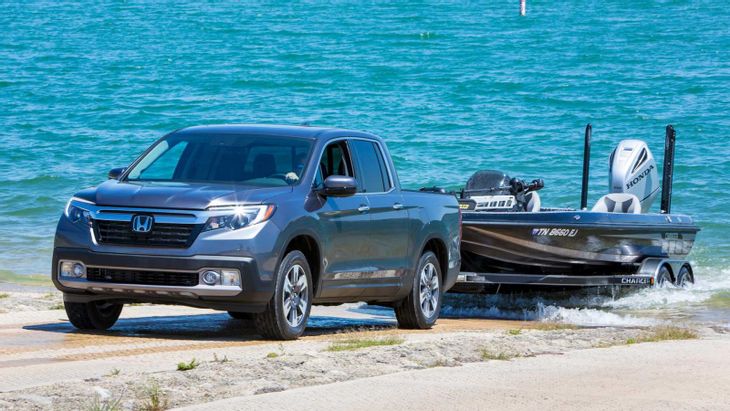
South Africans love the outdoors and while we have a good choice of very capable adventure vehicles, there is one particularly cool double-cab bakkie that’s missing from South Africa’s motoring landscape and that is the Honda Ridgeline.
It’s built to primarily serve the North American market and it’s powered by a 3.5-litre V6 engine that develops 209 kW and 355 Nm of torque. It’s offered with a 9-speed automatic transmission which can be had with all-wheel-drive. If the Ridgeline was offered in South Africa, we think it would sell fairly well against rivals such as the Toyota Hilux and Ford Ranger. Also, it would serve as a cool V6 alternative to the Volkswagen Amarok. The Honda Ridgeline isn't just another bakkie though, it features a unibody design making it stiffer and less bumpy to drive over rougher terrain, something which ladder frame bakkies suffer from.
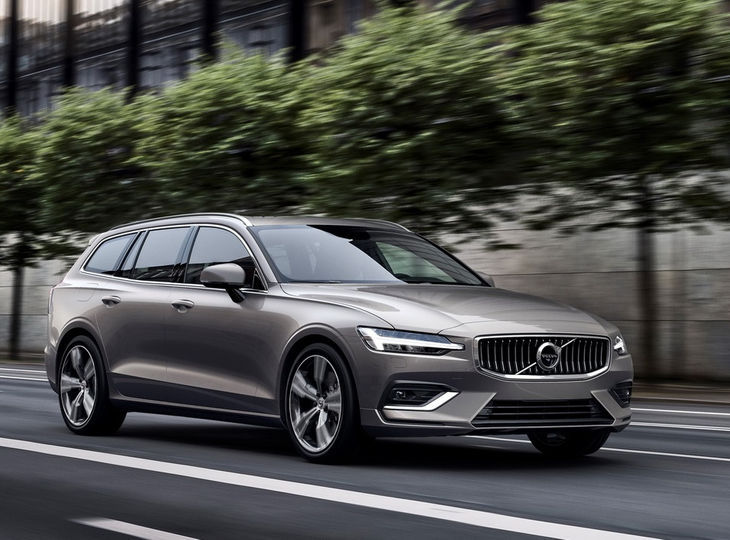
We are fans of the station wagon body shape and Volvo’s family-friendly V60 station wagon is sorely missed in South Africa. Unfortunately, station wagons are not very popular in South Africa and in 2017 our very own Ciro De Siena aptly coined the term ‘Anti-stationwagonism’ which is a condition that afflicts local car buyers (watch this video to learn more about Anti-stationwagonism).
It’s our loss though, because the Volvo V60 is as stylish as they come. The V60 is offered as a plug-in hybrid (T6 and T8 Twin Engine) or can be had with a choice of petrol (T5 and T6) or diesel engines (D3 and D4). With a near-perfect blend of style, practicality and performance, we think the V60 is a damn cool wagon that we would love to see on South African roads.
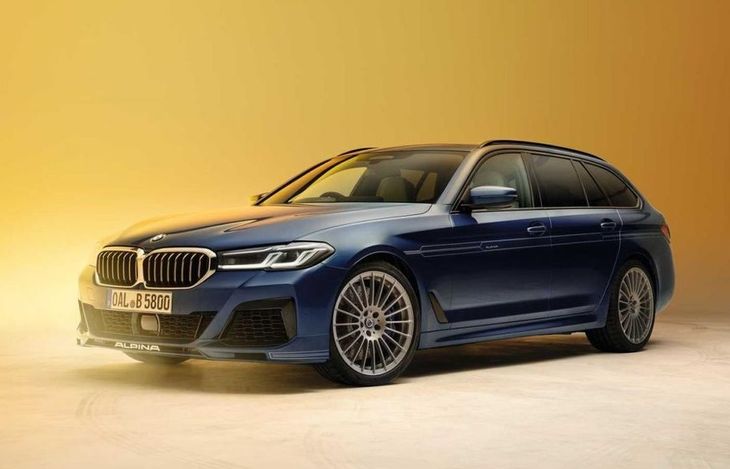
Talking about the love for wagons, we have a particular soft spot for wagons that offer scintillating performance. How does this BMW Alpina B5 Touring grab you?
This wagon will blast from zero to 100 kph in just 3.6 seconds and reach a top speed of 322 kph! Under the bonnet lurks a 4.4-litre twin-turbocharged V8 engine that’s been tuned to deliver 457 kW and 800 Nm of torque. With those performance figures thrown into wagon form, it’s hard not to have the Alpina B5 Touring on our wishlist.
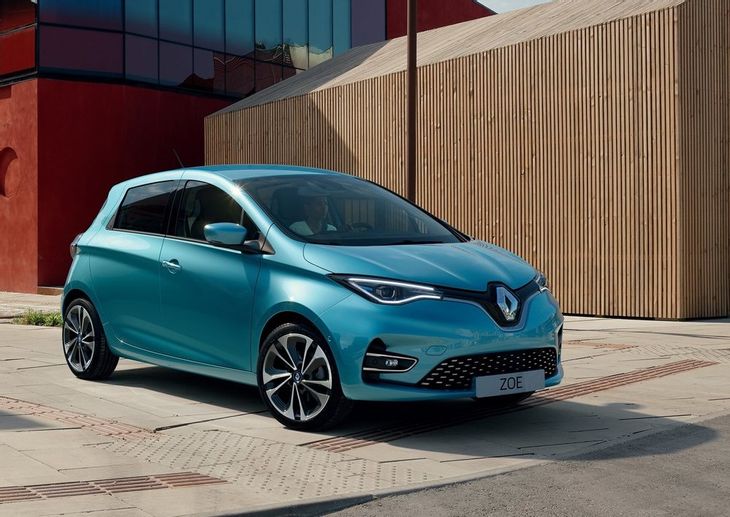
Electric cars are typically well out of financial reach of most South African consumers and we hope that a more affordable and widely-accessible electric car option is offered in South Africa sooner rather than later. The latest third-generation Renault Zoe is an electric car that we think fits the bill, so to speak.
It comes equipped with a 50 kWh battery that allows for a useable range of 382 km (WLTP) which represents a 30% increase over its predecessor. A new R135 electric motor generates 100 kW and 245 Nm of torque and comes mated with a single-speed gearbox. An 80 kW engine option is also offered. Fast direct current (DC) charging is now also offered alongside alternating current (AC) options.
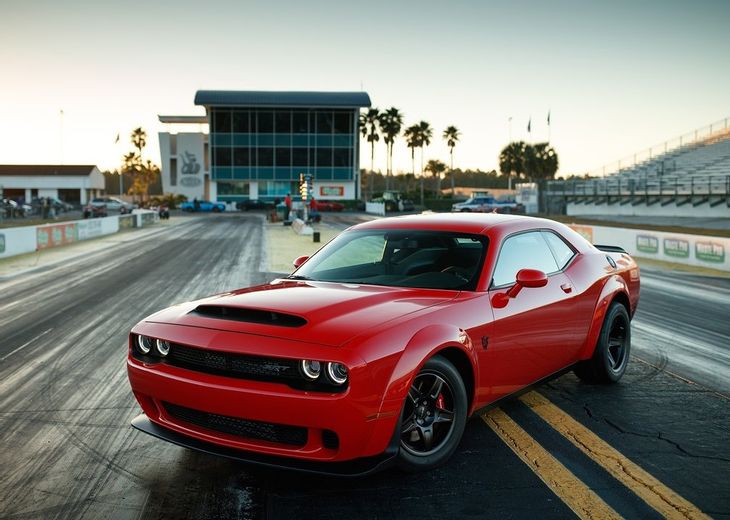
While the Ford Mustang has been well received in South Africa since its local launch back in 2015, we would love to see some more American muscle cars on local soil. Arguably one of the coolest, fastest and most powerful muscle cars available across the pond is the Dodge Challenger SRT Hellcat.
Built to dominate the drag strip, the Demon packs a supercharged 6.2-litre V8 engine that cranks out 603 kW and 972 Nm. Sipping on race fuel and equipped with an 8-speed automatic transmission that drives the rear rubber, the Demon will decimate the quarter-mile in just 9.5 seconds. Zero to 100 kph is to happen in around 2.3 seconds! That should do it, yes?
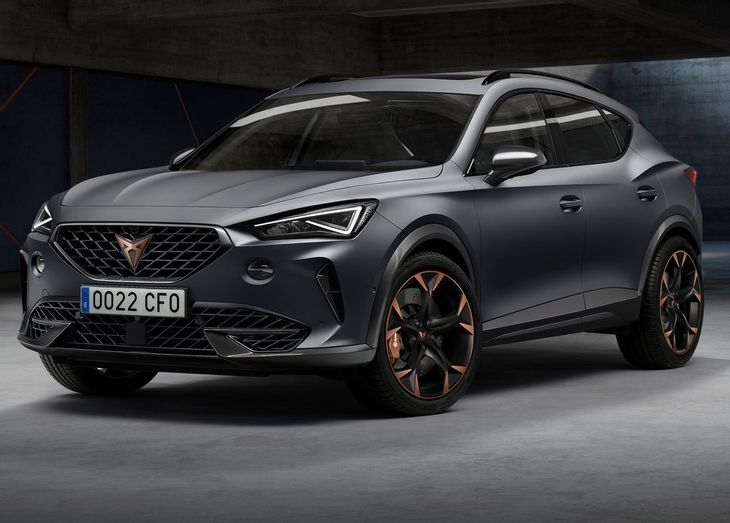
Cupra is the high-performance brand for Spanish car brand SEAT and the Formentor is a new crossover coupe that takes square aim at rivals such as the Audi Q3 Sportback, Mercedes-Benz GLC Coupe and BMW X4 Coupe, for example, but at Seat pricing.
As such, it boasts sharp and edgy styling that’s hard to not to like and we think it has the looks to best the best in this segment. As for firepower, a 2.0-litre turbocharged petrol engine is fitted with 228 kW and 400 Nm of torque on offer, combined with 4-wheel-drive and a 7-speed DSG transmission. A plug-in hybrid powertrain is also offered. If available in Mzanzi, we can’t see why the Formentor wouldn't serve as an attractive choice to counter the mostly predictable design direction offered by the German trio.
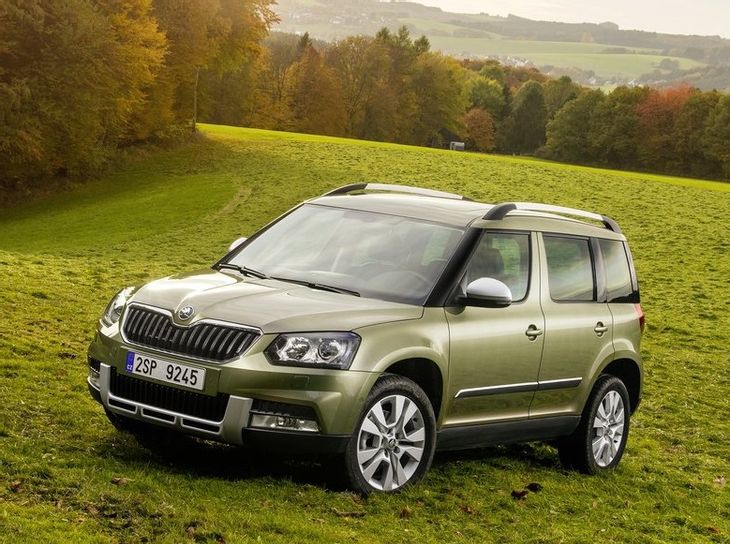
Skoda Yeti
First launched in 2009 with the name Yeti, this Skoda has serious off-road ability but more than that, it has a wide range of talents, including powerful performance, a spacious and well-designed cabin with high levels of practicality and safety, while also boasting excellent levels of comfort for both passengers and in terms of on-road refinement which all played a part in it becoming a notable sales success before being replaced by the Skoda Karoq in 2017.
The Yeti was powered by with a choice of both petrol and diesel engines with power outputs ranging from 77 kW all the way up to 125 kW with front- and all-wheel-drive options coupled with a manual or dual-clutch transmission. The Yeti’s offroad prowess came courtesy of a Haldex clutch with a multi-plate coupling system as well as an electronic differential lock. The Yeti wore many hats with utter confidence and we would love to drive the Yeti in South African conditions.
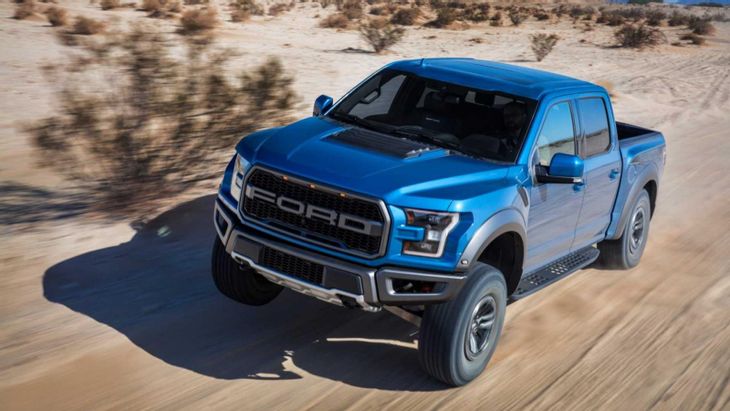
Ford F-150 Raptor
We are big fans of the Ford Ranger Raptor as it’s perhaps the most capable offroad bakkie currently on sale in South Africa. But sometimes bigger is better and in the case of Ford’s F-Series range of pickups, this is certainly the case. The full-size F-Series is the most-sold pickup in the U.S. and in South Africa, enthusiasts seem to have an affinity for the F-150 and in particular, the F-150 Raptor.
While various powerful powerplants are offered for the F-150, the F-150 Raptor is fitted with a twin-turbocharged 3.5-litre V6 engine with 331 kW and 690 Nm of torque and mated with a 10-speed automatic transmission that drives all 4 wheels. The larger F-150 Raptor is an offroad beast, especially because of its impressive variable damping Fox shock absorbers that deliver exceptional offroad performance. Variable drive modes are on offer, but as on the Ranger Raptor, Baja mode is the mode that allows you to achieve truly astonishing high-speed offroad performance in tough terrain. There is so much to like about the F-150 Raptor and it simply must feature on our list of coolest cars we would want in South Africa.
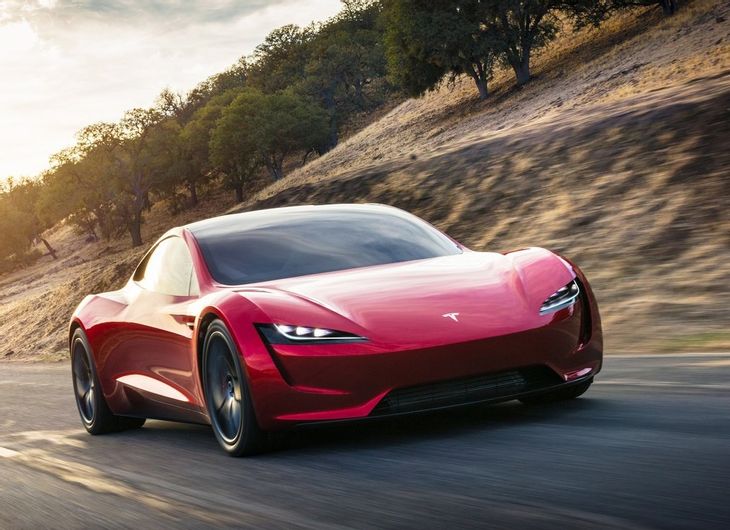
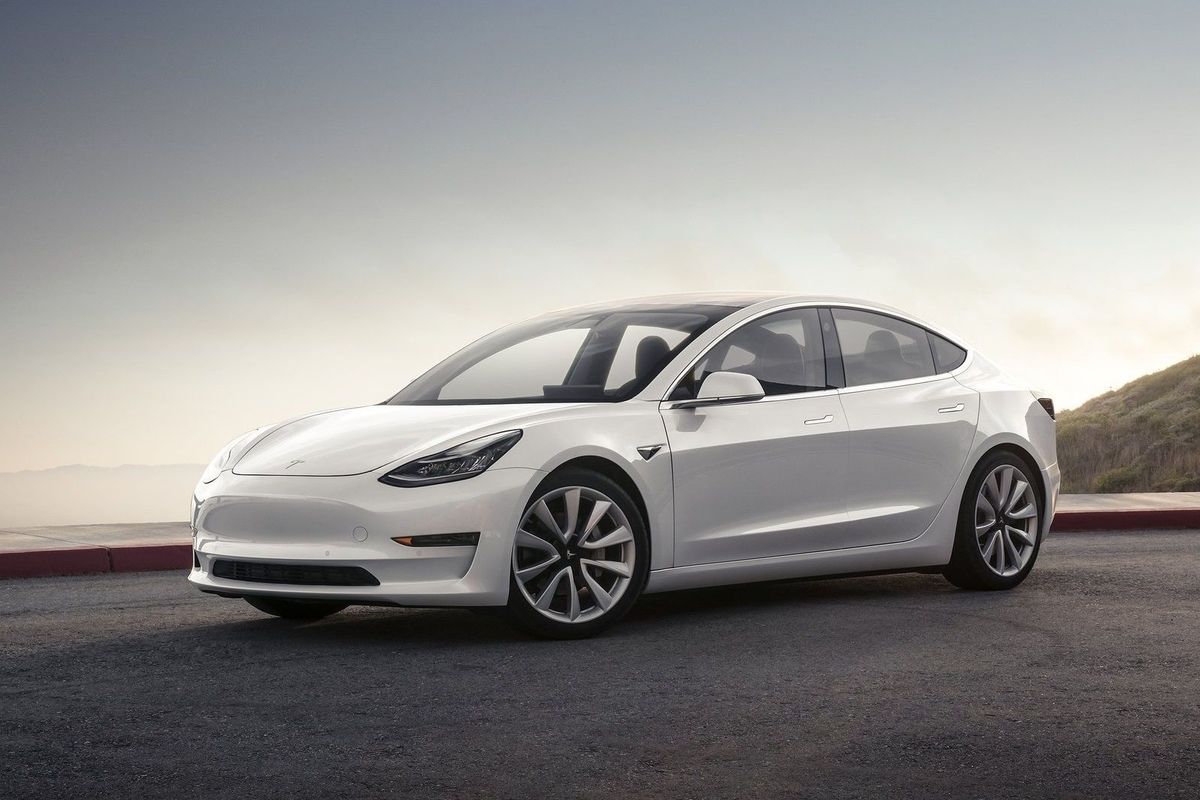
Back in 2016, we reported that Tesla added South Africa to its order book for the Model 3 compact sedan. The announcement sparked huge excitement in South Africa that finally perhaps we would indeed see the electric car giant arrive on South African shores.
Almost 5 years on and Tesla’s electric cars are nowhere to be seen in South Africa or in Africa and we couldn’t be more disappointed. Now, the Model 3 is old and so is Elon and perhaps the only chance of ever seeing a Tesla in Mzansi is if the space-going Tesla Roadster with Starman behind the wheel makes a miraculous about-turn in the deep of space and rockets itself onto the runway at OR Tambo International Airport with David Bowie blaring from its speakers. What a day that would be…
Ford F-150 cabin features that could be in next Ranger
From a 12-inch touchscreen infotainment screen with SYNC 4 technology, a digital instrument cluster, over-the-air updates and Ford Pass smartphone app, the new Ford F-150 sports a number of interior features that may be carried over to the next-generation Ford Ranger.
In revealing the new generation F-150, North America’s top-selling pick-up truck for the past 43 years, Ford has introduced a number of high-end features that could ostensibly be carried over to the upcoming Ranger, which will be produced alongside the 2nd iteration of the VW Amarok at Ford Motor Company of Southern Africa from either the latter half of next year or in early 2022. For the latest info on the upcoming Ranger that emerged this week, click here: 2022 Ford Ranger: More details
The 12-inch touchscreen infotainment system is powered by SYNC 4 and supports wireless Apple CarPlay and Android Auto.
In top-spec, the newcomer’s fascia is dominated by a new 12-inch touchscreen infotainment system that allows customers to split the screen and control multiple functions simultaneously. An 8-inch touchscreen is standard on base- and mid-spec derivatives, but both versions feature an improved quality reverse-view camera and access to the new digital owner’s manual.
The system incorporates the all-new SYNC 4 interface, which is said to have twice the computing power of its predecessor with more natural voice control, real-time mapping for the satnav, customisable information on demand, and it can wireless connect with smartphones to access Apple CarPlay or Android Auto, as well as SYNC AppLink apps like Waze and Ford+Alexa.
360-degree camera view and improved reverse-camera picture make it easy to manoeuvre the F-150 in town… or off-road.
In North America, customers can access more than 10 000 hours of on-demand content, live channels, ad-free music, sports, entertainment, news and personalised recommendations, plus they can search for related content with available SiriusXM with 360L satellite and streaming service. The new 8-speaker Bang & Olufsen sound system is fitted on the XLT derivative upwards, while the 18-speaker B&O Unleashed system (with speakers in the headliner and front headrests) is optionally available on top-spec versions of the F-150 and standard on the Limited derivative.
Meanwhile, something that will undoubtedly be on the wish-list for the upcoming Ranger, is the optional 12-inch digital instrument cluster, which features a large info-on-demand area, along with model-specific graphics that respond to the selectable drive modes. The system can also display off-roading data and turn-by-turn navigation, for example.
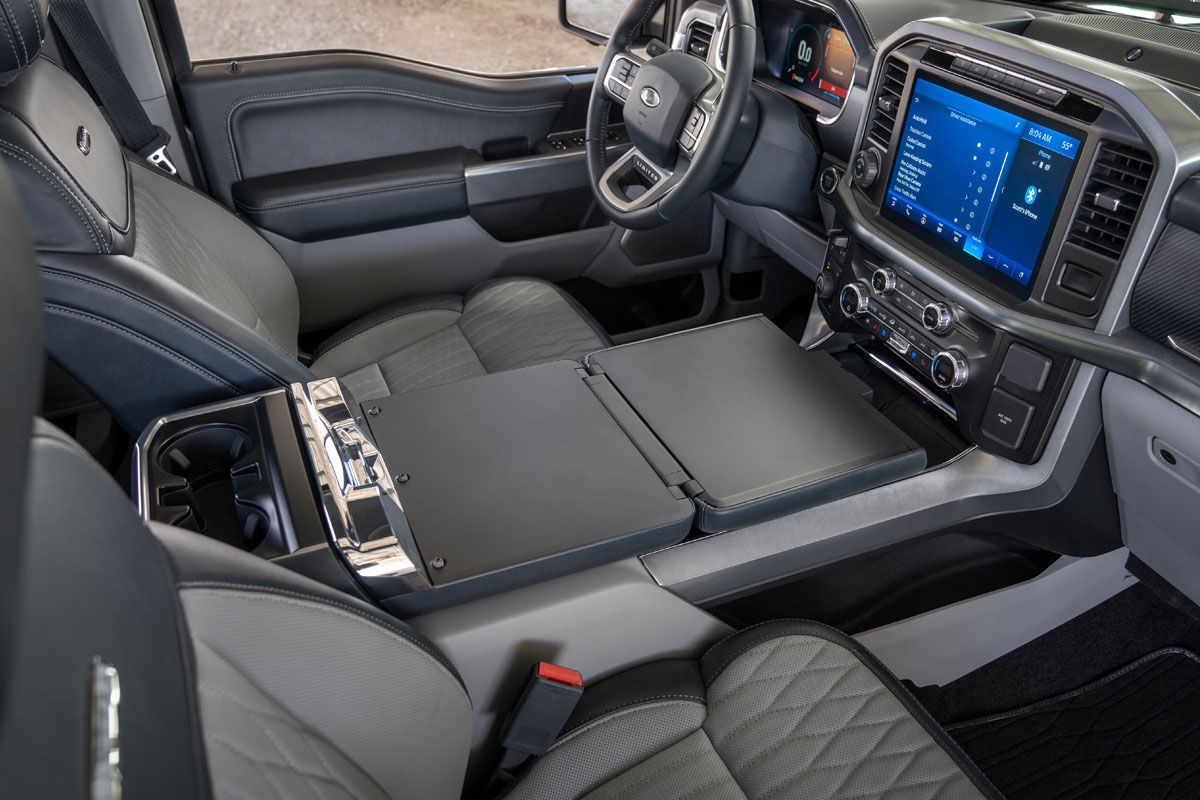
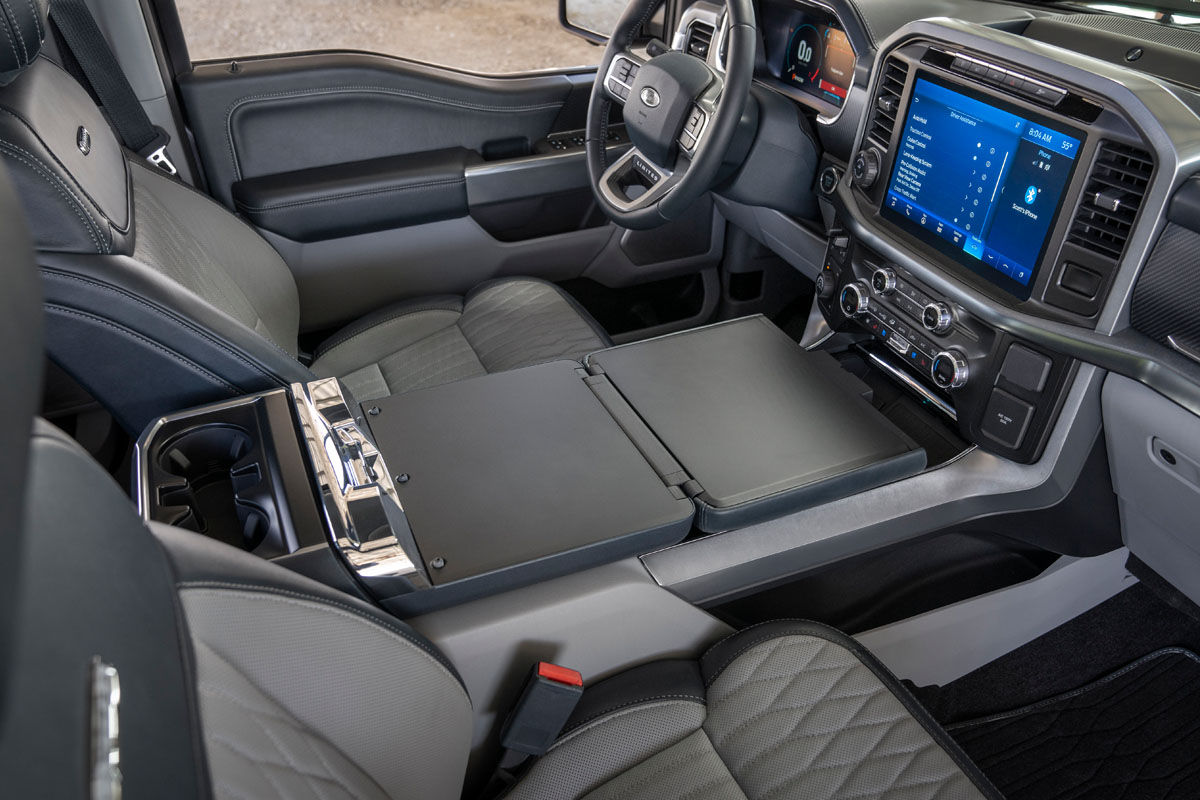
The optional Interior Work Surface is ideal for those who need to access their laptop, review documents or unpack their lunch.
What’s more, the new F-150 is also North America’s first full-size pickup to offer standard over-the-air firmware updates, including all-new functions and features throughout the life of the pick-up. Ford says the updates can support preventative maintenance, reduce repair trips, provide improved performance and "result in more vehicle up-time".
Ford further offers 911 Assist, which automatically alerts emergency responders in the event of an accident, as well as FordPass, a smartphone app that allows F-150 drivers to start or unlock their vehicle from a distance, as well as control of features such as Zone Lighting, Trailer Theft Alert, Trailer Light Check and Pro Power Onboard.
Zone Lighting, for example, allows occupants to turn on and off individual sections of exterior lights through SYNC 4 or remotely with the FordPass app on their phone.
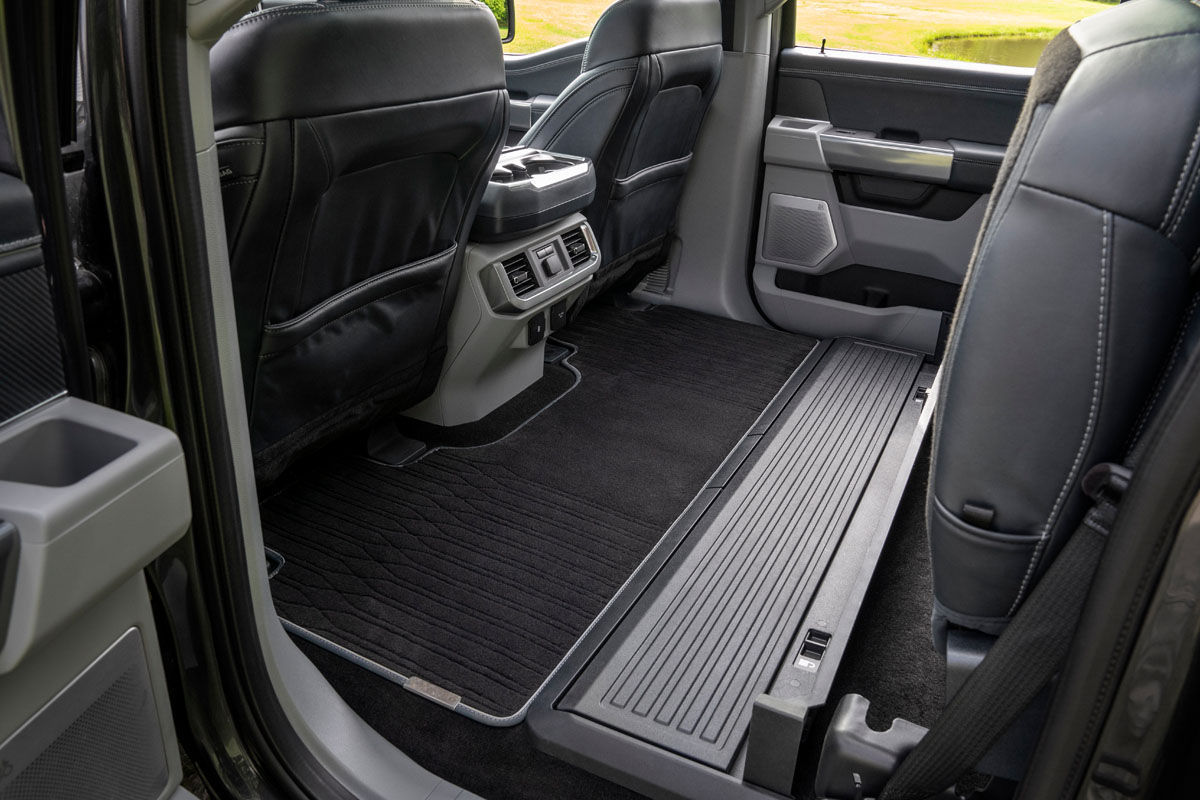
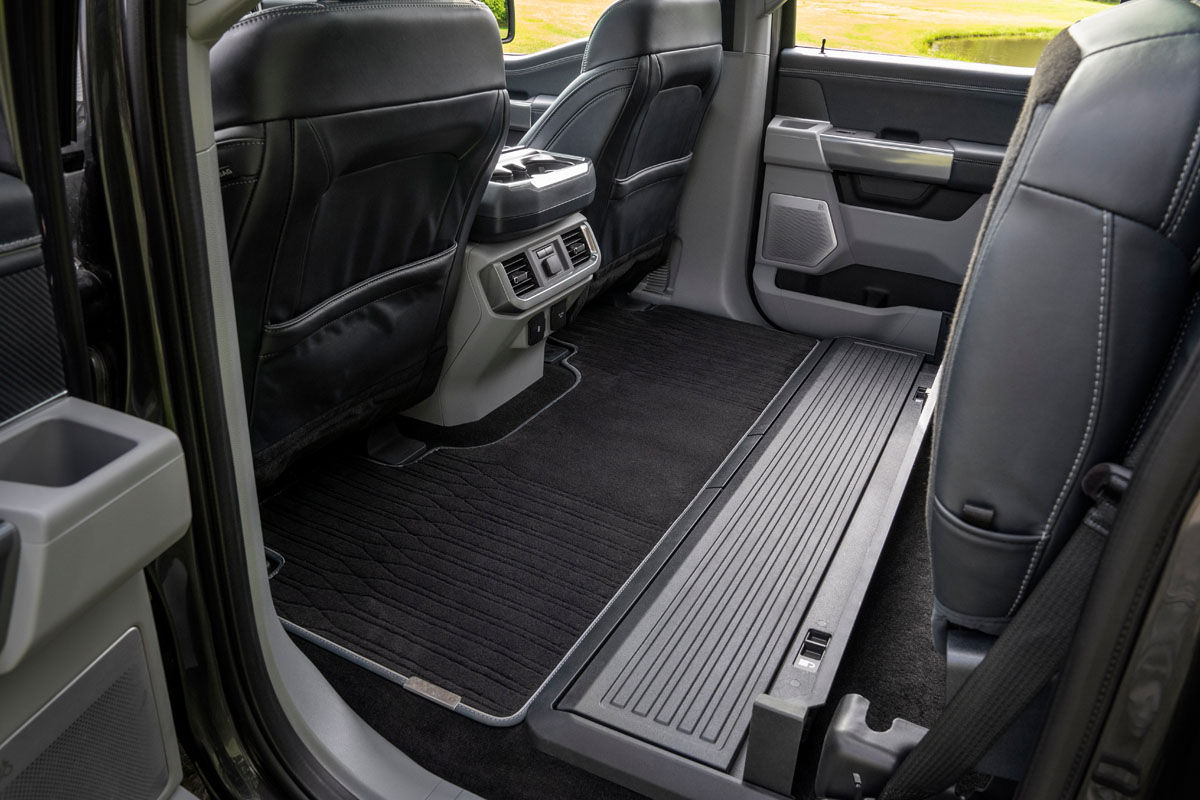
Secured storage is often an issue for double-cab owners, but Ford offers a lockable, fold-flat rear storage bin in the F-150.
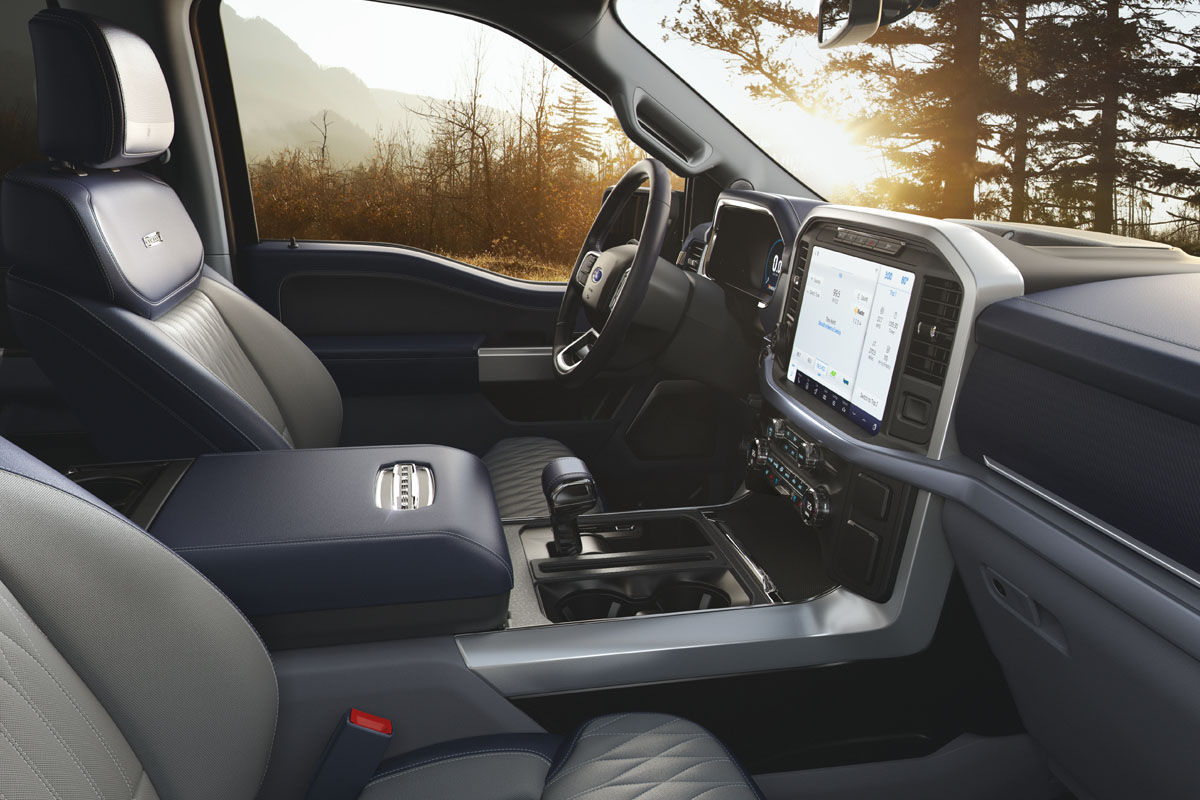
The sheer size of the F-150 also affords Ford the chance to equip its wildly popular truck with features that one would not expect in a one-tonner double cab, which is the staple of the South African new-vehicle market. Optional Max Recline Seats, for example, flat to nearly 180 degrees, with the bottom cushion rising to meet the back cushion and the upper back support rotating forward up to 10 degrees for maximum comfort.
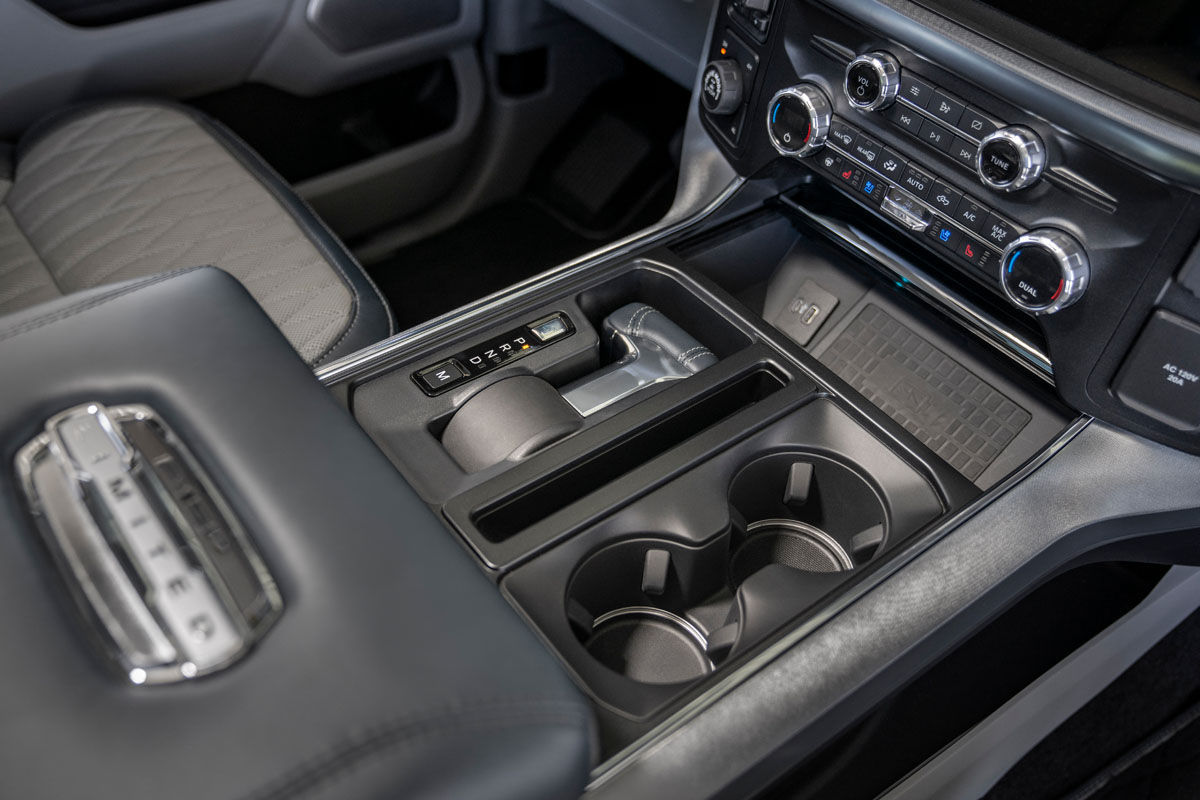
The new optional Interior Work Surface, which folds out over the centre console/between the front seats is ideal for signing documents, working on a laptop or enjoying a meal when parked. To aid its installation, Ford has created a stowable transmission lever, which away at the push of a button, and allows full access to the large work surface.
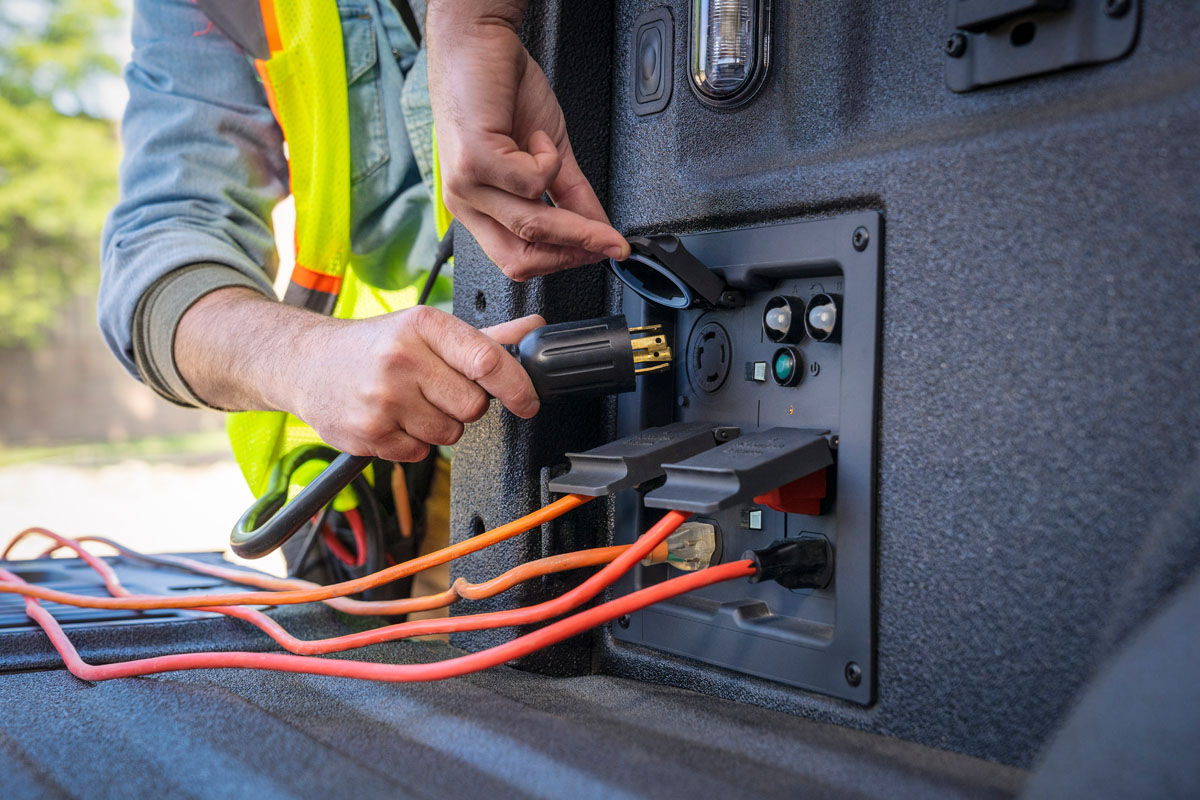
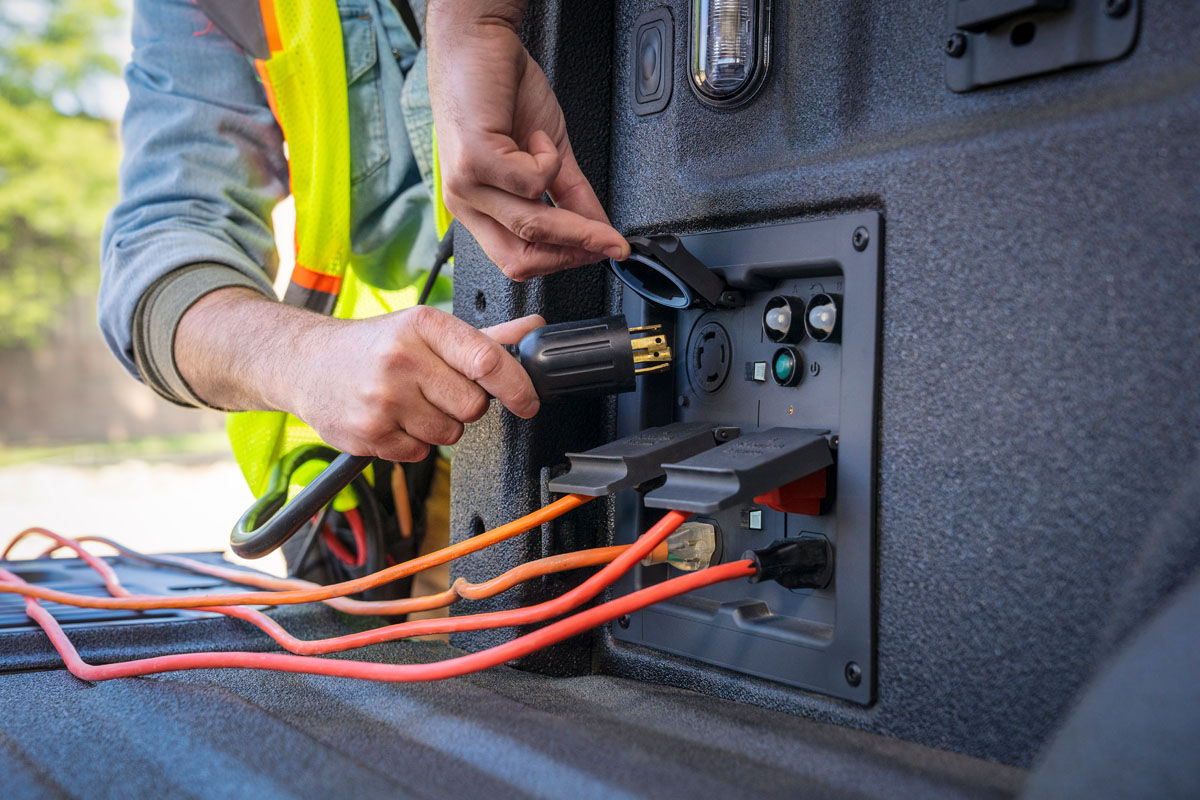
Pro Power Onboard self-charging generator supplies power to cargo bed-mounted 120V 20A outlets, plus a 240V 30A outlet on the 7.2-kW version.
Also available is a lockable, fold-flat rear storage bin that extends the width of the rear seats. To access it, its operator simply needs to lift the bottom cushion of the rear seat, dropping valuables in and locking them away for safekeeping. It even has a divider to keep gear organised!
Lastly, the F-150 is equipped with Pro Power Onboard that “brings generator levels of power to work sites, campsites and everyday life”. The system is available with 2.0-kW, 2.4-kW and 7.2-kW outputs and accessible through in-cabin outlets and up to 4 cargo bed-mounted 120V 20-amp outlets, with a 240V 30-amp outlet on the 7.2-kW version.
The combination of a spectacular car, a perfect stretch of tarmac and a beautiful landscape easily impress us petrolheads. We prefer to snake along a road with little to no traffic and a cozy coffee stop along the way.
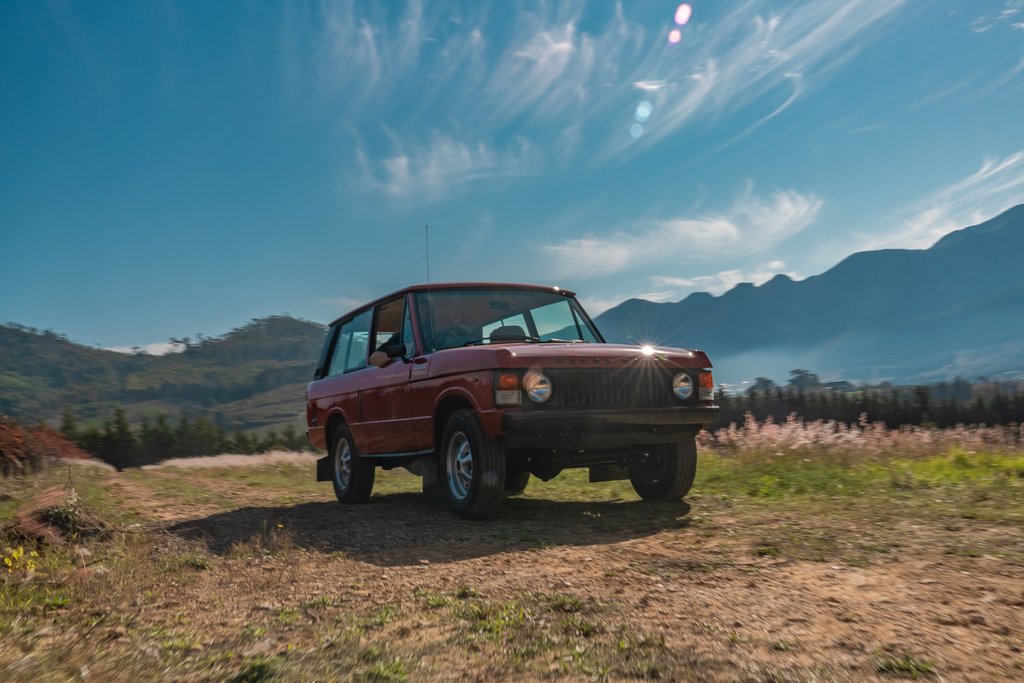
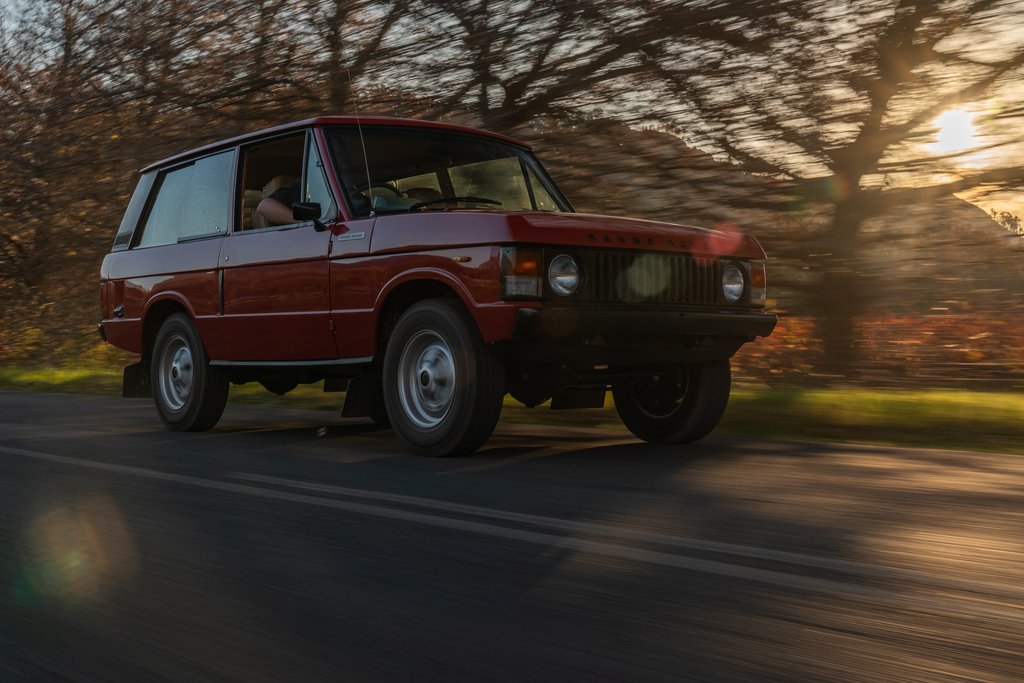
However, just as alluring is the combination of a classic 4×4 and the rawness of mother nature. There are a number of 4x4s that have become collectible in recent years or at least favourites among enthusiasts. Close to the top of the list, and in Nekkies Smit’s case at the very top, is the Range Rover Series 1, or now more lovingly called the Range Rover Classic.
Today it is easy to be impressed by these vehicles. After all, it was one of the original 4x4s that put down the foundation of what would become the popular luxury 4×4 segment, or in modern lingo, the SUV. These cars were originally used by farmers in rural Britain, but at the same time by the British Royalty.
Released in 1969, these 4x4s were manufactured in Solihull, a town synonymous with Land Rover, as well as Enfield in Australia and even here in Cape Town. The base shape of the Range Rover stayed in production for no less than 25 years until 1994.
The history of the Range Rover is littered with interesting facts and anecdotes. An early feat was the success it achieved by taking first place in the four-wheel-drive class of the first Paris-Dakar Rally in 1979 as well as in 1981.
Nekkies’s love affair with all things Land and Range Rover started more than two decades ago. Growing up in a farming community the off-road culture clearly grew on him. “In 2000 when I was still at school I found and bought my first Land Rover, a Series 2. It was in a terrible state because I couldn’t afford a better example. I restored it with limited funds and from there the bug just bit me.”
Soon his passion turned into a business. Today he services, maintains, customises and restores these cars for clients. Over the years Nekkies has gained a wealth of knowledge on these 4x4s, through his business as well as his passion. Today he has an impressive collection of Land Rovers which include collectible and unique models.
“My first Range Rover I bought was in 2010. It was a TDV8 Sport. I didn’t have it for long because the space wasn’t enough and it was too fancy. However, I bought my first Range Rover Classic 3-door in 2012.”
It was only recently with the enthusiasm of a client that wanted to restore his Range Rover Classic that Nekkies was convinced to restore both his and the client’s (as seen in this video) examples together. The fact that Range Rover is turning 50 this year was also an important factor, Nekkies admits.
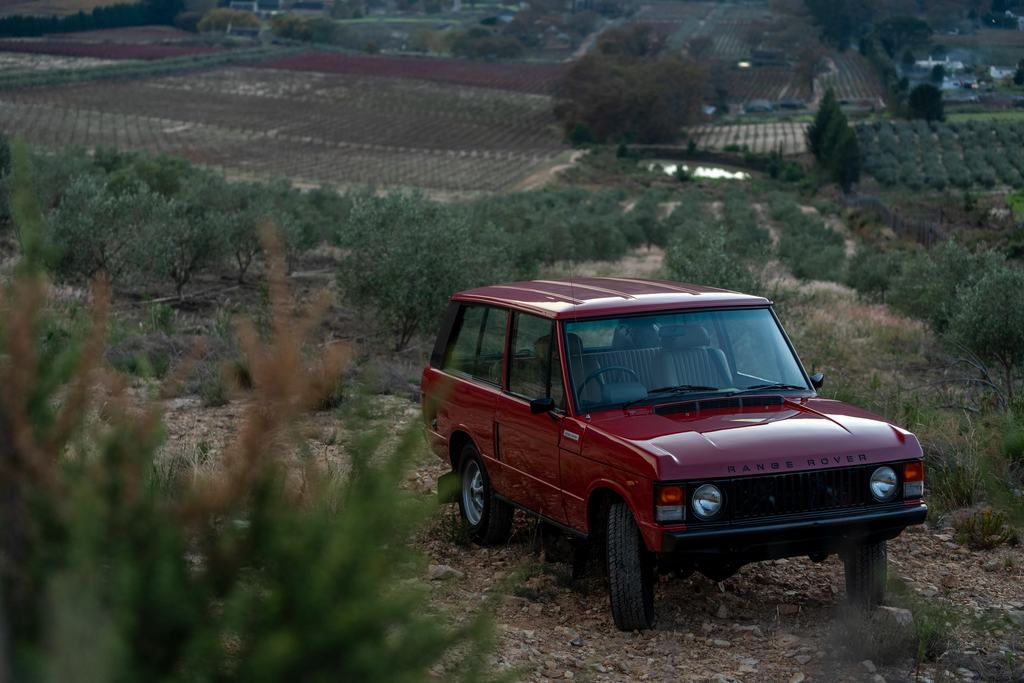
Sourcing parts is no easy job. According to Nekkies it is the biggest challenge with a full restoration. “It took me two trips to the UK to visit the correct specialists, suppliers as well as Jaguar Land Rover Classic Works. They have been restoring these cars for a number of years. Most of the cosmetic parts we got from the UK. Fortunately the mechanical parts in these Range Rovers are in most cases the same as found in the company’s other products.” Fast forward several months later and this red Series 1 stands out in its beautiful Winelands surroundings in South Africa’s Western Cape.
The interior is cozy with newly-upholstered seats and carpets, while the tall windows offer a glasshouse effect like few other 4x4s. As Nekkies starts the engine the soft thumping soundtrack from the 3.5-litre V8 engine is immediately evident, a perfect companion not only for the open road but also for when you want to climb over obstacles after engaging the low-range transfer case.
Having done a number of overland trips, including Cape Town to London, with Land Rovers, he seems ever ready for his next adventure… as long as it is in a Land or Range Rover!
Car: Range Rover Series 1 3-dr (1970)
Engine: 3 532 cc, V8, petrol
Power: 97 kW @ 5 000 rpm
Torque: 251 N.m @ 2 500 rpm
Top speed: 154 km/h
Gearbox: 4-speed manual
Wheelbase: 2 540 mm (100 inches)
Weight: 1 724 kg
0-100kph: 17.5 sec (tested by CAR magazine)
J.D.Power 2020 Results: Kia Wins, Tesla Loses
The annual J.D. Power Initial Quality Study (IQS) was released for 2020 and the report makes for interesting reading. This IQS focuses on the problems owners are having with their new vehicles. How did your favourite brands do?
The J.D. Power study is a great tool to look at reliability and quality of vehicles. Revised for 2020 and now in its 34th year, the study looks at the entire US car market and "examines problems experienced by owners of new 2020 model-year vehicles during the first 90 days of ownership." This year's report is based on responses from 87 282 respondents with regards to 189 vehicle series across 26 segments.
“The Initial Quality Study is the industry benchmark for new-vehicle quality and, year after year, automakers apply the insights they learn from consumers to make positive changes,” said Dave Sargent, vice president of automotive quality at J.D. Power. “The higher problem levels we see in this year’s study don’t mean vehicle quality has worsened; rather, the redesigned study asks additional questions that allow owners to cite more of the problems that they are experiencing.”
Summary
PP100 refers to how many problems there were for every 100 vehicles.
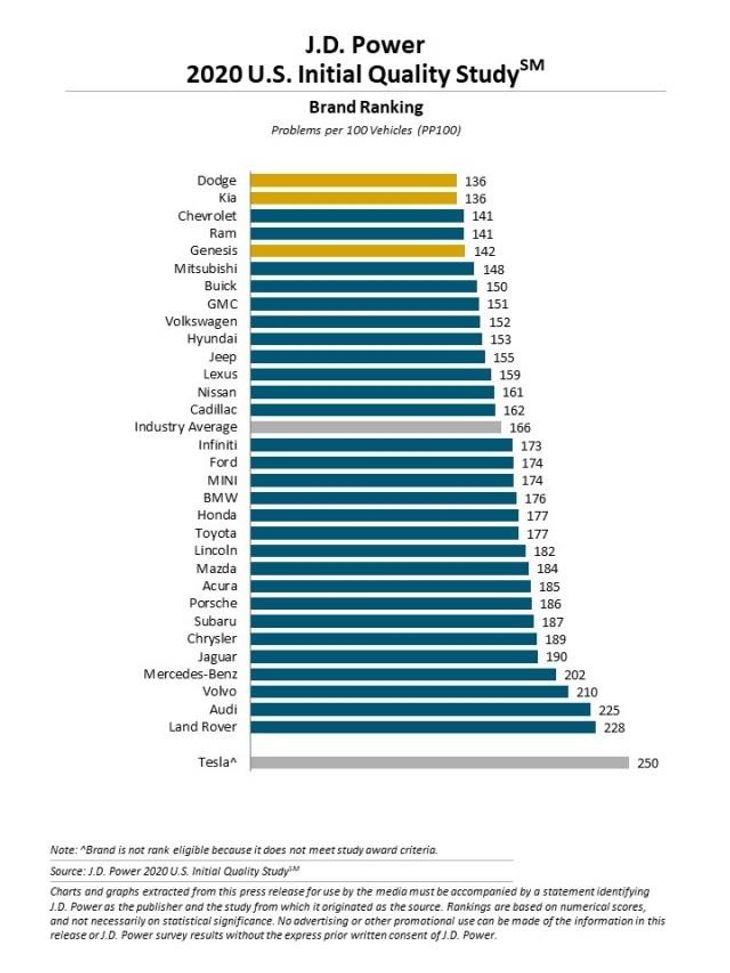
Most US brands are above average: 7 domestic brands—Dodge (136 PP100); Chevrolet (141 PP100); Ram (141 PP100); Buick (150 PP100); GMC (151 PP100); Jeep (155 PP100); and Cadillac (162 PP100)—perform better than the overall industry average of 166 PP100. Collectively, this is the best-ever performance by the Detroit automakers—when compared with the import brands—in the history of the study.
Most premium brands are below average: For most of the past decade, mass-market brands have improved relative to premium brands, and this trend continues in 2020. Premium brands generally equip their vehicles with more complex technology, which can cause problems for some owners. Genesis (142 PP100), Lexus (159 PP100), and Cadillac (162 PP100) are the only premium brands that perform better than the industry average.
Japanese brands fail to regain footing: Once regarded as the gold standard in quality, most Japanese brands have not improved as fast as competitors have and they continue to trail most Korean and domestic brands. Mitsubishi (148 PP100), Lexus (159 PP100), and Nissan (161 PP100) are the only Japanese brands to rank above industry average.
Tesla profiled for first time: Tesla receives an initial quality score of 250 PP100. The automaker is not officially ranked among other brands in the study as it doesn’t meet ranking criteria. “Unlike other manufacturers, Tesla doesn’t grant us permission to survey its owners in 15 states where it is required,” said Doug Betts, president of the automotive division at J.D. Power. “However, we were able to collect a large enough sample of surveys from owners in the other 35 states and, from that base, we calculated Tesla’s score.”
Infotainment is most problematic category: Almost one-fourth of all problems cited by new-vehicle owners relate to infotainment. Top complaints include built-in voice recognition; Android Auto/Apple CarPlay connectivity; touchscreens; built-in navigation systems; and Bluetooth.
Winners
Dodge and Kia tied for the highest in overall initial quality, each with a score of 136 PP100. Dodge is the first US brand in the study’s history to rank highest. Impressively, this is the 6th consecutive year that Kia is the highest-ranked mass market brand. Chevrolet and Ram place third in a tie (each with 141 PP100). Genesis is the highest ranked premium brand for the fourth consecutive year in the study.
The car brand receiving the most model-level awards is Hyundai Motor Group (7 awards), followed by General Motors Company (6);BMW AG (3); Ford Motor Company (3); Nissan Motor Co. Ltd. (3); and Toyota Motor Corp. (2). Among brands, Cadillac and Kia each receive 4 awards.
Hyundai Motor Group models that rank highest in their respective segments are Genesis G70; Hyundai Tucson; Hyundai Veloster; Kia Forte; Kia Sedona; Kia Sorento; and Kia Soul.
General Motors Company models that rank highest in their segments are Cadillac CT5; Cadillac CT6; Cadillac Escalade; Cadillac XT4; Chevrolet Malibu; and Chevrolet Sonic.
BMW AG models that rank highest in their segments are BMW 8 Series; BMW X6; and MINI Cooper.
Ford Motor Company models that rank highest in their segments are Ford Mustang; Ford Ranger; and Ford Super Duty.
Nissan Motor Co. Ltd. models that rank highest in their segments are Nissan Armada; Nissan Maxima; and Nissan Murano.
Toyota Motor Corp. models that rank highest in their segments are Lexus GX and Toyota Tundra.
Other models that rank highest in their respective segments are Audi A3 and Jaguar E-Pace.
2020's iteration also marked the debut of Tesla into the J.D. Power IQS, but with 250 PP100, it's a very poor result for the electric carmaker and it places them at the bottom.
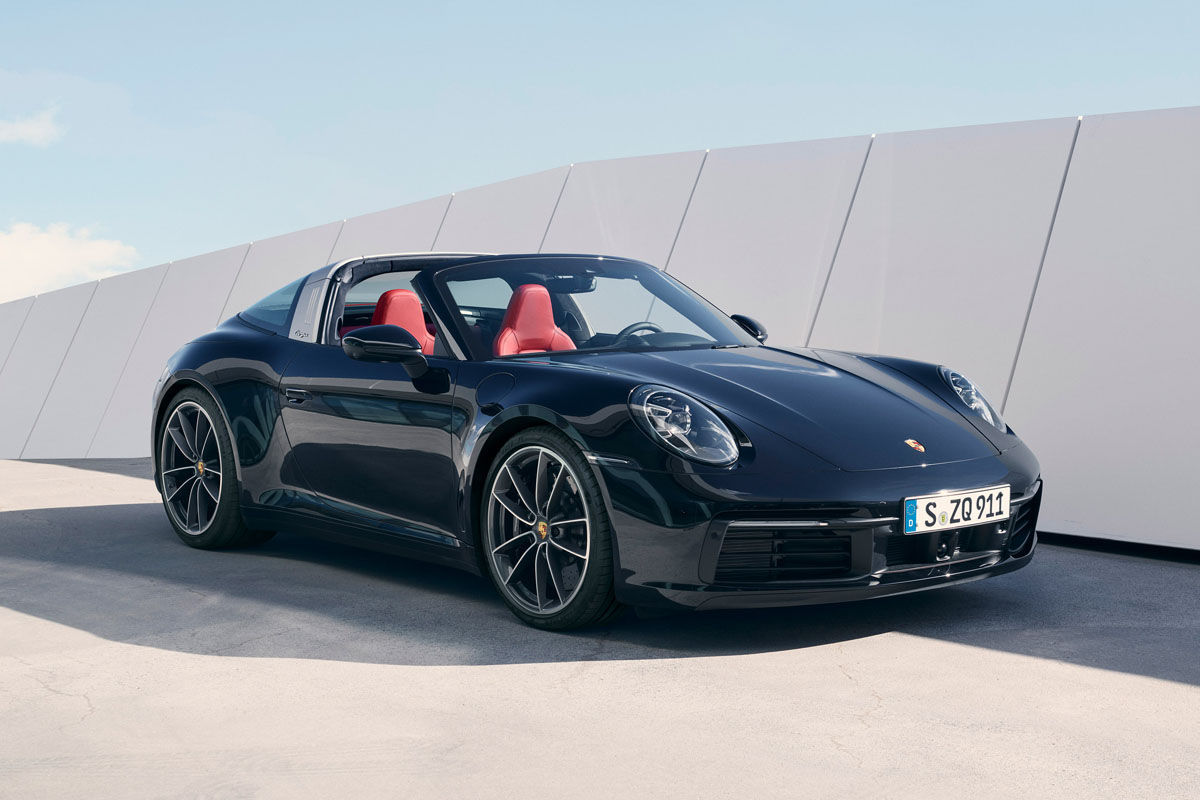
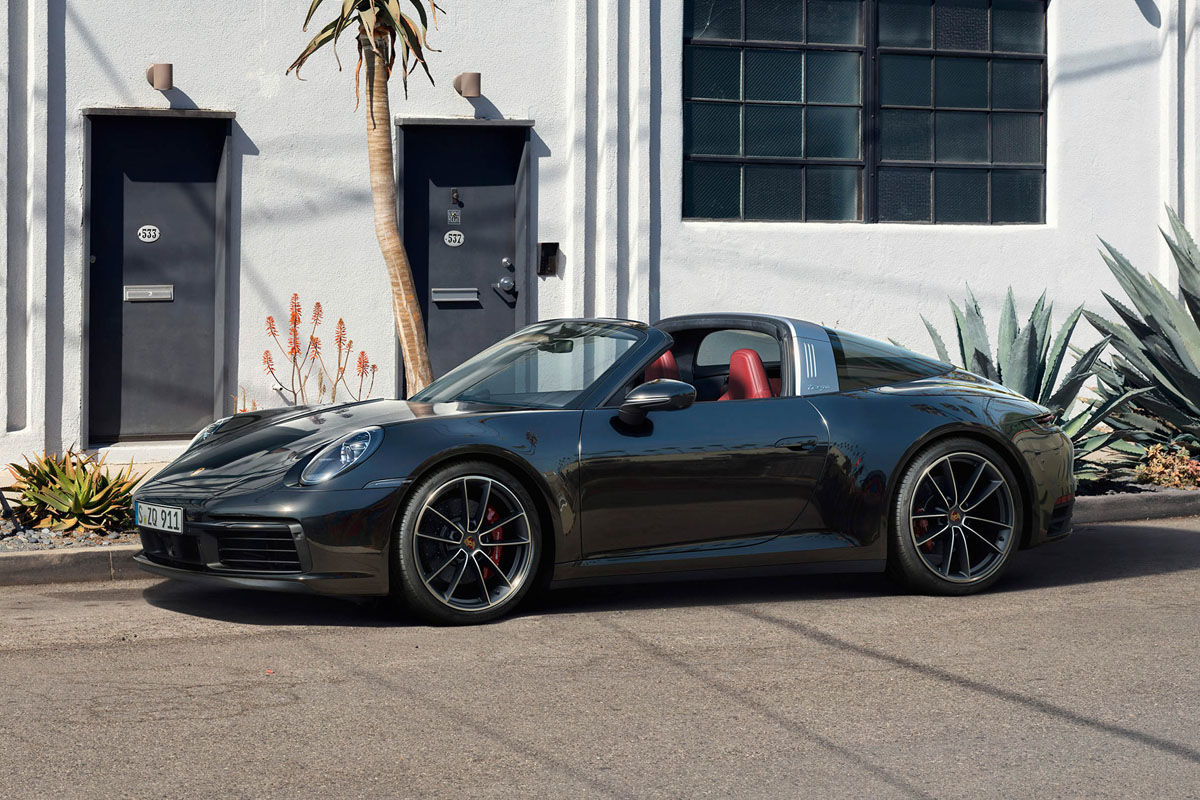
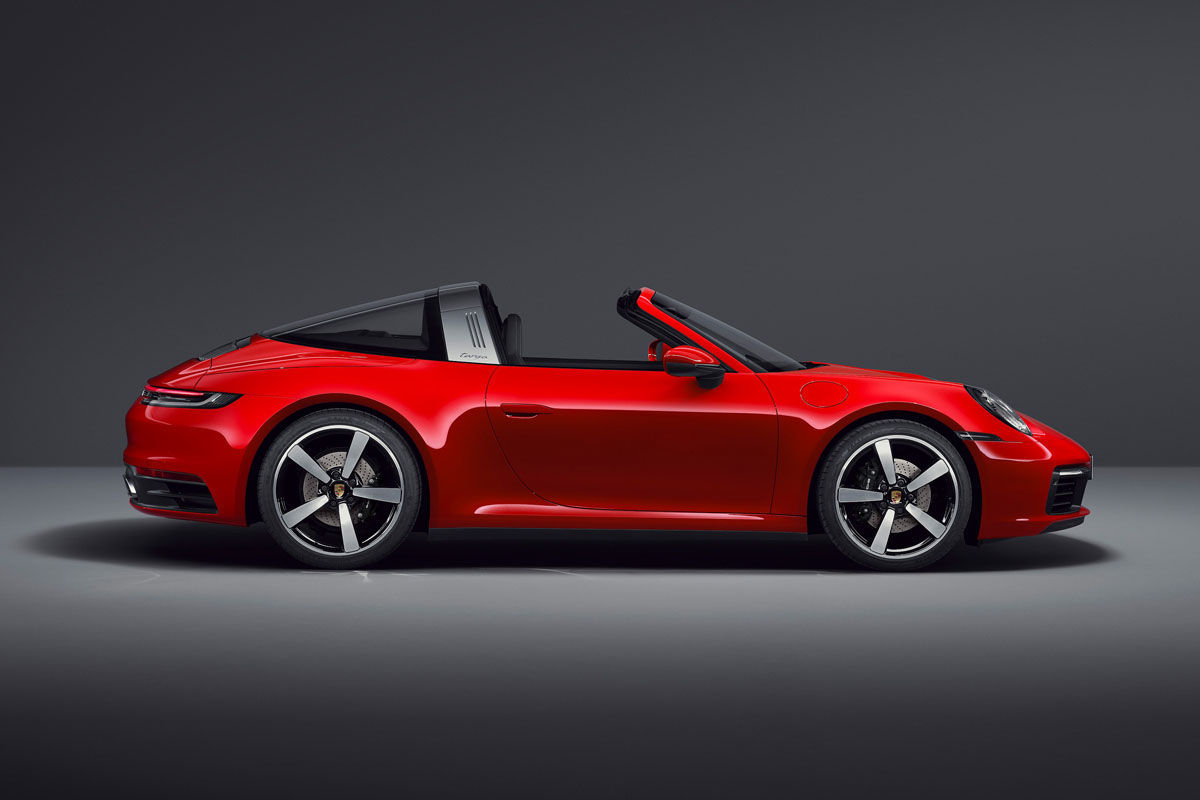
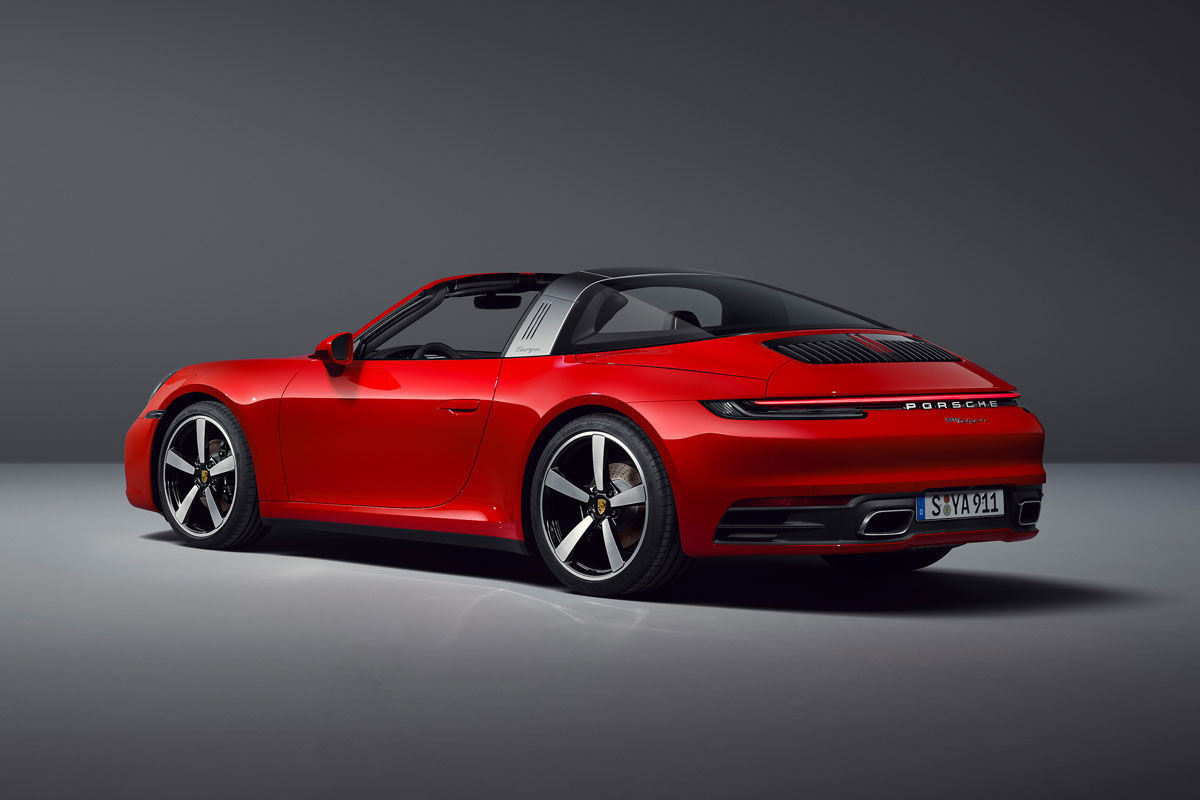
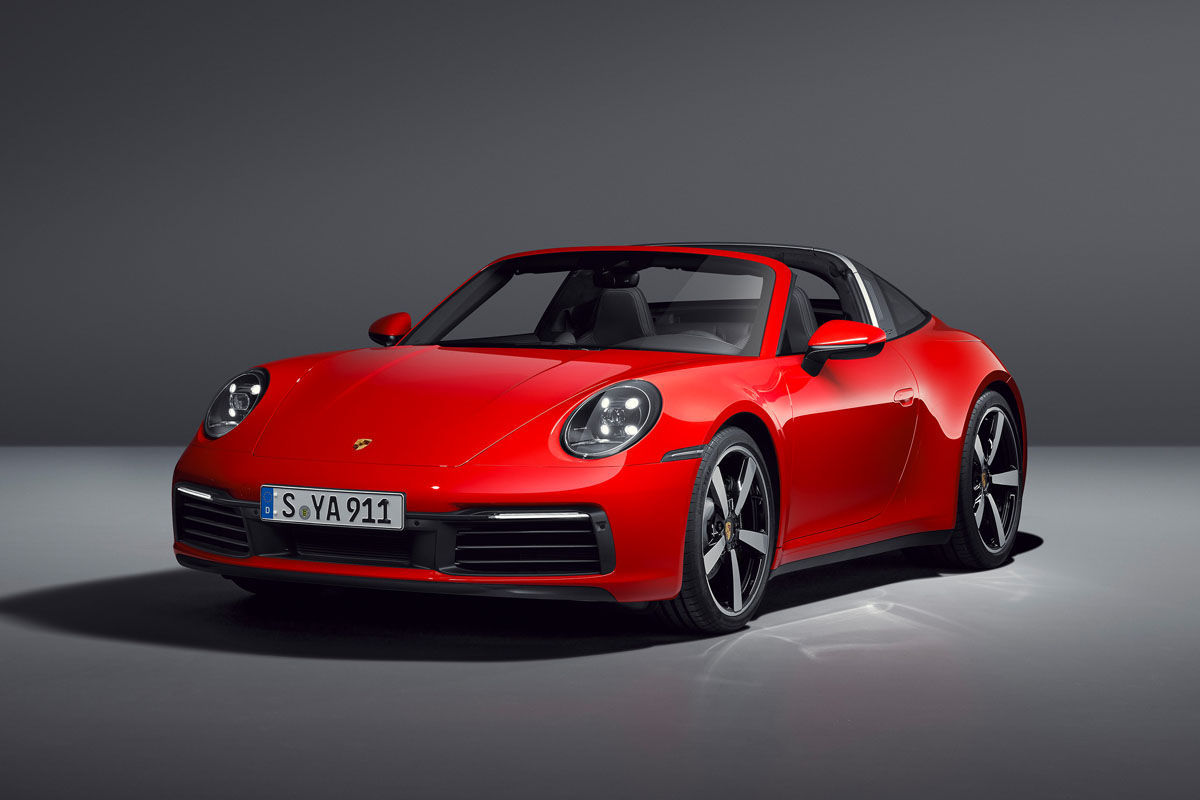
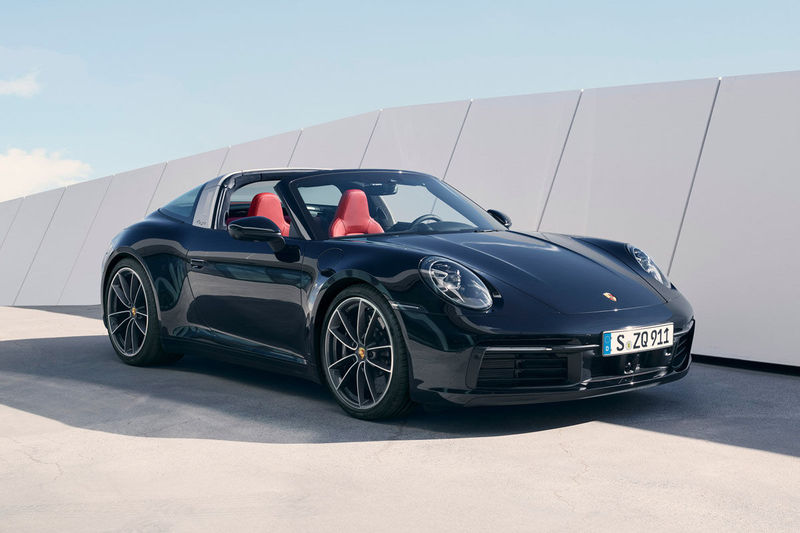
Porsche South Africa has published prices of the Zuffenhausen-based brand's 3rd and arguably, most elegant, 992-series 911 variant – the Targa – on its official website. The range comprises 4 and 4S derivatives… as well as the exclusive 4S Heritage Design Edition.
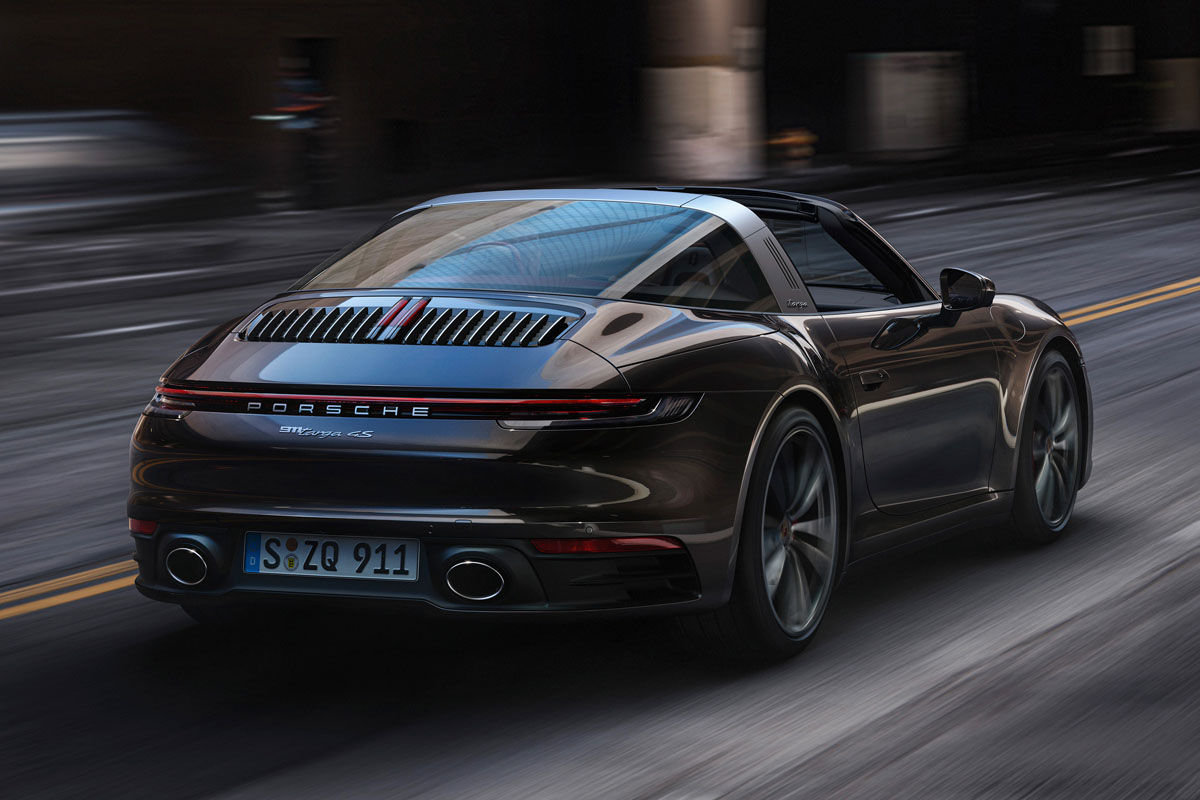
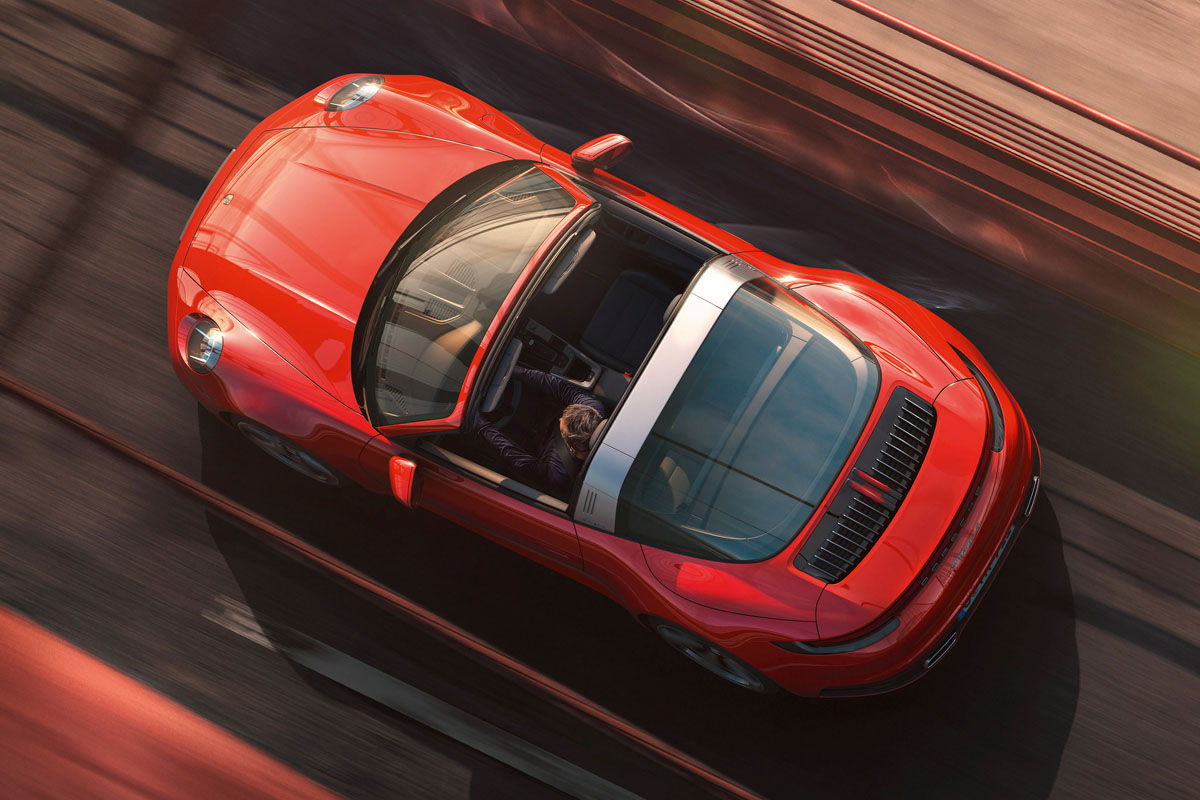
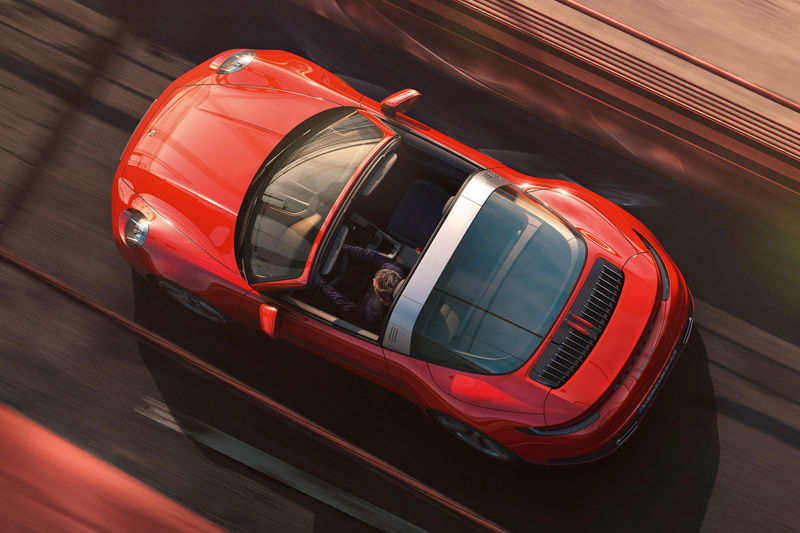
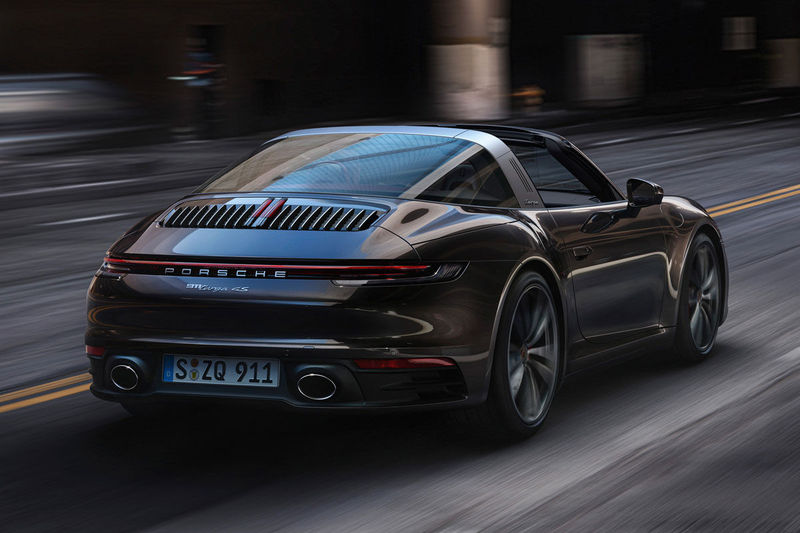
The distinctive Targa debuted in 1965 and this is the 8th iteration of the variant, which is distinguished by its silver Targa bar, which substitutes the B-pillars, encases the rear screen, arches over the cabin and features the characteristic “Targa” designation on each side. With perhaps the exception of the exotic Speedster version, the Targa is the rarest body shape of the iconic 911.
The Targa bar is also optionally available in black. It incorporates a fully automatic roof system that can be opened and closed in a claimed 19 seconds at the touch of a button. The roof construction consists of 2 flat magnesium elements that hold the roof in place, while the fabric incorporates sound-deadening material and an extendable wind deflector is integrated into the upper cowl frame.
The Targa top has graced several iconic sportscars in the past, but Porsche has arguably kept the concept going for the longest time.
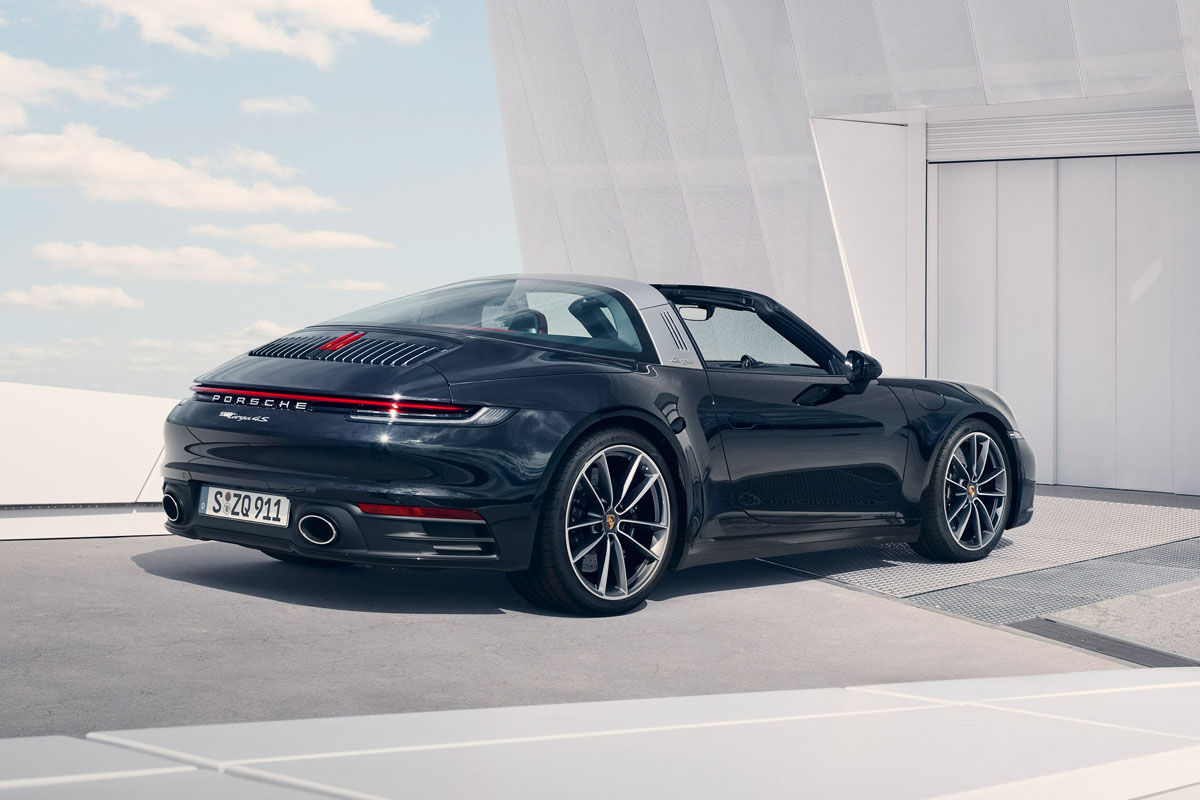
Compared to its predecessor, the 992-series 911 Targa features significantly more pronounced wheel housings at the front and its front luggage compartment lid has a distinctive recess that evokes the design of earlier 911 generations. The rear is characterised by a wider, variably extending rear spoiler and an elegant light bar.
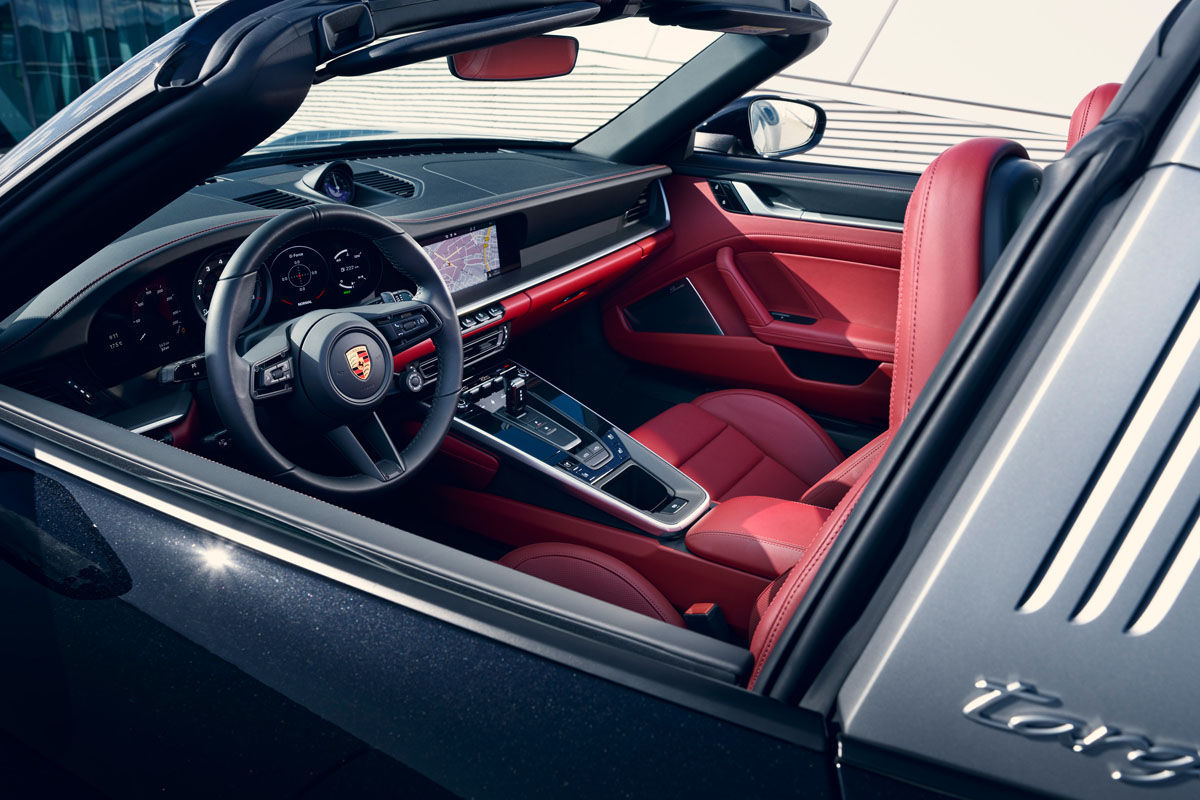
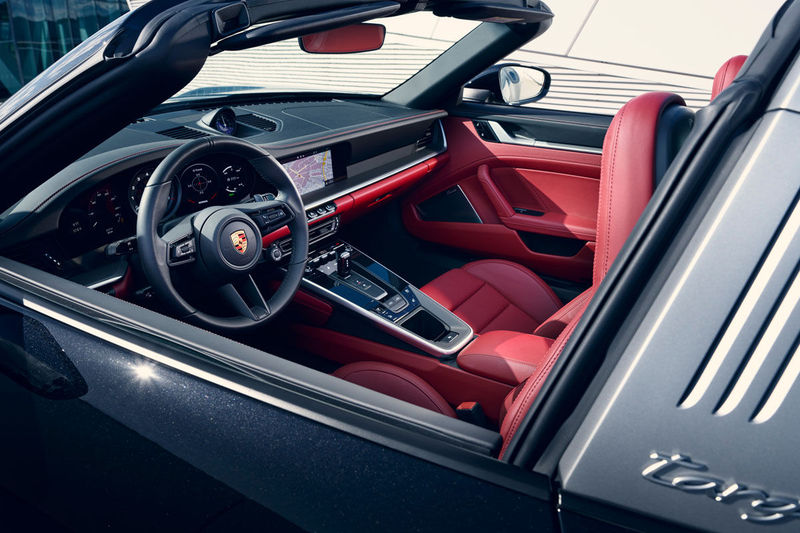
Inside, the crisp lines of the dashboard and its recessed instruments are inspired by 911 models from the 1970s. There is a pair of frameless digital displays alongside the traditional central tachometer, while 5 toggle switches sit below the 10.9-inch Porsche Communication Management touchscreen infotainment system. The latter includes online navigation and Connect Plus as standard.
Both 911 Targa derivatives are powered by a 3.0-litre twin-turbo flat-6 engine, but in different states of tune. The Targa 4 produces 283 kW and 450 Nm of torque (the latter from 1 950 to 5 000 rpm), while the Targa 4S delivers 331 kW and 530 Nm of torque between 2 300 and 5 000 rpm.
The Targa's instrument dial is a mix of analogue (centrally-mounted tachometer) with digital sub-displays on either side of it.
An 8-speed dual-clutch (PDK) automatic transmission and intelligent all-wheel drive Porsche Traction Management (PTM) come as standard, but the Targa 4S can be ordered with a 7-speed manual ‘box at no cost (in some markets), which includes the Sport Chrono package and a mechanical limited-slip diff.
When equipped with PDK and the optional Sport Chrono package, the Targa 4 is said to accelerate from 0 to 100 kph in 4.0 sec and its 4S sibling is claimed to do the same in 3.4 sec. Their claimed top speeds are 288 kph and 303 kph respectively.
Meanwhile, the 911 Targa incorporates a plethora of mechanical updates introduced in its 992-series brethren, including the beefed-up front-axle drive setup (with a water-cooled differential and clutch – the latter with reinforced discs for greater strength and higher load capacity), which works in conjunction with the Porsche Traction Management (PTM) system.
Originally marketed as a "safety cabriolet with supplemental roll bar", the 911 Targa went on to become a style icon.
The electronically-controlled, variable-damping Porsche Active Suspension Management (PASM) system is standard, as is Porsche Torque Vectoring Plus (PTV Plus), which includes an electronic rear limited-slip differential with fully variable torque distribution on the 4S with PDK (it is optionally available on the Targa 4).
Another new standard feature is Porsche Wet Mode, which utilises sensors to detect water on the road surface and, if significant volumes of water are indicated, it automatically optimises the 911 Targa 4 or 4S' stability control system to suit wet road conditions.
Porsche InnoDrive, which includes adaptive cruise control, is optionally available on PDK-equipped derivatives for the first time and, thanks to the enhanced Smartlift function for the optional front axle lift system, frequently visited locations can be programmed so that the front end of the car is raised automatically when necessary…
Porsche is apparently working on a special edition of the 911 Targa, which will make its debut next month.
The Targa 4 comes standard with 235/40 ZR tyres on 19-inch alloy wheels in front and 295/35 ZR tyres on 20-inch wheels at the rear, while the 4S is fitted with 245/35 ZR tyres on 20-inch front wheels and 305/30 ZR tyres on 21-inch rears. The former has 330-mm brake discs with black 4-piston monobloc fixed calipers, while the latter has 350-mm rotors with red-painted brake calipers (6 pistons at the front axle, 4 at the rear). The Porsche Ceramic Composite Brake (PCCB) is optionally available.
Earlier this month, Porsche released the first of 4 limited-edition Heritage Design 911 models through its Exclusive Manufaktur division. The 911 Targa 4S Heritage Design Edition, which is laced with exquisite details that reference the ‘50s, is also listed on Porsche South Africa's website, although its price has yet to be confirmed.?
The prices below include the standard 3-year/90 000 km Driveplan maintenance plan, with the optional 5-year Driveplan stated in brackets.
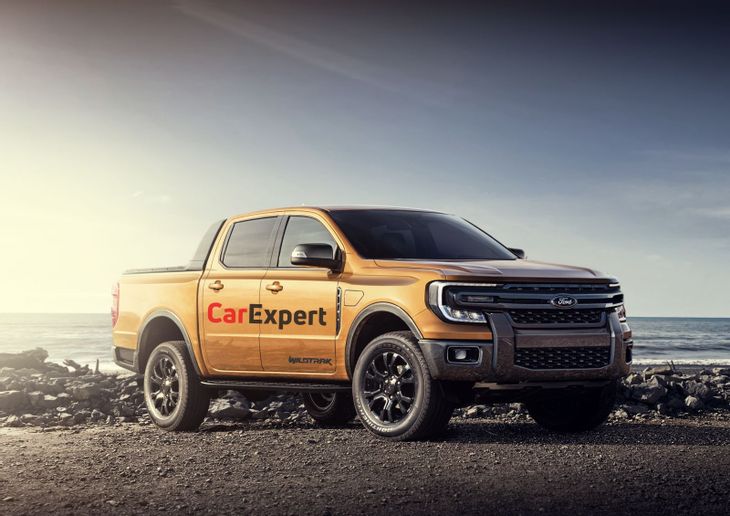
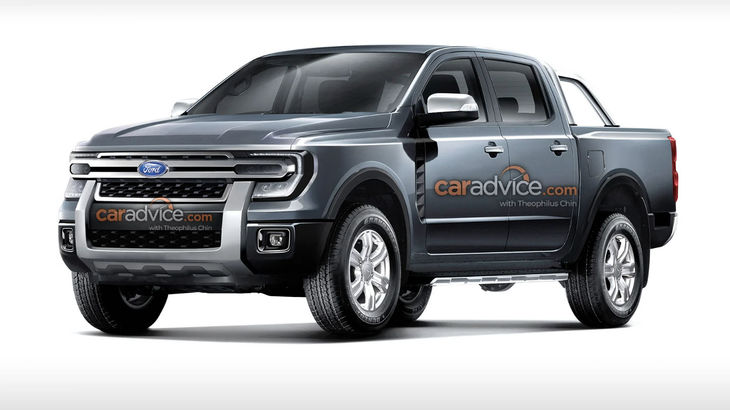
The next-generation Ford Ranger is expected to be unveiled during the first half of next year and may arrive in local showrooms in late 2021 or early 2022. A second speculative render has now appeared, which seems to confirm that the longer, wider bakkie will sport macho "US pick-up truck" looks. Plus, there is a possibility of a 3.0-litre twin-turbo petrol derivative sitting atop the range in Raptor guise…
Last month, Aussie site CarExpert.com.aupublished a render of the upcoming bakkie and now its rival site, CarAdvice.com.au has done the same – and their speculative designs look remarkably similar. The latter site now reports that the next generation of the global bakkie (ostensibly based on the Australian-developed T6 platform) will be marginally longer and have a wider track than the current Ranger. Most notably, the distance between the cabin and the front wheels is said to have been lengthened (plus the enlarge bay enlarged) to accommodate wider V6 powerplants, which the range doesn't currently offer, but is anticipated to be part of its successor's line-up.
More recently, it was confirmed that the next-generation Volkswagen Amarok would be based on the Ford Ranger and that the German company's upcoming double cab would be produced at Ford Motor Company of Southern Africa's Silverton plant from 2022; in other words, many of the details below may pertain to the next Amarok as well.
The Ford Ranger render that CarExpert published last month shows some strong F-150 influence. We like it!
2022 Ford Ranger
CarAdvice's render, created by Theophilus Chin, suggests the upcoming Ranger will feature distinctive extended grille bars and C-shaped DRLs to will help its exterior design tie in with that of the wildly popular Ford F-150, alongside which the Blue Oval's next-gen one-tonner will be sold in North America.
The bakkie's off-road approach and departure angles are expected to be improved, substantial changes will be made to the bakkie's suspension geometry" to improve both on- and off-road performance", while the rear bumper will feature anew towbar design and side-step recesses to make it easier to climb into the load bed, the site said.
The venerable 3.2-litre 5-cylinder turbodiesel motor received a stay of execution with the recent facelift, but will be discontinued for the next range, with the engine lineup focusing on the 2.0-litre single- and twin-turbocharged diesel engines. This bi-turbo motor produces 157 kW and 500 Nm and is mated with a 10-speed auto 'box.
The CarAdvice render shows more brightwork on the front end; it seems the "baby F-150" look is all but confirmed.
Broader engine line-up mooted
As we recently revealed in the How the AmaFord changes everything opinion piece, Ford’s 3.0-litre Power Stroke V6 turbodiesel, as featured in the F-150, is likely to feature in both the next-generation Ranger and Amarok (in combination with the Ford's 10-speed automatic transmission). The Power Stroke turbodiesel is rated at 186 kW and 600 Nm and gives the F-150 a tow rating of just over 5 tonnes, which should make Ranger owners who like to tow things like horseboxes and boats more than happy.
While Ford South Africa doesn't offer a petrol-powered Ranger in its portfolio, there is a 2.3-litre turbocharged 4-cylinder motor available for its overseas markets. For the 2022 Ford Ranger, this motor may be paired to a plug-in hybrid system, although that might not be of as much consequence to the local market as North America, for example.
Petrol-powered Raptor?
Apart from the strong likelihood that the aforementioned Power Stroke turbodiesel will be used in the next-generation Raptor, CarAdvice reports that Ford is considering to transplant the 3.0-litre V6 twin-turbo petrol engine from the North American market's Explorer ST into the next-generation Raptor. The motor, which is also mated with the 10-speed automatic transmission, produces peak outputs of about 300 kW/560 Nm, which helps the ST-badged Explorer achieve a claimed top speed of 230 kph.
Meanwhile, it's widely acknowledged that the Ranger is already the "most connected bakkie" in our market thanks to its feature-rich SYNC3 infotainment interface. Still, you can guarantee that Ford will go all out to ensure this market advantage continues with the next generation bakkie…
Reports suggest that apart from a new digital instrument cluster, higher-spec derivatives will feature a 12.8-inch portrait infotainment screen replete with wireless Android Auto and Apple CarPlay, while SYNC4 and a smartphone app called Ford Pass, which enables owners to locate, lock and unlock the car remotely, are also expected to be offered.
CarAdvice further suggests that the next-generation Ranger will have a significantly upgraded suite of safety features, although we stress that not all of these may not be of consequence to the local market. Ideally, top-spec examples of the newcomer could benefit from disc brakes all round, a centre airbag (designed to deploy between the front seats), blind zone warning, rear cross-traffic alert, a surround-view camera, over and above autonomous emergency braking, adaptive cruise control and traffic sign recognition.
While we know that production of the next-generation Amarok at Ford's plant in Silverton will commence in 2022, we expect the next-generation Ranger to roll off the line a bit sooner, but we don't yet know when. Suffice to say we'll bring you more updates as and when they become available…
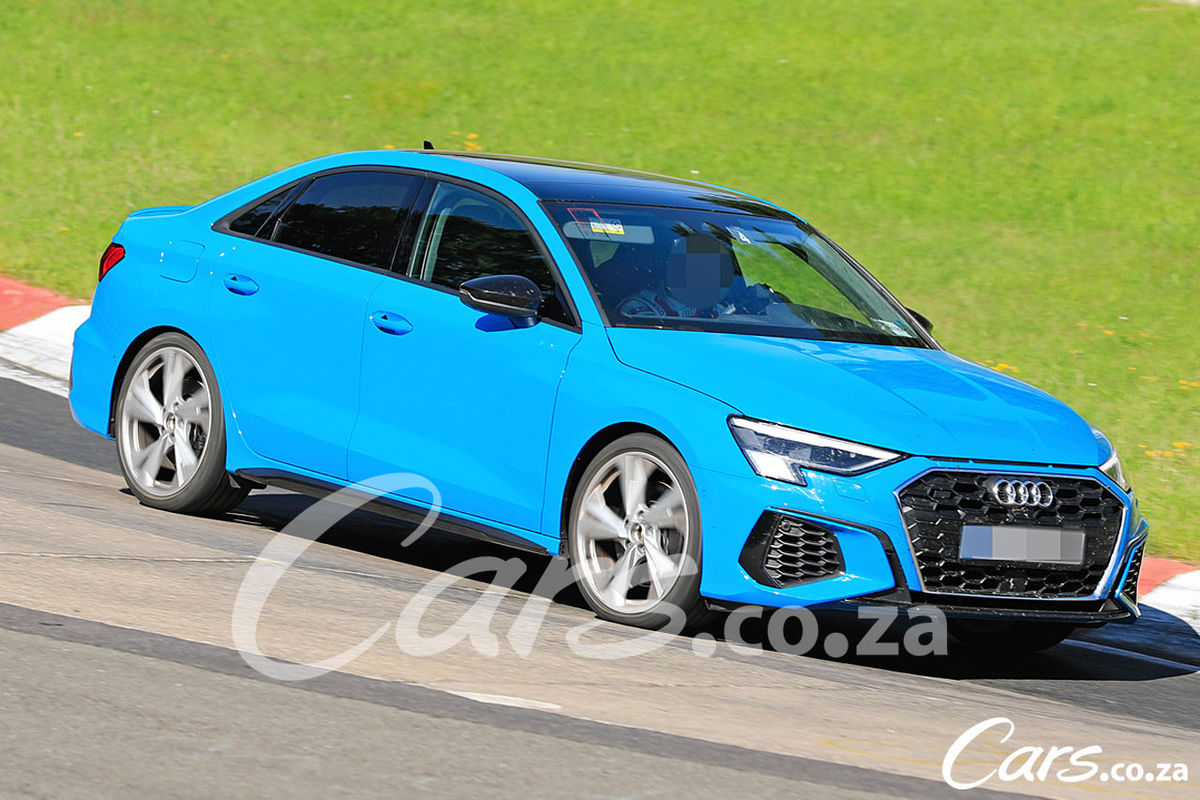
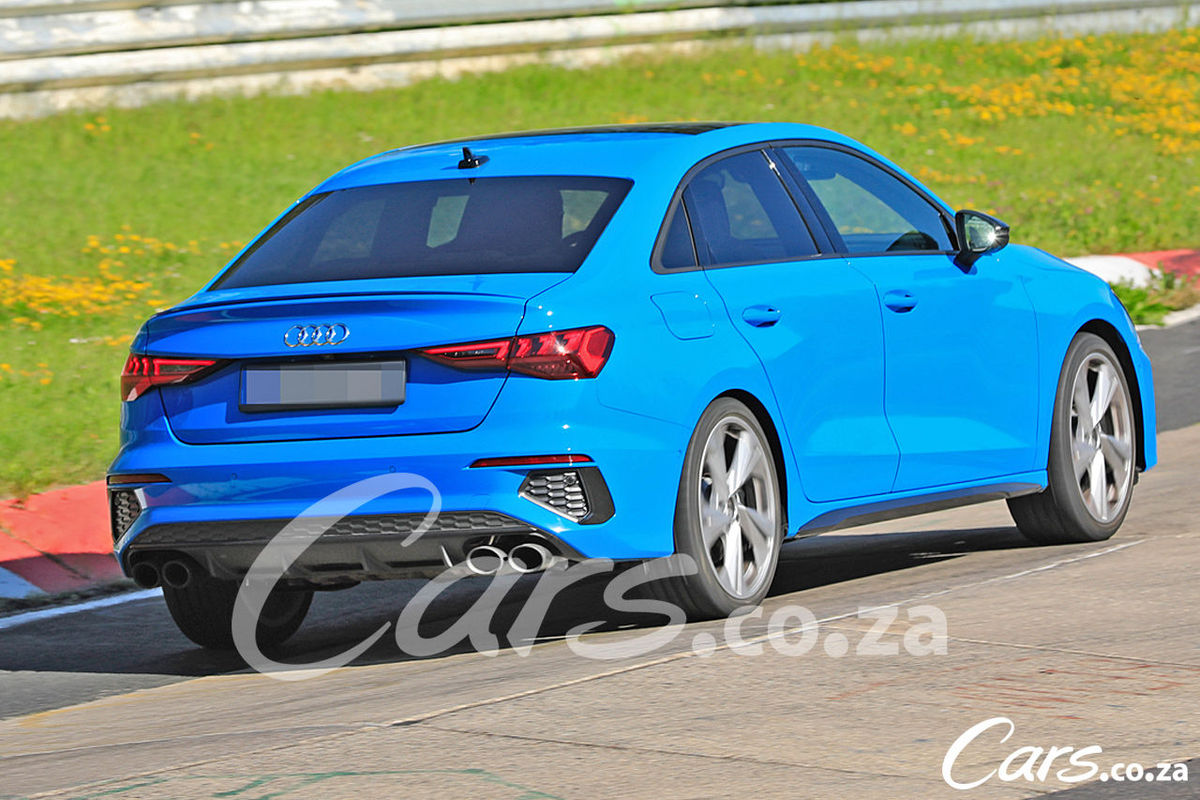
The reveal of the new Audi S3 sedan must be soon as these spy photos show a vehicle that looks remarkably close to being a production model.
Picture credit: S. Baldauf/SB-Medien. We have paid for these photos and at the photographer's request, have watermarked them.
Spotted on the Nurburgring, this Turbo Blue Audi S3 looks nearly ready to hit showroom floors. We've already seen the production version of the standard Audi A3 in hatch and sedan form, now attention is on the performance derivatives. What you see here is likely to be the first arrival and all it appears to be missing are the trademark S3 badges on the grille and rear bumper.
As far as engines go, Audi has confirmed that the 4th generation S3 will be powered by a 2.0-litre turbocharged 4-cylinder motor delivering 228 kW and 400 Nm. All that shove goes to all 4 wheels via a 7-speed S tronic dual-clutch ‘box and we reckon it should be fractionally quicker. The outgoing model is claimed at 4.6 seconds, so we're guessing the new one will sprint to 100 kph in 4.5 seconds.
Hang in there, we're super close to seeing the production version of the new 2021 Audi S3.
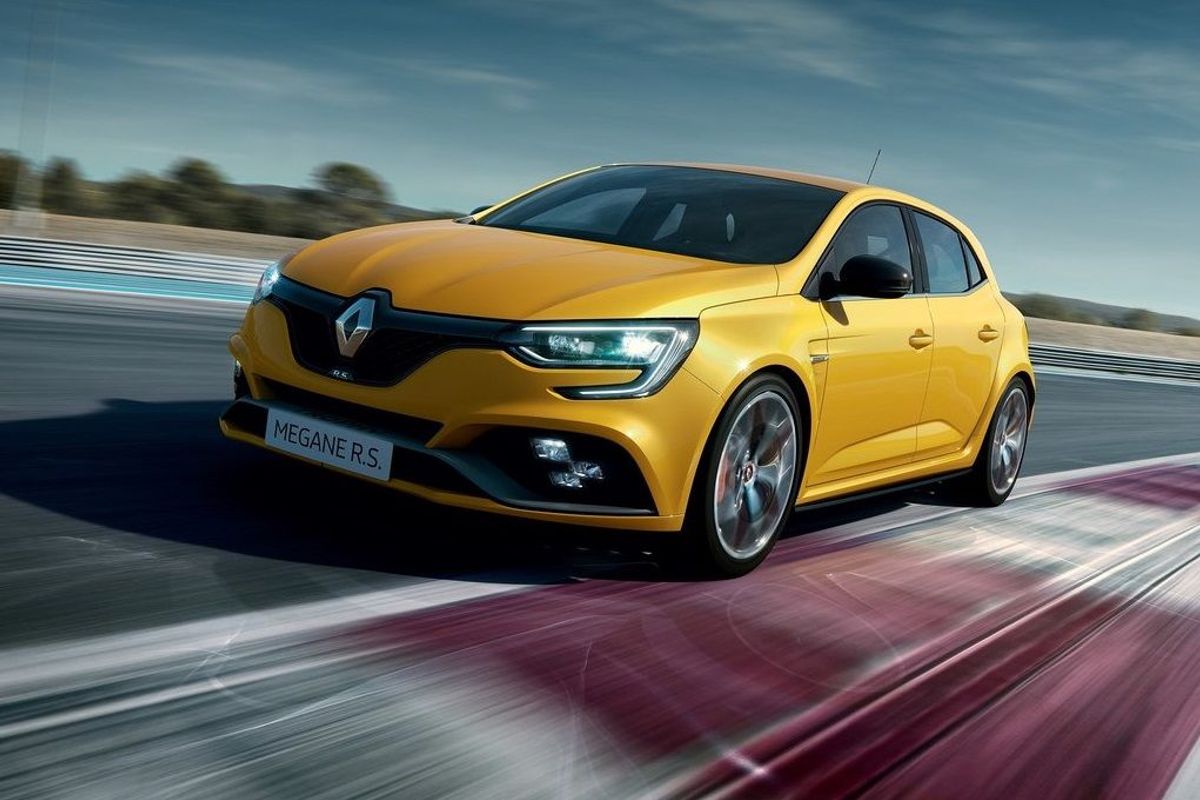
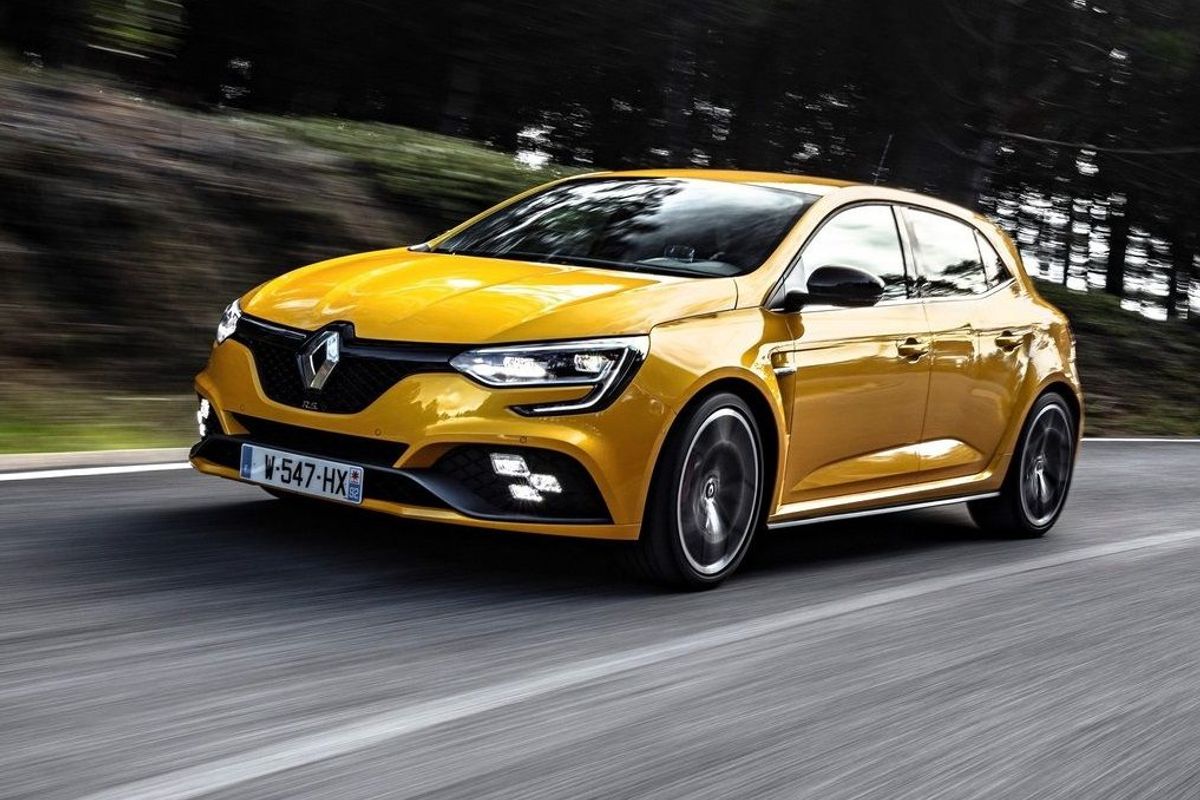
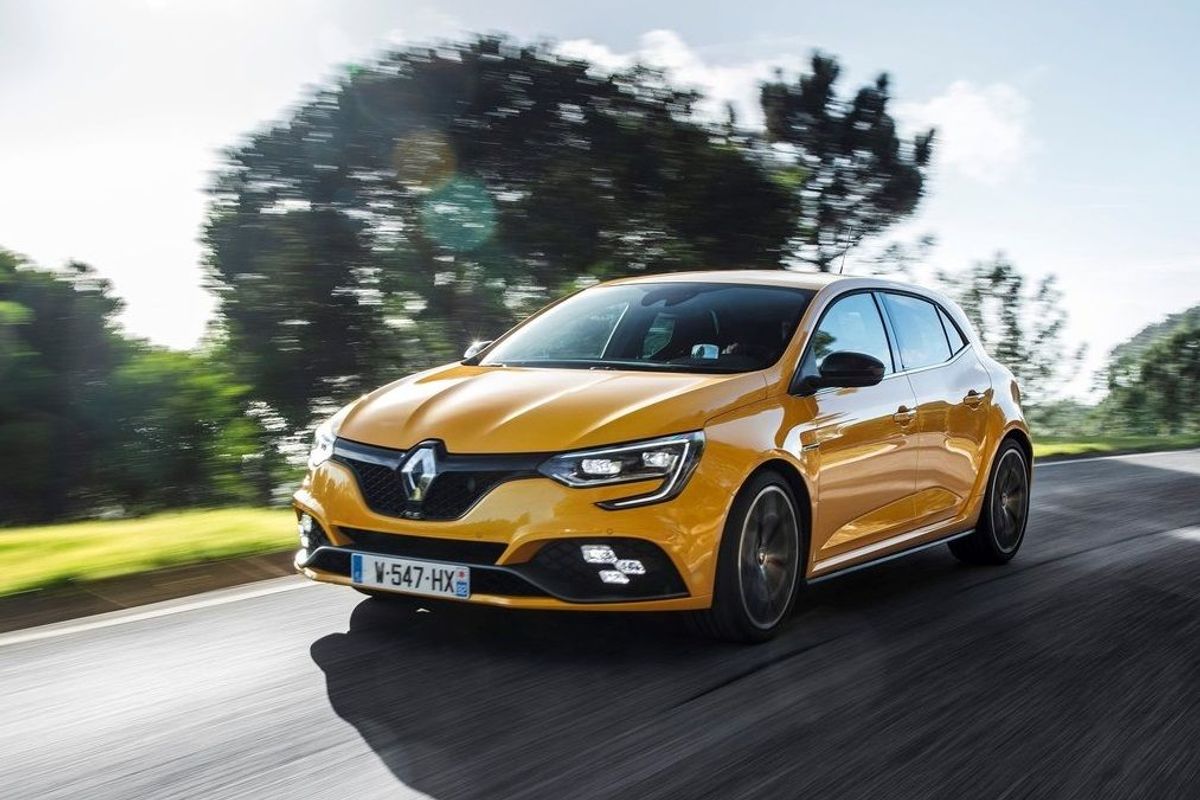
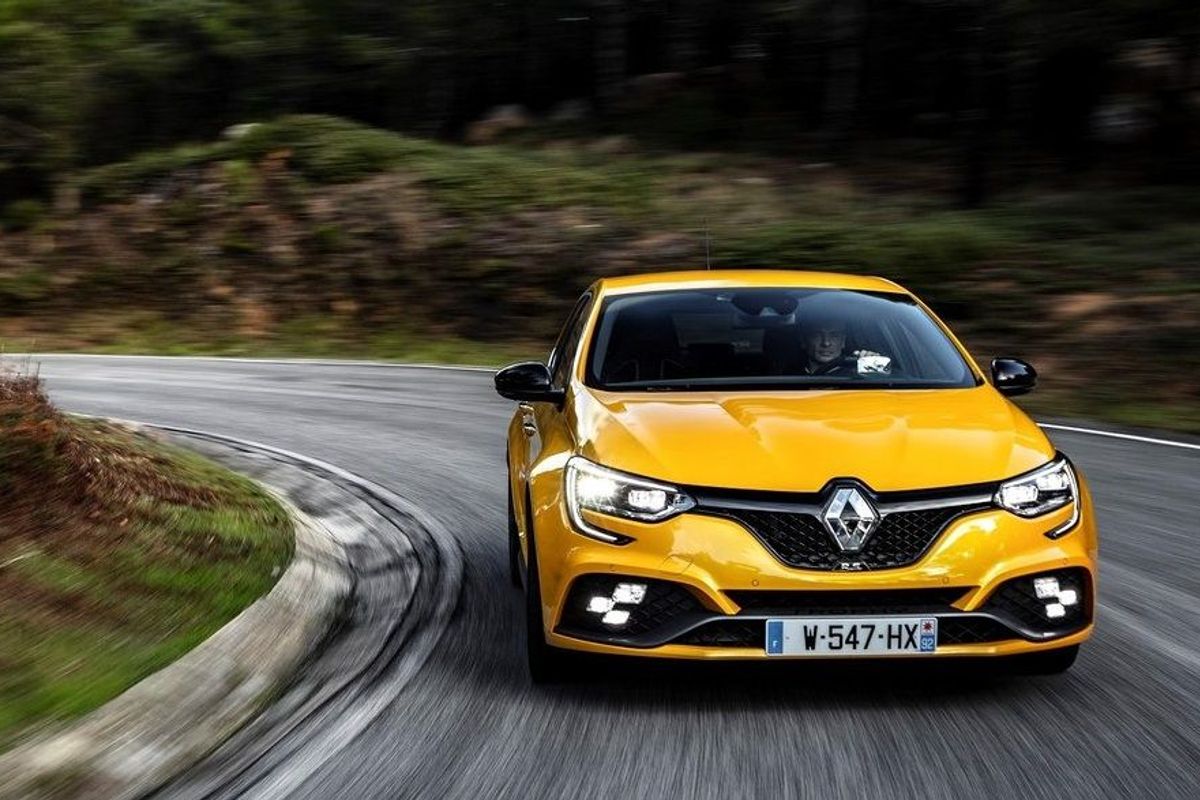
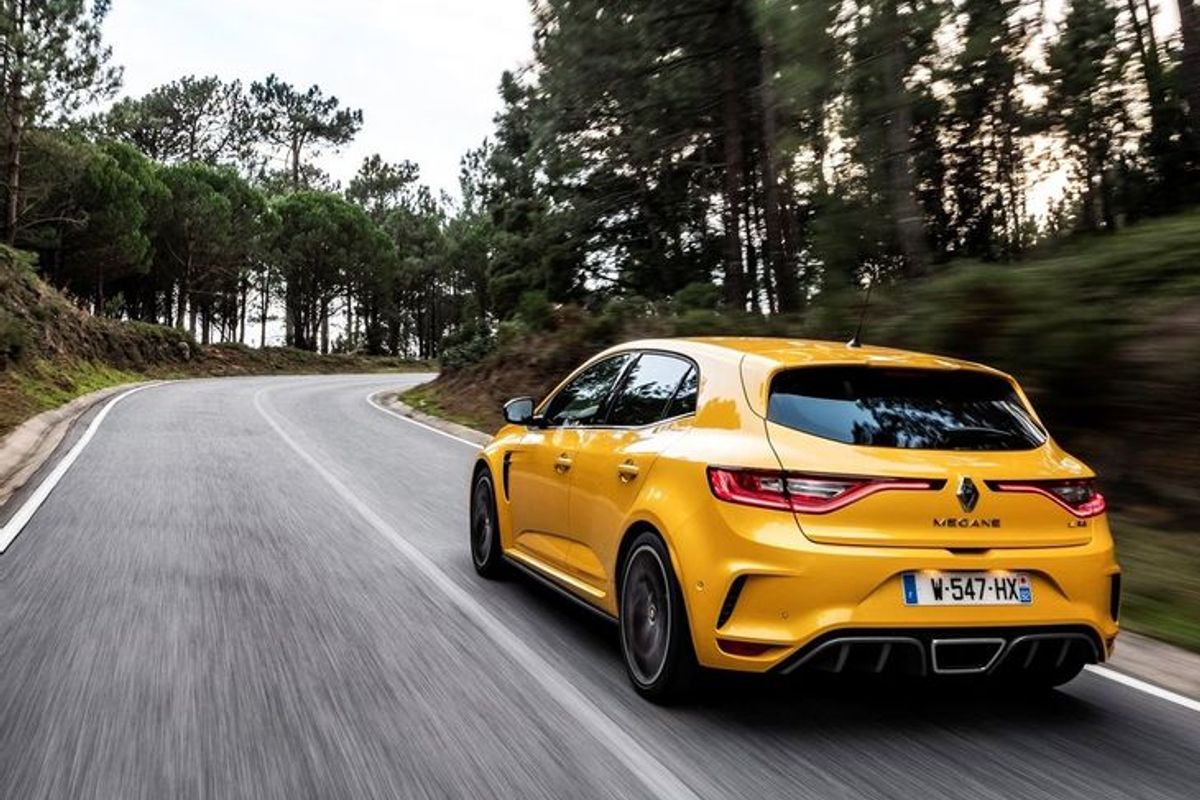
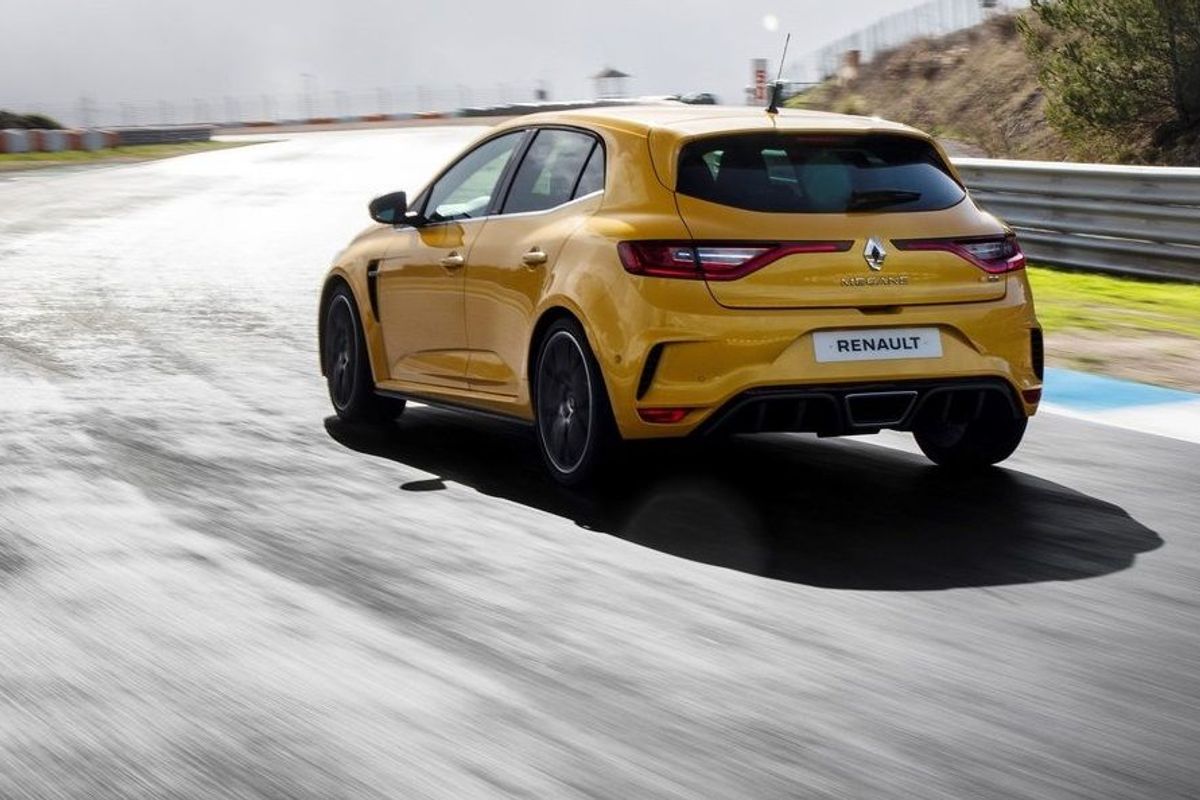
Renault’s track-focused RS 300 Trophy hot hatchback has finally arrived in South Africa! See specs and pricing below…
The new Renault Megane RS hot-hatchback arrived in South Africa back in 2018 with 2 variants on offer, the road-friendly RS Lux and the sportier RS Cup. Now, a more hardcore, track-ready RS Trophy has finally arrived on local soil packing more power and go-faster bits.
What’s on offer?
Visually, the RS Trophy is distinguished by the customary Liquid Yellow paint job as well as the obligatory Trophy stripes seen in the F1-style front spoiler. Other colours are on offer too if you wish.
Whereas the Megane RS Lux and Cup versions offer 205 kW and 390 Nm, the RS Trophy ups the ante with outputs of 223 kW and up to 420 Nm of torque when equipped with an EDC dual-clutch transmission (the 6-speed manual produces 400 Nm), all derived from a 1.8-litre turbocharged petrol engine. As with other RS derivatives, the RS Trophy is also equipped with Renault’s 4-wheel steering system and hydraulic bump-stop shock absorbers. Zero to 100 kph is claimed at 5.7 seconds.
Riding on the Megane Cup chassis, the RS Trophy features a stiffer suspension as well as a Torsen mechanical limited-slip differential and is further equipped with bi-material 355 mm front brake discs with red brake callipers while riding on lightweight 19-inch Jerez alloy wheels shod with high-performance Bridgestone tyres. Lightweight 19-inch Fuji wheels are optional and they shed 2 kg in weight at each corner. The Megane RS Trophy is also equipped with a new exhaust system that allows for engine noise to be adjusted via a mechanical valve fitted to the rear silencer.
What about the interior?
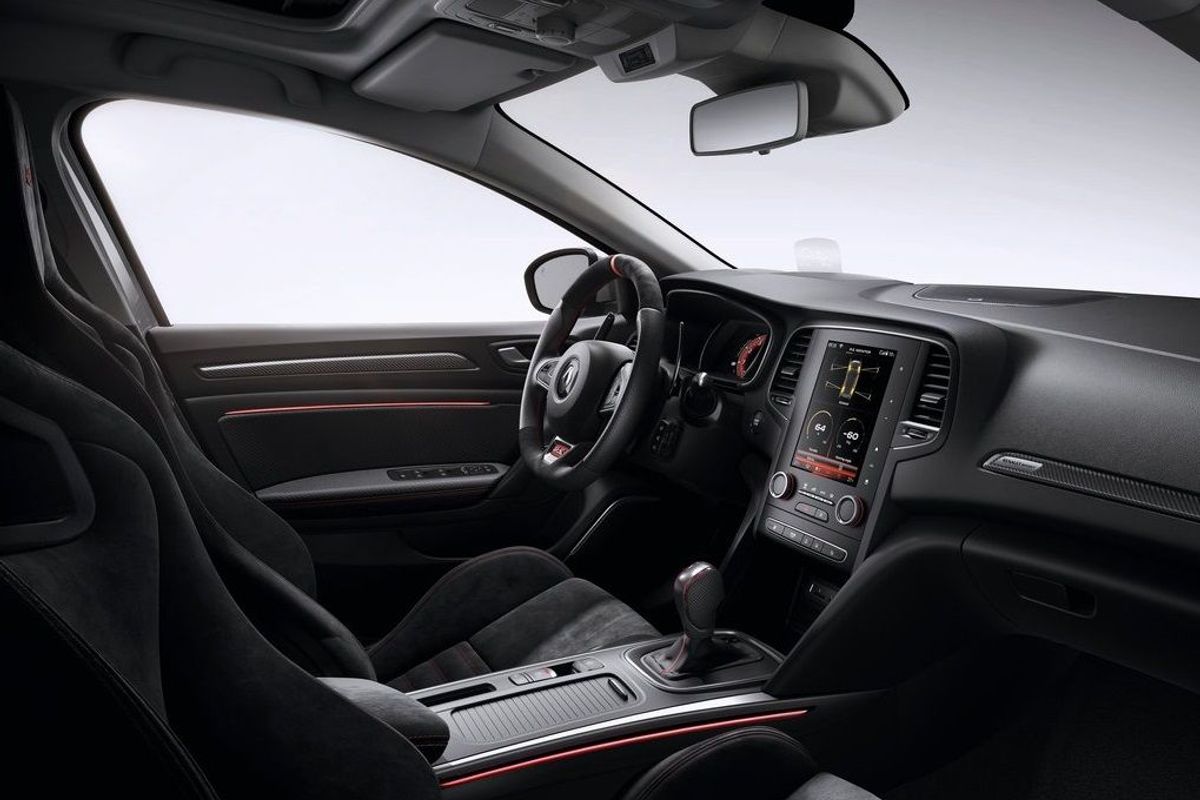
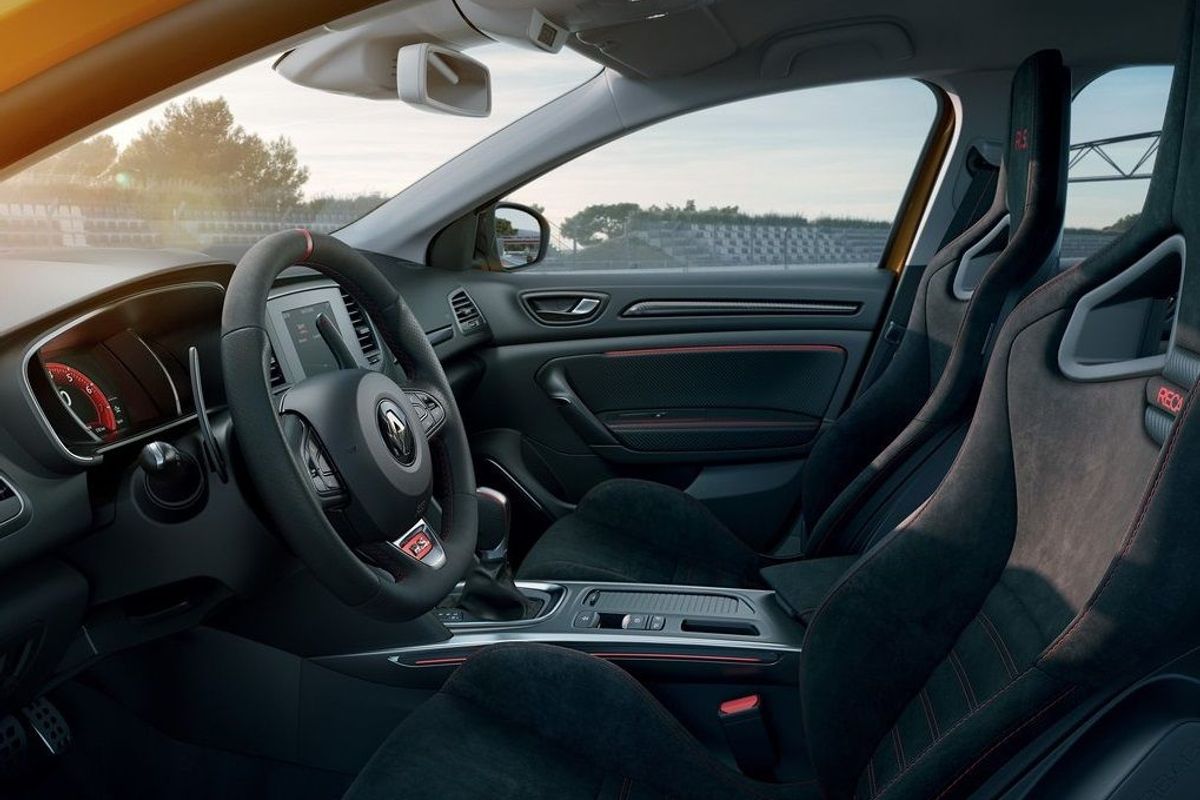
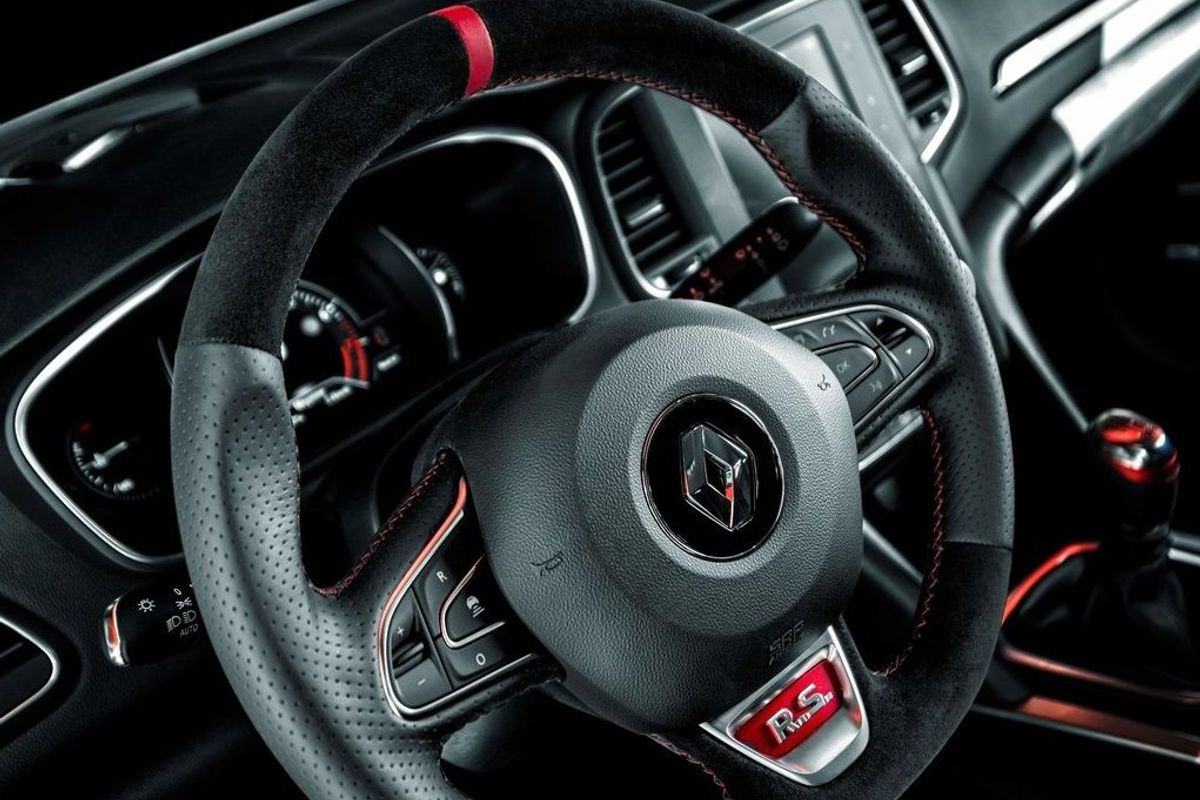
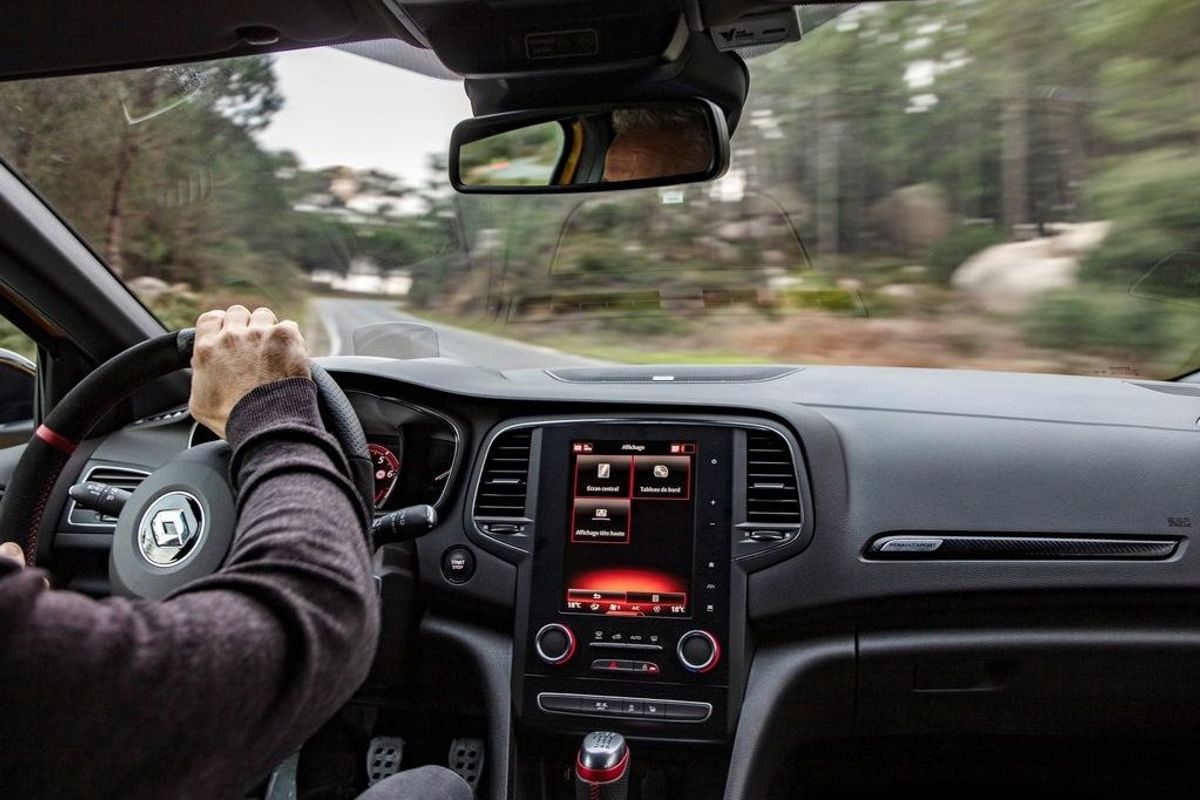
Moving inside, sports seats are standard but you can spec your RS Trophy with specially-designed Recaro seats which allow for the driver to sit some 20 mm lower which adds to the sporty driving feel of the Megane RS Trophy. The seats are wrapped in Alcantara and feature a hard-shell backrest with integrated headrests.
The cockpit itself is shared with its other RS siblings featuring a large squared-off, 7.0-inch R-Link 2 infotainment system that includes sporty features such as performance telemetry readouts on the RS monitor which is useful if you are spending time at the track. 2 USB ports are also fitted to connect devices. A 7.0 -inch TFT instrument cluster is standard.
Only 7 RS Trophy units are available in South Africa.
Renault Megane RS Trophy – Price in South Africa
Megane RS Trophy EDC – R799 900
Megane RS Trophy Manual – R774 900
The Renault Megane RS Trophy is sold with a 5-year/150 000 km warranty and a 5-year/90 000 km service plan.