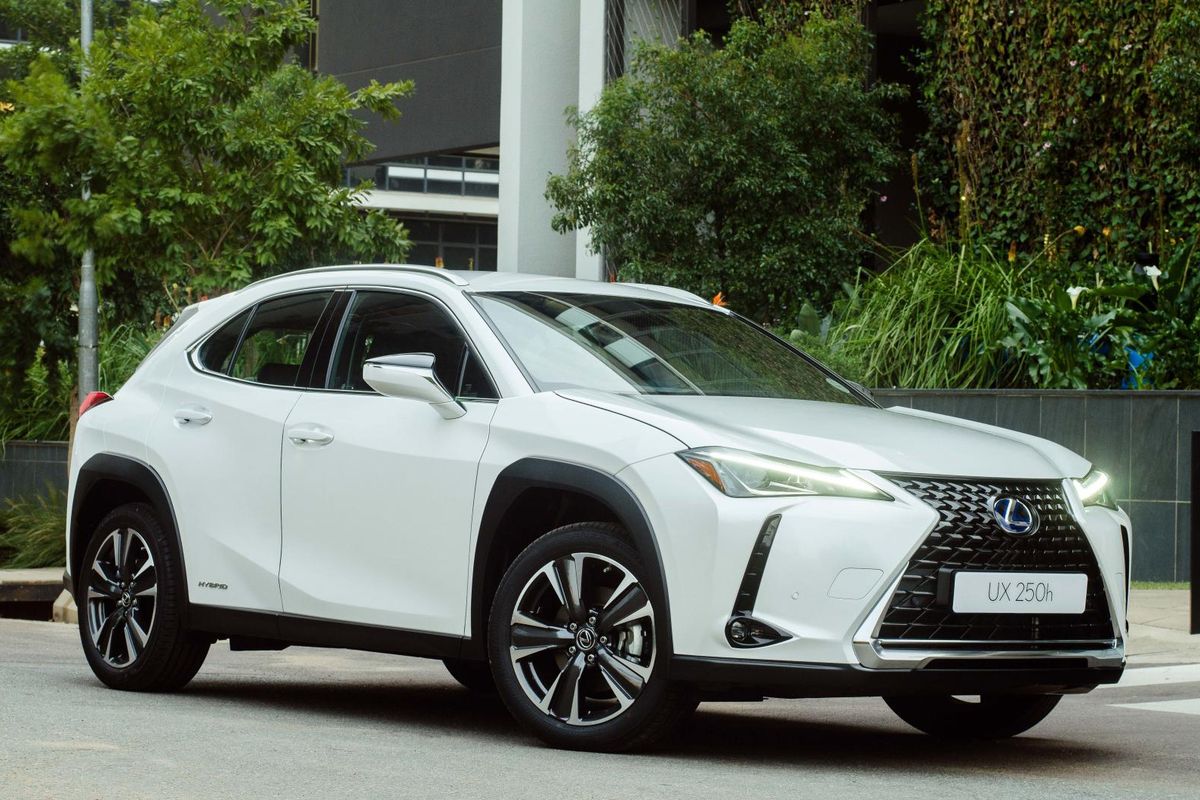
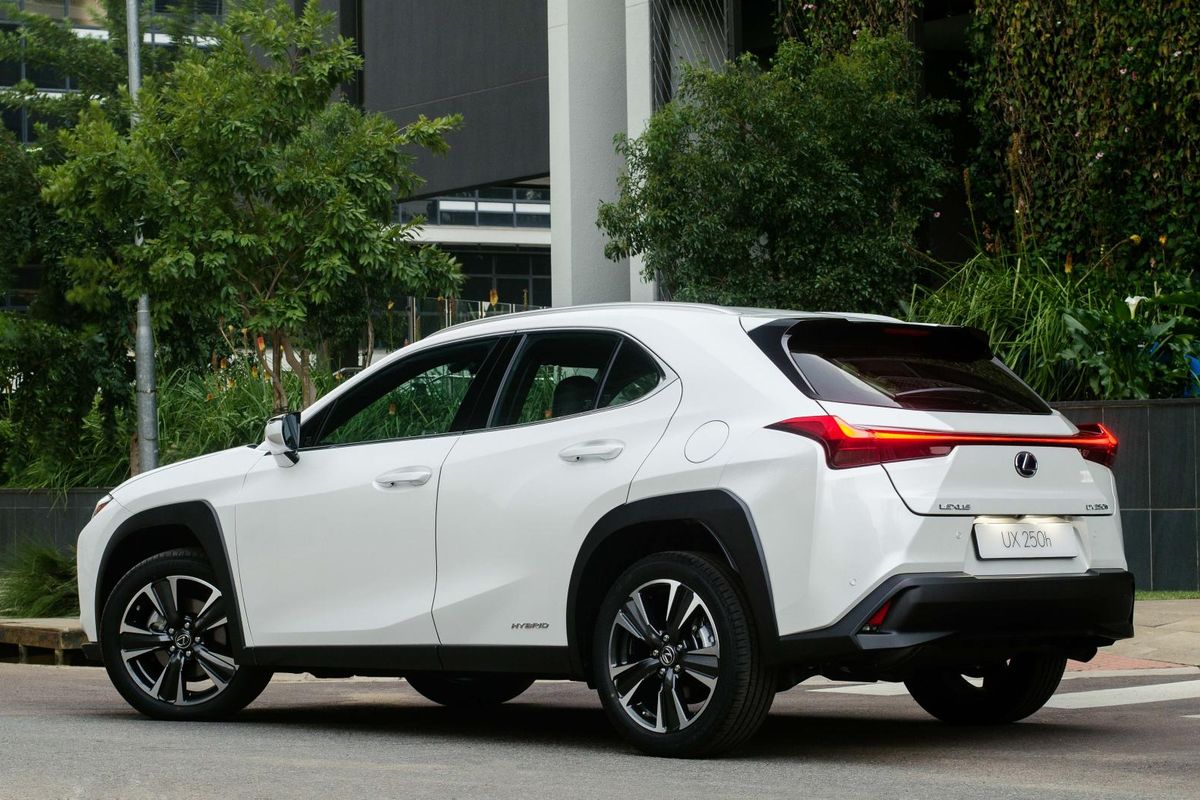
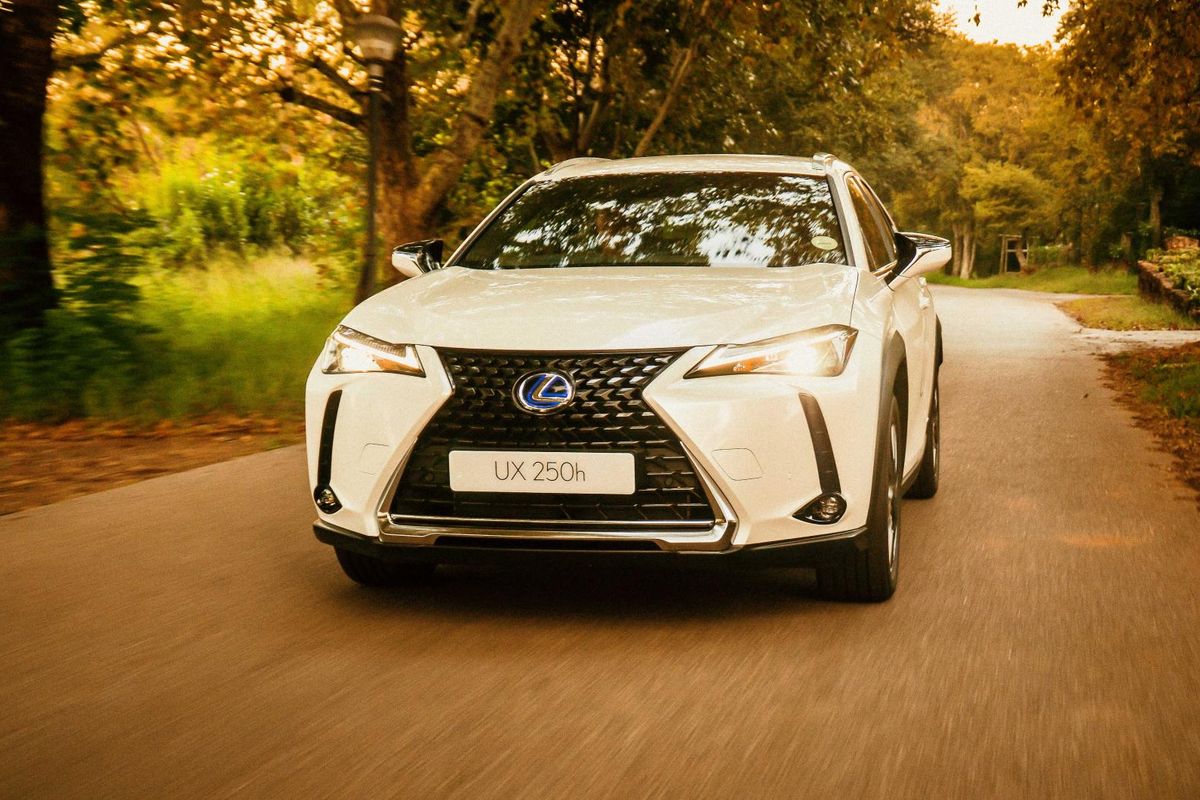
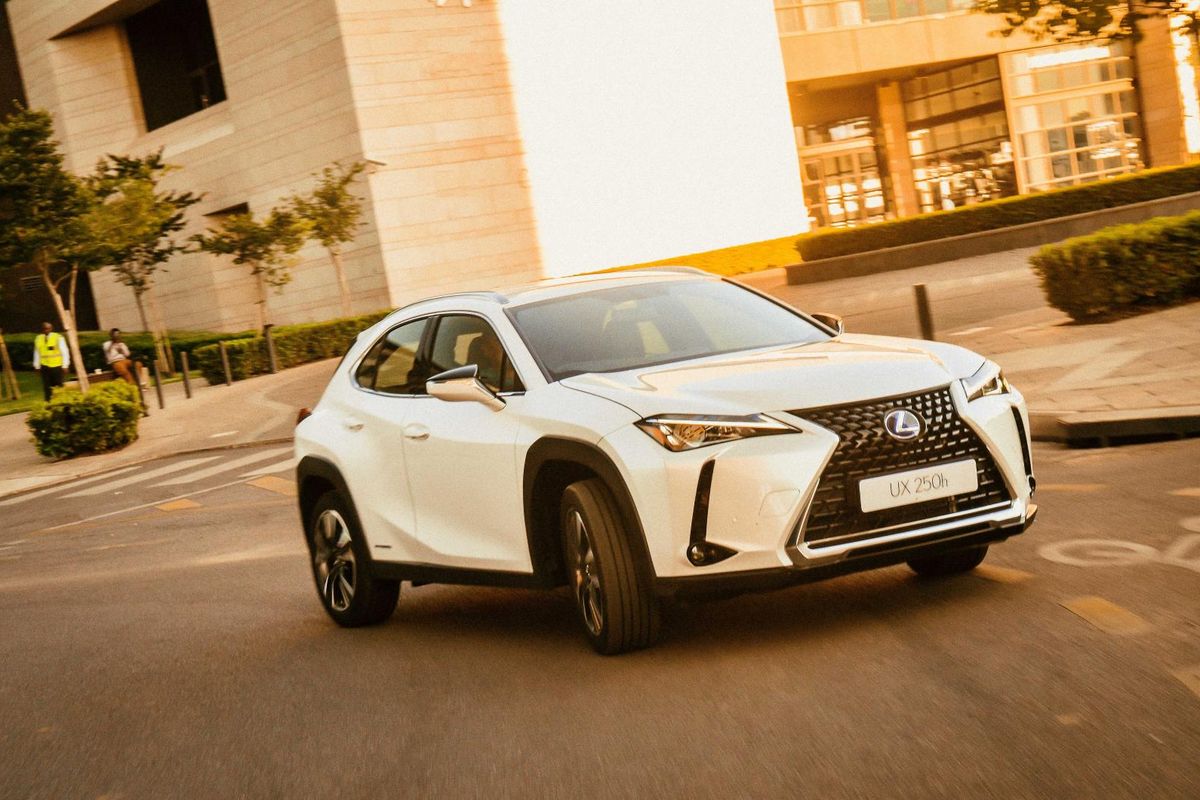
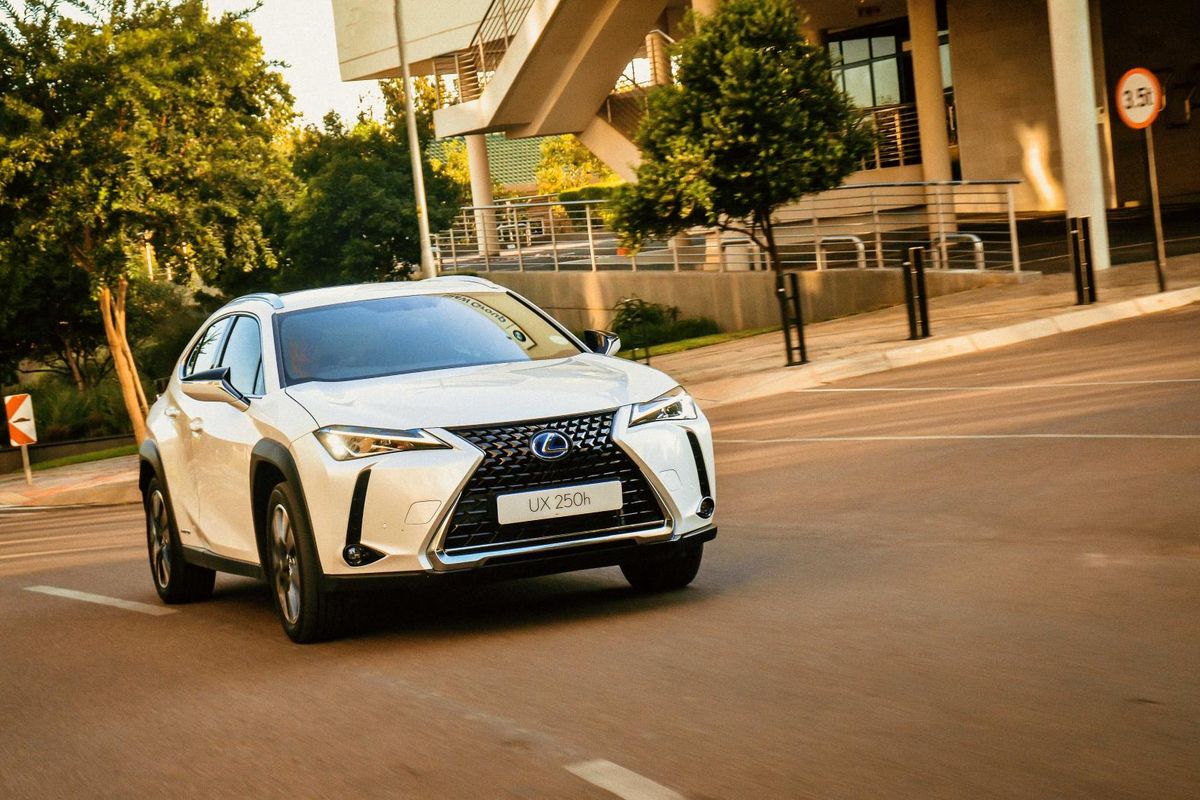
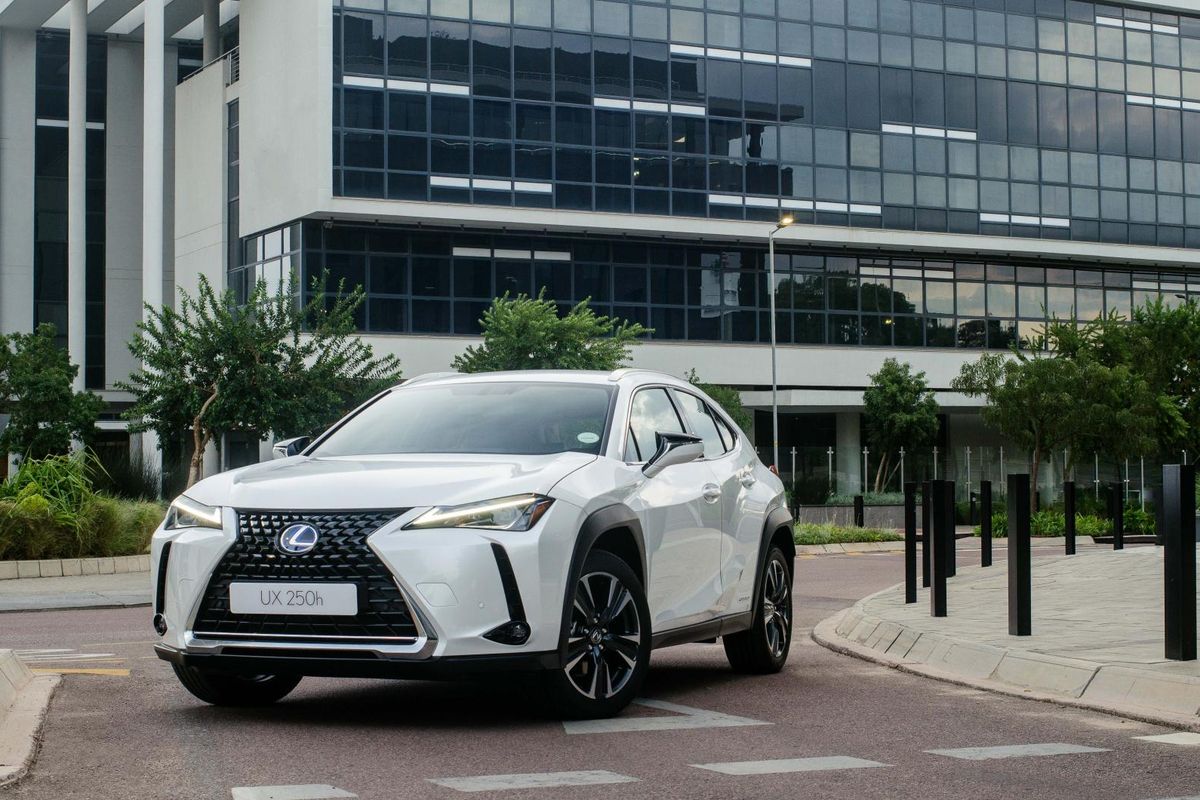
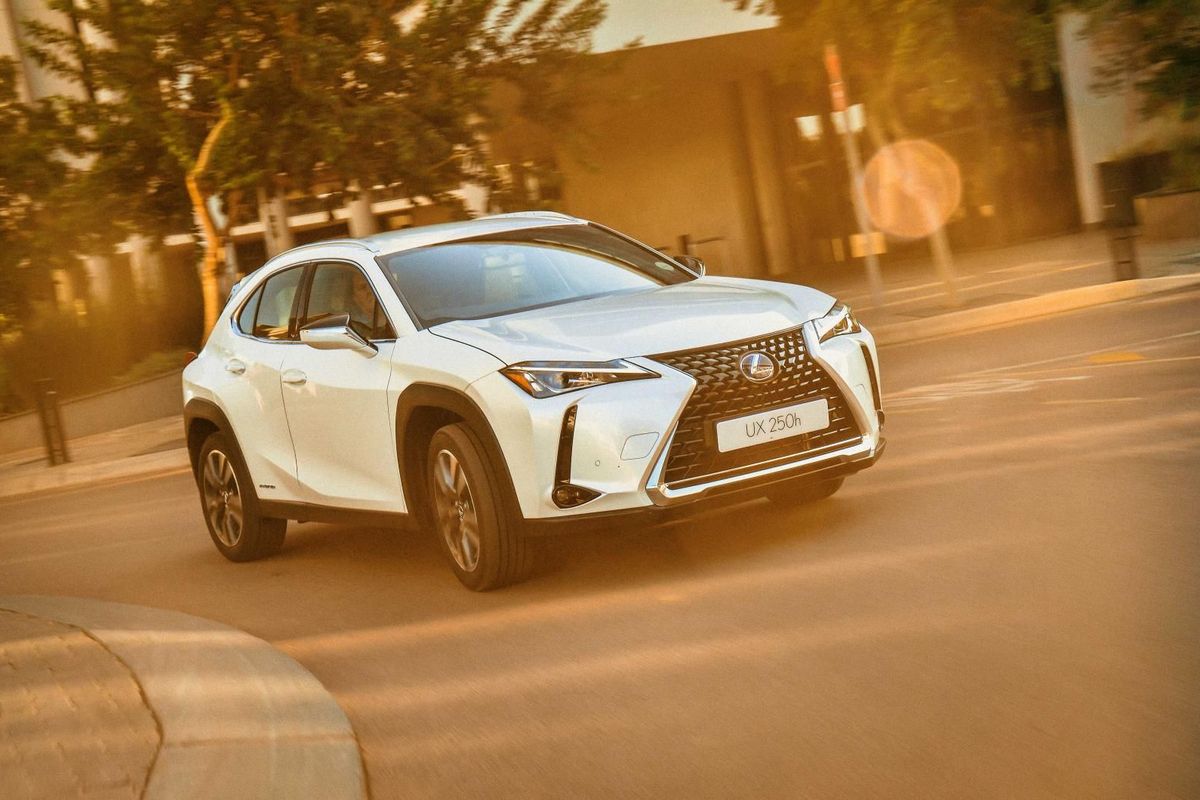
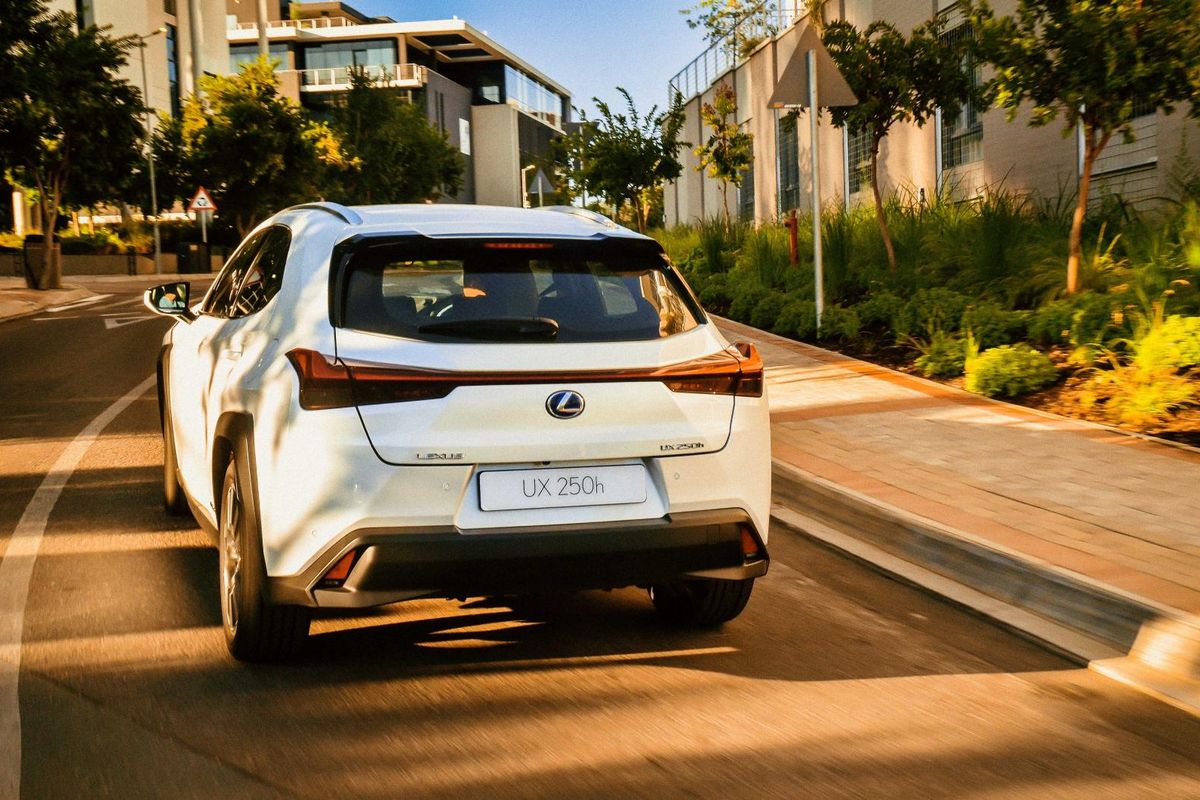
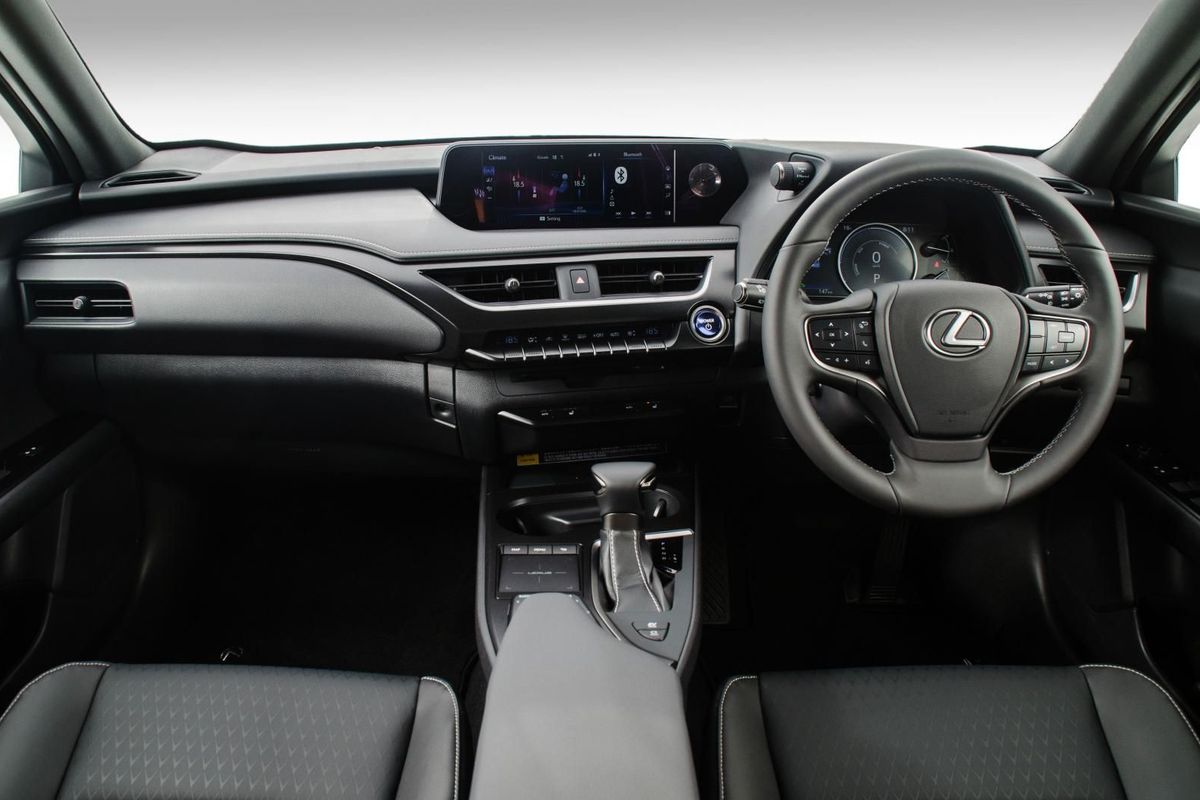
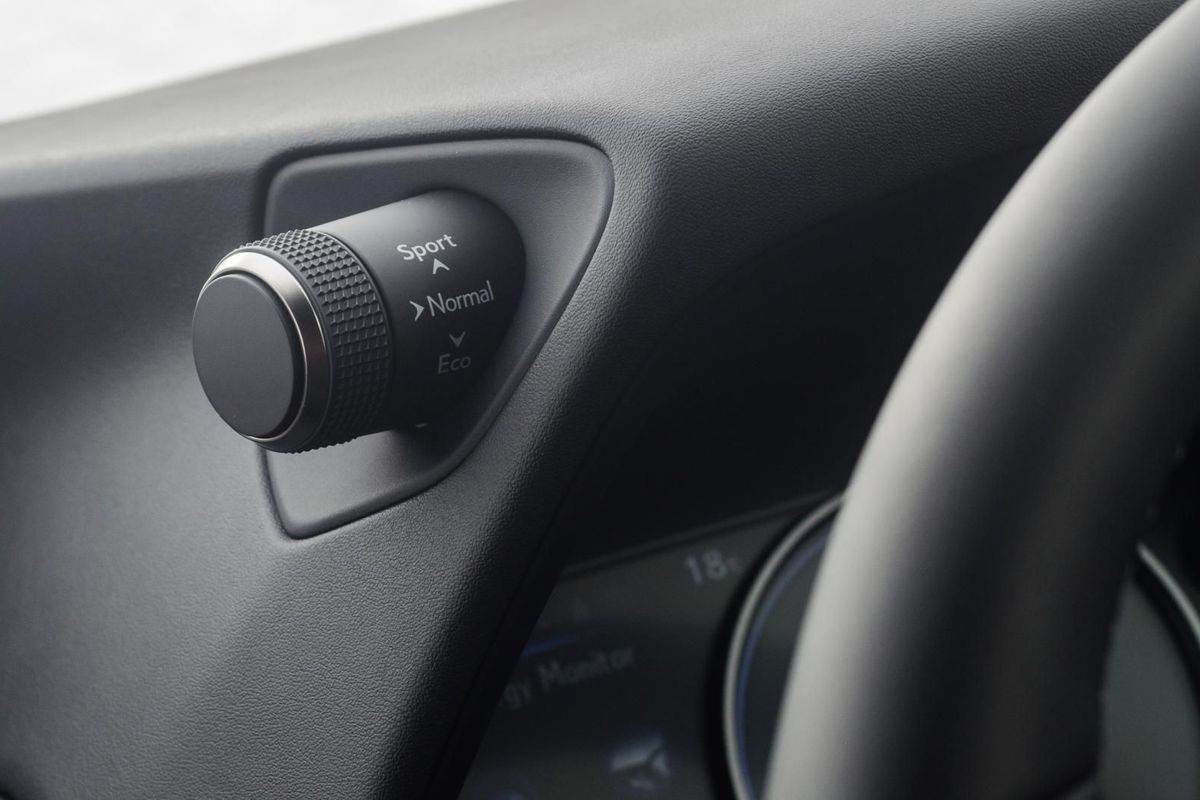
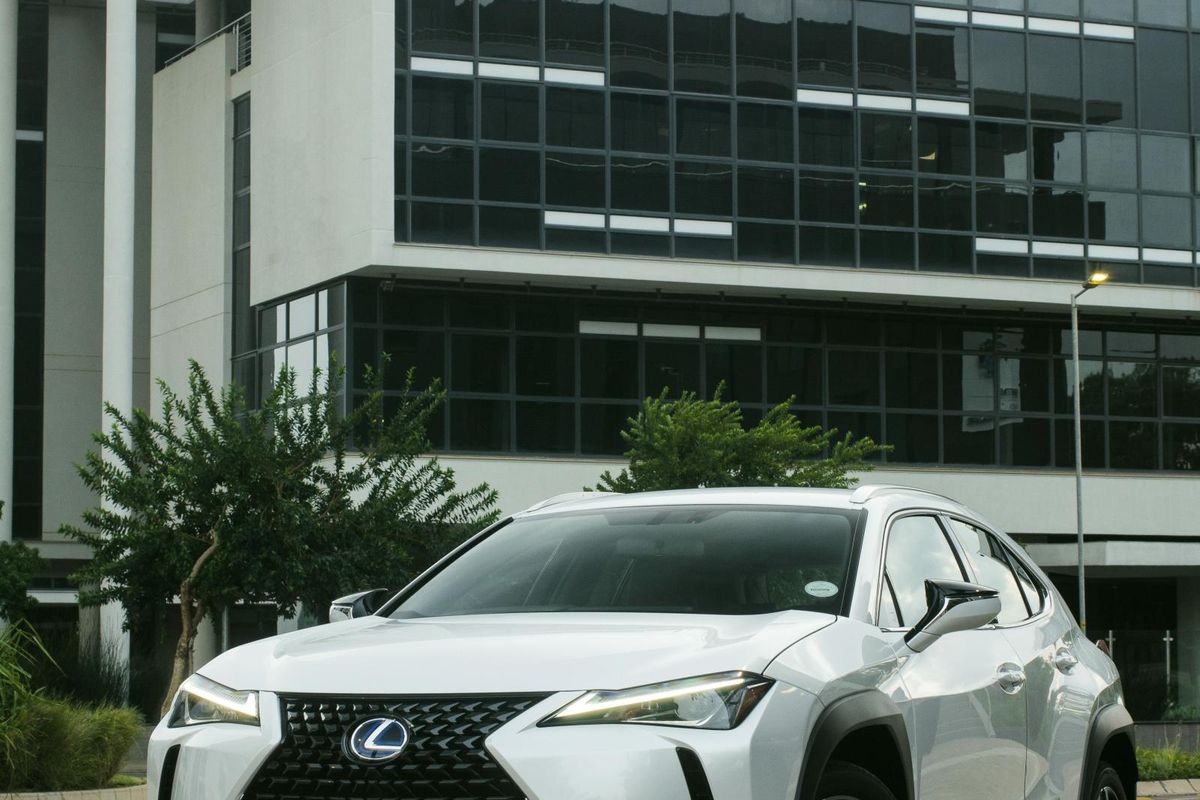
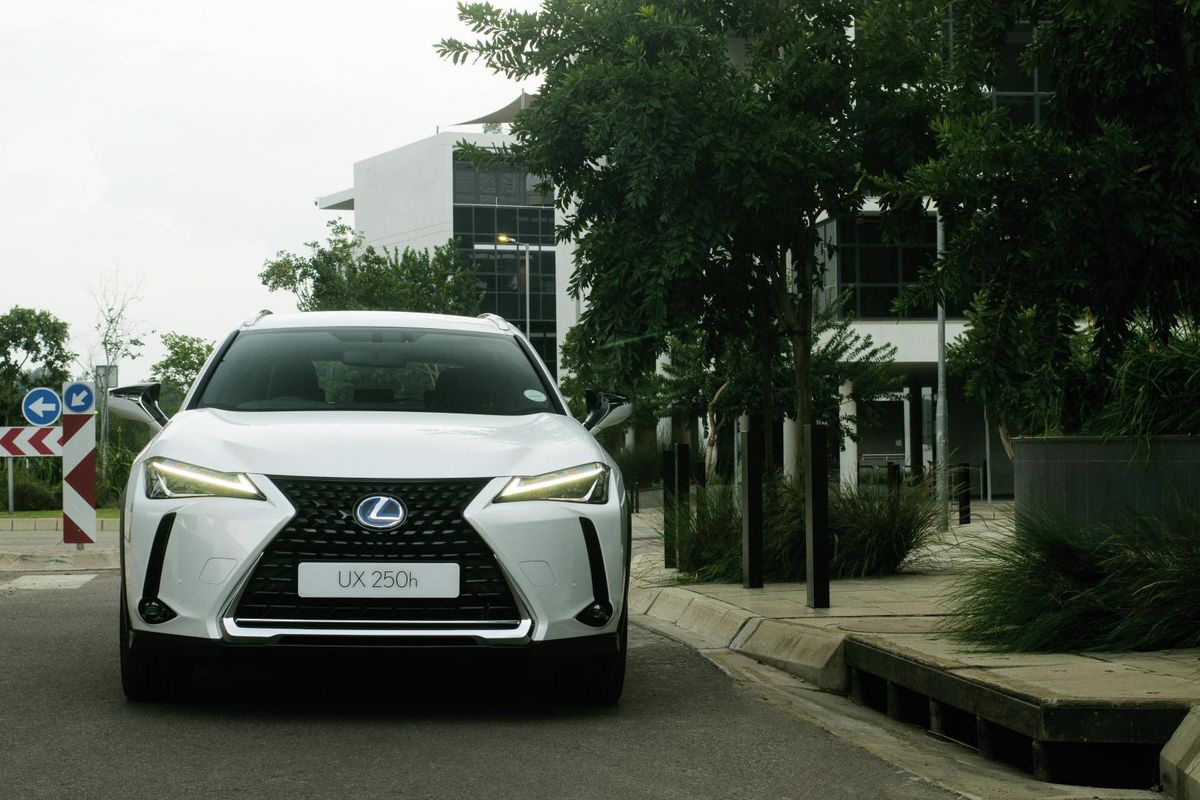
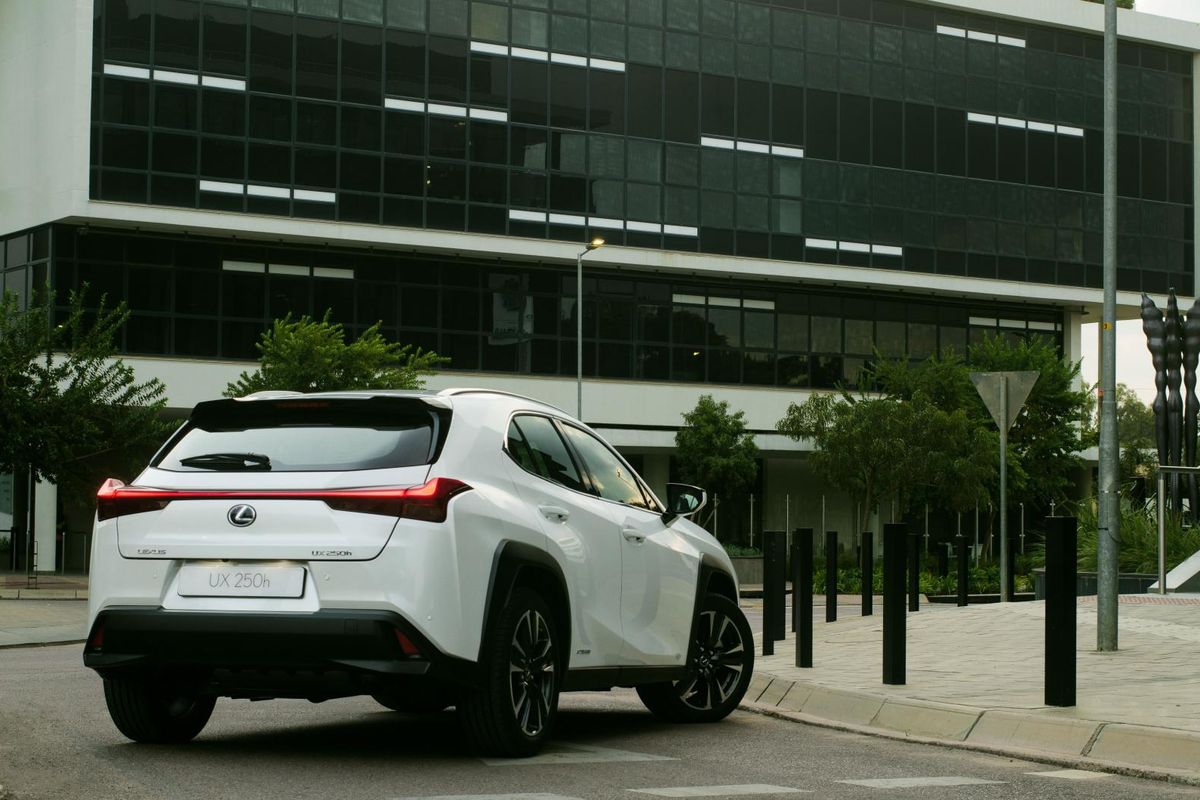
The Lexus UX currently serves as the entry-point to the brand, but could Lexus be planning a new model to slot in below the UX? Reports suggest so…
Rumours are swirling that Lexus might introduce a new ‘crossover hatchback’ in 2023 that will slot in below the UX in Lexus’ vehicle range and will reportedly be called the BX.
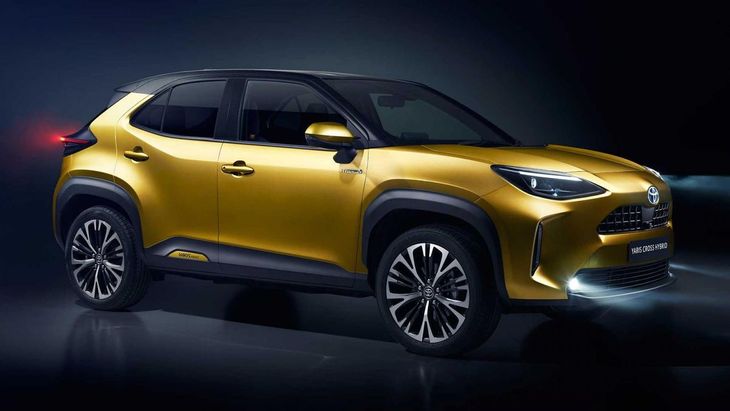
In a Chinese report from Autohome, it’s suggested that this new Lexus model will be based on the new and recently-revealed Toyota Yaris Cross Hybrid. Styling cues may draw form the UX and Yaris Cross and the BX will adopt Lexus’ spindle grille design to conform with the brand’s established design philosophy. According to the report, the Lexus BX is also expected to ride lower than the Yaris Cross and will be based on the TNGA (GA-B) platform that underpins many of Toyota and Lexus products.
The new Toyota Yaris Cross could form the basis for a new entry-level Lexus in coming years.
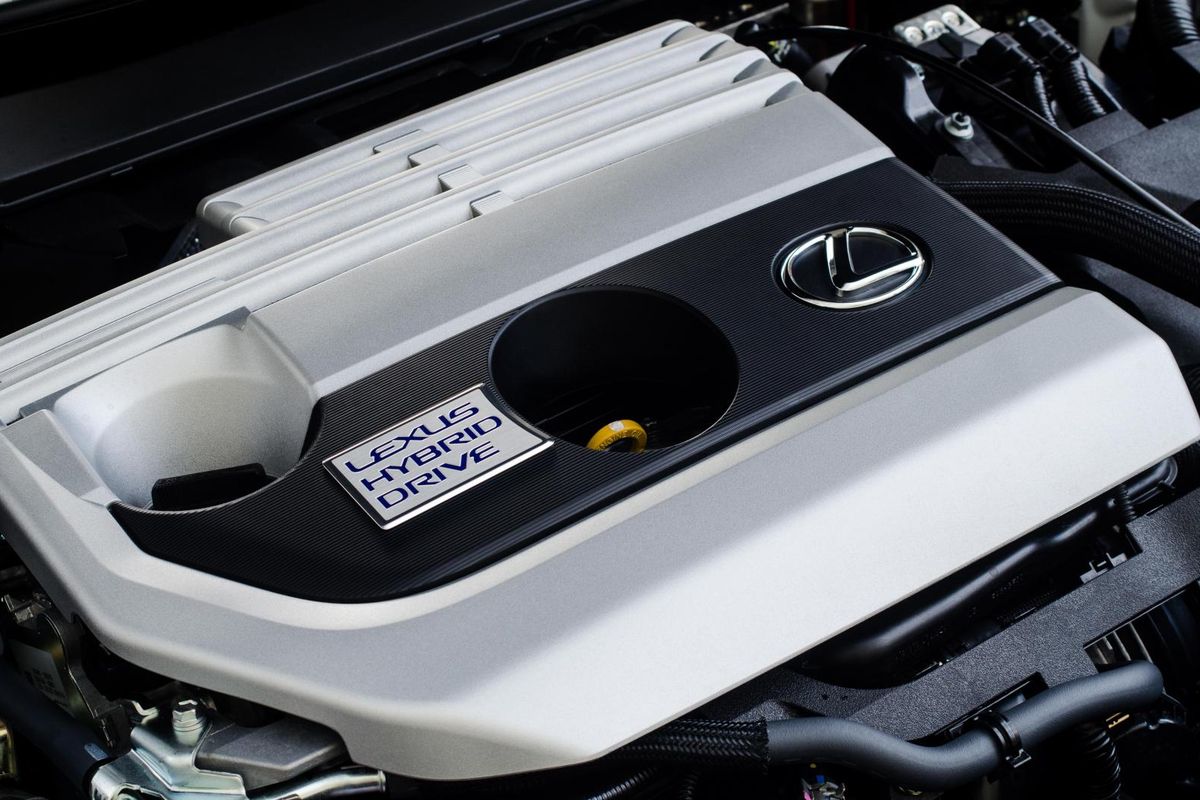
If the Lexus BX does indeed become a reality, it’s believed that it will adopt the same hybrid powertrain offered in the Yaris Cross consisting of a new 3-cylinder 1.5-litre Atkinson cycle petrol engine which combines with an electric motor to produce a maximum power output of 85 kW and paired with a CVT. Like the Yaris Cross, both front and all-wheel-drive variants could be offered. A sportier F-Sport derivative is also a possibility.
While there’s nothing official from Lexus at this stage, time will tell if there’s truth to these rumours. We will keep you updated as soon as more information becomes available.
The long-expected petrol price rebound is set to happen in June, according to the Automobile Association (AA). Looks like the decreases are over as the petrol price is set to rise in June 2020.
The end of month figures have been updated, you'll find a more up to date estimate here.
Based on the current data, the AA is predicting up to 50 cents a litre increase for petrol, while diesel fans can rejoice with a decline of around 56 cents. "In a dramatic reversal of last month's oil swings, international product prices used to calculate South Africa's basic fuel price have nearly doubled since their lows at the end of April," the AA explains. "Over the same period, the Rand has settled in around the level of R18.40 to the US dollar, almost three Rand weaker than just three months ago prior to the advent of the Covid-19 panic and multiple downgrades of our economy by ratings agencies."
Towards the end of April 2020, the oil price fell and the Rand steadied, resulting in yet another decrease. However, the oil price has come back strongly in May 2020 as global refining capacity's imbalance has been addressed. Still, we've had quite a good run with most grades of petrol about R4 cheaper a litre now than they were at the beginning of the year.
As always, we'll have the changes to the petrol/diesel price towards the end of the month.
Lexus South Africa continues its hybrid offensive with the addition of an entry-level UX offering.
Lexus sees itself as the hybrid leader in South Africa and if the figures are to be believed, Lexus owns 37% of the alternative fuel market in SA. BMW runs it close with 34% of the market. The UX hybrid, in particular, is a top-seller in the space contributing to 21% of hybrid sales, only beaten by the BMW i3 (28%) in terms of outright sales locally.
Lexus wants to push further into the hybrid space, where it wants to be the number 1 name within the market. They have already begun to expand hybrid offerings with the introduction of the entry-level ES in January 2020. Now it’s the turn of the UX to get a lower spec grade. We say lower spec, but Lexus is always rather generous with its spec so what it actually means is that a few nice-to-have items have been removed from the spec sheet and the price has come down by about R60k.
The new EX grade hybrid UX (Lexus UX 250h EX) is similarly specced to the non-hybrid 200 EX. Compared to the SE top-spec models it doesn’t have some of the active safety features such as lane-keeping assist, blind-spot monitoring and pre-crash sense. Standard cruise control is selected instead of adaptive which is used for the SE. It has standard LED headlights without auto high beam and a reverse camera instead of panoramic round view system.
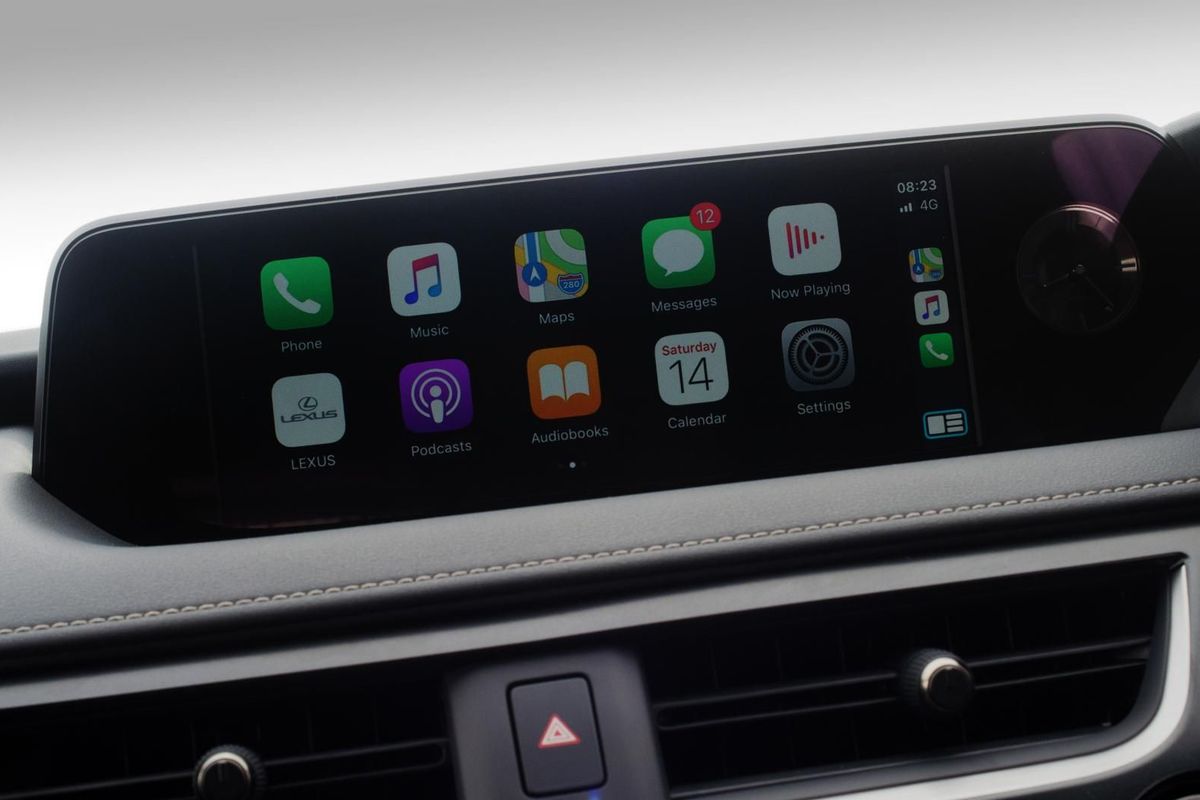
Inside, the seat material is Nulux (a simulated leather) as opposed to the smooth leather of the SE models. Ventilated seats are also only available on the SE models. All UX models now come standard with Apple Carplay and Android auto as well as the 10.3-inch central infotainment unit.
The power unit remains the same, generating a maximum output of 135 kW when the battery delivers its full potential in conjunction with the 107 kW naturally aspirated petrol engine.
It appears that Volkswagen's most popular name will disappear from markets that only allow the sale of electric cars. What? Is this the end of the road for Golf?
First reported in Auto Express, Volkswagen’s boss of sales and marketing, Jurgen Stackmann told the publication that fully electric markets will be the end of many Volkswagen products as the brand switches to its all-electric ID family.
He was asked if the Volkswagen Golf still has a future. “Probably not, but I am convinced that you will see Golf 9 coming. I think Golf will have a lot of interesting technologies until the boundary of full electric. The fully electric ID goes into the ID family and that decision is of a divide within the family. So for full electric, we want to have optimised platforms doing just electric and they will be called ID. for the future.”
With some European markets banning internal combustion engine cars from sale as early as 2030 (the UK's aim), car companies are pushing hard to get all-electric models rolled out. Right now, there's no all-electric Golf 8, with the Volkswagen ID.3 expected to take the mantle. But, fear not, it is not the end of the road for Golf. "Golf will remain as a strong effort of the brand in many places and I believe in Europe as well, but in many places outside Europe where they probably don’t have the capacity to go full electric so fast.” said Stackmann. “So I’m convinced that we will see a parallel run of Golf 9 and ID. next generation. What technology Golf 9 will bring we will see. It will again be leading edge as we are now seeing with Golf 8 – whenever we come with next generation Golf it will be a mark for the rest of the industry to beat for the next five or six years to come.”
For the SA market, we think there's still plenty of life left in the internal combustion engine, so don't panic!
French MPVs have little future in a crossover world.
Renault effectively invented the modern compact MPV. In the 1990s, whilst Chrysler was winning over large American families with its Voyager, the French company realised that people wanted smaller MPVs.
The Scenic was born and enjoyed great popularity, even in South Africa. Market demands alter over time and that reality is now forcing Renault to reconsider the composition of its product portfolio.
With the company’s accountants having calculated that Renault must save R40bn over the next two years, less popular models are being selected for discontinuation.
Renault has recognised that customer demand has diverged from MPVs to SUVs and crossovers. The company’s product planners feel that Renault has too few compact SUVs and crossovers on offer, and too many MPVs. By that logic, the MPVs simply have to go. Which is strange considering it already has Captur, Kadjar, Duster and Koleos in the SUV segment. It could be a preemptive move as rumours about the Renault/Nissan Alliance breakup could see Renault lose platform sharing rights to the Kadjar (Nissan Qashqai) and Koleos (Nissan X-Trail).
What this means for the Renault product matrix in the next year or two, is a retirement of its Scenic and Espace. Followers of the French brand will be saddened to see Scenic and Espace retire, as these are two of the most iconic Renault products.
It is especially the Espace, which has special relevance for all things MPV. Renault has produced five-generations of its large MPV, originally launching in 1984. In many ways, the Espace was a visionary vehicle for large families.
Beyond the rationalisation of MPVs, Renault could also be mulling any future investment in its Talisman. The large sedan has been a poor seller, ceding sales to similarly sized crossovers.
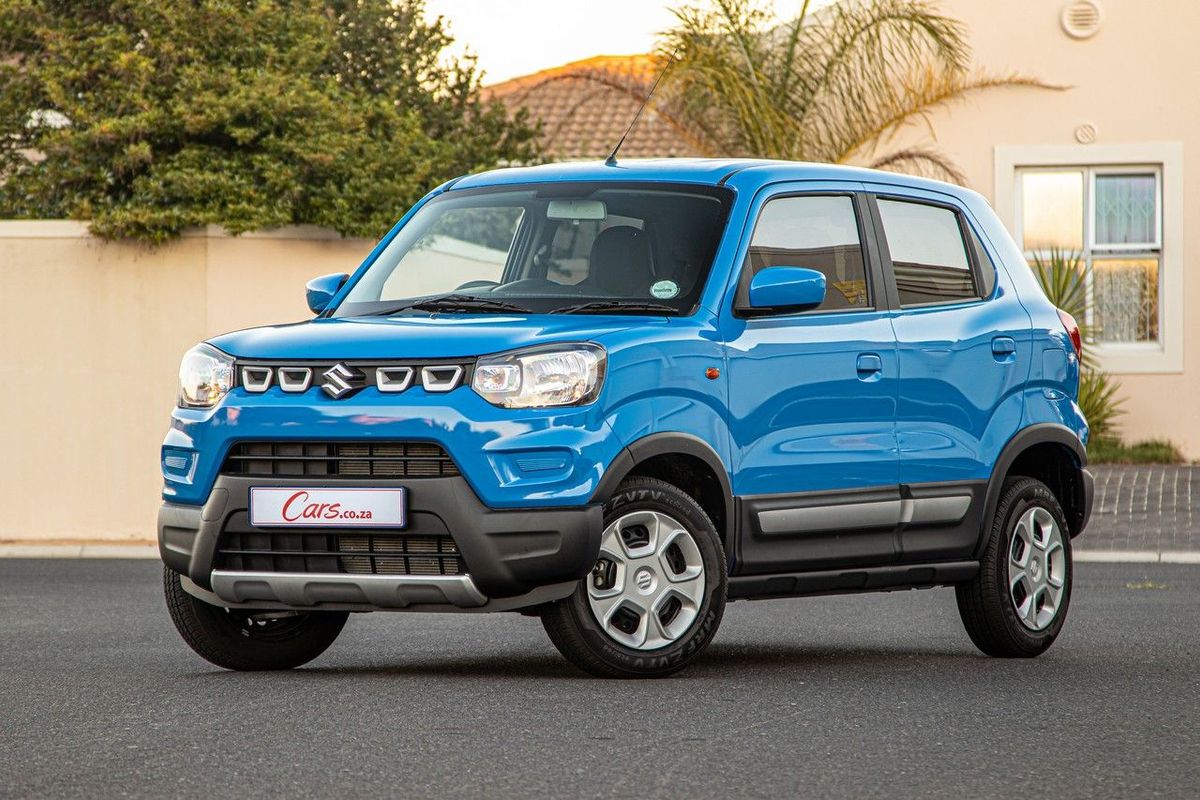
We haven't been able to travel significant distances with the Suzuki S-Presso, which joined our test fleet just before the national lockdown. David Taylor has nonetheless learnt a great deal about the Japanese brand's newcomer. How does it stack up in the budget-car segment?
We like: Pricing, standard features, free insurance, nippy performance
We don’t like: Awkward driving position, vague steering, yet to receive a Global NCAP safety rating
Fast Facts
Price: R147 900 (May 2020)
Engine: Naturally-aspirated 1.0-litre 3-cylinder petrol
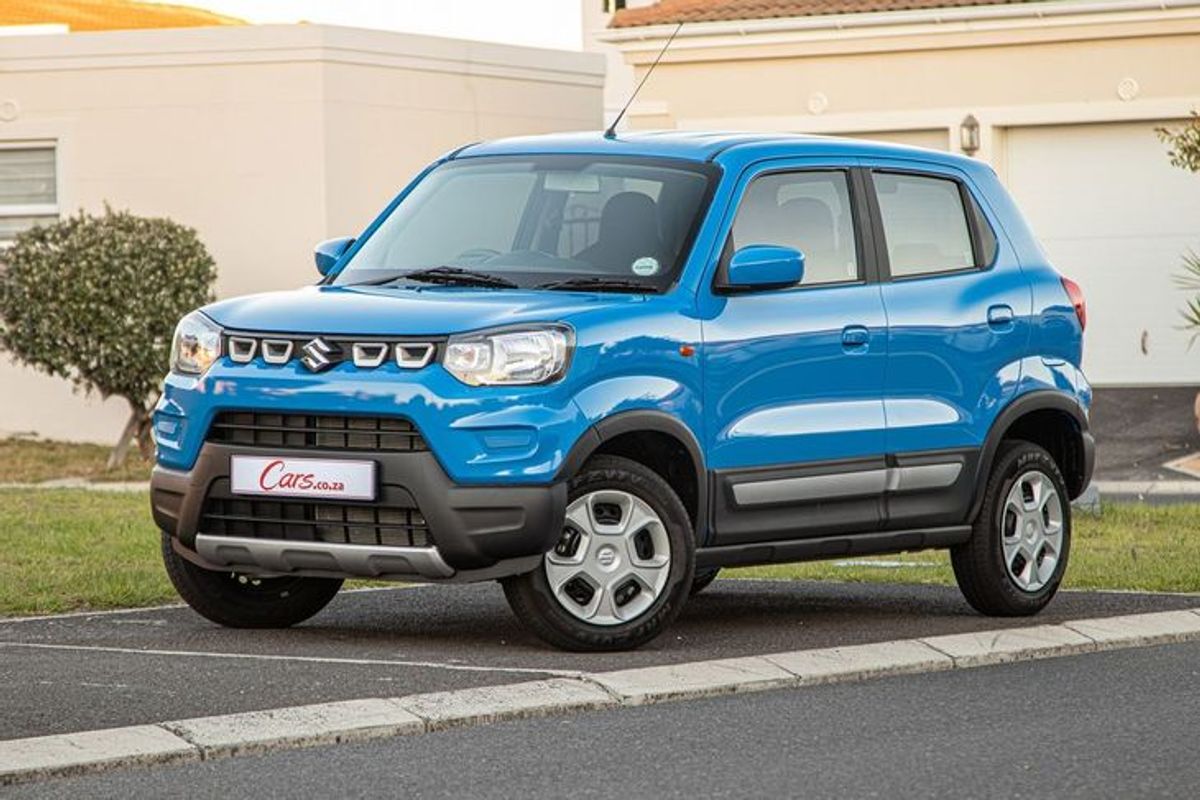
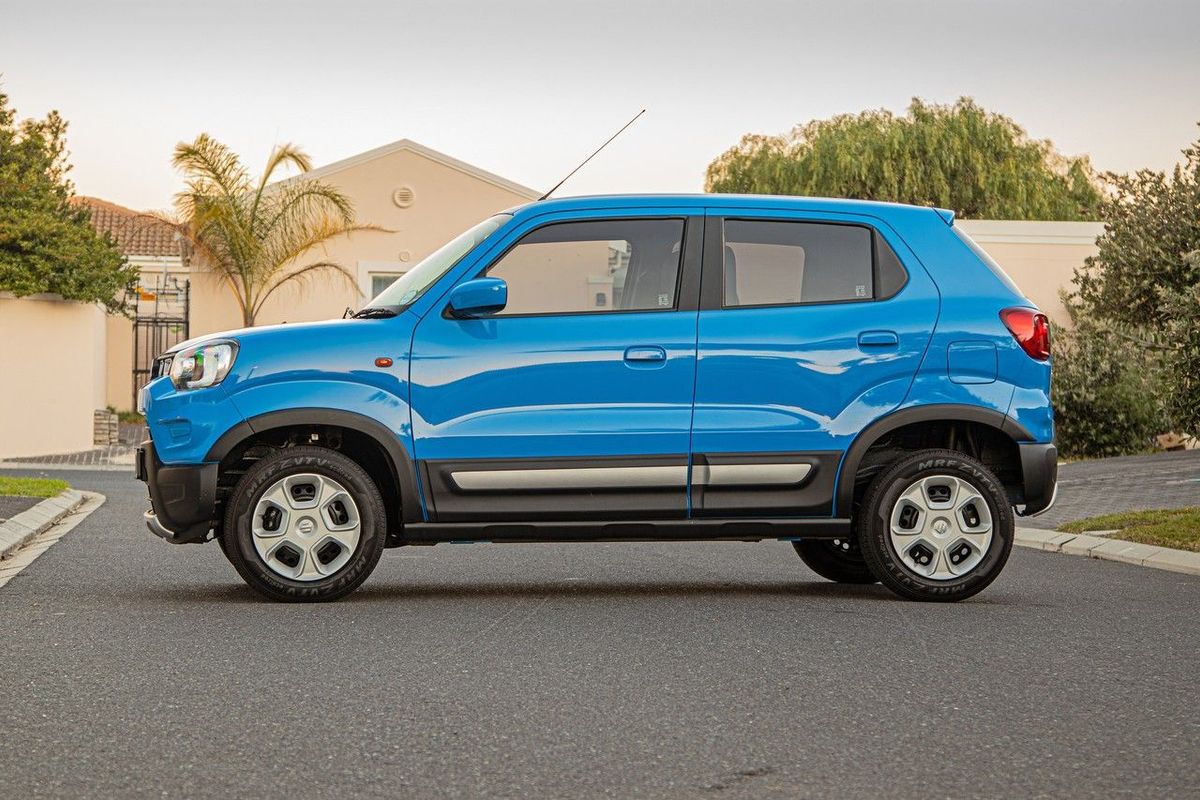
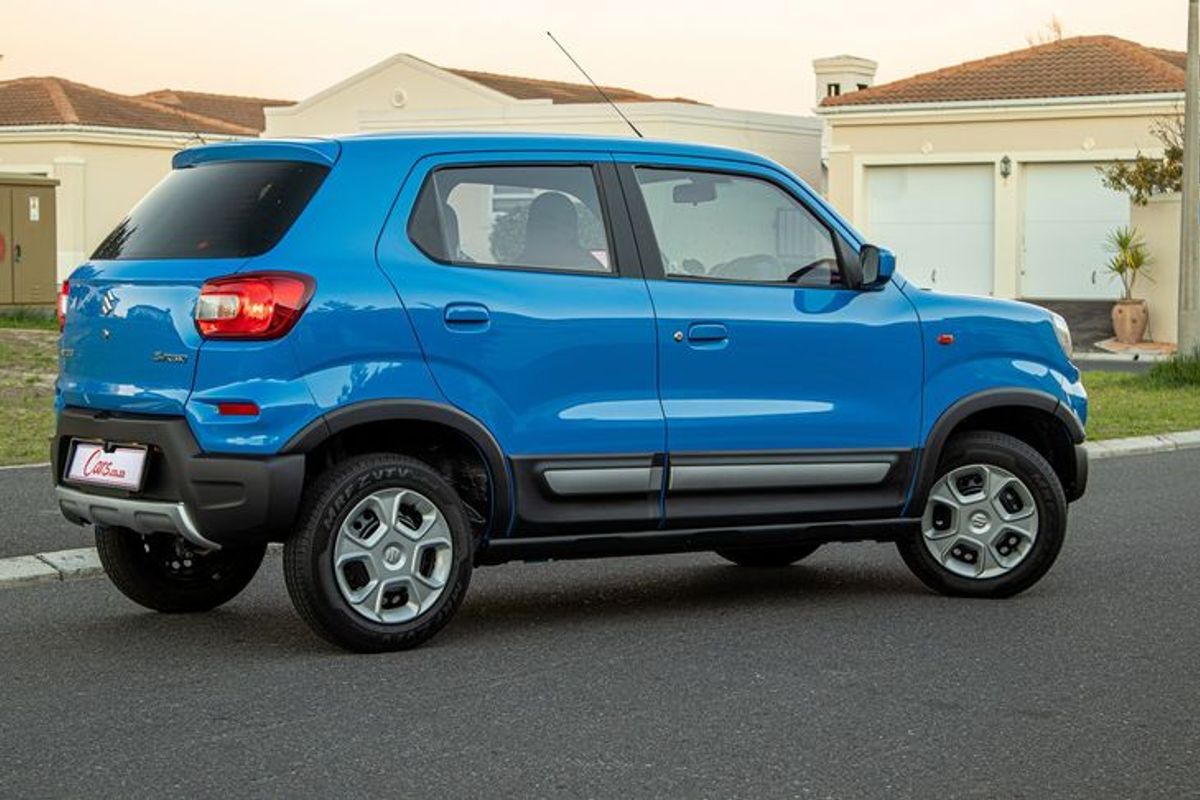
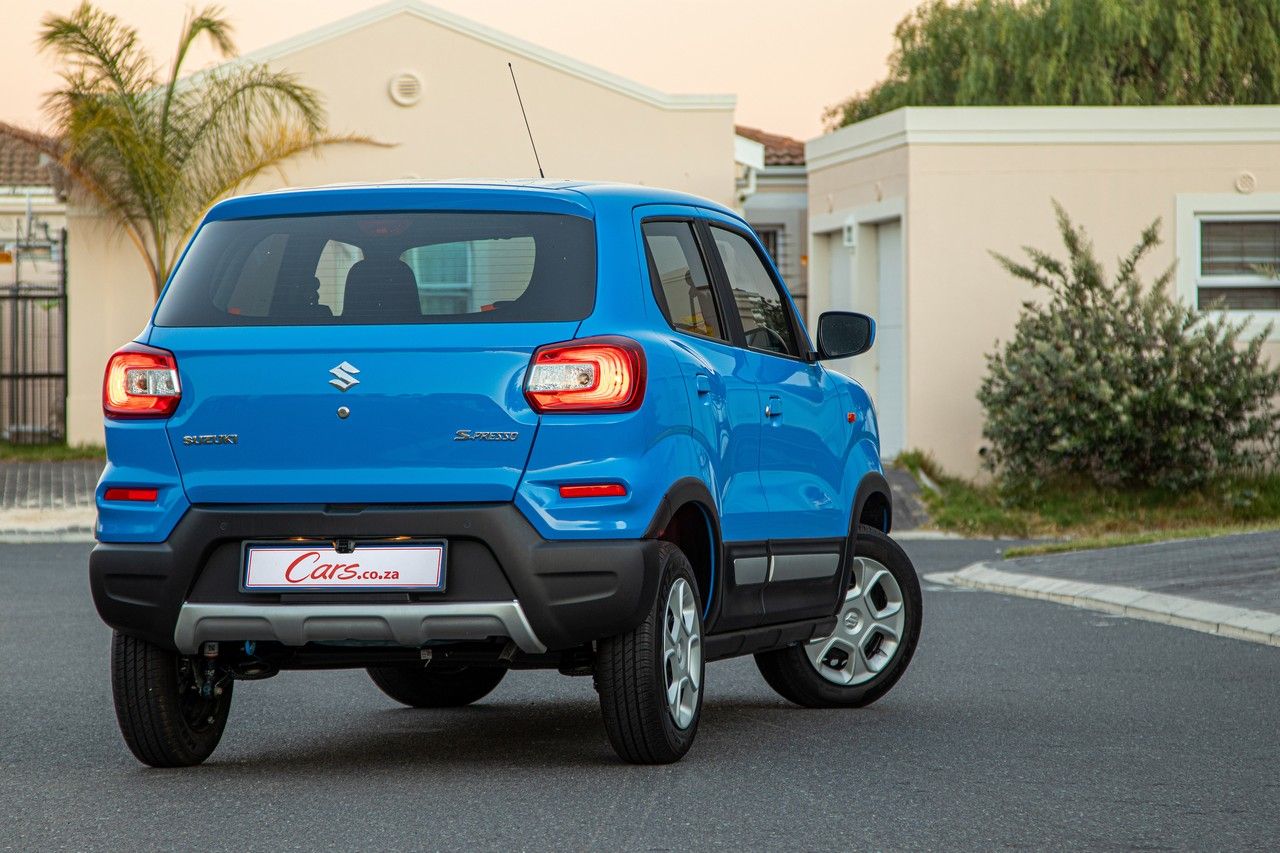
Despite it having the dimensions of a small city car, the S-Presso's seating position and design give it a baby-SUV vibe.
Suzuki must have noticed how well the Renault Kwid and Datsun Go were doing in terms of sales in developing markets and naturally wanted a slice of that share… The S-Presso hails from the Suzuki stronghold of India, where these entry-level cars have been tremendously successful; the Kwid also features prominently in local sales charts.
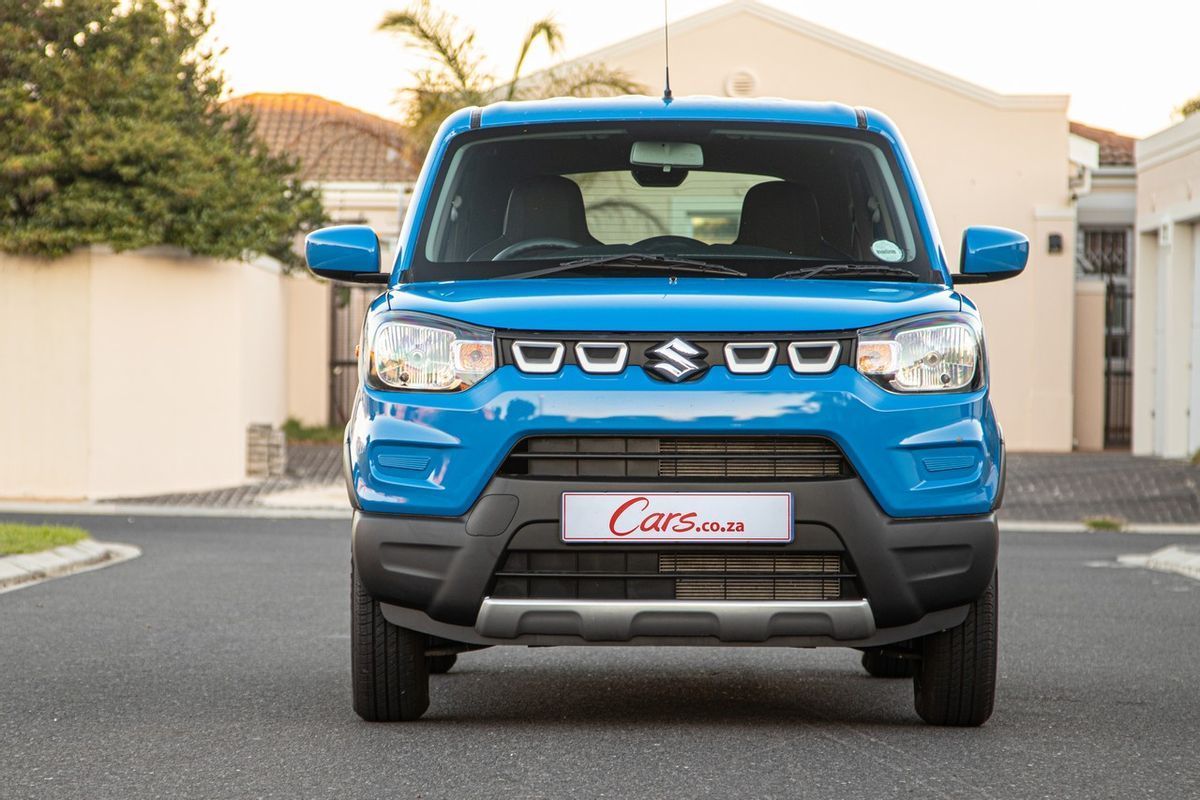
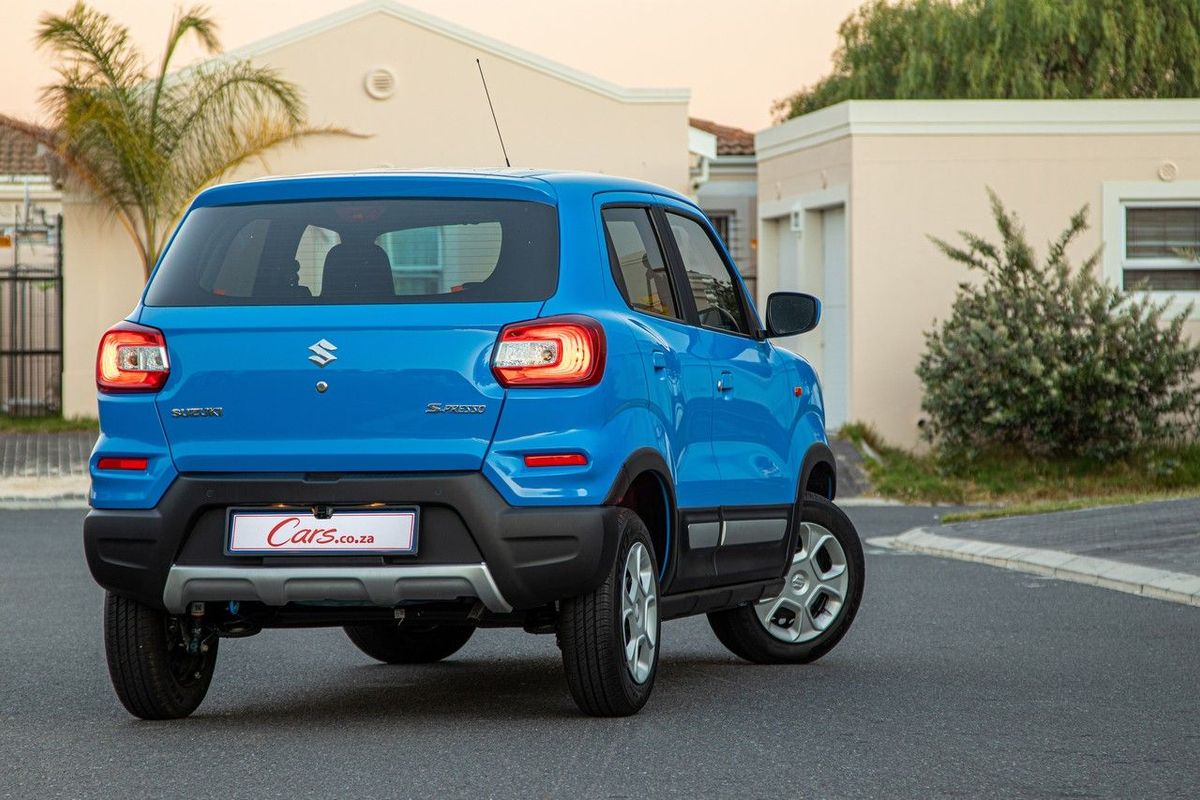
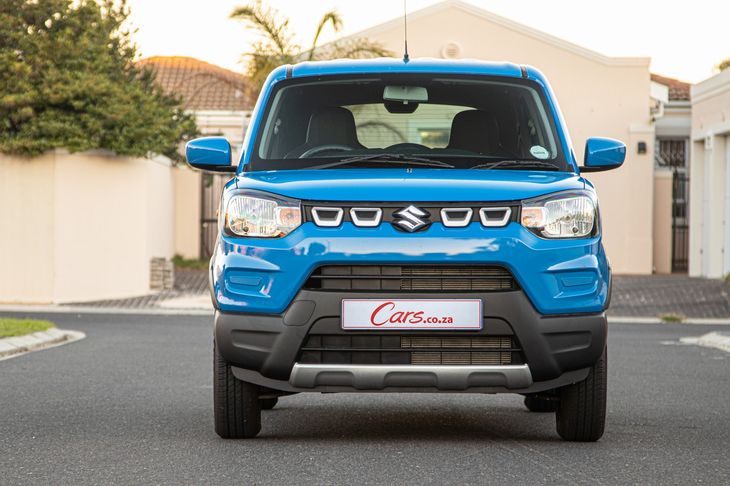
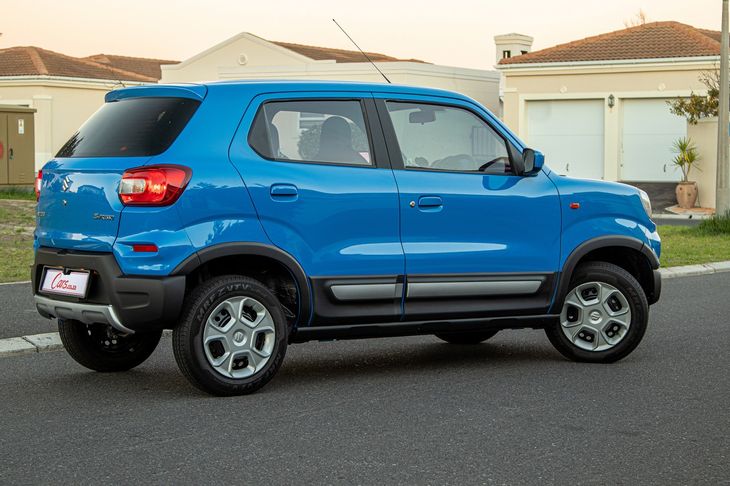
At first glance, the Suzuki S-Presso's styling is best described as awkward and unconventional, but that is not necessarily a criticism – car design seems to have become very safe and predictable of late, so it's not all that often that something with ground-breaking looks comes to market. Hmm, is this a compact hatchback, or a baby SUV?
In S-Edition guise, the Indian-made newcomer could easily pass as the latter as this trim level adds design elements such as wheel-arch cladding, side body-cladding, silver upper-grille garnish and a front skid plate. The S-Presso's 180 mm of ground clearance further leads us to lean towards a compact-SUV designation.
How it performs in terms of…
Performance and economy
Weighing just 770 kg, the Suzuki S-Presso is just like the coffee, in a way… Compact and nippy.
Under the bonnet is a compact 3-cylinder, 1.0-litre petrol engine. It produces 50 kW and 90 Nm of torque and drives the front wheels via a 5-speed manual gearbox. Now, while those outputs seem paltry, it's important to remember the Suzuki doesn't weigh all that much and not a lot of power is required to get it going. With a kerb weight of just 770 kg, the little 1.0 S-Edition feels surprisingly nippy and agile to drive. Aided by a light-action clutch and snappy manual gearbox, the newcomer darts through the traffic as if it were a motorcycle, albeit a 4-wheeled one. That's a win in our books, although you don't really want to "stretch the engine's legs" – it sounds quite harsh high up in the rev range.
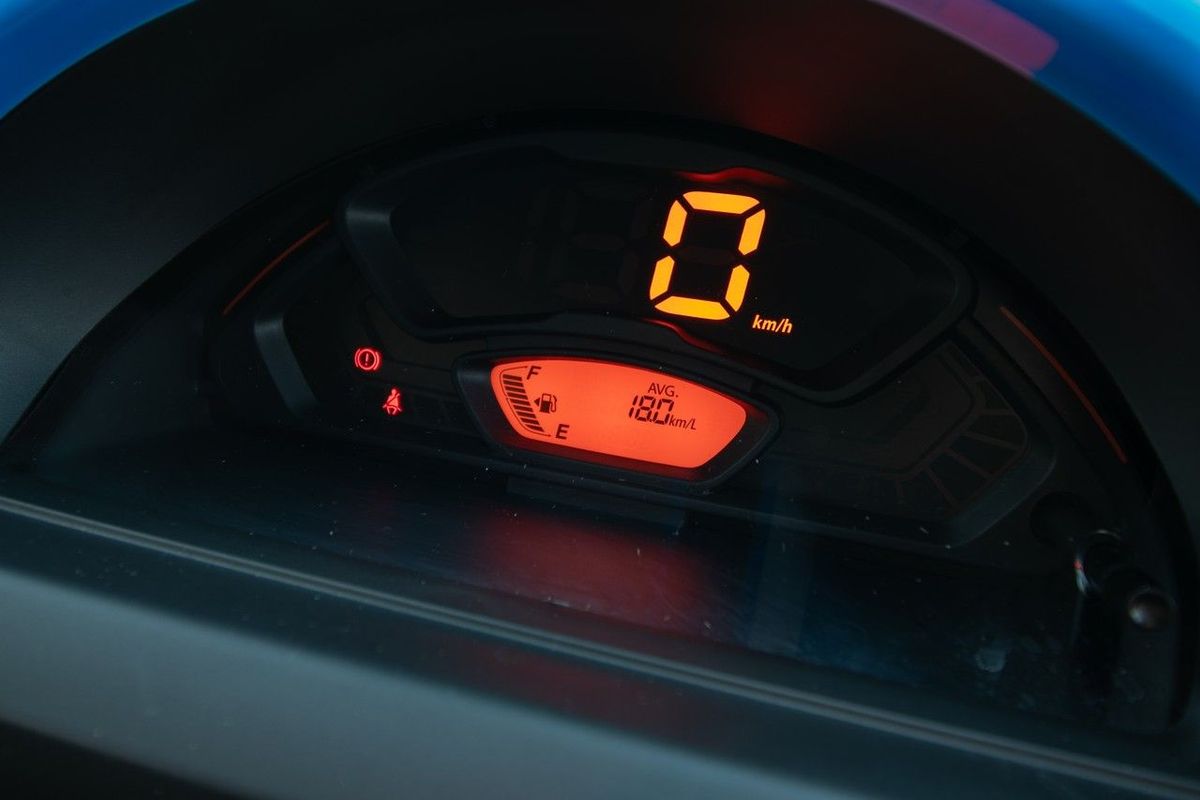
True to most of Suzuki's offerings, the new S-Presso is quite light on fuel. While we couldn't quite achieve the claimed consumption figure of 4.9 L/100 km, the indicated return of 5.5 L/100 (after driving exclusively on urban roads – in other words, to the shops and back – was impressive. One minor gripe, however, is the size of the fuel tank (27 litres), which is only marginally smaller than the Kwid's (28 litres), but consider that rivals such as the Datsun Go+ and Hyundai Atos offer 35-litre tanks.
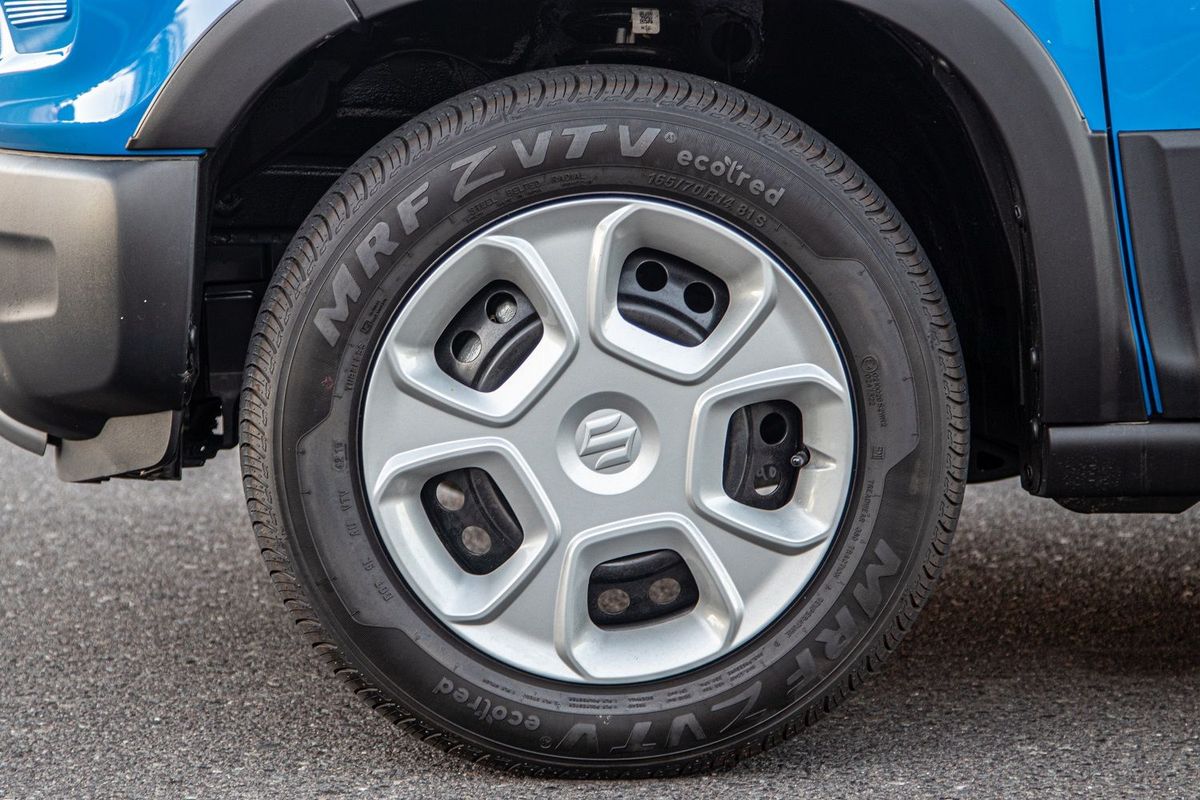
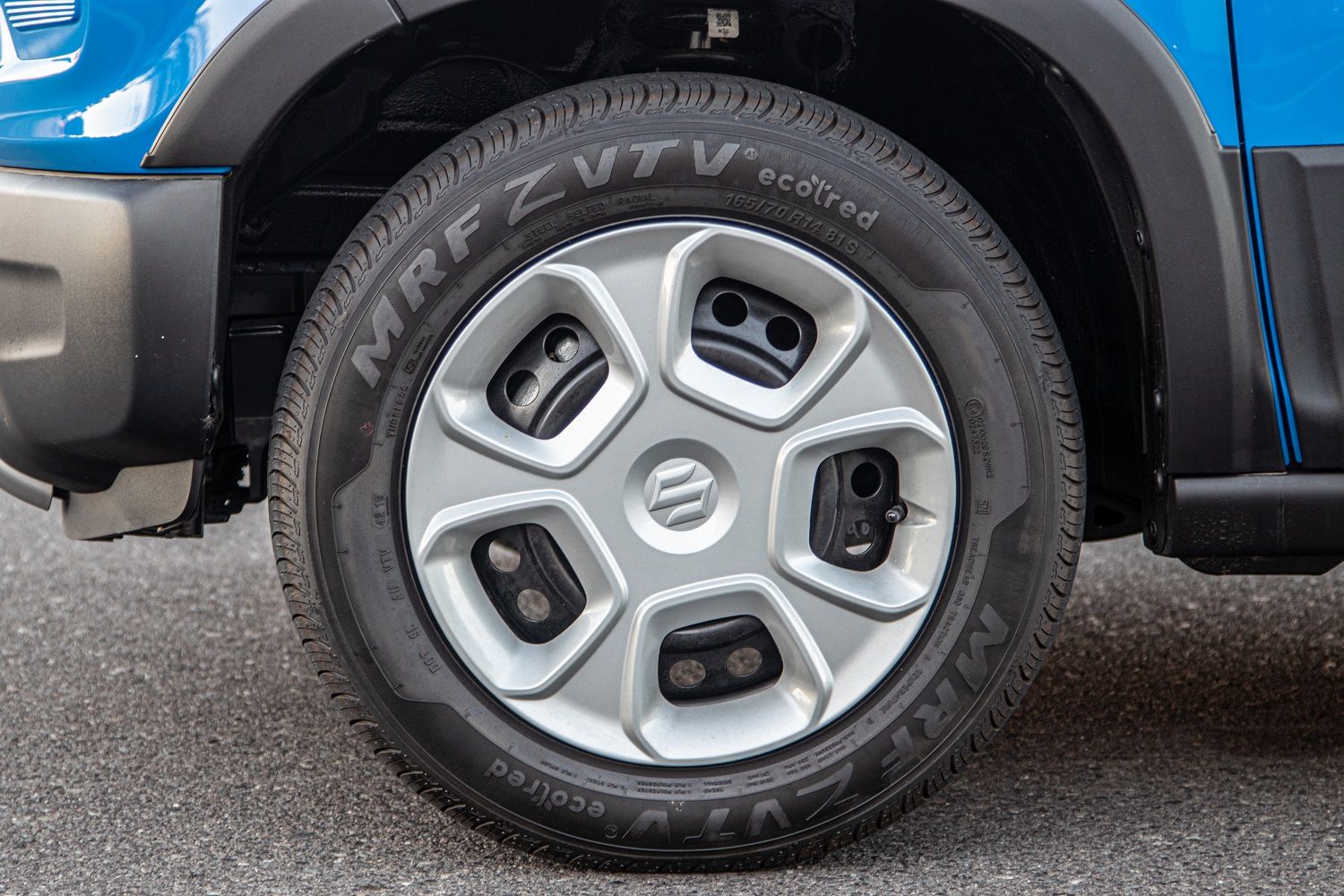
These 14-inch high-profile tyres do a good job of soaking up bumps. Plus there's 180 mm of ground clearance for when you need to mount kerbs.
Under lockdown, the S-Presso was limited to making supply runs for the most part. We spent the majority of our time behind its 'wheel pottering through the suburbs, where its ride quality proved acceptable. Helped by 14-inch wheels wrapped in higher-profile tyres, the suspension absorbed cracks and bumps, especially those pesky under-tar tree roots.
The vehicle does tend to exhibit a measure of body roll when cornering at moderate speeds, which, given its tall stature, is to be expected. While the overall driving experience is fair, the Suzuki falls short of the benchmark set by its Korean rival – the Hyundai Atos, which exhibits arguably the best driving manners in its segment.
Our main gripe with the S-Presso is its perched driving position: you feel as if you're sitting on the car, as opposed to in it. There's no rake- or reach-adjustment for the steering column, so it's tricky for tall occupants to get comfortable behind the Suzuki's tiller. What's more, the newcomer's steering is fair, but it lacks feel and responsiveness.
Another annoyance was quite a bit of wind noise when travelling at triple-digit speeds. Parking manoeuvres proved an absolute cinch to execute, however; thanks to its tiny turning circle, the S-Presso can deal with (what would usually be) 3-point turns in 2 movements.
Interior execution and features
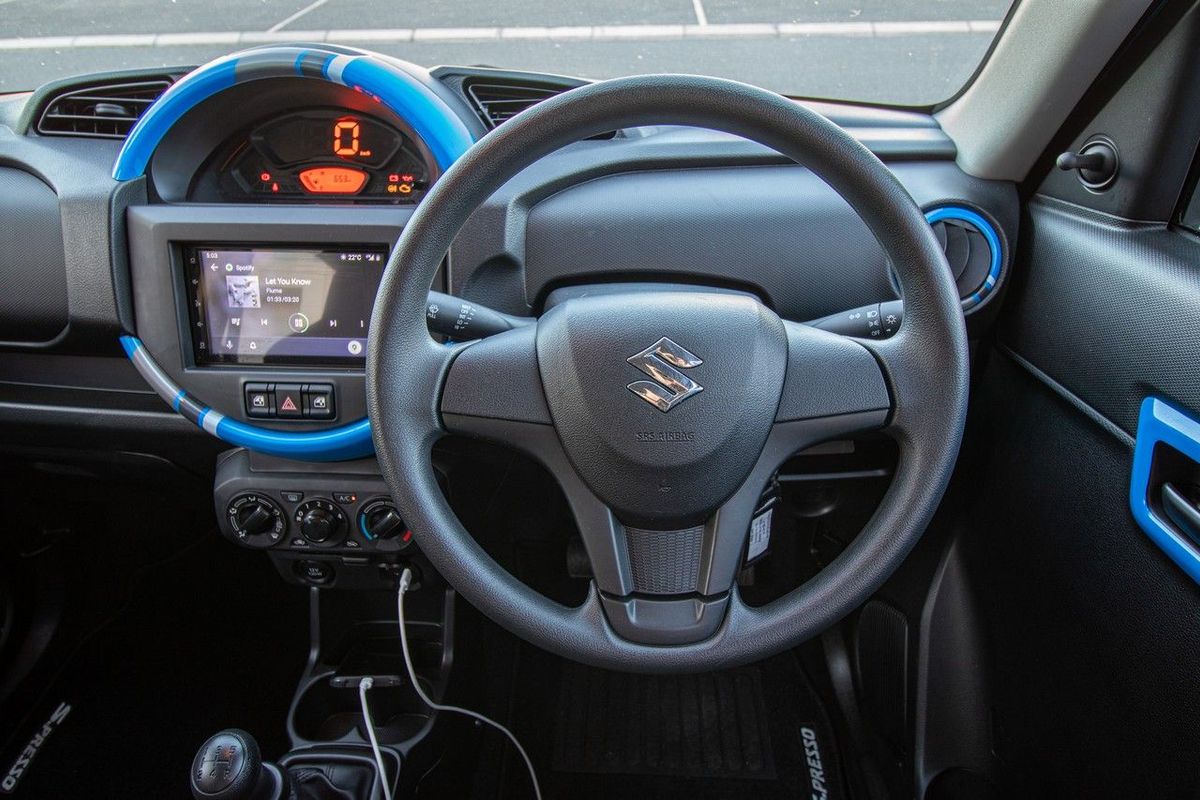
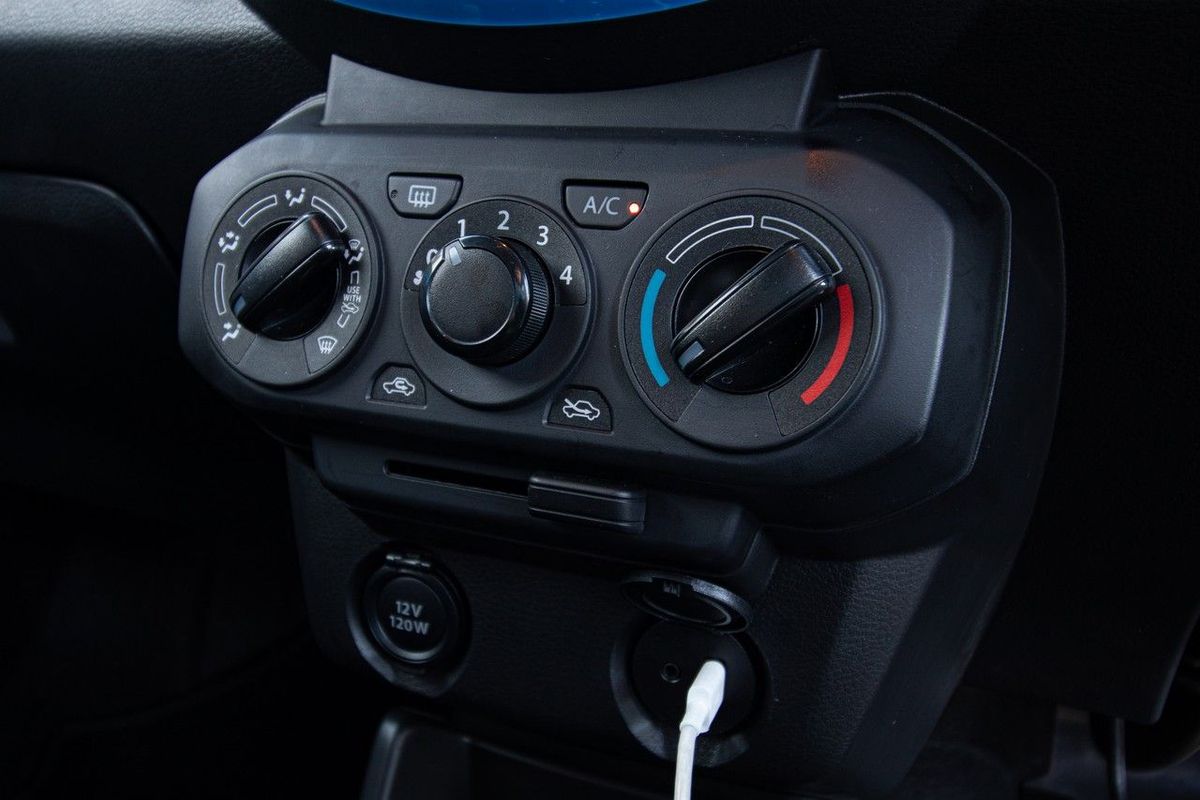
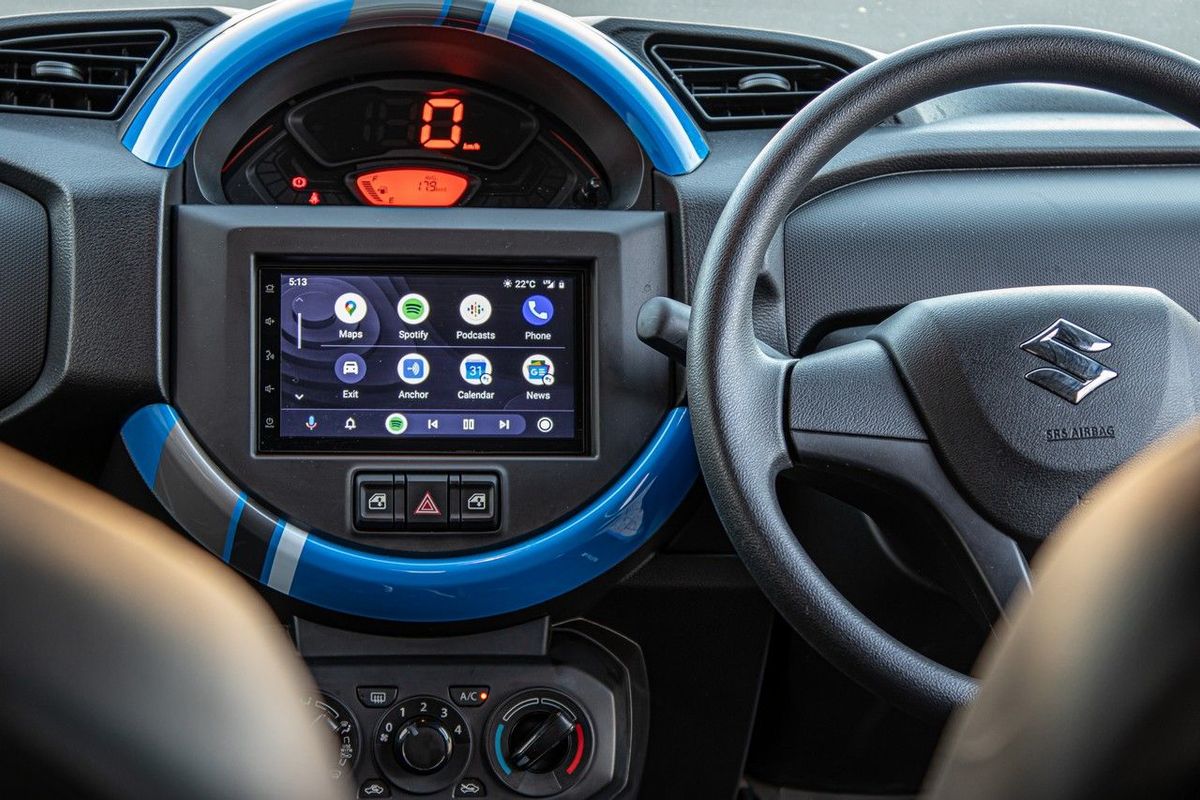
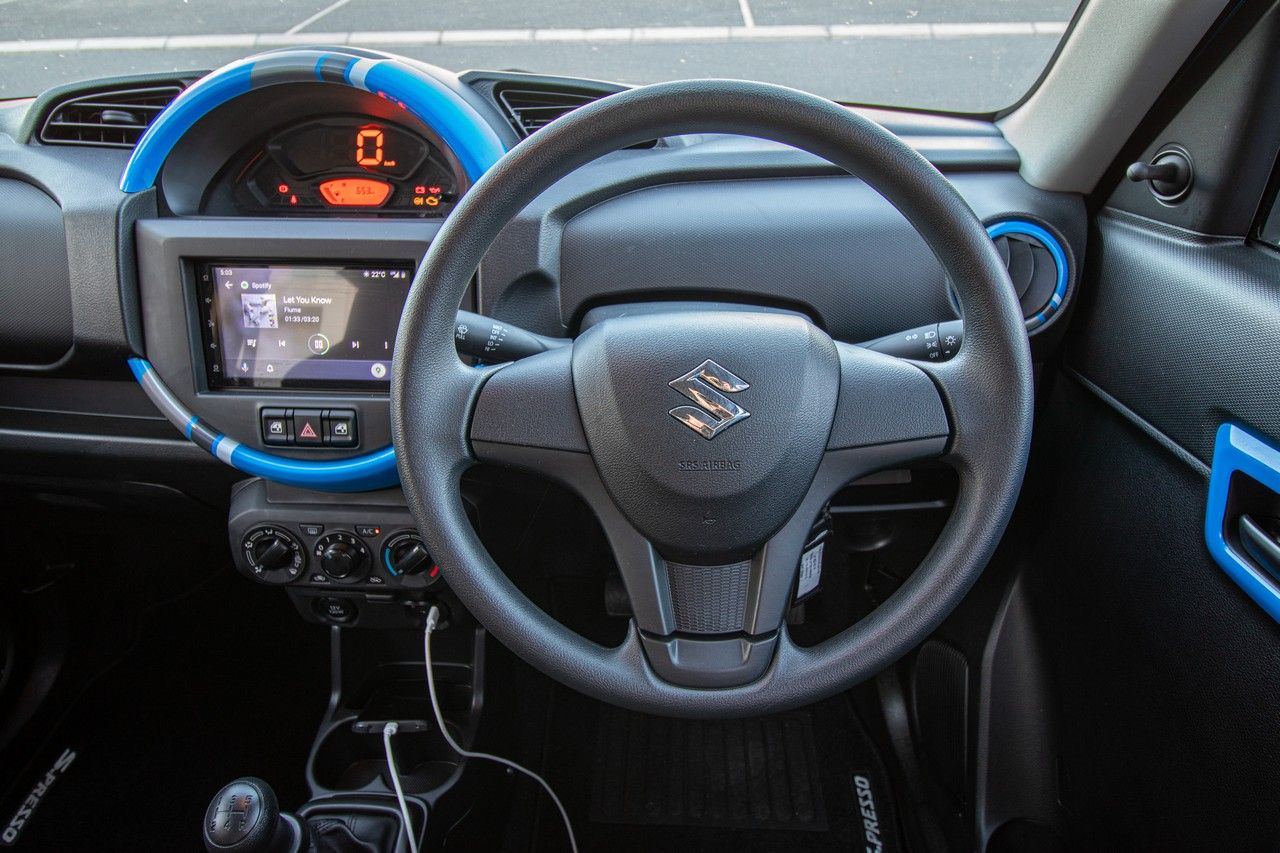
We love the colour scheme of this particular S-Presso. Note the mobile device that's plugged in – Android Auto is active.
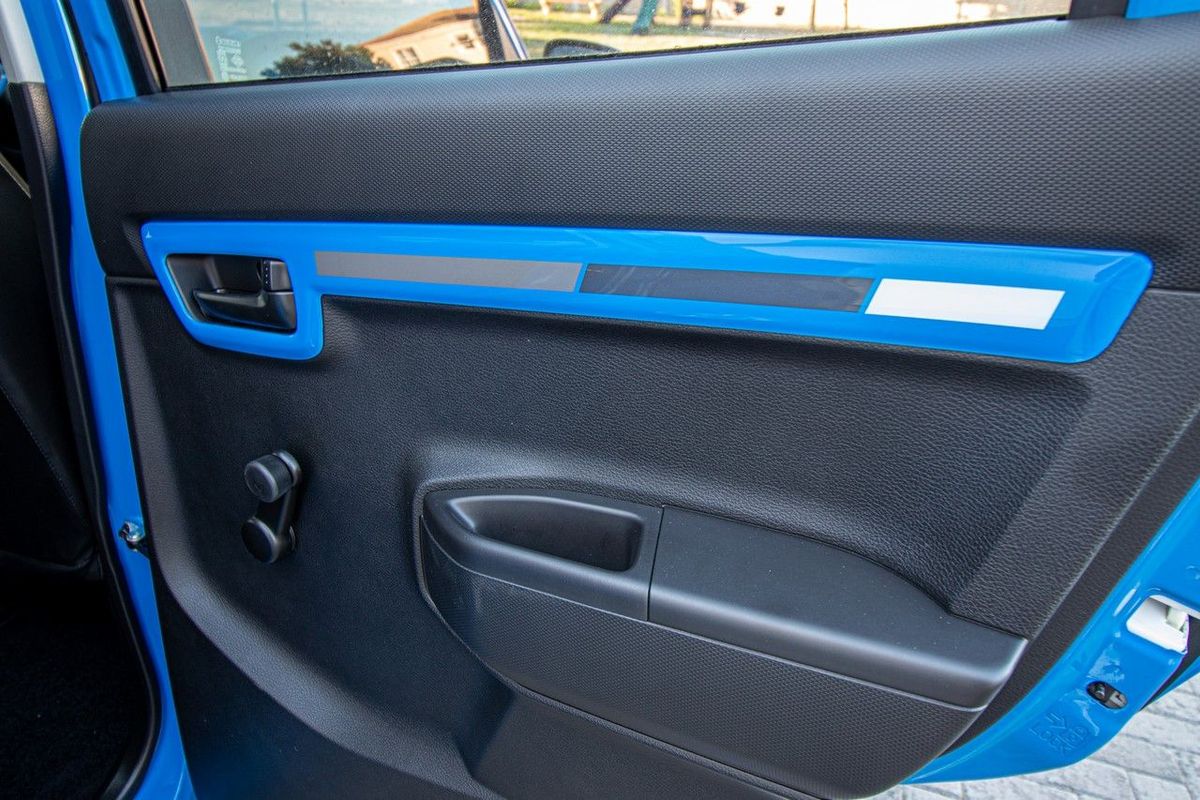
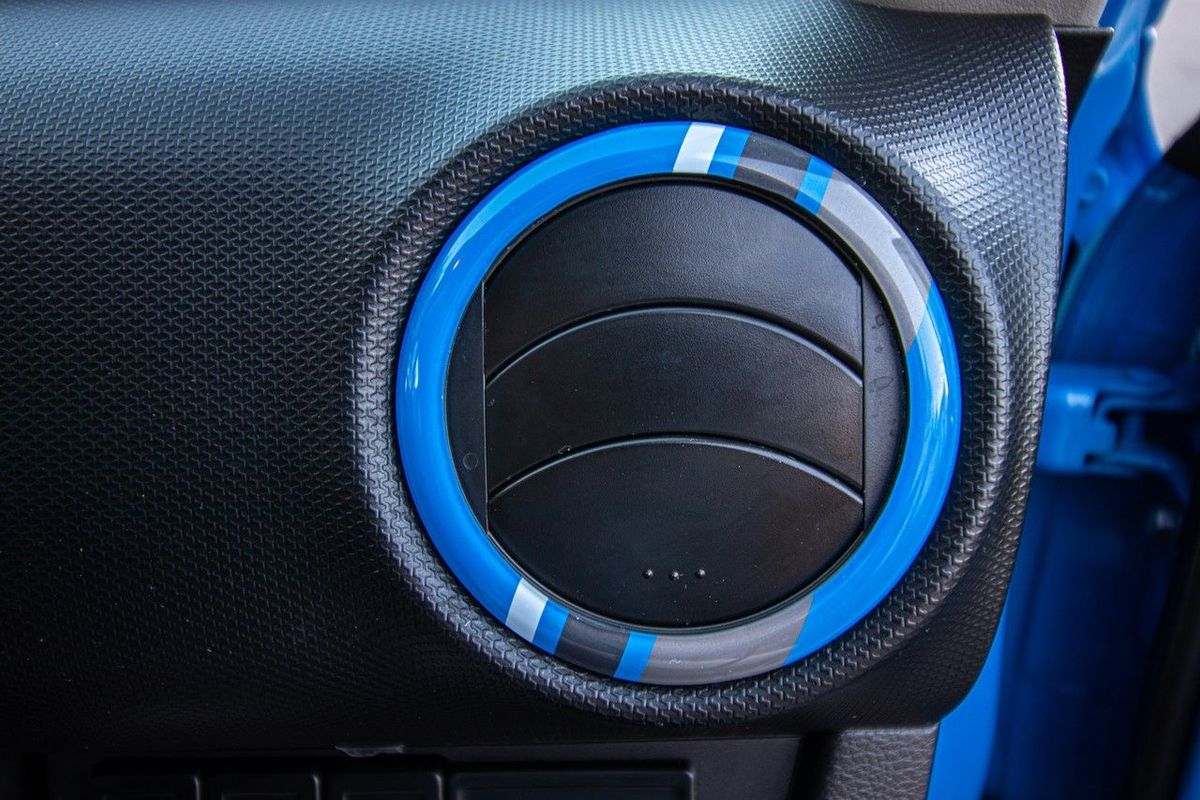
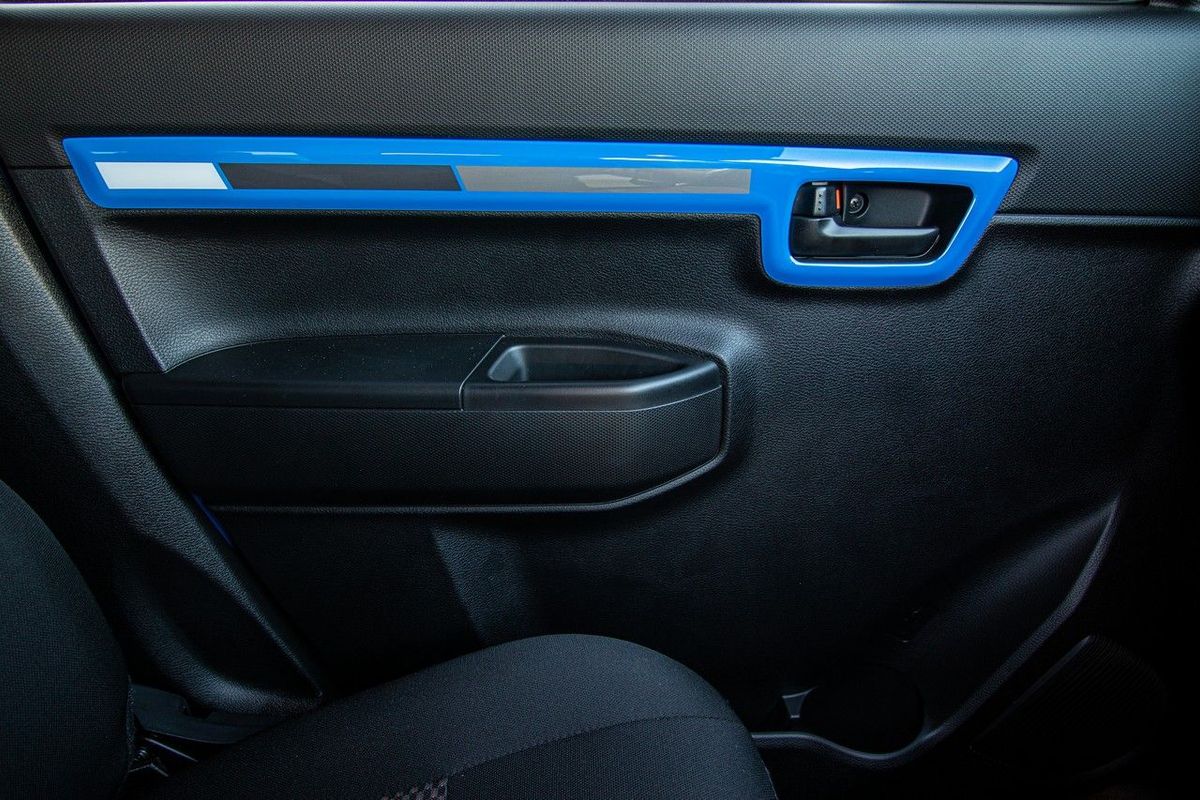
The cabin of the S-Presso is a fun and interesting space to occupy. There's an air of youthfulness here, replete with bright, colourful trim around the centrally-mounted speedometer/trip computer module and ventilation outlets. There are some cheap-feeling materials, but that is par for this segment and not a deal-breaker whatsoever.
Budget cars used to be stripped-out econoboxes, but these days manufacturers load as many mod-cons into their entry-level products as they can in a bid to appeal to buyers looking for optimal value. The Suzuki comes with a 7-inch infotainment touchscreen with Android Auto/Apple CarPlay connectivity and USB/12V charging ports.
We've become accustomed to controlling the Android Auto interface via voice control (activated by a button on the steering wheel), but because the S-Presso does not have a multifunction 'wheel, the service needs to be activated via a button on the touchscreen.
In terms of standard fare, there's a manual air-conditioner, a reverse-view camera, rear parking sensors, electric windows, as well as Bluetooth connectivity.
On-paper safety features include anti-lock brakes with electronic brake-force distribution and dual front airbags. Suzuki claims its new Heartect platform has been designed to disperse impact energy better in the event of a vehicular collision. However, there's yet to be a crash test for this newcomer, so we'll wait for that before passing judgement on this vehicle in terms of its safety credentials. The budget segment doesn't have a stellar track record when it comes to this, we're hopeful the S-Presso will buck the trend.
Practicality
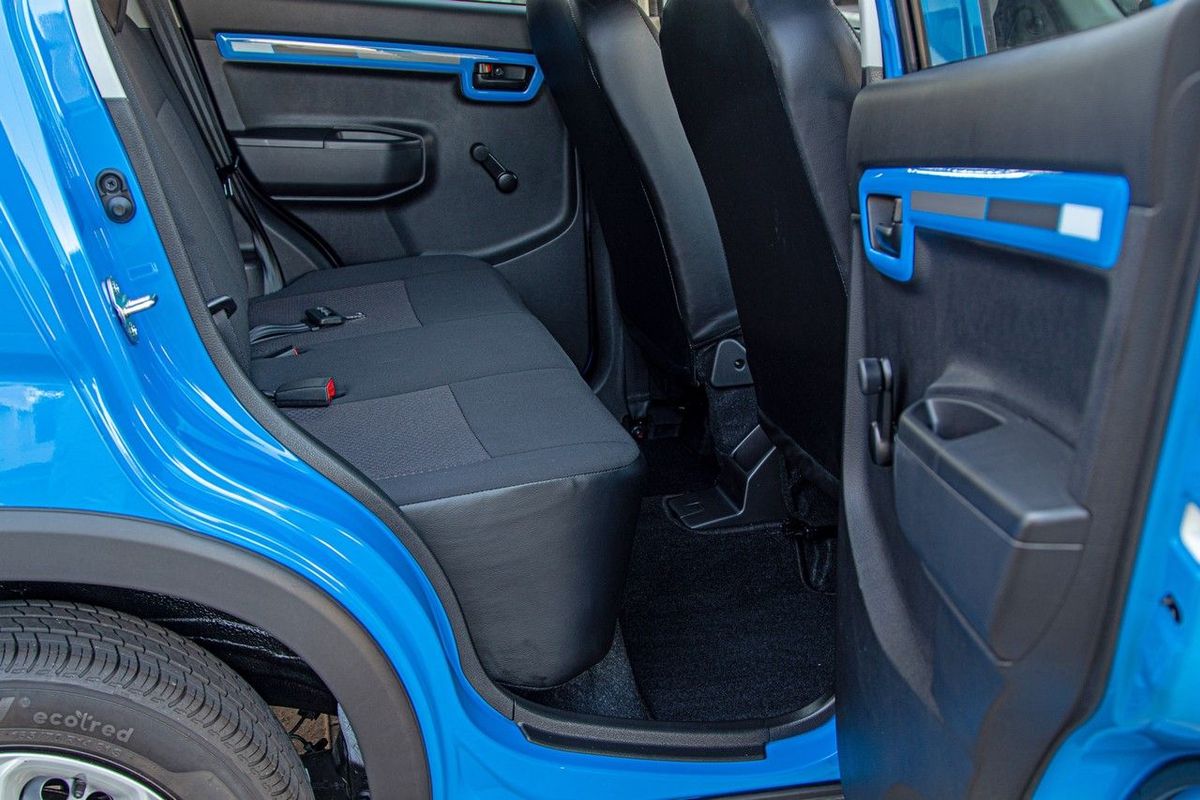
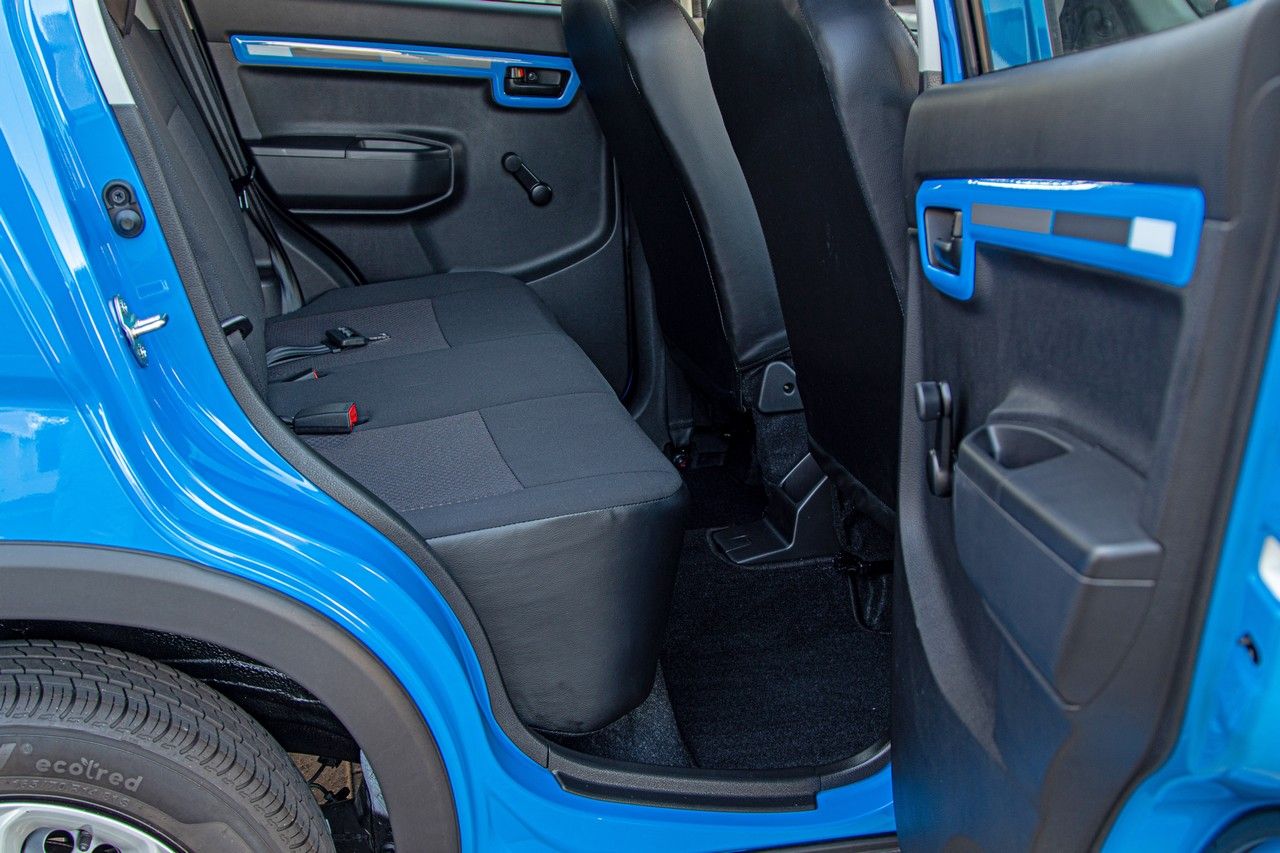
Odd driving position aside, the S-Presso's rear legroom is surprisingly practical with decent kneeroom and headroom. Pity about the rear headrests which poke you in the neck.
This is one of the best aspects of the S-Presso. Granted, it may have a quirky driving position that's not going to suit all drivers, but rear-occupant space is surprisingly good. If you are a tall person, the sit-behind-yourself test is often make-or-break for compact cars, but the Suzuki affords sufficient rear head- and knee room. The only black mark is the aft headrests, which are mounted rather low… Adults are bound to find the headrests at level with the bases of their necks, so the items are clearly suited for children.
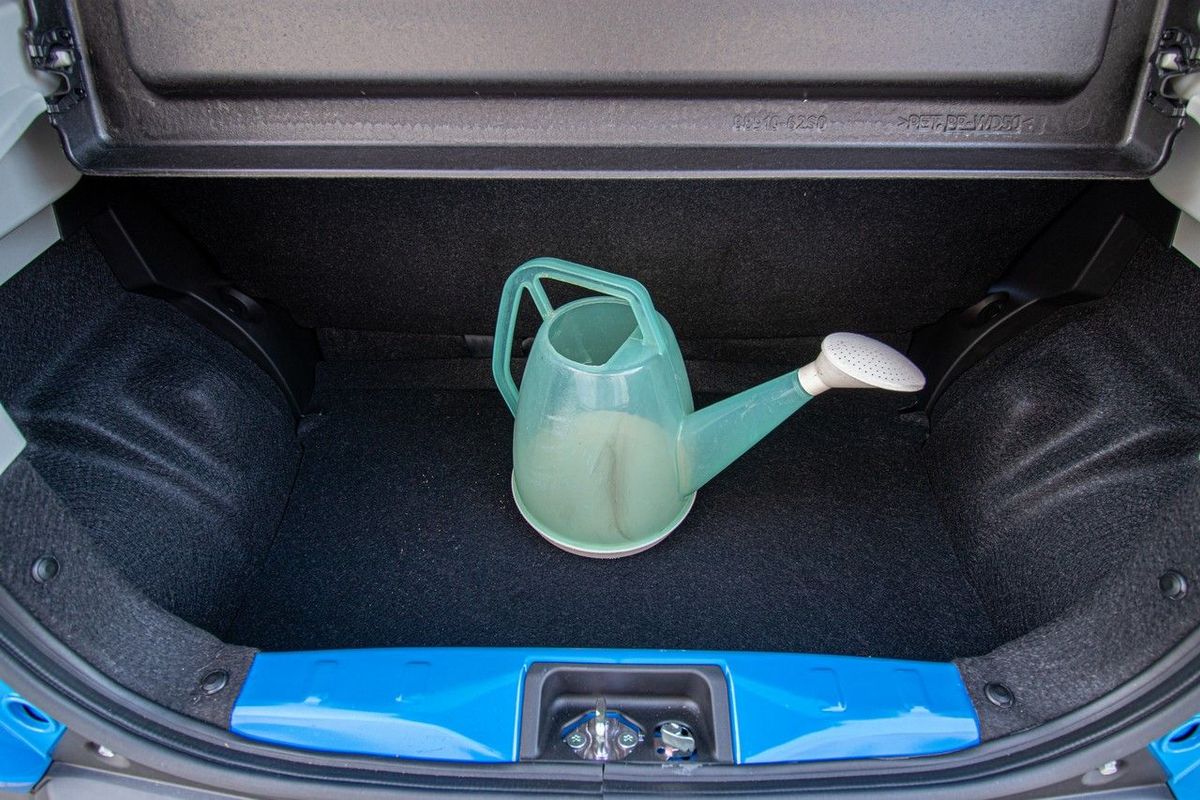
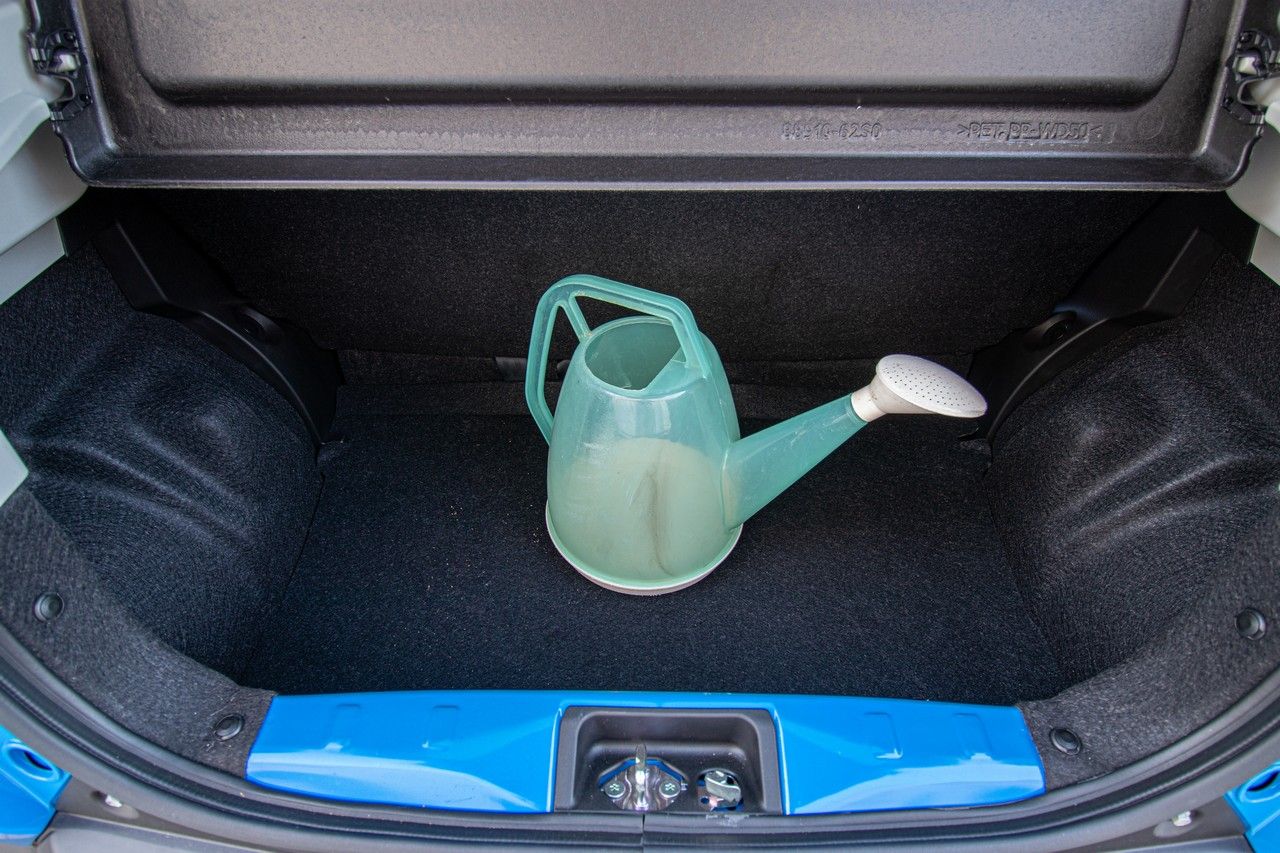
Luggage space, meanwhile, is commendable for a vehicle of this size and while the quoted capacity is around 240 litres, the load bay doesn't actually seem that snug; it offers sufficient depth and capacity for many shopping bags. There's sufficient in-car storage too, with plenty of spaces to place housekeys, electronic devices and water bottles.
The S-Presso's load bay is generous for a vehicle in this segment.
Price and warranty
The Suzuki S-Presso range starts at R134 900, with this test unit costing R147 900. The new Suzuki S-Presso is sold with a 5-year/200 000 km warranty, 2-year/30 000 km service plan and 1 year's comprehensive insurance.
The Suzuki S-Presso suffers from the same criticisms levelled at its rivals, but it undercuts them when it comes to price.
In the budget-car market, car brands strive to offer products that offer consumers great value for money – with as few obvious compromises/feature-deletions as possible. We could write reams of copy about firms stiving for economies of scale and the intensive use of cost-cutting materials to keep unit-costs low. The attention to detail in efforts to save money on entry-level models is quite astonishing and the little savings all add up. For example, in the case of the Suzuki, there's just a single spray jet for the windscreen.
What's the best cheap new car in South Africa? The Suzuki S-Presso is not necessarily the answer; it has its share of faults, but at this price point, one cannot expect perfection and besides, most of its rivals have similar shortcomings. While the standard spec is good, it's only on par with its rivals. The 1.0 S-Edition has an enthusiastic little engine, which is certainly a boon, but is it great to drive? Good, yes. Great? Not quite. While it's adequate, it doesn't have quite the nice-to-drive characteristics of the Hyundai Atos.
Suzuki does have a pair of significant factors in its favour: the compact-car brand has a reputation for offering excellent after-sales support. As a 2-time Cars.co.za Consumer Awards – powered by WesBank Brand of the Year winner, the Japanese marque offers commendable brand support/customer service, which is a big plus for first-time buyers.
What's more, the new S-Presso undercuts its competition on price. When you compare the 1.0 S-Edition to its direct rivals below, you'll find it's significantly more affordable than its opposition. Once we're in a position to do so, you can bet we'll line up a rumble between South Africa's cheapest cars to find out which one is best.
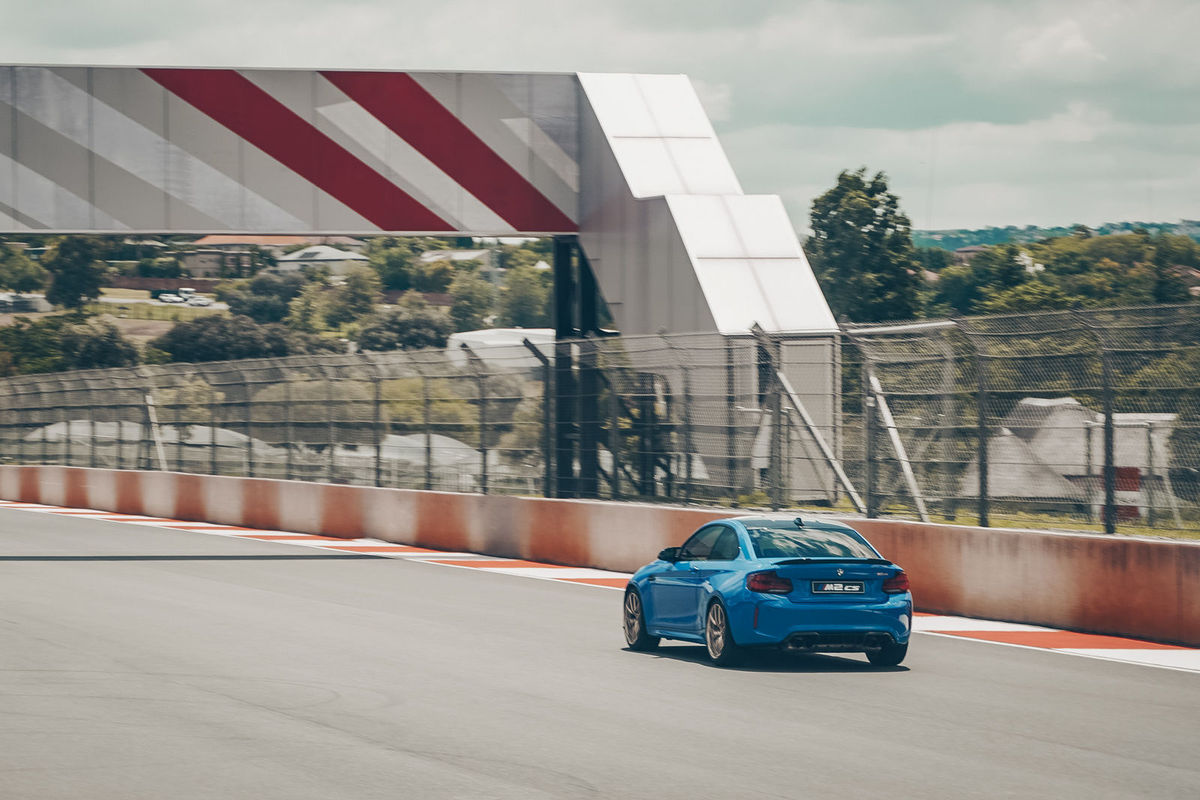
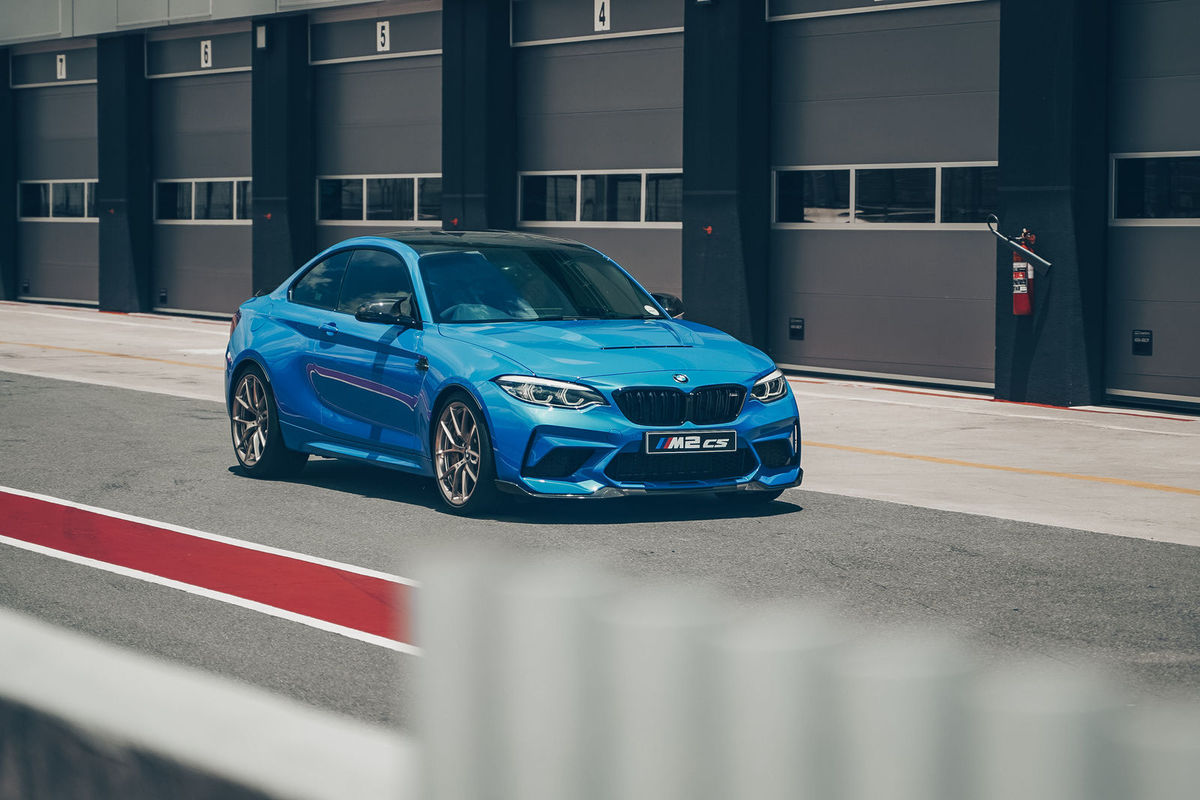
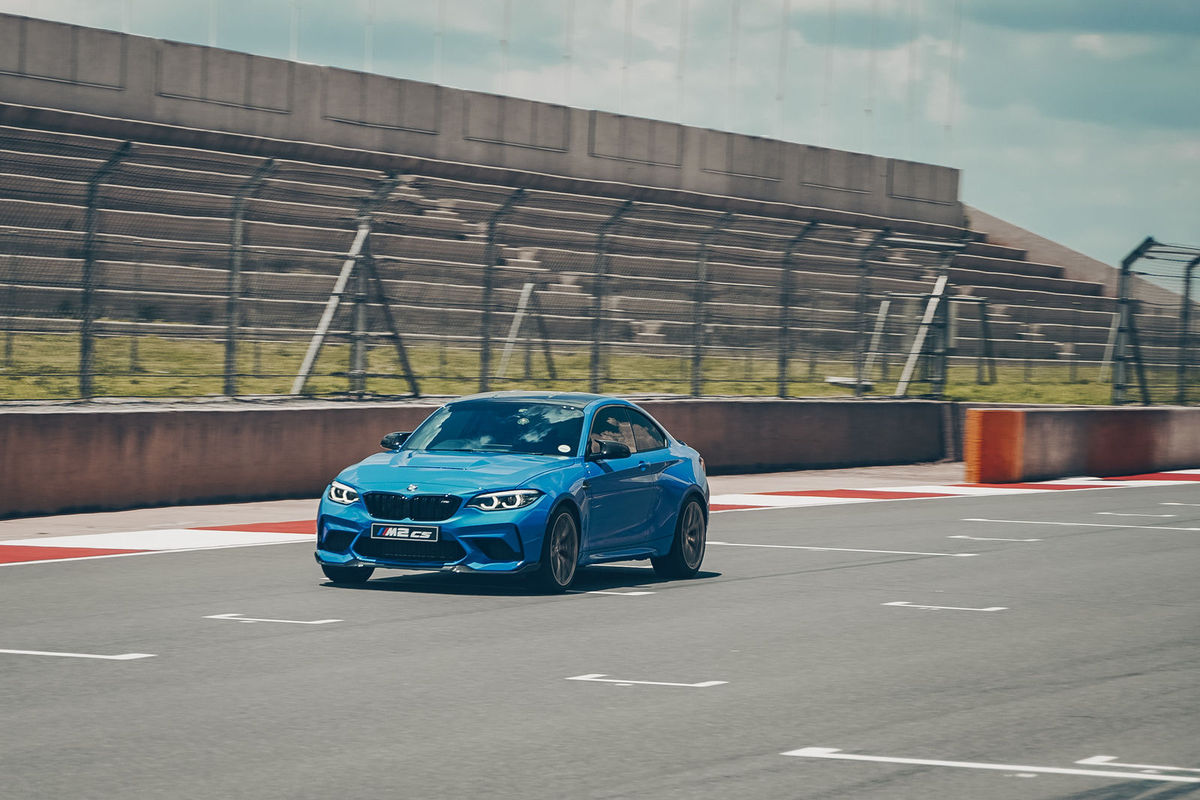
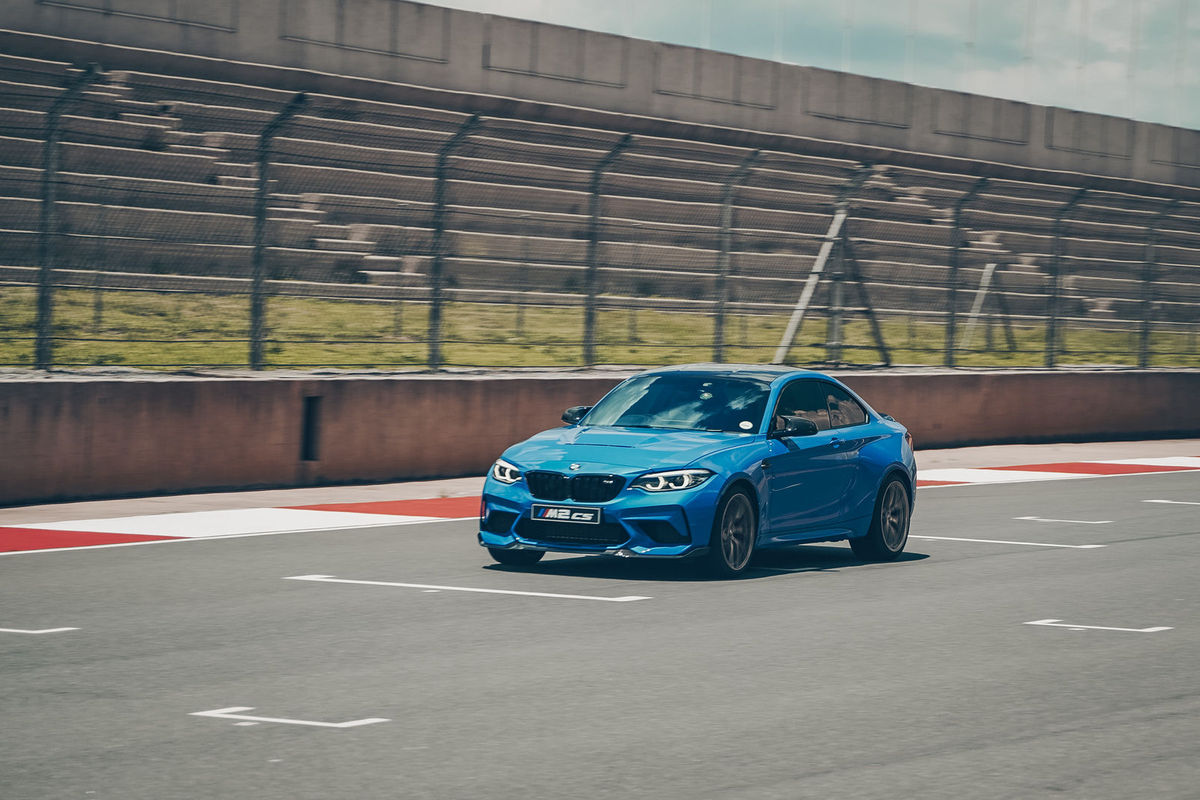
The BMW M2 CS is confirmed for South Africa and we can confirm how many units we'll be getting, plus how to buy one if you're keen to own this high-performance model.
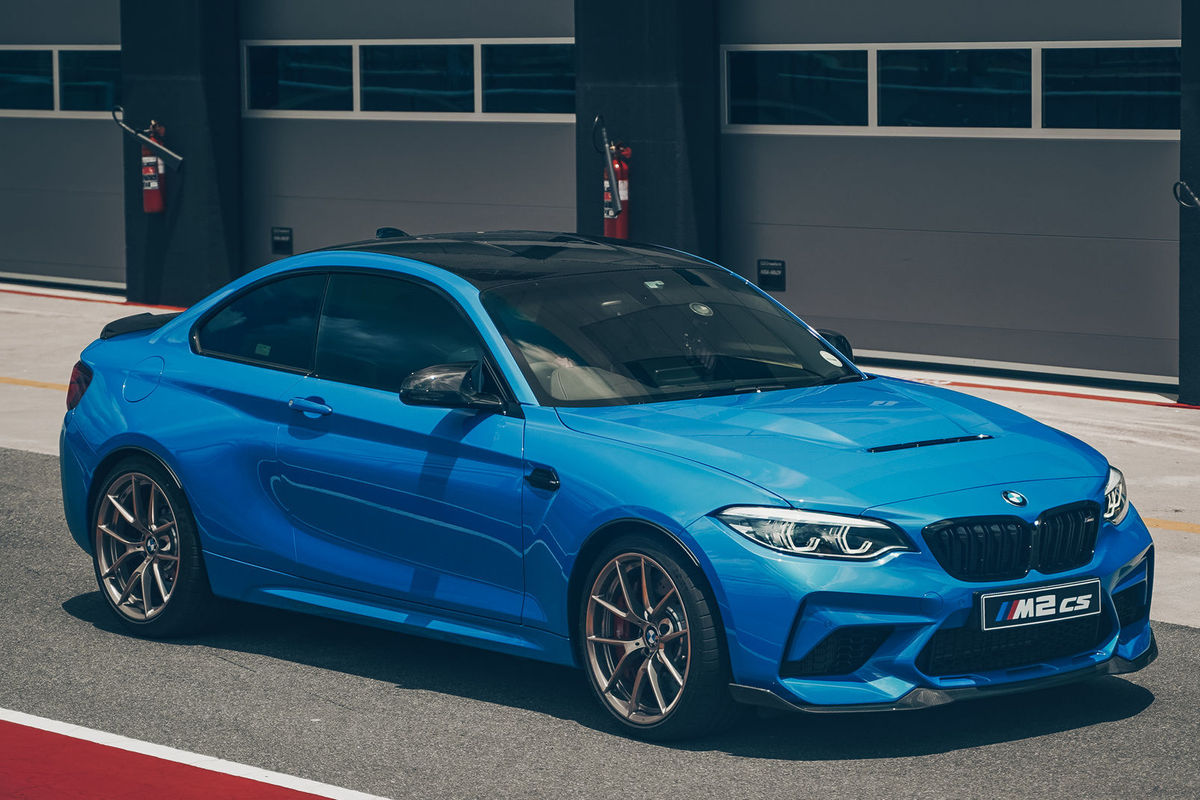
If you thought the BMW M2 and M2 Competition were high performance, then brace yourself for the ultimate iteration of the BMW M2. What you see here is the BMW M2 CS, an M2 that has been on a diet and given some additional power. The 3.0-litre turbocharged straight-6 motor now delivers 331 kW and 550 Nm, which is a bit more than the standard BMW M2 Competition at 302 kW.
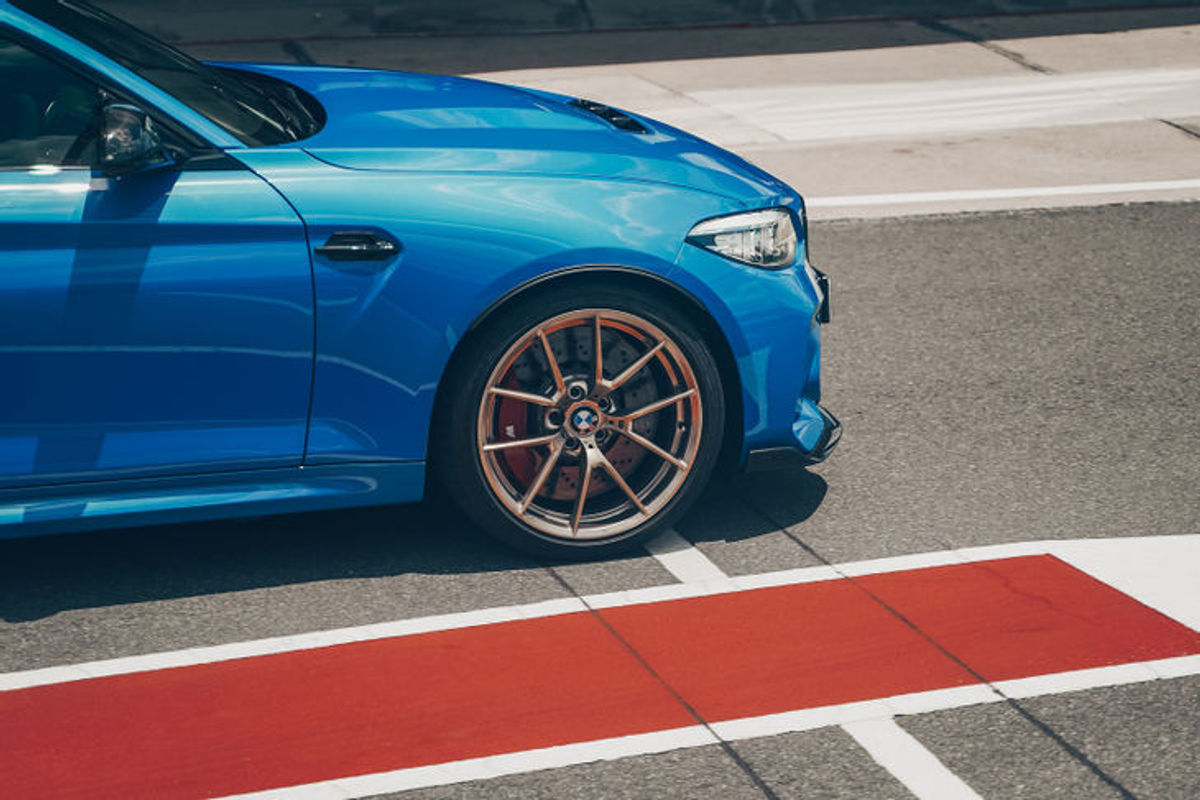
The additional power means it's a bit faster in the acceleration stakes. A 6-speed manual or 7-speed DCT will be available and that will ensure brisk acceleration from zero to 100 kph in 4.2 and 4.0 seconds respectively. The M2 CS rides on 19-inch Y-spoke wheels in a gloss black finish and shod in Michelin Sport Cup 2 rubber. Carbon fibre has been used extensively to reduce weight. The bonnet, front splitter and roof are made of carbon fibre. The roof also features a new sandwich design which lowers weight further while increasing structural rigidity and lowering the car’s centre of gravity. Adaptive M Suspension and M Sport brakes are standard and new ball joints and elastomeric bearings have been fitted to the front and rear axles. Carbon-ceramic brakes are optional. All of this means it's going to be one serious corner-carving machine. The savings of the carbon fibre pieces are actually offset by the added weight of the adaptive M suspension so the CS weights the same as a normal M2. Option in the carbon-ceramic brakes and you get a 25 kg saving in total.
As for the interior, the use of carbon fibre continues as seen on the door pulls, door trim and centre console. Alcantara with contrast stitching is prevalent inside the M2 CS, including the thick steering wheel. M Competition sport seats are covered in black leather and Alcantara and feature a CS logo on the headrests that let people know you are driving the real deal.
BMW M2 CS Price in South Africa
During a well-executed social media video conference, BMW SA and BMW M SA representatives discussed how it will be selling the newcomer. BMW South Africa has confirmed there will be 30 units coming to our shores. Two units will be staying with BMW SA as marketing vehicles, with 28 being available for customers. COVID-19 has had a massive impact on production and distribution, but BMW SA is trying to get the cars assembled in the next month or two, to ensure the vehicles all land at the same time and before the end of 2020.
There will be 4 colour options: Hockenheim Silver, Sapphire Black, Alpine White and Misano Blue (the colour you see here.). Due to the sheer interest with BMW SA claiming over 300 customers expressing interest, there will be an auction of the 28 units and the customers will be the top BMW M customers from across SA who will have the chance to bid for one of these high-performance exclusive vehicles. Interestingly, BMW SA said that there will be no chance to configure the vehicles as they will already be assembled, so they'll be doing the options. There should be some variety, with different wheels, colours, manual/DCT and some cars will have carbon-ceramic brakes. The idea is you will have to bid on your perfect spec.
In terms of pricing, the current BMW M2 Competition retails for just over R1 million, but given the exclusivity and the fact that all units are going under the auction hammer, it's easy to see them fetching between R1.4 million and R1.6 million.
If you are an existing BMW M customer and want one of these beauties, best you contact your local dealer to get put on the shortlist!
Welcome to the 5th episode of our new weekly show. This is a bumper episode: the BMW X4M takes on the Alfa Romeo Stelvio QV in a quarter-mile drag race, Ciro and Ernest spend a day trying to capture the sound of the Volkswagen Golf 7.5 R (fitted with the Akrapovic exhausts), we travel to Mozambique in the iconic Land Rover Defender, we look back at one of our largest SentiMetal meet-ups that we've ever hosted, we meet the local owner and builder of a 400hp Ford Escort drag car, and finally we join our racing driver Ashley Oldfield at his 5th Simola Hillclimb, where he competed in the monstrous Jaguar F-PACE SVR.
We have been working towards this project for many years now – a proudly South African long format, multi-segment car show. A show which celebrates South Africa and our rich car history. We toyed with broadcasting on terrestrial television or launching on a streaming network, but with us so close to the finish line we got blindsided by the global Covid-19 crisis, which required a global lockdown.
Our talks, production and country halted. But this extraordinary moment in time also creates opportunity. With South Africa ordered to stay home, online content consumption is on the rise and content creation dwindling. As a company which takes great pride in being nimble, we simply couldn’t resist the urge to fill this content void and give South Africa, and the world, something beautiful to watch.
And so in a moment of inspiration, we decided to adapt our long-format car show concept, using some techniques that may have been unthinkable before lockdown, and get it ready in record time to release it for free to the world. With this show, we aim to entertain, inform, inspire and hopefully make our audience smile.
We have also committed to donating all revenue generated off our Cars.co.za YouTube channel for the rest of 2020 to charitable causes in support of the fight against Covid-19. For this show, all of our content was either filmed pre-lockdown or safely under lockdown conditions by our presenter himself – Ciro De Siena; it turns out a lounge and dining room can be an excellent TV studio.
New episodes will debut every Thursday at 8pm and all episodes will remain on the channel indefinitely. From everyone at Cars.co.za, stay safe, stay home, look after yourselves, and each other.
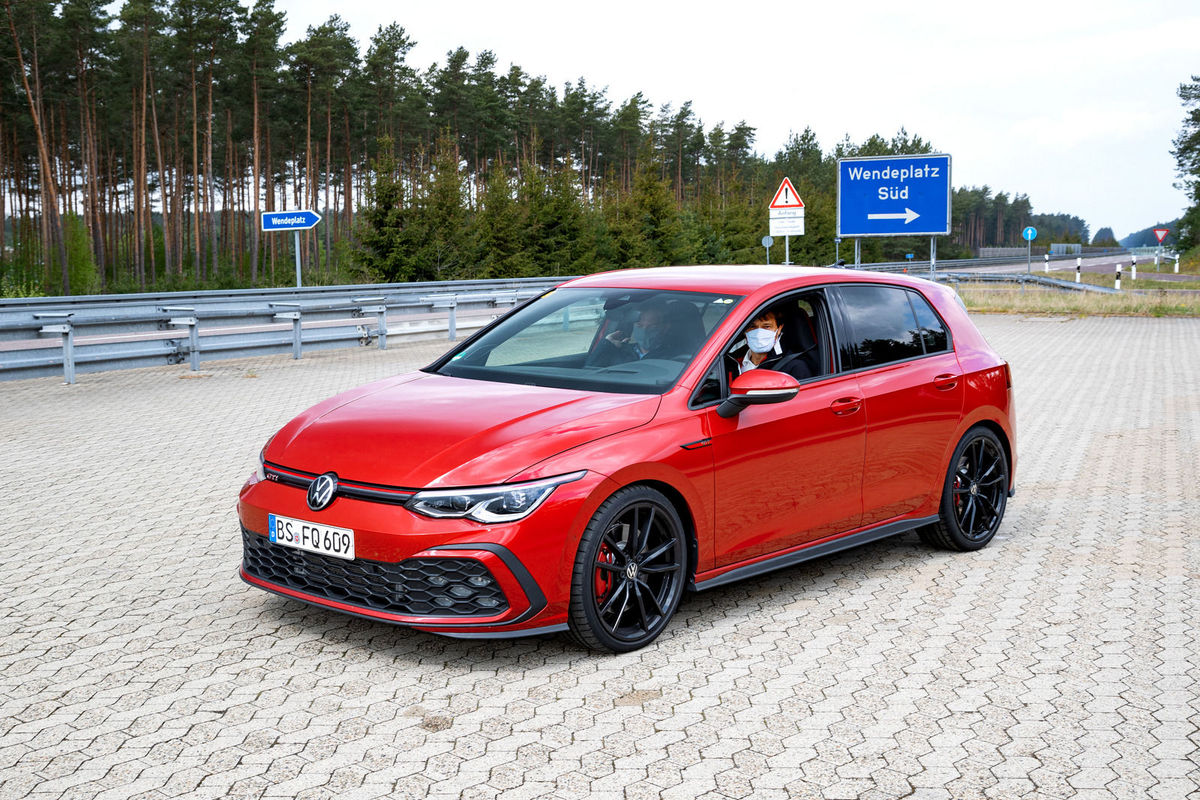
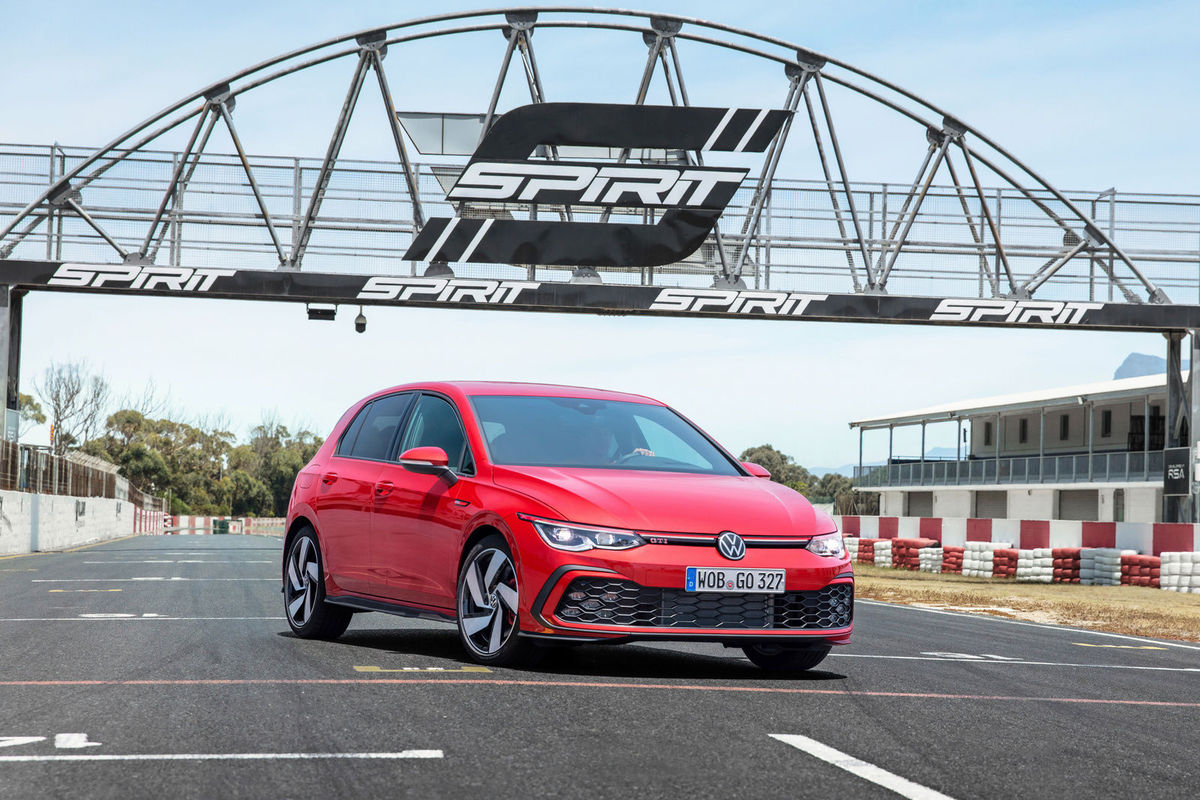
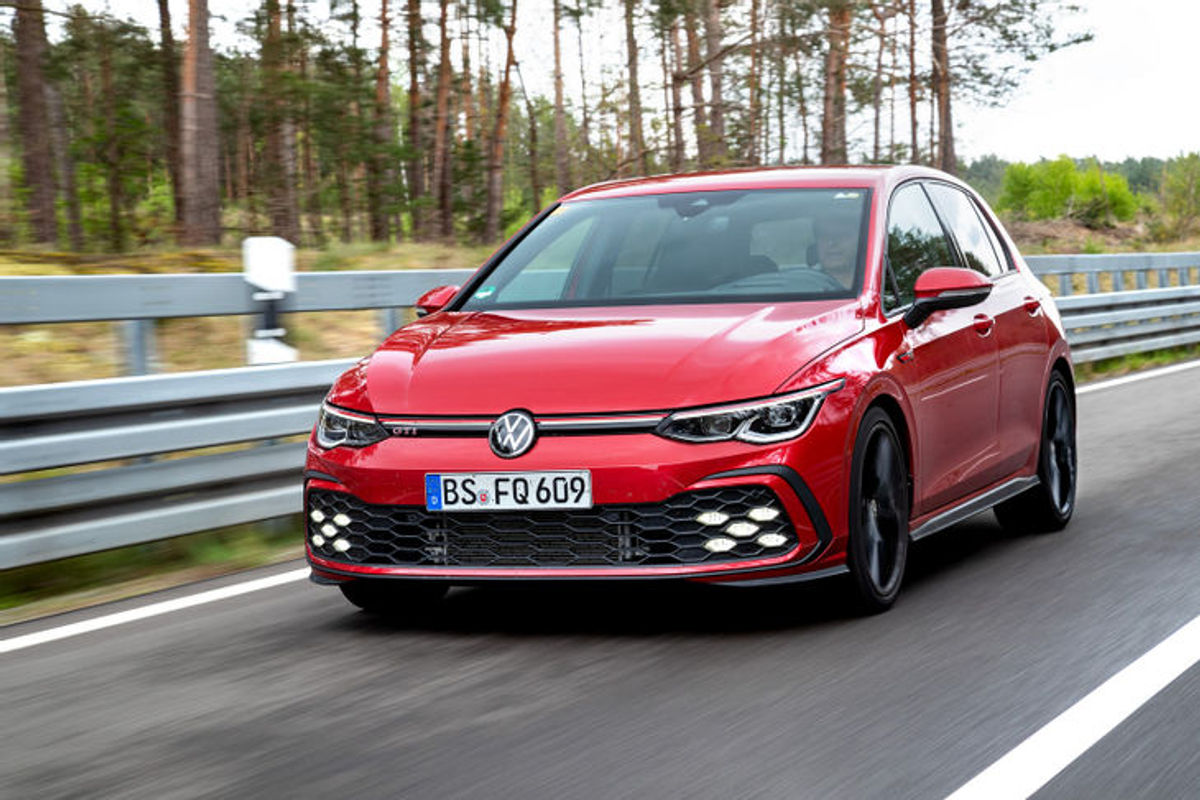
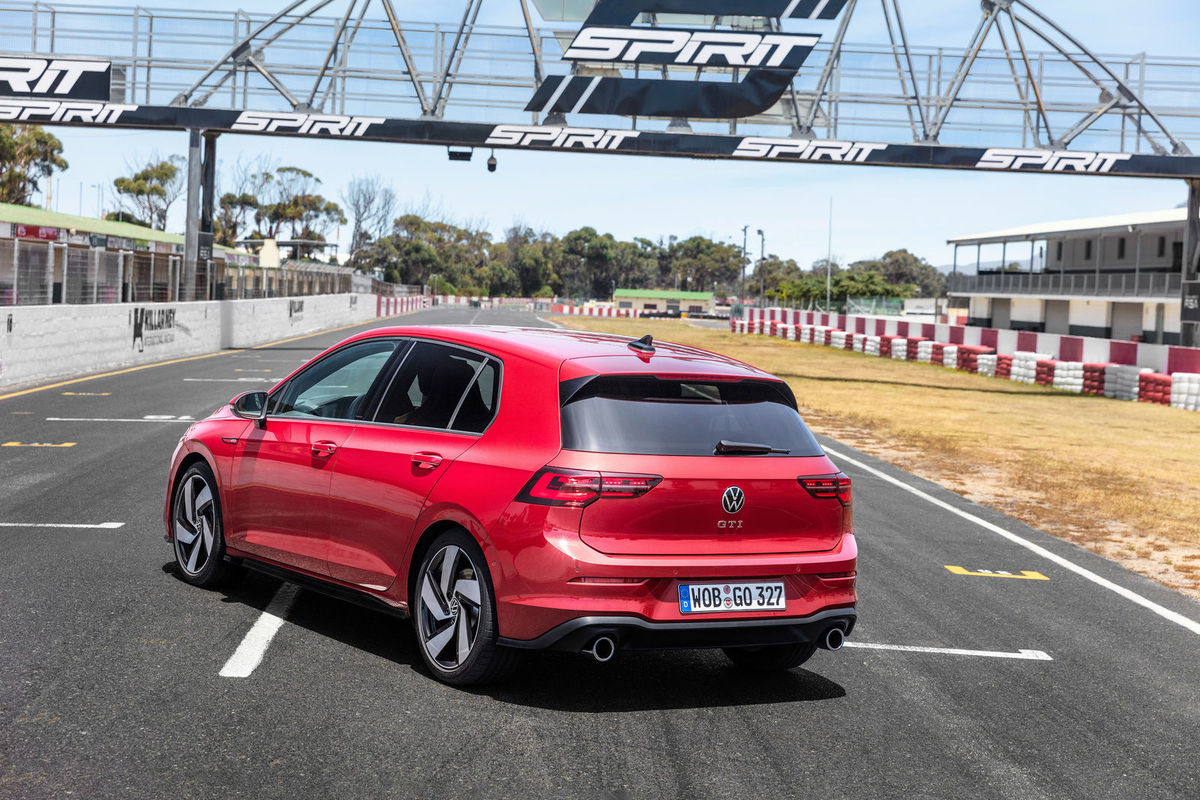
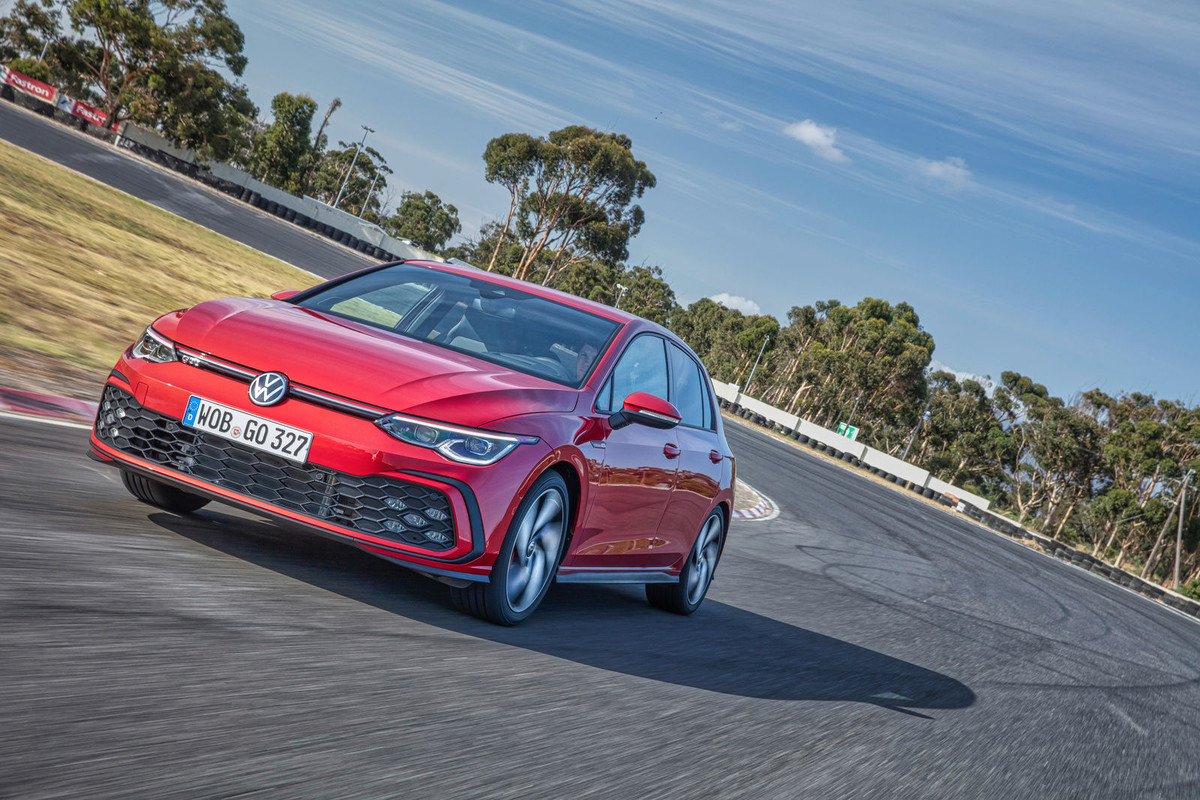
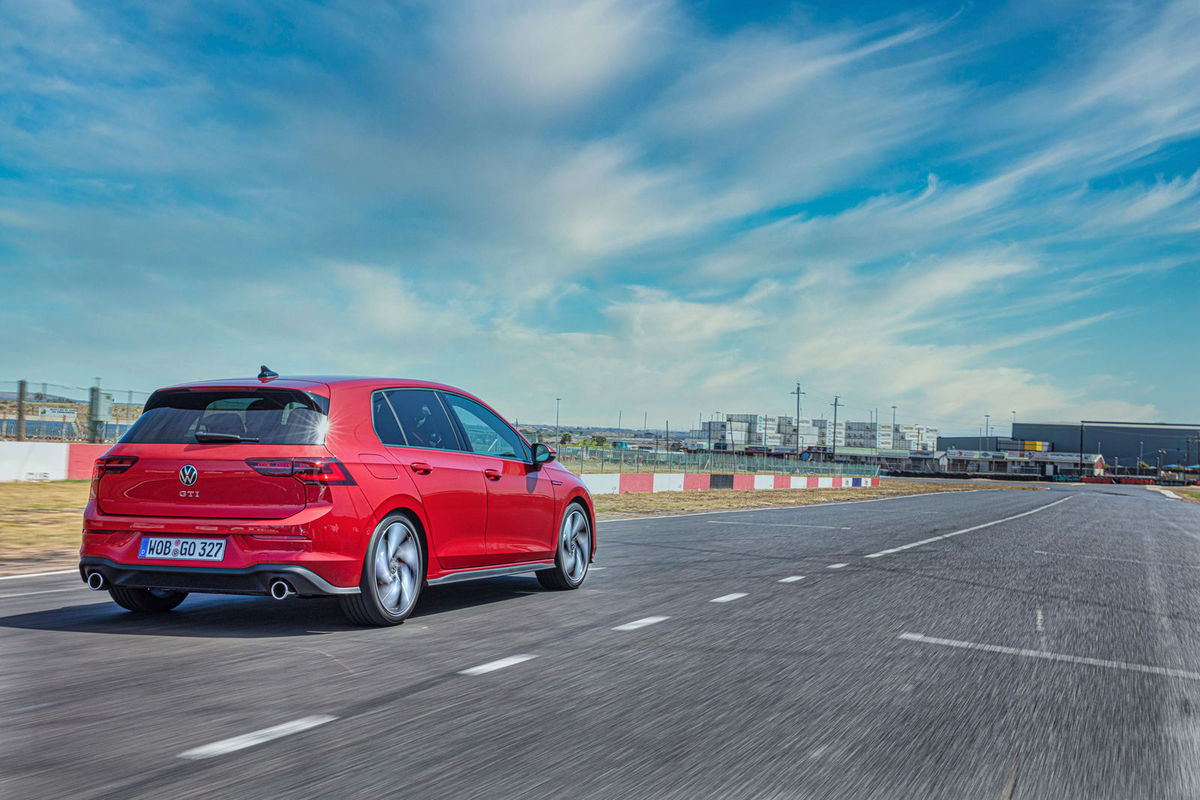
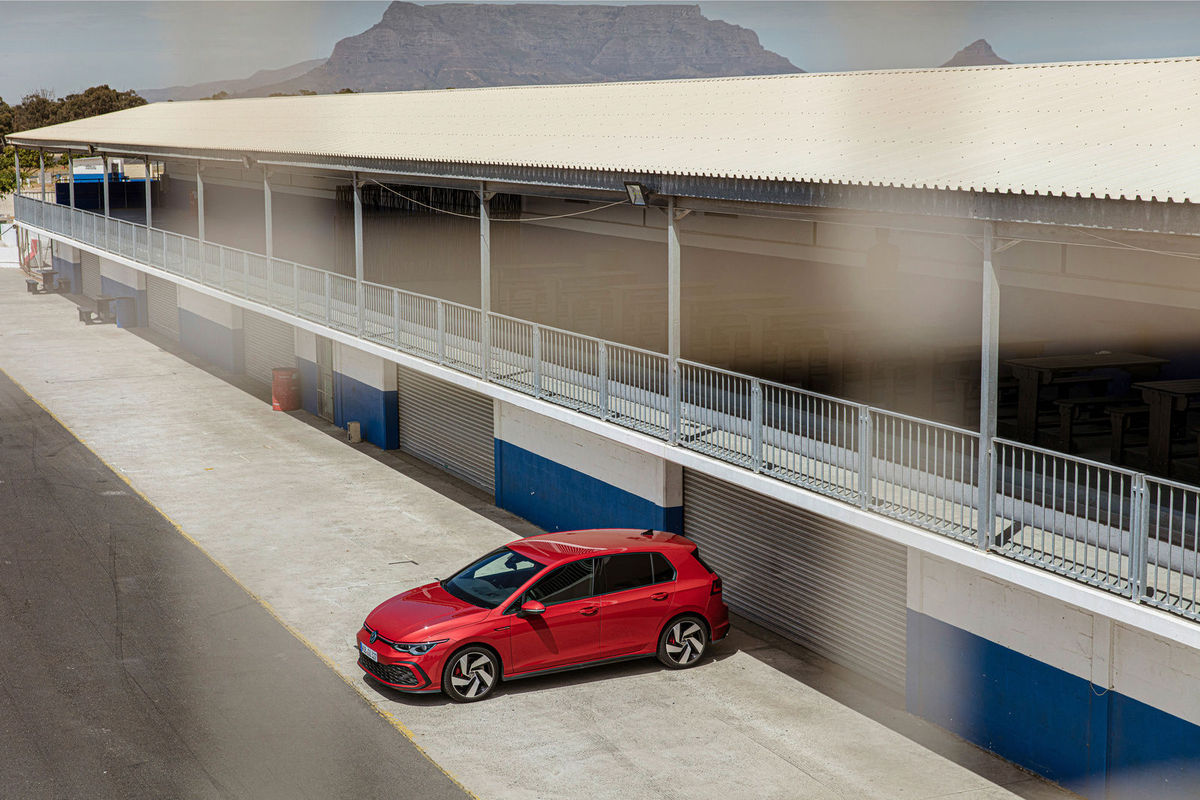
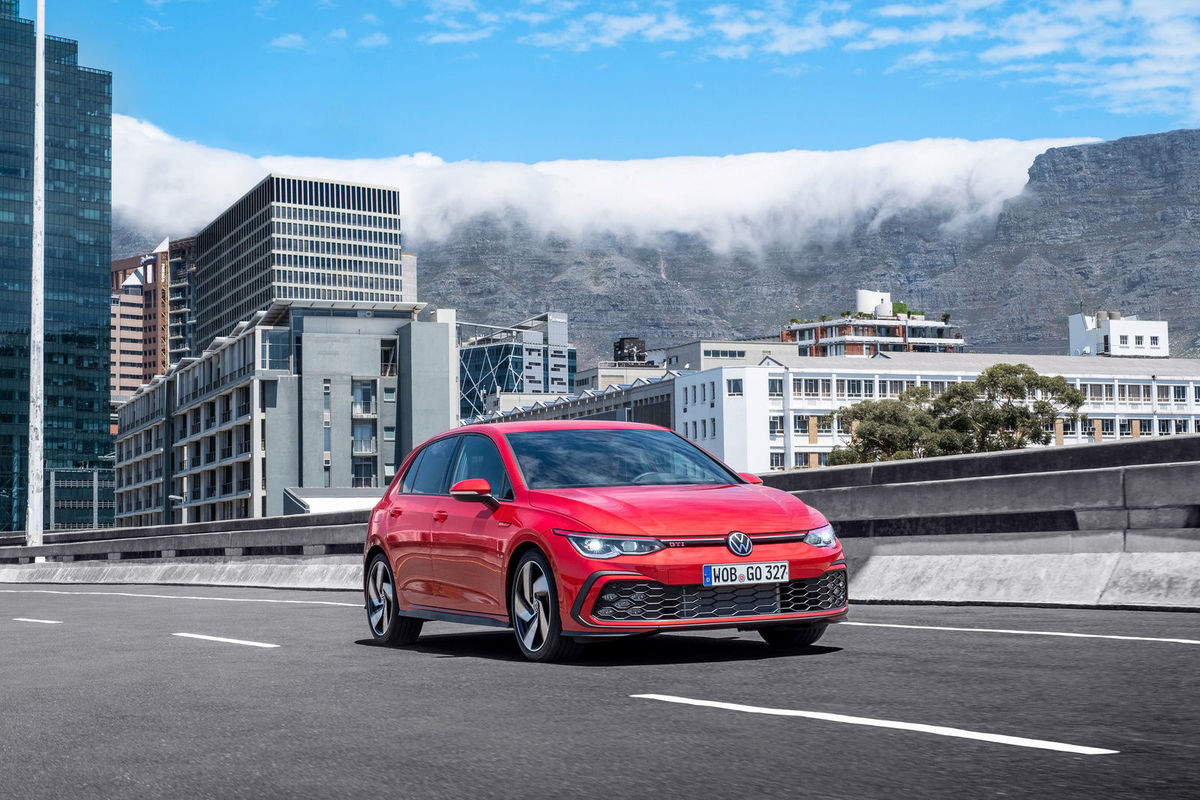
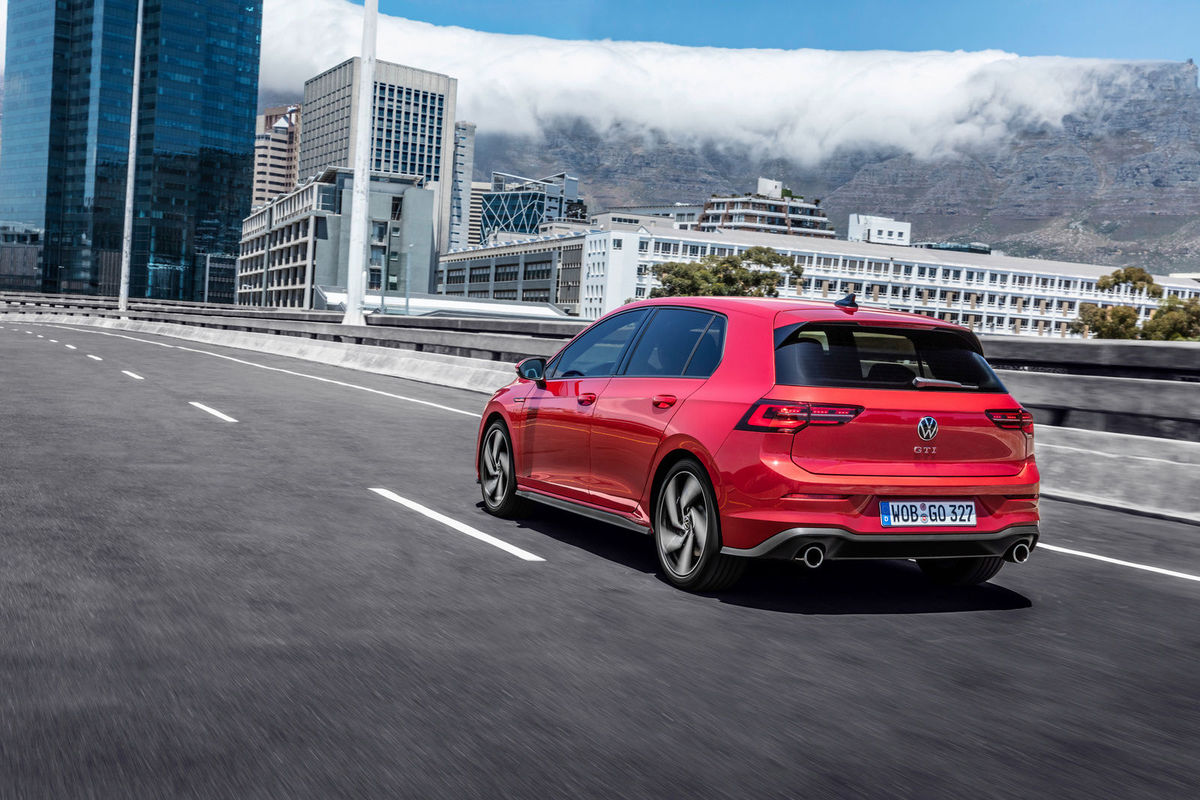
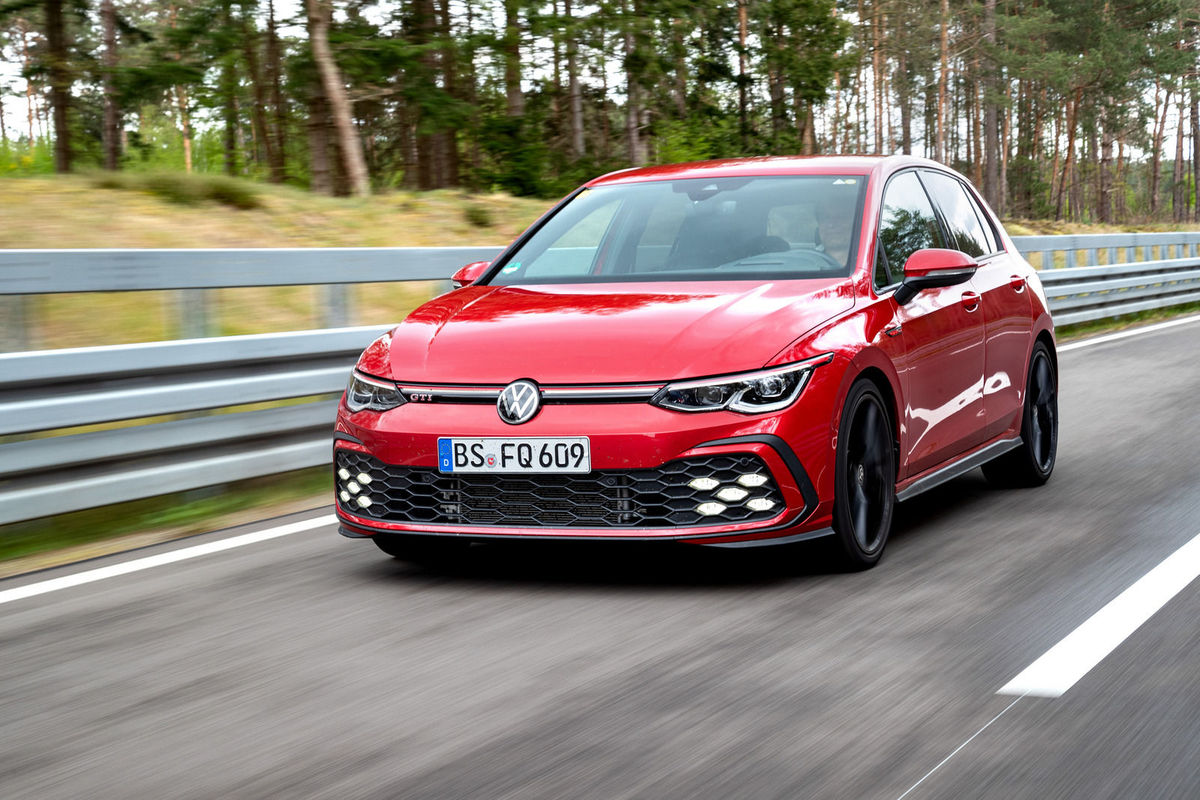
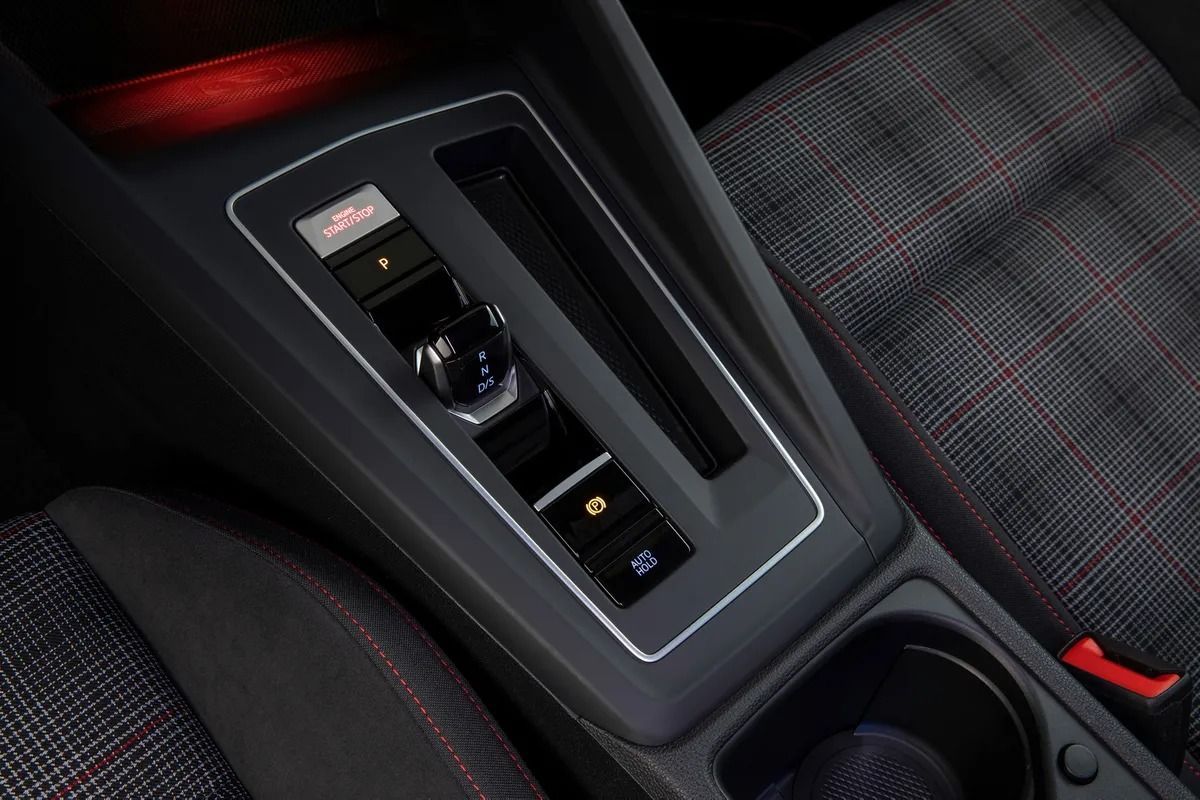
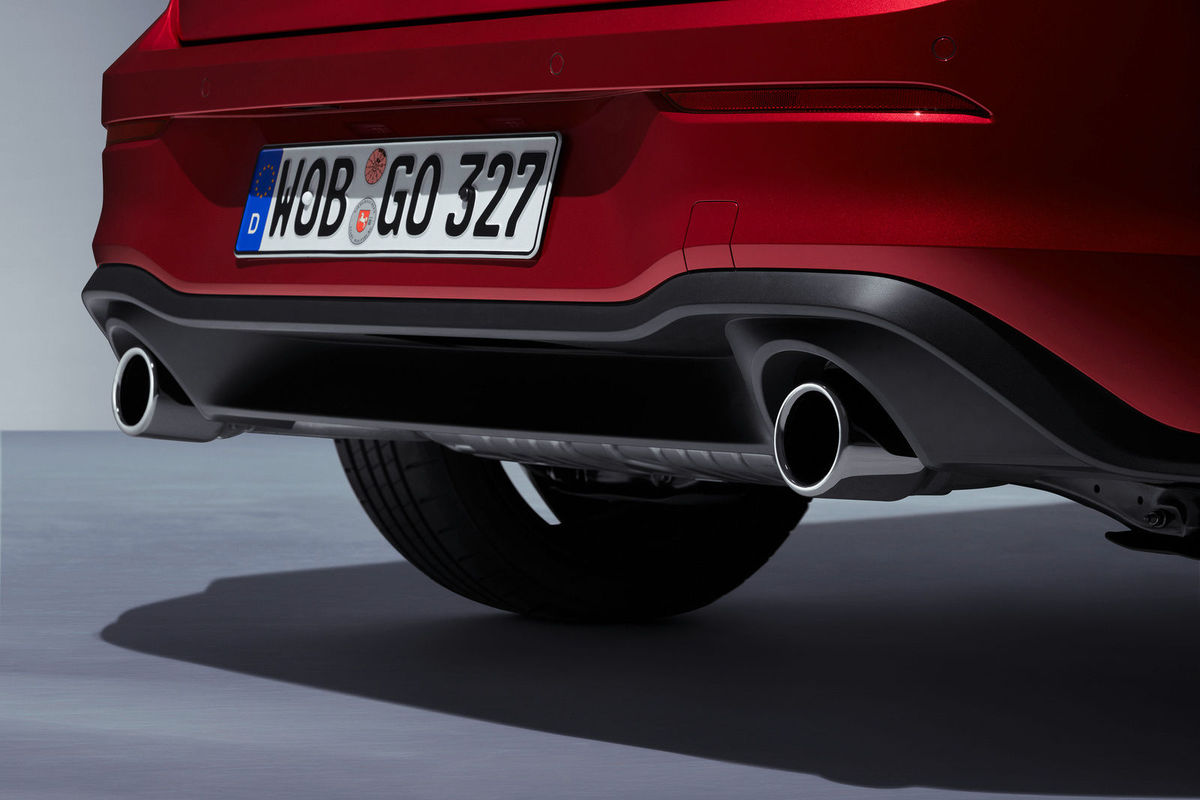
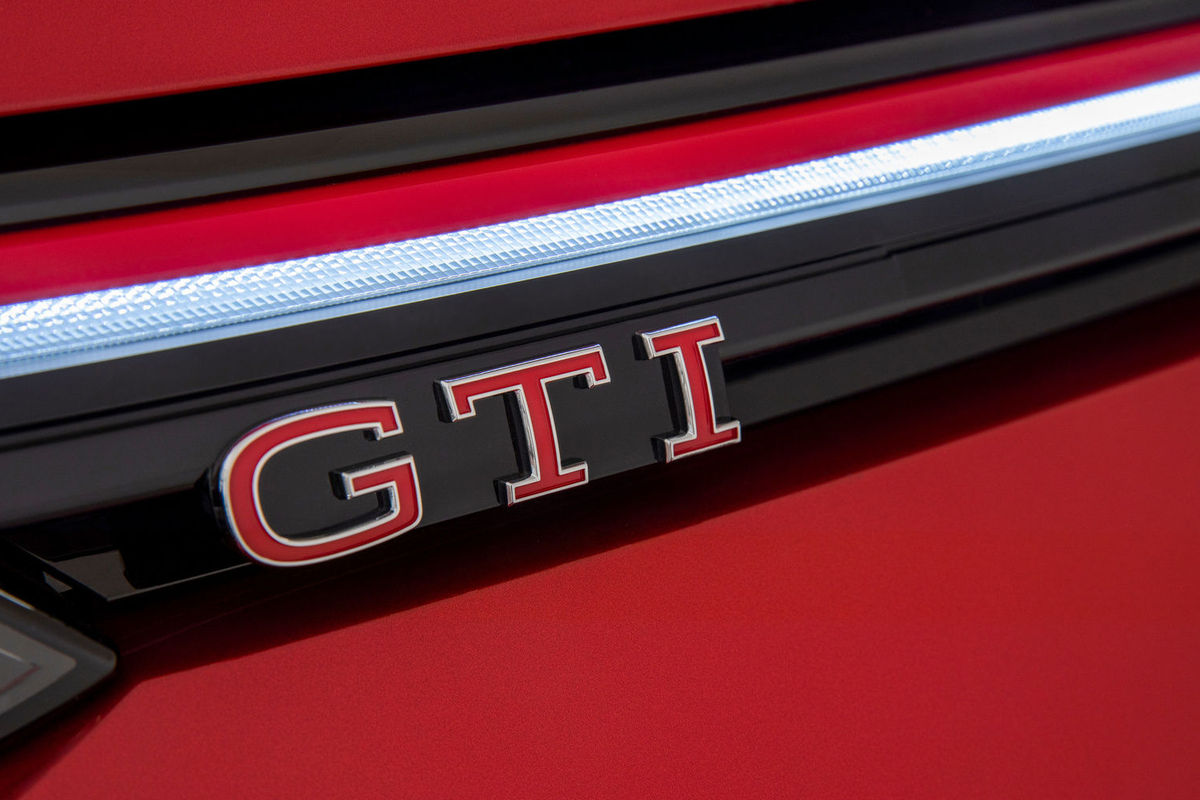
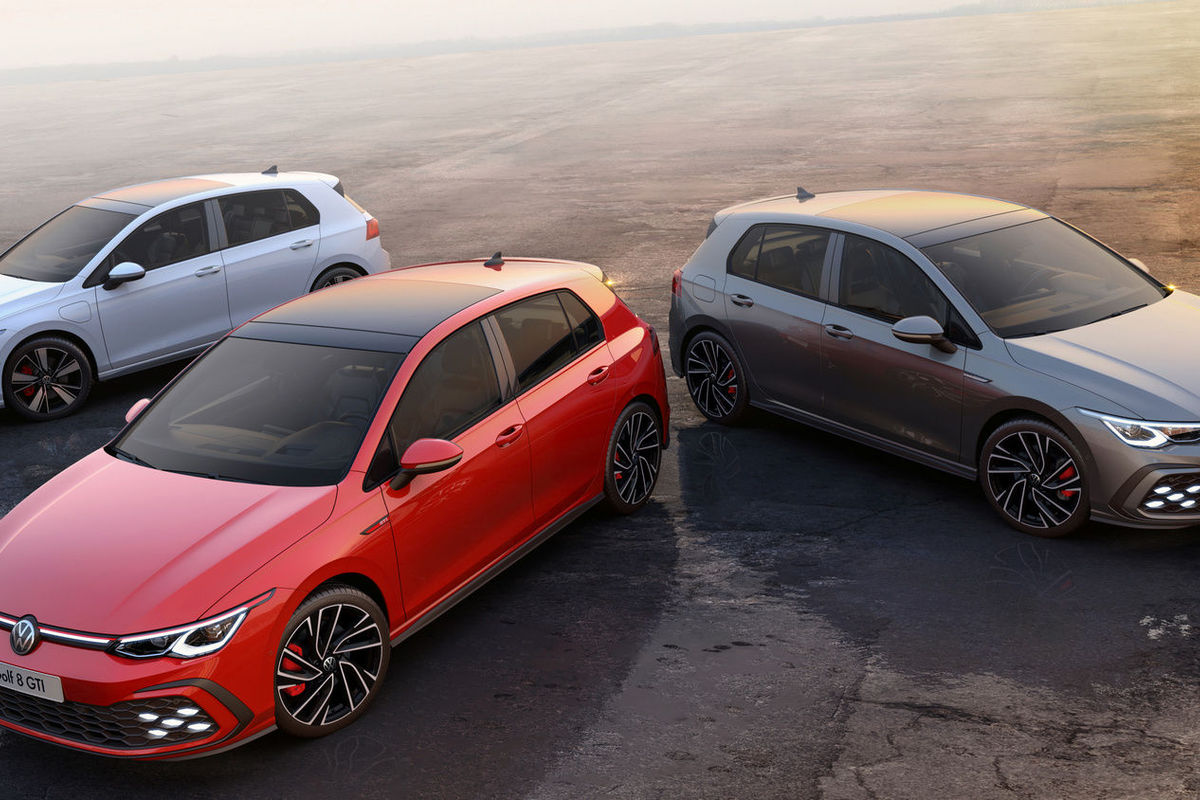
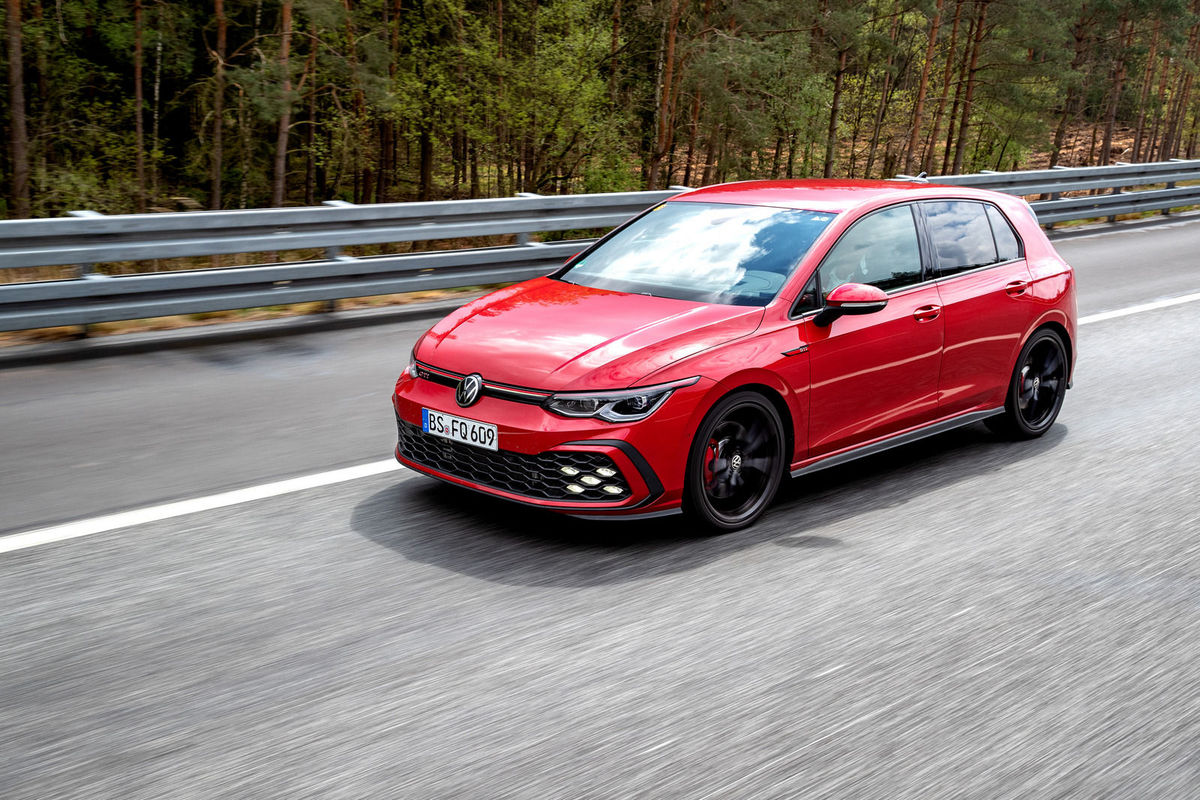
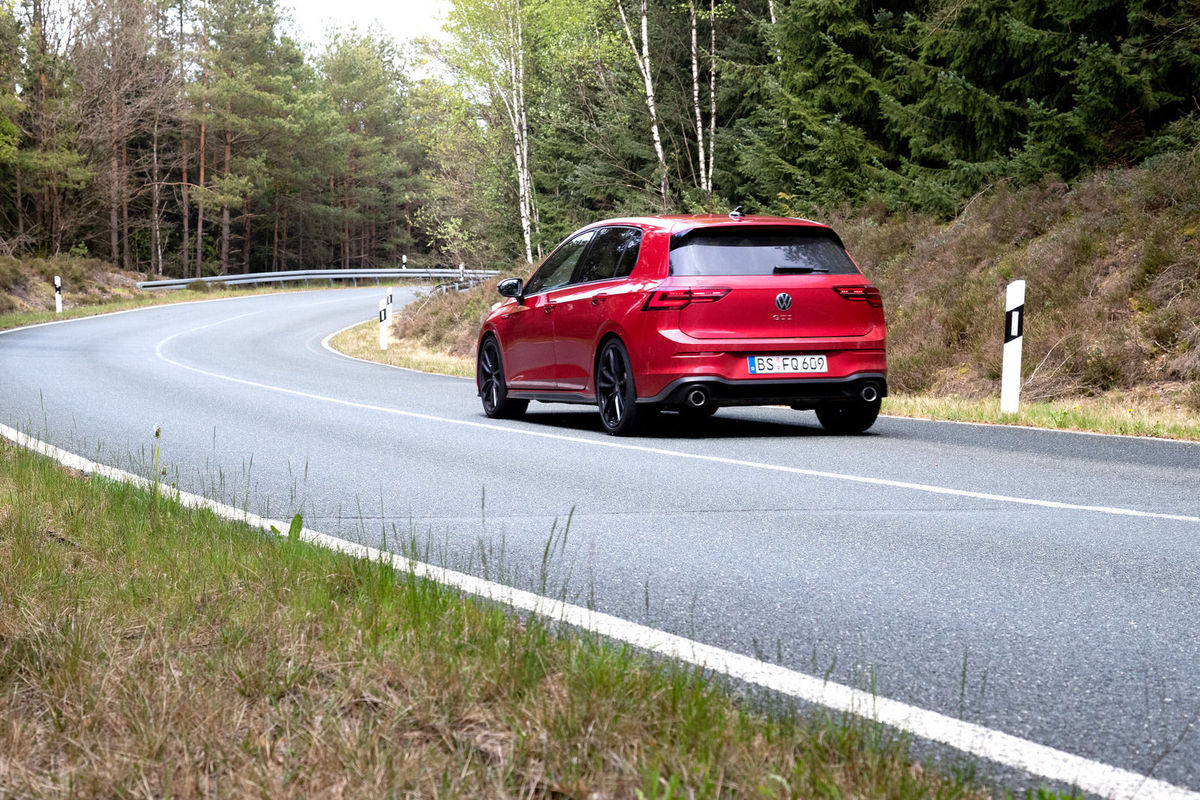
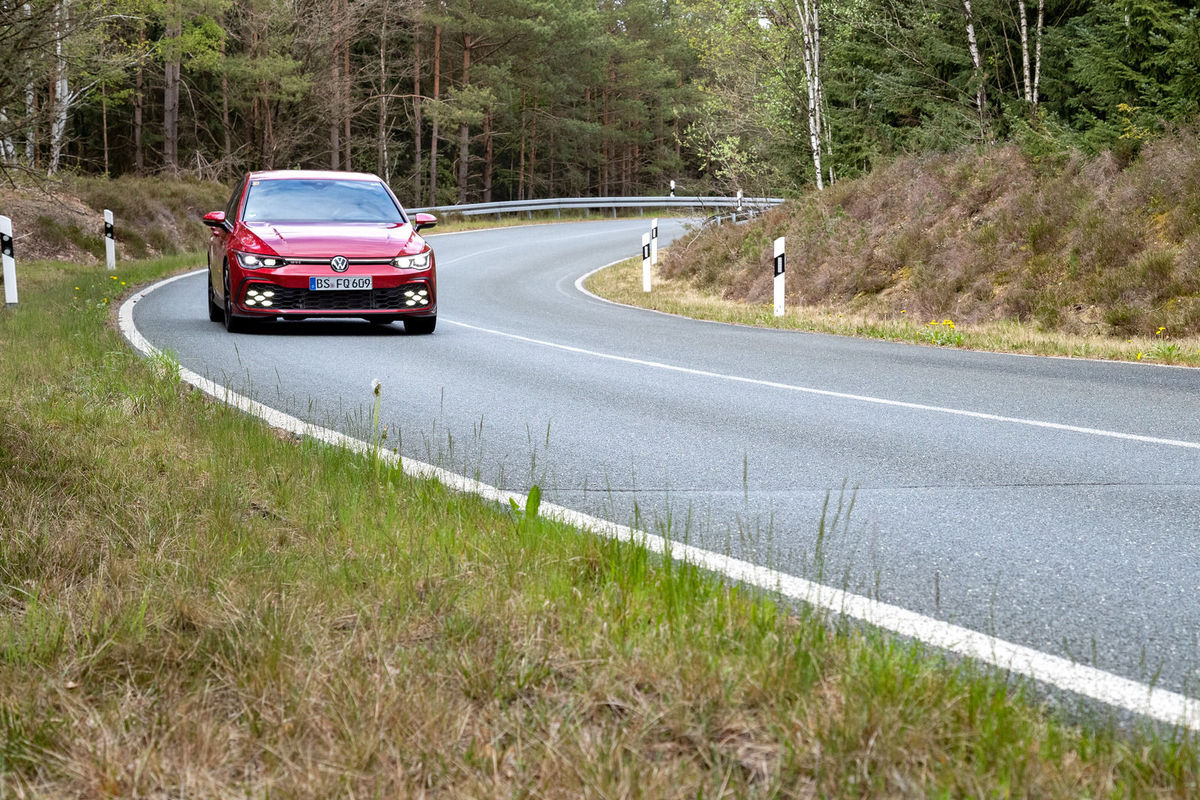
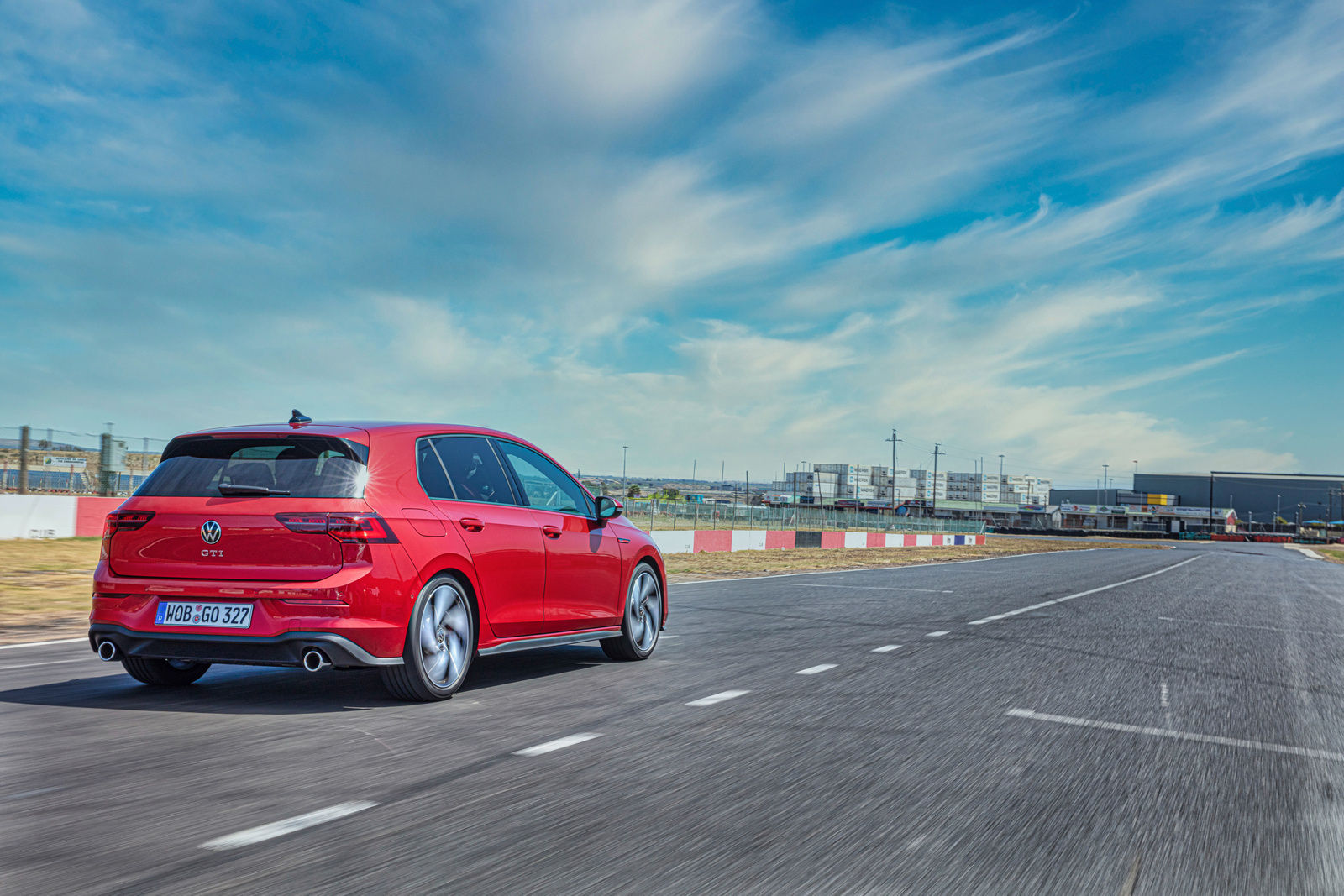
Volkswagen Golf GTI (2020) International First Ride
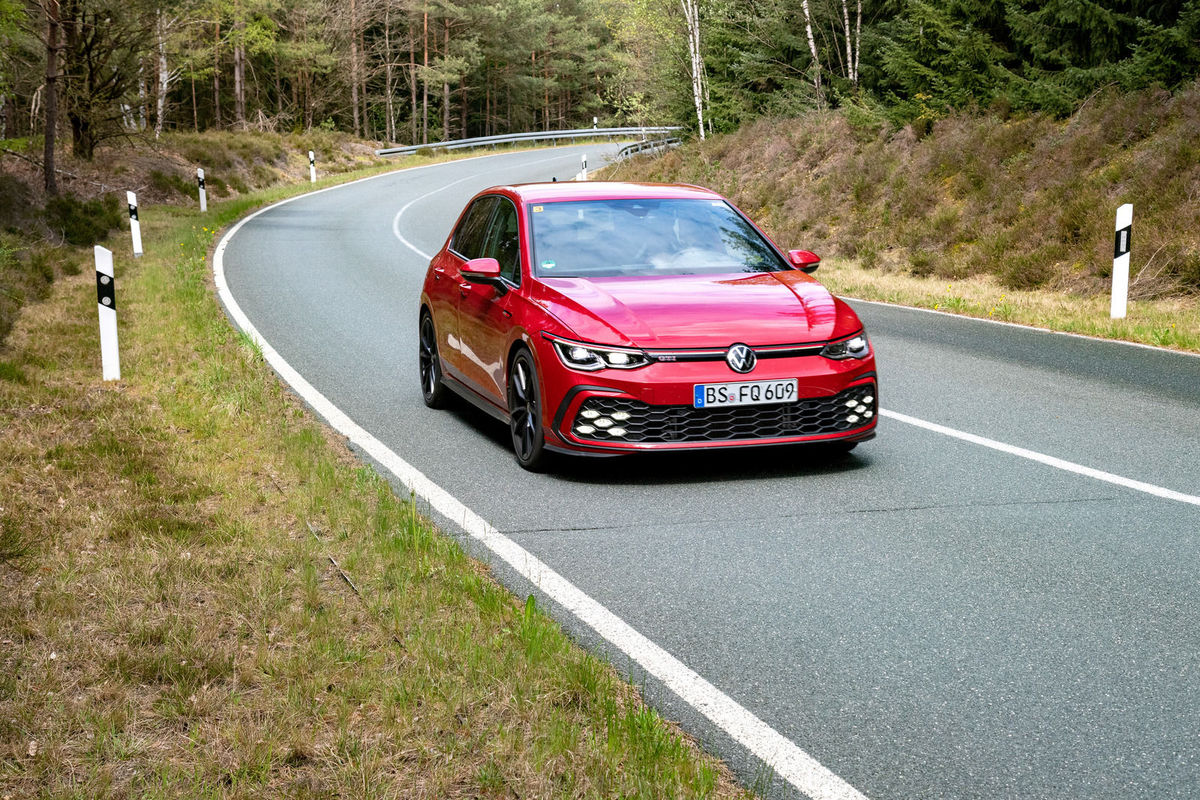
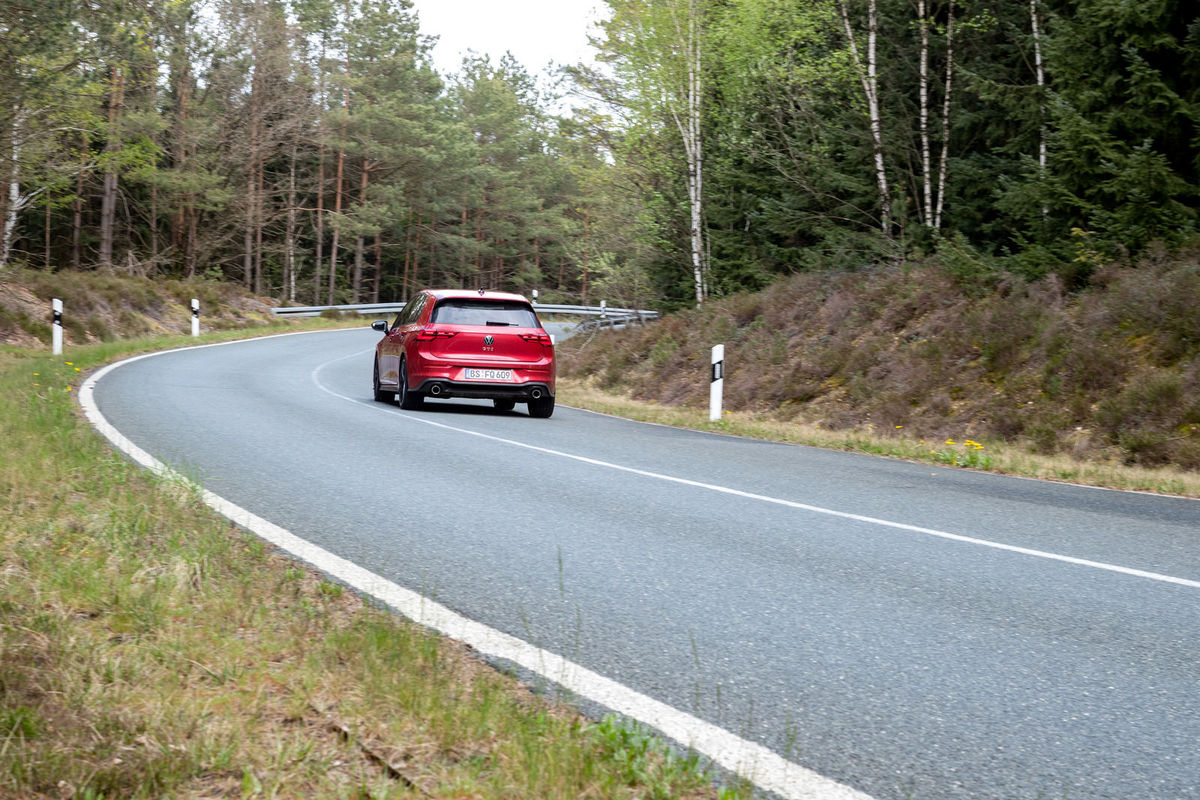
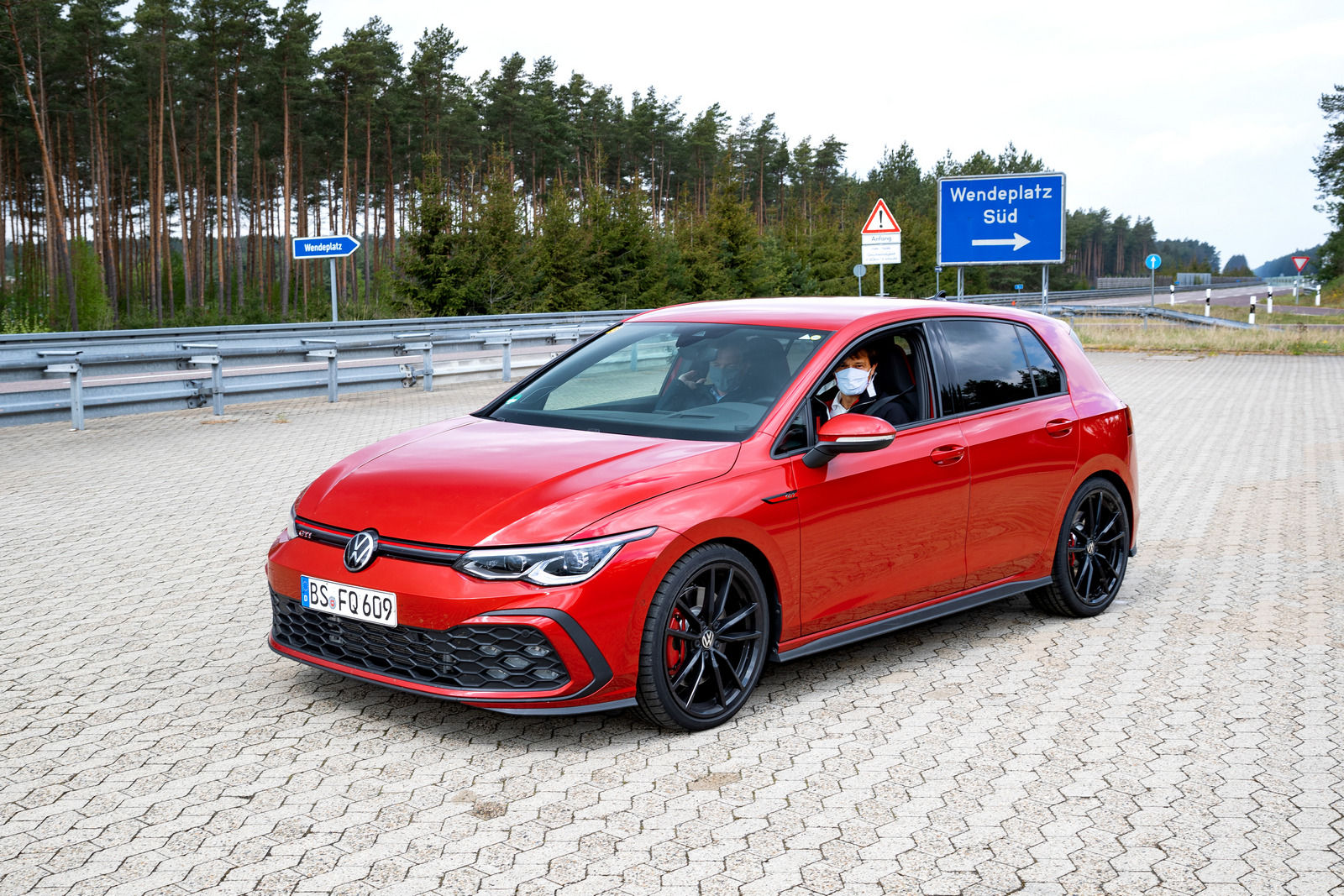
To prepare for the launch of the new Golf GTI, VW's head of driving dynamics put a prototype through the wringer around a top-secret test track. Our international correspondent, Greg Kable, went along for the ride and shares his experience of one of the year's most eagerly-anticipated arrivals. Could the 8th GTI be THAT different to its predecessor? Read on…
The front passenger seat is not the place I’d usually choose to sit when it comes to the Volkswagen Golf GTI – a car whose very existence is based on the visceral thrill delivered by its driving experience. But as this is the latest, 8th-generation model not due in local showrooms until later this year (or early 2021, if delayed) and we’ve got one of the world’s best test facilities all to ourselves for the next hour or so, it is time to make an exception.
After filling out a variety of forms to gain the security clearance to venture beyond the heavily-guarded perimeter of Volkswagen’s vast Ehra-Lessien development centre in Germany, I find myself seated next to VW’s head of driving dynamics, Karsten Schebsdat, as he guns the new Golf GTI flat out in 7th gear along a seemingly never-ending straight. The course is ultra-smooth, 4-lanes wide (in parts) and a mesmerising 8.6 km in length.
Speed runs
VW's test facility allows for high-speed and handling tests within a heavily guarded compound.
With the digital speedo indicating 250 kph, Schebsdat is busy explaining the fundamental differences in driving character between the new Golf GTI and its immediate predecessor, launched back in 2013. “It’s very settled at speed. We’ve transferred more load stiffness to the rear, which improves balance and helps the car to track better,” he says while drawing a finger across the central display to alter the driving mode more in the direction of Sport.
Then, without warning – or the faintest hint of a lift, the Volkswagen engineer whips on a quarter turn or so of steering lock. “It’s also extremely responsive and more stable than before,” he adds, as we veer sharply across the neighbouring lanes before he corrects the steering again. The lateral forces involved are truly colossal. But in the second or two they take to bury their way into the pit of my stomach, the prototype we’re in has already regained its composure and we head straight on again as if nothing untoward had happened.
As the latest derivative of the Golf 8, there’s not much about the latest GTI that isn’t instantly familiar. And yet, it feels different; more eager and sporting in its actions, but with the same degree of refinement and polish as its lesser siblings. In time-honoured fashion, it retains the front-wheel-drive layout of its celebrated predecessors, which means it continues to compete with very creditable rivals, including the Honda Civic Type R and Renault Me?gane RS.
Running gear
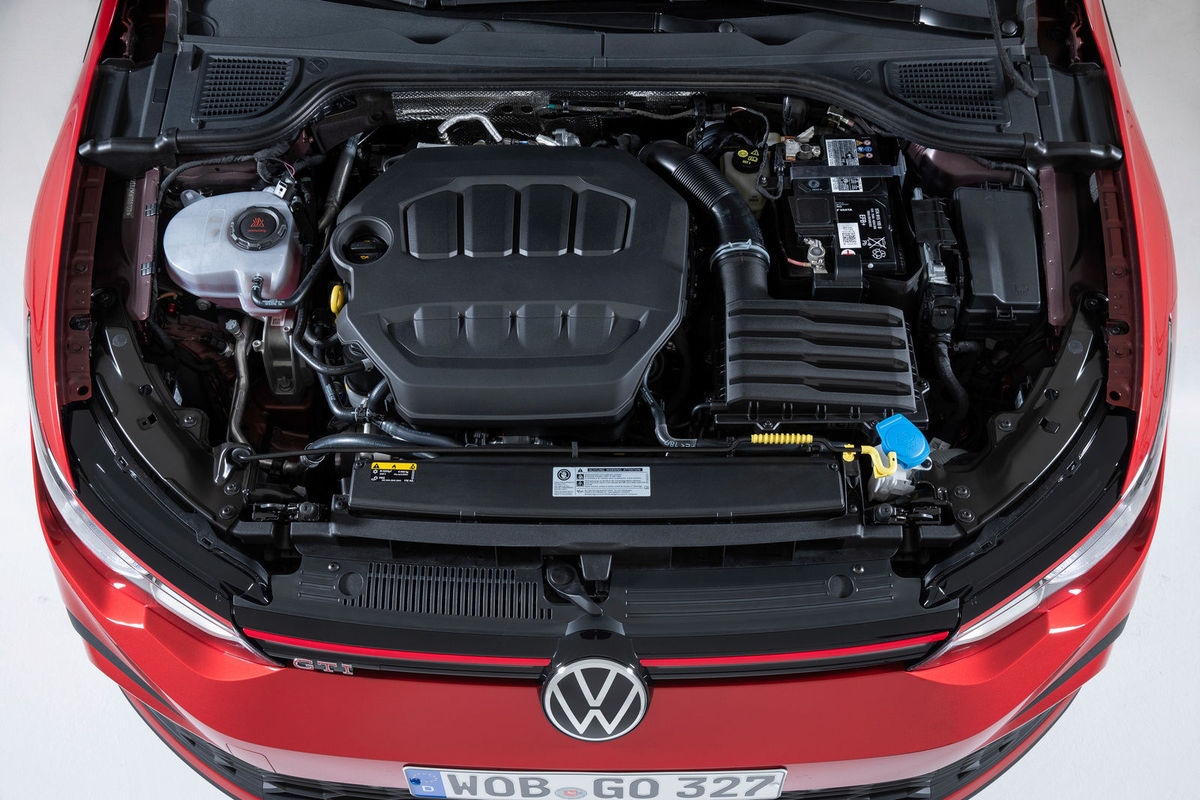
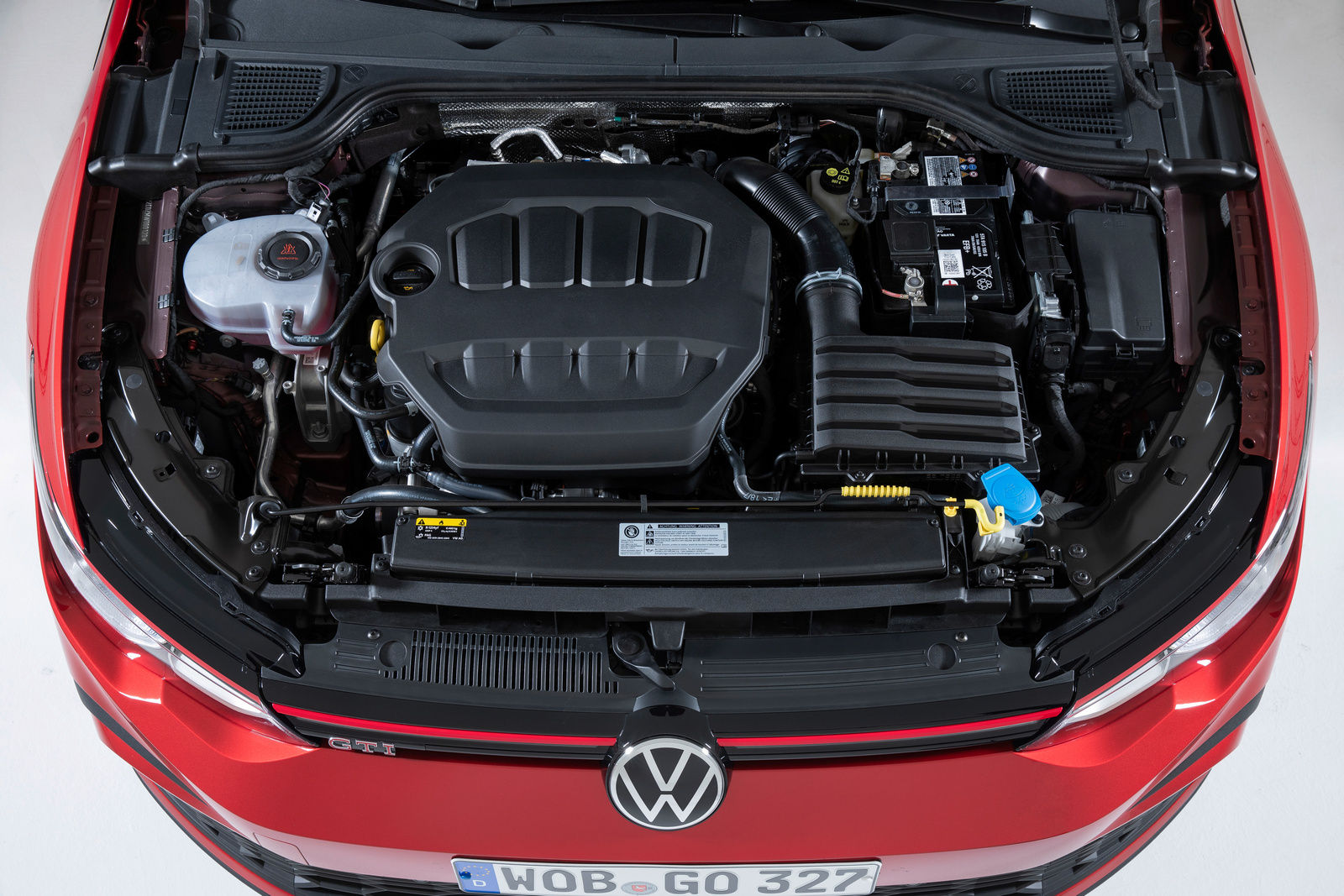
The same engine as the previous GTI does duty again, albeit with a bit more oomph.
Up front, the 2020 iteration is powered by the same 2.0-litre 4-cylinder turbopetrol engine as its predecessor – the EA888, to use its internal codename. Earlier signs suggested it was set to lift its reserves with 48V mild-hybrid electric boosting, but Volkswagen has decided to continue down the same conventional path as before without the additional power enhancement from the alternator seen in lesser versions of the new Golf.
The result? The standard Golf GTI now develops the same 180 kW from 4 700 to 6 200 rpm and 370 Nm between 1 600 rpm and 4 300 rpm as the Mk7 GTI’s Performance derivative, giving it an 11 kW and 20 Nm lift in reserves on the 7th-generation model it replaces.
It’s all channelled through a standard 6-speed manual gearbox or, as is the case with the prototype we’re in, a 7-speed dual-clutch transmission with shift paddles mounted on the steering wheel – which is the version that will be offered in the South African market (the GTI will spearhead the arrival of the Golf 8 range). As with the previous incarnation of the Golf GTI, there’s also an electronically controlled limited-slip differential, or XDS… as Volkswagen likes to call it. It detects unloading of the inside wheel and uses individual braking application via the electronic stability control system to restore traction.
Volkswagen isn’t giving away much at all on performance just yet but Schebsdat, who has worked on developing such highly lauded cars such as the original Ford Focus and the 911 GT3 RS 4.0 (during a stint at Porsche Motorsport), suggests the standard Golf GTI is close to the old Golf GTI Performance for outright accelerative ability, with a 0-100 kph time of around 6.2 sec.
GTI lineup
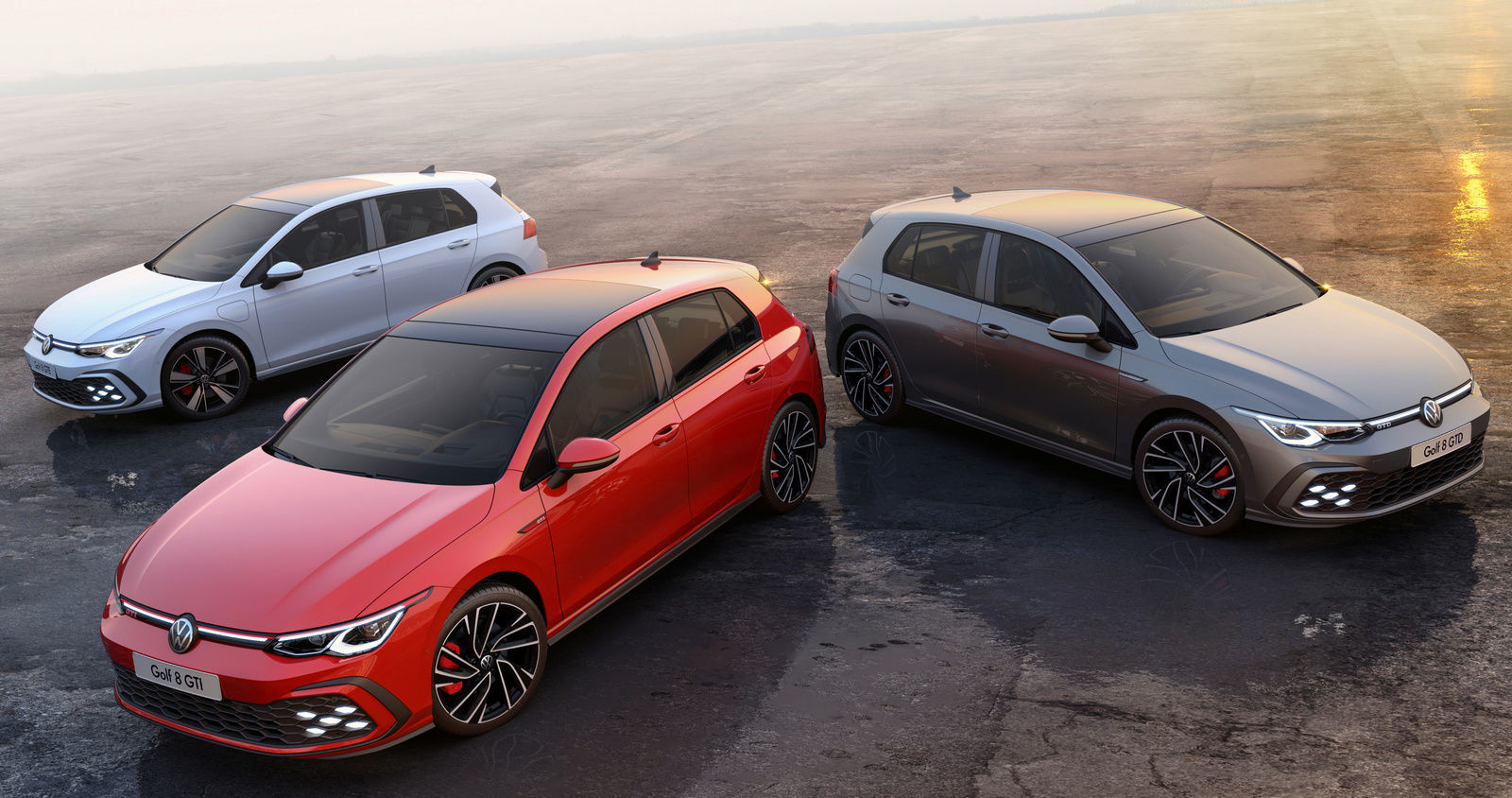
The GTI range is expected to consist of a standard GTI and a Clubsport model.
Following the strategy established with the 7th-generation model, Volkswagen plans a 2-tiered line-up for the latest Golf GTI. Gone is the Performance version, which in effect will be supplanted by this new, more potent standard GTI, while the Clubsport, whose moniker was previously reserved for special track-based limited-production models, will replace the Golf GTI TCR. Details have yet to be officially revealed, although the Clubsport is claimed to run the same level of tune to the EA888 engine as the outgoing GTI TCR, which develops 213 kW at 5 400 rpm and 370 Nm of torque between 1 950 rpm and 5 300 rpm.
Today isn’t about drivelines, though. It’s about exploring dynamic qualities. And Volkswagen’s Ehra-Lessien facility is just the place to show us what the new Golf GTI can do. It has everything: endless straights, where you can run flat out for minutes on end; banked corners, where the centrifugal forces allow the driver to go hands-off above certain speeds; handling roads, featuring every kind of corner, camber and surface you could ever wish for and much more. It is torture for any car, but it also provides valuable insight into on-the-limit behaviour without having to venture out onto public roads.
So just how do you instil the dynamic qualities that have distinguished the Golf GTI since its introduction to the Volkswagen line-up in 1974 into the new model, while also ensuring it meets its brief of appealing to a wider customer audience than ever before? “There is a lot of detailed tuning work,” says Schebsdat. “Every component has come under the spotlight. It is a process that was integrated into the development of the new Golf from the very beginning.”
MQB mods
A slight modification to the front of the MQB platform makes it slightly lighter and stiffer than before.
Once again, the starting point was Volkswagen’s versatile MQB platform – a structure renowned for delivering some of the highest levels of stiffness in the class. To this, the new Golf GTI adds an aluminium front subframe in place of the steel unit used previously. Similar to that developed for the earlier limited-production Golf GTI Clubsport S, it saves 3 kg and provides a more rigid basis for the electromechanical steering and MacPherson strut front suspension than before.
Predictably, the steering continues with a variable ratio rack as standard, although it is more direct, with an on-centre ratio of 14.1:1 resulting in 2 turns lock to lock. A new software package has also been developed to improve steering response and deliver more urgent self-centring.
Another key development brought to the latest Golf GTI is Volkswagen’s new VDM (vehicle dynamics manager) system. It provides a centralised network for a series of different functions, including the steering, throttle, gearbox and adaptive dampers – the last of which continue to be made available as an option as part of an upgraded DCC (dynamic chassis control) system that’s claimed to provide faster damper adjustment at each wheel for improved body control, added ride refinement and, as displayed during our high-speed runs, a generally more settled feel to the car as a whole.
Volkswagen says the VDM system also enhances the operation of the XDS electronic diff lock by providing it with additional information on other systems, including the DCC. “It is now more effective than ever, especially during hard cornering,” says Schebsdat. “The apportioning of drive to each of the front wheels is now more finely controlled and dependent on a greater number of different factors than it was previously.”
More mode adjustment
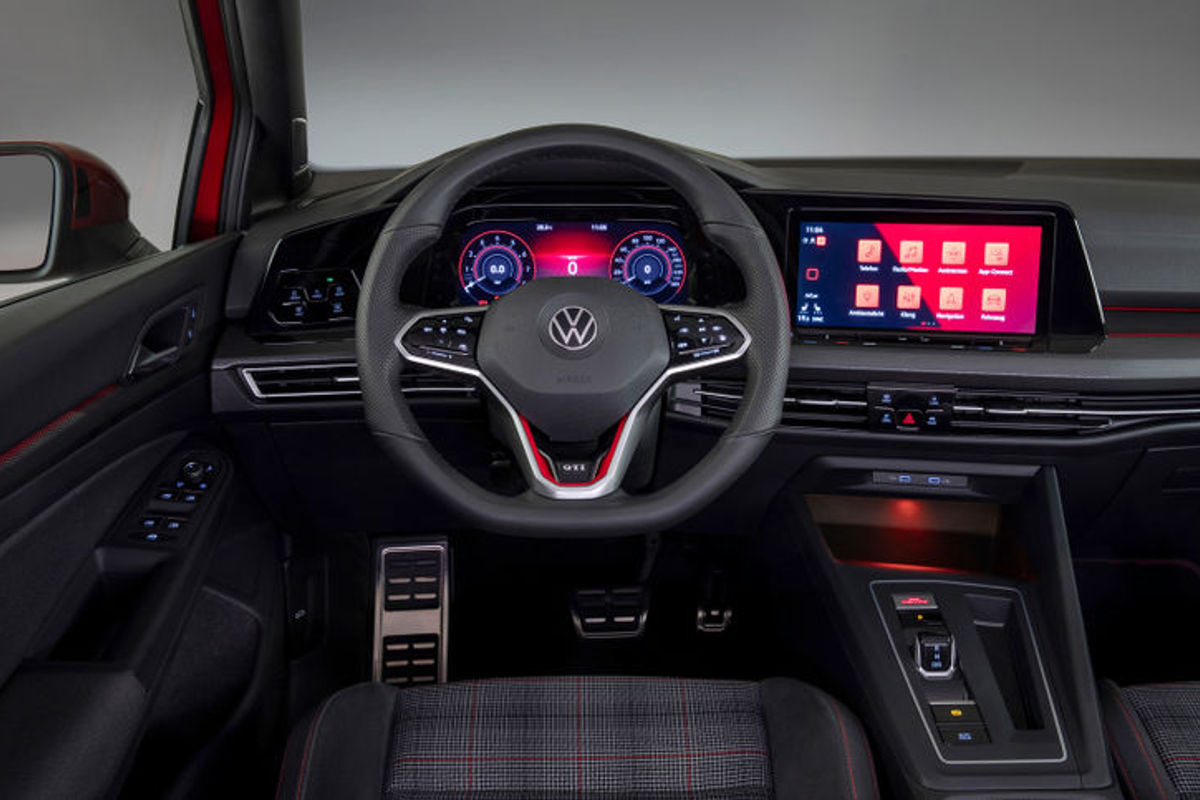
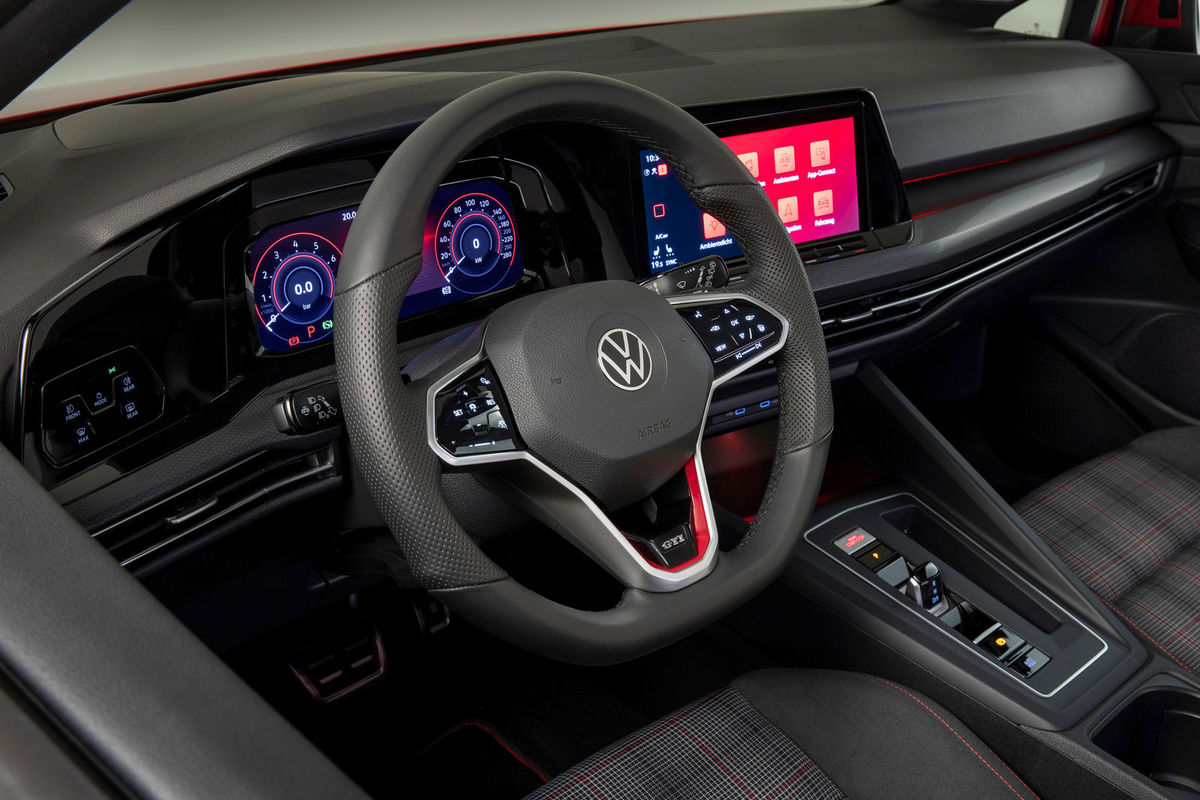
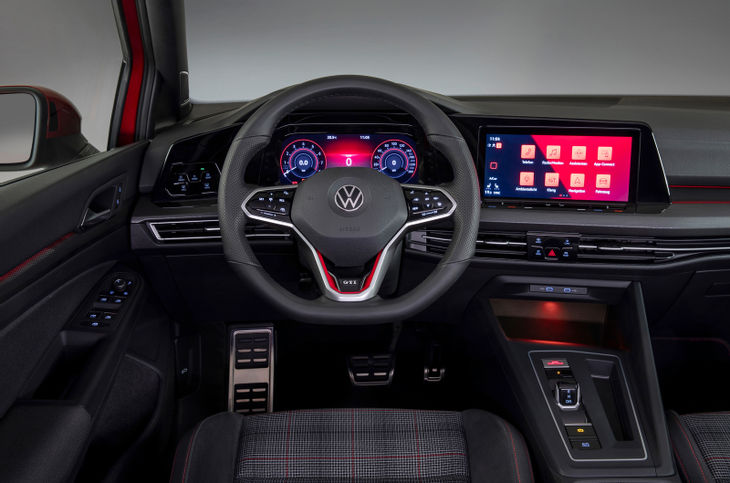
The Drive Mode selection will have a slider that allows for fine-tuning of the driving experience.
As before, there are 4 driving modes: Comfort, Eco, Sport and Individual. However, they can be set more precisely via a digital slider with extra steps now incorporated between each mode for a broader range of driving characteristics.
The suspension, which adopts the same rear multi-link set-up as the old model, is set 15 mm lower than in other versions of the new Golf and is imbued with its own unique kinematic properties. The standard wheels are 17-inch, although buyers will be able to choose 18-inch and 19-inch options. The prototype we’re in rides on 18-inch wheels shod with 225/40-profile Bridgestone Potenza S005 tyres.
What Volkswagen has set out to achieve with the new Golf GTI is greater cohesiveness, as well as linearity and incisiveness in the way its mechanical components work in combination with its various electronic systems. The aim is to build on the solid basis of the old model with a heightened feeling of precision, composure and stability through superior networking of each individual function.
“We didn’t want a nervous-feeling car tuned for ultimate performance, but one that instils confidence in the driver in every possible situation,” says Schebsdat.
Stability is key
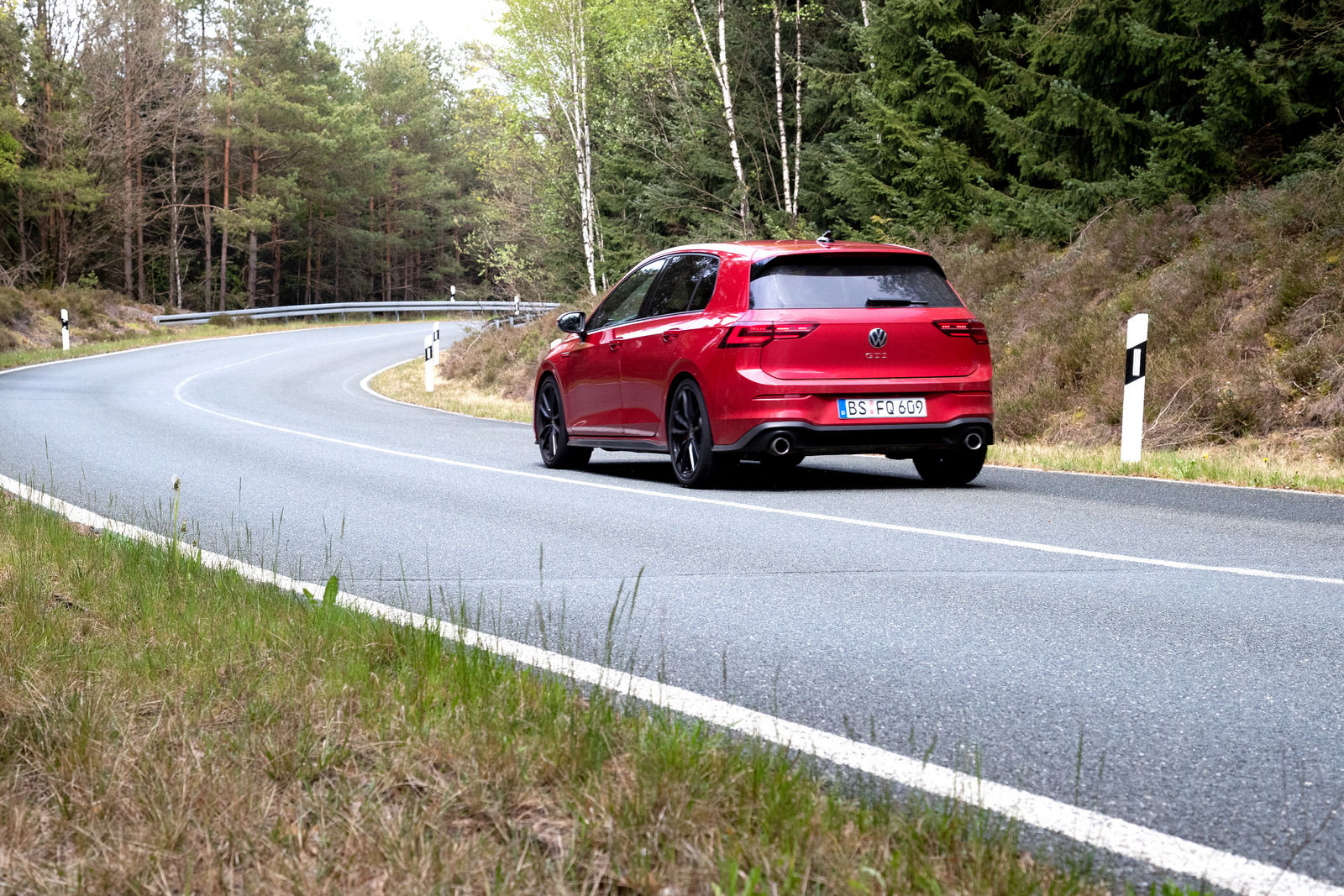
Don't expect lift-off oversteer from the GTI, this model is all about stability and responsiveness.
Over Ehra-Lessien’s more demanding handling roads, you sense the consistency in the Golf 8's responses, the inherent balance of its chassis and its heightened agility. It all starts with the apparent decisiveness with which the new Golf GTI turns in to corners in Sport mode and then continues with the way its electronic differential deftly goes about the business of apportioning drive to the front wheels. There is outstanding grip from the tyres, which do a great job of resisting any urge of the Volkswagen's front end to run wide prematurely even on bumpy surfaces; it allows the driver to maintain lots of momentum to the apex without the car feeling on edge.
On a particularly demanding section with lots of high-frequency bumps, we enter a tight constant-radius corner. Schebsdat keeps the throttle nailed and delicately places the car on the inside white line while maintaining constant steering angle. All the while, I keep expecting the liberal grip that was evident on entry to weaken. However, the Golf keeps tracking true. There is no scrub or even a hint of understeer, despite a heady combination of lateral and vertical forces loaded through the suspension.
At the next corner, a long, opening left-hander, Schebsdat carries even greater speed before suddenly lifting the throttle and then mashing it against its backstop again. It’s remarkable just how stable the GTI's rear-end remains. Even with provocation, the prototype continues to track with great determination.
Body control is another real strength at the sporting end of the new Volkswagen’s various driving modes. There is a degree of lean in slower corners, but the improved action of the adaptive dampers ensures it builds in a more progressive way than before, especially from the initial point of unsettling. Indeed, overall composure is one of the key attributes of the Golf GTI’s handling, and that can also be said of its ride. There is a predictable firmness to the underpinnings but there’s no real abruptness, even on the optional tyres. Vertical movement is exceptionally well controlled, giving it impressive settled properties in Comfort mode. Its ability to dampen after-shake over large bumps is also commendable.
Summary
On that note, my time in the passenger seat of the new Golf GTI is over. The 8th-generation of Volkswagen's iconic hot hatch may not be the most powerful or fastest car in its class, but it represents a major leap forward compared with its much-loved predecessor. It feels wonderfully agile and responsive in the best of GTI traditions, but also assuredly stable and composed when pushed to its limits. It’s going to be a few more months until we get to jump behind the newcomer's steering wheel ourselves, but we already know that it's an accomplished hot hatch. Suffice to say we can hardly wait for it to arrive on local shores…
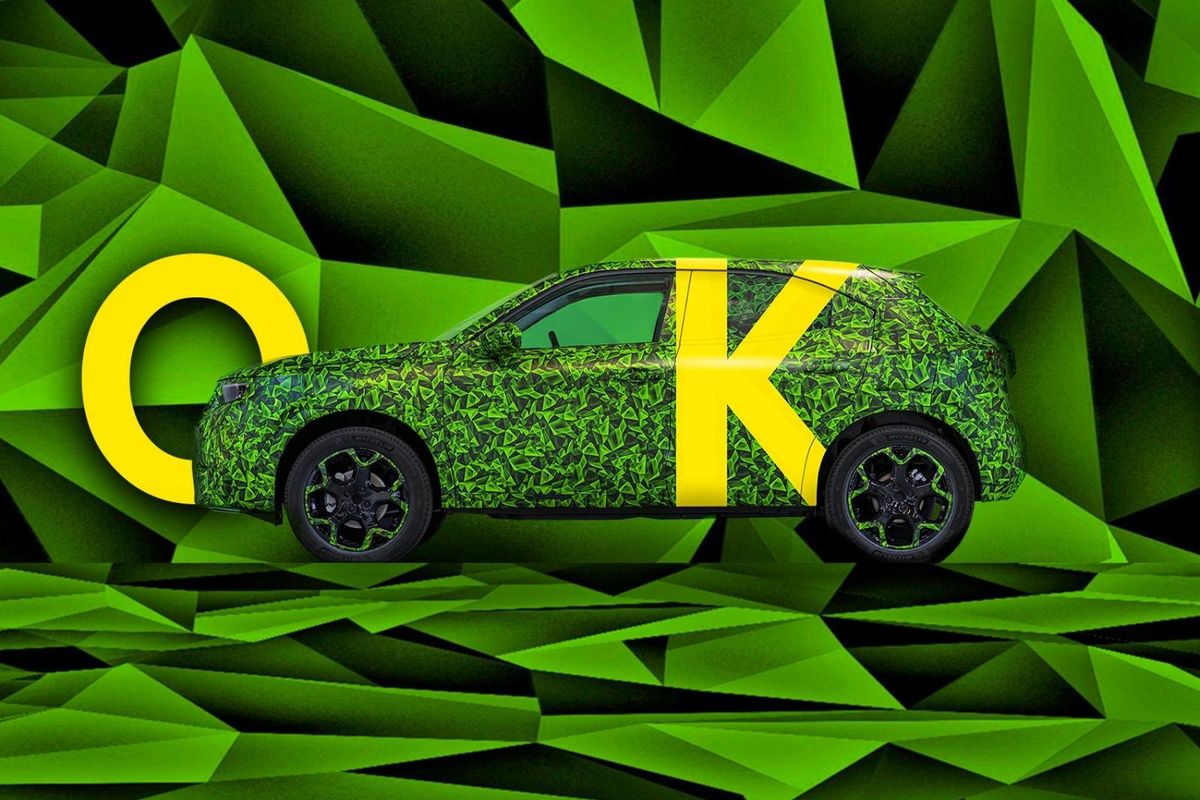
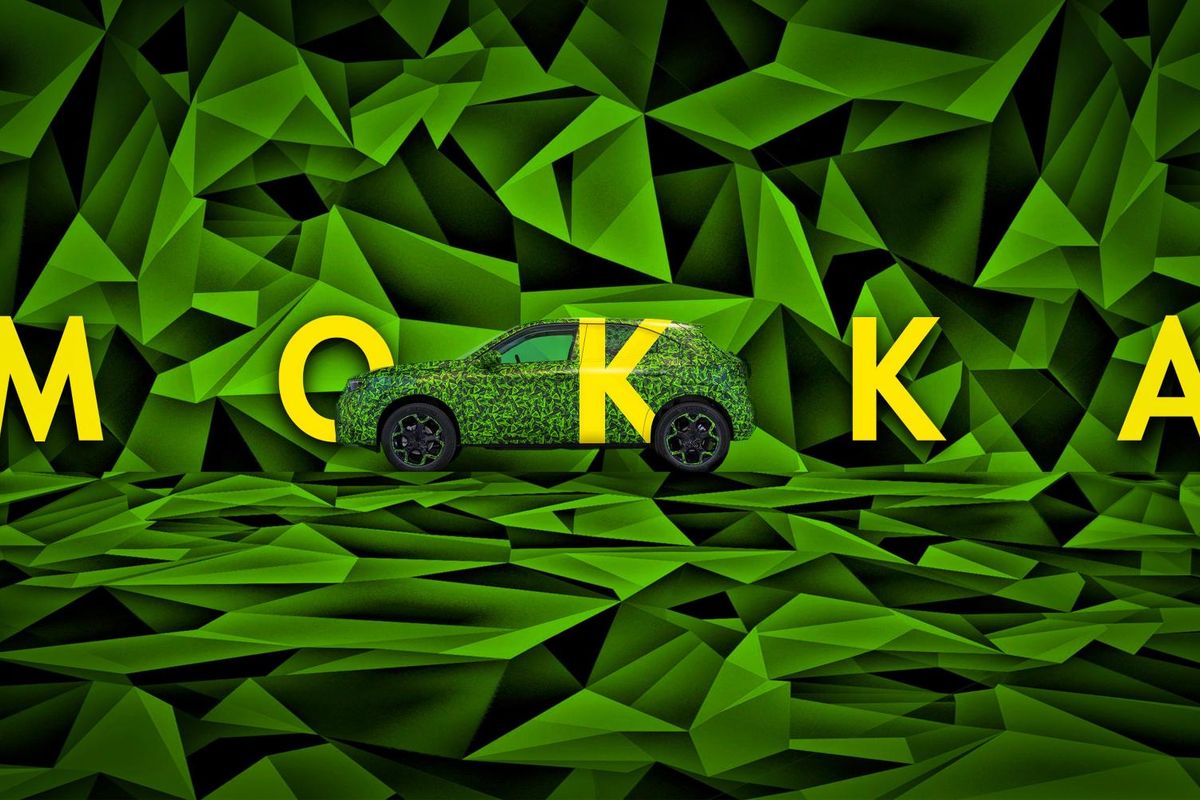
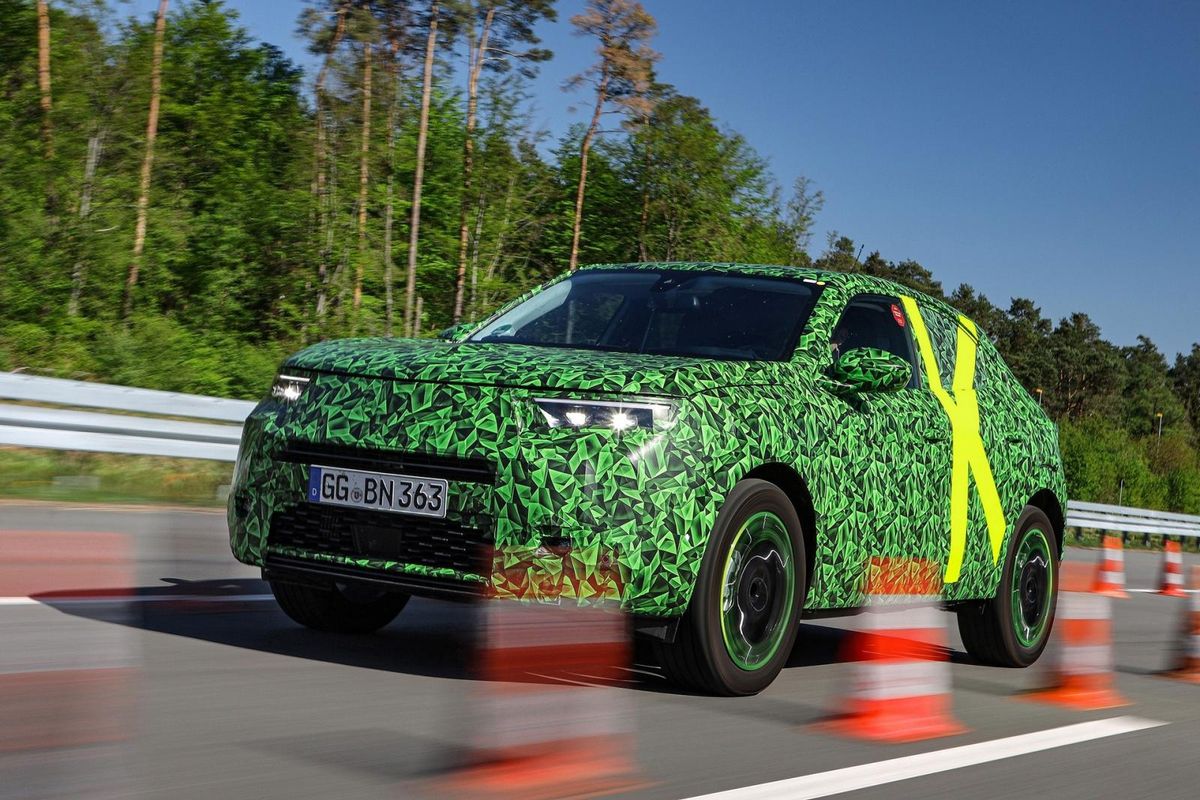
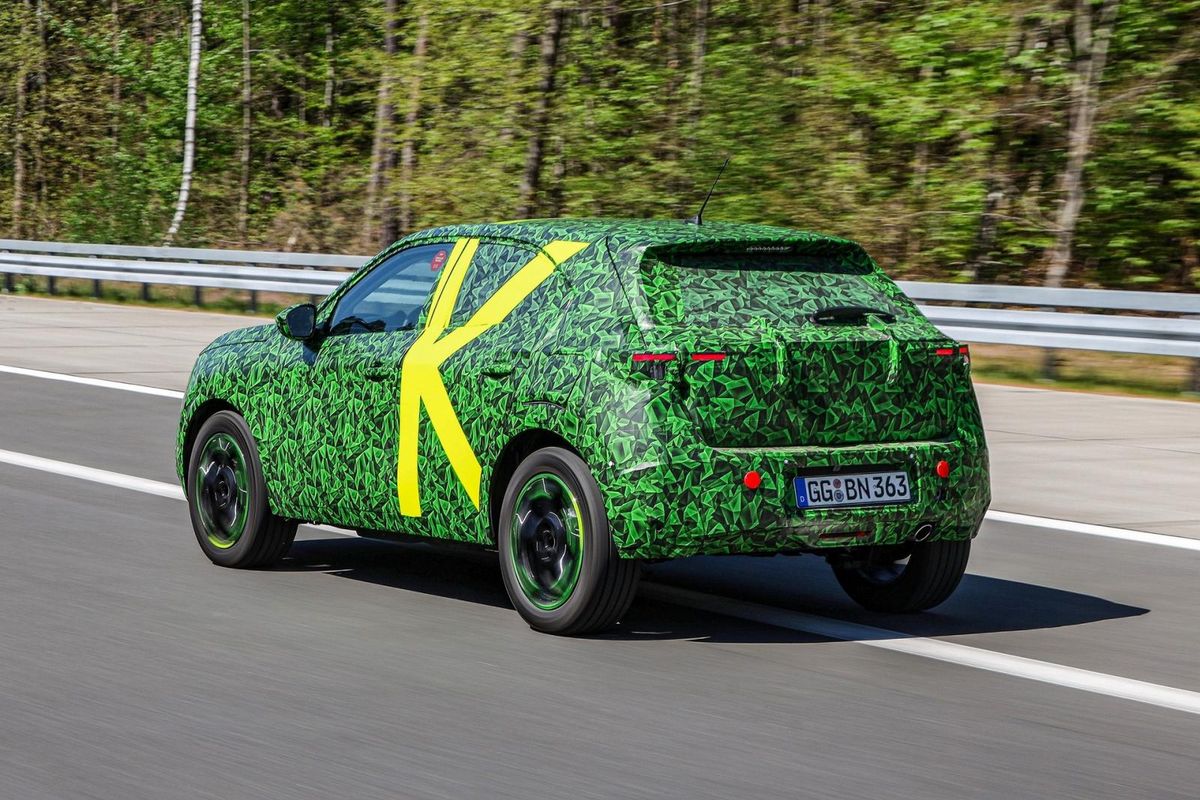
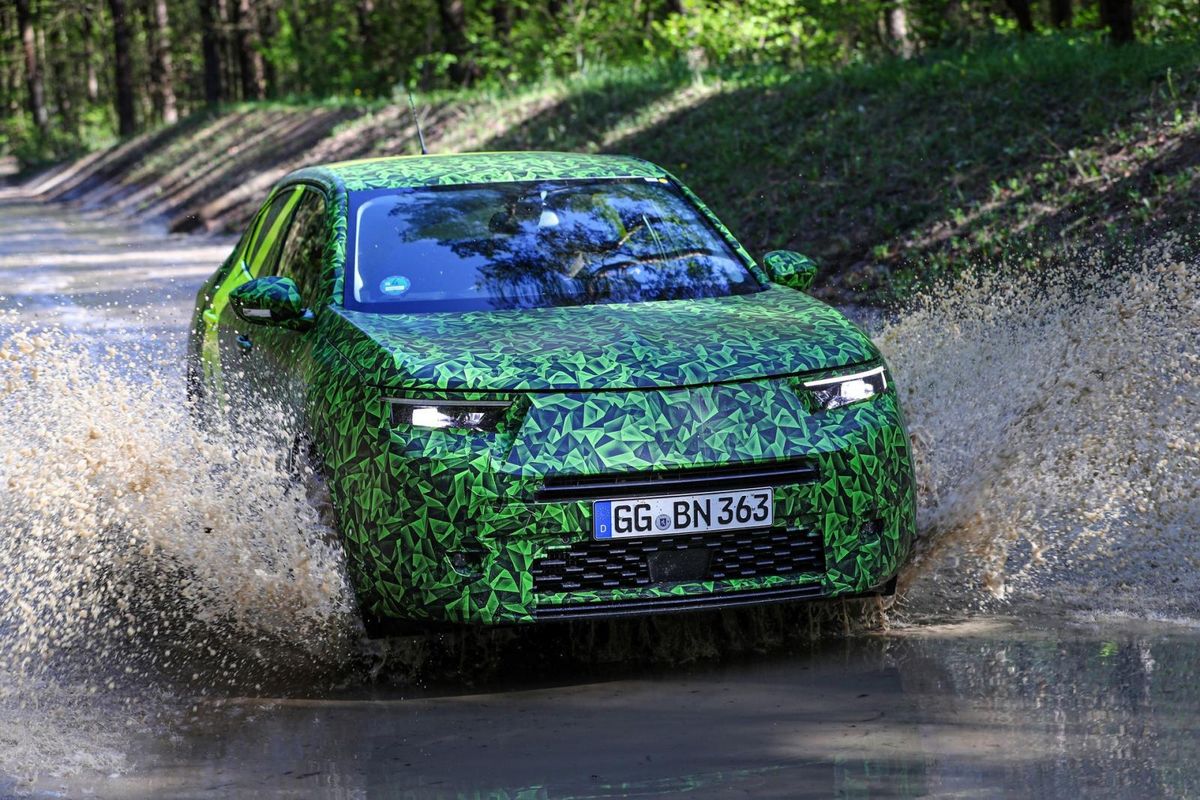
Opel has teased the first images of its all-new Mokka compact SUV. Here's what we know so far.
Opel is now under the ownership of the Peugeot Citroen Group (PSA) so expect some shared technology like platforms and powertrains. Opel is claiming there will be a fully-electric Mokka as well as conventionally-powered units. We suspect the electric Mokka will use the current electric Corsa's powertrain which offers up 100 kW and 260 Nm, and has a range of around 330 km.
Production will begin towards the end of this year, with the first customer cars (including the all-electric model) due to reach showrooms in the first part of 2021. Interestingly, the Mokka is losing its predecessor's Mokka X name and will just be known as Mokka.
‘The new Mokka will change people’s perception of our brand,’ said Stephen Norman, Vauxhall’s Managing Director. ‘Not only does it show that we’re serious about electrification, but also that we’re not afraid to innovate with design, both inside and out of the car. The Mokka is still in its development phase now, but it is set to be one of Vauxhall’s most important models when it arrives with customers at the start of next year.’
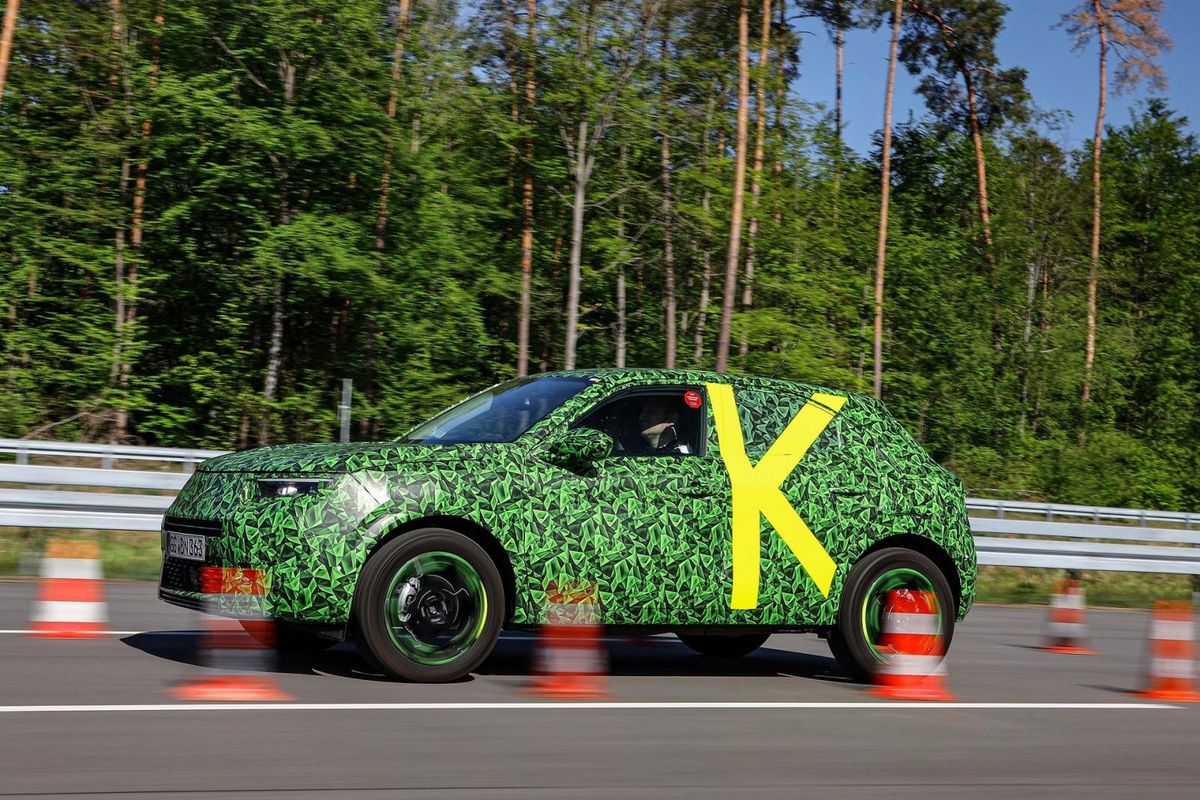
In May 2020, Opel released info on how the new Mokka was put through its paces as engineers refined springs, dampers and steering. There's also a focus on making the Mokka's drive engaging. According to the Opel Mokka project coordinator Karsten Bohle, “The test drives are running like clockwork, also because our new baby, with its low weight and compact external dimensions, reacts well to adjustments. Handling and comfort are super. The Mokka is a joy to drive.”
The new Opel Mokka will ride on the CMP platform, which underpins many Peugeot Citroen group products. Remember Opel is now owned by the French, and given PSA's meteoric rise over the past 18 months, this change of ownership can only mean good things for Opel. There are suggestions the all-new Mokka will be 120 kg lighter than the outgoing model, despite having almost the same wheelbase and tyre size.