The dust has barely settled on the global reveal of the BMW 4-Series and now we have a leak of the all-new BMW M4.
The origins of this photo are not apparent, but seems like it started on Reddit. What you see here is what looks a lot like the all-new BMW M4 in a very nice shade of grey.
The looks are bold and menacing, with that grille dominating proceedings. Also not the flared arches and staunch stance. If you look closely at the grille, you'll see its slightly different to the one of the BMW M440i.
We expect that the S58 3.0-litre twin-turbocharged 6-cylinder of the BMW X3 M and X4 M will be utilised in the next M3. That motor delivers 375 kW and 600 Nm in its Competition spec, but bear in mind that the M Division may want to keep a bit in reserve for hotter versions of the G80.
It's highly-likely the xDrive all-wheel-drive system (like the BMW M5) will make its debut in the all-new BMW M3. This will upset many purists, but there's also news of a potential entry-level "Pure" model which will feature rear-wheel drive and a manual gearbox.
Expect the new BMW M3/M4 to be revealed in September 2020.
Mahindra Pik Up 2.2CRDe S11 4×4 Auto (2020) Review
In an effort to broaden the appeal of its Pik Up double-cab, Mahindra has introduced a pair of 6-speed automatic derivatives to its bakkie range. We take a closer look at the S11 4×4 version to see how well it performs and gauge whether it's worthy of your consideration…
We like: Good overall performance and economy, SUV-like interior, affordability
We don’t like: Some interior ergonomic issues, lack of interior storage spaces
Fast Facts:
Price: R414 999 (June 2020)
Engine: 2.2-litre turbodiesel
Power/Torque: 103 kW/320 Nm
Transmission: 6-speed automatic
Fuel consumption: 8.1 L/100 km (claimed)
Payload capacity: 995 kg
What is it?
The Mahindra Pik Up S11 Automatic now sits at the top of the local Pik Up range.
Earlier this year, Mahindra introduced a new 6-speed speed automatic transmission to its Pik Up bakkie range. According to Mahindra SA chief executive Rajesh Gupta, the move was prompted by “overwhelming demand for an automatic transmission” and the Indian manufacturer will undoubtedly be hoping to build on the impressive growth it achieved in the local market in 2019. Last year, the brand’s total market share grew to about 1%; Mahindra is evidently one of the fastest-growing vehicle brands in Mzansi.
The Pik Up S11 automatic is offered in 4×2 and 4×4 guises and should appeal to buyers looking for value and convenience in the lower end of the double-cab market.
How it performs in terms of…
Exterior styling
The Mahindra's boxy design won't appeal to everyone, but the S11 4×4 Auto is here to work, not win beauty pageants.
If we’re honest, the Mahindra Pik-Up looks a bit ungainly with its overtly boxy design and unusual detailing (such as the awkwardly shaped grille, headlamps, fender vents and rear three-quarter lights), but it's not ugly – you soon get used to it; besides, the Mahindra has a more old-school workhorse appeal, which some people prefer to the look of blingy "lifestyle-oriented" bakkies. The Pik Up S11 is now the range-topper and, as such, it’s differentiated by those aforementioned new-look headlights, grille and bumper.
Like most double-cabs, the Pik Up is a large vehicle. With a ground clearance of 210 mm, it stands quite tall, but the running boards help with ingress to, and egress from, the cabin. However, while most tall vehicles have grab handles conveniently placed on the A-pillars to help the driver and front passenger hoist themselves in, the Pik Up doesn't.
Interior execution and features
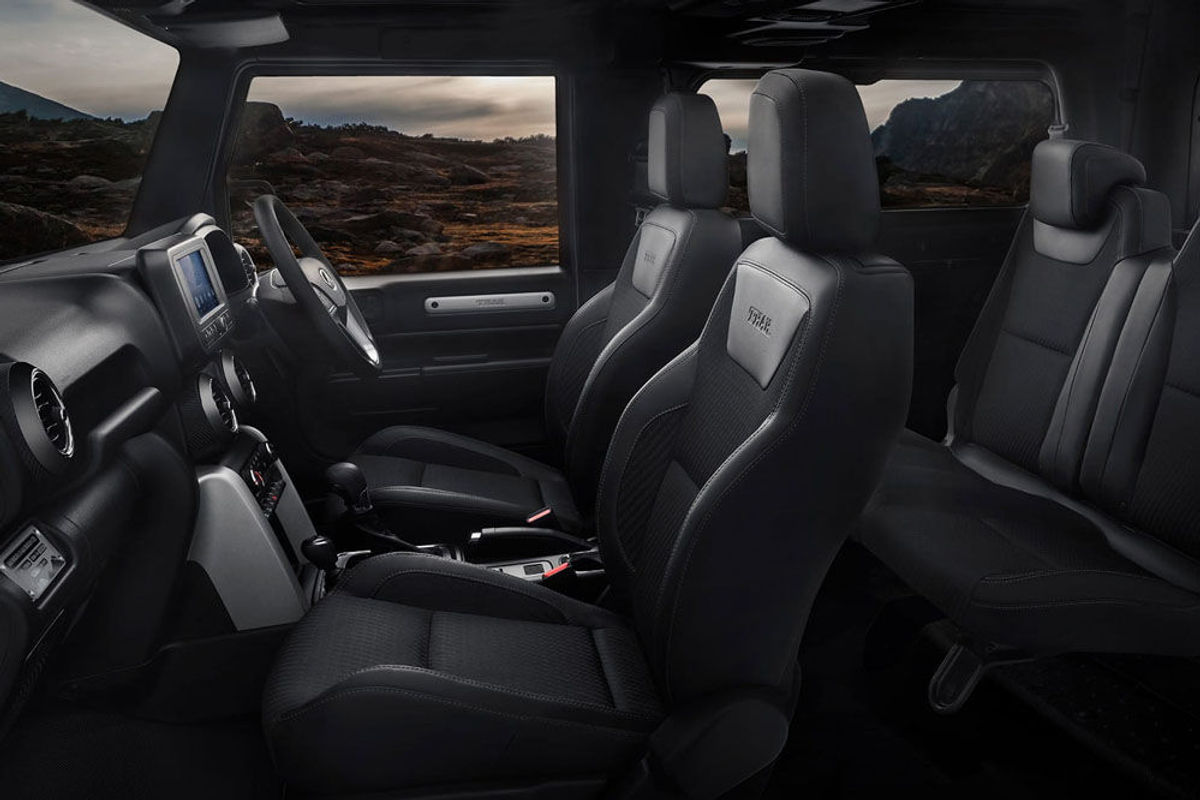
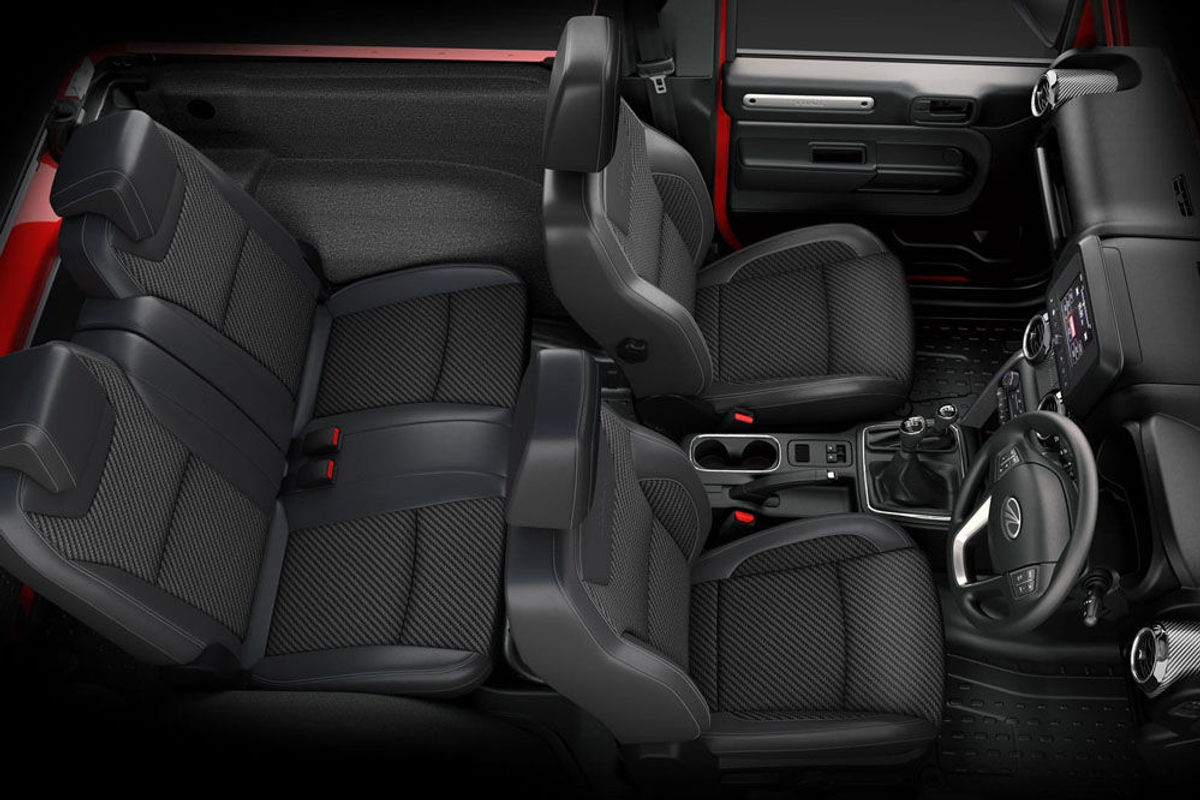
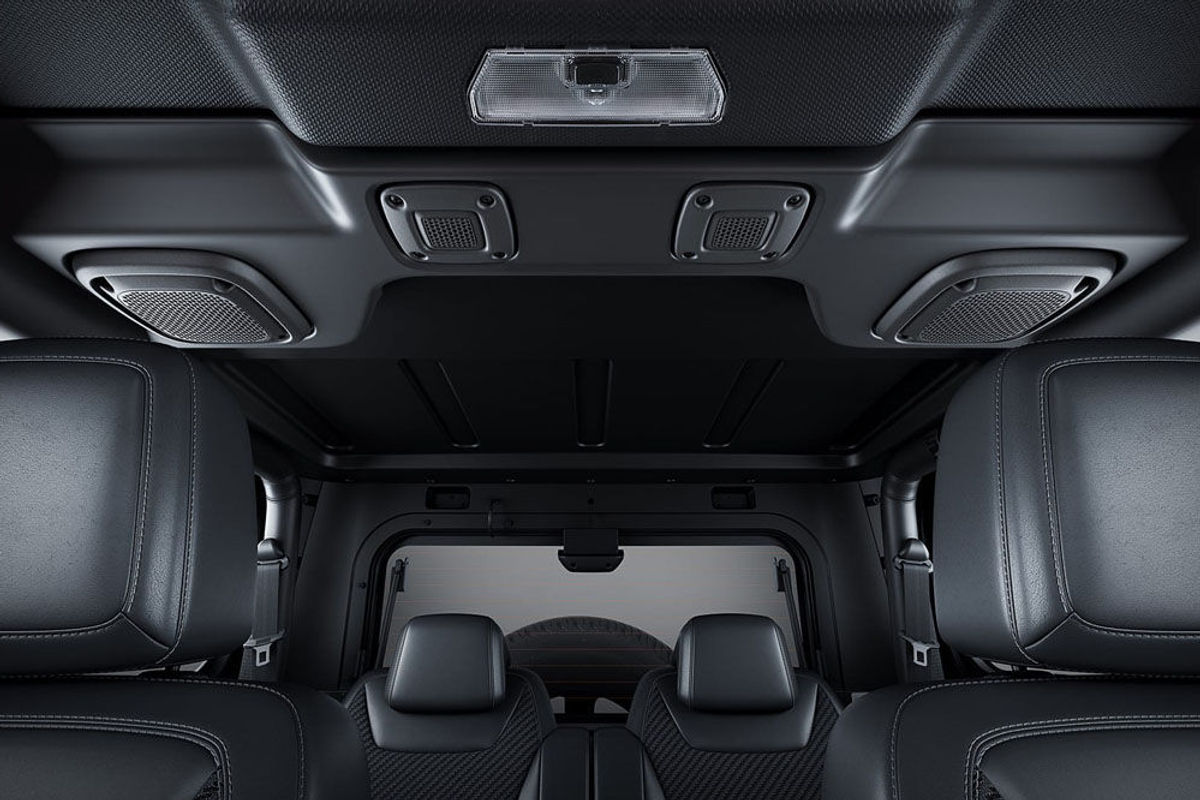
The Pik Up S11's interior is not as workmanlike as you would expect. It's more like an SUV…
The first thing you'll notice when you're ensconced behind the 'wheel of the Mahindra is that you sit quite high – almost as if you are perched atop the driver's seat (rather than sitting in it) – but the view of the road from that vantage point is quite commanding, which shorter drivers will particularly appreciate.
One of the interior highlights is the new 7-inch touchscreen infotainment system, which offers Bluetooth, satnav and, for the first time, the feed from a reverse-view camera. It’s great to have extra rearward visibility on a vehicle of this size, but the camera guidelines are static, so you still need to be vigilant when executing reversing manoeuvres.
Sadly, the infotainment system doesn’t offer Apple CarPlay and Android Auto functionality, but its interface is intuitive; it requires little familiarisation. The touchscreen is positioned relatively low in the fascia, so it has a tendency to draw your eyes from the road (when you're using it on the move). Also, it has a rather annoying jingle at start-up.
The Mahindra's perceived interior build quality is better than we expected – the level of fit and finish feels a little more upmarket than, say, in a comparable Isuzu D-Max, which is admittedly quite dated by now. The Pik Up S11 may look like a workhorse, but its cabin does not feel utilitarian; it’s decidedly SUV-like inside, which we think is a good thing.
Other notable features include a multifunction steering wheel, cruise control, climate control (auto aircon) and front and rear electric windows. It’s worth pointing out there is very little space to store oddments inside the Pik Up, especially if you want to keep personal items out of sight. There are no bottle holders in the front doors or a central storage bin.
To its credit, however, the Mahindra affords rear passengers fair amounts of leg, head and shoulder room; it’s actually quite comfortable to be seated on the backbench.
Performance and Fuel Economy
The Mahindra Pik Up S11 automatic performs surprisingly well.
The tried and tested 2.2-litre M-Hawk turbodiesel engine is a bit noisy at startup (especially from cold, as most bakkie motors are), but it does offer 103 kW and 320 Nm of torque. While it may not be the most refined engine on the market, it does offer decent acceleration when you plant your foot flat. It definitely doesn’t feel sluggish.
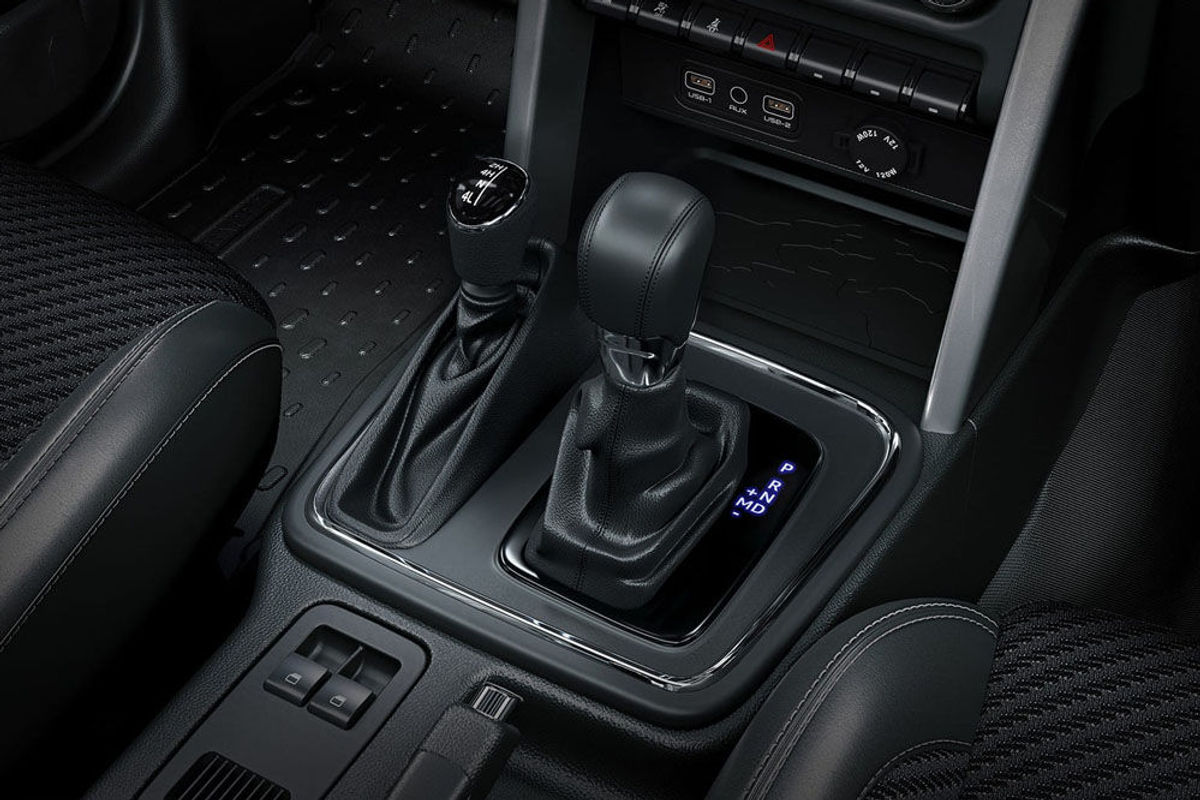
By virtue of its new 6-speed auto 'box, the Pik Up is much easier to drive in congested traffic, where the transmission shifts through its gears relatively smoothly. In terms of fuel efficiency, Mahindra claims an average consumption figure of 8.1 L/100 km and we were quite surprised to see returns of around 9.4 L/100km, which is commendable indeed.
The ride quality can become unsettled over rougher surfaces (especially when the bakkie's unladen), but in general, the Pik Up rides comfortably enough on the daily commute. Our biggest gripe with the S11 4×4 Auto's on-road performance is its gargantuan turning circle; we found it a chore to turn the bakkie around or park it in confined spaces.
The Pik Up S11 does come with a rearview camera but its large turning circle makes it difficult to manoeuvre in tighter spaces.
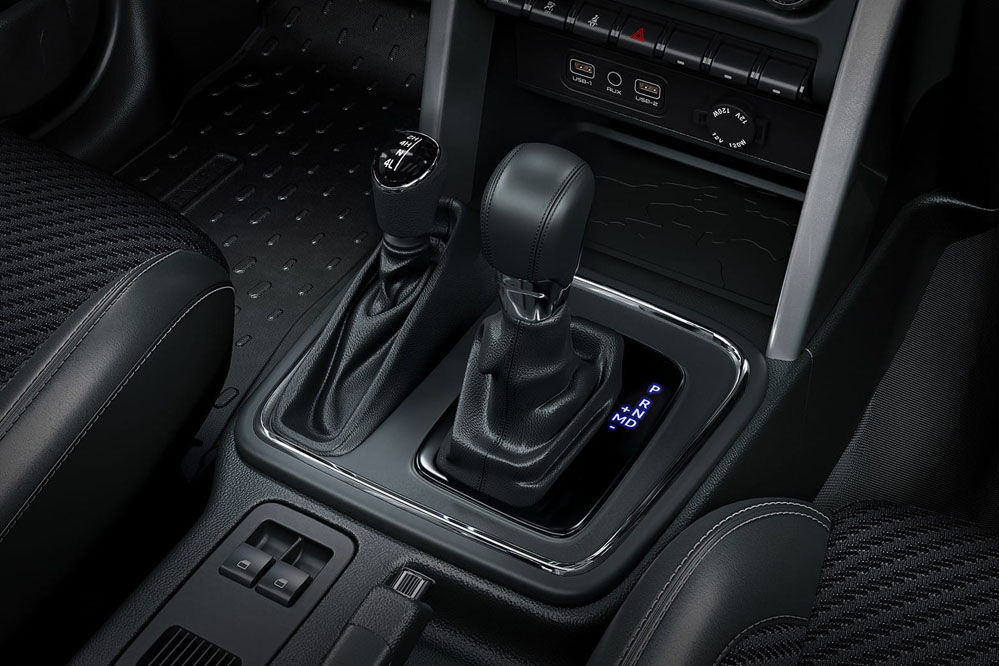
In terms of off-road capability, however, the Pik Up coped well in mild to moderate off-road terrain. A dial in the centre console allows the driver to easily switch between 2H, 4H and 4L. Moreover, when the going gets tough, there's a mechanical differential lock to help you conquer demanding terrain. Hill descent control is also part of the package.
As for the load bay, this 4×4 derivative has a load capacity of 995 kg, which is just about on par with other offerings in this segment, but it is worth noting that the bakkie's tub is deeper – but perhaps not as long – as other double-cabs in the market.
Pricing and warranty
The Mahindra Pik Up 2.2CRDe S11 4×4 Automatic is priced from R414 999 while the 4×2 Automatic derivative retails for R384 999. The Pik Up is sold with a 4-year/120 000km warranty and a 5-year/90 000 km service plan.
Underrated and surprisingly capable, there's more to the Mahindra Pik Up S11 than meets the eye…
This Mahindra Pik Up reminds us not to judge a book by its cover. Its overall performance surprised us: not only does it offer an adequate engine and transmission combination, but it comes quite well-specced as standard. We think it’s quite underrated and deserves a closer look if you are in the market for an affordable automatic double-cab bakkie.
In these cash-strapped times, which has been exacerbated by the ongoing Covid-19 pandemic, an increasing number of buyers will be prioritising value-for-money in their new car purchasing decisions… If you can wrap your head around the Pik Up’s odd looks, you will find a double cab that is attainable, capable and even charming.
Jeep has expanded its Compass portfolio with an updated model with a new engine and new infotainment tech.
The Jeep Compass is what the American brand calls a global model as its assembled in Mexico, Brazil, China and now in Italy. Understandable when you consider that Jeep forms part of the FCA Group. The Melfi plant in Italy has already started the assembly of the 2020 Jeep Compass. The real headline here is the addition of an all-new engine.
Petrolheads will scoff at the idea of a big Jeep like the Compass being powered by such a small motor, but the reality is that almost every brand offers a compact turbocharged powertrain. The 1.3-litre 4-cylinder turbo is available in 2 states of tune, 97 kW and 110 kW. Both models offer 270 Nm. The lesser-powered model is available with a 6-speed manual gearbox, while the more potent offering is available with a 6-speed DCT. Both models are front-wheel driven.
The main benefit of this engine is the economy and efficiency, with Jeep claiming a reduction in the latter by up to 27%. Fuel economy has improved by up to 30% on the WLTP cycle. For those wanting a diesel motor, the 1.6-litre diesel MultiJet II is available with 90 kW and 320 Nm.
There's also electrification in the pipeline, with Jeep offering 4xe models with plug-in hybrid tech. This means an electric motor mated to the 1.3-litre turbo motor and these will come a little later.
Inside, the updated Compass features the latest Uconnect Services infotainment system that was seen in the Renegade. Uconnect Services are divided into several packages. Available as a basic service, My Assistant is activated from plant, and offers emergency services in case of crash, roadside assistance services including the vehicle’s recovery and vehicle health reports. My Car, My Remote, My Navigation (on Uconnect 8.4” navigation only) packages are offered as standard services.
The updated Jeep Compass will be offered in 5 levels of trim, although we'll await final specifications from Jeep SA. Right now, the only model in the portfolio is the top-spec Trailhawk.
Jeep Compass Video
Watch a summary video of the changes to the Jeep Compass below:
2021 Toyota Hilux Invincible X Detailed
After the reveal of the updated Hilux, we were interested in the aggressively-styled model in the media pack. This is the Toyota Hilux Invincible X.
The Toyota Hilux has received quite an update, complete with a new look, new cabin as well as an upgraded engine.
Let's kick off with the engine news, where the 2.8-litre 4-cylinder turbodiesel engine has received a power bump to 150 kW, while peak torque (on the automatic derivative) now sits at a hearty 500 Nm. The best part is Toyota claims that despite the power and torque increase, fuel consumption has improved "by up to 11%". There are also mechanical changes to the suspension.
However, let's take a moment to focus on the looks and aesthetics. This is not your run-of-the-mill Toyota Hilux. Toyota calls this the Hilux Invincible X and its the range-topping double-cab model. It comes with exclusive styling such as the bold grille and front bumper. There's a skid plate, runner boards, wheel arch cladding, and bigger wheels. If you look closely, there's also a unique design on the tailgate. Did we mention there are plenty of Invincible badges everywhere too?
Inside, the Toyota Hilux Invincible X has black metallic and black chrome trim accents, model-specific smart entry key, and dual-tone perforated leather seats.
Toyota South Africa told us: "We will be getting those models, but not immediately. Our timing is quite different to Australia; they don’t source their vehicles from SA. Unique-to-SA derivatives such as the Legend 50 and Dakar bridge the gap and extend the life of our current Hilux offerings." When pushed for a date, it was suggested that Australia would likely receive this facelifted Hilux in August with South Africa's units following "months" later.
The all-new BMW 4-Series was revealed and after looking at the footage and photos, we realised it was all shot right here in our beautiful country. Watch the BMW M440i tackle the famous Franschhoek Pass as well as drive around Cape Town CBD.
It's no secret that South Africa is a top destination for the world's car manufacturers. Not only are our roads spectacular, but the varying conditions give the engineers plenty of insight when developing new models. The roads around Upington in the Northern Cape have regularly been driven by everything, ranging from the popular city cars to the Bugatti Chiron.
But it's the fantastic scenery which helps create beautiful launch footage. Recently Volkswagen showcased its new Golf 8 GTI on our roads as well as on Killarney Raceway, a circuit where we've shot more than a few films. In 2020, BMW used the iconic Franschhoek Pass as well as some urban roads to showcase its new 4-Series coupe and while there's a massive debate raging over the grille, there's no denying its a sleek and pretty coupe.
As a reminder, the new BMW 4-Series coupe will be landing in SA towards the end of 2020 and we'll be getting the 420i, 420d and M440i xDrive models.
Watch the new BMW M440i in action in the Western Cape
Lift-kit for Subaru XV
You can now make your XV into a junior Fortuner.
The Subaru XV is a competent all-wheel-drive crossover, but what if you need more all-terrain capability?
Like all Subarus, the XV has a cleverly engineered all-wheel-drive system, allowing for some mild adventure driving. But the only snag is its ability to get snagged.
Fortunately, an American company has a solution to your desire for that high-riding XV. Crawford Performance has engineered, validated and is now marketing a CDS lift-kit for Subaru’s XV.
It all started as a project Baja off-road racing vehicle, powered by a 223 kW 2.5-litre flat-four, in true Subaru style. What Crawford Performance learned with its Baja project XV, was that Subaru’s crossover could accommodate a more radical suspension set-up.
Beyond the Baja car’s guard rails, skid plates, period blue-and-gold Subaru WRC livery and obligatory front bumper light-bar, the suspension upgrades are most interesting. Crawford performance installed a lift-kit, adding 50 mm of additional obstacle clearance to the XV’s ride height and that kit is now available to Subaru customers.
The Crawford lift-kit has corrosion-resistant aluminium spacers, whilst six strut extensions up front and four at the rear structure its geometry and guarantee the XV’s raised stance.
The true value of this XV lift-kit is in the meticulous nature of its engineering. Crawford Performance’s engineers and technicians have managed to develop a very necessary lift-kit for the XV, which does not disrupt the Subaru factory stability or ABS sensors, brake line routing or sway bar linkage orientation.
For those Subaru XV drivers who fancy the idea of more all-terrain clearance and room in the wheel arches to fit larger profile rubber, this Crawford Performance lift-kit will make a great deal of sense.
This is the updated 2021 Toyota Fortuner, which has undergone a mild update. Here are the changes.
The Toyota Fortuner is one of the most popular vehicles sold in South Africa and has just been refreshed for the 2021 model year. It already boasted pretty good looks so Toyota has given it only the lightest of visual updates. New slim headlights with LED daytime running lights dominate the front, while new-look tail lamps are at the rear. There's a new horizontal grille as well as a redesigned front bumper.
Under the bonnet is an updated version of the 2.8-litre turbocharged diesel motor. It has increased outputs, which now stand at 150 kW and 500 Nm, 20 kW and 50 Nm more than the outgoing model. Toyota says that despite the increase in power, it has managed to improve the fuel economy by more than 17%. With this additional power, the tow-rating has increased to 3 100 kg. Toyota SA said that the tow rating calculation may not be carried over to SA models as it has always done its own tow-rating calculations and will only do so when the vehicles are available locally for homologation purposes.
The 2.4-litre turbodiesel unit will carry over unchanged from the current model.
Inside the 2021 Toyota Fortuner, the cabin has been given a light update. There's a new larger 8-inch infotainment system which sees Apple CarPlay and Android Auto make its debut into this vehicle. There are also some new-look cleaner dials with a 4.2-inch multi-info display between the speedometer and rev counter (it apparently incorporates a digital speed readout).
As for availability, Toyota will be launching its updated Fortuner in Australia in August 2020, which means we think we'll see an SA arrival before the end of the year. We'll update you as soon as we hear.
The cabin of the Fortuner sees the introduction of a larger and more capable infotainment system.
Although its exact date of arrival on the local market has yet to be confirmed, the Toyota Hilux will soon receive a facelift. This is what the next iteration of South Africa's top-selling bakkie looks like and, apart from benefitting from cosmetic and equipment upgrades, the 2.8-litre GD-6 turbodiesel's outputs have been bumped up from 130 kW/420 Nm to 150 kW/500 Nm.
Thanks to images from a product presentation being leaked in April, we've had a good idea of what the updated Hilux would look like – and, earlier this week, Fernando Alonso put a disguised pre-production version of the newcomer through its paces. Toyota Australia has now confirmed that it will start selling the revised bakkie in August, but regarding a possible arrival time in South Africa, Toyota SA recently told us: "We will be getting those models, but not immediately. Our timing is quite different to Australia; they don’t source their vehicles from SA. Unique-to-SA derivatives such as the Legend 50 and Dakar bridge the gap and extend the life of our current Hilux offerings." When pushed for a date, it was suggested that Australia would likely receive this facelifted Hilux in August with South Africa's units following "months" later.
The Hilux's tail lamps are the same shape as before, but they have a revised lighting signature.
Apart from the large trapezoidal grille with thicker crossbars (grille surrounds differ by spec; we assume the high-spec derivatives will feature the contrasting grey finish), the newly-designed headlights are smaller and slimmer and include distinctive LED elements on higher derivatives. Toyota says the revised exterior styling "delivers a tough, robust on-road presence" that is "more in keeping with the global Toyota bakkie/pick-up truck family."
The updated instrument cluster now features a 4.2-inch multi-info display between the speedometer and rev counter (it apparently incorporates a digital speed readout) and higher-spec derivatives will feature an 8-inch touchscreen infotainment system with enhanced voice recognition functionality, as well as Apple CarPlay and Android Auto compatibility. We assume a reverse-view camera and satellite navigation will feature too.
Hilux buyers can look forward to Apple CarPlay and Android Auto compatibility on the revised touchscreen infotainment system.
Toyota engines have, at times, been criticised for offering workmanlike- (as opposed to sparking) performance in the interests of superior reliability. While the other engine's remain unchanged, the range-topping 2.8-litre 4-cylinder turbodiesel engine has, however, been upgraded with "multiple new components (as well as) enhanced cooling", the Japanese firm says.
As a result, the motor's maximum power output has been increased to 150 kW, while peak torque (on the automatic derivative) has been bumped up to hearty 500 Nm. What's more, the motor's fuel consumption is claimed to have been improved "by up to 11%" while "tuned accelerator response delivers greater driver control".
Toyota SA mentioned that the 2.4-litre turbodiesel would remain unchanged in the facelifted version.
The larger, chunkier grille design gives the Hilux a bit of a "US pick-up truck" front-end look.
Meanwhile, the suspension has been revised through the implementation of tweaked shock-absorber tuning, new bushings and an improved leaf-spring design, which is said to improve ride comfort on rough roads when carrying low loads.
In 4×4 derivatives equipped with downhill-assist control, an additional traction control feature reroutes torque to assist grip in 2H mode. Lastly, the braked-trailer towing capacity of automatic 4×4 derivatives has been upgraded to a maximum of 3 500 kg and, on 4×2 variants, all diesel-powered automatic Hiluxes are rated at 2 800 kg (an increase of up to 300 kg). Toyota South Africa does its own, localised tow rating calculations, so whether these increases in tow capabilities will be realised locally will only be seen closer to local launch.
We will update this story when more local information becomes available…
So, the new BMW 4 Series has been revealed and the supersize kidney grille remains a sore point for many. We decided to intervene and try 'fix' the grille once and for all. The questions is, do you prefer our 4 Series grille or do you prefer the look of the new 4 Series grille? This is grille warfare!
BMW’s grille sizes are increasing and larger grilles have now also made it onto the X7 SUV and the 7 Series luxury sedan. Back in September 2019, BMW unveiled the Concept 4 which previewed the new 4 Series Coupe which was finally revealed this week. At the time, Concept 4 opened the floodgates of criticism aimed squarely at the new gigantic gaping grille. The public took to social media and lambasted BMW for creating such an outrageous design for the new 4 Series and many BMW fans were left disappointed.
BMW's design chief, Domagoj Dukec, speaking to Autocar, shed some light on the brand's position regarding the design of the new 4 Series. He stated, “The twin kidney grille is the most prominent design icon we have. It’s the biggest difference we have from any other car out there. We’ve used the kidney in a variety of ways to give our cars a certain presence: the 3 Series has a very horizontal one because it’s a more rational, serious car. A coupe like the 4 Series should express the exotic part of BMW.”
Furthermore, Dukec said, “The criteria for design is to create something unique, something daring, to make a statement. I’m 100 per cent convinced something like this, although it’s polarising in the beginning, is at the heart of BMW and a brand-shaper for us. Our products have to express the special position of BMW. We don’t want to polarise with every product, but the 4 Series is a very expressive car. In two or three years, I’m convinced this will be a really strong product on the road, and people, whether they love it or not, will see it as a car with a certain identity.”
The grille on the new BMW 4 Series remains a sore point for many, but the general sentiment appears to be more positive than before.
In the case of the new 4 Series coupe, BMW had to find a way to distinctly differentiate the 4 Series from the 3 Series sedan and to do this, BMW went for the jugular and ushered in a new grille design that is bold while also dividing opinion. The new grille design is in response to market demand and markets such as China are big fans of the supersize grille.
Strangely though, when the 4 Series Coupe was revealed this week, it was interesting to note how public response to the production version was significantly more positive. Perhaps people are tired of vomiting and have now come to terms with the existence of the new grille. Who knows?
The new BMW 4 Series grille has divided opinion on Facebook. Many people like it, others not so much.
On the topic of social media, Dukec further commented, “In the design business, you can’t listen to social media reactions. It won’t help you. Design is something that is so emotional, and everybody has an opinion and different tastes. There’s no right or wrong in design. When you do something like this 50 per cent of people might love it and 50 per cent will hate it, and that won’t change. Anything you do there will be people who like it and people who don’t – but this is not the criteria."
Much like in the public domain, members of the Cars.co.za team have various opinions about this new grille development and as such, we have decided to intervene and ‘fix’ the grille of the new 4 Series.
We gave our very own rendering wizard, Duwyne Aspeling, the opportunity to rectify the 4 Series' grille in line with what most BMW fans would probably expect (see our fix below).
This exercise has, however, raised the point that if BMW played it safe, the new 4 Series would look too ‘ordinary’ and the brand would be criticised for that too. In that sense, perhaps BMW deserves a bit more credit for 'going' big' instead of just sticking to the norm.
Twitter users also shared their opinions of the new BMW 4 Series.
What side of the fence are you sitting on? Do you prefer our ‘fix’ for the new 4 Series or do you think that BMW has hit the mark with its new grille?
Share your opinions with us in the comments below!
We did BMW a favour and 'fixed' the grille on the new 4 Series. Do you like it?
Volkswagen has released a teaser image of the updated Arteon as well as the Arteon Shooting Brake.
German carmaker Volkswagen will be revealing the updated Arteon on the 24th June 2020, but the big news is the range will be joined by an Arteon Shooting Brake.
Given Europe's love for the station wagon, it should fare rather well in the sales stakes, despite the immense popularity of the SUV.
The updated Volkswagen Arteon will feature substantial revisions both inside and out, with many speculating it'll gain the all-new infotainment system that's been seen in the new Volkswagen Golf 8. In terms of engines, we're expecting largely the same engines as before, the option of all-wheel drive on some models, which should find favour in the colder European markets. There's also a strong rumour of an Arteon R, packing the same engine from the Volkswagen Golf R.
The R version of the Volkswagen Arteon would gain a sportier suspension setup, quad exhausts and as you can see in the photo, blue brakes. We also suspect the engine would be given the full R treatment and like other Volkswagen R products, it would be the 2.0-litre turbocharged 4-cylinder delivering 220 kW and 400 Nm. However, we do know that the next-gen Volkswagen Golf R will get 245 kW, so that could also be an option for the newcomer. Power will continue to go to all 4 wheels via a dual-clutch transmission. Expect 0-100 to be in the late 4-second ballpark.