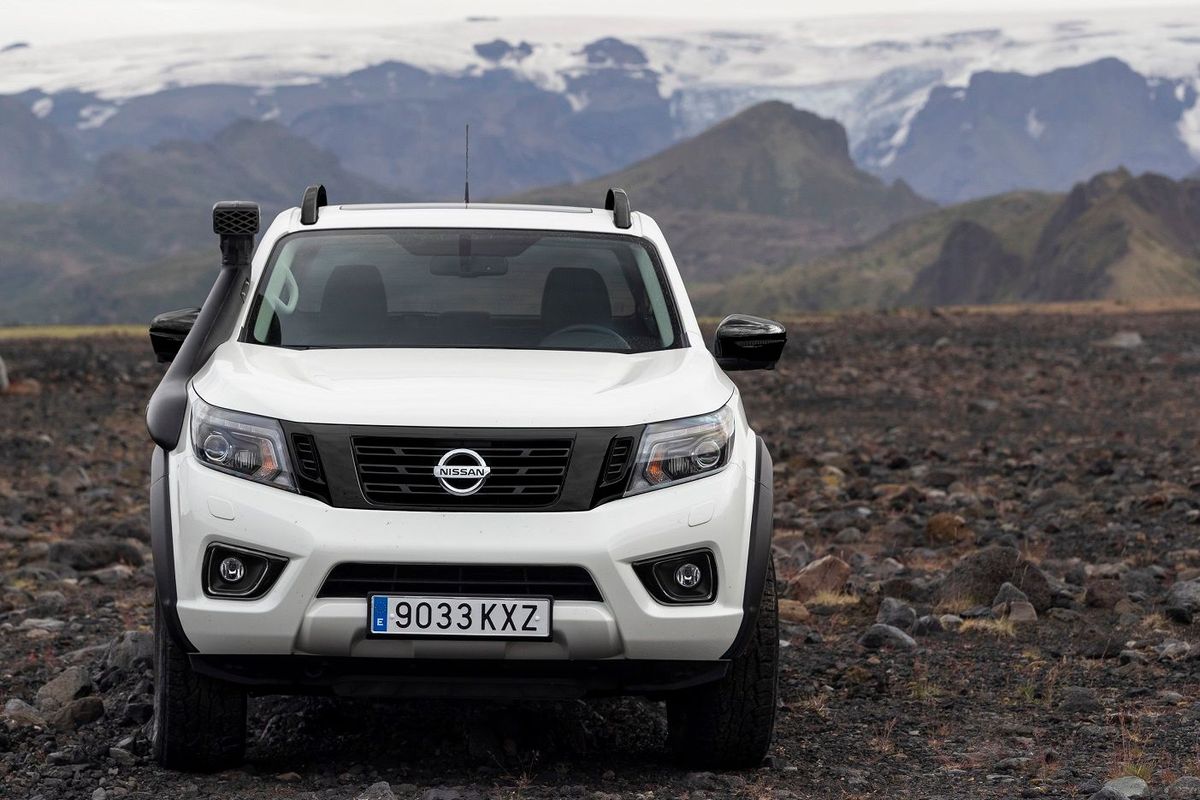
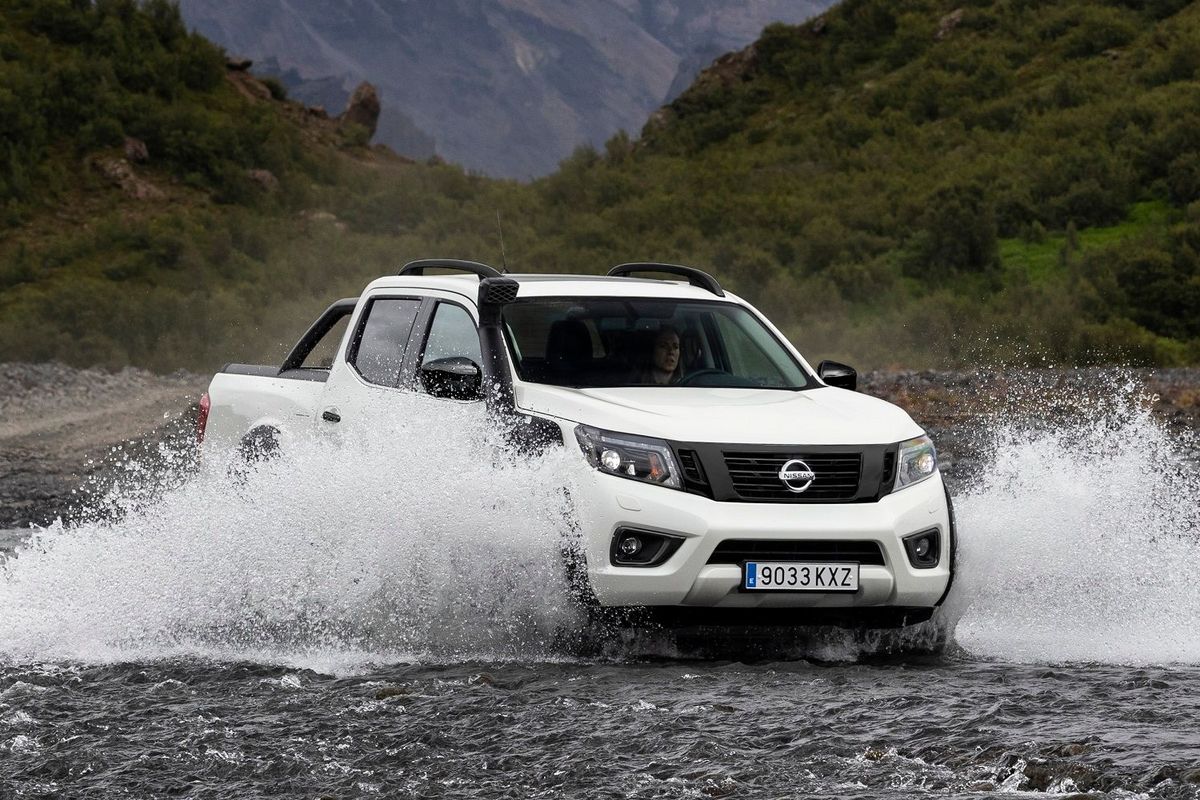
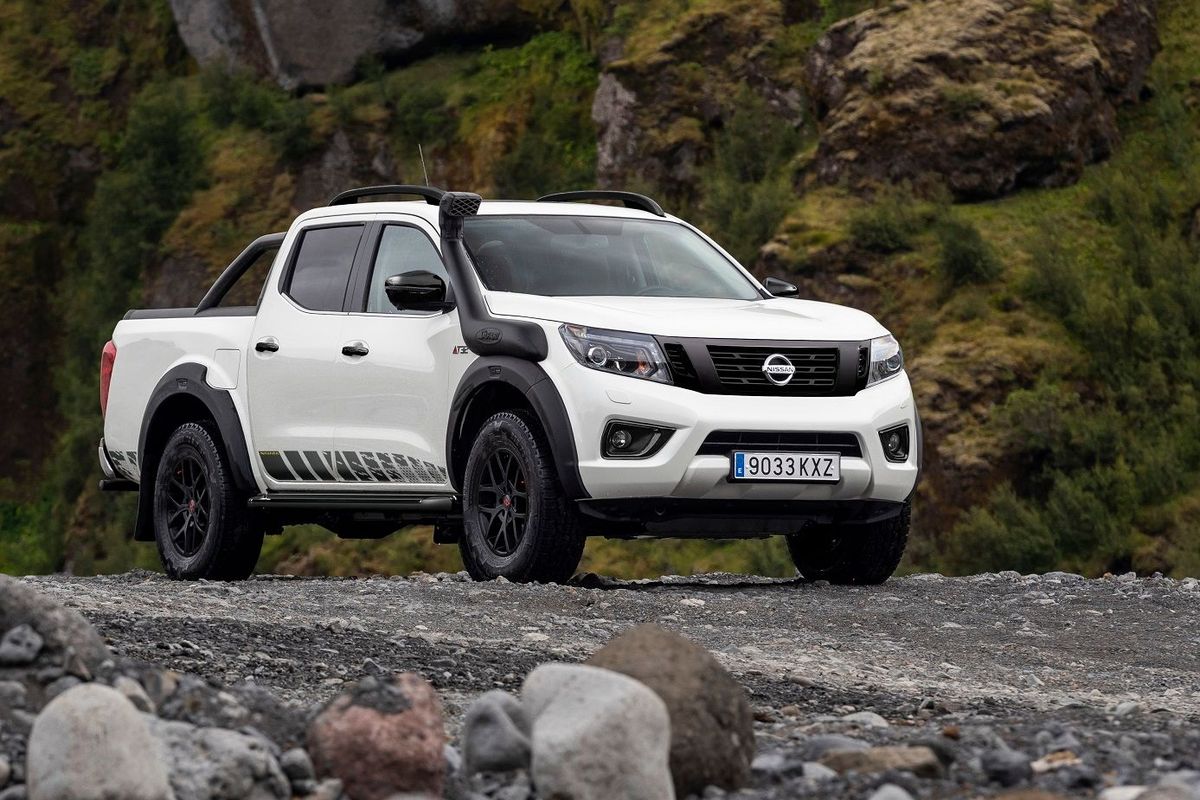
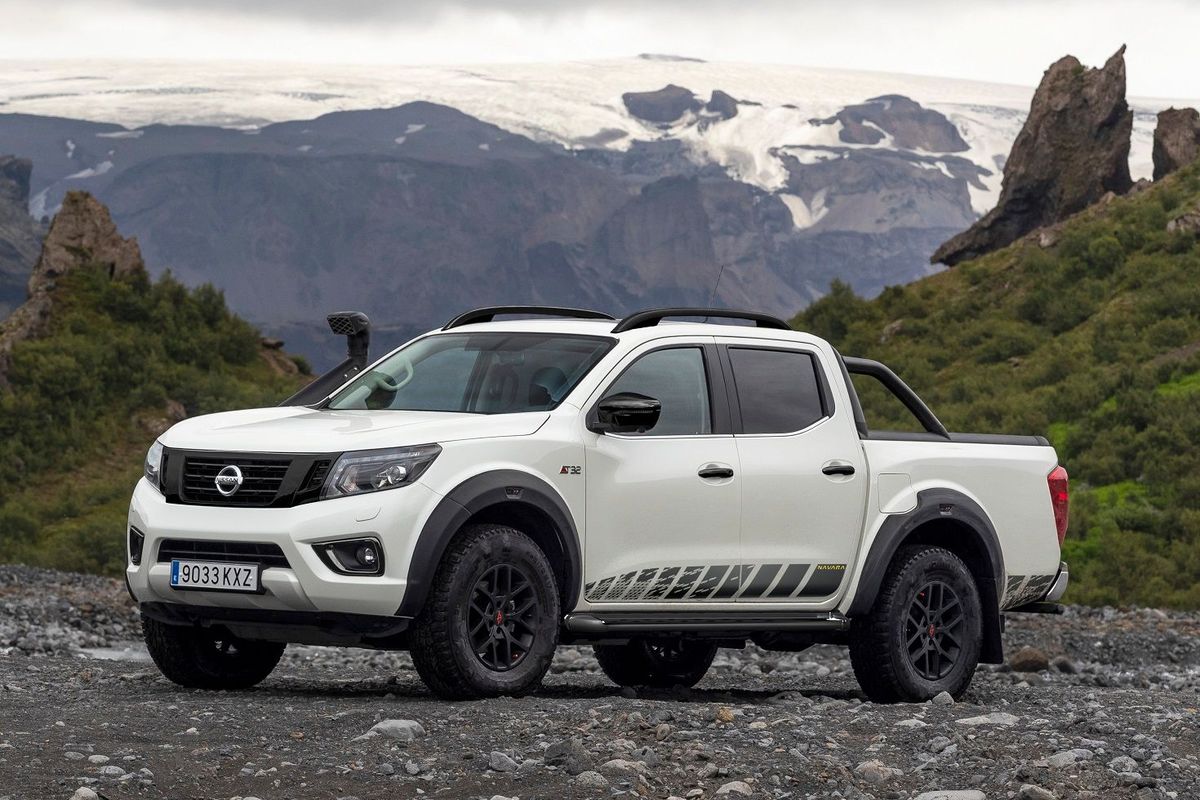
Nissan has taken the wraps off a hardcore 4×4 derivative of the Navara bakkie. Meet the Nissan Navara Off-Roader AT32.
Nissan has teamed up with Arctic Trucks, famous for its Iceland 4×4 bakkies, to build the Navara Off-Roader AT32. There's been extensive work done to the Navara to make it even more capable than before.
The entire underbody is shielded with lightweight aluminium material to protect the vital components. There are also 31-inch Nokian tyres which boast dual valves for quick inflation. These tyres are said to improve the economy and "enhance on-road handling without compromising its off-road ability', which is quite a claim for offroad rubber.
There are also bespoke all-terrain wheel arch extensions as well as all-terrain Bilstein performance suspension. If the chunky bodywork and huge tyres didn't indicate what you're looking at, there's special badge on the front wings, arches, side steps, tail gate and mud guards. For those owners wanting even more from their Nissan Navara Off-Roader AT32, an electronic lock for the front differential and an intake snorkel are available, the latter increases the wading depth to 800 mm.
“The Nissan Navara Off-Roader AT32 was a sell-out success and proved incredibly popular with adventurers seeking elegance and toughness,” said Manuel Burdiel, General Manager Europe, LCV Sales and Business Development. “We have upgraded the Off-Roader AT32 so it can maintain its position as the ultimate Navara while bringing new efficiency and becoming fully WLTP compliant. It’s the perfect blend of in-car technology, comfort and extreme off-road performance.”
The Nissan Navara Off-Roader AT32 goes on sale from February 2020 across Europe. Should it come to South Africa?
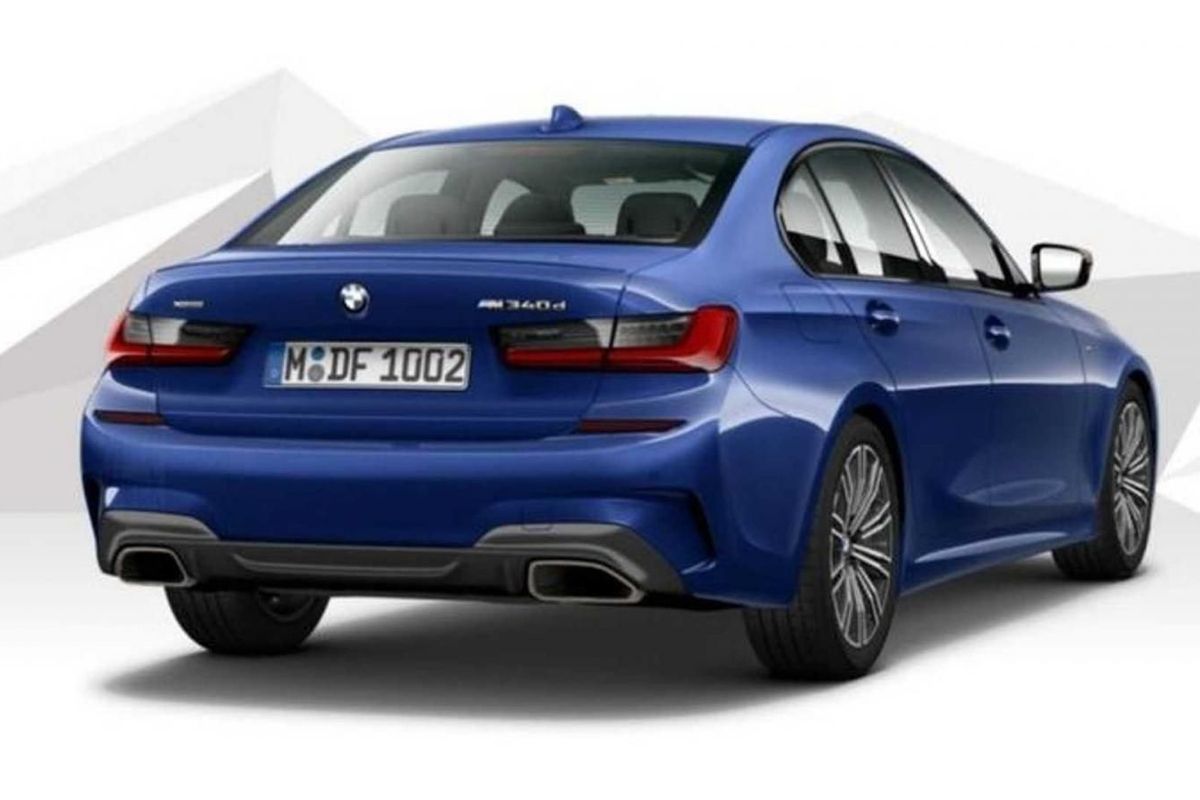
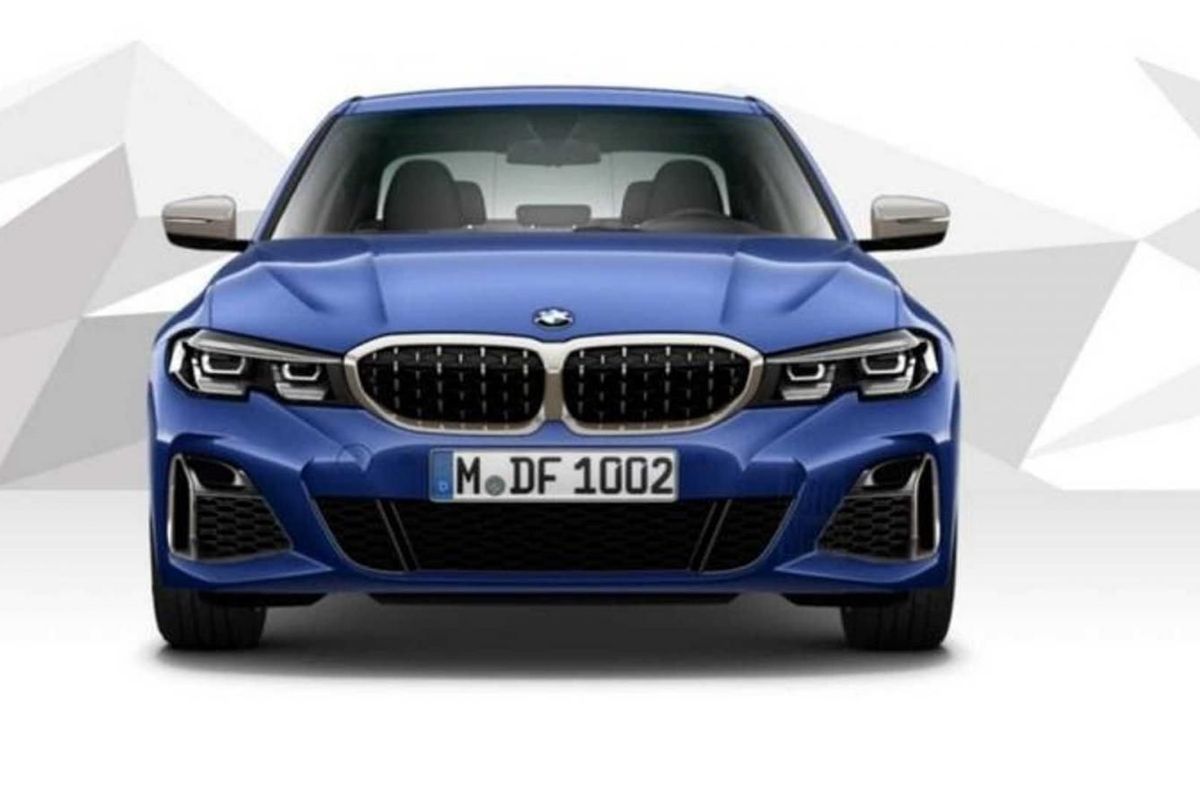
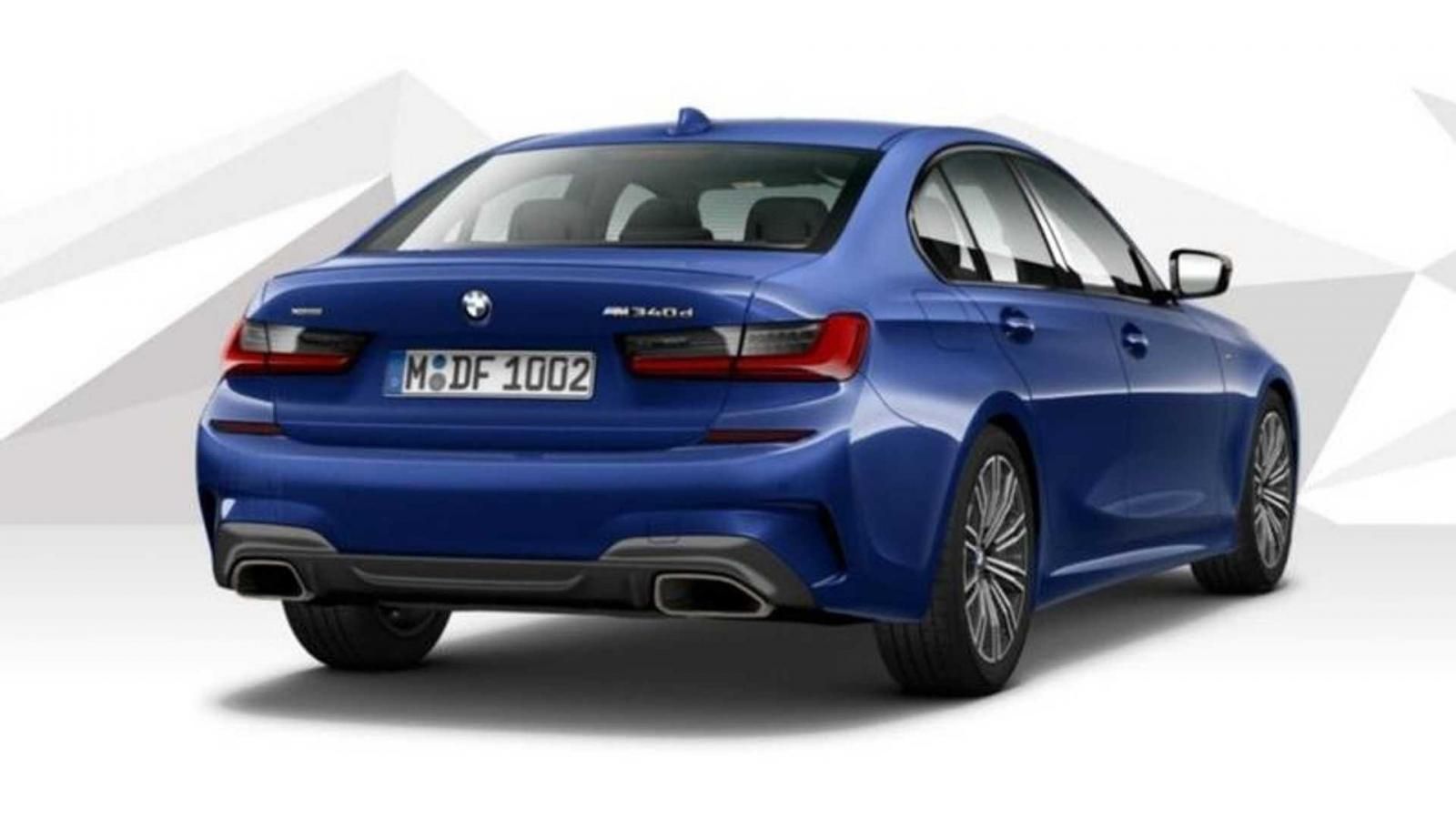
What if you could blend performance with fuel economy? BMW believes you can and the diesel-powered M340d has leaked. Here's what we know so far.
The European market loves performance diesel vehicles and they sell plenty of them across all segments. In South Africa, we've had the Volkswagen Golf GTD which sold very few units, and if we recall correctly, BMW offered its F10 5-Series with the 35d powertrain. With 230 kW and 630 Nm from a turbocharged 3.0-litre 6-cylinder diesel motor, the performance was brisk with a claimed 0-100 of 5.5 seconds, while consuming just 5.4 L/100 km.
Now thanks to Dutch publication Autoweek.nl, we get some juicy details on the new BMW M340d. The newcomer will come with xDrive and in sedan form it'll hit 100 kph in just 4.6 seconds and go onto a limited top speed of 250 kph. We say sedan form as BMW is also offering this model in a Touring/Estate bodystyle.
The engine of choice is the same as the one found in the X3/X4 M40d and is a 3.0-litre turbocharged straight-6 diesel. It packs 240 kW and unlike the SUV duo who have 680 Nm, this M340d has 700 Nm. The consumption claim is very impressive with between 5.3 – 5.7 L/100 km and the new M340d features an engine-off coasting functionality which works at speeds of up to 160 kph.
Right now the most powerful diesel BMW 3 Series in South Africa is the rear-wheel drive 330d, which has 195 kW and 580 Nm from a 3.0-litre straight-6 diesel. It's good for 5.5 seconds to 100 kph and it is claimed to consume 5.5 L/100 km. We should get official details and specifications regarding the BMW M340d xDrive soon.
With big exhausts and subtle M340d badging, this is a bit of a stealth weapon.
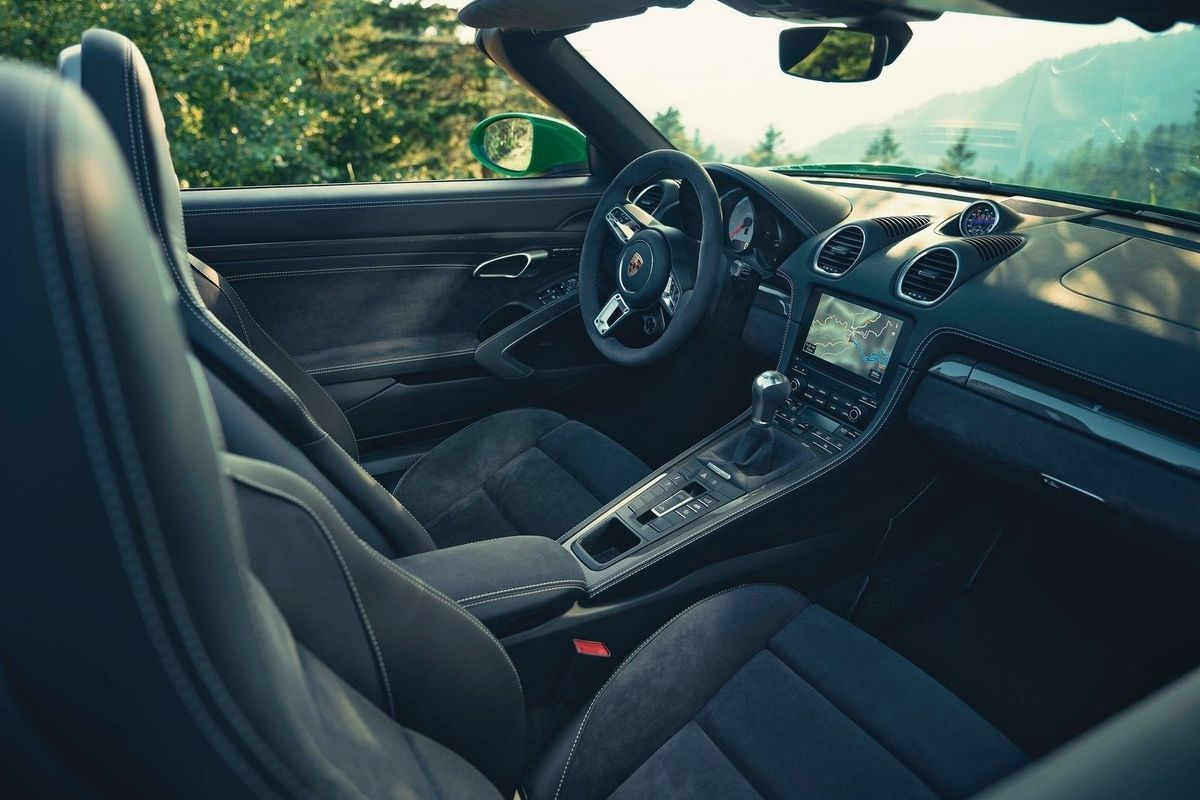
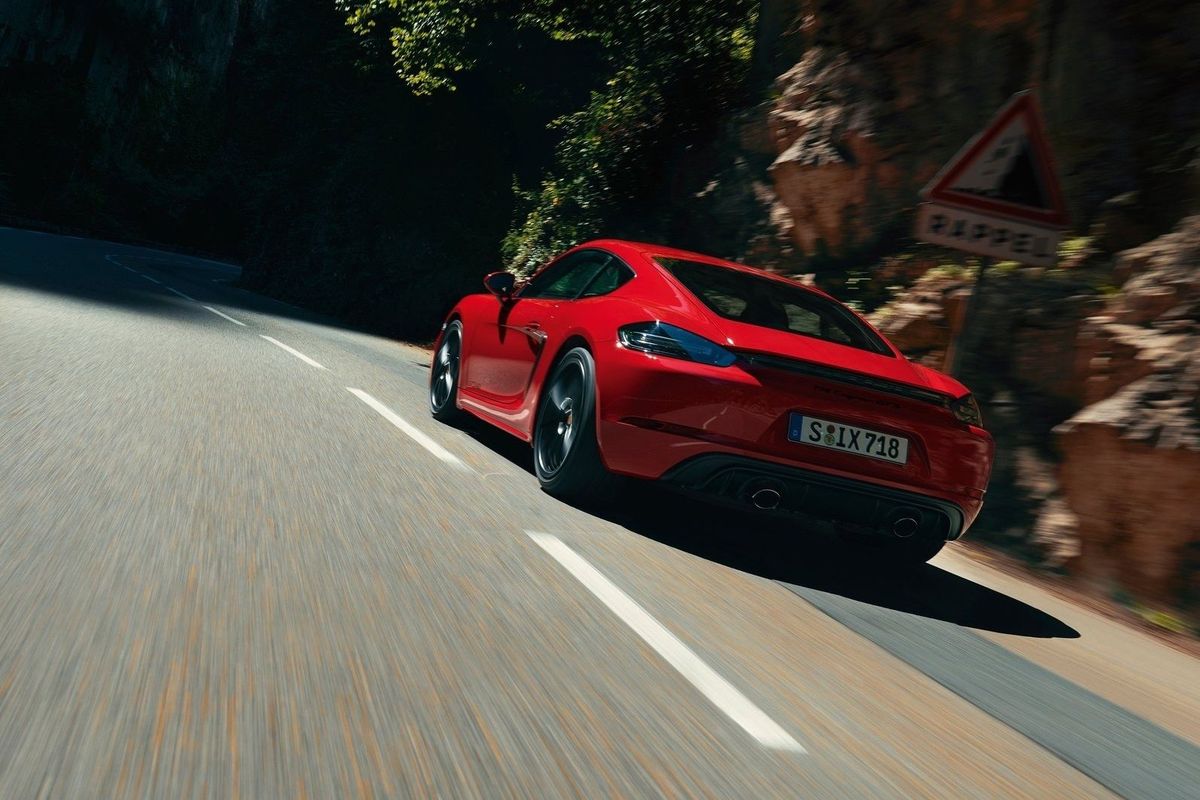
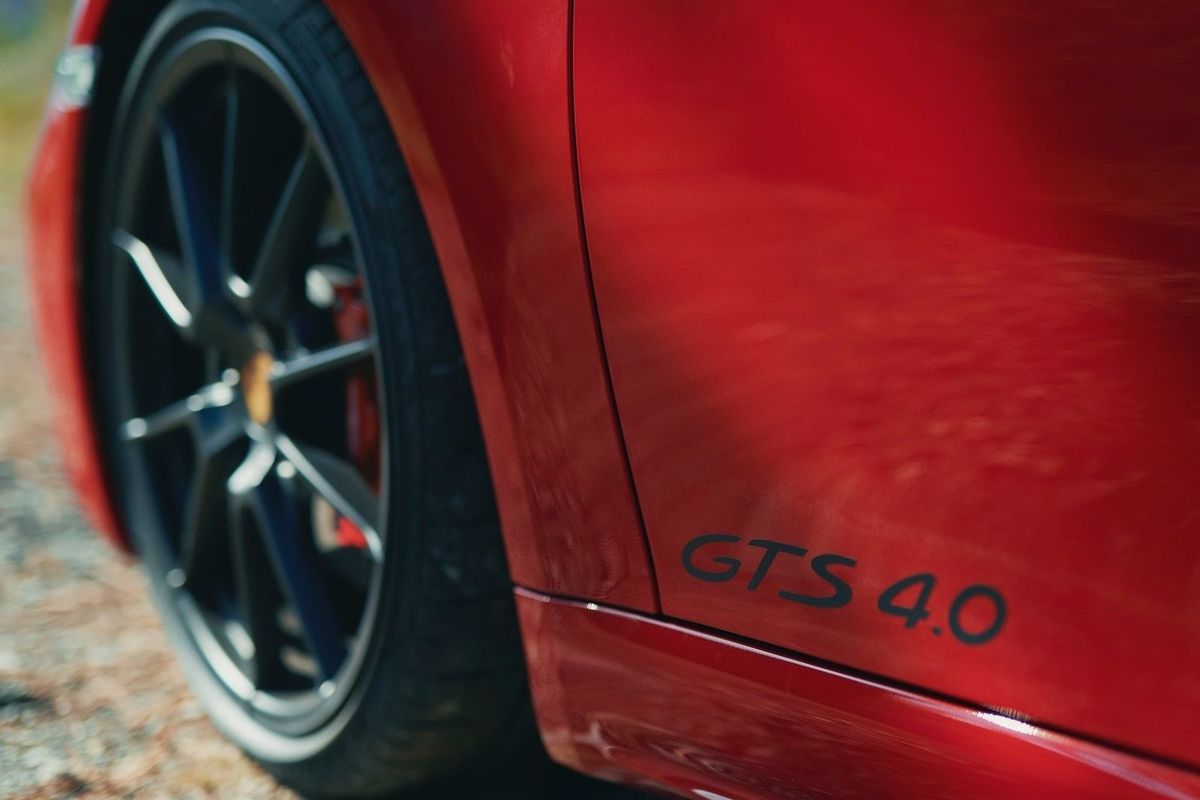
Porsche GTS 4.0 Motor for Boxster & Cayman (Updated)
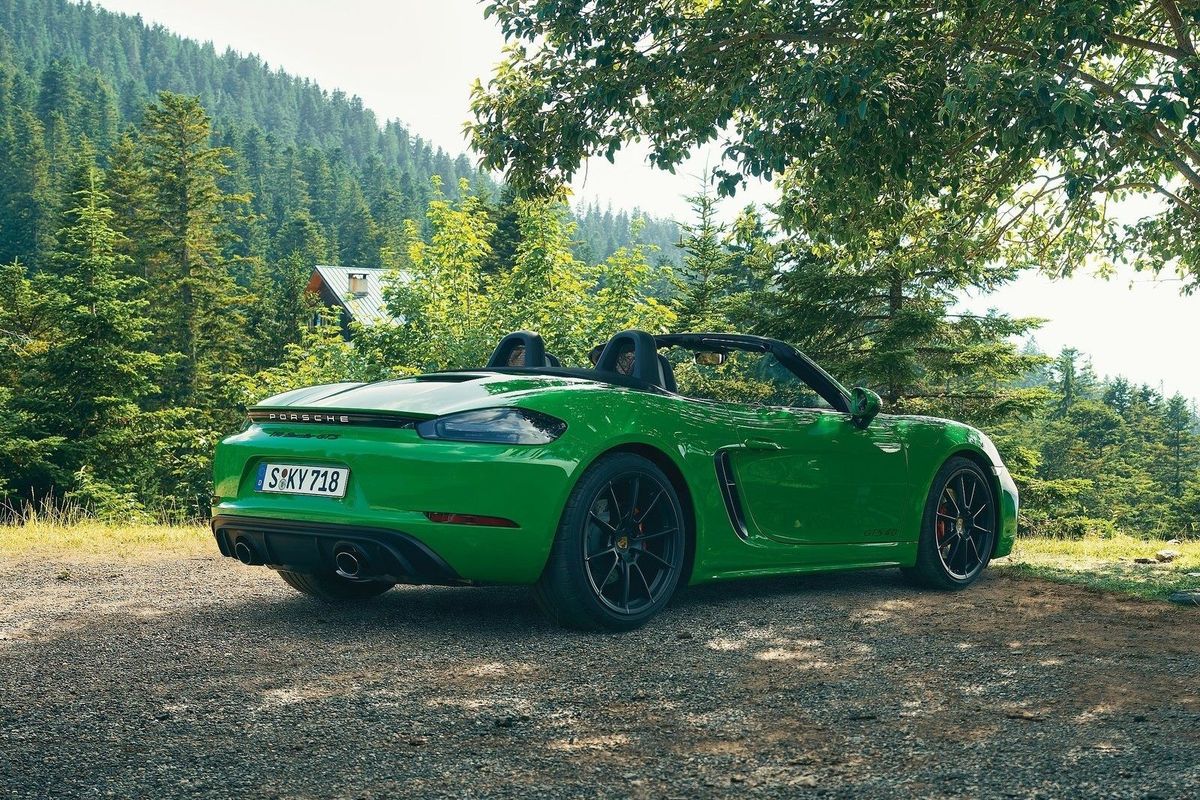
In an apparent snub to downsizing, Porsche will fit its 718 Cayman GTS and 718 Boxster GTS derivatives with a 294 kW naturally aspirated flat-6 engine instead of the current 2.5-litre turbo flat-4. What's more, these 4.0 versions will initially be offered with 6-speed manual 'boxes only, which will thrill sportscar aficionados no end…
Although it's understood that turbocharged Boxster GTS and Cayman GTS derivatives will be sold concurrently with the 4.0s, Porsche will ultimately drop its 2.5-litre flat-4 boxer turbo engine (in GTS versions) in favour of this – a detuned Cayman GT4 4.0-litre flat-6 mill – at the end of the year, when a 7-speed dual-clutch (PDK) transmission may be offered too. To be fair, the 4-cylinder engine wasn't the most popular in the Porsche community, a group of enthusiasts who live for the wail of a flat-6 motor.
Compared with the current 269 kW/430 Nm 2.5-litre turbopetrol, the new 4.0-litre flat-6 boxer motor produces 294 kW and 419 Nm and it'll hit 100 kph from zero in 4.5 seconds and romp onto a top speed of 294 kph. The combination of a free-revving motor and snappy 6-on-the-floor, the Boxster- and Cayman GTS 4.0 should be exhilarating to drive.
Both the Boxster- and Cayman GTS 4.0 feature minor cosmetic detail upgrades and come equipped with 20-inch alloys, Porsche Active Suspension Management (PASM) sports suspension, along with a 20-millimetre lower ride height, and Porsche Torque Vectoring (PTV) with mechanical limited-slip rear differential as standard. Sport Chrono package (with upgraded Porsche Track Precision App) is also fitted, but a sports exhaust and carbon-ceramic composite braking system will be extra-cost options.
Porsche says its new derivatives will reach German dealerships from the end of March 2020; South African pricing is listed below.
718 GTS Pricing in South Africa (January 2020)
The below pricing includes a 5-year Driveplan. A 3-year Driveplan is also available.
As traditional luxury brands diversify their product line-ups in pursuit of ultimate sales volumes, can they still claim to be "premium" manufacturers, at least in the true sense of the word?
The one constant with anything expensive is that it must also be rare; in other words, demand for it must comfortably outstrip supply. There is absolutely no pricing power in abundance: premium watches are perhaps the best example…
Traditional European luxury-car companies base much of their price justification on the promise of their products being of a premium standard, and therefore, justifiably expensive. But, what is premium really? And, can you apply the notion of premium to a brand whose products have become more easily attainable?
At the start of every year, there is excitement about new-model launches and special-edition surprises, but we also look forward to seeing who sold what (and how much of it) the year before. After unpacking the 2019 new vehicle sales statistics, you may want to reconsider which manufacturers are the true premium car brands…
What is true premium?
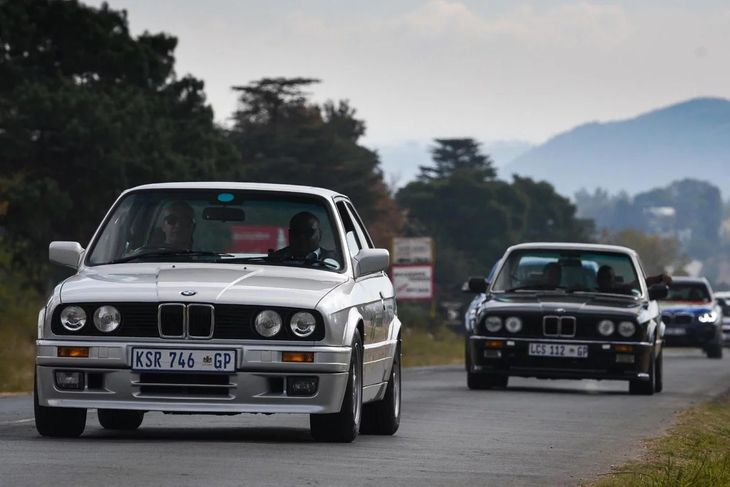
For a long time in SA, BMWs were considered exclusive, premium cars.
For the past two decades, every German brand that claims to be premium has massively expanded its portfolio. With access to scalable platforms and unrivalled engine technology, German automotive companies have been able to bring niche products to market where all others have failed. But surely there is a huge risk with such a strategy: the dilution of that premium billing, due to more affordable pricing. The logical question is: how can a brand be premium if an increasing percentage of its sales volume comes from the lower end of that brand’s price structure?
An excellent example of a luxury brand that is undoubtedly premium, but perhaps risking too many sales, is Bentley. Volkswagen AG chief executive officer, Herbert Diess, was recently quoted as saying that Bentley’s 2019 model-year sales volume (of 10 000 vehicles) is not really what he wants. Amazingly, he would prefer half that volume, with greater profitability per unit sold.
When we consider traditional German luxury car brand rivals, Mercedes-Benz and BMW, their growing sales numbers have potentially become a real issue.
The problem with being premium and popular
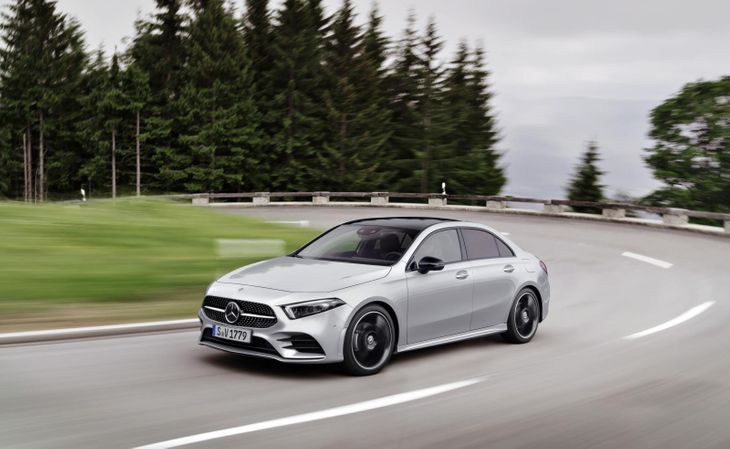
A quarter of Benz's sales now sit in compact cars, a step down from the C-Class the brand built its reputation on.
Mercedes-Benz and BMW are fierce rivals, and the competition between them has given customers an array of strange and wonderful new vehicle segments and fantastically advanced turbocharged petrol and diesel engines.
Product strategists at Mercedes and BMW can rightfully show that they have successfully broadened their larger luxury vehicle offering with an expansion of SUVs and crossovers. This is true, but the traditional luxury sedan/coupe business has suffered as a result…
There is no rule that says that having luxury SUVs in your product line-up precludes you from being a true premium brand. The Range Rover and Land Rover Discovery were instrumental in promoting once utilitarian off-roader firm Land Rover to the status of premium adventure vehicle brand, one with true luxury and image appeal.
Where the doubt starts building around Mercedes-Benz and BMW’s absolute claims to being completely premium brands, are their sales volumes. Both companies claimed 2019 unit sales of more than 2 million and there is no way that you can claim scarcity and premium product value at those volumes.
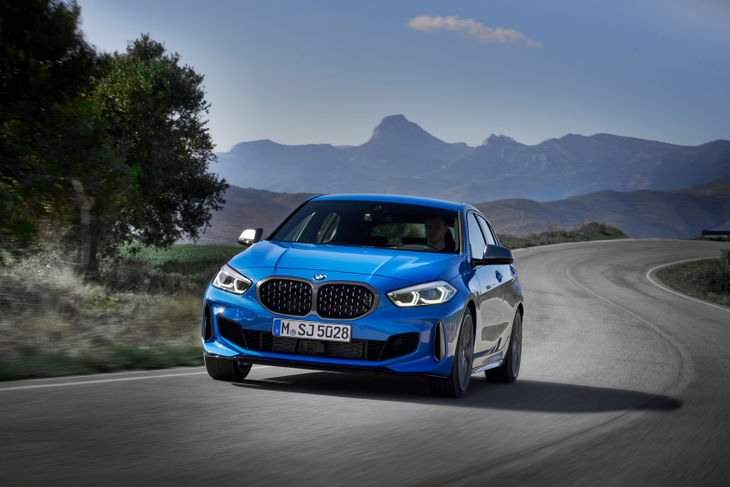
BMW now has front-driven products in its lineup. Something never dreamed of 10 years ago.
If you unpack the numbers in terms of units sold per model range, it is even more problematic. Mercedes-Benz makes no secret of the fact that of its record 2 339 562 units delivered in 2019, 25% were compact vehicles (cars built on the A-Class chassis). That is an amazing reality for a brand that has always been associated with large luxury cars and (for many people) still is, to this day.
Before Mercedes-Benz started its compact vehicle strategy back in the late 1990s, the company’s baseline option was the C-Class. Yet in 2019, a quarter of Mercedes-Benz’s business was below its traditional C-Class product hierarchy.
More cars and less money in the bank
The issue is that despite selling more cars than ever in 2019, Mercedes-Benz’s profits collapsed by half. And that is a problem: when you are moving more products, but making a lot less money by doing so.
BMW ended 2019 just short of its Stuttgart-based archrival, with 2 168 516 vehicles. Again, a significant volume of these were units from below the company’s historic product baseline, which, for decades, was the 3 Series.
We don’t have the benefit of detailed sales statics for Mercedes-Benz in South Africa (it only delivers a total sales number), but BMW does release its individual model numbers. If we take July 2019, which is halfway through the year and provides quite a settled demand sampling, BMW sold 1 112 cars, of which 19% were smaller than the 3 Series. And that percentage excludes Mini.
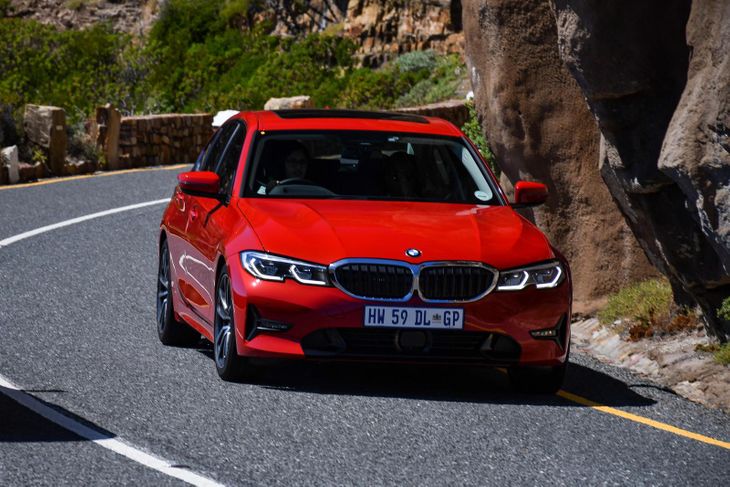
The new 3 Series hasn't been the smash hit that previous generations have been.
That means BMW’s business, if you included Mini, is now also more than a quarter compact vehicles. And those would never have been considered premium in a traditional BMW portfolio in which the 3 Series was the entry-level range and front-wheel-drive BMWs with transverse engines (like the 1 Series) were unheard of.
We might not have the local Mercedes-Benz model breakdown, but if the same comparative sampling is applied for July 2019, total local sales were 945 units for the Three-pointed Star. And those numbers are trading off the largest Mercedes-Benz product portfolio yet.
Mercedes-Benz CEO, Ola Källenius, has admitted that every 4th Benz sold in 2019 was a compact vehicle. And that means the world’s original premium car company now trades 25% of its business in cars that it would never have imagined putting a Three-pointed Star emblem on 3 decades ago.
Does Toyota quality as real premium?
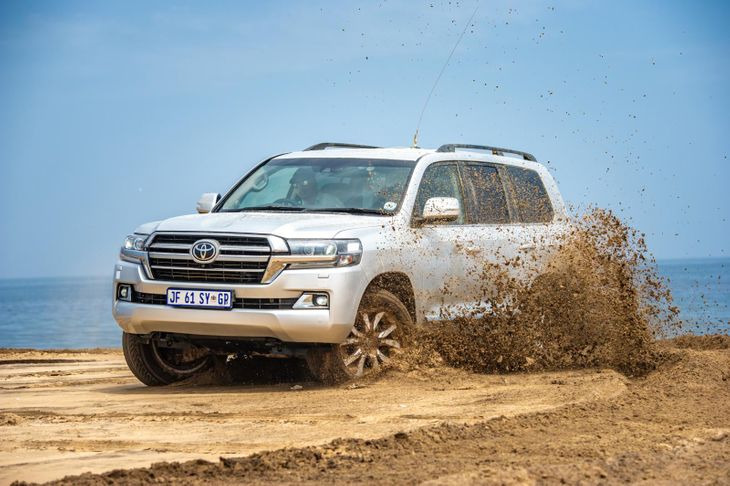
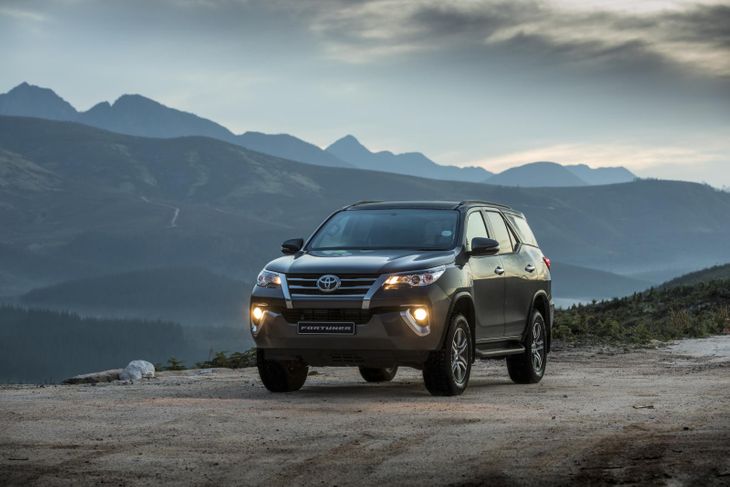
Toyota SA is able to consistently outsell 'premium' manufacturers in the medium/large SUV segment.
Perhaps the biggest counter-argument against traditional German brands that claim to be "premium", despite having a broader spread of product than ever before, is Toyota.
The pricing departure point for Mercedes-Benz and BMW in South Africa, if we dismiss Smart and Mini, is about R499 000 for the most affordable A-Class and R485 000 for the entry-level 1 Series. At any road-going production specification, one could round those prices to R500 000.
If you look at Toyota’s South African product and the demand numbers for vehicles that are priced beyond R500 000, it makes for a very uncomfortable comparison. In July 2019, our sample month, Toyota sold a lot of vehicles within the pricing bandwidth of Mercedes and BMW.
Fortuner pricing starts at R500 000 and Toyota sold 810 of those. The Land Cruiser 200 is priced well beyond R1 million and Toyota moved a solid 79 of them. The Prado is also effectively a R1-million SUV and Toyota retailed 90 of its junior Land Cruisers in our July 2019 sample month. All the remaining Land Cruisers (FJ and 70 Series), combined for a total of 281 – and you could not buy any of those for less than R500 000.
In terms of pure medium- to large SUVs and Land Cruisers (priced beyond R500 000), Toyota averages more volume than BMW or Mercedes-Benz’s entire South African business. That is without Supra, all the double-cab Hilux bakkies (few of which are under R500 000), Quantums (also touching R500 000) or even considering anything from Lexus. Just the RAV4 attained 584 units in July 2019 and if you buy a decent one, it is a R500 000 vehicle.
Above R500k, the Fortuner is SA's number one selling SUV.
What those numbers tell us is that a significant number of South Africans are willing to spend so-called premium segment money on… Toyotas. As traditional premium brands have expanded their product portfolios to capture younger customers with more affordable models, they have also unwittingly diluted the exclusivity of their brands. And, they've begun competing with traditional volume carmakers, such as Toyota, which was unimaginable a few decades ago.
In the mid-1990s, South Africa’s default image-conscious family car was a 3 Series or C-Class. The Camry could not compete with them. In 2020, it is inarguably a Fortuner, which is priced in direct competition to a 3 Series or C-Class.
If Toyota is selling a lot more vehicles in the same price bracket as Mercedes-Benz and BMW, what does that do to claims of those 2 brands being "premium"?
The Automobile Association (AA) of SA was commenting on unaudited mid-month fuel price data released by the Central Energy Fund and released some predictions.
At this stage, it looks like unleaded 95 will drop by 8 cents per litre in February 2020, but unleaded 93's price will increase by 1 cent a litre. For the diesel vehicles, there will be a 13 cent a litre increase.
"International oil prices surged by nearly two dollars a gallon in late December 2019 before beginning a recovery which was halted by the recent tensions between the USA and Iran" the AA says. "In the first week of January 2020, the two-dollar mark was tested again, albeit with a slight recovery since." Fingers crossed the Rand can remain stable to prevent future increases.
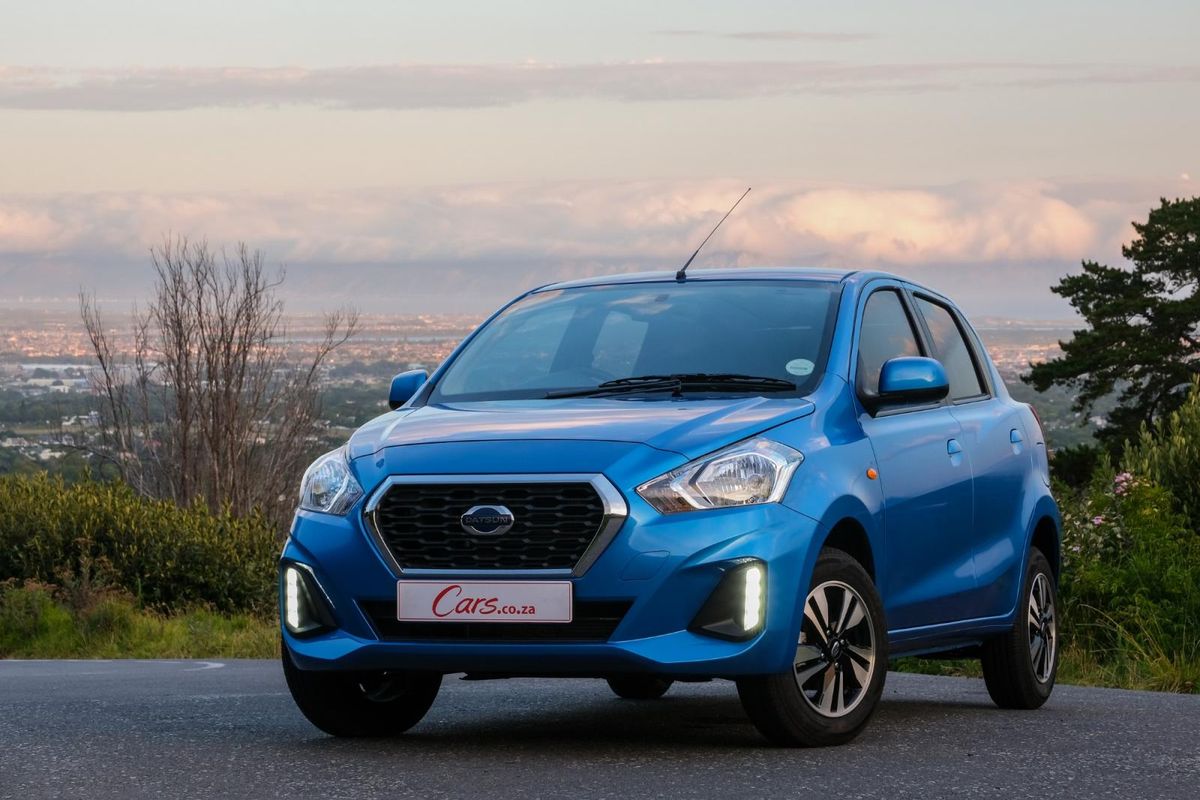
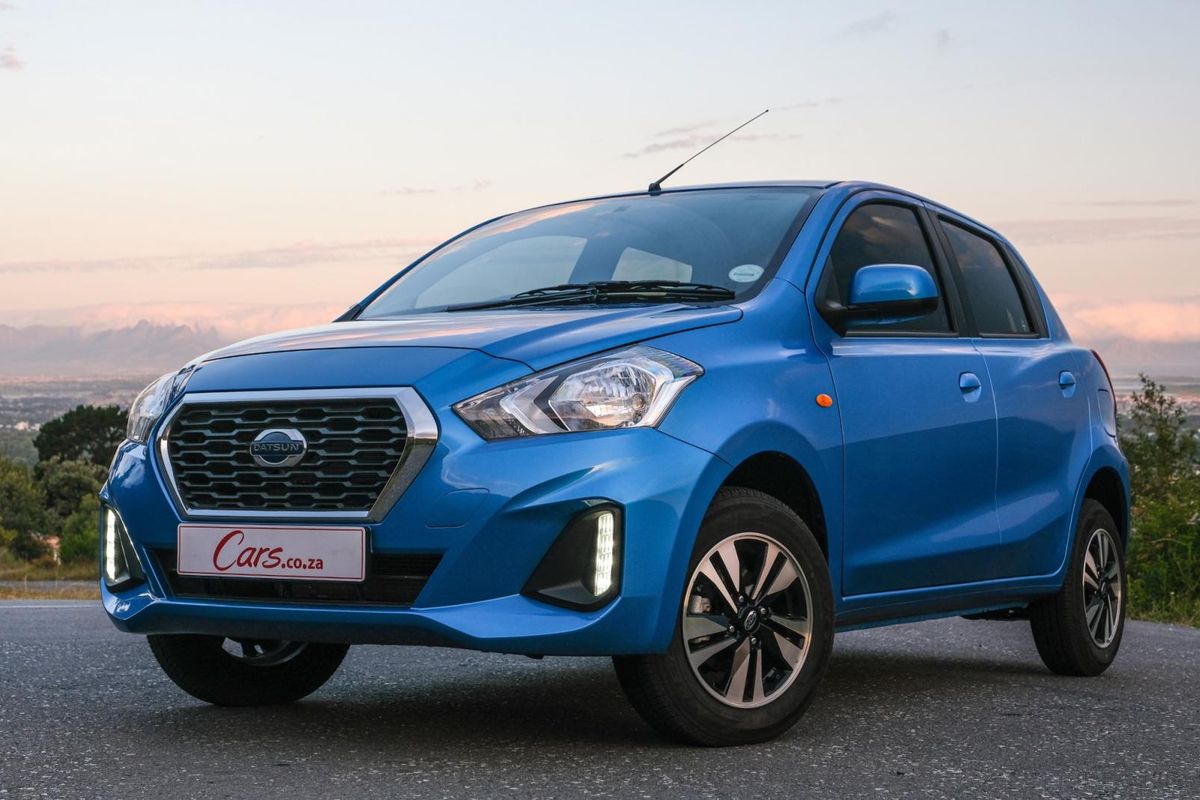
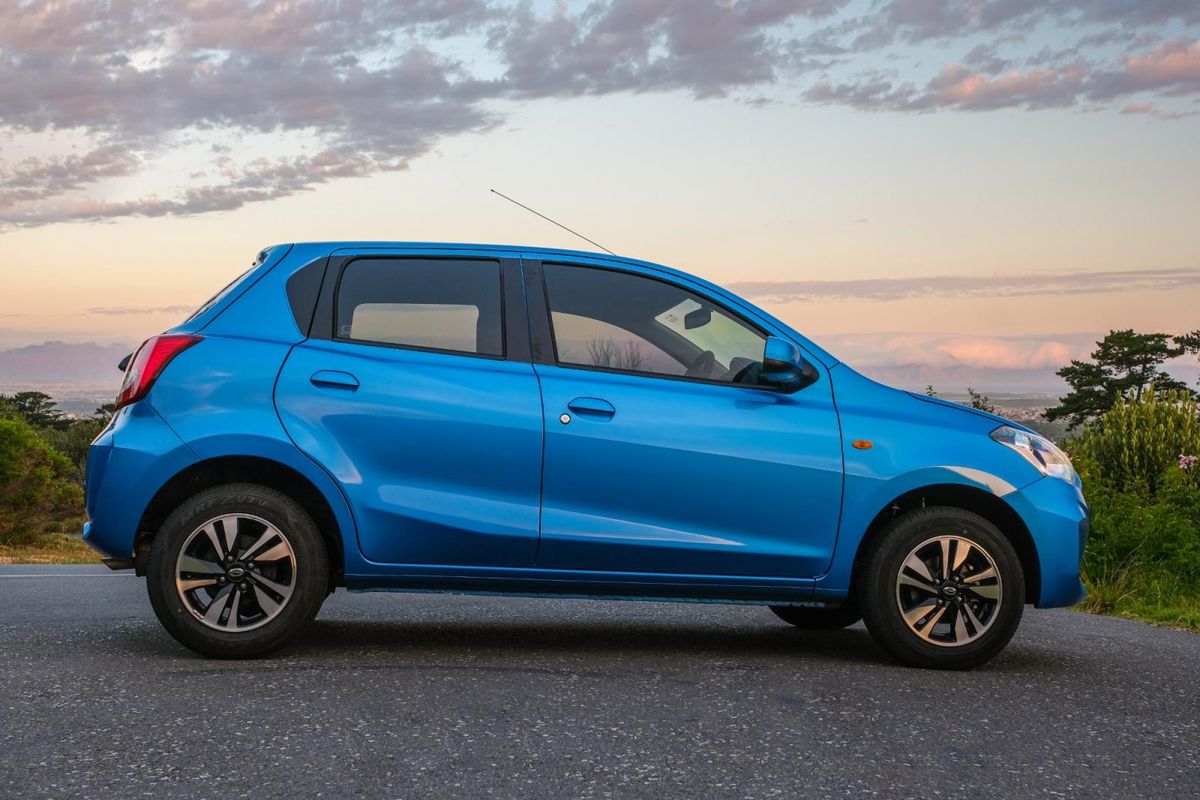
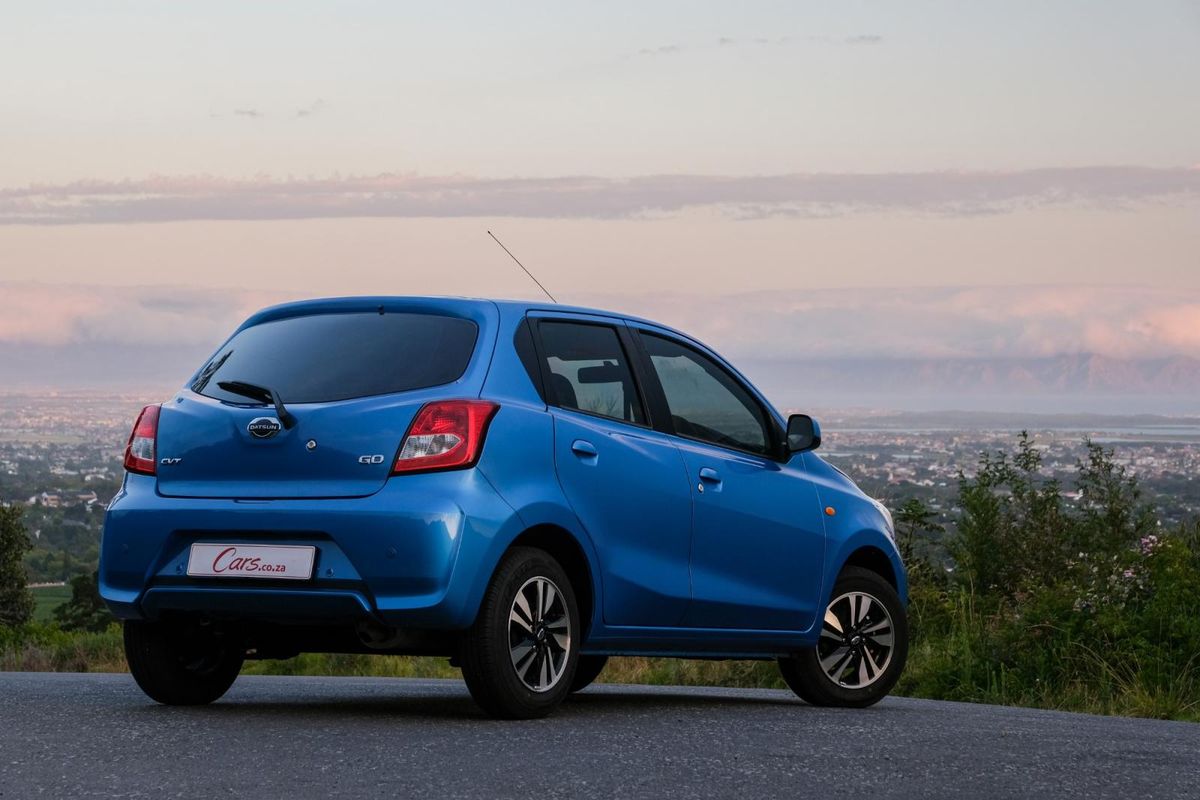
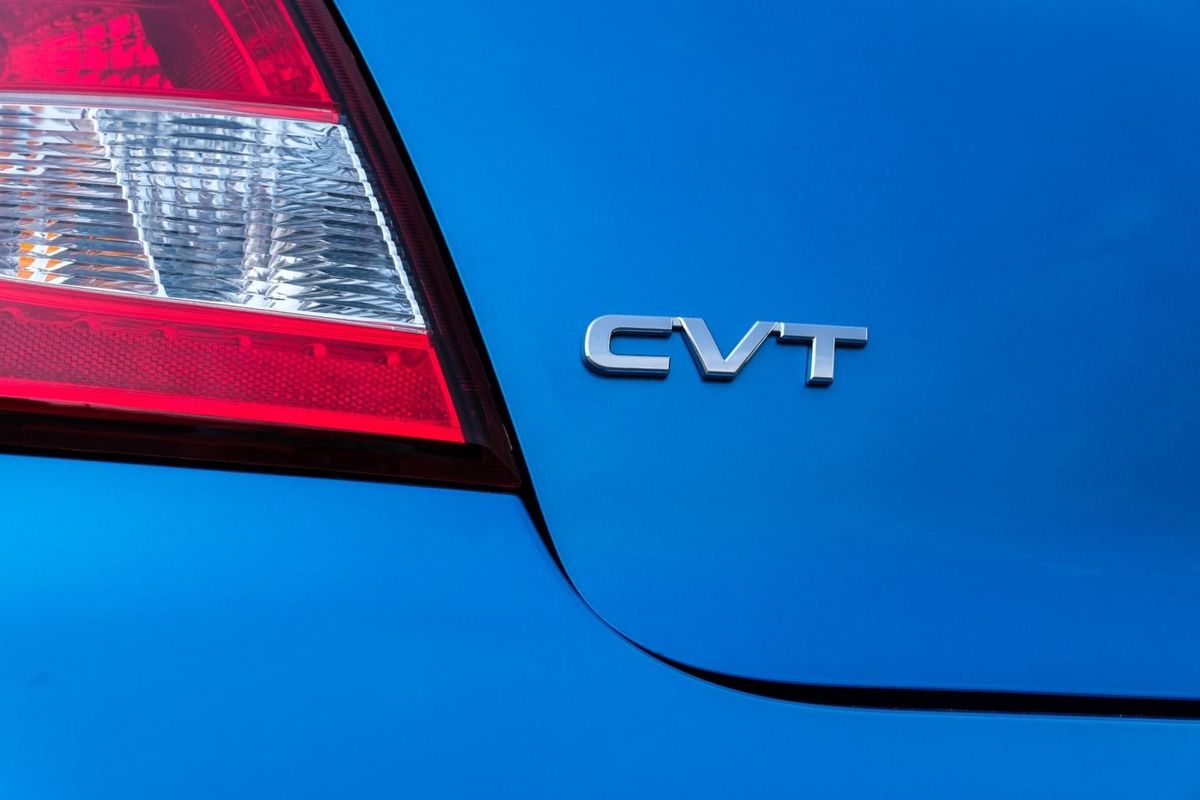
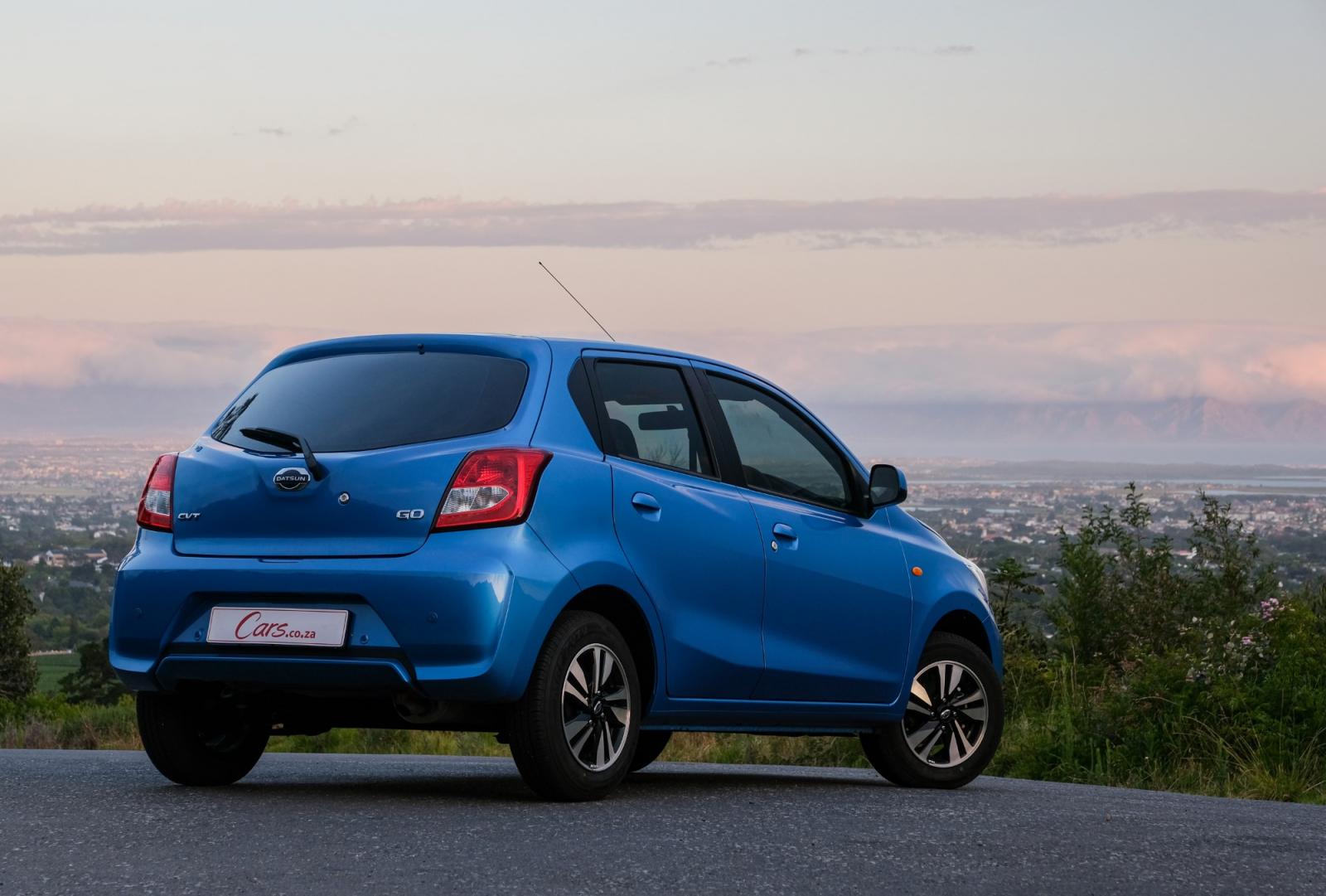
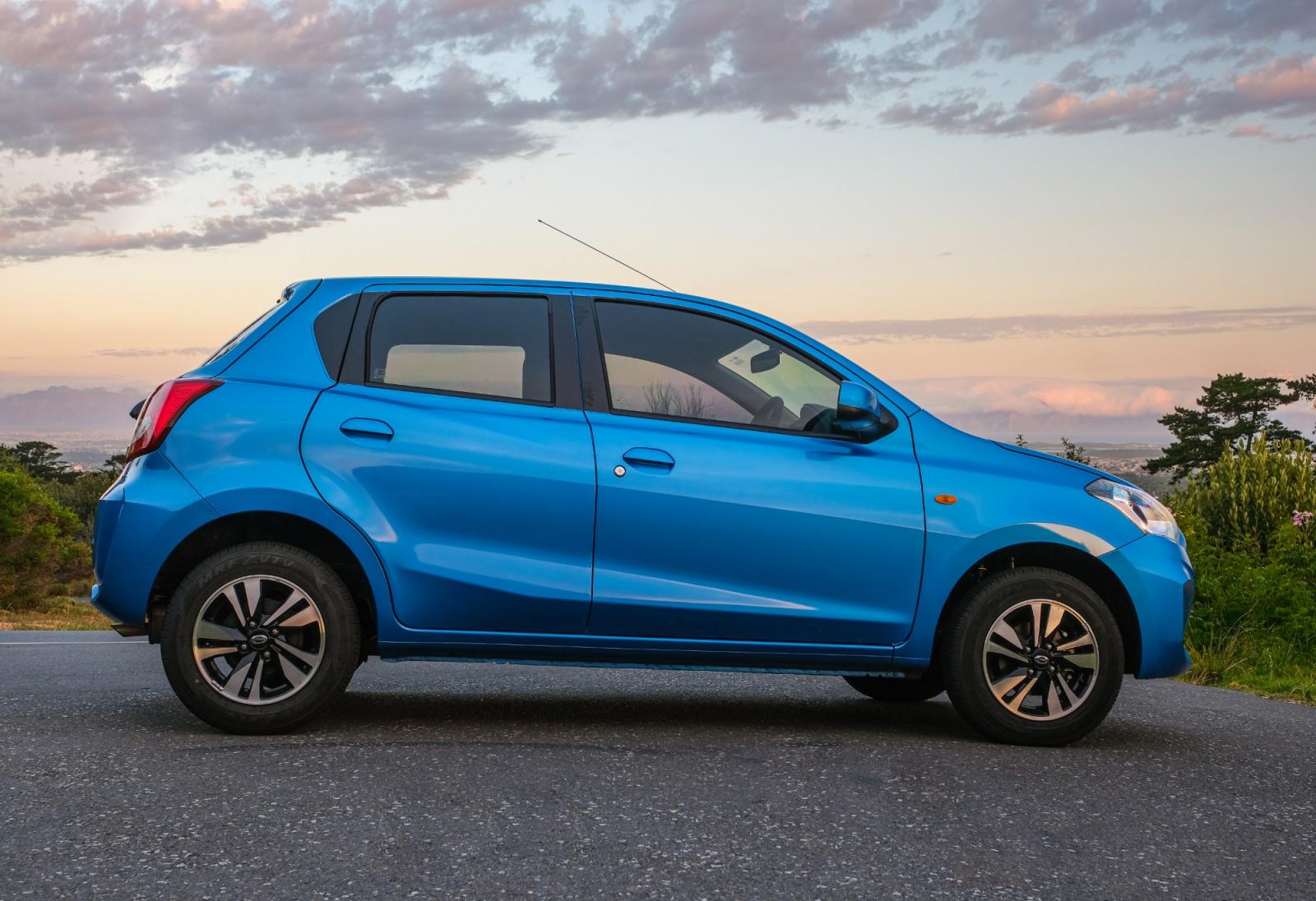
In an effort to make its popular budget-car offering better suited for commuting in congested traffic, Datsun has equipped its Go hatchback (as well as the Go+ MPV) with a continuously variable (automatic) transmission. We spent a week with the 1.2 Lux CVT to find out if it's worthy of your attention. Might it be better to "stick" with the manual? Let's find out…
We Like: Surprisingly good CVT performance, connectivity features, improved safety spec
We Don’t Like: Thirstier than expected, some build quality issues, pricey
Now that the Go range includes a CVT option, Datsun may garner more sales (and an older clientele?) in the budget car segment.
The Datsun Go budget hatchback needs little introduction. It’s been on sale in South Africa since 2014 and while it has previously been lambasted for its meagre safety specification and poor crash ratings, Datsun has gone to great lengths to remedy the situation – the Go is now far safer than it ever was (in terms of body integrity and features fitted) and the brand must be commended for taking action in this regard (we detail that upgrade later in this review).
As important as a car's safety specification is, buyers in the budget-car segment seem more concerned with purchasing a brand new car that offers good value for money… The Go has proven hugely popular despite the fact that it initially did not have ABS or airbags. A driver's airbag was later added and the late-2018 facelift introduced ABS and another 'bag. But that's pushed up the Datsun's price – it no longer features on our Cheapest Cars in South Africa list.
Brands such as Suzuki, Kia, Hyundai and Renault have offered automatic derivatives of their budget-car models for some time already and Datsun has now joined the clan of cut-price self-shifters. Datsun, however, has gone the CVT route, which contrasts with the segment trend of fitting automated-manual (AMT) instead of conventional torque-converter automatic transmissions.
How it performs in terms of…
Performance and economy
The Go CVT makes driving in heavy traffic far more comfortable.
Historically, we have found small cars equipped with CVTs disappointing, but there have been a few exceptions. A budget-car engine isn't particularly torquey anyway and, when you combine it with a CVT, it produces lethargic, uninspired acceleration and tends to be annoyingly noisy under applications of full throttle. However, we think the CVT in the Datsun Go is far superior to the cumbersome AMT of its Renault Kwid cousin (which we tested in 2018), for example.
In fact, the CVT in the 1.2 Lux was much better than we anticipated. When tasking the Datsun's motor to accelerate firmly by applying constant and measured inputs to the accelerator pedal, the Go gains momentum at a fair pace and the transmission noise is kept to a tolerable level. As a matter of fact, the 1.2 Lux CVT delivers zippy performance between traffic lights, but at highway speeds, extra time and planning are required to execute overtaking manoeuvres safely.
The steering lacks feel (which is to be expected), but the tiller is still relatively responsive to inputs and body-roll is evident when you hustle the Go through a corner, but not alarmingly so. The ride quality is perfectly average; it's only when the Datsun traverses harsher bumps that suspension thumps reverberate through the cabin. For the most part, the Go is well-suited for city driving – it can even negotiate the odd gravel route from time to time. if needs must.
The 1.2-litre, 3-cylinder petrol engine offers 57 kW and 104 Nm of torque, which is actually 7 kW more than what’s available from the manual derivative. Datsun claims an average fuel consumption figure of 5.0 L/100 km, which is a trifle ambitious… During our test, the Japanese hatch yielded indicated figures of around 7.3 L/100 km.
Interior quality and features
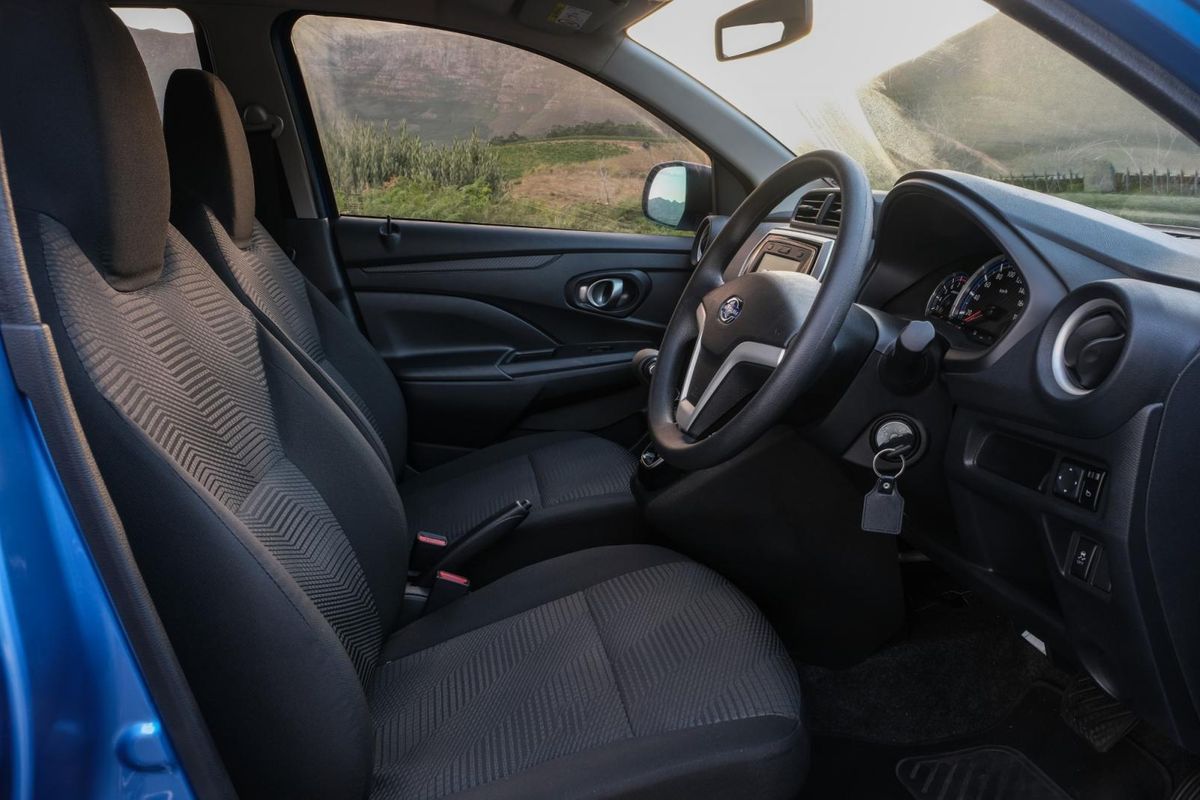
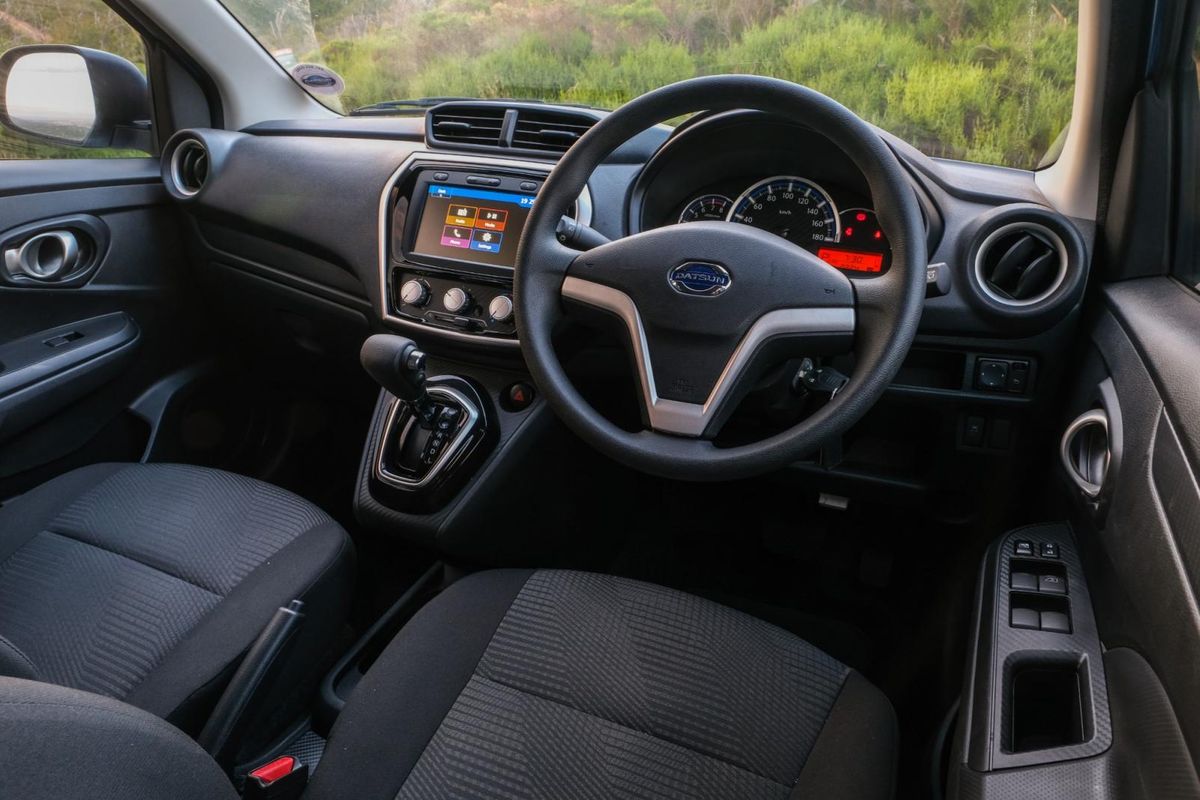
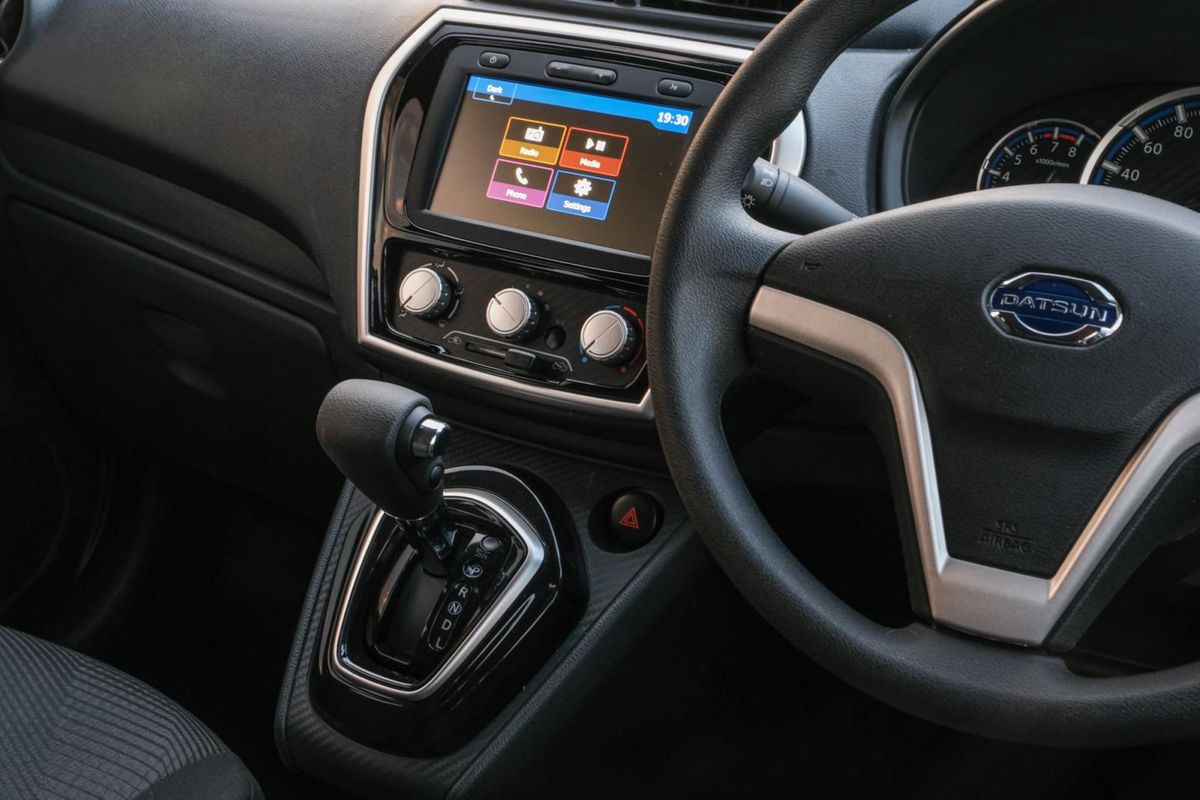
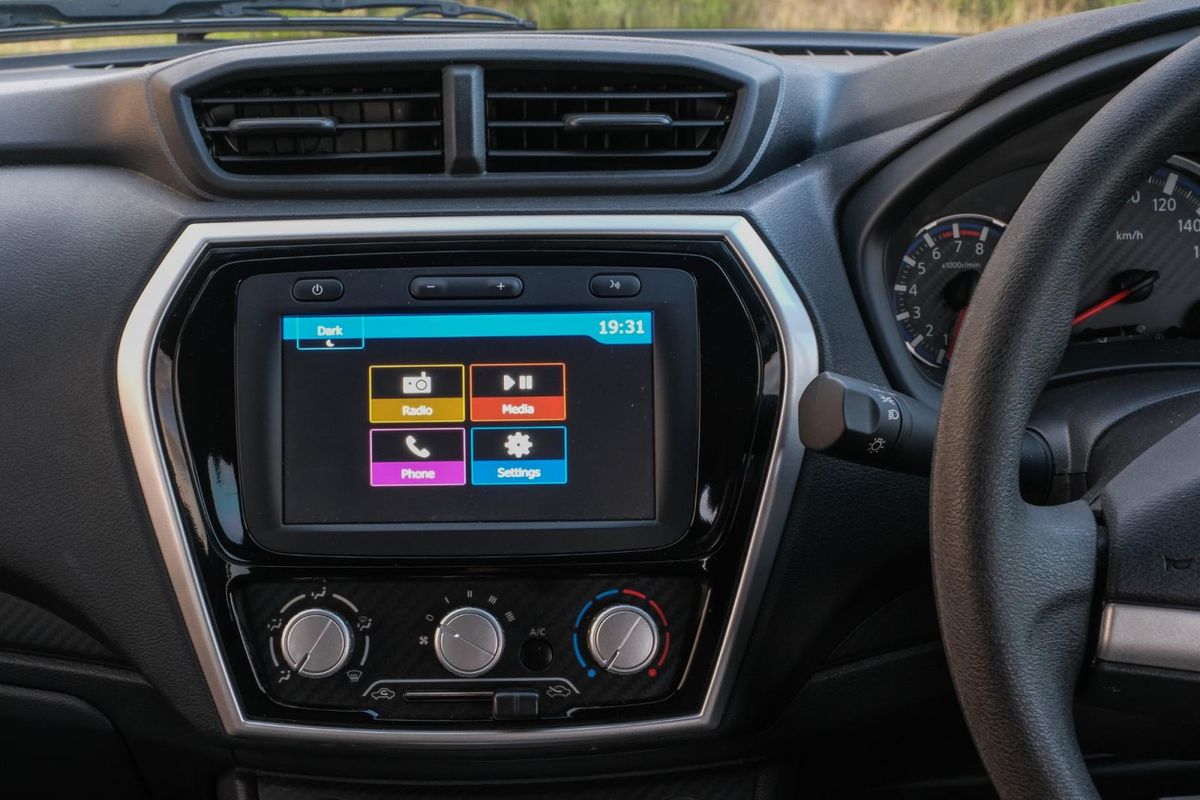
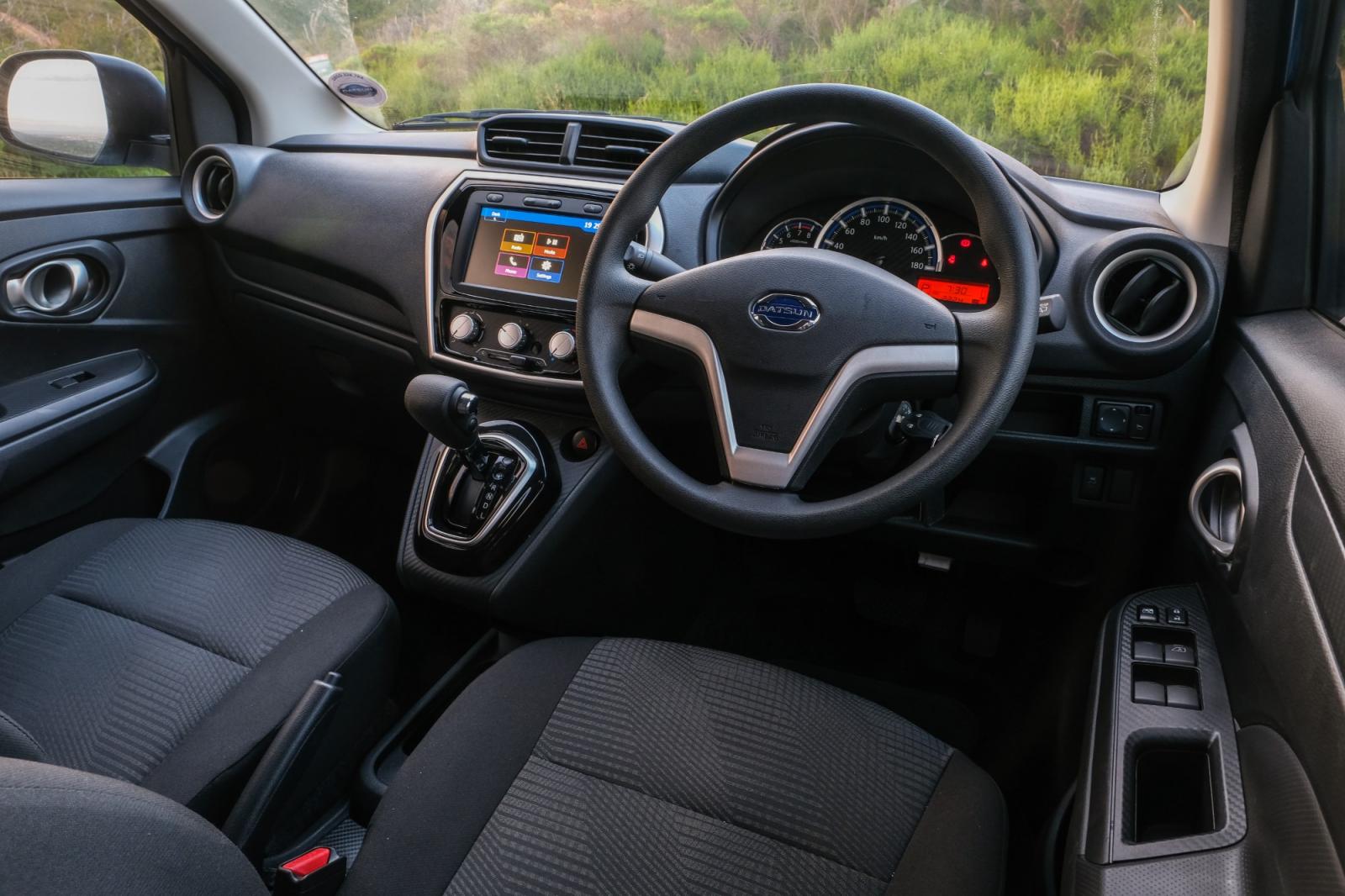
The interior is basic, but functional. Note that there are no mounted controls on the steering wheel.
While the Datsun Go's asking prices have gone up, the model's interior build quality has not moved upmarket – it cannot hide its budget roots. Hard plastics abound in the Go's cabin and the temperature, ventilation and AC dials look like they were plucked from a cheap children's toy. Needless to say, overall perceived build quality is average-to-marginal.
There's no multifunction steering wheel, which is a pity; it should be included at this price point. There is, however, a touchscreen infotainment system that offers Apple CarPlay and Android Auto compatibility. The system is easy enough to use, however, if a tad slow to respond to inputs. There is a USB port in the lower console, but you have to battle to find it, which is a pain. What if you'd like to plug your smartphone in at night? Better use the 'phone's flashlight feature…
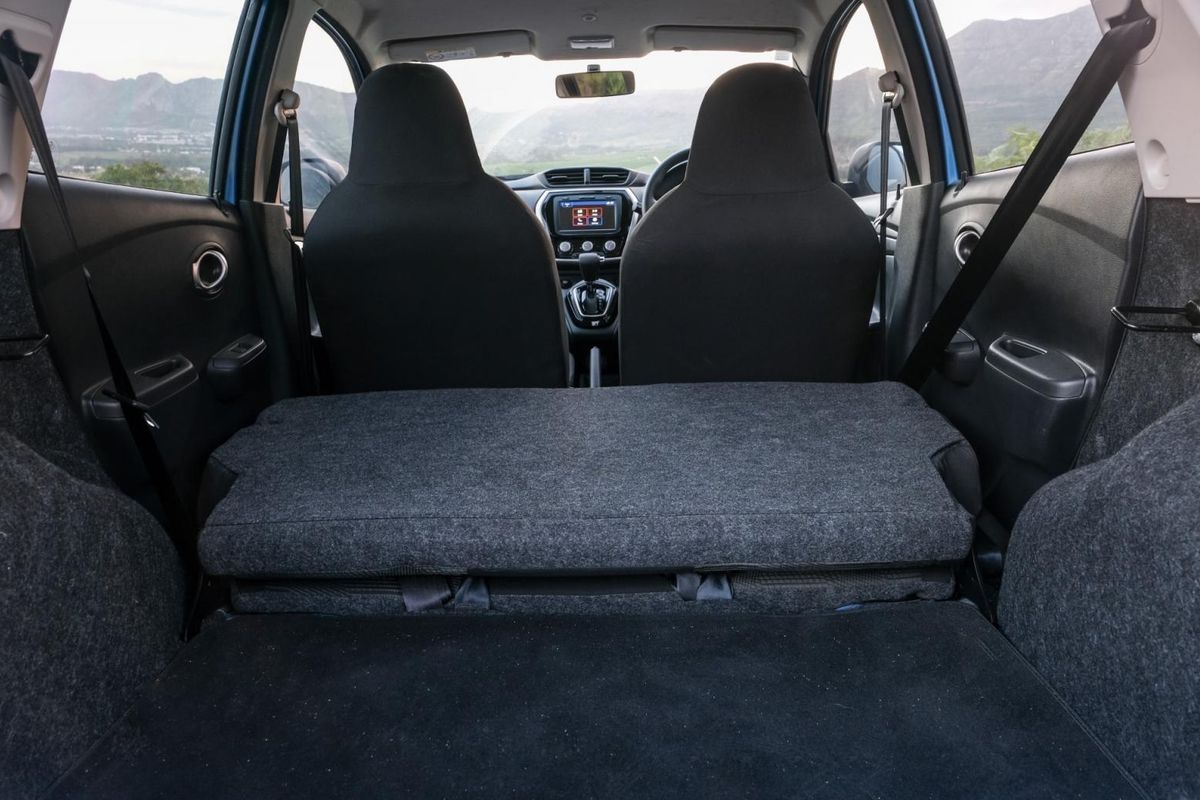
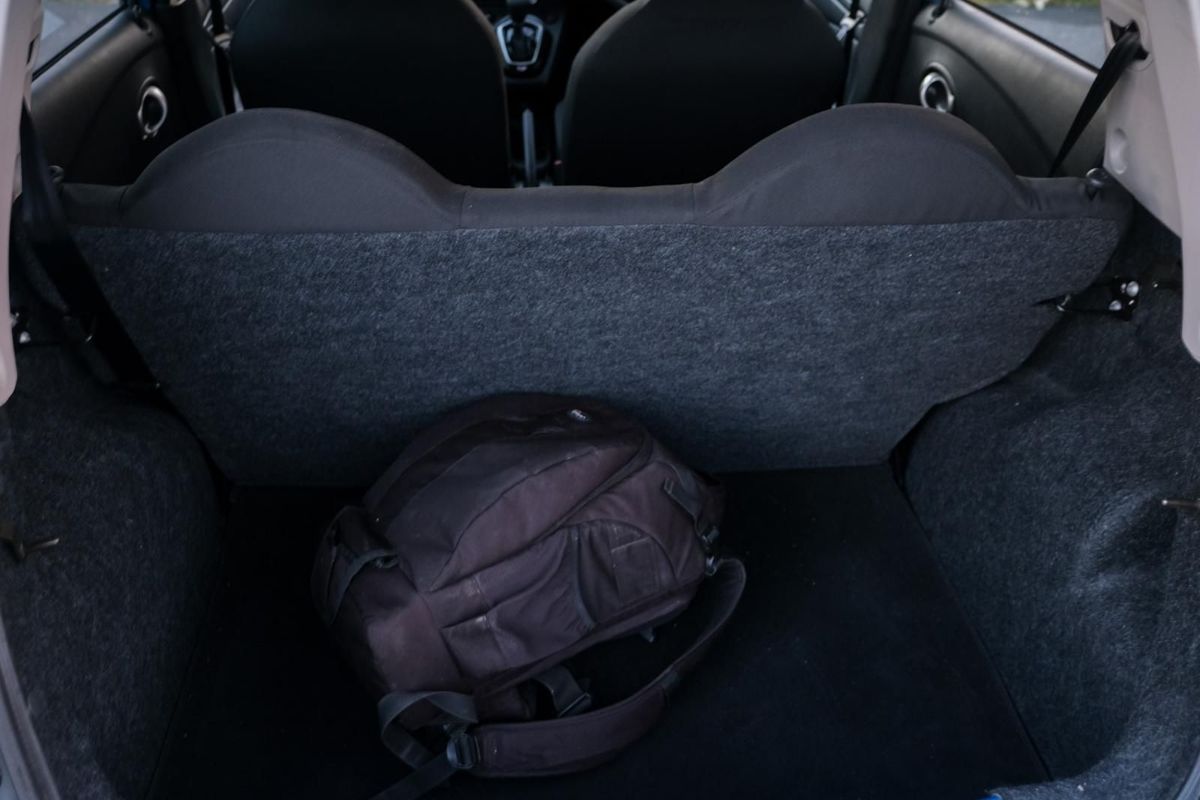
Aft legroom is acceptable (by the standards of the segment), but the Datsun's rear-bench cushioning isn’t very comfortable. Moreover, the bench doesn't fold down in a split configuration… as a result, the entire seatback flops forward when you release it, which, in turn, leaves a pronounced lip and an uneven loading surface; that may prove a nuisance when you need to transport bulkier items. Load bay space is pegged at 265 litres, which is useful enough.
Safety upgrades
With improved safety specification, the Datsun Go is now safer than ever before.
Datsun has made efforts to improve the Go’s safety specification in light of a slew of bad press. To reiterate, much-needed improvements were made late in 2018 when the facelifted Go came to market equipped with dual airbags and ABS. The 1.2 Lux and 1.2 Lux CVT derivatives are further equipped with electronic stability control and traction control, which should give buyers/inexperienced drivers added peace of mind.
But Datsun had to address concerns about the car's structural integrity in the event of an accident following the Go's poor performance in crash testing. To that end, the facelifted Datsun's front-end has been reinforced with high-tensile steel to better absorb the impact of a crash while also improving pedestrian safety. Furthermore, the Go’s body shell is now made of high-tensile steel and Datsun has strengthened the car's doors, roof and seats.
Other useful safety features include larger 14-inch wheels, speed-sensing door locks, seatbelt reminders and park distance control sensors at the rear.
Price and after-sales support
The Datsun GO 1.2 Lux CVT is priced from R188 300 and is sold with a commendable 6-year/150 000 km warranty. A service/maintenance plan is optional.
The Go 1.2 Lux CVT derivative is pricey. We think there are better ways to spend your money…
Verdict
There you have it: the Datsun Go 1.2 Lux CVT surprised us! Its performance in the city was quite satisfactory and, for the most part, the CVT-equipped powertrain delivered a generally pleasant driving experience. The fact that the Go’s safety specification has been upgraded is a big bonus and, as a result, it’s far easier to recommend than ever before.
We do, however, feel that Datsun should look to improve the material quality of its hatchback's interior in order to bring the overall offering in line with its asking price. And that brings us to the crux of this verdict. The Datsun Go (this CVT derivative, in particular) is a relatively pricey proposition and we don’t believe there’s quite enough value on offer to justify that "steep" asking price. The Go simply doesn’t feel like it’s worth its asking price. For roughly the same capital outlay, the Suzuki Swift 1.2 GL automatic, in our opinion, is a more substantial car with markedly-superior perceived quality to the Datsun. It has mounted steering-wheel controls, a better-visible USB port and rides with greater pliancy.
As prices of budget-car prices increase – but quality stays the same – a strong case can be made for shopping in the used market where better quality (and value) is available from nearly-new derivatives. A benefit of going that route is that you wouldn't bear the brunt of the "first knock" of depreciation, as first owners do. If you can accept not driving a brand new car off the showroom floor, then buying a used car at under R200k can be a very smart buying decision.
Mercedes-Benz will be introducing an additional G-Class to South Africa. Dubbed the G400d, this diesel-powered G-Class comes fully loaded. Here's pricing and specification details for this model.
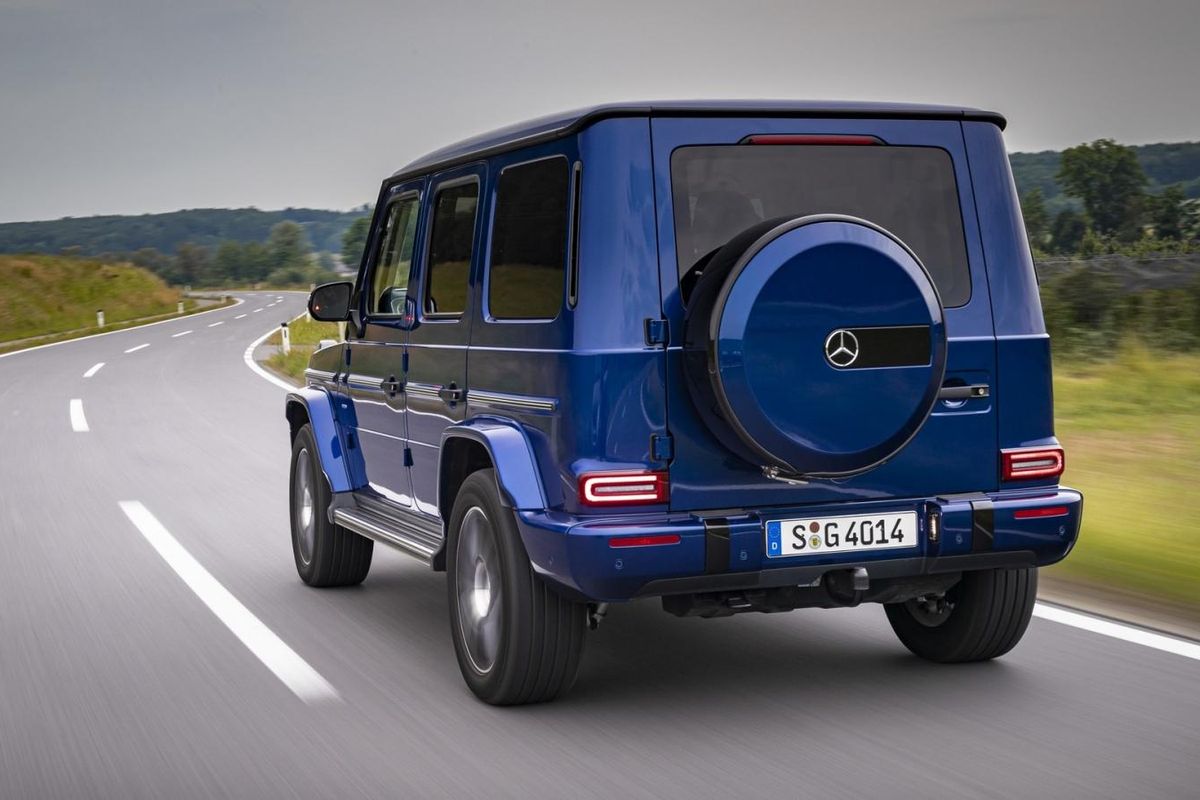
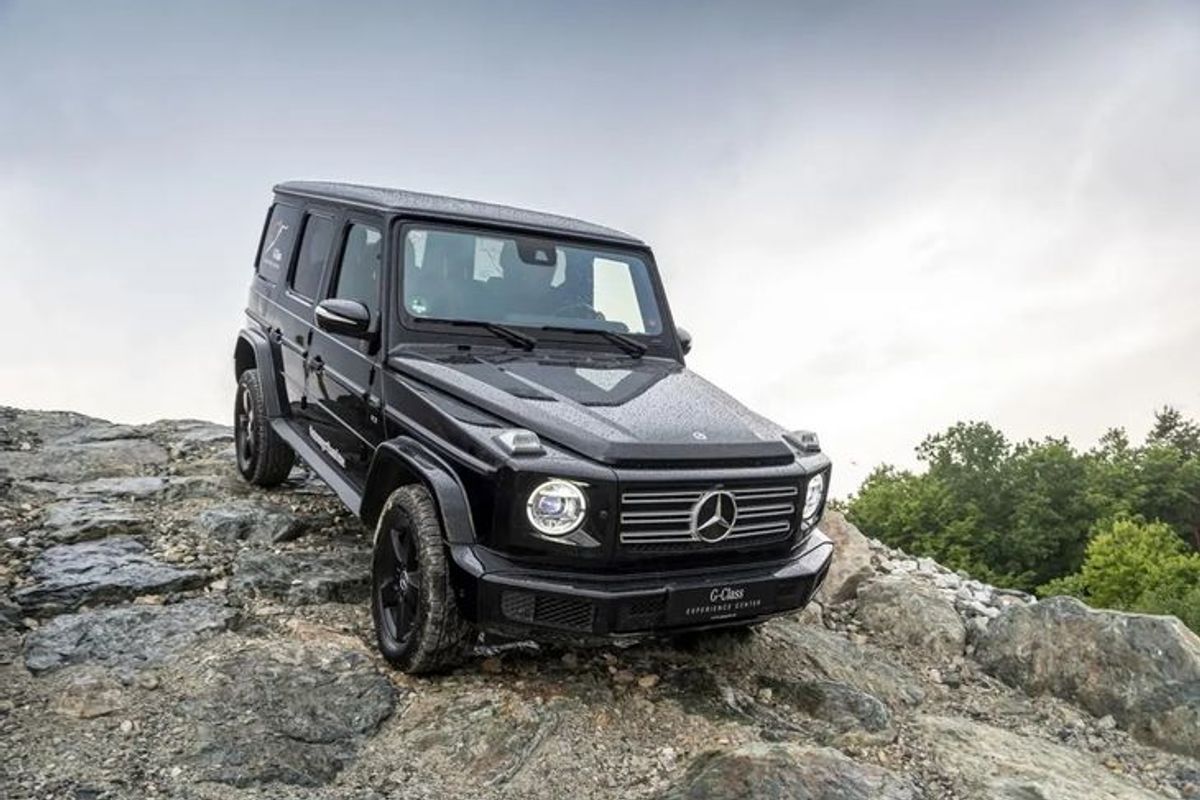
When people think of the Mercedes-Benz G-Class, they think of the AMG-powered G63 with its thundering 4.0-litre V8 motor. However, Mercedes-Benz South Africa will be introducing a diesel-powered model this year. The Mercedes-Benz G400d features a 3.0-litre turbocharged 6-cylinder turbodiesel motor with 243 kW and 700 Nm. Power goes to all 4 wheels via the 9-speed automatic transmission. Mercedes-Benz claims a 0-100 kph time of 6.4 seconds and it'll hit a top speed of 210 kph. In terms of economy, you're looking at 9.6 L/100 km.
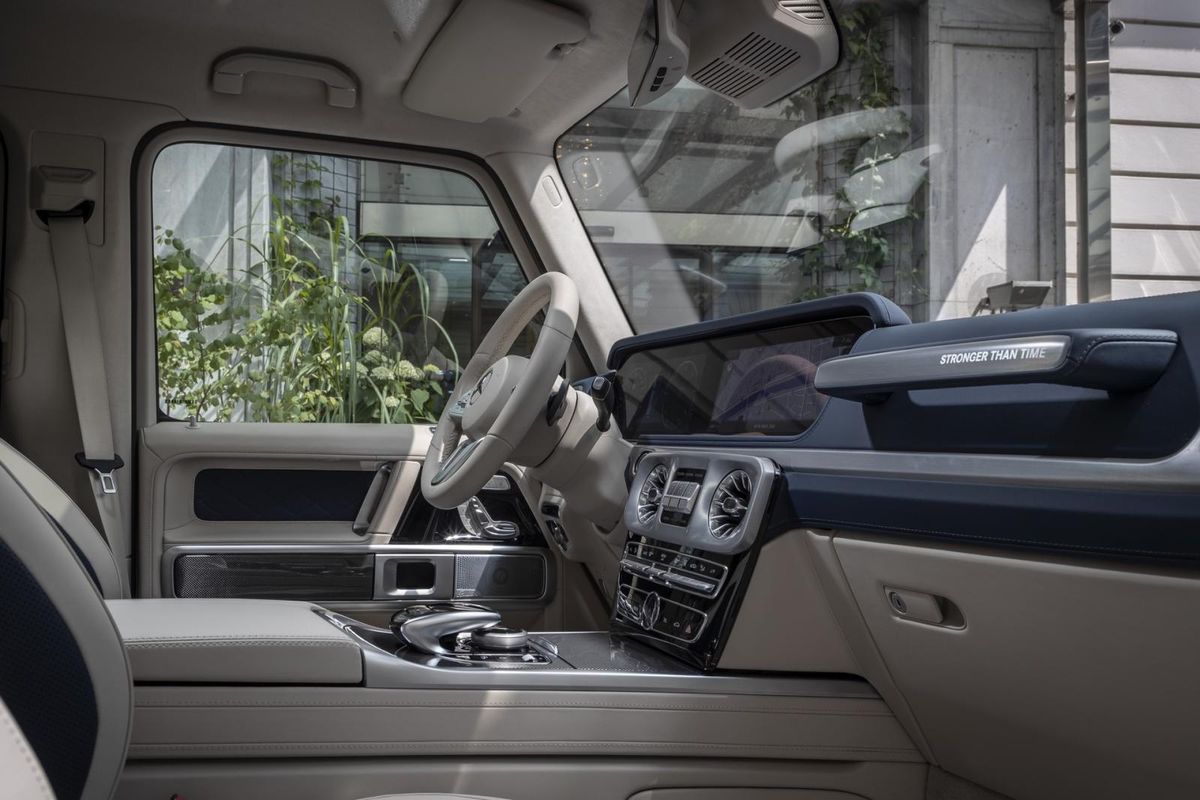
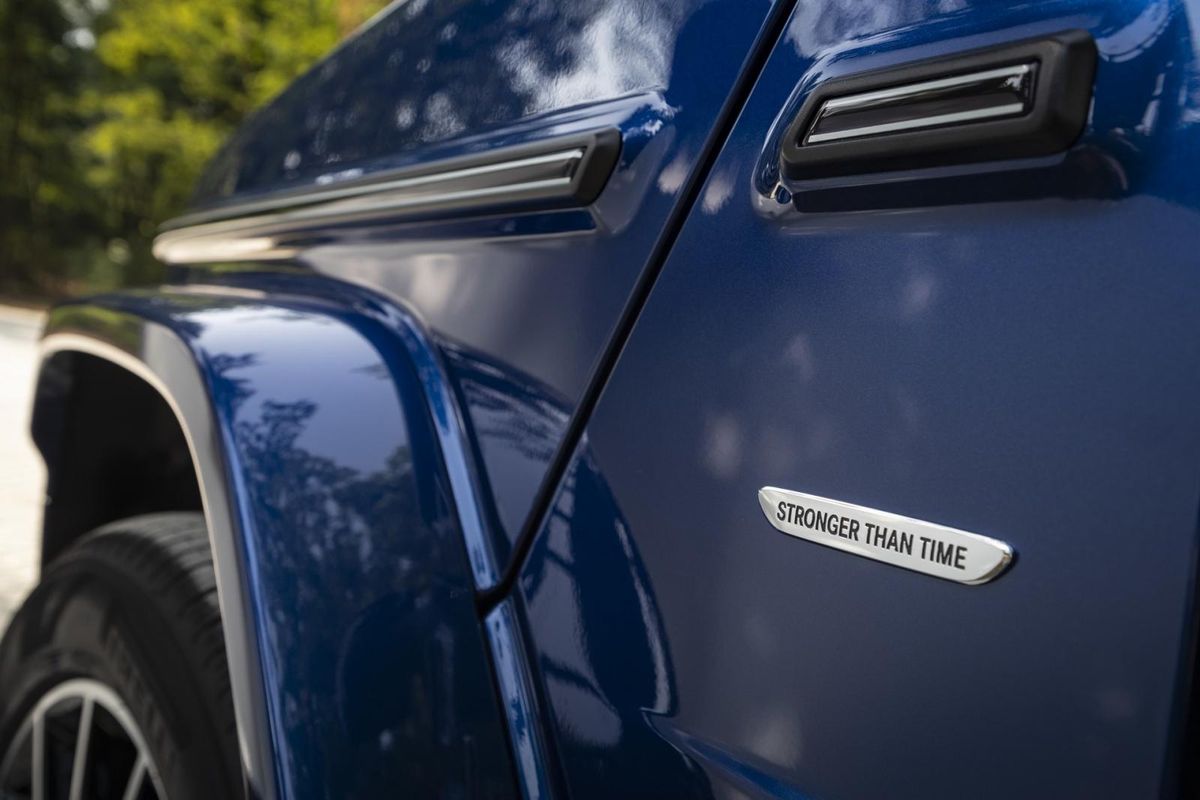
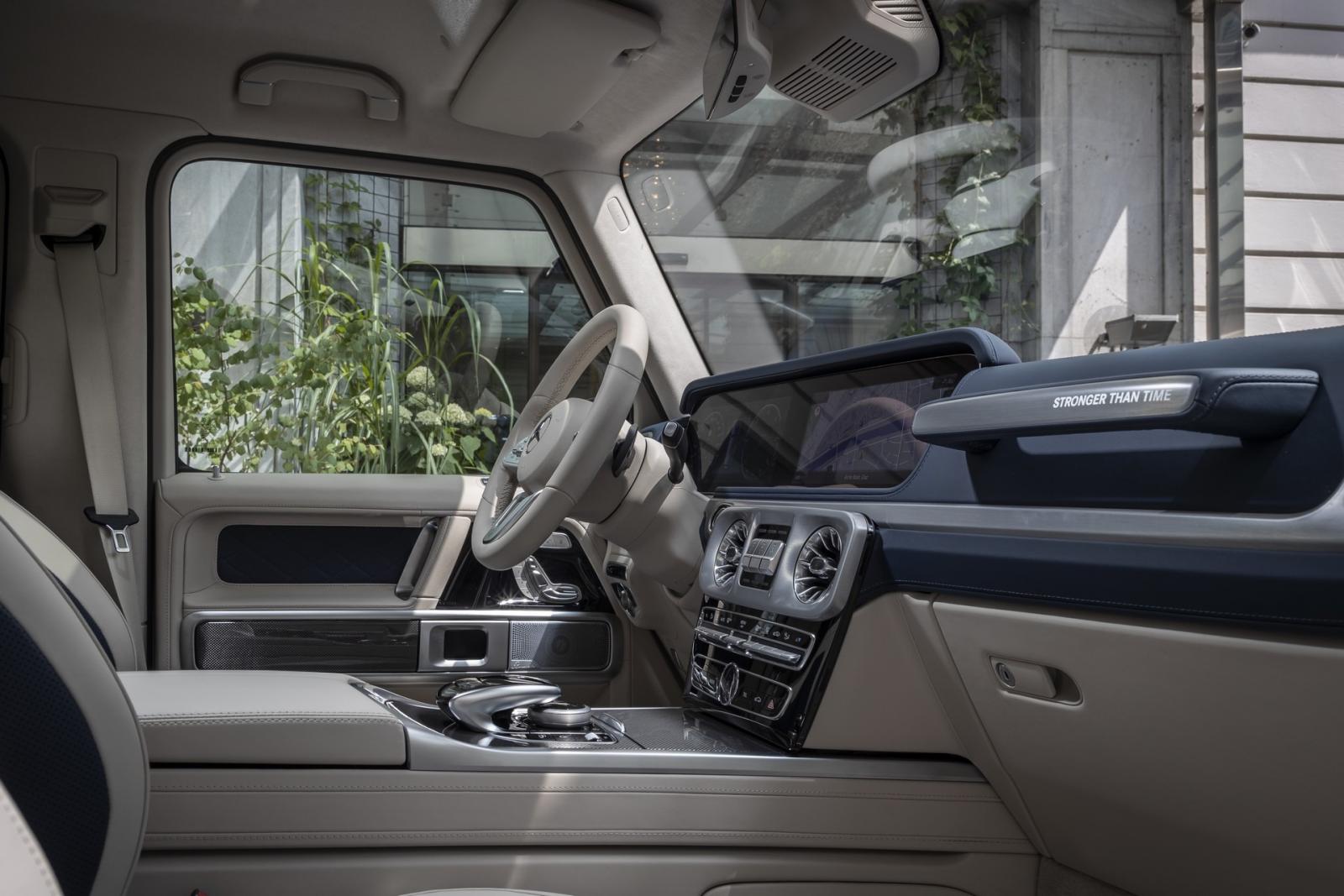
The Mercedes-Benz South Africa configurator has this model loaded and it's interesting to note that we'll be getting our G400d units in Stronger Than Time specification. So, what do you get for your R2.5 million? Generally, the G-Class is very decently specced, but on the configurator, we can see it ships standard with the AMG Line package, Night package, stainless steel package, driving assist package, parking package, top-spec seat package as well something called Exclusive interior plus which includes niceties like a Burmester surround sound setup, Dinamica roof liner and a dashboard wrapped in nappa leather. Generally, these things are optional extras. The vehicle rides on 20-inch AMG light-alloy wheels and if you want further customisation options, things like rear-seat entertainment and underbody protection may interest you.
The cabin of the Mercedes-Benz G400 Stronger than Time.
Mercedes-Benz G400d Price in South Africa (January 2020)
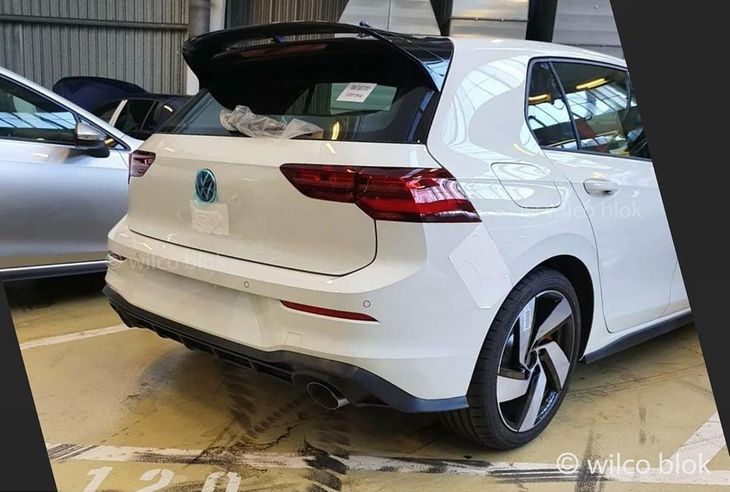
Do car brands really need intricate marketing plans if there are keen Instagrammers who are all too happy to drip-feed fans tasty details of upcoming models? Following a spied image of a next-gen GTI, followed by the appearance of (what seemed to be) a screenshot of a Golf 8 product strategy document, cochespias has posted this…
As we reported last week, Volkswagen will roll out a quintet of performance derivatives of the Golf 8 around the globe over the next couple of years, including the GTI, GTI TCR, GTD and, of course, the flagship R. We’ll see the GTI, which will spearhead the Golf 8’s local introduction towards the end of 2020, in its full glory at the upcoming Geneva Show.
As for the Golf 8-version of the R, that probably won’t appear in South Africa before 2021, but what we DO know, however, is that the upcoming AWD road rocket's all-wheel drivetrain will be propelled by a 245 kW 2.0-litre turbocharged 4-cylinder mill. We wouldn’t be surprised if the 2021 Golf R could be quite capable of hurtling from 0 to 100 kph in under 4.5 seconds…
Now Motor1.com reports that Instagrammer cochespias, who also posted the tantalising screenshot of the various upcoming performance Golfs’ peak outputs last week, has Instagrammed this image. It is said to have been taken in the vicinity of the Applus IDIADA proving ground near Barcelona, Spain.
It’s not a production version (it does not bear the redesigned R badge yet, for example) – and it would look suitably meaner if adorned with an eye-catching roof spoiler – but there is no mistaking the quartet of large-bore exhaust tips, however. Volkswagen is set to skip the Paris Show in October, but the Wolfsburg-based firm’s expected to reveal the upcoming R derivative fully around that time.
In case you’ve missed our earlier story, the 2020 Golf 8 GTI will have a peak output of 180 kW from its 2.0-litre turbocharged 4-cylinder motor. Power will be sent to the hot hatch’s front wheels via either the acclaimed DSG or a manual gearbox. Our love for the fast-shifting dual-clutch transmission means it's highly unlikely the manual version will be offered in SA.
Now here's where things get exciting… Last week’s document gave us the outputs of the Volkswagen Golf 8 TCR, which will come to market with a 221 kW 2.0-litre turbocharged 4-cylinder engine. The TCR’s peak power output compares favourably with the soon-to-be-launched Hyundai i30 N (202 kW) and venerable Renault Megane RS280 (205 kW).
With 245 kW, the Golf R will be more than a match for the fresh duo of the Mercedes-AMG A35 and BMW M135i xDrive. But the rumour mill never stands still: Motor1.com also suggests that a “300-kW Golf 8 R Plus” might see the light of day at a later stage. Now THAT should be quite something – look out Mercedes-AMG A45 AMG!
Jeep has prepared a special treat for its Wrangler fans.
If you are a follower of the brand’s most successful product line, there will be a host of new Mopar components revealed at the Chicago auto show in early February.
Mopar upgrade kits include the kind of parts that Jeep owners would usually have to fit from aftermarket suppliers, thereby risking some of the warranty coverage on their Wranglers.
For the 2020 model year, Jeep has teased a new Mopar-kitted Wrangler, which shows off some very appealing new off-road accessories and components.
Most noticeable are the huge off-road specification tyres, which promise more air volume than standard Wrangler rubber. Bigger tyres improved ride-quality off-road, providing more terrain absorption. They also give owners the ability for greater tyre deflation, which in turn, boosts traction.
To ensure that these larger tyres remain securely fastened to the wheels, especially when rolling at very low pressures, Mopar provides beadlock rims.
Beyond the impressive new wheels and tyres, the 2020 Wrangler Mopar upgrade also offers the option of tube doors. Although removing the Wrangler’s doors and fitting the tube-structures are a radical option, it does save a lot of weight and allows for better cabin airflow, at low-speeds, during technical off-road driving.
All other details pertaining to the new Wrangler Mopar upgrade parts will be confirmed at its Chicago auto show debut. There is an expectation that the front of the vehicle in this teaser image, might be featuring a new off-road specific bumper and additional lighting.
Other probable Mopar parts include even more capable long-travel suspension and lower ratio axles, for rock crawling ability. For fans of the robust Wrangler and its esteemed off-road ability, the promise of these new Mopar upgrades should be greatly appealing.
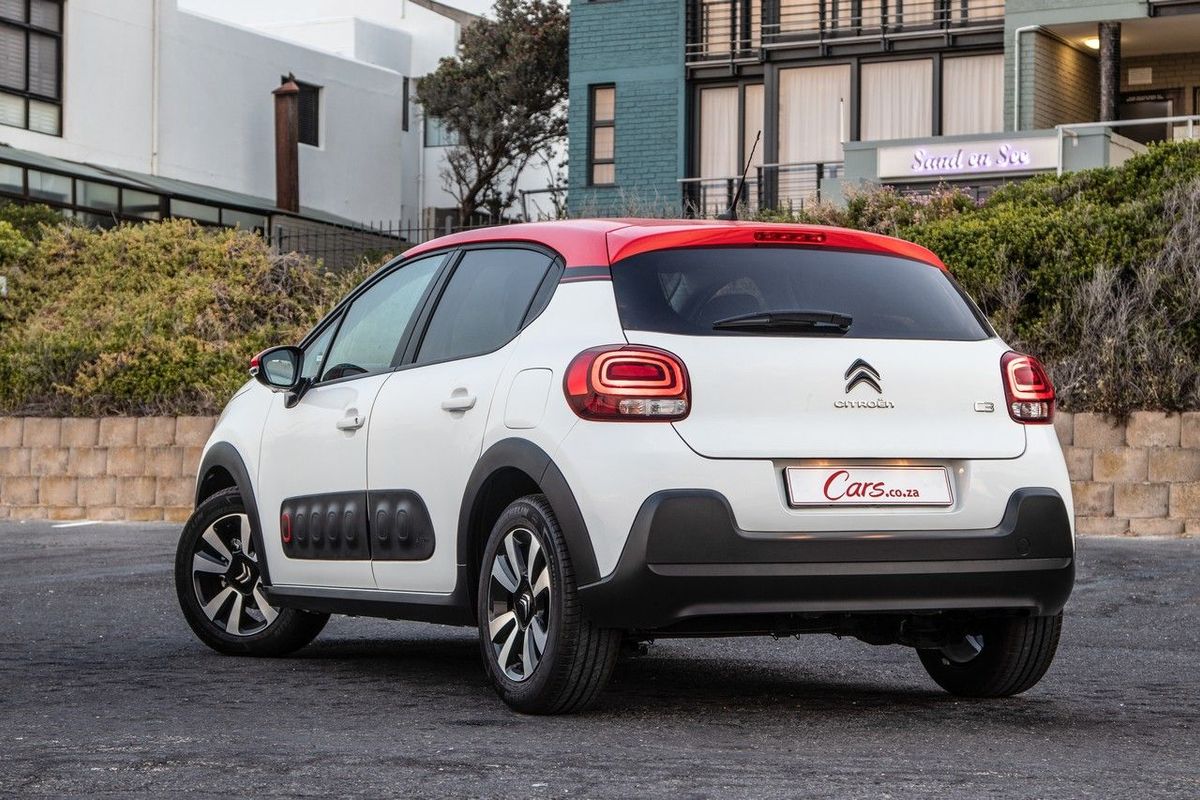
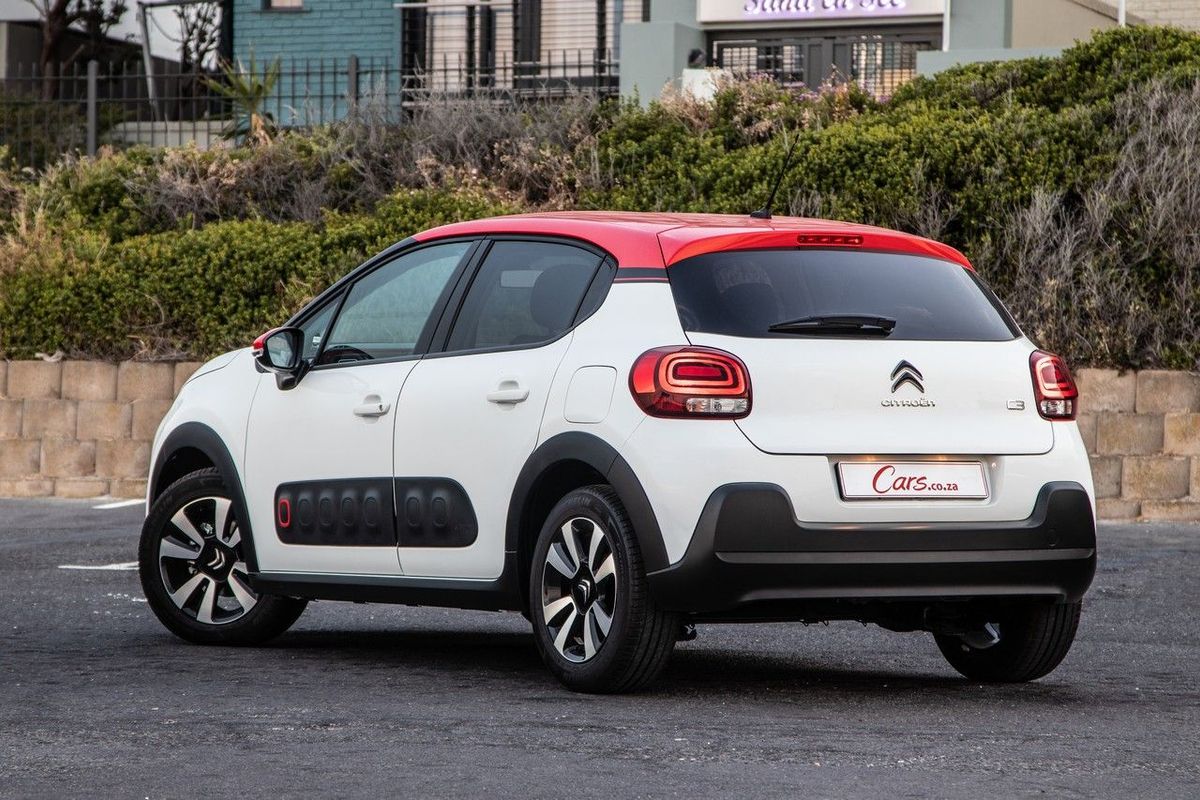
The C3 is Citroen's answer to the market's current crop of safe-but-predictable compact hatchbacks, as well as the entry point to the returning French marque's product line-up. Is the newcomer any good, however? We spent some quality time with the entry-level 1.2 Feel derivative.
We like: Unique and bold styling, peppy engine, comprehensive specification, eager performance, keen pricing.
We don't like: Long clutch travel, notchy gearshift action, new Citroen aftersales programme still unproven.
Some Citroen dealers regularly offer specials: Have look here.
Where does it fit in?
Citroen's is desperate to undo years of haphazard servicing and mismanagement, which has left many of its SA customers disappointed and disillusioned. With an entirely new management team and a strong product line-up, the brand's local management has reasons to be optimistic, however. Spearheading the return is what you see here: the C3. It's diving into one of the most competitive segments, where the likes of the Ford Fiesta, Kia Rio, Hyundai i20 and Renault Clio all fight for the scraps left over by the dominant Volkswagen Polo. The C3 is available in 2 flavours: 1.2 Feel and 1.2T Shine, with the latter adopting a perkier turbocharged engine. The former is the derivative under scrutiny here.
How it fares in terms of…
Kerb appeal
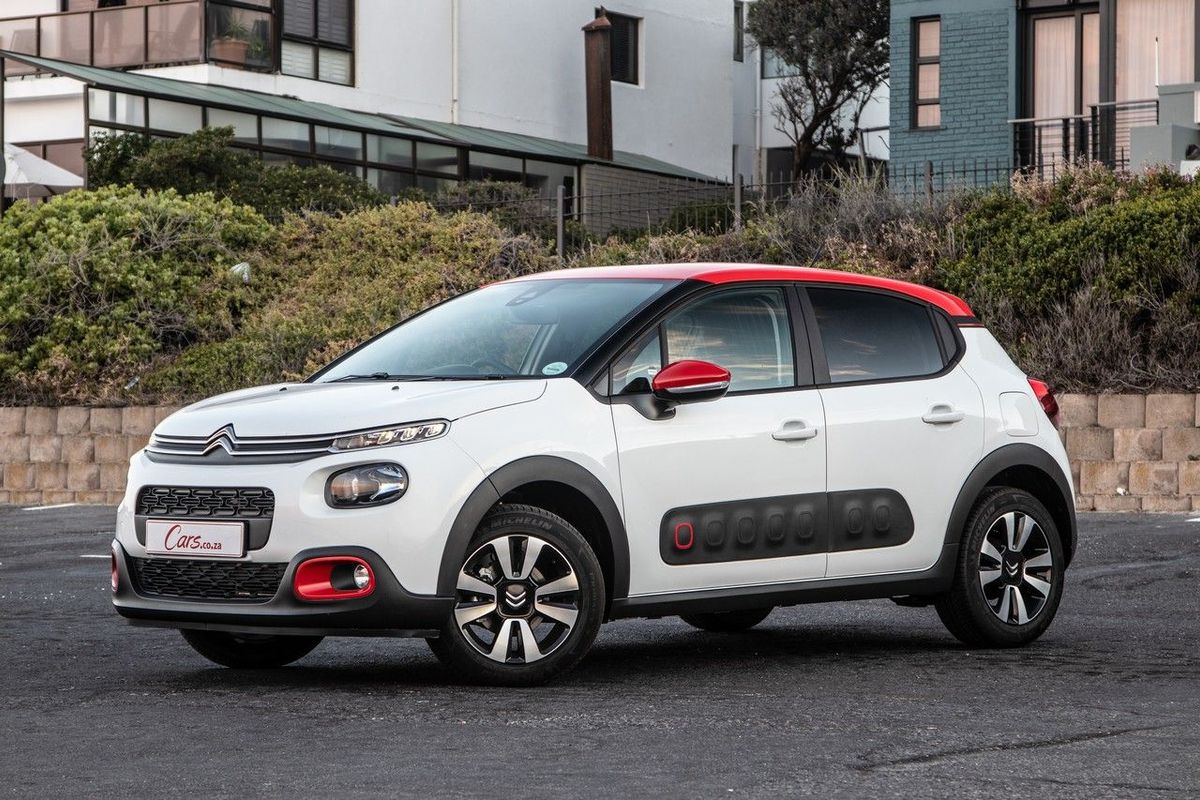
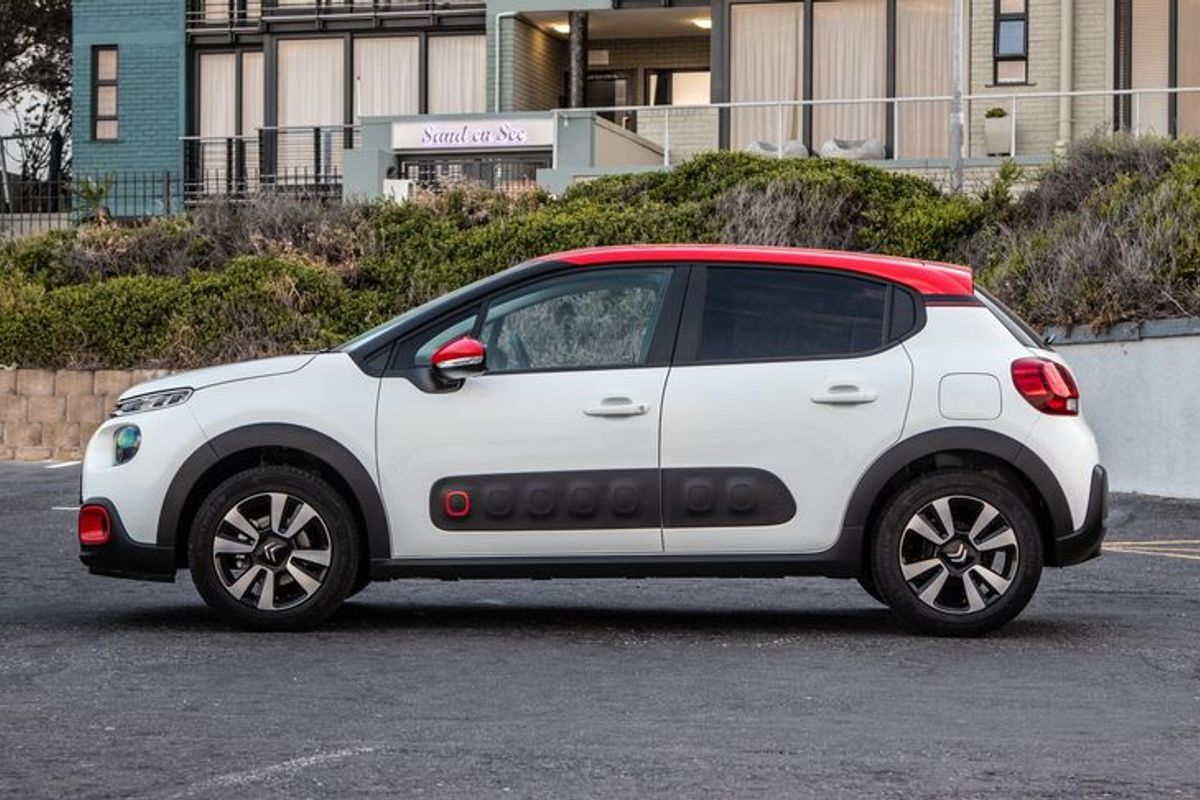
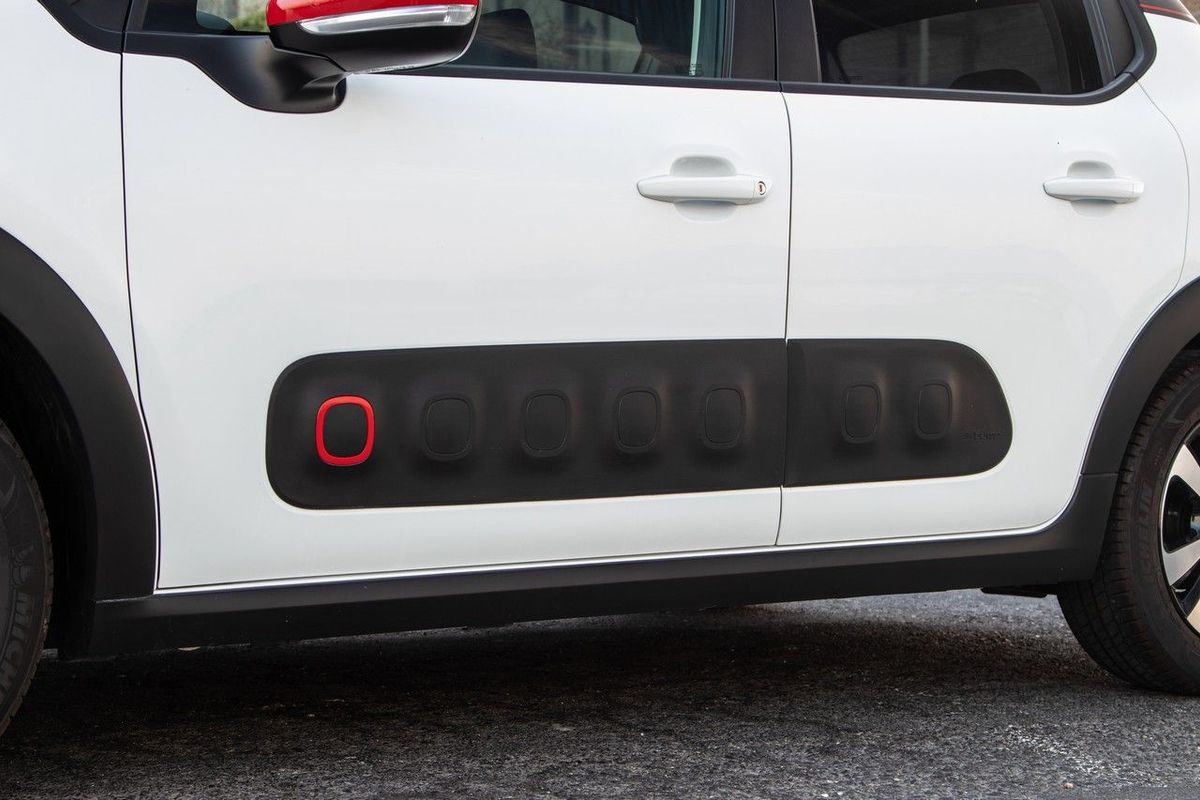
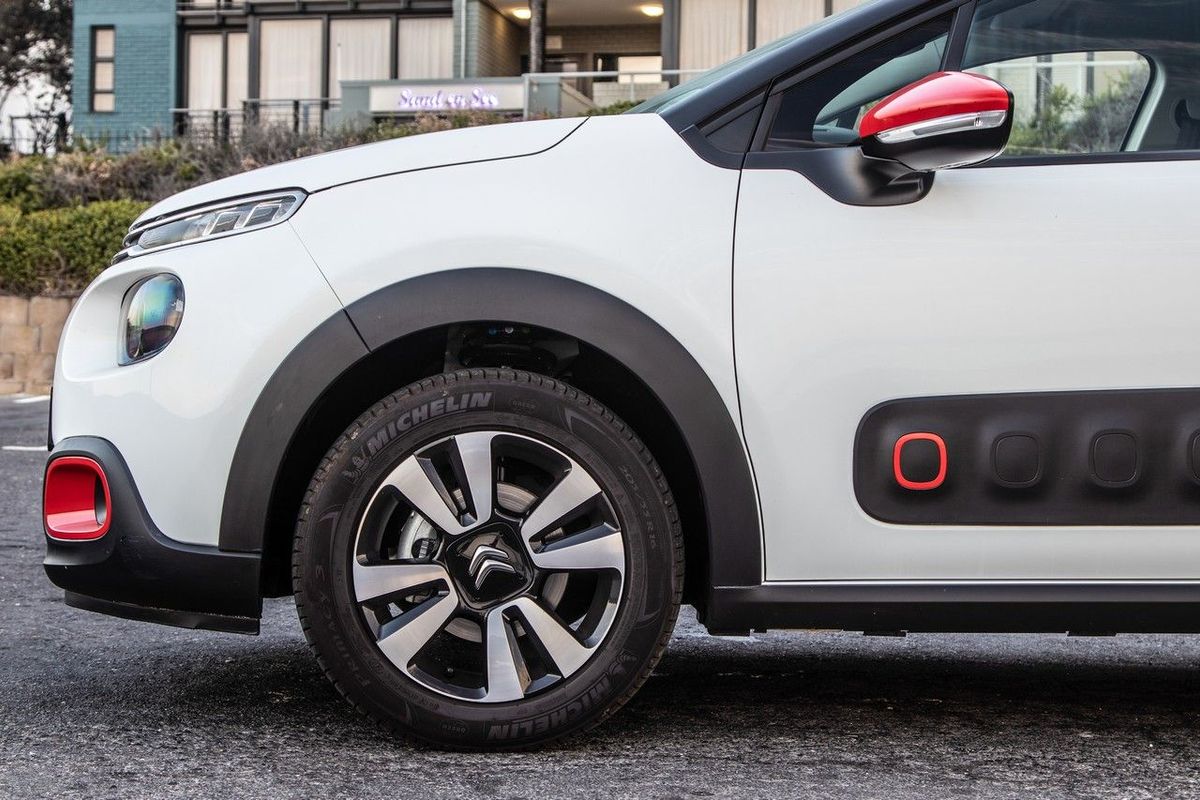
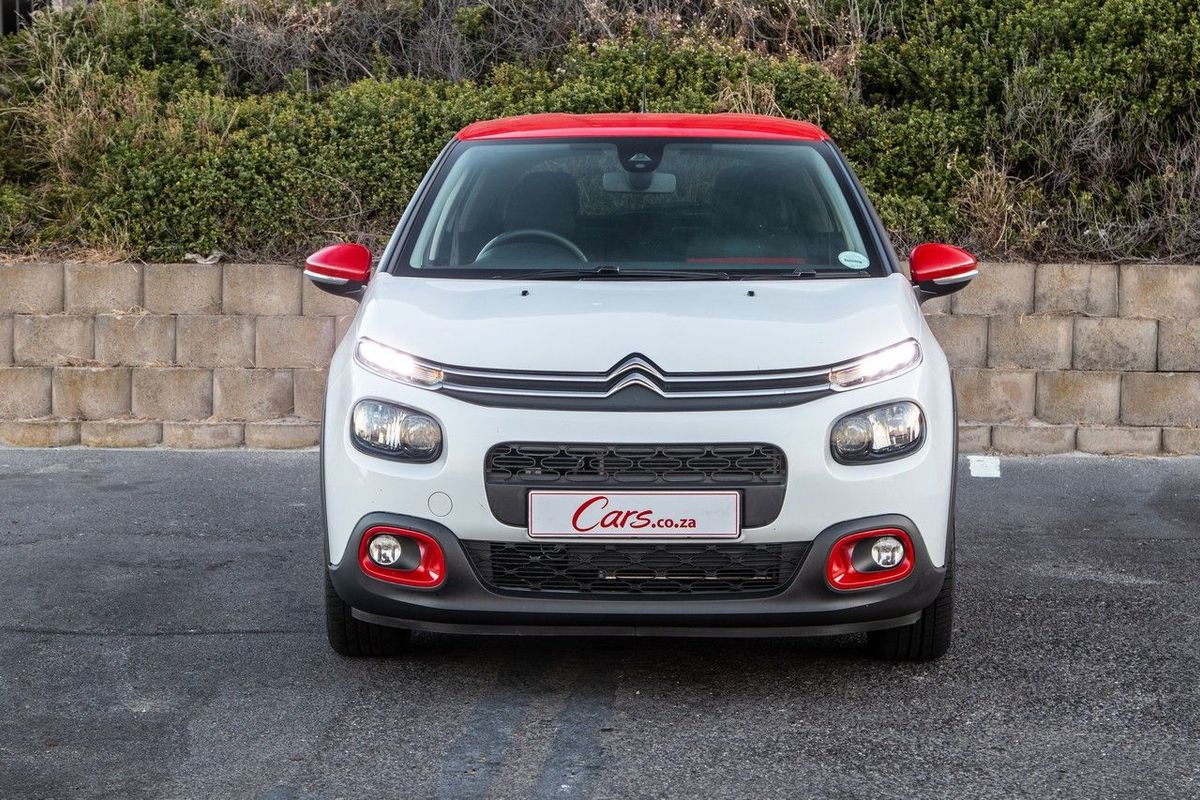
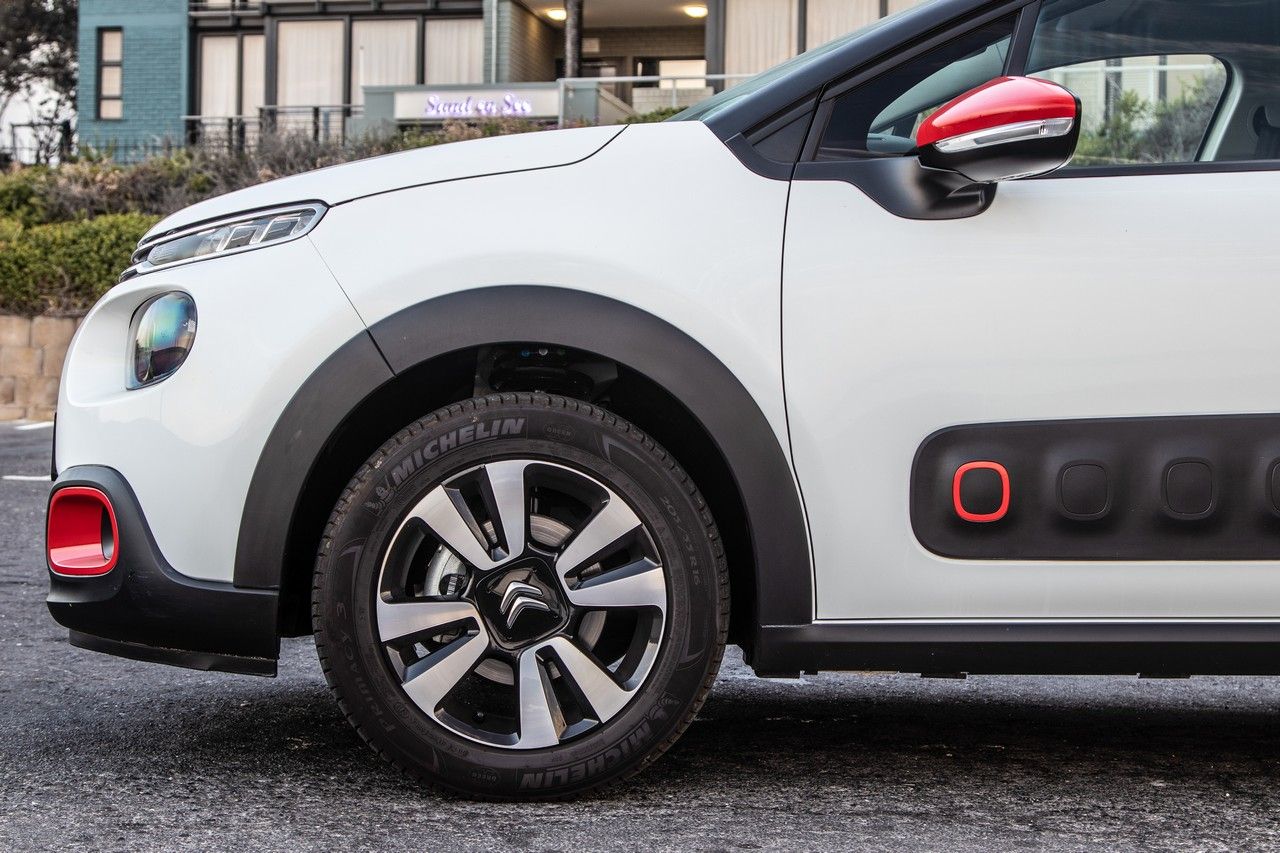
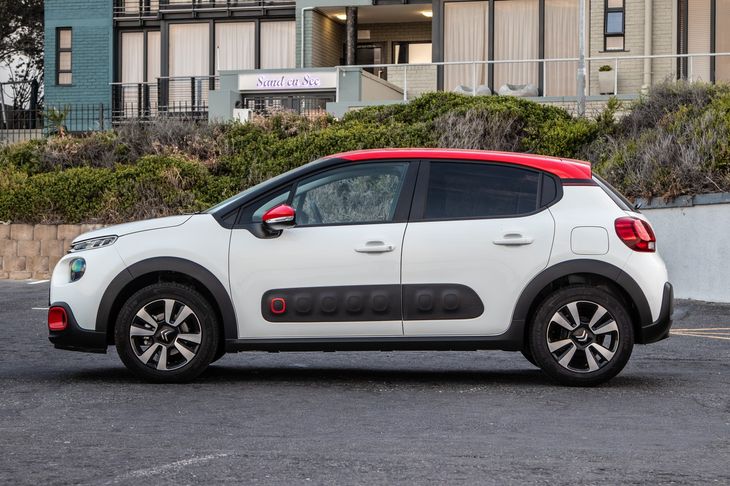
With its distinct Airbumps on the flanks and quirky styling, there's no mistaking the C3 for anything but a Citroen.
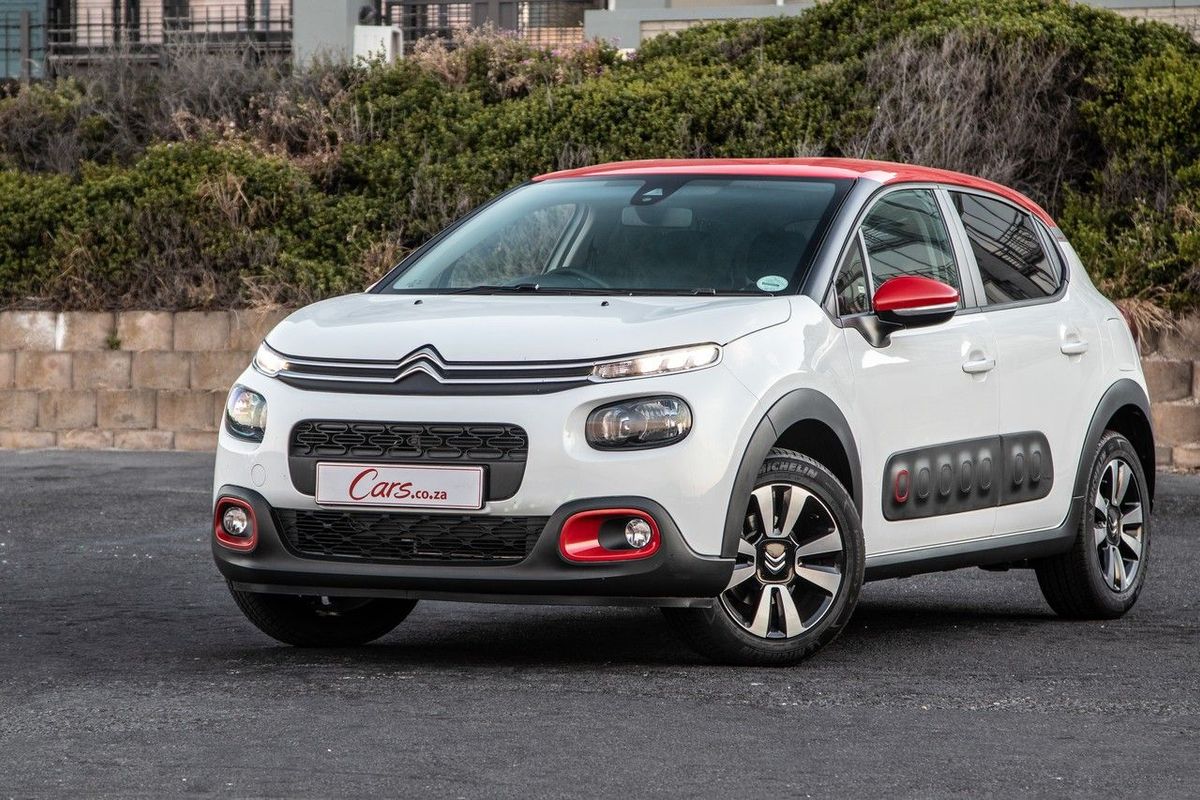
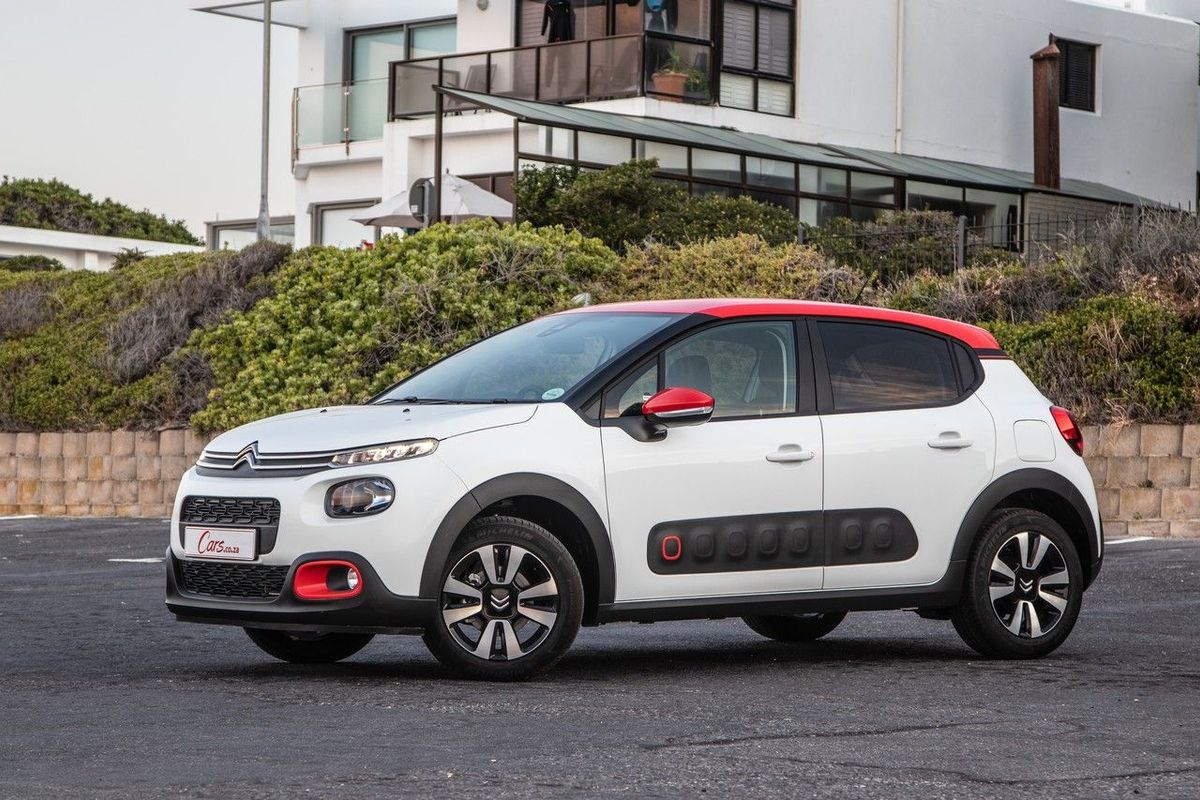
We live in an era in which car design has become predictable due to safety, aerodynamics and brand identity, so it's refreshing to see something as challenging as the Citroen C3. The narrow headlights and colour elements, as well as the Airbumps adorning the flanks are unique and unlike anything in this segment. While the styling may be a bit too "out there" for some, there's no denying it stands out from the rest of the segment… You can't say it's not interesting.
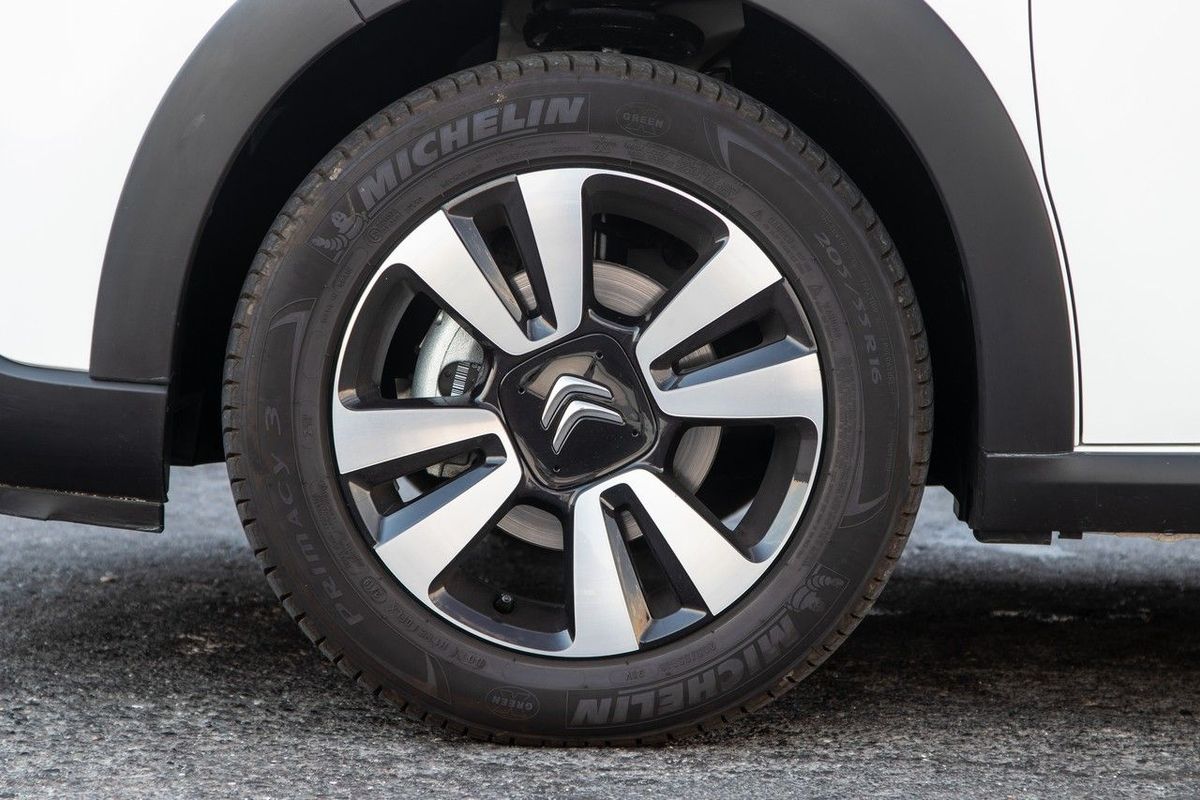
Both C3 derivatives sport attractive-looking wheels, with the top-spec adorned with 17-inch units. Our test unit came shod with 16-inch examples wrapped in Michelin rubber. There's also a contrasting roof colour scheme: ours was red, which smartly matched all the other splashes of red across the vehicle. This segment could be accused of being a touch too boring and predictable, and therefore, we think the Citroen C3 adds some flavour and emotion to this segment.
Driving experience
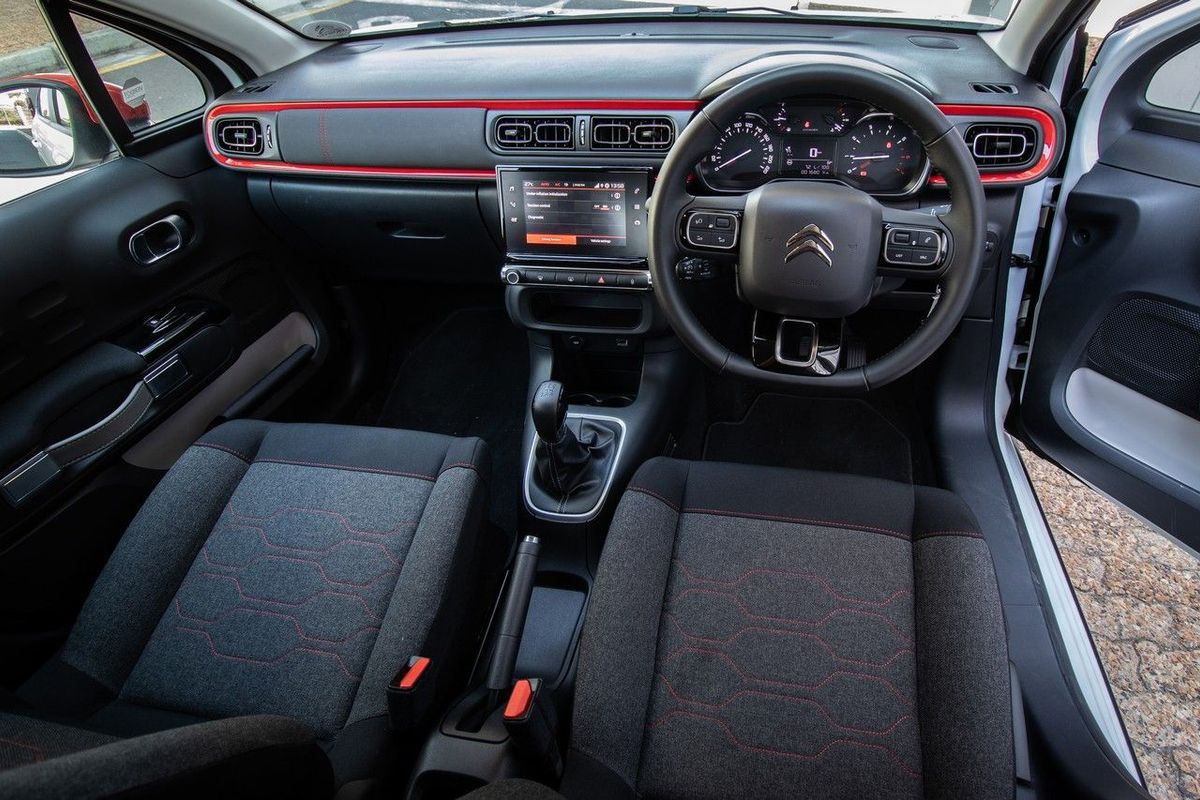
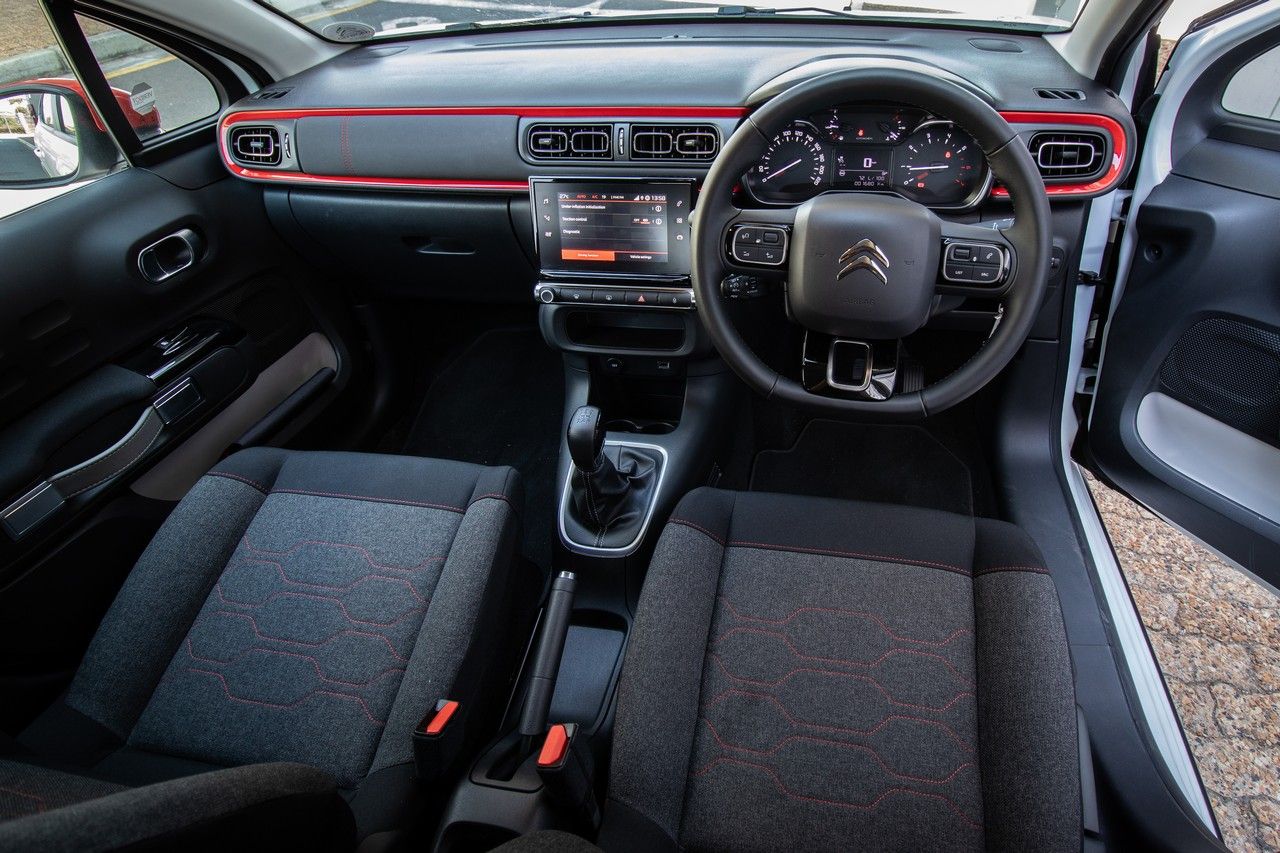
The cabin is dripping with funkiness, charm and vibrant colour touches.
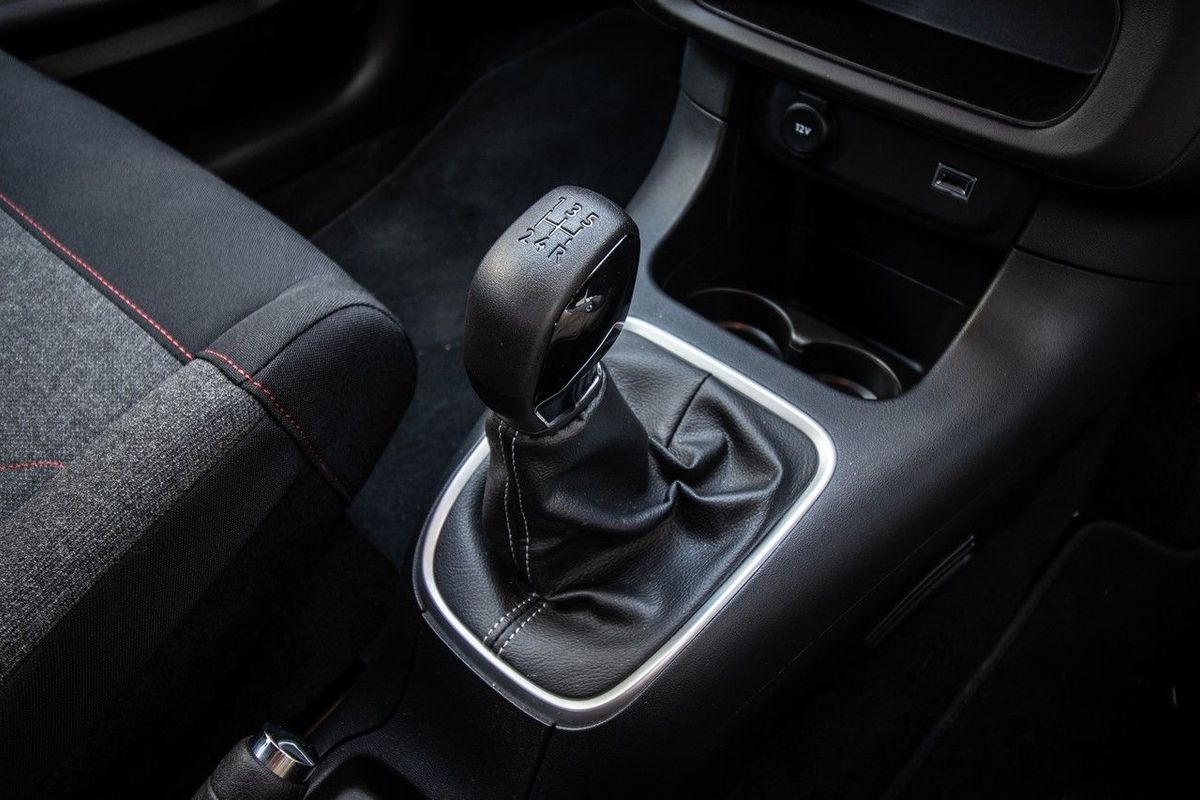
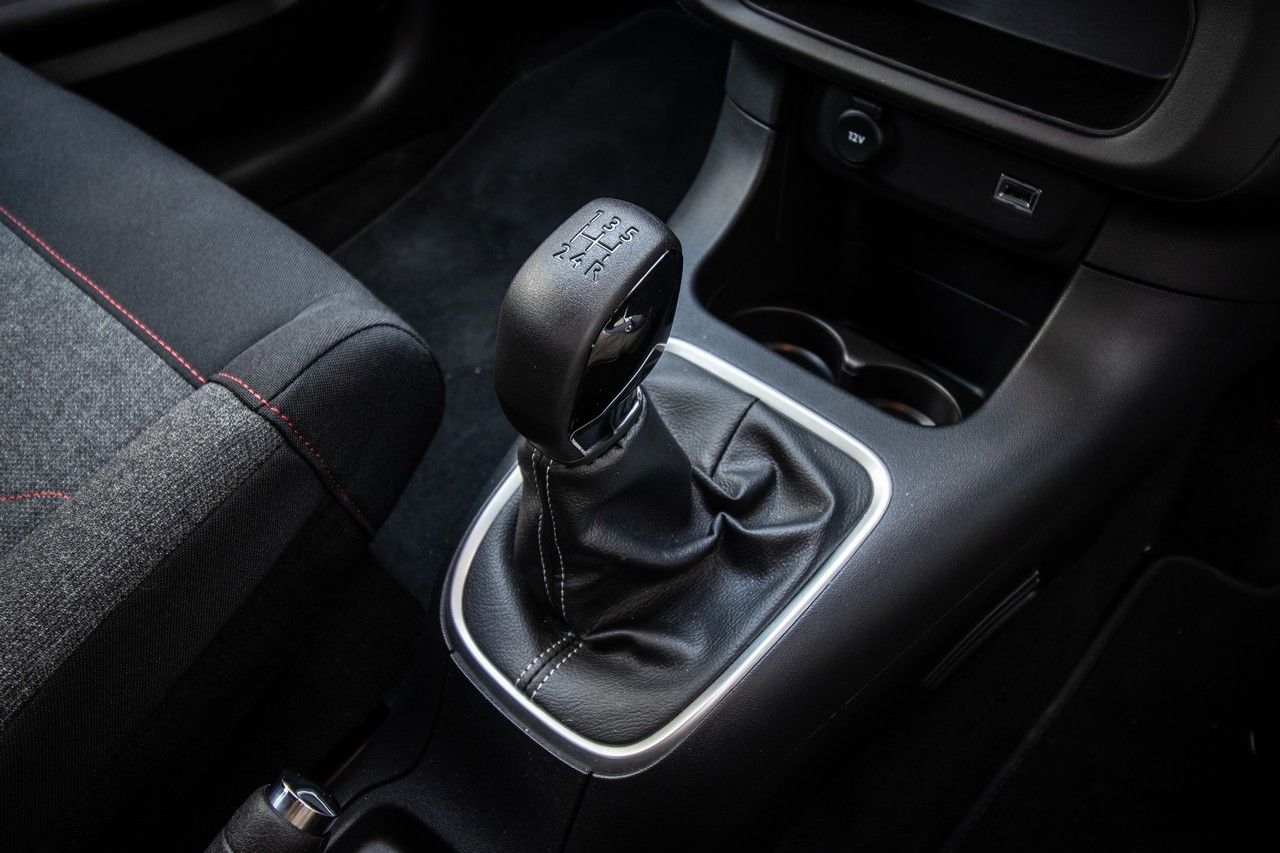
To reiterate, there are 2 powertrain options in the C3 range. The 1.2 Feel is powered by a naturally-aspirated 1.2 3-cylinder motor, which produces a workmanlike 60 kW and 118 Nm. Those peak outputs may not sound substantial, but when you factor in the derivative's low kerb weight (just 975 kg), the engine doesn't need to work all that hard to get the compact French car going. Citroen claims a 13.2-second 0-to-100 kph time, which seems sluggish. Well, to be fair, the C3's 5-speed manual gearbox doesn't help in that regard – it's not particularly smooth-shifting. Not only are the gear changes notchy, but the clutch pedal's travel is excessively long. Due to the combination of those factors, forward progress is not fluid, which is a shame, given the willingness of the engine. The good news is that Citroen does offer an automatic transmission for the C3, but in conjunction with the excellent turbocharged 1.2-litre 3-cylinder motor.
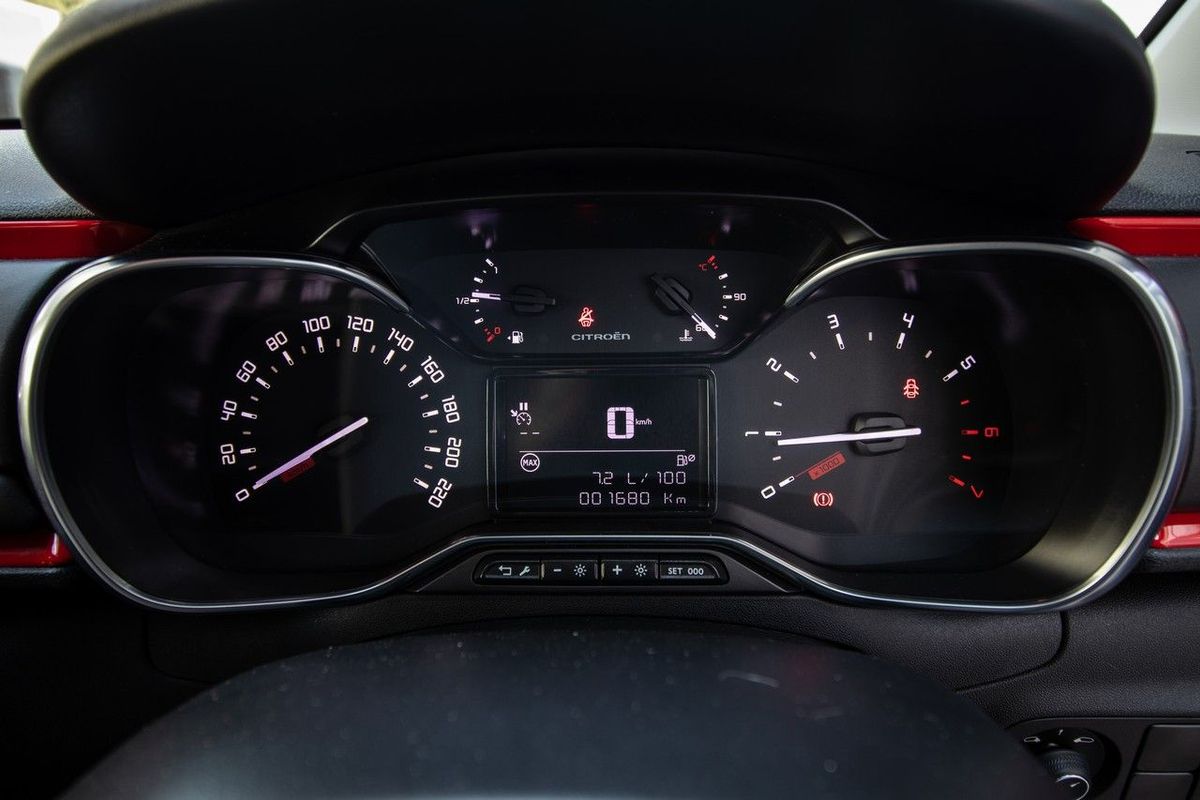
That being said, despite its middling engine outputs and odd gearshift action, the C3 1.2 Feel punches well above its weight… so much so, that this author was, at one point, "almost certain" he was at the 'wheel of the turbocharged higher-spec 1.2T Shine, which, of course, has an automatic transmission, so the illusion was fleeting. The naturally aspirated C3 does lose a bit of grunt when it's travelling on the open road, however; if you want to execute a swift 80-120 kph overtaking manoeuvre, you have to work the car's gearbox extensively. Still, the good fuel economy makes up for the lacklustre shift action, with our test unit returning a more than reasonable 7.2 L/100 km from a 45-litre tank.
The 5-speed manual gearbox isn't the best, with a notchy shift action and the long travel clutch requires effort.
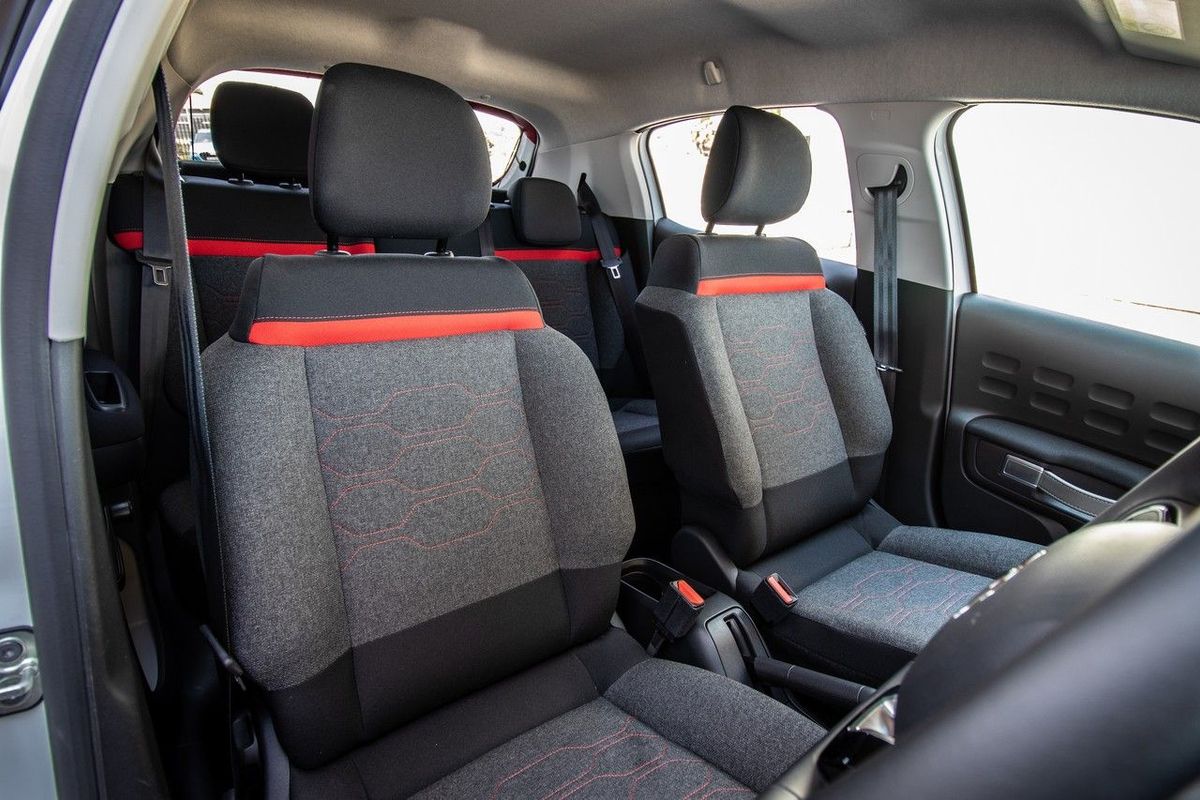
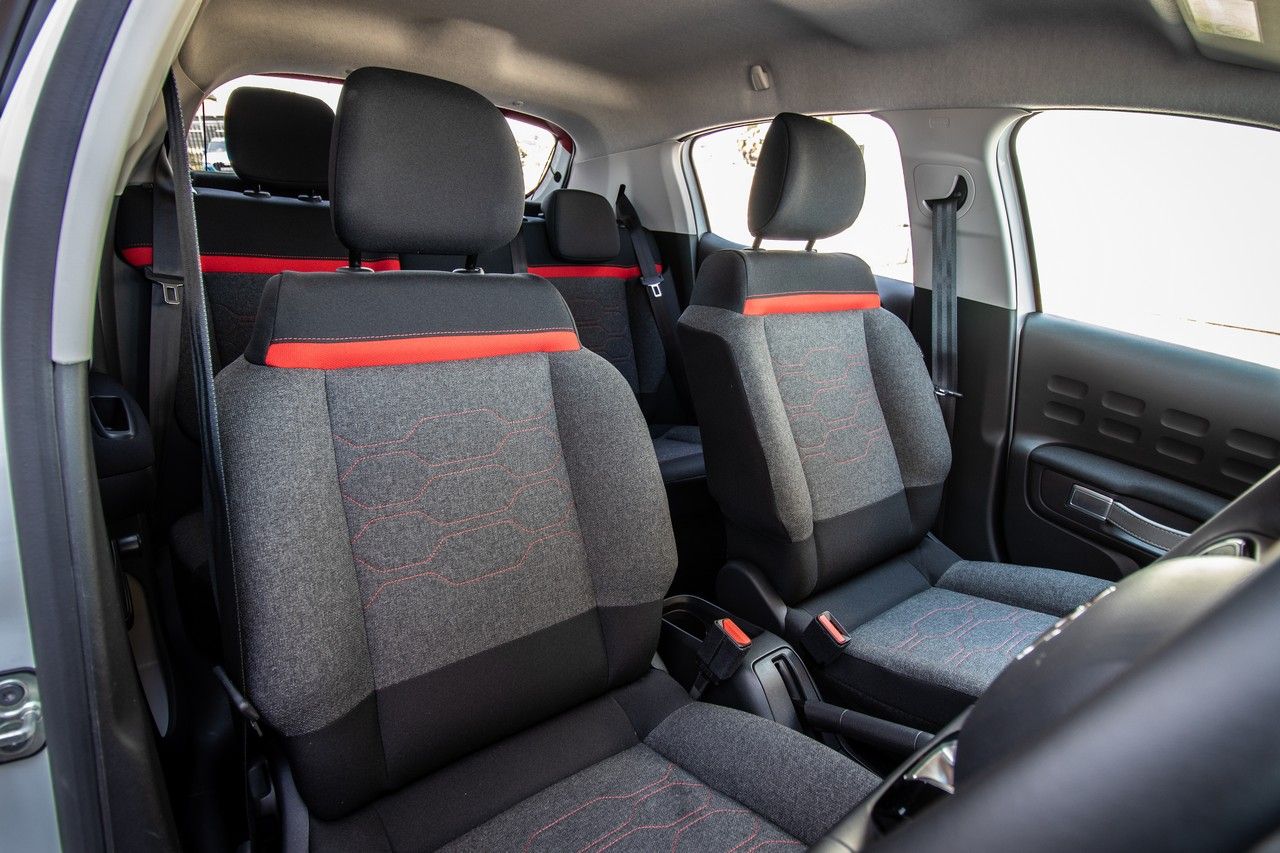
In terms of handling ability and ride quality, the C3 is about average when compared with its rivals. It's nowhere near as hands-on or engaging as something like, say a Ford Fiesta, nor does it have the Volkswagen Polo's enviable level of on-road refinement. However, considering that those rival derivatives cost substantially more than the C3, we're prepared to cut the newcomer some slack. The softly-sprung suspension is the "culprit" behind its imprecise body control… it never really tightens up. It can wallow a little through corners, not helped by the light steering. Don't get us wrong, we love a light steering setup in town and at slower speeds, but when one travels at 3-digit kph speeds, a measure of weight and firmness is reassuring; it just makes the car feel more stable. Another negative aspect is that due to the front seats' lack of side bolstering, you feel like you're about to slide out of your seat if you go around corners too quickly.
Interior quality
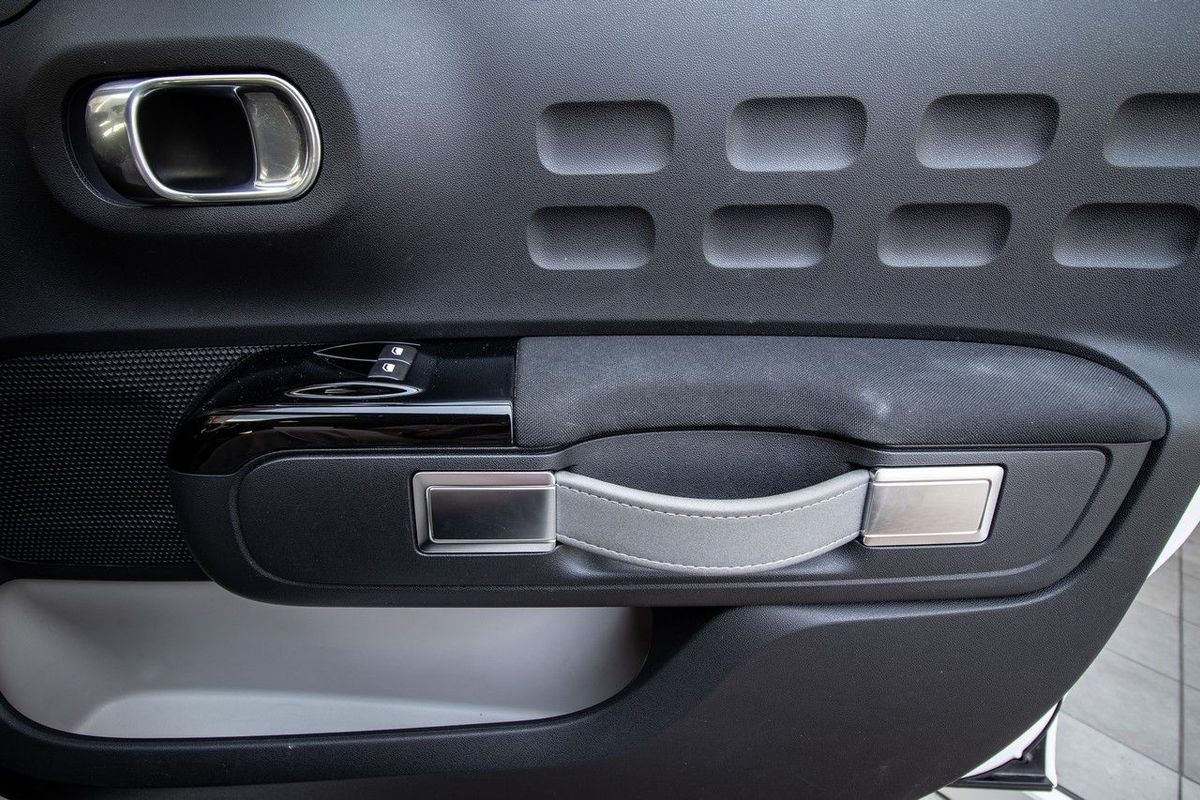
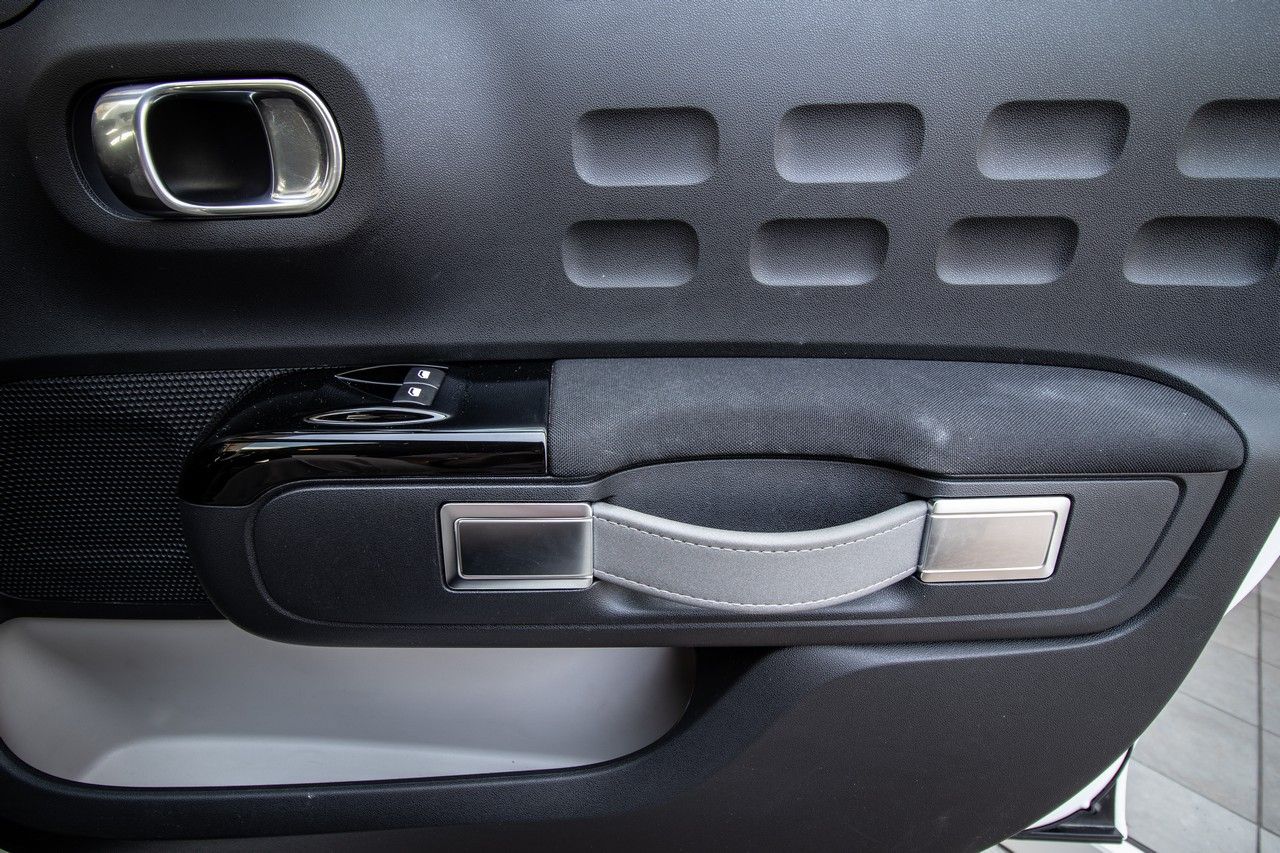
The charm continues with these cute luggage straps as door handles.
Citroen is a quirky brand, which is evident in its eccentric cabin layouts. Consider the door handles you see above, they're luggage straps and there's inverted Airbumps on the interior panelling. What we really like is the design of the cabin, it's genuinely interesting and undeniably stylish. Some of the plastics feel a bit cheap though, but nothing surprising nor unforgivable at this price point. The vehicle feels solidly finished, despite the lack of soft-touch materials.
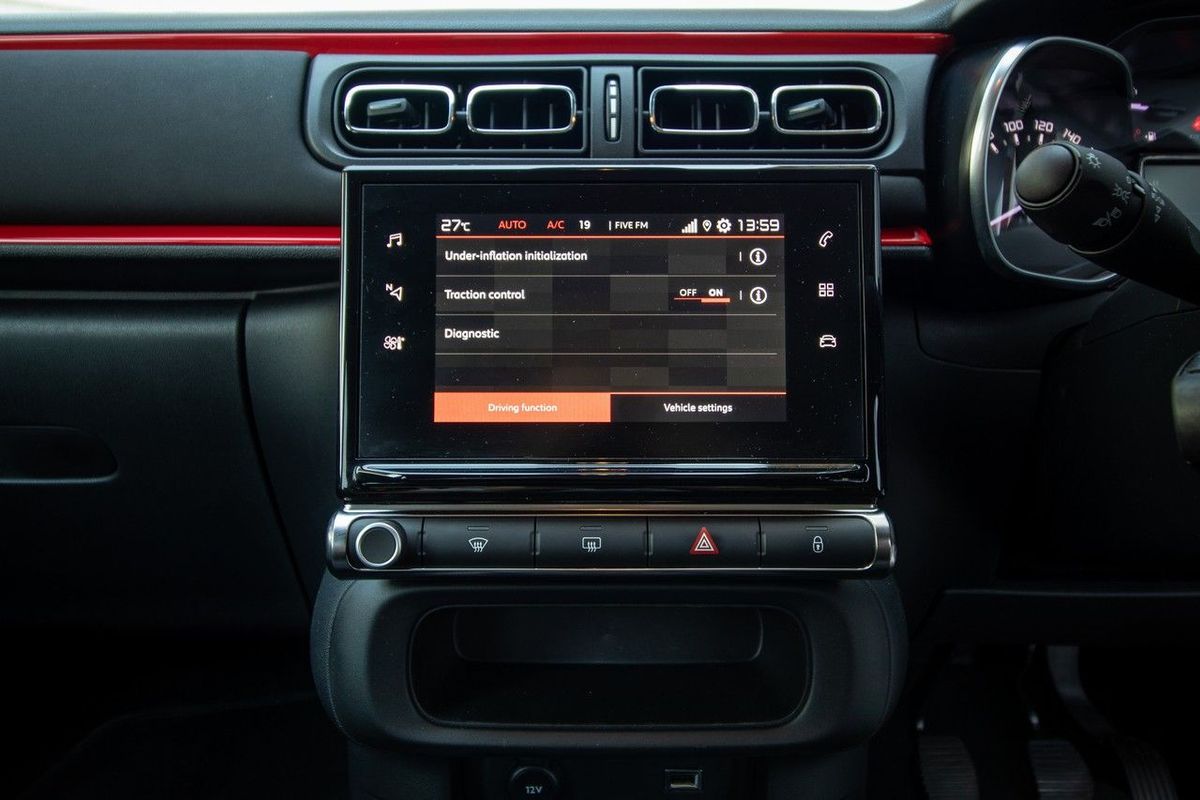
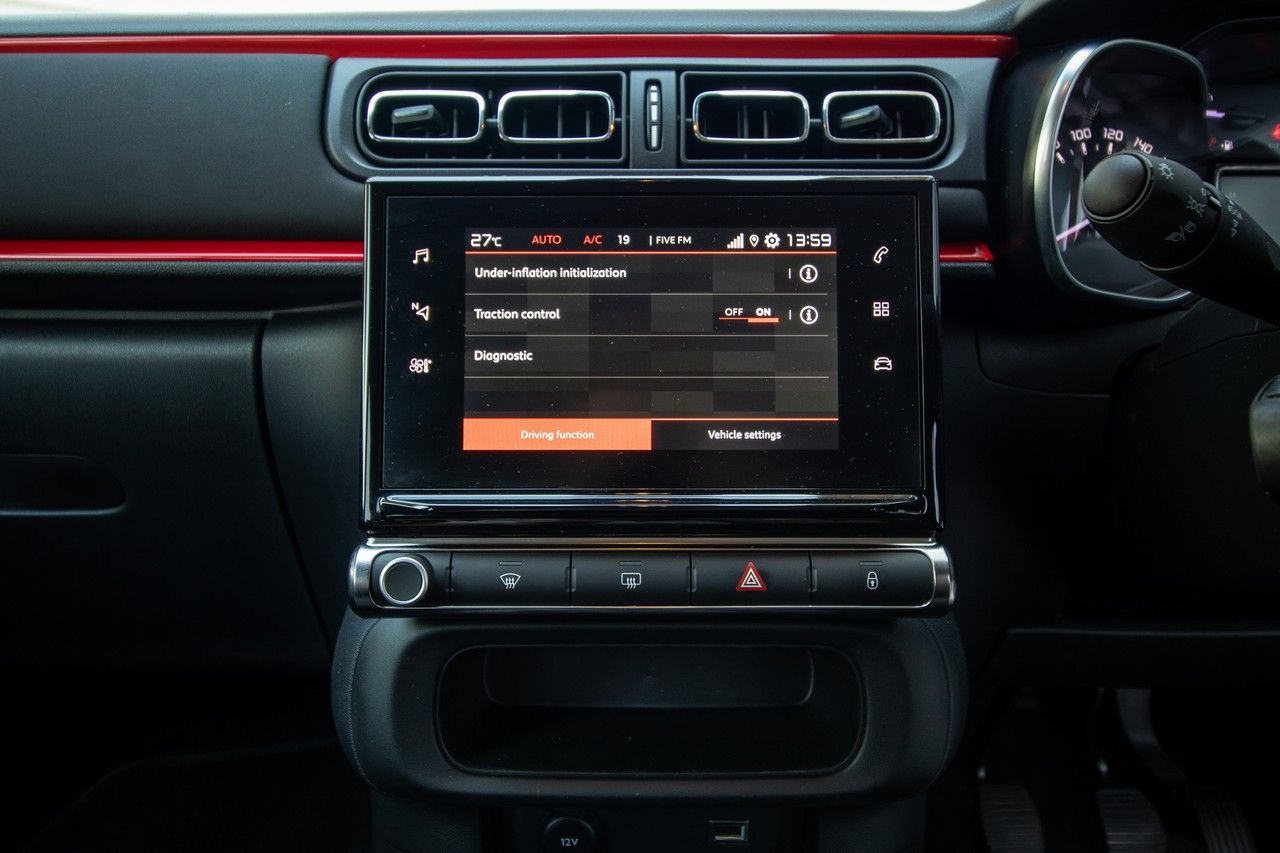
The first thing that is likely to catch your eye is the large infotainment touchscreen, which controls many of the car's features. While it does help to unclutter the fascia, its user experience is a bit flawed: there's no quick way to access something such as heating-, cooling and ventilation settings without diving into a menu and tapping on the screen a few times. On the plus side, Apple CarPlay and Android Auto are supported, which adds a few more features to the car.
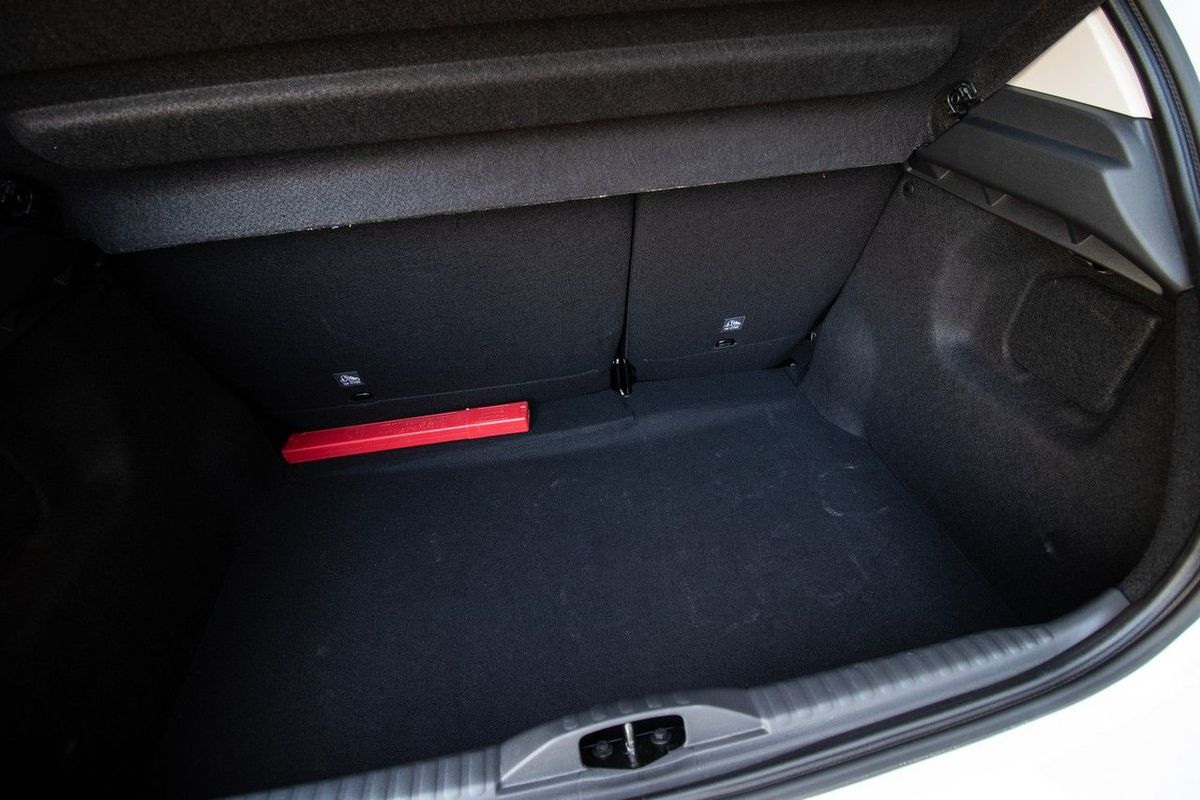
In terms of space utilisation, the Citroen C3 is indeed a small car on the inside. Rear legroom is just about acceptable (taller occupants will battle with knee room, however) and the claimed load-bay capacity is 300 litres, which is notably less than what its main rivals are said to offer. The Kia Rio, for example, is said to accommodate up to 325 litres, while the Suzuki Baleno comes with a relatively generous claimed capacity of 355 litres.
The C3's cabin execution is youthful and cute, but we do wish those attractive front seats offered additional side support.
Standard features
If there's one aspect that Citroen has really got spot-on with the C3, it's the 1.2 Feel's standard specification. Unless you spend thousands on optional extras or opt for the higher-spec derivatives of other brands, there's little (or nothing) to touch the C3's features list at this price point. The safety spec alone deserves special recognition: there are 6 airbags, anti-lock brakes with EBD, stability control, hill assist, as well as tyre pressure sensors. Commendable indeed!
Other standard features include cruise control with speed limiter, automatic air conditioning, electric front windows, a 7-inch touchscreen infotainment system with USB/Bluetooth/Aux/12V connectivity, Apple CarPlay- and Android Auto compatibility, daytime running lights, leather-wrapped steering wheel/handbrake, multifunction steering wheel, trip computer and 60/40 folding rear seats. In fact, it's easier to tell you what's not fitted to the Citroen C3: rear parking sensors, rear electric windows and automatic headlights. The support of Apple CarPlay and Android Auto is a big plus, because you gain access to streaming music services and critically, navigation via Google Maps/Waze/Apple Maps.
The Citroen's comprehensive infotainment system, which has removed the need for many buttons dotted around the cabin.
Price and after-sales support
The asking price of the Citroen C3 1.2 Feel is R249 900 and comes with a 5-year/100 000 service plan, warranty and roadside assistance. The top-spec 1.2T Shine costs R299 900.
Verdict
Despite the seemingly furious rush by consumers to snap up manufacturers' small crossover and compact SUV models, there's still a strong case to be made for the compact hatchback. The sales numbers of the Volkswagen Polo alone are quite staggering and its rivals are fighting over the proverbial scraps. However, at this price point, we have to consider naturally-aspirated offerings as rivals to the C3 1.2 Feel; products such as the Kia Rio, Hyundai i20 and Suzuki Baleno come to mind, all of which have strengths and weaknesses… Both Koreans offer excellent build quality, but are slightly down on safety features, while the Suzuki's cabin space and luggage capacity is arguably segment-leading.
So, should you buy a C3? There's no doubt about Citroen's ability to produce stylish and well-specced compact hatchbacks. During its tenure in our test fleet, the 1.2 Feel drew numerous positive responses and you can't help but develop a soft-spot for its charms and quirks. It also looks unlike anything else in the segment, so for those who crave individuality, this Citroen will "tick the box". It's not the most engaging nor fun-to-drive car, but those aren't pillars for success in this segment. We weren't particularly pleased with the long clutch pedal travel and notchy gearbox, but there is an automatic option available, which is coupled with a punchy turbocharged motor for R50k more. We've experienced this combination in the Citroen C3 Aircross and we think it's more suitable for those who commute in congested traffic. If you don't need a large load bay, nor need to frequently transport more than 2 people, the Citroen C3 is worth a look.
A big question many of you have asked is: "Has Citroen's after-sales and servicing has improved since the brand's return?" Citroen South Africa claims to offer comprehensive cover for all of its products, including a 5-year/100 000 km service plan, 5-year/100 000 km warranty plan, 5 years (or 100 000 km) roadside assistance, 12-year anti-perforation cover and a 3-year paint warranty. It's a good start; we're hopeful Citroen SA will "put its money where its mouth is".
The Citroen C3 is a charming and cool hatchback, but is that enough to compete at this level?