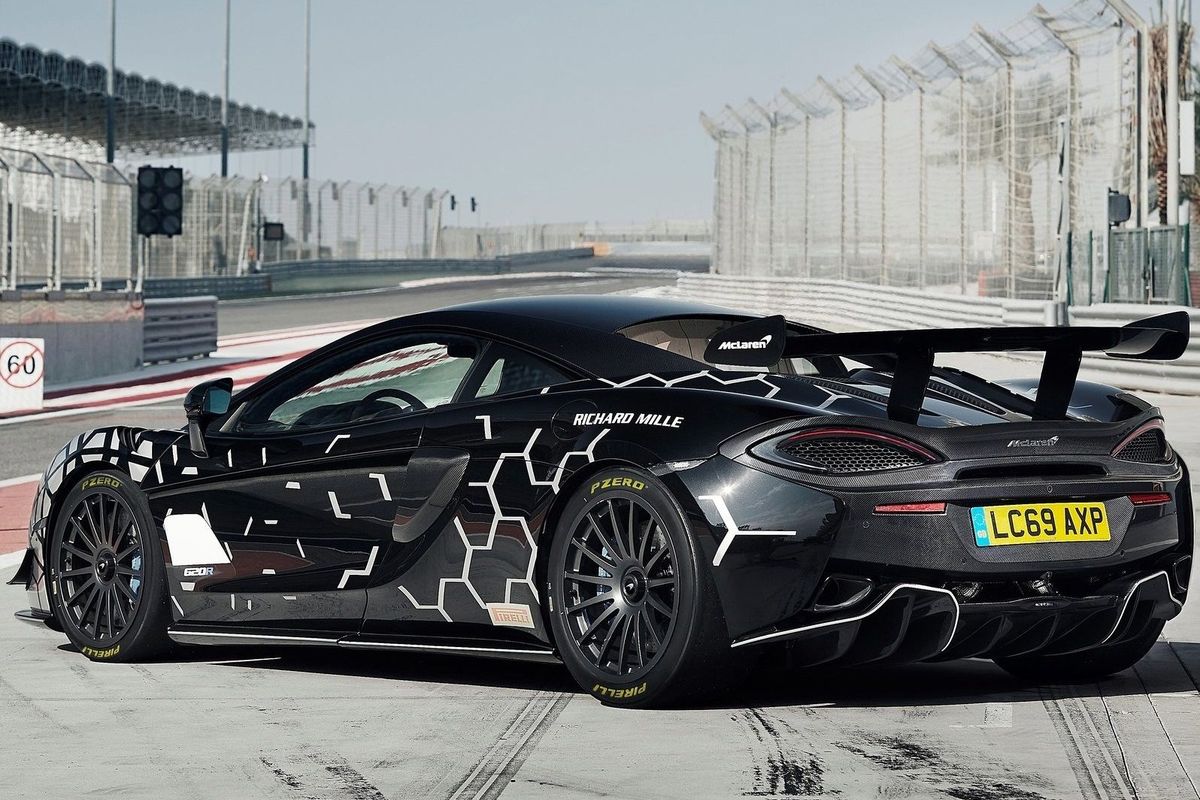
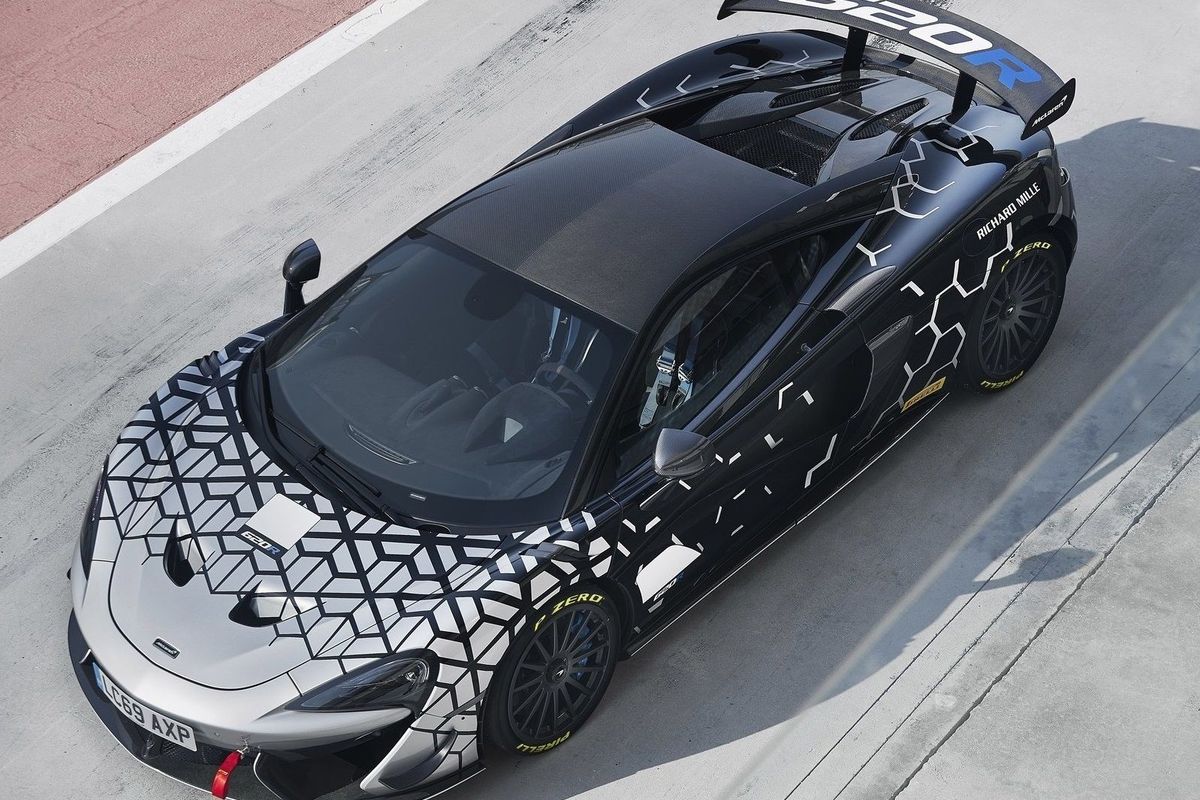
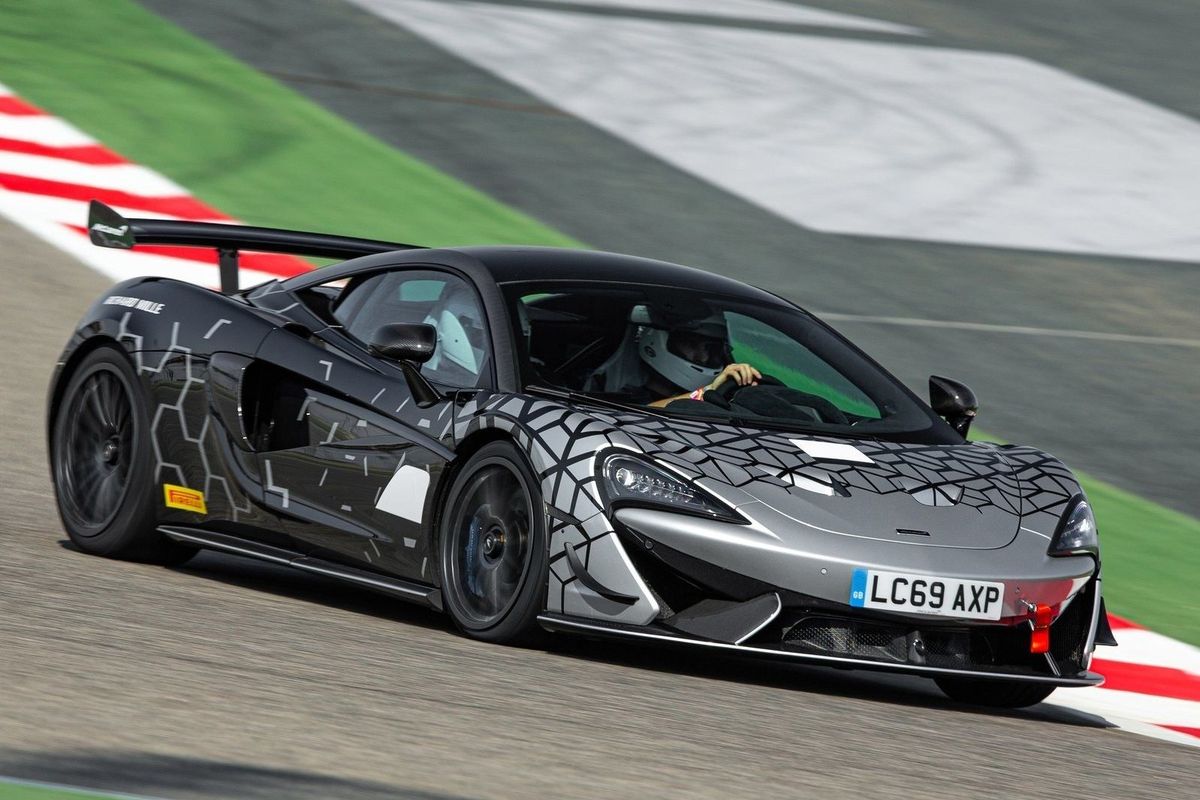
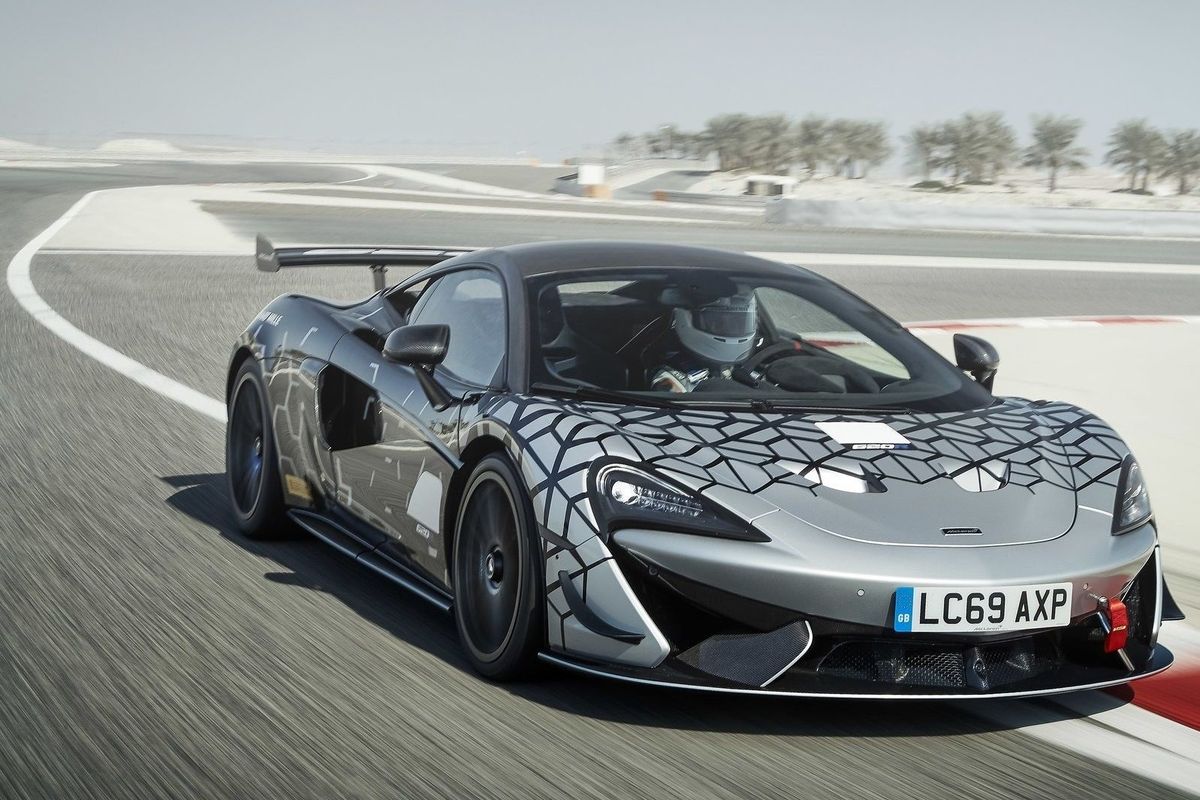
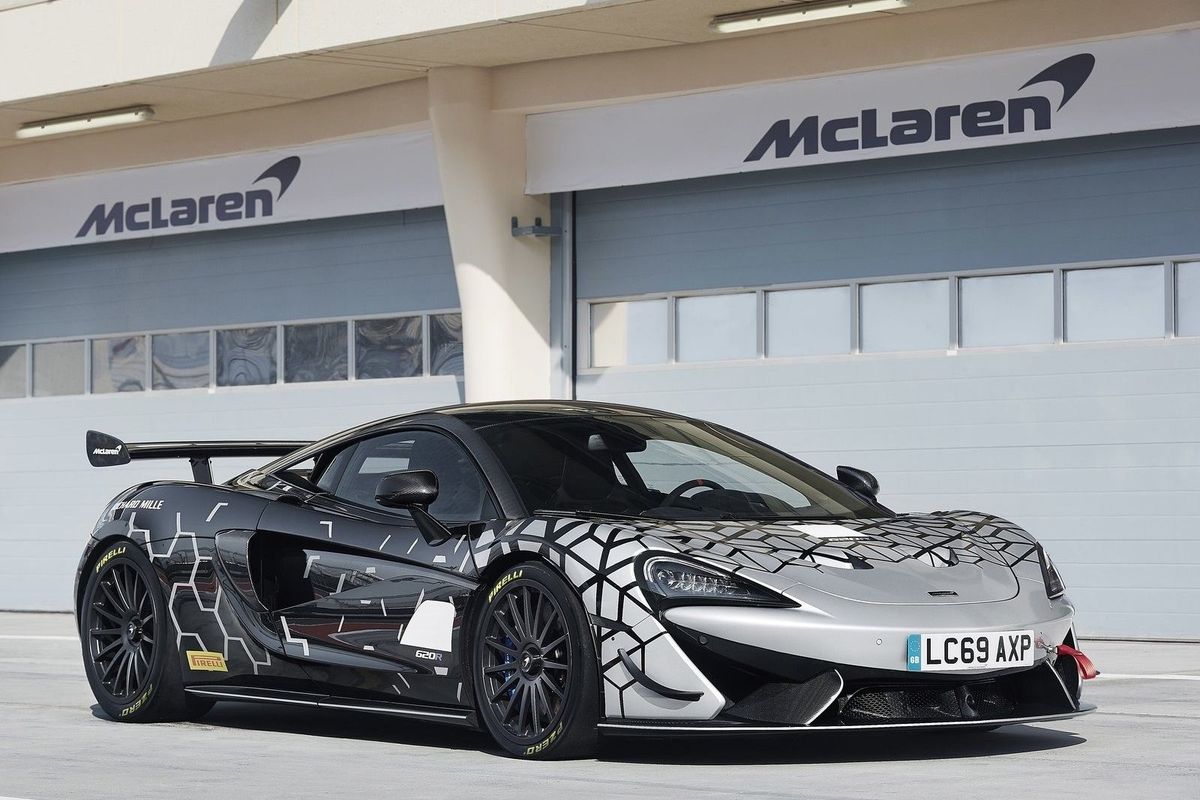
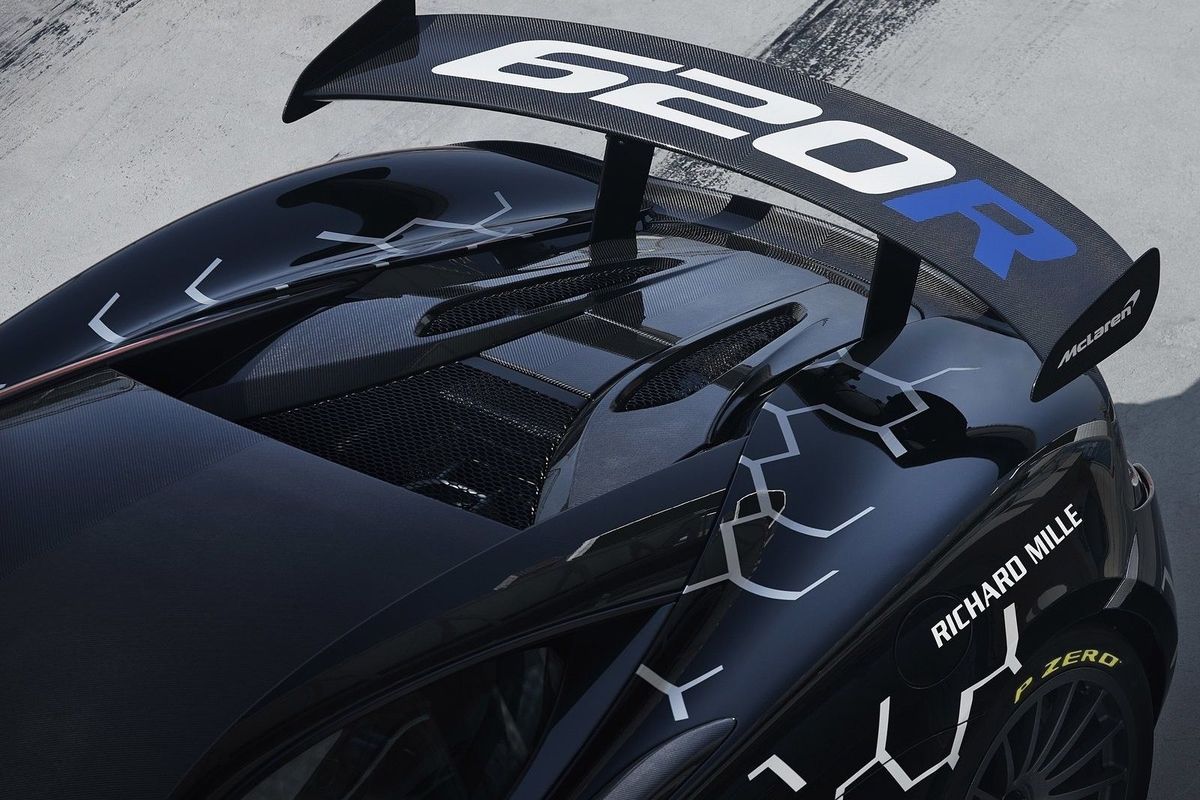
There's another new McLaren out. This new one's the McLaren 620R, but unlike some of the recent creations, this one is a road-legal racecar.
The McLaren 620R is not going to be made in huge numbers as the Woking-based brand says just 350 will be assembled. Based on the McLaren 570S GT4 and celebrate this vehicle's illustrious racing career, the 620R is said to "deliver a race-car experience on either track or road."
What exactly does this mean? Well, it shares quite a bit with the GT4 racecar, such as the carbon fibre chassis, adjustable aerodynamics and suspension. That trick suspension ranges from 2-way manually adjustable coilover dampers with 32 clicks of adjustment per corner to the stiffer anti-roll bars and springs.
Then there's the engine, with the M838TE 3.8-litre twin-turbo V8 motor produces 455 kW and 620 Nm. Unlike its GT4 sibling which is restricted, this gives you the maximum amount of shove. Acceleration is brutal, with 0-100 kph being dispatched in 2.9 seconds, but even more impressive is the 8.1 second time for the 0-200 kph. If the road is long enough, the maximum speed is claimed at 322 kph. The vehicle comes with Pirelli P Zero Trofeo R semi-slick tyres as standard equipment.
Inside, the McLaren 620R features 6-point harnesses and lightweight carbon fibre racing seats and door pull straps. There are lashings of carbon fibre throughout the cabin and can be seen in the shift paddles, steering wheel spokes and centre console.
"The McLaren 570S GT4 is a first-class GT race car that having won races in every championship it has competed in since its first appearance in 2017 is attracting an increasing number of customer racing teams. Now, in response to repeated customer requests, we have homologated that class-leading package for the road in the new McLaren 620R, a limited-edition, 620PS superlight coupe that is the perfect choice for an enthusiast wanting an authentic motorsport driving sensation – and performance to match – on both track and road." Mike Flewitt, Chief Executive Officer, McLaren Automotive.
Lynk & Co's 05 is a Chinese version of a Volvo crossover.
Geely sub-brand, Lynk & Co, has revealed its very ambitious cross-coupe.
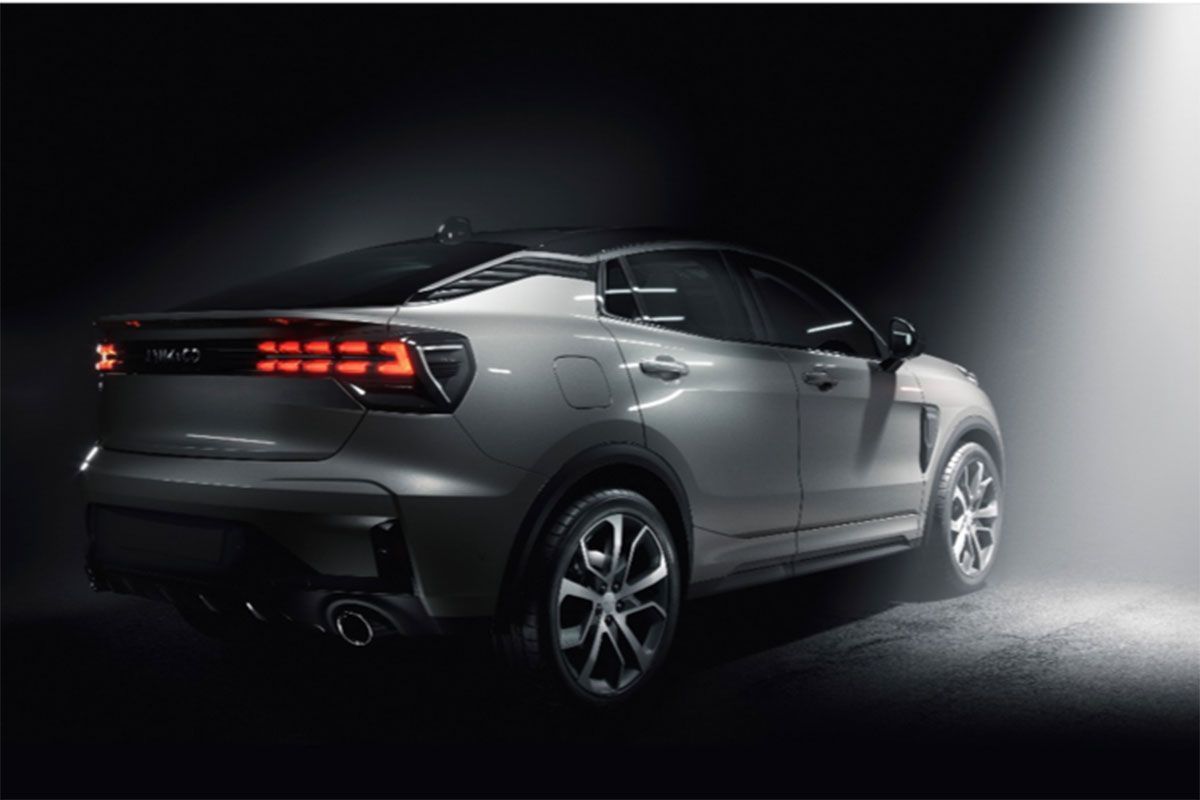
The Chinese automotive giant has been clear with its intentions for the Lynk & Co 05, which has been designed, engineered and configured to compete with vehicles such as BMW’s X4.
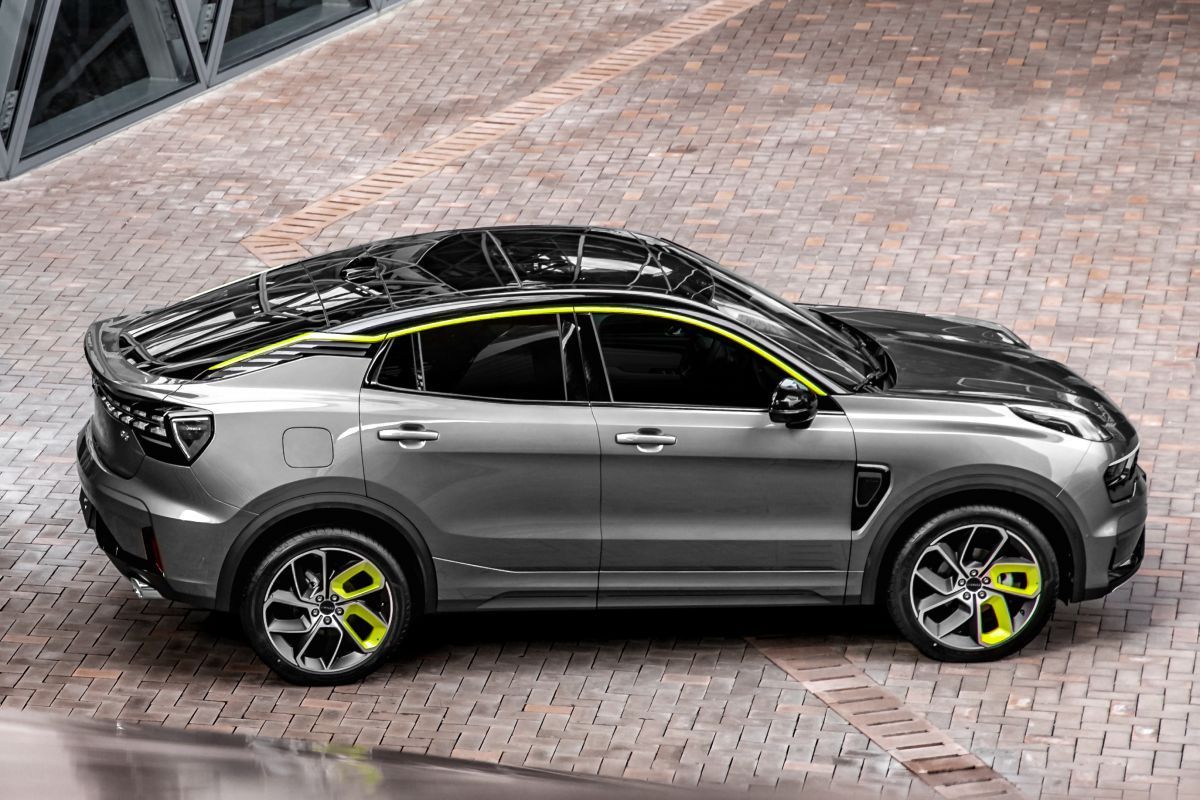
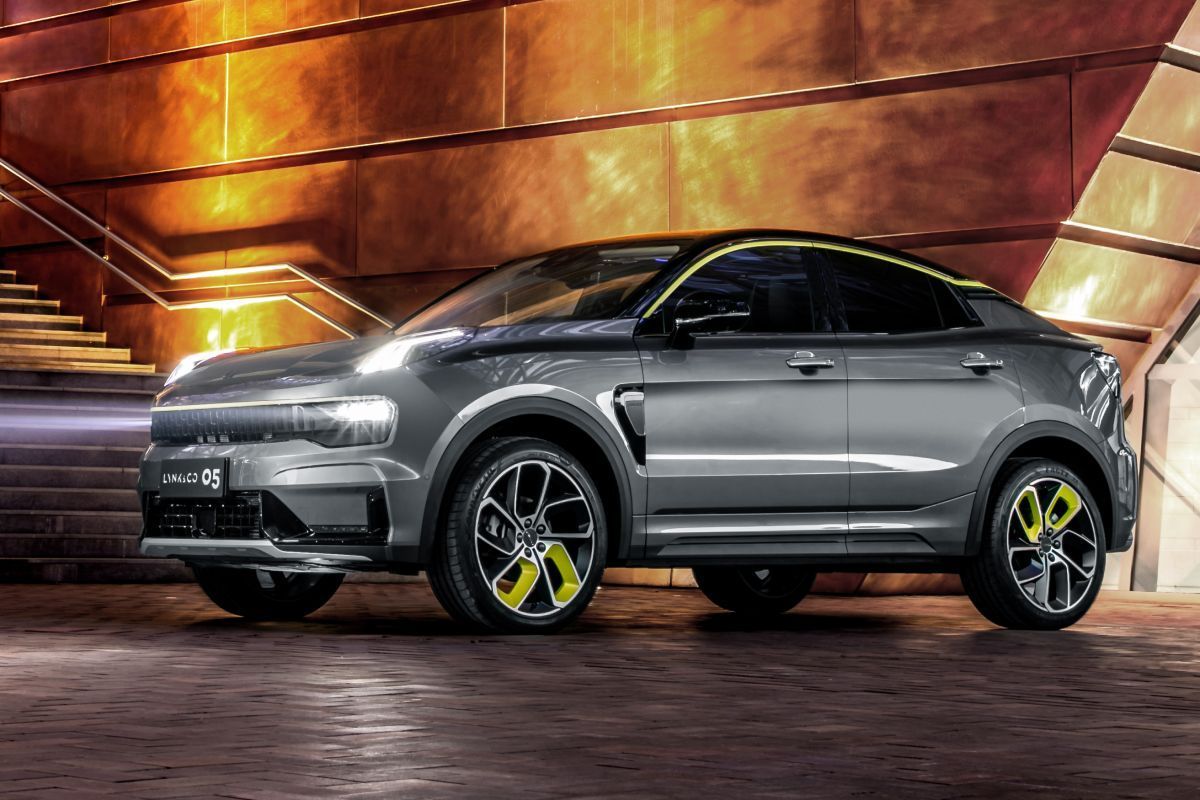
Featuring a bold exterior design, the Lynk & Co 05 is supposed to be a serious Chinese rival to traditional German premium crossovers.
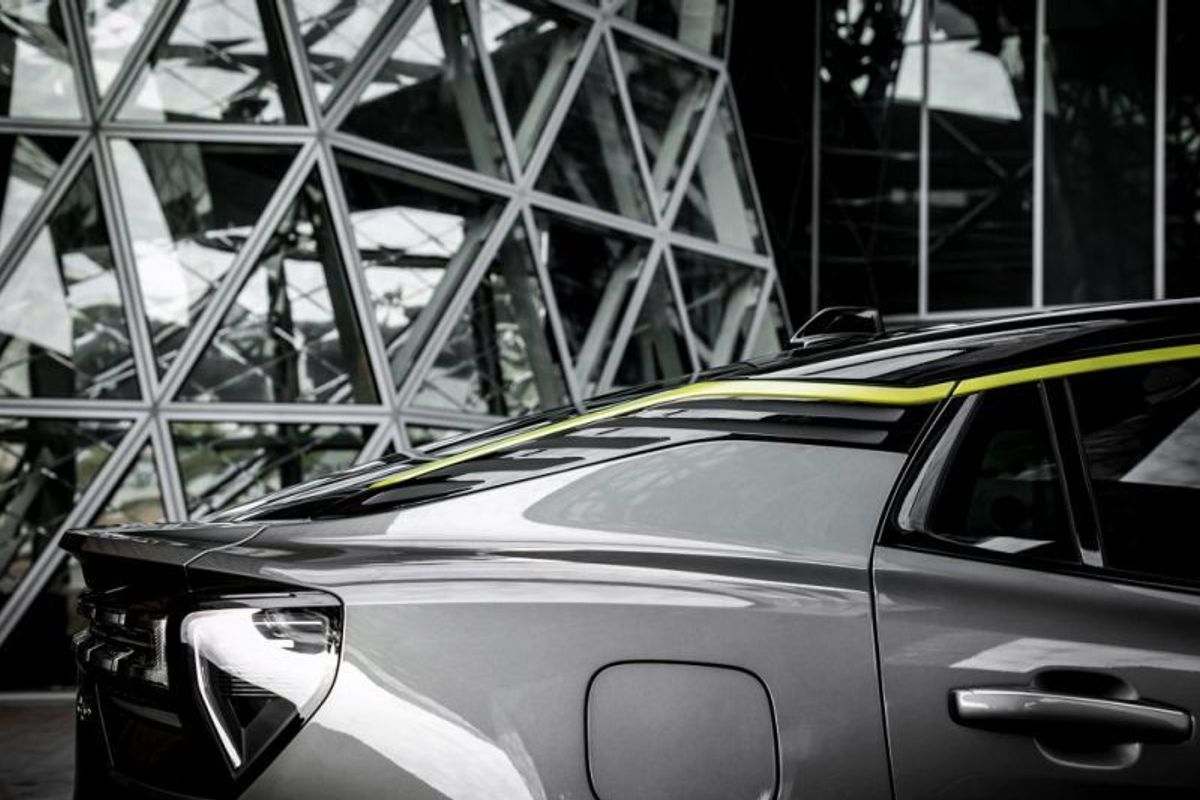
Some of the notable design details include a wraparound grille and bold colour detailing in the wheels and roofline.
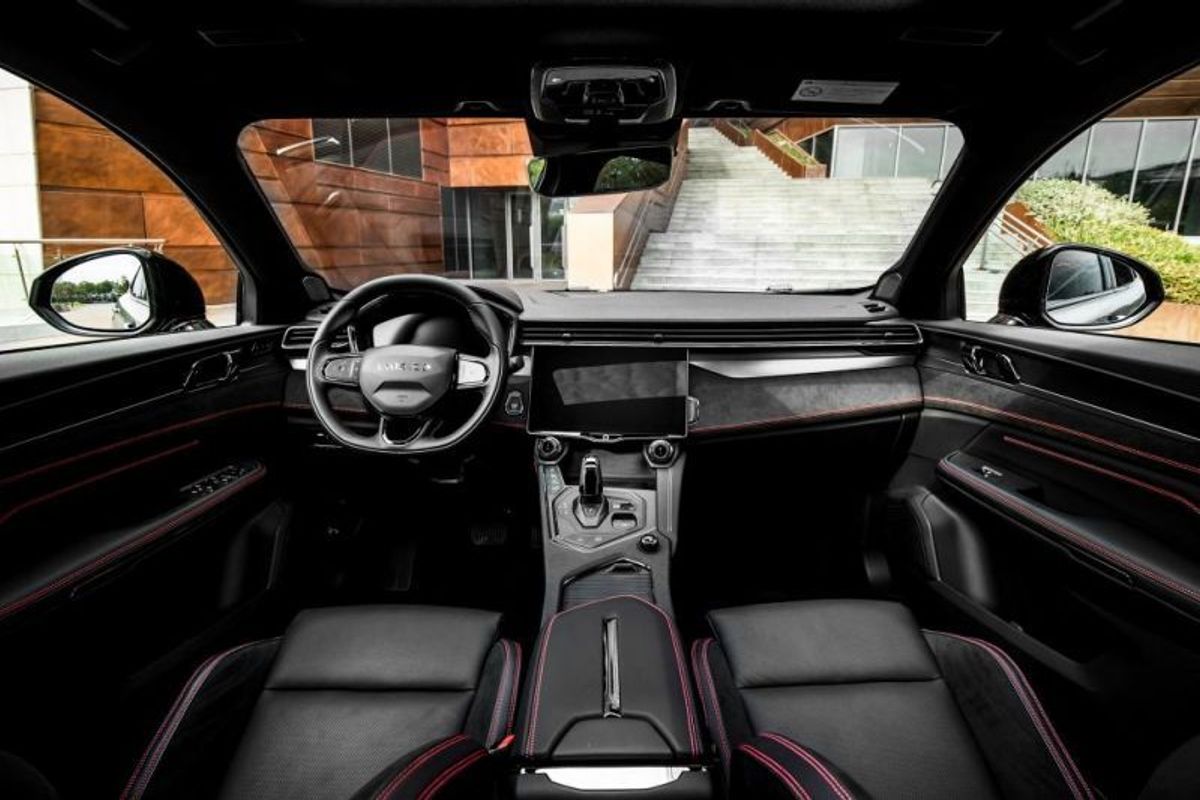
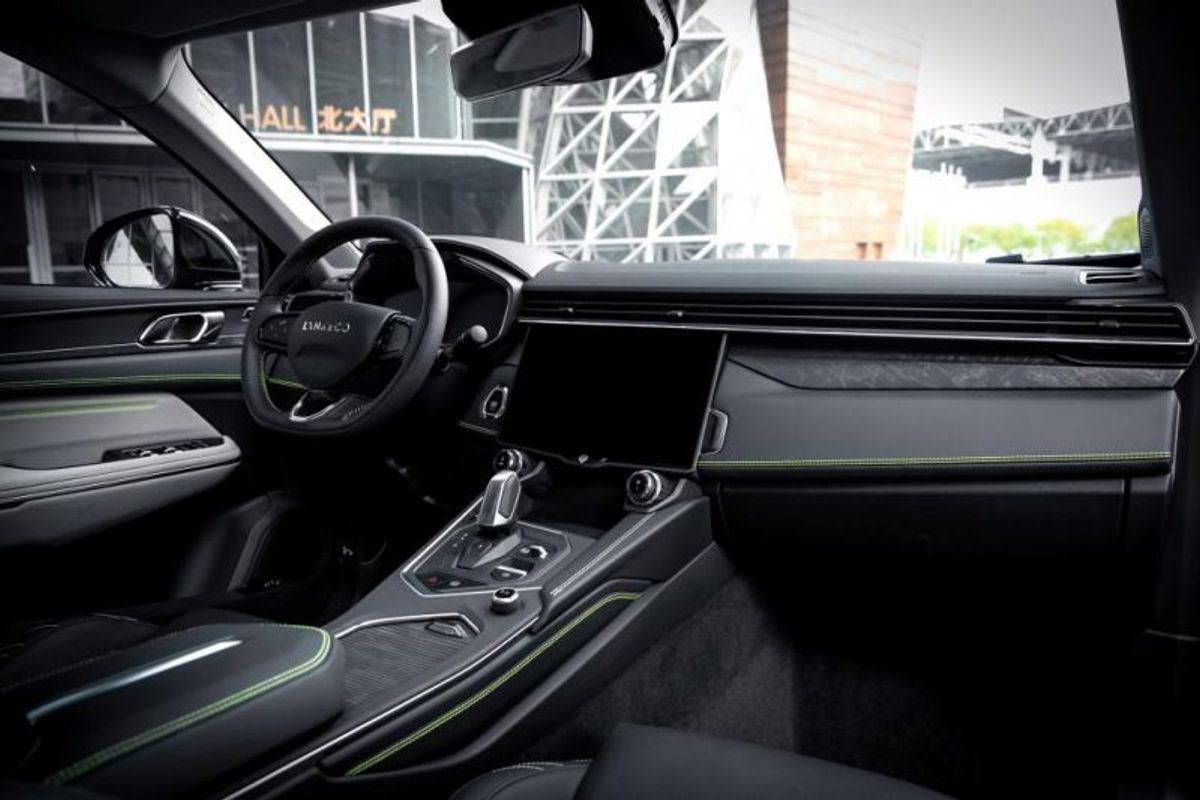
Geely wishes to start retailing the Lynk & Co 05 in Europe and other traditional automotive markets by 2020, and to be successful, the Chinese company realises that it cannot rely purely on discount pricing. As such, the Lynk & Co 05’s cabin is assembled with quality materials and features all the infotainment and digital convenience you’d expect from a contemporary cross-coupe. Anchoring the cabin architecture’s digital offering is a 12.7-inch infotainment screen.
Providing the structure and mechanical engineering for Lynk & Co’s 05, is Volvo. The Swedish brand has been Chinese owned since 2010 and provides most of the technology for Lynk & Co’s 05.
This new Chinese cross-coupe rides on a CMA platform, effectively makes it an XC40 of sorts. Powertrains will be familiar to Volvo owners, with the Lynk & Co 05’s launching with a being a mild-hybrid 2-litre turbopetrol, which boosts 187 kW and 350 Nm. Geely will introduce a smaller 1.5-litre three-cylinder turbo too.
Could X4 buyers potentially be swayed by a Chinese cross-coupe, with Volvo mechanicals? Pricing and delivered vehicle build quality will be crucial inputs affecting that outcome.
The Lynk & Co 05 will also be built in right-hand drive, which does give it a South African market application – if Geely is willing to return to SA.
Updated Nissan Qashqai in SA (2019) Specs & Pricing
Nissan has updated its popular Qashqai compact family car and it’s now available in South Africa. See specification and pricing details below…
The Nissan Qashqai has proven popular in the compact family car segment and buyers will be happy to know that a refreshed Qashqai is now available!
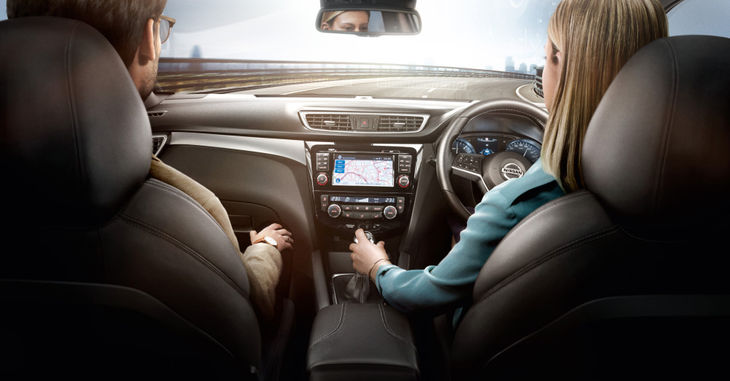
The big news for the latest Qashqai is the arrival of a new 7-inch NissanConnect infotainment system which features a new interface with a more intuitive display, redesigned fascia, customisable home screens and widgets and single line search for the navigation system which makes it easier and quicker to find a location. The touchscreen itself has a new button layout and a faster processor to enhance operating speed.
The system also offers Apple CarPlay and Android Auto functionality. The system also provides a view of the rear-view camera.
Nissan has also beefed up its Nissan Intelligent Mobility (NIM) safety specification which now includes Intelligent Forward Emergency Braking, Intelligent Forward Collision Warning, Intelligent Blind Spot Warning, and Intelligent Cross-Traffic Alert.
The Qashqai benefits from a new infotainment system that Nissan says is faster and more intuitive.
Engine Power
Nissan has now streamlined the Qashqai range with 5 derivatives on offer. The range starts with the familiar 1.2-litre turbopetrol engine that produces 85 kW and 190 Nm of torque. This engine is offered in the entry-level Visia trim grade as well as the mid-spec Acenta and top-of-the-range Tekna grade.
A 1.5-litre turbodiesel engine with 81 kW and 260 Nm of torque is now offered in the Acenta Plus trim grade only.
The Qashqai can be had with either a 6-speed manual transmission or Continuously Variable Transmission (CVT), the latter of which is offered on the Acenta and Tekna trim grades only.
Nissan Qashqai – Price in South Africa
Qashqai 1.2T Visia – R368 100
Qashqai 1.2T Acenta – R396 900
Qashqai 1.2T Acenta CVT – R415 900
Qashqai 1.5 dCi Acenta Plus – R443 900
Qashqai 1.2T Tekna CVT – R458 300
The Nissan Qashqai is sold with a 6-year/150 000 km warranty and 3-year/90 000 km service plan.
BMW has released a teaser image of its forthcoming BMW M4 GT3 racer which also hints at what to expect from the road-going production version.
The next-generation BMW M4 Coupe is currently in development and it will also spawn the racing M4 GT3 car teased in the image above. While the M4 GT3 will undoubtedly feature aggressive styling, this teaser image does, however, have us wondering what the bottom half of the car will look like…
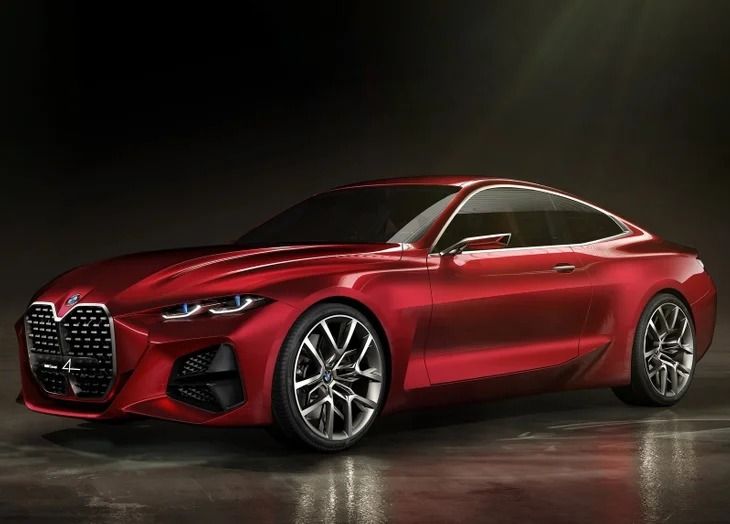
The BMW Concept 4 has a huge grille, but will the next M4 wear it?
Earlier this year BMW showed its Concept 4 which previews the design direction of the new 4 Series. Needless to say, the gigantic grille seen on the Concept 4 has caused a stink all over the world and divided opinion, with many people questioning BMW’s current obsession with this large grille design which also plagues other new models in BMW’s stable such as the X7 and 7-Series.
Will the new M4 also feature an oversize kidney grille? Based on this teaser image, we think so, but just how big remains to be seen.
What we do know is that the new M4 will be powered by the same turbocharged 3.0-litre 6-cylinder engine which is found in the X3 M and X4 M and according to BMW, it will be tuned to deliver over 500 hp or 373 kW. Styling aside, the new M4 coupe and its convertible sibling should offer impressive performance.
We will keep you updated as soon as more information becomes available. The BMW M3/M4 are expected to be revealed towards the end of 2020, with a market introduction scheduled for 2021.
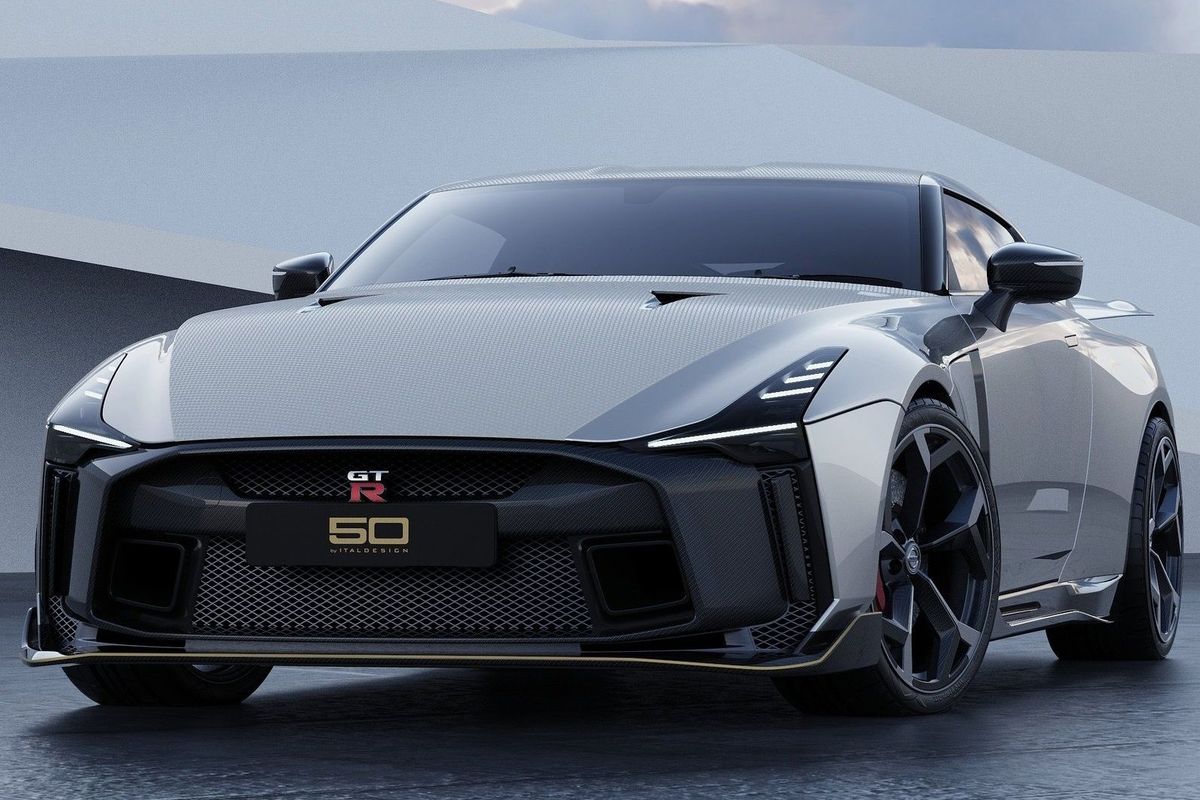
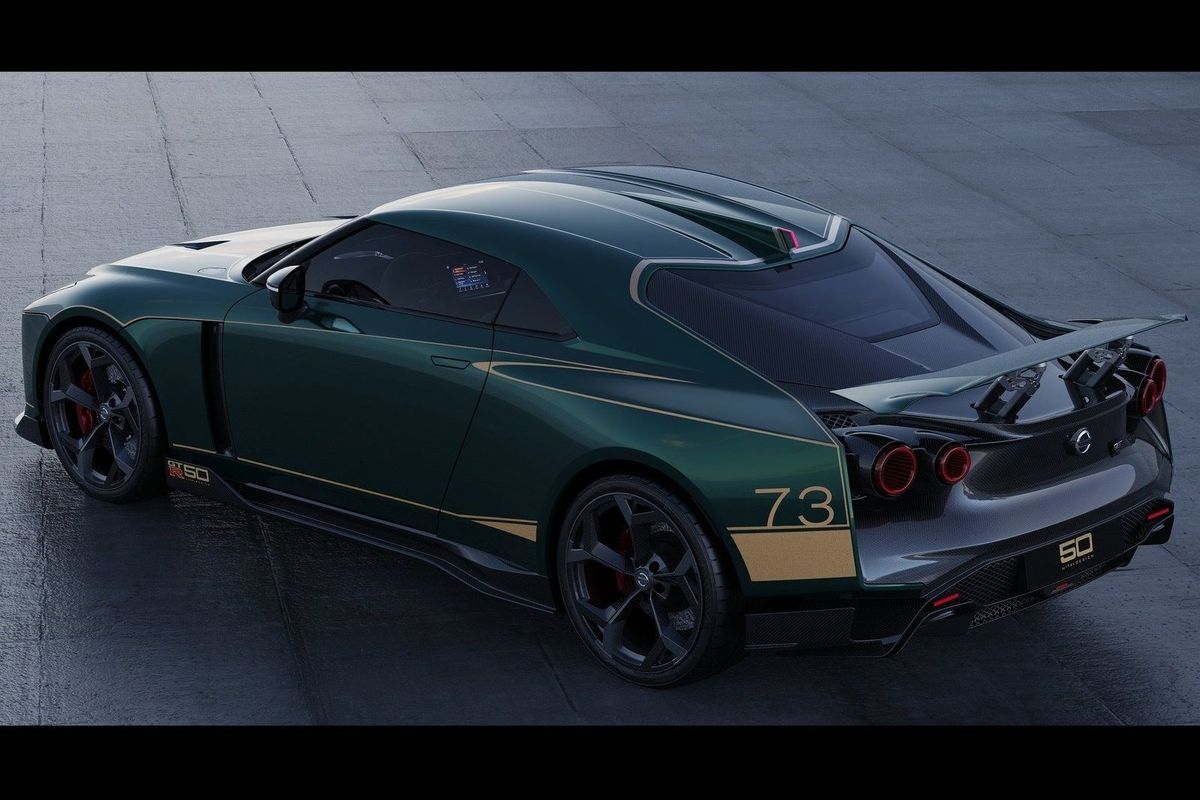
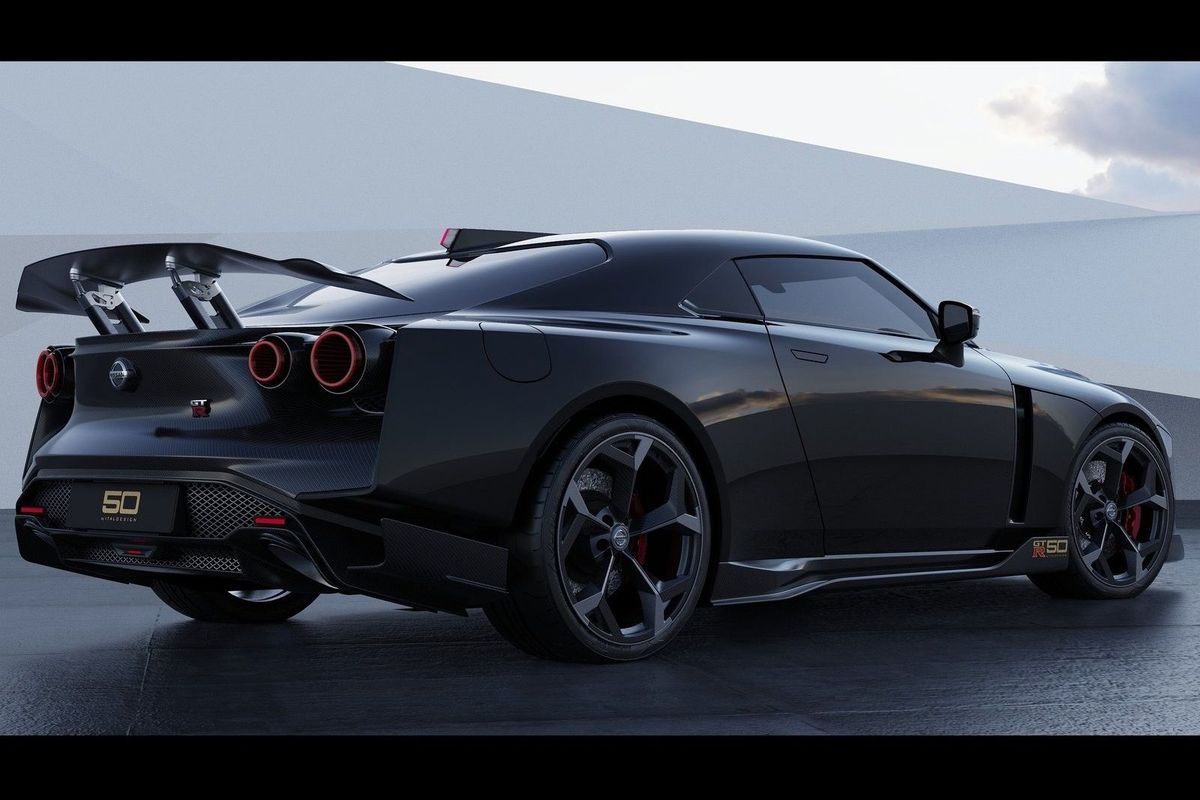
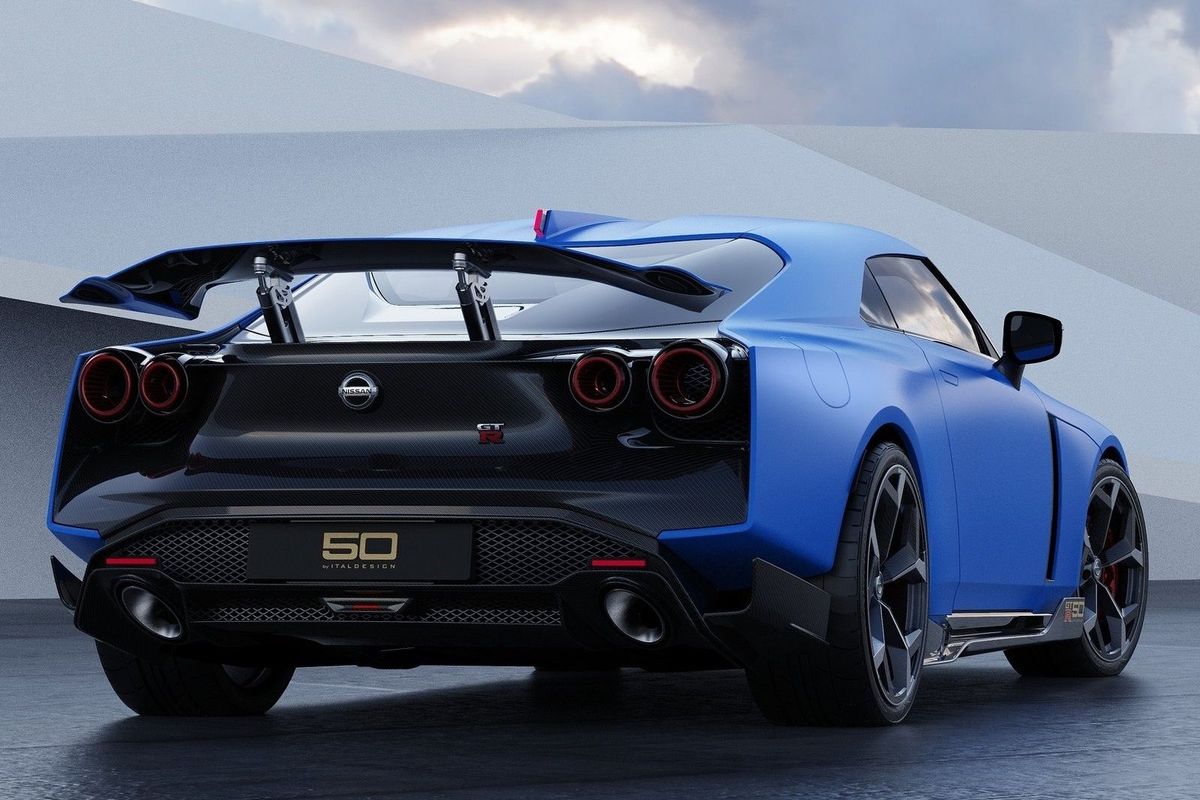
Finally, we get a good look at the production-ready Nissan GT-R50 by Italdesign.
The Nissan GT-R50 by Italidesign is a unique take on the GTR concept and after we were wowed by the initial images, it appears that customers were too. There have apparently been a significant number of deposits and customers are already choosing their spec.
Just 50 will be built, making it quite the collectable. The first customer car will be on display at the 2020 Geneva Motor Show, with the first customer deliveries towards the end of 2020.
"Our customers have relished the personalized experience provided by Italdesign, who have a long tradition in the exclusive field of ultra-rare, bespoke high-performance vehicles," said Bob Laishley, global sports car program director at Nissan. "Their experience with the GT-R50 has been incredible and I can say first-hand that each car will certainly be a standalone masterpiece."
The GT-R50 is a collaboration between Nissan and Italian styling house Italdesign and it is based on the latest iteration of the Nissan GT-R NISMO. Under the bonnet is the NISMO-tuned 3.8-litre twin-turbocharged V6, which produces a thundering 530 kW.
Europe’s most important automotive group has a new designer for its core brand.
VW has announced that a Slovakian will become the company’s new chief designer, an appointment which will be hugely important as the German business attempts perhaps the most ambitious vehicle electrification strategy in history.
The man who will oversee and direct all future design work for VW, starting in January 2020, is Jozef Kaba?. And for the 46-year old Slovakian, it completes an interesting career orbit.
Kaba? trained in his native Slovakia before moving to London for advanced study at London’s Royal College of Art. He started his car designing career at VW, back in the 1990s. Kaba?’s first notable promotion was a move to Audi, in 2003.
By 2007, Kaba? was entrusted with all exterior design at Audi – at a time when the German premium brand was producing some of its most revered work.
As one would expect of somebody with strong Slovak roots, Kaba? spent a long time at VW’s Skoda sub-brand, working as design chief from 2008-2017.
In 2018 Kaba? defected to BMW to become head of design. He was soon moved to BMW’s British luxury division, Rolls-Royce, but his tenure here was short. Kaba? only remained with Rolls-Royce for less than half a year.
VW has now managed to reemploy one of its most experienced and daring designs. For Kaba? the challenge will be to translate classic VW design simplicity and values to a range of new electric vehicles which will have radically different proportions and packaging.
There can be little doubt regarding Kaba?’s design credential or talent. He was responsible for the exterior design of the Bugatti Veyron.
Owners of Electric Vehicles (EVs) and Plug-in Hybrid Vehicles (PHEVs) can now use a live map to check the status of charging stations in South Africa.
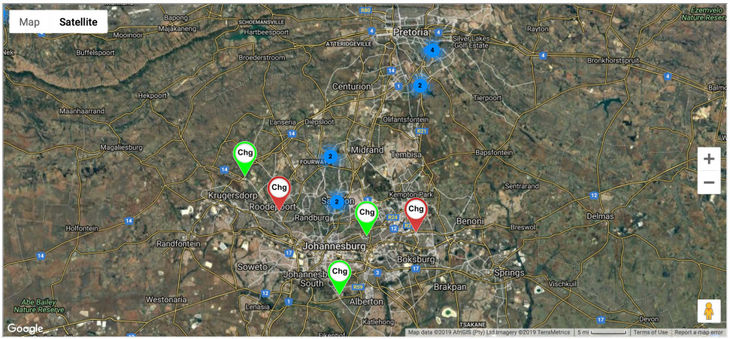
Jaguar has launched a live map showing the status of charging stations all over South Africa which will make it easier for EV and PHEV owners to plan their journeys.
Jaguar's new live map will make planning your EV charging much easier.
The map shows the entire network Jaguar Powerway and GridCars charging stations and indicates whether these stations are online, offline or currently in use. More than this, the map will also indicate the time and date of the last successful charge while also showing how many times the station has been used.
In 2018, Jaguar partnered with electric vehicle charging authority, GridCars, to install 82 new charging stations across South Africa with an investment of R30-million. The charging stations were installed at all Jaguar Land Rover retailers as well as at various points of convenience such as shopping centres, major hubs including Johannesburg, Pretoria, Durban, Cape Town, Port Elizabeth, East London and Bloemfontein and along major holiday routes in an effort to alleviate range anxiety for owners of electric and plug-in hybrid vehicles.
Brian Hastie, Network Development Director, Jaguar Land Rover South Africa said “While the primary charging habit for the majority of EV drivers will be at home where it’s most convenient and cost-effective, we know that the future of electric mobility ultimately relies on a public charging network. As the rollout of public charging stations intensifies and the dots between existing locations are connected, it’s vital that EV drivers are able to view the status of chargers remotely. This live map makes that possible.”
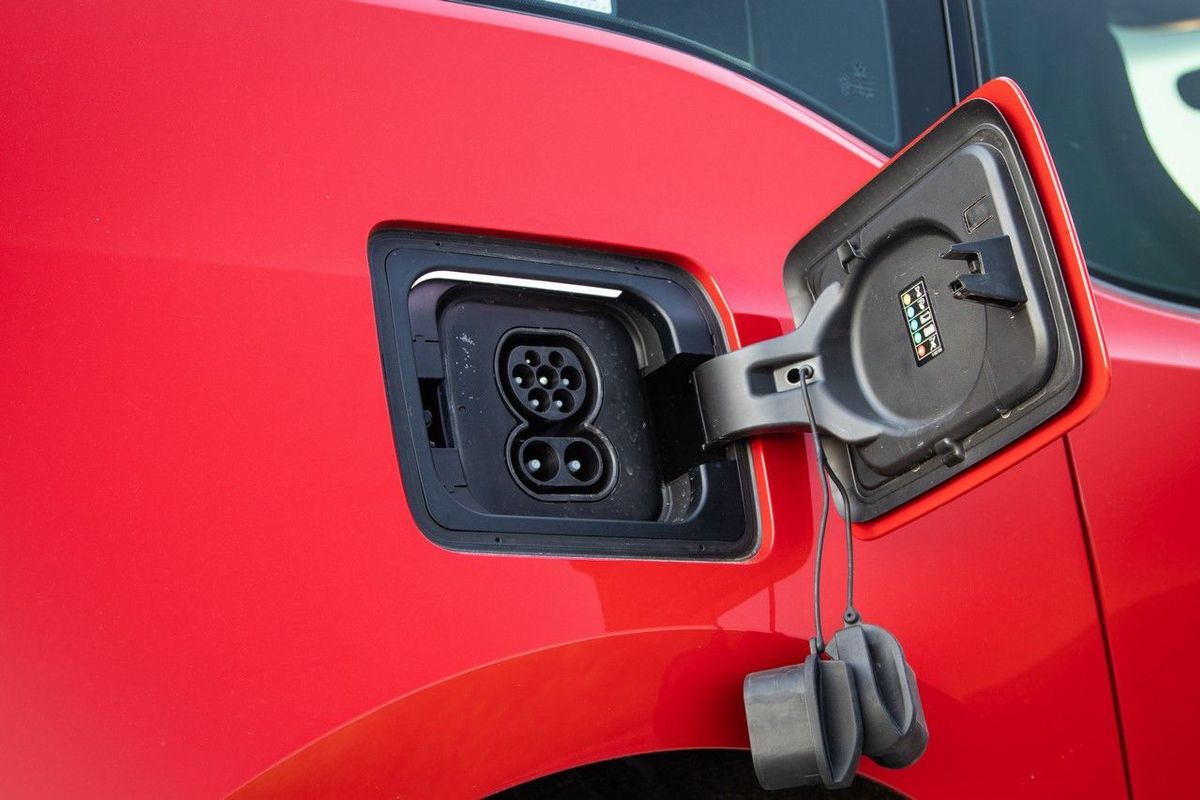
Most charging stations on the network are 60 kWh fast chargers which also accommodate PHEVs with a 22 kWh AC fast-charge ports. The AC standard Type 2 socket will allow charging of all EVs currently available in South Africa, while the DC charger is fitted with the CCS DC type socket used by the vast majority of EVs in SA.
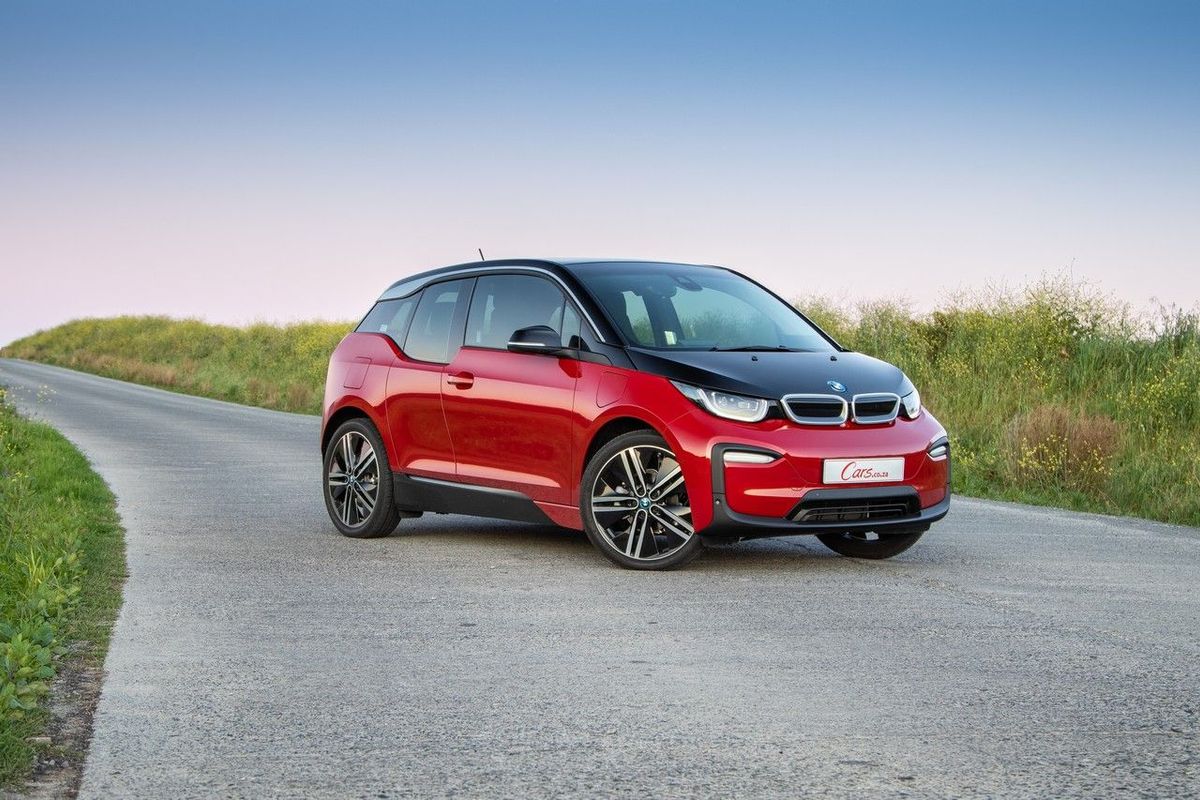
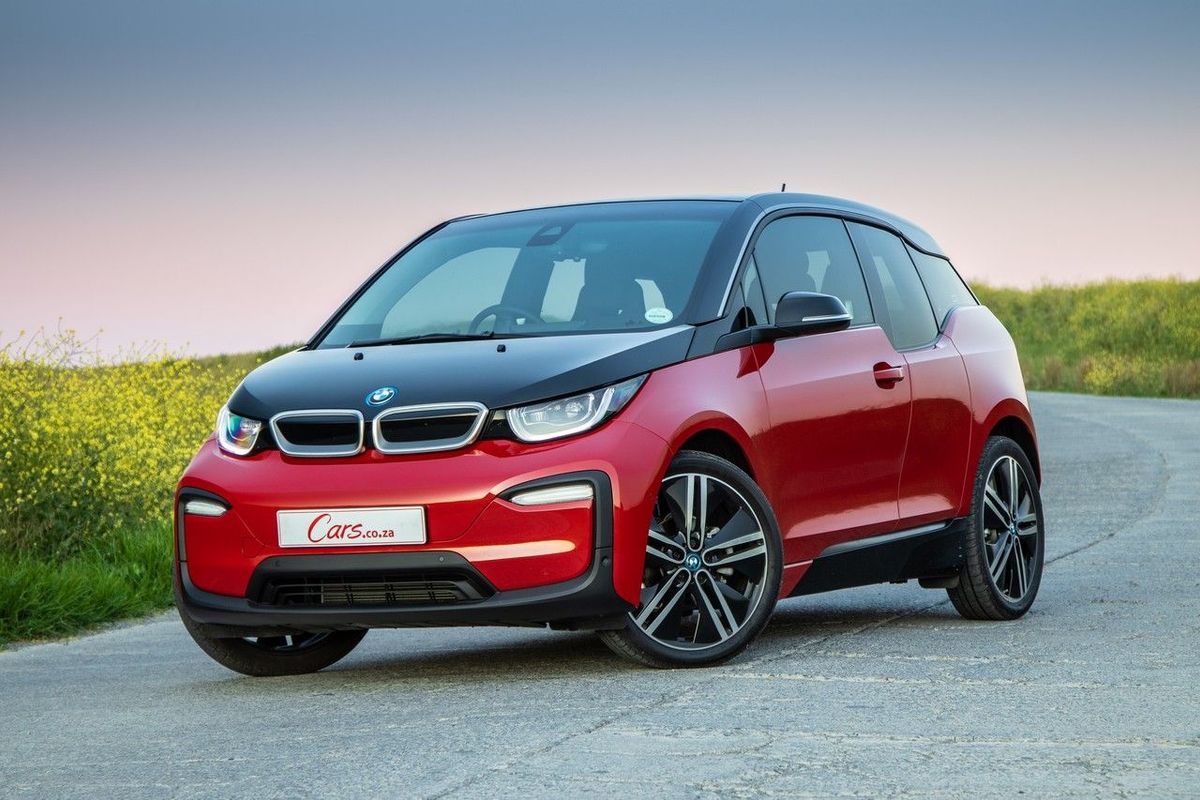
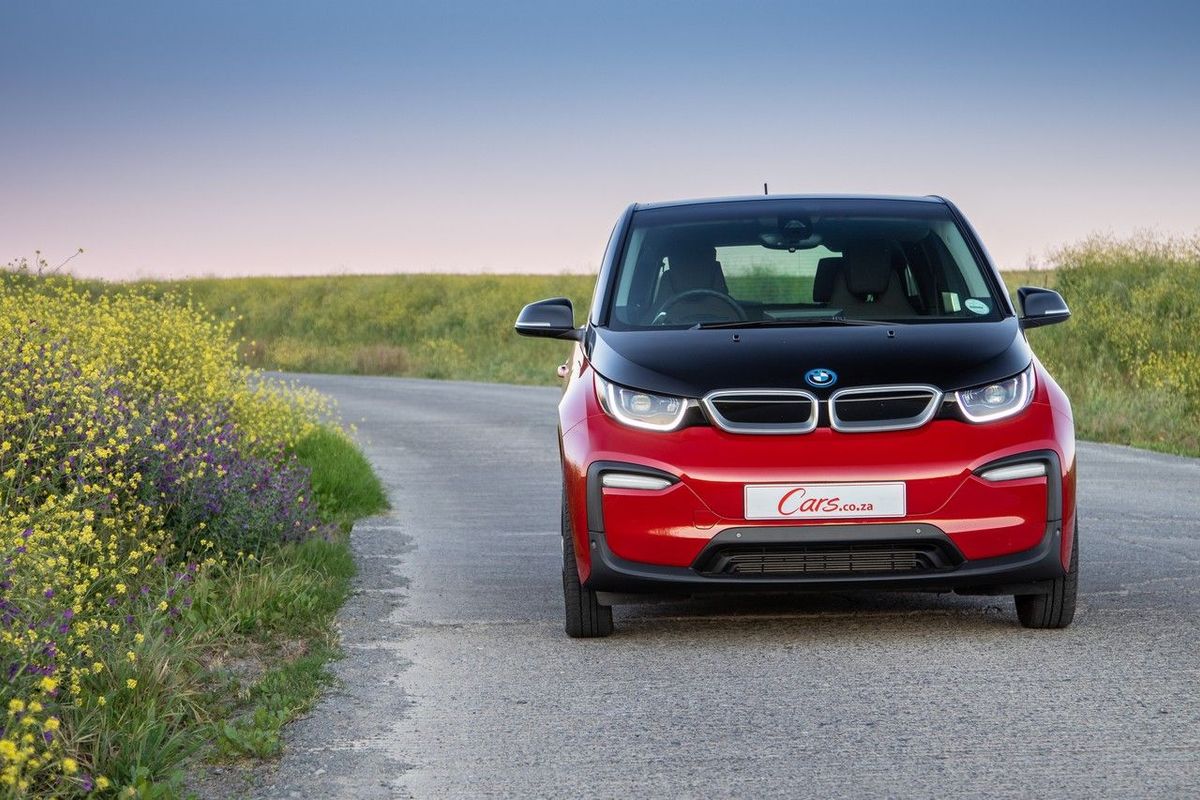
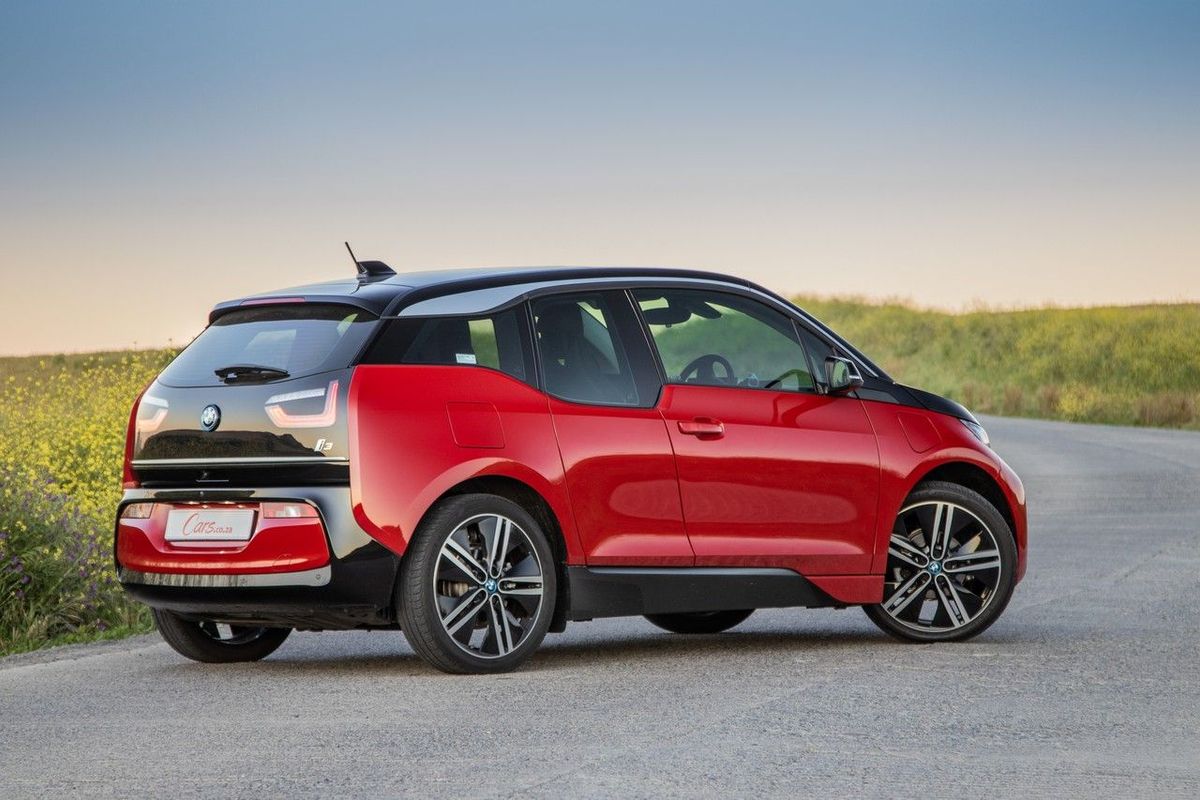
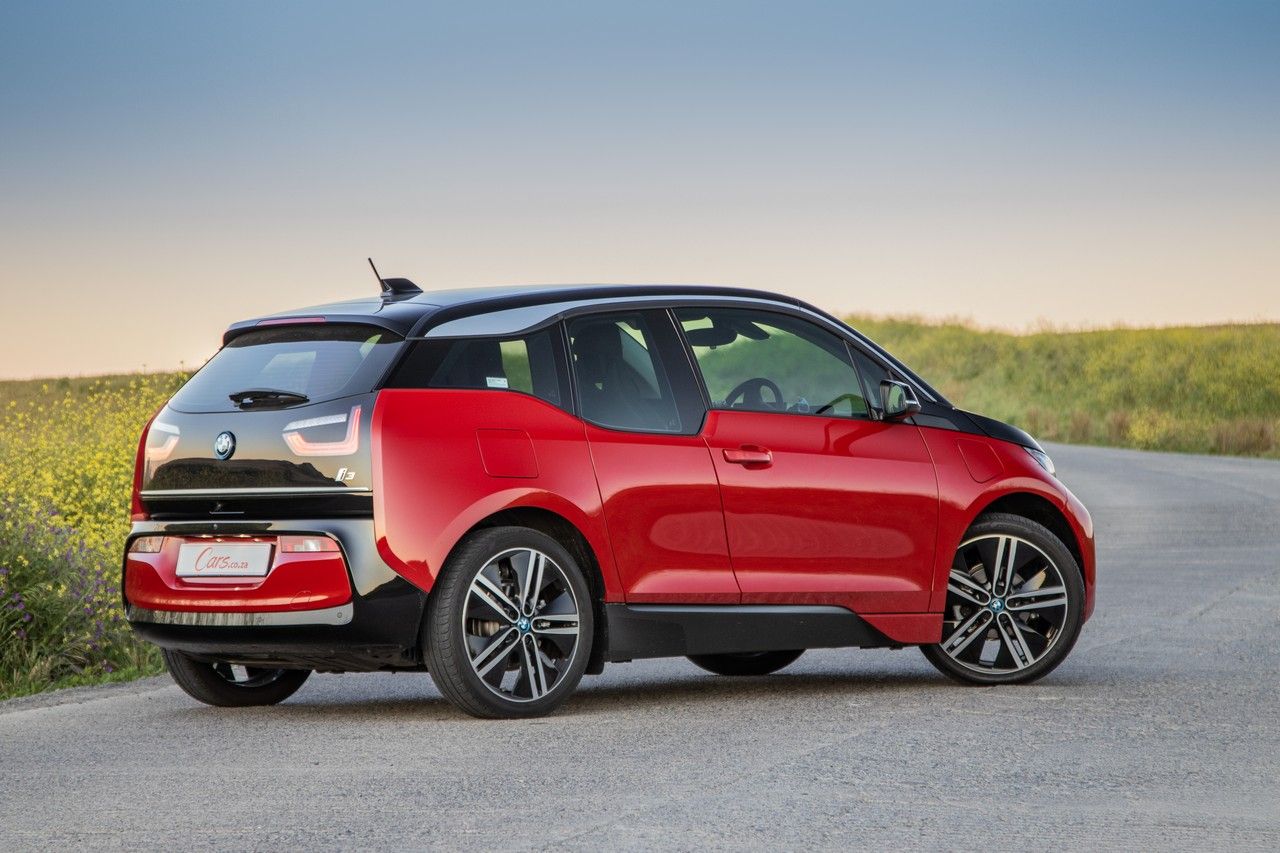
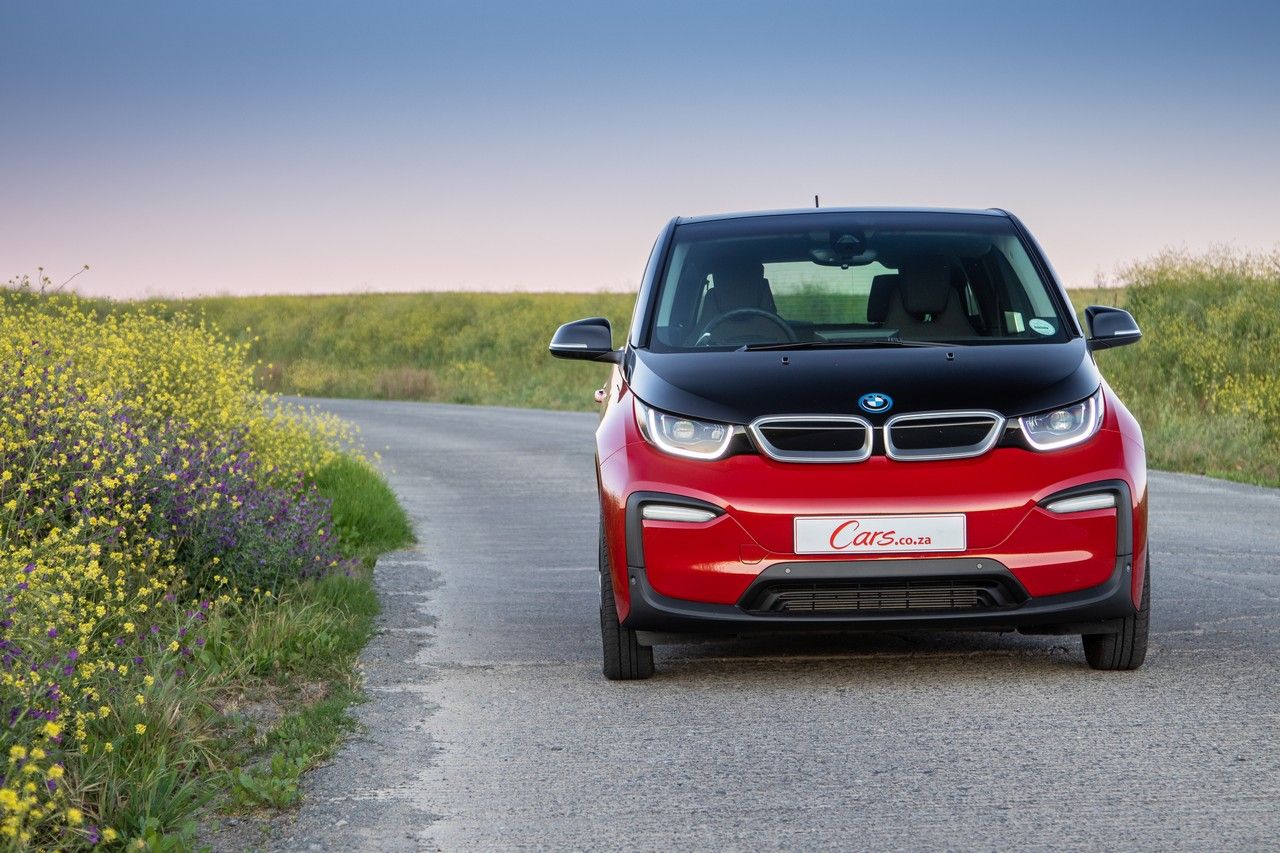
The BMW i3 received a mild facelift in 2019 and we recently evaluated an updated eDrive REx derivative (over a 10-day period) to evaluate whether the all-electric lifestyle had become more viable by virtue of an improvement in the EV's projected range. Can the high purchase cost be justified and, more importantly, can you avoid range-anxiety?
We Like: Futuristic looks both inside and out, highly entertaining acceleration, enhanced range.
We Don’t Like: High price, cramped rear space, no government subsidies, charging network still being rolled out.
The BMW i3. Note the 2 panels, the one towards the rear is where you plug in, while the front is to top up the range-extender petrol engine.
What is it?
This is not our first experience with the BMW i3 Range Extender (REx). We first had a go back in 2015 and came away impressed with the endearing eccentricity of BMW's first foray into the electric-vehicle space. Now for 2019, BMW has enhanced its i3 range with improved battery range and some design tweaks, as well as the addition of a sportier i3 S, which affords a sportier driving experience. The critical change is a higher-capacity battery. When this range first came to market, the pure electric i3 had an optimal range of just 130 km. Now, thanks to the advancement of technology, the ultimate range has increased to 260 km, but the battery has remained the same size. Now that's progress!
How it performs in terms of…
Performance and efficiency
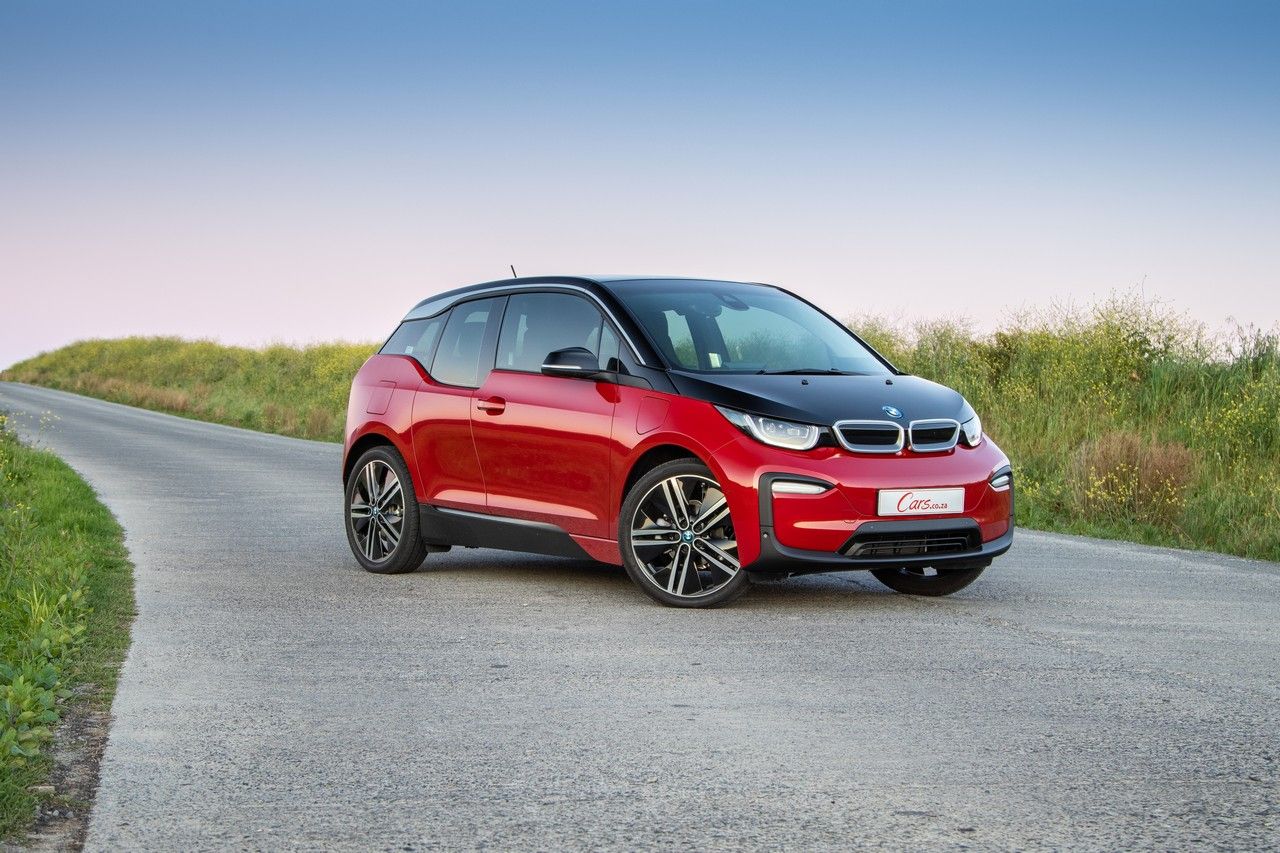
With its unique style, there's nothing quite like it on the roads.
With peak outputs of 125 kW and 250 Nm being directed to the i3 eDrive REx's rear wheels via a single-speed automatic transmission, the diminutive BMW's accelerative ability was always going to be brisk, especially when you consider how light the EV's body is (thanks to liberal applications of carbon-fibre in its construction). According to our test equipment, the BMW i3 zipped from 0 to 100 kph in 8.14 seconds (on a cool morning), which kind of elevates it into "warm hatchback" territory. The key here is that the electric motor delivers lag-free performance and since there are no gears to change, acceleration is seamless and elastic. You'll find that while there's considerable enjoyment to be had in flattening the accelerator pedal to experience that "eerily quiet" acceleration, the BMW's range diminishes at quite an alarming pace. The key here is to drive conservatively and cruise along at the same pace as the traffic around you.
The eDrive REx has a supplementary 2-cylinder petrol engine, but it doesn't propel the car. Instead, when you run out of charge, you'll hear a humming noise as the 2-pot engine fires up to generate more electricity so that you won't grind to a halt. Once fully charged, you should get just over 400 km using both the battery and the petrol-powered "top-up". BMW states its battery capacity has increased from 60 Ah to 120 Ah, which explains the commendable jump in range.
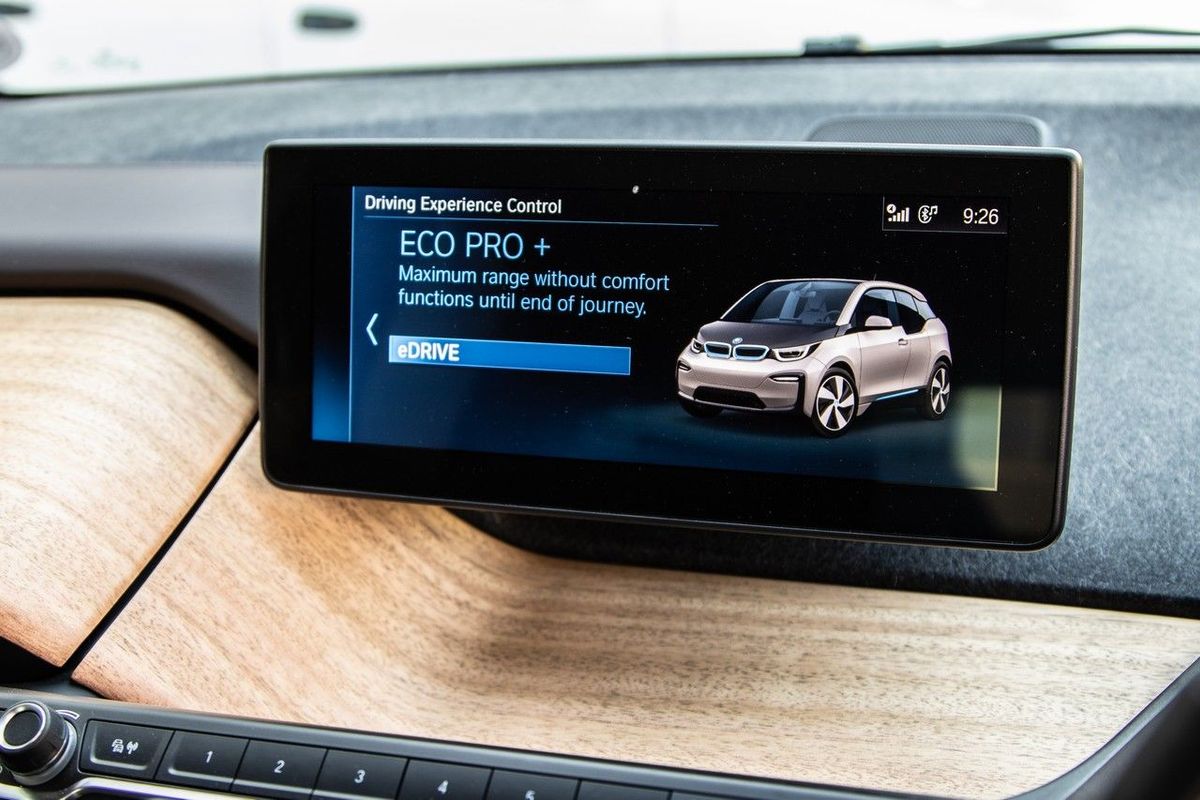
By utilising a trio of driving modes (Comfort, Eco Pro and Eco Pro+), you can extend the i3's efficiency, but do note that the last mode should be used in extreme circumstances to eke out as much range as possible, because in Eco Pro+ the top speed is limited to an awkward 90 kph and you have to make do without climate control, which is a sweat at the height of summer. We found that when it comes to charging, your best bet is to park the eDrive REx in your garage and plug in overnight, much like your cellphone, but this all depends on how much driving you do. For those short city drives, you're most likely be able to do 2 or 3 days' worth of commuting before you need to plug in and charge it fully.
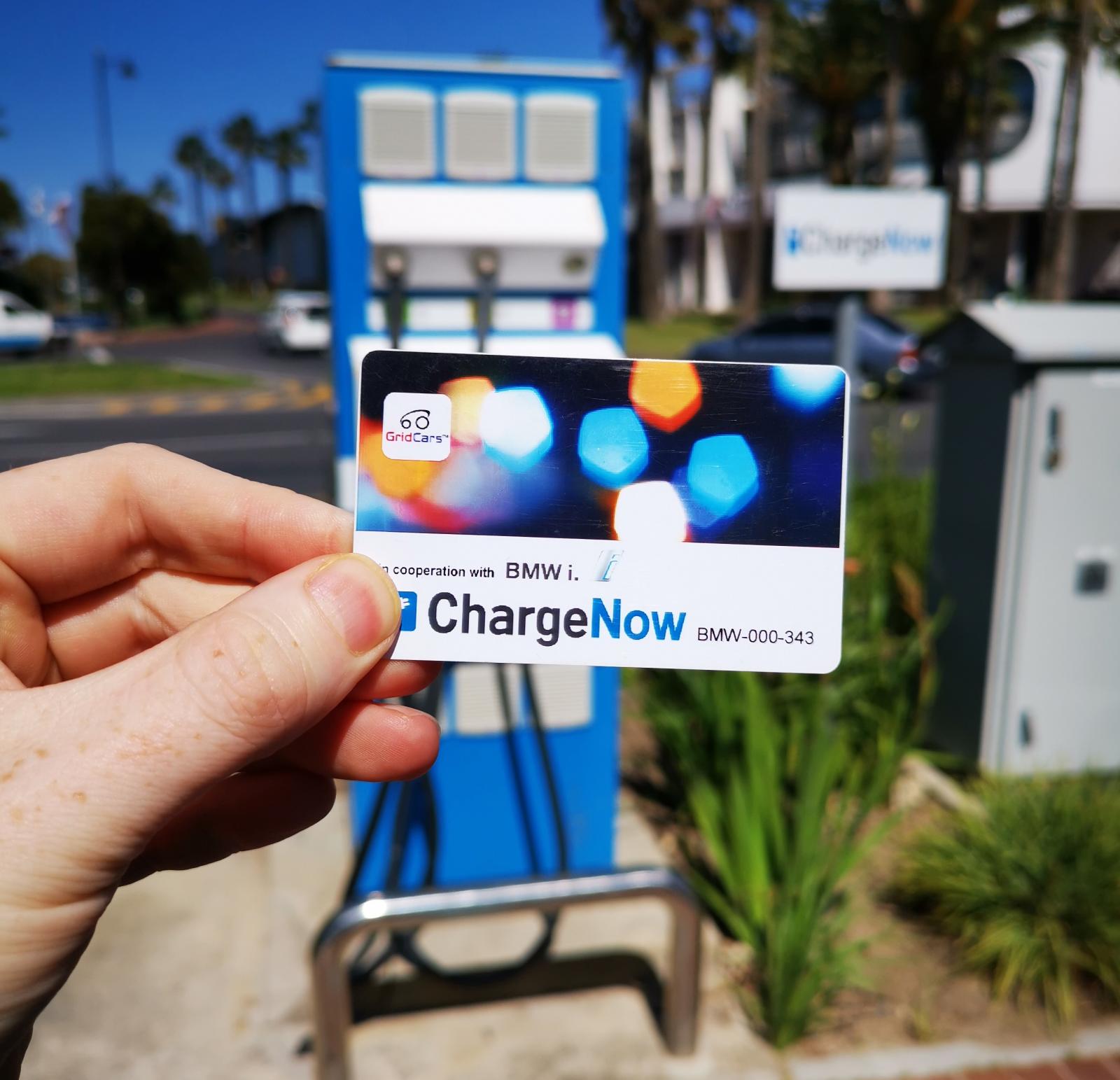
If you live in a major city and find yourself in need of a charge, your local BMW dealer will probably have a high-powered charger with which you charge up to 80% capacity in 30 minutes AND it's free. We discovered the Plugshare app, which overlays Google Maps with available charging stations, and you'll be surprised by just how many have been rolled out in the larger metropolitan areas. Shopping malls, airports and even petrol stations are installing charging points.
For a fast and free charge, head to your nearest charging point-equipped BMW dealership.
Ride and handling
The first thing you'll notice about the BMW i3's driving experience is just how quiet and refined the EV is. As it is unencumbered by an internal combustion engine (ICE), which, as we know, produces mechanical noise even when at idle, travel in the i3 is whisper-quiet as the eDrive REx seemingly glides around effortlessly. Imbued with a pleasingly direct steering feel, the BMW i3 is entertaining to drive in short and energetic bursts, which is helped by the maximum torque being instantly available. Given the BMW's tall and narrow shape, coupled with the skinny tyres, the i3 eDrive REx does feel somewhat top-heavy when you're pressing on, but remember: this is an electric city car and not a hot hatch.
The secret behind the test unit's pleasant ride quality is the inherent rigidity of the carbon-fibre-strengthened shell and low centre of gravity (by virtue of the battery being located at the bottom of the car). The i3's biggest forte is urban commuting; that's when its instant responses and linear performance work wonders. It tends to lose a bit of oomph on freeways – we noted the range dropped quickly as the car fought to punch through the air at 120 kph. When you come off the throttle, the regenerative braking kicks in, which replenishes some charge and slows the car down. The deceleration is strong enough to trigger the brake lights, so you can adopt a 1-pedal driving style and coast to intersections.
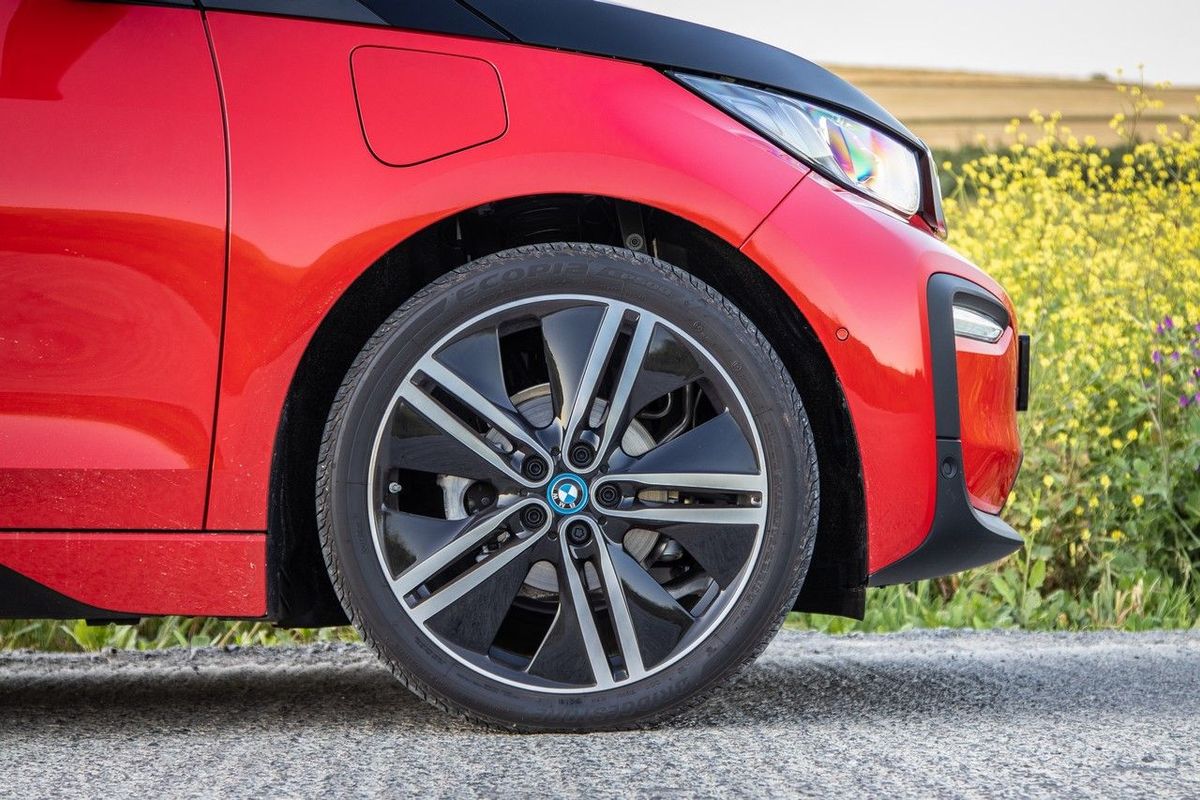
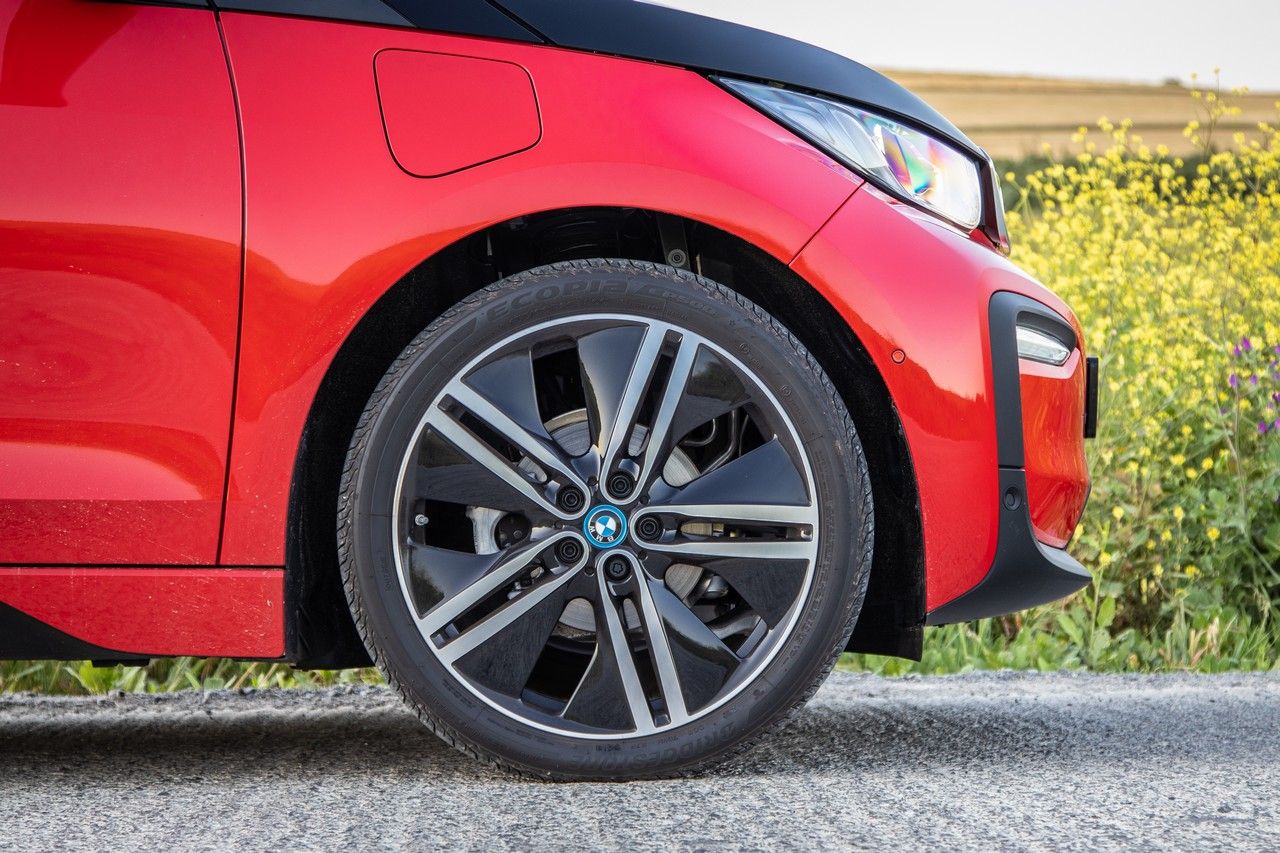
Despite the low profile and narrow width of the tyres, the BMW i3 happens to ride surprisingly smoothly. These 20-inch units are a R20k option though!
Interior quality and features
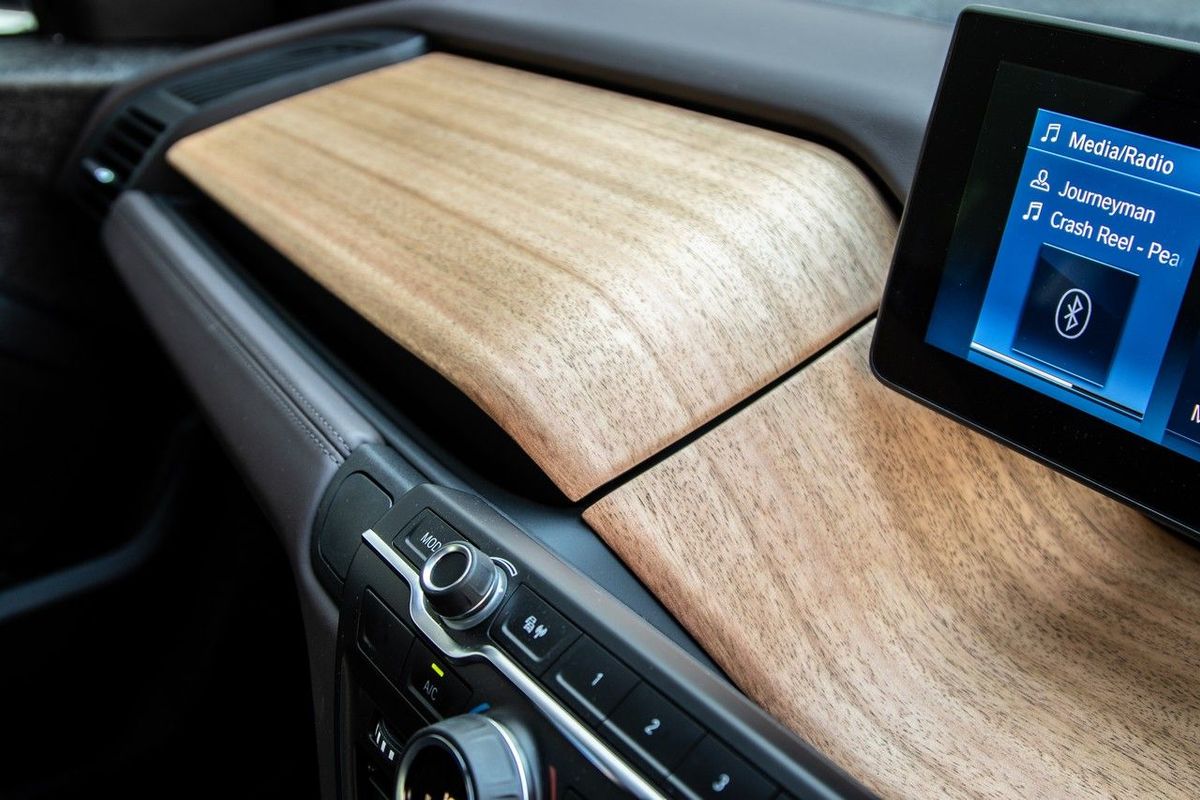
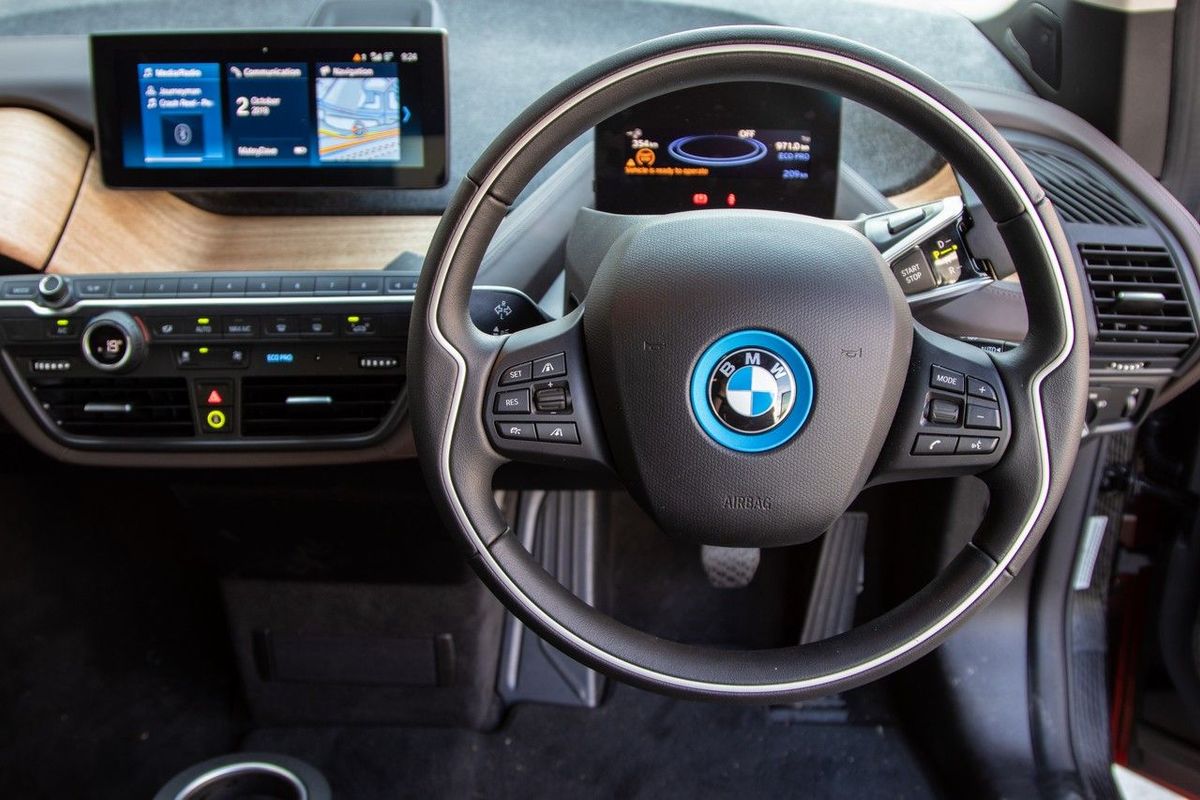
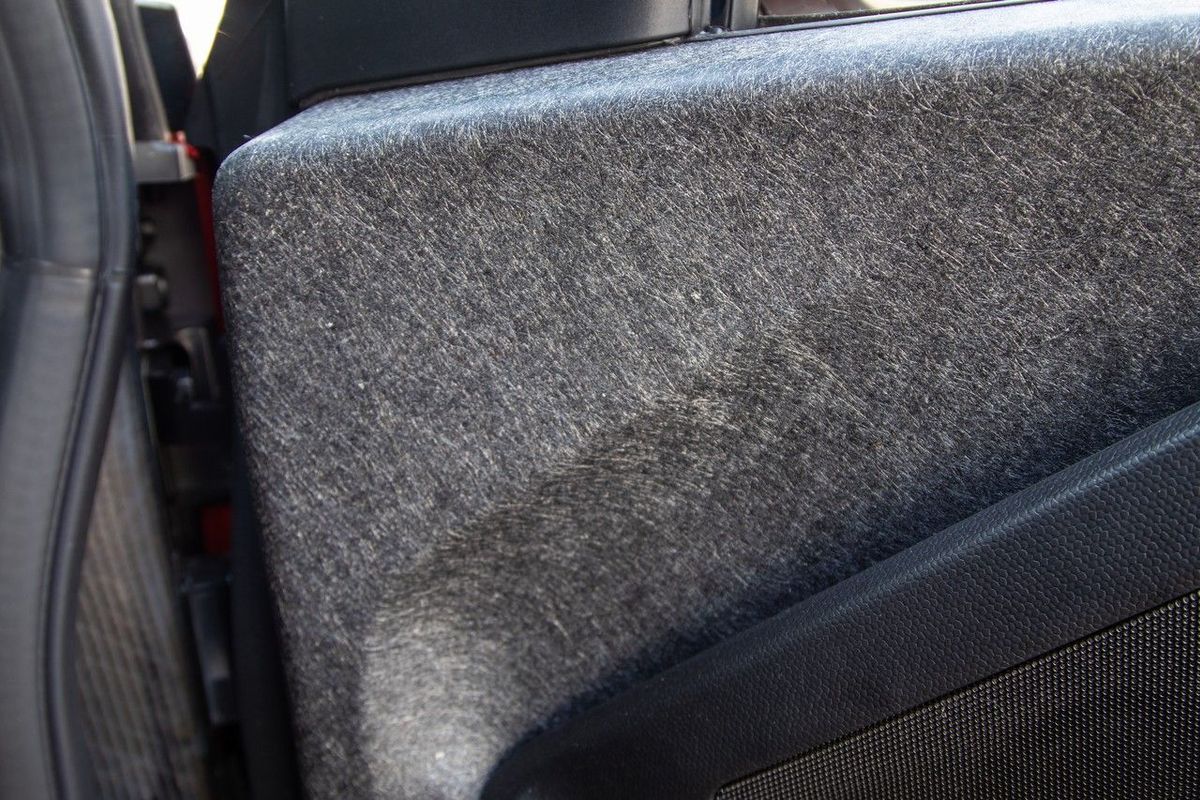
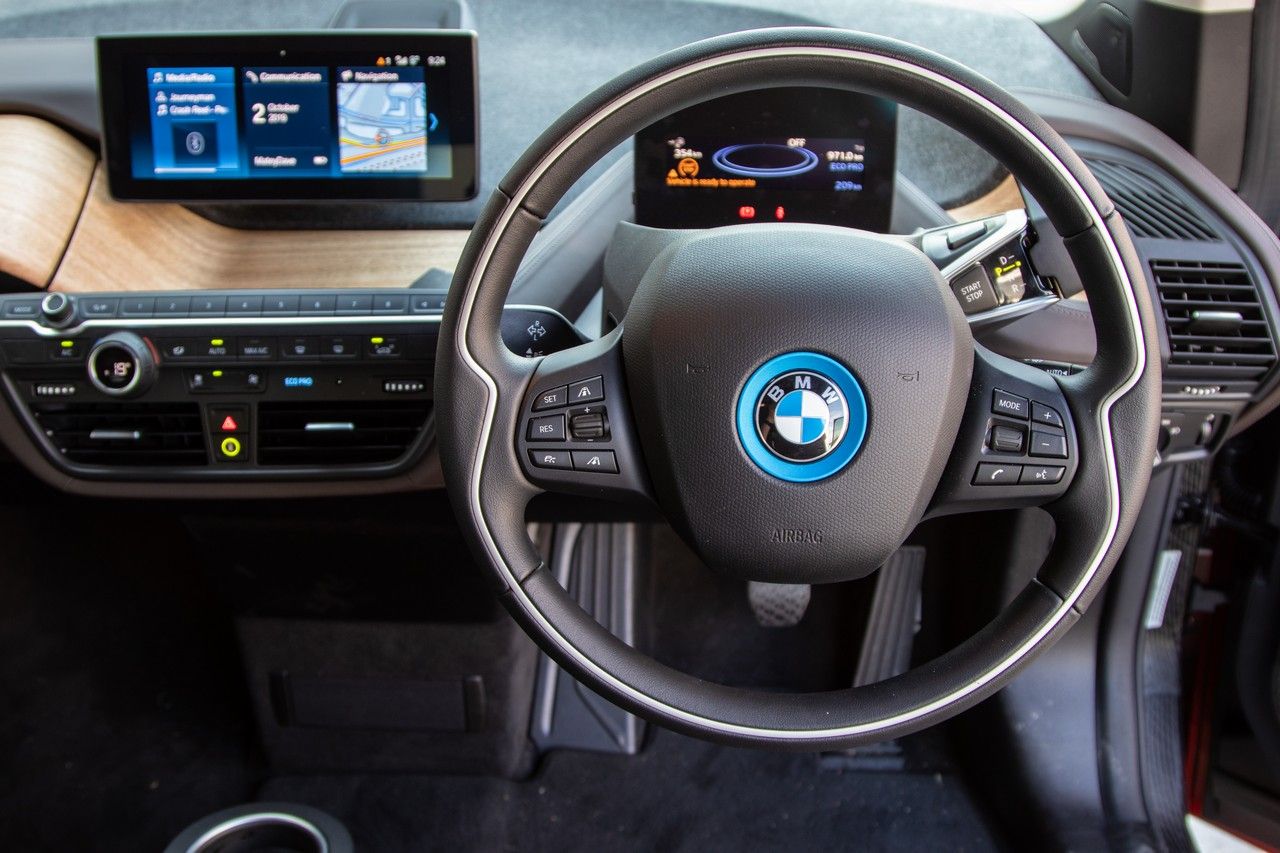
Like it did back in 2015, the i3's interior design really tickles our fancy – it's one of the coolest cabins we've experienced. The first aspect you notice is the modern and minimalistic ergonomic layout, which we really like, but legacy car owners may find it too polarising. For the BMW traditionalists, they'll be happy to see the BMW iDrive controller and familiar layout of the infotainment system.
Call the i3 "novel" or "eccentric" all you like, but BMW is a luxury brand and its models' arrays of features and interior quality still need to be of a certain standard. Thankfully, the i3 eDrive REx is no exception. In terms of specification, it covers the basics well with climate control, cruise control, auto lights and -wipers, USB/Bluetooth connectivity, steering wheel controls and satellite navigation. In terms of options, we'd advise speccing the upgraded audio system, Apple CarPlay connectivity and tyre pressure sensors additionally, if your budget stretches far enough. For those concerned about safety, the i3 boasts ABS with EBD and brake assist, electronic stability control and 6 airbags.
The clean and minimalistic interior of the BMW i3. Note the lack of a central transmission tunnel.
Practicality
The BMW i3 may be a compact city car, but its interior space is cleverly utilised. The load bay lacks depth, but there's sufficient space for a few shopping bags. Drop the rear bench, slide the front passenger seat forward and you can fit in a mountain bike with relative ease. With no transmission tunnel, there's a support strap to hold bottles or documents and the door pockets are practically-sized. The armrest doubles as a storage pocket; it's ideal for storing house keys.
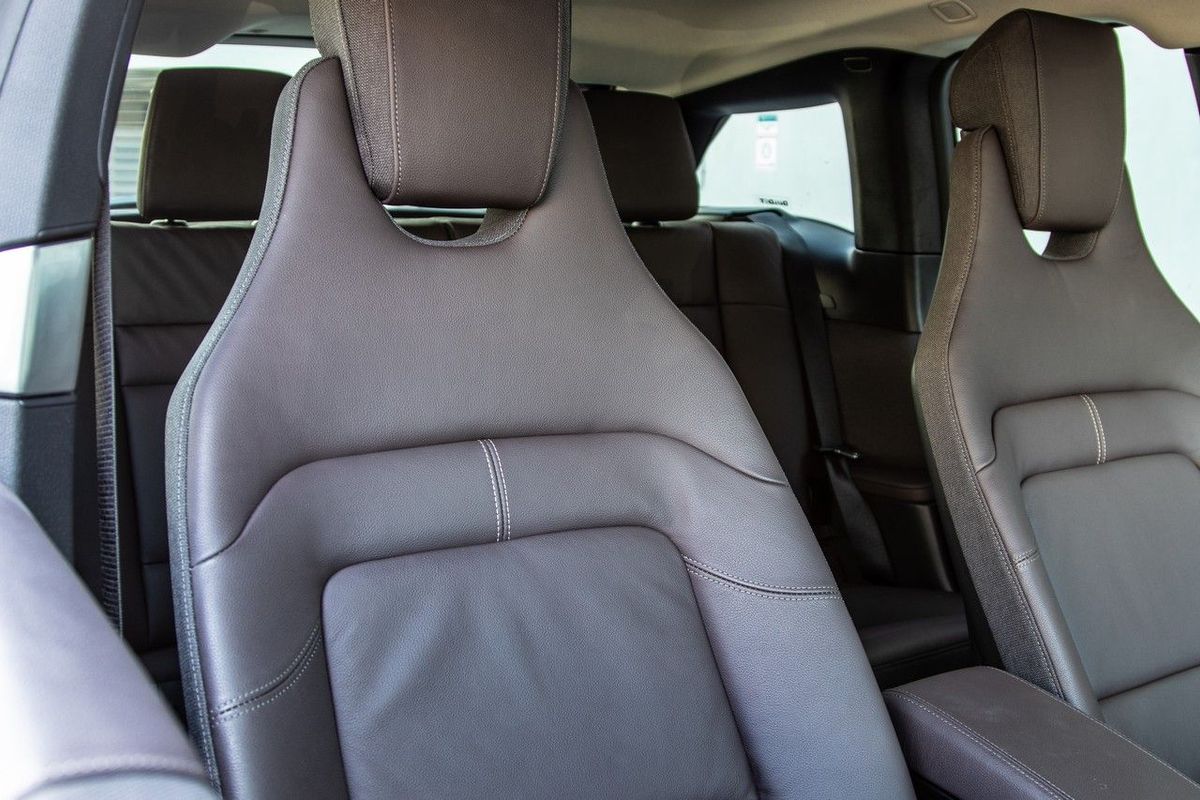
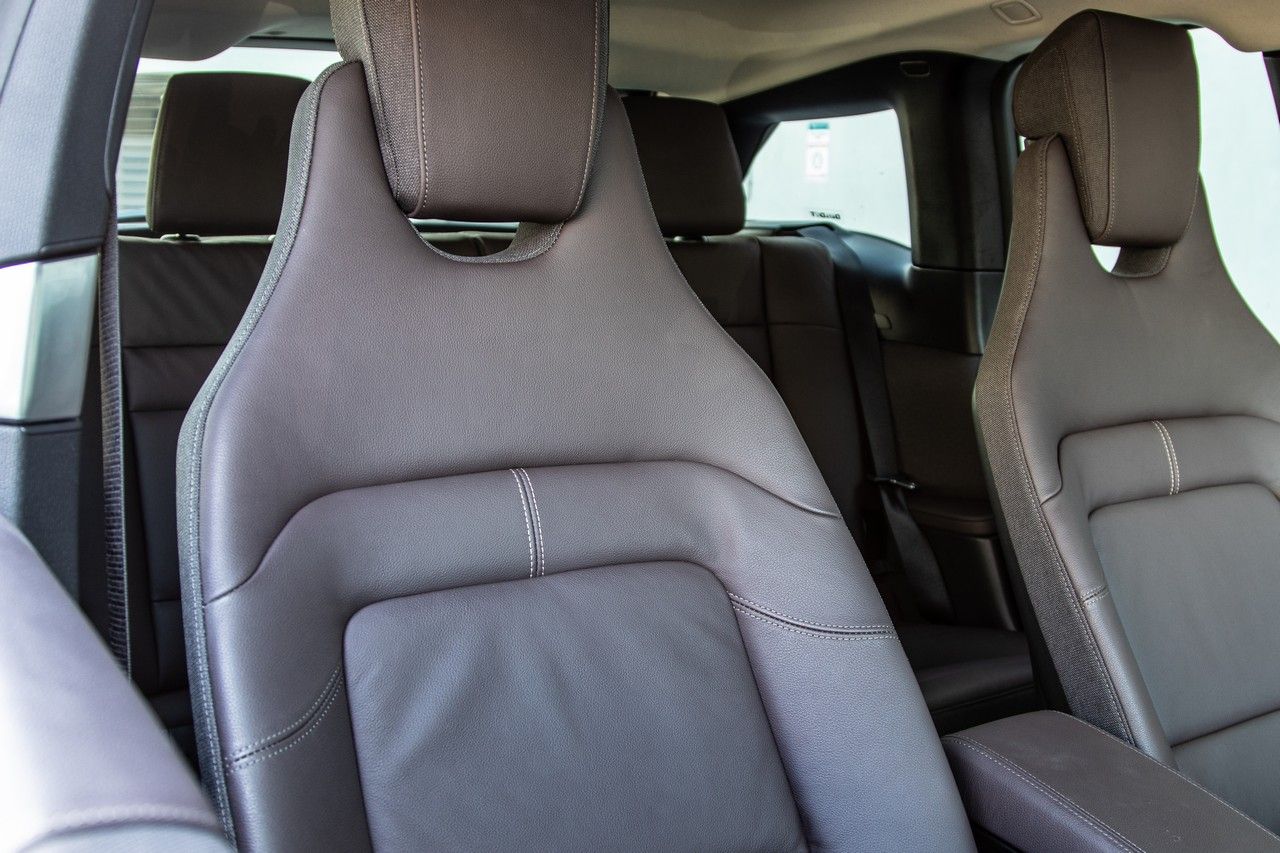
Those contoured leather seats form part of the Interior Design Suite package.
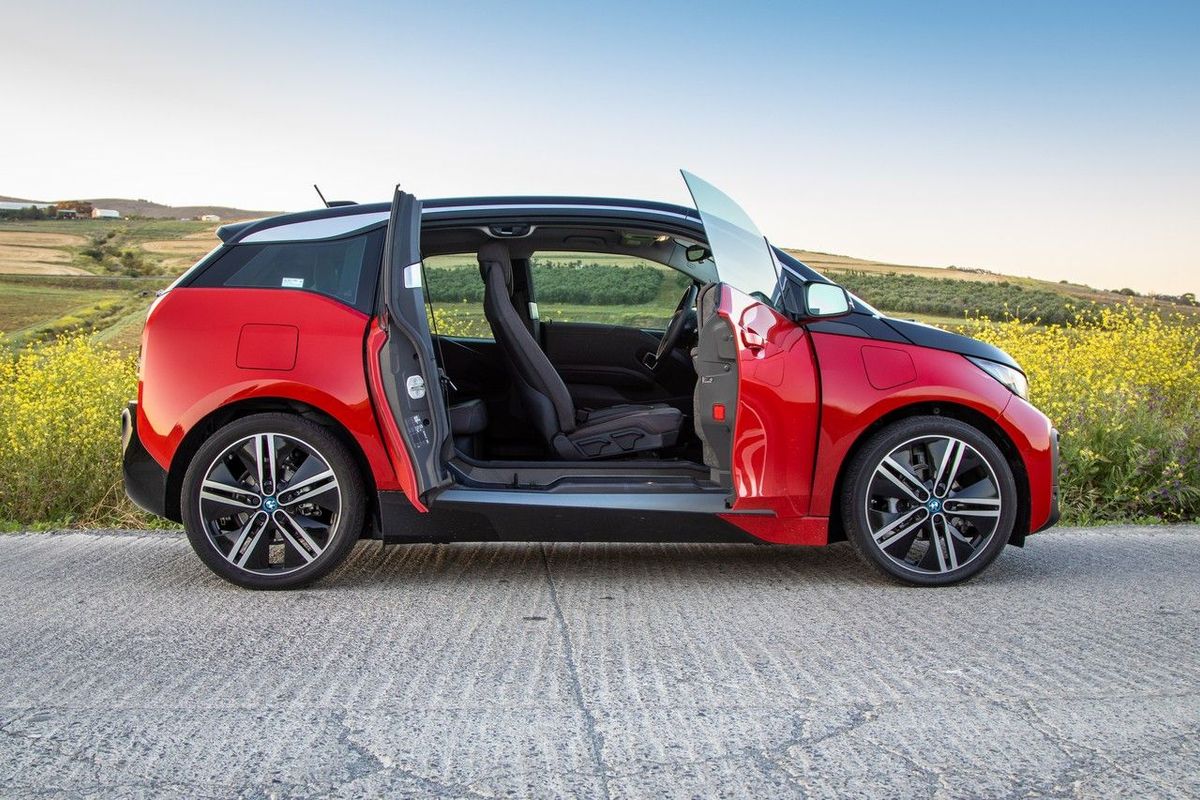
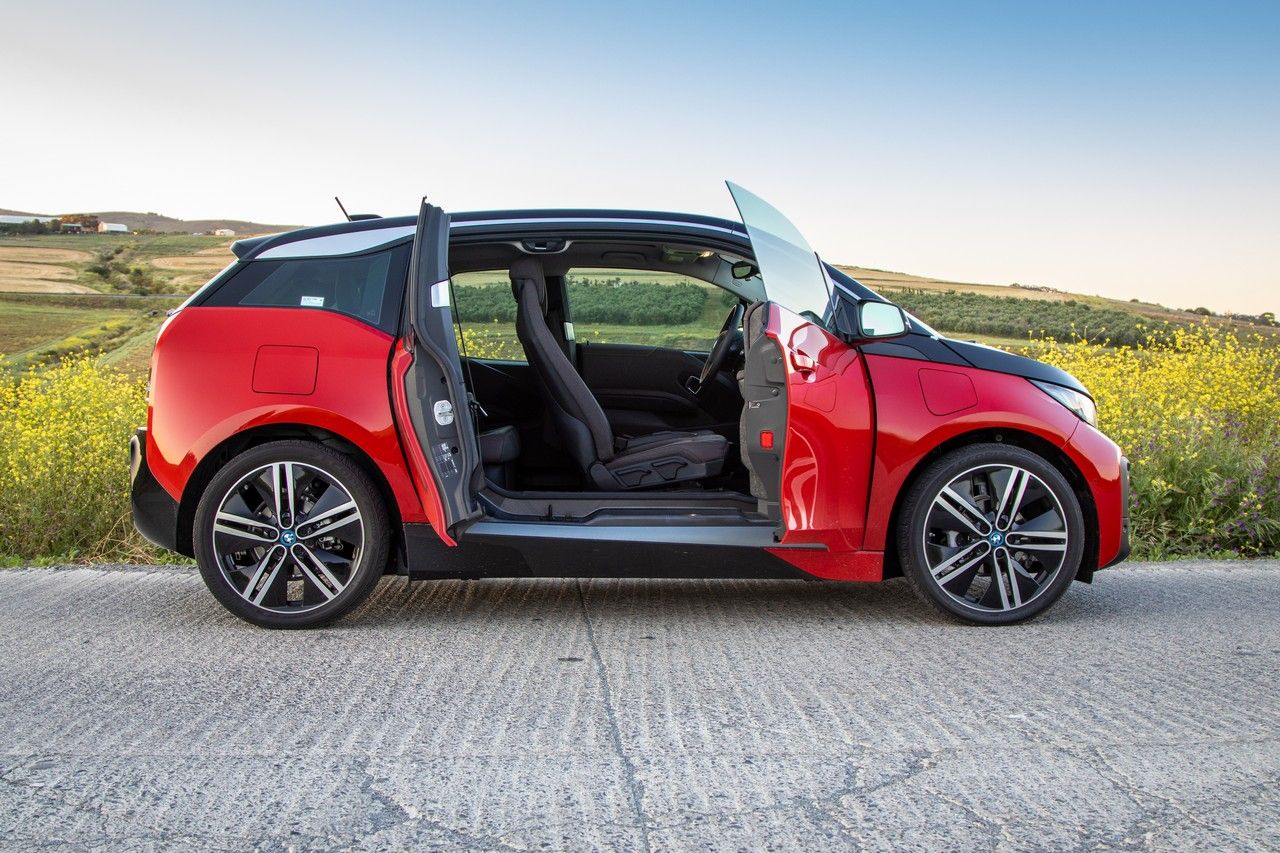
The compact dimensions of the i3 mean that while it does have the capacity to carry 4 occupants, rear legroom is tight. For quick jaunts around town, it can just about accommodate 4 adults. Dubbed the "Life Module", the BMW's passenger compartment eschews B-pillars and the rear doors open outward like those of a cabinet, which makes ingress and exits simpler. The front passengers each get their own sunroof, which is a simple yet thoughtful touch.
With both doors open, you can see how easy it is to gain entry into the BMW i3. While there are seats at the back, there's not much legroom.
Price and warranty
The BMW i3 eDrive REx costs R740 700 before options. The vehicle comes with a 2-year vehicle/unlimited distance and 8-year/100 000 km hybrid battery warranty. There's also a 5-year/100 000 km maintenance plan.
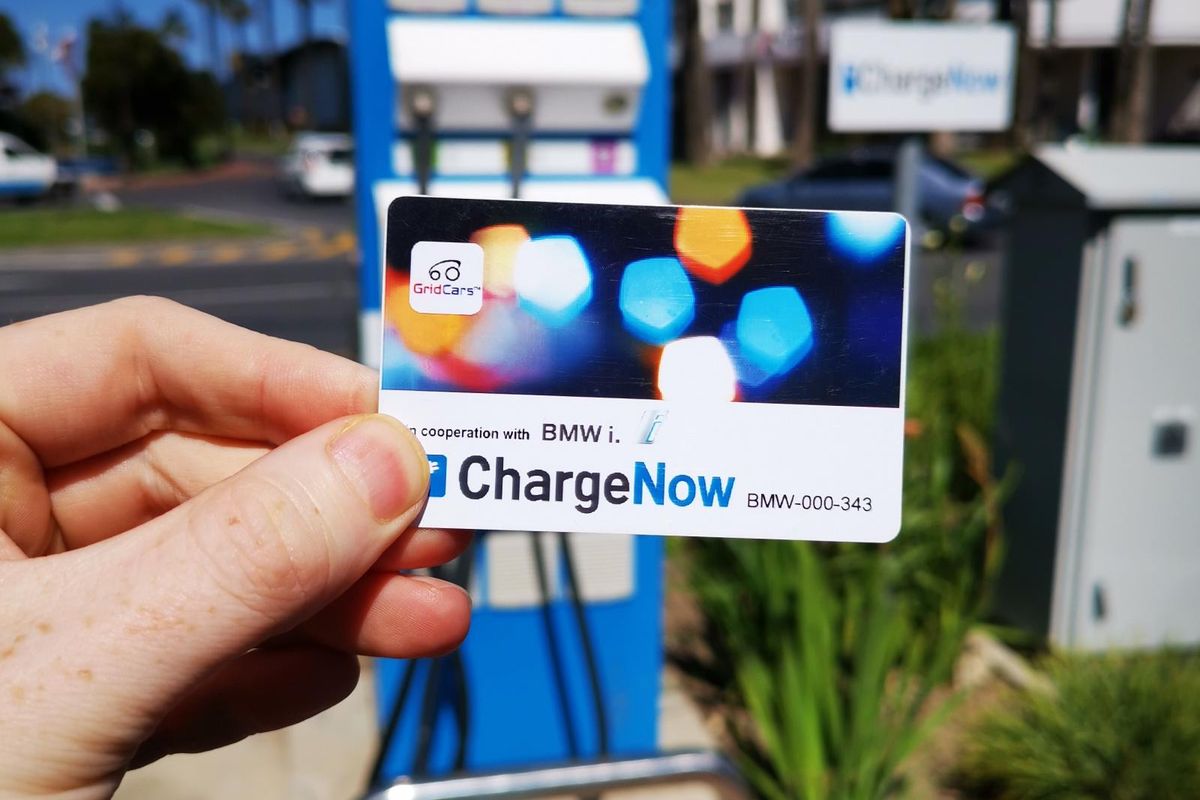
With its quirky and futuristic looks, combined with its ultra-responsive powertrain, the updated BMW i3 still offers a fascinating glimpse into the not-too-distant future. The facelift adds some design upgrades, both in the cabin and the exterior, but the biggest (and the most important) improvement is the increase in battery capacity. The additional (projected) range will assist with the reduction in range anxiety, but despite the rapid expansion of the Gridcars and ChargeNow networks, there will still be some buyers who'll be wary of not using fuel stations for anything but buying snacks or checking tyre pressures. The spectre of load-shedding won't help the image of electric cars either.
Then, finally, some will find the i3's looks too outlandish. All in all, it's a love it – or hate it – kind of car. As far as the Cars.co.za test team is concerned, we love the BMW i3 for making electric cars exciting; it suits our lifestyles very well.
As we mentioned in our road test of the first BMW i3 eDrive REx, the big issues are not with BMW or the i3, but rather the underdeveloped charging infrastructure in South Africa. While there has been notable progress made with the rollout of an EV-charging network and trips across SA have been accomplished by electric cars, there are still not enough chargers outside of the metropolitan areas. It's a catch-22: Manufacturers are hesitant to bring in more electric cars unless there's an adequate charging network, and the companies who build the chargers don't want them to sit idle. Pricing is also a bugbear and while the BMW i3 is the most affordable electric car in SA, it's still beyond the reach of the vast majority of the driving population. The government needs to change its tune and introduce some incentives to encourage electric car ownership or risk being left far behind. Happily, we are seeing progress, albeit at a glacial pace.
Right now, the electric car market is tiny (even if you add up the hybrid and plug-in hybrid models, it's a small percentage of the passenger car market. The compact EV space is by far the smallest of the lot). Nissan SA can't confirm when its new-generation Leaf will make it to market, but we do know there are some units floating around in South Africa. Mercedes-Benz and Audi will be launching the electrically-powered EQC and e-tron SUVs respectively next year, but they'll be priced significantly higher than the BMW i3 as they provide competition for the Jaguar I-Pace. Volkswagen SA is quite hushed on its plans for electrification locally, but we expect to hear some big news towards the end of 2020.
So, basically, the plucky little BMW has the segment all to itself, but, should you buy one? If you can afford the initial outlay and don't do mileages of more than 200 km a day, then the i3 makes for a compelling (and let's face it, conversation-starting) city car. Better yet, if you're in a 2-car household then you can easily slot the i3 in as a charming urban runabout with the internal-combustion engined vehicle being used to transport the family on longer journeys.
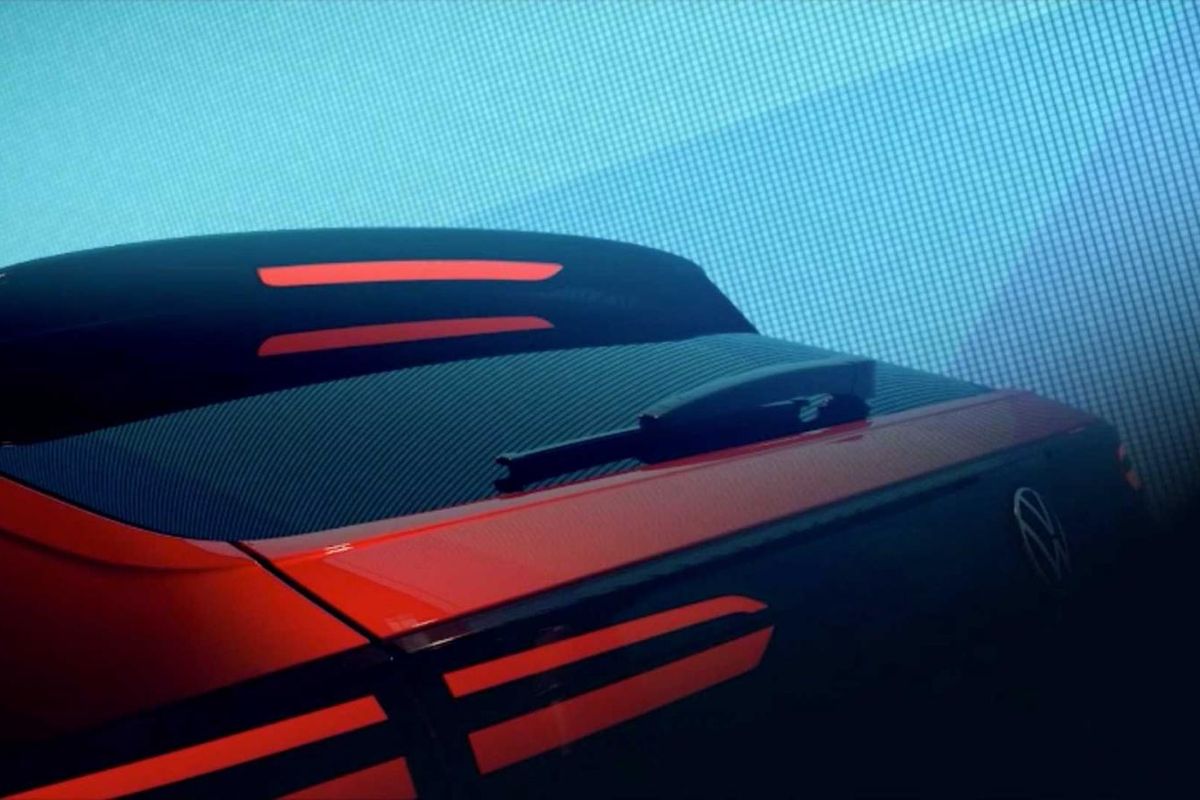
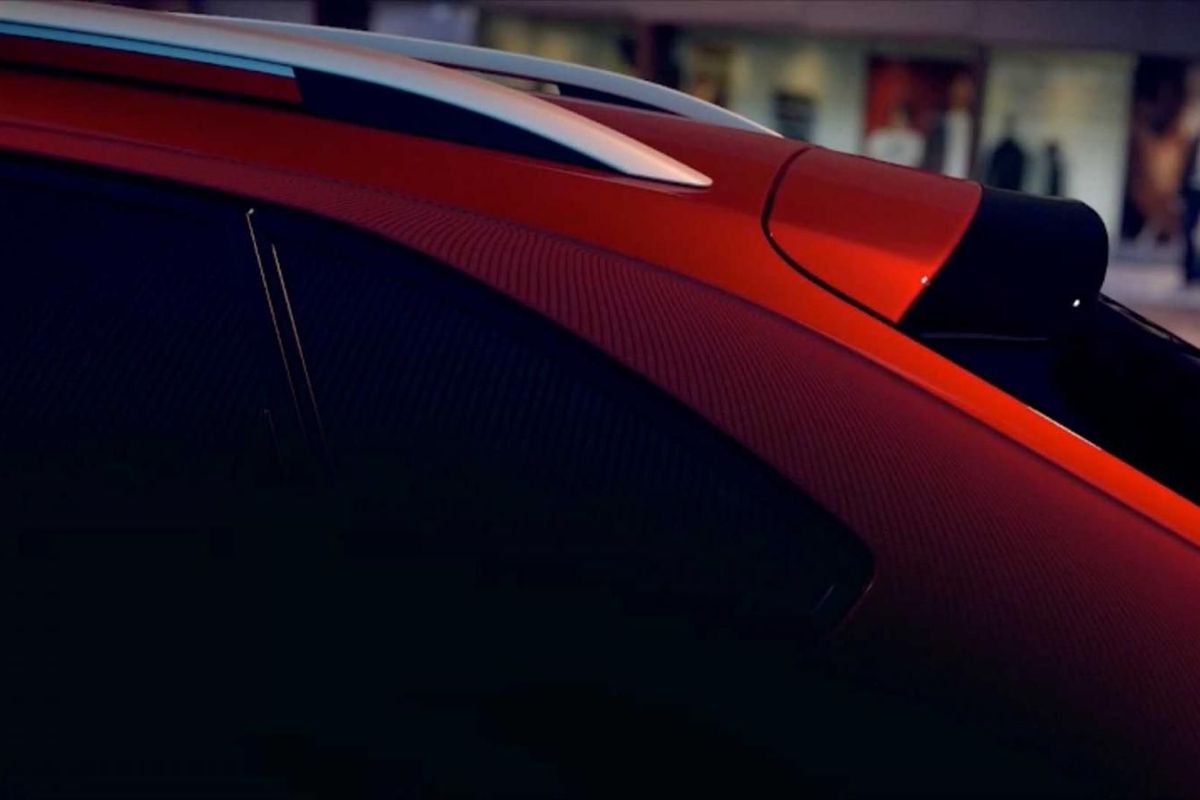
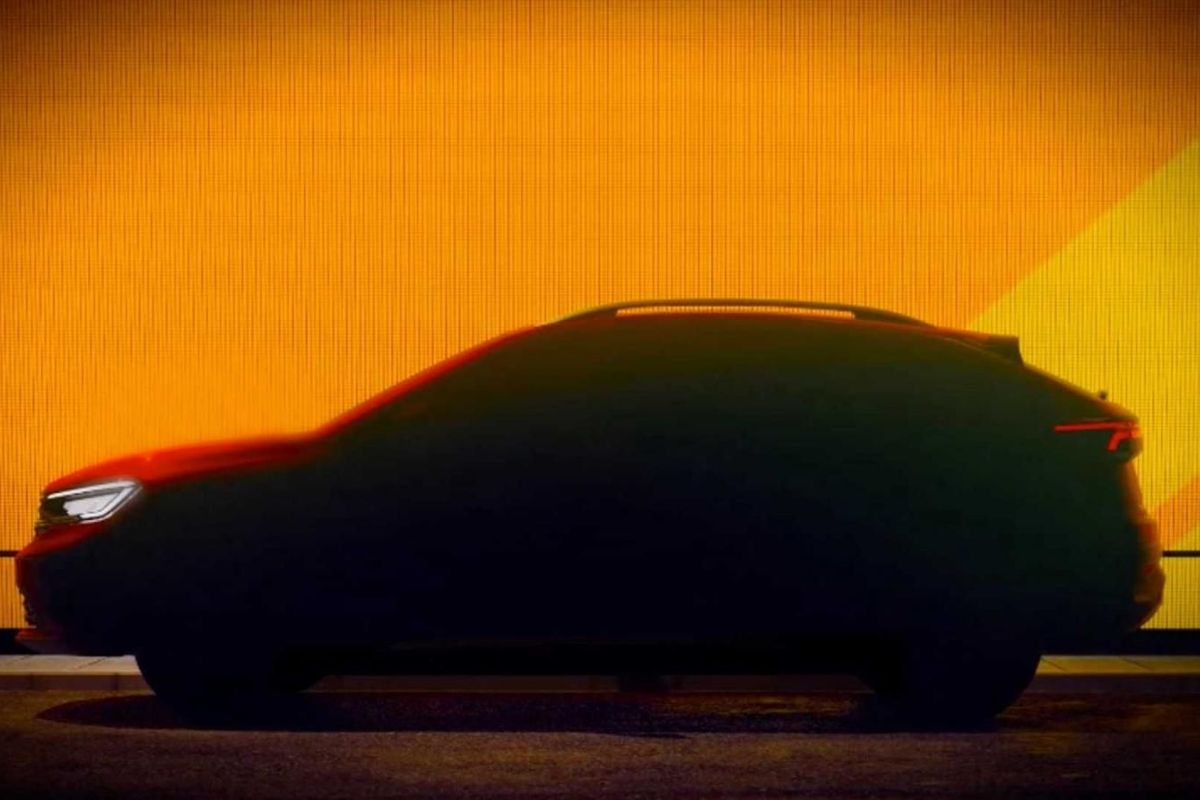
VW has teased a new compact crossover. Think of it as a coupe variant of the wildly popular T-Cross; something that could ultimately work quite well in the South African market.
Although the Wolfsburg-based firm is being coy about the technical details, it has released the strategy around its Nivus cross-coupe. Due to debut in the Brazilian market next year, the Nivus is a cross-coupe built on VW’s current small car platform and, judging by the teaser images, the Nivus clearly has a coupe shape with a sloping roofline, with a crossover-esque ride height.
A generously proportioned rear end should ensure competitive luggage capacity despite the tapered roofline, plus the Nivus' tailgate features a slightly broader taillamp design than the T-Cross.
Developed on the very accomplished VW MQB A0 platform, the Nivus should have all the ride, handling and refinement attributes of a Polo, but with additional ground clearance.
It is expected to feature the same drivetrains as the derivatives in the T-Cross range, which means the 1.0-litre 3-cylinder TSI turbopetrol engine should be the default powerplant.
Power is graded at 85 kW and the only traction configuration is front-wheel drive – like most other hatchback-based crossovers. The Nivus will be available with either a 6-speed manual- or 6-speed dual-clutch (dual-clutch) transmission.
Volkswagen has not confirmed its global product strategy for the Nivus, besides confirming that its launch market will be Brazil. Countries which already receive T-Cross will naturally be candidates for this new VW compact cross-coupe. That means that it's not out of the question that the Nivus could be introduced into the local market at some point in the future.
There are some potent SUVs destined for South Africa and these 5 Power SUVs are coming to rock your world in the new year.
For many people, big, powerful SUVs represent ultimate success and while these brutes are designed to offer near-supercar-like performance, they also serve as luxurious family vehicles that can deliver the kids to school in a flash or transport wealthy politicians and business people to the office, which means that they also serve a practical function.
Here are 5 Power SUVs worth taking note of in the coming year…
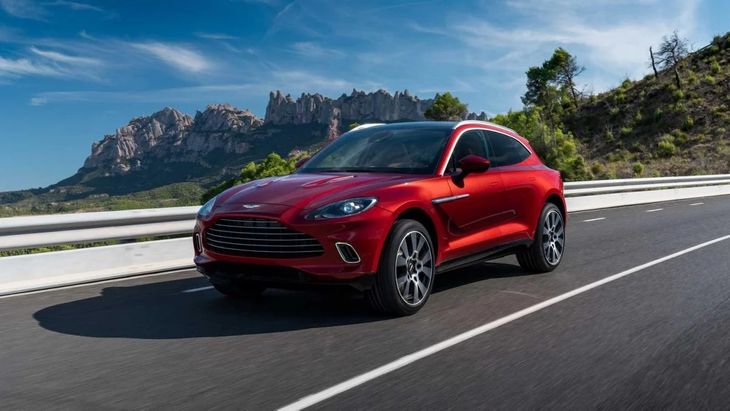
Aston Martin’s first-ever SUV, the DBX is due to be revealed in Cape Town this weekend and the event officially marks its arrival on South African soil. Built from the ground up on Aston Martin’s new SUV platform and produced in St Athan, Wales, the DBX is built to perform.
Powered by an uprated Mercedes-AMG-sourced twin-turbocharged 4.0-litre V8 that produces outputs of 404 kW and 700 Nm of torque, the DBX offers some serious grunt. A 9-speed automatic transmission directs those numbers to all 4 wheels effectively with both an active central differential and an electronic limited-slip differential at the rear. An active exhaust system delivers aural pleasure and Aston Martin claims that the DBX will sprint from zero to 100 kph in 4.5 seconds before reaching a top speed of 291 kph. Pricing is expected to be revealed soon.
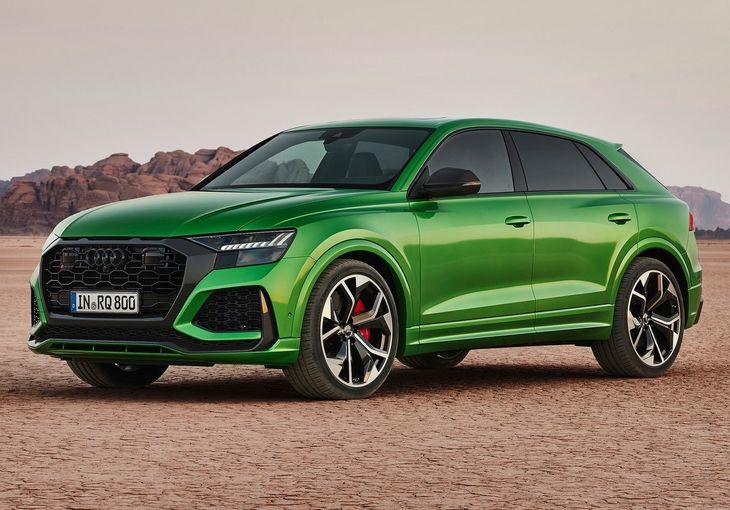
Audi’s range-topping SUV, the RS Q8 will make landfall in the third quarter of 2020 and it’s one of the most anticipated new arrivals for the year. The RS Q8 will bring massive firepower to the road with outputs of 441 kW and 800 Nm developed by its 4.0-litre bi-turbocharged engine.
As you would expect, those outputs will ensure scintillating performance and the RS Q8 will dash from zero to 100 kph in 3.8 seconds before smashing a top speed of 305 kph. Pricing will be confirmed closer to launch.
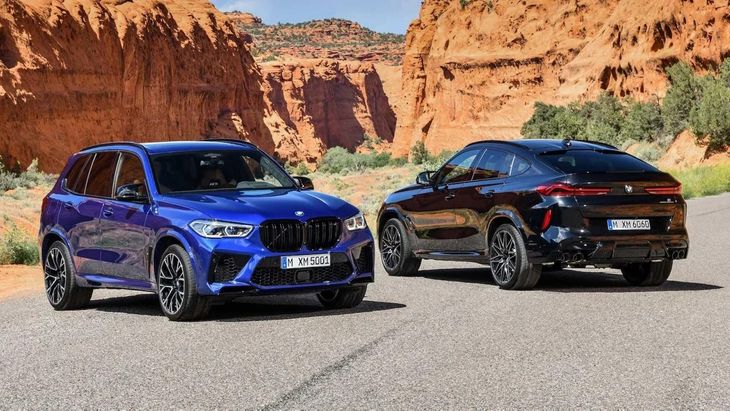
BMW’s dashing duo are due rock the SA market in the second quarter of 2020 and both will be powered by a twin-turbocharged 4.4-litre V8 engine tuned to deliver a whopping 460 kW and 750 Nm. Coupled with an advanced all-wheel-drive system and an 8-speed automatic transmission, the sprint from zero to 100 kph will take only 3.8 seconds before reaching a limited top speed of 250 kph (290 kph is optional). A dual branch exhaust system with active valves will provide the necessary soundtrack to let people know you have arrived…
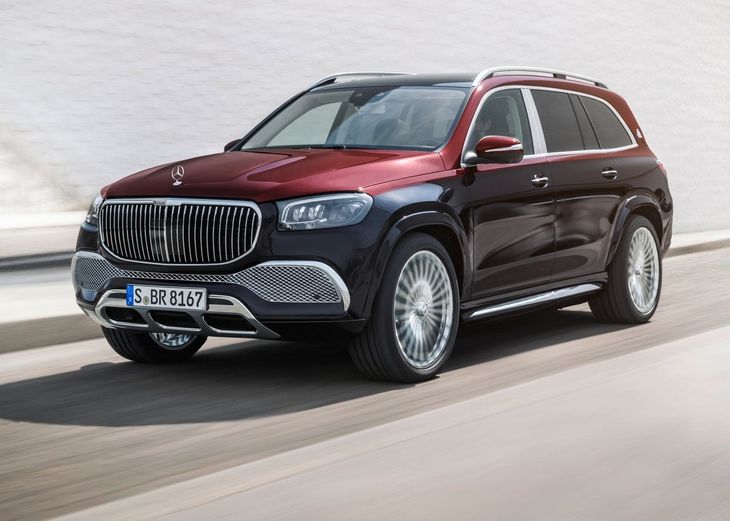
The recently-revealed Mercedes-Maybach GLS has been confirmed for South Africa in 2020 and while it’s sure to impress with high levels of luxury it will also bring notable performance to the road. Under the bonnet is a 4.0-litre turbocharged V8 engine with an electric EQ Boost. Total output is rated at 410 kW and 730 Nm and the performance for such a hefty vehicle is impressive with a claimed zero to 100 kph time of 4.9 seconds. If you wish to make a statement then this might be the SUV for you, but it won’t come cheap. Pricing will be confirmed in 2020.
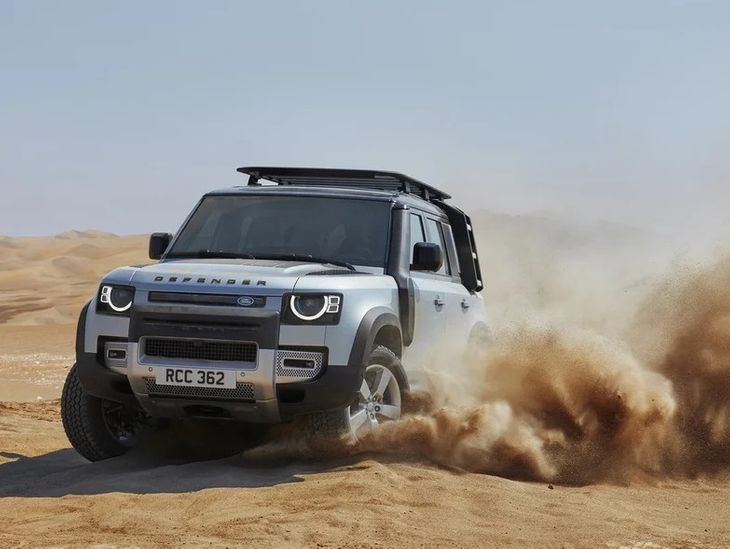
All the SUVs on this list boast incredible engine outputs which make them worthy of being on this Power SUV list. However, what the forthcoming Land Rover Defender might lack in terms of engine output, it makes up for it with outright offroad prowess! This is a power SUV in the world of offroading and we can’t wait for the new Defender to hit South Africa!
With a ground clearance of 291 mm, wading depth of 900mm and Terrain Response 2 which incorporates Clear Sight camera technology, the Defender is expected to be a formidable vehicle that’s geared to tackle any terrain in its path.
The long-wheelbase Defender 110 will be launched first in Q2 of 2020 with the short-wheelbase Defender 90 coming later. Two engines will be initially offered including a 2.0-litre 4-cylinder turbodiesel engine with 177 kW and 430 Nm of torque as well as a 3.0-litre straight-six turbopetrol good for 294 kW and 550 Nm of torque.