SentiMETAL OutRun – Bastille Day special to Franschhoek Motor Museum

With a record number of cars entered, Cars.co.za's SentiMETAL project kicked up several gears this past weekend when a feast of exotica travelled from Cape Town and surrounds to the Franschhoek Motor Museum on Bastille Day.

Photos by Calvin Fisher

As we pulled up early in our office '67 Citroën DS19, we noticed several examples of Americana already parked, including a rare example of a 1959 Cadillac Eldorado Coupe, a Chevrolet Corvette C3 Sting Ray and a modified Chevrolet Corvette C2. Already crowds were gathering, but the parking lot was full and so we proceeded to what was communicated as the actual meeting spot, the spacious truck stop at the back.

BUY > Limited-Edition SentiMETAL T-shirts

Here, our collective jaws hit the floor. Visible through the mist was a staggering array of collectable and exotic cars, including a very rare and valuable AC Bristol, Ferrari 512BB, generation-one Audi Quattro, Porsche 930 Turbo, Hudson Step-Down and many more. And they kept coming… until around 120 cars were assembled and crowds from the petrol station were now gathering to view what appeared to be an impromptu motor show.
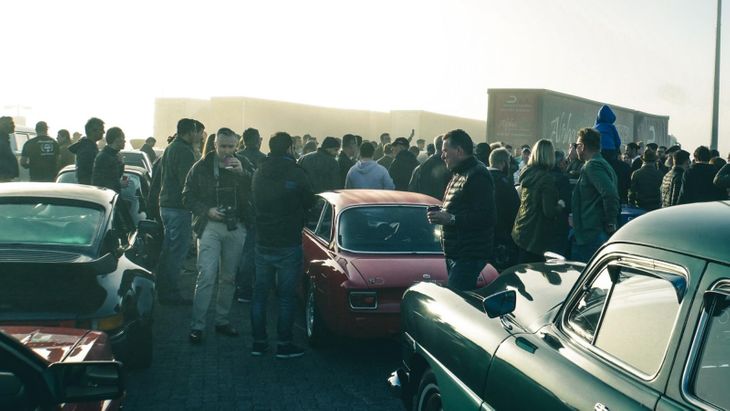

Through the thick fog, hundreds of people and countless special cars appeared. 

"When we started the SentiMETAL project the goal was to keep kindling the flame that burns so brightly between man and machine. We have such a rich automotive history in South Africa and we want to play our part in preserving it," says Cars.co.za's Hannes Oosthuizen. We started the OutRuns earlier this year to bring likeminded people together and it has just exploded, indicating that there is a real need for an event that cuts across the usual brand and generational stereotypes. If you think your car is cool and you're passionate about it, it's probably good enough for one of these runs."
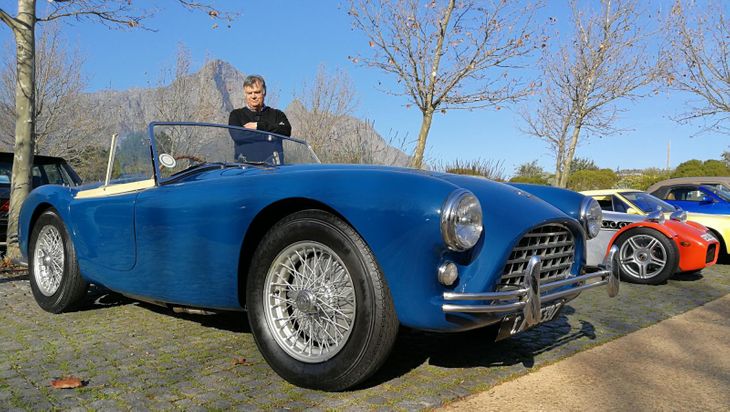

Stunning AC Bristol was a surprise at the OutRun, and drew many admiring glances.

Wayne Harley, curator at the Franschhoek Motor Museum, attended the first Cape Town run earlier this year in the museum's Alfa Romeo Brera, a modern classic. "There is nothing more rewarding than being involved with groups of people who are genuinely partaking in something just because they truly love it. This past Sunday's SentiMETAL drive was again proof that like-minded people with the right attitude and a common goal can have tons of fun and all that can happen without the regular hullabaloo commonly associated with arranging of a rally, drive, or motor show.  The Franschhoek Motor Museum was packed to the brim with stunning cars, owners and spectators all sharing the joy we call CARS".
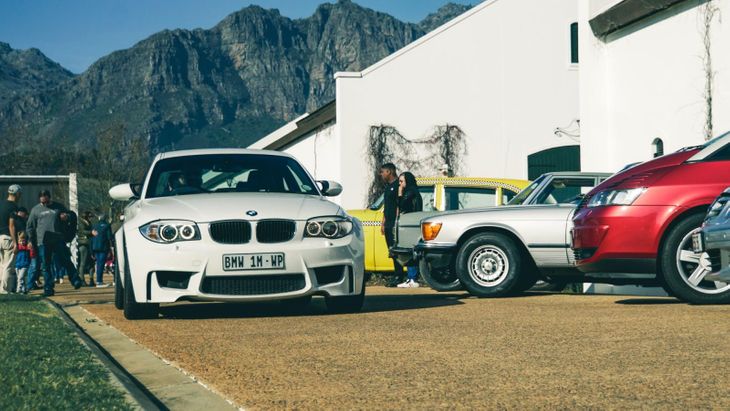

"Moderns" such as the iconic BMW 1 M Coupe and rare Renault Avantime were also in attendance.

It's impossible to list all the highlights here, but having the only 2 Dodge Viper GTSes in South Africa (separated by 1 VIN number) present is quite a special treat. A bright-yellow Lotus Europa joined two other vehicles (Audi Quattro and Porsche 930 Turbo) from Crossley & Webb, while The Archive attended its first run with a Ferrari 512 BB and an Aston Martin AM Vantage. A pair of bright red and wedge-like Lotuses, an Esprit Turbo and Excel, certainly turned many heads, as did some achingly pretty Mercedes-Benz SL "Pagodas".

Oddities included a modern rarity such as a Renault Avantime, that bizarre MPV/coupe from the French marque that was never sold here, and a cute-as-a-button Volvo P1800ES. Numerous Porsches were in attendance, including pristine 356es, a 1958 Chrysler Windsor and even the Jaguar E-Type that featured in the pilot episode of the SentiMETAL video series.
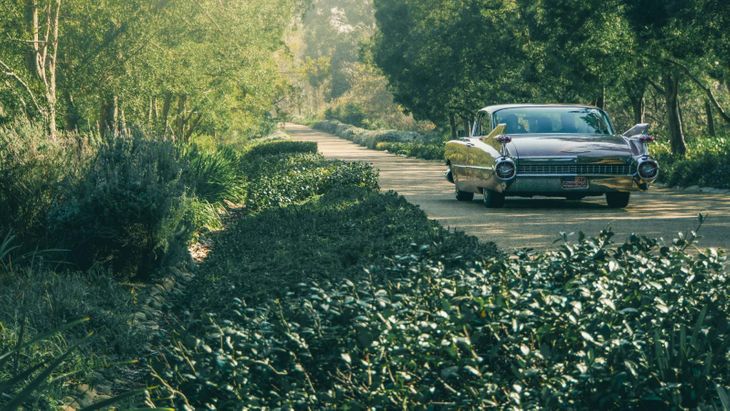

A real crowd pleaser was this 1959 Cadillac. Immaculate and through sheer size, it was simply hard to miss!

"It was really great to see collectors and car fanatics of different backgrounds get together and just talk cars," said Oosthuizen. "And also excellent to see a lot of youngsters brought along to get exposed to these incredible machines."

To make sure you are kept abreast of future events, follow the SentiMETAL Facebook page here as well as the Instagram account here.

You can visit the Franschhoek Motor Museum's website here

You may also be interested in;

SentiMETAL Ep11: Dodge Viper GTS

SentiMETAL Ep10: Cape Town's Drug-Busting Hollywood Taxi

SentiMETAL Ep.9: Alfa Romeo GTV6 3.0

SentiMETAL Ep.8: Volkswagen Split-Window Crew Cab

SentiMETAL Ep.7: Ferrari Testarosa

SentiMETAL Ep.6: Mercedes-Benz 190 SL

SentiMETAL Ep.5: Opel Kadett Superboss

SentiMETAL Ep.4: BMW 333i

SentiMETAL Ep.3: Nissan Skyline GT-R "Hakosuka"
SentiMETAL Ep.2: Porsche 911 (930) Turbo "Widowmaker"
SentiMETAL Ep.1: Jaguar E-Type

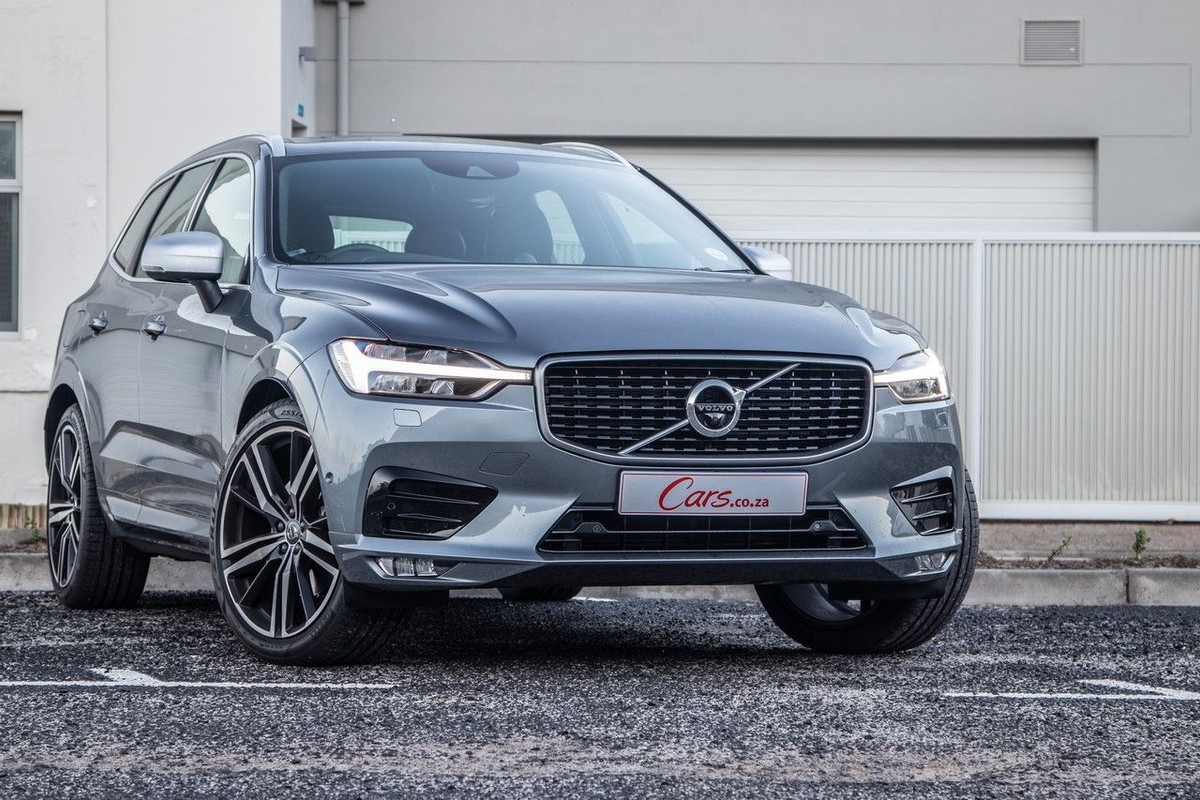
Volvo XC60 D4 R-Design (2019) Review

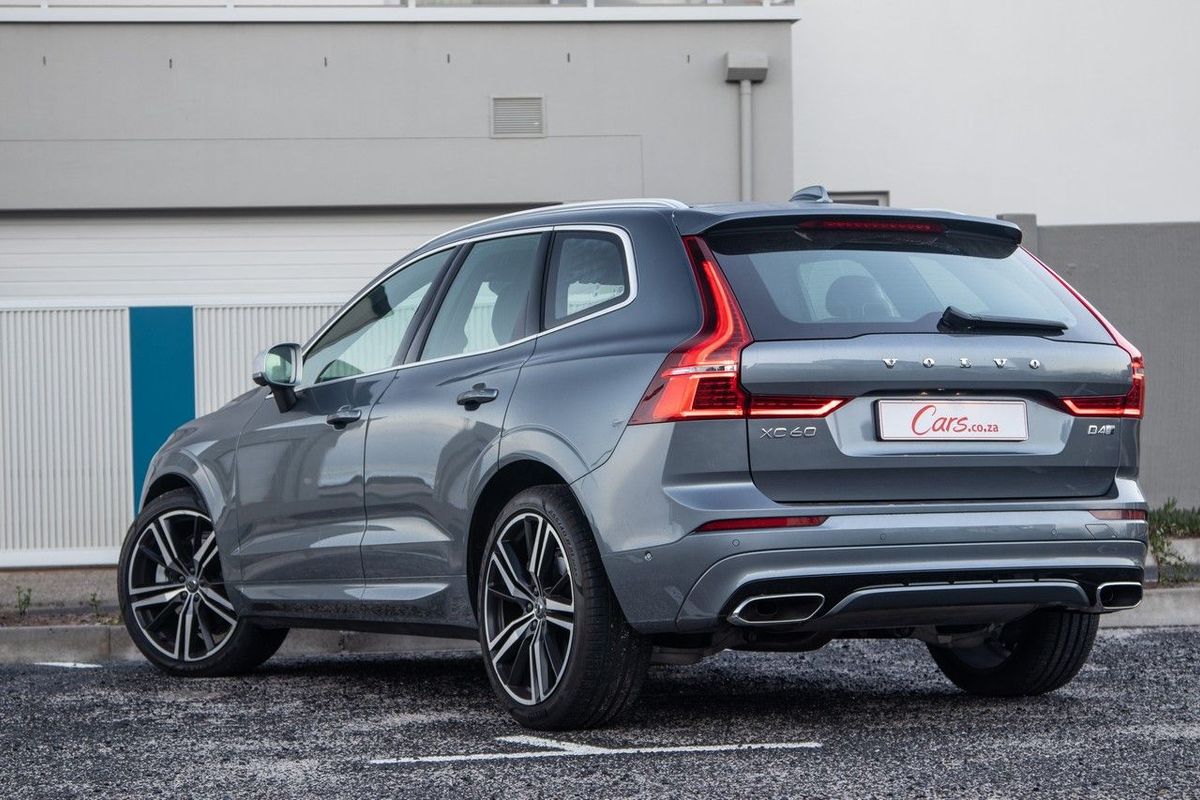
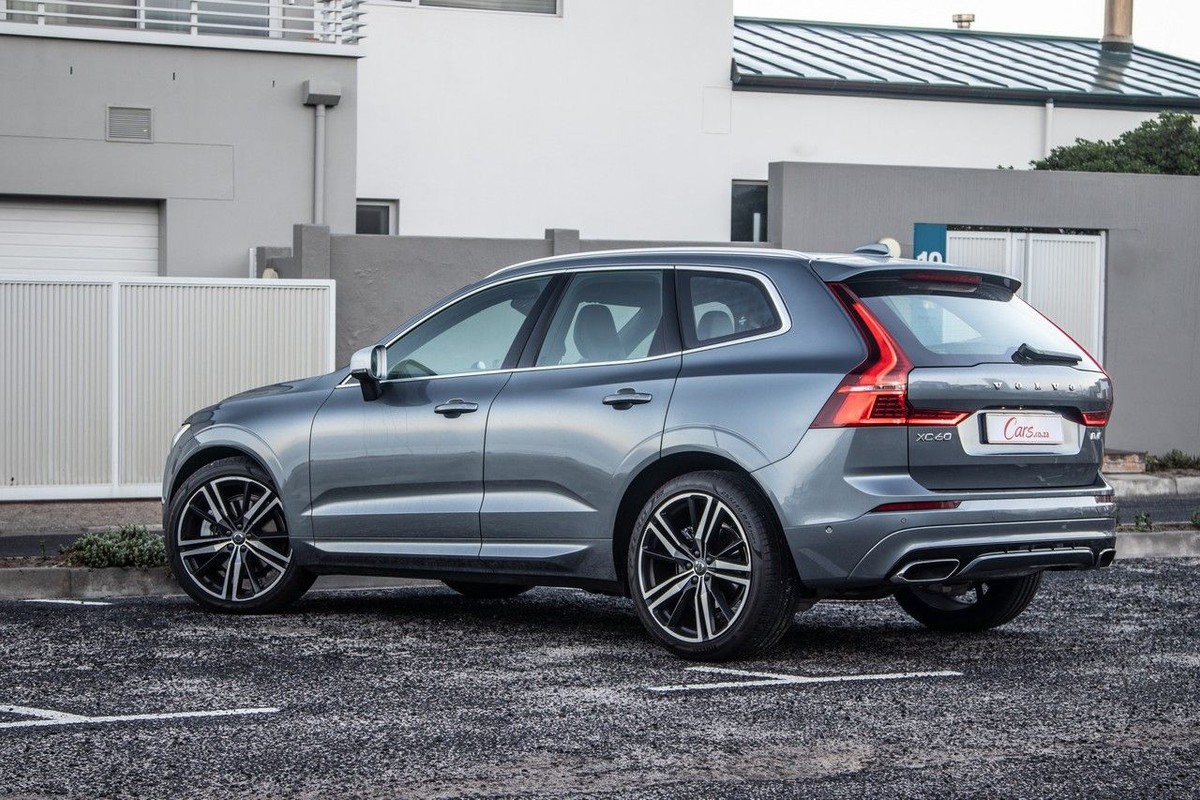
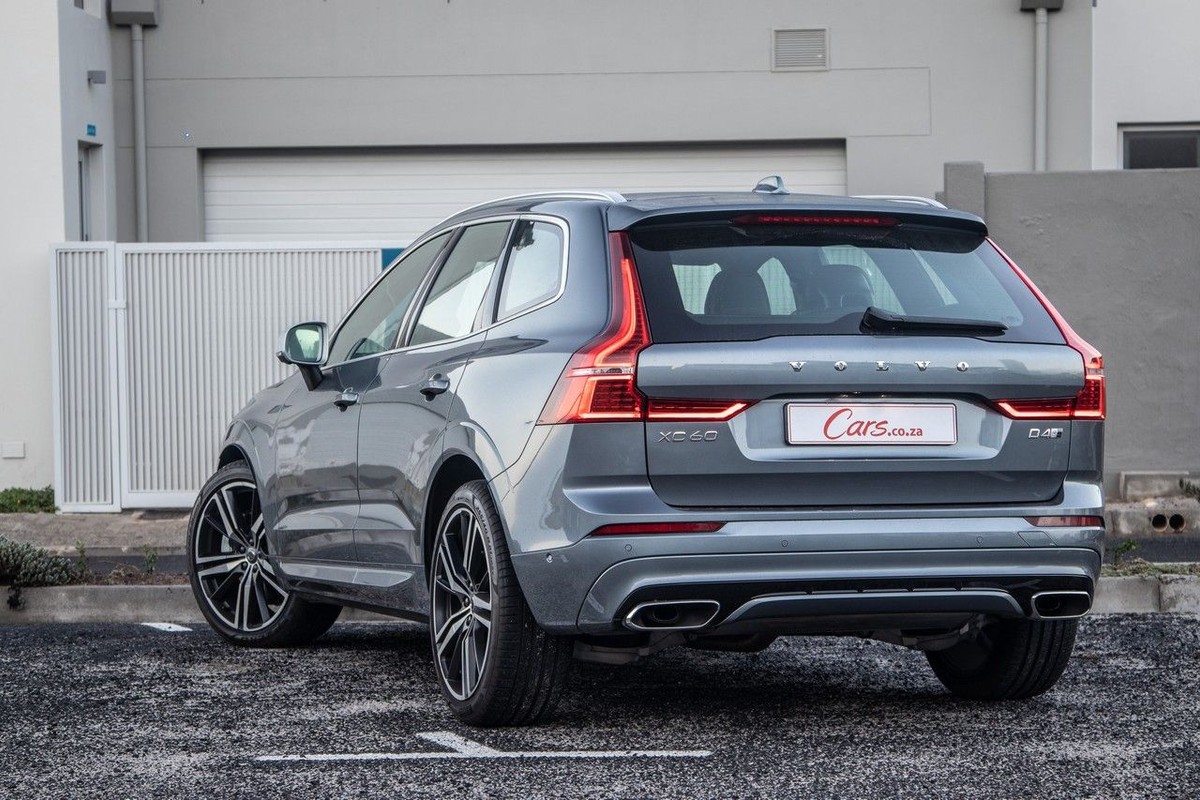
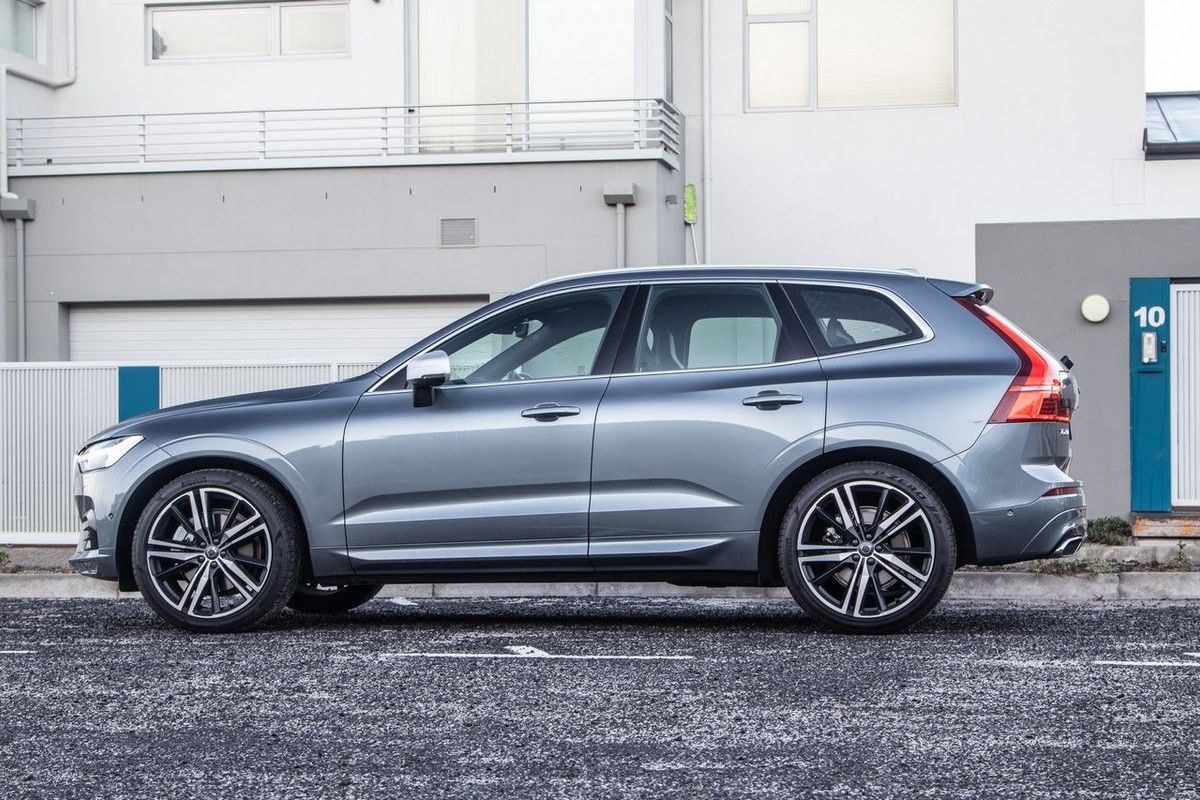
Volvo’s Executive SUV has raked in a plethora of awards – including the 2018 World Car of the Year title – and famously won its category of the Cars.co.za Consumer Awards – powered by WesBank – earlier this year. We get behind the wheel of a D4 R-Design derivative, which we believe may be the sweet spot in the range…

We Like: Exterior design and interior execution. Practicality, decent performance.

We Don’t Like: Big wheels compromise the ride quality. Fuel consumption could be better.

Fast facts

  • Price: R735 100 (June 2019)
  • Price as tested: R890 000
  • Engine: 2.0-litre turbodiesel
  • Power: 140 kW  
  • Torque: 400 Nm
  • Transmission: 8-speed automatic
  • Fuel consumption: 5.2 L/100 km

Own a Volvo? Tell us about your experience here

SERIOUS ABOUT BUYING?

Check out full specification details and finance estimates here

Some Opel dealers regularly offer specials. Have a look here.

Where does it fit in?


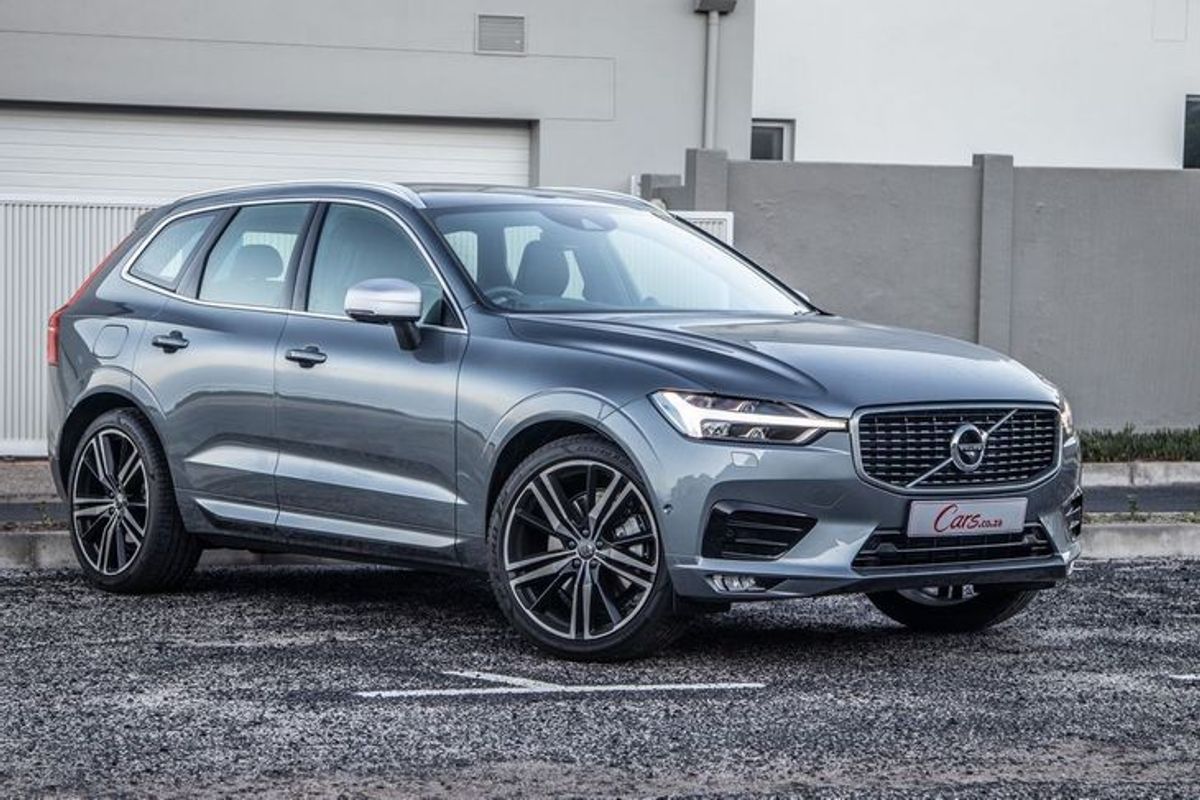
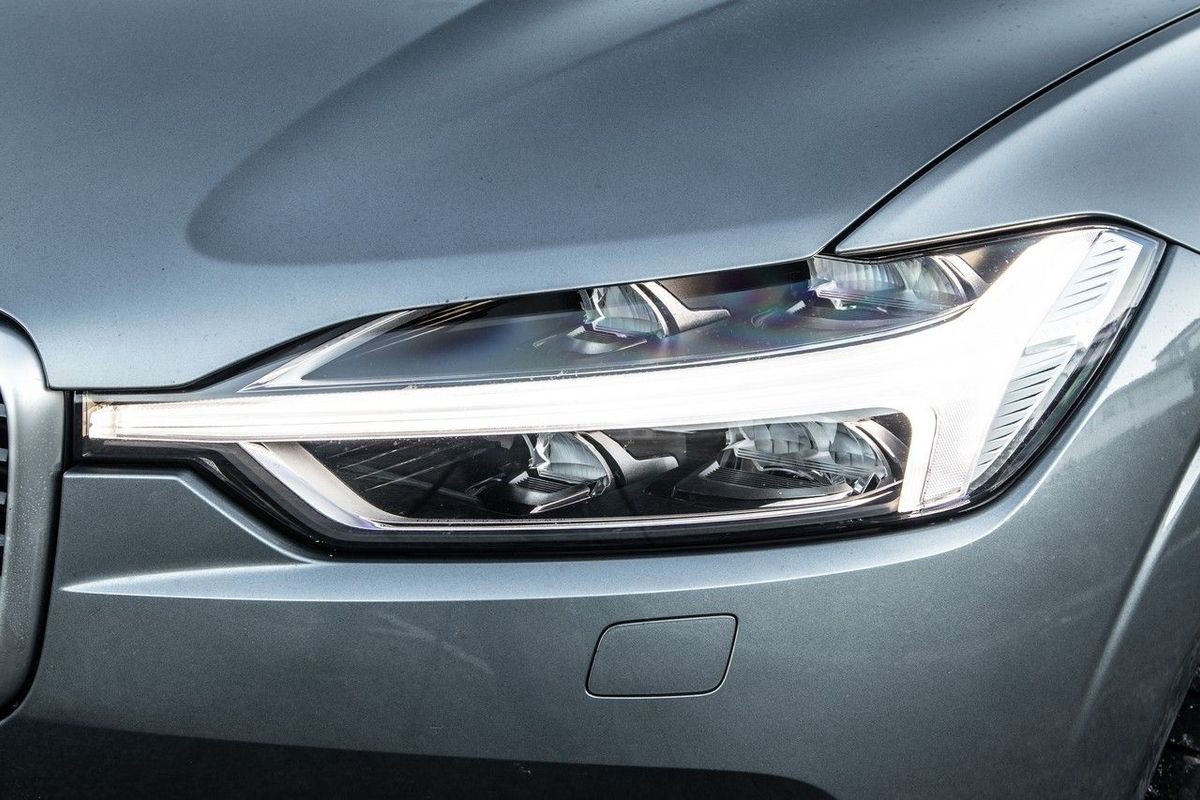
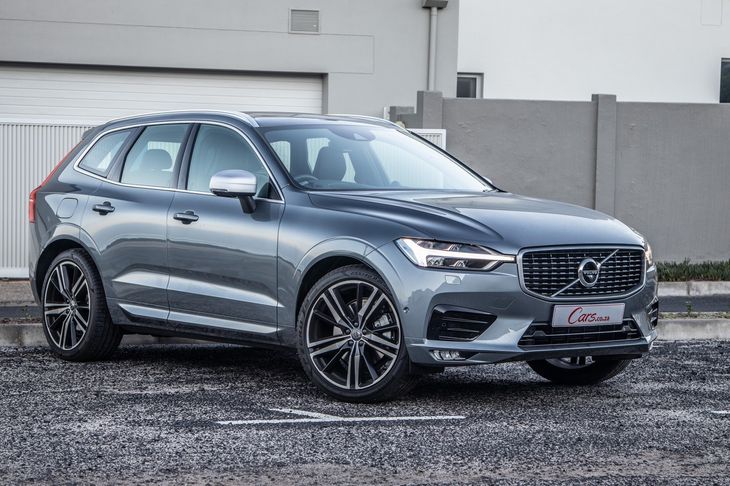
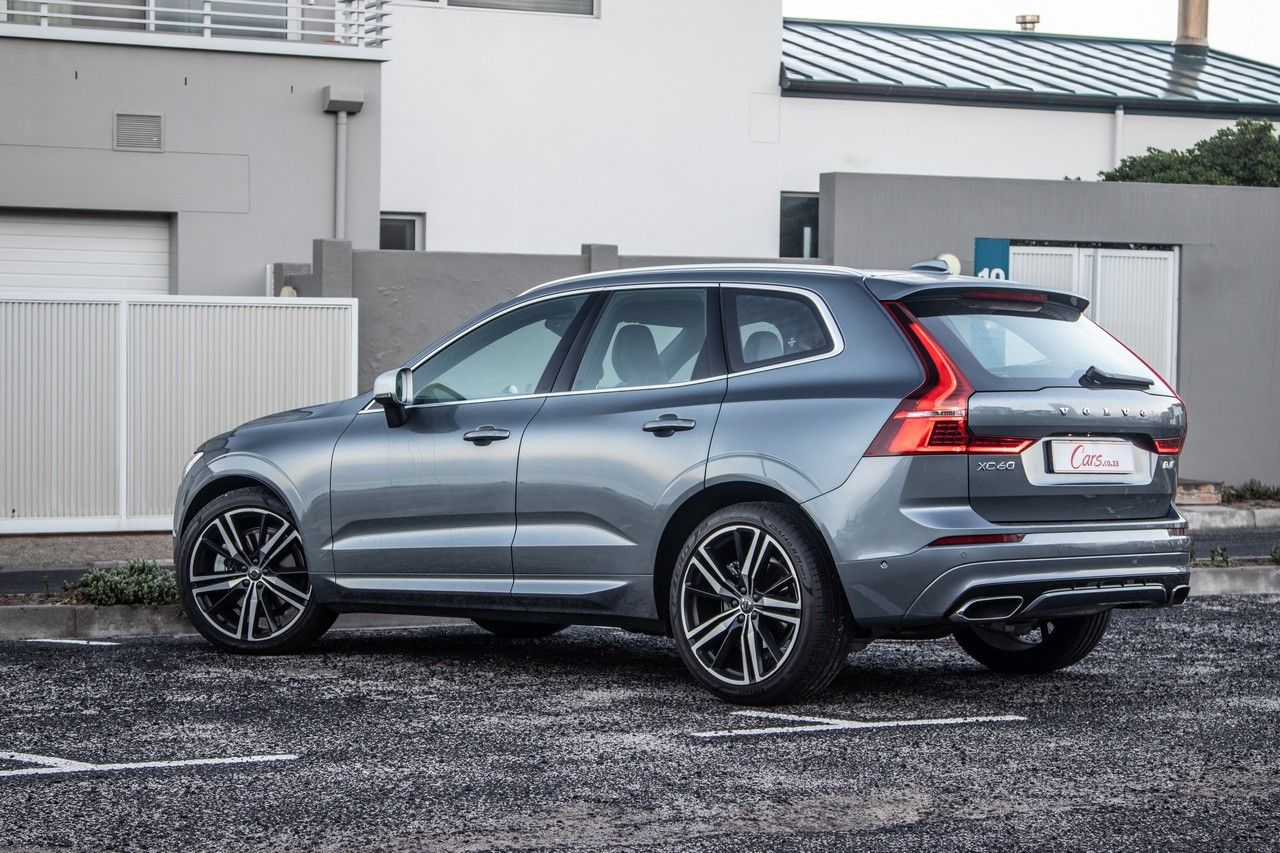
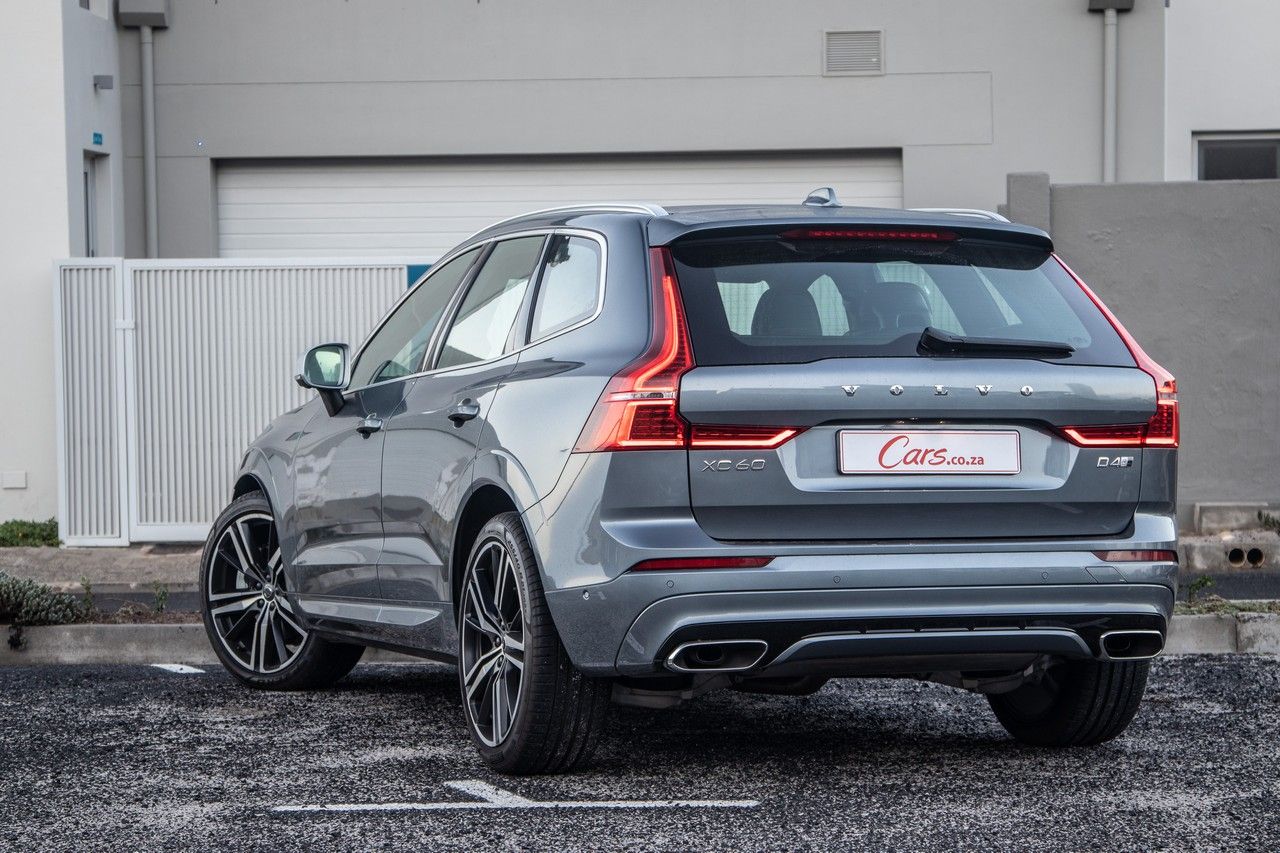
The XC60 is one classy looking Executive SUV.

The XC60 debuted in SA in mid-2018, and the brand has gradually introduced more derivatives to the lineup. We have already tested the D5 version, of which you can watch a video, but what of this D4? Well, it’s essentially a detuned version of the D5, but with (slightly) better fuel consumption. It also costs R70k less than the D5, making it an intriguing proposition for those less concerned with outright torque delivery.

In a segment where every premium brand has at least one player, the Volvo has no shortage of rivals: the Audi Q5, BMW X3, Jaguar e-Pace, Range Rover Evoque and Mercedes-Benz GLC are just a handful of them. There are more fringe rivals, but the point is clear: it's a crowded segment.

How it fares in terms of…

Performance and efficiency


The D4 offers enough power and low-down torque to propel Volvo's Executive SUV briskly.

Volvo’s entire XC60 range is powered by 2.0-litre 4-cylinder engines (the D4 utilises a turbodiesel). Peak outputs are decent (140 kW and 400 Nm), which are eerily similar to those of the X3 xDrive20d and Q5 40TDI. That aside, the motor performs more than adequately; it ushers the SUV along with verve, even when it is fully loaded with occupants and their luggage. Most of the premium manufacturers still favour turbodiesel motors in this segment and that stands to reason: the shove of low-down torque gets the SUV up to speed quickly without draining the fuel tank in traffic.

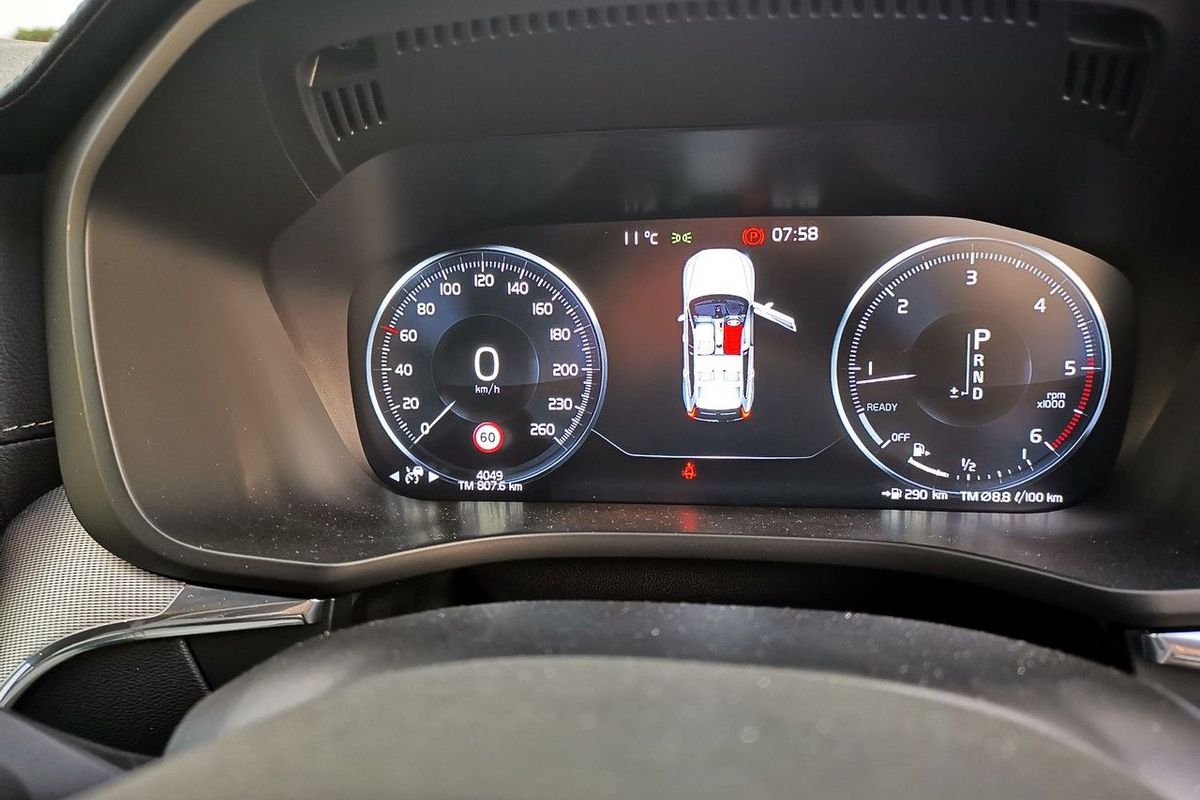
As for that consumption, Volvo’s claim is 5.2 L/100 km, which we found to be optimistic. City driving returned closer to 9.0 L/100 km, while a long freeway stint on the West Coast heralded an indicated figure of 7.2 L/100 km. We’ve achieved better results from both the equivalent Q5 and X3.

The standard transmission in an XC60 is an 8-speed automatic, which is frankly a match for anything its competitors have to offer. Shifts are smooth and well positioned to keep the engine's revs to a minimum and facilitate a tranquil cabin ambience; the motor merely whispers in the background.

Practicality


There are plenty of storage spaces for small items and plush surfaces abound.

One of the reasons the XC60 has received so much critical acclaim is its user-friendliness – Volvo has put much thought into what users want from their cars' cabins and it shows. Apart from the fact that the cossetting cabin is tastefully trimmed in lavish perforated leather, the centre console has space for cups, keys and a phone, the door pockets are large (you can pop 2-litre bottles in them), while rear passenger space is acceptable.

The load bay aperture is square at the bottom, making it easy to judge what will go in and what won’t. The opening is admittedly a bit thinner towards the top, but that’s expected with those fancy tail lights that curve in towards the hinges of the tailgate. If the D4 is specified with the optional air suspension setup (at a cost of an additional R26 750) you can lower the ride height at the touch of a button (in the load bay) to make it easier to load things into the back. It also automatically lowers when you turn off the car (the act is accompanied by an electronic humming sound).

The luggage capacity is (a claimed) 505 litres, which is on par with the rest of the Executive SUV brigade. With the seats folded down, 1 432 litres of utility is available and there are straps, hooks and hidey holes to hold and store all sorts of things that you don’t want rolling around in the boot.

Ride quality


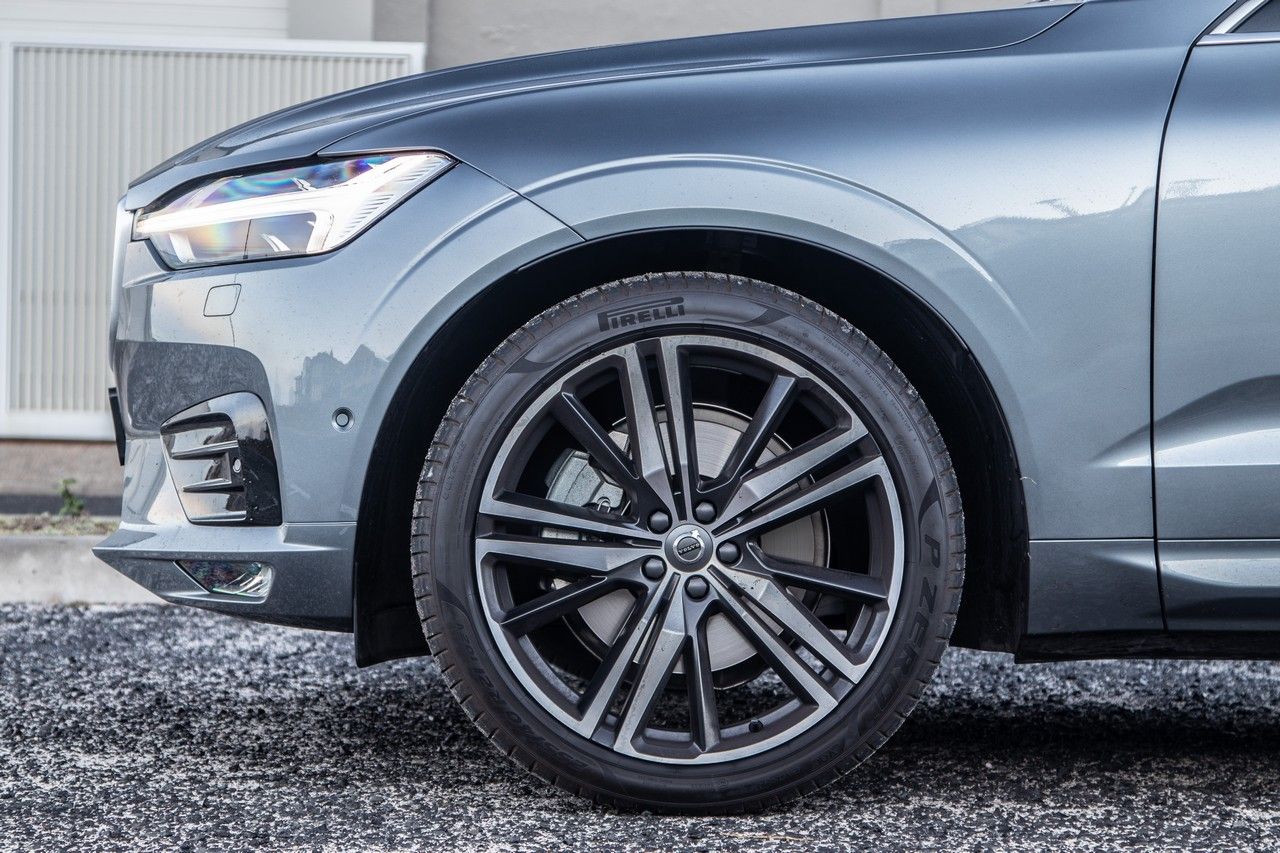
Steer clear of the 21-inch wheels but do go for the optional air suspension.

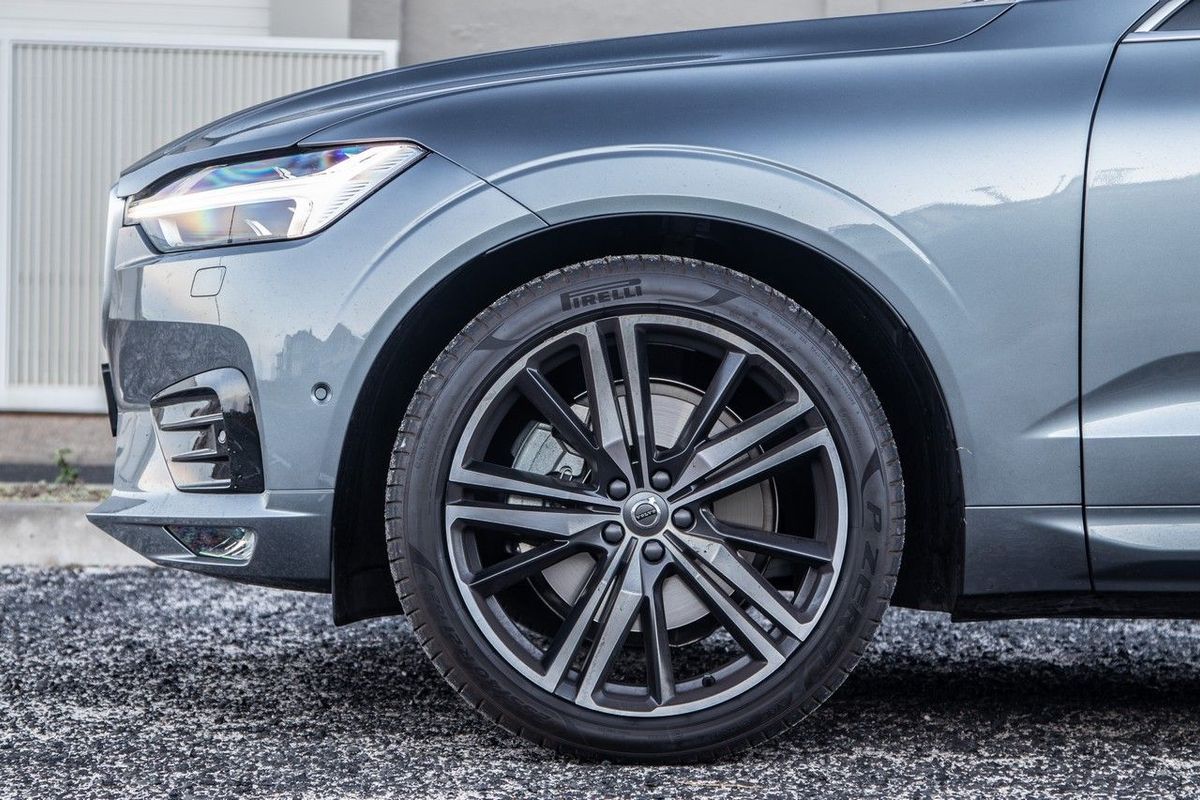
The R-Design pack adds some visually pleasing equipment in the form of a set of 19-inch wheels. We wouldn’t suggest going much larger than this as our test car was shod with 21-inch wheels that even Volvo’s competent air suspension couldn’t cope with. The ride quality is fine on the smooth-tarred freeway, but in the suburbs where the tar tends to be patchy and rutted, the suspension jolts more than you’d like from a comfy SUV like this. 

Aside from the rumble created by those (oversized) 21-inch tyres, it’s very quiet inside the D4 R-Design. At cruising speeds, wind noise is negligible and the diesel thrum is only noticeable at idle from cold starts. Volvo’s product pitch is abundantly clear: comfort over speed. It’s not a dynamic SUV by any means, and that’s quite refreshing in a segment where manufacturers seem determined to turn practical family cars into pseudo-sportscars.

Interior features


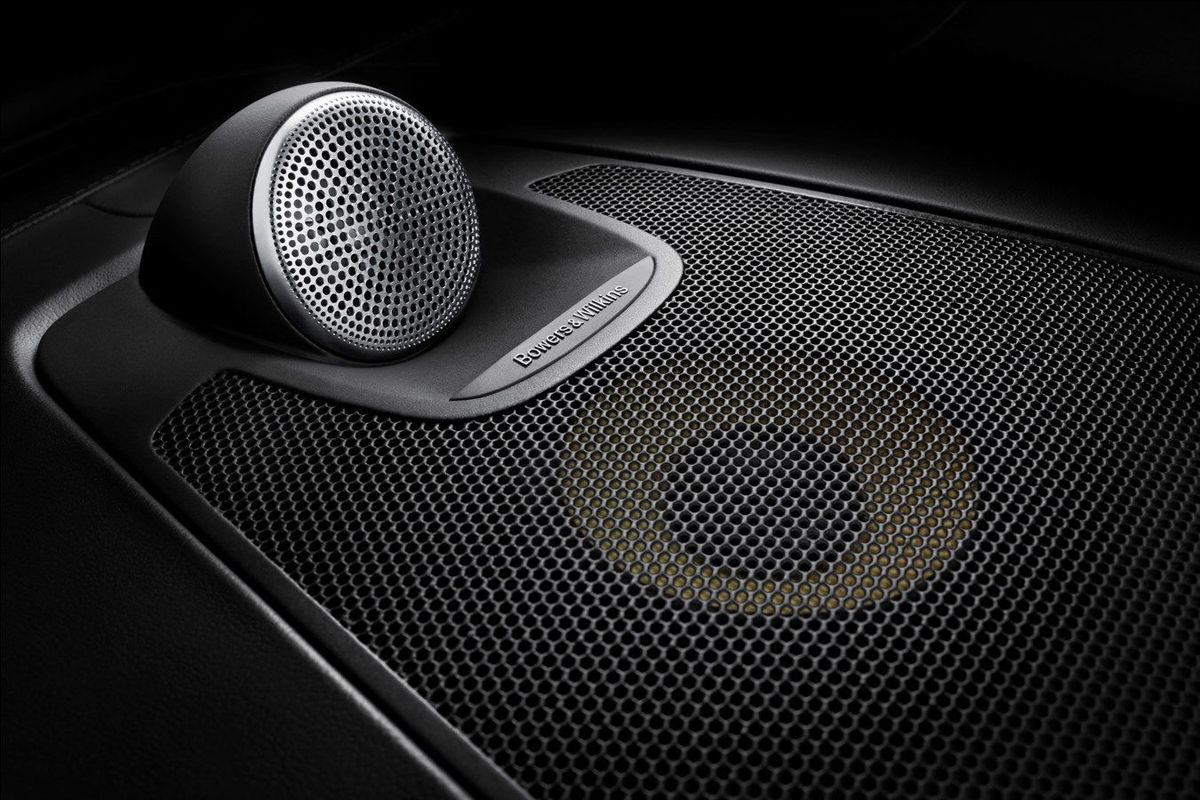
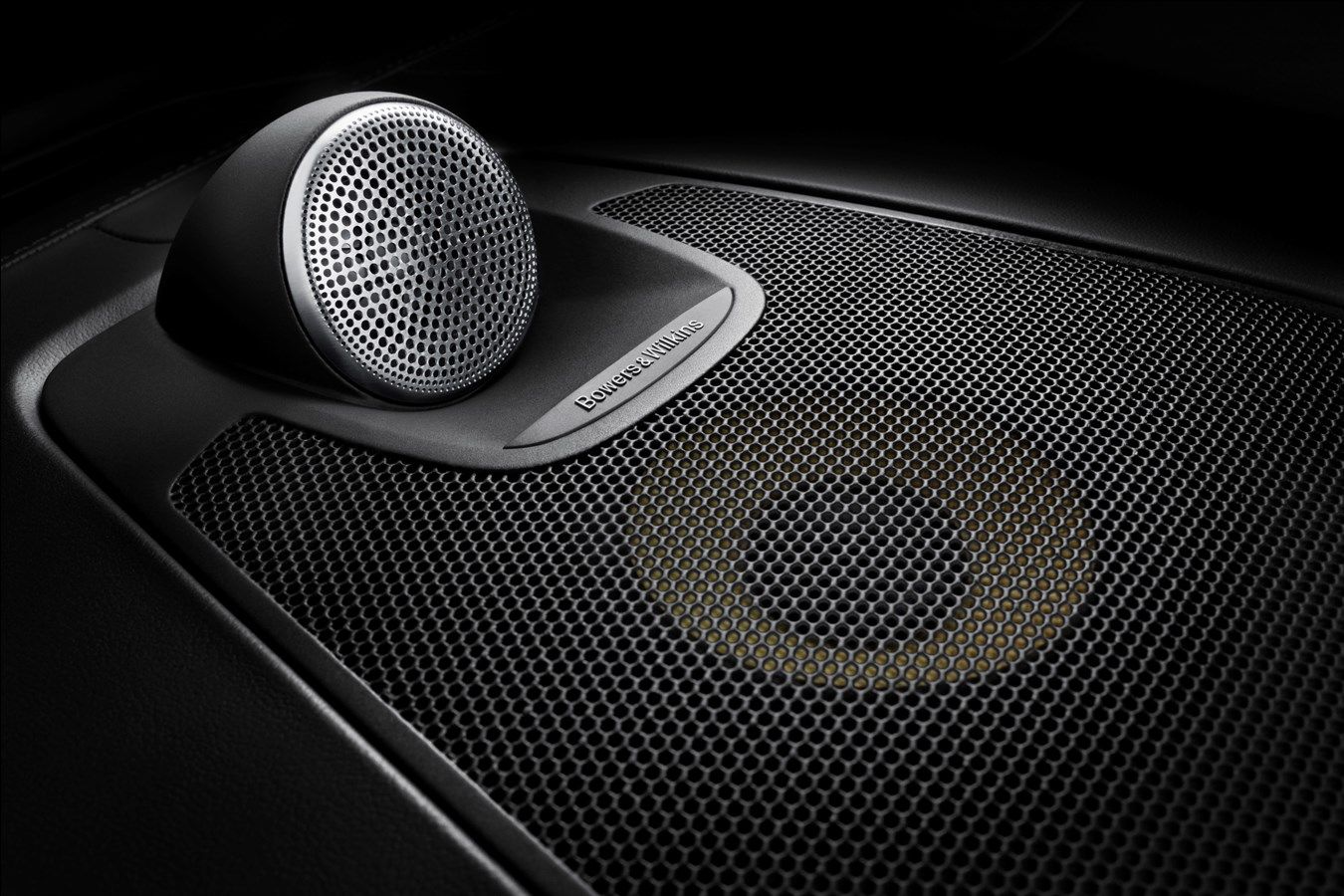
The Bowers & Wilkins sound system is right up there at the top of in-car entertainment systems.

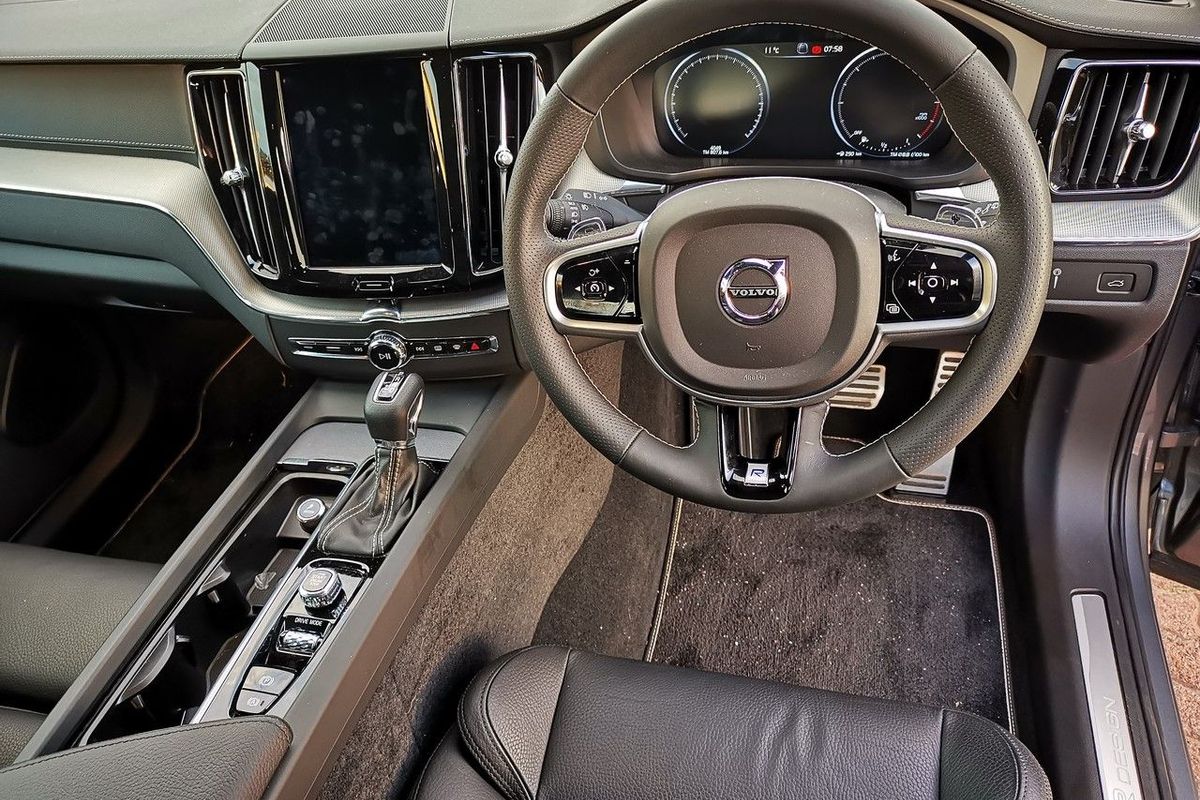
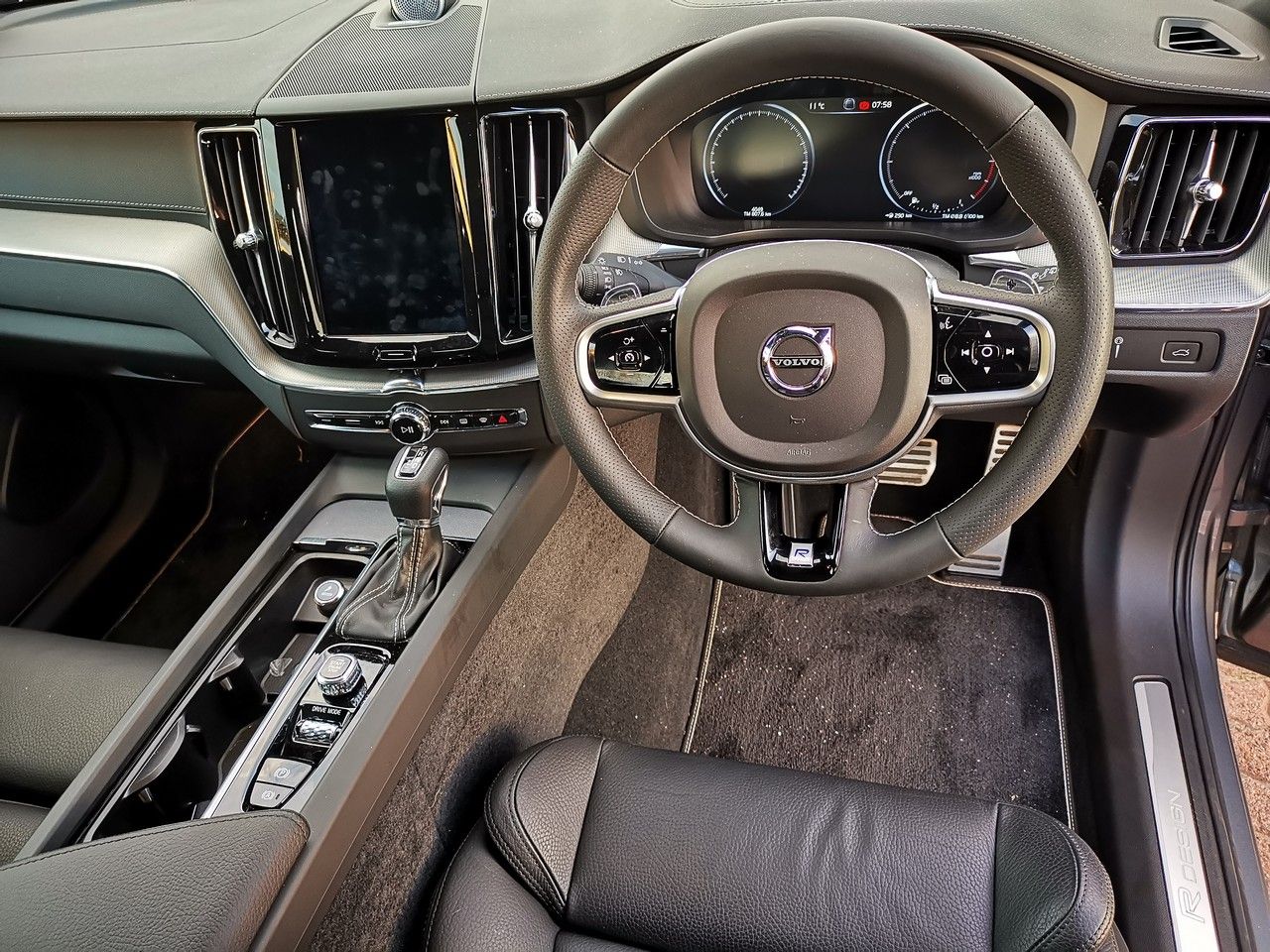
This XC60 doesn’t have one of Volvo’s most exciting interiors (check out the D5 review for one that did), but it’s very comfortable. The R-Design pack includes the aforementioned perforated leather with extra padding, while both the driver and front passenger seats are electrically adjustable. It’s eminently plush in there, replete with a carpet-lined transmission tunnel and soft-touch materials in more areas than just the key touch points. 

The R-Design pack offers a number aesthetically pleasing standard features, such as the 3-spoke steering wheel and perforated leather-trimmed transmission lever. It covers all the necessities you expect from a modern R700k car, but if you look at what’s available on the options list, you may be sorely tempted to stretch your budget just a little bit further. This XC60 was specced with the R-Design Premium Plus pack (R72 750), which adds heated front seats, a 360-degree camera, parking assistance, the 21-inch wheels, blind-spot monitoring and a superb Bowers & Wilkins audio system – which is undoubtedly one of the very best in-car audio setups currently available on the market.

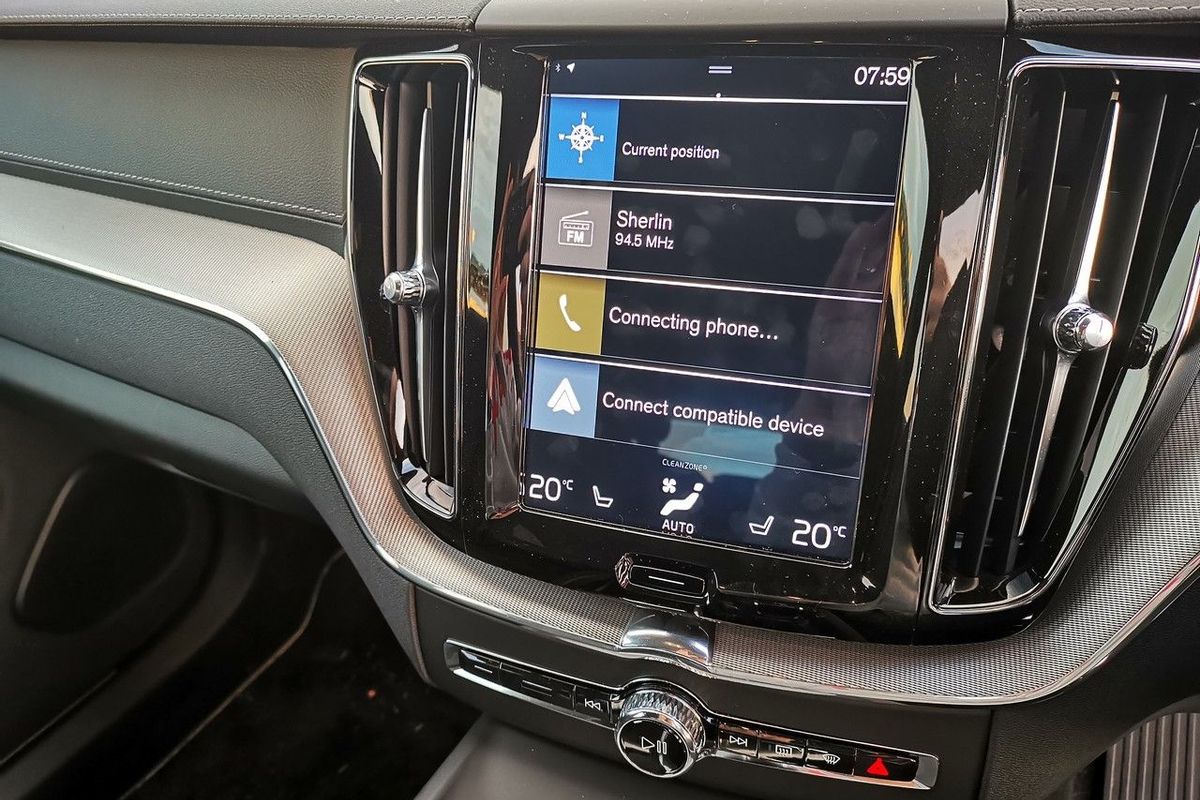
By utilising the XC60's onboard Android Auto and Apple Carplay compatibility, you can seamlessly integrate your smartphone with the infotainment system which, of course, we have rated very highly since we first experienced it in the XC90 back in 2015.

Verdict


Volvo's now look and feel more premium than the German competitors.

The XC60 D4 may be the entry-level derivative in the range, but, to its credit, the car doesn’t feel like the neglected stepchild of Volvo's executive SUV family. In fact, it’s the over-achiever. It’s no slouch; in fact, it provides ample performance to shuttle a family and their equipment around. 

The air suspension option is the way to go if you prioritise comfort above all else, just don’t specify the 21-inch wheels if you want to keep it that way, we believe the 19s or 20s items will do just fine. The cabin, which is well insulated from cabin and wind noise, is pleasingly refined and, in terms of practicality, the XC60 hits the required marks in terms of load space, rear passenger comfort and clever storage locations. 

But that ultimately promotes the Volvo ahead of its (predominantly German and British) competitors? There is little doubt that the Volvo sports slick and sophisticated design with broad, almost universal, appeal… but its cabin really trumps those of the opposition. The materials used comprise less plastic and more quality leather and the plush carpeting exudes luxury and style. It feels like a much more expensive space to spend your time.

Pricing and Warranty

The D4 AWD Inscription retails for R735 100 (July 2019) and comes with a maintenance plan and warranty, both spanning 5 years/100 000 km. Services are every 12 months, or 20 000 km.

Kia Picanto: Now with Standard Service Plan

Kia South Africa has announced that it'll be offering the compact Picanto with a service plan as standard.

We at Cars.co.za are quite fond of the Kia Picanto, but if there was one issue we had, it would be the service plan or lack thereof. Now Kia is offering a 2-year / 30 000 km service plan for its Picanto range as standard. 

“With the new 2-year/30,000km service plan on all KIA Picanto models, customers not only know when to have their cars serviced but also benefits from the predictability of pricing over the plan’s duration,” says David Sieff, Marketing Director, KIA Motors South Africa. “Servicing costs are set for the duration of the plan, meaning customers won’t have to pay anything extra for parts or labour should there be a price increase while the service plan is active, which is a notable value add.”

This current shape Kia Picanto made landfall in SA back in July 2017 and is available with a choice of 1.0-litre or 1.2-litre engine with the option of either manual or automatic transmission. There are 4 levels of trim on offer too. 

The new service plan joins the already impressive unlimited kilometre / 5-year warranty. For the record, the Kia Picanto range starts from R158 995.

Further Reading

Budget Car Comparison (2019) Datsun Go vs Renault Kwid vs Kia Picanto vs Mahindra KUV vs Suzuki Celerio

8 New Cars Under R3 000 p/m

New Kia Picanto (2017) Launch Review

Kia Picanto (2017) Specs & Price [with Video]

Kia's baby SUV coming to SA & other insights

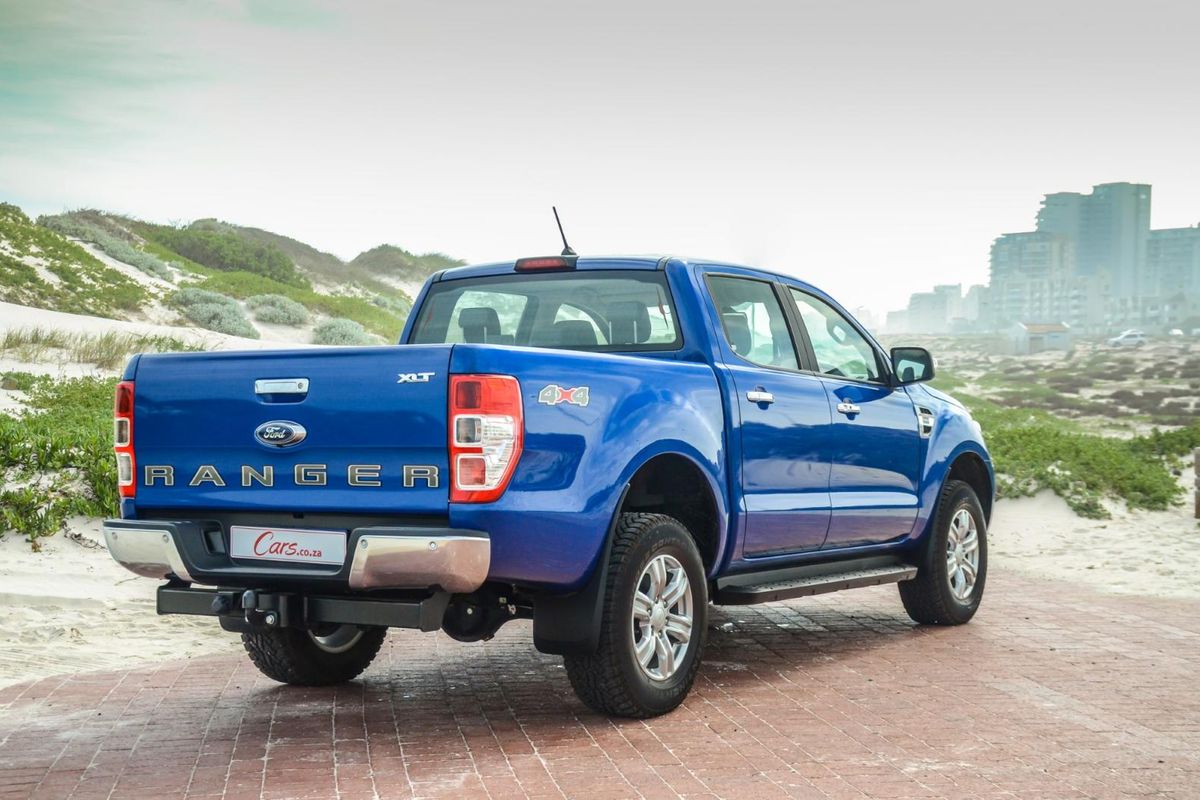
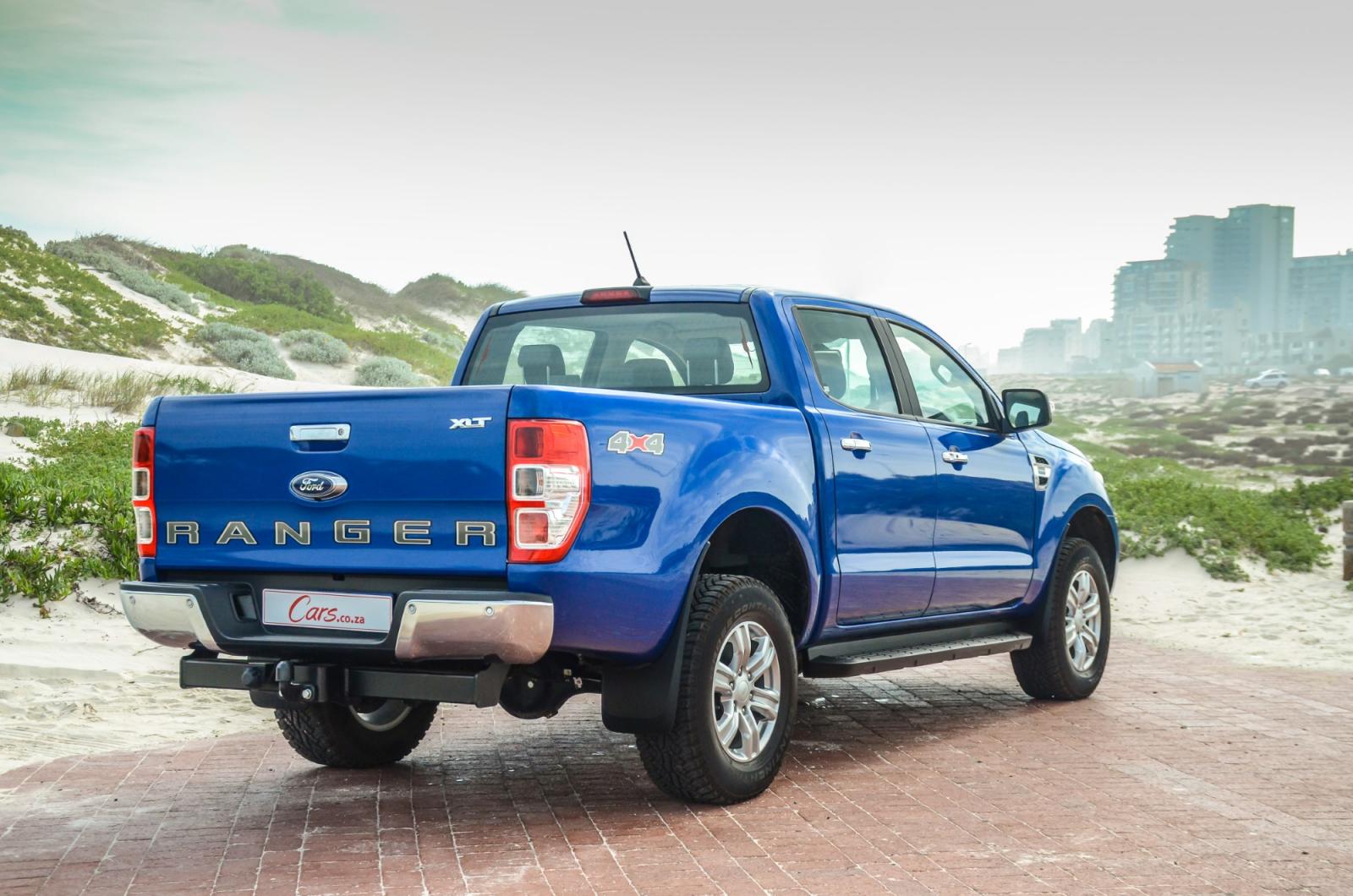
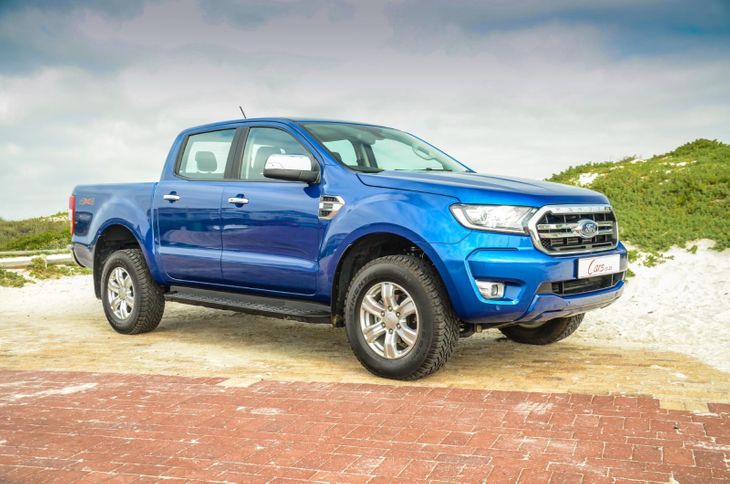
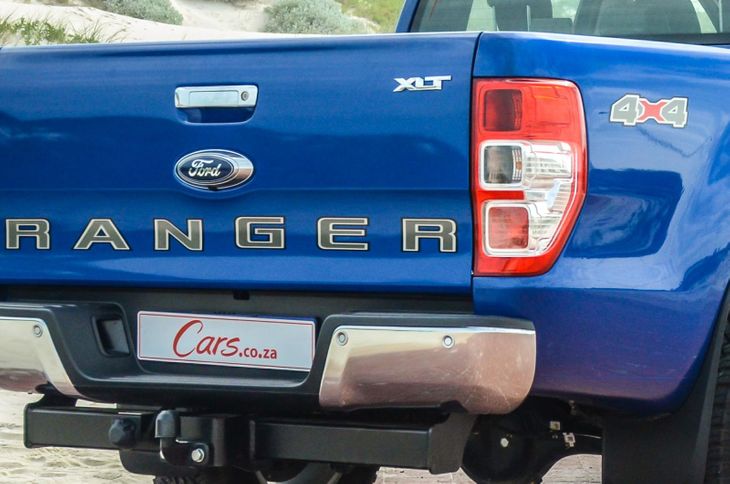
Ford Ranger 2.0 4×4 XLT Automatic (2019) Review

While many aspiring high-end bakkie buyers are keenly interested in the updated bi-turbo Ford Ranger Wildtrak (which is priced just shy of R700k), perhaps the single-turbo Ranger 2.0 4×4 XLT automatic (priced below R600k) represents appreciably better value for money than its top-spec sibling. Take a look at what it has to offer below…

We Like: Impressive powertrain, 4×4 ability, on-road comfort, standard features.

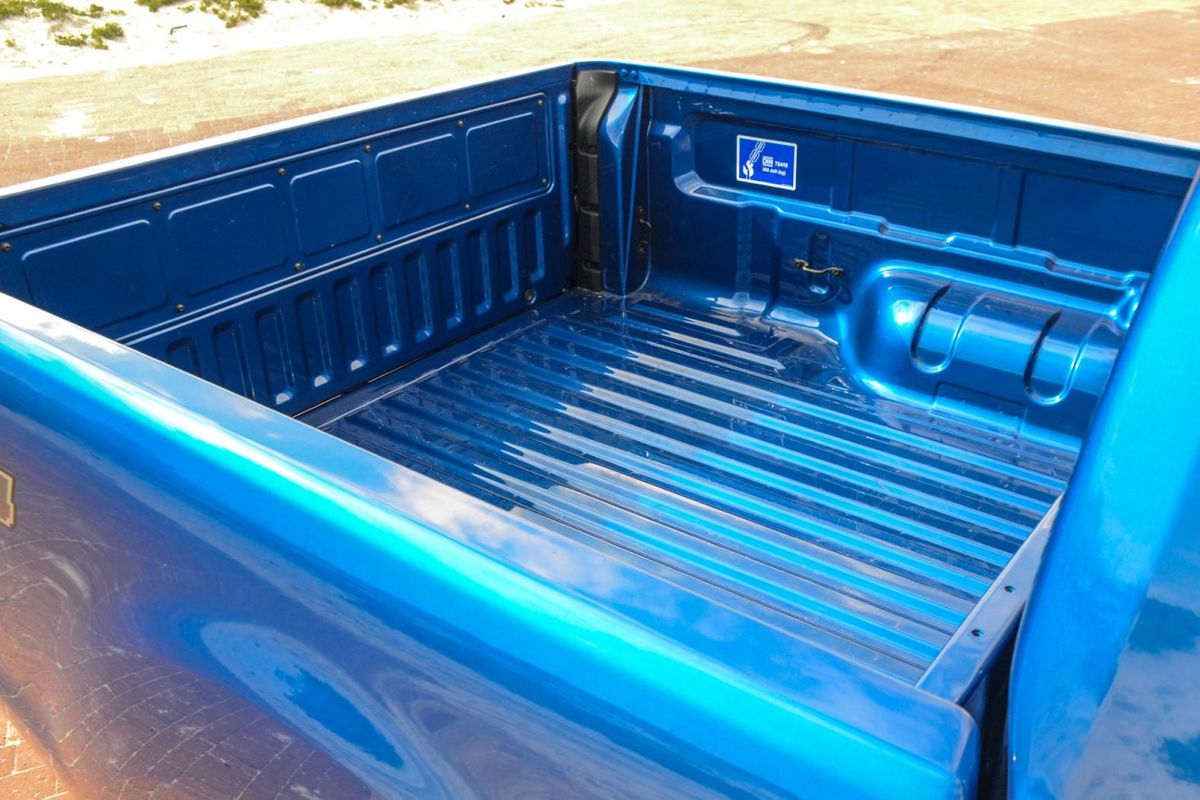
We Don’t Like: Some interior finishes are of marginal quality, unlined load bay.

Fast facts 

Price: R582 700 (as of July 2019)
Engine: 2.0-litre turbodiesel
Power/Torque: 132 kW/420 Nm
Gearbox: 10-speed automatic
Fuel Economy: 7.5 L/100 km 

Own a Ford? Tell us about your experience here

SERIOUS ABOUT BUYING?

Check out full specification details and finance estimates here

Some Ford dealers regularly offer specials: Have a look here.

Where does it fit in? 


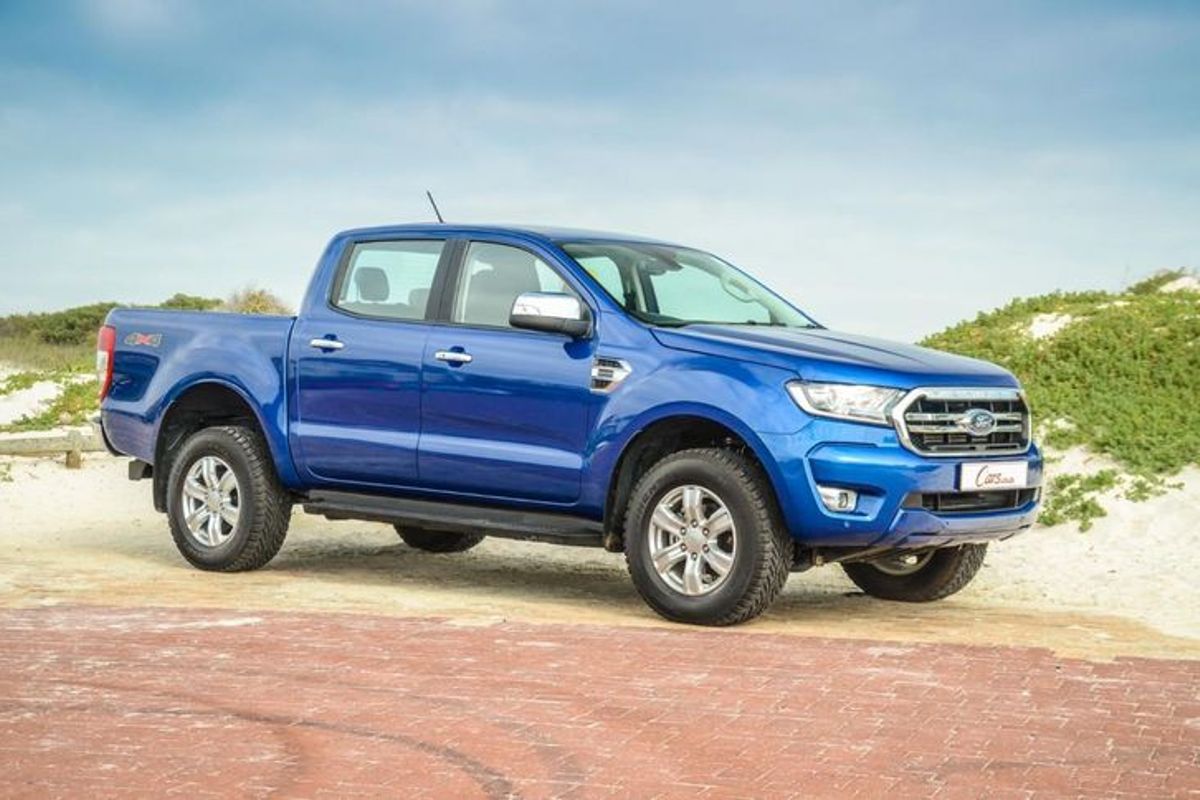
With all the updates to the new Ranger, it's fighting fit to tighten its grip in this hotly contested segment. 

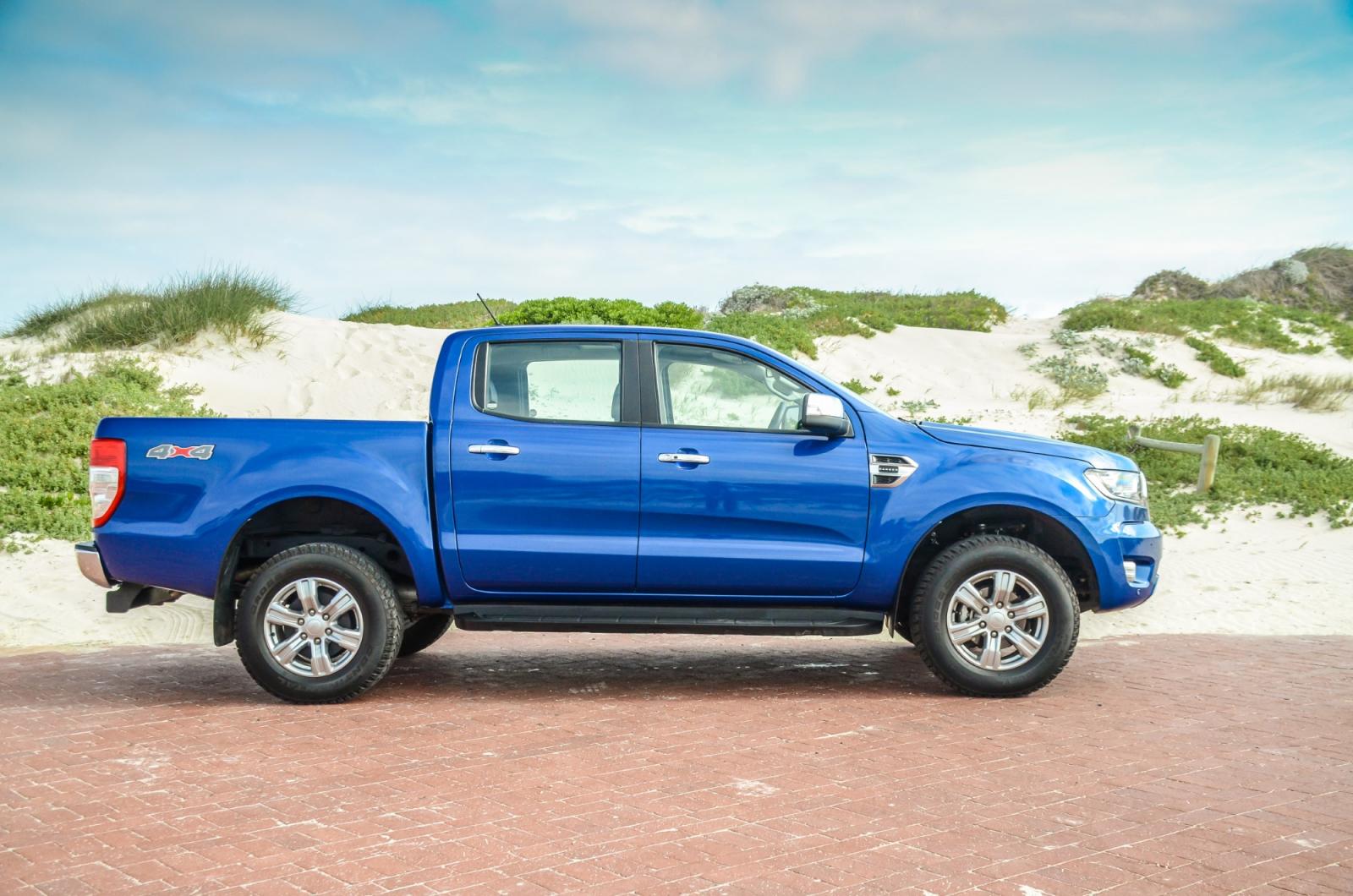
The recently updated Ford Ranger model range needs no introduction – it remains a popular choice in the leisure double-cab bakkie segment, where it trades blows with the venerable Toyota Hilux at the top of the local sales chart on a monthly basis. 

The updated Ranger, which is built locally at Ford’s Silverton facility in Pretoria, features 2 new powerplants: a 2.0-litre single-turbodiesel and a 2.0-litre bi-turbodiesel, the former of which is found under the bonnet of this XLT derivative.

But that’s not all, there’s also a new 10-speed automatic transmission at work here, the same that debuted in the Ranger Raptor and furthermore, Ford has reworked the suspension to improve ride comfort too. So, how does the Ranger 2.0 4×4 XLT Automatic perform overall? 

Click here to see how the Ford Ranger stacks up against the Toyota Hilux

How it performs in terms of…

Performance and efficiency


The new 2.0-litre turbodiesel performs strongly and is well-matched to the new 10-speed automatic transmission. 

Some buyers might be sceptical of Ford’s new 2.0-litre turbodiesel engine, but in terms of output, it’s more powerful than the older 2.2-litre turbodiesel motor (which still powers other derivatives in the range) with a meaty 132 kW and 420 Nm of torque, but not quite as powerful as the familiar 147 kW/470 Nm 3.2-litre, 5-cylinder or new 157 kW/500 Nm 2.0-litre bi-turbo unit.

Nonetheless, this new engine’s performance is mightily impressive. Power/torque delivery is very good and mid-range acceleration is particularly noteworthy. You will also be pleasantly surprised by how quiet and refined the engine is, which makes for a pleasant driving experience. Sure, it might not be the most powerful engine on offer in the Ranger lineup, but it feels like it’s punching above its weight and it never feels out of puff…

As for the new 10-speed transmission, it's well-matched to this engine and it does an admirable job of matching gear selection with on-road conditions. It also delivers smooth gear changes while being adequately responsive – it always seems to be in the right gear at the right time.

In terms of efficiency, the test unit consumed 9.5 L/100 km during its tenure in our fleet (compared with Ford's claimed figure of 7.5 L/100 km), which is fair.      

Ride and handling


Ride comfort has been noticeably improved and it's a major highlight of this updated Ranger.  

Ford has notably revised the Ranger’s suspension, introduced derivative-specific damper rates and reduced the vehicle's standard tyre pressure in a bid to improve on- and off-road ride comfort. It’s definitely worked: you can feel the difference on tar – and gravel. Its ride is forgiving over various types of road surfaces and the steering is light and communicative, which makes the Ranger more manoeuvrable in the tight confines of the city.  

The updated bakkie's cabin also appears to be well-insulated from road and engine noises, which boosts the 2.0 4×4 XLT Automatic's on-road refinement appreciably. That, coupled with a more forgiving suspension setup, helps the Ranger deliver the best driving experience in this segment. 

Off-road ability?


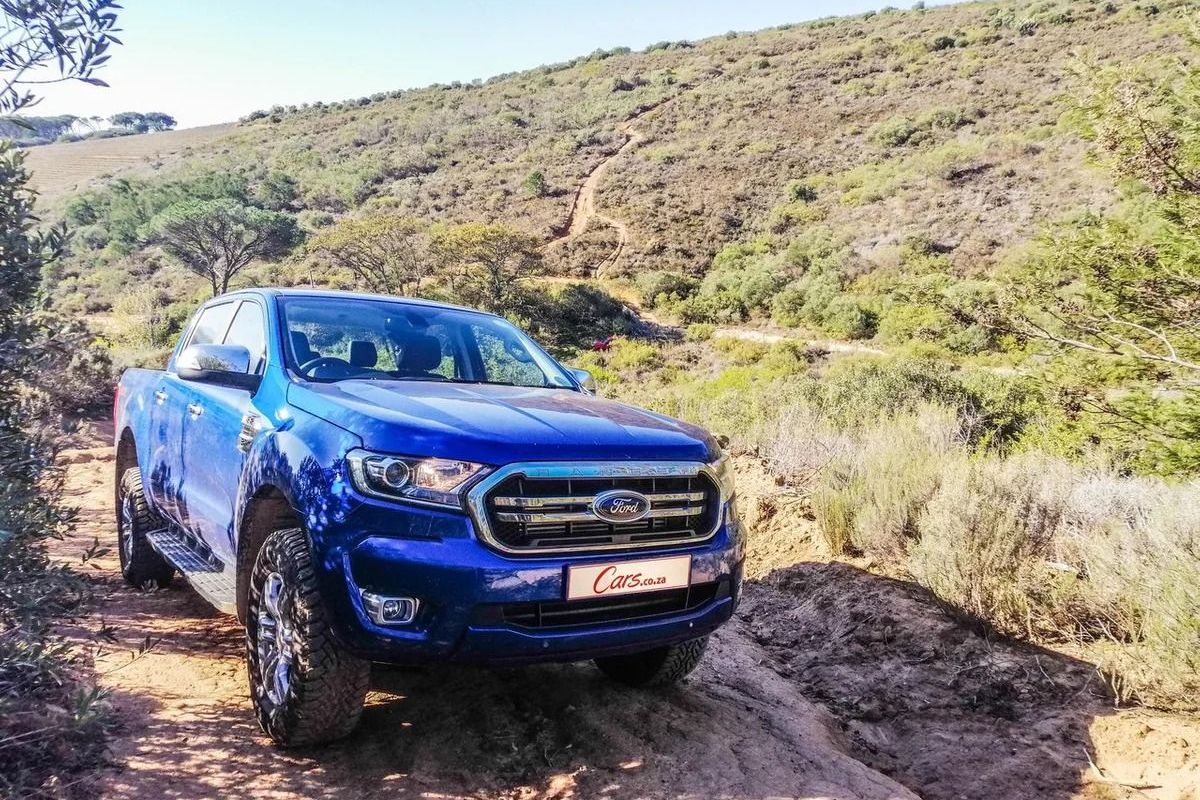
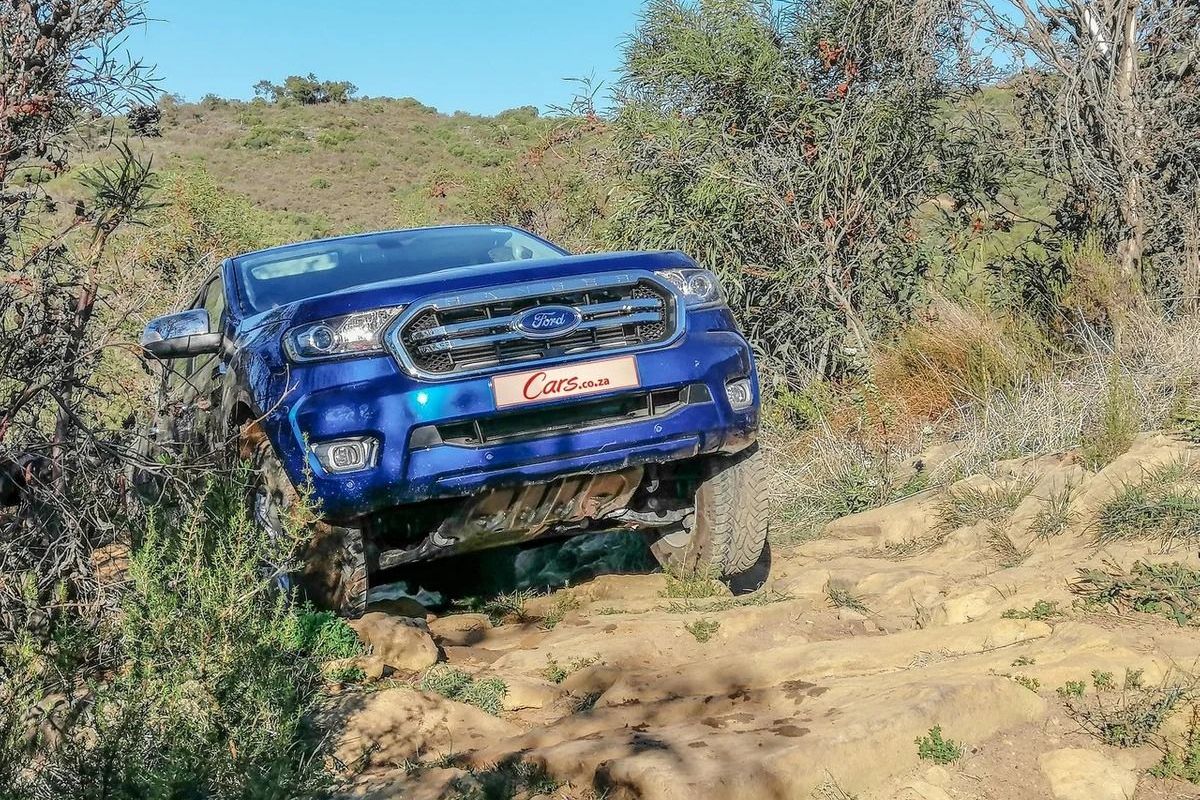
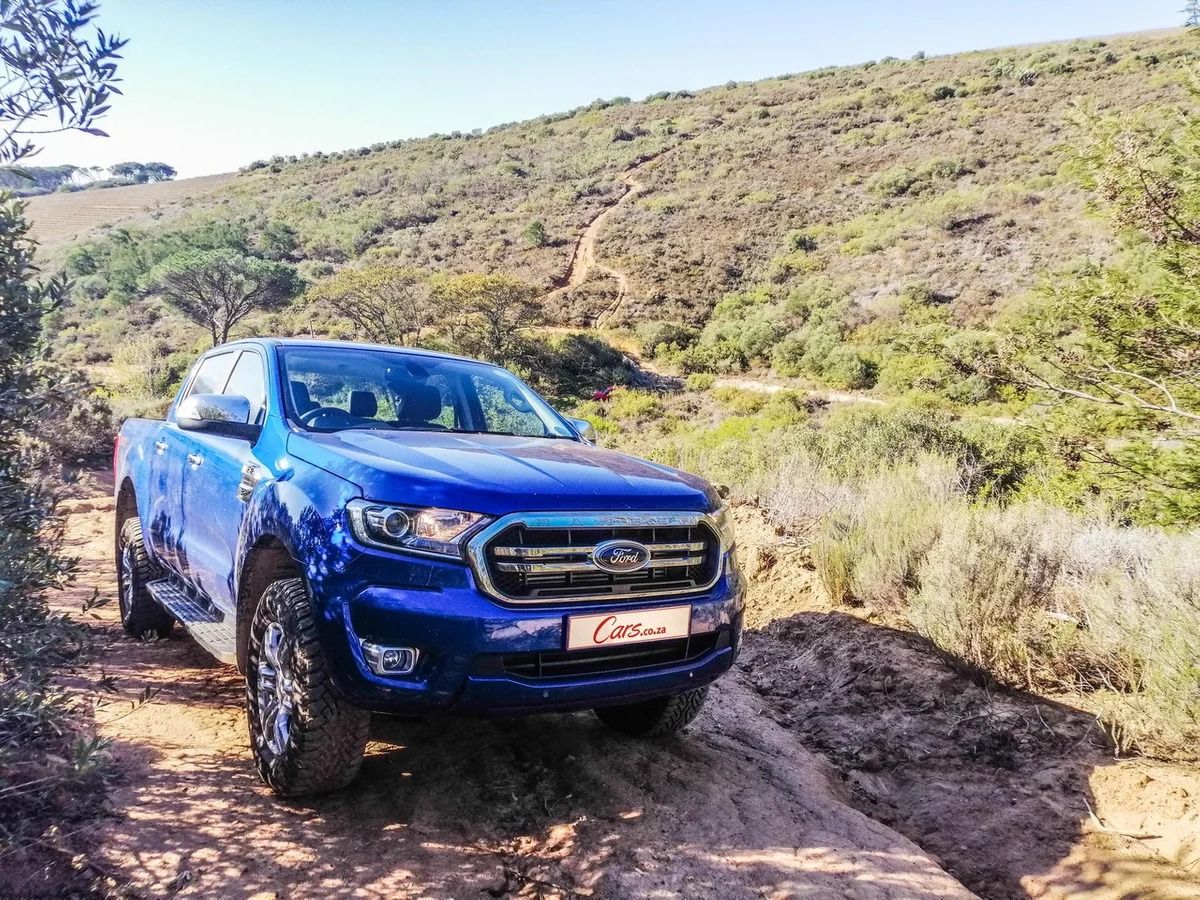
The Ranger's off-road ability is impressive – it's difficult to fault when the going gets rough. 

We put the Ranger through its paces on some demanding 4×4 mountain trails around Cape Town and, for the most part, it performed impressively. 

The Ford instils confidence when it traversing an off-road course; a quick flick of a rotary knob (to select between 2H, 4H and 4L) is all that's needed to transform the Ranger from a family car to an off-roader. If you really find yourself in a pickle in very low-grip conditions, you can engage the rear differential lock to help the 2.0 4×4 XLT Automatic overcome trickier obstacles. 

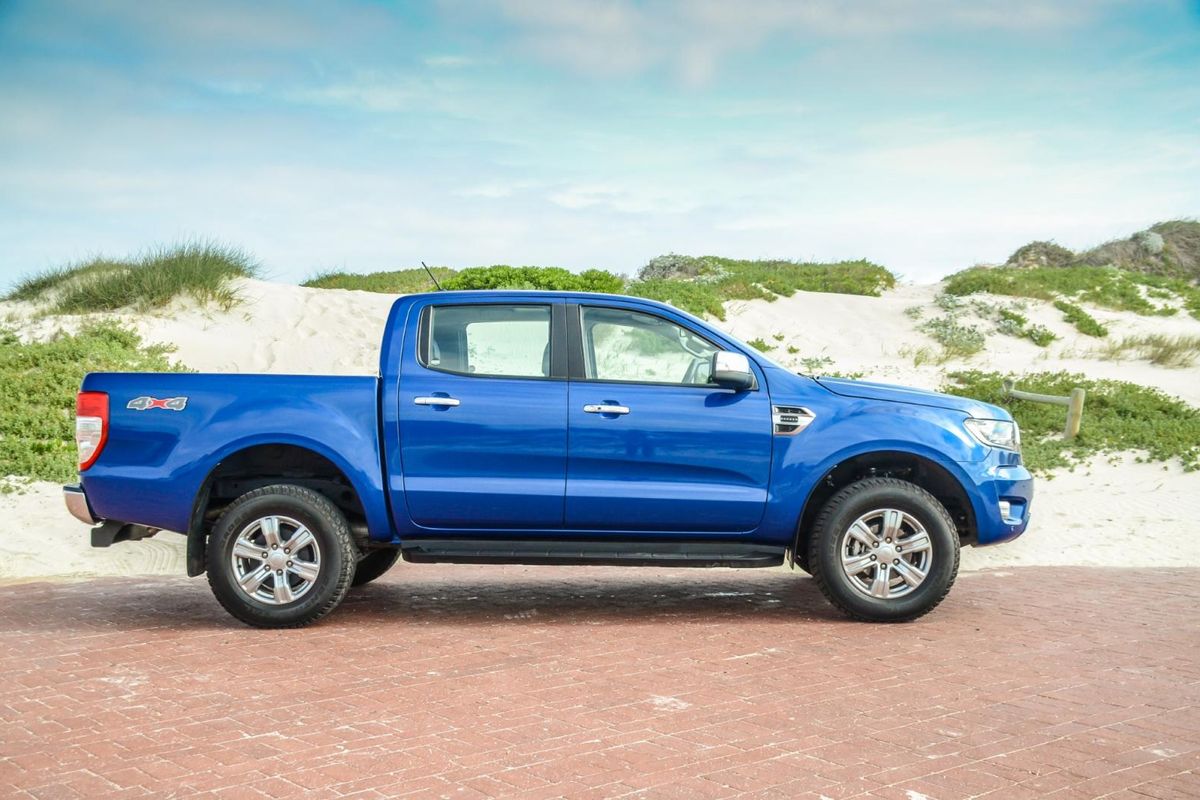
However, with a ground clearance of 237 mm, the Ranger’s (albeit aesthetically pleasing) running boards can catch on protruding off-road obstacles if you aren't careful, so best you pick your lines smartly and proceed with the right balance of caution and vigour… 

Meanwhile, the Ranger has a maximum braked towing capacity of 3 500 kg (a tow bar is standard) and carries payload capacity of up to 1 199 kg. 

Interior execution and features?


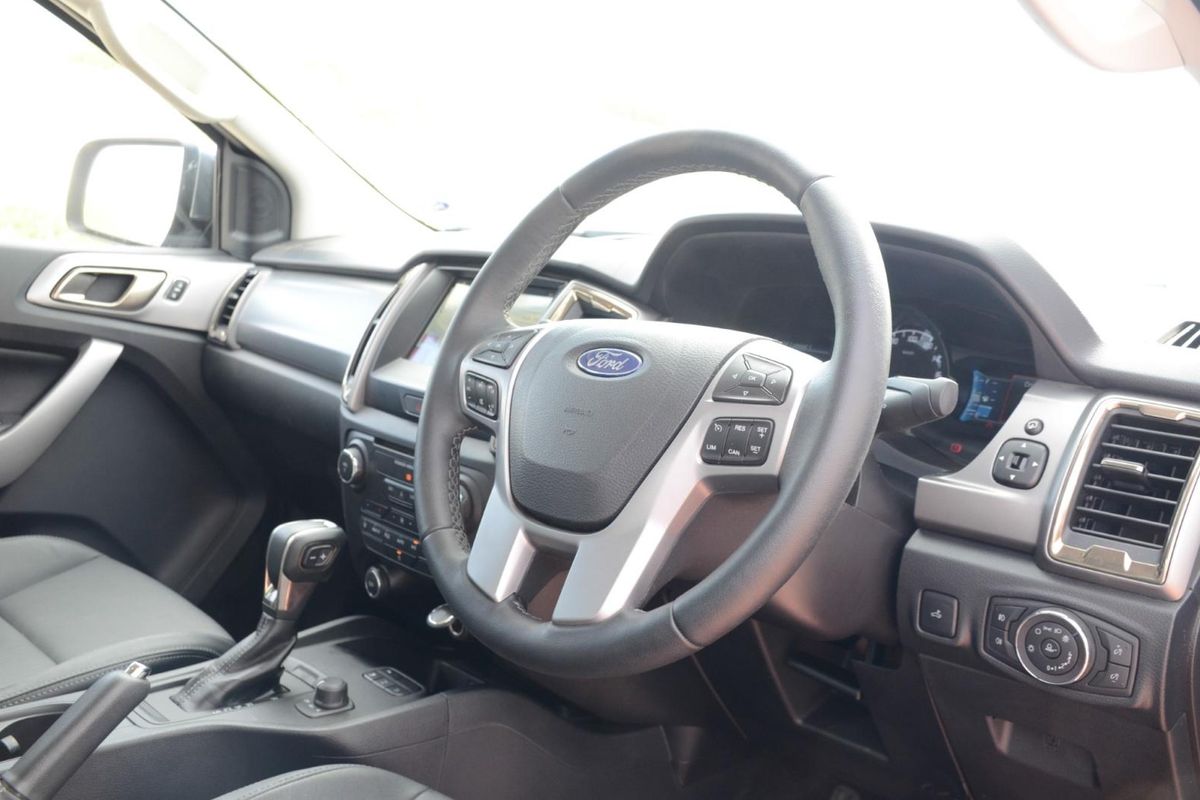
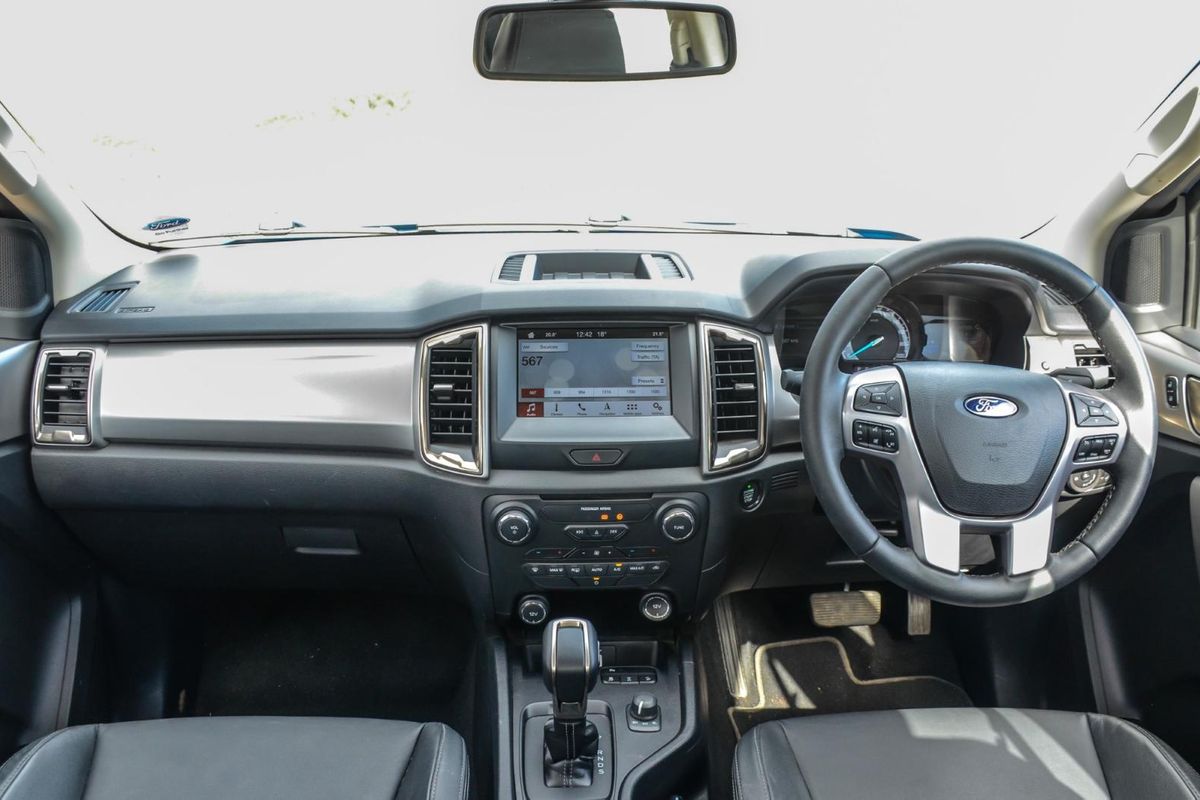
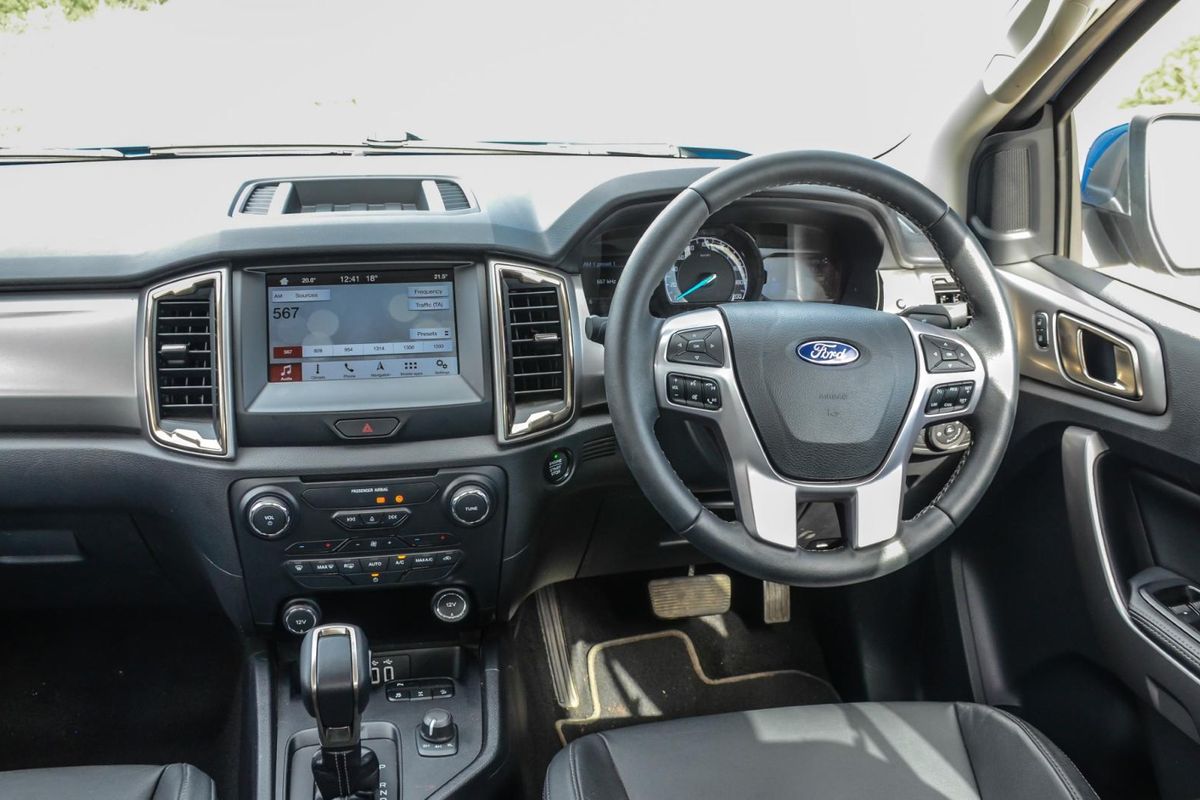
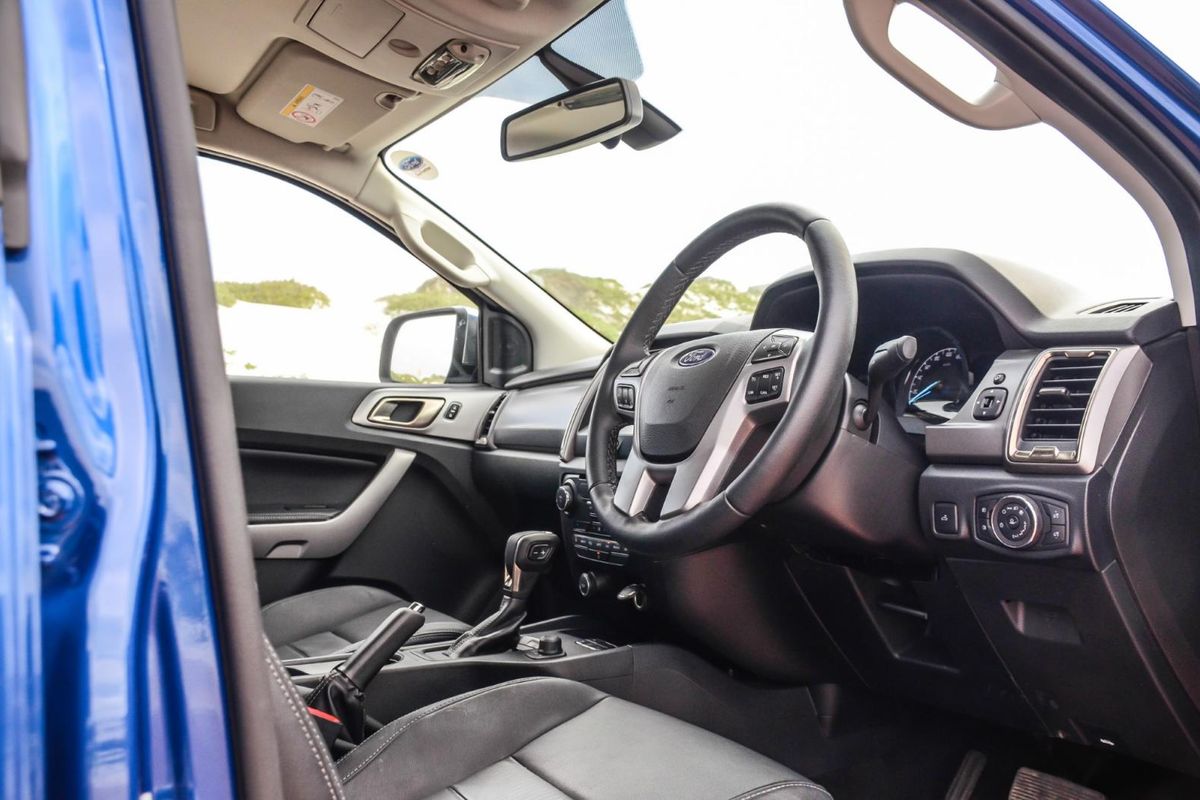
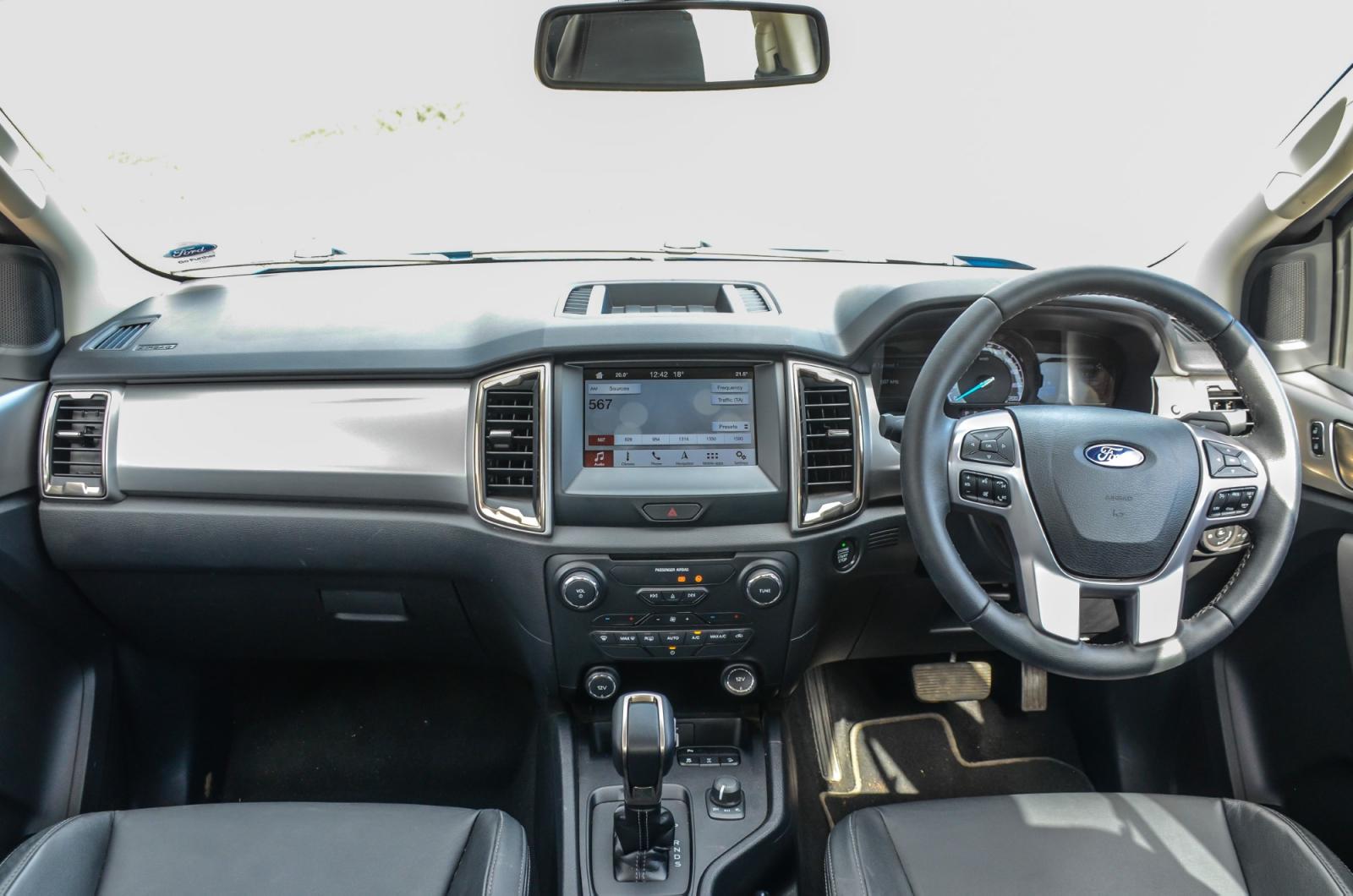
The cabin is loaded with standard features and the SYNC3 infotainment system is comprehensive and easy-to-use. 

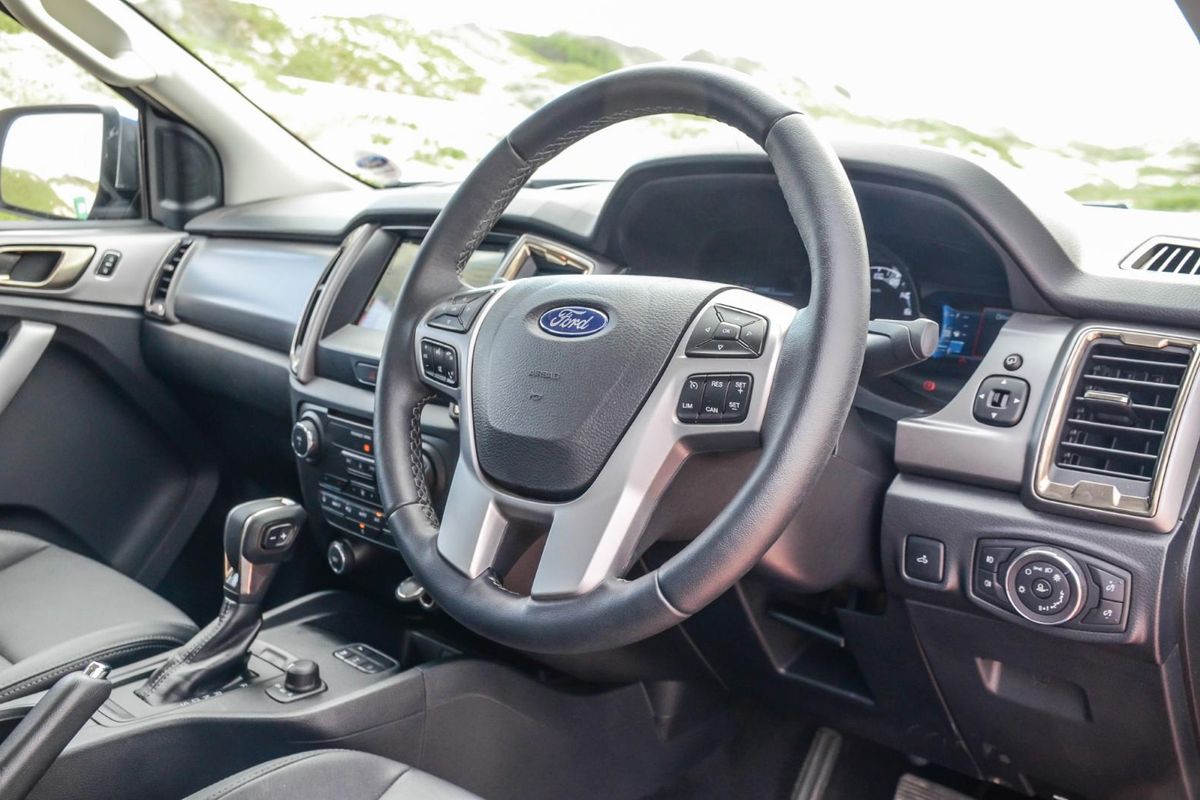
On the inside of the 2.0 4×4 XLT Automatic, you are welcomed by a feature-rich cabin that considerably beefs up the value-for-money proposition offered by this particular Ranger derivative. The highlight is the comprehensive and easy-to-use SYNC3 touchscreen infotainment system that includes Bluetooth, voice control, navigation, as well as Android Auto and Apple CarPlay compatibility. 

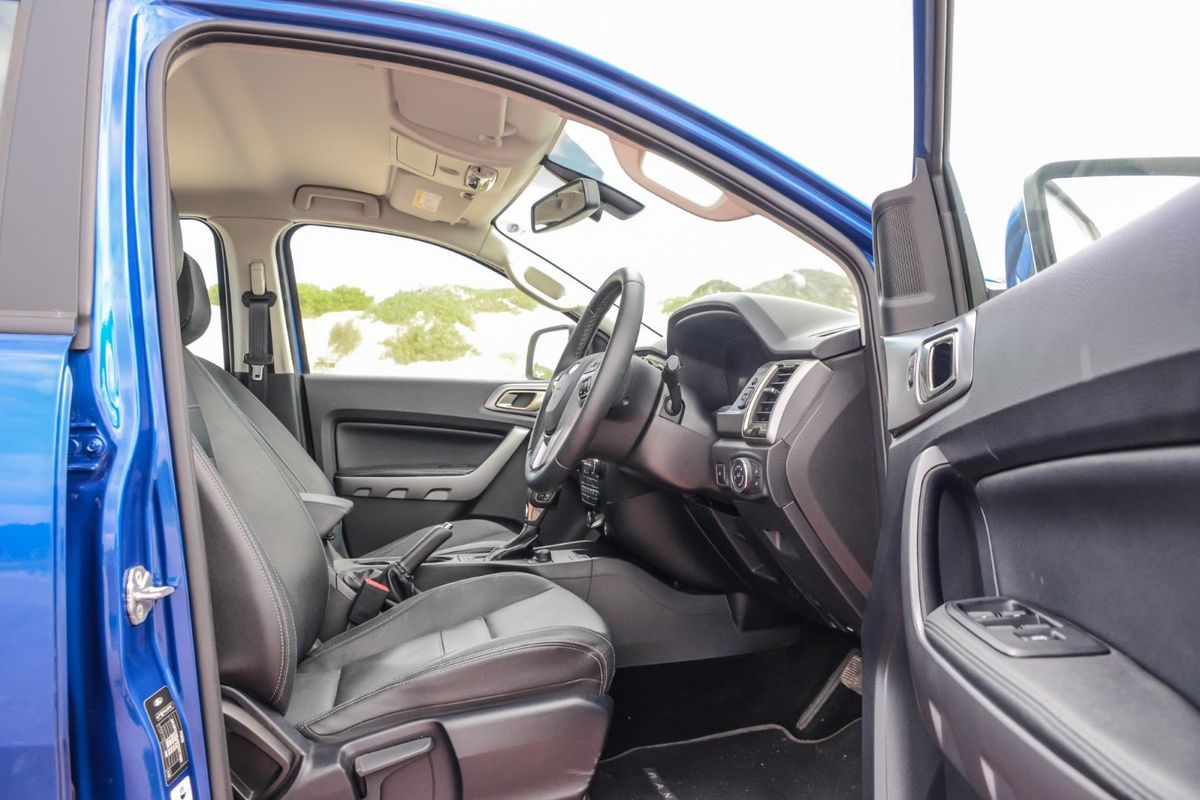
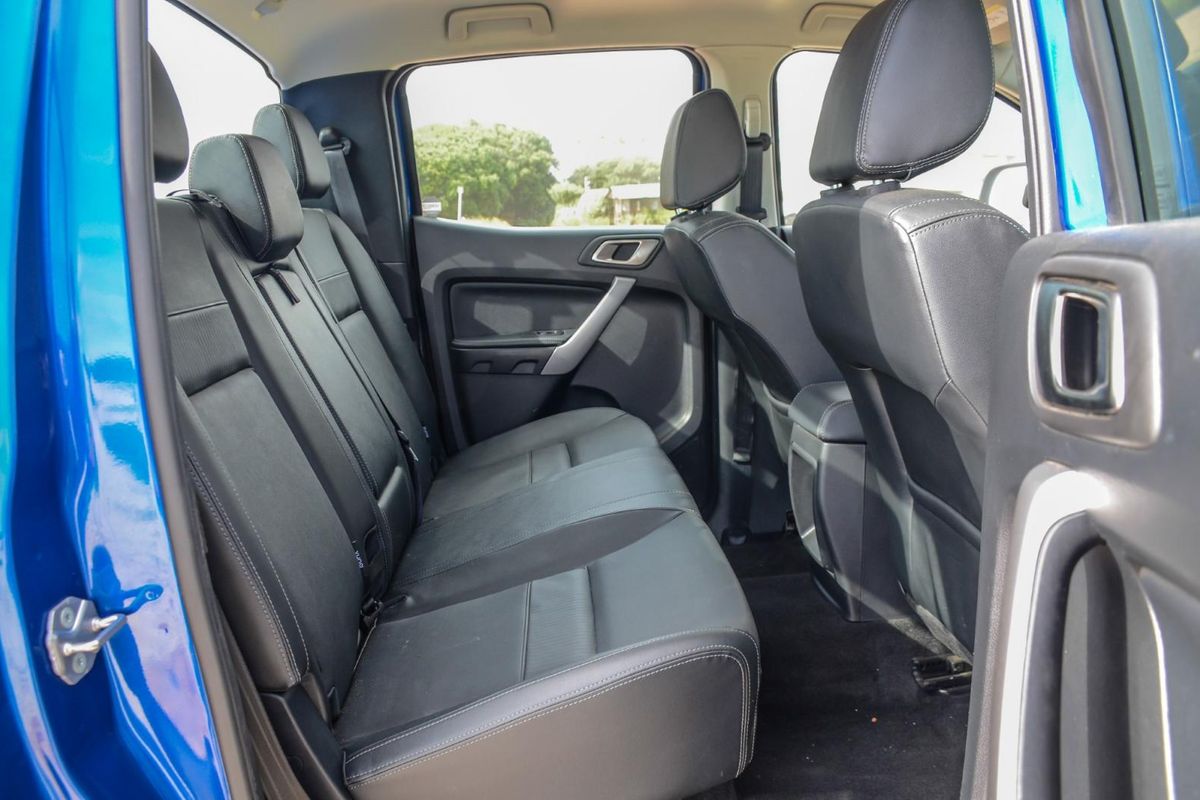
Other notable features include leather upholstery, a multifunction steering wheel (which is rake-adjustable only, we must add), a height-adjustable driver's seat (manual), rain-sensing windscreen wipers, keyless access, two USB ports, cruise control, dual-zone climate control, electric windows/side mirrors and front and rear park distance control with a reverse-view camera.

While the perceived interior build quality is good with a solid look and feel, some of the plastic finishes do feel marginal (in terms of plastic quality).

On the safety front, 7 airbags are standard as are ABS with EBD and stability control with traction control. 

Price and warranty

The Ford Ranger 2.0 4×4 XLT Automatic is priced from R582 700 (July 2019) and is sold with a 4-year/120 000 km warranty and 6-year/90 000 km service plan.

Buy a new or used Ford Ranger on Cars.co.za

Verdict


This Ranger 4×4 XLT Automatic represents excellent value at its price point. 

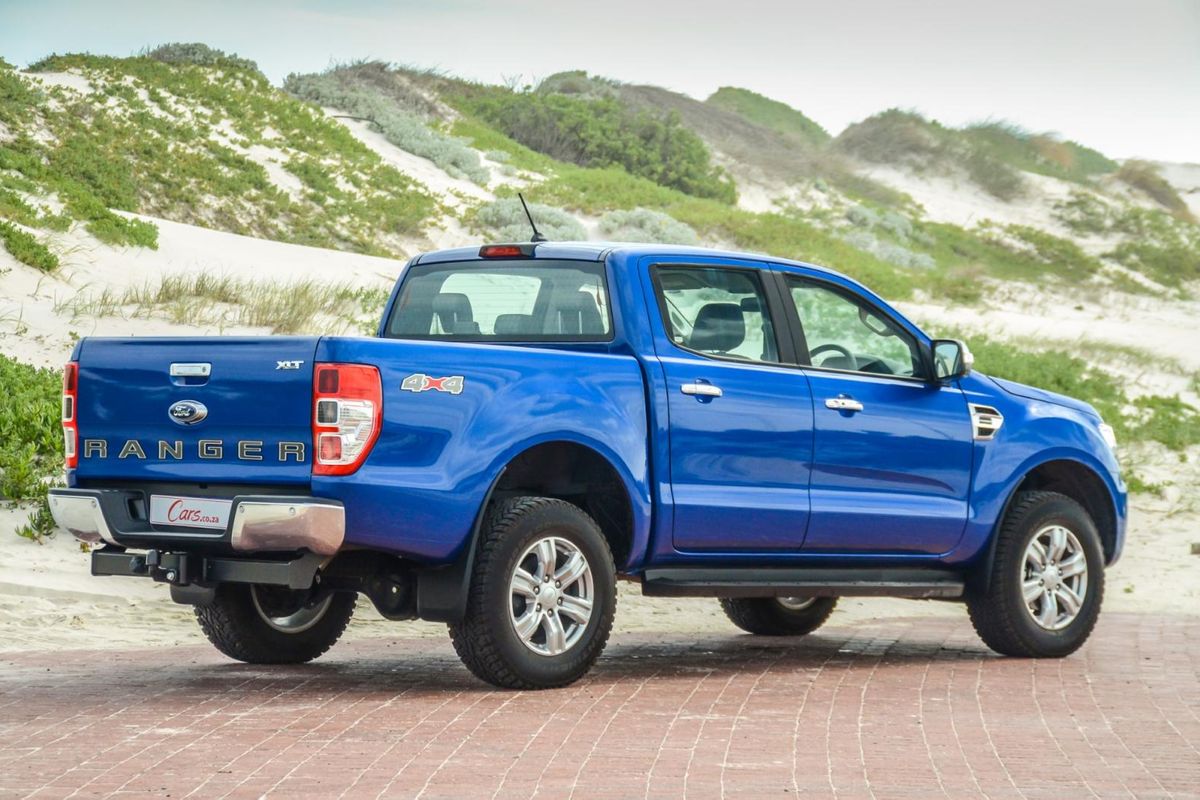
At its price point, the Ford Ranger 2.0 (Turbo) 4×4 XLT automatic represents excellent value. Not only does it deliver impressive engine/transmission performance, but the purchasing proposition is sweetened by a healthy dose of standard features. The Ranger’s off-road ability remains formidable and we think this derivative is easy-to-recommend based on the merits outlined in this review; a 6-year/120 000 km warranty is the cherry on top.

It’s worth mentioning that this 2.0 4×4 XLT Automatic derivative bested the pricier Toyota Hilux 2.8 GD-6 Raider in terms of value-for-money in our recent comparative review. While this particular review is mostly positive, it remains to be seen how this pair of new 2.0-litre turbodiesel powerplants will hold up in terms of long-term reliability (Ford has conducted 6-million kilometres of testing on the motors to address reliability concerns).

It bears mentioning that, according to recent data from the Cars.co.za Ownership Satisfaction survey (in conjunction with Lightstone Auto), which incorporates feedback from thousands of South African vehicle owners who have bought and serviced their vehicles through manufacturer- and importer-franchised dealers, Ford has not been among the top brands in terms of after-sales support, service to customers and product reliability. 

Nonetheless, with all factors considered, this Ranger, as a product, warrants its place near the top of your double-cab bakkie shopping list. 

Related content:  

Ford Ranger (2019) Launch Review

Ford Ranger Raptor (2019) Launch Review

Ford Ranger 2.0Bi-T DC 4×4 Wildtrak auto (2019) Review

What's Really New About the 2019 Ford Ranger?

Opel Grandland X Gets Warranty and Spec Upgrade

Opel has bolstered the feature offering on its Grandland X while also increasing its warranty plan in an effort to improve the value proposition of its mid-size family SUV.  

Buyers shopping for a mid-size SUV will be wise to check out the Opel Grandland X which is now offered with a 5-year /120 000 warranty. More than this, the range has also benefitted from a specification upgrade. 

The Grandland X 1.6T Enjoy automatic now gains 18-inch alloy wheels, front fog lights, aluminium roof rails and rear privacy glass. A Plus Package is also offered which adds a panoramic sunroof, SatNav900 IntelliLink infotainment system, leather seats with a winter pack (heated).

The Grandland X is powered by a turbocharged, 1.6-litre petrol with 121 kW and 240 Nm of torque and is mated with a 6-speed automatic transmission. Opel claims a fuel consumption figure of 7.0 L/100km. 

See specification details for the Grandland X range here

Opel Grandland X – Price in SA 

Grandland X 1.6T Automatic – R441 870

Grandland X Enjoy 1.6T Automatic – R478 950

Grandland X Cosmo 1.6T Automatic – R565 000

The Grandland X is sold with a 5-year/150 000 km warranty, 5-year/100 000 km service plan and a 3-year/120 000 km Roadside Assistance. 

Related Content

Opel Announces Grandland X Hybrid4

Opel Grandland X (2018) Video Review


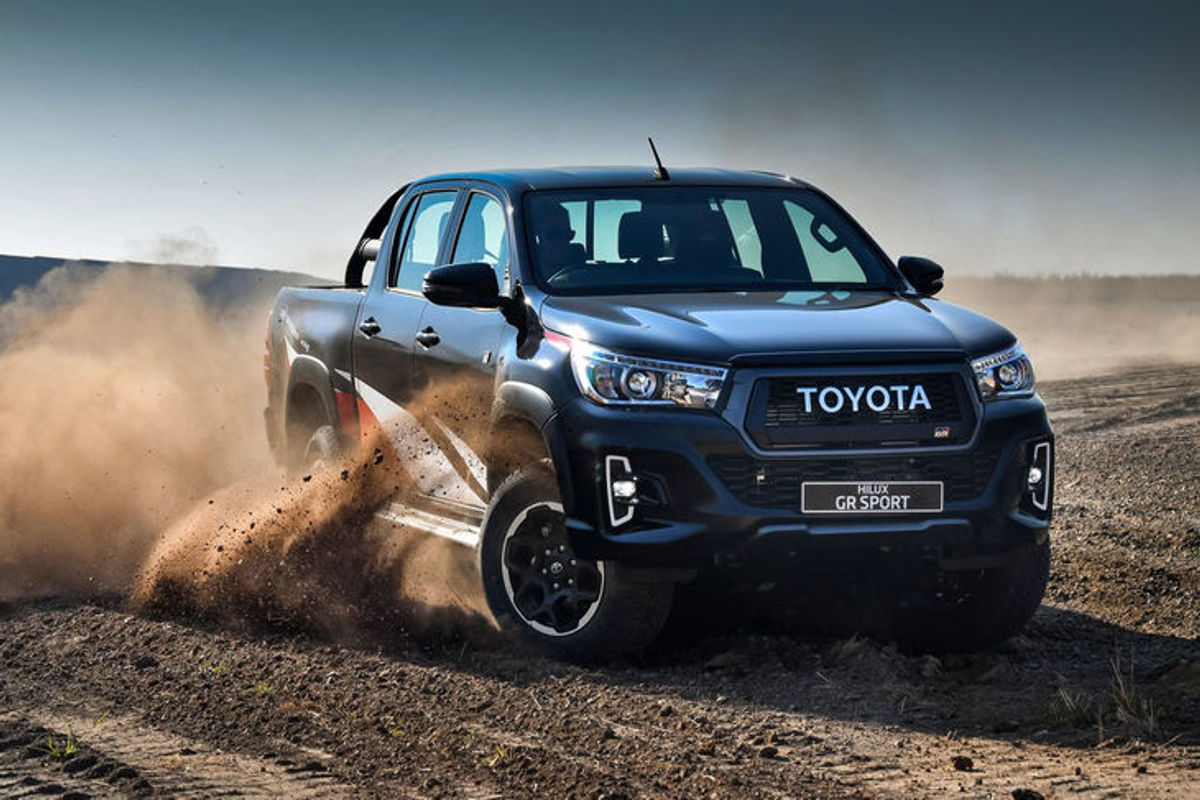
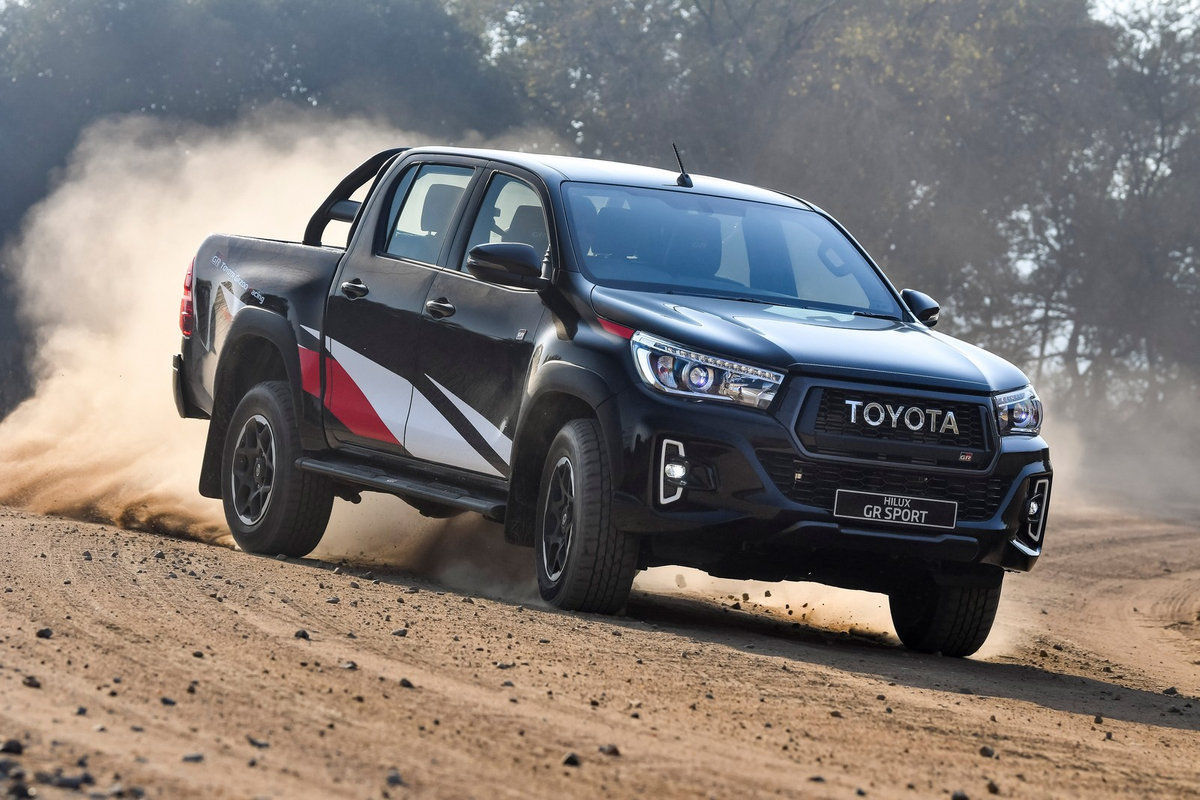
Toyota Hilux GR Sport (2019) Launch Review

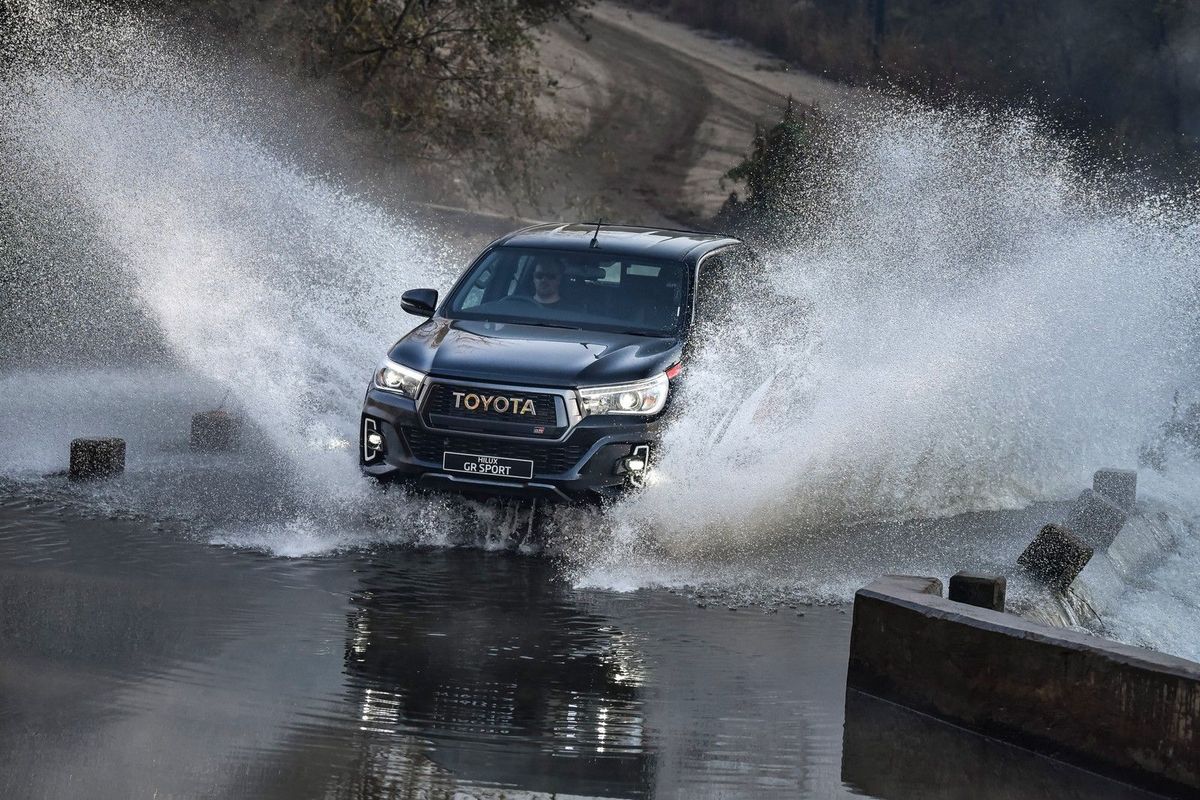
The torrent of special-edition bakkie introductions shows no signs of abating. Only 535 units of the Toyota Hilux GR Sport will be sold in South Africa; we drove the newcomer in Botswana and Zimbabwe to see what it has to offer.

Last year, Toyota made quite a marketing splash by demo-ing its “not for sale in ZA” Yaris GRMN. But there’s more to Gazoo Racing than Dakar victories and low-volume hot hatches. Gazoo Racing offers 4 tiers of product tuning, ranging from sticker kits to bespoke race-bred track specials. Ford recently launched its off-road-racer inspired Raptor and Isuzu rolled out its almost comically oversized D-Max Arctic 35 AT soon thereafter. So, is the Hilux GR Sport also aimed at hardcore off-roading enthusiasts? We drove the limited-edition bakkie across Southern Africa to find out.

Check out our launch review of the Hilux Legend 50 here.

Own a Toyota? Tell us about your experience here

What’s new?


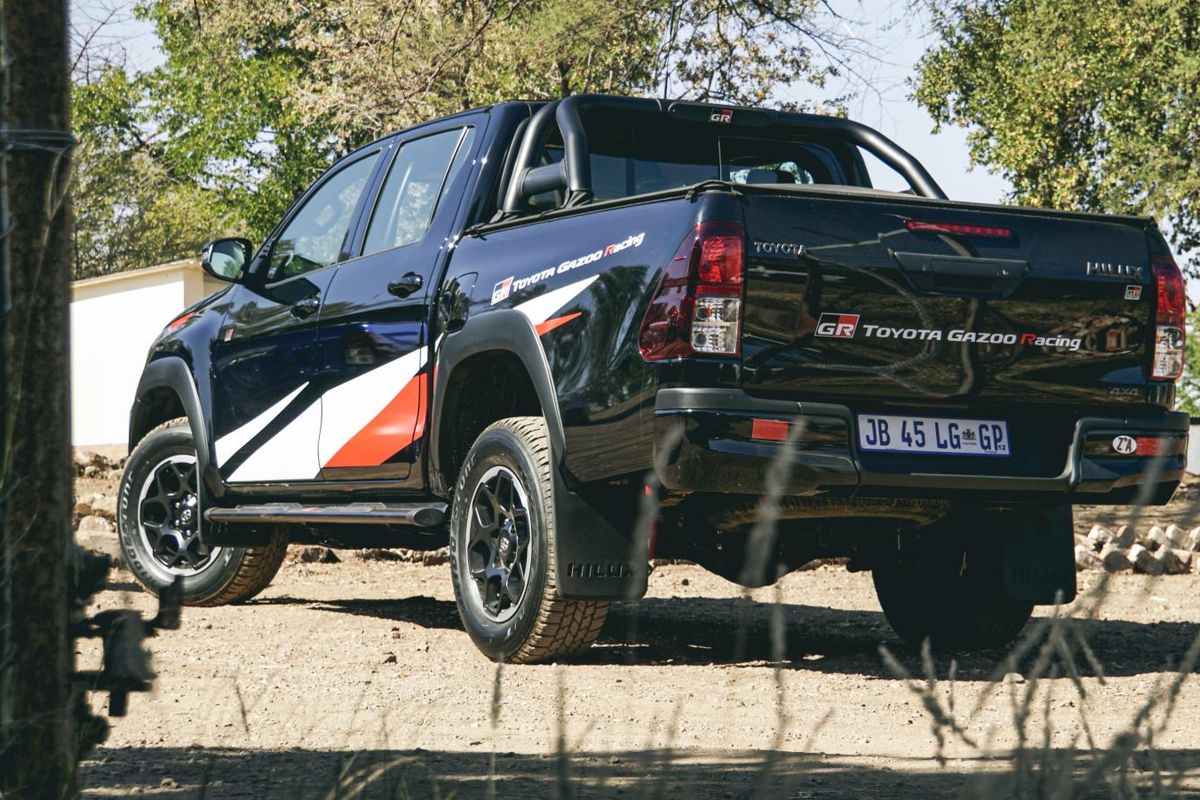
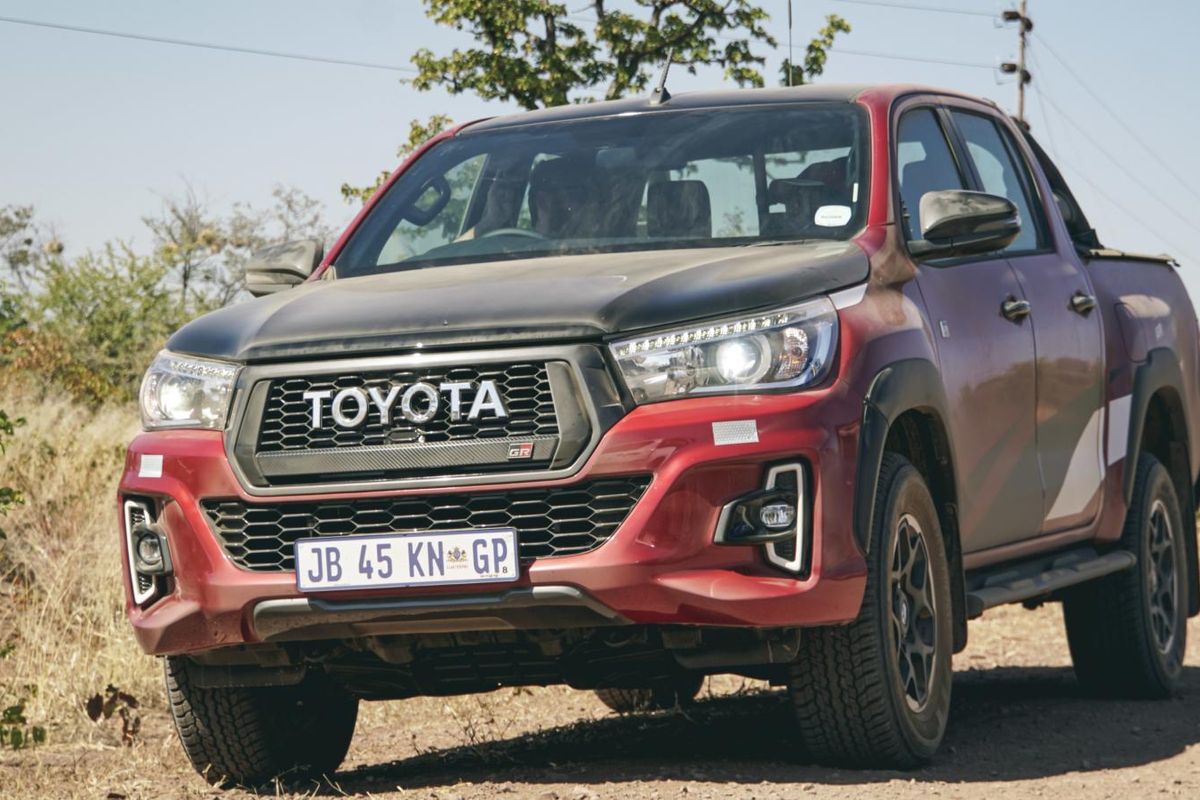
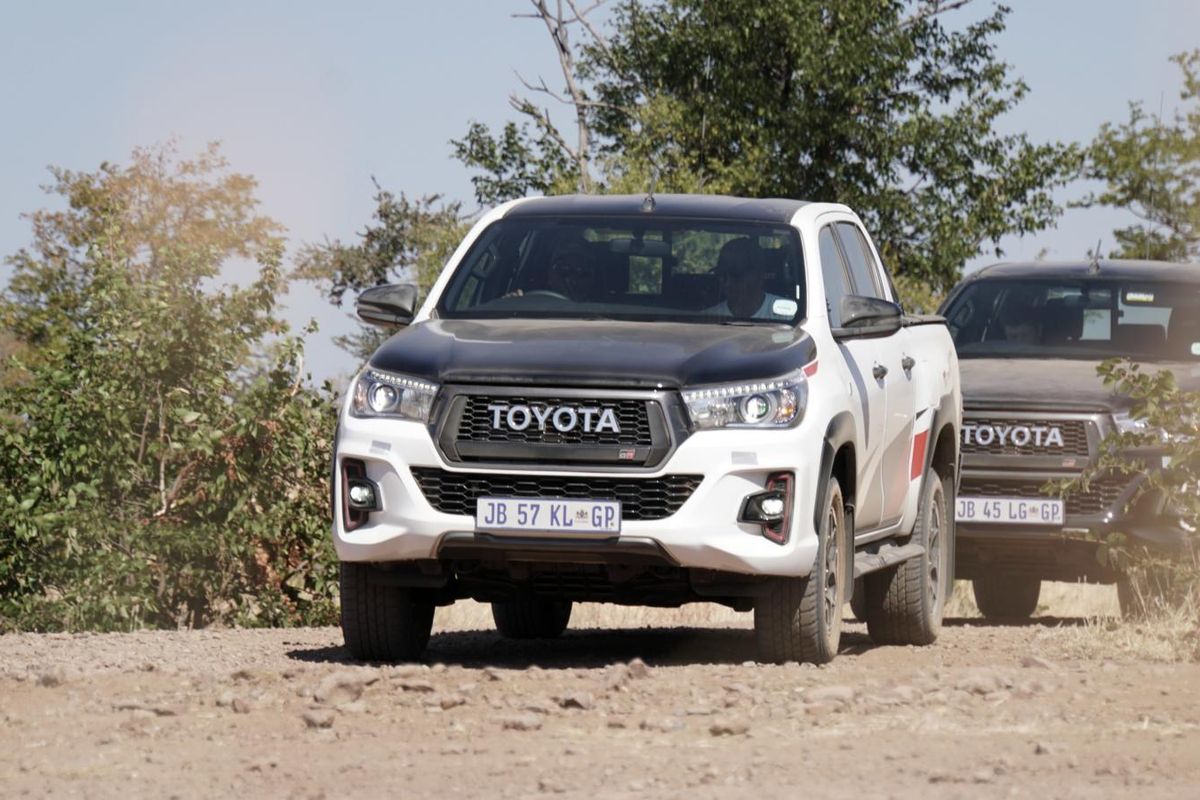
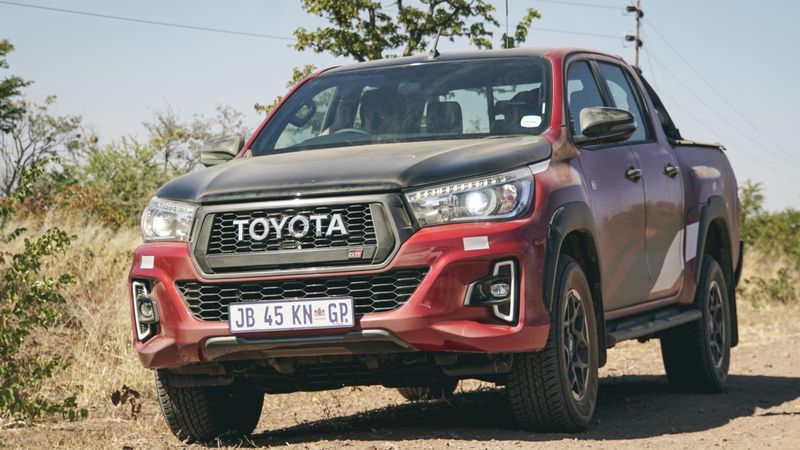
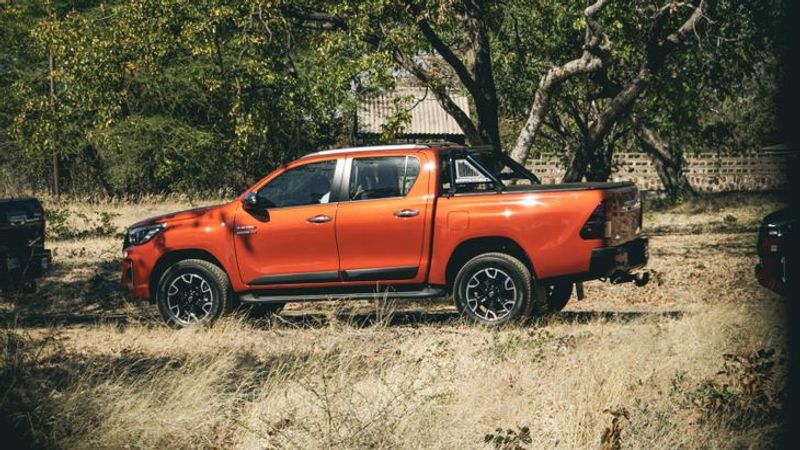
That black bonnet and roof make the Hilux GR Sport instantly recognisable.

The Hilux GR Sport is the first Gazoo Racing (GR) product to be made available in South Africa through Toyota's dealer network. Considering how popular the Hilux is, the newcomer represents a smart way to test the marketability of the GR sub-brand. Although 600 units of this eagerly anticipated and head-turning bakkie will be produced, only 535 examples have been allocated to South African dealers (the rest of them will be exported), so if you're keen on buying one, you better act fast – Toyota has already confirmed that no more Hilux GR Sport units will be built.

The Hilux GR Sport sits the 2nd tier of the GR-product pyramid, which means that this Hilux doesn’t just come to market festooned with a few extra stickers and endowed with an evocative moniker. Indeed, the newcomer features some notable under-the-skin changes too.

Suspension and wheel upgrades


A sportier suspension setup at the front but no power upgrades.

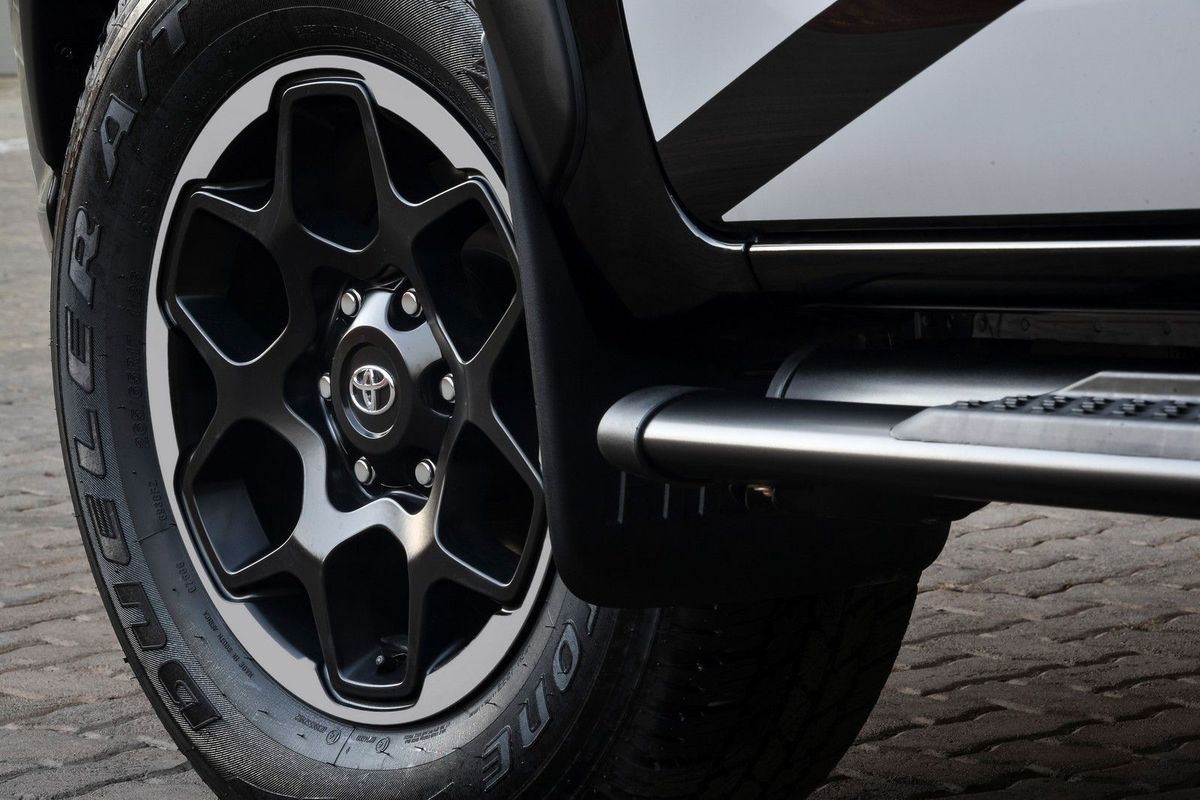
For a start, the GR Sport features an entirely new front suspension setup, which consists of a monotube design and revised dampers. The bakkie's front spring rates have been revised to facilitate a sportier ride, but the rear suspension setup remains unchanged so as to maintain the Hilux's current load-bay standards (layout and carrying capacity). The wheel size is 1-inch smaller than standard (the black alloys are shod with 265/65/17 rubber), but the tyres have a slightly higher profile than those of the standard bakkie, ostensibly to restore a bit of post-suspension-update comfort.

So, what’s it like to drive?

On the road, the bakkie feels pointy and more responsive, but the stiffer suspension is a double-edged sword, especially when you drive the GR Sport round town: speed bumps and road imperfections are more noticeable, but at least the bakkie's high-speed stability seems to have improved.


The suspension mods appear to have compromised the ride quality somewhat.

We travelled on myriad gravel roads that meandered past remote towns and villages. When travelling at speeds of up to 100 kph, the GR Sport’s suspension appeared to easily soak up bigger bumps, which allowed for brisk progress across rough terrain. The higher damping rate meant that the ride quality did feel harsher on gravel too. It’s not measurably more capable off-road than a standard Hilux, whereas the aforementioned Raptor can achieve much greater feats on the dirt than a stock Ranger. Is the minor improvement in handling enough to justify the firmer ride? You decide.

Here's what we think of the Raptor.

Exterior changes

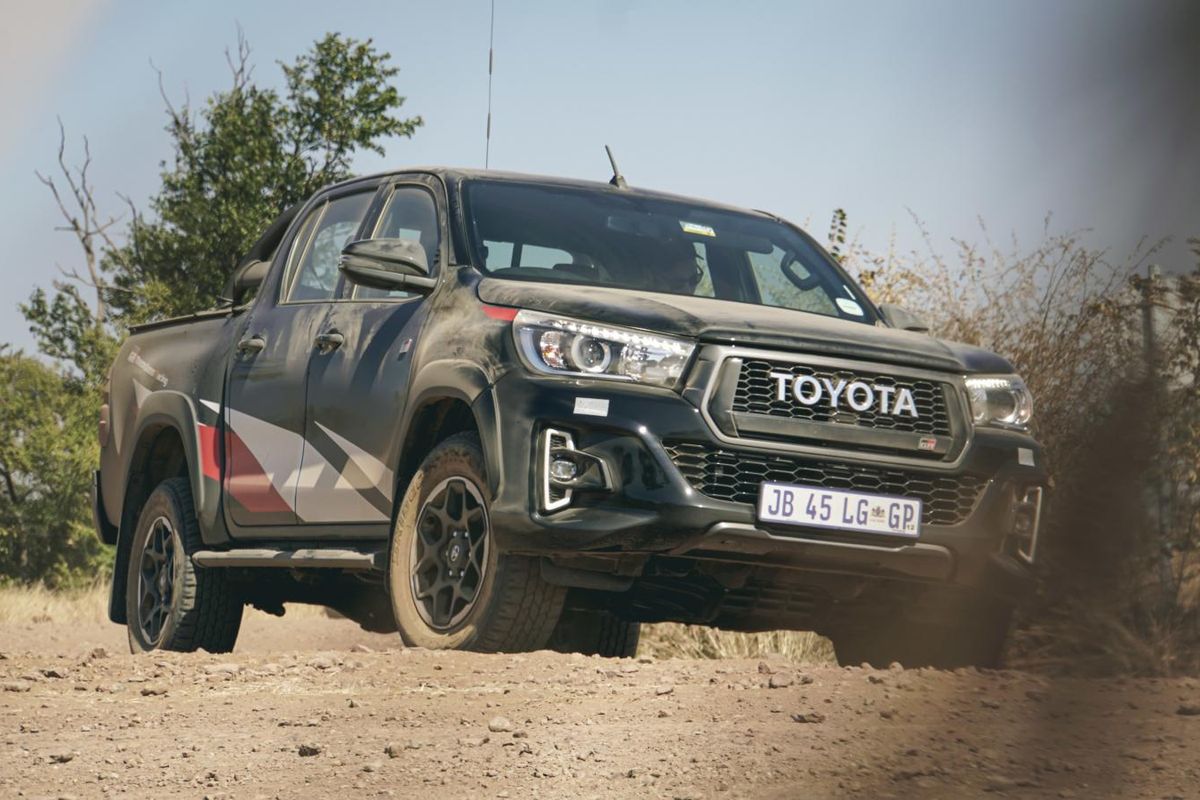
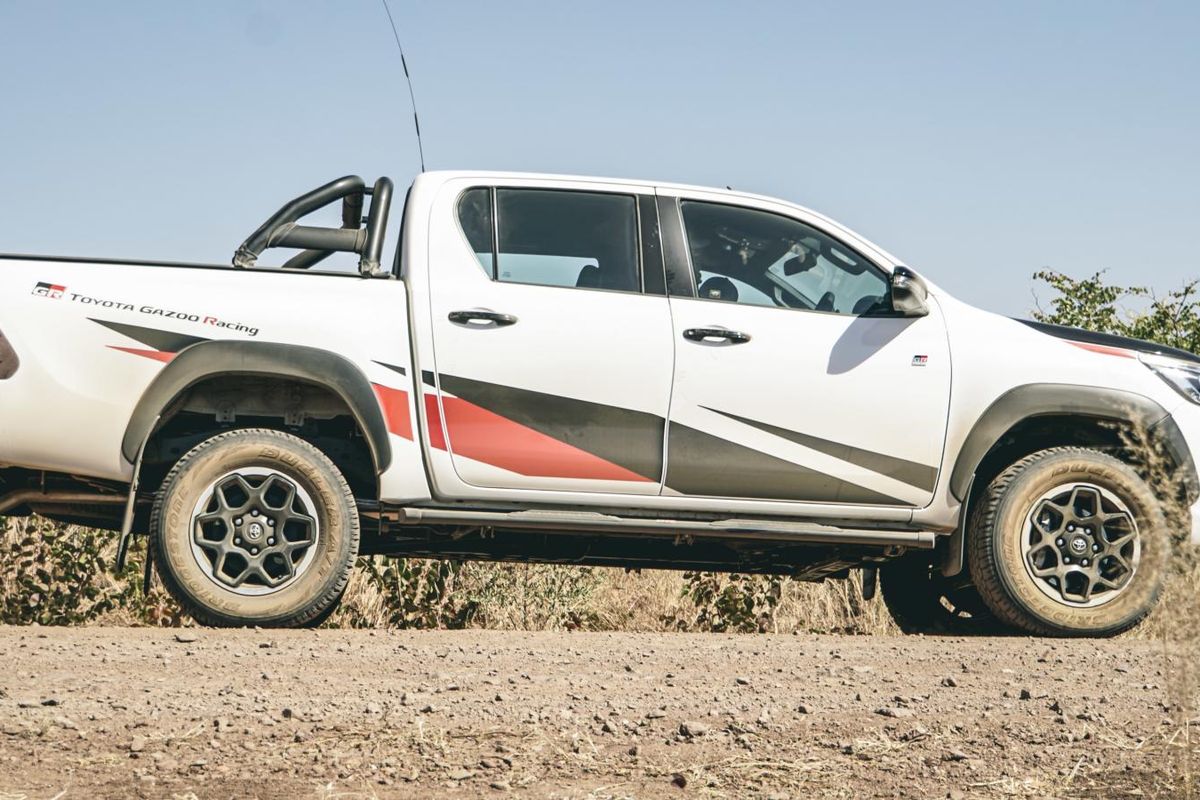
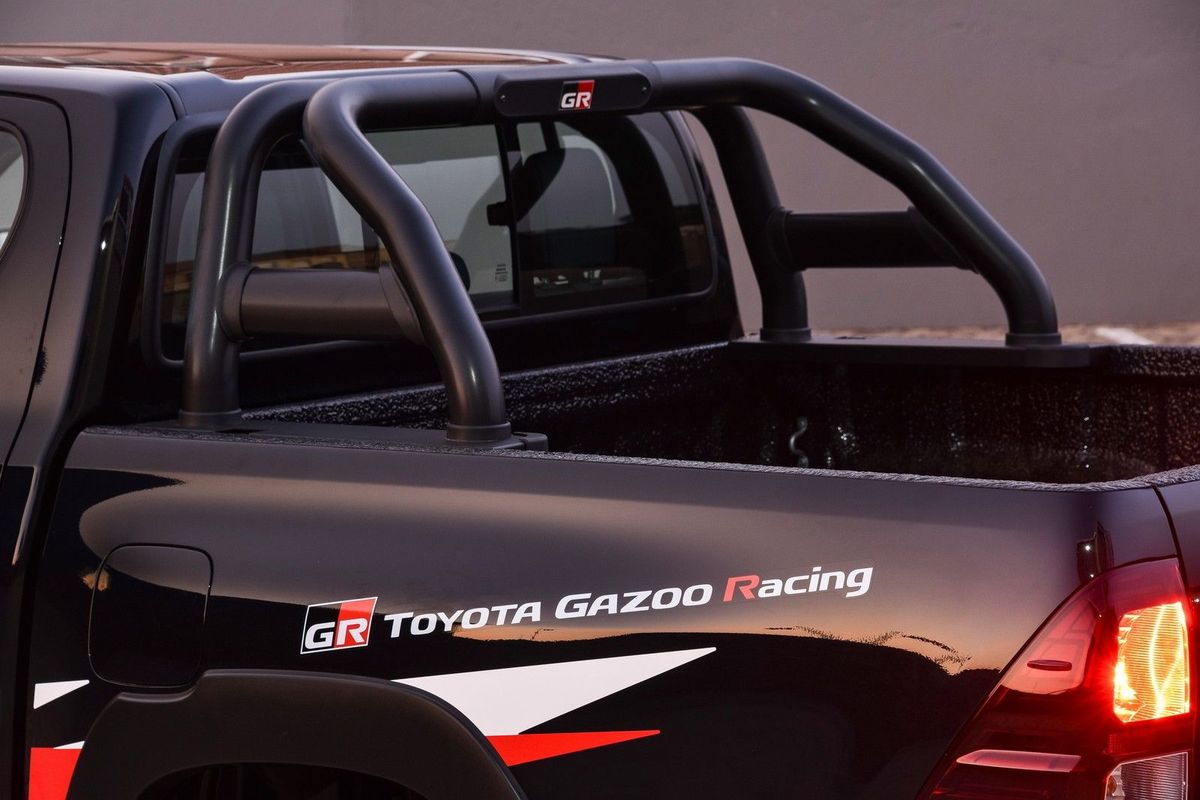
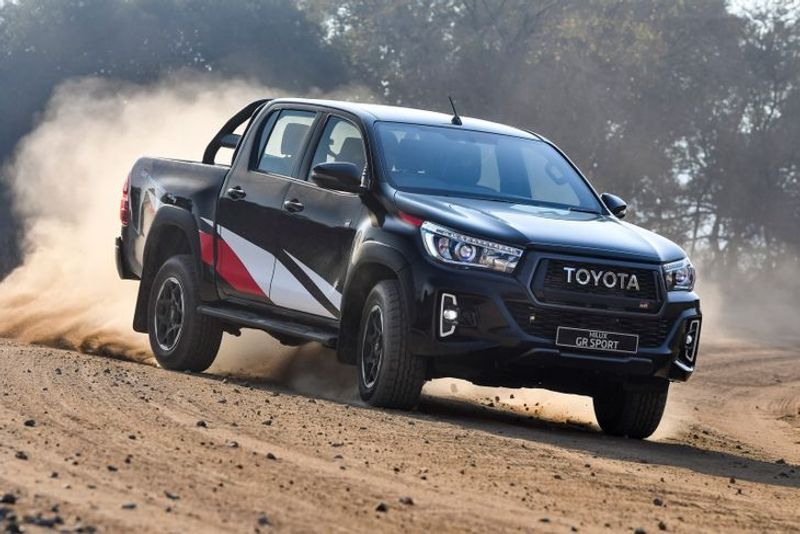
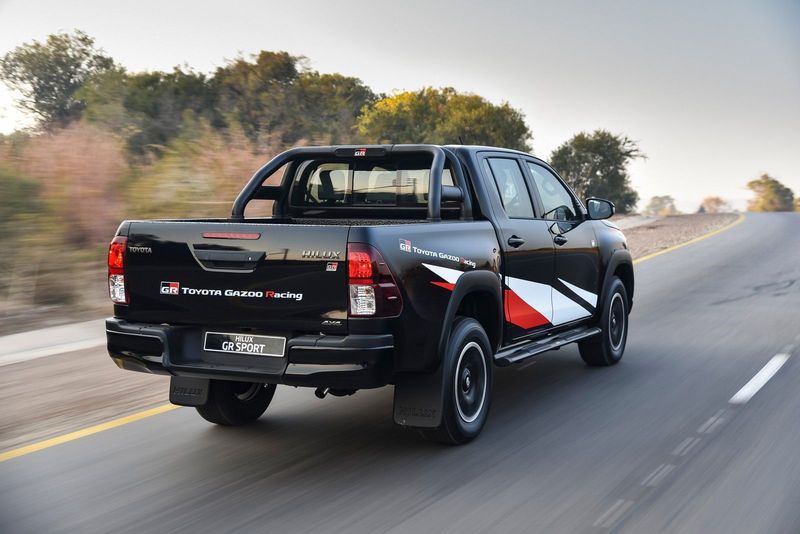
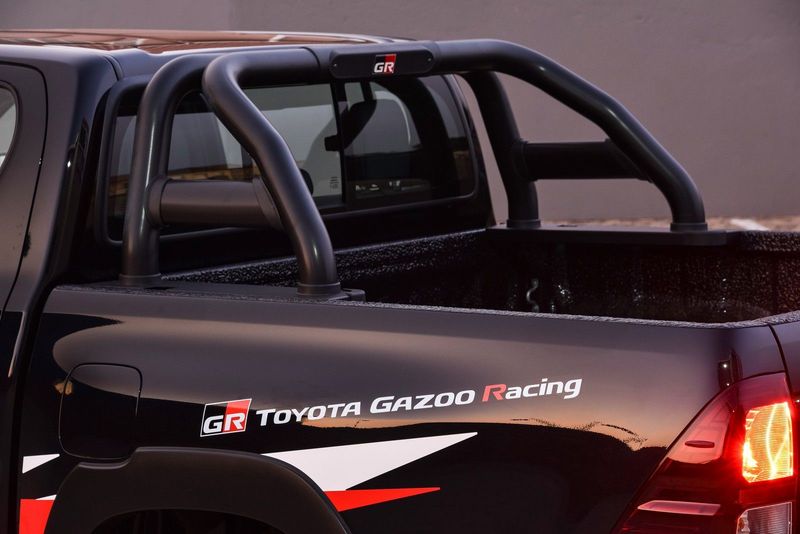
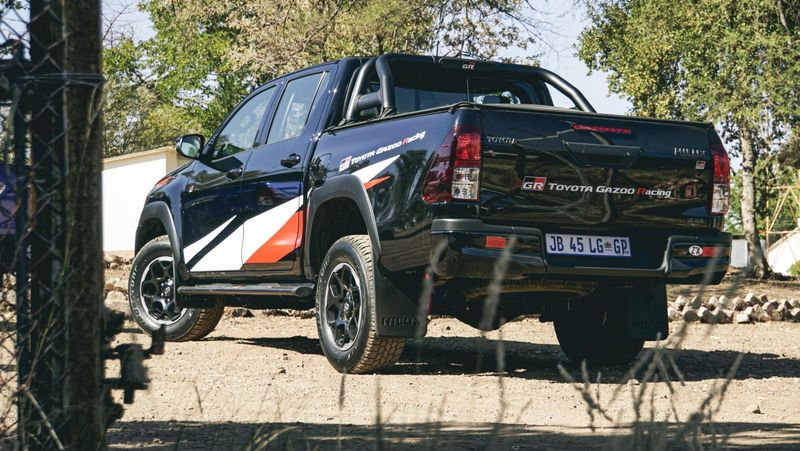
The GR Sport certainly looks the part. Its attention-grabbing livery makes it clearly distinguishable from standard Hiluxes and the bakkie is offered in a choice of 3 colours (it was hard to pick a favourite, each one has its merits). Distinctive looks are important in the game of bakkie one-upmanship!


You won't struggle to spot one on the road: the sticker kit and badging sets the Hilux apart from even Legend 50 derivatives.

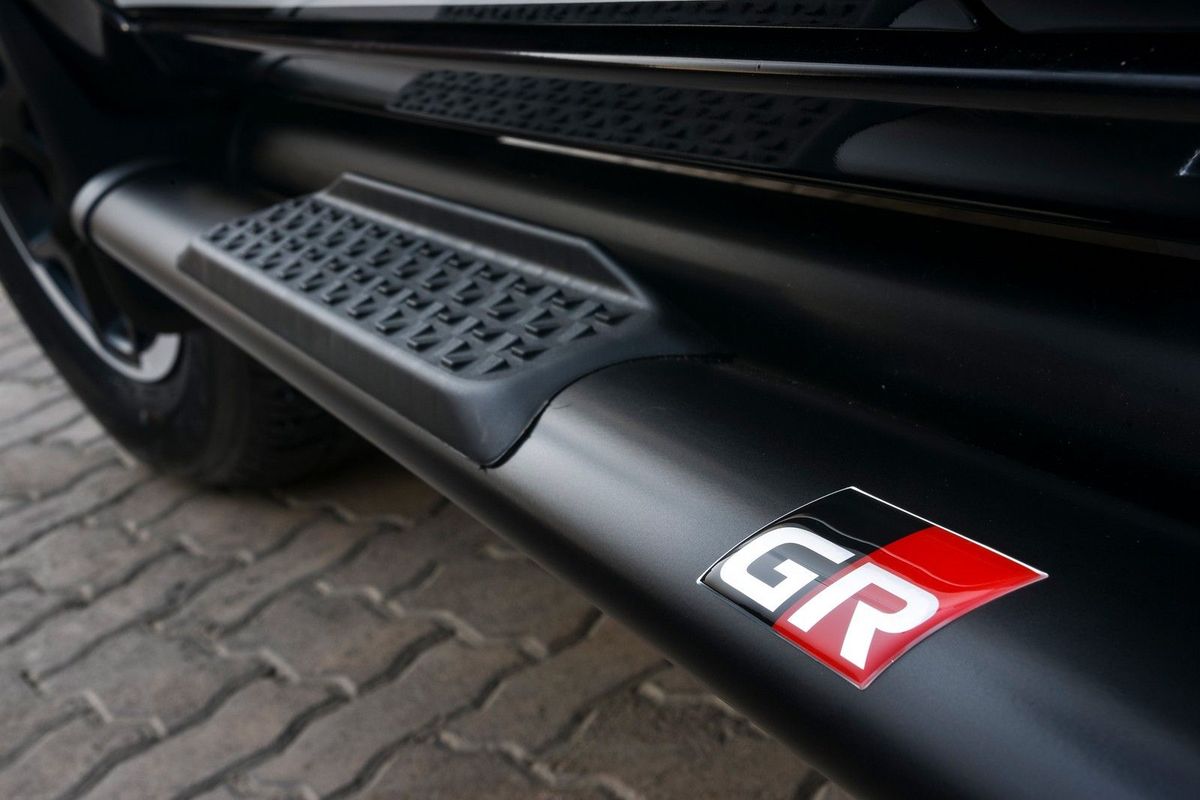
The Hilux GR Sport features a black bonnet and roof, with matching accents on the side mirrors. You also get GR-branded side steps, over-fenders and the tailgate is also "blacked out". All in all, the visual appeal of this specialised Hilux is quite striking compared with standard versions of the bakkie. As for the stickers, I'm not mad about their designs, but they do hint at motorsport pedigree, which is exactly what they’re supposed to do.

Interior changes

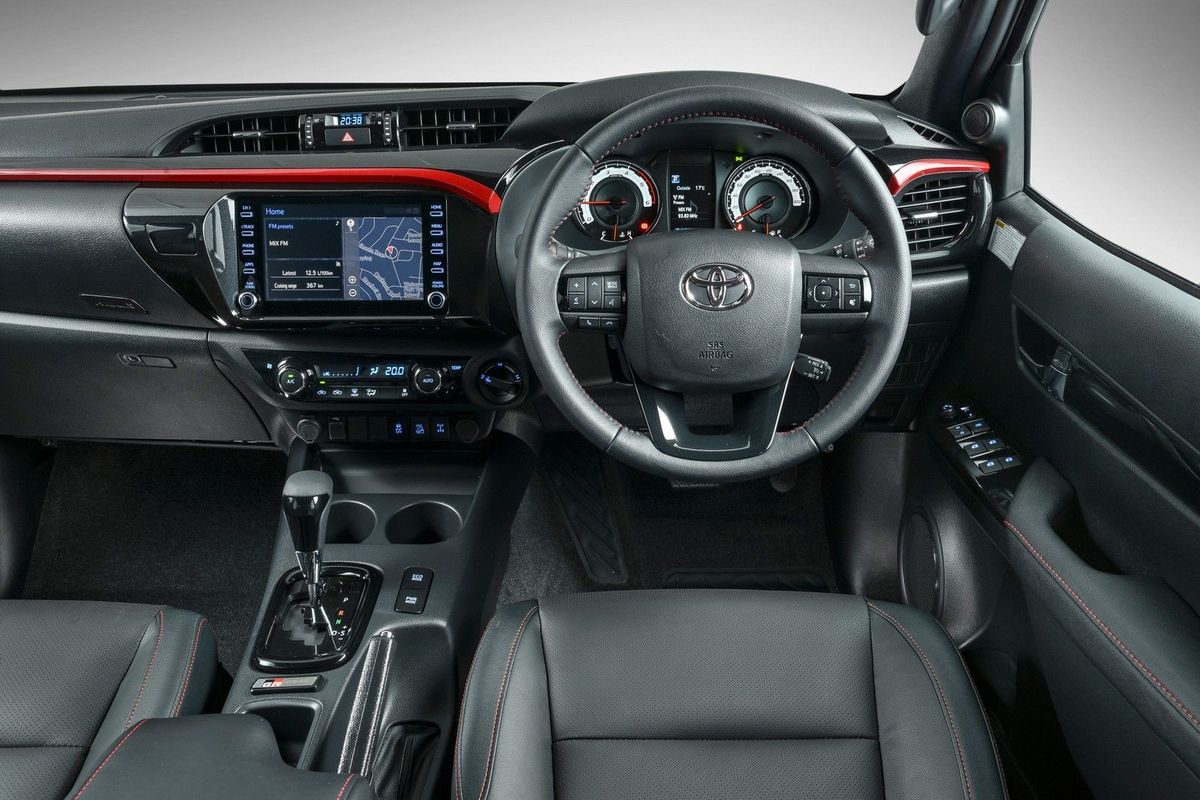
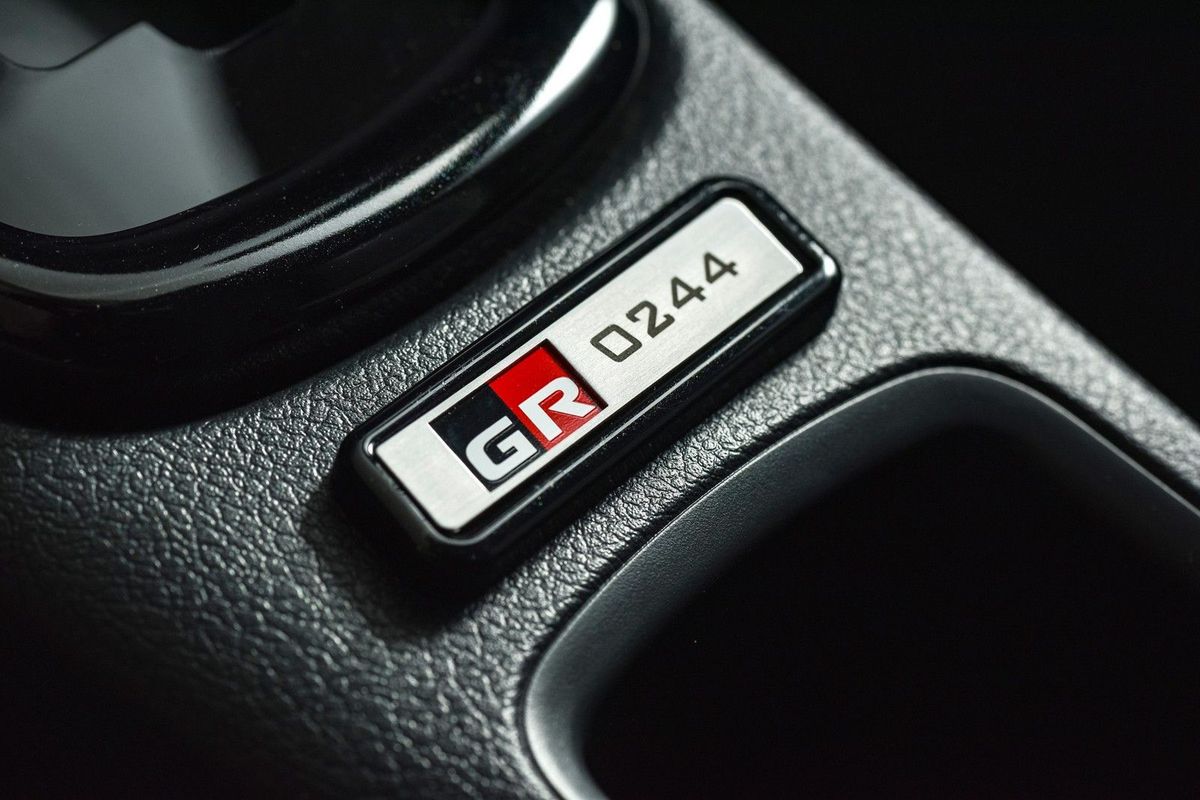
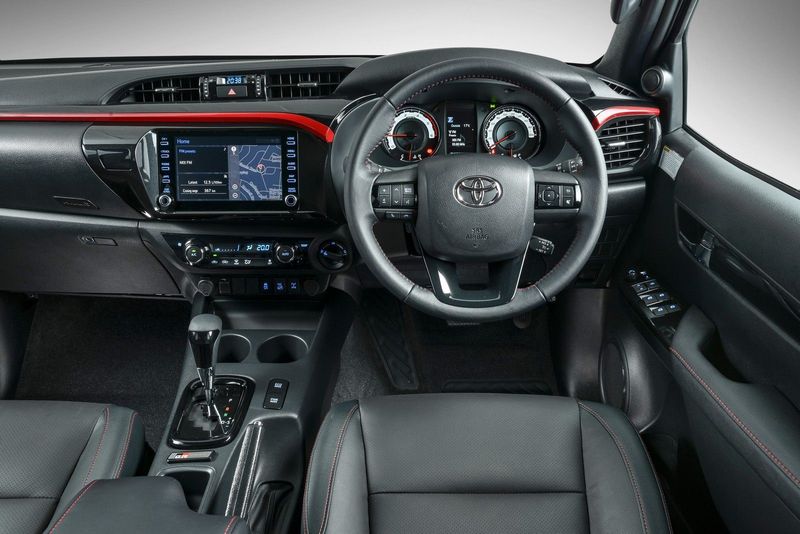
The Hilux GR Sport's interior updates mirror those of the Legend 50, but because this a limited edition, additional derivative-specific details have been added. There are red accents on the dash', GR logos stitched into the headrests and carpets, the engine-start button is branded and every example comes with a plate bearing a unique serial number, so that owners have a constant reminder that they’re driving something special.


Volume and tuning knobs have returned to the Hilux infotainment system and red stitching and -plastic inserts hold pride of place.

The GR Sport's infotainment system is also in line with other 2019-spec Hiluxes, such as the new Legend 50 derivatives; it comprises an enlarged 8-inch touchscreen display (now flush-mounted and integrated into the dashboard) with additional rotary dials for volume and tune functions. The rotary dial is a welcome change as the general consensus was that the touchscreen volume control of pre-2019 Hiluxes was very fiddly to use.

The unit also features key-function shortcut buttons, onboard satellite navigation, DVD, USB, Bluetooth and auxiliary audio input interfaces. A multifunction steering wheel (which operates the onboard computer and infotainment system) and reverse-view camera add further convenience.

Isuzu joins the fray, read our drive of the Arctic Truck D-Max.

What else is different?

Not much. The Hilux GR Sport is equipped with the dependable 2.8-litre GD-6 turbodiesel engine (130 kW/450 Nm), mated exclusively with a 6-speed automatic transmission (with selectable Manual and Sport modes) and "switch-on-the-fly" 2H to 4H capability. Automatic versions of the 2.8-litre GD-6 produce 30 Nm more than their manual counterparts and the self-shifting 'box proved smooth and easy to use in a variety of conditions.
Verdict


All 535 local models have been sent to dealers, expect them to be snapped up immediately.

Unfortunately for the Hilux GR Sport, comparisons between it and the Ranger Raptor are inevitable. In terms of its engineering, the GR Sport isn’t nearly as purposeful as the Ford; think of it as more of a homage to the reputation Toyota has gained after many miles at Dakar. For my taste, the ride is too firm for everyday use, which makes the standard Hilux Legend 50 a better buy. The 535 GR Sport owners will, however, benefit from the exclusivity of their bakkies and, probably, tremendous resale value. I wonder if Toyota might perhaps have a more hardcore Hilux in the pipeline?

Model Line-up and pricing 

Only 600 GR Sport models will be built.

Hilux 2.8 GD-6 4×4 GR Sport 6AT – R 707 400  

The Hilux GR Sport comes with a 3-year/100 000 km warranty. A 9-services/90 000 km service plan is also standard. Customers can also purchase extended service plans via their Toyota dealer. 

This is Bentley’s 1500 Nm EV

100 years of classic, cultured Bentleys meets a rather bold and futuristic concept. Also, where is the leather?

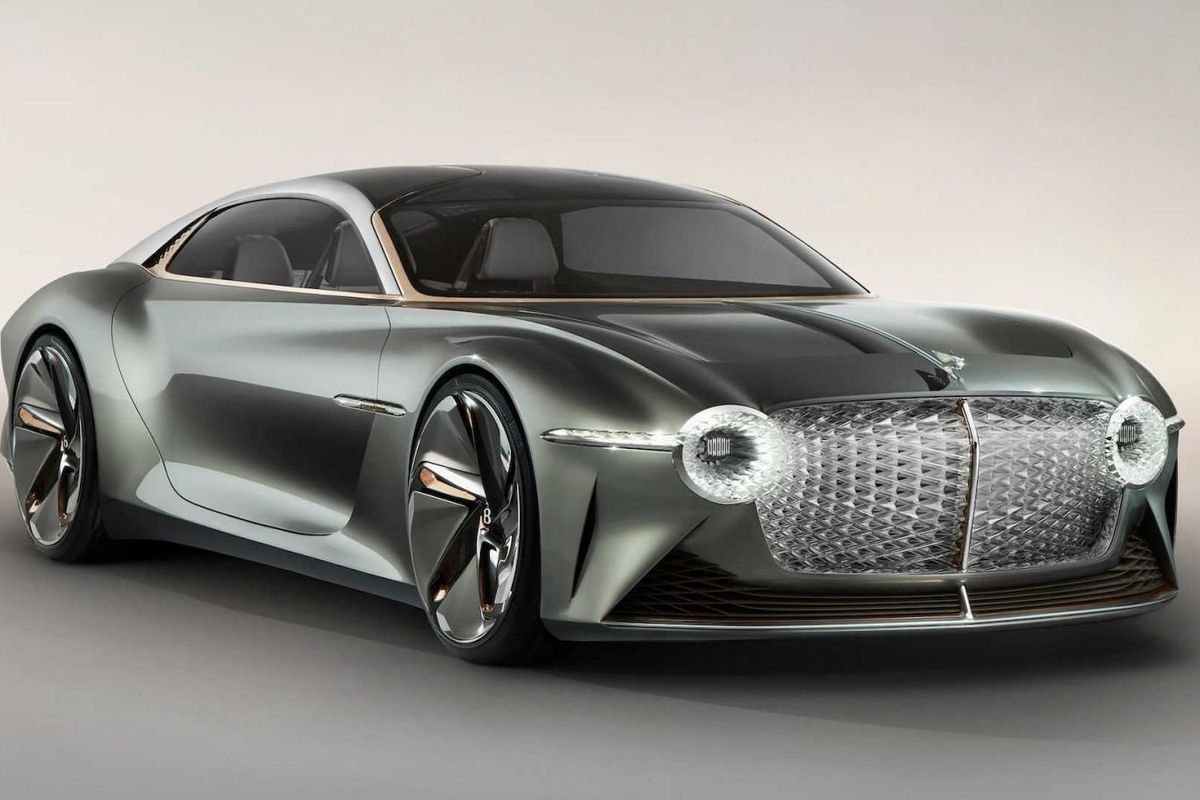
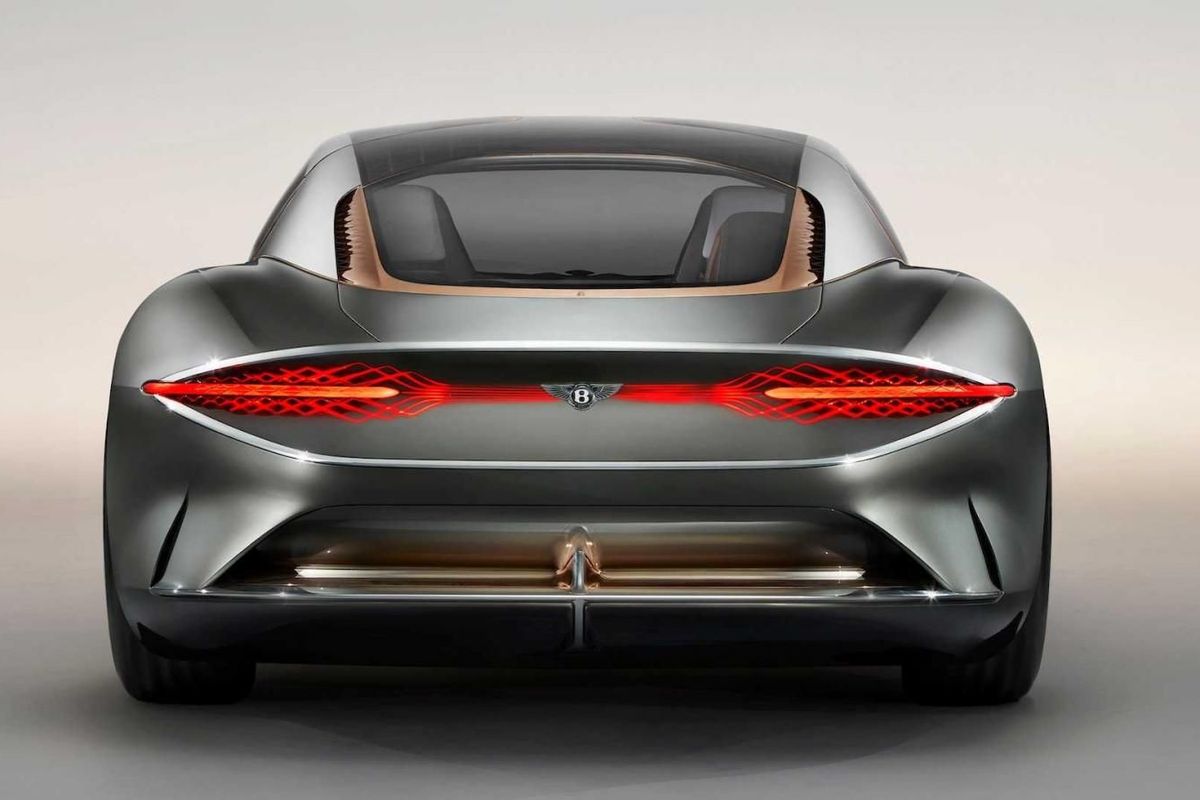
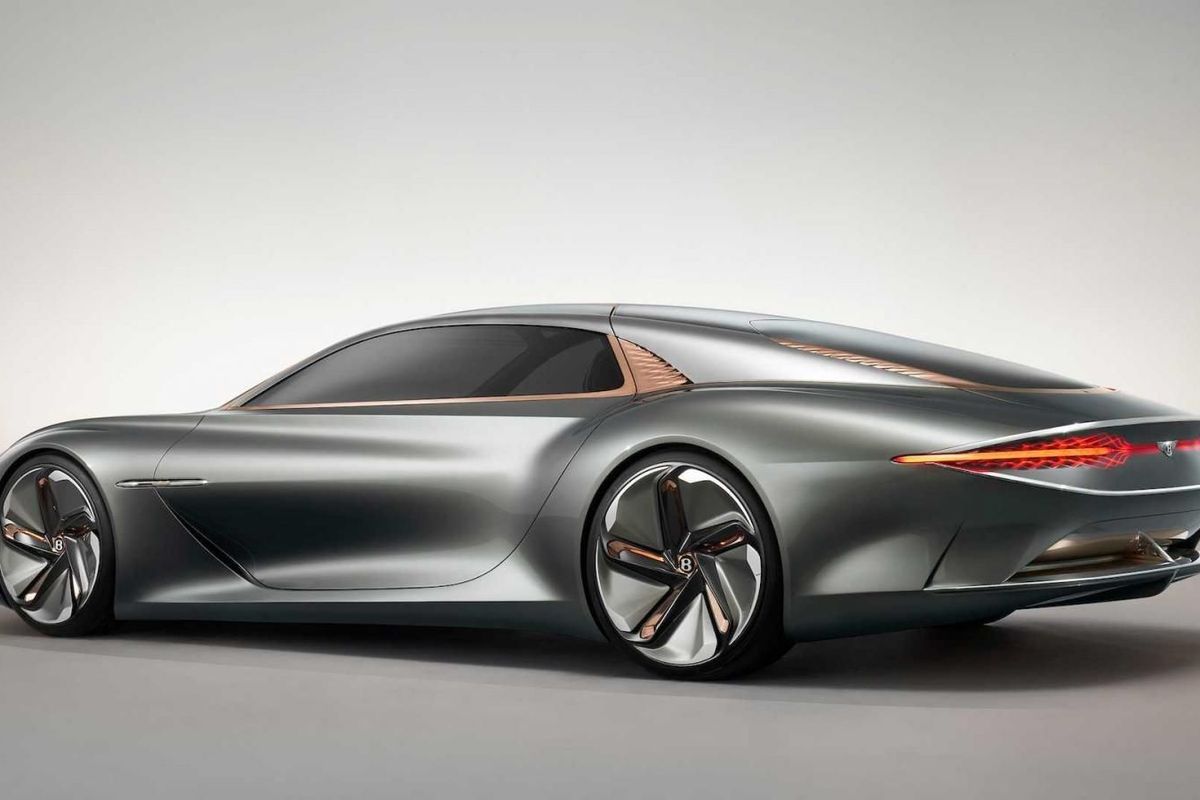
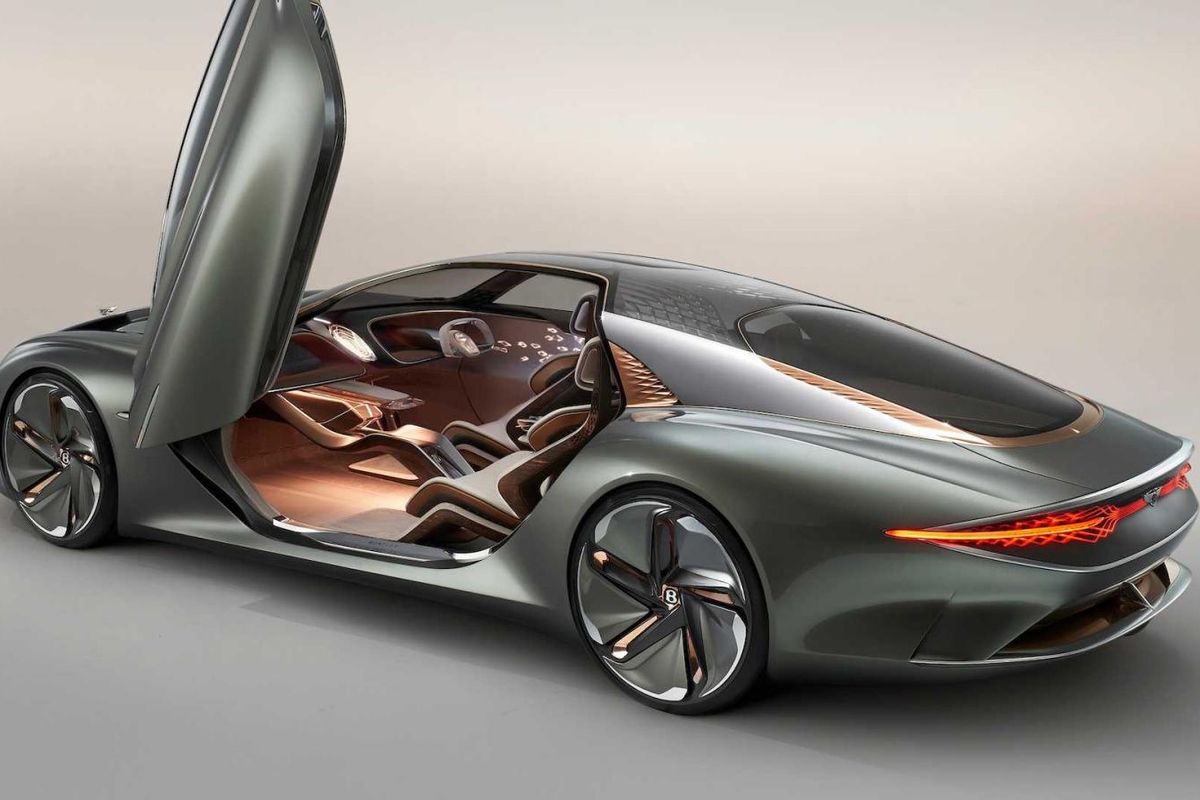
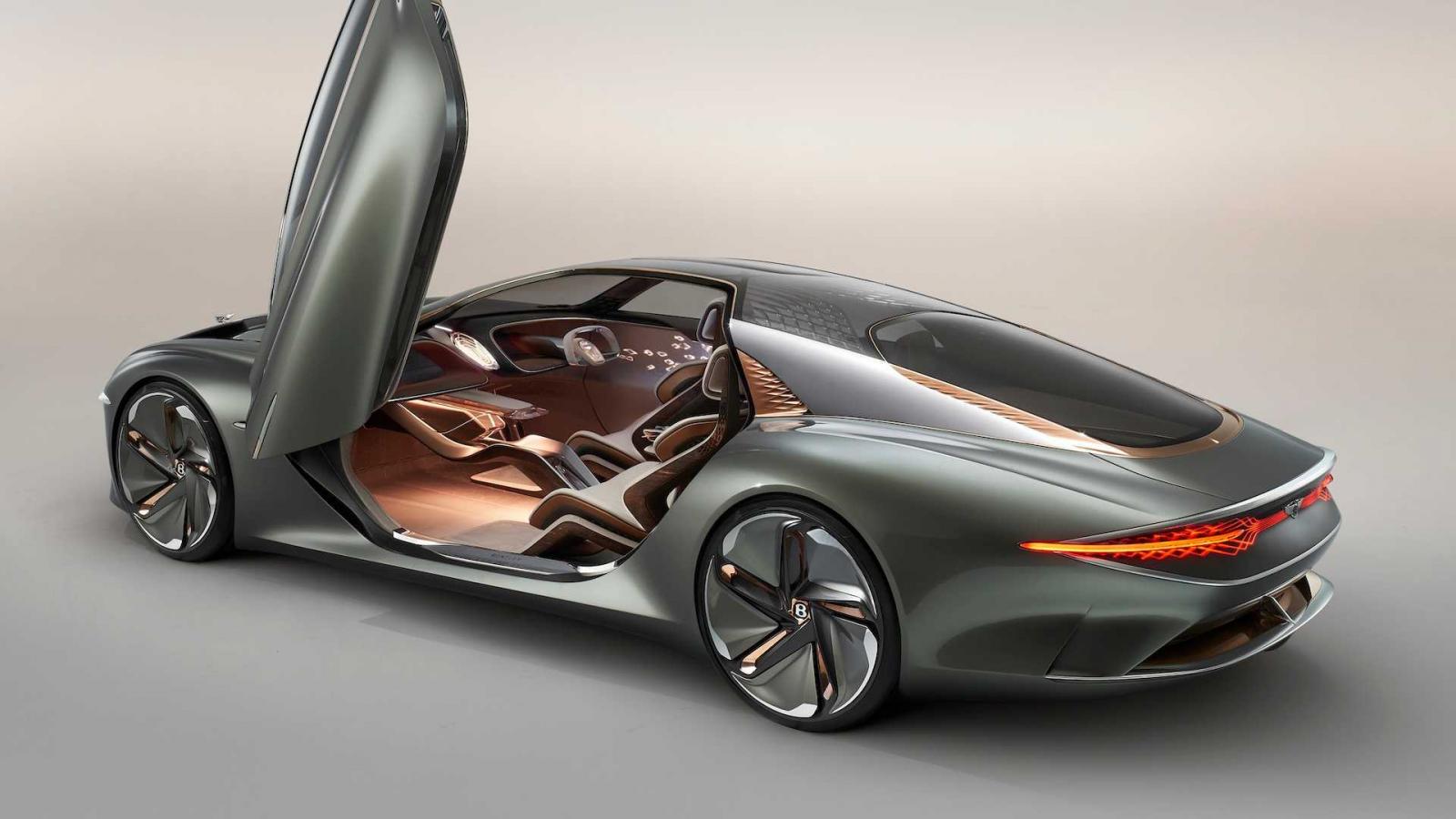
Bentley has revealed one of the most striking concepts cars ever built, with its new EXP 100 GT. Designed to celebrate the marque’s centenary, EXP 100 GT also previews what Bentley expects its 2035 model range to look like.

The concept car might have the configuration of a traditional grand tourer, with four seats and a long bonnet, but it is absolutely massive in size and the styling details are exceptionally extravagant. At 5.8m in length and 2.4m across, it’s a huge vehicle – but somehow Bentley has managed to keep kerb mass down t only 1 900 kg, which is remarkably low for a battery powered car of this size.

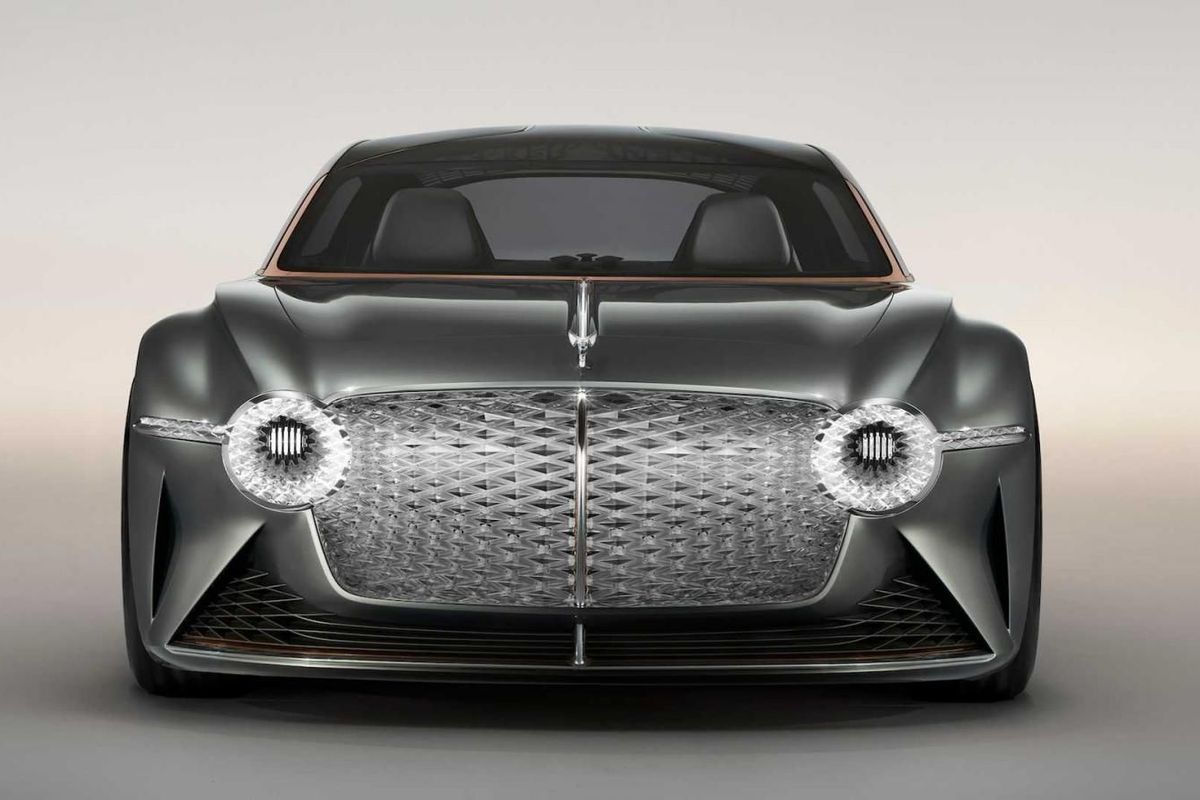
Perhaps the most notable styling element is the EXP 100 GT’s nose, which features a pseudo-grille made up of 6 000 individual LEDs. Bentley’s traditional flying-B bonnet ornament takes pride of place atop the long front section, but there is no engine below it.


Bentley aims to keep the weight below 2-tonnes, a hard task for battery-powered cars.

Driving the EXP 100 GT along is a battery pack and electric motors which generate 1 500 Nm of torque. Without specific kWh ratings for the batteries, or an electric power output figure, that torque rating appears to be disingenuous.

Bentley claims a driving range of 700 km and startling performance. The EXP 100 GT will run 0-100 kph in 2.5 seconds and a top speed of 300 kph. Recharging the battery pack to 80% capacity requires only 15 minutes, but again – Bentley has not divulged exact charging capacity details.

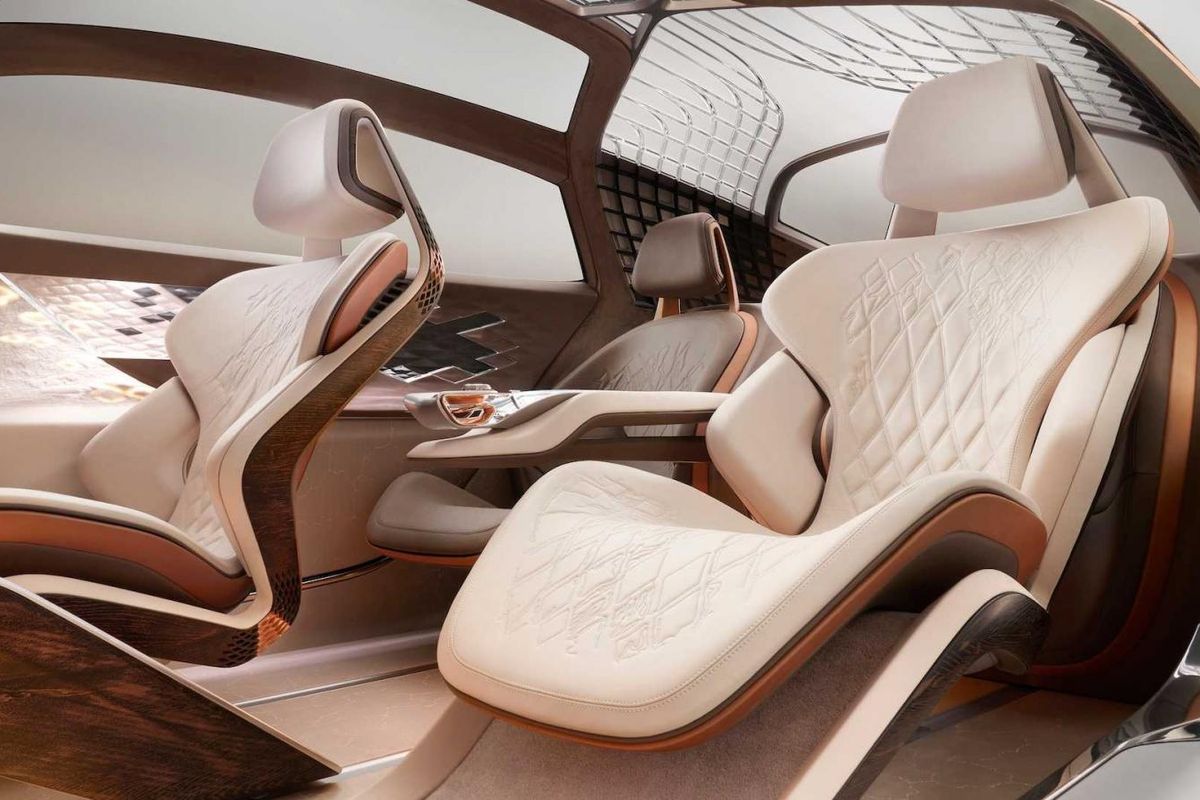
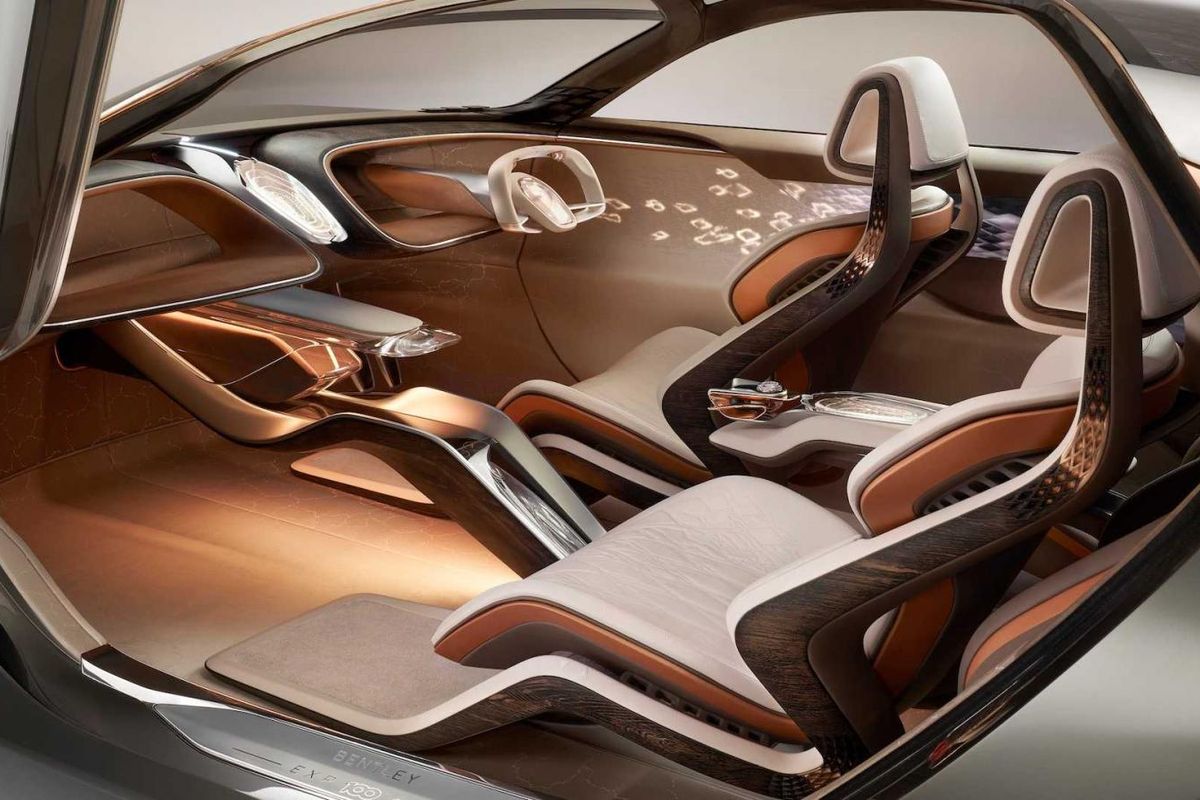
The EXP 100 GT’s cabin is a study in noble craftsmanship. Bentley values rarity and there now appears to be a feeling of sustainability about its future products too. The EXP 100 GT’s cabin does not contain traditional animal hide, but instead, a leather-type material made from grape pulp (good news for local wine farmers perhaps?).

Full autonomous driving (or is that touring?) ability is controlled by a sophisticated artificial intelligence architecture, which monitors passenger biometrics and adjusts the car’s cabin fragrance, ventilation, temperature, infotainment and even sun-shading accordingly.

How much of the EX 100 GT will go into production? Well, you’ll have to wait until 2035 to find out.

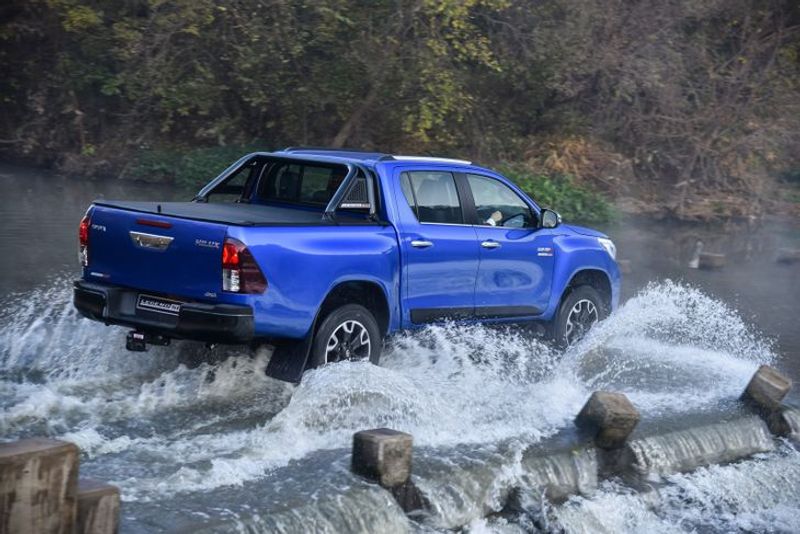
Toyota Hilux Legend 50 (2019) Launch Review

Toyota has rolled out a host of new Hilux derivatives in 2019… The Prospecton-based firm recently launched the limited-edition GR Sport, as well as a number of Legend 50 derivatives. We crossed multiple borders with the Legend 50 to find out what it adds to the legacy of the Hilux. Ernest Page reports from “somewhere in Southern Africa”.

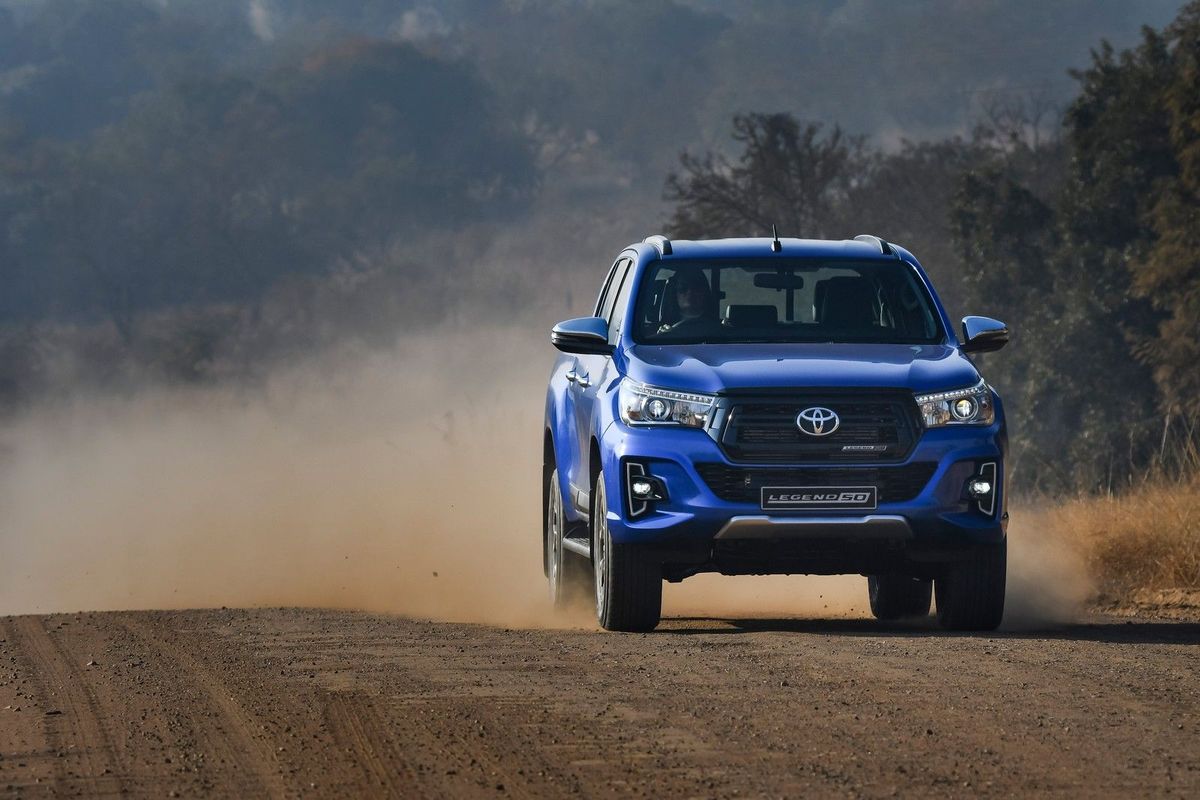
With record sales of over 4 700 units in June 2019, the Hilux continues to dominate new-vehicle sales charts. Even though some may argue that Ford’s Ranger is an “as good or even better” product, the South African public’s appetite for Hilux bakkies has been insatiable for the last 50 years. It’s for that reason that Toyota has introduced the new Hilux Legend 50 which celebrates 5 decades of the Hilux in South Africa. It supersedes the familiar Raider range, but what’s changed? We tour through 3 African countries in one day to find out if Hilux is still as proudly South African as ever.

Check out our celebration of 50 years of Hilux here.

Own a Toyota? Tell us about your experience here

What is a legend? 


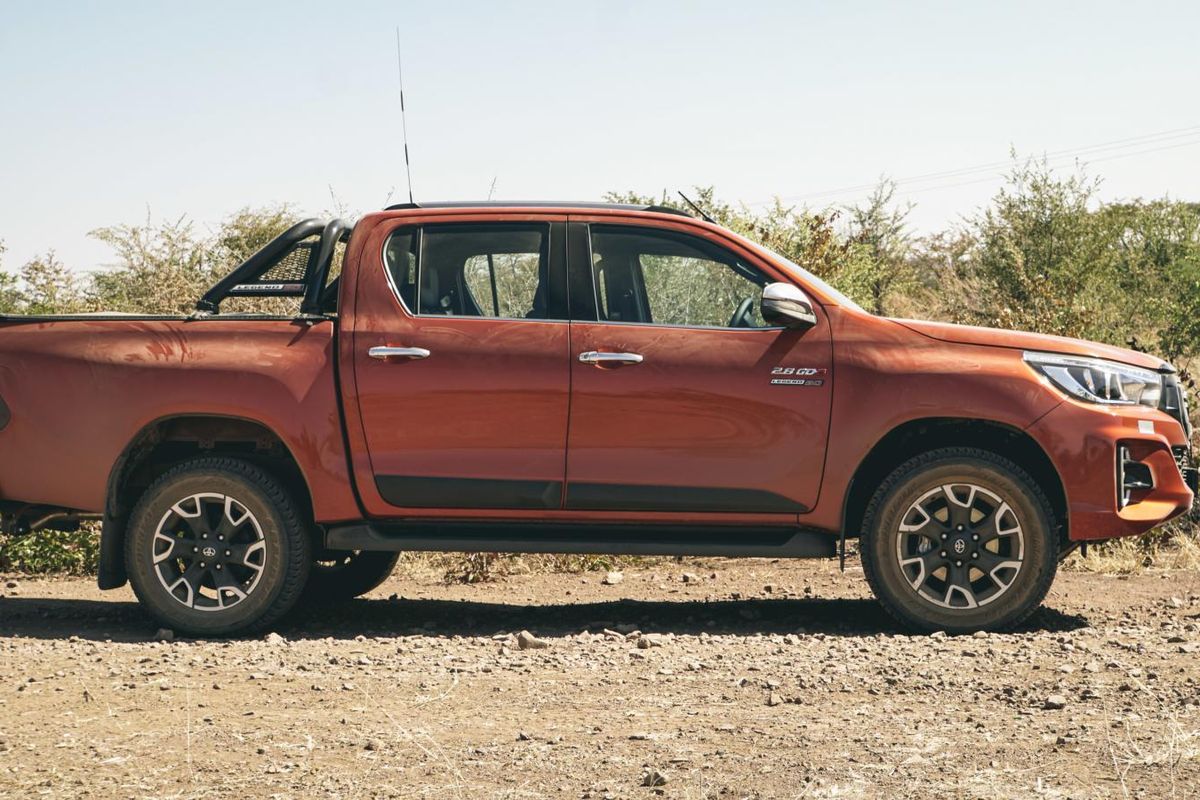
Legend 50 easy to spot from the side with the black trim pieces. 

Legend. The word is often bandied about and, at times, I’ve had to bite my lip, because the ability to catch a set of house keys with one hand or the grace to hold a door open for a member of the fairer sex doesn’t really make one a “legend”, now does it? However, what if you’ve been consistently outperforming the competition for no fewer than 50 years? In my estimation, the venerable Hilux has done enough to deserve its legendary status in the South African motoring fraternity. Right now, it’s the top-selling motor vehicle in South Africa and, for half a century, it has transported millions of people and supported multiple industries across the country. Toyota has nailed down the Hilux formula; it hasn’t changed much since the first Hilux bakkie appeared on our streets in 1969. So it comes as no surprise that the changes made to Legend 50 are incremental, rather than sweeping. 

What’s new?

Although the winning formula remains largely unchanged, the Legend 50 package now replaces the Raider specification across all 3 body shapes (Single-, Xtra- and Double Cab) of the Hilux. Single- and extra-cab Legend 50 derivatives are powered by the 2.8-litre GD-6 turbodiesel engine that produces peak outputs of 130 kW and 420 Nm, although automatic versions produce an additional 30 Nm (450 Nm). The derivatives are available with either a 4×2 (Raised Body) or a 4×4 drivetrain and a choice of a 6-speed manual gearbox or a 6-speed automatic transmission.


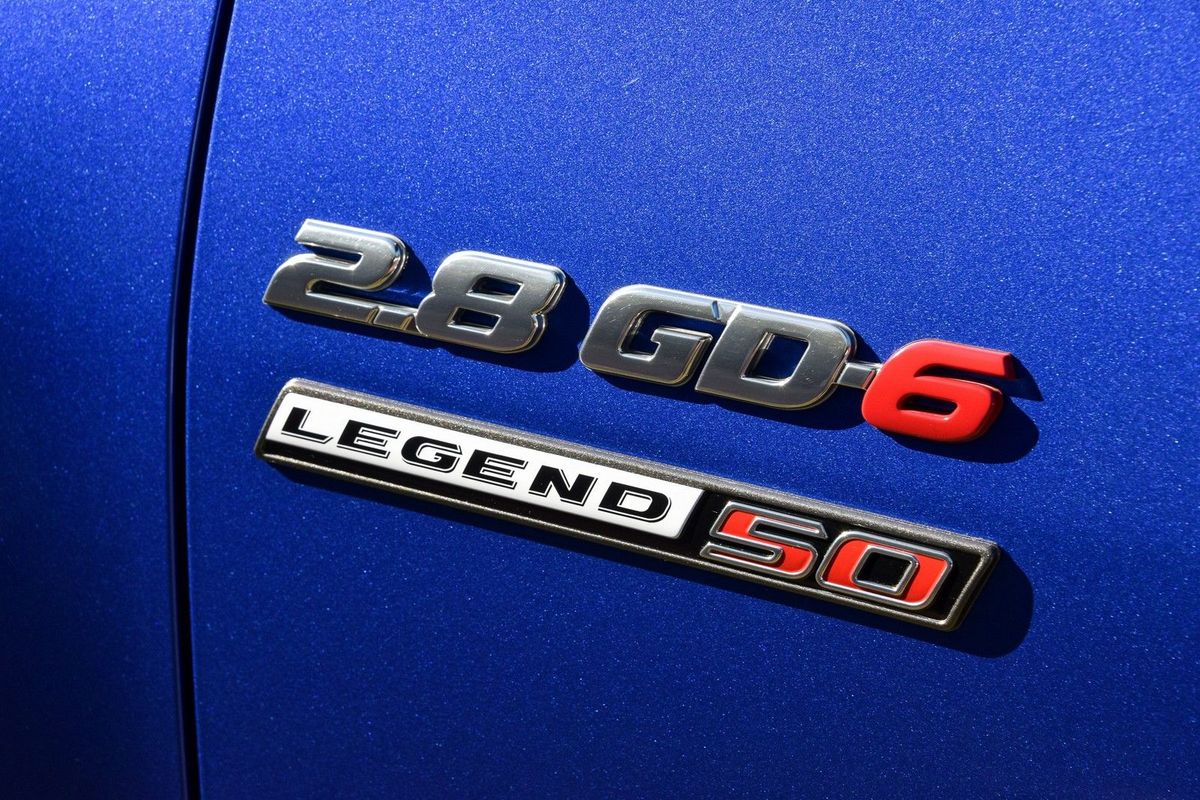
The newcomer is not short on special badging, is it?

Double Cab Legend 50 derivatives are available with either the aforementioned 2.8-litre GD-6 or 4.0-litre V6 petrol engines. While the latter is available exclusively in 4×4 automatic guise, the turbodiesel versions are available in either 4×2 or 4×4 configuration, in manual or automatic guise. 

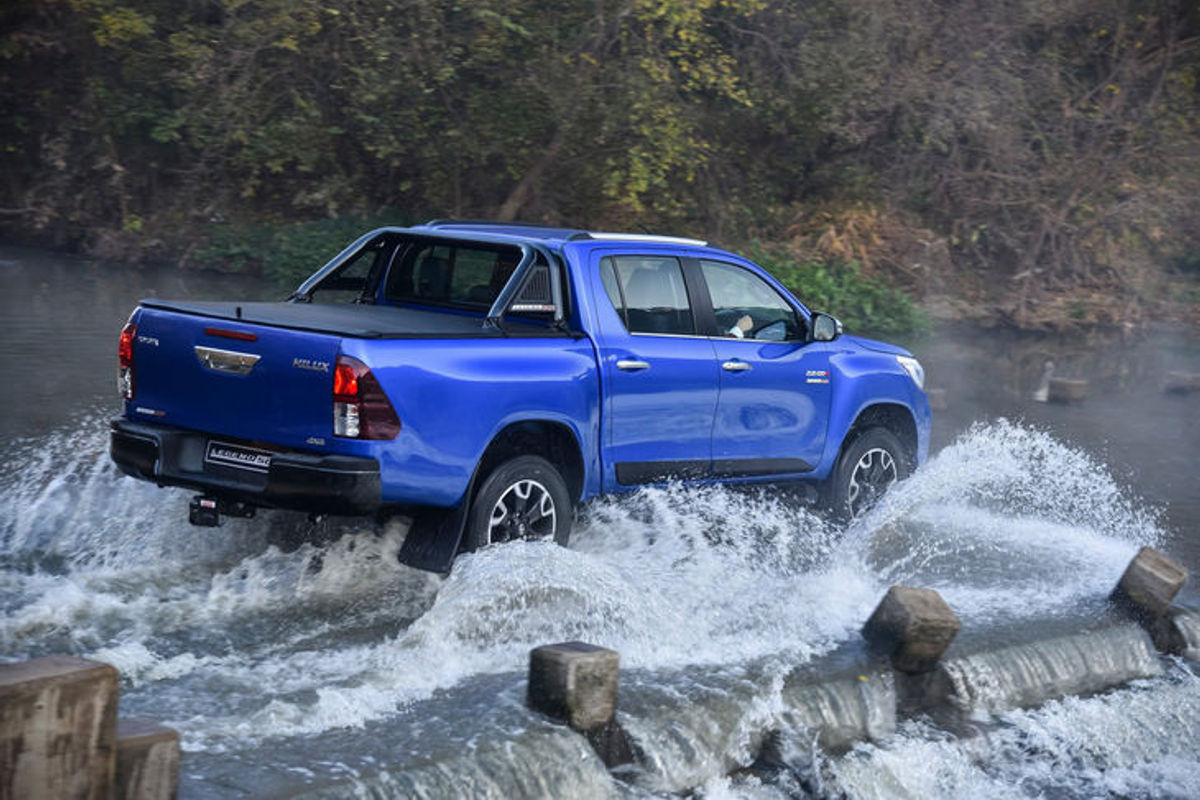
The driving experience remains pleasingly unchanged. During our journey, the Legend 50 traversed many miles of tarred roads and off-road terrain with typical Hilux ease and although I still prefer the torquier automatic, the manual version is robust and workmanlike in demanding conditions.

Exterior changes

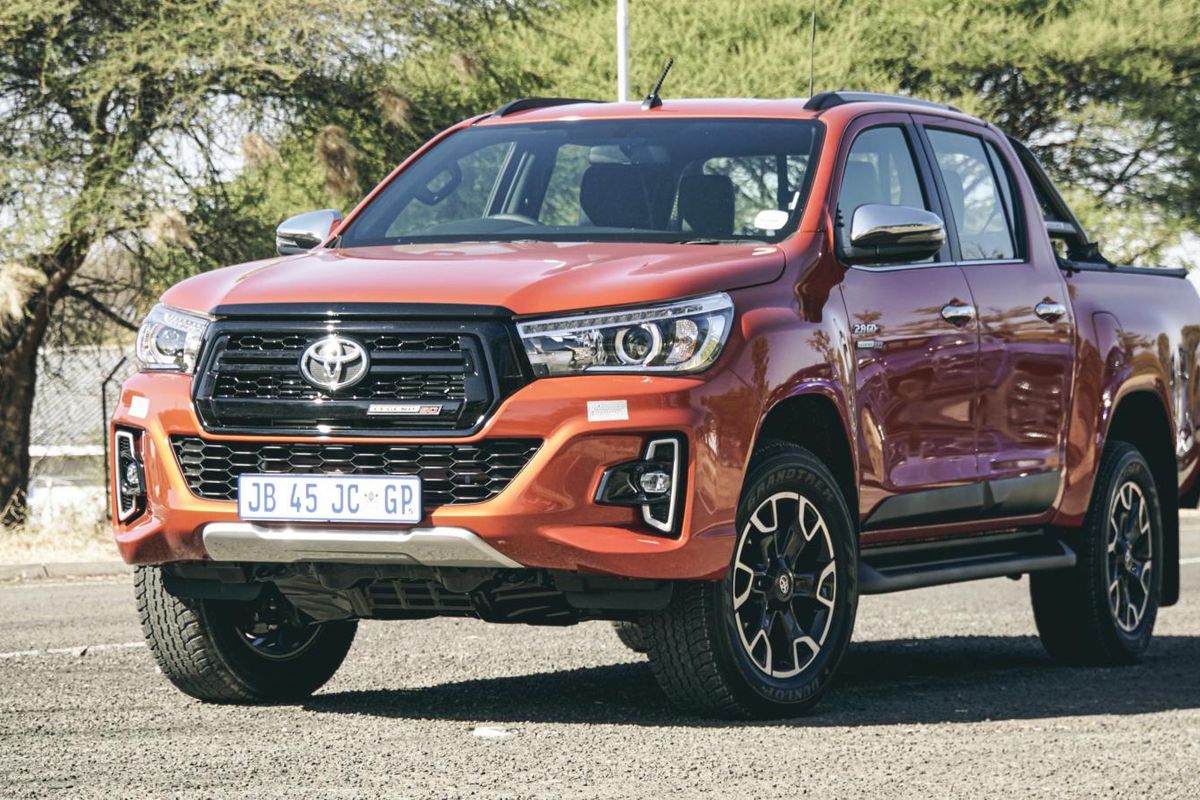
In 2018, Toyota launched the Dakar Edition to provide a hint to what the new face of high-spec Hiluxes would look like. Unsurprisingly, the public loved it. Since that exercise paid off so handsomely, the new Legend 50 boasts a similar frontal treatment, but with some tweaks and changes.

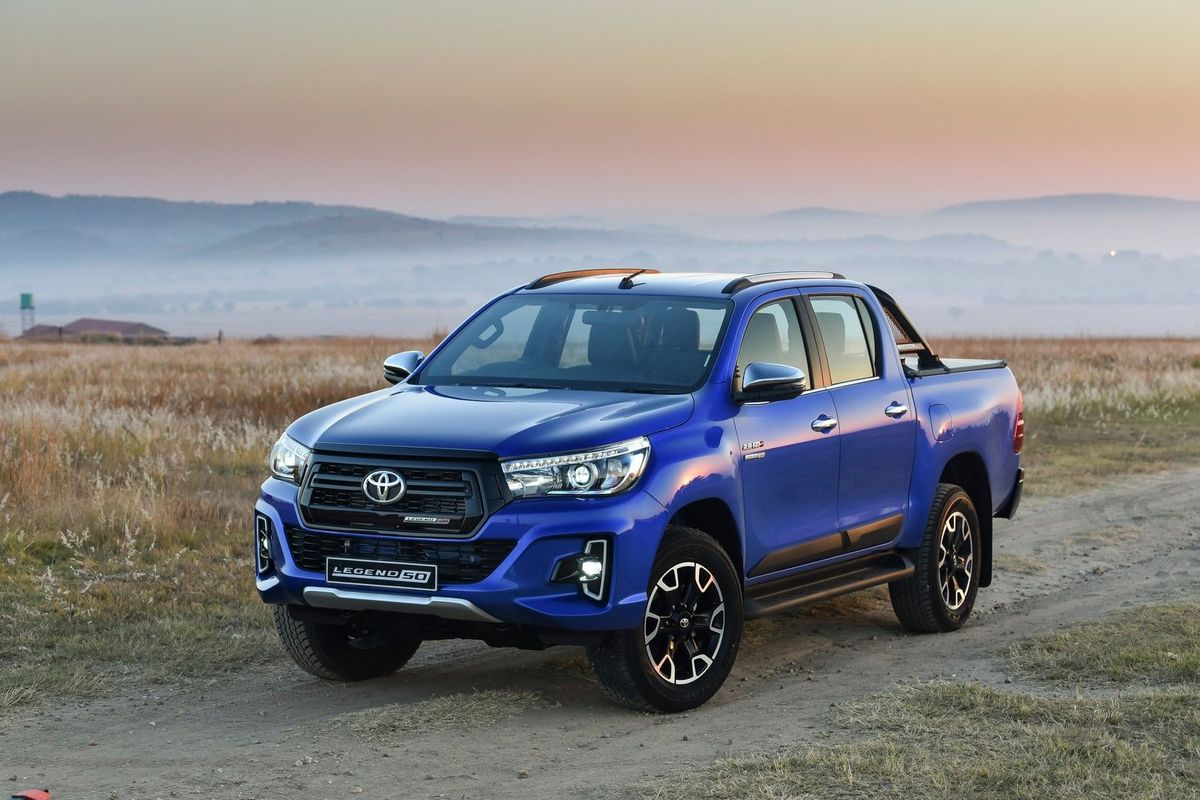
The grille, which bears a Legend 50 badge, is blacked out, has a gloss finish, and is matched by the foglamp surrounds. C-shaped silver accents frame the foglamps vertically and complement the bumper guard. The LED headlamps incorporate daytime running lights (DRLs).


Is this the Wildtrak competitor that Toyota has needed?

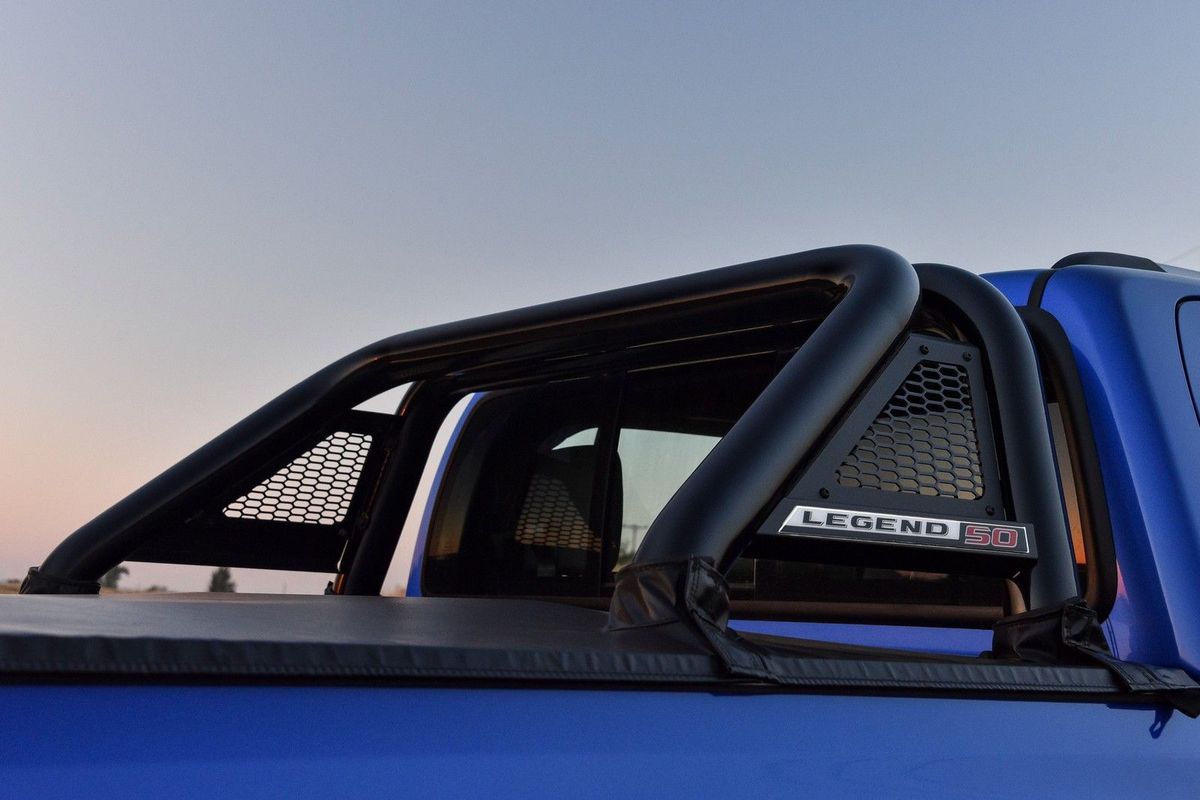
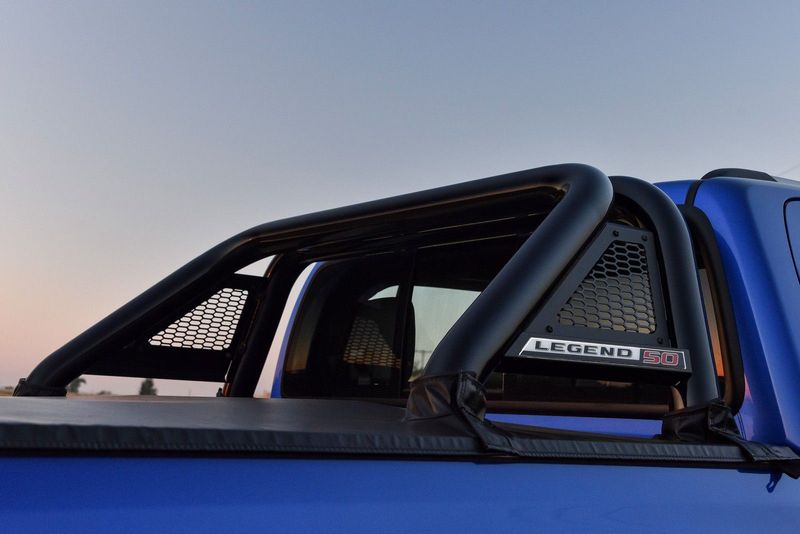
Along the side, the extra- and double-cab Legend 50 derivatives sport black side-protection mouldings, chrome-finished side mirrors and door handles, as well as black side steps and silver roof rails. A customised rear styling bar with matching Legend 50 badging and a textured, heavy-duty tonneau are available as extra-cost items and we believe they’ll be popular. As I mentioned before, the changes are incremental and, as far as a styling package goes, it works, bringing the Legend 50 up to date as to compete with the beefed-up looks of high-end Ranger and (Nissan) NP300s.

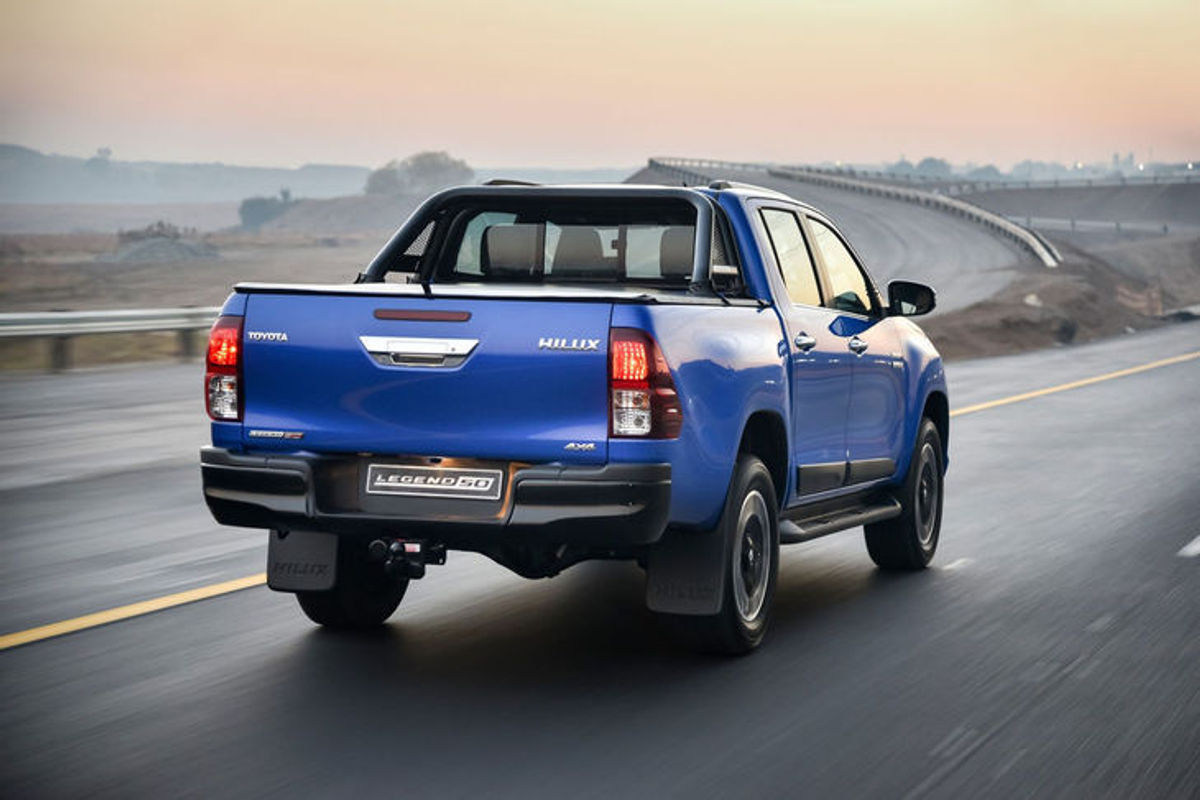
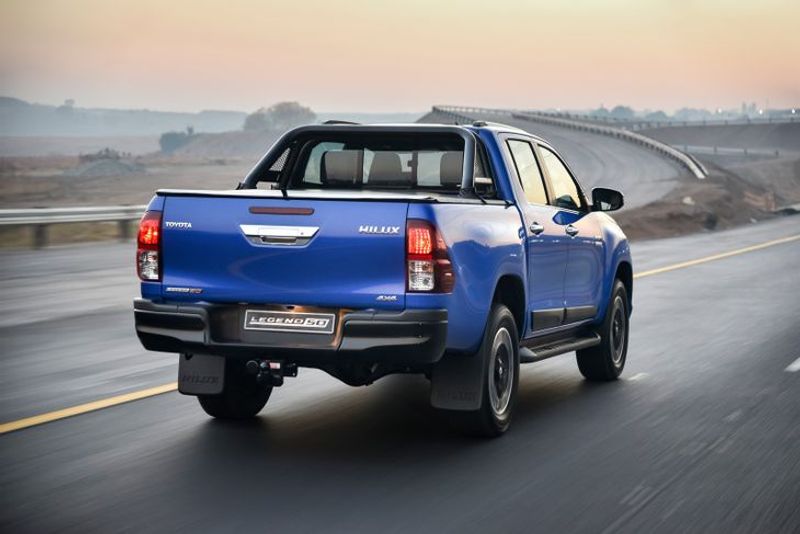
At the rear, a black bumper, smoked-look tail-lamp clusters and bespoke tailgate badging complete the Legend 50’s visual package. A towbar is fitted as standard and derivative-specific two-tone 18-inch alloy wheels shod with 265-60-R18 all-terrain tyres are fitted. The wheels are quite large, but thanks to the generous 60-profile rubber (tyres with high sidewalls), the Legend 50 delivered a reasonably comfortable ride on rougher terrain. 

Interior changes

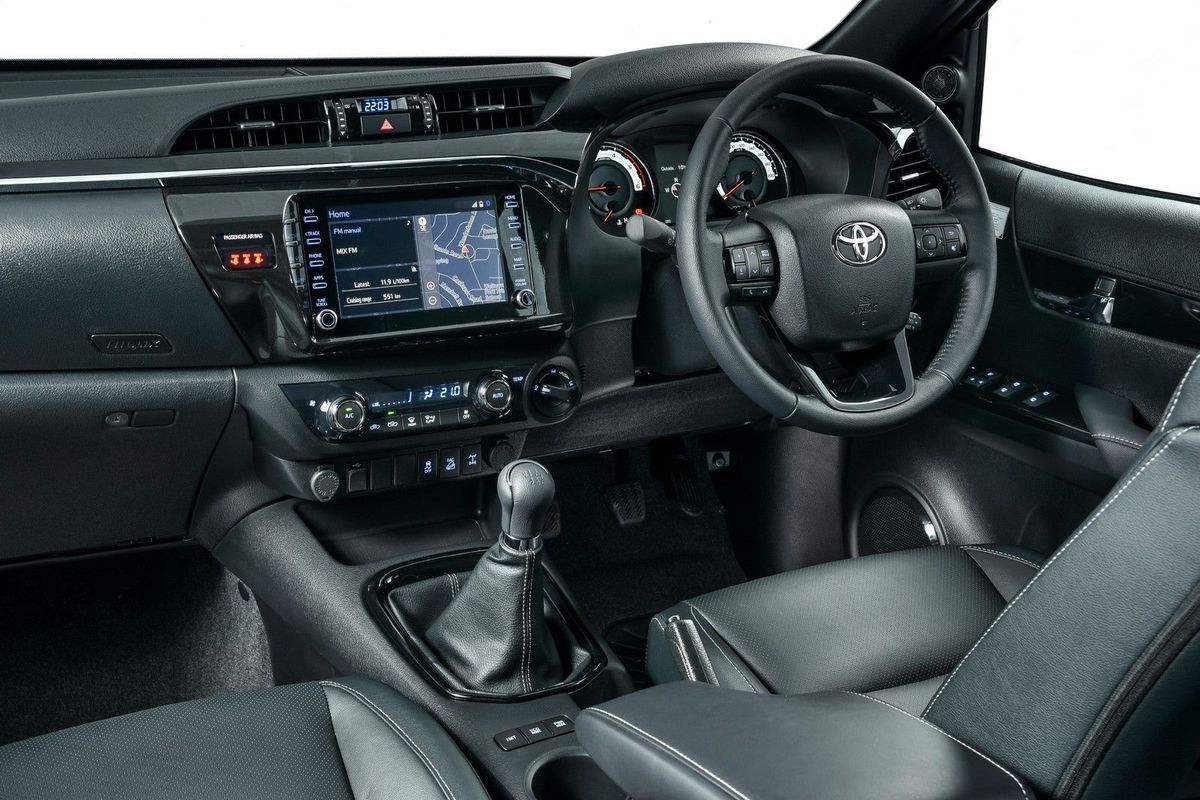
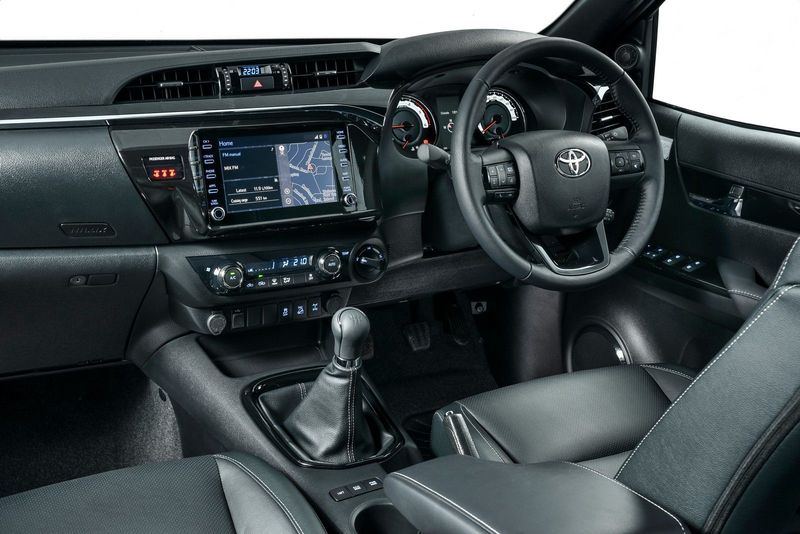
Many small changes can be observed inside the Legend 50’s interior, including black leather trim (on X/C and D/C) with blue stitching, a chrome accent strip across the dashboard and gloss-black panel trim. Legend 50 derivatives also have branded silver door scuff plates and carpet sets. 


Look at those physical volume knobs! Thank you, Toyota.

Meanwhile, the instrument cluster features white-faced dials and a 4.2-inch TFT multi-information display. By operating the steering wheel controls, a driver can access a variety of information (including audio, compass, navigation prompts, trip info and fuel consumption detail).

The infotainment system has also been upgraded; it features an enlarged 8-inch (20.3cm) flush-mounted touchscreen display and, in what may have been a sop to consumers, Toyota has fitted a rotary volume dial in place of the much-maligned touchscreen volume control. This has been a personal bugbear for me in any car and I’m glad to see manufacturers taking note and switching back to the much more ergonomic knob-setup. 

So, is it any better?


If you aren’t one of the lucky few to get a Hilux GR Sport, this Legend 50 is the next best thing.

The Legend 50 needs to upstage eye-catching packages such as the (Ford Ranger) Wildtrak and (Nissan) Stealth in the looks department and, with this new, fresh look it certainly can. The newcomer retains that typical Hilux bulletproof feel though. In the city, the drive felt typically Hilux. Unladen, the ride was slightly too choppy over speedbumps and ruts, but on gravel and sweeping long roads, Legend 50 covered the miles with little effort.

Watch the Legend 50 take on the Hilux GR Sport

Verdict

Monthly national new vehicle sales statistics (not to mention robust Hilux resale values) suggest that most consumers are more than happy with the existing Hilux package. Toyota – the 2018/19 Cars.co.za Consumer Awards Brand of the Year – would have to be silly to mess with a winning product, but thankfully it hasn’t. In Legend 50 guise, the Hilux now looks even more handsome than in the outgoing Raider getup… Dare I say ask: could this be the best-looking Hilux yet? Expect to see 1 of these on the road, or in your, or your neighbour’s, garage in the near future.

To see a full specifications article on the Legend 50 – click here

Search for a used Toyota Hilux here

Latest Hilux specs

Pricing

Toyota Hilux Legend 50 Single Cab:

Toyota Hilux 2.8 GD-6 Raised Body Legend 50 6-speed manual                            R472 000

Toyota Hilux 2.8 GD-6 Raised Body Legend 50 6-speed automatic                        R491 100

Toyota Hilux 2.8 GD-6 4×4 Legend 50 6-speed manual                                          R537 700

Toyota Hilux 2.8 GD-6 4×4 Legend 50 6-speed automatic                                      R557 700

Toyota Hilux Legend 50 Xtra Cab:

Toyota Hilux 2.8 GD-6 Raised Body Legend 50 6-speed manual                            R511 100

Toyota Hilux 2.8 GD-6 Raised Body Legend 50 6-speed automatic                        R530 200

Toyota Hilux 2.8 GD-6 4×4 Legend 50 6-speed manual                                          R578 800

Toyota Hilux 2.8 GD-6 4×4 Legend 50 6-speed automatic                                      R598 200

Toyota Hilux Legend 50 Double Cab:

Toyota Hilux 2.8 GD-6 Raised Body Legend 50 6-speed manual                            R579 100

Toyota Hilux 2.8 GD-6 Raised Body Legend 50 6-speed automatic                        R598 500

Toyota Hilux 2.8 GD-6 4×4 Legend 50 6-speed manual                                          R647 600

Toyota Hilux 2.8 GD-6 4×4 Legend 50 6-speed automatic                                      R668 800

Toyota Hilux 4.0 V6 4×4 Legend 50 6-speed automatic                                          R712 100

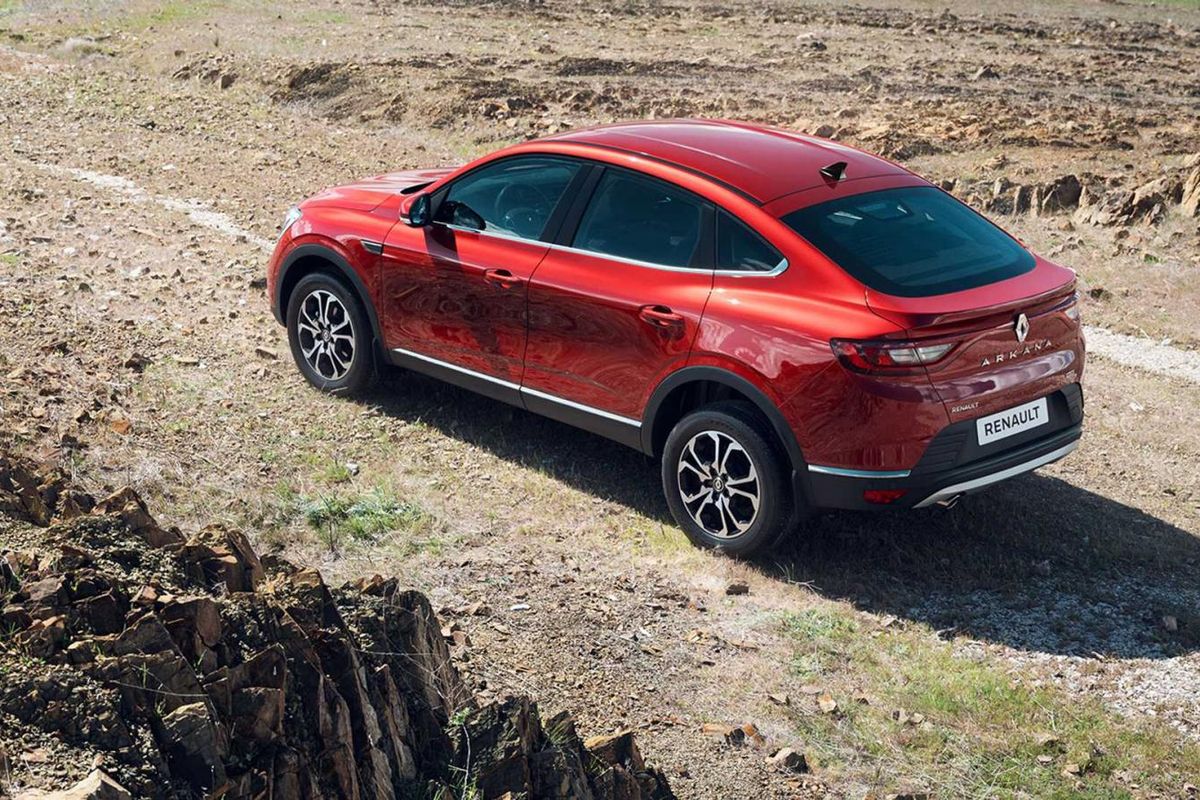
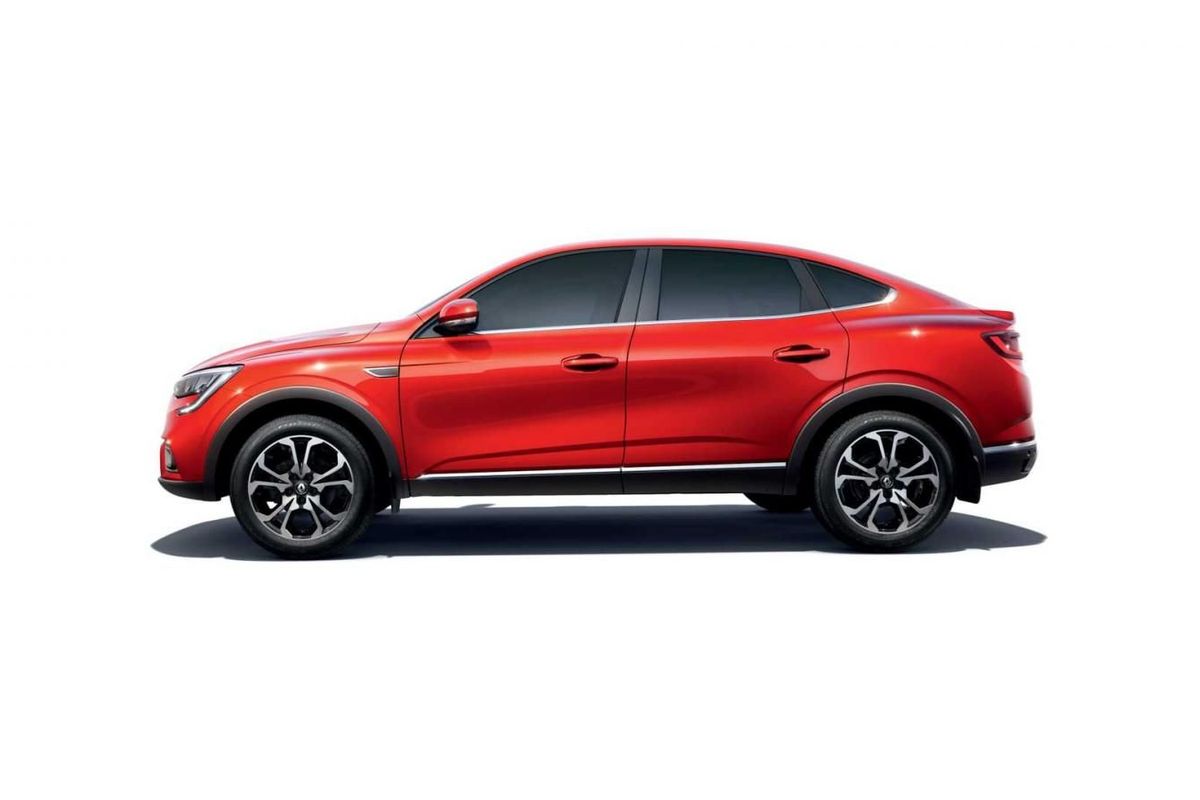
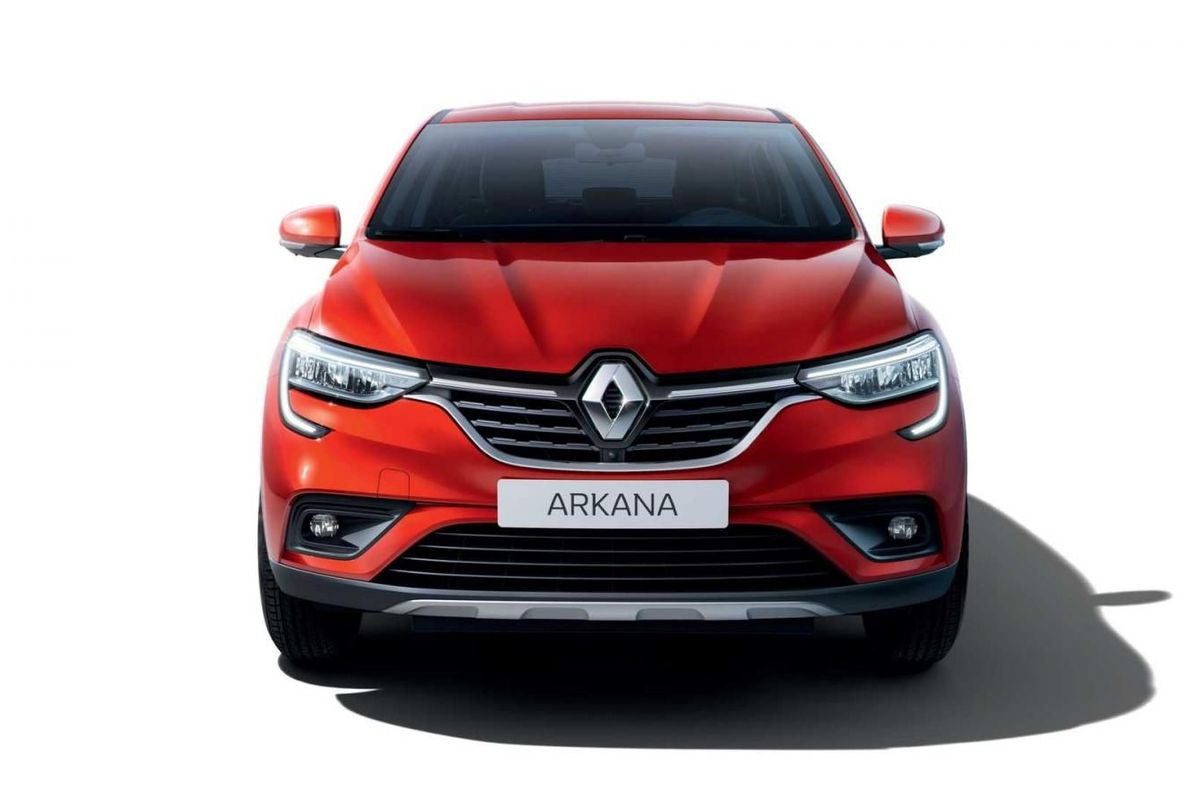
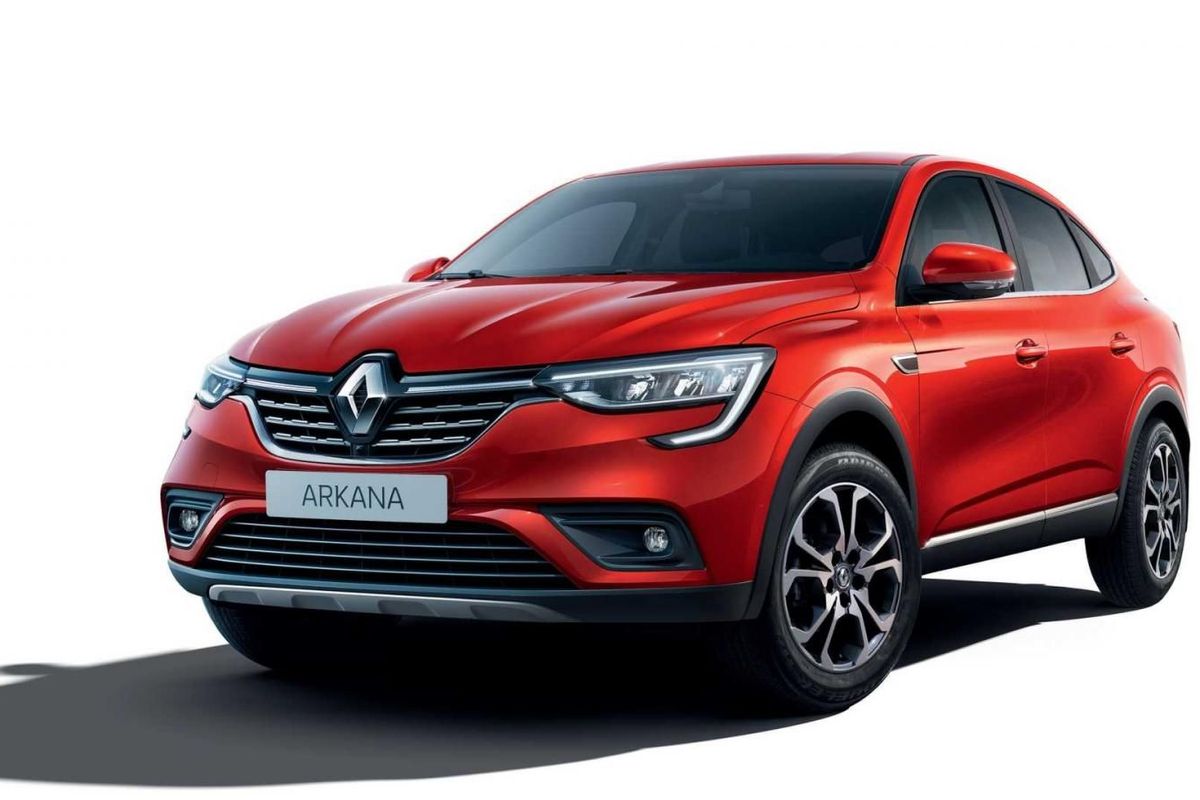
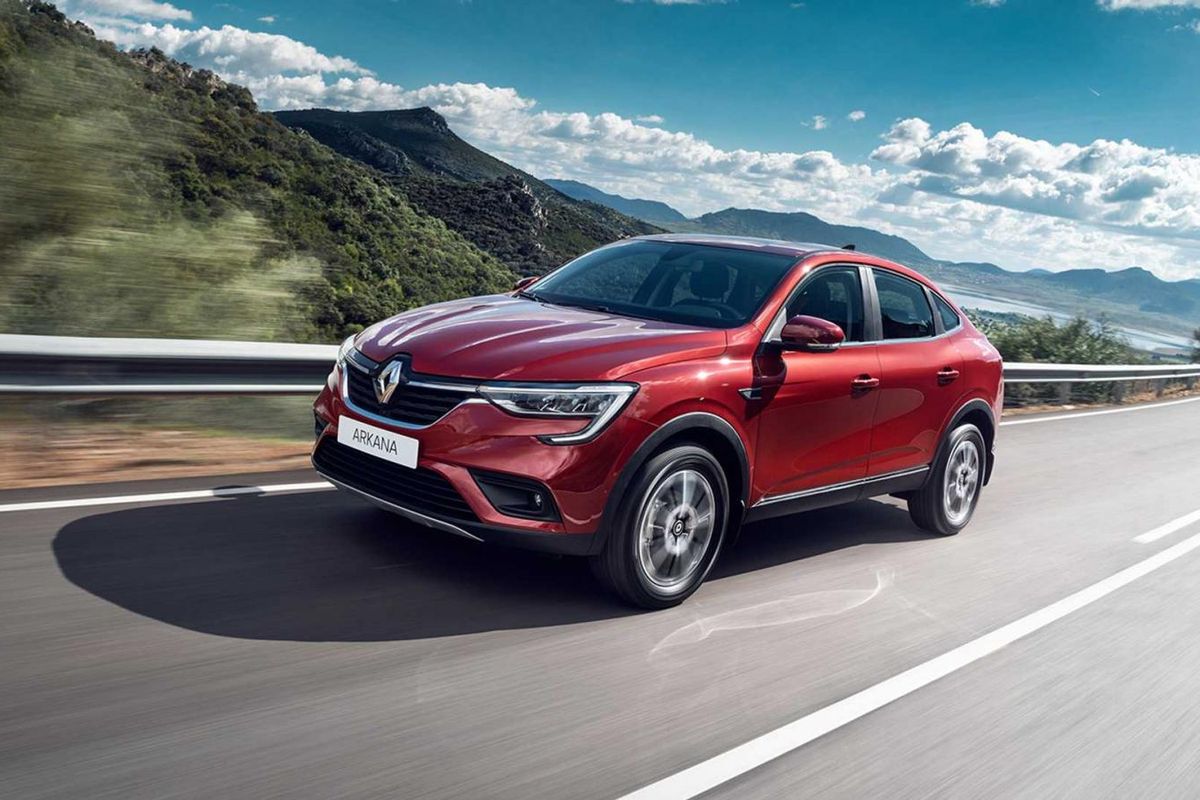
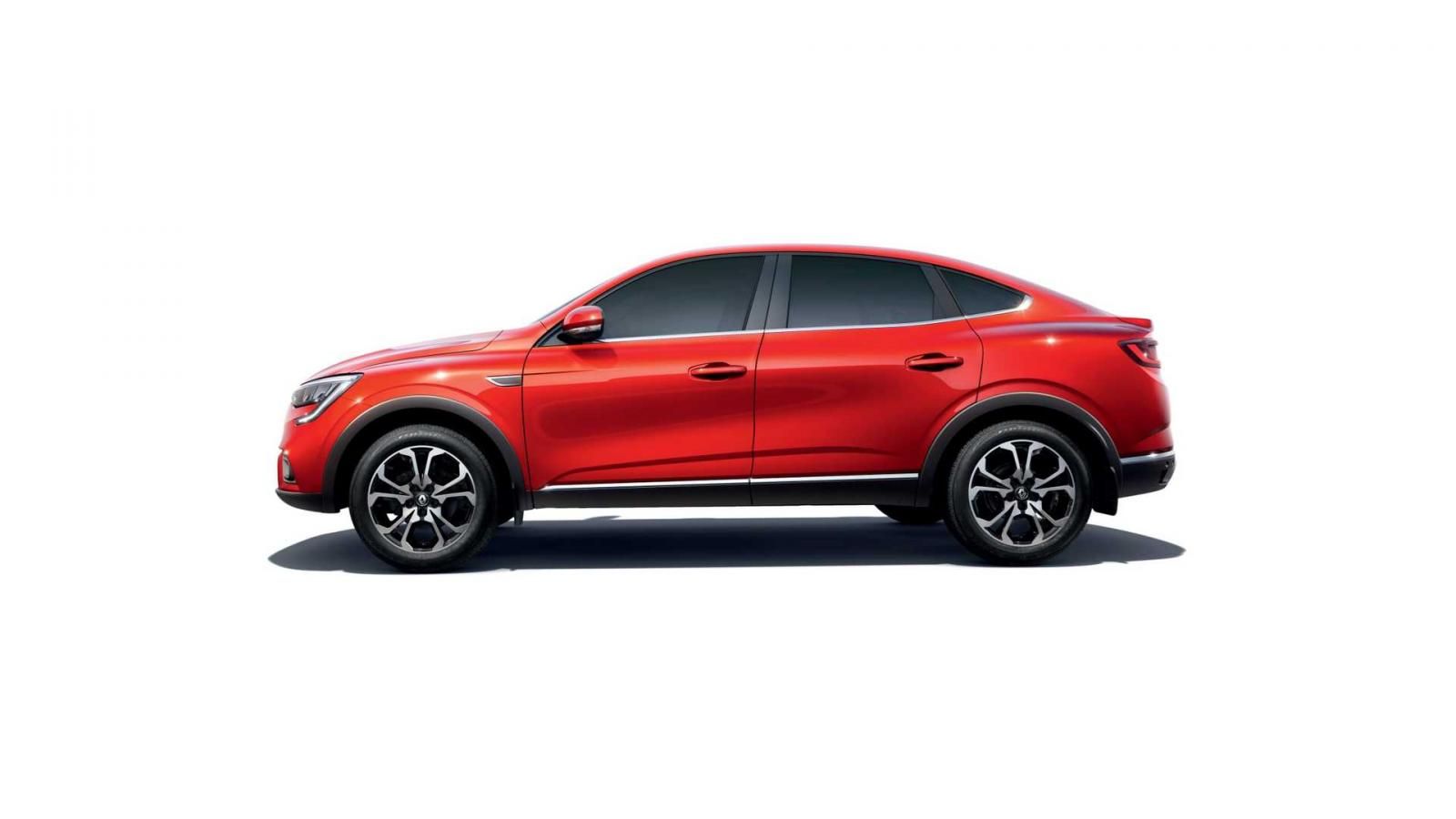
Renault Arkana is a French SUV Coupe


A robust crossover coupe, for Russia, by Renault at an affordable price.

Renault has commenced deliveries of its new C-segment crossover, the Arkana.

The product strategy with Arkana is to offer an affordable crossover coupe to customers who aspire to pseudo gravel travel styling, with a sloping roofline.

Built as part of a very complex joint venture between Renault-Nissan-Mitsubishi and Daimler, the Arkana’s launch market will be Russia. It combines frontal styling elements from the latest Clio and Koleos with a coupe-like profile and crossover stance.

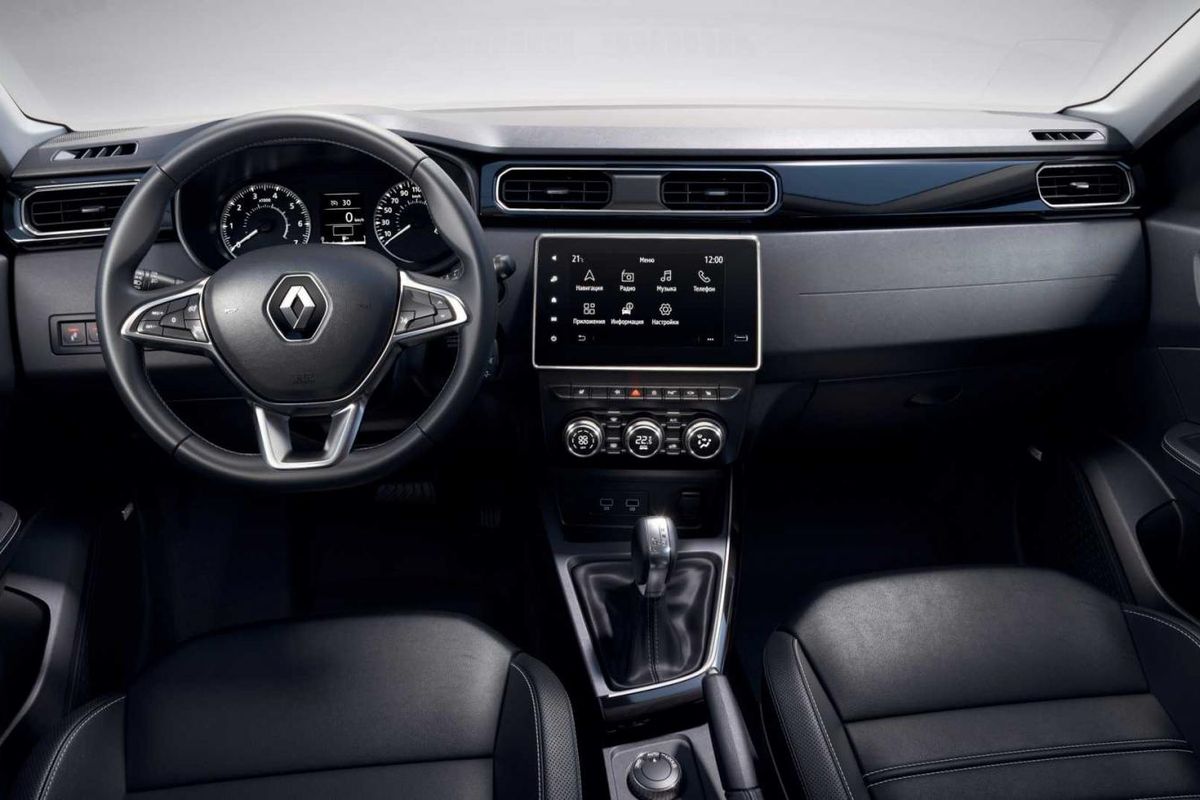
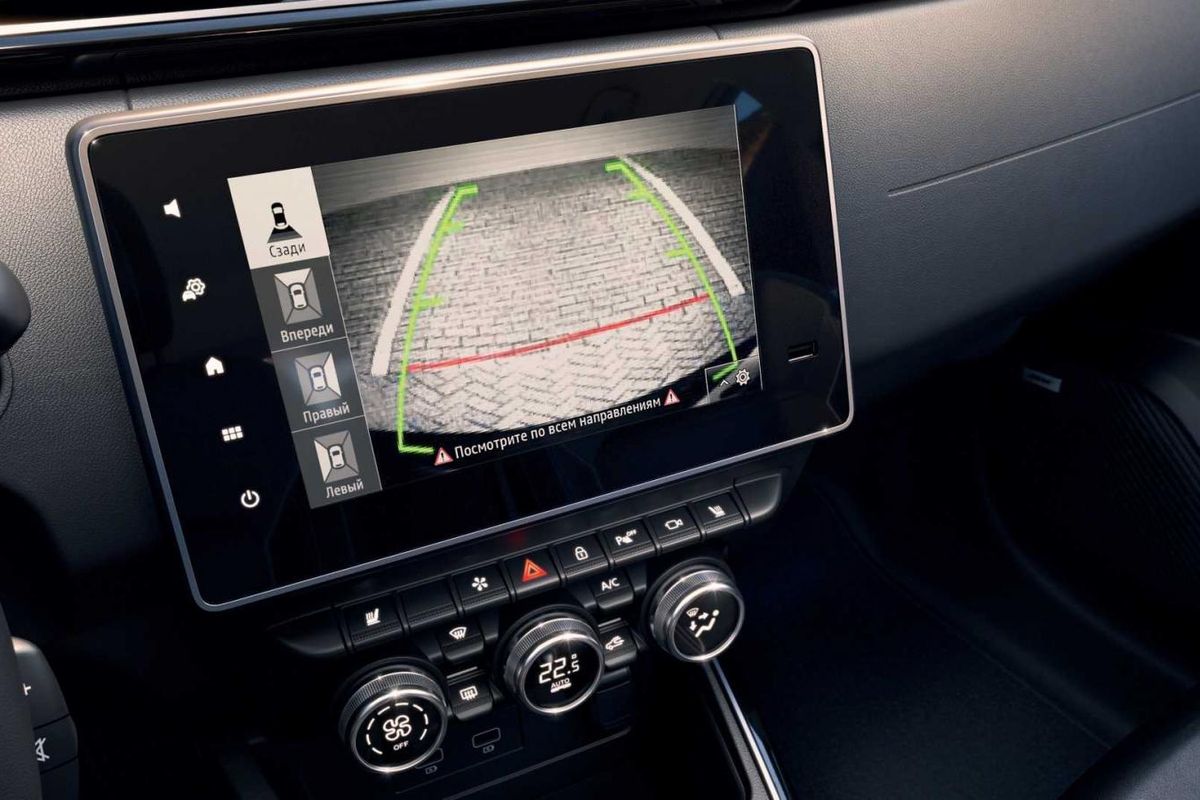
Measuring 4.54 metres in length, the Arkana will accommodate five passengers and 508-litres of their luggage. Fold down the rear seats and that luggage capacity swells to 1 333-litres. Renault has confirmed that even the entry-level Arkanas will feature an eight-inch infotainment touchscreen, climate control, heated seats and parking sensors.


The Coupe SUV trend is now filtering down from the premium brands.

Powering the  Arkana are two engine options. A naturally-aspirated 1.6-litre petrol engine is good for 85 kW and drives the front wheels. For those customers who seek all-wheel drive, there is a 1.3-litre turbopetrol, boosting 112 kW and 250 Nm, paired with a CVT transmission.

Appearance might underestimate the Arkana’s ability, as it registers a very ample 208 mm of ground clearance – which means it should make light work of most gravel journeys and mild off-road work.  

Renault is launching its Arkana at an equivalent price position of R315 000, for the entry-level front-wheel-drive version. Unfortunately, Renault South Africa has no plans to bring this in, despite its seemingly good value and stylish appearance. Possibly the lack of interest in 'big Renaults' locally has something to do with it as the brand struggles to shift things like Koleos and Megane in meaningful numbers.

Renault is planning to bring in the recently revealed 7-seater Triber – you can read about that here.

New BMW 1 Series: Price for SA


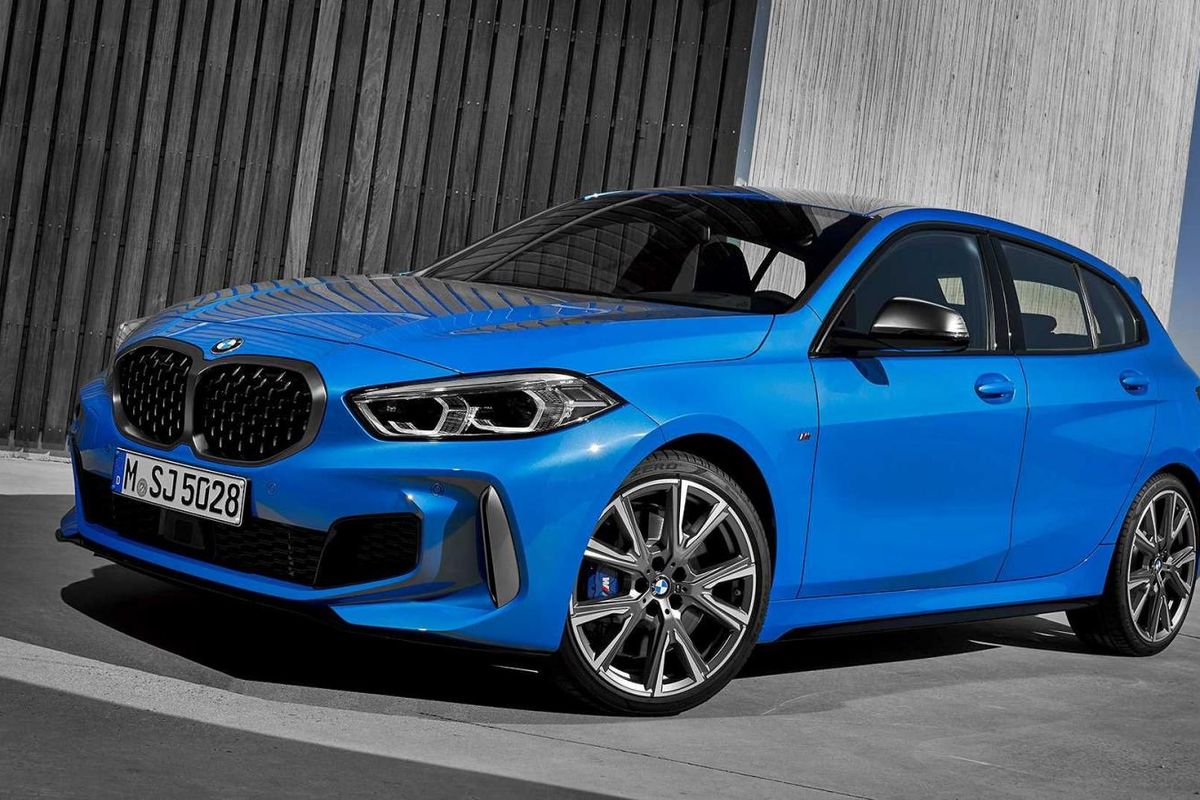
BMW has officially revealed the new third-generation 1 Series premium hatchback which is due to arrive in South Africa in October 2019. Take a look at what you can expect below…

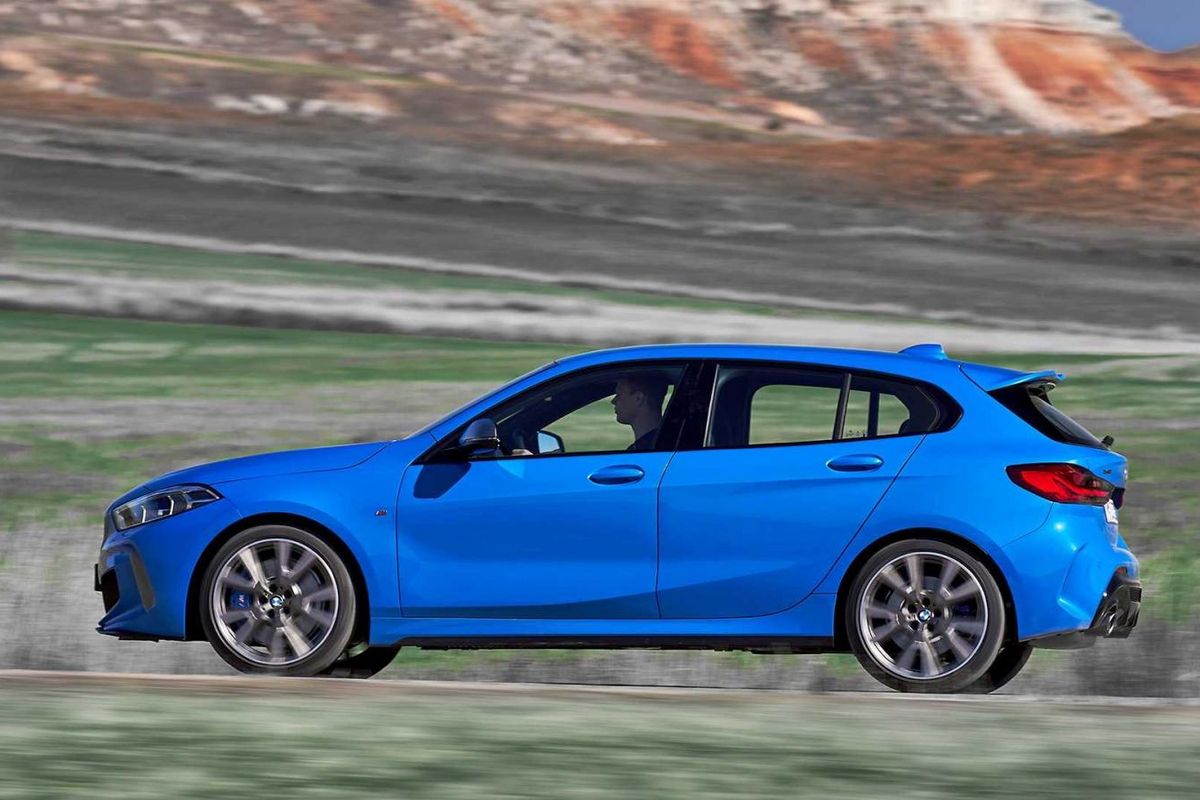
A new 1 Series has broken cover and unlike the outgoing model, it will now be offered in front-wheel drive configuration which has reportedly improved interior space of BMW’s premium hatchback.

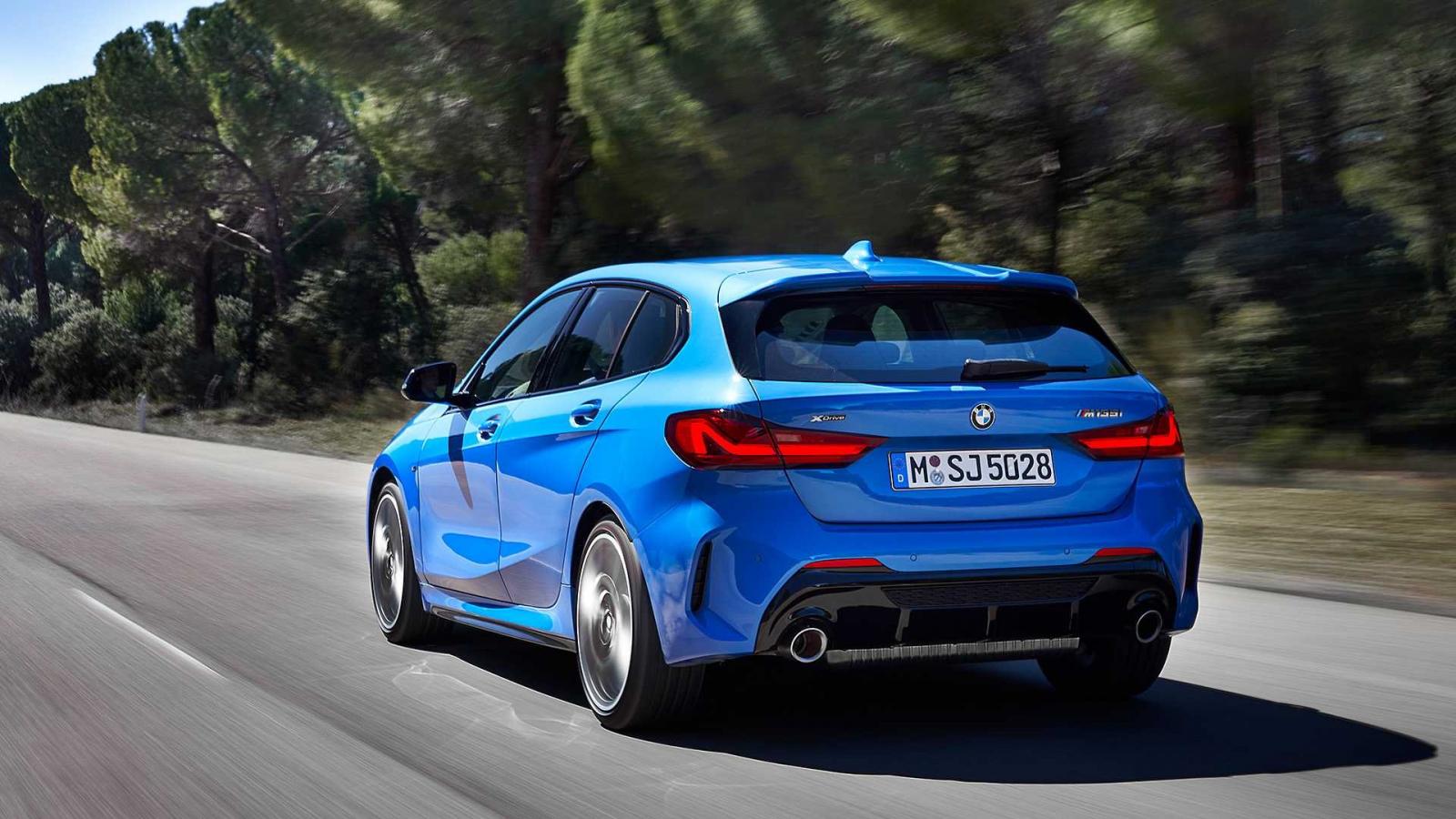
The new 1 Series is offered in 5-door guise only and stands some 5 mm shorter than the previous model at 4 319 mm. It’s some 34 mm wider though, now standing 1 799 mm wide and also standing 13 mm higher at 1 434 mm. The wheelbase has also been shortened by 20 mm to 2 670 mm when compared with the second generation model.

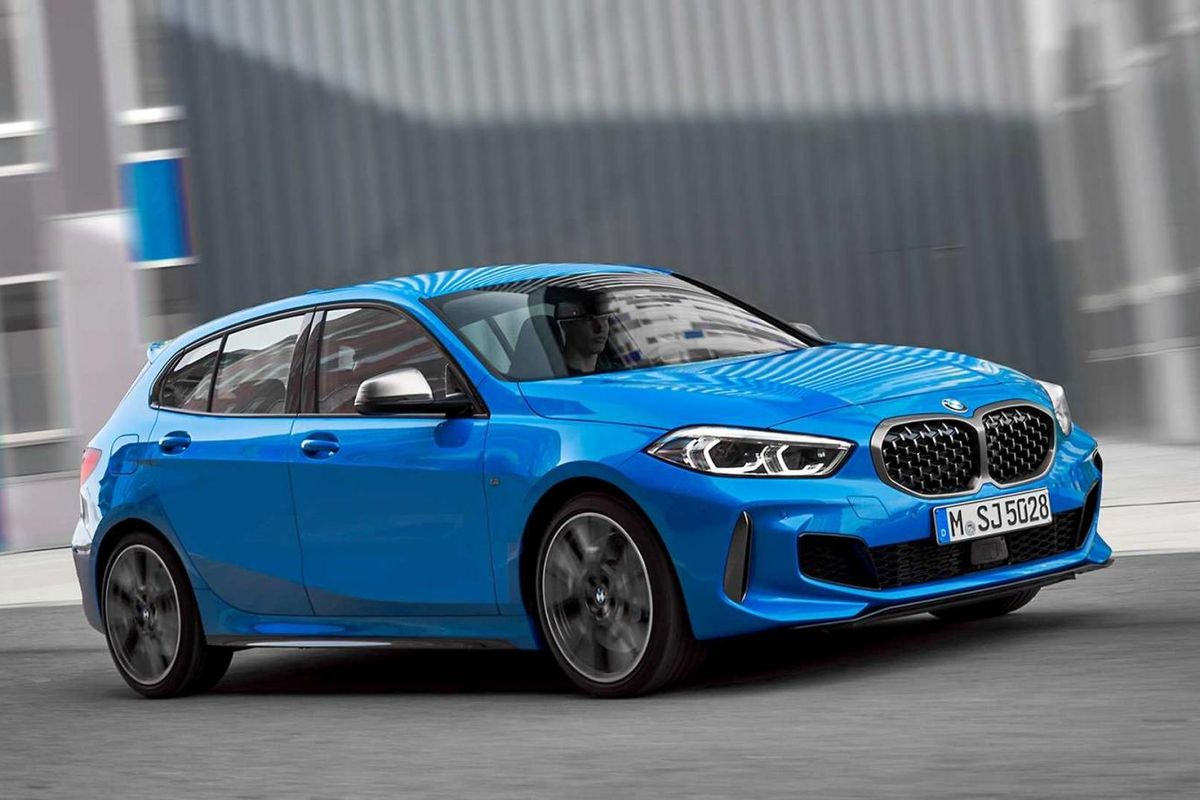
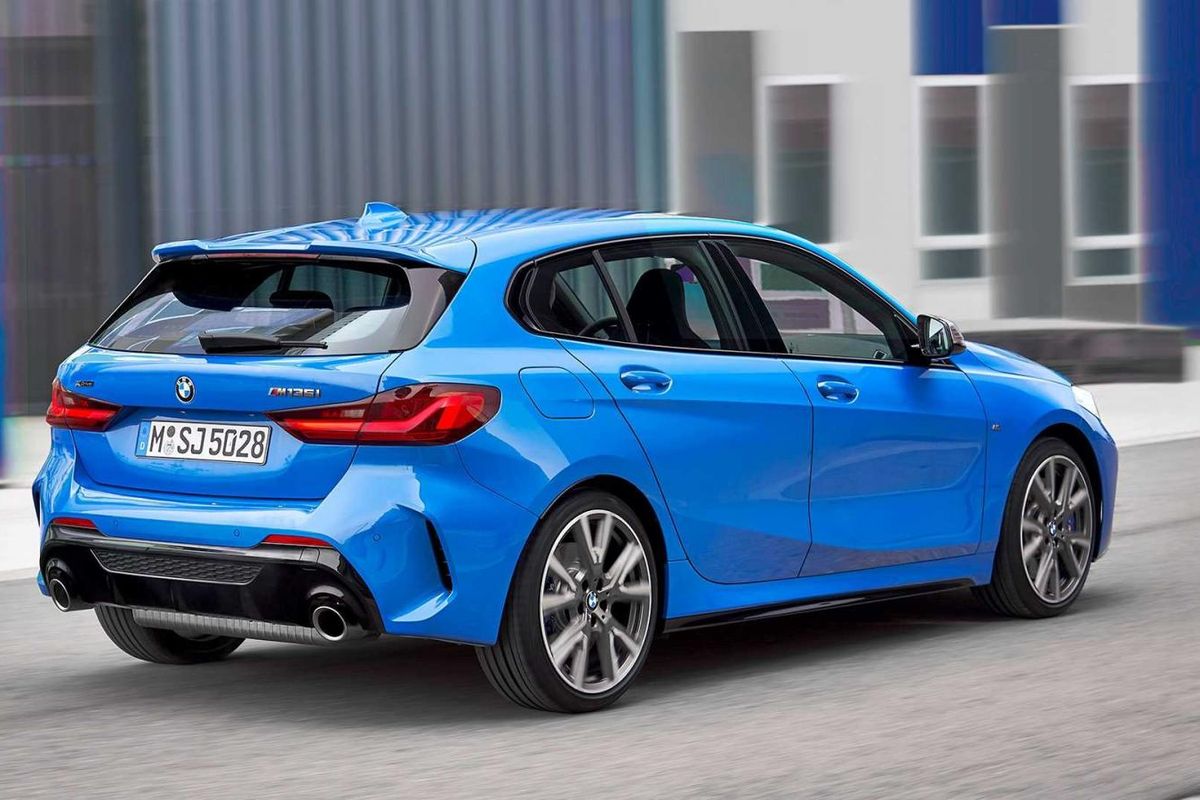
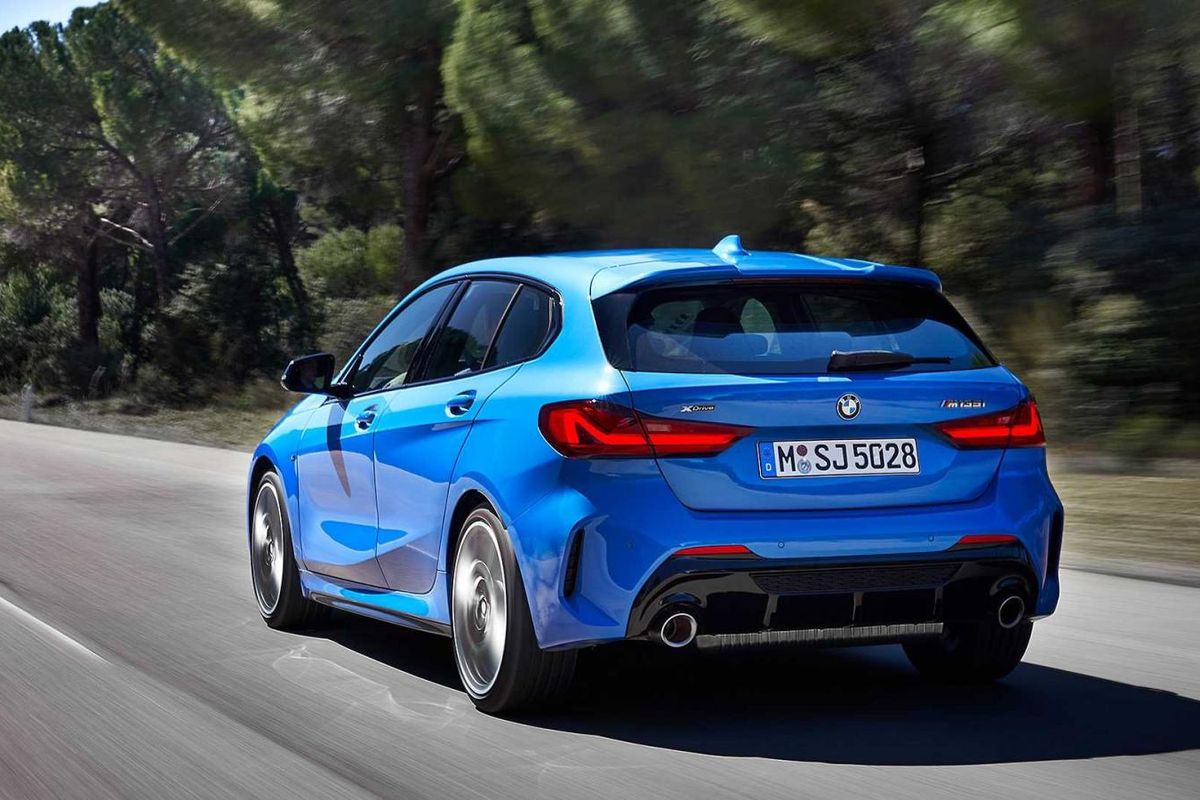
In terms of styling, the new 1 Series wears a larger, more prominent kidney grille with the 2 kidneys merging in the middle for the first time and flanked by angled headlights (adaptive LED headlights optional). The rear-end features two-section taillights which reinterpret the familiar L-design. The 1 Series will be offered with a host of new alloy wheel designs with sizes ranging from 16- to 19-inches.

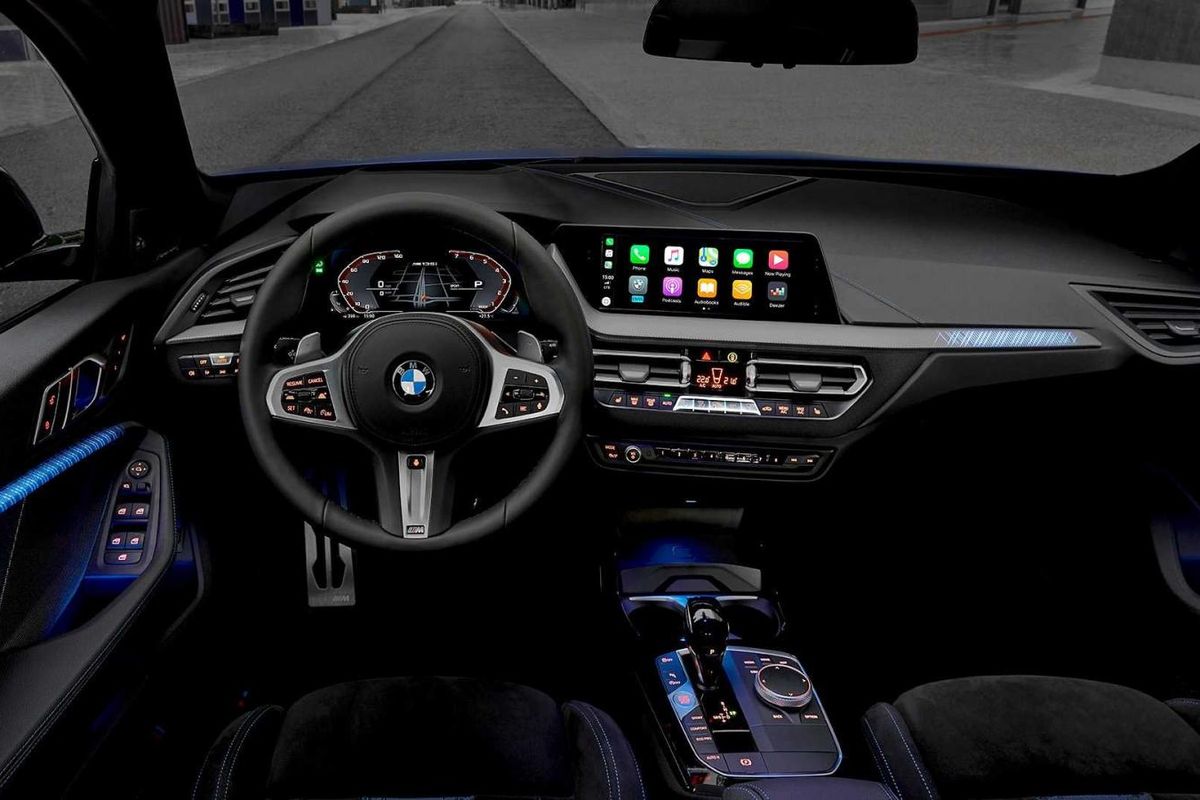
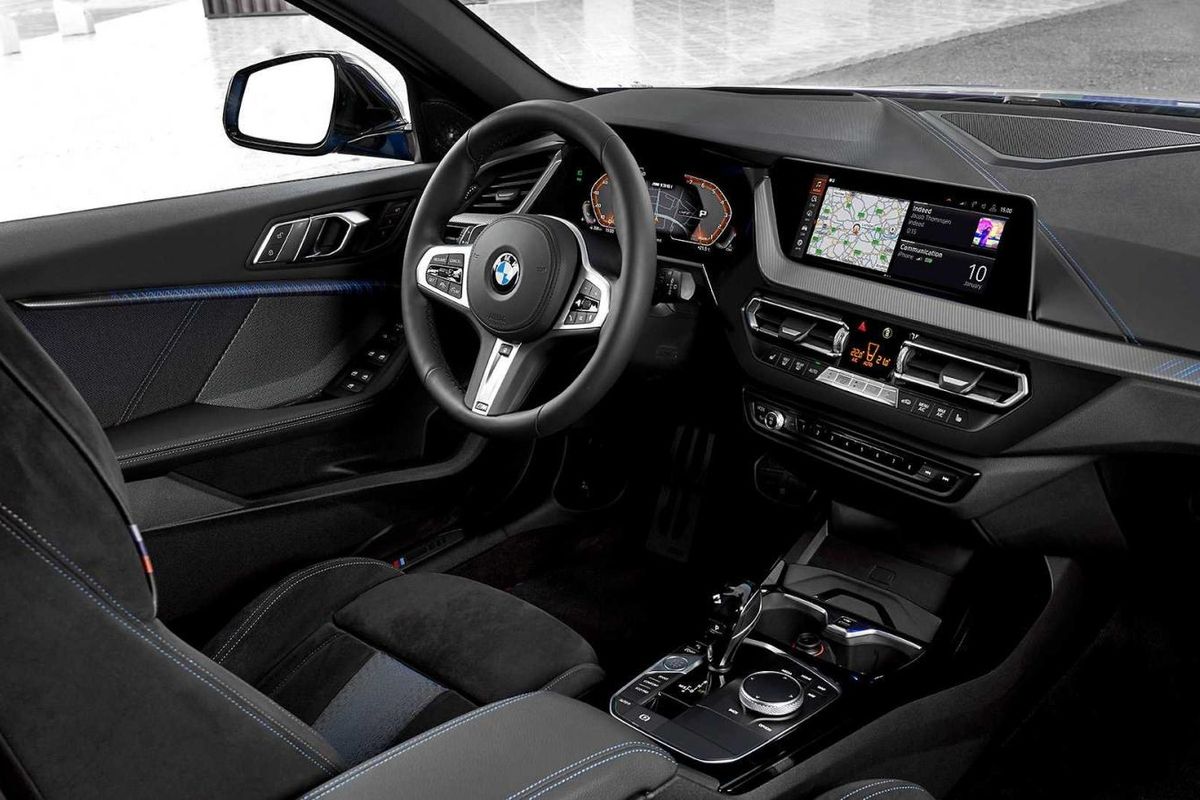
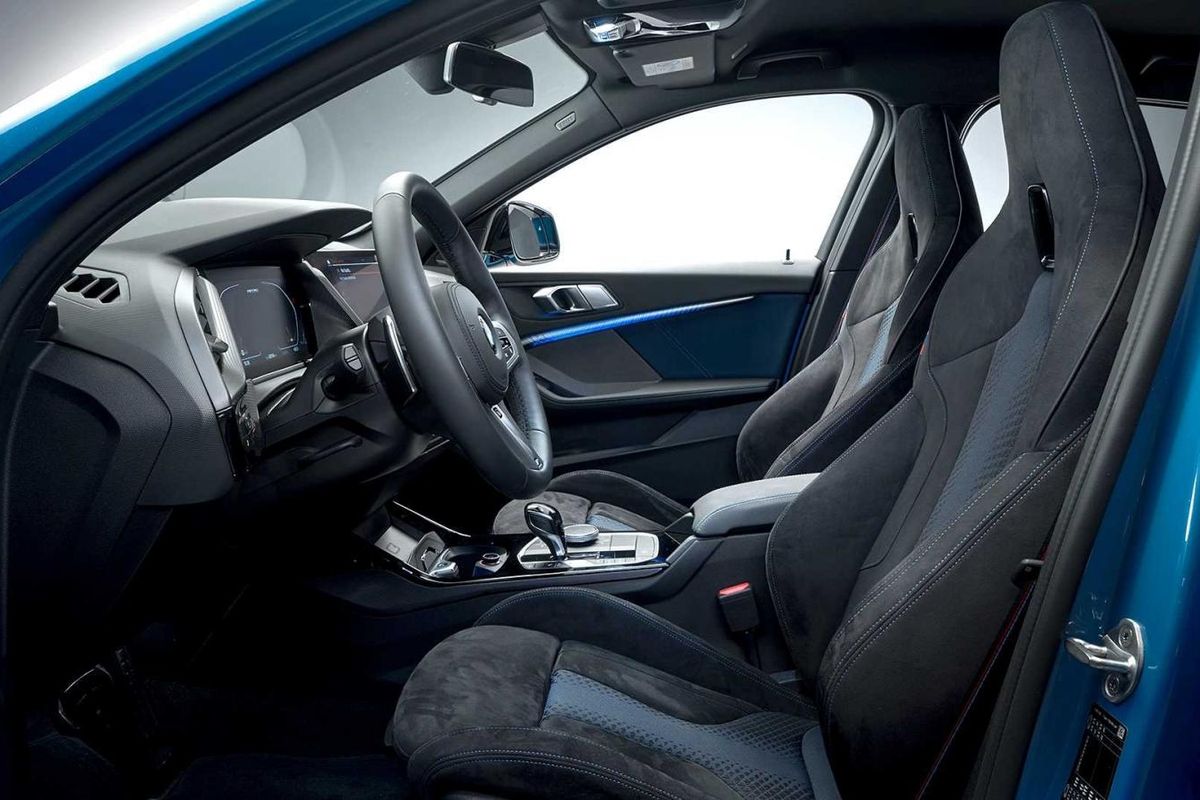
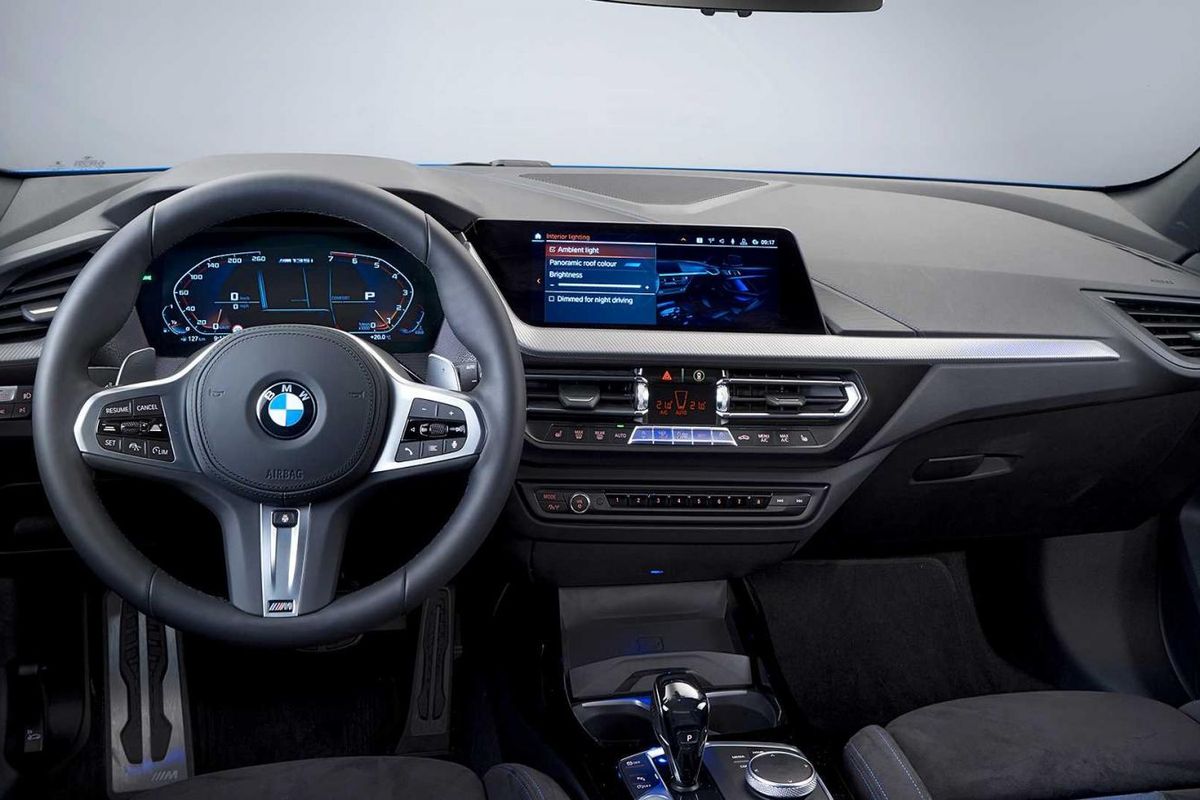
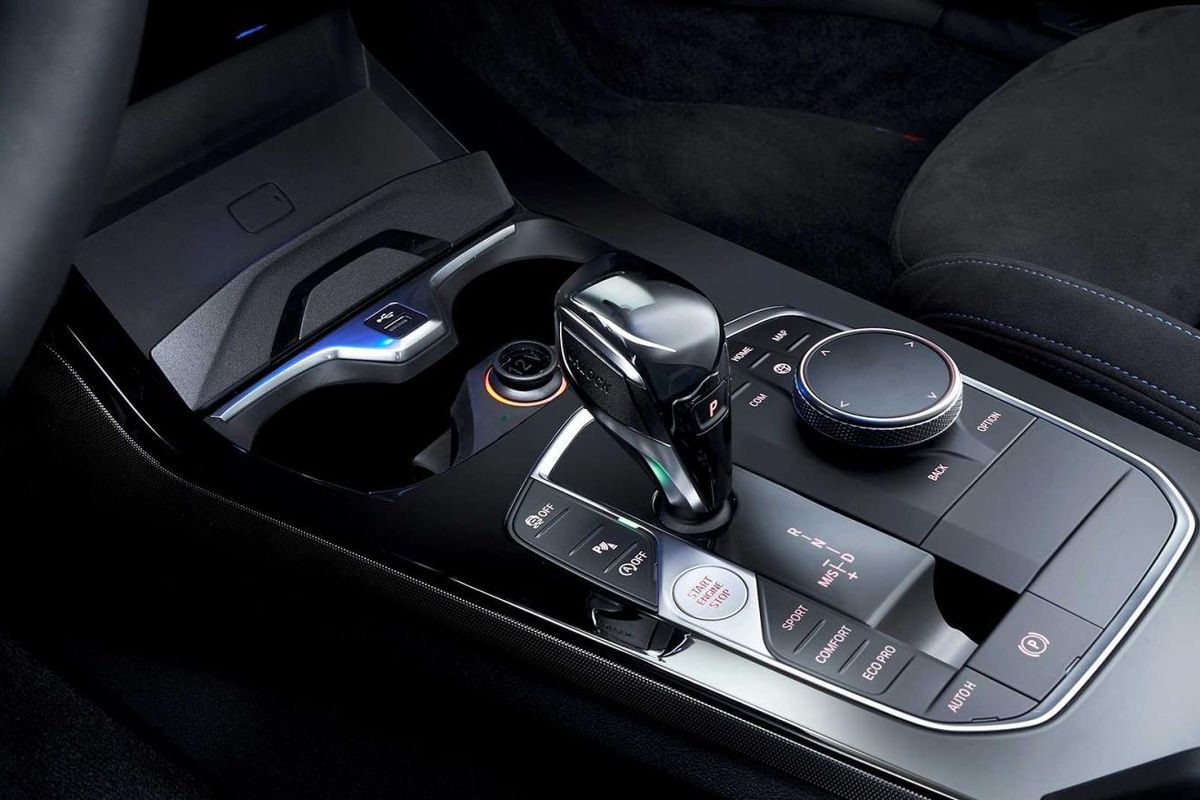
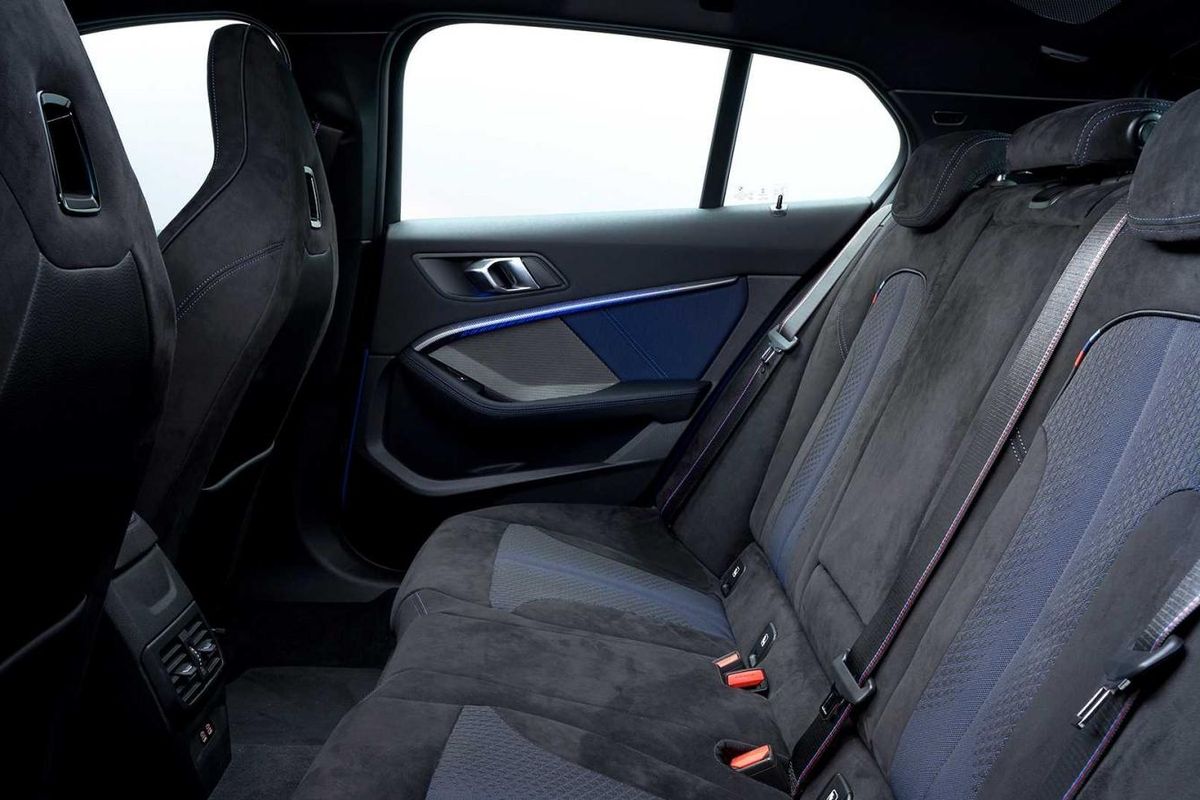
As for the interior, BMW will offer an electric panoramic sunroof for the first time on the 1 Series. Other features such as a choice of backlit trim strips and wireless charging will also be offered to customers. The 1 Series can also be had with a pair of digital screens of up to 10.25-inches in size featuring BMW Operating System 7.0. A full-colour, 9.2-inch Head-Up Display will also be optionally available.

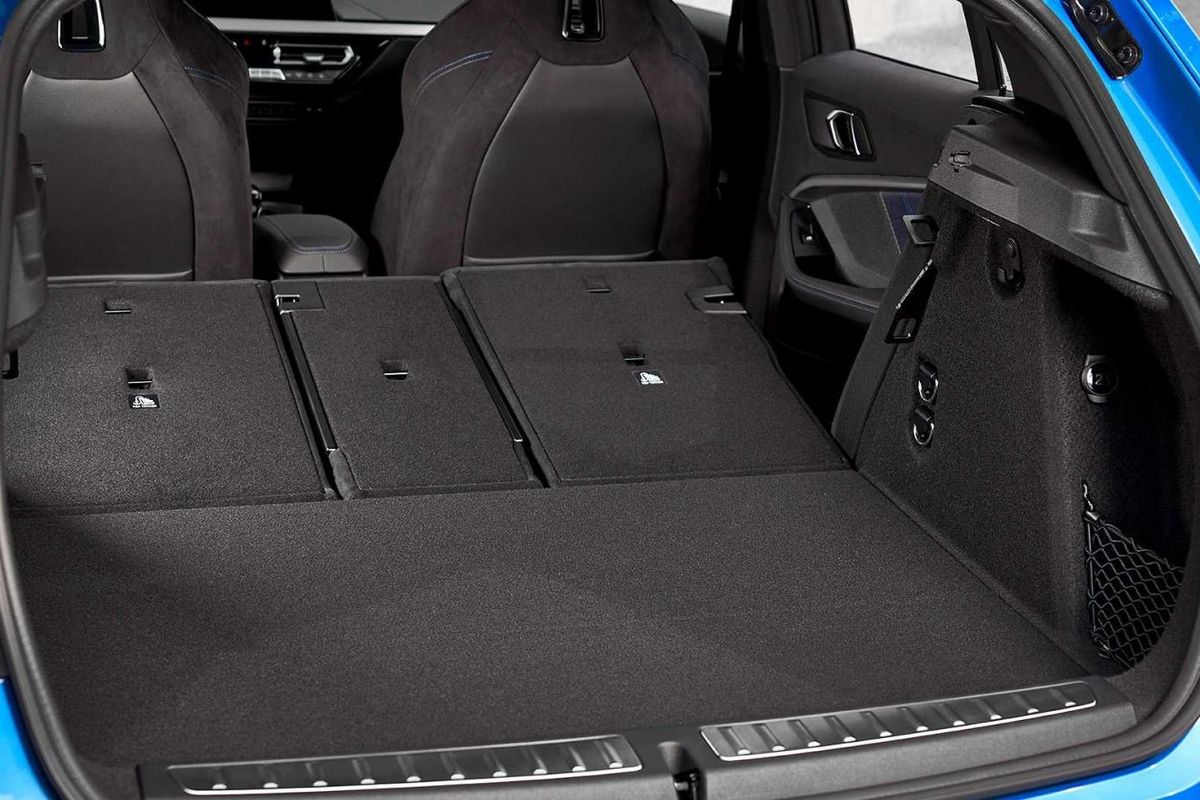
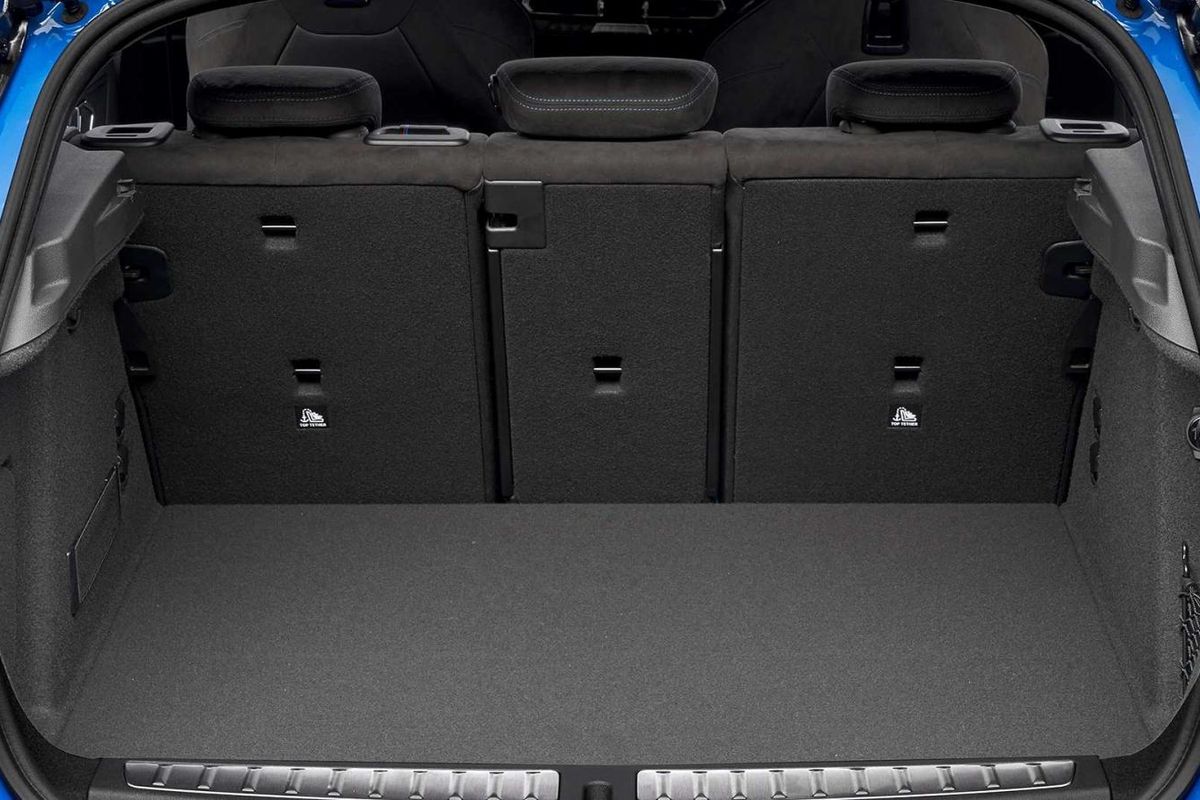
Importantly, in terms of space, BMW says that rear passenger kneeroom has improved by 33 mm while headroom has increased by 19 mm (with outward sunroof specified). Elbow room is also some 13 mm more generous for rear passengers while front occupants get an extra 42 mm. The load bay measures 380 litres which is 20-litres more than the outgoing 1 Series and increases to 1 200 litres with the rear seats folded down. BMW has increased the boot width by some 67 mm and an electric tailgate will also be offered.

A total of 4 equipment lines will be available including the base Advantage, Luxury Line, Sport Line and M Sport.

Engines for SA


Only 2 engine choices will be offered in South Africa from launch with the M135i xDrive topping the range. 

While the 1 Series will be powered by 3 diesel engines and 2 petrol engines globally, BMW has confirmed that South Africa will initially receive the 118i and the range-topping M135i xDrive.

The 118i is powered by a 3-cylinder, 1.5-litre turbopetrol engine with 103 kW and 220 Nm of torque. A 6-speed manual or 7-speed dual-clutch transmission will drive the front wheels. Zero to 100 kph for the 118i is claimed at 8.5 seconds with a top speed of 213 kph. Fuel consumption is claimed at 5.7-5.0 L/100km.

For those seeking more driving thrills, the M135i xDrive is the one to go for with a 2.0-litre turbopetrol engine producing 225 kW and 450 Nm of torque. Using an 8-speed sport transmission and equipped with all-wheel drive, the M135i xDrive will dash from zero to 100 kph in 4.8 seconds and reach a top speed of 250 kph. BMW claims a fuel consumption figure of 7.1-6.8 L/100km.  

Look out for our driving impressions coming your way on 17 July 2019. 

New BMW 1 Series – Price in SA

BMW 118i – R480 897.50

BMW M135i – R705 451.50

Buy a new or used BMW 1 Series on Cars.co.za

Related Content

New BMW 1 Series Teased

Front-Driven BMW 1 Series to use i3 Traction Tech

BMW M140i Finale Edition Revealed

Spy Shots: New BMW 1 Series