Drag Race: Renault Clio RS18 vs Volkswagen Polo GTI
Who is ready for a warm-to-mildly-hot set of drag races? Well, we're going to post them anyway. Here's the first one, where the limited edition Renault Clio RS18 takes on the Volkswagen Polo GTI.
Over the next four weeks, we'll be rolling out a 4 part video series, featuring some of the hottest (warmest?) hatches available right now in South Africa. It's called the Ultimate Warm Hatch Shootout, and it's exclusive to Cars.co.za.
Stay tuned and subscribe to be the first to see two more drag races and a track race featuring the 2018 Polo GTI, the Renault Clio RS F1, the Mini Cooper S and the very special Toyota Yaris GRMN.
In this video, the Polo and the Clio go head to head on the quarter-mile drag strip. The race took place at sea level on a cold day, so Ashley Oldfield and Ciro De Siena braved the elements to bring you this cracking race.
If the world’s most disruptive car company hopes to survive, it might need to lose its maverick CEO.
For the world’s most charismatic billionaire, 2018 has been the most trying year of his incredible career. Isolate his uncontained arrogance and baiting on Twitter and there is no argument that Elon Musk is both outrageously talented and an unrepentant car guy.
With all the production issues, share price valuation debates and questions regarding his stewardship of the automotive world’s first successful battery-car company, we tend to forget that Musk isn’t merely a technologist seeking to disrupt the established car brands. He is an enthusiast who, like Mr Bean/Blackadder/Johnny English star Rowan Atkinson, has owned (and crashed) a McLaren F1 – arguably the purest road-going performance car ever made.
Musk is well-known for putting in 120 hour-plus weeks at the office, but has his strenuous efforts finally got the better of him?
There has always been a contention from those dedicated – and slightly obsessed – Musk followers that his Tesla project has an untrivial sense of destiny about it. The battery-powered car should have happened decades ago and its absence is merely a conspiracy between manufacturers and Big Oil. Ettore Bugatti, after all, had an electric car, with which he used to commute around the Molsheim factory in the 1930s.
Could August 2018 be remembered as the date when Tesla was either steered towards ultimate success – or terminally derailed? Last month Musk used his preferred personal device – Twitter – to admit that he felt overworked and isolated. The tension between Tesla’s production obligations and supplying perfectly configured powertrain batteries on a scale never attempted in the automotive industry, are now consuming him with 120-hour working weeks.
Has it all become too much for Musk?
On 7 August 2018, Musk – in a manner typical of him – enraged investors by tweeting that he had enough support to delist Tesla. For a man who has openly mocked institutional investors whilst presenting the company’s results, the published note of an intention and ability to remove Tesla from the public sphere was a bit too ambitious. Musk had called the bluff of all his critics.
The desire to take Tesla private was obvious: it would allow Musk greater independence and avoid the annoyance he has suffered as CEO of a publicly traded company, one which is beholden to strict financial reporting rules and all manner of scrutiny.
Investors were concerned when Musk appeared to puff on marijuana on the Joe Rogan podcast.
A private Tesla would not have to report every quarter, and this has been Musk’s moment of infamy as production targets have consistently underwhelmed – sometimes by enormous margins. The market has been good to Tesla. Its share price has ballooned tremendously in the last two years, from just below $40 in 2013 to above $300 in 2018, which availed Musk a massive capital base from which he could execute his master vision for a battery-powered future.
When you take open-market money it comes with a required measure of scrutiny too – and this relationship has not been one Musk is at all comfortable with. His behaviour when questioned about Tesla’s missed production targets or any other strategic discrepancy has often bordered on hostile. With Musk, there is always the sense that telling other people what you are doing with their money is an unnecessary detail which should not apply to renegade entrepreneurs such as himself.
Norway was once a huge supporter and investor of Tesla, but the carmaker's reputation has slid somewhat in the eyes of the Scandanavians.
Record Tesla share prices created other issues too and were perhaps the primary reason why Musk could not do as he had originally tweeted he would. When your share price is as fully valued as Tesla’s, it makes delisting very expensive and few institutions or investors have the reserves of cash, and steadfast belief in Tesla’s wildly ambitious vision, to fund the realisation of Musk’s privatisation tweet. Ironically, the people who had sufficient cash to help Tesla go private were also those most at risk of its battery-powered cars.
Why would Big Oil save the electric car?
Pressured to reveal the credibility of his claim that Tesla has a partner with the $66 billion required to delist, Musk admitted that the Saudi’s national sovereign wealth fund was involved. The irony is crushing. Saudi Arabia is the world’s biggest oil producer and an anchor member of OPEC, the cartel which controls global petroleum production and supply – depending on price fluctuations.
It would appear madly irrational for a national oil revenue investment fund to help Tesla perfect a product and supply chain that will, ultimately, destroy the Middle Eastern hydrocarbon economy. With Elon Musk the new normal is always an outrageous a scenario, hence his claim of Saudi willingness to entrust a ridiculous amount of money, to a company that has never been profitable, isn’t that unbelievable. To take Tesla private at Musk’s $66-billion valuation would have wiped out a 3rd of the Saudi sovereign wealth fund’s holding: which currently stands at a healthy $230 billion.
Why would Saudi oil money be interested in acquiring a large stake in Tesla?
That Musk is desperate isn’t surprising, but that the Saudis signalled an interest? That requires explaining. Despite the Kingdom’s ultra-conservative appearance, the Saudis have realised their prosperity beyond 2030 can’t rely solely on oil. Diversification is now an urgent strategy and buying into the electric car future is a clever move.
Saudi oil money currently owns 5% of Tesla and the world's most ethically responsible oil revenue wealth fund, that of Norway, a minor interest of 0.48%. The Norwegians have immense cash to invest, their oil money piggy bank is 4 times the size of Saudi Arabia’s, yet they weren’t keen on a deal. Norwegians have shown a tremendous appetite for Tesla’s cars, at one stage being the brand’s best comparative market, but customer issues have tarnished Tesla’s image in Norway.
The Norwegian sovereign wealth fund is extremely prudent with its investment strategy and has criticised Musk’s position as both CEO and chairperson of Tesla. It is unlikely they would ever have paid an enormous amount of cash for a business that hasn’t yet made a profit.
Is Tesla better without Musk?
After calling the market’s bluff and being embarrassed by his inability to delist Tesla, Musk has stumbled into yet another public relations disaster, by smoking marijuana during a recent podcast interview – with video footage to confirm the act.
Tesla’s chief accounting officer has subsequently quit, after only a month in the position, and despite the Model 3's production numbers improving, they are nowhere near the required targets. There is an increasing sense that for Tesla to survive, it can no longer have the individualistic Musk as its CEO.
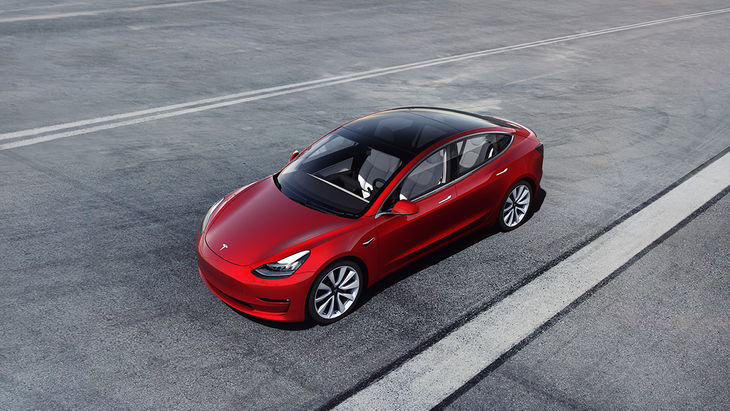
The Model3 has been hit and miss in terms of meeting its production targets.
It’s worth remembering that Musk was not the company’s founder. The original technology and vision, of marrying battery power with a sportscar, was an initiative of Martin Eberhard and Marc Tarpenning. Musk merely bought into the idea and thereafter attempted a hugely ambitious scaling of Tesla’s technology. This has perhaps been his greater failure too.
Tesla’s sophisticated electric powertrain and electronics architecture deserves all the accolades it has received from engineering specialists and technology trends observers. The company’s issue is that it cannot produce enough cars and build them to a desired level of quality. Tesla should have recognised the limits of its disruption and contracted production to an assembly specialist, much as Apple does with its iPhones. Incubating breakthrough technology and assembling it in required production volumes are 2 very different applications – Tesla is brilliant at the former, but has failed miserably at the latter.
Is the Tesla dream slipping away?
Where does the disastrous series of events in August 2018 leave Musk? It would appear all he has gained is a retiring share price and many calling for his resignation. It also leaves Tesla exposed at a time of rising oil prices, which are usually good for the electric car industry as more expensive fuel hikes up customer demand for alternative-propulsion products. Increasing oil prices would also give the Saudis more buying power and, as Musk’s shenanigans make Tesla shares cheaper, Saudi sovereign wealth fund managers can buy more of them…
If Musk thought he could use Saudi oil money to take Tesla private and avoid the grinding administration that accompanies running a publicly listed company, he has been proven very wrong indeed. The great irony is that his antics might have made it affordable for oil money to take over Tesla instead. It would appear Musk has been dealt his final hand and that the house holds all the winning cards.
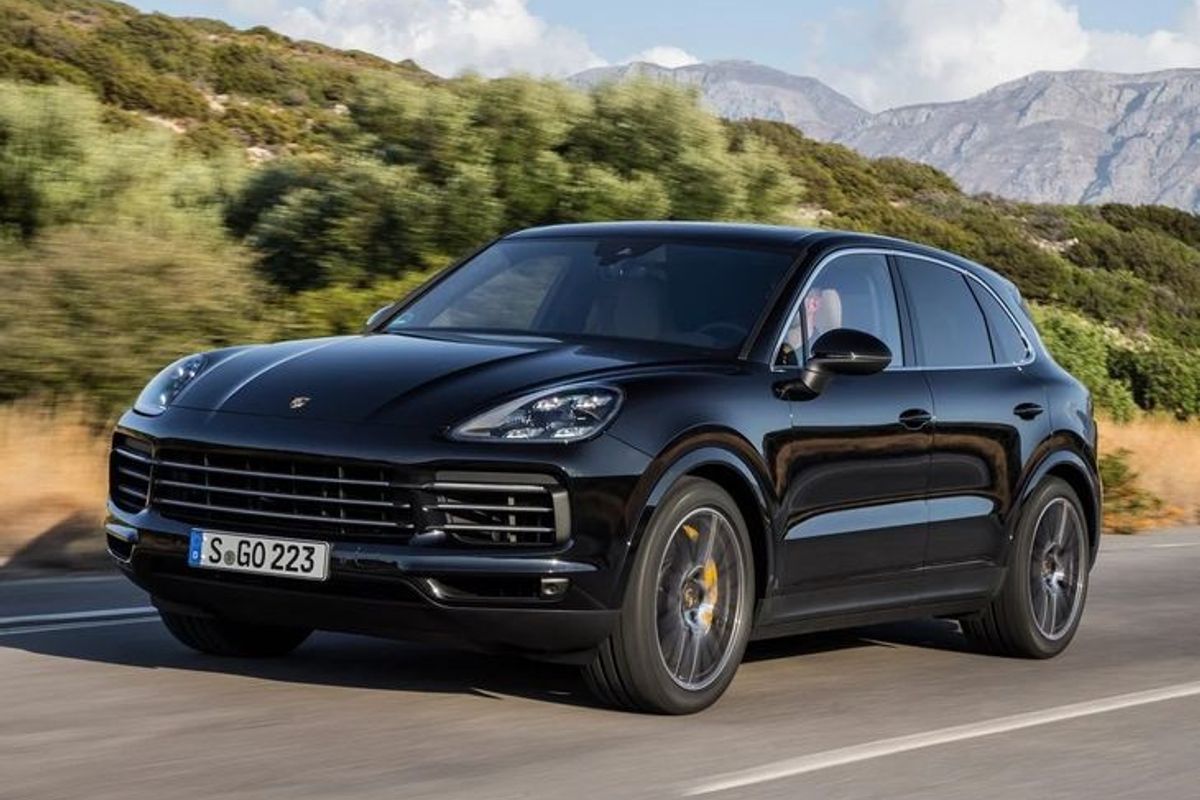
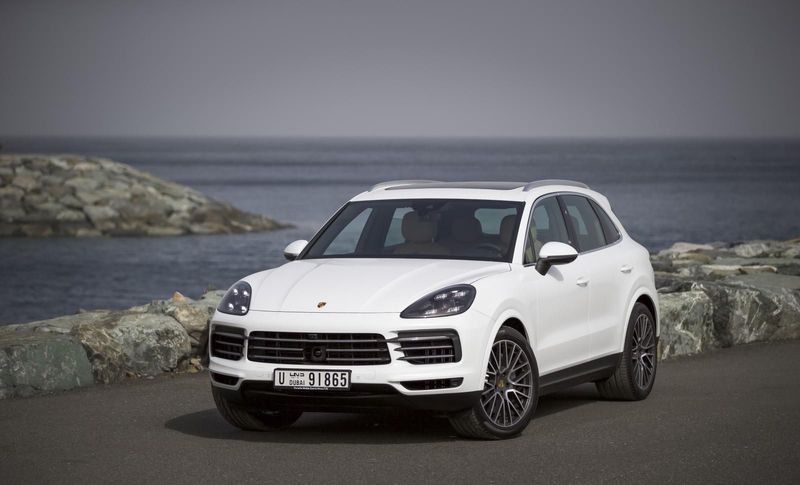
Given all the attention heaped on a Nurburgring record-setting Italian executive SUV and another supercar manufacturer’s new ‘bahnstormer' of its own, the all-new 3rd-generation Porsche Cayenne arrives with relatively little fanfare. Set to be introduced in South Africa soon (with deliveries commencing in June 2018), the Zuffenhausen-based firm’s newcomer seems to offer incremental improvements over its successful predecessor. Alarmingly for Porsche’s rivals, however, they add up to quite a lot.
A peek around the corner…
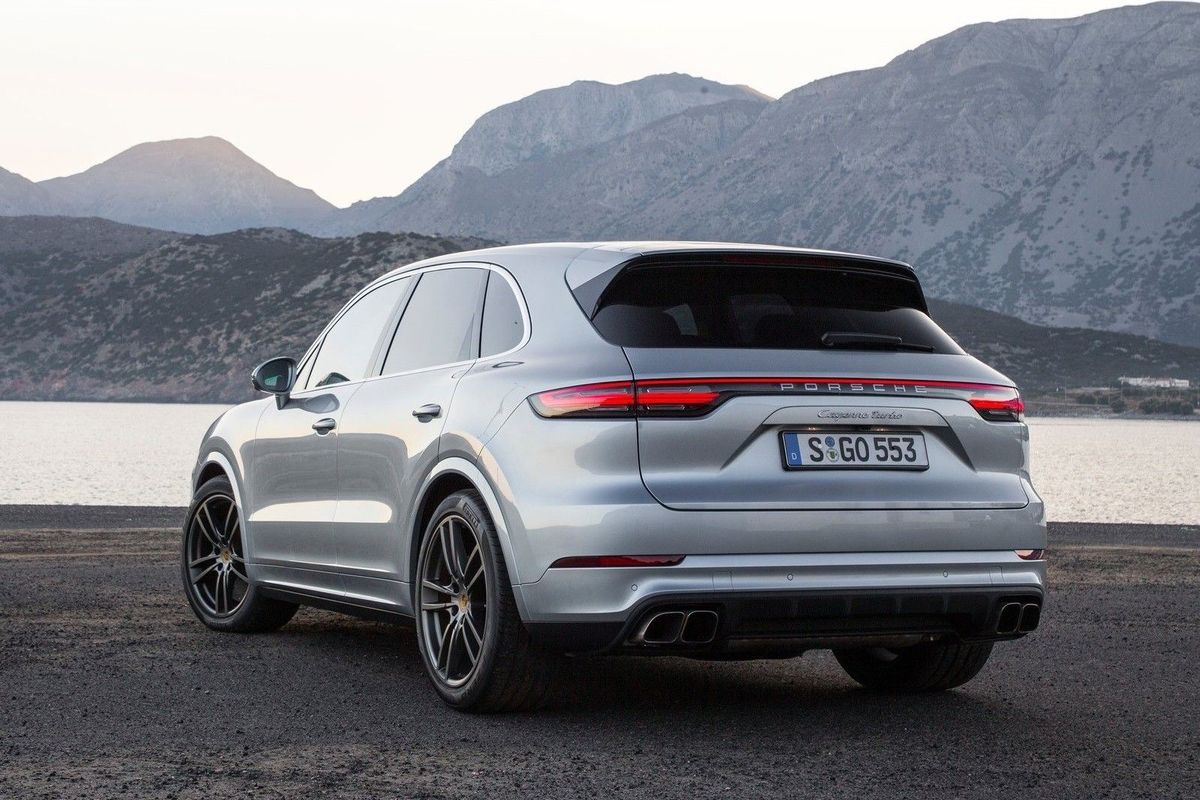
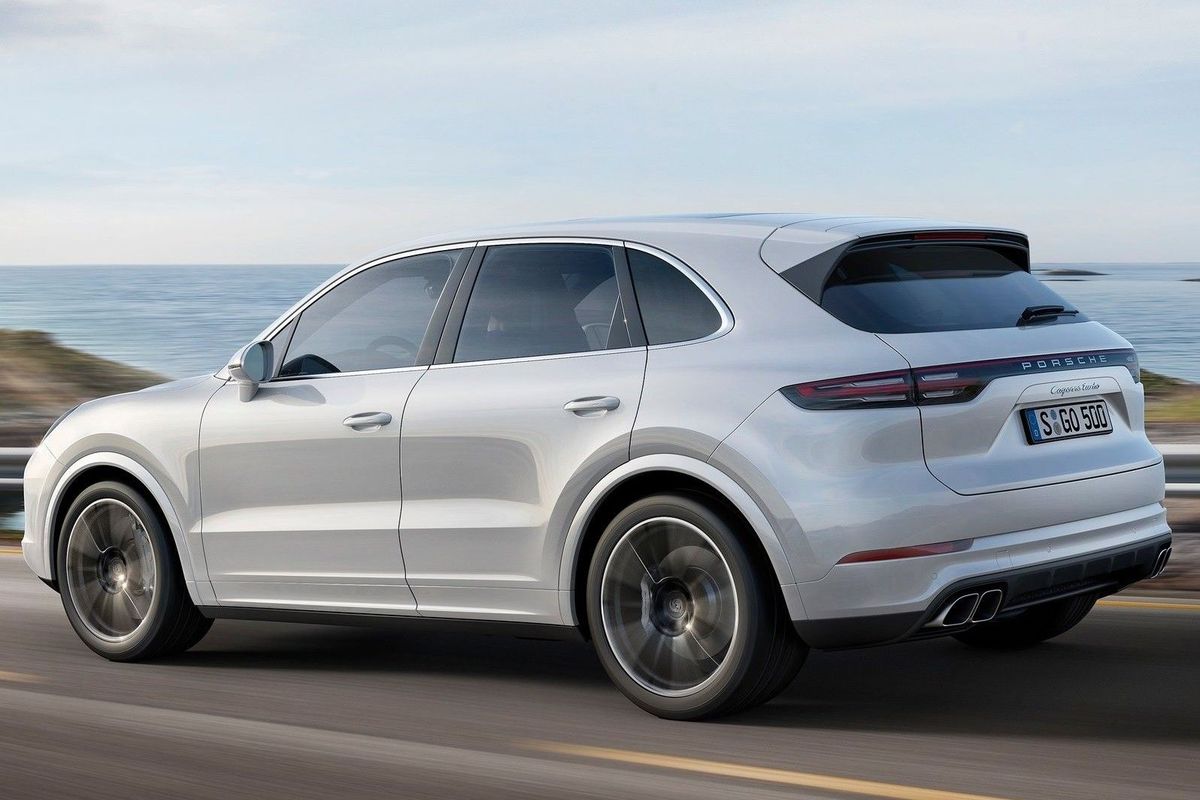
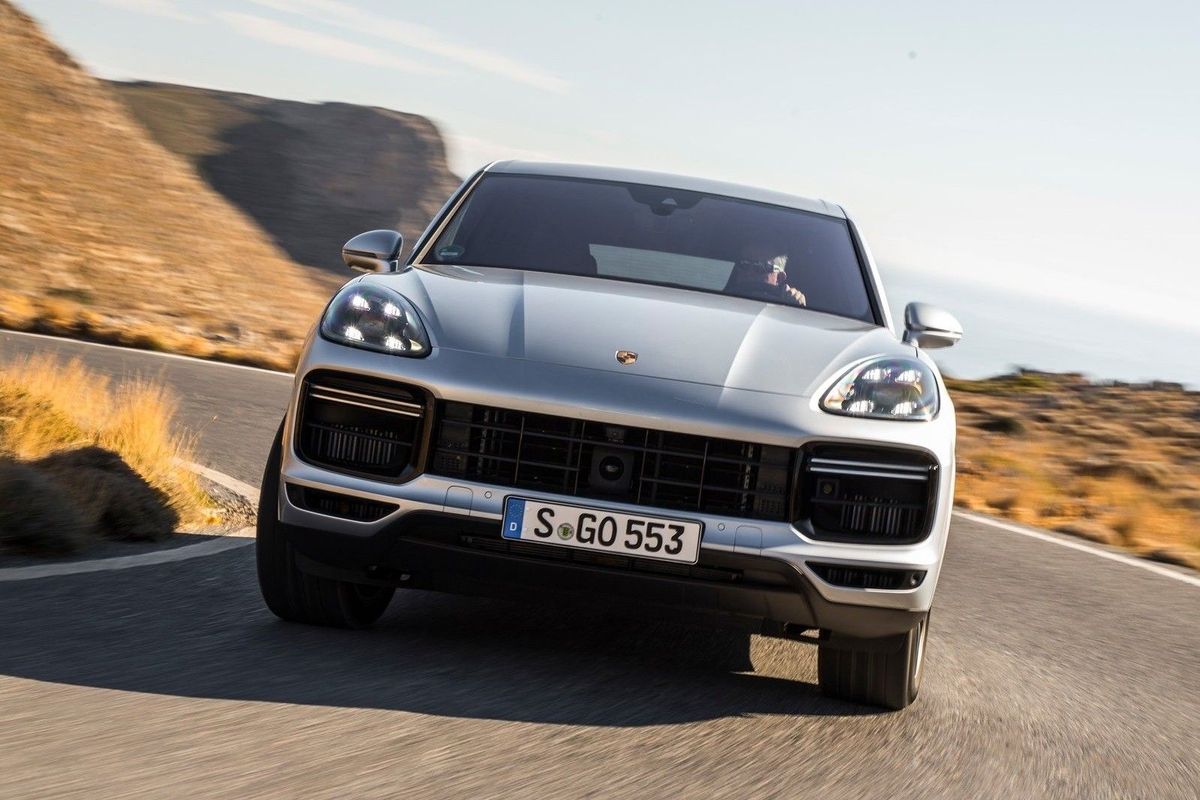
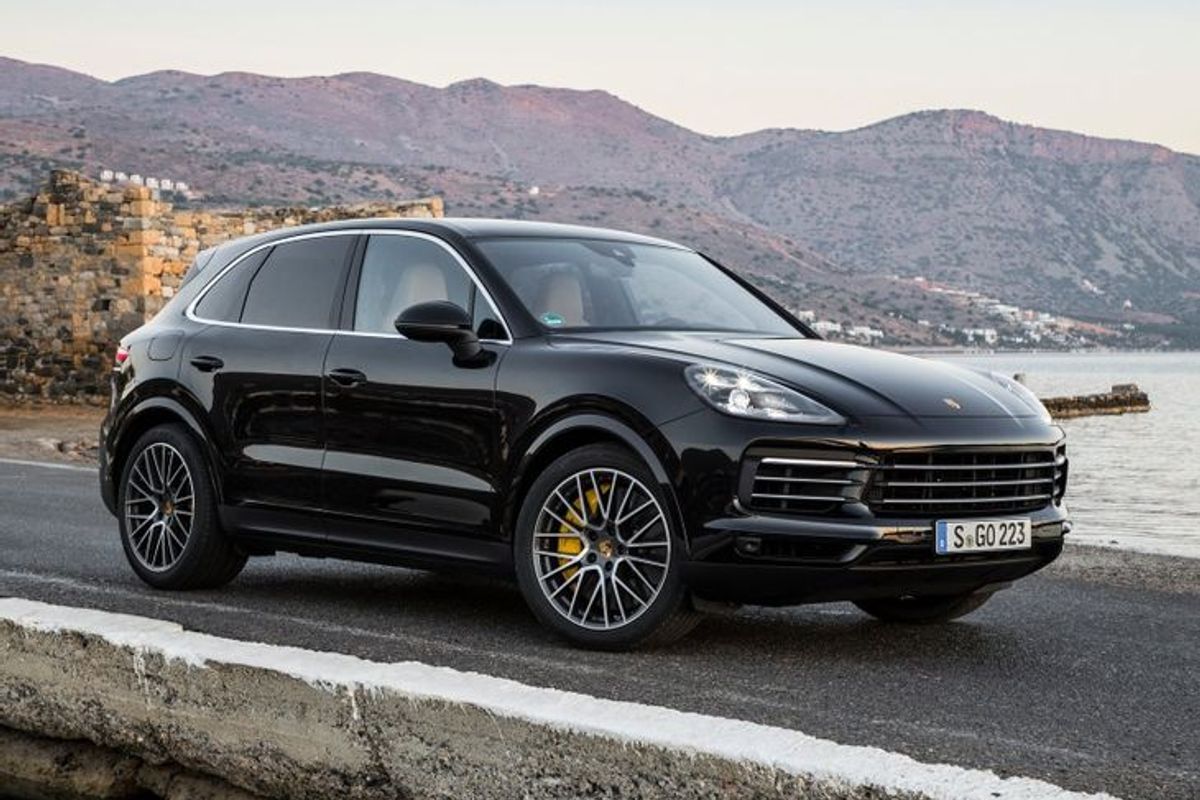
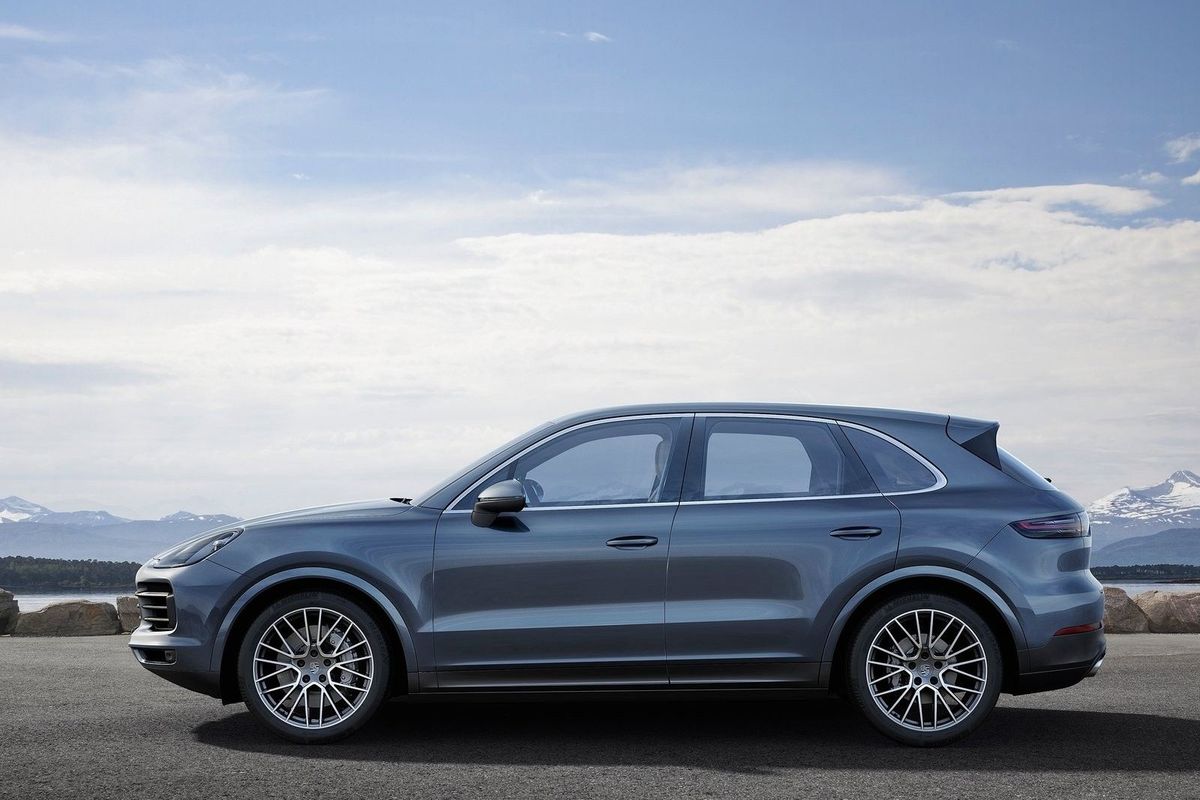
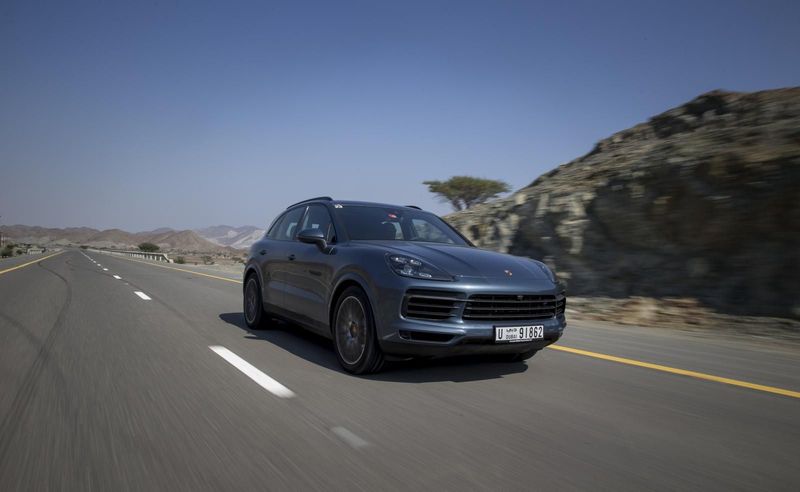
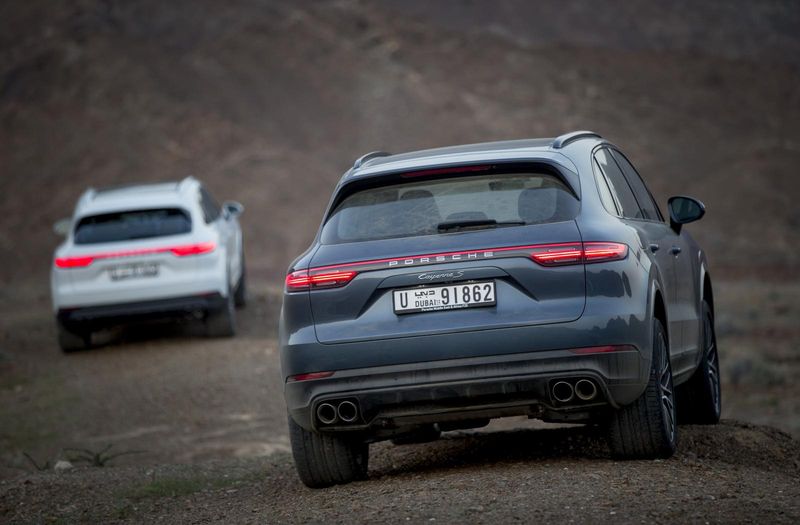
It takes a look around the car’s rear three-quarter to instantly recognise the 3rd-generation Cayenne from its forebears. The elongated tail light clusters neatly tie in with those of Porsche’s sportscars and simultaneously broaden and flatten the premium SUV’s stance, which is further helped by a roof that has been lowered slightly and a reduction in the side-glass area. From the front, the sharpened nose section comprises a barrage of louvred air intakes that dwarf the receding headlamps and give the Porsche that all-important “let me pass” on-road presence that is de rigeur for performance SUVs. The look may seem derivative, but it remains effective nonetheless.
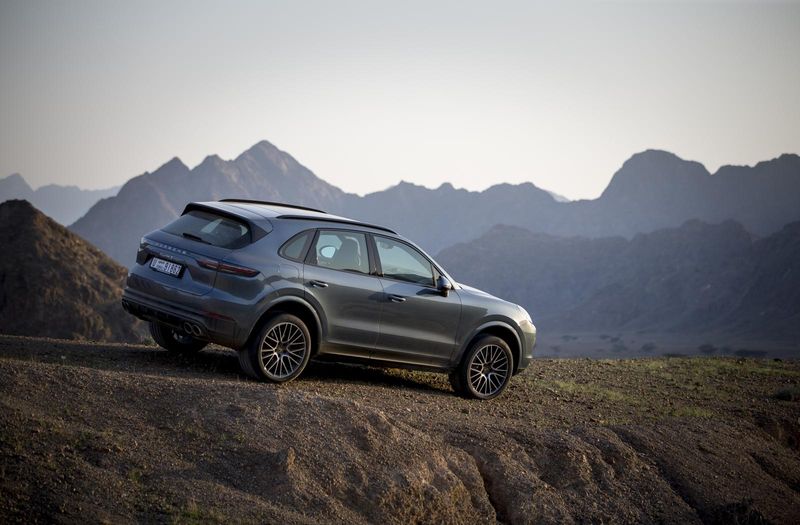
The 3rd-generation Cayenne's overall profile is discernably flatter by virtue of longer overhangs, a wider track and lowered roof.
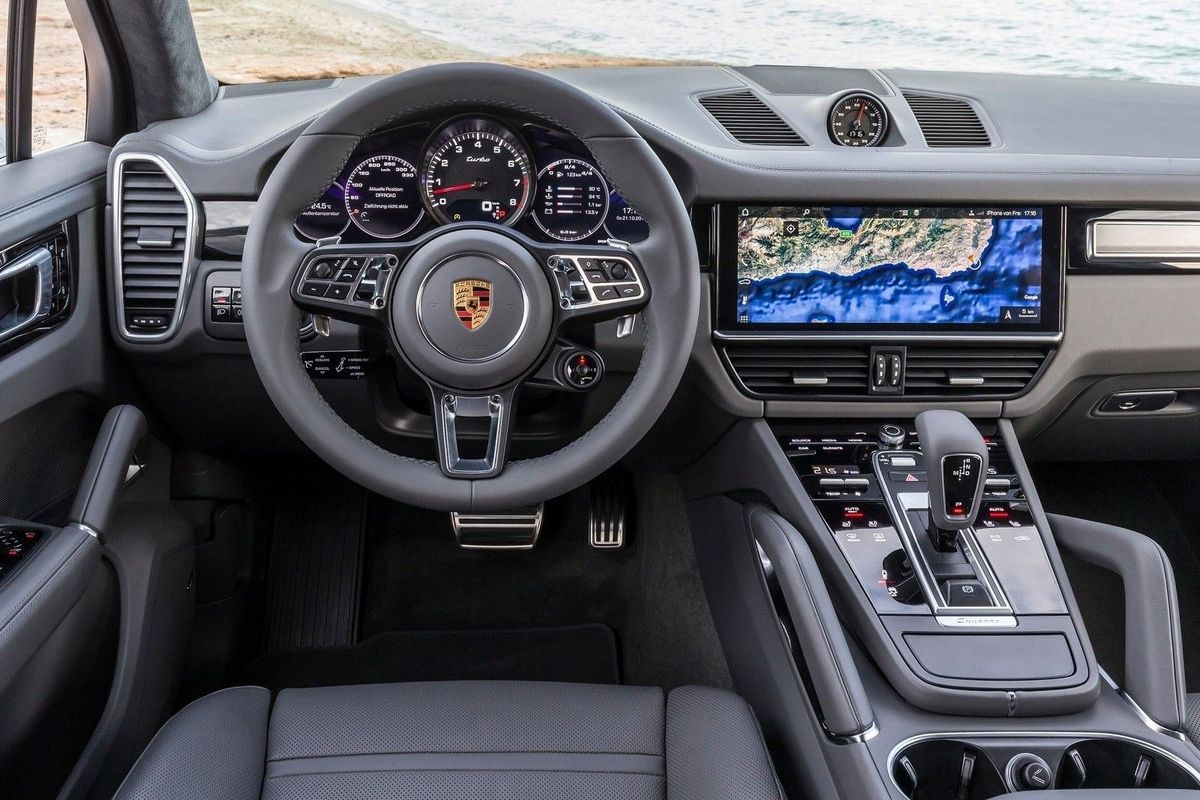
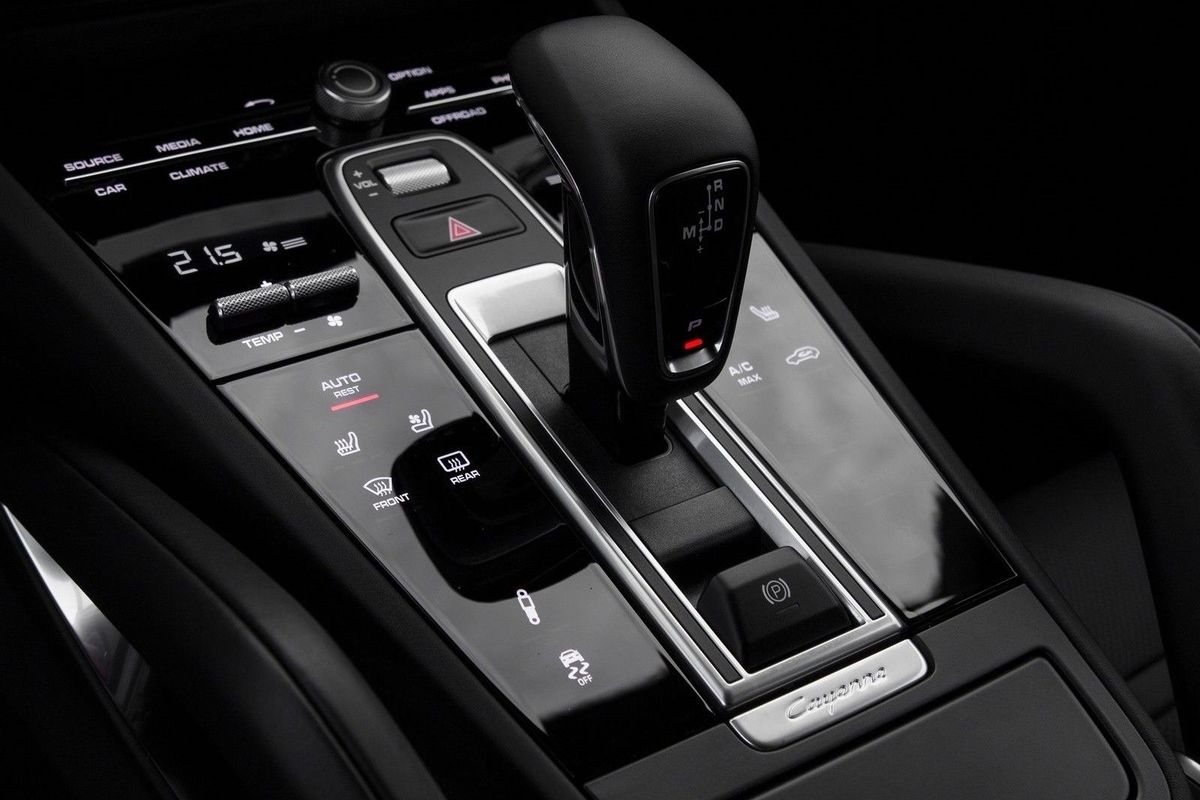
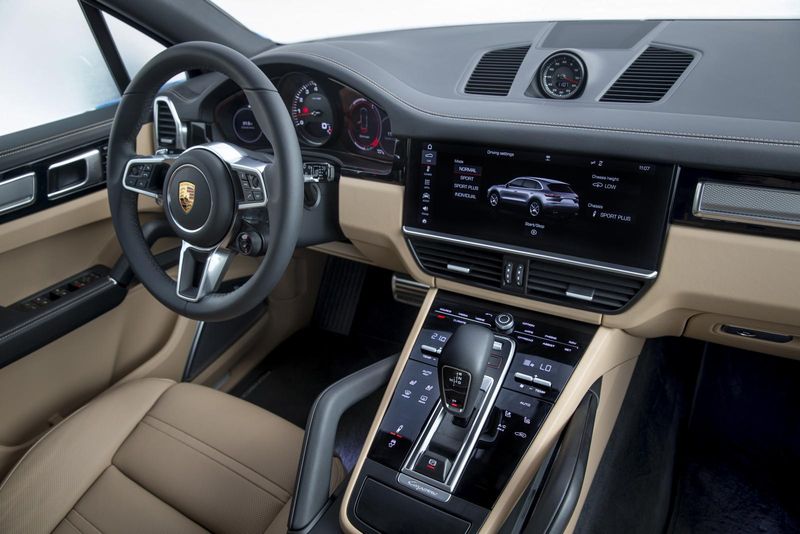
If its exterior design might be too evolutionary for some tastes, the Cayenne’s new interior treatment is nothing short of a revelation! From the first ingress, the characteristic Porsche build quality is immediately apparent, from the tactile texture of the materials (even the non-leather ones) to the way the panels sit flush next to one another. It’s the all-digital (apart from the central analogue rev counter) instrument cluster, the 12.3-inch full-HD Porsche Communication Management (PCM) touchscreen and black trimmed extended fascia section that appears so futuristic, yet utterly elegant, that sets a new benchmark for Premium SUV interior design.
Engaging electronic interface
Granted, the brand-newness of the Cayenne dictates that it should feature more slick-looking electronic surfaces than its rivals, but what impresses most is the tasteful way the technology has been incorporated within the overall fascia execution: it does not seem cold and clinical, nor overwrought or convoluted. Remember, this design is from a brand that staunchly refused to offer multi-function steering wheels (at least those with remote audio/phone/cruise control toggles) until relatively recently.
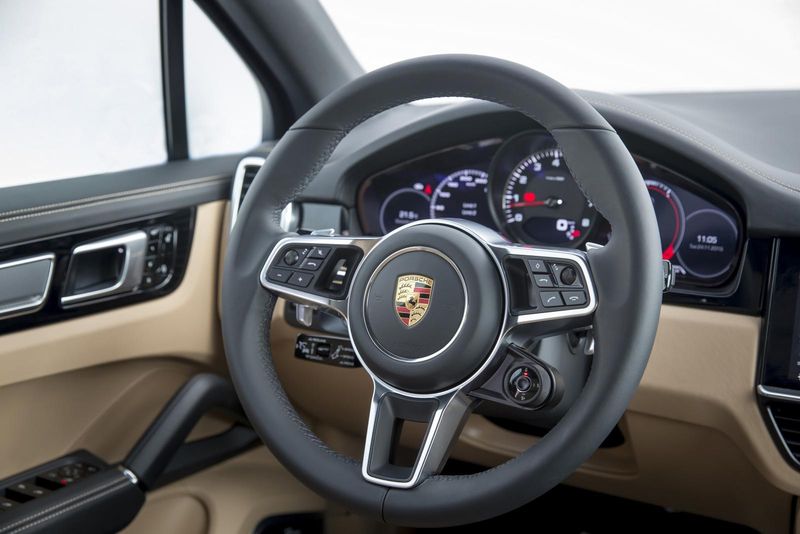
With the selection of the Sports Chrono package, the Cayenne's steering wheel gains a drive mode selector button (bottom right).
Instead, the driving position feels positively driver-centric and inviting and the complex steering wheel is a delight to behold and twirl. Yes, you have to programme an option button to skip tracks when you’re streaming music and the matching piano-black steering column stalks look a little twee, but the atmosphere is eminently classy.
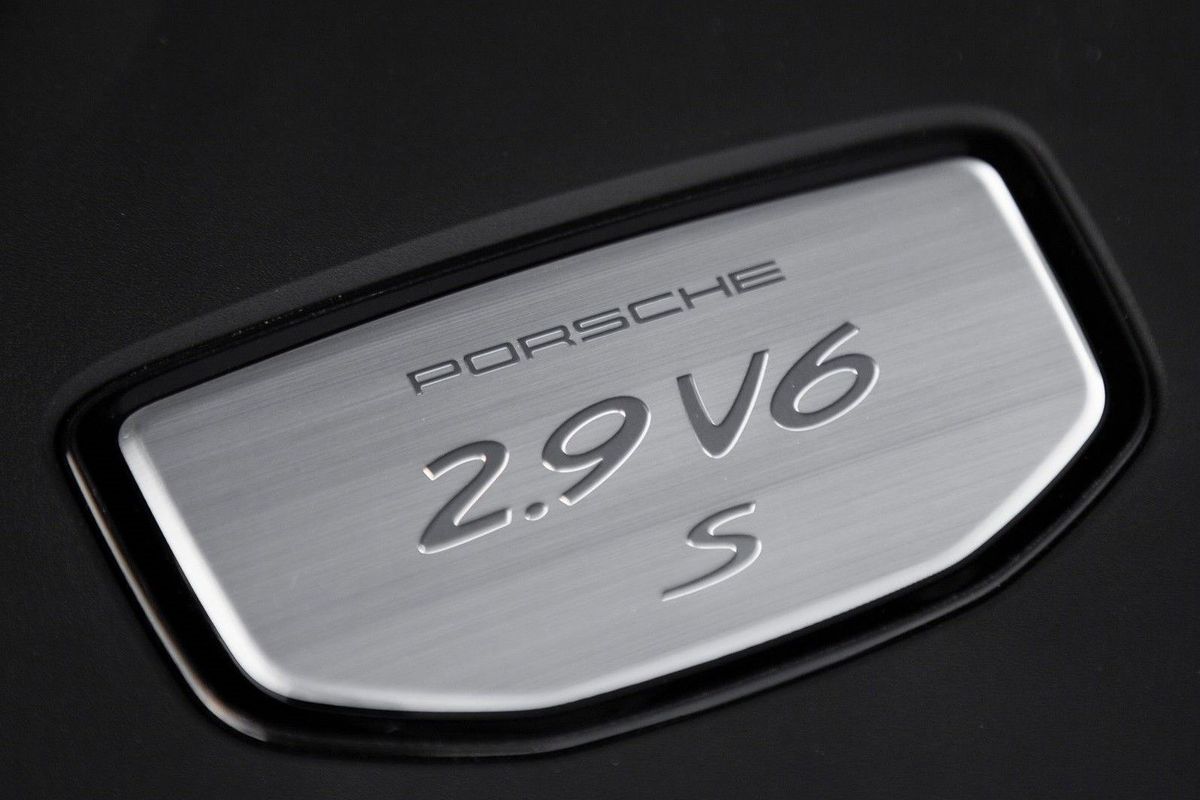
Before we deal with the ride/handling balance and inherent dynamism of the new Cayenne, it needs to be noted that the new range leads off with a sonorous pair of V6 turbopetrol motors (a 324 kW 2.9-litre twin turbo in the case of the Cayenne S), which are mated with an 8-speed Tiptronic S transmission. This is a conventional torque converter setup, as opposed to the dual-clutch PDK setup favoured in other Porsche products, but even if the automatic ‘box cannot match the PDK in terms of rapidly responsive shift times, it more than makes up for it with a smooth, almost unobtrusive operation in congested traffic, which is, sadly, a bane of modern-day motoring.
The range's V6 turbopetrol powerplants perform impressively, but the newcomer's dynamic suspension arguably steals the show.
Even though the entry-level 250 kW 3.0-litre Cayenne feels adequately brisk, with a claimed zero to 100 kph time of 6.2 seconds and a 245 kph top speed, Porsche South Africa expects that the Cayenne S will be the most popular derivative in terms of customer demand. Thanks to its 550 Nm of peak torque, the S will catapult from standstill to 100 kph in 5.2 sec (4.9 sec with the optional Sport Chrono Package, which will also yield 0.3 sec in the standard model) and the former boasts a top speed of 265 kph.
Superb on-road refinement
All derivatives ride on (at least) 19-inch wheels shod with suitably low-profile rubber, and given the purposefully sporty suspension tuning integral to the Porsche’s packaging, one might be forgiven for expecting that the newcomer’s ride quality would be stiff, if not a trifle fidgety. By contrast, the Cayenne exhibits a delicate balance between suppleness (in terms of the way it counters uneven sealed surfaces), admirable mid-corner body control and extreme road holding at higher speeds.
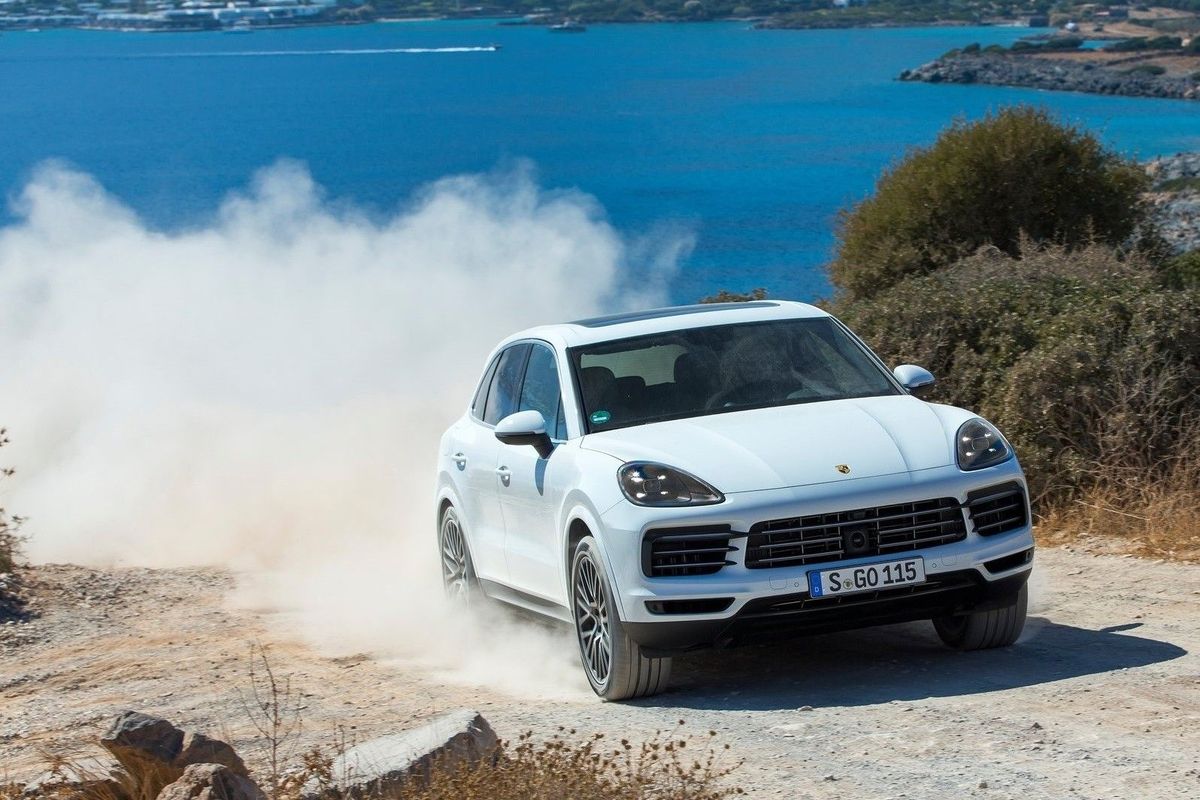
Despite its sporty wheels and suspension setup, the Cayenne is a more-than-passable off-roader. Its build quality shines through here.
These traits are admittedly most apparent in derivatives specified with the new 3-chamber air suspension with self-levelling, ride-height control and Porsche Active Suspension Management (PASM), which brings out the best of the Porsche 4D Chassis Control system, especially in terms of how the Cayenne can effortlessly switch from urban pottering to churning up dust clouds on a rural dirt road and then, from high-speed cruising to carving up a mountain pass… and everything in between.
Yes, the Cayenne can be committed to demanding bends with confidence as if the laws of physics are mere regulatory guidelines and its four wheels transfer the powertrain’s might to the asphalt with a clinical efficiency that begs the question: “Do these tyres never squeal?” The test route in Dubai and Oman did not incorporate much in the way of high-speed handling tests, but as much as the Porsche DNA is evident in the Cayenne’s handling characteristics, the newcomer’s steering action is quick and razor-sharp without ever feeling frivolous; indeed, Alfa Romeo's Stelvio does not hold exclusive rights to a darty tiller… The lack of artificial heft is refreshing.
The 3rd-generation of the Cayenne might seem strictly road-biased, but can be (additionally) specified with an off-road package.
High-tech options
For those who regard themselves driving aficionados but whose budget doesn’t quite stretch to a Cayenne Turbo (which we didn't get to drive at the launch event, but expect a South African review soon), Porsche Dynamic Chassis Control (PDCC) is an intriguing option. Underpinned by a 48-volt vehicle electrical matrix, the system utilises active electromechanical stabilisers on both of the vehicles' axles to reduce lateral tilt in bends and increases driving dynamics, agility and comfort.
Other notable options include electric rear-axle steering, which improves the Cayenne’s stability and agility at high velocities, while reducing its turning circle at parking speeds; and, whereas the aforementioned function is carried over from the 911 and the Panamera, the Porsche Surface Coated Brake (PSCB) system, which sees the application of a tungsten-carbide coating to the cast-iron discs in order to be more resistant to wear/excess brake dust deposits, makes its world debut in this range.
Porsche deserves commendation for the effortless integration of the centre console and fascia touchscreen…
Still an accomplished Premium SUV
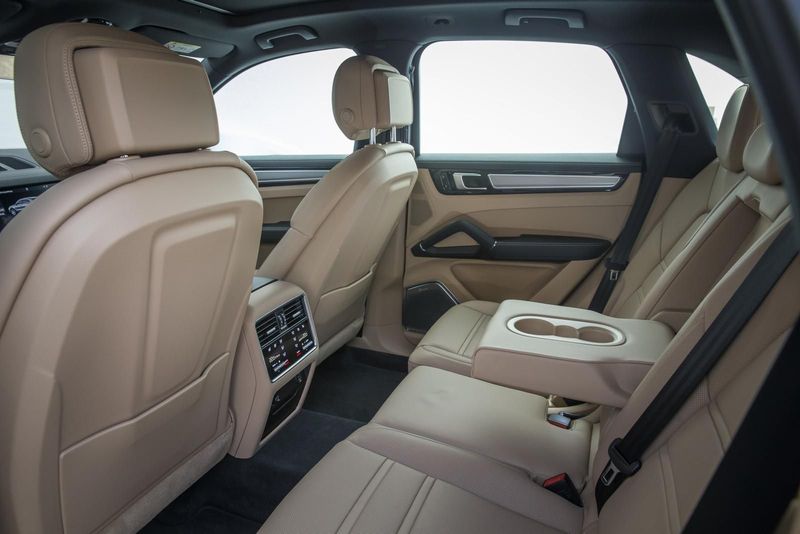
Although the new Cayenne’s dimensions have grown compared with those of the car that preceded it, its wheelbase is the same, which means the rear occupants, if ensconced in adequate comfort, does not benefit from additional legroom – at least not by the look of things. To the newcomer’s credit, however, the luggage capacity has increased by 100 litres, which benefits practicality and the fitment of an inflatable emergency spare, as opposed to a thin space saver, will please some fastidious buyers.
As a luxury vehicle, the Cayenne has elbowed its way to the front of its segment in terms of infotainment, its slick PCM can be configured for up to 6 individual profiles to store interior-, lights-, driving programmes- and assistance systems. Perhaps it is a little counterintuitive to select off-road modes via the touchscreen interface (especially when the going gets bumpy, but do bear in mind that the new Range Rover Velar has a similar setup). Furthermore, the handy steering wheel-mounted driving mode selector is unfortunately only available with the Sports Chrono Package, but these are criticisms that are unlikely to be deal-breakers for potential buyers.
Although rear accommodation is not particularly generous, the provision of a bigger loading capacity sweetens the deal.
Prices (correct as of February 2018) include a 3-year/100 000 km Drive Plan.
Summary
And so, to sum up, the Cayenne feels like an engaging driving machine from the microsecond you ensconce yourself behind its shapely wheel and acquaint yourself with its elegant, yet feature-rich electronic user interface. It’s also lighter, faster/more efficient than its predecessor, as well as better equipped and technologically advanced. Those who feel indifferent about the newcomer’s evolutionary styling can rest safe in the knowledge that the Cayenne's interior execution is worth a much closer look. In this segment, Porsche has stolen a head start on the (admittedly ageing) opposition in terms of all-round competence. Does it tug at the heartstrings or appeal to consumers’ vanity as much as showy Premium SUVs? Perhaps not, but suffice to say if you never test drive a "Cayenne III", you wouldn't know what you were missing.
Watch a video that highlights the Cayenne's Driver Assistance systems:
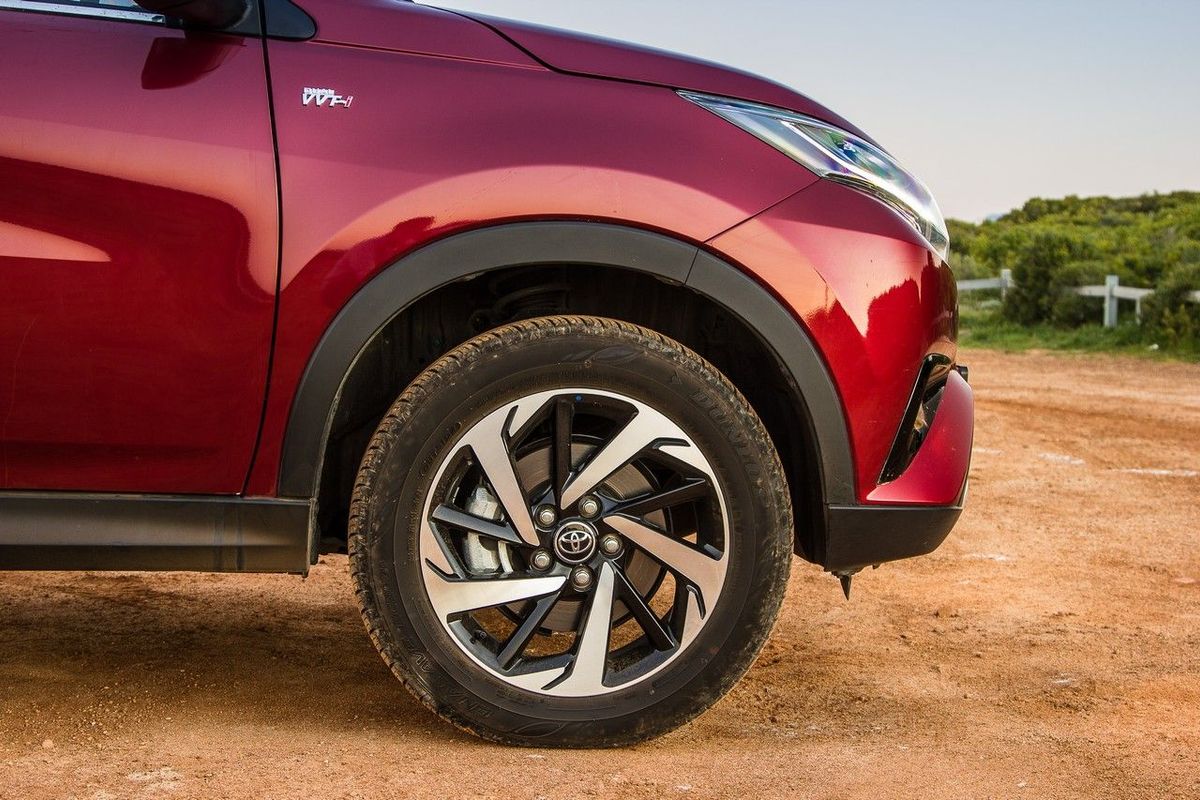
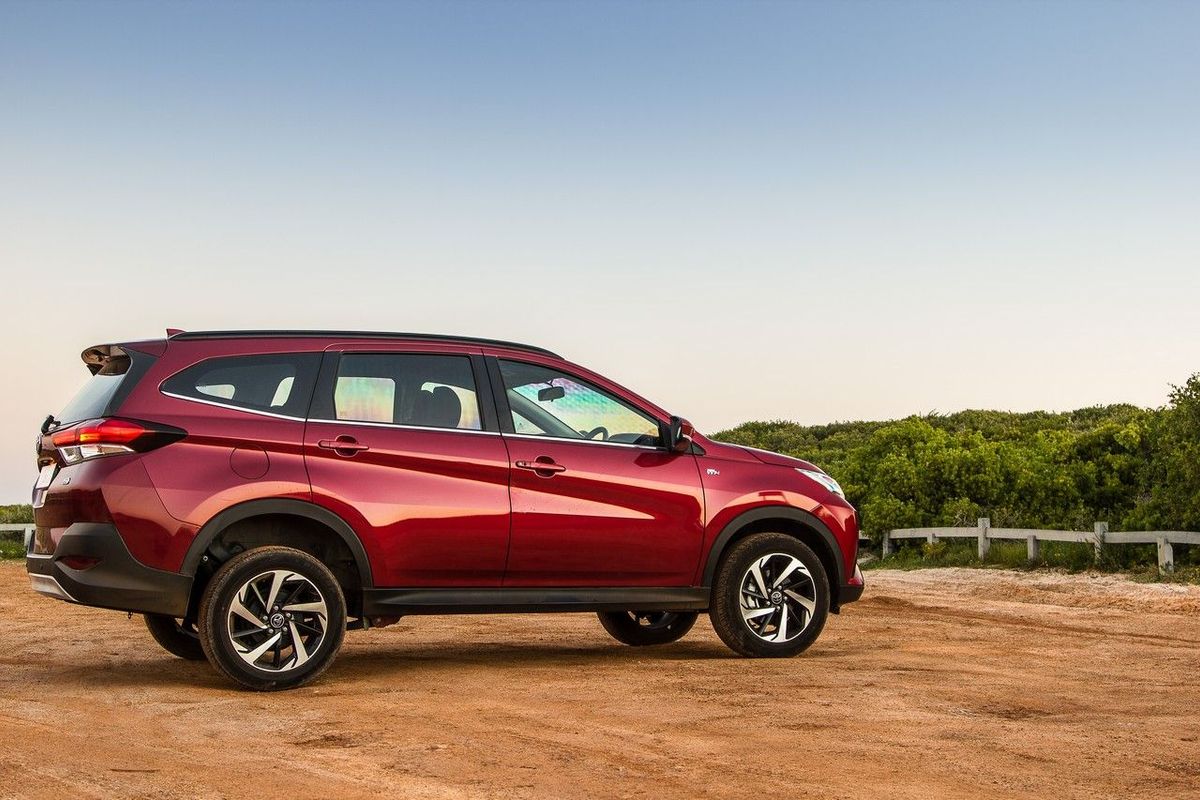
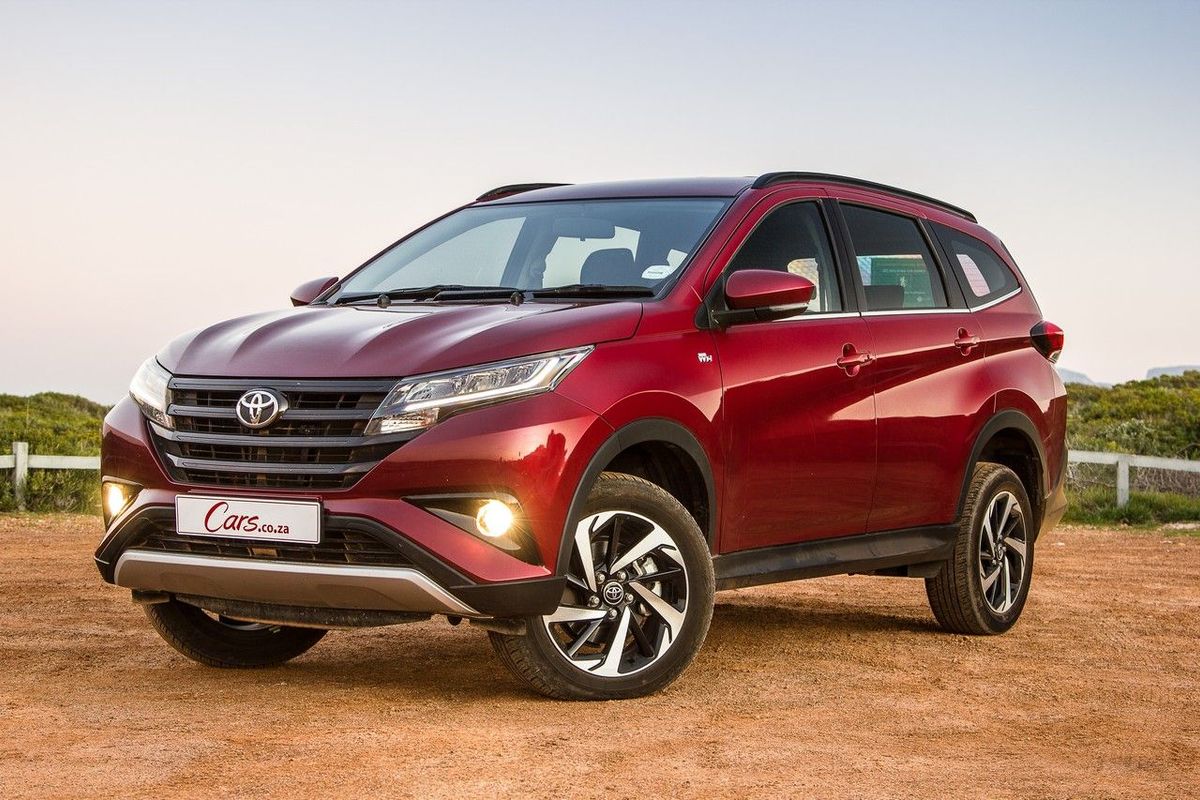
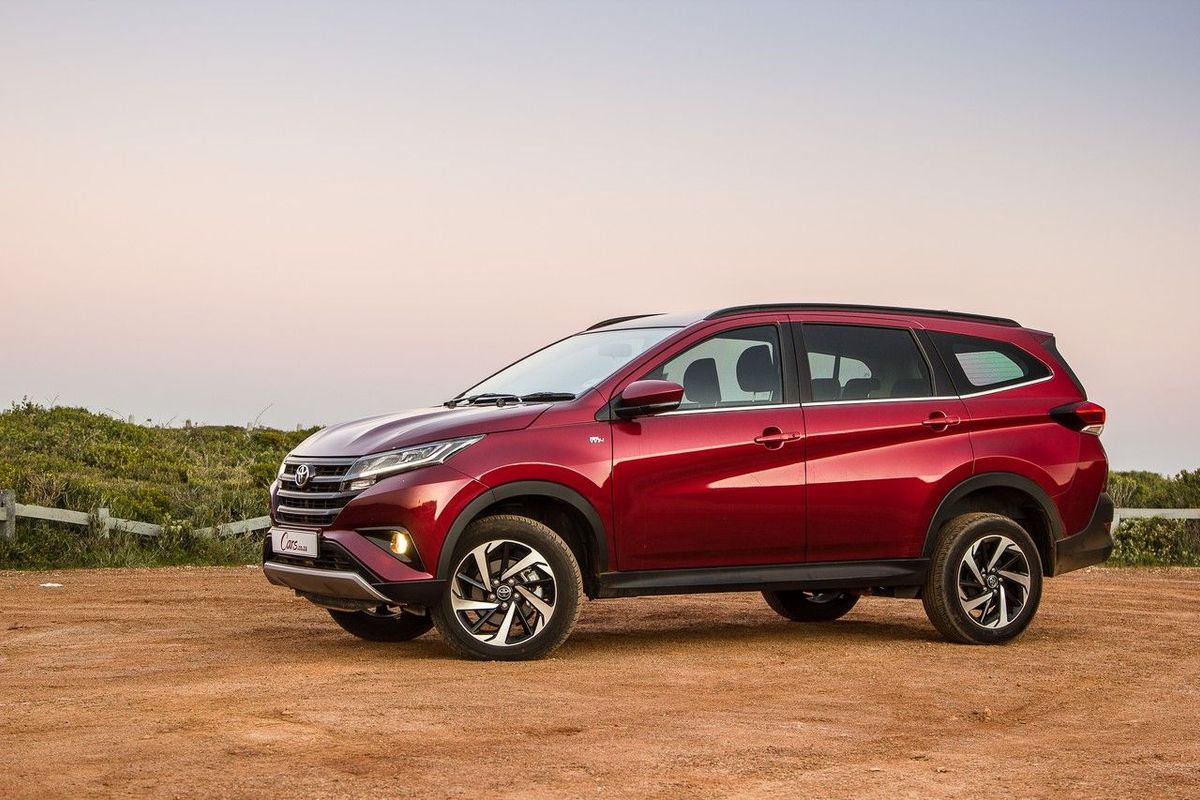
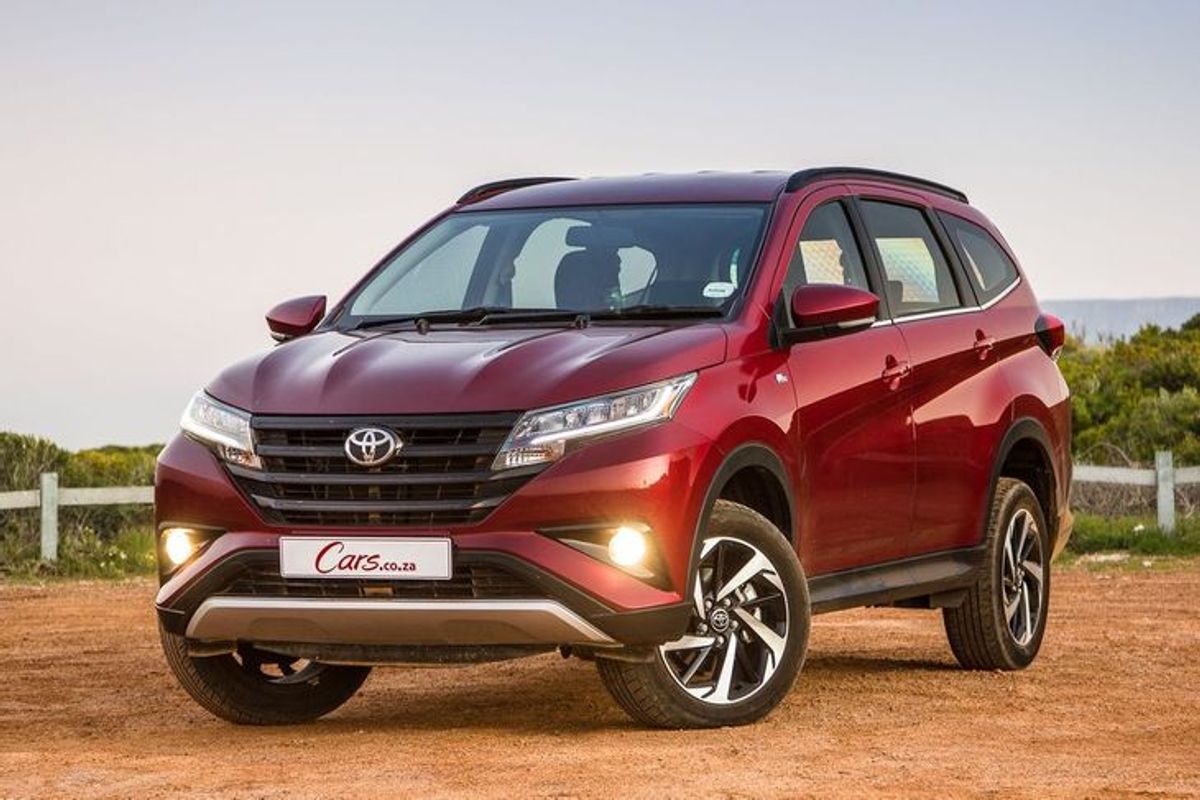
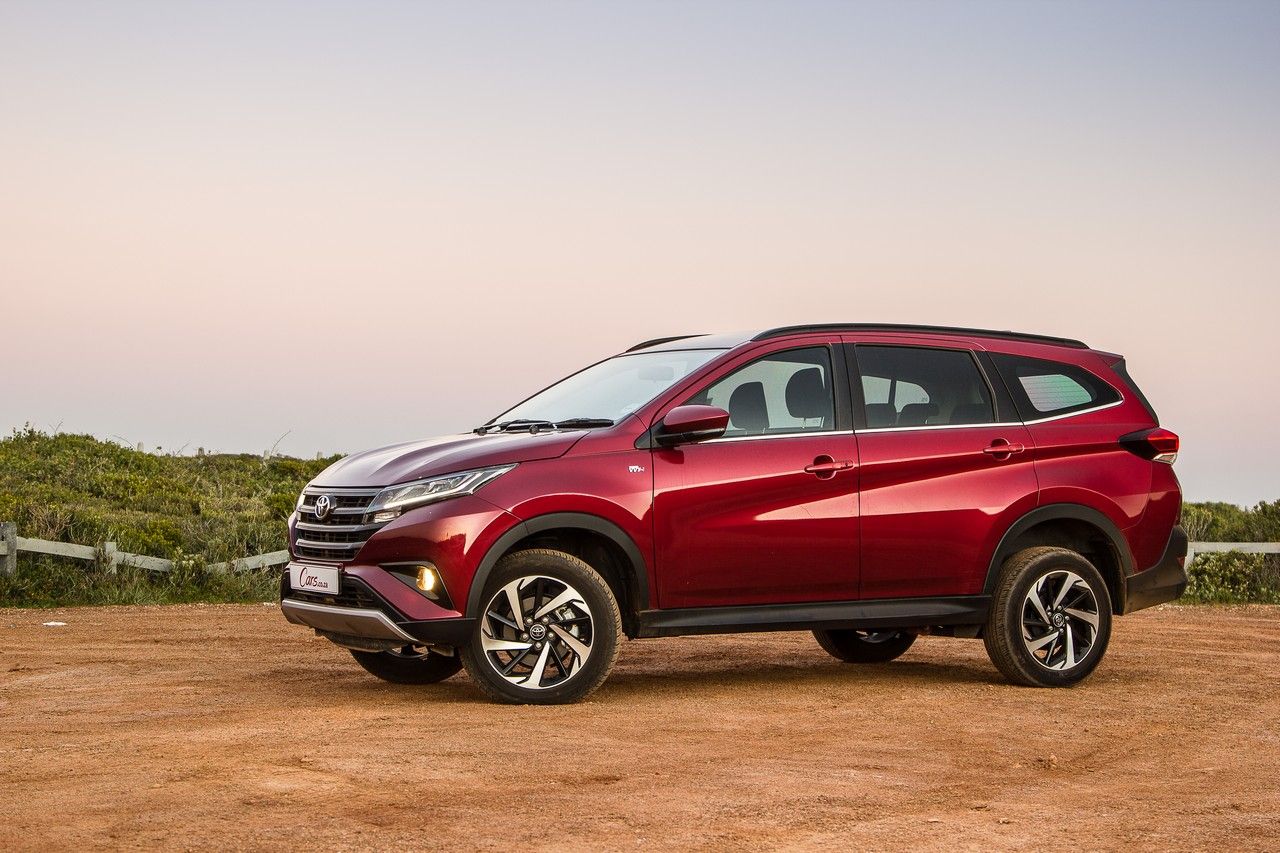
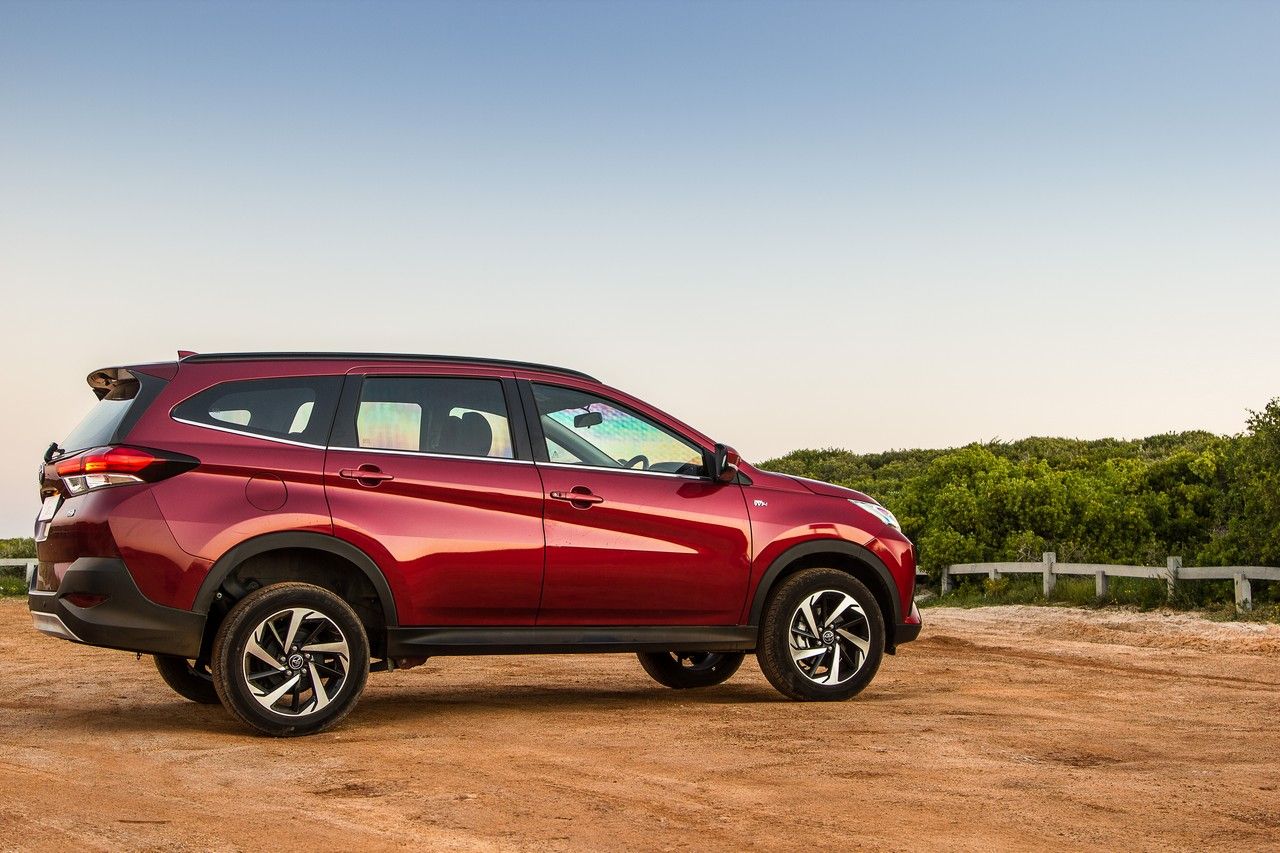
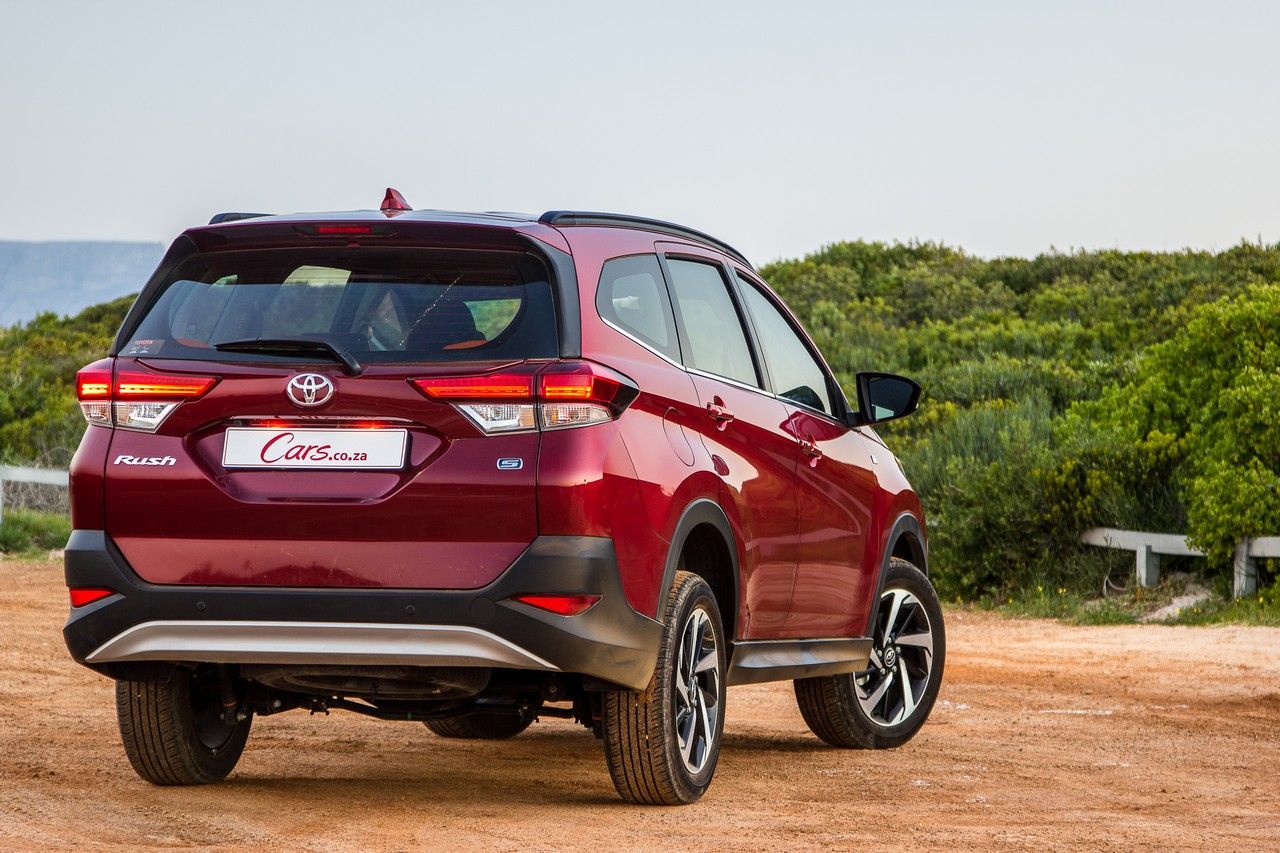
With "baby Fortuner" looks, a high-value price tag and "that" badge on its nose, Toyota's new Rush was always destined to be a strong seller in South Africa. Does it live up to expectations?
We like: Good looks, decent standard spec, massive luggage bay, Toyota's reputation for reliability/service
We don't like: Lack of a 3rd row of seats, short gearing results in very "buzzy" cabin, driving position
Some Toyota dealers regularly offer specials: Have look here.
Where does it fit in?
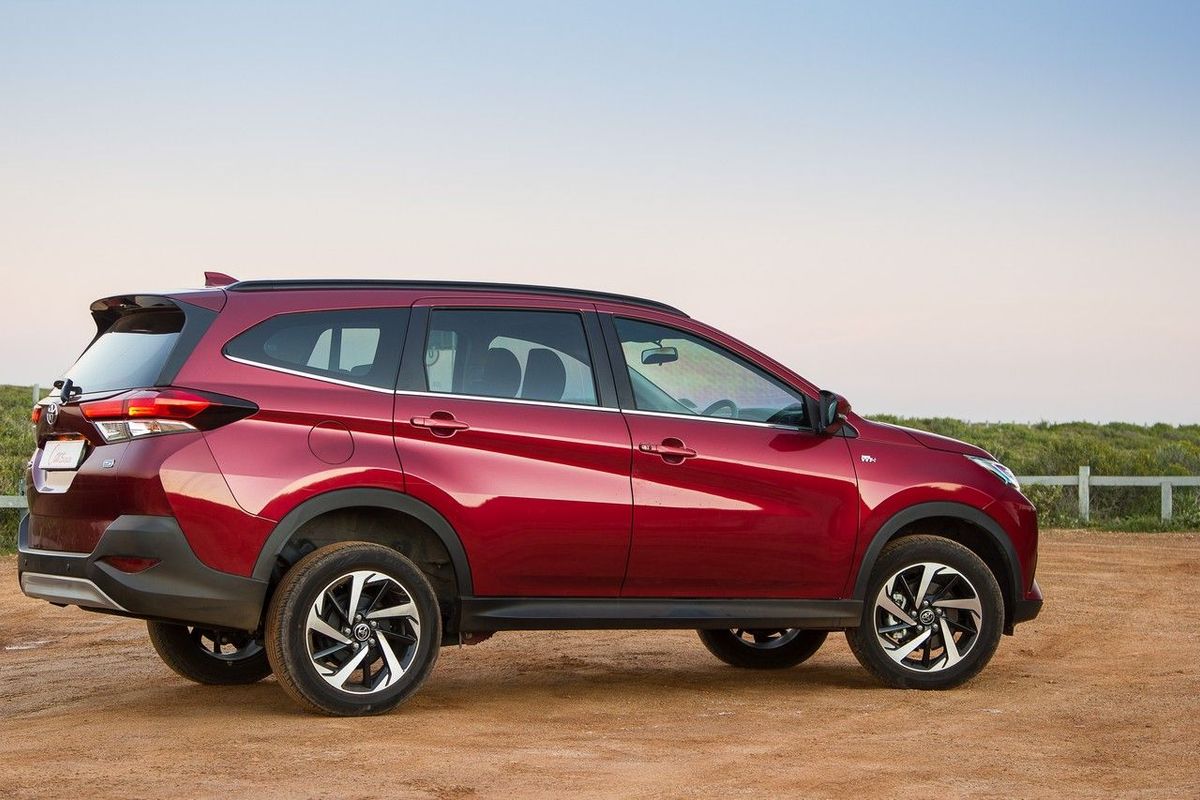
The Toyota Rush is a good-looking 5-seater baby SUV based on the more utilitarian Avanza.
Just about every type of vehicle appears to be morphing into an SUV-themed crossover these days. Multi-purpose vehicles (MPVs) were all the rage not so long ago, but people-movers have subsequently fallen out of favour with private individuals. These days, they're mostly favoured by practicality-minded and cost-conscious shoppers that require a hardy, spacious fleet vehicle. The best example of such a product is Toyota's very own Avanza.
Still a big seller to companies, shuttle operators etc., the Avanza however no longer presses the desirability buttons of families shopping on a budget – these folks are all looking for crossover-flavoured SUVs. So… Toyota has done the obvious thing, which is to use the Avanza as a base to develop a more attractive SUV-themed offering, called the Rush. Sold in some markets as the Daihatsu Terios, it has really hit the ground running in South Africa, clocking up more than 400 sales in its first month…
What's good about it?
Massive luggage bay and passenger space
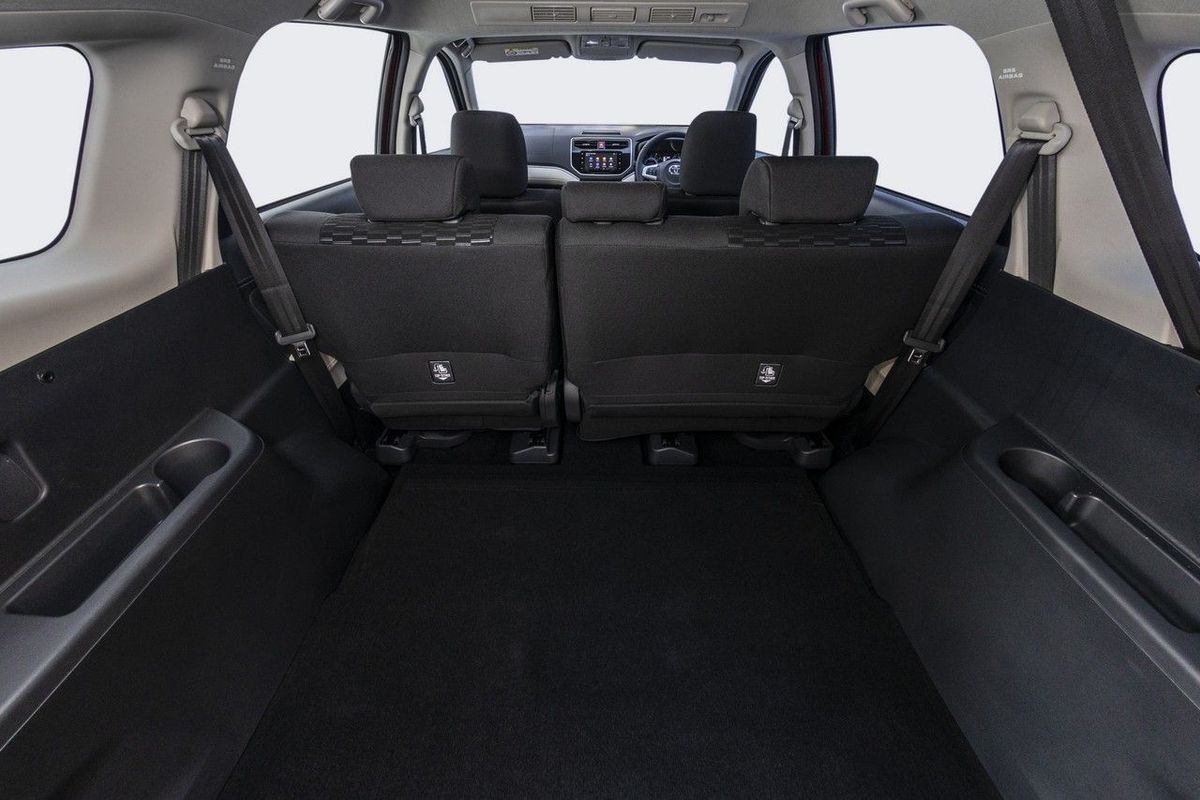
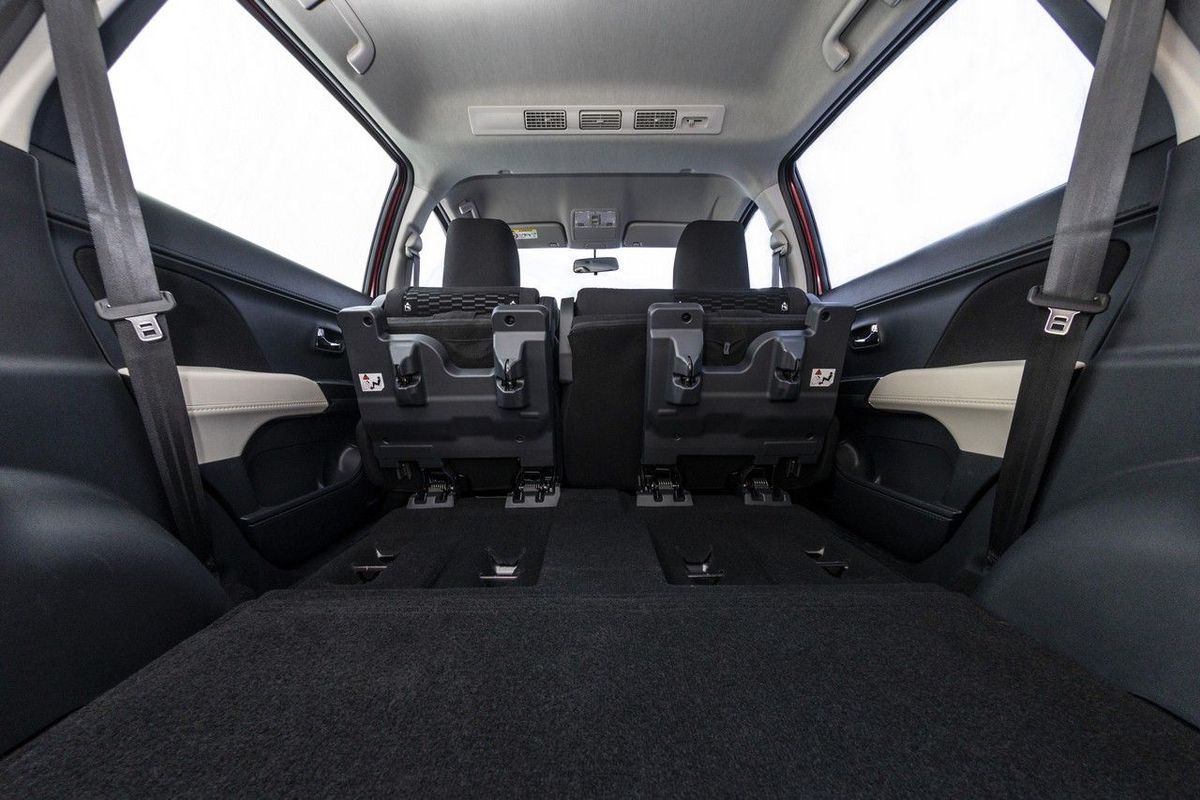
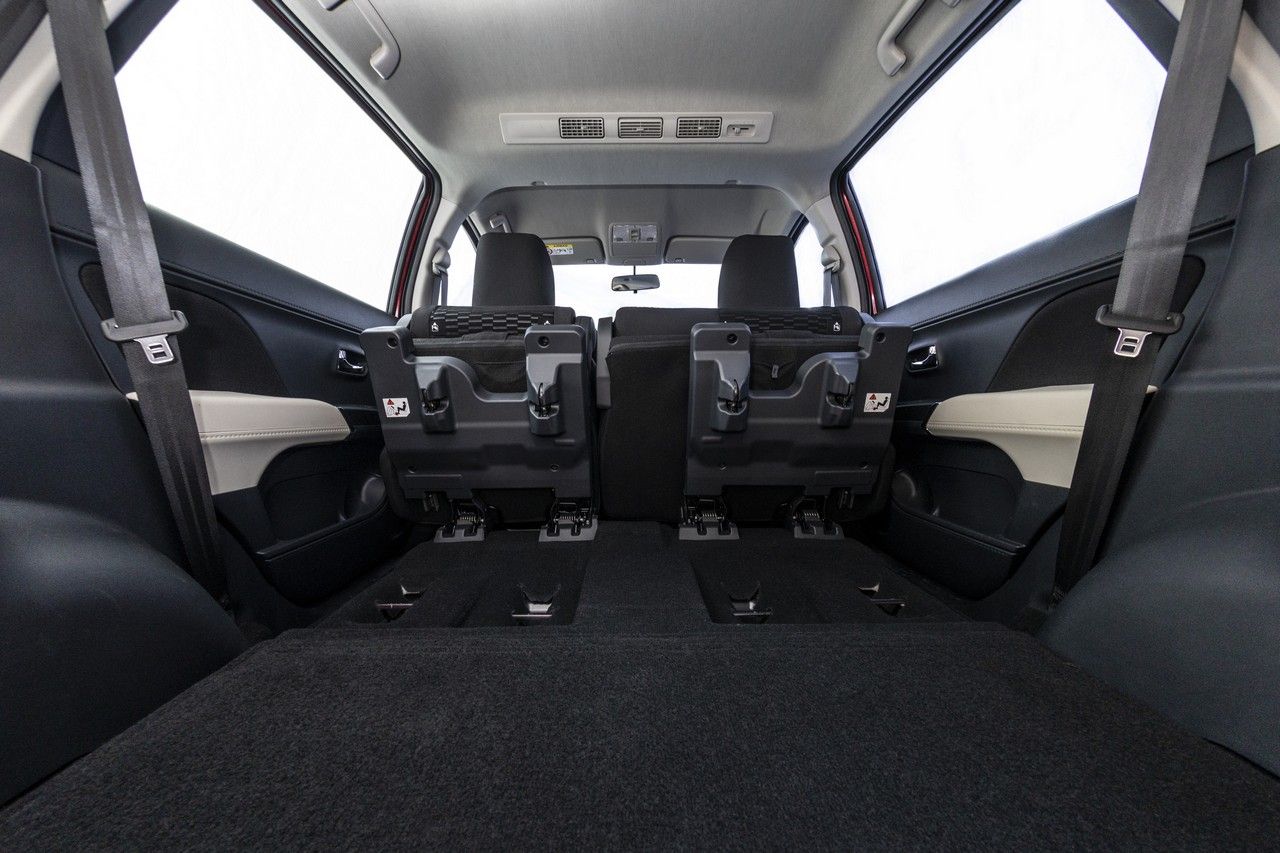
Toyota claims a load volume of 609 litres for that boxy rear end, and that's simply excellent news for families transporting bulky items regularly.
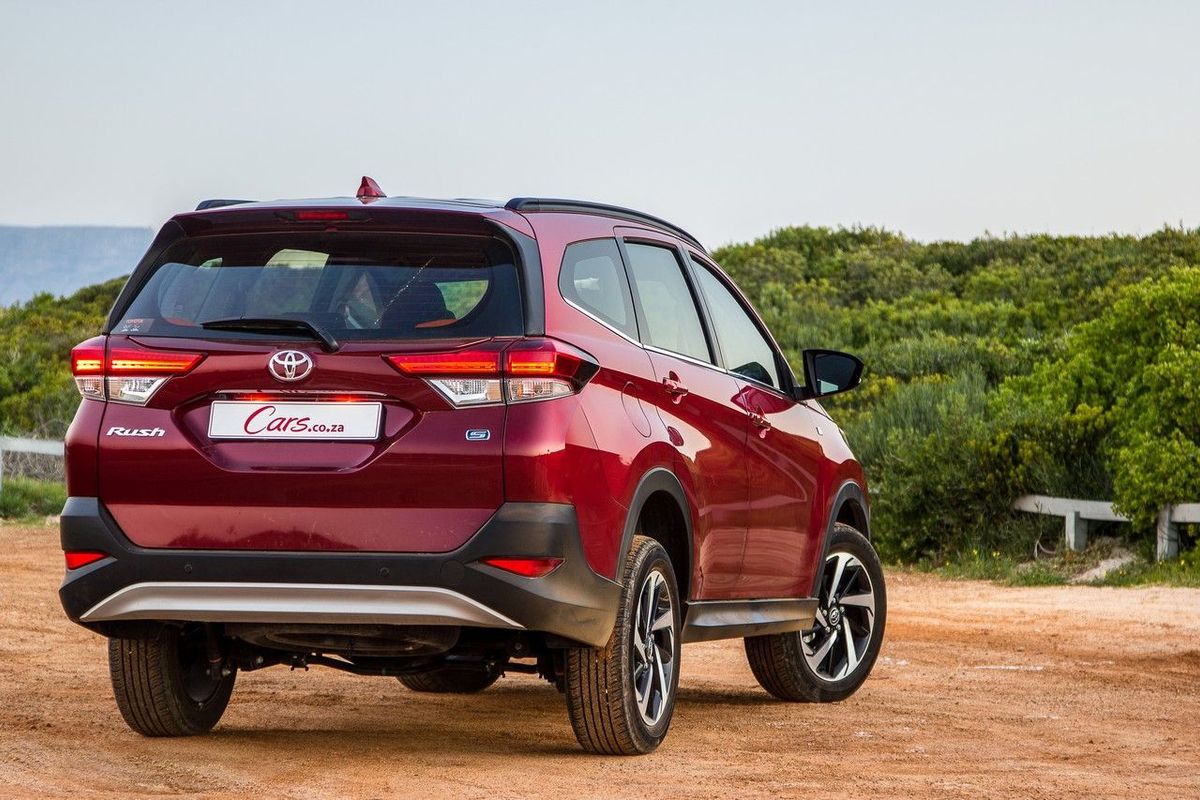
For South Africa, Toyota has opted to offer the Indonesia-made Rush in 5-seater configuration only. There are some downsides to this (see lower down), but the deletion of the 3rd-row bench has given the Rush arguably the largest luggage bay in its segment (and certainly its price class). Toyota claims a load volume of 609 litres for that boxy rear end, and that's simply excellent news for families transporting bikes, dogs and the proverbial kitchen sink on a regular basis.
The bay's aperture is also nicely square, and the roof is high, too, so you can transport some pretty bulky objects in the back of the Rush. Should further space be required, the 2nd row's 60/40 split seatback can fold and tumble forwards. Key to the flat floor is that the spare wheel is mounted underneath the body.
Rear seat passengers will appreciate the generous legroom (as well as headroom) and they also get their own 12V power outlet (there's another one in front). The only real downside to the Rush's packaging and design is its driving position – although the driver's seat is height-adjustable, the steering column only offers minimal rake- (and no reach) adjustment, which means the driving position will be compromised for some (especially taller) drivers.
Comprehensive standard spec
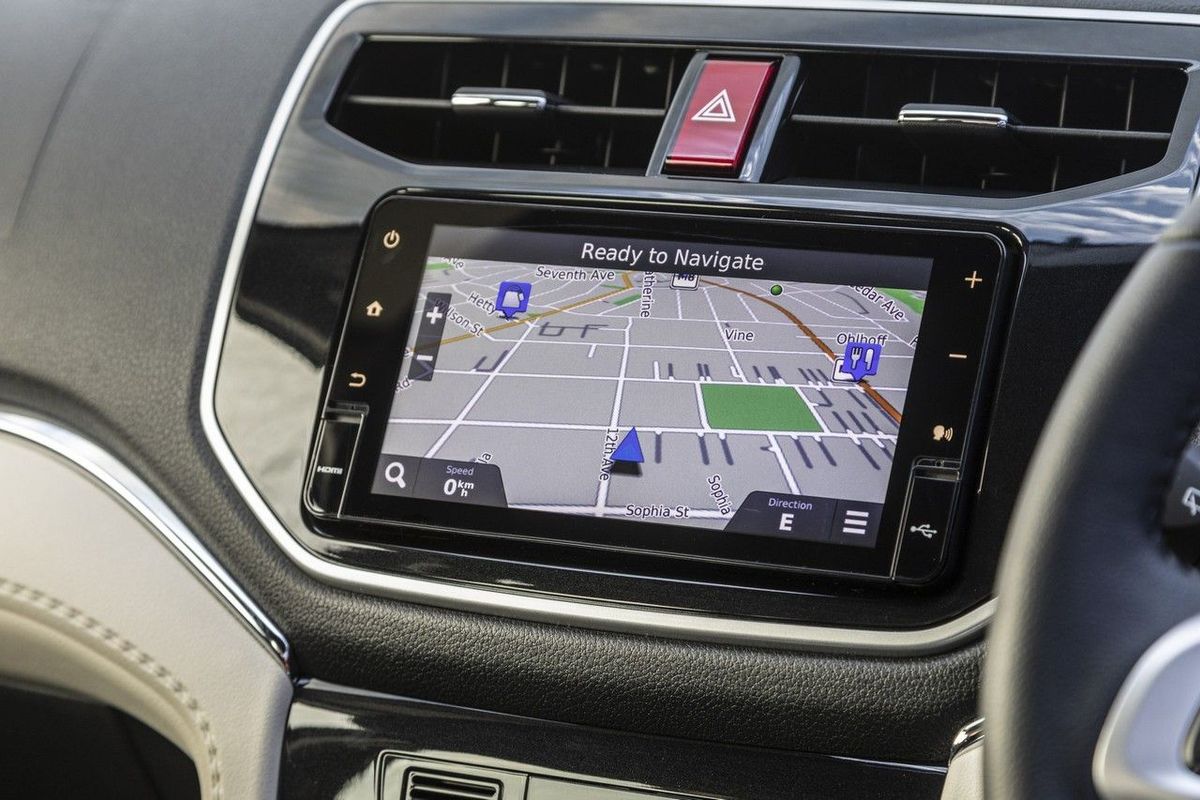
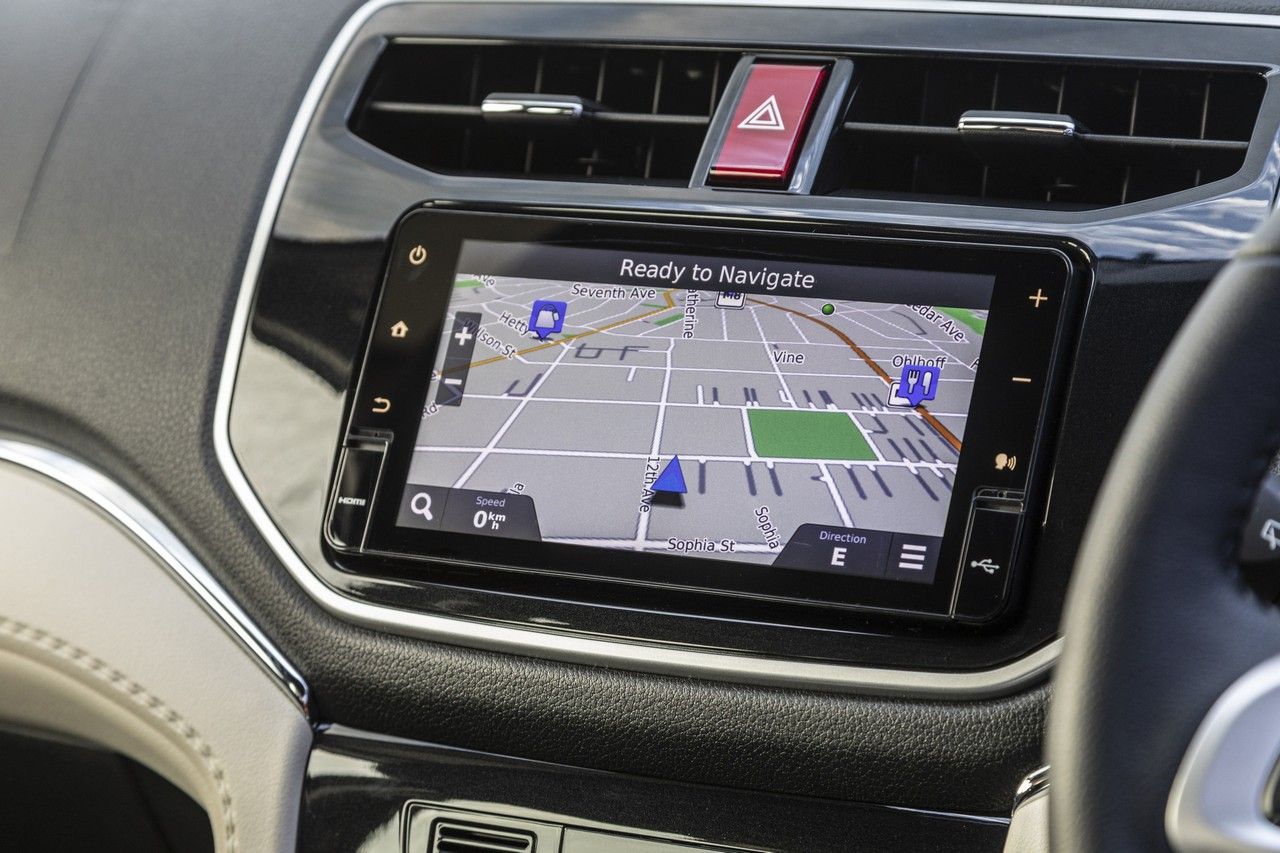
On the entertainment side, you get a comprehensive touchscreen infotainment system that is not only Apple CarPlay- and Android Auto-compatible, but incorporates satellite navigation.
For now the Rush is only offered in "S" specification and you get quite a lot for your money. Perhaps most impressively, the safety kit is comprehensive, with vehicle stability control included in the package, along with 6 airbags. Also much appreciated are hill-assist control (HAC), a reverse-view camera and park-distance control.
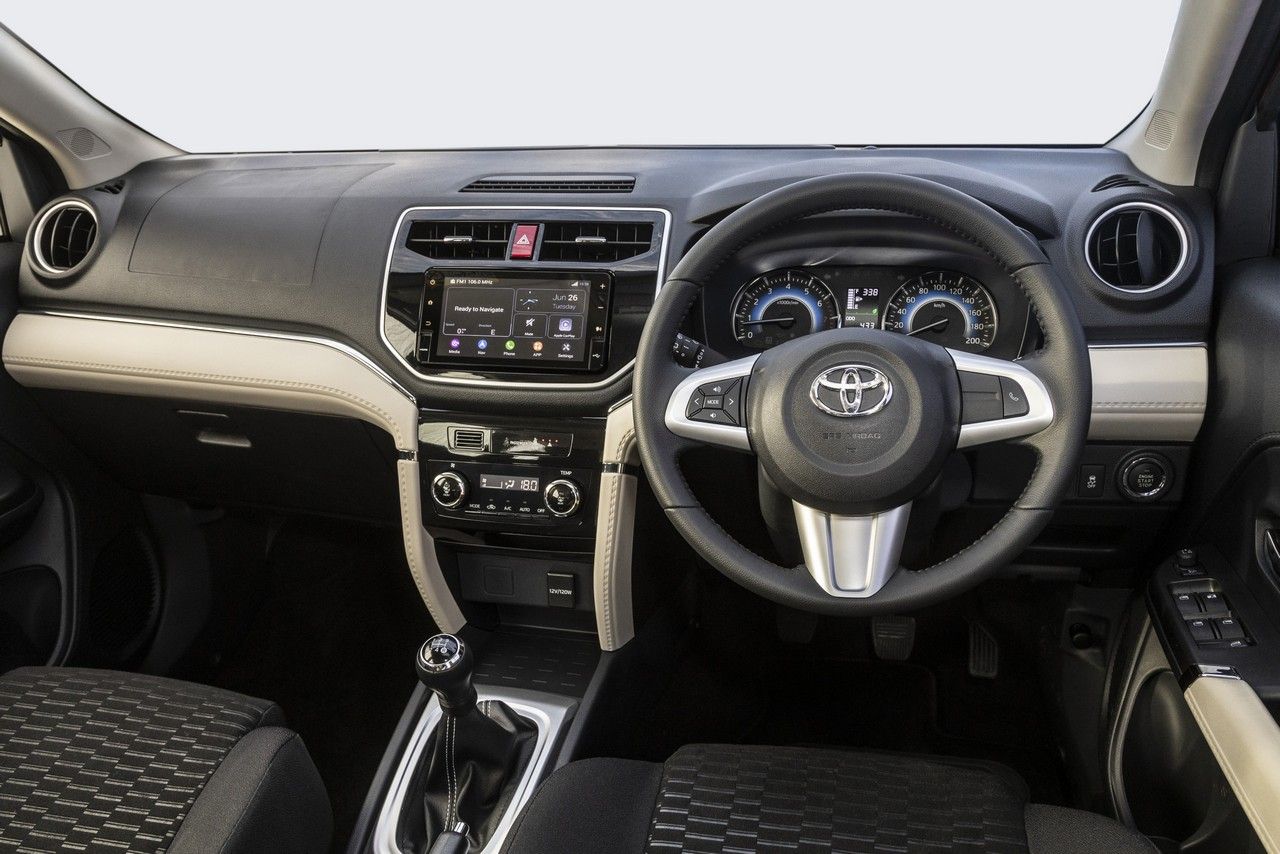
On the entertainment side, you get a comprehensive touchscreen infotainment system that is not only Apple CarPlay- and Android Auto-compatible, but incorporates satellite navigation. Of course, electric windows are fitted all-round, but other surprises include push-button start, retractable side mirrors and climate control (with air outlets in the ceiling for rear passengers), as opposed to normal air-conditioning.
Design
In the eyes of many onlookers, it appears to mimic the styling of the Fortuner SUV, which is one of South Africa's top-selling vehicles.
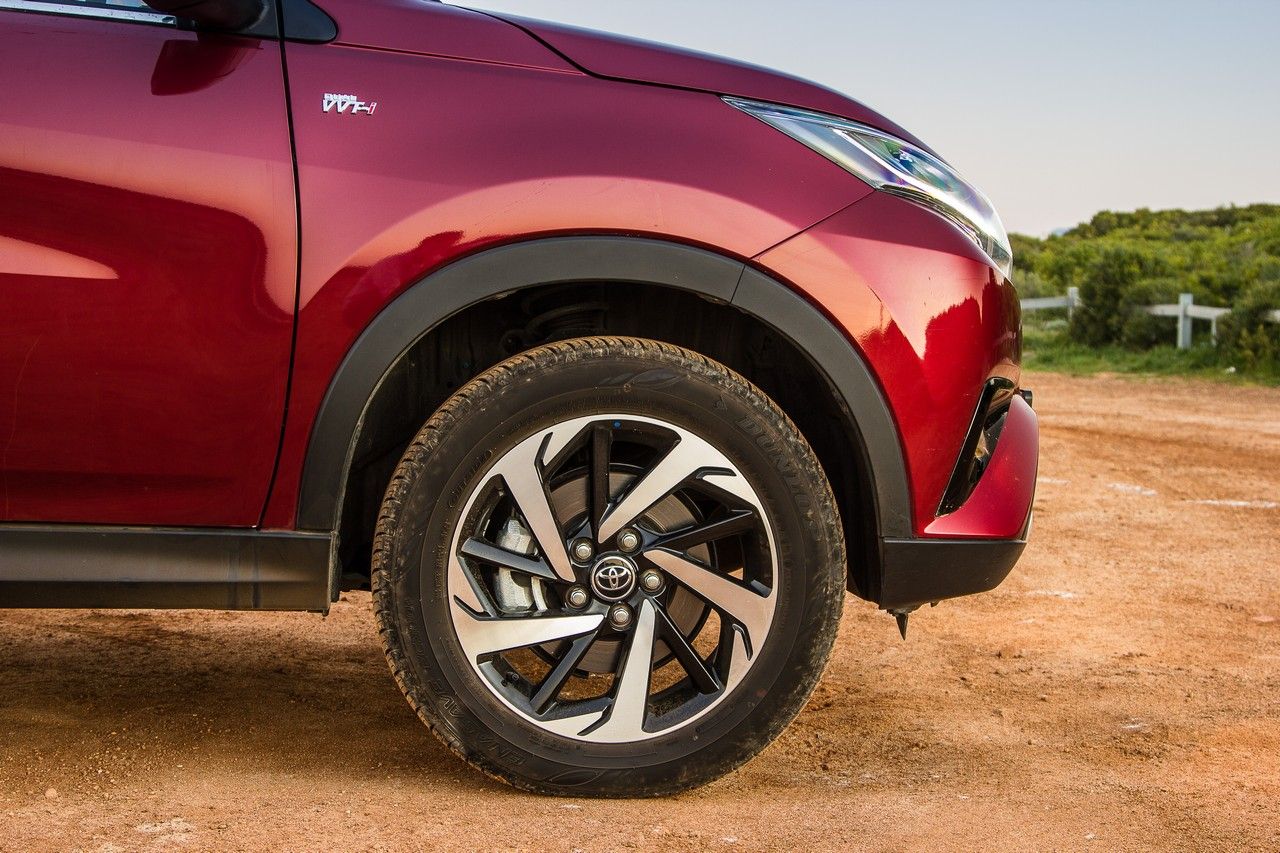
It's really quite remarkable how Toyota has managed to make a vehicle based on the dowdy Avanza so attractive. In the eyes of many onlookers, it appears to mimic the styling of the Fortuner SUV, which is one of South Africa's top-selling vehicles. With LED strips in the headlamps, stylish 17-inch alloy wheels and good ground clearance (a claimed 220 mm), the Rush is a vehicle that looks pricier than it really is.
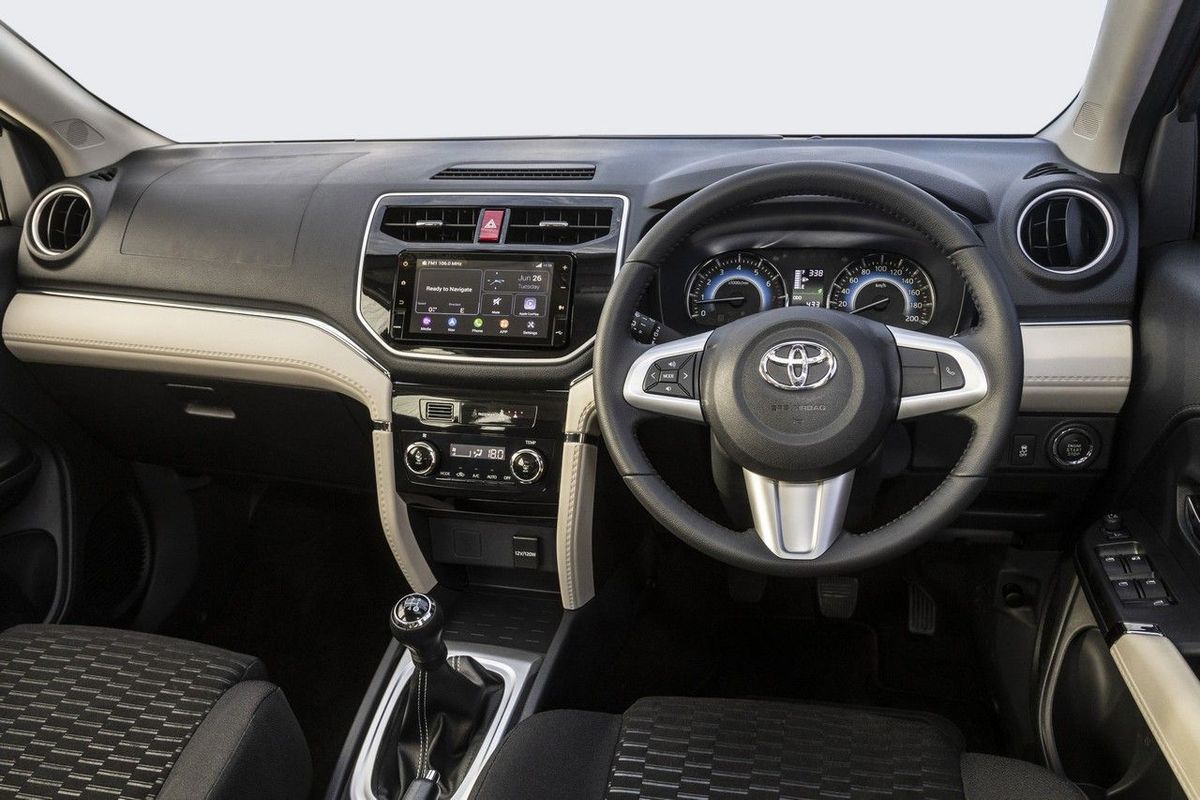
Inside, too, Toyota's designers have done an excellent job. Although the materials are mostly of the hard plastic variety, the use of black with contrasting taupe (let's call it light grey with a hint of brown…) does lift the ambience. Stylish instrumentation and that neat touchscreen system further lift the Rush's cabin to heady heights, particularly considering its Avanza origins. We also appreciate the leather-trimmed steering wheel and the number of storage solutions dotted around the cabin.
Peace-of-mind reliability/back-up
The 1.5-litre engine underneath the bonnet is a proven, reliable unit that has served in many other Toyota and Daihatsu products. Also, as we know from the Avanza, these are tough vehicles that can stand plenty of abuse. Now factor in the trusted back-up provided by the Toyota dealership network and a good 3-year/100 000 km warranty, as well as a service plan that's good for 6 services (90 000 km) and you can understand why South Africans are flocking to Toyota dealerships to buy these.
Where does it fall short?
Driving enjoyment
The Rush's ride/handling balance also represents a mixed bag of talents and disappointments.
The Rush is not a particularly heavy vehicle (it weighs less than 1.3 tonnes), so around town you're unlikely to find fault with the engine's power output (or its general responsiveness). In fact, due to the short gearing, the Rush feels quite sprightly at lower speeds and you won't struggle to keep up with traffic in most conditions.
But there are some issues. Due to the short gearing, the Rush's engine spins at around 3 600 rpm when travelling at 120 kph, which means the strained engine noise will become tiring after a while, especially on the types of longer road trips that families are likely to undertake with this type of vehicle. In those (fully loaded) instances they may also find that the Rush lacks overtaking oomph.
The Rush's ride/handling balance also represents a mixed bag of talents and disappointments. On the one hand, its raised and softly-sprung suspension makes it a capable, comfortable car on gravel roads or on poor surfaces at lower speeds. But, on the other hand, it is particularly sensitive to crosswinds. When cornering, it tends to lean considerably more than lower-riding, front-wheel-drive crossovers sold at a similar price. We do appreciate the inclusion of stability control, given all of the above.
For now the Rush is only offered in "S" specification and you get quite a lot for your money. Perhaps most impressively, the safety kit is comprehensive.
Why a 3rd row would've been nice…
You'll know better than us whether you actually need a 3rd row of seating (in other words, a vehicle with a 7-seater configuration), but the lack of that rear bench (compared with the Avanza) does limit the Rush's family friendliness. For most families, the seating-for-five/massive luggage bay package will work perfectly, but there are instances (on a collective school run, for example), where the ability to carry 2 extra small ones would have been a major plus – that's something that the Honda BR-V does offer. Also, as it stands right now, that massive luggage bay does without a tonneau cover, so you may have to find a way of covering up those valuables.
Alternatives (click on the names for detailed spec info)
The BR-V is the Rush's most natural rival offers a similar design approach, but adds the extra flexibility of a 3rd row of seats. It's also a more refined vehicle to drive. What it lacks is the Rush's comprehensive standard specification (it only has 2 airbags, for example) and, ultimately, you can't match the Rush's load volume even if you fold the BR-V's 3rd-row of seats down. You can, it should be noted, buy an automatic BR-V for the same price as a manual Rush…
Ford's popular little crossover could be worth considering if you demand greater efficiency, vastly better refinement and similar specification. Of course, you won't come near matching the Rush's load volume, but then few vehicles do. There are a large number of smaller crossovers from other marques to consider, too – none of them can beat the size of Rush's luggage, but all of them are nicer to drive.
A throwback to the MPV era, the Ertiga is an underrated product that is worth considering if your shopping on a tight budget and you require 7-seater capability, usable cabin space and a similar type of bulletproof reliability that Toyota is famous for. It is around R70k cheaper than the Rush, but lacks many of its features and is particularly light on safety specification (only 2 airbags and no electronic stability control).
It's worth noting that a year-old example of Toyota's popular RAV4 (in 2.0 GX automatic specification) can be bought for similar money to a new Rush. Examples listed on Cars.co.za have mileages of below 50 000 km, making them particularly appealing. While lacking the Rush's load volume, the RAV4 is a far more balanced offering, with greater refinement and better material quality in the cabin. It's also a much nicer vehicle to drive over long distances. There are many to choose from on Cars.co.za.
Verdict
For cash-strapped locals that need a trusty, spacious family car, it ticks many boxes and it does so while looking considerably more expensive than it is
We totally understand why the Rush is likely to be a sales success in South Africa. For cash-strapped locals that need a trusty, spacious family car, it ticks so many boxes and it does so while looking considerably more expensive than it is. The standard specification (including safety features) is very generous and there is no questioning its spaciousness. At around R300 000, however, there are many more refined vehicles on offer that are simply better to drive. And seeing as the Rush can't be bought with 7 seats, a large luggage bay (and admittedly some spec) appears to be its sole USP. If you need that loading space, then it's quite simple – the Rush is unmatched. But if you need a more complete, better balanced and, crucially, nicer-to-drive car (both in town and on the long road), there are better options out there.
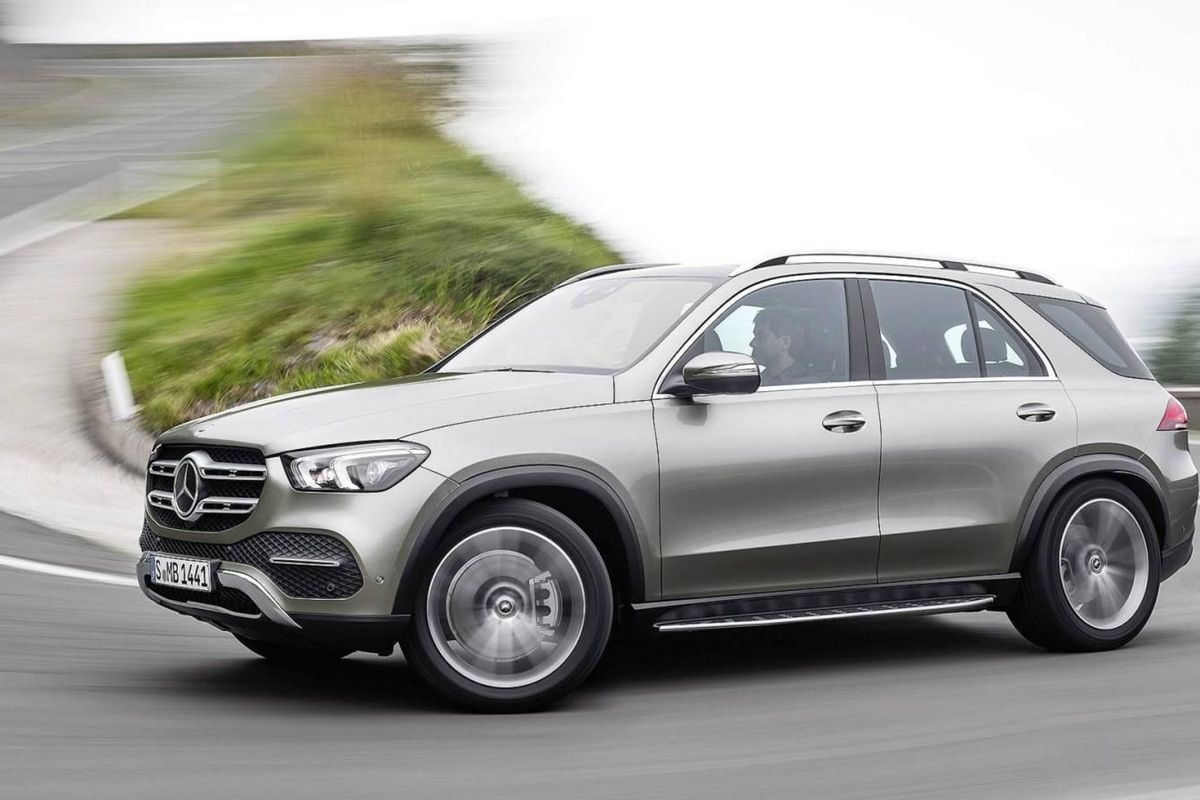
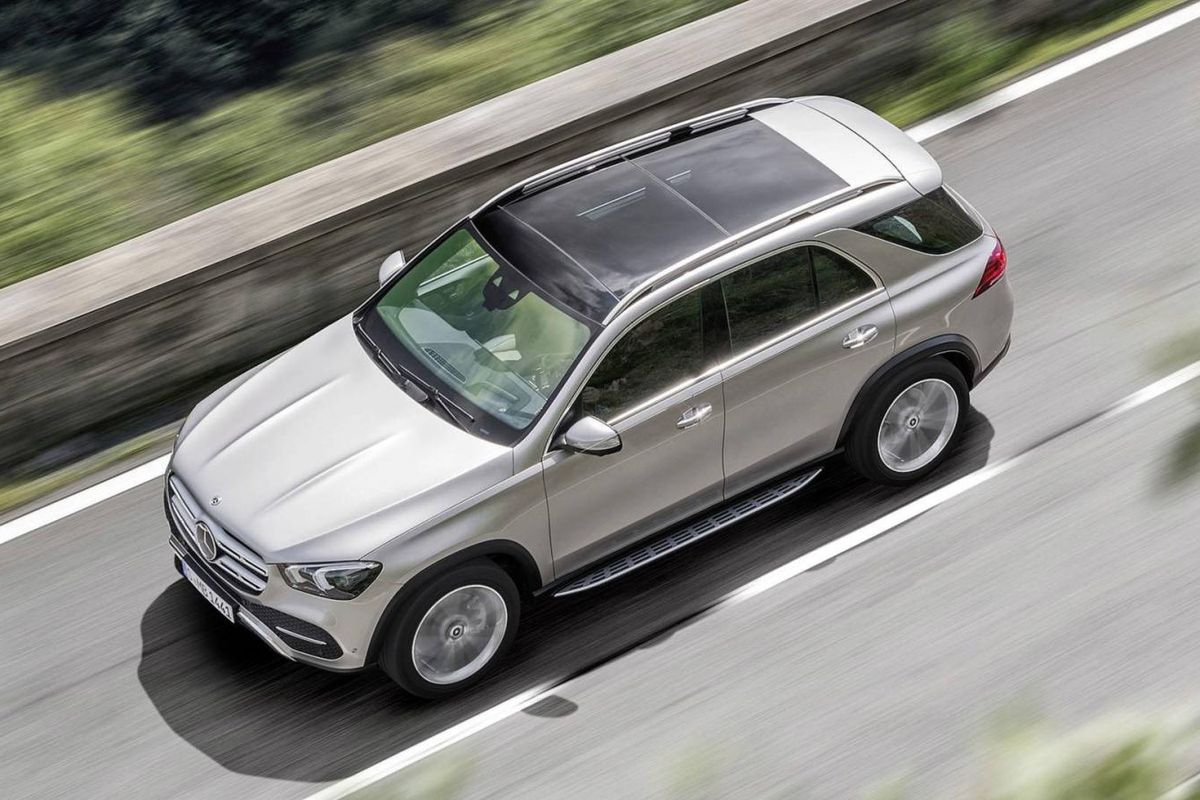
The GLE is the most popular Mercedes-Benz SUV worldwide and a new GLE has now been revealed. Take a look at what the new GLE has to offer…
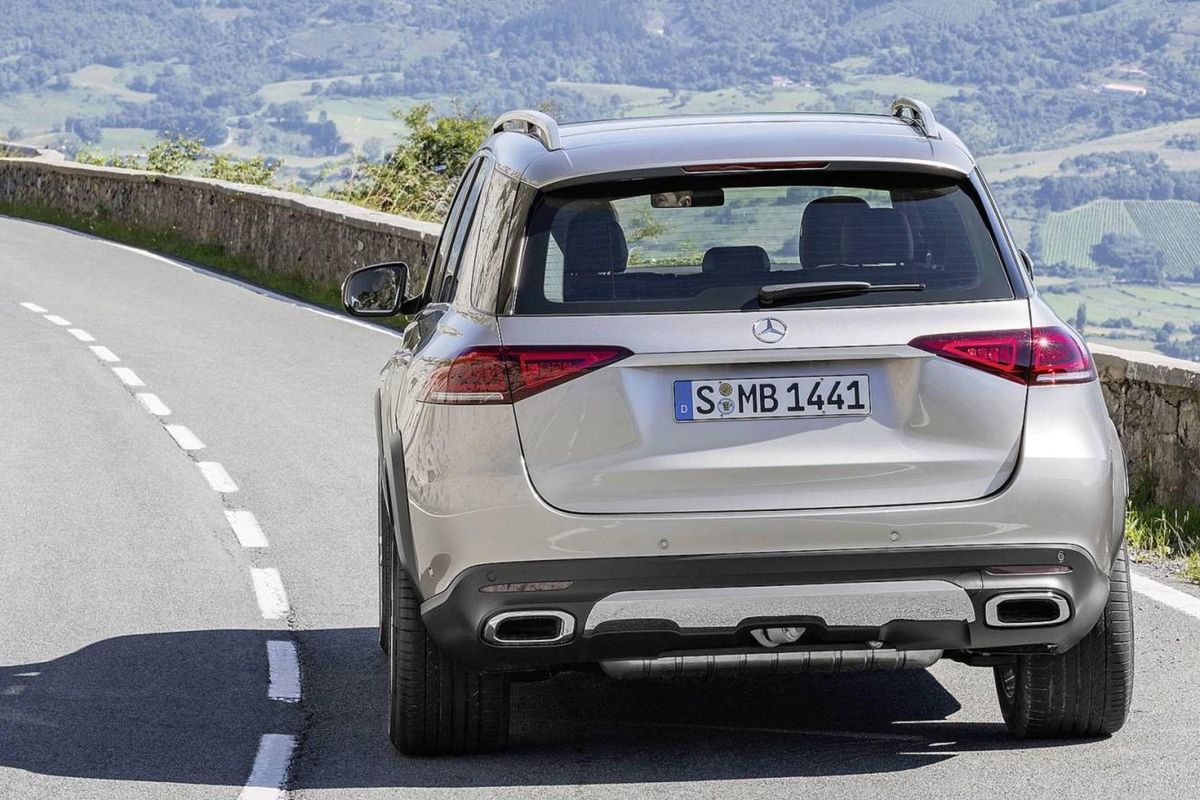
It’s the age of the SUV and Mercedes-Benz currently has a total of 7 SUV models on offer and the GLE has proven to be the best-selling SUV model worldwide. The new GLE will make its official appearance at the Paris Motor Show in October 2018 and can be expected in South Africa within the first half 2019. The new GLE rivals the likes of the new BMW X5, Porsche Cayenne and Audi Q7.
New look, more space
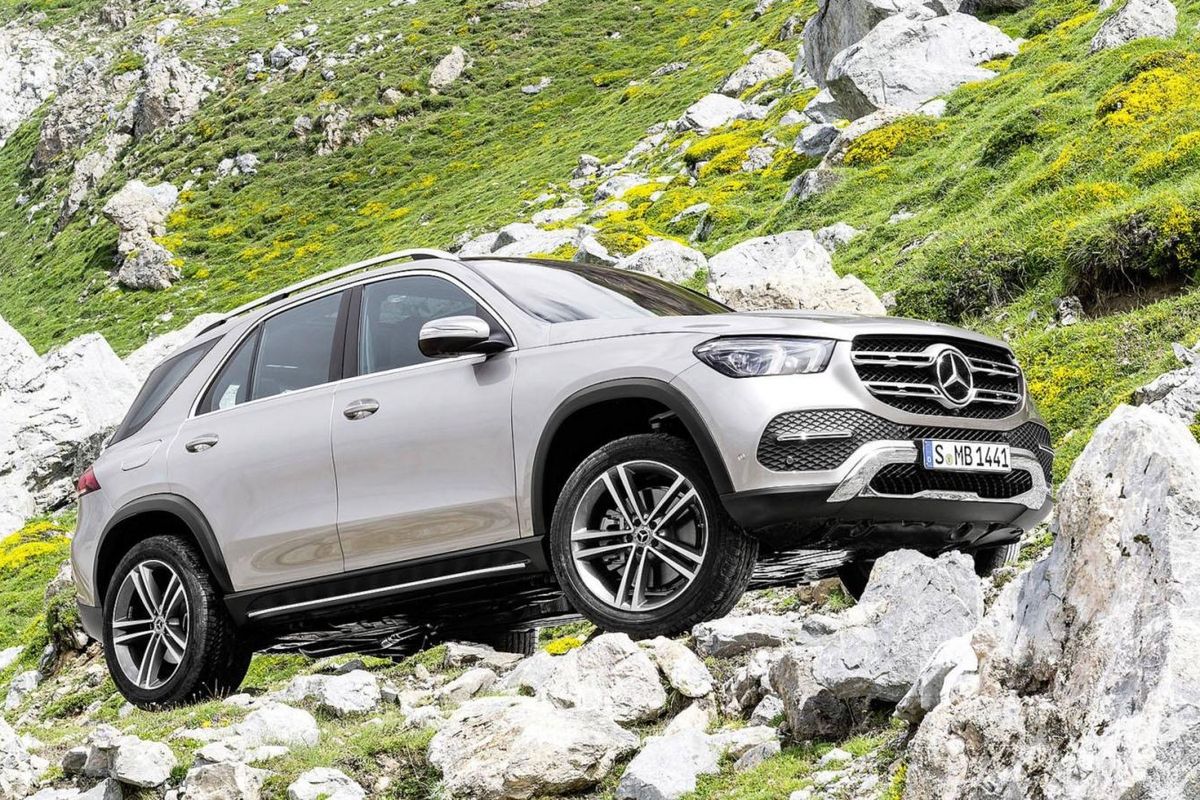
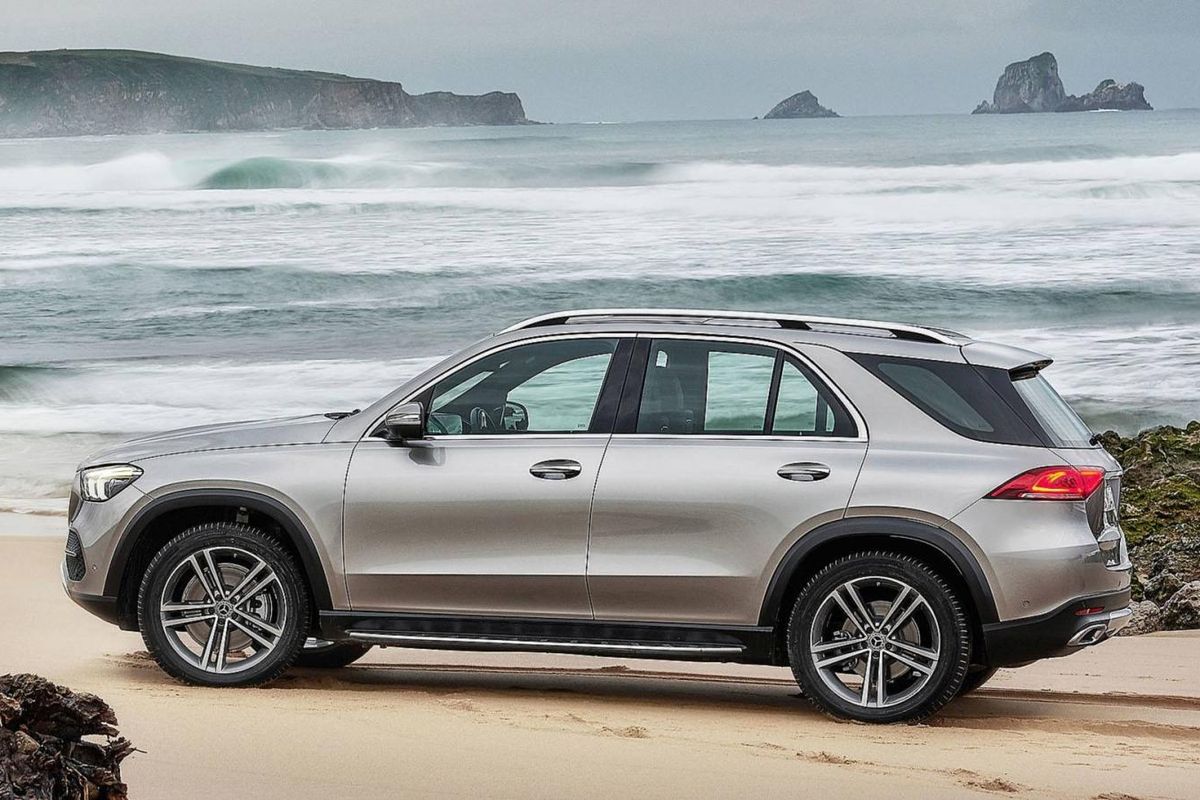
The new GLE SUV rides on an extended wheelbase that has improved passenger space significantly.
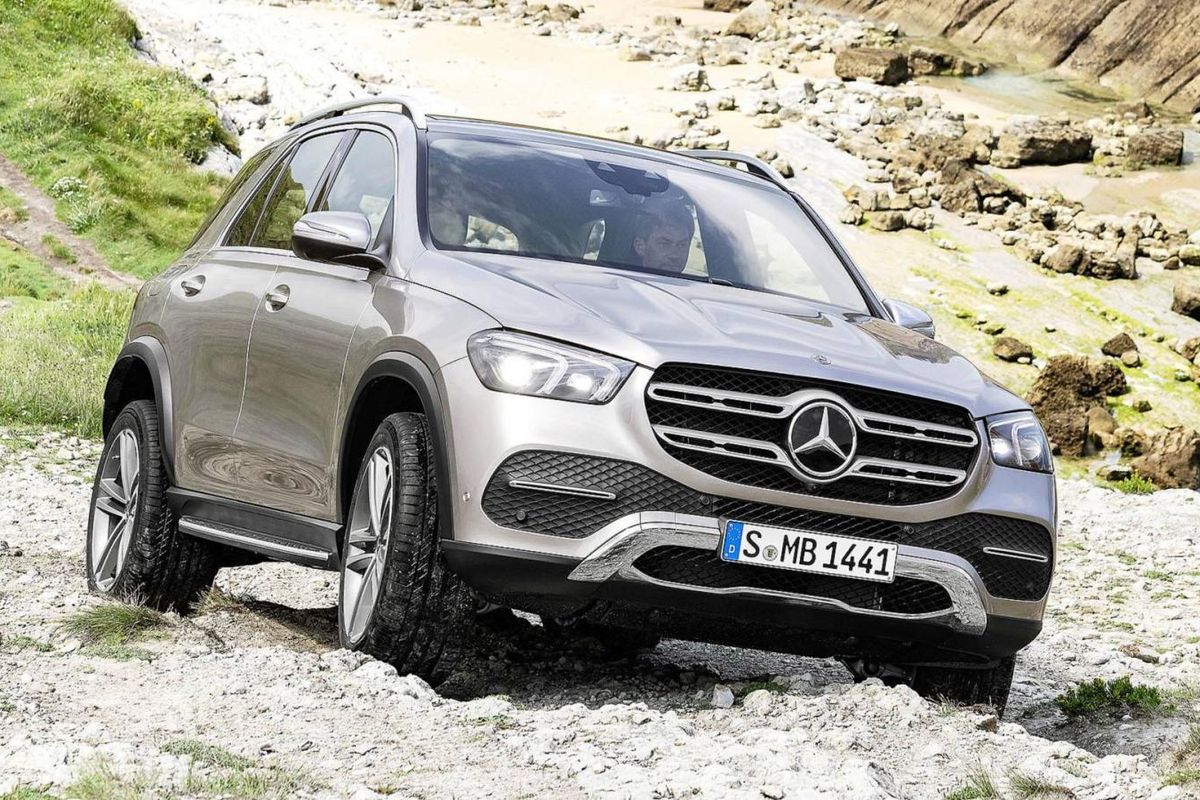
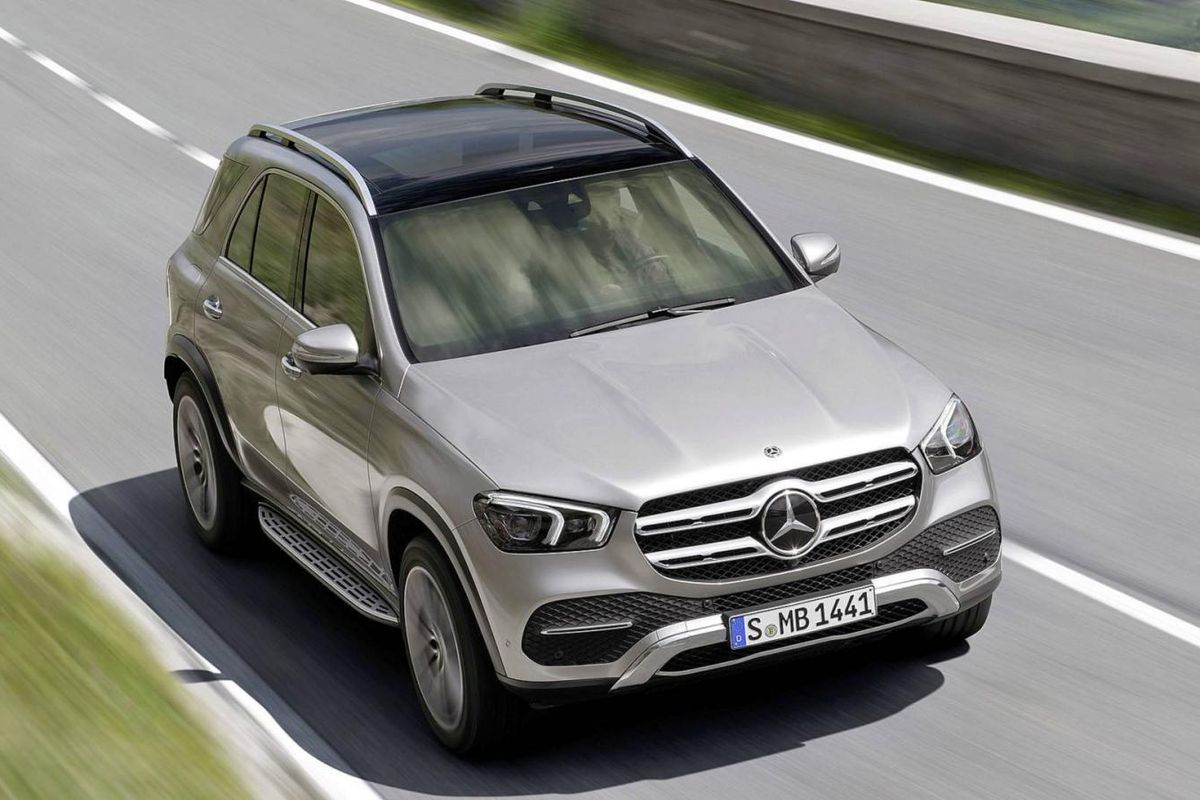
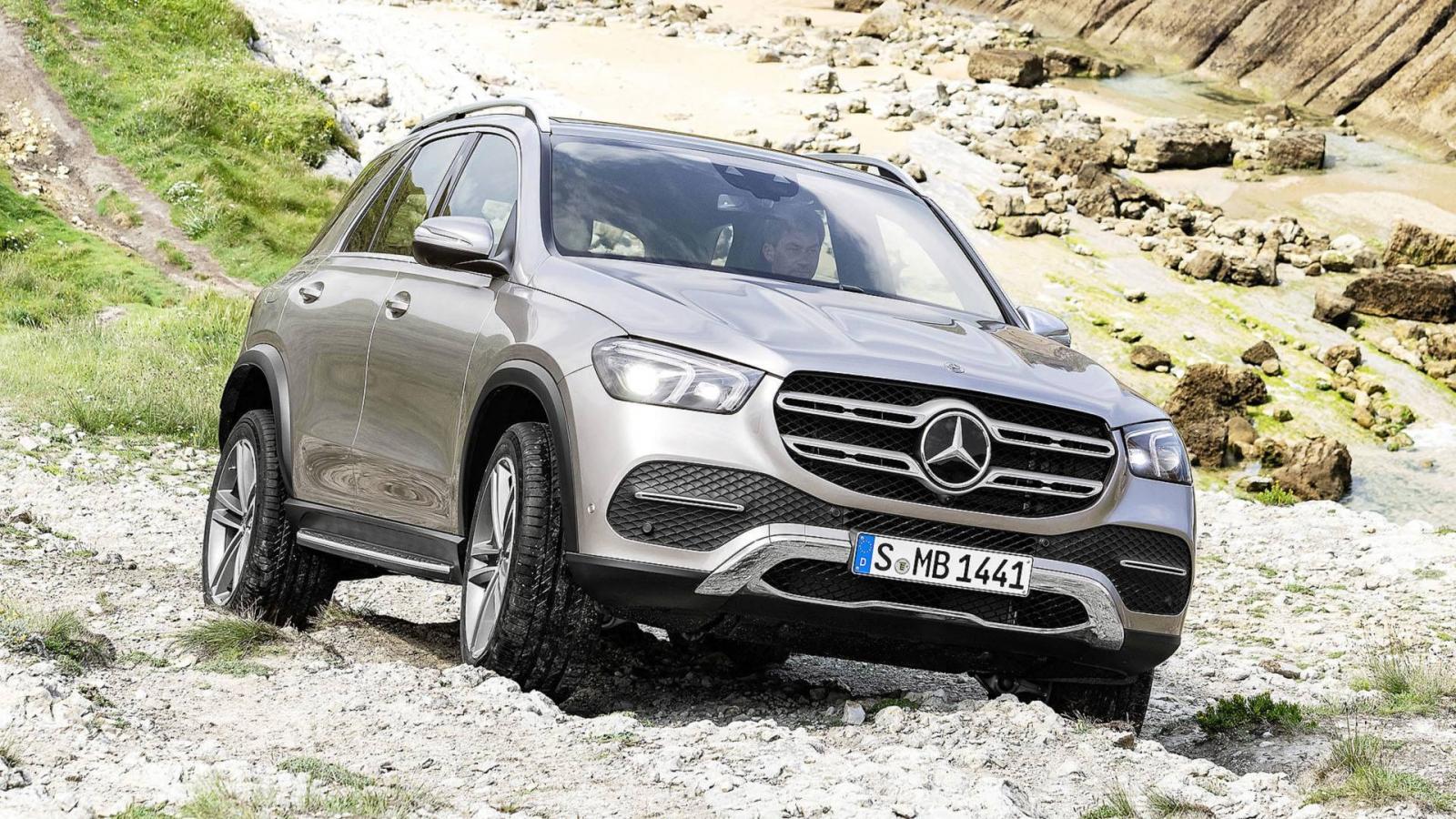
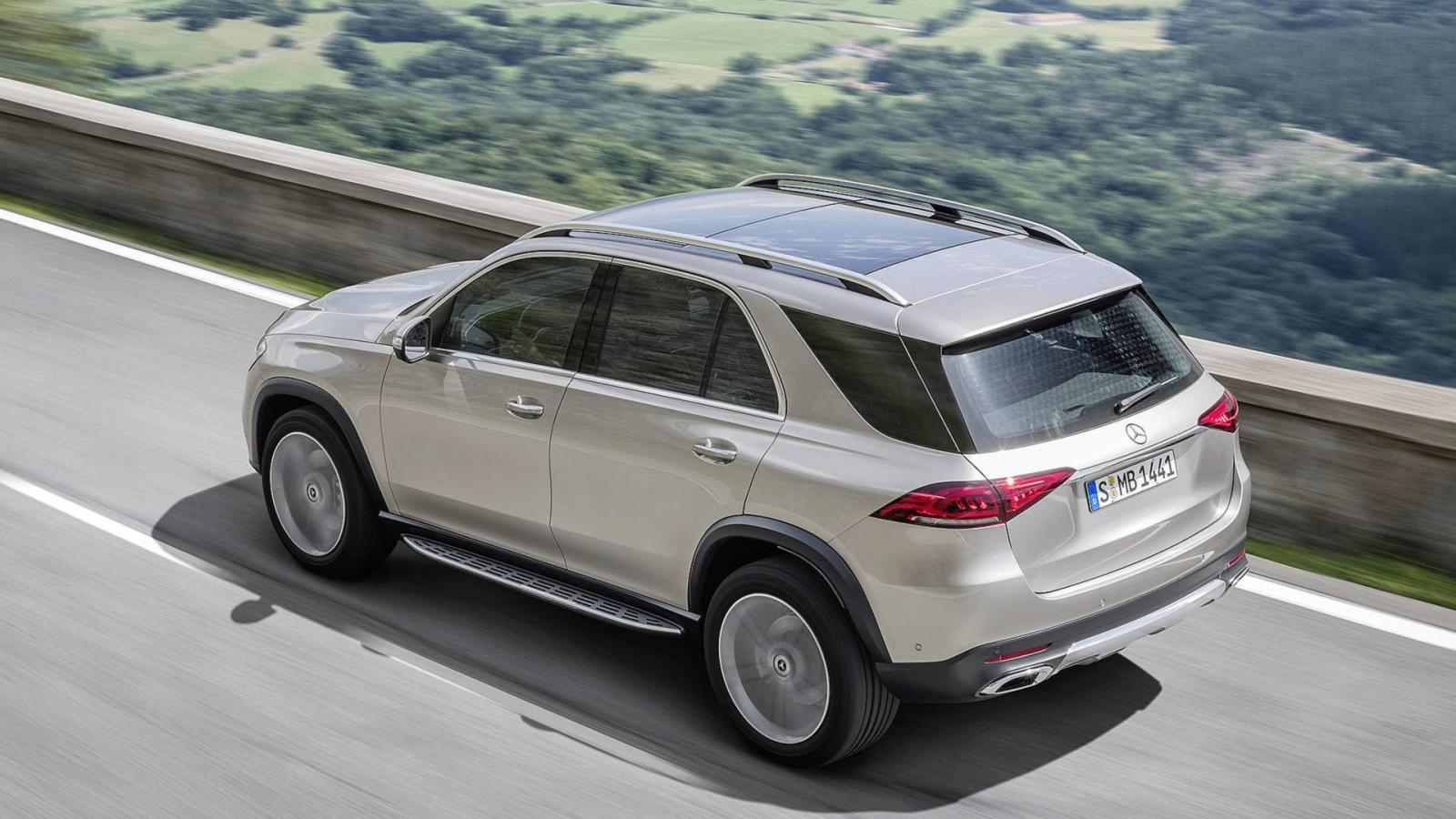
The face of the new GLE is defined by an octagonal upright grille with 2 dominating louvres that frame the large pointed star on its nose. The new model also wears a chrome-plated underguard and the bonnet features 2 powerdomes that provide some added visual muscle to the front-end. Multibeam LED headlights light the way with an illumination range of over 650 metres.
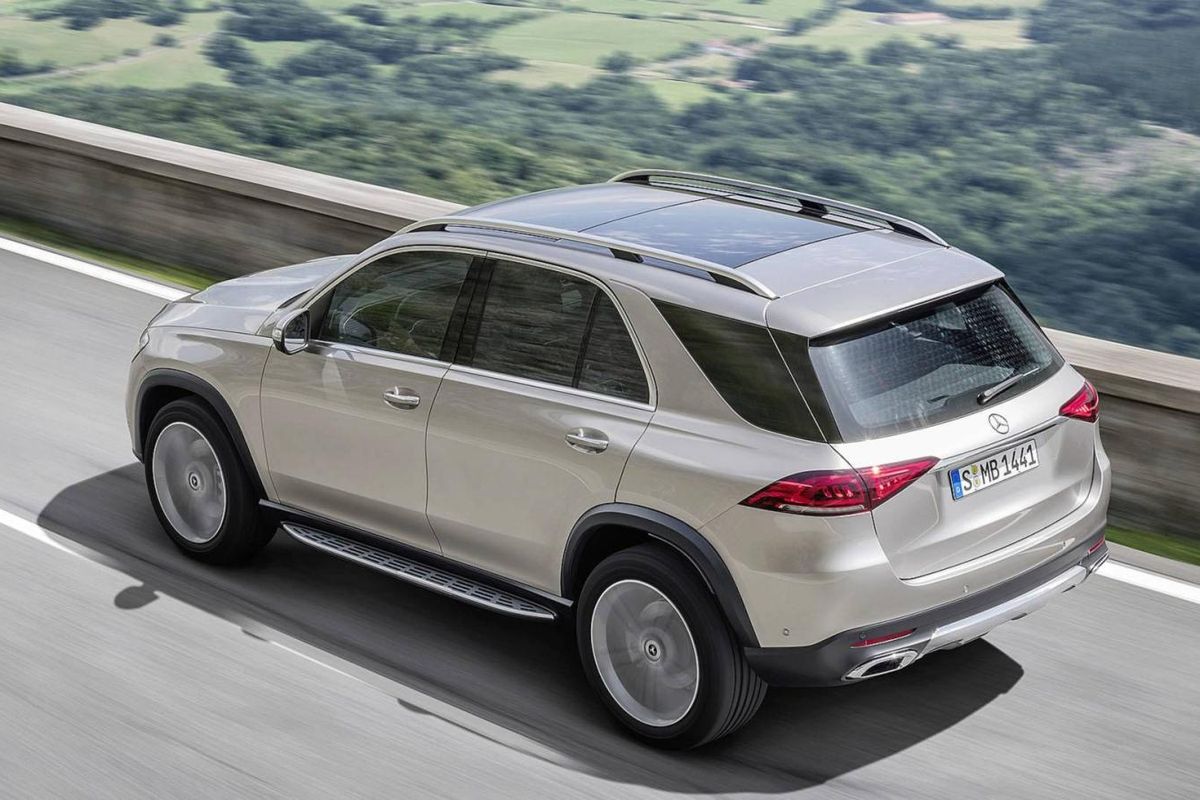
At the rear, flared haunches and 2-section taillights give the GLE added road presence and a chrome-plated underguard rounds off the look. The GLE rides on wheels sizes between 18- and 22-inches.
The new GLE boasts an improved drag coefficient of 0.29 (previously 0.32), which means it slices through the air more efficiently than before which should bode well for reduced fuel consumption.
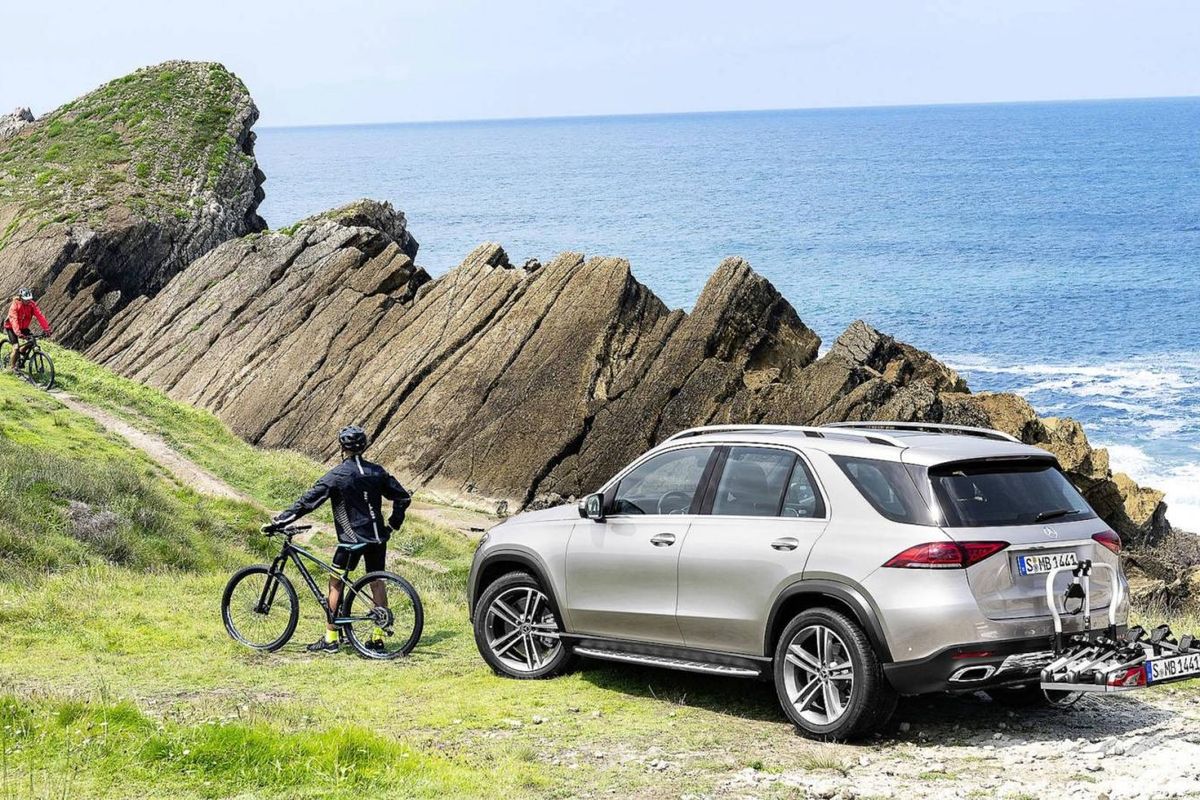
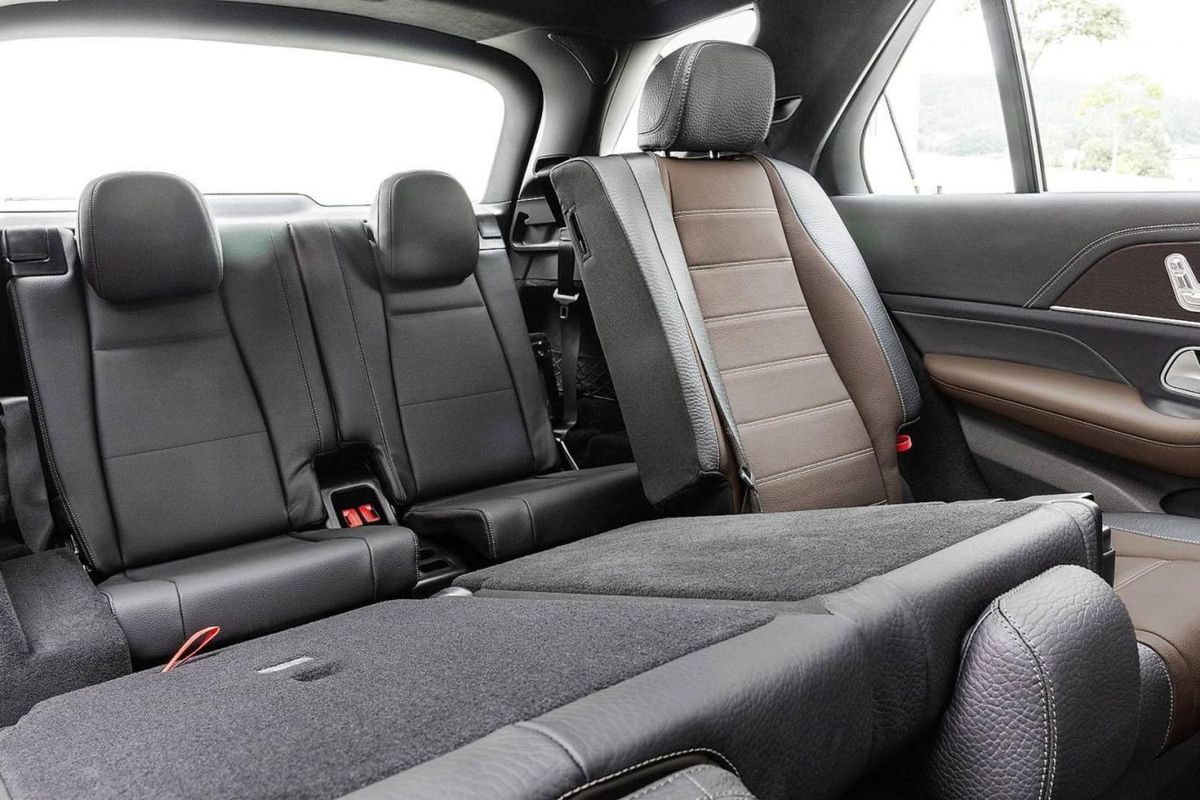
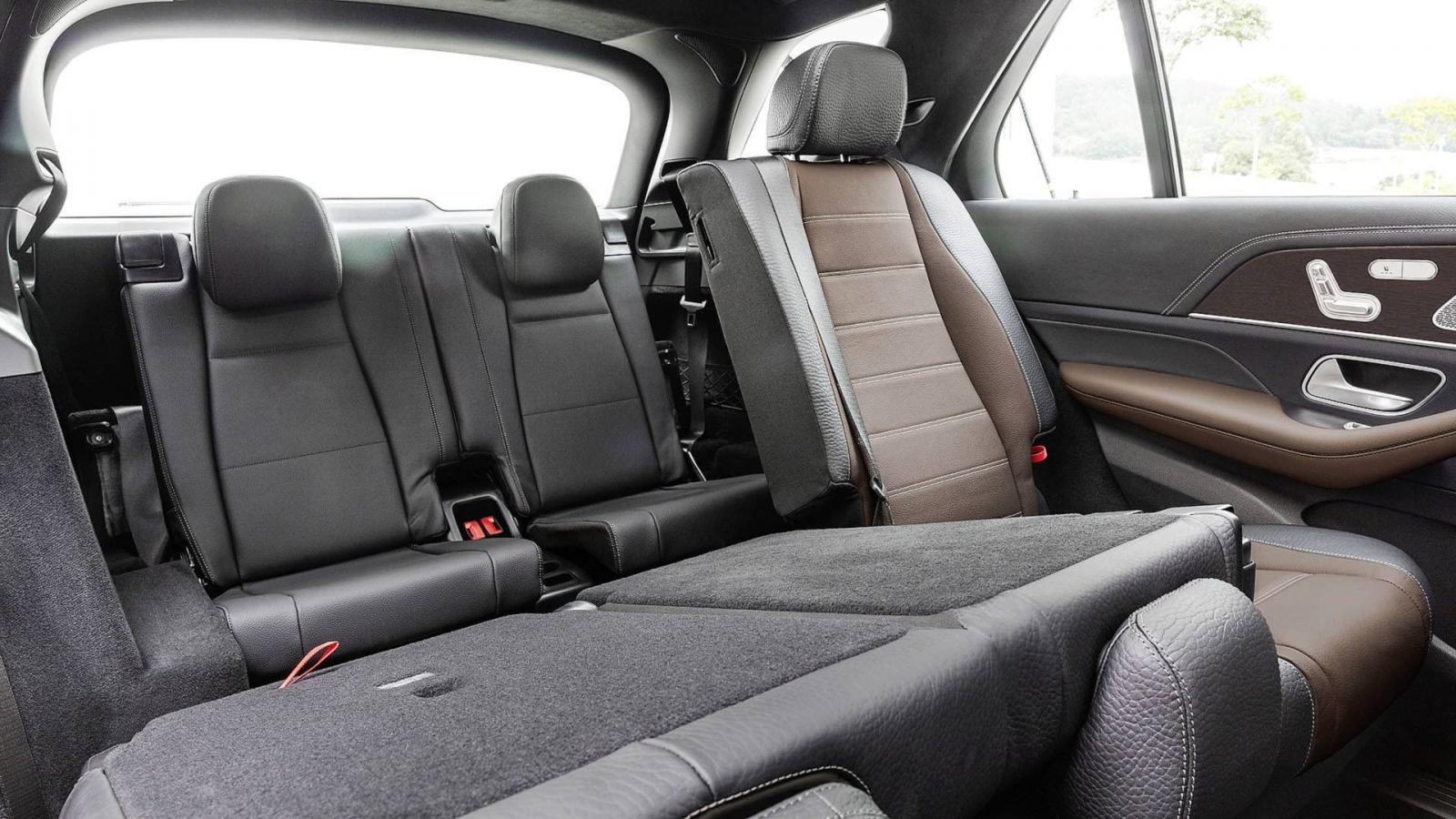
Seating for 7 will be optionally available in the new GLE.
More than this, the wheelbase has been extended by some 80 mm which has improved interior space significantly. Rear passengers now have 69 mm more legroom and headroom is said to have improved by 33 mm. A local source at Mercedes-Benz has indicated that the new GLE may be offered as a 7-seater as standard when it arrives in 2019, or at the very least, it will be offered as an option.
Luggage capacity in the new GLE has increased from the current 690 litres to a generous 825 litres which expands to a capacious 2 055 litres with the 40:20:40 rear seats folded down.
Interior features
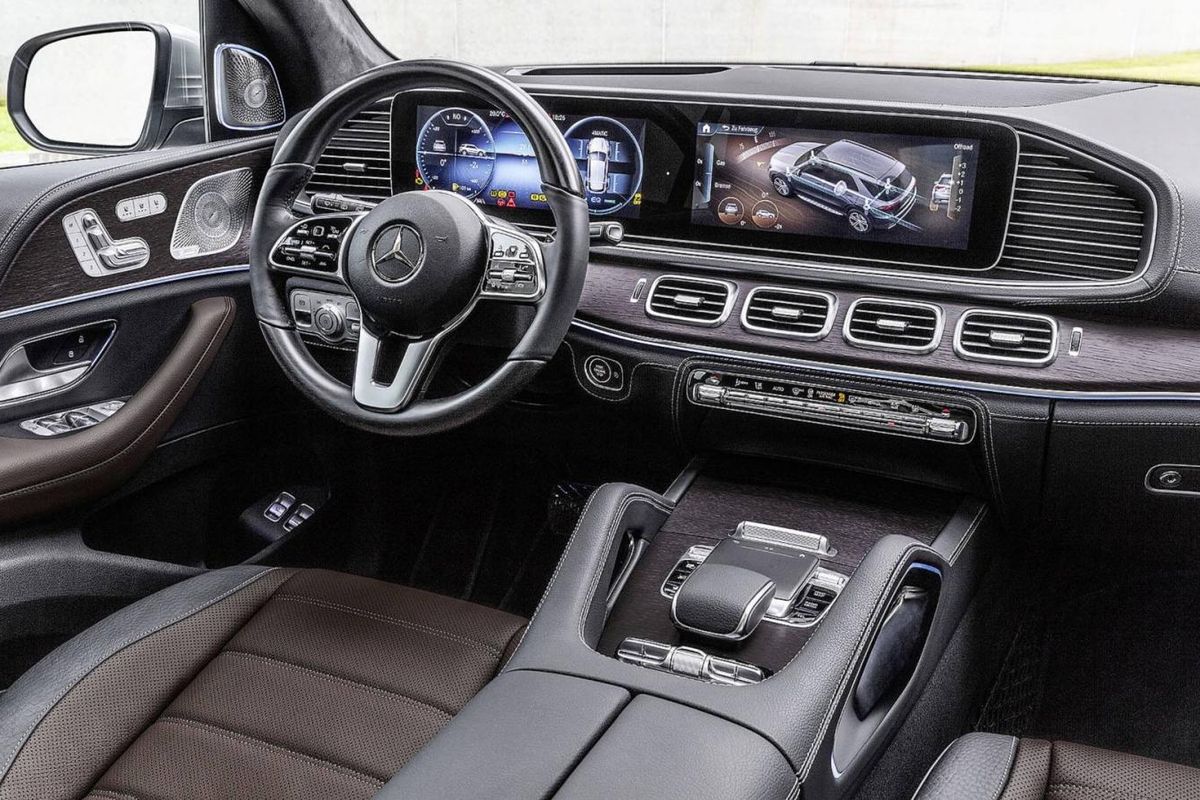
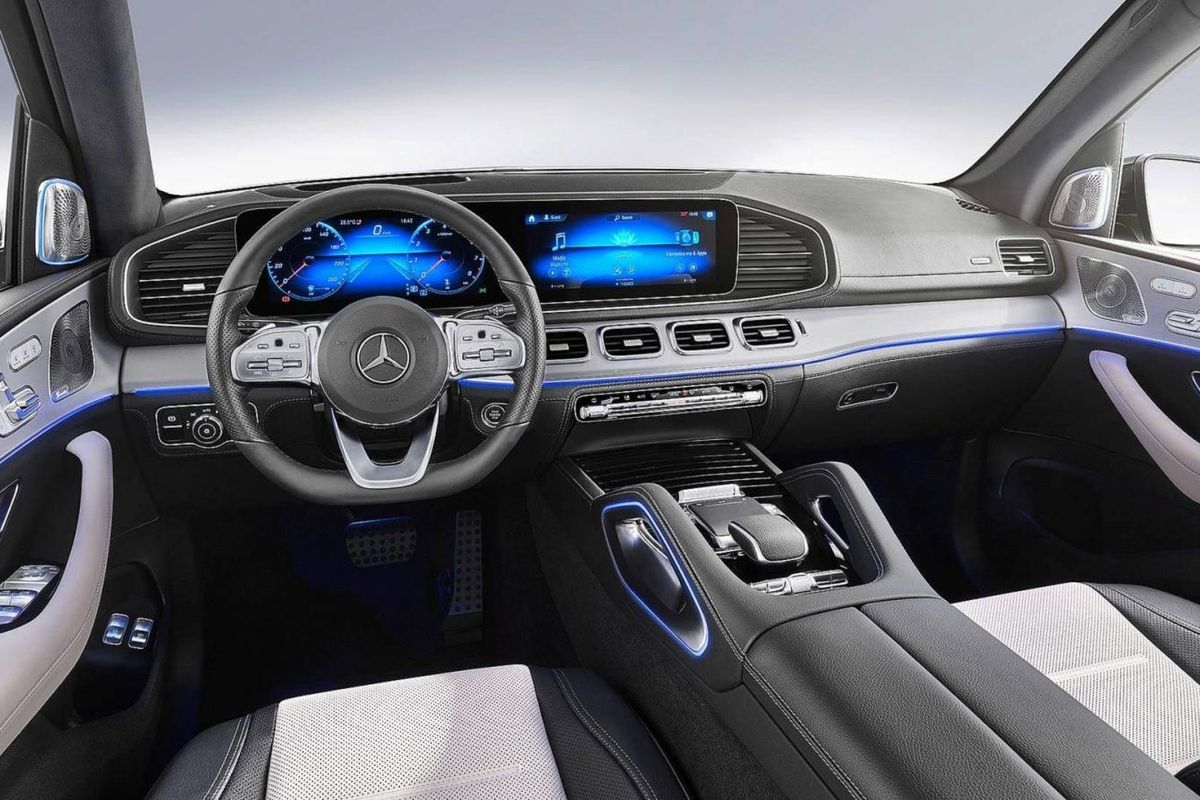
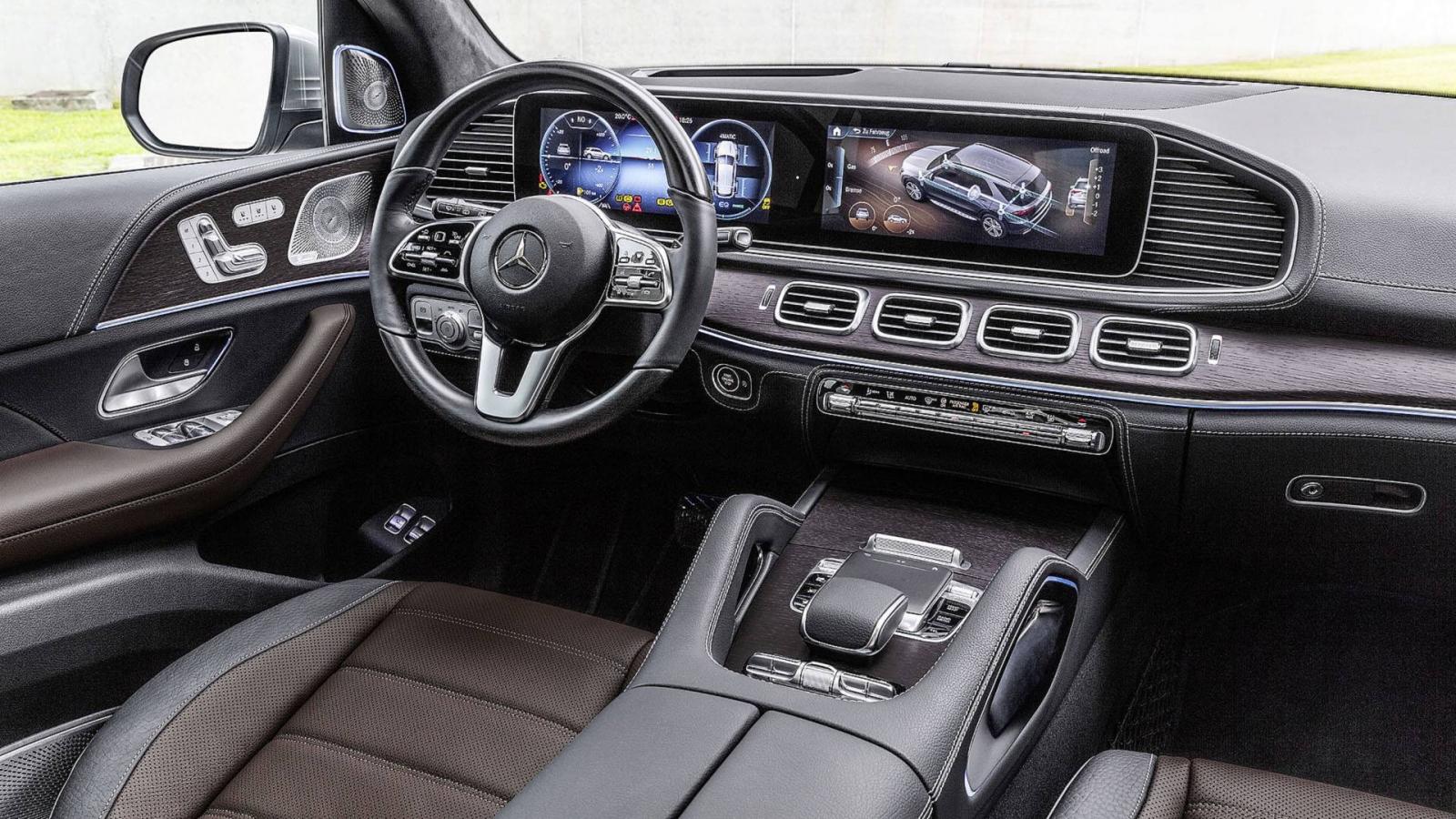
A widescreen cockpit with the latest MBUX system takes infotainment to new heights in the GLE.
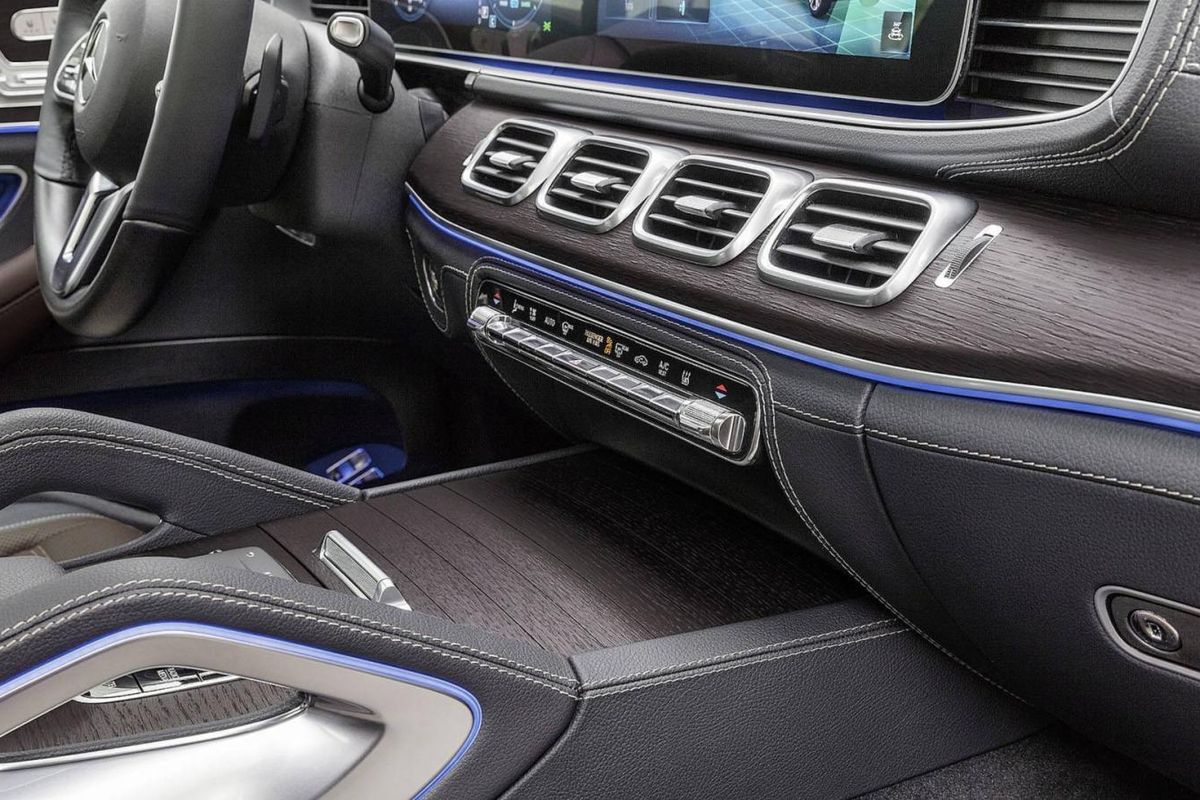
The new GLE is equipped with the latest MBUX infotainment system which was first previewed on the new A-Class. The system incorporates 2 large 12.3-inch screens that sit side-by-side to give a widescreen effect. The system results in a configurable layout with 4 distinct styles to choose from (Modern Classic, Sport, Progressive and Discreet) and with all in-car functions easily within reach, less buttons are to be found in the cockpit. The MBUX system take care of a wide range of functions including navigation, gesture prediction, artificial intelligence, in-car comfort settings and voice control which is activated by saying “Hey Mercedes”.
A larger and brighter head-up display will also be offered as an option.
Engines
A range of 6-cylinder and 4-cylinder petrol and diesel engines will be offered with the new GLE. A plug-in hybrid version will follow later.
The new GLE will be powered by a new 6-cylinder petrol engine and Mercedes-Benz says that other engines including diesels and a plug-in hybrid version will join the range later on.
While broader engine details have yet to be revealed, Merc has provided details of the GLE 450 4Matic which will be powered by a 6-cylinder petrol engine which is systematically electrified with 48-volt technology. This variant offers 270 kW and 500 Nm of torque with an additional EQ boost of 250 Nm and 16 kW available for a short period of time. The integrated starter/alternator takes care of hybrid functions such as EQ boost and energy recuperation while also saving fuel.
All GLE derivatives will make use of a 9-speed automatic transmission. In the case of the 4-cylinder engines, all-wheel drive capability is made possible using a transfer case that distributes torque in a fixed ratio of 50:50. Other engines will make use of a transfer case with an electronically controlled multi-disc clutch allowing for variable torque distribution from 0-100.
For ultimate offroad driving, an optional torque-on-demand transfer case with a reduction gear set and automatic locking effect will also be offered.
Ride comfort is also enhanced with a new E-Active Body Control System with a 48-volt suspension system that, for the first time, can control/adjust spring and damping at each individual wheel.
Driver assistance features
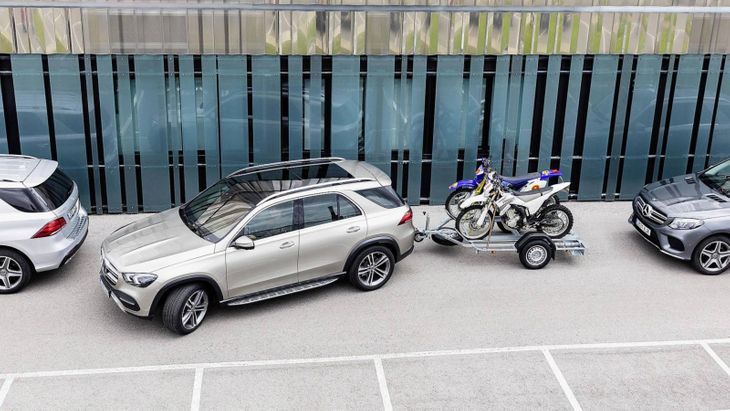
Can't drive with a trailer? The new GLE will help you out with its Trailer Maneuvering Assist feature.
A wide range of driver assistance features are offered on the new GLE. The new GLE will be able to assist the driver stop-go traffic situations but also provide support in a tailback situation using Active Distance Assist Distronic. The system uses live traffic information to detect upcoming tailbacks or slow-moving traffic and will automatically reduce speed to 100 kph as a precaution. If a tailback is recognised, the Active Brake Assist will brake the vehicle to a standstill.
Other assistance systems include Active Steering Assist, Evasive Steering Assist, Active Lane Keeping Assist and Active Emergency Stop Assist. Active Blind Spot Assist with exit warning is also offered as well as Trailer Maneuvering Assist, which helps novices manoeuvre with a trailer at speeds up to 5 kph.
The new Mercedes-Benz GLE is expected to reach South Africa in the first half of 2019. We will keep you updated as soon as more information regarding, engines and local pricing and specification details become available.
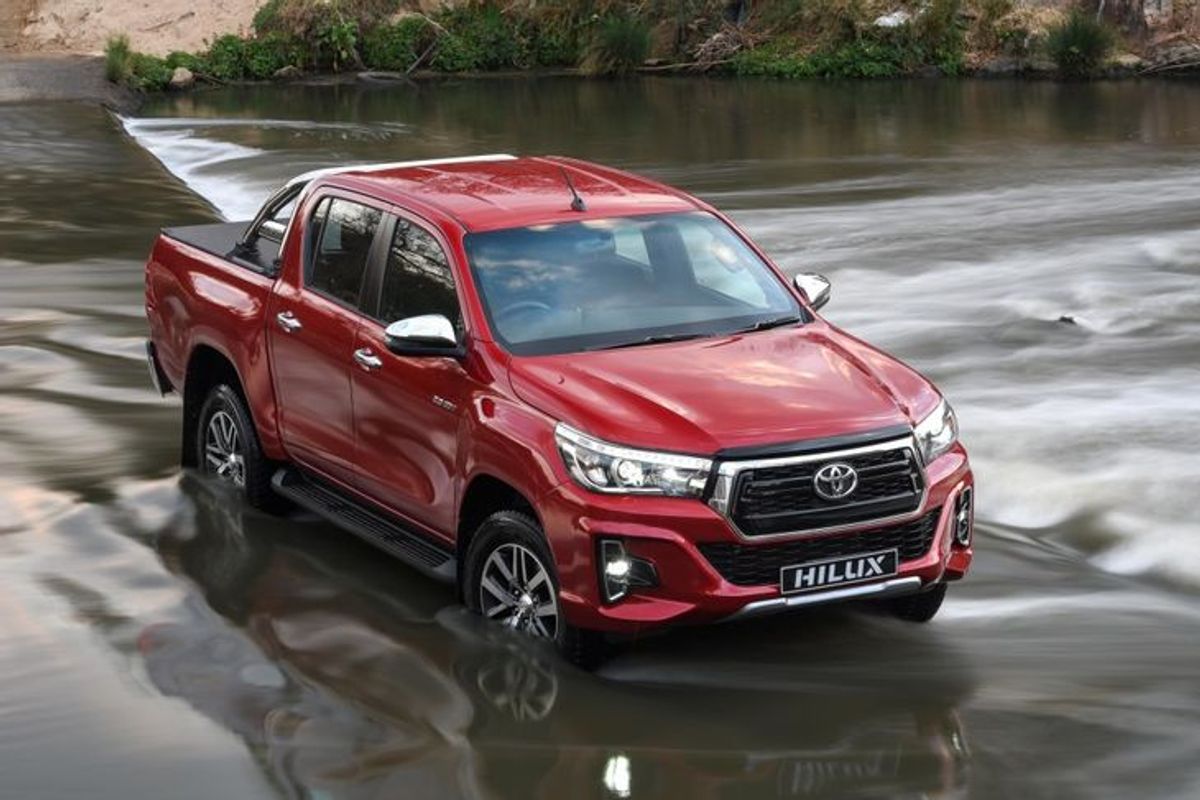
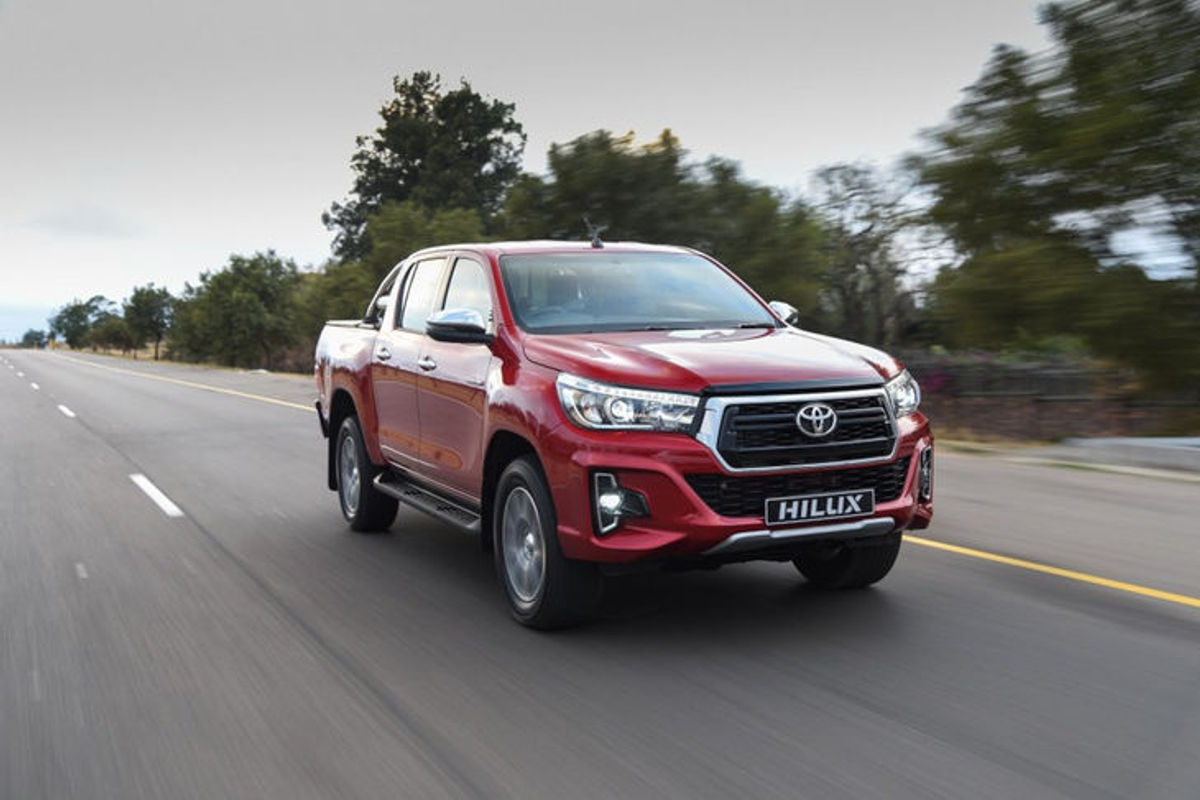
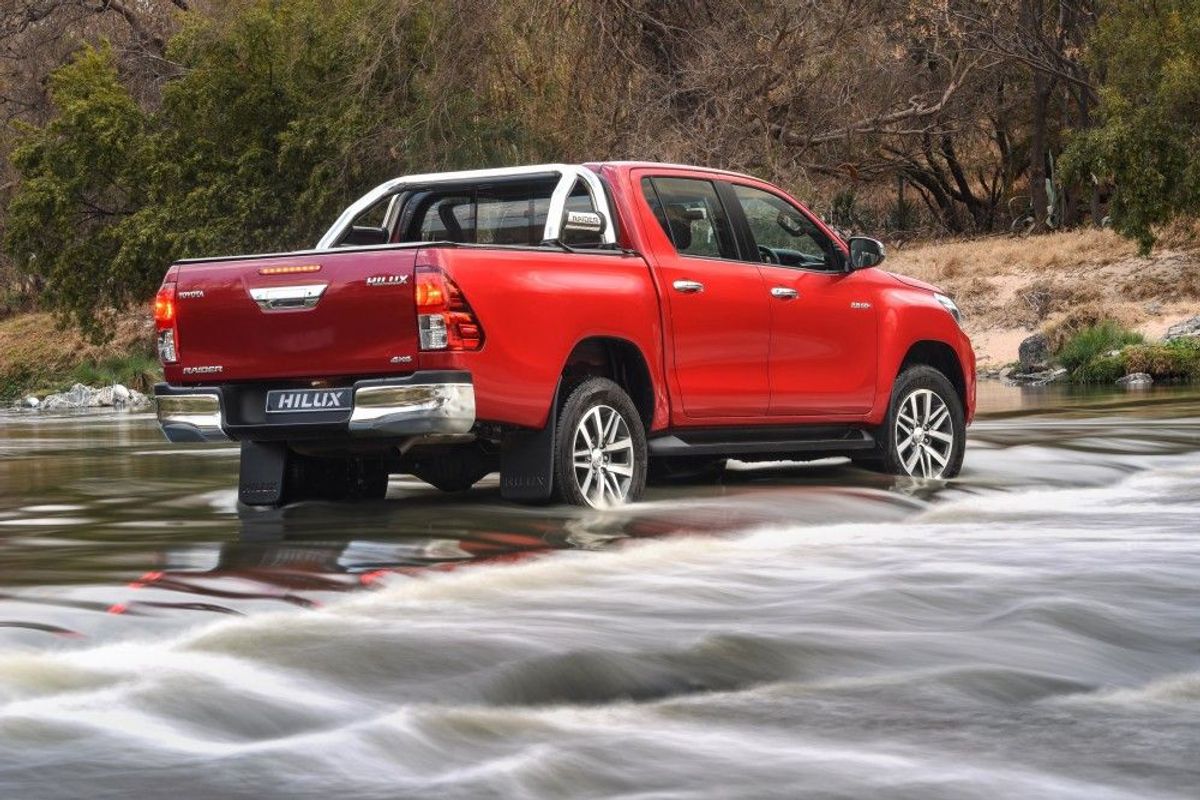
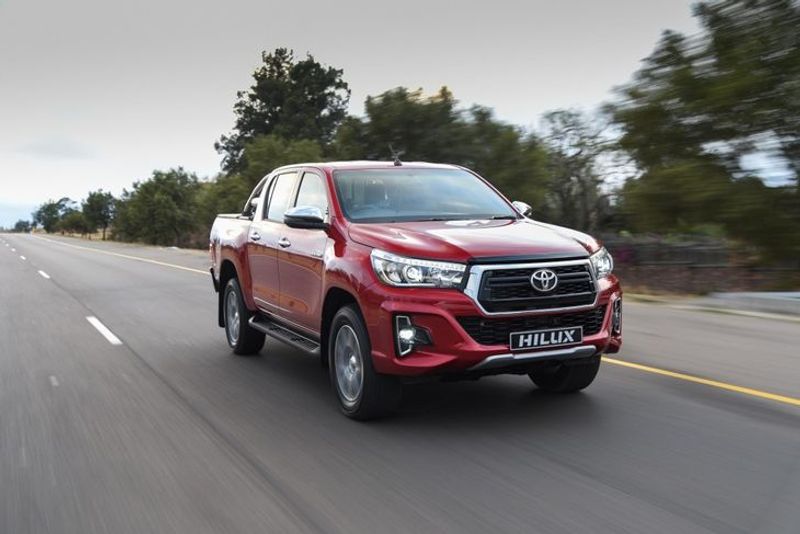
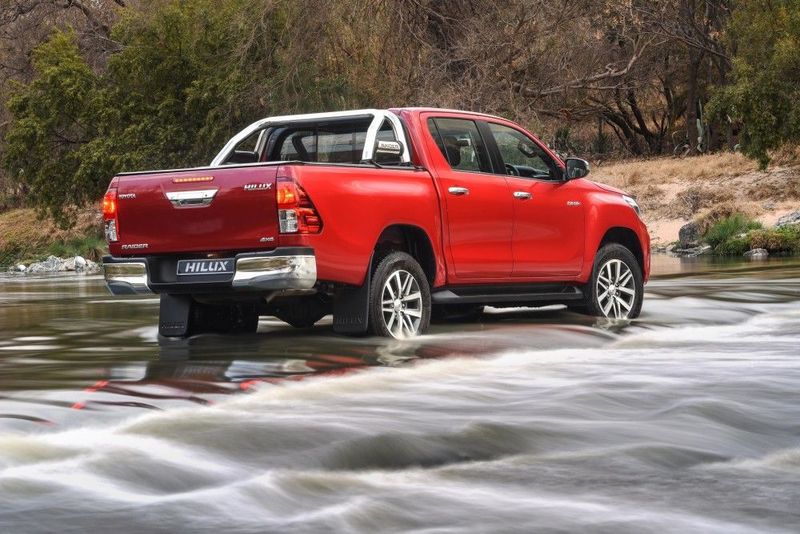
The recently revised Toyota Hilux line-up comprises 36 derivatives, which include 4 specification levels, 4 body styles and 4 engine options. Herewith the pricing of the entire range, plus specifications of the Xtra cab and double-cab bakkies.
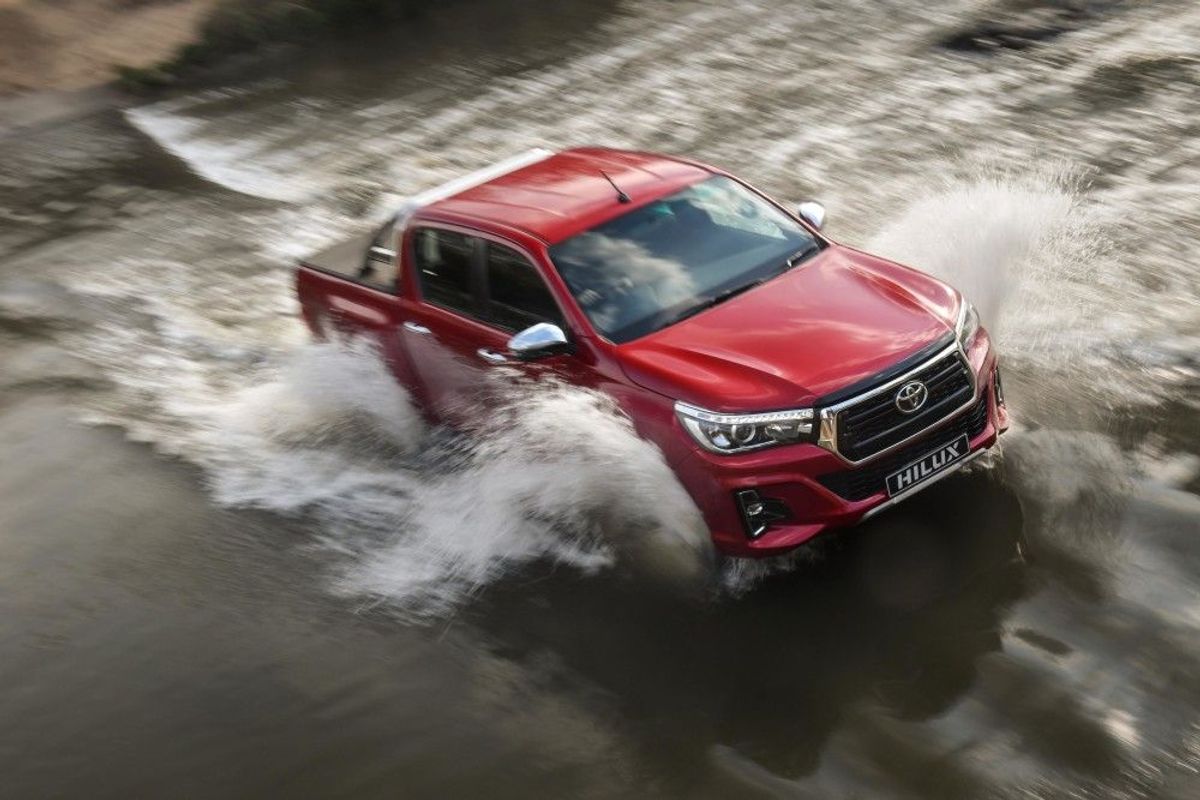
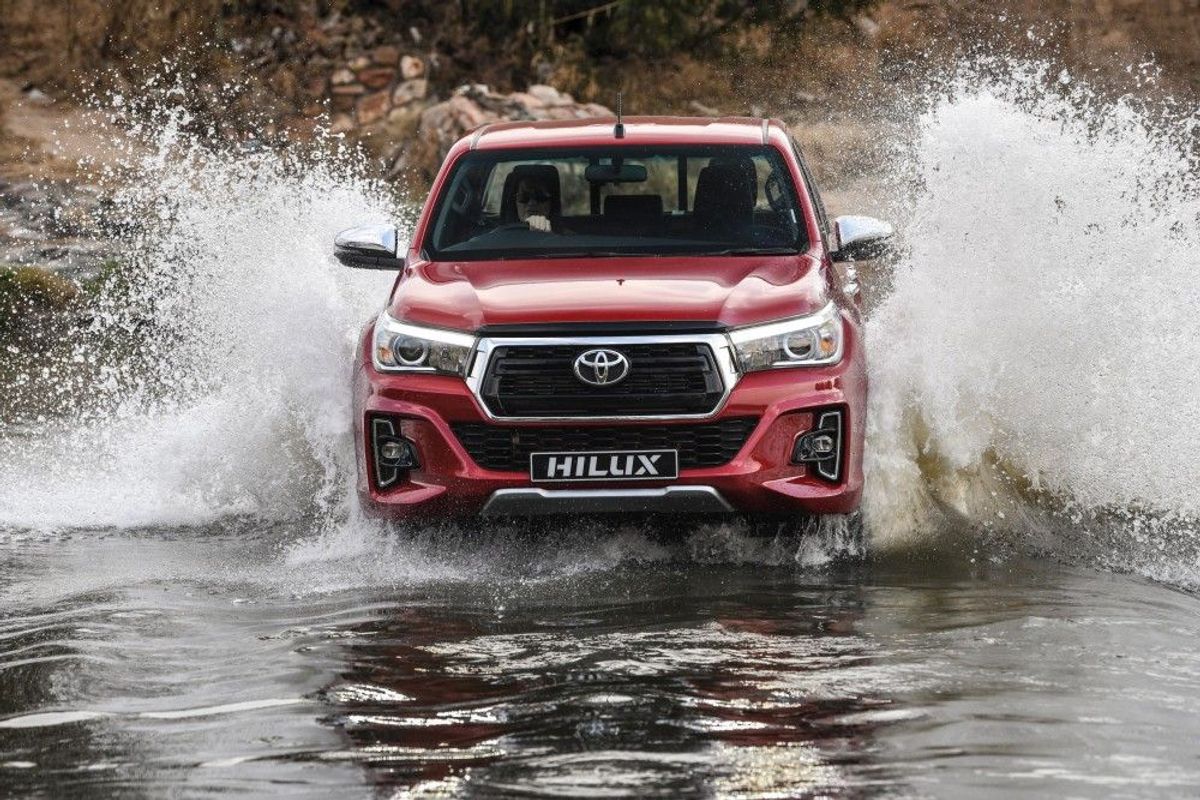
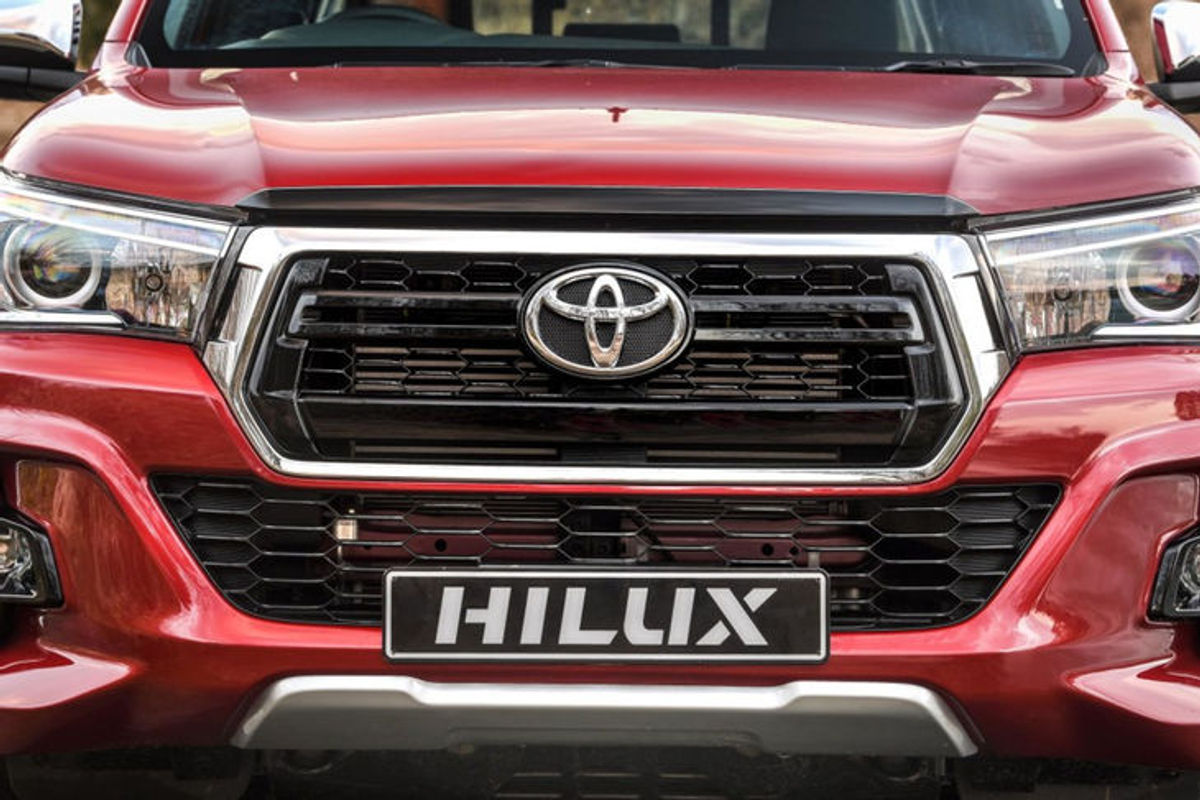
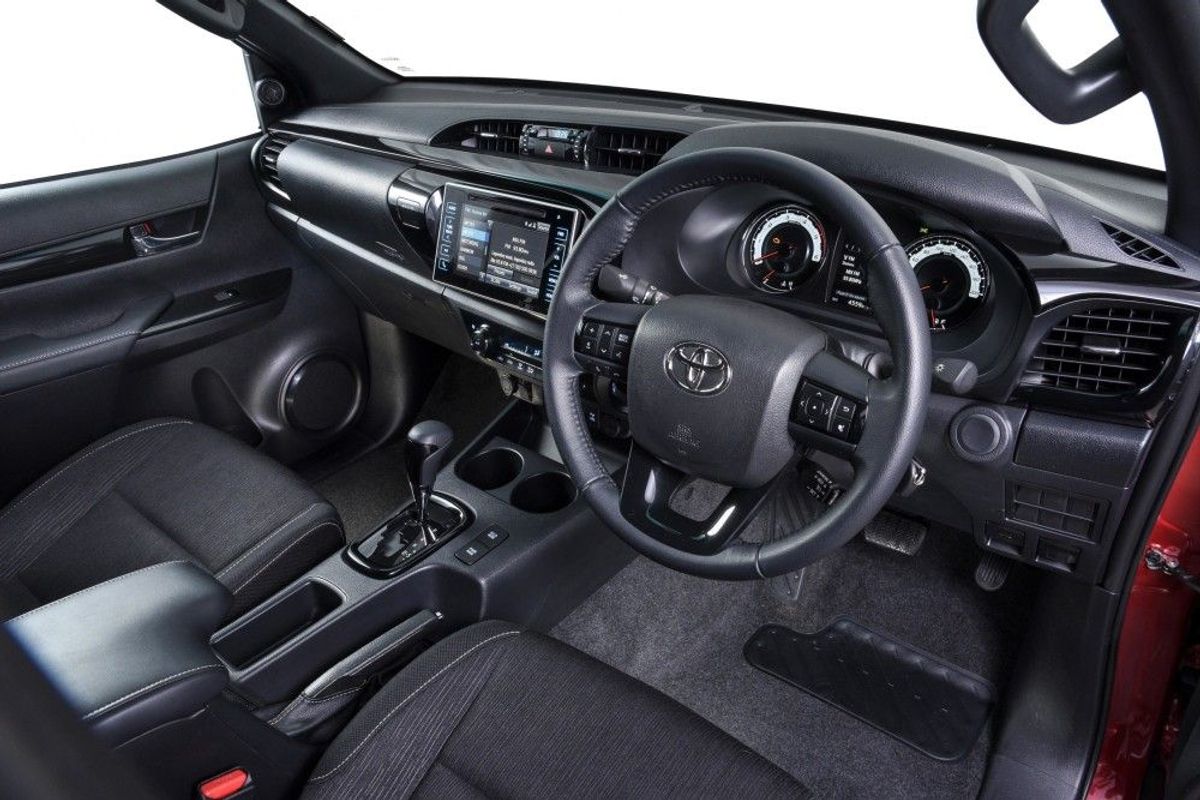
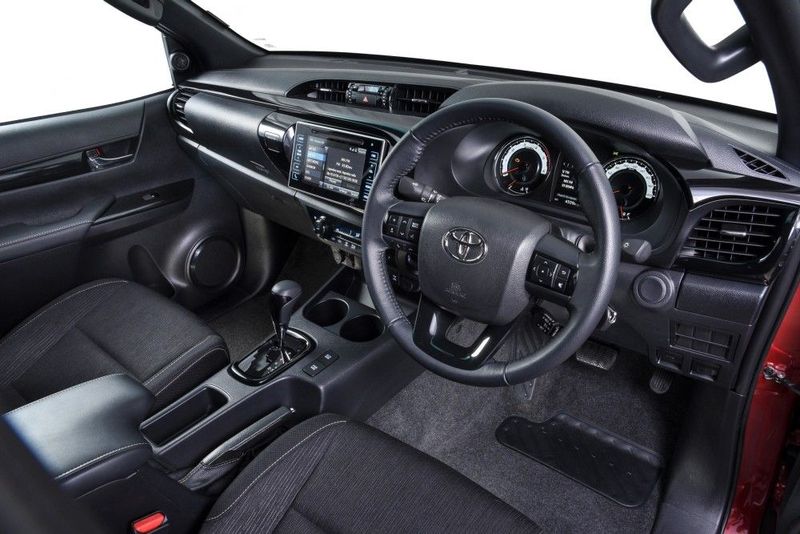
As we reported in last month’s update story, the most notable aesthetic update to the range is the adoption of the Dakar-Edition front grille on SRX and Raider derivatives. The former spec further gains a touchscreen audio system and a reverse-view camera, while the latter benefits from a black interior and satnav.
Raider-spec derivatives sport some of the most intricately detailed foglamp designs (and trims) in the bakkie market.
Toyota Hilux Xtra cab range
Toyota now offers 6 derivatives of the Hilux Xtra cab variant (in SRX and Raider specifications), which includes a new 2-wheel-drive Raised Body 6-speed auto.
The SRX-badged bakkies are powered by the 2.4-litre GD-6 turbodiesel engine (with peak outputs of 110 kW, at 3 400 rpm and 400 Nm, from 1 600 to 2 000 rpm), which is mated with either a 6-speed manual gearbox or a 6-speed automatic transmission.
Apart from the aforementioned revised frontal design, SRX derivatives sport a colour-coded bumper with matching skid plate, fog lamps, black side steps (and side mirrors), plus come fitted with 17-inch alloy wheels shod with 265/70R17 tyres.
Chrome accents abound on Raider-spec Hiluxes and 18-inch alloys are standard.
Notable SRX features include:
Auto light control (with follow-me-home functionality), remote central locking and auto door-locking.
Fabric trim, power windows, air-conditioning, a multi-information display, rake-and-reach steering column adjustment and multiple storage binnacles.
A 4-speaker touchscreen infotainment system (with Bluetooth, USB and reverse-view camera), supported by a multifunction steering wheel.
Driver-, passenger- and driver knee airbags. ABS, EBD and Brake Assist, plus Vehicle Stability- (VSC), Traction- (TRC) and Trailer Sway Control (TSC).
For details on the Raider specification, see below.
Toyota Hilux Double-Cab range
For 2018, the double-cab range kicks off with an entry-level “S” derivative, which can be distinguished by a black bumper and front grille. As its appearance suggests, it’s a no-frills Hilux with PVC interior trim, a latch-type tailgate with cargo hooks and 17-inch wheels. Buyers have the choice of the 2.4 GD-6 turbodiesel (mated with a 6-speed manual 'box) or the 2.7-litre VVTi petrol engine, which produces peak outputs of 122 kW and 245 Nm, and is exclusively available with a 5-speed manual ‘box.
Other changes to the double-cab lineup include the addition of two 2.4 GD-6 Raised Body 2-wheel-drive derivatives: in SR (6-speed manual) and SRX (6-speed auto) specifications respectively. The previously-offered 2.7 VVTi SRX derivative has been discontinued.
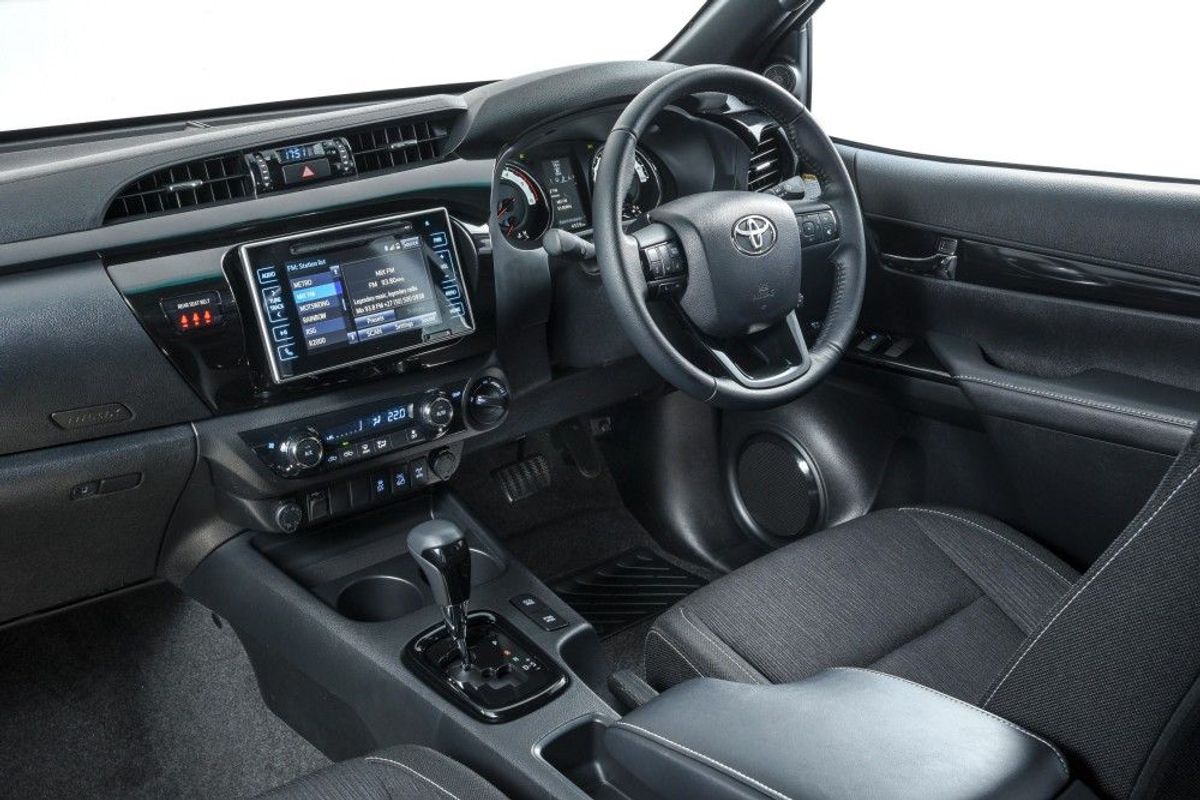
The elegant black Raider interior, replete with similarly-toned headliner and tasteful trim inserts.
Meanwhile, the range-topping Raider derivatives are powered by the familiar 2.8 GD-6 turbodiesel motor with 130 kW and 420 Nm (450 Nm in automatic guise). The throaty 4.0-litre V6, which is reportedly popular with "dune-surfing Namibian buyers", remains on offer, with peak outputs of 175 kW and 376 Nm respectively.
Raider derivatives can be distinguished by a chrome-look grille surround, with similarly trimmed exterior mirrors (power-retractable) and door handles. The headlamps (full LED) have LED daytime running lights and fog lamps, the latter with multi-dimensional garnishes. Standard exterior adornments also include 18-inch alloy wheels.
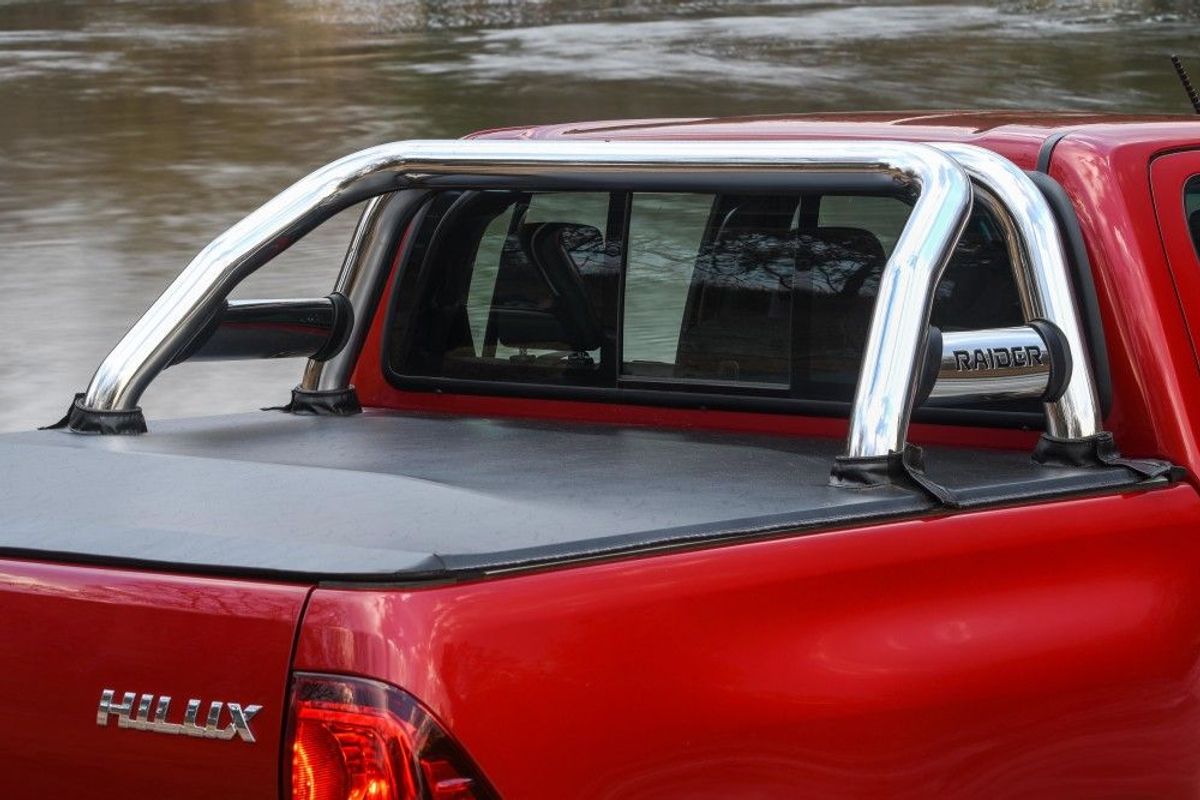
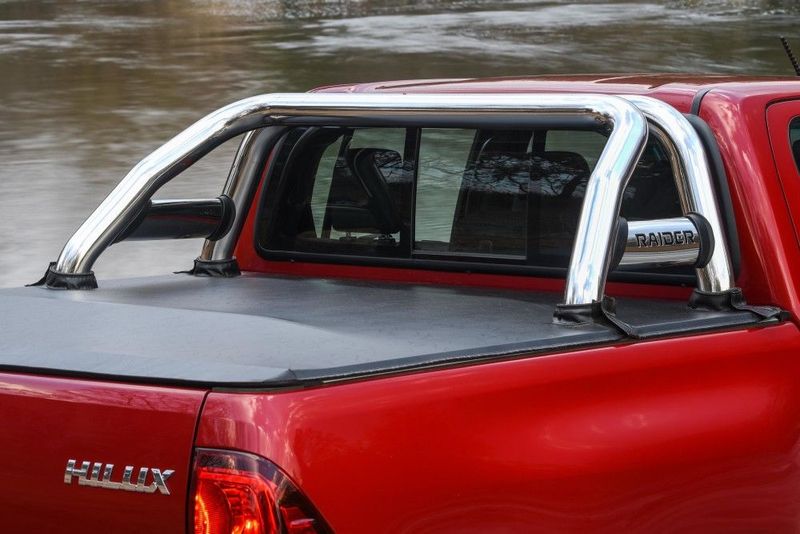
This Raider derivative is additionally specced with a styling bar and matching tonneau cover.
Notable Dakar-spec features include:
The limited-edition Dakar's full black interior, replete with black headliner and metallic-black interior trim accents, is carried over.
Fabric trim, climate- and cruise control, a TFT colour multi-information display, leather steering and shift lever, air-conditioned glovebox, 12- and 220-Volt accessory connectors, plus a rear armrest with cupholders.
A 6-speaker touchscreen infotainment system (with Bluetooth, USB, satellite navigation, DVD-compatibility and a reverse-view camera), supported by a multifunction steering wheel.
Over and above the SRX-level safety equipment, Raider derivatives are equipped with 7 airbags (including curtain and driver knee 'bags).
Wrapping up the updates to the range are all-new chassis cabs (available in 2.0 VVTi 5MT AC workhorse, 2.4 GD-6 5MT AC workhorse and 2.4 GD-6 6MT SRX 4×4 derivatives), increased safety spec on workhorse versions and the Inferno Orange metallic paint finish (introduced on limited-edition Dakar) is now widely available.
Watch a video of the Hilux Dakar Edition review:
Toyota Hilux – prices in SA
These prices were correct as published in late August 2018. All Hilux derivatives are sold with a 3-year/100 000km warranty and a 9-service/90 000 km service plan as standard. Extended service plans are available from all Toyota dealers. Check out full specification details and finance estimates here.
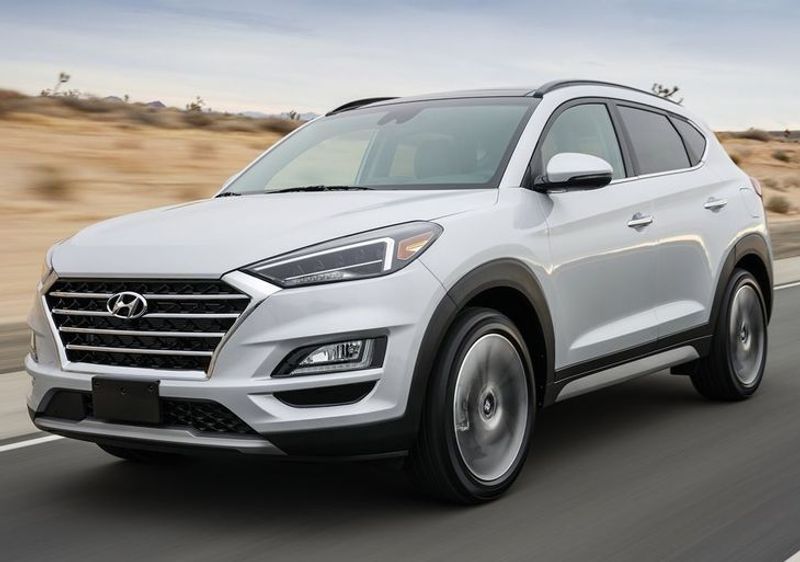
The facelifted Hyundai Tucson family car launched in SA recently. Take a look at 5 key changes that the latest Tucson brings to the road.
The Tucson is an important model for Hyundai and since its launch in 2016, more than 13 591 units have found homes in South Africa. The Tucson competes in a competitive segment against rivals such as the Toyota Rav4, Volkswagen Tiguan and Mazda CX-5. Now, Hyundai has refreshed its Tucson range in an effort to improve competitiveness and tighten its grip in this hotly-contested segment.
Take a look at 5 key changes to the Tucson lineup…
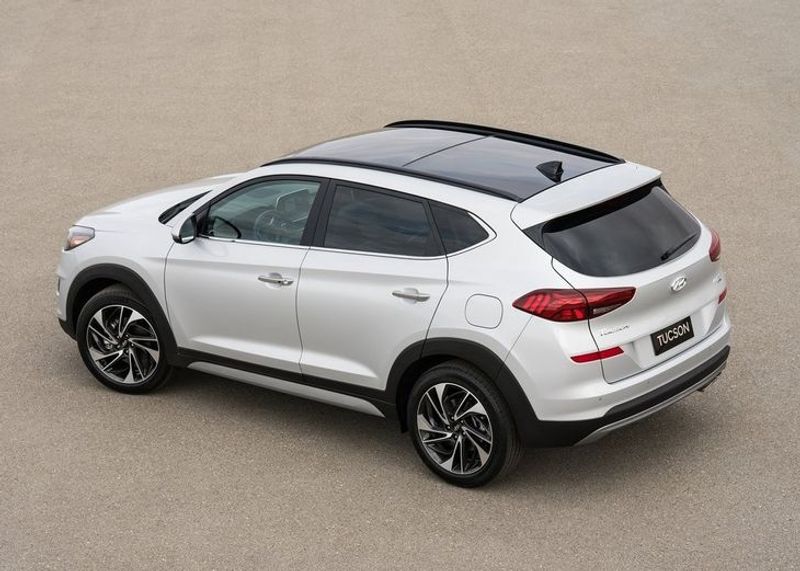
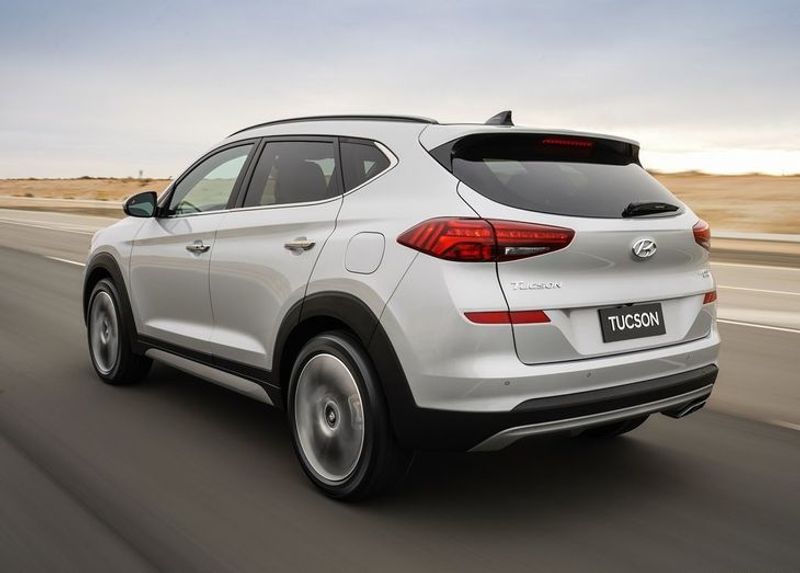
A bolder-looking Tucson has arrived with Hyundai’s signature cascading grille which gives it a more striking appearance. More so, the model now benefits from new LED headlights, fog lights and skid plates while the front and rear bumpers have also been reworked. A new set of tail lights are seen at the rear while the revised twin tailpipes are particularly attractive. New 19-inch alloy wheels are also on offer for the flagship 1.6 TGDI Elite derivative.
2. Better Interior
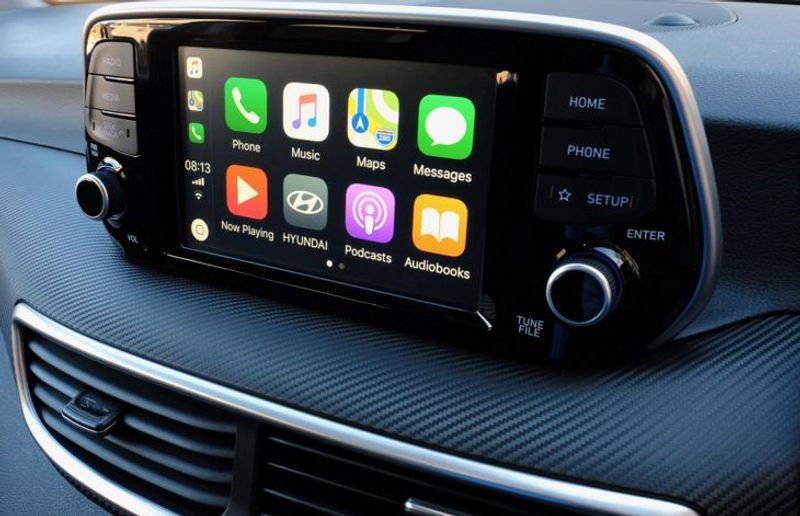
The interior of the Tucson has changed substantially and buyers will appreciate the new soft-touch upper dashboard with a double-stitching line that gives the interior a more premium look. A floating 7-inch touchscreen now takes pride of place and offers Apple CarPlay and Android Auto.
3. Improved specification
There are 3 trim levels offered on the Tucson starting with the entry-level Premium, mid-spec Executive and range-topping Elite. Safety specification for the Executive and Elite derivatives have now been bolstered with the addition of Electronic Stability Program (ESP), Vehicle Stability Management, Hill Hold Assist, Cross Traffic Alert and Blind Spot Detection. A total of 6 airbags are standard across the Tucson range.
In addition to improved safety specification, Hyundai has also included additional standard features such as leather seats, climate control air conditioning and electric driver seat adjustment for Executive derivatives. Elite derivatives further gain features such as a moonroof, electric seats for driver and passenger, push-start button, keyless entry and an additional USB port for rear passengers.
4. Out with the old, in with the new
The manual 1.7-litre turbodiesel Executive and the manual 1.6 TGDI Executive derivatives have been discontinued and replaced with 2 new automatic derivatives.
The Tucson range is still powered by 3 engines. The entry-level Tucson Premium is powered by a naturally-aspirated 2.0-litre engine with 115 kW and 196 Nm of torque and is available with either a 6-speed manual or 6-speed automatic transmission.
The mid-spec Tucson Executive is offered with 2 engines. The 2.0-litre petrol engine (same as Premium above) is now offered with a 6-speed automatic transmission while the 2.0-litre turbodiesel engine with 131 kW and 400 Nm is now mated with a new 8-speed automatic transmission.
In addition to the engines mentioned above, the range-topping Tucson Elite is also powered by a turbocharged 1.6-litre turbopetrol engine with 130 kW and 265 Nm and mated to a new, in-house developed 7-speed dual-clutch transmission.
Keen Tucson enthusiasts may also have picked up that the 4×4 derivatives have disappeared as well. It seems they were not as popular as the front-wheel drive models and a little on the expensive side.
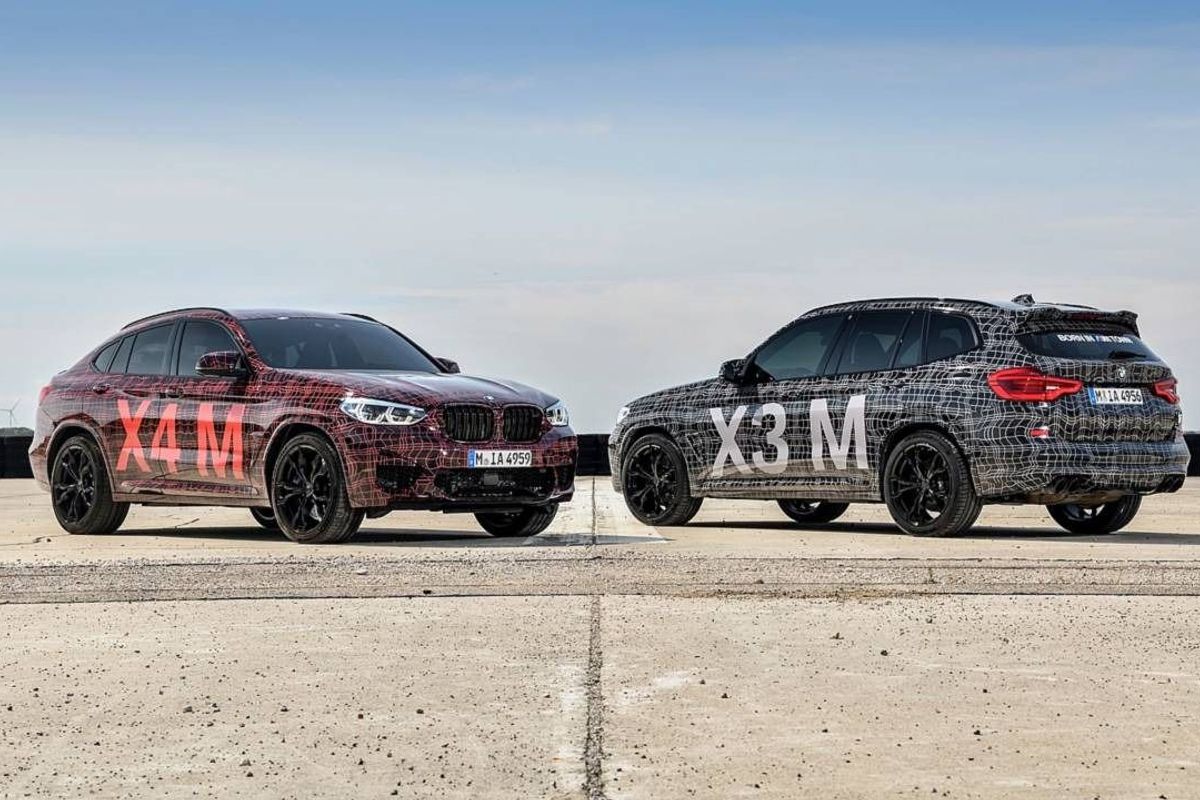
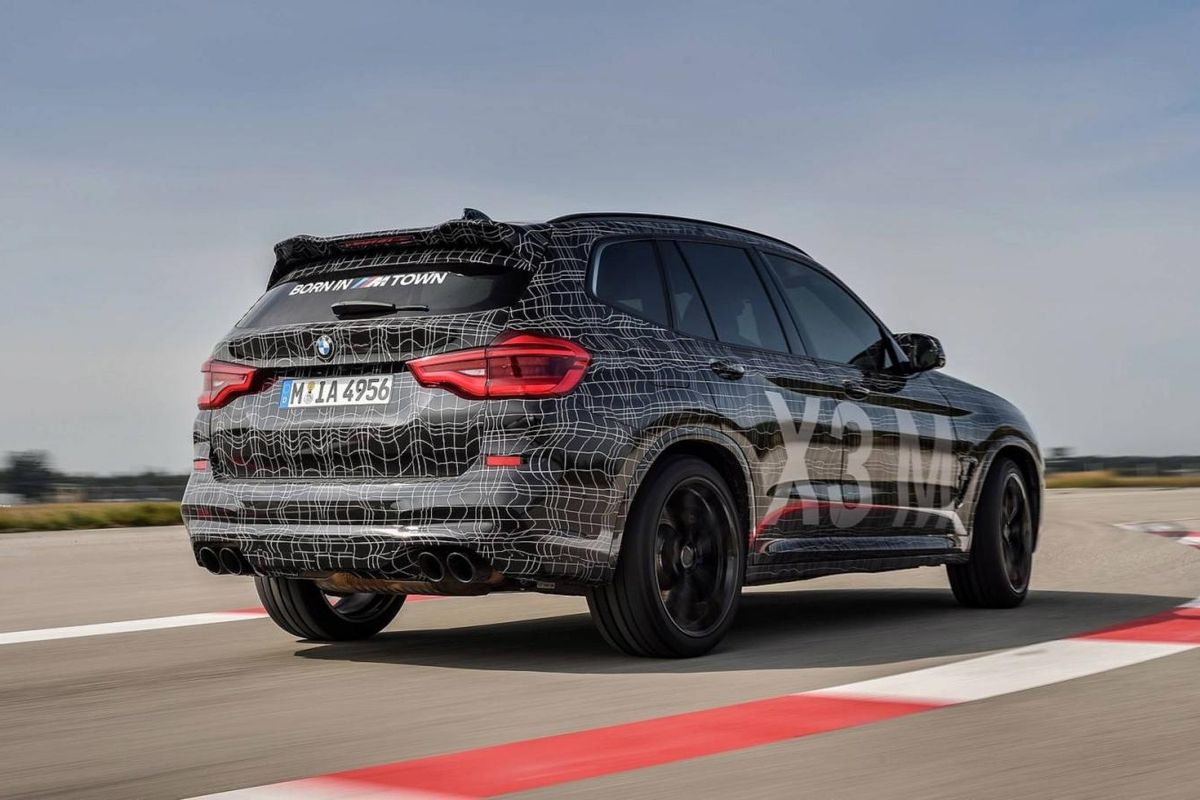
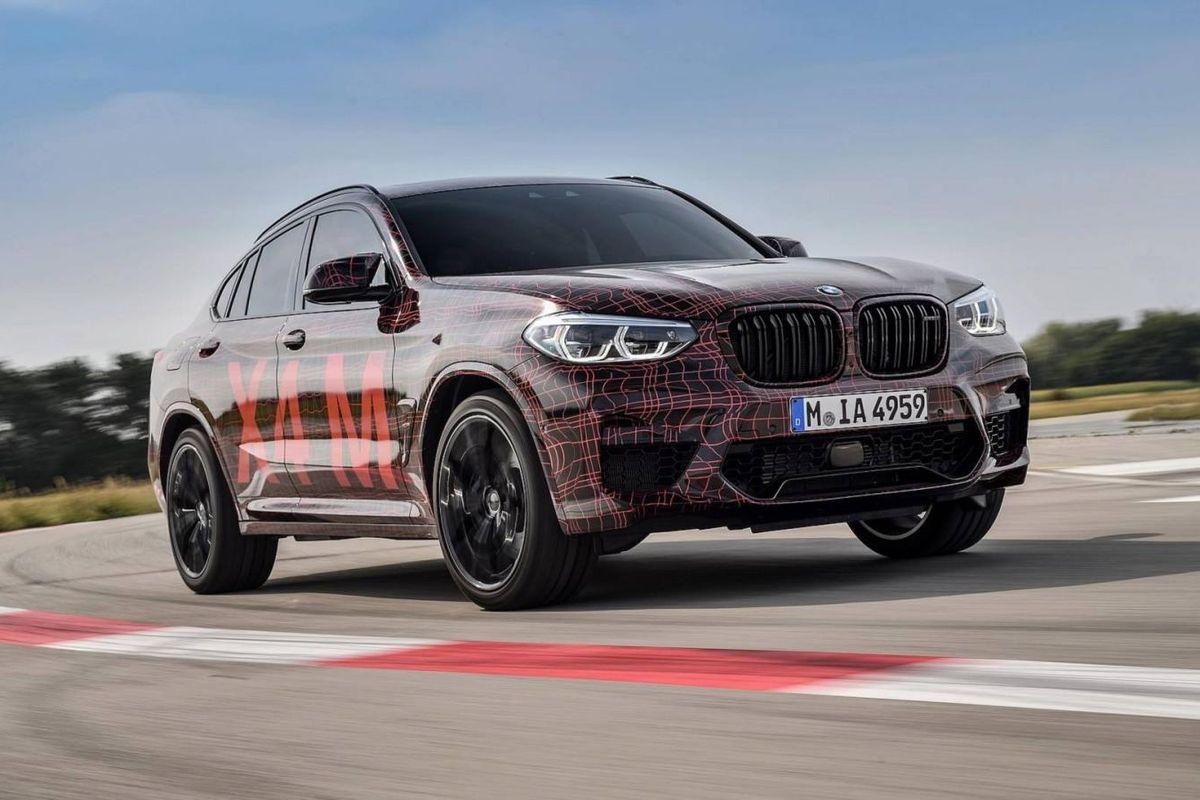
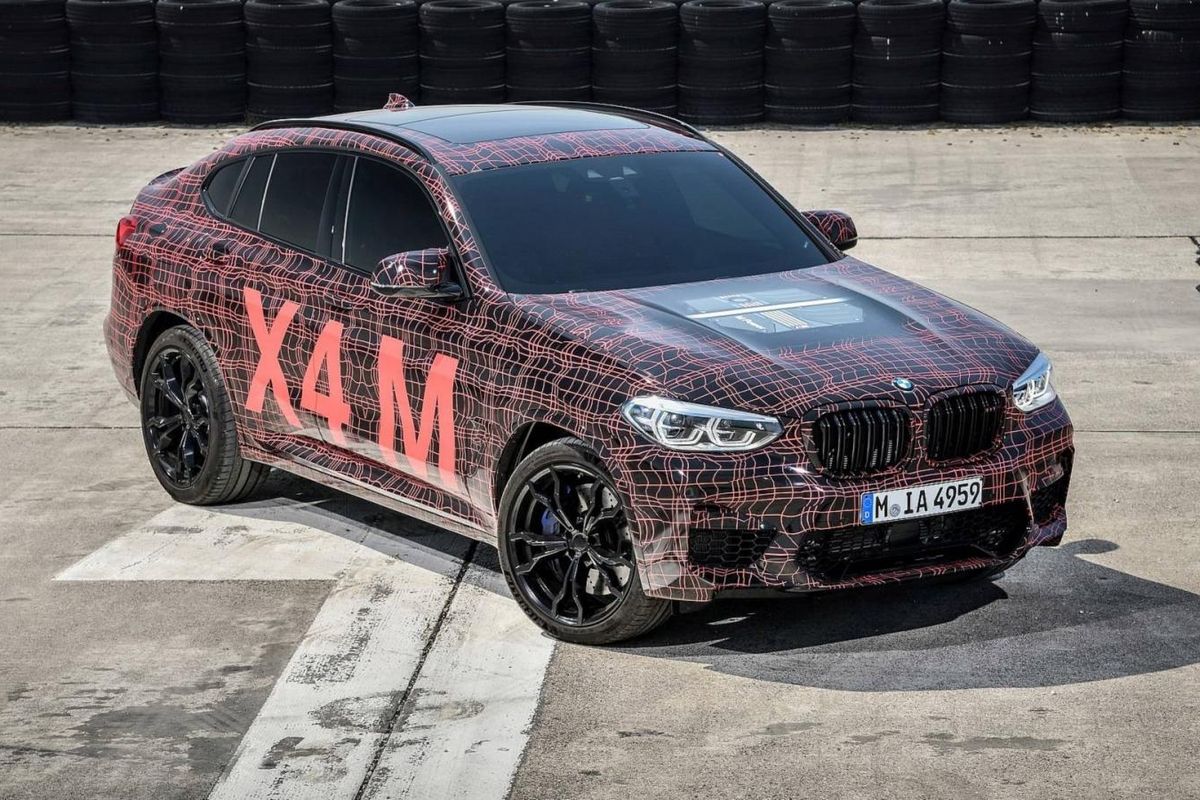
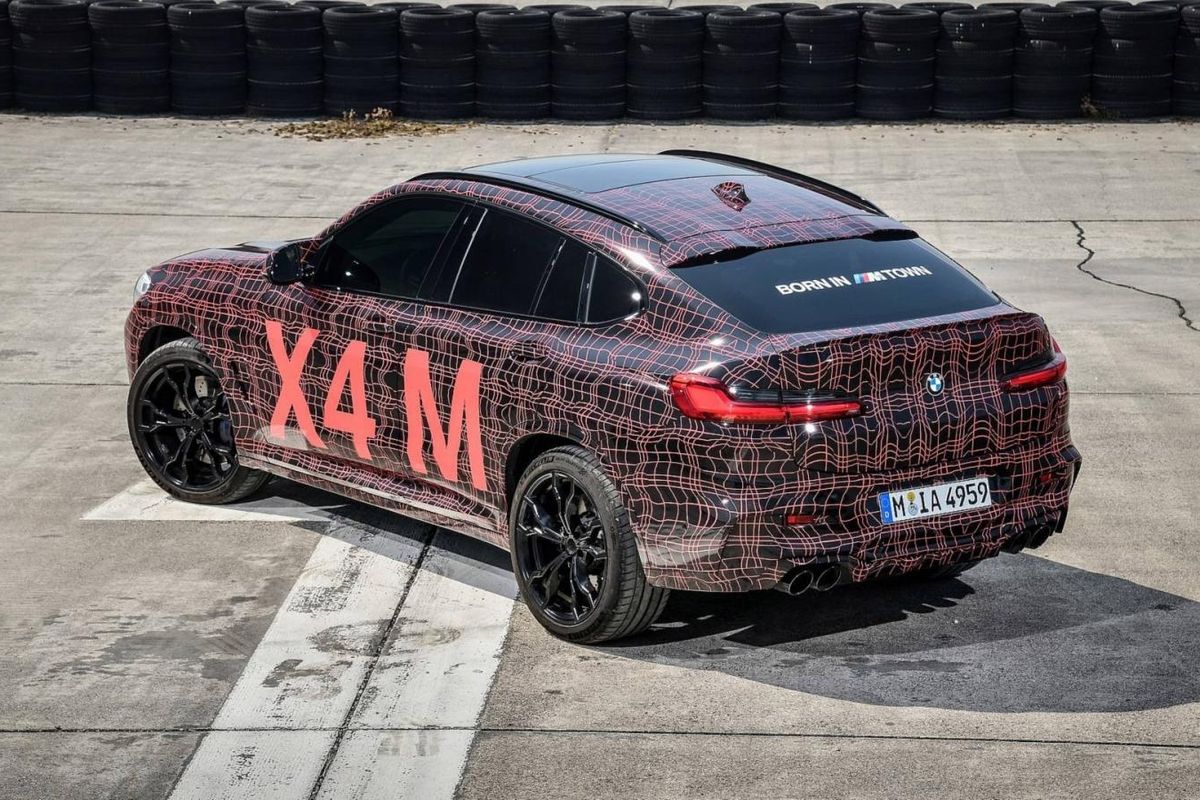
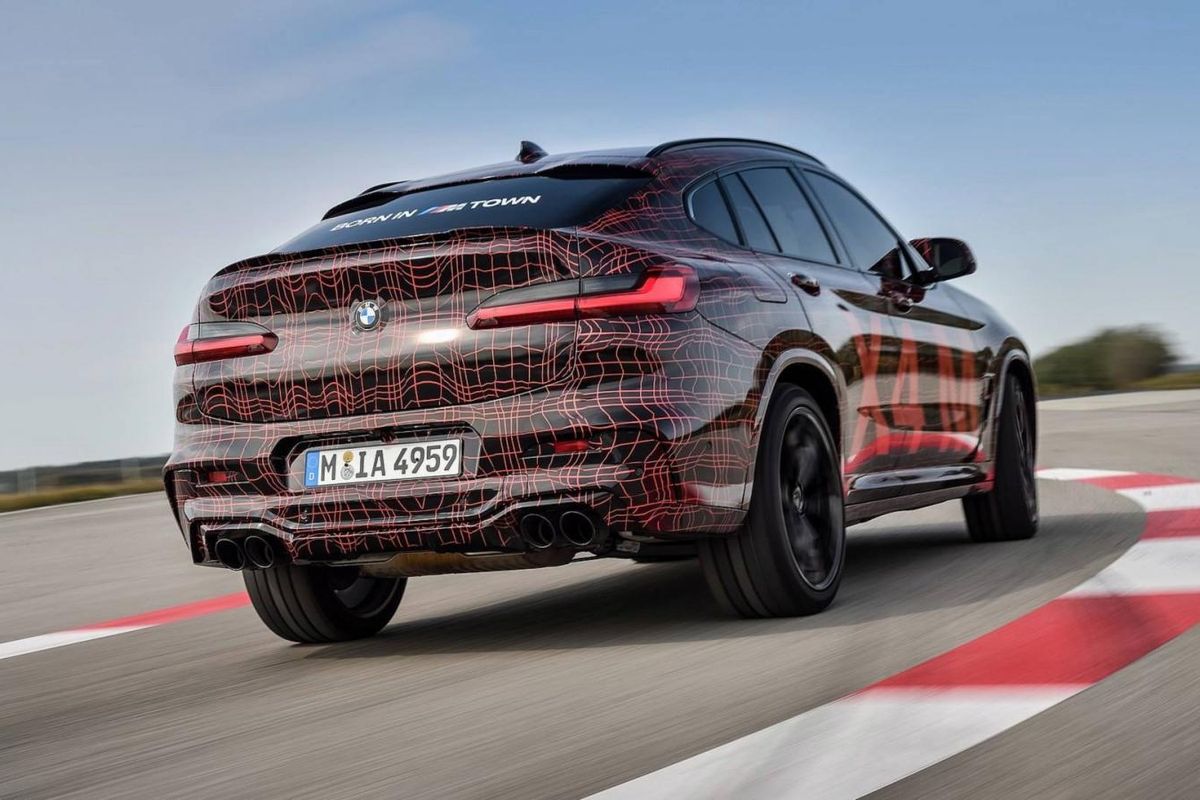
BMW has previewed its first-ever X3 M and X4 M in prototype form at the Nurburgring and both models will be equipped with a newly developed inline-six turbocharged engine.
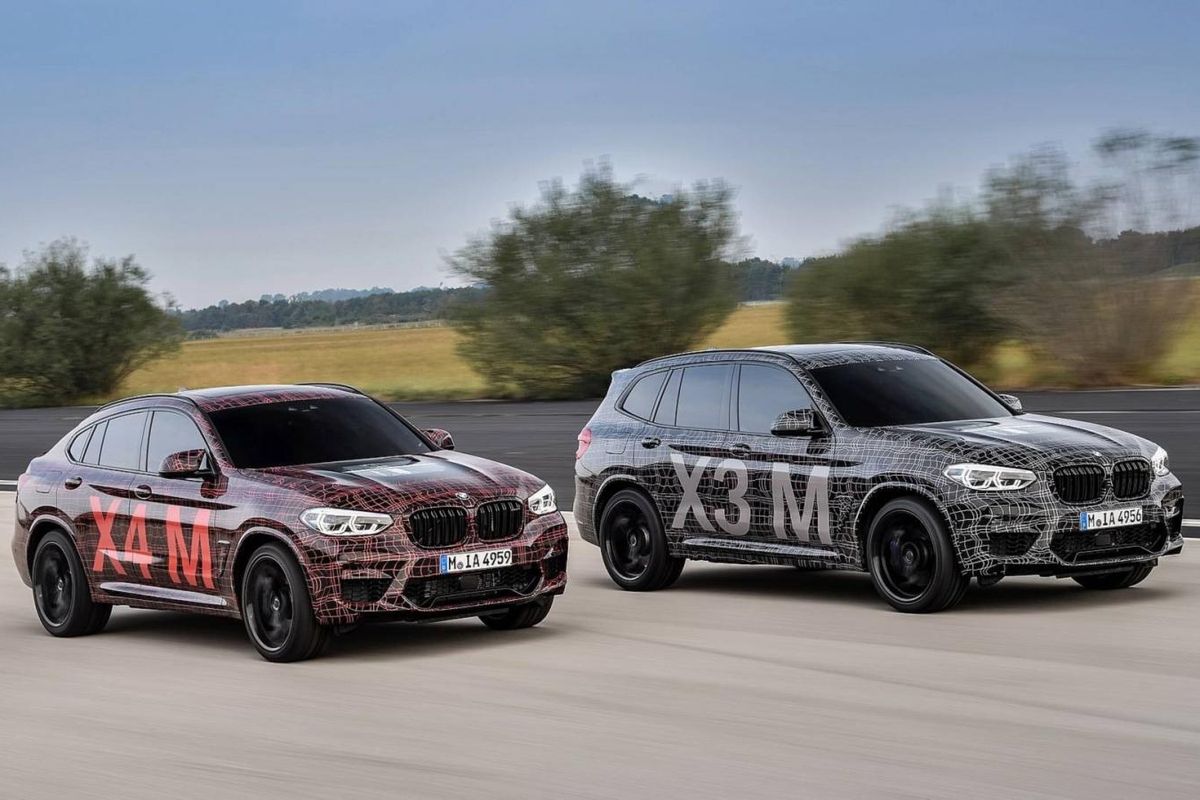
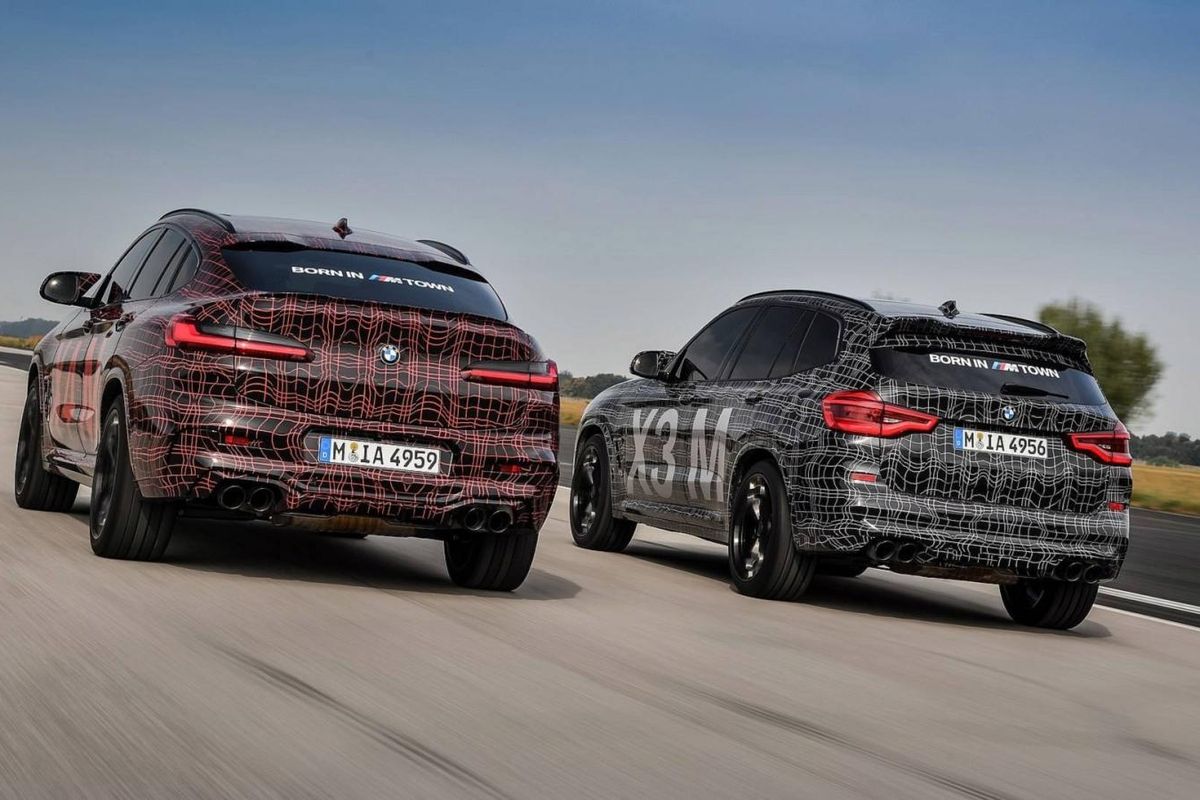
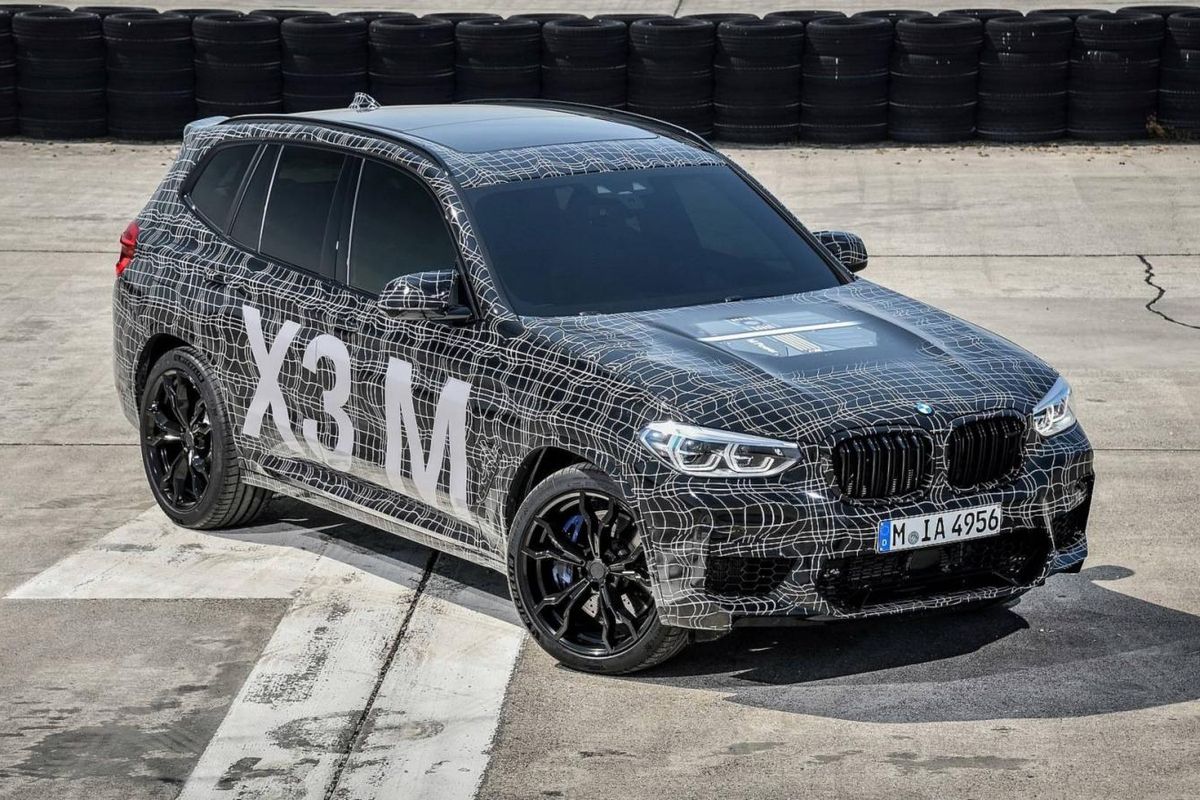
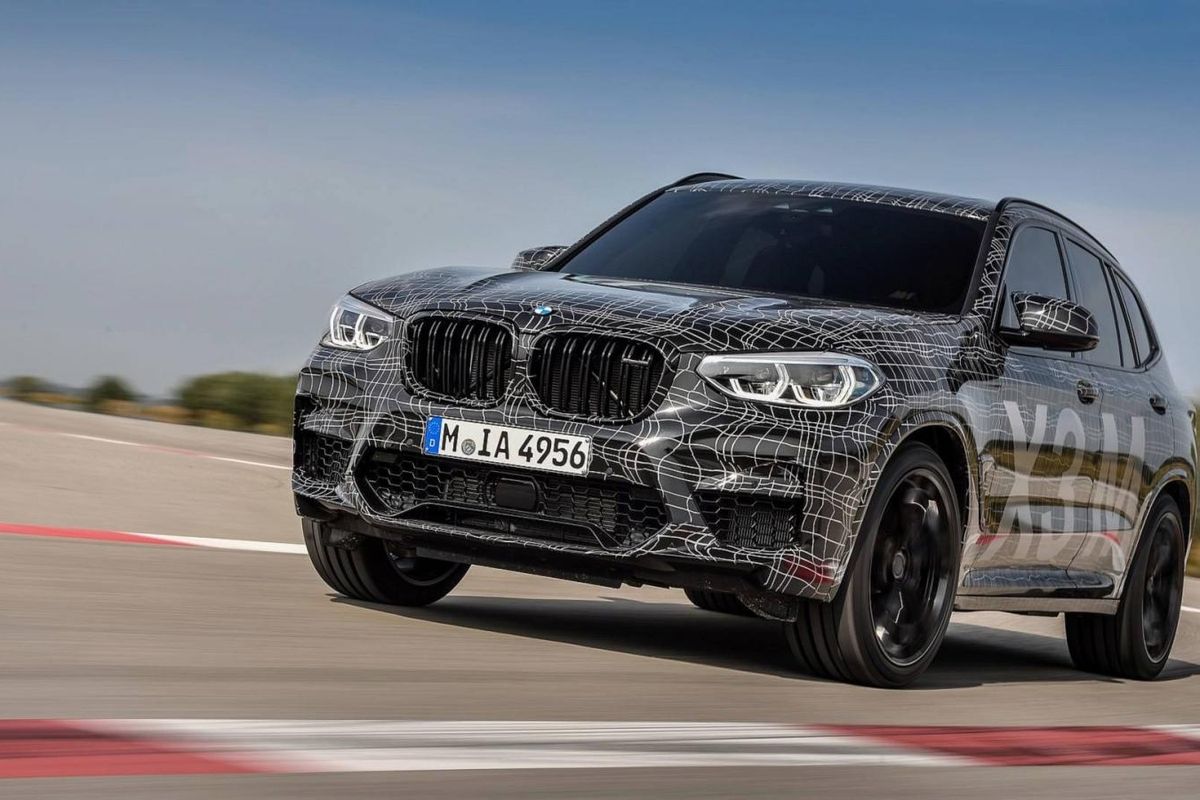
BMW is preparing to unleash M performance versions of the X3 and X4 in the near future and the 2 prototype models, wrapped in camouflage, made an appearance at the Nurburgring DTM races this past weekend to further hone their dynamic abilities.
Both vehicles sport large air intakes, 4 integrated tailpipes and specific M features to optimise aerodynamics. The big news, however, is that a newly developed in-line 6-cylinder turbocharged engine will power the duo and although BMW has yet to divulge outputs, we expect power to come in somewhere around 336 kW.
Both models will feature xDrive all-wheel drive adapted from the M5 as well as an active M rear axle differential to enhance cornering ability and agility.
The locally-built BMW X3 is currently on sale in South Africa and the BMW X4 is due to launch locally this month which means that the M versions will likely arrive in early 2019. BMW South Africa has yet to provide exact dates of arrival for the X3 M and X4 M. We will keep you updated as soon as more detail is revealed.
Announcement: 2018/19 Cars.co.za Consumer Awards Powered by WesBank
It’s that time of the year when we start gearing up for the Cars.co.za Consumer Awards (#CarsAwards), now entering its 4th year. We are well advanced in our preparations to present an even bigger, more influential, further-reaching and more prestigious awards programme than before, once again backed by the country's leading supplier of vehicle finance, WesBank.
The #CarsAwards programme is about much more than just handing over a trophy at a glitzy event in January 2019. It's a 6-month long project that is designed to inform potential car buyers about the vehicles that should appear on their shortlists. Importantly, it also gives consumers a say in the results.
“The Cars.co.za Consumer Awards is South Africa’s only accolade that incorporates the views and experiences of car owners themselves. As the market leader in vehicle finance for the automotive industry, WesBank is a proud sponsor of the awards that acknowledge OEM brands for making a positive impact on the lives of motorists through the cars they bring to our market. We wish all OEM brands the best of luck for this year’s awards and encourage all motorists to participate in the 2018 awards survey,” says Ghana Msibi, WesBank’s Executive Head of Sales and Marketing.
The semi-finalists in each of the 13 categories will be announced on Monday 10 September.
An awards programme that helps the consumer
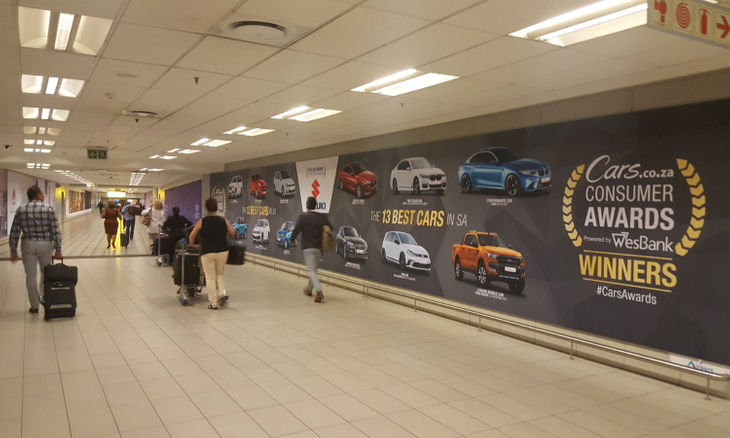
Every year Cars.co.za sponsors billboards for all the winners, helping consumers make educated new-car choices.
"It is important to note that #CarsAwards differs from other awards programmes in several key aspects," notes Cars.co.za Consumer Experience Manager, Hannes Oosthuizen.
"Firstly, the consumer can get directly involved, by telling us about their experiences with their own cars, including the after-sales service they have received," he adds.
In the final round of judging, the inputs of actual car owners account for 50% of a finalist vehicle's score. "This is a crucial aspect, because while we can rely on motoring and other specialist journalists to evaluate the products by testing them, they can't judge what it's like to live with a car, and that's at least as important," he explains.
The in-depth Cars.co.za Ownership Satisfaction Survey was co-developed with data specialists Lightstone Consumer and can be completed by clicking here. By completing this survey you will be influencing the results of the #CarsAwards.
Categories aligned with market hot-spots
Another key difference is that #CarsAwards doesn't reward just a single new car launched in the past year.
"As the name indicates, these awards are really for the consumer," Oosthuizen says. "For that reason, all cars on the market are in the running, provided they have been launched locally by 1 September 2018 and comply with the various categories' criteria. We have tweaked the 13 categories to be even better aligned with where consumers are shopping," he says.
An example is the previous Premium Hatch segment, which has changed to become the Premium Compact category. "In this category, shoppers are increasingly torn between high-spec, traditional contenders such as the VW Golf and Mercedes-Benz A-Class, and new-generation compact crossovers from the premium brands, such as the Volvo XC40 and BMW X2," Oosthuizen says. "Consequently we've decided to put these vehicles into the same category, as they compete for the same consumers."
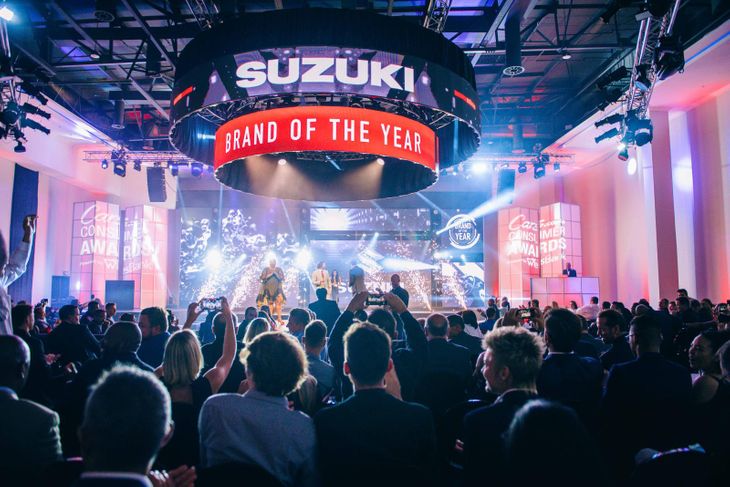
Current (two-time) Brand of the Year, Suzuki, has achieved significant sales growth following its #CarsAwards successes.
As before, the 14th and most prestigious category is Brand of the Year. "This is a really special award and 100% based on consumer feedback gained from our Ownership Satisfaction Survey, conducted in conjunction with Lightstone Consumer, and also incorporating market share growth and resale data from Lightstone Auto," says Oosthuizen. "The sales success of the current Brand of the Year, Suzuki, is gratifying as it backs our data and illustrates the importance of excellent customer service."
The 13 product categories are:
Budget Car (up to R200 000) The minimum safety requirements for eligibility are dual front airbags and ABS. If these items are not standard, it must be possible to optionally specify all these items without exceeding R200 000.
Compact Hatch (from R200k to R300k) The minimum safety requirements for eligibility are ABS and 4 airbags. Individually or collectively, the fitment of the required safety features, along with the following: air-conditioning, USB/Bluetooth support, and service plan, may not push the price over R300 000.
Premium Compact (from R450k to R600k) The fitment of ESP and dual front-, side- and curtain airbags is required (within the price limit).
Compact Family Car (from R300k to R400k) If not standard, all of the following features must be fitted without the price exceeding the limit: ABS, automatic transmission, 4 airbags, split/fold rear seat, service plan and air-conditioning.
Family Car (from R400k to R500k) If not standard, all of the following features must be fitted without the price exceeding the limit: ABS, ESP, 6 airbags, split/fold rear seat, service plan, air-conditioning and an automatic transmission (incl. CVT and dual-clutch).
Business Class (from R600k to R800k) Six Airbags and ESP have to be fitted, within the price cap.
Executive Sedan (from R800k to R1m) Vehicle must fit into D/E sedan segments, including so-called 4-door “coupe” versions.
Leisure Double-Cab Bakkie (from R500k to R800k) Vehicle must be a double-cab pick-up with a turbodiesel engine, automatic transmission and 4-wheel drive.
Adventure SUV (from R550k to R700k): Vehicle must offer 4-wheel drive, minimum ground clearance of 200 mm and low-range or a switchable drive modes programme.
Executive SUV (from R700k to R900k) Vehicle must offer a minimum of 6 airbags and ESP without exceeding the price cap.
Premium SUV (from R1m to R1.3m) Must offer all-wheel drive as standard and be an SUV of BMW X5/Mercedes GLE size, including so-called “Coupe” derivatives such as X6/GLE Coupe.
Hot Hatch (below R700 000)
Performance Car (below R1 million)
Timelines
As before, there are 3 phases to the #CarsAwards process.
3 September 2018. The Cars.co.za extended editorial team meets in Cape Town and debates all vehicles in the South African new vehicle market, within the defined categories and against the category criteria. All vehicles launched by 1 September 2018 will be considered. The top 5 in each category is determined by consensus and not a secret vote to ensure rigorous analysis and debate. The 5 finalists will be announced on Monday, 10 September 2018.
1 October 2018. The same Cars.co.za extended editorial team meets in Cape Town and votes on the vehicles in the individual categories to determine the finalists (3 per category).
1-2 November 2018. The 39 finalist vehicles (3 per category, 13 categories) are tested back-to-back at Gerotek in Gauteng. See our behind-the-scenes test day video above.
January 2019. Gala event in Johannesburg and announcement of all winners.
Respected, influential judges
In building the expanding judging panel, the goal was to achieve a balance of motoring expertise (particularly in the first two phases of the programme, which determine the finalists) and respected non-motoring, highly analytical media professionals. "It is absolutely crucial that motoring journalists' opinions are supplemented by those of non-motoring media professionals, who, in many ways, represent the consumer at the test days," explains Oosthuizen. This year Brenwin Naidu (Editor, Sowetan Motoring), Thami Masemola (In4Ride, eNCA), Aluta Maqoko (Kolloquium) and Khulekani Dumisa (Khulekani on Wheels) join the panel.
What's next?
Be sure to follow #CarsAwards on Twitter. And remember… complete a survey on your own car to make your voice heard. The link to the survey is here.
It might be the smallest off-roader in the world, but that doesn’t mean it isn’t any good when the asphalt becomes gravel. Here’s how the Suzuki Jimny became a worldwide phenomenon.
Often ignored in favour of more established offerings, the Suzuki Jimny remains one of the most affordable off-road-ready vehicles money can buy – especially here in South Africa. Much like its contemporaries, the Jimny stems from a lineage that spans nearly 4 decades, but unlike the pricier and bigger rivals from Land Rover and Toyota, it came to fruition under a very different set of circumstances. See, after the Second World War, Japan was in a financial crisis and many of its citizens and business owners were struggling through a post-war economic depression. In an attempt to stimulate the local car industry and offer small business owners a more effective solution for basic transportation, an all-new car category was created: the Keijidosha or Kei car. This vehicle concept comprised exterior dimensions and engine displacements so diminutive they weren’t much bigger than a motorcycle, but its mass appeal kick-started a revolution.
The rise of the Keijidosha car
In the late 1940s and early 1950s, the Japanese government propagated the development of the Keijidosha (Kei) car to cater for the people's need for a basic (and affordable) transportation solution. Manufacturers were forced to comply with strict legislation limiting dimensions and engine sizes, the latter of which was originally pegged at a mere 150 cm3. The limitations, however, were gradually lifted over time to comply with modern safety and emission standards, but vehicle dimensions remained diminutive. Their popularity and affordability stimulated the renaissance of the Nippon car industry and the local economy, and soon Kei cars were everywhere. Suzuki led the charge in this new category and, several years later, the Jimny concept was spawned.
A new hope
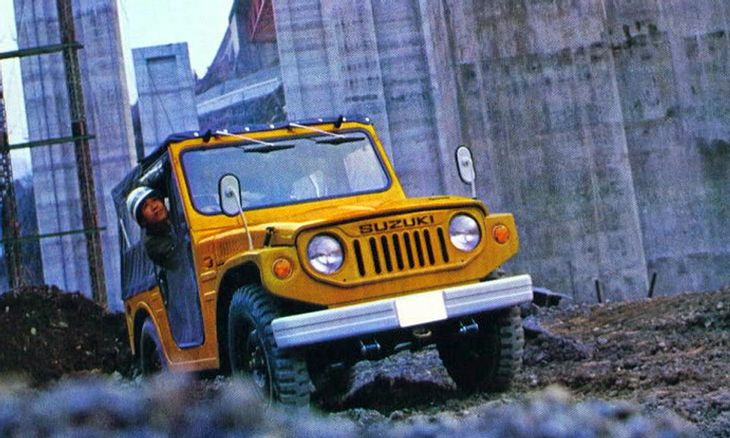
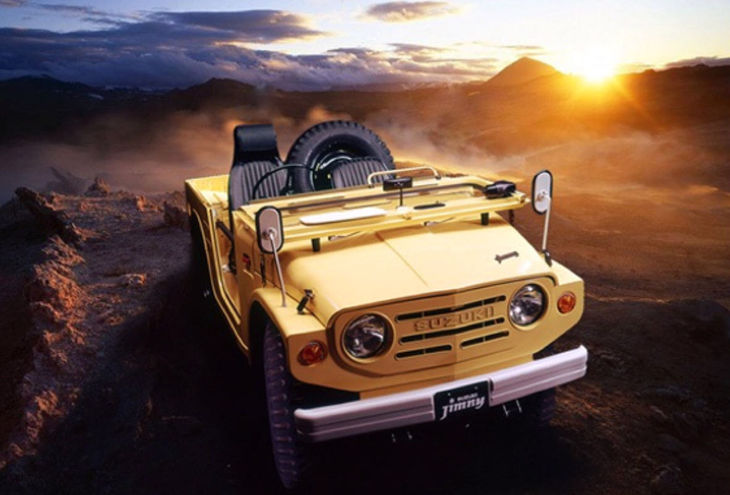
It all started with the Hope Motor Company that developed the HopeStar ON360 in the late Sixties. It was a cheap and nasty, low-rent mishmash of parts sourced from Mitsubishi (the Colt 1000 and Jeep) with 4-wheel-drive capability and a pint-sized Mitsubishi-sourced two-stroke 359 cm3 engine good that produced a mere 15 kW. It didn’t do very well, but Suzuki saw its potential and purchased the blueprints with the notion of producing an entirely repackaged vehicle that later became the LJ10 – the Jimny’s spiritual predecessor. The Mitsubishi parts were binned and replaced by Suzuki-designed stock, including the engine: an 18 kW air-cooled 359 cm3 2 cylinder. Measuring just shy of 3.0 metres in length, it became the first 4-wheel-drive Kei car to enter production, with a lifecycle that spanned 11 years (1970-1981).
Jimny Concept goes viral
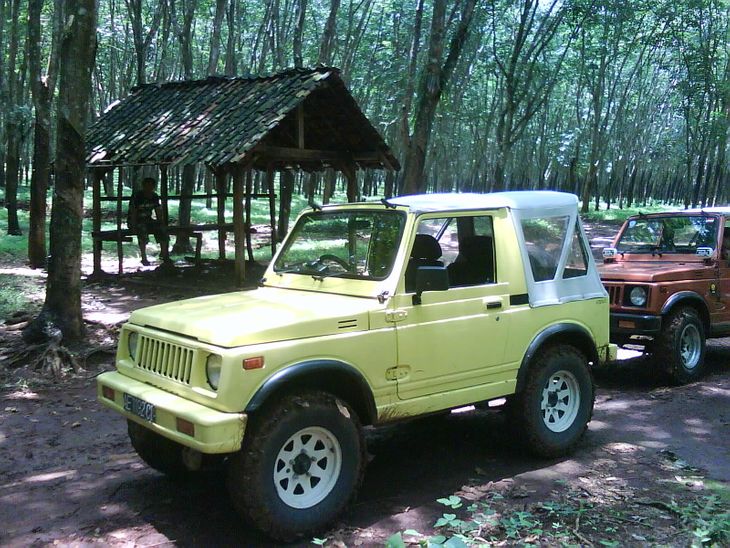
In 1981, the Jimny moniker was born and with it, the 2nd-generation or SJ-Series Jimny. Among a slew of cosmetic improvements – most of which were inspired by the Willys Jeep – it received a larger 3-cylinder engine available in two states of tune: 550 cm3 and 660 cm3. Owing to the popularity of its forebear, the SJ Jimny sold impressively well, both in Japan and around the world where it was badged under various names such as the Samurai, Sierra, Potohar and Holden Drover. With a shelf life that stretched some 17 years, the SJ naturally went through a series of facelifts and improvements. Some of these tweaks included versions such as a convertible, a long-wheelbase derivative and coupe-style hardtop. Boasting a 34 kW 1.0-litre 4-pot engine, a 4-speed transmission and burlier aesthetics, the SJ410 was quite a popular model here in South Africa.
A born identity
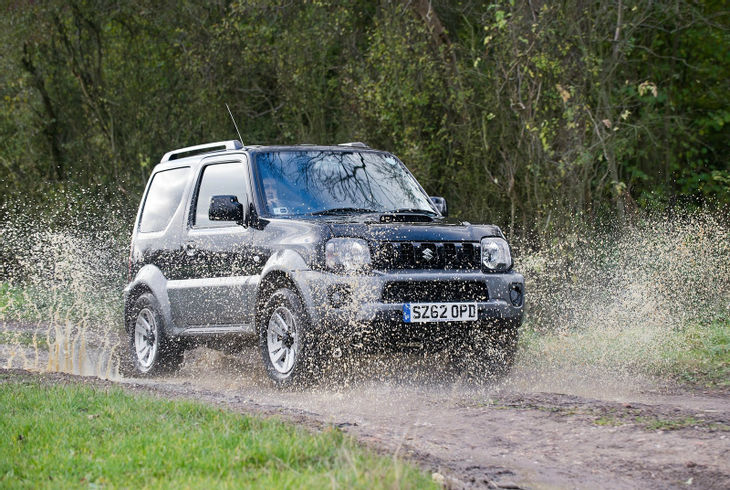
The 3rd-generation Jimny stepped things up in terms of visual drama – it was far more engaging and contemporary-looking than its predecessors and despite retaining a Jeep-like grille it began to adopt its own identity. To comply with Japan’s Kei-car dimensions JDM-specific Jimnys omitted the flared fenders and beefier bumpers of its export siblings. During its 20-year tenure, the 3rd-generation Jimny also underwent myriad facelifts (tweaks that involved a more detailed front bumper arrangement and hood scoop). There were several special editions too, such as the JLX, a luxury version that incorporated such niceties as power-adjustable exterior mirrors, power steering, roof rails and electric windows, to name but a few features. The ladder frame chassis and dual-ratio transfer case ensured it lost none of its off-road credit and the addition of bigger and more powerful engine options (1.3-litre 16-valve with VVT and a Renault-built 1.4-litre powerplant) further helped bolster its popularity on a global scale.
Return of an Icon
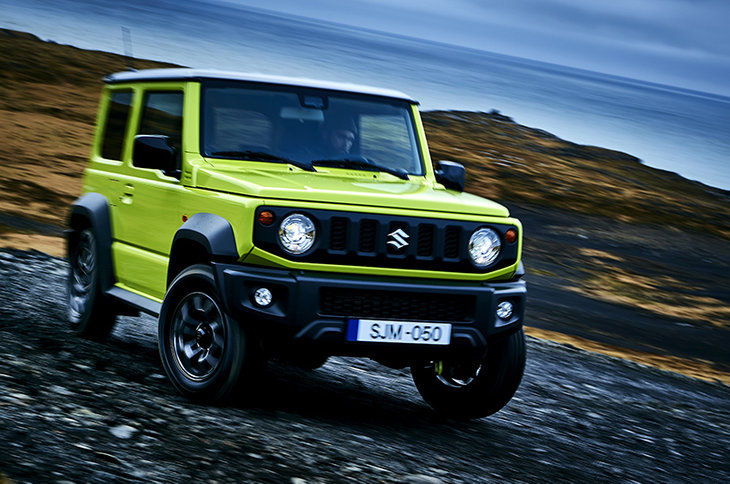
It may have taken 20 years, but the all-new, 4th-generation Suzuki Jimny was recently shown in South Africa to much acclaim from local motoring journalists. Notably, its most endearing attribute is its styling. which harks back to the original LJ10 of 1970 – a scaled down Land Rover Defender (if you will) with chunky, chiselled addenda and flared wheel arches accentuating its box-like appearance. Its cabin is arguably its most defining attribute – a modern cocoon laced with all the contemporary styling riffs of its stablemates, not forgetting the essential 4×4 switchgear arrangement and transfer case.
Furthermore, it features the most powerful engine in the Jimny’s decorated history: an impressively frugal 75 kW/130 Nm 1.5-litre engine. The Jimny, which will go on sale in South Africa in November 2018, has truly come a long way as far as safety goes and a string of onboard programs such as ABS, electronic stability control, brake assist and dual front airbags ensures all the important boxes are ticked.