Facelifted Range Rover Sport (2018) Specs & Price [w/video]
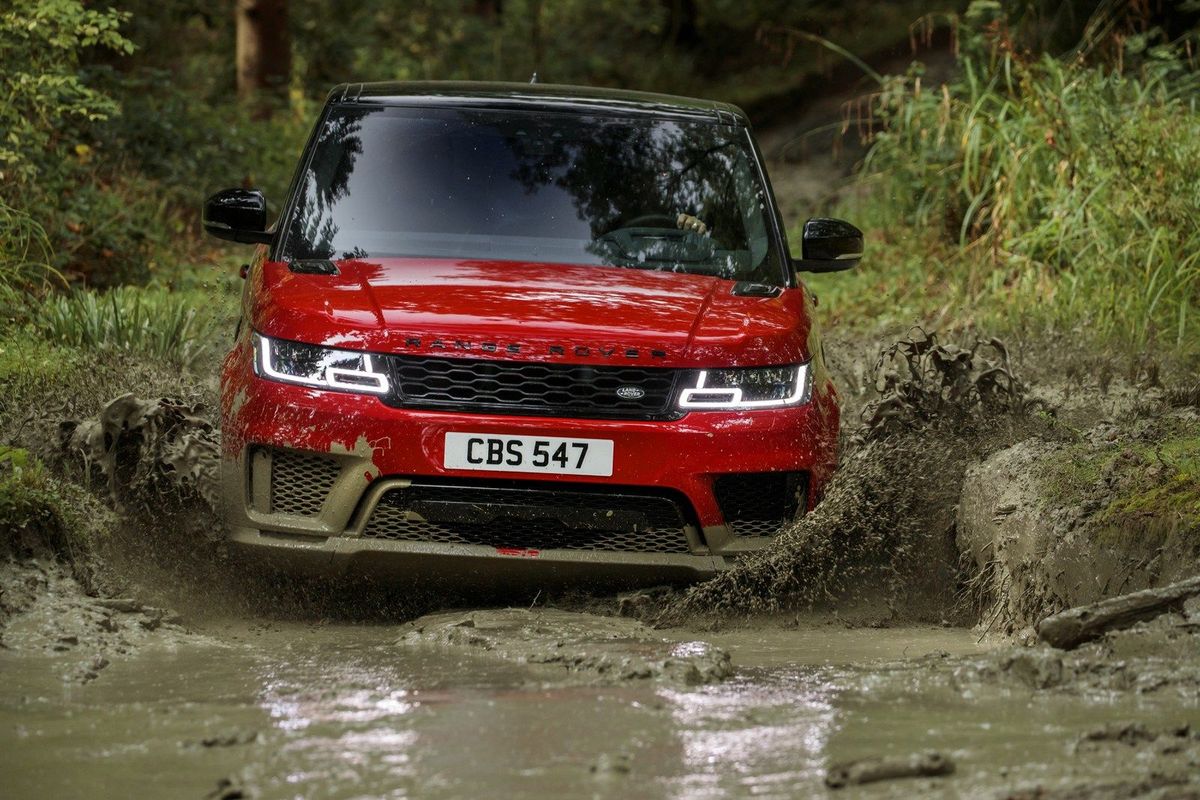
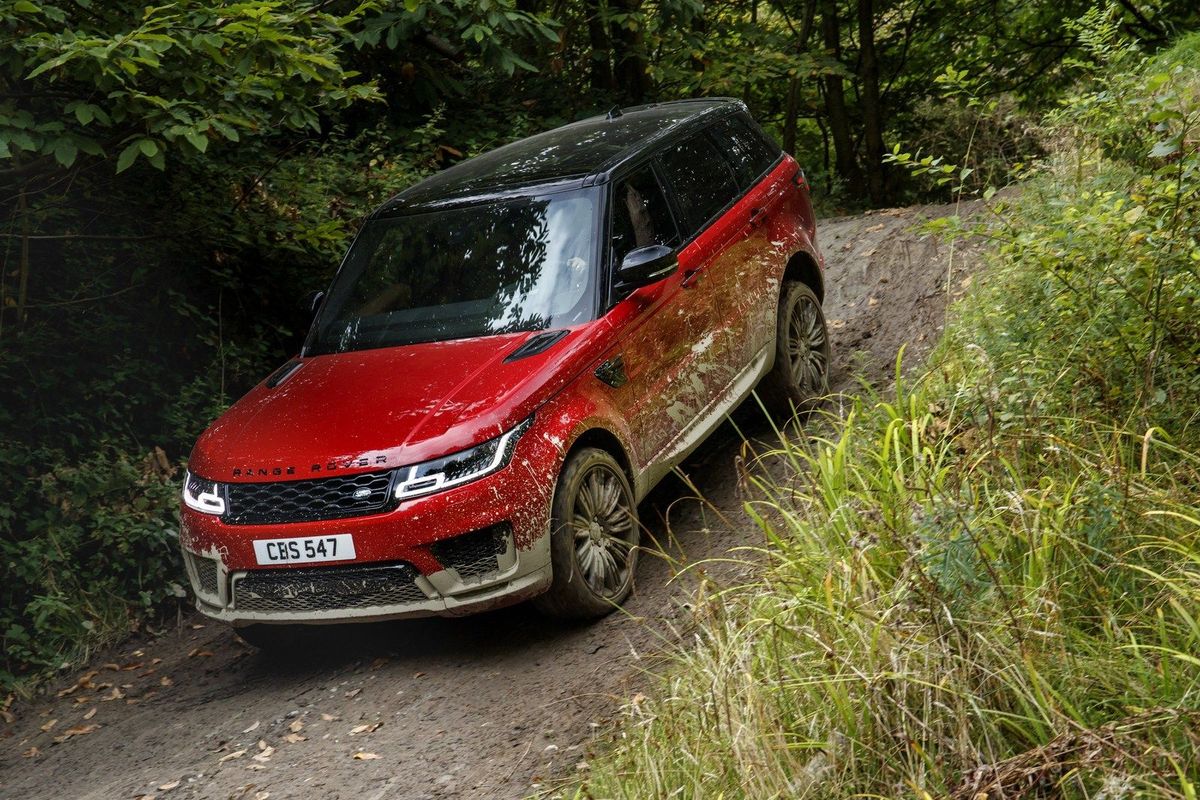
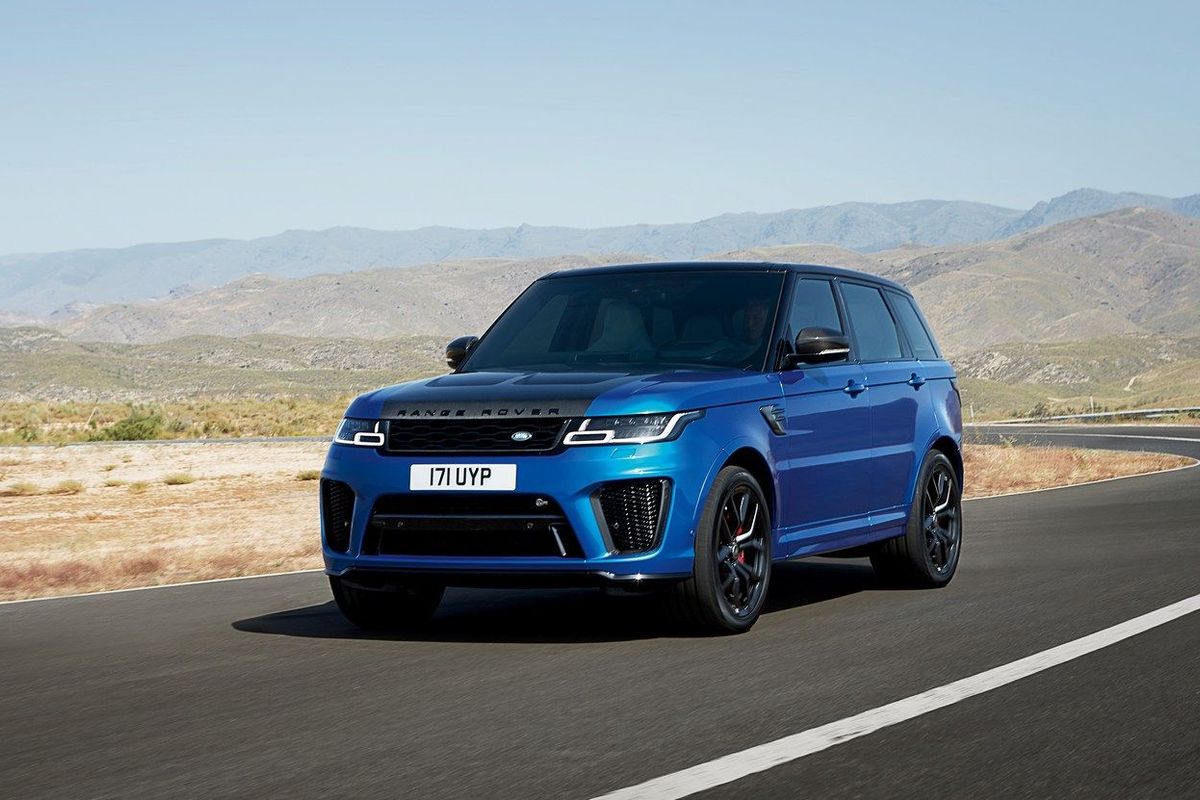
Land Rover has updated its Range Rover Sport offering which sees the introduction of a hybrid version while the high-performance SVR now comes with even more power and enhanced performance. Herewith specification and pricing details…
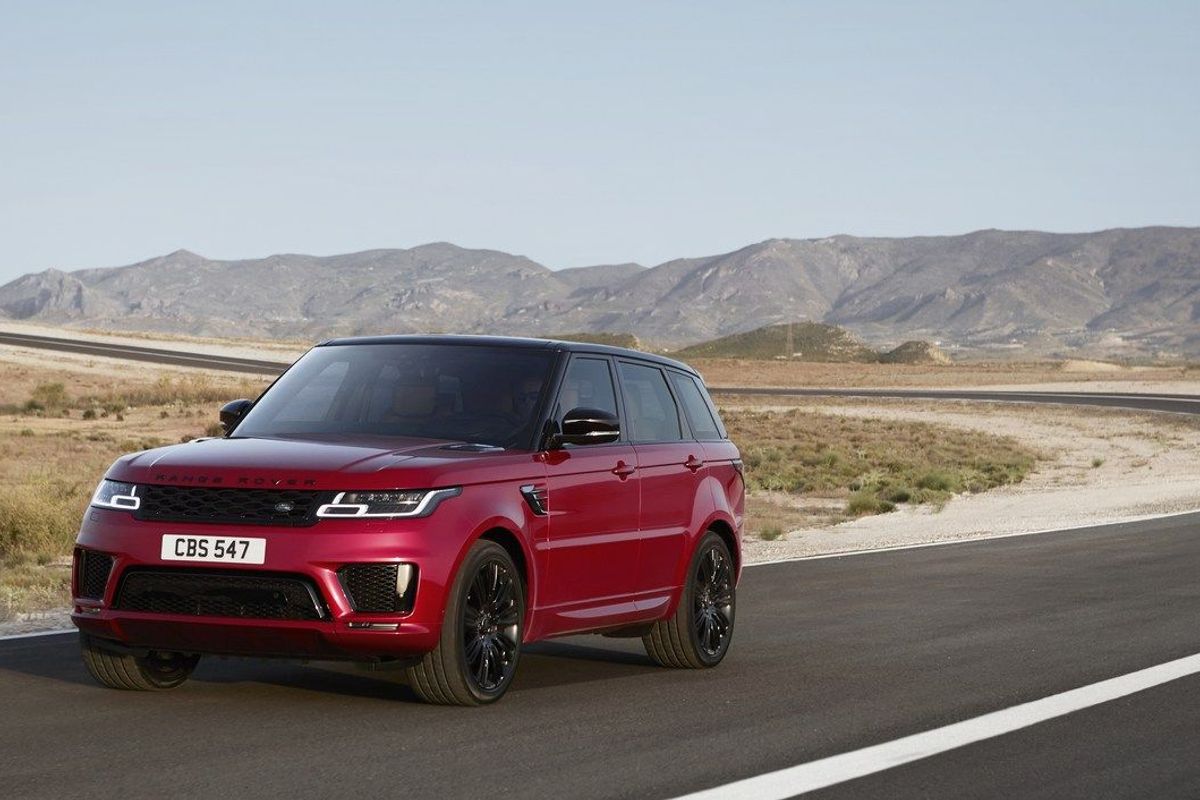
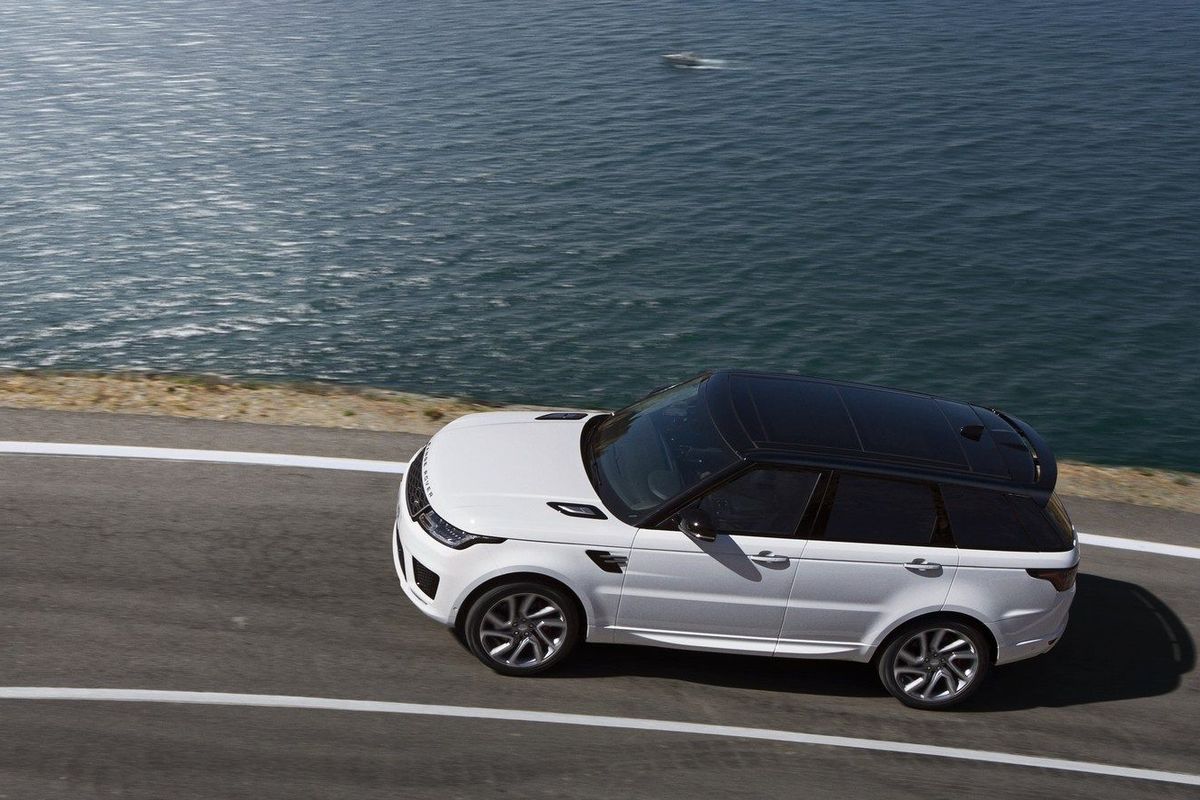
The Range Rover Sport offers luxury, performance and exceptional ‘go-anywhere’ capability. Land Rover has now officially revealed the facelifted Range Rover Sport with a number of exterior and interior updates as well as the introduction of a hybrid model and a more powerful range-topping SVR derivative. Take a look at what has changed.
Powertrain updates
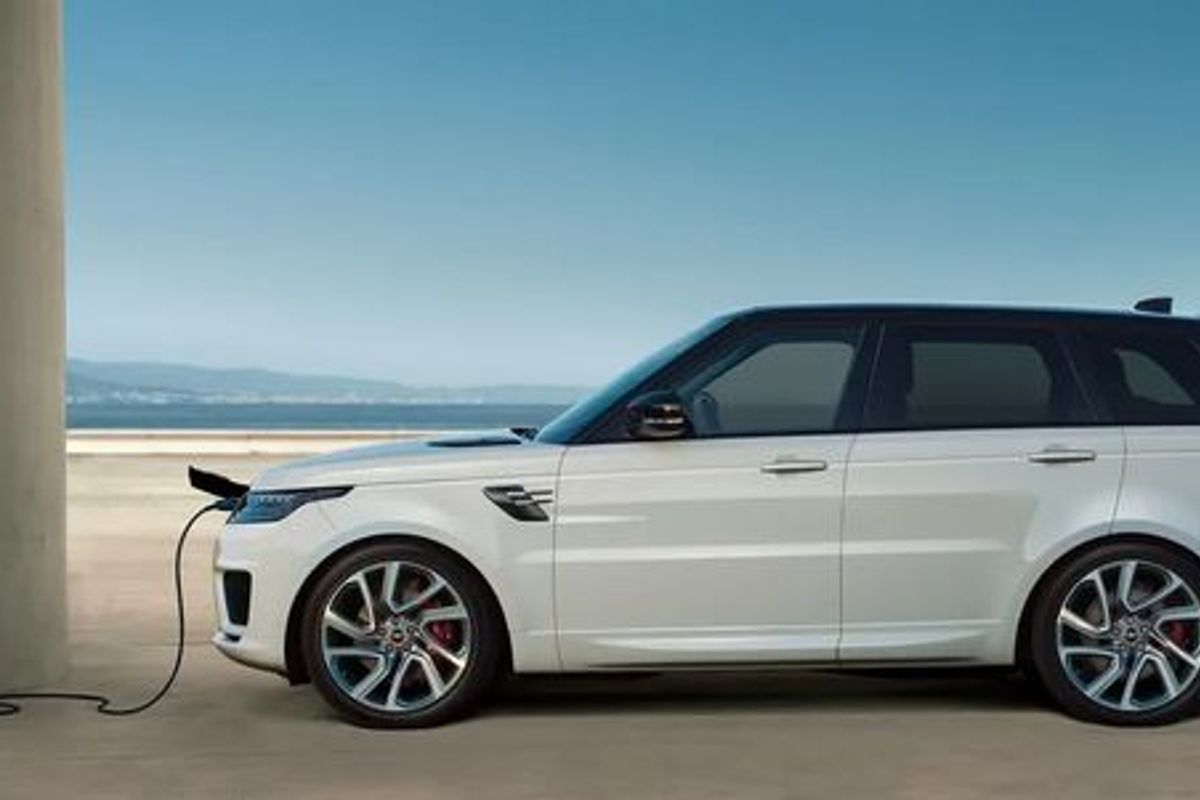
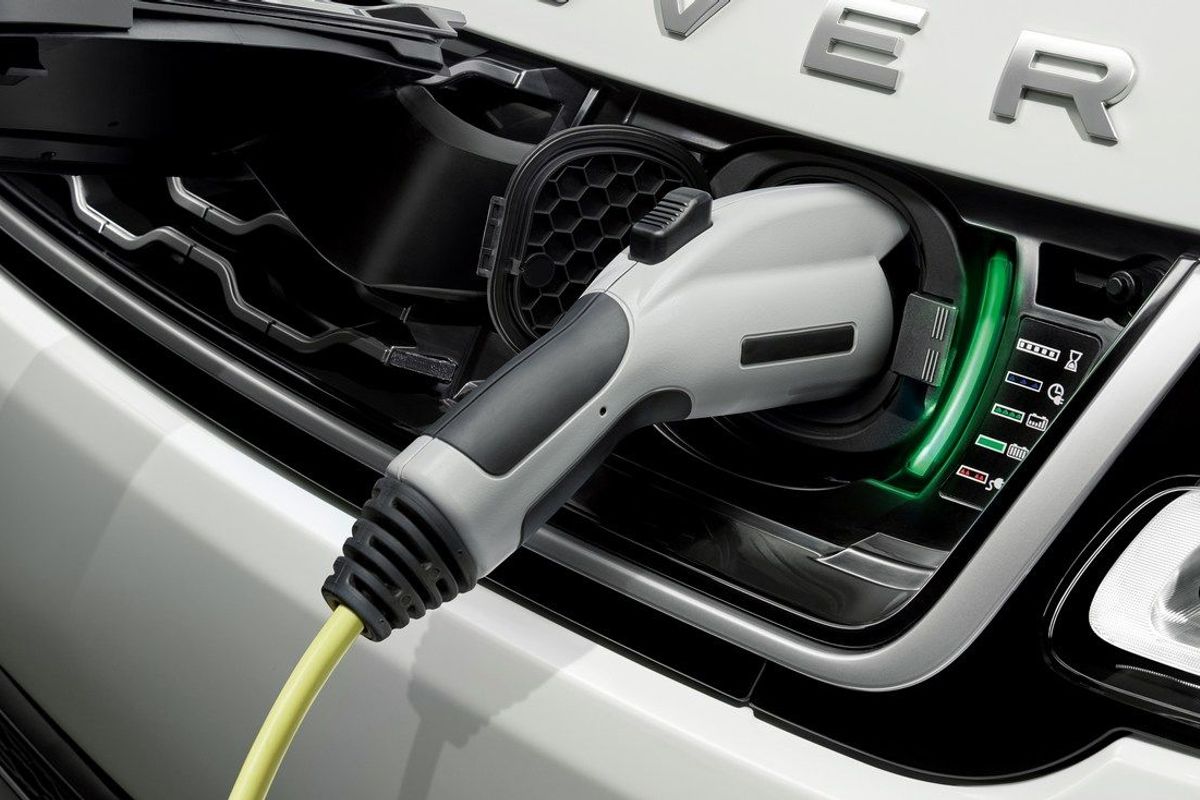
The big news is the introduction of a new Range Rover Sport Plug-in Hybrid model dubbed the P400e which replaces the previous SDV6 hybrid diesel model. It’s powered by a 221kW 2.0-litre, 4-cylinder petrol engine and an 85 kW electric motor and 13.1kWh lithium-ion battery. Total system output is 297 kW and 640 Nm of torque.
In terms of performance, the all-wheel drive P400e can accelerate from zero to 100 kph in 6.7 seconds with a top speed of 220 kph. The P400e offers an electric range of 51 km and can be charged up in about 2 hours and 45 minutes. Land Rover claims a fuel consumption figure of 2.8 L/100 km.
Much like the current range, a choice of petrol and diesel engines will be offered. On the diesel front there’s the entry-level 2.0-litre SD4 and two 3.0-litre options seen in the TDV6 and SDV6 while the 4.4-litre SDV8 tops the diesel offering with 249 kW and 700 Nm of torque.
The petrol engine range starts with a 221kW 2.0-litre engine, the same use in the new P400e. A supercharged 3.0-litre V6 engine with 250 kW and 450 Nm or torque will be offered alongside a more powerful 5.0-litre V8 supercharged engine with 386 kW and 625 Nm of torque.
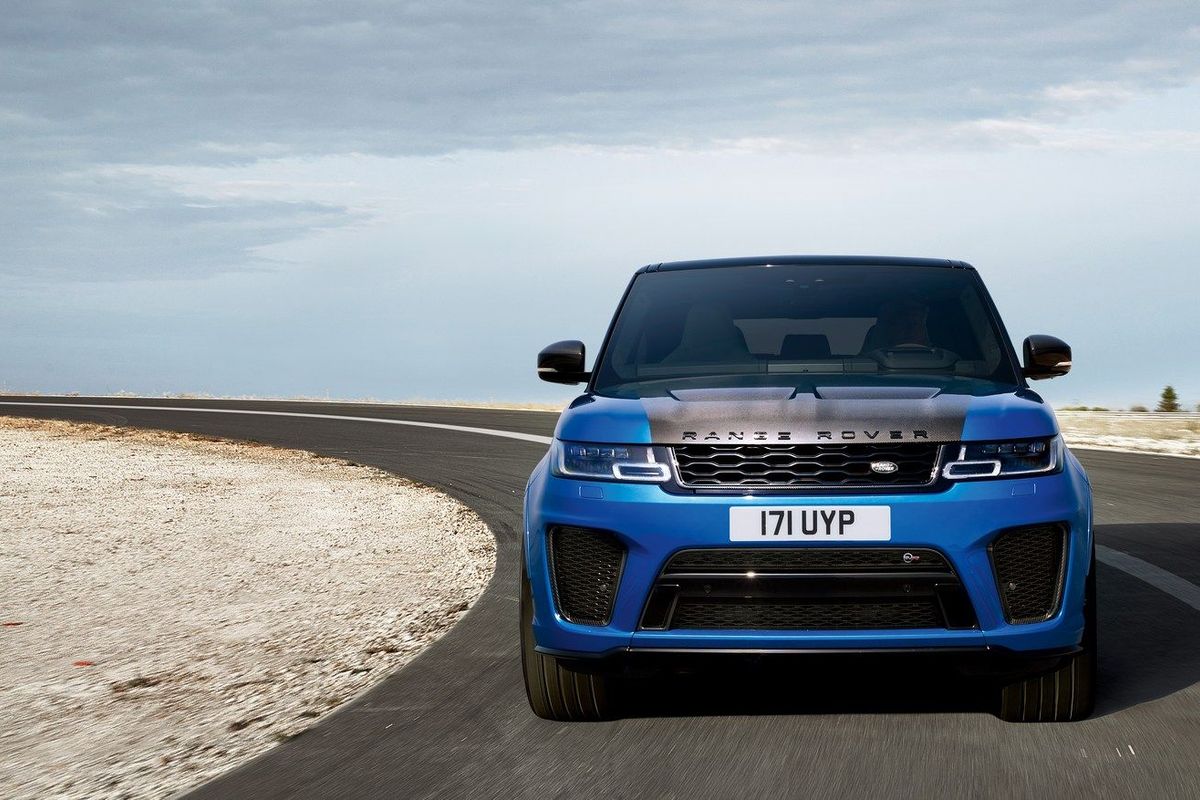
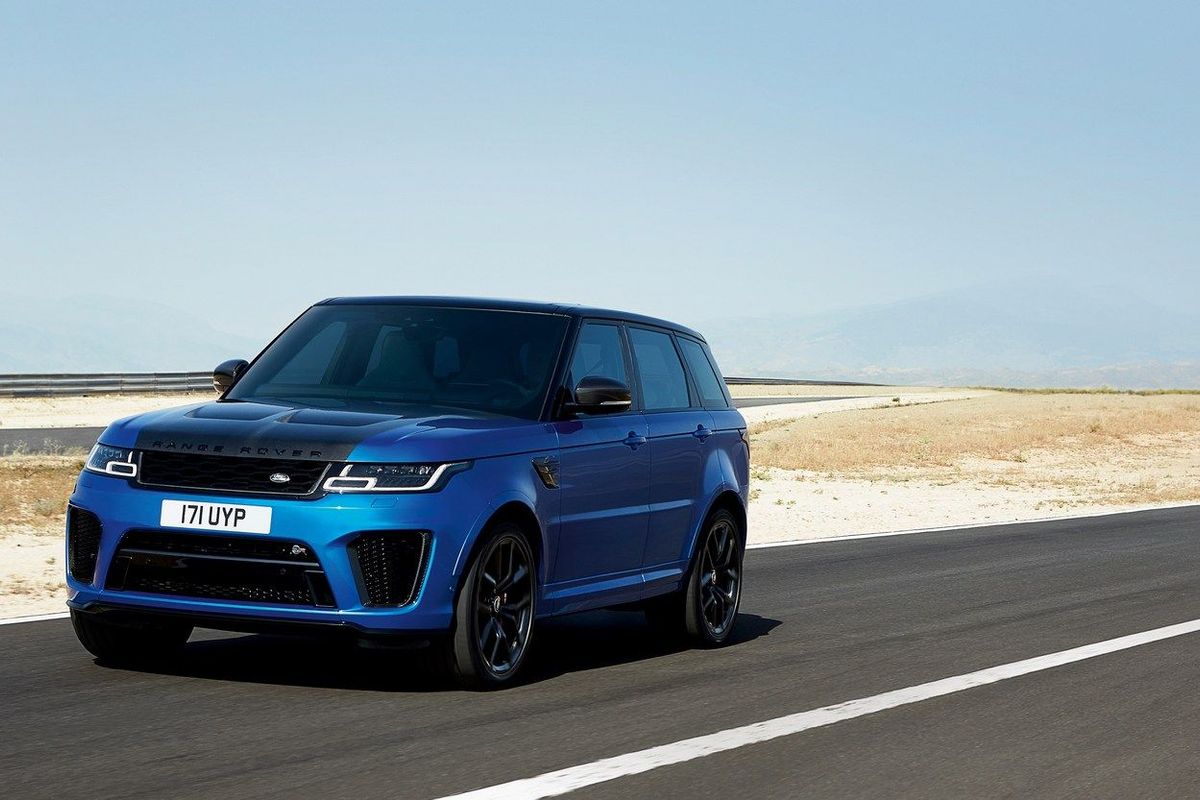
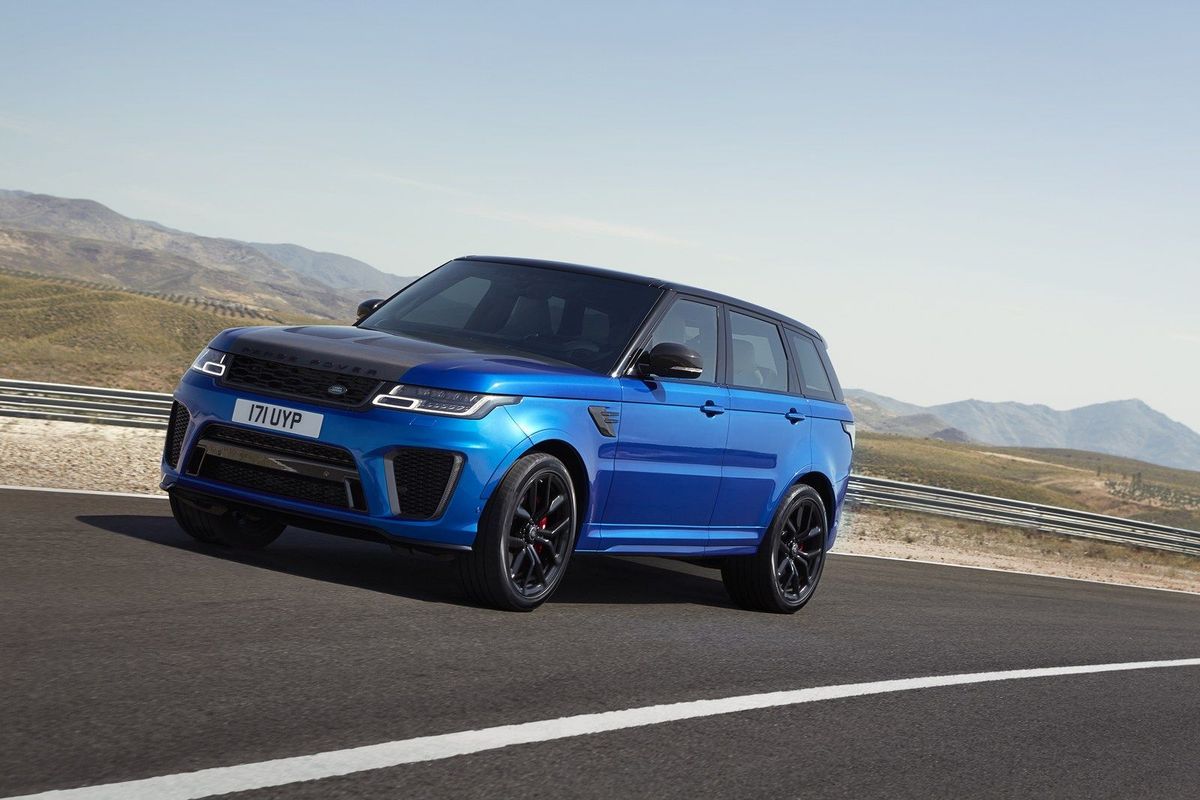
The range-topping SVR derivative gets a performance boost with power from its 5.0-litre supercharged V8 bumped up by 18 kW from 405 kW to 423 kW. The SVR can accelerate from zero to 100 kph in 4.5 seconds.
Styling changes
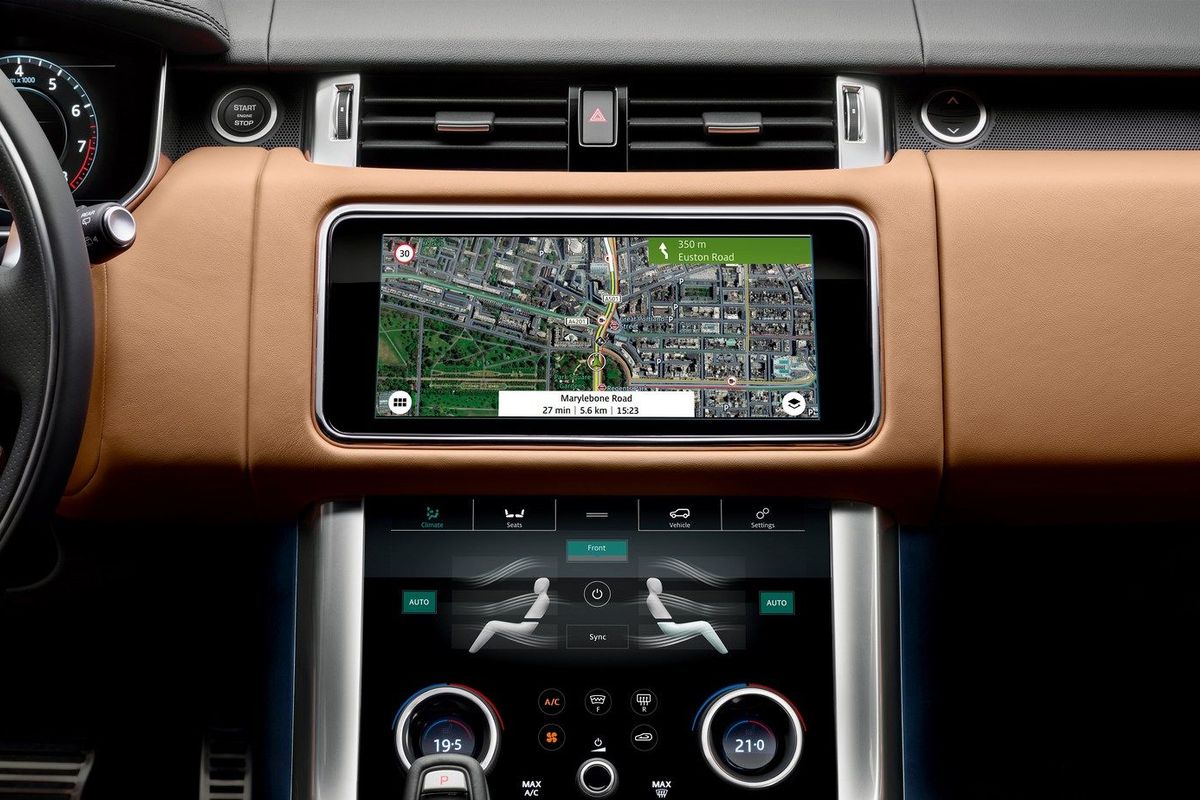
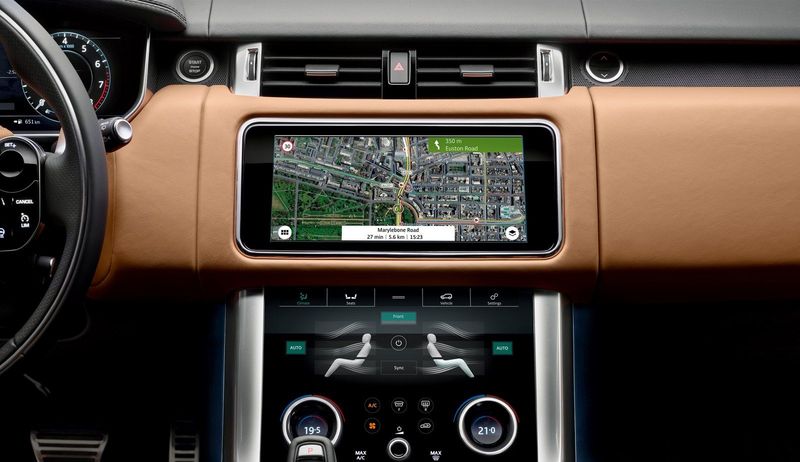
Two 10-inch touchscreens are fitted which not only reduce the amount of buttons in the cabin, but also house the majority of functions.
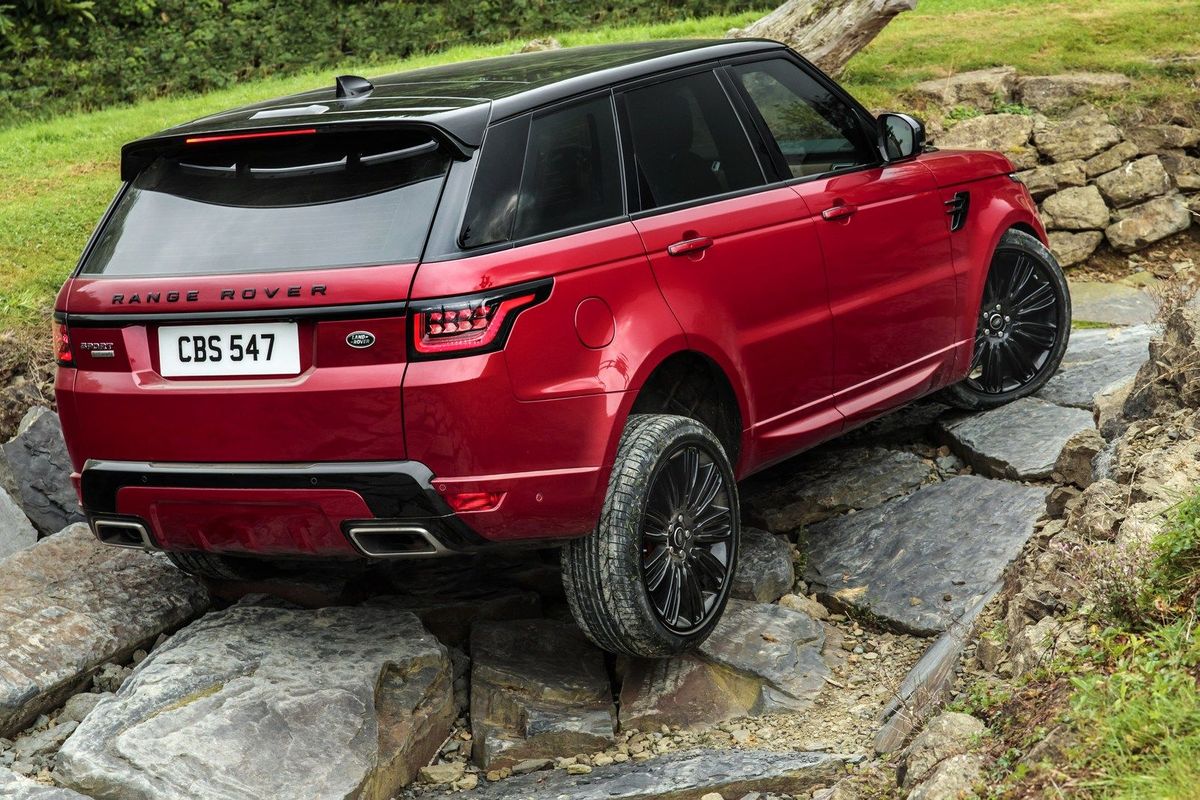
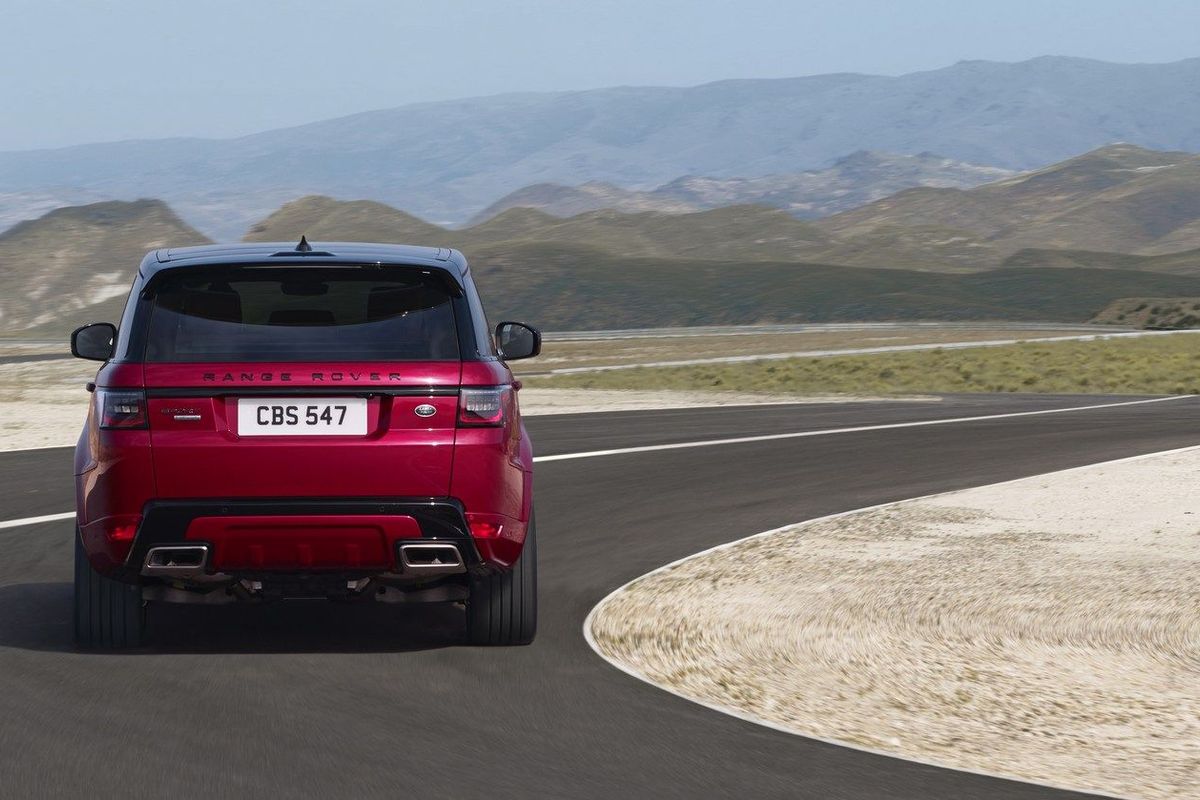
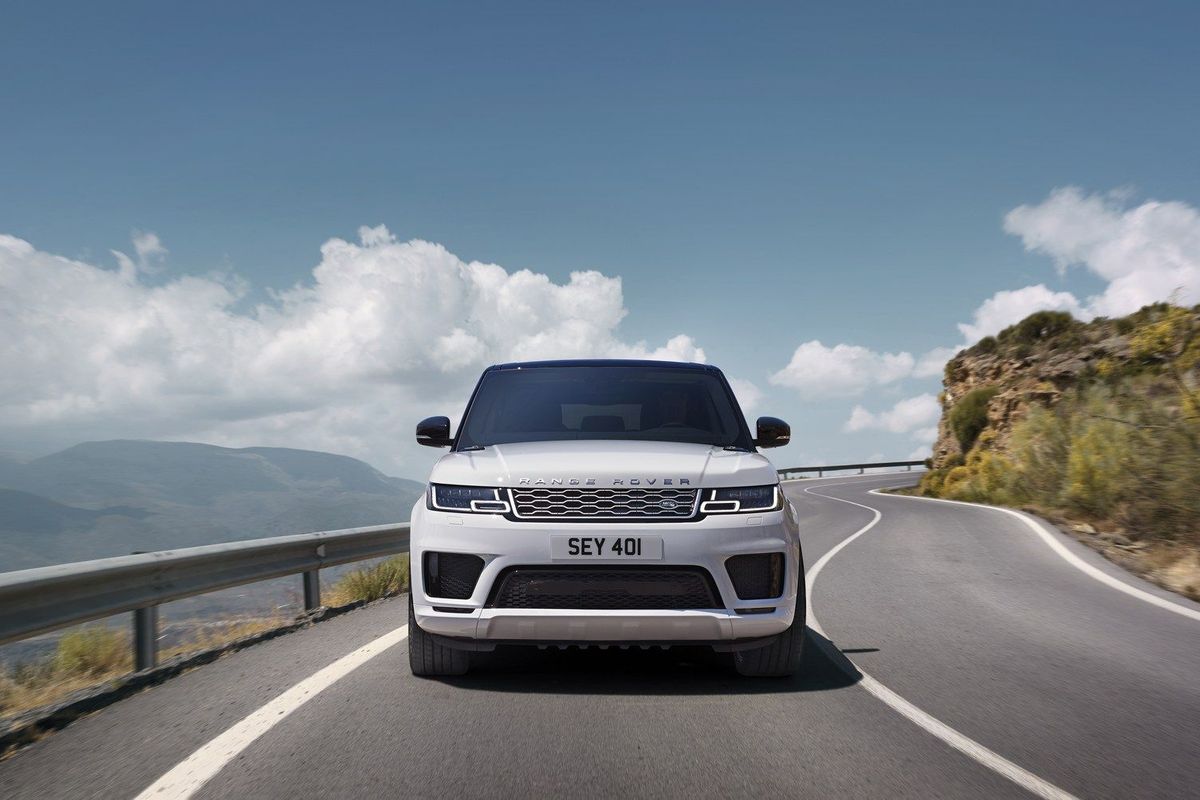
The facelifted Range Rover Sport wears a revised bumper with reshaped air vents and new LED fog lights. The grille has also been updated and is flanked by new, slim Matrix Pixel LED headlights. New rear taillight clusters are also fitted.
Three new 21- and 22-inch alloy wheel designs are offered in either a black finish or silver diamond turned finish.
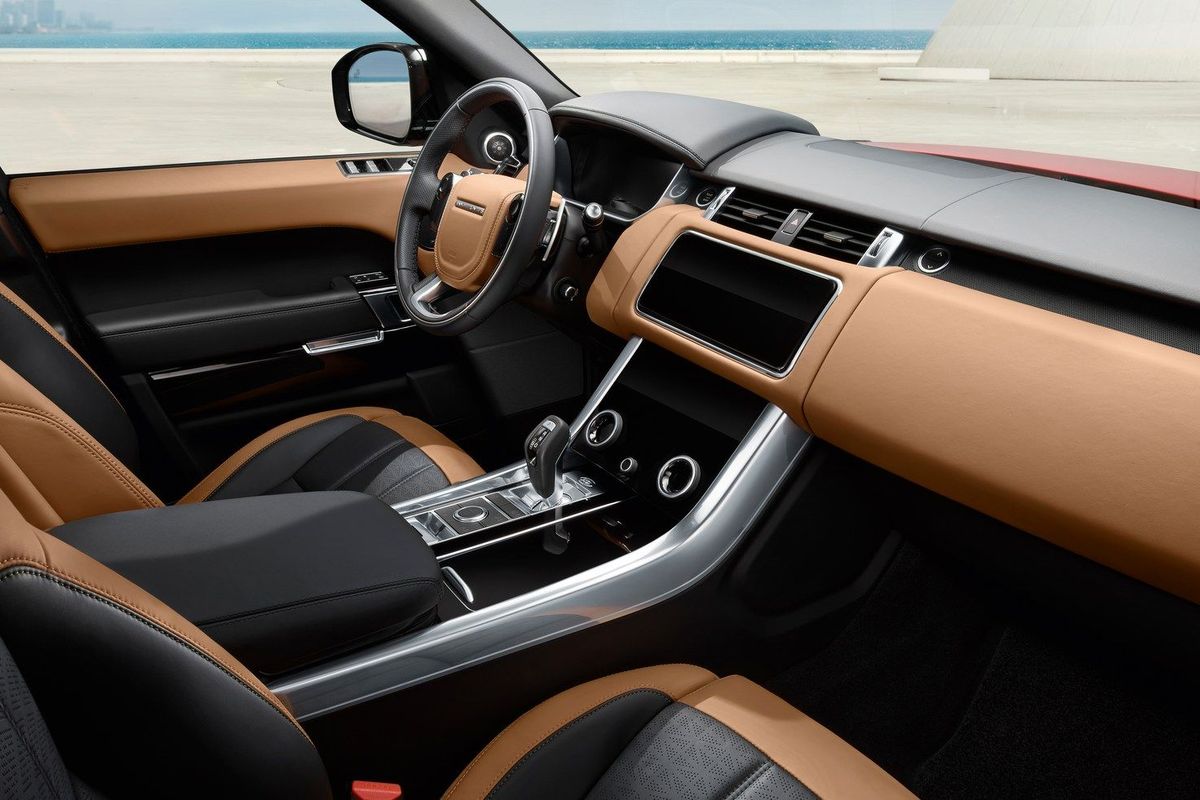
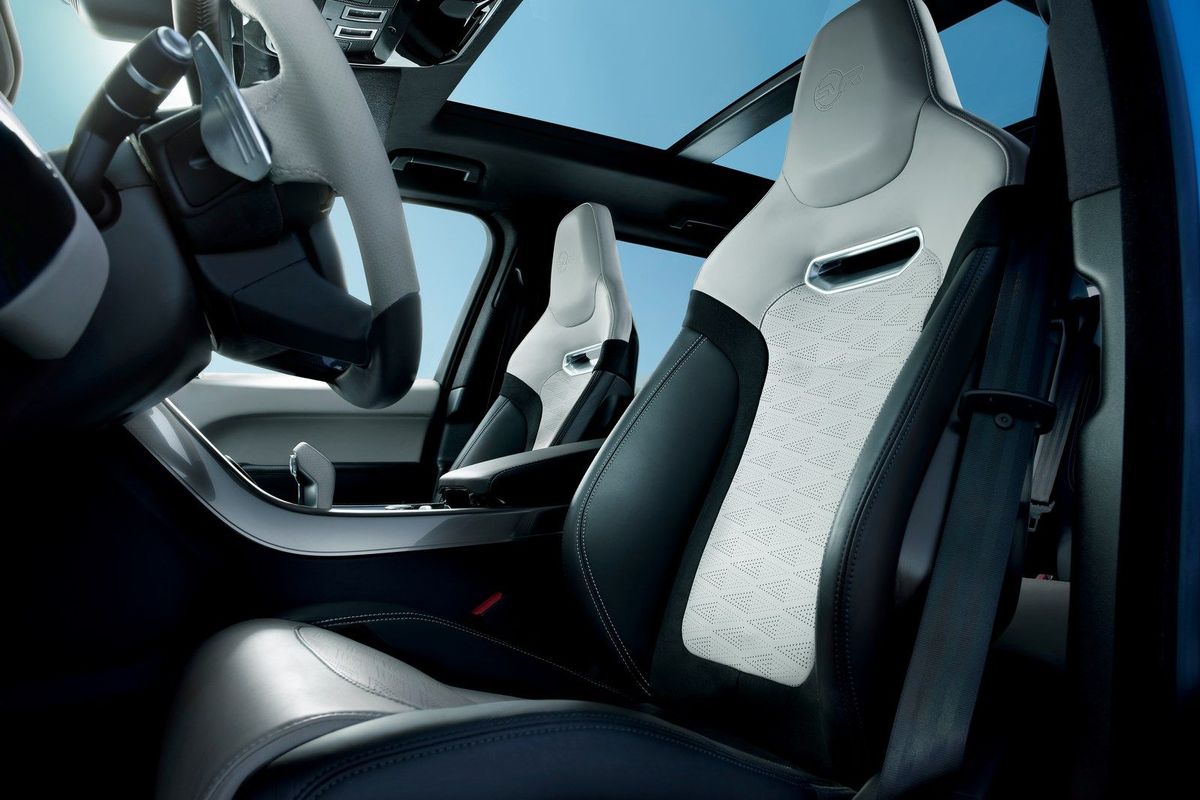
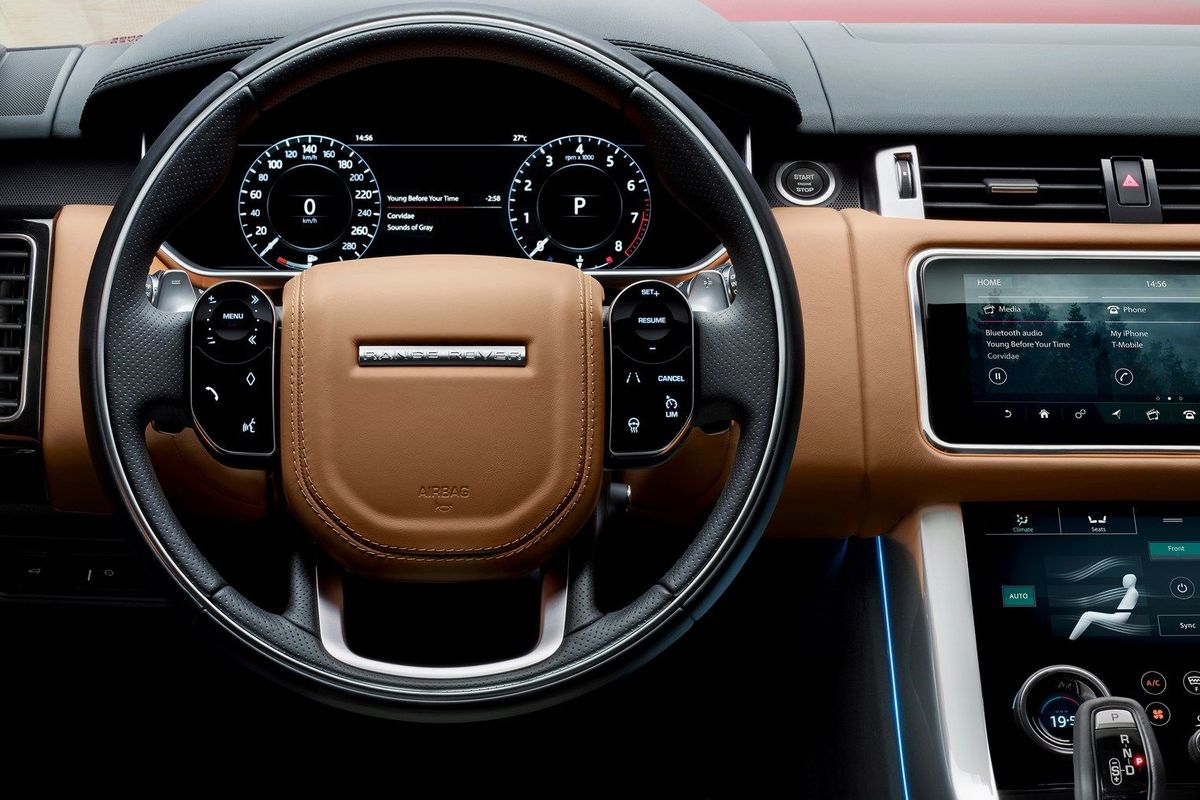
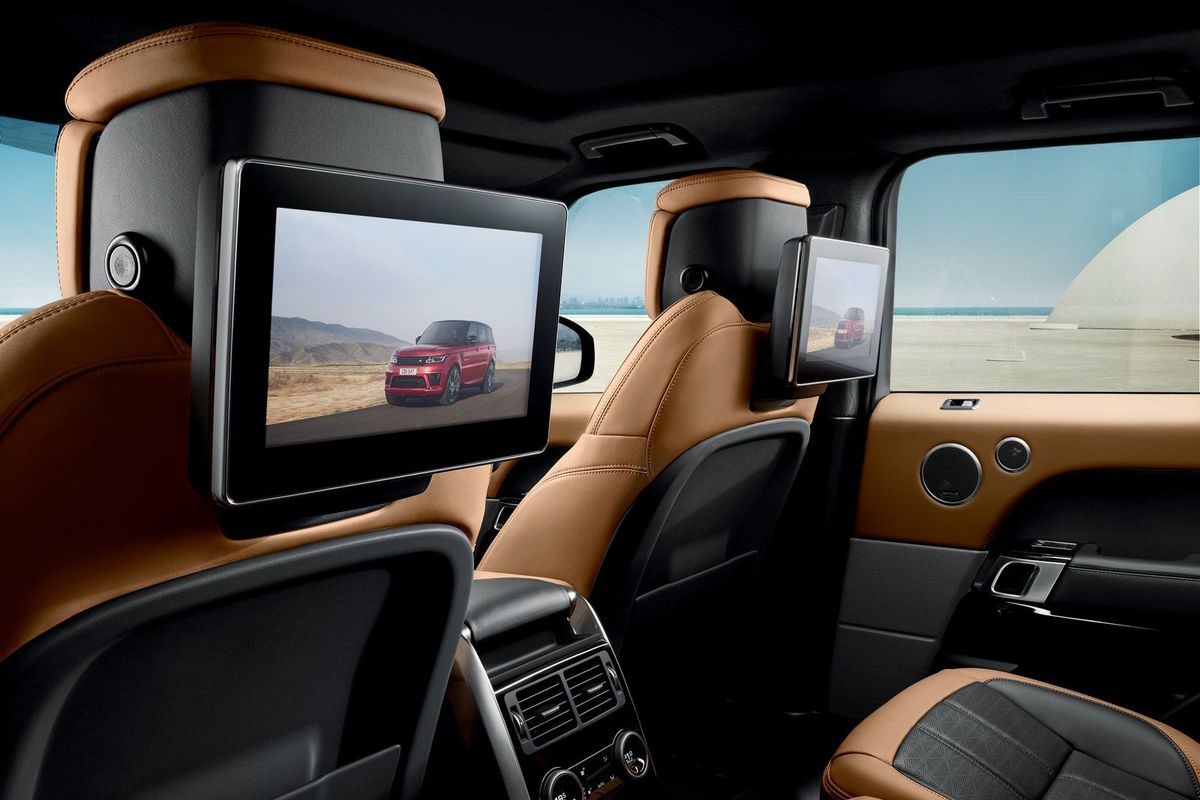
On the inside, the Range Rover Sport will benefit from the fitment of a Touch Pro Duo infotainment system comprising of 2 high-definition 10-inch touchscreens. The instrument cluster features a 12-inch interactive display and rear passengers have access to a larger 10-inch touchscreen entertainment display for the first time. The cabin is also littered with charging points and the Range Rover Sport will also be offered with Land Rover’s Activity Key, first introduced on the F-Pace, which negates the need to carry the key fob when you venture into the wild. New and slimmer front seats are fitted for improved comfort and can be upholstered in a variety of trim.
The facelifted Ranger Rover Sport can be expected in South Africa in 2018 .
Range Rover Sport – Price in South Africa
Range Rover Sport S Si4 – R1 115 200
Range Rover Sport S SCV6 – R1 160 500
Range Rover Sport SE Si4 – R1 171 500
Range Rover Sport S TDV6 – R1 194 400
Range Rover Sport SE TDV6 – R1 205 200
Range Rover Sport SE SCV6 – R1 216 800
Range Rover Sport SE SDV6 – R1 318 200
Range Rover Sport HSE TDV6 – R1 343 600
Range Rover Sport HSE Si4 – R1 384 100
Range Rover Sport HSE SDV6 – R1 564 500
Range Rover Sport Autobiography Dynamic SCV6 – R1 578 300
Range Rover Sport HSE P400e – R1 636 800
Range Rover Sport HSE Dynamic P400e – R1 681 300
Range Rover Sport HSE Dynamic Supercharged – R1 712 500
Range Rover Sport HSE Dynamic SDV8 – R1 734 700
Range Rover Sport Autobiography Dynamic P400e – R1 813 700
Range Rover Sport Autobiography Dynamic Supercharged – R1 965 400
Range Rover Sport Autobiography Dynamic SDV8 – R1 924 900
In the space of a month, 3 significant luxury SUVs have been launched in South Africa: Bentley Bentayga, Lamborghini Urus and Volkswagen Touareg. They have something vital in common, but which one is a better deal than the others?
They say beauty is more than skin-deep and with automobiles and their inherent value, it’s perhaps even more so. Blind your bias to appearance, dissolve the hollow confidence of orchestrated marketing and you might discover some incredibly underrated engineering equals in the market… We're talking about vehicles that share a similar core technical competency, despite vast differences in detailing and price.
As the world’s biggest car company, you’d expect the VW Group to have a few overlapping instances of platform engineering. Within its vast portfolio of brands, there are certain models which share a lot – and if you scrutinise the commonalities cleverly, there is also tremendous value to be had. Value anchored in sound engineering and technical principles, but ignored due to a market obsession with brand perception.
The issue of Volkswagen AG’s shared platform strategy isn’t a new topic, but the staggered local arrival of some hugely impressive premium and first-class SUVs from Bentley, Lamborghini and Volkswagen, all of which share a common technical ancestry, warrants a fresh discussion.
Why MLB is a big deal
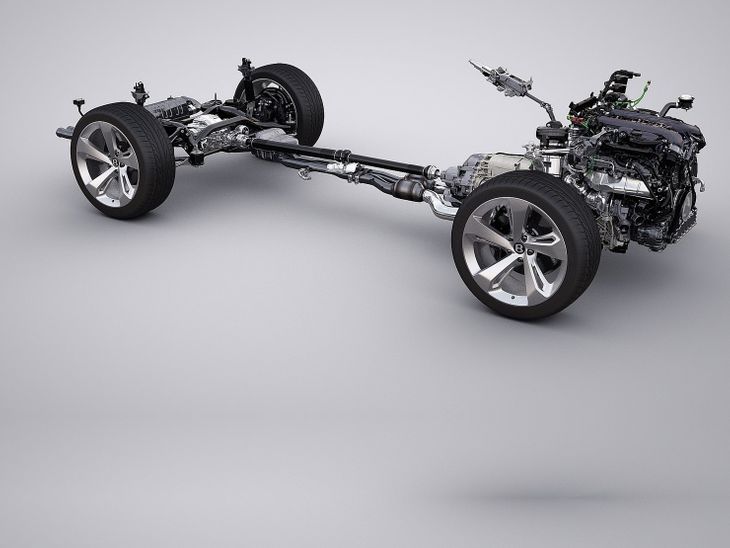
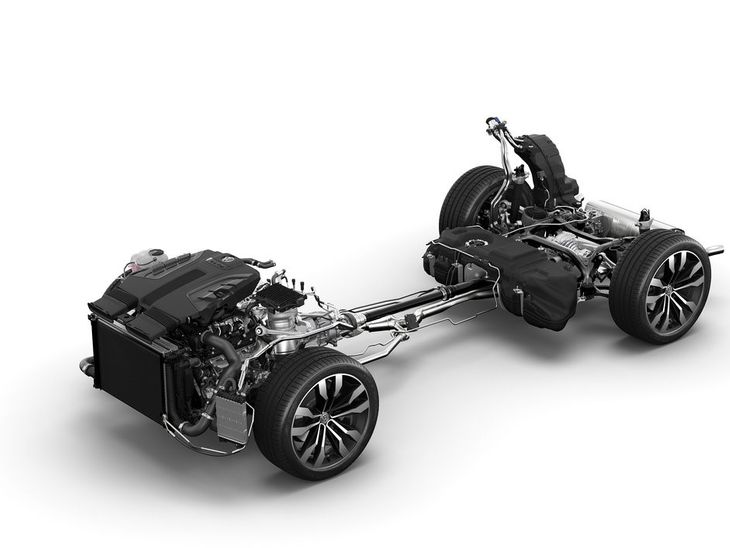
The MLB platform setup for the Bentley Bentayga.
Luxury SUVs are increasingly becoming the profit pony for automotive companies. We are all familiar with them, thanks to a proliferation of previously unimaginable brand associations now proudly marketing SUVs: Bentley and Lamborghini being both the latest and most notable.
These elevated 5-door behemoths can cruise at 250 kph on the German autobahn and navigate South Africa’s immense network of secondary gravel roads with equal aplomb. Broadening market demand and a more diverse customer geography has generated sufficient demand for Bentleys and Lamborghinis that can go where no Mulsanne or Aventador owners would ever dare.
The secret to enabling Bentayga and Urus is a simple acronym: MLB. It’s one of Volkswagen’s immensely overengineered vehicle platforms, the kind of project that occupies thousands of engineers and absorbs massive investment. Its aim? To enable all the brands within VW’s corporate organogram to react faster to changes in market demand, whether there is a need for an entry-level hatchback or limited-production supercar.
Aston Martin is still dithering about delivering an SUV to market and Ferrari promises Maranello will have something capable of gravel travel soon, but it has stopped short of committing to a date. In comparison, it’s remarkable that both Bentley and Lamborghini, equally storied brands which are decidedly low-volume, have delivered comprehensively accomplished SUVs to market before any of their rivals. The reason is simple: MLB.
Lamborghini Bentayga disguised as a Volkswagen Touareg platform?
Despite the intimidating German name: Modularer Längsbaukasten, VW’s MLB strategy is about simplifying its business without sacrificing engineering competence and ultimately: customer experience. A Bentayga must ride with the necessary decorum and appropriate Bentley-calibre silence on its MLB platform, just as much as Urus is required to corner and accelerate in a manner expected from Lamborghinis, using the same structure. As such, there can be no compromise in the MLB platform’s fundamental engineering, one that also underpins the new Touareg…
Only a few elements of MLB are fixed: the windscreen angle, pedal box/firewall location, the orientation of the engine and position of the front wheels. The structure is entirely adaptable in length, which means you can build a variety of different luxury vehicle applications on it, provided you use the same engine orientation. It’s a world of industrial engineering simplicity, which enables tremendous scaling of resources.
Is a Bentayga (or indeed an Urus?) merely an overpriced Touareg?
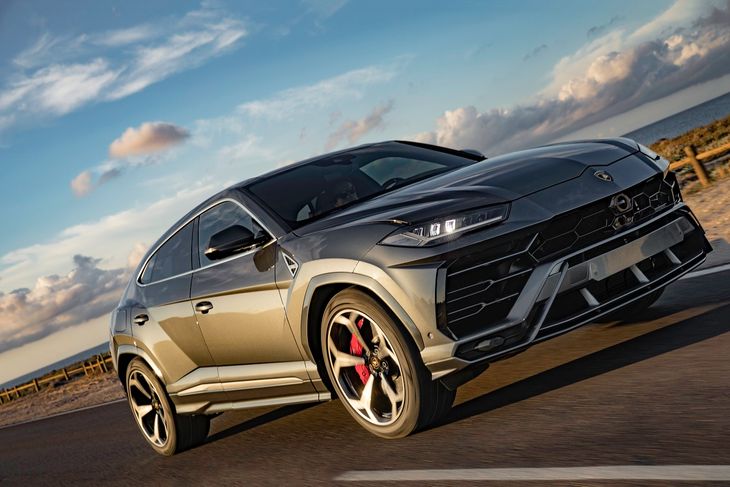
The Urus has used its underpinnings for sporty handling and dynamic acceleration – petrol powered.
It’s a burning question. If their structures are similar, why pay 3 times the money for a Bentayga or Urus, when you could have a Touareg instead?
The first fallacy in this comparative argument is that Touareg does not offer nearly the engine options Bentley or Lamborghini do. The Urus is a 478 kW output vehicle powered by a 4.0-litre twin-turbocharged V8 that spins to 6 750 rpm. Bentley will offer you immensely torque-rich options, such as the 900 Nm 4.0-litre tri-turbodiesel V8, which arrived on local shores at the beginning of July 2018. Touareg’s engine portfolio is rather limited and less glamorous in comparison: a range of V6s, of which the South African market only has the option of a 3.0-litre V6 turbodiesel, for now.
These incredible engines certainly account for some of the pricing difference between a Touareg, Urus or Bentayga. So does the cabin trim, which is outlandishly luxurious and handmade on the Bentley. To its credit the Urus features an exceptionally sophisticated code of engine, transmission and steering ratio algorithms, which are many times more aggressive than either Bentayga or Touareg’s electronically harmonised dynamics.
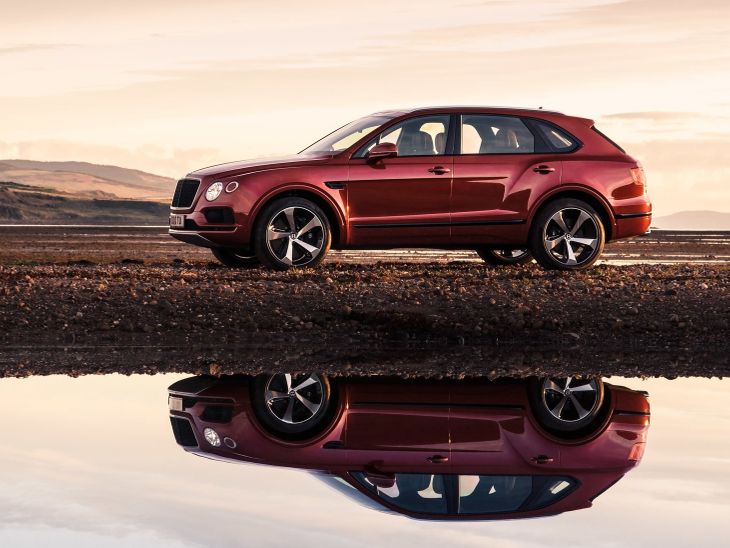
The Bentley Bentayga prioritises torque, a hefty 900 Nm if it in its highest form.
Bentley’s claim for their MLB SUV is unparalleled refinement: a quietest-in-class cabin, accounting for its immense mass, which is 500 kg more than a Touareg. Another example of differentiation between the boutique brand MLB SUVs and Touareg is how Bentayga’s substantial kerb weight has necessitated a customised engineering solution, with active roll-bars at both axles, gifting Bentayga a matchless combination of air-cushioned ride quality and unrivalled active roll-mitigation. The anti-roll bars are split, with an electric motor in the middle, and the moment it senses lateral weight shift, those motors drive greater rebound pressure onto the outside wheel, flatting the Bentayga’s stance when every bit of logic is telling you the big Bentley should be leaving the road and ending up on its roof.
Engines. Sound-deadening materials. Exotic cabin materials. And trick suspension technology. These are inarguable technical elements of differentiation between Bentley and Lamborghini’s MLB SUVs and Touareg.
The benefit of buying into superior breeding
Volkswagen’s been clever to ensure a sufficient degree of separation in purpose, thereby allowing Touareg, Bentayga and Urus to silo into different niches, and out of any rivalry with each other.
One of the most challenging aspects of engineering a superior vehicle structure is deciding how the engine is going to be orientated, the driver accommodated, and front wheels mounted. Miscalculations or compromises regarding any of these technicalities will deliver a vehicle with compromised weight distribution under braking and clumsiness into tight corners (engine location), an annoyingly compromised driving position (pedal box ergonomics) and lethargic handling (front-wheel placement).
Is the quality markedly different enough to warrant a couple million rands difference in price between the Touareg and its siblings?
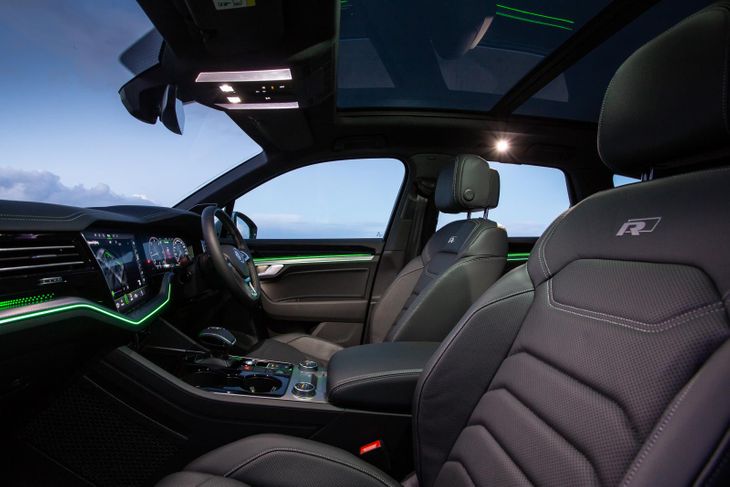
Get these platform decisions correct and you are destined to build greatness, irrespective of eventual wheelbase length (which is variable with MLB), cabin materials, sound insulation or engine power. It's here where Touareg presents an amazing value proposition. For years the best buy in VW’s portfolio was the rather stealthy Passat (for all intents and purposes a discounted Audi A4). The analogy between Passat/A4 and Touareg/Bentayga/Urus is this: with the VW-branded larger MLB SUV, you're buying into the most over-engineered large SUV architecture there is.
With Bentayga and Urus occupying the rarefied high-performance SUV segment with overwhelming engine power, there is an irony in the Touareg’s stealth MLB status. When product planners revealed the original Touareg it was a vehicle so unique within VW’s portfolio, there was no risk of cannibalising any sibling brand, as Bentley and Lamborghini weren’t remotely interested in SUVs a decade and a half ago. As such, engineers could develop outrageous engine options for the Touareg: which debuted with a 5.0-litre turbodiesel V10. The possibility of a radical high-performance Touareg is less likely now, as it would possibly cannibalise Bentayga or Urus market cache, not necessarily competing on price or exclusivity – but certainly on capability or performance. Because at its core, there is little difference, save for the engines…
The future for Touareg, in collaboration with its MLB SUV siblings, is to be a junior partner in Volkswagen's attempt to dominate the luxury SUV market completely. Expect a future of greater hybridisation, instead of 1000 Nm diesel engines or detuned Urus V8s. But if you want to buy into a vehicle with indisputable Bentley and Lamborghini technical relations, Touareg is a veritable bargain.
It will be interesting to see how many South Africans make the correlation and spend their money so wisely, on what is now certainly the engineer’s choice in luxury SUVs. With Passat, South Africans were unable to recognise engineering excellence and separate it from brand bias. For the few who see the MLB value beneath that VW badge, they’ll be guaranteed an immensely contented ownership experience, driving a vehicle which was, at its core, designed to cope with the performance demands of Bentley and Lamborghini…
2019 Suzuki Jimny Offroad Capability Announced [Video]
The Suzuki Jimny is a serious 4×4 vehicle and we expect the 2019 model to be just as credible. Suzuki South Africa has confirmed some more offroad capability ahead of its local launch in November 2018.
The next-generation Suzuki Jimny will be arriving in South Africa towards the end of the year, November to be exact. Ahead of its launch, Suzuki South Africa are teasing us with little nuggets of information and this time around, we get a closer look at just how capable it'll be offroad. The previous-generation Jimny had a stellar reputation when it came to 4×4 work and it's expected the newcomer will be just as good.
2019 Suzuki Jimny offroad features
The 2019 Suzuki Jimny has a rigid ladder frame chassis, which has always been the best place to start when you're making a credible 4×4 vehicle. In terms of suspension, there is a 3-link rigid axle suspension with coil springs. The axles work in a simple manner: when an obstacle pushes one wheel up, the axles forces the other wheel down, increasing traction.
The Jimny also features a 4-wheel drive gearbox with a low-range transfer gear. When you're really pressing through the rough stuff Suzuki's AllGrip Pro has you covered. 4L will be your best friend, if you're wanting to conquer the most hardcore offroad trails. There is also 4H if you wish to do higher speeds on gravel and sand, and when you're not driving offroad, switch to 2H to save fuel.
The numbers do not lie. When it comes to approach, breakover and departure, the Suzuki Jimny is a credible offroader. With 37 degrees, 28 degrees and 49 degrees respectively, you're not going to get stuck, while a ground clearance of 210 mm will clear most obstacles.
5 Optional Extras that are not Worth the Extra Money
Optional extras: are any of them actually worth the extra money? We choose 5 extras that are probably best avoided.
Buying a new car is an expensive ordeal, but of course, we already know this. And because many consumers feel the need to specify their vehicles to some level of exclusivity, even if only to differentiate them from derivatives with stock (standard) configuration, manufacturers (or dealers, to some extent) have been coining it by offering a plethora of optional extras for decades. Thankfully, many of the optional extras we saw in yesteryear are now standard features, things such as air-conditioning, power steering, and airbags, to name but a few.
But we are still exposed to optional features that are, in all honesty, indulgences. Yes, you want your car (and by association, yourself) to be unique, but surely, having money in your bank account is more of a priority? Sure, there are those features that are worth the extra spend, some could even be life-saving. But there are those that are not only a waste of cash, but also don’t retain any value when it comes to selling or trading in your car.
Here are 5 optional extras that are really not worth your hard-earned moola:
Satnav
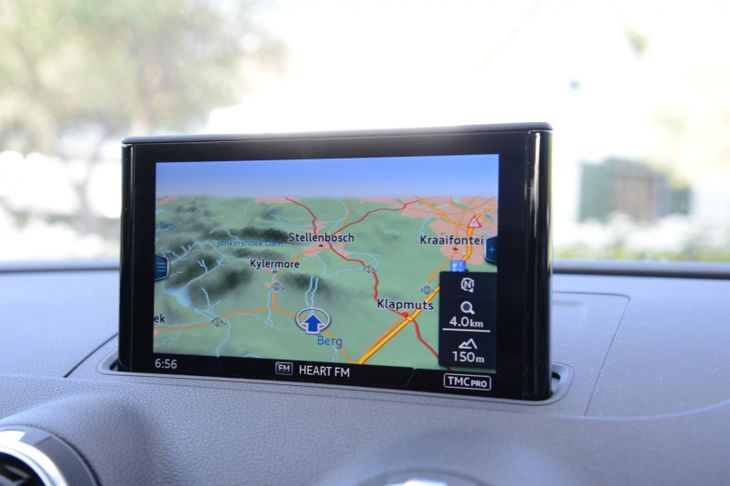
Satellite navigation (colloquially known as satnav) systems were must-have luxuries in the pre-smartphone era, when everyone was gatvol of trying to find their destinations by deciphering cumbersome roadmaps in their vehicles. These days, built-in satnavs are widely available, but they're still relatively expensive to specify! Consider Audi’s MMI Navigation Plus with MMI touch, if you want to receive route commands with traffic information in an A3 Sportback, you need the whole system, which costs R24 000.
If you want basic navigation, it's still R15 000, which is almost enough to upgrade you to the next derivative in the model range. With apps like Google Maps and Waze on hand, there is little point to having a built-in satnav, especially when you would rather have Apple CarPlay or Android Auto and just use the navigation app already installed on your phone. Data usage is minimal and the apps much cheaper than the built-in navigation system. You get more than just real-time traffic info out of Google Maps as well.
Climatised seats with/without massage function
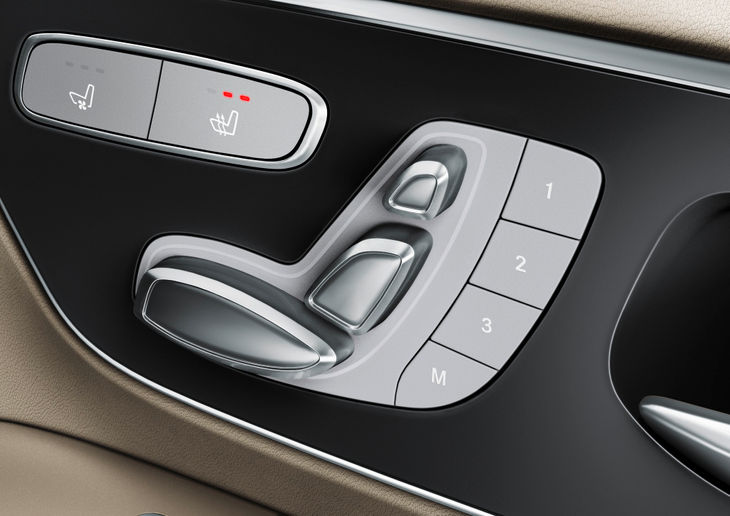
Heated seats are all good and well, there is always a time when things are chilly and a warm seat quickly returns one's core temperature to a comfortable level. They are relatively cheap too, only about R6 000 in most cases. If you want to climatise (heat and cool) the seats, which usually offer electrical adjustment (which is handy, with a memory function) that more than triples the price tag.
A climatised front seat on a Mercedes-Benz E-Class is R21 000, which you will never see a cent of when it comes to trading in your vehicle. And massaging seats are overrated, you hardly get a massage… it's more like being prodded in the back by an inflatable balloon. It doesn’t matter how many different styles of massage it promises, it’s not a genuine Swedish Invigorating Massage or a Hot Stone Back and Shoulder Activation. This comes with a further R10-15k surcharge as well.
Sunroof
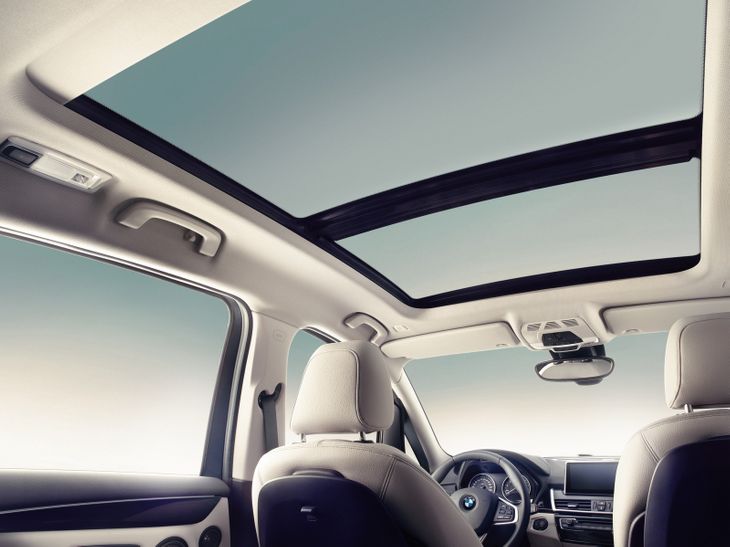
If you’re thinking about speccing your new BMW X3 with an electrically operated panoramic glass sliding/tilting sunroof, expect to pay R21 000 for it. That’s a lot of money to have a window above your head that allows the sun to beat down and turn your car's cabin into a "greenhouse" in summer. Gone are the days when you were allowed to stand up between your parents and stick your head out of the sunroof, so is there really any use for it now? The novelty will wear off quickly. If you’re trying to simulate the feeling of a convertible, perhaps it’s worth looking at buying a… convertible?
Foglamps
If manufacturers are starting to phase out front foglamps, this should prove what a waste of money they really are. The New York Times reported last year that fog lamps were being omitted by manufacturers because they were deemed unnecessary thanks to recent high-tech headlights. Another question to ask yourself is how often you really drive through fog? This is the only time the lamps would need to be utilised, so if you live in an area that has almost no fog, it really is a waste to add them to your vehicle. And many foglamps act more like accent lighting than true fog lights. And the ones that do work, only illuminate a short distance ahead of you so, you will be driving as slow in the fog as you would without them.
Big wheels
This can depend on the car you are buying, but most of the time, bigger wheels are a complete waste of money. If you want your BMW X3 to sit on 21-inch wheels, you will have to cough up R42 600. All that money for something that is really just a cosmetic enhancement. You might feel this is a good enough reason, but wait 'til you have to replace a set of tyres… Prices go up proportionally to size, so you may end up wishing you'd stuck with the regular 16-inch wheels. Unless the bigger wheels facilitate significantly wider tyre tread widths for the purpose of improved road-holding/dynamic handling, there is no use in spending big sums of money on bigger wheels. Besides, as a general rule: the lower the tyre profile (in other words, the skinnier the sidewall), the firmer the ride.
There are only a few optional extras that will retain their value. This is something to seriously consider before ticking all those boxes. Buy with your head and not your heart, ask yourself if you really and truly need something before adding it to the list. This way, you will save yourself a lot of money and possibly heartache when the time comes to selling on your beloved car.
New Ford Ranger Raptor Review – Driven Hard In The Outback
Ciro De Siena headed to Australia to be one of the first people in the world to drive the Ford Ranger Raptor. Here's what he thought of it.
Unless you’re Australian, Australia is a very far away place. And unless you’re a cattle farmer, there’s not much reason to go into the Outback. But for the first ever Ranger Raptor, the company's first global Raptor, Ford wanted to build an offroad playground to show off what their new bakkie could do. And so we hopped on a few planes and made our way to Darwin, where we left the city and trekked into the interior.
The event team had carved two custom racetracks into the landscape, and we were given the opportunity to drive the car ourselves and "enjoy" one terror-lap with a pro-driver in the hot seat. The result is a video with a lot of dust, some muffled screams and more drifting bakkies than you might have thought possible.
The Ranger Raptor is due to land in South Africa in early 2019 and unfortunately, pricing has not yet been confirmed.
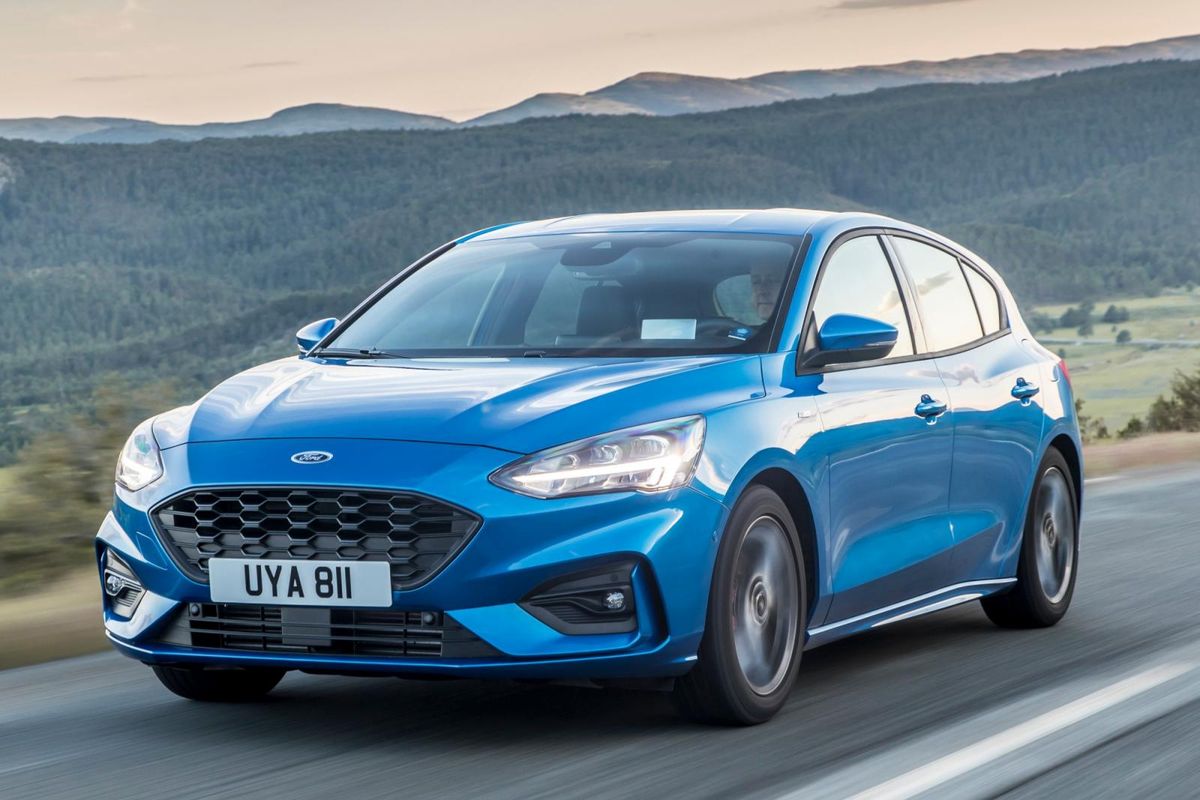
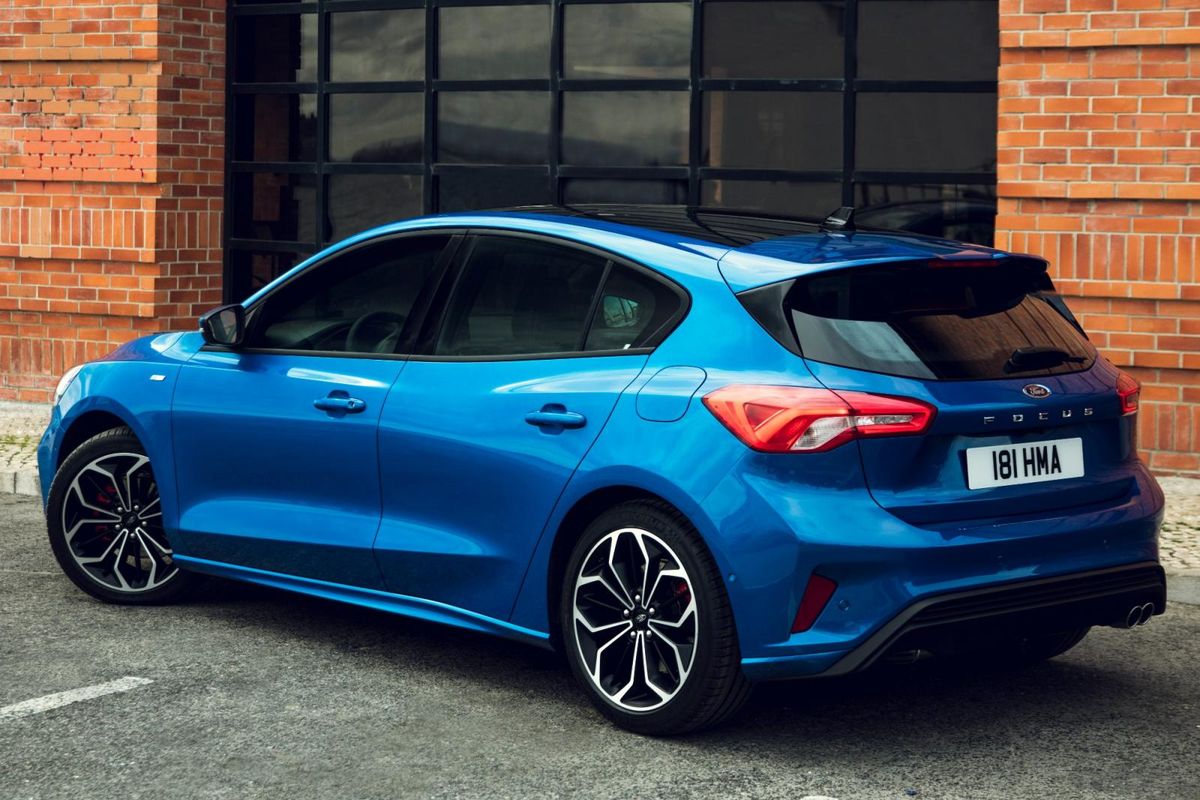
New Ford Focus: 5 Ways in which it could beat VW’s Golf
Ford's all-new Focus arrives in South Africa during the first quarter of next year. In recent years the outgoing car has become the class-leading Volkswagen Golf's fiercest rival. Here are 5 areas in which we think the new Ford could trump its arch-rival.
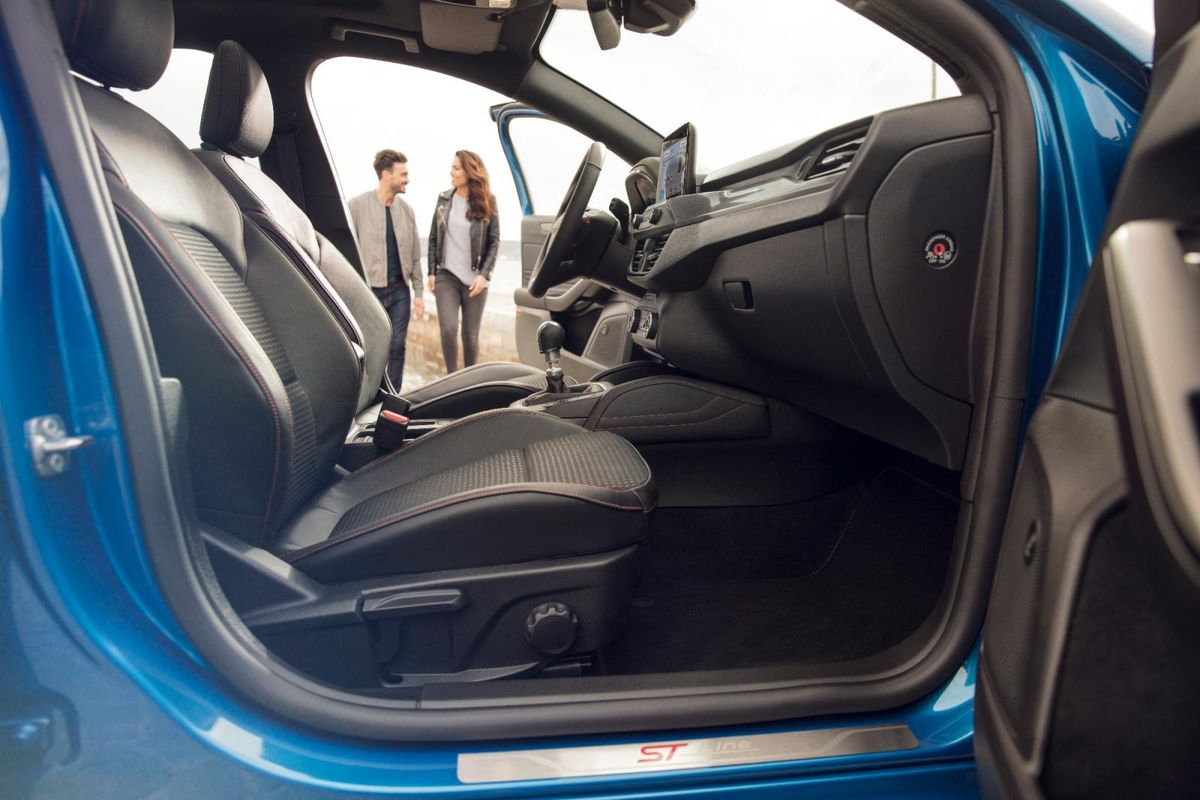
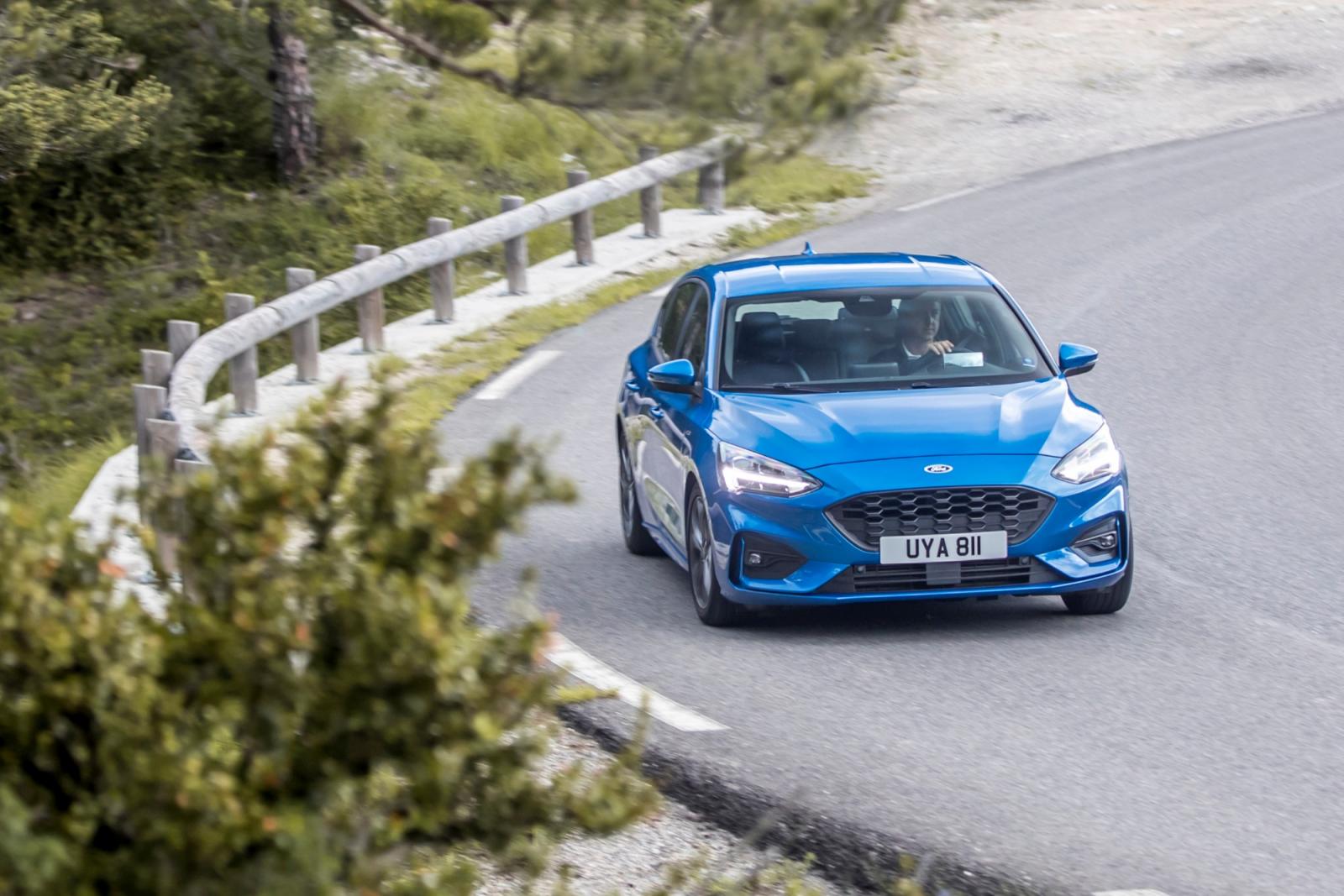
We recently travelled to France to drive this very important new C-segment contender. You can read the full review here. In a nutshell, the new Focus appears to again set a new benchmark for dynamic ability in its class, and also edges closer than ever before to the Golf in terms of quality finishes. While the local line-up and, most importantly, pricing remains unclear at this point, we believe the Focus could better the Golf in 5 key areas when it arrives in South Africa.
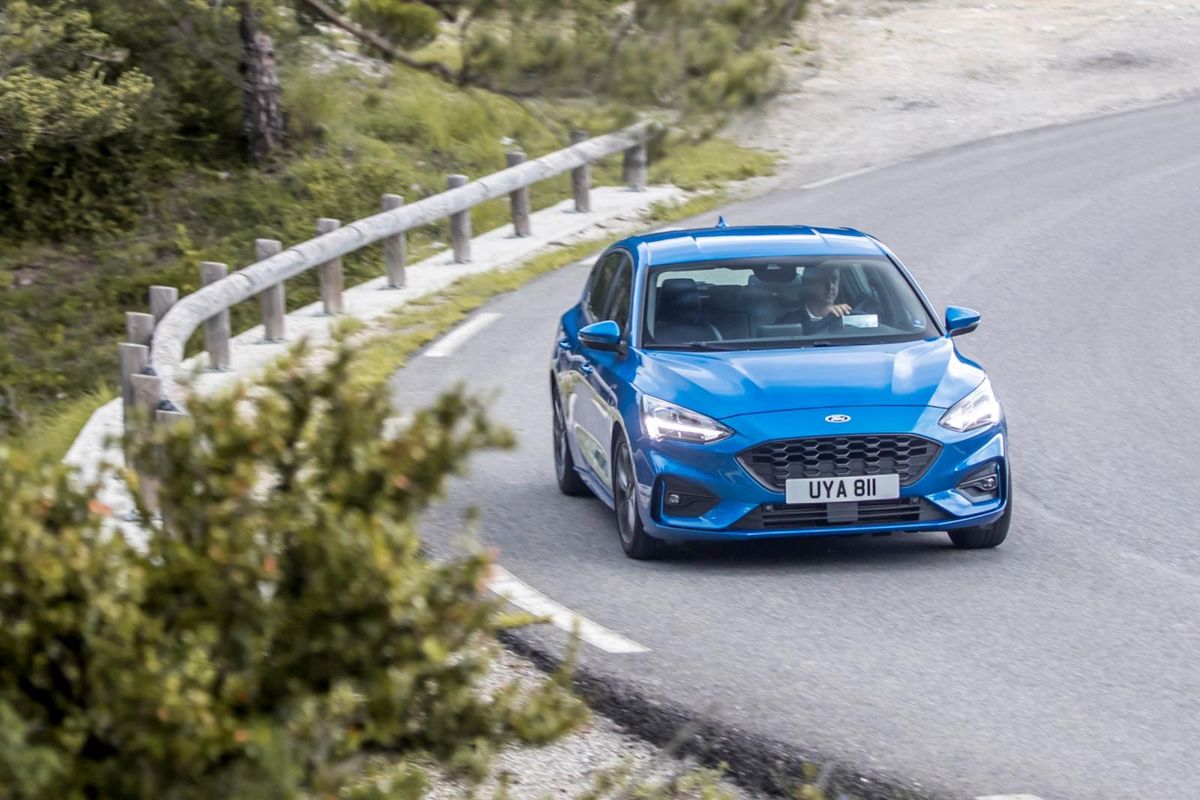
The new Focus can be had with Continuously Controlled Damping, but even without it is a class-leading handler.
It needs to be said upfront that the current Golf is no pushover in this regard – its MQB platform is stiff and has throughout VW's model range delivered sweet-handling cars that also ride well. But the Focus is better. During our drive in France, on varied surfaces, the Focus impressed with its big-car ride refinement and agility in the corners. Essentially Ford offers 3 levels of suspension set-up, depending on which model you buy. We'll have to wait and see what is offered locally but even in its most basic configuration it impresses dynamically. Higher-spec cars even feature Continuously Controlled Damping which is also linked to the standard (on all models) Drive Mode selector.
With crisp, nicely weighted steering, a supple ride quality when you're in a relaxed mood, and pin-sharp dynamism when you're in a hurry, the Focus tops the class in this area quite comfortably.
2. Spaciousness
Loads of space in the back courtesy of a significantly extended wheelbase.
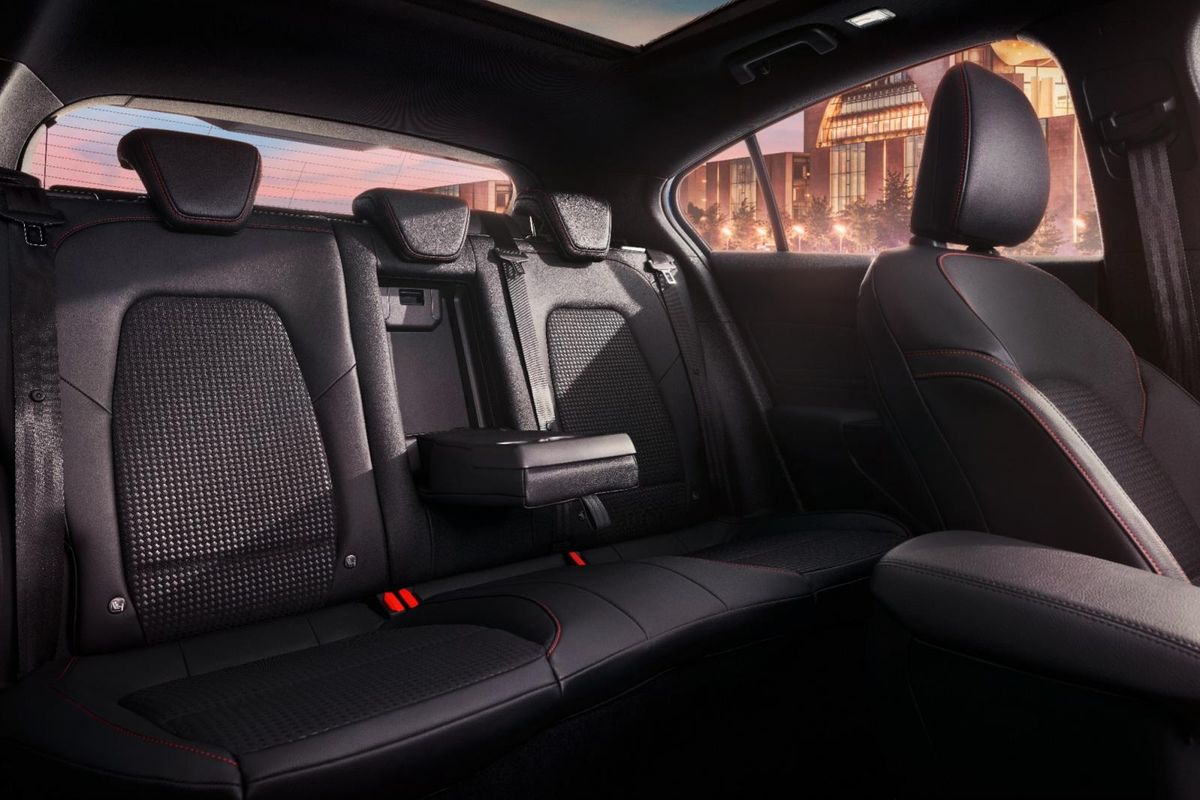
The new Focus has a 50mm longer wheelbase, and all that extra length has gone into providing more rear legroom. The Focus's wheelbase now measures 2 700mm, compared with the 2 630mm of the Golf 7. Ford claims that the new car is now class-leading in this regard, and having done the sit-behind-self test in Europe, we have no reason to doubt their claim – it's indeed massive back there!
There is also more rear shoulder room – Focus rear track measures 1 553mm compared with the Golf's 1 521mm – and the boot is among the largest in its segment (Golf is 380L, and new Focus is 375L, up from 316L), too.
3. Performance & Efficiency Balance
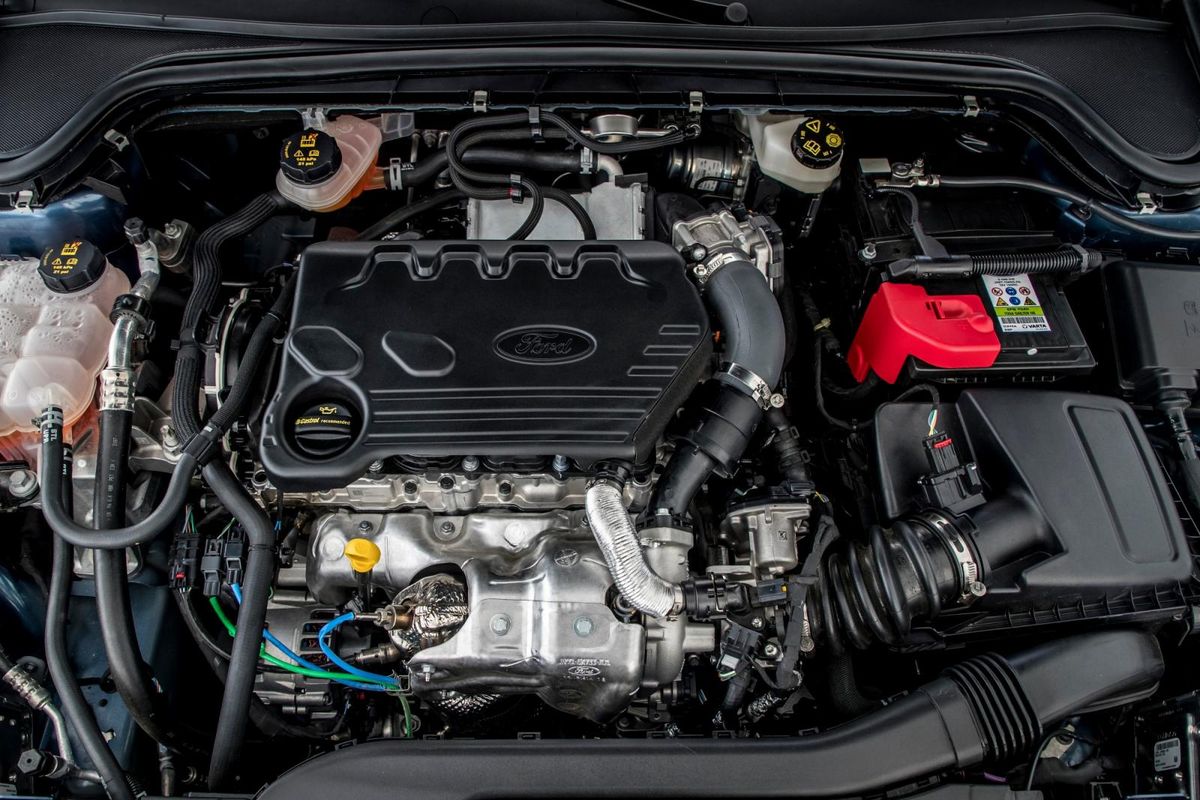
The local line-up will include Ford's latest 1.0T and 1.5T turbopetrols.
Given the new Focus's greater dimensions you may have some doubts about the ability of such small 3-cylinder engines delivering sufficient go, but all the derivatives we drove in Europe provided perky performance. At this point it is unclear which output levels South Africa will receive, and Ford's recent confirmation that the higher-output 1.5L engine in the Fiesta ST can't come here due to our fuel quality, will raise concern.
Nevertheless, currently the benchmark set by the Golf in the 1.0L class is 81kW/200Nm of torque, and the Focus's rival engine (now featuring innovative cylinder deactivation technology) ranges from 63 to 92kW (with 200Nm on overboost). We expect the more powerful of these 1.0L engines to make the local line-up, in which case it should match the VW's performance figures (0-100kph in around 10sec and a 200kph top speed).
In terms of the 1.5L engine, here Ford will want to beat the 1.4 TSI Golf's 92kW/200Nm, which should be easy enough given the fact that the lower of the Ford 1.5L engines' minimum outputs are 110kW and 240Nm.
This 1.5T ST-Line car offered very impressive performance and efficiency during our test in Europe.
We were also impressed with the Ford's new 6-speed manual transmission (the best Ford manual we've tried in a long time), and there's also a slick new 8-speed automatic (with paddle shifts).
With fuel costs rising faster than it takes to empty a tank, fuel efficiency continues to grow as a key purchasing factor. Ford's EcoBoost engines have always had impressive claimed fuel economy, but we've often struggled to match those claims. Still, the newly reworked engines promise further improvements, notably due to groundbreaking cylinder deactivation technology, which shuts down one of the three cylinders when not needed.
Ford claims a combined cycle fuel economy figure of 4.8L/100km for the higher output (92kW) 1.0L engine, which matches the Golf exactly, while for the more powerful 1.5T the claim is 5.3L/100km, again closely matching the Golf's less powerful 1.4L engine.
4. Standard Specification
In Europe all Focus trim lines boast generous specification – this is ST-Line.
With features such as a Drive Mode selector and Heads-Up display across all derivatives in Europe, Ford appears to have gone for a fairly generous specification level with its new contender. In South Africa, we don't have access to line-up details just yet, but given the positioning of the new Fiesta, and the approach by Ford in Europe, we can predict with some certainty that the pricing gap to Golf will be narrower, but that Ford will offer more standard features, and fewer optional extras.
For example, Trend specification in the new Fiesta includes such niceties such as auto lights, Sync3 infotainment with a colour touch screen, 6 airbags and rear parking sensors. It is priced at a R10k premium to the outgoing model. Comparatively, Trend specification is more generous than Volkswagen's Comfortline trim line. We therefore expect that a Golf Trendline-rivalling Focus 1.0T (Trend) should be priced at around the R300k, but offer more standard features.
5. Safety
By all means the latest Ford Focus is a very safe car (have a look at its impressive performance in the latest round of EuroNCAP crash testing). It is not always possible to compare these ratings (the Golf was tested in 2012), as specification of the tested vehicle as well as changes to EuroNCAP's ratings affect the scores. In recent changes to the EuroNCAP organisation's system, greater focus is placed on driver assistance and accident avoidance technologies.
New Focus is offered in Europe with a raft of such advanced technologies, including automated parking, wide-angle rear view camera, pre-collision assist with pedestrian and cyclist detection, evasive steering assist, adaptive front lighting and speed-sign recognition, among many others. The Focus tested in the video above was a 1.0T Trend specification car and achieved some of the best scores ever recorded.
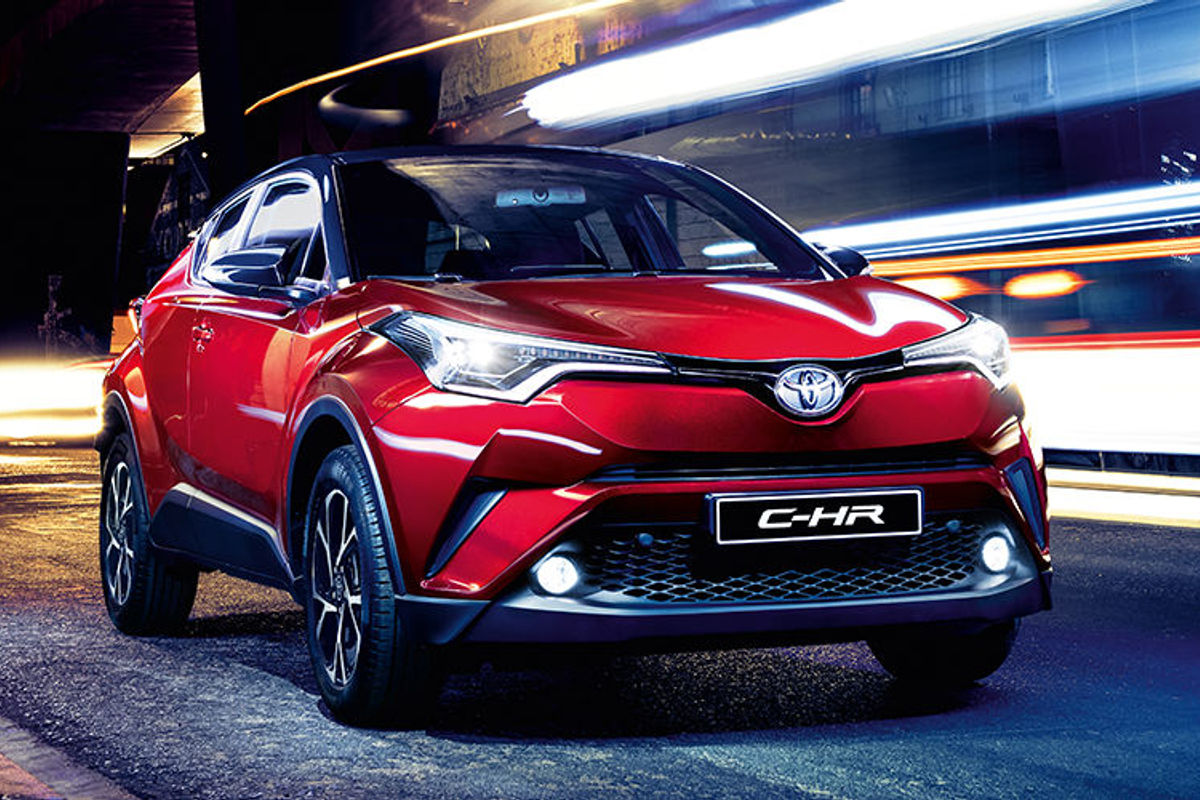
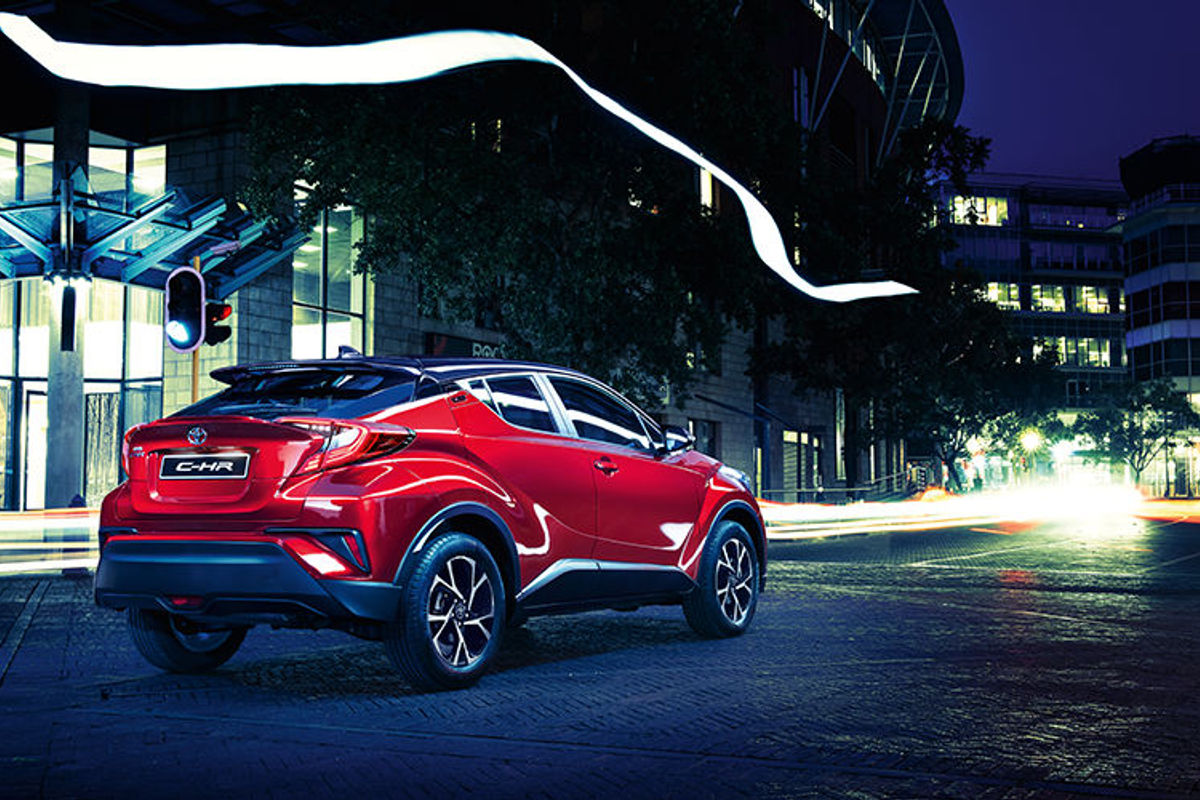
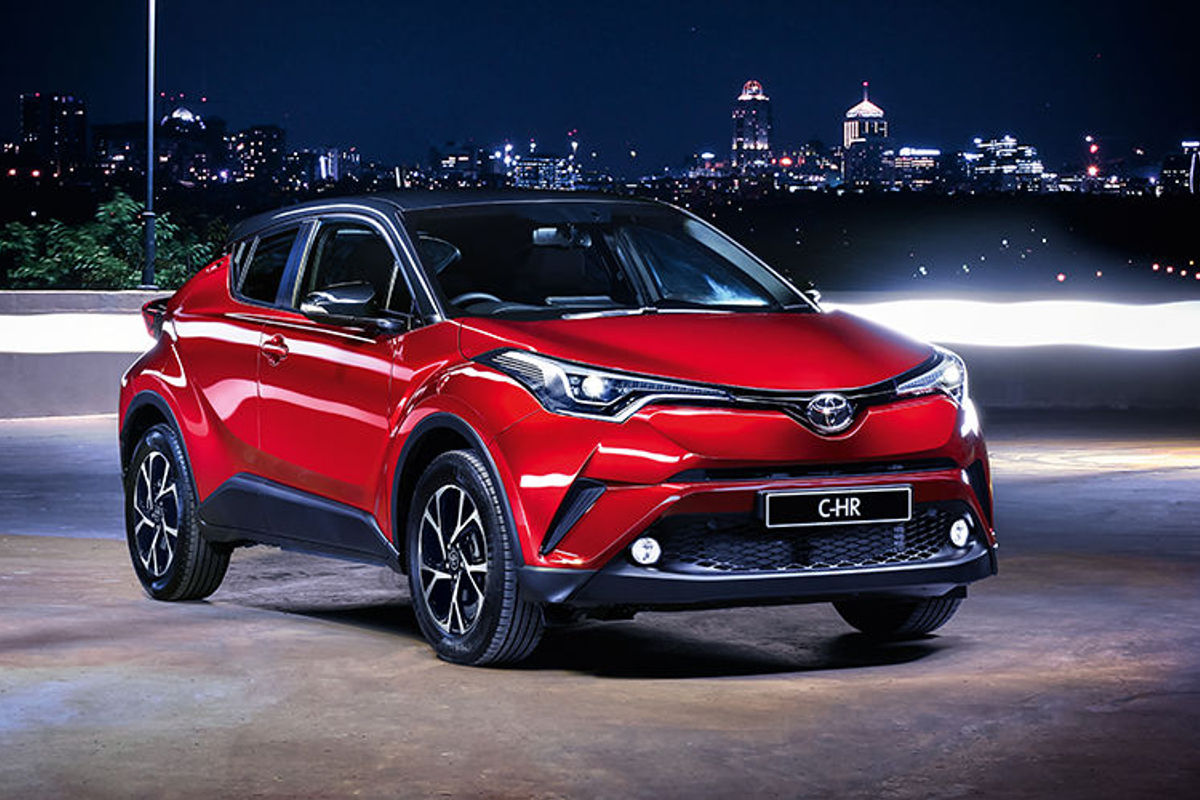
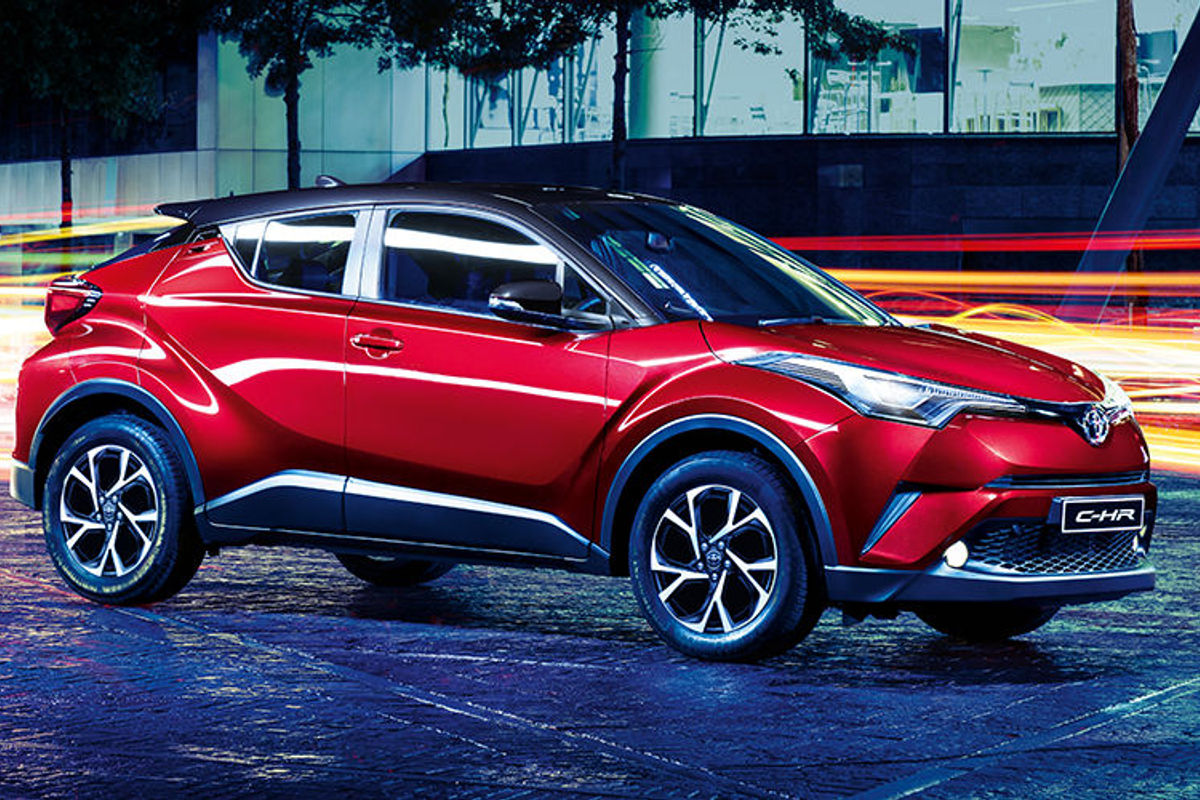
Toyota South Africa has added a range-topping 1.2TLuxury derivative to its C-HR compact family car range. Here are the specs and prices of the consolidated line-up.
The C-HR was launched in our market in early 2017 and the distinctively styled crossover has proven quite popular among fashion-conscious urbanites. For 2018, Toyota South Africa has introduced a flagship version that boasts more equipment and safety features as standard.
Visually, the 1.2T Luxury derivative is distinguishable by a two-tone paint finish, but the key changes feature in the newcomer's interior. Additional standard equipment includes leather trim, push-button start, seat-back pockets, heated seats, LED headlamps, LED front fog lights and tail light clusters, colour-coded auto-folding and heated side mirrors, park distance control and intelligent park assist. The safety spec has improved too… Whereas other C-HR derivatives have only two airbags, the 1.2T Luxury comes equipped with driver-, passenger-, side-, curtain- and knee airbags.
The powertrain remains unchanged. The 2018 Toyota C-HR 1.2T Luxury is powered by a 1.2-litre 4-cylinder turbopetrol motor that produces 85 kW and 185 Nm; it drives the front wheels via a continuously variable (automatic) transmission. Fuel economy is claimed to be 6.4 L/100 km.
2018 Toyota C-HR Specs and Price in South Africa
All C-HRs come standard with a 6-services/90 000 km service plan and 3-year/100 000 km warranty. Service intervals are set at 15 000 km.
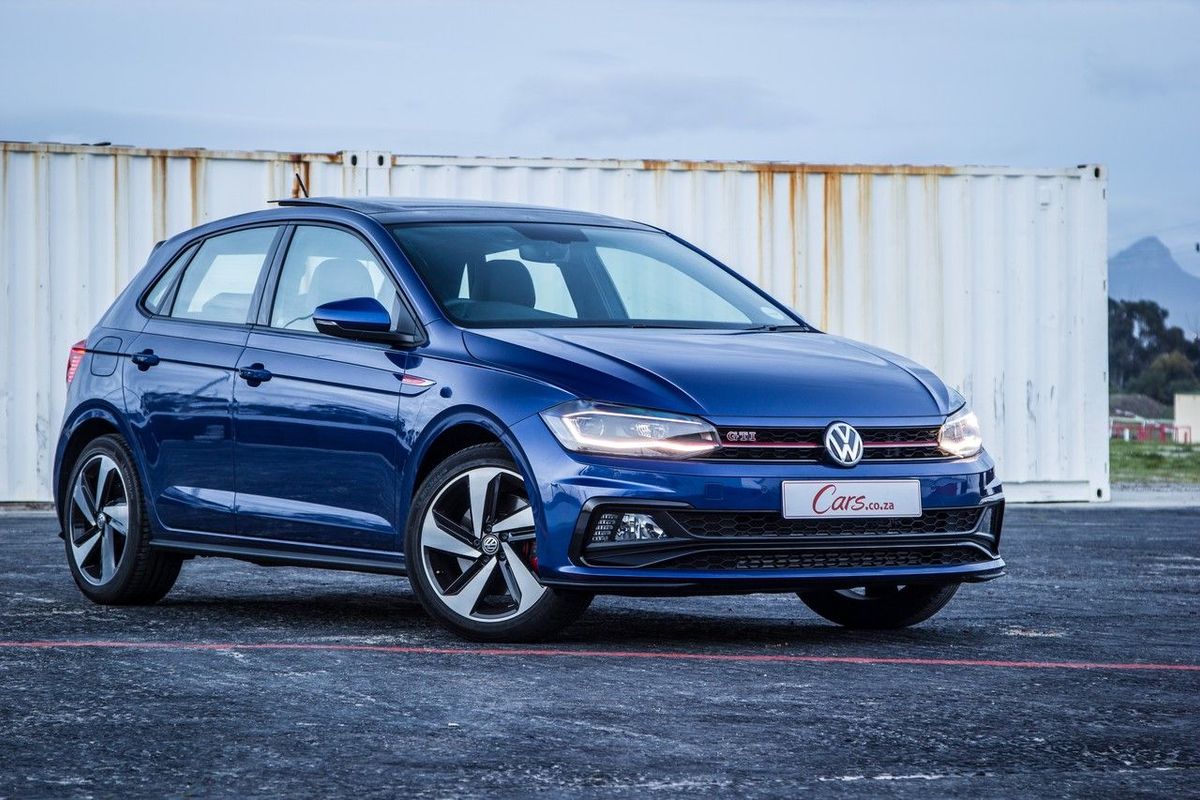
The new, smartened-up Polo GTI exudes class and sophistication, but while the peak outputs of its new 2.0-litre motor look impressive on paper, is Volkswagen's compact hot hatch more involving to drive than its rivals?
We like: Maturity, punchy engine, luxury feel, spaciousness, comfort, tech.
We don’t like: Not involving as rivals, costly extras
Alternatives:
For more fun and involvement: TheRenault Clio RS18 F1 is an absolute rocket in terms of outright acceleration and handling, but it's perhaps too compromised as a daily runabout, because its ride quality is too hard and the gearbox/engine setup has to be in Race mode to be properly enjoyed. You can't beat the 162 kW and 280 Nm singing loudly out the standard Akrapovic pipes, however.
Something a bit more flamboyant: A facelifted version of the Mini Cooper was recently released and in Cooper S guise, it's certainly a match for the Polo GTI in terms of performance, courtesy of its turbocharged 2.0-litre pumping out 141 kW and 280 Nm. Whereas the Polo GTI has gone with a digital approach to its cabin layout, the Mini opts for a funky setup. It's expensive, though.
Sadly it's not coming: The new Ford Fiesta ST looked so promising, but the quality of South Africa's fuel is apparently incompatible with the newcomer's 1.5-litre 3-cylinder motor, which is why it won't be launched here. Perhaps consider the previous-gen ST200.
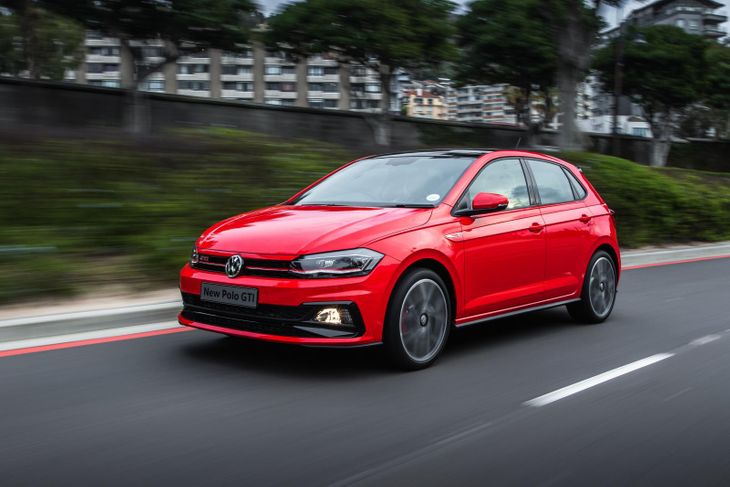
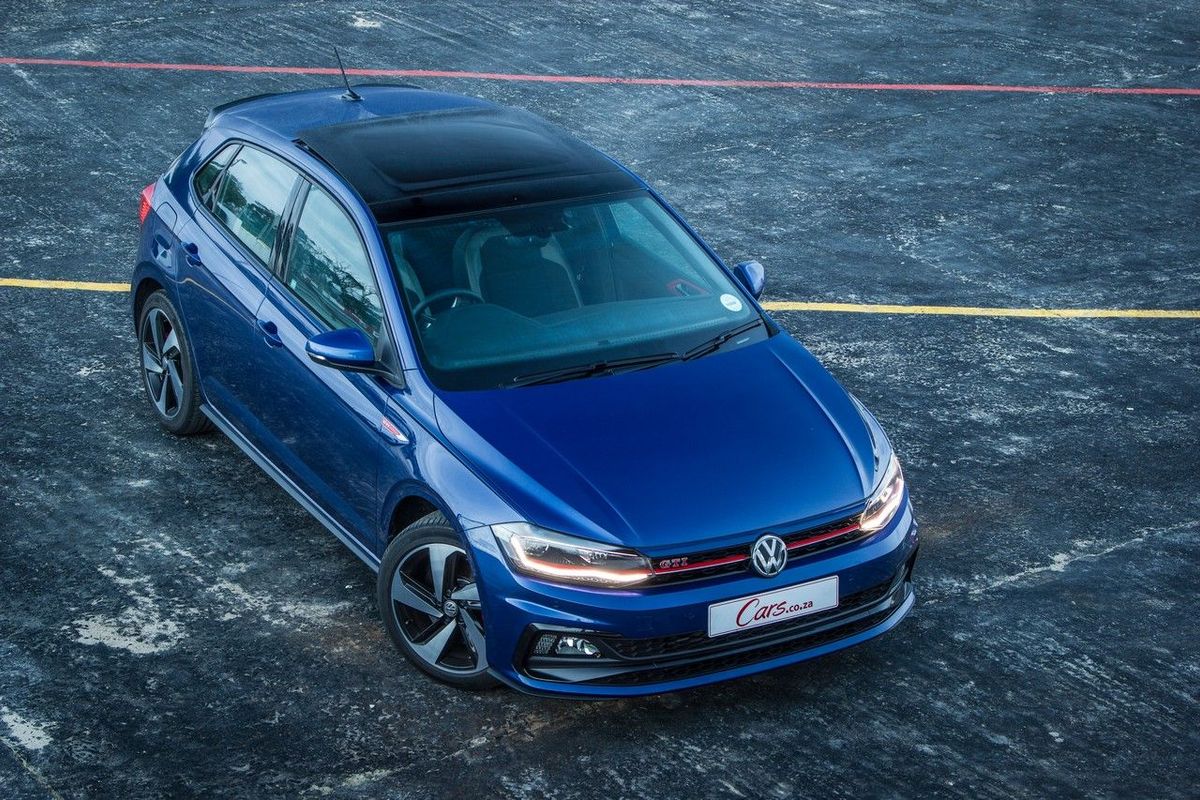
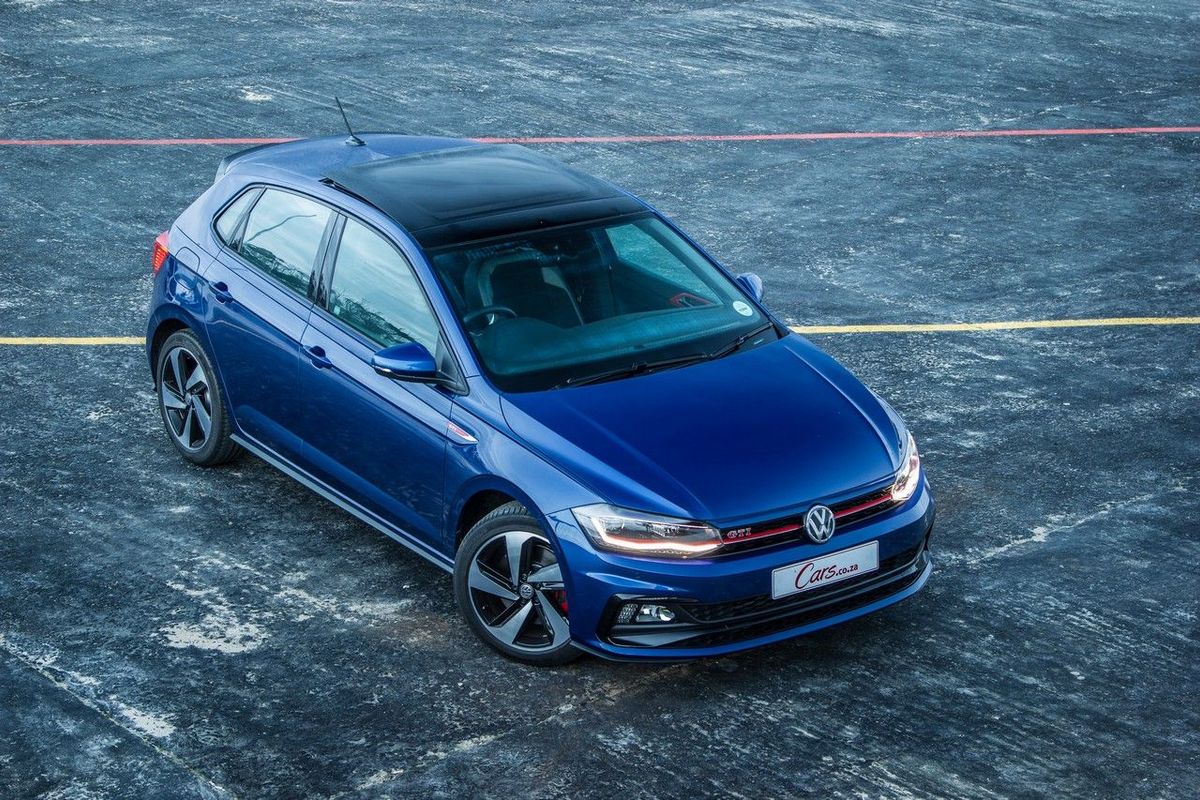
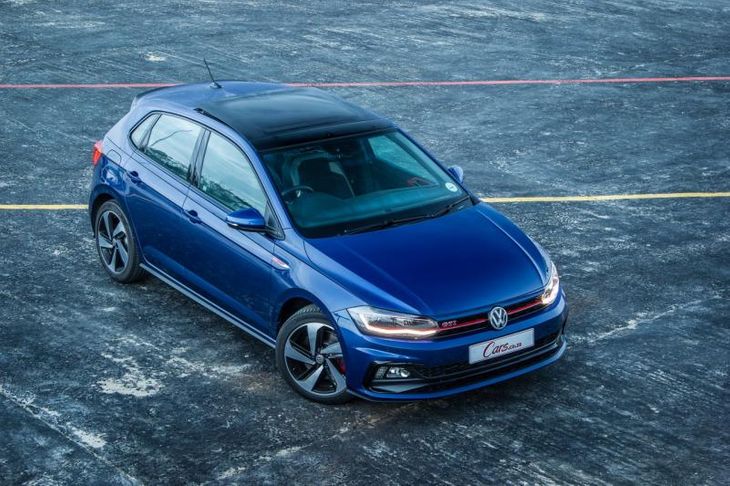
Given its position at the head of the Polo family, the GTI certainly looks the part
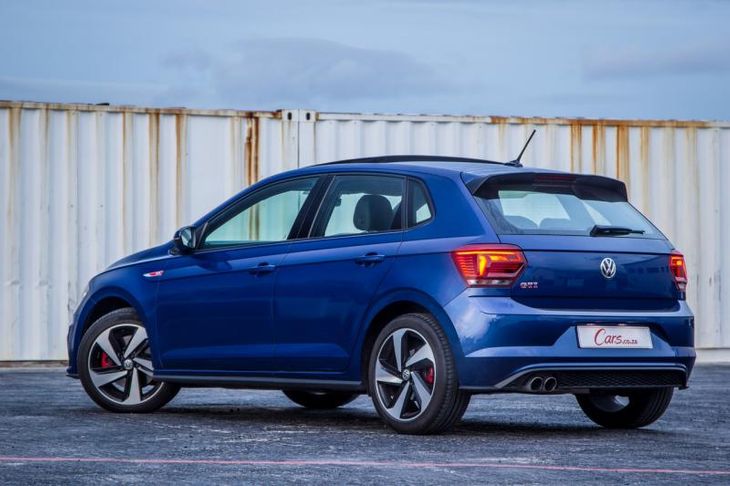
Volkswagen has substantially revised the Polo GTI's packaging: the boy racer image has (somewhat) diminished and in its place is a junior hot hatch – a playful executive, if you will. Some detractors have called the newcomer a "Golf GTI lite", which is a trifle unfair, the Polo GTI is, as a matter of fact, powered by a detuned version of the 2.0-litre turbocharged 4-cylinder motor from its "7.5" sibling. What's more, the Polo GTI also features its bigger brother's trick XDS electronic front differential, which should liven things up in the handling stakes.
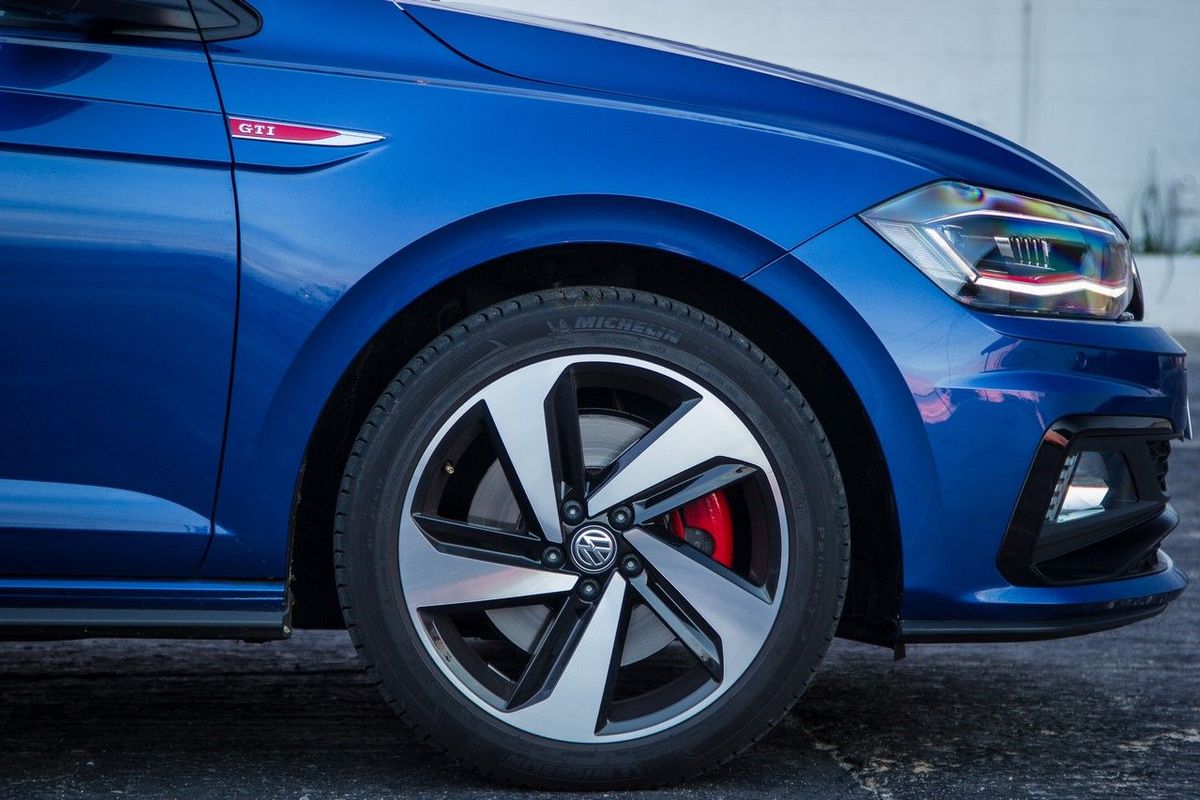
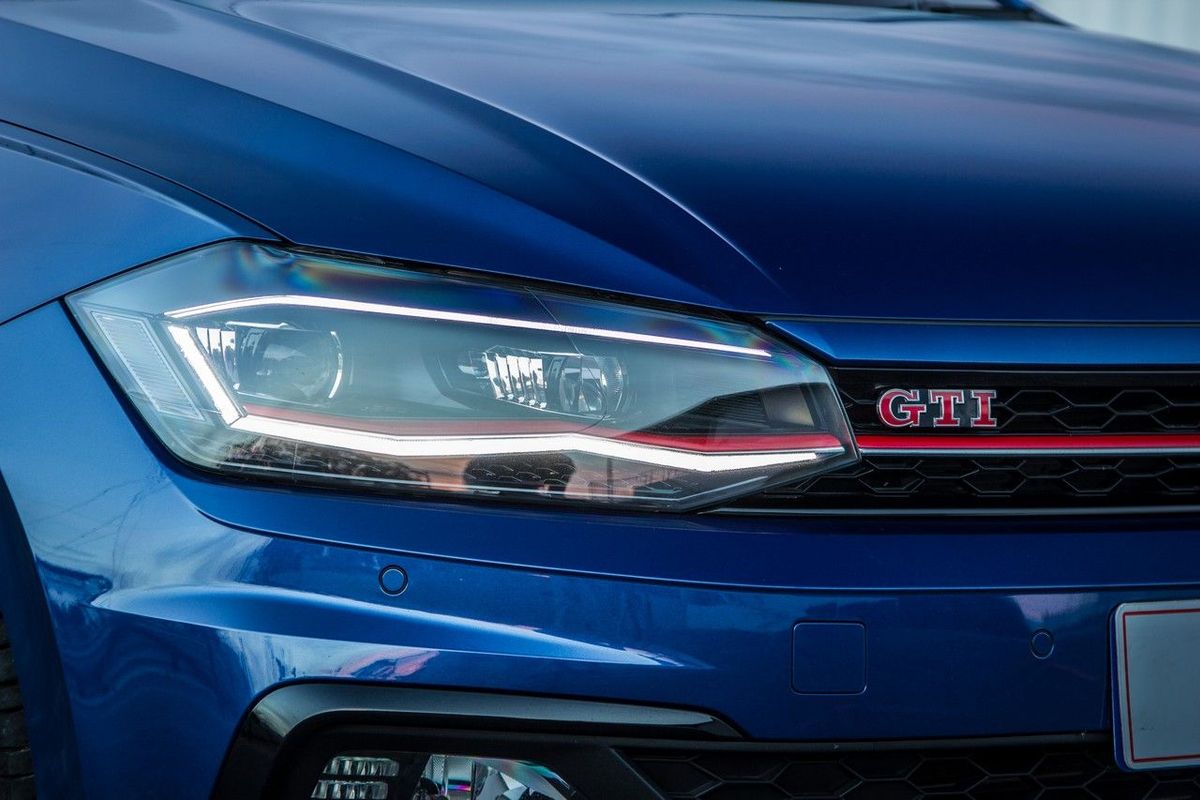
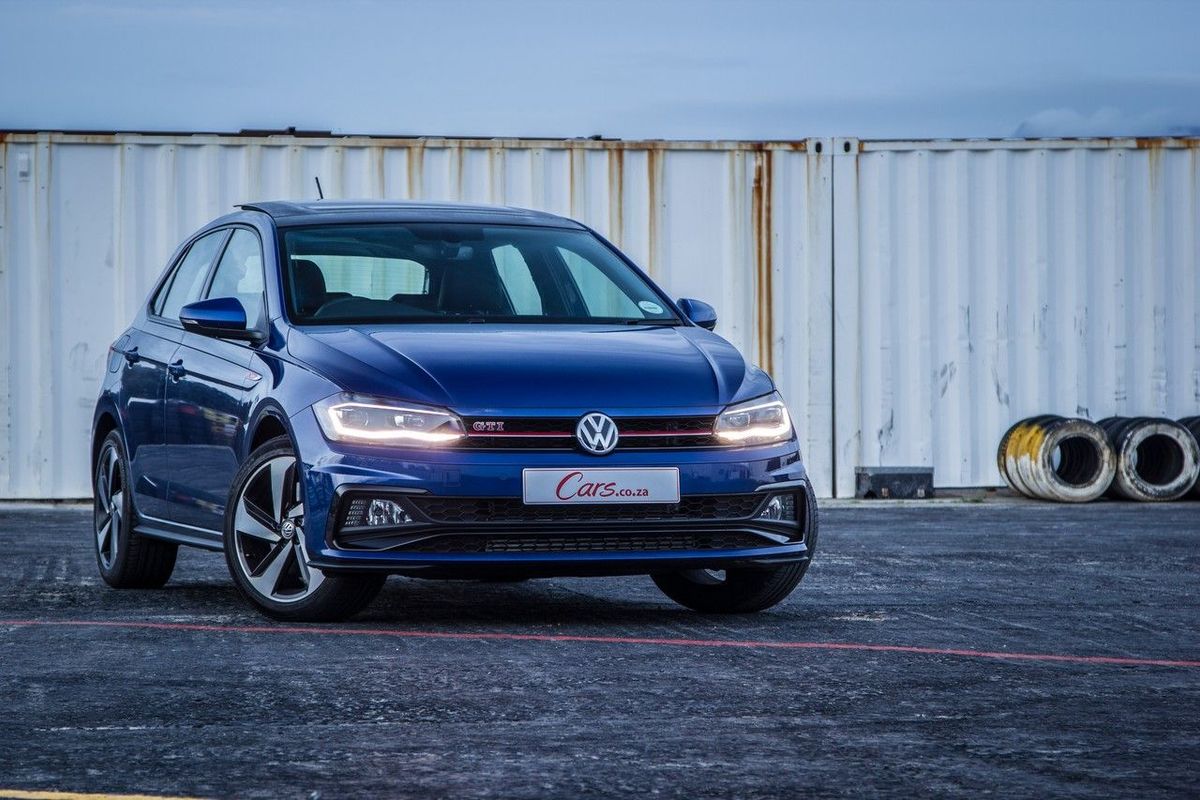
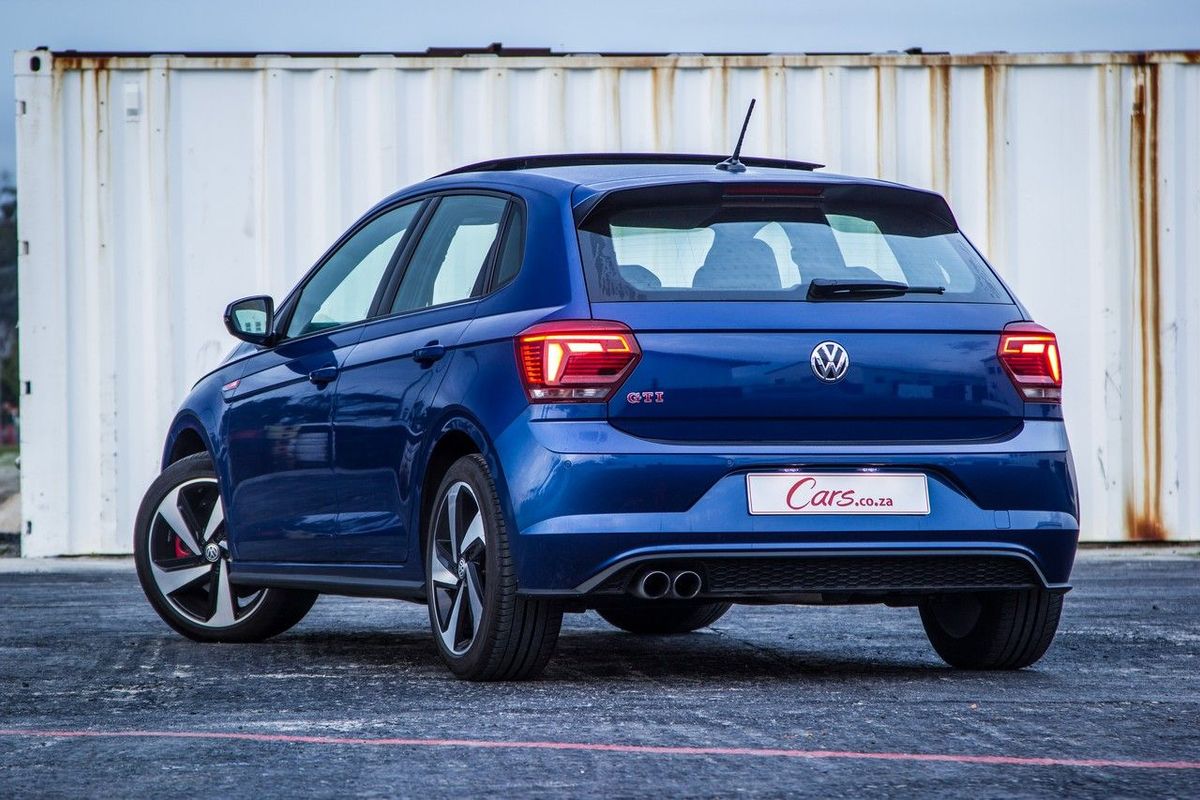
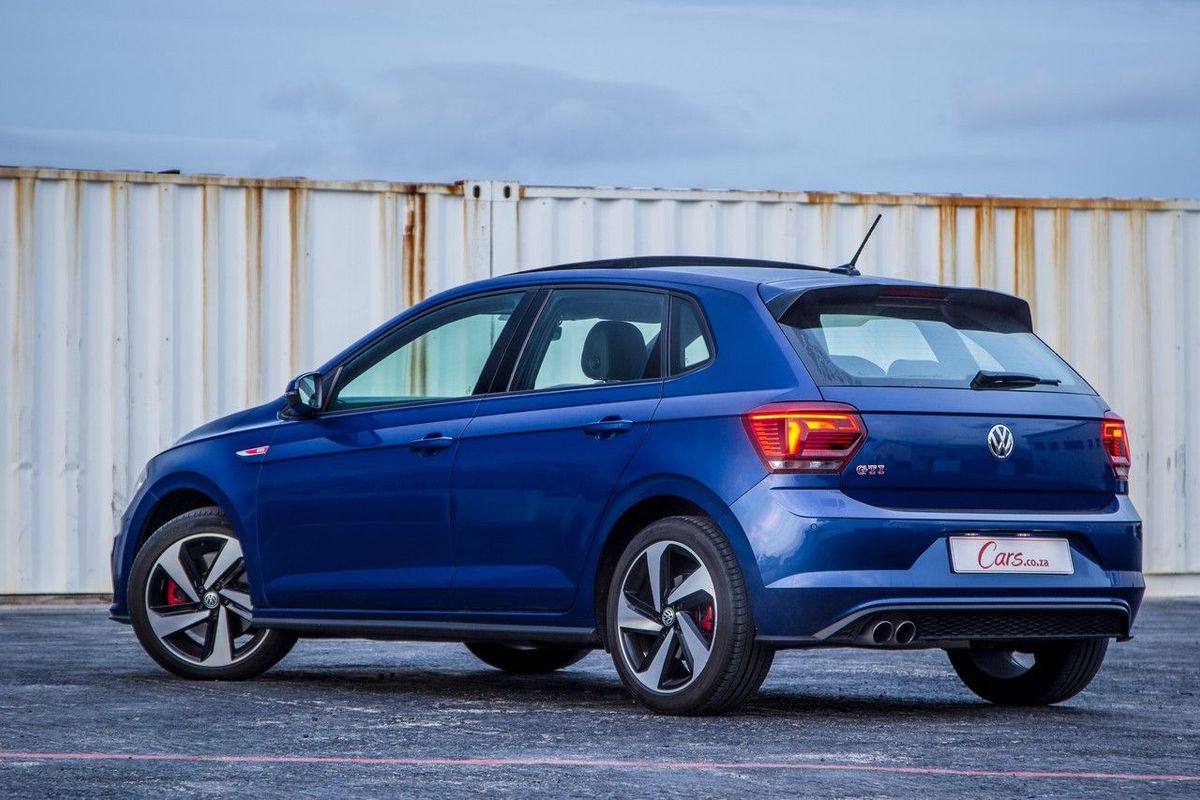
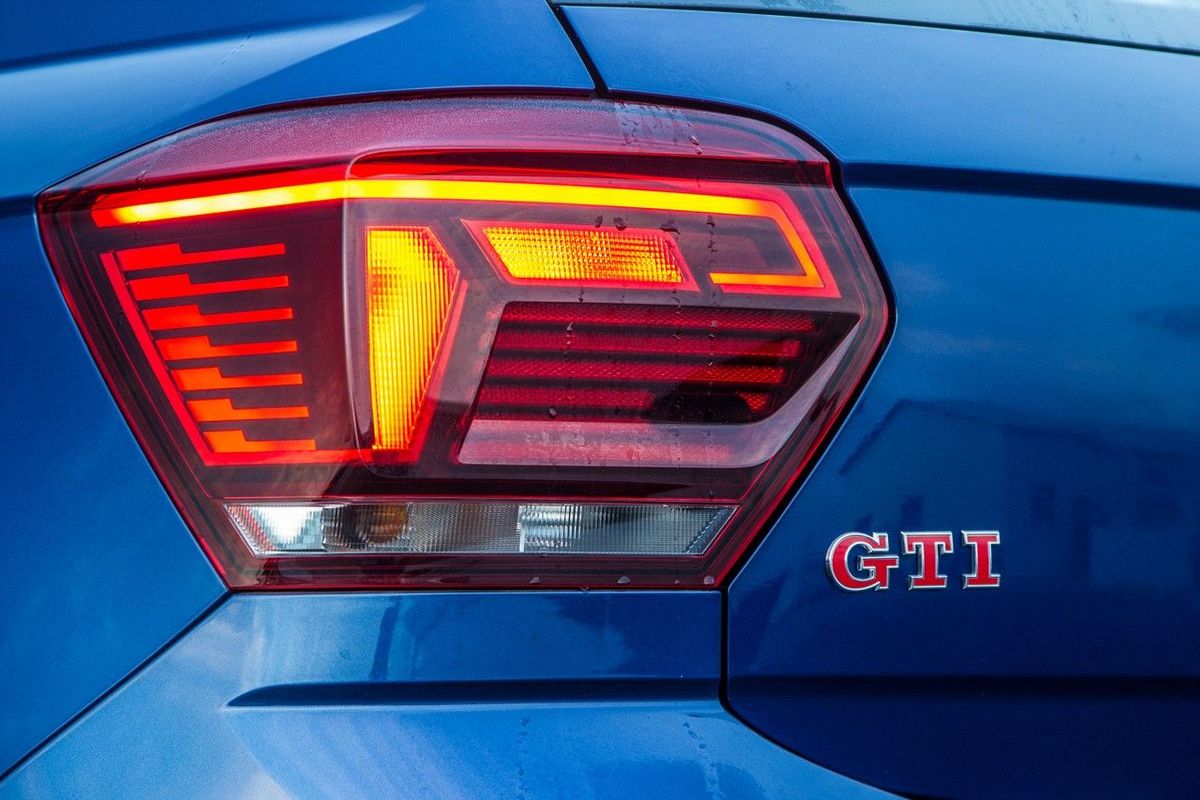
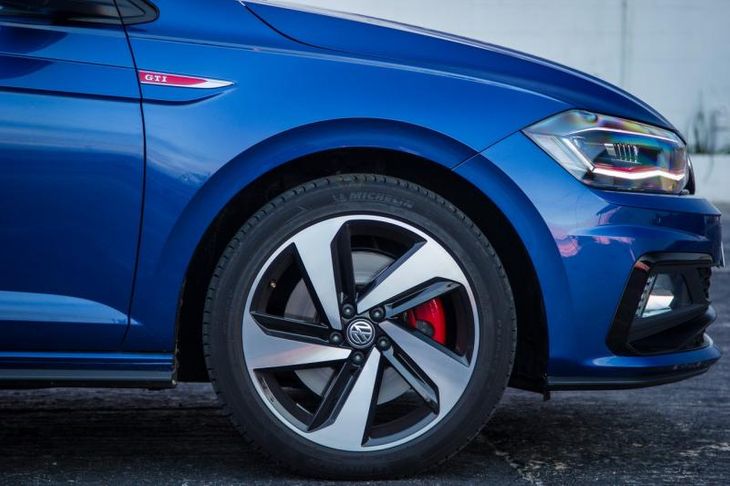
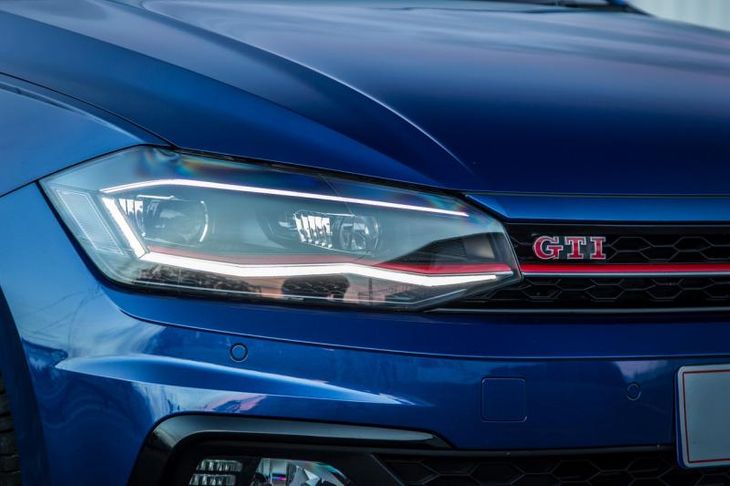
Apart from the change in the engine (from a 1.8- to a 2.0-litre unit), this is a more mature, sensible and practical Polo GTI altogether. From an aesthetic point of view, the best way to distinguish this iteration of Volkswagen's baby hot hatch is to look for the intricate headlights that blend with the characteristic GTI red trim that underlines the grille. There are plenty of GTI badges (outside and in), a set of twin exhausts and bigger alloy wheels. Our test car being was fitted with the standard 17-inch wheels, but very attractive 18-inch 'Brescia' wheels are available at extra cost. Can a grown-up GTI still appeal, or should you look elsewhere for your junior hot hatch thrills? Perhaps this is the cut-price Golf GTI you've always wanted… Let's find out.
The Good
Space and luxury
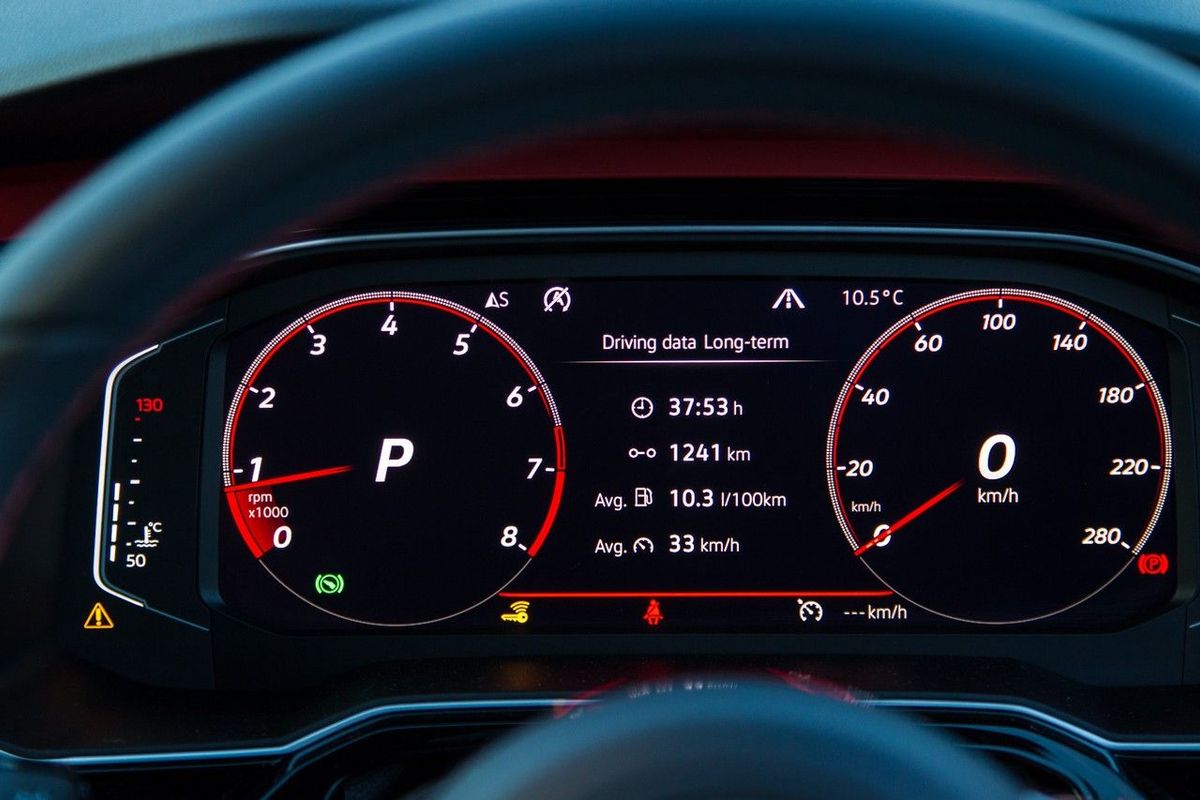
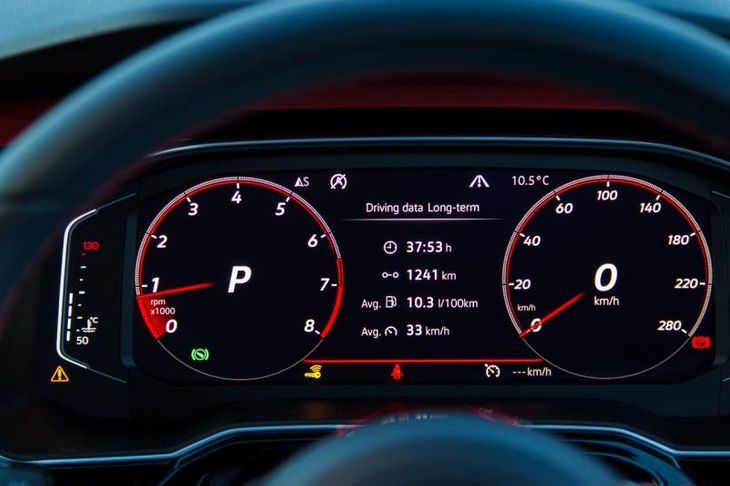
The Volkswagen Active Info Display in the Polo GTI has a GTI-specific red theme.
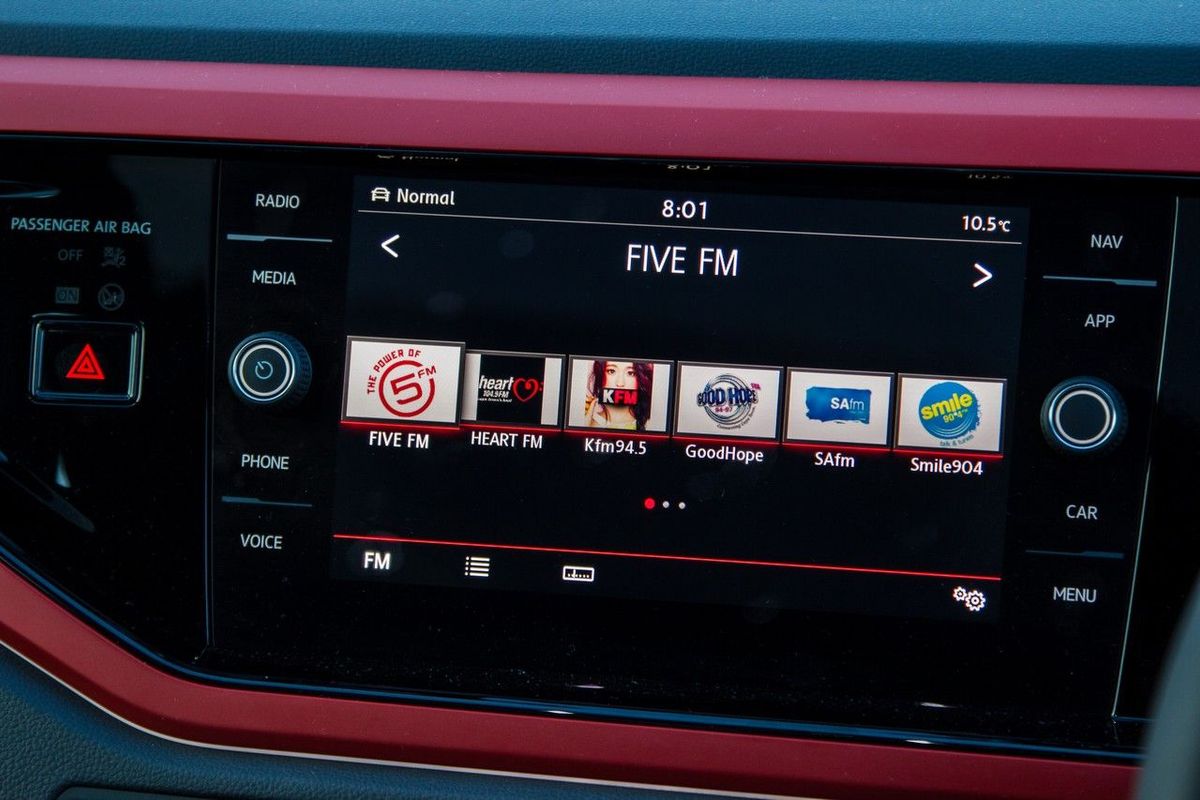
By virtue of being based on a new architecture, the new GTI boasts improved cabin space. The MQB platform, which has been used for a host of VW Group products, has a sterling reputation for refinement and comfort, as well as good space utilisation. Indeed, the Polo GTI has grown up and expanded in all dimensions. The (once-pint-sized) hot hatchback's overall length has grown by 81 mm, it's now 69 mm wider and, despite its overall height reduction (by 8 mm), headroom has increased. The associated enlargement of the cabin is most apparent at the back, where legroom is now tolerable for adults. The luggage bay's capacity has increased to 500 litres with the rear seatback in situ.
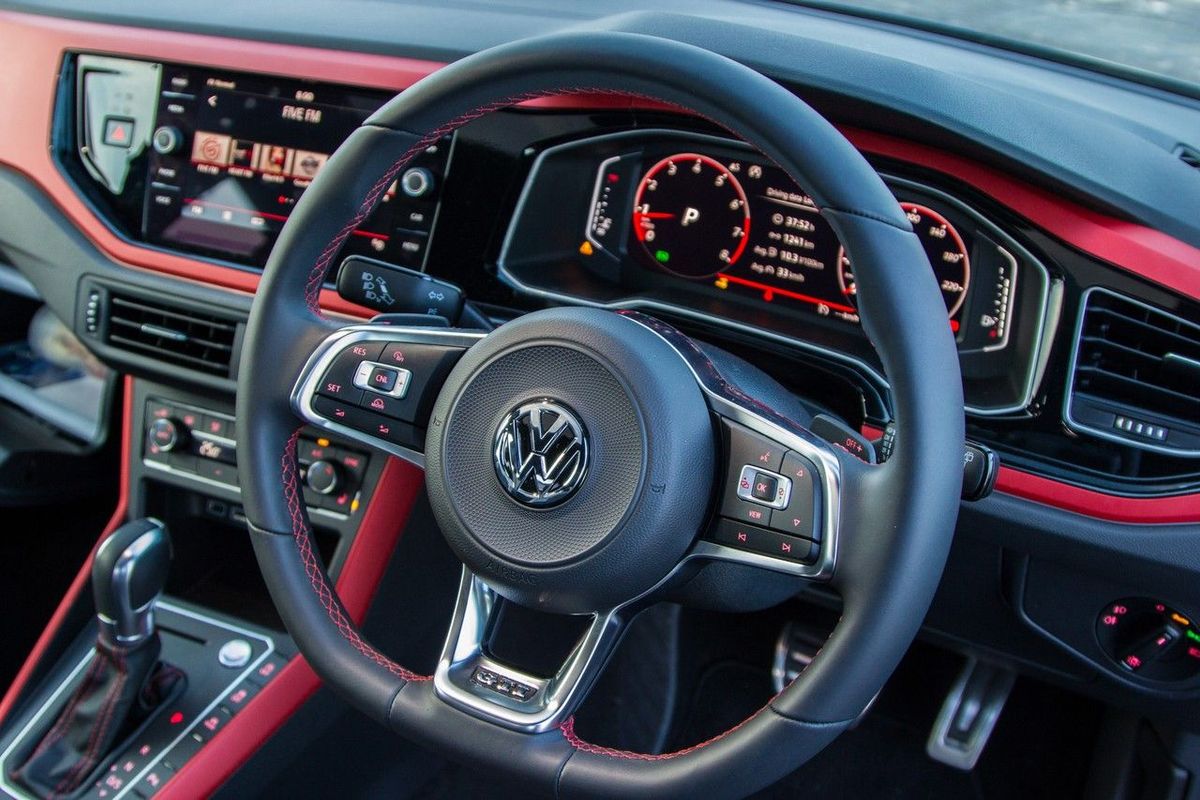
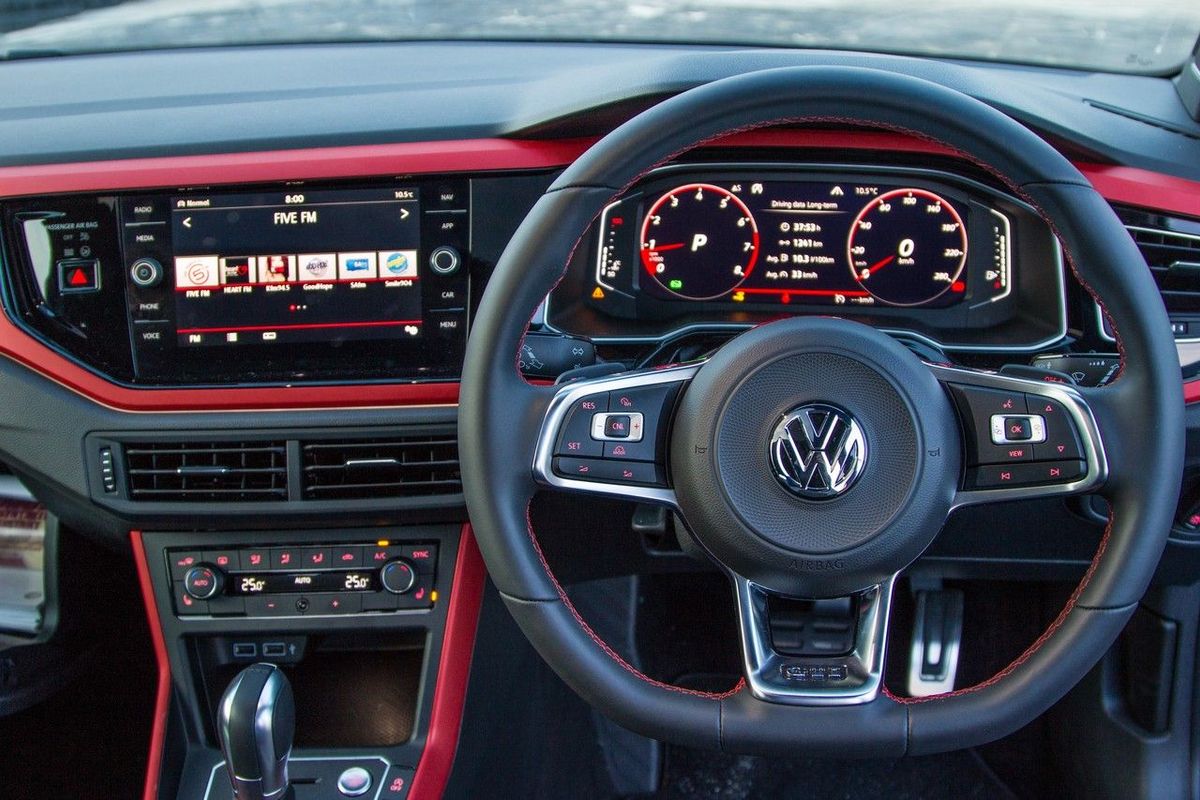
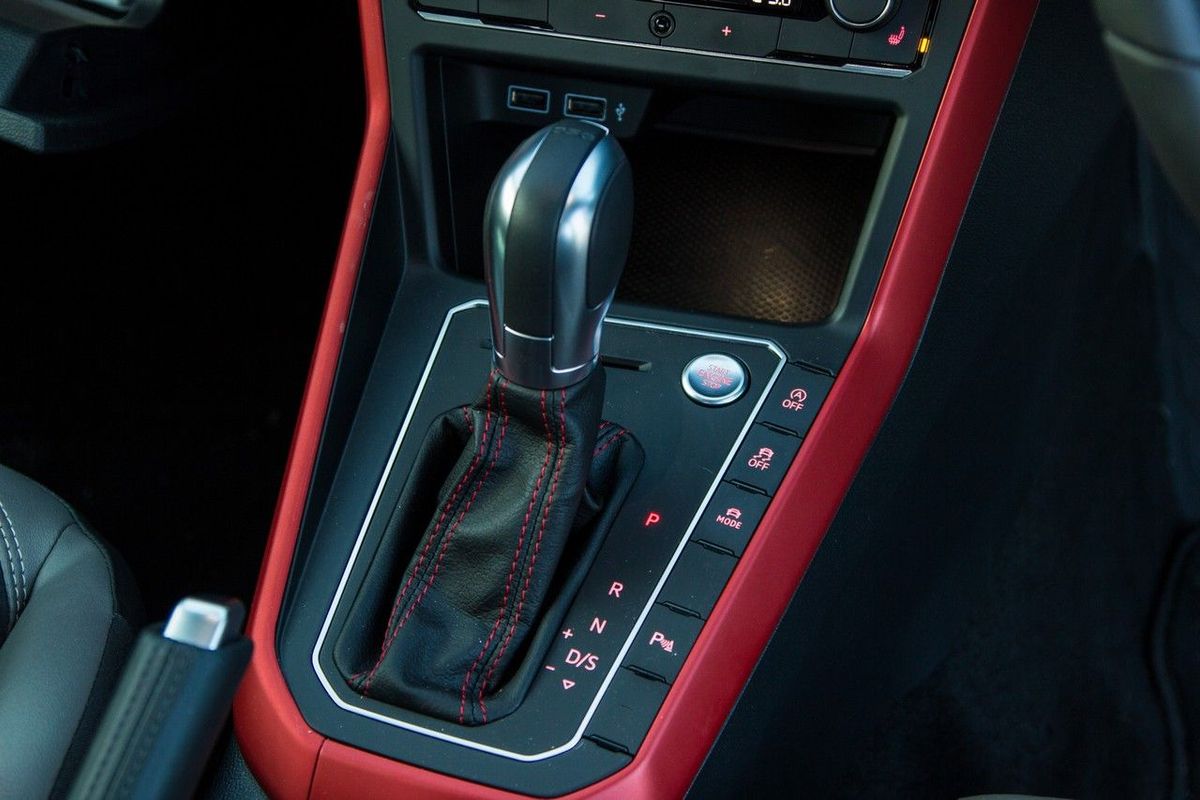
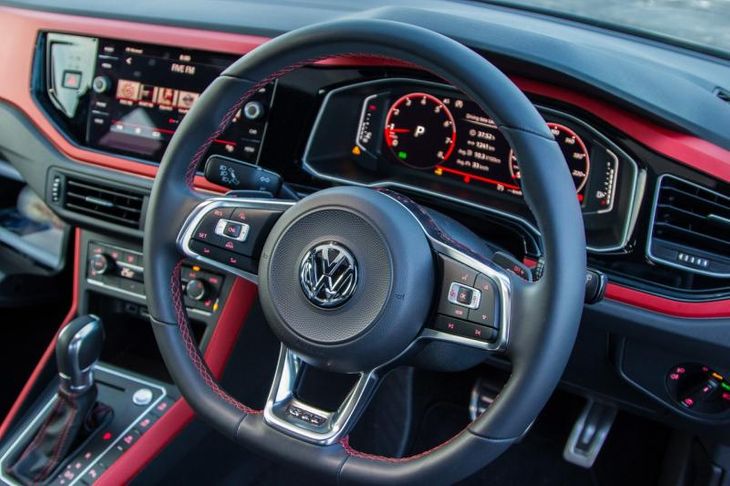
The GTI's the flagship Polo derivative, so you'd expect it to be well equipped. Unfortunately, some of its nicest features are optional, but they're well worth considering, particularly the Active Info Display, which has been tailored for the GTI and features a handsome red theme. The dashboard sports a beautiful matte red finish, which, interestingly, it's not available on red cars. The cabin design feels appropriate; there are plenty of red touches to remind you that you're in a GTI, such as red stitching on the stylish flat-bottomed steering wheel and gear lever boot, plus metallic-finished pedals.
The cockpit of the Polo GTI. We hope you like the colour red…
That powertrain is a peach
The Polo GTI's new 2.0-litre turbocharged motor is the EA888 (those who are familiar with engine codes will recognise it as the Golf GTI's powerplant, albeit in a different state of tune than in the "7.5"). Compared with its predecessor, the newcomer's peak outputs have increased slightly to 147 kW and 320 Nm (from 141 kW and 250 Nm/320 Nm), but while these differences may seem small, the switch from a 7-speed dual-clutch (DSG) 'box to 6-speed dual-clutch unit has seen a reduction in sprint times, with claimed fuel efficiency improving fractionally (from 6.0 L/100 km to 5.9 L/100 km). Speaking of sprint times, the new Polo GTI is claimed to hit 100 kph from standstill in a 6.6 seconds, thanks to the provision of a launch control function.
While there is little in the way of theatrics, which is typical of virtually every Volkswagen product, the development team has imbued the new Polo GTI with some aural entertainment. The exhaust pops merrily when you lift off the throttle at high revs, but sadly there are precious few vrrr–phaas on upshifts, unlike its bigger brother. While the Polo GTI is available with a manual transmission overseas, it's unlikely that it'll ever make its way here. Besides, the DSG setup is just so good and perfect for both day-to-day as well as performance driving, only the most hardcore manual-gearbox fans (who are a dying breed) would insist on a 6-speed manual 'box. Long live the EA888 and DSG partnership, long live!
The ace up the Polo GTI's sleeve is its torque delivery. With 320 Nm available from reasonably low down in the rev range and a responsive transmission that's calibrated to fling you into the motor's powerband at will, the Polo GTI outguns all of its rivals when it comes to in-gear performance. Both the Clio RS18 and Mini Cooper S can only muster 280 Nm, giving the Uitenhage-built newcomer the rolling-run advantage.
Quick, wieldy AND refined
The standard 17-inch alloy wheels look smart, but if you really want to make a statement, there is the option of 18-inch wheels.
The MQB platform brings with it some playful handling and the XDS differential certainly furthers the Polo GTI's cause. The combination of a punchy engine and a relatively low kerb weight makes this the best Polo GTI to date in terms of the newcomer's sheer wieldiness. When the Drive mode is set to Sport, the steering weight increases, the throttle becomes dramatically more responsive and there's an excited energy about the car that makes you want to press on.
And once the traffic clears and you're presented with a challenging stretch of twisty blacktop to fully exploit the Polo GTI's abilities, the diminutive hot hatch responds to eager and enthusiastic driving inputs with aplomb. Thanks to its sporty suspension and bigger tyres, grip levels are high and even when you're approaching the car's handling limits, the Volkswagen's planted front-end warns you well in advance so that you can respond accordingly.
But the real strength of the Polo GTI is its vast array of abilities. Not only is it entertaining to drive in Sport, but arguably its major selling point is how comfortable and easy it is to drive in Comfort. Sure, the ride is a little firm, but that rings true for most hot hatches. If you opt for the larger, sexier 18-inch alloys, consider ticking the adaptive damping option – it is likely to soften the ride on poorer-quality roads.
The Not-so-good
Volkswagen has done a sterling job to differentiate the GTI from its lesser siblings. The GTI badge is displayed in many places.
Not as fun to drive as rivals
Despite an admirable powertrain and a dynamic chassis, the Polo GTI driving experience is not quite as engaging as some would have hoped. Sure, it's brisk in a straight line and corners with alacrity, but perhaps its inherent sophistication and allround refinement have rendered it incapable of providing as many driving thrills as some of its more-focused rivals. In its defence though, GTI has never been about outright performance, but rather a healthy blend of fun and day-to-day drivability. The new Volkswagen Polo GTI can cover large swathes of tarmac briskly, but there is a distinct "clinical, tame and predictable" feeling about it, which won't endear it to serious enthusiasts.
Expensive when well-specced
Despite Volkswagen SA launching the new Polo GTI at a cheaper price than its predecessor, we still wish there were more standard features. Our test car came with plenty of extras, some of which could be justified from a customer point of view. Extra items such as a panoramic sunroof, climate control, keyless entry, upgraded infotainment system, active info display, LED headlights and park assist all add up, and based on the VWSA's online configurator, our test car would retail at just over R450 000, a far cry from its R375 900 list price. R450k puts it in the same ballpark as the Renault Clio RS18!
Price and warranty
The Volkswagen Polo GTI has a recommended retail price of R375 900. Spec your GTI carefully and you should be able to sneak its asking price under the R400k mark. The new Polo GTI comes standard with a 3-year/120 000 km warranty, 3-year/45 000 km service plan and a 12-year anti-corrosion warranty. Service intervals are set at 15 000 km.
The claim that this new Polo GTI is a "shrunken Golf GTI" is arguably true, but why is that a bad thing? The two are uncannily alike in many ways, especially in terms of the driving experiences they deliver. The new Polo GTI is a superb offering and its skill set – in contrast with those of its rivals (of which there are now few) – is broad, which is the same that can be said of its bigger brother. Not only is the Polo GTI comfortable and refined, but practical (you could effortlessly load up you and your partner's luggage and take the hot hatch on a weekend getaway) and, for a performance hatchback, it is refreshingly forgiving around town, as well as the open road. Despite its performance-oriented GTI badge, it requires few compromises.
But the Polo GTI is nonetheless a hot hatchback, therefore we have to consider its performance credentials carefully. Despite its breadth of talents, we would not recommend this Volkswagen to serious driving enthusiasts… It may do everything else incredibly well, but for those looking for that ultimate driver involvement and visceral performance, it would be best to look elsewhere, like the outrageous Clio RS18, or a three-door Mini Cooper S. Fortunately, however, a liberal supply of performance driving thrills (and not much else) is not a deal-breaker for the majority of new car buyers. For those who want to flaunt their status with a sporty car endowed with a diverse list of talents, you'd be hard-pressed to match the Polo GTI as a daily driver.
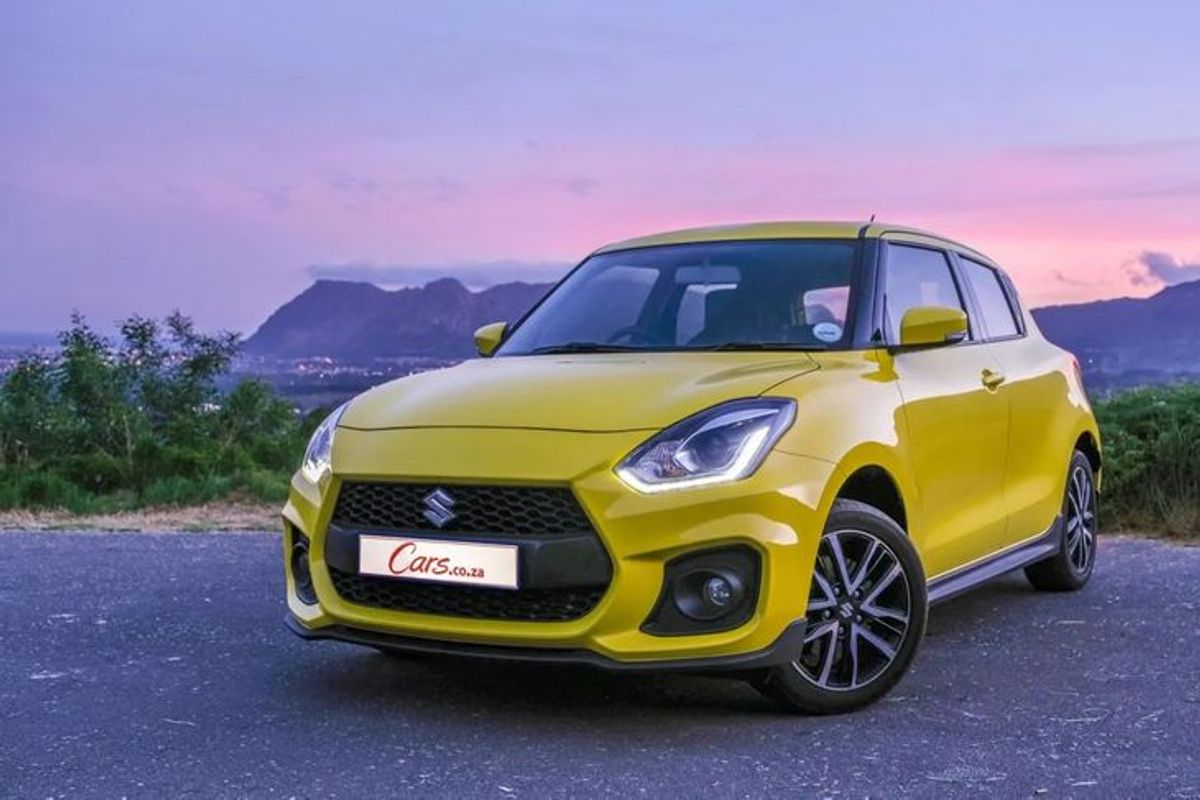
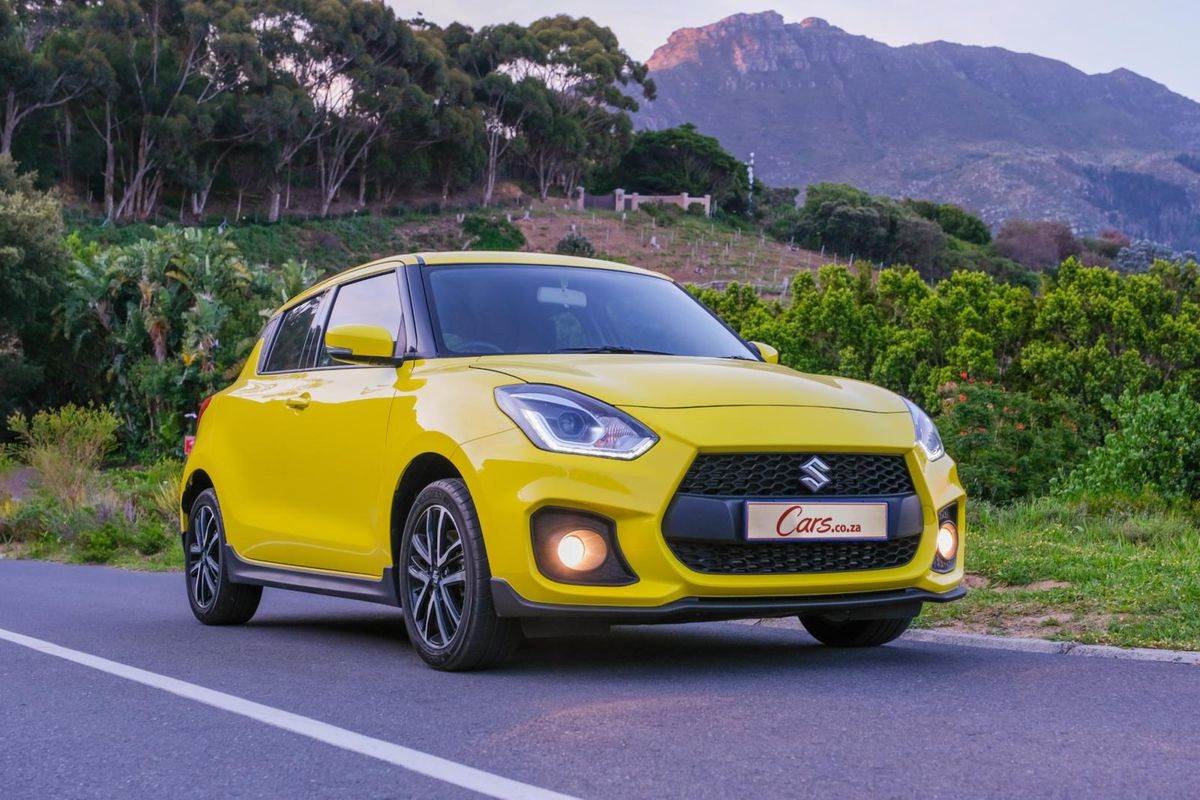
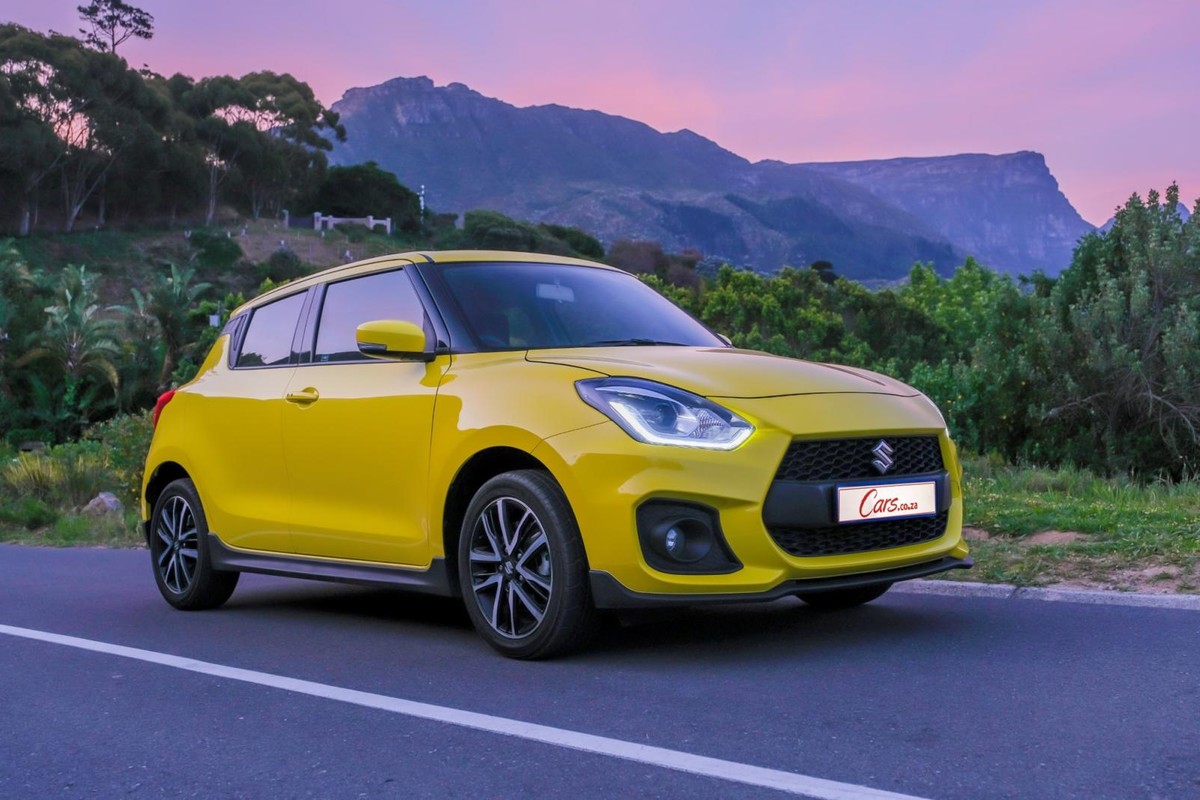
Welcome to our Suzuki Swift GL review! The Swift makes up 30% of Suzuki South Africa’s new car sales and is, therefore, a very important model for the award-winning Japanese manufacturer. This all-new Suzuki Swift displays renewed focus on what made the previous car so popular and should be a strong contender in the budget car/entry-level compact hatchback segment.
Take a look at this Suzuki Swift GL review for more insight!
We Don’t Like: Lacks the character/flair of its predecessors, no particular “surprise-and-delight” features in the cabin
Alternatives
Volkswagen Polo Vivo 1.4 Trendline: Already one of the top-selling cars at this end of the market, the entry-level Polo Vivo holds inherent appeal because it’s a previous-generation Polo, which was pitched at the upper end of the B-class segment. So there’s a lot of quality evident in the design. Spec-wise it rivals the Swift quite closely, but lacks a multi-function steering wheel, front fog lamps and has smaller wheels. It’s also not as frugal and lacks a standard service plan. Should be a star on resale, however!
Toyota Etios 1.5 Sprint: The Japanese brand’s offering remains a popular one because of its combination of spaciousness, performance, affordability and, of course, that Toyota badge, which instils consumer confidence. It mostly matches the Suzuki’s specification, but isn’t as economical, fun to drive or as solidly put together.
Ford Figo 1.5 Ambiente: Recently updated and now a more stylish offering, the littlest Ford is now a more serious threat in this segment. It’s more powerful than most of its rivals, but not necessarily more fun to drive, and at the same time also thirstier. Yet, there’s a grown-up feel to the way it rides and it has a good warranty/service plan.
Some Suzuki dealers regularly offer specials: Have look here.
Where does it fit in?
The Suzuki brand continues to gain traction in South Africa. Following back-to-back Brand of the Year victories in the annual Cars.co.za Consumer Awards – Powered by WesBank, increasing sales and an expanding dealership footprint, the Japanese marque is in a bullish mood for 2018 and the foreseeable future. Last year the outgoing Swift achieved its best local sales ever, and so much is expected of this all-new model. It is similarly positioned as the outgoing car, but significantly different in a number of important ways. The new Swift targets customers that may otherwise also consider the Volkswagen Polo Vivo, Toyota Etios and Ford Figo. Let’s see how it goes…
Suzuki Swift GL Review
How does it fare in terms of…
Value for Money?
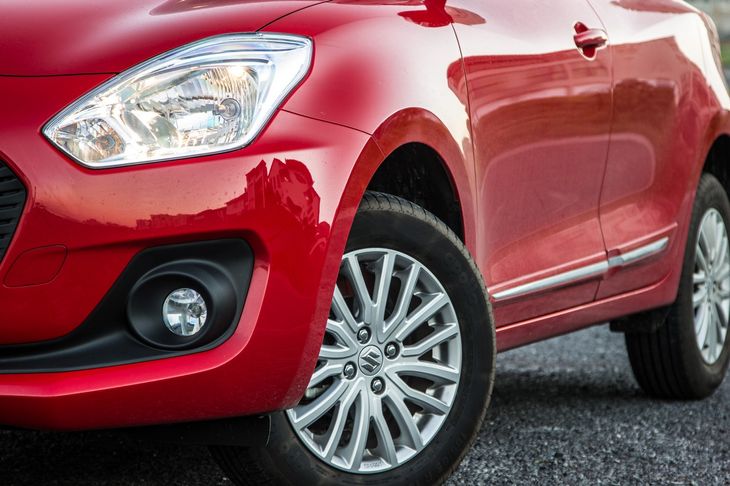
Front fog lamps are key giveaways that this is a GL-specification derivative. Alloy wheels are optional.
If a check-box list of desirable features exists for manufacturers of budget cars, then it appears Suzuki’s engineers and product planners simply made sure to put a tick next to each item… and no more. Let’s start with safety and security – here the Swift GL offers ABS with EBD, front fog lamps, dual front airbags, remote central locking and Isofix child seat mounting points at the rear. It doesn’t feature an electronic stability control system, but few cars in this segment do.
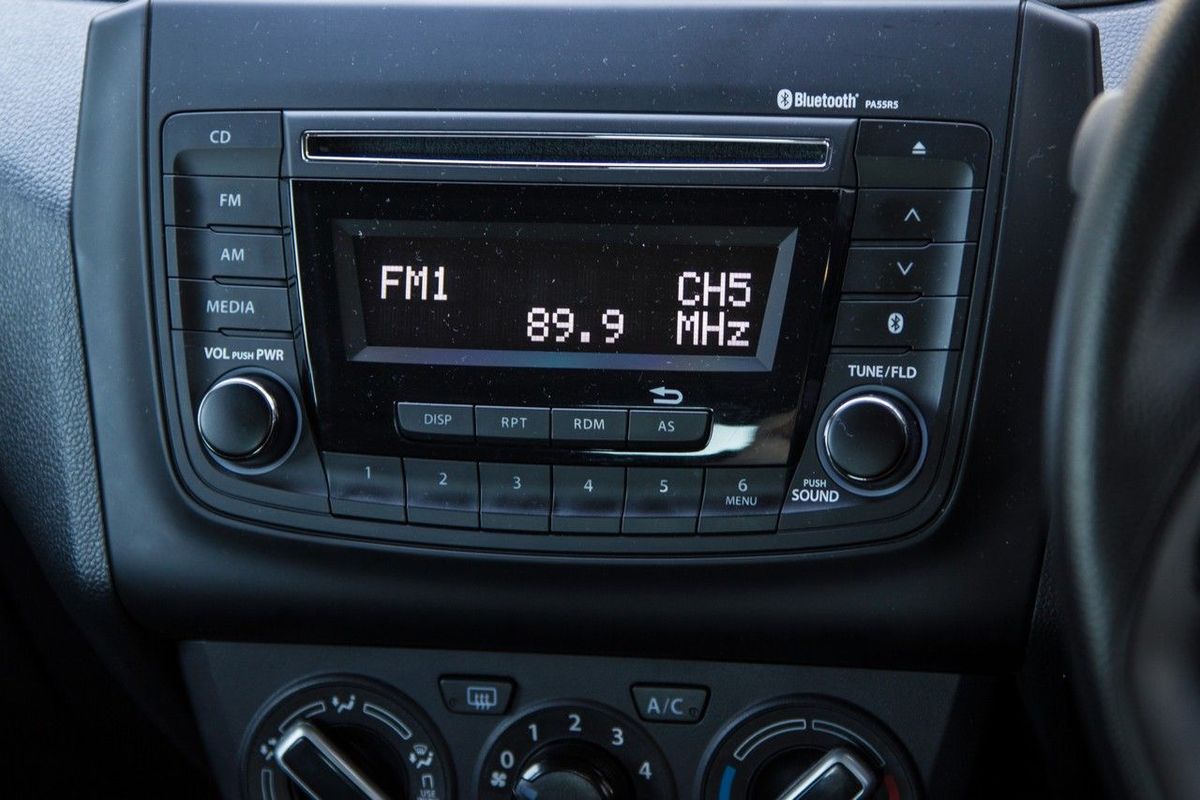
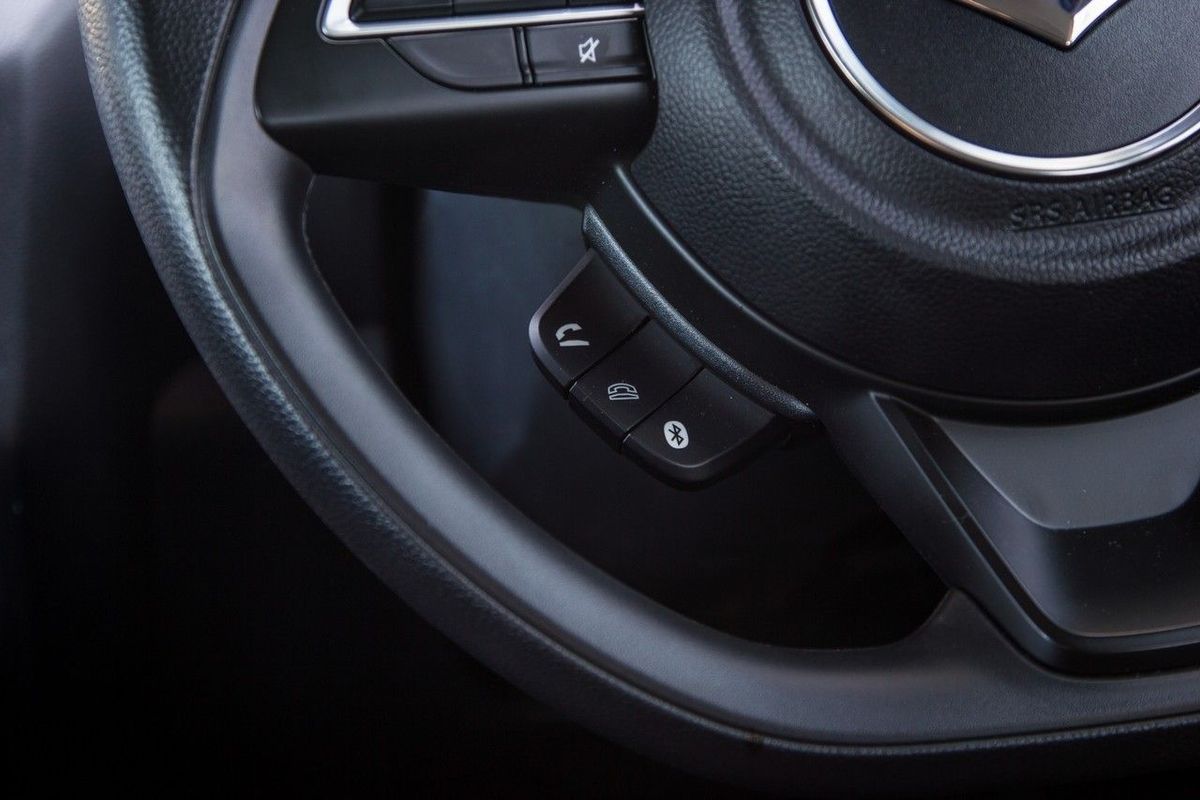
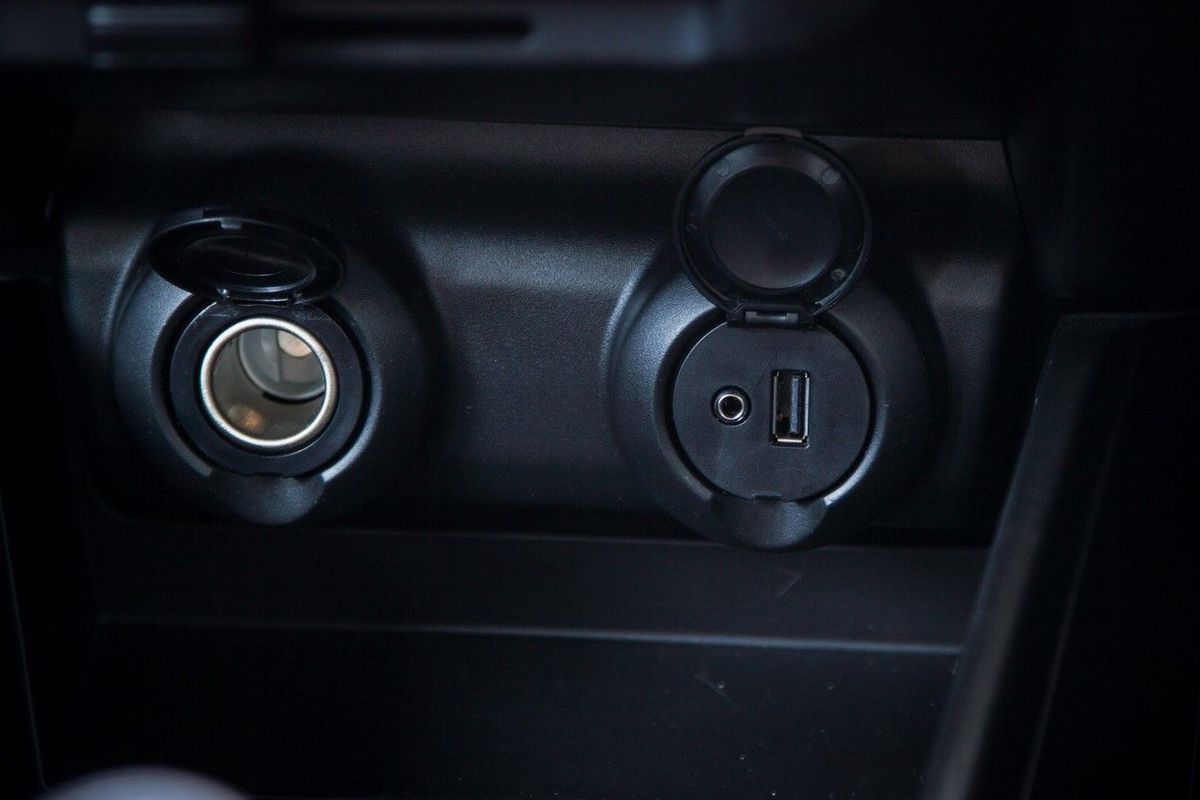
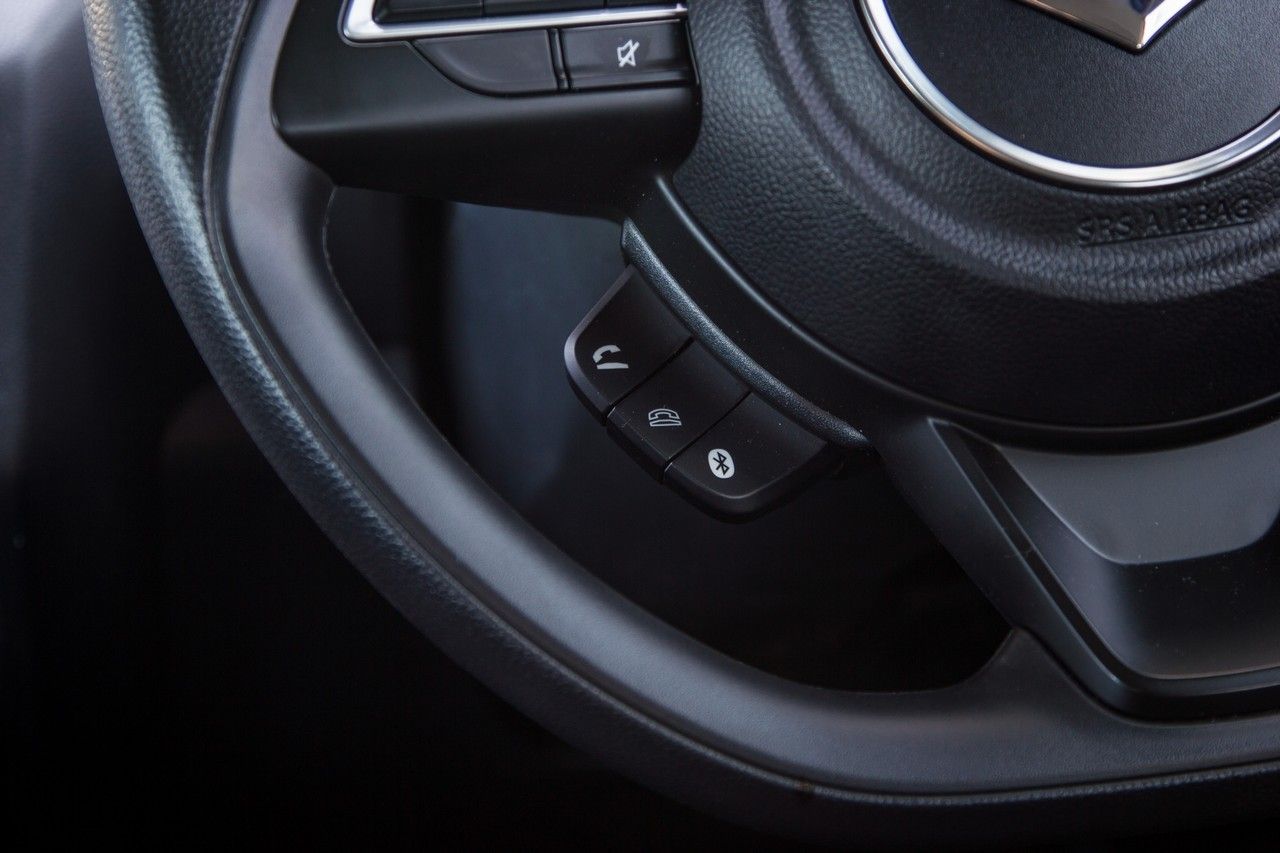
In terms of comfort items, too, the Swift appears to have all bases covered, with air-conditioning, electric windows all-round (several key competitors only offer these at the front), power steering and electrically adjustable side mirrors. The sound system appears to be a pretty basic unit (no touchscreen interface), but USB, auxiliary audio and Bluetooth are supported, and this derivative also comes with a multi-function steering wheel.
Swift GL features an audio system with Bluetooth support, and also neat telephony controls mounted to the steering wheel.
So, the new Swift GL has everything that you could rightfully expect from a budget car at this price (including more space in the rear courtesy of a wheelbase extension) and a significantly larger luggage bay than before. If you factor in the current promotional warranty (valid for 5 years or 200 000 km, whichever comes first) and a 2-year/30 000 km service plan, the purchasing proposition seems sweeter still.
Performance & Fuel Efficiency balance?
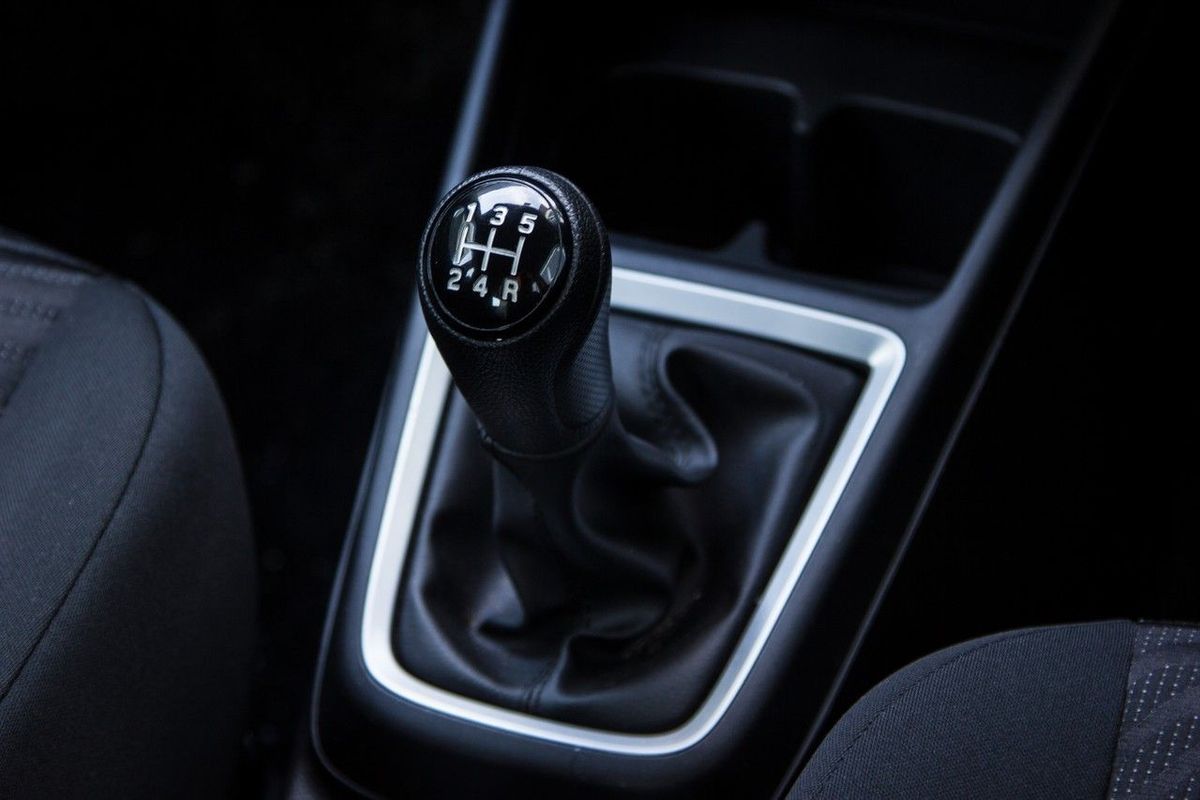
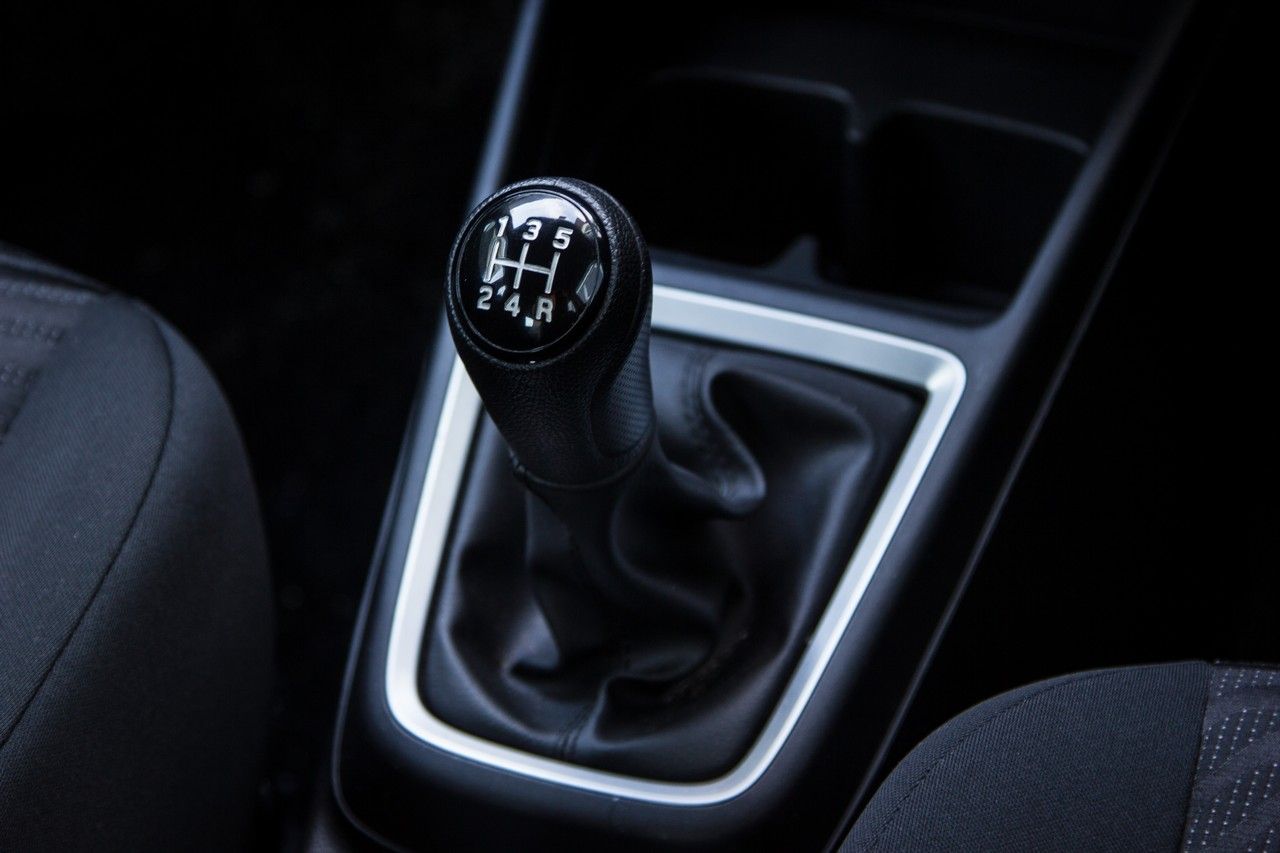
The 5-speed gearbox is precise and the clutch action light – the Swift 1.2 GL is a delight to drive.
Under the bonnet of the Swift you will find the same proven 1.2-litre naturally aspirated 4-cylinder engine that was used before. It is claimed to deliver 66 kW and 113 Nm of torque, with the latter figure looking particularly low compared with the competition. However, the new Swift is based on a far lighter platform than before (by almost 100 kg, in fact), and so that little engine doesn’t have to work particularly hard during most drives. It’s also willing to rev, which endows the Swift with a delightfully spirited character. The 5-speed ‘box shifts slickly, too, so all of our testers rated the driving enjoyment the Suzuki offers as no less than class-leading.
Most impressively, and despite our er… enthusiastic test team’s best efforts, the fuel consumption remained impressively low during our test period. The worst we recorded was 6.5 litres/100 km, but most economy-minded drivers could easily get that down to around 5.8 litres/100 km, possibly even lower (Suzuki claims 4.9 litres/100 km).
Ride & Handling?
With a slightly longer wheelbase and wider track, the Swift is an agile and fun little hatch to drive.
It would have been a travesty if a car with such a delightful powertrain didn’t have the dynamic ability to match it. Happily, the Swift excels in this department. The light new platform is also stiffer than before and interestingly, the Swift is shorter than the outgoing car, but has a 20-mm longer wheelbase and 40-mm wider track. That’s a great base to work from when developing an agile little car, Suzuki’s engineers have certainly delivered.
Composed and supple around town and on poor surfaces, yet responsive and keen to change direction, the Swift GL shows that the new Sport (sadly not yet confirmed for South Africa, but we remain hopeful) should be an absolutely cracking little hot hatch.
Design & Packaging?
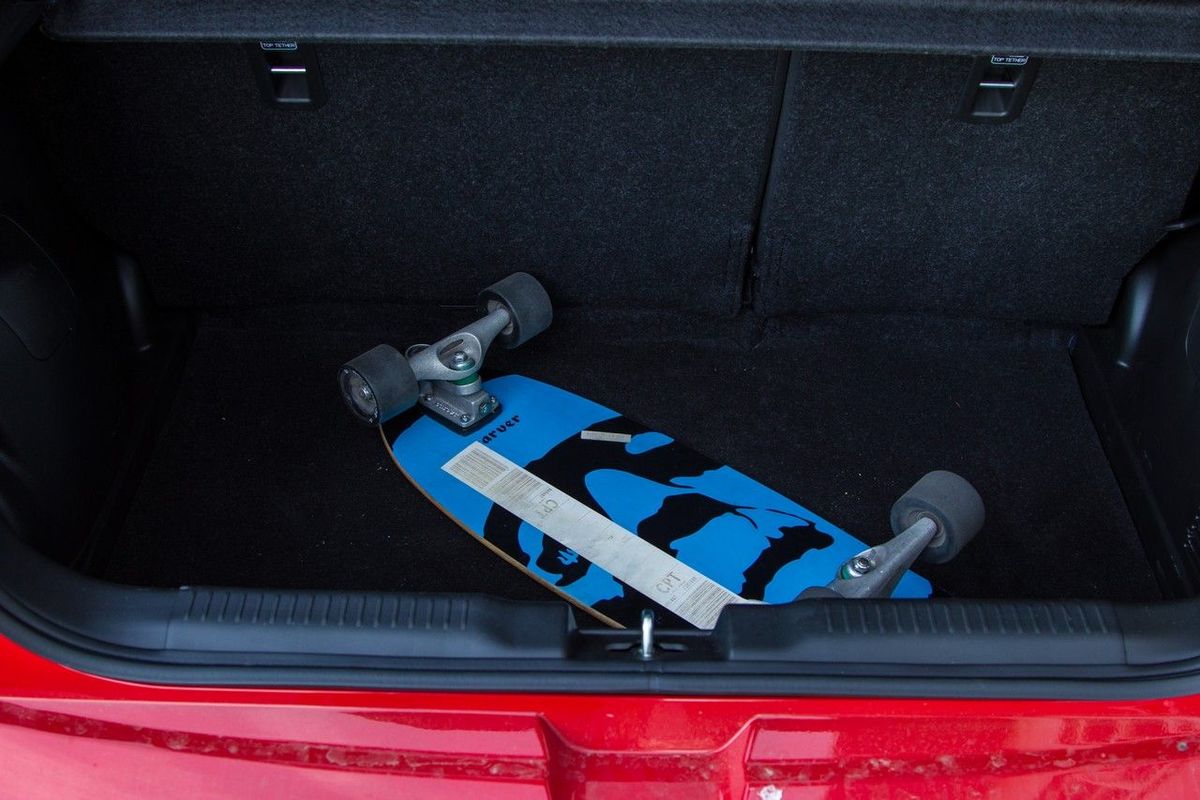
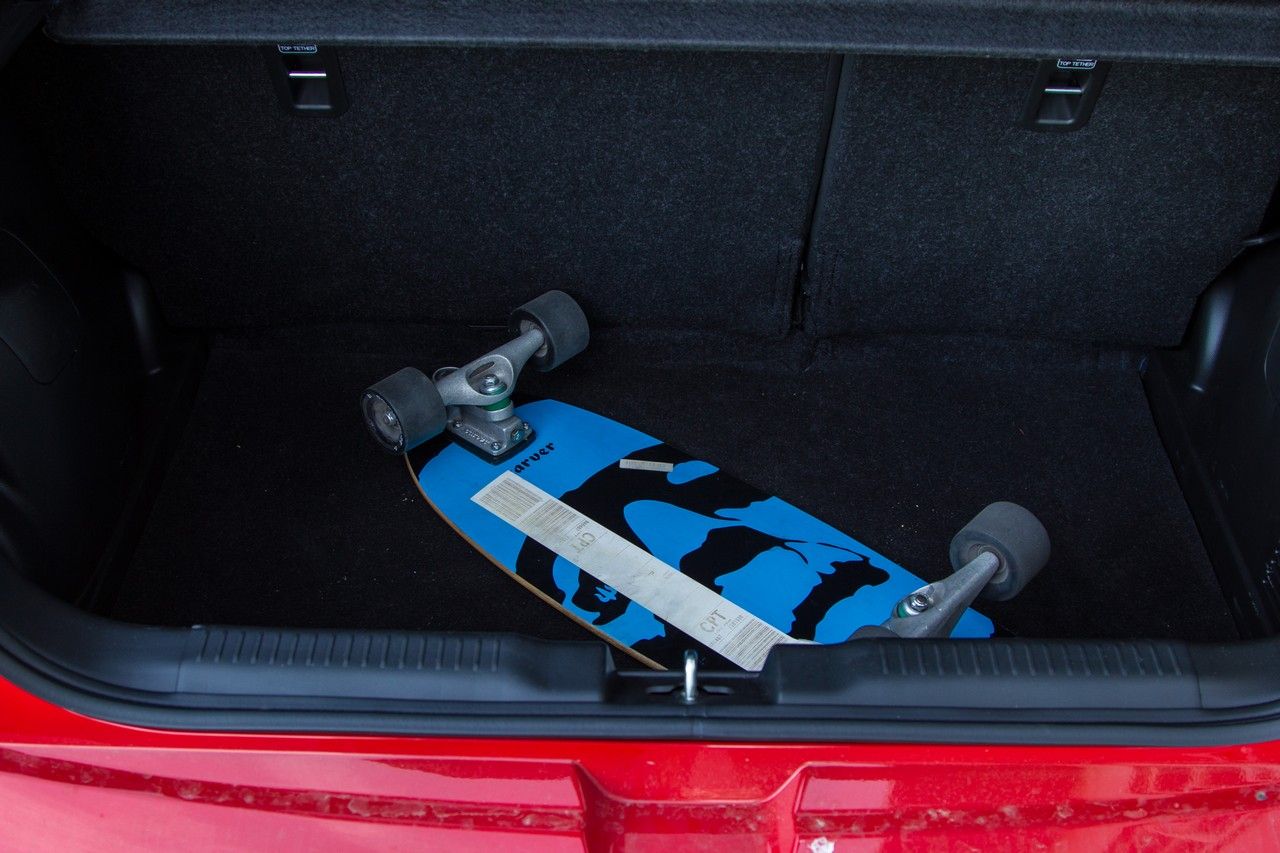
Boot space has been vastly improved compared with the previous model.
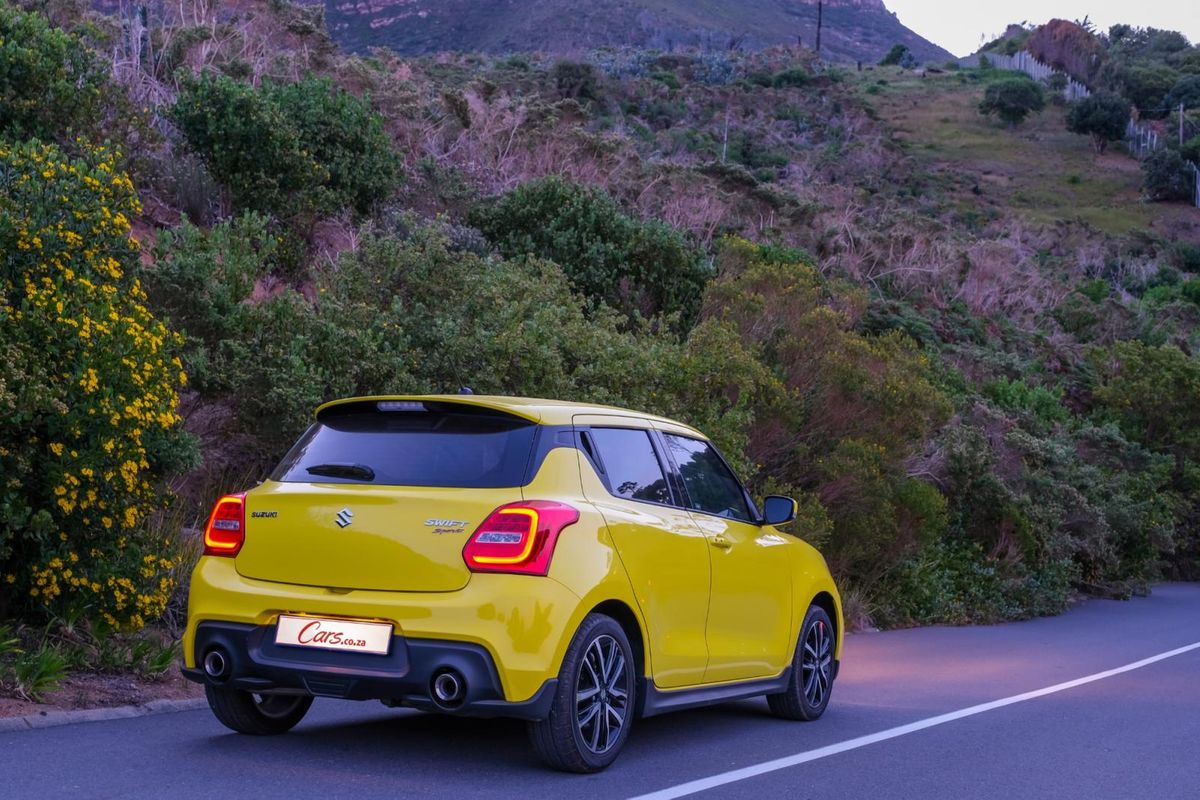
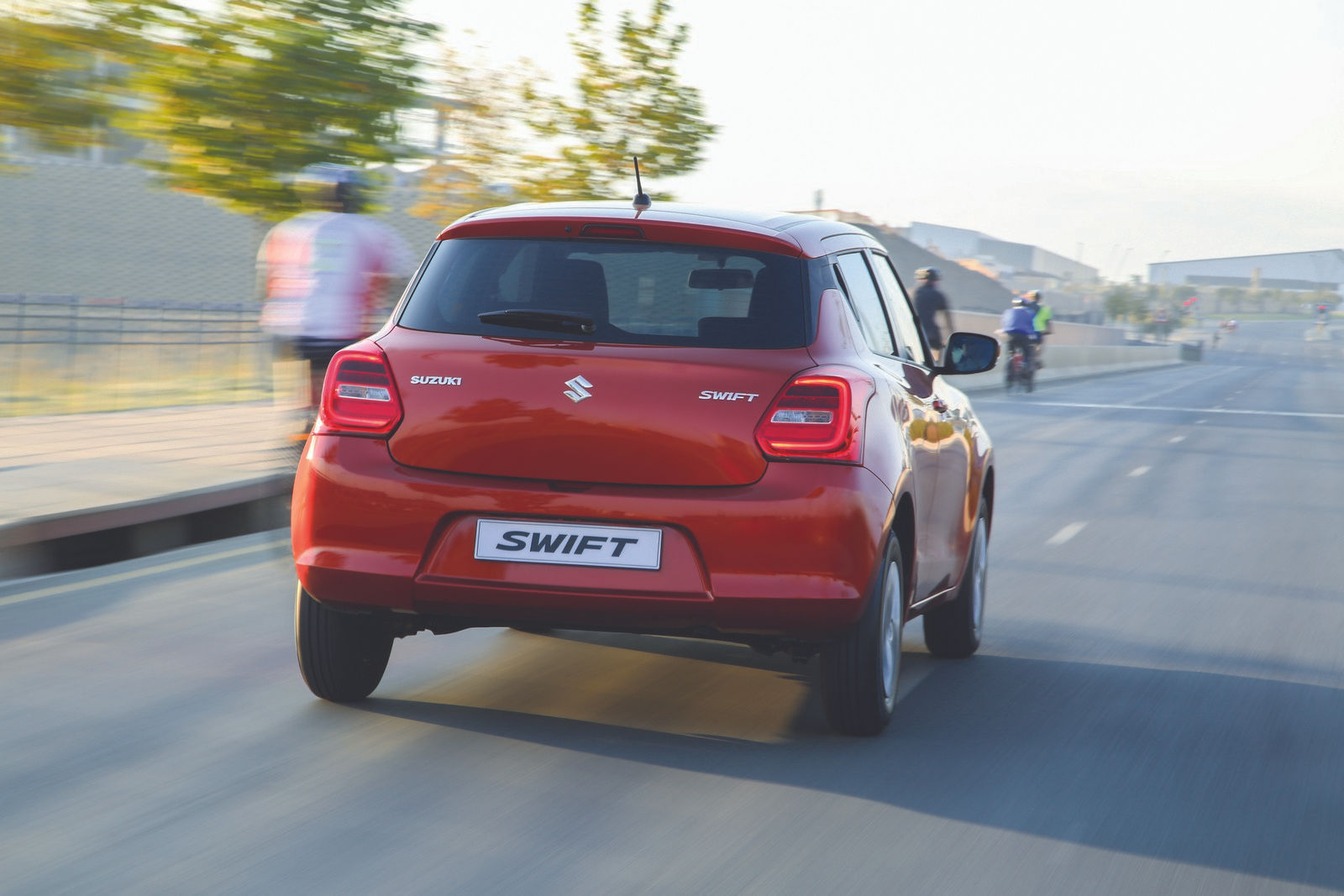
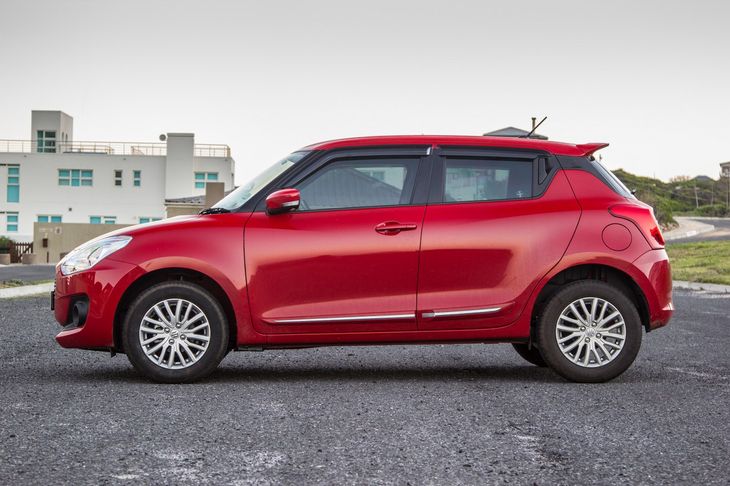
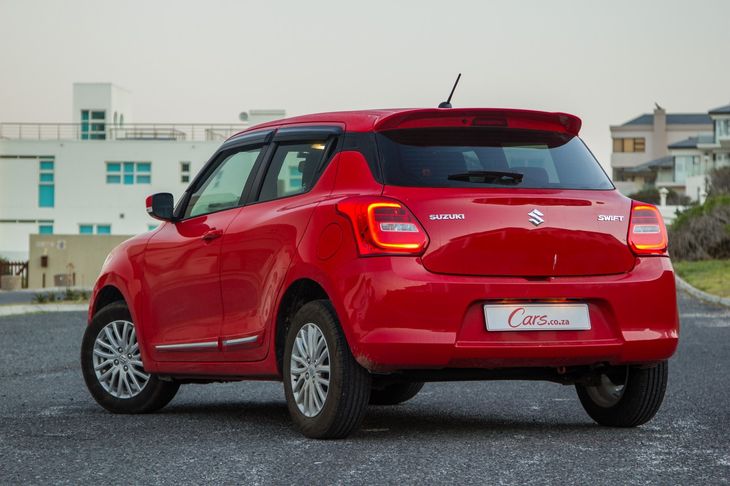
The one area where we feel Suzuki could have delivered a bit more is on the design front. Given some of its recent efforts (notably the Ignis and the upcoming new Jimny), the Swift is relatively bland even though it has some nice touches (hidden rear door handles and curves along the flanks). Our test car benefitted from the addition of optional alloy wheels, among other extras (such as window guards).
Inside, the biggest advantage of the redesign is improved spaciousness. Rear legroom is significantly better, but the luggage capacity (always the Achilles Heel of the previous car) has improved massively (it has grown to a very competitive 268 litres). The rear seatback splits and folds too.
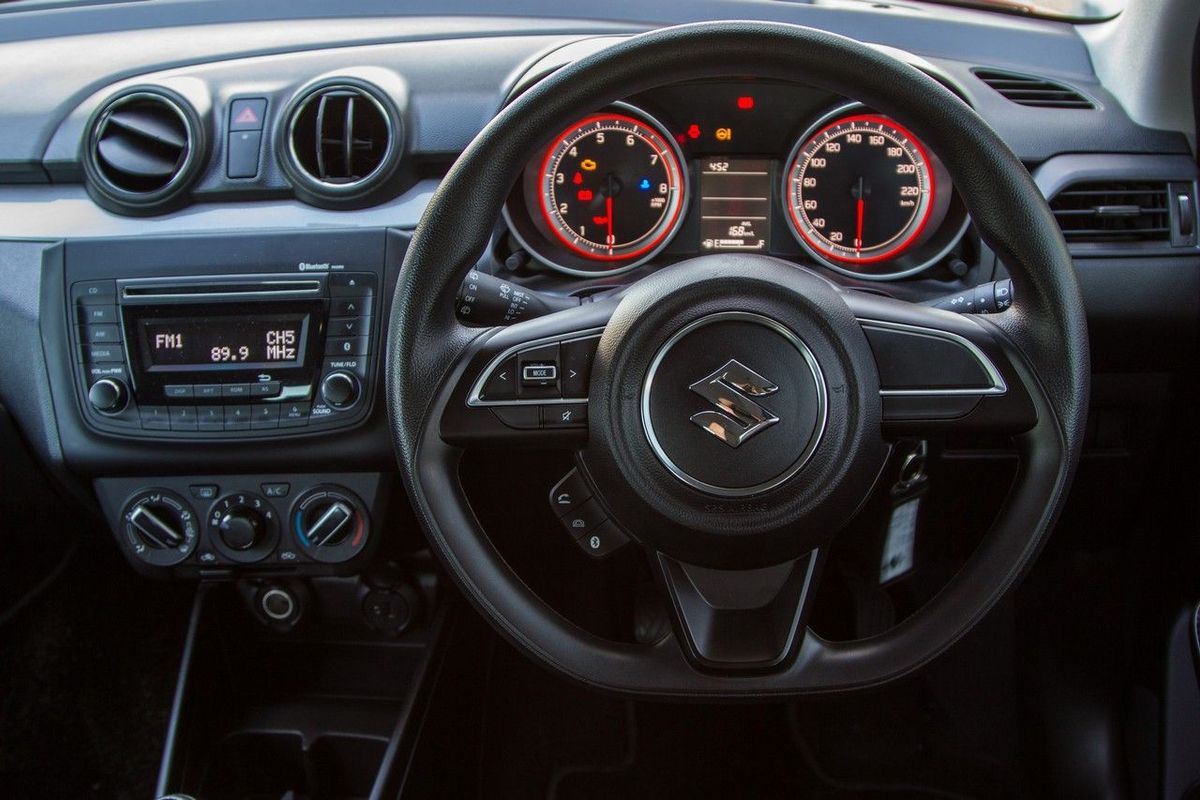
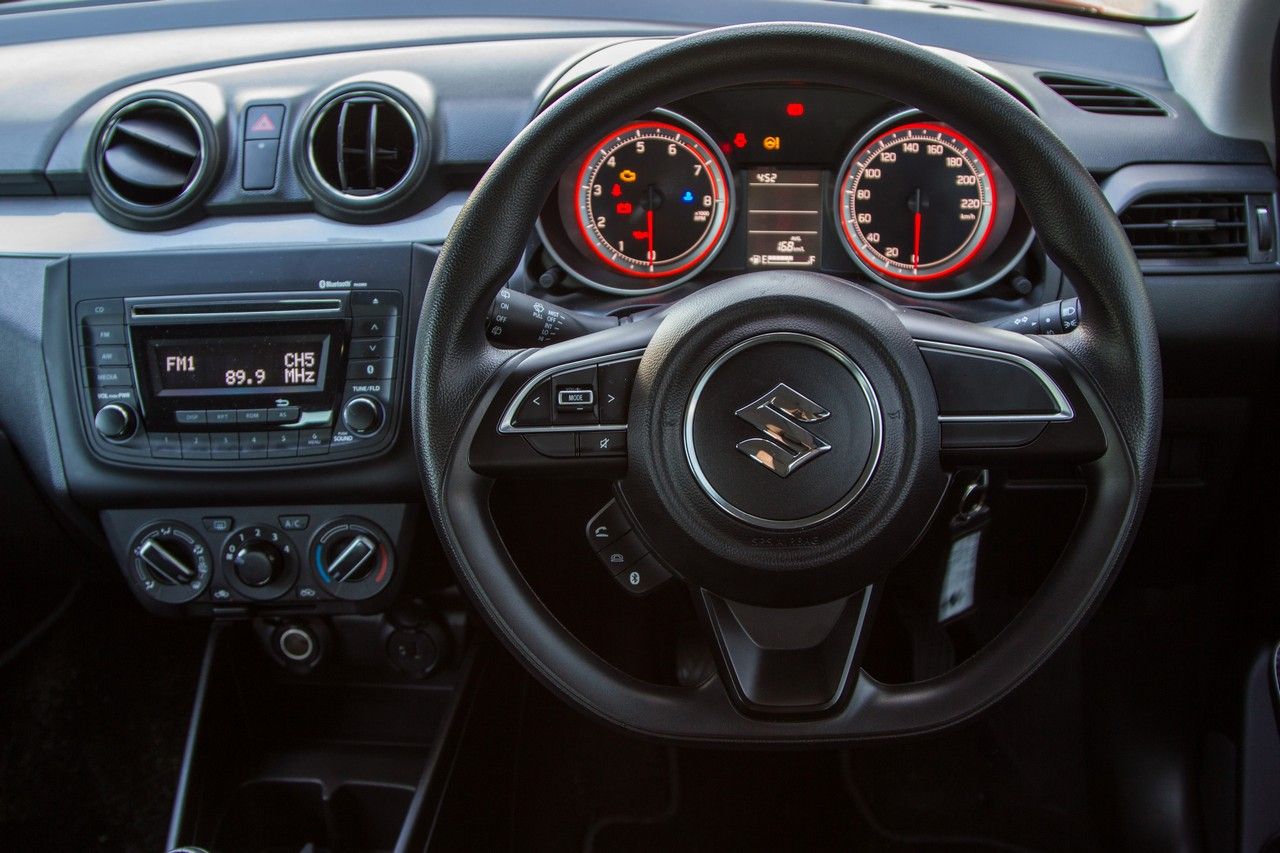
Smart, comprehensive instrumentation for this GL model. Build quality impresses.
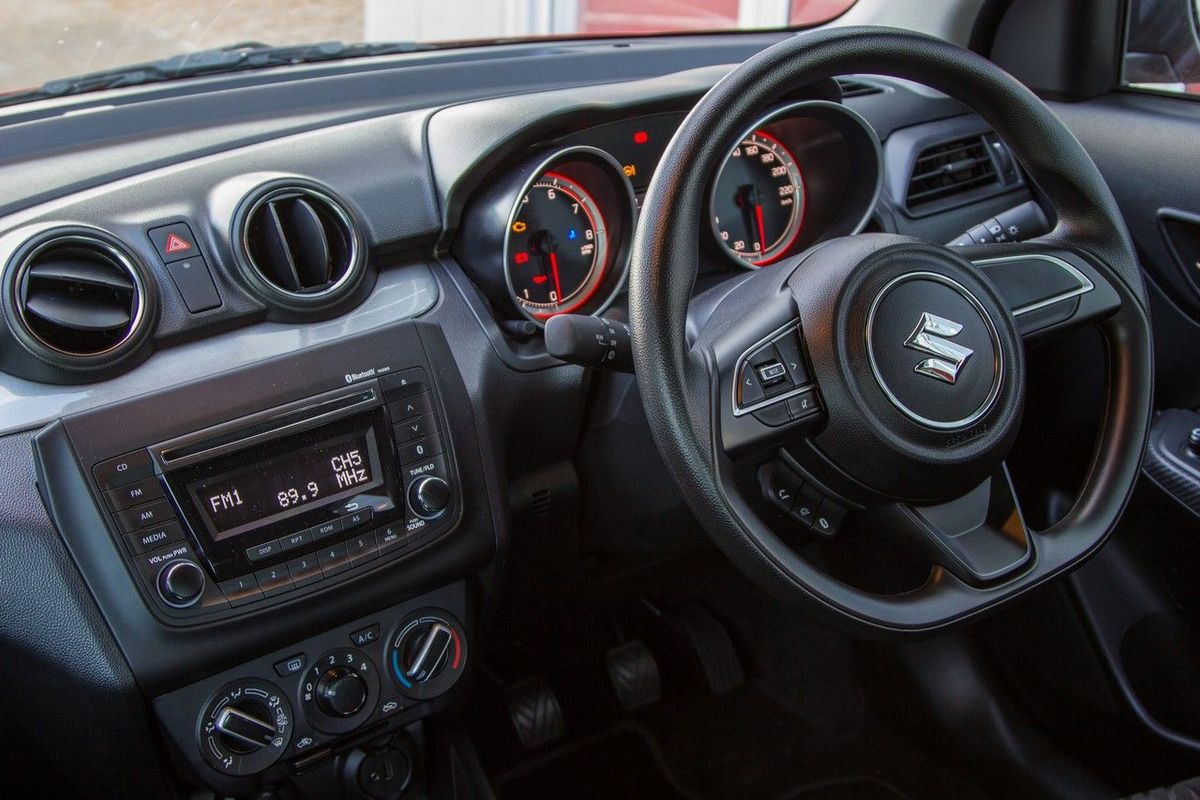
In front, the layout of the facia is simple, but effective. The instrumentation is of a neat chronograph-type finish and a comprehensive trip computer is included. The build quality is excellent, as we’ve come to expect from Suzuki. You’ll also appreciate the variety of storage spaces on offer.
How much does the Suzuki Swift GL cost in South Africa?
The Suzuki Swift 1.2 GL sells for R175 900 (August 2018) and is backed with an excellent 5-year/200 000 km promotional warranty (make sure whether this still applies when purchasing). Also included is a 2-year/30 000 km service plan. Services are scheduled at 15 000 km intervals.
Verdict
Perhaps the new Swift’s best view – hidden rear door handles, LED detail in the tail lamps and curvy flanks are design highlights.
Given its price and purpose, as well as what it offers and how it delivers its performance (replete with oodles of driving fun), the new Suzuki Swift is a very hard car to fault. In GL specification it offers all the features you can reasonably expect, more space than before and a class-leading driving experience. We wish it displayed a little more flair on the design front, but we’re happy to give it an enthusiastic double thumbs-up nonetheless.
We hope that this Suzuki Swift GL review has given you the information you need to make a more informed car buying decision!
Looking for a new / used Suzuki Swift to buy?
Find one on Cars.co.za to purchase today byclicking here
Frequently Asked Questions
What are the different Suzuki Swift models available in South Africa?
The 2025 Suzuki Swift in South Africa is available in three main derivatives: the GL, a new mid-tier GL+, and the top-end GLX.
What is the engine and performance of the new Swift?
The new Swift is powered by a Z-Series (Z12E) 1.2-litre, 3-cylinder petrol engine. This engine produces 60 kW of power and 112 Nm of torque, and is paired with either a 5-speed manual or a Continuously Variable Transmission (CVT).
What is the price of the new Suzuki Swift in South Africa?
The starting price for the 2025 Suzuki Swift is approximately R219,900, with the top-end GLX model priced around R284,900.
What safety features are standard on the 2025 Suzuki Swift?
Standard safety features across all models include six airbags, hill-hold control, ABS, electronic stability control (ESC), and ISOfix child-seat anchors.
What warranty and service plan are included with the Swift?
The vehicle comes with a 5-year/200,000 km warranty and a 2-year/30,000 km service plan.
The assault of new Aston Martins continues with the launch of this, the Aston Martin DBS Superleggera. We sent Ciro to drive it in the German Alps.
This is the Aston Martin DBS Superleggera. And while you may not immediately associate that very Italian term with this British manufacturer, the iconic DB5 proudly displayed the nameplate on its bonnet, too.
While based on the DB11, the DBS Superleggera is an entirely different beast. The 5.2-litre twin turbo V12 which debuted in the DB11 is employed here but heavily tweaked to produce over 715 bhp (725 PS, 541 kW) and a gearbox-troubling 900 Nm of torque. The suspension has been thoroughly overhauled and the downforce generated increases to around 240 kg.
Those figures and the efforts to reduce the car’s weight by 70 kg mean the DBS has the same torque-to-weight ratio as the rather loony Aston Martin Vulcan. The torque output is so monumental that Aston was forced to ask ZF to help out and create a new 8-speed gearbox specifically for the DBS. And even still, the drivetrain engineers had to electronically limit the torque output in first and second gear to protect the transmission.
In this video, we drive the car at the international launch held in July in the beautiful Berchtesgaden region of Germany.