Chinese cars and resale values: what the numbers say
Are popular Chinese cars really saddled with poor resale values in SA? Here are some fascinating insights from the recently released Cars.co.za Industry Report 2025…
With lofty levels of standard specification and attractive pricing, several Chinese cars offer strong value on South Africa’s new-vehicle market. But what about resale values? Well, the recently released Cars.co.za Industry Report 2025 offers some fascinating insights.
Drawing on Cars.co.za’s proprietary market data, the wide-ranging report includes a look at the residual values of several popular Chinese vehicles, comparing them to those of competitor products from so-called legacy brands.
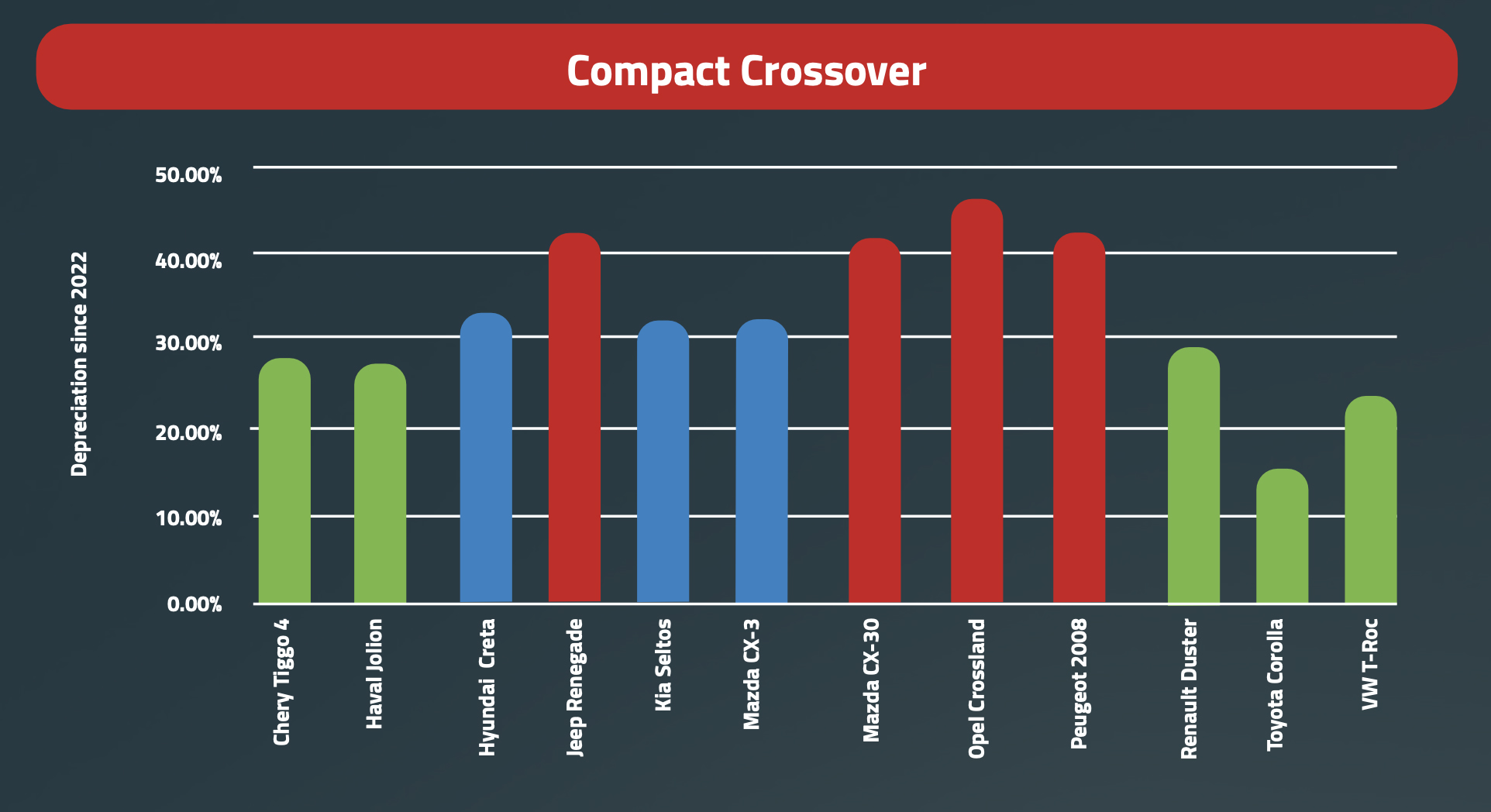
Calculated using pricing data on Cars.co.za for 2022 models, the tables below effectively show average depreciation over a 3-year period. In short, the report suggests residuals are looking healthy for most of the major Chinese players.
2025 resale values of 2022 compact crossovers
In the highly competitive compact-crossover segment, the locally produced Toyota Corolla Cross boasted incredibly strong residuals, losing only approximately 15% of its value over the 3-year period. From this sample, the Volkswagen T-Roc placed a strong 2nd.
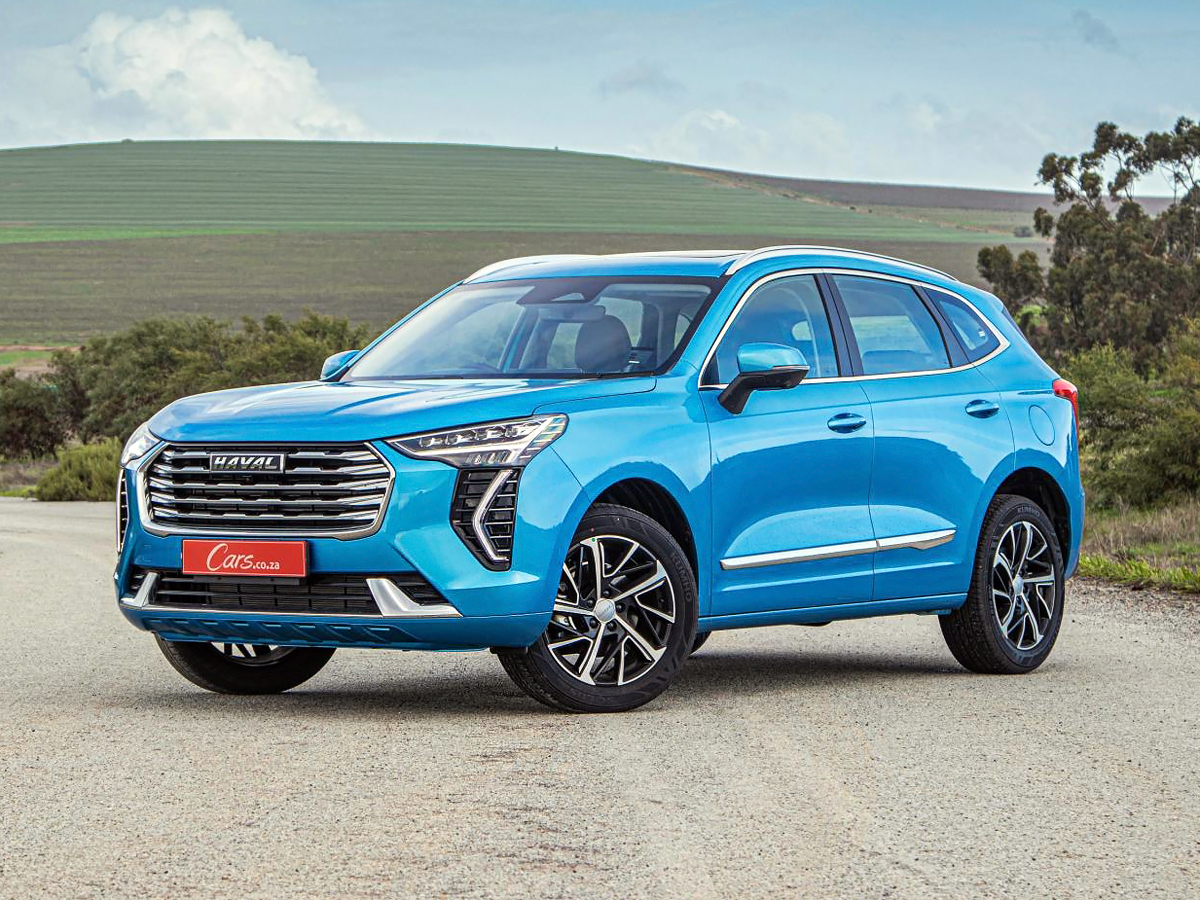
What about the top-selling Chinese models in this class? The Chery Tiggo 4 Pro and the Haval Jolion both performed well, each depreciating under 30% on average over the 3-year period. Based on this dataset, these Chinese contenders thus offered stronger residuals than the likes of the Renault Duster, Kia Seltos, Mazda CX-3 and Hyundai Creta.
Interestingly, Stellantis South Africa’s Opel Crossland, Peugeot 2008 and since-discontinued Jeep Renegade all showed depreciation levels in excess of 40% over the 3-year reporting period, as did the Mazda CX-30.
Family crossovers: 2025 resale values of 2022 models
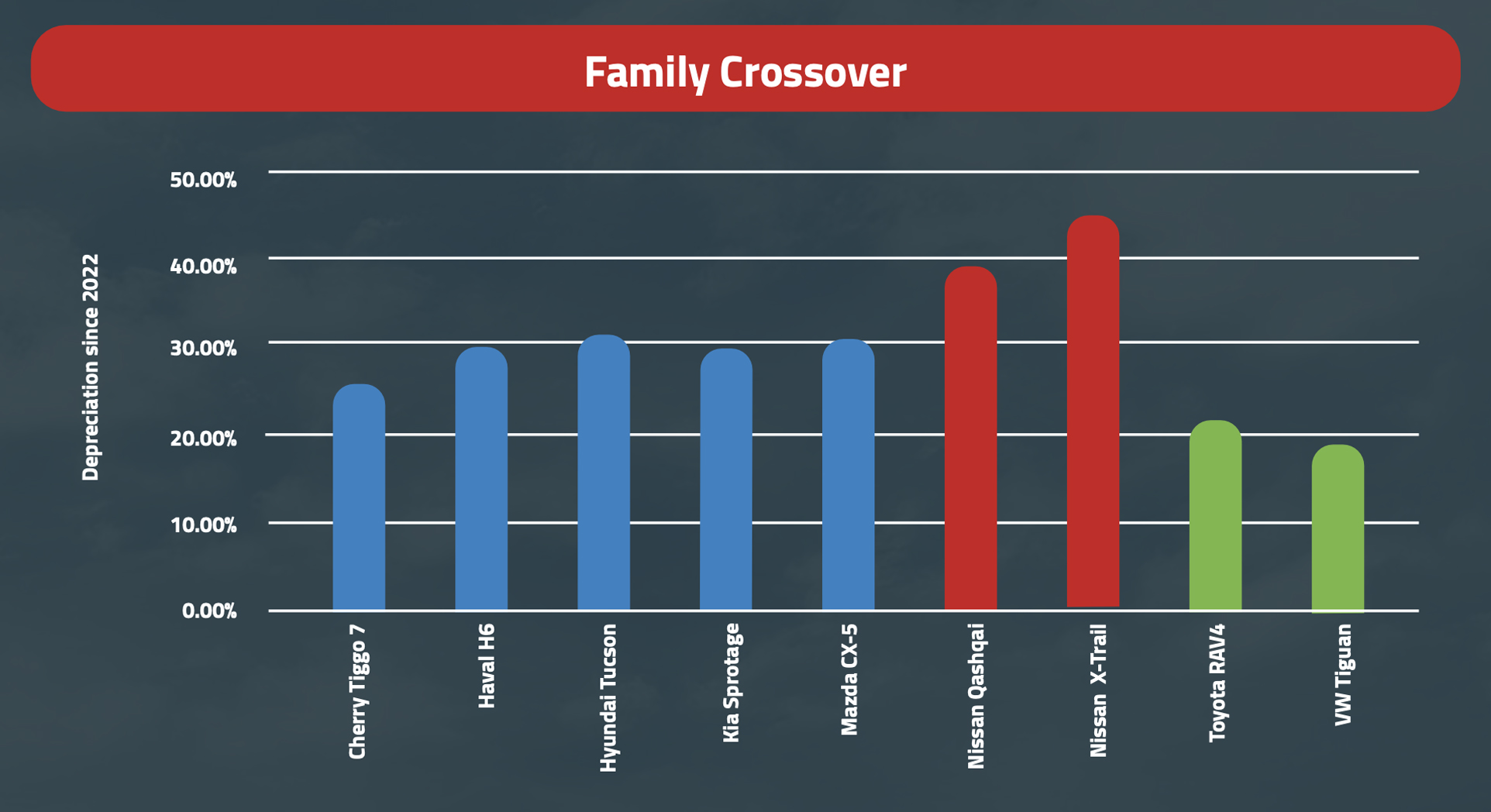
In the family-crossover class, Cars.co.za‘s market data shows the Volkswagen Tiguan experienced the lowest depreciation (under 20%) over the 3-year period, closely followed by a fellow segment stalwart in the form of the Toyota RAV4 (just over 20%).
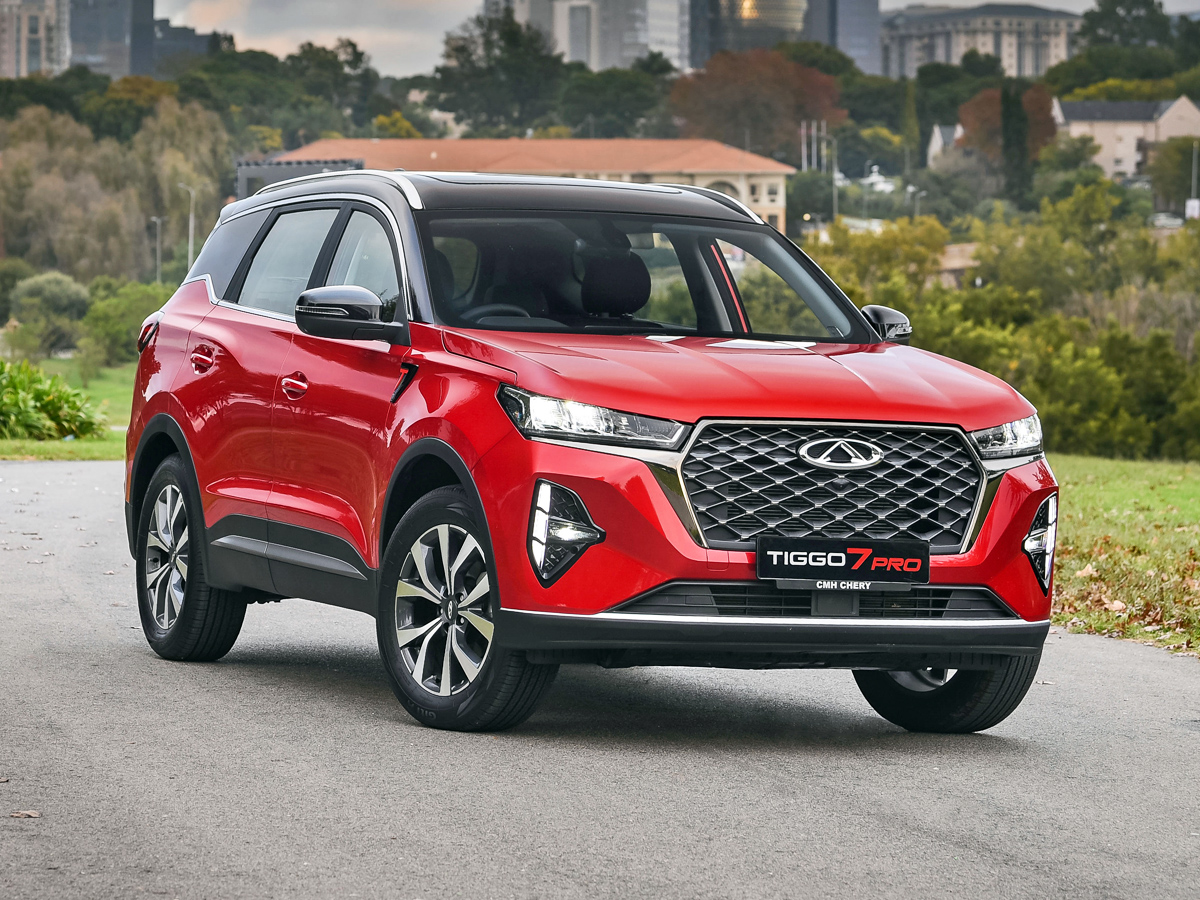
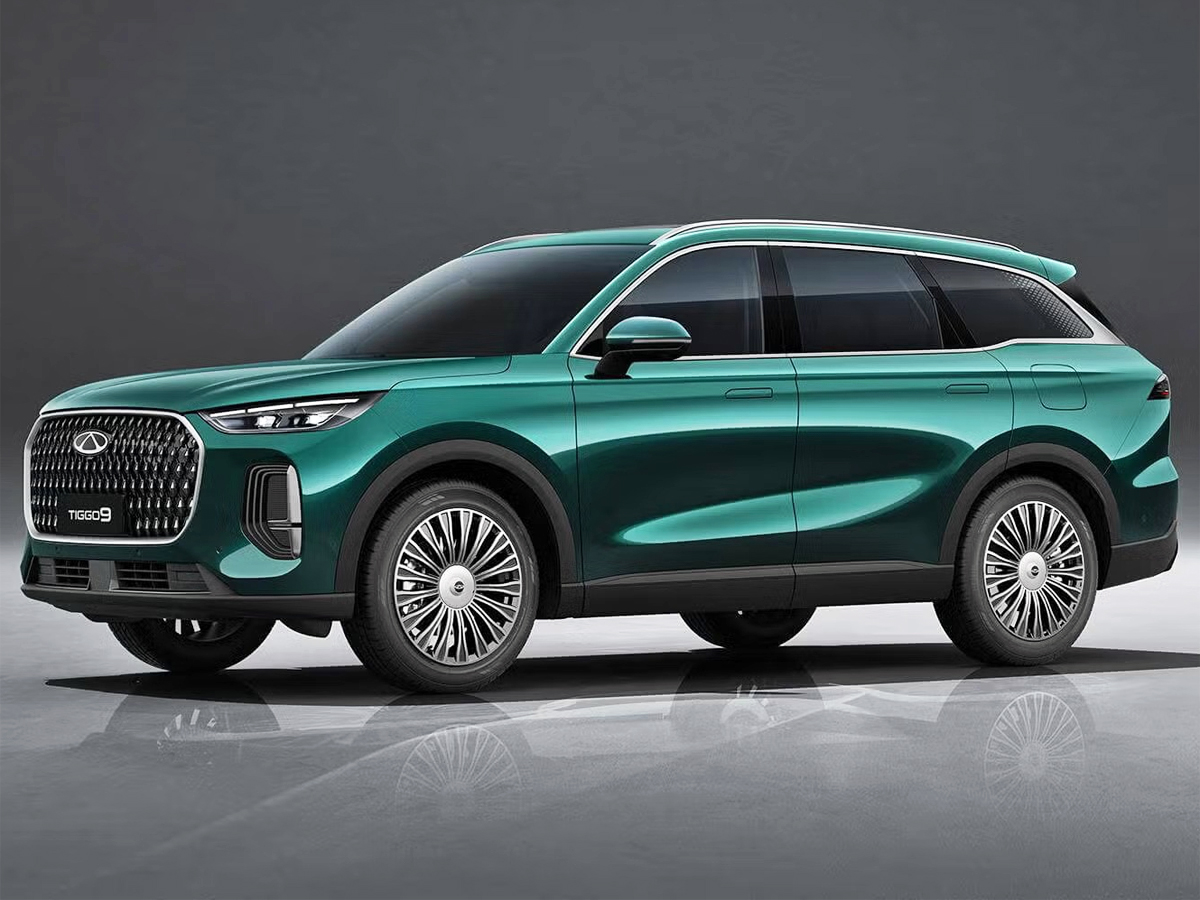
However, a Chinese vehicle placed 3rd, with the Chery Tiggo 7 sitting at around the 25% mark. The Haval H6 showed 3-year depreciation of just under 30%, seeing it finish largely in line with models like the Kia Sportage, Mazda CX-5 and Hyundai Tucson.
As an aside, the dataset indicates Nissan’s recent versions of the since-discontinued Qashqai and the X-Trail were overpriced in the new-vehicle market, with the former suffering a near-40% loss in value and the latter closer to 45%. Interestingly, earlier this month, Nissan SA temporarily slashed prices across its 3-strong X-Trail range.
2025 resale values of 2022 model-year bakkies
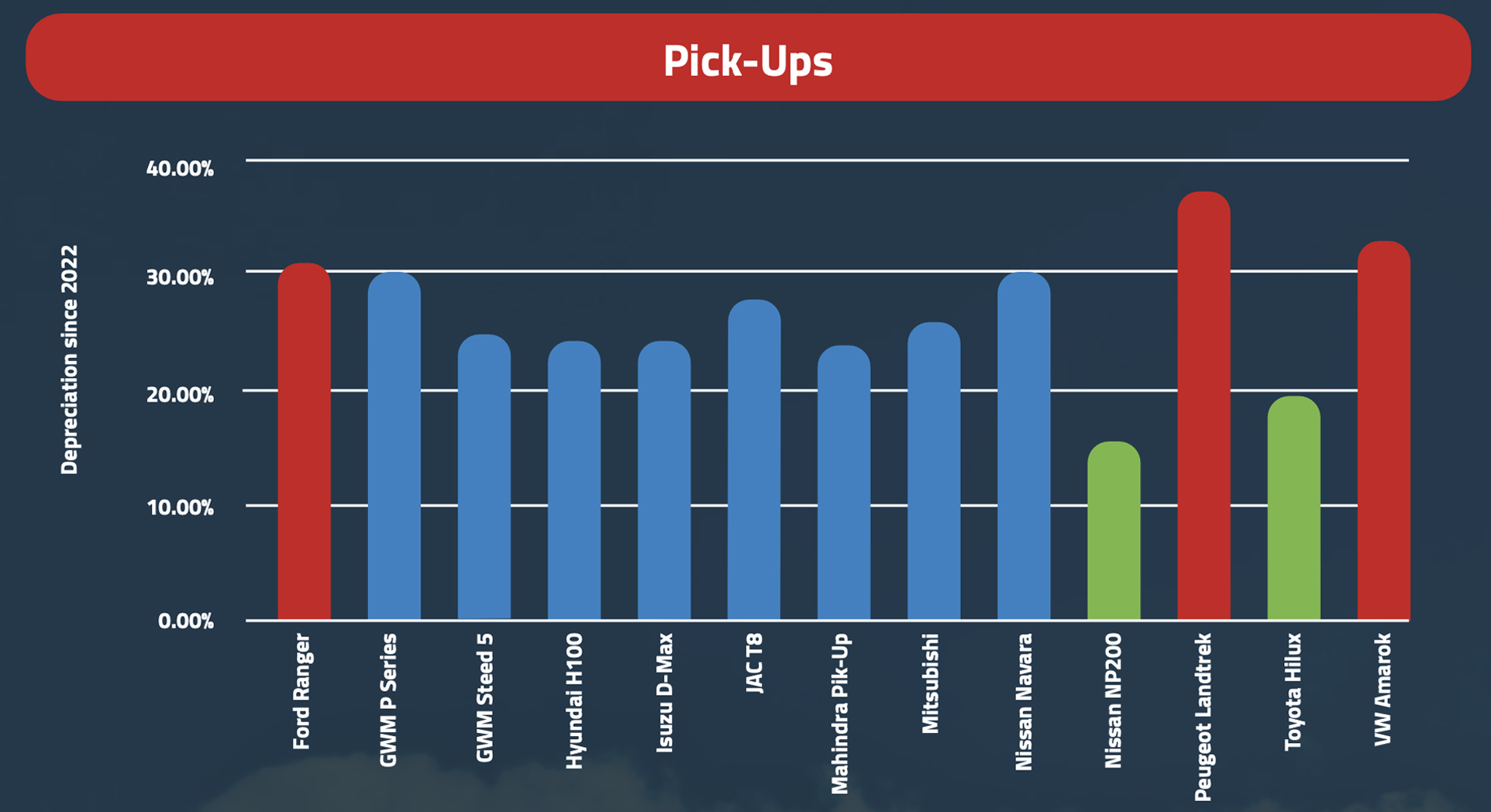
What about the bakkie market? Well, it’s clear that residuals of the since-departed Nissan NP200 benefited from strong demand at a time when this half-tonner was on run-out (production ended in March 2024). Losing only around 15% over the 3-year period, the NP200 was the single contender to beat the locally made Toyota Hilux (just under 20%).
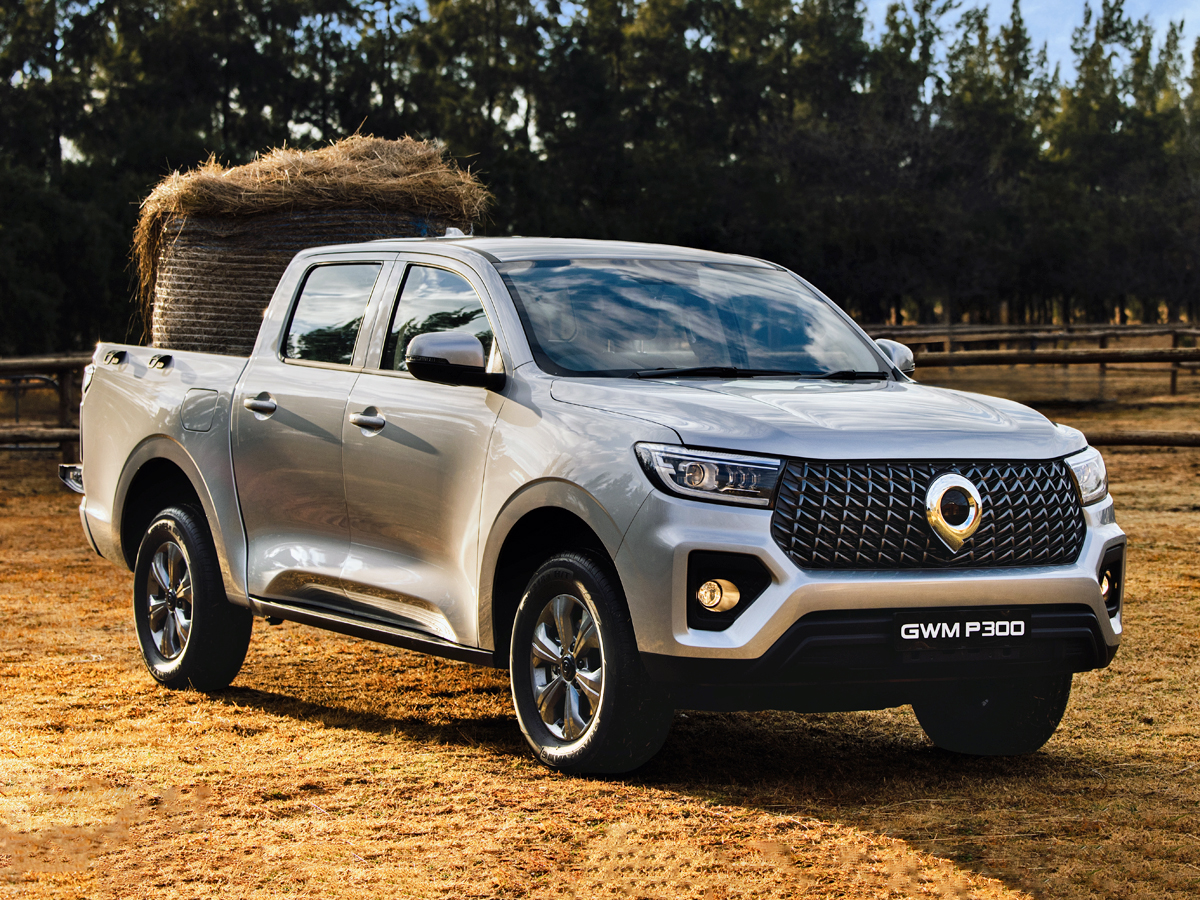
In the Chinese corner, the GWM Steed 5 workhorse – having depreciated approximately 25% – finished broadly in line with the likes of the Isuzu D-Max, Mahindra Pik Up and Mitsubishi Triton. Intriguingly, the GWM P-Series’ depreciation was closer to 30%, seeing it finish behind the JAC T8 (of which the sample size was small), match the Rosslyn-built Nissan Navara, and edge out the Silverton-made Ford Ranger.
The Volkswagen Amarok (in this instance, the original generation, since the Ford-built version debuted only in 2023) and the Chinese-made Peugeot Landtrek suffered the highest levels of depreciation in this sample, both ending well over 30%.
Released in conjunction with DealerCon 2025, the Cars.co.za Industry Report 2025 provides smart insights based on the proprietary market data of South Africa’s leading digital automotive marketplace, complemented by finance and consumer insights from partner TransUnion. The report utilises Cars.co.za’s lead and stock data from 2015 onwards to illustrate how much has changed in a decade, thereby enabling automotive dealers to identify market-demand hot spots.
Frequently Asked Questions on Chinese Car Resale Value in SA
Q: Are popular Chinese cars really saddled with poor resale value in South Africa?
A: The Cars.co.za Industry Report 2025 suggests that residuals are looking healthy for most of the major Chinese car players. Models like the Chery Tiggo 4 Pro and Haval Jolion depreciated well under 30% on average over a 3-year period (2022-2025).
Q: How do Chinese compact crossovers compare to established rivals in terms of resale value in SA?
A: Chinese compact crossovers like the Chery Tiggo 4 Pro and Haval Jolion performed strongly, each depreciating well under 30%. This is a better result than several competitor products from legacy brands such as the Renault Duster, Kia Seltos, Mazda CX-3 and Hyundai Creta.
Q: Which Chinese vehicle placed highest in the family-crossover resale value comparison?
A: The Chery Tiggo 7 placed 3rd in the family-crossover class, behind only the Volkswagen Tiguan and Toyota RAV4. The Chery Tiggo 7 showed a 3-year depreciation of around 25%, outperforming models like the Kia Sportage, Mazda CX-5 and Hyundai Tucson.
BMW XM Label (2025) Price & Specs
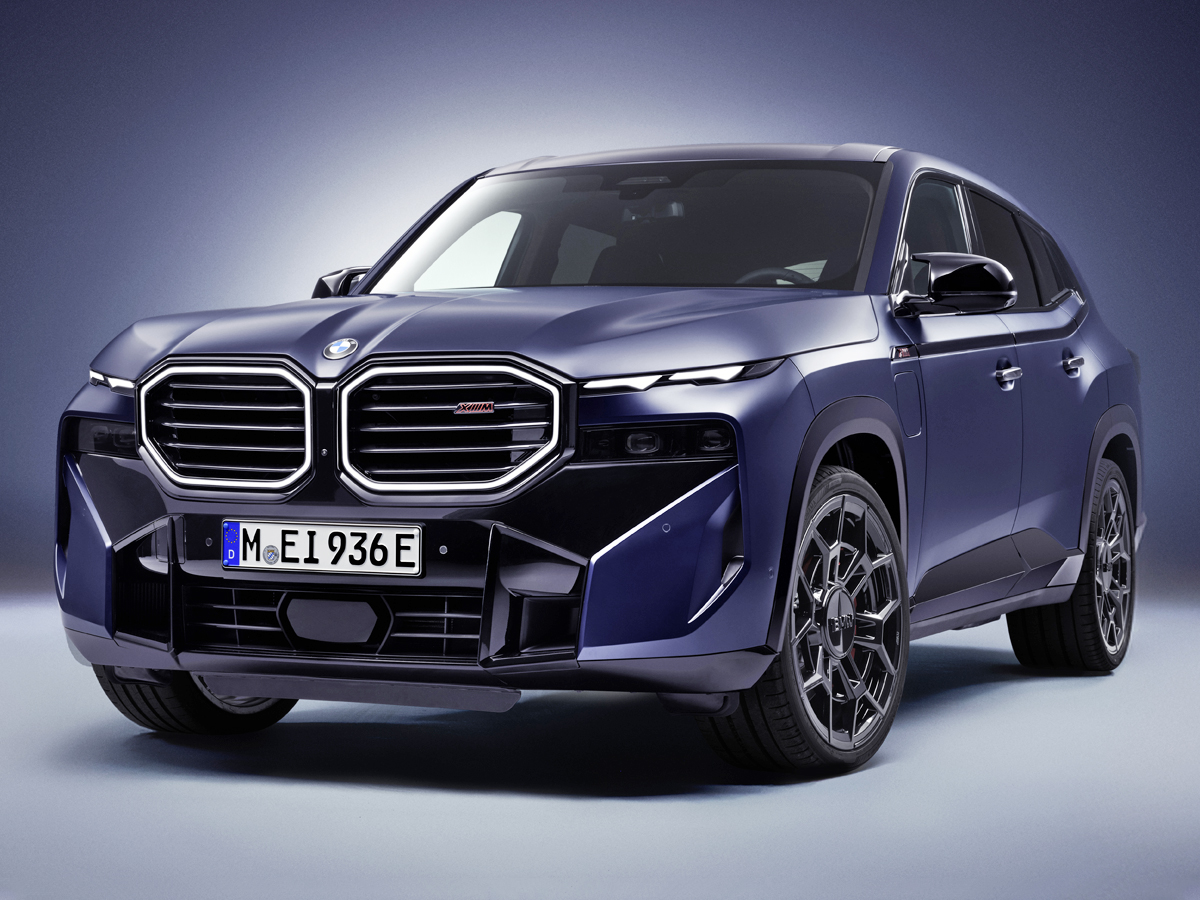
Here’s what the updated BMW XM Label – still generating a whopping 550 kW but now boasting a faster AC charging rate and additional options – costs in South Africa…
XM Label is now the sole XM derivative
Upgraded but again priced at R3 650 000
PHEV powertrain still offers hefty 550 kW
Back in June 2025, BMW announced some changes to its XM line-up, saying the standard 480 kW version would fall away in South Africa to leave the 550 kW BMW XM Label as the sole derivative. Furthermore, this variant’s AC charging rate would be increased, while additional options would become available.
Now the updated XM Label has been added to BMW South Africa’s online configurator. Interestingly, pricing is unchanged from before, which means the Munich-based automaker’s most powerful road-legal derivative still starts at R3 650 000 (for the record, that’s R200 000 more than the standard variant, which is no longer listed on the local configurator).
So, what exactly has changed? Well, the updated XM Label’s maximum AC charging rate has been increased from 7.4- to 11 kW. Furthermore, BMW now offers “additional options” for customising the plug-in hybrid SUV’s exterior and interior.
For example, a new BMW Individual Frozen Tanzanite Blue metallic exterior colour is now available, as is a fresh 23-inch M light alloy-wheel design (the latter for an additional R25 000). A new “welcome light” animation has seemingly also been included.
The list of options has furthermore grown to include BMW Individual Night Blue merino leather, along with other updated colour schemes (like BMW Individual Silverstone Merino leather with black interior surfaces). Comfort cushions matching the colour of the seat surface are standard for all BMW Individual leather merino upholstery.
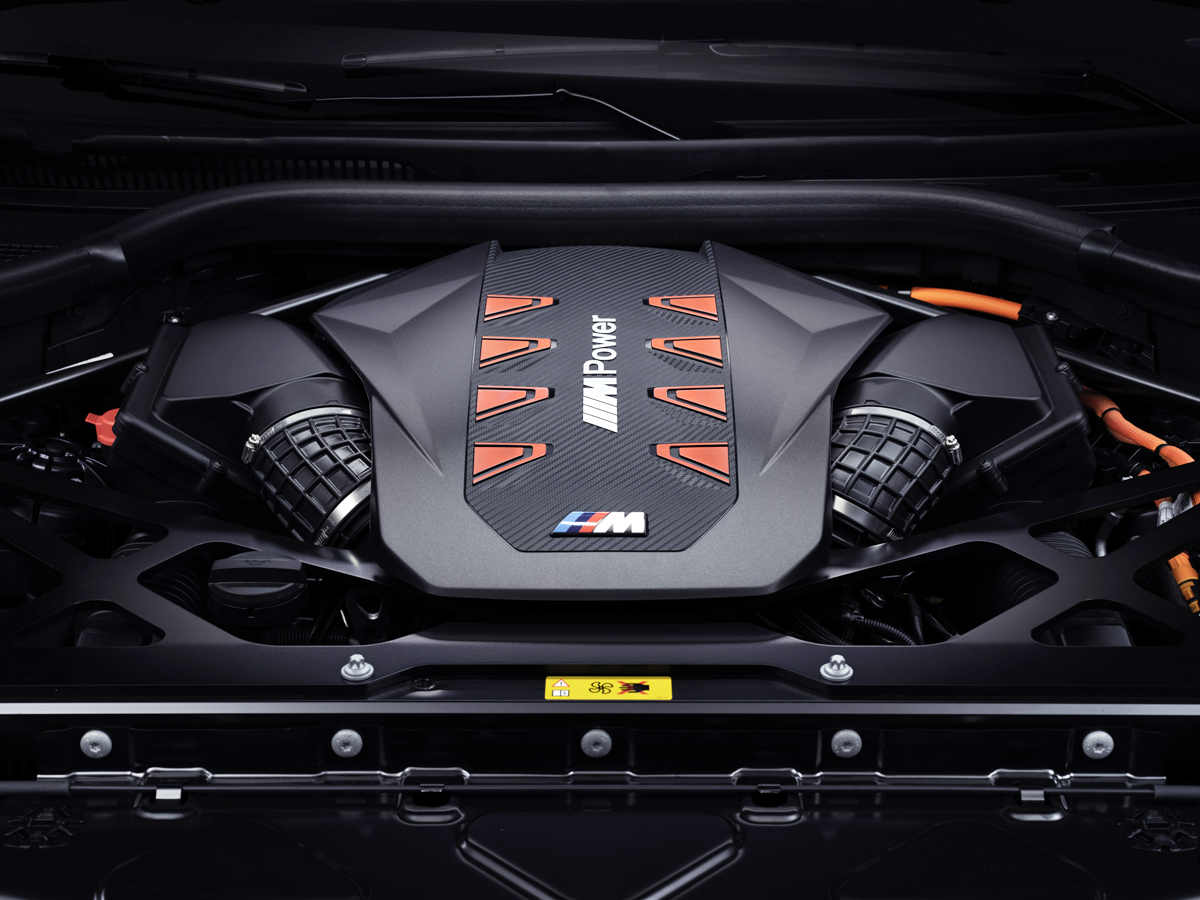
As a reminder, the XM Label generates 550 kW and 1 000 Nm courtesy of a plug-in hybrid electric vehicle (PHEV) system built around a twin-turbo 4.4-litre V8 engine. This allows the SUV to complete the obligatory 0-100 kph sprint in a claimed 3.8 seconds. In some markets, top speed is electronically limited to 250 kph, but since the M Driver’s Package is standard locally, this rises to 290 kph in SA.
The XM Label employs a high-voltage lithium-ion battery integrated into its underbody and featuring a usable energy content of 25.7 kWh. According to the German firm, this enables a pure-electric range of up to 76 km on the WLTP cycle, with a pure-electric top speed of 140 kph.
What does the BMW XM Label cost in South Africa?
DERIVATIVE
PRICE
BMW XM Label
R3 650 000
The price above includes a 2-year/unlimited kilometre vehicle warranty, an 8-year/100 000 km hybrid battery warranty and a 5-year/100 000 km maintenance plan.
Frequently Asked Questions
Q: What is the price of the updated BMW XM Label in South Africa?
A: The updated BMW XM Label is priced at R3 650 000 in South Africa, which is the same as its price before the latest updates. This model is now the sole XM derivative available locally.
Q: What is the new maximum AC charging rate for the updated BMW XM Label PHEV?
A: The updated BMW XM Label has an increased maximum AC charging rate, rising from 7.4 kW to 11 kW.
Q: What new customisation options are available for the updated BMW XM Label’s exterior and interior?
A: New customisation options for the updated XM Label include the optional BMW Individual Frozen Tanzanite Blue metallic exterior colour, a fresh 23-inch M light alloy-wheel design (available for an additional R25 000) and new interior upholstery options like BMW Individual Night Blue merino leather.
The New-Energy Vehicle (NEV) segment doubled its share of South Africa’s new-car market last year, largely due to growth in hybrid sales. The Cars.co.za Industry Report 2025details the market shift and reveals our site’s most searched BEVs and HEVs.
The New-Energy Vehicle market in South Africa remains a small segment, but one accelerating rapidly off a low base. The collective NEV market share doubled in 2024, climbing from 1.47% in 2023 to 3.0% of the total new-vehicle market. This represented a record 15 611 units sold in 2024.
While the market posted 100.6% year-on-year growth in 2024, the volume is heavily concentrated in specific technologies. As the NEV market took shape, the segment showed high volatility, with significant year-on-year gains of 421.7% in 2022 and 65.7% in 2023, clearly demonstrating expansion is happening off a minimal sales base, but the current growth story is overwhelmingly about the petrol-electric hybrid!
Watch Jacob Moshokoa’s video review of the Toyota Corolla Cross Hybrid:
Corolla Cross Hybrids spur on NEV sales growth
The recently released Cars.co.za Industry Report 2025 states that sales of petrol-electric hybrid vehicles (HEVs) are responsible for the lion’s share of NEV volume in Mzansi. In Q1 2025, HEV sales grew 14.8% year-on-year to 2 970 units, constituting a massive 85.2% of the total NEV volume for the quarter.
This robust performance indicates that only sales of hybrids, including Plug-in Hybrids (PHEVs), are showing signs of potential for significant, sustainable growth. The growing popularity of hybrids is largely attributable to a single vehicle: our calculations suggest that hybrid derivatives of the locally-produced Toyota Corolla Cross represented nearly 75% of the entire HEV segment’s sales volume in 2024.
Ciro De Siena reviews the Toyota Corolla Hybrid, which is also locally produced:
This local assembly and the deep-seated consumer trust in the Toyota badge and its reliability have been instrumental in establishing the HEV as the default NEV choice for South African buyers.
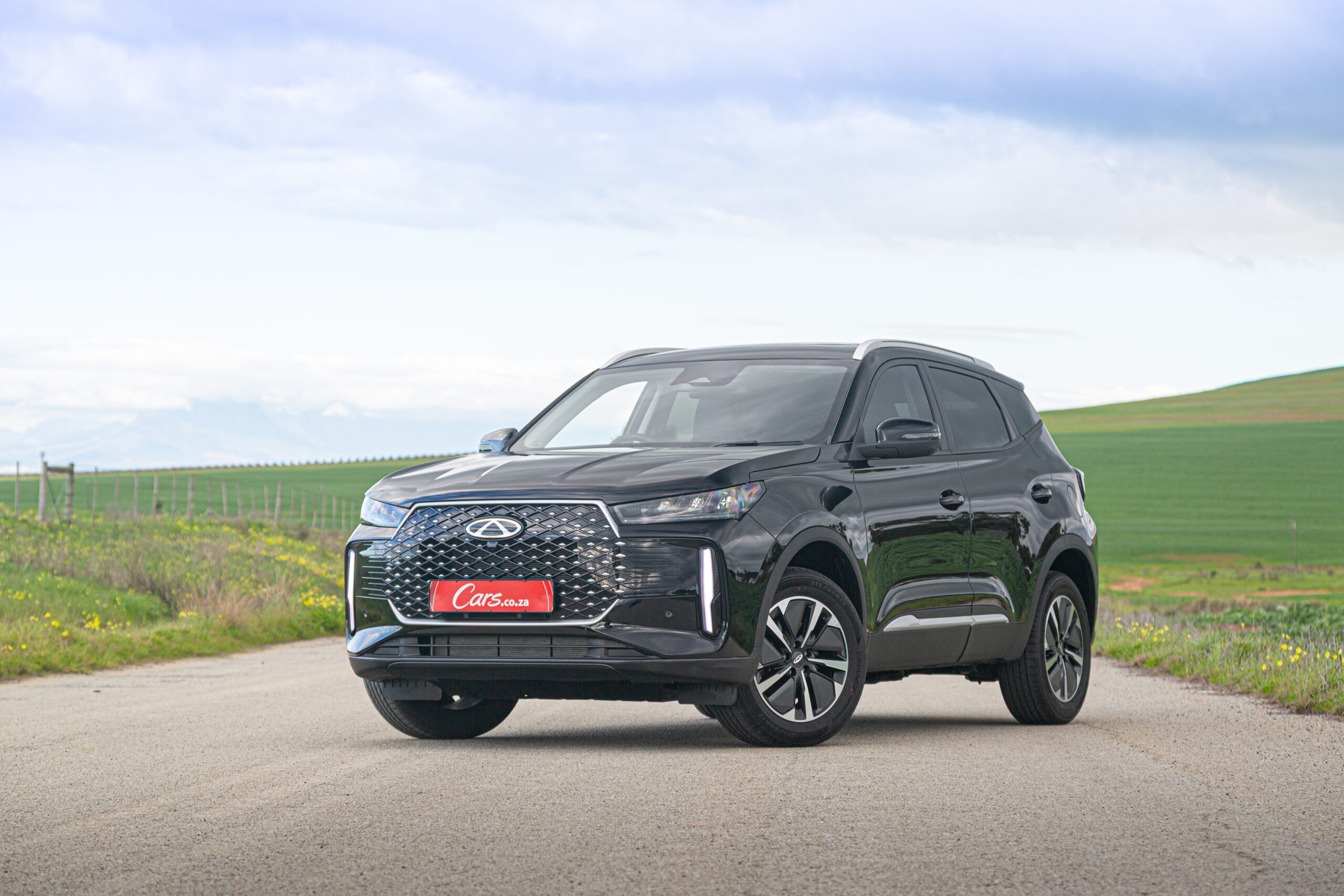
Further introductions of hybrid powertrains in more affordable small-crossover models, such as the new Chery Tiggo Cross HEV (pictured below), also augur well for sustained growth in the sales of hybrids.
BEV momentum stalls…
In stark contrast, the pure Battery Electric Vehicle (BEV) segment is struggling to gain mass-market traction. According to the report, pure electric vehicle sales are “stuck in reverse” in the new vehicle market. BEV sales dipped 16.4% year-on-year to 276 units in Q1 2025. This slowdown follows a trend seen in late 2024, where quarterly sales dropped compared to the previous year.
While the 2024 annual total of 1 257 units did exceed the 2023 figure of 929 units, the Q1 2025 reversal highlights profound consumer caution. It stems from a lack of faith in the public charging infrastructure and Eskom’s ability to stabilise its electricity supply, which continues to erode confidence in BEV tech.
Consumers are not only concerned about load-shedding interrupting their ability to charge, but also the long-term cost and environmental impact of charging their BEVs using grid power generated by coal-burning stations. These fundamental anxieties are preventing the transition from moving faster.
BYD Dolphin Surf.
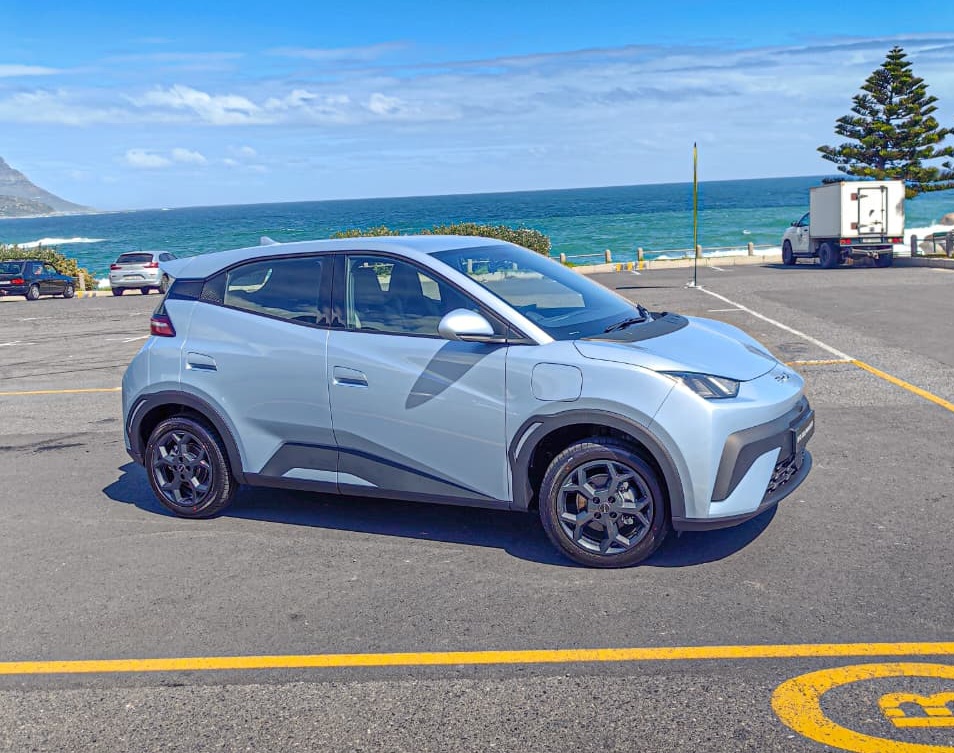
And then there’s the affordability issue. For the BEV segment to truly accelerate, the market requires a “breakthrough car”. The new BYD Dolphin Surf – South Africa’s most affordable electric passenger car offered by a mainstream brand – could be a defining moment for the new-BEV market, as the model’s starting price (R339 900, in September 2025) is comparable to that of a new, high-spec VW Polo Vivo.
However, the report stresses that price alone is unlikely to be the sole determining factor in creating an EV revolution, as the underlying concerns regarding the grid and charging infrastructure persist.
Watch David Taylor’s video review of the Omoda C8 PHEV:
PHEVs are outselling BEVs, too
The Plug-in Hybrid Electric Vehicle (PHEV) segment is emerging as a crucial link, offering electric capability with the invaluable security of fuel-based range, mitigating the core consumer fear of range anxiety and load-shedding. PHEV sales increased by a significant 70.9% year-on-year to 241 units in Q1 2025. This rapid growth suggests the segment is well-positioned to exceed its 2024 record of 728 units.
Notably, sales of plug-in hybrids in Q4 2024 actually outstripped those of fully electric vehicles, ending the quarter on 260 units. The BMW X1 xDrive30e was South Africa’s best-selling new PHEV in 2024.
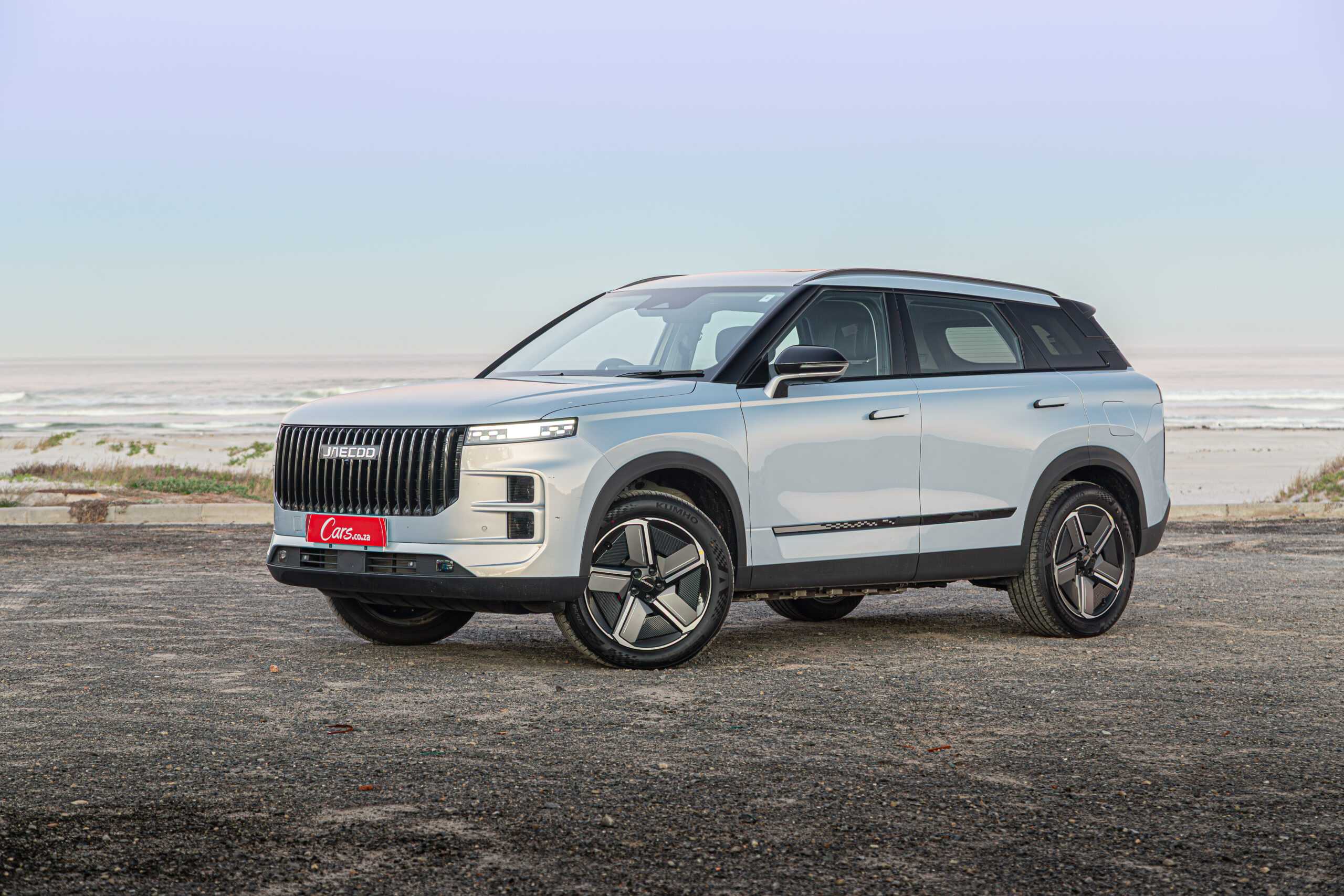
Furthermore, PHEVs recently launched by Chinese car brands such as BYD, Chery, Omoda and Jaecoo (with other new brands in the pipeline), are expected to significantly boost the NEV tally going forward.
Watch Ash Oldfield’s video review of the Volvo EX30:
Used Market Demand: SA’s Most-Searched NEVs
According to Cars.co.za used-car data, which measures prospective car buyers’ purchase intent by the leads submitted on our site, South African motoring consumers are actively searching for:
Most In-Demand Pure EV: The Volvo EX30 has quickly become the most in-demand pure EV in South Africa based on leads submitted on Cars.co.za in 2025.
Most In-Demand Used Hybrid: The Toyota Corolla Cross is the champion of used hybrid demand, with its lead share growing substantially from 0.22% in 2022 to 1.15% in 2025, demonstrating the strong residual value and consumer confidence in its reliability.
Segment Diversification: Demand is also strong for new-generation hybrid models such as the Haval Jolion small crossover and H6family car, signalling that buyers are ready for well-priced, feature-rich options beyond those offered by Toyota South Africa Motors.
Hybrids remain the key to sustained growth in NEV sales
The fact that Cars.co.za’s used-car search data shows notable growth in demand for hybrids (from 2020 to 2025) confirms that South Africans are warming to the NEVs, but that they much prefer HEVs to BEVs to meet their energy-efficient motoring needs. While BEV sales struggle, the hybrid has established itself as the practical, volume-driving solution for the immediate future of South African mobility.
Released in conjunction with DealerCon 2025, the Cars.co.za Industry Report 2025 provides smart insights based on the proprietary market data of South Africa’s leading digital automotive marketplace, complemented by finance and consumer insights from partner TransUnion. The report utilises Cars.co.za’s lead and stock data from 2015 onwards to illustrate how much has changed in a decade, thereby enabling automotive dealers to identify market-demand hot spots.
Q: How much did the New-Energy Vehicle (NEV) segment grow in 2024?
A: The NEV market share doubled in 2024, climbing from 1.47% in 2023 to 3.0% of the total new-vehicle market, representing a record 15,611 units sold.
Q: What percentage of NEV volume did Hybrid Electric Vehicles (HEVs) constitute in Q1 2025?
A: HEV sales grew 14.8% year-on-year to 2,970 units, constituting a massive 85.2% of the total NEV volume for the quarter, largely driven by the Toyota Corolla Cross Hybrid.
Q: How did pure Battery Electric Vehicle (BEV) sales perform in Q1 2025?
A: BEV sales dipped 16.4% year-on-year to 276 units in Q1 2025. This decline highlights consumer caution related to the public charging infrastructure and Eskom’s electricity supply instability.
Q: How did Plug-in Hybrid Electric Vehicle (PHEV) sales grow in Q1 2025?
A: PHEV sales increased by a significant 70.9% year-on-year to 241 units in Q1 2025. Sales of plug-in hybrids actually outstripped those of fully electric vehicles in Q4 2024.
Q: What are the most in-demand used NEVs according to Cars.co.za’s search data?
A: The most in-demand pure EV is the Volvo EX30, while the Toyota Corolla Cross is the champion of used hybrid demand.
New ‘limo-like’ Mercedes-Benz VLE teased
Fresh official teaser images of the upcoming Mercedes-Benz VLE have been released, giving us a closer look at the German firm’s upcoming “limousine-like” luxury MPV…
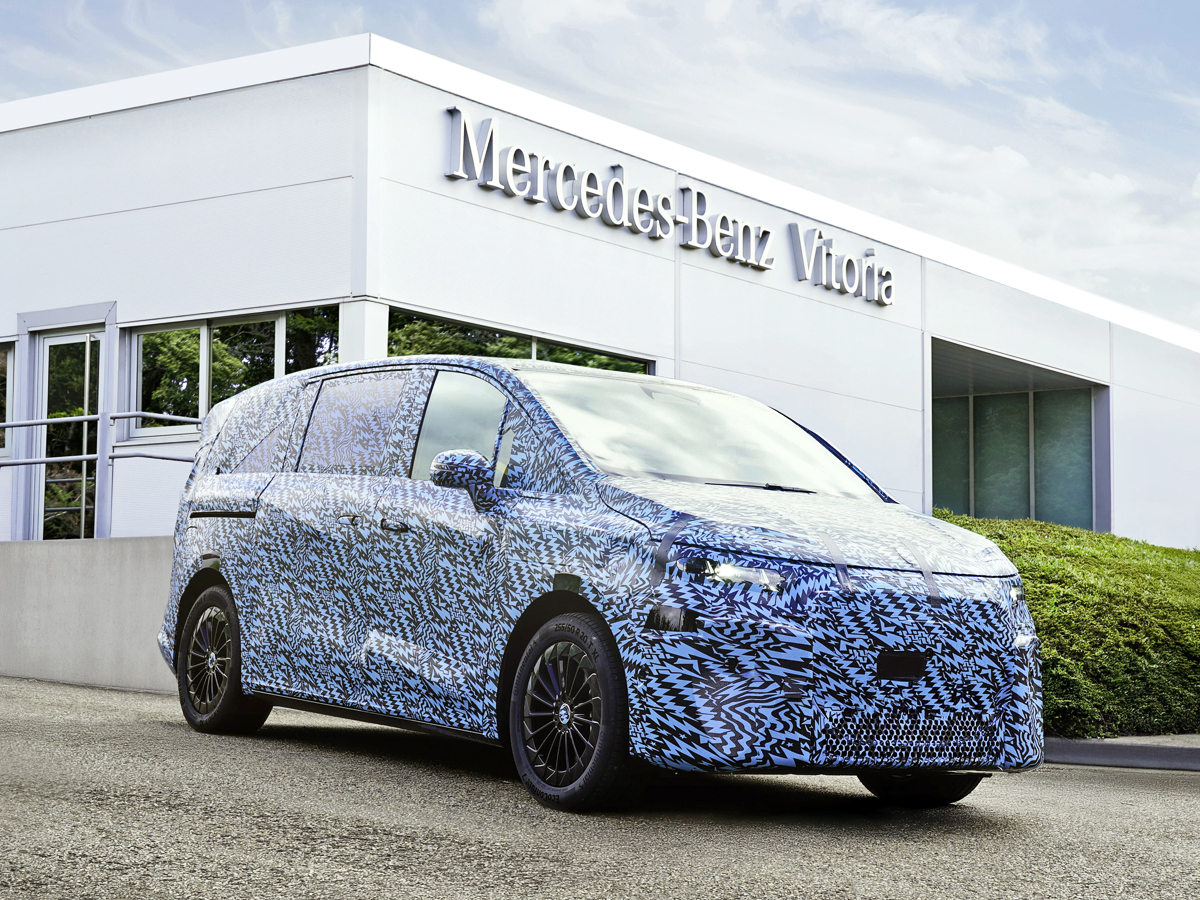
Mercedes-Benz releases fresh VLE teaser images
Production model to be fully revealed in H1 2026
Initially fully electric with ICE variants set to follow
Back in April 2025, Mercedes-Benz unveiled its “Vision V” concept, previewing what it called a “new era” of luxury MPVs. While this concept is expected to eventually spawn a new VLS flagship derivative, too, it seems the Mercedes-Benz VLE will roll off the assembly line first.
Yes, the Stuttgart-based automaker has released fresh official teaser images of the upcoming VLE, with “pre-series production” having just started at the Vitoria factory in Spain (where the newcomer will be built alongside the V-Class, Vito and eVito). Mercedes says the new VLE will be fully revealed in the opening half of 2026.
Though the new VLE will initially be available as an electric vehicle (riding on the new Van Electric Architecture or “VAN.EA”), Mercedes-Benz has confirmed it will later also offer this model with a “state-of-the-art combustion engine” (using the Van Combustion Architecture or “VAN.CA”).
According to the German brand, the fully electric version of the VLE will bring “the best of 2 worlds together”, combining what it describes as “limousine-like driving behaviour” with “MPV-like versatility”.
Mercedes-Benz says the VLE will be offered “with up to 8 seats”, with the broader model line-up ranging from “flexible vehicles for families and customers with an active lifestyle” to “exclusive shuttles”.
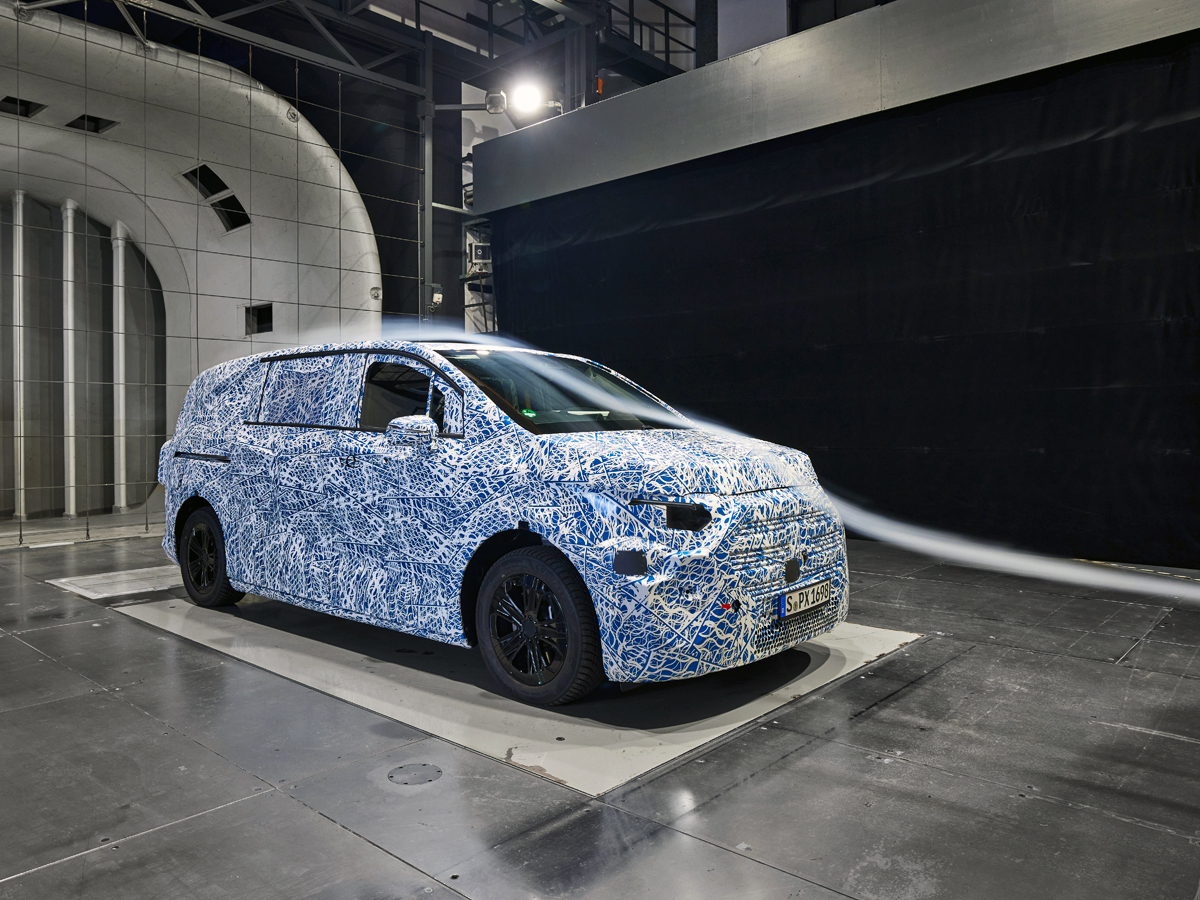
While technical details remain under wraps for now, the automaker claims the VLE will offer both “uncompromising efficiency” and “sedan-like handling characteristics”, while also promising it has set “aerodynamics records” in the wind tunnel.
Look out for more official details in the first half of 2026…
Frequently Asked Questions about the Mercedes-Benz VLE
Q: When is the Mercedes-Benz VLE scheduled to be fully revealed?
A: The new Mercedes-Benz VLE luxury MPV is confirmed to be fully revealed in the first half of 2026. Pre-series production has already commenced at the Vitoria factory in Spain.
Q: Will the Mercedes-Benz VLE be available with an internal combustion engine (ICE)?
A: Yes. While the VLE will initially be launched as a fully electric vehicle (riding on the VAN.EA platform), Mercedes-Benz has confirmed it will later offer a variant with a “state-of-the-art combustion engine” (using the VAN.CA architecture).
Q: What are the key features and seating capacity of the VLE?
A: The VLE is designed to combine “limousine-like driving behaviour” with “MPV-like versatility.” It will be offered with up to 8 seats, with the model line-up ranging from family-friendly vehicles to “exclusive shuttles.”
When it comes to purchasing a vehicle in South Africa, reliability is a must. Cars with proven mechanical and electronic features, built to the highest standards by skilled assemblers, offer more peace of mind. On the journey. And as an ownership experience.We chose the most reliable cars in South Africa
With our diverse driving conditions, from Cape Town’s coastal roads to Johannesburg’s bustling highways and rural gravel tracks, South African motorists need vehicles that can handle anything our country throws at them.
Whether you’re navigating the congested streets of Durban or tackling the winding passes of the Drakensberg, choosing one of the most reliable cars in South Africa can save you thousands of rands in repair costs and countless hours of frustration.
Why Reliability Matters More Than Ever
South African consumers prioritise long-term value over flashy features. With the rand’s volatility affecting import costs and spare parts becoming more expensive, investing in a dependable vehicle has become crucial for families and businesses alike. The most reliable cars in South Africa consistently demonstrate lower maintenance costs, better resale values, and fewer unexpected breakdowns that can disrupt your daily routine.
Local mechanics and automotive experts have observed a clear pattern: certain brands and models consistently outperform others in terms of longevity and dependability. These vehicles not only withstand our challenging road conditions but also maintain their performance over hundreds of thousands of kilometres.
The Top 5 Most Dependable Choices
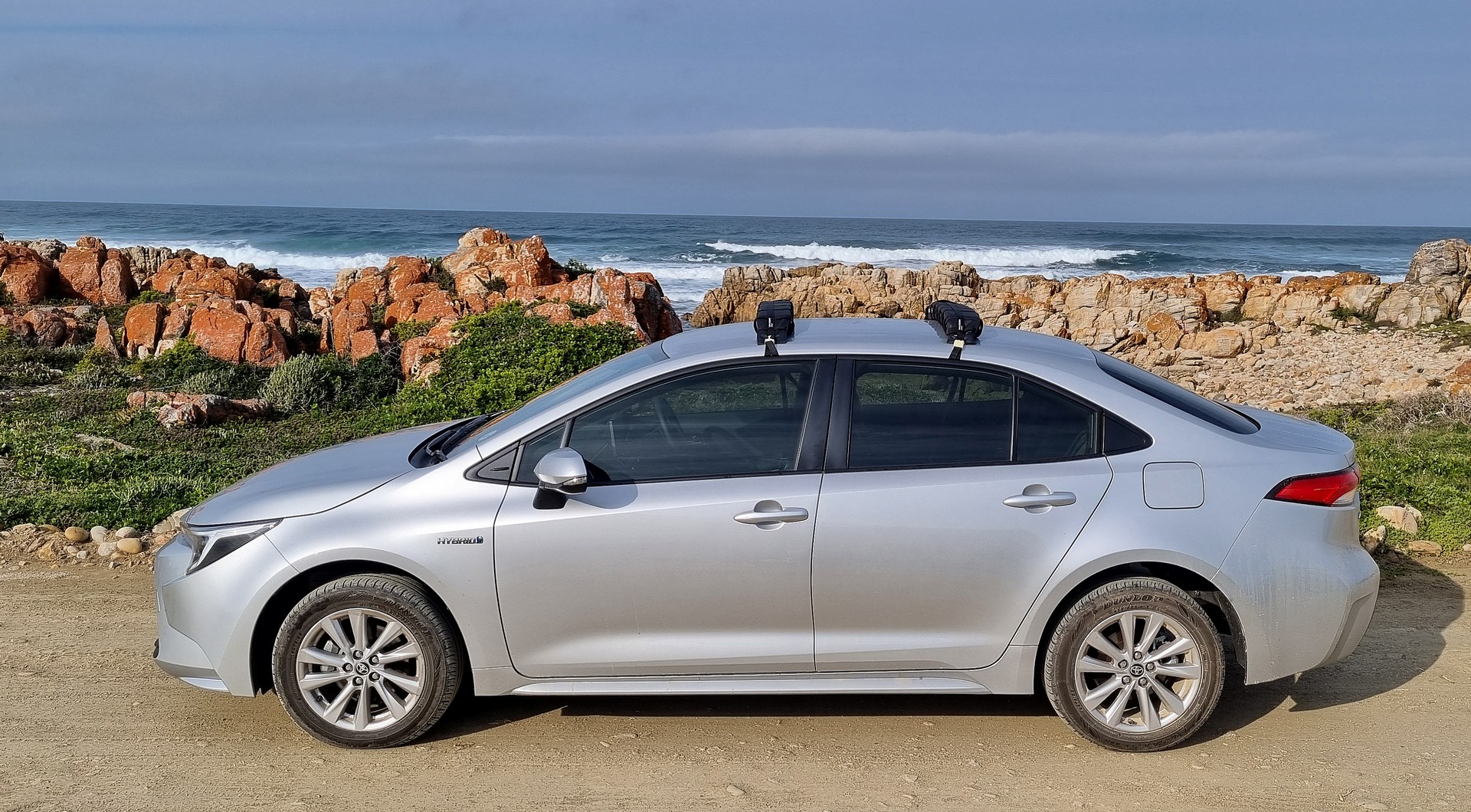
Toyota Corolla continues to reign supreme as South Africa’s reliability champion. This Japanese stalwart has earned its reputation through decades of consistent performance on local roads.
The Corolla’s combination of fuel efficiency, low maintenance costs, and excellent resale value makes it a favourite amongst both first-time buyers and seasoned motorists. Its proven track record in South African conditions, from the sweltering heat of the Northern Cape to the humidity of KwaZulu-Natal, demonstrates why it remains a household name.
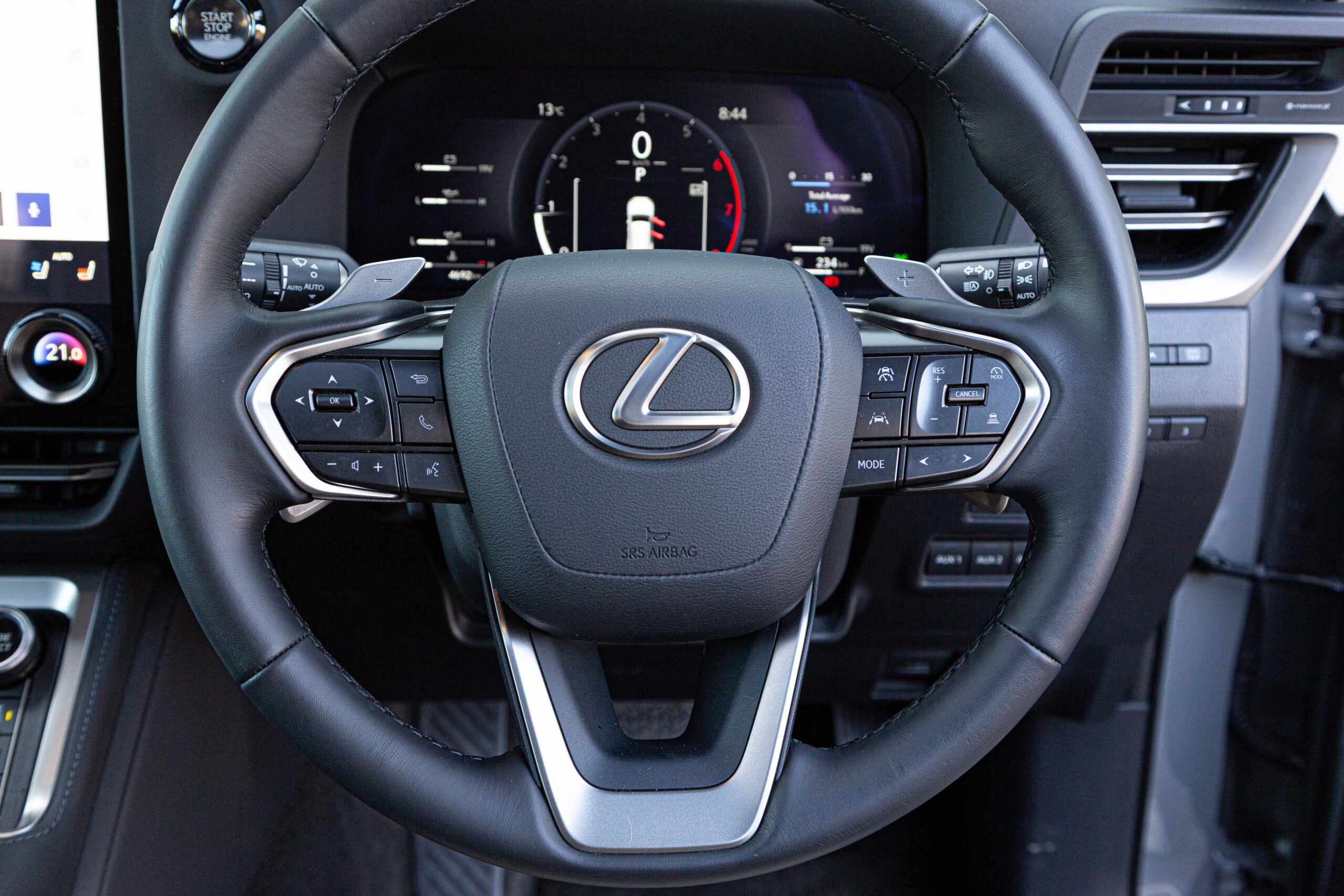
Lexus vehicles, notably the ES, NX, RX, and UX models, represent the pinnacle of reliability for those seeking premium motoring. With consistently high reliability ratings and exceptional build quality, Lexus has established itself as the go-to choice for discerning South African drivers who refuse to compromise on dependability. The brand’s commitment to quality engineering translates into fewer garage visits and more time enjoying the open road.
The Toyota Vitz offers exceptional value for budget-conscious buyers without sacrificing reliability. This compact marvel proves that you don’t need to spend a fortune to own one of the most reliable cars in South Africa. Its spacious interior, impressive fuel economy, and Toyota’s renowned build quality make it perfect for young professionals and growing families navigating our urban centres.
Suzuki Swift delivers exceptional reliability. This popular hatchback has built a strong reputation amongst South African drivers for its dependability and low running costs. The Swift’s nimble handling, impressive fuel economy, and Suzuki’s commitment to durability make it an excellent choice for both city driving and longer journeys across the country.
The Volkswagen Polo is proven. It combines German engineering with local assembly expertise. This popular hatchback has consistently ranked among South Africa’s best-selling vehicles, a testament to its reliability and suitability for our driving conditions.
Making the Right Choice
When searching for the most reliable cars in South Africa, consider your specific needs and driving patterns. Urban drivers might prioritise fuel efficiency and compact dimensions, whilst those covering longer distances should focus on highway comfort and service network accessibility.
It’s worth noting that reliability extends beyond the vehicle itself; consider the availability of spare parts, service centres, and qualified technicians in your area. The most reliable cars in South Africa typically offer comprehensive dealer networks and readily available components, ensuring you’re never stranded when maintenance is required.
The Most Reliable Cars in South Africa should matter to you
Investing in a reliable vehicle is investing in peace of mind. Whether you choose the proven dependability of a Toyota Corolla, the premium reliability of a Lexus, or the practical excellence of a Suzuki Swift, selecting from amongst the most dependable options available will serve you well for years to come.
Remember, in South Africa’s challenging motoring environment, reliability isn’t just about avoiding breakdowns; it’s about ensuring your vehicle becomes a trusted companion on every journey, from daily commutes to memorable family adventures across our beautiful country.
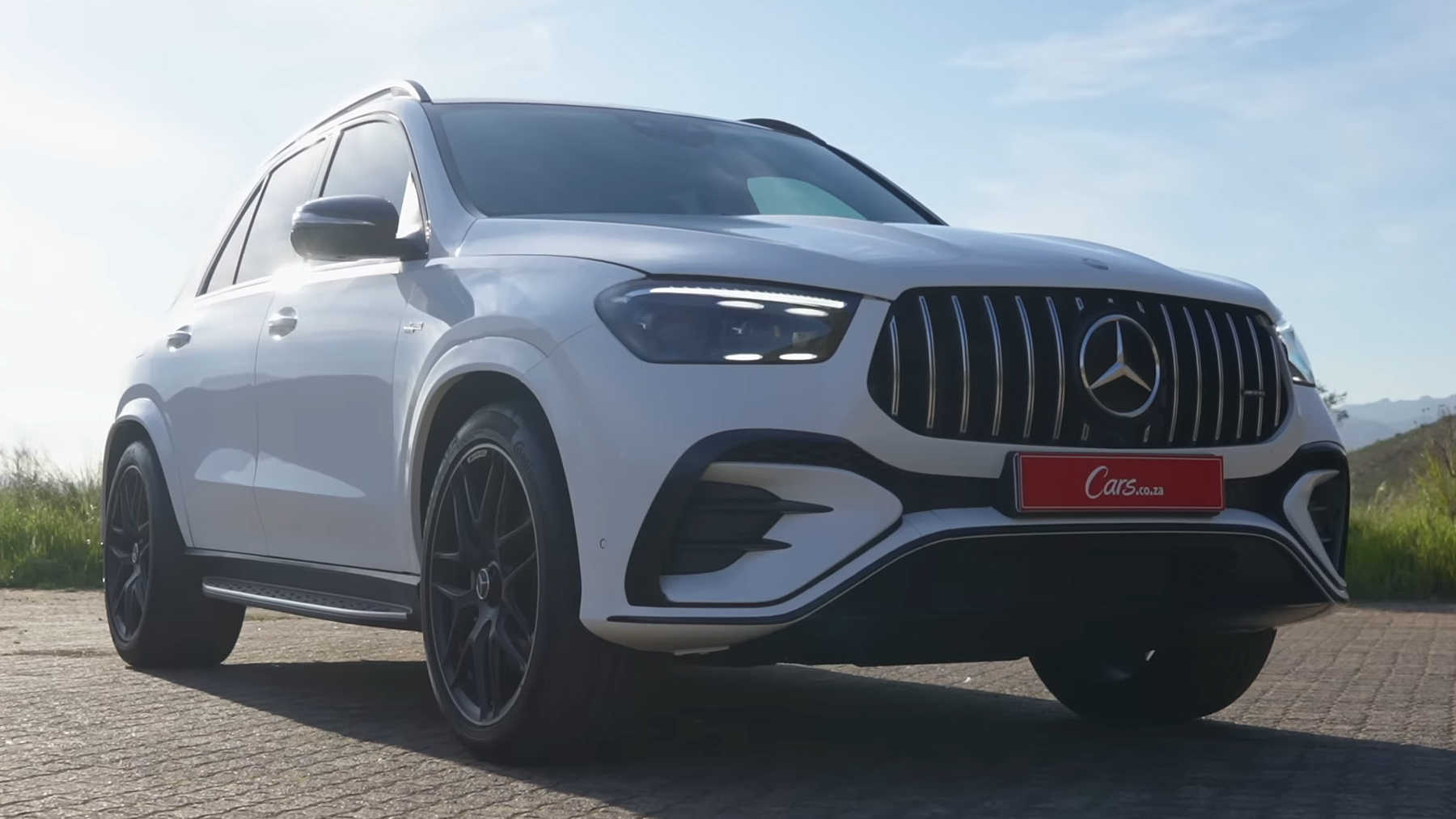
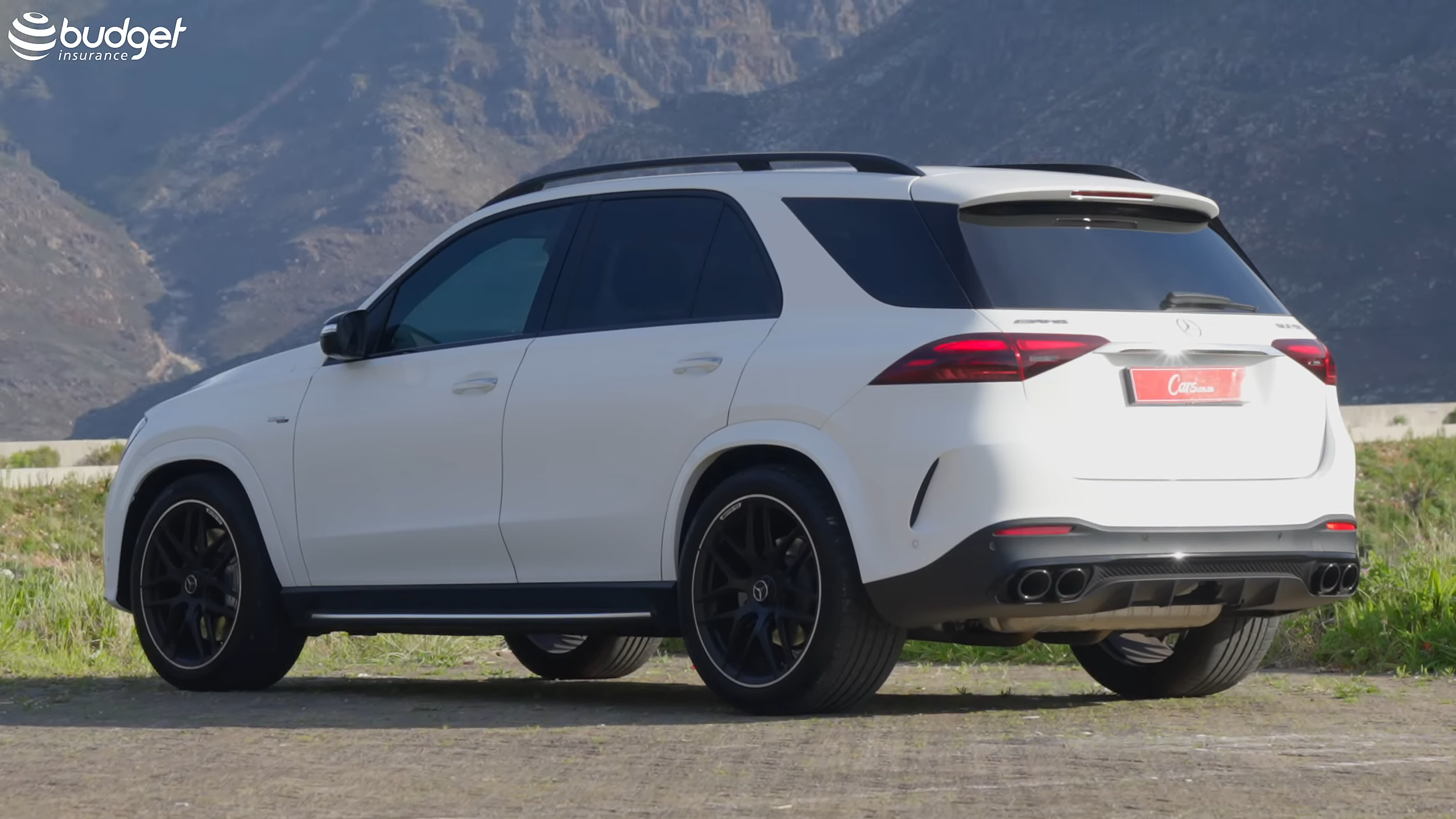
GLE 53 review: The sweet spot in Mercedes-AMG SUV line-up?
The price of high-performance SUVs has reached dizzying heights. David Taylor reviews the facelifted Mercedes-AMG GLE 53 4Matic+ to find out whether it offers the perfect blend of performance, luxury, and value in the hyper-SUV segment.
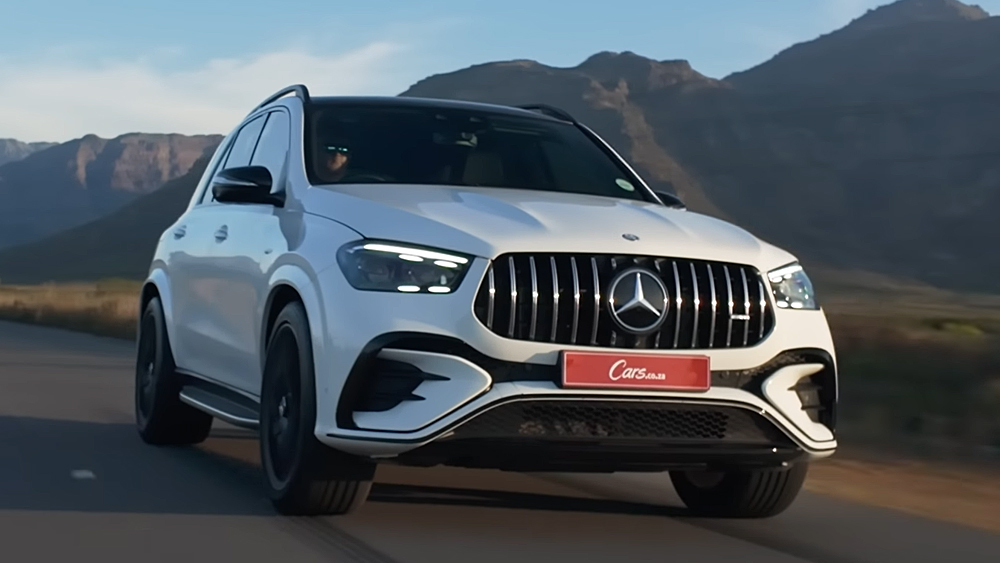
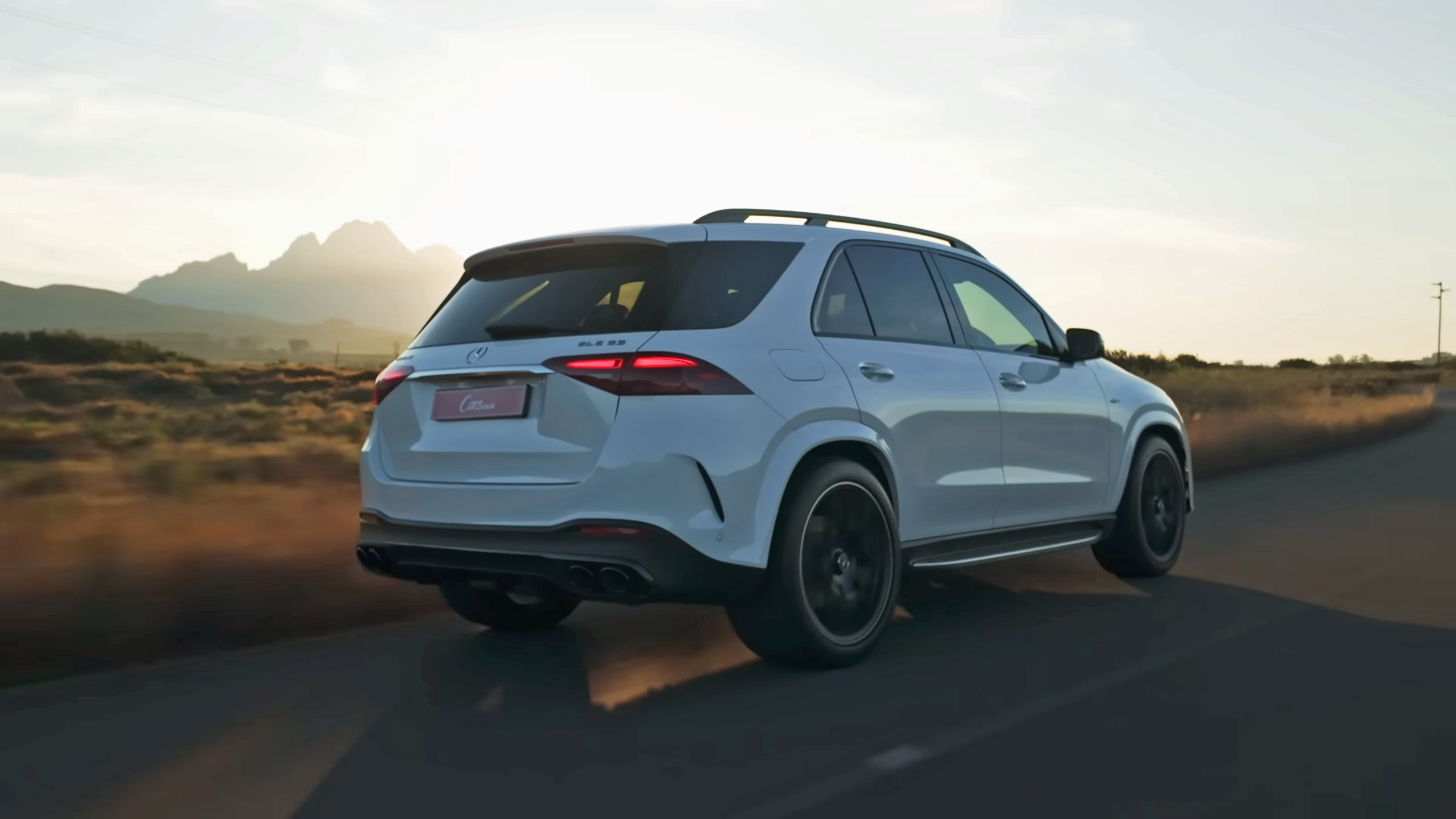
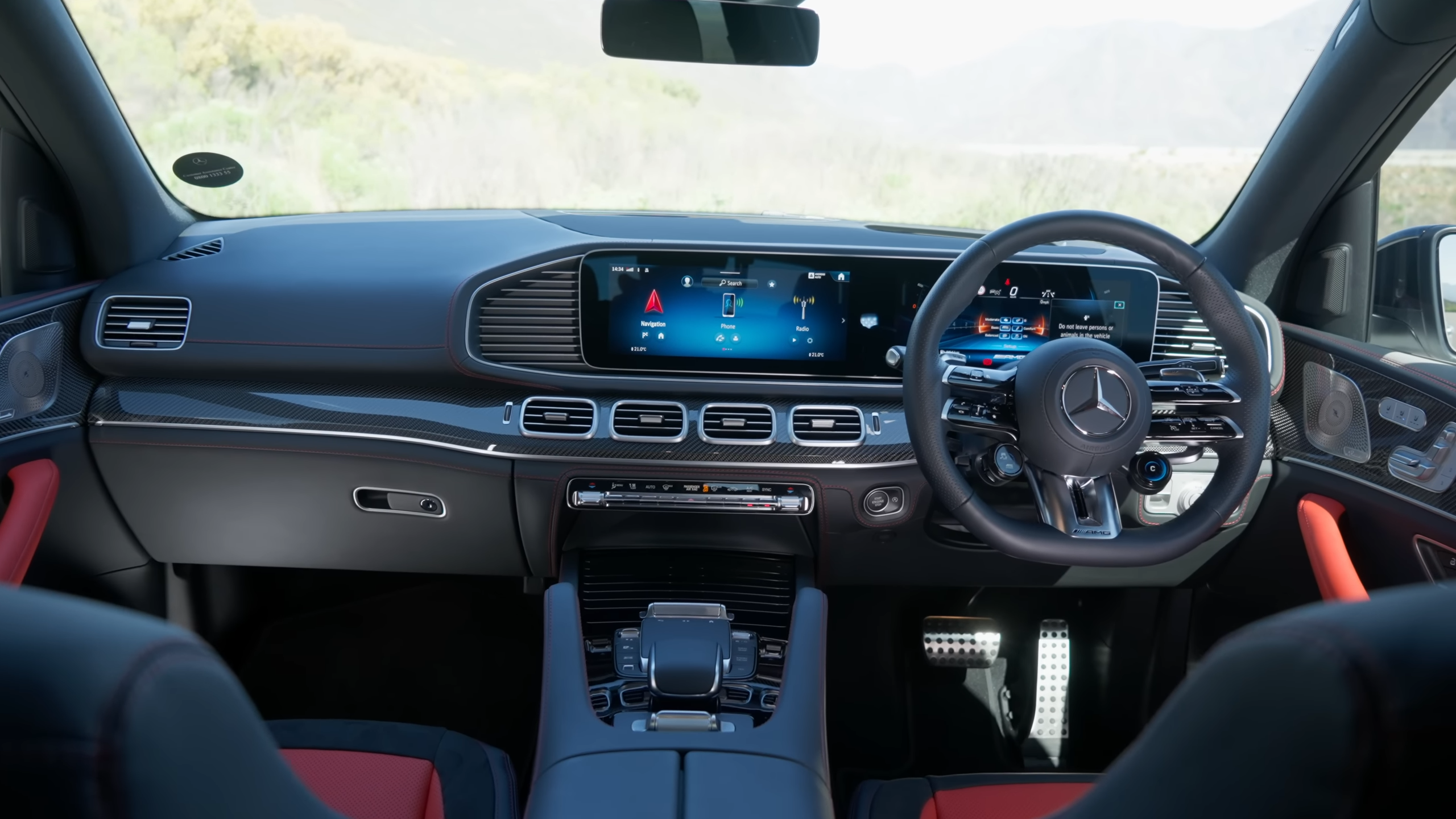
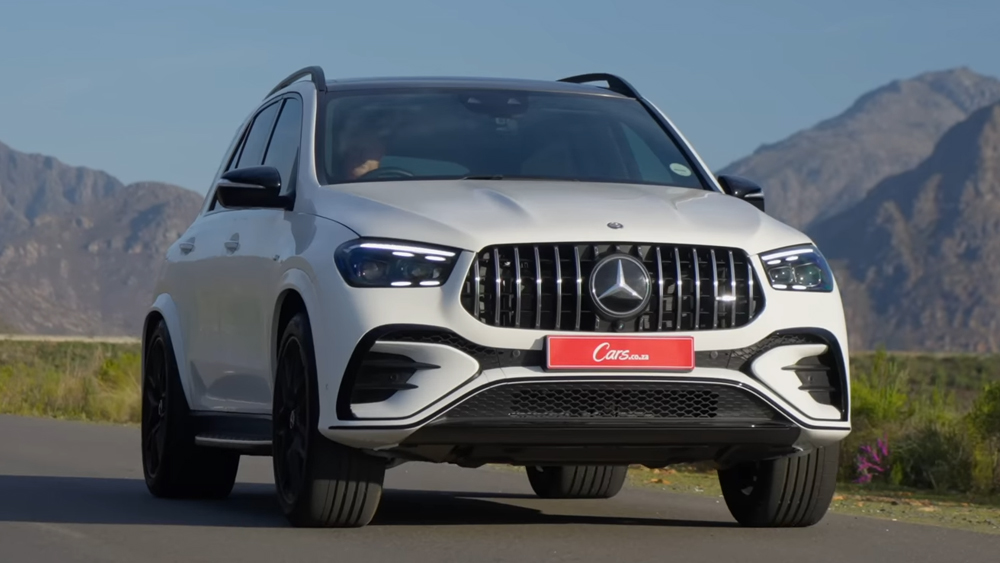
Now that its big brother, the 4.0-litre twin-turbo V8-powered Mercedes-AMG GLE 63 S 4Matic+, costs almost R4 million, the Mercedes-AMG GLE 53 4Matic+, with its more accessible price point of R2 450 815 (November 2025), represents an intriguing alternative for the performance-minded luxury buyer.
The central question of the review is simple: does the R1.5-million saving over the range-topper justify the claimed 1.1-second difference in the 0–100 kph sprint time between the GLE 53 and GLE 63 S, or has Affalterbach-based Mercedes-AMG hit the ultimate “sweet spot” with the 53 badge?
Which models rival the Mercedes-AMG GLE 53?
While the Mercedes-AMG GLE 53 aims to strike a balance, it operates in a highly competitive arena. The segment is packed with formidable rivals, many of which carry a V8 engine.
The challenge for the Mercedes-AMG GLE 53 is not just outperforming these rivals, but offering a compelling enough package to steer buyers away from the lure of the “8-cylinder symphony”.
The Engine: A Sophisticated Inline-6
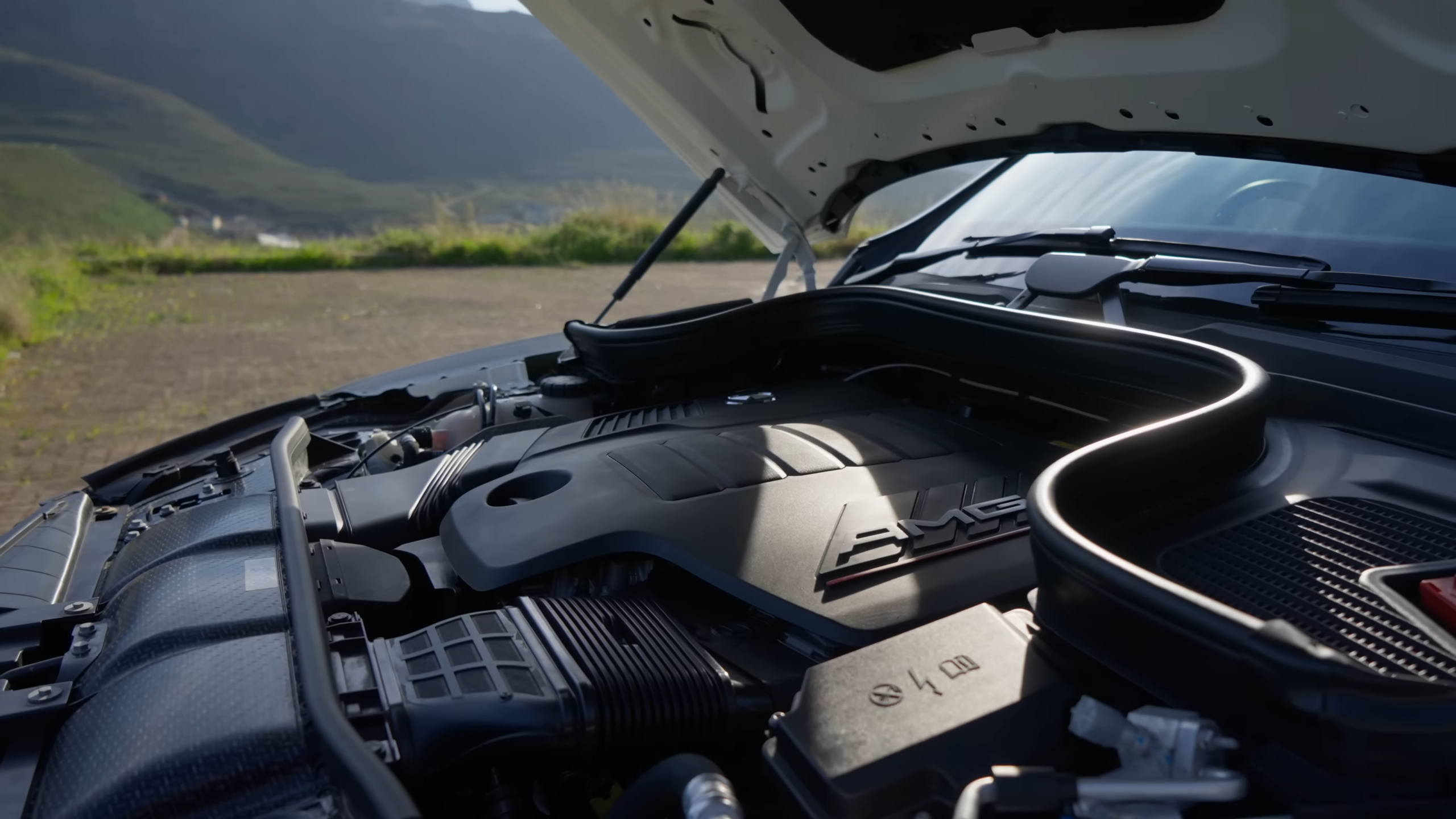
Under the bonnet of the GLE 53 is not a V8, but a sophisticated 3.0-litre inline-6 turbopetrol engine. In its latest iteration, the motor has been tweaked by AMG to deliver a robust 320 kW and 560 Nm of torque – a 40 Nm gain over its predecessor, thanks to a slightly larger turbocharger and updated software.
The power is channelled to all 4 of the GLE 53’s wheels via a slick-shifting 9-speed auto transmission.
Crucially, the power unit utilises a 48V mild-hybrid system. An integrated starter generator (ISG), which is mounted on the gearbox, acts as an electric motor to assist the petrol engine and has a 2-fold benefit:
Turbo-lag Reduction: It electrically spools up the turbo when the driver steps on the throttle, effectively dialling out turbo lag for instantaneous response.
Efficiency: It harvests energy and provides small bursts of assistance, improving overall efficiency.
Mercedes-AMG claims a 0–100 kph time of 5.0 seconds for the GLE 53. However, when David put the test unit through its paces, our equipment showed that the ‘Benz dispatched the sprint in 4.82 seconds!
Comfort & Handling Balance
Performance SUVs face the constant battle of physics: how do you make a high-riding, 2.2-tonne family vehicle feel like (an albeit sizable) sportscar? To that end, the GLE 53 utilises an adaptive air suspension, which aims to provide both a comfortable ride for commuting and a firm damping for spirited driving.
While the GLE 53 performs strongly – and delivers plenty of grin-inducing moments – David wonders whether the ‘Benz’s body control and steering precision are as clinical as those of the X5 or Cayenne.
He further notes that the Mercedes-AMG GLE 53 may offer a deliberate balance, perhaps leaving the final degree of sharpness for those willing to fork out extra for its GLE 63 S sibling. The key takeaway here is the impressive blend of daily usability and the capability to attack a corner when required.
Interior Space & Standard Features
Beyond the performance metrics, the Mercedes-AMG GLE 53 must still function as a practical family vehicle. In that regard, the Affalterbach-based division’s “entry” GLE variant is every bit a spacious and genuinely comfortable 5-seater Premium SUV, offering ample room for adult passengers in the rear.
David also points out where the 3-Pointed Star has improved the value proposition with the facelifted Mercedes-AMG GLE 53. The previous tendency to nickel-and-dime customers with options has been somewhat mitigated, with numerous high-end features now included as standard. These include:
A high-end Burmester audio system
Panoramic sunroof
360-degree surround-view camera
Heated front seats
The review takes time to explore the vehicle’s highly lauded MBUX infotainment system, which continues to set the benchmark for interior technology and user interface design in the segment.
The Mercedes-AMG GLE 53 presents a strong case for itself. It has a brilliant, characterful engine, excellent tech, and a wealth of standard features that make it a compelling proposition at its price point.
The question remains: is the sophisticated mild-hybrid 3.0-litre inline-6 turbopetrol engine enough to counter the emotional pull of the V8s offered by its main competitors, and does the GLE 53 successfully navigate the narrow “sweet spot” between the expensive range-topper and the established rivals?
Watch the full video review to find out our definitive verdict on the Mercedes-AMG GLE 53!
Frequently Asked Questions (FAQ)
Q: What is the current price of the Mercedes-AMG GLE 53 4Matic+?
A: The accessible price point for the Mercedes-AMG GLE 53 4Matic+ is R2 450 815 (as per November 2025 pricing).
Q: What was the tested 0–100 kph sprint time for the Mercedes-AMG GLE 53?
A: While Mercedes-AMG claims 5.0 seconds, David Taylor’s test equipment showed the GLE 53 dispatched the 0–100 kph sprint in 4.82 seconds.
Q: What is the main benefit of the 48V mild-hybrid system in the GLE 53?
A: The system’s integrated starter generator (ISG) helps reduce turbo lag by electrically spooling up the turbo when the driver steps on the throttle, providing instantaneous response.
All the Chinese car brands in SA (and those on their way)
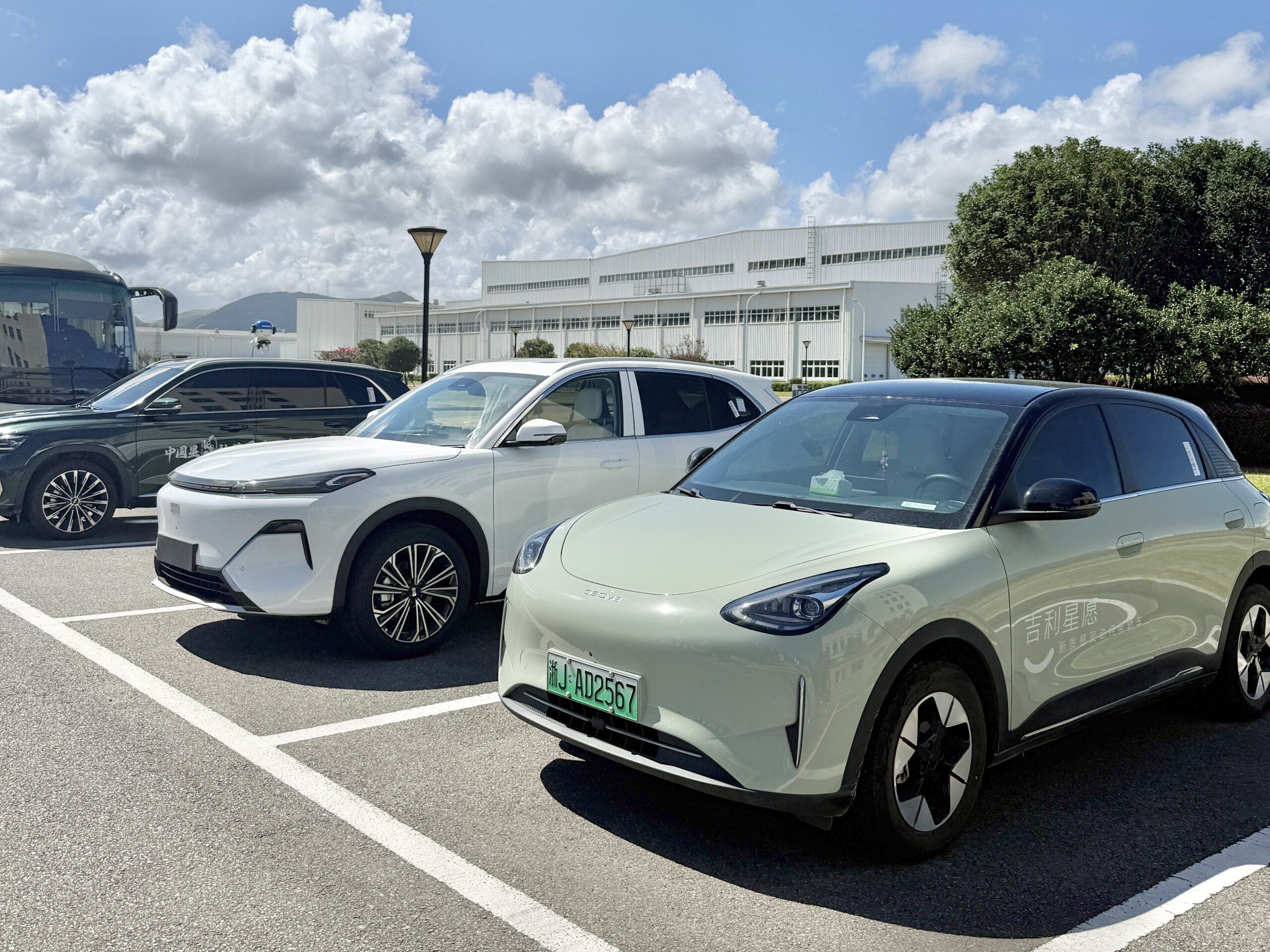
Chinese car brands have taken South Africa by storm due to a powerful combination of affordability, improving quality and shifting consumer perceptions. We’ve got the list of all Chinese car brands currently available in South Africa.
Over the past decade, manufacturers of Chinese car brands have rapidly narrowed the gap in design, technology, and reliability that once separated them from more established American, Korean, European and Japanese brands. By offering all the tech and features at competitive prices, these automakers have found fertile ground in South Africa.
Another key factor driving the rise of Chinese brands is their prompt response to market trends, particularly the growing demand for SUVs and double cab bakkies.
Chinese car brands like Chery and GWM are not only introducing compelling combustion-engine vehicles. They are also leading the charge with hybrid and fully electric models at more accessible price points than traditional players.
BAIC (Beijing Automotive Industry Holding Co.)
BAIC offers a selection of SUVs and is expanding its line-up with the upcoming BJ30, a compact off-road SUV expected to arrive in Q4 2025.
BYD (Build Your Dreams)
BYD has introduced the Atto 3 and Dolphin EVs to the South African market. The Atto 3 is a compact SUV, while the Dolphin is a hatchback. In Q1 2025, BYD plans to launch the Shark, a plug-in hybrid electric bakkie combining a 1.5-litre turbo-petrol engine with electric motors, offering impressive performance.
Chery
Chery has made significant strides with its Tiggo series, including the Tiggo 4 Pro, Tiggo 7 Pro, and Tiggo 8 Pro. Chery is also expanding its portfolio with sub-brands, such as Omoda and Jaecoo. Omoda has introduced the C5 crossover and plans to launch the C7 and C9 PHEV. Jaecoo has released the J7 luxury SUV and plans to introduce the J5, J6 (an all-electric model), and J8 models.
Foton
Foton has re-entered the South African market with the Tunland G7 double cab bakkie. The brand also plans to introduce several light and medium commercial vehicles aimed at the business sector.
GAC Motors
GAC has introduced the GS3 Emzoom and Emkoo SUVs to the South African market. The Emkoo is a larger SUV offering modern design and features.
GWM (Great Wall Motors)
GWM offers a diverse range of vehicles, including the P-Series bakkie, Tank 300 and Tank 500 SUVs, and the Ora 03 electric hatchback. The Ora 03 is noted for being one of the more affordable EVs in the country.
Haval
A subsidiary of GWM, Haval has established itself with models such as the H6, H6 GT, and Jolion. These SUVs are known for their value proposition and modern features.
JAC Motors
JAC offers a range of bakkies, including the T6, T8, and the flagship T9 4×4. These models cater to both commercial and private users seeking reliable utility vehicles.
Jaecoo
As a sub-brand of Chery, Jaecoo focuses on premium SUVs. The J7 has been launched, and upcoming models include the J5, J6 (electric), and J8, offering a blend of luxury and performance.
Jetour
Jetour, another Chery sub-brand, has entered the market with the Dashing and X70 Plus SUVs. The brand plans to introduce additional models in the coming years.
LDV (Leyland DAF Vans)
LDV has launched the T60 double cab bakkie in South Africa and plans to expand its line-up with an SUV, MPV, and panel van in the near future.
Maxus
Maxus, under SAIC Motor, offers the T90 EV, South Africa’s first battery-electric double-cab bakkie, catering to the growing demand for electric commercial vehicles.
Omoda
Omoda, a Chery sub-brand, has introduced the C5 crossover and plans to launch the C7 and C9 PHEV models, focusing on stylish design and advanced technology.
DFSK South Africa
This Chinese car brand offers a diverse line-up catering to business needs, including the KO1S bakkie, C35 panel van, and electric models EC35 and EC31.
Chinese car brands entering or relaunching in South Africa
Changan
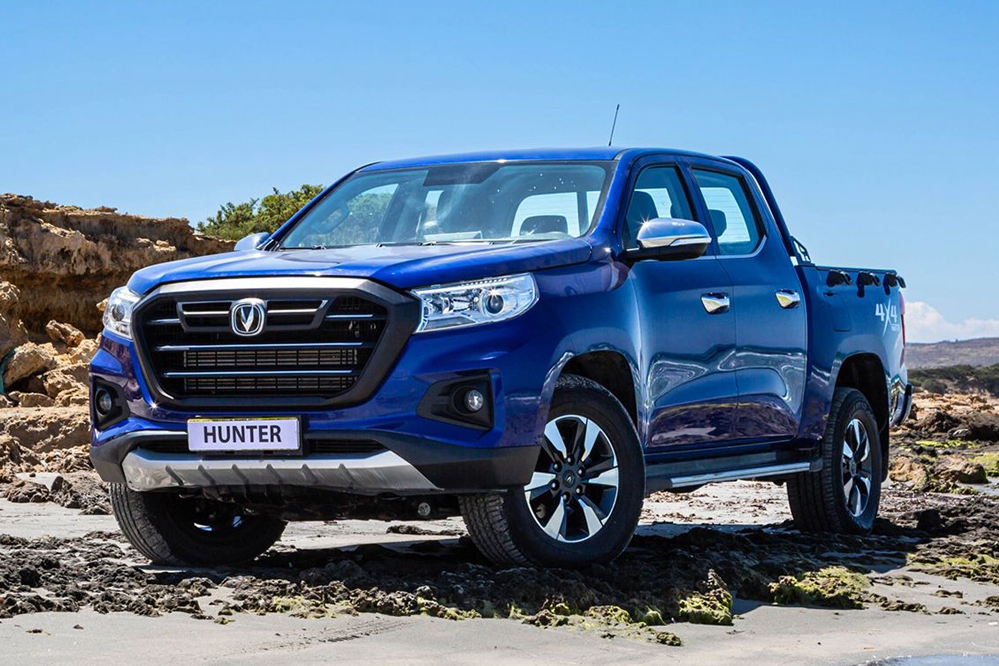
Changan, in partnership with Saudi Arabia’s Jameel Motors, plans to enter the South African market in Q4 2025. The initial line-up will include the CS75 Pro SUV, Hunter pickup truck, Alsvin sedan, and the Deepal S07 electric SUV.
Dongfeng
Dongfeng is set to launch the all-electric Box hatchback in early 2025, marking its entry into the South African passenger car market. The Box offers a 430 km electric range and is expected to be one of the country’s most affordable EVs.
Geely
Geely has announced plans to return to the South African market after a nearly decade-long absence. The company aims to introduce premium vehicles and expand its global network, with South Africa being a key market in its strategy.
Leapmotor
Leapmotor, backed by Stellantis, plans to enter the South African market in September 2025 with the C10 SUV, a full-electric vehicle offering a range of approximately 420 km.
Meet the limited-run Mercedes-Maybach V12 Edition, an opulent S-Class celebration (complete with 24-carat gold trim) of the brand’s long tradition of 12-cylinder engines…
Just 50 units of the V12 Edition will be built
Celebrates nearly 100 years of V12 engines
24-carat gold trim included, inside and out
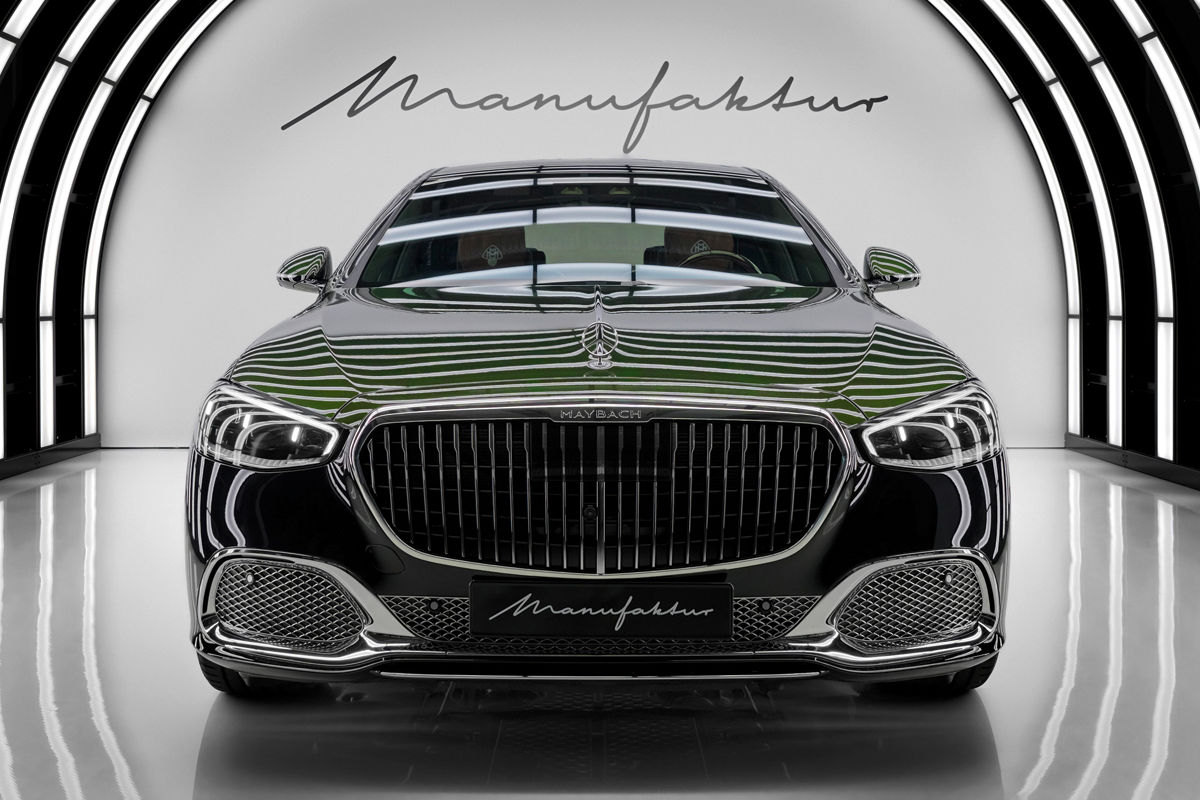
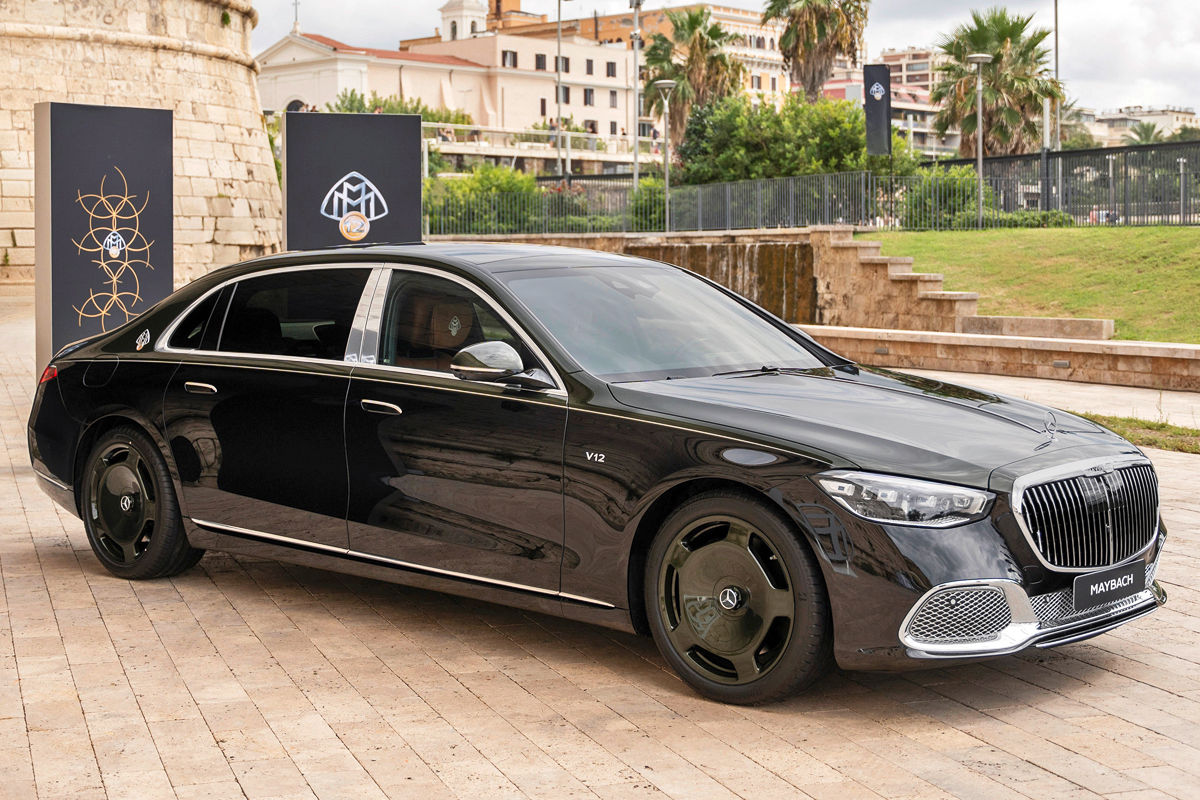
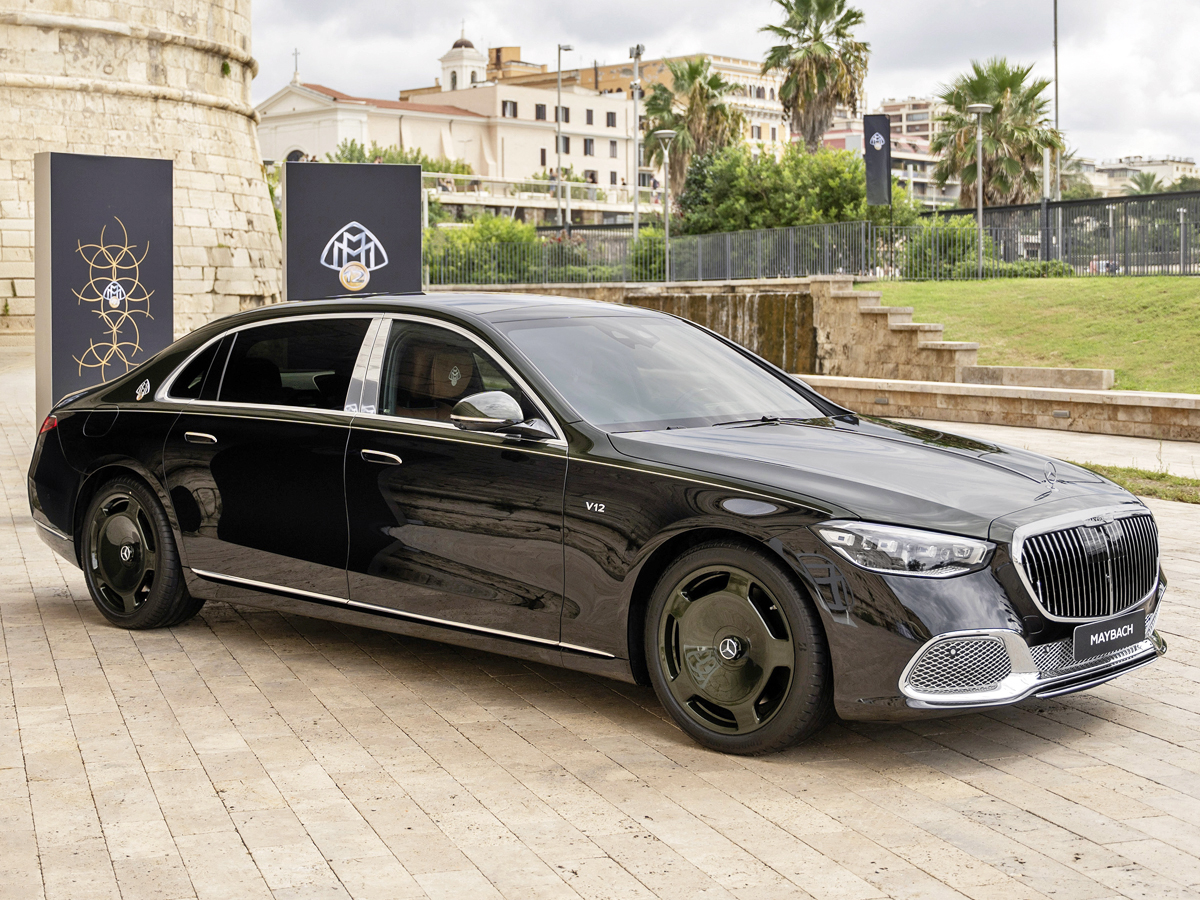
Downsizing be damned? Mercedes-Benz has revealed the Mercedes-Maybach V12 Edition, a limited-production version of the S680 limousine conceived to celebrate the ultra-luxury sub-brand’s long history – dating back nearly a century – of 12-cylinder engines.
Set to be available in unspecified “select markets”, just 50 examples of this special S-Class will be produced. The V12 Edition offers what the German automaker calls “bespoke design elements” through its “Manufaktur” programme.
Mercedes‑Benz says the Maybach V12 Edition is an “almost fully equipped Mercedes‑Maybach S680”, with equipment highlights including electrically operated comfort rear doors, active road-noise compensation, rear-axle steering, active suspension and up to 5 large screens in the cabin.
Like the standard (for lack of a better term) S680, this new limited-run derivative employs a turbocharged 6.0-litre V12 petrol engine that delivers 450 kW and 900 Nm to all 4 corners via a 9-speed automatic transmission. The 0-100 kph sprint takes a claimed 4.5 seconds, while top speed is electronically limited to 250 kph.
The Mercedes‑Maybach V12 Edition is set apart by its 2-tone exterior paint finish – olive metallic on the upper body and obsidian black metallic on the lower – including a contrasting silver metallic pinstripe. The brand claims the application of this particular paint finish takes “up to 10 working days”, which is twice as long as Maybach’s usual signature 2-tone configuration.
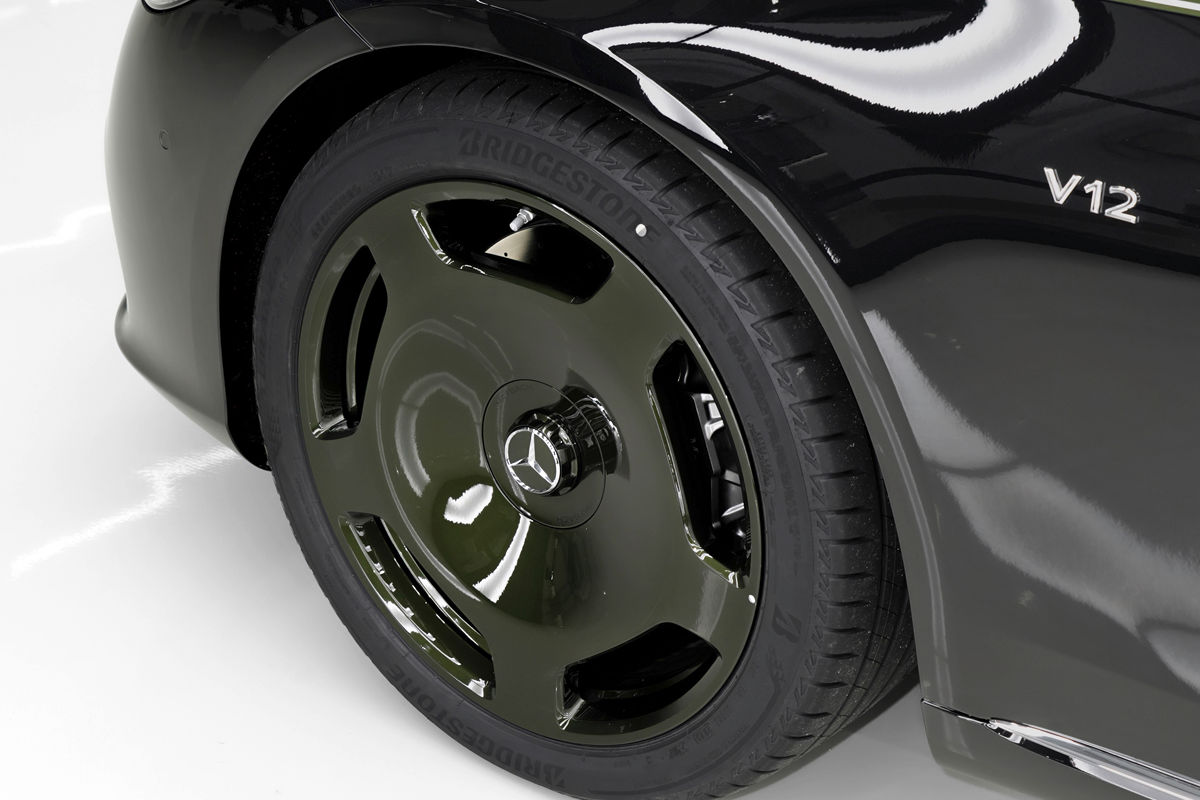
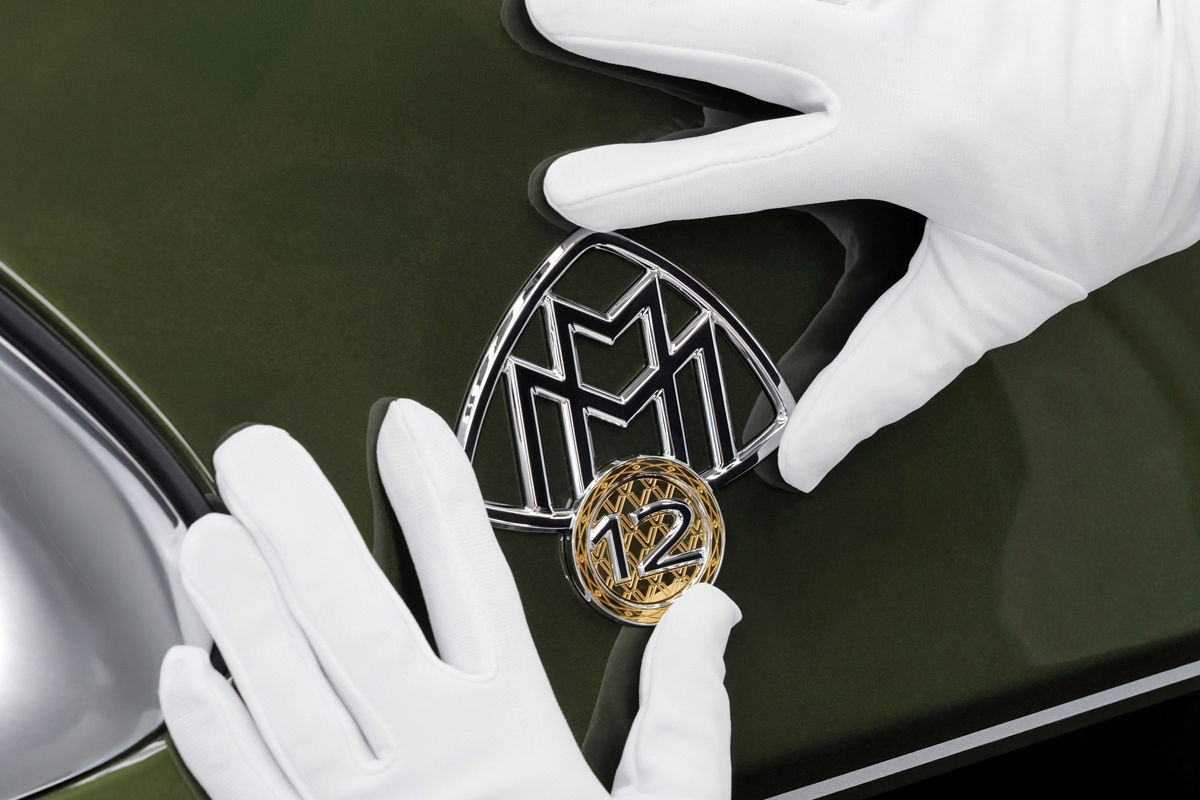
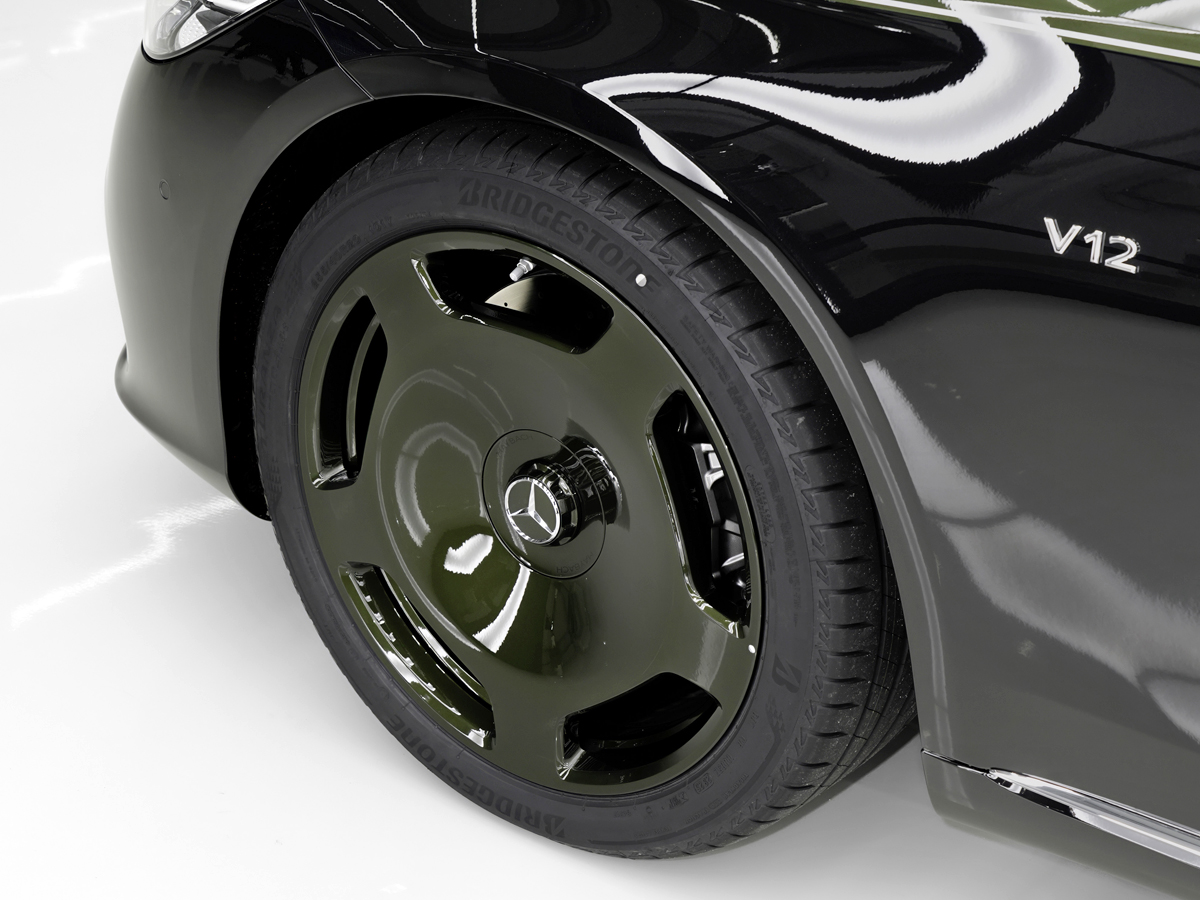
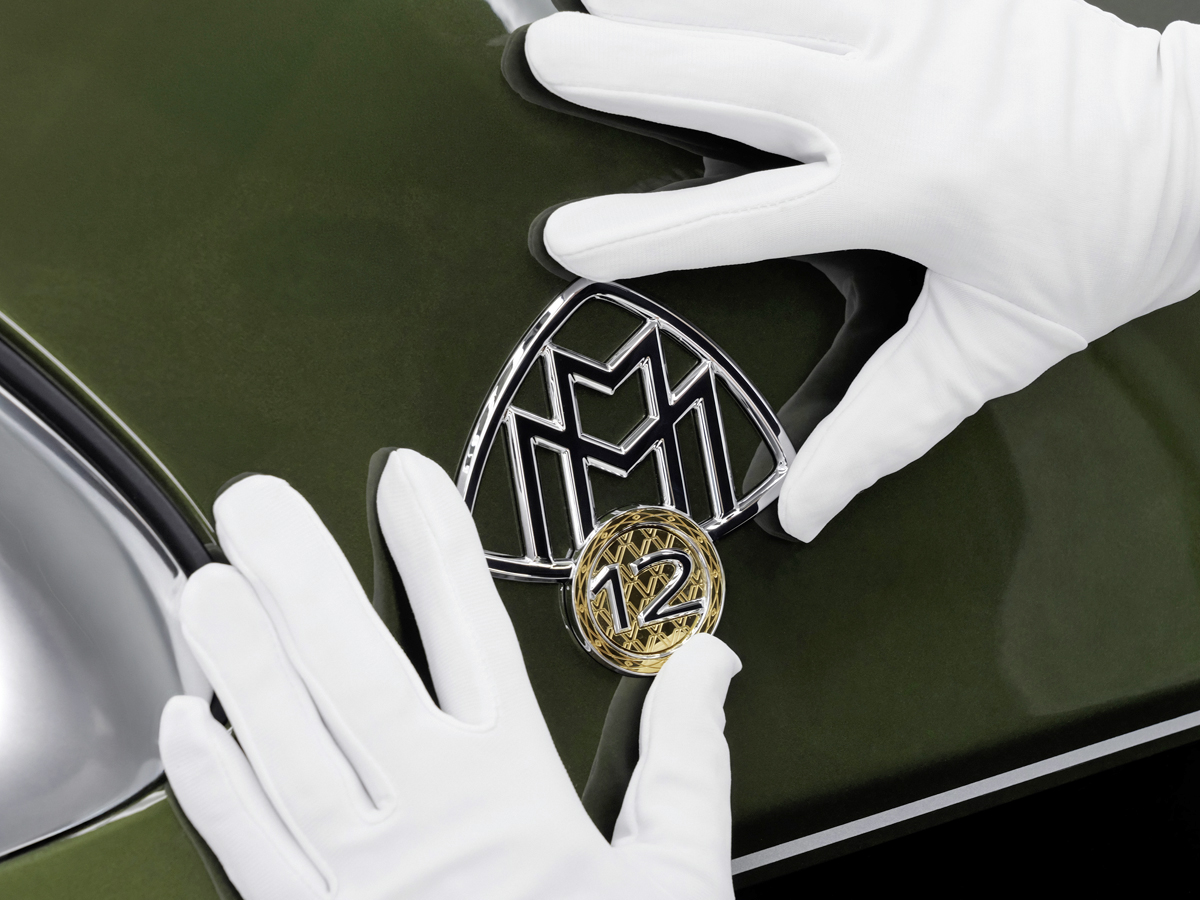
The limited-edition variant rides on forged wheels likewise finished in olive metallic, while the edition-specific Maybach emblem on the C-pillar is complemented by a chrome and gold medal featuring a prominent “12”. This 24-carat gold medal is adorned with a diamond engraving in a 12-part ring division, while the medal inlay (likewise fashioned from 24-carat gold) features a fine V-pattern engraving.
Meanwhile, the Nappa leather interior comes in saddle brown, paired with high-gloss brown burr walnut wood trim that extends to the handcrafted steering wheel. The roof liner is finished in diamond-quilted saddle brown, while special-edition embroidery and a “1 of 50” badge in the centre console are further touches.
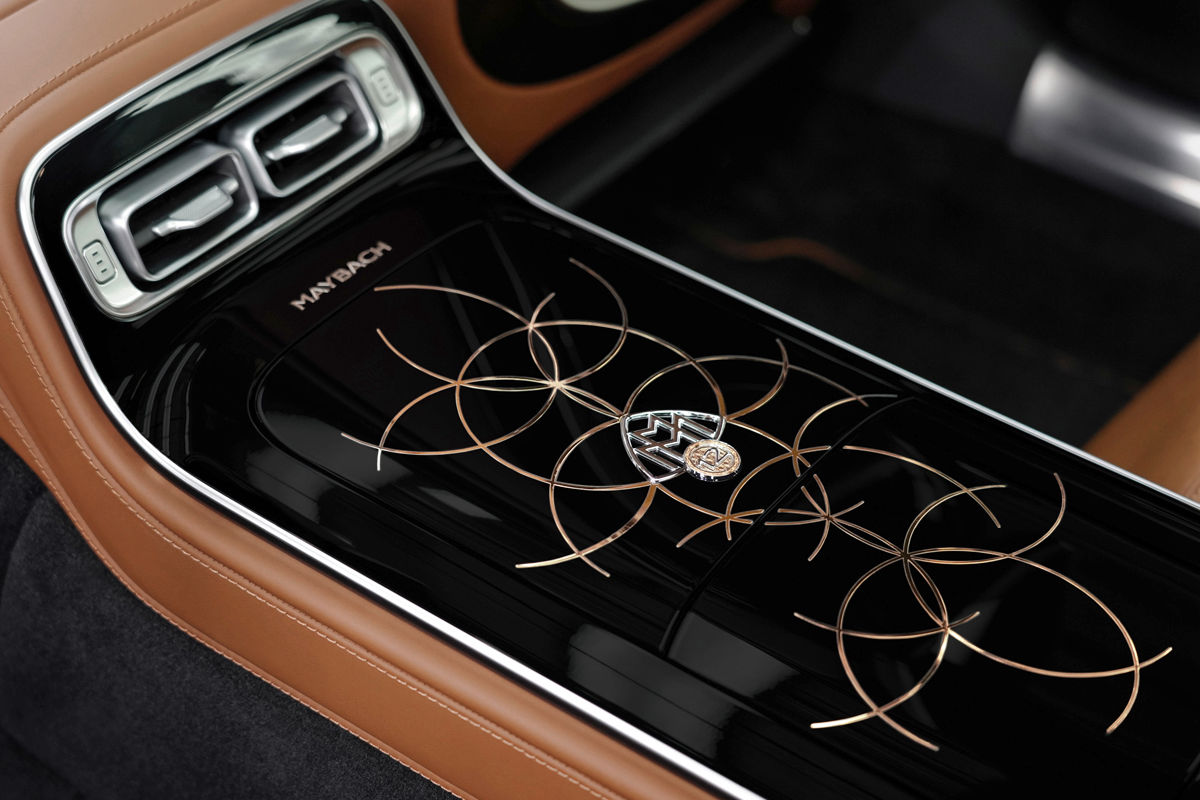
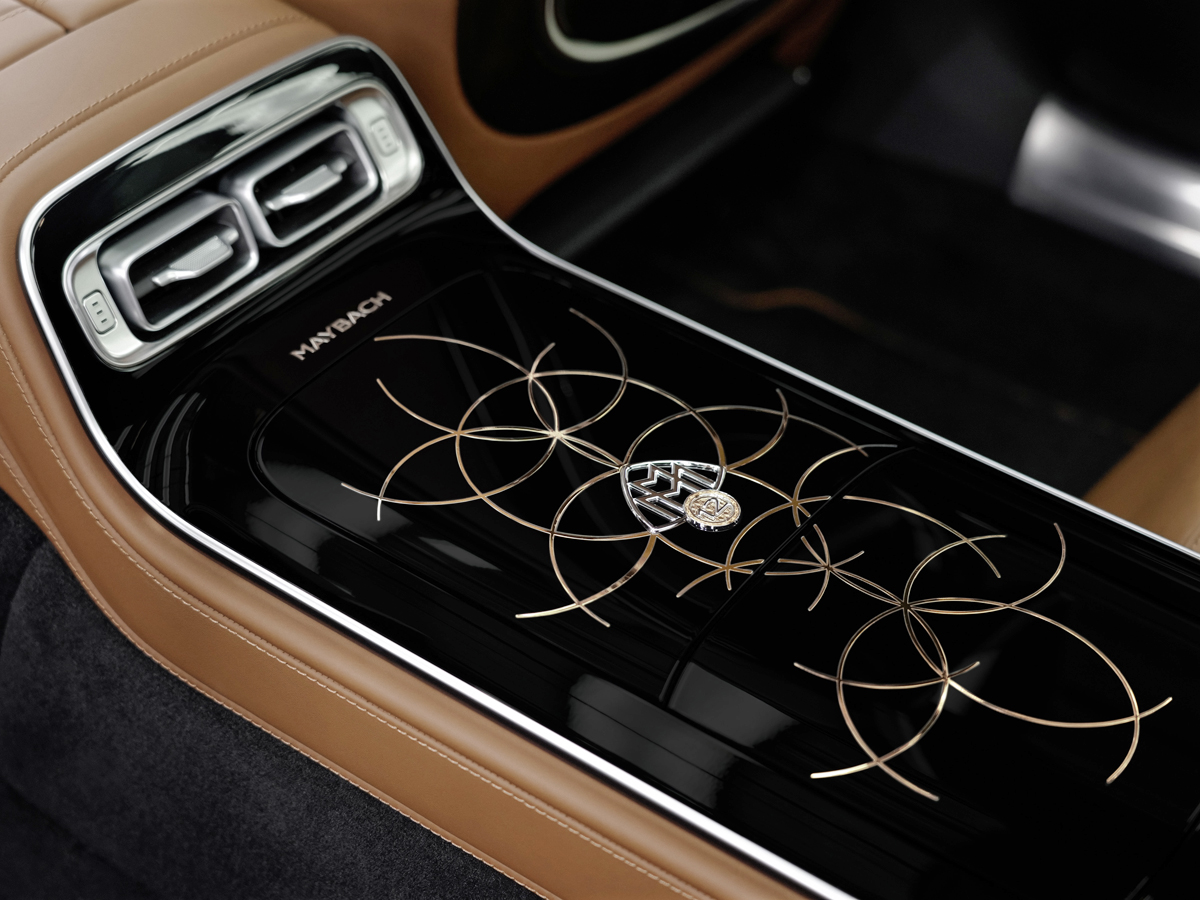
The rear centre console features the Maybach emblem and a commemorative medal framed by 12 golden circles. This likewise handcrafted element takes up to 7 working days to complete, according to Mercedes-Benz.
Each vehicle also includes bespoke accessories such as Robbe & Berking silver-plated champagne flutes (with edition-specific engraving), a luggage-compartment mat with edging in saddle brown, a handcrafted key giftbox and an edition-specific key ring.
“The Mercedes‑Maybach V12 Edition is a limited release of just 50 cars, showcasing the brand’s legacy. With roots tracing back to the early 20th century Maybach Zeppelin models, this edition celebrates our iconic V12 engine. It offers bespoke design through the Manufaktur programme, reflecting a tradition of combining advanced technology and exclusive style,” says Daniel Lescow, Head of Mercedes-Maybach at Mercedes-Benz Group AG.
Frequently Asked Questions
Q: What is the Mercedes-Maybach V12 Edition?
A: The Mercedes-Maybach V12 Edition is a limited-production version of the S680 limousine, created to celebrate the brand’s long history of 12-cylinder engines. Only 50 units will be built, each featuring bespoke design elements including 24-carat gold trim, a unique 2-tone paint finish and a luxurious Nappa leather interior.
Q: How many units of the Mercedes-Maybach V12 Edition will be produced?
A: Only 50 examples will be produced globally, making it a highly exclusive and limited-run vehicle.
Q: What are the unique features of the Mercedes-Maybach V12 Edition?
A: Key features of the Mercedes-Maybach V12 Edition include 24-carat gold trim on the exterior and interior, a special 2-tone olive metallic and obsidian black metallic paint finish, edition-specific forged wheels and a Nappa leather interior in saddle brown. It also comes with bespoke accessories like silver-plated champagne flutes and a handcrafted key gift box.
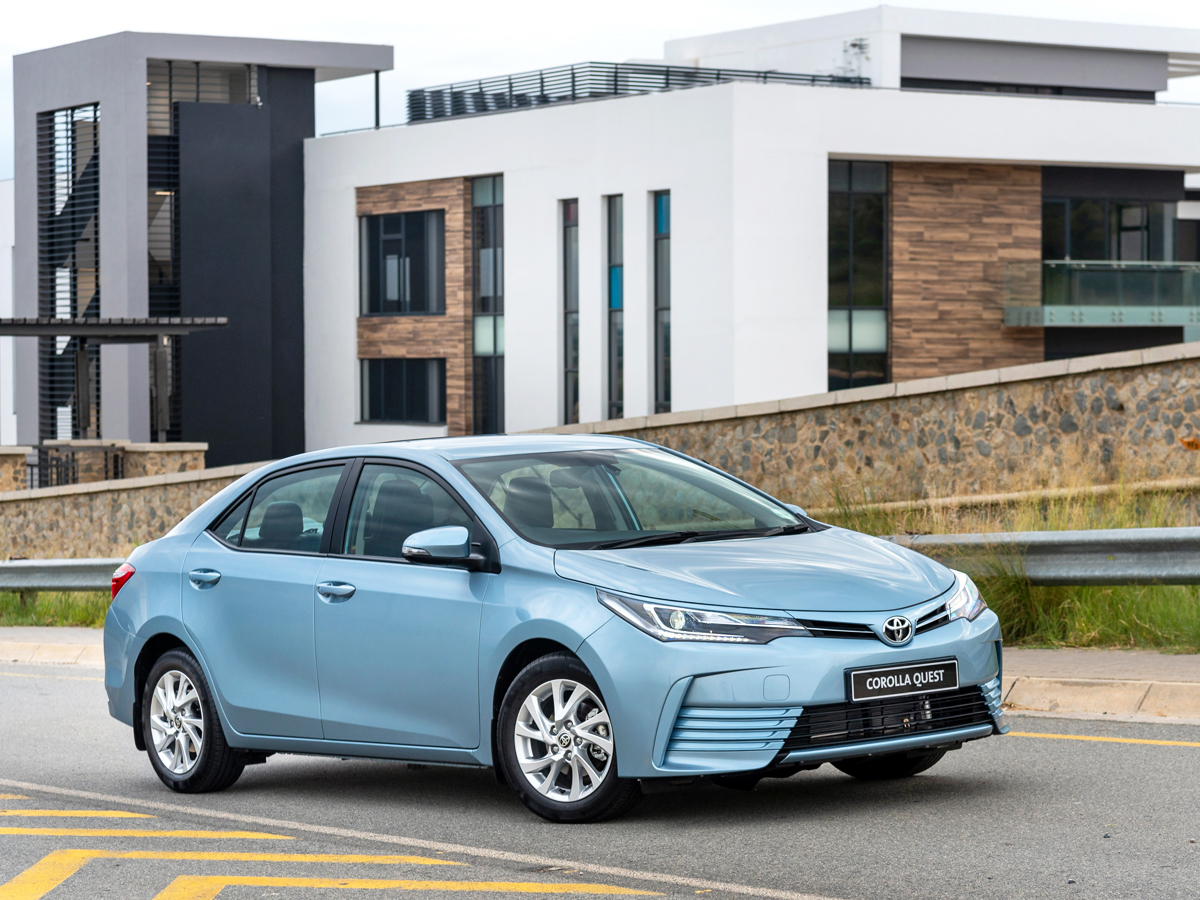
Looking for a value-for-money used compact sedan with proven underpinnings? Here’s what you should know when shopping for a 2nd-gen Toyota Corolla Quest…
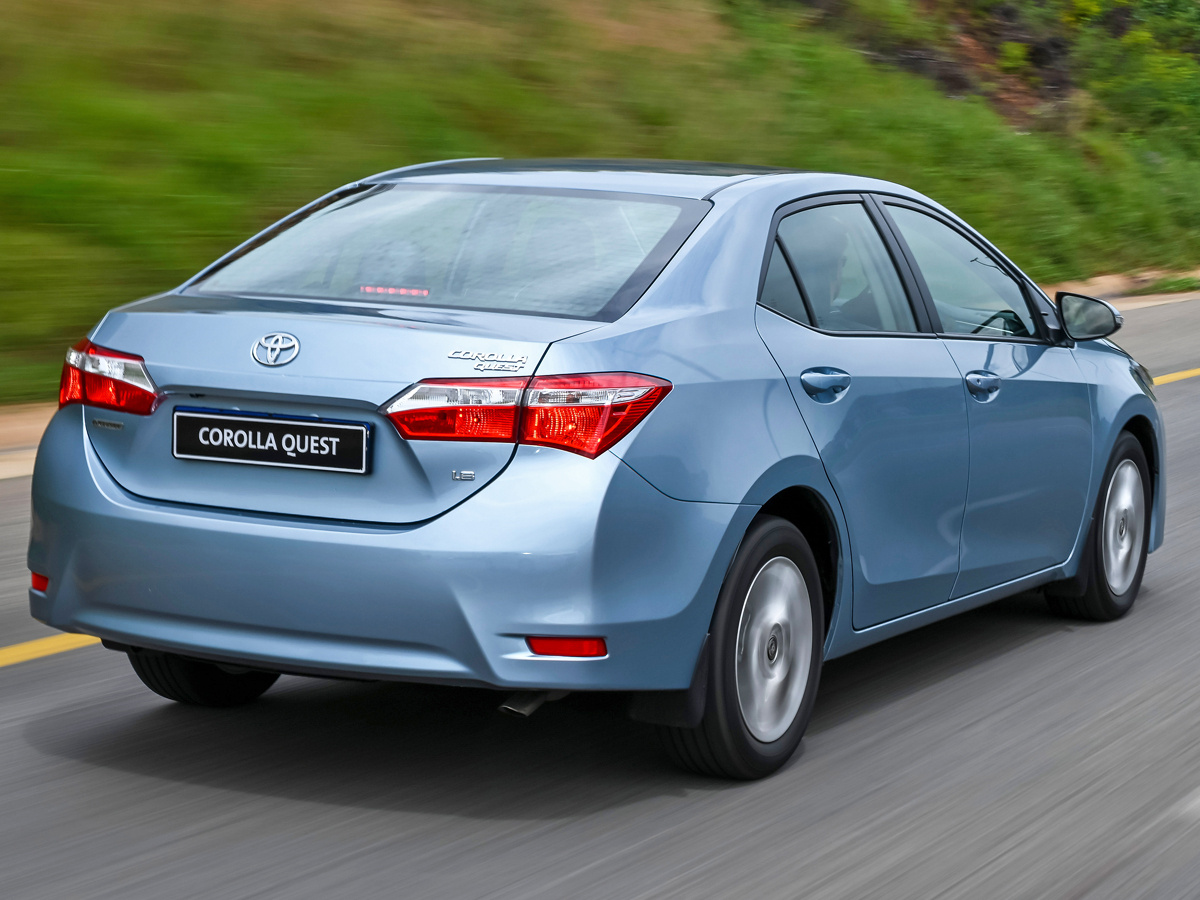
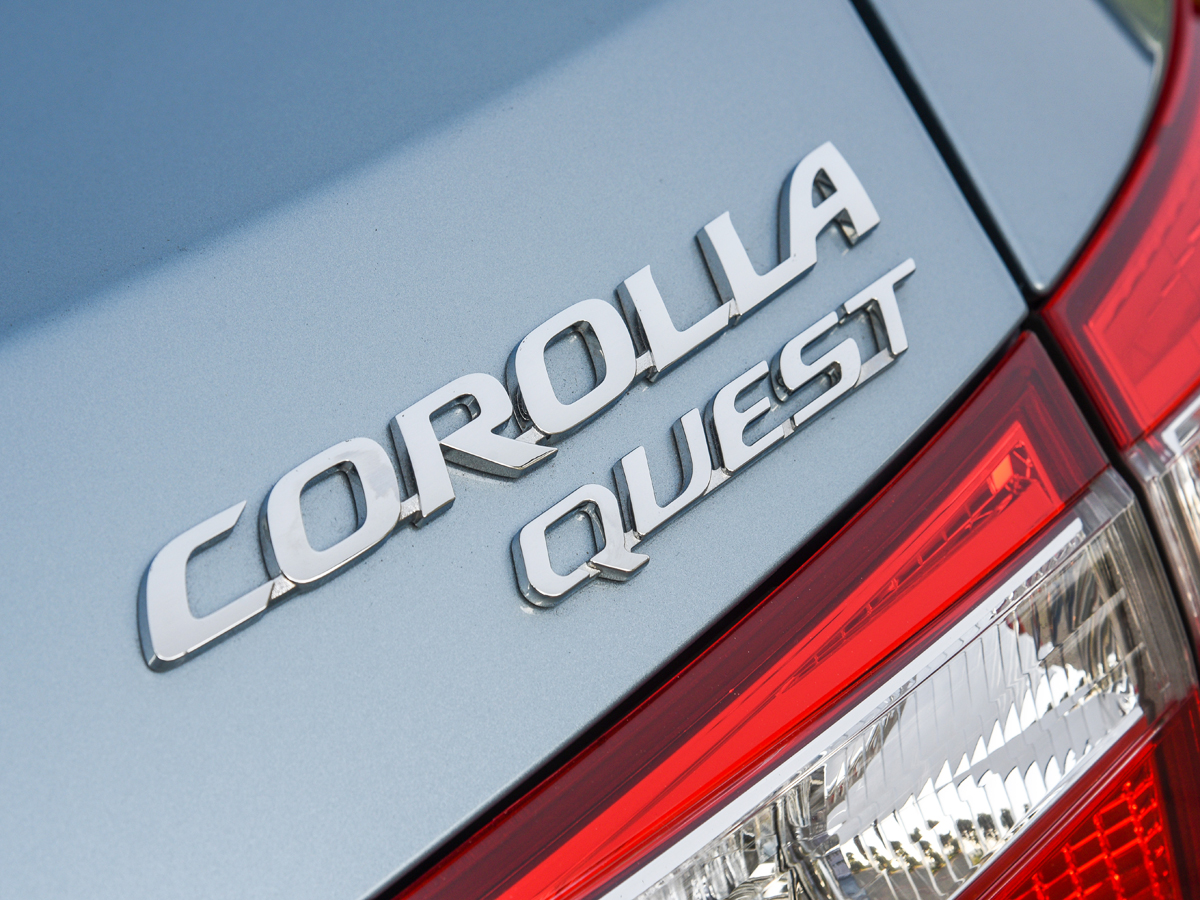
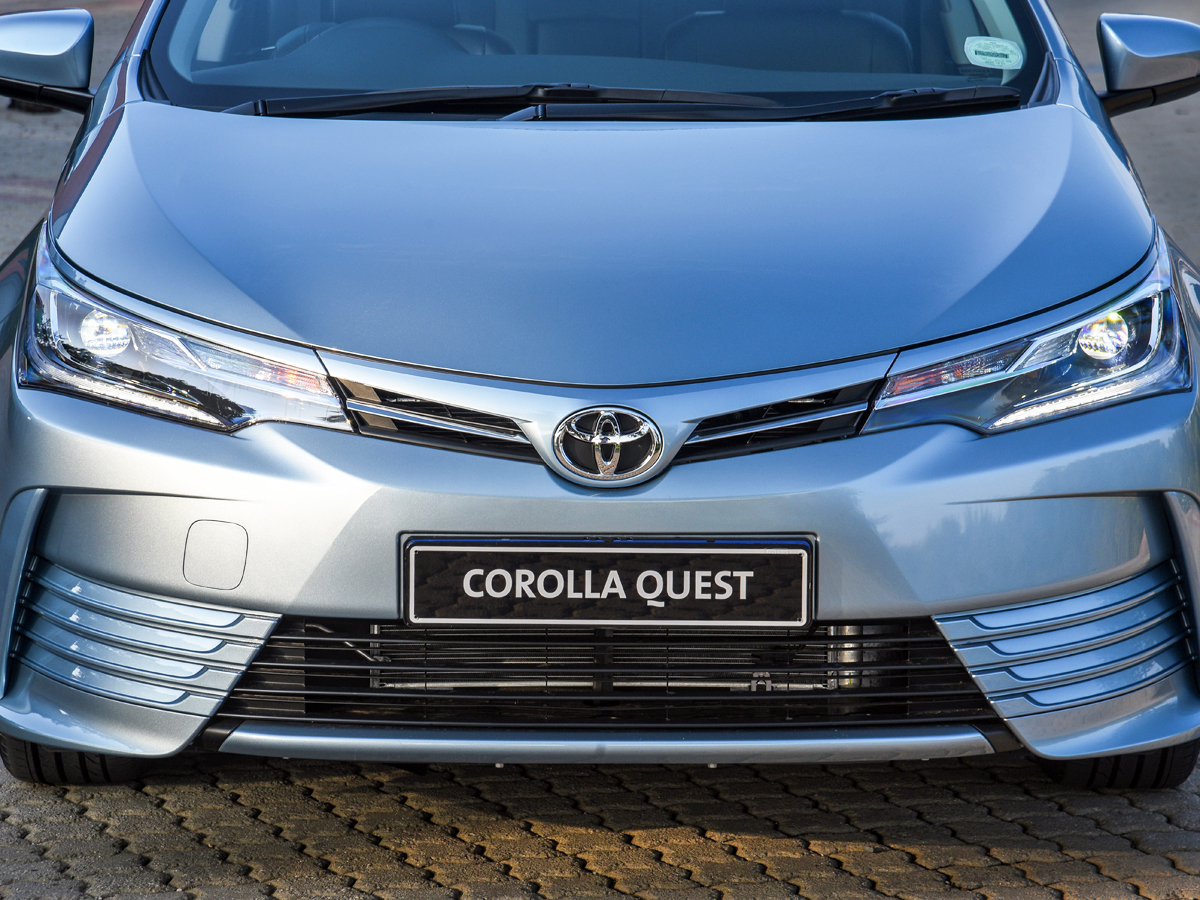
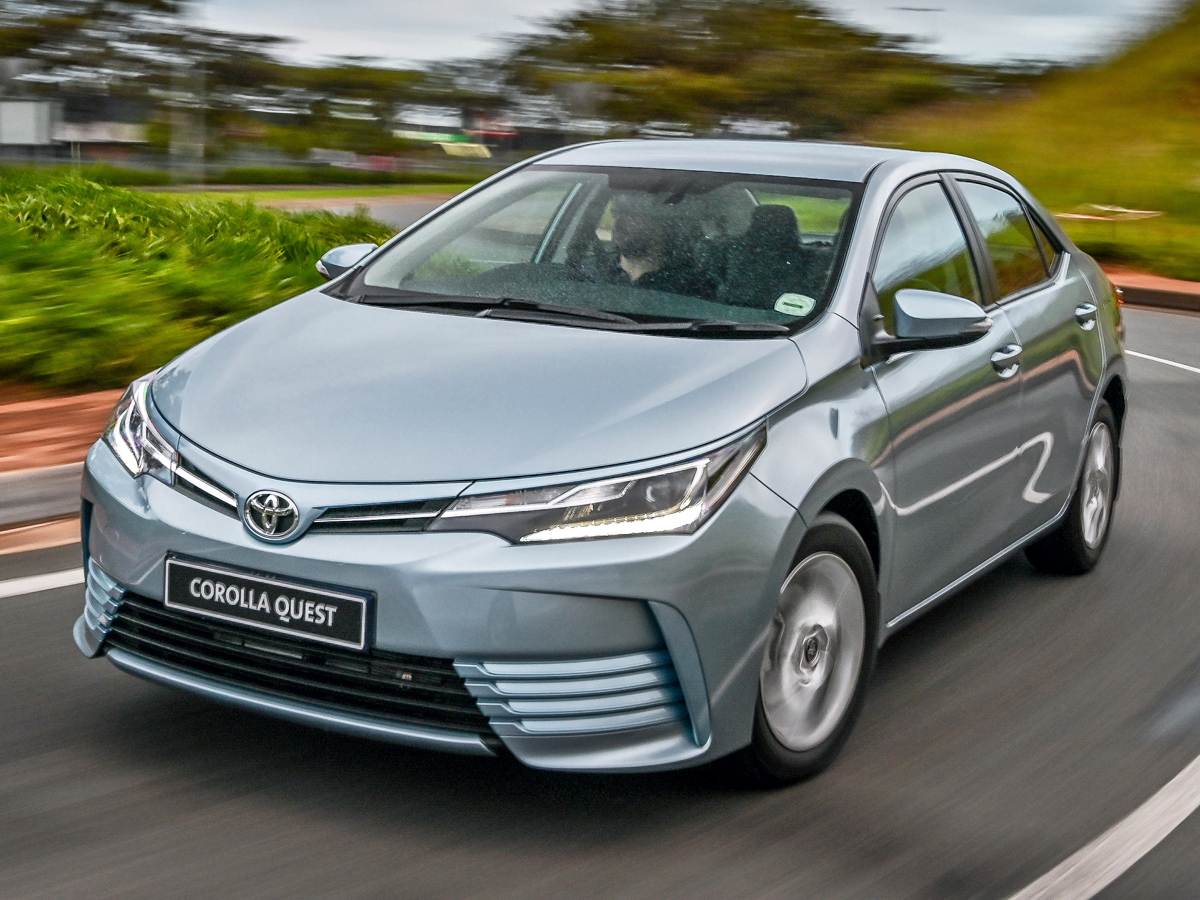
It’s a recipe Toyota South Africa Motors (TSAM) has perfected: take what would otherwise be a retiring locally built vehicle, treat it to a mild makeover and price it aggressively. This “prolonged lifecycle” strategy worked with the Conquest-based Tazz – and 2 successive generations of the Corolla Quest!
Central to such an approach is the fact that by the time the initial model’s lifecycle ends, the significant sum already invested has often long since been amortised. That means design, engineering and tooling costs for the legacy vehicle are all largely covered, allowing the automaker to price it affordably.
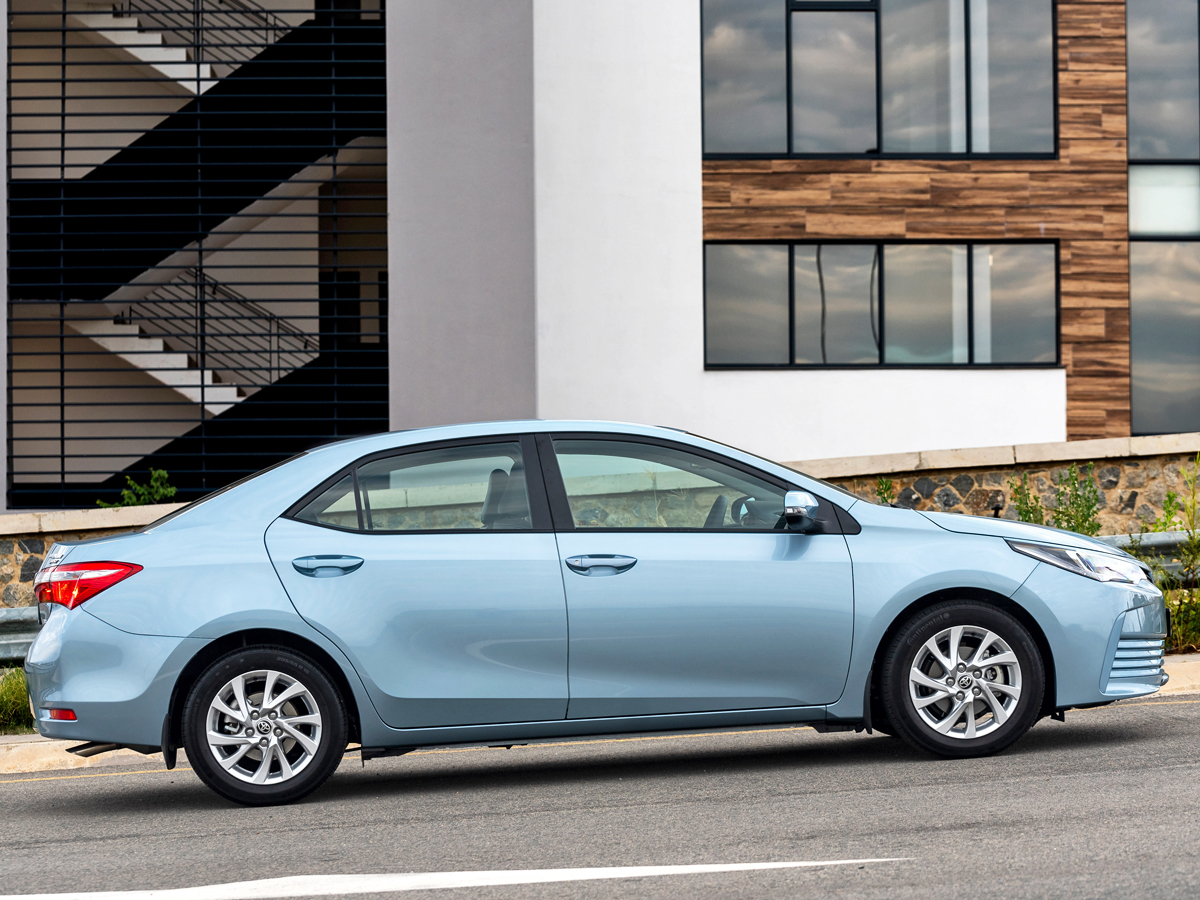
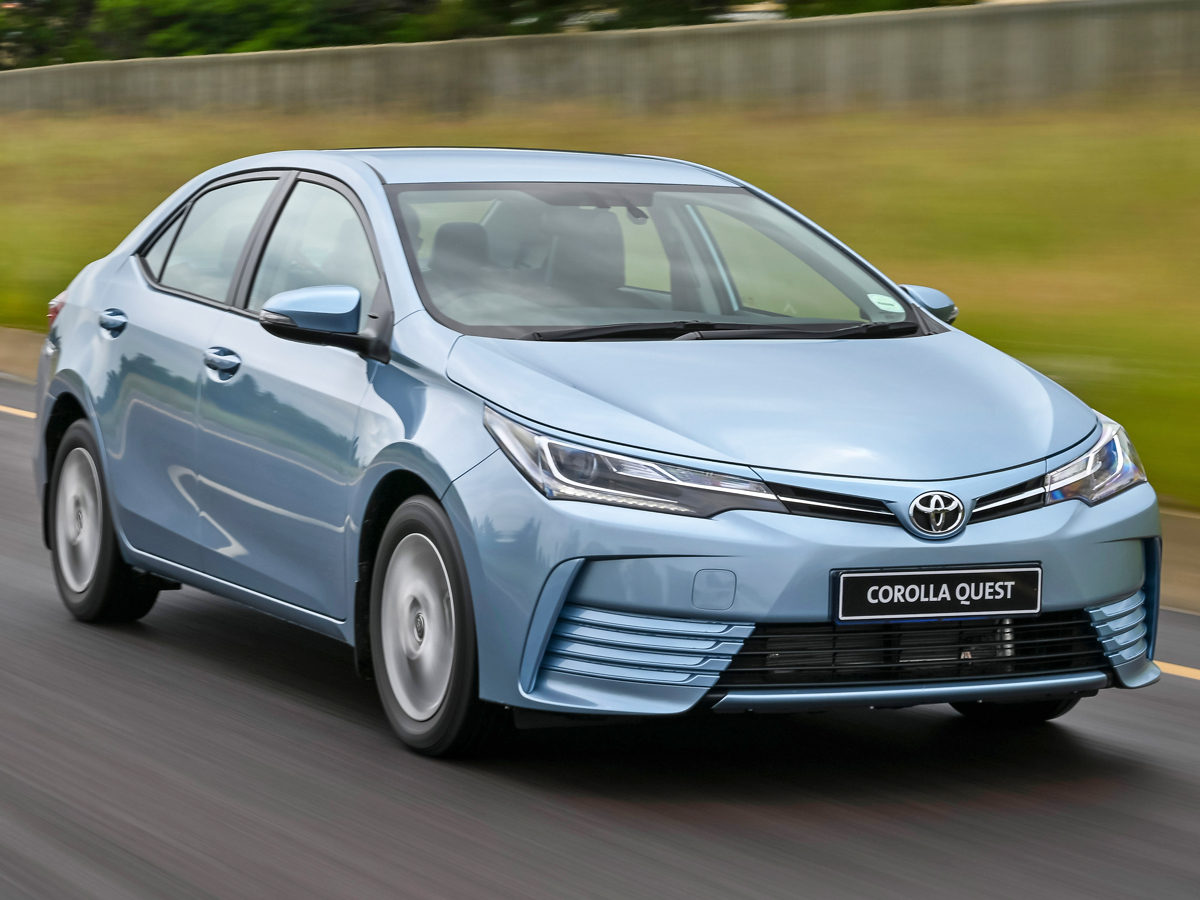
The 2nd-gen Quest followed on from the successful original.
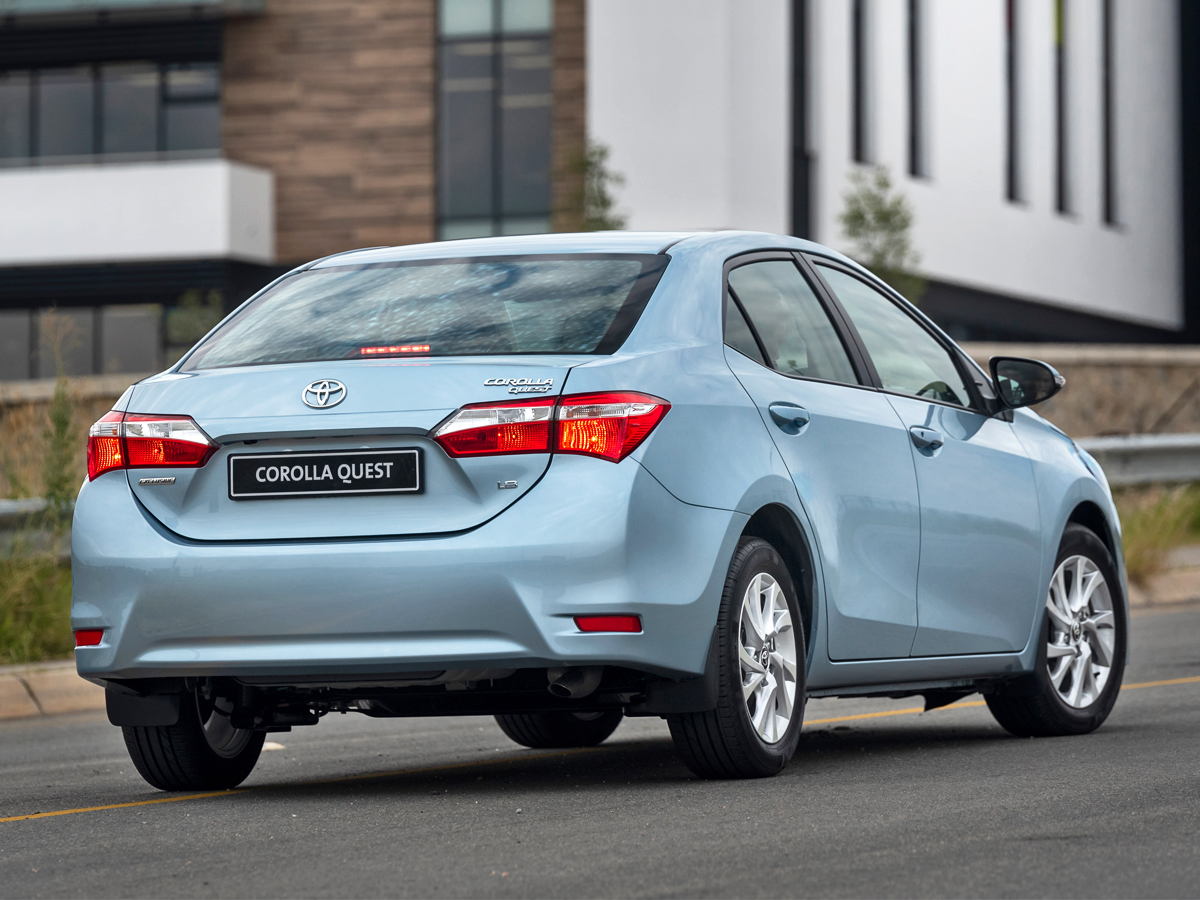
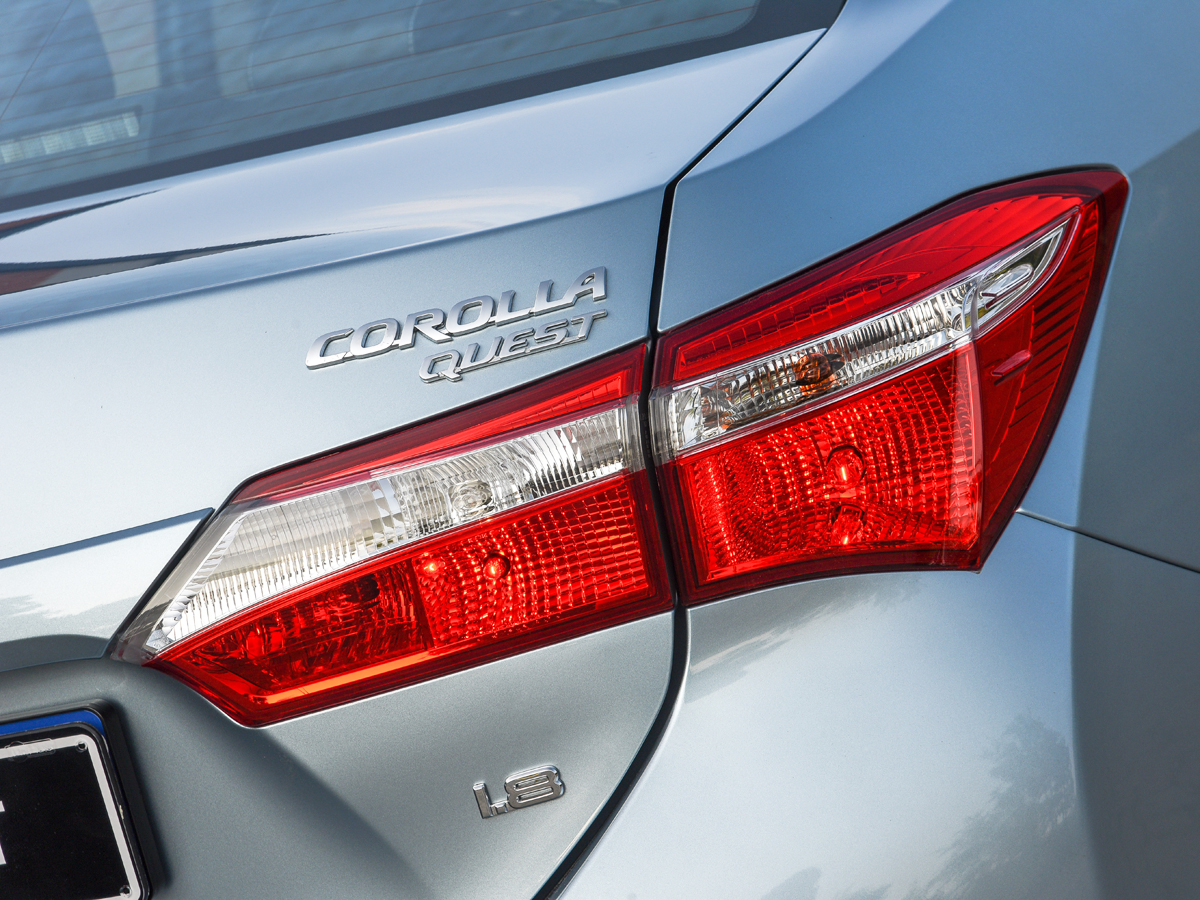
So, since the original Corolla Quest was a runaway success (with both private and fleet buyers), it was no surprise the Japanese automotive giant’s local division cooked up a 2nd generation of the model. While the 1st iteration was based on the 10th-gen Corolla sedan, the topic of this Buyer’s Guide was derived from the 11th-gen model.
Production of the 2nd-gen Quest at the Prospecton plant in KwaZulu-Natal (KZN) commenced early in 2020. In the opening quarter of 2025, however, TSAM confirmed to Cars.co.za that the Corolla Quest had come to “the end of its production cycle” late in 2024.
Production quietly ended late in 2024.
As a reminder, this re-invented model was sold alongside the 12th-gen Corolla sedan. Since the latter was imported from Japan rather than built locally, TSAM seemingly won’t have the opportunity to eventually repurpose it as a locally built 3rd-gen Quest.
Despite the general decline of the sedan segment during its production run, the Corolla Quest remained eminently popular in Mzansi. In fact, based on figures reported to Naamsa, it was the local market’s best-selling sedan in 2020 (7 365 units), 2021 (7 860 units), 2022 (4 688 units) and 2023 (5 832 units), before finishing just behind the Volkswagen Polo Sedan in 2024 (3 764 units).
The Quest was the segment’s top seller for much of its local lifecycle.
Add the few hundred examples registered in 2025 and we’d venture that the 2nd-generation Quest comfortably breached the 30 000-unit barrier over its almost-5-year production span.
Though that’s not quite as lofty a figure as the 63 966 sales achieved by the original Quest, it’s nevertheless a mighty impressive number.
Toyota Corolla Quest model line-up in South Africa
At launch, the local range numbered 6 derivatives.
The 2nd-gen Toyota Corolla Quest was launched to the media in January 2020, though it reached dealerships only in March of that year. The portfolio comprised 6 derivatives, all powered by a naturally aspirated 1.8-litre, 4-cylinder petrol engine driving the front axle via either a 6-speed manual gearbox or a continuously variable automatic transmission (CVT).
Corolla Quest 1.8 6MT (103 kW/173 Nm)
Corolla Quest 1.8 CVT (103 kW/173 Nm)
Corolla Quest 1.8 Prestige 6MT (103 kW/173 Nm)
Corolla Quest 1.8 Prestige CVT (103 kW/173 Nm)
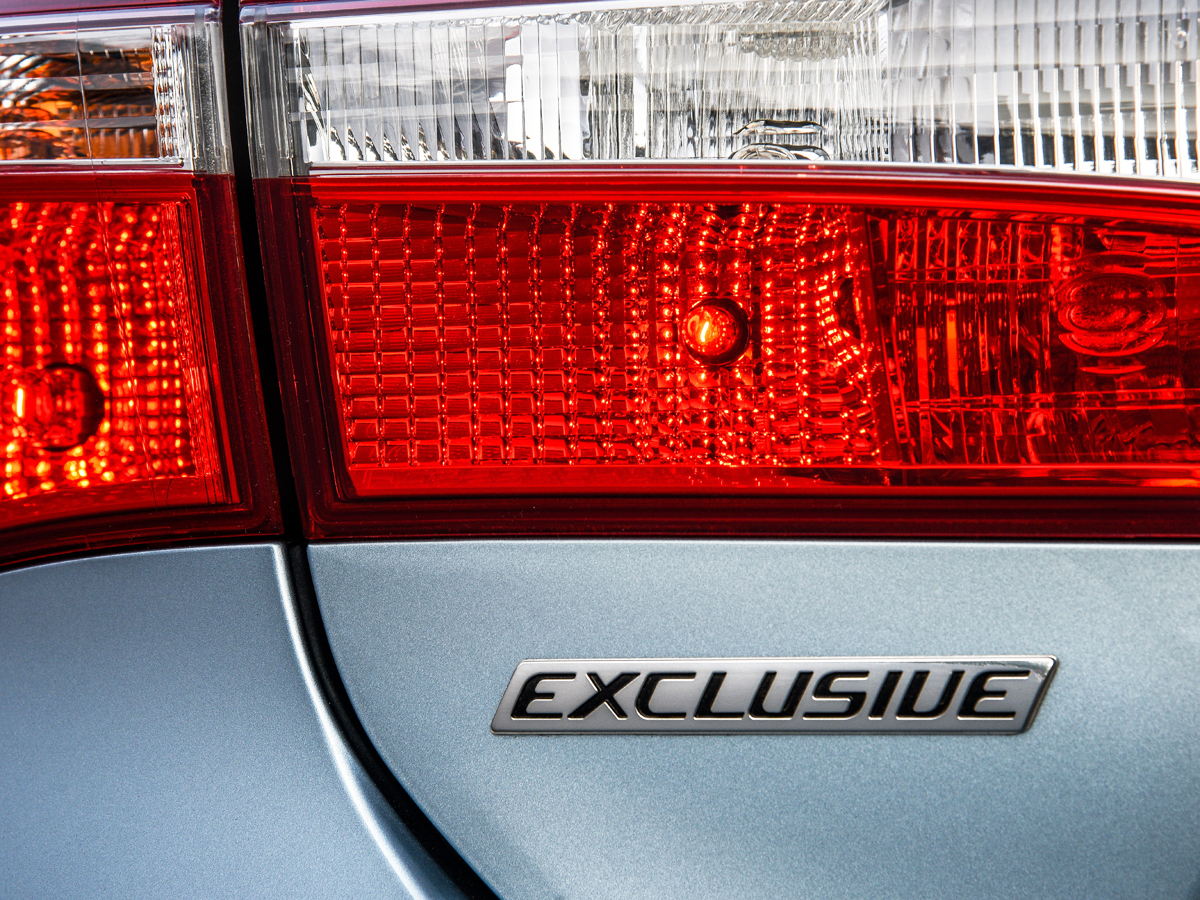
Corolla Quest 1.8 Exclusive 6MT (103 kW/173 Nm)
Corolla Quest 1.8 Exclusive CVT (103 kW/173 Nm)
In March 2021, a year after the Quest’s launch, TSAM made some slight adjustments to the range, including renaming the previously unbadged entry-level grade to “Plus”.
In addition, the “Smart Entry” package (comprising keyless entry and push-button start) was made standard across the range, while “Oxide Bronze” became the 6th hue in the exterior-paint colour palette.
What are the Toyota Corolla Quest’s strengths?
More standard kit than you might expect.
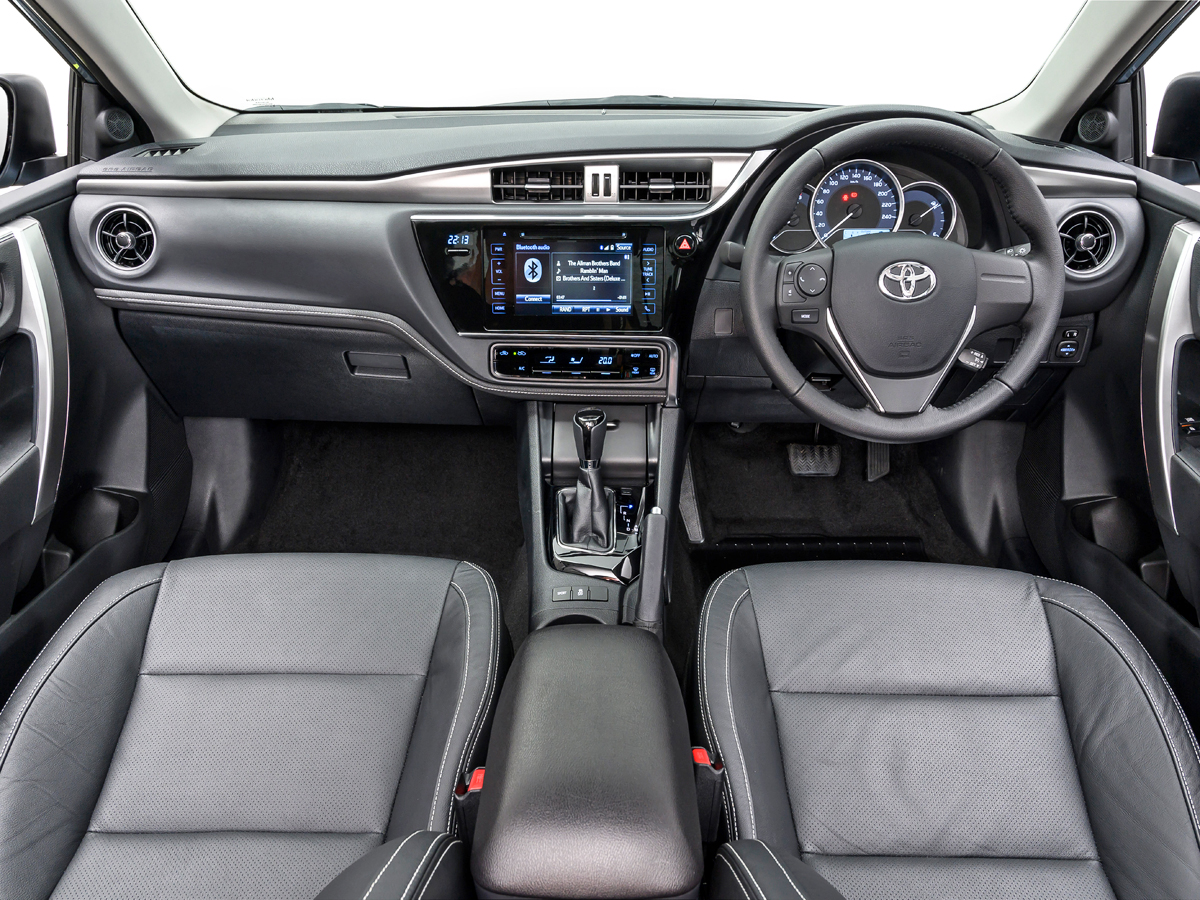
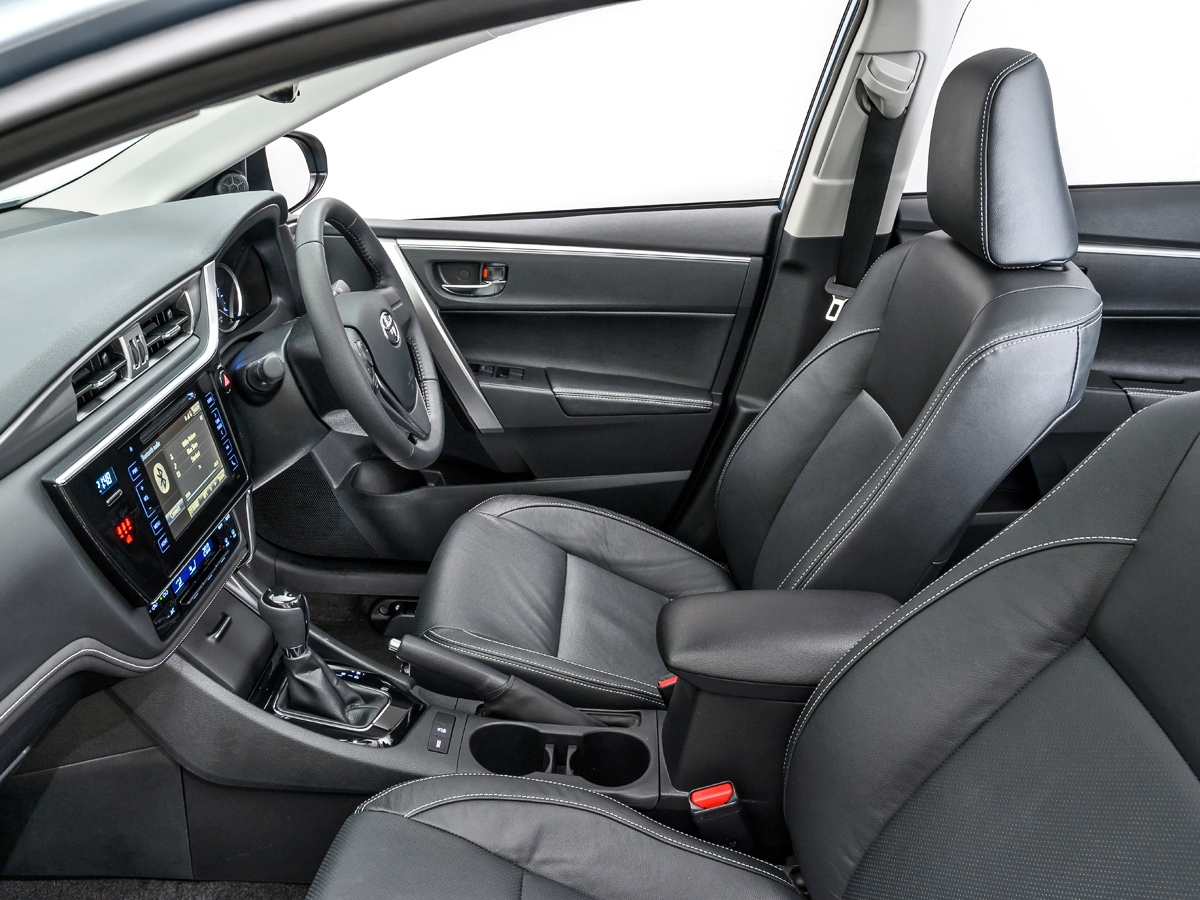
Plenty of standard kit: While you might assume the 2nd-gen Quest was simply a “de-specced” Corolla, that wasn’t quite the case. In fact, this prolonged-lifecycle sedan was rather generously specified as standard, particularly in mid-tier Prestige and flagship Exclusive guise.
For instance, all derivatives shipped from the factory with electric windows, electrically adjustable side mirrors, a multifunctional steering wheel, air conditioning, LED daytime running lights and a Bluetooth-enabled audio system with a minimum of 4 integrated speakers (plus USB).
The top-spec derivatives boasted full leather upholstery.
Prestige variants upgraded to 16-inch alloy rims (as opposed to 15-inch steel wheels), mud guards, a 6-speaker touchscreen DVD system, a reverse-view camera, cruise control, fabric-and-leather seat upholstery and leather trim for the steering wheel.
Finally, the Exclusive grade added auto aircon, keyless entry (with push-button start and rolled out across the range from March 2021), a TFT colour instrument cluster, leather upholstery, rear cupholders, an electro-chromatic rearview mirror, rain-sensing wipers and auto-levelling LED headlamps.
The 2nd-gen Quest featured a surprisingly pliant ride.
Comfortable and spacious: The Corolla Quest rode with a degree of sophistication that belied its attractive price point. Despite making do with a torsion-beam set-up at the rear, this sedan’s suspension system soaked up tarmac imperfections with aplomb. Rolling refinement levels were pleasingly high, too.
Moreover, there was plenty of space for passengers in the rear, while the generously sized luggage compartment could swallow a claimed 452 litres. However, note that the rear bench was fixed in place for all variants bar the range-topping Exclusive (which benefitted from a 60:40 split-folding function).
Safer than 1st-gen Quest: While the original Quest launched with only dual front airbags, the base version of the 2nd-gen model added a driver’s knee airbag, with Prestige and Exclusive derivatives furthermore scoring side airbags. The 2nd-gen version also came equipped with electronic stability control and hill-hold assist, safety features its predecessor did without.
Extra oomph compared with its forebear.
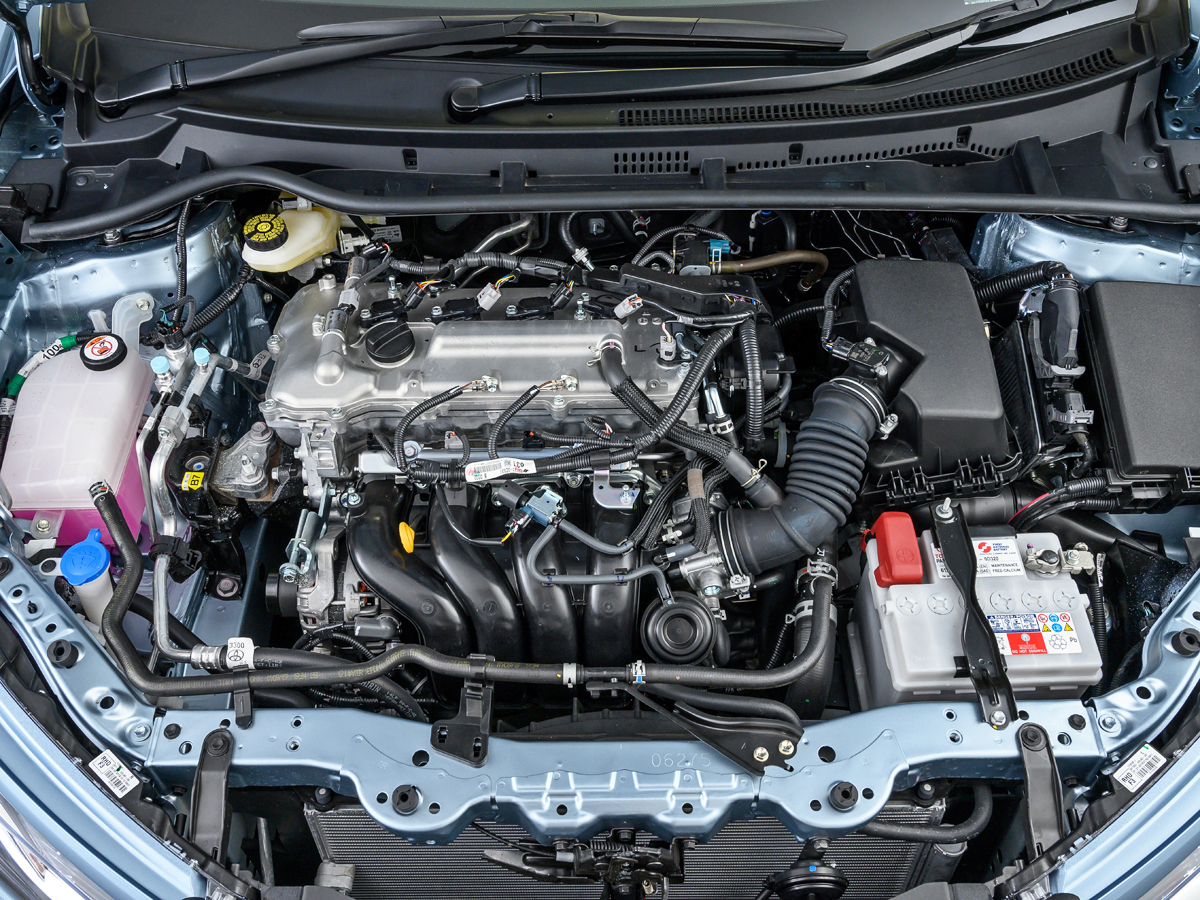
More powerful than forebear: Toyota dropped the original Quest’s naturally aspirated 1.6-litre petrol engine in favour of a likewise atmospheric 1.8-litre, 4-cylinder motor. The result was a useful increase in oomph, with peak outputs climbing to 103 kW and 173 Nm. Moreover, the maximum torque figure was available 1 200 rpm lower in the rev range, notably improving the driving experience.
For the record, the 6-speed manual gearbox featured a relatively positive shift action, while a continuously variable transmission (CVT) replaced the old 4-speed torque-converter automatic transmission. Despite the extra grunt, claimed fuel consumption improved to 6.3 L/100 km for the CVT-equipped derivatives and 7.0 L/100 km for the manual variants.
What are the Toyota Corolla Quest’s weaknesses?
Volume controlled via touchscreen.
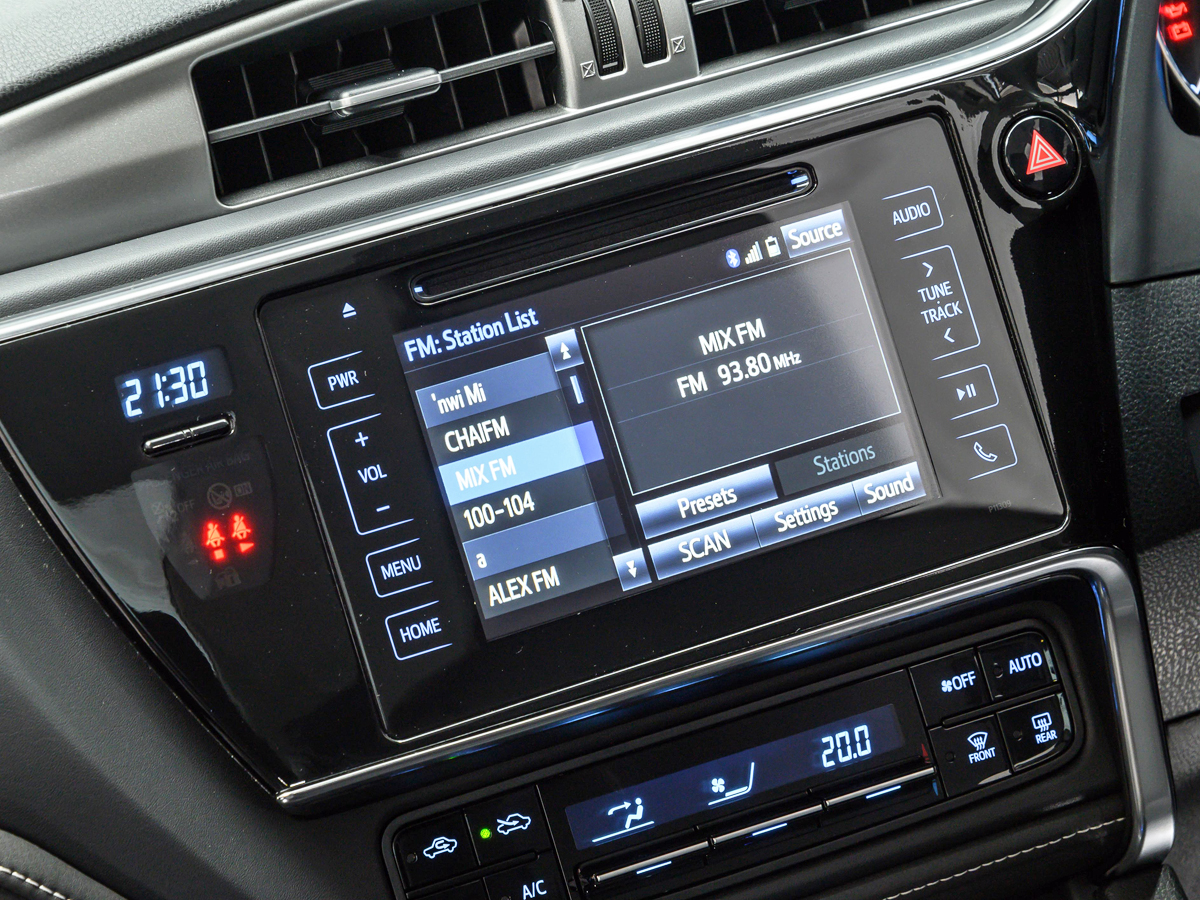
No volume knob: Somewhat surprisingly for a car brand as conservative as Toyota, the Corolla Quest’s infotainment system frustratingly did without a physical volume knob. Instead, in the case of the Prestige and Exclusive grades, the driver was expected to adjust the audio system’s volume using touch-sensitive controls on the left of the 7-inch touchscreen (or via the steering wheel’s multifunction buttons).
Even the base (later renamed “Plus”) variant featured touch-sensitive volume controls as part of its more basic infotainment set-up, though these were at least sited towards the right (i.e., the driver’s side) of the screen. In addition, keep in mind the Corolla Quest did not ship with Apple CarPlay and Android Auto.
The Quest featured a few minor cost-cutting measures.
Minor cost-cutting measures: Though the Corolla Quest’s perceived build quality was solid, TSAM obviously implemented a few cost-cutting measures. For instance, rear passengers did without dedicated ventilation outlets (and map pockets), while the luggage compartment was lined with a cheap-feeling material and featured a relatively flimsy boot board.
In addition, the Corolla Quest shared not only its paint colours with the likewise locally made Hilux and Fortuner, but also borrowed its headliner material and seat fabric from these ladder-frame models.
Note the low-slung chin.
Prone to speed-bump grazes: The Toyota Corolla Quest’s ground clearance was listed as 125 mm, but the vehicle’s chin had a nasty habit of touching tarmac when its driver attempted to traverse speed bumps. So, when shopping for a used Quest, make sure to closely inspect the lower edge of the front bumper for any significant damage.
The 2nd-gen Corolla Quest shipped standard with a 3-year/100 000 km warranty and a 3-service/45 000 km service plan (with intervals of 15 000 km). Dealer-fitted accessories included headlamp guards, roof racks and a detachable tow bar (for the record, braked towing capacity was listed as 1 300 kg).
Of the 2nd-gen Toyota Corolla Quest listings on Cars.co.za at the time of writing, some 58% featured a manual gearbox. Interestingly, 2023 was the dominant model year, accounting for nearly half of all examples, while the flagship Exclusive grade represented just 6% of listings. Mileage ranged from virtually zero through to 251 000 km, with the latter achieved by a 2022 1.8 Plus.
Below R250 000: A considerable 43% of listed 2nd-gen Corolla Quest units were priced below R250 000, though most were positioned above R200 000. Towards the top end of this bracket, we found several examples with well under 50 000 km on their respective odometers. Around 2 thirds of units here featured the base “Plus” trim level.
R250 000 to R300 000: This narrow pricing bracket housed approximately 46% of listed derivatives. All 6 model years were represented here, though 2023 was again easily the most prevalent. We also discovered several 2024 examples in this sub-R300 000 space, the majority predictably showing low mileage.
R300 000 and up: The final 11% of listings came in above R300 000, with most from the final 2 model years. More than half of the examples here featured the mid-tier Prestige grade. The most expensive model we unearthed was a 2025 1.8 Prestige CVT listed for R387 900. For the record, the Quest’s pricing when discontinued from SA’s new-vehicle market ran from R336 000 to R414 800.
Which Toyota Corolla Quest variant should I buy?
Exclusive offered some tempting extra kit.
So, which Quest is the best? Well, since there was just a single engine on offer, you need only decide on transmission when pondering the powertrain. Though we generally prefer a slick manual gearbox to a CVT, we’d nevertheless argue the latter better suits most use cases for this type of vehicle (while offering fuel savings and added convenience in traffic, too).
What about the trio of trim levels available? Keep in mind the entry-level derivative (initially unnamed then dubbed “Plus”) was largely aimed at fleet buyers, so featured a matte-black grille and bumper trim along with steelies and a shorter list of standard kit. Though this is seemingly the most prevalent grade on the used market today, we’d instead point to the mid-tier Prestige as the best value.
Of course, should your budget stretch to the top-spec Exclusive, you’d benefit from some tasty extra equipment. This trim level, however, is notably harder to come by on the used market.
Is the Toyota Corolla Quest a smart used purchase?
The local market favoured the Quest for a reason.
During its circa-5-year run on the local market, the 2nd-gen Corolla Quest squared up against a few key rivals. In pure volume terms, only the Indian-built Volkswagen Polo Sedan offered any real semblance of competition, eventually outselling its Prospecton-built rival in 2024.
That said, the 3rd-gen Nissan Almera also built a loyal following, though this long-serving budget sedan was discontinued towards the middle of 2023. The Suzuki Ciaz was another solid offering (with a particularly spacious rear bench), but it too is expected to be discontinued towards the end of 2025.
The Quest offered terrific value for money.
Other budget sedan contenders of the era included the GN-series Honda Ballade and the seldom-spotted Fiat Tipo Sedan. The 3-box Tipo (as well as its hatchback sibling) was axed in South Africa at some point in 2024, seeing the segment shrink further still.
Ultimately, however, the local market clearly favoured the KZN-built Toyota Corolla Quest. Like the prolonged-lifecycle model that preceded it, the 2nd-gen Quest offered affordable, reliable transport courtesy of well-proven underpinnings. While there was no denying this SA special lacked pizzazz, it certainly represented terrific value for money. It’s a pity the Quest had to end there…
BMW 3 Series cars have always appealed to buyers who appreciate the appeal of a business-class sedan that aims to satisfy driving enthusiasts. But which derivative of the G20-generation BMW 3 Series offers the best balance?
For decades, the BMW 3 Series has been the benchmark in the compact-luxury segment with its balance of performance, sporty handling, refinement, and prestige. Locally built for 35 years until 2018, the 3 Series has been the dream driver’s car for South Africans shopping in the business-class sedan class.
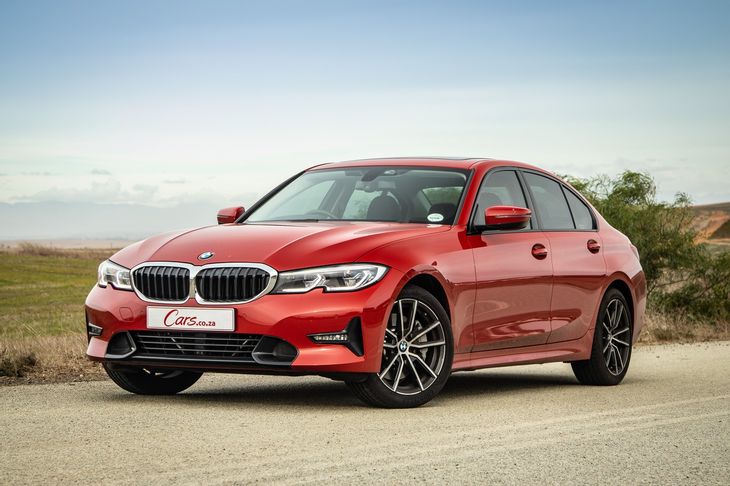
Most of the BMW (G20) 3 Series variants sold in South Africa are powered by 2.0-litre 4-cylinder turbopetrol and turbodiesel engines, with the single- and twin-turbo BMW inline-6 reserved for the range’s high-performance derivatives. Prices start at just over R900 000, going up to over R1 million for the top-of-the-range 330i (in October 2025).
BMW’s 320i petrol is rated at 135 kW and 300 Nm, while the 320d turbodiesel model offers 140 kW and 400 Nm. As with all non-M BMW 3 Series cars, engine power is delivered to the rear wheels, and in the case of the 320i and 320d, that’s via an 8-speed automatic transmission.
The 320i badge was once associated with lethargic performance, but in the contemporary turbopetrol era, the BMW (G20) 320i offers more than sufficient performance to propel the Bavarian business-class sedan spiritedly, whereas the turbodiesel 320d, with its claimed average fuel consumption figure of 4.9 L/100 km, promises excellent efficiency for those who clock up many kilometres every year.
Like all 3 Series variants, a 5-year/100 000 km maintenance plan (which covers all motoring costs apart from car-loan repayments, insurance, fuel and tyres) is standard. Services are required when indicated.
Drivers seeking a more dynamic experience can choose the 330i M Sport. Though it no longer boasts a 3.0-litre inline-6 engine that its nomenclature historically denoted, it features a high-performance version of the (B48) 2.0-litre turbopetrol powertrain. The 330i M Sport pumps out 190 kW and 400 Nm of torque.
Also priced north of R1 million, the 330i M Sport is the last step before reaching the brawnier M340i xDrive, which, apart from having sportier exterior styling, is powered by a 3.0-litre inline-6 turbopetrol.
Watch Ciro De Siena’s video review of the 2023 BMW M340i xDrive:
The M340i xDrive delivers 285 kW/500 Nm to all 4 wheels, with the “xDrive” in the nameplate denoting an all-wheel drivetrain. At close to R1.4 million, it offers substantial value for the performance on tap!
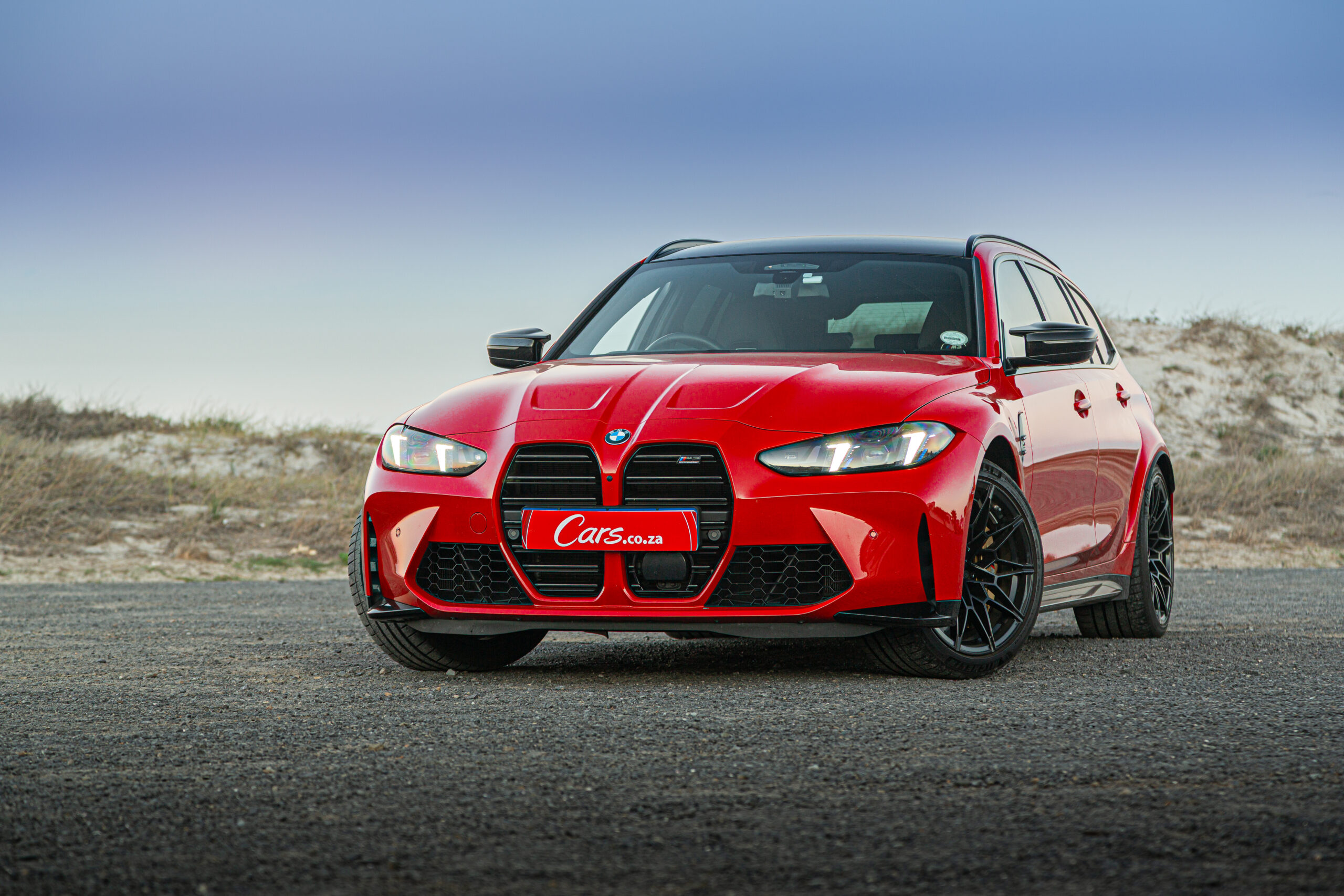
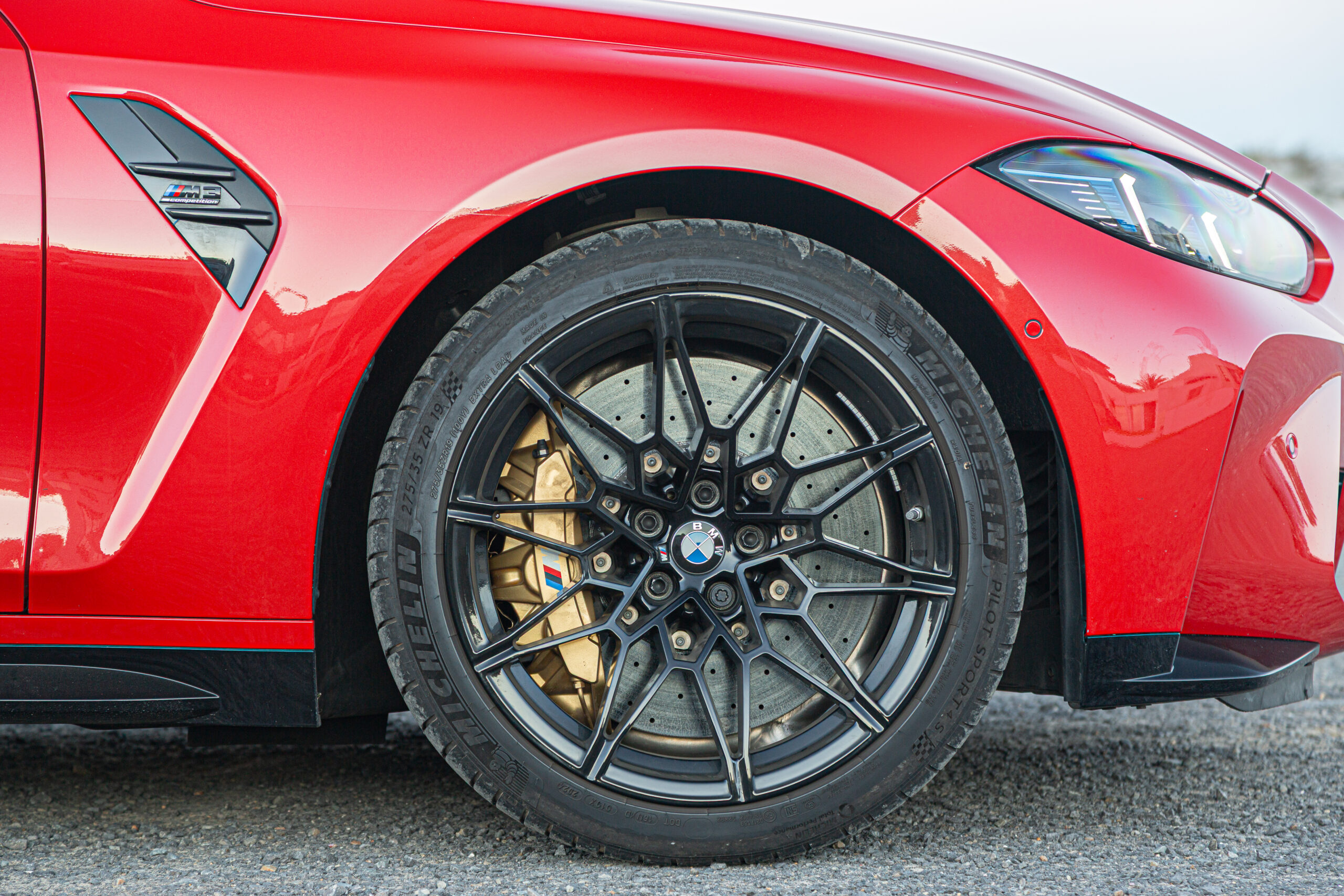
For around R2.2 million, you can acquire the highly sought-after M3 performance flagship versions, available in station wagon format as the M3 Competition M xDrive and its sedan sibling, the M3 Competition M xDrive, for slightly less than the Touring.
Watch Ciro De Siena’s video review of the 2020 BMW M3 Competition M xDrive:
These M3s are powered by a 3.0-litre, inline-6 twin-turbopetrol engine engineered for liberal power delivery and immediate throttle response. With peak engine outputs of 390 kW and 650 Nm of torque, performance is staggering. BMW claims its M3s are good for 0-to-100 kph time of just 3.5 seconds.
Locally, the BMW 3 Series competes primarily against the following premium executive sedans:
Audi A4: The traditional front-wheel drive alternative to the 3 Series, which was recently superseded by the A5 Sedan. Audi’s quattro all-wheel drive was only available on the M3-rivalling RS4 Avant, and the South African Audi A4 line-up didn’t feature any turbodiesel engines either.
Mercedes-Benz C-Class: Often cited as the closest rival, the C-Class offers both petrol and diesel versions, as well as high-performance AMG variants. The AMG C63 S E Performance has a 2.0-litre 4-cylinder turbopetrol engine with hybrid assistance that produces 500 kW and 1 020 Nm, but the high-tech plug-in powertrain simply doesn’t have the evocative exhaust note of the M3’s inline-6.
Lexus IS: Since the late 1990s, this has been Japan’s closest rear-wheel drive rival to the 3 Series. Less common than the 3 Series, it delivers an outstanding long-term ownership experience with the world-class build quality and durability that Lexus vehicles are renowned for. The 2-variant line-up relies on a 4-cylinder petrol-hybrid powertrain with less focus on performance than its rivals.
Alfa Romeo Giulia: Offers distinct Italian styling, engaging dynamics, and competitive engines — including a 2.0-litre 4-cylinder- and a 3.0-litre 6-cylinder turbopetrol unit. The Giulia Quadrifoglio Super Sport provides M3-level performance and all-wheel drive. Like the Lexus IS, the Giulia’s not mainstream, but it serves as a strong alternative in the performance arena.
Subaru WRX: For buyers prioritising a unique engine configuration, all-wheel drive grip and performance over prestige, design and cabin comfort, the WRX may be the value leader. The 2.4-litre flat-4 engine produces a solid 202 kW and 350 Nm, paired with the brand’s renowned all-wheel drive system. Subaru’s dealership network is very limited throughout South Africa, however.
BMW 3 Series summary
BMW created the compact executive sedan market with the 3 Series. It has always overinvested in the 3 Series engine and chassis development, creating compact sedans with excellent driving dynamics, especially the M3 range, which is one of the world’s great high-performance nameplates.
To many, the driver-centric cockpit ergonomics and overall dynamic balance of the G20-gen BMW 3 Series still make it the most desirable compact executive sedan. In the South African market, the 3 Series offers turbodiesel engines, which Audi’s A4/A5 doesn’t. And the M3’s powertrain has a lot more driver appeal than the AMG C63’s wildly powerful, but less characterful, 2.0-litre plug-in hybrid drivetrain.
Q: What are the main engine variants in the BMW (G20) 3 Series in South Africa?
A: Most of the BMW (G20) 3 Series variants sold in South Africa are powered by 2.0-litre 4-cylinder turbopetrol (320i, 330i) and turbodiesel (320d) engines. The high-performance derivatives, such as the M340i xDrive and M3, feature the more potent single- and twin-turbo BMW inline-6 engines.
Q: What is the power output of the standard BMW 320i and 320d models?
A: The 320i petrol model is rated at 135 kW and 300 Nm of torque. The 320d turbodiesel offers slightly more power and torque, with 140 kW and 400 Nm.
Q: How fuel efficient is the BMW 320d?
A: The turbodiesel 320d is notably efficient, promising a claimed average fuel consumption figure of 4.9 L/100 km, making it a good choice for high-mileage drivers.
Q: What is the standard maintenance plan for the BMW 3 Series?
A: All BMW 3 Series variants come standard with a 5-year/100 000 km maintenance plan. This plan covers virtually all motoring costs, excluding car-loan repayments, insurance, fuel, and tyres.
Q: Which cars are the main competitors to the BMW 3 Series?
A: The primary rivals in the compact executive sedan market include the Mercedes-Benz C-Class, the Audi A4 (which was superseded by the A5 Sedan), the Lexus IS, and the Alfa Romeo Giulia. The Subaru WRX is also a performance alternative that trades prestige for unique engine configuration and all-wheel drive.