Toyota has ‘tweaked’ the specification on its range-topping RAV4 VX.
Toyota’s popular RAV4 offering has been enhanced with changes to specification offered on its VX model.
The range-topping RAV4 VX offering now gains additional safety equipment including Lane Change Assist with Blind Spot Monitoring. The system includes convenient indicators housed in the side mirrors to alert you of vehicles in your blind spot. Cross Traffic Alert is now also included on the VX grade RAV4. The system will alert to approaching vehicles when you are entering or exiting a parking bay at your local shopping mall.
Further changes include the addition of foot-well lighting while the sunroof has been omitted from the specification list.
In addition to these new features, the RAV4 VX’s safety specification includes a total of nine airbags, ABS with EBD, brake assist, vehicle stability control, hill assist control, trailer sway control, downhill assist control (4WD models only) and ISOFIX child seat mounts.
Engine Choice
The RAV4 is powered by two petrol engines and a diesel engine in both 2WD and 4WD format. Starting with the petrol engines, there’s a 2.0-litre naturally aspirated unit producing 107 kW and 187 Nm of torque while a 2.5-litre engine is also on offer with 132 kW and 233 Nm of torque. For the dieselheads, there’s a 2.2-litre turbodiesel engine that offers 110 kW and 340 Nm of torque.
The GX grade is paired with the 2.0-litre petrol engine in 2WD configuration and mated to either a 6-speed manual or CVT transmission. The AWD 2.2 turbodiesel RAV4 in GX guise is offered with a 6-speed automatic transmission.
Buyers looking to buy the RAV4 VX have the choice between the 2.2 turbodiesel engine and the 2.5-litre petrol motor. Both are AWD and are fitted with a 6-speed automatic transmission.
Toyota RAV4 – Price in South Africa
RAV4 2.0 GX 2WD – R 367 000
RAV4 2.0 GX CVT 2WD – R 379 500
RAV4 2.2D GX AWD – R 459 000
RAV4 2.2D VX AT AWD – R 547 000
RAV4 2.5 VX AT AWD – 513 000
The Toyota RAV4 range is backed by a 5-year/90 000 km service plan and 3-year/100 000 km warranty.
The Cars.co.za Ownership Satisfaction Survey, in partnership with leading data specialists, Lightstone Consumer, forms an integral part of the awards programme, with the survey accounting for 50% of the final result in each category. The brand-specific data incorporates feedback from thousands of South African new vehicle owners, based on their experiences of their vehicles (must be less than 5 years old and serviced through franchised outlets).
The Compact Hatch category is extremely competitive, and we’re looking for a balanced offering that is excellent across the board. Cars in this segment must appeal to a very wide audience – from the young professional or family buying up from an entry-level car, to pensioners buying down from something larger and expensive. The winner of this award must truly reflect what is best about modern automotive design and engineering, but present it in a concentrated, reasonably affordable form.
The semi-finalists in the Compact Hatch category of the Cars.co.za Consumer Awards – powered by WesBank are as follows (in no particular order):
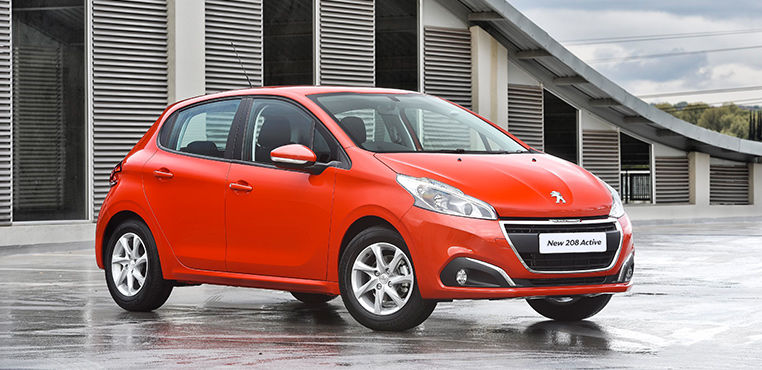
Peugeot 208 1.2 Active
French brand Peugeot has been through tough times the past few years, but in Europe, at least, appears to have turned the corner. Great cars such as the 208 and its bigger sibling, the 308, have put the famous Lion emblem back in the limelight. This 1.2 Active derivative is well priced given its good balance of features and offers space that belies its size. And, like small Peugeots of many years ago, it’s very good to drive…
This model is powered by a 1.2-litre engine that delivers 60 kW/118 Nm and an outstanding claimed economy figure of 4.3 L/100 km.
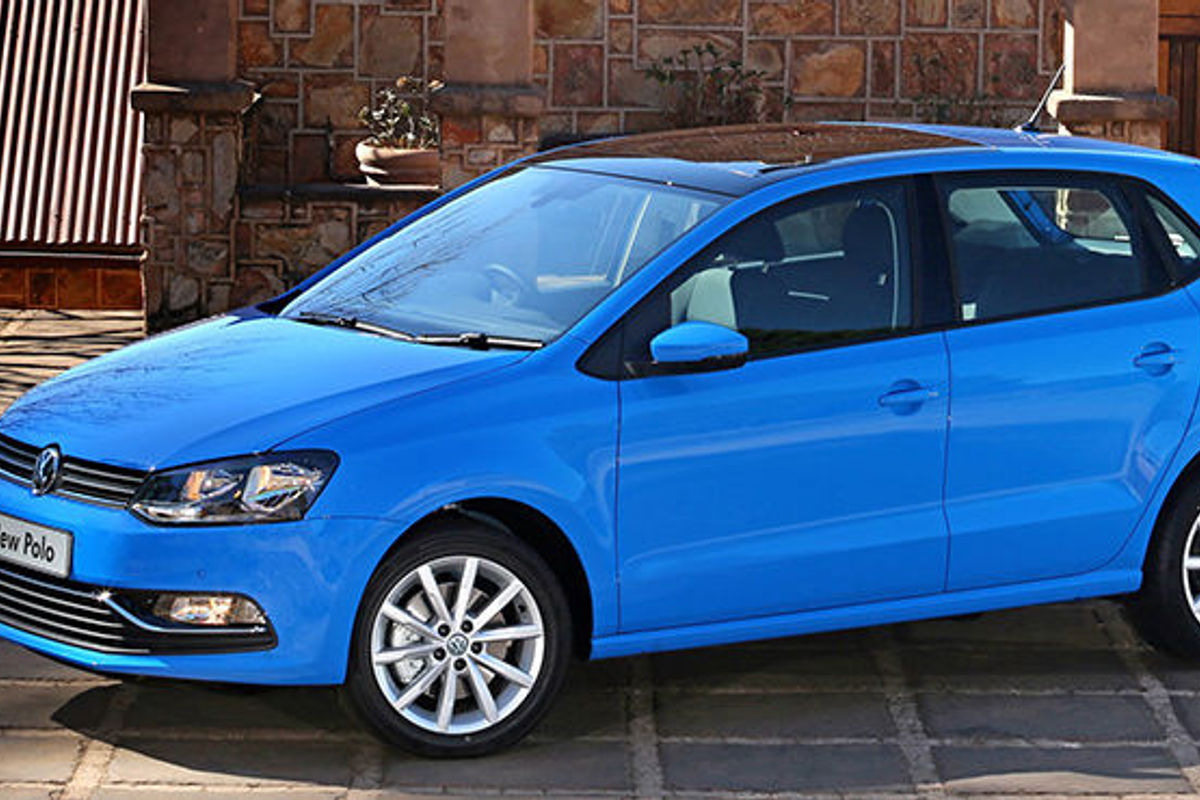
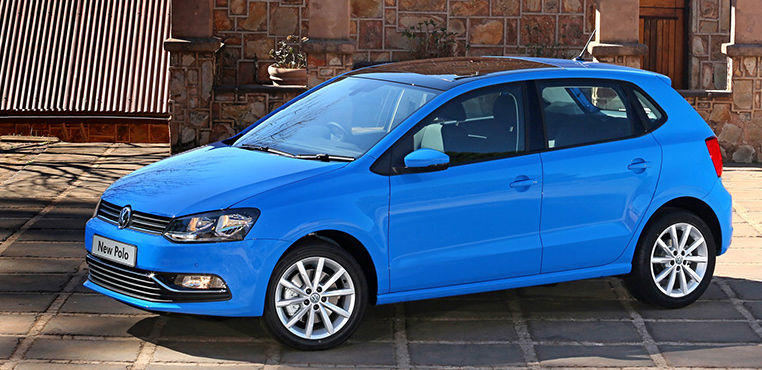
The Volkswagen Polo 1,2 TSI Comfortline is one of South Africa’s favourite cars. The appeal is very obvious – it offers the desirable Volkswagen badge, an upmarket cabin finished in quality materials, good standard specification and the promise of good resale value. Furthermore, the relatively new 1,2-litre turbopetrol remains one of the more impressive small-capacity engines on the market – it endows the Polo with great driveability characteristics.
As its name indicates, this Polo is powered by a turbocharged 1.2-litre engine that delivers a strong 66 kW/160 Nm and a claimed combined cycle economy figure of 4.9 L/100 km.
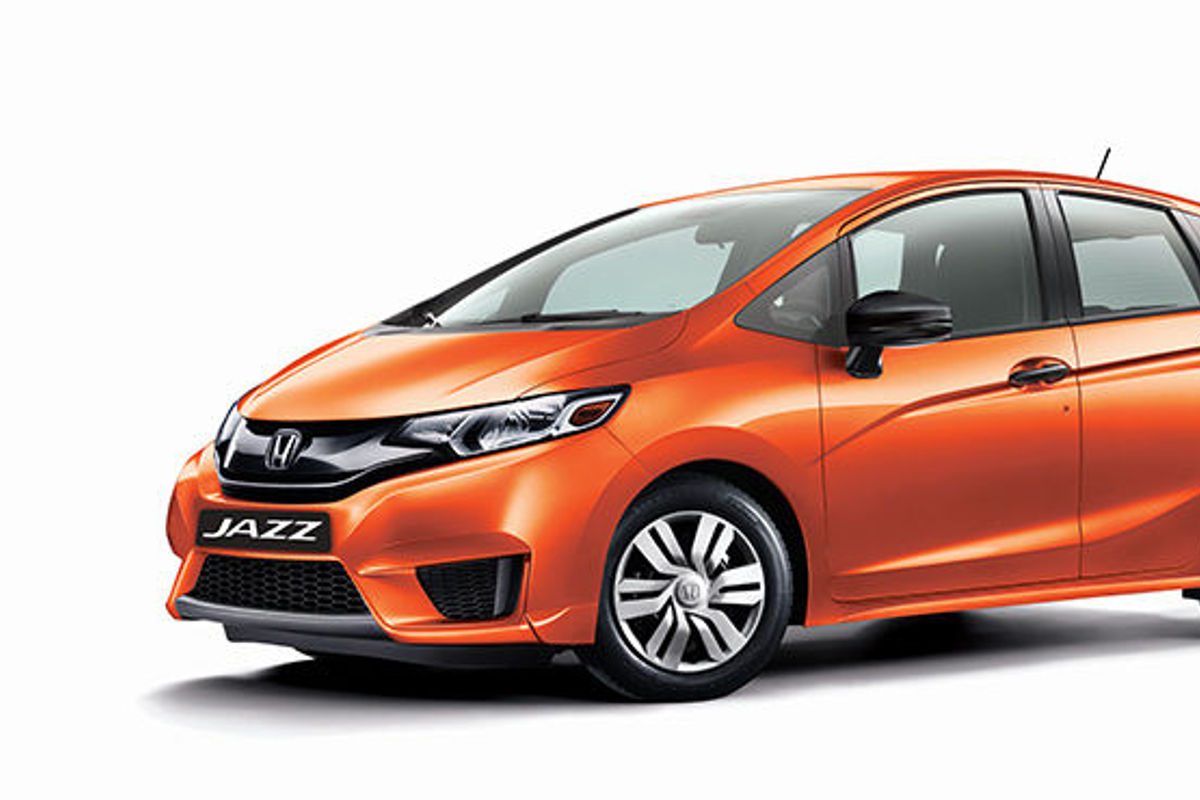
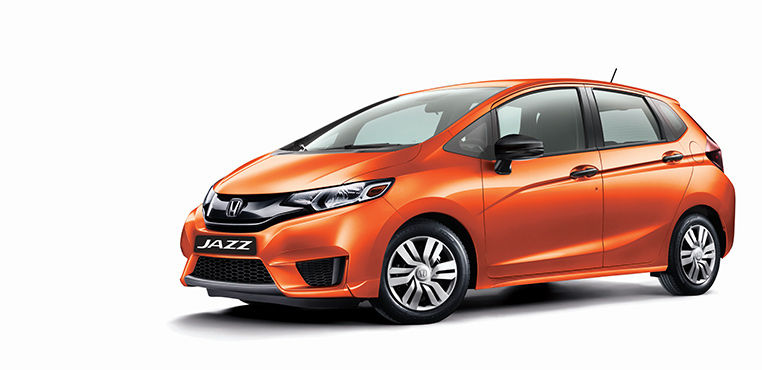
The Honda Jazz has built itself a solid reputation for reliability, spaciousness and general owner satisfaction. In its latest form it attempts to offer all its usual strengths, but in a more youthful package. In the end, however, it is the Jazz’s incredible space utilisation that secures its place on this shortlist.
Unlike many of its rivals, the Jazz uses a normally aspirated 1.2-litre engine that delivers 66 kW/110 Nm of torque, and Honda claims a combined cycle economy figure of 5.6 L/100 km.
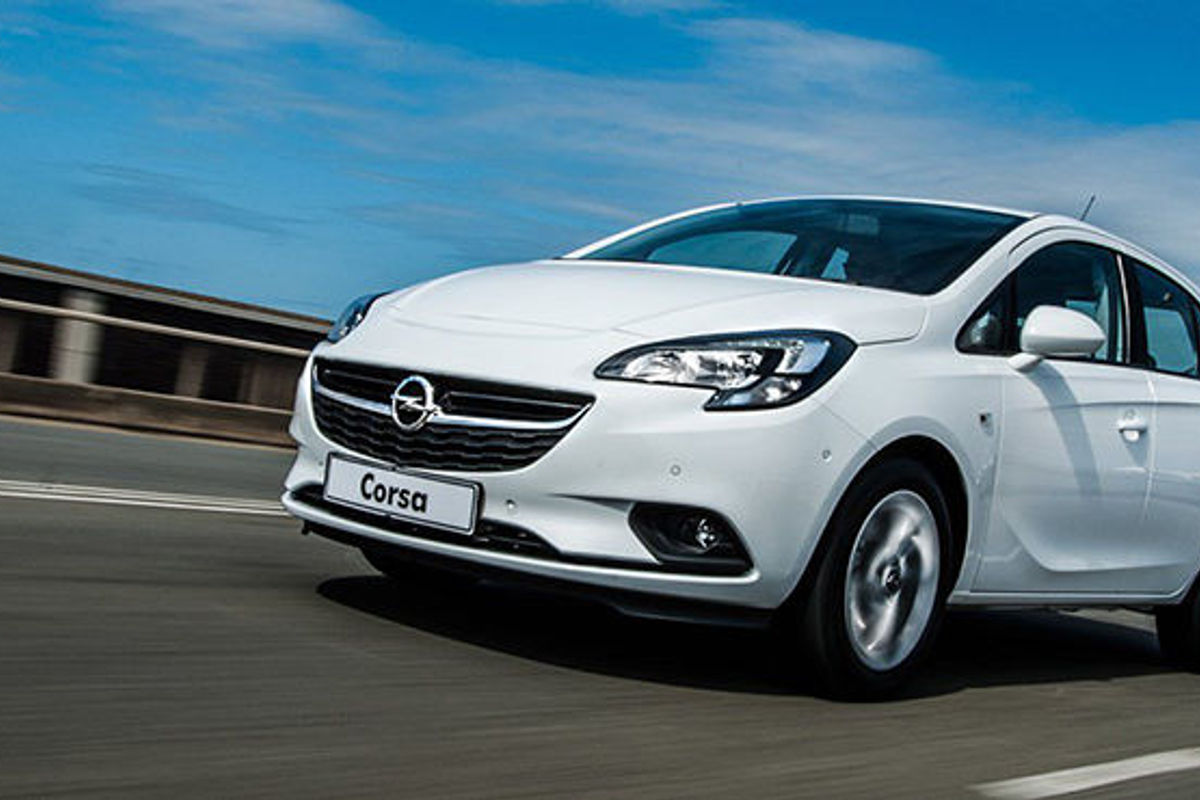
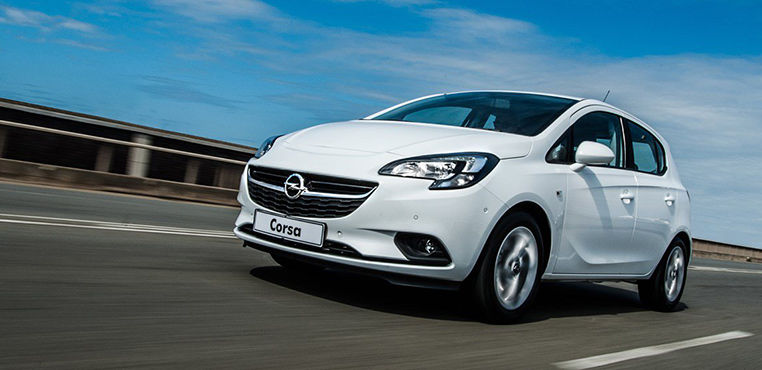
The Corsa was also in the running last year, and remains a strong (and underestimated) competitor in this segment. In its latest form the Corsa has matured into a strong all-rounder that is hard to fault. Ignore the conservative exterior design and inside you’ll find an impressively upmarket contender stocked with high-tech features (some optional). And when it comes power and economy, the Corsa benefits from what is arguably the pick of the new-generation small engines.
The perky 1.0-litre turbocharged engine underneath the Corsa's bonnet pumps out an impressive 85 kW/170 Nm, yet still returns 5.0 L/100 km!
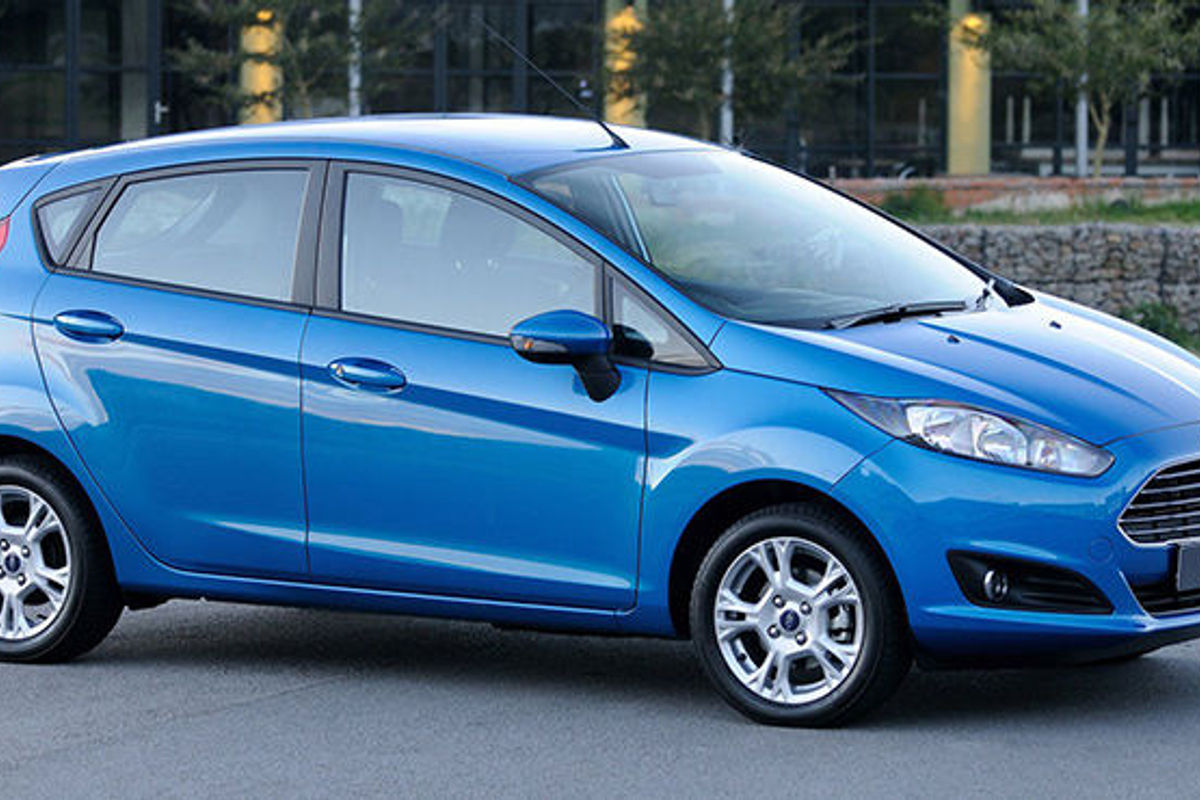
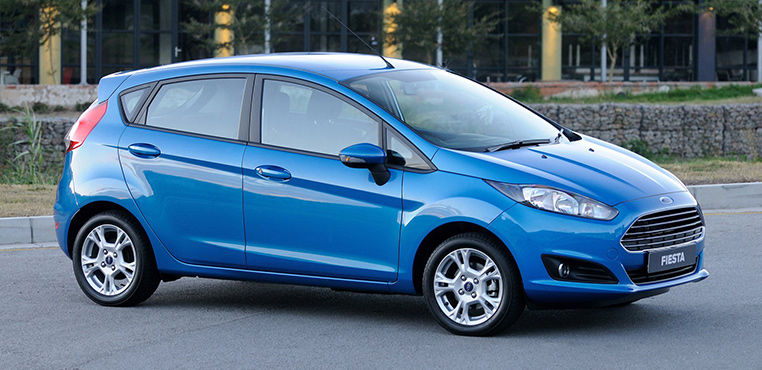
Ford’s Fiesta is not the freshest car on sale in this segment, but it was arguably ahead of its time when it was launched, so remains very popular. As part of its previous facelift it received an Aston Martin-esque front-end that boosted its desirability in the design stakes significantly. But it was the fitment of the 1.0-litre, turbocharged EcoBoost engine that made people sit up and take notice. This feisty Fiesta remains one of the most powerful cars in its class, and one of the best to drive.
The Fiesta's acclaimed engine delivers no less than 92 kW/170 Nm, and Ford claims an economy figure of 4.3 L/100 km.
Station wagon fans rejoice! Volvo has confirmed that the Cross Country version of its new V90 will be made available in South Africa.
According to Volvo, the importance of the Cross Country versions in its model range has been growing for some time. Of course, in Europe station wagons remain popular, but even there the success of SUVs and crossovers have dented the market. It makes only sense that endowing the traditional station wagon with some crossover appeal would be met with at least a degree of success.
"The new V90 Cross Country takes the elegance of the V90 and transforms it into an all-road car that delivers safety, comfort and performance in a capable and adventurous package," says Håkan Samuelsson, President & CEO, Volvo Car Group.
"Our cars are well known for their safety, strength and durability. With all-wheel drive, increased ride height, and a chassis optimised for comfort and control in all weather and road conditions, the new V90 Cross Country takes our versatile V90 estate and adds the heart of an explorer," says Dr Peter Mertens, Senior Vice President Research & Development at Volvo Cars.
Rugged Design
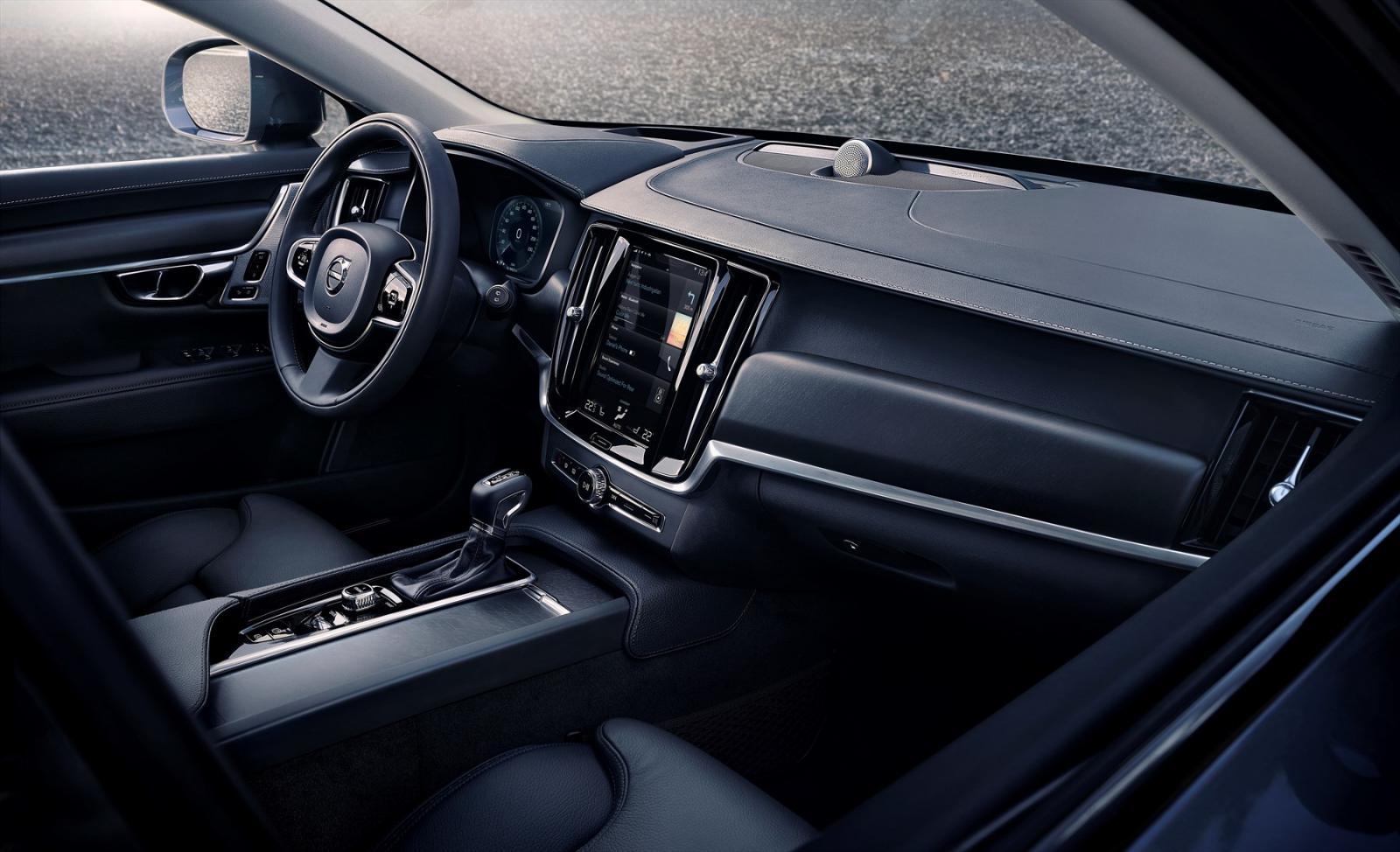
Like the XC90, the new V90 Cross Country has a beautifully designed, uniquely Volvo fascia with the company's stylish and user-friendly Sensus touch-screen infotainment system.
The recently launched S90/V90 model range has garnered widespread praise, particularly for the uniquely Swedish approach to design. Transforming the model into a Cross Country has not merely been the case of lifting the ride height and adding some black body cladding, says Volvo. "Designing a Volvo Cross Country is not a styling exercise, a plastic job. It is based on honest capability. The Volvo V90 Cross Country brings a surprising and intriguing combination of a strong, powerful exterior and a luxurious, Scandinavian interior. It will continue the genuine tradition of the Volvo Cross Country with a new recipe: the blend of powerful off-road capability in a most elegant, sophisticated, tailored wagon suit," says Thomas Ingenlath, Senior Vice President Design at Volvo Cars.
Look at the photographs and judge for yourself! We believe the V90 Cross Country will cut a very distinctive figure in a sea of SUVs…
Inside, and in terms of powertrains (only 2.0-litre engines, in petrol and diesel), we expect the newcomer to mirror largely what is on offer in the S90/V90, which will launch in South Africa soon. The D5 version (which offers 173 kW and 480 Nm of torque in the S90) seems particularly well-suited to the local market. Volvo has not confirmed a date for the local introduction of the V90 Cross Country, but we expect it in the first quarter of 2017.
The Cars.co.za Ownership Satisfaction Survey, in partnership with leading data specialists, Lightstone Consumer, forms an integral part of the awards programme, with the survey accounting for 50% of the final result in each category. The brand-specific data incorporates feedback from thousands of South African new vehicle owners, based on their experiences of their vehicles (must be less than five years old and serviced through franchised outlets).
The Premium SUV category recognises vehicles that offer high levels of luxury, status, sophistication and capability. To be eligible for consideration, vehicles in this category must have a list price between R750 000 and R1 200 000 and must be a large SUV. All-wheel drive must also be offered as standard. The pillars of success in the Premium SUV category include powertrain technology, luxury, brand strength, design and quality appeal, driving dynamics and spec and practicality.
The semi-finalists in the Premium SUV category of the Cars.co.za Consumer Awards – powered by WesBank are as follows (in no particular order):
Volvo XC90 T8 Twin Engine Inscription
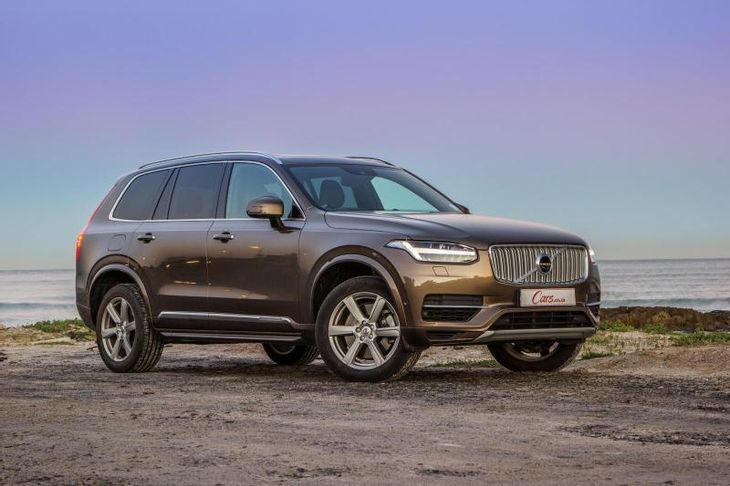
The Volvo XC90 D5 Inscription scooped the category trophy at the inaugural Cars.co.za Consumer Awards and this year the flagship XC90 T8 Twin Engine makes its appearance to defend the XC90’s previous success. The XC90 T8 Twin Engine Inscription features hybrid technology that promises superb efficiency and more power. The front wheels are powered by a turbocharged and supercharged 2.0-litre petrol motor that produces 235 kW and 400 Nm through an eight-speed automatic transmission, while the rear wheels are driven by an electric motor producing 65 kW and 240 Nm of torque. Combined output totals 300 kW and 640 Nm of torque. Volvo claims a fuel consumption figure of 2.1 L/100km for the XC90 T8 Twin Engine Inscription.
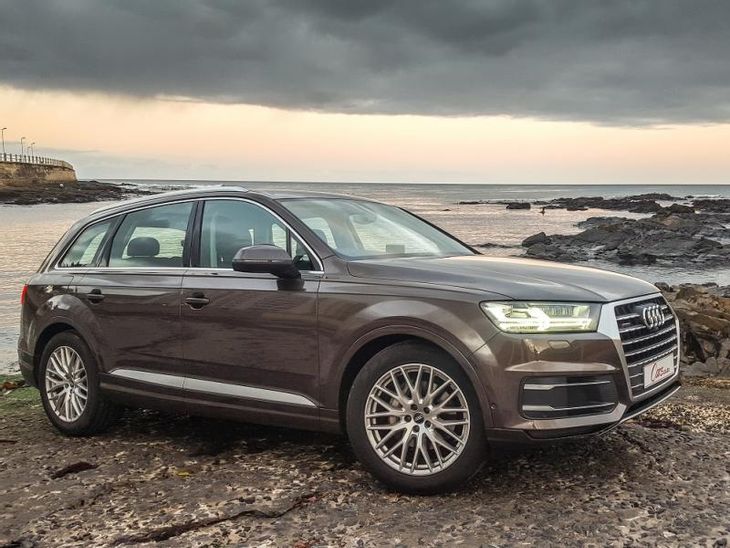
The second-generation Q7 is a fine product that offers high levels of refinement and ride comfort. There are few cars, if any, in this category that deliver premium, luxury motoring with such efficiency and ease. The lighter Q7 is powered by a 3.0-litre turbodiesel engine with 183 kW and 600 Nm of torque and is equipped with a slick eight-speed automatic transmission to put its power to the tar. In terms of fuel economy, the Q7 3.0 TDI quattro is claimed to consume 6.3 L/100km.
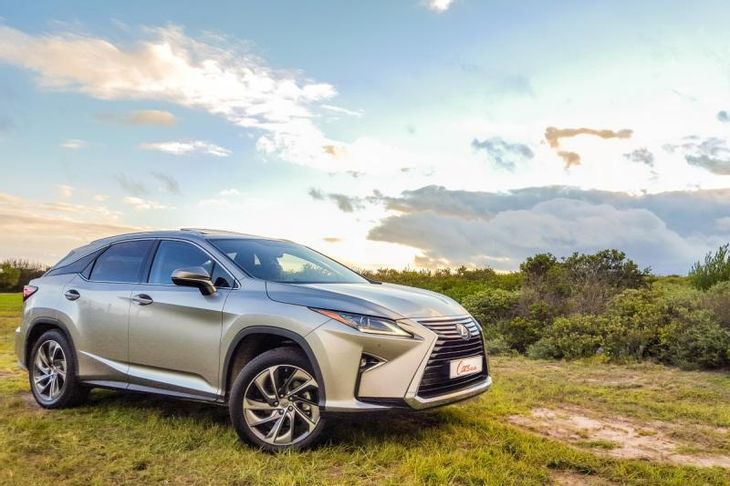
The boldly styled Lexus RX350 EX comes well equipped with standard features and represents good value in this segment. The RX350 EX is fitted with an updated 3.5-litre V6 petrol engine that produces more power and torque than before with 221 kW and 370 Nm of torque. All four wheels are powered using an eight-speed automatic transmission. Power and refinement are strengths of the RX350 EX and Lexus claims a fuel consumption figure of 9.6 L/100km, which is achievable in real world driving situations.
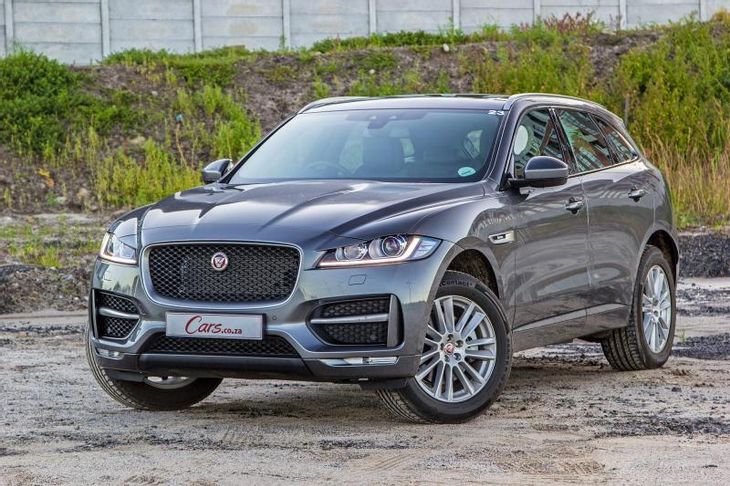
Jaguar’s F-PACE SUV is both visually appealing and dynamically impressive and this 30d R-Sport AWD drive derivative is particularly potent. A 3.0-litre V6 turbodiesel engine delivers a mighty 221 kW and 700 Nm of torque through an eight-speed automatic transmission. The F-PACE 30d R-Sport is essentially a sports car that just happens to be a practical SUV and it provides a comfortable and composed drive on all surfaces. In terms of fuel consumption, Jaguar claims 6.0 L/100km for the F-PACE 30d R-Sport AWD.
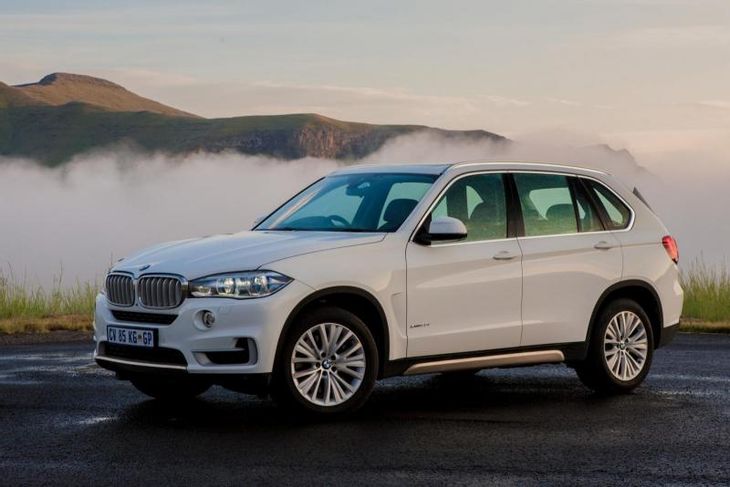
The top-selling BMW X5 xDrive30d Steptronic offers a near-perfect blend of performance, efficiency, status and dynamic ability. Powering this derivative is BMW’s proven 3.0-litre, six-cylinder turbodiesel engine offering 190 kW and 560 Nm of torque. All four wheels are driven through a smooth and fast shifting eight-speed automatic transmission. The BMW X5 xDrive30d Steptronic is refined and responsive to throttle inputs and fuel efficiency is good with a claimed fuel consumption figure of 5.9 L/100km.
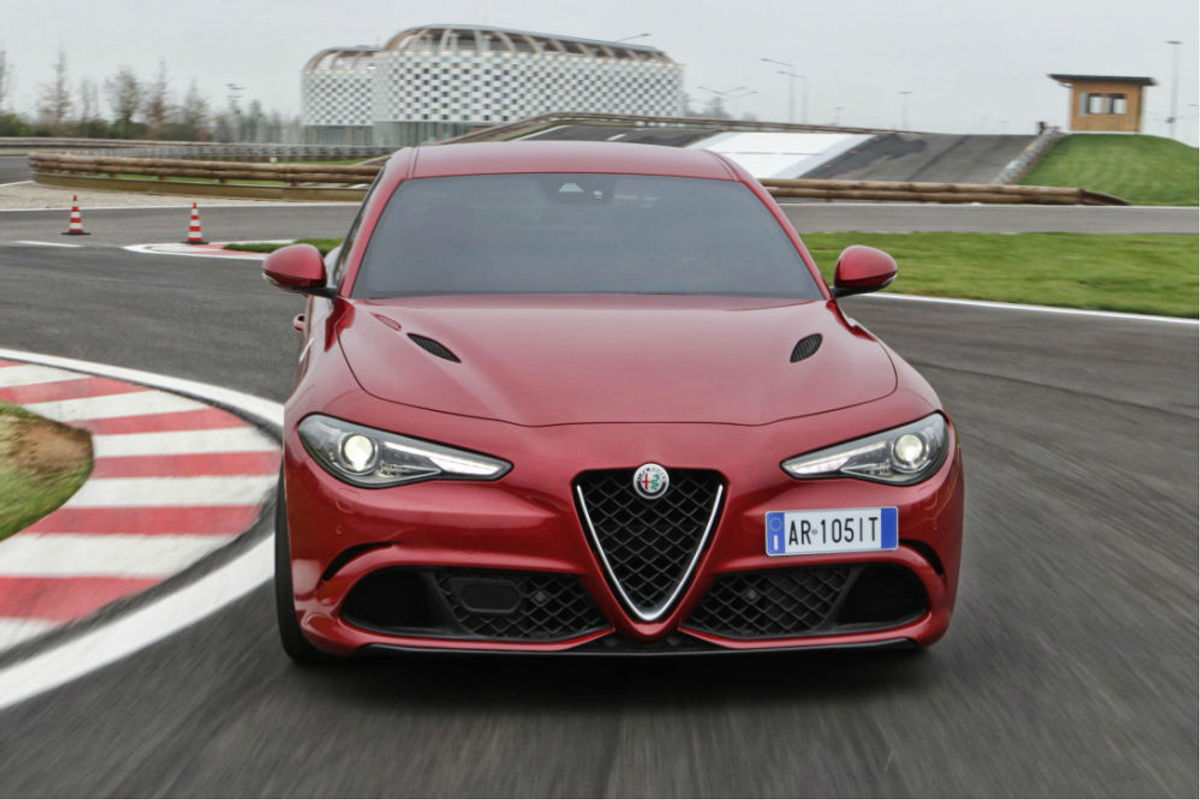
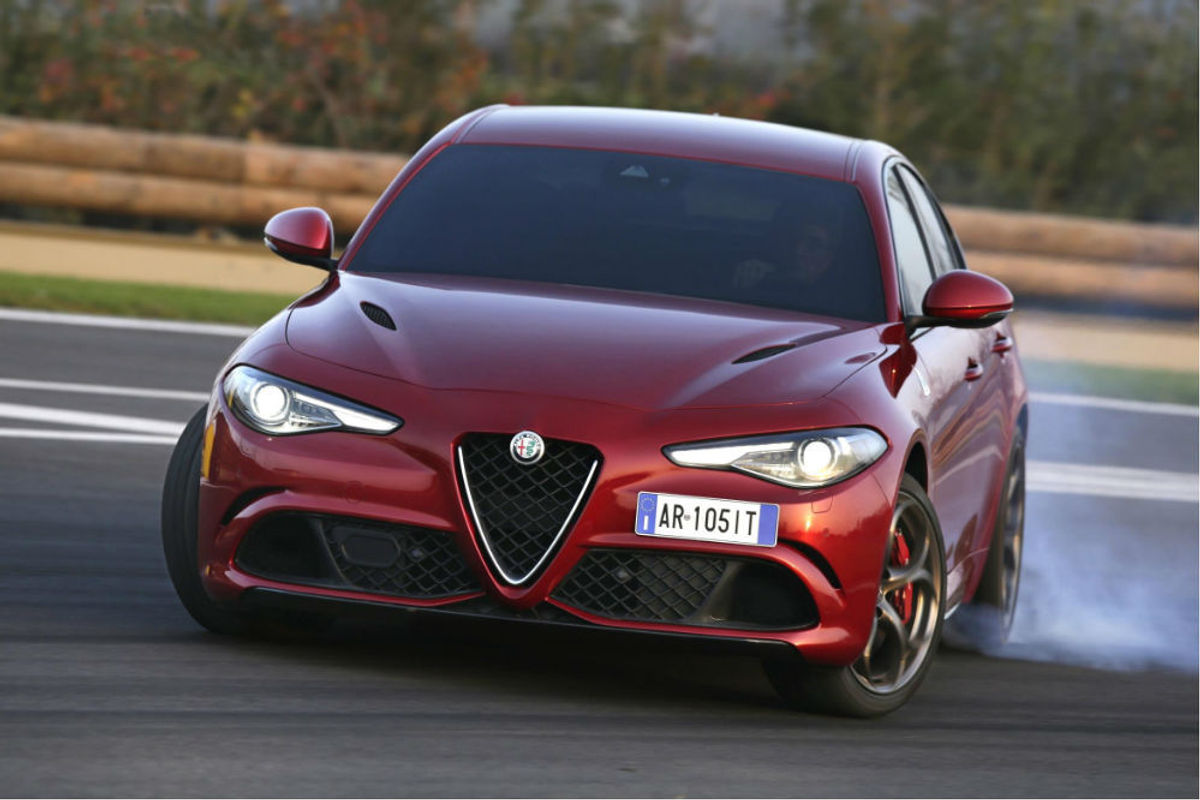
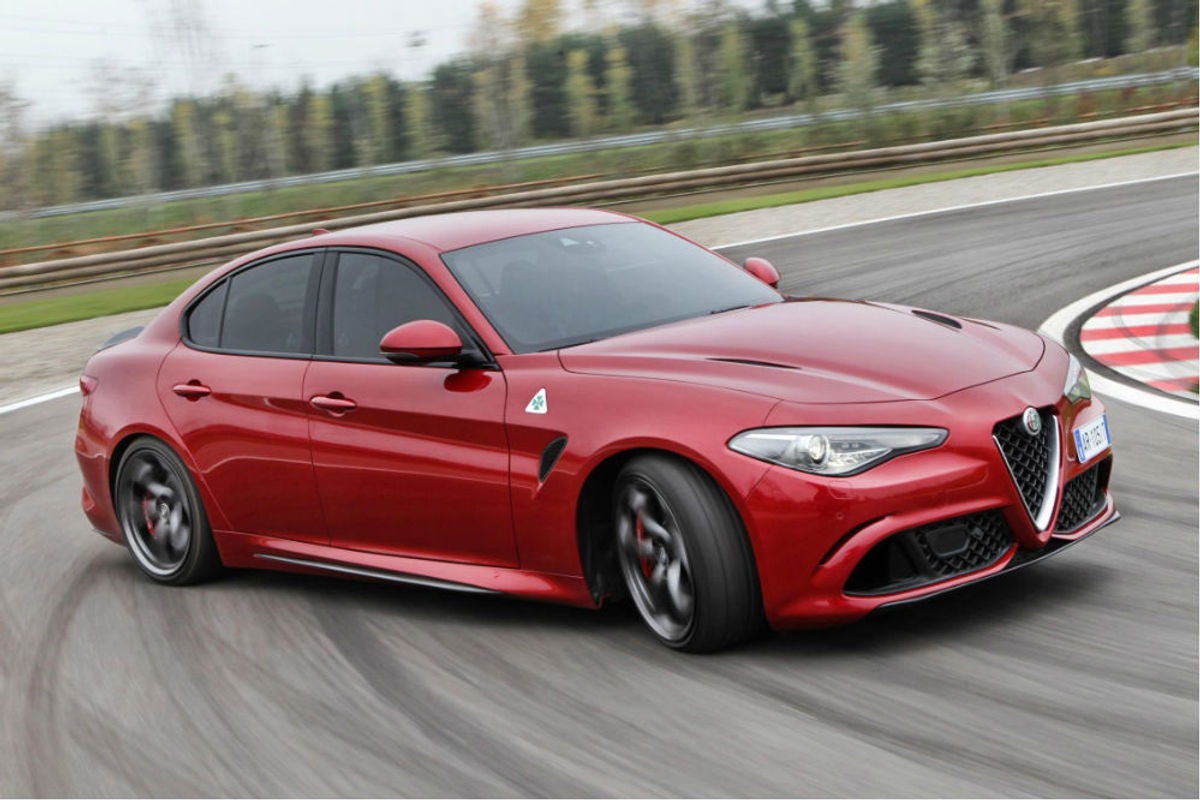
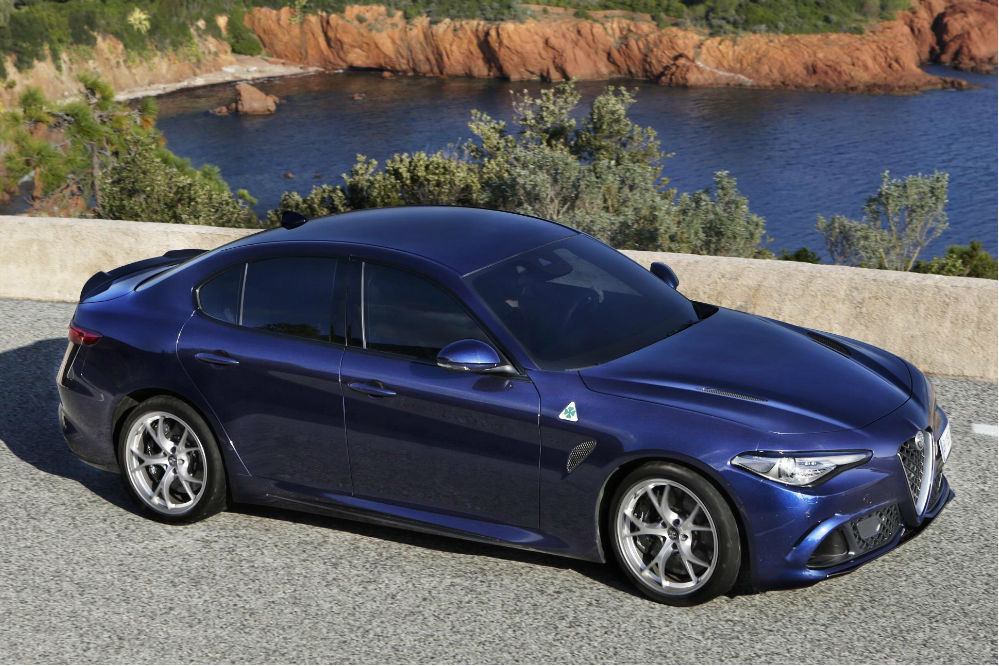
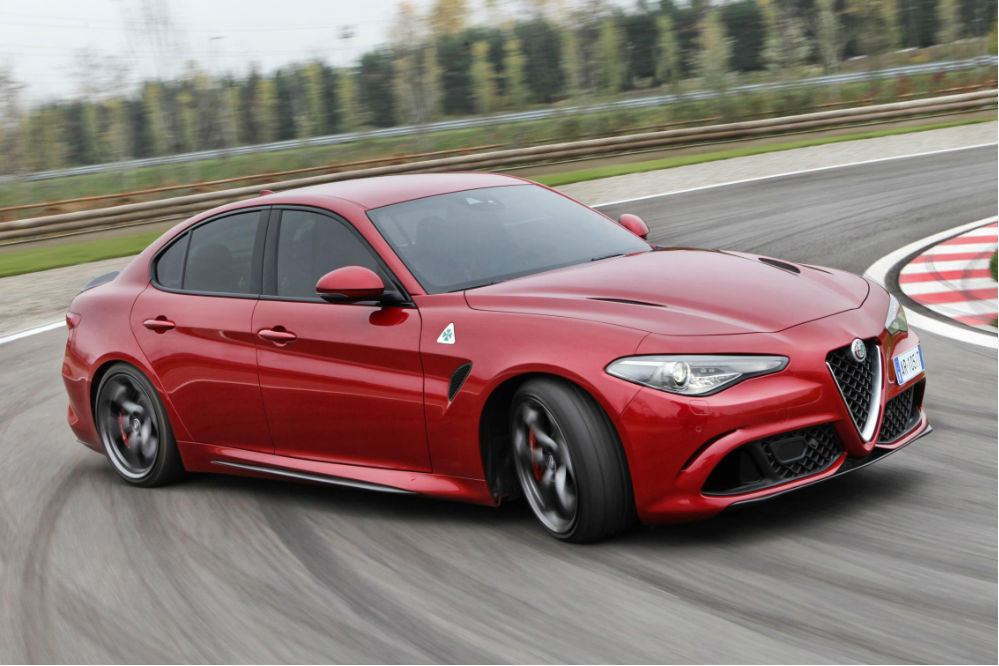
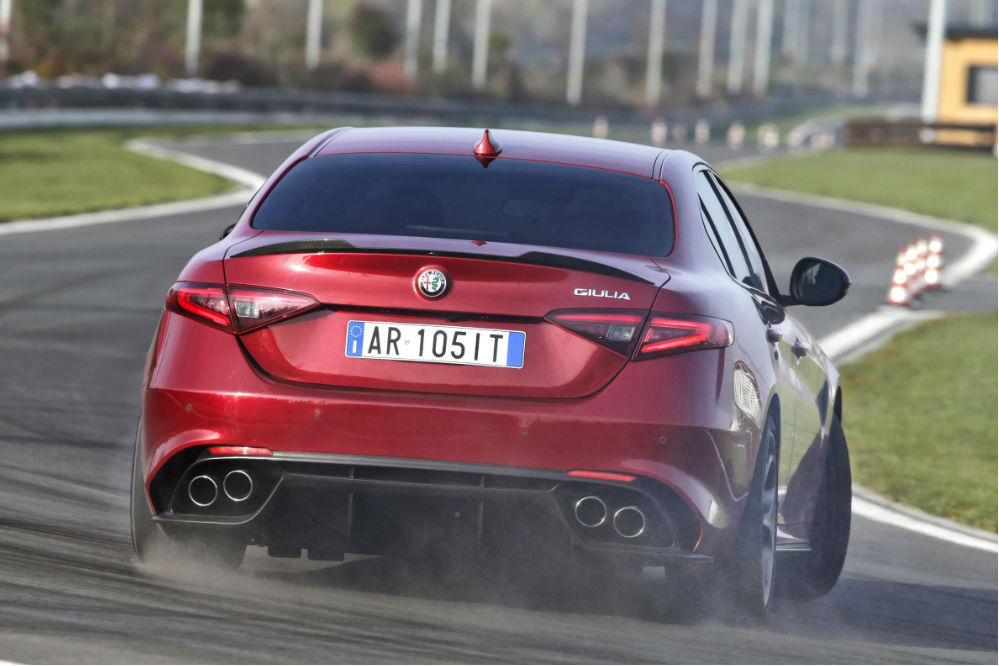
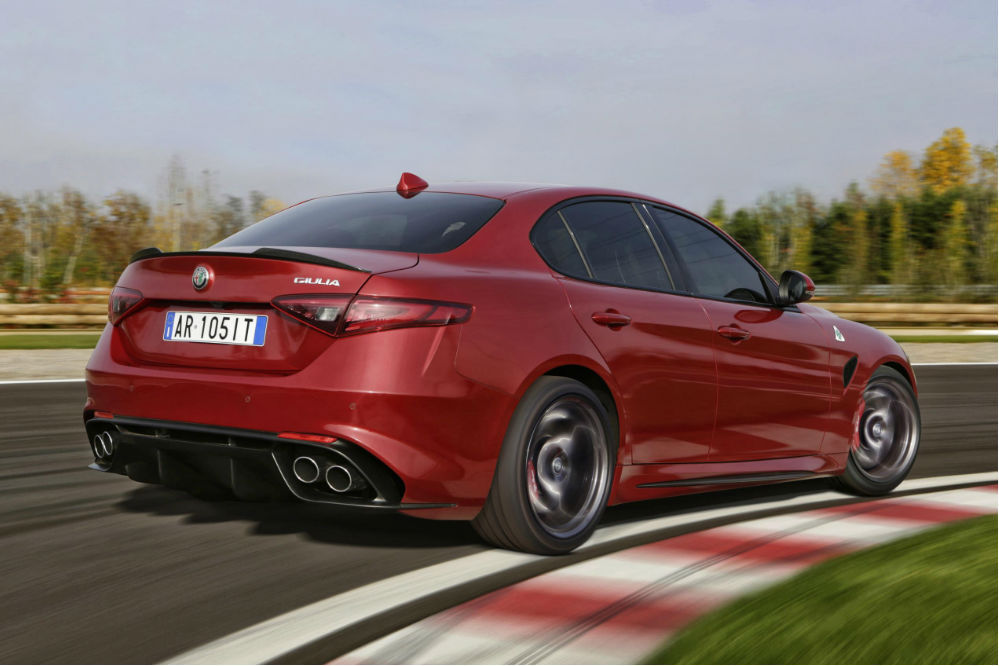
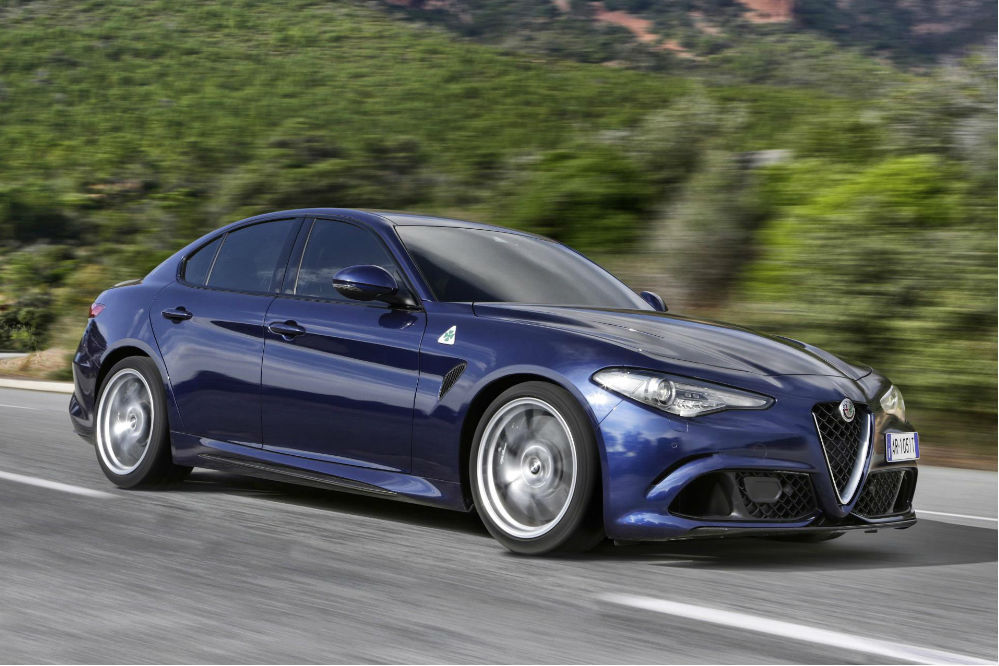
[Updated] Alfa Romeo Giulia Quadrifoglio (2016) First Drive
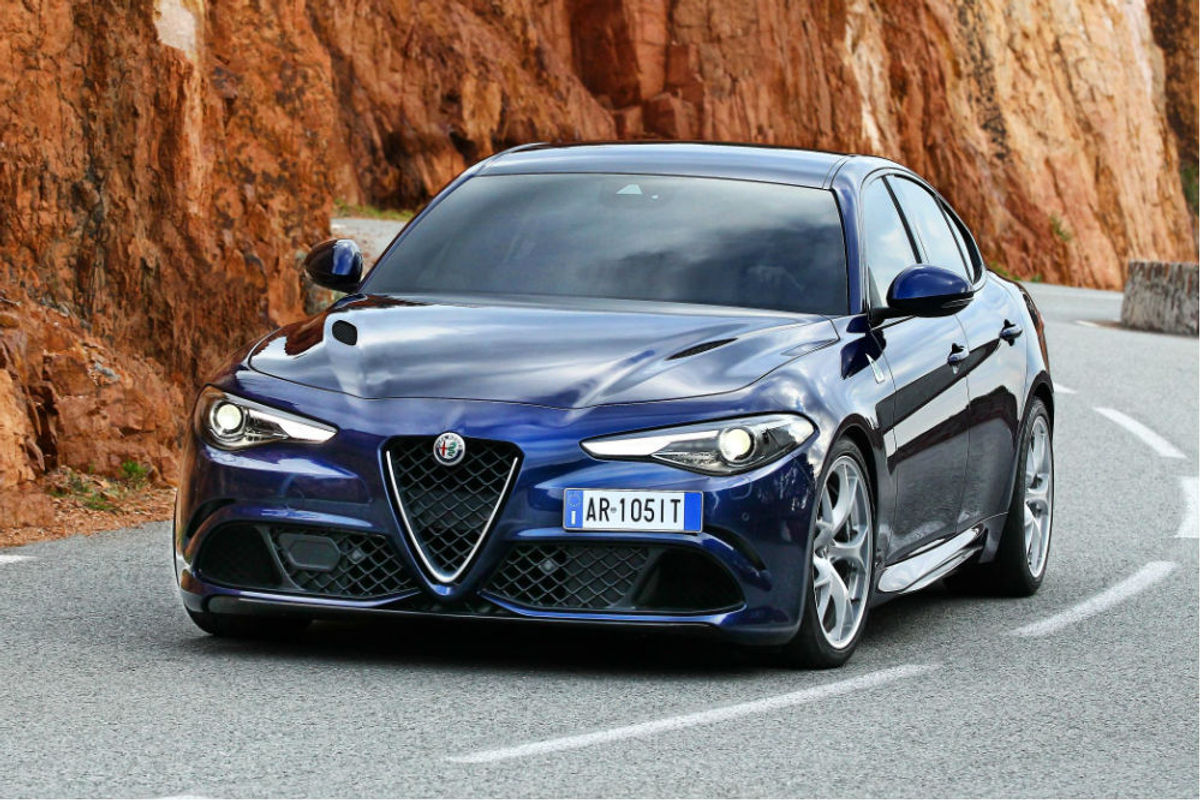
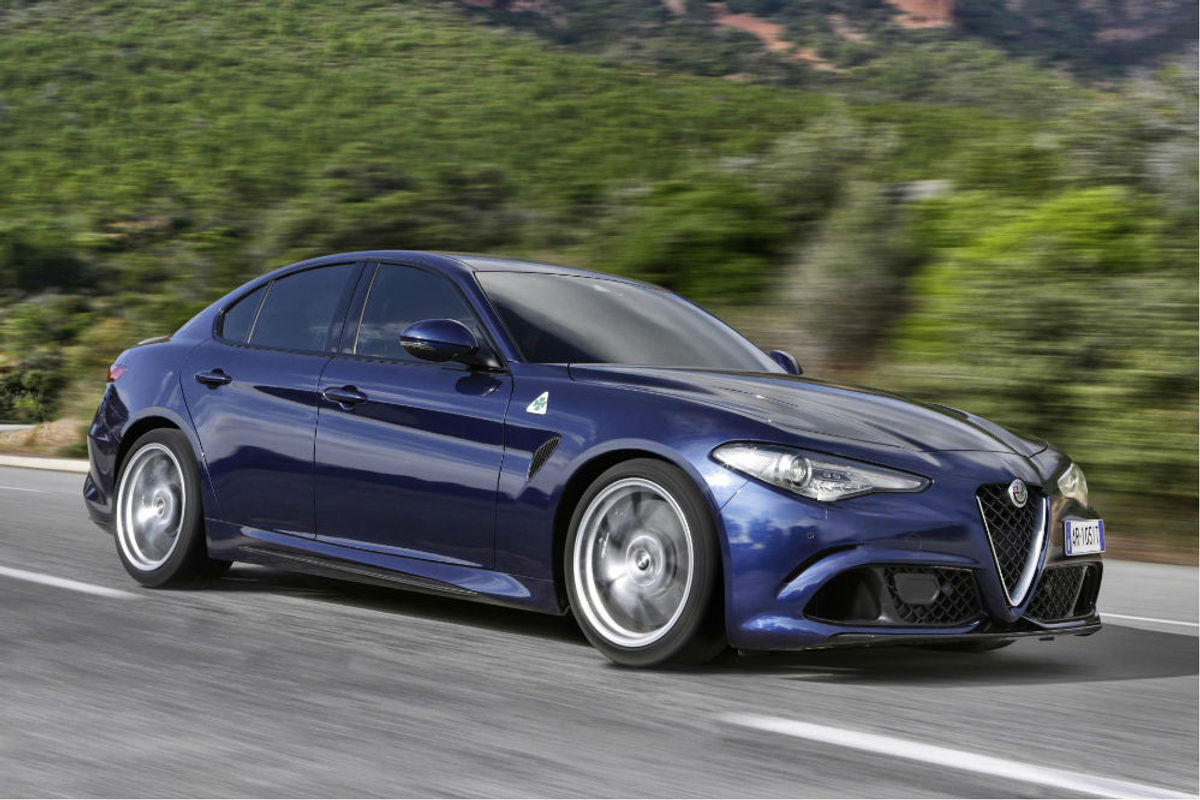
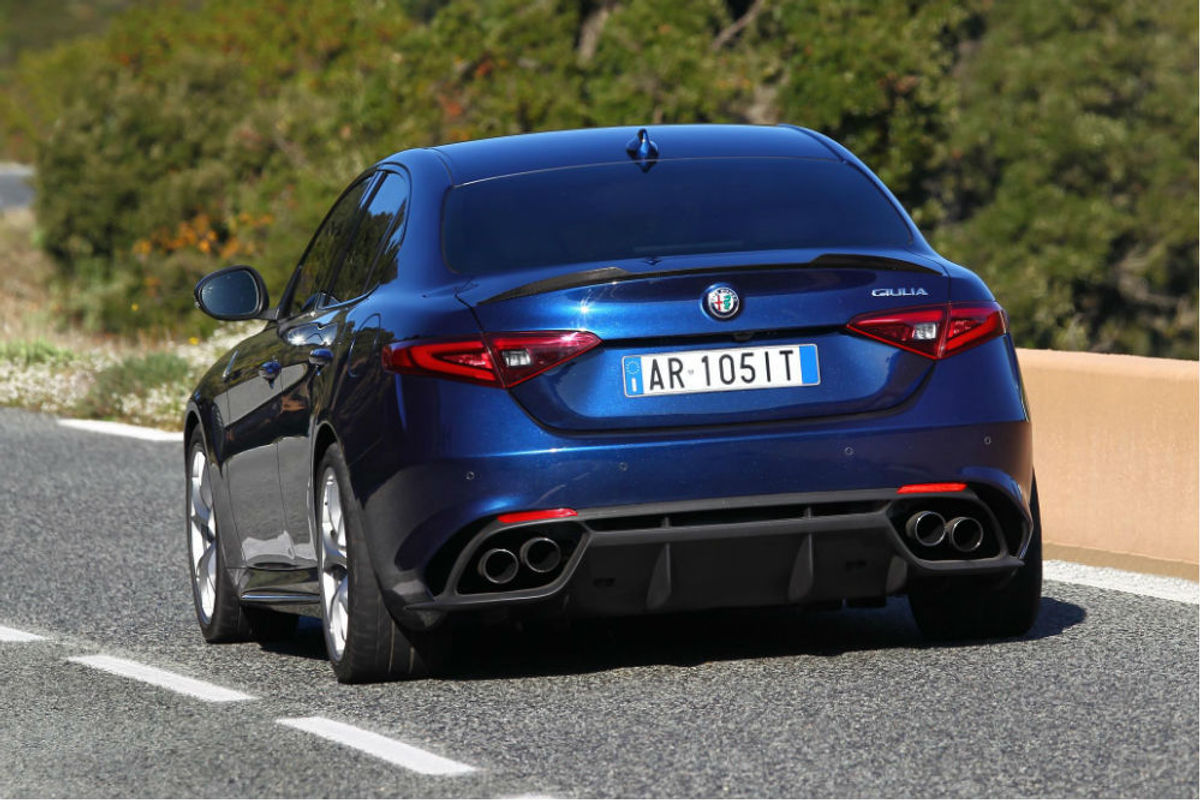
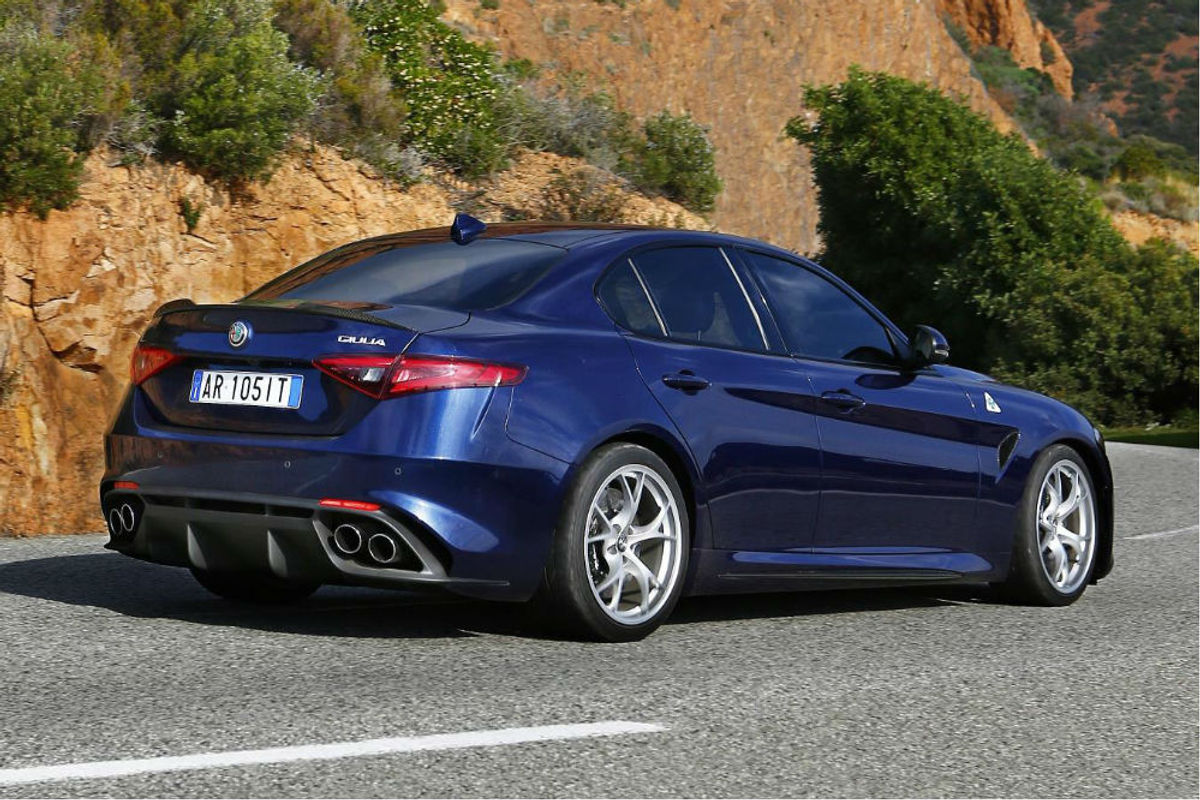
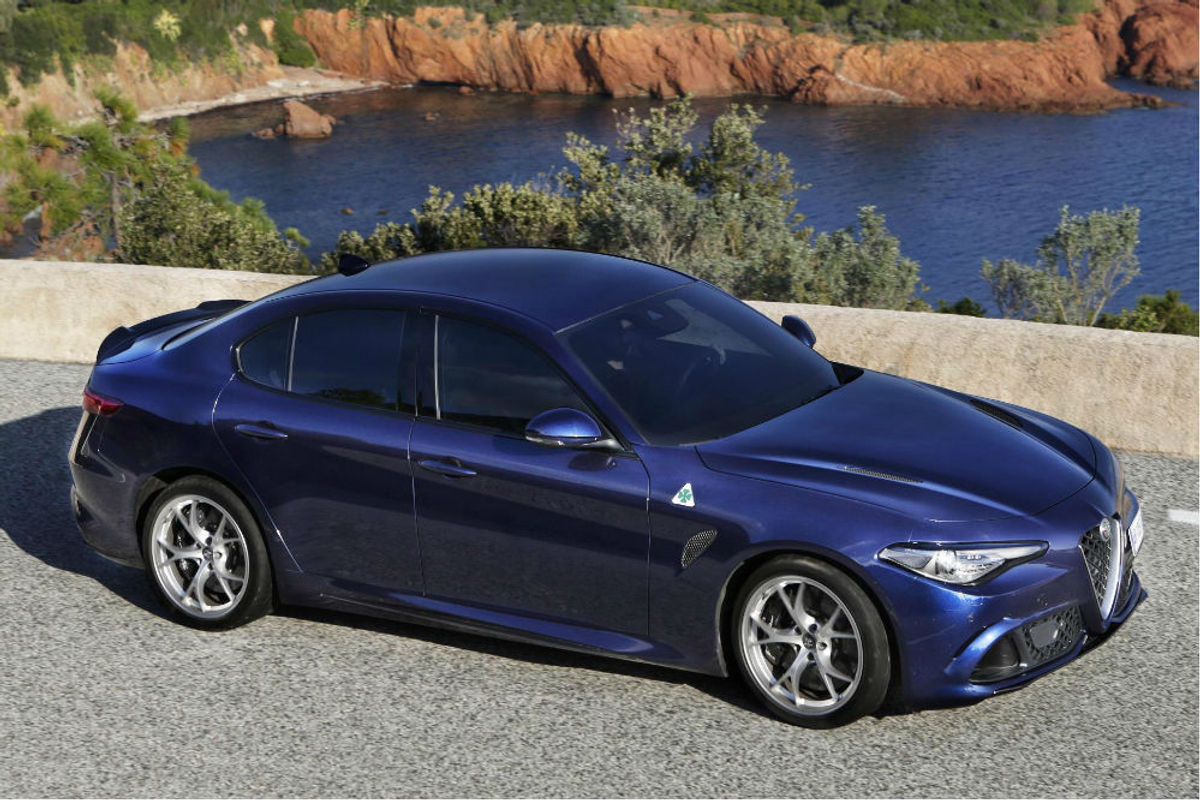
The Alfa Romeo Giulia business class sedan is scheduled to arrive in South Africa in January 2017. It will be headed up by two versions of the BMW M3-rivalling Quadrifoglio derivative: the Launch Edition (R1.4 million) and Race Edition (R1.6 million). Right-hand-drive markets (such as ours) will only get the Quadrifoglio in automatic guise. However, our UK correspondent says that's not a bad thing… the self-shifting twin-turbo 2.9-litre V6 asphalt shredder is well worth the wait…
By Matt Robinson
Perched atop of the Alfa Romeo Giulia tree is a model that has more than twice the power of the model below it and it’s called the Quadrifoglio. With a twin-turbocharged V6 engine of epic output, a 307 kph top speed and a sub-4-second 0-100 kph sprint time, this Italian sedan wades straight into battle with the BMW M3 and the Mercedes-AMG C63 S and it's not all about headline statistics, as the Alfa has a sparkling chassis to go with its firepower.
Alfa Romeo is no longer in the doldrums. Fiat Chrysler Automotive (FCA) chief Sergio Marchionne gave the Milanese marque R71 billion to jump-start the Cuore Sportivo, ordering it to look back to its heritage of building sports sedans and hugely desirable cars. Therefore, 8 models will be built on an all-new platform and all of them will be rear- or four-wheel drive. First up, though, is a BMW 3 Series-rivalling saloon called the Giulia – a nameplate from Alfa's 1960s and '70s glory years. The thing is, if you're going to rival the 3 Series, then you've got to match the BMW's range from top to bottom.
Alfa Romeo's long-awaited return to a rear-wheel-drive platform will undoubtedly be welcomed by track enthusiasts.
Awash with carbon fibre
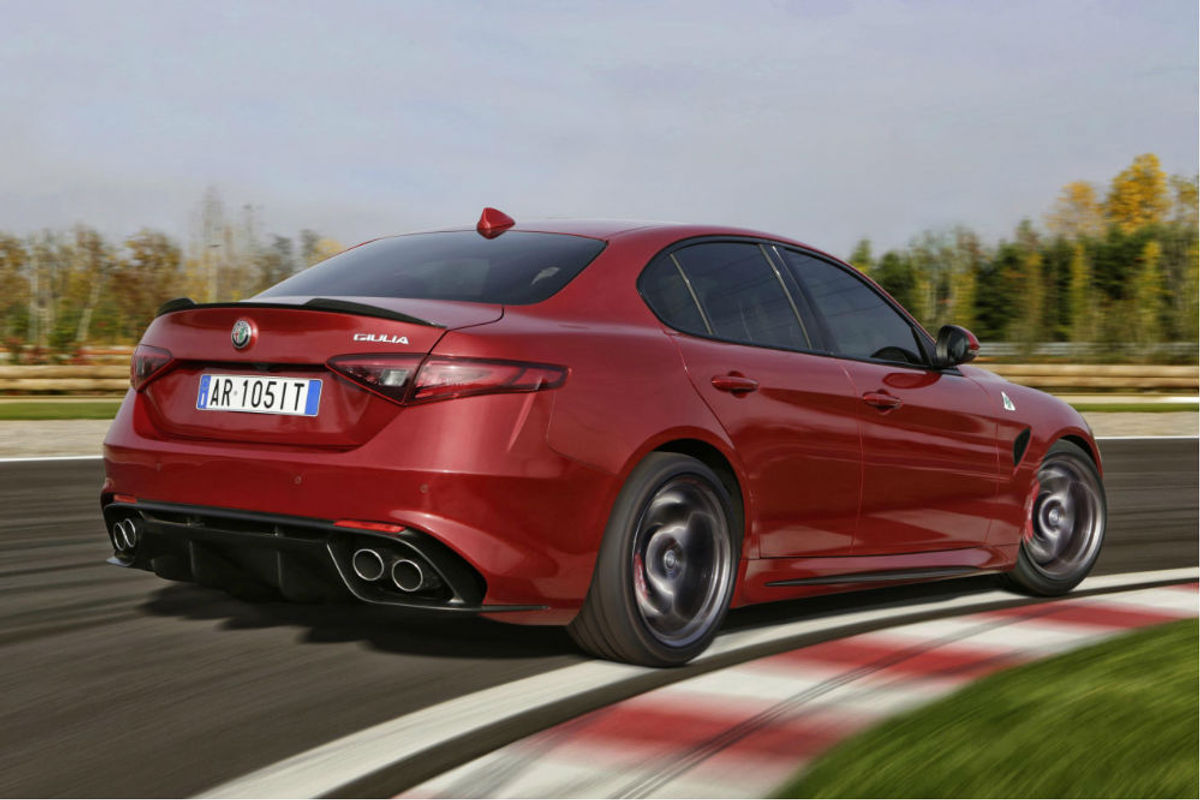
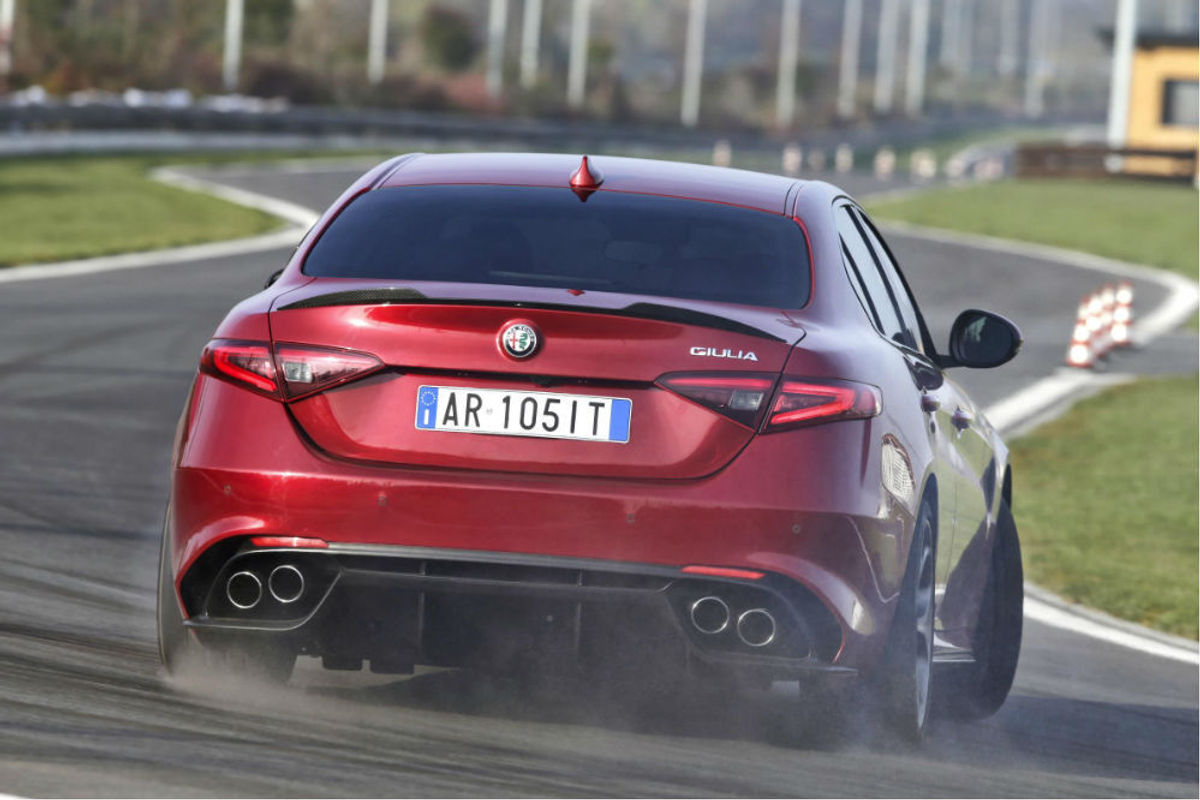
To that end, the Giulia is Alfa Romeo's take on how you do a compact super-sedan, otherwise known as an "M3/C63/RS4 rival". The 1 650 kg Quadrifoglio features more carbon fibre in its construction than the regular Giulia, with the bonnet, roof, active aero front splitter, boot spoiler, rear diffuser and side skirt extensions forged in the lightweight material.
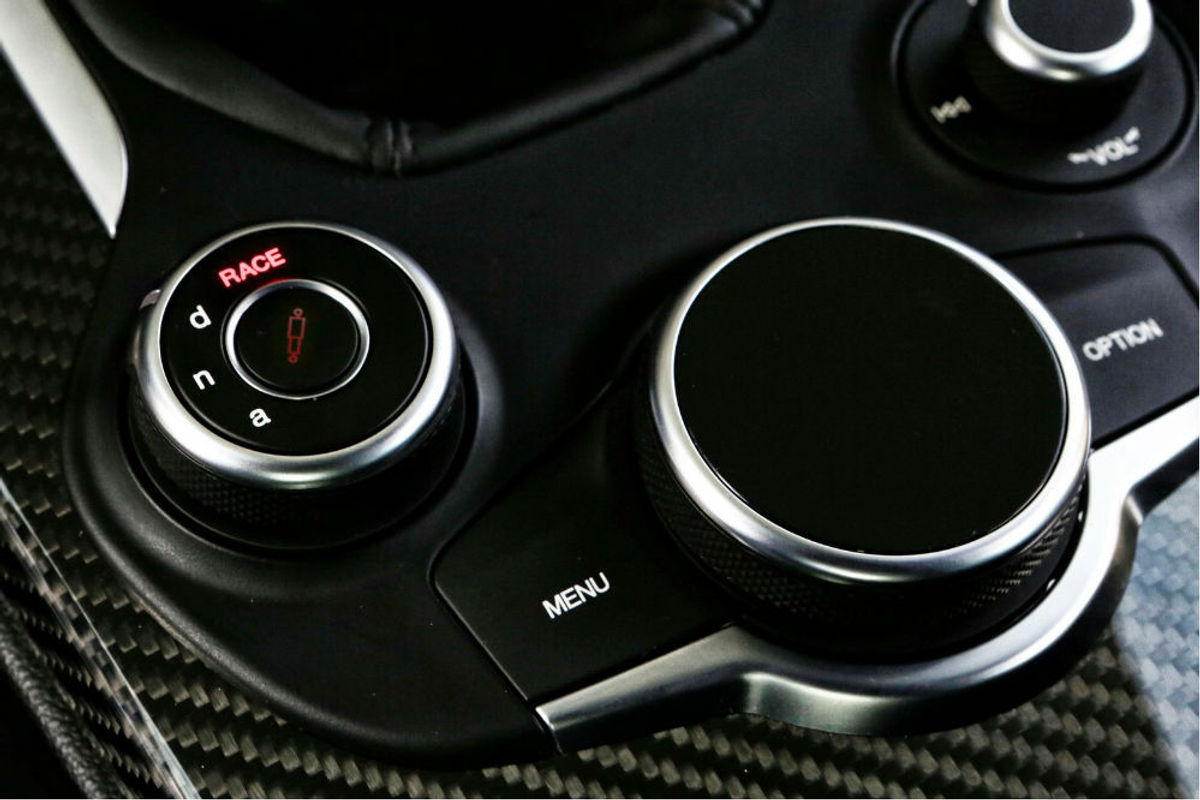
In addition to this, a whole host of technological chassis aids including torque vectoring for the rear differential, DNA Pro offers selectiable drive modes (with an extra "Race" setting for maximum noise and electronics-off track driving) and active dampers with different rates of response.
The brakes can bring the Quadrifoglio from 100 kph to a dead stop in 32 meters and Alfa's Chassis Domain Control (CDC), which basically controls all the electronics mentioned above to automatically keep the Giulia Quadrifoglio in the best fighting condition possible (given the driving environment).
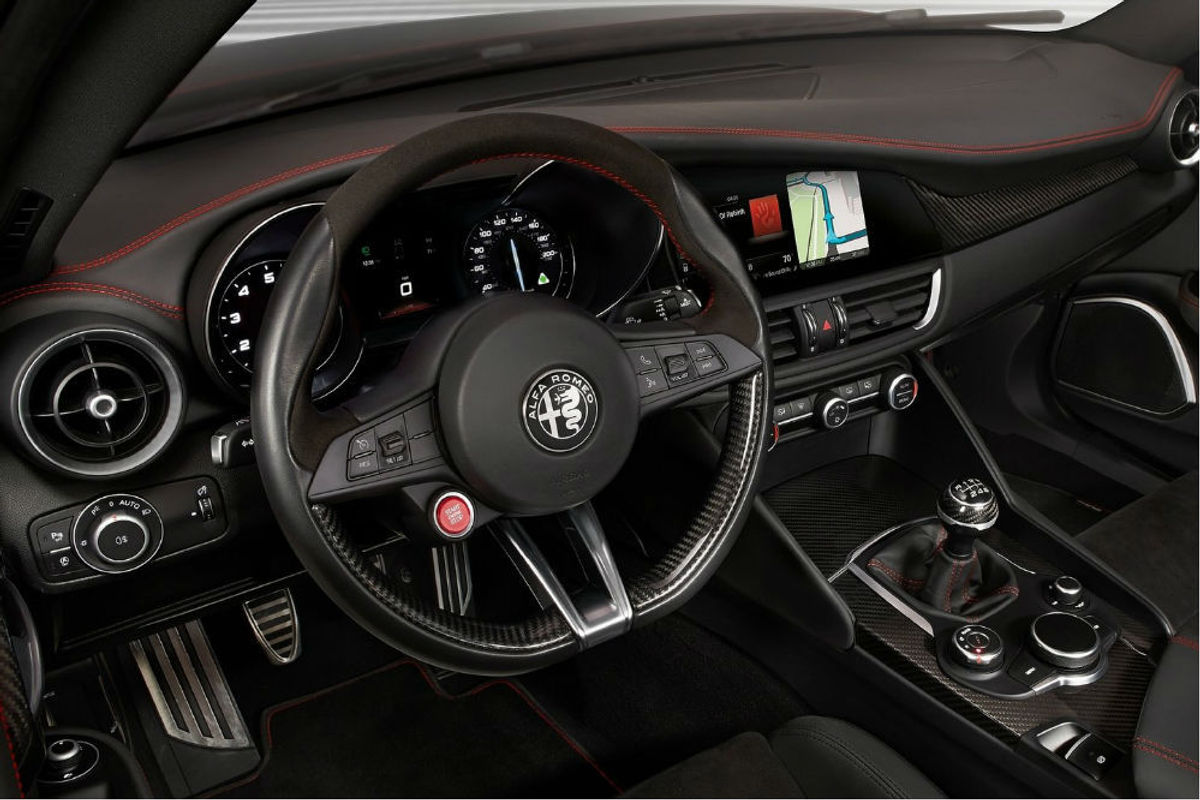
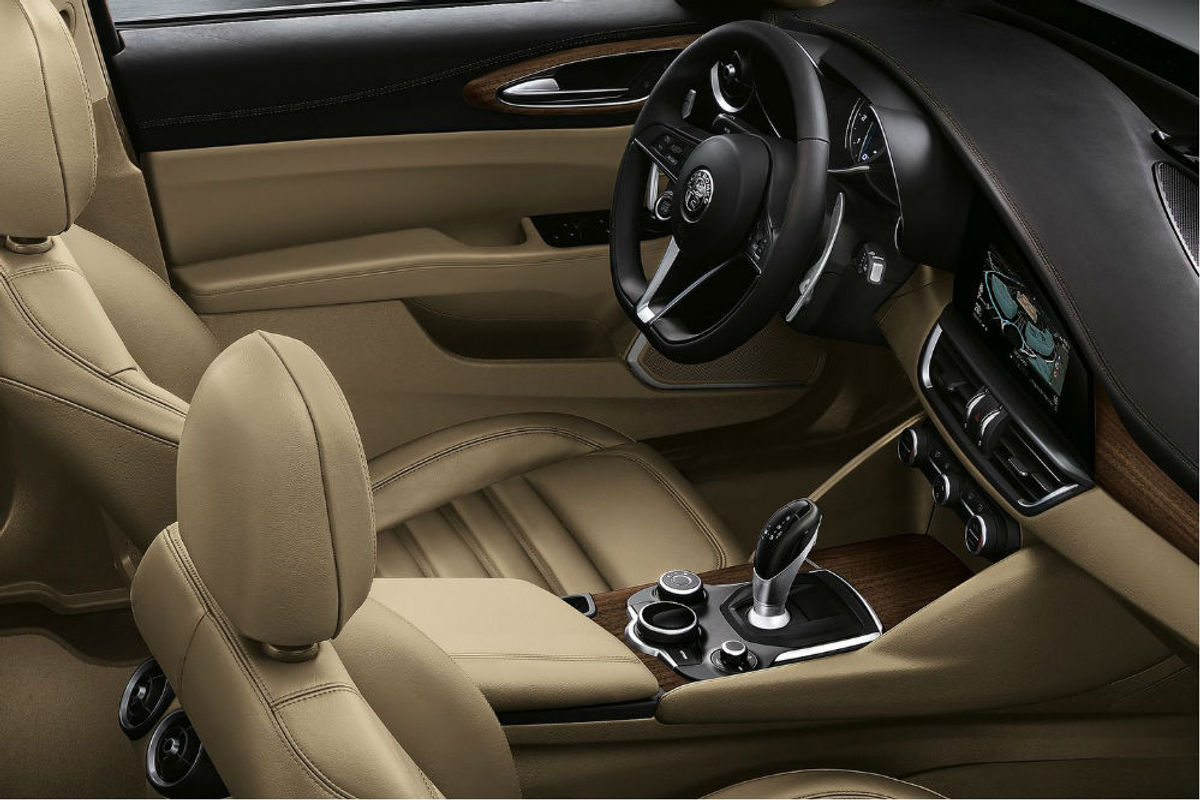
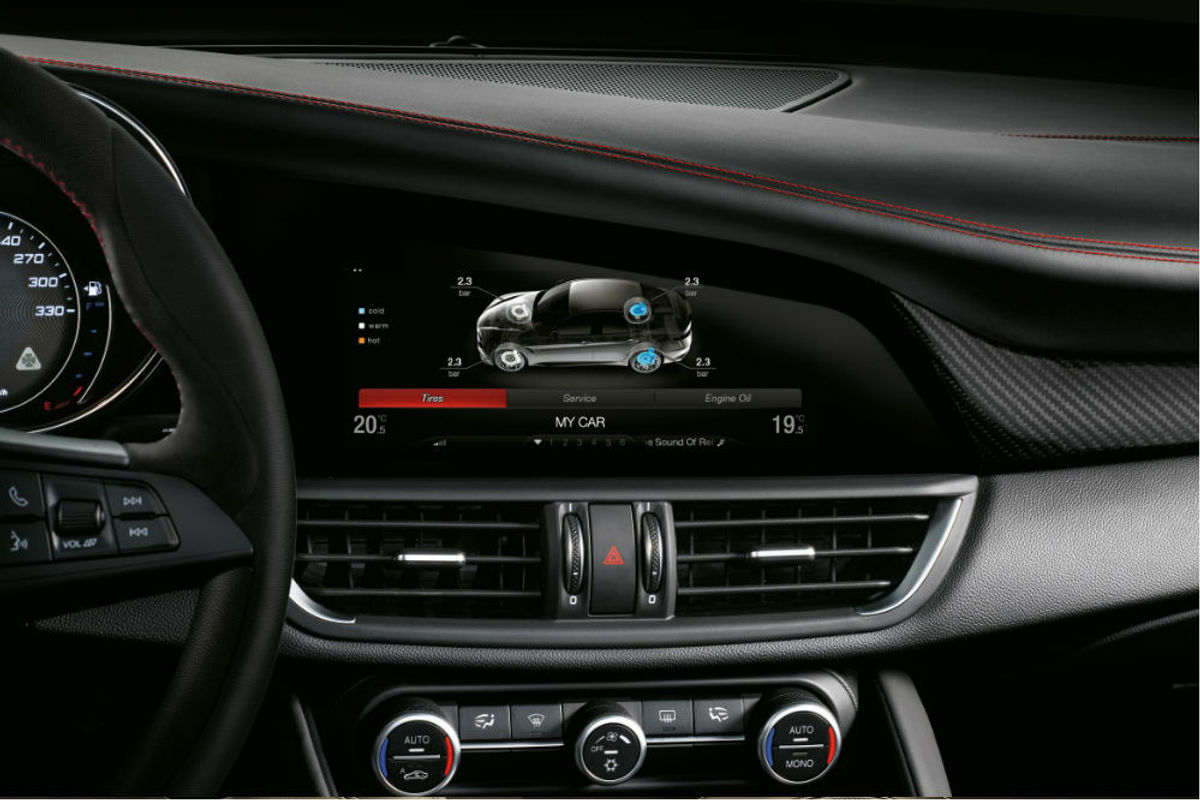
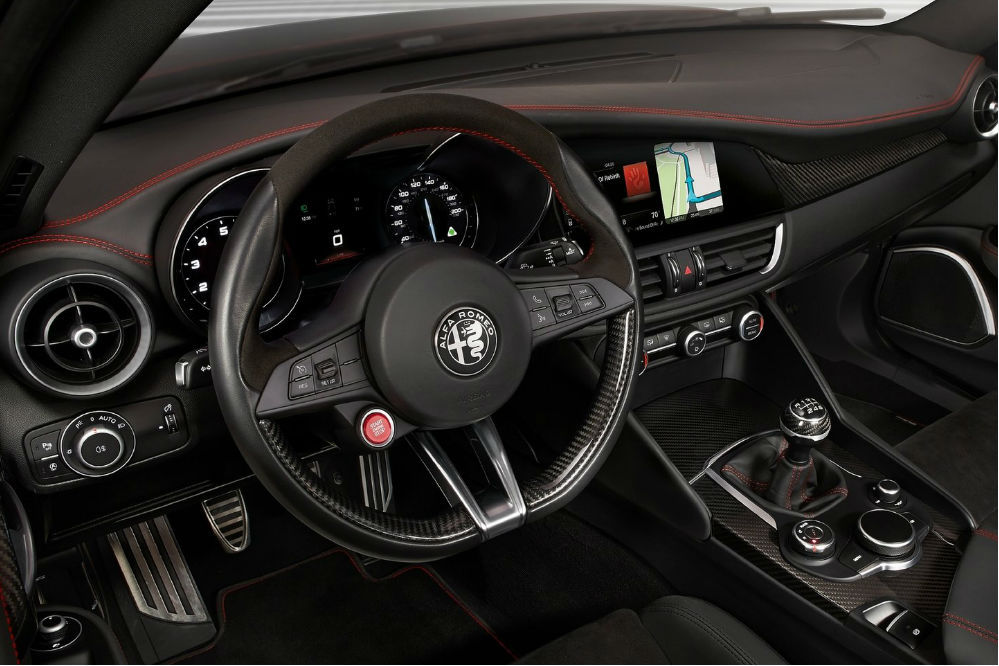
The Quadrifoglio's interior is overtly sporty, replete with a motorsport-inspired steering wheel and swathes of carbon fibre.
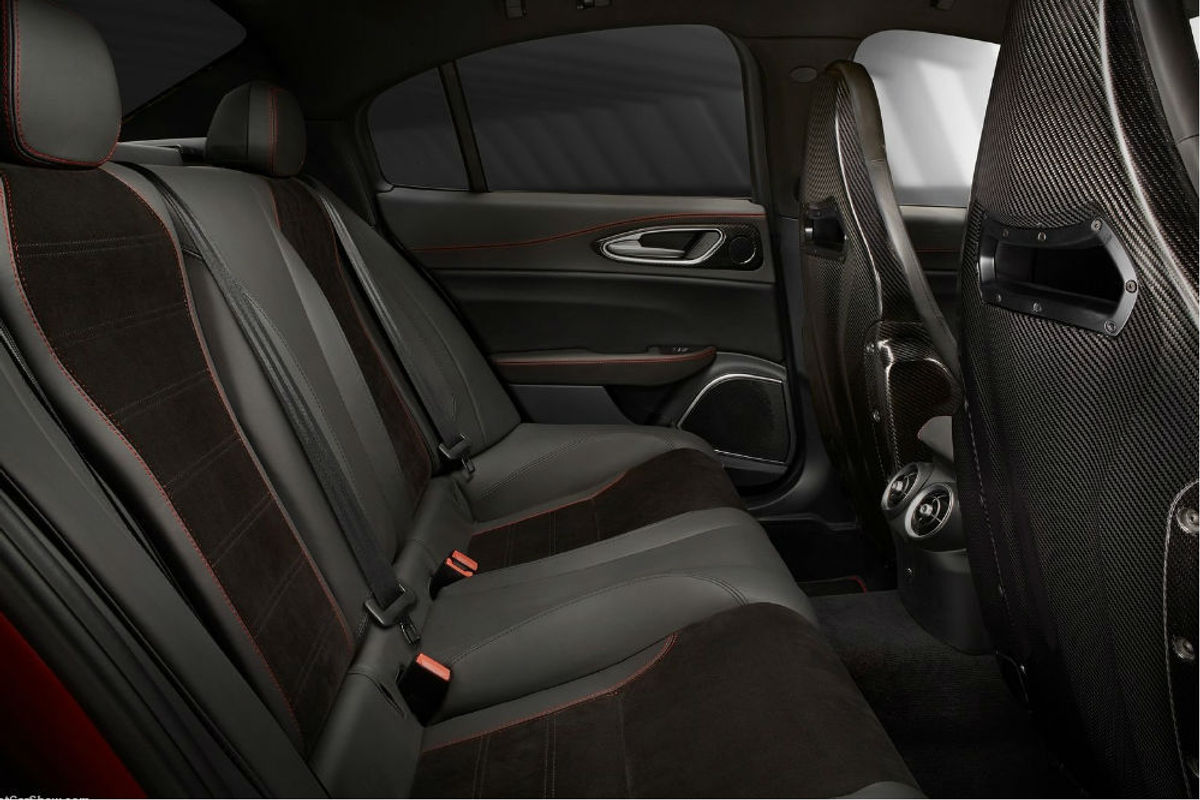
Inside you will find leather and Alcantara sports seats, large metal shift paddles on the steering column to actuate manual shift on the 8-speed ZF transmission, lots of carbon fibre trim and a speedometer that reads to at least 320 kph.
The Quadrifoglio doesn't have to adhere to a speed limiter and is said to be capable of 307 kph flat out. That makes it the fastest and most powerful Alfa Romeo ever built. Which is good timing for a brand that's trying to upset the German apple cart, isn't it?
There is a plethora of aerodynamic addenda, but it does not detract from the elegance of the Giulia's contours
Beautiful, despite all the purposeful adornments
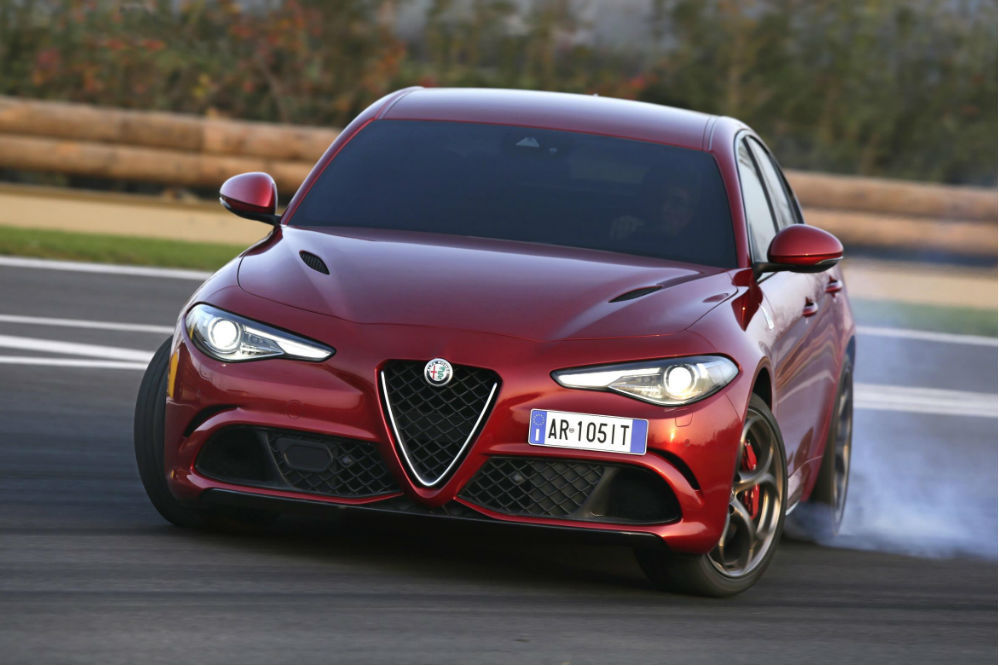
Before getting behind the wheel of the Giulia Quadrifoglio (no longer called a Quadrifoglio Verde, so no QV abbreviation, although the same green cloverleaf can be seen on the Alfa's front wings found on the MiTo and Giulietta QVs of the 'old' era), it's fair to say that turning it into a multiple-exhaust-toting super-sedan has not harmed the looks of this elegant Italian four-door. Alfa is to be commended for striking just the right subtly aggressive aesthetic tone on the outside and while the interior is not quite up to class-leading standards, it remains highly appealing in Quadrifoglio specification.
However, we've had plenty of handsome-but-dynamically-duff Alfa Romeos in recent decades, so it's not what the hottest Giulia looks like, but how it goes that matters. And things don’t start well. We're only given access to this 380 kW/600 Nm beast on FCA's Balocco test track. With a 2.9-litre biturbo V6, which is said to be an abbreviated version of the Ferrari 488 GTB's motor) up front and drive going to the rear, what you don't want is duck-drowning levels of rain.
The flagship Giulia's not averse to getting its slide on, but the manual version's not as satisfying to pilot, sadly
An inauspicious start…
And so, as we edge out onto a semi-flooded track, sitting in the passenger seat with an Alfa test driver behind the wheel, we're silently praying that Alfa's engineers have got the chassis right. Sadly, in Dynamic mode (with traction control engaged), what ensues is a nervy, fidgety, downright twitchy lap of the sodden track in which the Italian behind the wheel is grappling with understeer, then snap oversteer, then loss of traction, then squirming under braking…
Oh lord, could we be witnessing the death throes of Alfa Romeo here?
Back in the garage, after a wholly unimpressive display, we're told that unless the weather plays ball, then we won't get behind the wheel at all. With some relief, the clouds part and we're bundled into a manual Quadrifoglio. This seems a little pointless, as all right-hand drive Giulias will be automatics, and while the car is now finding some mechanical grip and proving to be more stable than we first anticipated, we're still not blown away.
The cumbersome six-speed manual gearbox, controlled by a lever topped with a ridiculously large knob (sorry for the innuendo, but there it is), doesn't seem well-suited to the 3.0-litre engine in the slightest – despite a fairly nifty "flat-upshifting" feature in Race mode and some tidy rev-matching on downshifts – and we find ourselves apathetic about the lack of a clutch pedal on right-hand drive cars. It also doesn't feel as quick as 380 kW should, nor does it sound great, although to be fair we're probably focusing more on getting to grips with the transmission during this drive.
When the Balocco circuit dried out, the Quadrifoglio's true talents came to the fore…
Suddenly, the Quadrifoglio shines
By mid-afternoon, we're not mentally signing up to buy the Giulia Quadrifoglio. In truth, we're gritting our teeth and preparing to write another 'false dawn for Alfa' piece. And then we finally clamber into an automatic "Cloverleaf", with no Alfa Romeo representative in the car with us. With the sun out and Balocco's circuit bone dry, save for one rivulet running transversely across the track at the braking/turn-in point for a 2nd-gear left-hander. It's perhaps unwise to unequivocally make judgement on a car based on one lap; it's also odd that 2 bad laps can be so easily wiped out by one stunning circuit.
Suddenly, the Quadrifoglio shines! Save for slightly-too-numb, but extremely accurate steering, there's very little to fault about the Giulia. Its body control is second to none and it allows the car to make flawless, high-speed direction changes at will in the dry. Any understeer evident in the wet was entirely absent in the warmer afternoon. While there's obviously enough thump in the drivetrain to steer the back of the car with the throttle in tighter corners; slides, when they come, are progressive and easily controlled.
The 8-speed transmission absolutely transforms the drivetrain, because it’s lightning quick in its responses and its closely spaced ratios are perfectly matched to the engine's characteristics. Now the Alfa feels really quick, hauling up to 200 kph with furious disdain and playing an interesting tune. It’s not a great tune, not up there with some of the finest Alfa V6 voices of days gone by and not close to that ludicrous 4.0-litre V8 in the Mercedes-AMG C63, but certainly more interesting to listen to than the BMW M3.
Our minor gripe here is that it sounds better outside the car than it does within. Other than that, though, the Alfa proved to be sensationally good.
Given what the Quadrifoglio is up against, it makes a remarkable first impression.
Summary
I can't wait for the opportunity to pilot the Quadrifoglio out on the roads, because I think I'd come to utterly adore this rapid sedan. The Alfa Romeo Giulia Quadrifoglio might have way too many syllables in its name for its own good and it's too early to say what it's going to be like on poorer road surfaces, but we're confident it's not going to turn into a total lemon when it arrives in right-hand-drive markets, including South Africa.
As a result, what we have here is a supremely confident super-sedan that, without any predecessor to fall back on (there was no GTA version of the 159), has leapt straight into the thick of the action with the German marques that have been doing this sort of thing for years. With a little more noise, more feel in the steering and more interior pizzazz, we might have considered the Quadrifoglio as class-leading – and when you realise it's up against that aforementioned C63 from Mercedes-AMG, you understand just what a spectacular and unexpected rabbit Alfa has pulled from its hat.
Such is the significance of the Giulia Quadrifoglio: it is "a must" for the South African market, says FCA.
Alfa Romeo Giulia Quadrifoglio specifications in South Africa
Fiat Group Automobiles SA recently confirmed that the first Alfa Romeo Giulia QV customer cars will land in South Africa during January 2017.
The Quadrifoglio Launch Edition (automatic) will cost R1.4 million (which should include a maintenance plan) and will be specified with, inter alia, red (or yellow) brake calipers, QV Tecnico 19-inch alloy wheels, a carbonfibre-trimmed QV steering wheel, Sparco seats, a Harman Kardon audio system, a Uconnect Touch navigation system with DAB, adaptive cruise control, Convenience Pack (including puddle lamps and keyless entry), Ambient Light Pack, tinted rear windows, smoking kit and a choice of pastel or metallic exterior finishes.
The top-of-the-range Quadrifoglio Race Edition (automatic) will cost R1.6 million. Over and above the specification of the Launch edition, the Race version has ventilated ceramic brake discs with red calipers, QV Stile Dark 19-inch alloy wheels, a tri-coat paint finish plus a unique-to-South Africa cabin plate
As for the other derivatives in the range, the final line-up has yet to be finalised, said Shane Howarth, the head of marketing communications at Fiat Group Automobiles South Africa.
“The new Giulia features outstanding weight distribution, a suspension system that features the exclusive AlfaLink technology and the most direct steering in its segment. In addition to all-aluminium 4-cylinder drive trains that embody the very best in the Group's motoring technology, Giulia derivatives incorporate various ultralight materials, like carbon fibre, aluminium, aluminium composite and plastic, to obtain excellent weight-to-power ratios," Howarth said.
“Pricing has not been confirmed yet. The range includes 3 trim levels (Giulia, Super and Quadrifoglio) and we are still confirming which trim levels (and specifications) we will bring in, however,” he added.
The Alfa Romeo Giulia Quadrifoglio recently broke the new Porsche Panamera's Nurburgring lap record for a production sedan. Watch the video:
Cars.co.za Consumer Awards: Now powered by WesBank
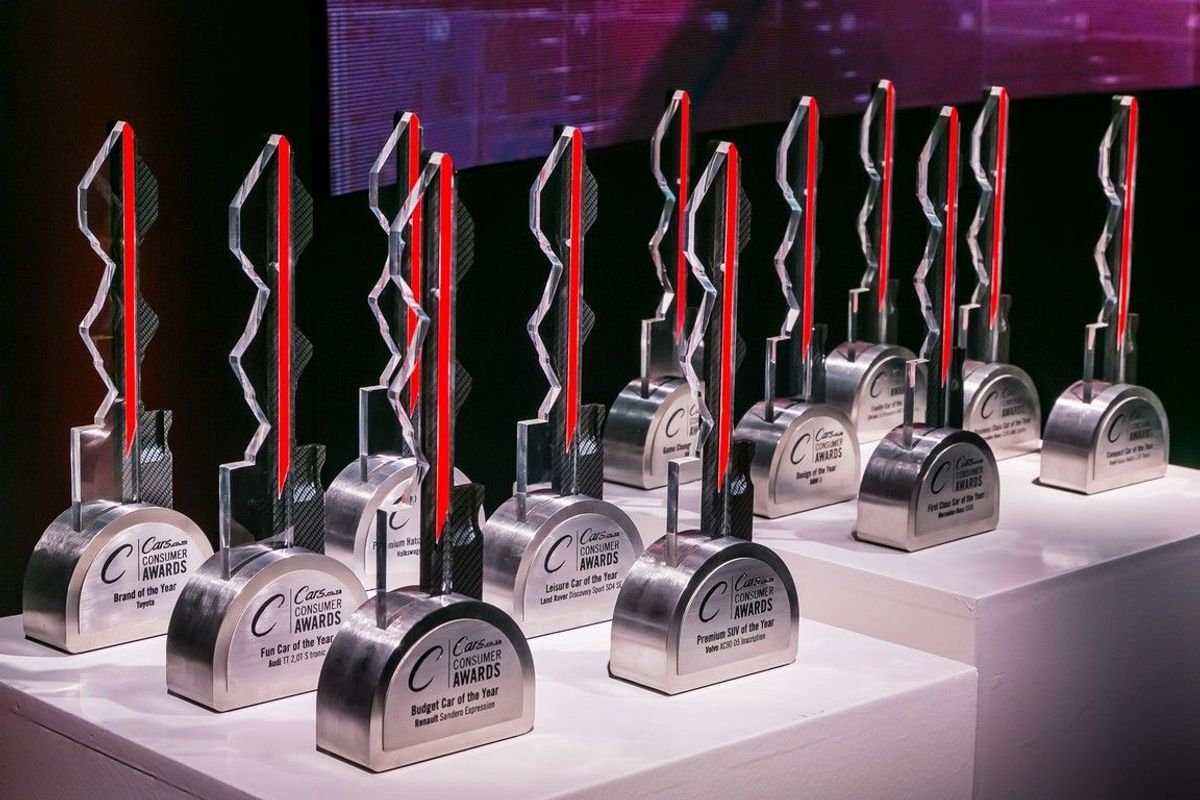
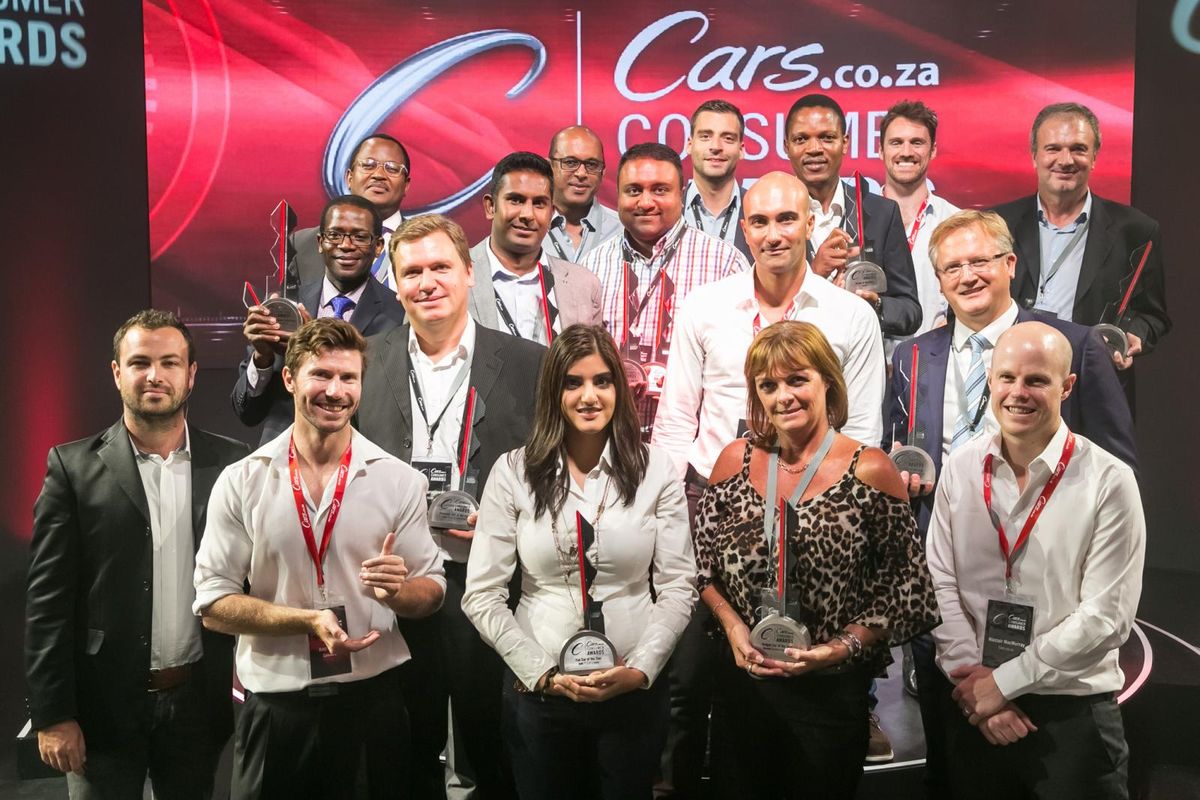
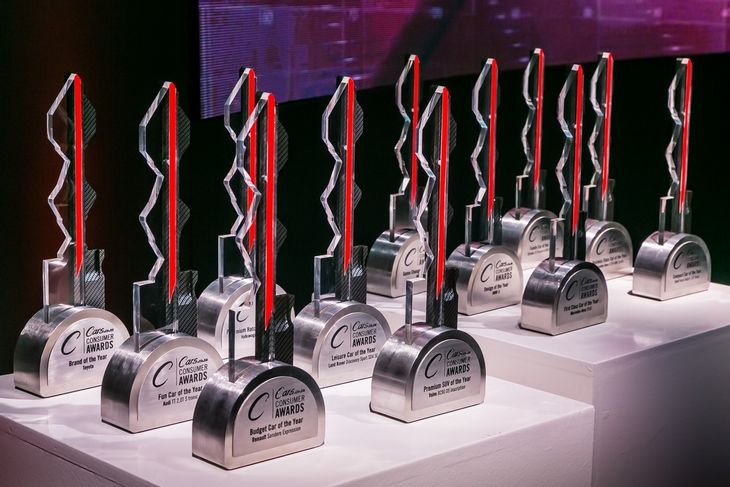
The Cars.co.za Consumer Awards, which was established to be the most prestigious, credible and influential awards programme in the South African motor industry, is entering its second year now – powered by WesBank.
Following the success of the inaugural award season, the winners of which were announced on 14 January 2016, the second iteration, now backed by the biggest provider of vehicle finance in South Africa, looks to again recognise the finest derivatives on sale in the new vehicle market.
“It was very encouraging to see the response of the motor industry and the extensive coverage of the first awards programme by the general media,” said Cars.co.za Consumer Experience Manager, Hannes Oosthuizen. “It demonstrated that our methodology was regarded as credible and relevant.
“WesBank finances the majority of private vehicle purchases in South Africa and our awards programme was designed to help consumers make the most considered buying choices right down to specific derivatives… the finance house’s endorsement adds gravitas to our initiative,” he adds.
“WesBank is delighted to announce the partnership with Cars.co.za as the headline sponsor of the Consumer Awards," says Simphiwe Nghona, CEO Wesbank Motor Division.
"We believe that Cars.co.za has a very innovative approach with the programme and innovations resonate very well with WesBank. WesBank is known in the industry as a long term partner and has successfully established Joint Venture arrangements with most of the Original Equipment Manufacturers. WesBank’s success is attributed to these longstanding partnerships and we look forward to the future prospects of the Cars.co.za Consumer Awards – powered by WesBank,” he adds.
Updated awards categories
The popular double-cab segment has duly secured its own category in the second Cars.co.za awards.
The award categories have been updated to take into consideration new vehicle sales trends (such as the increased demand for small compact crossovers, the buying public’s preference for SUVs over sedans and MPVs, as well as the introduction of several new and facelifted double-cab bakkies).
“The category amendments are based on our analysis of vehicle sales statistics; the majority of the semi-finalists represent the types of vehicles people are buying in respective segments of the market,” Oosthuizen says.
What’s more, the judging methodology has changed to incorporate more expertise (the extended Cars.co.za editorial team), as well as the recruitment of extra guest judges from specialist fields. The votes cast by the collective judges will have a 50% weighting on the final results of the awards.
“Not only has the editorial team grown from four members to seven, the guest judges (all of which are informed about the vehicle market) have been drawn from a wide variety of fields. Collectively, the judging panel is now more representative and diverse in terms of ages, interests and expertise,” he continues.
The Cars.co.za judges
Ashley Oldfield (Road Test/Technical Editor)
Ciro de Siena (Manager, Cars.co.za Video)
David Taylor (Senior Journalist)
Francisco Nwamba (Contributor)
Gero Lilleike (Journalist)
Hannes Oosthuizen (Consumer Experience Manager)
Mike Fourie (Content Manager)
The guest judges
Branko Brkic (Founder and Editor – The Daily Maverick)
Eddie Kalili (Group Motoring Editor – Destiny, Destiny Man and Sawubona)
Juliet McGuire (Editor – Women on Wheels)
Khutso Theledi (YFM presenter/DJ/car spinner)
Kojo Baffoe (journalist/writer/media strategist)
Nafisa Akabor (tech journalist and Cars.co.za contributor)
Wendy Knowler (consumer journalist – The Times)
Public has a bigger impact on outcome
Critically, the remaining 50% will be based on the findings of the Cars.co.za’s Ownership Satisfaction Survey, in partnership with leading data specialists Lightstone Consumer. The brand-specific data incorporates feedback from thousands of South African new vehicle owners, based on their experiences of their vehicles (must be less than five years old and serviced through franchised outlets).
This multifaceted judging process distinguishes the Cars.co.za Consumer Awards – powered by WesBank from rival programmes. All vehicles sold as new on (or launched in the market by) 1 September 2016 were in contention to be semi-finalists (provided they conformed to their categories’ criteria); therefore, not only newly introduced or general model ranges were considered as potential category winners. Theoretically, if a vehicle is the best in its segment, it can win its category throughout the lifecycle of the product.
Therefore, following the upweighting of the findings of Cars.co.za’s ongoing Ownership Satisfaction Survey in the judging process (compared with the previous programme), the public now has an even bigger impact on the outcome of the Cars.co.za Consumer Awards – powered by WesBank.
“The Cars.co.za Consumer Awards – powered by WesBank is unique in the way that real owner experience with their vehicle brands directly, and significantly, impacts on the results. No other industry measure blends expert opinion and analysis with consumer experience in this way. It means that when the winners are announced there is real resonance with public opinion,” Lightstone Consumer Chief Executive Paul de Vantier added.
The first phase of a six-month programme
The first Cars.co.za Consumer Awards ceremony took place in January 2016.
“There are many awards programmes out there that claim public participation. What we mean when we talk of consumer input, is not a popular voting mechanism,” Oosthuizen adds. “We want real, credible input, and the only way to do that is for the public to give us their views on the cars they know best – the ones they own – by participating in our survey.”
The second phase of the six-month awards programme will see the website’s editorial team score the five vehicles in each category, based on predetermined pillars of success (more information is available at http://www.carsawards.co.za), to narrow the field of potential award winners from 65 to 39. Following that, the combined judging panel (Cars.co.za editors and guest judges) will evaluate the finalists back to back during a two-day test. Members of the public can follow developments of the judging process on Cars.co.za’s channels — related content will feature the #CarsAwards hashtag.
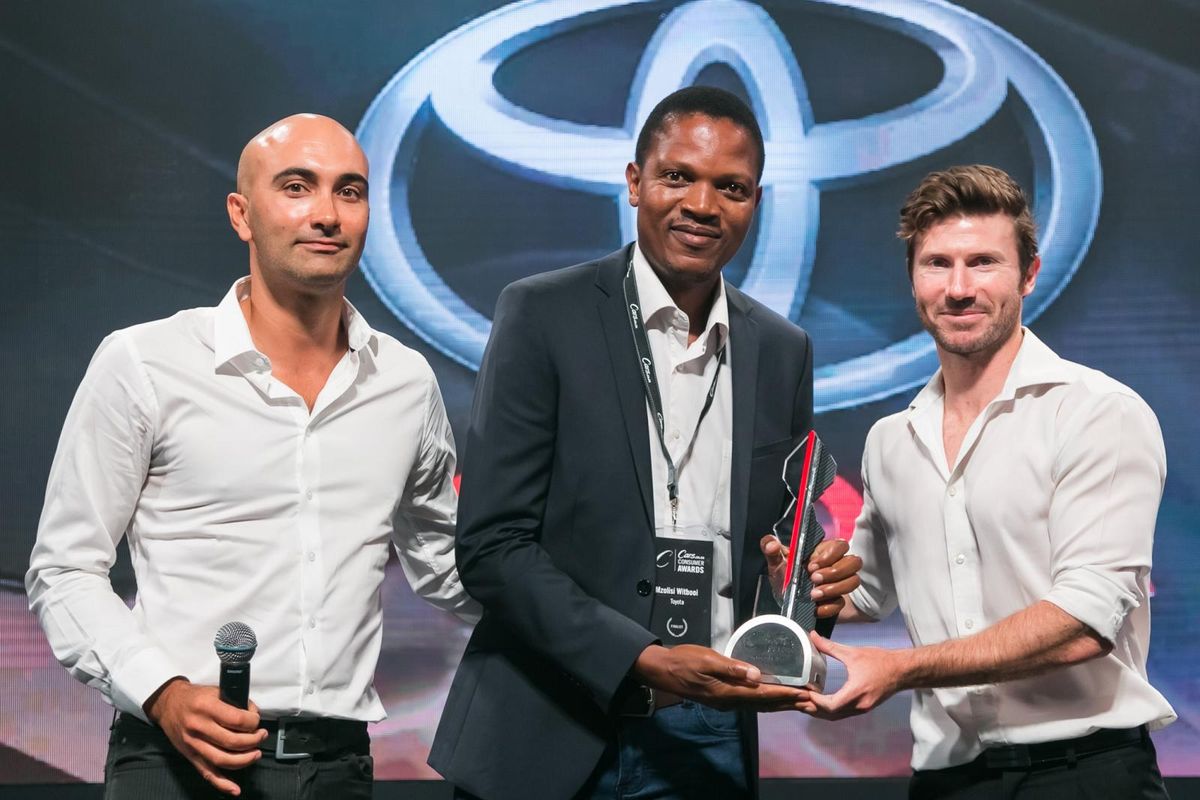
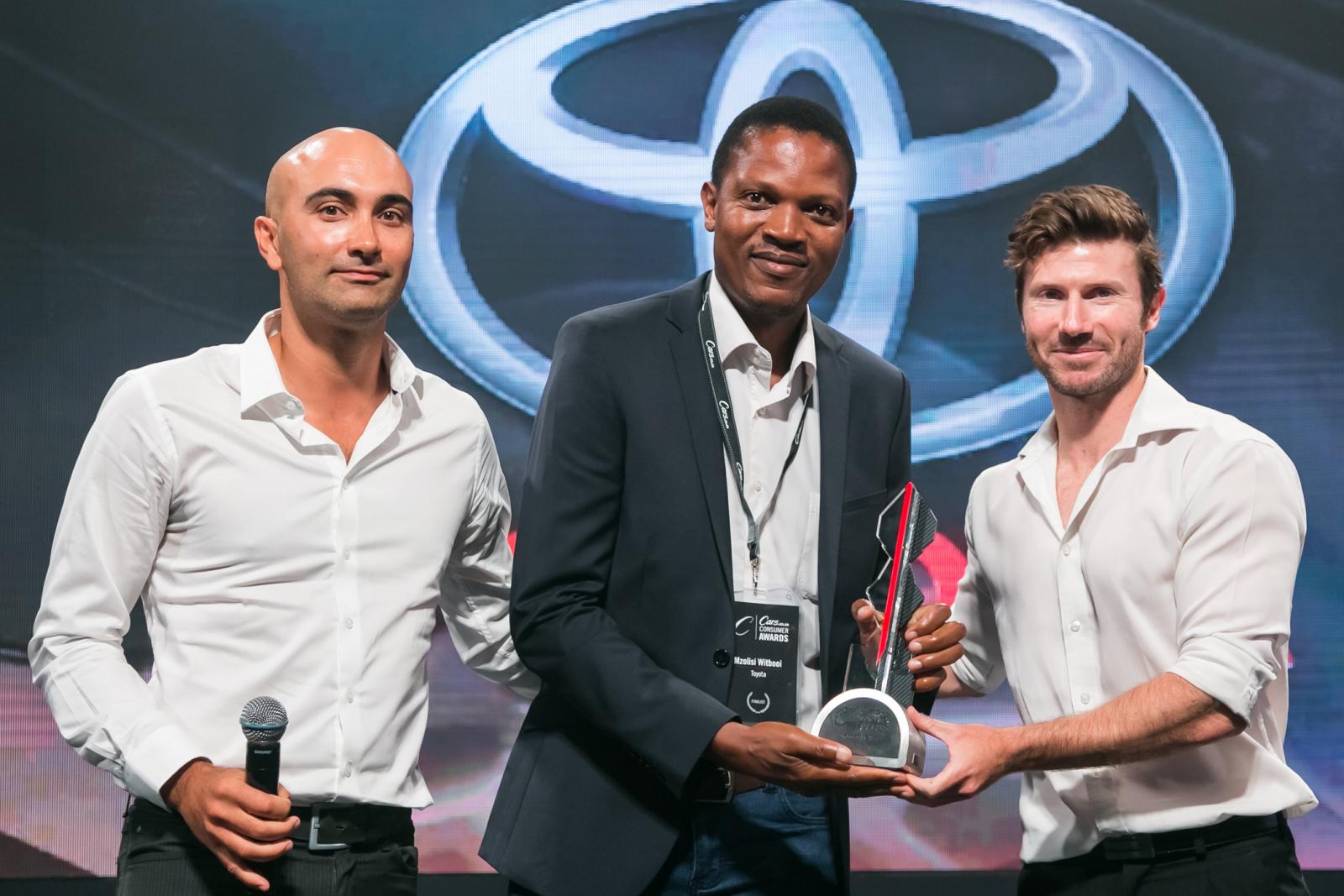
Cars.co.za will again announce its Brand of the Year based entirely on ownership satisfaction data. The current title holder is Toyota.
More information on the programme, including its categories, judges and finalists, is available on http://www.carsawards.co.za.
Leading online automotive retail portal Cars.co.za, which lists tens of thousands of new vehicles stocked by more than 1 000 vehicle dealers countrywide, delivers in excess of 30 million page views per month to more than a million unique users. Cars.co.za has a presence on multiple digital platforms and it’s ranked in the top 10 branded South African YouTube channels with 12 million views to date.
In 2015, Cars.co.za repositioned itself as a consumer champion by optimising its editorial content for the purposes of engaging and empowering its users. The recent Cars.co.za Consumer Satisfaction Survey, in association with Lightstone Consumer, and now the Cars.co.za Consumer Awards – powered by WesBank, underlines the company’s objective to become the most comprehensive resource available to South African vehicle buyers, so that they can make the most-informed buying decisions.
Opinion: Ferrari & Tesla, which will survive the future?
In terms of the development of electric and/or hybrid vehicles, the respective chiefs of Ferrari and Tesla hold very traditionalist and futurist views on the future of the automotive market. Will the proliferation of EVs depend solely on market forces, or will the persistence of forward-thinking manufacturers ultimately pay off?
An all-electric Ferrari is an "obscene" concept
Four years ago Luca di Montezemolo, then president and CEO of Ferrari, said, “We will never manufacture an electric car as long as I am chairman.” This raised eyebrows. How can an automotive company survive if not focused on alternative, future tech? Especially considering that numerous manufacturers (such as Nissan, BMW, GM and VW) have invested billions into EV development, at the time of his statement, the Audi R18 e-tron was cleaning up at Le Mans and the BMW i8 and Porsche 918 Spyder were being launched.
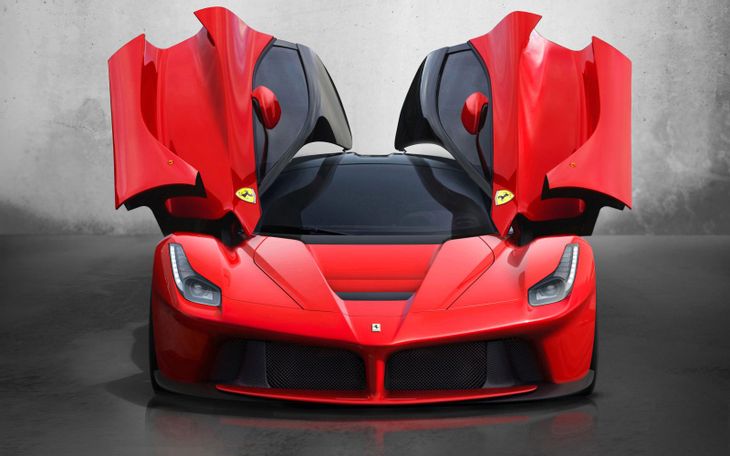
The company has since introduced a hybrid LaFerrari (albeit using a KERS system similar to those in Formula 1) and di Montezemolo is no longer boss at Modena. But, the winds of change have not yet blown.
The "hybrid" LaFerrari is as close as Ferrari is likely to come to producing an EV under Sergio Marchionne.
The new man in the driving seat is Sergio Marchionne (also CEO of Fiat Chrysler, FCA) and his view on EVs is equally pragmatic.
Marchionne is no fan of electric mobility and under his administration FCA brands (including Fiat, Alfa Romeo, Jeep, Dodge and Chrysler) remain painfully under-electrified. In 2014, he publicly discouraged a customer from purchasing the all-electric Fiat 500e, citing the losses that the company incurs for each unit sold, and shared similar views of the plug-in hybrid Chrysler Pacifica (the LHD-only replacement of the Grand Voyager). And, after sampling a Tesla he stated that, “[An all-electric Ferrari] is almost an obscene concept.”
Given the electrification of the industry, it’s easy to dismiss this as uninformed and aloof. But, Marchionne is a seasoned executive and has managed to return the ailing FCA to profitability. So, is there reason to his apparent madness?
EVs: 2+2-5
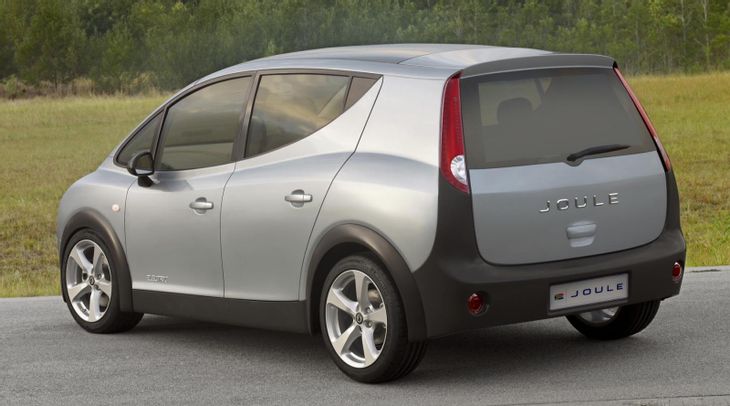
Lack of viable economic model left the Joule, South African-developed electric car, stillborn.
Under fire are the economics of electrification. It is unclear how the vast R&D costs involved will be recovered, not to mention how profits could be generated. Growth in global EV sales is robust. By the end of 2015, Renault and Nissan were the EV market leaders and have sold 302 000 EVs worldwide (211 000 of which were Nissan Leafs). However, EV prices are heavily incentivised by tax rebates and subsidies, which boost volumes and infrastructure roll-out is generally considered the responsibility of governments. How long will this be appropriate?
Put differently, and allow me to play devil’s advocate: EVs are expensive and target wealthy customers (often as additional vehicles). How appropriate is the use of taxpayer (public) funds to entertain the excess and whims of the wealthy? In fact, some US states have repealed incentives for this reason, which has seen sales slump by as much as 80%.
So, as autos forge ahead with EVs, profitability concerns remain: Many EV start-ups failed for not developing a viable economic model, including SA’s Joule and Fisker in the US; car companies use healthy profits from SUVs to supplement EV and infrastructure development; and even Tesla remains ‘unsuccessful’ in economic terms. When will investors become restless?
Tango and cashless
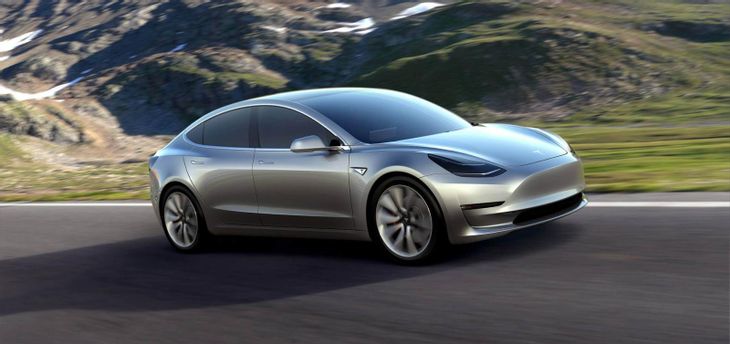
Tesla is banking on the success of the Model 3. If it fails, the company is in big trouble.
Perhaps they already have: Tesla has grown significantly, having launched 3 models in 4 years, but its share price is under pressure as concerns over the future mount. Development of its highly promising "entry" Model 3 and a new battery factory requires significant investment, but Tesla is running out of cash. It burned through US$600 million in the first six months of 2016 and has seen operating losses since 2013 (14 consecutive quarters) and negative cash flows since early 2014. The company thus has to find external funding (equity and debt) to secure its future, having just secured a US$300 million revolving credit facility from a German bank (with a 2018 maturity) is the first of numerous debt agreements and equity issuances over the next year or so.
Liquidity problems can be expected from any growing company, but investors will require returns at some point. Without profits, a company isn’t worth much. Government incentives have done much to assist sales of EVs (and Tesla), but this also means that the current value of Tesla is merely the present value of the government incentives it can garner. This is not sustainable. What’s required are volumes and margins that translate into profits.
That means that the Model 3 simply has to be successful. Global orders of 300 000 units (along with a US$1 000 deposit for each) is a good start (that is nearly double the number of sales of the Tesla Model S and Model X to date), but what is required is revenue that exceeds costs and nobody is certain when or how (or even if) this will happen (for Tesla and others).
Ch-ch-ch-changes
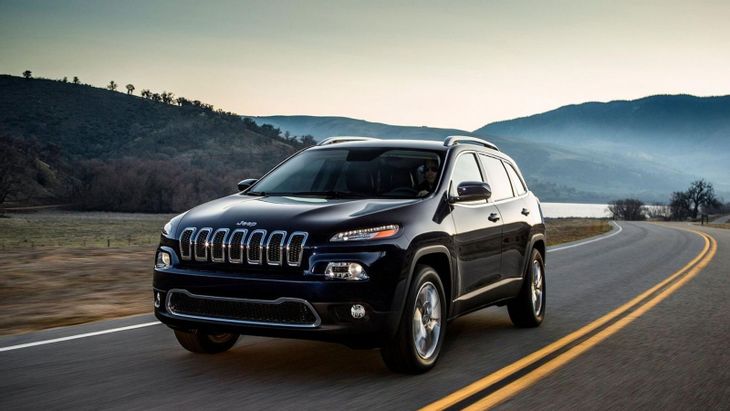
FCA boss Marchionne prefers backing popular SUVs, to EVs. Jeep continues to be a strong seller.
This brings us back to Ferrari and Marchionne, who appear to prefer to avoid EVs until there are answers. At best, Marchionne’s is a strategy that avoids the vast investment required to fund EV development (funds that FCA simply do not have). But, given the slow uptake of EVs globally, there is no doubt that the future of mobility that is being punted, is still far from materialising. So, who is right: Tesla or Ferrari? Musk or Marchionne?
One way of looking at it is to consider the value of futurism in the auto industry. Some analysts believe that "future-proofing" has replaced activities such as "motorsport" as a form of marketing the brand to current and future consumers. This is why automotive manufacturers feel compelled to develop alternative technologies with no clear guarantee of business success, because it is what new consumers are interested in. Consider, for example, how car companies increasingly display new vehicles at technology expos as opposed to car expos, and that Google has entered the auto industry with its own self-driving car.
Another way of looking at it is that Marchionne’s position is bolstered by the current success of Jeep and the popularity of SUVs in the market, which is predominantly driven by low fuel prices, highly efficient engines, low commodity prices and current consumer preferences.
EVs may not be profitable at the moment, but this may change. When it does, FCA and Ferrari may be found lagging in terms of brand, technology and concepts, and not be in a position to play catch-up. Both Ferrari and Tesla are embracing the future, but the futures imagined by their stewards (Marchionne for Ferrari, Musk for Tesla) could not be more different.
Time will tell if Marchionne’s worshipping of profits was wise, or if Musk’s endless perseverance will change the automotive industry. However unfathomable it may seem, if Marchionne is wrong, Ferrari may well have its own Kodak Moment, and it won’t be one for framing and hanging on a wall.
Indian brand Mahindra is hoping to attract new buyers to its dealerships with the quirky and compact new KUV100 – a compact crossover designed, from the ground up, to be perfectly in step with modern consumer trends. Has Mahindra hit the nail on the head?
We like: Standard features, good build quality, surprising space, ride comfort
We don't like: Very small boot, tardy performance, frustrating start/stop system
Alternatives
For more space: The Renault Sandero Stepway is a very strong seller in the local market and with good reason. It doesn't only boast attractive styling, but a comprehensive standard specification and greater passenger/boot space than the Mahindra.
For great peace of mind: The Toyota Etios Cross is another popular hatchback-based offering that offers a modicum of crossover appeal. It has a lively engine and good interior space. Best of all, it is backed by the highly rated Toyota service network.
Germanic solidity, with a dash of flair? The recently launched Volkswagen Cross Up! 5-door model is more spacious inside than you'd think, better made than any of the other cars on this list, but down on standard features.
Leading the charge?
Downsizing is a trend in just about every facet of the automotive industry, whether you're referring to mechanical parts (engines) or actual product (body shapes). In recent years crossovers have been all the rage, and now smaller versions of this popular type of vehicle are starting to emerge… but not necessarily from where you'd expect them to come from. Currently, the majority of small crossovers on the market are nothing more than slightly beefed-up versions of popular hatchbacks – Renault has the Sandero Stepway, Toyota the Etios Cross and Volkswagen the Cross Up! and Polo Vivo Maxx. Even the relatively SUV-like GWM M4's origins date back to an earlier Toyota hatchback design. Now Mahindra has joined the fray with a very compact crossover designed, from the ground up, to be just that. And as we found out during our test of the little KUV100 G80 K8, this Indian brand appears to be stepping up…
How does it fare in terms of…
Design appeal?
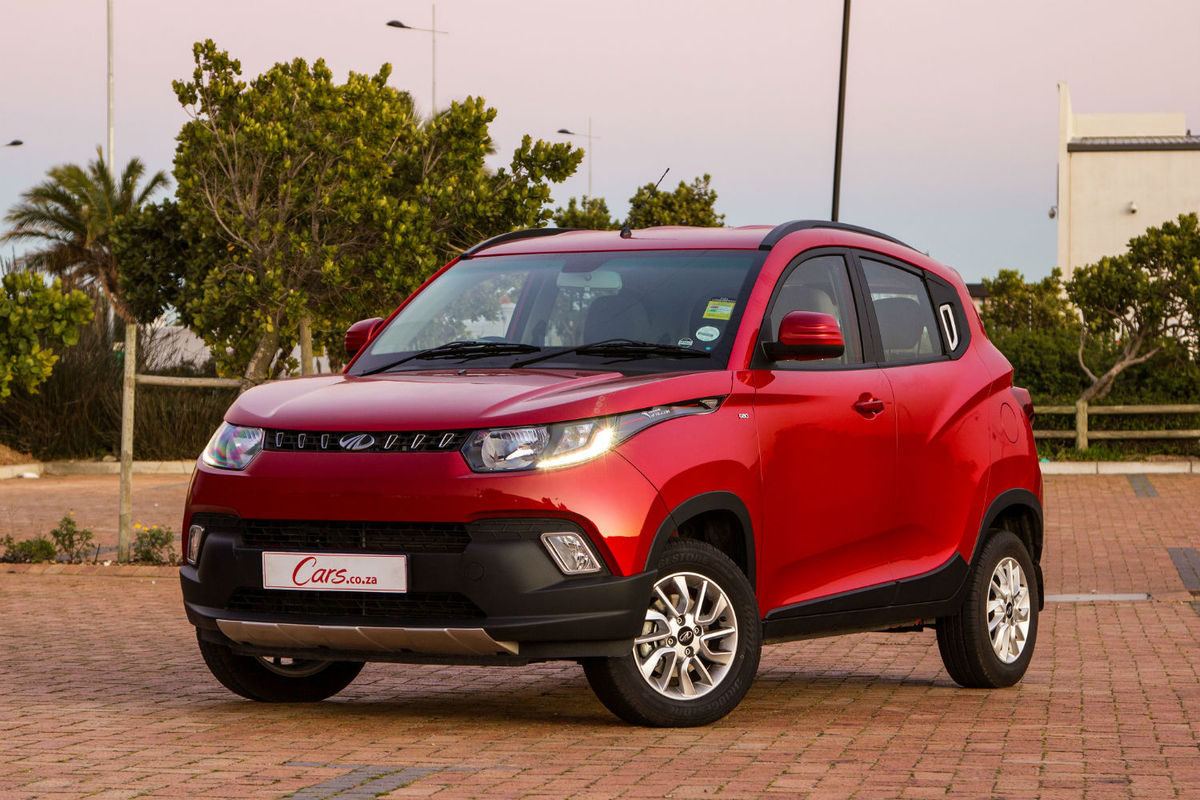
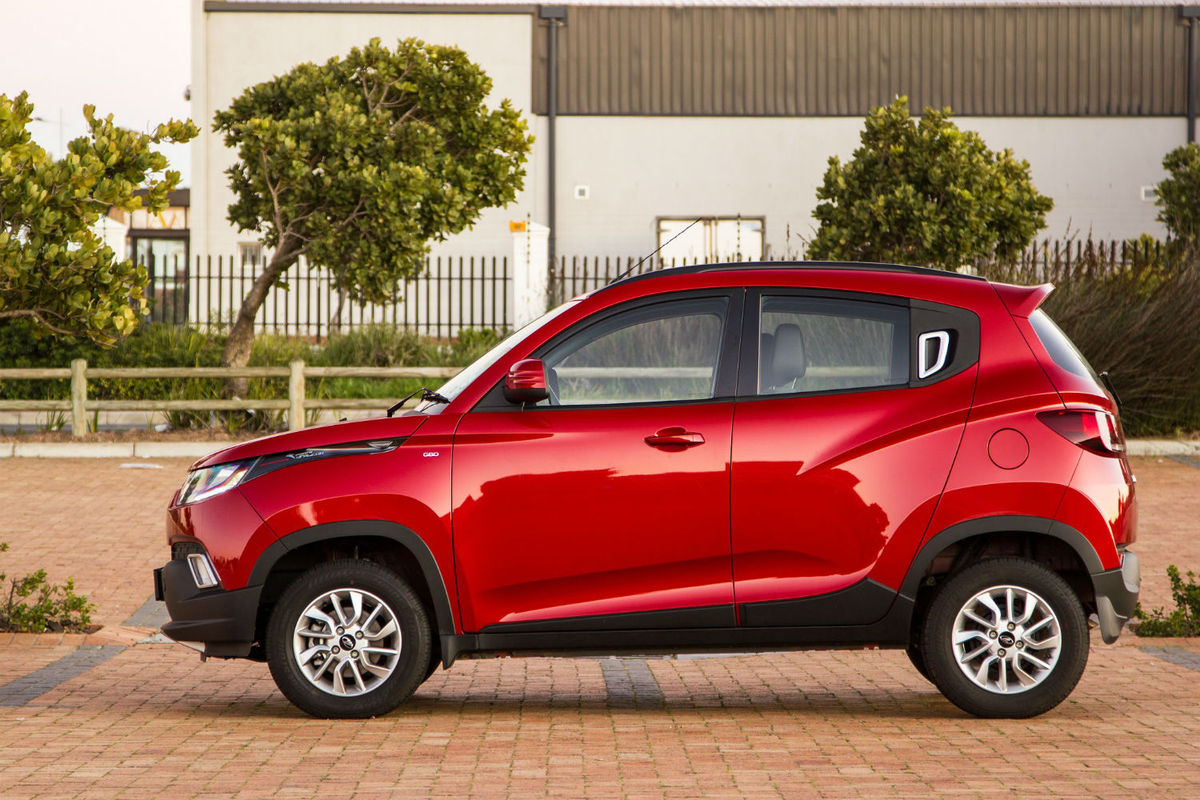
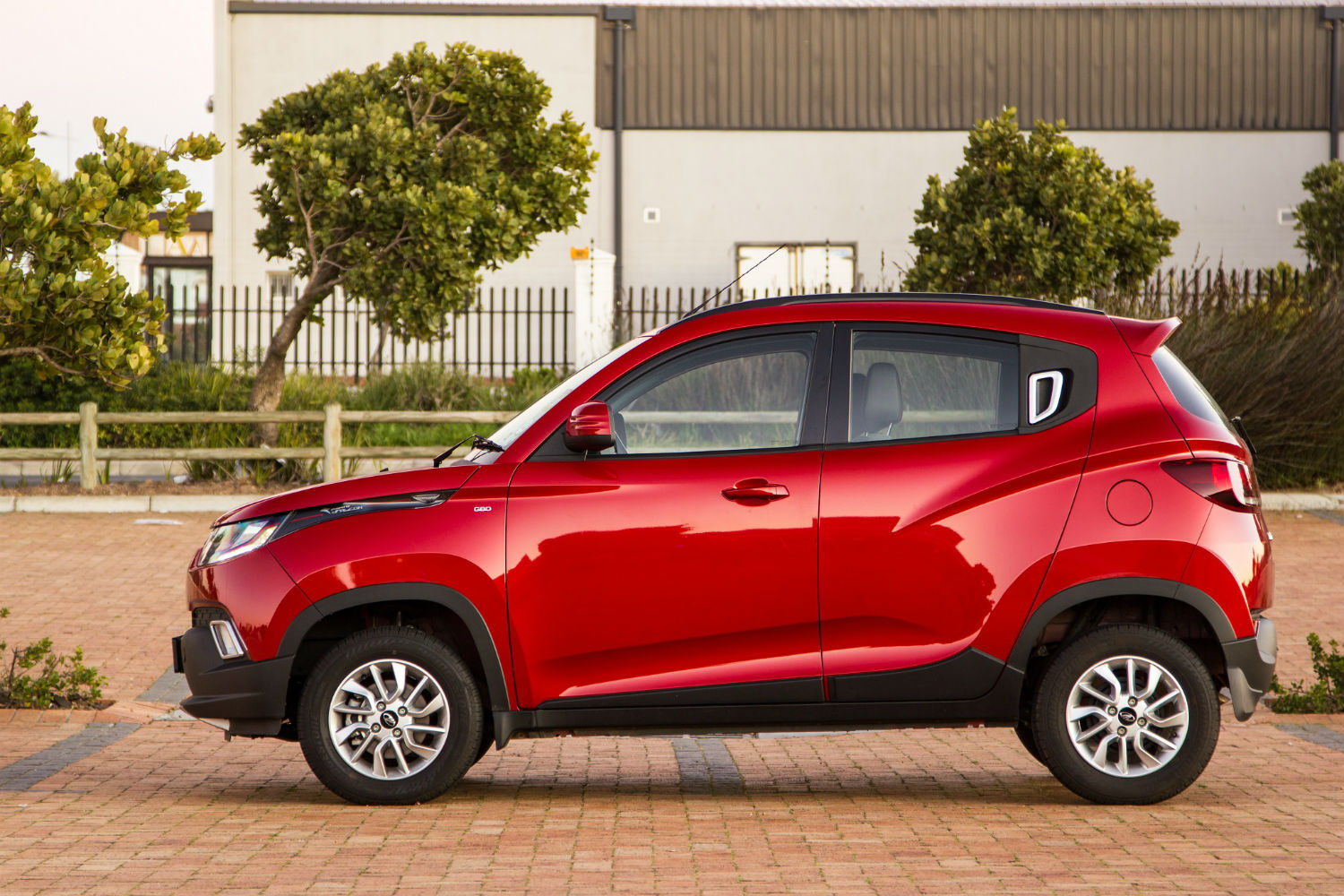
Quirky design elements endow the KUV100 with look-at-me individuality. Small (14-inch) alloys are standard.
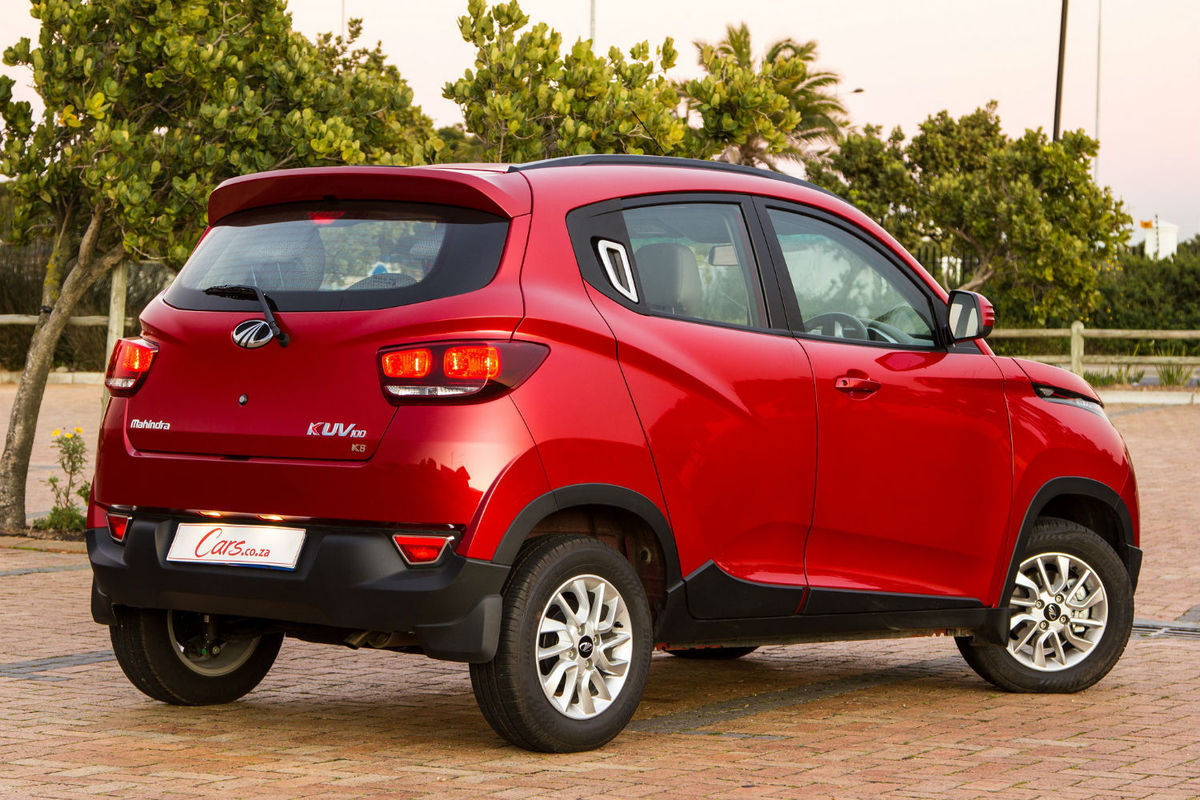
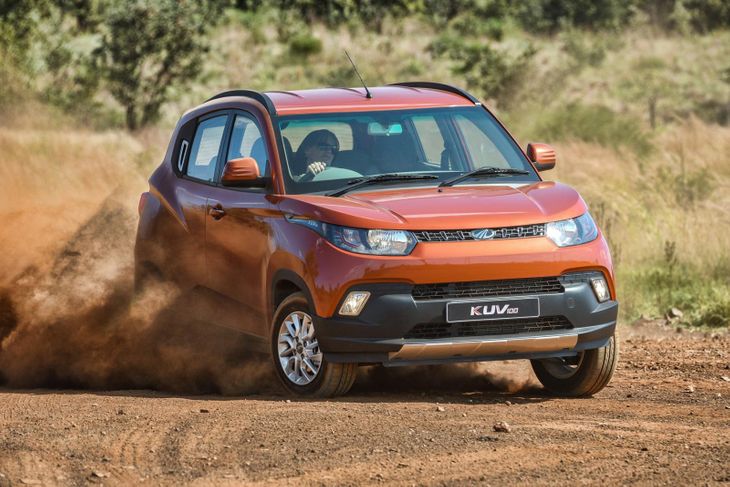
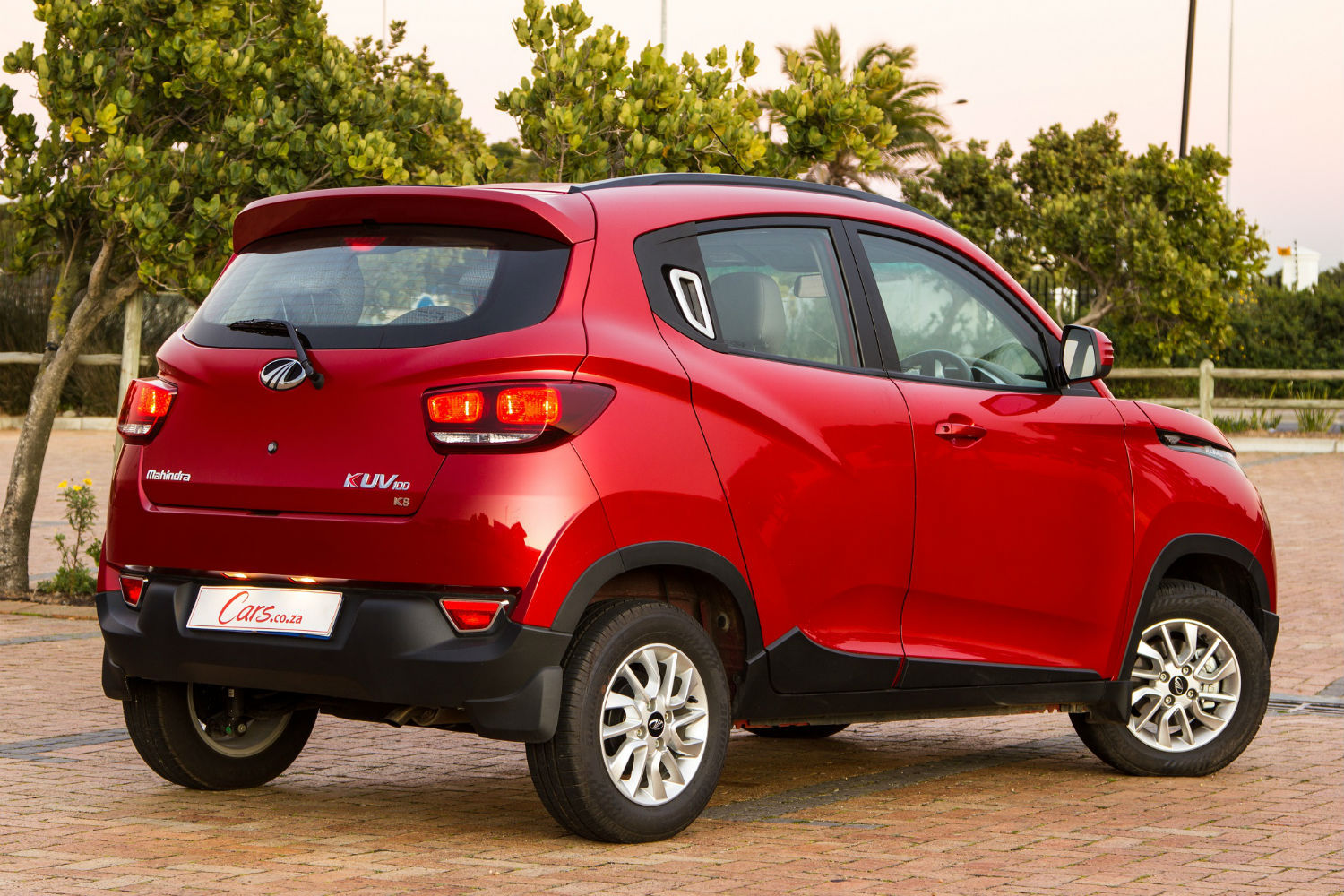
One thing is for sure, if it's attention you're after, the Mahindra KUV100 will turn a more than a few heads. Mahindra has thrown caution to the wind and delivered a vehicle that packs an unbelievably large number of quirks into its diminutive (3 675 mm-long) body shell. From ribbed door mirrors, to hidden rear door handles, accentuated swage lines and those bold wrap-around headlamps, the KUV100 is certainly a love-it-or-hate-it design. We applaud Mahindra for delivering something truly unique in this segment.
Put the looks aside for a moment, however, and what you have here is a vehicle that is notable for its compact dimensions. It is not only very short, but also stands relatively high (1 665 mm), which includes a generous ground clearance of 170 mm. It is also quite narrow. Consequently, the KUV100 looks almost comically tall on its little 14-inch alloy wheels, replete with an abrupt rear end.
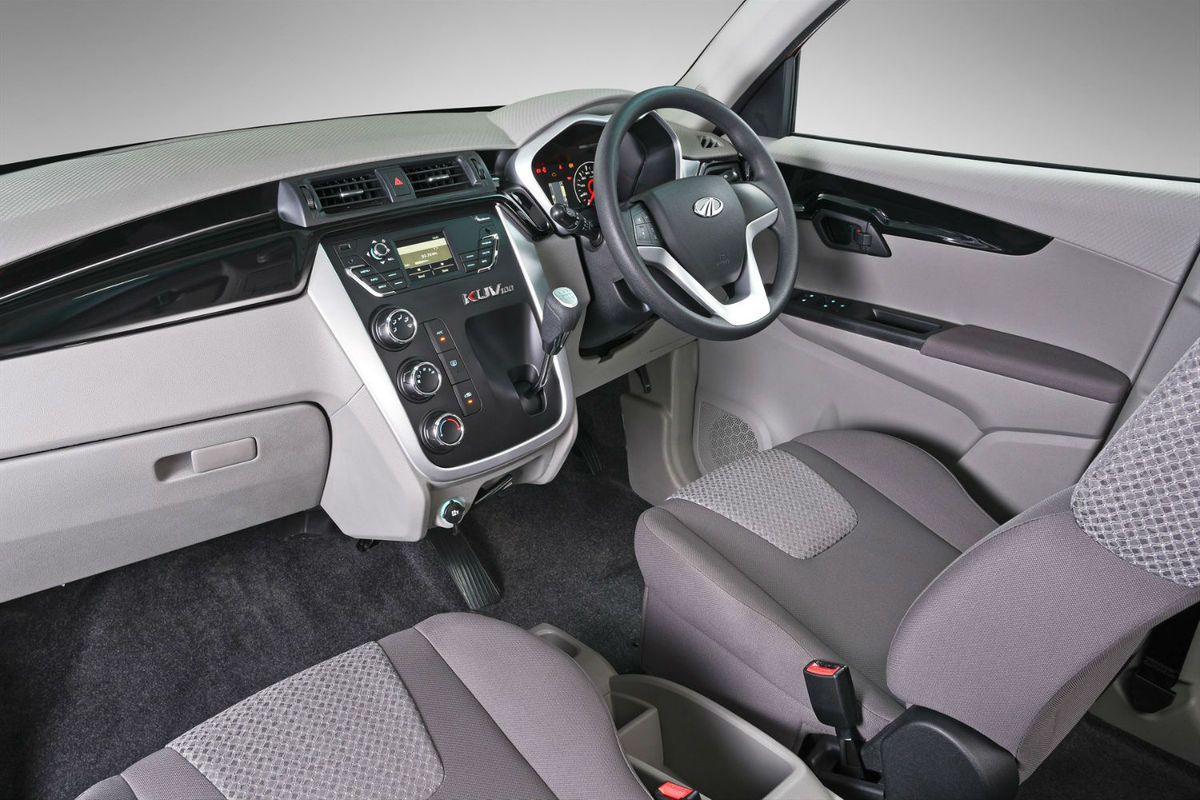
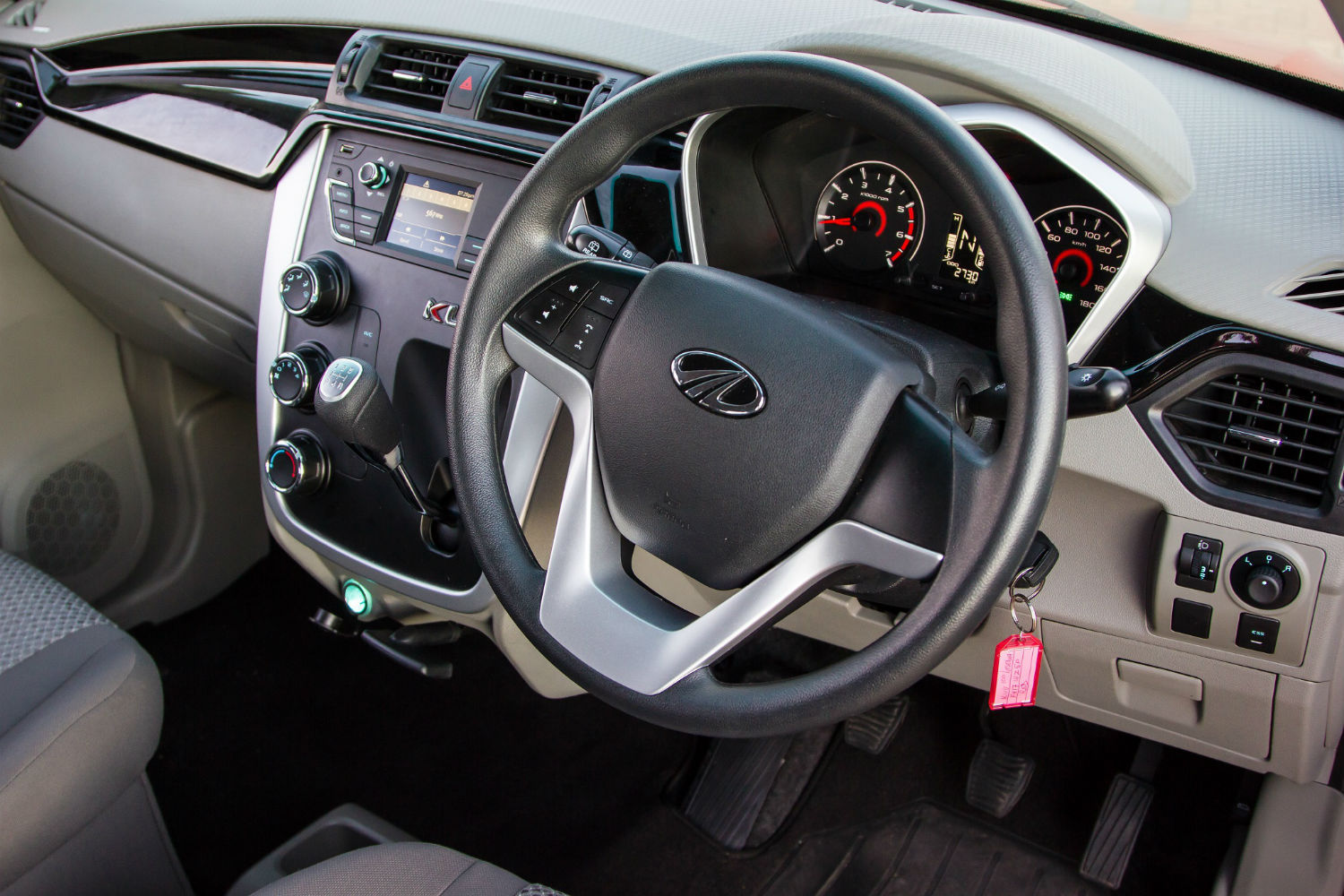
Neat cabin offers solid quality and lots of features. Plus, surprising passenger space is on offer.
Inside these tight dimensions Mahindra's designers have achieved arguably their greatest feat. Not only is the KUV100 relatively spacious for four adults (more on that later), it also offers a neat fascia finished in good quality materials. Yes, perhaps some of the plastics used could be of a higher grade, but in general, the KUV100's cabin feels solidly made and there's some welcome flair on offer, too.
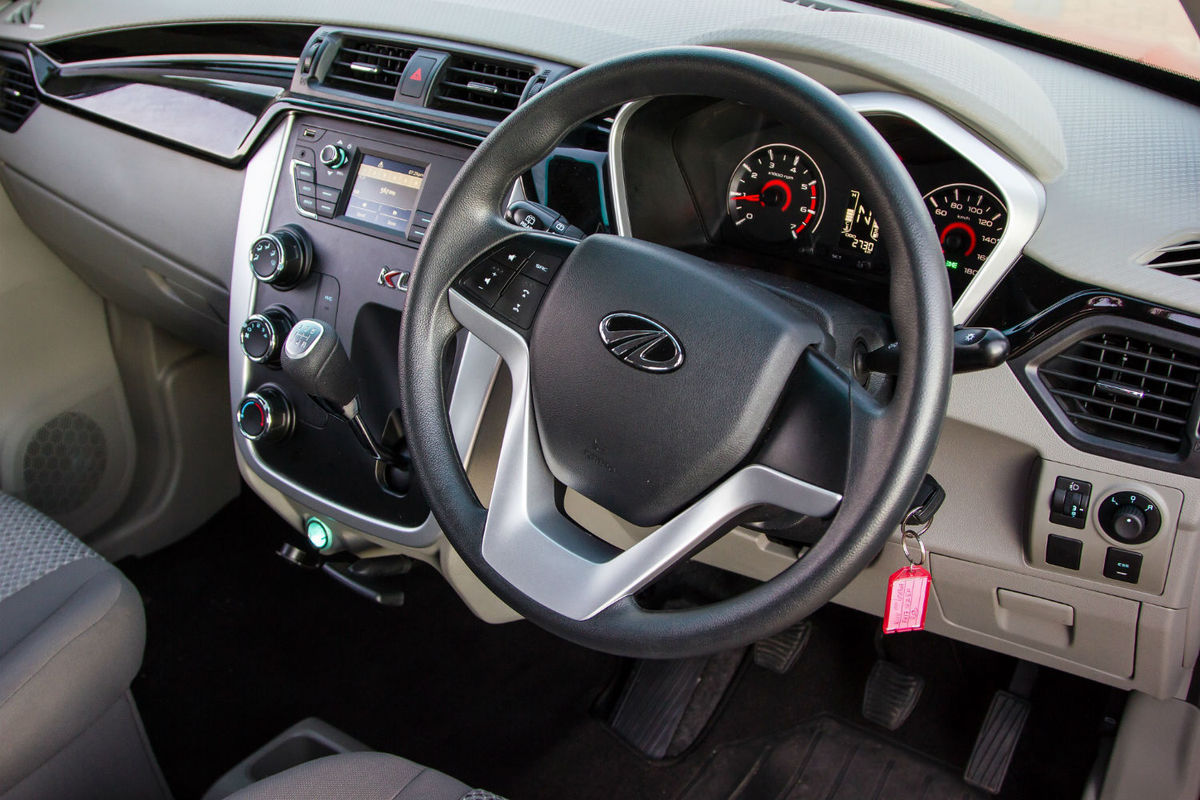
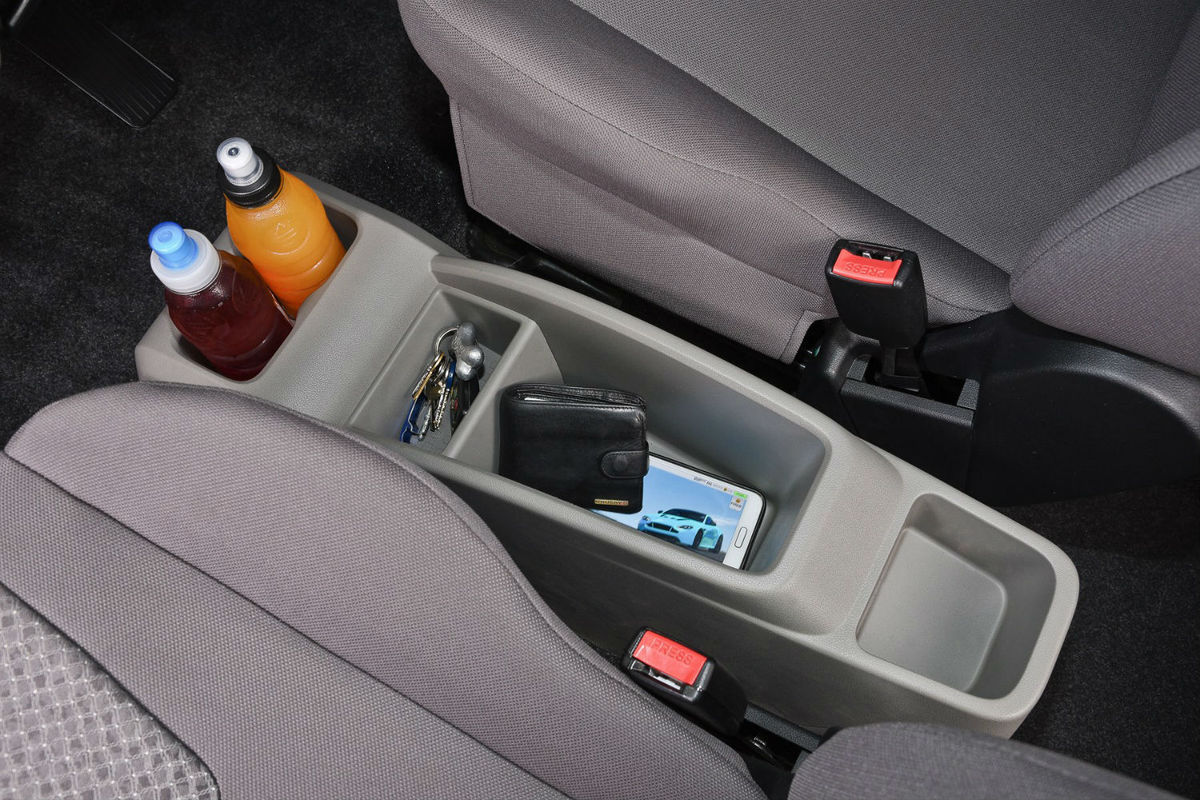
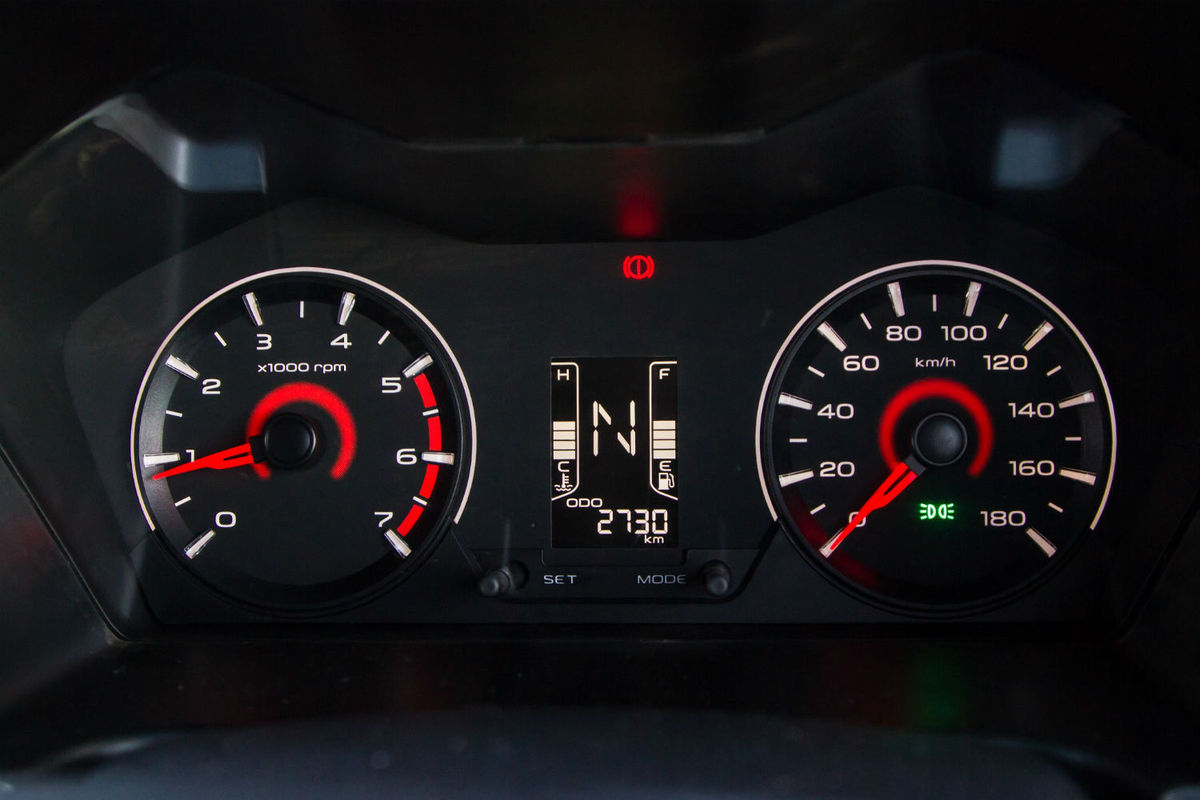
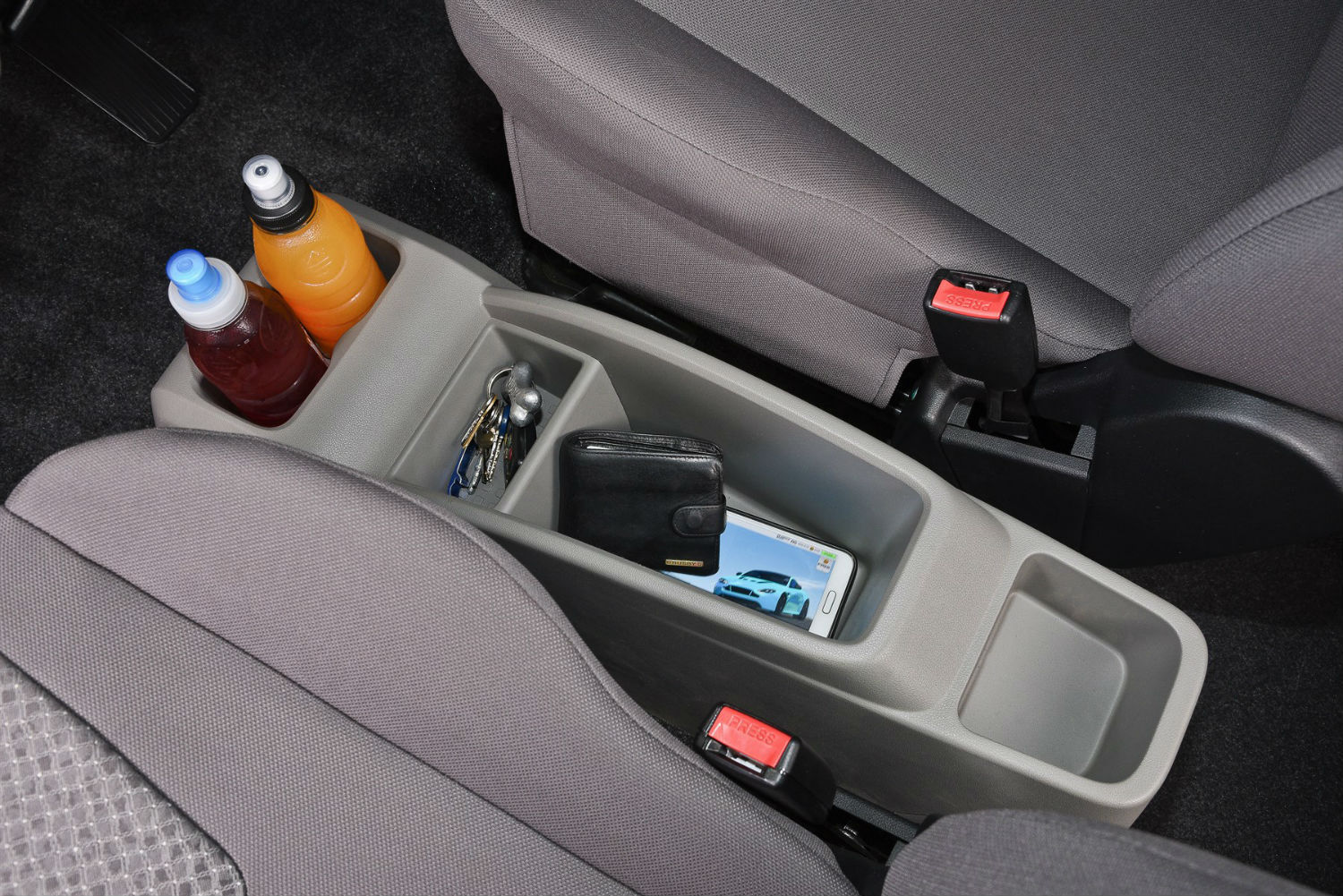
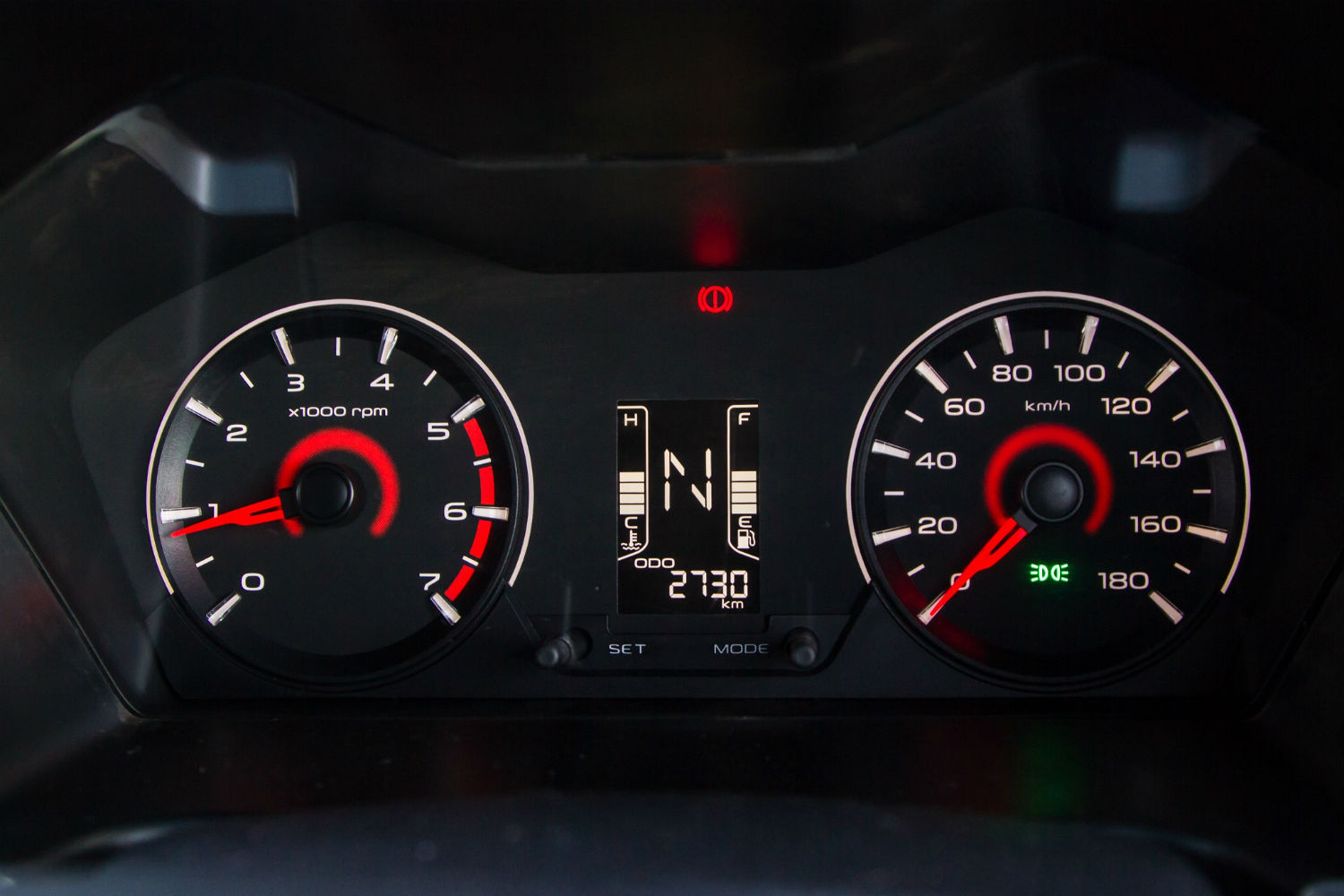
The instrumentation is comprehensive and neat, the piano black trim that spans the fascia lifts the ambience, and the controls are all well-placed. We particularly liked the positioning of the gear lever, as it not only falls to hand very easily, but also frees up a lot of space for storing oddments between the seats. Further benefiting space utilisation is the old-fashioned "umbrella-type" handbrake, which also means there is more space between the seats.
Comfort & features?
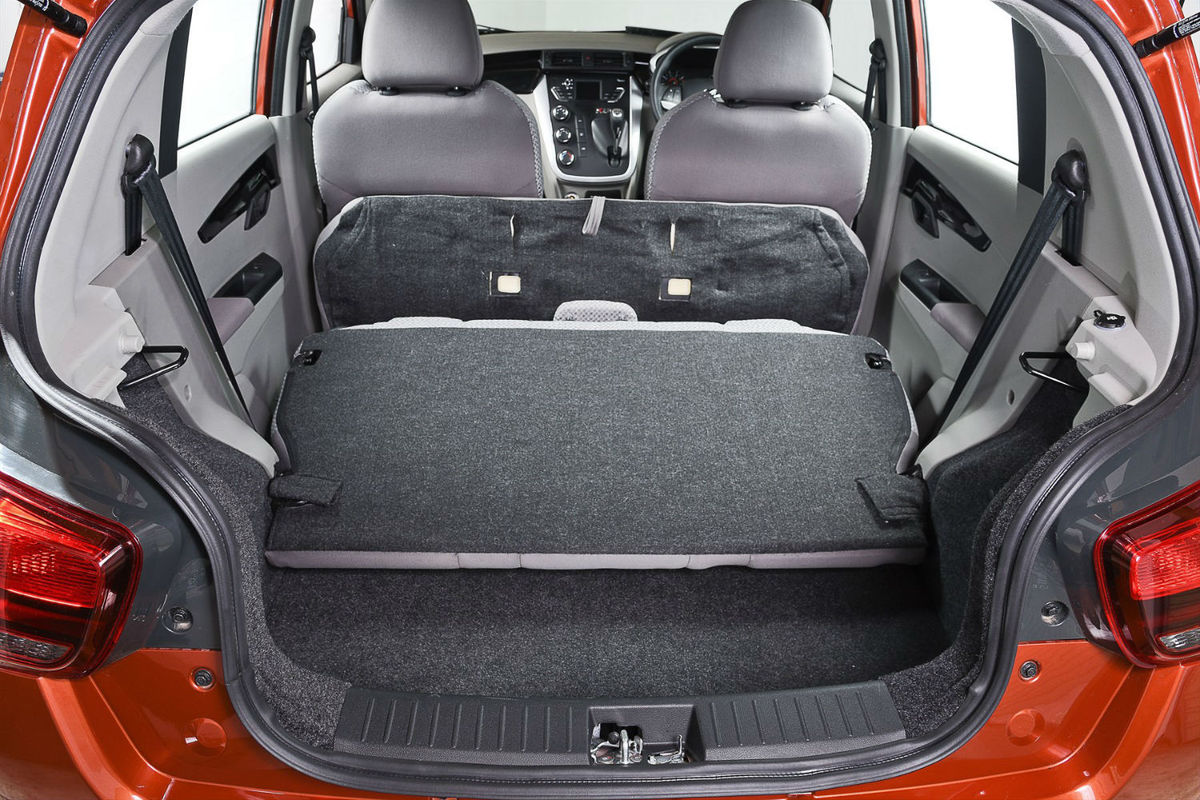
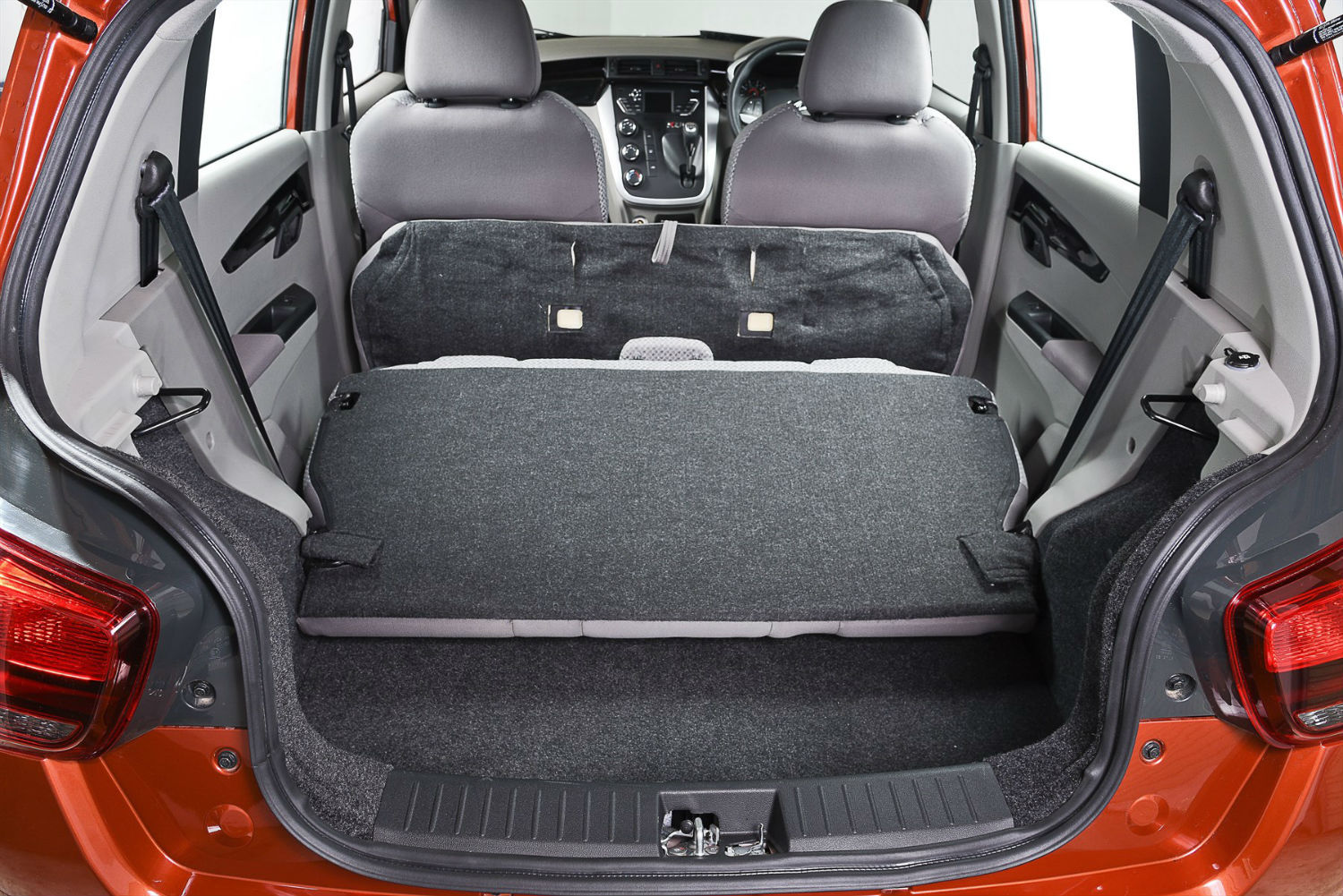
The KUV100's compact dimensions impinge on boot space and ultimate practicality.
Given the Mahindra's small size, you may expect it to be entirely impractical and uncomfortable, but the reality is quite the contrary. Front occupants, for example, will have few reasons to complain. The driver's seat is manually adjustable for height, but is already mounted quite high, which contributes to the towering SUV-like driving position that so many consumers like these days. The steering wheel is only adjustable for rake, but most people should find it relatively easy to find a comfortable driving position. We liked the way that the gear lever fell to hand, and the good visibility out of the vehicle.
In terms of features, this flagship K8 derivative is well specced. The standard audio system initially looks like a touchscreen unit, but it isn't. Instead, it offers a somewhat fiddly interface. Nonetheless, the functionality is comprehensive, with Bluetooth telephony and audio streaming, USB/aux support included, as well as multifunction controls on the steering wheel. Also part of the package are: air-conditioning, front and rear electric windows, a trip computer and electrically adjustable side mirrors. Externally, this model even features LEDs and fog lamps.
Where the KUV100 is found lacking, is in terms of safety. Not only is there no EuroNCAP rating for this vehicle, but it only offers 2 airbags and ABS with EBD. It offers neither an electronic stability system (ESP) nor Isofix child seat mountings at the rear.
With the gear lever and handbrake mounted on or under the fascia, the space between the front seats features a convenient storage unit.
Moving to the rear seats, we were impressed with the amount of space (especially legroom) on offer. Adults can be comfortably seated. Note, however, that it only has a lap belt for the centre rear passenger and given the width of the cabin, the bench is better suited to accomodating only two (adult) rear occupants. There are underfloor storage compartments in the rear.
The news gets progressively worse as we move aft in the cabin, because the luggage bay is very small. Mahindra claims a load volume of 243 litres, which is not too dissimilar to what is quoted for the likes of the aforementioned Cross Up! and Etios Cross, but, in reality, the KUV100's boot is not as usefully shaped or -sized. The rear seat backrest folds down as a single unit (it isn't split) further hampering ultimate versatility and only boosting total utility space to a claimed 473 litres – the latter figure does, however, appear wrong. We believe there's more overall packing space than what this number suggests.
Power & economy?
The KUV100's neat instrumentation incorporates a centre digital display. Diesel model cluster shown.
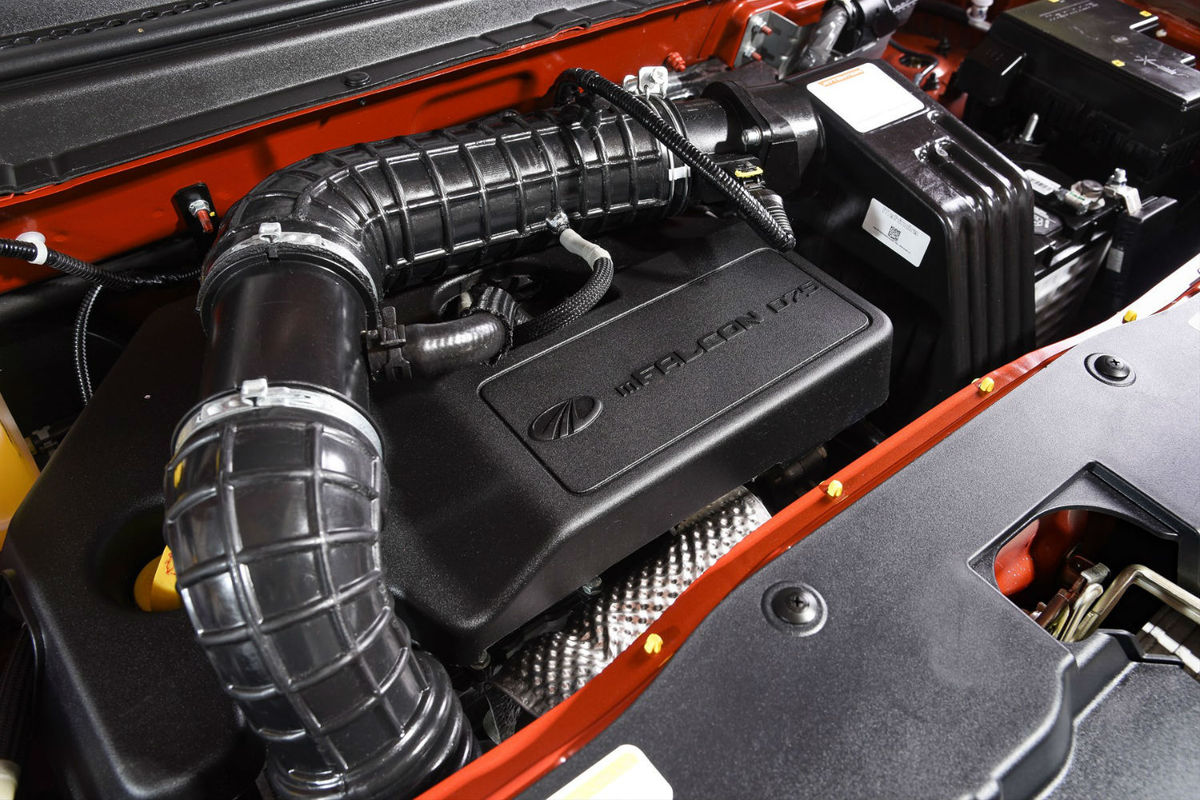
The KUV100 G80 K8 is powered by a 1.2-litre, 3-cylinder petrol engine that delivers 61 kW and 115 Nm of torque. The latter figure is quite low for a vehicle in this category and, more worryingly, is only available at a high 3 500 rpm. Mated to a 5-speed manual transmission with some oddly spaced ratios, this means you will need to work the gears often and cleverly to maintain steady progress. Get used to its ways, however, and you'll discover not only an engine that is very willing to rev, but also a shift action that is remarkably slick and precise (and fun to use).
Still, the KUV100 is not as nippy as those vehicles priced around it. You are looking at a 0-100 kph time of well above 15 seconds and a top speed of below 150 kph. Another complaint is a relative lack of refinement – some vibration from the engine permeates the cabin; it is particulary noticable by the driver.
The good news is, however, that fuel economy is good. Mahindra claims a combined cycle fuel consumption figure of 5.9 L/100 km, but a more realistic figure is around 7.0 L/100 km. You should be able to achieve a range of around 500 km between fill-ups of the 35-litre tank.
Ride & handling?
The KUV100 is a comfortable vehicle on gravel surfaces, but note a lack of ESP.
With its top-heavy stance and narrow track, the KUV100 was never going to set new benchmarks in agility and dynamism, but its on-road behaviour is probably perfectly in tune with the needs of most buyers. It prioritises ride comfort, and consequently has a soft set-up that contributes to overall comfort levels in the cabin. The suppleness of the suspension, combined with the ground clearance and generously plump tyres contribute to good gravel-road ability, too. It's a vehicle that feels in tune with our varying road conditions, and its suspension is not easily flustered.
The downside, of course, is that the softness results in significant body roll in the corners, as well as pitch and yaw under hard braking and acceleration. So it's not a vehicle that likes to corner hard. Then again, nothing about the KUV100 suggests that dynamism was ever a priority. Even the steering is largely devoid of feel, and there's a pronounced lack of self-centering that takes some getting used too.
Pricing and warranty
The Mahindra KUV100 G80 K8 sells for R179 995 and is backed by a 3-years/100 000 km warranty and 3-years/50 000 km service plan. Note that it requires servicing every 10 000 km. Interestingly, Mahindra's service network recently emerged as the most affordable (in terms of labour rates charged) following a survey done by data specialists, Lightstone Consumer. Read up on that survey's findings here.
Verdict
Don't judge this book by its cover – the KUV100 offers a good mix of quality, features and comfort.
It is very easy to think of the Mahindra KUV100 as a largely irrelevant odd-ball, but that would be a very unfair assessment. The little KUV100 ticks many boxes – the standard specification is generous, the ride comfort good, cabin space is impressive (given the size of the vehicle), the engine is reasonably efficient and the solid build quality was a welcome surprise. It can't match its similarly priced rivals in terms of performance, refinement, boot space and that most difficult of nuts to crack… brand cachet. Nevertheless, this is a pretty impressive effort from Mahindra and marks the brand out as one to watch.
The Suzuki Swift has been around since 2008, building a reputation for reliable, fuss-free motoring. We got hold of the Japanese-built 1.4 GLS and tested for a month in this extended review.
Juliet McGuire returns for her second video for Cars.co.za. Here, she picks up on the good points and the not-so-good points of the Suzuki Swift. Overall the Swift proved to be a nippy, fun-to-drive, safe as well as dependable and easy to recommend hatchback.
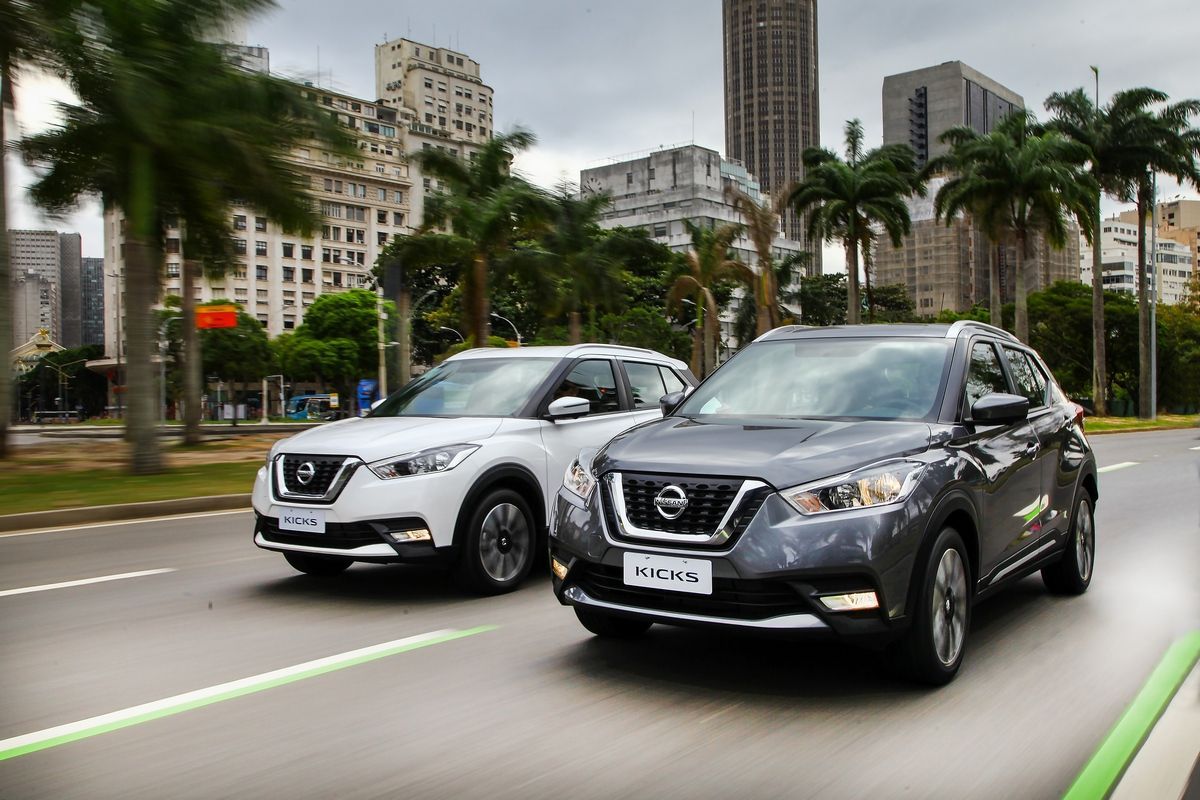
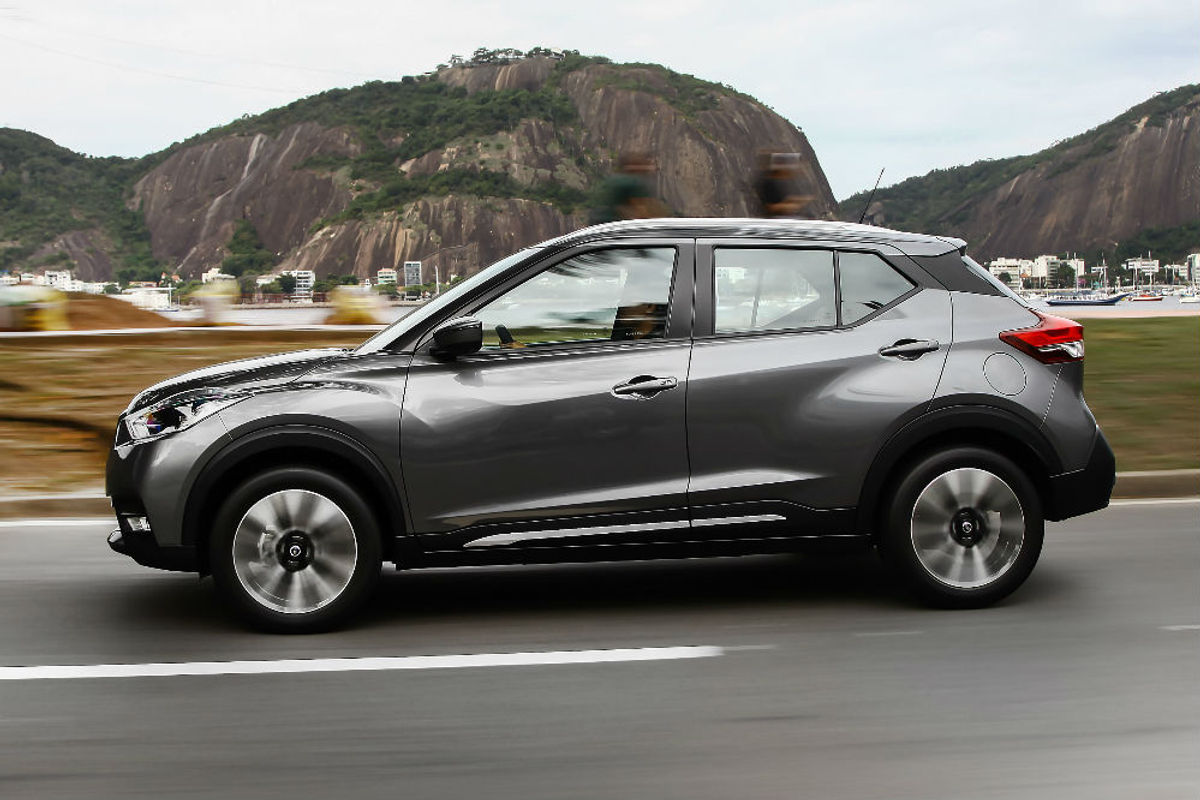
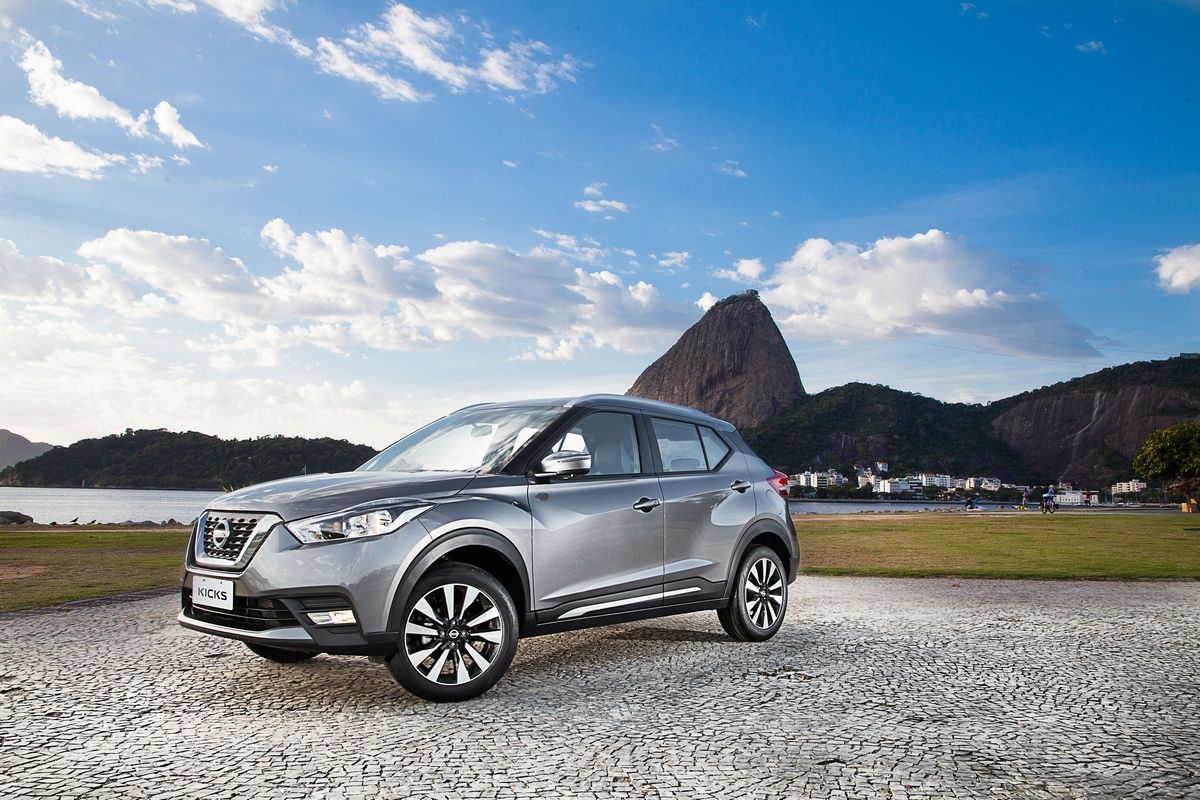
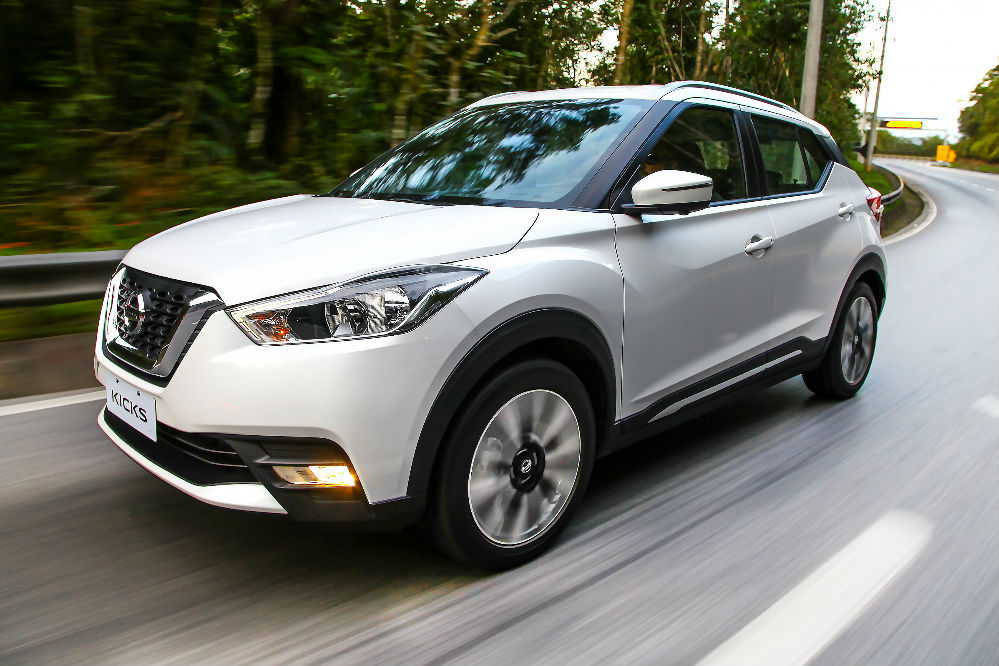
Nissan introduced a new small crossover at the Rio 2016 Olympics. It is named the Kicks and will arrive in South Africa around 2018, but few journalists have driven it. Now, in his first submission for Cars.co.za, our Brazilian correspondent Gustavo Henrique Ruffo reports that although the Kicks seems to step on the toes of its Juke sibling in terms of size, the newcomer is more practical, more conventional in appearance and – importantly – competitively priced.
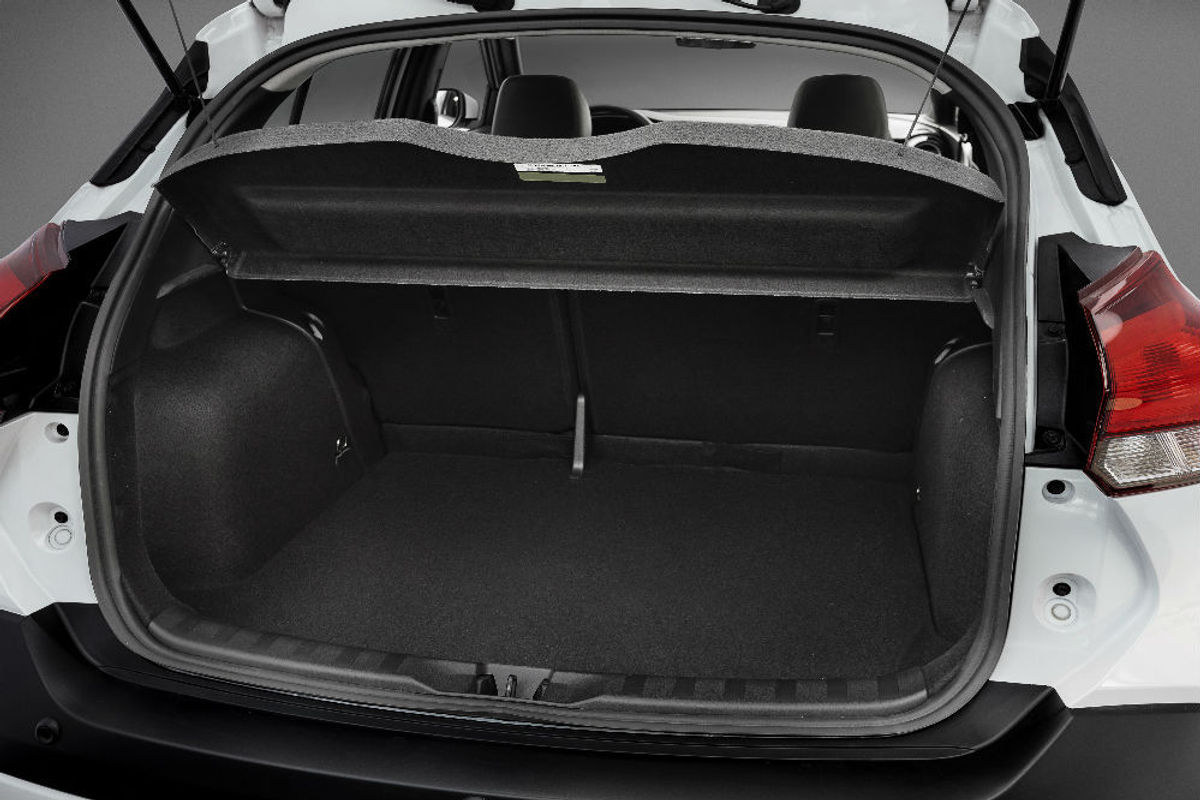
It can be difficult to judge a vehicle's size simply by viewing photographs of the subject, but the Nissan Kicks is the newest small/light crossover in town. So new that it has so far only reached Brazilian shores. It is produced on the V platform that underpins the Micra and Almera. This explains why it has a very similar wheelbase to the sedan’s: 2.61 m, instead of 2.60 m. The Kicks is 4.30 m long, 1.76 m wide, 1.59 m high and its luggage capacity is 432 litres.
In terms of its packaging, it's less roomy than the Renault Duster, but more refined overall, slightly more spacious (in terms of luggage and passenger room) than the popular Ford EcoSport and, although not as well-made as the automatic-only Honda HR-V, it is certainly more affordable than its Japanese rival.
The V platform allows the Kicks to be extremely light. The crossover weighs 1 142 kg in SL specification (the top-spec derivative), so the entry-level version should be well below that. The aforementioned Honda HR-V, which is also a very light crossover, weighs 1 241 kg in 1.8 Elegance guise. That’s 99 kg more than the Kicks, or like lugging your uncle Bandile with you after he's had a sumptuous Sunday family lunch…
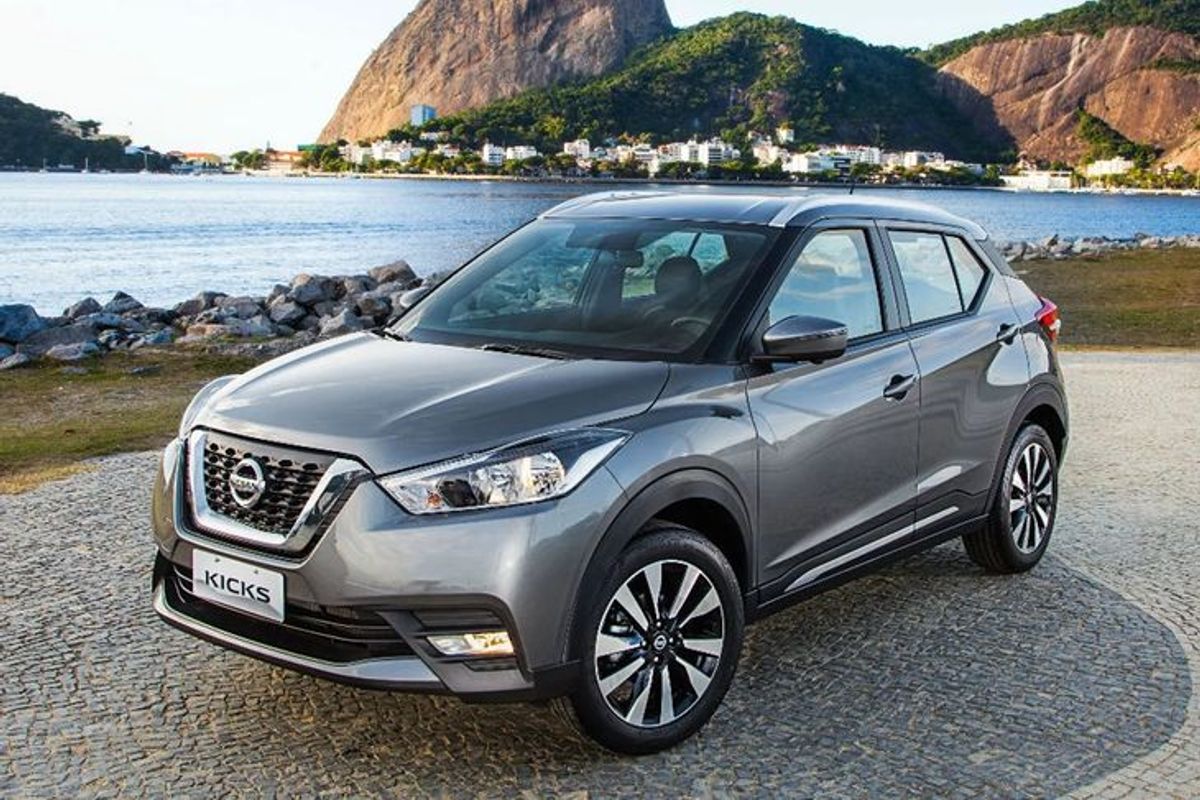
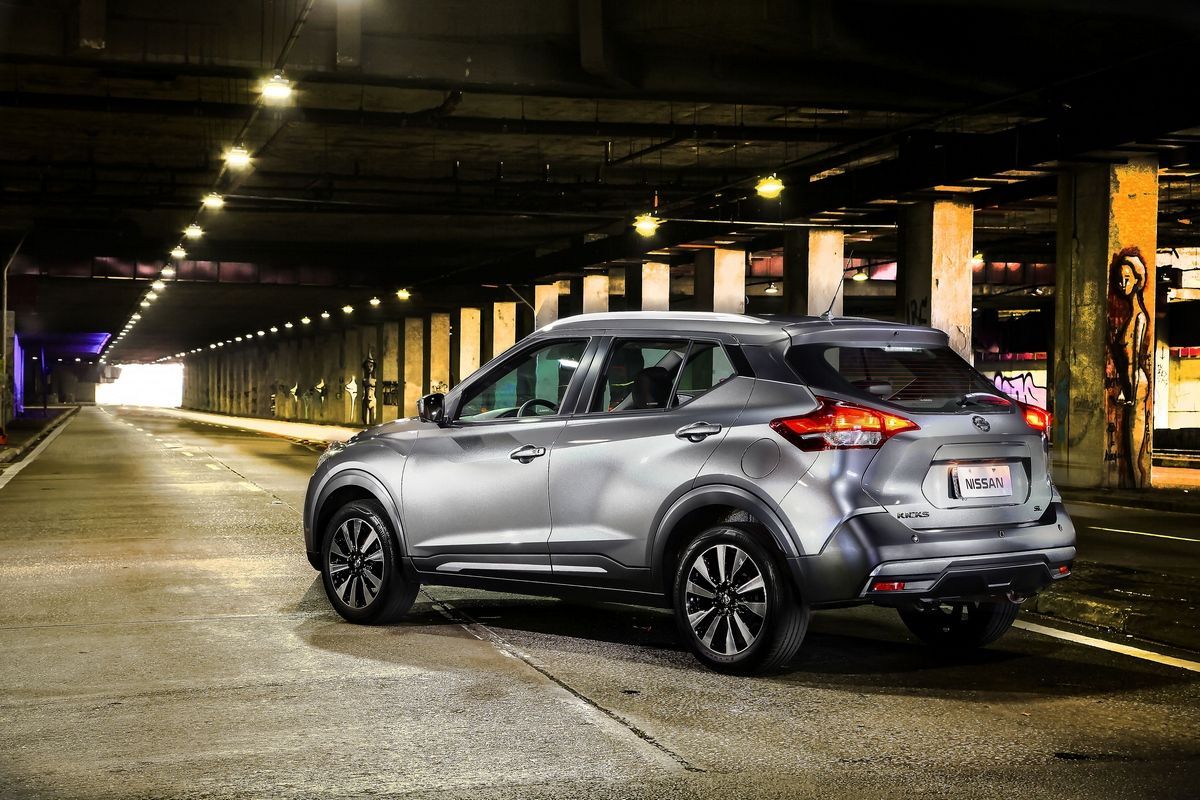
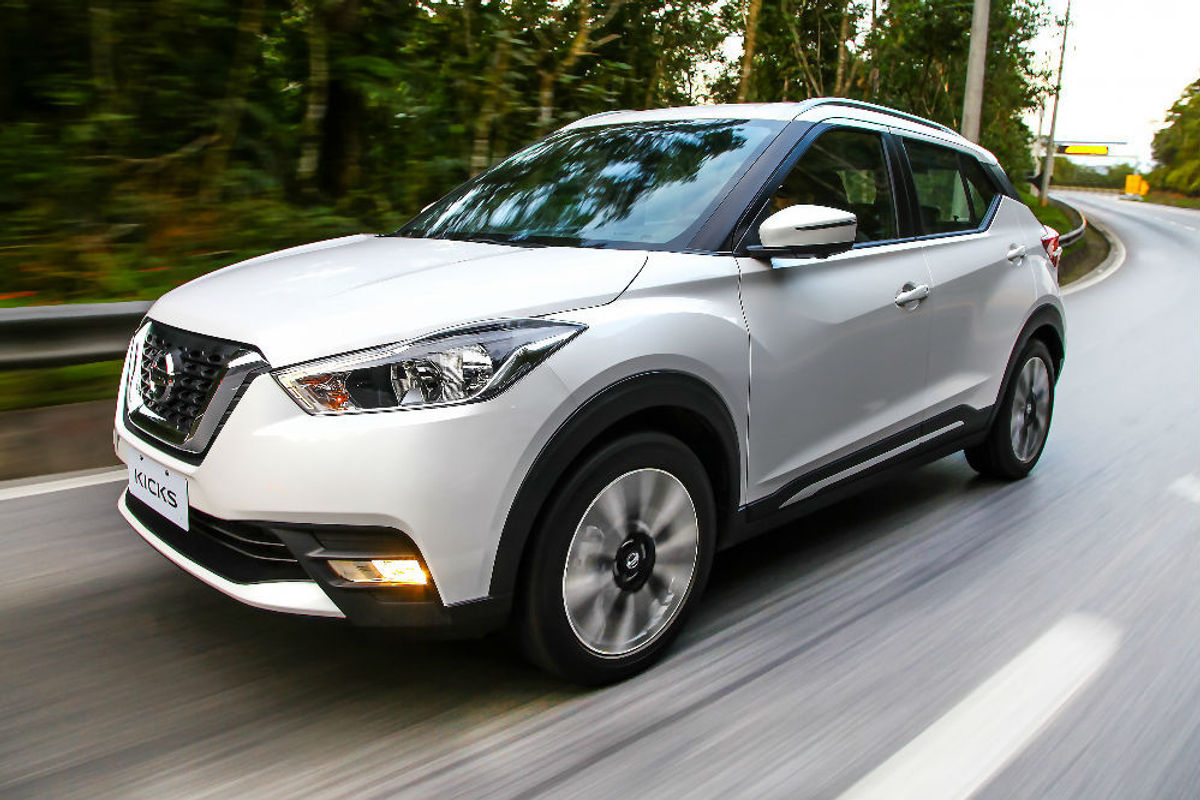
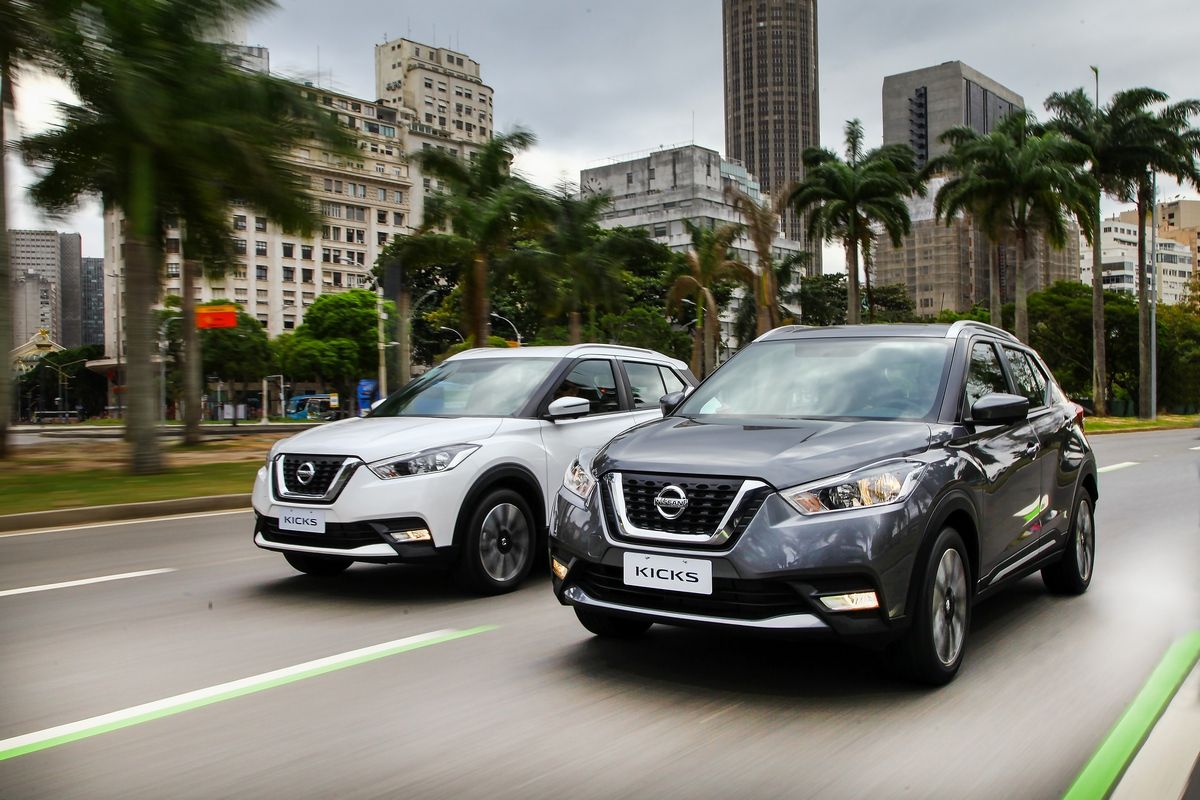
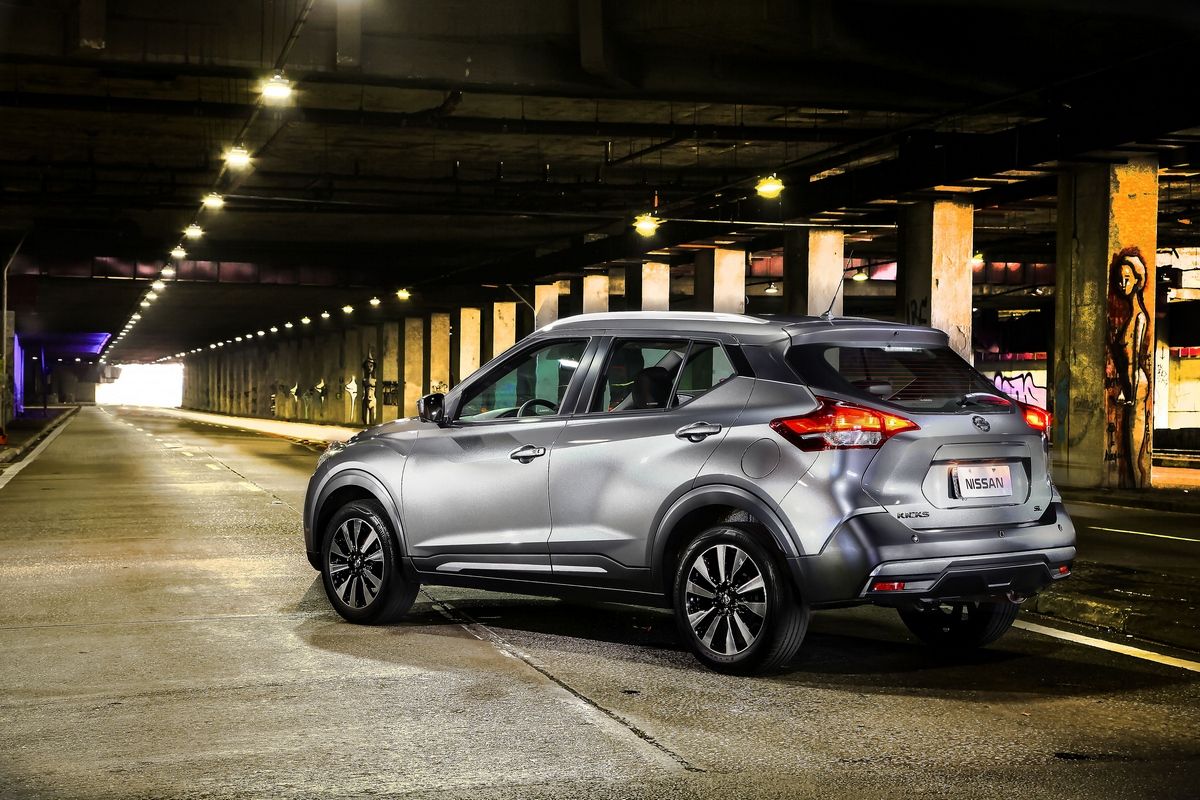
The distinctively styled Kicks was the darling of the Rio 2016 Olympics. It is certainly smaller than it looks.
The engine chosen to deal with the Kicks' lightened body shell is a 1.6-litre petrol motor… at least in the Kicks we have evaluated in Brazil. This engine, which also runs on ethanol, delivers 84 kW (both on ethanol or gasoline) at 5 600 rpm and 152 Nm at 4 000 rpm.
The car is currently produced only in Mexico. Nissan’s intention is to sell the car in more than 80 countries, South Africa included.
Styled to look compact
When you first see a Kicks in the metal, you will have the impression that it is a tall and narrow little car, even if it is only 2 cm shorter than a Duster and very similar to its competitors in width. It has to do with its design. Although it is attractive, it makes you think it is smaller than it really is.
The Kick's 2.61-metre wheelbase raised my expectations. It is 1 cm longer than the Almera’s, which is an impressively roomy little sedan. Considering the vehicles share the same platform, and the Kicks has the advantage of being taller, with a higher H-point, the Kicks seemed to have all elements to be even more spacious. Well… expectation is the mother of frustration.
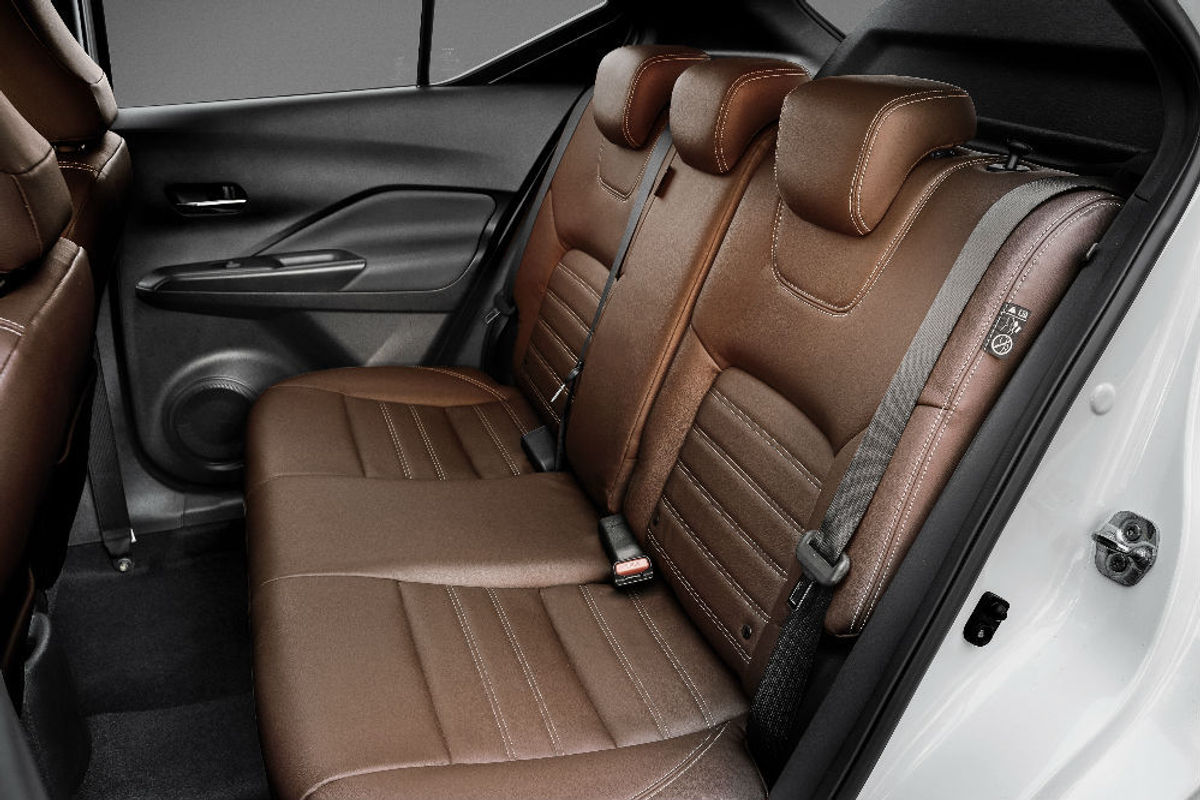
The Kicks has special front seats, with Zero Gravity foam, which offer good lateral and thigh support, unlike the Almera’s. Being bigger also makes them more comfortable and that makes the world of difference, because the larger front seats undoubtedly impinge on rear legroom. If a really tall person wants to sit in comfort in the rear, some degree of compromise will be needed from the front-seat occupant, if that person is also quite tall.
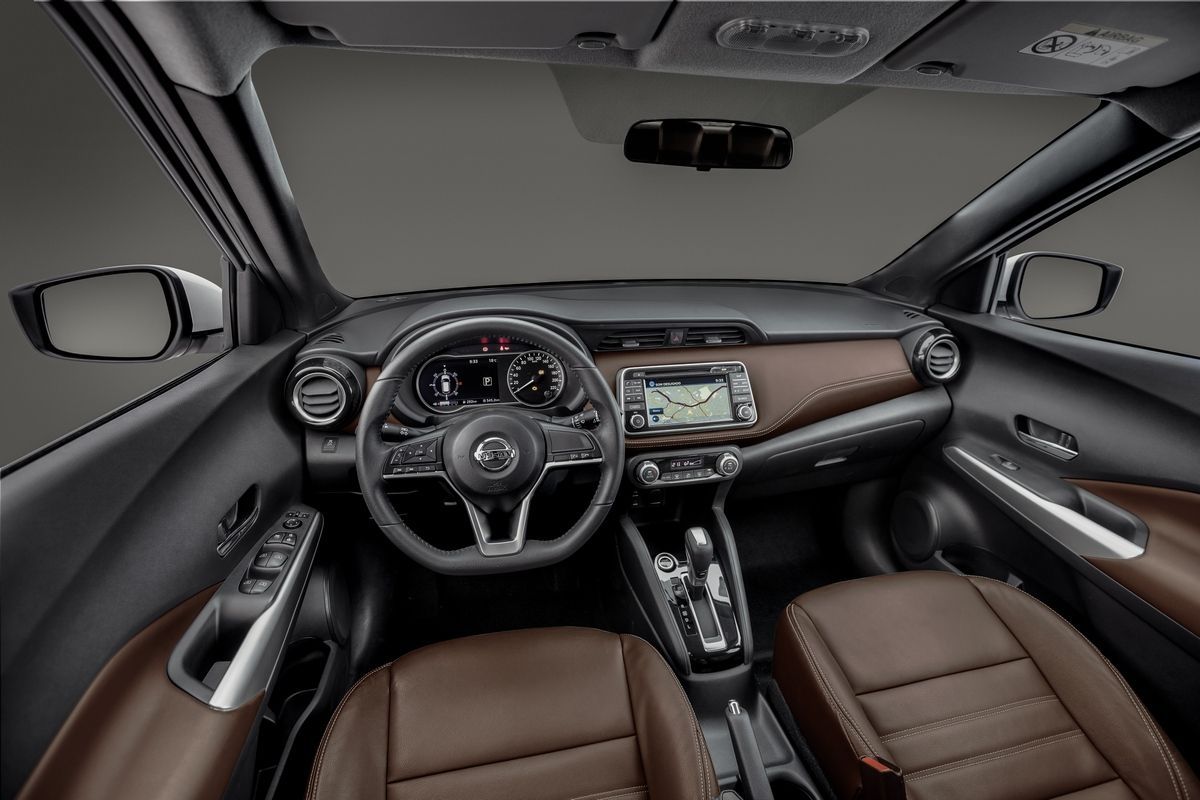
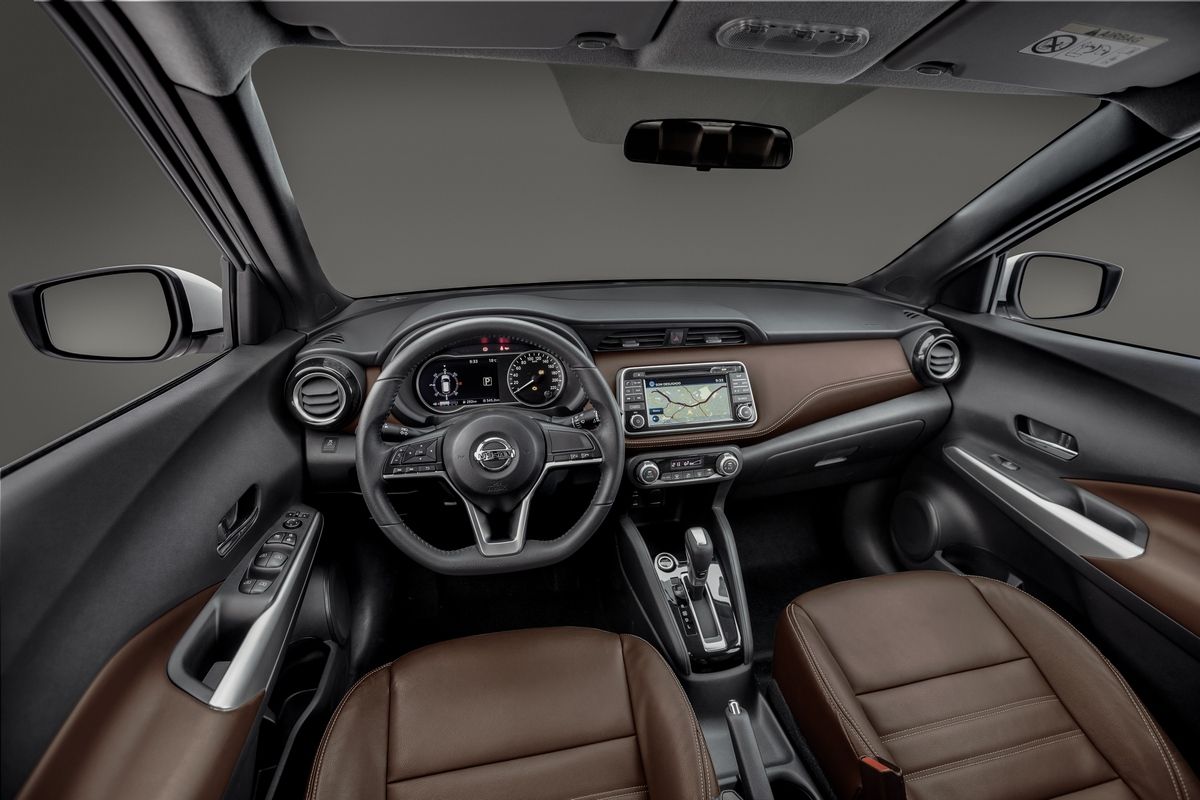
The Kicks' instrument panel features a large TFT-screen, which eliminates the need for a rev counter, for example.
In the end, the higher H-point makes it more difficult to find a good driving position, especially if you are more than 1.80 m tall. In such cases, the seatbelt just cannot be ideally adjusted between the neck and the shoulder. It sticks right over your shoulder, even if you place the seat as low as possible and the adjustable seat belt anchor is as high in the B-column as it will go. Fortunately, shorter drivers can find a comfortable seating position much more easily.
Built for affordability
The V platform could be considered a disadvantage for the Nissan Kicks. After all, there is an entirely new structure about to be presented, named the CMF-B, or Common Module Family for B segment (compact) cars. It will emerge as the basis for the second generation Nissan Juke, expected to appear at the 2017 Geneva Motor Show. So why hasn’t Nissan waited to present the Kicks with the new structure? For a number of reasons…
The first one was that Nissan wanted to make the Kicks presentation a world event. As a major sponsor of the Olympics in Rio, the company believed that using the new crossover as its official car at the event would gain the Japanese company global coverage. And it did.
In order to have the car ready on time, Nissan would have to resort to a platform that was already complete, with little need for further development.
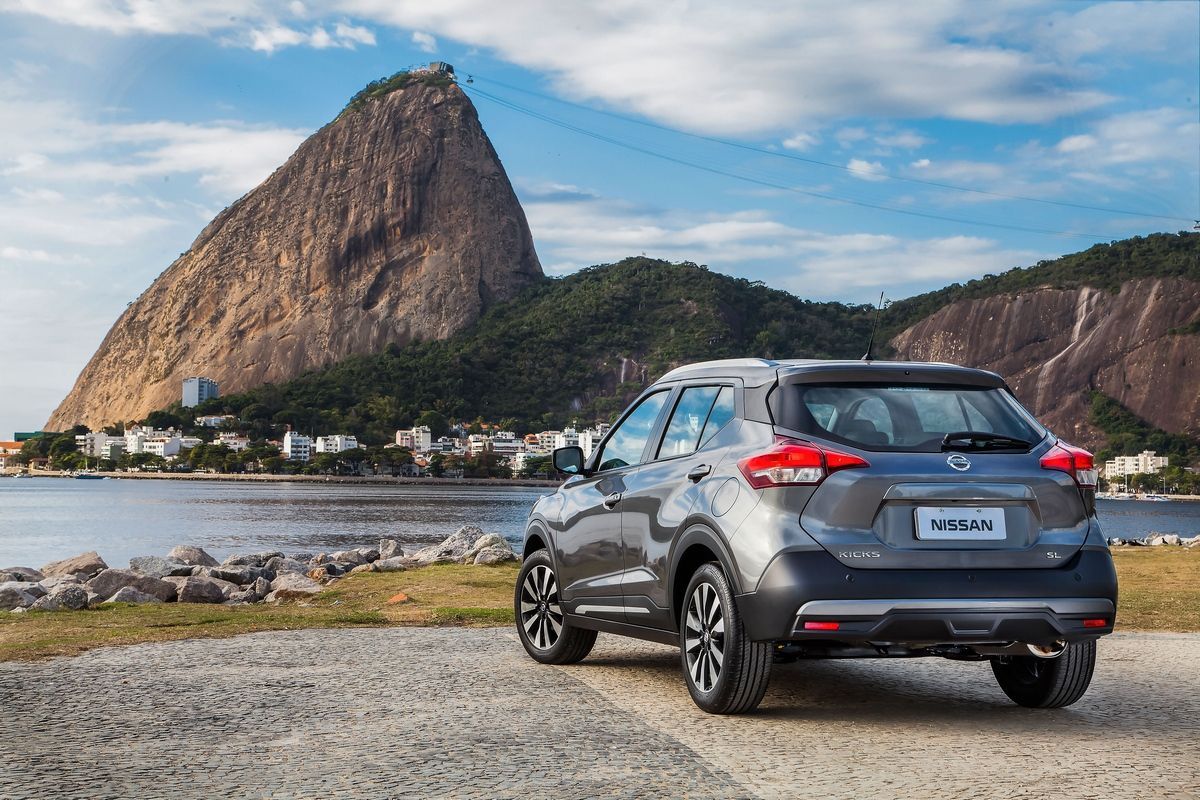
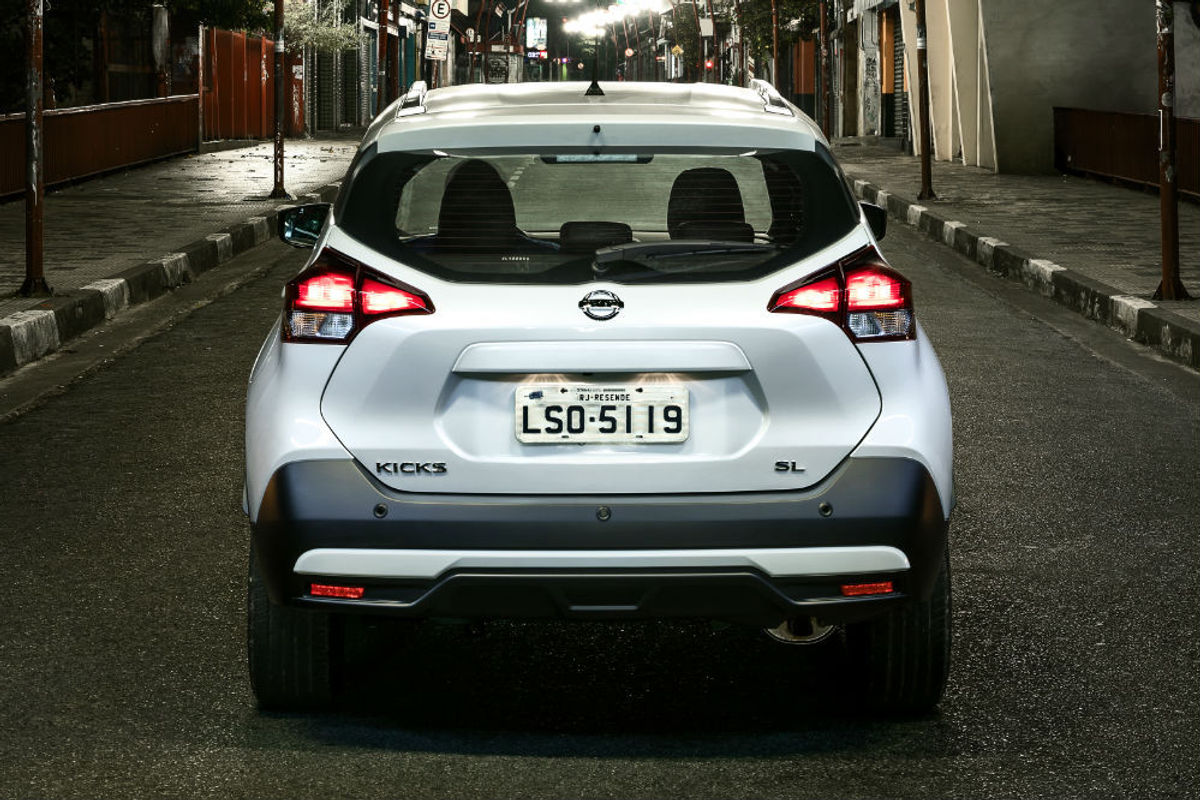
The rear styling of the Kicks is relatively fussy, but the enlarged taillight clusters add a degree of chunkiness.
The second one is because Nissan needed to offer the Kicks at a very competitive price. This is one of the main factors of success when you enter an already crowded market. Ford managed to create the first compact crossover with the EcoSport using its B-platform, the same one used by the Ford Fiesta. Nissan developed the V platform to be light and cheap to build. Therefore, it was the perfect fit for an affordable compact crossover.
The last reason for the Kicks to come with this platform is that it will not be that different from the CMF-B. According to a Nissan engineer we talked to at the crossover’s presentation, the V platform is the basis for this modular architecture. And it will underpin the future Juke, which will present a more demanding customer the opportunity to experience a vehicle based on a more refined platform without the need to leave the company’s product portfolio.
Highly specced in Brazil
The Kicks has an elegant interior. It presents only the necessary buttons, the seats are covered in artificial leather and ergonomics are quite good apart from the driving position, which I mentioned before.
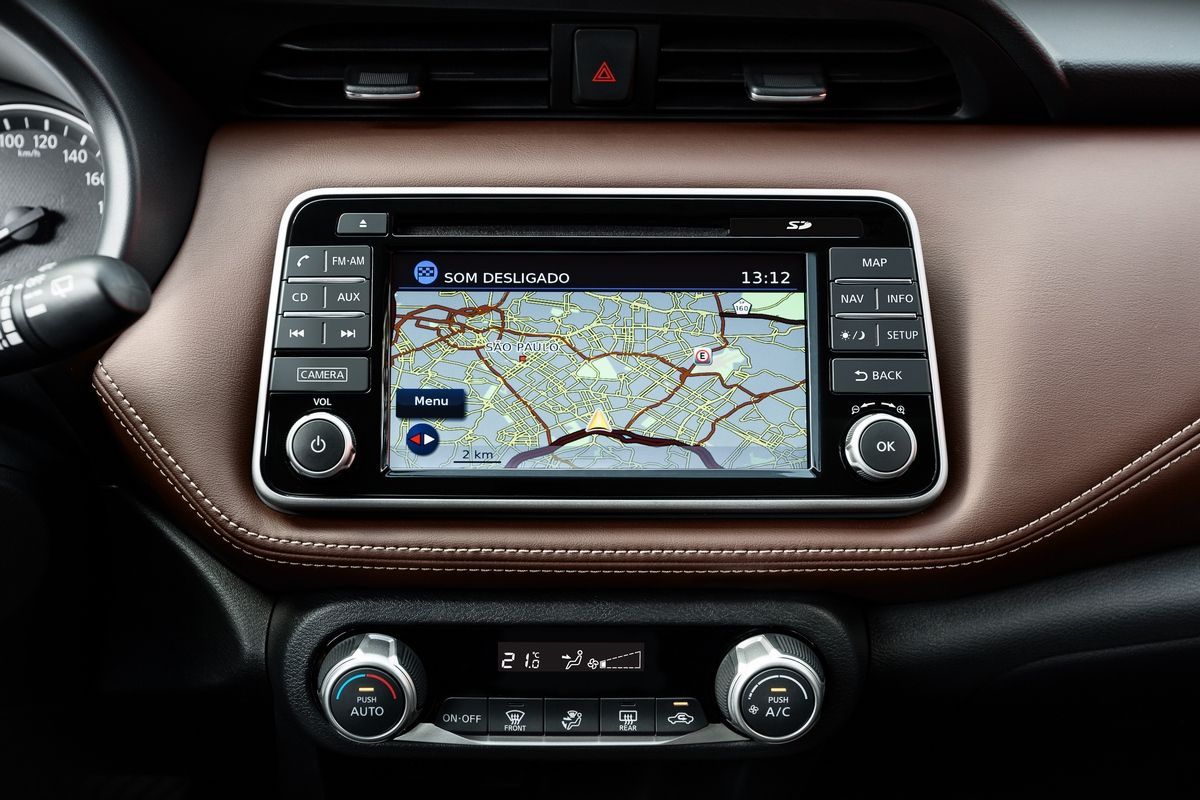
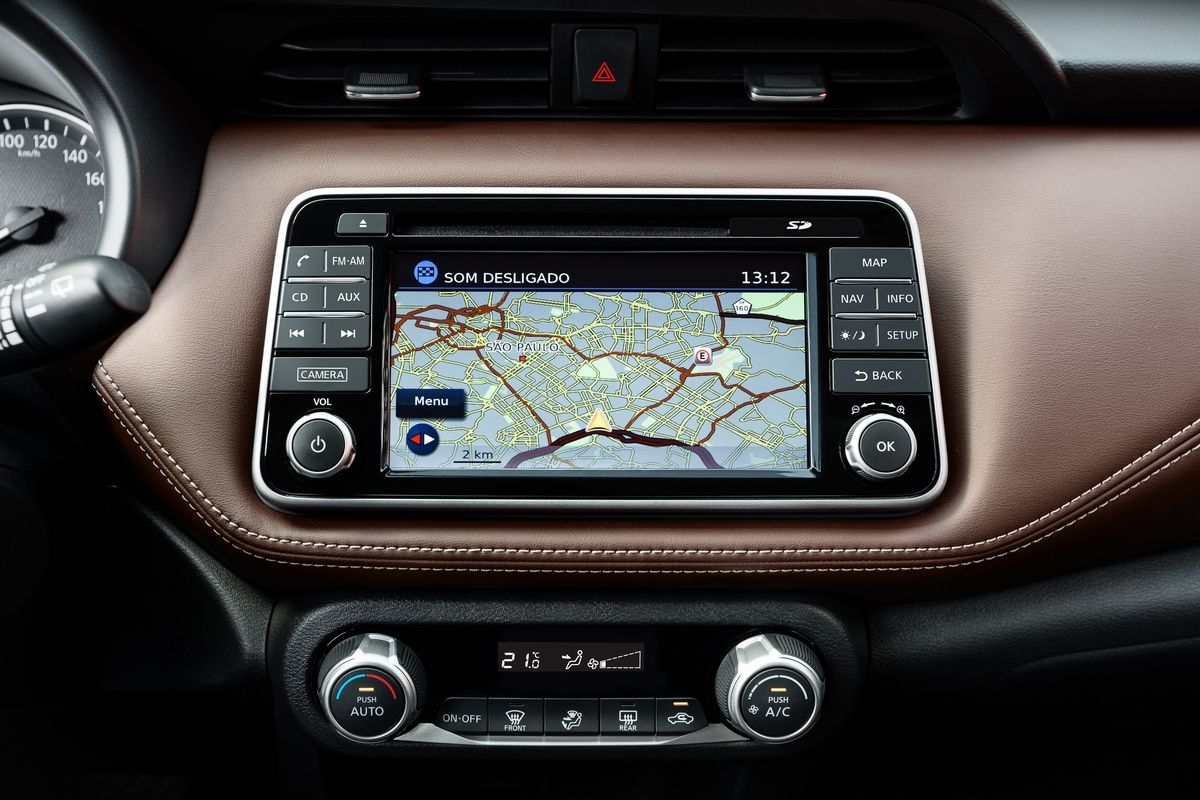
That's not to say the Kicks SL is a "bare bones" car. In Brazil, a Camera 360 system uses 4 cameras to show all the surroundings of the car on the 7-inch infotainment touchscreen. Active safety is managed by Chassis Control and the Active Trace Control, systems associated with the ABS that brake specific wheels in order for the crossover to have better stability. What's more, the Kicks SL also features VDC (Vehicle Dynamic Control) and TCS (Traction Control System).
The SL specification in the Brazilian market includes a touchscreen infotainment system as well as automatic climate control.
Apart from all that, the Kicks SL is the first B-segment vehicle, according to Nissan, that has a TFT dashboard. Just like Audi’s Virtual Cockpit, but with a 7-inch screen in place of the rev counter (the speedometer is conventional). It has 12 different display modes, among which a compass, the rev counter it replaces, navigation directions, the chassis control settings and the on-board computer functions, such as the fuel consumption.
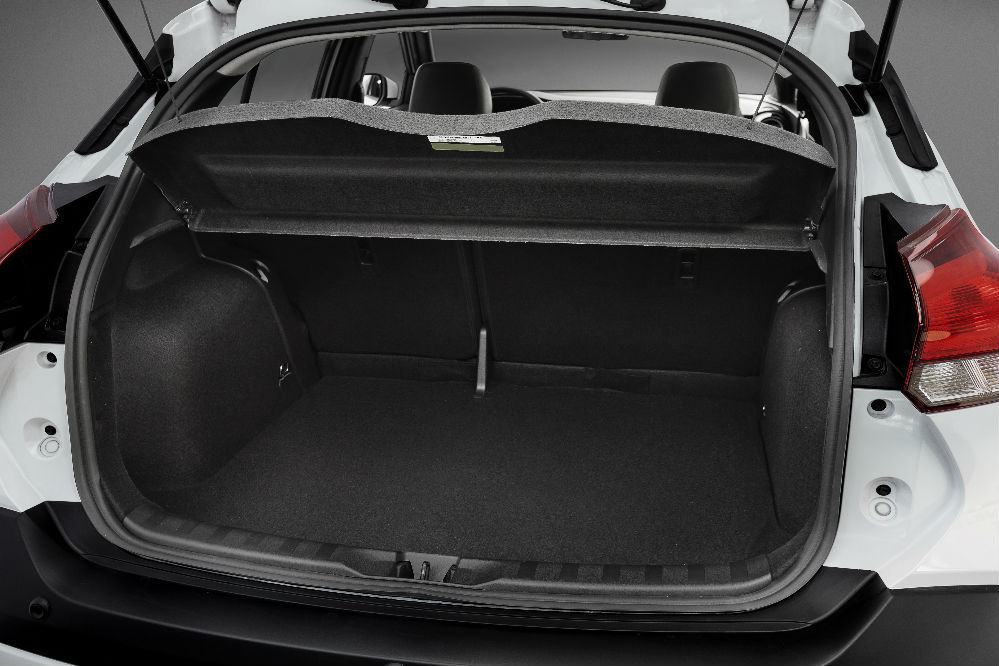
In terms of practicality, access to the interior is easy… The doors have a good opening angle and are relatively short, which prevents you from banging them against adjacent cars in tight spaces. The 432 litres of luggage space is more than enough for carrying most things a family would need for their vacation.
Besides that, the crossover is short enough to fit most parking spaces, even the narrowest ones. The Camera 360 system is of particular benefit during low-speed manoeuvres, even if it requires a bit of familiarisation. Rear visibility is reasonable.
Automatic for the people
The 1.6-litre petrol engine that powers the Kicks is the same one that Nissan utilises in the Micra and the Almera in Brazil. So it is fair to say the 3 cars share a platform, as well as powertrains.
The only version of the Kicks that is available (thus far) is the SL, which uses the 1.6-litre engine in combination with a CVT. I have praised this transmission every time I have evaluated it with the 2.0-litre petrol engine that powers the Sentra in Brazil, but the CVT does not get along with the 1.6-litre unit very well.
For what the Kicks may lack in rear legroom, its luggage capacity is particularly generous.
What bothers me about this combination is that the CVT is not very responsive. Even if you manage to find the small black button below the shift knob that activates the Sport mode, if you attempt to accelerate hard, the CVT does not allow revs to climb. It keeps them at the maximum torque range while the Kicks accelerates. Besides that, the 1.6 engine does not seem particularly punchy. It's, at best, okay. Perhaps a manual transmission would suit it better?
In its defence, the Kicks returns a fuel consumption comparable to that of similarly sized hatchbacks. Nissan claims the petrol model will achieve 7.14 L/100 km on the open road and 9.09 L/100 km in town, which is the relevant number for South Africa, even using the Brazilian standards of measurement.
In South Africa, there is a strong possibility that the Kicks may get an even smaller engine, the 1.5-litre unit that powers the Micra and the Almera.
Summary
Built on a low-cost platform, which also benefits from a low kerb weight, the Kicks was conceived to be very competitively priced. Its light structure, low claimed fuel consumption and generous specification (in SL trim) are strengths, but its 1.6 petrol/CVT combination and tight rear legroom are weaknesses.
We hope that the Kicks' excellent value for money factor will be just as applicable to the South African model when it becomes available on the local market in a year and a half's time. So far the only problem with it, at least in Brazil, is that you cannot order a Kicks SL with a manual transmission, but rest assured that the South African line-up, from whichever of Nissan's factories it will be sourced, will be finalised in the near future – should be more diverse. Nissan South Africa has confirmed that left-hand-drive Kicks will arrive in Sub-Saharan Africa in 2017, followed by South Africa a while later (probably in 2018).
Nonetheless, the Kicks will definitely appeal to those who find the Juke just a little too outlandish. It seems a very respectable competitor to the current crop of budget-oriented small crossovers. It has the potential to be cheaper, better equipped and, with a manual transmission, more fun to drive than its rivals.
The Kicks is undoubtedly the best-looking vehicle to be built on the Almera's platform!