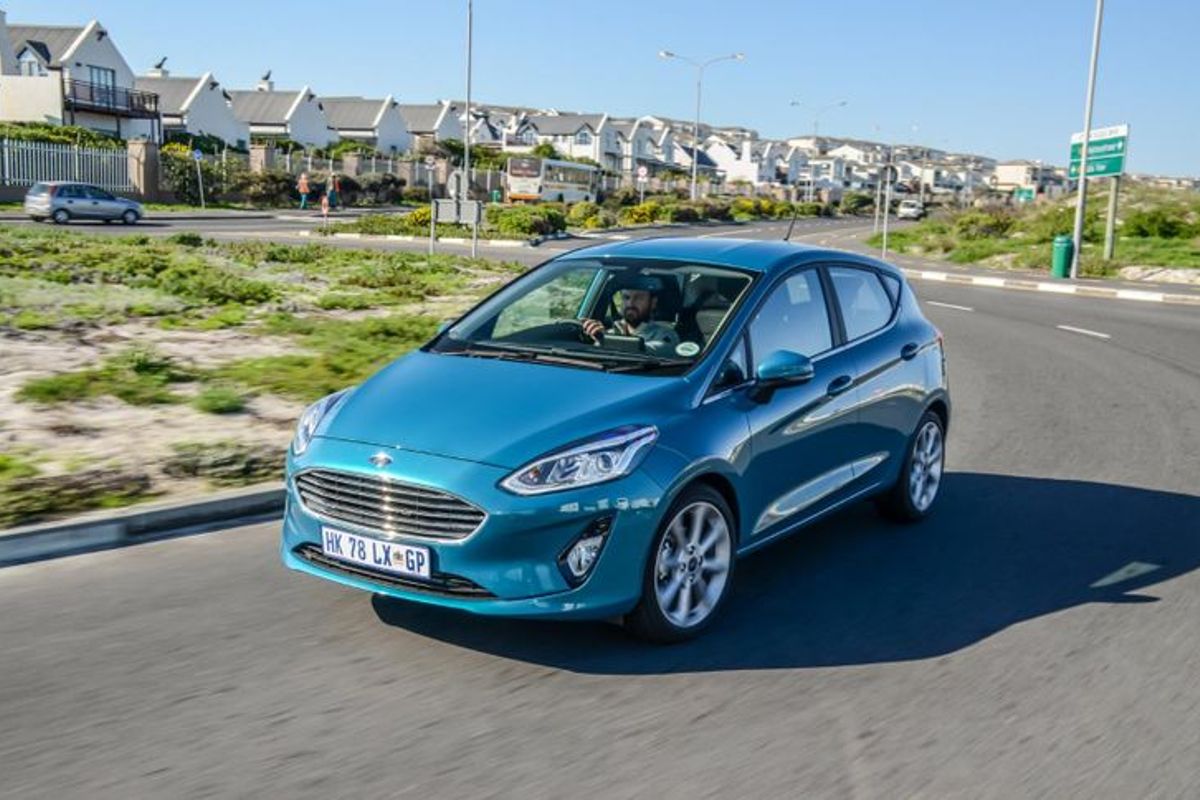
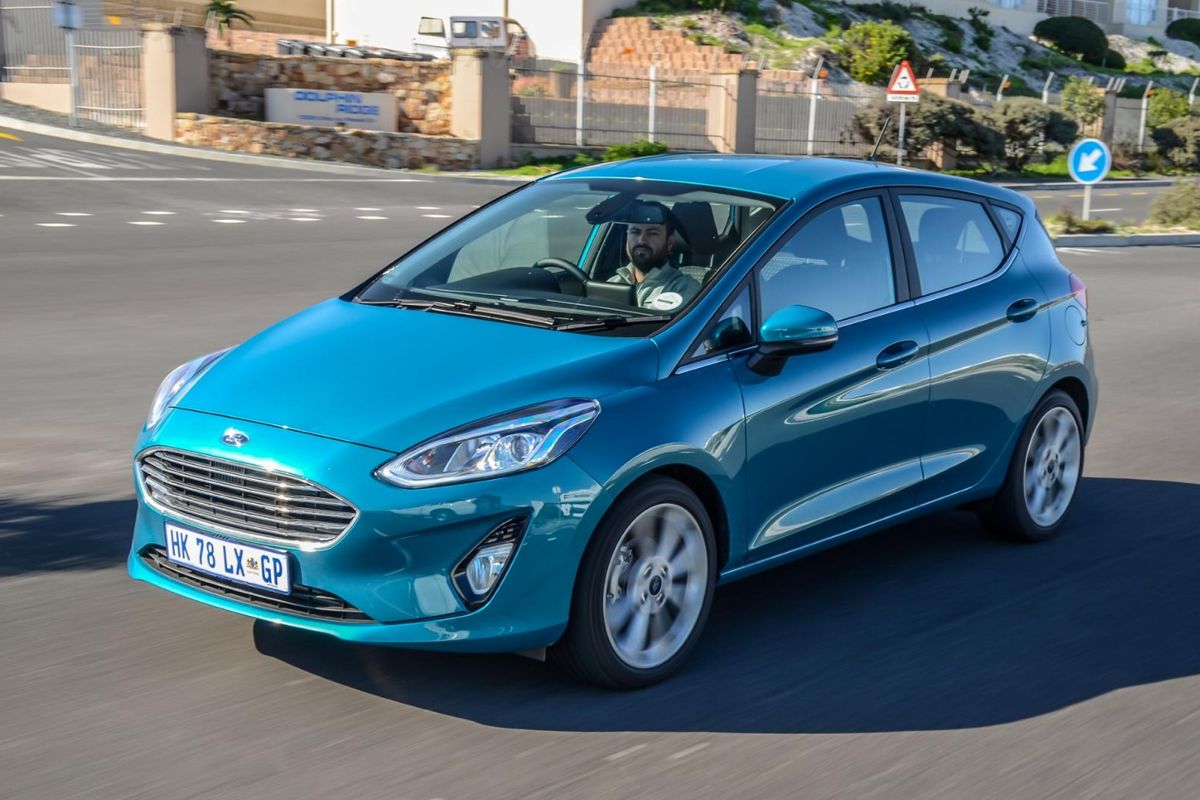
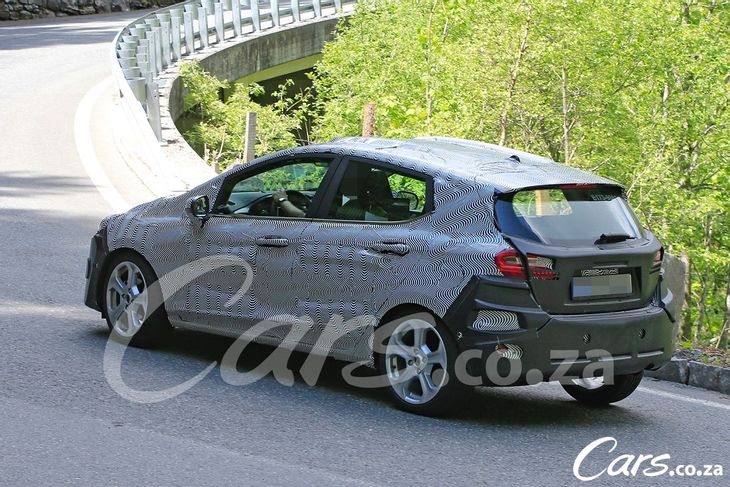
The next-generation of Ford's popular supermini, the Fiesta, is set to debut in 2017. Our spy photographer has caught prototypes undergoing testing in Europe.
Ford's current Fiesta has been around since 2009 and has remained amazingly popular during this long model life. In fact, last year was this Fiesta generation's best sales year in the UK! But, with the competition getting stiffer and the Fiesta falling behind in terms of interior packaging and ergonomics, a replacement is around the corner.
PHOTOS: S.Baldauf/ S.B Medien
Reports suggest a new model that is slightly larger than before, with a particular emphasis on improving rear knee and shoulder room – areas where the Fiesta has been lagging its rivals. Up front, the cluttered current facia will make way for a more minimalistic design featuring Ford's SYNC3 info-tainment system. The growth in size and (primarily) sophistication makes sense as Ford has just released a new, bigger Ka+ (badged Figo in SA) in Europe, positioned below the current Fiesta.
At this point drivetrain news is based on pure speculation, but a hot tip is that only three-cylinder turbo engines will feature. It is also rumoured that the dual-clutch transmission will be dropped.
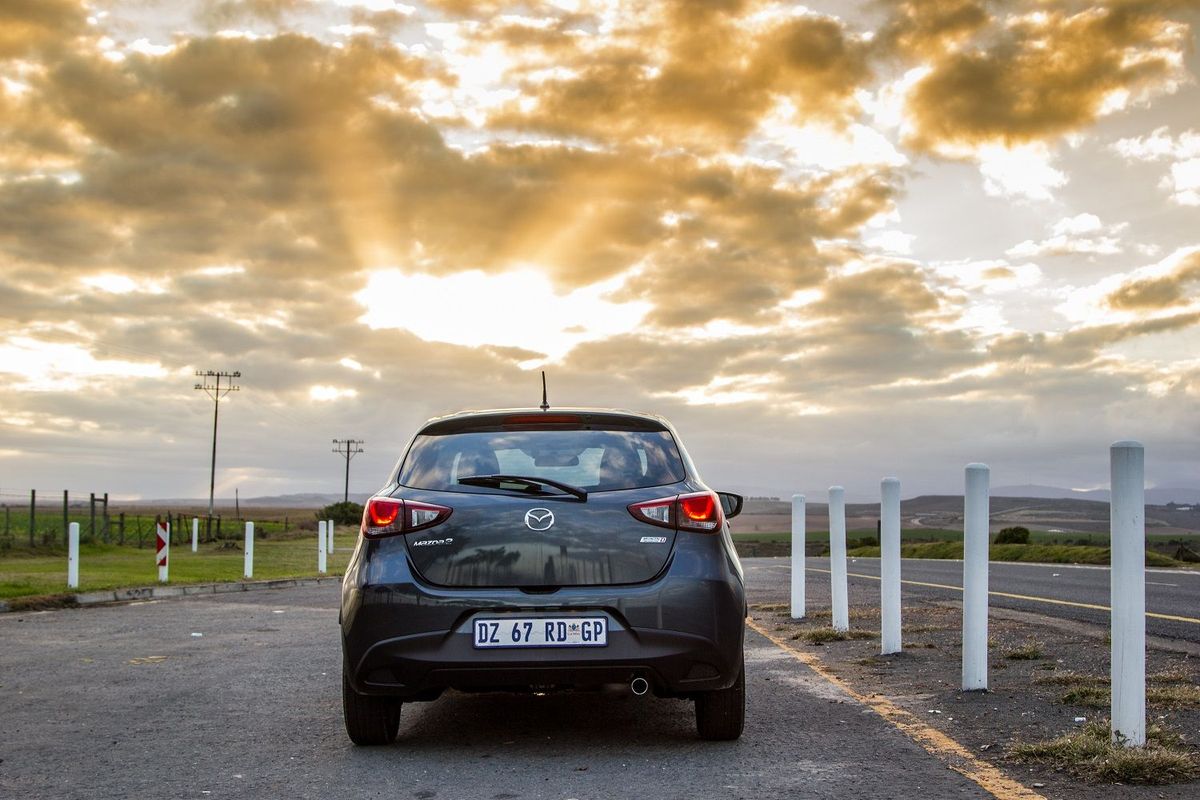
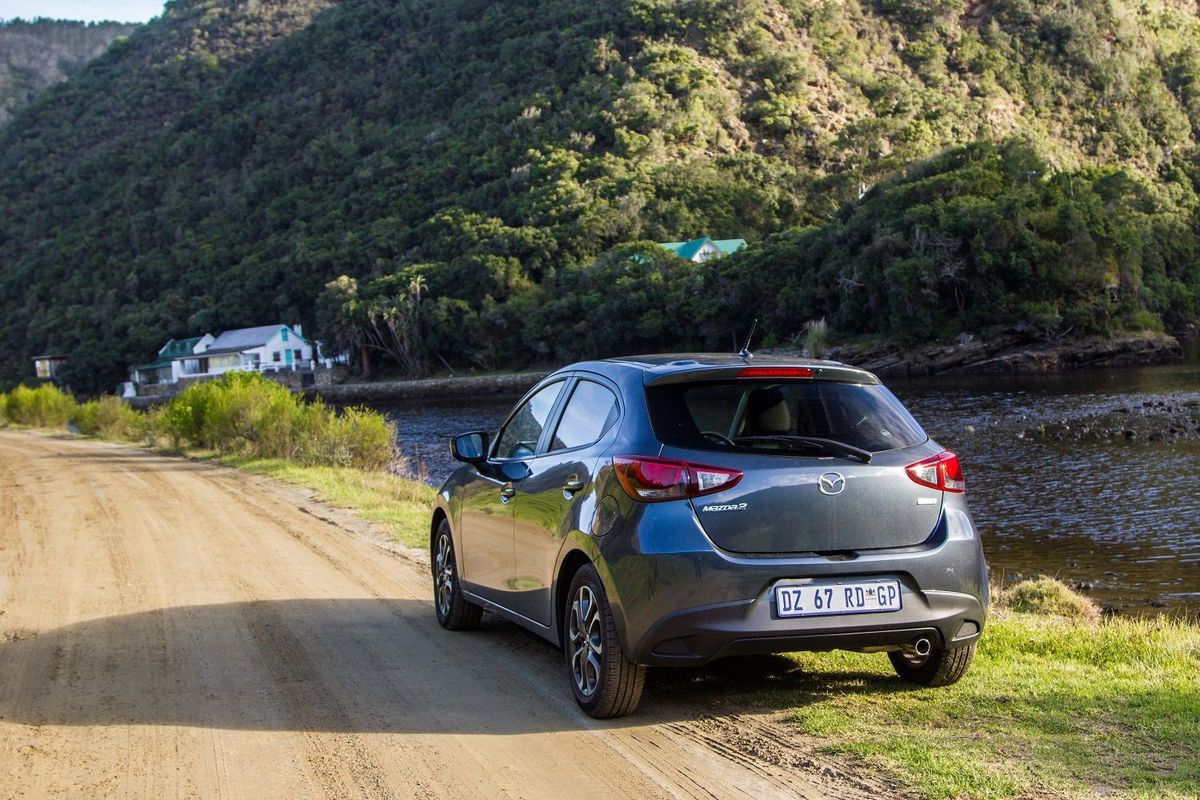
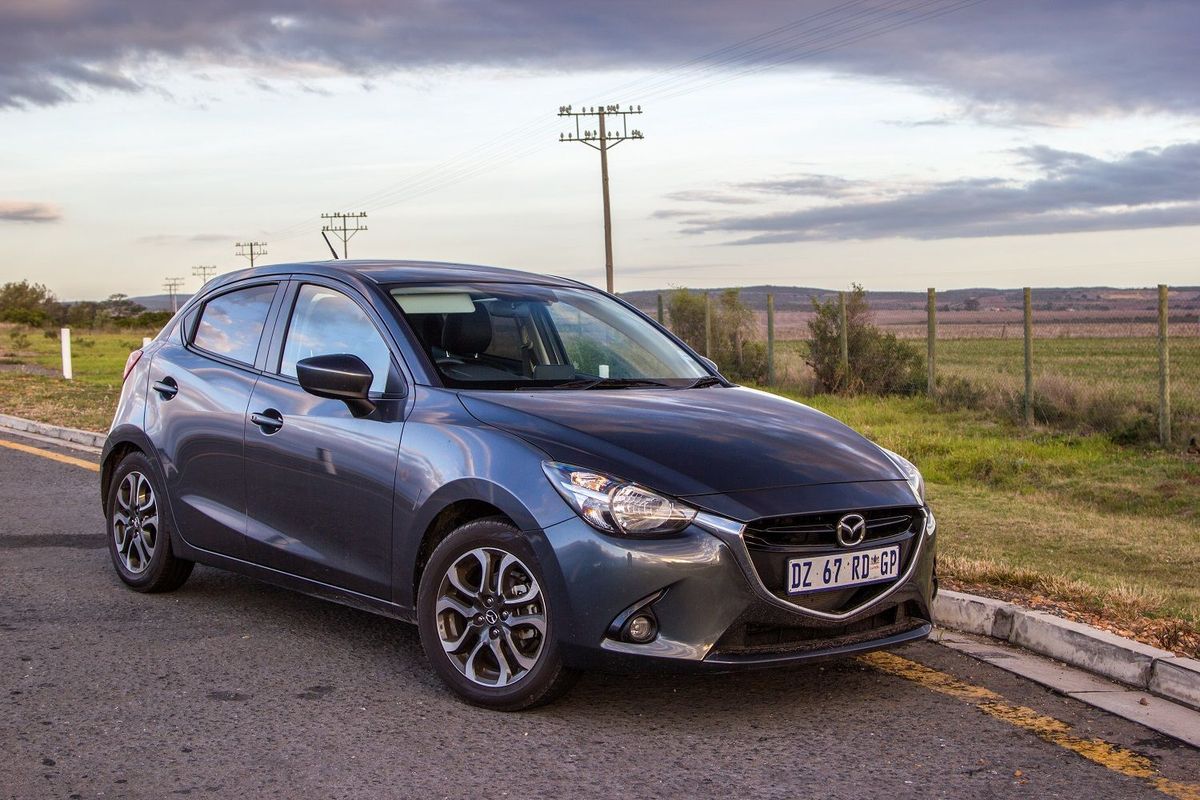
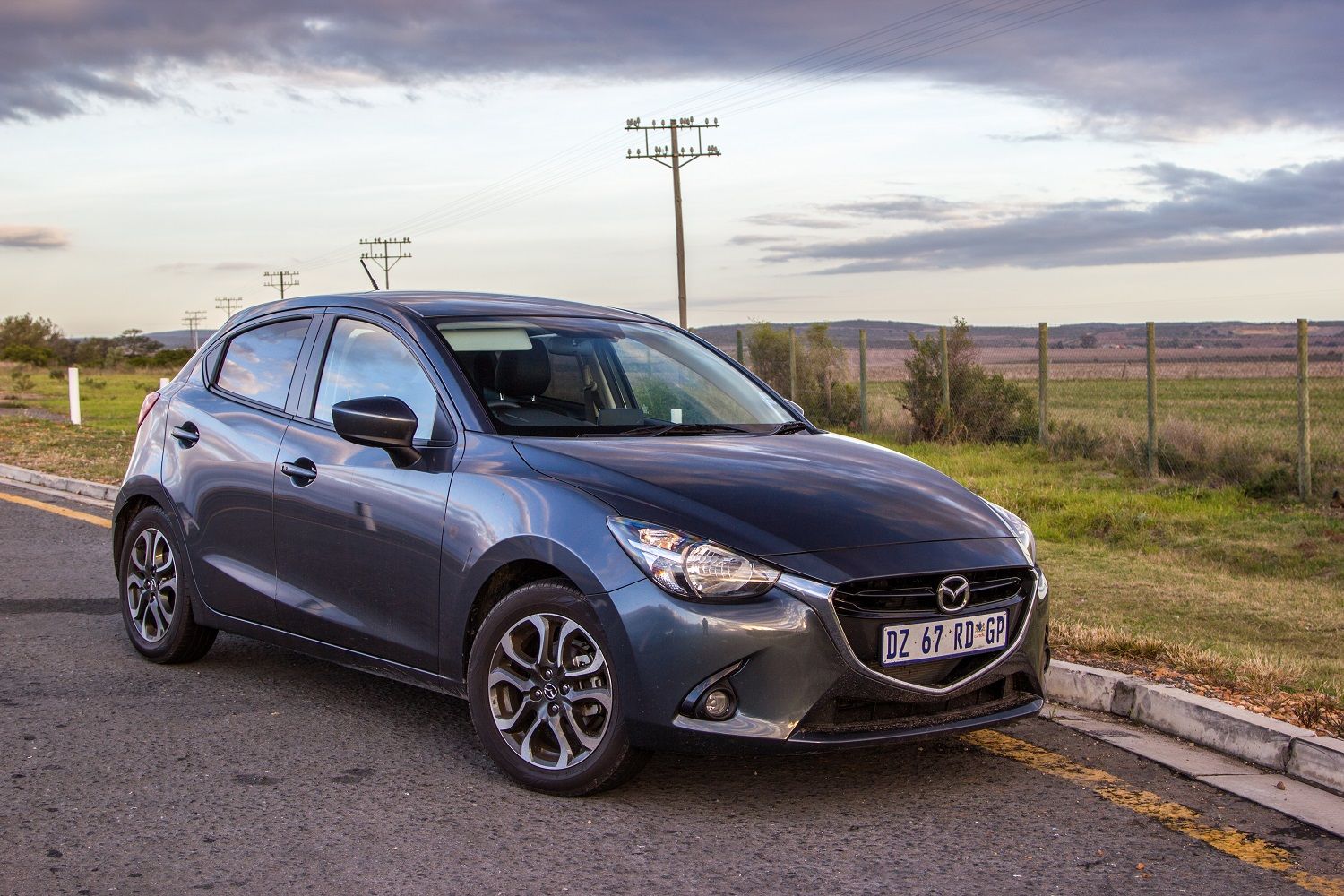
We spent a month in the top-of-the-range Mazda2, a small hatchback with a novel configuration of a turbodiesel engine mated with an automatic transmission. With generous specification, the 1.5 DE Hazumi offers a blend of luxury, ease-of-use and economy. Does the package work?
The standard Cars.co.za review period is usually around 10 days and while you can get a reasonably accurate idea of what a car is like during that time, a few more weeks afford us with an opportunity to form a better opinion of what a vehicle is like to live with; its inherent strengths and weaknesses and how it performs on longer trips. The 1.5 DE Hazumi, which had served extended time in the media test fleet before reaching us for this test, was immediately put to good use for a long-distance trip to the Garden Route.
Let’s get the numbers out the way. This is the only turbodiesel automatic hatchback in its segment of the market. Powered by a 1.5-litre four-cylinder motor with 77 kW and 220 Nm, the Mazda2 offers performance that’s on par with its rivals and has a claimed fuel consumption of only 4.4 L/100 km. Power reaches the front wheels through a six-speed automatic gearbox. This derivative costs R286 700, which includes a 3-year/unlimited kilometre warranty and 3-year/unlimited kilometre service plan.
Mazda South Africa has gone from strength to strength since it became a standalone entity in the local market. It’s actively marketing its model line-up and from small hatchbacks to crossovers, family saloons to compact SUVs (there's even a double-cab!), Mazda offers products that will suit most needs and budgets. After chatting to some sales reps from our local dealer, there is much demand for the Mazda2 and Mazda CX-3, while the World Car of the Year-winning MX-5 roadster is selling in numbers that reflect its niche-product positioning.
The transmission and turbodiesel engine work well as a combination. There’s a little hesitation when you pull away, which is likely to make you instinctively apply a bit more throttle. This will then result in the turbomotor delivering a wad of torque, which makes the acceleration uneven. Fight that instinct and let the car naturally build up acceleration for a smoother ride.
Most turbodiesel engines, especially those of a smaller capacity, don't deliver much oomph before 1 500 rpm. The Mazda delivers all its torque from 1 500 to 2 500 r/min and peak power at 4 000, but this narrow "power band" and the six-speed auto work surprisingly harmoniously in an urban environment, We found that mashing the throttle pedal to the floor was not the answer as the transmission would kick down too many gears – if you're in a hurry, use the manual override by knocking the selector to the side and treating the 'box like a sequential unit.
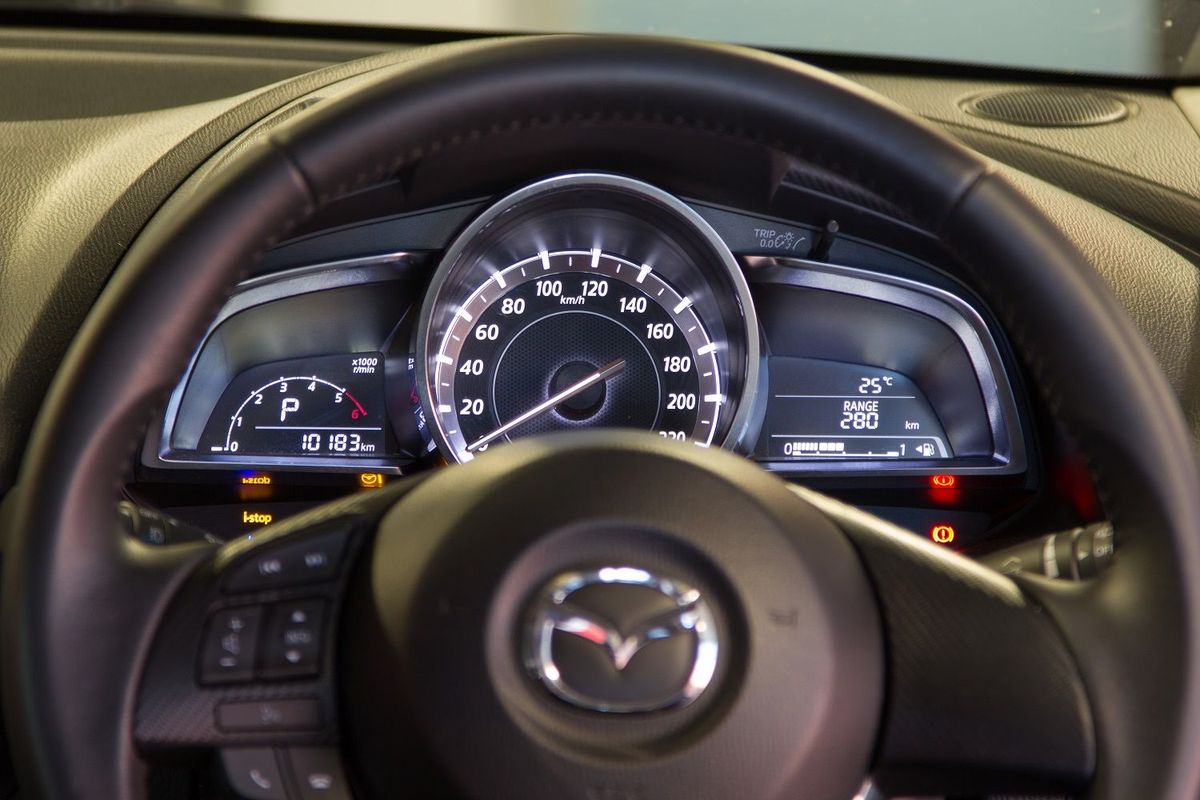
The fuel-saving auto start/stop system is a little intrusive and the ‘i-stop’ message will blink on the dashboard telling you that the car wishes to switch off to save some diesel, if you have opted to switch it off. We found it best to leave the i-stop to its own devices.
Let’s hit the road
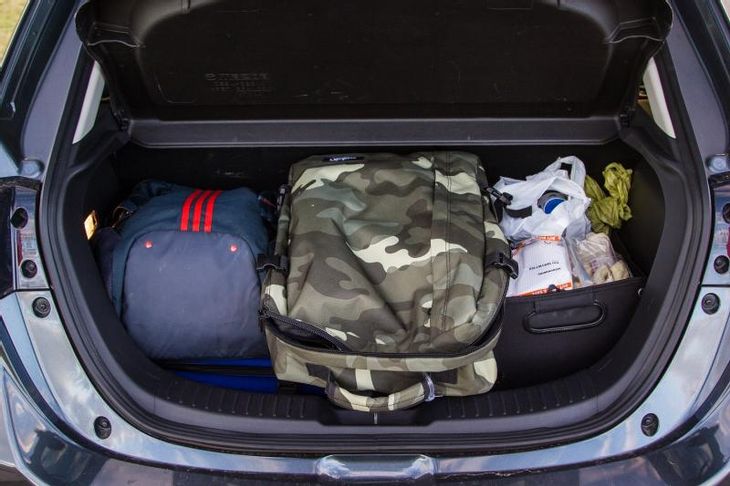
The boot size is on par with rivals, and it was packed fully for a long-weekend trip to the Garden Route.
We tested the Hazumi on the open road for a long journey from Cape Town to Plettenberg Bay. Two tog bags, a laptop bag, camera gear and fishing equipment stretched the Mazda2’s boot to its capacity. While it couldn’t quite take the cooler box, it’s nice to know you can fold the seats down in a 60/40 split to further increase space. The cooler box in question landed up on the back seat strapped down with a seatbelt!
On the open road, the lack of cruise control was annoying, but this was offset by not one, but two USB ports. My partner had her phone plugged in to charge, while the second USB provided power to a portable wifi modem. Why can’t all B-segment cars come with multiple USB ports? It would really appeal to the overwhelming majority of 21st-century car buyers.
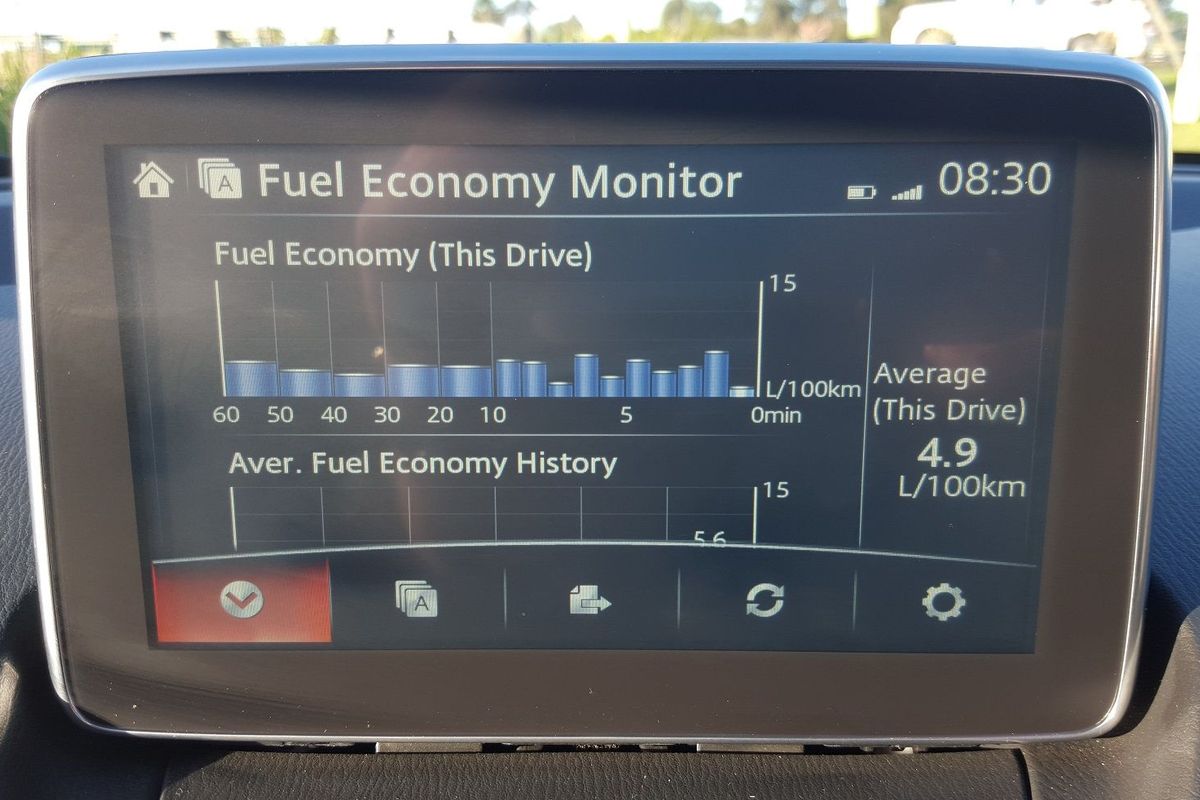
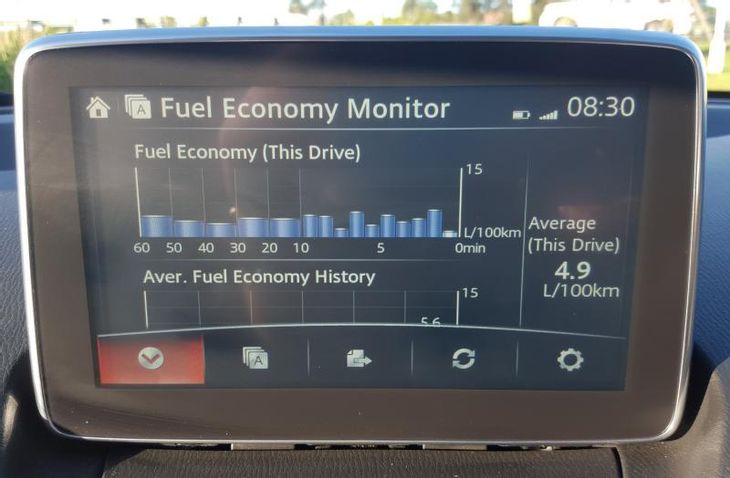
Meanwhile, It offers good fuel consumption on a long journey. Driving at 120 kph resulted in an indicated consumption figure of 5.5 L/ 100 km, while reducing speed to 110 kph would see that fuel figure drop to under 5.0 L/100 km. We estimate that if you drive long journeys at around 95 kph, your fuel consumption would sit at around 4.0 L/100 km, which is excellent.
Smart-looking touchscreen offers clear visuals and app-like design.
The car feels quite sporty too, and the combination of a firmer suspension and 17-inch alloy wheels meant that the Mazda2 was involving (and most importantly, fun) to drive briskly on a twisty stretch of road. The auto ‘box and engine don’t like to be thrashed and it’s obvious that both have been mapped for a relaxed drive.
The cabin is a pleasant place. It feels well assembled and the materials used in its construction feel smart, but also hard-wearing. This unit had already endured numerous journalist evaluations, yet the cabin felt fresh and unscathed after 10 000 km on the odo. Operating the functions of the touchscreen infotainment system takes some time to get used to, but once you’re familiar with its layout, you’ll be able to navigate those menus almost without taking your eyes off the road.
What do you mean it’s not full house?
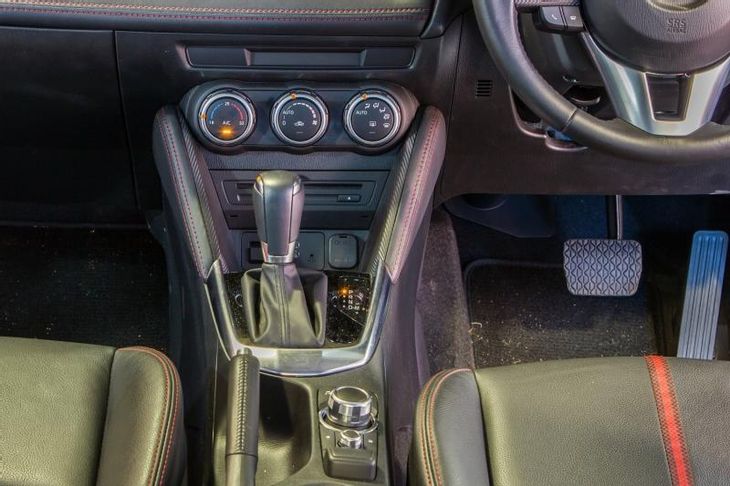
Climate control, two USB ports, CD player, decent infotainment system, steering wheel controls… but no cruise control.
Speaking of the infotainment system, Mazda claims this top-spec model is full house, but although Mazda marketing material suggests a satellite navigation system is present, the car’s message system said the nav system required an SD card to work. Our next extended test of the Mazda CX-3 presented the same problem. The GPS hardware is fitted as it will give you latitude and longitude data, as well as altitude above sea level, but for street directions you’re going to require that SD card. A visit to our nearest Mazda dealership in Paarden Eiland resulted in a quote for R5 500. For that money, a smartphone with Google Maps and an in-car mount can do as good a job.
The omission of cruise control was a letdown. Cruise control would not only aid this model’s fuel consumption figure, it would be such a benefit to the Mazda2 on longer trips.
Verdict
We enjoyed our time with the Mazda2 1.5 DE Hazumi and we tallied up a tidy 2 000 km in it. Not only is it a well-built and -specified product, but it also happens to be a pleasure to drive and impressively frugal (if you drive it with a measured inputs from your right foot, of course).
The 1.5 DE Hazumi proved a willing tourer, but the inclusion of cruise control would have been welcome.
With its price tag of R286 700, some may argue that the Hazumi demands a premium price for what’s essentially still a small car. Yes, perhaps there is better value in the manual petrol versions, but for those who cannot quite afford the premium-badged boutique hatchbacks, the top-of-the-range Mazda2 offers a smart, well-equipped package and a satisfying driving experience with the not-insignificant benefit of an automatic transmission, which, in congested urban areas, makes daily motoring a lot more bearable.
First impressions of a Mazda dealership were good too, with a brand representative immediately leaving his desk to come and greet me as I walked through the door. Buoyed by well-made and -priced products, Mazda's reputation in South Africa is better than ever. Given how solid and robust the test unit felt, we find ourselves asking: is Mazda the new Honda? Before the arrival of Lexus and Infiniti, Honda was considered the most desirable premium-but-affordable Japanese marque in the market; its products were well-specced, sporty and desirable. Now that Honda's products are more mainstream and, arguably, a bit staid, Mazda appears to be producing the most fashionable alternatives to the premium brands' wares.
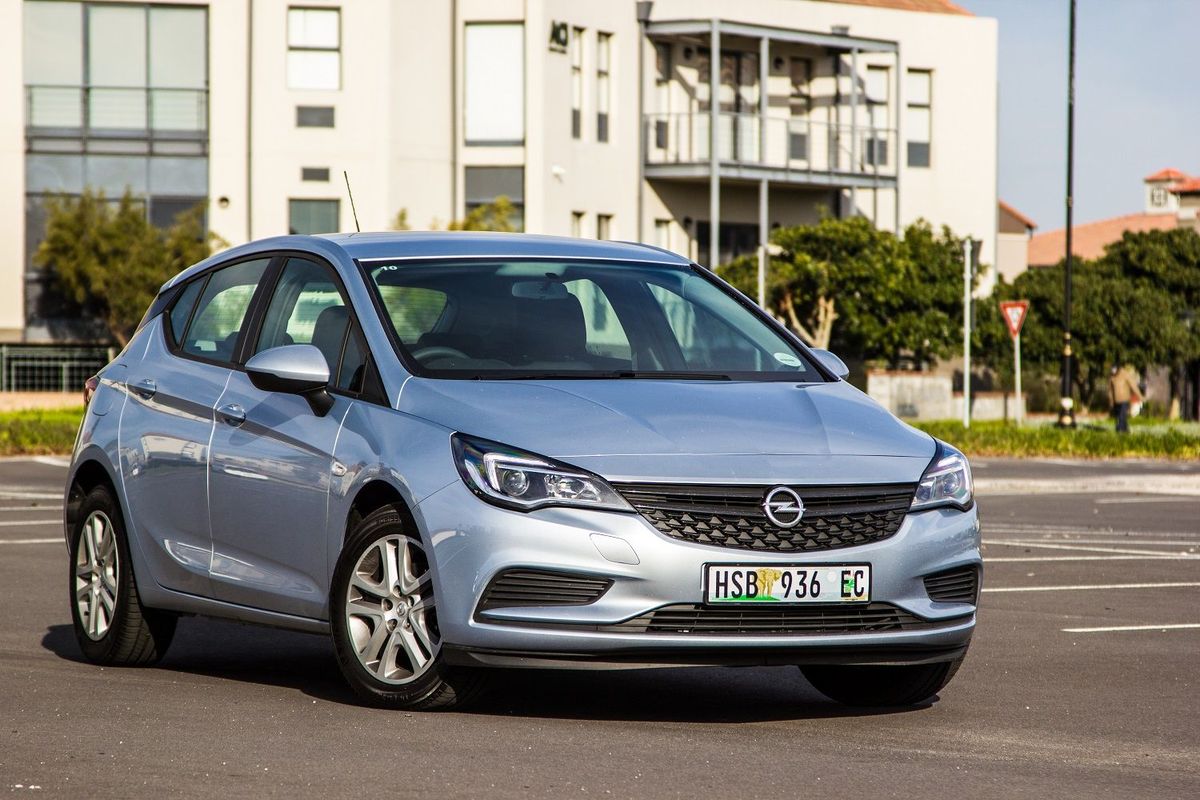
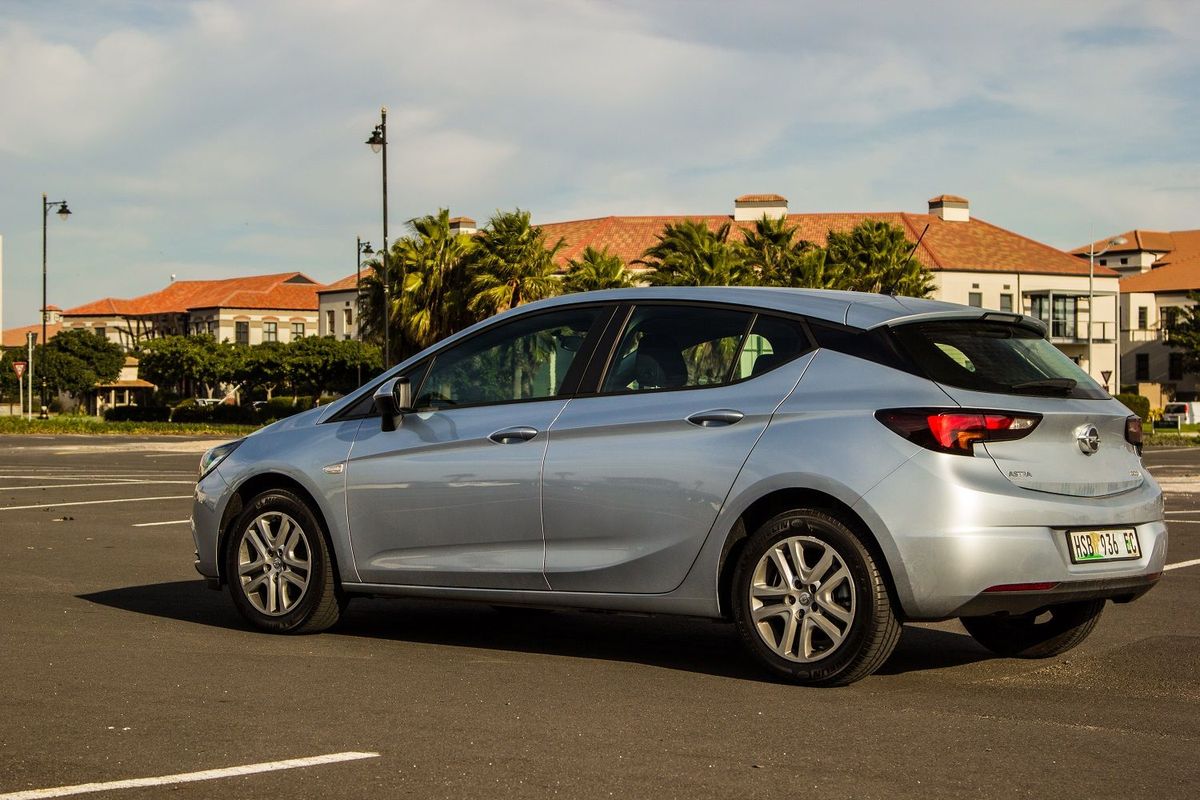
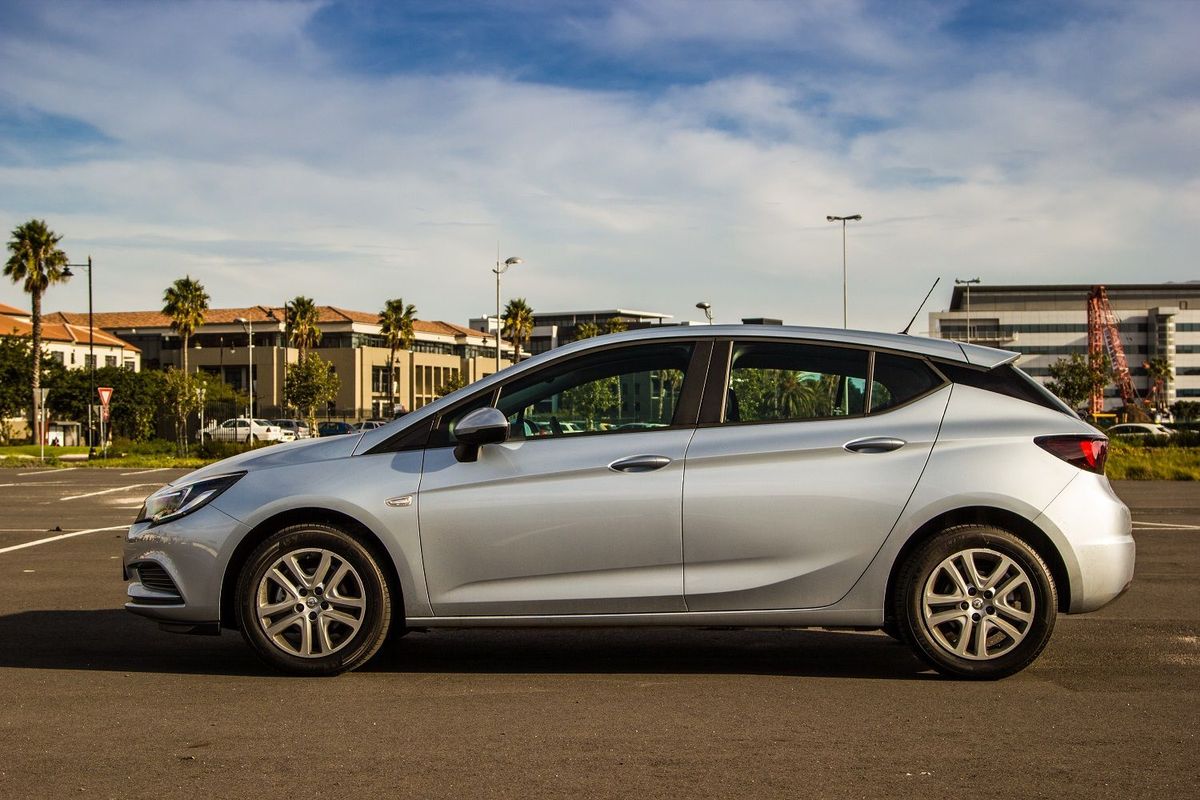
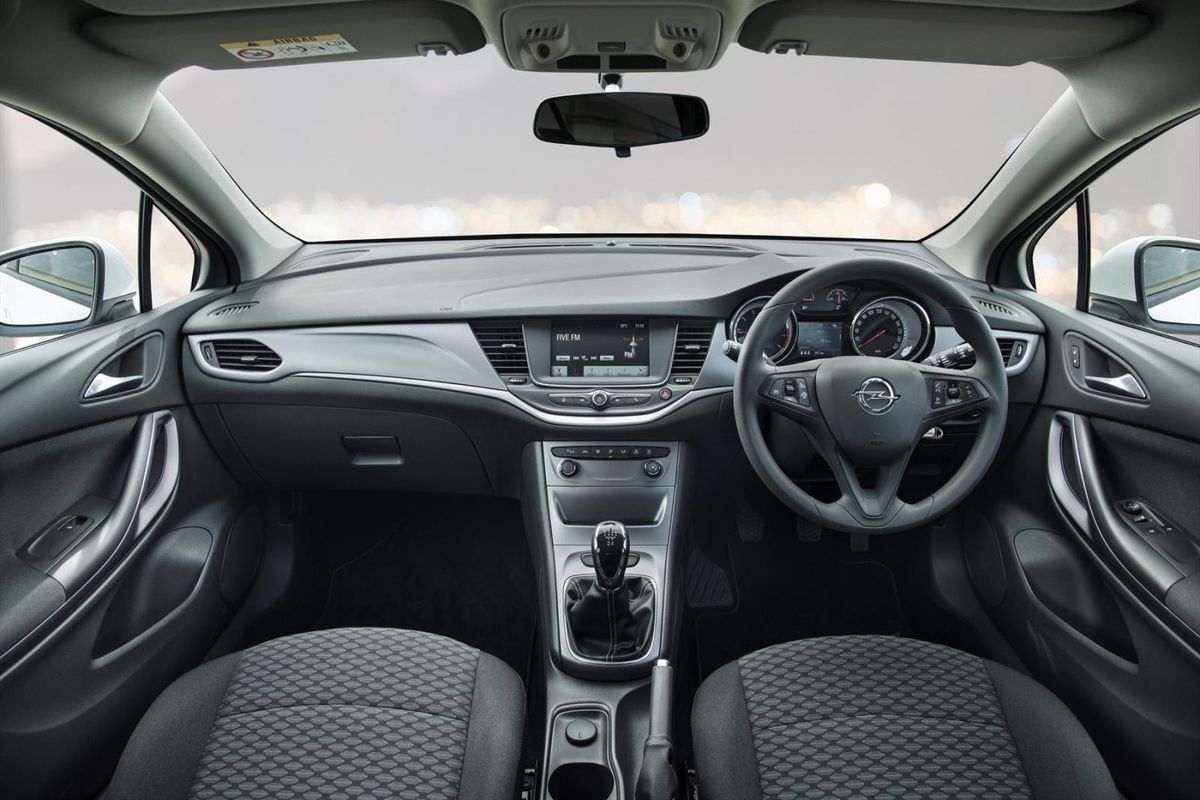
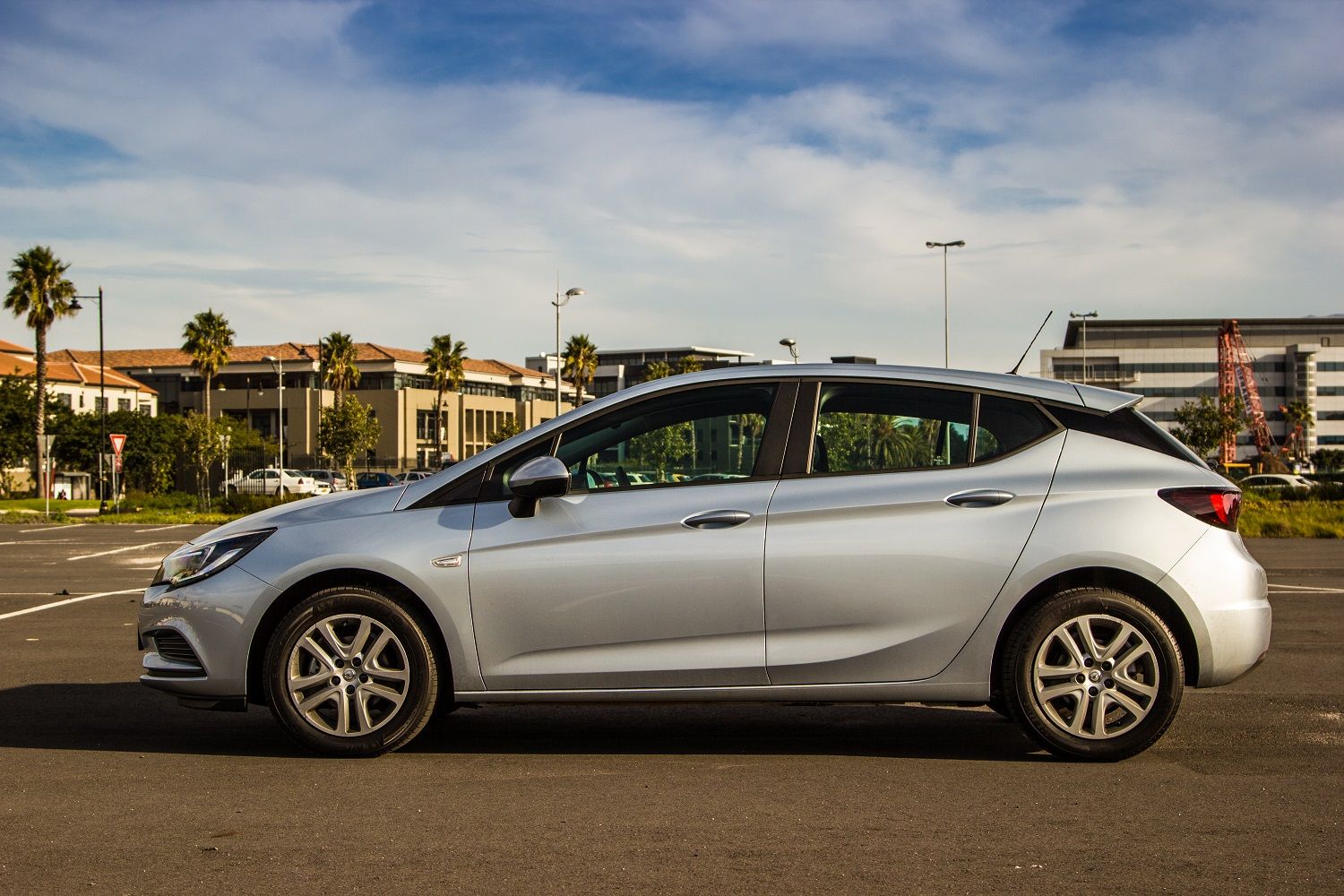
Opel's new Astra has garnered plenty of praise since its introduction in South Africa earlier this year. But, shorn of many of the luxury features and finishes fitted to its Enjoy and Sport siblings, what is the Astra like in the base 1.0-litre guise?
We like: Willing and efficient engine, spacious cabin, solidity
We don’t like: Lack of oddments storage solutions in front, no front seatback pockets
Alternatives:
For greater practicality: You're unlikely to find a more practical C-segment hatchback than the Astra, so if it's even greater versatility you're after, you may have to consider a crossover. At the price, you can have your pick of the Renault Duster or Captur, the fast-selling Ford EcoSport or even the smooth Suzuki Vitara. Out of that bunch, the Duster is the one that offers the most space. View our in-depth video summary here.
For better fuel consumption: Whether you're looking at claimed figures or real-world consumption achieved in our testing, the Astra appears to be unbeatable at this price level.
For greater value: Once more, this specific Astra is quite aggressively priced and offers a good mix of features, so spec-for-spec it is not easy to beat. However, the entry-level Focus 1.0T Ambiente is around R10 000 cheaper, affording you the opportunity to add some missing features and still undercut the Astra. But the Astra is now the superior product. This is no mean feat, seeing as the Focus 1.0T Trend (which is only slightly more expensive than this Astra) is our reigning Cars.co.za Consumer Awards Compact Car of the Year.
New Segment Leader?
Thus far, Opel's new Astra has impressed us. In fact, it arrived straight from its local launch into our test garage to face its fiercest rival, the Volkswagen Golf. Though the two old rivals traded blows right until the final round, it was the Astra that won on points. Read that comparative test by clicking here.
But what about this entry-level model, the 1.0T Essentia? Is the little three-cylinder engine strong enough to pull this spacious hatchback around with conviction, without sacrificing efficiency? And what about specification – are you getting enough for your money?
There are other challenges, too. Firstly, the excellent Ford Focus 1.0T (in both Ambiente and Trend guises) is a formidable rival, with the Trend being our current Compact Hatchback of the Year. And, finally, if you study the sales figures supplied by Lightstone, then it appears that most shoppers have abandoned entry-level hatchbacks of this size for more fashionable crossovers. Can this baby Astra put forward a compelling counter argument?
How does it fare in terms of…
Efficiency and power?
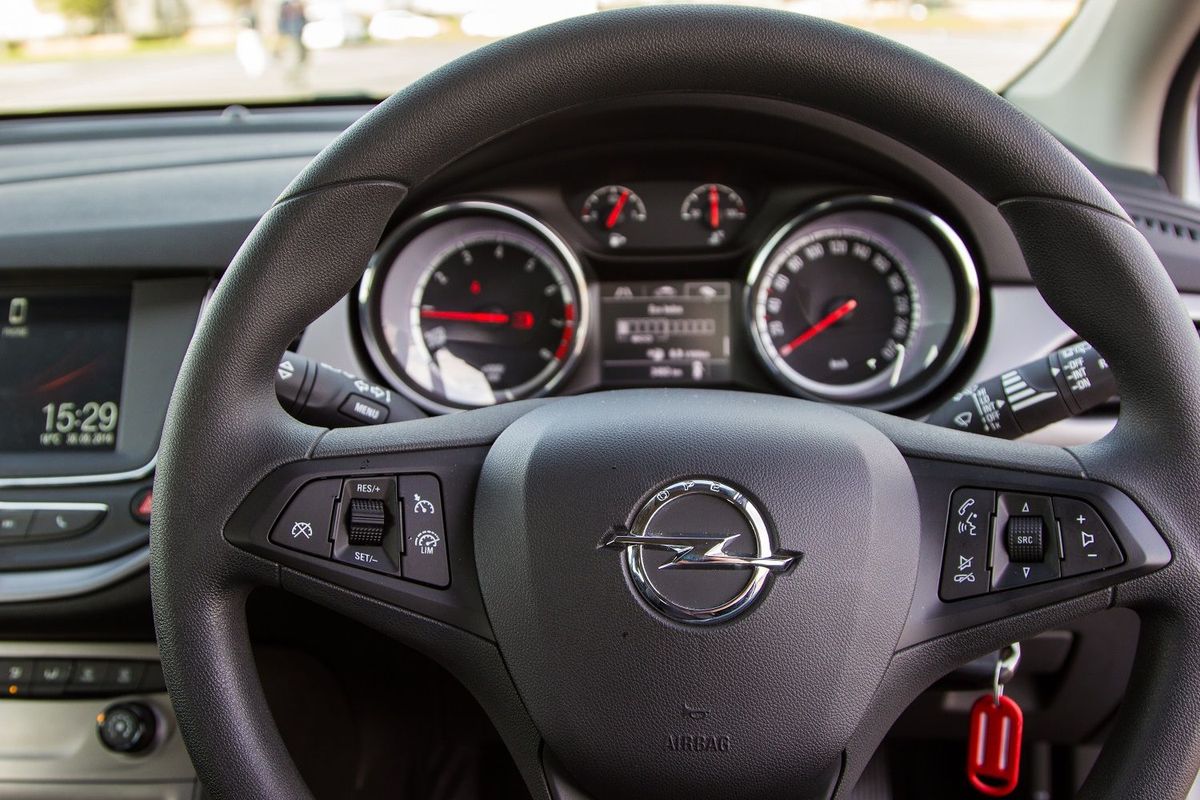
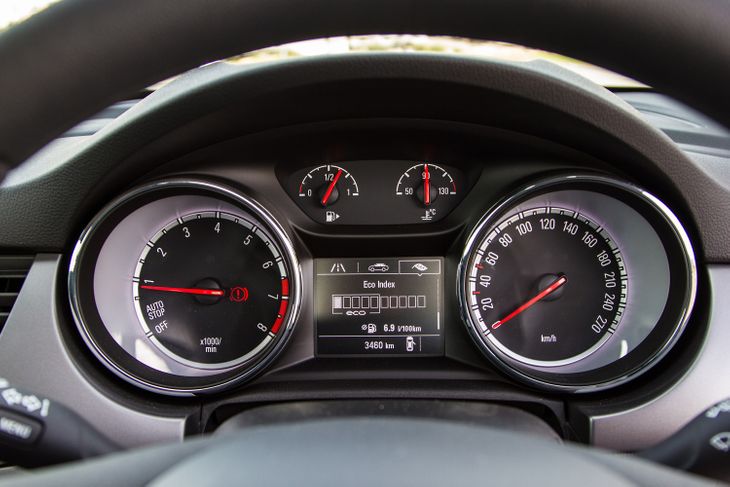
Simple, but stylish instrument binnacle includes a comprehensive trip computer.
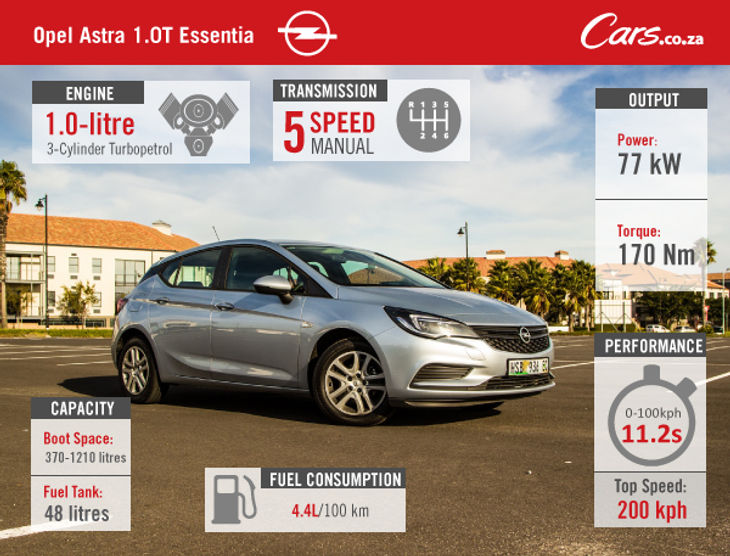
The Astra is one of the bigger cars in its segment, and though it is significantly lighter than its predecessor, it remains quite a hefty body for a little 1.0-litre 3-cylinder turbopetrol engine to lug around. We've been very impressed with Opel's 1.0-litre thus far (in the Adam and Corsa), but were concerned about how it would fare in the bigger Astra body.
In the end, this Astra answered those concerns within the first few hundred metres of driving. The engine takes cleanly from low revolutions, and the responsiveness remains impressive around town and right up to the national speed limit. To some extent, we can thank the spot-on gearing of the five-speed manual transmission for the willing performance. The only slight concern is heading out on long-distance cruises. At around 120 km/h the Astra feels like a sixth gear is needed for relaxed cruising, and there's a noticeable drop-off in reserve power at these higher speeds. Nevertheless, for most people the power will be more than sufficient, even with five occupants in the vehicle. And that is very impressive indeed.
So what of fuel economy? Here the Astra manages perhaps its most impressive feat. We've often found that with small turbopetrols the percentage difference between the manufacturer's claimed fuel consumption and the real-world figure can be quite pronounced. No matter how we drove the Astra, however, it didn't seem to want to consume more than 7.0L/100 km, which is very good. With a claimed combined cycle consumption figure of 4.4 L/100 km, it also avoids the government's emissions taxation.
Value for money?
The Astra Essentia rides on 16-inch steel wheels with covers that look a lot like alloys.
If you're shopping at this end of the market and considering a traditional hatchback, as opposed to a cute little crossover, then we're pretty sure value for money is a key factor in consumers' purchasing decisions. Opel has evidently kept this in mind and specced the Astra very carefully to present a compelling purchasing argument.
Firstly, although the Astra 1.0T Essentia foregoes some of the shiny chrome bits of its more expensive siblings, it remains an attractive offering. LED detailing still features in the headlamps, for example, and the plastic covers of the 16-inch steel wheels do an admirable job of mimicking flashy alloy items.
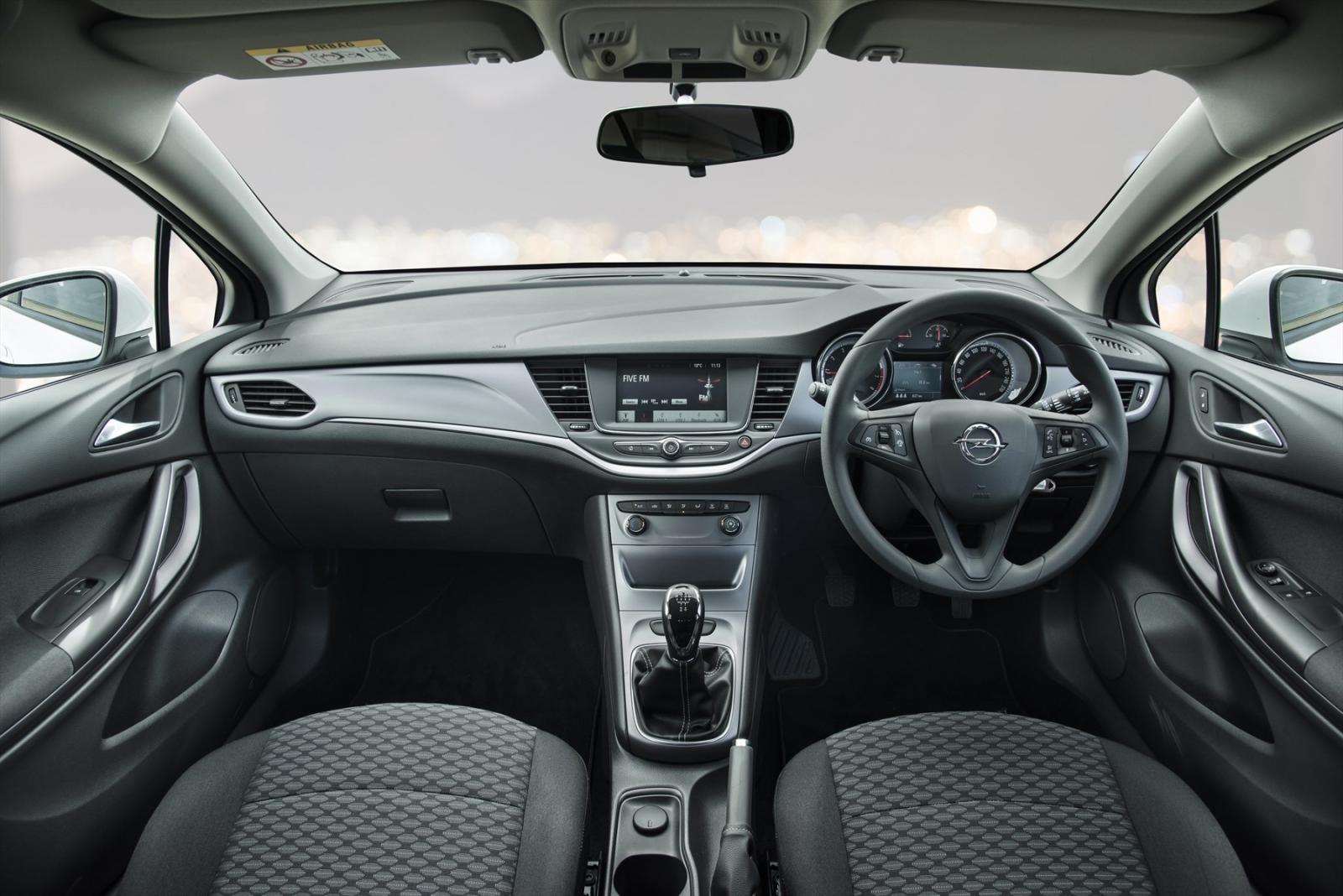
Inside, it's a similar story. Yes, the sea of grey can become a bit tiresome and Opel can still learn a thing or two from Volkswagen about "dressing up" bottom-of-the-range offerings, but overall the sense of solidity and refinement manages to shine through. Besides, if you add the optional R4.0 IntelliLink system, the cabin gets a big push in the tech appeal stakes. This new system (a R4 000 extra-cost option on the Essentia model) brings smartphone connectivity and apps into the cabin for owners with compatible Android 5.0 Lollipop and Apple iOS 8 (or higher) devices. It works a treat and we'd definitely recommend it. As standard, Bluetooth connectivity, aux-in and USB support remain part of the deal.
You also get a full complement of airbags (6), ABS with EBD, Isofix child-seat mounts, air-conditioning, cruise control, electric front windows and tyre pressure monitoring (TPMS). Best of all, the warranty (5-years/120 000 km) and service plan (5-years/90 000 km) are long, illustrating Opel's confidence in this product.
Comfort?
Attractive fascia and sturdy finishes are new Astra hallmarks. Note optional R4.0 IntelliLink system.
Opel has historically excelled at designing comfortable cabins and excellent seats, and it has done so again with this Astra. The driver is really well catered for, with a steering wheel that is adjustable for rake and reach, as well as manual height adjustment for the seat. The cloth-upholstered seats are nicely shaped and padded for long-distance comfort, yet also provide good lateral support. The standard cruise control further boosts comfort levels on the open road or the highway, as do impressively low levels of NVH (noise, vibration, harshness) .
A stand-out talent of this particular Astra derivative's drivetrain is its easy-driving nature. The clutch is light, the transmission slick and precise, and the steering effortless, yet accurate. It really makes for a very pleasurable driving experience. The ride, too, is good. The generous sidewalls of the 205/55 profile tyres certainly contribute to the pliant ride, yet the Astra isn't a clumsy oaf in the corners. In a similar vein to rivals such as the Golf 7 and Peugeot 308, the Astra combines a light-footed feel with a supple ride quality in a very admirable way.
Practicality?
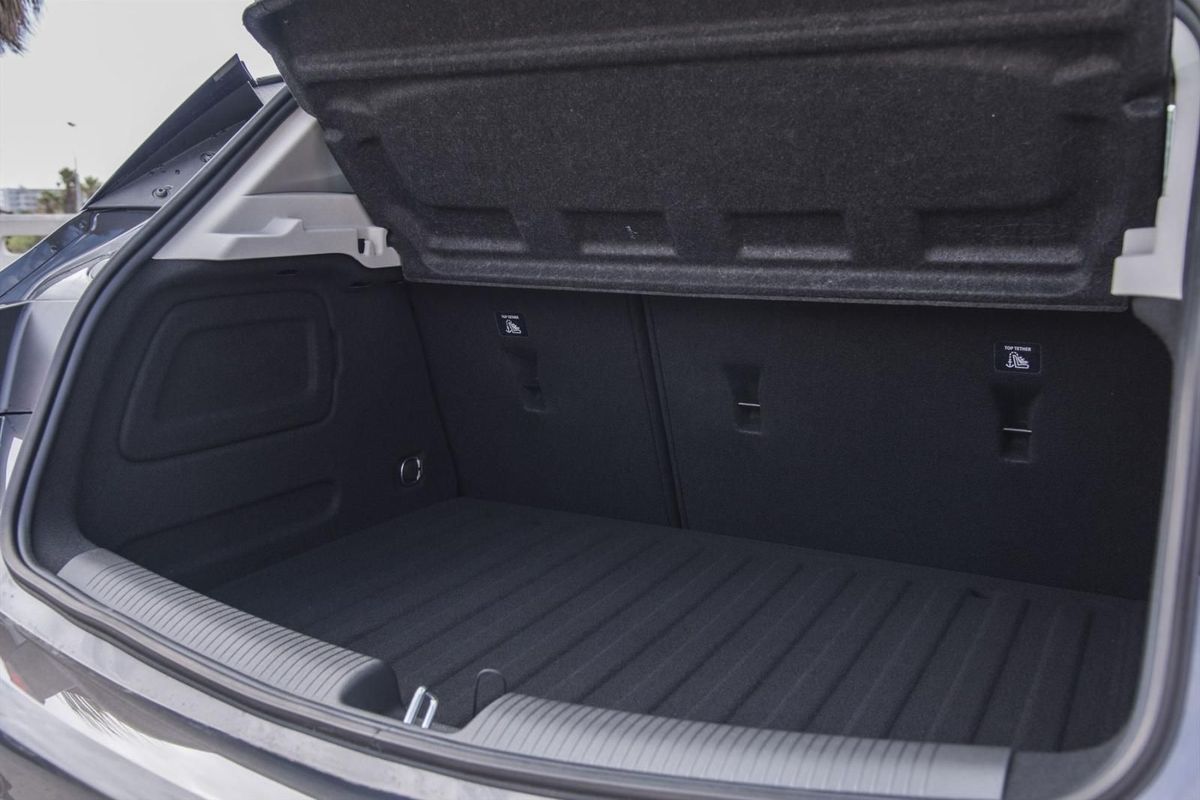
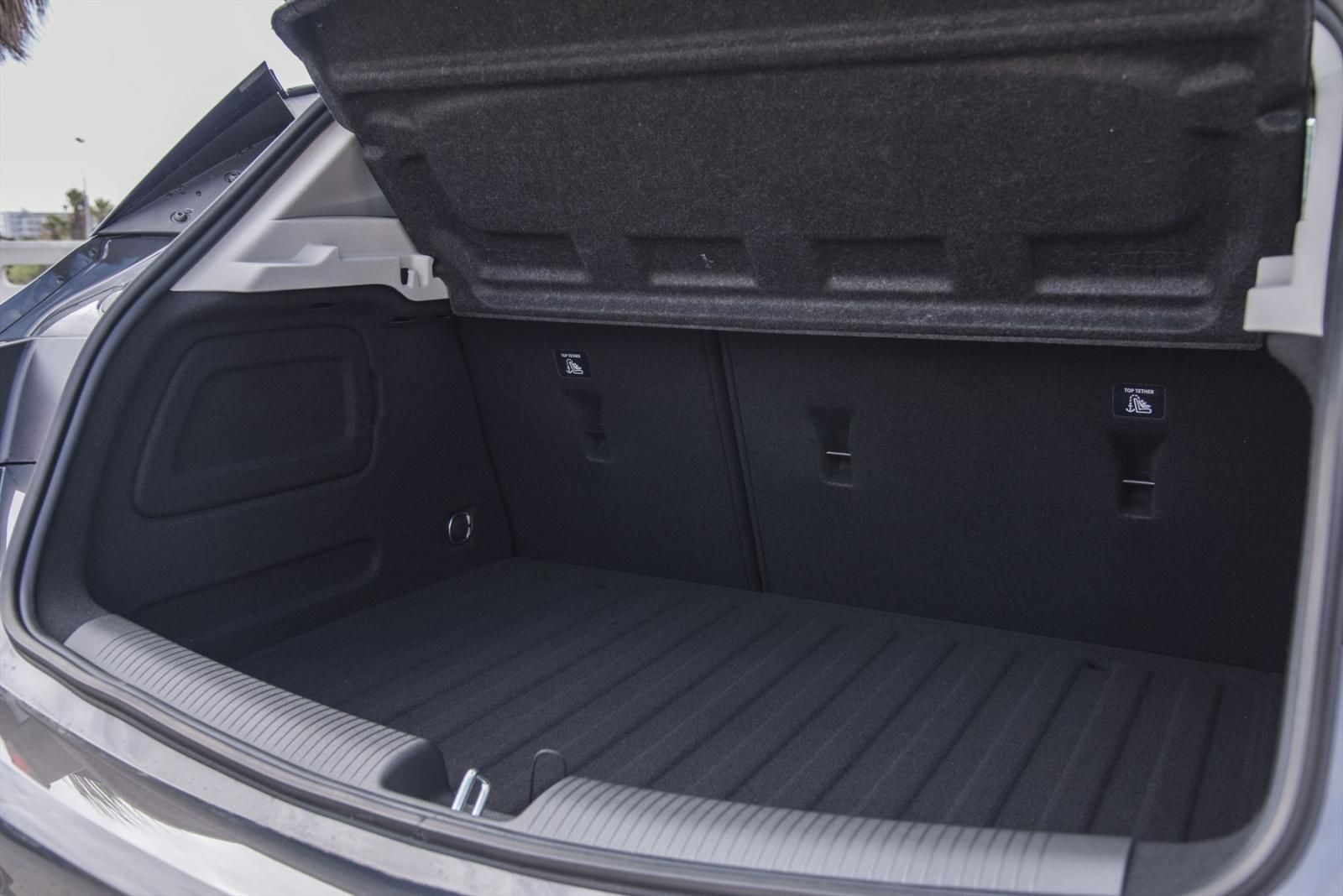
The Astra has a larger boot than its main rivals, but note it only has a space-saver spare wheel.
With a claimed boot capacity of 370 litres, the Astra trounces its rivals quite comprehensively in this department. The luggage compartment is also nicely shaped and offers a wide opening, making loading/unloading a simple affair. Note, however, that it only features a space-saver spare wheel. On the other hand, there's a considerable amount of extra storage space hidden underneath the boot floor that can be used to stow valuable items out of sight.
As is to be expected in this segment, the rear seatback splits 60:40 and folds forward to free up more loading space. With both seatback sections folded, the Astra's utility space (1 210 litres) compares favourably with most of the popular crossovers around it.
But… let's be honest, the Astra is more likely to be ferrying people on those back seats. Fortunately for them, rear occupants will be ensconced in comfort thanks to the generous rear leg- and headroom afforded by Opel's newcomer… it is just a pity that no seatback pockets are provided, however.
In fact, the lack of oddments-stowing solutions was widely criticised by the test team. Opel appears to have over-complicated the area in front of the gear lever, rendering it virtually useless. The narrow slot provided isn't deep enough to safely hold most modern smartphones. A lidded compartment would have been far more useful.
Pricing and Warranty
The Opel Astra 1.0T Essentia sells for R254 000 and is backed by an impressive 5-year/120 000 km warranty and 5-year/90 000 km service plan. Service intervals are at 15 000 km.
Verdict
When it comes to hatchbacks of this size at the R250 000 price mark, the Opel Astra 1.0T Essentia appears to be the new segment leader. We rate the 1.0-litre engine, with its ability to marry impressive real-world economy with perky performance, highly. It is also cleverly specified and the attractive Intellilink infotainment system is not an expensive option. Now add a comfortable ride and a refined cabin, as well as a solid warranty/service plan to the mix, and it becomes rather difficult to argue against it. This is an exceptionally good offering from Opel.
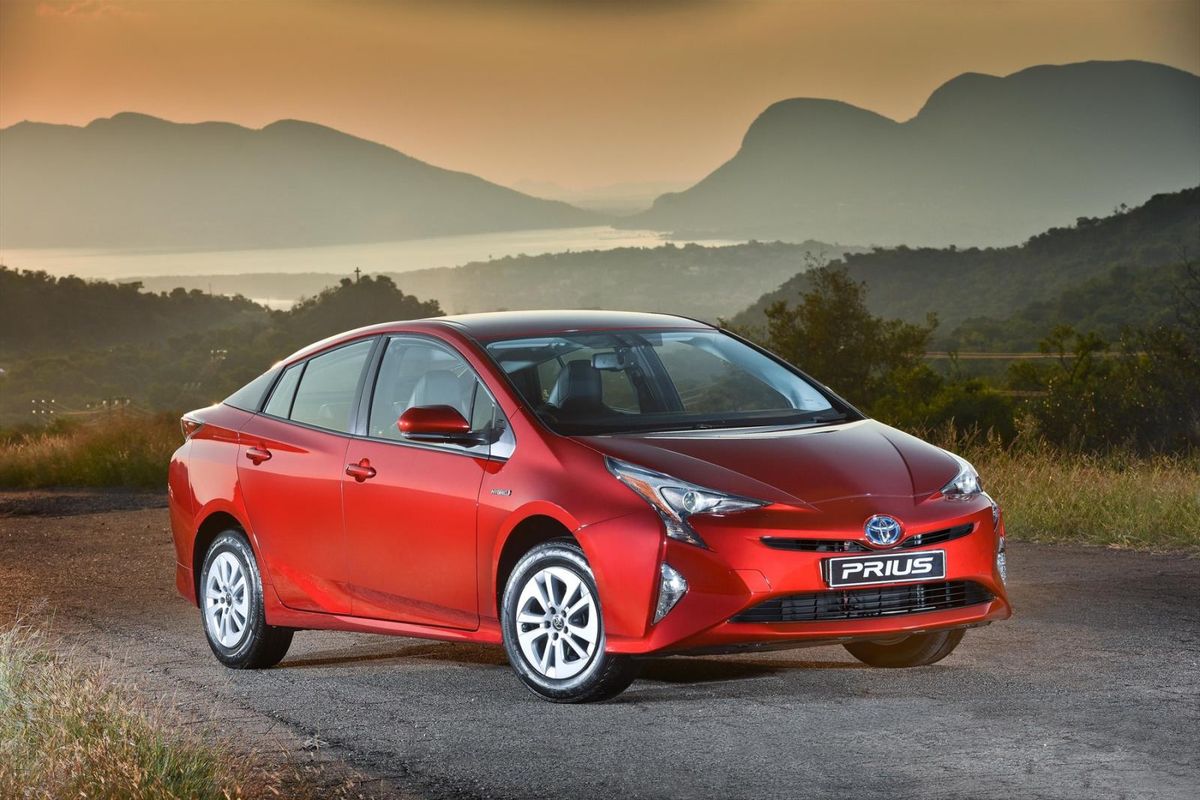
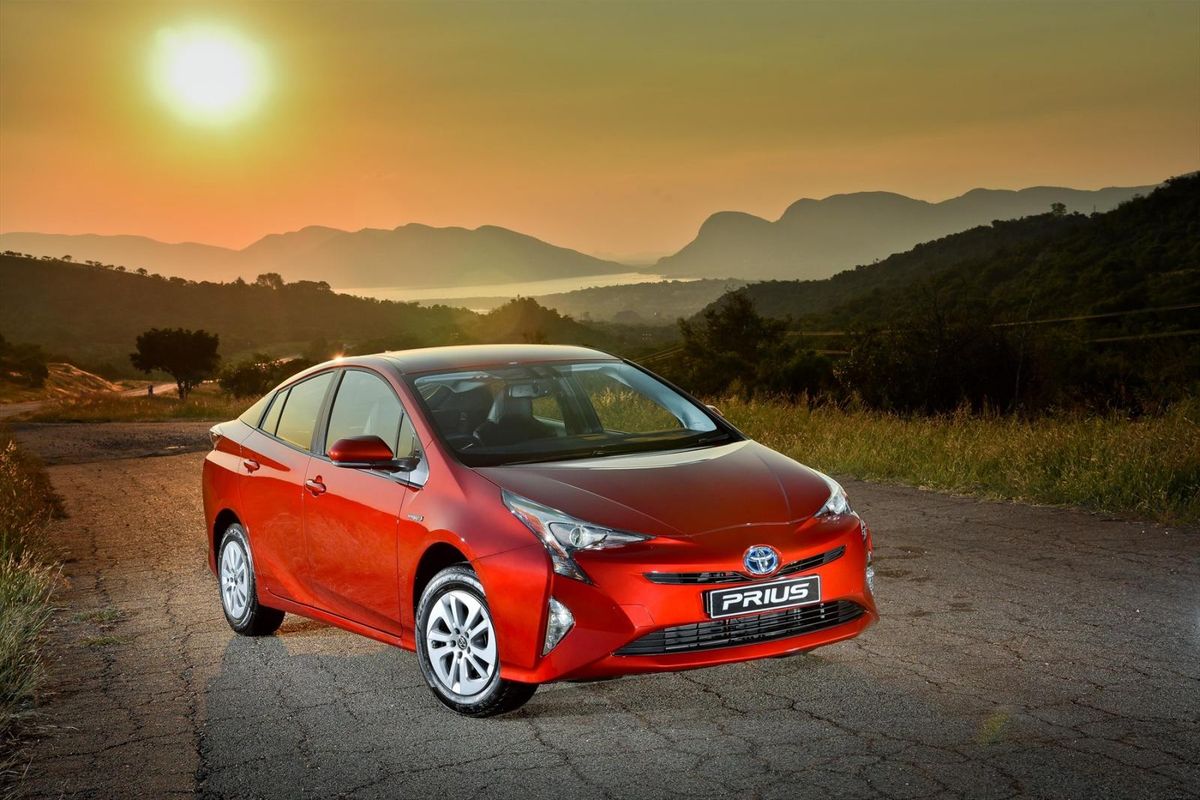
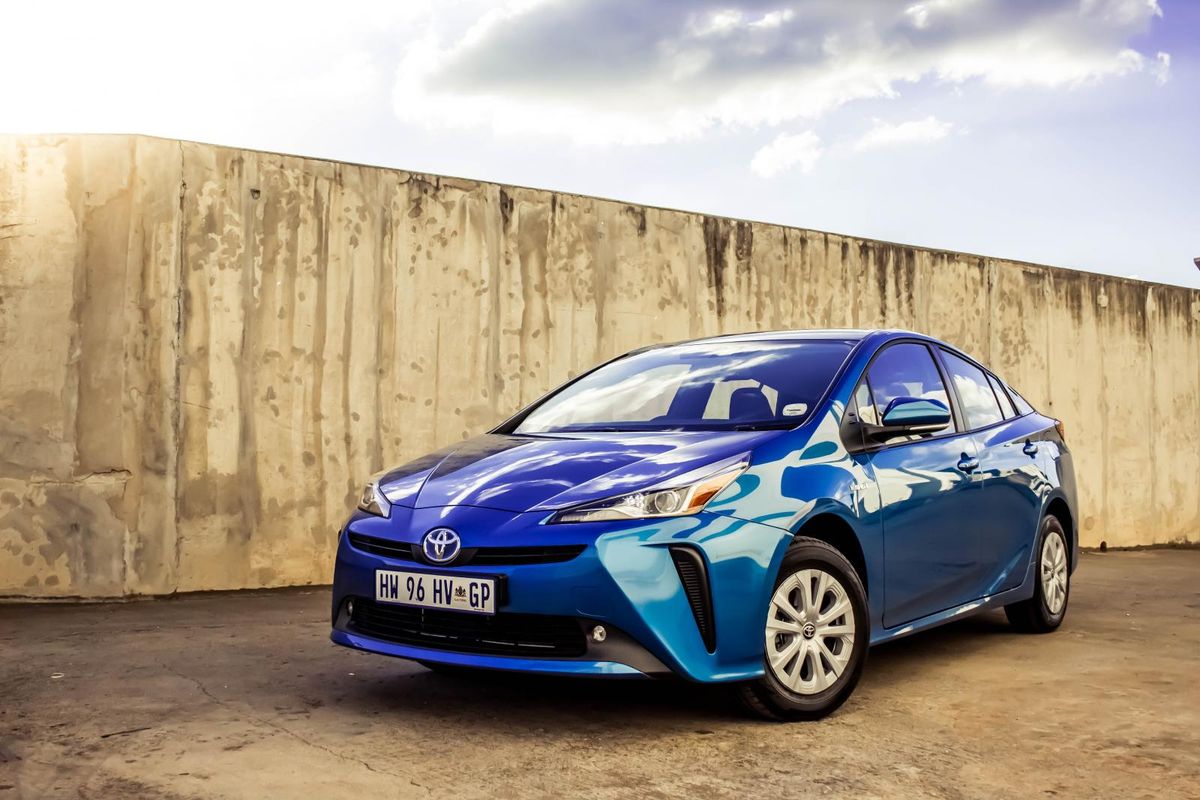
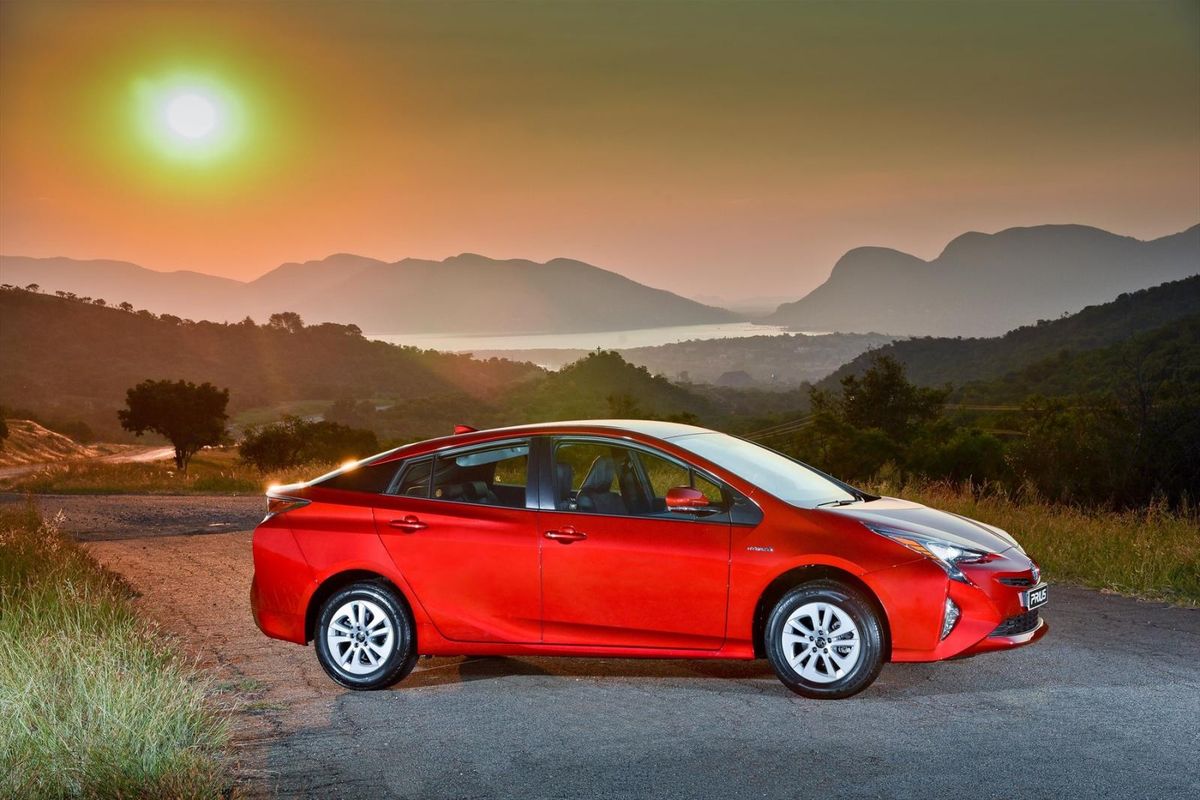
The new Toyota Prius hybrid is launching in South Africa this month. Here’s what you can expect…
The Prius has been around for many years and it was the first hybrid model introduced to South Africa in 2005. More than 3.5 million Prius’ have found homes across the world and according to Toyota, the new model offers improved efficiency, dynamics and styling. Although hybrids aren't massively popular in South Africa, the new Prius aims to shatter perceptions.
Glenn Crompton, Vice President of Marketing for Toyota Motors South Africa, says: “The fourth-generation Prius builds on the strengths and achievements of its predecessors and establishes new benchmarks in fuel economy, emissions and efficiency. It will add further impetus to the growing appeal of hybrids in the global market, achieving its strongest environmental performance yet, while delivering much improved styling and surprising driving dynamics from a green car.”
Design improvements
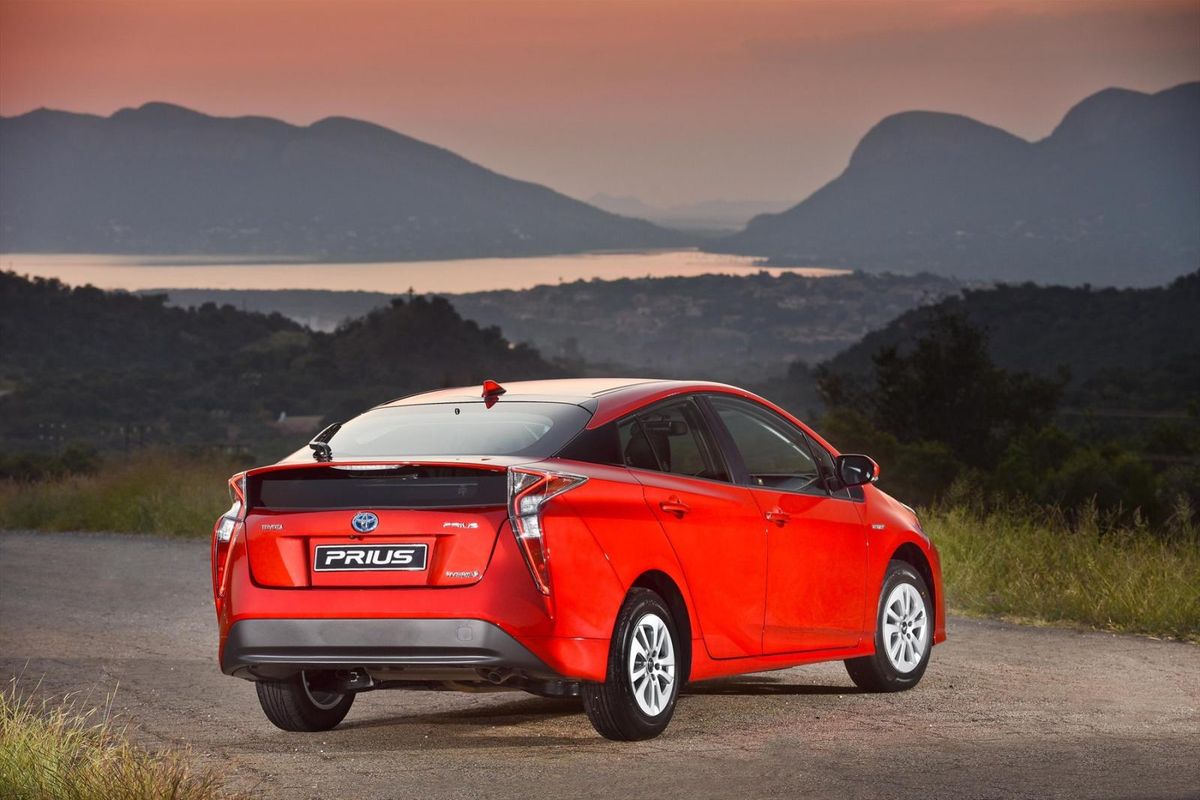
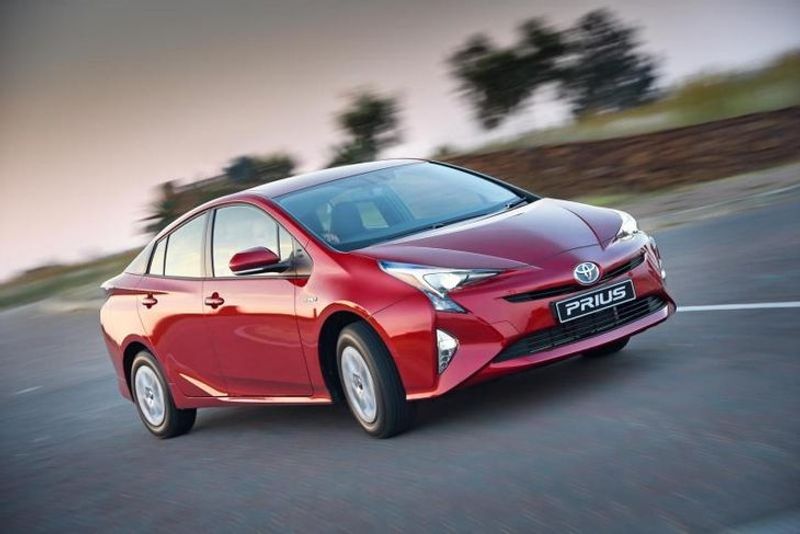
The new Toyota Prius is longer and wider, but sits lower than the model it replaces.
The latest Prius features a lowered bonnet, made possible by the Toyota New Global Architecture (TGNA). The low bonnet affords the driver a commanding view of the road while also making the Prius appear more ‘athletic’. TGNA has also resulted in enhanced handling while body rigidity has improved by 60% compared to the previous model.
The headlights are now slimmer and the front-end design incorporates sharp and angular lines with the fog lights and air intakes giving the Prius a touch of sophistication.
The latest Prius has a lower centre of gravity and sits some 15mm closer to the road. It's also 60 mm longer and 15 mm wider than before. A wheelbase of 2 700 mm has however been retained. The length and angle of the rear spoiler has been tweaked to improve aerodynamics while the body work tapers off to the rear corners to reduce drag. The combination taillights are now seen on the outer edge of the rear-end with a sharper design.
The wheels have been improved too and the 15-inch lightweight alloys are 30% more rigid and 12.7 mm wider, allowing for more grip from the low resistance tyres. A tyre pressure monitoring system ensures optimal tyre performance.
A total of seven exterior colours will be offered on the Prius and these include Passion Red, Attitude Black, Glacier White, Pearl White Metallic, Graphite Grey Metallic, Satin Silver Metallic and Dark Blue Metallic.
Interior improvements
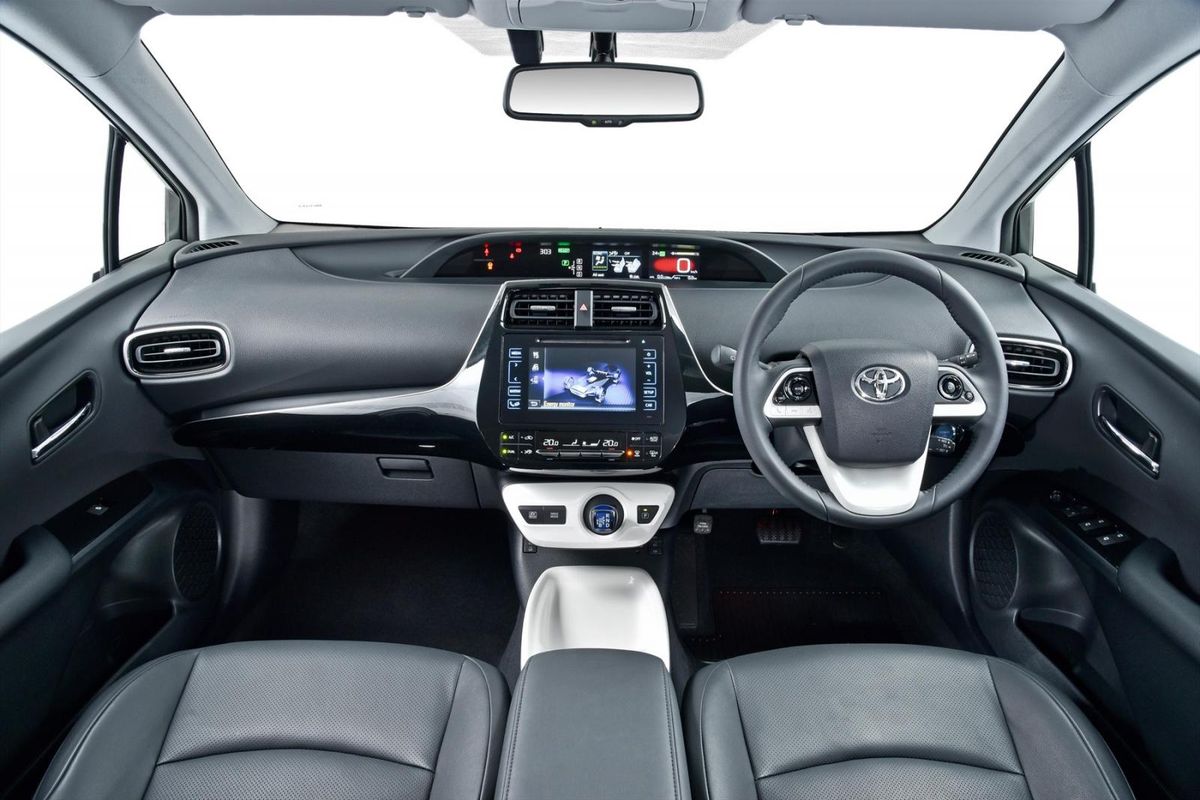
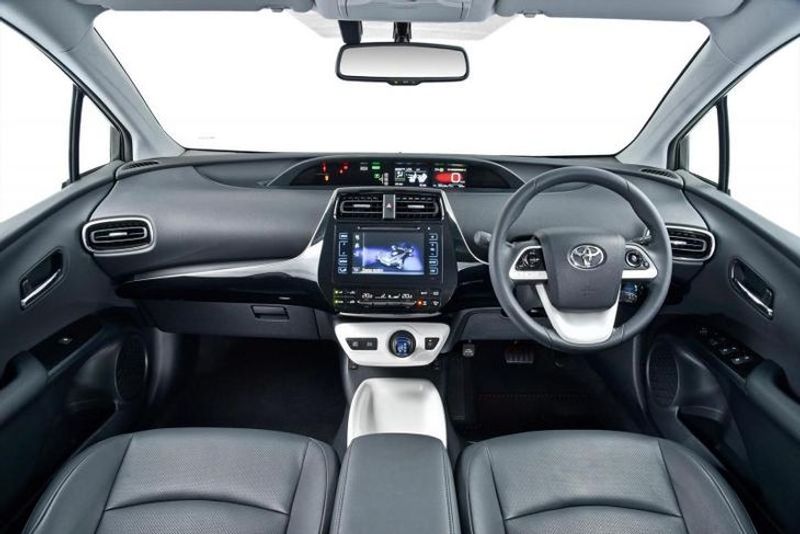
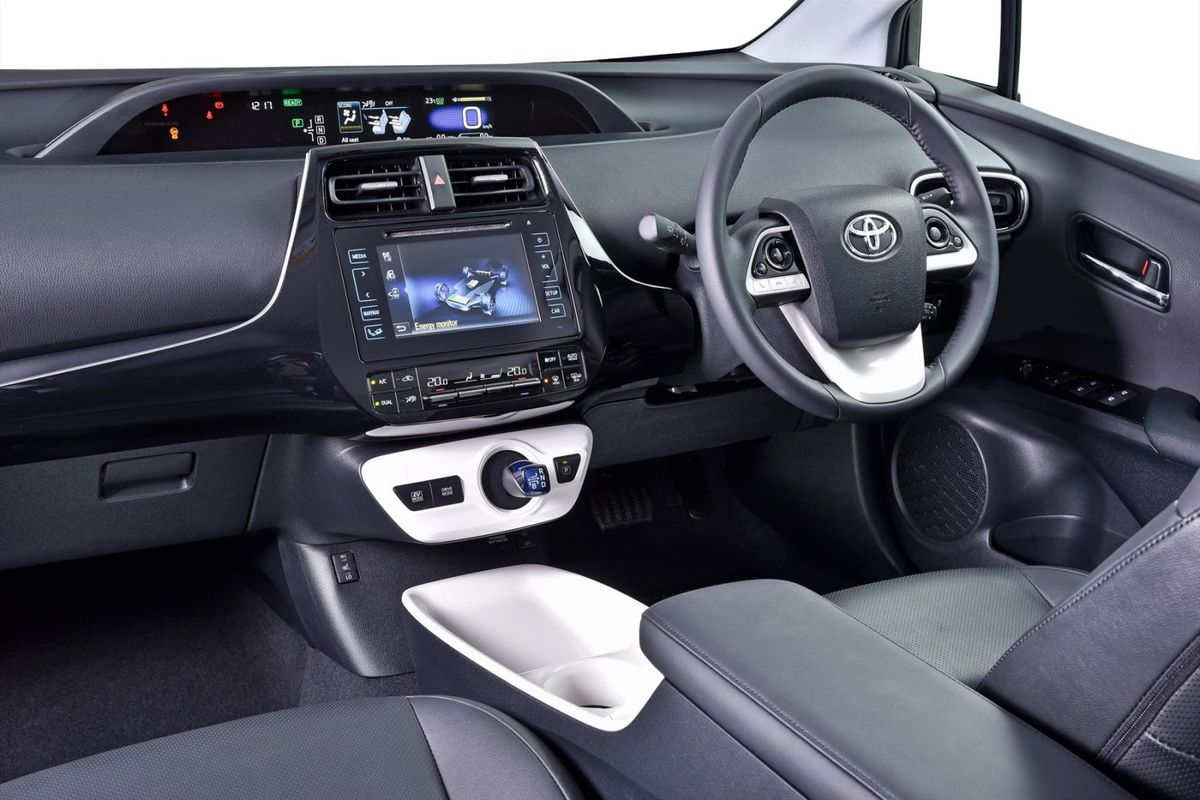
The interior of the new Prius has been refined, featuring higher quality materials.
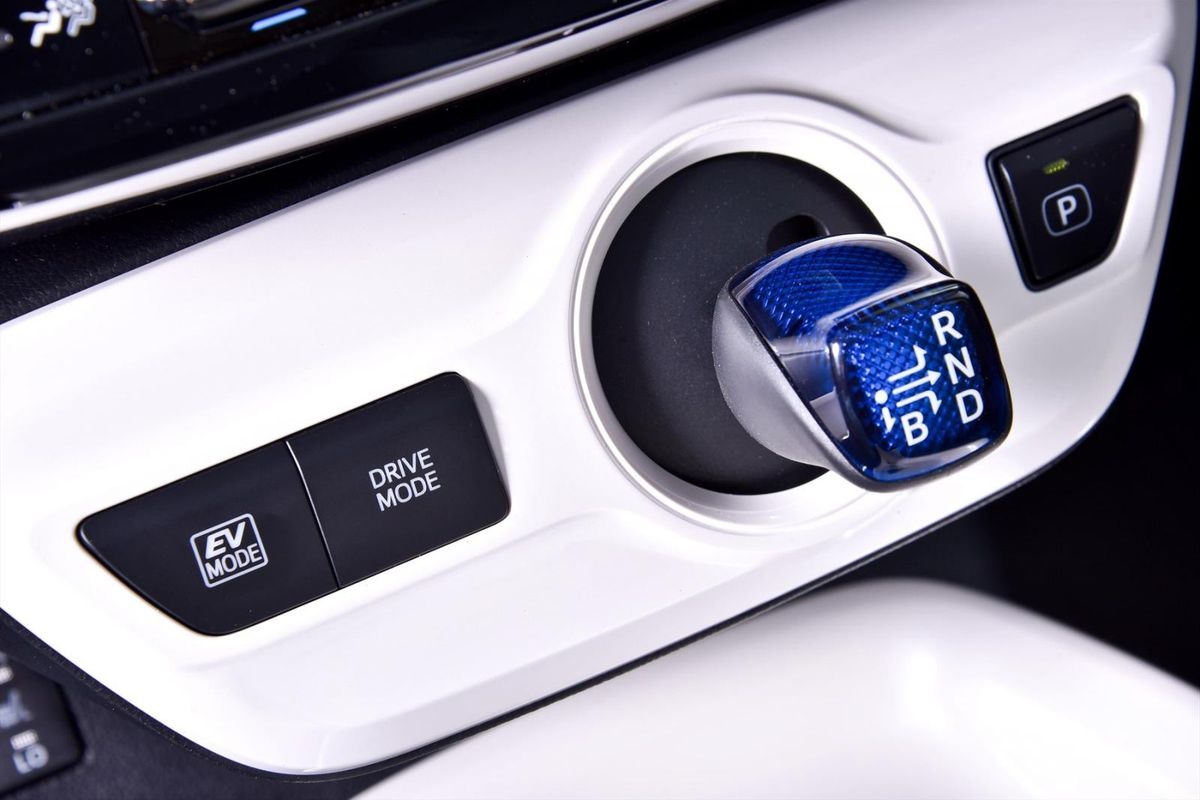
The interior of the new Prius has been designed to be a “welcoming, quiet and comfortable space”. Toyota says interior quality has improved too and the dashboard features a layered design with a clear distinction between the controls and displays. A dark dashboard stands in contrast to the white, scratch resistant finishes seen on the door panels and storage space ahead of the gear lever.
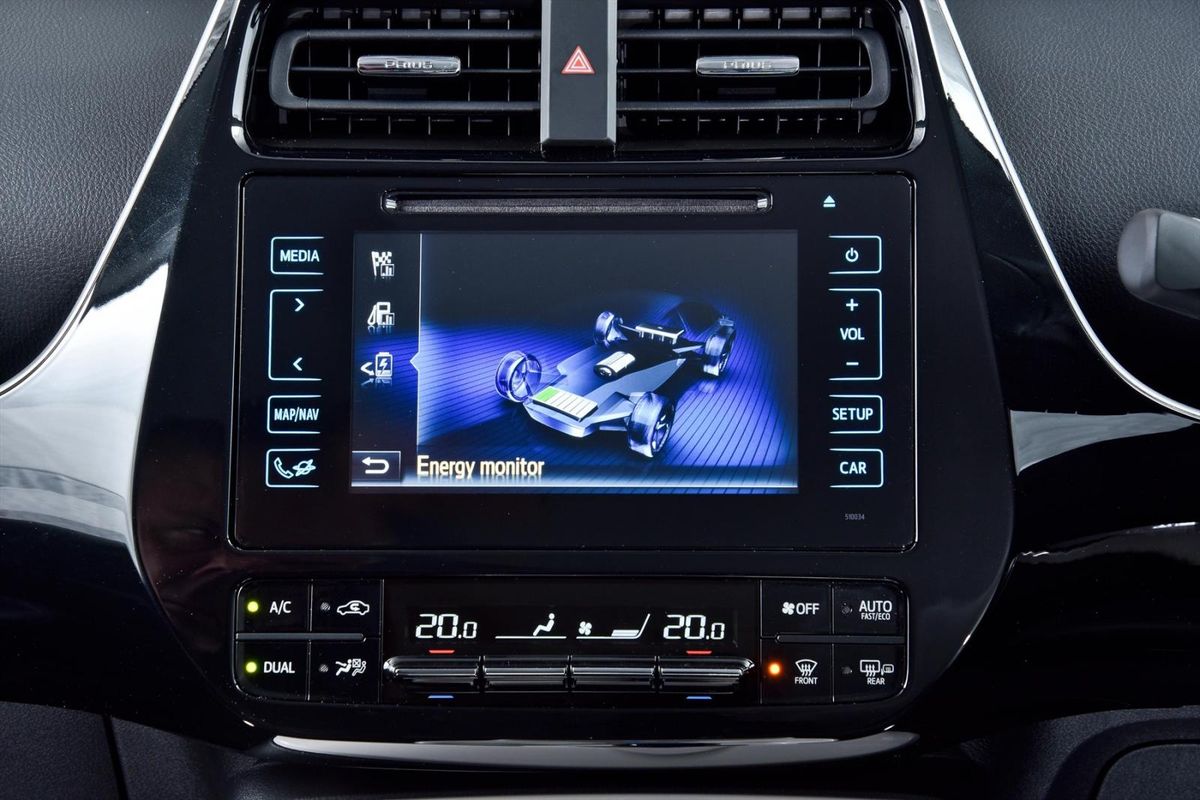
A “floating” design is employed for the central cluster, which has a silver-finished frame. The Prius is equipped with a 7-inch, tablet-like touchscreen as well as a six speaker sound system.
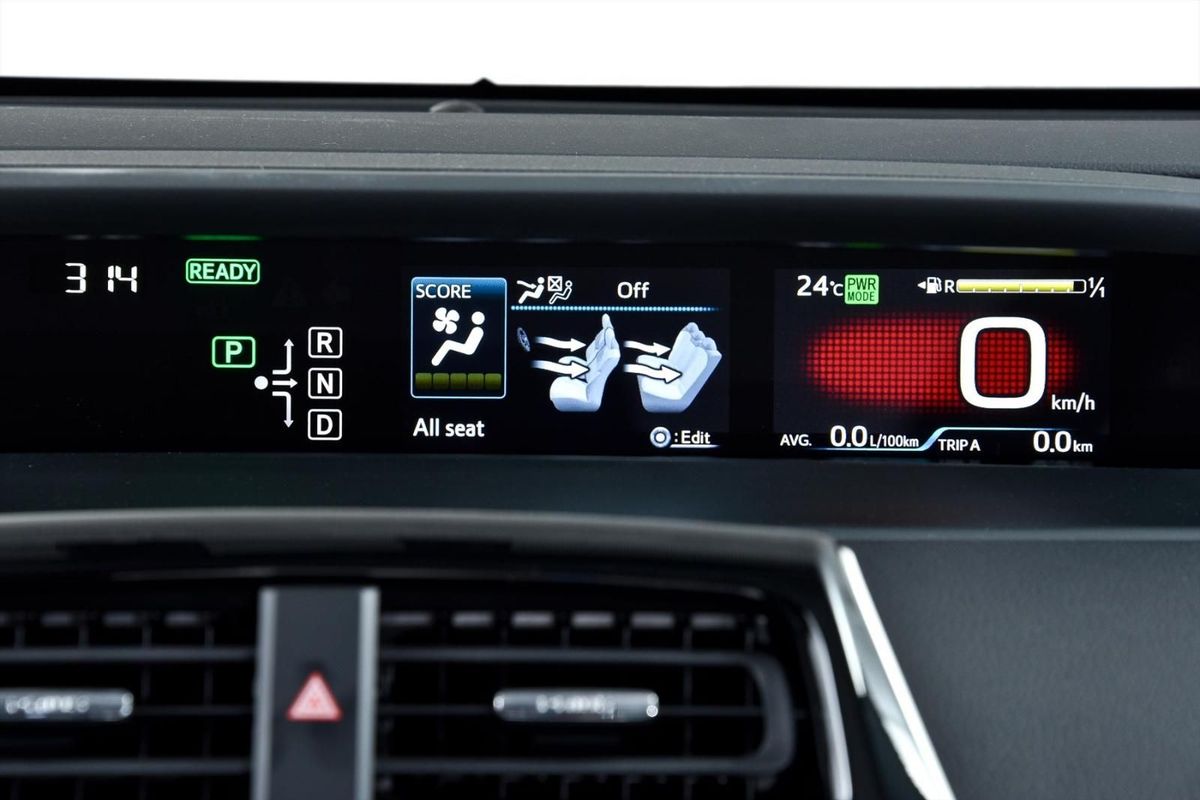
For the driver, two 4.2-inch full colour TFT displays provide information pertaining to the hybrid system, driving tips and performance while the second screen relays the vehicle speed, fuel reading, odometer, trip meter, range, fuel consumption and drive mode. The colour of the screens also change depending on the mode selected. Three driving modes, including Normal, ECO and Power are available to the driver.
Standard features include a rear-view camera with guidelines, Heads Up Display, heated seats and seven airbags.
Other improvements include a more comfortable driving position, increased tilt adjustment for the steering wheel and redesigned seats that offer higher levels of support and comfort. The floor in the boot is 110 mm lower than the outgoing model, allowing for a total of 502 litres to be utilised.
Hybrid power
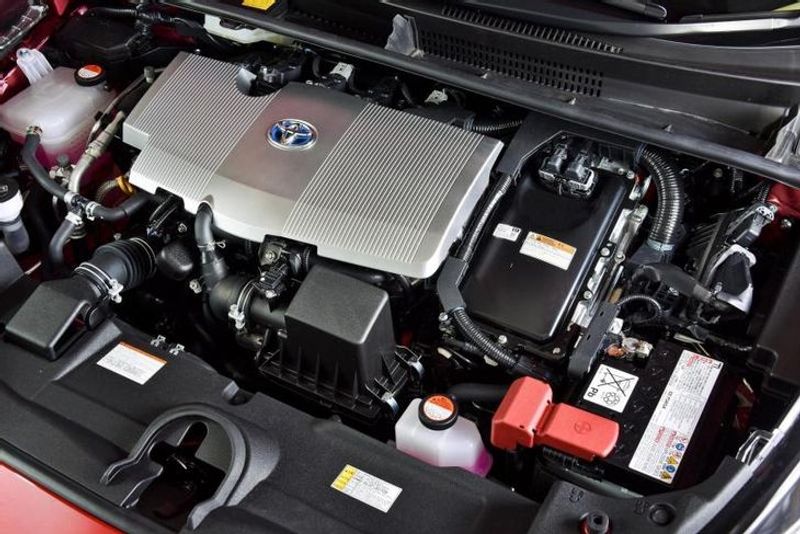
An enhanced hybrid powertrain does service in the new Prius with a claimed fuel consumption of just 3.7 L/100km
The new Prius features a new compact and lightweight hybrid powertrain. The system consists of a re-engineered version of the 1.8-litre Atkinson cycle engine used in the current Prius. This engine has an output of 72 kW and 142 Nm of torque and is coupled to two lighter electric motor-generators (one motor converts surplus energy into electricity while the second motor is a drive motor) generating 53 kW and 163 Nm of torque. Total combined power output is 90 kW. The hybrid battery, located beneath the rear seat, is 10% smaller and is able to charge faster than before and displays improved thermal efficiency and energy absorption. Toyota claims a fuel consumption figure of 3.7 L/100km for the new Prius.
In terms of performance, the Prius can accelerate from zero to 100 kph in 10.6 seconds while 80 kph to 120 kph takes 8.3 seconds. The Prius can reach a top speed of 180 kph.
Updates to the hybrid system software has led to a 60% increase in the speed range of the electric motor, meaning that the Prius is able to access electric power more readily without depending too heavily on the petrol engine, which further aids fuel consumption.
The Prius features a revised MacPherson strut suspension with new shock absorbers while an all-new double-wishbone rear suspension is fitted, improving overall stability, handling response and drive comfort. To complement these changes, revised electric power steering delivers better feel and feedback to the driver and an electronically controlled braking system ensures optimal regenerative and friction braking.
We will be attending the launch of the new Toyota Prius later this month, so stay tuned for our first impressions!
New Toyota Prius – Price in South Africa
Toyota Prius – R427 200
The new Prius is sold with a 3-year/100 000km warranty, 5-year/90 000 km service plan and an 8-year/195 000 hybrid battery warranty.
The e-mobility landscape is full of complexities and paradoxes, which makes it difficult for (the types of vehicles collectively known as) EVs to crack the new vehicle market. In the first of a series of articles, we take a high-level look at some of the challenges … and promises.
When Toyota launched its Prius on the local market in 2005, it was the first mainstream hybrid-electric vehicle (HEV) to be offered in South Africa. It promised to revolutionise motoring but, more than a decade after its launch, HEVs and, more recently, BEVs (vehicles in which battery-driven electric motors solely propel the driven wheels), PHEVs (petrol-electric hybrids with batteries that can be charged via external electrical sources) and FCEVs (cars equipped with hydrogen fuel cells that generate electrical energy to power the motors that provide their propulsion), have failed to make a significant impact. For simplicity sake, I'll subsequently refer to these subtypes collectively as EVs, unless otherwise stated.
Electric or e-mobility holds major benefits for consumers and countries alike, encompassing both environmental and national security factors. For starters, the use of electricity significantly reduces CO2 emissions, noise pollution in urban areas and countries’ dependence on fossil fuels. Not to mention a claimed reduced running cost over conventional vehicles in terms of fuel bills and maintenance costs.
However, despite the benefits, the uptake of EVs globally (and in South Africa) has been less than spectacular. Annual global sales totals of all forms of e-driven passenger vehicles remain below 0.5% and, at just over 180 000 units (in 2012), EVs represent just 0.02% of the total passenger vehicle car park. This is true for most markets, including South Africa. Since the launch of the Cars.co.za Consumer Awards-lauded i3, BMW has only sold 124 units locally (Nissan has fared about the same with the Leaf).
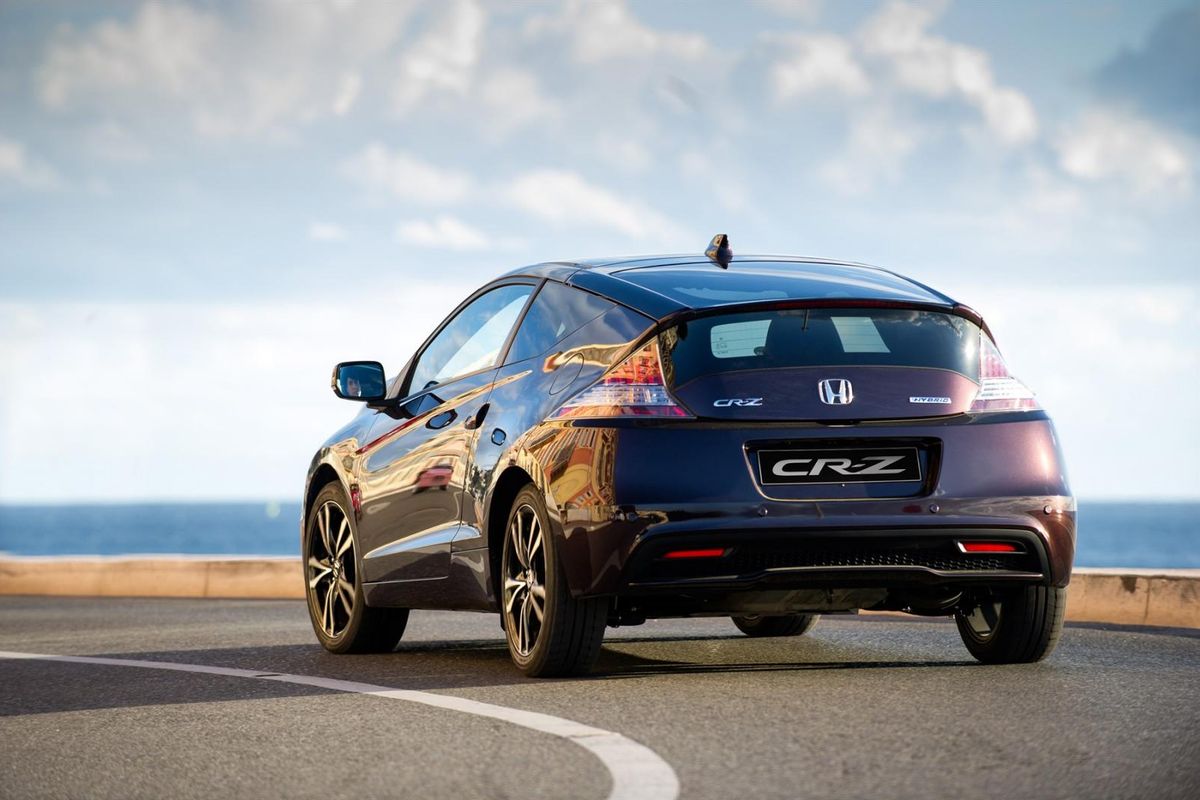
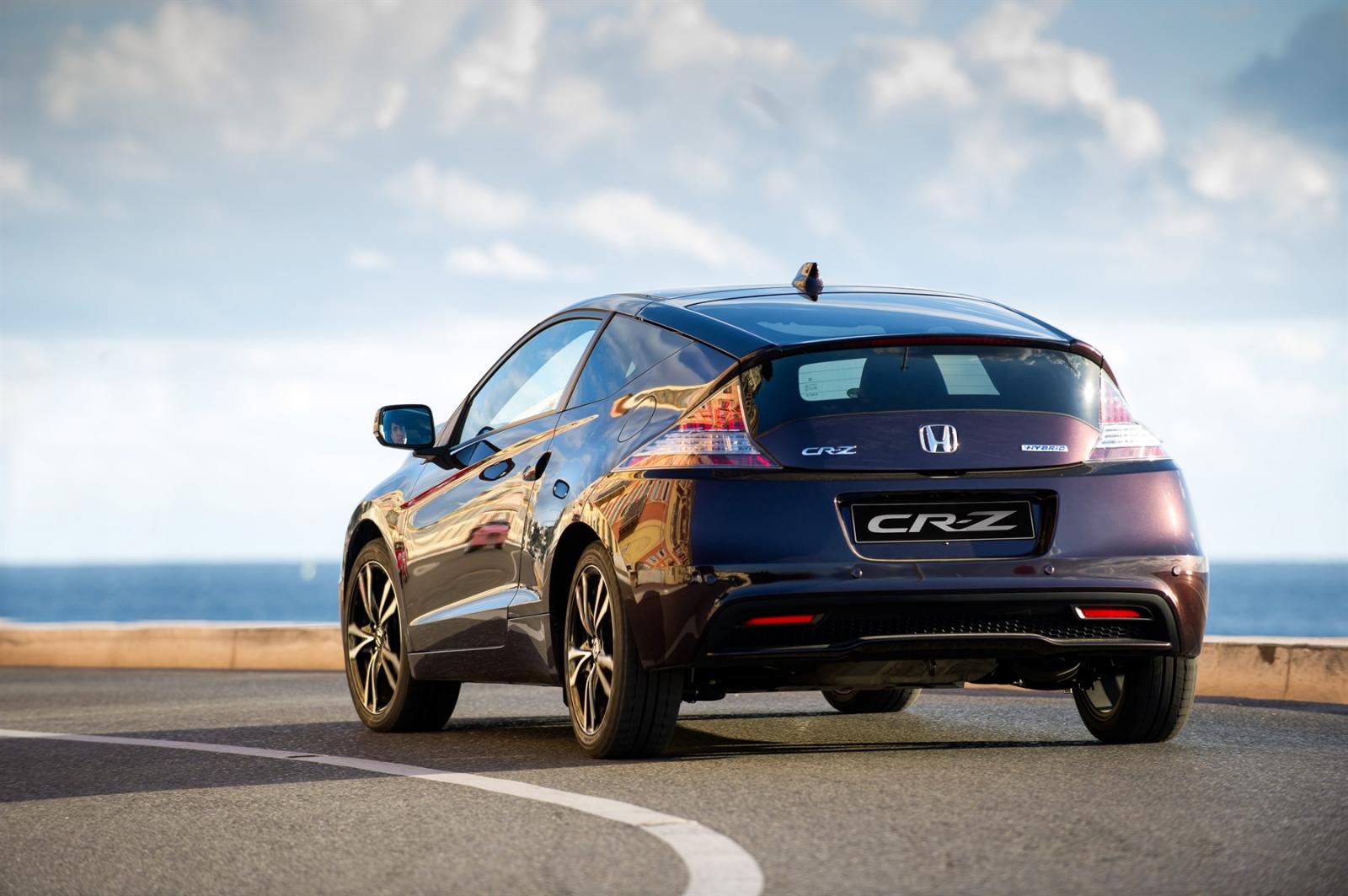
The CRZ, Honda's hybrid-engined small sportscar, has not garnered the following some observers thought it might.
It is not all doom and gloom: Denmark (and a few other Scandinavian countries) have shown greater uptake (with just over 1% of total new-vehicle sales) and while 0.5% sounds very low it does represent exponential growth from 2010 levels. Conservative estimates by the EVI (a group of 15 countries with stated EV sales targets responsible for 90% of global EV sales) project a market penetration of 2% by 2020 (between 20 and 24 million vehicles).
So, things are bound to change. Considering that this will require a compounded growth of 72% until 2020, this will require great number things to happen. First, a much better understanding of some of the reasons why EVs aren’t selling in greater numbers and, most importantly, a better understanding of EV consumers.
Why aren’t EVs sparking?
First, it is important to note that despite being around since the early 1900s (with a failed resurgence in the early 1990s), the EV market is in its infancy. A young market is rarely predictable and, even more rarely, rational. But, global research along with my own research conducted at the University of Stellenbosch Business School (USB) do highlight some important reasons for the slow uptake:
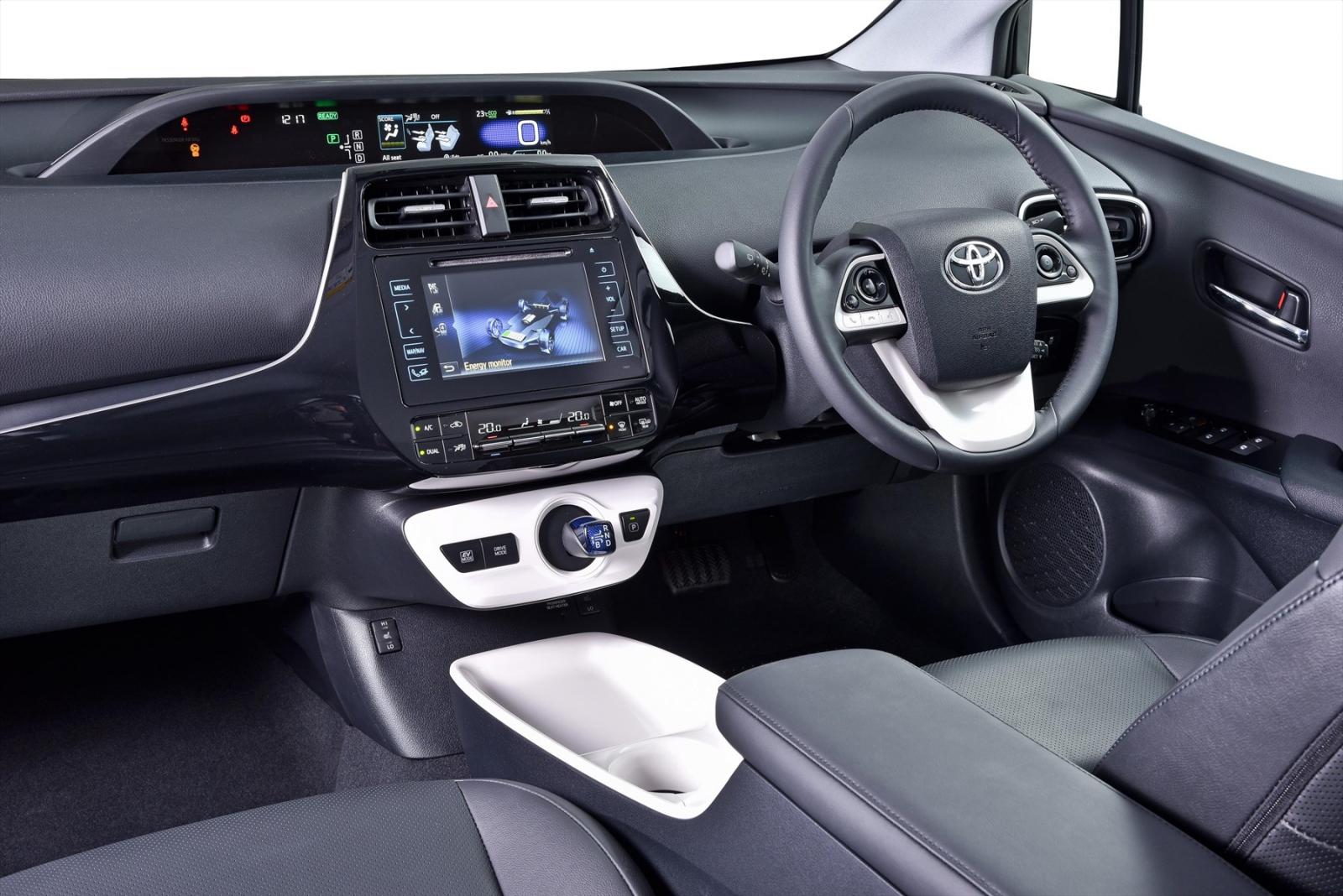
South African consumers have been offered 3 iterations of the Toyota Prius, the latest one's interior is pictured here.
1. Lack of options
The limited number of EVs to choose from is a major drawback. For the past decade, buyers were restricted to quirky inner-city runabouts and, in effect, three "mainstream: vehicles: the Chevrolet Volt, which has ensured EV sales in the US, Toyota Prius, which has bolstered sales in Japan, and Nissan Leaf, which captured Europe and the BEV market in Japan.
This overreliance on singular models also explains the relative dip in sales growth experienced since mid-2014: These vehicles all approached model run-out at roughly the same time and, as with any conventional vehicle, their sales dropped off as a consequence.
2. Lack of charging infrastructure
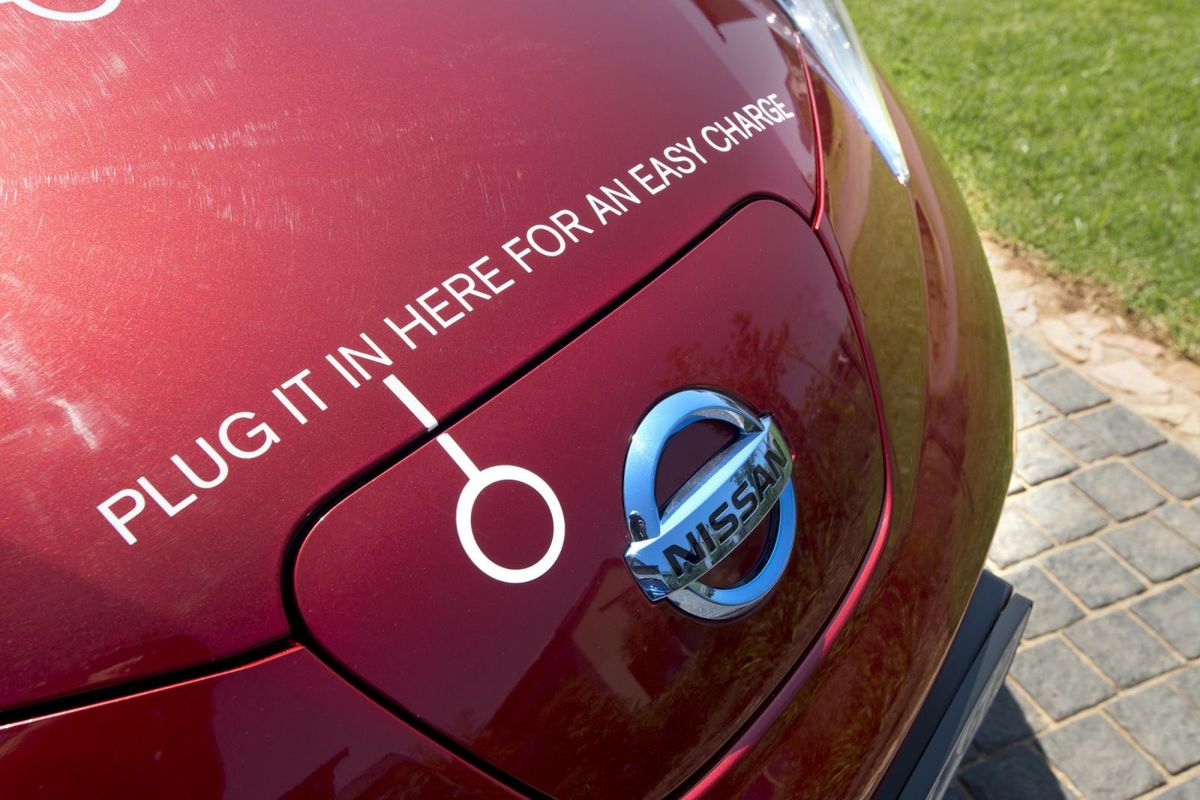
This is especially pertinent to BEVs. The lack of public charging facilities and, for urban drivers in particular, private charging facilities, remains a problem. This is perhaps why sales of PHEVs are currently experiencing stronger growth compared with BEVs.
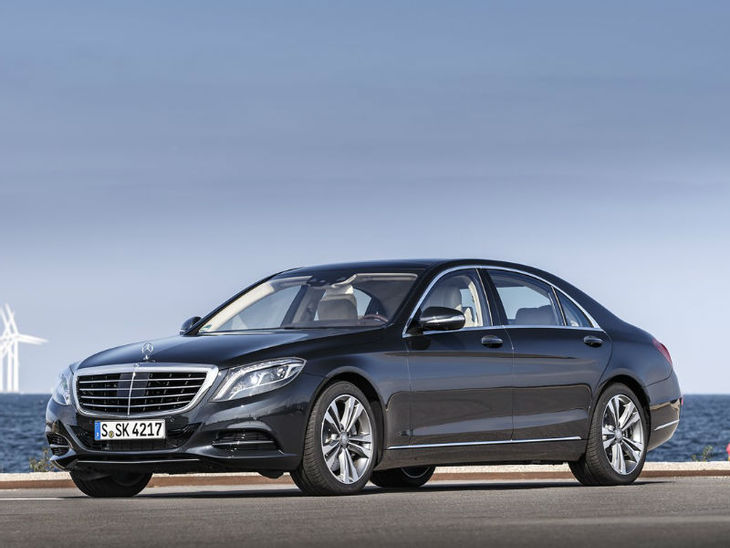
South Africa's most expensive EV is the Mercedes-Benz S500e, which costs a princely R1 875 000.
3. Cost
While fuel-cost saving is punted as one of the major benefits of using an EV, a major issue remains the higher purchase cost of EVs (predominantly due to the cost of the battery packs). This is why most governments offer some form of financial assistance for EV purchases (either in the form of tax rebates or incentives).
These incentives were justified as a means to bump-start the EV industry (to the benefit of the public and the environment), but lower sales figures are expected in the near future as most of these incentives programmes are coming to an end. For example, in some states of the US EV sales have declined by as much as 80% after local tax rebates were withdrawn.
4. Practicality and functionality
Most consumers still perceive EVs to be unpractical (most early models were compromised by a large and heavy battery pack, thus limiting cabin space and luggage capacity). Many consumers feel that EVs are difficult to operate (some claim they are afraid of being electrocuted or catching fire when they recharge their vehicles – that's blatant product ignorance).
Earlier EVs suffered from limited ranges and this perception has stuck. Most modern BEVs offer driving ranges in excess of 150 km and PHEVs currently offer 30-50 km ranges before the conventional engine kicks in.
6. Paradoxical market
Besides these relatively straight-forward issues, it must also be noted that the EV market is filled with paradoxes and contradictions. It is a new and changing market. For instance, environmental considerations play a negligible role in the car-buying decision making for most consumers. In fact, research has found that, even among drivers who have opted for a "green" car, the true "green credentials" and "green performance/efficiency" of that vehicle are of little importance.
So, the motivation to buy green is not motivated by the "compulsion to go green" at all. Rather, for the most part, it boils down to cost saving. The issue of cost highlights the biggest paradox of EVs: Due to the limited driving ranges offered by BEVs combined with consumer range anxiety, most marketers are quick to highlight the benefits of EVs for young, hip urbanites. These consumers are most likely to adopt new tech (such as EVs) and drive short daily distances. The perfect combinations, right?
Well, not necessarily. The problem with this is that most young urbanites cannot afford expensive EVs, at least not yet. The second issue is that most studies have found that the true cost benefit of running an EV (over a conventional vehicle) only kicks in at about 50 km per day and that's hardly a typical urban commuting distance.
So, even if marketers manage to quash consumers' range anxiety, justifying the asking prices for these vehicles is a far harder task.
How do we fix it?
1. More is better
Yes, having a greater variety of EVs to choose from will help, but it is not that simple. Firstly, there are numerous types of EVs and, secondly, the uptake of these has a great geographic dispersion. For example, the largest PHEV markets are the US (due to the Volt) and Japan (Prius), while the BEV market is led by the Leaf in the US, China and France.
In other words, the biggest-selling type of EV is predominantly driven by the first-mover in a market. Thus, different countries prefer different types of EV, making development and distribution problematic (manufacturers cannot just focus on the development of a single type of technology). It is expected that South Africans will prefer PHEVs, due to the longer distances we travel in this country. The market is divided, but hopefully not conquered as a consequence.
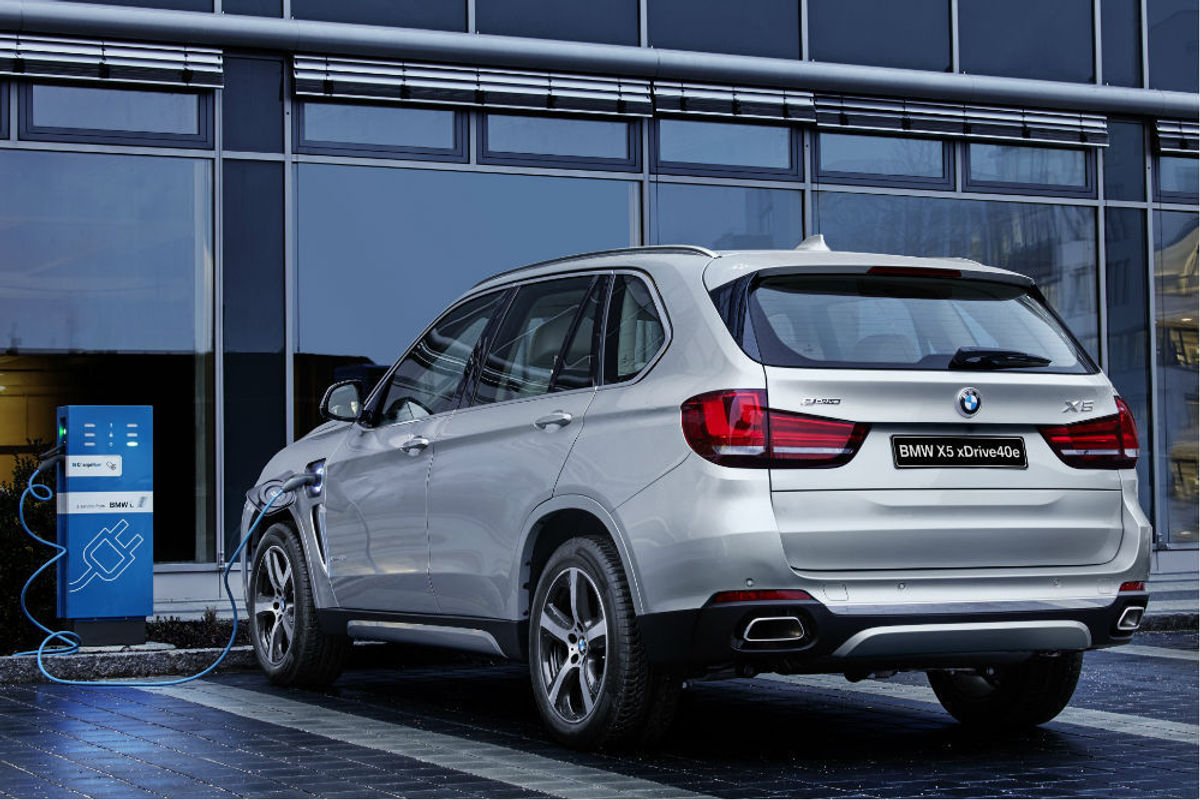
Thankfully, the number of EVs available in the market has begun to increase significantly (recent additions in South Africa include the BMW X5 xDrive40e, Mercedes-Benz S500e and Volvo XC90 T8 Twin Engine). Studies have found a direct and strong correlation between cumulative EV sales and model availability, which bodes well for a market rolling out e-mobility across numerous vehicle ranges not only limited to quirky, micro or super-sized vehicles.
The key here would be for manufacturers to offer entry-level e-mobility as soon as possible – opening up offerings to a greater number of consumers.
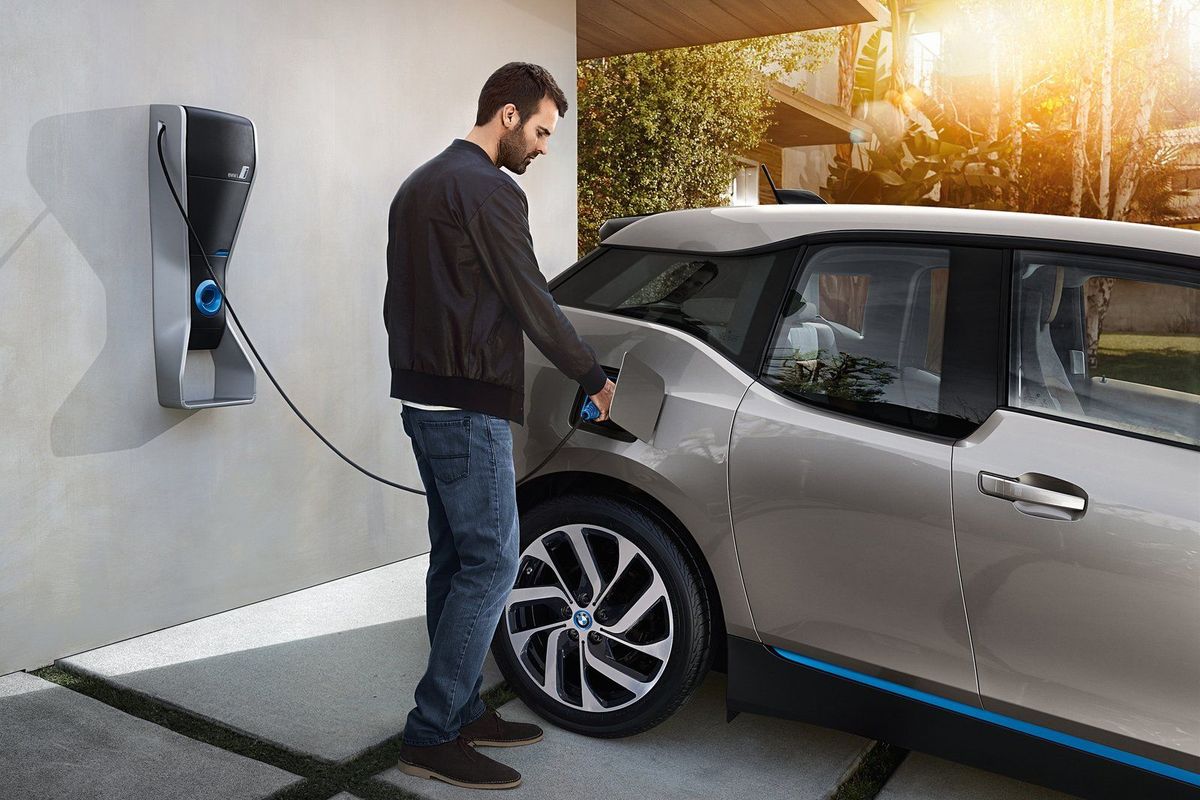
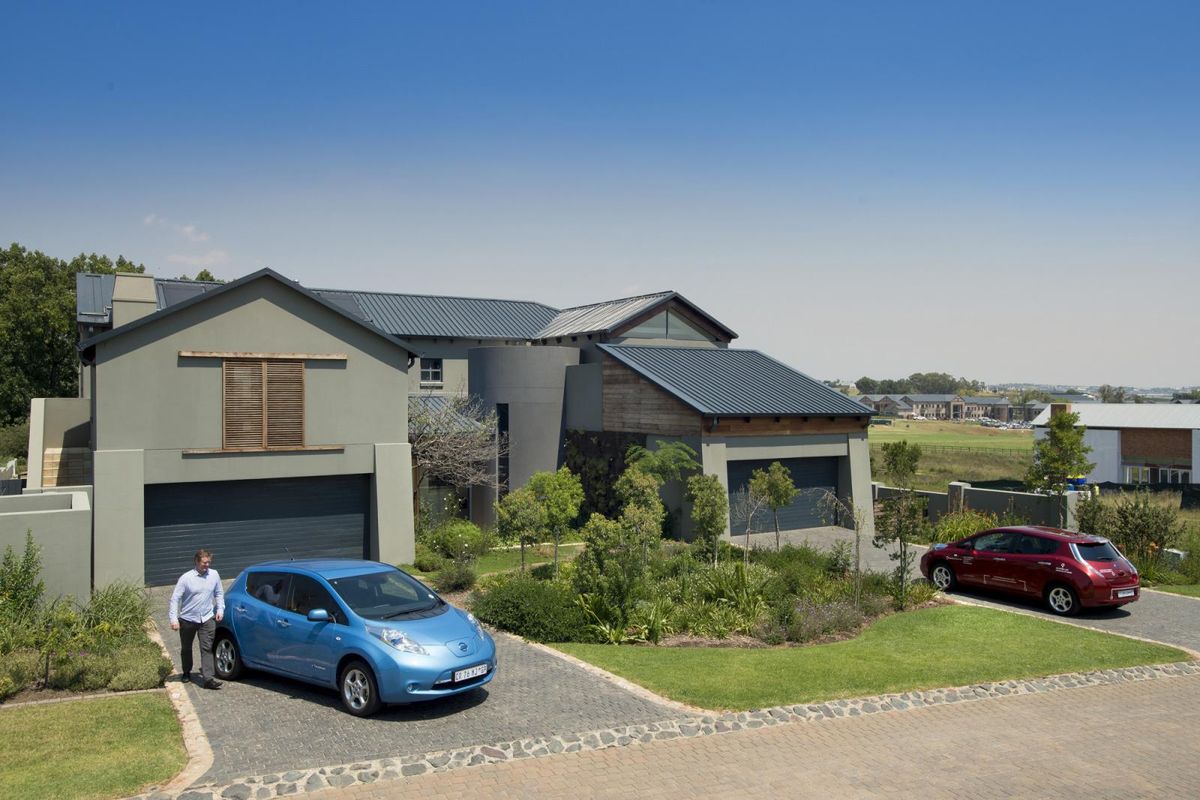
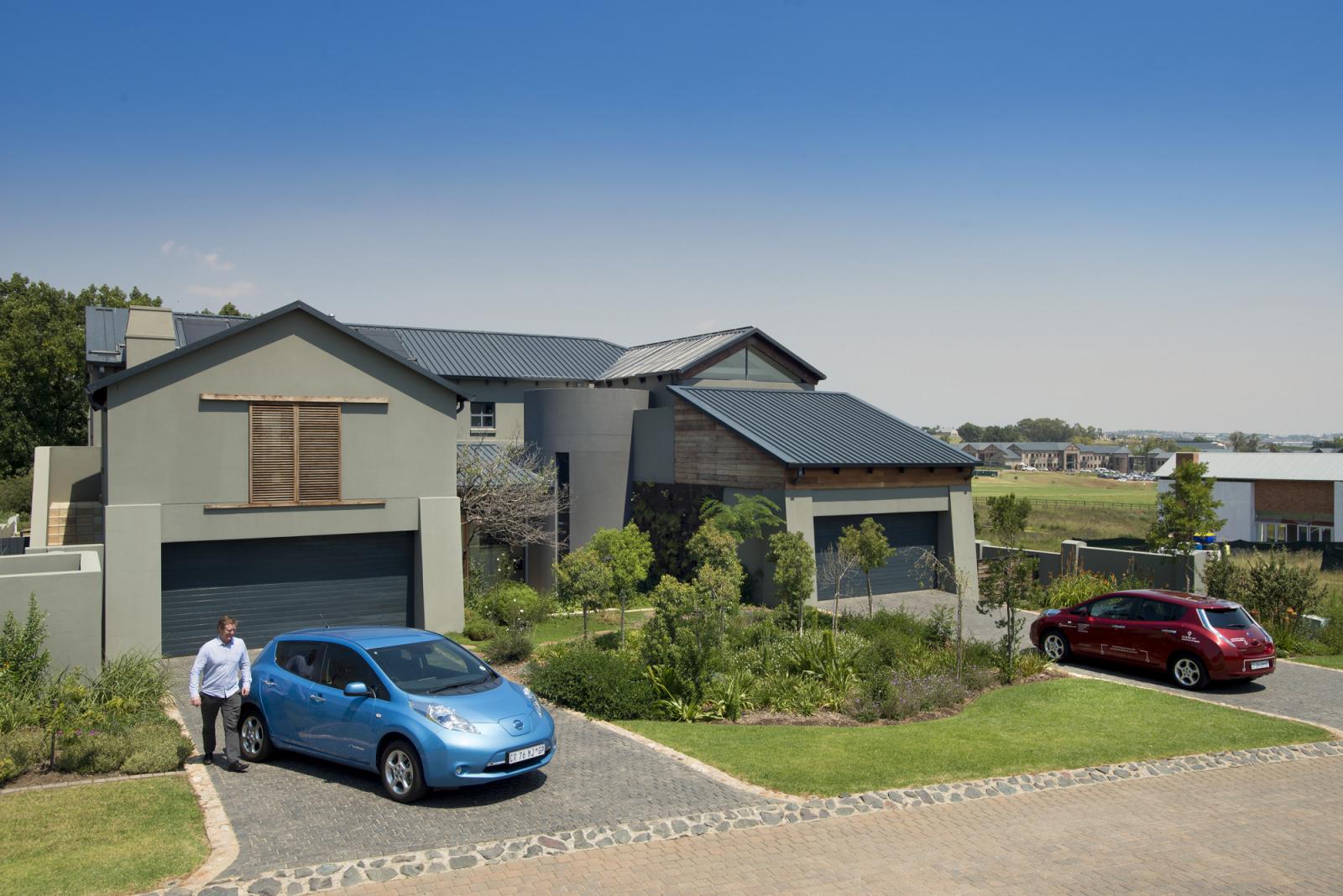
Although suburbanites with garages can conveniently charge their BEVs at home, inner-city charging infrastructure is still in its infancy.
2. Get plugged in
The same applies to the roll-out of infrastructure.
Charging can take place at numerous locations: residential, office, fleet, retail, street, etc. And, charging can also be defined as "slow" or "fast". The general idea is to increase the availability of charging infrastructure in order to promote EV sales (Japan, for example, aims to have 2.4 million non-residential slow chargers and 6 000 fast chargers by 2020).
However, the relationship between charging infrastructure and EV sales are not as linear and direct as you may expect. And, again, this boils down to the prevalent EV used in the market and the preference of consumers. For example, public fast chargers will not be required by markets that rely on residential charging or PHEVs.
In general, most countries have realised that public fast chargers are not as widely needed as previously thought. However, where they are, will there be a market for charge retailers? What should the charge be for charging? Should EVs be charged for the time spent at the station or amount of electricity loaded? These are all questions that cannot be answered yet, but will be crucial in the effective development of an EV market.
This again makes the development of an efficient EV market very problematic for a growing and changing market, with a lack of detailed and rich consumer data.
3. EVs need to be more affordable
Regardless of all of these issues, at the core lies a need to reduce the cost of EVs. Since nearly 50% of an EV's production cost is its battery, it is crucial for batteries to become cheaper and more efficient. Thankfully this has already started: according to the US Department of Energy (DOE) battery costs have decreased from $1 000/kWh in 2008 to $485/kWh in 2012. This reduction is in line with those of laptop batteries between 1997 and 2012, and the roll-out of second and third-generation EVs will see this trend continuing.
Evidently, EVs are here to stay, but the question as to which type of EV will thrive (or at least gain popularity at the cost of its brethren) will greatly depend on market-specific conditions.
A concerted roll-out of charging infrastructure is an absolute necessity for the sustainability of BEVs, for example, but the biggest requirement from consumers is the need to save costs.
E-mobility offers significant R/km cost-savings… Given the prevailing fuel prices per litre and the cost of electricity, the rand cost of electricity consumed by the average EV (per kilometer driven) is less than the rand cost of fossil fuel consumed by the average conventional vehicle (per kilometer driven). Having said that, the high initial purchase prices of EVs effectively neutralise these purported savings. EV owners would effectively need to log excessive driving distances to recoup the upfront costs through lower running costs.
Do EVs make sense?
No, but at the rate of technological advancement in terms of battery capability and lower production cost, that statement cannot remain true for much longer.
So, ask me again… Do EVs make sense?
Not yet.
Any views or opinions expressed in this article are solely those of the author and do not represent those of Cars.co.za or its editorial content team.
5 Cheapest Family Double-Cab Bakkies in South Africa
We take a look at five of the cheapest family-friendly double-cab bakkies currently on the South African market.
Double-cab bakkies are hugely popular in South Africa and the local market is mostly dominated by the likes of the Toyota Hilux and Ford Ranger. These vehicles are very much top-of-mind in conversations around the braai but there are however a host of often-forgotten products on offer that can be had at a fraction of the price.
Sure, the vehicles we will be outlining here may lack the brand appeal afforded to the Hilux and Ranger, but they represent value in the sense that they are significantly cheaper to buy new and for the most part offer a decent level of specification.
For the purpose of this list, we felt it was important that a double-cab bakkie be fitted with basic safety features such as airbags and ABS. The reason for this makes sense if you consider that buyers in this segment are often looking for a vehicle that can play the role of workhorse during working hours while also being a relatively safe family vehicle when the weekend arrives.
This list highlights the cheapest double-cab bakkies currently available in South Africa with the inclusion of airbags and ABS. For the sake of comparison, we will also take a look at what similar money can buy you in the used car market.
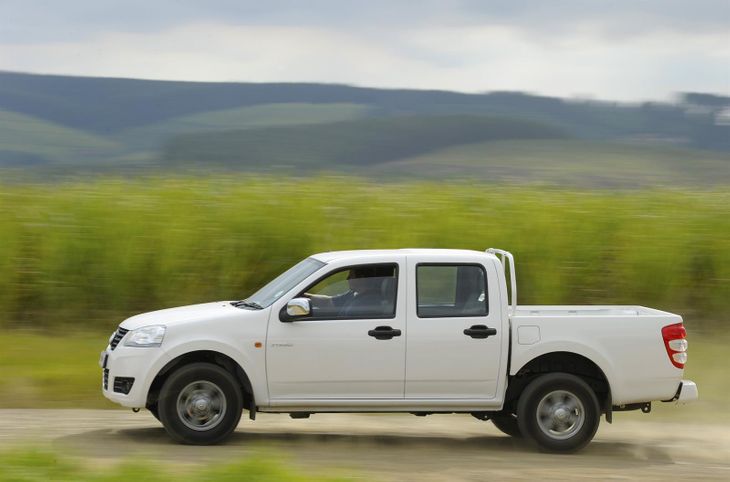
The Steed 5 2.2-litre is the cheapest double-cab bakkie with safety features offered in South Africa.
The GWM Steed 5 2.2 Lux Safety version features a naturally aspirated 2.2-litre petrol engine that delivers 78 kW and 190 Nm of torque to the rear wheels via a five speed manual transmission. GWM claims a fuel consumption of 10.2 L/100km for this derivative.
This Steed 5 rides on 15-inch alloy wheels and air conditioning, rake-adjustable steering wheel, CD player, all-round electric windows and electric mirrors are included as standard. ABS with EBD is included as are a total of two front airbags for the driver and passenger.
The GWM Steed 5 2.2 Lux Safety is sold with a 5-year/100 000km warranty while an optional 5-year/60 000km service plan is available. If safety features are not a high priority for you, there is also a more basic version on offer for R184 900 which does without the airbags and ABS. You can read a review on this version by clicking here.
Furthermore, if you want more features and a more modern design, you could look at the newer Steed 5E, offered in 2.4-litre petrol SX guise for R239 900. The engine in this derivative punches out 93 kW and 200 Nm of torque. A 2.0-litre turbodiesel (105 kW/305 Nm) version sells for R269 900. Read a review of the Steed 5E here.
We say: The GWM Steed 5 has been around for a while and this 2.2-litre petrol derivative in particular has proven very popular. If your budget can stretch to the 5E, however, that model's increased refinement and better finishes will impress. But beware the fuel consumption of the 2.4.
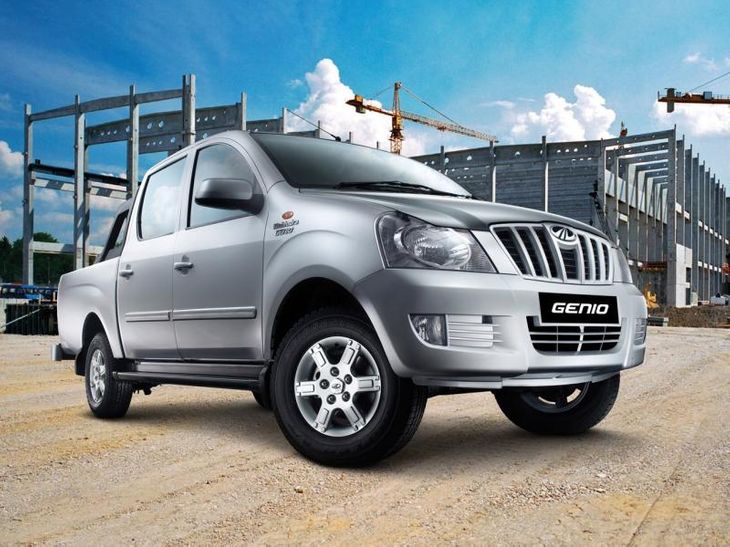
The Mahindra Genio uses an economical 2.2-litre turbodiesel engine.
The Mahindra Genio 2.2CRDe double cab is powered by a 2.2-litre turbodiesel offering 89 kW and 290 Nm of torque. The rear wheels are driven through a five speed manual transmission and Mahindra claims an impressively low fuel consumption figure of 7.9 L/100km.
Major features include air-conditioning, rake and reach adjustable steering wheel with mounted controls, cruise control, CD player, USB port and electric windows. 15-inch wheels are standard on the Genio. In terms of safety, ABS with EBD is included and a total of two airbags (driver and passenger) is fitted as standard.
The Mahindra Genio is sold with a 3-year/100 000km warranty and a 3-year/60 000km service plan is available as an option.
We say: We have not yet tested a Mahindra Genio, so can't comment on the driving experience. Regarding the brand – Mahindra has a growing presence in South Africa, but sales of the Genio have been slow. Most private buyers appear to opt for the more rugged-looking Scorpio Double Cab (priced from R249 995).
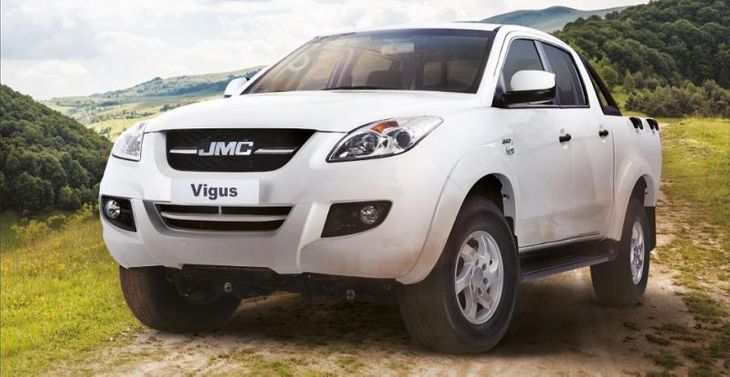
The JMC Vigus's design is based on the Ford Ranger's. Petrol and diesel derivatives on offer.
The lesser known JMC Vigus 2.4 LX offers 95 kW and 201 Nm of torque from its 2.4-litre petrol pot. A five-speed manual transmission drives the rear wheels with a claimed fuel consumption figure of 10.2 L/100km.
Notable features include air-conditioning, electric windows and a USB port for connecting devices. The Vigus also features rear park distance control to help you steer the vehicle into its parking bay safely. The Vigus rides on 15-inch wheels. ABS with EBD is included along with two airbags.
The JMC Vigus is sold with a 3-year/100 000km warranty as well as a 5-year/60 000km service plan.
A higher-specification SLX version sells for R279 990, while diesel variants (powered by a Ford-sourced 2.4-litre engine) start at the same price. JMC has a partnership with Ford in China, and the Vigus is based on the Ranger underneath.
We say: The JMC Vigus drives well and seems impressively well built, but in some part due to a limited dealership network not many have been sold. We have also net yet officially tested this vehicle though some team members have driven it before.
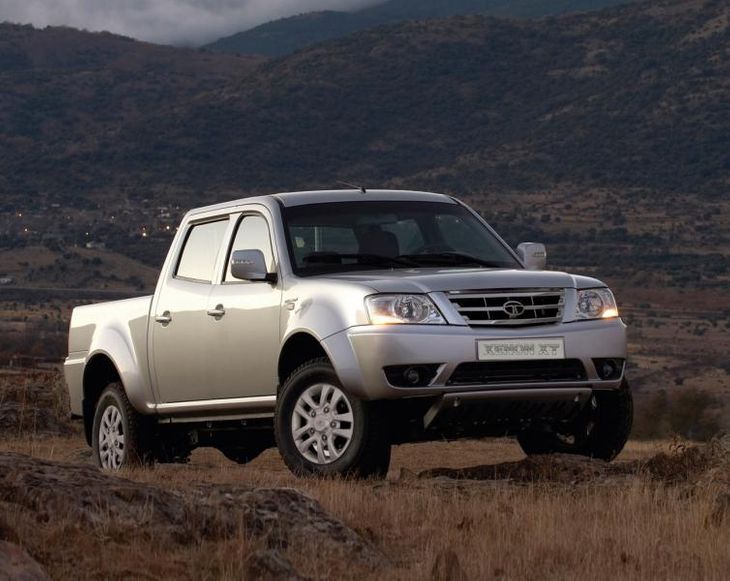
The Xenon may be ageing, but its engine is impressively powerful and economical.
The Tata Xenon is second most powerful double-cab bakkie on this list with 110 kW and 320 Nm of torque generated from its 2.2-litre turbodiesel engine. The rear-wheel driven Xenon makes use of a five speed manual transmission and claims to achieve a fuel consumption figure of 9.0 L/100km.
On the features front, the Xenon rides on larger 16-inch wheels and offers air-conditioning, rake and reach adjustable steering wheel, navigation, Bluetooth capability, CD Player, USB port and electric windows. Two airbags are fitted and ABS with EBD is standard.
The Xenon is sold with a 4-year/120 000km warranty and a 5-year/75 000km.
If safety features are not a concern, but you need a diesel-powered double-cab, then the 3.0-litre DLE may be of interest. It is priced at R199 995 and offers 85 kW and 300 Nm of torque.
We say: The Tata Xenon has been around for a long time and has received many upgrades along the way. We think the 2.2-litre turbodiesel engine is impressive, but the rest of the vehicle hasn't quite kept up. It is comparatively unrefined and dated inside compared with the other vehicles on this list.
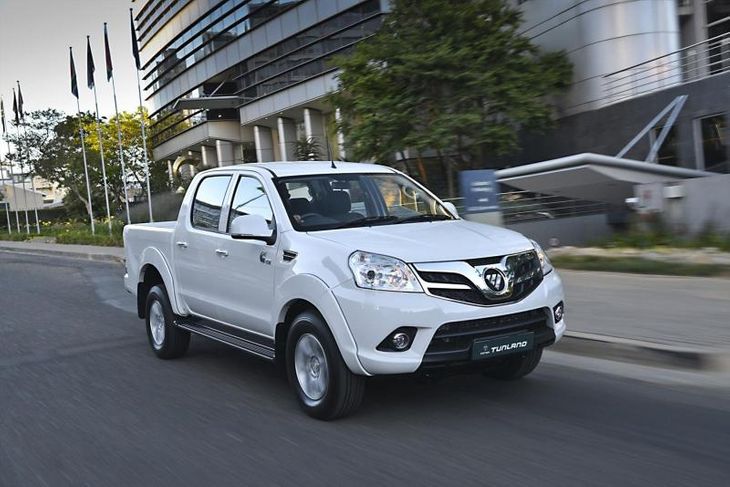
The Tunland offers space and power in a modern-looking package.
The Foton Tunland 2.8 Comfort is the most expensive and most powerful double-cab bakkie on this list, but it is also, along with the JMC Vigus, of a newer design. Its Cummins-sourced 2.8-litre turbodiesel engine delivers 120 kW and 360 Nm of torque to the rear wheels via a 5-speed manual ‘box and carries a claimed fuel consumption figure of 8.3 L/100km.
Key features include 16-inch wheels, air-conditioning, multi-information display, CD player, USB and Auxilliary port, electric windows and electrically adjustable mirrors. ABS with EBS is standard and the Tunland is fitted with two font airbags for the driver and passenger.
The Tunland comes with a 3-year/100 000km warranty and a 2-year/40 000km service plan.
More derivatives of the Tunland are on offer, including a Luxury 4×2 derivative (R319 995), while the most affordable 4×4 model starts at R389 995.
We say: We have just received a Tunland for an extended test, so watch out for an in-depth report soon. Initial impressions are favourable, with a spacious cabin and solid feel being most notable. The engine, too, feels willing, but perhaps a sixth-gear is needed for relaxed cruising.
Double-cab bakkies in the used car market (R200 000 – R300 000)
The used market opens up a wide range of options to the double-cab bakkie buyer and if you are shopping in the R200 000 – R300 000 bracket, you have lots of choice but you’ll have to shop carefully. Factors such as mileage and condition of the vehicle will need to be considered. Look out for signs of extreme use (underbody damage) and check carefully for rust, as some of these vehicles will have been used to tow or carry leisure equipment to dams, lakes, rivers and to the seaside.
In this price spectrum, more popular double cabs such as the Volkswagen Amarok, Isuzu KB, Ford Ranger and Toyota Hilux are widely available.
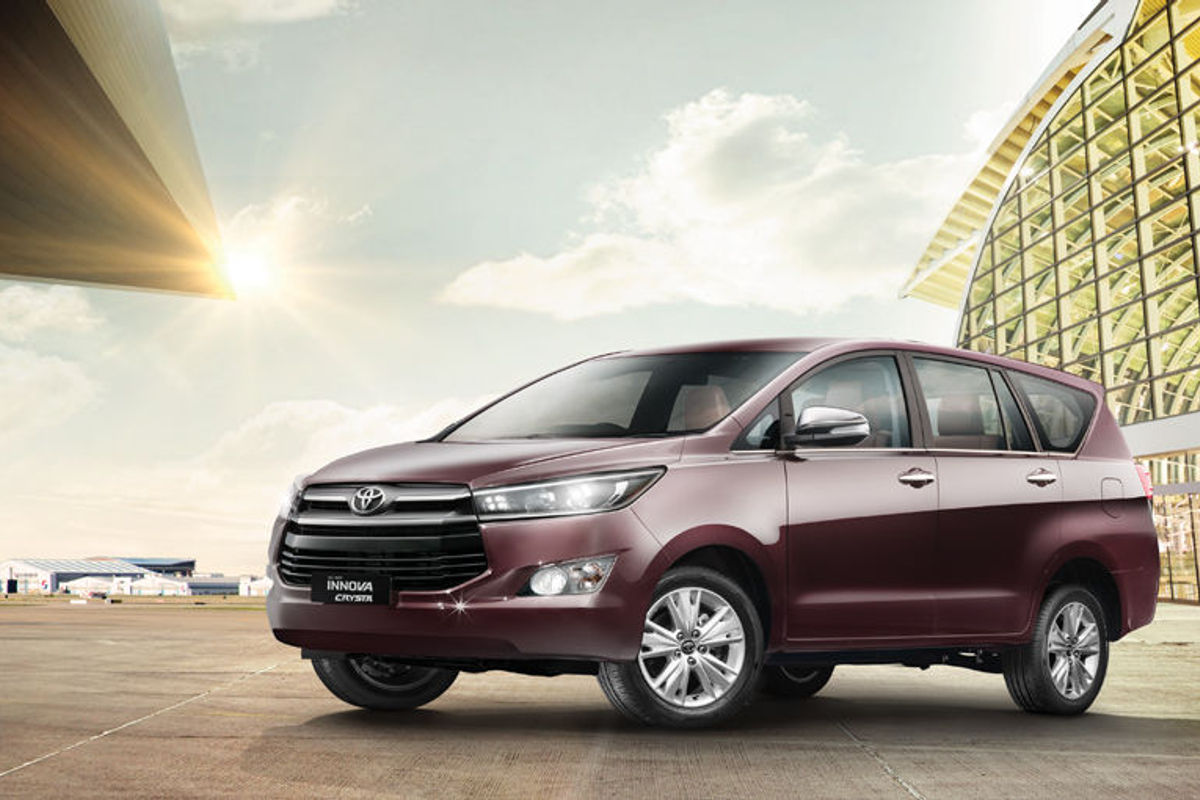
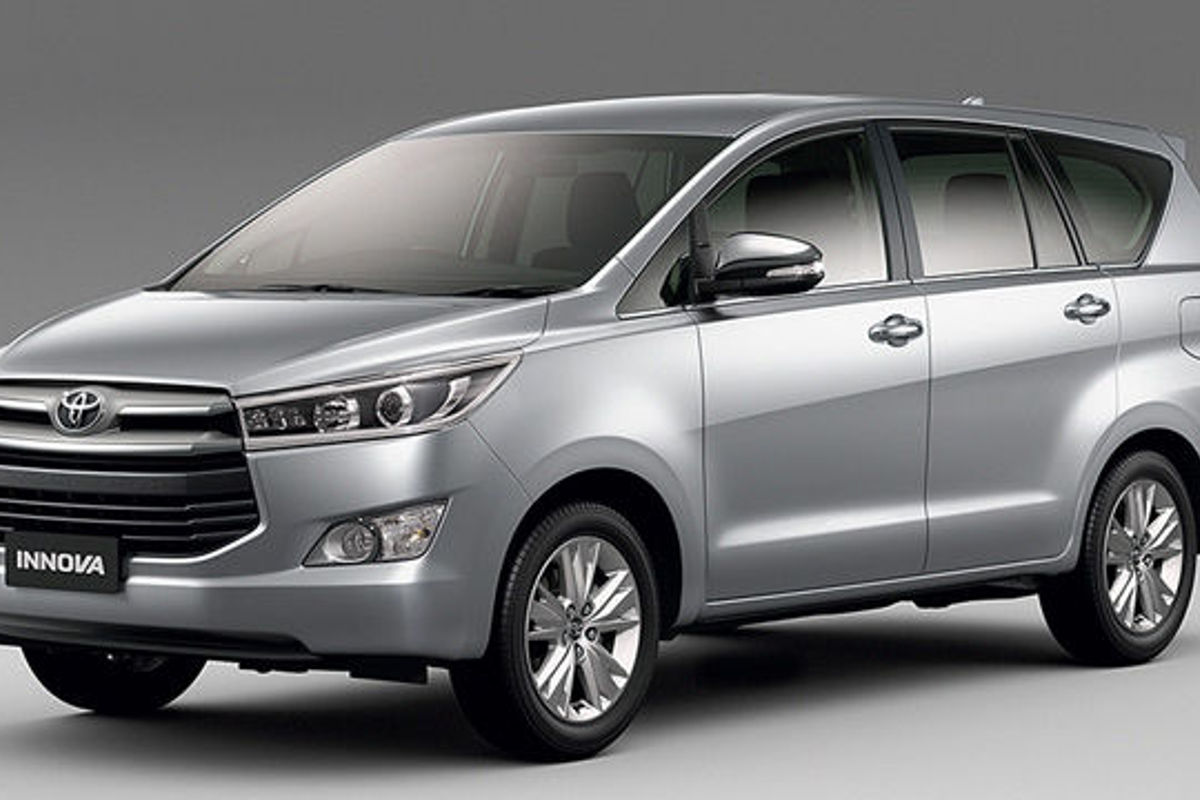
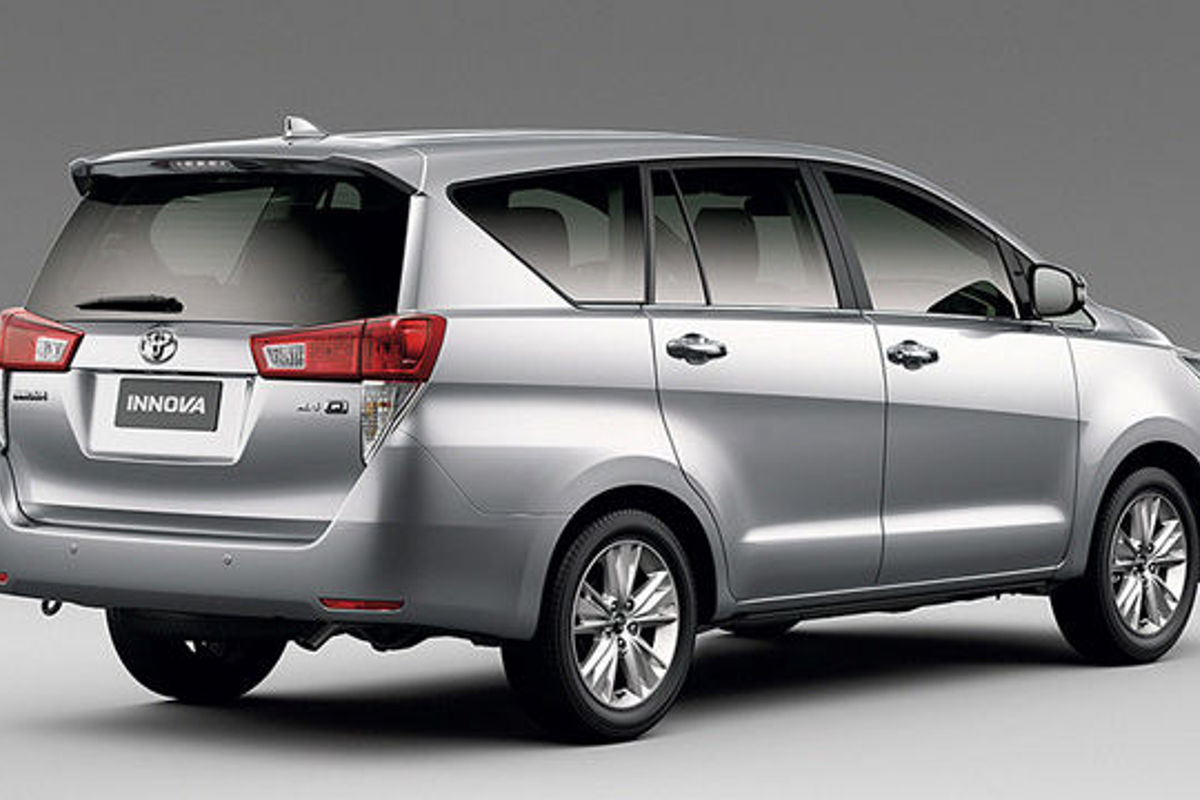
We've got some bad news if you were looking forward to the arrival of a new version of Toyota's practical family MPV, the Innova.
A vastly more sophisticated and appealing version of Toyota's big seven/eight-seater recently went on sale elsewhere but due to a shrinking MPV market in South Africa, and our general love affair with SUVs and crossovers, Toyota South Africa will not be introducing it locally. Just like station wagons, it appears that MPVs are simply forever stuck on the "uncool" wall.
Still, based on the Innova's history in South Africa, Toyota South Africa's decision makes sense. The previous-generation Innova was a slow seller on the South African market. Then again, it had some obvious flaws, including the lack of turbodiesel power or automatic transmissions, two bits of hardware that make a lot of sense in this segment, especially for families. And not forgetting that the 2.7-litre petrol engine was rather thirsty…
What are we missing out on?
As was the case before, the new Innova is again be based on Hilux/Fortuner underpinnings and, as is the case with those vehicles, a lot of effort has gone into making it a more refined and comfortable vehicle to be in. The big news, however, is that turbodiesel engines (both the 2.4- and 2.8-litre variants) from the Hilux/Fortuner are now offered overseas. Even better… a six-speed automatic transmission is also available. These two developments alone would have significantly boosted the Innova's appeal.
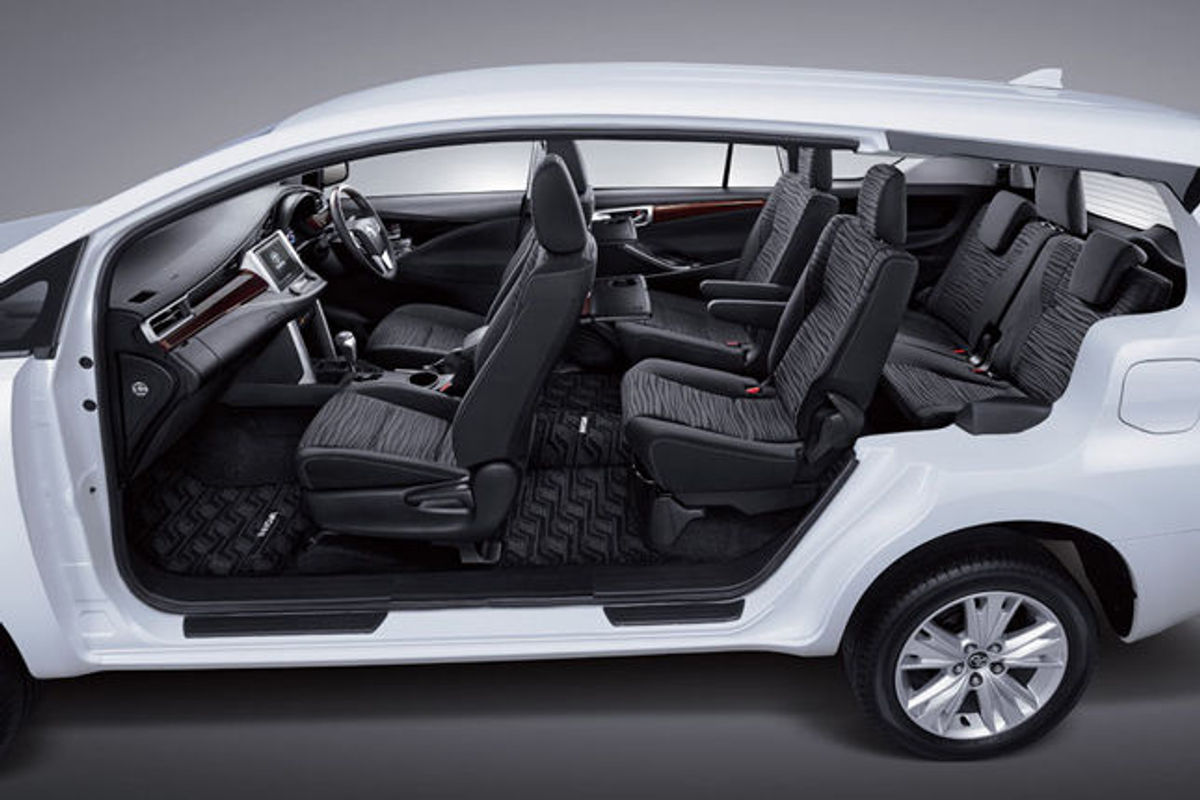
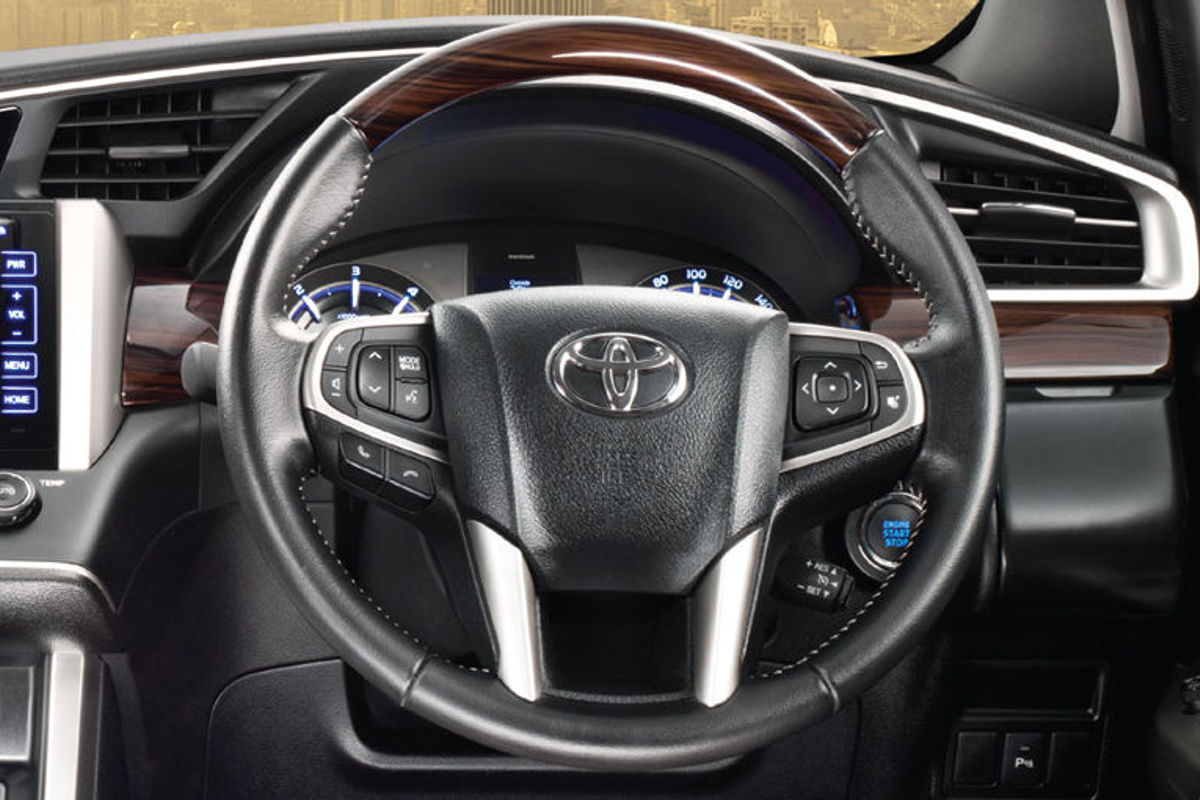
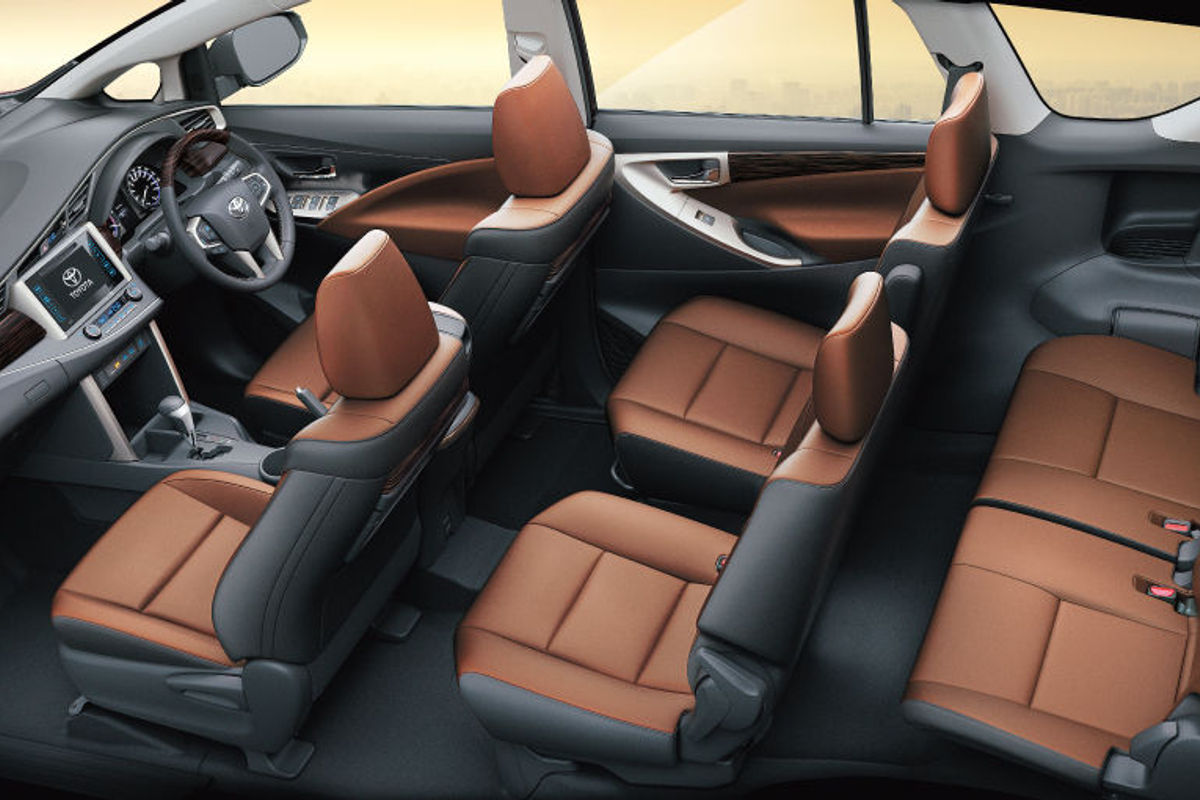
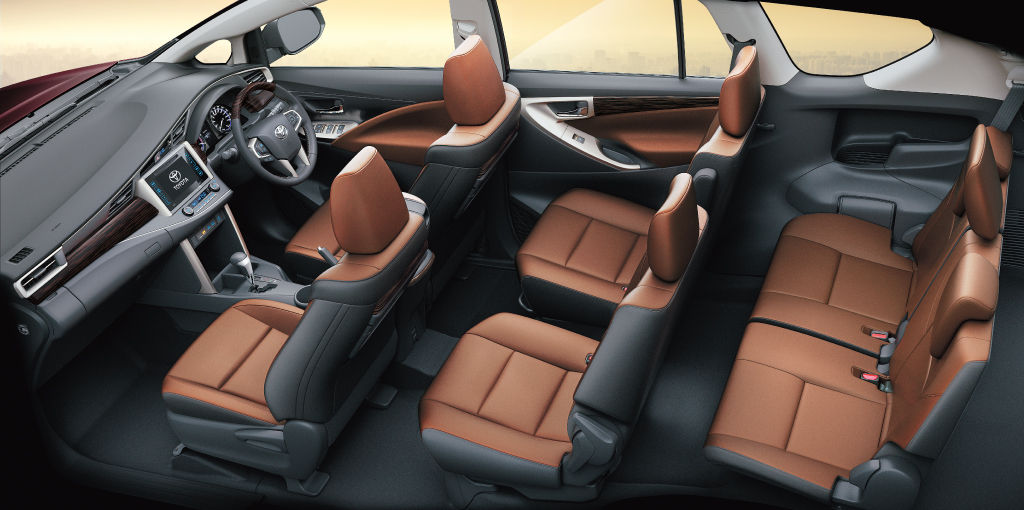
Significantly more upmarket cabin should boost Innova's overall family appeal.
What else is new? Well, the Innova's cabin has undergone something of a transformation compared with its utilitarian predecessor. Offered overseas are large touch-screen info-tainment systems and a full complement of airbags.
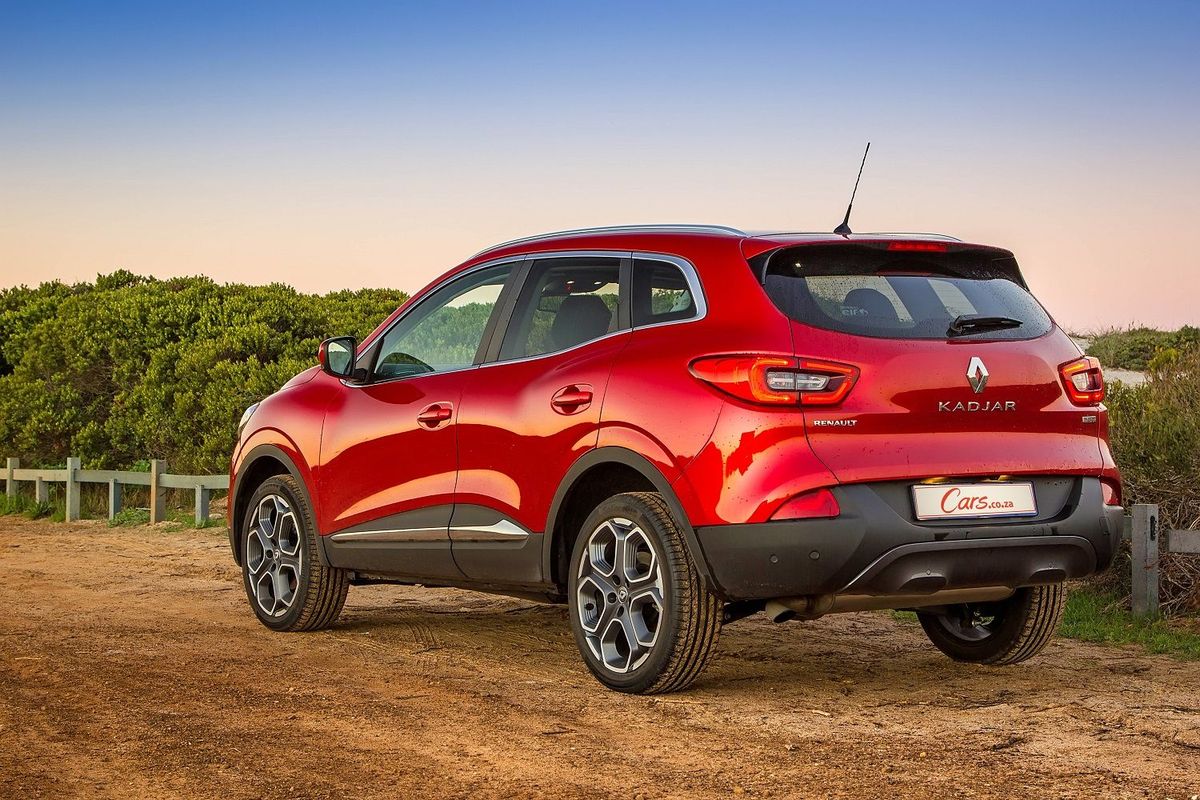
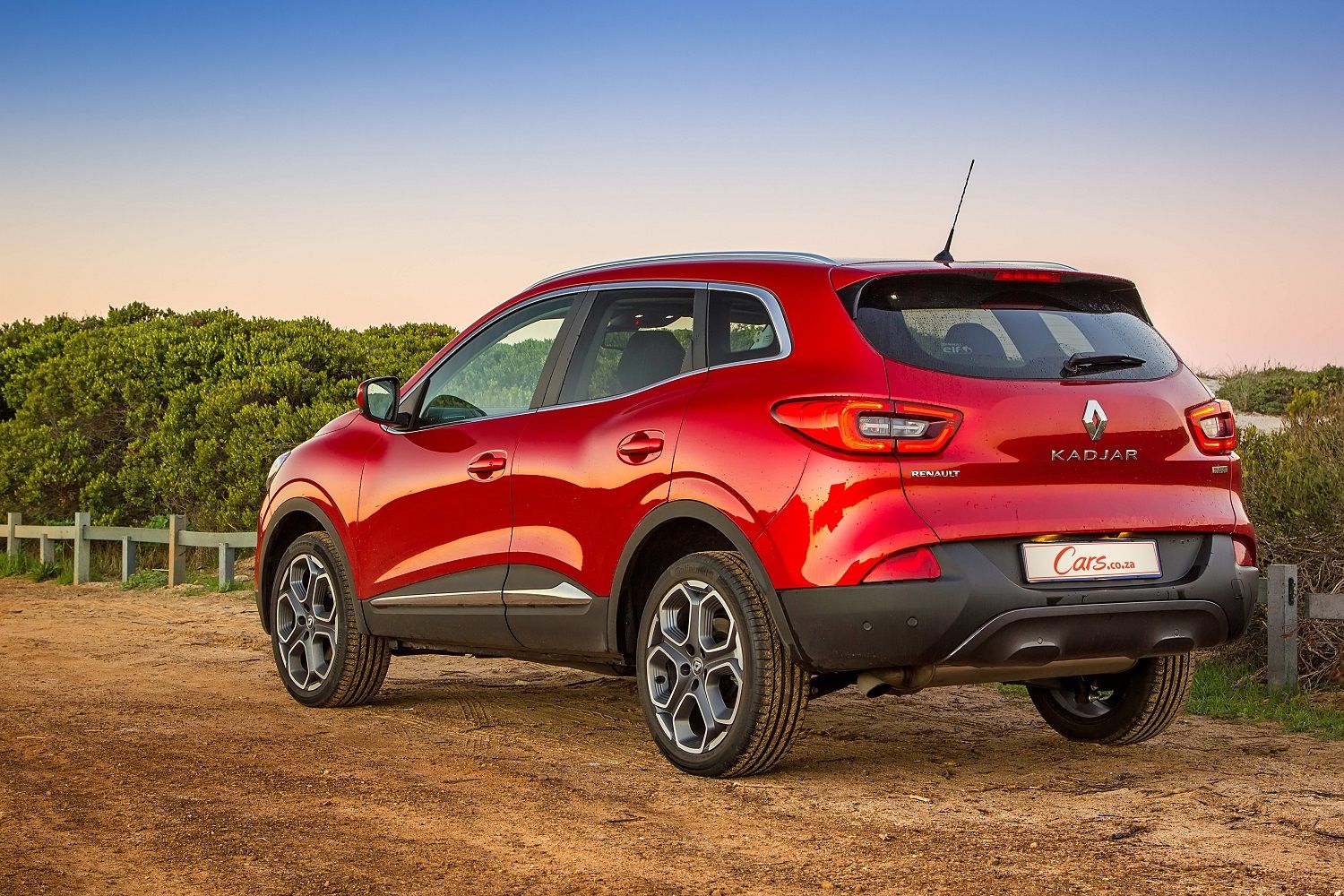
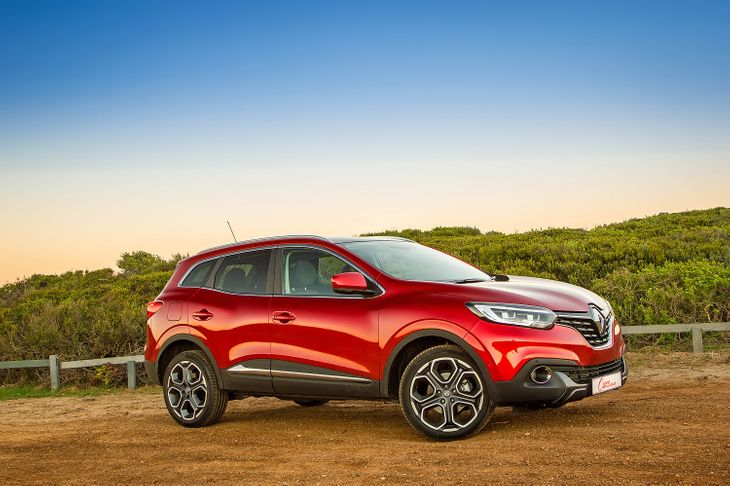
Renault SA has launched an all-new compact SUV in the form of the Kadjar and the newcomer represents a collaboration between Renault and its global partner Nissan, which has extensive experience in building SUVs. It's a crowded market segment, so what makes the Renault a worthwhile contender?
We like: Classy interior, well-appointed specification, comfortable on a gravel road
We don’t like: Doesn’t bring much new to the segment, engine lags at low RPM
Alternatives
For something bigger: The Toyota RAV4 is more spacious, but is neither as well-specced nor as stylish.
For something more refined: The Volkswagen Tiguan is well-built and has a smoother drivetrain. It's about to replaced by an all-new model, however.
For something similar, but in automatic:Nissan Qashqai CVT – it’s virtually the same car, but you don’t have to shift gears. Only offer with 2WD, however.
How does it fare in terms of…
School run appeal?
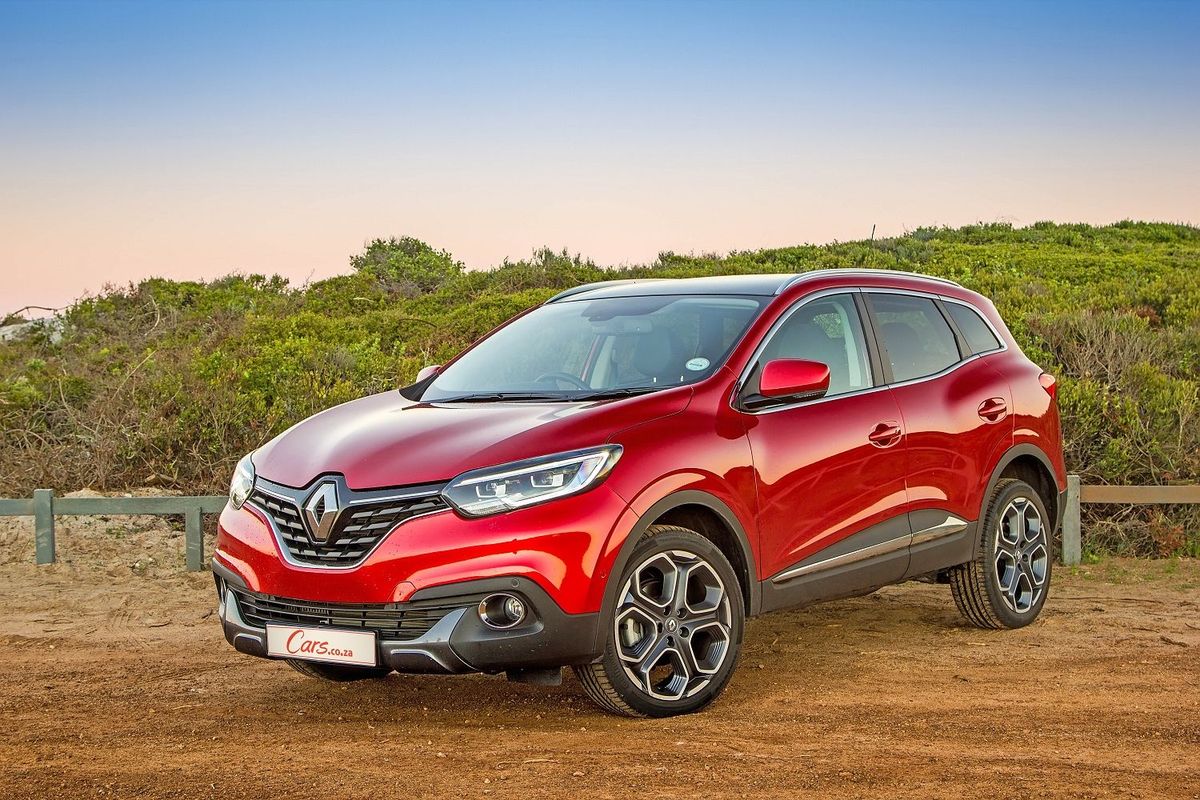
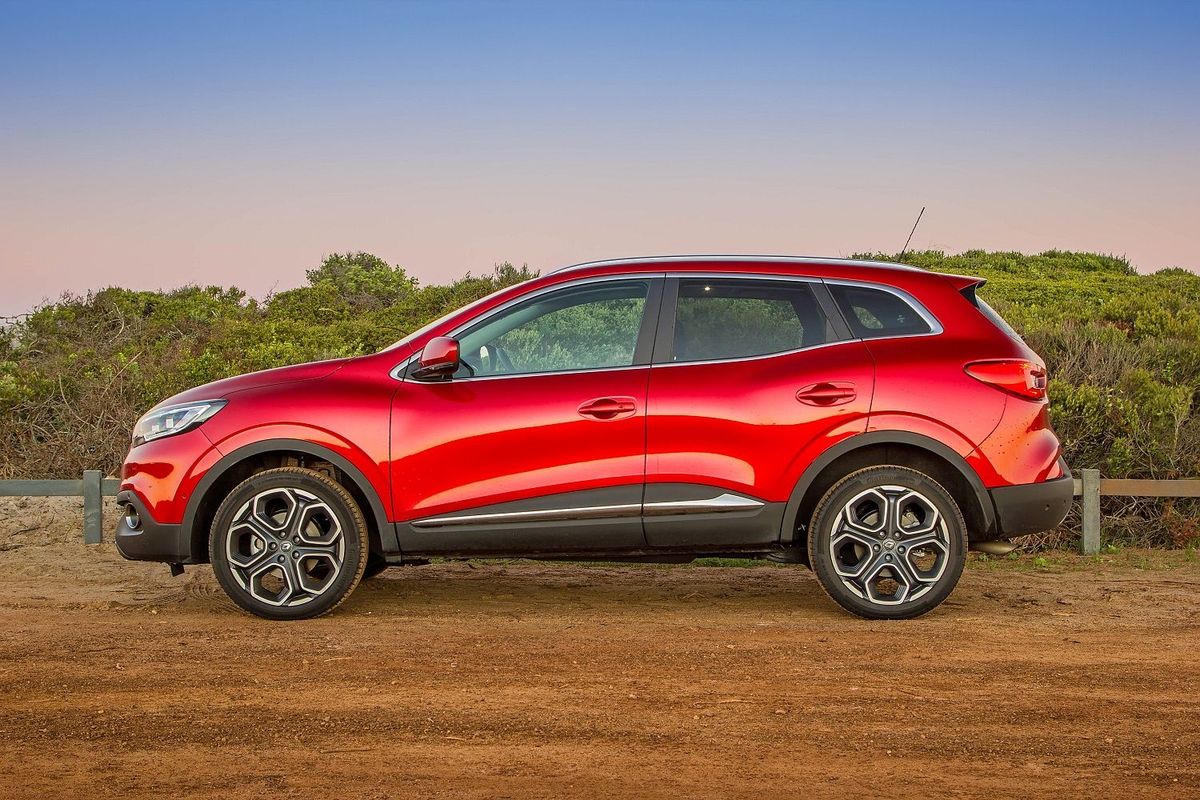
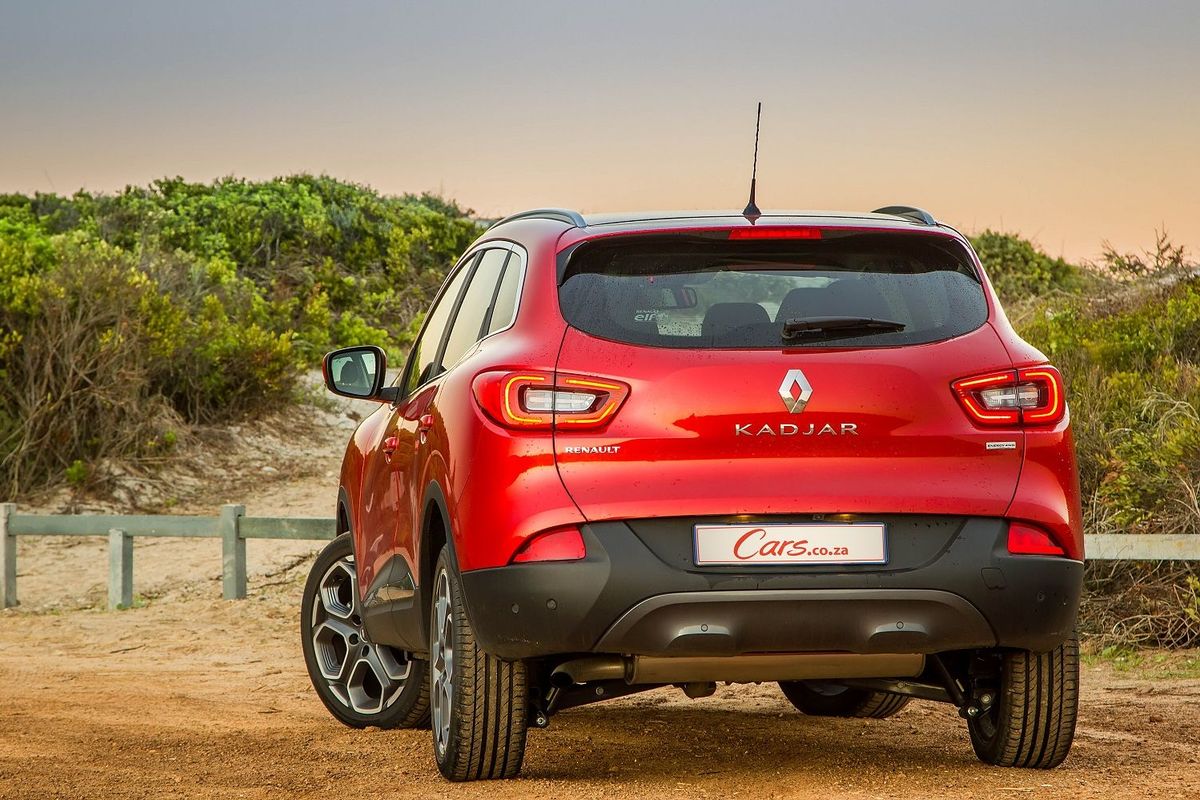
The Renault Kadjar is certainly going to turn a few heads, especially with this eye-catching red paint finish. It’s got a very distinctive look and fits the description of a stylish compact SUV to a tee. The optional 19-inch wheels on this model also give it a touch more presence when standing in the parking lot. Underneath the Kadjar, it’s essentially a Nissan Qashqai except with two years’ worth of updated technology inside. The Qashqai is a well-rounded compact SUV that’s often a top-seller in SA and a default choice when referring someone to this segment. The Renault Kadjar should make for a “better Qashqai”, all things considered.
Kadjar has appealing looks when combined with these optional 19-inch wheels.
Engine performance?
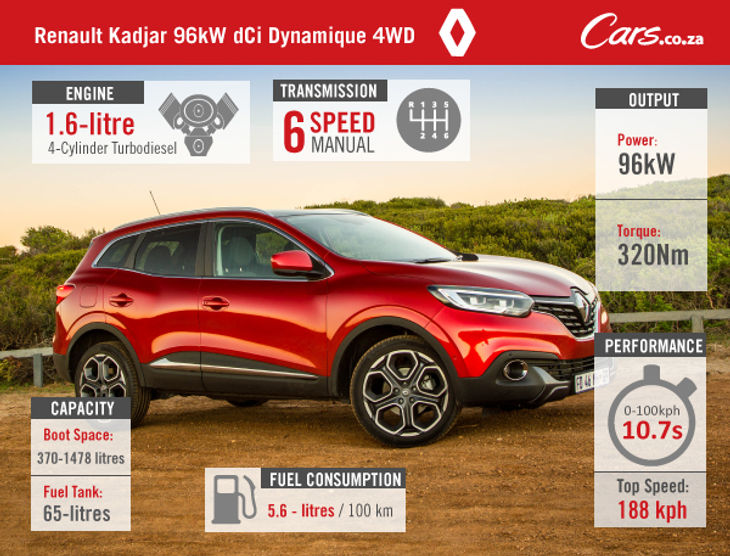
The Kadjar four-wheel drive model is the only diesel in the range and is a carryover unit from the current Qashqai. It’s a 1.6-litre turbodiesel with 96 kW and 320 Nm of torque and is mated with a six-speed manual gearbox. The clutch takes a bit of getting used to as it can be quite snatchy when pulling off if you don’t release the pedal with sufficient revs. The 1.6-litre engine has always suffered from turbo lag at the bottom end of its rev range, and unless you keep the engine above the 1 700 rpm mark it bogs down. Once you are up to speed, it’s got plenty of power and pulls excellently through the gears. Set the cruise control at 120 kph in sixth gear and the Kadjar is very comfortable indeed.
It’s fuel efficient too (a 5.4 L/100 km combined cycle consumption figure is claimed) and during its two-week stay with us it returned 6.7 L/100 km – pretty decent for an SUV. Renault doesn’t offer the 1.5-litre turbodiesel in the Kadjar range as Nissan does with the Qashqai. The latter engine doesn’t suffer from as noticeable turbo lag and returns very good fuel consumption, too.
Practicality?
As a family runabout, the Kadjar doesn’t really set itself apart from the crowd. The Renault’s Interior space is reasonable and the rear passengers are afforded ample legroom. The luggage capacity is on the small side at 370 litres (RAV4 is 480 litres and Qashqai is 430 litres), but it comes equipped with a full-size spare wheel. Renault says the spare wheel costs around 100 litres worth of luggage space. A neat feature on the Kadjar is the rear seat recliners that can be activated from the seats or from the luggage bay, so that the rear seatbacks can fold flat at a touch of a button. As a result, the Kadjar will still swallow a full-size mountain bike with space to spare. Shopping bag hooks are also provided to keep those loose items from rolling around in the back.
The Kadjar has a smaller boot but does come with a full-size spare wheel.
Tech features?
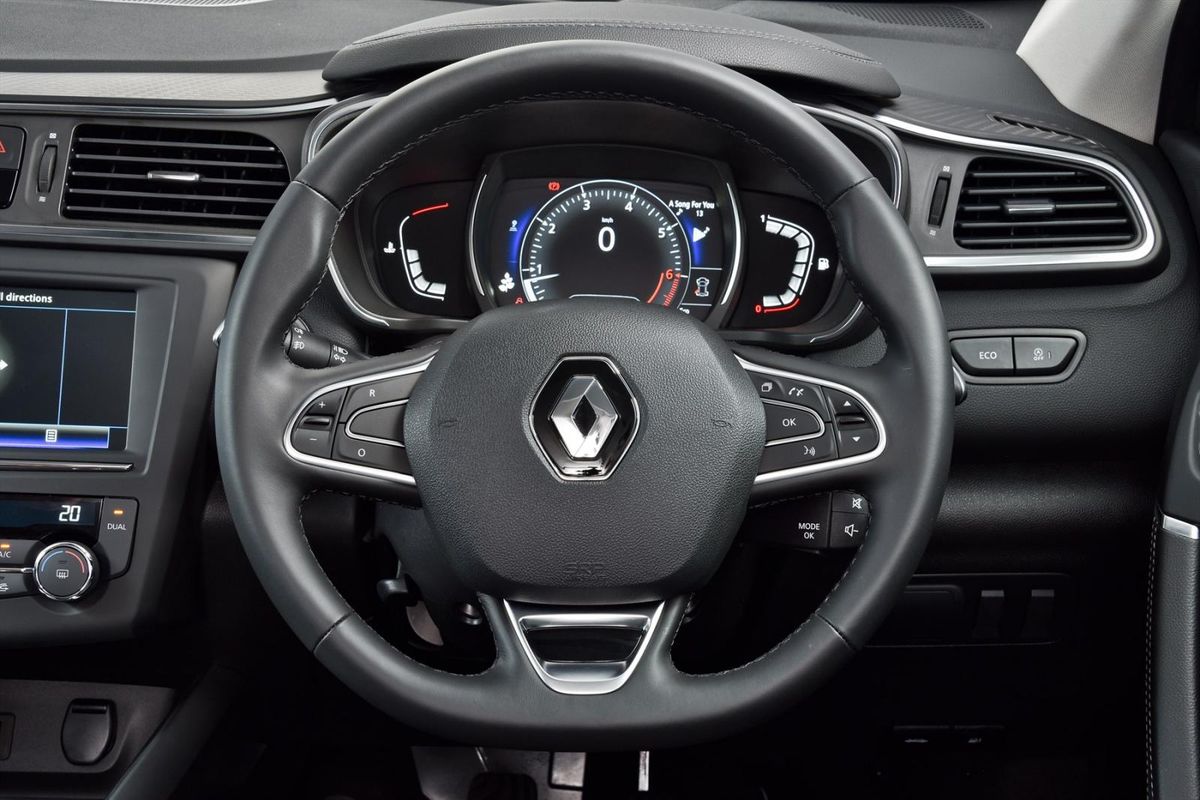
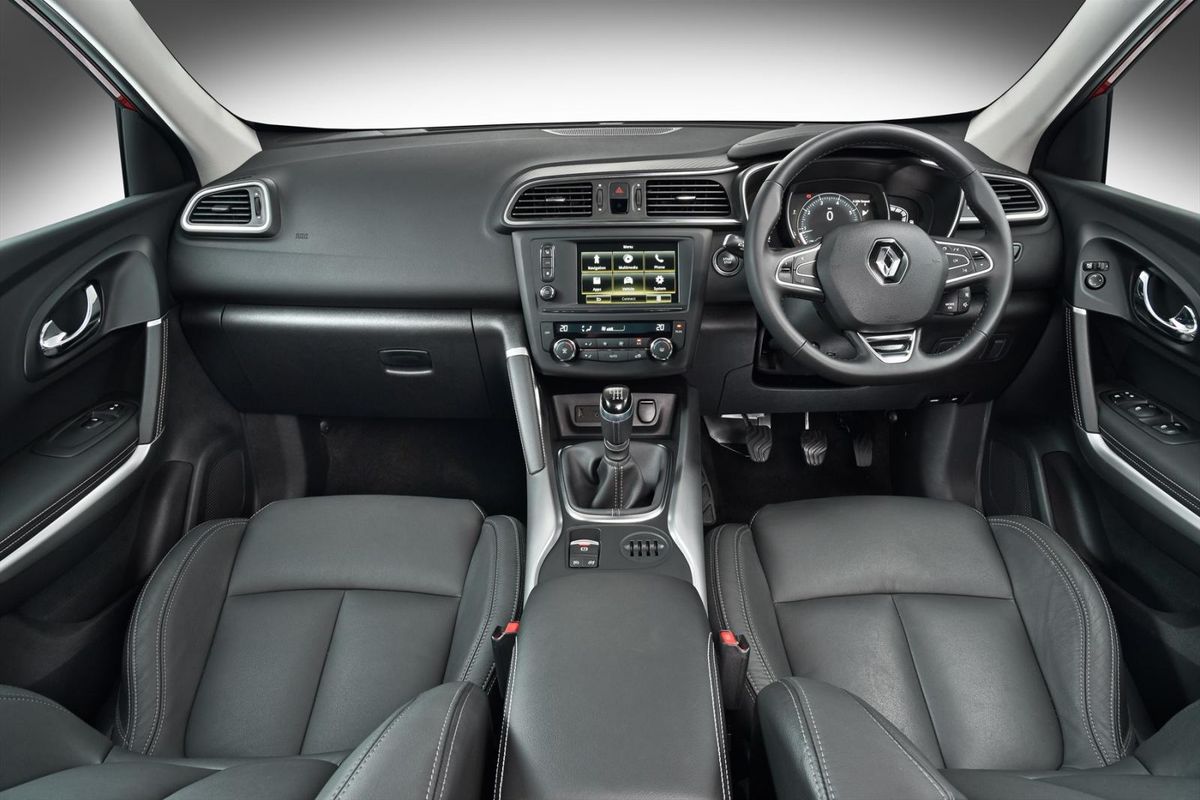
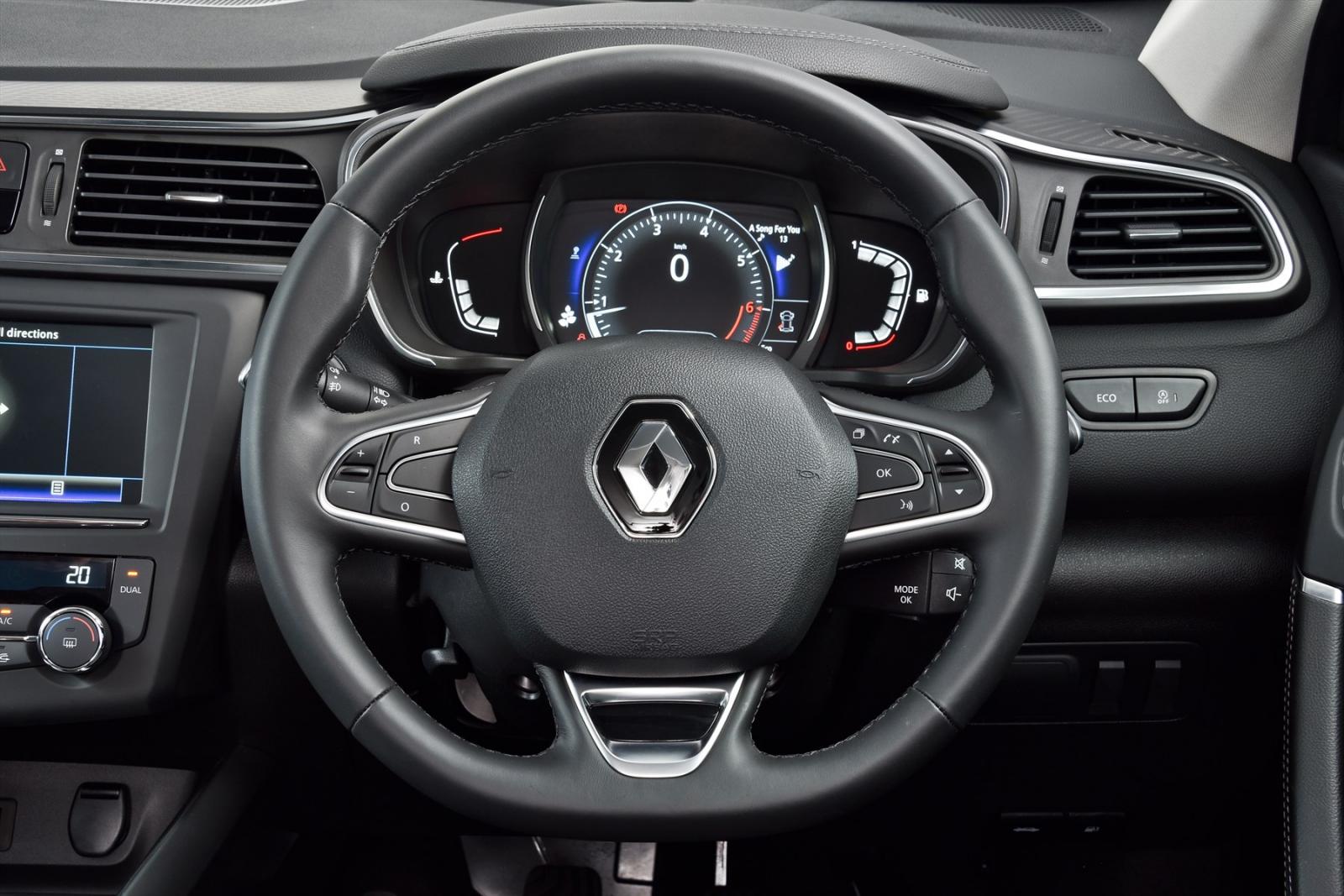
The Kadjar’s strong point is its up-to-date interior features. The entire instrument cluster is digital; it has a crisp display that is presented in a practical manner. The cluster’s colours and style can be changed through the infotainment system, but they’re all quite easy to read and display relevant information like RPM, speed, cruise control speed and a full trip computer. The infotainment system is loaded with many onboard features such as Bluetooth, USB and auxiliary capability and several different types of setting adjustments for the car and lights. In ECO mode, it will even give your driving a star rating with tips to help you improve the fuel consumption.
Beyond the colourful screens, the Kadjar’s interior is a bit grey. There isn’t much that attracts the eye around the cabin, but it is at least well appointed. Dual-zone climate control is standard as are two USB ports, navigation and park distance control. The notable options are the metallic paint at R2 500 and the self-parking system with all-round parking sensors at R10 000. Electrically adjustable, leather-upholstered seats that also offer heating, are also optional at R12 000 (front).
Fully digital display is crisp and very easy to read.
Ride and handling?
Despite the fact that the Kadjar was shod with optional 19-inch wheels, the test unit rode well. It’s quite stiffly damped so the wheels can drop into holes a bit harder than expected but for most of us, it won’t make a difference to the commute. It corners upright with weighted steering that’s pleasantly inspiring when you push on. Down a dirt road, the Kadjar rode impressively. The washboard dirt roads around the Western Cape shudder most vehicles to bits but the Kadjar held firm exhibiting no rattles and a quite exceptionally comfortable ride.
There is a switch to turn the Kadjar into a four-wheel drive "off-roader". When pressed the power distribution front to rear is locked into a 50:50 split. Owing to the Renault’s low profile wheels and ride height, it’s probably only best used for emergencies such as when your driveway is covered in ice.
Pricing
The top-of-the-range Kadjar that we have here is priced at R454 900. With all of the options available fitted to this model, it scrapes in at just under R500 000. The Nissan Qashqai line-up has a broader range of models available making it easier to find the one that fits your needs best. There’s also strong competition at a similar price point from the VW Tiguan and Jeep Renegade. Counting strongly in the Renault’s favour is its impressive 5yr/150 000km warranty, that is further backed up by a 5yr/90 000km service plan. Renault has also been making positive gains in customer satisfaction and parts availability in recent times.
Verdict
Renault’s new Kadjar is a compact SUV that offers good, as opposed to exceptional, value for money. The newcomer stands out by virtue of its generous interior specification as well as the impressive connectivity and number of standard features. It offers a pleasant driving experience, too; it handles well and rides comfortably on all surfaces. It’s a little short on outright load space, but does offer a full-size spare wheel as compensation. The engine is strong once moving, but it does suffer from a dead spot before the turbo kicks in at low RPM. Looking through the range, the 1.2-litre turbo petrol Dynamique may be the best choice since there’s no diesel auto available.
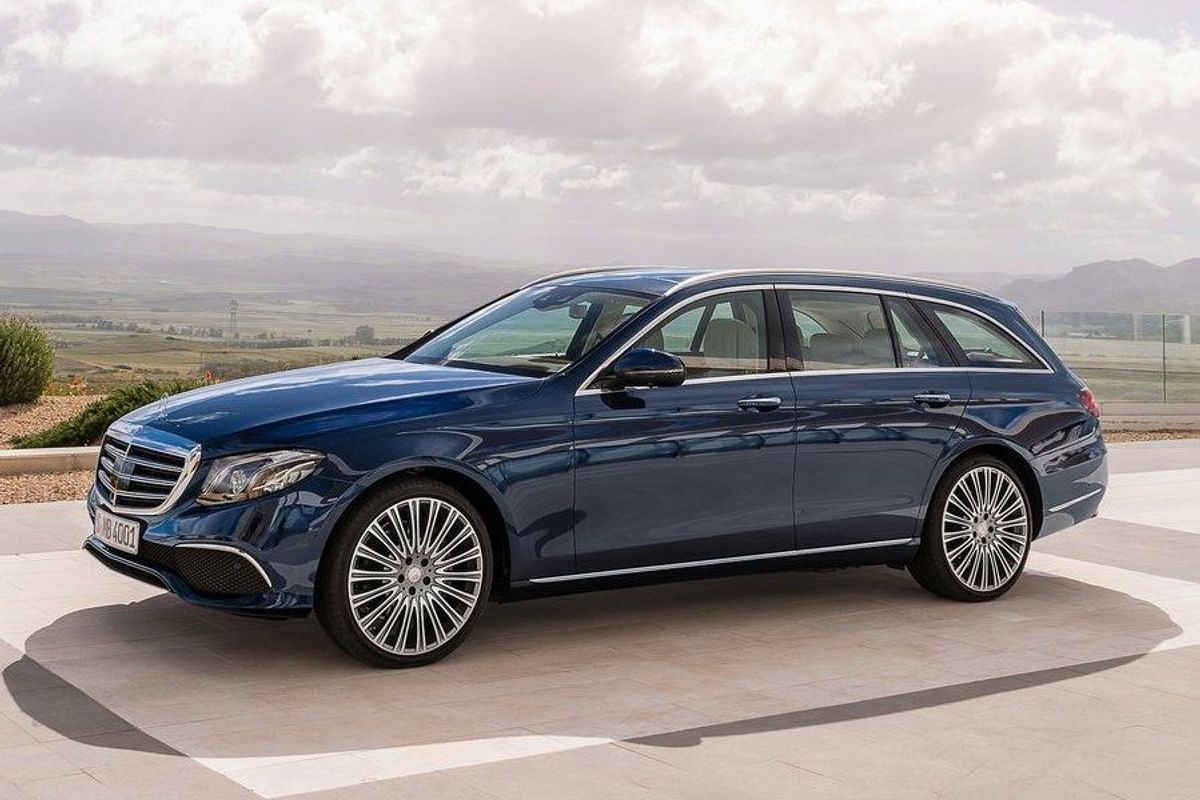
Mercedes-Benz recently launched the new E-Class in South Africa and the Stuttgart-based firm has consequently revealed the E-Class Estate, which is available in South Africa on a special order basis.
Earlier this year, we travelled to Portugal to sample the new E-Class and were mightily impressed by its intelligent technology and drive quality. The new E-Class was recently introduced locally and South African buyers should be well-pleased with this latest product from Mercedes-Benz. Station wagons don’t sell in big numbers in Mzansi but for those with a penchant for more space and versatility, the Estate version of the E-Class is available on a special order basis. Let’s take a closer look at what you can expect should you be interested in the E-Class Estate.
Sadly, due to lack of demand for station wagons in South Africa, we are only likely to receive the new E 250 Estate in South Africa. Various engine options are however available at launch in Germany. The E 200 kicks off the range offering 135 kW from its 2.0-litre turbopetrol engine. The next level up in the petrol range is the E 250, which will likely be offered here and it too is powered by a 2.0-litre turbopetrol but with 155 kW and 350 Nm of torque.
Diesel options include the newly developed 2.0-litre turbodiesel engine in the E 220 d with 143 kW, while an E 200 d and E 350 d will be introduced at a later stage. For more power, look to the E 400 4MATIC, offering 245 kW from its 3.0-litre V6. The Mercedes-AMG E43 4MATIC tops the range with 295 kW form its 3.0-litre V6 engine, but it won’t be offered locally. A new 9G-TRONIC nine-speed automatic transmission is offered as standard across the E-Class Estate range.
Increased versatility
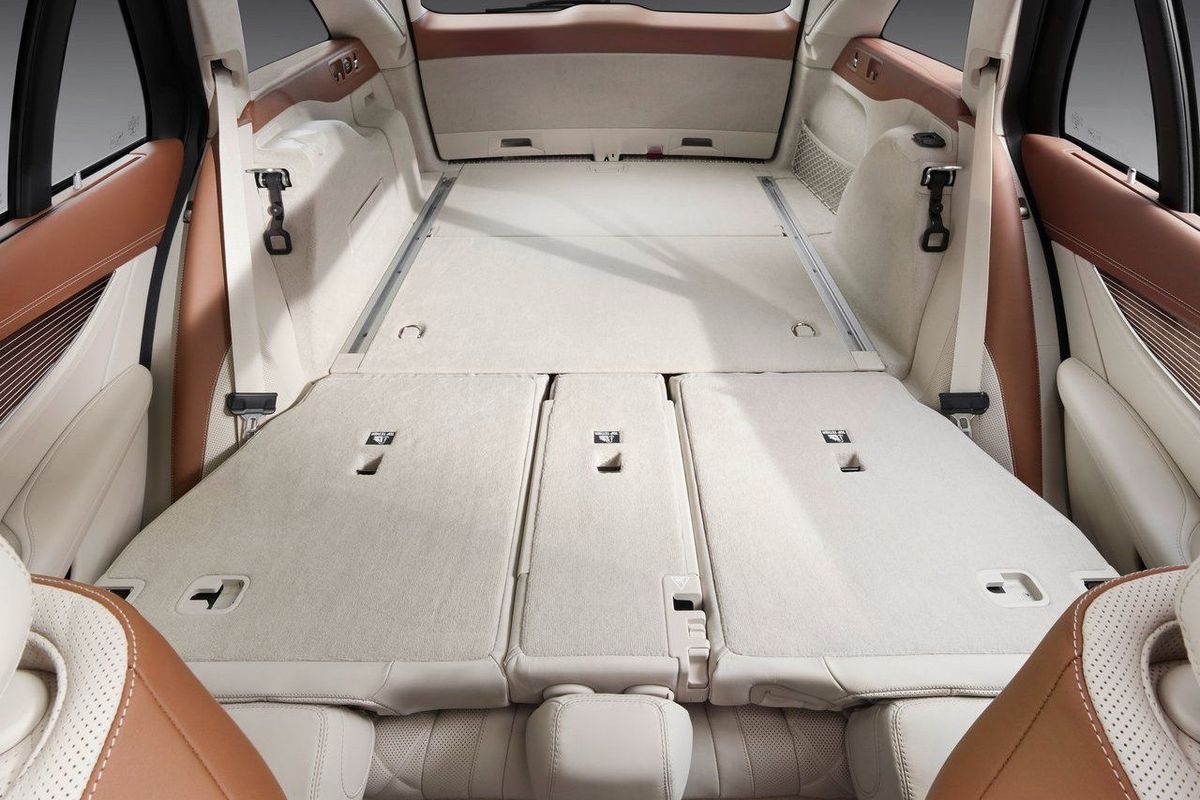
The E-Class Estate boasts large carrying capacity with 670 litres of boot space that increases to a sizeable 1 820 litres. The rear bench is now split 40:20:40 as standard and can be adjusted at a 10-degree steeper angle, improving space even further. A cargo cover and net is also provided to conceal goods from prying eyes and an electromechanical tailgate is operated at the touch of a button and can be opened or closed at the required angle. The tailgate is also automatically opened with a swipe or kick of the foot under the rear bumper. An electrically retracting tow bar is also fitted.
Self-levelling air suspension if offered as standard and ensures that the vehicle remains horizontal, even when under heavy load or when towing.
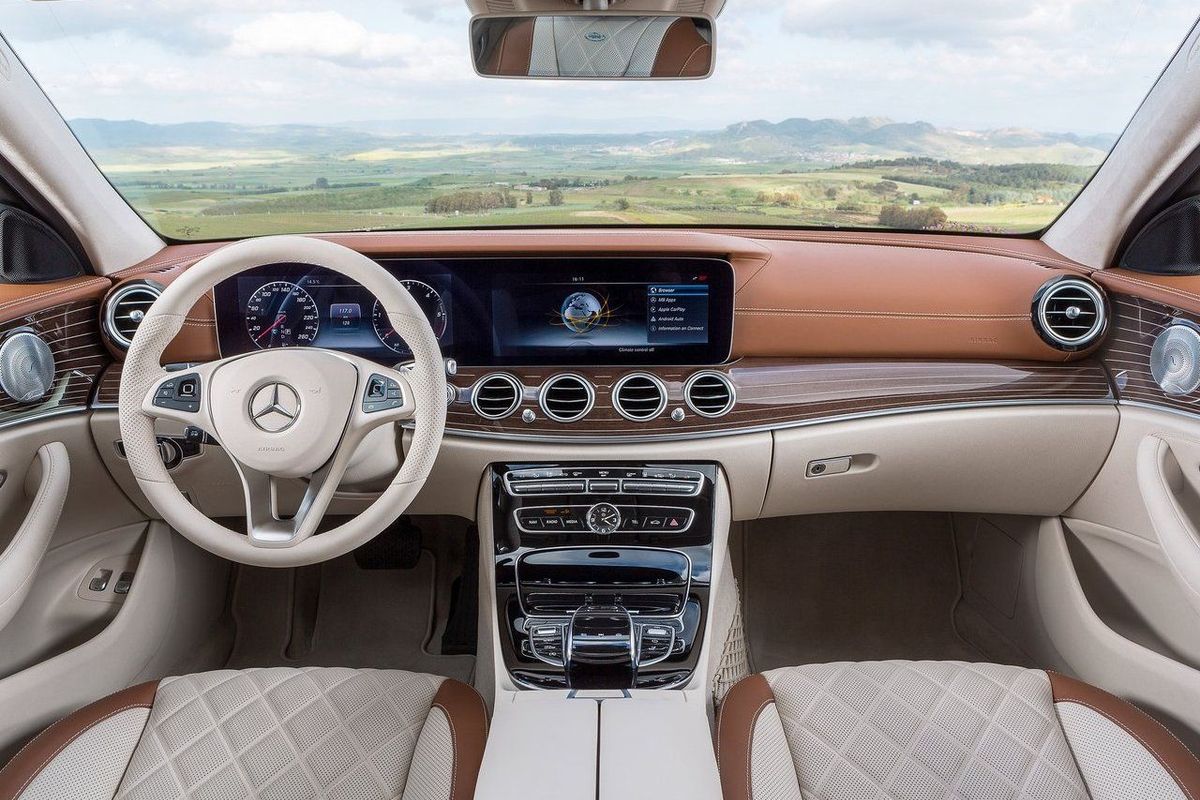
The exterior and interior design mimics that of the new E-Class and the Estate is offered with a number of safety and comfort features to make life easier for the driver. Technological highlights include Drive Pilot, which maintains following distances to the car ahead at speeds up to 210 kph and Remote Parking Pilot that allows you park the vehicle using a smartphone app.
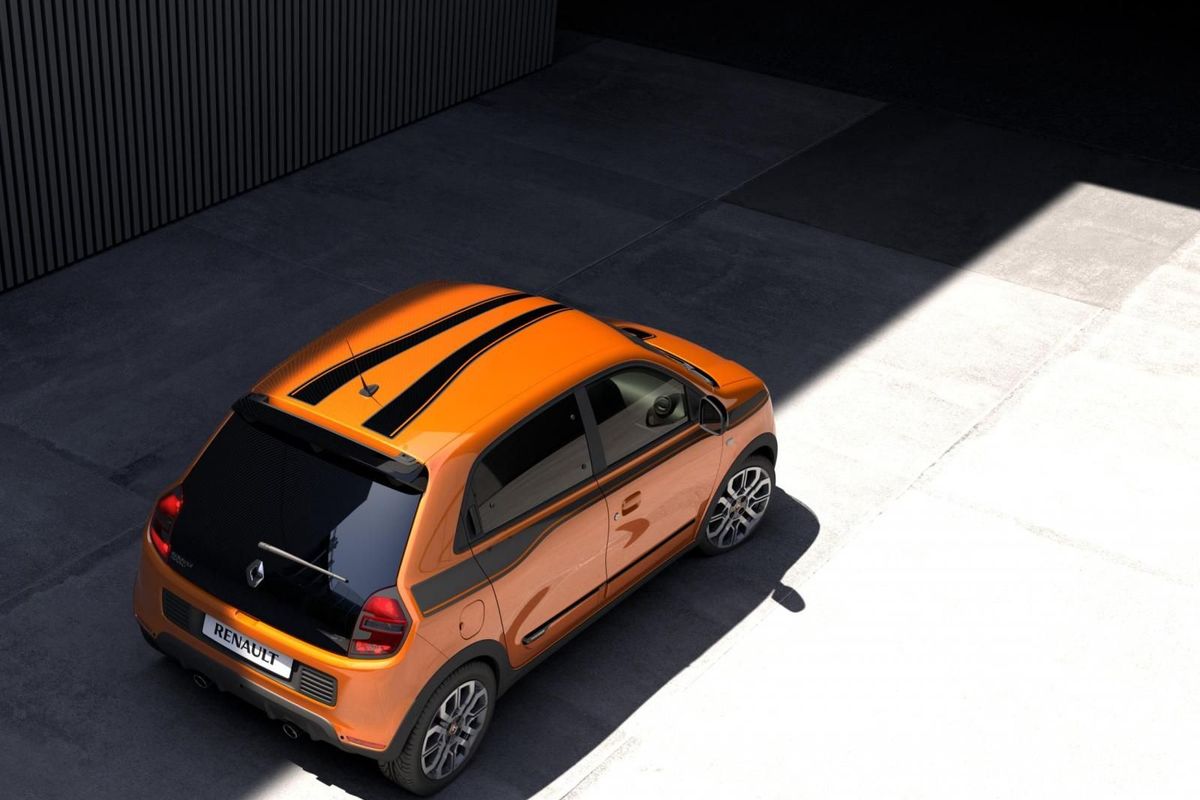
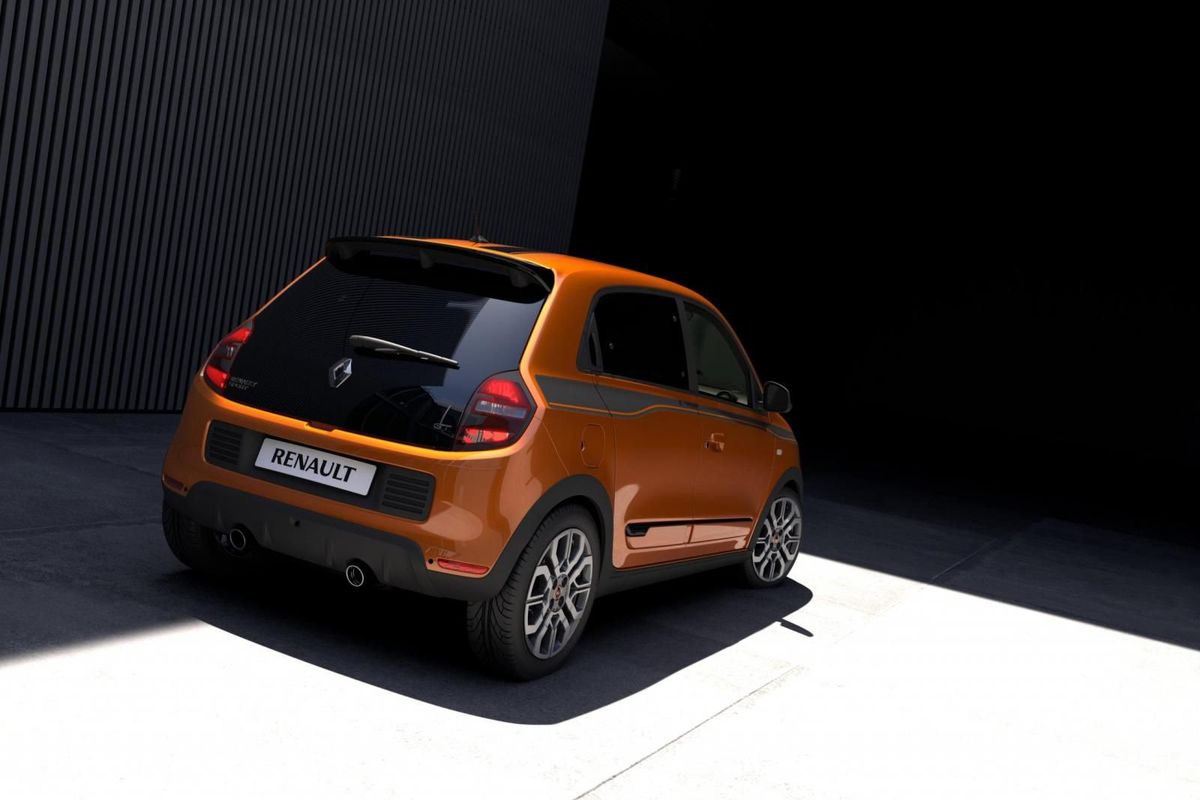
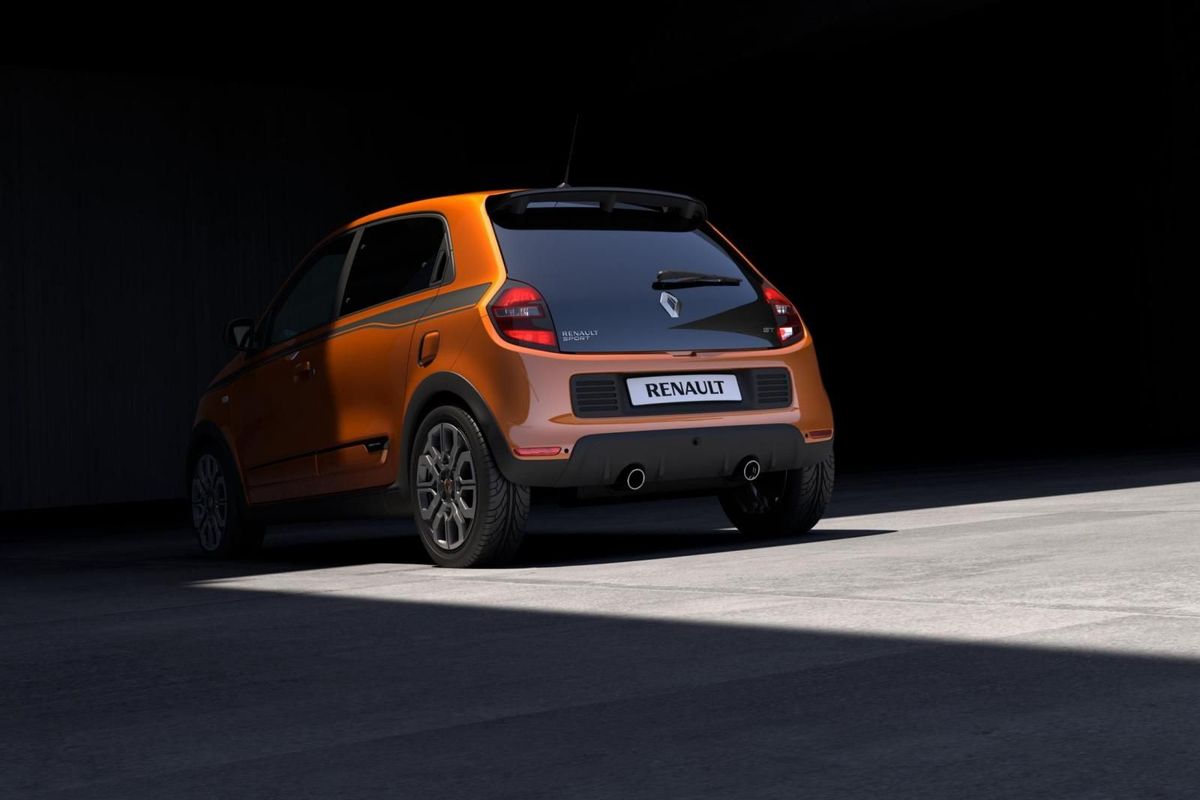
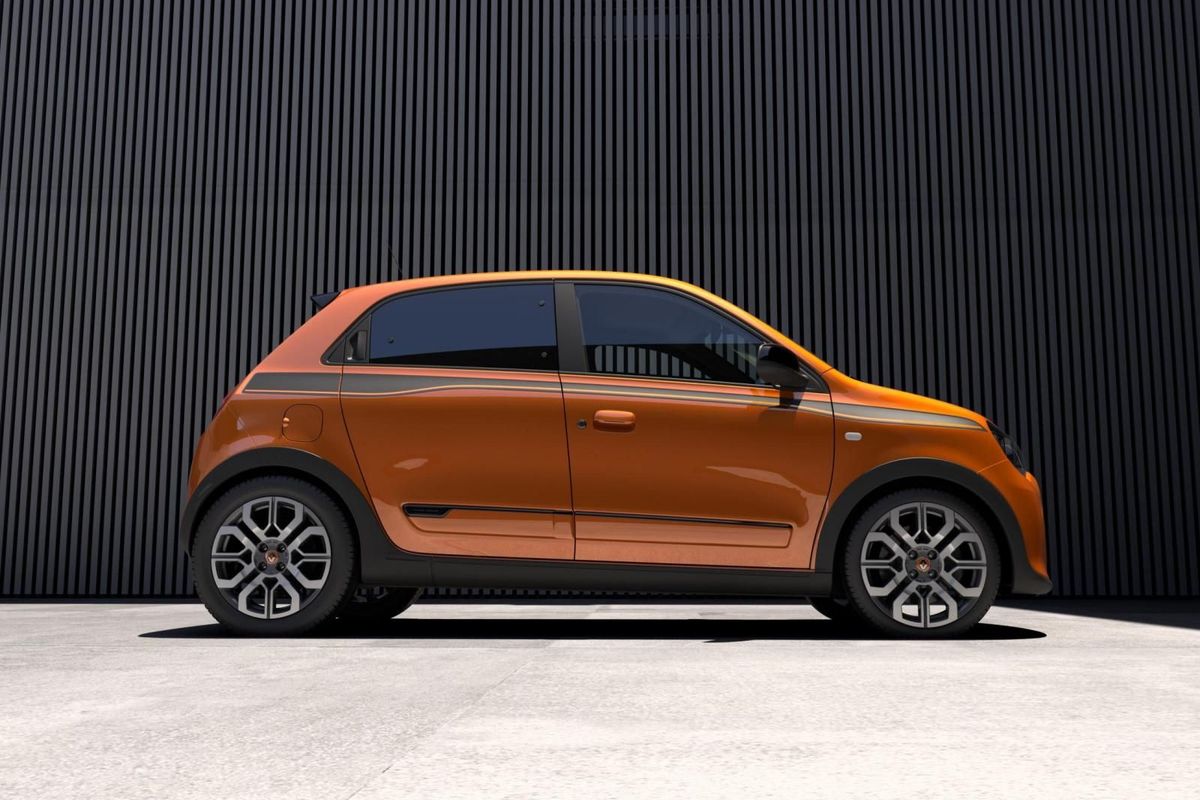
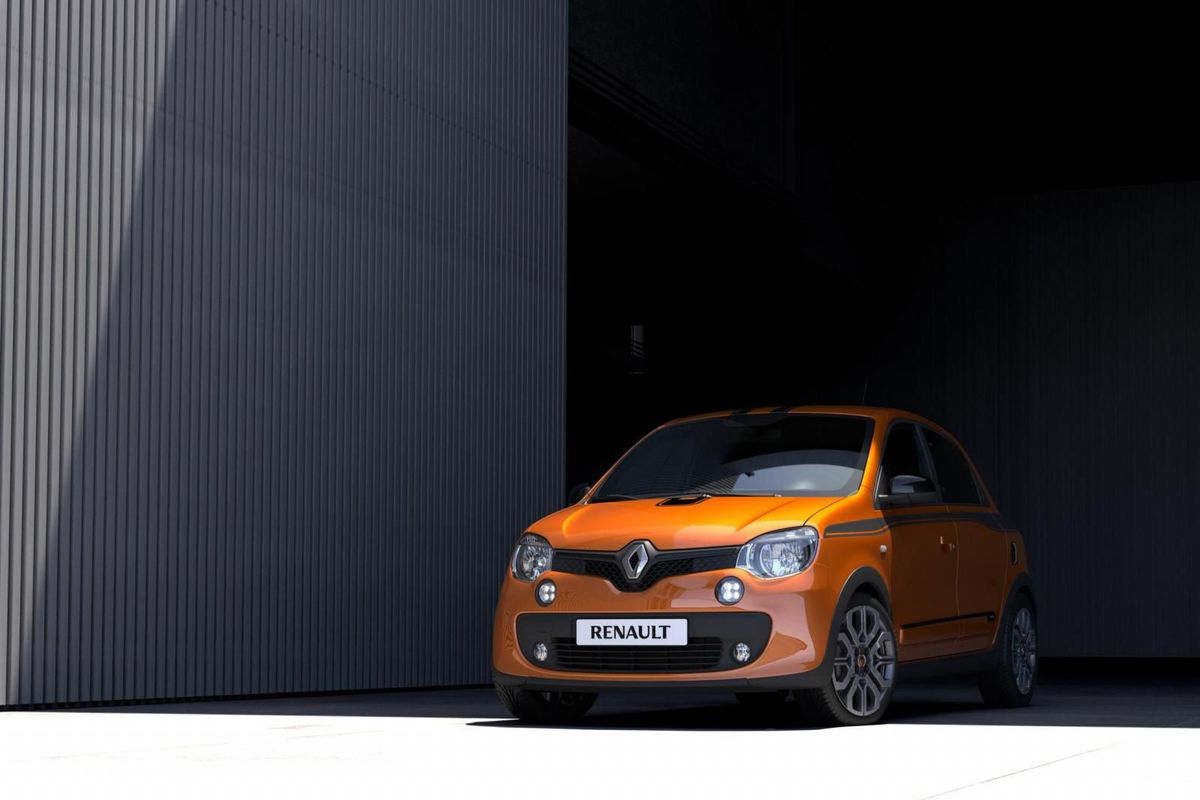
Renault has revealed a sporty version of its rear-wheel-drive city car, the Twingo, in Europe.
The new Renault Twingo GT's design is inspired by the Twin’Run Concept of 2013 which, in turn, channelled the spirit of other rear-wheel drive compact Renaults of the past, such as the R5 Turbo and Clio V6. The new Twingo GT is a little tamer but still has plenty of sporty styling cues.
Under the bonnet of the Twingo GT is the 898cc turbo engine that does duty in the Clio. Its power output has been pushed up a little to deliver 82 kW with 170 Nm of torque on tap. The boost in power comes courtesy of a revised air intake system and some clever engine mapping. The Twingo GT also gets slightly different gearing to try and enhance its sporty demeanour.
Providing some visual pep are 17-inch wheels, lateral air intakes, twin exhaust tailpipes and new orange body colour.
The Twingo GT will make its first appearance at the Goodwood festival of Speed later in June 2016. The Twingo shares a platform and much of its character with the Smart ForFour and ForTwo which are on sale in SA currently and which we drove earlier this year. This Twingo GT is unlikely to ever go on sale in South Africa, but it does hint at the possibility that Smart may be open to bringing a more powerful version of the ForTwo to South Africa or even to a special Brabus edition.