Mahindra has made a name for itself in the local market thanks to a product line-up that comprises SUVs, large crossovers and bakkies, but now the Indian brand is targeting a young target market with a small crossover: the KUV100. Let's take a closer look.
The KUV100 falls into a segment that has become very popular in a short space of time, but could it prove a "game changer” for Mahindra and indeed the value-positioned compact crossover segment into which it has been introduced?
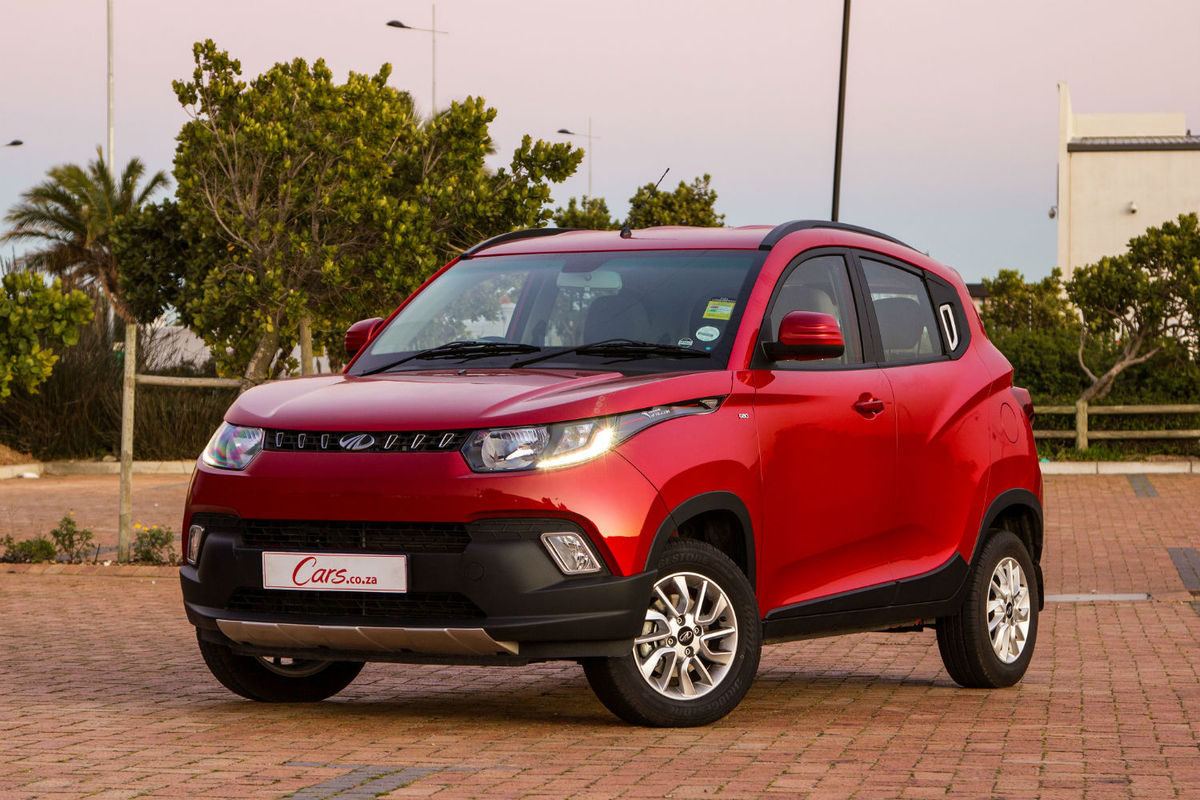
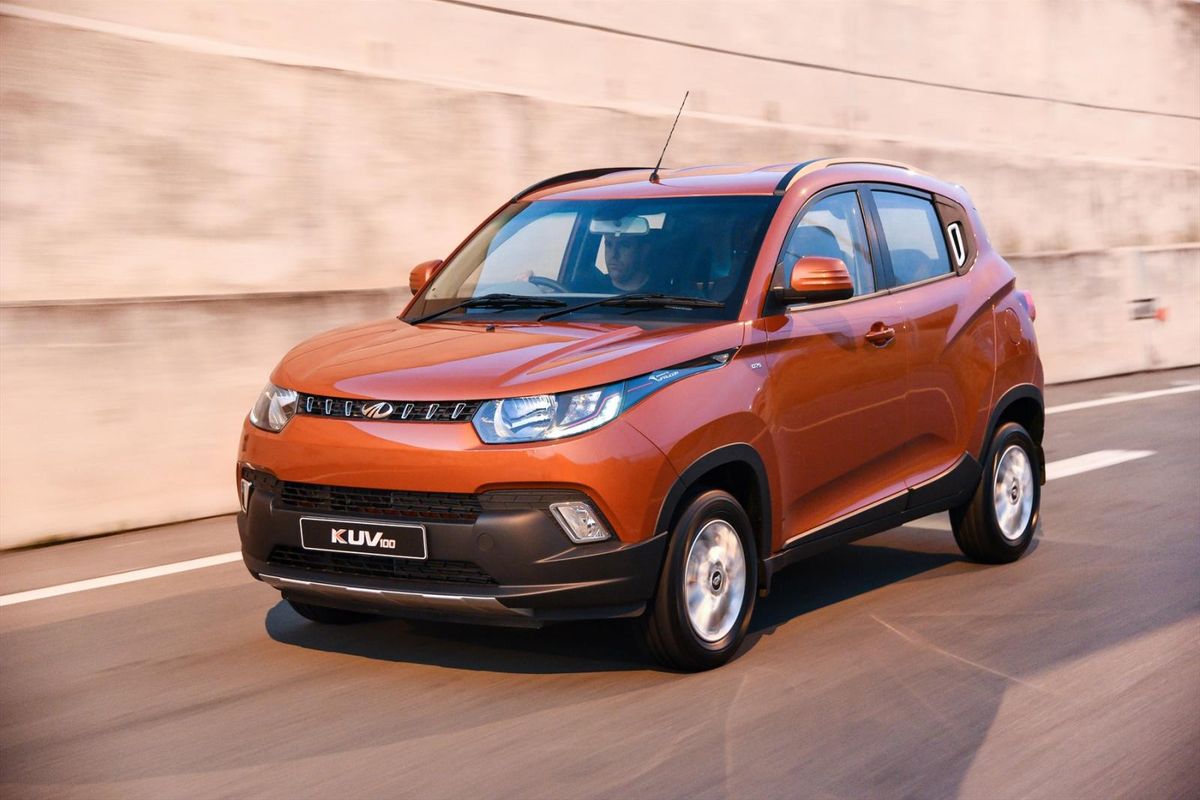
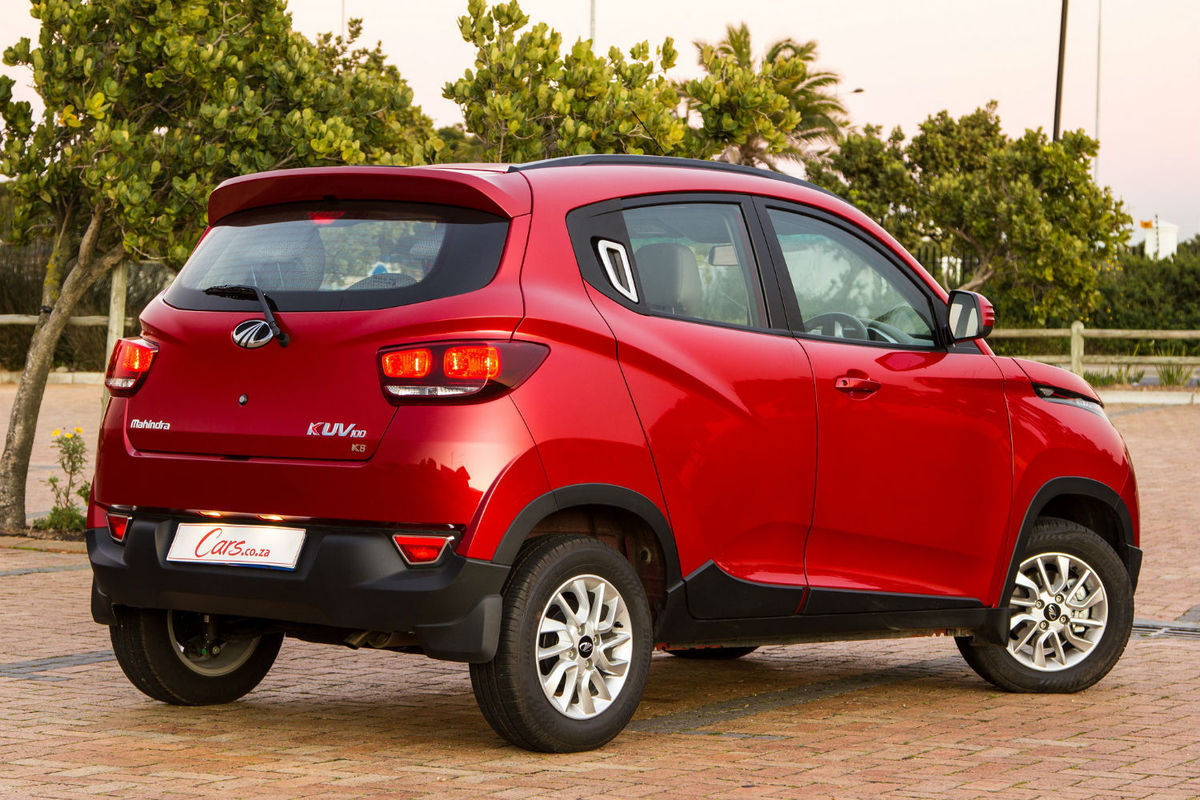
Aesthetically-speaking, the newcomer makes a good first impression. Mahindras aren't the most attractively styled vehicles in the market, but the KUV100 boasts a modern design with fewer, let's say "divisive", features than those of its siblings, especially the striking XUV500… This one seems to have received the good genes in the family, thank goodness.
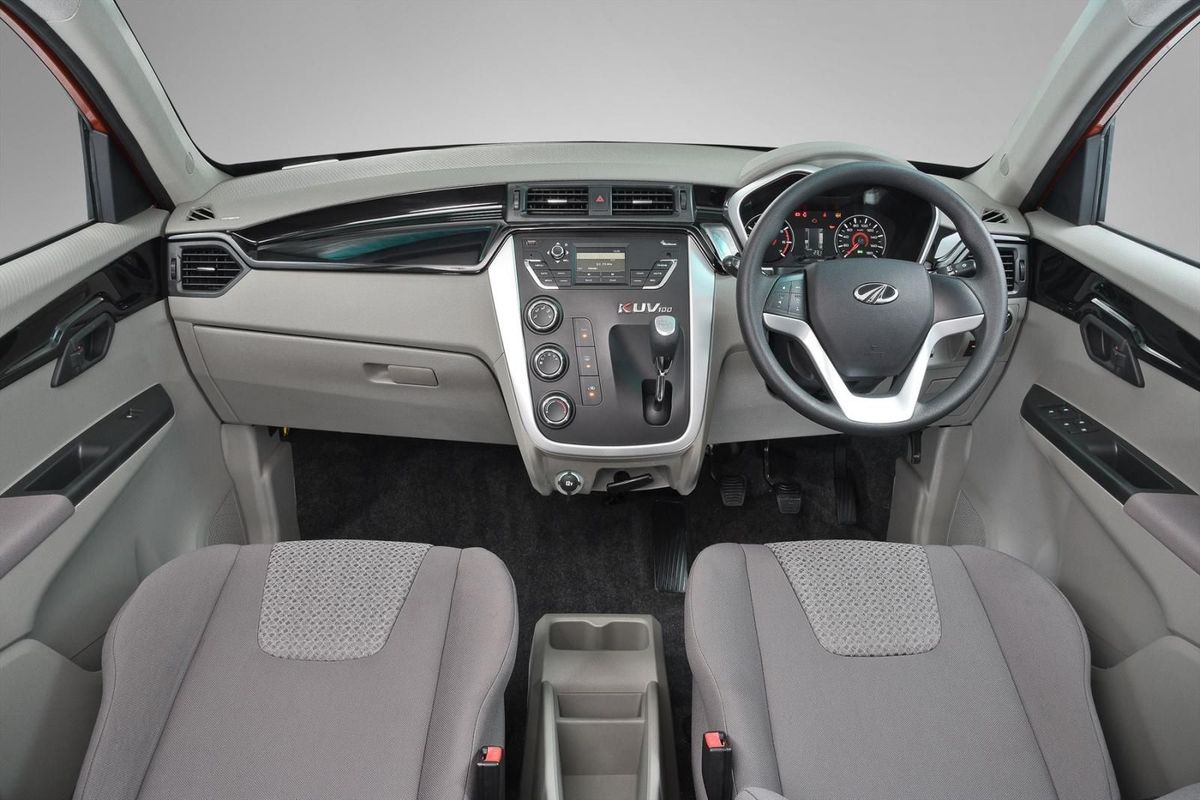
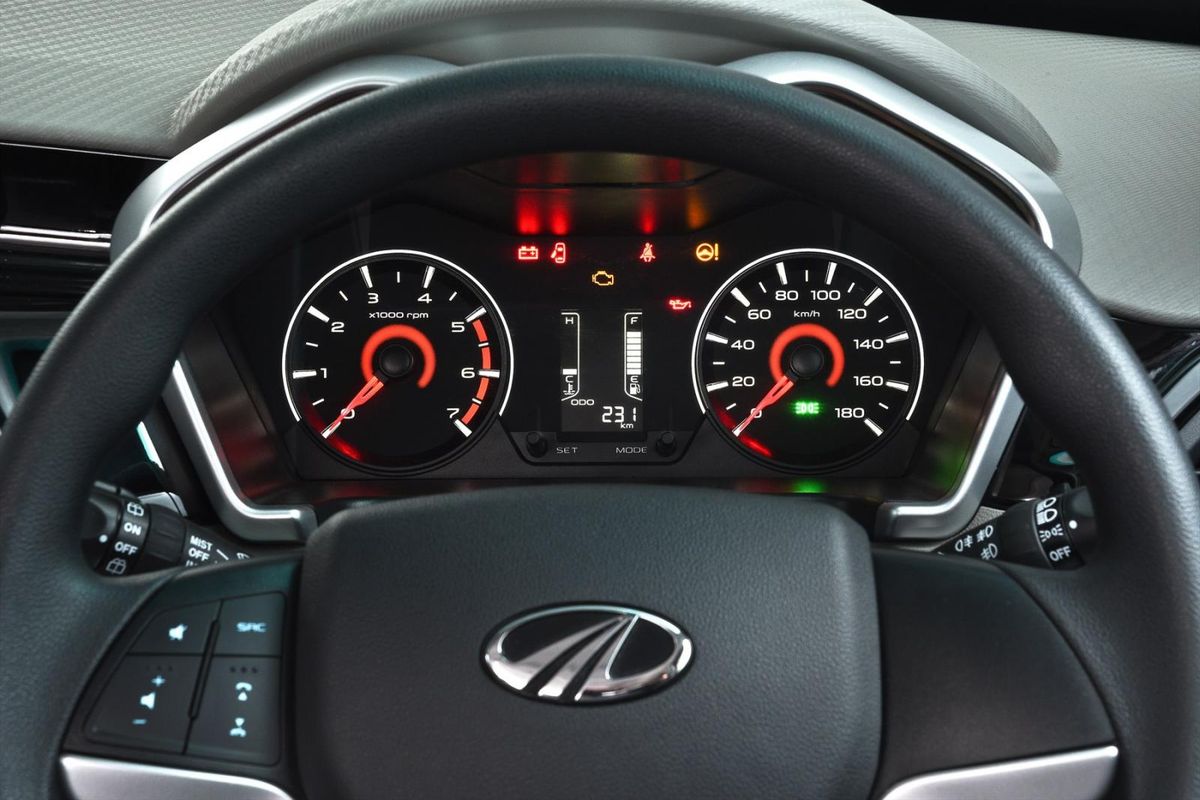
The quality of the Mahindra's interior is of an adequate standard for an entry-level car, but swathes of hard plastic surfaces dominate the cabin. Ergonomics are good too – the driving position is high and upright, plus major controls and switchgear are within easy reach, even though the “pull and twist” handbrake lever feels decidedly old-school.
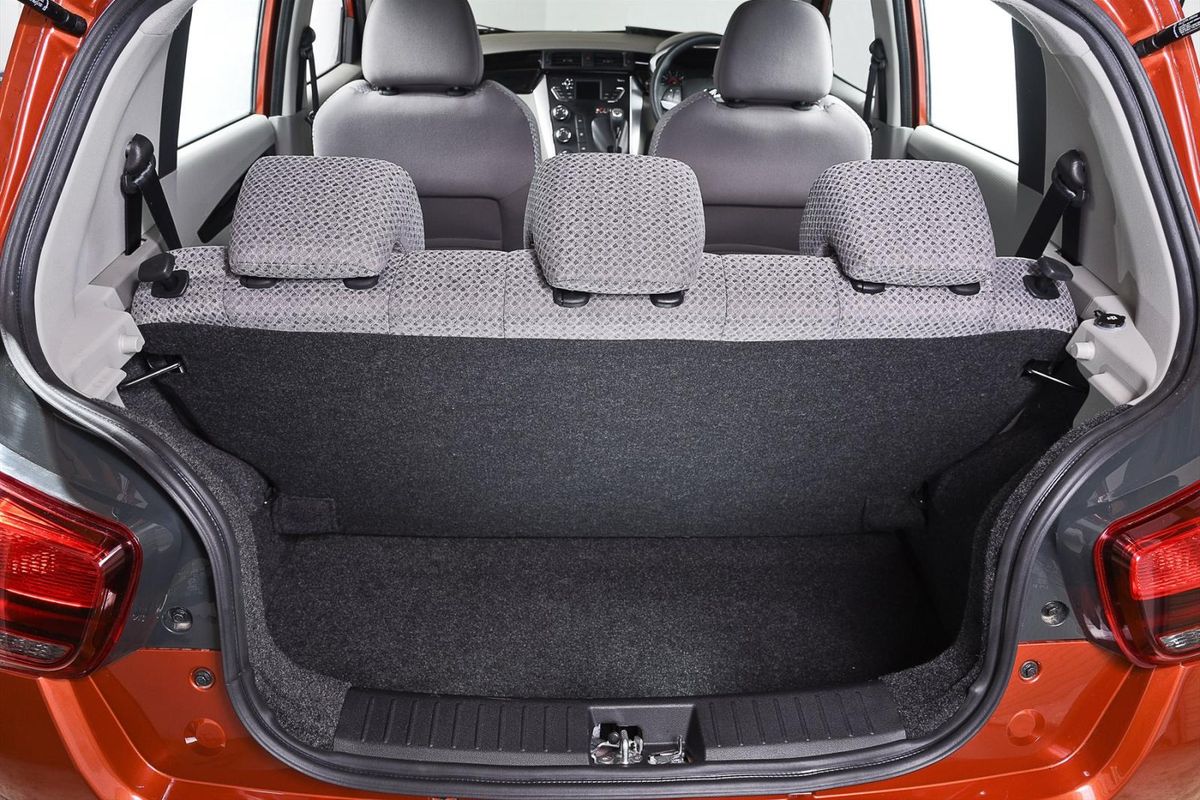
The Mahindra certainly looks every bit a crossover (a small family vehicle that's styled like an SUV), but its luggage capacity is relatively snug, even though the one-piece rear seatback can be folded forward for more utility space. As for everyday practicality, the light-coloured seat and door trims will require extra care to keep them free of soil- and scuff marks…
Does it have a personality?
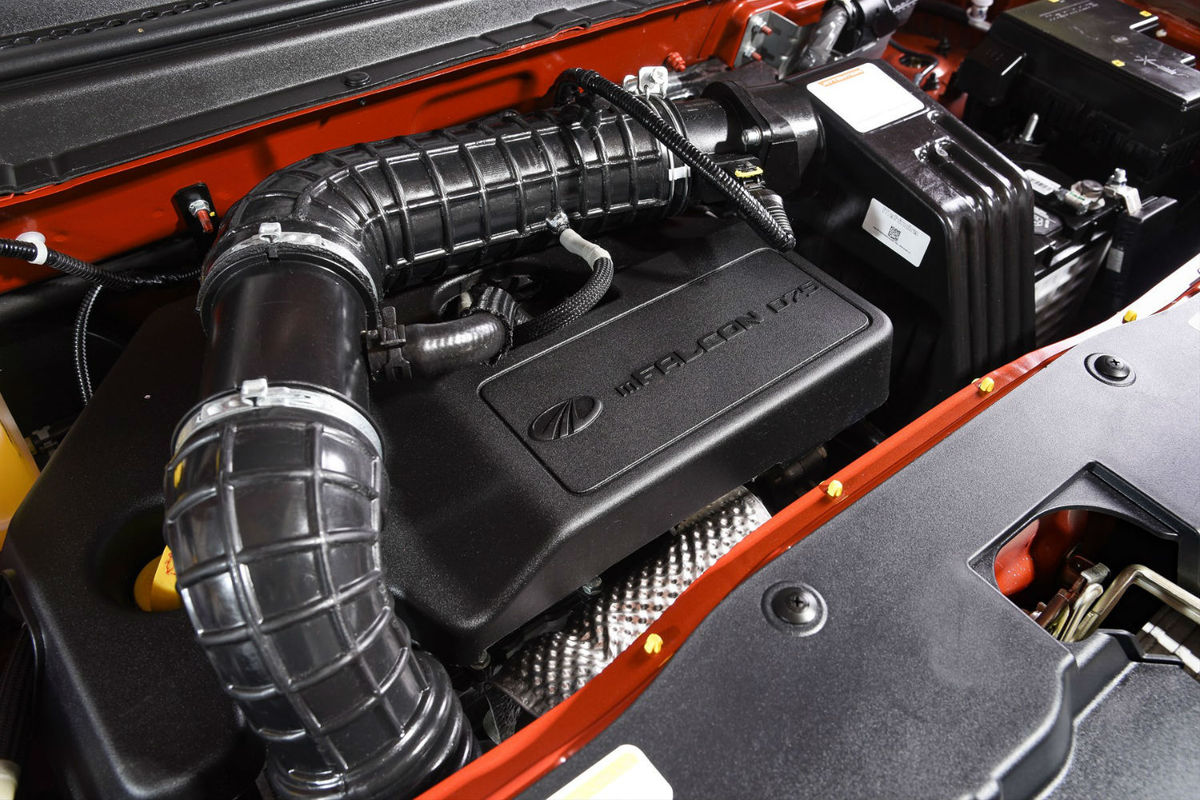
The range comprises entry-level K4+, middle ground K6+ and top-of-the-range K8 derivatives and, unsurprisingly, Mahindra provided us with dolled-up K8 turbodiesel and petrol versions to drive on the evaluation route. A peak power output of 61 kW (for the petrol motor) does not sound like much, but considering that the vehicle only weighs around 1 100 kg, the engine produces just enough power for its driver to potter along at comfortable speeds in urban driving conditions and the gearbox's shift action is slick and reasonably direct.
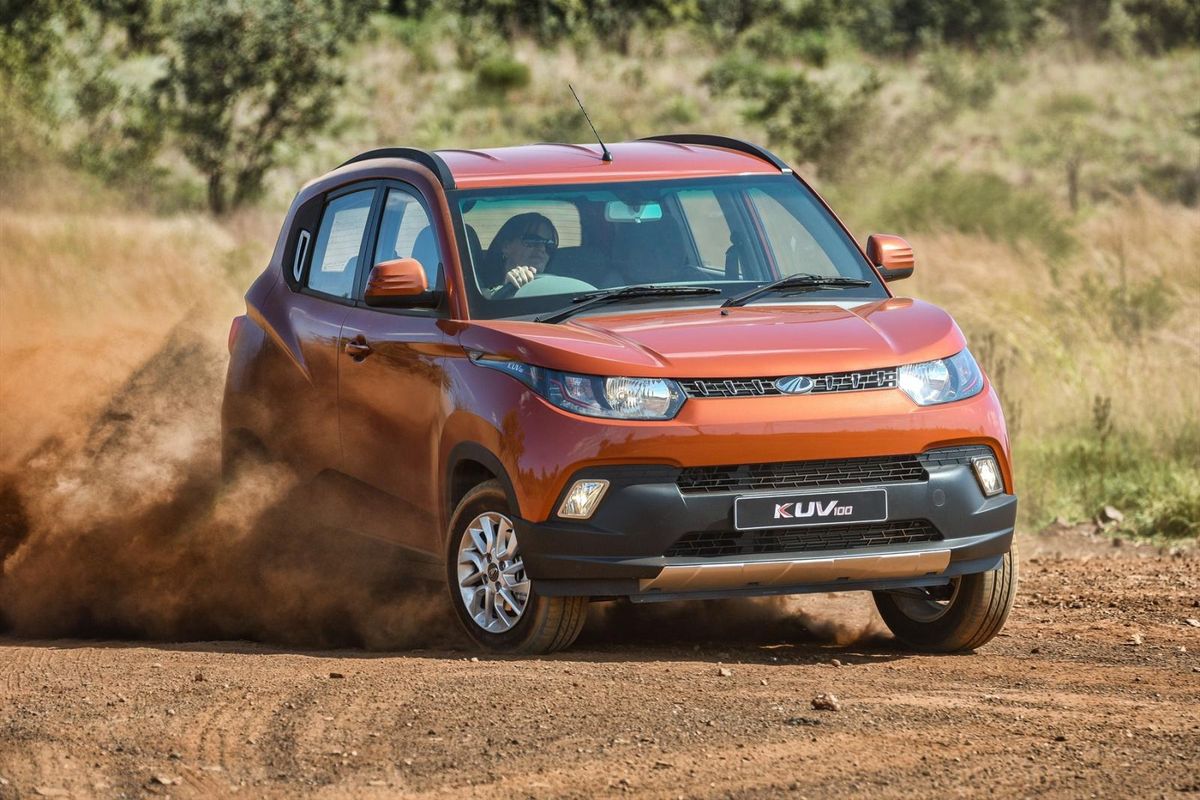
What's more, from behind the wheel, the KUV100 feels planted and wieldy despite its low kerb weight. This was emphasised over a stretch of gravel road, a terrain that proved that the KUV100’s ground clearance of 170 mm does make a difference.
The 57 kW turbodiesel may be down on power, but offers more torque (190 Nm versus the 115 Nm in the petrol). This makes the former a much more enjoyable car to drive compared to the petrol, because of better overtaking ability. Another benefit of the turbodiesel is a claimed average fuel economy figure of 4.4 L/100 km compared to the petrol version's 5.9 L/100 km.
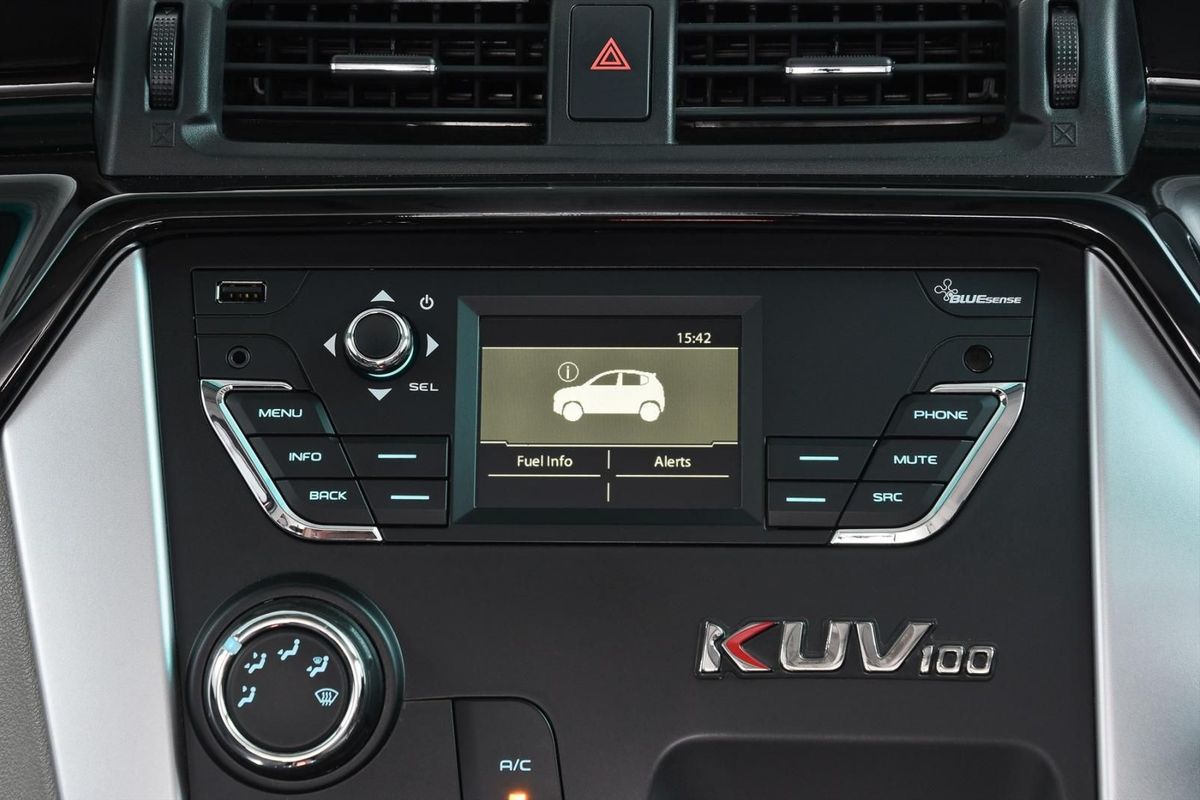
As a value proposition, the KUV100 comes decently packaged. ABS with EBD, traction control and dual airbags are standard throughout the range. The K6+ and K8 feature a Power Eco-Mode for efficiency and the K8 even has stop/start functionality. Entertainment features such as Bluetooth, USB and auxiliary inputs are all standard, which will be a boon to the KUV100's younger target audience.
Summary
The KUV100's biggest challenge is the extremely competitive market in South Africa, which is largely influenced by brand bias. Mahindra has targeted a youthful clientele, but the firm has never been positioned as a cool, fun and retro brand on local soil. South Africans think "brand" first and "price" second and even though the Mahindra KUV100 starts off at a very reasonable R149 995, there are other options from popular brands that have been playing in this space for longer. Having said that, the KUV100 is an honest car that offers a good level of standard features. Mahindra is a growing brand in South Africa… perhaps a car like this will help more people to warm up the Indian marque's passenger vehicle line-up.
Mahindra KUV100 prices in South Africa
1.2 K4+ Petrol R149 995
1.2 K6+ Petrol R169 995
1.2 K6+ Turbodiesel R187 995
1.2 K8 Petrol R179 995
1.2 K8 Turbodiesel R197 995
Pricing includes a 3-year/100 000 km warranty on all models, and a 3-year/50 000 km service plan on the K6+ and K8 derivatives (optional for K4+).
Ford Mustang 2.3 EcoBoost Convertible Automatic (2016) Review
The Ford Mustang has been exceptionally well-received in South Africa and the rumbling 5.0-litre V8 GT Fastback version has garnered most of the attention – but what about the 2.3 EcoBoost motor in convertible automatic guise? Does the EcoBoosted 'Stang offer enough kick? We find out…
We Like: Head-turning styling, cruising ability, drivability
We Don’t Like: Interior build quality, lurchy transmission
Alternatives
For something more premium: You may want to consider the Mercedes-Benz E250 cabriolet (R802 720). The E250 is powered by a 2.0-litre turbopetrol engine that offers 155 kW and 350 Nm of torque. Despite being outmuscled by the Mustang, the Benz is stylish too and its interior build quality top notch. Much of the same can be said for the Audi S3 Quattro cabriolet that offers 206 kW and 308 Nm of torque from its 2.0-litre turbo engine and comes at a price of R699 500. These alternatives, however, don’t exhibit the same character as the Mustang.
For more power: The Mustang offers a solid power output of 233 kW, but for almost R80 000 less you can buy the Infiniti Q60 GT cabriolet (R701 687) propelled by a 3.7-litre V6 engine capable of 235 kW and 360 Nm. If you want more power than that, you will have to fork out much more money for something like the BMW 440i Convertible for R895 446.
Since its arrival in South Africa, the Mustang has received undivided attention from musclecar fanatics, the motoring media and the general public. Not too long ago, we tested the Mustang 5.0 V8 Fastback Automatic and found it to be enthralling to look at and surprisingly engaging to drive. Despite its shortcomings, it proved hugely pleasurable to pilot and its road presence is near-impossible to match – it's guaranteed to get more attention that far more expensive exotic machinery. These facts translate into excellent business for Ford, who can’t import Mustangs fast enough. For prospective buyers, however, the frustration is all too real as every incoming example is accounted for, for at least for the next two years…
Nonetheless, purists will undoubtedly bemoan Ford's decision to plant a 4-cylinder 2.3-litre EcoBoost engine into the engine bay of what is supposed to be a dyed-in-the-wool "there's no replacement for displacement" musclecar. This "downsized" Convertible begs the question: is the EcoBoost motor worthy of dancing in a Mustang or does it do the product an injustice?
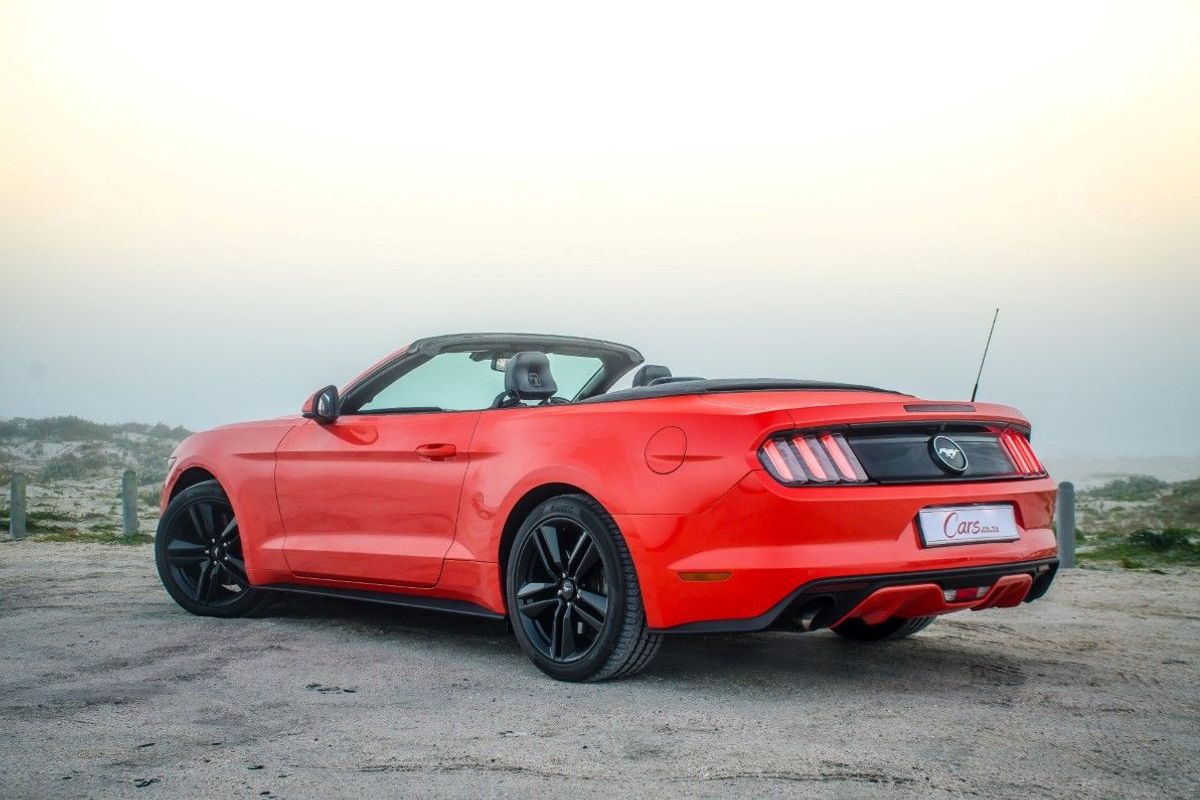
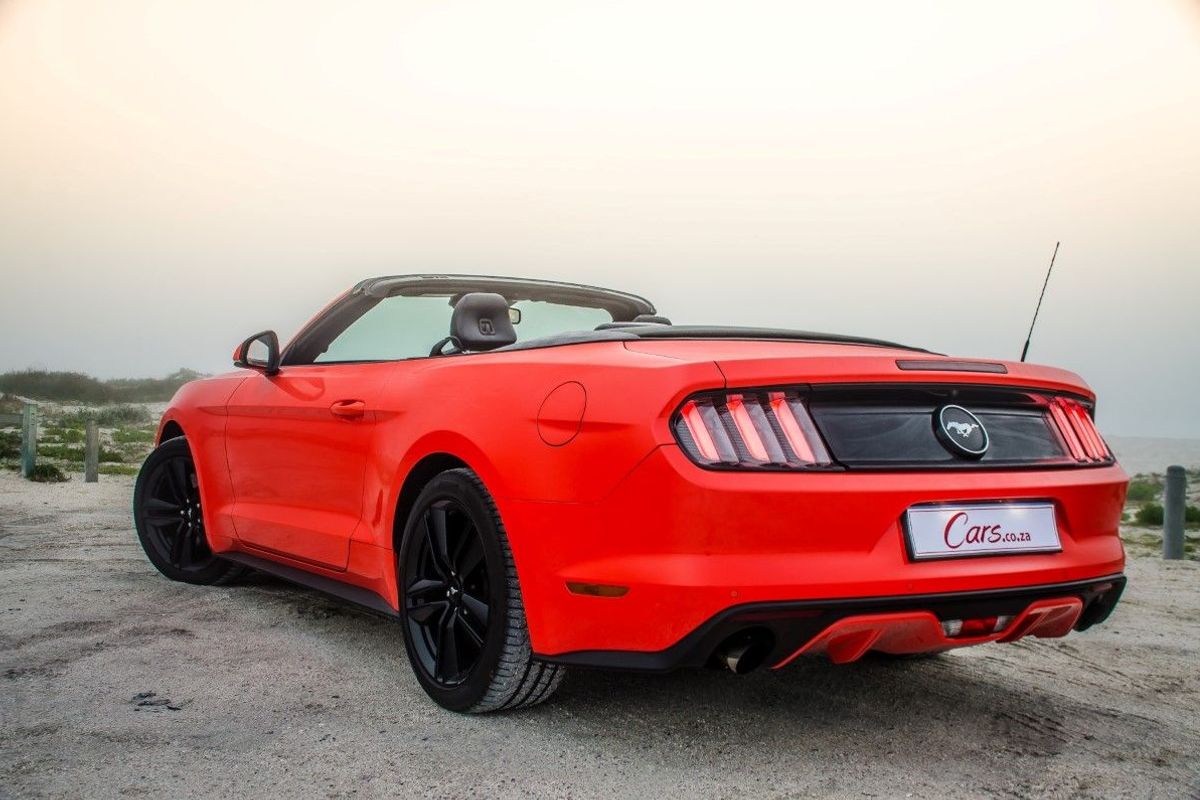
The Mustang has lots of road presence and will attract many onlookers.
Head-turning ability?
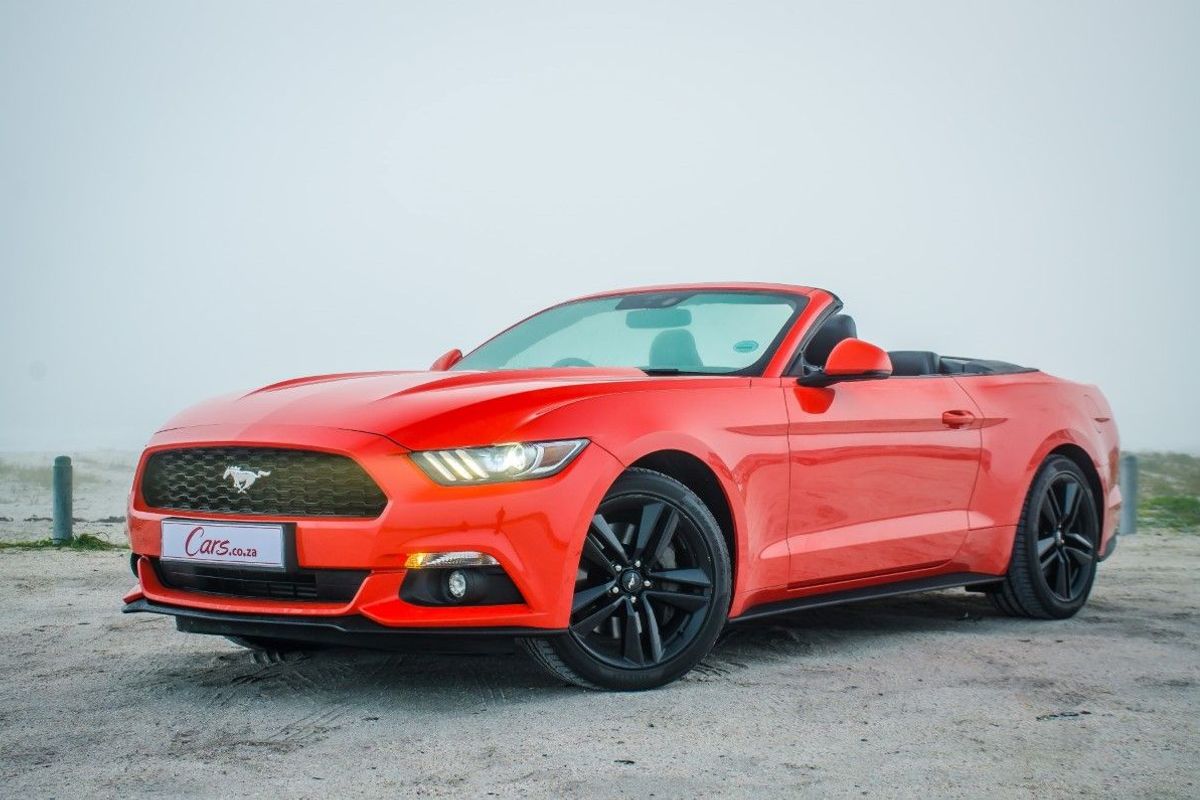
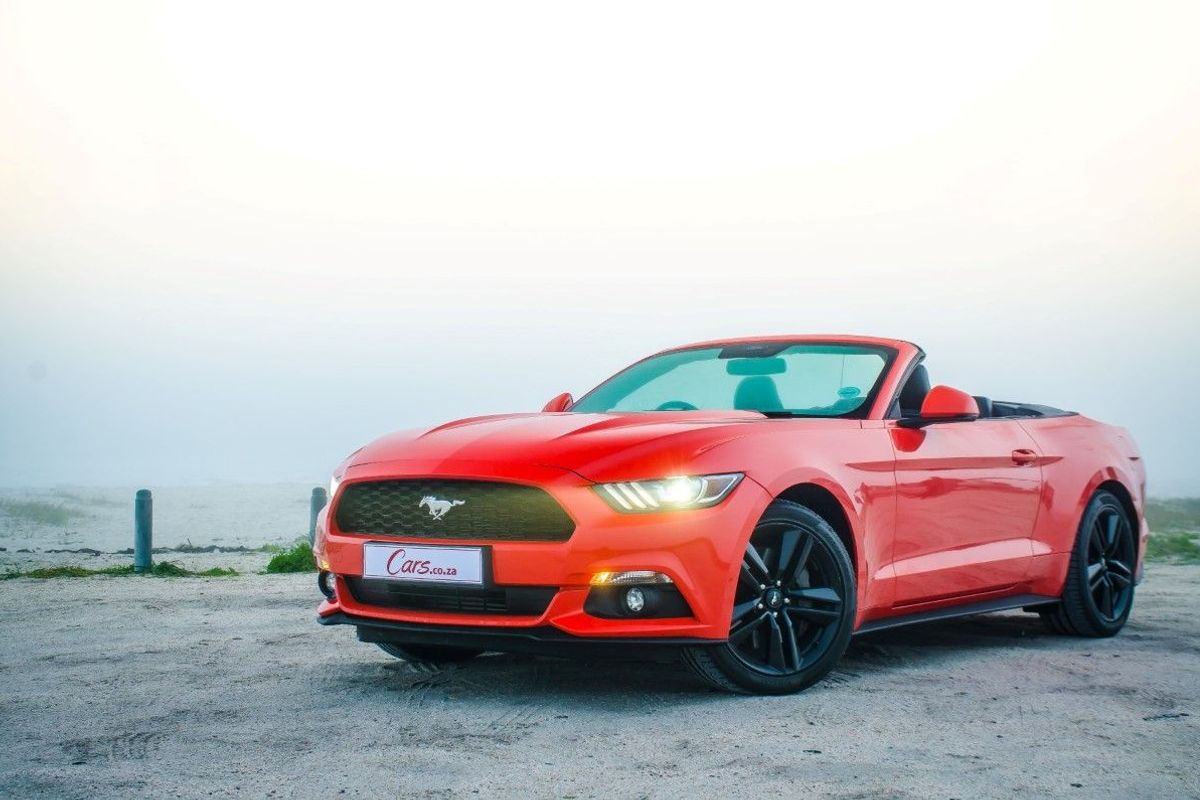
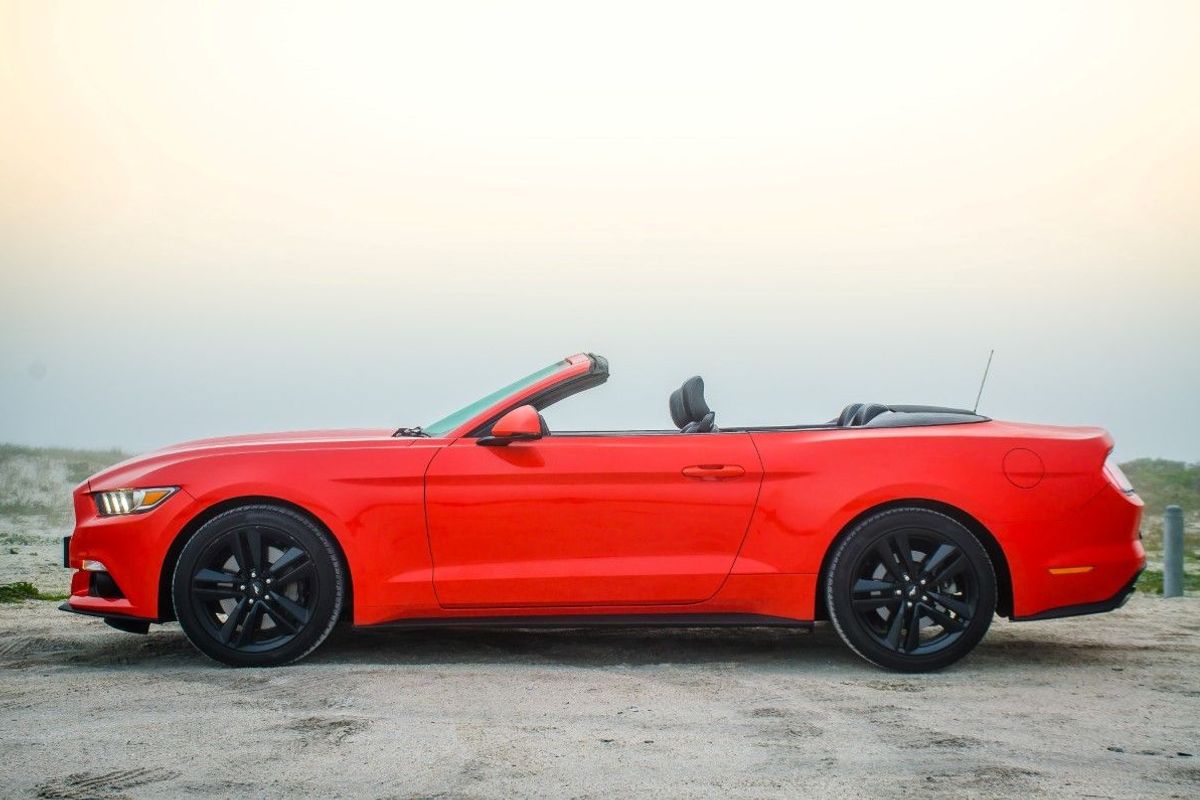
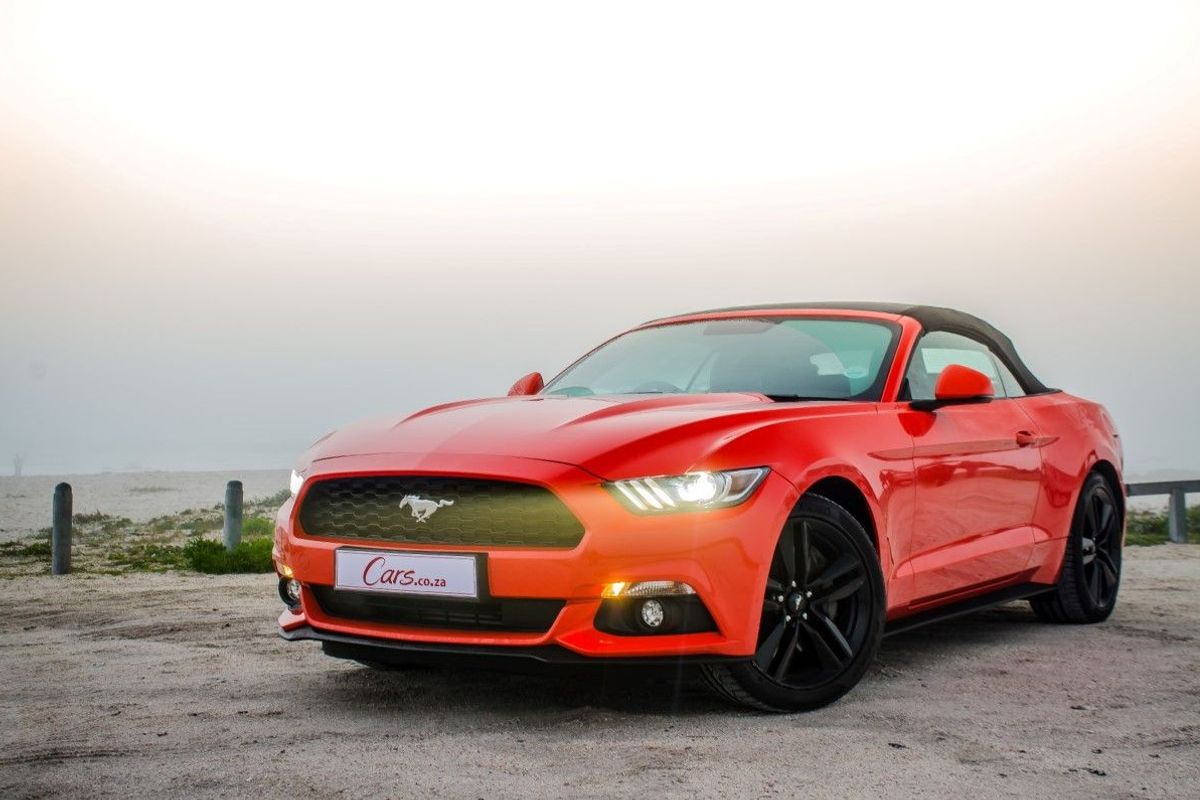
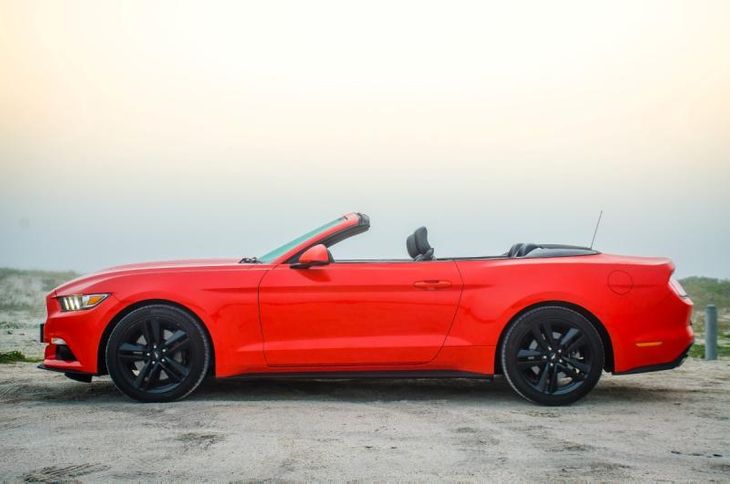
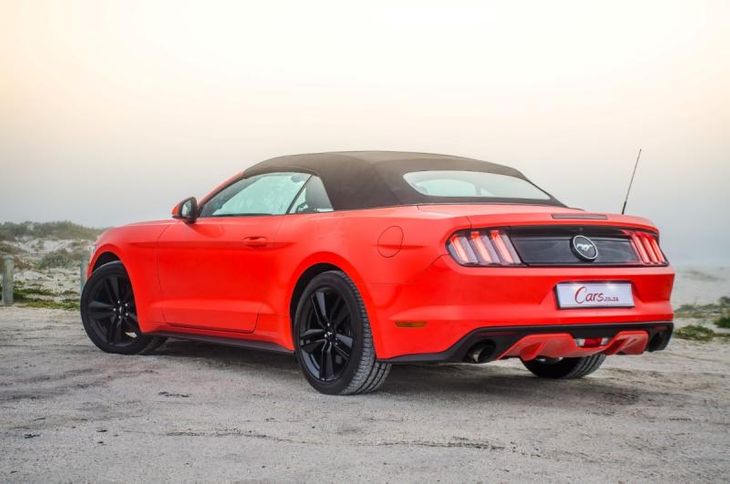
If you crave attention wherever you are driving, then this Mustang Convertible will serve you well, because it garners gawks and draws envious glances at every turn (just like its tin-topped, V8-engined brother). In terms of design execution, the Mustang hits the sweet spot with its muscular bonnet and menacing grille, flaring wheel arches and that sinfully curvy posterior. The Convertible version of the 2.3 EcoBoost Mustang, in particular, is less about performance and more about ostentatious showboating while the wind ruffles your locks.
Apart from the electrically operated folding fabric roof, there are but small differences in design between the Fastback and (this 2.3 Ecoboost) Convertible derivatives. The grille, air intakes and badging are key differentiators between the variants and untrained eyes could easily miss them.
The Convertible is 12 kg heavier and stands 13 mm taller than the Fastback and South African Mustangs are fitted with a Performance Pack as standard, which includes 19-inch alloy wheels, a limited-slip differential and a performance braking system to bring all that pretty metal to a stop. In the looks department, then, the Mustang Convertible is a stunner.
Watch our video review of the Ford Mustang 5.0-litre V8 Fastback below:
Power delivery?
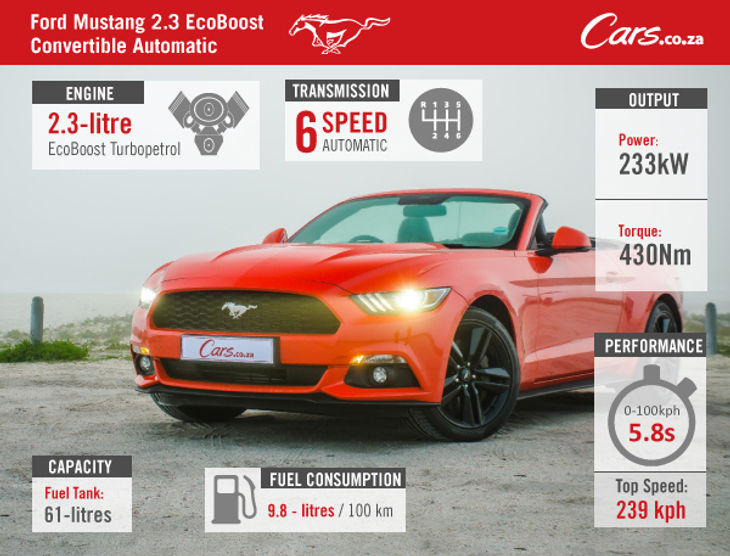
Yes, there’s no V8 in this Mustang and the eerie lack of a beefy burble upon start-up confirms it. Before your head drops in sorrow, you will be pleased to know that this 2.3-litre lump offers significantly more punch than you’d expect. With 233 kW and 430 Nm on tap, the engine is more than capable of propelling the 2-tonne Mustang (2 041 kg) forward with fervour.
Out of interest, the BMW 440i Convertible with its turbocharged 3.0-litre straight 6 engine offers only marginally more power and torque (240 kW and 450 Nm), but costs significantly more (R895 446). In other words, this Mustang convertible overpowers most of its closest alternatives (at its list price) and therefore represents good bang-for-buck.
The 2.3 EcoBoost Convertible is only offered with a 6-speed automatic transmission, but the driver has steering wheel-mounted shift paddles at their disposal to actuate manual 'shifts. The transmission can be lurchy and indecisive in response to staccato throttle inputs, especially in Sport mode, but it does perform serenely when cruising under the command of a sensible right foot. Cruising, as opposed to outright performance, is something this Mustang Convertible excels at; buyers will appreciate its manageable and easy-going demeanour.
Nonetheless, this Mustang can gallop if it needs to. A linear and even feed of power from the 2.3 results in brisk acceleration and even though the powertrain is aurally subdued, there’s always enough power to keep you smiling. The Convertible also has the propensity to kick its rear end askew, as we discovered, which adds to the thrill of finding the handling limits.
Ride and handling
Convertibles lack the structural rigidity of the coupe bodies on which they are based. As a result of the absence of a solid roof – as well as B- and C-pillars – their body shells are more inclined to flex while the cars traverse undulations in the road or when their weight balances shift in dynamic driving conditions. Ford has, however, increased torsional rigidity by 13% in this Convertible to make it sturdier and, aided by its pliant independent rear suspension, the Mustang copes well with bumps and ruts in the road and delivers a comfortable drive overall.
Body roll is evident under cornering, but the steering feels relatively accurate and direct and once the Mustang is set up for (and settles into) a corner, it holds its line reliably and lays its power down with confidence. The 5.0 V8 GT is palpably more suited to tackling bends, but this convertible proved to be more than capable, even though it lacked a degree of outright sharpness. The driver can also adjust the steering feel according to the driving situation and three settings (including Normal, Comfort and Sport) are available. For the everyday commute, you will find this Mustang Convertible suitably sprung to cope with most road surfaces, barring the odd pothole, which can translate to the cabin through a firm jolt.
Fuel economy?
The inclusion of the 2.3 EcoBoost engine in the Mustang makes sense if you wish to strike an acceptable balance between performance and economy. Whereas the 5.0 V8 Mustang is unashamedly thirsty and consequently more costly to run, this EcoBoost engine returns more favourable consumption figures on a daily basis. During the Mustang Convertible's test tenure, we averaged 10.8 L/100 km and the best figure we achieved was 9.6 L/100 km, which compares surprisingly well with Ford’s claimed consumption figure of 9.8 L/100km.
Although these numbers are better than those of the 5.0 V8, many would argue that the loftier performance offered by the bigger-engined version outweighs its heavier "drinking habit". That view might be understandable if you’re a die-hard V8 fan, but this EcoBoost engine extends the Mustang’s appeal to a wider market, who see general usability as the biggest priority.
Practicality?
The fabric roof folds away in under 10 seconds and space for rear passengers is minimal.
Regarded as a 2+2, this Mustang Convertible comfortably accommodates front occupants and although there is space for a pair of rear passengers, adults of any size will find the bucket seats a trifle uncomfortable, mainly because legroom is severely compromised.
The electronic Z-fold fabric roof is locked into place using a latch in the headliner and once released, the roof opens and closes in well under 10 seconds. When the roof is down, two plastic panels require fitting to hide the underlying roof mechanicals – not the most flattering solution in our opinion. When the panels are not in use, they can be stored behind the front seats or in the boot.
The Mustang’s boot is more capacious than you’d expect, but because space is required to store the roof, luggage capacity in the convertible version shrinks to 332 litres while the Fastback version offers a sizable 408 litres.
Another aspect of the Mustang that you need to be mindful of is its sheer size. It has a large turning circle and that means manoeuvring the Mustang in the street requires extra attention and effort to avoiding kerbing the wheels, or worse, hitting a pole or stationary vehicles.
Comfort features?
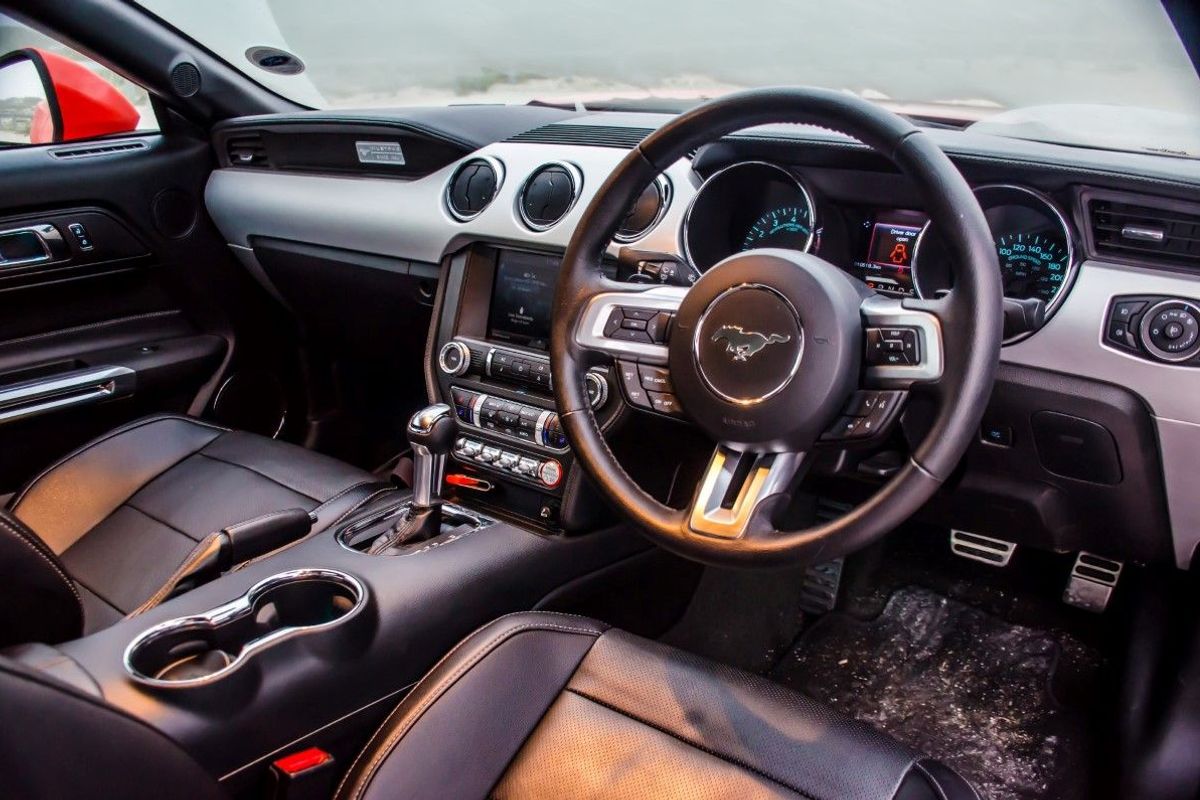
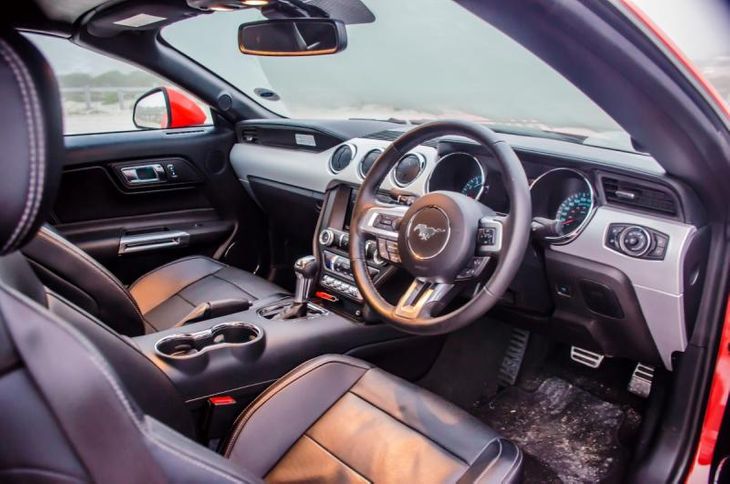
Plastic finishes dominate the Mustang's interior, but it's a comfortable place to be.
The Mustang has been widely criticised for having a poorly constructed and rather plain interior that's trimmed in too much hard plastic – at least given its lofty asking price. This is true, to a point, and even so we feel the interior design suits the macho personality of the Mustang and doesn’t drastically detract from the overall offering.
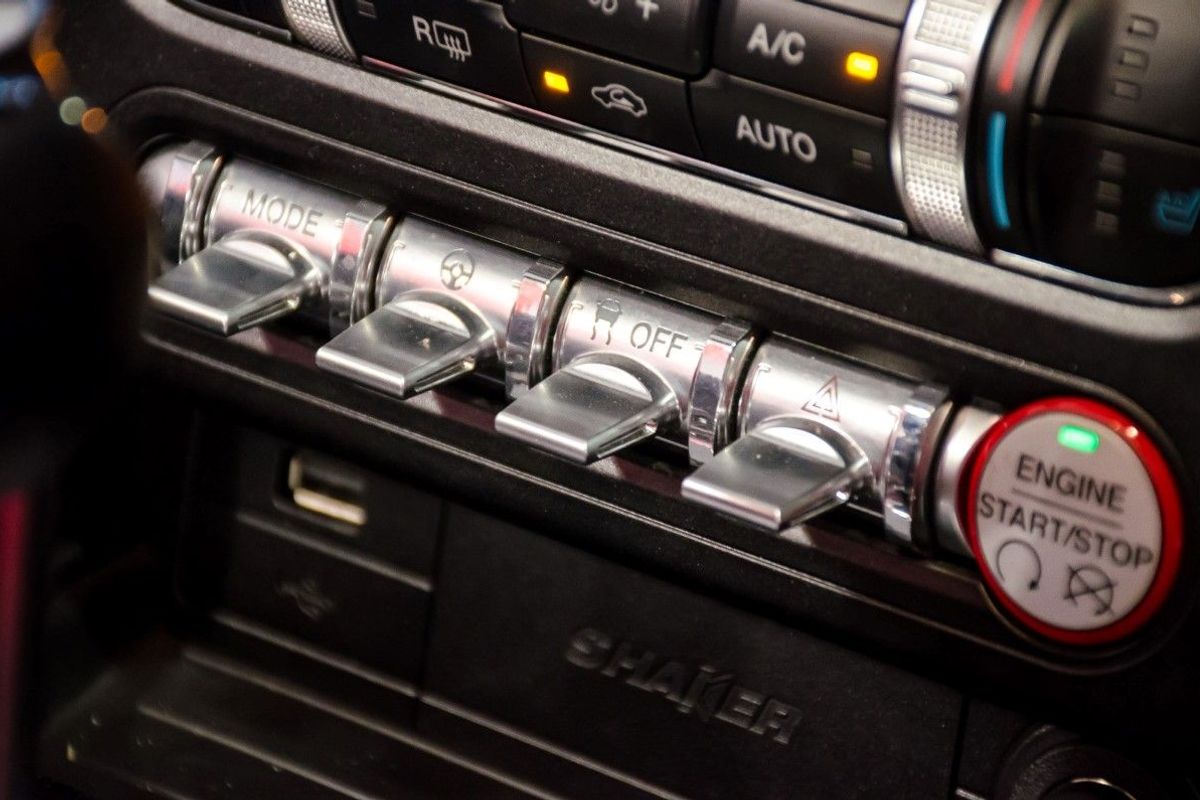
The Convertible makes up for these shortcomings by offering a host of features that make every drive a comfortable experience. Some notable features include cossetting electrically adjustable seats with heating and cooling functions, dual-zone climate control, cruise control, keyless entry, electric windows and rear parking sensors with a reverse-view camera.
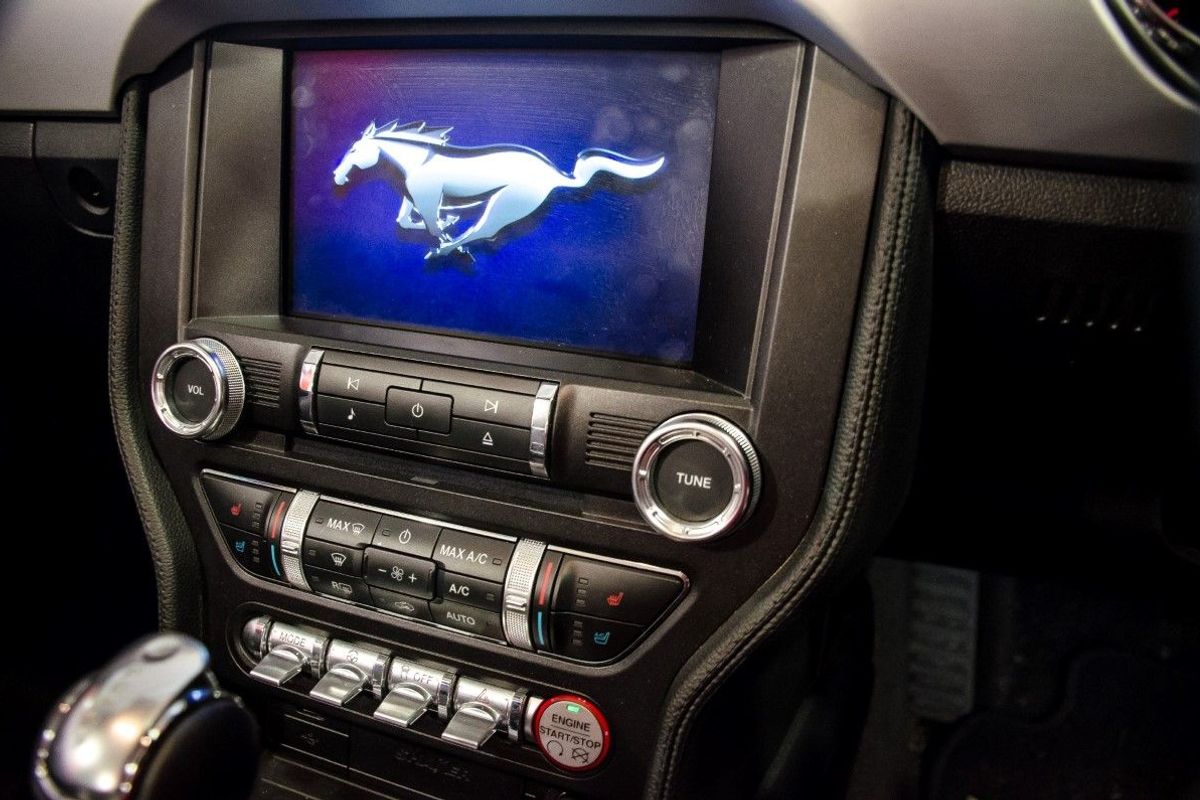
The Mustang is also fitted with Ford’s SYNC2 infotainment system and an 8-inch touchscreen that allows for Bluetooth connectivity, audio streaming and control of certain vehicle functions. The system is relatively simple to use but navigation is sadly not included. Buyers will also find the USB and Auxiliary slots useful for charging or connecting devices.
In terms of safety, the Mustang is equipped with ABS with EBD, electronic brake assist, traction control, stability control and a total of four airbags.
Ford Mustang 2.3 EcoBoost Convertible price in South Africa
This derivative costs R779 900 and is sold with a 4-year/120 00 km warranty and 5-year/100 000 km service plan. Service intervals are set at 20 000 km.
Verdict
The Mustang is a unique offering in South Africa that boasts inimitable macho appeal and virtually unmatched road presence. The 5.0-litre V8 Mustang GT Fastback may be the pick of the litter, but this 2.3 EcoBoost Convertible has oodles of charm and its performance both surprised and impressed us. It’s comfortable and easy to drive with enough power to deliver spirited performance when required. The EcoBoost offering is clever, as many buyers will appreciate savings at the pumps while still having access to solid cruising performance.
The Mustang’s pitfalls (a less-than-special interior and somewhat lethargic automatic transmission) are unlikely to matter much to the hordes of fanatics who are still lining up to purchase the right-hand-drive Mustang and even though there are more refined products on the market, none of them offer the same visual and emotional appeal as the Ford. If oodles of kerb appeal and wind-in-your-hair (but versatile) cruising ability is what you’re looking for in a car, then the 2.3 EcoBoost Mustang Convertible may be the car you.
Ford Mustang 2.3 EcoBoost Convertible Auto – Quick Specs
BMW M2 vs Mercedes-AMG A45 vs Audi RS3 vs Honda Civic Type-R: On-track analysis (Video)
Now that you know which of these four tar burners is fastest around Killarney, Ciro de Siena and racing driver Ashley Oldfield sit down to analyse which of the Audi RS3, BMW M2, Mercedes-AMG A45 and Civic Type R was best to drive.
A video like this will be a massive conversation starter in the form of YouTube comments or social media responses. Many will be arguing about which car should have won from the comfort of their keyboards, but only one person really knows how those cars performed on the day of filming.
Ashley Oldfield is our in-house racing driver and brings a wealth of motorsport experience and pedigree to the track (or office desk). He won the Nissan GT Academy and went on to be a professional racing driver for Nissan in Europe. Now he drives for us…
Have a listen to his analysis… as ever, it appears lap times only tell a part of the story!
Ford Focus RS500 Under Consideration?
Reports are suggesting that Ford may be considering developing an even more radical version of its Focus RS hot hatchback, which is due for launch in South Africa in July 2016.
The looming arrival of the Ford Focus RS has enthusiasts frothing at the mouth. The reason? It’s powered by an uprated four-cylinder 2.3-litre EcoBoost engine delivering 257 kW and 440 Nm of torque, the same engine that powers the Ford Mustang. Even though the RS’s outputs don’t quite match those of the Audi RS3 (270 kW / 465 Nm) and Mercedes-AMG A 45 (280 kW / 475 Nm), it might be enough to ruffle their feathers when it arrives.
While we wait patiently for the RS’s arrival, Ford is reportedly mulling over the possibility of creating an even more powerful version of the RS, the RS500, and if this fruit comes to bear, it could become the “fastest-accelerating hatchback in history”.
Details of the RS500 are scarce at the moment but reports suggest that it will feature an upgraded version of the 2.3-litre EcoBoost engine from the RS, which may see it attain hot hatchback stardom.
The RS500’s development will greatly depend on how well the Focus RS is received globally. If Ford feels there is a market big enough for such a high-performance hatchback, it could very well see the light of day. Let’s hope that day comes sooner, rather than later…
Mercedes-Benz E-Class (2016) South African Launch
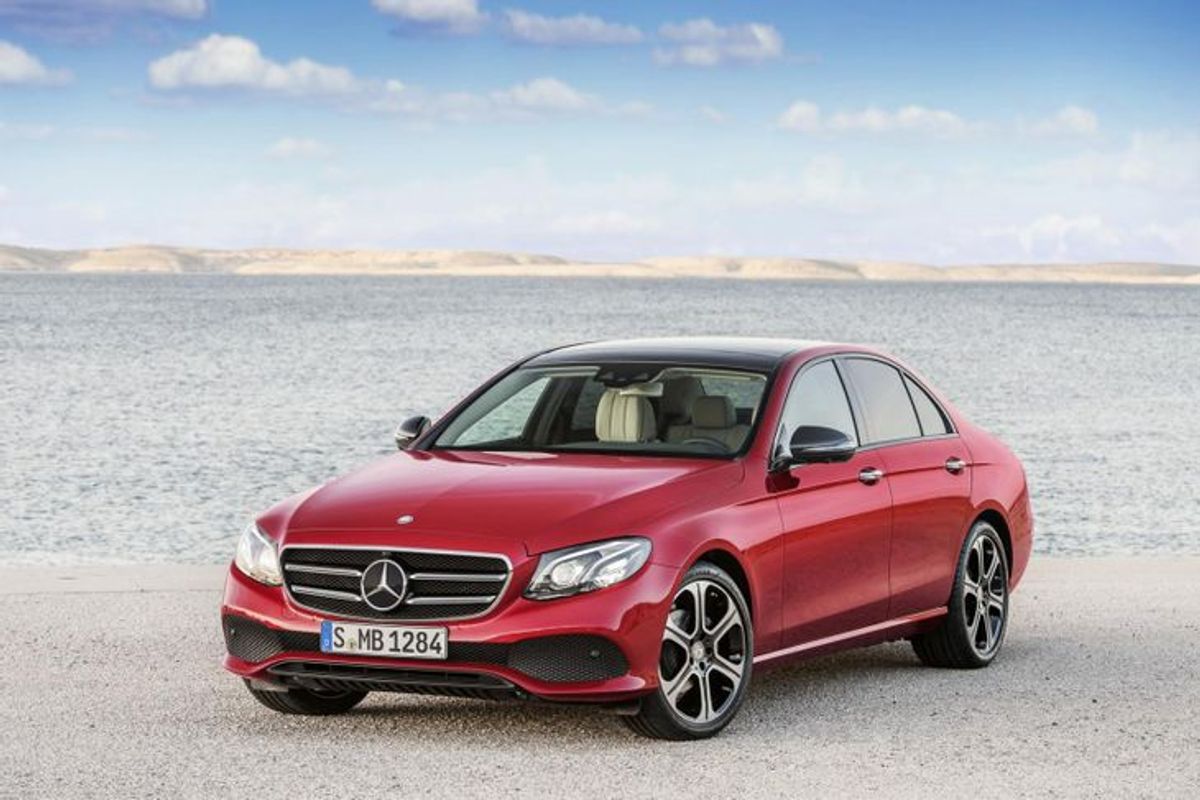
Earlier this year Cars.co.za was introduced to the startling tech of the new Mercedes-Benz E-Class range at its international launch in Portugal. It is now available on local soil and we travelled to KZN to find the pick of the bunch.
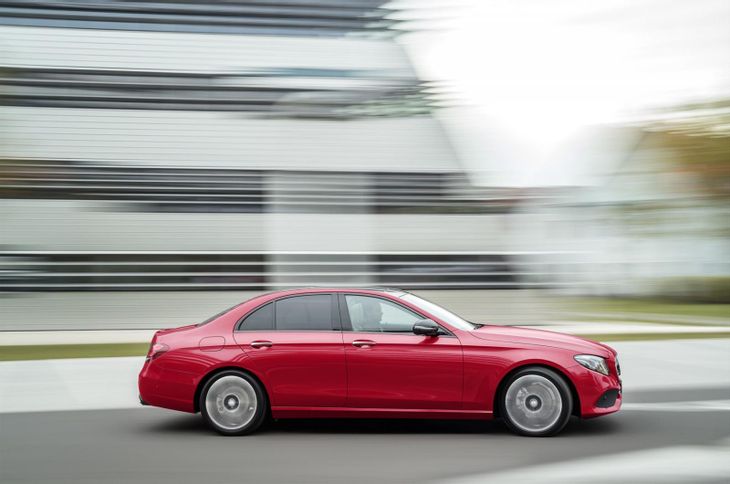
Whether as a result of the global economic climate or shorter development timelines, one thing is certain – there has been a shift in focus within Stuttgart. Having just finished my first stint behind the wheel of the all-new Mercedes-Benz E-Class at its local media launch, it is clear that the S-Class is no longer the sole technology pacemaker for Mercedes-Benz.
The new E-Class comes equipped with an impressive arsenal of electronic systems encompassing: safety, dynamics, performance, connected drive and semi-autonomous driving (click here to see 5 of the most impressive highlights). When fully-equipped with optional equipment, the new E-Class is, to put it simply, a technological powerhouse.
For the purpose of this article, however, I will focus on the engines…
The local range
At present only three engines are offered, of which two are turbodiesels.
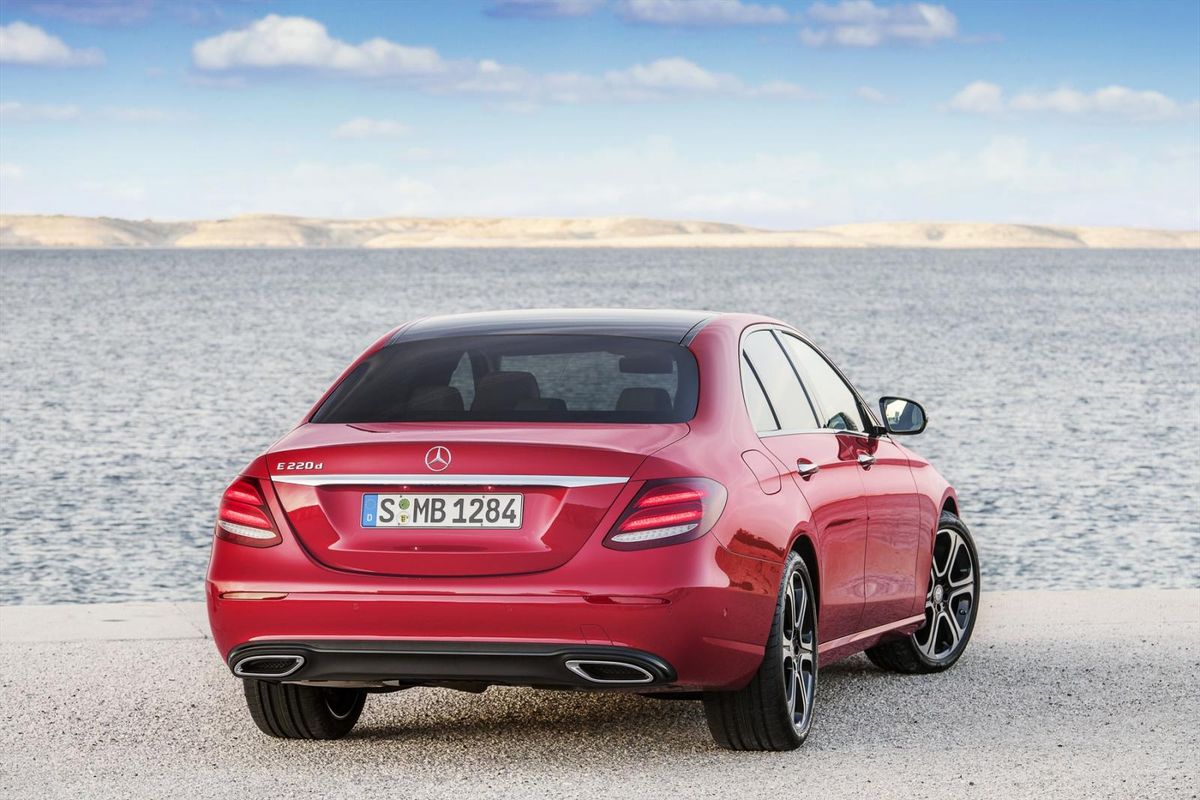
There are currently three models in the local line-up. The entry-point E200 makes use of a 2.0-litre turbopetrol (135 kW/300 Nm). The range-topping E350d uses a 3.0-litre, six-cylinder turbodiesel (190 kW/620 Nm). In the middle sits the E220d with its 2.0-litre four-cylinder turbodiesel (143 kW/400 Nm). All are equipped with Merc’s 9G-Tronic automatic transmission.
The E250 and E400 4Matic follows in October this year along with the E43 AMG. The E63 AMG is expected to be available near the end of Q2 2017. A plug-in hybrid follows in 2018.
Refinement for all
E-Class is loaded with high-tech features and several trim and equipment grades are on offer.
In terms of specification and comfort, there isn’t much to decide, as all three variants offer Exclusive, Avantgarde and AMG interior and exterior package options. In standard specification the car comes equipped with dual-zone climate control, an interior ambient lighting package that offers 64 different colours, parking assist with auto parking and reverse camera and selective damping.
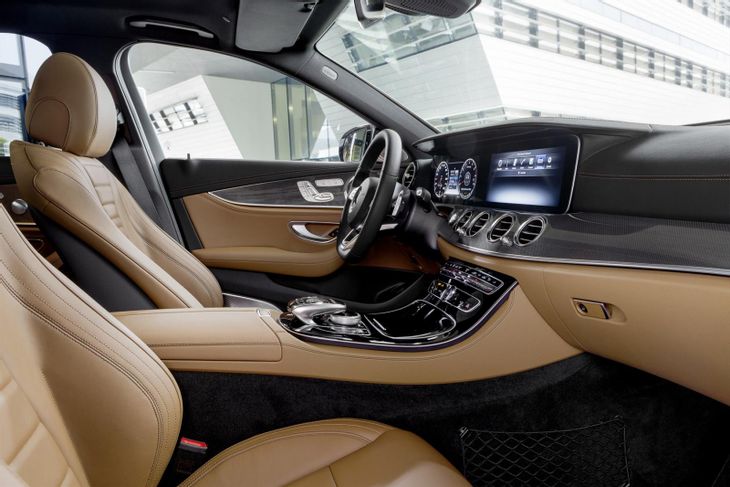
The driving route covered about 400 km of roads north and south of Durban. Comfort seating is standard, which offers decent support and comfort over long distances. The higher-specced models offer full electric adjustment. The cabin is spacious and the design, yet simple, is attractive and neat. The overall length of the new E-Class as well as its wheelbase has grown, which doesn’t just bode well for roadholding, but also offers extra legroom and luggage capacity. Premium materials are generously applied within the cabin.
Even at high speeds I was impressed by the very little wind noise that penetrates the cabin. The ride is supple without being wafty. Road noise over some rougher surfaces became noticeable, but in terms of offering a luxurious driving experience, the new E-Class is not trumped by its competitors.
So which engine then?
With a great combination of efficiency, refinement and power, the E220d is currently the pick of the range.
I have always been bemused by the notion that ‘bigger is better’. In my opinion this is very often not the case; especially when it comes to Mercedes-Benz. This may be personal preference, but I have always favoured a 200 over a 250, for example. The same applies with the new E-Class. So, while the E350d offers a more-than-healthy dose of stomp and thrust and all those lovely things, I was won over by the E220d.
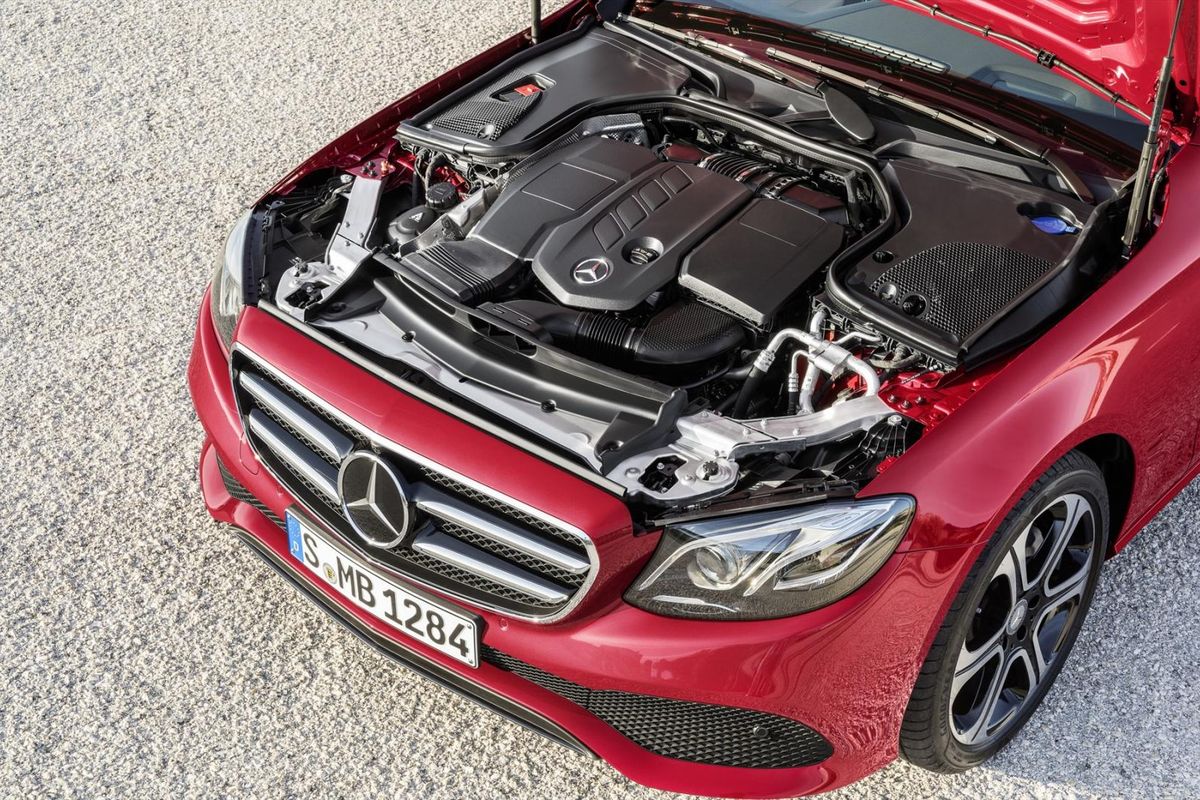
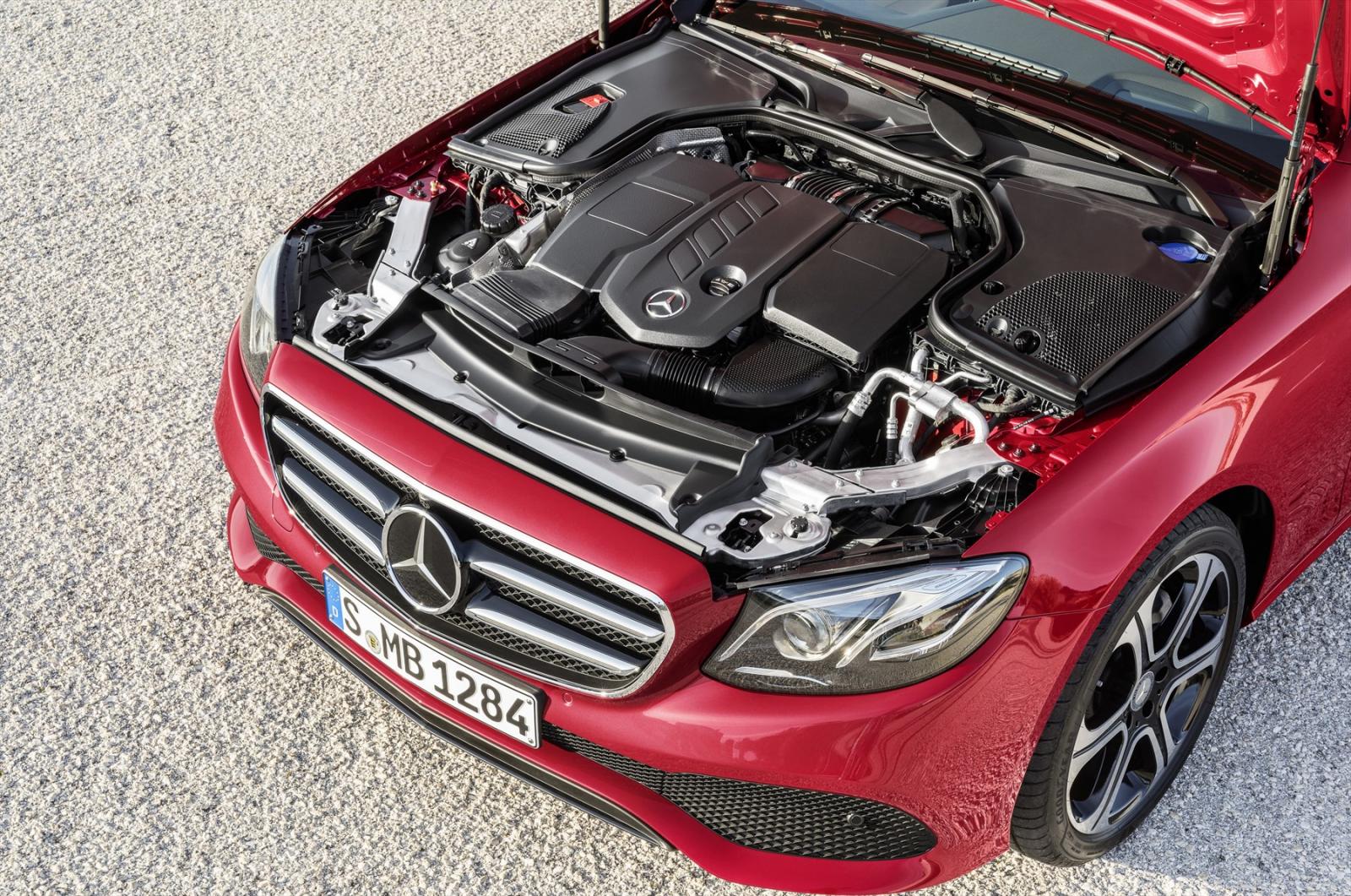
We spent most of the 400 km trip in the 220d and never felt that the engine was under strain, even during high-speed overtaking situations. The engine makes its debut on the E-Class and forms part of the all-new OM 654 engine family.
A chat with a local Mercedes engineer highlighted why this unit is not only important for Mercedes-Benz’s future plans, but also why it managed to impress on the route. It has an aluminium block (instead of steel), has space for an extra set of cylinders, can be fitted with a multitude type of turbos and has hybrid capability. As such, this engine will be used in many Mercedes ranges going forward, from the A-Class to the V-Class.
In E-Class guise the 220d displaces 2.0 litres and produces 143 kW at 3 800 r/min and 400 Nm of torque from only 1 600 r/min. It is a highly responsive, willing and civilised engine. It is about 17% lighter than its predecessor and more compact, thanks to the decreased displacement and the setting of the cylinders closer together and a few other significant and clever engineering moves. At idle there is very little to give away its diesel lineage (inside the cabin) – it has a smooth tick-over. Under hard acceleration there is no lag and even though it loses about 1.0-litre of displacement to the 350d, the engine is happy with reaching and maintaining very high speeds.
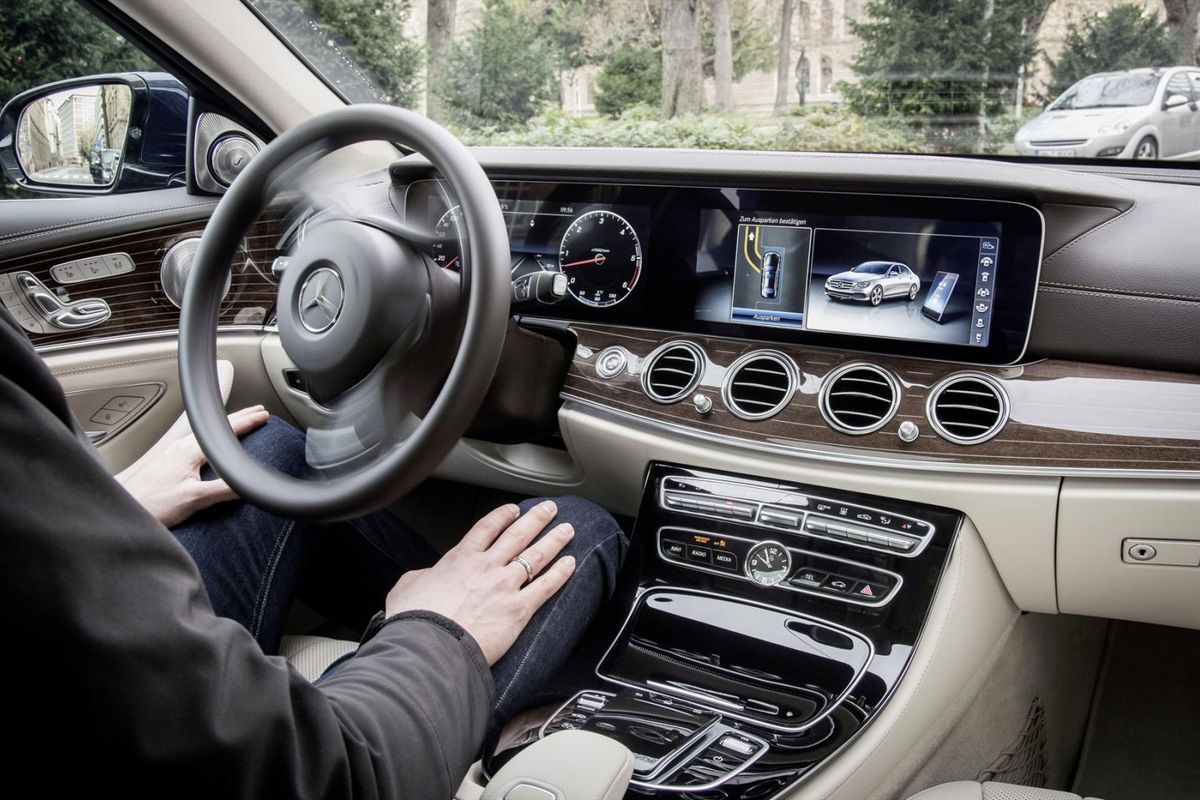
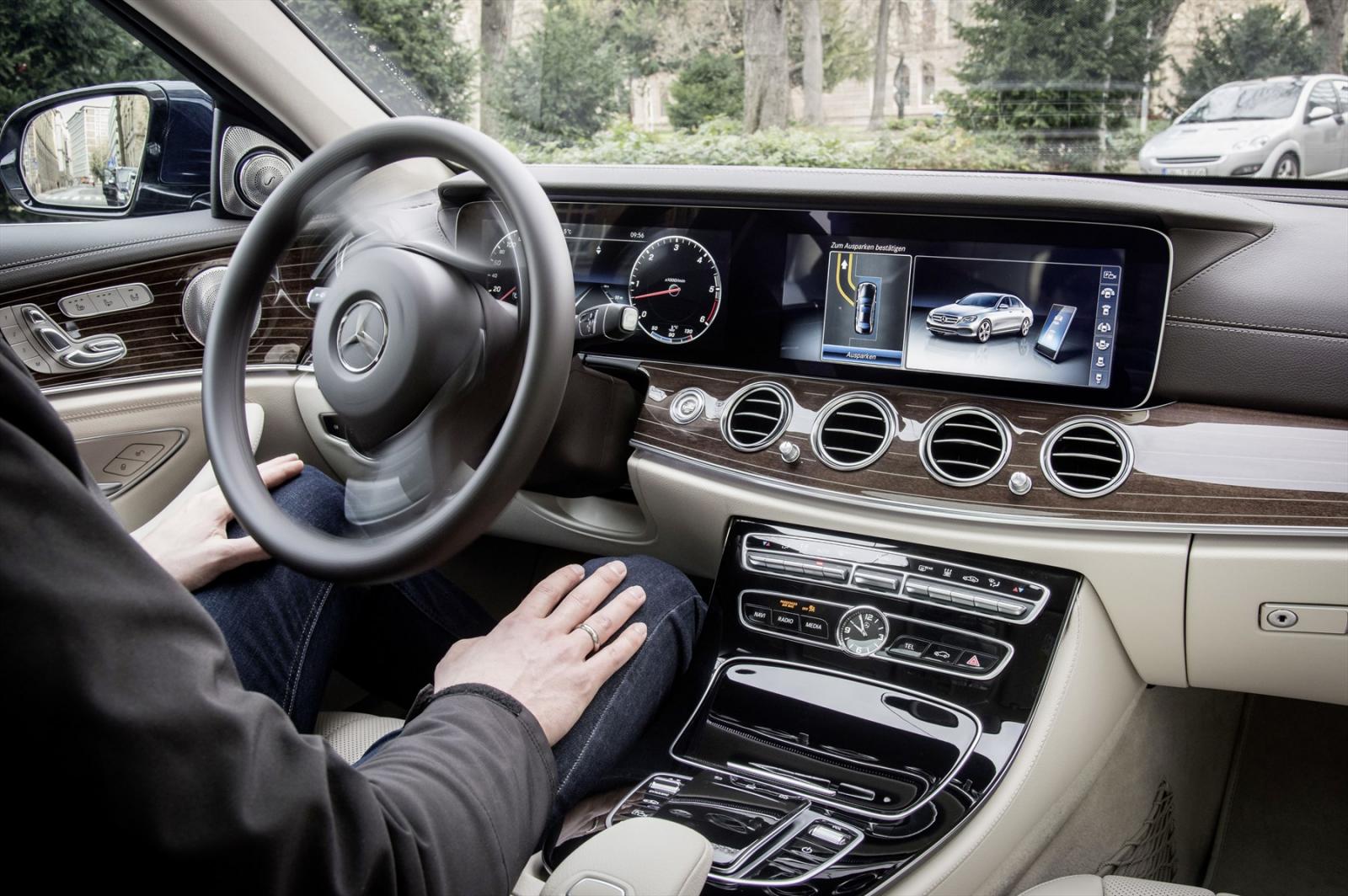
Svelte interior combines traditional materials with advanced interfaces. Note fully digital instrumentation.
The 9G-Tronic transmission works well with this unit, too, as it offers very smooth shifts and ensures that the engine is always within its power band. It has an incredible claimed consumption figure of 3.9 L/100 km (about 13% more thrifty than its predecessor).
I wouldn’t go as far as calling the 350d a sledgehammer or unrefined. Not at all. But wheel chirps and a wiggling rear under hard acceleration speaks of excess that I consider a novelty; a novelty that is not present in the 200d and which is all the better for it.
The E200 is the sole petrol offering (for now) and is not without merit either. It hardly labours under the size or weight of the E-Class. It does not work as smoothly with the 9G-Tronic compared with the diesels however: it is noisier due to higher revs and in ‘Sport’ mode the downshifts come in quick succession and the noise becomes somewhat intrusive.
Verdict
The large executive sedan market remains a sizeable one worldwide and victory in this category is a matter of pride for particularly the three German brands that dominate it. With the new E-Class Mercedes-Benz has seemingly signficantly moved the goalposts. While its on-board technology and sci-fi features have thus far grabbed the headlines, it has also made strong progress under the bonnet. BMW's new 5 Series will debut next, with an all-new A6 following that, probably later in 2017. Both of those vehicles will have to be extremely good to match this new E.
E-Class pricing in South Africa
E200 R709 608
E220d R759 100
E350d R961 036
(prices include CO2-emissions tax and Mercedes-Benz’s 6-year/100 000 km maintenance plan).
The Motor Industry Ombudsman Of South Africa – In-Depth Q&A
With around 500 new cases to study every month, the Motor Industry Ombudsman of South Africa has its work cut out. But how does it work, and who is the man behind it?
January 17 2015 was a a big day for the Motor Industry Ombudsman of South Africa (MIOSA). That's the day it was accredited as a dispute resolution agency and became a custodian of the SA Automotive Code of Conduct (ACT) which is part of the Consumer Protection Act.
In short, if a consumer feels done down by a motor manufacturer, or a dealership which sold them a car or serviced it, MIOSA is the government sanctioned body they complain to. And currently you can expect to wait six to eight weeks for the office to make a finding.
Last year 60% of cases went the way of the industry, and 40% in favour of the consumer. And given that MIOSA is funded not by government, but by the motor industry, inevitably some car owners on the wrong side of that 40% have accused MIOSA of being "in the pocket of the motor industry".
So I'll kick off my Q&A with Motor Industry Ombud Johan van Vreden there.
Q: What do you say to the frequent allegation that your office "is in the pocket of the motor industry"?
JvV: The MIOSA is not a consumer council that automatically sides with the consumer. In essence it represents both industry and the consumer. It acts as a referee between the industry and the consumer and among industry participants. It utilises good engineering practice, good customer care practice, good legal practice, and fairness as a basis in its deliberations.
Add to this the fact that the MIOSA is an government accredited institution, (so) we are protected by law to enable us to carry out our function without fear or favour.
Q: Why are the manufacturers/dealers not named in the case studies published in your annual reports?
JvV: Unless a service provider is non-compliant with the Consumer Protection Act No 68 of 2008 (Act) or the South African Automotive Industry Code of Conduct, we will not name any manufacturers/dealers/service providers in our case studies.
Q: What percentage of "operators" – importers, distributors, manufacturers, retailers, franchisors, franchisees; suppliers etc – are now signed up with MIOSA?
JvV: The MIOSA has 22 000 registered companies of which 6 000 have accepted the Code and the MIOSA's legal standing. As you will understand, total compliance will not happen overnight. However, we now have inspectors in the field and are advertising and attending road shows to speed up the process. The MIOSA is currently underway with legal proceedings against the other 16 000 companies and will also be conducting a "name and shame" campaign.
Q: Your recently released 2015 annual report reveals that engine-related complaints on used cars take up most of your complaints handling team's time. In my experience, many used car dealerships conduct business as if the CPA does not exist. Do you agree?
JvV: No, we don't agree. The MIOSA has found that at least 90% of service providers are adhering to the ACT. There are however a few chance takers.
Q: Most consumers who have a car, new or used, malfunction on them within the first few months, want a refund or at least a replacement. In what percentage of cases, in your experience, is either justified in terms of MIOSA's interpretation of the CPA, rather than a repair?
JvV: It depends, if a vehicle can be repaired we don't give refund or replacement as this may result in usage costs to the consumer. In terms of a new vehicle the vehicle must be repaired back to manufacturer standards. In terms of a used vehicle the vehicle must be repaired back to good working order.
Q: Under what sort of circumstances would your office support a take-back (at no cost to the consumer, except for usage) of a problematic vehicle?
JvV: Each case is unique in its own merit. I cannot comment on this as there are too many possibilities and too many factors which are calculated when making a ruling.
Q: What advice to you have for owners of cars which develop mechanical problems very shortly after purchase?
JvV: Immediately take the vehicle back to the selling dealer. Do not take it to another service provider to repair.
Q: What's the pettiest reason a car owner has advanced to your office as justification for a new car/refund?
JvV: The navigation system was not picking up some of the roads.
Q: What's the most serious case – in terms of consumer injustice – that your office has handled in the past year?
JvV: This one is a difficult one. Every single case that is reported to my office can result in a consumer injustice being perpetrated by a service provider. As such each case is dealt on its own merit and with the same level of seriousness.
Q: How many new cases are opened in an average month?
JvV: The MIOSA averages about 500 new cases per month.
Q: What five things do you wish consumers would do before they buy a car?
JvV:
Do a needs analysis – do you need the vehicle for a specific reason or do you want the vehicle because someone else was driving it?
Thoroughly inspect the vehicle, in and out, ie. check things like information plate, compare it with the disc, etc.
Check that the vehicle's service history is up to date and that the service book is in the vehicle. Make sure that there is a spare key for the vehicle.
Thoroughly read and understand the terms and conditions of the contract.
Insist on copies of the Offer To Purchase (OTP) document and the contract.
Q: To what extent has the signing of the Code changed the operation/standing of your office?
JvV: The MIOSA has been able to upgrade all of our systems to accommodate the high volume of incoming enquiries and complaints. The MIOSA staff compliment has tripled since accreditation. This was necessary to handle the influx of enquiries and complaints which this office receives on a daily basis. As far as "standing" is concerned, I think that there has been a far greater awareness and a willingness to co-operate to avoid full-on legal action.
Q: What car do you drive? And what car would you like to drive if money was no object?
JvV: I drive a 2003 VOLVO XC90 T6 SE AWD. If money was no object, I would love to own a red 458 Ferrari Spider and a 1299 Ducati motorcycle (also red).
How should consumers get in touch with the MIOSA?
To contact the Motor Industry Ombudsman of SA, go to www.miosa.co.za. The “submit a comment” link takes you to the prescribed form.
Any views or opinions expressed in this article are solely those of the author and do not represent those of Cars.co.za or its editorial content team.
Mercedes-Benz S-Class Convertible Cruises Into SA
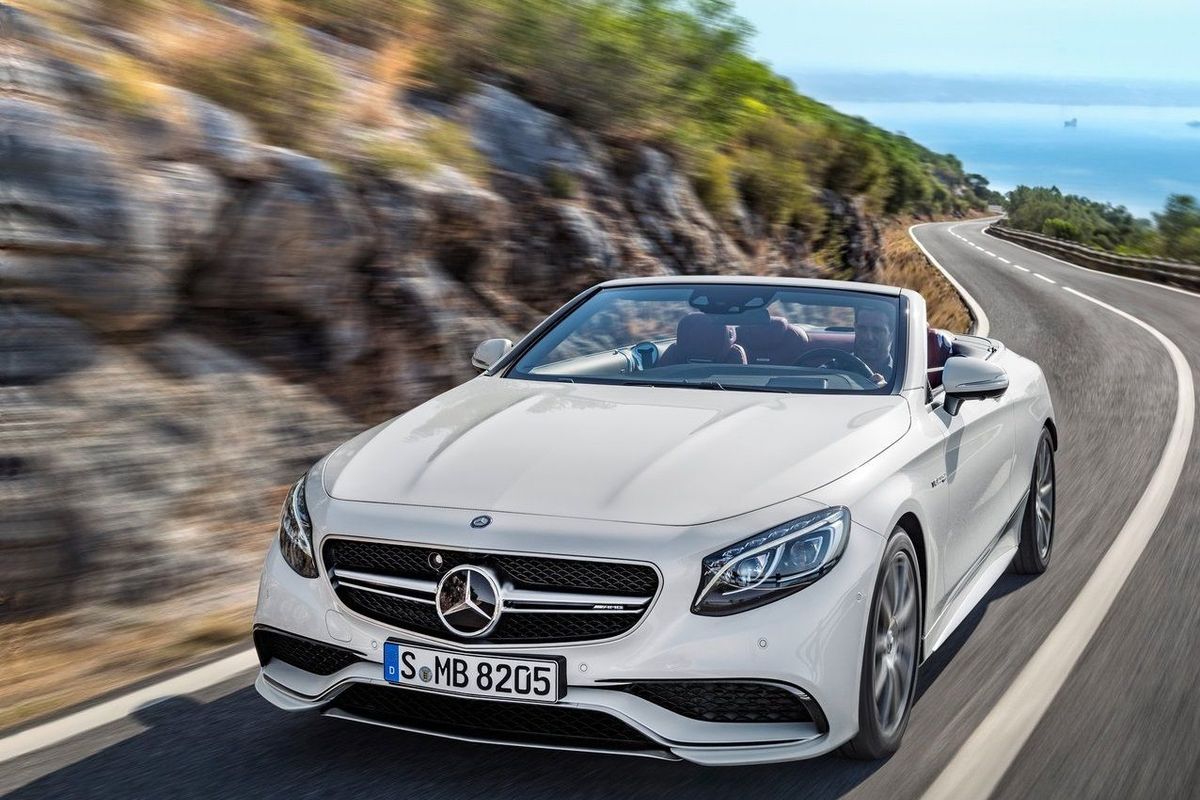
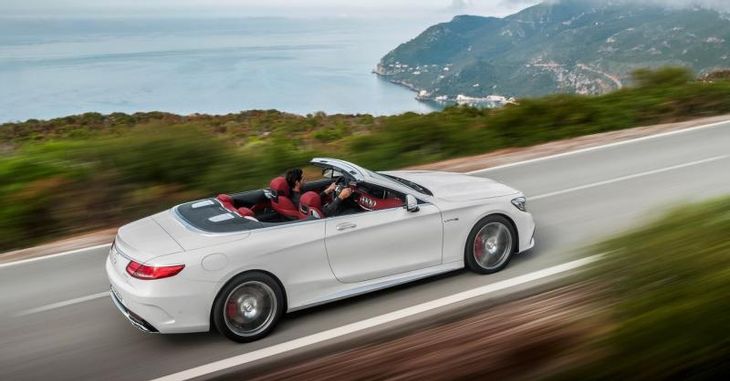
The ultimate convertible in the Mercedes-Benz arsenal has gone on sale in South Africa. Here are the specifications and pricing for the 2016 Mercedes-Benz S-Class cabriolet.
As is the case with the sublime S-Class coupe, there are three engines to choose from. The entry-level model – if you can label a machine like this as such – is the S500. Next up are two AMG models, the S63 and finally, the mighty V12-powered S65. Despite the S500 being the baby of the range, it still packs a mighty wallop thanks to a turbocharged 4.7-litre V8 engine which pushes out 335 kW and 700 Nm of torque. This is enough grunt to see the striking cabriolet hit 100 kph in a claimed 4.6 seconds. Mercedes anoraks will notice that this is the same sprint time that is claimed for the coupe model.
Unleash the AMG
The AMG S63 uses the meaty 5.5-litre turbocharged V8 engine which has 430 kW and 900 Nm. It's probably the best-sounding model as AMG really knows how to extract a glamourous soundtrack from eight cylinders. The 100 kph sprint time is down to 4.2 seconds. Finally, there's the top-of-the-range S65 which has a monstrous 6.0-litre turbocharged V12 engine. It has 463 kW and a stupendous 1 000 Nm, and if you're in the mood to drive briskly, it'll decimate the 100 kph sprint in 4.1 seconds. All three models are limited to a top speed of 250 kph.
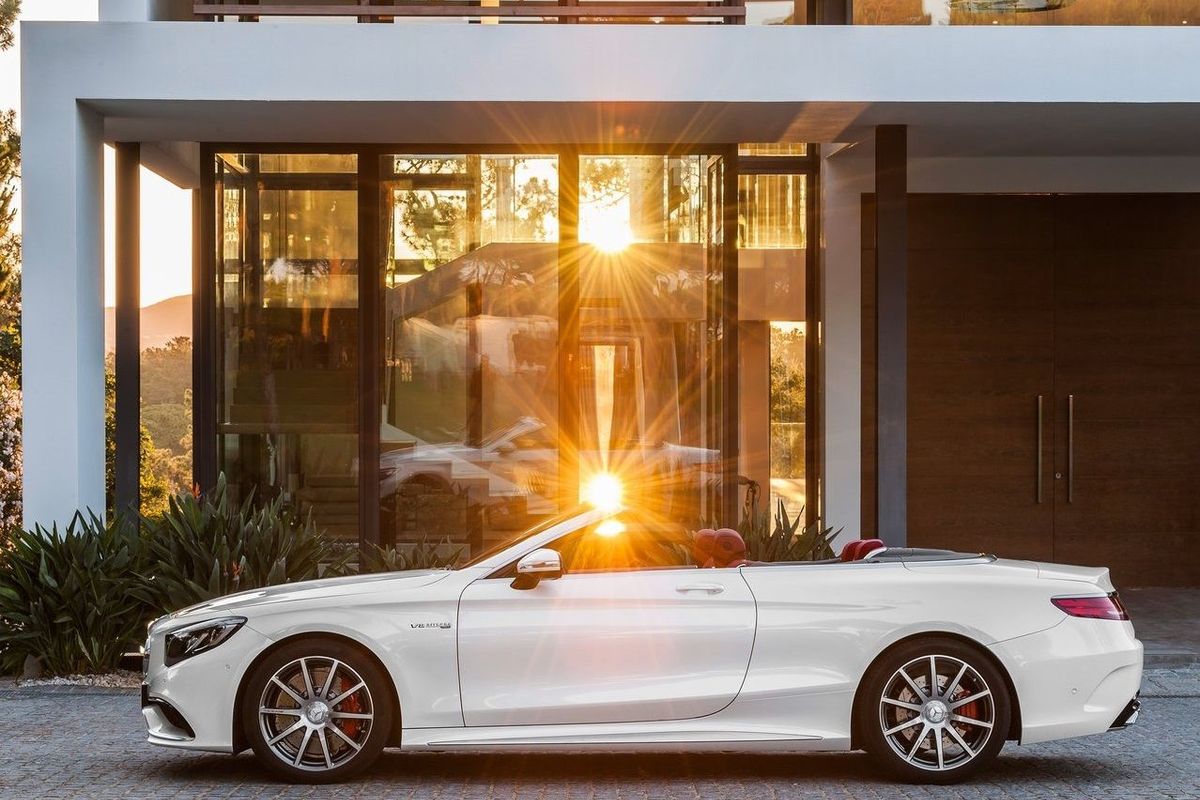
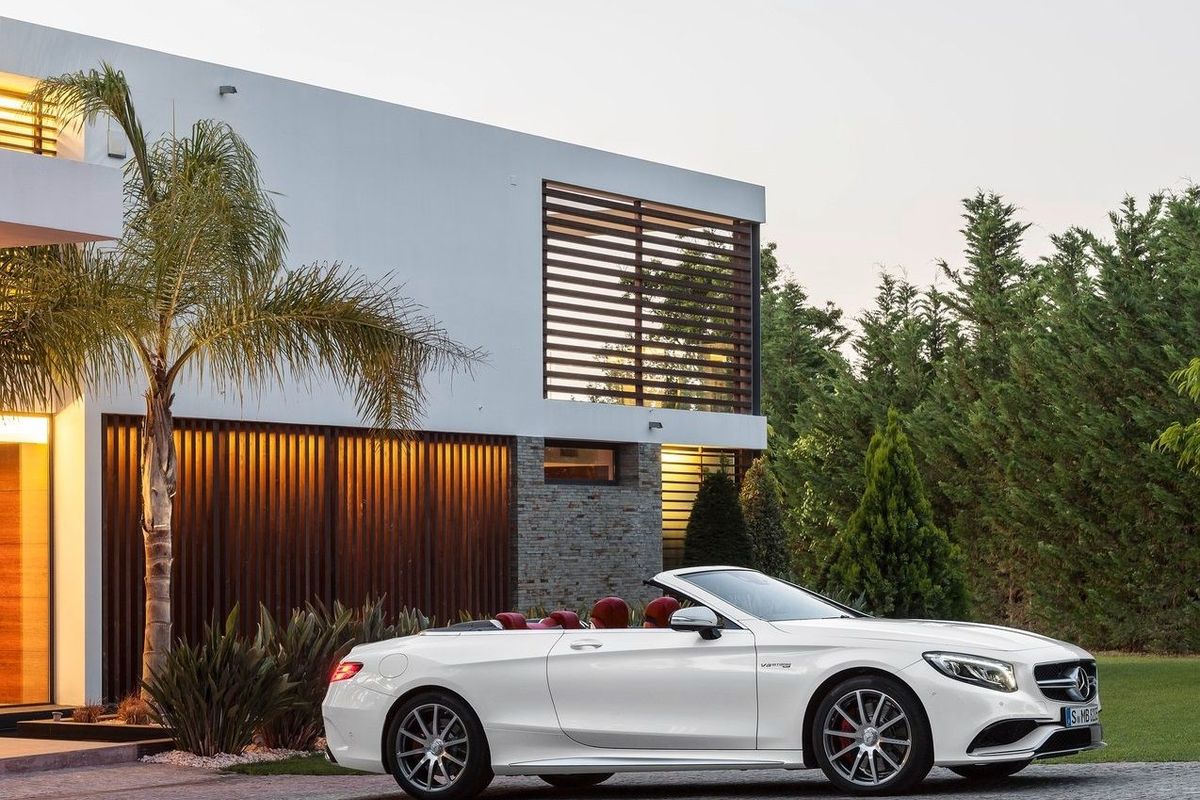
The S-Class Cabriolet could just be the ultimate drop-top on sale today.
Focus on ultimate comfort
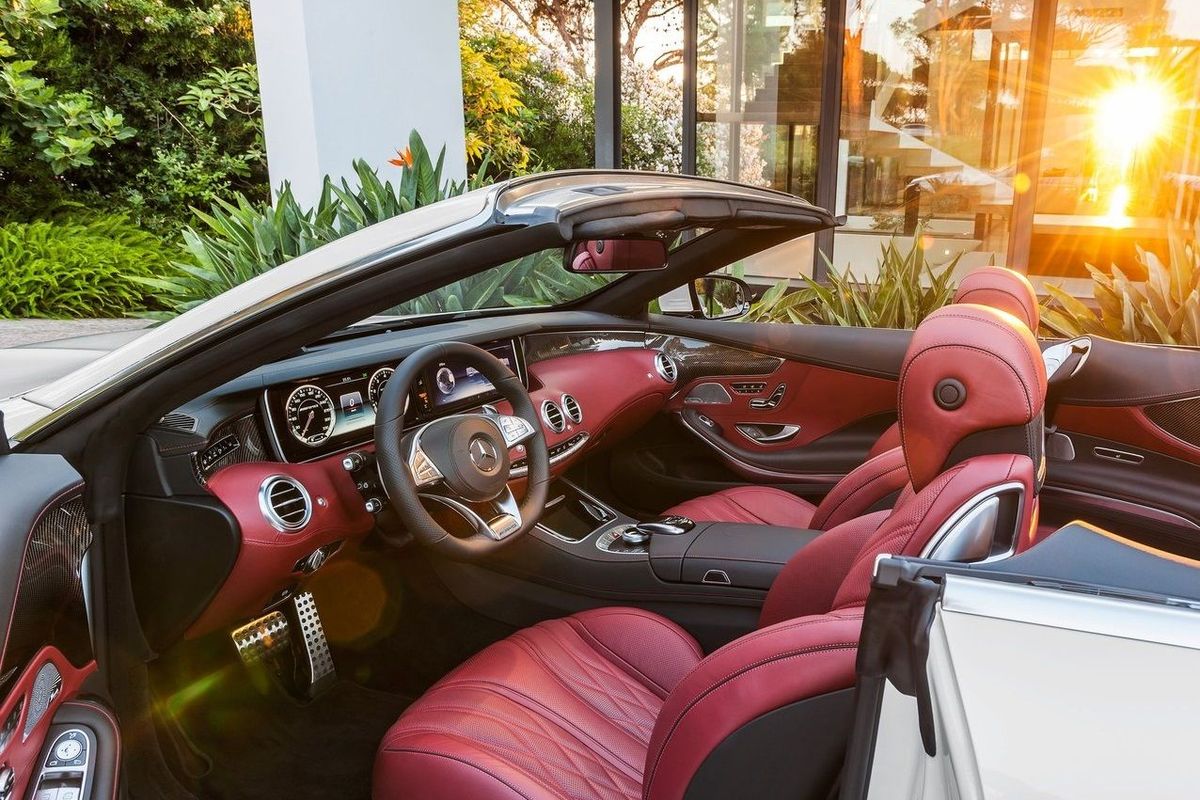
With the S-Class Cabriolet Mercedes-Benz set out to build the world's most comfortable cabriolet. As such, the S-Class Cabriolet is offered with an enhanced automatic wind protection system, called AIRCAP, as well AIRSCARF which provides neck-level heating. The armrests and seats are heated too. An all-new THERMOTRONIC intelligent climate control system is also offered and ensures maximum comfort, even with the roof open.
Talking about the roof, it's a retractable three-layer acoustic soft-top and can be had in either black, dark blue, beige or dark red. The roof opens and closes in about 20 seconds at speeds up to 60 kph. The S-Class Cabriolet also features a number of interior upholstery options which include leather, nappa leather and designo Exclusive nappa leather.
Mercedes-Benz S-Class cabriolet price in South Africa
These prices are before extras and being an S-Class, you can go to town with custom features. The prices include VAT and CO2 tax.
Not a fan of convertibles? Check out our video of the Mercedes-Benz S-Class coupe
Volkswagen Golf 7 (2016) Specs & Price
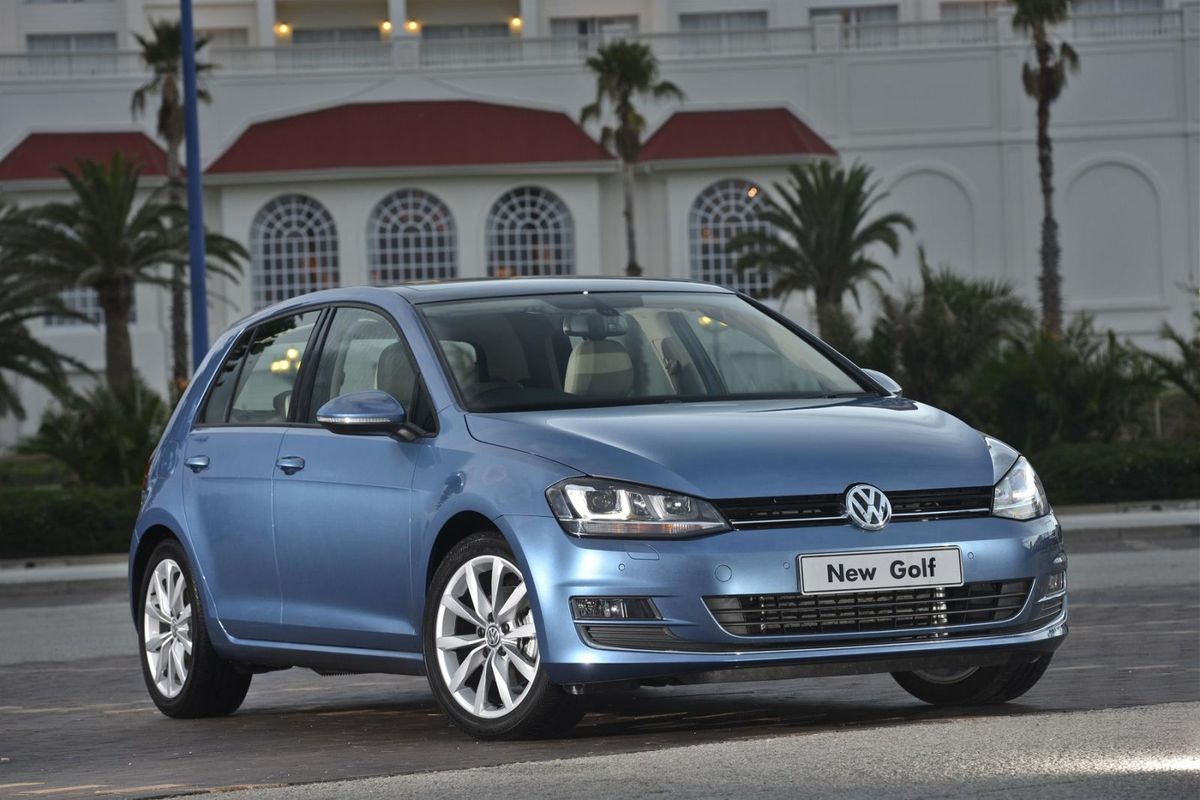
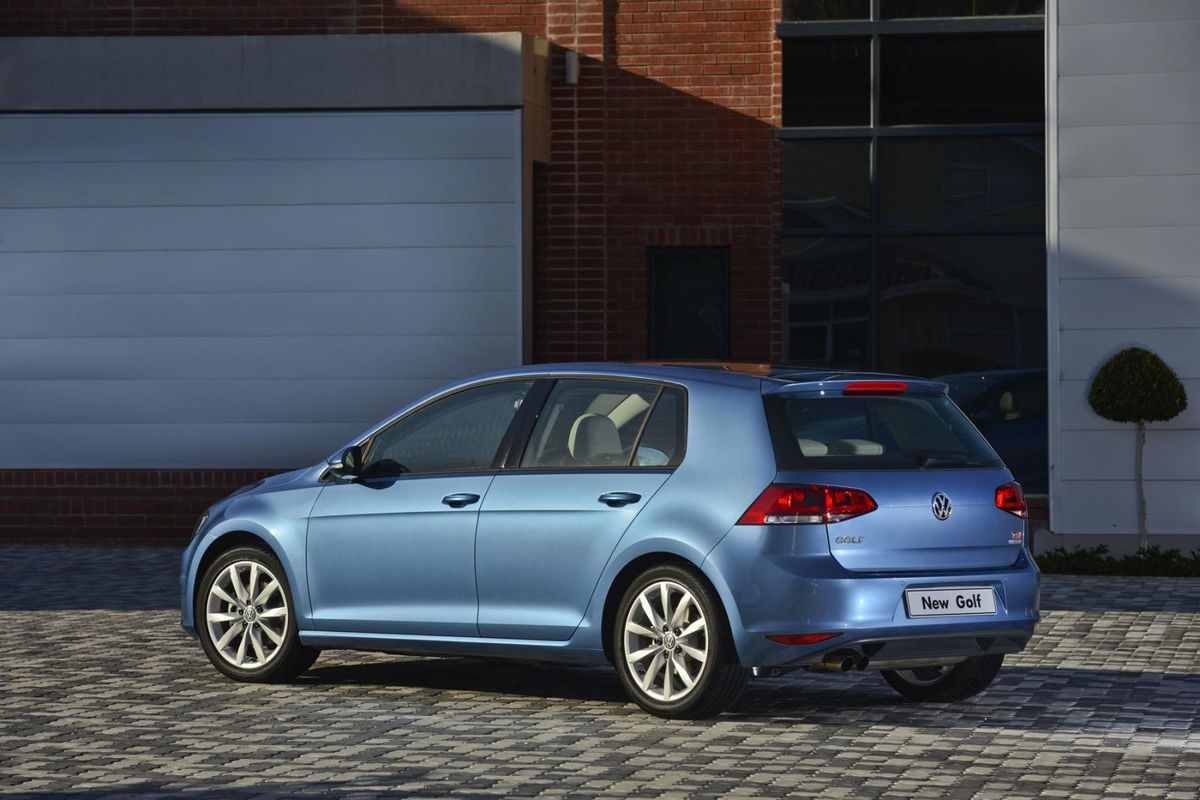
The Volkswagen Golf 7 remains one of the most popular C-segment hatchbacks in South Africa even following the arrival of new competitors such as the Opel Astra and facelifted Ford Focus. Since its introduction in 2013 a number of small tweaks have been made. The current model line-up looks as follows…
Engines and model line-up
The Golf 7 line-up kicks off with the 1.2-litre turbocharged four-cylinder motor with 81 kW and 175 Nm. It’s claimed to consume just 4.9 L / 100 km on the combined cycle and this engine is mated to a 6-speed manual transmission.
Next up is the 1.4-litre TSI engine which develops 92 kW and 200 Nm of torque. In Highline specification, it pushes out 110 kW and 250 Nm, and power reaches the front wheels through a six-speed manual transmission. A 7-speed DSG automatic transmission is available for the Comfortline model. All the 1.4-litre-powered models are claimed to consume 5.0 L/100 km on the EU combined cycle. The 1.4 TSI Comfortline is the most popular (non-GTI) model in the Golf 7 line-up.
For the diesel fans, there’s one engine offered in two states of tune. In Comfortline guise it delivers 81 kW and 250 Nm, while in Highline specification it pushes out 110 kW and 320 Nm. Both cars are economical with returns of 4.5 L / 100 km for the Comfortline, while the Highline consumes 4.6 L / 100km. The Comfortline has a five-speed manual, with the Highline sporting a six-speed manual.
Our choice: We believe the Golf 7 1.4 TSI Comfortline (92 kW), equipped with the slick DSG transmission, to offer a highly desirable mix of comfort, refinement, performance, practicality and style.
What about GTI?
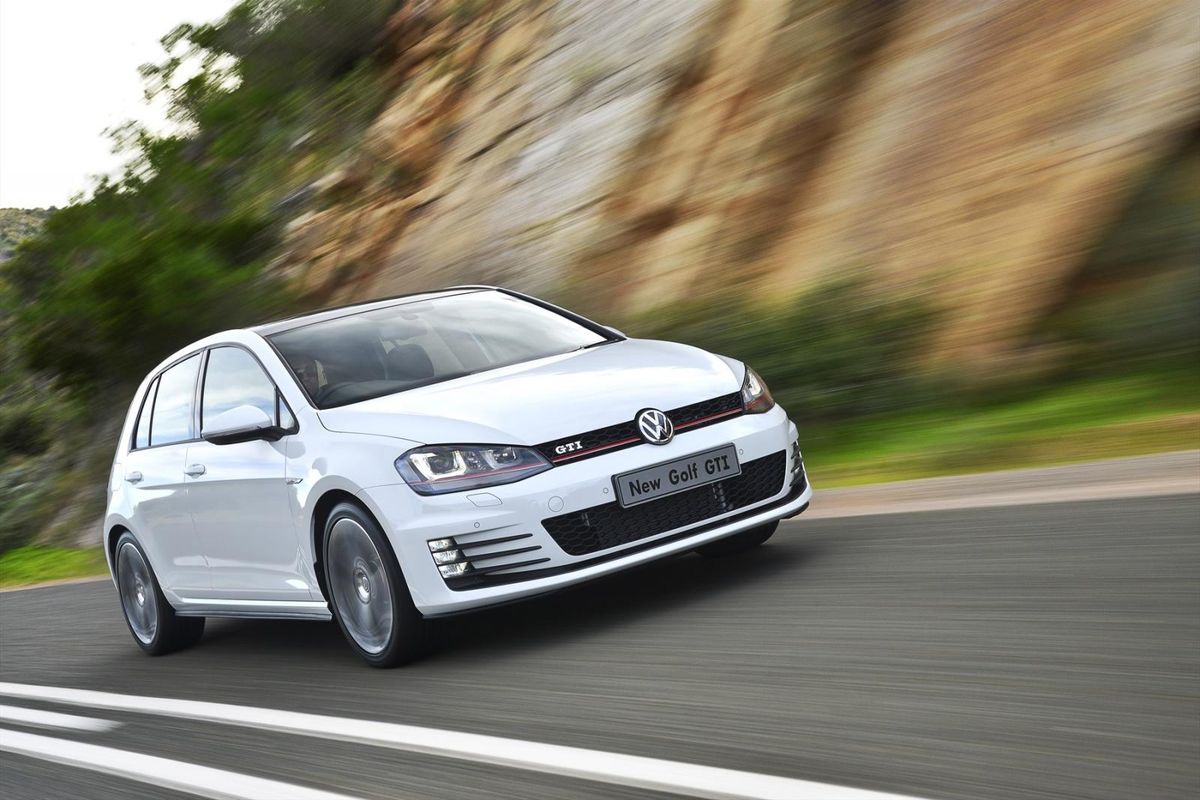
The Golf GTI (with DSG) is the top-selling Golf 7 derivative.
It may be hard to believe, but the most popular Golf 7 derivative of all is the GTI and the DSG-equipped model in particular. Marrying the Golf's traditional strengths of refinement, comfort and practicality with hot performance and entertaining dynamics have certainly found the GTI plenty of fans in this country.
The 2.0-litre four-cylinder turbocharged engine of the GTI delivers 162 kW and 350 Nm of torque, enough for a 0-100 kph sprint time of 6.5 seconds (manual and DSG). A Performance Pack version of the GTI is also offered with slightly more power (169 kW) and a focus on sharper dynamics.
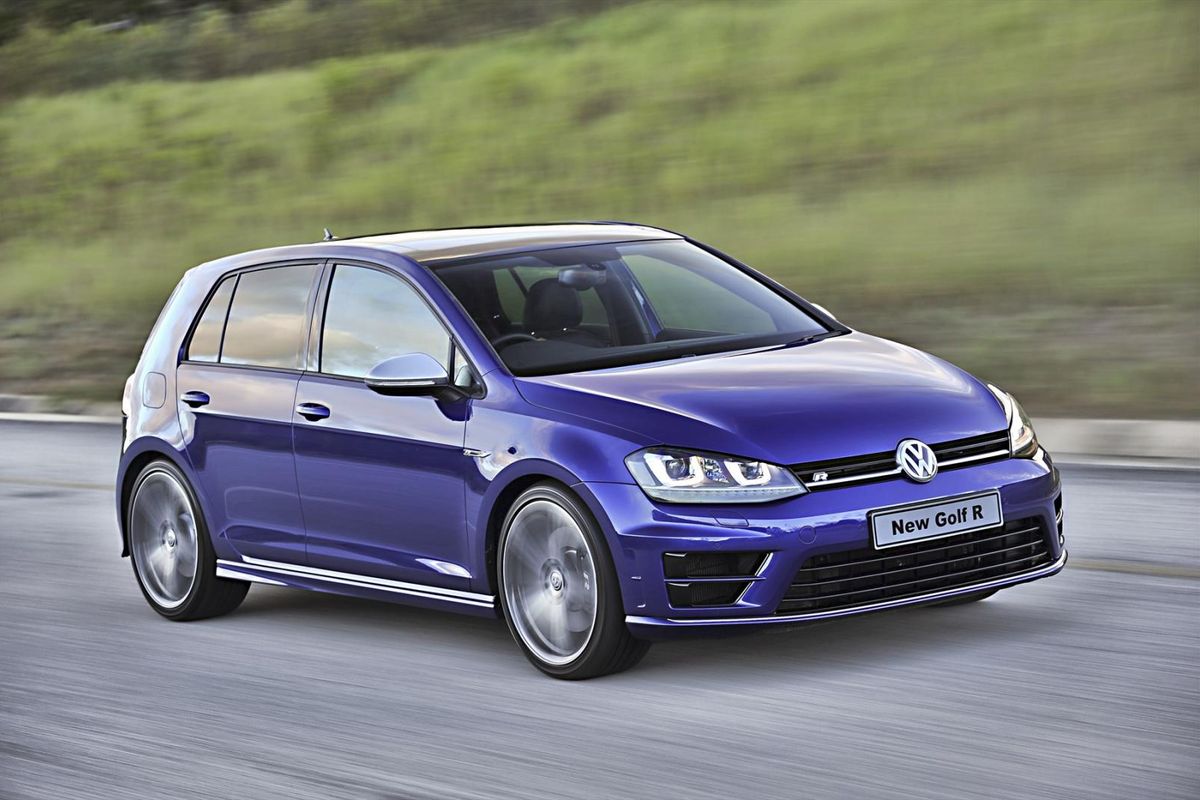
Of course, if a GTI is not quite hot enough, you may also be interested in the big daddy "R", powered by 206 kW/380 Nm 2.0-litre four-cylinder turbo. It is serious fast, with a 0-100 kph time of 5.0 seconds for the DSG-equipped car (5.2 for the manual).
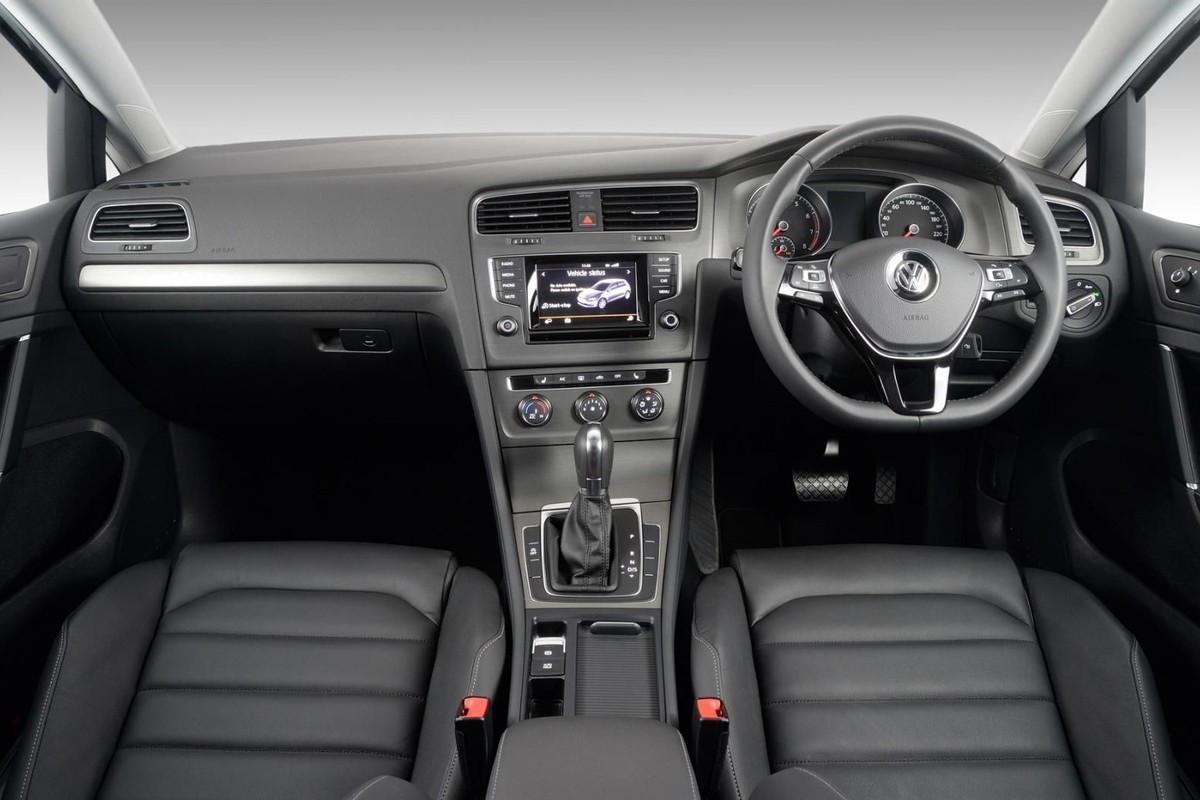
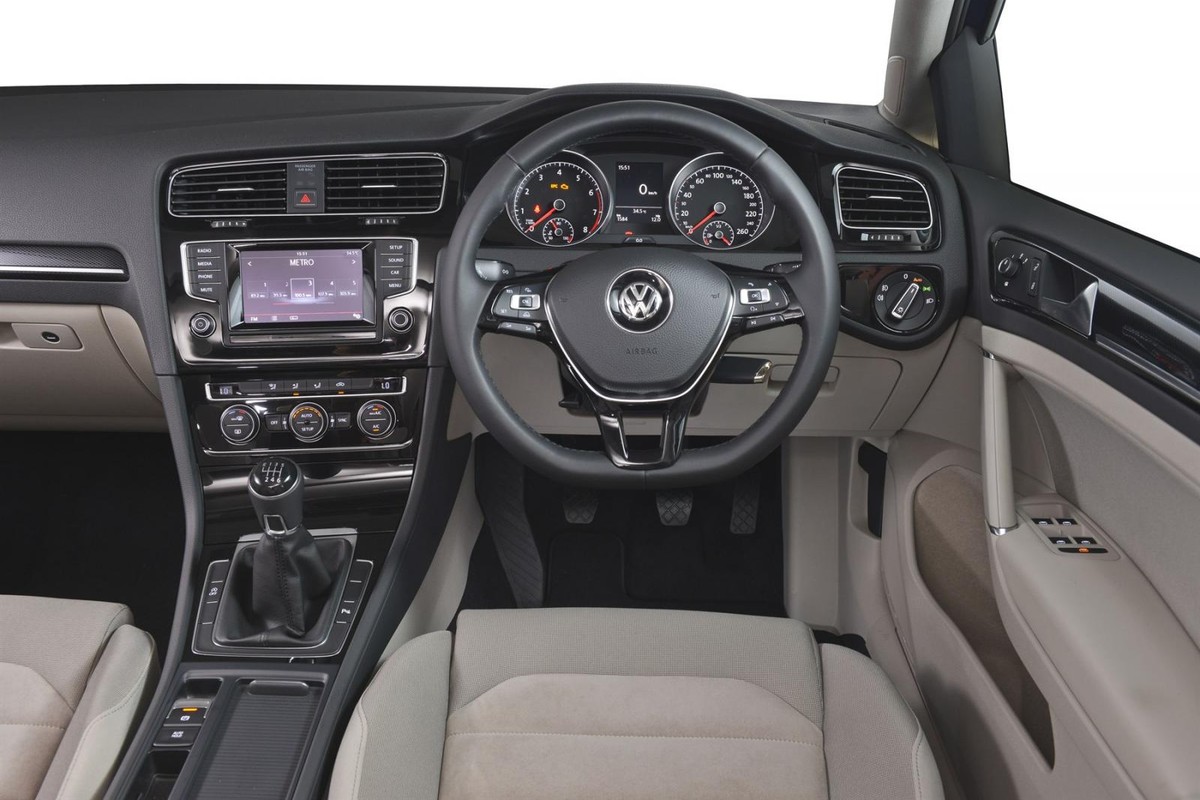
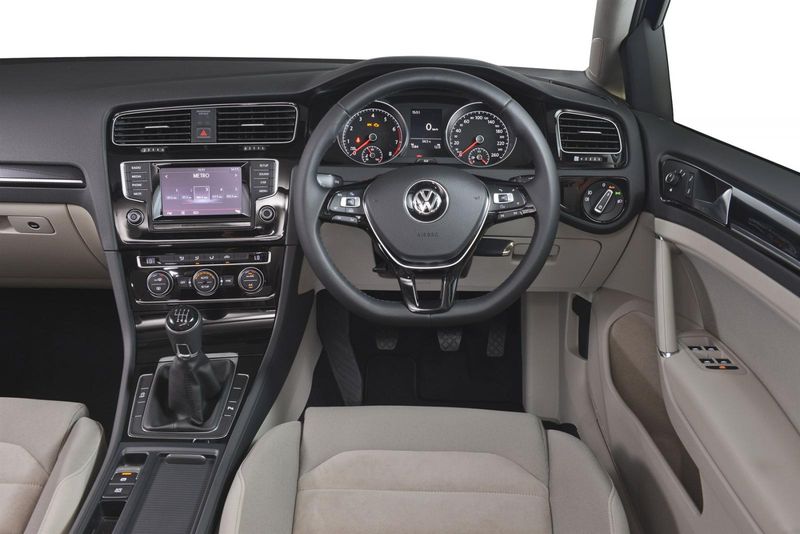
Even years following its introduction the Golf 7 cabin remains a classy and comfortable place.
The Golf is available in three trim levels, namely Trendline, Comfortline and Highline. Consult our useful Compare Tool to figure our which one suits your needs (and pocket) best. As is the case with most Volkswagens, the options list is quite long, so tick those boxes wisely. As standard, the Golf 7 centre console features either a 5- or 8-inch infotainment touch screen (depending on specification level). The Trendline and Comfortline derivatives are fitted with a ‘Composition Colour Radio’ (5-inch) and offers an SD slot, aux-in interface, two push dials and 8-speakers. The Highline derivative is fitted with a ‘Composition Media Radio’ (5.8-inch) and includes Bluetooth telephone preparation and a USB interface.
What's great about the Golf 7?
The Golf 7 has been around since 2013 and is around halfway through its lifecycle. That means a facelift can't be too far away… Read about what that may include by clicking here. But even in its current guise the Golf 7 continues to offer a tantalising combination of near-premium status and refinement, without sacrificing the versatility, fuel efficiency and comfort demanded of a daily runner. They're a fair bit more expensive to buy new than most of their direct rivals (spec for spec), but in the long term they're also likely to be easier to resell.
New vehicle sales are declining in South Africa and forecasts indicate that the trend will continue for the remaining half of 2016.
The trend of declining new vehicle sales continued during the month of May 2016 with major segments reflecting double-digit declines according to the National Association of Automobile Manufacturers of South Africa (NAAMSA). As expected, exports remained positive with marginal improvements experienced in May.
Toyota is currently dominating the local market with a total market share of 22.5%, making it the best-selling vehicle brand in South Africa. The new Toyota Hilux is proving to be a major success for the brand and it’s currently selling up a storm to claim the top spot on the sales charts. The Toyota Fortuner experienced strong sales in May, too, and it’s currently the fifth best-selling car in the land. For Volkswagen, the Polo Vivo and Polo remain best-sellers and based on the popularity of these vehicles, we should see them in the Top 5 for months to come.
"I hate to be a pessimist, but I do believe we haven't seen the worst yet," says Cars.co.za Consumer Experience Manager, Hannes Oosthuizen. "At the moment the numbers appear to be inflated to some degree by introductions of high-volume players such as the Hilux and Fortuner. With further interest rate hikes likely, as well as some other major economic challenges on the horizon, I do think the industry faces an extremely tough 2016. In fact, I wouldn't be surprised if a few of the smaller players follow the likes of Daihatsu, Proton and MG out of the local market," he said. "The exchange rate and poor local sales make it increasingly difficult for such brands to do business in South Africa."
* Figures in brackets indicate change compared with April 2015 figure.
New Car Sales Outlook
The negative trend of declining new cars sales will continue for the remainder of 2016. Factors contributing to the decline in new car sales include poor economic growth, significant new car price increases and the possibility of further interest rate hikes. Exports, however, are expected to improve for the remainder for the year. Projections indicate that exports for 2016 should total in the region of 360 000 units while total domestic production for the year is estimated at 635 000 units.
A weak Rand has resulted in new car price increases estimated at between 10% and 15% for the year and as a result, consumers are flocking to the used car market in search of value. The increase in demand for used cars, according to WesBank, has increased by 9.5% in May 2016, which has resulted in an average 7.0% rise in used car prices.
“In the current market consumers will find themselves either having to hold onto their cars for longer, before replacing them with a new model, or taking their budget to the used market. This focus on affordability highlights the pressure on consumer budgets. The cost of motoring is on the rise, and will start playing a bigger role going forward” says Simphiwe Nghona, CEO of WesBank Motor Retail.
Cars.co.za has over 55 000 used cars for you to choose from. Whether you are looking for a new or used car, Cars.co.za is the simplest online car buying portal in South Africa.
Mercedes-Benz Announces More Rugged G-Class Professional Model
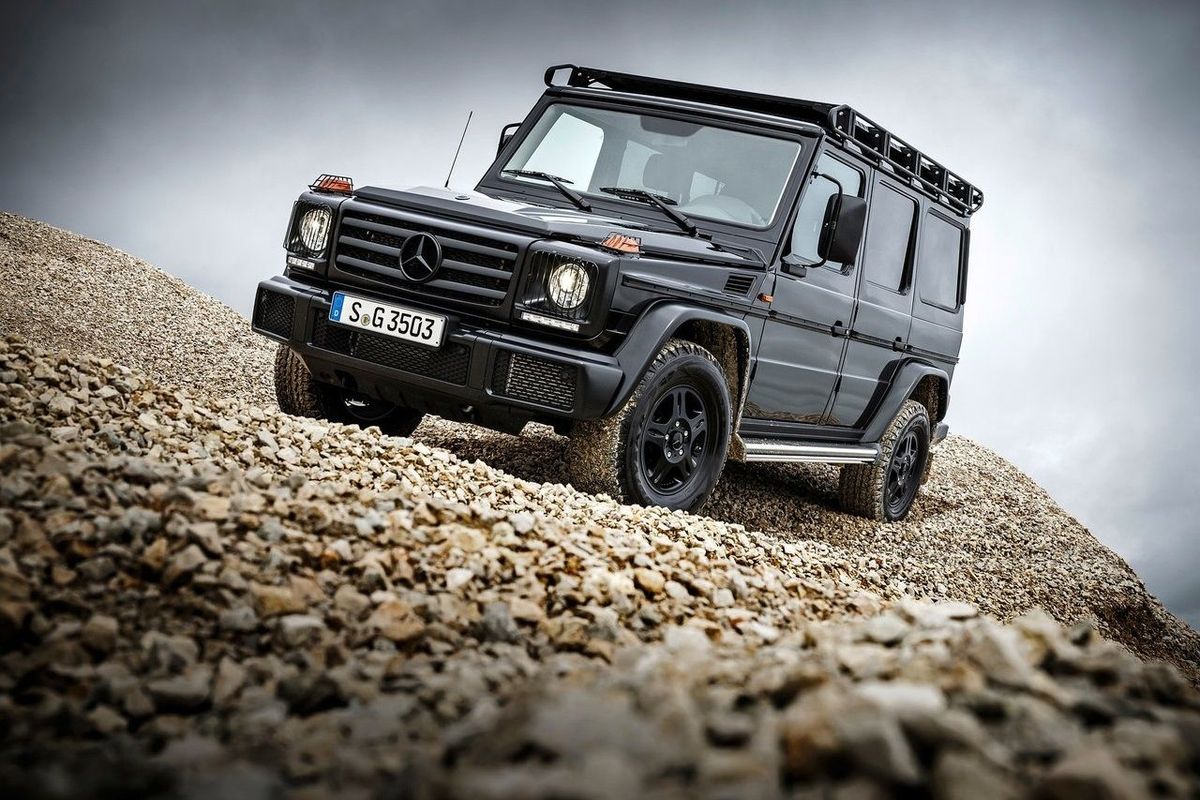
A hardcore workhorse version of the iconic Mercedes-Benz G-Class has been announced. Meet the Mercedes-Benz G350d Professional.
When most people think of the Mercedes-Benz G-Class, the image of a vibrantly coloured G63 AMG comes to mind. Music videos are to blame for this shift in focus as the real purpose of this vehicle is not for entertainment and showing off, but rather as the ultimate go-anywhere machine. It has military and workhorse origins and during our visit to the G-Class plant in Graz, Austria in 2015, we saw military spec derivatives being assembled alongside their flamboyant counterparts.
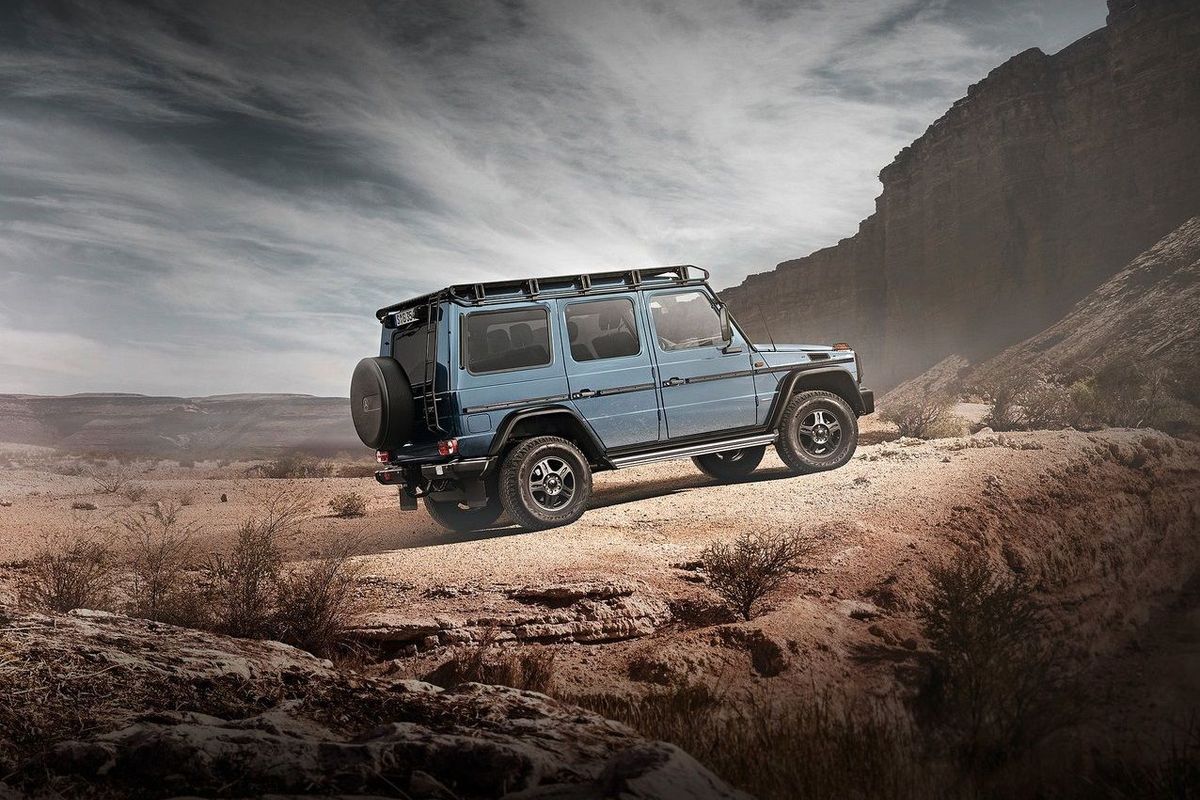
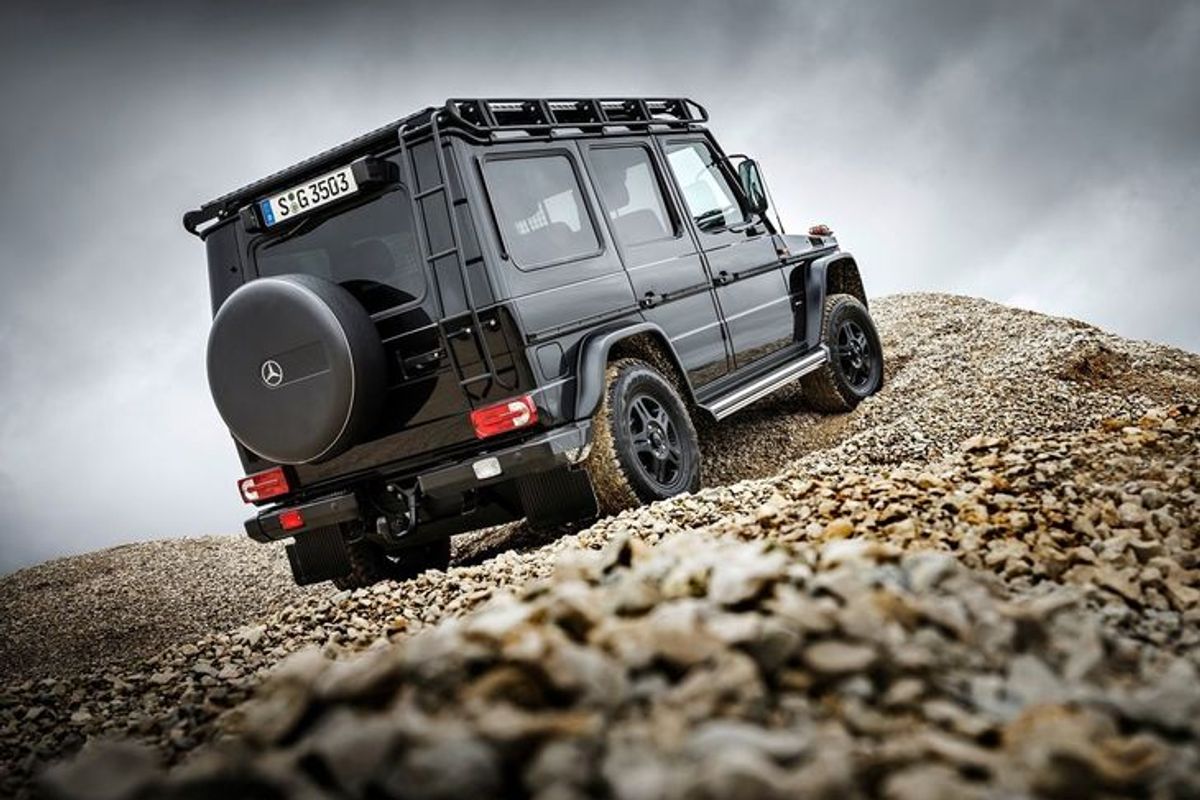
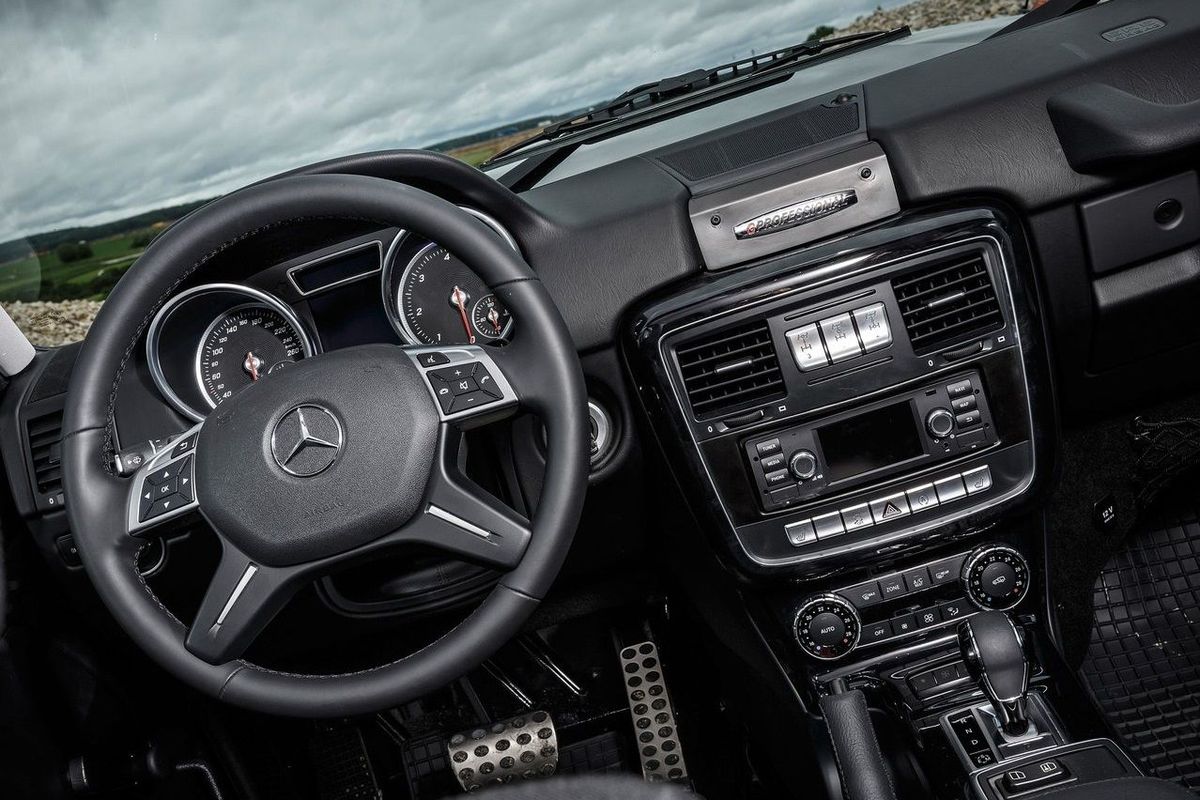
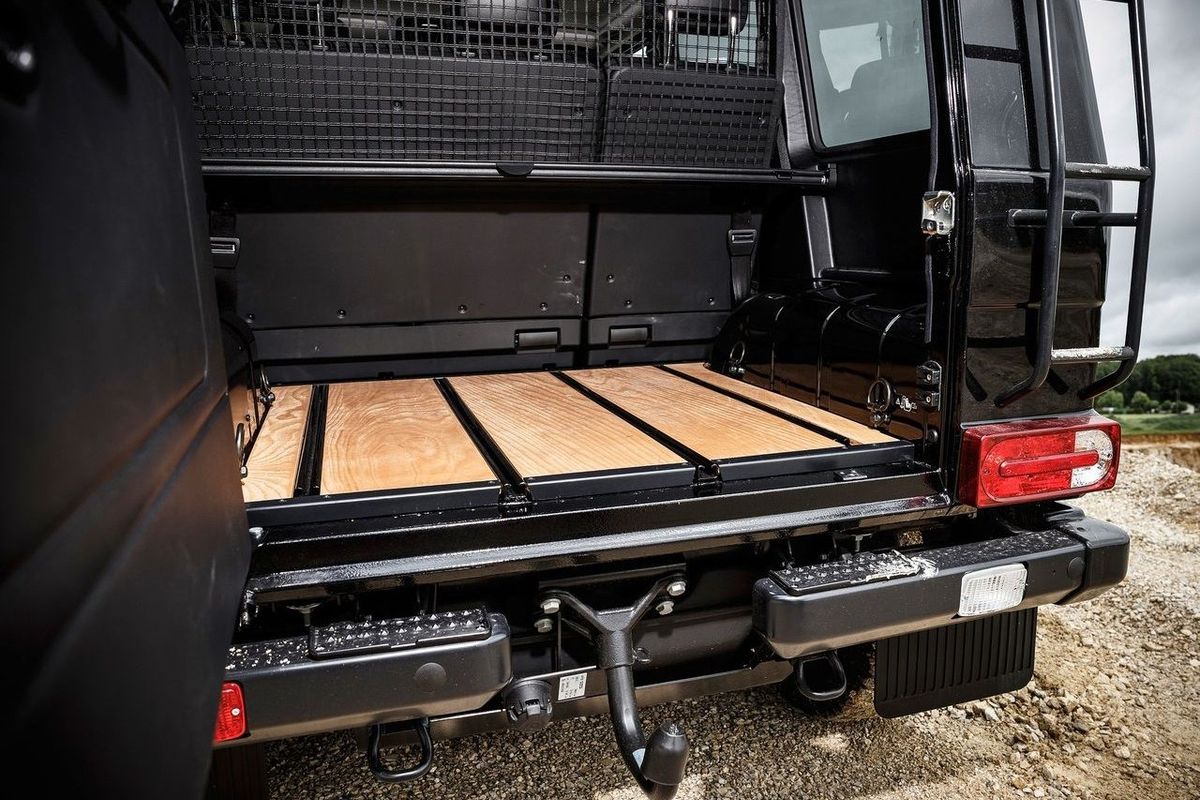
This new Mercedes-Benz G350d Professional is designed for the hardcore off-road enthusiast and for commercial use. While the outgoing model was deemed a little too bare for some tastes, this new model promises an all-new interior along with a less agricultural ride. The Professional has always been the purist's choice and this new one certainly looks the part with black 16-inch wheels and a matte black grille.
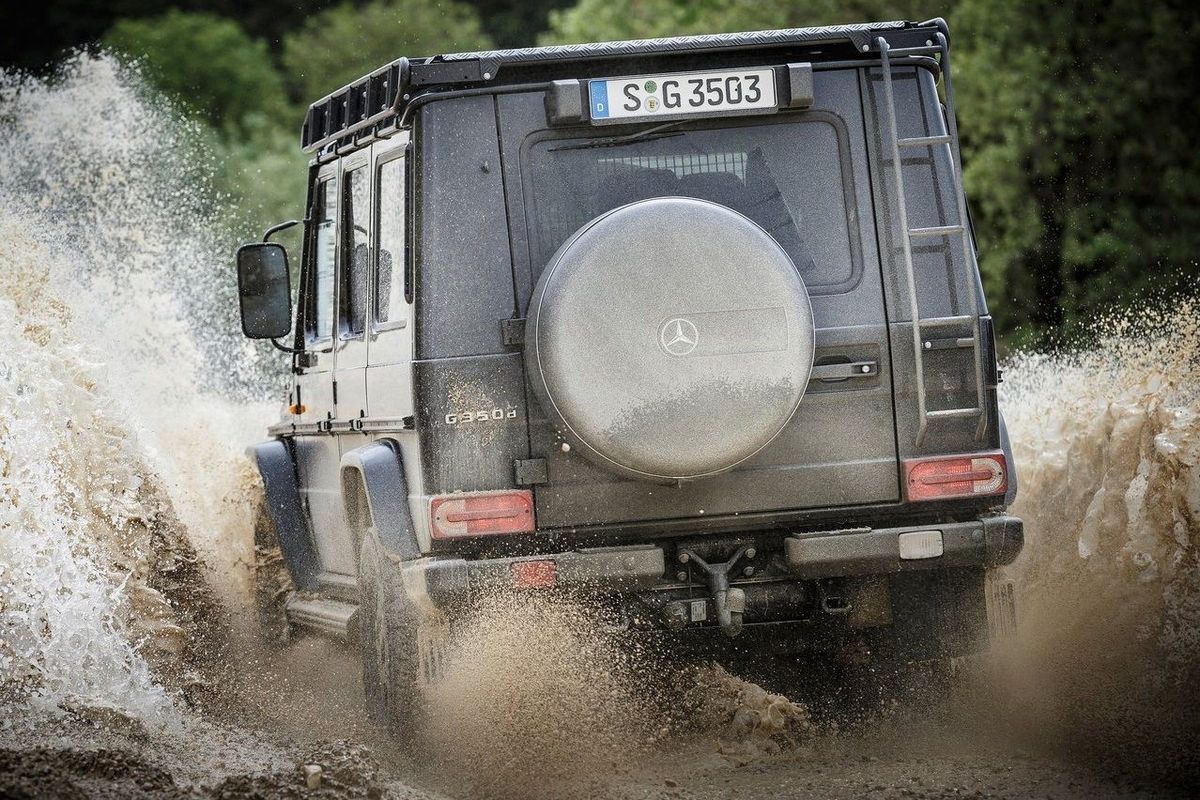
Underneath the tough-looking exterior is the same proven setup. There's a meaty new diesel V6 which has been tweaked to provide 180 kW and 600 Nm, a sturdy ladder-frame body, permanent all-wheel drive, low-range and three electronically selectable 100% differential locks. The engine is claimed to consume 9.9 L / 100 km and will emit 261 g /km of CO2. Power reaches all four wheels through a 7G-Tronic automatic transmission.
This vehicle also benefits from tweaked suspension which raises the ground clearance by 10 mm. It now stands 245 mm high which means its even more capable off-road. Thanks to the raised ground clearance, the approach angle has increased to 36 degrees, while the departure angle has been increased to 39 degrees. It can also tow things up to 3 200 kg.
Sadly, at this point there has been no confirmation of South African availability.