According to the National Association of Automobile Manufacturers of South Africa (NAAMSA), new car sales in South Africa have declined by 5.4% when compared to the same period last year with the exception of the light commercial vehicle segment, which grew by 2.2%. Vehicle exports however performed exceedingly well in May 2015 with a gain of 114.2% compared to May 2014. The Ford Ranger topped the sales charts in May, while Toyota remains the best selling car brand in South Africa. Take a look at our new car summary below for further details.
New Car Sales Summary May 2015
47 868 aggregate new vehicle sales down by 3.2% (1 581 units) compared to May 2014.
33 411 export sales up by 114.2% (17 816 units) compared to May 2014.
31 201 passenger car sales down by 5.4% (1 773 units) compared to May 2014.
14 182 light commercial vehicle sales up by 2.2% (309 units) compared to May 2014.
NAAMSA says that export sales remained on target for 25% volume growth for 2015 and should reach a volume record of about 330 000 units for the year. In light of declines in the new car market, the outlook remains conservative for the remaining months of the year. In order to match 2014 total aggregate domestic sales, new car sales in South Africa would need to improve during the remaining months of the year. Vehicle production however is set to increase as a result of higher export sales.
2015 Audi Q3 Pricing & Specs Announced
There’s a new version of Audi’s compact SUV in South Africa and we have all the details regarding the 2015 Audi Q3.
The baby SUV has sold reasonably well in South Africa after being launched back in 2012. With around 5 000 units sold on our shores, it’s regarded as a best seller in the premium compact SUV market. Now there’s a refreshed version which offers better performance, a revised design and more equipment.
What’s New for 2015 Audi Q3?
The big news is that there’s a new 1.4-litre turbo engine with 110 kW and 250 Nm for the 2015 Audi Q3. There’s a choice of either a six-speed manual gearbox or 7-speed S tronic transmission, and both models are front-wheel drive. In terms of design, there’s a more aggressive 3D-design front grille, revised bumpers and headlights, whilst the rear features a new bumper and tail modernised light design.
For the first time full LED headlights are offered as an option for the 2015 Audi Q3. These are offered in conjunction with the dynamic turn indicators which illuminate sequentially within two-tenths of a second from the inside out in the direction the driver intends to turn.
In terms of dimensions, the 2015 Audi Q3 is pretty much the same size as the outgoing model, both inside and out. There’s adequate space for all five passengers, with the cargo compartment offering up 460L of space. Fold the split rear seats down and you’ll have access to 1 365L. Roof rails as well as an all-new extendable luggage compartment are standard.
The engines have been refined to offer increased outputs, yet reduced fuel consumption. CO2 emissions are down by as much as 17%. As mentioned earlier, the 1.4T offers 110 kW and 250 Nm, while the 2.0T produces 132 kW and 320 Nm. This version of the 2015 Audi Q3 also offers quattro all-wheel drive and an S tronic gearbox.
For the diesel fans, there’s a 2.0-litre TDI which delivers 135 kW and 380 Nm. It will only arrive in July 2015 but also comes with quattro and S tronic. 2016 will see a 2.0-litre TDI front-wheel drive Q3 with S tronic introduced to SA.
Also new for the 2015 Audi Q3 is a fine-tuned chassis with a focus on agility and safety, without compromising on comfort. In terms of safety, there are some additions. Secondary collision brake assist is standard and a host of other systems available as options. Audi side assist, for example, displays a yellow LED indicator that illuminates in the housing of the outside mirror if another vehicle is in the blind spot or is approaching rapidly from the rear. Audi active lane assist works with video cameras that detect the lane markings which will then gently intervene by nudging the car back into its lane via the steering.
For the performance fans, the RS version of the 2015 Audi Q3 is confirmed. The 2,5-litre five-cylinder engine is retained, but now boasts more power. With 250 kW and 450 Nm on tap, the Audi RS Q3 promises 100kph in just 4.8 seconds and rampages its way to an electronically limited top speed of 250kph. If you’re a fan of the typical five pot noise, there’s now an RS exhaust system which allows you to add more volume.
Power reaches the quattro drivetrain through a seven-speed S tronic transmission. There’s a new hydraulic multi-plate clutch and the entire system has also been refined for faster gear changes. The lower gear ratios are closely spaced for sporty response while the seventh gear is to save fuel. The RS version of the 2015 Audi Q3 will arrive in August 2015.
Standard equipment for 2015 Audi Q3
Audi Q3 1.4T FSI manual and S tronic:
Xenon plus headlights with LED daytime running lights and halogen rear lights
Driver information system in colour with efficiency programme
New-design 17-inch alloy wheels
Cruise control
LED interior lighting package
Standard seats in cloth
Front centre armrest
Audi sound system
Automatic air-conditioning
Front passenger airbag deactivation
Automatic interior dimming mirror
2015 Audi Q3 Price in South Africa
The Audi Q3 will be priced as per below:
Audi Q3 1.4T FSI 110 kW manual: R 402 500
Audi Q3 1.4T FSI 110 kW S tronic: R 419 500
Audi Q3 2.0T FSI 132 kW quattro S tronic: R 499 000
Audi Q3 2.0 TDI 135 kW quattro S tronic: R 515 000
Audi RSQ3 2.5T FSI 250 kW quattro S tronic: R 769 500* (August 2015)
* Indicative pricing
All prices are inclusive of VAT and the standard Audi Freeway Plan (5 year/100 000km).
Volkswagen Polo GTI (2015) Review
The Volkswagen Polo GTI has always been a punch-above-its-weight kind of vehicle and now the third iteration of this little flyer has reached our shores. We spent a week with it and the good news is that it continues to be the potent little firecracker with a touch of mature class, just like its predecessors were.
New Engine
The big news this time round is that theres an all-new engine in the 2015 Volkswagen Polo GTI. The popular 1.4 TFSI engine has been replaced by a 1.8-litre turbocharged powerplant. With 141kW and 250Nm, performance is brisk with 100kph coming up in under 7 seconds. Power reaches the front wheels through the venerable DSG (double-clutch) setup. Its a wicked combination and Polo GTI zips through the gears effortlessly.
We found it strange that the Polo GTI doesnt feature a form of launch control. If it was fitted, this car would surely nip at the heels of faster and more premium machinery, especially off the line.
Manual Gearbox Coming Soon
More big news is that this generation of Volkswagen Polo GTI will also feature a manual transmission, which arrives in South Africa later this year. While it features the same 1.8-litre engine as its automatic sibling, torque is rated at 320Nm which is 70Nm more.
The difference were told is due to the torque limitations on this particular DSG unit. Still, this sounds very exciting and itll be cheaper than the auto, but if Golf GTI sales are anything to go by, the DSG models will be the more popular choice.
Refinement Deluxe
On the road, the Volkswagen Polo GTI feels mature and refined. Are these words youre wanting to hear when thinking of junior hot hatch? We dont think so. That said, you cannot drive like a hooligan all day long and this is where the Polo GTI shines. For a car marketed as a hot hatch, its able to perform well when not being pushed, ie: 90% of the time. Drive the Polo GTI sensibly and youre likely see reasonable fuel consumption returns too. We regularly saw figures of around 7.8L/100km.
Not As Precise a Performer
The new electrically assisted steering makes life simple as its light, yet direct. The result is point and squirt action to your hearts content. The electronic XDS system, which uses the traction control to mimic the effects of a mechanical limited slip differential, has been further honed to improve the handling even further and to counter understeer. Essentially, this is a device which makes front-wheel drive cars go faster around corners by making the outside wheel turn faster than the wheel on the inside of the corner. Sounds technical? It is! Is it as involving or as good at cornering as a RenaultSport or ST? Not quite.
Some Drawbacks
As good as the Volkswagen Polo GTI is, there are some drawbacks. The ride is very firm, something we discovered while driving on uneven tarmac. As far as Volkswagen GTI products go, its a lot stiffer than most and unless you specify the adaptive suspension, you could be in for a tiring journey if youre on bad roads. Then theres the case of its engine note, or lack thereof. Its not as satisfying as the previous car and the gearshift pops from the DSG are noticeably muted. The boot is also not the biggest and can only offer you 952L of space even with the seats folded down.
Options Fitted To This Vehicle
The vehicle you see here came well specced as standard, with a few additional goodies bolted on. These included metallic paint (R900), panoramic sunroof (R9 200), LED headlights (R11 750), park distance control (R3 050), and rear camera assist (R3 050). This pushed the standard R326 400 price up to R354 350, which is pricey for a vehicle in this segment.
You still get a fair bit of kit fitted as standard. Theres Bluetooth connectivity, USB/aux, SD card input which link up to the touchscreen infotainment screen. Theres also cruise control, heated seats and a decent safety setup consisting of ESP and 4 airbags (optional 6).
Summary and Conclusion
The Volkswagen Polo GTI is a punchy performer and it offers great looks as well as a very premium cabin. Its somewhat clinical, however, which means it lacks some of the emotion and personality that its rivals have in abundance. While the likes of the Ford Fiesta ST and Renault Clio RS both offer similar performance and entertainment, they also make for hands-on and hard daily drives. By comparison, the Polo GTI is a far less strenuous daily driver. Its a firm ride, for sure, but it feels aimed at a more mature audience who doesn’t want to admit they’ve grown up.
If its thrills and outright performance youre after, then best you head to your Ford dealership and grab yourself a Fiesta ST or pay the folk at Renault a visit. If youre not that performance inclined and just want something that offers that premium feel, refinement, great build quality and enough grunt to put lesser cars in their place, then the Volkswagen Polo GTI is perhaps the most rounded of all the junior hot hatches. Much like a Golf 7 GTI then
VW Polo GTI Price in South Africa
1.8 TSI 141 kW GTI DSG R326 400
The new Polo GTI comes standard with a 3 year/45 000km Service Plan, 3 year/120 000km warranty and a 12 year anti-corrosion warranty. Service interval is 15 000km.
Second Opinion
I was surprised to find such a firm ride on a Polo GTI, and it shows that Volkswagen wants typical boy racers to take the Polo GTI serious, too. In the end, however, it remains so good because it delivers such strong performance, a great cabin and a measure of entertainment ability in such a mature package. – Hannes Oosthuizen
We Like: Build quality, refinement, great all-round performer
We Dont Like: Lack of engine note, not as enthusiastic or dynamic as hoped, pricey
Also consider: Ford Fiesta ST, Renault Clio RS200, Peugeot 208 GTI, Audi A1
Over one of the many challenging passes in the area near Cape Town, the just-launched Hyundai Veloster Turbo behaves impeccably, putting its power down on the billiard-board surface predictably and with a fair degree of grip. Even shifting to a gear higher than ideal showed no tendency for the front end to wash out into understeer, so this is indeed impressive.
The thing is, does this car have enough punch, enough outright handling prowess, to cut it with the likes of the Mini Cooper S or the Volkswagen Scirocco? Those cars are going to be the benchmark for this, the first real performance Hyundai in quite some time, since the discontinued Tiburon V6 that surprised people with its prowess almost a decade ago.
Turbo engine adds welcome boost
On paper things look pretty cool for the three-door-plus-hatch-lid Hyundai coop which was launched with a 1.6-litre engine a year or so ago. The new engine is known as a T-GDI, which stands for turbocharged gasoline direct injection and is fitted with a twin-scroll exhaust-driven blower.
The rated output is 150 kW and 265 Nm of torque, a substantial step-up from the 103 kW and 167 Nm 1.6-litre motor fitted to the naturally-aspirated Veloster. Hyundai offers a six-speed manual gearbox or a seven-speed dual-clutch transmission, offering a full-automatic driving style or gear-changes through paddle shifts or the central gear lever.
The manuals rated 0-100 kph time is 7.8 seconds, while the dual clutch model is said to be good for 7.3 seconds. Top speed is rated at 224 to 225 kph, the DCT getting the slightly faster figure, presumably due to optimised gear ratios.
Revised gearing
Talking of ratios, a quicker steering ratio is fitted to the rack of the Turbo model, with revised calibration to invoke quicker responses from steering wheel to the road. The wheels themselves are upgraded with the Veloster Turbo gaining 18-inch alloys which fill those big wheel arches admirably from a side-on or three-quarter view. Tyre sizing on these wheels are 215/40 R18s, and are suitably low profile, although when the car is viewed from straight ahead or from the rear, one could argue that slightly broader section tyres would have made the Turbo look more purposeful.
Still its a good-looking car, one of the best in its class, in fact, with all sorts of interesting angles and panel cutaways keeping the viewer intrigued, and the owner proud.
Smooth operator
In terms of power delivery, its ultra-smooth, yet somehow I found myself waiting for a bit more meat in that power-band that never seemed to announce itself. There is no typically mid-range sweet spot, it all seems just a little too linear to make this car really exciting. Again, it will be interesting to have a V-Box-timed shoot-out against its price competitors, notably the Scirocco and Mini Copper S, to see where the Korean coupe lies in the street-racer scheme of things.
In terms of stopping power, the brakes have been upgraded with larger ventilated discs up front.
Interior details
Inside the Volster has a pleasing interior, quite different in style to anything you are likely to get from European offerings. Hyundai has gone for a prominent centre console that is said to be inspired by a superbike fuel tank. What I like about it is that all the major dials and control knobs are present and easy to use. It is a pleasant cockpit, but more than one journo on the launch felt that a touch of added metal bright-work or red stitching or whatever would have made the point that you are indeed sitting in the performance version of the coupe.
The seats are comfortable and offer good lumbar and lateral support, and, while there isnt too much space in the rear, it is possible to cruise the city with four adults on board, the rear passengers of course accessing from that single kerb-side door.
Getting back to the handling mentioned earlier, rougher elements encountered on our route through various mountain passes showed that the slight deflection over bumps encountered on the non-turbo model a year ago has not been fully sorted. Indeed, with stiffer suspension setting and lower profile tyres it can become quite skittish when driving over mid-corner bumps. Hyundai has established a performance centre at the famous Nurburgring circuit to deal with this sort of issue, but it has not born fruit as yet in the Veloster Turbo.
But the smooth road manners and the overall smoothness of the car nevertheless makes for a pleasant car, and it is only when really pressing on that you wish for greater control of un-sprung weight in the suspension.
Hyundai Veloster Turbo Pricing
There are good aspects to the car, not least because it is really eye-catching, and also because its ownership package offers up the excellent five-year/90 000 km service plan to go with the five-year/150 000 km warranty. At R379 900 for the manual and R399 900 it is not cheap, and this is going to make it a challenge for Hyundai dealers.
Suzuki Swift and DZire Updated
Suzuki South Africa has updated its Swift 1.2 hatchback and Dzire sedan models with a range of interior and exterior updates. Suzuki has also fiddled with the engine management system which has resulted in improvements in efficiency.
Fresh Styling
Both the updated Swift 1.2 and DZire now feature a new grille and front bumper design. The DZire sedan benefits further with a redesigned headlight cluster as well as a revised rear bumper. Both models are offered with full-size wheel covers as standard and buyers can now choose from a new range of exterior colours.
Bluetoooth connectivity is now standard on all GL models and the rear bench of the Swift 1.2 can now fold in a 60:40 configuration for increased versatility. In the DZire, the cockpit now features black-hued cloth upholstery.
Improved Efficiency
Both the Swift 1.2 and DZire models are powered by a four-cylinder 1.2-litre engine that offers 62 kW and 115 Nm of torque. For the Swift with manual transmission, fuel consumption has improved by 7.1% with a reduction from 5.7L/100km to 5.3L/100km. The automatic Swift version now consumes 5.8L/100km, previously 6.3L/100km, which is an improvement of 7.9%.
Fuel consumption for the manual DZire sedan has improved by 7.1% with a fuel consumption figure of 5.7L/100km while the automatic now consumes 5.9L/100km.
We’ve been particular impressed with the Suzuki Swift, especially in 1.2 guise. It was so good, one of our journalists landed up buying one! Read our review of this vehicle here.
Suzuki Swift and DZire Price in South Africa
Swift 1.2
1.2 GA Manual – R131 900
1.2 GL Manual – R143 900
1.2 GL Auto – R158 900
DZire 1.2
1.2 GA Manual – R133 900
1.2 GL Manual – R145 900
1.2 GL Auto – R160 900
All Swift 1.2 and DZire models are backed by a three-year/100 000 km warranty, and a two-year/30 000 km service plan.
BMW X5 M (2015) Review
First the debate centred on the merits of so-called on-road biased SUVs. Why does the world need expensive, complicated luxo-wagons loaded to the hilt with off-road technology that never gets used? But now everyone drives SUVs
Then the argument grew even more intense when super powerful versions of these pointless vehicles were launched…
But heres the reality. While motoring journalists (yours truly included) debate the merits of these vehicles mere existence, the companies that make them are laughing all the way to the bank. The public desire these machines, perhaps not always for likeable reasons, but nevertheless, there is a market for them. So there
For a very long time the Porsche Cayenne Turbo has reigned supreme when it comes to SUVs with sportscar rivalling performance and startling dynamic ability. BMW, however, believes that its new X5 M has a serious shot at the title. How does it fare?
Hardcore appearance
The current X5 is an attractive, but ultimately quite conservative large SUV. To transform it into a fire-breathing M, however, BMW has endowed this SUV with some serious visual muscle.
Riding on striking 20-inch wheels and with a front-end littered with aggressive air intakes, as well as a rear view dominated by a quartet of pretty large-diameter exhaust tips, the X5 M is not subtle, even in this relatively conservative dark grey colour.
At this point in a review our attention usually turns to the interior, but seeing as were reviewed a current-generation X5 before and this M version simply brings more features and sportier trim to the party, I think it is more important to look under the bonnet.
Here you will find something rather special a twin-turbocharged 4.4-litre V8 that delivers a whopping 423 kW! Equally impressive is the torque figure, with a mammoth 750 Nm of twist available all the way from 2 200 to 5 000 rpm promising great flexibility. Keep in mind, however, that this monster weighs more than two tonnes, so each one of those kilowatts will be required to deliver on BMWs promise of a 4,2 second 0-100 km/h sprint time. Fitted with eight-speed automatic transmission that offers a launch control function, the X5 M does, however, feel every bit as fast as the numbers make it appear.
Addictive sound
It is rather strange to find BMW fitting an automatic transmission to one of its M-division vehicles, but theres little reason to complain of its performance in the X5 M. Downshifts are crisp and precise, and it generally responds swiftly to throttle inputs, no matter what the mode. And when youre not in a fast-driving mood, it is beautifully smooth and refined, much more so than what a double-clutch probably would likely have been able to deliver.
But always there to remind you that you are behind the wheel of something incredibly powerful is the sound when the throttle pedal edges closer to the footwell carpet. Admittedly BMW’s engineers performed some acoustic “cheating”, but it is nevertheless very addictive.
Fuel economy? Does it matter? Probably not but even BMWs claim of 11.1 L/100 km will be hard to match. Think closer to 15 L/100 km if you often delve into the X5 Ms performance capabilities, which is very hard not to do.
Dynamic finesse
Power is one thing, and to be honest its never been lacking on any of the super SUVs. Only one of these vehicles has however managed to marry all this power with super-sedan on-road dynamics successfully, and thats the Porsche Cayenne. The challenge is obvious. These SUVs are heavy, and they have high centres of gravity. To make them feel planted and under control, the engineers face a stiff challenge, but BMWs boffins have cracked it, in my opinion.
You can choose between comfort, sport and sport+ suspension settings, and most drivers are likely to spend their daily drives in comfort mode. This is where the X5 M delivers its first (and surprising) knockout performance. Even on those 20-inch wheels, the ride is remarkably composed and theres enough suppleness to deal with bumps without disturbing the occupants. Sure, when the surface deteriorates, and when you find yourself in sport mode, it gets crashy, but considering its dual purpose, the X5 M possesses impressive ride quality.
With the suspension tuned to one of its sportier settings, the X5 M is transformed into an athlete endowed with the type of agility that belies its bulk. Body control is remarkably good for this type of vehicle, and the steering is beautifully precise. You tend to arrive at corners at a much faster rate of knots than you had anticipated, partly because the size and weight of the vehicle disguise the sense of speed. Good thing, then, that the brakes are so immensely powerful and easy to modulate.
Key to the X5 Ms dynamic prowess is its Xdrive all-wheel drive system. Dont be fooled though theres not much off-roading purpose to this system when it comes to the X5 M. In this model it works with the Dynamic Performance Control system to largely make sure that the right amount of power goes to the right wheel(s) to ensure better traction to go faster around a corner.
Comfortable cabin environment
So, in terms of performance and dynamics, the X5 M is now a serious challenger to the Porsche Cayenne Turbo, and possibly even the much more expensive Cayenne Turbo S. The rest of the package is good, too.
Our test unit was optionally fitted with beautiful red leather upholstery, rear TV screens, Connected Drive and a stunning Bang & Olufsen sound system. Note, however, that even with all these items fitted, the X5 M is still more affordable than the new Range Rover Sport SVR, for example.
This beast can quite comfortably fulfill daily commuting chores, though at a fuel cost penalty, obviously. The seats are superb, the ergonomics simple and rear legroom excellent. Even the boot, accessed through a split-opening tailgate, is of a decent size to accommodate a familys holiday gear.
Conclusion and Summary
BMW has managed to silence many critics with the X5 M . Its brutal looks may lead you to believe that it is entirely one-dimensional, but even in the real world, this BMW delivers the goods. This is a super SUV that manages to combine the practicality of a station wagon, the kerb-side appeal of a muscular SUV and the power and dynamics of a super sedan. It truly is a freak of science.
And then theres the small matter of its base price significantly undercutting the competition, too. We think the X5 M’s greatest hurdle is not necessarily its rivals abilities, but rather their badges. We wait in anticipation to review the new Range Rover Sport SVR, as that vehicle is potentially a deadly rival. And, of course, the Porsche Cayenne Turbo remains not only an exceptional product, but also one bearing a more desirable badge. Then again, during the X5’s time with us someone took a screwdriver to its tailgate in an effort to steal the “M” badge, so perhaps it’s already got that licked too…
BMW X5 M Price in South Africa
The BMW X5 M costs R1 657 159 and comes with a two-year/unlimited km warranty and five-year/100 000 km Maintenance plan.
Second Opinion
It’s quite insane that an SUV can offer sportscar performance in terms of outright speed and agility. The X5 M does just that and still delivers as a practical day-to-day SUV. If I was buying in this segment I would probably want a bit more badge appeal and lean towards the Range Rover Sport SVR or the Porsche Cayenne Turbo, but if BMW is your brand then the X5 M won’t disappoint. -Ashley Oldfield
We Like: Ferocious performance, excellent road holding, luxury, quality
We Dont Like: Precious little
Also consider: Range Rover Sport SVR, Mercedes-Benz ML63 AMG Performance, Porsche Cayenne Turbo
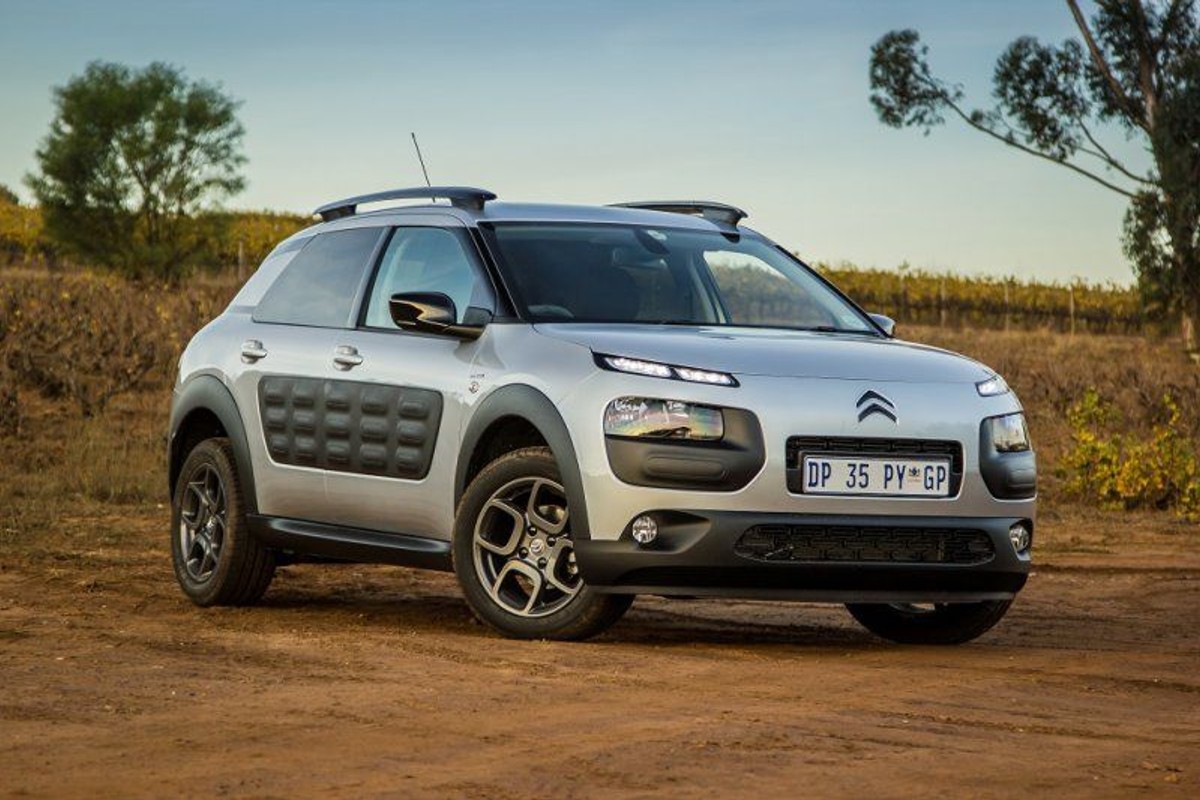
The Citroen C4 Cactus is the brand’s latest product to reach South African shores and its futuristic design has certainly set tongues wagging. But looks are just a minor part of car testing. Can this French funkmobile pass our consumer-biased evaluation?
Those looks. Wow. Few cars are this visually dramatic and the Citroen Cactus turns heads at a rate. If it’s not those thin daytime running lights and minimalist front end that catches your attention, it’s the armour cladding on the doors. These serve a practical purpose however and offer a defence against other car doors opening against yours, shopping trolley bashings and any other accidental bodywork nicks. So while they look strange, these AirBumps are quite useful to have around.
Compact, yet spacious
The rest of the car is deceptively compact and I was surprised by just how small the Citroen C4 Cactus is. Pictures tend to be misleading, and while the vehicle resembles an off-roader of sorts, it’s physically closer to your average C-segment hatchback. To put that into perspective, it weighs about the same as a Volkswagen Polo, but is the size of a Volkswagen Golf. The Citroen C4 Cactus is built on the DS3 platform, which is a good thing as the DS3 is a great base to start from.
Minimalist Interior
The fun and funkiness of the C4 Cactus continues when you open the doors. You’ll immediately notice the minimalist interior and its lack of buttons. You’ll also notice the lack of a rev counter, but that’s not an immediate problem as there’s a shift indicator animation. There’s a touchscreen infotainment system with a few buttons below it that dominates proceedings, but other than some air conditioner vents, USB port and 12V socket, there really isn’t much going on. One thing that Citroen has done very well with the C4 Cactus is provide loads of little hiding holes and pockets to store things.
Interior Space and Features
The glove compartment is spacious and there’s plenty of areas to store things such as mobile phones and keys. You’ll find a USB port in there too. The fun touches continue with the door handles which resemble leather luggage straps and the front seats look like those found in advertising offices. While they offer little in terms of lateral support, they’re comfortable and the material used feels long wearing.
Standard specification is generous and you’ll find the touchscreen infotainment system contains modern features such as satellite navigation, Bluetooth connectivity, automatic air conditioning, a reverse camera and there’s even a hard drive to store music. There’s front and rear parking sensors, cruise control with speed limiter, hill assist and tyre pressure monitor too.
Engine and Performance
The engine is the same unit found in the Peugeot 308 1.2 GT Line we reviewed recently. As mentioned in that article, Peugeot is pushing into the more premium sectors of the market, while Citroen caters for the slightly more budget-sensitive buyer. Power is a reasonable 81 kW with torque coming in at a handy 205 Nm. This engine is a 1.2-litre three-cylinder which may sound small, but punches well enough to keep up with traffic. Economy and emissions are where the C4 Cactus shines and during its stay with us, we averaged around 7L/100km.
This figure is a result of the Citroen Cactus’ light weight. We were surprised by just how little it weighs. Citroen claims it’s 200kg lighter than the normal C4, which is quite an achievement. The wind-down rear windows are gone and replaced by pop-out versions and the windscreen washing is now done by a system called Magic Wash which removes the bonnet-mounted nozzles and replaces them with wiper-mounted ones.
How Does It Drive?
The low weight and good engine work well together, and the Citroen C4 Cactus offers adequate performance. Power reaches the front wheels through a five-speed manual transmission. This gearbox feels solid in operation and shifts are generally positive. The same engine is paired with a six-speed gearbox in the Peugeot 308 but the Cactus makes do with just a five-speed. Having one less gear doesn’t really have an effect on the drive and the ratios feel well-spaced for everyday driving.
Our C4 Cactus came with the 16-inch Square alloy wheels which offered reasonable ride quality and are specific to the Shine model only. There are two accessory wheels, a 16-inch Declic and a 17-inch Cross, which both look good, but I would suspect the 17s offer reduced ride quality. Speaking of ride, the vehicle is smooth in operation on tar and capable of handling mild offroad scenarios too. The soft suspension means its not very sporty, but I don’t think the majority of C4 Cactus owners are bothered by this, choosing comfort as a priority. Refinement is good and light steering makes city driving simple and there’s not too much wind noise when you’re on the highway.
Summary and Conclusion
There’s a lot to like about the Citroen C4 Cactus. A combination of outstanding looks and value for money make it a worthy contender to receive both thumbs up. However there are some minor faults. The rear windows don’t wind down but open out instead. The rear seats do fold down, but not in a 60/40 split, which means that you lose the entire back row if you’re carrying lots of cargo.
While some of the interior finishes feel cheap, it’s not the end of the world for the C4 Cactus. There’s a lot to like about this futuristic city slicker and the entire team loved its looks and what it brings to the table.
Second Opinion
The Citroen C4 Cactus is something different, just as Citroen has always tried to do. It’s unique styling and characterful touches mean it stands out wherever it goes and will keep its owner entertained non stop. The interior is really good in places but a bit not so good in others. The engine always remains impressive and the ride subtle. There’s a lot of competition in this segment, but no doubt the Cactus is the most visibly noticeable of the pack. – Ashley Oldfield
Citroen C4 Cactus Price in South Africa
The Citroen C4 Cactus range starts from R224 900 for the 1.2 Feel, with the model tested here being the 1.2 turbo Shine costing R284 900. There is a mid-spec 1.2T Feel costing R259 900. The price includes a 3-year/100 000km manufacturer warranty, plus a 12 year anti-perforation warranty and a 3-year paint warranty. Optional is the 5-year/100 000km warranty extension. The vehicle also comes standard with a 5-year/100 000km service plan. There’s also 24 Roadside Assistance thrown in.
We Like: Wacky & futuristic, yet practical styling, great engine, wealth of standard features, value for money, ride quality
We dont Like: Rear windows don’t go down, rear bench doesn’t fold down in a 60/40 split, infotainment system takes getting used to
Also consider: Renault Captur, Nissan Juke, Peugeot 2008, Kia Soul
Volkswagen Golf SV 1.4 TSI Comfortline DSG (2015) Review
The MPV segment in South Africa is currently experiencing something of a resurgence. Motor vehicle data specialist, Lightstone Auto, reports steady increases in MPV market share in the passenger vehicle market for 2015. More so, the growth in demand for MPV’s can be attributed to the introduction of new products such as the BMW 2-Series Active Tourer and the Honda Mobilio and Suzuki Ertiga. Interestingly, Lightstone also reports very strong growth for crossovers (up 26,7% already in the first four months of 2015), but the sedan market remains under pressure.
With the arrival of Volkswagen’s new Golf SV we can expect the MPV market to grow even further, adding to the sedan segment’s suffering. Of course, Volkswagen already offers the Touran MPV, too.
The arrival of the Golf SV at the Cars.co.za office in Cape Town sparked a level of excitement as we needed a vehicle for a trip down the Garden Route. The Jaguar Simola Hillclimbin Knysna was our destination and the Golf SV was chosen to make the trip as part of this review. How would it fare on a long-distance drive?
The model on test here is the Volkswagen Golf SV 1.4 TSI Comfortline Automatic in Tornado Red.
Practical Interior
Packing a car for a long journey is the best way to test loading capacity. Throw three surfers into the mix and things get complicated very quickly. Practicality however is one of the SVs core strengths, and thanks to an extended wheelbase, a longer, wider and taller body compared to the Golf hatchback, the SV is surprisingly spacious.
With a boot capacity of 500L and a 60:40 split rear bench that can slide forwards and backwards independently to increase space, the Golf SV can cope with just about any kind of load. The SV swallowed three surfboards with ease and there was still ample space for luggage, camera equipment and other surfing paraphernalia. With the rear bench folded completely flat, space increases to a generous 1 520L if need be.
Other cool practical additions include bottle holders in all the doors, a centre armrest with integrated storage compartment and two cup holders as well as a storage bin on the dashboard. This Comfortline model also comes fitted with tray tables for rear seat passengers and under-seat storage drawers. Interior optional extras fitted to this model include a panoramic sunroof (R9 200), leather seats (R11 500) and a 5.8-inch Composition Media Radio (R3 500).
Much like the Golf, the interior build quality in the Golf SV is of a good standard with quality fit and finish, which is difficult to fault.
On The Road
This particular Golf SV derivative packs a turbocharged 1.4-litre petrol engine with 92 kW and 200 Nm of torque at your disposable. Power reaches the front wheels via a 7-speed DSG transmission. This derivative can also be had with a 6-speed manual transmission.
The open road is where the Golf SV proved its worth. The suspension is on the firm side, but not too firm, which means that the SV soaks up bumps reasonably well. This test unit is fitted with 16-inch Toronto alloy wheels and the ride quality in the Golf SV is to be commended, as it provides good feedback through the steering wheel and delivers a comfortable overall driving experience. Overtaking is simple, with the tiniest pause from the DSG as it quickly downshifts to an appropriate gear and into the power band. Once the power tap is turned on, theres more than enough grunt to get the job done quickly and swiftly.
Cruise control made the drive to Knynsa that much more relaxing and is fitted as standard on this Comfortline derivative. The cruise control is activated via the multi-function steering which is also rake and reach adjustable. With BlueMotion Technology, emphasis is placed on economy. Volkswagen claims 5.2L/100km on the combined cycle. My long-distance trip on the open road returned a real world figure of 7.2L/100km, which is okay for a fully loaded MPV.
Comprehensive Features
The Golf SV is well equipped with a raft of safety features as standard. These features include a total of seven airbags, Electronic Stability Control (ESC), traction control, ABS with EBD and Brake Assist, XDS electronic differential lock, Multi Collision Brake, tyre pressure monitoring system and ISOFIX mounts on the rear bench. Our test unit was also fitted with the optional Park Distance Control (R4 500) and Light Assist (R1 100) which provides additional side lighting when turning into corners.
Verdict
If you are looking for a practical car, then the Volkswagen Golf SV is a winner with its impressive interior space and flexibility. In addition to this, the Golf SV, in my opinion, is a superb car to drive on a daily basis thanks to high comfort levels and performs exceedingly well on those longer journeys.
Although the Golf SV has lots of features, it comes up against some stiff competition in the MPV segment in the form of the Opel Meriva, Mazda5, Citroen C4 Picasso and Peugeot 3008. Optional extras are expensive too, so pick wisely. Buyers are advised to compare the Golf SV with its competitors here before making a final decision. Note, also, that in terms of overall packaging and design, the Golf SV makes an excellent (and much more affordable) alternative to premium-badged vehicles such as the Mercedes-Benz B-Class and BMW 2 Series Active Tourer.
Second Opinion
I only drove the Golf SV for a day, but was impressed by its build quality and ride comfort. It really is an impressive piece of kit and a vehicle that punches about its weight in terms of premium fit and finish. The engine is a good one and I have only positive words to say about the DSG transmission. If transporting people and practicality is your thing, then the Golf SV is a good choice. If you’re after something similar, but are budget conscious, then the Opel Meriva will do just as good a job. – David Taylor
Volkswagen Golf SV Price in South Africa
The Golf SV range starts off with the 1.2 TSI Trendline manual priced at R292 500. The 1.4 TSI Comfortline manual is priced at R325 200 with the DSG derivative priced at R340 700. The unit on test here came in at R370 500 with all the optional extras fitted. Theres also a 2.0 TDI on offer at R343 700 for the manual and R359 200 with a 6-speed DSG.
Prices include a 3-year/120 000 km warranty, 5-year/90 000km service plan with service intervas set at 15 000km as well as a 12-year anti-corrosion warranty.
We Like: Practicality, comfort, space
We Dont Like: Expensive options
Also Consider: Opel Meriva, Peugeot 3008, Citroen C4 Picasso, Mazda5
Volkswagen Golf SV 1.4 TSI Comfortline DSG Quick Specs
Mercedes AMG C63 (2015) First Drive
The previous-gen Mercedes Benz C63 was a conundrum. Enthusiasts loved it for having the gruffest exhaust note on the planet and acceleration to roll your ear-lobes back, but purists tended to bemoan the fact that it could be a wayward beast. Also, its rock-hard suspension set-up rendering it somewhat schizophrenic on road surfaces anything less than smooth.
Enter the all-new Mercedes AMG C63 and note the name change. Based on the car (known internally as the W205 series) that scooped the World Car of the Year prize for 2014, much has been expected of the new Big Bad Wolf. And let us state from the start that the new car has an entirely different power-plant compared to the out-going car and a new set of table manners to go with the new body style.
Monster Powerplant
Replacing the massive naturally-aspirated 6.2-litre V8 that pumped out between 336 and 375 kW and 600 Nm of twist (depending on the hotness ordered) is the all new 4.0-litre twin-turbo V8 that will form the bedrock of AMG engineering for the next few years, and used in the stunning new AMG GT sports car due for launch here in mid-year. The smaller engine is lighter and extremely compact, a significant packaging factor for the C 63 being that the turbochargers are located within the cylinder banks, which means better heat exchange and less pipework.
The compact twin-turbo produces 350 kW in normal C 63 form and 375 kW in the S model, these being the two cars that are being launched right now. No doubt there will be even more special versions available during the cars life-cycle, as there has been with the previous-gen Mercedes cars using the big V8.
Significantly, torque on the new car is up to 650 Nm on the standard model and 700 Nm on the S, and it is available through a broad rev-spread of 1 750 to 4 500 rpm. Happily from a Mercedes-AMG company perspective, massive fuel economy gains have been achieved with the car, Merc claims a 32% reduction in overall consumption! Overall combined consumption tests rate the car at 8.2 to 8.4L/100, but of course you will get nowhere near that if you own one, and you probably wont care!
Gearbox and Interior
The new engine is mated again to a seven-speed full automatic, fluid-drive electronic lock-up gearbox (rather than a double-clutch box, which is so fashionable at the moment), known as the AMG Speedshift MCT-7. The gearbox has been substantially revised to interface with the new 4.0-litre turbo engine, and plenty of attention has been paid to achieving much faster up-shifts and, importantly, quicker down-shifts, complete with racing engine sounds. The gearbox offers a choice between Comfort, Sport, Sport+ and Individual modes and Race for the S model only.
Similarly, the substantially up-graded suspension system has a revised Ride Control package with three settings adjustable via a console switch, or by digging into the dash-mounted display screen and setting the car up exactly the way you want it.
The interior is beautifully trimmed, with perforated leather sports seats, tastefully contrasting panel colour changes and restrained use of metal brightwork, mainly on the sports steering wheel. It is easy to achieve a perfect driving position via full electric adjustability of both seat and steering wheel. The only thing you have to watch for, before you get used to the car, is that that right stalk on the steering column is for gear-selection. The left stalk controls all the major indication and wiping functions, and initially you may just knock the car into neutral as you approach your first left-hand turn at an intersection!
Optional is an exhaust system that adjusts the sound of the tailpipes, and we would recommend going for this, because, turbocharged or not, this AMG still has a killer tail-pipe bellow. Its just so much more noticeable with the loud pipe button activated on the console.
It’s All About The Numbers
Okay, so how does this car go? Figure on doing zero to 100 kph sprints all day in the lower four-second region (4.0 for the S, 4.1 for the normal C 63) and running onto the top speed limiter in just a few hundred metres, at which point youll be travelling at 250kph. A special AMG Drivers Package allows the top speed to be increased to 290kph on both models.
Interestingly, the Mercedes AMG C63 achieves its standard limited top speed of 250kph in fifth gear, and there are still two gears to go on the Speedshift box! If AMG (or your friendly after-market tuning company) were to re-programme the main ECU without restraint, we have no doubt that youd be seeing speeds in the 320-plus region on this monster machine.
Is it over-powered? The simple answer is no. A sweet drive on open roads using various suspension modes showed the car now has vastly improved manners. In fact it is quite calm on bumpy fast open roads, allowing it to track straight and true with a very relaxed natural grip on the steering wheel.
The launch programme saw us doing laps on the Zwartkops Raceway and here again the Mercedes AMG C63 telegraphed all its intentions superbly. We were restricted to traction control on mode during our hot laps, but earlier I noticed a very pleasing tendency for the rear end to become just loose enough to help point the car into a fast sweep while being instantly controllable.
Overall it is an AMG that has found its niche still ultra-muscular, more so in fact, but the suspension and gearbox now work with the driver in offering a relaxed, yet pleasantly communicative ride-handling package.
Pricing for Mercedes AMG C 63
Prices are on the expensive side, but then this is a supercar for the family man! Youll pay R1 004 700 for the basic Mercedes AMG C 63 and R1 163 800 for the more potent, flamboyant S model. Of course there are various options you can add, including a special Edition 1 pack available at launch with glossy spoilers, radiator grille detailing, cross-spoked alloys in 19-inch sizing and various interior trim stand-outs. This costs between R175 000 for the S model and R212 000 if you add it to the more basic edition.
Its a great car now, one that inspires loads of confidence despite its massive power. The Big Bad Wolf has been house-trained!
Well this is exciting. The brand new Volkswagen Polo GTI against the semi-legendary current Ford Fiesta ST.
Its exciting because VW has really upped its game in this segment. The latest GTI looks fantastic, and as Ashley Oldfield assured me, the suspension setup is very unlike a VW – it’s firmer and racier than usual. This is a good thing. VW has also shoved in a 1.8-Litre turbo motor with outputs of 141 kW and 250 Nm.
But, list price is R326 400, with our test unit coming in at around R340 000. It feels very premium inside however, the new alcantara and leather seats are just the business and of course it has two more doors than the Fiesta ST.
With a list price of R275 900, the ST is significantly cheaper, but is only available as a three-door hatch (other markets have a five-door, boo). The 1.6-Litre turbo motor in the ST offers 134 kW and 240 Nm, with an overboost function.
The Fiesta is 90kg lighter than the Polo, weighing in at 1100kg (kerb weight) which should help it around Killarney.
Making it even more interesting, the Polo we used was fitted with DSG, while the Fiesta was a manual. However, we should see a manual Volkswagen Polo GTI coming later in 2015, which will be cheaper.
With the two cars lined up, we told our very own Ashley Oldfield to race suit-up! One standing start hot lap of the Killarney Racetrack in Cape Town, by one driver, in perfect conditions, minutes after each other. It doesnt get closer.