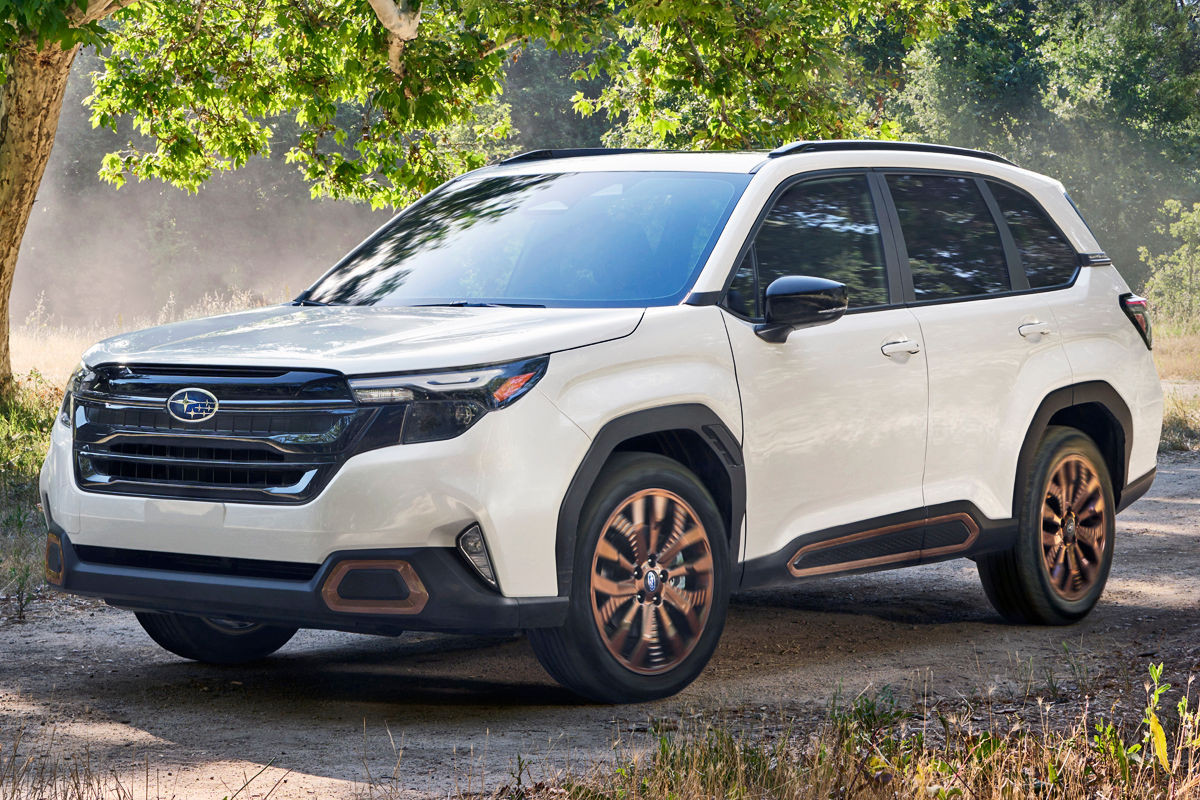
New Subaru Forester revealed (but SA will have to wait)
The 6th-gen Subaru Forester has been revealed, billed as an “all-new” model but carrying over several components. South African buyers face a bit of a wait, though…
The new Subaru Forester has been unveiled at the 2023 Los Angeles Auto Show. Though the Japanese automaker describes the 6th-generation version of its SUV as “all-new”, it appears to ride on a modestly updated platform, while also retaining the outgoing model’s powertrain.
So, when will we see this latest Forester on Mzansi roads? Well, Subaru Southern Africa has confirmed to Cars.co.za that it plans to launch the new model “as soon as it becomes available for our market”, though adds the “approximate timing” of such a launch would likely fall only in the 1st quarter of 2025.
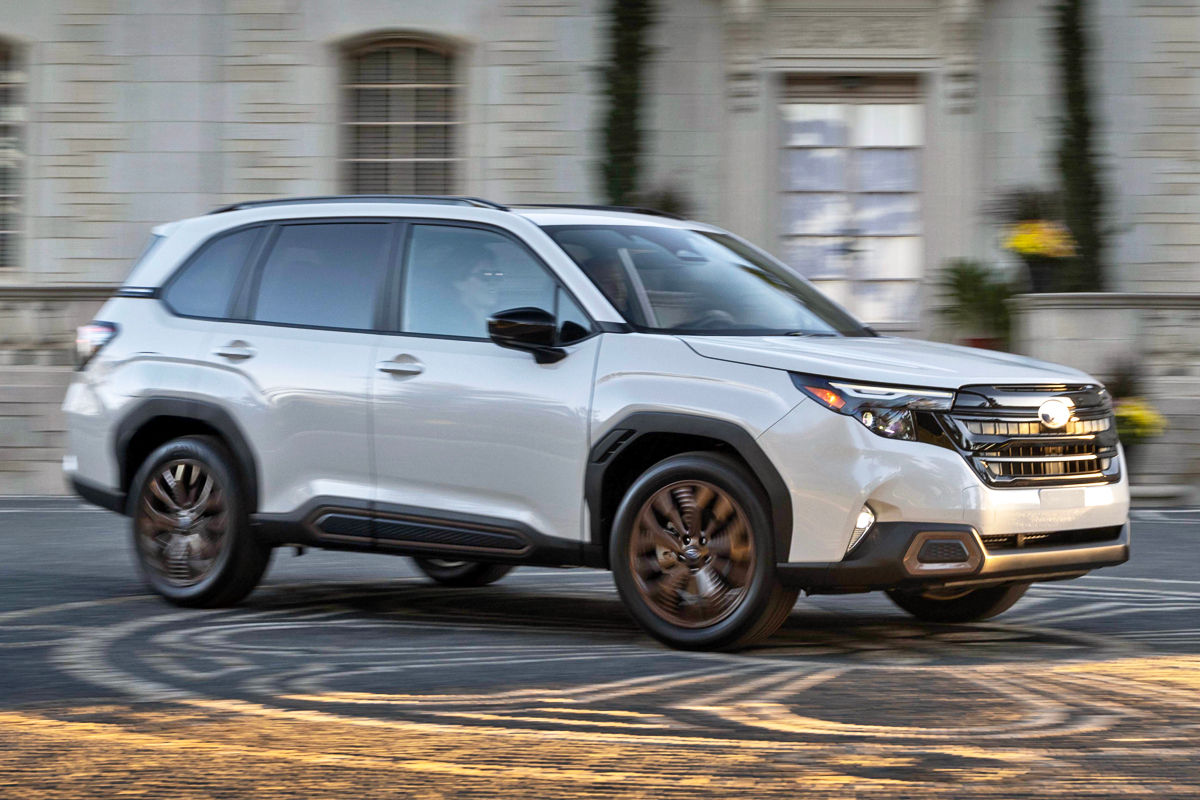
The new Forester is slightly longer than the outgoing model.
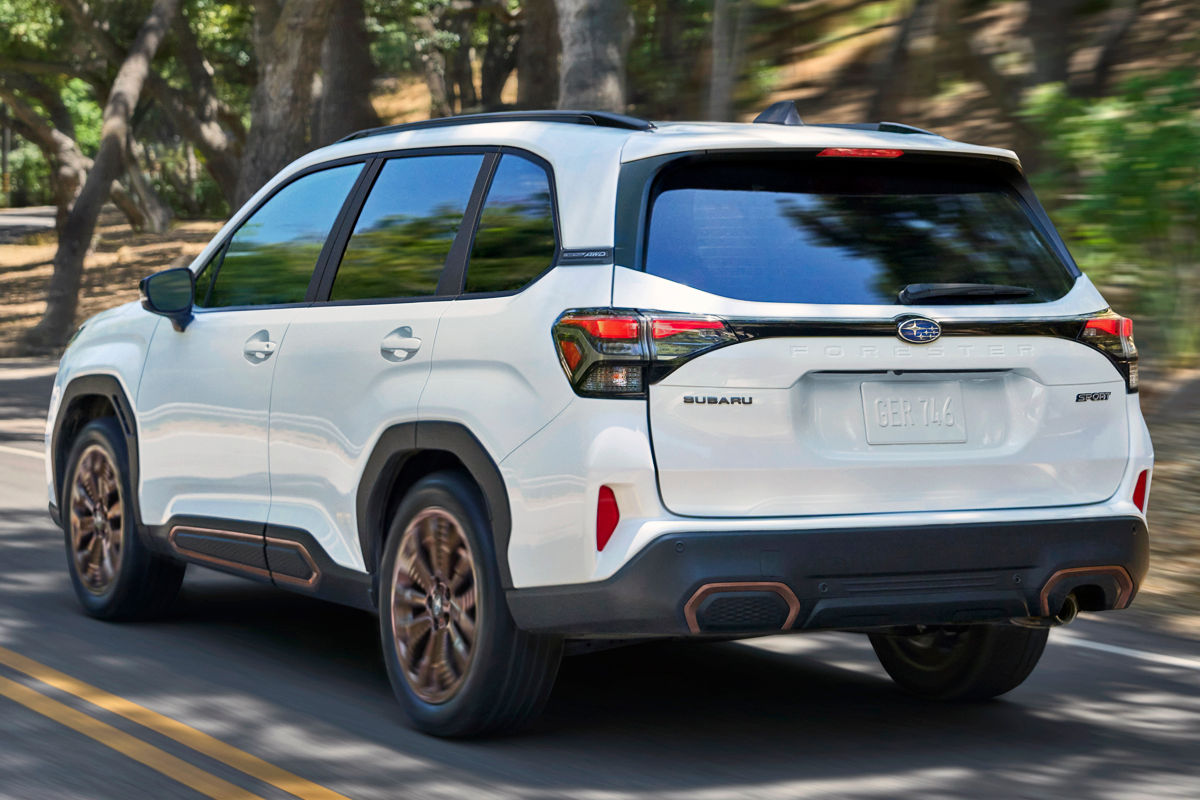
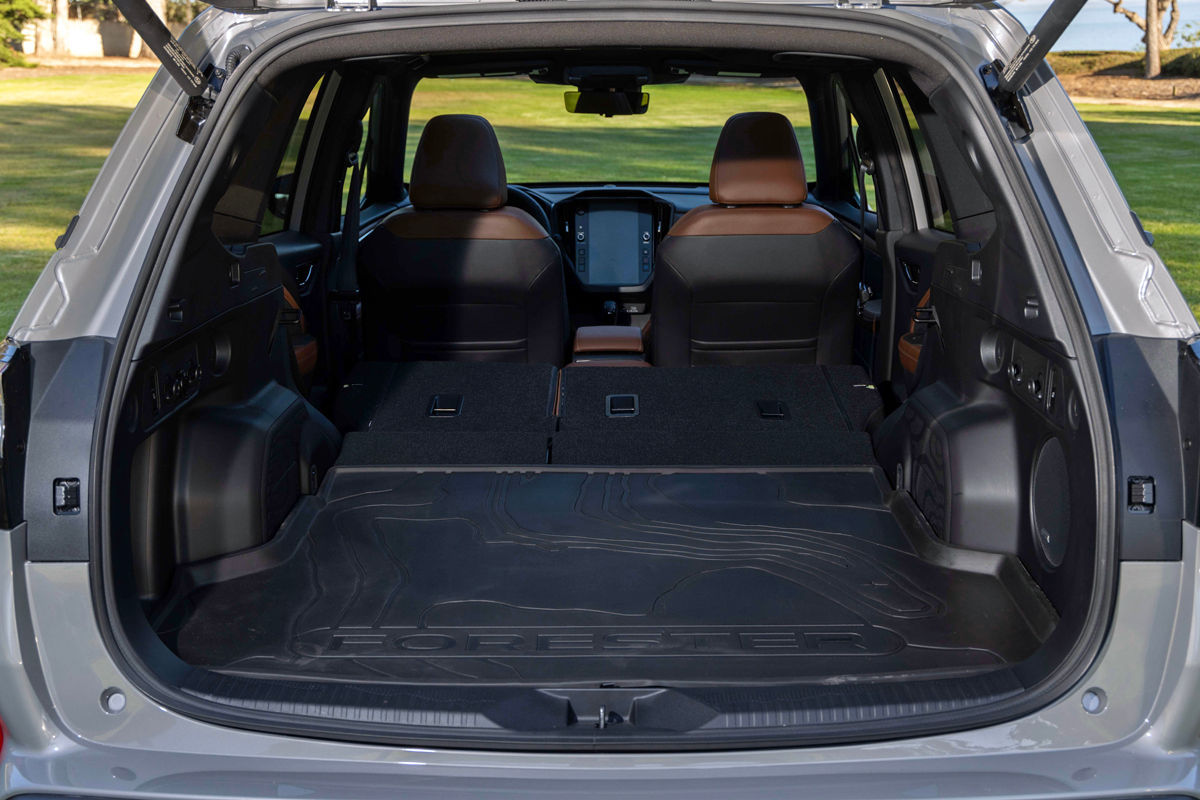
What can we expect when it does eventually arrive? Although all details revealed thus far pertain to the North American market, we do know the new Forester benefits from an exterior redesign, complete with a revised grille that merges into the LED headlamps. Round back, the updated taillamps are now connected by a trim strip, while the rear screen is steeper than before (ostensibly freeing up a little more cargo space).
The new Forester again rides on the Subaru Global Platform, though the Shibuya-based firm says these underpinnings have been “enhanced with 10% stiffer torsional rigidity”. The company claims an inner-frame construction with “stronger welding” and “additional structural adhesive” contribute to greater body rigidity. The Forester also adopts a version of the WRX’s dual-pinion electronic power steering rack, which Subaru says provides a “more direct and natural steering feel” and “greater responsiveness”.
The familiar 2.5-litre petrol engine is carried over to the new model.
The wheelbase is unchanged at 2 670 mm (as is the height at 1 730 mm), though the newcomer’s overall length has increased slightly from 4 625 mm to 4 655 mm. In US-spec guise, the new Forester retains the 5th-gen model’s naturally aspirated 2.5-litre flat-4 engine, which in South Africa generates peak outputs of 136 kW and 239 Nm (our market also receives a 115 kW/196 Nm 2.0-litre unit). Drive is again delivered to all 4 wheels via Subaru’s Lineartronic continuously variable transmission (CVT), though the automaker claims the latter is “smoother and quieter” than before.
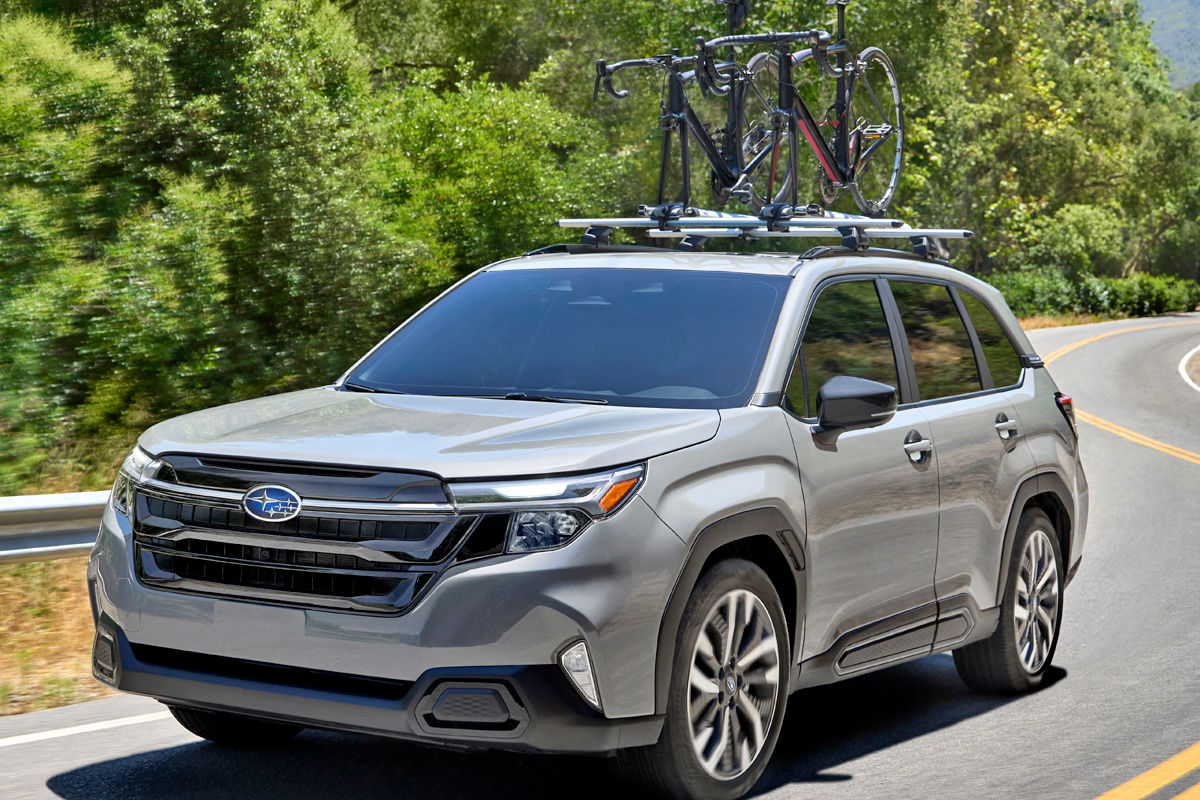
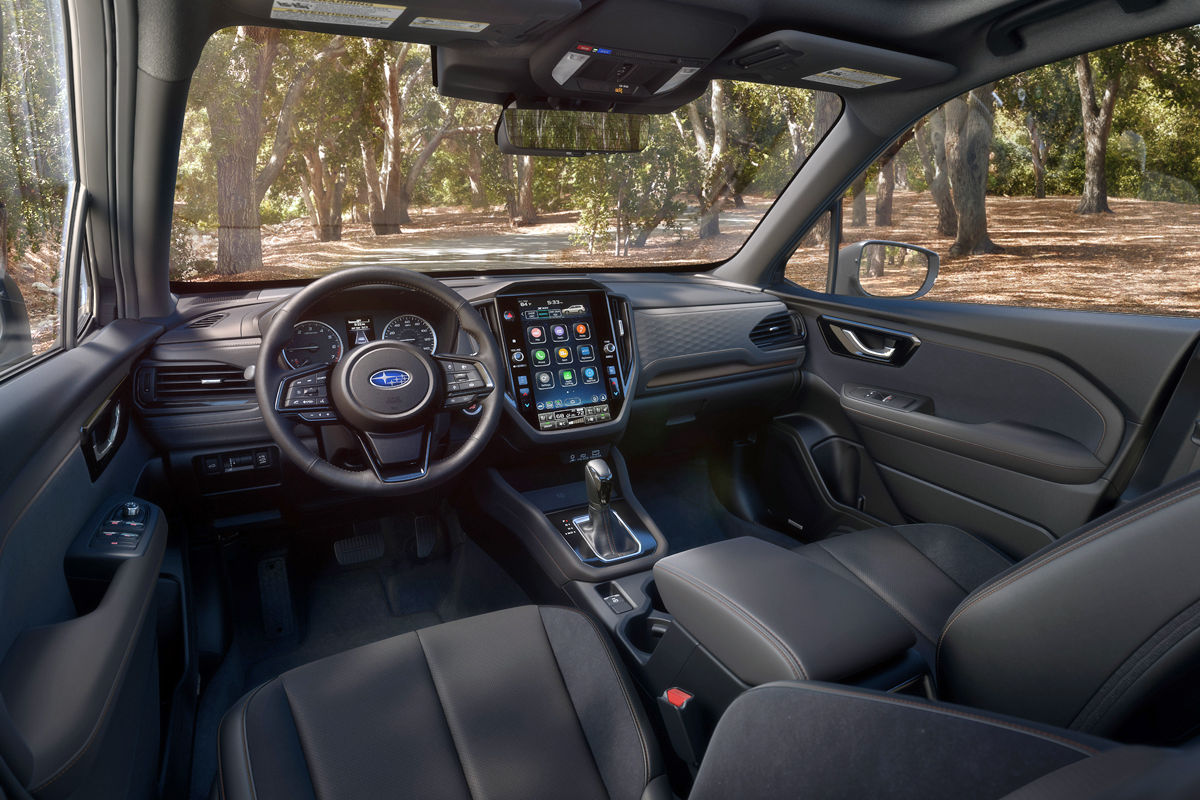
Inside, the updated cabin scores a “more supportive front-seat design” along with a revised climate-control system (now able to focus on occupied seats rather than the entire cabin), the latest portrait-oriented 11.6-inch touchscreen system (though likely only for top-spec models) and “textured trim pieces intelligently designed to avoid visible damage from daily use”. There’s also the latest version of Subaru’s EyeSight Driver Assist technology, along with a new kick sensor-activated hands-free powered tailgate.
Some derivatives of the new Forester gain Subaru’s latest 11.6-inch touchscreen system.
As a reminder, the outgoing Forester range – which last received an update as recently as early 2022 – currently comprises 3 derivatives in South Africa, priced from R669 000 to R749 000. Year to date (at the end of October 2023), the nameplate is Subaru SA’s best seller, with 273 units registered over the opening 10 months of the year (some way ahead of the 2nd-placed – but since supplanted by the Crosstrek – XV on 120 units).
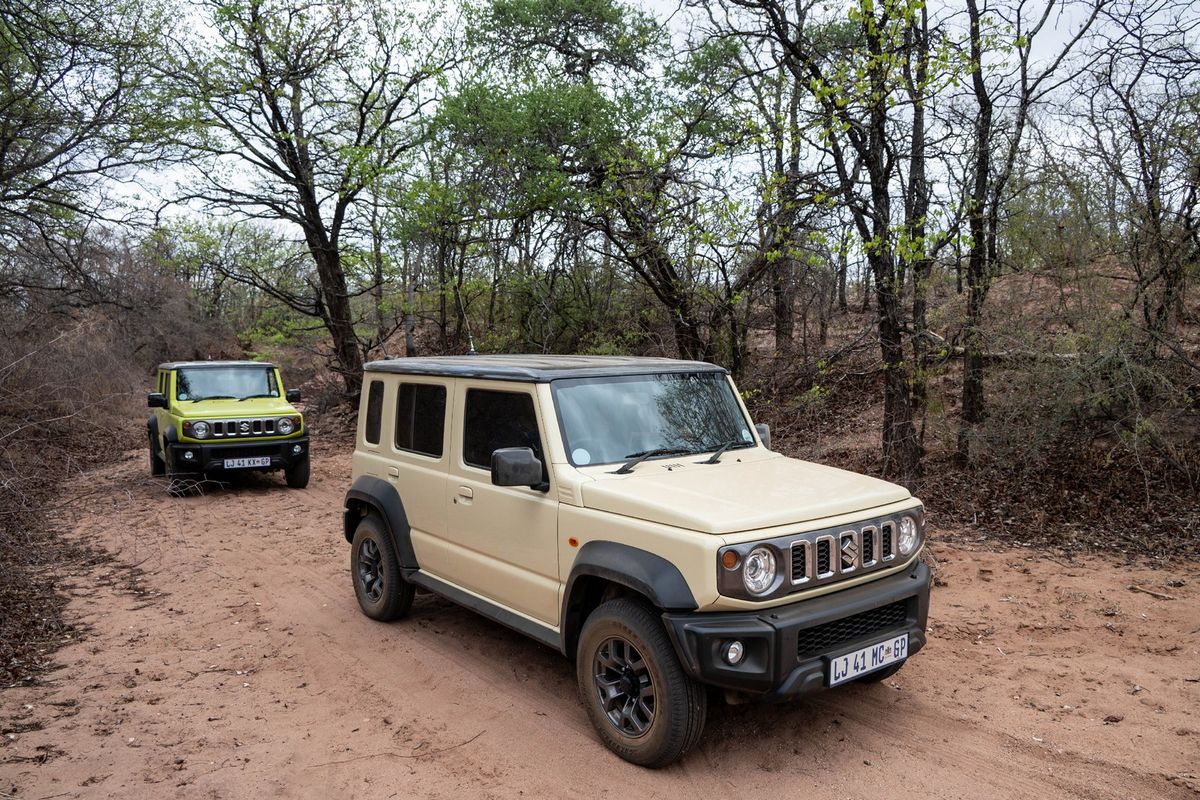
The Jimny 5-door has finally been introduced in our market and Suzuki Auto SA chose to show off its newcomer’s talents by giving it a starring role in a Botswana adventure. We tagged along to see if the longer and more practical Jimny is the one to have.
The Jimny is one of the Hamamatsu-based brand’s most iconic models. What’s not to like? It’s a refreshingly simple pint-sized off-roader with formidable capability and adorable Kei-car styling; it tugs on the heartstrings – that’s why Suzuki has sold thousands of units across 4 generations of the model.
However, the Jimny’s detractors will be quick to say that its compromised practicality limits the appeal of the product; even in its latest (4th) iteration, the Jimny’s 85-litre load bay and 3-door configuration are big drawbacks considering the versatility offered by equivalently priced compact crossovers or SUVs.
Enter the Jimny 5-door.
What’s New?
The addition of 2 more doors and a bigger load bay addresses the biggest issue with the Jimny.
To create the Jimny 5-door, Suzuki extended the wheelbase of the ladder-frame-based 4th-gen model by 340 mm. That additional length allows for the fitment of 2 more doors and the load-bay capacity to more than double to 211 litres. The resultant kerb weight increase is not huge: a gain of just over 100 kg.
Mechanically, the Jimny 5-door uses the same powertrain as the 3-door. As a reminder, the engine on duty is the K15B naturally-aspirated 1.5-litre 4-cylinder petrol mill. Outputs of 75 kW and 130 Nm are claimed, and customers have the choice of either a 5-speed manual gearbox or a 4-speed automatic.
Suzuki Auto SA offers 3 derivatives of the 5-door variant: an entry-level 1.5 GL and the 1.5 GLX in manual and automatic guises. For a detailed look at the specifications and features, click here.
What is it like to drive?
The Jimny’s reputation for off-road prowess is well known in 4×4 circles.
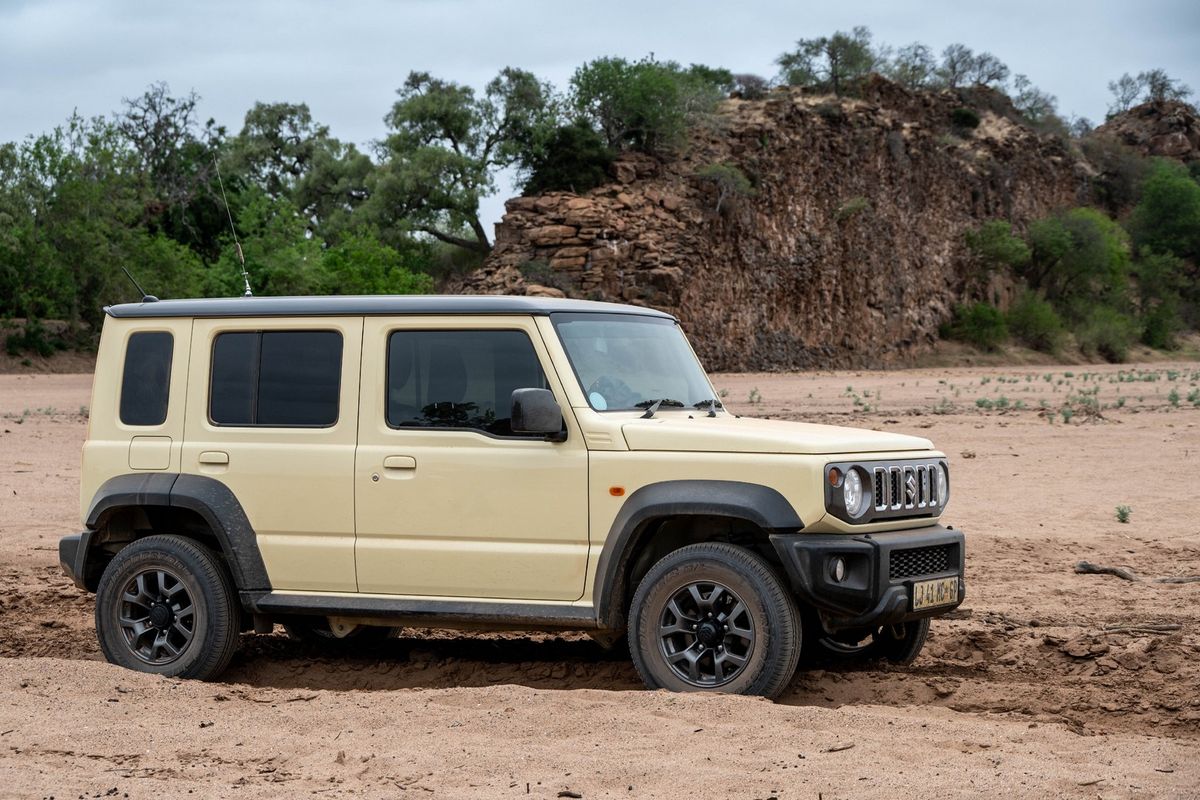
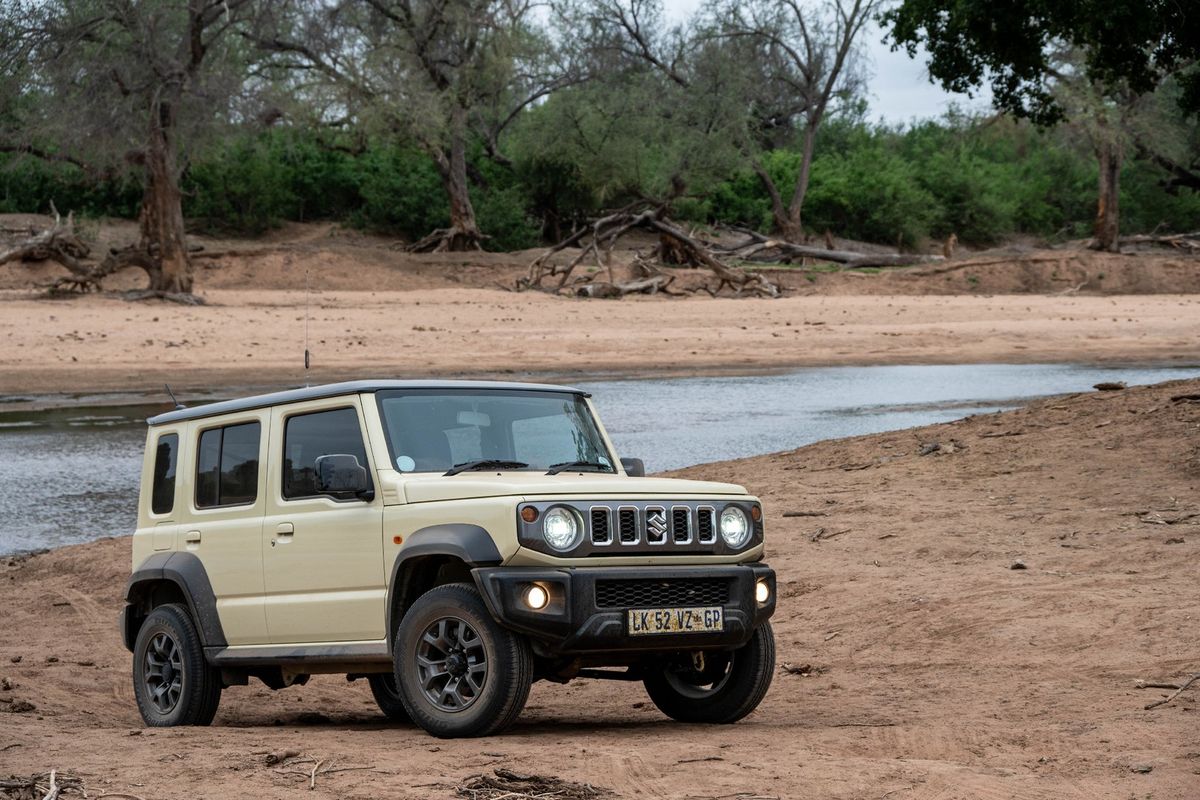
Our vehicle of choice for the evaluation drive was a Chiffon Ivory 1.5 GLX automatic. It passed its first test all right: I could fit my luggage in the load bay! Remember, if you want even more load space, you can fold the rear seats down. Then I attempted a sit-behind-myself test (to sit in the back behind the driver’s seat that had been set up for me)… Again, success, although headroom for tall people may be an issue.
We’ve always preferred a stick-shift in Suzuki models because the brand’s 5-speed manual tends to be easy to use thanks to a slick shift action, but, to be fair, the 4-speed automatic has never disappointed.
The auto ‘box performs satisfactorily at urban speeds, but once you’re travelling at near the national speed limit, the vehicle does tend to feel ill at ease, not that manual derivatives fare any better in that regard. At this point, you’re probably thinking the Jimny is ponderous and yes, it’s not great at cruising or in cut-and-thrust driving conditions, but remember it’s an off-roader: being sprightly isn’t its core focus.
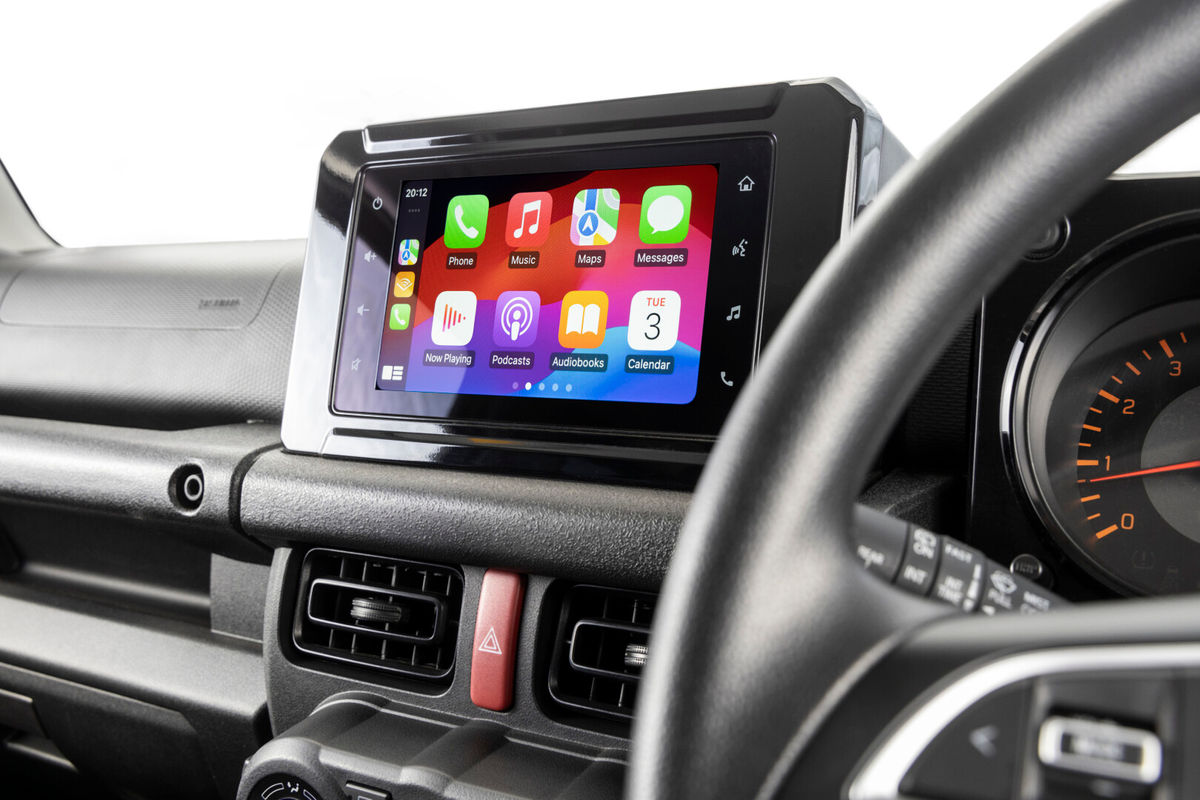
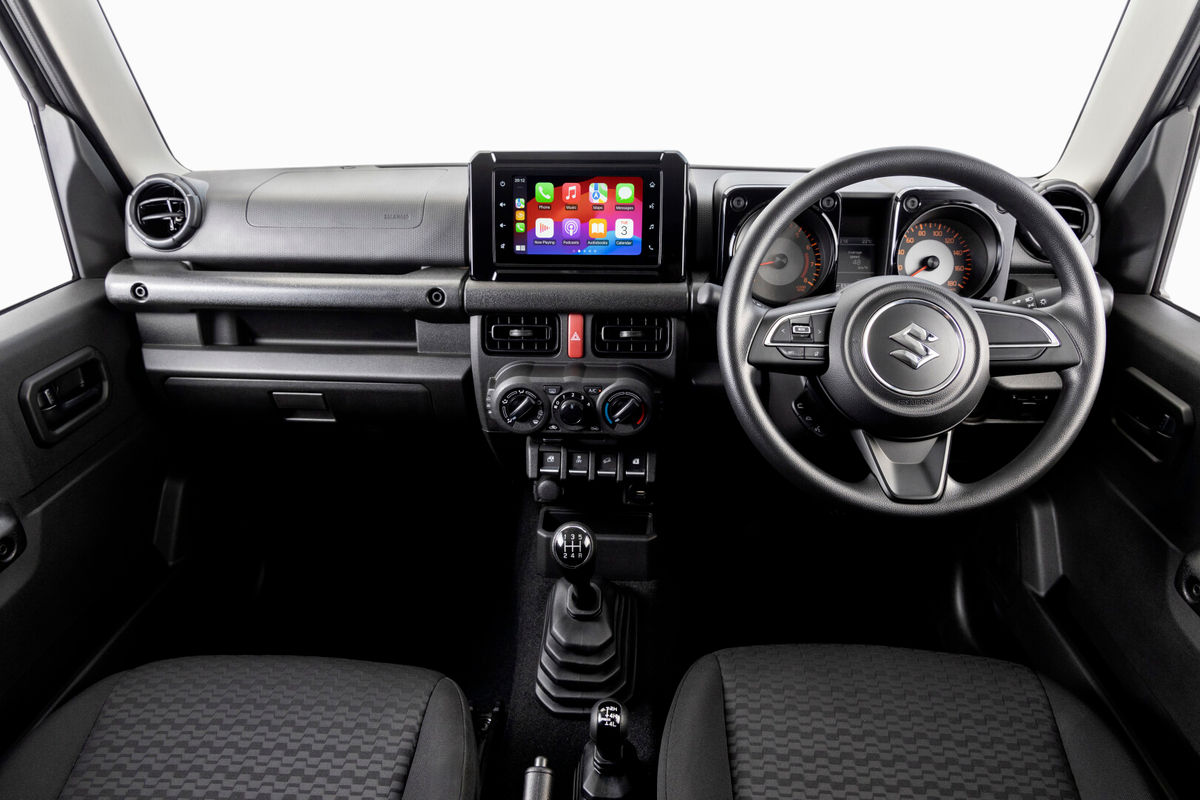
The Jimny covers the basics in terms of interior features.
To illustrate my point: at 120 kph, the Jimny’s engine is revving at above 3 000 rpm and sounds quite buzzy, so we would advise reducing speed to 100 kph to enjoy a more relaxed and refined open-road cruise. Otherwise, the engine revs freely and performs willingly when you drive in a sedate manner.
The big question is: Can the engine cope with the 5-door additional 100 kg of weight? We’d say yes.
Seeing as punchy in-gear acceleration is NOT the Suzuki Jimny’s forte, you need to adopt a measured approach (and apply some patience) when overtaking slower traffic. Despite some full-throttle overtakes on the open road, however, the 5-door was frugal, with our trip computer displaying a tidy 7.5 L/100 km.
The new Jimny 5-door on the banks of the Limpopo River.
The Jimny’s 15-inch alloys (wrapped in chunky 195/80 tyres) help to soak up the road’s imperfections, which is just as well… The R521 and R572 tar roads near the hamlet of Alldays are in appalling condition and riddled with potholes – many of which are substantial enough to cause serious damage. Many late swerves were required to avoid those treacherous pits and that was when we were reminded that the Jimny exhibits quite a bit of body roll, but that’s to be expected, given its ladder-frame underpinnings.
Can the Jimny 5-door still 4×4?
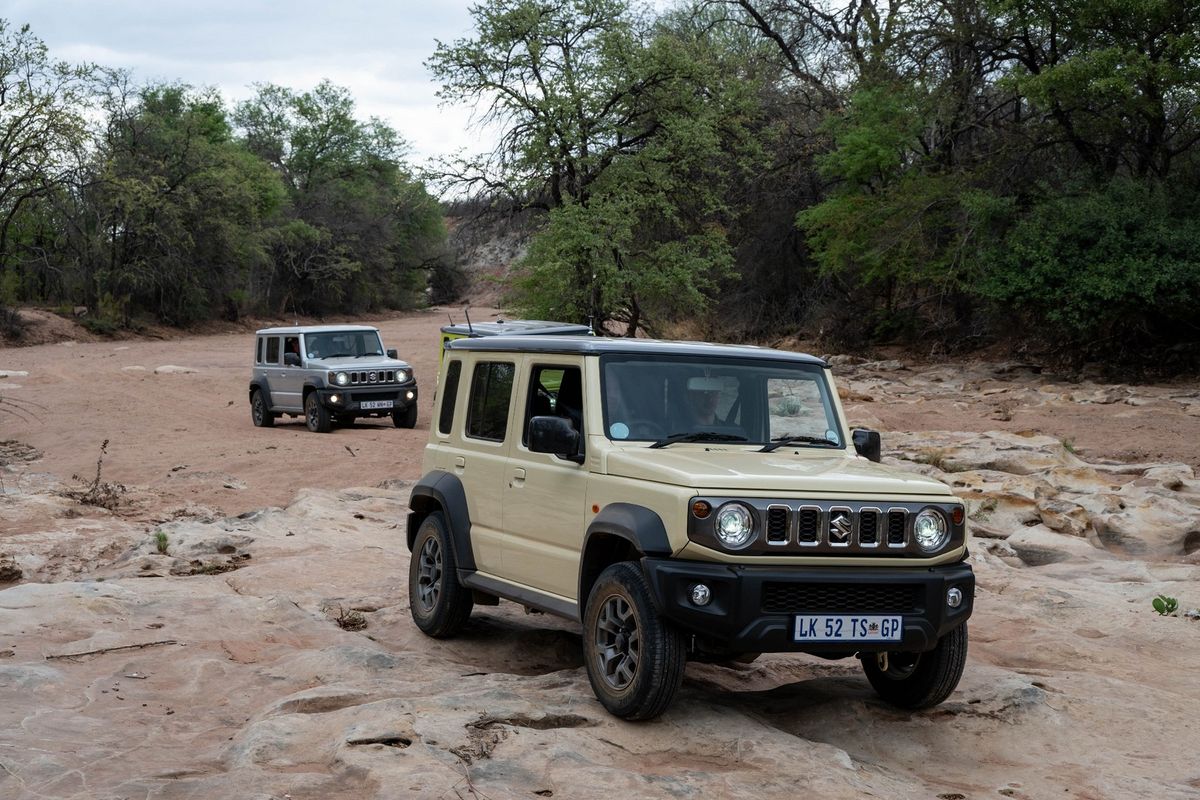
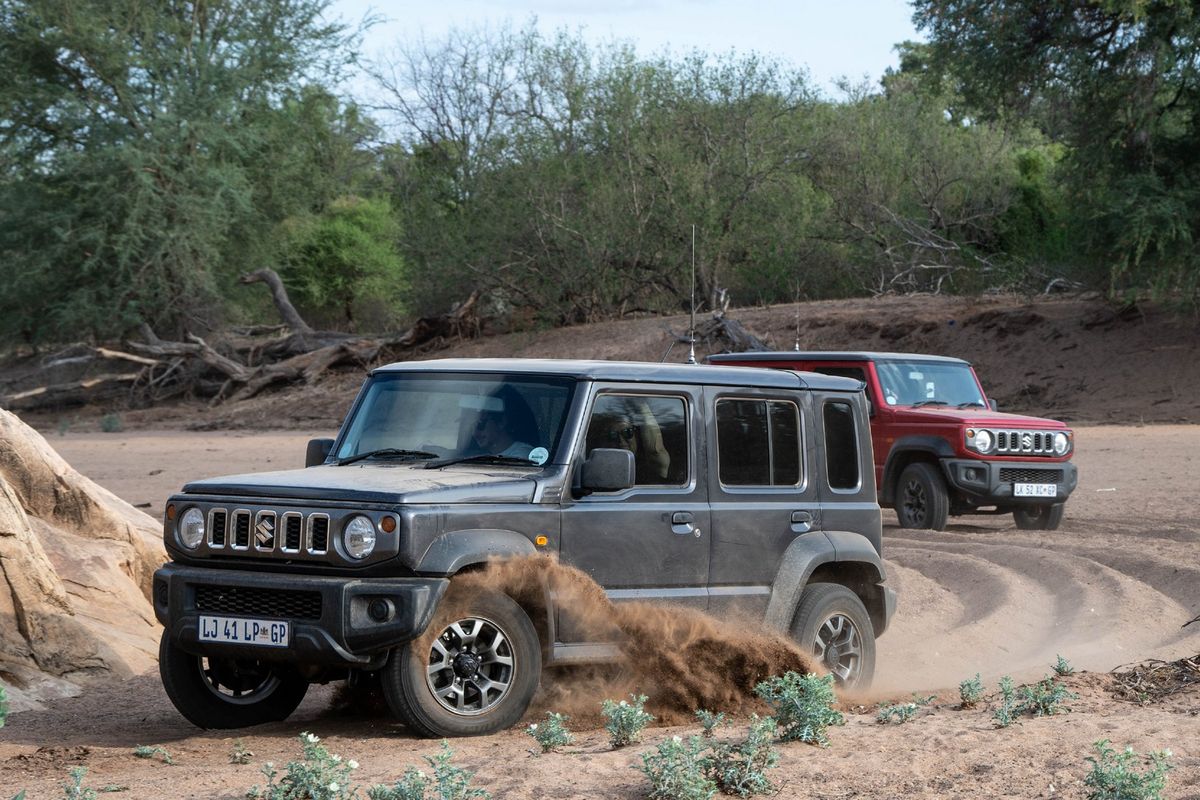
The Jimny 5-door’s so-so road manners are soon forgotten the moment we slowed down and headed off the tar, however. Despite its additional length, the more practical Jimny seems to have retained its iconic off-road capabilities. Once we hit the trails, the diminutive Suzuki put all its remarkable talents on display.
The Jimny in its natural environment…
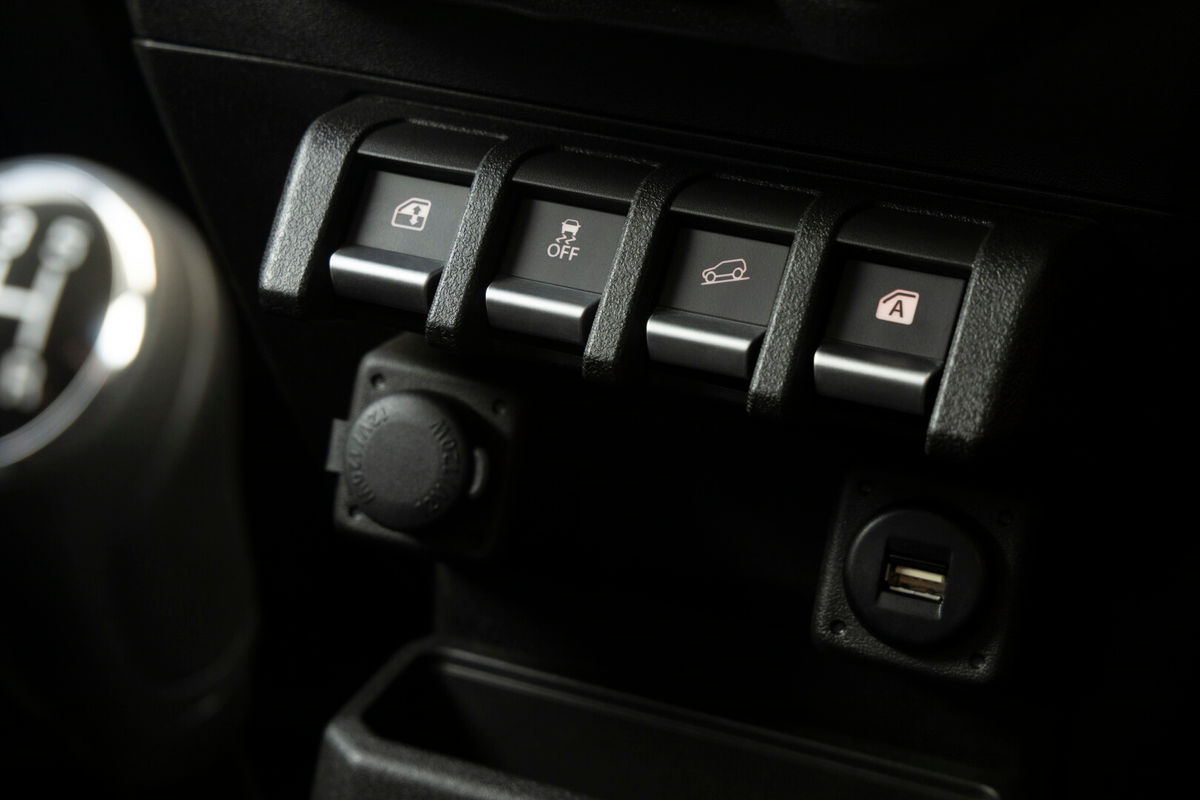
For the stats fans, ground clearance is rated at 210 mm and the approach, breakover and departure angles are an impressive 36 degrees, 24 degrees and 47 degrees respectively. The AllGrip Pro is a part-time system with the user able to select from 2High, 4High and 4Low range. The Jimny also features hill descent control and can simulate a differential lock via selective braking courtesy of the ABS software.
Exiting one of the many dried-up river beds.
Our launch route took us through the Botswana border at Platjan over the Limpopo River and we then spent most of the route traversing many of the dried river beds. These are made up of thick sand with quite a few rocks that needed to be climbed, and the Jimny proved highly agile over those obstacles.
Thick river sand and rocks were crushed by the Jimny.
When I drive off-road, I prefer to use as little of the 4×4 hardware as possible, so I can judge under which conditions a vehicle will be at ease and where/when it may struggle. Bigger/heavier off-roaders may have required 4L and low range on some parts of our trail, but the Jimny could keep up with the convoy in 4H.
Our 2-day adventure pushed the Jimny 5-door’s talents (not to mention its pilots’ skillsets) to the limit and, while we suspect few owners will tackle such extreme off-road conditions in their plucky lil’ Suzukis, it’s comforting to know that this cute-looking off-roader is far more 4×4-biased than may appear.
How much does the Suzuki Jimny 5-door cost in South Africa?
Jimny 5-door derivatives come with a 5-year/200 000 km warranty and 4-year/60 000 km service plan.
Jimny 5-door 1.5 GL Manual
R429 900
Jimny 5-door 1.5 GLX Manual
R457 900
Jimny 5-door 1.5 GLX Auto
R479 900
Summary
Solomons Wall: a spectacular geological feature in Botswana.
If you were thinking about buying a new Suzuki Jimny only to be dissuaded by its limited practicality, the 5-door largely addresses that shortcoming. Even if it isn’t sprightly, the tiny off-roader is well suited to commuting – its compact dimensions and excellent exterior visibility make it easy to drive and park.
However, the Jimny remains a niche model and still has other shortcomings, such as its performance (or lack thereof) at triple-digit speeds, and not everyone will appreciate its ruggedness and off-road abilities.
Still, if you desire an undeniably cool vehicle that offers “many smiles per mile” and will positively ace a gravel track or potholed road, then the Suzuki Jimny 5-door should be towards the top of your list.
We know that the Jimny can tackle the rough stuff with ease, but what will it be like to drive closer to home? We look forward to driving the 5-door variant extensively in the near future.
Nafisa Akabor: What’s it like to be a #CarsAwards Judge?
Nafisa Akabor is a well-known technology and Electric Vehicle (EV) journalist and she also happens to be a veteran #CarsAwards judge! Her experience in the tech world is invaluable when applied to the Cars.co.za Consumer Awards and we’re keen to hear what she thinks about this latest iteration of the awards programme. Take a look!
The Cars.co.za Consumer Awards is now in its 7th iteration and with South Africa’s most comprehensive and authoritative motoring awards programme reaching its zenith, we saw no less than 20 judges descending on the Gerotek Testing Facility in Gauteng to put all 39 finalists through their paces.
More than this, all 39 finalists also went on public display at the Mall Of Africa in Midrand this weekend to give the public the opportunity to see the cars in the metal and to engage with the judges.
Earlier this year, a pool of 65 semi-finalist vehicles in 13 categories were chosen by Cars.co.za’s respected, highly knowledgable and experienced editorial team. The team put all the semi-finalists through a rigorous scoring process based on “Filters of Eligibility” and “Pillars of Success” to arrive at 39 finalists represented in 13 categories (3 vehicles per category).
The scores from all 20 judges represent 50% of the final result while the remaining 50% is determined by the Cars.co.za Ownership Satisfaction Survey that includes feedback from thousands of vehicle owners, based on their experiences of their vehicles and the service they receive (less than four years old and serviced through franchised outlets).
The winners in each category as well as the coveted Brand Of The Year Award will be announced in early 2024.
Nafisa Akabor: What’s it like to be a #CarsAwards Judge?
We asked #CarsAwards judge, Nafisa Akabor, a few questions to learn more about what she thought about the testing process for the Cars.co.za Consumer Awards. Here’s what she had to say!
1. Introduce yourself and briefly tell us what you do for a living.
I’m Nafisa Akabor, a freelance technology and EV journalist who’s been writing about tech for more than 16 years. I launched my own platform this year called Recharged.co.za (a rebrand of my 15-year-old blog Wired to the Web) with lots more in the pipeline.
2. How many #CarsAwards have you judged and what does it mean to you to be chosen as a judge?
I have been a judge for six instalments now and I love participating. It means the work I do in tech is recognised and my opinion counts, which is an honour.
3. What #CarsAwards categories did you judge?
This year I got the first ever EV category; Premium SUV; and Executive SUV.
4. You’ve just returned from extensive testing at Gerotek, how was it? Briefly tell us about your experience!
Firstly, I’m so excited that electric vehicles finally have their own category! I’m a lot more confident now than when I first started, it all feels familiar in terms of putting these cars through their paces and what needs to be done. It’s not a walk in the park, I love how intensive it is. It allows me to test some aspects I can’t typically do on the roads. I also appreciate how well-organised it is. We just have to show up.
5. The #CarsAwards is regarded as the most respected motoring awards programme in South Africa. In your opinion, what makes the Cars.co.za Consumer Awards unique?
Having to drive all three finalists back-to-back gives you a perspective you would never get otherwise. It’s very different when you drive a car at a launch or for a few days on test. This lets you assess things by going through the same conditions, in the same weather, etc. to be as accurate as possible, with scoring fresh from these conditions.
6. What test obstacles at Gerotek did you find to be the most illuminating in terms of testing the finalists and why?
I think we can all agree the mountain pass is the stretch you can assess so many things properly and tick so many boxes to get that proper feel, after the other shorter tracks. This is what a test drive should entail for any potential customer and why it’s so crucial in this competition.
7. Out of all the cars you tested, what car stood out the most for you and why?
It has to be the GWM Ora because it is currently the ‘cheapest EV in South Africa’ (read: least expensive) and I hope it sells! It is the perfect city EV because nobody needs that much power when you need to be efficient. It’s retro cute, packed with tech, and parts of it look… somewhat familiar!
8. What cars do you think will win in each category (share your predictions with us) and importantly what car brand do you think will win the Brand Of The Year Award and why?
How many hybrids and EVs were sold in South Africa over the opening 3 quarters of 2023? Let’s take a closer look at the sales figures for new-energy vehicles…
Naamsa has released official sales figures for electric vehicles (EVs), traditional hybrids and plug-in hybrids for the opening 3 quarters of 2023, with registrations in South Africa’s new-energy vehicle (NEV) space increasing 67%, year on year.
According to the organisation, sales in the NEV segment – that is, including battery-powered models, traditional hybrids and plug-in hybrids, but seemingly not mild hybrids – for the first 9 months of the year reached 5 165 units. By our maths, that translates to 1.29% of the total new-vehicle market (401 315 units) over the opening 3 quarters of 2023.
The locally built Toyota Corolla Cross Hybrid is likely driving the highest volumes in SA’s NEV segment.
Since we’ve already covered the first half of the year, let’s take a closer look at NEV sales in the 3rd quarter. Naamsa says 2 019 units were sold in this space between the start of July and the end of September 2023, representing an increase of 111.9% compared with the 3rd quarter of 2022.
Traditional hybrids – represented in the local market by vehicles such as dual-powered versions of Toyota’s Corolla hatch and sedan, the strong-selling (and locally built) Corolla Cross and the RAV4, plus various Lexus models as well as the Honda Fit and Haval’s H6 and Jolion hybrids – predictably made up the bulk of this figure, accounting for 1 712 units in Q3 2023. The traditional hybrid’s total over the first 9 months of the year thus stood at 4 273 units.
Next, fully electric vehicles accounted for 218 units in Q3 2023. For the record, EV sales over the opening 3 quarters of the year reached 720 units, exceeding the 502 units sold over the entirety of 2022. Sales in this (premium-brand dominated) section of the market are likely to continue growing in the coming months, with models such as GWM’s Ora 03 – positioned as Mzansi’s most affordable EV – having just launched and others on the way.
Finally, 89 units of plug-in hybrid electric vehicles (PHEV) were registered in South Africa in the 3rd quarter of 2023, with this 3-month period outperforming the first half of the year (83 units) and pushing the year-to-date (until the end of September, that is) tally to 172 units. Examples of such vehicles include the T8 versions of Volvo’s XC60 and XC90, along with BMW’s X5 xDrive50e plus the various P300e and P400e derivatives in Jaguar Land Rover’s line-up.
From a broader perspective, Naamsa again called for a “timely” NEV policy framework to “support investment decisions for NEV manufacturing” and “safeguard export volumes into the European market”, saying such a move was “imperative for the domestic automotive industry’s inevitable transition to eco-friendly vehicles”.
Volvo’s local EV range currently includes this C40 Recharge and a pair of XC40 Recharge derivatives.
“The long-awaited announcement by the minister of finance in the Medium-Term Budget Policy Statement 2023 on 1 November 2023 recognised the significance of the automotive industry to the country’s economy and that the transition to new-energy vehicles posed an existential threat to South African vehicle production. In this regard, the minister said that National Treasury planned to implement tax and expenditure measures to support the industry’s transition to NEVs,” explained Naamsa.
“However, the details for this policy would only be announced in the 2024 Budget Review with considerations to domestic-market demand stimulus measures, establishment of renewable energy-based charging infrastructure and production support. Part of the broader strategy includes collaborating with other African countries to develop battery production capacity on the continent, by pooling the critical-mineral resource base that Africa was endowed with.”
South Africa has needed an affordable battery-electric vehicle to build some positive momentum in the EV segment. Enter the Ora 03 from parent brand GWM; we drove it at the local launch in Gauteng to see if it’s the breath of fresh air the segment needs.
What is the range of the GWM Ora?
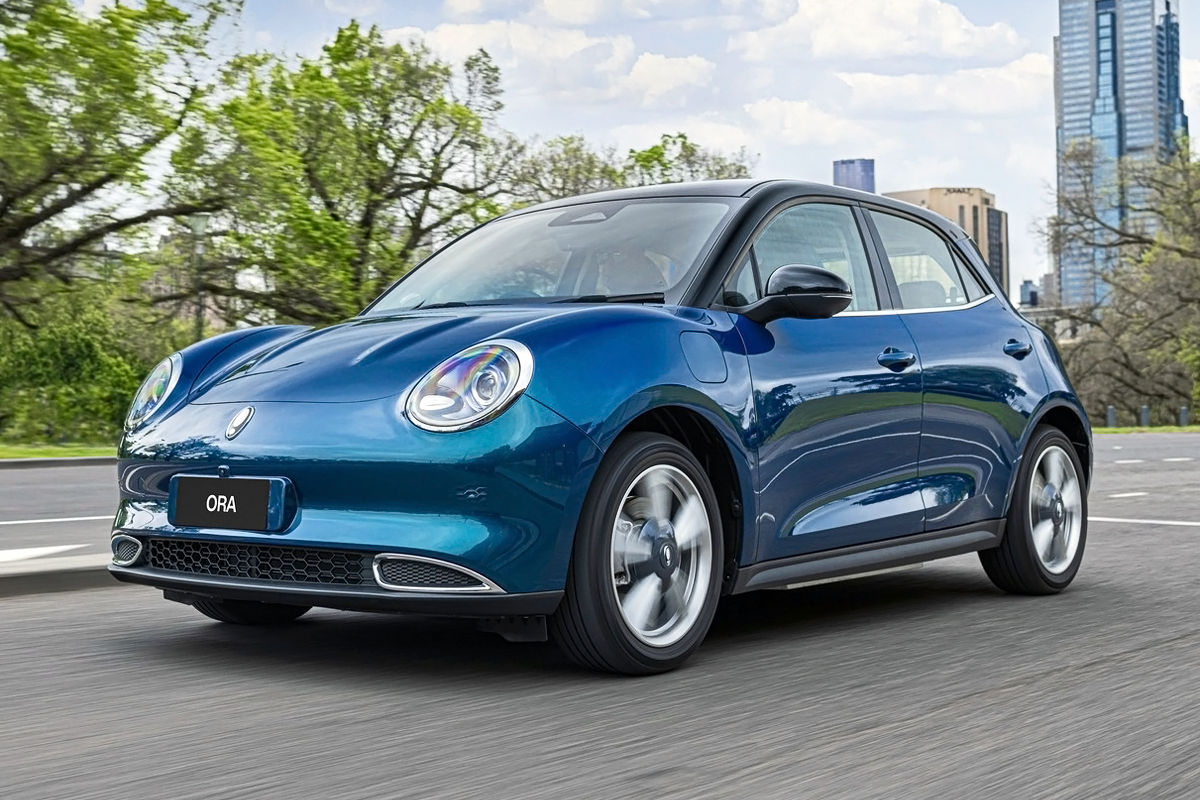
A former Porsche designer is now the lead designer for Ora… spot any similarities?
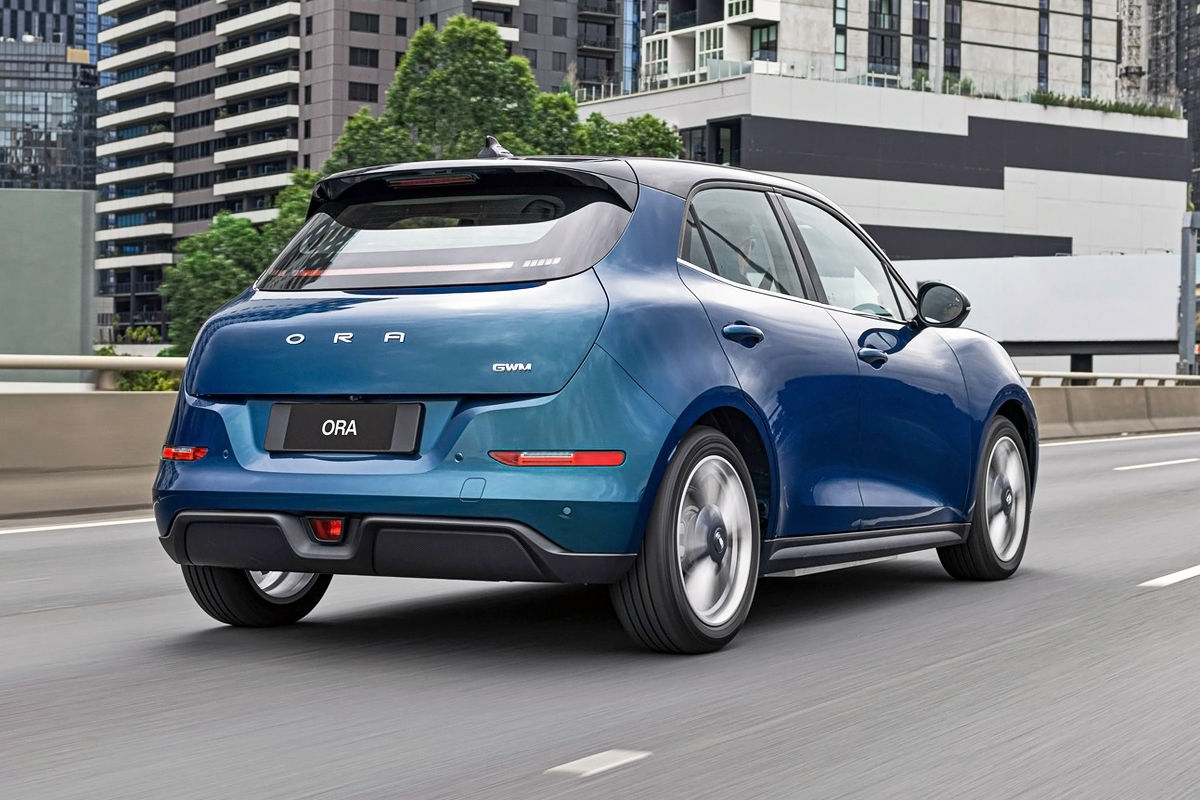
You may be more familiar with the name the Ora 03 carries in some overseas markets: Funky Cat. But the South African market is rather conservative, so Haval Motors SA has named its all-electric hatchback 03.
There are 2 derivatives of the Ora 03: 300 and 400; the numbers represent their theoretical ranges (in km). The 300 and 400 produce the same power and torque (128 kW and 250 Nm), but the 300 Super Luxury utilises a smaller (48 kWh) battery compared with the 63 kWh battery of the 400 derivatives.
At R686 000, the Ora 03 300 Super Luxury is the most affordable electric car on sale in South Africa (November 2023) and, while its price tag doesn’t exactly scream “affordable”, our Government does impose an extra levy on the importation of electric cars – we (and many others) cannot fathom why.
The Ora 03 is cheap to run
Charging from home is cheaper than charging at public charging stations.
The upfront cost may be more expensive than the equivalent petrol-fed premium hatchback, but the running costs of an Ora 03 are impressively low. It has far fewer oily mechanical parts, so there’s less that can potentially break down and the serviceable parts are few (no oil or filter changes are required).
Then there’s the day-to-day running cost, which is considerably lower than that of an equivalent petrol car. Travelling 300 km in an Ora 03 could cost you as little as R170 at an Eskom rate of R3.50/kWh. If a petrol car consumes 10 L/100 km, it will cost you around R650 to travel 300 km and, if it’s twice as frugal (5 L/100 km), it could cost R325 to travel the same distance (based on today’s price of 95 unleaded).
Those are admittedly very simple calculations, but the running cost benefit is undeniable. Prospective buyers will have to work out whether that benefit will ever overcome the extra capital they would have to spend to buy an EV. There will be a crossover point, but it may be multiple years of EV ownership away.
What’s the Ora 03 like to drive?
The EV feels like a quality hatchback with good ride quality over all but the harshest surfaces.
We spent the day driving the Ora 03 400 GT Ultra Luxury, which is the priciest derivative in the range, but showcases everything that Ora currently offers in terms of design and tech. The 128 kW and 250 Nm facilitate just enough performance to make the Ora 03 fun to drive, without limiting its range unduly.
You can execute overtaking manoeuvres quickly thanks to the immediate access to maximum torque (all that is required is a firm prod of the accelerator) and the Ora cruises fairly easily at freeway speeds too.
However, if you do a lot of freeway driving (at about 100 kph), you will eat away at your range faster than expected. Short bursts on the freeway are fine, but the Ora works best when operating at under 100 kph and/or in built-up areas where you can effectively use regenerative braking to slow down or stop the car.
From a refinement perspective, the Ora 03 feels like a premium hatchback in the vein of a Toyota Corolla Hatch. Its general ride quality is on the firm side over bumpier/uneven roads, but for most buyers, it will feel comfortable and quiet inside. We could discern a little more wind noise than expected at above 100 kph, but that may be more because there is no ICE to drown out most of the external sources of noise.
There are 5 drive modes available, with the Eco+ mode limiting speed to 90 kph. But be mindful when engaging that mode… if you need to overtake traffic, you may run into a firm 90 kph limit and then start fumbling for the mode button, which is inconveniently located in front of your right knee next to 3 other buttons, including the one to turn off the car. Other modes include Normal Sport, Eco and Auto.
Ora 03 interior highlights
Only the GT model gets the dual-tone interior colours, the rest are plain black.
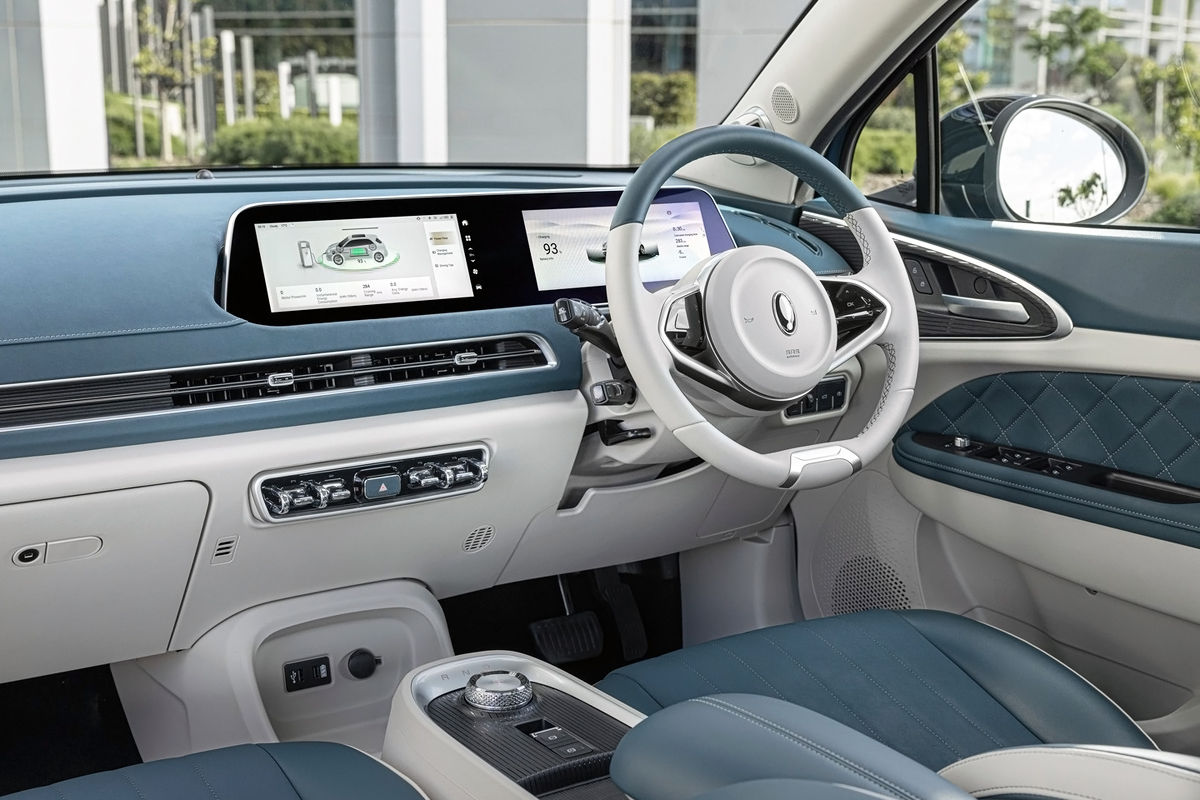
The 03 GT Ultra Luxury has a dual-tone black and red interior, which looks more black and burgundy to my eyes (all other versions have black interiors). Still, the dual-tone trim is smart and well in keeping with the whole “futuristic EV vibe” that buyers may desire. The quality of the materials is very upmarket and the dual digital display looks very crisp and premium. I think less black space around the screens may have elevated the premium feel of the cabin a bit more – borderless screens always look cleaner.
Apple Carplay is standard and Android Auto is coming soon, but the cabin does include a powerful wireless charger and 2 USB-A ports at the front (a bit strange, considering USB-C is now the norm).
Currently, only Apple Carplay is available, but Android Auto is coming soon.
The touchscreen’s menus are relatively easy to work your way through, although a few functions – such as the massage seats – proved more difficult to find than expected (they are under the aircon menu).
How big is the Ora electric car?
Occupant space in the back of the Ora 03 is pretty good – probably at the expense of load-bay capacity, which, at 228 litres, is on the small side. That said, EV buyers are unlikely to use the Ora as a weekend getaway car – it’s for commuting, so a bay that can accommodate a laptop bag or 2 will probably suffice.
Wireless charging is available as standard. The rotating dial allows you to shift into drive, park and reverse.
There are many safety systems in the Ora 03 and most of them are available right from the entry-level 300 Super Luxury derivative. For instance, adaptive cruise control is standard, as are traffic-jam assist, lane-keeping assist, front and rear collision warning, 360-degree camera and rear cross-traffic assist.
As we’ve discovered with other Chinese brands’ new models, the push to wedge all that tech into cars can feel a bit rushed. In other words, the systems need a little bit more refinement for our roads (they can be oversensitive to lane markings, resulting in a ‘bong-fest of alerts’ when all the systems are active).
I turned most of them off (or set their sensitivity to extremely low) to smooth out the driving experience. The engineers are aware of these issues, however, and are keen to improve these systems for local use.
How much does the Ora 03 cost in South Africa?
Ora 03 300 Super Luxury
R686 950
Ora 03 400 Super Luxury
R775 950
Ora 03 400 Ultra Luxury
R805 950
Ora 03 GT Ultra Luxury
R835 950
The Ora 03 has an impressive 7-year/200 000 km warranty (high-voltage parts are covered for 8 years/150 000 km), as well as a 7-year/105 000 km service plan with 7 years of roadside assistance.
Summary
The GT is quite expensive at R800k, but the entry 03 300 is where the most value for money lies.
The Ora 03 is not a cheap battery-electric vehicle, but with steep government-levied costs built into EVs’ price tags, we are unlikely to get a new all-electric model that costs between R350k and R450k anytime soon. But at R700k, the Ora 03 is the least expensive offering, and it appears to be a quality product.
The design is interesting, it’s well-appointed inside and the standard features list is long and compelling. Some of the active safety systems still need further refinement, but the ride and drive quality of the 03 is very good. The range is acceptable to most commuters and, with relatively small batteries, the Ora can be charged at home quickly, which makes it an electric car that could easily fit into modern lifestyles…
Kumbi Mtshakazi: What’s it like to be a #CarsAwards Judge?
Kumbi Mtshakazi is a local automotive content creator and he forms part of the 2023/24 #CarsAwards judging panel. He recently experienced the rigorous car testing procedure at Gerotek Test Facility and with the dust settled, we were keen to hear what Kumbi had to say about his experience of the Cars.co.za Consumer Awards thus far. Take a look!
The Cars.co.za Consumer Awards is now in its 7th iteration and with South Africa’s most comprehensive and authoritative motoring awards programme reaching its zenith, we saw no less than 20 judges descending on the Gerotek Testing Facility in Gauteng to put all 39 finalists through their paces.
More than this, all 39 finalists also went on public display at the Mall Of Africa in Midrand this weekend to give the public the opportunity to see the cars in the metal and to engage with the judges.
Earlier this year, a pool of 65 semi-finalist vehicles in 13 categories were chosen by Cars.co.za’s respected, highly knowledgable and experienced editorial team. The team put all the semi-finalists through a rigorous scoring process based on “Filters of Eligibility” and “Pillars of Success” to arrive at 39 finalists represented in 13 categories (3 vehicles per category).
The scores from all 20 judges represent 50% of the final result while the remaining 50% is determined by the Cars.co.za Ownership Satisfaction Survey that includes feedback from thousands of vehicle owners, based on their experiences of their vehicles and the service they receive (less than four years old and serviced through franchised outlets).
The winners in each category as well as the coveted Brand Of The Year Award will be announced in early 2024.
Kumbi Mtshakazi: What’s it like to be a #CarsAwards Judge?
We asked #CarsAwards judge, Kumbi Mtshakazi, a few questions to learn more about what he thought about the testing process for the Cars.co.za Consumer Awards. Here’s what he had to say!
1. Introduce yourself and briefly tell us what you do for a living.
My name is Kumbi Mtshakazi, a freelance automotive content creator and writer and I contribute to quite a few publications.
2. How many #CarsAwards have you judged and what does it mean to you to be chosen as a judge?
This was the first one, and what a special one it was.
3. What #CarsAwards categories did you judge?
I evaluated the Budget Hatchback, Entry-Level Crossover as well as the Leisure Double Cab categories which are extremely important in our market as we see most of these cars all over our roads.
4. You’ve just returned from extensive testing at Gerotek, how was it? Briefly tell us about your experience!
The experience was mind-blowing and insightful. While we receive these cars on test, we rarely put them through such conditions that Gerotek provided. Things like the skidpan, dynamic handling as well as the brake tests are not things we usually do when we have the cars on test, unless you’re forced to perform an emergency braking test because a taxi driver decided to jump in front of you 🙂
5. The #CarsAwards is regarded as the most respected motoring awards programme in South Africa. In your opinion, what makes the Cars.co.za Consumer Awards unique?
The fact that the actual buyers, the consumers, get involved in the voting process makes it quite unique. It shows just how important the consumers are, since they are the reason we are in the industry.
6. What test obstacles at Gerotek did you find to be the most illuminating in terms of testing the finalists and why?
Personally, it has to be the dynamic handling track as well as the skid pan. With the recent unseasonal rains, it showed me just how some of these vehicles handle in the wet and boy did some of these vehicles shock me!
7. Out of all the cars you tested, what car stood out the most for you and why?
The Suzuki Baleno stood out for me, a true testament to what a budget car should be. It’s affordable, handles well and drives excellently and offers low fuel consumption. It shows you just how much Suzuki has grown and why they’re doing so well in our country. It’s a well-rounded product!
8. What cars do you think will win in each category (share your predictions with us) and importantly what car brand do you think will win the Brand Of The Year Award and why?
9. If you attended the Cars.co.za #CarsAwards Roadshow at Mall Of Africa, tell us what you enjoyed most about the experience!
The mall activation was exhilarating. With people seeing all the cars in the same segment, they could actually compare the various cars and that gave them a lot of insights. Being the MC and hyping the crowd on Sunday so they could come and win prizes was also interesting.
10. Give us 3 words that capture the essence of the 2023/24 #CarsAwards.
The GWM Tank was scheduled to launch in South Africa towards the middle of 2023, but now won’t arrive until next year. Here’s why the ladder-frame SUV has been delayed…
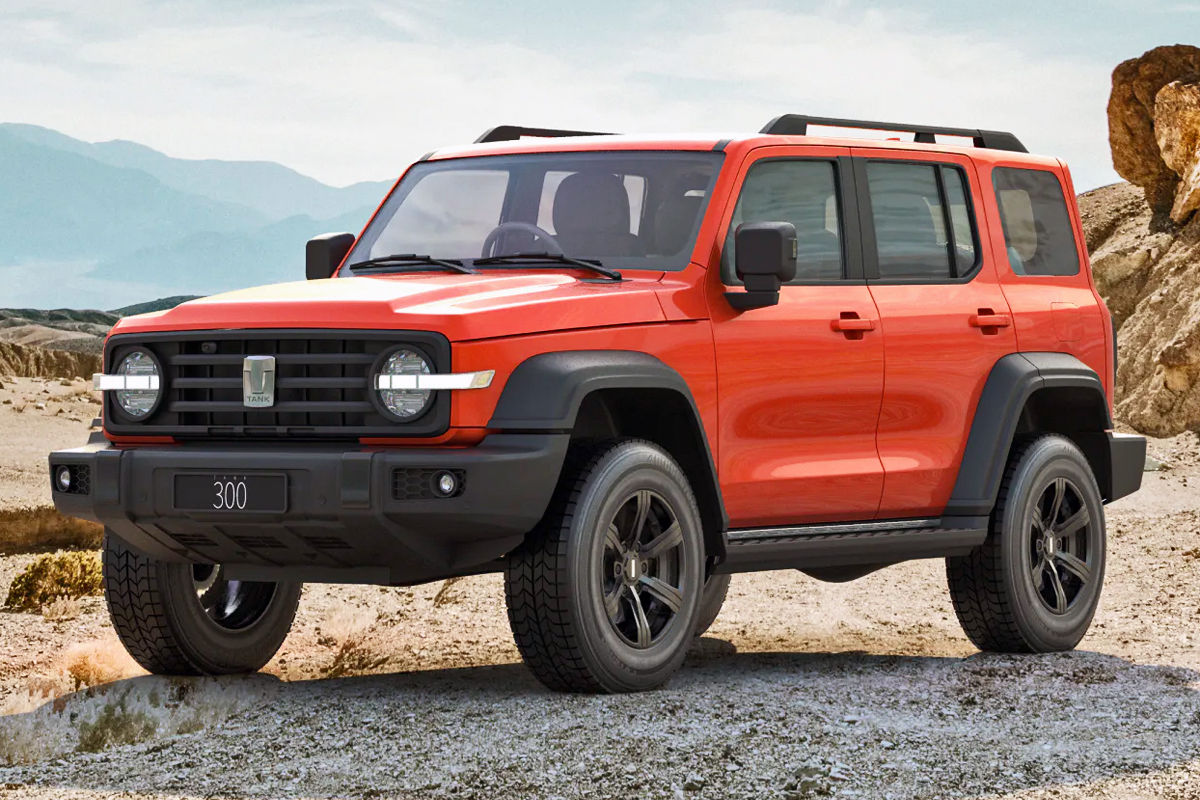
Back in May 2023, Haval Motors South Africa announced indicative pricing for the new GWM Tank 300, which was expected to launch shortly thereafter. However, the Chinese company’s local division has now confirmed to Cars.co.za that the ladder-frame SUV will hit the market only early in 2024.
So, what’s behind this delay? Well, the firm told us the units came in drips and drabs and rather than launching without a sufficient number of vehicles available to sell, the brand waited until there were enough models in the country. This also allowed Tank to assess the feasibility of a hybrid version of the Tank which will make its debut when the brand launches fully in early 2024.
According to Haval Motors SA, the Tank 300 will thus launch locally with the option of either powertrain, before the larger Tank 500 follows later in 2024. Of course, we’ve already had a quick drive of the former during an international jaunt Down Under earlier in the year.
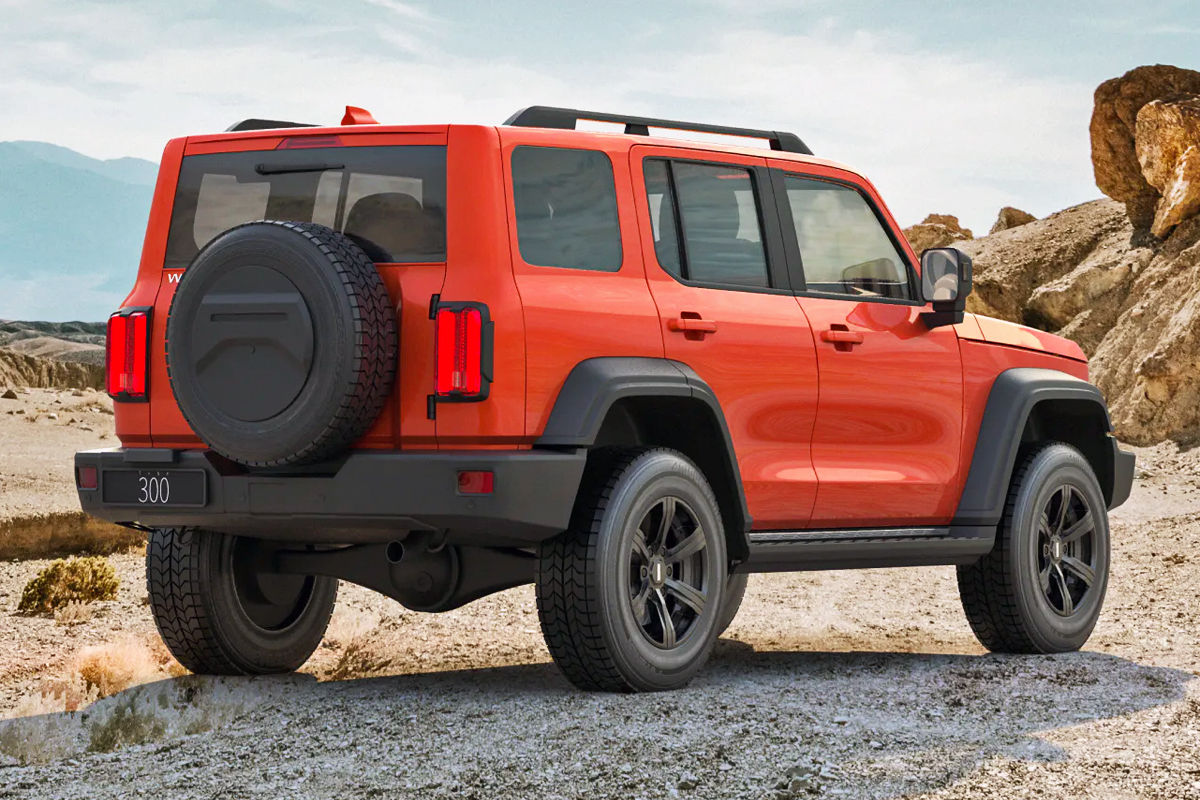
Built on a ladder-frame chassis similar to that of the GWM P-Series bakkie, the Tank 300 boasts a ground clearance of 224 mm, an approach angle of 33 degrees and a departure angle of 34 degrees. It measures 4 760 mm long, 1 930 mm wide and has a wheelbase of 2 750 mm, which makes it similar in size to a Toyota Fortuner (though note the 300-badged model is a strict 5-seater rather than a 3-row SUV, like the Prospecton-built stalwart).
The standard turbocharged 2.0-litre, 4-cylinder petrol engine makes 162 kW and 387 Nm, peak outputs that are delivered to all 4 corners via an 8-speed automatic transmission as standard. Meanwhile, the hybrid version is based on a similarly sized 4-pot but churns out total system outputs of 258 kW and 615 Nm. From what we understand, there will be no turbodiesel option in the Tank 300 line-up.
While Haval Motors SA suggested back in May 2023 that the GWM Tank 300 range would be priced “between R685 900 and R851 900”, we suspect these bookends may have shifted somewhat considering the delay. Still, we’ll bring you more details of the local range – including pricing – as soon as they become available. Stay tuned…
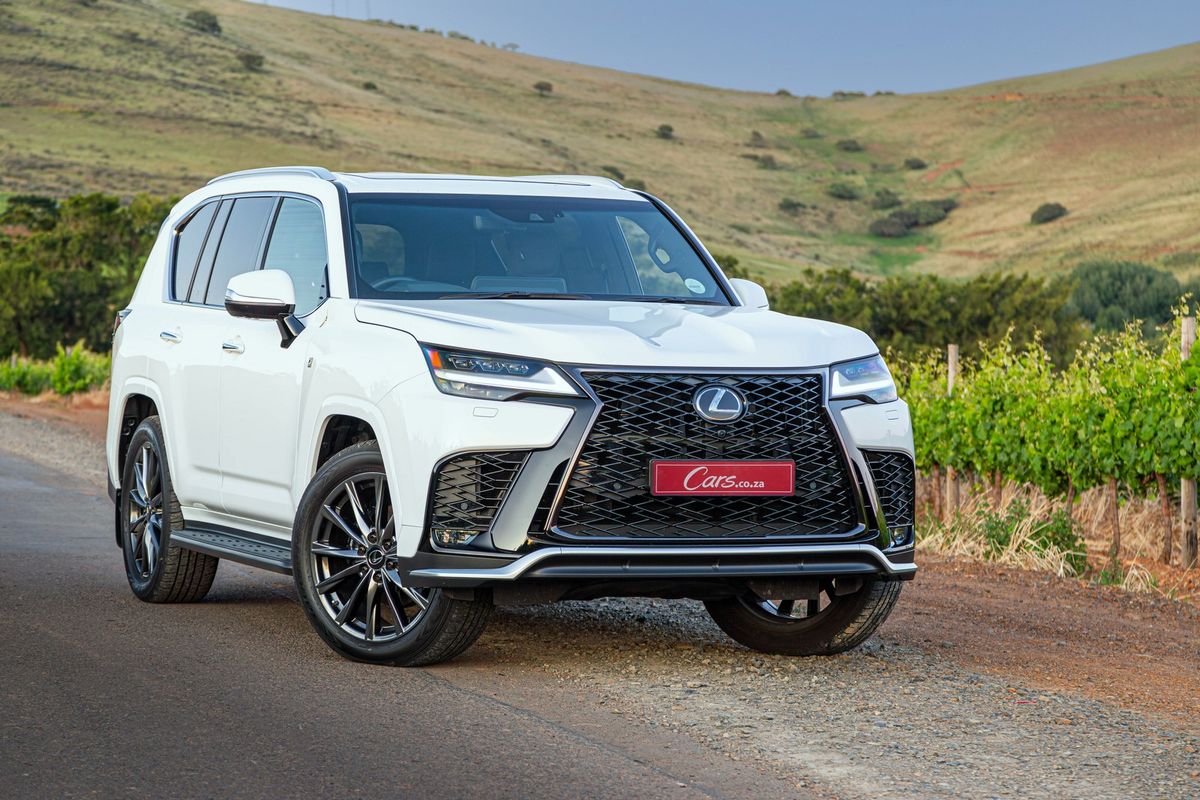
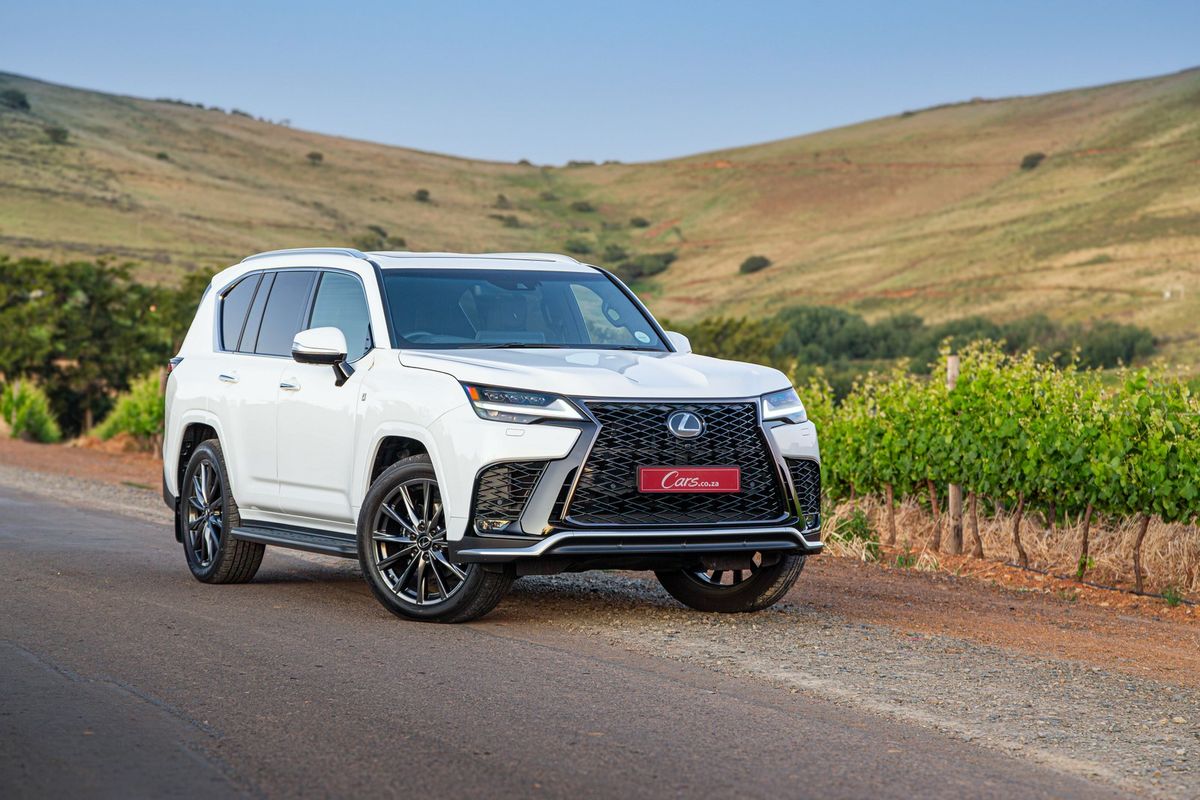
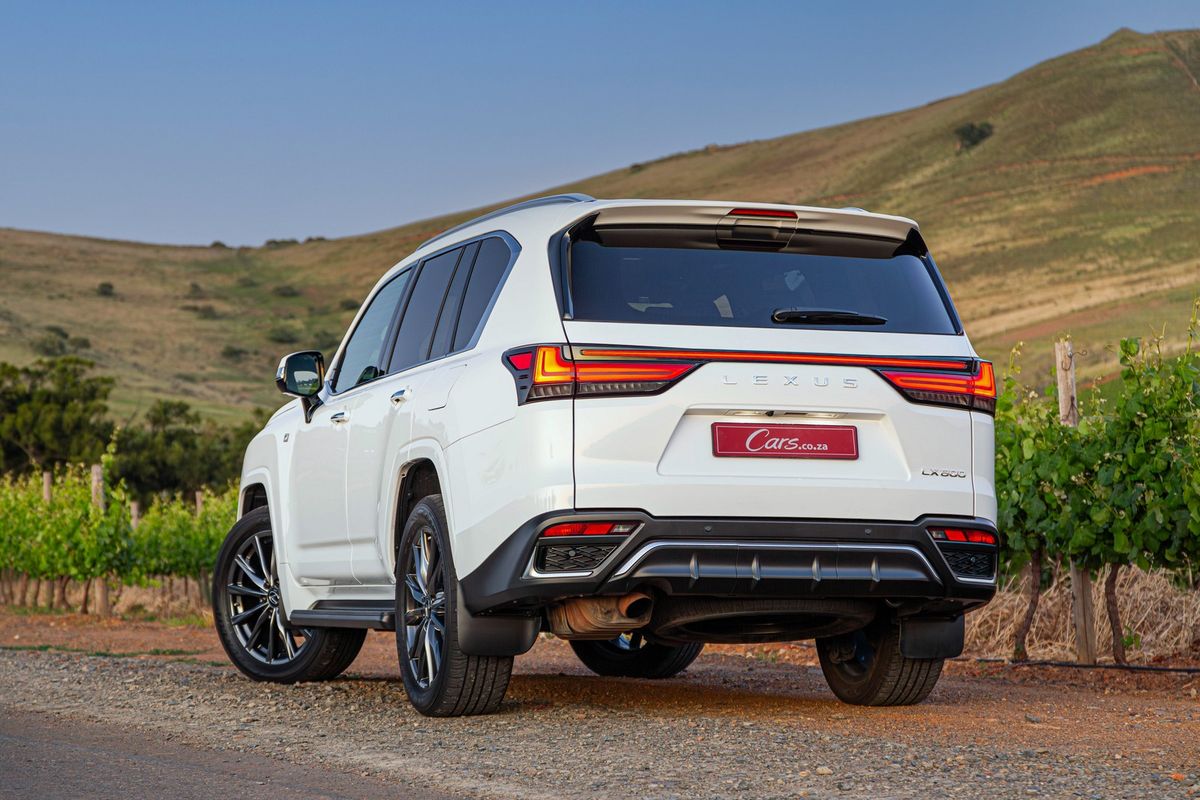
The Lexus LX has been billed as the “Ultimate Luxury SUV” but will buyers be able to look past the fact that the Japanese premium brand’s 1st-class off-roader is “a posh Toyota Land Cruiser 300”? We put an LX 600 F Sport through its paces to find out…
We like: Prestige, build quality, all-encompassing specification, potent engine and off-road capabilities.
We don’t like: Top-heavy handling, thirsty when pressing on, unresolved ride quality, where’s the hybrid?
This author fondly recalls driving a V8-powered 3rd-gen Lexus LX 570 in 2010 and being blown away by the behemoth SUV’s opulent and spacious cabin, plus… its frightening thirst for unleaded. Now, 13 years later, Lexus has a new LX flagship, which the Japanese marque claims is the “Ultimate Luxury SUV.”
If you’re a high net-worth individual (HNWI) with R2.5 million to spend on an all-encompassing luxury vehicle, you’re spoilt for choice. The most direct rival to the Lexus (in terms of go-anywhere ability) is its Toyota Land Cruiser 300 cousin, upon which the LX is based. We’d also suggest taking a closer look at the Range Rover Sport (because prices of the full-fat Range Rover start at R3.2 million) and the German duo of the BMW X7 and Mercedes-Benz GLS, which, like the Sport, are road-biased 1st-class SUVs.
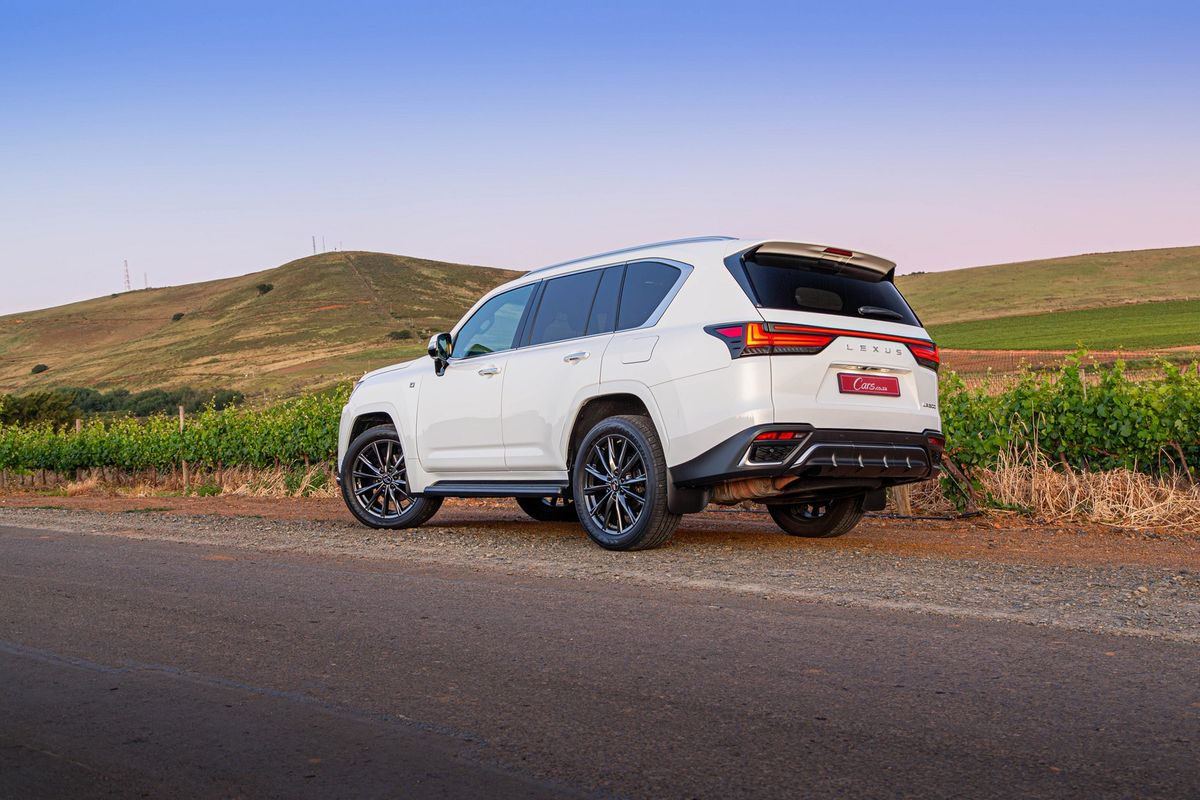
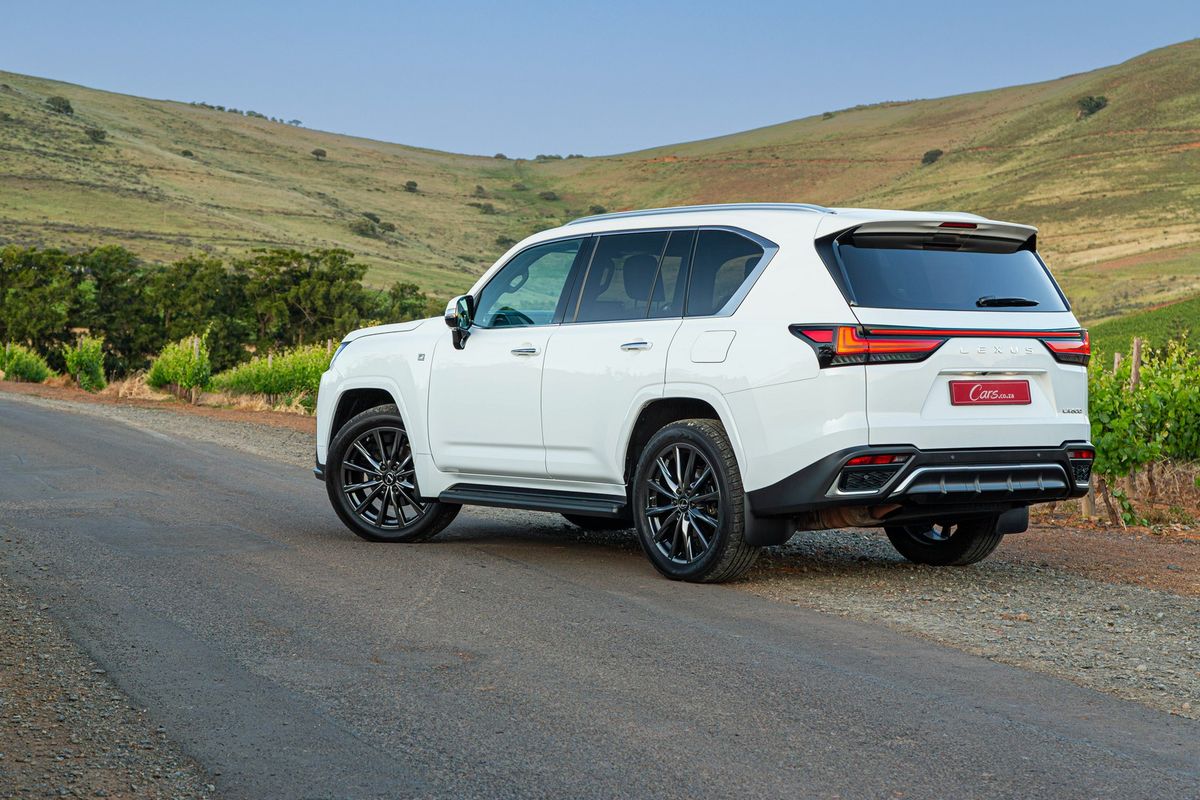
If you want a 1st-class SUV that can ‘go anywhere’, the Lexus LX is your answer.
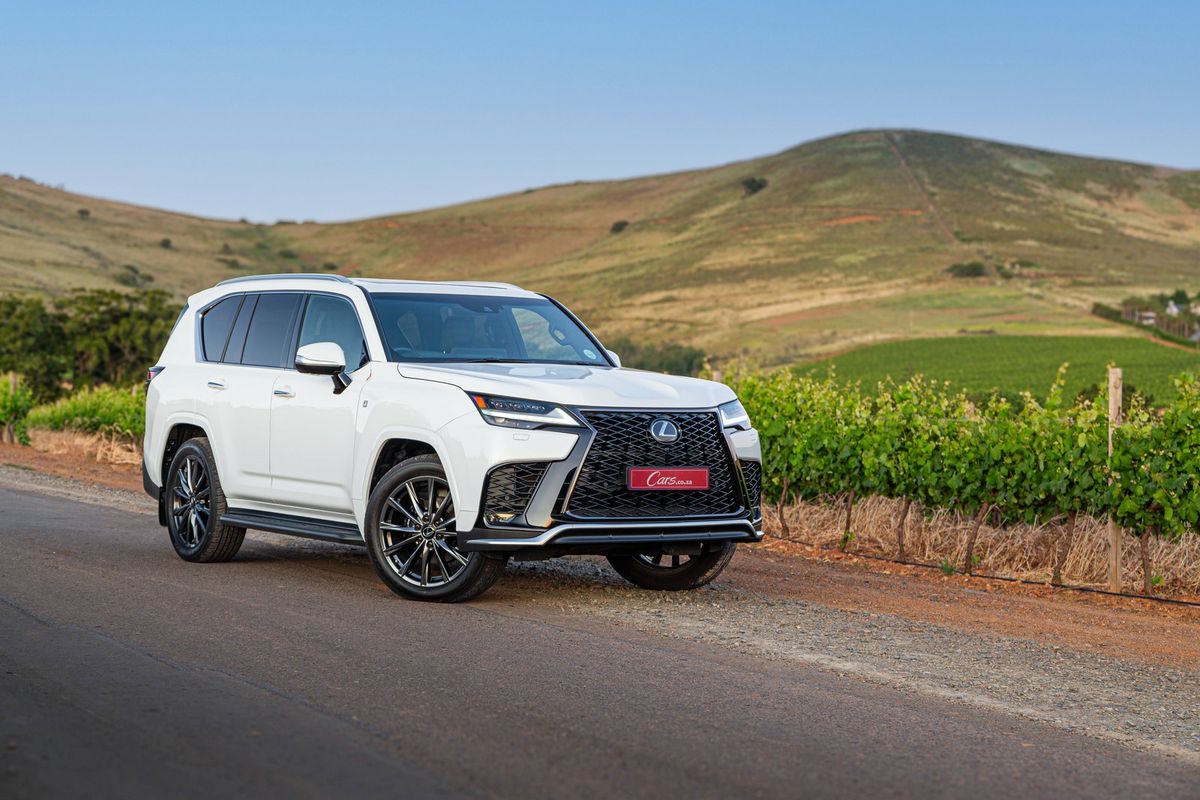
There are 5 derivatives in the Lexus LX lineup and they are priced from R2.5 million to R2.9 million. We’re behind the ‘wheel of the LX 600 F Sport, which is the most affordable turbopetrol version (by a whisker).
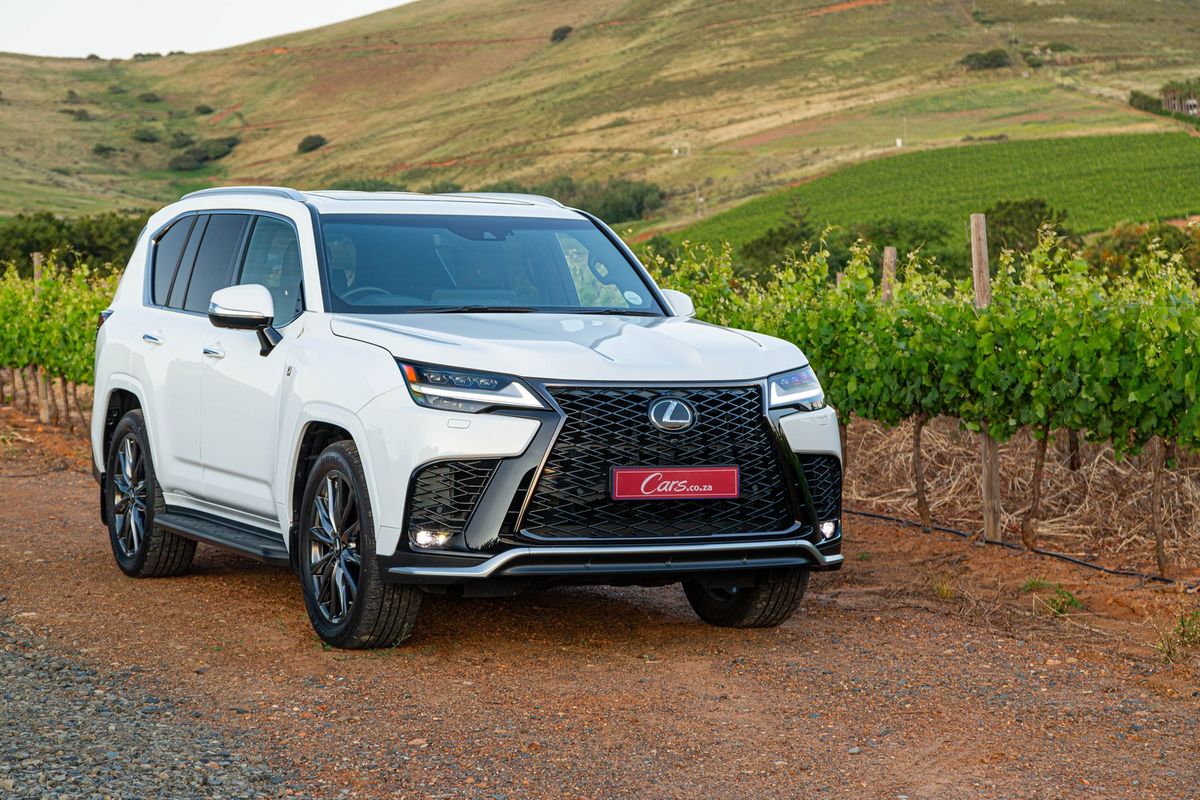
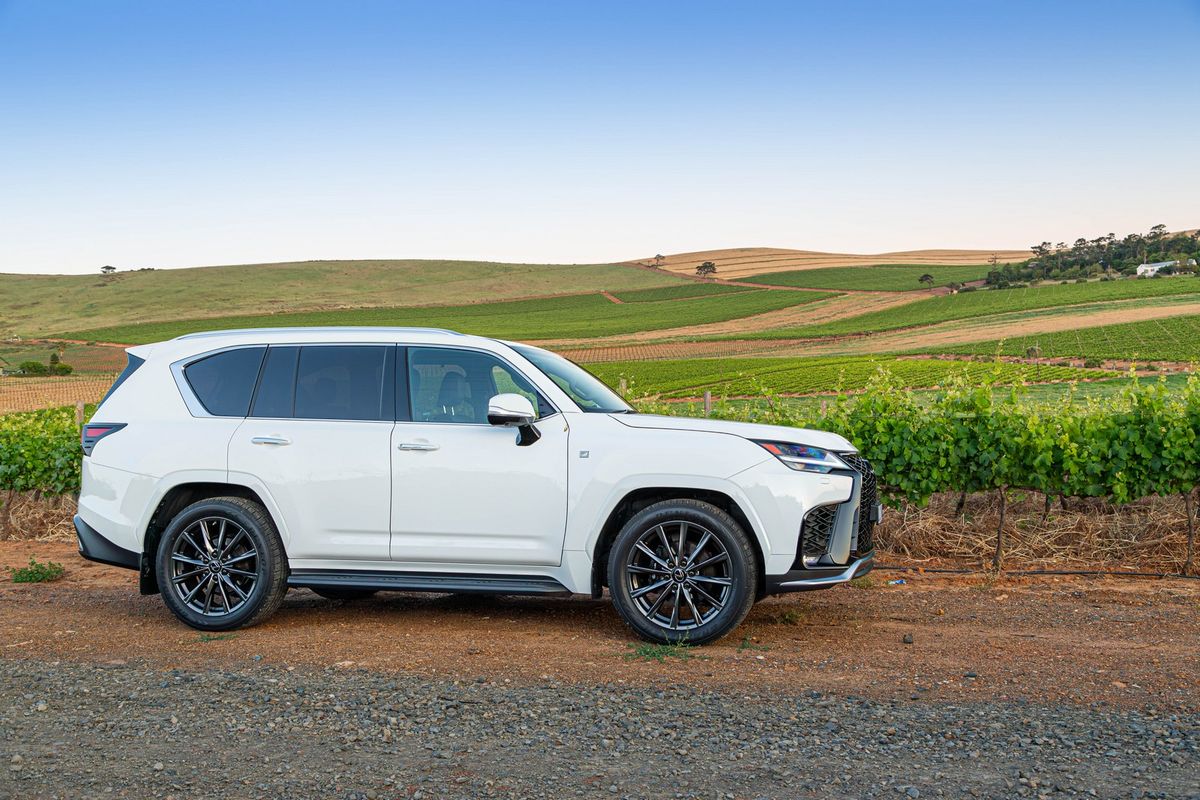
Even when finished in less-than-glamorous White Nova, the test unit turned heads aplenty courtesy of its black spindle grille, brushed aluminium trim, sportier wheels and F-Sport badging. Inside, the vehicle has sports seats, aluminium pedals and scuff plates, plus a perforated leather-trimmed steering wheel.
The LX’s cabin is awash with premium materials and finishes that feel solidly assembled and eminently luxurious – which is no mean feat. The interior feels decidedly upmarket; it befits a R2.5-million vehicle!
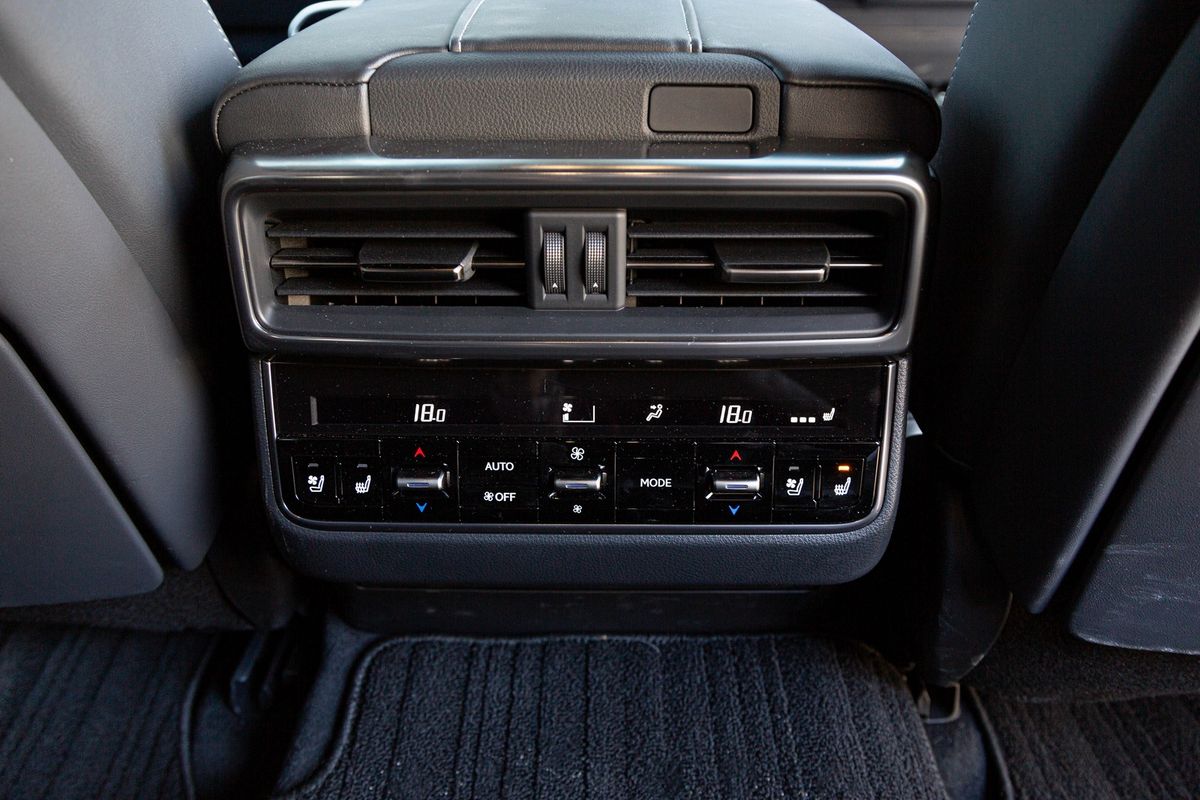
Rear passengers have dual-zone climate control, plus heated and cooled seats!
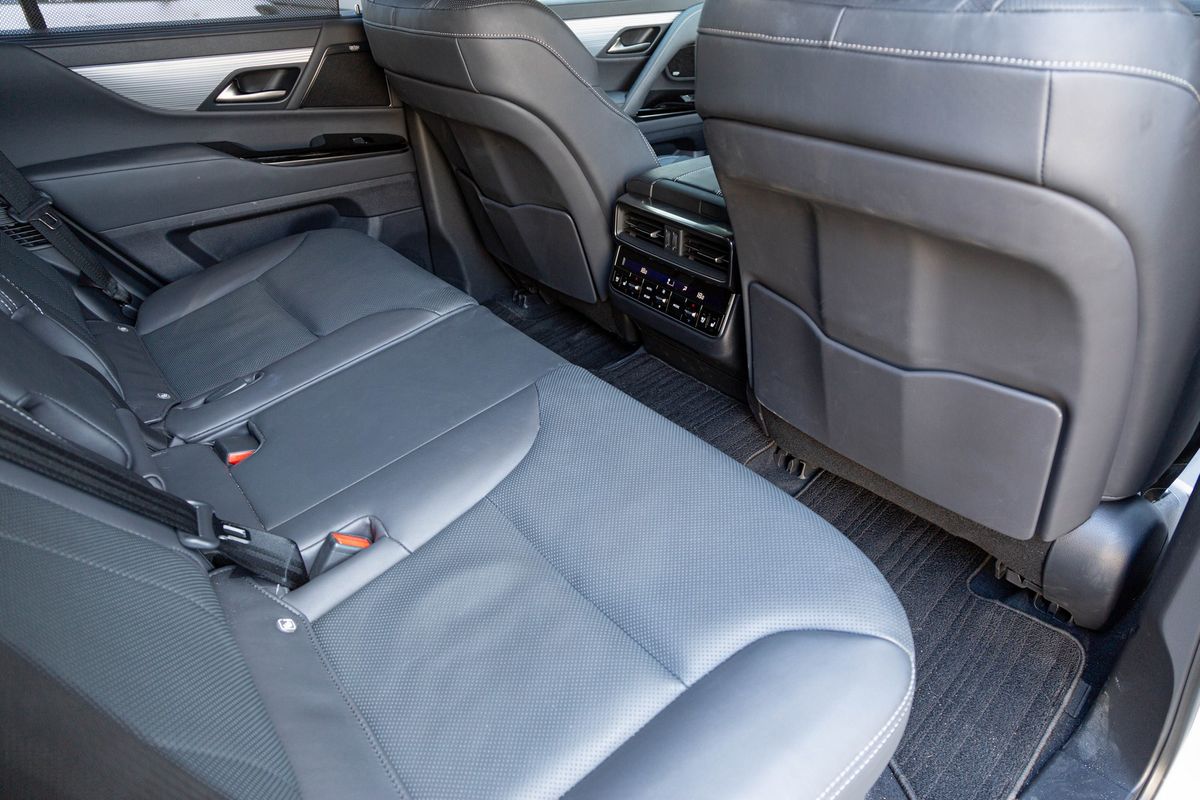
The LX is available in 4-, 5-, 6- and 7-seat configurations. Our unit was a 5-seater, but, considering the Lexus’ extended exterior dimensions, its rear legroom isn’t generous. When we glanced at our data, we noticed the LX’s wheelbase is similar in length to that of the new RX premium SUV. Still, there’s plenty of headroom for aft occupants, plus heated/cooled seats, individual ventilation controls and power outlets.
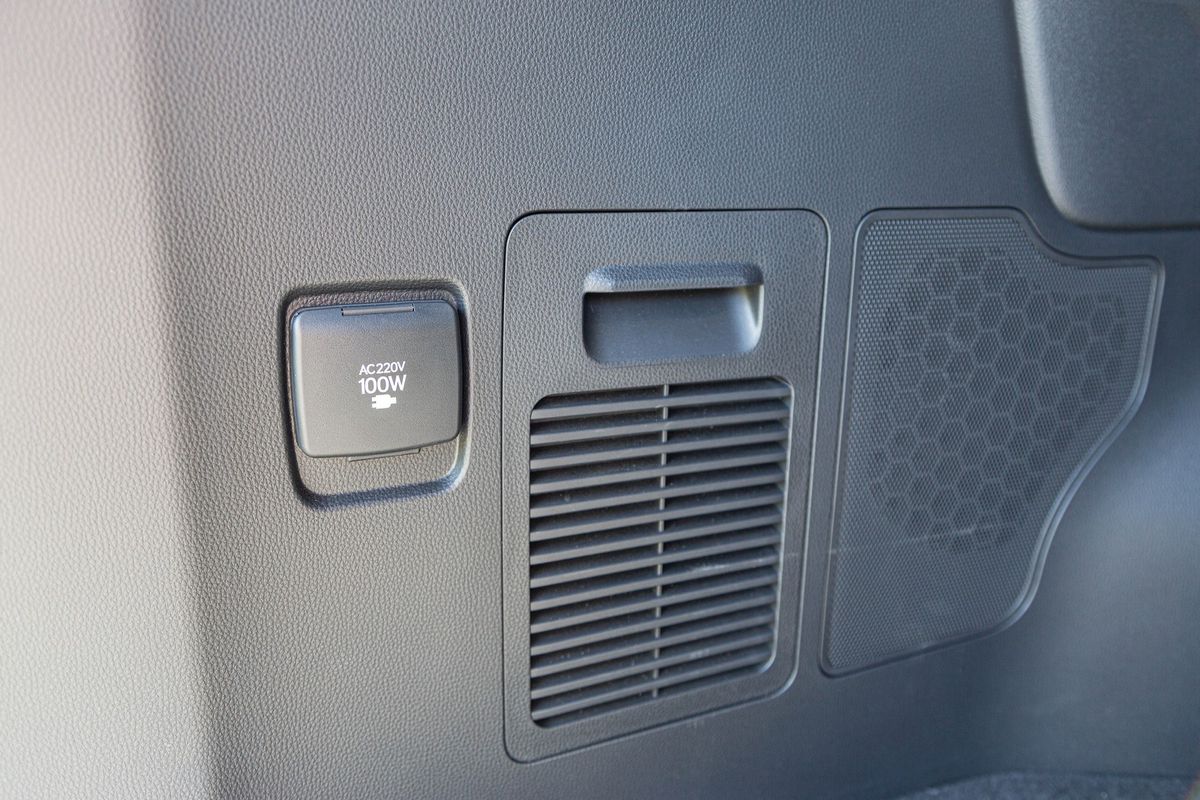
The load-bay capacity is impressive too: more than 1 100 litres of luggage space is complemented by a 110V power outlet. If you require more space/comfort for the rear passengers, the LX 600 VIP features a pair of reclining Ottoman seats in the 2nd row with massage functionality and entertainment screens.
Performance and Efficiency
Engage Sport+ for maximum straight-line performance.
For the 4th-gen Lexus LX range, that mighty 5.7-litre naturally-aspirated petrol V8 has been superseded by a pair of forced-induction V6 engines paired with 10-speed automatic transmissions. Buyers can choose between a 3.5-litre twin-turbo petrol (with 305 kW/650 Nm) and a 3.3-litre twin-turbo diesel
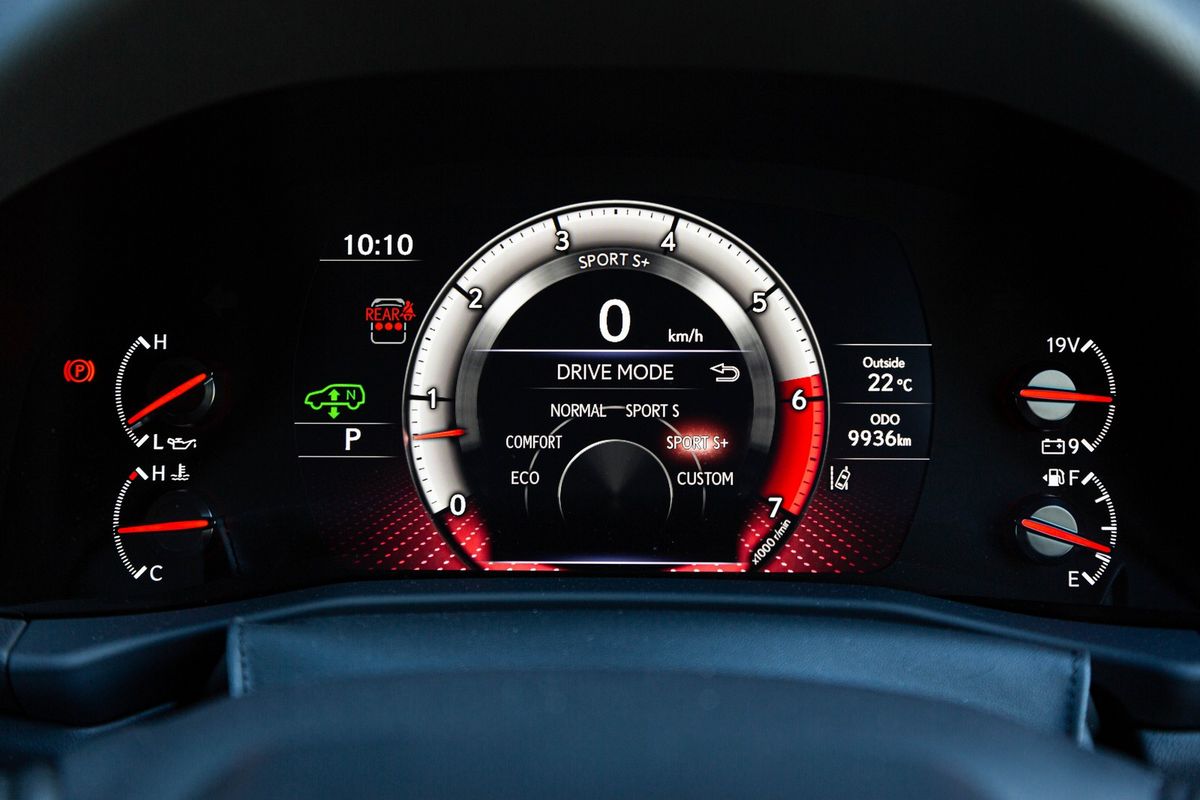
Lexus South Africa doesn’t state performance figures for its LX derivatives, so we drove to our test road to find out exactly how fast the 2.6-tonne SUV is. According to our equipment, the turbopetrol-powered LX 600 F Sport accelerated from 0 to 100 kph in 6.58 seconds (with its sportiest drive mode engaged), which was impressive… considering the LX appears to have the aerodynamic properties of a barge.
The cabin feels modern and well-made.
The V6 powerplant is muscular – there is no shortage of urge, when required – and has a creamy power delivery. Compared with the ancient V8 it replaced, the V6 is ultra-refined; it runs so quietly, in fact, that when you engage Sport+ mode, the LX plays an enhanced engine note through the car’s audio system.
We don’t have many criticisms of the drivetrain, but the Lexus’ transmission was prone to “hunting”. An auto ‘box with a multitude of ratios is supposed to keep an engine performing optimally and as efficiently as possible (all in the name of achieving low carbon emissions), but either 10 ratios are a few too many… or the LX’s powertrain software needs to be recalibrated to dissuade the transmission from constantly hunting for an appropriate gear. To remedy the problem, you can use the steering-wheel-mounted shift paddles to actuate manual gear changes, but that doesn’t gel with the “Ultimate Luxury SUV” theme…
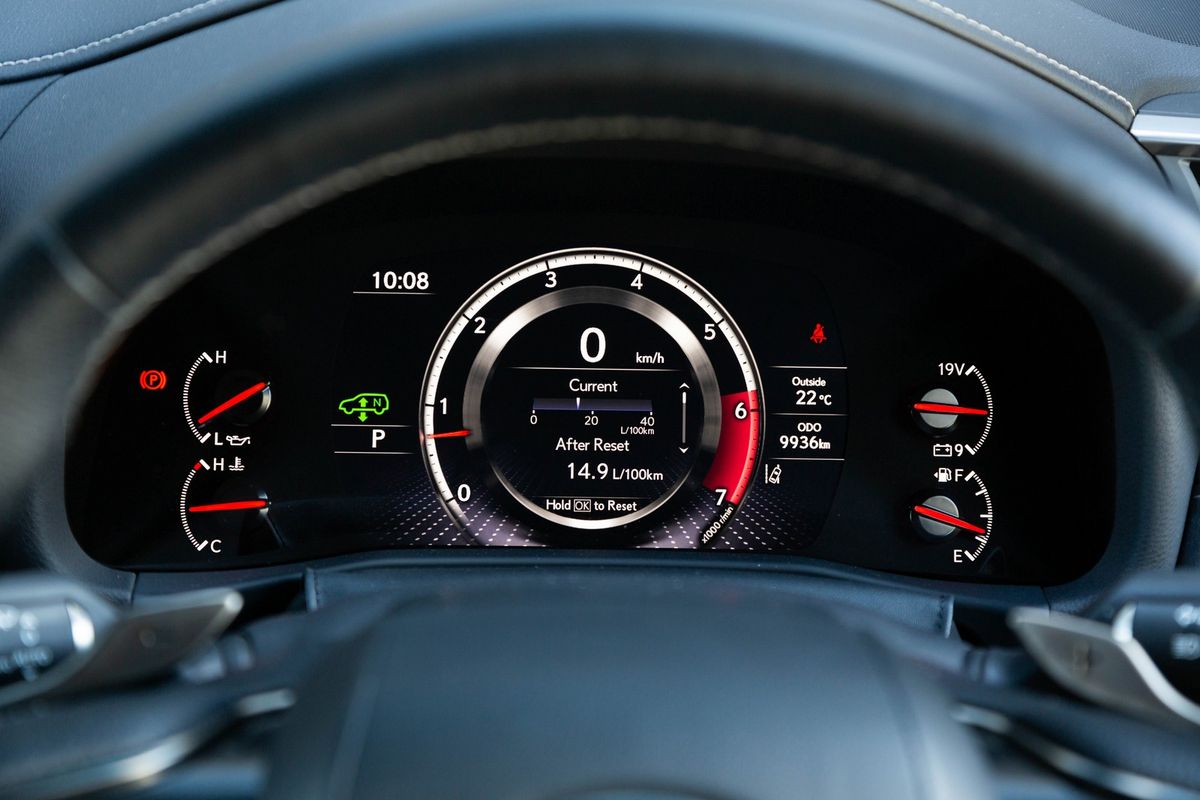
14.9 L/100 km is not the most efficient. If you want better fuel economy, opt for the turbodiesel.
What’s more, despite our best efforts to make its indicated consumption figure dip to expected levels, the LX 600 F Sport wasn’t very fuel efficient during its tenure in our test fleet. Even though buyers in the Lexus LX’s target market are unlikely to struggle to afford to keep a vehicle of this calibre fueled up, we were disappointed that we couldn’t get the trip computer to display under 14.9 L/100 km. We tried open-road cruising at 100 kph in Eco mode and still couldn’t achieve anything near the claimed 11.3 L/100 km.
Still, the LX is more efficient than its predecessor and comes equipped with 2 fuel tanks: an 80-litre primary and a 30-litre backup, giving the 600 F Sport a (trifle optimistic) claimed range of 974 km. One would think that a brand with as much experience with petrol-electric powertrains as Lexus would offer some sort of electrification on its flagship family car, but sadly there’s no hybrid version in the LX lineup.
Ride and Handling
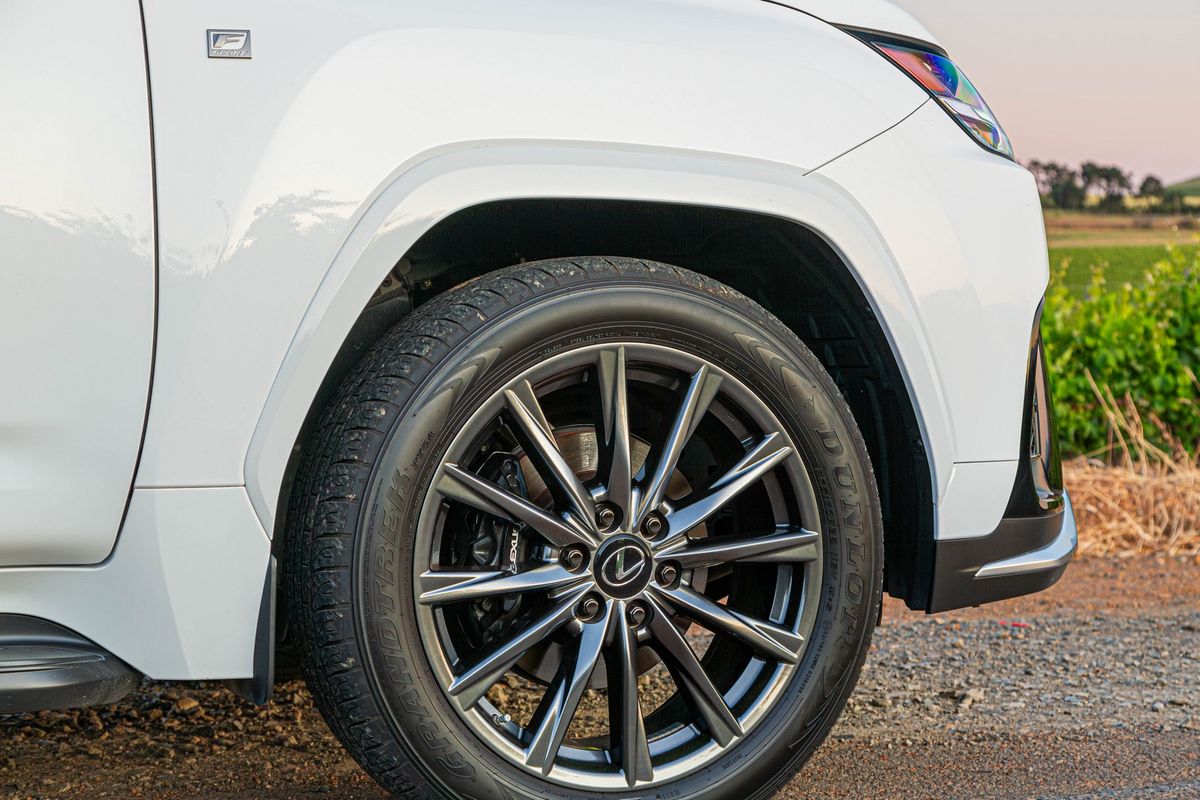
Those massive (22-inch) alloy wheels look the part, but aren’t ideal for off-roading.
The 4th-gen RX rides on Toyota’s TNGA-F platform (with a ladder-frame chassis) and is said to be 20% more rigid and 200 kg lighter than the outgoing model. While vehicles with ladder-frame architectures (such as bakkies and off-roaders) cannot match cars with a monocoque design in terms of body control and ride refinement, they have the upper hand when it comes to off-road capability and toughness.
Also, the F-Sport trim is not just for show; Lexus has equipped this derivative with a Torsen limited-slip differential, adaptive variable suspension, performance dampers and a special tune for the power steering. In truth, we don’t think all of those handling add-ons are necessary – there’s no getting away from the fact the Lexus LX is a tall, heavy luxury SUV, and it feels like one from behind the ‘wheel.
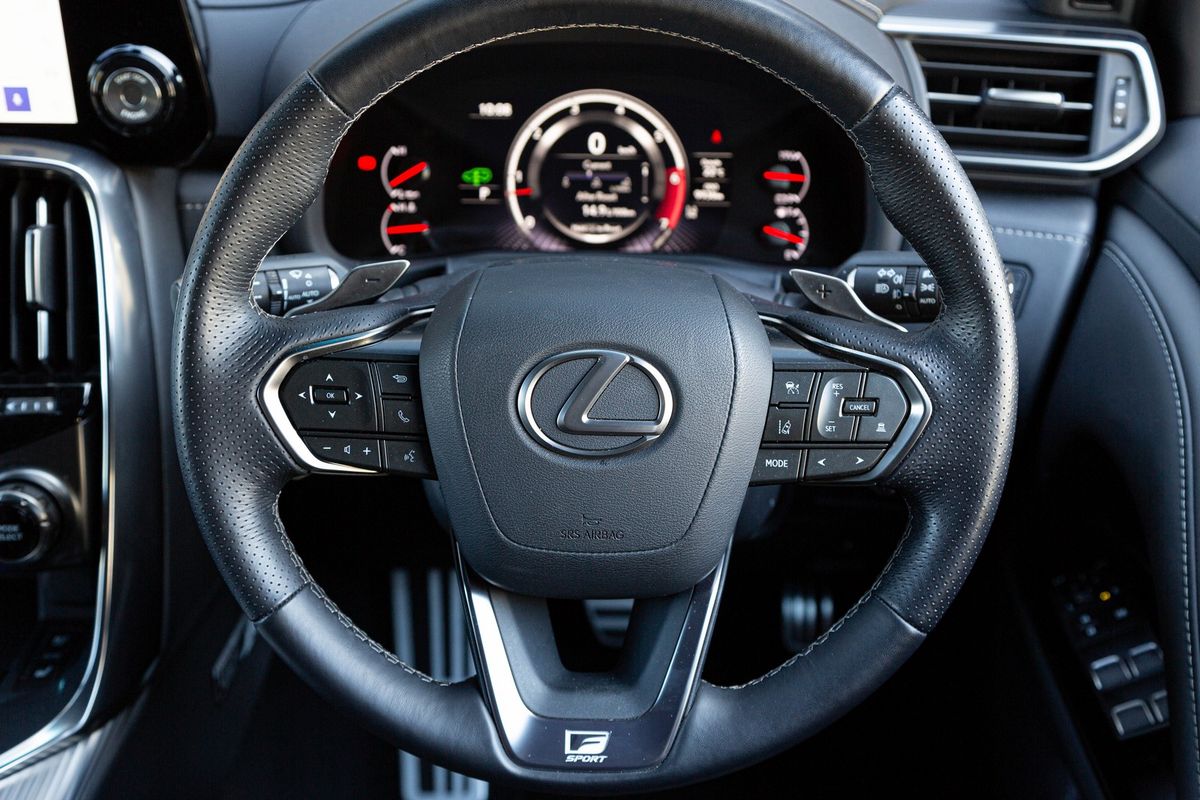
The smart-looking F-Sport multifunction steering wheel.
On the other side of the coin, very few vehicles can instil the sensation of towering over other road users in the way the 4th-gen LX does. From behind its leather-trimmed multifunction tiller, you feel superior to (virtually) everyone else on the road. The cabin’s impressively quiet too, for reasons we’ll discuss below.
The 600 F Sport’s air suspension does its best to offer a comfortable ride quality on average to poorly maintained road surfaces and, although the damping is reasonably absorbent, a vehicle with a ladder-frame chassis (even a luxurious one) can never ride as plushly as its road-biased unibodied rivals.
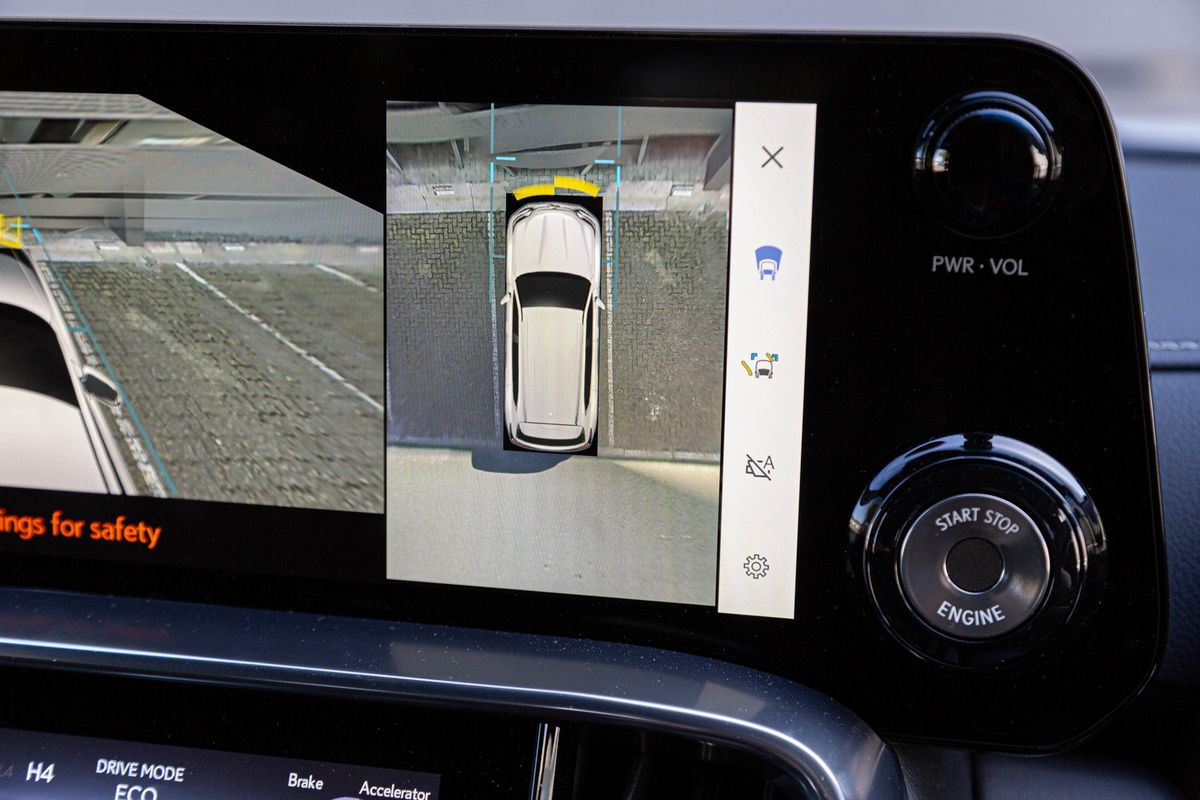
An excellent parking camera system for one of the largest vehicles we’ve driven.
The steering setup (with its F-Sport tune) is acceptable in the majority of driving scenarios, but there is little in the way of feel and feedback through the ‘wheel. On the open road, the tiller requires pronounced inputs to elicit steering responses; as a result, the LX feels languid to drive… as if it floats over the road.
Some will appreciate that the Lexus facilitates a relaxed driving style, but others may find the steering feel too remote and insubstantial. Still, The LX is relatively easy to park; its steering seems more sensitive at crawling speeds, which is when its myriad proximity sensors and cameras are activated automatically.
Comfort and Features
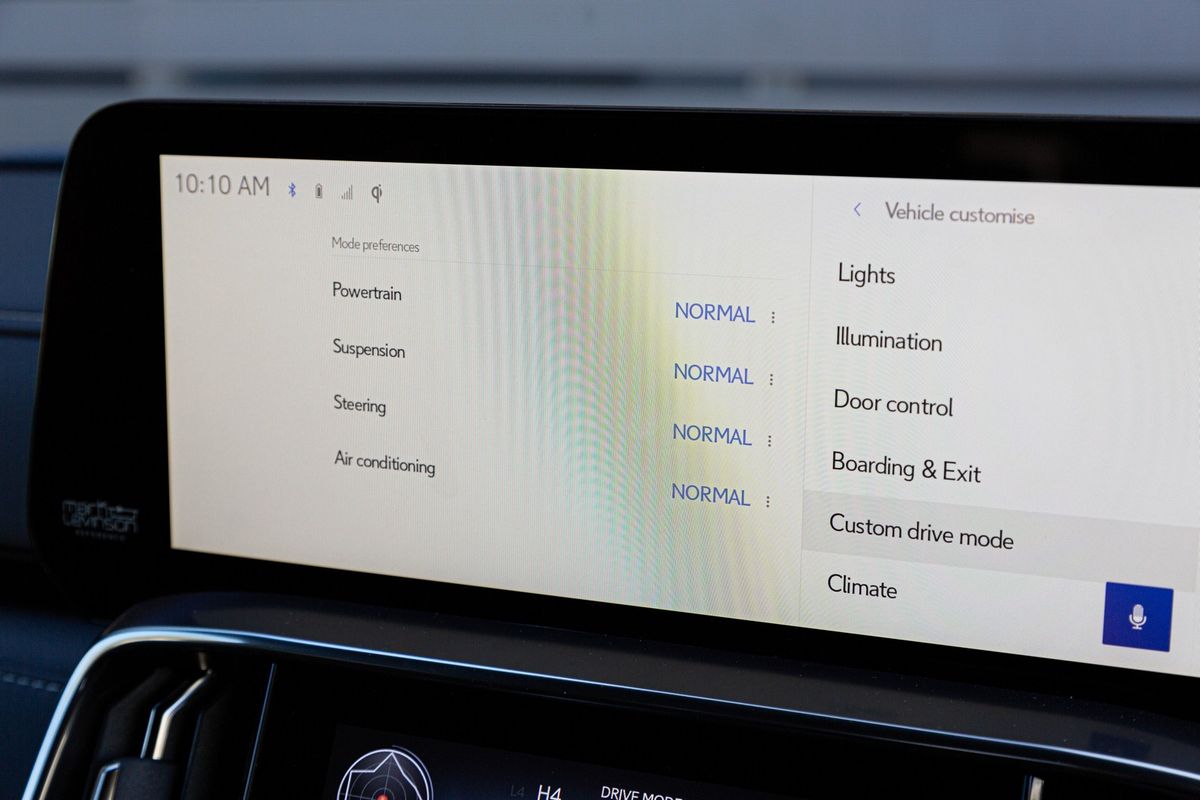
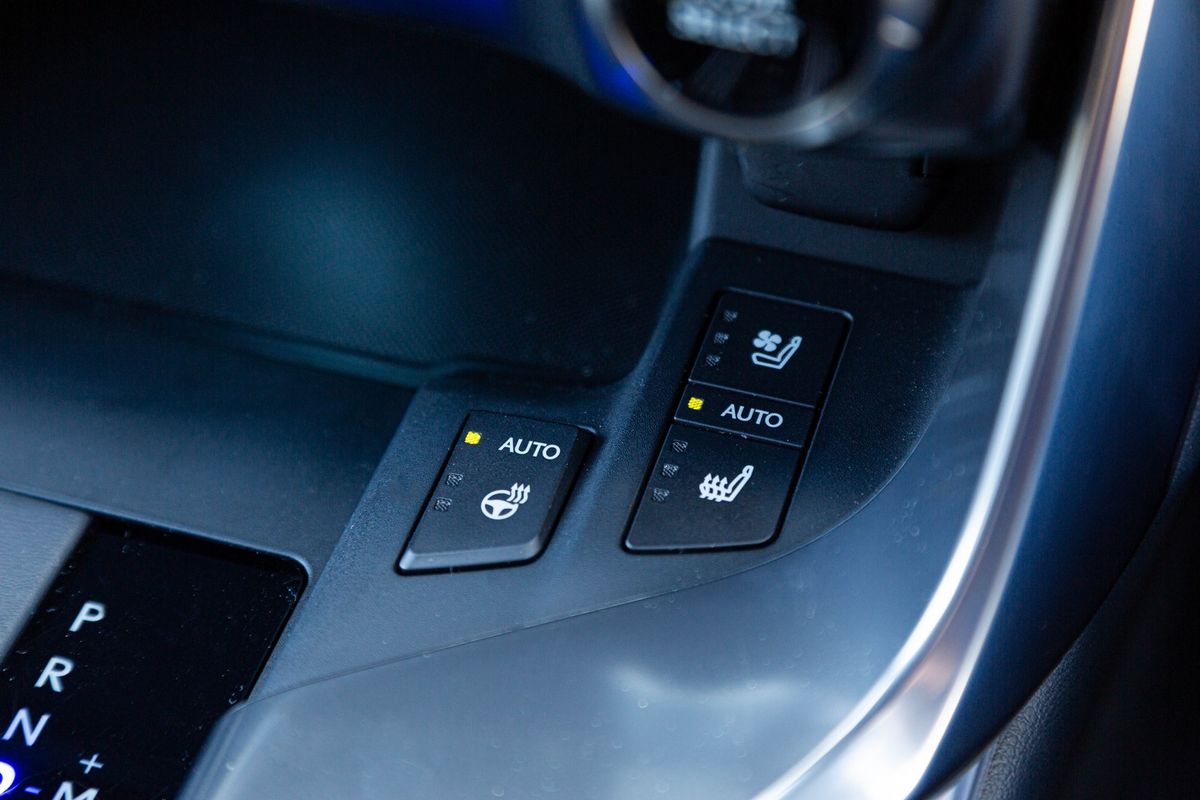
Automatically heated/cooled seats and steering wheel are two gadgets you never knew you needed!
When you’re forking out R2.5 million for a 1st-class SUV, it wouldn’t be unreasonable to expect the car to be fitted with every conceivable gadget, gizmo, toy and comfort feature – and the LX has them all! Four of the seats are automatically adjustable and heated, as well as ventilated… Even the rim of the steering wheel has an auto-heating function that works in conjunction with the vehicle’s climate control settings.
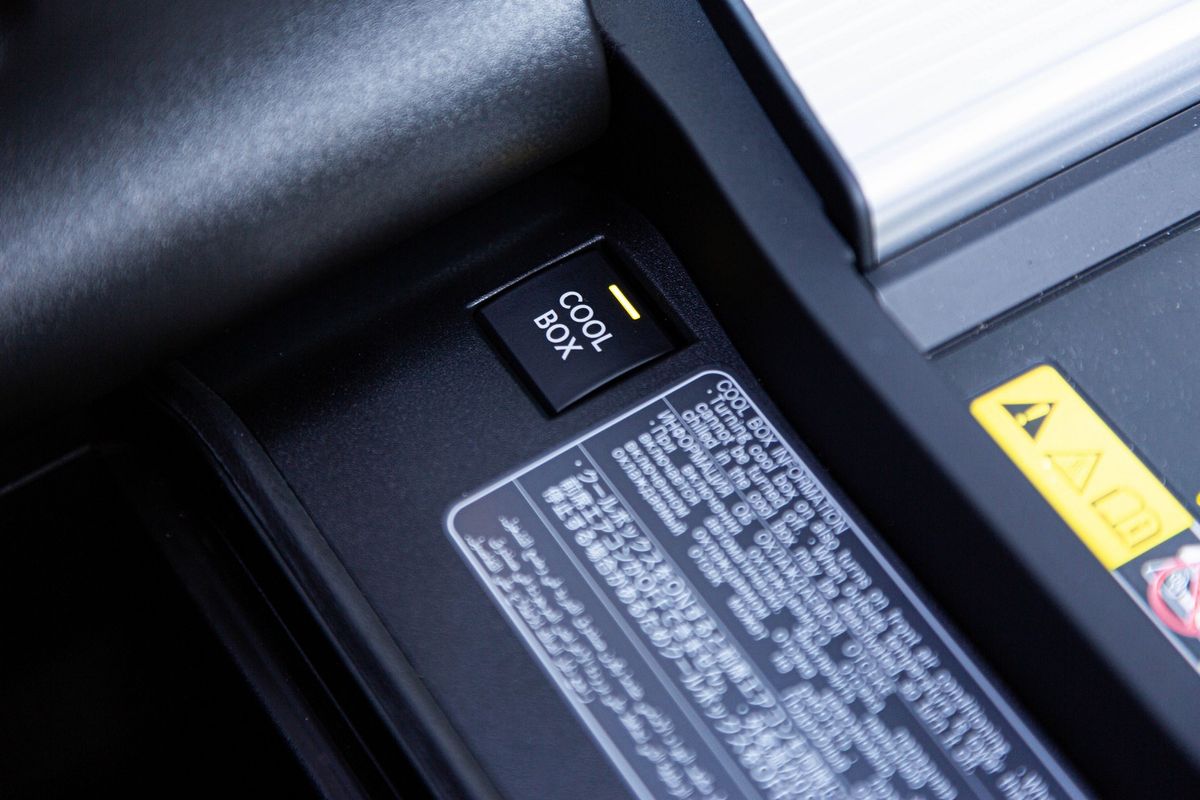
We put this cool box to the test and our soft drinks were chilled rapidly.
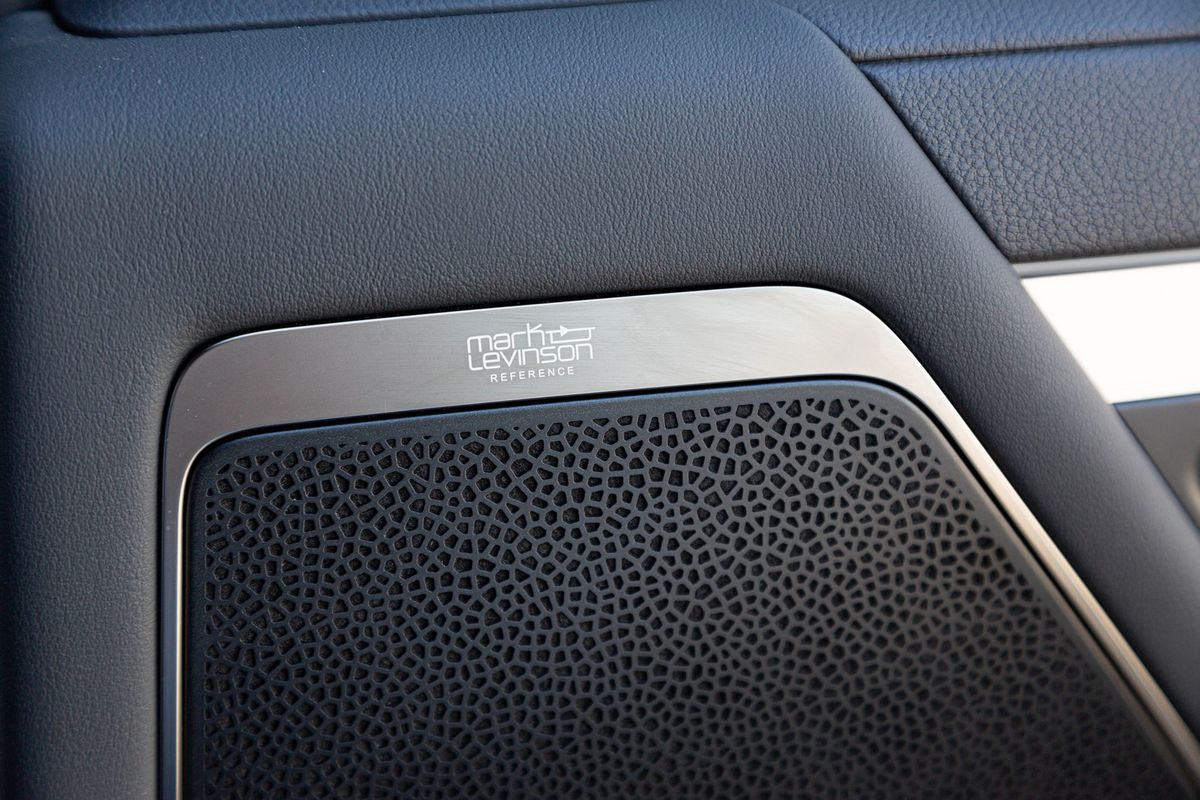
Furthermore, the LX 600 F Sport has a frosty drinks fridge (built into the centre armrest), more charging ports than you may ever require, a wireless charging pad, as well as a 25-speaker Mark Levinson audio system, which we rate highly. The head-up display is also one of the better of its kind we’ve experienced.
There’s some clever tech in the vehicle too, such as the active noise control that cleverly dials out engine and road noise by replacing it with white noise through the speakers. That’s why the cabin’s so hushed!
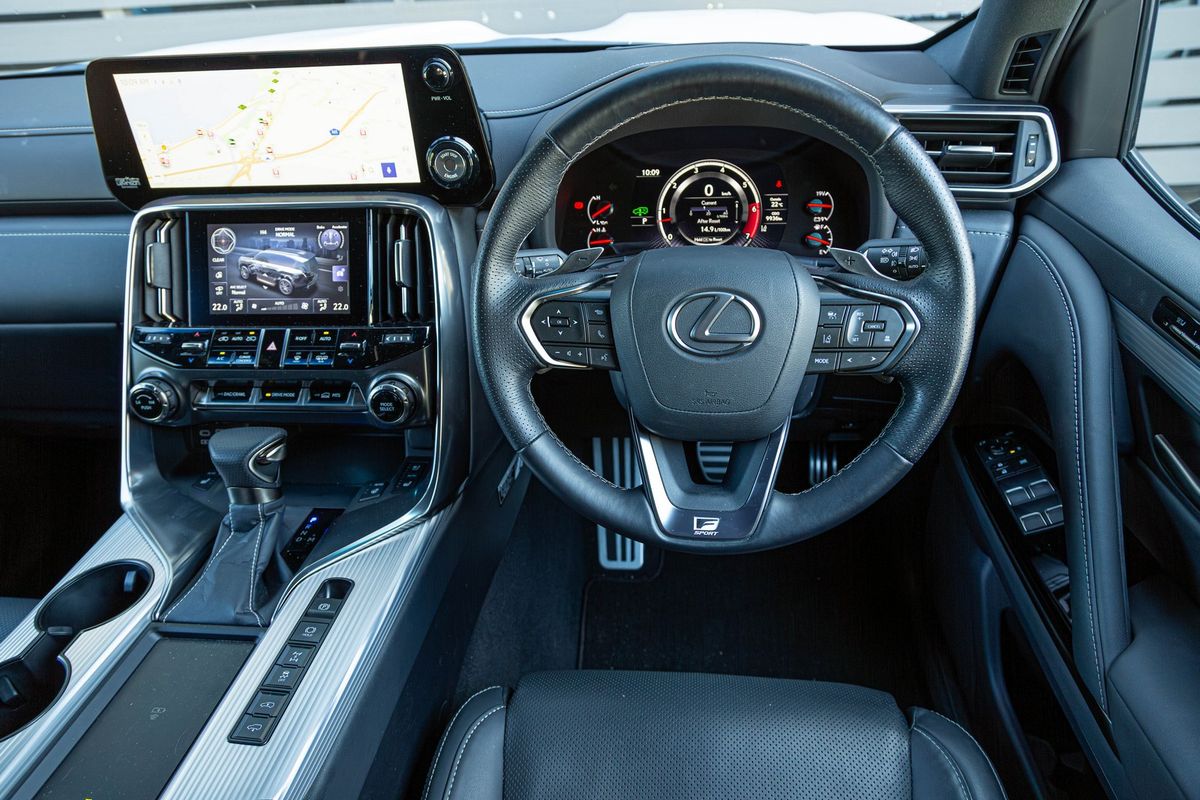
The dashboard layout looks cluttered, but we appreciate the physical buttons.
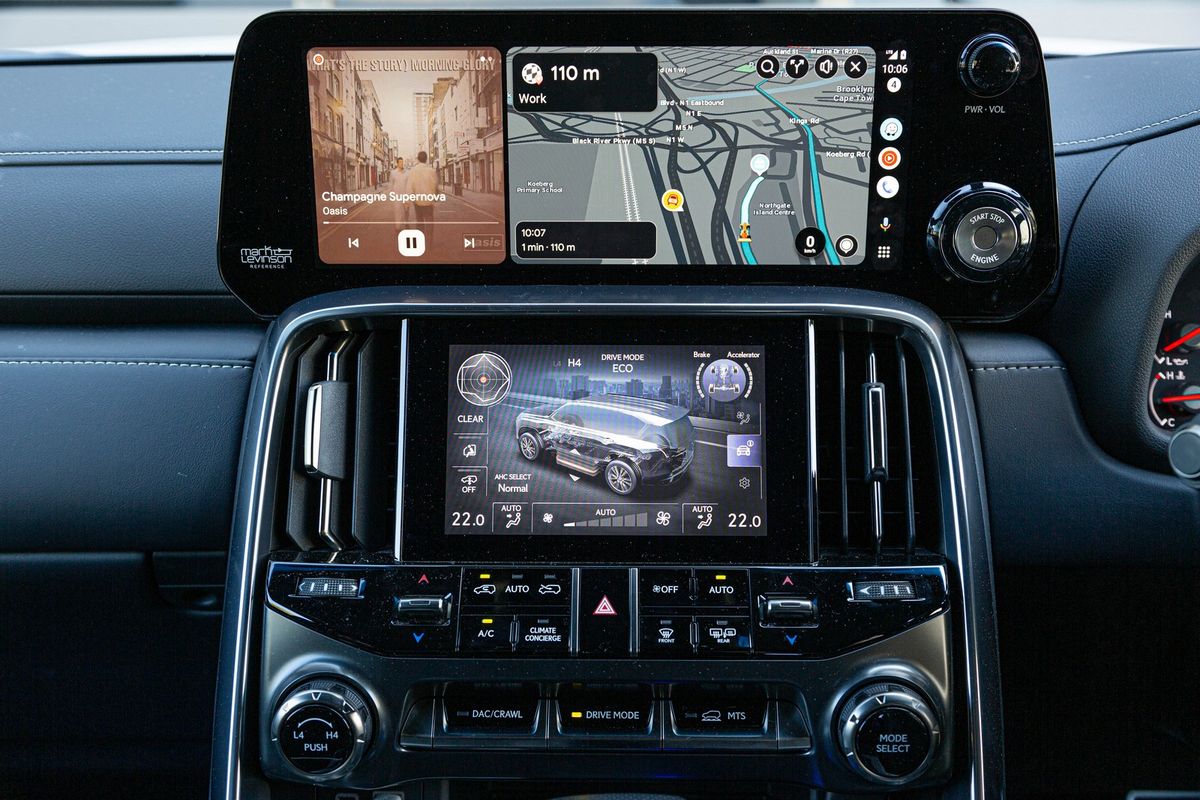
The LX features a combined digital/analogue instrument cluster – would a fully electronic one not have looked more upmarket? – flanked by a sizeable infotainment touchscreen (Apple CarPlay/Android Auto hands-free connectivity is standard, plus you can use your favourite apps like Spotify, Waze and more).
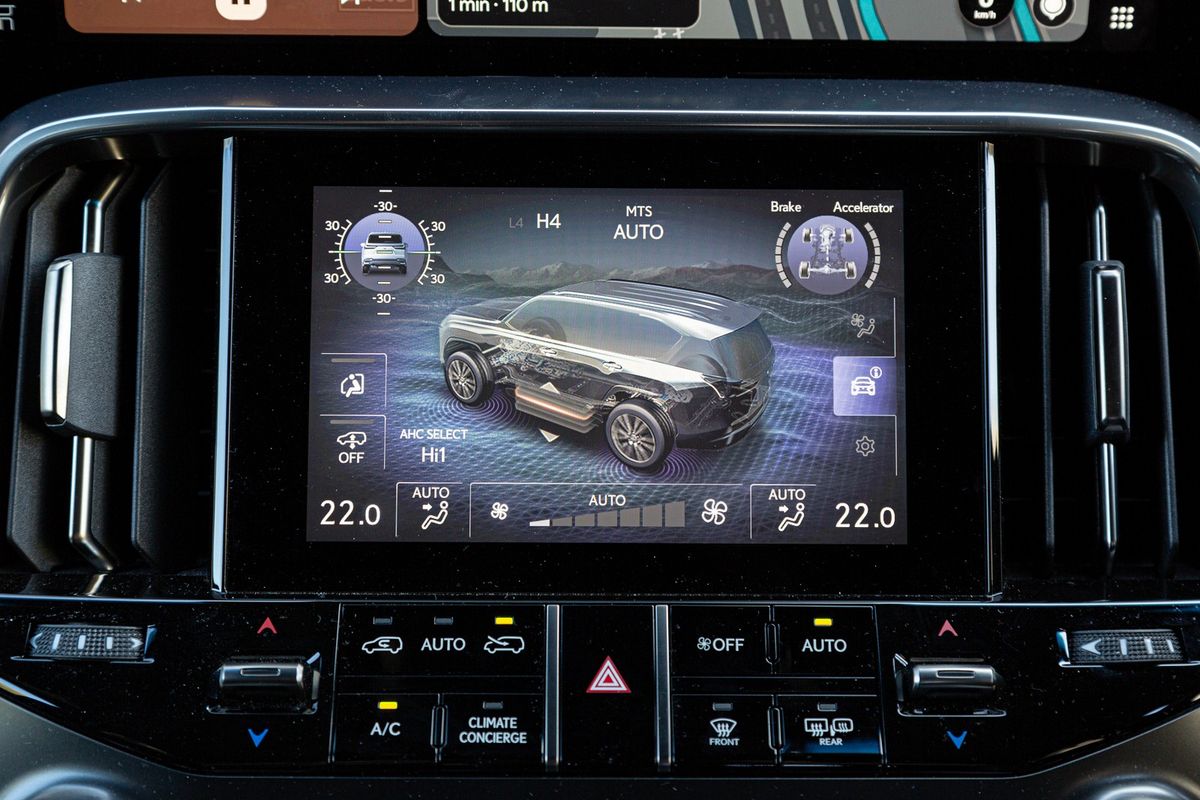
Below the central unit is a smaller screen that performs a dual function: it displays the SUV’s off-road info and parameters (you can adjust the ride height, for example), as well as the climate control settings.
Off-road Capability
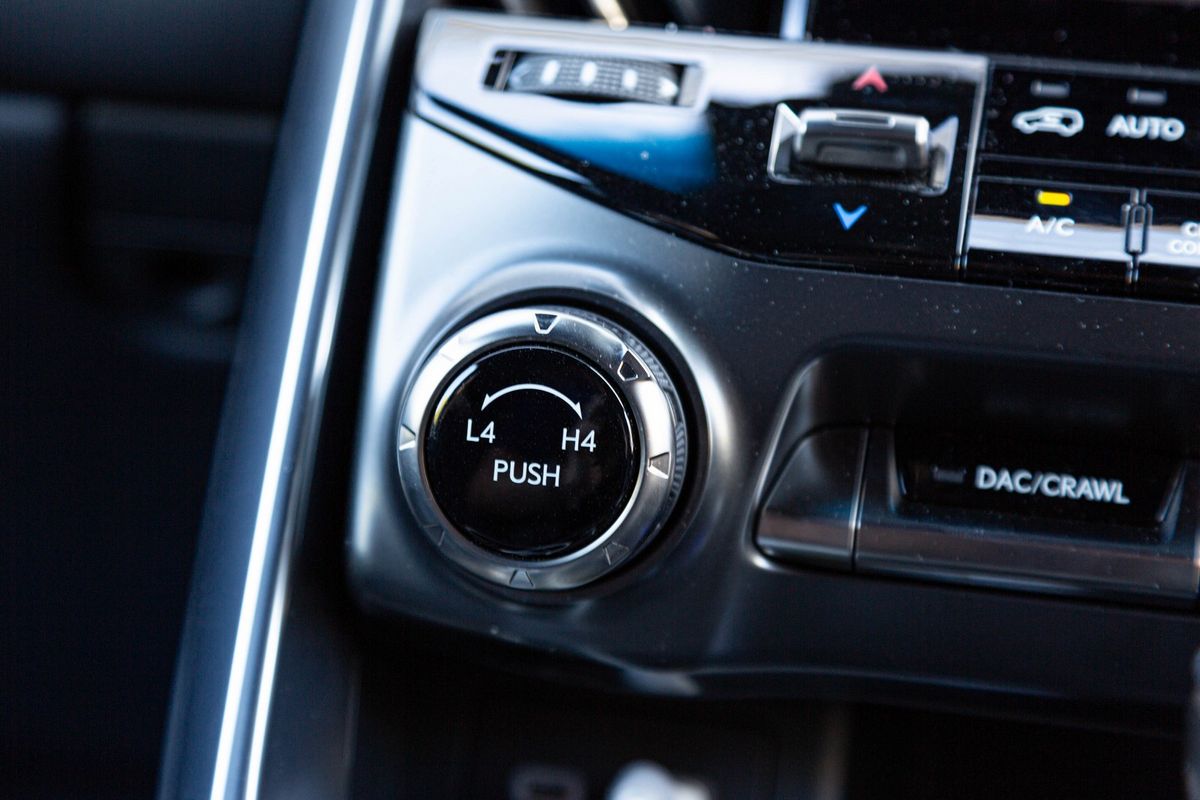
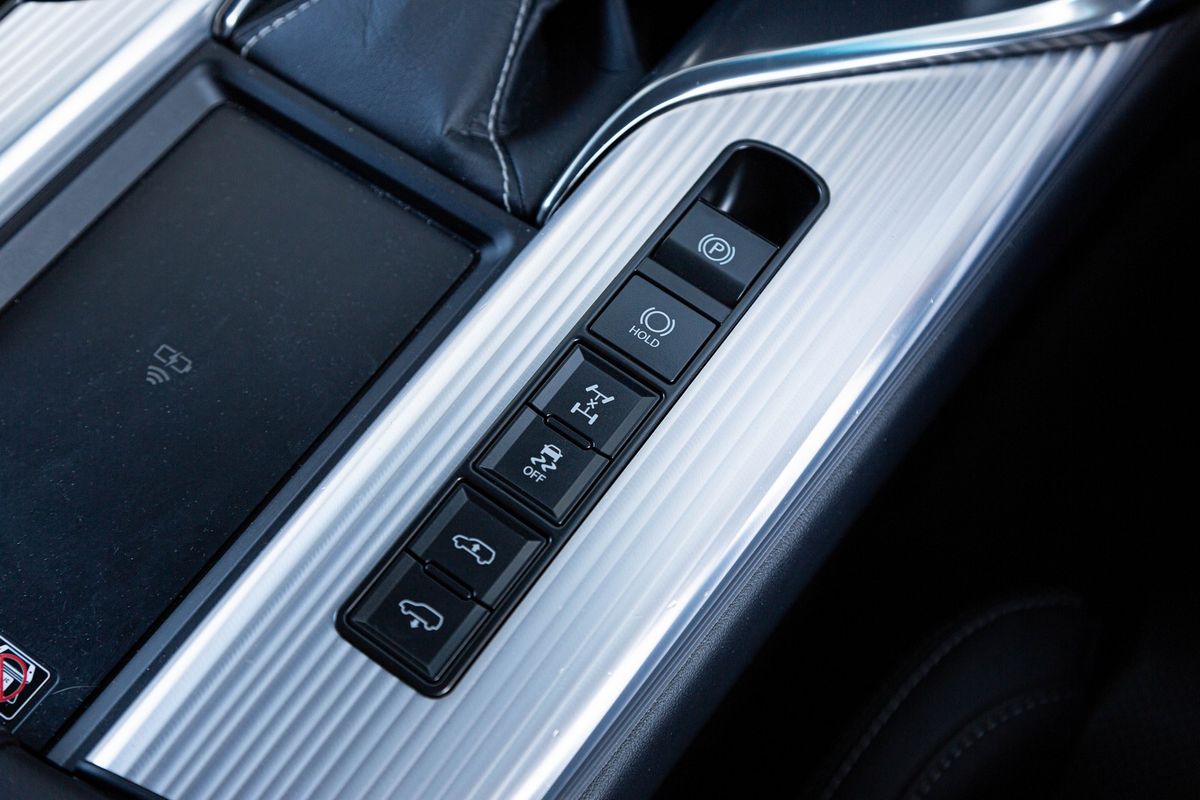
You can raise the LX’s ride height and activate its differential lock on the centre console.
The 4th-gen Lexus LX’s 4×4 credentials are impressive – but, seeing as it’s the cousin of the Land Cruiser 300, that’s to be expected! The 1st-class SUV has permanent 4-wheel-drive and retains the Toyota’s 700 mm wading depth, hill-descent control, low-range transfer case, differential locks and off-road modes. Interestingly, it has a ground clearance of 210 mm, compared with the Toyota’s 235 mm.
However, given the high likelihood of graunching the 600 F Sport’s beautiful 22-inch alloys on a tricky off-road course, we avoided driving the Lexus on anything rougher than gravel farm roads, which it crushed with consummate ease. It’s reassuring to know that the new LX has all the tech and features to be capable off-road, but the risk of damaging such a premium product was simply not worth it.
If you plan to drive off the beaten track more often than not (as unlikely as that may be), a Land Cruiser 300 fitted with higher-profile 20-inch tyres (265/55) or 18-inch rubber (265/65) would be a better bet.
Lexus LX Price and After-Sales Support
Lexus LX 600 F Sport
R2 553 600
Every Lexus LX derivative is sold with a standard 7-year/100 000 km warranty and -maintenance plan.
Verdict
It’s the Toyota Land Cruiser which attended private school
LX models have such long lifecycles that the leap from the 3rd- to the current-gen SUV seems massive; in reality, it’s more a case of evolution than revolution (it’s still a ladder-frame-based vehicle), but thanks to technological advancements (inside and mechanically) and well documented structural gains, the 4th-gen model incorporates enhancements in virtually every facet that you can touch, feel and experience.
The switch from a naturally aspirated V8 to a twin-turbo V6 has not made the LX that much more fuel-efficient, but considering what kind of vehicle it is and its clientele, that’s not a cardinal sin. The cabin is luxurious, modern and hushed – it creates the impression of being made to last, which is still important.
Should you buy one? That’s a difficult question to answer. Look, if you desire a large family SUV with considerable off-road capability, you may as well purchase the Toyota-badged version of this model (stock availability permitting, of course) and have change left to keep its gargantuan fuel tank filled up.
However, if you opt for the Lexus, you’ll bask in the knowledge that your effortlessly luxurious juggernaut offers the same capability and performance as the Toyota, but with much more exclusivity and, therefore, prestige. We think the turbodiesel-powered non-F-Sport derivative is probably the pick of the range.
Will most buyers be willing to live with the drawbacks of the LX’s ladder-frame underpinnings (such as compromised ride quality, an uninvolving driving experience and less-than-ideal interior packaging), considering that its continental rivals, with their monocoque bodies, offer better on-road refinement? Probably, but those who are disinclined to ever drive on gravel roads, let alone go 4x4ing, might not…
Ah, but there is another way of benefitting from a 7-year/105 000 km warranty and maintenance plan (backed by the Japanese premium marque’s excellent after-sales service) from behind the ‘wheel of a luxurious Lexus SUV. Although it’s not nearly as bold or glamorous as the LX, we rate the RX as one of the SA new-vehicle market’s biggest surprises of 2023 (we’ve linked to our video review of it below).
Tshidi Malebana: What’s it like to be a #CarsAwards Judge?
Meet Tshidi Malebana, one of 20 judges for the 2023/24 iteration of the #CarsAwards! After a long day of judging 3 categories at the Gerotek Test Facility in Gauteng, we were keen to hear about Tshidi’s experience! Take a look!
The Cars.co.za Consumer Awards is now in its 7th iteration and with South Africa’s most comprehensive and authoritative motoring awards programme reaching its zenith, we saw no less than 20 judges descending on the Gerotek Testing Facility in Gauteng to put all 39 finalists through their paces.
More than this, all 39 finalists also went on public display at the Mall Of Africa in Midrand this weekend to give the public the opportunity to see the cars in the metal and to engage with the judges.
Earlier this year, a pool of 65 semi-finalist vehicles in 13 categories were chosen by Cars.co.za’s respected, highly knowledgable and experienced editorial team. The team put all the semi-finalists through a rigorous scoring process based on “Filters of Eligibility” and “Pillars of Success” to arrive at 39 finalists represented in 13 categories (3 vehicles per category).
The scores from all 20 judges represent 50% of the final result while the remaining 50% is determined by the Cars.co.za Ownership Satisfaction Survey that includes feedback from thousands of vehicle owners, based on their experiences of their vehicles and the service they receive (less than four years old and serviced through franchised outlets).
The winners in each category as well as the coveted Brand Of The Year Award will be announced in early 2024.
Tshidi Malebana: What’s it like to be a #CarsAwards Judge?
We asked #CarsAwards judge, Tshidi Malebana, a few questions to learn more about what she thought about the testing process for the Cars.co.za Consumer Awards. Here’s what she had to say!
1. Introduce yourself and briefly tell us what you do for a living.
Hey Fam! My name is Matshedisho Malebana, also known as Tshidi. I work as an Accounting Clerk at an accounting firm and I am also a part-time independent motoring journalist. I love cars and I love to laugh!
2. How many #CarsAwards have you judged and what does it mean to you to be chosen as a judge?
The #CarsAwards was my first opportunity to judge and being selected as a judge was one of the highlights of 2023. I am honoured to have worked alongside Hannes, Ciro, Ashley, etc. They are true legends of the South African motoring industry.
3. What #CarsAwards categories did you judge?
Entry-Level Hatch, Entry-Level Crossover and Family Car
4. You’ve just returned from extensive testing at Gerotek, how was it? Briefly tell us about your experience!
It was a different experience. Gerotek offers a unique array of facilities for testing a vehicle’s entire performance in a controlled environment in a short time. Putting similar cars back-to-back on the same terrain reveals significant differences! It was tiring but I’m not complaining.
5. The #CarsAwards is regarded as the most respected motoring awards programme in South Africa. In your opinion, what makes the Cars.co.za Consumer Awards unique?
Consumers are involved and there is a wide selection of judges!
6. What test obstacles at Gerotek did you find to be the most illuminating in terms of testing the finalists and why?
The wet obstacle proved how well the car would do on wet roads, hill climbs exposed some vehicles’ power deficiencies and the suspension track revealed a car’s weaknesses very clearly.
7. Out of all the cars you tested, what car stood out the most for you and why?
Suzuki Swift. The car has style, it’s a best-seller and it’s a pure joy to drive. It’s a fun car that offers great value for money!
8. What cars do you think will win in each category (share your predictions with us) and importantly what car brand do you think will win the Brand Of The Year Award and why?
GWM’s new Ora 03 is SA’s cheapest battery-electric vehicle, with a starting price of under R700 000, which significantly undercuts its main rival – the Mini Cooper SE.
In May 2023, Haval Motors South Africa announced pricing bookends for the upcoming GWM ORA range, effectively positioning its battery-powered, front-driven compact city car as the country’s cheapest (full-size) fully electric vehicle.
For the record, GWM’s Ora 03 – which is known as the Good Cat or Funky Cat in some markets – is set to start at R686 950 (undercutting the R783 500 Mini Cooper SE Hatch 3-door), while the range-topping version will be priced at R835 950. The local line-up will comprise 4 derivatives, but our freshly unearthed information suggests the range will start with a lower-output powertrain than earlier reported.
The Ora 03 line-up kicks off with the 300 Super Lux, which features peak outputs of 105 kW and 210 Nm and employs a 48-kWh battery pack and – based on the naming convention – features a claimed single-charge range of around 300 km.
A more aggressively styled GT model tops the range.
Next up is the Ora 03 400 Super Luxury, which will feature the same 105 kW/210 Nm maximum outputs as the base version, though with a larger 63 kWh battery pack (resulting in a claimed range of around 400 km).
For those wanting additional power, the Ora 400 Ultra Luxury is armed with a 126 kW and 250 Nm powertrain, backed up by a 63 kWh battery pack.
Finally, the 400 GT Ultra Luxury slots in at the very summit of the line-up, using a 126 kW/250 Nm electric motor linked to the same 63 kWh battery pack as the Ultra Luxury.
A similar circa-400 km claimed range is expected from the GT, while recharging the battery from 10% to 80% using an 80 kW DC fast-charger will take 41 minutes, according to Haval Motors SA. In addition to its added oomph, the GT boasts more aggressive exterior styling and an extra smattering of kit.
We are currently at the local launch so look out for more information very soon! In the meantime, make sure to read our international launch review of this compact electric car, which we first drove in Australia…