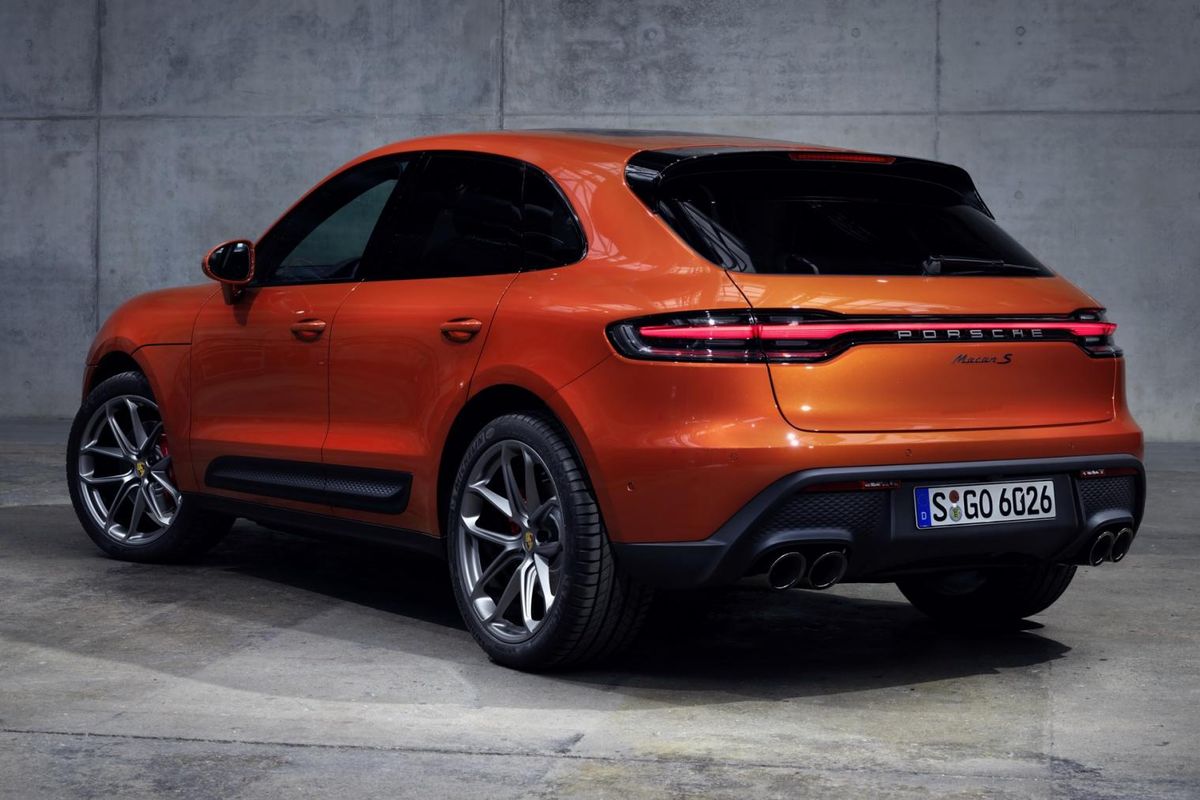
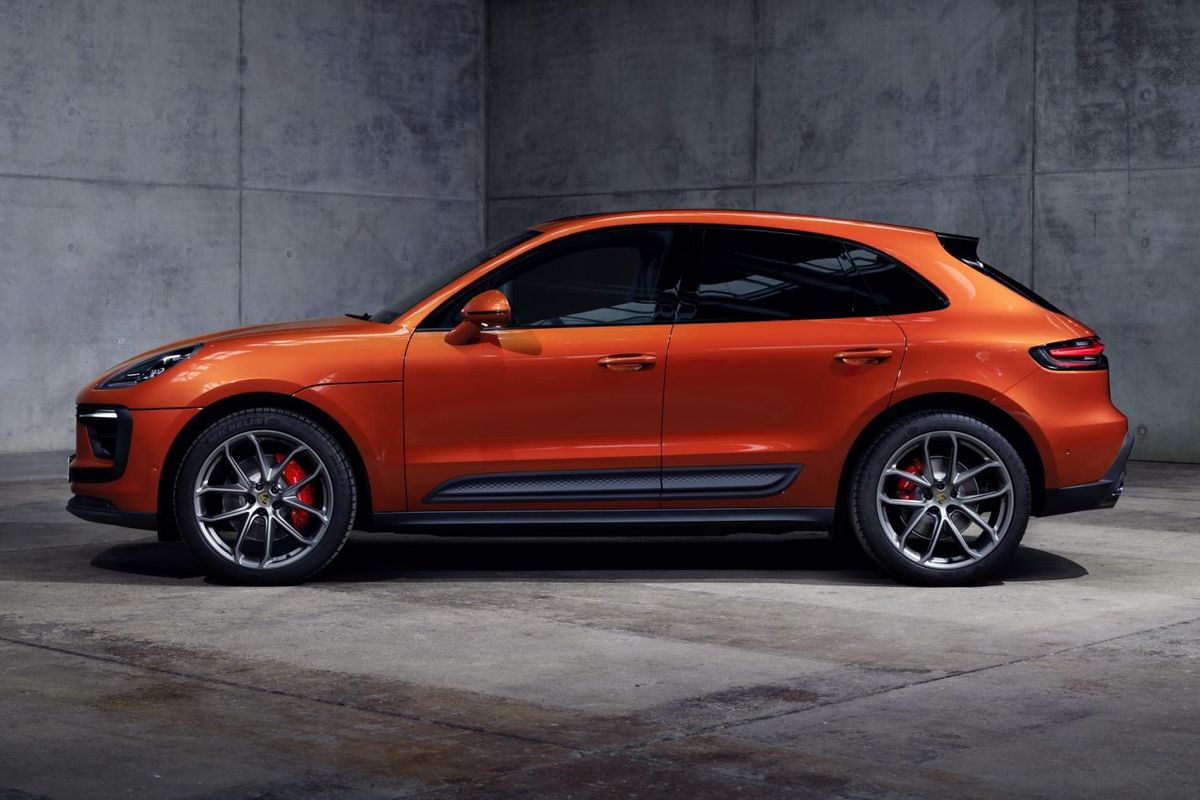
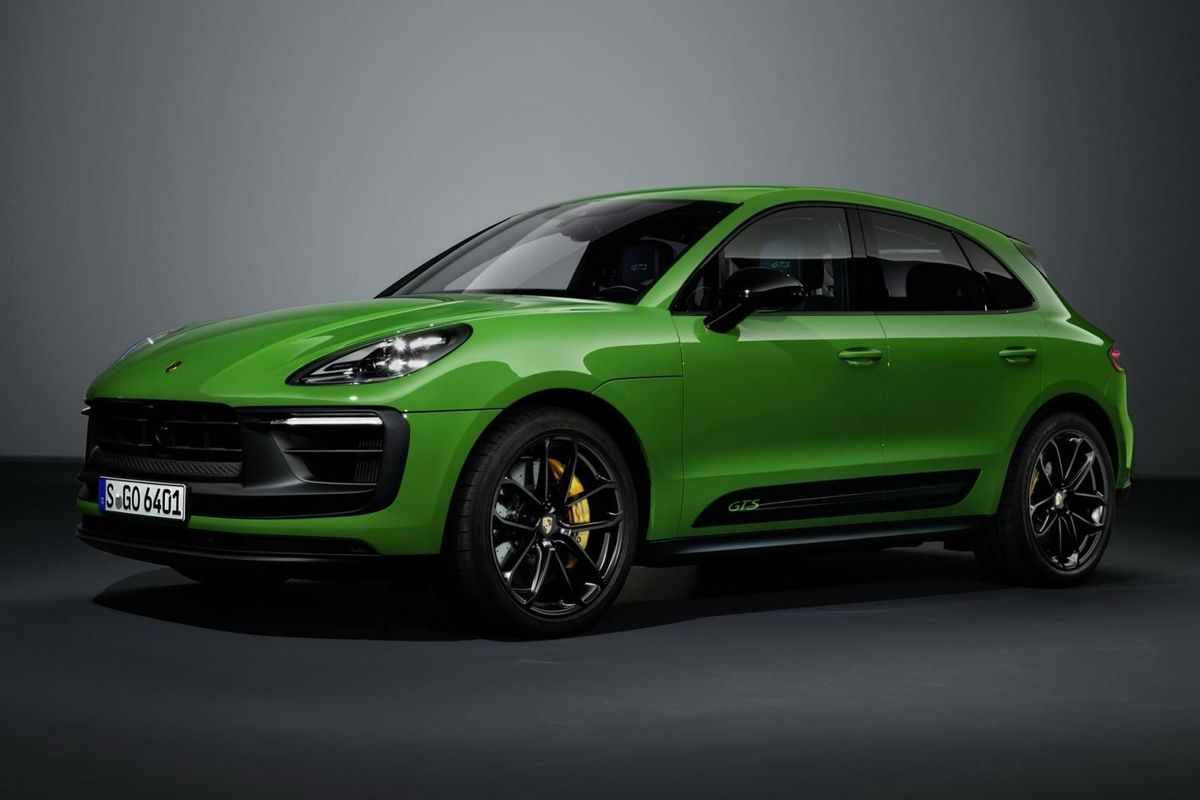
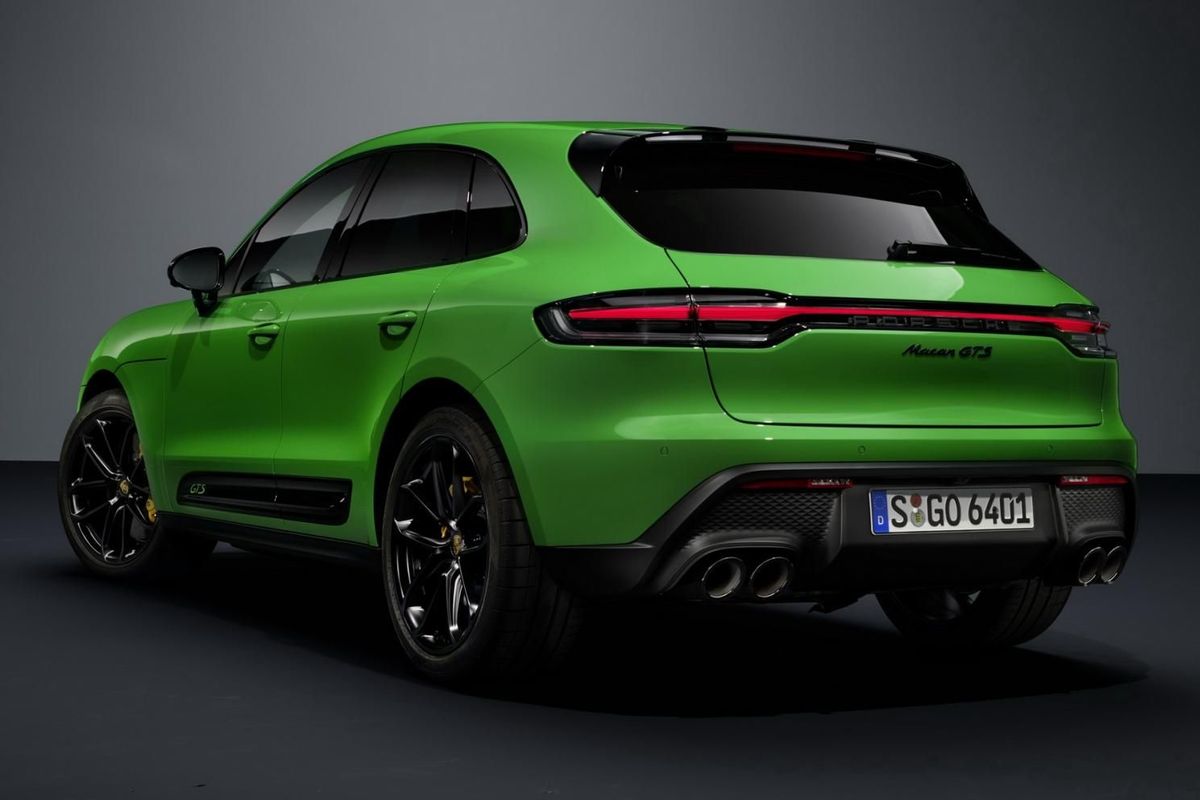
Two and a half years since Porsche SA introduced a facelifted version of the Macan, the Zuffenhausen-based brand has rolled out another update to its executive SUV range, which includes detail upgrades as well as a consolidated line-up of derivatives.
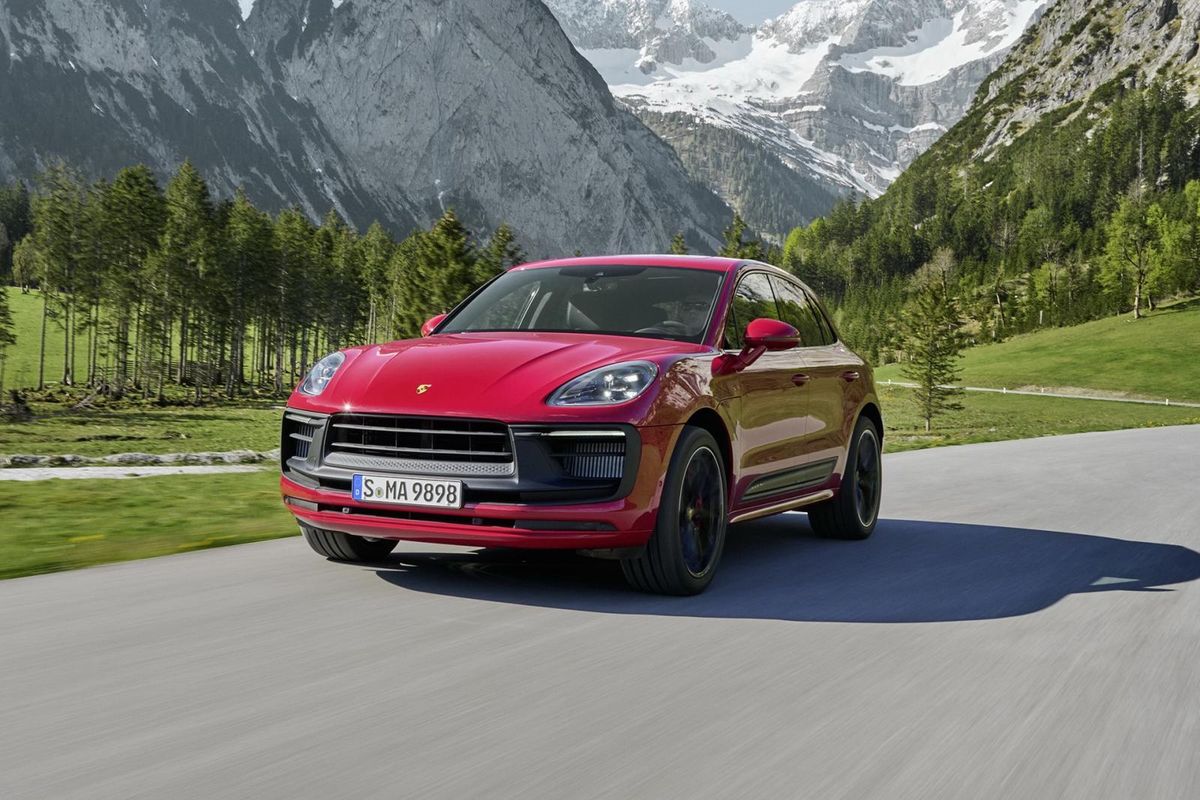
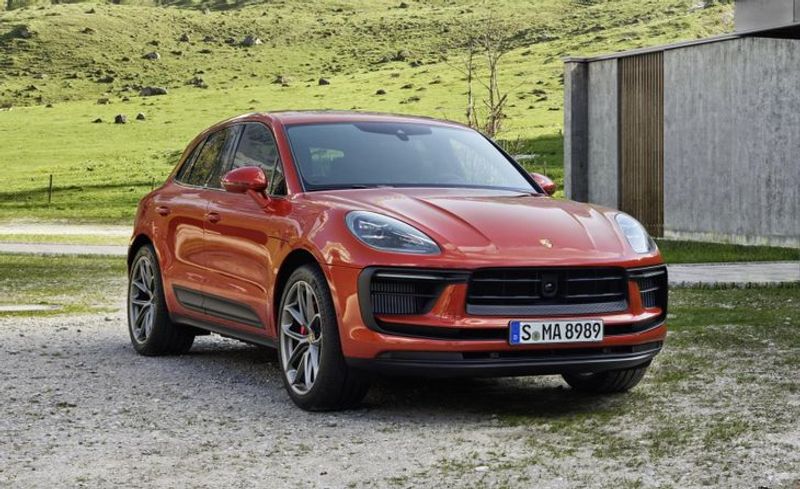
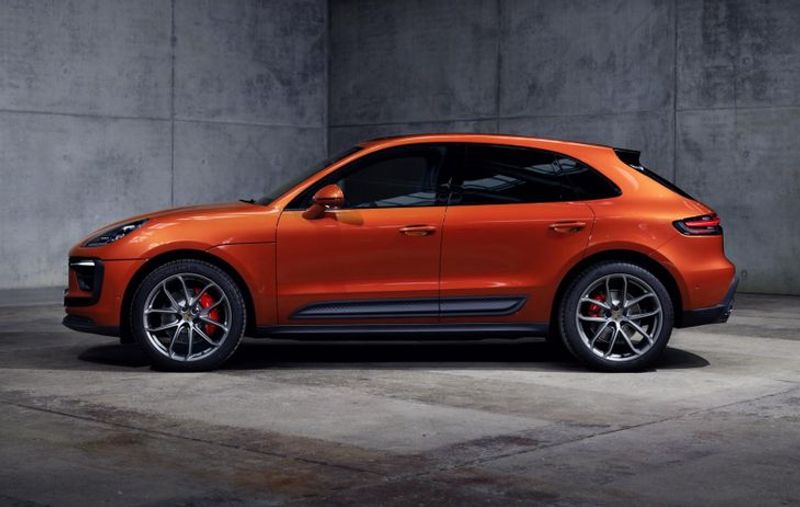
From an aesthetic point of view, the Macan looks much like before, but eagle-eyed observers will spot that black trim on the front bumper has been redesigned, the LED daytime running lights have been repositioned and the dark cladding strips on the flanks of the vehicle feature a 3Dtextured surface.
At the rear, Porsche’s smallest SUV now features an enlarged diffuser that stretches the width of the bumper, while larger alloy wheels (19-inch for the Macan, 20-inch for the Macan S and 21-inch for the Macan GTS), LED headlights with the Porsche Dynamic Light System (PDLS) and Sport Design side mirrors and are standard across the range. What’s more, Porsche has availed 7 new alloy wheel designs and there are 14 exterior colours to choose from.
The Macan range now comprises a trio of derivatives; the previous line-up’s Turbo has been dropped, but, technically, only in name, because the Macan S now features the outgoing Macan GTS’ 2.9-litre twin-turbo petrol V6, while the updated Macan GTS matches the old Turbo’s peak outputs of 324 kW and 550 Nm (also produced by the aforementioned powerplant).
All versions of the Porsche Macan feature the firm’s 7-speed dual-clutch (PDK) automatic transmission as well as the Porsche Traction Management (PTM) all-wheel-drive system.
The standard Macan is powered by a newly developed 2.0-litre 4-cylinder turbopetrol motor, which produces 10 kW and 30 Nm more than before. With its new maximum outputs of 195 kW and 400 Nm of torque, the Macan is claimed to accelerate from 0 to 100 kph in 6.2 sec (with the optional Sport Chrono package) and go on to a top speed of 232 kph.
By virtue of switching from a 3.0-litre single-turbo V6 to a 2.9-litre twin-turbo unit, the Macan S now produces 20 kW and 40 Nm more for peak outputs of 280 kW and 520 Nm. The S version is said to accelerate from standstill to 100 kph in 4.6 sec (with the optional Sport Chrono package) with a top speed of 259 kph, while the range-topping Macan GTS is comparatively 0.3 sec quicker (with the standard Sport Chrono package) and 13 kph faster.
Meanwhile, the damper characteristics of the Porsche Active Suspension Management (standard on the Macan S and GTS derivatives, but optional on the Macan) have been re-adapted and the flagship version features a 10-mm lowered sports suspension with air springs as standard.
Porsche says the sports air suspension is 10% and 15% firmer on the front and rear axle respectively while the optional GTS Sport package (available exclusively on the GTS version) incorporates 21-inch GT design wheels with performance tyres, Porsche Torque Vectoring Plus and the Sport Chrono package.
Inside, the Macan features the new multifunction GT Sport steering wheel from the 911, a shorter transmission lever, an analogue clock atop the dashboard (as standard), plus optional leather upholstery and contrasting seam packages (available in Gentian Blue, Papaya or Crayon).
The user interface now incorporates touch-sensitive surfaces instead of tactile buttons, as well as a 10.9-inch touchscreen infotainment unit with Porsche Communication Management.
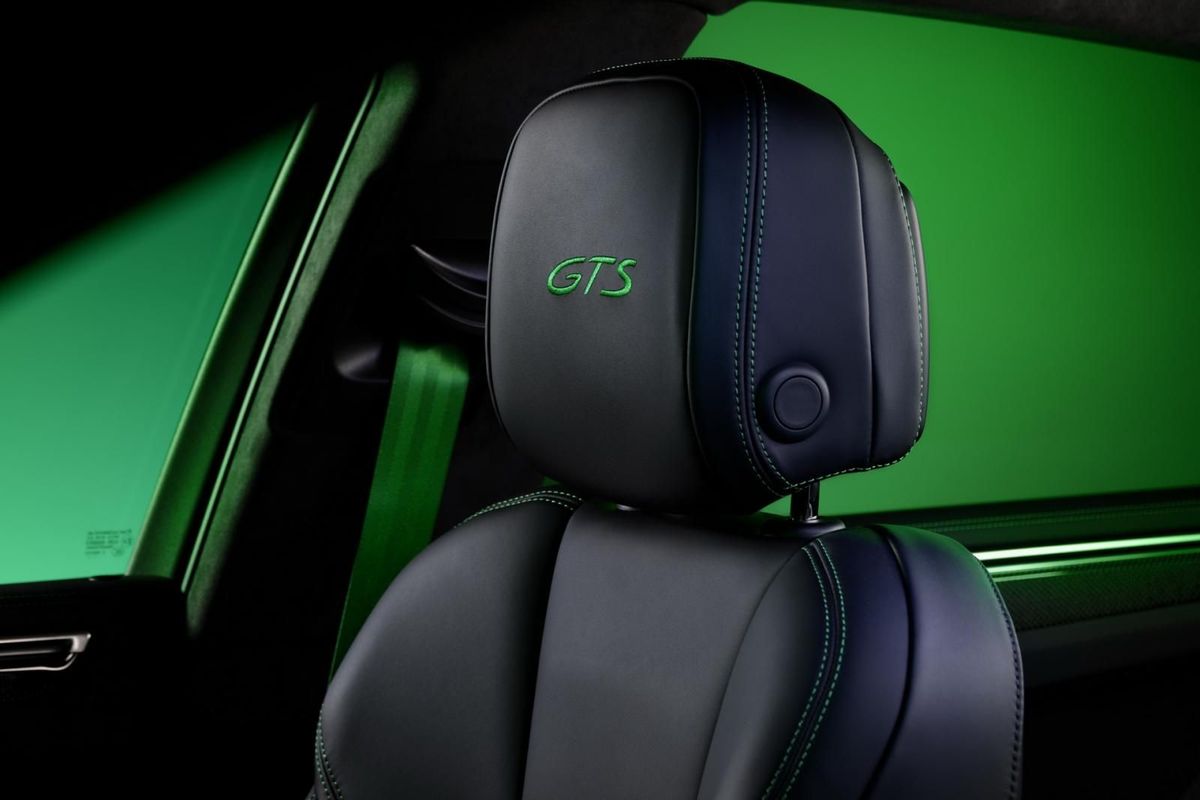
Buyers who specify the GTS Sport package on the updated GTS derivative will benefit from 18-way power-adjustable front sports seats, Race-Tex and extended leather upholstery (with contrast stitching and GTS lettering in Python Green) and carbon-fibre interior trim.
South African deliveries of the updated Macan will commence in January 2022.
Prices of Porsche Macan (2022) in SA:
Macan
R1 050 000
Macan S
R1 271 000
Macan GTS
R1 551 000
Prices include a 3-year/100 000 km maintenance plan.
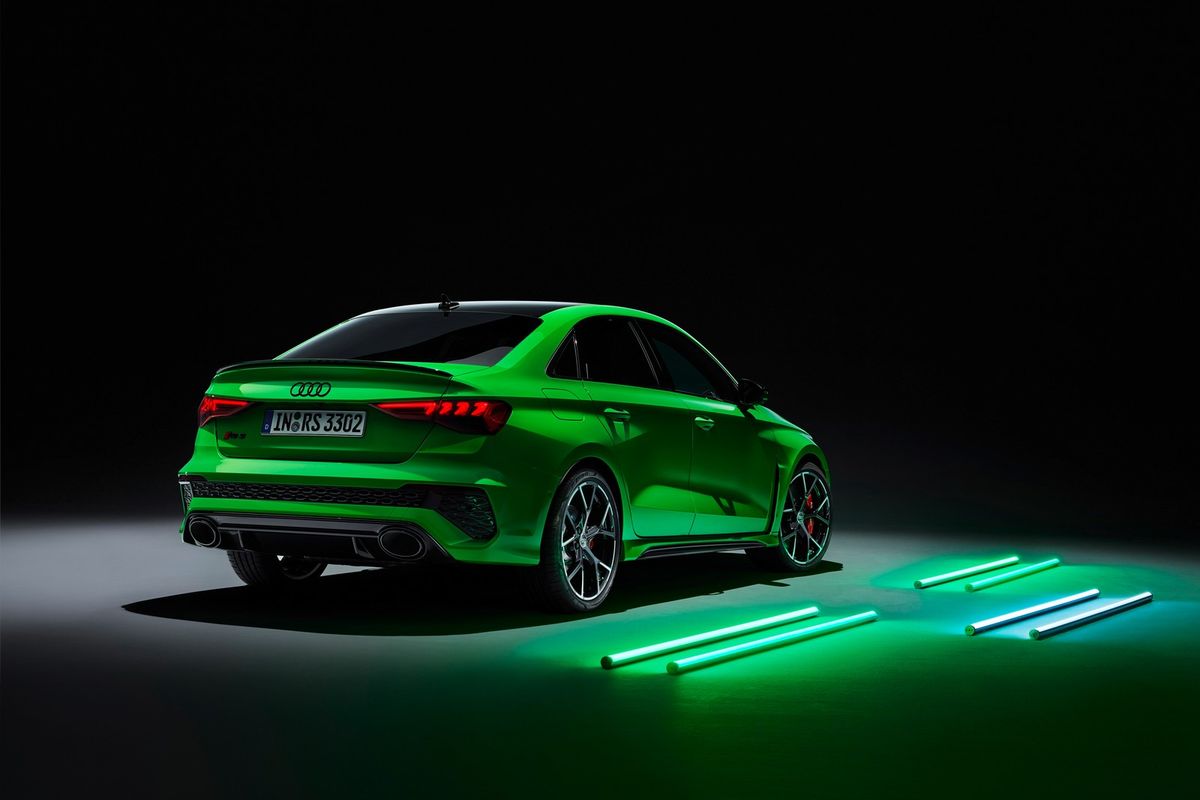
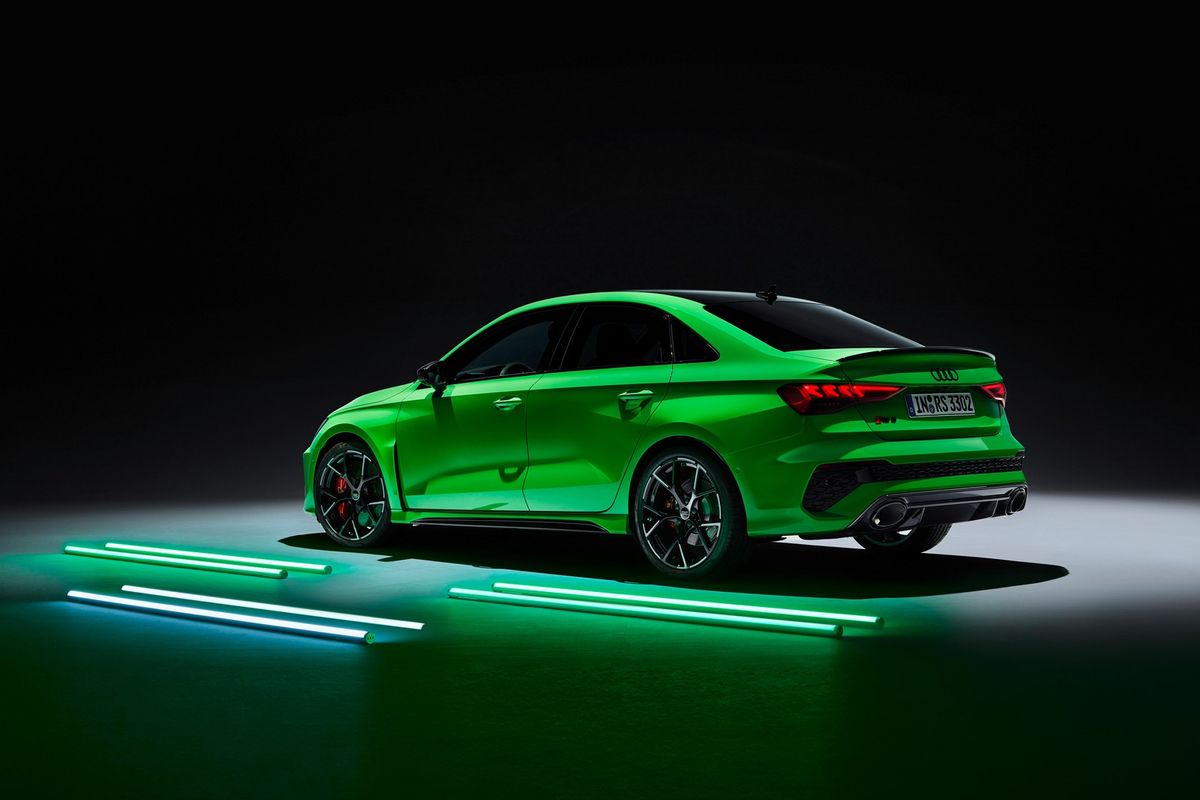
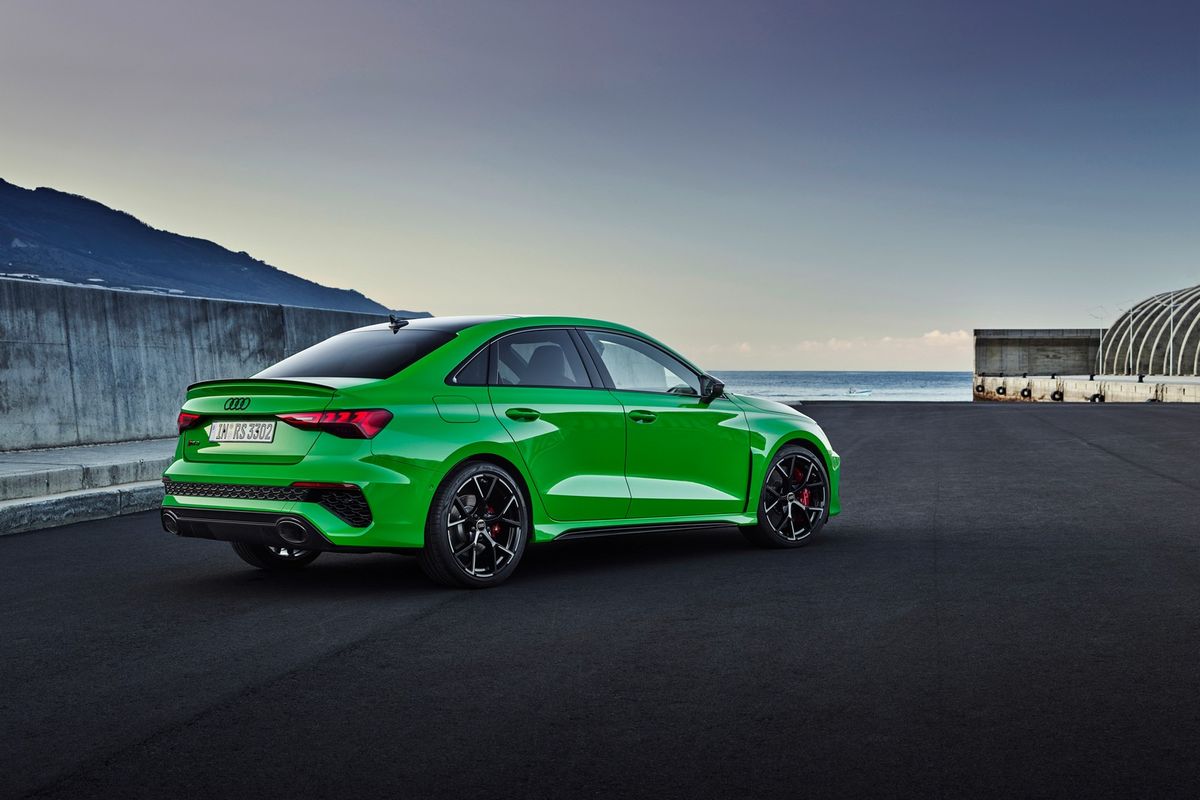
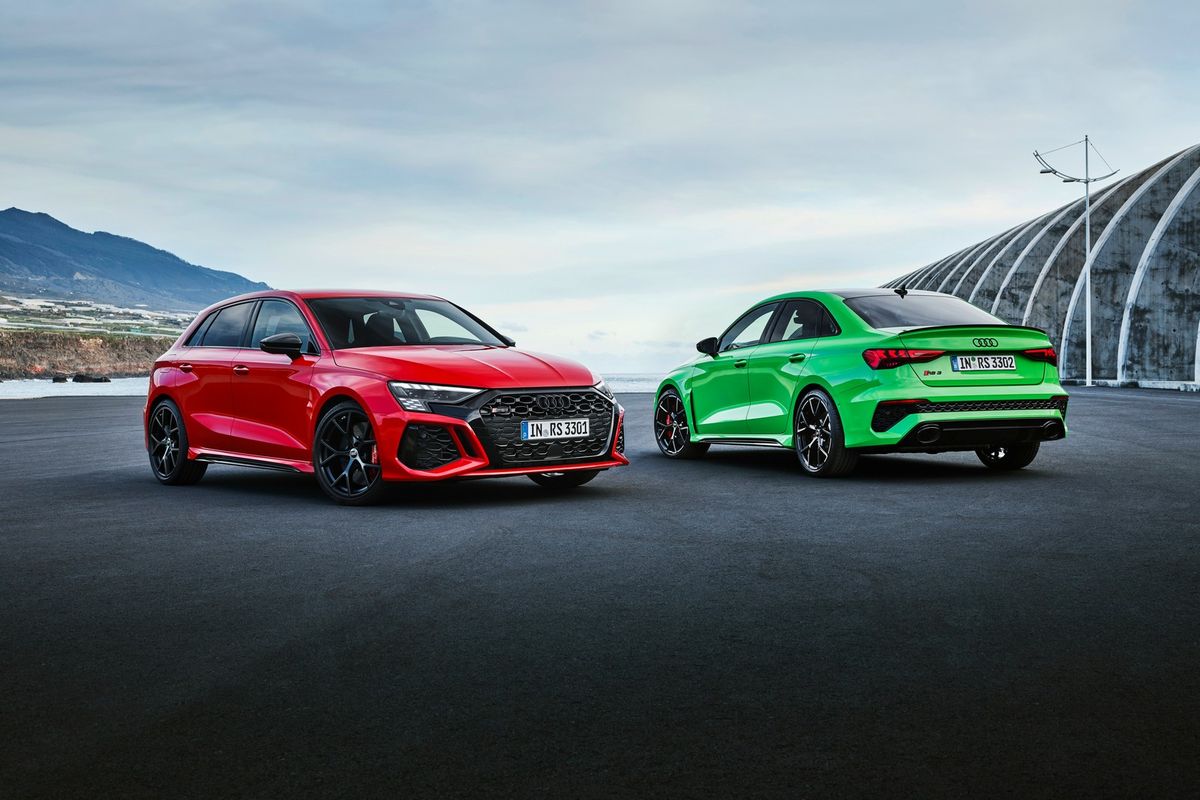
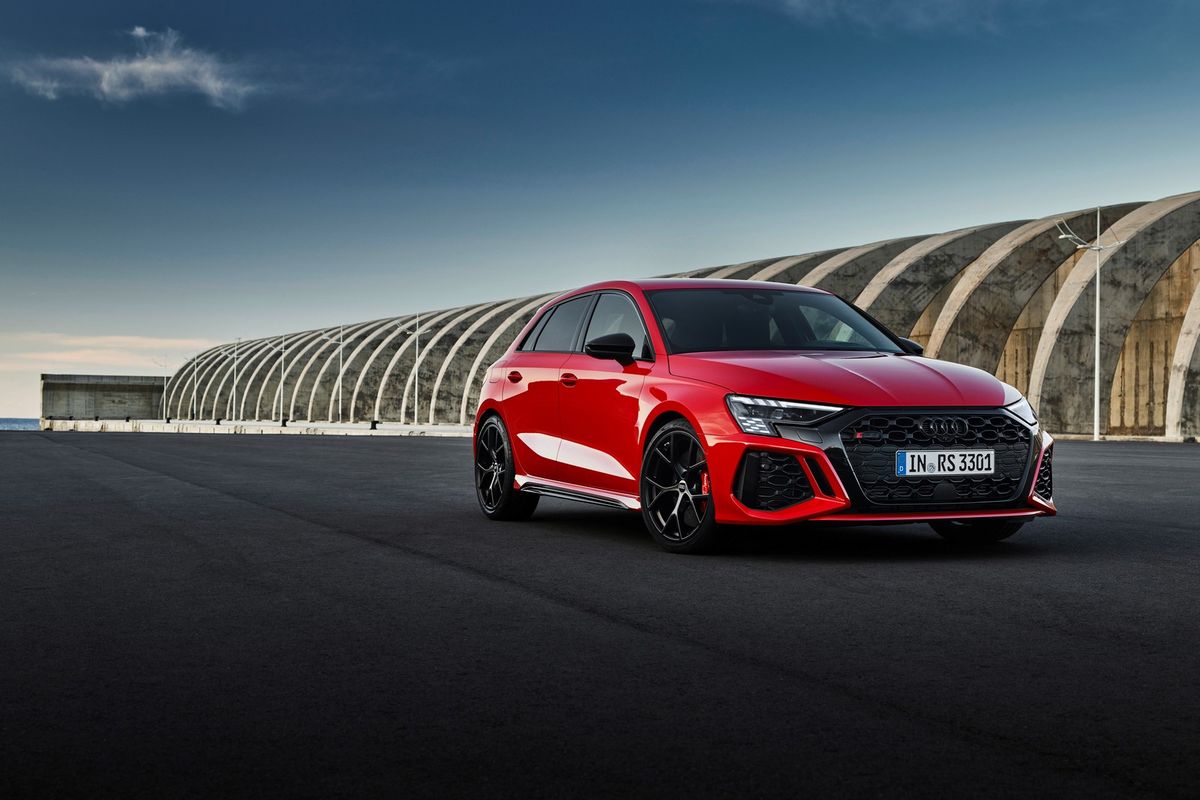
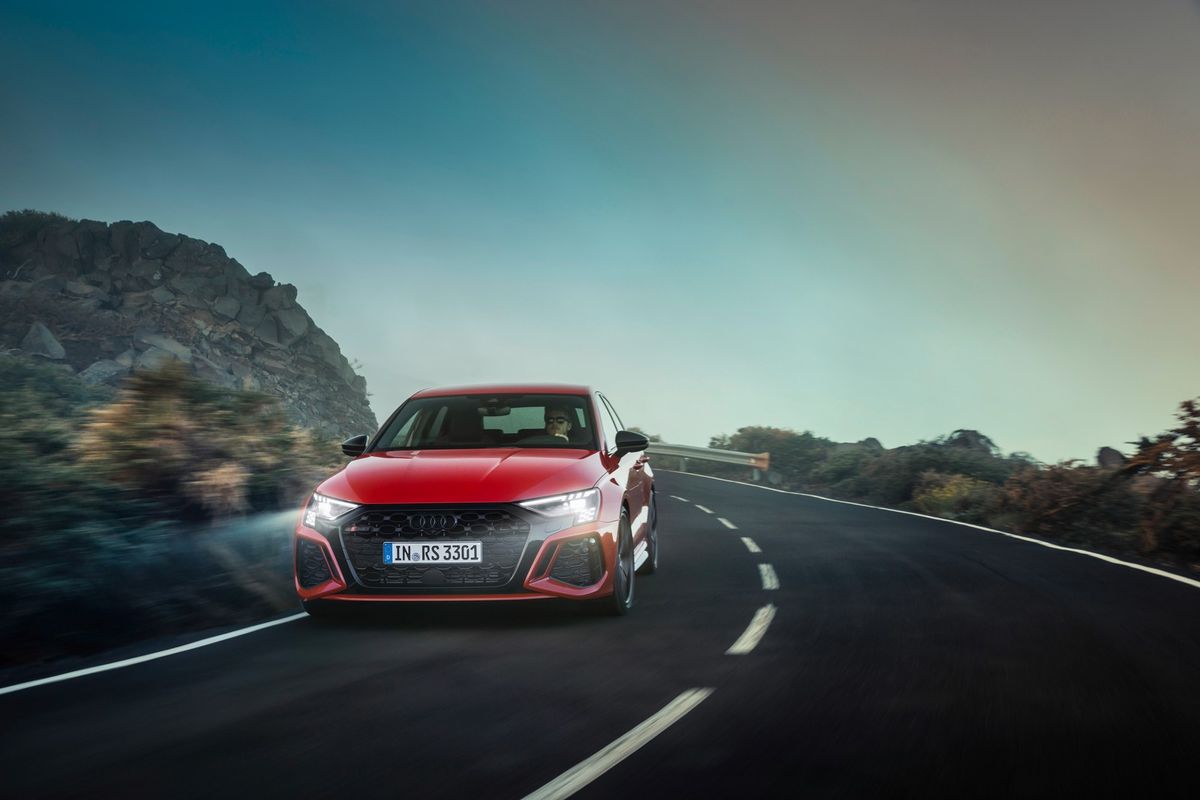
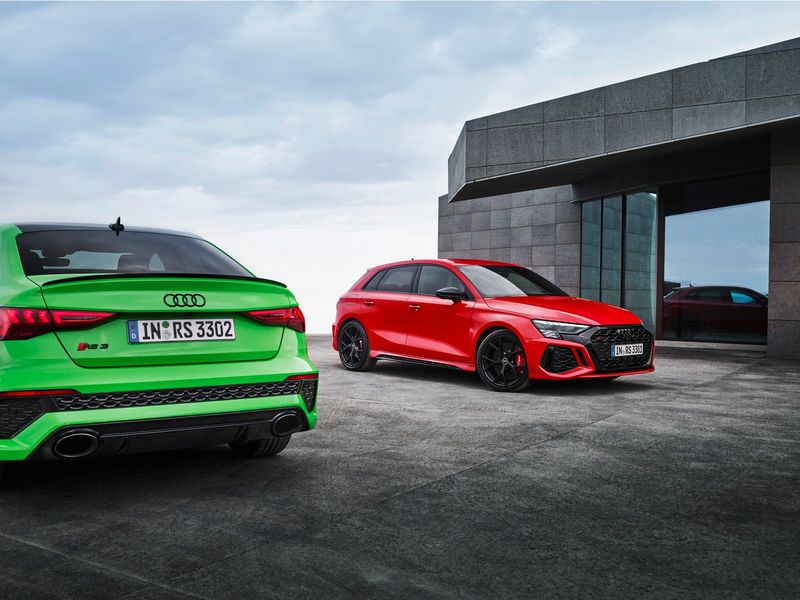
After a lengthy teaser campaign and far too many spy shots, this is the all-new Audi RS3. Featuring class-leading performance and the magical 5-cylinder engine, the 2022 Audi RS3 is confirmed for the 2nd half of next year.
Being a flagship performance product, focus is on the engine and claimed figures. While some will complain that the 2.5-litre 5-cylinder engine produces the same power as before, some clever tweakery has resulted in more torque. Figures of 294 kW and 500 Nm are on offer, with the 2022 Audi RS3 being said to sprint to 100 kph in a claimed 3.8 seconds and onto an optional top speed of 290 kph.
As we’ve mentioned before in a prior article, the all-new Audi RS3 will feature what’s called the RS Torque Splitter which cleverly sends power around the axles and wheels. In left-hand curves, it transmits the torque to the right rear wheel, in right-hand curves to the left rear wheel, and when driving straight ahead to both wheels. It gets better, as the RS Torque Splitter can send all engine power to just one wheel. There’s also Drift Mode.
The all-new Audi RS3 features a 7-speed dual-clutch gearbox as well as a sporty exhaust system with fully variable flap control, plus Audi is offering an RS sports exhaust for even more noise.
Under the skin, the newcomer features newly-developed shock absorbers and a valve system that helps the suspension cope with rebound/compression, with Audi offering adaptive damper control as an option. The larger wheel camber, i.e. the wheels are angled more toward the road, results in a more precise steering response and increased cornering force. Compared to the Audi A3, the wheels on the front axle of the new RS 3 have just under one degree of additional negative camber.
At the rear, there’s a four-link design with separate spring/damper arrangement, subframe, and tubular stabilizer bar. The wheel carriers, which are stiffer than those of the Audi A3 and S3, absorb the increased lateral forces generated by the torque splitter. The RS‑specific progressive steering varies the gear ratio depending on the steering angle – as the steering angle increases, the gear ratio becomes smaller and steering more direct. It also assists based on speed and can be varied via Audi drive select.
The setup of the springs and shock absorbers is markedly stiff, and the body is 10mm lower than on the S3 and 25mm lower than on the A3.
As far as brakes go, the new RS 3 comes with bigger and newly-developed 6-piston steel brakes, with ceramics being available as an option.
Visually, you can spot the all-new Audi RS3 with a gaping front bumper which features a new-look honeycomb grille and new-look headlights and daytime running lights. The LEDs will light up the letters R S and 3 as well as a checkered flag when you lock and unlock the car. When the vehicle’s driving, there’s a checkered flag. The rear is dominated by large twin oval exhausts and an integrated diffuser. The new Audi RS3 rides on 19-inch alloy wheels with a host of optional wheels available.
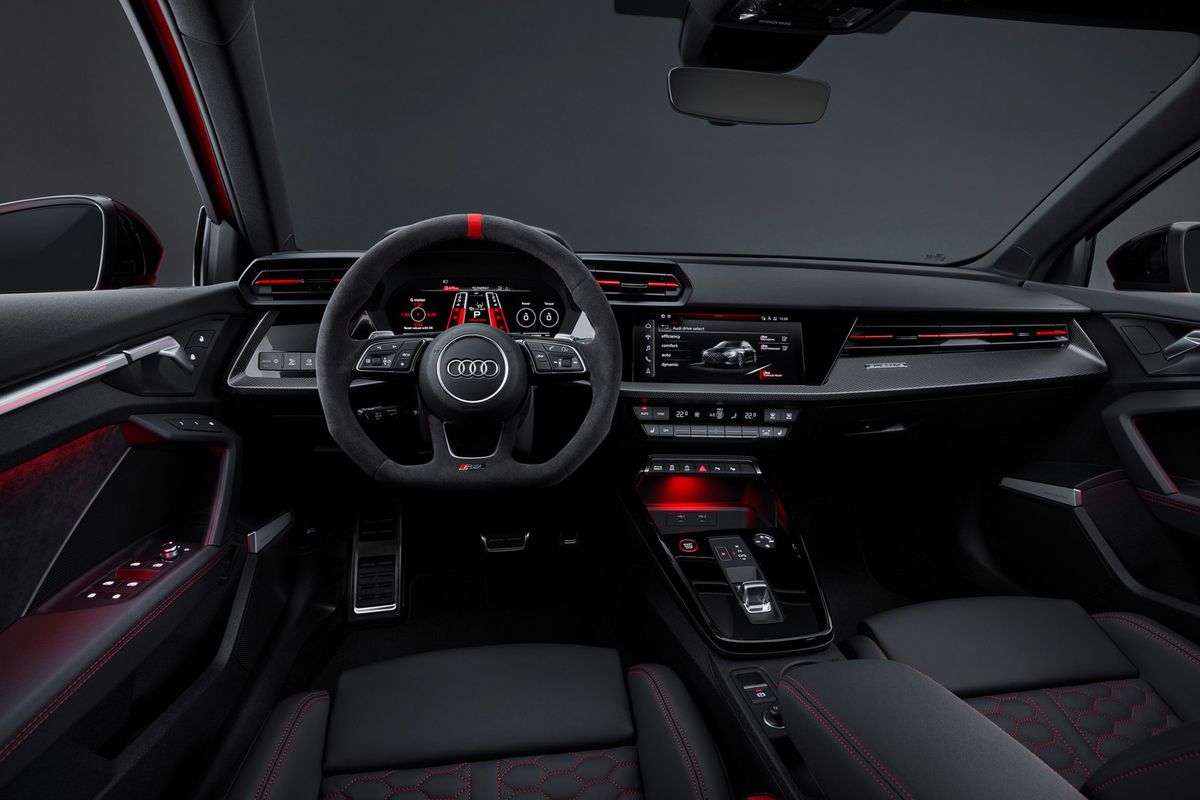
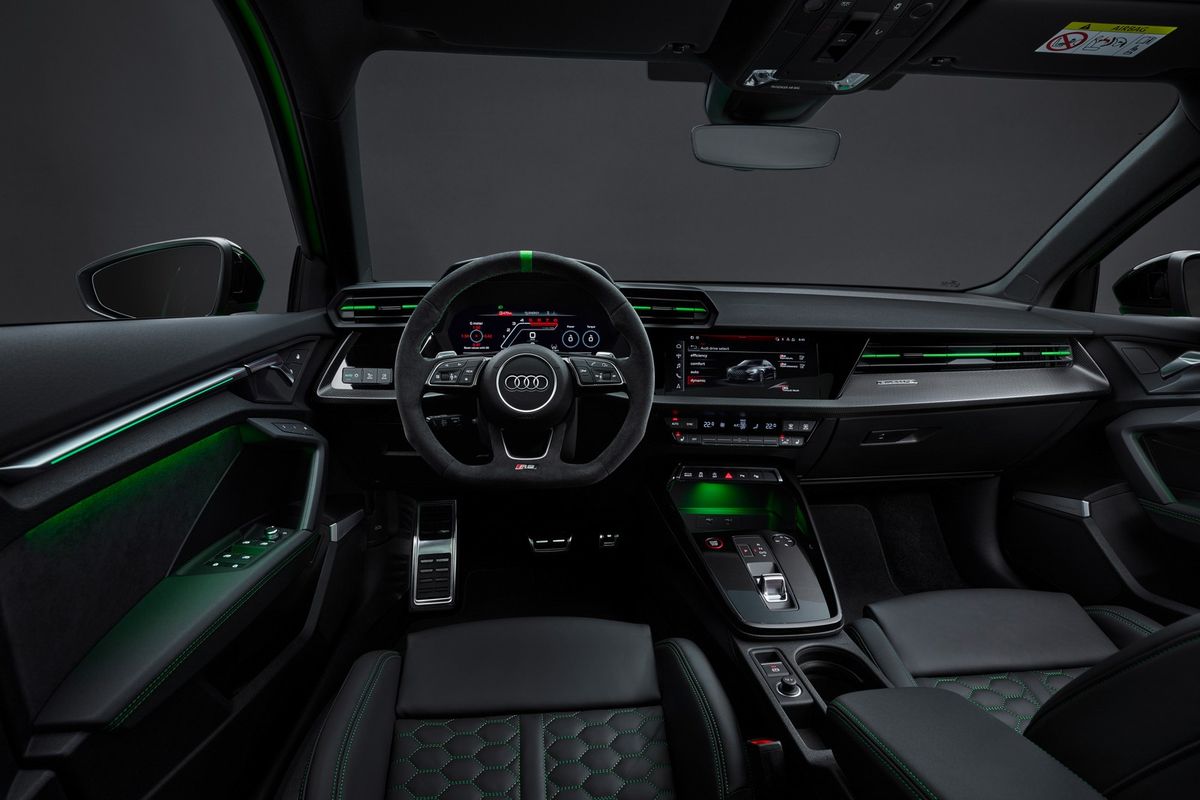
Inside, the new Audi RS3 looks very sporty. The Audi virtual cockpit plus is standard and boasts telemetry like g-forces, lap times and acceleration from 0‑100 km/h, 0-200 km/h, quarter-mile, and eighth of a mile. A heads-up display is available for the first time on the RS3.
The RS sport seats with RS embossing and contrasting stitching really look the part and are available in Nappa as an option. The new-look 3-spoke RS steering wheel features zinc shift paddles and a 12 o clock stripe.
When is the new Audi RS3 coming to South Africa?
Audi South Africa confirmed its new performance model will be available in sedan and Sportback derivatives and should be making landfall around the middle of 2022.
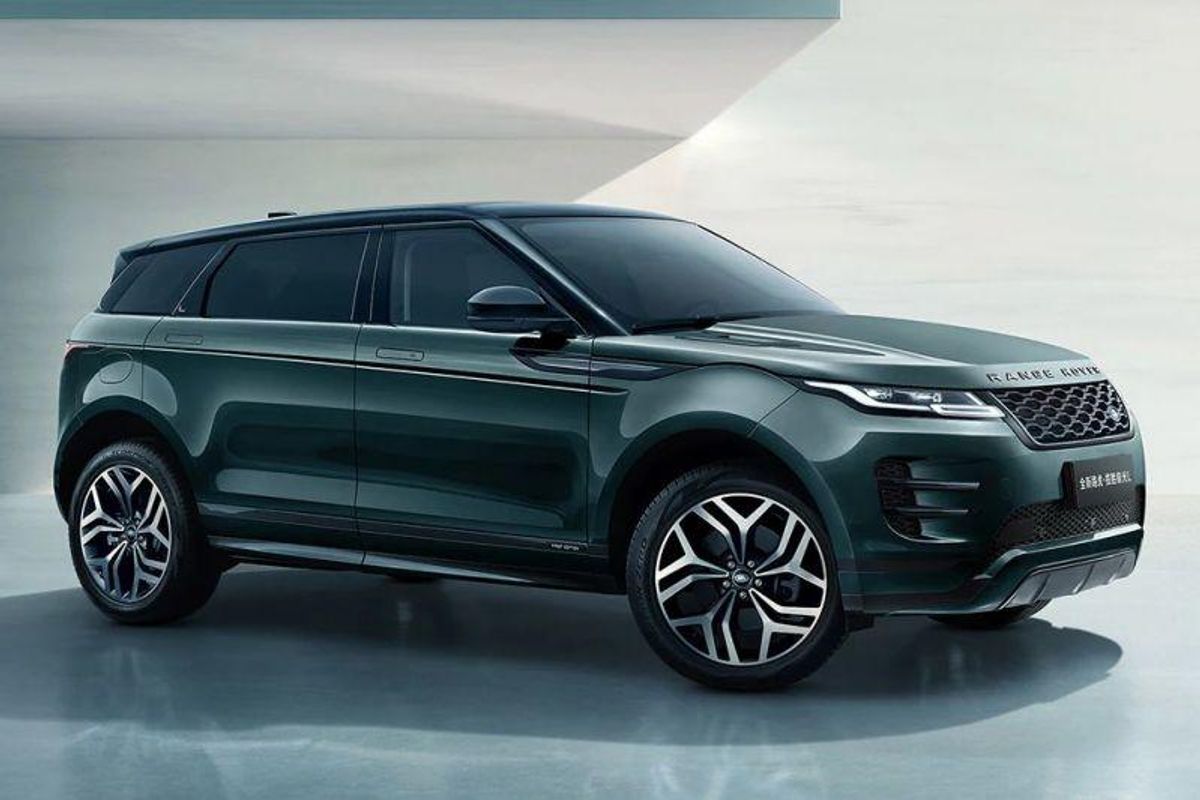
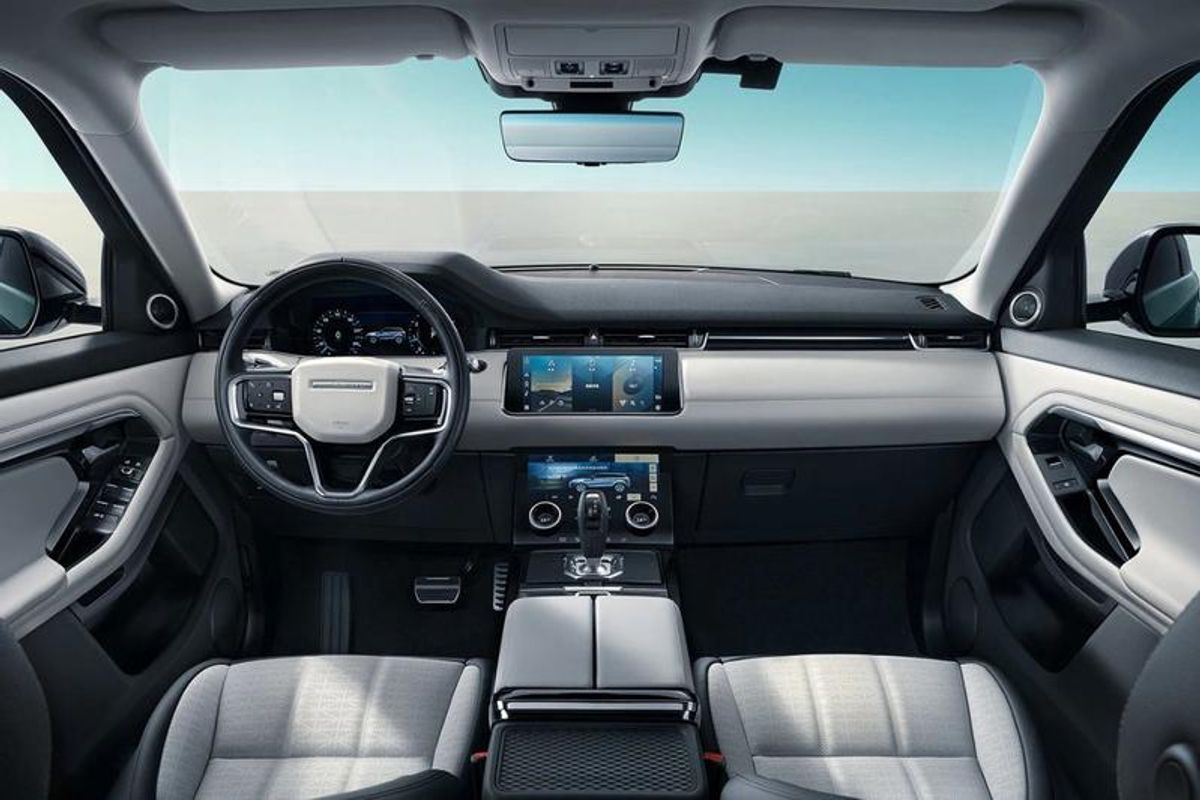
Land Rover has made its smallest Range Rover, a bit bigger.
Although its introduction rankled legacy Range Rover owners, a decade ago, Evoque has been a significant story for Land Rover. It has allowed the Ranger Rover brand, to sell in greater numbers and conquer an entirely new realm of customers.
One of the Evoque’s advantages is that its size – or lack, thereof. Compared to a traditional low-range enabled Range Rover, the Evoque has always been much smaller. And that makes it much easier to park or drive around a crowded urban environment.
But what if you need a bit more, from your Evoque, and don’t want a Velar? Land Rover’s solution is the new LWB Evoque.
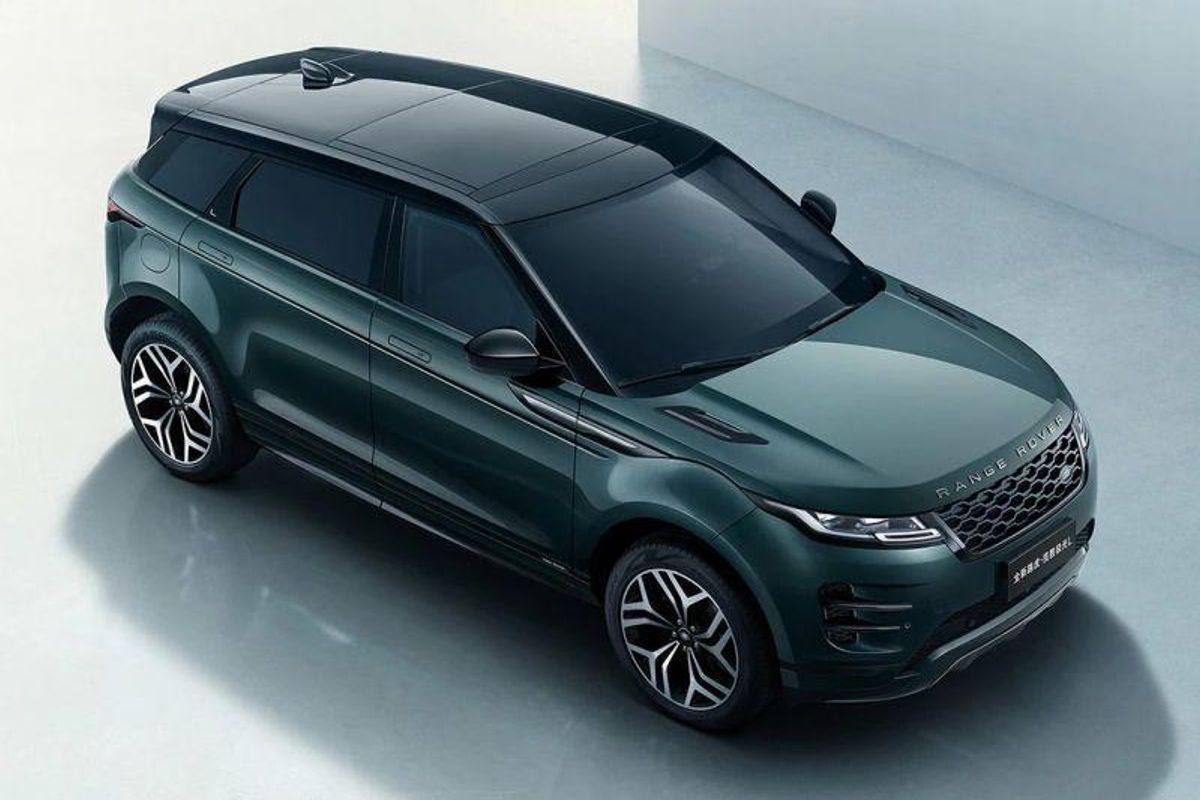
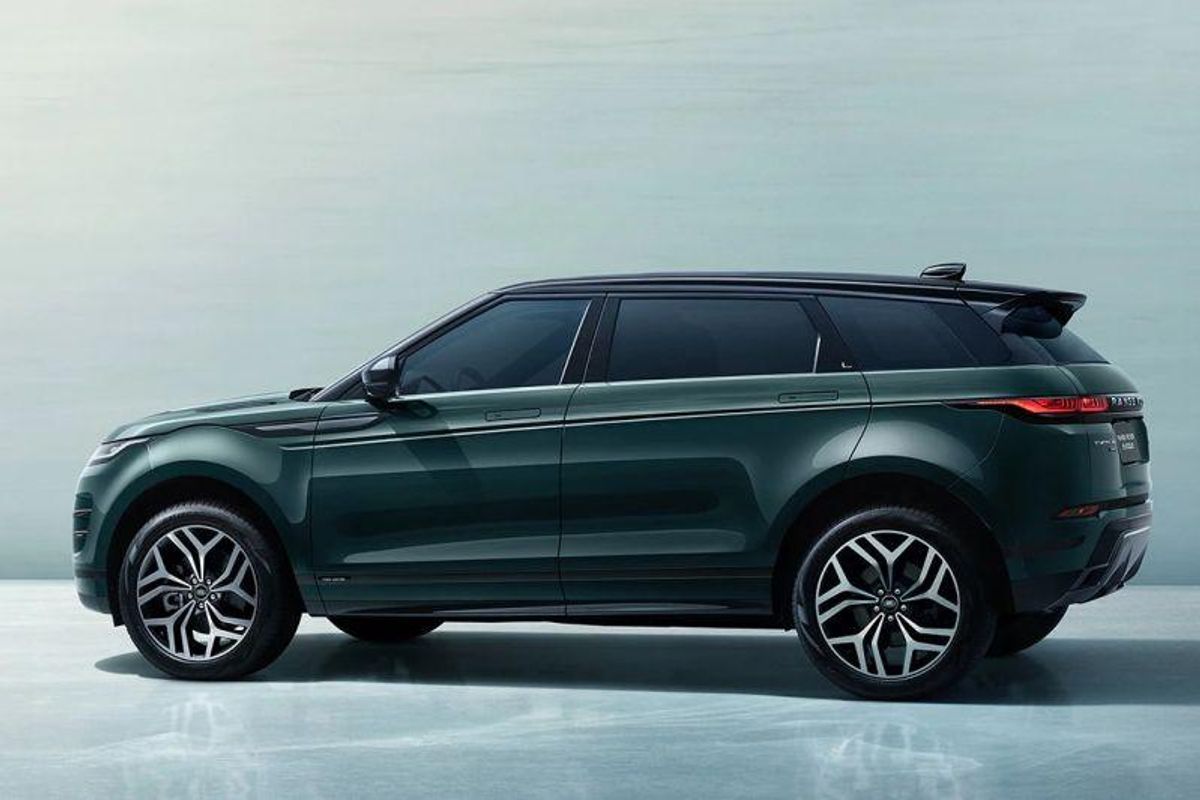
Based on the second-generation Evoque, this LWB version is 4.53m long, compared to the standard SUV’s 4.37m. That additional length is mostly between its axles, with the Evoque LWB having a 160mm longer wheelbase.
With the greater overall length and a more generous wheelbase, this Evoque LWB should offer excellent comfort ergonomics, for its second-row passengers. This is, of course, exactly the invention from Land Rover, especially for the Chinese market, where LWB luxury vehicles, in all segments, enjoy robust demand.
Land Rover has not divulged any changes in core mechanical specification, beyond size, with this new LWB Evoque. Expect engine offerings to remain the same, although the new variant does showcase slightly different front styling.
The redesigned grille and bonnet shutline, could be a clue to Land Rover’s forthcoming Evoque refresh, with this LWB version being the vehicle to debut it.
A report is suggesting we’ll be seeing an electric G-Class at this year’s IAA Munich car show. Here’s what we know so far.
Mercedes-Benz is rapidly expanding its electrification program and the EQ badge is being rolled out to its entire product portfolio. We’ve already seen the production versions of the EQA, EQB, EQC and EQS which are confirmed for South Africa in 2022. Now, according to MBPassion blog, the mighty Mercedes-Benz G-Class will be going electric and we’ll see it at a motor show in Germany before the end of 2021.
This news shouldn’t come as a surprise as Daimler CEO Ola Kallenius mentioned this back in March 2020 in an interview with CarAdvice. “Yes, the G is going to go electric, we have kicked off the concept work for this, so in a few years you’ll be able to go electric with the G as well,” Mr Källenius said.
An electric G-Class will be quite the opposite to what the product is known for. The Mercedes-AMG G63 features a potent 4.0-litre biturbo V8 petrol engine, while the G400d boasts the strong straight-6 diesel. Let’s not forget the advanced 4×4 system with its 3 differentials either. So, what’s on the cards for the electric G-Class? We suspect that that 4×4 system is non-negotiable and Mercedes-Benz will incorporate the electric powertrain around it. An electric motor on each axle would likely be the best solution and given the G-Class size, a large battery which is good for at least 500 km is expected.
The downside is of this is the weight. Electric cars are typically heavier than their ICE counterparts and given the dimensions of the current G-Class, the electric G could be very heavy. As it stands, the current G63 tips the scales at 2.5 tons.
Be on the lookout for the electric G-Class at the IAA Munich Mobility Show which replaces the Frankfurt Motor Show. It takes place from the 7th September to the 12th September in the Bavarian city of Munich. As far as names go, we won’t be surprised to see it badged as the EQG concept.
Lexus has given the IS a notable update in an effort to maintain the sedan’s relevance in the sports executive segment, but the range is limited to a trio of petrol-electric derivatives and the range-topping Lexus IS300h F Sport version costs nearly R1 million. Is the Japanese premium marque’s offering still worth considering? Read on…
We like: Willing performance, ride quality, comfort and luxury features, solid build quality
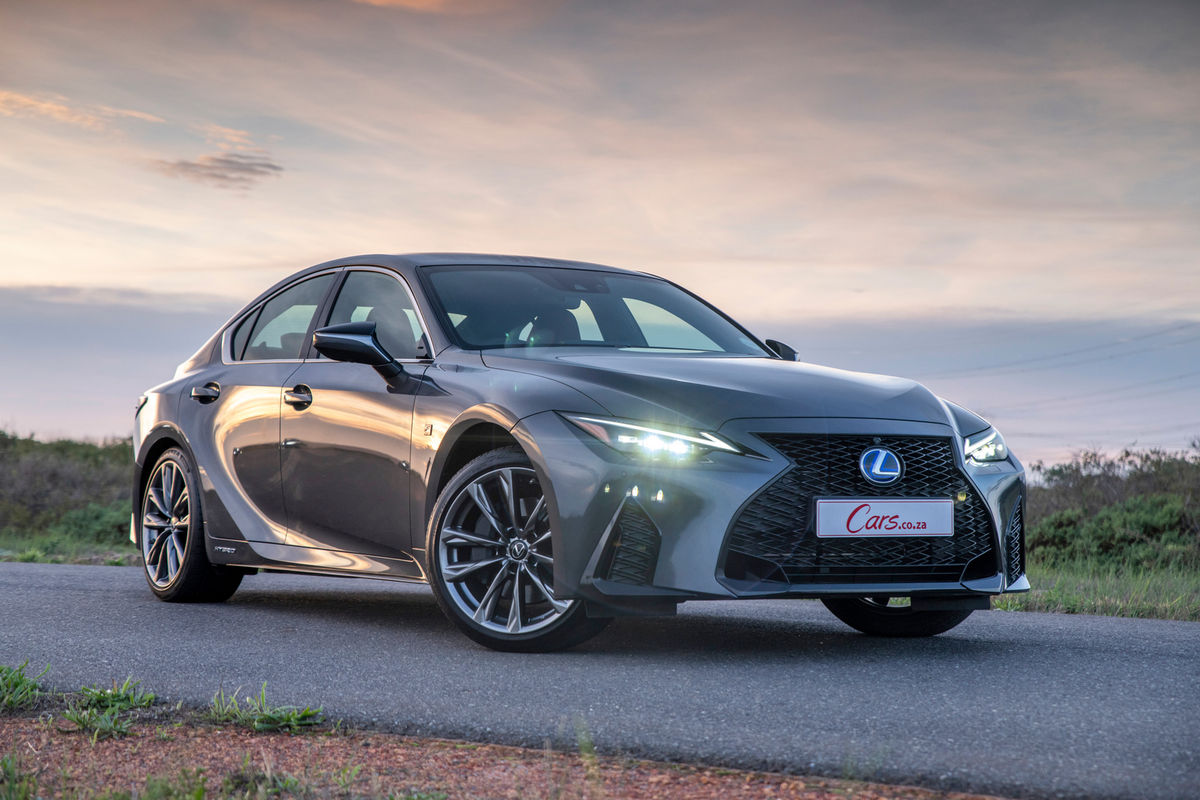
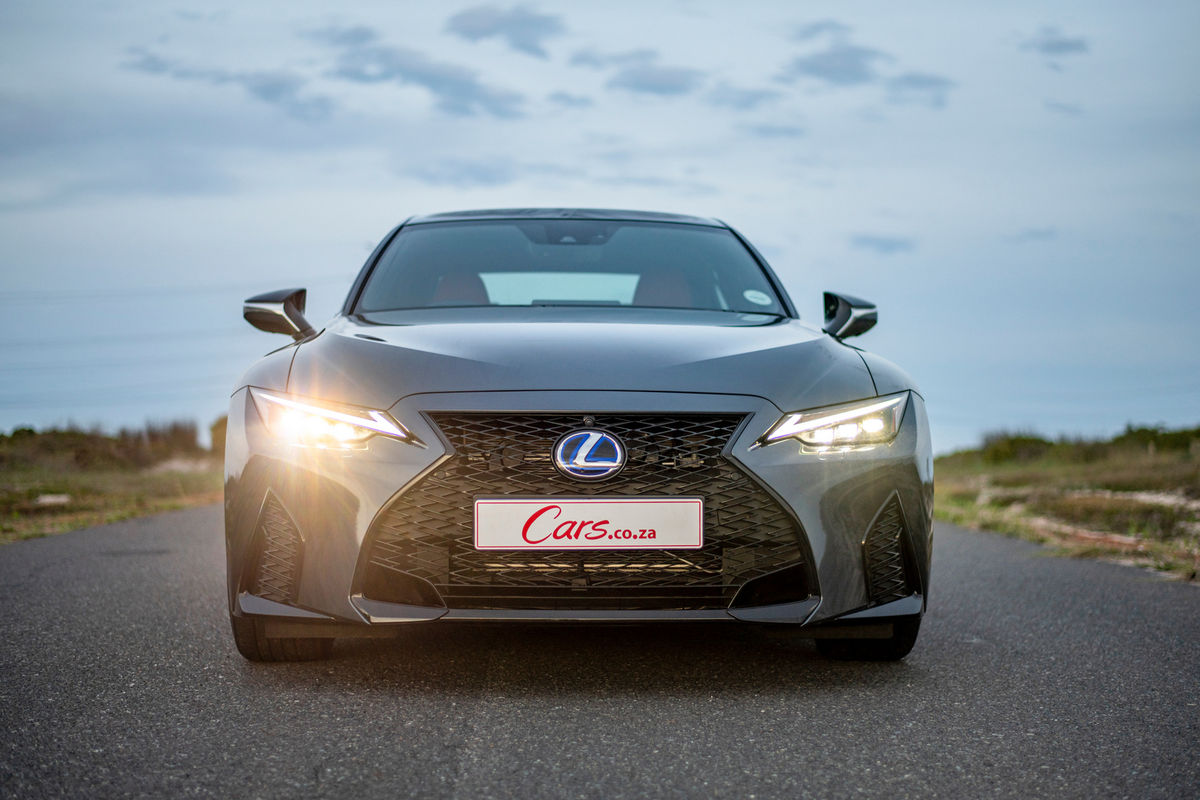
The Lexus IS is one of the better-looking sports executive sedans in the segment. Do you agree?
The 3rd-generation Lexus IS was launched in 2013 and received a minor update in 2017, followed by a major update in 2020; the latest iteration joined Lexus South Africa’s line-up in March 2021. The IS does battle in a declining segment (partly due to the rising popularity of crossovers) with the Alfa Romeo Giulia, BMW 3 Series, Audi A4, Jaguar XE and the incoming SA-built Mercedes-Benz C-Class.
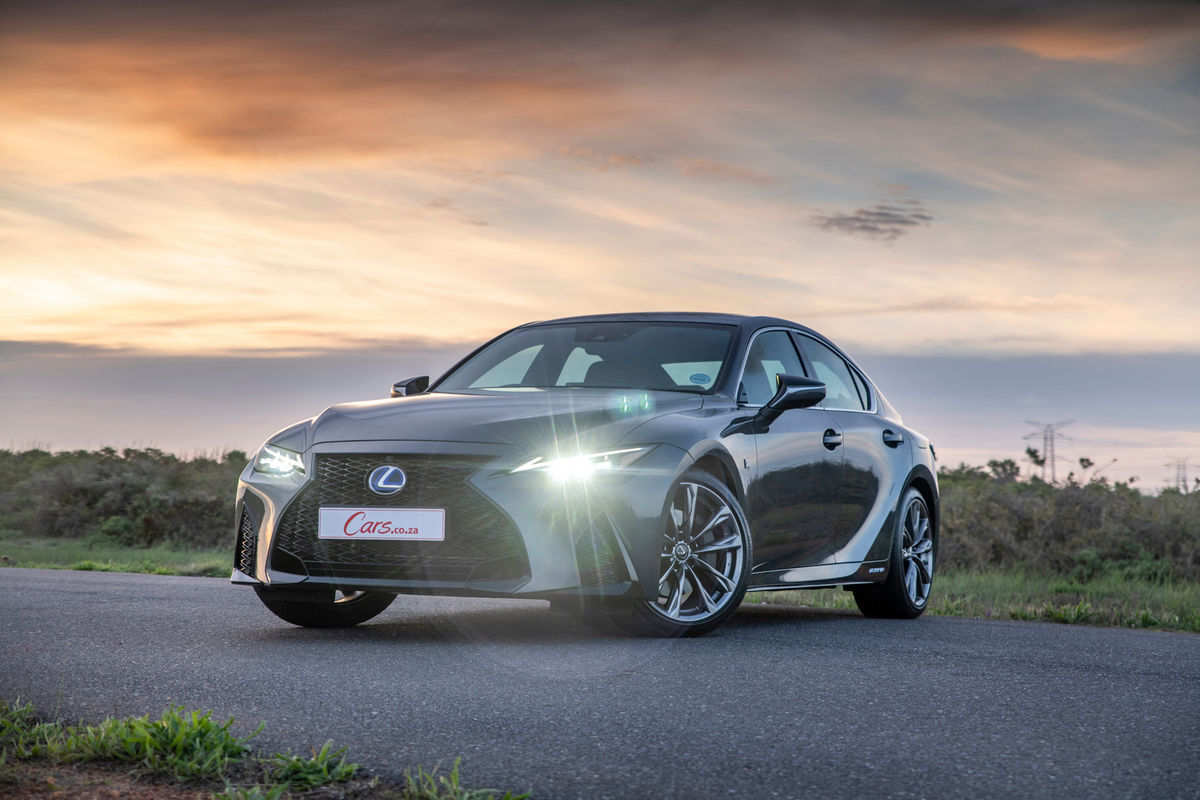
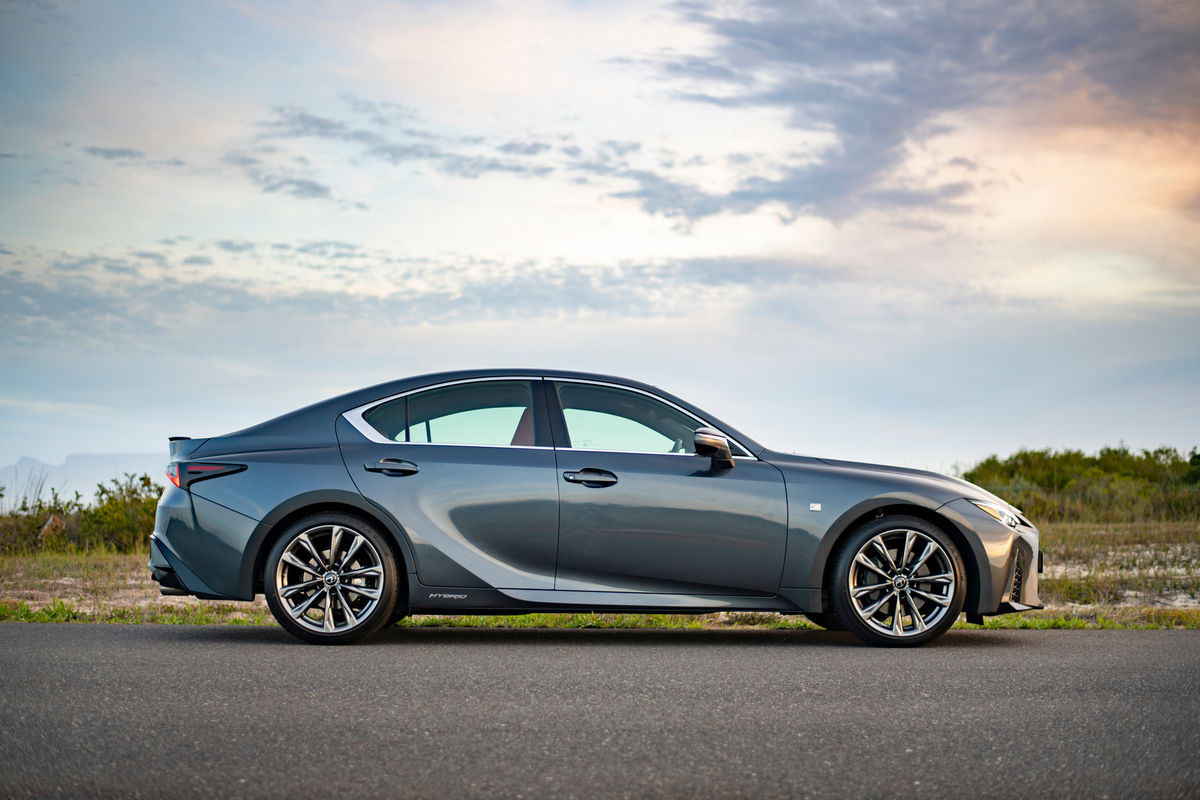
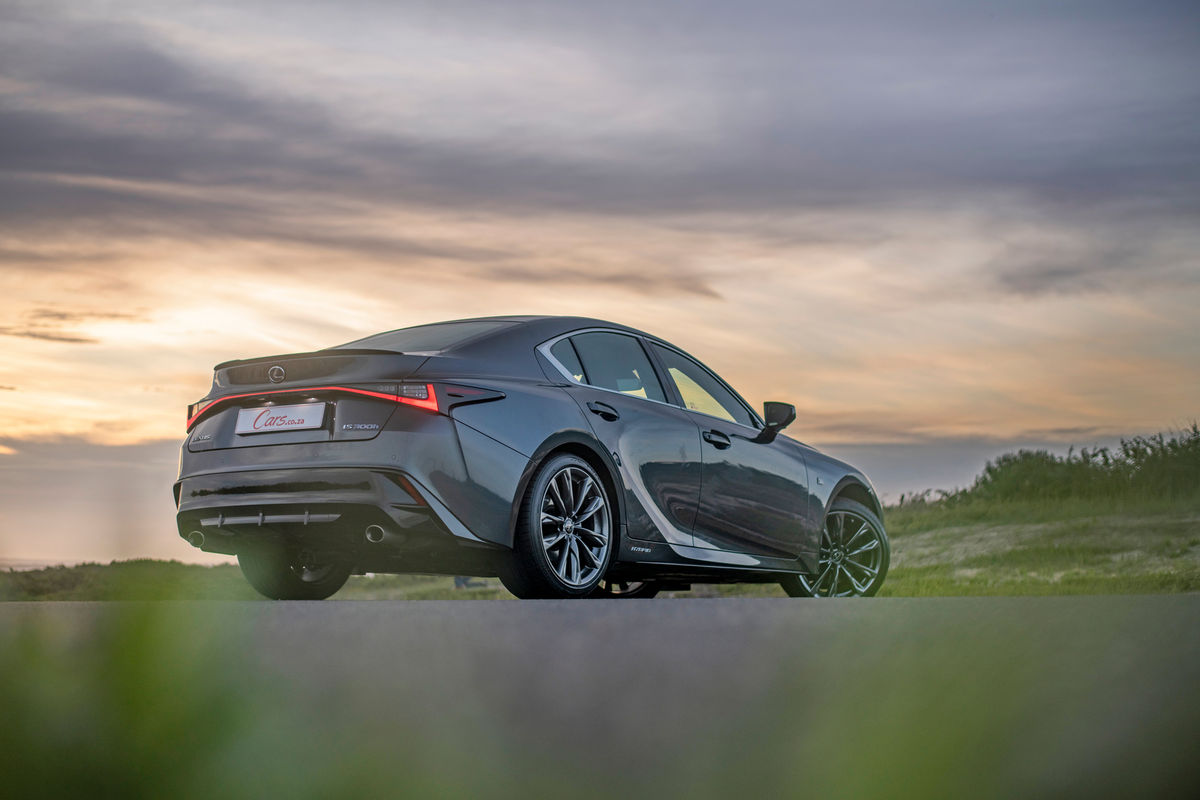
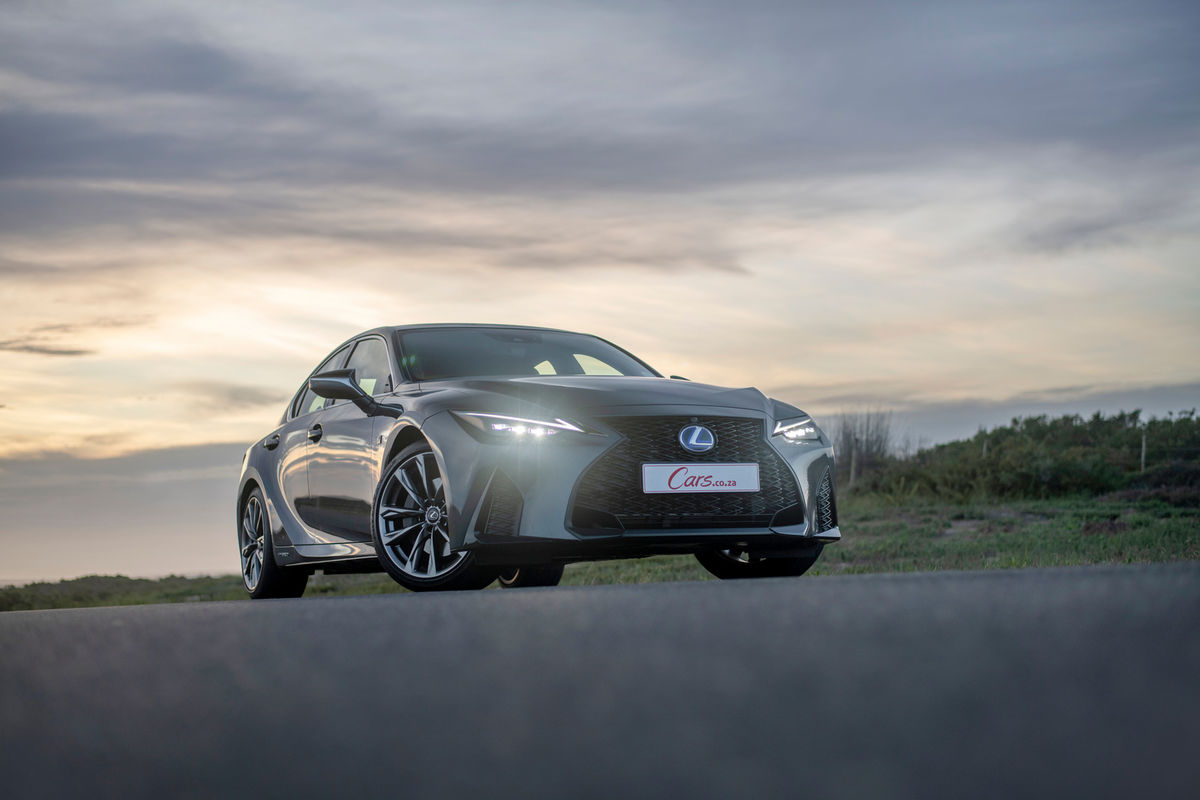
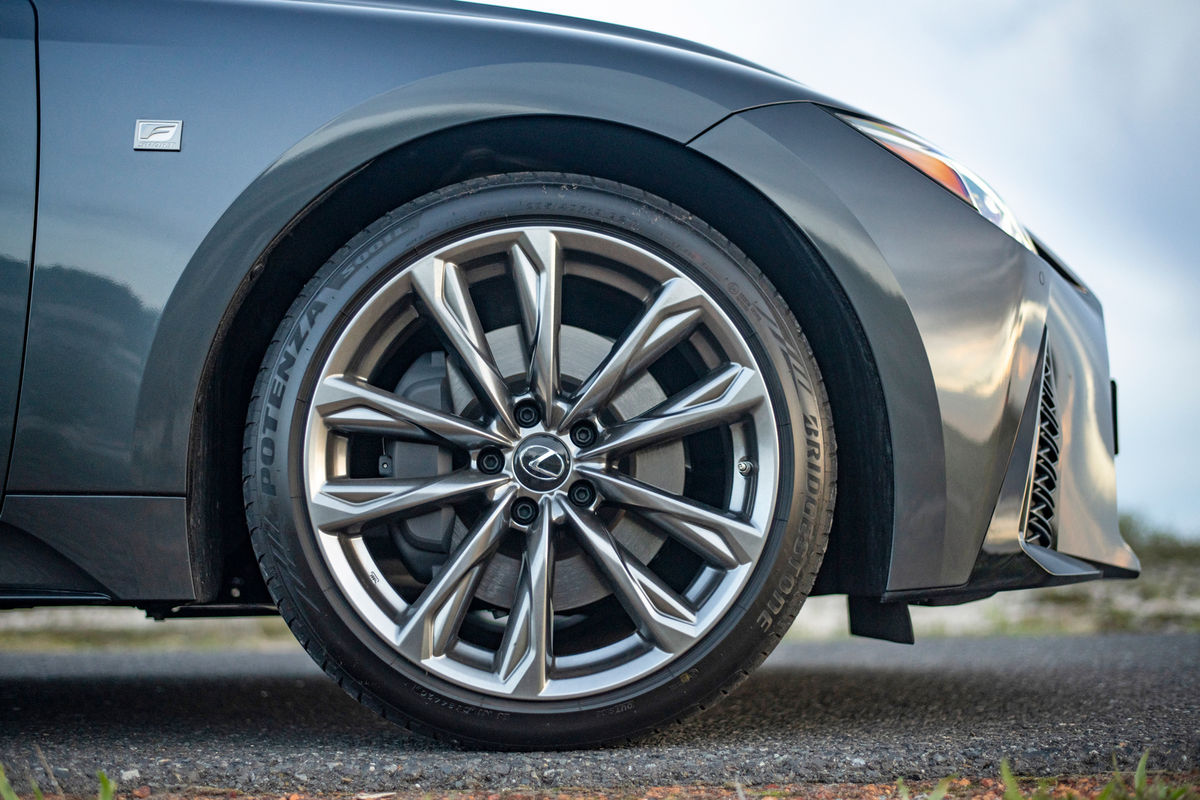
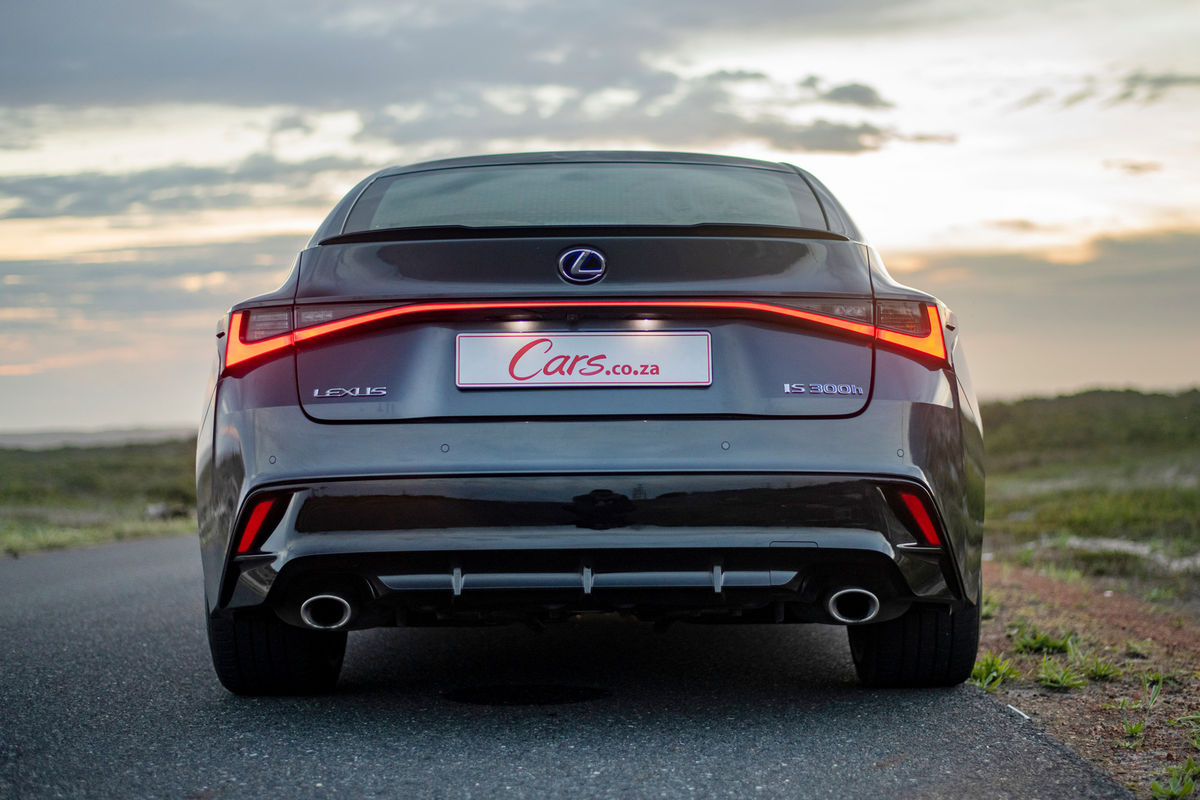
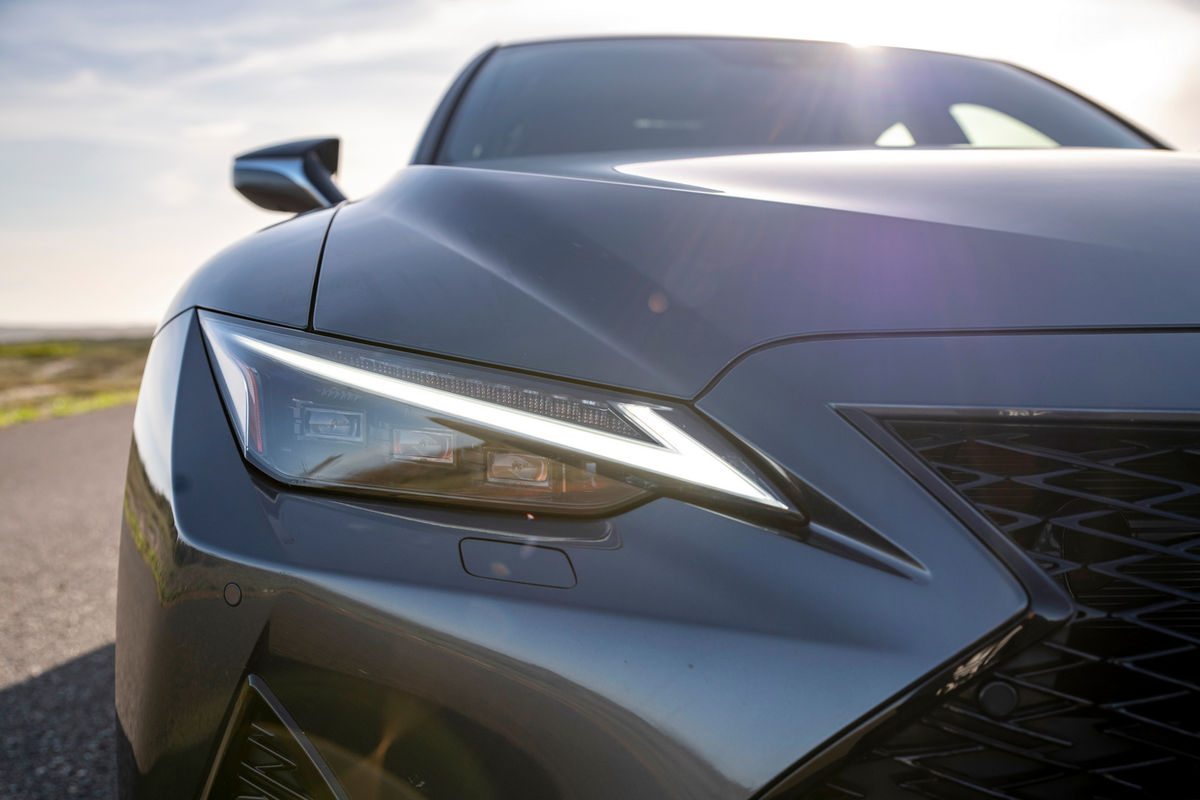
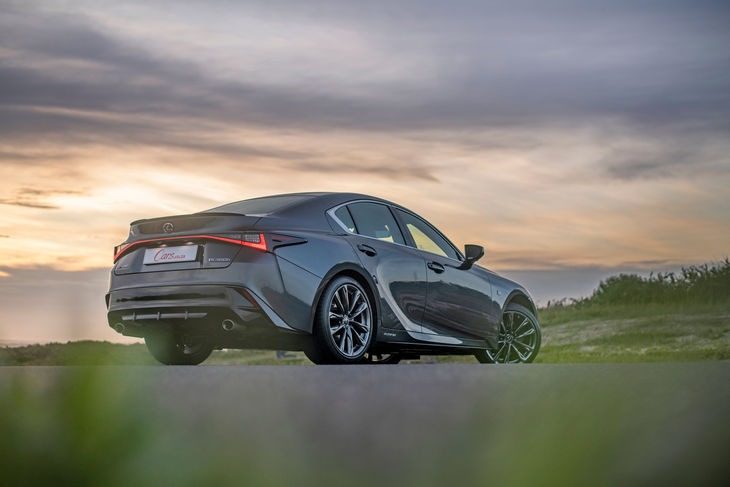
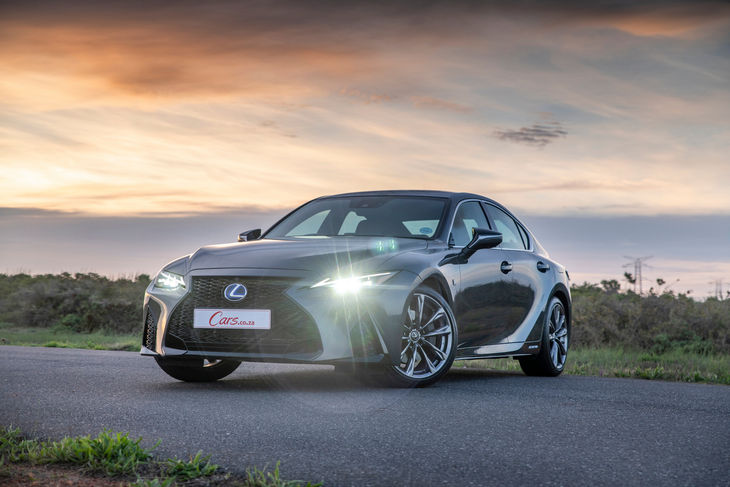
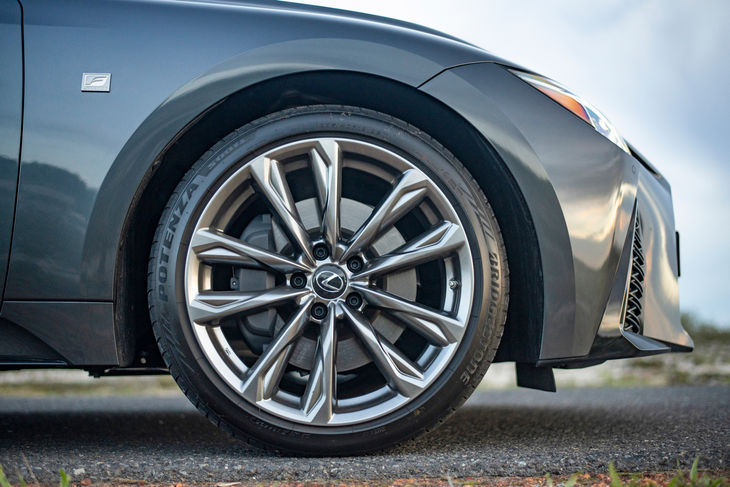
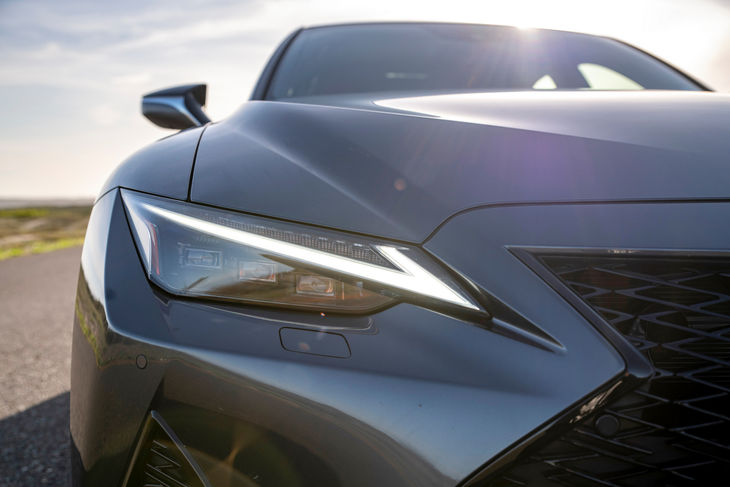
Whereas previous iterations of the Japanese premium marque’s sports executive sedan were criticised for being too conservatively styled, this version has a taut design with no shortage of eye-catching exterior detailing. Fittingly, it looks best in range-topping F Sport guise. The IS’ front-end, especially the spindle grille is striking – if you like sharply angled lines. The sedan’s rear haunches are muscular, the wheel arches are amply filled with 19-inch alloy wheels and F-Sport badging lets the world know that this is the flagship IS. Suffice to say the test unit garnered many admiring glances during our test.
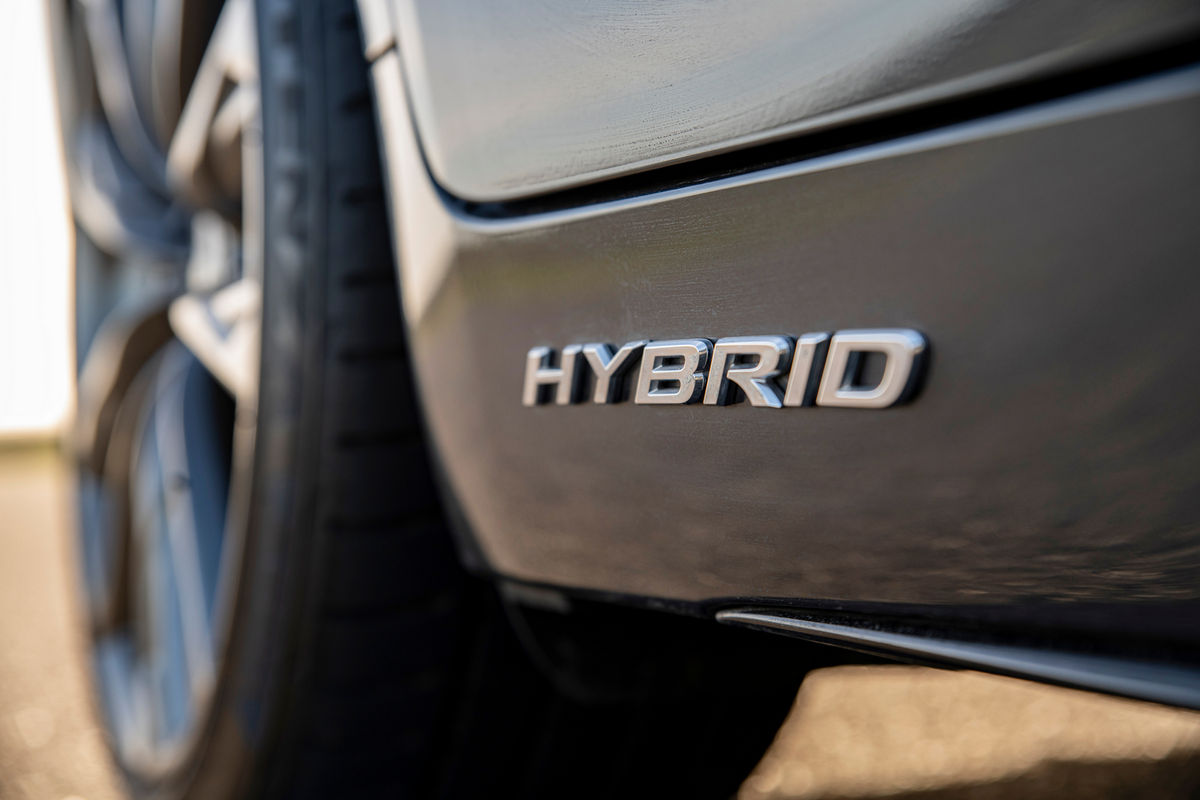
Whereas BMW and Mercedes-Benz previously offered hybrid derivatives in their 3 Series and C-Class line-ups (in the case of the latter, the C350e disappeared from the price list relatively recently), the Lexus IS is currently the only model that offers that configuration (in fact, the revised range’s line-up consists solely of petrol-electric derivatives). Whether you appreciate the IS’ bold exterior execution – or not – depends on your taste, but does the Lexus’ hybrid powertrain complement its luxury-car package well… or at least enough to justify the F-Sport version’s near-R1-million price tag? Let’s find out!
What’s the Lexus IS300h like to drive?
The Lexus delivers its performance in a refined manner but it’s not particularly engaging to drive.
Toyota and Lexus are synonymous with advanced hybrid technology and the latter is arguably the premium brand most associated with combining hybrid performance with driving comfort and luxury. In fact, Lexus is perenially-underappreciated in the luxury-vehicle market – owners of Lexus models are not only generally satisfied with the products that they drive – they tend to remain loyal to the brand.
Does the Lexus IS300h F Sport deliver on its promise of blending hybrid performance, comfort and luxury successfully? We’d say yes, but there’s a but… Although the 3rd-generation IS was designed to deliver engaging dynamics and the F Sport derivative looks performance-oriented, the IS300h is neither “exhilarating” nor “exciting” to drive. Does this make it a bad car? No, quite the opposite, in fact.
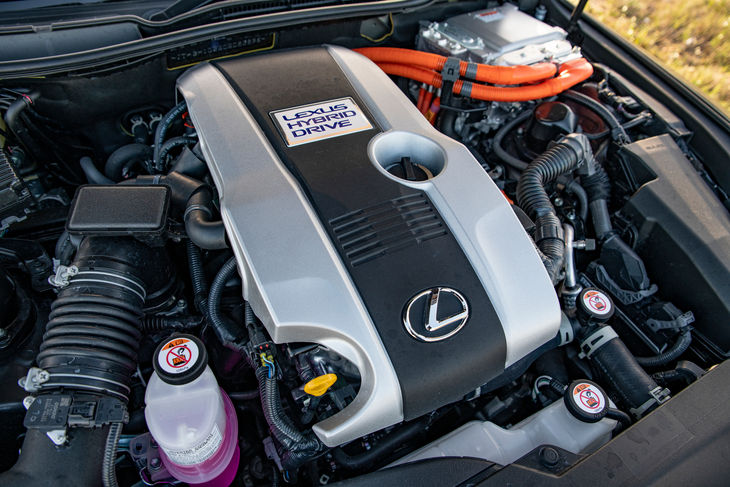
There really is much to like about the IS, but it depends on what you’re looking for/expecting from the driving experience. Given the IS300h’s power unit – a 2.5-litre 4-cylinder petrol engine mated with an electric motor that develops total outputs of 164 kW and 221 Nm, all of which is directed to the rear wheels using a 7-step continuously variable transmission (CVT) – its “performance” is, well, willing.
While it feels as if the IS300h gains pace fairly rapidly (more so than its 8.7-sec 0-100 kph claimed sprint time suggests), it delivers its acceleration in such a refined manner that the event lacks drama. That can be either a positive or negative attribute, however. Depending on your perspective, the Lexus’ performance characteristics can be construed as gloriously graceful… or overwhelmingly dull.
Unfortunately, the Lexus’ drivetrain moans and drones when you floor the accelerator pedal, but under average driving circumstances, the IS300h F Sport settles into a more pleasing, refined rhythm.
Lexus has improved the ride refinement by introducing a revised suspension, making the IS a pleasingly comfortable cruiser.
We tried out the respective drive modes (Eco, Sport and Sport Plus), but they didn’t seem to change the IS300h’s on-road demeanour markedly, other than the fact that the attractive LFA-inspired central rev counter adopted a racier display when the sedan’s sportier settings were engaged. At least the steering-mounted shift paddles create the impression that you can immerse yourself in the Lexus’ driving experience, but even if you enjoy actuating “virtual gear changes”, the transmission actually performs just as well – if not better – when left to its own devices.
We did a stint of long-distance driving in the test unit (the route stretched from Cape Town to Knysna) and, in terms of overall ride comfort and refinement, the IS certainly excelled. The IS300h’s steering does provide at least a measure of pleasing feedback to the driver, while the updated Adaptive Variable Suspension (AVS) adequately suppresses harsh bumps and dips in the road surface and, ultimately, enhances the Japanese sedan’s handling ability (the AVS can be set to favour ride comfort in Normal or adopt a firmer, sportier attitude in Sport S+). For this facelift, Lexus has not only stiffened the IS’ body structure – it has widened the sedan’s front and rear tracks by 45 mm and 50 mm respectively. As a result, the IS feels more solidly planted on terra firma and noticeably stabler during cornering.
Even though Lexus has done extensive work to improve the IS’ handling characteristics, its extra kerb weight (partly as a result of the additional hybrid-system components) can’t be ignored; it does blunt the IS’ overall dynamism. The IS300h has a kerb weight of about 1 735 kg and you can feel that heft under hard cornering – it’s definitely not as agile or nimble as an equivalent BMW 3 Series (1 545 kg).
Is the Lexus IS300h F Sport fuel efficient?
The IS300h F Sport is not as efficient as you’d imagine it to be.
Hybrids are claimed to offer exemplary fuel efficiency, but few actually deliver on that promise, because while such vehicles are quite efficient when driven in congested traffic conditions, they aren’t all that frugal on longer, open-road trips. In the case of the Lexus IS300h F Sport, that observation rang true. Lexus claims an ambitious 5.2 L/100 km, but our test unit returned figures closer to 8.0 L/100 km.
The Lexus IS300h F Sport does feature regenerative braking and a coasting function to aid and enhance efficiency. The recouped energy can be used by pressing the EV Mode button in the centre console, but this mode is only useful to manoeuvre the IS at slow speeds without calling on the engine. An example of this would be when you are reversing out of a parking bay or crawling through a parking lot. That is as far as pure-electric driving goes. Once you press the accelerator pedal past a certain point of its travel, the IS’ engine will kick in and take over to deliver most of the performance.
Fuel efficiency is seen as a key USP for hybrids, but in conditions where the Lexus’ petrol motor does most of the work, it doesn’t offer a notable efficiency benefit over its conventionally powered rivals.
What’s the interior like?
A comfortable place to be on a long journey…
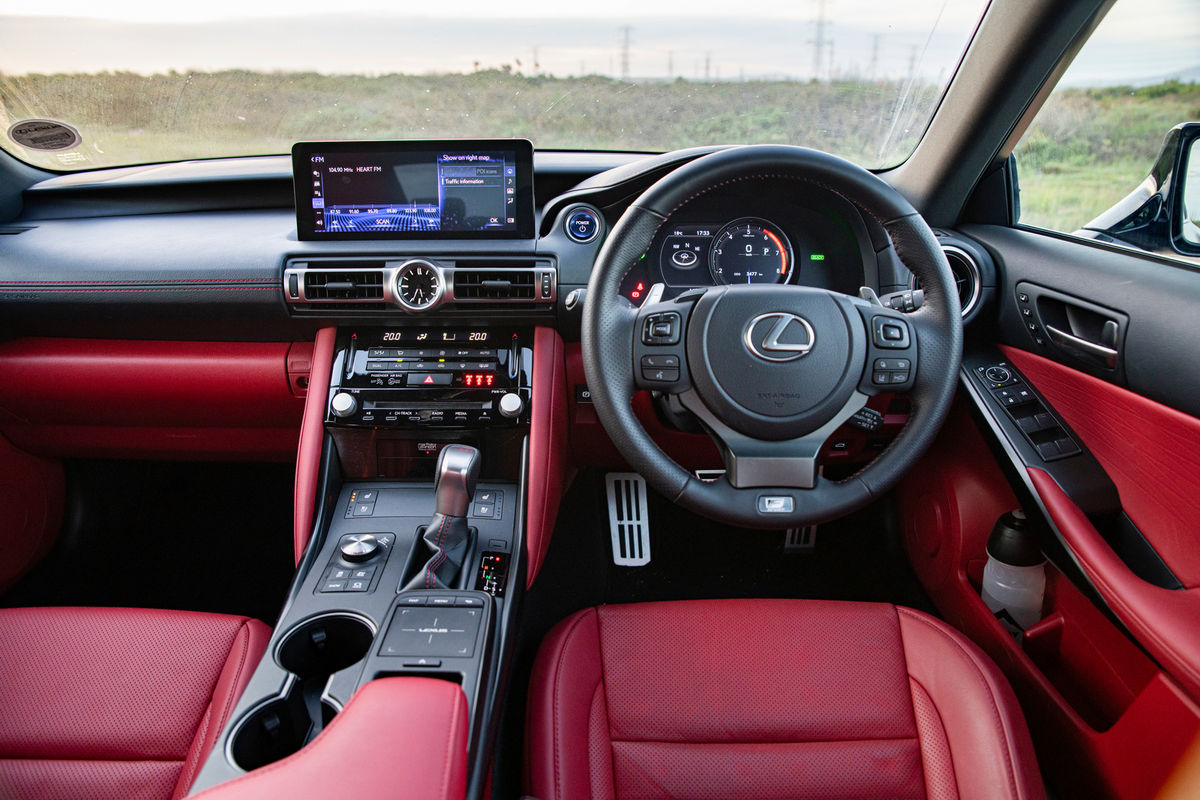
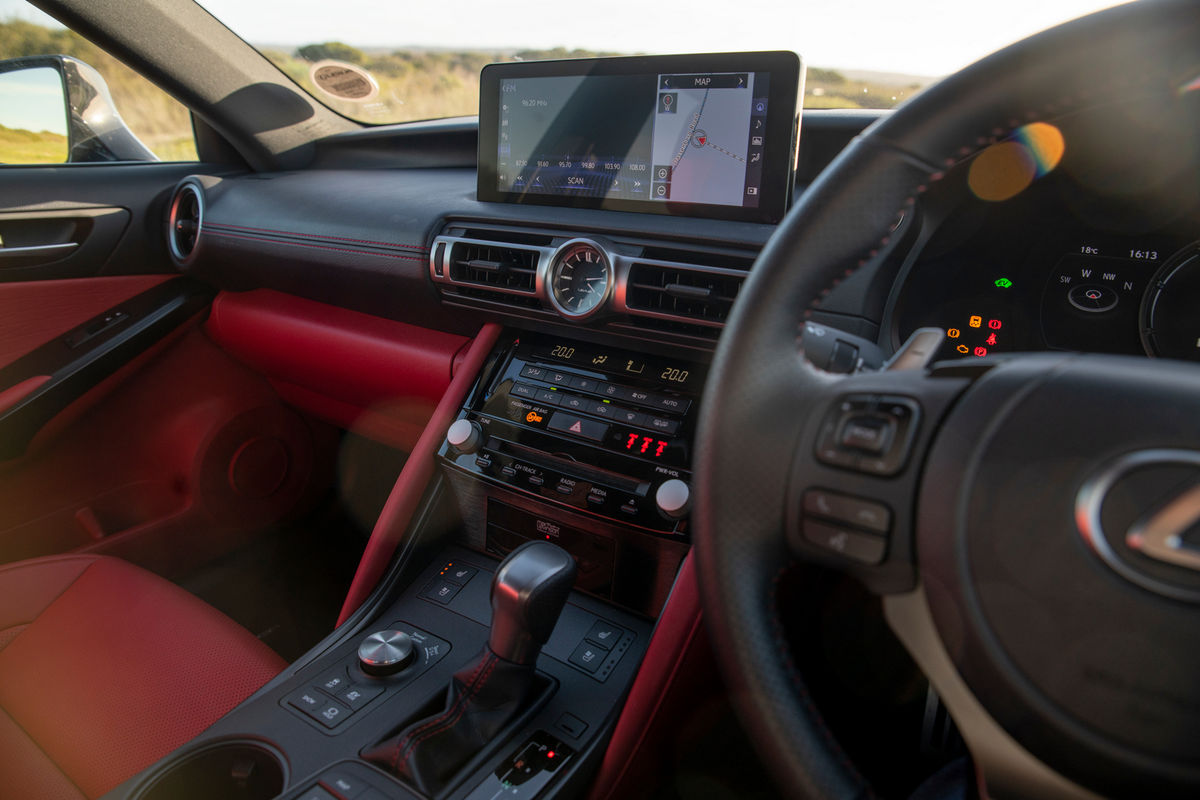
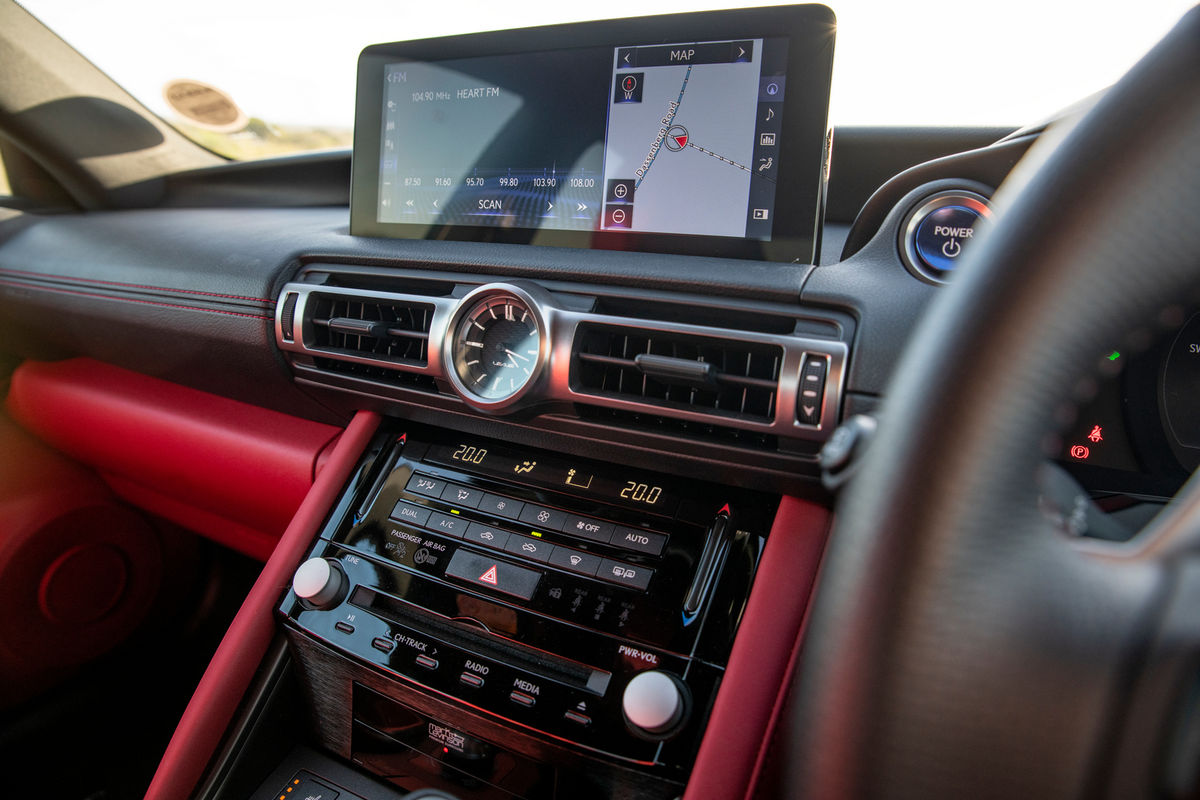
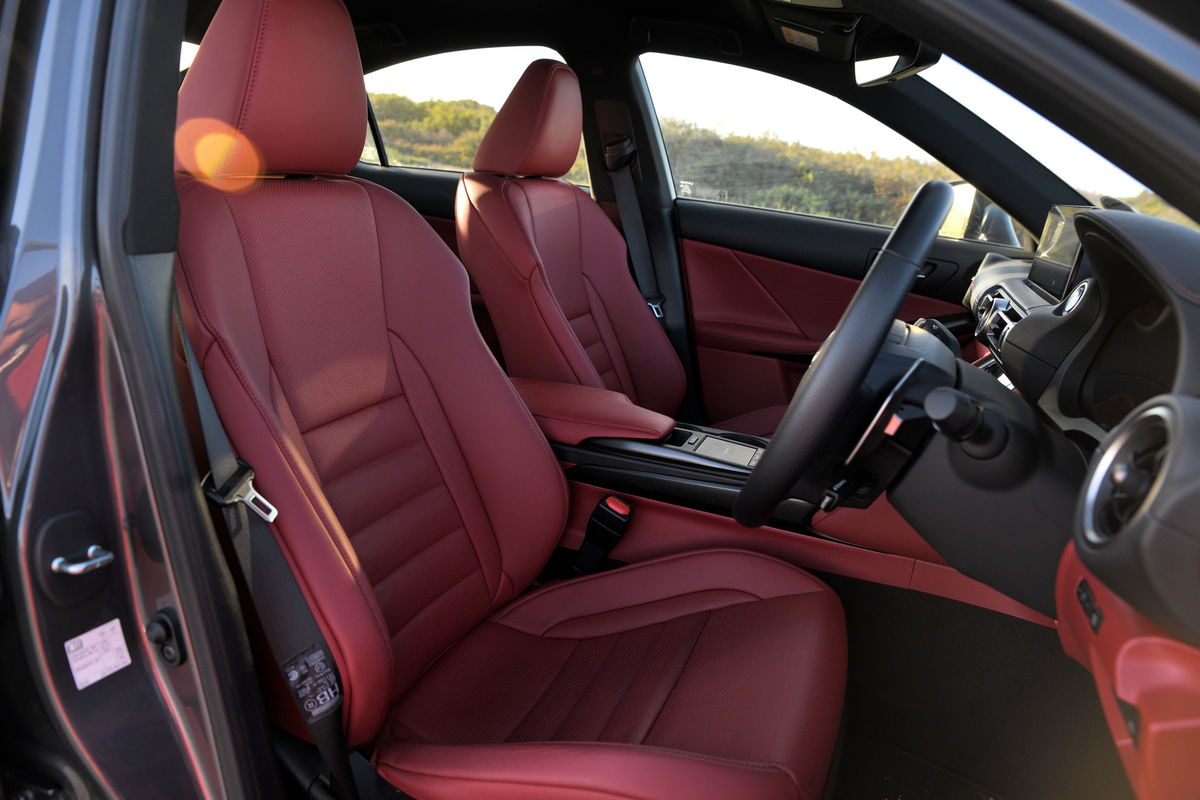
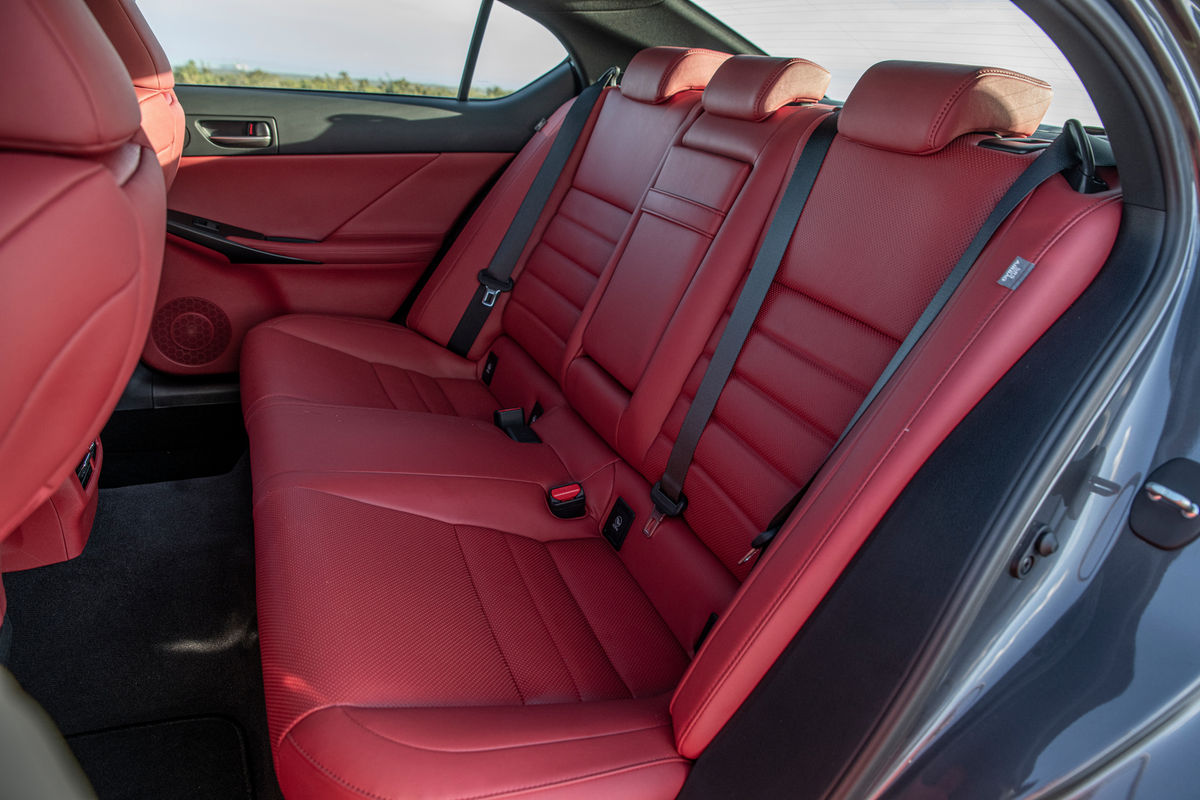
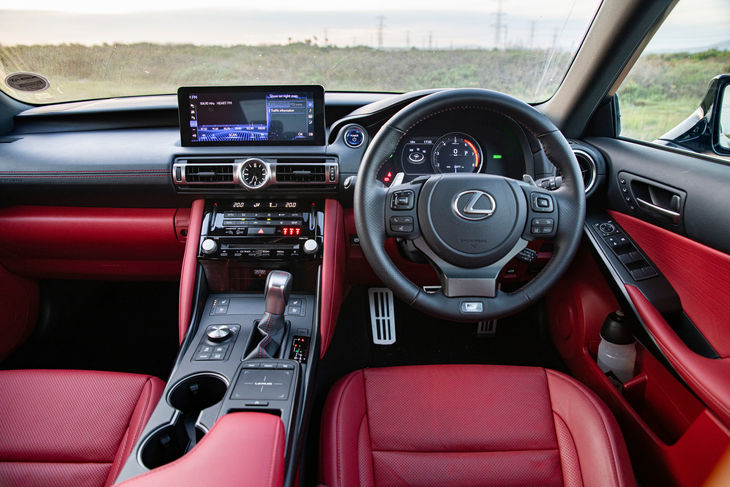
The Lexus’ premium cabin deserves high praise for its good overall perceived build quality, but some of the knobs in the IS look and feel a bit dated… and there’s a CD player! Does anyone still use CDs? To its credit, this test unit came fitted with sumptuous F Sport Flare Red leather upholstery; the electrically adjustable front seats provided an excellent balance of comfort and support during our road trip.
Given that its origin can be traced back to 2013, the interior’s layout and design can be criticised for being “old school” and riddled with too many buttons but that point is debatable – some people like buttons! Lexus outshines the competition, though, by taking an “all-in” approach when it comes to standard equipment – this range-topping IS is jam-packed with convenience and safety features.
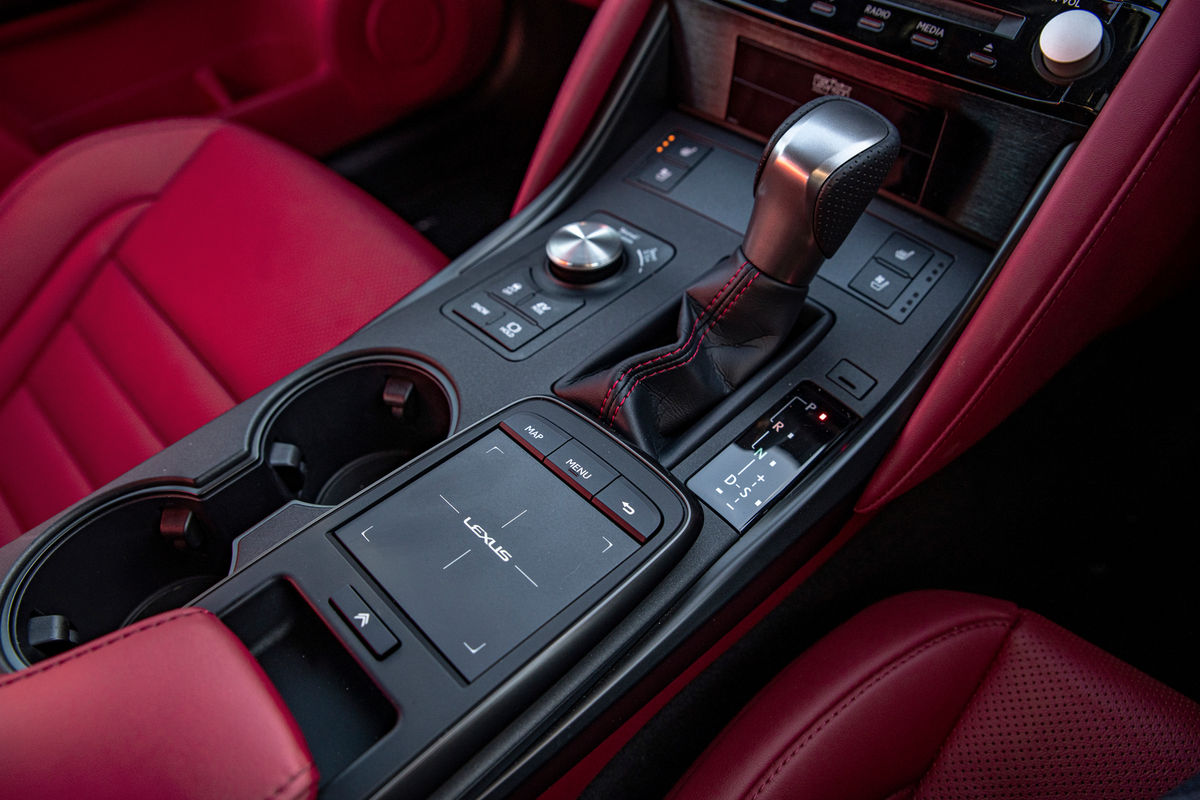
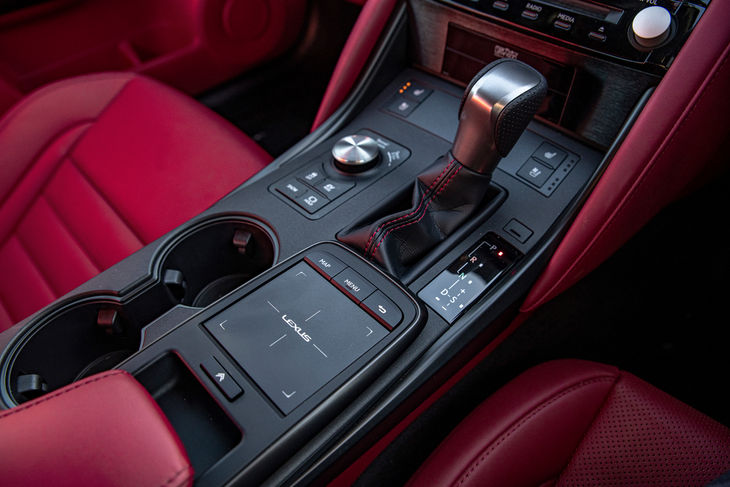
Now that the infotainment system supports touch inputs to its 10.3-inch screen, the panel has been moved forward by approximately 150 mm. The system offers Apple CarPlay and Android Auto compatibility, integrated navigation, Bluetooth and voice control, all of which can be controlled and adjusted using the steering wheel-mounted controls. You can also use the navigation pad in the centre console to execute functions, but it’s hyper-sensitive and requires some practice to get used to… In a way, it’s a legacy item from the pre-facelift model, but again, not everyone likes prodding screens.
The navigation pad in the centre console takes some patience to use effectively.
Furthermore, the IS is equipped with a 360-degree camera system (with reverse-view guidelines), a 17-speaker Mark Levison audio system as well as dual-zone climate control air conditioning.
In terms of safety, Lexus’ sports executive comes well equipped with no fewer than 10 airbags, ABS with EBS, brake assist and electronic stability control with traction control, plus front and rear park distance control. Driver-assist features include active cruise control, pre-collision warning with pedestrian/cyclist detection, lane tracing assist, blind-spot monitoring and rear-cross traffic alert.
As far as practicality goes, rear occupants are well catered for in terms of comfort and space. The boot is sizable too, with Lexus claiming a load capacity of 450 litres. The rear seats can also be folded down in a 60:40 split configuration should you be required to transport longer items.
How much does the Lexus IS300h F Sport cost in South Africa?
The Lexus IS300h F Sport is priced at R935 200 (as of July 2021) and is sold with a 7-year/105 000 km warranty and a 7-year/105 000 km maintenance plan.
The IS300h F Sport makes a bold statement while offering high levels of comfort and luxury, but its hybrid powertrain isn’t overtly sporty.
The IS300h F Sport remains a worthy contender in this segment, as long as you are willing to make peace with what it is – and what it isn’t. If you consider the high levels of luxury and comfort, as well as the sheer number of features that the Lexus offers, it’s a solid alternative to more popular choices in this segment. It’s neither as exciting nor as engaging to drive as it looks, however.
There is little doubt about the inherent dynamism of the IS’ platform – it’s certainly not a soft, squishy luxobarge, but the IS300h F Sport’s hybrid configuration is, by its very nature, efficiency-oriented and not conducive to delivering compelling performance. To its further detriment, the powertrain’s not notably more fuel-efficient compared with its conventionally-powered rivals, at least not in our experience.
By offering the IS as a hybrid-only model in South Africa, Lexus is banking on its hybrid credentials, but unfortunately, the South African market has never quite warmed up to hybrids. As a result, the Japanese luxury firm has arguably marginalised the IS in the local market (it’s now very much a left-field or non-conformist’s choice) – isn’t that a less-than-ideal strategy in a dwindling segment?
If you are ever in the market for a new hybrid sports executive sedan, you know where to go! Aesthetically speaking, the F-Sport version is the most desirable IS derivative, but if the naturally aspirated 3.5-litre V6 was no longer a viable engine option for the local market, perhaps the 2.0-litre turbopetrol (even if it’s not quite as fuel-efficient around town as its petrol-electric sibling) could have sufficed…
This week’s news you need to know (July 2021, Week 3)
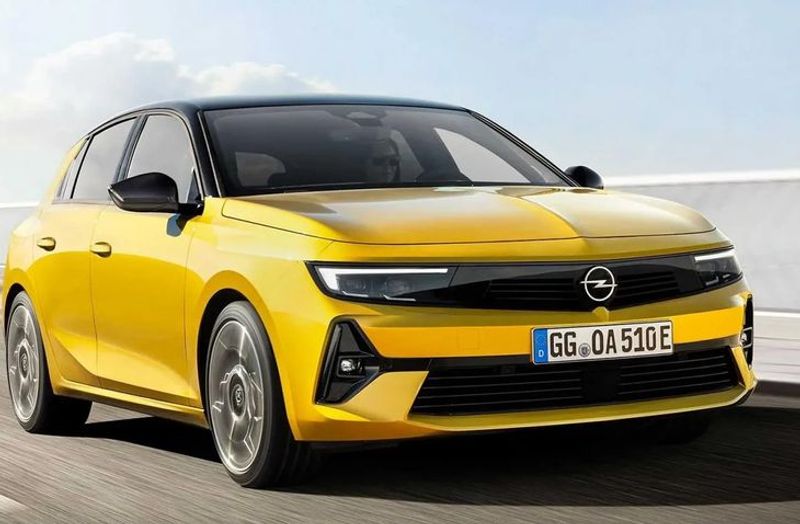
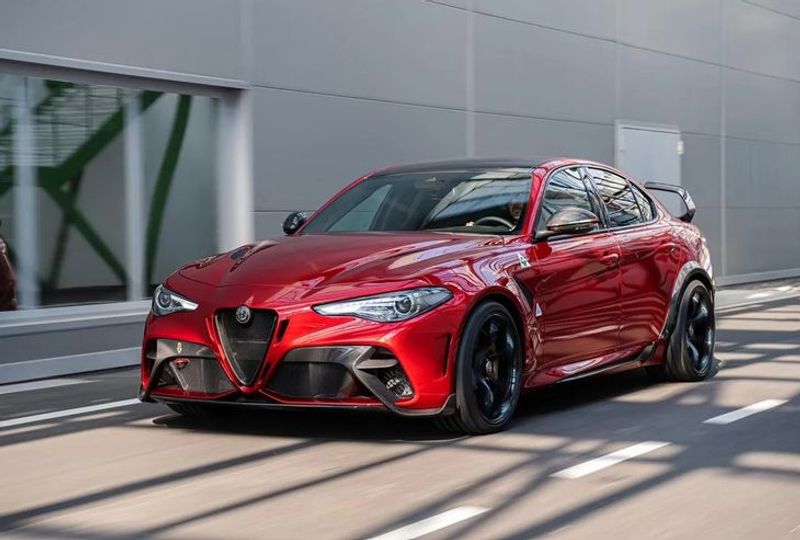
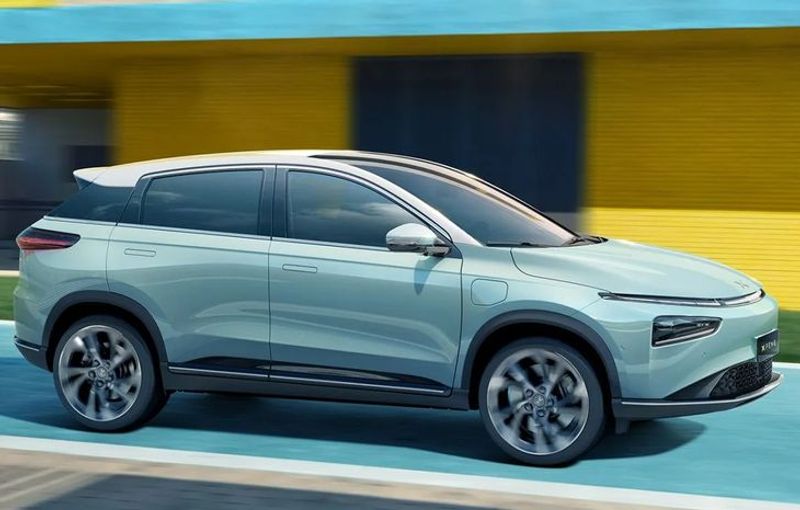
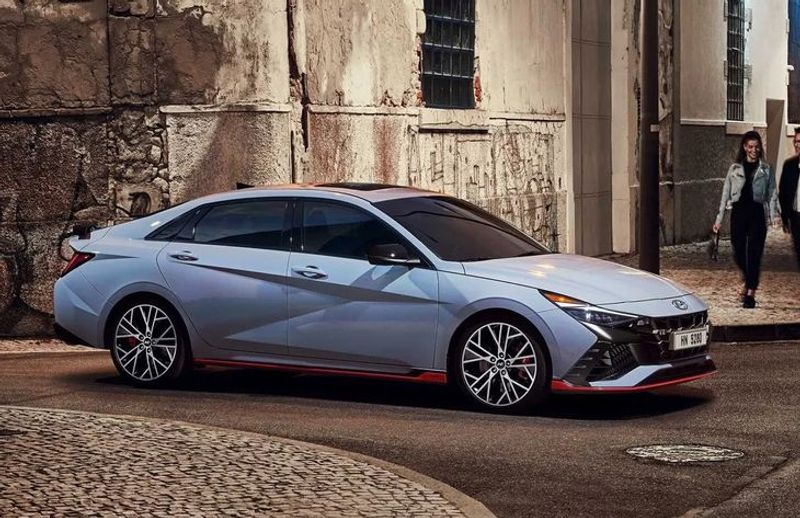
In this week’s automotive news you need to know: Opel unwraps a brand new Astra you’ll never see here, Alfa Romeo will sell you a very fast (and equally fast-depreciating) Giulia, Xpeng plans to be the EV tech leader of the future and Hyundai’s Elantra N is a fast sedan competing in a segment that no longer exists.
Opel Astra – Hatching a plan…
Opel recently announced that its future product line-up would focus purely on the SUV market, but, as we know in business, it could all have been “smoke and mirrors” on the part of the Russelsheim-based brand while it quietly prepared to give the Astra its final (probably) outing. It’s not as if the German brand spent gazillions on the Astra’s development, anyway. Peugeot developed the new 308 on the EMP2 platform and the Opel’s essentially a clone. Still, the Astra nameplate has some juice left in it, if there’s enough market appetite for the German hatch, it might migrate further than the EU and UK.
Back home in SA, there’s still a deep love for Opel, which should not be ignored. If ever Stellantis wanted to capitalise on that, they best do it sooner rather than later before the likes of VW all but take over. It’s been plain sailing for Volkswagen over the past 2 decades, but the time for serious competition is now, so slap some stilts on that Astra and get it over here, Stellantis. The “Opel people” are waiting.
Alfa Romeo GTA – behind the slow-motion promotion shots and emotive music…
Alfa Romeo sure knows how to toy with petrolheads’ emotions. There’s always the promise of a model that will humble German performance sedans and enter the, um, pantheon of ultimate driver’s cars. Well, for what’s been presented so far, the GTA and its wilder GTAm brother make their Bavarian rival (the G80-generation M3) seem rather pedestrian… and gauche. The Milanese marque has a rich history that evokes great names such as Ascari, Fangio, Lauda and even Enzo Ferrari. BMW’s heritage is shorter and lacks mystique; it doesn’t have Alfa’s design flair either and sadly, it never will.
Look, Alfa Romeo was only ever going to produce a few Giulia GTAs, so its humble South African subsidiary was, frankly, lucky to have secured any stock whatsoever. Given the GTA’s stratospheric price of R4 million, the model’s local arrival will achieve little more than serving die-hard fans of the brand who happen to be rolling in cash… and are wholly unconcerned about resale values – I believe that with every fibre of my being. The current state of the Alfa Romeo brand in South Africa is a shame considering that the Milanese brand developed the internationally acclaimed GTV6 3.0 – which is a collector’s item today – right here in Mzansi in the ’80s. Who knows what Stellantis’ local subsidiary is planning for Alfa? I’ve got to admit though, Giulietta (on run-out), Giulia and Stelvio is a rather thin line-up.
Xpeng – leading a charge in a thunderstorm
Xpeng Motors… that name may not sound familiar, but the NYSE-listed Chinese EV start-up is making waves. With firm roots in North America and financial backing from E-commerce giants Alibaba, Xpeng is well-poised to profit from the electric revolution. Not only is the firm eyeing up the EV-hungry Norwegian market – it may ultimately rival giants Tesla and Volkswagen as a leader in the EV space.
You probably won’t be surprised to read that the electric vehicle industry is one of the fastest-growing industries in the world and to say that it’s a tumultuous segment, would be putting it mildly. Xpeng knows this all too well and that’s why it’s firmly invested in research and development (R & D) as a core driver of its business. It understands that every bit of the process, from R & D, to technological advancements, to automation in the manufacturing process, needs to be focused on and that’s why it will be a threat. They’re the tech disruptors within the EV space. Ignore them at your peril.
Hyundai Elantra N – What wins on a Sunday… sells on a Monday?
With the sedan market seemingly all but dead and buried, and the hatch market in hot pursuit (a sad pun there), Hyundai Kia continues to champion the cause of the 3-box, 4-door vehicle. I assume it’s because the Koreans want to maintain momentum in the US market where sedans still sell well. Hyundai has been pushing this development by entering the Elantra in touring-car racing – no, really!
Hyundai’s N Division still believes that motorsport has a part to play in the development of performance-oriented road cars. Huzzah! Technological advancements should trickle down into future N models, then, if they sell in sufficient numbers, Hyundai can scale production to make the N badge more attainable. Seeing as the Elantra has disappeared from the local market because Hyundai SA is focusing its efforts on crossovers and SUVs (even the Kona N is on the cards), we won’t get the Elantra N here. I can understand why, but man, as a compact performance sedans go, the Hyundai looks the business.
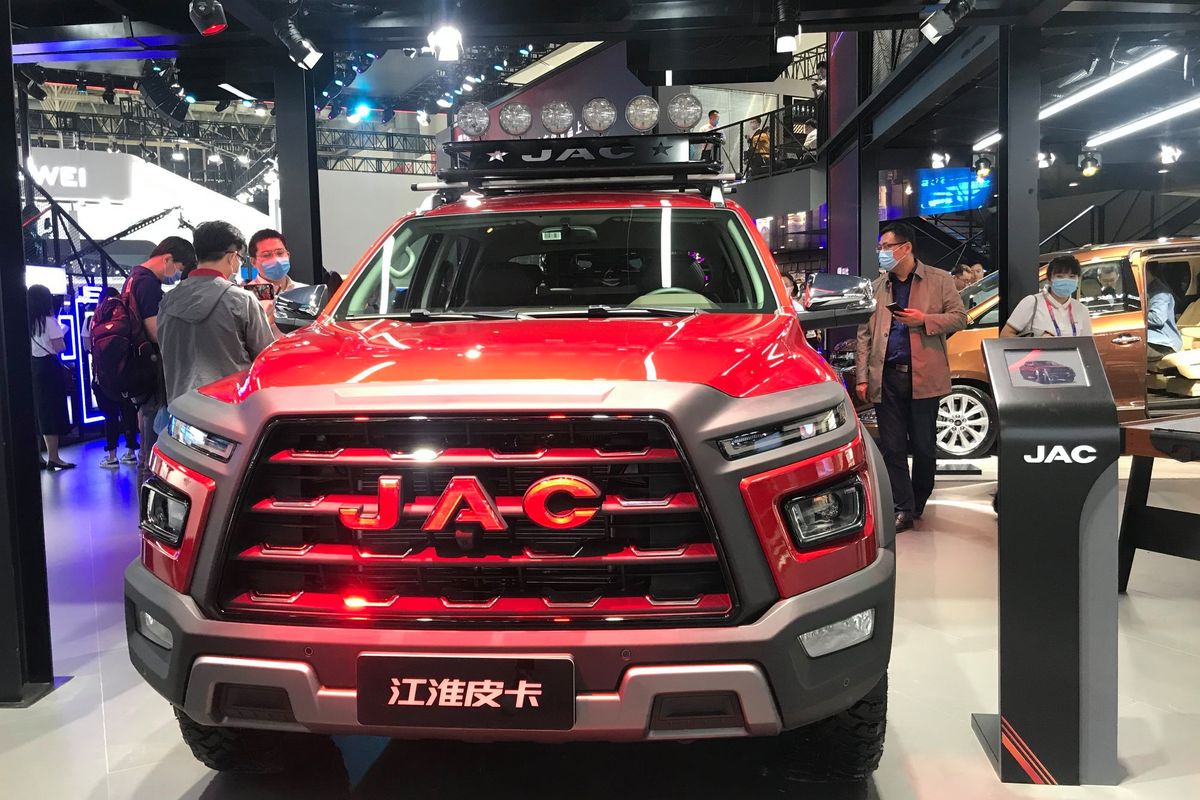
JAC T9 Bakkie For SA in 2022
Chinese manufacturer, JAC Motors, is set to introduce a new leisure double cab bakkie in South Africa in early 2022 to take on the GWM P-Series. Meet the JAC T9!
Following the local introduction of the all-new T8 double-cab bakkie in 2020, JAC is looking to further capitalise on opportunity in the double cab segment with the introduction of the flagship T9 leisure double-cab bakkie.
The T9 is an all-new bakkie that made its debut at the 2020 Beijing Auto Show and it’s built on JAC’s JL32 architecture and places emphasis on comfort and luxury features.
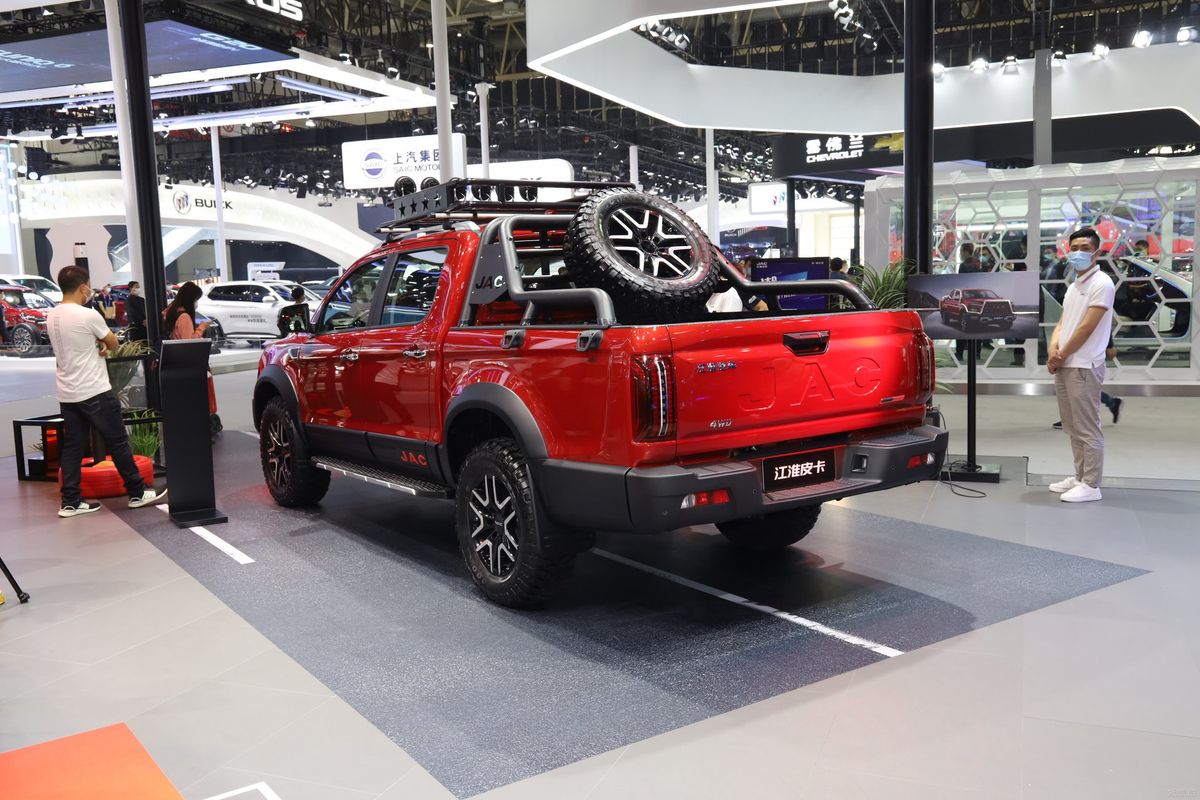
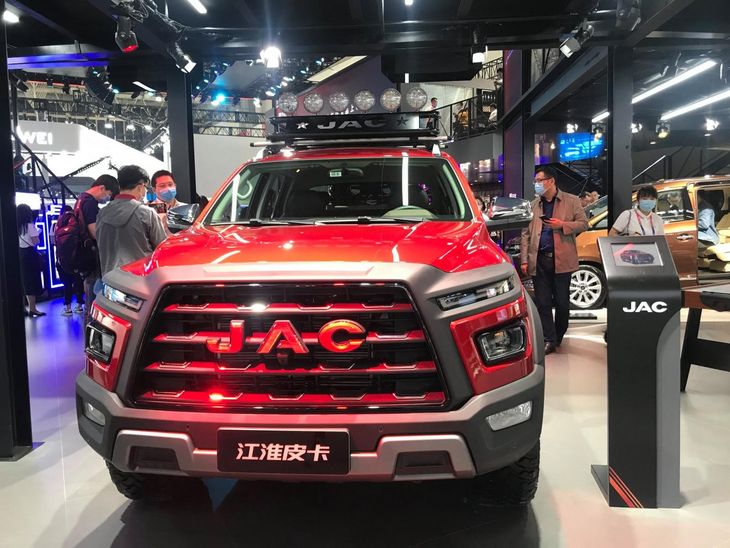
In terms of design, the JAC T9 boasts a huge bold grille that’s inspired by the American Bison. The oversize grille is flanked by LED turn signals, LED headlights and LED fog lights. The T9 rides on 18-inch wheels and rugged plastic cladding is seen over the wheel arches and side skirts. An angled sports bar is also fitted and the rear lights adopt a slick vertical design.
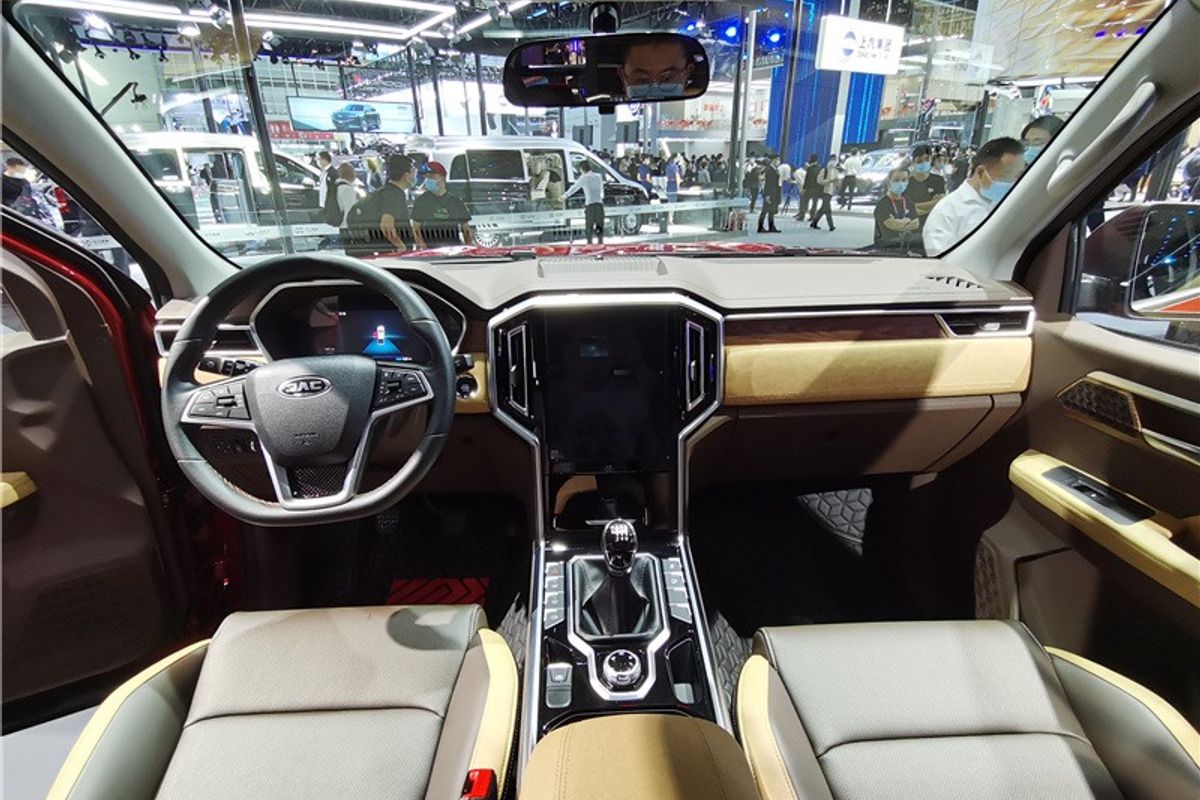
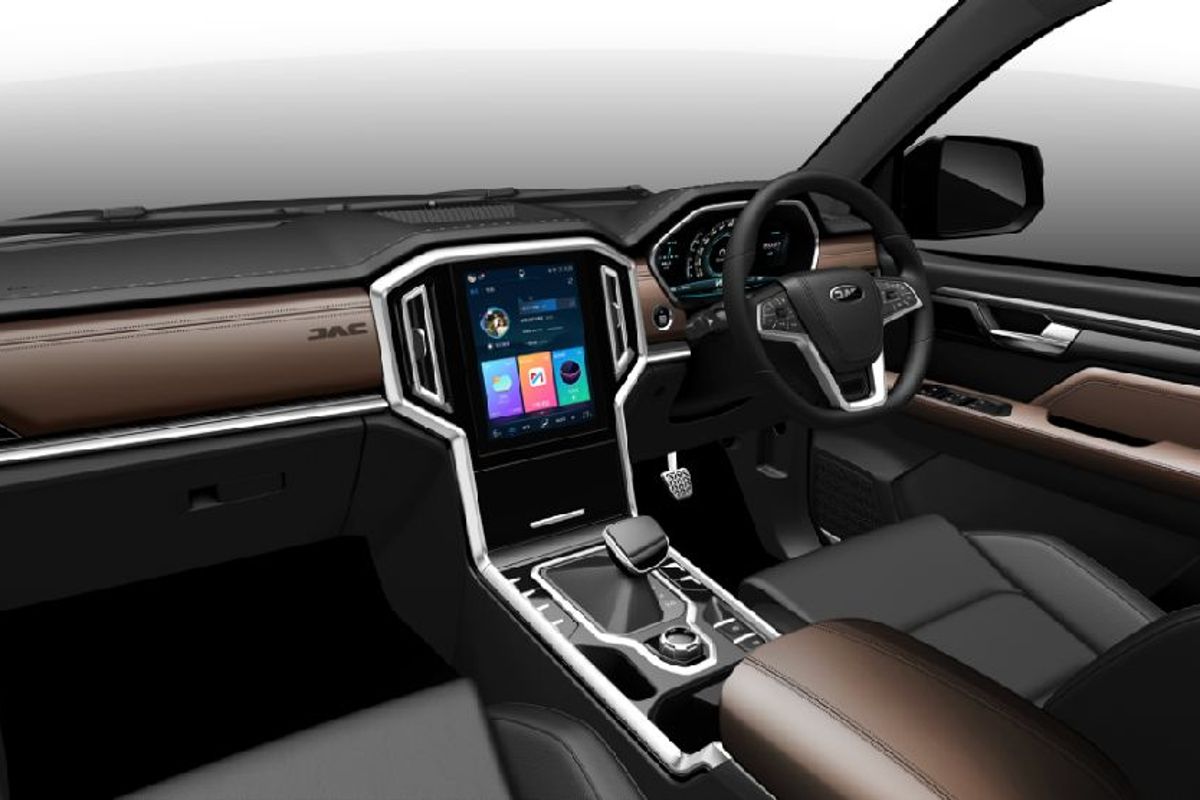
Moving inside the T9, JAC has gone with an upmarket design. The upper dashboard is finished with soft-touch trim but the main attraction is the large 10.4-inch vertically-orientated infotainment touchscreen which houses the main vehicle functions as well as the obligatory connectivity features. A 10-inch colour digital instrument cluster relays key driving information to the driver and a multi-function steering wheel provides easy access to key functions.
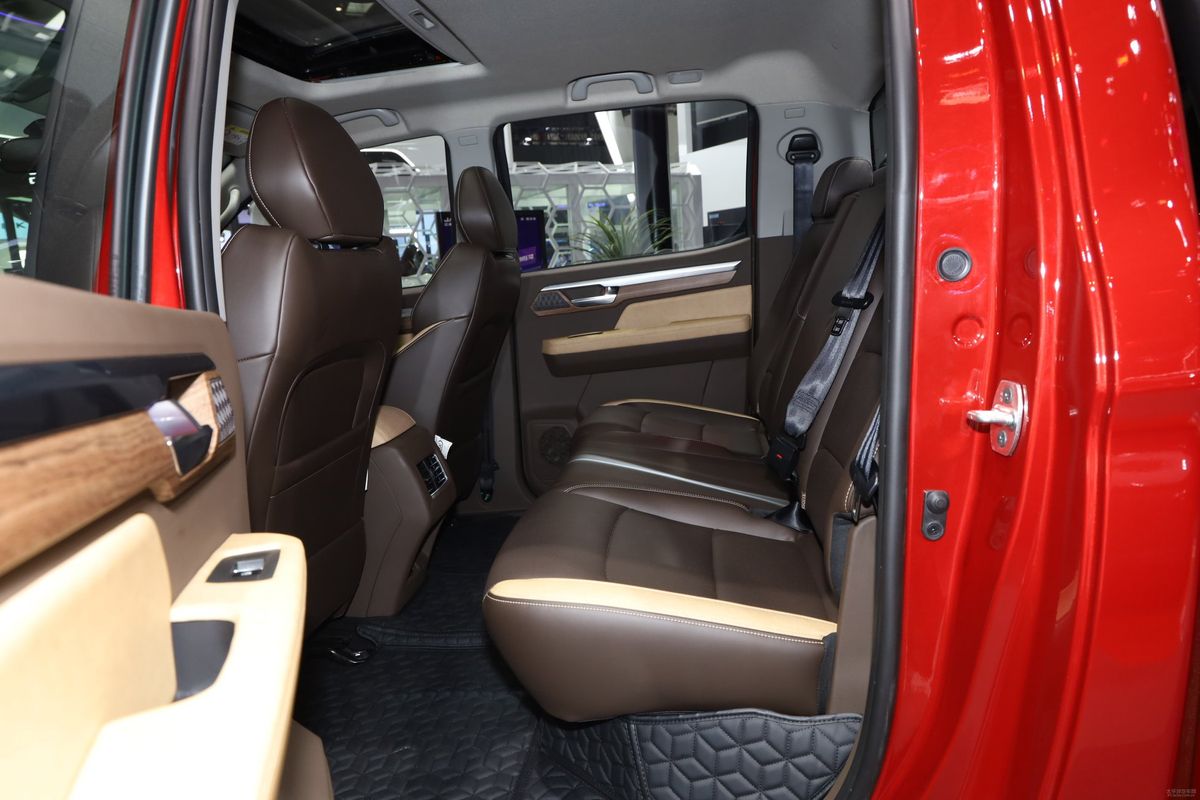
Other notable features include keyless entry, push-button start, wireless smartphone charger and a 6-way adjustable driver’s seat with leather upholstery throughout.
What engines will power the JAC T9?
The JAC T9 is expected to feature notable outputs and a host of luxury and convenience features to take on the GWM P-Series.
In China, the JAC T9 is powered by an in-house 2.0-litre turbodiesel engine developing 112 kW and 360 Nm as well as a 2.4-litre turbopetrol engine but a JAC spokesperson at the Beijing Auto Show highlighted that international markets will receive an Isuzu-sourced 2.5-litre turbodiesel engine, presumably the same that powers the current Isuzu D-Max with 100 kW and 320 Nm. A 6-speed manual transmission is likely as well as an 8-speed ZF automatic transmission.
Furthermore, late in 2020, Volkswagen increased its stake in JAC from 50% to 75% majority stake and forming Volkswagen Anhui Automotive Company Limited. Approximately €1-Billion was invested to develop electric infrastructure in China.
Note that this is a developing story and exact pricing and specification details for the South African market have yet to be confirmed. It has, however, been confirmed that the new JAC T9 is due to arrive in South Africa in the first quarter of 2022. We will keep you updated as soon as more information becomes available.
Cars.co.za and Ford team up with Gift of the Givers for Winter Blanket Drive
As South Africa battles the third wave of the COVID pandemic, Cars.co.za has partnered with Ford South Africa to assist the Gift of the Givers Foundation in bringing much needed warmth to those who most desperately need it during this winter season. See the article below to find out how you can support our Winter Blanket Drive and make a difference.
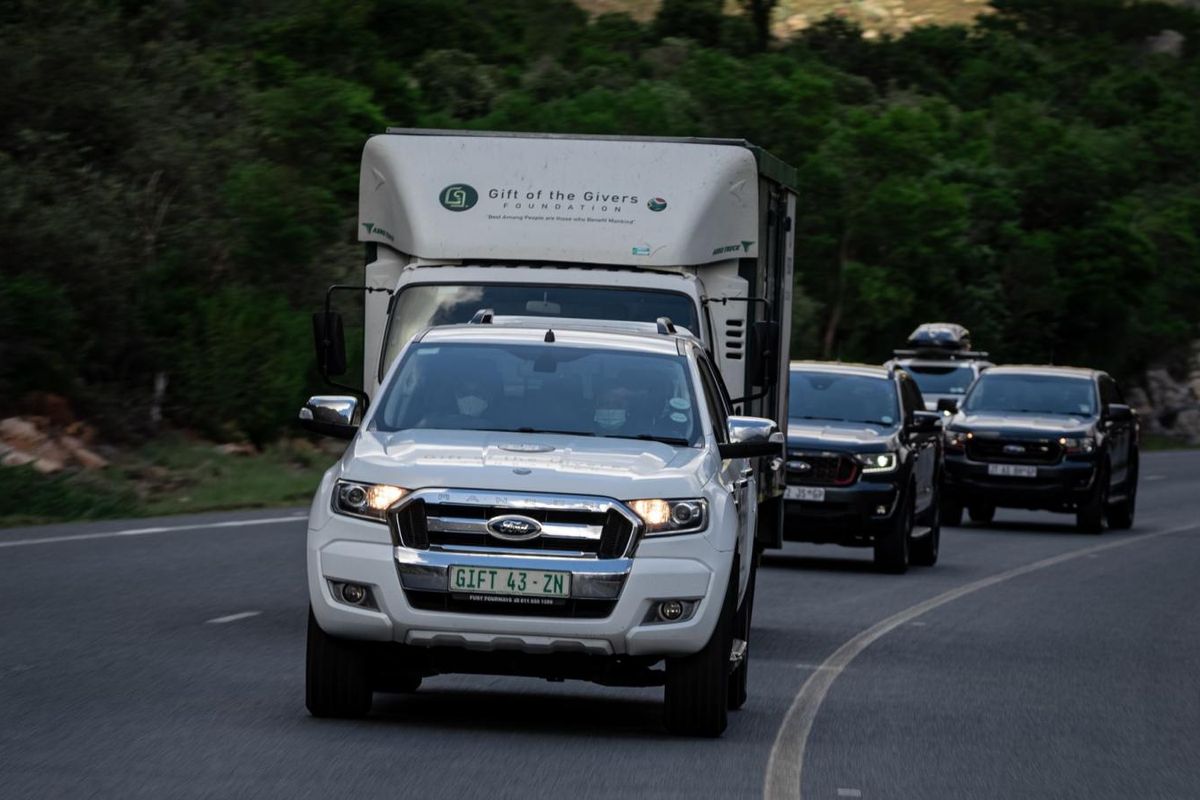
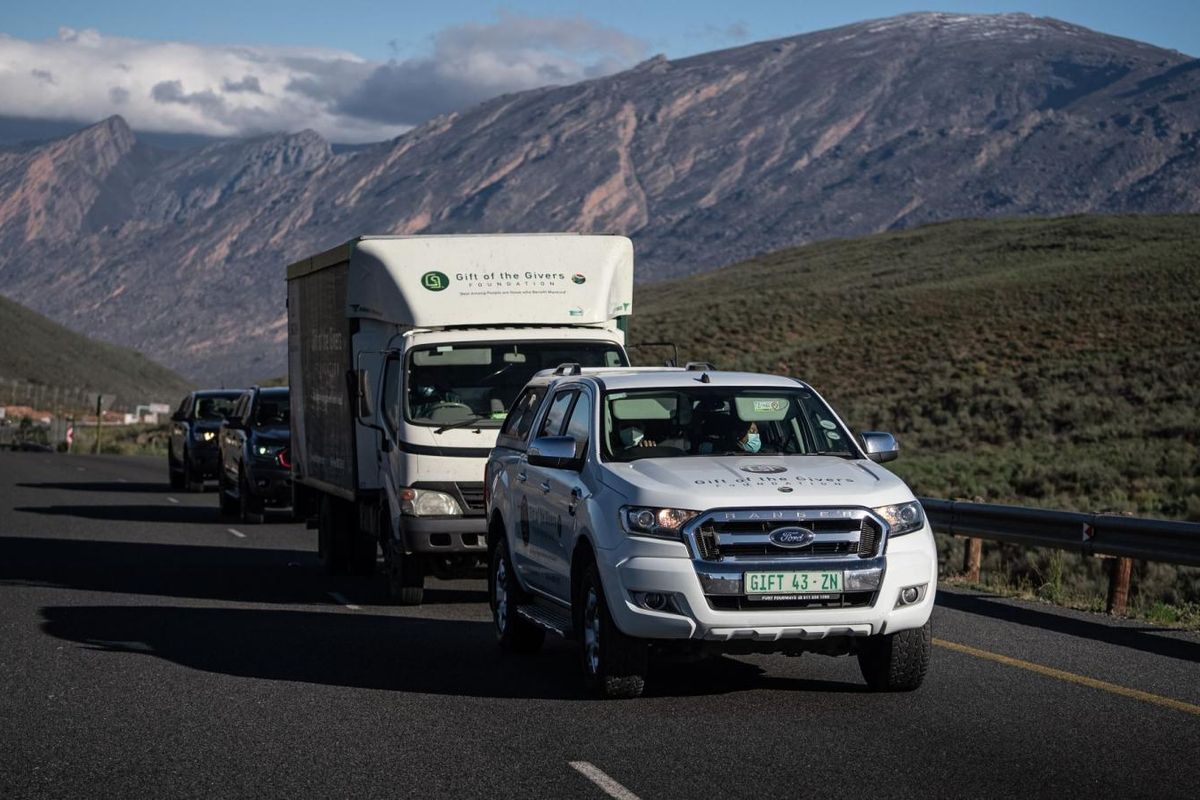
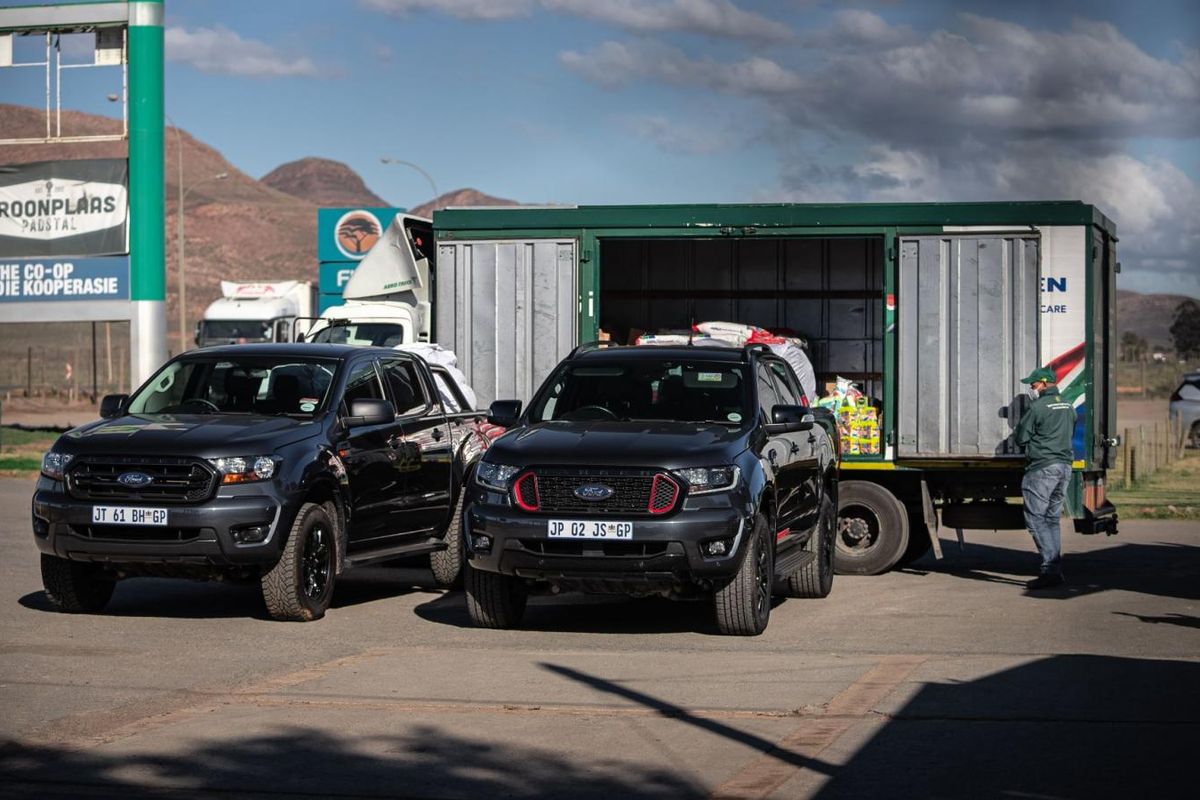
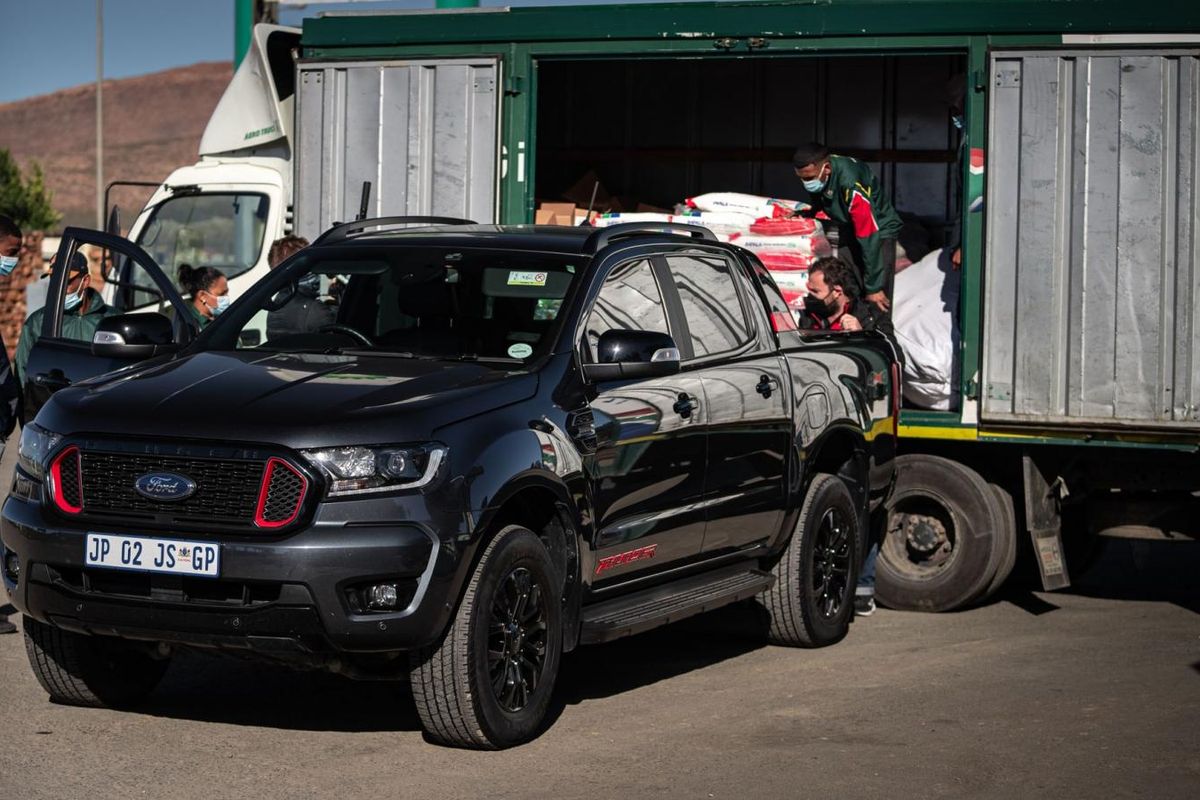
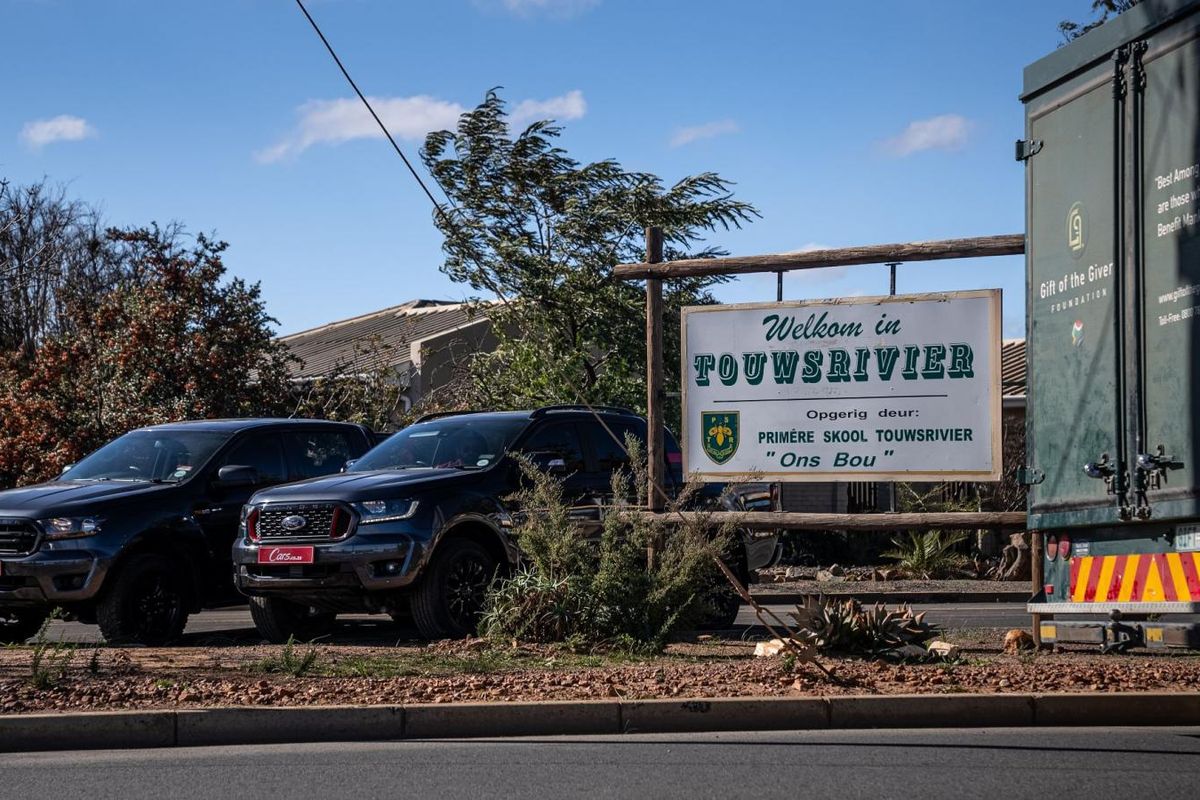
As our convoy of Ford Rangers pulled into the small town of Touws River in the Western Cape on a particularly cold, mid-winter day, the impact that the COVID19 pandemic has had on this area was immediately apparent. Several of the businesses in the area (including game farms and a train repair company) have had to shut their doors, and the result is that unemployment in the community is as high as 80%. Following an earlier visit by the Gift of the Givers Foundation, it was established that immediate assistance was required – many elderly inhabitants, for example, were taking medicine (if they could find that) on empty stomachs and children were going to bed hungry. And so on this particular mission the Gift of the Givers delivered 5 tonnes of goods, including blankets, food, care packages and supplies for the local soup kitchen.
Members of the Touws River community receive their care packages from Gift of the Givers, Ford and Cars.co.za.
“We have been observing the great work that Gift of the Givers has done all across our country, and have also been looking for a way in which we can play our part,” says Cars.co.za’s Hannes Oosthuizen. “It is therefore a pleasure and an honour for us to join forces with the Gift of the Givers and Ford South Africa, two brands that together have already made a big and positive impact on the lives of many South Africans.
“This Blanket Drive kicked off with targeted assistance of the Touws River community, but we hope to raise enough funds to significantly boost Gift of the Givers’ efforts across our nation. Cars.co.za will kickstart this project by donating all its 2020 Youtube advertising revenue and we call on all South Africans who are able to assist, to donate and help this project bring some warmth and comfort to those communities that have been left battered by not only the Covid pandemic and its repercussions, but also the chilly grip of winter.”
Ford has long been a supporter of the Gift of the Givers Foundation.
“We could see the tears of joy in their eyes as the bakkies were opened and bulk food and blankets were handed out,” says Ali Sablay of Gift of the Givers. “Cape Town is going through harsh weather and cold fronts and the people in Touws River were absolutely amazed that they were receiving a warm blanket from Ford South Africa and Cars.co.za. This is a day that they will never forget,” Sablay says.
“Initiatives like this epitomise the ‘Ford For South Africa’ campaign,” says Neale Hill, managing director of Ford South Africa. “It goes beyond just highlighting Ford’s corporate and product legacy and demonstrates our commitment to this wonderful and vibrant country, and our unwavering dedication to building a promising future for all South Africans,” Hill adds.
How can you assist?
Cars.co.za’s Hannes Oosthuizen helps to distribute blankets in Touws River.
The focus of this particular effort is to get blankets to those people who most urgently need them. To enable Gift of the Givers to acquire enough blankets, we request all donations to be deposited into the following bank account, with the reference being Cars.co.za Blanket Drive. “Any donation, no matter how small, will help this project make a difference in someone’s life. To kickstart the fund, Cars.co.za will be donating all 2020 advertising revenue from its Youtube channel, which comes to just over R100 000,” says Oosthuizen.
Account Name: Gift of the Givers Foundation
Bank: Standard Bank
Account Number: 052137228
Branch Code: 057 525
Branch: Pietermaritzburg, South Africa
About Gift of the Givers
The Gift of the Givers Foundation assists communities across South Africa, daily.
The Gift of the Givers Foundation is the largest disaster response, non-governmental organisation of African origin on the African continent. Assistance is provided unconditionally; to the needy, irrespective of human or animal, race, religion, colour, class, political affiliation or geographic location.
Since its inception in 1992, the organisation has been responsible for the delivery of life-saving goods and on-the-ground support for innumerable people, collectively valued at some R3.2 billion, in more than 43 countries across the globe.
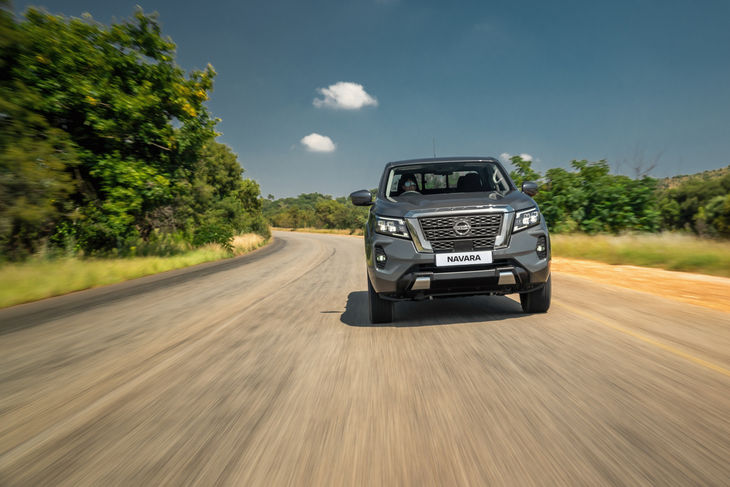
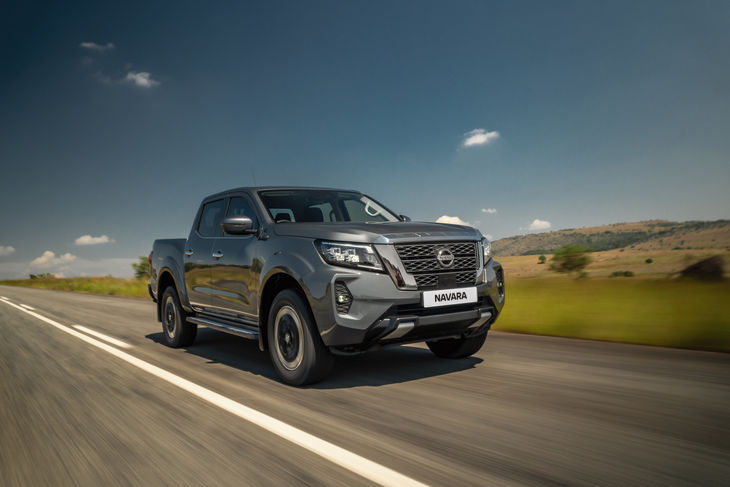
Nissan Navara (2021) Launch Review
The Nissan Navara has “come home”. It’s now a South African-built bakkie – tuned for our conditions and specified to suit the needs of local bakkie buyers. Is the facelifted model good enough to help Nissan secure a bigger share of the leisure double-cab segment? We briefly drove the newcomer in Cape Town this week.
What’s new on the Navara?
It’s fair to say that the arrival of the all-new Navara in 2017 didn’t go down nearly as well as Nissan had hoped. Compared with its predecessor, the imported 3rd-generation (D23) model faced much tougher and diverse competition in the local market and its debut was arguably overshadowed by the arrival of its ill-fated German cousin, the Mercedes-Benz X-Class, with which it shares a platform.
Nissan admittedly attempted to make its leisure double-cab more attractive to luxury-family-car buyers (who would ostensibly use their bakkies to pursue outdoor activities on weekends) by fitting the Navara with a coil-sprung – rather than a traditional leaf-sprung – rear suspension. The thinking behind that was to make the bakkie more stable at speed and that it would deliver a comfortable ride quality when travelling over rougher road surfaces. Results were varied… and most buyers apparently preferred the packaging and specification of the Ford Ranger, Toyota Hilux and Volkswagen Amarok.
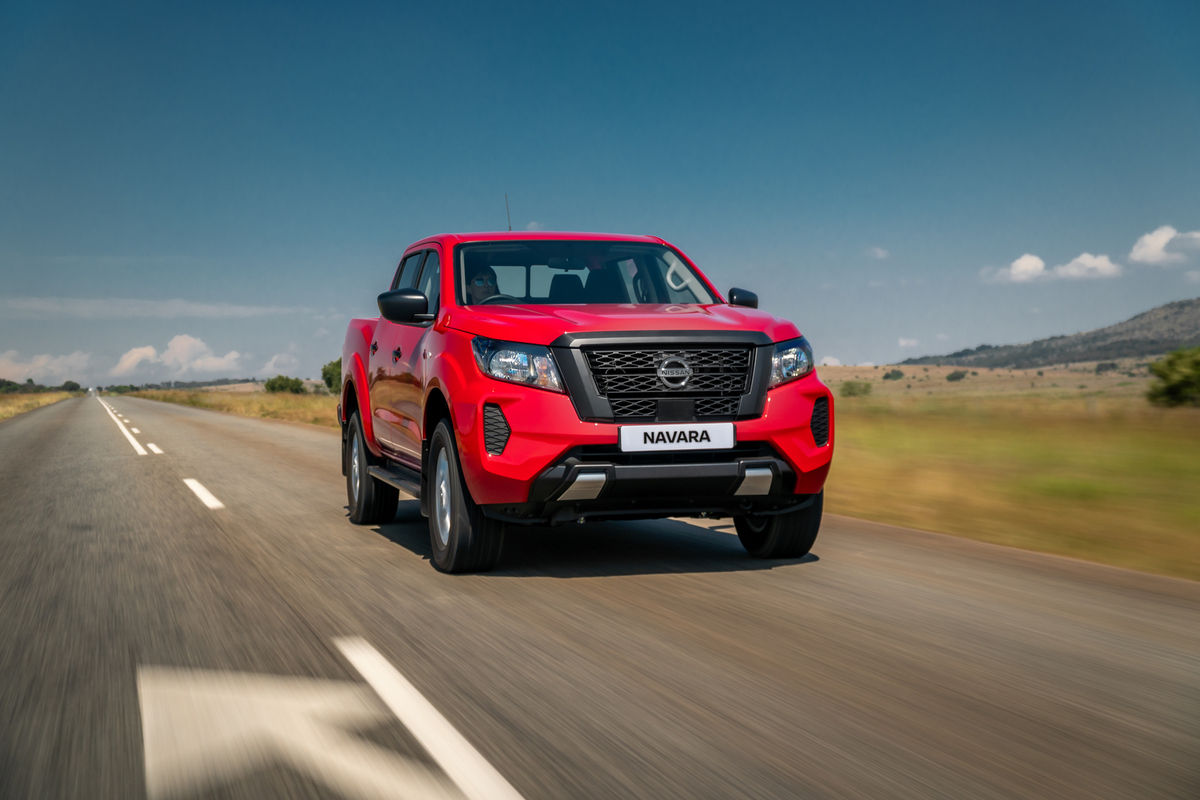
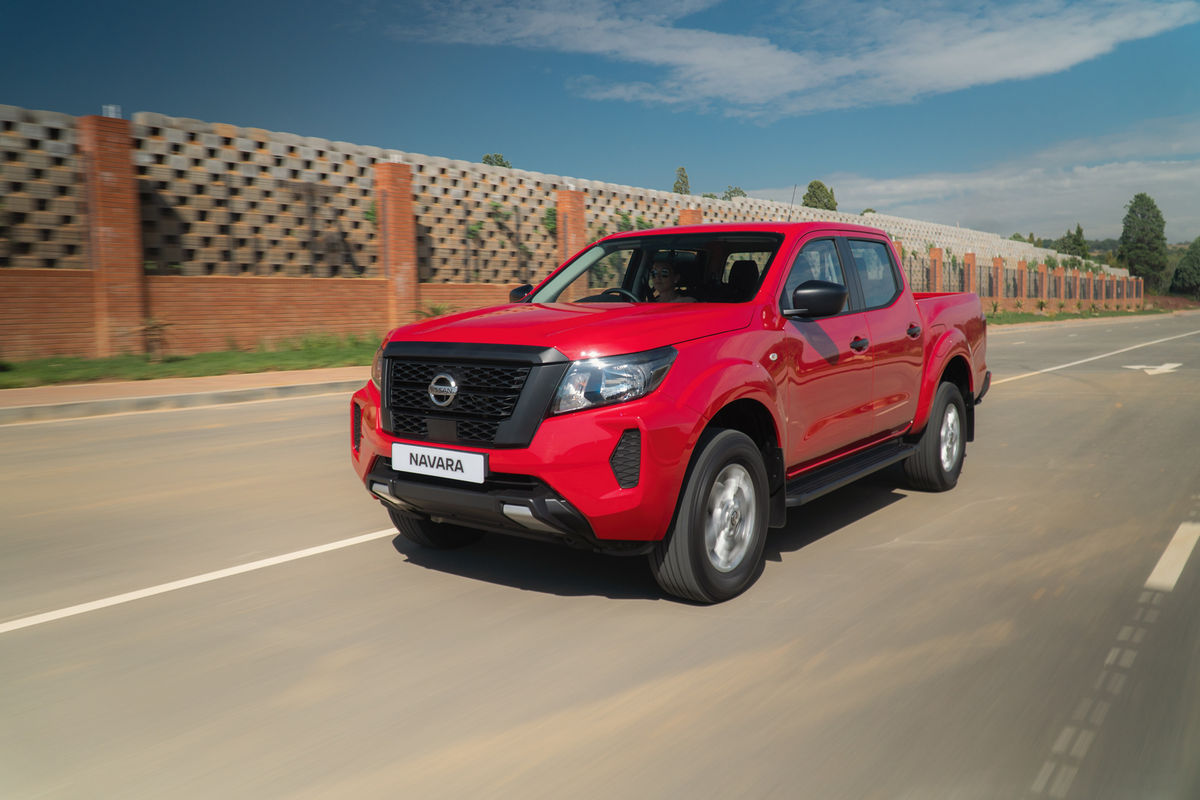
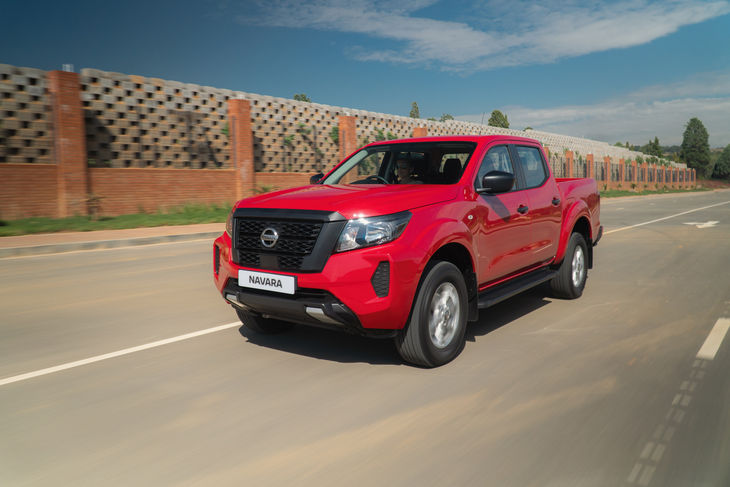
The new Navara’s revised face is bold and strong. Red isn’t its best colour, however.
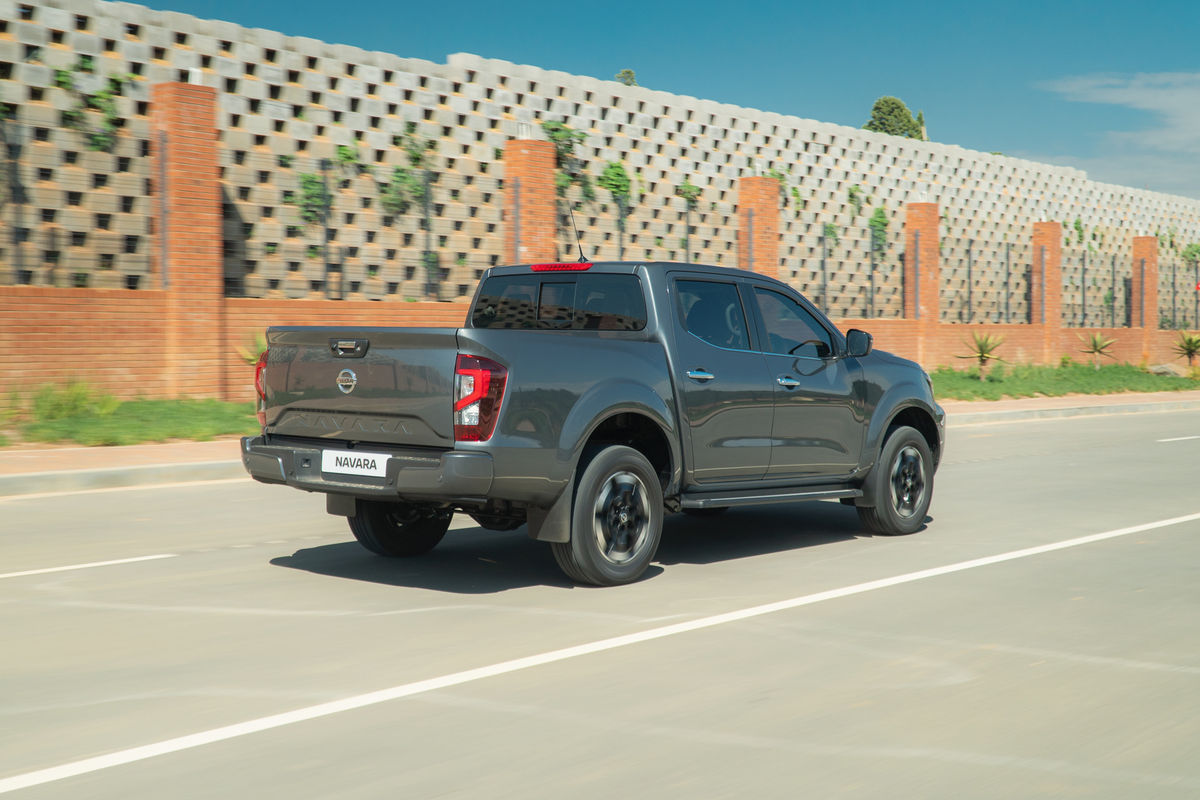
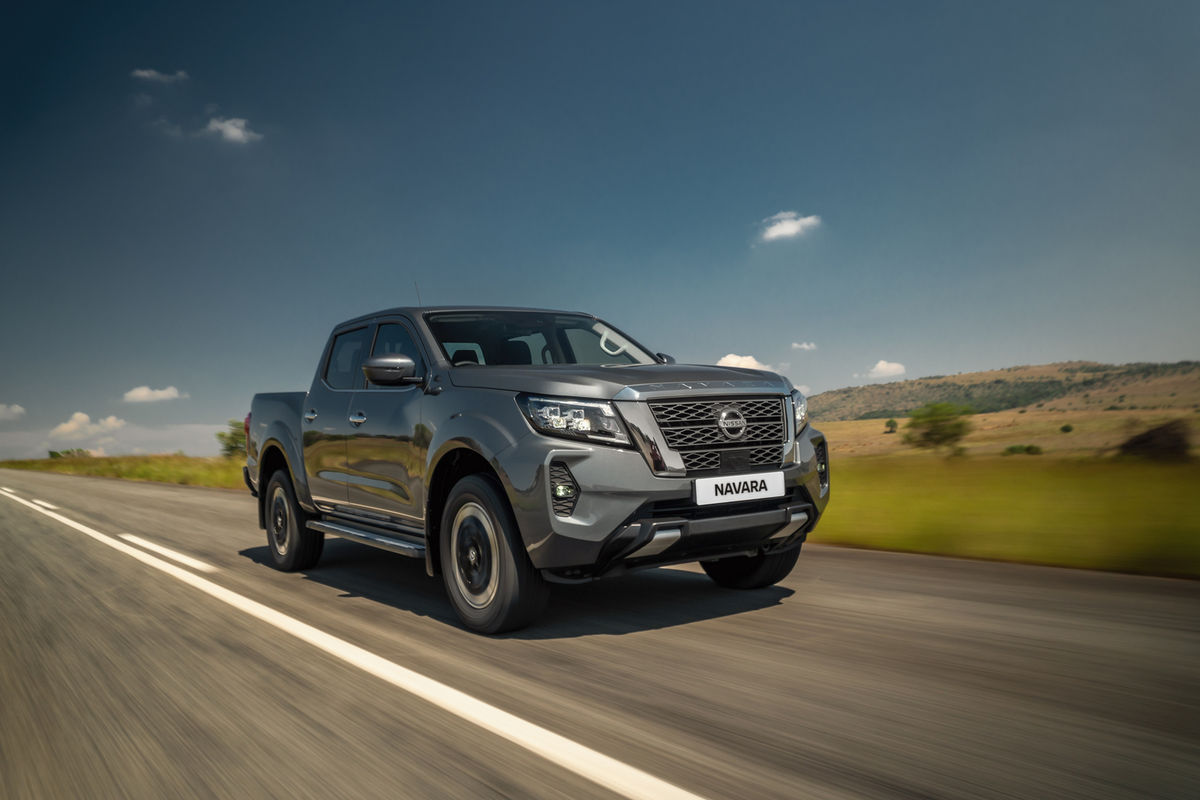
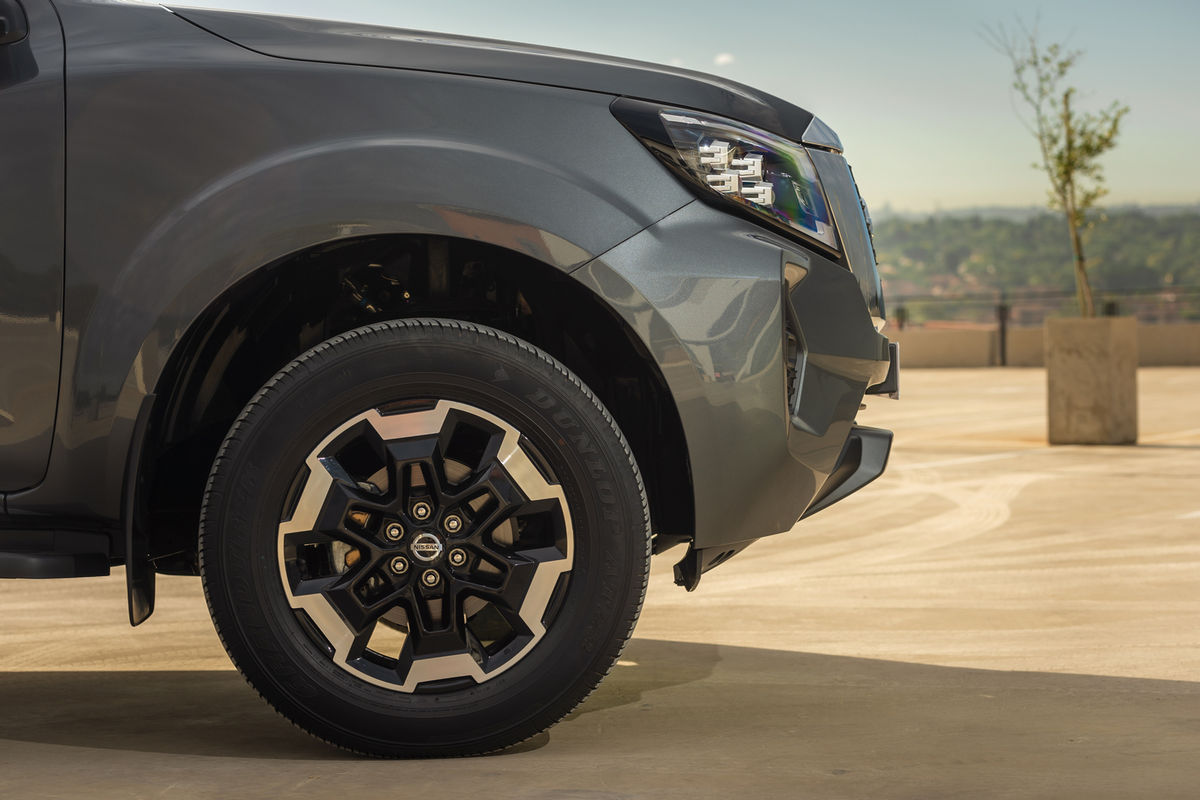
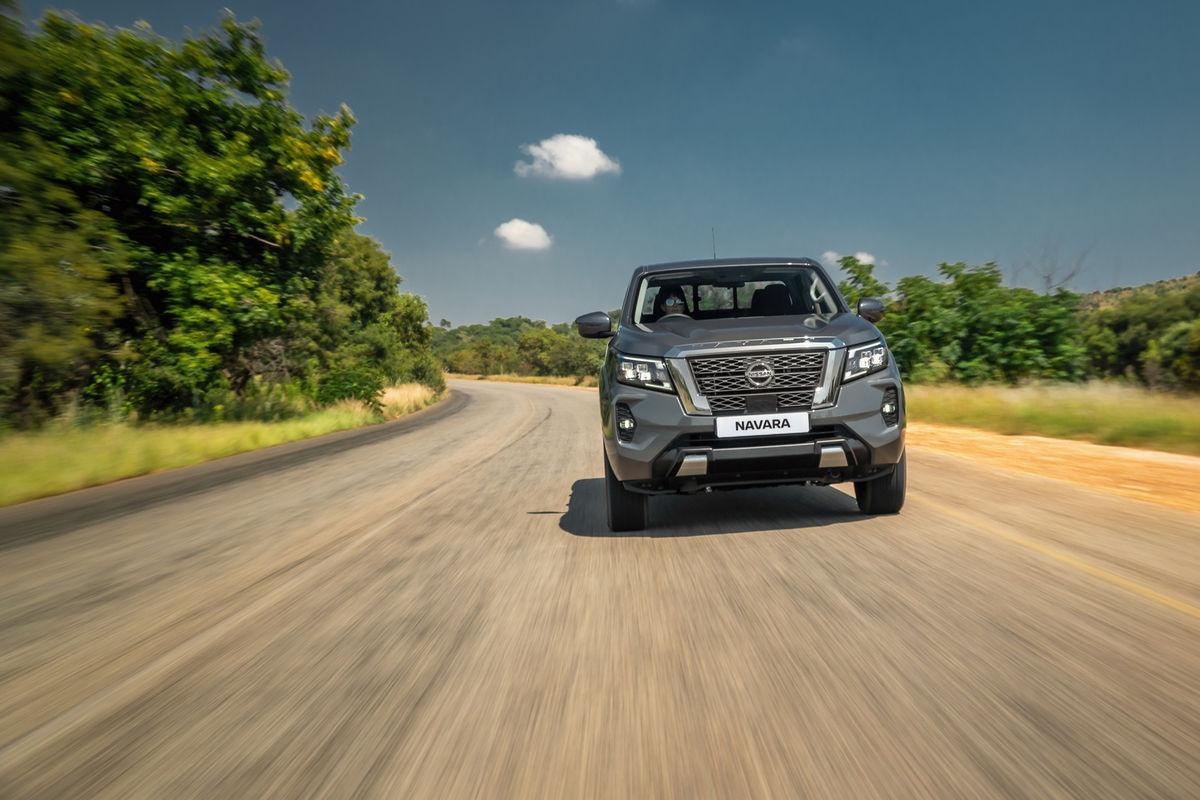
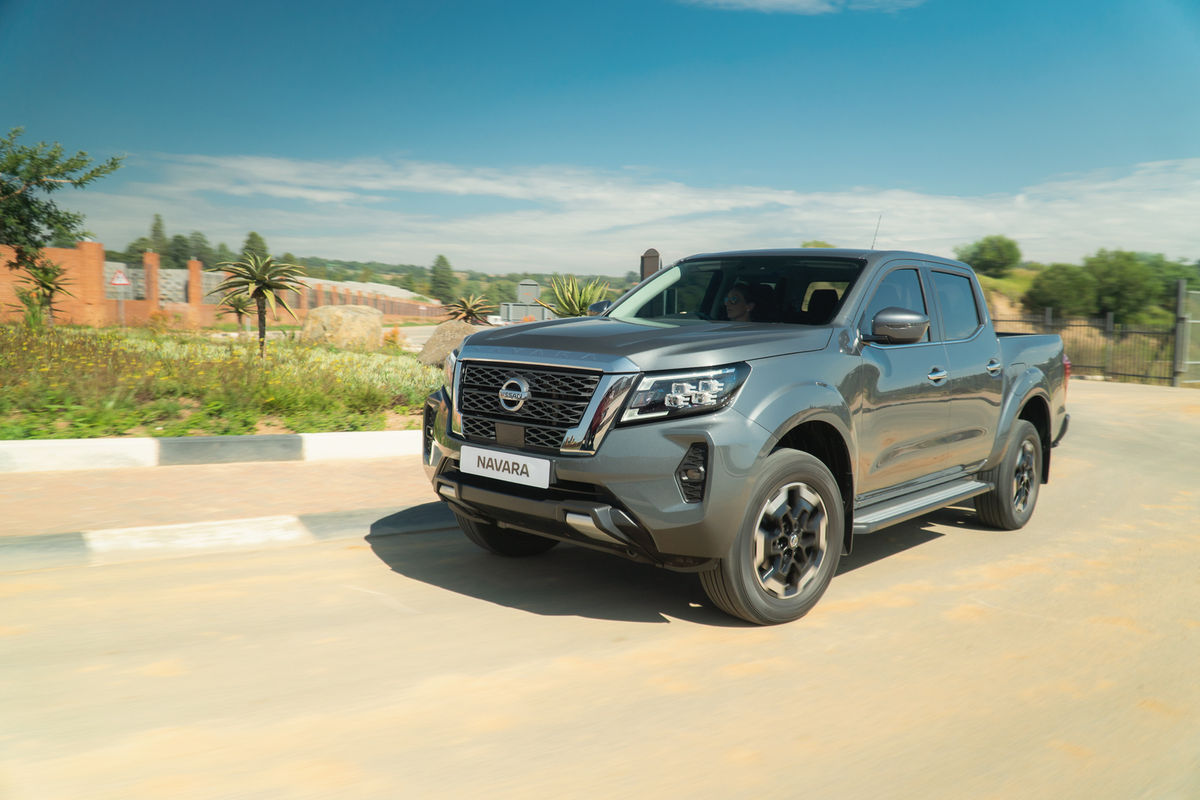
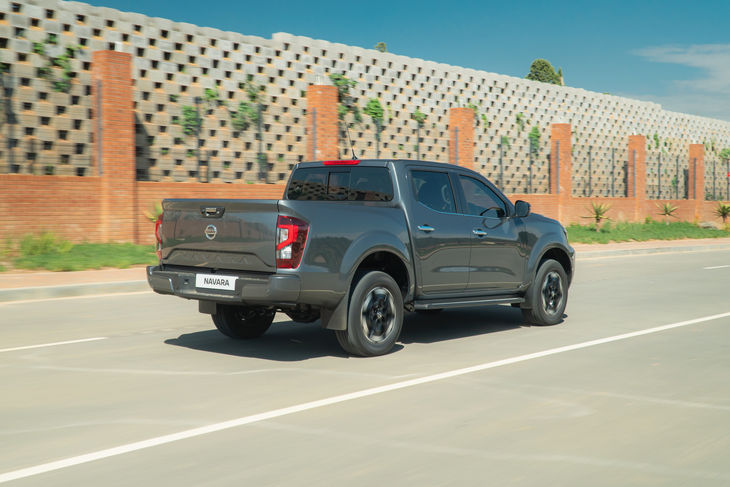
Following a substantial investment in its Rosslyn production facility, Nissan is now assembling the facelifted version of the Navara on local soil. Moreover, the bakkie has undergone extensive local testing and tuning to suit Southern African conditions. Among a plethora of updates, the Navara features a more distinctive (and bold) design – especially at the front, new tyres, suspension improvements, reduced vibration and motion from the body, a recalibrated steering, a larger capacity single-turbo engine, a deeper load tub, plus there’s more in the way of connectivity options and safety features.
New Nissan Navara engine
The new 2.5-litre turbodiesel is surprisingly quiet and seems more refined than the old 2.3-litre unit.
It seems that consumers’ appetite for stronger engines has officially spilt over from the car to the bakkie segment, where Ford, Toyota and especially Volkswagen have extracted rather lofty peak outputs from their pick-up motors. Suffice to say that if a brand wants to offer a bakkie at the high-end of the double-cab market, that model is unlikely to get much of a look in if it cannot produce 450 Nm!
To that end, the pre-facelift Navara’s 2.3-litre turbodiesel has been superseded by a new 2.5-litre single-turbo diesel unit that produces 140 kW and 450 Nm of torque in the LE and PRO (2X or 4X) spec derivatives… and the latter output is just enough for Nissan’s newcomer to stay in the hunt with the Hilux and Ranger.
Out on the road, the engine felt refined and pulled eagerly without sounding laboured at the upper end of its rev range. There was a little bit of lag at pull-away, but the Nissan’s motor certainly doesn’t lack overtaking oomph and quickly got up to freeway speeds. The 7-speed automatic transmission seems to be quite adept at selecting the right gear for the situation; it didn’t hang onto gears needlessly.
Fuel consumption for the new engine is claimed at 8.1 L/100 km, which seems entirely achievable, considering that we saw an indicated return of 9.6 L/100 km after completing the launch route.
What’s the Navara like to drive?
The updated Navara could be the best-riding bakkie on mixed road surfaces.
The Nissan’s reworked suspension (aided by other tweaks to the bakkie’s structure) has undoubtedly resulted in an improved, more forgiving ride quality. While traversing some of the Cape’s wet and pockmarked dirt roads, the Navara’s suspension soaked up the myriad bumps and dips with admirable composure. Whereas many ladder-frame-based vehicles shudder over washboard rutted sections, the Navara felt well-controlled. There is some firmness (you’ll know when you drive over hard ridges), but the ride is particularly stable on dirt. Is this the market’s best-riding bakkie on mixed road surfaces?
Meanwhile, the bakkie’s steering is particularly light and requires some familiarisation. Bakkies usually have light steering configurations (to ensure they’re easy to manoeuvre in slow, off-road situations), but the Navara’s feels even lighter – although quite direct for a bakkie. The following statement may sound ludicrous, but the Navara arguably has the most sportscar-like chassis in the bakkie market!
Once out on the freeway, the Navara was particularly quiet inside, which demonstrates that Nissan has succeeded in its goal of reducing vibration and harshness in the right areas.
Are the insides up to standard?
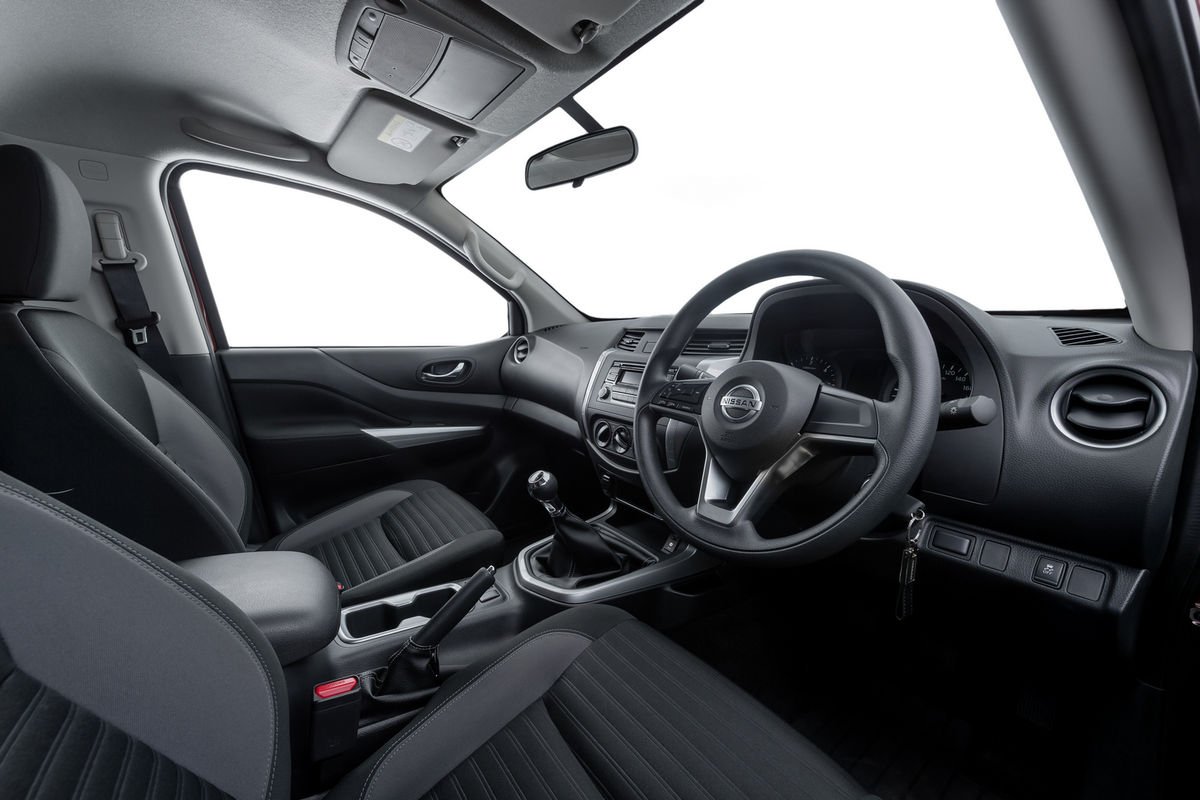
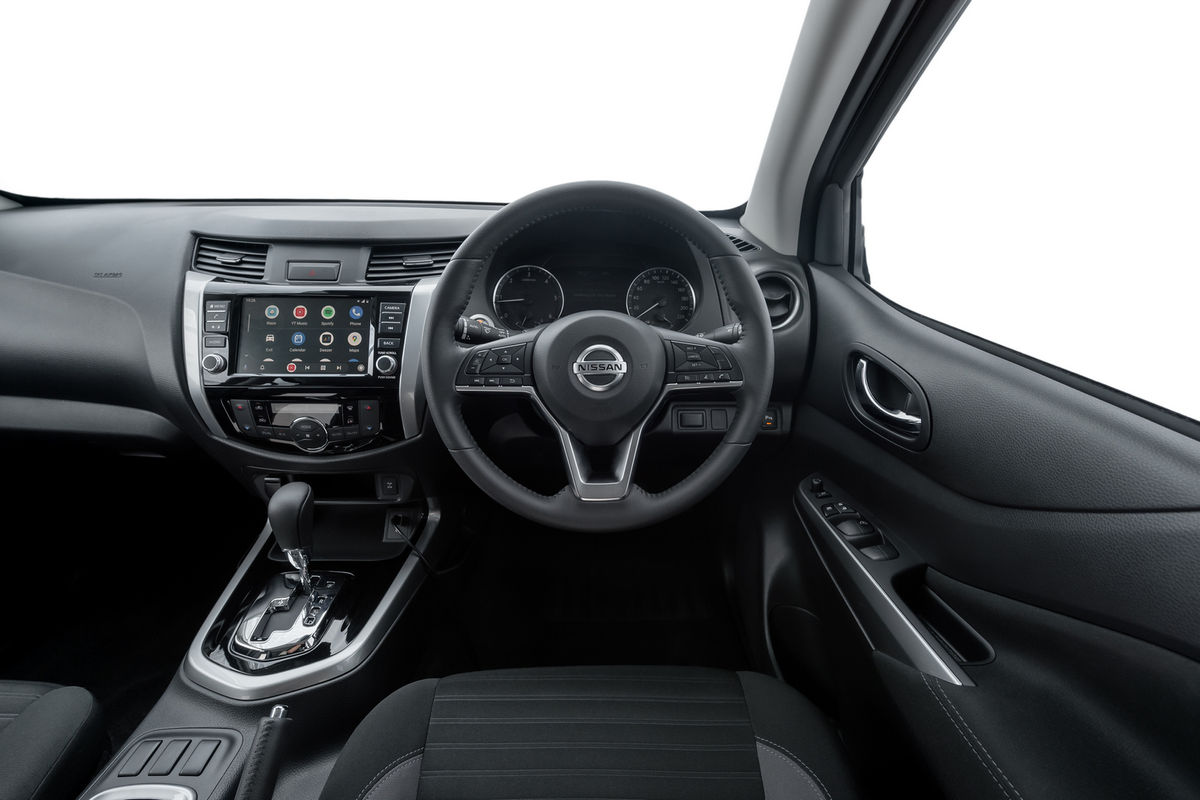
More features and connectivity are now available, but the Navara’s cabin lacks luxury soft-touch points.
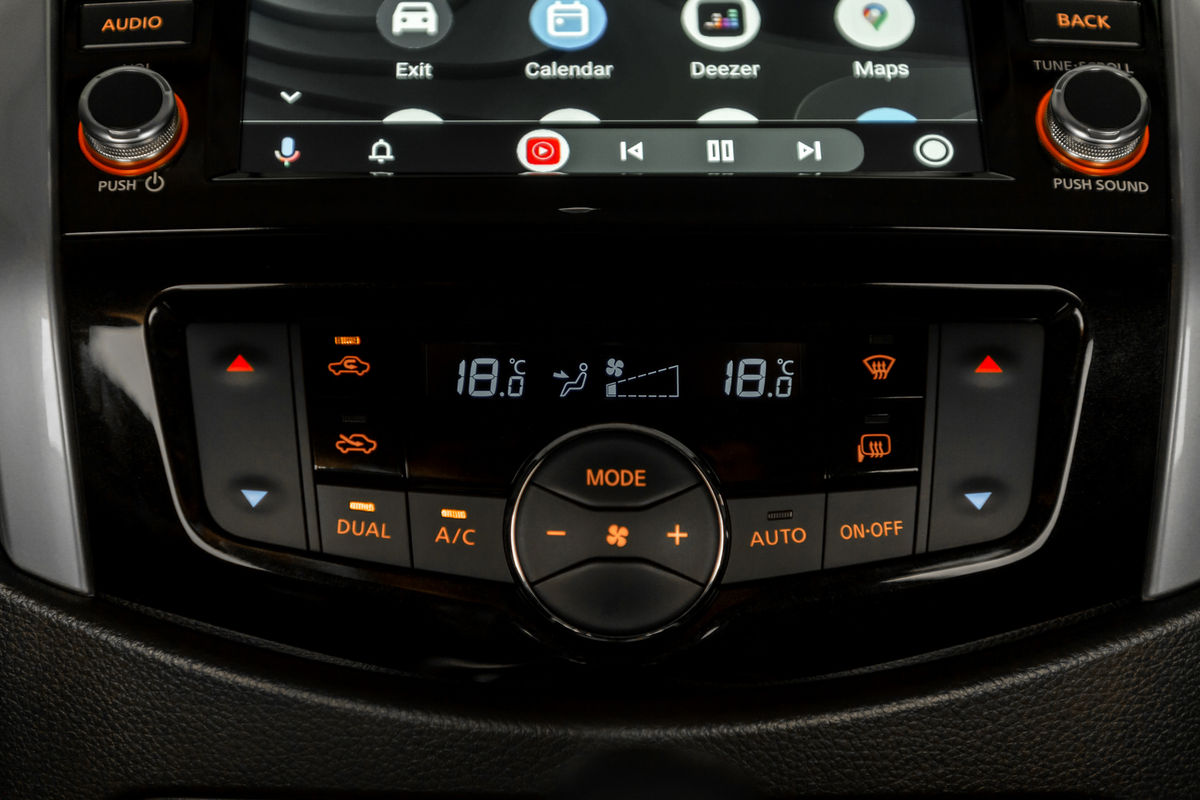
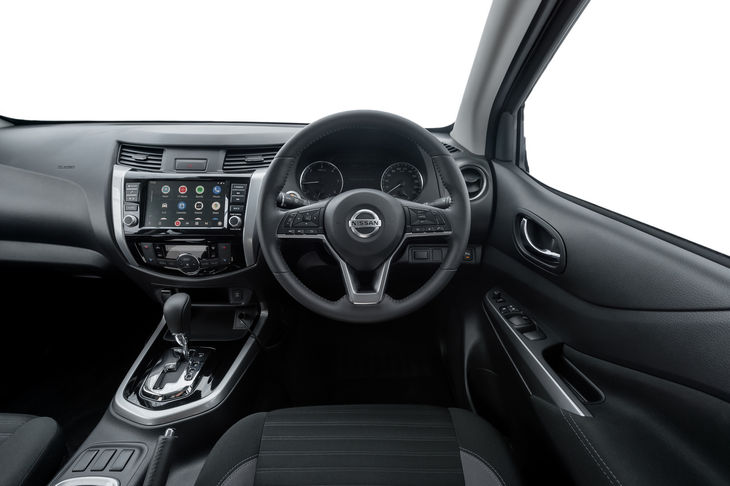
The Nissan’s interior design hasn’t had much of an update, but you do get more connectivity options in the form of 4 USB ports and a 12V power outlet. Android Auto and Apple Carplay can be accessed via a cable connection and displayed through the centre infotainment touchscreen. It’s not as fancy a screen or system as, say, in the Ranger or the updated Hilux, but it does the job.
In terms of outright luxury, the Navara doesn’t compare well with the segment leaders. The cabin is neat, but finished in a variety of plastics, none of which are soft-touch. When you compare the Nissan’s workmanlike interior with the leather-trimmed cabins of the Hilux, Ranger and GWM P-Series, it’s noticeably more utilitarian. That said, the leather seats are particularly comfortable and LE derivatives sport a leather-trimmed steering wheel and transmission shifter. It would be nice, though, to have more soft-touch materials on the dash and door panels – that would lift the level of luxury appreciably.
The top-spec LE and PRO derivatives come equipped with numerous new safety features in the forms of forward-collision alert, automatic emergency braking, high-beam assist and rear cross-traffic alert. PRO versions also feature a 360-degree camera system, navigation and rear privacy glass.
What’s more, the Navara’s load tub has increased in size and now holds a further 100 kg (up to 1 003 kg for the LE and PRO double-cab 4×4 automatic). The 4×2 automatics can hold 1 086 kg. The towing capacities equal those of the Nissan’s rivals (750 kg unbraked and 3 500 kg braked).
Nissan Navara pricing and aftersales
Nissan’s new South African-built Navara is available from R311 000 (for the entry-level single-cab derivative) up to R740 000 for the top-spec Double Cab Pro 4×4. It is sold with a 6-year/150 000 km warranty and a 6-year/90 000 km service plan. For the full list of Navara pricing click here.
Summary
The Nissan load tub can hold 100 kg, which takes the load capacity over 1-tonne.
The updated, locally-produced Nissan Navara stands out as a bakkie that rides especially well and feels stable over all road surfaces. The new engine seems punchy enough to compete with those of the competition and is frugal enough when driven fairly. The interior connectivity and safety options are certainly a step up, but the plasticky feel of the interior lets the package down slightly. If you’re looking for a bakkie that feels fancy inside then the Navara doesn’t quite meet expectations. It will, however, be great to see how it shapes up now against familiar rivals in an upcoming bakkie bonanza shootout.
VW ID.8 will be bigger than Touareg
Big SUV and huge power in the future for the German brand.
VW has confirmed that it will be building a huge battery-powered SUV.
As an expansion of its ID range, this new vehicle is expected to be the size of VW’s Atlas SUV. That means a touch more than 5m in length, making it bigger than the Touareg.
The German car company has been assertive and aggressive in its battery-vehicle strategy and this new ID.8 will be the largest vehicle to use VW’s latest electric platform.
What will power VW’s seven-seater ID.8 SUV? That is a good question. The company has an adequate motor specification, as proven by the 225 kW dual-motor configuration in its ID.6.
Where VW will be challenged, is in the realm of battery capacity. The largest ID.-series battery to date has been a 77 kWh unit which might not have enough energy to give a vehicle of the ID.8’s size usable range.
For large electric vehicles, the more appropriate battery size and energy density are in the 90-100 kWh range. Expect a bigger battery announcement from VW, in this regard, to ensure that the ID.8 has at least 400 km of range.
In conjunction with the news that VW is busy developing the ID.8, the company has also confirmed a new future platform. All the current vehicle platforms will be consolidated into a Scalable Systems Platform (SSP), that could generate the economies of scale and manufacturing simplicity, for VW to transition successfully from internal combustion to electric vehicle production.
An exciting detail of this SSP project is VW’s promised electric motor offering. It will start at 85 kW and peak at 850 kW. The future will most certainly not be slow, for followers of the VW brand.