Hardcore Bugatti Bolide Revealed

Bugatti has revealed a new, hardcore hypercar for the track. Meet the Bolide!

The Molsheim-based firm has created a new hypercar for the track, boasting a truly-impressive power-to-weight ration of just 0.67 kg per single horsepower. It must be noted that the Bolide is somewhat of an experiment at this stage as Bugatti wanted to create a lightweight hypercar based on its 8.0-litre W16 engine and is the most extreme, fastest and lightest concept car in the company’s recent history. 

Stephan Winkelmann, President of Bugatti commented, “We asked ourselves how we could realise the mighty W16 engine as a technical symbol of the brand in its purest form – with solely four wheels, engine, gearbox, steering wheel and, as the only luxury, two seats. Important aspects of our considerations were fine-tuning our iconic powertrain without any limitations as regards the weight-to-power ratio. These considerations resulted in the Bugatti Bolide. An uncompromising experiment, a thoroughbred, a Pur Sang that, in its brute exclusivity, impresses above all with high performance, low weight, and a driving experience in a whole new dimension. Driving the Bolide is like riding on a cannonball.”

The Bolide Pack Serious Heat


Is this the ultimate hypercar for the track? 

The Bolide weighs in at only 1 240 kg and is motivated by a modified version of the brand’s iconic 8.0-litre W16 engine which produces 1 177 kW on standard fuel, but power increases to 1 361 kW at 7 000 rpm when fed on 110-octane racing fuel with torque maxing out at 1 850 Nm at 2 000 rpm. Newly developed quad turbochargers also contribute these hugely impressive outputs. 

As a result, the Bolide delivers performance that’s almost comparable to a modern F1 car. Bugatti’s simulations show that the sprint from zero to 100kph will take just 2.17 seconds, zero to 200 kph in 4.36 seconds, zero to 300 kph in 7.37 seconds, zero to 400 kph in 12.08 seconds and finally, zero to 500 kph in just 20.16 seconds! 

Bugatti estimates that the Bolide would take only 3:07.1 minutes to do a lap at Le Mans’ Circuit de la Sarthe and just 5:23.1 minutes to lap the Nurburgring! 

Watch the video below to see how the Bolide manages to achieve such staggering performance figures!

Related Content 

Spy Shots: Bugatti Chiron Super Sport 300+

Bugatti Chiron Pur Sport on Track [w/video]

SSC Tuatara Claims New World Speed Record

10 Most Powerful Production Cars of the Last Decade (2010-2019)

Mercedes-Benz S-Class (2020) International Launch Review

Mercedes-Benz has been building the world's benchmark first-class sedan – the S-Class – for decades… and its superiority has hardly ever been challenged. Given the plethora of features incorporated in the W223 model, is the newcomer little more than a rolling tech showcase, or is it still the best in the business? Michael Taylor reports.

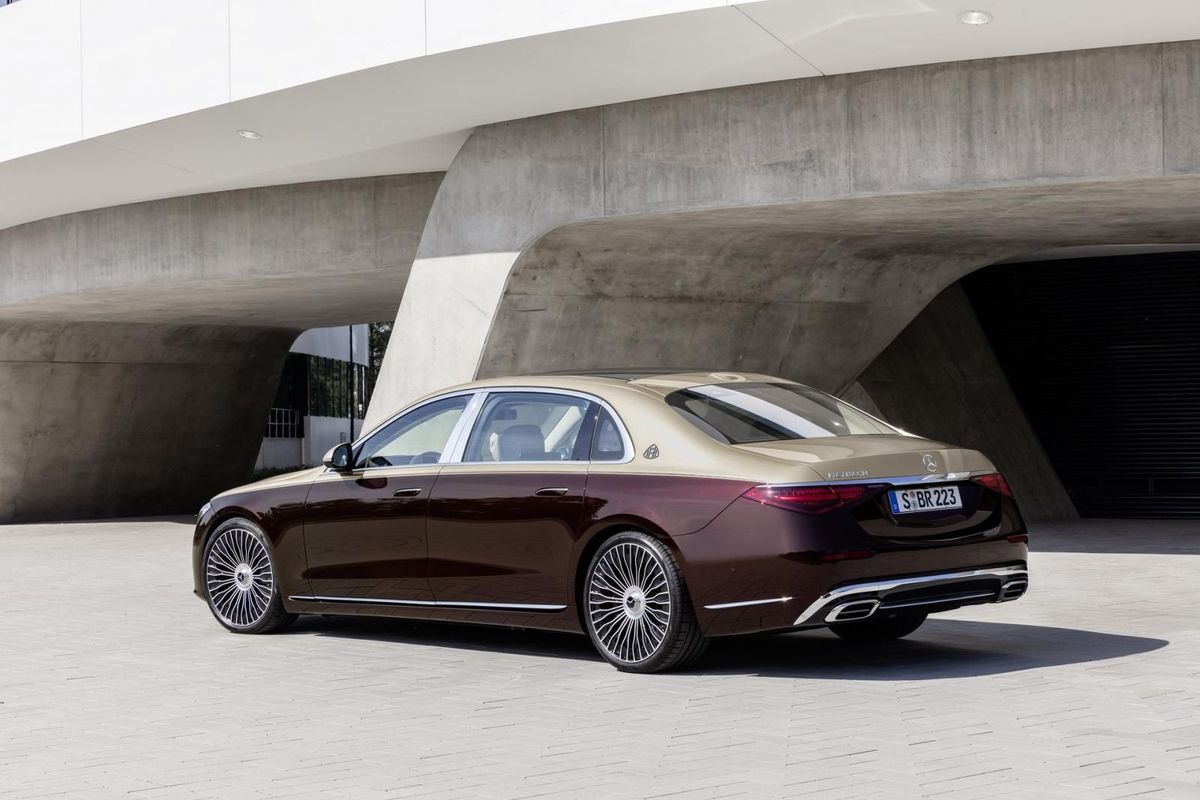
The Three-pointed Star has rarely produced a so-so S-Class; Benz aims to set new standards of automotive luxury with each new iteration of the model. Safer, more luxurious, more technologically advanced, more user-friendly, more intuitive and faster than it has ever been, the W223 is unquestionably the world's best grand saloon and its pilots will have every right to look down on Audi A8 and BMW 7 Series drivers. Here's why…


Although the S-Class seems extravagant in a time of austerity, it blends technology and comfort better than any of its peers.

Aesthetically speaking, the W223's shape represents a welcome throwback to a time when the flagship Mercedes-Benz carried a clean design that didn’t age through its flashy details. It’s an awfully big car, too, though it hides it well. It’s well beyond the 5-metre barrier, at 5 289 mm, and it’s broadened out to 1 954 mm, too. That means it’s 34mm longer, 55 mm wider and 12mm higher than the outgoing S-Class.

It would seem discussions over the front-end styling are dominated by Mercedes-Benz’s refusal to do anything as crass as putting its Three-pointed Star in the S-Class’s grille, probably because a clumsy black plastic rectangle of a radar receiver is already there.

Like with every unveiling of a new S-Class, chatter inevitably turns to the sedan's styling; the W223's lines are quite unfussy.

There will initially be five S-Class variants, ranging from the S450 and S500 petrol-powered in-line sixes to three turbodiesels, from the S350d to the S400d. The brilliant V8-engined S580 and the 100 km of pure-electric range from the plug-in hybrid S580e will join them midway through next year, although we add that the South African line-up has yet to be confirmed.

The boot capacity is a practical 550 litres (30 litres more than in the outgoing car) and you won't be surprised to learn that the interior is, well, everything Mercedes-Benz can currently manage in terms of luxury and technology…


The S-Class' adaptive air suspension has achieved new heights of dynamism, but also of bump absorption – it glides!

At the international launch in Stuttgart, we drove 4 versions of the S-Class: the S450, the S500, the S580 and the plug-in hybrid S 580e.
The entry-level derivative is hugely impressive, the mid-range S500 is usefully faster and the S580, well, is simply a divine piece of engineering. All of these are part-electrified (more commonly known as "mild hybrids"). All 3 cars feature an integrated starter generator (ISG), which uses a 48-volt electric system to harvest/regenerate energy from the braking system and help the engines with pull-away and overtaking acceleration.

In future, instrument panels will be exactly that – thin rectangular tablets perched atop the dashboard.

This allows Benz to use smaller combustion engines. The S450 – a quality machine with more technology than we can possibly hope to cover here – is powered by a 270 kW/500 Nm version of Benz’s 4.0-litre, in-line 6-cylinder engine, which is mated to the ISG at the front and a 9-speed automatic transmission in the middle. It’s also the only petrol-powered S-Class available with rear-wheel drive.

It’s quicker than it has any right to be, too, ripping from 0 to 100 kph in 5.1 sec on its way to a limited top speed of 250 kph.

The S500 is more of the same, with exactly the same powertrain, boosted to produce peak outputs of 320 kW and 520 Nm, and it slips under the 5-second barrier to record 4.9 seconds to 100 kph.


The V8-engined S580 remains the star, but the even the "entry-level" S450 delivers refined, unflustered performance.

Then there’s the big boy, complete with a 370 kW/700 Nm 4.0-litre AMG-sourced V8 and mated to a 2nd-generation ISG, worth 15 kW and 180 Nm.

There are no figures on the S580 yet (for either acceleration or fuel consumption) and the only safe bet is that the derivative is electronically limited to 250 kph, but it feels like a low four-second car from standstill to 100 kph.

The gorgeousness of the S580 isn’t power and speed, though it has clearly more than enough of both. It’s so smooth, luxuriant, indulgent and sophisticated to drive that it just feels entirely in keeping with the rest of the S-Class’s engineering.


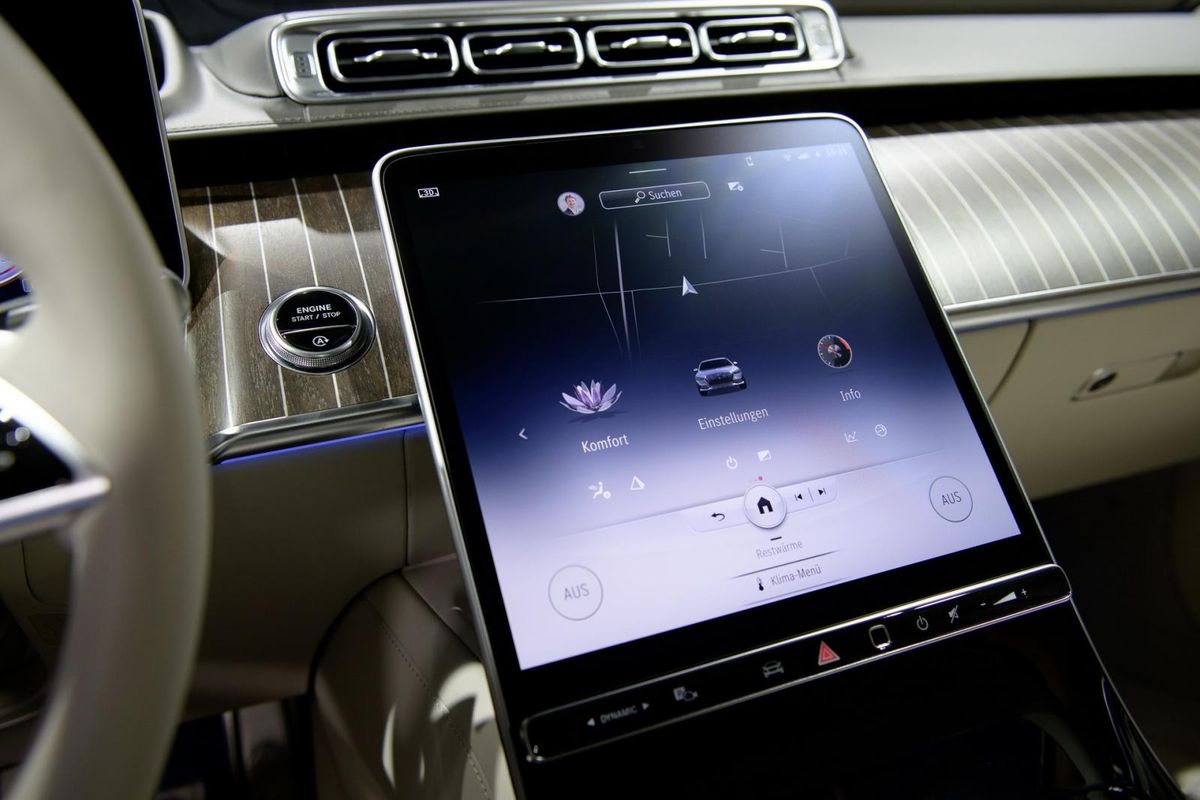
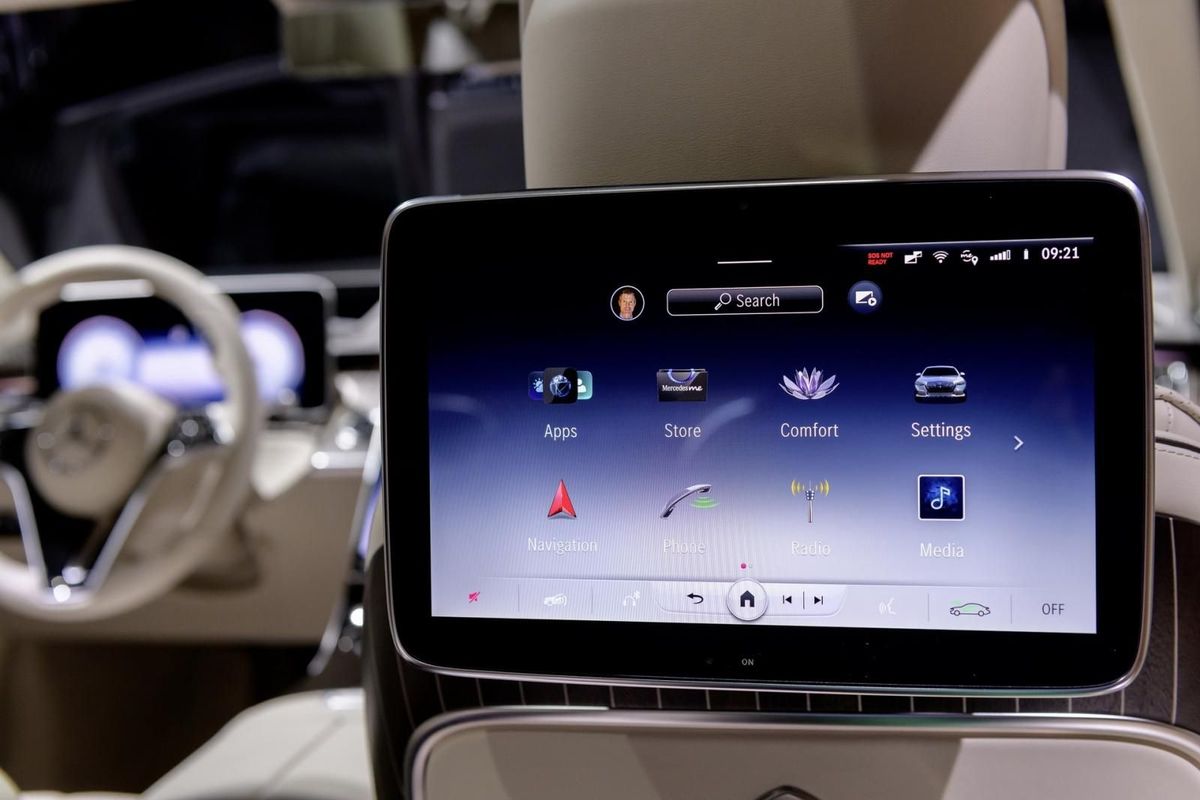
Mercedes-Benz realised that to give its infotainment screen maximum size/functionality, it had to stand proud of the fascia.

It’s an engine that begins quietly and stays that way. Although the exhaust note is beautiful when the motor is tasked with producing bursts of speed, it remains a relatively quiet one, lest it intrudes upon the ambience of the cabin…

It’s not just the engine that’s pouring on the honey, but the chassis. The adaptive air suspension system irons out basically every road imperfection up to 60 kph, then does its best to steamroll the rest. It can lean into corners – no, not exhibit body roll, slant like a motorbike – leading to cornering speeds that are downright ludicrous in a car like this, and it's all an incredibly unflustered experience.


Stitched leather, metallic switchgear and gloss black inserts create a sumptuous ambience; note the redesigned seat controls.

Then there’s the rear end, where the new rear-wheel-steering option delivers 10 degrees of turn, slashing 2 metres from the turning circle, but also adding a whole new level of agility and stability on the road.

There is nothing the S580 does poorly (other than using an oddly squishy, 2-step brake pedal arc), although the transmission can sometimes catch itself for the occasional jerking downshift when it’s being driven quickly. The mild-mannered S450 is, oddly, less convincing, and so is the S500.

Inline-6 sound less than sonorous

The straight-sixes, so wonderful in other Benzes, feel coarser and harsher here, especially in their exhaust notes (cue sniggers from BMW loyalists). To put it another way, the 6-pots delivered gingham instead of the S580’s underlying carpet of silk, though their performances are strong. The S450 is strong enough in the mid-range to make me wonder why anyone would prefer the S500 above it, to be honest.


Four-zone climate control is a must-have in an S-Class; note the ambient LED lighting around the control console.

The rest of the S-Class seems to be an exercise in integrating disparate cutting-edge technologies that could have gone horribly wrong, but didn’t.

There are at least 20 new active safety features. The rear seats can be optioned with their own front airbags. The adaptive suspension raises the body just before a collision, to take the hit on the strongest part of the chassis. Even the seat bolstering shoves passengers away from any collision.

It has two front radars with 130 degrees of “vision”, a long-range front radar, a pair of rear radars, a front-facing stereo camera, a 360-degree camera and 12 ultrasonic sensors.


A pair of radars, a slew of cameras and a dozen ultrasonic sensors ensure that the S-Class has great visibility.

What's more, by late next year there will be optional Level 3 driver assistance, where you just push a button and the car does the rest, but only up to 60 kph (as per an incoming EU rule). There is even the option of Level 4 in special situations, like in suitably updated car parks, where you can just leave the S-Class and walk away while it trots off to find and occupy a parking space on its own.

The instrument cluster has been upgraded with the option of 3-dimensional displays and augmented reality has found its way into the head-up display. And what about occupant comfort? The seats can be optioned up to carry 19 motors each, which offers ranges of longitudinal, height, angle, backrest and head restraint adjustment to seat cushion depth and even (for the front passenger) heel support adjustment.


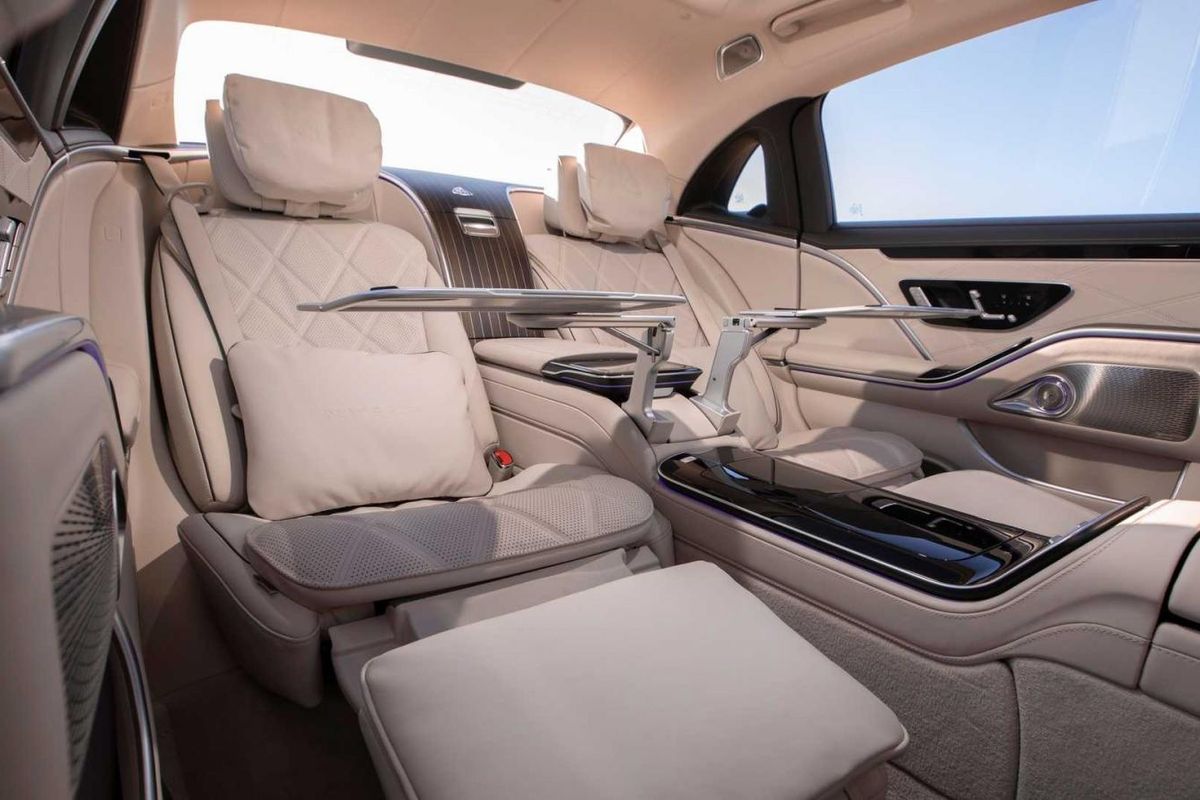
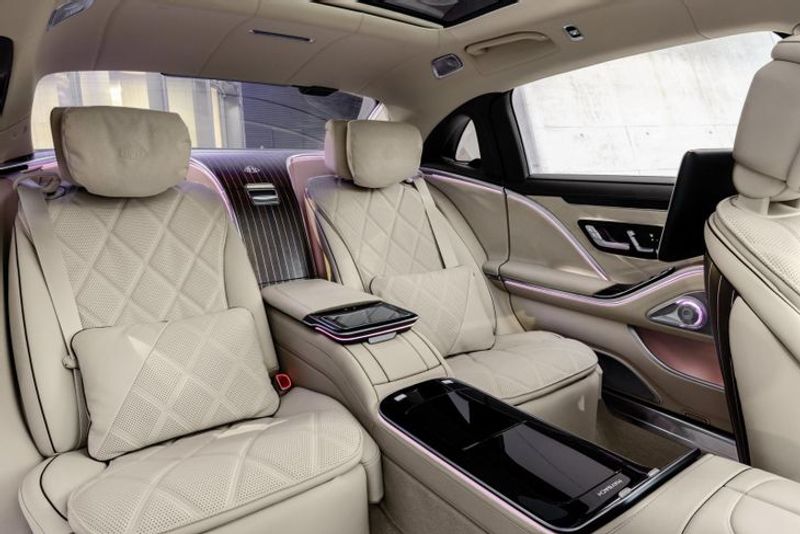
The flagship Benz model offers rear seat occupants ample legroom, but much adjustability and creature comfort too.

It takes tech from the previous range further in that there can be 4 vibration motors to massage each body in each seat, five fan motors, a motor for the lumbar support and another one for the adjustable side bolsters. It’s just absurdly comfortable and complicated without ever feeling complex.

Intuitive user interface

This all sounds awfully gimmicky, but it works – and works beautifully. The car is almost stunningly intuitive to use after 10 minutes to familiarise yourself with it, then you dive through all of the screen options in the large, new multimedia system like you’ve been doing it for years.

While all of this just works, the key to the S-Class has always been "seamless luxury"… and the new version delivers! This generation of S-Class has used all of its collective technology to charge ahead at luxury and comfort and ease-of-use. It’s a genius piece of development management.

If Benz can manage to put some smoothness back into those 6-cylinder engines, the car will be almost perfect, like the S580 already is. Expect the S-Class to arrive in South Africa in mid-2021, more details of the line-up, specification and prices will be published as they become available.

Related content:

New Mercedes-Benz S-Class Revealed

BMW 7 Series (2019) Specs & Price

Updated Lexus LS Revealed

Updated Toyota Corolla Hatch (2020) Specs & Price

Toyota has bolstered the standard specification for its Corolla hatchback in South Africa. Take a look at what’s been added and what you can expect to pay!

Toyota updated its Corolla Hatchback earlier this year which saw features such a wireless charging, Toyota’s Safety Sense system and new bi-tone colour options being offered to local buyers. Now, Toyota rolled out another update which is bound to strengthen the Corolla’s purchasing proposition.

What’s been updated? 


Toyota has introduced Apple CarPlay and Android Auto to Corolla Hatch range!

One of our criticisms of the Corolla hatchback was its limited in-car connectivity but we are happy to report that Toyota has finally brought its new-generation infotainment system into the Corolla hatch which now offers Android Auto and Apple CarPlay capability!

Toyota has also taken the opportunity to expand on its Safety Sense System offering in the range-topping Xr derivative which in addition to the pre-crash system, blind-spot monitor, lane trace assist and all-speed cruise control, the system now also includes rear-cross traffic alert. 

The Corolla Xr is also equipped with new 18-inch alloy wheels (a space saver spare wheel is fitted) while the Corolla Xs derivative retains its 16-inch alloy wheels but a full-size spare wheel is fitted.   

From a stylistic point of view, Toyota has once again added further colour options including monotone options such as Graphite Grey and Caribbean Blue while a new Fierce Red replaces the previous Scarlet metallic colour choice. Buyers also have the choice of 4 bi-tone colour options including Satin Silver, Fierce Red, Caribbean Blue and newly added Platinum White Pearl – all combined with a black-metallic roof. 

Key standard features for the Corolla Xs derivative includes LED headlights with LED daytime running lights, dual-zone climate control air conditioning, keyless access, cruise control, electronic and heated exterior mirrors, a reverse camera, one-touch electric windows and speed-sensitive door locking. 

The Corolla Xr builds on the above standard specification by adding the aforementioned Safety Sense System as well as nice-to-have features such as leather/Alcantara combination upholstery, electronic lumbar support and heated front seats. 

A total of 7 airbags are standard, as well as ABS with EBD, brake assist, electronic stability control. An electronic parking brake with hill-assist is also standard. 

As for performance, the Corolla hatchback is powered by the familiar 1.2-litre turbopetrol engine with 85 kW and 185 Nm of torque on offer and can be had with either a 6-speed manual or CVT.  

Toyota Corolla Hatch – Price in South Africa 

Corolla 1.2T Xs – R369 100

Corolla 1.2T Xs Bi-Tone – R379 800

Corolla 1.2T Xs CVT – R380 600

Corolla 1.2T Xs CVT Bi-Tone – R391,300

Corolla 1.2T XR CVT – R425 200

Corolla 1.2T XR CVT Bi-Tone – R435 900

The Corolla hatchback is sold with a 3-year/100 000 km warranty and a 6-services/90 000km service plan. 

Buy a Toyota Corolla on Cars.co.za

Related Content 

Toyota Corolla Hatch 1.2T XS (2019) Review

Toyota GR Corolla to use GR Yaris Engine

Toyota Corolla Hatch Heritage Part 1

Toyota Corolla Hatch Heritage Part 2

All-New Isuzu MU-X Revealed

Isuzu has revealed its all-new MU-X. See what's new for the 2021 model.

Isuzu says this is an all-new model, no facelifts or updates here, with substantial changes visually and under the skin. Mechanically, the new-generation MU-X is assembled on the same platform as the all-new 3rd-generation D-Max bakkie

Isuzu has given the all-new MU-X a bold look that differentiates it from the bakkie sibling. While the front looks fresh, the real radical changes can be found at the rear with new taillights and bumpers. The cabin has been substantially overhauled and resembles the all-new D-Max. It looks premium and the current shape's ventilation dials have been replaced by switched.

There are small detail upgrades like a new multi-information display on the instrument cluster with nicer graphics, as well as trim updates to the gear selector and steering wheel. Importantly, it appears safety has been given a big update in the form of lane departure warning, adaptive cruise control, automatic emergency braking, rear-cross traffic alert, blind-spot monitoring, and multi-collision braking. There are also six airbags, stability control, hill-start assist, traction control, and hill descent control.

In terms of engines, there are 2 being offered. The 1.9-litre engine that never made it to our market will kick off the range with 110 kW and 350 Nm. There's a choice of a 6-speed manual or a 6-speed automatic. The other option is the latest iteration of the 3.0-litre motor which makes 140 kW and 450 Nm, and it's available with a 6-speed auto as well as 4-wheel drive. 

The local MU-X was given a light facelift in 2020 to improve its appearance and specification levels. Having just announced this new version, buyers may likely hold out on their purchase until this model's launch, depending on how long away that is. We have contacted Isuzu SA for comment and will update this article. 

In terms of rivals, the Toyota Fortuner, Ford Everest, Haval H9 and Mitsubishi Pajero Sport are in the crosshairs. We'll have more info on local availability soon.

Further Reading

Isuzu MU-X (2020) Review

Local Isuzu D-Max postponed until 2022

Isuzu D-Max (2021) International Launch Review

New boss for Isuzu SA

New BT-50 to arrive in SA before D-Max

Haval H2 (2020) Review

We attended the local launch of the updated Haval H2 a while ago, but due to the impact of the Covid-19 pandemic, we've only recently had a chance to spend quality time with the Chinese compact family car. The H2 has always been a high-value offering and a credible alternative to mainstream models, but has it kept up with the times? 

We like: Excellent value for money, good build quality, generous spec.

We don’t like: Quirky throttle and transmission mapping, thirstier than some of its rivals.

Fast Facts: 

  • Model Tested: 1.5T Luxury Auto
  • Price: R349 900 (October 2020)
  • Engine: 1.5-litre turbocharged 4-cylinder petrol
  • Power/Torque: 105 kW/202 Nm 
  • Transmission: 6-speed automatic
  • Fuel consumption: 9.0 L/100 km (claimed) 
  • Load capacity: N/A

What is it?


South Africa is Haval's largest market outside of China.

Haval is well-positioned in Mzansi. Its products have been well-received globally, but South Africa is the Chinese brand's biggest market beyond its homeland! Haval, with its diverse range of SUVs to suit most needs and budgets, is a brand to keep an eye on. Since its launch in 2017, the H2's been Haval's best-selling model; more than 7 000 units have found homes in South Africa. In January 2020, Haval released an updated version.

The changes are extensive, both inside and out. Mechanically, the powertrain has been carried over, but the exterior benefits from some visual updates, while the standard-features list has grown even longer. Given the sheer number of choices in this ultra-competitive segment of the new-vehicle market, the refreshed Haval H2 has got its work cut out. Is it good enough to steal more sales away from the established offerings?

How it performs in terms of…

Features and interior execution


The Haval's level of specification is unbelievable. What car in this segment has tyre pressure sensors?

The test unit that was supplied for this review had the Luxury trim line, which adds premium features such as auto lights and -wipers, panoramic sunroof, LED headlights, climate control, plus a faux leather interior to the already comprehensive City spec. Making its debut in the updated Haval H2 is an Apple CarPlay-compatible touchscreen infotainment system. Android Auto, however, is absent due to Google's lack of presence in China.

Given this extensive list of standard equipment, we had to double-check the 1.5T Luxury Auto's keen list price again (R349 900, in October 2020). There's no skimping on safety features either: the Haval H2 comes with 6 airbags as standard, plus ABS with EBD, brake assist and electronic stability control. Every derivative is equipped with rear park distance control, a reverse-view camera, as well as a tyre-pressure monitoring system.


The rear legroom in the H2 is more than adequate for adults.

In terms of interior execution, it's hard to fault the perceived build quality and attention to detail in the H2's cabin. Who could justifiably accuse this Haval product of being cheap and nasty? The levels of fit and finish are excellent at this price point. When it comes to practicality, the rear seats can be folded down in a 60/40 split, while the load bay is on par with rivals in the segment. We suspect Haval sacrificed a smidgeon of the H2's luggage space to the benefit of rear legroom, which is positively generous compared with that offered by most (notably smaller) compact family cars.

Performance


The 6-speed automatic can hesitate, but you'll learn to work with its quirks.

All the derivatives in the Haval H2 range are powered by a 1.5-litre turbocharged 4-cylinder petrol engine that produces 105 kW and 202 Nm. Those outputs sound quite sufficient to translate into satisfactory performance. However, if there's one glaring weakness in the Chinese model's overall package, it's the calibration of the engine's characteristics and the 6-speed transmission, or, more to the point, the lack thereof. The gearbox is not the most responsive, so if you want to execute a swift overtaking procedure, you'll need to start earlier to give the gearbox time to kick down.

You can switch the transmission into a manual mode and shift cogs yourself (if you're in a hurry), but the Haval's throttle mapping (or, to put it another way, the manner in which the H2 responds to inputs to its accelerator pedal) requires familiarisation. The long pedal can feel too sensitive or difficult to modulate. We found that by toggling the drive modes, things became smoother and progressive. It's a niggle, not a terminal fault.

Meanwhile, we have to point out that Haval claims a fuel economy figure of 9 L/100 km, but we could only muster 9.5 L/100 km. With other offerings in the segment said to return average fuel consumption of well under 9 L/100 km, the efficiency of the 1.5T Luxury Auto is a trifle underwhelming.

Ride and handling


The Haval H2 rides on 18-inch alloy wheels.

Our initial thoughts from the launch suggested the H2's ride quality was good, but the road quality of the launch test route was near-perfect. With a longer test period and a wide spectrum of road surfaces at our disposal, we embarked on multiple trips in attempts to find a weak spot in the ride quality. But no, the H2 rides on 18-inch alloys wrapped in thick 235/55 rubber and they do a great job of soaking up the tarmac's imperfections.

Better yet, thanks to the H2's 180-mm ground clearance, we felt confident to head off the tar and onto a variety of gravel surfaces. While the 1.5T Luxury Auto isn't all-wheel driven, it does have hill-descent control; it feels reasonably planted on gravel with sufficient road-holding to instil driver confidence on less-than-ideal routes. There's a generally good steering feel and, from the driver's seat, it feels like you're piloting a bigger SUV. 

Price and after-sales service

The updated Haval H2 range starts at R289 900 for the entry-level derivative, with this flagship offering coming in at R349 900. The vehicle is sold with a 5-year/100 000km warranty, a 5-year/60 000 km service plan, and with 5-year/unlimited km roadside assistance.

Browse for a new or used Haval on Cars.co.za

Verdict


It may have some powertrain quirks, but at this price point, it's very difficult to ignore this value-for-money offering.

Haval's stellar rise outside of its domestic market cannot be ignored. The updated H2 offers commendable build quality, spaciousness and standard specification, which its rivals struggle to match at the price. Haval's rapid growth and progress over the past few years have been remarkable and we expect future product offerings to be even more polished. Bear in mind that Haval's parent company, GWM, has recruited top engineers and designers from around the globe to create a host of global products. Former JLR design boss Phil Simmons, for example, is Haval's design director.

Given how competitive the small crossover/compact family car segment has become, the 1.5T Luxury auto is a reminder of how keen pricing is a major drawcard, especially in a struggling new-vehicle market. Granted, we're not enthralled with the H2 powertrain's relative lack of refinement, but the resolved overall package more than makes up for it. So before you plump for established brands, take a moment to check out Haval's offering.

Related content:

Haval H2 (2020) Launch Review

Haval H2 1.5T Luxury Auto (2017) Review [with Video]

5 Cheapest Automatic Compact SUVs in SA

We recently reviewed the EcoSport on a road trip up the West Coast, check it out! 

Hyundai Venue (2019) Launch Review

Subaru Forester Finally Gains Turbo Motor

The popular Subaru Forester has finally gained a turbocharged motor. Some details on the new powertrain.

The Subaru Forester is a popular and capable SUV that has one glaring fault; the lack of a punchy and torque-rich motor. Previous generations of Forester have wowed with their turbocharged flat-4 motors and become cult icons. Sadly, the latest version lacked any form of forced induction and made do with so-so naturally-aspirated motors. 

The current generation of powertrain isn't fatal, but there was just a lack of thrust that Subaru owners have grown accustomed to over the years. Good news as Subaru has a new motor for its Forester. It's technical name is the CB18 and its a turbocharged 1.8-litre with 130 kW and importantly, 300 Nm. Power goes to all 4 wheels via a CVT 'box. In comparison, the current engine offered to South African Subaru customers is a 2.0-litre naturally-aspirated motor which serves up 115 kW and 196 Nm, so this new engine is quite a step up. 

The bad news is that this new blown motor is for the Japanese market only for now. There's some good news for SA Subaru fans as the brand plans to bring in the uprated 2.5-litre Boxer motor in 2021. Outputs are 136 kW and 239 Nm, which addresses the power deficit concerns. 

Further Reading

Subaru Forester 2.5 XS (2018) Quick Review

Subaru Forester 2.0 XT (2017) Video Review

Subaru Forester 2.0 XT (2016) Review

Subaru Forester 2.0i-S ES (2019) Review

Fiat updates Tipo, adds Cross variant

Fiat has refreshed its budget-buyer-oriented compact car – the Tipo – with an aesthetic update, improved tech and a new turbopetrol motor. The Italian marque has also added an SUV-inspired crossover variant to the line-up…

The understated, but value-packed, Tipo arrived in South Africa in 2017 (in hatchback and sedan guises) as a rival to the Ford Figo, Honda Amaze, Suzuki Baleno & Ciaz, (recently discontinued) Toyota Etios and Volkswagen Polo Vivo/Polo Sedan. Although it hasn’t been particularly popular in the local market, as many as 670 000 units of the Tipo have been sold worldwide, with more than 70% of its sales volumes in markets outside Italy.


In Lounge trim, the Tipo looks particularly striking, replete with its new "corporate" badging. 

Although the Tipo's cosmetic upgrades are subtle, it's notably the first ICE-powered Fiat model to wear the Torinese-based brand's new wordmark logo (after the recently unveiled New 500). Other revisions include a redesigned grille, LED head- and taillights, as well as refreshed bumpers.

The interior, meanwhile, features updated trim, black and chrome inserts, as well as a new multifunction steering wheel, a "fully configurable" 7-inch digital instrument cluster, which replaces the analogue instrument panel (at least in top-of-the-range derivatives, we'd guess) as well a 10.25-inch UConnect 5 infotainment system, which, judging on the press images, incorporates contemporary smartphone screen-mirroring technology.


Fiat has also installed new heating, aircon and ventilation controls. Note the smatterings of new, chrome-look inserts.

In terms of powertrains, the naturally aspirated 1.4-litre 4-cylinder petrol engine (70 kW/127 Nm) makes way for a 1.0-litre 3-cylinder turbopetrol engine that produces 74 kW and a feistier 190 Nm of peak torque; it's also said to be more fuel-efficient than its naturally-aspirated predecessor. A 96-kW 1.6-litre Multijet turbodiesel engine is offered overseas, although the 70-kW 1.3-litre Multijet is likely to continue on the local market.

The Tipo Cross variant is ostensibly a rival to the Ford Figo Freestyle and Hyundai i20 Active. It is distinguished by back cladding around the wheel arches, as well as a protruding integrated satin-chrome nudge bar in the beefy bumper, matched with similarly finished mirror caps and side skirts.

Fiat showed off the Tipo Cross decked out in a luminous orange paint finish; it is shod with handsome 5-spoke 17-inch alloys wrapped in suitably-practical 215/55 R17 tyres. With its standard roof rails, the newcomer stands almost 7cm taller than standard Tipo derivatives, Fiat says.

We expect that the Italian marque's local subsidiary will phase in the new-look Tipo derivatives at some point next year.

Related content:

New Fiat Tipo Specs & Prices in South Africa

Fiat Tipo Sedan 1.6 Easy auto (2017) Review

Ford Figo Freestyle (2020) Review

Renault Sandero Stepway Techroad in SA

New Logo, EVs Coming from Kia

Kia is preparing to launch its ‘Plan S’ which will see a new Electric Vehicle (EV) product line come to fruition as of 2021, as well as an all-new logo.

Kia is embracing an electric future and earlier this year, Kia announced its 'Plan S', a mid- to long-term strategy that would see at least 11 new Electric Vehicles (EVs) come to market by 2025 with the brand investing $25-billion in an effort to become a leader in the electric vehicle market. Kia President and CEO, Ho Sung Song, announced Kia’s future EV product strategy during an event at the brand’s Hwasung plant in Korea.

Kia also recently teased 7 new BEVs which are due to come to market by 2027 and BEVs are expected to account for 20% of Kia’s sales in markets such as Korea, North America and Europe. 

“Kia has sold more than 100,000 BEVs worldwide since the introduction of our first mass-produced BEV in 2011, the Kia Ray EV, " said CEO Song. "Since then, we have started to introduce a range of new BEVs for global markets and announced plans to accelerate this process in the years ahead. By refocusing our business on electrification, we are aiming for BEVs to account for 25 percent of our total worldwide sales by 2029.”


At least 7 new BEVs are on the cards from Kia.

The first BEV to come from this strategy is code-named CV, an electric crossover built on the brand’s new scalable E-GMP platform which is a dedicated electric car platform. The CV will be revealed in 2021 and will also introduce Kia’s new design direction as the brand transitions to an EV-focused business strategy. 

Interestingly, the CV is expected to offer mega performance, comparable to the Porsche Taycan and may achieve a zero to 100 kph sprint in under 3 seconds, which if achieved, would be a major achievement for the brand. 

To realise its goal of becoming a global EV leader, Kia is taking a holistic approach to electrification by innovating in areas such as EV sales, EV battery leasing/rental programs while also looking to expand its global EV service infrastructure and providing the necessary training to meet the growth in the sector.

Much of the initial growth is expected to take place in Korea at first but Kia will supply about 1 500 EV chargers in Korea and will also establish more than 2 400 EV chargers in Europe and about 500 in North America. 

From a brand identity perspective as part of the brand's transition into the electric realm, Kia will launch a new logo early in 2021 which was first seen on the Imagine Concept in 2019 (pictured above) and is likely to first appear on the production version of the CV electric crossover. 

Buy a Kia on Cars.co.za

Related Content

Kia’s Supercar-Slaying EV Coming in 2021

Kia Issues Safety Recall for Sorento/Sedona in SA

Kia Sonet Officially Revealed

Kia reveals 4th-gen Grand Sedona

Brabus AMG GT 63 S Rocket 900 is a Monster

Brabus has created a monster. Meet the AMG GT 63 S Rocket 900!

High-performance German tuner, Brabus, has taken a Mercedes-AMG GT 63 S, which in standard form is already a mighty supercar, and created a monster. 

From the outside, Brabus has made sure to beef up the look with a steel quad exhaust system while also fitting a wider body kit sporting numerous carbon fibre elements and riding on 21-inch front forged alloys up front and 22-inch wheels at the rear. A Brabus air suspension is also fitted with both Comfort and Sport modes on offer depending on your preference. The interior has also received a mild upgrade featuring black leather or Alcantara with contrasting stitching and carbon-fibre finishes setting the interior tone. 

The big upgrade, however, has taken place under the bonnet where the standard displacement of the 4.0-litre V8 has been increased to 4.5-litres and Brabus has also fitted a pair of custom turbochargers with a larger compressor and higher boost levels. A carbon ram-air intake has also been fitted on either side of the radiator grille to ensure adequate cooling takes place. 

It’s worth being reminded that the standard AMG GT 63 S offers up 470 kW and 900 Nm but as you can well imagine, the above modifications have led to a significant increase in outputs, with this Rocket 900 delivering a mammoth 662 kW and 1 250 Nm of torque which is a notable increase of 192 kW and 150 Nm over the standard model. However, torque has been capped with an electronic limiter to protect the drivetrain.  

So, is all the effort and money for this upgrade worth it? Well, the performance figures speak for themselves. 

Zero to 100 kph in 2.8 secs. Zero to 200 kph in 9.7 secs. Zero to 300 kph in 23.9 seconds. Top speed has been capped at 330 kph. 

Brabus will only be making 10 of these Mercedes-AMG GT 63 S Rocket 900 examples with a price tag of approximately R8.4-million. 

Do you like this car? 

Buy a Mercedes-AMG GT on Cars.co.za

Related Content

Mercedes-AMG GT Black Series Guns Nurburgring Record? 

Spy Shots: 2021 Mercedes-AMG GT73e

Spy Shots: New Mercedes-AMG C63 

Mercedes-AMG Project One on track

The Dreamer – A Fashion Film in Partnership with Mercedes-Benz and Klipa Denim

Kia Rio X – The hatchback that wants to go off-road

Kia is expanding its gravel travel hatchback range, with a new Rio derivative.

Reacting to customer preference and stable demand for conventional hatchbacks with pseudo-SUV styling elements, this new release from Kia is called the Rio X.

It uses the same GB platform, like all other Rios, but there have been significant updates to the hatchback’s bumpers and lights in this new X-specification.

With reshaped front and rear contact points, the Rio X is 170 mm longer than a conventional Rio hatchback. The extra length is credited to its bumper design.

The car’s front styling also features a dramatic new headlight design, with a spur line that runs into the bumper.

Around the wheel arches and along the lower door sills, Kia has added black plastic cladding, to preserve the bodywork and reduce stone chip damage. At the rear, there are two new aero ducts, at each corner.

Despite not marketing it locally, the Rio X would have outstanding applicability to the South African market. Engineers at Kia have managed to stretch its wheelbase by 20 mm, which means it should have slightly better ride quality and stability on dirt roads.

Perhaps even more impressive is its 195 mm ground clearance. That is enough to allow this Kia to roll through the worst of potholes and navigate gravel trails with a significant centre-mound. As a basis for comparison, Toyota's Rav4 has 213mm of ground clearance. 

Although Kia has not confirmed powertrain specifications for its Rio X, the logical association is that it should feature the company’s 1.4- and 1.6-litre naturally aspirated petrol engines. Options that are graded for 75 kW and 92 kW, respectively.

The Kia Rio X is being produced in Russia and primarily targeted at buyers there, but as a product concept, it would also make a great deal of sense for South African conditions.

Related content

Kia Rio Gets Major Updates

Full Reveal: Hyundai i20 N with 150 kW!

Kia Seltos (2020) Review