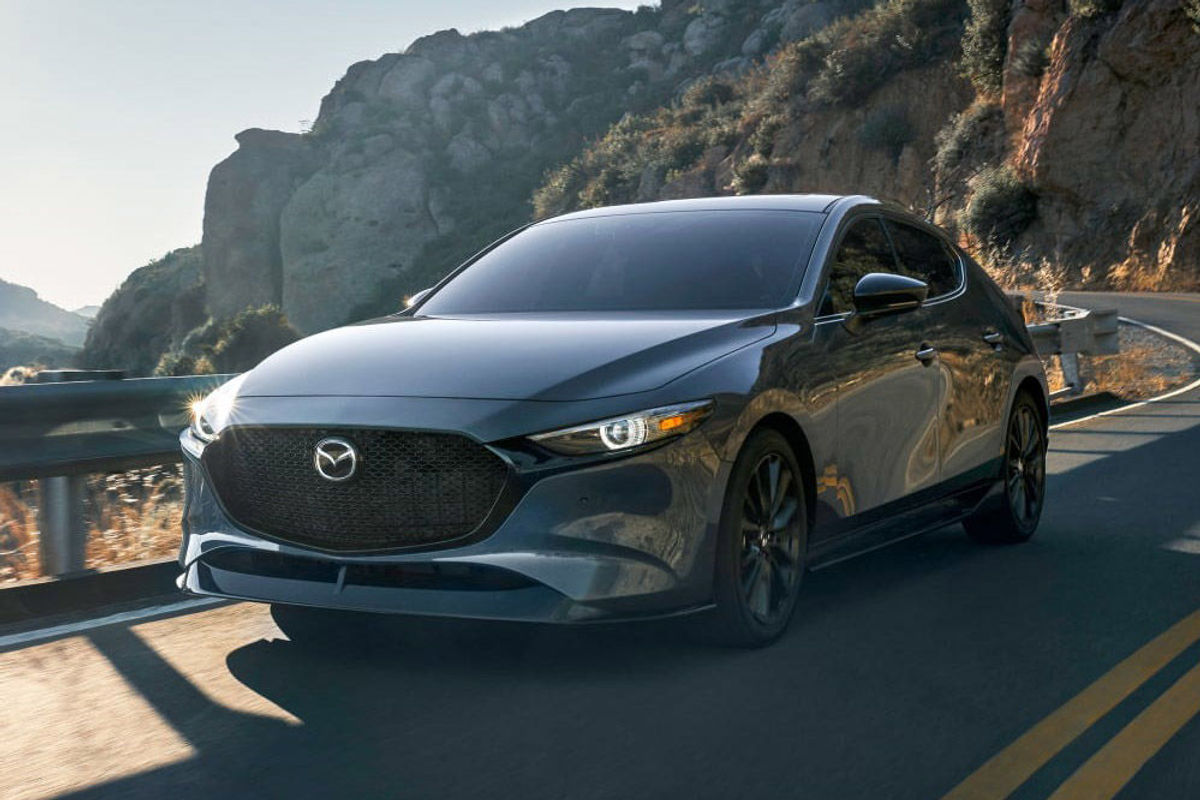
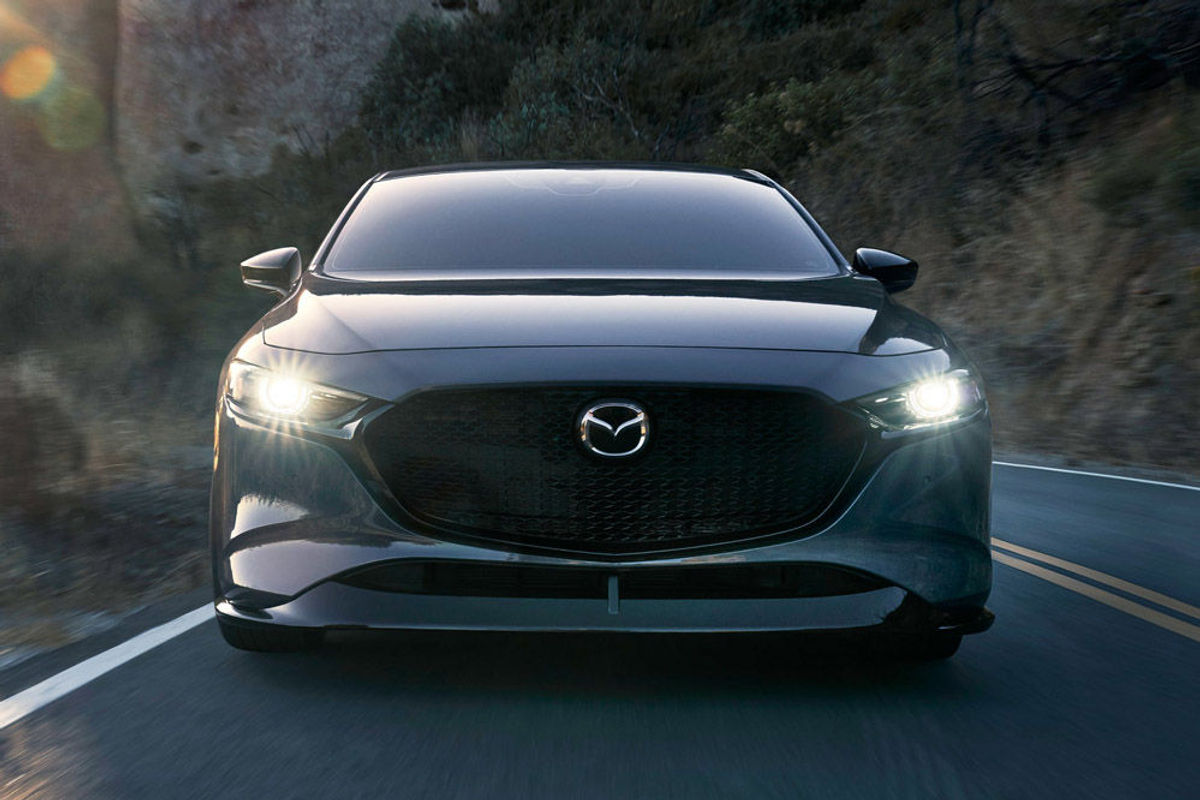
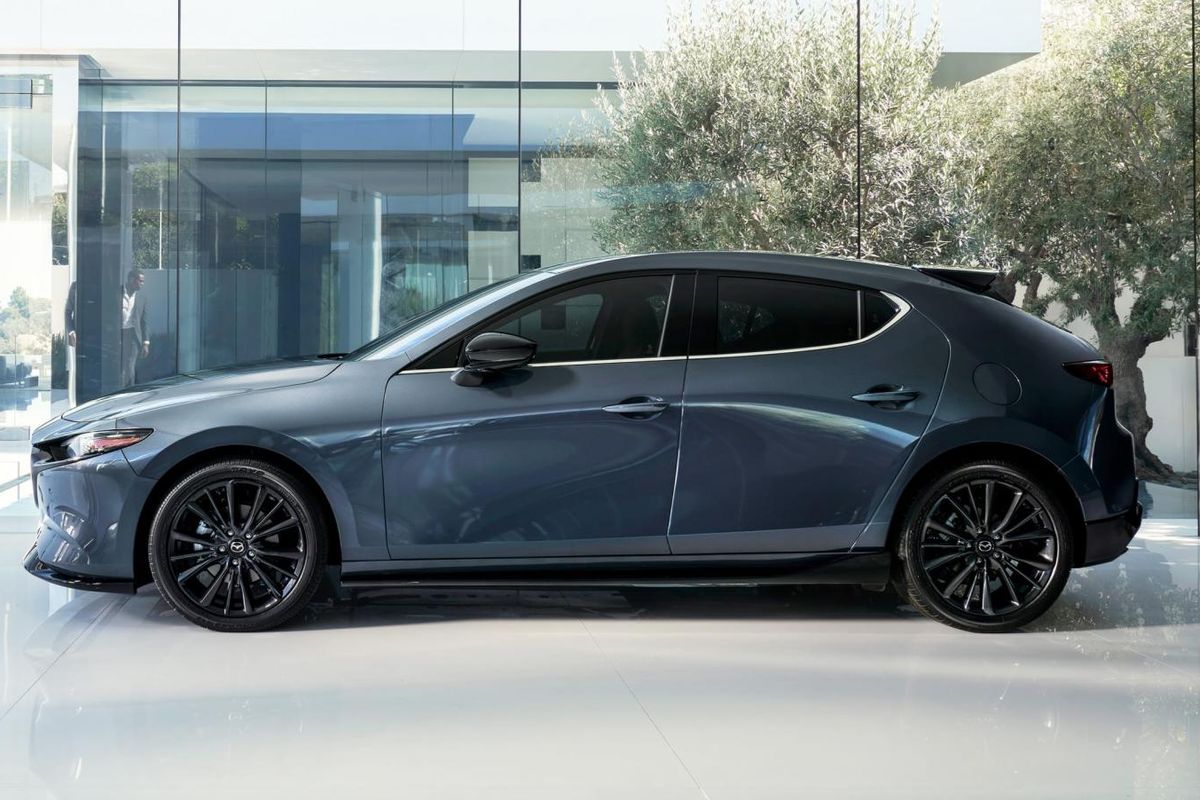
Mazda has now fully revealed its new Mazda3 2.5-litre turbocharged, all-wheel-drive flagship hatch and sedan derivatives in North America. The powerplant is more powerful and torquier than expected… and here's how its outputs compare with those of benchmark hot hatches.
Last month, Mazda signalled its intent to introduce the 2.5-litre 4-cylinder turbopetrol-engined (and all-wheel-driven) Mazda3 hatchback and sedan in the new-vehicle markets of the United States, Canada and Mexico. At the time, Japanese firm stated the 2.5 Turbo's peak outputs as: 186 kW and 434 Nm (when the Skyactive-G engineruns on 93 RON).
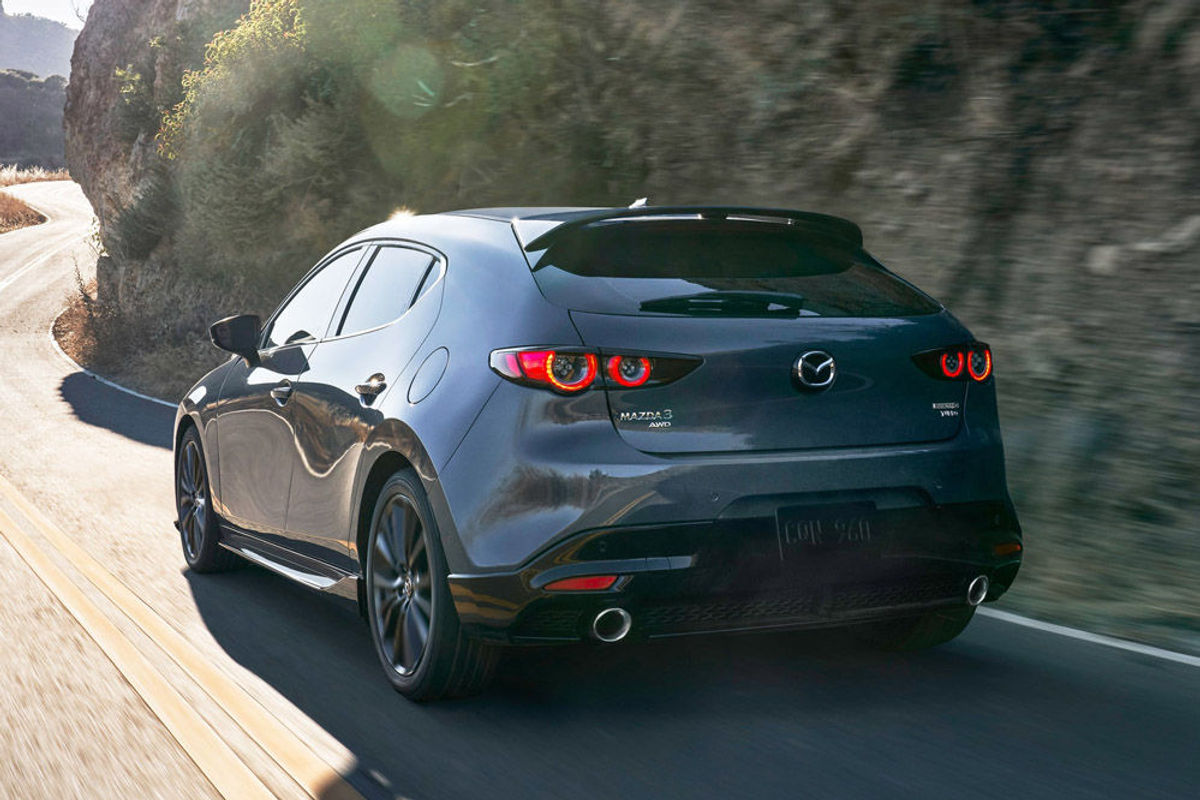
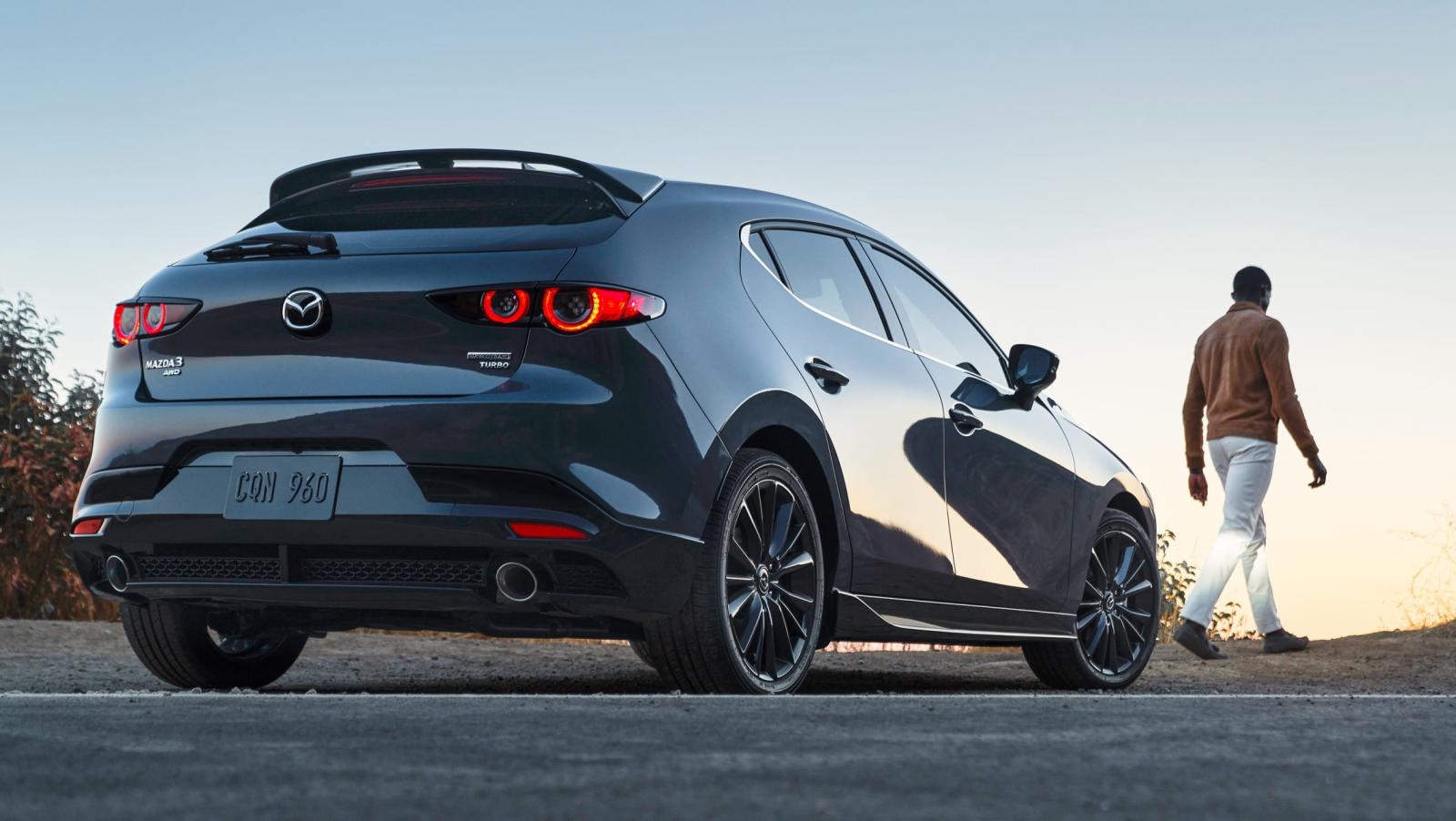
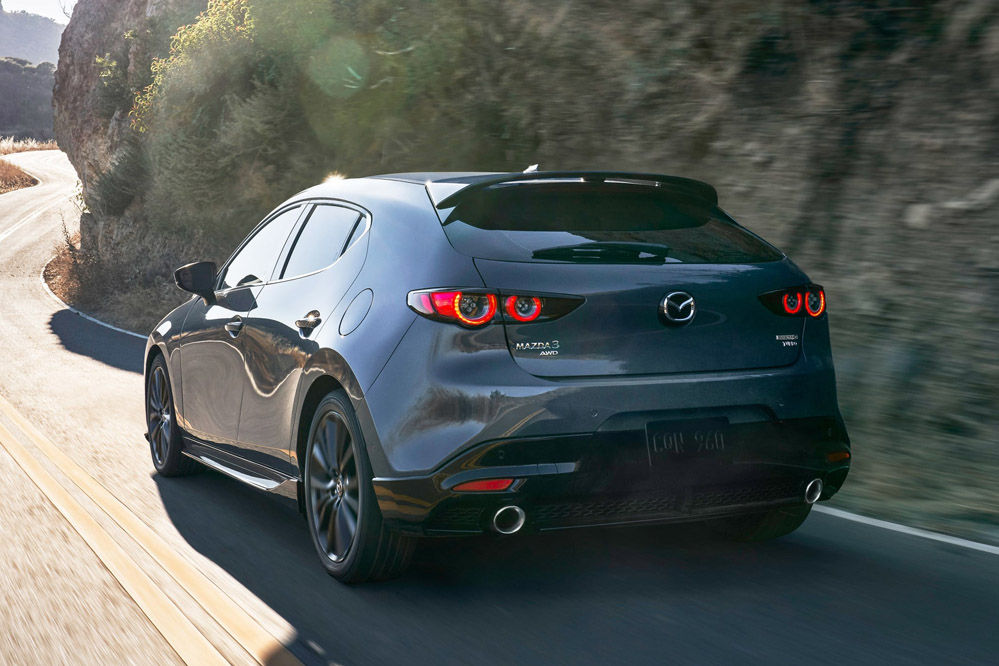
If buyers opt for the Premium Plus package, a purposeful front airdam and tailgate spoiler are added on.
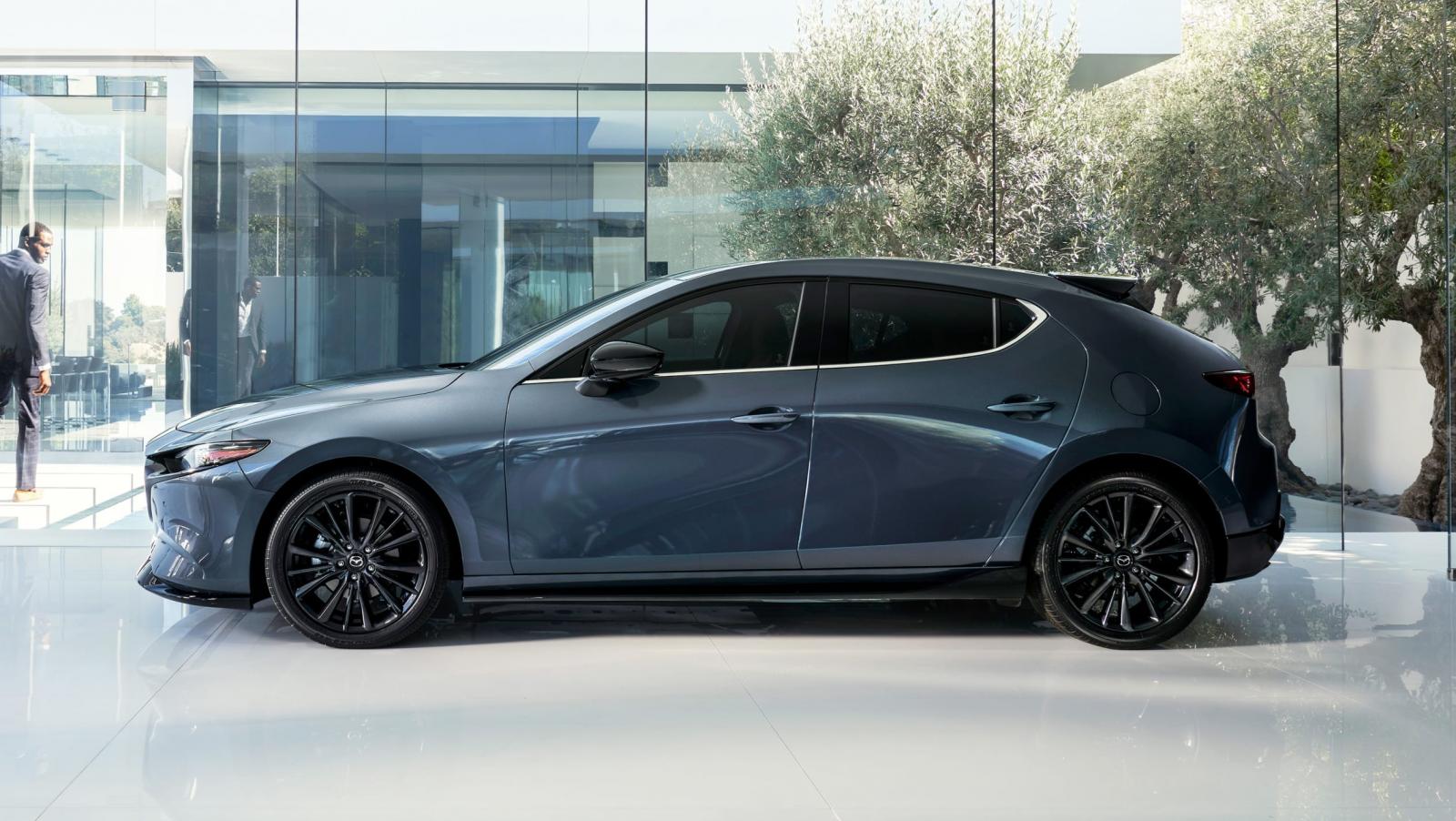
Torque is sent to the i-Activ all-wheel-drive system via a 6-speed torque-converter automatic transmission and, while we were hoping for claimed performance figures – which are critical for hot-hatch bragging rights – Mazda hasn't revealed any (we anticipate a 0-to-100 kph time of about 6 sec). However, the Hiroshima-based firm has presented a complete view of the 5-door version and released details of optional sporty exterior addenda that can, if specified, distinguish the 2.5 Turbo from its more affordable siblings.
Given the local market's predilection for hot hatchbacks, which explains why the Volkswagen Golf GTI has outsold its lesser 7.5-generation siblings by a ratio of about 4 to 1 and Hyundai and Honda offer the i30 N and Civic Type R in South Africa (but no other derivatives of those cars' respective ranges) it stands to reason that Mazda would be well served by introducing a hot-hatch version of the Mazda3 in the local market – if at all possible. Hot-hatch aficionados would surely welcome the 2.5 Turbo 5-door in our market, where the Hiroshima-based firm previously sold both the 2.3-litre turbocharged, all-wheel-drive 1st-generation- and 2.5-litre turbocharged 2nd-generation MPS derivatives.
If buyers add on the Aero Kit, the Mazda3 2.5 Turbo gains an additional rear diffuser as well as subtle side-sill extensions.
Now for the proverbial tale of the tape. In its maximum state of tune, the Mazda3 2.5 Turbo produces more power than the current (7.5) and Volkswagen Golf 8 GTI, although it's not quite as punchy as the Honda Civic Type R, Hyundai i30 N or either the Renault Megane RS 280 Lux/Cup or RS 300 Trophy. However, its peak torque figure eclipses those of all the current (admittedly front-wheel-drive) hot hatchbacks. To put those numbers in context, here's a breakdown of what the market's headlining hot hatches produce:
The handsome BBS 18-inch gloss black forged alloy wheels are also optional in North America.
From the initial announcement, it was clear Mazda didn't want to position the Mazda3 2.5 Turbo as a hot hatch per se – think of it more as a luxuriously-equipped flagship 5-door derivative with a sporty bent. Remember that in some markets, the Mazda's all-wheel-drive configuration could improve its selling proposition (such as in North America's harsh winter climate) and its torque gain (by virtue of turbocharging the larger-capacity 4-cylinder engine) should improve drivability, in-gear acceleration and touring ability.
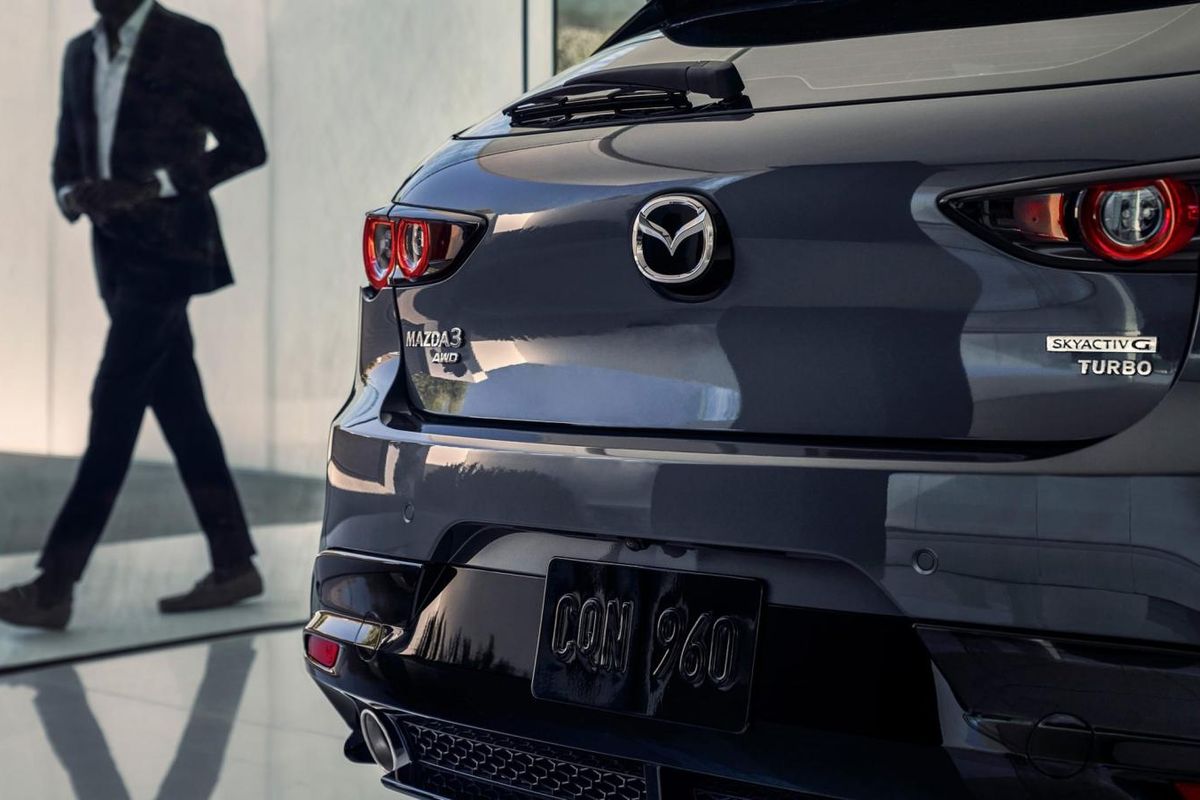
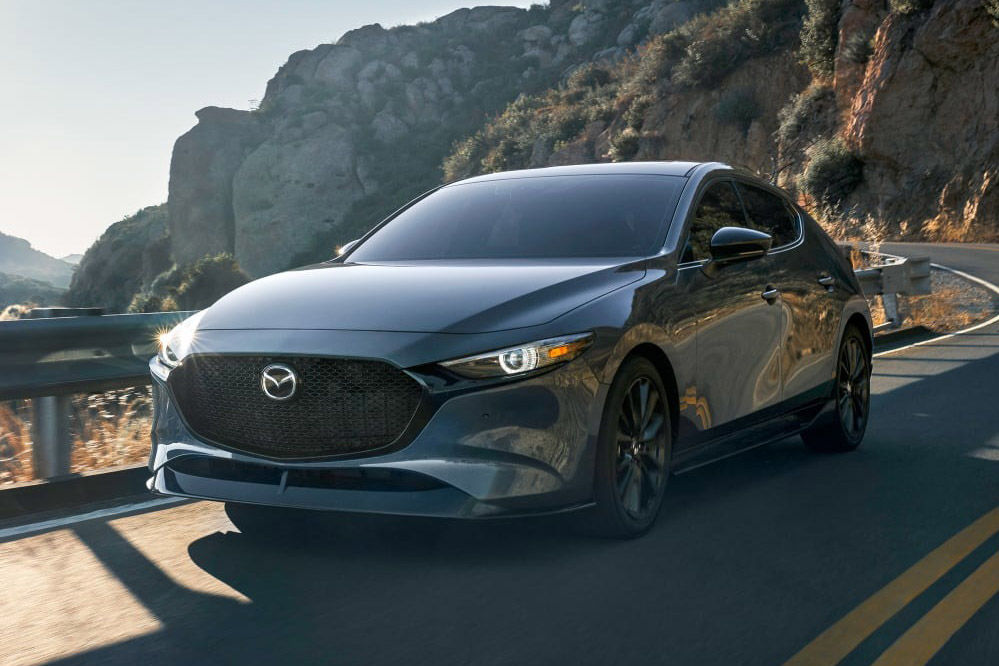
As standard, the 2.5 Turbo's exterior execution features automatically activated LED headlights with DRLs, hints of black exterior detailing (such as the mirror housings), subtle Turbo and AWD badging and slightly-bigger exhaust tips, but there are no elaborately flared wheel arches. However, if buyers want addenda such as a front bumper with gaping air intakes, wing-tipped side skirts, a rear bumper with an integral diffuser, a tasteful tailgate spoiler, as well as 19-inch gloss-black alloys, Mazda offers them at extra cost.
The 2.5 Turbo might not have a track-tuned suspension, but it produces a bit more torque than the Renault Megane RS 300 Trophy.
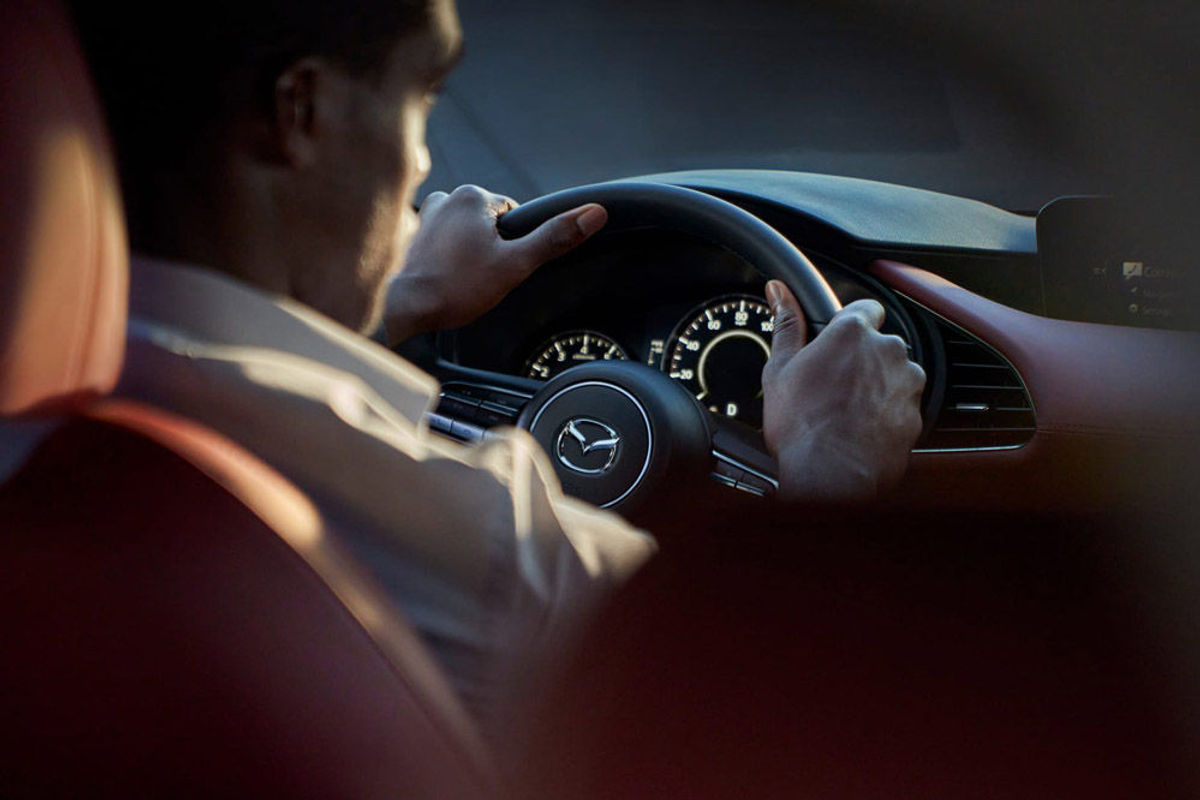
In its highest spec, the newcomer's cabin features leather trim, a sunroof, heated sports steering wheel with shift paddles, a frameless auto-dimming rearview mirror, an 8.8-inch touchscreen infotainment system (with Bluetooth, Apple CarPlay and Android Auto) reverse-view camera and rear PDC. In terms of safety, the flagship derivatives are equipped with radar-guided cruise control with stop-go functionality, Smart Brake function, blind-spot monitoring, rear cross-traffic alert and lane-keeping assist.
The new flagship Mazda3 produces more power and torque than the upcoming Golf 8 GTI, but its product positioning is very similar.
Right now, the 2.5 Turbo is exclusive to North America, which is a pity, because Mzansi has to make do with the 2.0-litre naturally aspirated motor in the top-of-the-range 2.0 Astina, which produces "only" 121 kW and 213 Nm. Other right-hand-drive markets (such as Australia, for example) have requested that Mazda consider making the range's new flagship more widely available, so there's a glimmer of hope. As for the MPS badge, that's highly unlikely to return given Mazda's product push into the premium space.
A few weeks ago, a Ford insider confirmed that a high-performance Raptor for the new F-150 pickup was on the way and now our spy photographers have spied a Raptor prototype undergoing testing.
Picture credit: S. Baldauf/SB-Medien. We have paid for these photos and at the photographer's request, have watermarked them.?
The latest news, however, pertains to the performance offroader, the F-150 Raptor, which was previously 'confirmed' as a 2021 model in a report by Motor1. With these latest spy shots, it's now confirmed that an F-150 Raptor is in development and it's significant because the F-150 Raptor will be launched well-ahead of the next-generation Ranger Raptor and it may point to technology that will similarly find its way into the next-generation Ranger Raptor, particularly in terms of suspension development. As with the F-150, styling cues such as the new headlight, grille and bumper design are likely to be carried over to the Raptor, albeit in a more aggressive form.
Also, the new F-150 features, among many other features, a new 8.0- or top-spec12.0-inch infotainment screen (with SYNC4) and an optional 12.3-inch digital instrument cluster which we hope will feature in the new forthcoming Ranger.
This F-150 Raptor prototype foregoes its previous rear leaf-spring suspension and features a coil spring suspension instead.
Nonetheless, these latest spy images show the Raptor prototype wearing a wide body kit with much of the front and rear design being hidden under camouflage. Our spy photographers also managed to take photographs underneath the prototype (not shown here), revealing a disguised coil spring in with the shocks moved ahead of the rear axle on the prototype. The Fox shocks appear to be identical to the current F-150 Raptor. Interestingly, with the coil spring suspension setup present and the rear leaf-spring suspension now gone, it has also been revealed that the exhaust system routing is different to the current Raptor, which had to bypass the leaf-spring suspension, and now takes a more direct route while also improving the prototype's ground clearance.
Powertrain details have yet to be confirmed and there is no current indication if the Raptor will forge on with its 336 kW 3.5-litre V6 engine.
A report from Australia earlier this year suggested that the next Ranger will feature a 3.0-litre V6 engine with no less than 186 kW and 600 Nm while the Ranger Raptor could employ the same engine but with higher outputs, which will be welcome improvements over the current Ranger Raptor.
We will keep you updated as soon as more details become available in the coming weeks and months.
A distinctive Range Rover Sport SVR Carbon Edition has been confirmed for the South African market and it will go on sale towards the end of 2020.
The Range Rover Sport SVR is the pinnacle offering in Land Rover’s line-up and it’s the fastest and most powerful model in its stable.
A special edition Range Rover Sport SVR Carbon Edition is on the way to South Africa and it will feature a host of carbon fibre elements that give it a stealthy appearance. These carbon elements can be seen on the bonnet, front bumper insert surrounds, grille, vent surrounds, mirror housings and on the tailgate.
The Range Rover Sport SVR Carbon Edition rides on five-split-spoke 22-inch lightweight alloy wheels in gloss black and illuminated SVR Carbon Edition treadplates further distinguish the model. At the rear, the Land Rover badge is replaced with an SVR badge.
On the inside, you are met with lightweight SVR performance seats wrapped in Windsor leather with the seat backs finished in satin black with an SVR logo embossed on the headrests. The seats are some 30 kg lighter than the seats offered in the Range Rover Sport. An 825W 19-speaker Meridian Surround Sound System is also fitted along with a subwoofer and Trifield technology for premium sound delivery.
Driving performance comes courtesy of a 5.0-litre supercharged V8 engine that develops 423 kW and 700 Nm of torque. Zero to 100 kph is claimed at 4.5 seconds with a top speed of 283 kph.
Pricing for the Range Rover Sport SVR Carbon Edition will be announced closer to its launch in the fourth quarter of 2020. We will keep you updated.
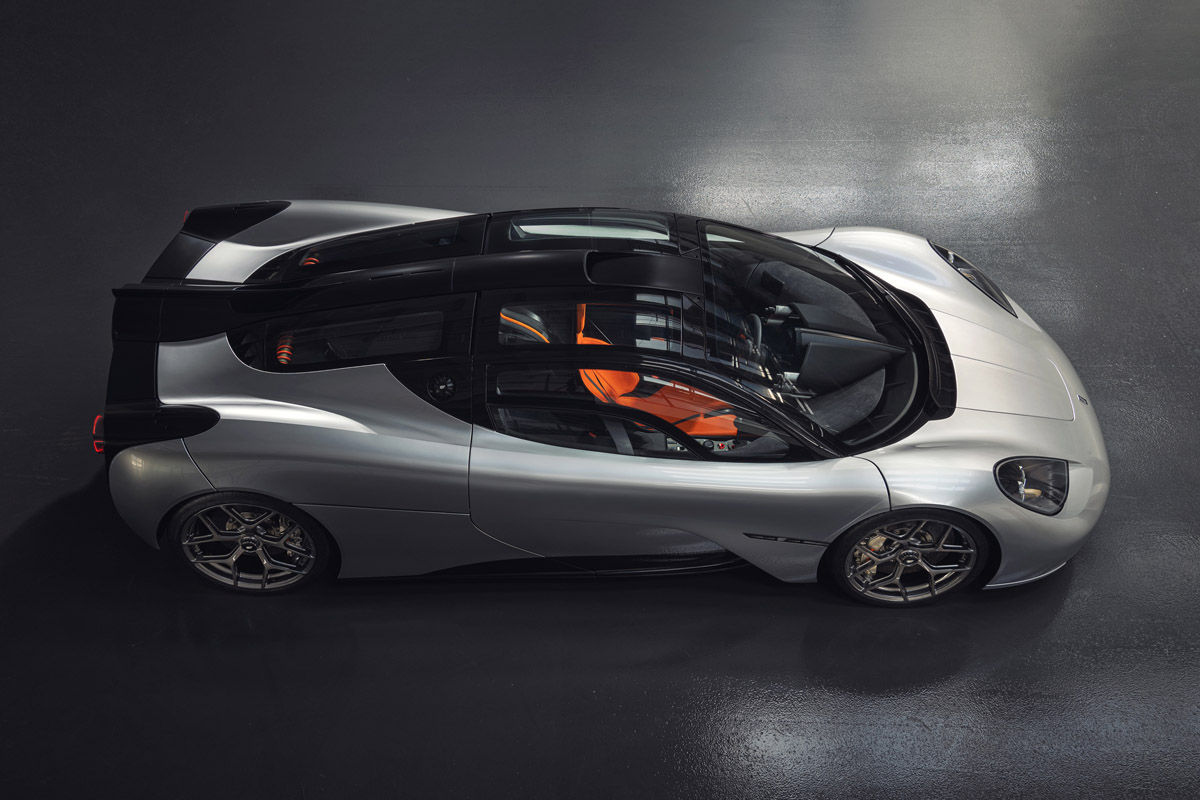
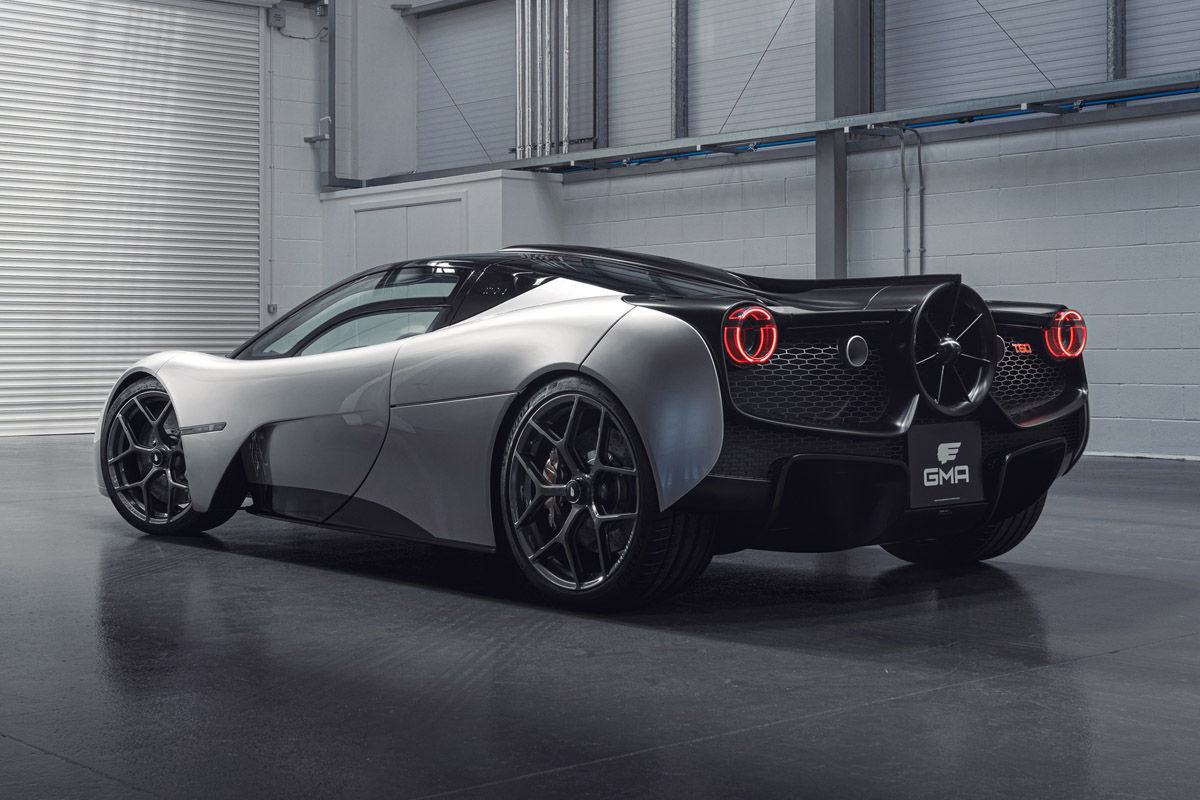
Legendary South African-born F1 designer and father of the McLaren F1, Gordon Murray, has finally unveiled his company's T.50 “analogue hypercar”, endowed with a free-breathing 3.9-litre V12 engine, a 6-speed manual gearbox and F1 fan-car-inspired active aerodynamics.
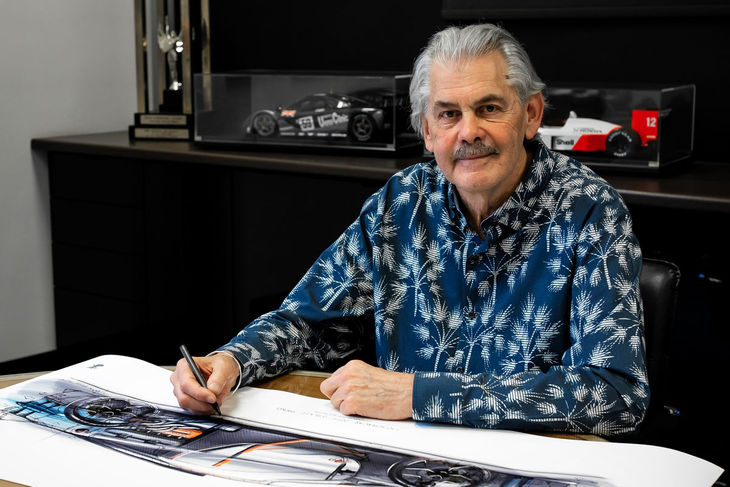
1. Gordon Murray, CBE
Professor Gordon Murray was born in Durban, moved to the UK in the late Sixties and designed the Bernie Ecclestone-owned Brabham F1 team’s cars from 1972 to 1986 (two of which won drivers’ world championships for Nelson Piquet in 1981 and 1983) and assisted Steve Nichols and Neil Oatley at McLaren to design the Honda-powered cars that dominated grand prix racing for 4 years (1988-1991) in the hands of Alain Prost and Ayrton Senna.
Murray then founded the road-car division of the Woking-based F1 team and designed the definitive, genre-redefining McLaren F1 supercar; he was also involved with the Mercedes-Benz SLR McLaren, but thereafter he founded Gordon Murray Design Ltd (a design and engineering consultancy) and focused on a number of projects, including a 1-seater track car, city cars, a light commercial vehicle and the new TVR Griffith.
Prof Gordon Murray, CBE.
Murray spearheaded the iStream manufacturing process and his group, Gordon Murray Automotive (GMA) will be producing the new T.50 at a new factory based in Dunsfold. In 2019, he was made a Commander of the British Empire by Prince William in recognition of his contributions to the motorsport and automotive sectors over the past 50 years.
2. Sub-tonne kerb weight
The T.50 is designed to be the spiritual successor to the F1 by virtue of its lightness, compactness and space-efficiency. The entire car weighs just 986 kg – almost a 3rd lighter than most supercars and 150 kg lighter than the original 3-seater. Its all-new carbon-fibre monocoque weighs only 150 kg and GMA’s engineers modelled the diameter and length of the T.50’s fixings “to ensure they’re only as strong as they need to be”. The 900 nuts, bolts and washers affixed to the T.50’s chassis are made from titanium.
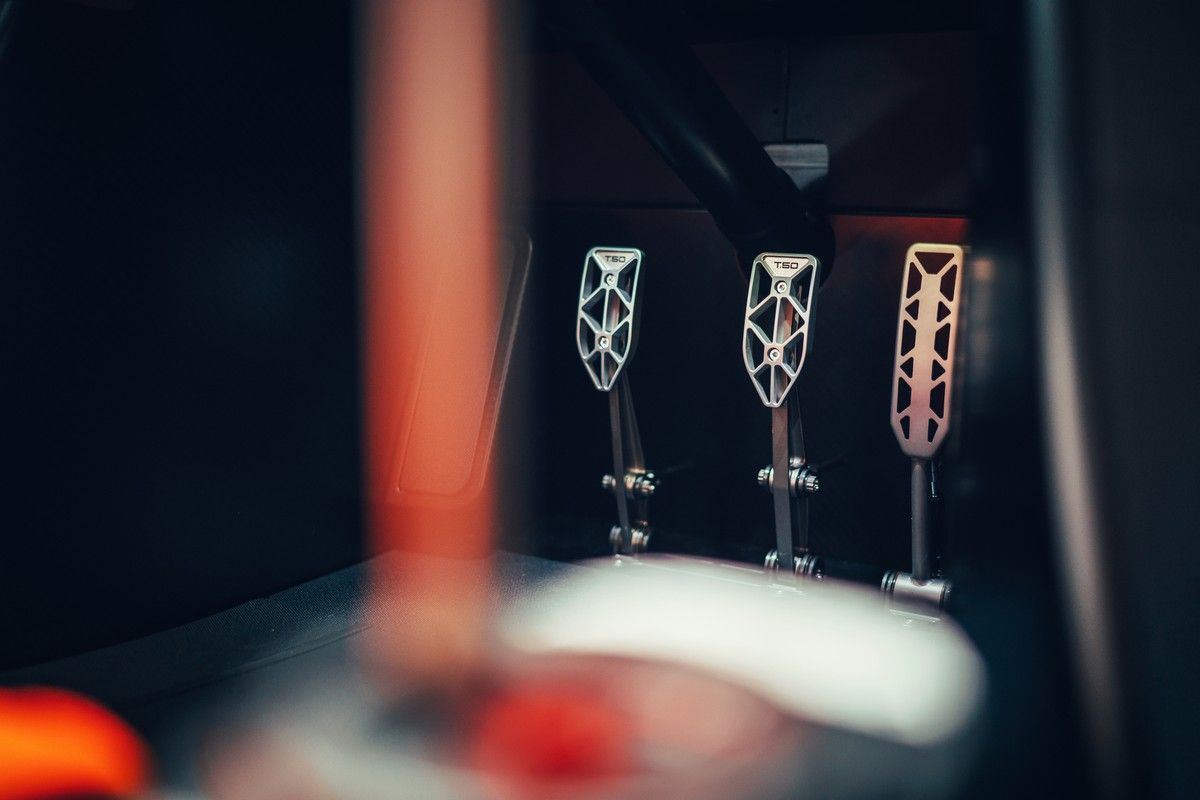
Here’s further proof of the intense weight-saving programme: the T.50’s pedal box is 300g lighter than the McLaren F1’s, while its transmission is 10 kg lighter. Its windscreen is made from ultra-thin glass, which is 28% thinner than that of a typical road car. The driver’s seat weighs 7 kg – and the passenger seats weigh less than 3 kg apiece.
3. Small footprint, unfussy styling
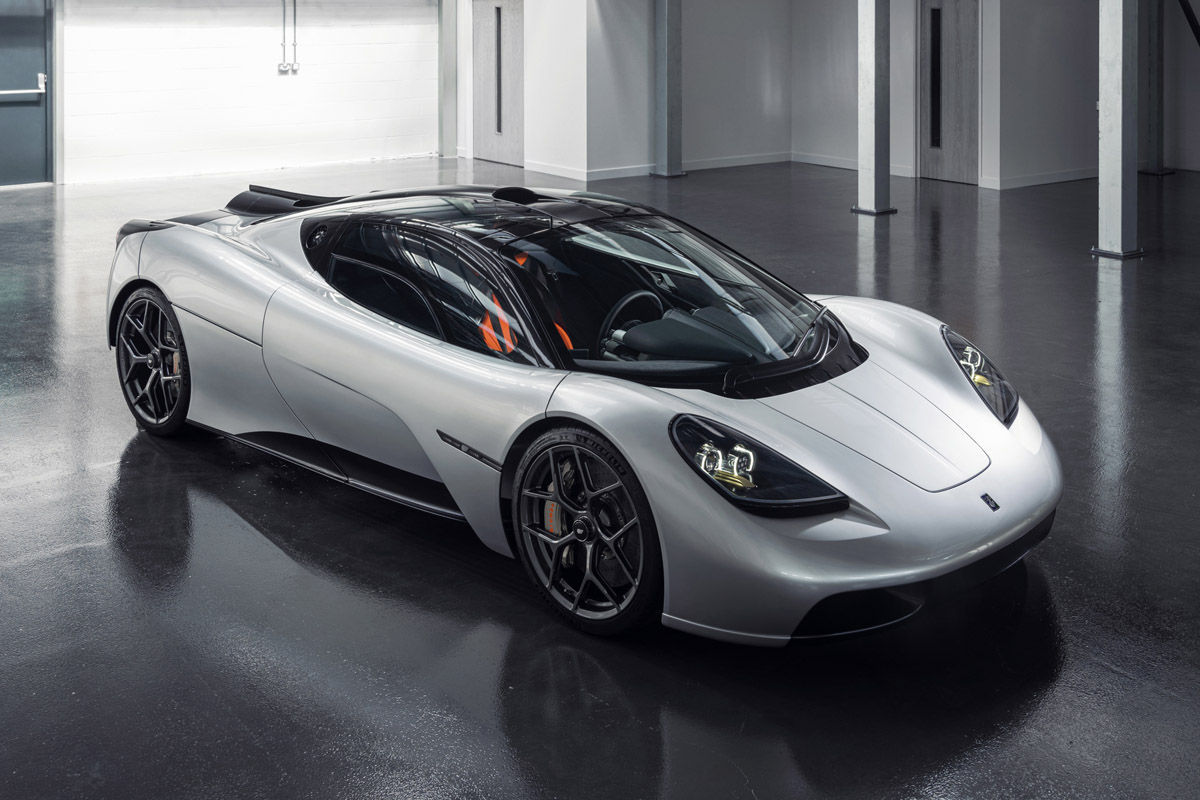
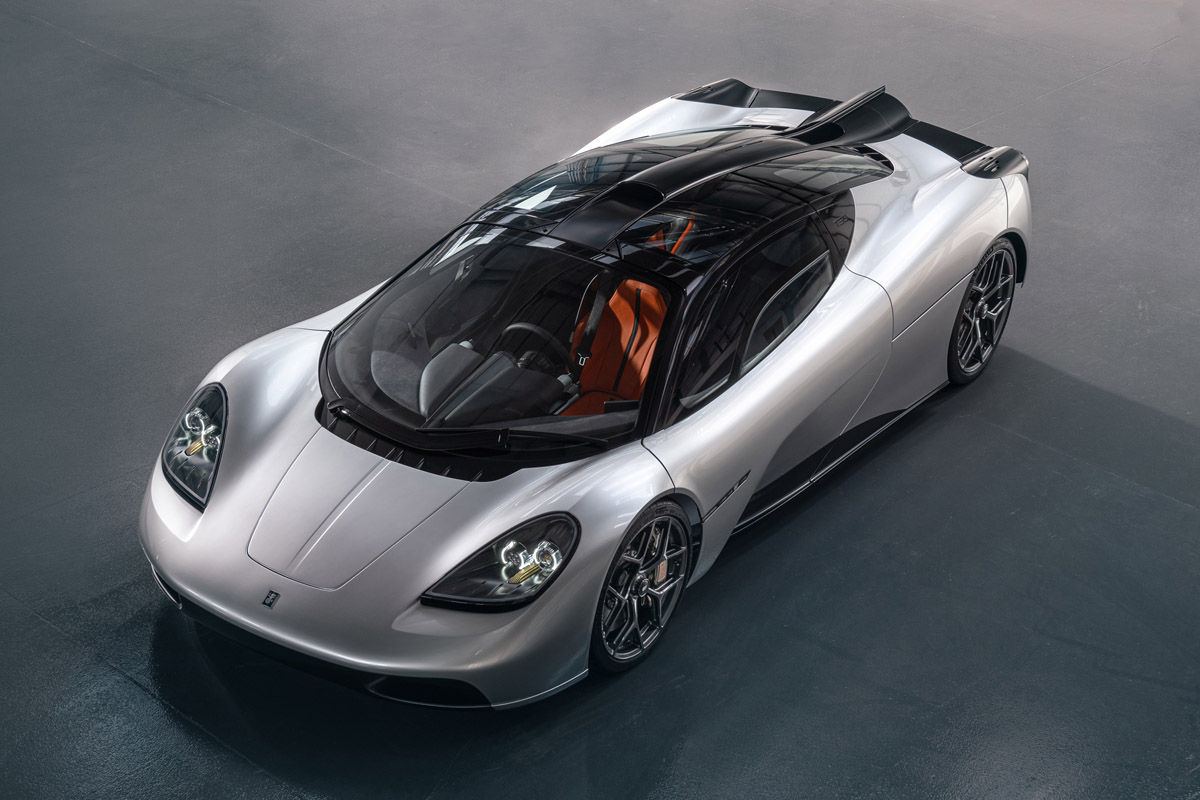
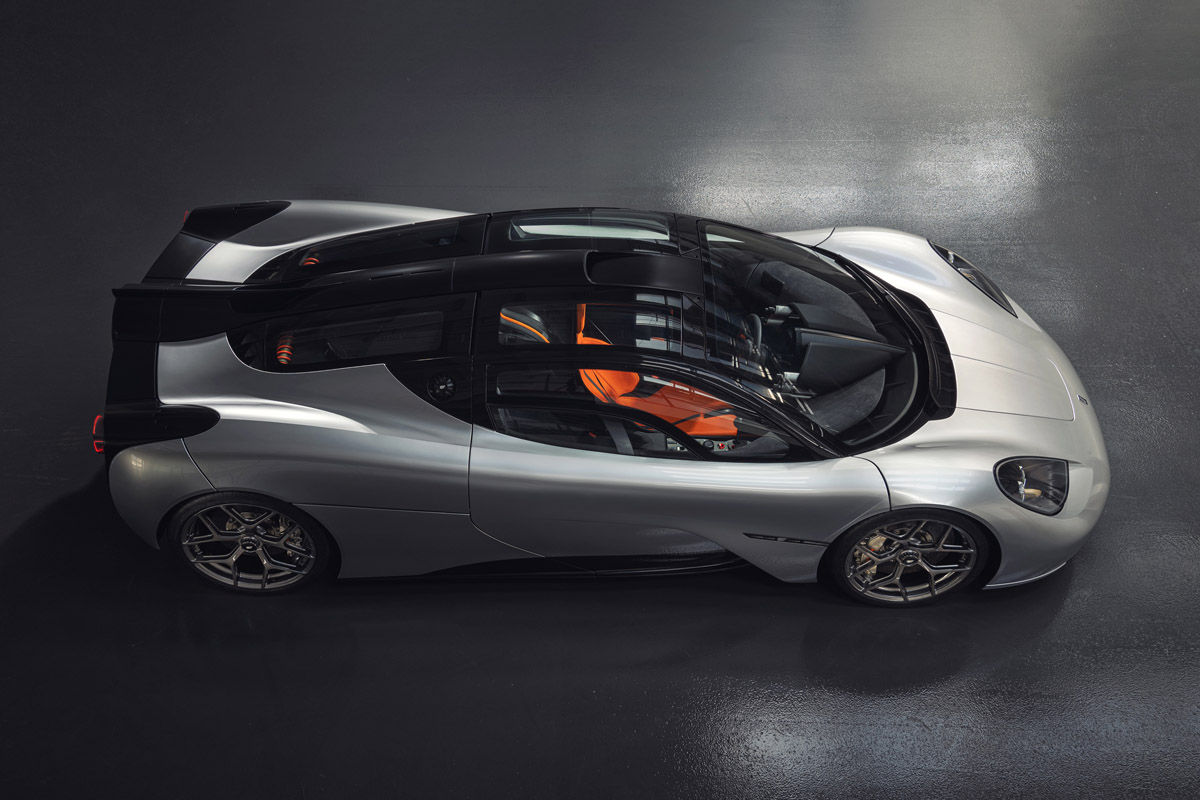
Although virtually all road cars are now substantially larger than their equivalents from 30 years ago, the T.50 is just 30 mm wider and 60 mm longer than the McLaren F1 and its exterior design is refreshingly simple; the newcomer has remotely-released dihedral doors, but, as opposed to most hypercars, there are no elaborate wings, vents and ducts.
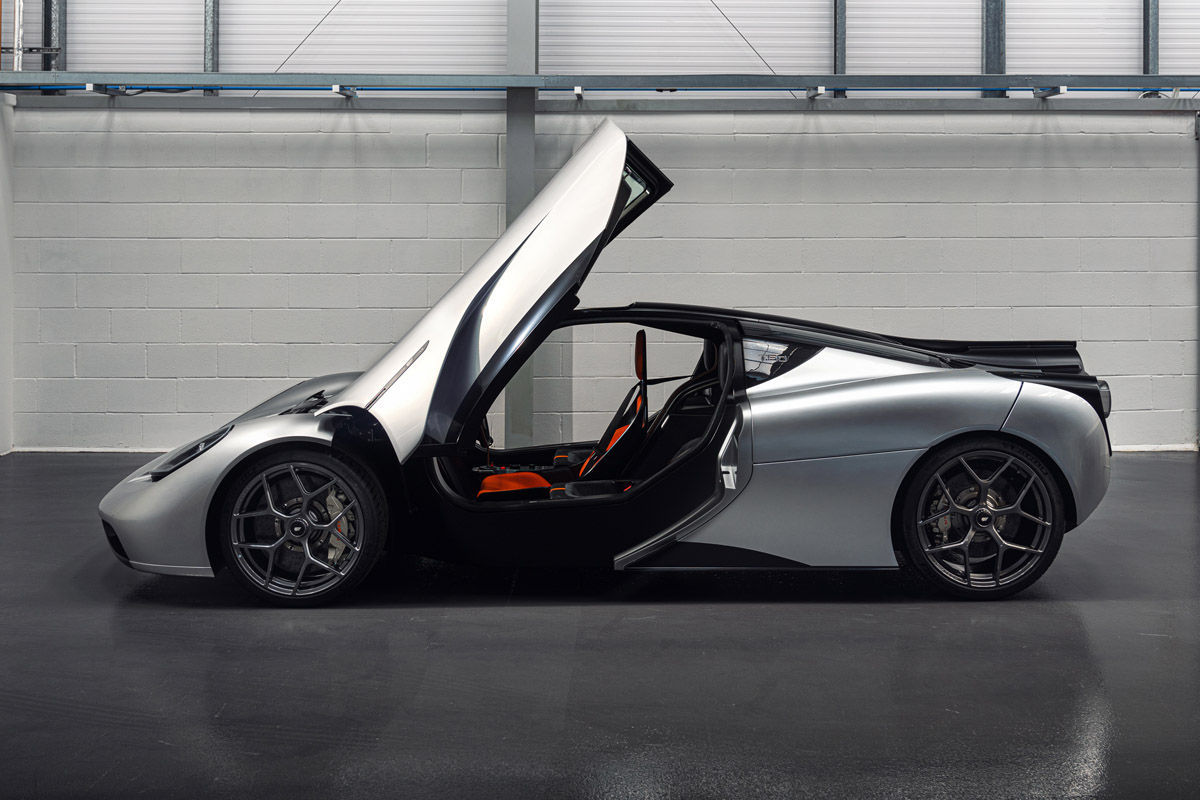
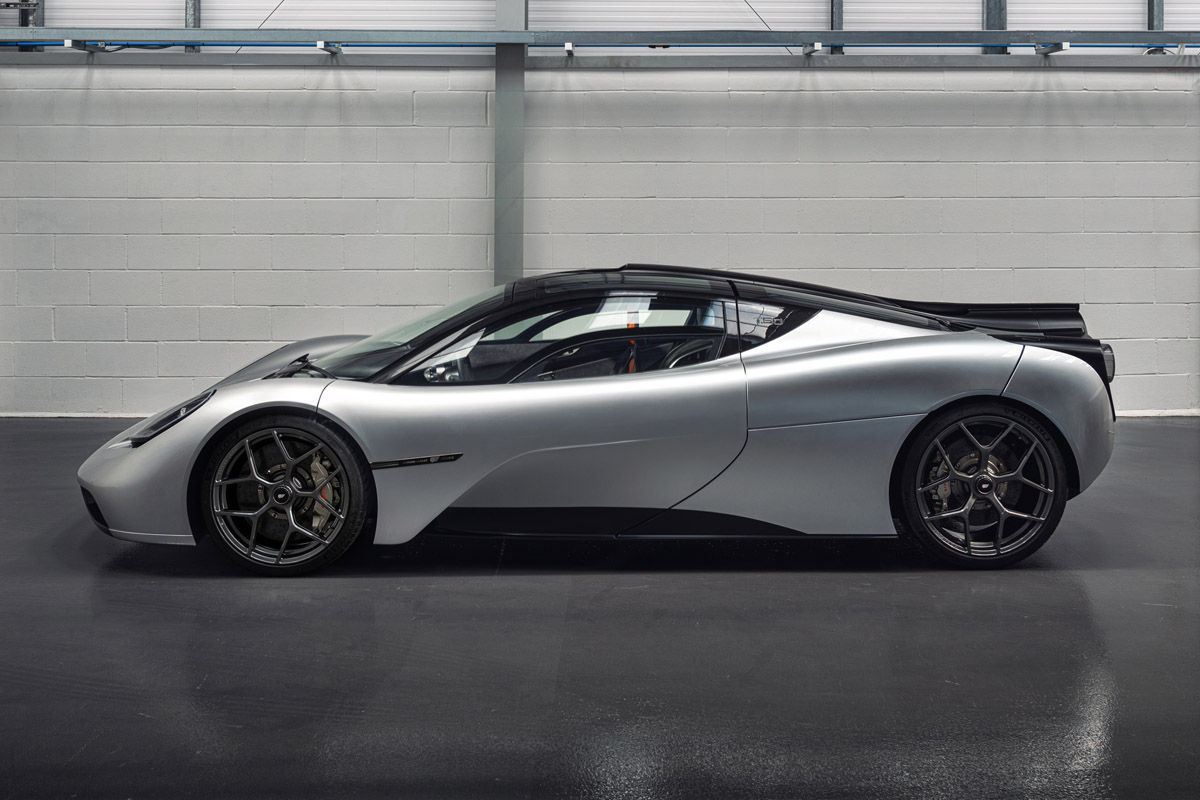
In profile, the T.50's design looks near-perfectly proportioned.
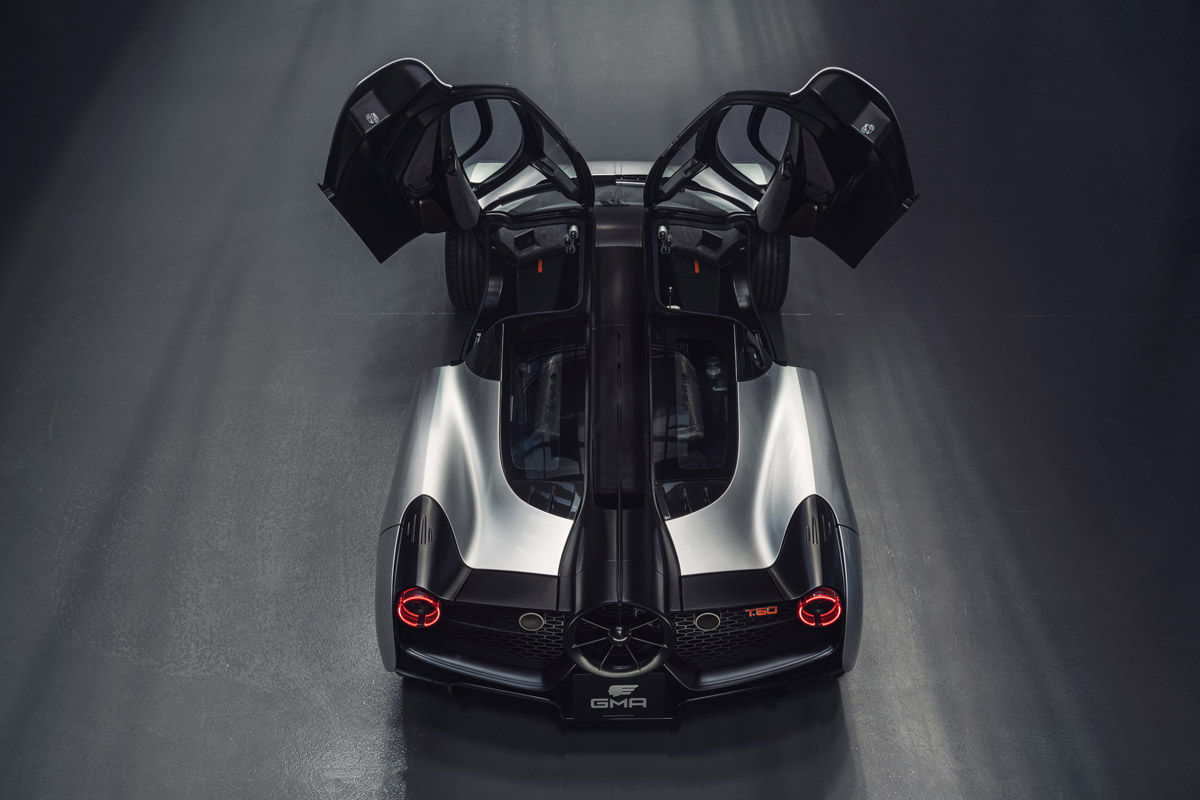
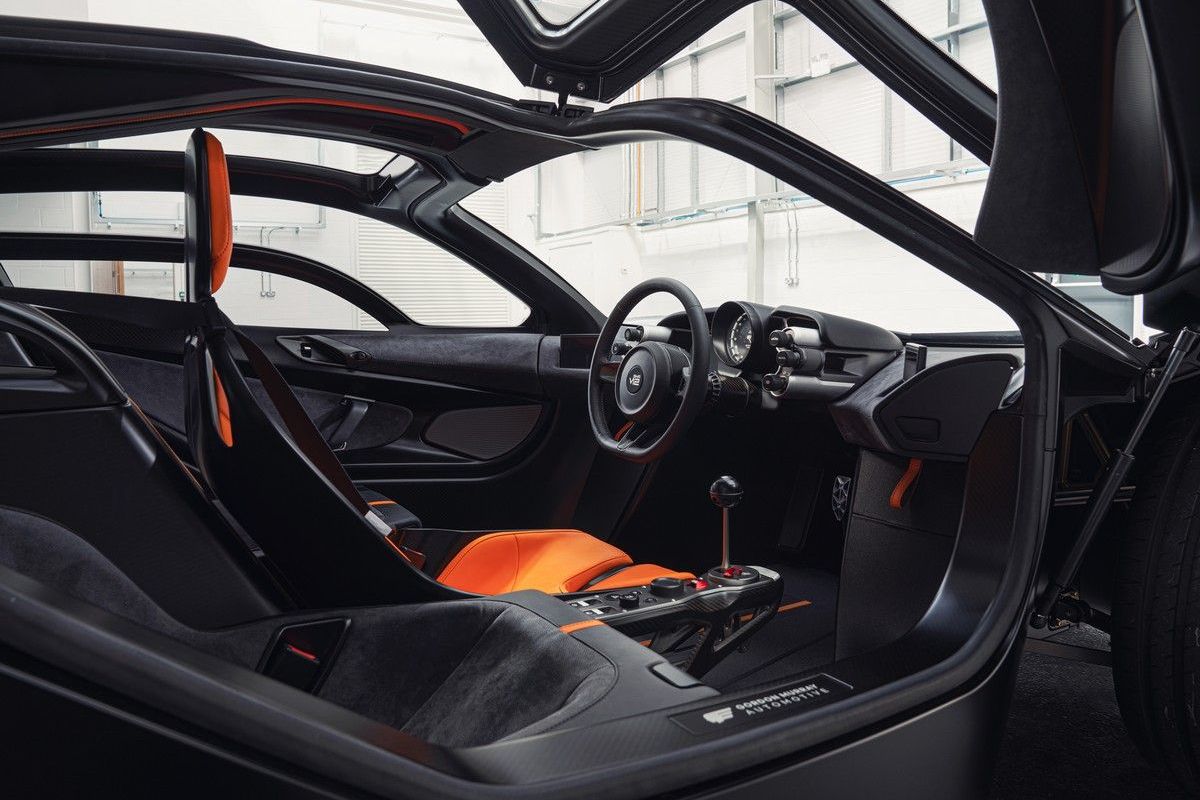
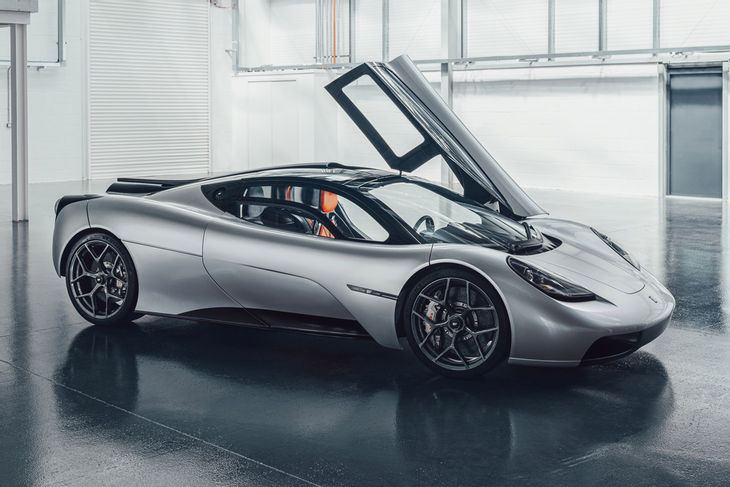
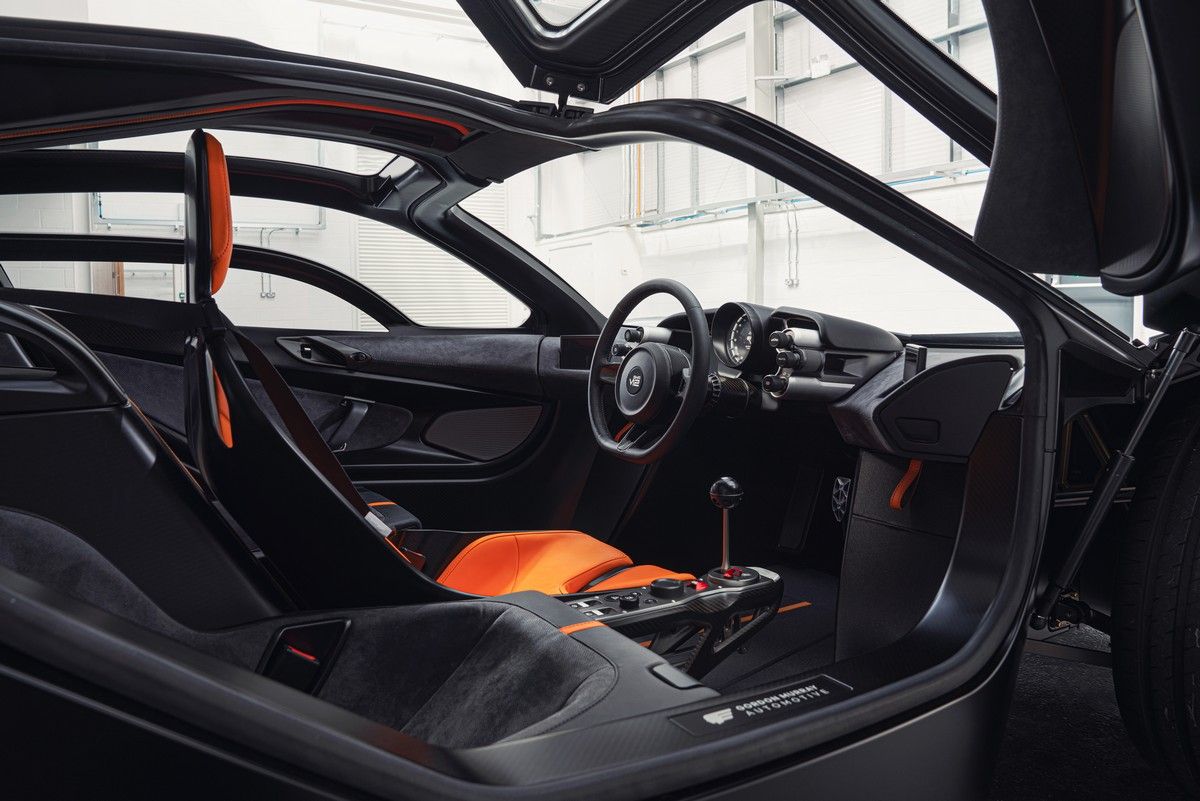
The T.50's "see-through" passenger compartment is very distinctive. The dihedral doors rise up and forwards to create a striking visual impact, as well as easing ingress/egress, even in tight parking spaces. These doors are joined by a pair of glass-topped gullwing rear openings that hinge along the spine of the T.50 to fully reveal the V12 powertrain.
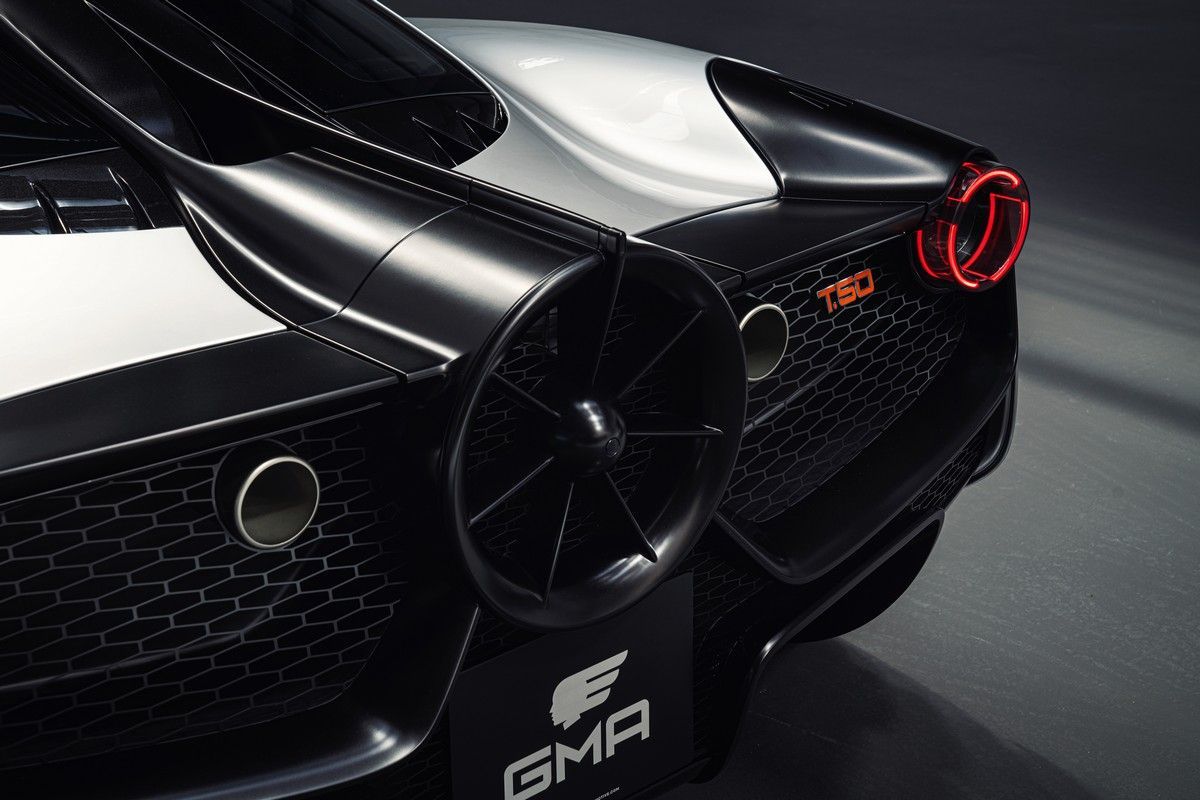
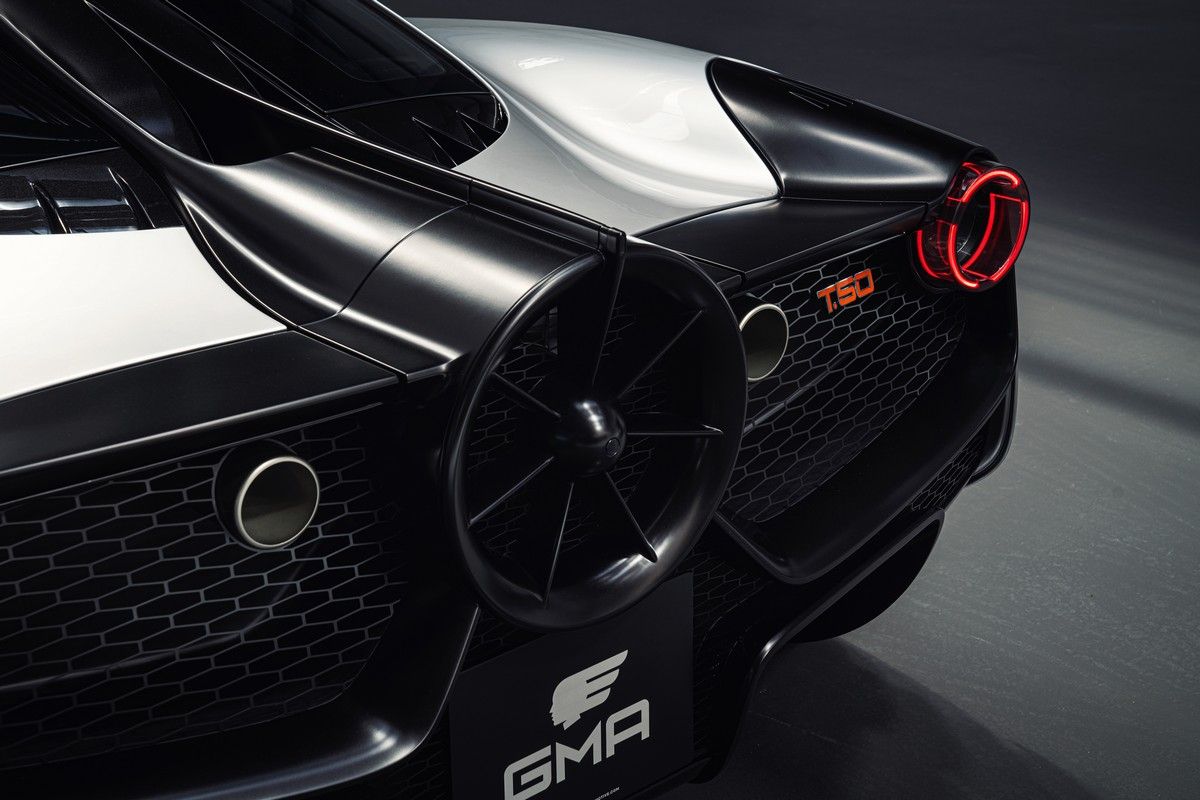
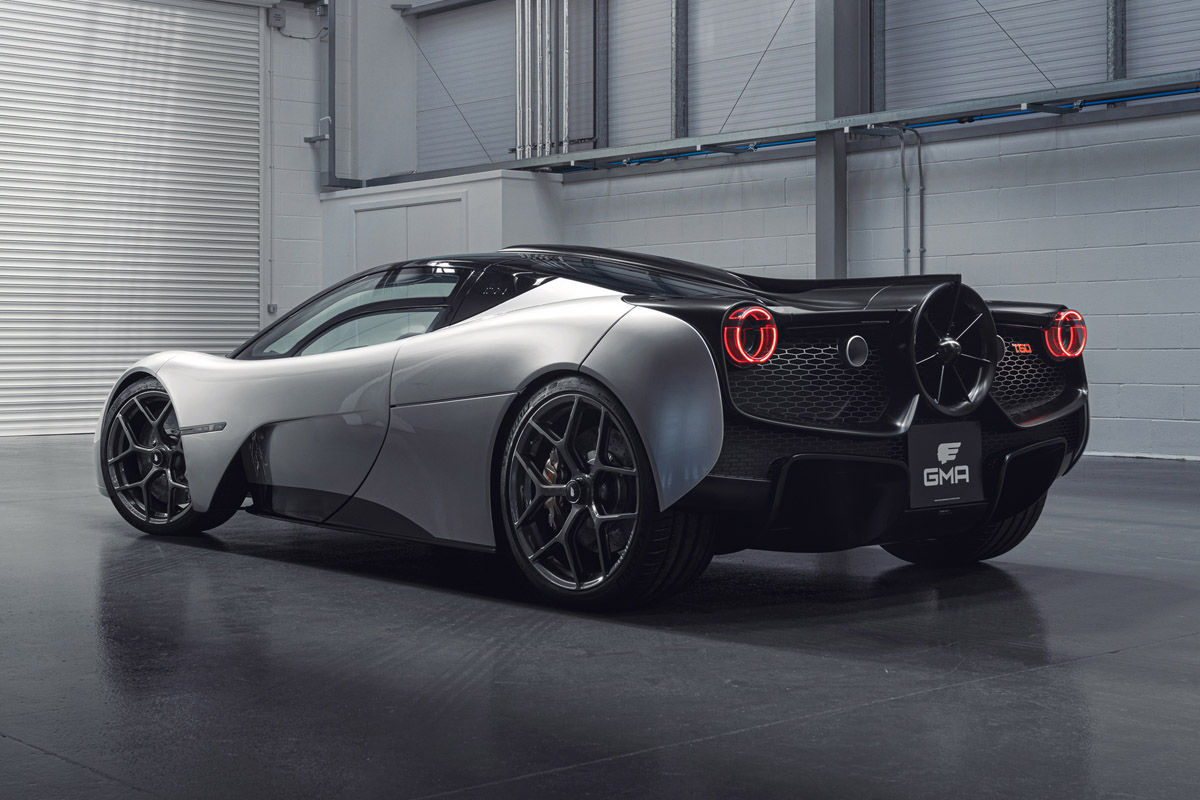
From the rear, the T.50 is distinguished by the integral ground-effect fan, but its complex aerodynamic systems also incorporate active under-body elements and rear aerofoils.
Murray was determined to create a clean, pure shape that would ensure the T.50 "would still look fresh in 30 years."
4. References McLaren F1, 1978 'F1 fan car'
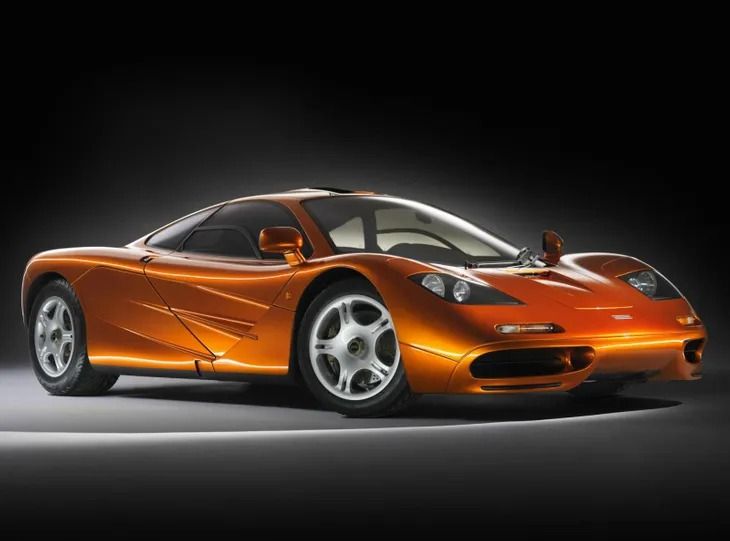
A three-seater with a central driving position, the car combines the unique qualities of Murray’s two most iconic creations in a stellar 50-year, 50-car career: the seminal, ultra-light McLaren F1 3-seat supercar of 1992 and the Brabham BT46B grand prix “fan car” of 1978, whose extraordinary levels of downforce briefly rocked F1; it took one race win (by Niki Lauda) before the team withdrew the car in the face of opposition from rivals.
Since the first details of the T.50 emerged last year, it was clear it would use much of the packaging and technology of the F1, simply because, in Murray’s view, there’s no better way of doing it. “No one else makes supercars our way,” he says. “I’m happy about that.”
The 400-mm rear-mounted electric fan is designed to extract air from beneath the car to radically increase downforce and grip. Downforce is generated either by an active rear spoiler or via a large venturi beneath the body that channels airflow into the fan. The feed of underbody airflow can be varied by the opening or closing of slots ahead of it.
Aerodynamic downforce is a great thing to have when you need it, says Murray, and that’s principally between 100 and 160 kph, the point at which your car benefits most from greatly enhanced cornering adhesion. It would be nice to have downforce that works at lower speeds too, but passive aero gadgetry doesn’t provide it, he adds.
The ground-effect fan, which briefly upturned the F1 establishment in 1978, is integral to the T.50's active aerodynamics.
As it turns out, when going faster, less aero-effect is required. “Aerodynamic load rises as the square of speed,” Murray says, “and so does drag. Which means many cars with serious performance use up their suspension travel at high speed. You can reduce it with expensive, bulky variable-rate (suspension) complexity, but who wants that?”
The T50’s system of variable, fan-based downforce is tuneable and delivers exactly what is required; it greatly improves the hypercar’s handling at lower speeds and boosts its ability to stop in a hurry, but, at the same time, when the T.50 is cruising at high speed, the system can be tuned to facilitate decent stability and reasonable ride quality.
6. Six different aero modes
The mid-engined T.50’s all-important aerodynamics package was developed with the assistance of the Silverstone-based Racing Point Formula 1 team. Access to the team’s moving-floor wind tunnel, plus the expertise of its F1-trained technicians, allowed GMA to utilise large-scale models to refine the T.50’s revolutionary active aero package.
The large dihedral doors provide easy access to the T.50's cockpit; passengers sit on either side of the driver.
The T.50’s aero set-up can be configured in 6 different modes, 2 of which are automatic, the rest of which are driver-selectable… The 2 automatic aero modes are Auto (which optimises the use of the fan, the rear spoiler and the underbody diffusers) and Brake (which opens the spoilers and runs the fan at high speed, pushing the car down and increasing stability and rolling resistance).
The driver-select aero modes are High Downforce and Streamline, which cuts drag by about 12.5% by closing underbody vents and speeding up the fan. There’s also a Vmax mode, which uses the car’s 48-volt integrated starter-generator to drive the fan – freeing up power to the driveshaft. Combined with the ram-air induction, this boosts power to 515 kW for short bursts of acceleration. The final aero mode is Test, which allows an owner to demonstrate how the aero system functions when the car is stationery.
With the T.50, Gordon Murray Automotive is not chasing power or top speed figures, but seeking ultimate driver engagement.
7. Highest-revving road car engine
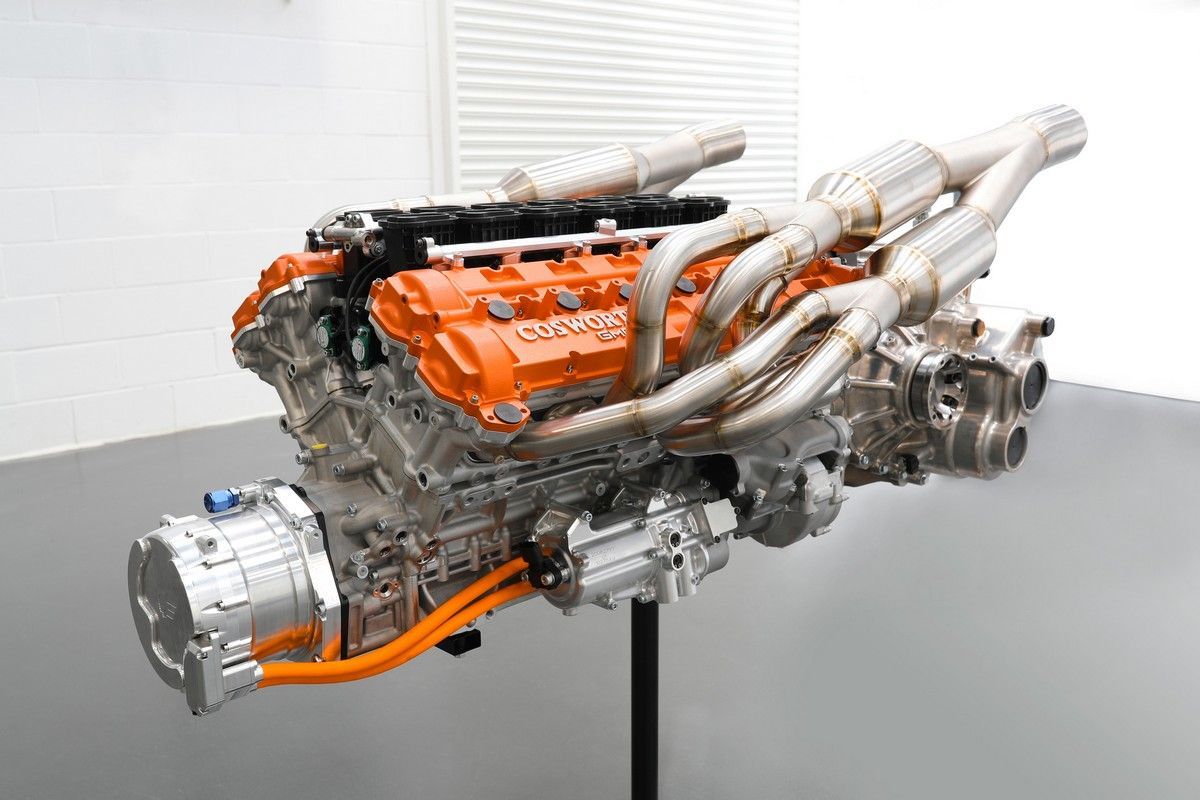
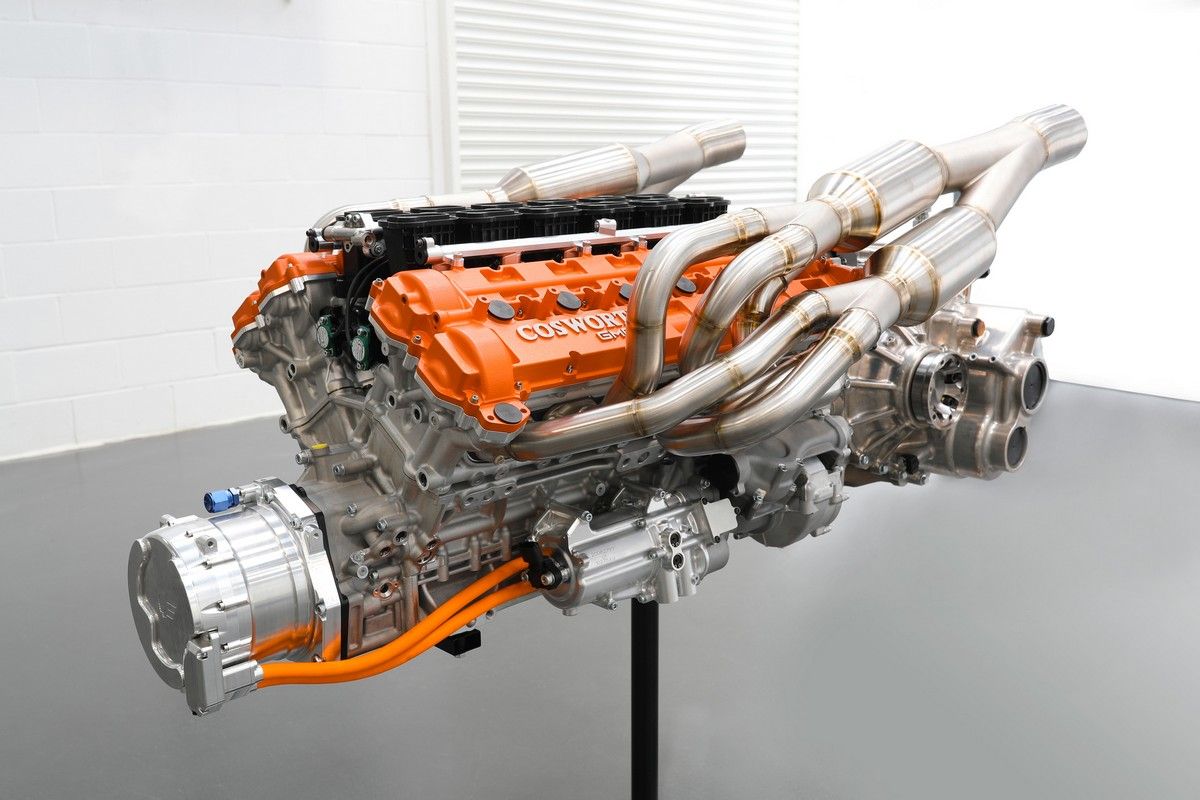
Murray insisted that, like the McLaren F1, the T.50 had to be normally aspirated and feature no hybrid assistance apart from a 48V integrated starter/generator, which is connected directly with the crankshaft. It acts as a starter motor, but then converts to a generator to produce power to spin the ground-effect fan at speeds of up to 8 000 rpm.
Developed by British engineering firm Cosworth, the T.50’s 65-degree 3.9-litre V12 produces 488 kW at 11 500 rpm and 467 Nm at 9 000 rpm. The engine weighs 178 kg, which is about 60 kg less than the McLaren F1’s 6.1-litre V12. The engine’s rev limit is at a dizzying 12 100 rpm and to enhance the driver and occupants' aural experience, Direct Path Induction Sound, a system that was pioneered on the McLaren F1 (and refined on the T.50) channels the motor's throttle-induced induction growl into the cabin.
The motor might seem peaky (rev-hungry), given its 12 100-rpm redline, but it delivers 71% of its peak torque from 2 500 rpm.
Not only is the engine the most power-dense naturally-aspirated engine ever produced, it's also the highest-revving road-car engine in the world. To give you an idea of how free-revving this astounding motor is, the V12 will pick up revs at 28 400 revs per second, which enables it to hit its redline from idle in just 0.3 of a second.
8. A 6-speed manual 'box
The V12 drives the rear wheels through a 6-speed H-pattern manual gearbox (built by Xtrac) that weighs only 80.5 kg. "The gearchange's motion and weighting were honed meticulously until we achieved the perfect result: a narrow cross gate and a short throw. It delivers slick, crisp gearchanges – truly a joy for the driving enthusiast,” Murray says.
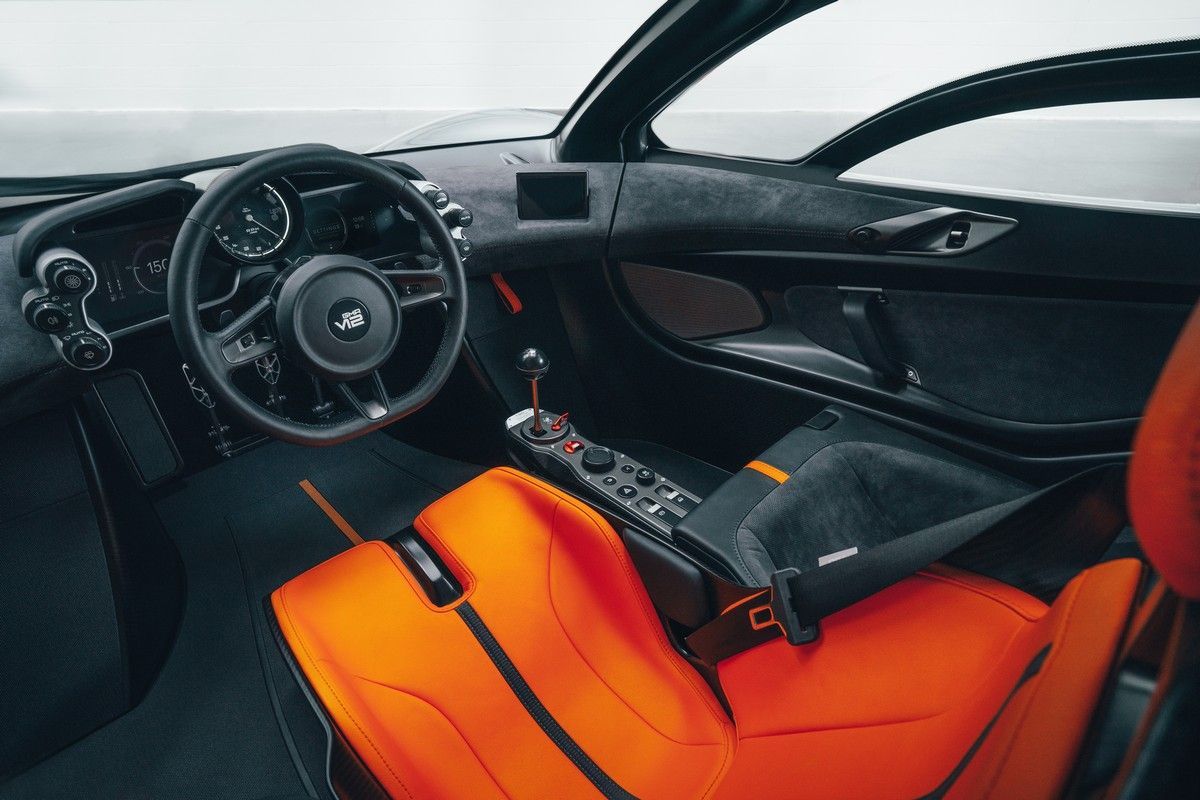
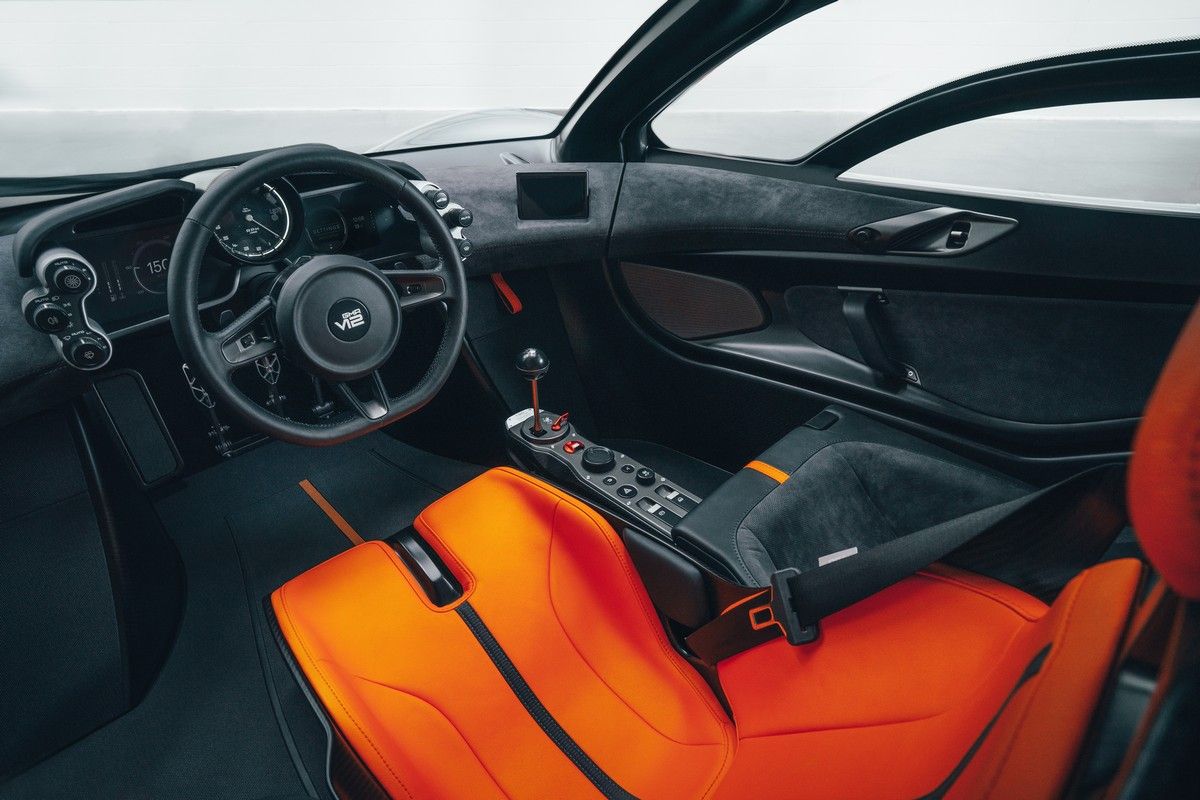
The T.50's simple instrument cluster (with a large central rev counter) is flanked by a pair of retro control-knob clusters.
9. Practical 'everyday supercar' interior
“Comfortable, refined, spacious and easy to drive – that's not a typical description for a supercar with the capabilities, power or driver focus of the T.50," says Murray. "I’ve designed this car to be used every day, with almost 300 litres of luggage and storage space, a 10-speaker 700W Arcam audio system and an Apple CarPlay/Android Auto-compatible infotainment system. From its exceptional visibility and compact footprint to ease of ingress and egress, the T.50 rewrites the supercar rule book for usability.”
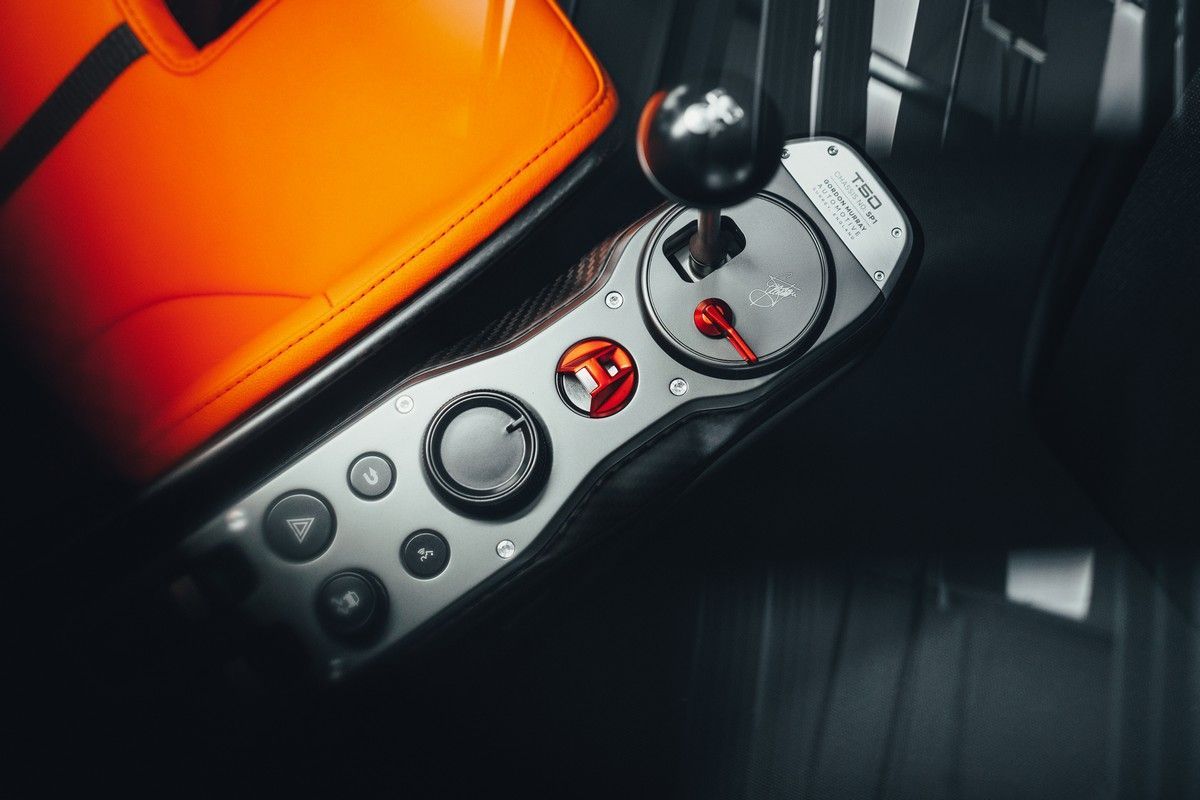
Like the McLaren F1, the T.50 has a centrally-positioned driver’s seat flanked by two passenger seats. There are no touchscreens and no stalk controls – even the indicators are operated by thumb-buttons on the steering wheel’s spokes. The pedals are milled from solid aluminium and laser-etched, while the titanium gearstick spouts from a ‘floating’ console, which features the drive mode selector, infotainment control knob and an engine start/stop button, which sits beneath an anodised red “missile switch” cover.
Only 100 roadgoing units of the T.50 will be produced. The newcomer's price tag is approximately R53 million.
10. First deliveries in 2022
GMA will produce 125 cars – 100 road cars and 25 track units – at the company’s production facility in Dunsfold Park, Surrey, with the first delivery scheduled for 2022.
Murray has personally met or spoken to every buyer and will hand over every car collected from the Gordon Murray Automotive’s UK customer reception centre. Around the world, T.50 owners will have access to a service network in the UK, US, Japan and Abu Dhabi – with a "flying technician" service supporting these and all other markets.
Most T.50s are pre-sold, although there are still “a few” opportunities for buyers who are willing to fork out an approximate R53 million (or more) for the privilege of owning one.
“People tell us the McLaren F1 was their poster car when they were growing up,” says Murray. “Now that they’ve built successful businesses, T50 has become their F1.”
With its most important product launches in years done, Ford will now transition from one CEO to another.
This year has seen the American car company launch a new version of its most important vehicle, the F-150 bakkie, and reintroduce the Bronco off-road SUV. Much is expected from these vehicles as Ford refocuses its core business.
With these two crucial new product lines delivered, CEO Jim Hackett can now retire, after only joining Ford in 2017.
Under Hackett’s leadership, Ford has taken the bold step to disinvest from the passenger car market and refocus nearly all of its resources on bakkies and SUVs. He has also driven technology and process innovation at the company, with Ford showing the first intent to electrify popular models, such as the Mustang.
Hackett’s background was unusual for a Ford boss. He had previously worked at the world’s largest office furniture company, Steelcase, but in only three years his influence was certainly felt. The new Bronco is perhaps Jim Hackett’s greatest legacy, as he prepares for a final working day at the end of September.
Replacing Jim Hackett is Jim Farley, who is currently Ford’s COO. Farley has deep experience in the automotive industry, having served for 13 years with Toyota, starting at the Japanese company in 1990, before joining Ford in 2007.
Farley’s understanding of how to position a luxury car brand is credible, as he worked on Lexus during its surge of popularity. An economics and computer science graduate, Farley’s literacy with regards to technology could be exactly what Ford requires, as it faces new threats to its most profitable business: bakkies.
With Bollinger, Lordstown, Rivian and Tesla preparing to launch advanced battery-powered bakkies into the American market, F-150 could come under huge pressure over the next three years. It will have to counter these disruptive new bakkie rivals with superior technology and Farley’s computer science literacy could help him understand which future vehicle technologies are digitally viable.
A cousin of American actor and comedian, Chris Farley, Ford’s new CEO promises to be personable and entertaining during media events.
While we await the belated arrival of the CX-30 compact family car in South Africa, Mazda is reportedly planning to unveil a CX-50 (possibly based on an all-new platform) that will either replace – or complement – the award-winning CX-5.
Japanese website Spyder7 recently reported that Mazda had registered a whole string of names from "CX-10" through to "CX-90" with the European Patent Office, which suggests that the Hiroshima-based firm is planning to roll out a host of more stylised, coupe-like crossovers (as well as replacements for its various current SUV ranges). It does makes sense… with the traditional sedan and hatchback markets dwindling, Mazda is evidently seeking to futureproof its product line (at least as best as it can).
But whereas the coupe-SUV variants of (primarily European) brands’ off-roader-inspired products have usually been complementary; what the Mercedes-Benz GLC Coupe is to the GLC, the BMW X4 is to the X3 and the Audi Q3 Sportback is to the Audi Q3 (different body shapes based on identical platforms), Mazda has followed a somewhat different, more improvisational formula with its CX models…
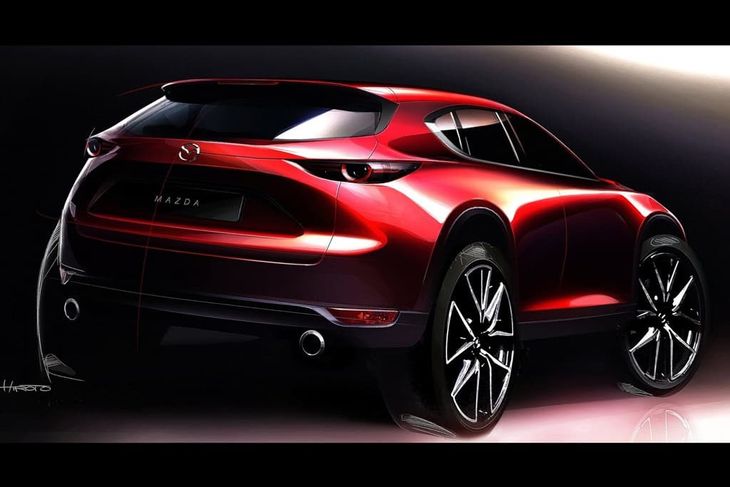
This design sketch (released at the release of the CX-5 in 2017) shows Mazda's designers had coupe styling in mind all along.
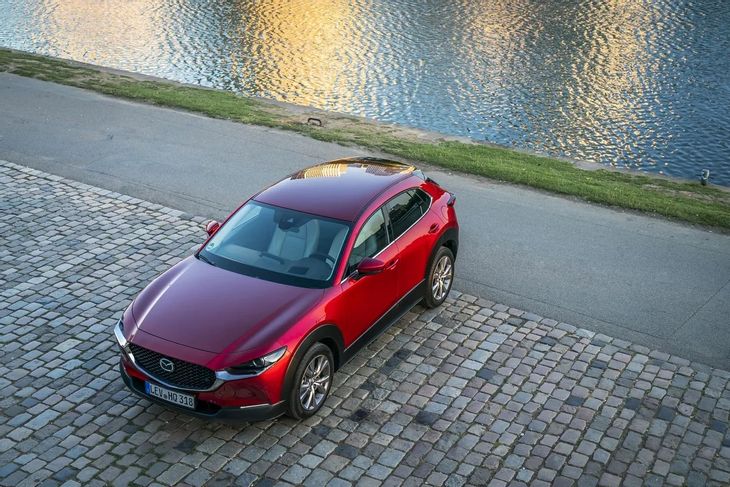
For example, the CX-3 is not based on the Mazda3, but on an adapted Mazda2 platform, the current CX-5 (KF) is based on the updated architecture of its KE predecessor, while the CX-30 is based on the latest Mazda3, even though its packaging is similar to that of the aforementioned 2019/20 #CarsAwards family-car category winner.
This is where things get interesting… It’s quite possible that the CX-5, which was introduced in South Africa in 2017, could be replaced by the CX-50 as part of an overhaul of the Japanese firm’s crossover/SUV line-up (which will switch to models named in increments of 10) “in late 2021 or early 2022”, the Spyder7 reported.
The CX-3 is not a coupe-SUV per see, but rather an alternative execution for Mazda's compact platform as utilised by Mazda3.
On the other hand, one would think that given the global success of the CX-5, Mazda would be best served by introducing the CX-50 as a distinctively-styled complementary variant based on the existing family car’s architecture, but with a few alterations (just like the Volkswagen Tiguan X is based on the Tiguan Allspace’s wheelbase).
Why? Because that’d be the only way we could see a CX-50 come to market before 2023. The next generation Mazda6 business class sedan and CX-5/CX-50 will reportedly be based on the new-generation rear/all-wheel drive FR architecture… and Mazda president Akira Muramoto told Automotive News it won’t be finished until March 2023.
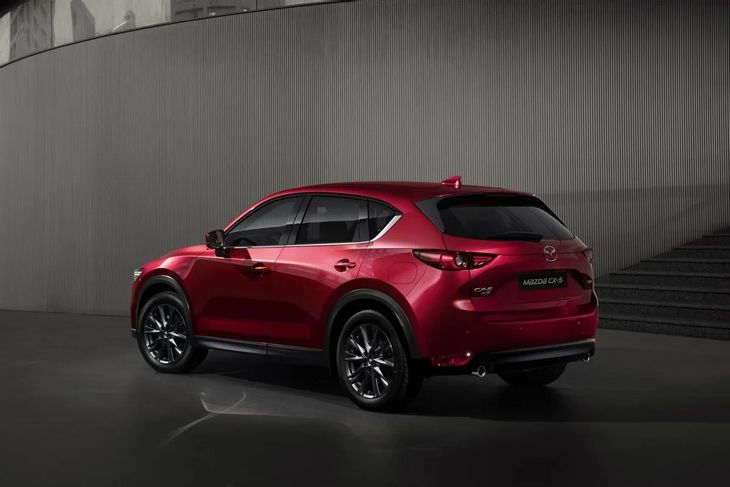
The CX-5 2.0 Dynamic Auto was named the family car category winner in the 2019/20 #CarsAwards – powered by WesBank.
The FR (large model) platform is a major deal for the Hiroshima-based firm, because apart from the fact that its RWD and AWD applications bode well for the dynamism and all-road ability of future Mazda models, it also supports 4-cylinder turbo and inline-6 petrol and diesel engines, plus plug-in hybrid and 48V mild-hybrid powertrains.
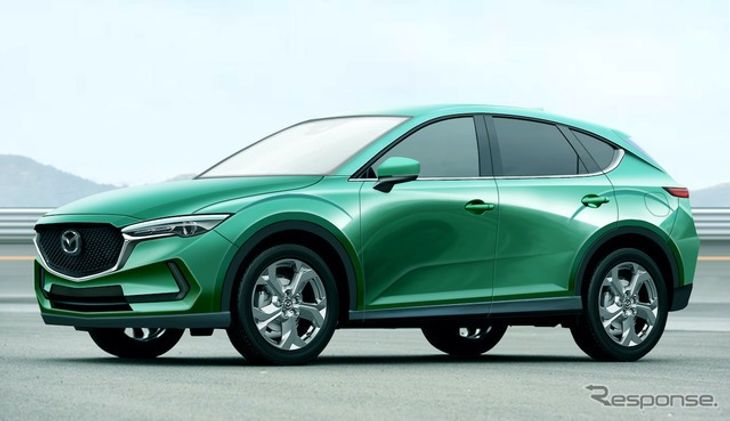
That means, if nothing else, the next-generation CX-5/CX-50 will be available with a mild-hybrid version of the current 2.5-litre 4-cylinder engine, as well as the turbocharged version of that motor (which recently debuted in the Mazda3 Turbo, which is yet to be confirmed for markets outside of North America), the 2.2-litre turbodiesel motor, as well as a 3.0-litre inline-6 mild hybrid and, believe it or not, a 3.3-litre inline-6 turbodiesel powerplant, the Japanese site says. This render of the anticipated CX-50 model was recently published by Japanese website Spyder7.
The artist’s impression by Response (the green-coloured car) suggests the styling of the CX-50 will be rather derivative of the CX-5’s, replete with gently-raked A- and C-pillars, a pinched waistline with 3-dimensional-effect surfacing, Kodo-inspired sportily culpted bumpers and intricate, sweeping LED headlights.
Will the CX-50 be released before the FR platform, or will the new architecture underpin an all-new replacement for the CX-5? We'll bring you updates as the story unfolds!
Jaguar Land Rover’s court bid in the United Kingdom to obtain trademark rights for its Defender SUV design has failed.
The shape of the Land Rover Defender is easily recognisable and forms part of the Defender’s history and appeal. So, when Ineos (founded by billionaire Jim Ratcliffe) revealed its forthcoming Grenadier 4×4 SUV a few weeks back, it looked very familiar, featuring a strikingly similar shape and look to the out-going Defender.
As you can imagine, Jaguar Land Rover wasn't pleased with this development and consequently filed a court bid to obtain trademark rights for the shape of its Defender, which would halt the progress of the Grenadier making it to production.
Now, a London court has dismissed JLR’s appeal with the UK Intellectual Property Office finding that the shape/s that Jaguar Land Rover aims to protect is not distinctive enough with the judge commenting that the design "may be unimportant, or may not even register, with average consumers." JLR is understandably disappointed by these findings as the Defender shape is trademarked in other markets. The new Land Rover Defender was recently launched in South Africa.
As for the Ineos Grenadier, it will be powered by BMW’s 6-cylinder engines and promises to be a "capable, durable and reliable 4×4 designed and built to handle the world’s harshest environments." The Ineos Grenadier will be built in the UK and production is due to start in the latter half of 2021.
South Africa is an ideal market for the Grenadier and Ineos is in negotiation with potential importers, so there is a chance that we will see it on local soil. Importantly, pricing is expected to come in at a similar price point to the Toyota Fortuner or Ford Everest which is great news for local consumers.
We will keep you in the loop as this story develops further.
Fuel prices are rising in August 2020. See the adjustments below…
The Department of Mineral Resources and Energy has released the fuel price adjustments which will take effect on Wednesday, 05 August 2020.
The Rand strengthened against the US Dollar from R17.43 to R16.82 during the period under review while the average Brent Crude oil price increased from $40.01 per barrel to $43.49 per barrel. The price of finished petroleum products also increased.
As a result, the fuel price adjustments for August 2020 are as follows:
Petrol (93 and 95 octane) increases by 5 cents per litre.
Diesel (0.05% and 0.005%) increases by 45 cents per litre
Paraffin (wholesale) increases by 39 cents per litre
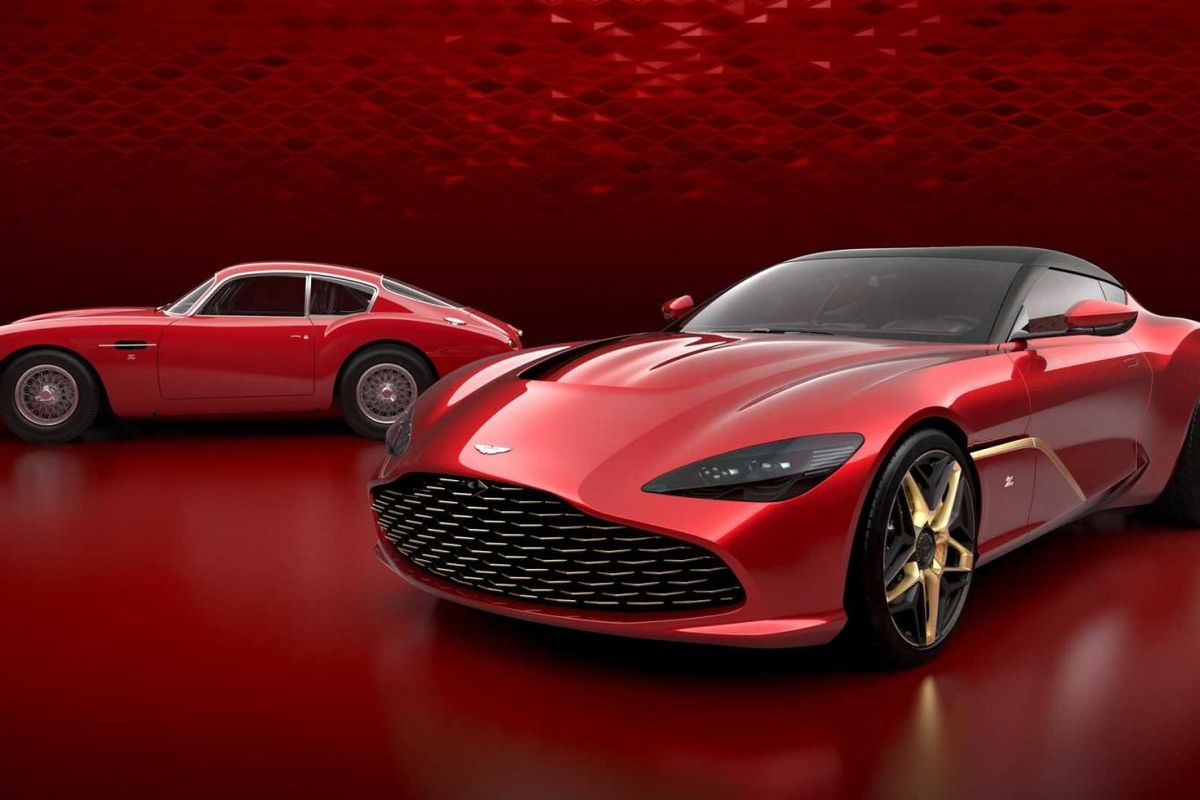
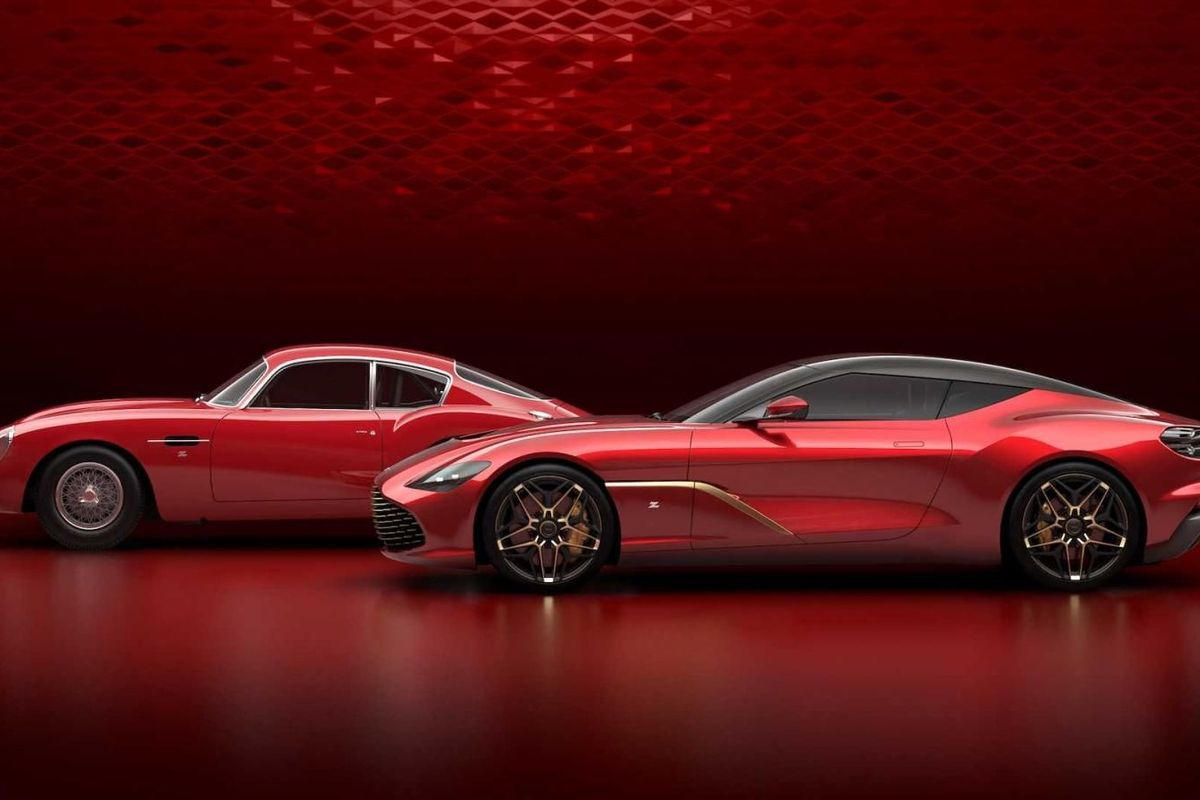
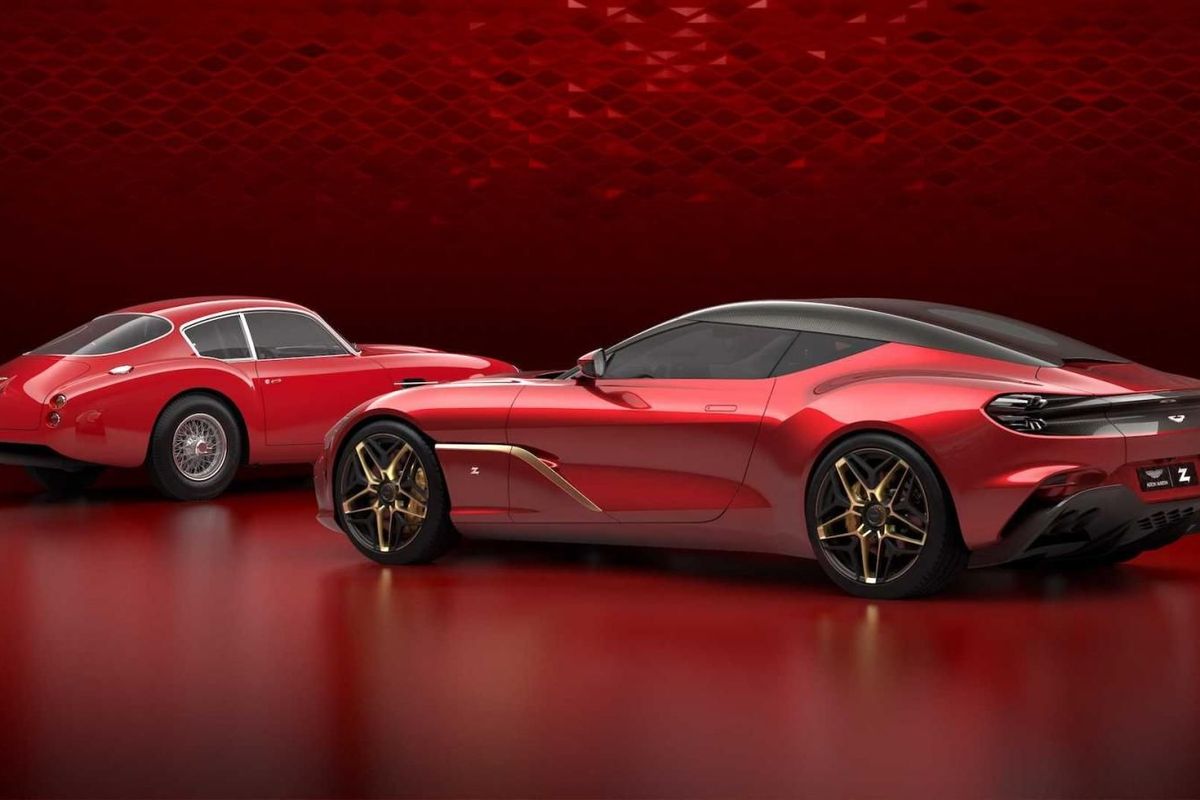
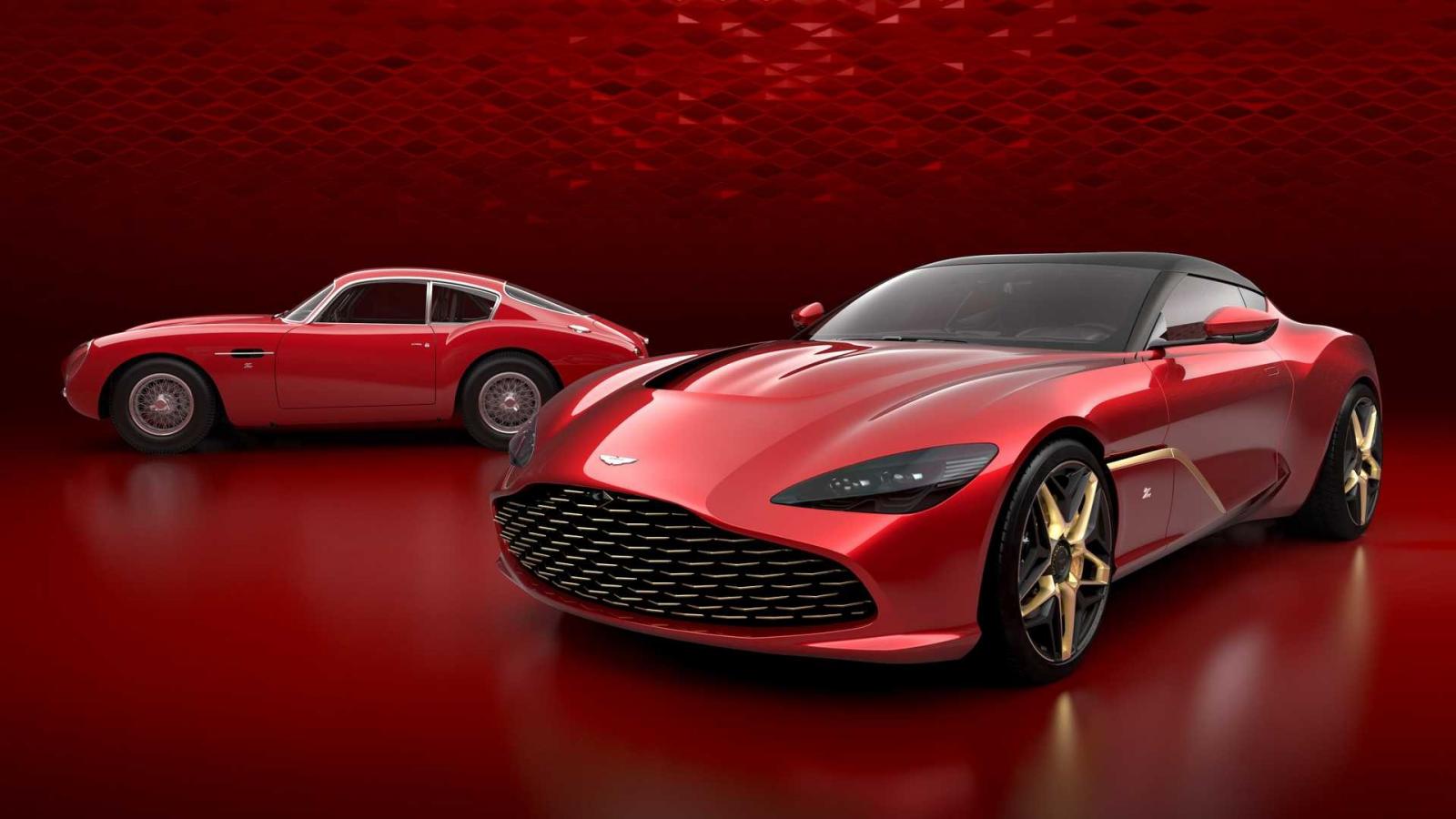
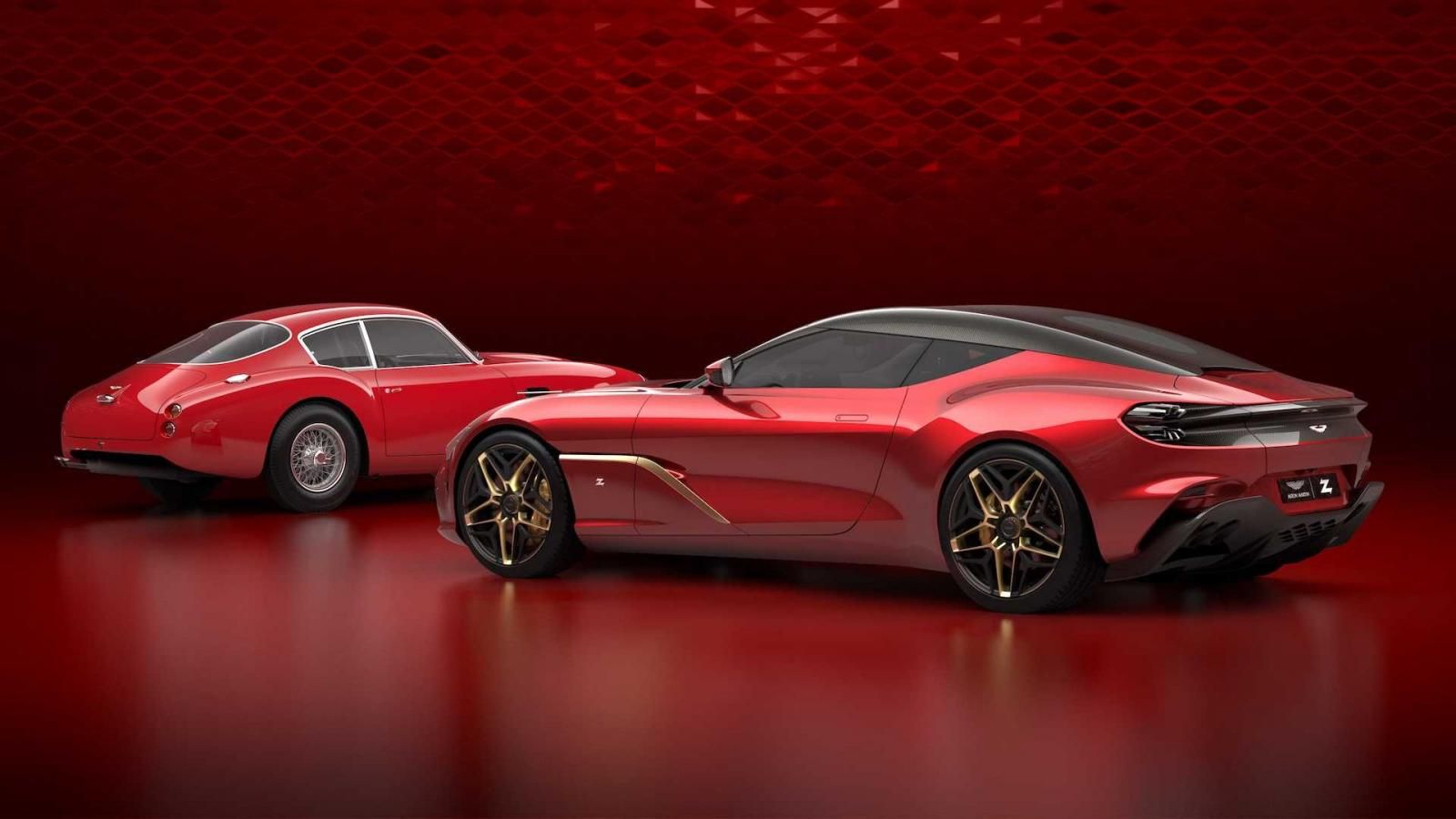
Deliveries of the Aston Martin DBZ Centenary Collection, which consists of 19 pairs of the DB4 GT Zagato Continuation and new DBS GT Zagato, began at the end of last year, when the Gaydon-based firm shipped the first batch of the legacy models to their owners. However, the ravishing DBS GT Zagato hadn't been seen in the metal… until now, where it's been spotted undergoing testing at the Nurburging.
Late last year, Aston Martin delivered the first of the 19 of the DB4 GT Zagato Continuation units, produced to mark the British sportscar brand’s 50-plus year association with the world-renowned Italian coachbuilder and design house, which celebrated its centenary in 2019. See also: Aston Martin DB5 Goldfinger Continuation [w/video]
Originally built to race against the might of Ferrari in the '60s, the DB4 GT Zagato is powered by an inline-6 engine (said to produce at least 283 kW) mated with a 4-speed manual transmission, which sends power to the rear wheels via a limited slip differential. But the legacy model is only half of the £6-million (R135-million) pair…
The DBS GT Zagato (right) is one of the most exclusive models ever produced by Aston Martin.
The statesidesupercars YouTube channel recently uploaded this video of the eagerly anticipated new DBS GT Zagato undergoing testing at the Nurburgring. Prior to the Covid-19 outbreak, Aston Martin had hoped to commence production and deliveries of the exclusive supercar in 2020. It's not clear whether it may still happen before the year is done, but the brand is clearly giving its new creation a thorough shakedown on the famous Nordschleife circuit… As expected, the DBS GT Zagato looks stunning in the metal!
The DBS GT Zagato uses the DBS Superleggera as its foundation and features a "dynamic grille" which incorporates 108 diamond-shaped carbon fibre pieces which are flush when the car is parked but at start-up, the elements ‘flutter to life’, each opening to allow the big twin-turbocharged 5.2-litre V12 engine to breathe.
Note the full-length carbon fibre roof which calls for camera technology to provide rearward visibility.
As for outputs, if it’s the same engine as found in the DBS Superleggera, the motor will produce 553 kW and 900 Nm. Note that the roof is full-length carbon fibre which means a camera-operated rear-view mirror is fitted to provide rearward visibility. The finished model will sport gold-look 20-spoke wheels too…
Marek Reichman, Chief Creative Officer, Aston Martin Lagonda said: “This is a car that is not only focused around beauty, but drama too. Our dynamic grille gives us an opportunity to provide the car with two very different identities. When parked, DBS GT Zagato will almost look like it’s resting, but with the rear of the car still appearing muscular and primed for action. Only on start-up will the car truly become alert and ready to perform, delivering both an aural and visual treat for onlookers”.
Despite having more than 600 000 pre-orders, Elon Musk is not totally committed to the eventual marketability of his Cybertruck.
The charismatic Tesla CEO has admitted to Automotive News, that the company’s futuristic bakkie was very much designed on a whim and intuition.
Unlike most other bakkies, there were no focus groups involved, allowing Tesla’s designers to test its design on customers – and develop it accordingly.
Musk’s mission was simply to design a bakkie which looked like something from a sci-fi movie. The original Cybertruck concept has certainly achieved that and triggered broad interest from customers who would ordinarily never have considered a bakkie.
Tesla desires greater scale in its business. Global demand for its products remains strong, but Musk is not unaware of the huge profits that are being made by the likes of Ford, FCA, GM and Toyota in the bakkie market.
Rivian has been an increasing source of worry for Tesla. The bakkie and SUV electric vehicle company is seen by many as Tesla’s most credible rival and it is launching straight into the best possible revenue stream segment: double-cabs.
There is no question that Rivian’s potential success is hastening Tesla’s Cybertruck development, with the two brands scheduled to launch their bakkies mere months apart, towards the end of 2021. The Rivian double-cab bakkie looks a lot more conventional than Tesla’s Cybertruck, and that could make it better suited at conquering traditional bakkie customers.
It appears that this reality is now crystallizing in the mind of Musk, who has admitted that although the Cybertruck’s daring design is a futurism that Tesla values, it is not resistant to the idea of building a more conservative bakkie.
Although the Cybertruck’s exoskeleton construction and angular lines are defining attributes, Musk is not immune to changing it. If the market demands something different. “There are lots of normal trucks out there that look pretty much the same; you can hardly tell the difference. And sure, we could just do some copycat truck; that's easy. So that's our fallback strategy."